US11023474B2 - Search method and search device - Google Patents
Search method and search device Download PDFInfo
- Publication number
- US11023474B2 US11023474B2 US16/157,636 US201816157636A US11023474B2 US 11023474 B2 US11023474 B2 US 11023474B2 US 201816157636 A US201816157636 A US 201816157636A US 11023474 B2 US11023474 B2 US 11023474B2
- Authority
- US
- United States
- Prior art keywords
- word
- impression
- search
- score
- relationship
- Prior art date
- Legal status (The legal status is an assumption and is not a legal conclusion. Google has not performed a legal analysis and makes no representation as to the accuracy of the status listed.)
- Active, expires
Links
Images




Classifications
-
- G—PHYSICS
- G06—COMPUTING OR CALCULATING; COUNTING
- G06F—ELECTRIC DIGITAL DATA PROCESSING
- G06F16/00—Information retrieval; Database structures therefor; File system structures therefor
- G06F16/20—Information retrieval; Database structures therefor; File system structures therefor of structured data, e.g. relational data
- G06F16/24—Querying
- G06F16/245—Query processing
- G06F16/2457—Query processing with adaptation to user needs
- G06F16/24578—Query processing with adaptation to user needs using ranking
-
- G—PHYSICS
- G06—COMPUTING OR CALCULATING; COUNTING
- G06F—ELECTRIC DIGITAL DATA PROCESSING
- G06F16/00—Information retrieval; Database structures therefor; File system structures therefor
- G06F16/20—Information retrieval; Database structures therefor; File system structures therefor of structured data, e.g. relational data
- G06F16/24—Querying
- G06F16/248—Presentation of query results
-
- G—PHYSICS
- G06—COMPUTING OR CALCULATING; COUNTING
- G06F—ELECTRIC DIGITAL DATA PROCESSING
- G06F16/00—Information retrieval; Database structures therefor; File system structures therefor
- G06F16/30—Information retrieval; Database structures therefor; File system structures therefor of unstructured textual data
- G06F16/33—Querying
- G06F16/338—Presentation of query results
-
- G—PHYSICS
- G06—COMPUTING OR CALCULATING; COUNTING
- G06F—ELECTRIC DIGITAL DATA PROCESSING
- G06F16/00—Information retrieval; Database structures therefor; File system structures therefor
- G06F16/90—Details of database functions independent of the retrieved data types
- G06F16/93—Document management systems
-
- G—PHYSICS
- G06—COMPUTING OR CALCULATING; COUNTING
- G06Q—INFORMATION AND COMMUNICATION TECHNOLOGY [ICT] SPECIALLY ADAPTED FOR ADMINISTRATIVE, COMMERCIAL, FINANCIAL, MANAGERIAL OR SUPERVISORY PURPOSES; SYSTEMS OR METHODS SPECIALLY ADAPTED FOR ADMINISTRATIVE, COMMERCIAL, FINANCIAL, MANAGERIAL OR SUPERVISORY PURPOSES, NOT OTHERWISE PROVIDED FOR
- G06Q30/00—Commerce
- G06Q30/02—Marketing; Price estimation or determination; Fundraising
- G06Q30/0201—Market modelling; Market analysis; Collecting market data
Definitions
- the embodiments discussed herein are related to a search method and a search device.
- a system that displays search results based on a query input by a user on a radar chart is known in the related art.
- the radar chart is displayed, it is known that axis items (word) are extracted from a set of search results based on the query input by the user.
- Japanese Laid-open Patent Publication No. 2008-003869 is an example of the related art.
- an apparatus receives, via an input device, query input data including a word or a phrase, and acquires search result set data using the query input data.
- the apparatus acquires, for a value indicating a strength of a relationship between each impression word included in an impression word group and each word included in the query input data, and extracts the first feature word group according to the value indicating the strength of the relationship with each word, from the impression word group.
- the apparatus displays the search result set data using the first feature word group as an item.
- FIG. 1 is a diagram that illustrates an example of a system configuration of a search system of a first embodiment
- FIG. 2 is a diagram that illustrates an example of a hardware configuration of a search device of the first embodiment
- FIG. 3 is a diagram that describes functions of the search device of the first embodiment
- FIG. 4 is a flowchart that describes processing by an index generation unit
- FIGS. 5A and 5B are example tables of index information generated by the index generation unit
- FIG. 6 is an example table of an impression word map of the first embodiment
- FIG. 7 is a flowchart that describes processing by an impression space learning unit
- FIG. 8 is an example table of an impression word score list of the first embodiment
- FIG. 9 is a flowchart that describes processing of a search processing unit of the first embodiment
- FIG. 10 is a flowchart that describes processing of an impression word score output unit and an axis determination unit of the first embodiment
- FIG. 11 is a diagram describing processing of the impression word score output unit and the axis determination unit
- FIG. 12 is a first diagram illustrating a display example of a radar chart of the first embodiment
- FIG. 13 is a diagram illustrating an example of a radar chart as a comparative example
- FIG. 14 is a second diagram that illustrates a display example of a radar chart of the first embodiment
- FIG. 15 is a diagram describing functions of a search device of a second embodiment
- FIG. 16 is a flowchart that describes processing of a search processing unit of the second embodiment
- FIG. 17 is a flowchart describing processing of an axis determination unit of the second embodiment
- FIGS. 18A and 18B are graphs describing variation in scores in an impression word map of a third embodiment
- FIG. 19 is a diagram describing functions of a search device of the third embodiment.
- FIG. 20 is a table illustrating an example of the impression word map of the third embodiment
- FIG. 21 is an example table of an impression word score list of the third embodiment.
- FIG. 22 is a flowchart describing processing of a search processing unit of the third embodiment.
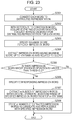
- FIG. 23 is a flowchart describing processing of an impression word score output unit and an axis determination unit of the third embodiment
- FIG. 24 is a diagram describing extraction of a candidate axis by the search processing unit of the third embodiment.
- FIG. 25 is a first diagram illustrating a display example of the third embodiment
- FIG. 26 is a second diagram illustrating a display example of the third embodiment
- FIG. 27 is a diagram describing functions of a search device of a fourth embodiment
- FIG. 28 is a flowchart describing axis change processing in the fourth embodiment.
- FIGS. 29A to 29C are diagrams describing change of axis
- FIG. 30 is a diagram describing functions of a search device of a fifth embodiment
- FIG. 31 is a flowchart describing processing of a correction list generation unit of the fifth embodiment.
- FIG. 32 is a diagram illustrating an example of a correction list of the fifth embodiment
- FIG. 33 is a flowchart describing processing of an impression word score output unit, an axis determination unit, and a score correction unit of the fifth embodiment
- FIG. 34 is a diagram describing an outline of a sixth embodiment
- FIGS. 35A and 35B are diagrams describing change in score of impression words
- FIG. 36 is a diagram describing functions of a search device of the sixth embodiment.
- FIG. 37 is a first flowchart describing processing of a search processing unit of the sixth embodiment.
- FIG. 38 is a second flowchart describing processing of the search processing unit of the sixth embodiment.
- FIG. 39 is a third flowchart describing processing of the search processing unit of the sixth embodiment.
- FIGS. 40A and 40B are diagrams describing correspondence between a score and a slider value of the sixth embodiment
- FIG. 41 is an example correspondence table of the sixth embodiment.
- FIG. 42 is a diagram illustrating a display example of the sixth embodiment.
- FIGS. 43A and 43B are diagrams illustrating another display example of the sixth embodiment.
- FIG. 44 is a graph describing correspondence between a score and a slider value of a seventh embodiment
- FIG. 45 is a flowchart describing processing of a search processing unit of the seventh embodiment.
- FIG. 46 is an example correspondence table of the seventh embodiment.
- FIG. 1 is a diagram that illustrates an example of a system configuration of a search system of a first embodiment.
- a search system 100 of the present embodiment includes a search device 200 and a terminal device 300 .
- the search device 200 and the terminal device 300 are connected via a network.
- the search device 200 of the present embodiment communicates with a search target document database 400 in which information to be searched by the search device 200 is stored.
- the information stored in the search target document database 400 of the present embodiment is, for example, text data such as document data.
- the search target document database 400 of the present embodiment may include, for example, a plurality of databases.
- the search target document database 400 of the present embodiment may be included in the search system 100 .
- the search device 200 of the present embodiment searches the search target document database 400 based on the input query.
- the search device 200 causes the terminal device 300 to display the search result acquired as a result of the search processing by a radar chart.
- the query indicates, for example, a word or a phrase (compound word) input when the user of the terminal device 300 or the search device 200 performs a search request.
- the search device 200 of the present embodiment displays a radar chart with words extracted based on the query input from the terminal device 300 as axes.
- the present embodiment it is possible to make the correspondence between the query and the axis of the radar chart clear by using the words extracted based on the query input by the user as axes of the radar chart. Therefore, in the present embodiment, it is possible to allow the user to easily evaluate whether or not the search result matches the intention of the user. According to the present embodiment, it is possible to properly evaluate the search result.
- the search device 200 of the present embodiment includes a search target index storage unit 210 , an impression word map storage unit 220 , a search target score storage unit 230 , and a search processing unit 240 .
- the search target index storage unit 210 stores index information in which each document data stored in the search target document database 400 is associated with words included in each document data.
- the impression word map storage unit 220 stores an impression word map indicating a relationship between a word and an impression word.
- the search target score storage unit 230 stores an impression word score list indicating the relationship between the words and impression words included in each document data on the document data included in the search target document database 400 . Details of each storage unit will be described later.
- search processing unit 240 When the search processing unit 240 receives input of a query from the terminal device 300 , the search processing unit 240 searches the search target document database 400 with reference to the search target index storage unit 210 , and acquires document data as a search result.
- search result set data the search result acquired by the search processing of the search processing unit 240 is referred to as search result set data.
- the search processing unit 240 selects impression words each having a strong relationship with the content of the query as the axes of the radar chart with reference to the impression word map storage unit 220 , and causes the terminal device 300 to display the radar chart for each search result set data.
- the query is input from the terminal device 300 to the search device 200 , and the radar chart is displayed on the terminal device 300 , but not limited thereto.
- the query may be input by an input device of the search device 200 , and the radar chart may be displayed on an output device (display) or the like of the search device 200 .
- FIG. 2 is a diagram that illustrates an example of a hardware configuration of a search device of the first embodiment.
- the search device 200 of the present embodiment is an information processing device including an input device 21 , an output device 22 , a drive device 23 , an auxiliary storage device 24 , a memory device 25 , an arithmetic processing device 26 , and an interface device 27 mutually connected via a bus B.
- the input device 21 is a device to input various kinds of information, and is realized by, for example, a keyboard, a pointing device, or the like.
- the output device 22 is a device to output various kinds of information, and is realized by, for example, a display or the like.
- the interface device 27 includes a LAN card or the like, and is used to be connected to a network.
- a search program is at least a part of various programs that control the search device 200 .
- the search program is provided by, for example, distribution of a storage medium 28 , download from a network, or the like.
- Various types of storage media may be used as the storage medium 28 in which the search program is recorded; a storage medium that optically, electrically, or magnetically records information, such as a CD-ROM, a flexible disk, or a magneto-optical disk, a semiconductor memory that electrically records information, such as a ROM or a flash memory, or the like.
- the search program is installed from the storage medium 28 to the auxiliary storage device 24 via the drive device 23 .
- the search program downloaded from the network is installed in the auxiliary storage device 24 via the interface device 27 .
- the auxiliary storage device 24 stores significant files, data, and the like while storing the installed search program.
- the memory device 25 reads and stores the search program from the auxiliary storage device 24 when the search device 200 is activated.
- the arithmetic processing device 26 realizes various types of processing as described later according to the search program stored in the memory device 25 .
- the hardware configuration of the terminal device 300 of the present embodiment is the same as that of the search device 200 , and description thereof is omitted.
- the terminal device 300 may be, for example, a tablet type terminal device, a smart phone, or the like, and may have a display operation device realized by a touch panel or the like instead of the input device 21 and the output device 22 .
- FIG. 3 is a diagram that describes the functions of the search device of the first embodiment.
- the search device 200 of the present embodiment includes the search target index storage unit 210 , the impression word map storage unit 220 , the search target score storage unit 230 , and the search processing unit 240 .
- Index information 211 is stored in the search target index storage unit 210 .
- the index information 211 of the present embodiment is created by preliminary processing by an index generation unit 247 described later.
- An impression word map 221 is stored in the impression word map storage unit 220 .
- the impression word map 221 of the present embodiment is given in advance by a manager or the like of the search device 200 .
- An impression word score list 231 is stored in the search target score storage unit 230 .
- the impression word score list 231 is created by processing of the search processing unit 240 described later.
- the search processing unit 240 of the present embodiment includes an input receiving unit 241 , an analysis unit 242 , a search unit 243 , an impression word score output unit 244 , an axis determination unit 245 , an output unit 246 , the index generation unit 247 , and an impression space learning unit 248 .
- Each unit of the search processing unit 240 is realized by the arithmetic processing device 26 of the search device 200 reading and executing the search program stored in the memory device 25 or the like.
- the input receiving unit 241 of the present embodiment receives various inputs to the search device 200 .
- the input receiving unit 241 receives input of the query to the search device 200 .
- the analysis unit 242 of the present embodiment performs word segmentation, modification analysis, meaning analysis, and the like to keywords and natural sentences.
- the analysis unit 242 specifies a search word group based on the query, or specifies a word from the document data of the search result acquired from the search target document database 400 .
- the analysis unit 242 of the present embodiment fulfills the function of a specification unit that specifies a search word group from the query.
- the search unit 243 of the present embodiment refers to the search target index storage unit 210 , specifies the document data including the search word group acquired from the analysis unit 242 , and acquires the search result set data from the search target document database 400 .
- the impression word score output unit 244 converts each word included in the search word group acquired from the query to a vector by a distributed representation.
- the impression word score output unit 244 outputs a score indicating strength of a relationship between the search word group and the impression words included in the impression word map 221 based on each word converted to a vector and a conversion model 250 described later.
- the impression word score output unit 244 outputs the score indicating the strength of the relationship between the word represented in a vector as an input to the conversion model 250 and each impression word included in the impression word map 221 .
- a method based on the distributed representation of words of the present embodiment is a method that estimates a semantic similarity relationship (similarity) between each word using a large amount of learning data given separately, and represents meaning of the word by a vector by disposing each word in a vector space of a predetermined number of dimensions so as to be consistent with the estimated inter-word similarity.
- the vector representing the meaning of a word converted by the distributed representation of words is referred to as a semantic vector.
- the impression word of the present embodiment is a word that reminds impression of the search result such as an adjective, an adjective verb, and an adverb.
- the axis determination unit 245 determines the impression words as the axes of the radar chart to display the search result according to the score of each word output by the impression word score output unit 244 .
- the axis of the radar chart is, for example, one of the items to display the search result set data.
- the output unit 246 of the present embodiment displays the radar chart of the search result set data using the impression words determined by the axis determination unit 245 as the axes.
- the output unit 246 of the present embodiment displays the impression words extracted according to the strength of the relationship with the search word group as the item when displaying the search result set data acquired by search processing by the search word group based on the query.
- the index generation unit 247 of the present embodiment creates the index information 211 stored in the search target index storage unit 210 from the search target document database 400 .
- the impression space learning unit 248 outputs the conversion model 250 based on the search target document data stored in the search target document database 400 and the impression word map 221 stored in the impression word map storage unit 220 .
- the processing of the index generation unit 247 and the impression space learning unit 248 of the present embodiment may be performed in advance as the preliminary processing of search processing performed after the query is input.
- FIG. 4 is a flowchart that describes the processing by an index generation unit.
- the index generation unit 247 of the present embodiment refers to the search target document database 400 , and determines whether or not a certain word is included in the document data for each document data stored in the search target document database 400 (step S 401 ).
- a document ID is included in each document data stored in the search target document database 400 as identification information to specify the document data.
- the index generation unit 247 acquires a set of document data including the word, generates the index information 211 in which the word, the number of acquired document data pieces, and the document ID as the identification information that specifies the document data are associated with each other for each word (step S 402 ), and ends the processing.
- FIGS. 5A and 5B are example tables of index information generated by the index generation unit.
- FIG. 5A is a table illustrating intermediate data acquired as a result of processing in step S 401 .
- FIG. 5B is an example table of the index information 211 .
- the index generation unit 247 of the present embodiment includes, for example, “this”, “pen”, and “apple” in the document data.
- the index generation unit 247 determines whether or not each word of “this”, “pen”, and “apple” is included in the document data for each document data stored in the search target document database 400 , and stores intermediate data 205 indicating the determination result.
- the word “this” is included in the document data with document ID “1”, the document data with document ID “2”, and the document data with document ID “N”. It is found that the word “pen” is included in the document data with the document ID “1”. It is found that the word “apple” is included in the document data with the document ID “2”.
- the index generation unit 247 generates the index information 211 in which the number of document data pieces including the word is associated with the document ID for each word.
- the index information 211 illustrated in FIG. 5B includes keys, the number of match documents, and an array of documents as items of information.
- the value of the item “key” indicates the word estimated to be included in the document data.
- the value of the item “number of match documents” indicates the number of document data pieces including words as the keys.
- the value of the item “array of documents” indicates the document ID of the document data including the words as the keys.
- the number of the document IDs included in the value of the item “array of documents” is equal to the number as the value of the item “number of match documents”.
- the number of document data pieces including the word “this” is 239, and the document ID of the document data including the word “this” is document ID “1”, “2”, . . . , “N”.
- the index generation unit 247 of the present embodiment generates the index information 211 , and stores the information in the search target index storage unit 210 .
- impression word map 221 stored in the impression word map storage unit 220 of the present embodiment will be described.
- FIG. 6 is an example table of an impression word map of the first embodiment.
- the impression word map 221 of the present embodiment is, for example, created by a manager or the like of the search system 100 , and given to the search device 200 in advance.
- a map that is created based on a result of a questionnaire or the like conducted on a large number of people to answer the strength of the relationship between words and impression words may be given to the search device 200 .
- a score indicating the strength of the relationship between the impression word prepared in advance and each word is associated with each word.
- the word included in the impression word map 221 may be any word estimated to be included in the document data stored in the search target document database 400 .
- the score of the present embodiment is, for example, a value from 0 to 10. In a case where the score is “0”, it indicates that there is no relationship between the word and the impression word, and the larger the score, the stronger the relationship between the word and the impression word.
- impression word map 221 illustrated in FIG. 6 , “premier”, “lively”, “hideaway”, “quiet”, “healthy”, and the like are listed as an impression word.
- the score indicating the strength of the relationship between a word “date” and the impression word “premier” is “9.21”
- the score indicating the strength of the relationship between the word “date” and the impression word “lively” is “3.23”.
- the word “date” has a stronger relationship with the impression word “premier” than the impression word “lively”.
- FIG. 7 is a flowchart that describes the processing by an impression space learning unit.
- the impression space learning unit 248 of the present embodiment refers to the search target document database 400 , inputs each document data included in the search target document database 400 , and learns the distributed representations of words included in each document data with unsupervised learning (step S 701 ).
- the impression space learning unit 248 internally stores the semantic vector of words included in each document data.
- the impression space learning unit 248 refers to the impression word map 221 , and learns the score corresponding to the impression words included in the impression word map 221 with respect to the distributed representation of each word with supervised learning (step S 702 ).
- the impression space learning unit 248 refers to the impression word map 221 to machine learn the relationship between the semantic vector of each word and the score indicating the strength of the relationship with each impression word associated with the word.
- the impression space learning unit 248 outputs and stores the learned result as the conversion model 250 (step S 703 ).
- the conversion model 250 of the present embodiment is a model in which a semantic vector of a word acquired by the distributed representation is input, and the score for each impression word associated with the word is output.
- the described-above is the preliminary processing by the index generation unit 247 and preliminary processing by the impression space learning unit 248 .
- impression word score list 231 stored in the search target score storage unit 230 of the present embodiment will be described with reference to FIG. 8 .
- FIG. 8 is an example table of an impression word score list.
- the impression word score list 231 of the present embodiment is, for example, a list acquired by processing of the analysis unit 242 and the impression word score output unit 244 of the search processing unit 240 .
- the impression word score list 231 of the present embodiment is referred to when the search result by the search unit 243 is displayed as the radar chart by the output unit 246 .
- the impression word score list 231 indicates the score indicating the strength of the relationship between the document ID of document data included in the search target document database 400 and each impression word included in the impression word score list 231 .
- the impression words included in the impression word score list 231 are the same as the impression words included in the impression word map 221 .
- the search processing unit 240 of the present embodiment extracts a word from the document data stored in the search target document database 400 by the analysis unit 242 .
- the search processing unit 240 inputs the extracted word into the conversion model 250 after the extracted word is converted to a semantic vector by the impression word score output unit 244 , and acquires the score indicating the strength of the relationship between each impression word and each word.
- the score may be a score of each impression word associated with the document ID.
- the score indicating the strength of the relationship between the word and each impression word becomes the score indicating the strength of the relationship between the document data and each impression word.
- the score indicating the strength of the relationship between each impression word and each word is output for the plurality of words. Therefore, in the present embodiment, for each impression word, a maximum score or an average score of the plurality of words may be acquired, and the maximum score or the average score of each impression word may be the score indicating the strength of the relationship between the document data and each impression word.
- the search processing unit 240 acquires the score indicating the strength of the relationship between the word “date” and each impression word included in the impression word map 221 , and the score indicating the strength of the relationship between the word “delicious” and each impression word included in the impression word map 221 .
- the search processing unit 240 acquires the maximum value of the score corresponding to the word “date” and the score corresponding to the word “delicious” for each impression word. For example, it is assumed that the score indicating the strength of the relationship between the word “date” and the impression word “premier” is 9.21, and the score indicating the strength of the relationship between the word “delicious” and the impression word “premier” is 9.38. In this case, the search processing unit 240 may take the maximum value 9.38 between 9.21 and 9.38 as the score indicating the strength of the relationship between the document data and the impression word “premier”.
- FIG. 9 is a flowchart that describes the processing of a search processing unit of the first embodiment.
- the search processing unit 240 of the present embodiment acquires a search word group by morphological analysis or the like from the query by the analysis unit 242 , searches the index information 211 with the search word group by the search unit 243 , and specifies the document ID corresponding to the search word group (step S 901 ).
- the document data indicated by the document ID specified in step S 901 is the search result set data.
- the search processing unit 240 extracts the n number of impression words with clear relationship with the query as the axis based on the input query by the impression word score output unit 244 , and sets the n number of impression words as an ⁇ axis by the axis determination unit 245 (step S 902 ).
- the axis in step S 902 is an axis of the radar chart, and is one of the items to be an attribute of the search result set data. Details of processing of step S 902 will be described later.
- the ⁇ axis of the present embodiment is an axis in which an impression word that has a large score indicating the strength of the relationship with the query, has a strong relationship with the query, and the correspondence is clear is set.
- the search processing unit 240 extracts the m number of preset words by the axis determination unit 245 , and sets them as a ⁇ axis (step S 903 ).
- the preset word may be, for example, selected and set from the impression words included in the impression word map 221 .
- the preset word may be selected and set from the words included in the index information 211 .
- the preset word may be a word included in the search result set data.
- the ⁇ axis of the present embodiment indicates an axis other than the ⁇ axis among all of the axes in the radar chart.
- the ⁇ axis is an axis in which an impression word not strongly related to the query is set compared to the ⁇ axis.
- the output unit 246 uses the ⁇ axis and the ⁇ axis as an output axis (step S 904 ), draws the search result set data indicated by the document ID acquired by the search unit 243 in step S 901 by the output unit 246 on a radar chart (step S 905 ), and ends the processing.
- FIG. 10 is a flowchart that describes the processing of an impression word score output unit and an axis determination unit of the first embodiment.
- the processing in FIG. 10 indicates the processing of the impression word score output unit 244 and the axis determination unit 245 .
- the impression word score output unit 244 of the present embodiment converts each word included in the search word group acquired in step S 901 to the distributed representations (step S 1001 ). For example, the impression word score output unit 244 converts each word included in the search word group to a semantic vector by the distributed representation.
- the impression word score output unit 244 refers to the conversion model 250 , and acquires the score indicating the strength of the relationship between each impression word and each word (step S 1002 ). For example, the impression word score output unit 244 inputs the semantic vector of each word acquired in step S 1001 to the conversion model 250 , and acquires the score of each impression word for each word output from the conversion model 250 .
- the axis determination unit 245 acquires the maximum score of each impression word corresponding to each word (step S 1003 ).
- the axis determination unit 245 extracts the impression words corresponding to the top n maximum scores of each impression word as the ⁇ axis related to the query (step S 1004 ). For example, the axis determination unit 245 extracts the n number of impression words in descending order of the impression words having the maximum score for each impression word, and set the n impression words as the ⁇ axis.
- FIG. 11 is a diagram describing processing of the impression word score output unit and the axis determination unit.
- the search processing unit 240 of the present embodiment acquires a search word group 111 by the analysis unit 242 when the input of the query is received.
- the search word group the word “quiet”, “premier”, are “restaurant” included.
- the search processing unit 240 acquires a semantic vector 112 for each word included in the search word group 111 by the impression word score output unit 244 .
- each word “quiet”, “premier”, and “restaurant” are indicated as a vector.
- the impression word score output unit 244 inputs the semantic vector 112 to the conversion model 250 , and acquires the score of each impression word included in the impression word map 221 for each word.
- the information in which each word included in the search word group is associated with the score of each impression word is referred to as an impression word score 113 for each word.
- the axis determination unit 245 acquires the maximum score for each impression word from the impression word score 113 for each word.
- the score indicating the strength of the relationship with the word “quiet” is 3.49
- the score indicating the strength of the relationship with the word “premier” is 10.00 (full marks)
- the score indicating the strength of the relationship with the word “restaurant” is 7.95.
- the axis determination unit 245 acquires “10.00” as the maximum score of the impression word “premier”.
- the score indicating the strength of the relationship with the word “quiet” is 3.48
- the score indicating the strength of the relationship with the word “premier” is 8.33
- the score indicating the strength of the relationship with the word “restaurant” is 6.72.
- the axis determination unit 245 acquires “8.33” as the maximum score of the impression word “healthy”.
- the score indicating the strength of the relationship with the word “quiet” is 9.38
- the score indicating the strength of the relationship with the word “premier” is 6.23
- the score indicating the strength of the relationship with the word “restaurant” is 3.46.
- the axis determination unit 245 acquires “9.38” as the maximum score of the impression word “hideaway”.
- the axis determination unit 245 of the present embodiment may store the maximum score acquired for each impression word as an impression word score list 114 corresponding to the query.
- the impression word score list 114 may be referred to, for example, when displaying the radar chart described later.
- the axis determination unit 245 extracts the n number of impression words in descending order of the impression words having the maximum score in the impression word score list 114 , and set the n impression words as the ⁇ axis.
- n is 2.
- the impression word having the maximum score is “premier”, and the impression word having the next maximum score is “hideaway”.
- the axis determination unit 245 of the present embodiment determines the impression word “premier” and the impression word “hideaway” as the ⁇ axis of the radar chart. For example, the axis determination unit 245 sets the impression word “premier” and the impression word “hideaway” as the items when displaying the search result set data.
- the impression word having a strong relationship with the query is extracted based on the search word group acquired from the input query.
- the impression word extracted here may be a feature word group (hereinafter, also referred to as first feature word group) indicating the feature of the content estimated from the query. Therefore, the axis determination unit 245 of the present embodiment fulfills the function of an extraction unit that extracts the first feature word group from the query.
- the axis determination unit 245 of the present embodiment determines the impression word as the ⁇ axis according to the maximum score for each impression word, but not limited thereto. For example, when the impression word score 113 for each word is acquired, the axis determination unit 245 may extract the n number of impression words in descending order of values obtained by normalizing the score of each impression word. When the impression word score 113 for each word is acquired, the axis determination unit 245 may extract the n number of impression words in descending order of the average score for each impression word.
- the value associated with each impression word is not limited to the maximum score for each impression word in the impression word score 113 for each word.
- the value associated with each impression word may be a value obtained by normalizing the score of each impression word in the impression word score 113 for each word, or may be an average score of each impression word in the impression word score 113 for each word.
- the impression word corresponding with the score is extracted as the ⁇ axis, but not limited thereto.
- the axis determination unit 245 may extract, for example, the word having the maximum score indicating the strength of the relationship with the impression word as the ⁇ axis.
- the axis determination unit 245 extracts the impression word “premier” and “hideaway” in descending order of the score of each impression word. At this time, the axis determination unit 245 may extract the word “quiet” having the maximum score indicating the strength of the relationship with the impression word “hideaway” as the ⁇ axis in the impression word score 113 for each word.
- the semantic vector of the word is acquired from the search word group included in the query input by the user, and the semantic vector is input to the conversion model 250 .
- the score indicating the strength of the relationship between each of impression words and each word included in the search word group is acquired as an output of the conversion model 250 .
- the present embodiment even if a new word other than the words prepared in advance is included in the query, it is possible to acquire the score indicating the strength of the relationship between the new word and the impression words. For this reason, according to the present embodiment, it is possible to display the search result using an impression word (item) that has a strong relationship with the query and the correspondence is clear with respect to any queries input by the user.
- FIG. 12 is a first diagram illustrating a display example of a radar chart of the first embodiment.
- a screen 121 illustrated in FIG. 12 displays a radar chart of “AA restaurant” acquired as the search result set data in a case where the input query is “quiet premier restaurant”.
- search result set data in a case where a plurality of search results are acquired, a radar chart for each search result may be displayed on the screen 121 .
- the search result set data may be document data indicating a description of “AA restaurant” or the like, and the description of “AA restaurant” may be displayed on a search result display field 123 .
- a rank may be given to each search result included in the search result set data. For example, in the present embodiment, total points of scores for each axis of the radar chart or an area of a polygon illustrated as a graph may be calculated as a value indicating the strength of the relationship between the query and the search result set data for each search result set data, and the rank may be given to the search result set data in descending order of the values.
- the rank is given to the search result set data in the descending order of the strength of the relationship with the query.
- by assigning the rank in this way it is possible to present the search results in descending order of the strength of the relationship with the query to the user.
- the screen 121 of the present embodiment includes a query display field 122 , the search result display field 123 , and a search result display field 124 .
- the query input by the user is displayed in the query display field 122 .
- a radar chart 125 that corresponds to the search result included in the search result set data is displayed in the search result display field 123 .
- a graph 126 that indicates the relationship between the search result set data and the axis item of the radar chart 125 are displayed.
- a bar graph 127 that indicates the value of each axis of the radar chart 125 is displayed in the search result display field 124 .
- the radar chart 125 of the present embodiment has five axes, an ⁇ 1 axis, an ⁇ 2 axis, a ⁇ 1 axis, a ⁇ 2 axis, and a ⁇ 3 axis.
- the radar chart 125 displays the search result of “AA restaurant” using five items, two impression words extracted based on the query, and three impression words other than the impression words selected based on the query.
- the item corresponding to the ⁇ 1 axis is “hideaway”, and the item corresponding to the ⁇ 2 axis is “premier”.
- the item corresponding to the ⁇ 1 axis is “calm”, the item corresponding to the ⁇ 2 axis is “plentiful”, and the item corresponding to the ⁇ 3 axis is “healthy”.
- the items corresponding to the ⁇ 1 axis and the ⁇ 2 axis are the impression words extracted in step S 902 of FIG. 9 .
- the items corresponding to the ⁇ 1 axis and the ⁇ 2 axis are impression words having clear relationship with the query.
- the items corresponding to the ⁇ 1 axis, the ⁇ 2 axis, and the ⁇ 3 axis are the words set in step S 903 of FIG. 9 .
- the items corresponding to the ⁇ 1 axis, the ⁇ 2 axis, and the ⁇ 3 axis are preset words.
- the items corresponding to the ⁇ 1 axis, the ⁇ 2 axis, and the ⁇ 3 axis are impression words selected from the impression word map 221 , but not limited thereto.
- the items corresponding to the ⁇ 1 axis, the ⁇ 2 axis, and the ⁇ 3 axis may be, for example, a word selected from the index information 211 .
- the items corresponding to the ⁇ 1 axis, the ⁇ 2 axis, and the ⁇ 3 axis may be words extracted from the search result set data.
- the word extracted from the search result set data may be a feature word group (second feature word group) indicating the feature of the search result set data.
- the search result set data is displayed using the feature word group extracted from the query and the feature word group extracted from the search result set data as items.
- the output unit 246 of the present embodiment refers to the impression word score list 231 when the item corresponding to each axis of the radar chart 125 is determined.
- the output unit 246 acquires the score corresponding to the impression word set as an item among the scores for each impression word corresponding to the document ID of the document data acquired as the search result set data in the impression word score list 231 , and sets the score as the value of an item in the radar chart.
- the acquired document data as search result set data is document data with document ID “1”.
- the output unit 246 refers to the impression word score list 231 , acquires score “9.2” corresponding to “hideaway” which is an item corresponding to the ⁇ 1 axis among the scores of each impression word corresponding to the document ID “1”, and sets the score as the value of the ⁇ 1 axis of the radar chart 125 .
- the output unit 246 acquires score “9.0” corresponding to “premier” which is an item corresponding to the ⁇ 2 axis among the scores for each impression word corresponding to the document ID “1”, and set the score as the value of the ⁇ 2 axis in the radar chart 125 .
- the output unit 246 of the present embodiment acquires the value of the ⁇ 1 axis to ⁇ 3 axis from the impression word score list 231 .
- the output unit 246 displays the graph 126 based on the value of each axis.
- the impression word score list 231 of the present embodiment may be generated by preliminary processing.
- the impression word score list 231 may acquire the score for each impression word from the search result set data and store the score in the impression word score list 231 .
- the search processing unit 240 may perform processing from step S 1001 to step S 1003 of FIG. 10 after acquiring a word group from the search result set data by the analysis unit 242 .
- the search processing unit 240 may store the score for each impression word which is the result of performing the processing in the impression word score list 231 associated with the document ID indicating the search result set data.
- the present embodiment it is possible to allow the user to easily determine that the search result is what the user intended by setting the impression word with a strong relationship with the query extracted based on the query as the axis of the radar chart 125 . Therefore, according to the present embodiment, it is possible to provide the user of the search system 100 with satisfaction to the search result.
- FIG. 13 is a diagram illustrating an example of a radar chart as a comparative example.
- a query display field 132 in which an input query is displayed, a search result display field 133 in which the search result is displayed, and a radar chart 134 are displayed on a screen 131 illustrated in FIG. 13 .
- the items corresponding to the axes 1 to 5 illustrated in the radar chart 134 illustrated in FIG. 13 are words selected from the document data associated with “AA restaurant” acquired as the search result.
- the item corresponding to the axis 1 is “cheap”
- the item corresponding to the axis 2 is “feeling of freedom”
- the item corresponding to the axis 3 is “private room available”
- the item corresponding to the axis 4 is “lively”
- the item corresponding to the axis 5 is “plentiful”.
- the query input with respect to the items corresponding to the axes 1 to 5 is “quiet premier restaurant”.
- the item “lively” corresponding to the axis 4 is an item hard to associate from the query, and the correspondence with the query is not clear.
- the radar chart indicating the search result in a case where a word hard to associate from the query input by the user is used as an item, it is not easy for the user to determine whether or not the search result meet the intention of the user, and the user may not feel satisfaction with respect to the search result.
- the present embodiment it is possible to properly evaluate the search result since the search result set data is displayed by the radar chart using the impression word, as the item, with a strong relationship with the query extracted based on the query.
- FIG. 14 is a second diagram that illustrates a display example of a radar chart of the first embodiment.
- a screen 121 A illustrated in FIG. 14 includes a search result display field 123 A and a search result display field 124 A.
- the graph 126 and a graph 128 are displayed in a radar chart 125 A displayed in the search result display field 123 A.
- the graph 128 is a graph indicating the relationship between the query and the axis items.
- the graph 128 may be displayed, for example, with reference to the impression word score list 114 acquired by the processing that extracts items corresponding to an ⁇ 1 axis and an ⁇ 2 axis of the radar chart 125 A (see FIG. 11 ).
- the output unit 246 may acquire the score of impression word set as an item corresponding to each of the ⁇ 1 axis, the ⁇ 2 axis, a ⁇ 1 axis, a ⁇ 2 axis, and a ⁇ 3 axis in the impression word score list 114 , and display the graph 128 using the score as the value of each axis.
- a bar graph 129 indicating the value of each axis of the query is displayed.
- the graph 126 indicating the relationship between the search result set data and the axis items and the graph 128 indicating the relationship between the query and the axis items are displayed in the radar chart 125 A. Therefore, according to the present embodiment, it allows the user to easily grasp the degree of relationship between the search result set data and the query.
- the second embodiment is different from the first embodiment in that the item corresponding to the axis ⁇ is determined based on the query.
- the second embodiment only the differences from the first embodiment will be described.
- Those having the same functional configuration as those of the first embodiment are denoted by the same reference numerals as those used in the description of the first embodiment, and descriptions thereof will be omitted.
- FIG. 15 is a diagram describing functions of a search device of a second embodiment.
- a search device 200 A of the present embodiment includes a search processing unit 240 A.
- the search processing unit 240 A of the present embodiment includes the input receiving unit 241 , the analysis unit 242 , the search unit 243 , the impression word score output unit 244 , an axis determination unit 245 A, the output unit 246 , the index generation unit 247 , and the impression space learning unit 248 .
- the axis determination unit 245 A of the present embodiment acquires the impression word score 113 for each word by the impression word score output unit 244 , the axis determination unit 245 A acquires and stores the impression word score list 114 indicating the maximum score of each impression word included in the impression word score 113 for each word.
- the axis determination unit 245 A of the present embodiment refers to the impression word score list 114 , and determines the impression word corresponding to the axis ⁇ and axis ⁇ of the radar chart.
- FIG. 16 is a flowchart that describes the processing of a search processing unit of the second embodiment. Since the processing of step S 1601 of FIG. 16 is similar to the processing of step S 901 of FIG. 9 , description thereof is omitted.
- the search processing unit 240 A extracts the n number of impression words having a clear relationship with the query as an axis based on the input query by the impression word score output unit 244 , generates and stores the impression word score list 114 by the axis determination unit 245 A, and set them as the ⁇ axis (step S 1602 ).
- the axis determination unit 245 A refers to the impression word score list 114 generated based on the query, extracts the m number of items corresponding to the ⁇ axis, and sets them as the ⁇ axis (step S 1603 ). Details of the processing of step S 1603 will be described later.
- step S 1604 and step S 1605 of FIG. 16 are similar to the processing of step S 904 and step S 905 of FIG. 9 , description thereof is omitted.
- FIG. 17 is a flowchart describing processing of an axis determination unit of the second embodiment.
- the processing of FIG. 17 indicates the details of the processing of step S 1603 of FIG. 16 .
- the axis determination unit 245 A of the present embodiment extracts and stores each score of size from top n+1th to the mth score and the impression word corresponding to corresponding to each score among the scores associated with each impression word from the impression word score list 114 (step S 1701 ).
- the axis determination unit 245 A acquires the z number of search result set data pieces in descending order of the degree of coincidence with the search word group from the search result set data, and acquires the score corresponding to the impression word stored in step S 1701 with reference to the impression word score list 231 on the z number of search result set data pieces (step S 1702 ).
- the axis determination unit 245 A of the present embodiment acquires the z number of search result set data pieces in descending order of the degree of coincidence with the search word group from the search result set data acquired by the search of the search unit 243 in step S 1601 .
- the degree of coincidence with the search word group may be calculated based on the number of search word groups included in the search result set data, the appearance frequency of each word included in the search word group in the search result set data. As the degree of coincidence, the degree of coincidence in the case of performing information search may be used generally.
- the axis determination unit 245 A When the axis determination unit 245 A acquires the z number of search result set data pieces, the axis determination unit 245 A refers to the impression word score list 231 and acquires the score associated with the impression word stored in step S 1701 for each document ID of each search result set data.
- impression words stored in step S 1701 are “healthy”, “quiet”, “fancy”, “lively”, “plentiful”, and “calm”. It is assumed that the search result set data with document ID “2” is included in the z number of search result set data pieces.
- the axis determination unit 245 A refers to the impression word score list 231 , and acquires the score 9.53 of impression word “healthy” corresponding to the document ID “2”, the score 0.12 of the impression word “quiet”, and the score 8.93 of the impression word “fancy” in step S 1702 (see FIG. 8 ). Similarly, the axis determination unit 245 A acquires the corresponding score of impression words, “lively”, “plentiful”, and “calm”.
- the axis determination unit 245 A of the present embodiment acquires and stores the score for each impression word as described above for each of the z number of search result set data pieces.
- the axis determination unit 245 A calculates the dispersion of the score for each search result set data acquired in step S 1702 for each impression word stored in step S 1701 (step S 1703 ).
- the axis determination unit 245 A sorts the impression words extracted in step S 1701 by the dispersion value of the score, extracts the k number of impression words in descending order of impression words with large dispersion values, and sets the extracted impression word as the ⁇ axes (step S 1704 ).
- k is the number obtained by subtracting n from the number of axes set in the radar chart, and is equal to the number of the ⁇ axes.
- the axis determination unit 245 A of the present embodiment extracts the impression word having variations in the strength of the relationship with the search result set data among the impression words with a small score indicating the strength of the relationship with the query compared with the ⁇ axis, and set as an item corresponding to the ⁇ axis.
- the radar charts of search result set data pieces being similar to each other in the radar chart are suppressed. Therefore, according to the present embodiment, it is possible to display the features of each search result set data easy to understand when the search result is properly evaluated, and the radar chart of each search result set data is displayed.
- the third embodiment is different from the first embodiment in that the dispersion obtained when acquiring the score indicating the strength of the relationship between the word and the impression word is used when determining the axis.
- the dispersion obtained when acquiring the score indicating the strength of the relationship between the word and the impression word is used when determining the axis.
- the impression word map of the present embodiment is created, for example, based on the result of a questionnaire or the like that is conducted on a large number of people to answer a score indicating the strength of the relationship between words and impression words.
- the results of the above-described questionnaire or the like are collected and the average, the maximum value, and the like of score indicating the strength of the relationship between the word and the impression word are stored in the impression word maps as the score indicating the relationship between the word the and impression word.
- impression words There are some words that have impression words that many people feel strongly related to the word, and impression words that feeling of the strength of the relationship to the word is different by people.
- the variation of the score indicating the strength of the relationship with the word becomes small.
- the variation of the score indicating the strength of the relationship between the word and the impression word becomes large.
- attention is paid to the variation of the score of each impression word.
- FIGS. 18A and 18B are graphs describing variation in scores in an impression word map of a third embodiment.
- FIG. 18A is a graph that illustrates the variation of the score indicating the strength of the relationship between the word “natural” and the impression word “delicious”.
- FIG. 18B is a graph that illustrates the variation of the score indicating the strength of the relationship between the word “natural” and the impression word “smell nice”.
- the horizontal axis indicates the value of the score answered in the questionnaire.
- the score indicating the strength of the relationship between the word and the impression word is answered from 0 to 5. As the score is larger, it is assumed that the strength of the relationship that the respondents of the questionnaire feel between the word and the impression word is stronger.
- the vertical axis indicates the ratio of the number of responses for each score to the number of all respondents of the questionnaire.
- the number of responses with the score “4” is the largest, and the distribution of score is unimodal. For example, in FIG. 18A , it is found that the variation of the score is small. This indicates that many people feel that word “natural” and the impression word “delicious” has a strong relationship.
- FIG. 18B regarding the strength of the relationship between the word “natural” and the impression word “smell nice”, there are many numbers of responses with the score “2” and score “4”, and the distribution of score is bimodal. For example, in FIG. 18B , compared with FIG. 18A , it is found that score variation is large. This indicates that the feeling of the strength of the relationship between word “natural” and the impression word “smell nice” is different by people.
- the average of the scores acquired as the result of questionnaire responses is associated with the value indicating the score variation with each combination of the word and the impression word, and are stored in an impression word map.
- the average of the score acquired as a response of the questionnaire is 3.8, and a standard deviation indicating the variation is 0.68. Therefore, in the present embodiment, the score “3.8” indicating the strength of the relationship between the word “natural” and the impression word “delicious” and the standard deviation “0.68” are associated with and stored in the impression word map.
- the average of the score acquired as a response to the questionnaire is 3.25, and the standard deviation indicating the variation is 1.16. Therefore, in the present embodiment, the score “3.25” and the standard deviation “1.16” indicating the strength of the relationship between the word “natural” and the impression word “smell nice” are associated with each other and stored in the impression word map.
- the present embodiment in this way, by using the impression word map with which the score and the variation of the score are associated, for example, it is possible to extract another impression word to replace the axis when an impression word having a large standard deviation is used as an axis.
- an impression word that the feeling of the strength of the relationship with the word is different by people is extracted as an axis, it is possible to extract another impression word to replace the impression word, and present to the user.
- the present embodiment when displaying the search result set data acquired by the search processing by the search word group based on the query, it is possible to display the impression word that reflects the intention of the user as a candidate of an item (axis).
- FIG. 19 is a diagram describing functions of a search device of the third embodiment.
- a search device 200 B of the present embodiment includes the search target index storage unit 210 , an impression word map storage unit 220 A, a search target score storage unit 230 A, and a search processing unit 240 B.
- An impression word map 221 A is stored in the impression word map storage unit 220 A.
- a score indicating the relationship between the impression word and the word and the standard deviation acquired when the score is acquired are associated with each other for each impression word. Details of the impression word map 221 A will be described later.
- An impression word score list 231 A is stored in the search target score storage unit 230 A.
- the impression word score list 231 A is created by the processing of the search processing unit 240 B. Details of the impression word score list 231 A will be described later.
- the search processing unit 240 B of the present embodiment includes the input receiving unit 241 , the analysis unit 242 , the search unit 243 , an impression word score output unit 244 A, the axis determination unit 245 A, the output unit 246 , the index generation unit 247 , an impression space learning unit 248 A, and a candidate notification unit 249 .
- the impression word score output unit 244 A of the present embodiment outputs the score indicating the strength of the relationship between the word represented by a vector and the impression word and the standard deviation of the score based on the impression word map 221 A and a conversion model 250 A output by the impression space learning unit 248 A described later.
- the axis determination unit 245 A of the present embodiment outputs an impression word as an axis of a radar chart for displaying the search result and an impression word that is replaceable with the impression word based on the score and the standard deviation for each impression word output by the impression word score output unit 244 A.
- the impression word replaceable with the impression word determined as an axis is referred to as a candidate axis.
- the impression word as a candidate axis of the present embodiment is, for example, a third feature word group that is a candidate of the feature word group (first feature word group) indicating the feature of the content estimated from the query.
- the impression space learning unit 248 A of the present embodiment outputs the conversion model 250 A based on the document data of the search target stored in the search target document database 400 and the impression word map 221 A.
- the conversion model 250 A of the present embodiment is a model that inputs a semantic vector of a word acquired by distributed representation, and outputs the score for an impression word associated with the word and the standard deviation of the scores.
- the candidate notification unit 249 of the present embodiment notifies the impression word as the candidate axis output by the axis determination unit 245 A.
- FIG. 20 is a table illustrating an example of the impression word map of the third embodiment.
- the impression word map 221 A of the present embodiment is created in advance and given to the search device 200 B.
- the score (value) indicating the strength of the relationship with an impression word prepared in advance and the standard deviation indicating the variation of the score are associated with each other for each word.
- the score indicating the strength of the relationship between the word “restaurant” and the impression word “lively” is 1.6, and the standard deviation ⁇ thereof is 0.5.
- the score indicating the strength of the relationship between the word “restaurant” and the impression word “stuffed” is 3.1, and the standard deviation ⁇ thereof is 1.7. Therefore, between the impression word “lively” and the impression word “stuffed”, many people feel that the impression word “lively” has a higher strength of the relationship than that of the word “restaurant”.
- a value indicating the variation of the score indicating the strength of the relationship between the word and the impression word as the standard deviation, but not limited thereto.
- the value indicating the variation of the score indicating the strength of the relationship between the word and the impression word may be held as dispersion.
- impression word score list 231 A of the present embodiment will be described with reference to FIG. 21 .
- FIG. 21 is an example table of an impression word score list of the third embodiment.
- FIG. 21 an example of the impression word score list 231 A acquired from the document data related to restaurants and the like in the search target document database 400 is illustrated.
- the impression word score list 231 A may be created in advance and given to the search device 200 B.
- impression word score list 231 A a document ID that specifies the document data, a name of the store indicated by the document data, text data indicating the content of the document data, and a score indicating the strength of the relationship with each impression word included in the impression word score list 231 A are associated with one another.
- the impression words included in the impression word score list 231 A are the same as the impression word included in the impression word map 221 A.
- FIG. 22 is a flowchart describing processing of a search processing unit of the third embodiment.
- the search processing unit 240 B of the present embodiment acquires the search word group by morphological analysis or the like from the query by the analysis unit 242 , searches the index information 211 with the search word group by the search unit 243 , and specifies the document ID corresponding to the search word group (step S 2201 ).
- the search processing unit 240 B extracts the n number of impression words that are assumed to have a strong relationship with the query as axes and set the impression words as a axes based on the query input by the impression word score output unit 244 A, and extract the impression word as a candidate axis (step S 2202 ). Details of the processing of step S 2202 will be described later.
- step S 2203 to step S 2205 of FIG. 22 Since the processing from step S 2203 to step S 2205 of FIG. 22 is similar to the processing from step S 903 to step S 905 of FIG. 9 , description thereof is omitted.
- the search processing unit 240 B determines whether or not the impression word as a candidate axis is extracted by the candidate notification unit 249 in step S 2202 (step S 2206 ). In step S 2206 , in a case where the impression word is not extracted, the search processing unit 240 B ends the processing.
- step S 2206 in a case where the impression word is extracted, the candidate notification unit 249 outputs the impression word extracted as a candidate axis in step S 2202 on a screen that a radar chart is displayed, notifies that it is possible to replace the axis of radar chart with a candidate axis (step S 2207 ), and ends the processing.
- FIG. 23 is a flowchart describing processing of an impression word score output unit and an axis determination unit of the third embodiment.
- the impression word score output unit 244 A of the present embodiment converts each word included in the search word group acquired in step S 2201 to the distributed representation (step S 2301 ).
- the impression word score output unit 244 A refers to the conversion model 250 A, acquires the score that indicates the strength of the relationship between each word and each impression word and the standard deviation for each word (step S 2302 ), and proceeds to step S 2303 .
- the impression word score output unit 244 inputs the semantic vector for each word acquired in step S 2301 with respect to the conversion model 250 A, and acquires the score of each impression word and the standard deviation for each word output from the conversion model 250 A.
- step S 2303 and step S 2304 are similar to the processing of step S 1003 and step S 1004 of FIG. 10 , the description thereof is omitted.
- the search processing unit 240 B determines whether or not there is an impression word that has the standard deviation value larger than a threshold among the standard deviations of the extracted impression words in step S 2304 by the axis determination unit 245 A (step S 2305 ).
- step S 2305 in a case where there is no corresponding impression word, the search processing unit 240 B ends the processing and proceeds to step S 2203 .
- step S 2305 in a case where there is a corresponding impression word, the axis determination unit 245 A specifies the impression word that has the standard deviation larger than the threshold from the extracted impression words (step S 2306 ).
- the axis determination unit 245 A extracts the m number of impression words that has the maximum score of n+1th rank or lower from top, and the maximum score is larger than the value obtained by subtracting the standard deviation from the maximum score of the impression word specified in step S 2306 (step S 2307 ).
- the axis determination unit 245 A stores the m number of extracted impression words as candidate axes replaceable with the impression word specified in step S 2306 (step S 2308 ), and proceeds to step S 2203 .
- FIG. 24 is a diagram describing extraction of a candidate axis by the search processing unit of the third embodiment.
- FIG. 24 a case that a query “restaurant using natural materials and vegetables” is input, and “natural”, “material”, “vegetable”, “restaurant” are extracted by the analysis unit 242 as a search word group 111 A is illustrated.
- the search processing unit 240 B acquires the semantic vector of each word included in the search word group 111 A and input as the conversion model 250 A by the impression word score output unit 244 A, and acquires the score and the standard deviation for each impression word included in the impression word map 221 A for each word.
- impression word score 113 A information in which each word included in the search word group 111 A is associated with the score and the standard deviation for each impression word.
- the axis determination unit 245 A acquires the maximum score for each impression word from the impression word score 113 A for each word.
- the score indicating the strength of the relationship between the impression word “delicious” and the word “restaurant” and the standard deviation are 3.4 and 0.2
- the score indicating the strength of the relationship between the impression word “delicious” and the word “vegetable” and the standard deviation are 3.7 and 0.3
- the score indicating the strength of the relationship between the impression word “delicious” and the word “natural” and the standard deviation are 3.8 and 0.7
- the score indicating the strength of the relationship between the impression word “delicious” and the word “material” and standard are 3.2 and 0.5.
- the axis determination unit 245 A acquires “3.8” as the maximum value of the score of the impression word “delicious” and acquires “0.7” as the standard deviation of the impression word “delicious”.
- the score indicating the strength of the relationship between the impression word “healthy” and the word “restaurant” and the standard deviation are 3.0 and 0.5
- the score indicating the strength of the relationship between the impression word “healthy” and the word “vegetable” and the standard deviation are 4.2 and 0.3
- the score indicating the strength of the relationship between the impression word “healthy” and the word “natural” and the standard deviation are 3.1 and 1.2
- the score indicating the strength of the relationship between the impression word “healthy” and the word “material” and the standard deviation are 3.0 and 0.7.
- the axis determination unit 245 A acquires “4.2” as the maximum score of the impression word “healthy” and “0.3” as the standard deviation of the impression word “healthy”.
- the axis determination unit 245 A of the present embodiment stores the maximum value of the score and the standard deviation for each impression word acquired in this manner as an impression word score list 114 A.
- the axis determination unit 245 A extracts the n number of impression words in descending order of the impression words having the maximum score in the impression word score list 114 A, and set them as the a axis.
- n is 3.
- the impression word having the maximum score is “healthy”, the impression word having the next maximum score is “delicious”, and the impression word having the next maximum score is “smell nice”.
- the axis determination unit 245 A of the present embodiment determines the impression word “healthy”, the impression word “delicious”, and the impression word “smell nice” as the ⁇ axis. For example, the axis determination unit 245 A uses the impression word “healthy”, the impression word “delicious”, and the impression word “smell nice” as an item when displaying the search result set data.
- the axis determination unit 245 A of the present embodiment refers to the impression word score list 114 A, and determines whether or not the standard deviation of each of the impression word “healthy”, the impression word “delicious”, and the impression word “smell nice” determined as the ⁇ axis is larger than a predetermined threshold.
- the predetermined threshold of the standard deviation will be described as 1.0. Any value may be set as the predetermined threshold.
- the standard deviation of the impression word “healthy” is 0.3
- the standard deviation of the impression word “delicious” is 0.7
- both values are equal to or less than the predetermined threshold.
- the standard deviation of the impression word “smell nice” is 1.2, which is larger than the predetermined threshold. This indicates that the feeling of the strength of the relationship between the impression word “smell nice” and the word included in the search word group 111 A is different depending on the people.
- the m number of impression words that have the score of n+1th rank or lower from top, and the score is the value obtained by subtracting the standard deviation 1.2 from the score 3.2 of the impression word “smell nice” is equal to or higher than 2.0 are extracted in descending order of the score as a candidate axis.
- the axis determination unit 245 A extracts two impression words that have a score 4th ranked or lower from the top in the impression word score list 114 A in descending order of the score, and 2.0 or higher.
- the impression word “stuffed” with the score of 3.1 and the impression word “stomach-friendly” with the score of 2.8 are extracted as a candidate axis.
- the output unit 246 of the search processing unit 240 B displays the impression word “healthy”, the impression word “delicious”, and the impression word “smell nice” as an item (axis) 116 that indicates the search result set data on a screen 115 that displays the search result set data.
- the output unit 246 displays a bar graph 117 indicating the value of each item (axis) on the screen 115 .
- FIG. 24 an example in which “Kyoto cuisine BB” is extracted as the search result set data is displayed.
- the candidate notification unit 249 displays a notification field 118 indicating that, in association with the impression word “smell nice”, the impression word is changeable with the impression word “stuffed” or the impression word “stomach-friendly” extracted as a candidate axis.
- the notification field 118 by displaying the notification field 118 as described above, for example, in a case where the user feels that the relationship between the search word group 111 A and the impression word “smell nice” displayed as an item is weak, the user may change the item to another impression word.
- the notification field 118 by displaying the notification field 118 , it is possible to inform the user who thinks that the relationship between the search word group 111 A and the impression word “smell nice” is weak, that it is possible to reflect the intention (feeling) of the user.
- FIG. 25 is a first diagram illustrating a display example of the third embodiment.
- a bar graph 119 indicating the value of each axis of the query is displayed in addition to the item (axis) 116 indicating the search result set data, the bar graph 117 indicating the value of each axis (item), and the notification field 118 of a candidate axis replaceable with the impression word “smell nice”.
- FIG. 26 is a second diagram illustrating a display example of the third embodiment.
- the search result set data is displayed by a radar chart 130 .
- a graph 117 A and a graph 119 A are displayed.
- the graph 117 A indicates the relationship between the search result set data and the item as an axis
- the graph 119 A indicates the relationship between the query and the item as an axis.
- an ⁇ 1 axis is “healthy”, an ⁇ 2 axis is “delicious”, and an ⁇ 3 axis is “smell nice”, and the impression words “stuffed” and “stomach-friendly” extracted as candidate axis are set as a ⁇ 1 axis and a ⁇ 2 axis respectively.
- the impression word extracted as a candidate axis may be the ⁇ axis.
- the ⁇ axis is determined based on the same method in the first and second embodiment, and another candidate axis associated with the impression word having the standard deviation larger than the predetermined threshold among the impression words as the ⁇ axis may be notified.
- the ⁇ axis of the radar chart 130 is, for example, the word extracted from the search word group 111 A extracted from the query, and the notification field 118 is displayed in association with the ⁇ 3 axis.
- the fourth embodiment is different from the third embodiment in that the axes are changed after receiving the selection of the impression word displayed as a candidate axis.
- the fourth embodiment only the differences from the third embodiment will be described.
- Those having the same functional configuration as those of the third embodiment are denoted by the same reference numerals as those used in the description of the third embodiment, and descriptions thereof will be omitted.
- FIG. 27 is a diagram describing functions of a search device of a fourth embodiment.
- a search device 200 C of the present embodiment includes a search processing unit 240 C.
- the search processing unit 240 C of the present embodiment includes an axis change unit 251 in addition to each unit of the search processing unit 240 B.
- the axis change unit 251 of the present embodiment displays the graph in which the axis is changed according to the selection with respect to the output unit 246 .
- the axis change unit 251 of the present embodiment receives the selection of the candidate axis, and changes the impression word having the minimum value among the impression words with axis other than the specified axes with the impression word as the selected axis.
- FIG. 28 is a flowchart describing axis change processing in the fourth embodiment.
- the axis change unit 251 determines whether or not to receive the selection of the candidate axis in the notification of the candidate axis (step S 2801 ). In step S 2801 , in a case where the selection is not received, the axis change unit 251 waits until the selection is received.
- step S 2801 in a case where the selection of the axis is received, the axis change unit 251 determines whether or not there is the axis specified by the user (step S 2802 ). “specified” is the specification for maintaining the display. Therefore, in the present embodiment, the display of the specified axis is maintained.
- step S 2802 in a case where there is a specified axis, the axis change unit 251 changes the axis with the smallest maximum score to the selected candidate axis among the axes (impression word) that are not specified by the user (step S 2803 ).
- step S 2802 in a case where there is no specified axis, the axis change unit 251 changes the axis with the lowest score to the selected candidate axis among the displayed axes of the graph (step S 2804 ).
- the axis change unit 251 instructs the display of the graph in which the axis is changed to the output unit 246 (step S 2805 ), and ends the processing.
- FIGS. 29A to 29C are diagrams describing the change of axis.
- FIG. 29A a screen 291 in which a specification field 292 to specify the impression word extracted as the ⁇ axis is displayed in the screen 115 that the displays search result set data.
- a screen 291 A illustrated in FIG. 29B is an example screen transitioning from the screen 291 in a case where the specification of an axis in the specification field 292 is not performed, and the candidate axis “stuffed” displayed in the notification field 118 is selected.
- the impression words extracted as the axes 116 are “healthy”, “delicious”, and “smell nice”.
- the notification field 118 when “stuffed” is selected, since there is no specification of the specification field 292 , the axis change unit 251 changes the impression word having the smallest maximum score to the impression word “stuffed” among the impression words “healthy”, “delicious”, “smell nice” (see FIG. 24 ).
- the impression word having the smallest maximum score is “smell nice”. Therefore, in the screen 291 A, axes 116 A in which the impression word “smell nice” is changed to the impression word “stuffed” is displayed. In the screen 291 A, a bar graph 117 A matched with the axes 116 A is displayed.
- the changed impression word “smell nice” and the impression word “stomach-friendly” set as a candidate axis in the notification field 118 are displayed in a notification field 118 A as a candidate axis replaceable with the impression word “stuffed” in the screen 291 A.
- the changed axis “smell nice” displayed in the notification field 118 A may be selected and it is possible to easily return to the display before changing the axis.
- a screen 291 B illustrated in FIG. 29C is an example screen transitioning from the screen 291 in a case where the impression word “stuffed” is selected as a candidate axis in the specification field 292 of the screen 291 in a state that the impression word “smell nice” as an axis is specified.
- a check mark that specifies the impression word “smell nice” is displayed.
- the display of the impression word “smell nice” as an axis is maintained.
- the impression word having the smallest maximum score and the impression word other than the impression word “smell nice” is “delicious”. Therefore, on the screen 291 B, axes 116 B in which the impression word “delicious” is changed to the impression word “stuffed” are displayed. In the screen 291 B, a bar graph 117 B matched to the axes 116 A is displayed.
- the changed impression word “delicious” and the impression word “stomach-friendly” specified as the candidate axis in the notification field 118 are displayed in a notification field 118 B as a candidate axis replaceable with the impression word “stuffed”.
- FIGS. 29A to 29C an example of a bar graph is described, but is possible to maintain the axis similarly specified as the change axis on the screen in which a radar chart is displayed.
- the fifth embodiment is different from the fourth embodiment in that in a case where the axis is changed, the score of the impression word map is corrected in response to the change.
- the description of the fifth embodiment below only the differences from the fourth embodiment will be described.
- Those having the same functional configuration as those of the fourth embodiment are denoted by the same reference numerals as those used in the description of the fourth embodiment, and descriptions thereof will be omitted.
- FIG. 30 is a diagram describing functions of a search device of a fifth embodiment.
- a search device 200 D of the present embodiment includes the search target index storage unit 210 , an impression word map storage unit 220 B, the search target score storage unit 230 A, a search processing unit 240 D, and a user information storage unit 270 .
- the impression word map storage unit 220 B of the present embodiment stores the impression word map 221 A and a correction list 222 .
- the impression word score output unit 244 A refers to the correction list 222 when correcting the acquired score.
- the search processing unit 240 D of the present embodiment includes a correction list generation unit 252 and a score correction unit 253 in addition to the search processing unit 240 C of the fourth embodiment.
- the correction list generation unit 252 updates the correction list 222 to correct the score output from the impression word score output unit 244 A according to the change of axis or the maintenance of the display. Details of the correction list 222 will be described later.
- the score correction unit 253 corrects the score output from the impression word score output unit 244 A based on the correction list 222 .
- the user information storage unit 270 of the present embodiment stores a user information 271 .
- the user information 271 is information for identification of the user using a search system including the search device 200 D.
- the user information 271 is a user ID for identifying the user, a password, and the like.
- the user information 271 of the present embodiment may be given to the search device 200 D in advance.
- FIG. 31 is a flowchart describing processing of a correction list generation unit of the fifth embodiment.
- step S 3101 to step S 3105 of FIG. 31 is similar to the processing from step S 2801 to step S 2805 of FIG. 28 , the description thereof is omitted.
- the search processing unit 240 D updates the correction list 222 according to the user information of the user who made the change and the change of axis or the specification of the axis by the correction list generation unit 252 (step S 3106 ), and ends the processing.
- step S 3106 the processing of step S 3106 will be further explained.
- the case in which the specification of the axis by the user is not performed when changing the axis will be described.
- the correction list generation unit 252 stores the impression word indicating the axis to be changed, the value to be subtracted from the score of the impression word, the search word group acquired from the query, and the user information in association with each other in the correction list 222 .
- the impression word indicating the axis to be changed is the impression word having the smallest maximum score among the impression words extracted by the impression word score output unit 244 A as the axis.
- the correction list generation unit 252 stores the impression word indicating the axis specified by the user, the value added to the score of the impression word, the search word group acquired from the query, and the user information in association with each other in the correction list 222 .
- FIG. 32 is a diagram illustrating an example of a correction list of the fifth embodiment.
- the correction list 222 of the present embodiment includes the user ID, the search word group, and the change point as an information item in association with each other.
- the value of the item “user ID” indicates the user ID that identifies the user.
- the value of the item “search word group” indicates the search word group acquired from the input query.
- the value of the item “change point” indicates the changed impression word and the value to be subtracted from the score of the impression word, or the impression word specified by the user as an axis that maintains the display and the value to be added to the score of the impression word.
- correction information information including the value of the item “user ID” and the other values is referred to as correction information.
- the value (first correction value) to be added to the score of the impression word or the value (second correction value) to be subtracted from the score of the impression word is referred to as a score correction value.
- the score correction value may be set in advance and stored in the correction list generation unit 252 .
- correction information 222 - 1 including user ID “0001” the values of the item “search word group” are “natural”, “material”, “vegetable”, and “restaurant”, and the value of the item “change point” is “smell nice” and “ ⁇ 0.1”.
- the correction information 222 - 1 indicates that impression word “smell nice” set as an axis is changed to another impression word. At this time, the correction information 222 - 1 indicates that there is no impression word set by the user to maintain the display in the axes, and the score correction value of “0.1” is subtracted from the impression word “smell nice”.
- correction information 222 - 2 of FIG. 32 when the user of the user ID “0002” displays the search result set data searched with the search word group “plentiful” and “Chinese” acquired from the input query, it is indicated that the display of the impression word “stuffed” is maintained among the axes by the user.
- the correction information 222 - 2 indicates that the score correction value of “0.1” is added to the score of the impression word “stuffed”.
- FIG. 33 is a flowchart describing processing of an impression word score output unit, an axis determination unit, and a score correction unit of the fifth embodiment.
- the input of the user information is received and the login processing is performed before the user inputs the query.
- step S 3301 to step S 3302 of FIG. 33 Since the processing from step S 3301 to step S 3302 of FIG. 33 is similar to the processing from step S 2301 to step S 2302 of FIG. 23 , the description thereof is omitted.
- step S 3302 when the score and the standard deviation for each impression word are acquired, the score correction unit 253 determines whether or not there is the correction information including the input user ID in the correction list 222 (step S 3303 ). In step S 3303 , in a case where there is no corresponding correction information, the search processing unit 240 D proceeds to step S 3306 described later.
- step S 3303 in a case where there is corresponding correction information, the score correction unit 253 determines whether or not there is search word group acquired from the input query and correction information that matches with the search word group in the corresponding correction information (step S 3307 ).
- step S 3307 in a case where there is no corresponding correction information, the search processing unit 240 D proceeds to step S 3306 described later.
- step S 3307 in a case where there is corresponding correction information, the score correction unit 253 refers to the value of the item “change point” of the correction information, corrects the score for each impression word acquired in step S 3302 (step S 3305 ), and proceeds to step S 3306 .
- step S 3306 to step S 3311 Since the processing from step S 3306 to step S 3311 is similar to the processing from step S 2303 to step S 2308 of FIG. 23 , the description thereof is omitted.
- FIG. 33 a case in which the user of the user ID “0001” inputs a query of “restaurant using natural materials and vegetables” and the search word group 111 A is acquired will be described.
- the search processing unit 240 D acquires the impression word score 113 A for each word by the impression word score output unit 244 A.
- the score correction unit 253 refers to the correction list 222 , and determines whether or not there is correction information including the user ID “0001”.
- the score correction unit 253 determines whether or not the value of the item “search word group” of the correction information 222 - 1 and the search word group 111 A acquired from the input query matches.
- the score correction unit 253 refers to item “change point” of the correction information 222 - 1 , and performs a correction of subtracting 0.1 from the score corresponding to the impression word “smell nice” of the impression word score 113 A for each word.
- the operation history is stored for each user as the correction information.
- the search word group acquired from the query matches, it is possible to reflect the intention of the user on the item when displaying the search result set data by correcting the score of the impression word using the correction information.
- the sixth embodiment is different from the first embodiment in that the appropriate number of search result set data pieces is displayed when the operation to change the score of the impression word is received on the output axis.
- the sixth embodiment only the differences from the first embodiment will be described. Those having the same functional configuration as those of the first embodiment are denoted by the same reference numerals as those used in the description of the first embodiment, and descriptions thereof will be omitted.
- FIG. 34 is a diagram describing a display example of the sixth embodiment. On a screen 341 illustrated in FIG. 34 , a plurality of output axes 342 and search result set data pieces 343 are displayed.
- the output axes 342 indicates the impression word with a strong relationship with the search word group based on the input query.
- a scale 344 and a slider 345 to change the score of the impression word for each impression word as the output axes 342 are displayed.
- the score of the impression word is changed to the value corresponding to the position where the slider 345 is stopped.
- the search result set data 343 becomes the search result using the score after the change.
- the slider on the scale stops on the graduation, and the graduation marked on the scale is referred to as a slider stop position.
- the value (graduation) indicated by the slider stop position on the scale may be represented as a slider value.
- the search result set data 343 is document data indicated by the document ID specified by the search processing. In the screen 341 , it is displayed as the score of each output axis “premier”, “calm”, and “plentiful” and other document data extracted as search result set data pieces in the document data with highest degree of match with the query.
- the display of the search result set data in a case where the score of the impression word is changed will be described.
- the number of search results (search result set data pieces) corresponding to the score of the impression word is different depending on the distribution of the score in the plurality of extracted search result set data. In a case where the value of the score is changed by moving the slider on the scale, a large number of search result set data pieces may be extracted, or only a small number of search result set data pieces may be extracted.
- FIGS. 35A and 35B are diagrams describing change in score of impression words.
- FIG. 35A is a graph indicating the distribution of each score of the impression words “calm” and “plentiful” as an output axis.
- FIG. 35B is a diagram illustrating the relationship between the score indicated by the slider and the search result set data.
- the impression word “calm” has a small deviation of score with respect to the search result set data
- the impression word “plentiful” has a large deviation of score with respect to the search result set data.
- the search result set data may not be output, or a lot of search result set data may be output.
- the search result set data may not be output properly.
- the distribution of the impression word as the output axis is calculated, and the slider stop position on the scale is associated with the variation range of the score according to the score distribution.
- each slider stop position on the scale and the variation range of the score in association with each other is displayed so that the number of search result set data pieces displayed corresponding to the variation range of the score to be a predetermined number for each output axis.
- the predetermined number may be a fixed number or a number within a predetermined range.
- the number of search result set data pieces displayed corresponding to the variation range of the score may be 10, or 8 to 12.
- a certain number of search result set data pieces may be displayed when the slider is moved on the scale.
- the score of the output axes (impression words) is changed, and the search result set data corresponding to the changed score is presented to the user. Therefore, according to the present embodiment, for example, in a case where information desired by the user is not acquired from the score estimated from the query, new search result in which the score of the impression word is changed may be provided to the user.
- FIG. 36 is a diagram describing functions of a search device of the sixth embodiment.
- the search device 200 E of the present embodiment includes the search target index storage unit 210 , the impression word map storage unit 220 , the search target score storage unit 230 A, and a search processing unit 240 E.
- the search processing unit 240 E of the present embodiment includes the input receiving unit 241 , the analysis unit 242 , the search unit 243 , the impression word score output unit 244 , the axis determination unit 245 , an output unit 246 A, the index generation unit 247 , the impression space learning unit 248 , a score distribution calculation unit 260 , and a scale calculation unit 261 .
- the score distribution calculation unit 260 of the present embodiment calculates the score distribution for each impression word determined as the output axis by the axis determination unit 245 .
- the score distribution calculation unit 260 generates a histogram indicating the score distribution in the impression word score list 231 A for each impression word determined as the output axis by the axis determination unit 245 .
- the scale calculation unit 261 of the present embodiment calculates the variation range of the score corresponding to the slider stop position attached on the scale indicating the score of the impression word based on the distribution of the score calculated by the score distribution calculation unit 260 .
- the scale calculation unit 261 creates and stores a correspondence table 410 in which the slider value is associated with the variation range of the score.
- the output unit 246 A of the present embodiment refers to the correspondence table 410 , and displays a radar chart of the search result set data.
- FIG. 37 is a first flowchart describing processing of a search processing unit of the sixth embodiment.
- step S 3701 to step S 3704 of FIG. 37 is similar to the processing from step S 901 to step S 904 of FIG. 9 , the description thereof is omitted.
- step S 3704 when the n number of impression words that has a clear relationship with the query are extracted and set as a axes by the axis determination unit 245 , the search processing unit 240 E calculates the score distribution for each output axis (a axis) in search result set data pieces specified in step S 3701 by the score distribution calculation unit 260 (step S 3705 ).
- the search processing unit 240 E associates the slider stop position with the variation range of the score for each output axis by the scale calculation unit 261 (step S 3706 ).
- the search processing unit 240 E sets the score of the impression word when the ⁇ axis is set as an initial value on the scale by the output unit 246 A (step S 3707 ).
- the output unit 246 A draws the search result set data with the slider and the scale that correspond with the impression word as the output axis (step S 3708 ), and ends the processing.
- FIG. 38 is a second flowchart describing processing of the search processing unit of the sixth embodiment. In FIG. 38 , the details of the processing of step S 3705 of FIG. 37 is illustrated.
- the score distribution calculation unit 260 of the present embodiment selects one axis among the output axes determined by the axis determination unit 245 , and fixes the score of the other output axes (step S 3601 ).
- the score distribution calculation unit 260 changes the score of the selected output axis (step S 3602 ).
- the score of the selected output axis may be increased or decreased for each predetermined interval. For example, in a case where the minimum value of the score of the output axis is 0, and the maximum value is 10, the score is changed to 0, 1, 2, . . . , 10, and so on.
- the score distribution calculation unit 260 performs vector matching between the score of each output axis and the score of each impression word corresponding to the document data extracted as the search result set data in a state that the score of the selected output axis is changed (step S 3603 ).
- the score distribution calculation unit 260 may perform vector matching based on cosine similarity. It is assumed that a plurality of document data are extracted as the search result set data.
- the score distribution calculation unit 260 specifies the document ID in which the result of the vector matching is equal to or greater than the predetermined threshold, and acquires the number of specified document IDs (step S 3604 ).
- the score distribution calculation unit 260 determines whether or not the score of the selected output axis is changed from the minimum value to the maximum value (step S 3605 ). For example, the score distribution calculation unit 260 determines whether or not the vector matching is performed for each predetermined interval from the minimum value to the maximum score.
- step S 3605 in a case where the vector matching is not performed for each predetermined interval from the minimum score to the maximum score, the score distribution calculation unit 260 returns to step S 3602 .
- step S 3605 in a case where the vector matching is performed for each predetermined interval from the minimum score to the maximum score, the score distribution calculation unit 260 generates a histogram from the number of document IDs of each predetermined interval (step S 3606 ).
- the score distribution calculation unit 260 determines whether or not the processing from step S 3601 to step S 3606 is performed for every output axes (step S 3607 ).
- the score distribution calculation unit 260 may determine whether or not the processing from step S 3601 to step S 3606 is performed for the ⁇ axis among the output axes.
- step S 3607 in a case where processing is not performed for all output axes, the score distribution calculation unit 260 returns to step S 3601 . In step S 3607 , when the processing is performed for all output axes, the score distribution calculation unit 260 ends the processing.
- FIG. 39 is a third flowchart describing processing of the search processing unit of the sixth embodiment.
- FIG. 38 details of the processing of step S 3706 in FIG. 37 is illustrated.
- the scale calculation unit 261 of the present embodiment acquires a score range (from minimum score to maximum score), a histogram, and the X number of document IDs acquired when generating the histogram for each output axis (step S 3901 ).
- the scale calculation unit 261 acquires the N number of slider values (graduation) on the scale for each output axis (step S 3902 ).
- the scale calculation unit 261 selects an output axis (step S 3903 ), and creates a correspondence table so that the number of document IDs corresponding the number of slider values is set to be X/N (step S 3904 ).
- the scale calculation unit 261 determines whether or not the correspondence table is created for all output axes (step S 3905 ). In step S 3905 , in a case where the correspondence table is not created for all output axes, the scale calculation unit 261 returns to step S 3903 .
- step S 3905 in a case where the correspondence table is created for all output axis, the scale calculation unit 261 ends the processing.
- FIGS. 40A and 40B are diagrams describing correspondence between a score and a slider value of the sixth embodiment.
- FIG. 40A is an example histogram
- FIG. 40B is an example table illustrating the association between the score and the slider value.
- the horizontal axis indicates the score of the output axis “premier”, and the vertical axis indicates the number of document IDs that the result of vector matching is equal to or greater than the threshold value.
- the score range is from 0 to 10. While the score is 2 to 5, there are many numbers of corresponding search result set data, but in a case where the score is 8 or higher or less than 2, there is almost no corresponding search result set data.
- the slider value (graduation) and the number of document IDs are associated with each other.
- FIG. 40B is an example of a correspondence table related to the output axis “premier”.
- the slider value “0” and the score “0 to 3.5”, the slider value “1” and the score “3.5 to 3.8”, and the slider value “2” and the score “3.8 to 4.6” are associated with each other.
- the association is performed for every output axes, and stored as the correspondence table 410 .
- FIG. 41 is an example correspondence table of the sixth embodiment.
- the slider value and the variation range of the score are associated with each other for each output axis “premier”, “hideaway”, and “healthy”.
- the output axis “premier” is associated with the score “0 to 3.5”
- the output axis “hideaway” is associated with the score “0 to 2.8”
- the output axis “healthy” is associated with the score “0 to 2.9”.
- the output axis “premier” is associated with the score “3.5 to 3.8”
- the output axis “hideaway” is associated with the score “2.8 to 3.6”
- the output axis “healthy” is associated with the score “2.9 to 3.2”.
- FIG. 42 is a diagram illustrating a display example of the sixth embodiment.
- a screen 421 illustrated in FIG. 42 is displayed in, for example, the terminal device 300 and the like.
- an input field 422 and a result display field 423 are displayed.
- a query input field 424 to input the query a search button 425 that performs search request, and a plurality of scales 426 associated with each output axis are displayed.
- a slider 426 a is displayed respectively, and the score of the corresponding output axis is changed by moving the slider on the scale.
- the document data specified based on the input query in the query input field 424 is displayed as the search result set data.
- search result set data 427 , 428 , and 429 is displayed as the search result.
- the search result set data displayed in the result display field 423 changes as the score changes.
- any display mode may be used as a display mode for changing the score of the impression word.
- it may be a mode that an input field to input score is provided, and the change in the score of the impression word is received by input of the score with respect to the input field.
- the range selected by the slider may be limited, or the display mode of the scale may be displayed in a hue matching with the score distribution.
- FIGS. 43A and 43B are diagrams illustrating another display example of the sixth embodiment.
- FIG. 43A a display example of the slider in which the range in which the score is selected by the slider is limited is illustrated
- FIG. 43B is a display example in a case where the scale is displayed in a hue matching with the score distribution.
- a scale 431 - 1 corresponding to the output axis “premier”, a scale 431 - 2 corresponding to the output axis “hideaway”, and a scale 431 - 3 corresponding to the output axis “healthy” are displayed.
- the scale 431 - 1 includes an unselectable area 432 - 1 that is not selectable by the slider, and a selectable area 433 - 1 that is selectable by the slider.
- the scale 431 - 1 indicates that there is no search result set data in the score range indicated by the unselectable area 432 - 1 , and the search result set data is distributed in the score range indicated by the selectable area 433 - 1 .
- the scale calculation unit 261 may set the number of output search result set data pieces to be the same, or substantially the same.
- the scale 431 - 2 includes an unselectable area 432 - 2 and a selectable area 433 - 2
- the scale 431 - 3 includes an unselectable area 432 - 3 and a selectable area 433 - 3 .
- the unselectable areas 432 - 1 , 432 - 2 , and 432 - 3 may be displayed in a different manner from the selectable areas 433 - 1 , 433 - 2 , and 433 - 3 .
- a scale 434 - 1 corresponding to the output axis “premier”, a scale 434 - 2 corresponding to the output axis “hideaway”, and a scale 434 - 3 corresponding to the output axis “healthy” are displayed.
- the selectable areas 435 - 1 , 435 - 2 , and 435 - 3 in each scale are displayed with red density being increased in order from an area where the number of search result set data pieces is high.
- the user may select the dark red area with the slider in a case where the user desires to display other search result set data.
- the present embodiment even in a case where the impression word as an item displaying the search result set data, and the score indicating the strength of the relationship with the query are changed, it is possible to output the appropriate number of search result set data pieces.
- the seventh embodiment will be described with reference to the drawings.
- the seventh embodiment is different from the sixth embodiment in that the range of the score associated with the slider value is limited.
- the seventh embodiment only the differences from the sixth embodiment will be described.
- Those having the same functional configuration as those of the sixth embodiment are denoted by the same reference numerals as those used in the description of the sixth embodiment, and descriptions thereof will be omitted.
- FIG. 44 is a graph describing correspondence between a score and a slider value of a seventh embodiment.
- the horizontal axis indicates the score of the output axis “premier”, and the vertical axis indicates the number of document IDs where the result of vector matching is equal to or greater than the threshold value.
- the initial value of the score of the output axis “premier” is “6”. The initial value is the score of the impression word “premier” corresponding with the document ID with the strongest relationship with the query.
- the slider value and the variation range of the score are associated with each other within a predetermined range H centered on the initial value as the score range.
- the predetermined range H may be set in advance.
- the range of the score “4 to 8” is expressed on the scale with the minimum value of the score being “4” and the maximum value being “8”
- FIG. 45 is a flowchart describing processing of a search processing unit of the seventh embodiment.
- the scale calculation unit 261 of the present embodiment acquires the score range (from minimum score to maximum score), the histogram, and the X number of document IDs acquired when the histogram is generated for each output axis (step S 4501 ).
- the scale calculation unit 261 acquires the Y number of search result set data pieces corresponding to the predetermined score range set in advance for each output axis (step S 4502 ).
- step S 4503 and step S 4504 of FIG. 45 are similar to the processing of step S 3902 and step S 3903 of FIG. 39 , description thereof is omitted.
- the scale calculation unit 261 creates a correspondence table so that the number of document IDs corresponding to the slider value is set to be Y/N for the selected output axis (step S 4505 ).
- step S 4506 of FIG. 45 Since the processing of step S 4506 of FIG. 45 is similar to the processing of step S 3905 of FIG. 39 , description thereof is omitted.
- FIG. 46 is an example correspondence table of the seventh embodiment.
- the score 4 to 8 is associated with the slider value 0 to 5.
- the search result set data with score 4 or less or 8 or higher is not output even if the slider value is moved from 0 to 5.
- the output of the search result set data with a low relationship with the input query may be suppressed.
Landscapes
- Engineering & Computer Science (AREA)
- Theoretical Computer Science (AREA)
- Business, Economics & Management (AREA)
- Physics & Mathematics (AREA)
- Data Mining & Analysis (AREA)
- General Physics & Mathematics (AREA)
- Databases & Information Systems (AREA)
- Accounting & Taxation (AREA)
- Development Economics (AREA)
- Finance (AREA)
- Strategic Management (AREA)
- General Engineering & Computer Science (AREA)
- Computational Linguistics (AREA)
- Entrepreneurship & Innovation (AREA)
- General Business, Economics & Management (AREA)
- Game Theory and Decision Science (AREA)
- Economics (AREA)
- Marketing (AREA)
- Information Retrieval, Db Structures And Fs Structures Therefor (AREA)
Abstract
Description
Claims (19)
Applications Claiming Priority (9)
| Application Number | Priority Date | Filing Date | Title |
|---|---|---|---|
| JP2017-199753 | 2017-10-13 | ||
| JPJP2017-199753 | 2017-10-13 | ||
| JP2017199753 | 2017-10-13 | ||
| JP2018002822 | 2018-01-11 | ||
| JPJP2018-002822 | 2018-01-11 | ||
| JP2018-002822 | 2018-01-11 | ||
| JP2018-091663 | 2018-05-10 | ||
| JPJP2018-091663 | 2018-05-10 | ||
| JP2018091663A JP7187816B2 (en) | 2017-10-13 | 2018-05-10 | Search method, search program and search device |
Publications (2)
| Publication Number | Publication Date |
|---|---|
| US20190114328A1 US20190114328A1 (en) | 2019-04-18 |
| US11023474B2 true US11023474B2 (en) | 2021-06-01 |
Family
ID=66096478
Family Applications (1)
| Application Number | Title | Priority Date | Filing Date |
|---|---|---|---|
| US16/157,636 Active 2039-08-21 US11023474B2 (en) | 2017-10-13 | 2018-10-11 | Search method and search device |
Country Status (1)
| Country | Link |
|---|---|
| US (1) | US11023474B2 (en) |
Citations (2)
| Publication number | Priority date | Publication date | Assignee | Title |
|---|---|---|---|---|
| JP2008003869A (en) | 2006-06-22 | 2008-01-10 | Matsushita Electric Ind Co Ltd | Search device |
| US20170300538A1 (en) * | 2016-04-13 | 2017-10-19 | Northern Light Group, Llc | Systems and methods for automatically determining a performance index |
-
2018
- 2018-10-11 US US16/157,636 patent/US11023474B2/en active Active
Patent Citations (2)
| Publication number | Priority date | Publication date | Assignee | Title |
|---|---|---|---|---|
| JP2008003869A (en) | 2006-06-22 | 2008-01-10 | Matsushita Electric Ind Co Ltd | Search device |
| US20170300538A1 (en) * | 2016-04-13 | 2017-10-19 | Northern Light Group, Llc | Systems and methods for automatically determining a performance index |
Also Published As
| Publication number | Publication date |
|---|---|
| US20190114328A1 (en) | 2019-04-18 |
Similar Documents
| Publication | Publication Date | Title |
|---|---|---|
| US12130872B2 (en) | Query selection method and system | |
| US20240126981A1 (en) | Systems and methods for machine-learning-based presentation generation and interpretable organization of presentation library | |
| CN111859195A (en) | Information display method, information search method and device | |
| CN103049433B (en) | The method of automatic question-answering method, automatically request-answering system and structure question and answer case library | |
| US11182540B2 (en) | Passively suggesting text in an electronic document | |
| US20150199567A1 (en) | Document classification assisting apparatus, method and program | |
| CN111611356B (en) | Information search method, device, electronic device and readable storage medium | |
| WO2018120899A1 (en) | Trademark inquiry result proximity evaluating and sorting method and device | |
| US20200192921A1 (en) | Suggesting text in an electronic document | |
| EP4336379A1 (en) | Tracking concepts within content in content management systems and adaptive learning systems | |
| JP6033697B2 (en) | Image evaluation device | |
| US9898464B2 (en) | Information extraction supporting apparatus and method | |
| US11023721B2 (en) | Document information evaluating device, document information evaluating method, and document information evaluating program | |
| JP2011018178A (en) | Apparatus and method for processing information and program | |
| US20180322208A1 (en) | System and method for searching for products in catalogs | |
| US11783129B2 (en) | Interactive control system, interactive control method, and computer program product | |
| CN113961686B (en) | Question-answering model training method and device, question-answering method and device | |
| US20230119422A1 (en) | Cluster analysis method, cluster analysis system, and cluster analysis program | |
| US20230054525A1 (en) | Information processing apparatus, information processing method, and program | |
| CN116049376B (en) | Method, device and system for retrieving and replying information and creating knowledge | |
| JP2019114224A (en) | Search method, search program and search device | |
| KR102400689B1 (en) | Semantic relation learning device, semantic relation learning method, and semantic relation learning program | |
| US20250298838A1 (en) | Tracking concepts within content in content management systems and adaptive learning systems | |
| CN110990710A (en) | Resource recommendation method and device | |
| US20190114328A1 (en) | Search method and search device |
Legal Events
| Date | Code | Title | Description |
|---|---|---|---|
| AS | Assignment |
Owner name: FUJITSU LIMITED, JAPAN Free format text: ASSIGNMENT OF ASSIGNORS INTEREST;ASSIGNORS:TAKAHASHI, JUN;SAITO, JUNYA;TAGUCHI, AKINORI;AND OTHERS;SIGNING DATES FROM 20180921 TO 20180926;REEL/FRAME:047216/0930 |
|
| FEPP | Fee payment procedure |
Free format text: ENTITY STATUS SET TO UNDISCOUNTED (ORIGINAL EVENT CODE: BIG.); ENTITY STATUS OF PATENT OWNER: LARGE ENTITY |
|
| STPP | Information on status: patent application and granting procedure in general |
Free format text: DOCKETED NEW CASE - READY FOR EXAMINATION |
|
| STPP | Information on status: patent application and granting procedure in general |
Free format text: NOTICE OF ALLOWANCE MAILED -- APPLICATION RECEIVED IN OFFICE OF PUBLICATIONS |
|
| STPP | Information on status: patent application and granting procedure in general |
Free format text: PUBLICATIONS -- ISSUE FEE PAYMENT RECEIVED |
|
| STPP | Information on status: patent application and granting procedure in general |
Free format text: PUBLICATIONS -- ISSUE FEE PAYMENT VERIFIED |
|
| STCF | Information on status: patent grant |
Free format text: PATENTED CASE |
|
| MAFP | Maintenance fee payment |
Free format text: PAYMENT OF MAINTENANCE FEE, 4TH YEAR, LARGE ENTITY (ORIGINAL EVENT CODE: M1551); ENTITY STATUS OF PATENT OWNER: LARGE ENTITY Year of fee payment: 4 |