US11014953B2 - Trigger-activatable metabolic sugar precursors for cancer-selective labeling and targeting - Google Patents
Trigger-activatable metabolic sugar precursors for cancer-selective labeling and targeting Download PDFInfo
- Publication number
- US11014953B2 US11014953B2 US15/767,070 US201615767070A US11014953B2 US 11014953 B2 US11014953 B2 US 11014953B2 US 201615767070 A US201615767070 A US 201615767070A US 11014953 B2 US11014953 B2 US 11014953B2
- Authority
- US
- United States
- Prior art keywords
- cancer
- cells
- cell
- group
- tumor
- Prior art date
- Legal status (The legal status is an assumption and is not a legal conclusion. Google has not performed a legal analysis and makes no representation as to the accuracy of the status listed.)
- Active
Links
- 0 *CC1OC(OCC(=O)C(CCCCN([4*])C(C)=O)N([3*])C(C)=O)C(*C(=O)CN=[N+]=[N-])C(*)C1* Chemical compound *CC1OC(OCC(=O)C(CCCCN([4*])C(C)=O)N([3*])C(C)=O)C(*C(=O)CN=[N+]=[N-])C(*)C1* 0.000 description 25
- YTEYHNFMWIVKQH-ZOKJOEEZSA-N B.B=NS.CC.CC(=O)O.CC1=C(C)C(=O)C(C(C)(C)CC(=O)NC2=CC=C(C(O)C3=CC=CC=C3)C=C2)=C(C)C1=O.CC1=C(C)C(=O)C(C(C)(C)CC(=O)O)=C(C)C1=O.CC1=C(C)C(=O)C(C(C)(C)CC(=O)ON2C(=O)CCC2=O)=C(C)C1=O.CC1=C(C)C2=C(C(C)=C1O)C(C)(C)CC(=O)O2.CC1=C(O)C(C)=C(C)C(O)=C1.COC(=O)C=C(C)C.CS(=O)(=O)O.N=S.NC1=CC=C(C(=O)C2=CC=CC=C2)C=C1.NC1=CC=C(C(O)C2=CC=CC=C2)C=C1.[2H]C#C.[NaH] Chemical compound B.B=NS.CC.CC(=O)O.CC1=C(C)C(=O)C(C(C)(C)CC(=O)NC2=CC=C(C(O)C3=CC=CC=C3)C=C2)=C(C)C1=O.CC1=C(C)C(=O)C(C(C)(C)CC(=O)O)=C(C)C1=O.CC1=C(C)C(=O)C(C(C)(C)CC(=O)ON2C(=O)CCC2=O)=C(C)C1=O.CC1=C(C)C2=C(C(C)=C1O)C(C)(C)CC(=O)O2.CC1=C(O)C(C)=C(C)C(O)=C1.COC(=O)C=C(C)C.CS(=O)(=O)O.N=S.NC1=CC=C(C(=O)C2=CC=CC=C2)C=C1.NC1=CC=C(C(O)C2=CC=CC=C2)C=C1.[2H]C#C.[NaH] YTEYHNFMWIVKQH-ZOKJOEEZSA-N 0.000 description 1
- VNDLPXIVGHDJBD-BIKJZNEISA-N BC(=O)[2H]CNS.CC.COC1=CC=CC2=C1C(=O)C1=C(O)C3=C(C[C@@](O)(C(=O)CO)C[C@@H]3O[C@H]3C[C@H](NC(=O)OCC4=CC=C(NC(=O)C(CCCNC(N)=O)CC(=O)[C@@H](N)C(C)C)C=C4)[C@H](O)[C@H](C)O3)C(O)=C1C2=O.COC1=CC=CC2=C1C(=O)C1=C(O)C3=C(C[C@@](O)(C(=O)CO)C[C@@H]3O[C@H]3C[C@H](NC(=O)OCC4=CC=C(NC(=O)C(CCCNC(N)=O)CC(=O)[C@@H](NC(=O)CCOCCOCCNC(=O)CCC(=O)N5CC6=CC=CC=C6C#CC6=C5C=CC=C6)C(C)C)C=C4)[C@H](O)[C@H](C)O3)C(O)=C1C2=O Chemical compound BC(=O)[2H]CNS.CC.COC1=CC=CC2=C1C(=O)C1=C(O)C3=C(C[C@@](O)(C(=O)CO)C[C@@H]3O[C@H]3C[C@H](NC(=O)OCC4=CC=C(NC(=O)C(CCCNC(N)=O)CC(=O)[C@@H](N)C(C)C)C=C4)[C@H](O)[C@H](C)O3)C(O)=C1C2=O.COC1=CC=CC2=C1C(=O)C1=C(O)C3=C(C[C@@](O)(C(=O)CO)C[C@@H]3O[C@H]3C[C@H](NC(=O)OCC4=CC=C(NC(=O)C(CCCNC(N)=O)CC(=O)[C@@H](NC(=O)CCOCCOCCNC(=O)CCC(=O)N5CC6=CC=CC=C6C#CC6=C5C=CC=C6)C(C)C)C=C4)[C@H](O)[C@H](C)O3)C(O)=C1C2=O VNDLPXIVGHDJBD-BIKJZNEISA-N 0.000 description 1
- SDSXPCNKIFMZKV-CJJSVAKOSA-N C.CC(=O)NCCCCC(NC(C)=O)C(=O)O.CC(=O)N[C@@H](CCCCN)C(=O)O.CCCCN1C(=O)C2=C3C(=CC=C2)/C(N)=C\C=C/3C1=O.CCCCN1C(=O)C2=C3C(=CC=C2)/C(NC(=O)C(CCCCNC(C)=O)NC(C)=O)=C\C=C/3C1=O Chemical compound C.CC(=O)NCCCCC(NC(C)=O)C(=O)O.CC(=O)N[C@@H](CCCCN)C(=O)O.CCCCN1C(=O)C2=C3C(=CC=C2)/C(N)=C\C=C/3C1=O.CCCCN1C(=O)C2=C3C(=CC=C2)/C(NC(=O)C(CCCCNC(C)=O)NC(C)=O)=C\C=C/3C1=O SDSXPCNKIFMZKV-CJJSVAKOSA-N 0.000 description 1
- GJNGITGWRWHSMB-NIIZMXBTSA-N C=C(CO)[C@]1(O)CC2=C(C(O)=C3C(=O)C4=C(C=CC=C4OC)C(=O)C3=C2O)[C@@H](O[C@H]2C[C@H](NC(=O)OCC3=CC=C(NC(=O)C(CCCNC(N)=O)CC(=O)[C@@H](NC(=O)CCOCCOCCNC(=O)CCC(=O)N4CC5=CC=CC=C5C#CC5=C4C=CC=C5)C(C)C)C=C3)[C@H](O)[C@H](C)O2)C1 Chemical compound C=C(CO)[C@]1(O)CC2=C(C(O)=C3C(=O)C4=C(C=CC=C4OC)C(=O)C3=C2O)[C@@H](O[C@H]2C[C@H](NC(=O)OCC3=CC=C(NC(=O)C(CCCNC(N)=O)CC(=O)[C@@H](NC(=O)CCOCCOCCNC(=O)CCC(=O)N4CC5=CC=CC=C5C#CC5=C4C=CC=C5)C(C)C)C=C3)[C@H](O)[C@H](C)O2)C1 GJNGITGWRWHSMB-NIIZMXBTSA-N 0.000 description 1
- NPXXVMHUAOCITK-HDDZLWDTSA-N C=C(N)NCCC[C@H](NC(=O)[C@H](CO)CC(=O)[C@@H](NC(C)C)C(C)C)C(=O)[C@@]1(C)CO1.CC(C)C[C@H](NC(=O)[C@@H](CC(C)C)C(C)C)C(=O)C1(C)CC1.CC(C)C[C@H](NC(=O)[C@H](C)CC(C)C)C(=O)C1(CO[Si](C)(C)C(C)(C)C)CC1.CCCC[C@@H](C=O)NC(=O)[C@@H](CC(=O)[C@H](CC(C)C)NC(C)C)CC(C)C.COC1=CC=C(C[C@H](NC(C)C)C(=O)C[C@@H](CC2=CC=CC=C2)C(=O)N[C@H](/C=C/S(C)(=O)=O)CC(C)C)C=C1.COC[C@H](NC(C)C)C(=O)C[C@H](C(=O)N[C@@H](CC(C)C)C(=O)C1(C)CC1)C1CC1 Chemical compound C=C(N)NCCC[C@H](NC(=O)[C@H](CO)CC(=O)[C@@H](NC(C)C)C(C)C)C(=O)[C@@]1(C)CO1.CC(C)C[C@H](NC(=O)[C@@H](CC(C)C)C(C)C)C(=O)C1(C)CC1.CC(C)C[C@H](NC(=O)[C@H](C)CC(C)C)C(=O)C1(CO[Si](C)(C)C(C)(C)C)CC1.CCCC[C@@H](C=O)NC(=O)[C@@H](CC(=O)[C@H](CC(C)C)NC(C)C)CC(C)C.COC1=CC=C(C[C@H](NC(C)C)C(=O)C[C@@H](CC2=CC=CC=C2)C(=O)N[C@H](/C=C/S(C)(=O)=O)CC(C)C)C=C1.COC[C@H](NC(C)C)C(=O)C[C@H](C(=O)N[C@@H](CC(C)C)C(=O)C1(C)CC1)C1CC1 NPXXVMHUAOCITK-HDDZLWDTSA-N 0.000 description 1
- JYJZCIHTTDZINQ-NYIMUTSNSA-N C=C1N=C(NC(C)(C)C)C=CN1[C@@H]1O[C@H](CO)C(O)[C@H]1O.CC(C)(C)NC1=NC(=O)N([C@@H]2O[C@H](CO)C(O)C2(F)F)C=C1.CC(C)(C)OC[C@H]1O[C@@H](N2C=C(F)C(=O)NC2=O)C[C@@H]1O.CC1=NC2=C(N=CN2[C@@H]2O[C@H](CO[PH](=O)(=O)O)C(O)[C@H]2O)C(NC(C)C)=N1.CCCN(CCCl)C1=CC=C(C[C@H](NC(C)(C)C)C(=O)O)C=C1.CCC[C@H](NC(=O)C1=CC=C(N(C)CC2=NC3=C(N)N=C(NC(C)C)N=C3N=C2)C=C1)C(=O)O.CCC[C@H](NC(=O)C1=CC=C(N(C)CC2=NC3=C(NC(C)C)N=C(N)N=C3N=C2)C=C1)C(=O)O.CN(C)/N=N/C1=C(C(=O)CC(C)(C)C)N=CN1.CN(N=O)C(=O)NC1[C@H](O)OC(COC(C)(C)C)[C@@H](O)[C@@H]1O.CN1N=NC2=C(C(=O)NC(C)(C)C)N=CN2C1=O Chemical compound C=C1N=C(NC(C)(C)C)C=CN1[C@@H]1O[C@H](CO)C(O)[C@H]1O.CC(C)(C)NC1=NC(=O)N([C@@H]2O[C@H](CO)C(O)C2(F)F)C=C1.CC(C)(C)OC[C@H]1O[C@@H](N2C=C(F)C(=O)NC2=O)C[C@@H]1O.CC1=NC2=C(N=CN2[C@@H]2O[C@H](CO[PH](=O)(=O)O)C(O)[C@H]2O)C(NC(C)C)=N1.CCCN(CCCl)C1=CC=C(C[C@H](NC(C)(C)C)C(=O)O)C=C1.CCC[C@H](NC(=O)C1=CC=C(N(C)CC2=NC3=C(N)N=C(NC(C)C)N=C3N=C2)C=C1)C(=O)O.CCC[C@H](NC(=O)C1=CC=C(N(C)CC2=NC3=C(NC(C)C)N=C(N)N=C3N=C2)C=C1)C(=O)O.CN(C)/N=N/C1=C(C(=O)CC(C)(C)C)N=CN1.CN(N=O)C(=O)NC1[C@H](O)OC(COC(C)(C)C)[C@@H](O)[C@@H]1O.CN1N=NC2=C(C(=O)NC(C)(C)C)N=CN2C1=O JYJZCIHTTDZINQ-NYIMUTSNSA-N 0.000 description 1
- VFVBBXNDAMWRQT-YLLIYWIXSA-N CB(O)[C@@H](CC(=O)CNC(C)C)CC(C)C.CB(O)[C@@H](CC(=O)[C@@H](NC(C)C)[C@@H](C)O)CC(C)C.CB(O)[C@@H](CC(=O)[C@H](CC1=CC=CC=C1)NC(C)C)CC(C)C.CC(C)C[C@H](NC(=O)[C@H](CCC1=CC=CC=C1)CC(C)C)C(=O)C[C@@H](CC1=CC=CC=C1)C(=O)N[C@@H](CC(C)C)C(=O)C1(C)CC1.CCC1OB([C@@H](CC(=O)CNC(C)C)CC(C)C)OC(=O)C1C(=O)O.CC[C@H](C)[C@@H](C(=O)C[C@H](C(=O)N[C@@H](CC(C)C)C(=O)C1(C)CC1)[C@@H](C)O)N1CC[C@H](C)[C@H](N(C)C(C)C)C1=O.COC[C@H](CC(=O)[C@H](COC)NC(C)C)C(=O)N[C@@H](CC1=CC=CC=C1)C(=O)C1(C)CC1 Chemical compound CB(O)[C@@H](CC(=O)CNC(C)C)CC(C)C.CB(O)[C@@H](CC(=O)[C@@H](NC(C)C)[C@@H](C)O)CC(C)C.CB(O)[C@@H](CC(=O)[C@H](CC1=CC=CC=C1)NC(C)C)CC(C)C.CC(C)C[C@H](NC(=O)[C@H](CCC1=CC=CC=C1)CC(C)C)C(=O)C[C@@H](CC1=CC=CC=C1)C(=O)N[C@@H](CC(C)C)C(=O)C1(C)CC1.CCC1OB([C@@H](CC(=O)CNC(C)C)CC(C)C)OC(=O)C1C(=O)O.CC[C@H](C)[C@@H](C(=O)C[C@H](C(=O)N[C@@H](CC(C)C)C(=O)C1(C)CC1)[C@@H](C)O)N1CC[C@H](C)[C@H](N(C)C(C)C)C1=O.COC[C@H](CC(=O)[C@H](COC)NC(C)C)C(=O)N[C@@H](CC1=CC=CC=C1)C(=O)C1(C)CC1 VFVBBXNDAMWRQT-YLLIYWIXSA-N 0.000 description 1
- GBKCYIXSWGRHKZ-SLALRRLUSA-N CC(=O)CC[C@H](NC(C)C)C(=O)C[C@@H](C)C(=O)N[C@H](C=O)CC(C)C.CC(C)C[C@@H](C=O)NC(=O)[C@@H](CC(=O)[C@H](CC(C)C)NC(C)C)CC(C)C.CC(C)C[C@@H](C=O)NC(=O)[C@H](CCC(N)=O)CC(=O)[C@H](CC(N)=O)NC(C)C Chemical compound CC(=O)CC[C@H](NC(C)C)C(=O)C[C@@H](C)C(=O)N[C@H](C=O)CC(C)C.CC(C)C[C@@H](C=O)NC(=O)[C@@H](CC(=O)[C@H](CC(C)C)NC(C)C)CC(C)C.CC(C)C[C@@H](C=O)NC(=O)[C@H](CCC(N)=O)CC(=O)[C@H](CC(N)=O)NC(C)C GBKCYIXSWGRHKZ-SLALRRLUSA-N 0.000 description 1
- MNGZOAIMOVNGFK-VJMBEBJHSA-N CC(=O)NCCCCC(NC(C)=O)C(=O)CC1=CC=C(C(O)C2=CC=CC=C2)C=C1.CC(=O)NCCCCC(NC(C)=O)C(=O)CC1=CC=C(C(OC(=N)C(Cl)(Cl)Cl)C2=CC=CC=C2)C=C1.CC(=O)NCCCCC(NC(C)=O)C(=O)O.CC(=O)NCCCCC(NC(C)=O)C(=O)ON1C(=O)CCC1=O.CC(=O)N[C@@H](CCCCN)C(=O)O.CCC1O[C@@H](O)C(NC(=O)CN=[N+]=[N-])[C@@H](C)[C@@H]1C.CCC1O[C@@H](OC(C2=CC=CC=C2)C2=CC=C(CC(=O)C(CCCCNC(C)=O)NC(C)=O)C=C2)C(NC(=O)CN=[N+]=[N-])[C@@H](C)[C@@H]1C.CS.N#CC(Cl)(Cl)Cl.NC1=CC=C(C(O)C2=CC=CC=C2)C=C1.[2H]B[U] Chemical compound CC(=O)NCCCCC(NC(C)=O)C(=O)CC1=CC=C(C(O)C2=CC=CC=C2)C=C1.CC(=O)NCCCCC(NC(C)=O)C(=O)CC1=CC=C(C(OC(=N)C(Cl)(Cl)Cl)C2=CC=CC=C2)C=C1.CC(=O)NCCCCC(NC(C)=O)C(=O)O.CC(=O)NCCCCC(NC(C)=O)C(=O)ON1C(=O)CCC1=O.CC(=O)N[C@@H](CCCCN)C(=O)O.CCC1O[C@@H](O)C(NC(=O)CN=[N+]=[N-])[C@@H](C)[C@@H]1C.CCC1O[C@@H](OC(C2=CC=CC=C2)C2=CC=C(CC(=O)C(CCCCNC(C)=O)NC(C)=O)C=C2)C(NC(=O)CN=[N+]=[N-])[C@@H](C)[C@@H]1C.CS.N#CC(Cl)(Cl)Cl.NC1=CC=C(C(O)C2=CC=CC=C2)C=C1.[2H]B[U] MNGZOAIMOVNGFK-VJMBEBJHSA-N 0.000 description 1
- QDVYFWVVRBKOII-XVFFEARGSA-N CC(=O)N[C@H](C)CSC(=O)[C@]1([C@@H](O)C(C)C)NC(=O)[C@H](C)[C@@H]1OC(C)C.CC(C)C[C@@H](/C=C/S(C)(=O)=O)NC(=O)[C@@H](CC(=O)[C@H](CC(C)C)NC(C)C)CC(C)C.CC(C)N[C@H](C(=O)C[C@H]1/C=C/CCNC(C)/C=C/[C@H](C(C)C)NC1=O)C(C)C.CC(C)O[C@@H](C(C)C)[C@]12NC(=O)[C@H](C)[C@@H]1OC2=O.CC[C@H](C)[C@@H]1C(=O)O[C@H]1C(=O)N[C@H]1C[C@@H]1C[C@H](CC(=O)[C@H](C)NC(C)C)C(=O)O.COC1=CC=C(C[C@H](CC(=O)[C@H](C)NC(C)C)C(=O)N[C@@H](CC2=CC=CC=C2)C(=O)C2(C)CC2)C=C1.[H][C@@]1([C@]([H])(OC(C)C)[C@]23NC(=O)[C@H](CCCl)[C@]2(C)OC3=O)C=CCCC1 Chemical compound CC(=O)N[C@H](C)CSC(=O)[C@]1([C@@H](O)C(C)C)NC(=O)[C@H](C)[C@@H]1OC(C)C.CC(C)C[C@@H](/C=C/S(C)(=O)=O)NC(=O)[C@@H](CC(=O)[C@H](CC(C)C)NC(C)C)CC(C)C.CC(C)N[C@H](C(=O)C[C@H]1/C=C/CCNC(C)/C=C/[C@H](C(C)C)NC1=O)C(C)C.CC(C)O[C@@H](C(C)C)[C@]12NC(=O)[C@H](C)[C@@H]1OC2=O.CC[C@H](C)[C@@H]1C(=O)O[C@H]1C(=O)N[C@H]1C[C@@H]1C[C@H](CC(=O)[C@H](C)NC(C)C)C(=O)O.COC1=CC=C(C[C@H](CC(=O)[C@H](C)NC(C)C)C(=O)N[C@@H](CC2=CC=CC=C2)C(=O)C2(C)CC2)C=C1.[H][C@@]1([C@]([H])(OC(C)C)[C@]23NC(=O)[C@H](CCCl)[C@]2(C)OC3=O)C=CCCC1 QDVYFWVVRBKOII-XVFFEARGSA-N 0.000 description 1
- RHHHRZPQSDRJBB-NERATMMVSA-N CC(=O)[C@]1(O)CC2=C(C(O)=C3C(=O)C4=C(C=CC=C4)C(=O)C3=C2O)[C@@H](O[C@H]2C[C@H](NC(C)C)[C@H](C)[C@H](C)O2)C1.CC(C)(C)OCCCCCNC1=CC=C(NCCNCCO)C2=C1C(=O)C1=C(O)C=CC(O)=C1C2=O.CCC(=O)[C@]1(O)CC2=C(C(O)=C3C(=O)C4=C(C=CC=C4OC)C(=O)C3=C2O)[C@@H](O[C@H]2C[C@H](NC(C)C)[C@@H](O)[C@H](C)O2)C1.CCC(=O)[C@]1(O)CC2=C(C(O)=C3C(=O)C4=C(C=CC=C4OC)C(=O)C3=C2O)[C@@H](O[C@H]2C[C@H](NC(C)C)[C@H](O)[C@H](C)O2)C1.CCC[C@H](NC(=O)C1=CC=C(CCC2=CNC3=C2C(=O)NC(NC(C)C)=N3)C=C1)C(=O)O.CC[C@@]1(O)C(=O)OCC2=C1C=C1C3=C(C=C4C(=N3)C=CC(OC(C)(C)C)=C4CN(C)C)CN1C2=O.COC1=CC=CC2=C1C(=O)C1=C(O)C3=C(C[C@@](O)(C(C)=O)C[C@@H]3O[C@H]3C[C@H](NC(C)C)[C@H](O)[C@H](C)O3)C(O)=C1C2=O.CO[C@@]12[C@H](COC(N)=O)C3=C(C(=O)C(C)=C(NC(C)(C)C)C3=O)N1C[C@@H]1N[C@@H]12 Chemical compound CC(=O)[C@]1(O)CC2=C(C(O)=C3C(=O)C4=C(C=CC=C4)C(=O)C3=C2O)[C@@H](O[C@H]2C[C@H](NC(C)C)[C@H](C)[C@H](C)O2)C1.CC(C)(C)OCCCCCNC1=CC=C(NCCNCCO)C2=C1C(=O)C1=C(O)C=CC(O)=C1C2=O.CCC(=O)[C@]1(O)CC2=C(C(O)=C3C(=O)C4=C(C=CC=C4OC)C(=O)C3=C2O)[C@@H](O[C@H]2C[C@H](NC(C)C)[C@@H](O)[C@H](C)O2)C1.CCC(=O)[C@]1(O)CC2=C(C(O)=C3C(=O)C4=C(C=CC=C4OC)C(=O)C3=C2O)[C@@H](O[C@H]2C[C@H](NC(C)C)[C@H](O)[C@H](C)O2)C1.CCC[C@H](NC(=O)C1=CC=C(CCC2=CNC3=C2C(=O)NC(NC(C)C)=N3)C=C1)C(=O)O.CC[C@@]1(O)C(=O)OCC2=C1C=C1C3=C(C=C4C(=N3)C=CC(OC(C)(C)C)=C4CN(C)C)CN1C2=O.COC1=CC=CC2=C1C(=O)C1=C(O)C3=C(C[C@@](O)(C(C)=O)C[C@@H]3O[C@H]3C[C@H](NC(C)C)[C@H](O)[C@H](C)O3)C(O)=C1C2=O.CO[C@@]12[C@H](COC(N)=O)C3=C(C(=O)C(C)=C(NC(C)(C)C)C3=O)N1C[C@@H]1N[C@@H]12 RHHHRZPQSDRJBB-NERATMMVSA-N 0.000 description 1
- NLMLNZPXMLNXTP-UHFFFAOYSA-N CC(C)(C)NC1=CC=C(COC(=O)C(C)(C)C)C=C1 Chemical compound CC(C)(C)NC1=CC=C(COC(=O)C(C)(C)C)C=C1 NLMLNZPXMLNXTP-UHFFFAOYSA-N 0.000 description 1
- KZEOYSFWDZAWJO-MDRUDJOSSA-N CC(C)(C)NC1=NC=CC(C2=C(C3=C(F)C(CS(=O)(=O)C4=C(F)C=CC=C4F)=CC=C3)N=C(C(C)(C)C)S2)=N1.CC(C)(C)OC(=O)[C@@H](N)CC1=CC=C(N(CCCl)CCCl)C=C1.CC(C)NC1=C(CC(=O)C2=CC=C(CNC(=O)OCC3=CN=CC=C3)C=C2)C=CC=C1.CC(C)NC1=NC=C(C2=NC(N3CCOCC3)=NC(N3CCCCC3)=C2)C(C(F)(F)F)=C1.CC(C)OC[C@H](O)CN1C=NC2=C(C1=O)C(NC1=CC=C(I)C=C1F)=C(F)C(=O)N2C.CCC1=C2N=C(N3CCCCC3CCOC(C)C)C=C(CCC3=C[N+](C)=CC=C3)N2N=C1.CCCN(CCCl)C1=CC=C(CCCC(=O)OC(C)(C)C)C=C1.CC[C@H](COC(C)(C)C)NC1=NC(NCC2=CC=CC=C2)=C2N=CN(C(C)C)C2=N1.CN1CCC(C2=C3OC(C4=CC=CC=C4Cl)=CC(=O)C3=C(O)C=C2O)[C@@H]1COC(C)(C)C.C[C@@H](OC1=C(C(F)(F)F)C=NC(NC2=CC=C(S(=N)(=O)C3CC3)C=C2)=N1)[C@@H](C)OC(C)(C)C.[H][C@@]1(C2=C3CC(C4=CC=CC=C4Cl)=CC(=O)C3=C(O)C=C2O)CCN(C)C[C@@H]1OC(C)C.[H][C@]1(C2=C3OC(C4=CC=CC=C4Cl)=CC(=O)C3=C(O)C=C2O)CCN(C)C[C@H]1OC(C)C Chemical compound CC(C)(C)NC1=NC=CC(C2=C(C3=C(F)C(CS(=O)(=O)C4=C(F)C=CC=C4F)=CC=C3)N=C(C(C)(C)C)S2)=N1.CC(C)(C)OC(=O)[C@@H](N)CC1=CC=C(N(CCCl)CCCl)C=C1.CC(C)NC1=C(CC(=O)C2=CC=C(CNC(=O)OCC3=CN=CC=C3)C=C2)C=CC=C1.CC(C)NC1=NC=C(C2=NC(N3CCOCC3)=NC(N3CCCCC3)=C2)C(C(F)(F)F)=C1.CC(C)OC[C@H](O)CN1C=NC2=C(C1=O)C(NC1=CC=C(I)C=C1F)=C(F)C(=O)N2C.CCC1=C2N=C(N3CCCCC3CCOC(C)C)C=C(CCC3=C[N+](C)=CC=C3)N2N=C1.CCCN(CCCl)C1=CC=C(CCCC(=O)OC(C)(C)C)C=C1.CC[C@H](COC(C)(C)C)NC1=NC(NCC2=CC=CC=C2)=C2N=CN(C(C)C)C2=N1.CN1CCC(C2=C3OC(C4=CC=CC=C4Cl)=CC(=O)C3=C(O)C=C2O)[C@@H]1COC(C)(C)C.C[C@@H](OC1=C(C(F)(F)F)C=NC(NC2=CC=C(S(=N)(=O)C3CC3)C=C2)=N1)[C@@H](C)OC(C)(C)C.[H][C@@]1(C2=C3CC(C4=CC=CC=C4Cl)=CC(=O)C3=C(O)C=C2O)CCN(C)C[C@@H]1OC(C)C.[H][C@]1(C2=C3OC(C4=CC=CC=C4Cl)=CC(=O)C3=C(O)C=C2O)CCN(C)C[C@H]1OC(C)C KZEOYSFWDZAWJO-MDRUDJOSSA-N 0.000 description 1
- FVDKSGRTIPYMRU-UHFFFAOYSA-N CC(C)CC(=S)C(C)C Chemical compound CC(C)CC(=S)C(C)C FVDKSGRTIPYMRU-UHFFFAOYSA-N 0.000 description 1
- ULPYJLVDWCUENI-VDODNTSKSA-N CC(C)C[C@H](NC(=O)[C@@H](CC(=O)[C@@H]1CCCN1C(=O)CNC(C)C)CC1=CC=CC=C1)C(=O)C1(C)CC1.CC(C)C[C@H](NC(=O)[C@@H](CC(=O)[C@H](CC1=CC=CC=C1)NC(C)C)CC1=CC=CC=C1)C(=O)C1(C)CC1.CC(C)C[C@H](NC(=O)[C@H](CCC1=CC=CC=C1)CC(C)C)C(=O)C[C@@H](CC1=CC=CC=C1)C(=O)N[C@@H](CC(C)C)C(=O)C1(C)CC1.CC(C)N[C@H](C(=O)C[C@H]1C[C@@H](O)CCNC(C)/C=C/[C@H](C)NC1=O)[C@@H](C)O.CCCC[C@H](CC(=O)[C@@H]1CCCN1C(=O)CNC(C)C)C(=O)N[C@@H](CC(C)C)C(=O)C1(C)CC1.CF.COC1=CC=C(C[C@H](NC(C)C)C(=O)C[C@@H](CC2=CC=CC=C2)C(=O)N[C@@H](CC(C)C)C(=O)C2(C)CC2)C=C1.FF.FF Chemical compound CC(C)C[C@H](NC(=O)[C@@H](CC(=O)[C@@H]1CCCN1C(=O)CNC(C)C)CC1=CC=CC=C1)C(=O)C1(C)CC1.CC(C)C[C@H](NC(=O)[C@@H](CC(=O)[C@H](CC1=CC=CC=C1)NC(C)C)CC1=CC=CC=C1)C(=O)C1(C)CC1.CC(C)C[C@H](NC(=O)[C@H](CCC1=CC=CC=C1)CC(C)C)C(=O)C[C@@H](CC1=CC=CC=C1)C(=O)N[C@@H](CC(C)C)C(=O)C1(C)CC1.CC(C)N[C@H](C(=O)C[C@H]1C[C@@H](O)CCNC(C)/C=C/[C@H](C)NC1=O)[C@@H](C)O.CCCC[C@H](CC(=O)[C@@H]1CCCN1C(=O)CNC(C)C)C(=O)N[C@@H](CC(C)C)C(=O)C1(C)CC1.CF.COC1=CC=C(C[C@H](NC(C)C)C(=O)C[C@@H](CC2=CC=CC=C2)C(=O)N[C@@H](CC(C)C)C(=O)C2(C)CC2)C=C1.FF.FF ULPYJLVDWCUENI-VDODNTSKSA-N 0.000 description 1
- XMUFTPDNNFKQRM-AOGJACHDSA-P CC(C)ONC(N)=O.CC1=C(N)N=C([C@@H](CC[C@H](N)C(N)=O)CC(N)=O)N=C1C(=O)C[C@H](C(=O)N[C@H](C)[C@@H](O)[C@H](C)C(=O)C[C@H](C(=O)NCCC1=NC(C2=NC(C(=O)NCCC[S+](C)C)=CS2)=CS1)[C@@H](C)O)[C@@H](O[C@@H]1OC(COC(C)(C)C)[C@@H](O)[C@@H](O)C1O[C@H]1OC(CO)[C@@H](O)C(OC(N)=O)[C@H]1O)C1=CNC=N1.CC1=C(N)N=C([C@@H](CC[C@H](NC(C)(C)C)C(N)=O)CC(N)=O)N=C1C(=O)C[C@H](C(=O)N[C@H](C)[C@@H](O)[C@H](C)C(=O)C[C@H](C(=O)NCCC1=NC(C2=NC(C(=O)NCCC[S+](C)C)=CS2)=CS1)[C@@H](C)O)[C@@H](O[C@@H]1OC(CO)[C@@H](O)[C@@H](O)C1O[C@H]1OC(CO)[C@@H](O)C(OC(N)=O)[C@H]1O)C1=CNC=N1.CC1=C2NC3=C(C)C(=O)C(CC(C)(C)C)=C(C(=O)N[C@@H]4C(=O)N[C@H](C(C)C)C(=O)N5CCC[C@H]5C(=O)N(C)CC(=O)N(C)[C@@H](C(C)C)C(=O)O[C@@H]4C)C3=NC2=C(C(=O)N[C@@H]2C(=O)N[C@H](C(C)C)C(=O)N3CCC[C@H]3C(=O)N(C)CC(=O)N(C)[C@@H](C(C)C)C(=O)O[C@@H]2C)C=C1 Chemical compound CC(C)ONC(N)=O.CC1=C(N)N=C([C@@H](CC[C@H](N)C(N)=O)CC(N)=O)N=C1C(=O)C[C@H](C(=O)N[C@H](C)[C@@H](O)[C@H](C)C(=O)C[C@H](C(=O)NCCC1=NC(C2=NC(C(=O)NCCC[S+](C)C)=CS2)=CS1)[C@@H](C)O)[C@@H](O[C@@H]1OC(COC(C)(C)C)[C@@H](O)[C@@H](O)C1O[C@H]1OC(CO)[C@@H](O)C(OC(N)=O)[C@H]1O)C1=CNC=N1.CC1=C(N)N=C([C@@H](CC[C@H](NC(C)(C)C)C(N)=O)CC(N)=O)N=C1C(=O)C[C@H](C(=O)N[C@H](C)[C@@H](O)[C@H](C)C(=O)C[C@H](C(=O)NCCC1=NC(C2=NC(C(=O)NCCC[S+](C)C)=CS2)=CS1)[C@@H](C)O)[C@@H](O[C@@H]1OC(CO)[C@@H](O)[C@@H](O)C1O[C@H]1OC(CO)[C@@H](O)C(OC(N)=O)[C@H]1O)C1=CNC=N1.CC1=C2NC3=C(C)C(=O)C(CC(C)(C)C)=C(C(=O)N[C@@H]4C(=O)N[C@H](C(C)C)C(=O)N5CCC[C@H]5C(=O)N(C)CC(=O)N(C)[C@@H](C(C)C)C(=O)O[C@@H]4C)C3=NC2=C(C(=O)N[C@@H]2C(=O)N[C@H](C(C)C)C(=O)N3CCC[C@H]3C(=O)N(C)CC(=O)N(C)[C@@H](C(C)C)C(=O)O[C@@H]2C)C=C1 XMUFTPDNNFKQRM-AOGJACHDSA-P 0.000 description 1
- SKMRDQSTFCFDQR-QZMOEJHWSA-N CC(C)[C@H](NC(=O)OCC1C2=C(C=CC=C2)C2=C1C=CC=C2)C(=O)CC(CCCNC(N)=O)C(=O)NC1=CC=C(COC(=O)OC2=CC=C([N+](=O)[O-])C=C2)C=C1.COC1=CC=CC2=C1C(=O)C1=C(O)C3=C(C[C@@](O)(C(=O)CO)C[C@@H]3O[C@H]3C[C@H](N)[C@H](O)[C@H](C)O3)C(O)=C1C2=O.COC1=CC=CC2=C1C(=O)C1=C(O)C3=C(C[C@@](O)(C(=O)CO)C[C@@H]3O[C@H]3C[C@H](NC(=O)OCC4=CC=C(NC(=O)C(CCCNC(N)=O)CC(=O)[C@@H](NC(=O)OCC5C6=C(C=CC=C6)C6=C5C=CC=C6)C(C)C)C=C4)[C@H](O)[C@H](C)O3)C(O)=C1C2=O.Cl Chemical compound CC(C)[C@H](NC(=O)OCC1C2=C(C=CC=C2)C2=C1C=CC=C2)C(=O)CC(CCCNC(N)=O)C(=O)NC1=CC=C(COC(=O)OC2=CC=C([N+](=O)[O-])C=C2)C=C1.COC1=CC=CC2=C1C(=O)C1=C(O)C3=C(C[C@@](O)(C(=O)CO)C[C@@H]3O[C@H]3C[C@H](N)[C@H](O)[C@H](C)O3)C(O)=C1C2=O.COC1=CC=CC2=C1C(=O)C1=C(O)C3=C(C[C@@](O)(C(=O)CO)C[C@@H]3O[C@H]3C[C@H](NC(=O)OCC4=CC=C(NC(=O)C(CCCNC(N)=O)CC(=O)[C@@H](NC(=O)OCC5C6=C(C=CC=C6)C6=C5C=CC=C6)C(C)C)C=C4)[C@H](O)[C@H](C)O3)C(O)=C1C2=O.Cl SKMRDQSTFCFDQR-QZMOEJHWSA-N 0.000 description 1
- YSOGTYAZLDFINR-UHFFFAOYSA-N CC1(C)OB(C2=CC=C(CO)C=C2)OC1(C)C.CCC1OC(OC(C)=O)C(NC(=O)CN=[N+]=[N-])C(C)C1C.CCC1OC(OCC2=CC=C(B3OC(C)(C)C(C)(C)O3)C=C2)C(NC(=O)CN=[N+]=[N-])C(C)C1C Chemical compound CC1(C)OB(C2=CC=C(CO)C=C2)OC1(C)C.CCC1OC(OC(C)=O)C(NC(=O)CN=[N+]=[N-])C(C)C1C.CCC1OC(OCC2=CC=C(B3OC(C)(C)C(C)(C)O3)C=C2)C(NC(=O)CN=[N+]=[N-])C(C)C1C YSOGTYAZLDFINR-UHFFFAOYSA-N 0.000 description 1
- JMZFVZQRMSKLLS-MMOKEFMRSA-O CC1=C(N)N=C([C@@H](CC[C@H](N)C(N)=O)CC(N)=O)N=C1C(=O)C[C@H](C(=O)N[C@H](C)[C@@H](O)[C@H](C)C(=O)C[C@H](C(=O)NCCC1=NC(C2=NC(C(=O)NCCC[S+](C)C)=CS2)=CS1)[C@@H](C)O)[C@@H](O[C@@H]1OC(CO)[C@@H](O)[C@@H](O)C1O[C@H]1OC(COC(C)C)[C@@H](O)C(OC(N)=O)[C@H]1O)C1=CNC=N1 Chemical compound CC1=C(N)N=C([C@@H](CC[C@H](N)C(N)=O)CC(N)=O)N=C1C(=O)C[C@H](C(=O)N[C@H](C)[C@@H](O)[C@H](C)C(=O)C[C@H](C(=O)NCCC1=NC(C2=NC(C(=O)NCCC[S+](C)C)=CS2)=CS1)[C@@H](C)O)[C@@H](O[C@@H]1OC(CO)[C@@H](O)[C@@H](O)C1O[C@H]1OC(COC(C)C)[C@@H](O)C(OC(N)=O)[C@H]1O)C1=CNC=N1 JMZFVZQRMSKLLS-MMOKEFMRSA-O 0.000 description 1
- UDFJWBHCSIWWGZ-SJEGSYGASA-N CC1=NC(/C=C(\C)[C@@H]2C[C@@H]3O[C@]3(C)CCC[C@H](C)[C@H](C)[C@@H](C)C(=O)C(C)(C)[C@@H](OC(C)(C)C)CC(=O)N2)=CS1.CC1=NC(/C=C(\C)[C@@H]2C[C@@H]3O[C@]3(C)CCC[C@H](C)[C@H](OC(C)C)[C@@H](C)C(=O)C(C)(C)[C@@H](O)CC(=O)N2)=CS1.[H][C@@]12CCC3=CC(=O)C=C[C@]3([H])[C@@]1([H])C(=O)C[C@@]1(C)[C@@]2([H])C[C@@H](C)[C@]1(O)C(=O)COC(C)(C)C.[H][C@@]12C[C@@H](C)[C@](O)(C(=O)COC(C)(C)C)[C@@]1(C)C[C@H](O)[C@]1(F)[C@@]3([H])C=CC(=O)C=C3CC[C@@]21[H].[H][C@@]12C[C@H](C)C3=CC(=O)C=C[C@]3([H])[C@@]1([H])[C@@H](O)C[C@@]1(C)[C@@]2([H])C[C@@H](C)[C@]1(O)C(=O)COC(C)(C)C.[H][C@]12CCC3[C@@H](OC(C)(C)C)CC[C@@]3([H])[C@]1([H])CCC1=CC(OC(=O)N(CCCl)CCCCl)=CC=C12.[H][C@]12[C@H](OC(=O)C3=CC=CC=C3)[C@]3(O)C[C@H](OC(=O)[C@H](OC(C)(C)C)[C@@H](NC(=O)C4=CC=CC=C4)C4=CC=CC=C4)C(C)=C([C@@H](OC(C)=O)C(=O)[C@]1(C)[C@@H](O)C[C@H]1CC[C@]12OC(C)=O)C3(C)C.[H][C@]12[C@H](OC(=O)C3=CC=CC=C3)[C@]3(O)C[C@H](OC(=O)[C@H](OC(C)(C)C)[C@@H](NC(=O)OC(C)(C)C)C4=CC=CC=C4)C(C)=C([C@@H](O)C(=O)[C@]1(C)[C@@H](O)C[C@H]1CC[C@]12OC(C)=O)C3(C)C Chemical compound CC1=NC(/C=C(\C)[C@@H]2C[C@@H]3O[C@]3(C)CCC[C@H](C)[C@H](C)[C@@H](C)C(=O)C(C)(C)[C@@H](OC(C)(C)C)CC(=O)N2)=CS1.CC1=NC(/C=C(\C)[C@@H]2C[C@@H]3O[C@]3(C)CCC[C@H](C)[C@H](OC(C)C)[C@@H](C)C(=O)C(C)(C)[C@@H](O)CC(=O)N2)=CS1.[H][C@@]12CCC3=CC(=O)C=C[C@]3([H])[C@@]1([H])C(=O)C[C@@]1(C)[C@@]2([H])C[C@@H](C)[C@]1(O)C(=O)COC(C)(C)C.[H][C@@]12C[C@@H](C)[C@](O)(C(=O)COC(C)(C)C)[C@@]1(C)C[C@H](O)[C@]1(F)[C@@]3([H])C=CC(=O)C=C3CC[C@@]21[H].[H][C@@]12C[C@H](C)C3=CC(=O)C=C[C@]3([H])[C@@]1([H])[C@@H](O)C[C@@]1(C)[C@@]2([H])C[C@@H](C)[C@]1(O)C(=O)COC(C)(C)C.[H][C@]12CCC3[C@@H](OC(C)(C)C)CC[C@@]3([H])[C@]1([H])CCC1=CC(OC(=O)N(CCCl)CCCCl)=CC=C12.[H][C@]12[C@H](OC(=O)C3=CC=CC=C3)[C@]3(O)C[C@H](OC(=O)[C@H](OC(C)(C)C)[C@@H](NC(=O)C4=CC=CC=C4)C4=CC=CC=C4)C(C)=C([C@@H](OC(C)=O)C(=O)[C@]1(C)[C@@H](O)C[C@H]1CC[C@]12OC(C)=O)C3(C)C.[H][C@]12[C@H](OC(=O)C3=CC=CC=C3)[C@]3(O)C[C@H](OC(=O)[C@H](OC(C)(C)C)[C@@H](NC(=O)OC(C)(C)C)C4=CC=CC=C4)C(C)=C([C@@H](O)C(=O)[C@]1(C)[C@@H](O)C[C@H]1CC[C@]12OC(C)=O)C3(C)C UDFJWBHCSIWWGZ-SJEGSYGASA-N 0.000 description 1
- NCAHZPJUCWJKBZ-SCHKGZCHSA-N CCC1OC(OC(C2=CC=CC=C2)C2=CC=C(CC(=O)OC(C)(C)C)C=C2)C(NC(=O)CN=[N+]=[N-])[C@@H](C)[C@@H]1C.CCC1OC(OC(C2=CC=CC=C2)C2=CC=C(CC(C)OC)C=C2)C(NC(=O)CN=[N+]=[N-])[C@@H](C)[C@@H]1C.CCC1OC(OC(C2=CC=CC=C2)C2=CC=C(N=C(C)C)C=C2)C(NC(=O)CN=[N+]=[N-])[C@@H](C)[C@@H]1C Chemical compound CCC1OC(OC(C2=CC=CC=C2)C2=CC=C(CC(=O)OC(C)(C)C)C=C2)C(NC(=O)CN=[N+]=[N-])[C@@H](C)[C@@H]1C.CCC1OC(OC(C2=CC=CC=C2)C2=CC=C(CC(C)OC)C=C2)C(NC(=O)CN=[N+]=[N-])[C@@H](C)[C@@H]1C.CCC1OC(OC(C2=CC=CC=C2)C2=CC=C(N=C(C)C)C=C2)C(NC(=O)CN=[N+]=[N-])[C@@H](C)[C@@H]1C NCAHZPJUCWJKBZ-SCHKGZCHSA-N 0.000 description 1
- ATXQVBAIYYUHGM-DIROEMMJSA-N CCC1O[C@@H](OC(C)=O)C(NC(=O)CN=[N+]=[N-])[C@@H](C)[C@@H]1C.CCC1O[C@@H](OC(C2=CC=CC=C2)C2=CC=C(CC(=O)CC(C)(C)C3=C(C)C(=O)C(C)=C(C)C3=O)C=C2)C(NC(=O)CN=[N+]=[N-])[C@@H](C)[C@@H]1C.C[Si](C)(C)OS(=O)(=O)C(F)(F)F Chemical compound CCC1O[C@@H](OC(C)=O)C(NC(=O)CN=[N+]=[N-])[C@@H](C)[C@@H]1C.CCC1O[C@@H](OC(C2=CC=CC=C2)C2=CC=C(CC(=O)CC(C)(C)C3=C(C)C(=O)C(C)=C(C)C3=O)C=C2)C(NC(=O)CN=[N+]=[N-])[C@@H](C)[C@@H]1C.C[Si](C)(C)OS(=O)(=O)C(F)(F)F ATXQVBAIYYUHGM-DIROEMMJSA-N 0.000 description 1
- KKMYTDLIVBQYMA-AZVNKGGYSA-N CCCSSCCOC(=O)CC1=CC=C(C(OC2OC(CC)[C@@H](C)[C@H](C)C2NC(=O)CN=[N+]=[N-])C2=CC=CC=C2)C=C1 Chemical compound CCCSSCCOC(=O)CC1=CC=C(C(OC2OC(CC)[C@@H](C)[C@H](C)C2NC(=O)CN=[N+]=[N-])C2=CC=CC=C2)C=C1 KKMYTDLIVBQYMA-AZVNKGGYSA-N 0.000 description 1
- BRFSGXFTYMCHCS-GTMJRTFESA-N [H][C@@]12OC(C3=CC=CS3)OC[C@@]1([H])O[C@@H](O[C@@H]1C3=C(C=C4OCOC4=C3)[C@@H](C3=CC(OC)=C(O)C(OC)=C3)[C@@]3([H])C(=O)OC[C@]13[H])[C@H](O)[C@H]2OC(C)(C)C.[H][C@@]12OC(C3=CC=CS3)OC[C@@]1([H])O[C@@H](O[C@@H]1C3=C(C=C4OCOC4=C3)[C@@H](C3=CC(OC)=C(O)C(OC)=C3)[C@@]3([H])C(=O)OC[C@]13[H])[C@H](OC(C)(C)C)[C@H]2O.[H][C@@]12OC(C3=CC=CS3)OC[C@@]1([H])O[C@@H](O[C@@H]1C3=C(C=C4OCOC4=C3)[C@@H](C3=CC(OC)=C(OC(C)(C)C)C(OC)=C3)[C@@]3([H])C(=O)OC[C@]13[H])[C@H](O)[C@H]2O.[H][C@@]12O[C@H](C)OC[C@@]1([H])O[C@@H](O[C@@H]1C3=C(C=C4OCOC4=C3)[C@@H](C3=CC(OC)=C(O)C(OC)=C3)[C@@]3([H])C(=O)OC[C@]13[H])[C@H](O)[C@H]2OC(C)(C)C.[H][C@@]12O[C@H](C)OC[C@@]1([H])O[C@@H](O[C@@H]1C3=C(C=C4OCOC4=C3)[C@@H](C3=CC(OC)=C(O)C(OC)=C3)[C@@]3([H])C(=O)OC[C@]13[H])[C@H](OC(C)(C)C)[C@H]2O.[H][C@@]12O[C@H](C)OC[C@@]1([H])O[C@@H](O[C@@H]1C3=C(C=C4OCOC4=C3)[C@@H](C3=CC(OC)=C(OC(C)(C)C)C(OC)=C3)[C@@]3([H])C(=O)OC[C@]13[H])[C@H](O)[C@H]2O Chemical compound [H][C@@]12OC(C3=CC=CS3)OC[C@@]1([H])O[C@@H](O[C@@H]1C3=C(C=C4OCOC4=C3)[C@@H](C3=CC(OC)=C(O)C(OC)=C3)[C@@]3([H])C(=O)OC[C@]13[H])[C@H](O)[C@H]2OC(C)(C)C.[H][C@@]12OC(C3=CC=CS3)OC[C@@]1([H])O[C@@H](O[C@@H]1C3=C(C=C4OCOC4=C3)[C@@H](C3=CC(OC)=C(O)C(OC)=C3)[C@@]3([H])C(=O)OC[C@]13[H])[C@H](OC(C)(C)C)[C@H]2O.[H][C@@]12OC(C3=CC=CS3)OC[C@@]1([H])O[C@@H](O[C@@H]1C3=C(C=C4OCOC4=C3)[C@@H](C3=CC(OC)=C(OC(C)(C)C)C(OC)=C3)[C@@]3([H])C(=O)OC[C@]13[H])[C@H](O)[C@H]2O.[H][C@@]12O[C@H](C)OC[C@@]1([H])O[C@@H](O[C@@H]1C3=C(C=C4OCOC4=C3)[C@@H](C3=CC(OC)=C(O)C(OC)=C3)[C@@]3([H])C(=O)OC[C@]13[H])[C@H](O)[C@H]2OC(C)(C)C.[H][C@@]12O[C@H](C)OC[C@@]1([H])O[C@@H](O[C@@H]1C3=C(C=C4OCOC4=C3)[C@@H](C3=CC(OC)=C(O)C(OC)=C3)[C@@]3([H])C(=O)OC[C@]13[H])[C@H](OC(C)(C)C)[C@H]2O.[H][C@@]12O[C@H](C)OC[C@@]1([H])O[C@@H](O[C@@H]1C3=C(C=C4OCOC4=C3)[C@@H](C3=CC(OC)=C(OC(C)(C)C)C(OC)=C3)[C@@]3([H])C(=O)OC[C@]13[H])[C@H](O)[C@H]2O BRFSGXFTYMCHCS-GTMJRTFESA-N 0.000 description 1
Images


Classifications
-
- C—CHEMISTRY; METALLURGY
- C07—ORGANIC CHEMISTRY
- C07H—SUGARS; DERIVATIVES THEREOF; NUCLEOSIDES; NUCLEOTIDES; NUCLEIC ACIDS
- C07H15/00—Compounds containing hydrocarbon or substituted hydrocarbon radicals directly attached to hetero atoms of saccharide radicals
- C07H15/26—Acyclic or carbocyclic radicals, substituted by hetero rings
-
- A—HUMAN NECESSITIES
- A61—MEDICAL OR VETERINARY SCIENCE; HYGIENE
- A61K—PREPARATIONS FOR MEDICAL, DENTAL OR TOILETRY PURPOSES
- A61K47/00—Medicinal preparations characterised by the non-active ingredients used, e.g. carriers or inert additives; Targeting or modifying agents chemically bound to the active ingredient
- A61K47/50—Medicinal preparations characterised by the non-active ingredients used, e.g. carriers or inert additives; Targeting or modifying agents chemically bound to the active ingredient the non-active ingredient being chemically bound to the active ingredient, e.g. polymer-drug conjugates
- A61K47/51—Medicinal preparations characterised by the non-active ingredients used, e.g. carriers or inert additives; Targeting or modifying agents chemically bound to the active ingredient the non-active ingredient being chemically bound to the active ingredient, e.g. polymer-drug conjugates the non-active ingredient being a modifying agent
- A61K47/54—Medicinal preparations characterised by the non-active ingredients used, e.g. carriers or inert additives; Targeting or modifying agents chemically bound to the active ingredient the non-active ingredient being chemically bound to the active ingredient, e.g. polymer-drug conjugates the non-active ingredient being a modifying agent the modifying agent being an organic compound
- A61K47/55—Medicinal preparations characterised by the non-active ingredients used, e.g. carriers or inert additives; Targeting or modifying agents chemically bound to the active ingredient the non-active ingredient being chemically bound to the active ingredient, e.g. polymer-drug conjugates the non-active ingredient being a modifying agent the modifying agent being an organic compound the modifying agent being also a pharmacologically or therapeutically active agent, i.e. the entire conjugate being a codrug
- A61K47/552—Medicinal preparations characterised by the non-active ingredients used, e.g. carriers or inert additives; Targeting or modifying agents chemically bound to the active ingredient the non-active ingredient being chemically bound to the active ingredient, e.g. polymer-drug conjugates the non-active ingredient being a modifying agent the modifying agent being an organic compound the modifying agent being also a pharmacologically or therapeutically active agent, i.e. the entire conjugate being a codrug one of the codrug's components being an antibiotic
-
- A—HUMAN NECESSITIES
- A61—MEDICAL OR VETERINARY SCIENCE; HYGIENE
- A61P—SPECIFIC THERAPEUTIC ACTIVITY OF CHEMICAL COMPOUNDS OR MEDICINAL PREPARATIONS
- A61P35/00—Antineoplastic agents
-
- C—CHEMISTRY; METALLURGY
- C07—ORGANIC CHEMISTRY
- C07H—SUGARS; DERIVATIVES THEREOF; NUCLEOSIDES; NUCLEOTIDES; NUCLEIC ACIDS
- C07H15/00—Compounds containing hydrocarbon or substituted hydrocarbon radicals directly attached to hetero atoms of saccharide radicals
- C07H15/18—Acyclic radicals, substituted by carbocyclic rings
-
- G01N33/57492—
-
- G—PHYSICS
- G01—MEASURING; TESTING
- G01N—INVESTIGATING OR ANALYSING MATERIALS BY DETERMINING THEIR CHEMICAL OR PHYSICAL PROPERTIES
- G01N33/00—Investigating or analysing materials by specific methods not covered by groups G01N1/00 - G01N31/00
- G01N33/48—Biological material, e.g. blood, urine; Haemocytometers
- G01N33/50—Chemical analysis of biological material, e.g. blood, urine; Testing involving biospecific ligand binding methods; Immunological testing
- G01N33/53—Immunoassay; Biospecific binding assay; Materials therefor
- G01N33/575—Immunoassay; Biospecific binding assay; Materials therefor for cancer
- G01N33/5758—Immunoassay; Biospecific binding assay; Materials therefor for cancer involving compounds serving as markers for tumours, cancers or neoplasias, e.g. cellular determinants, receptors, heat shock/stress proteins, A-protein, oligosaccharides or metabolites
- G01N33/5759—Immunoassay; Biospecific binding assay; Materials therefor for cancer involving compounds serving as markers for tumours, cancers or neoplasias, e.g. cellular determinants, receptors, heat shock/stress proteins, A-protein, oligosaccharides or metabolites involving compounds localised on the membrane of tumour or cancer cells
Definitions
- mAb monoclonal antibodies
- mAbs suffer from multiple drawbacks such as high production cost, large size, severe immunogenicity, receptor saturation, and poor solid tumor penetration.
- each mAb developed only works well for certain types of cancer because the targeted protein receptors vary from cancer to cancer.
- cell surface proteins are regarded as the target. This selection makes sense since proteins provide multiple hydrophobic and charged sites for specific binding with the targeting ligands. However, the number density of cell surface proteins is much lower as compared to sugars and lipids, the other two major components on the cell membrane.
- Surface-pendant sugars represent a promising target, and are already known to play a vital role in regulating cellular recognition and communication. It was recently discovered that unnatural sugars (e.g., tetraacetyl N-azidoacetylmannosamine (Ac 4 ManAz)) can be metabolically expressed on the cell surface. 1-11 However, these metabolic labeling processes of unnatural sugars occur in normal cells as well as cancer cells, so there exists a significant challenge in rendering this metabolic labeling process selective or exclusive to cancer cells.
- an aspect of the invention provides compositions and methods useful for expressing an azidosugar (e.g., an azido sialic acid; see Figures) on the cell surface of cancer cells.
- an aspect of the invention is a compound or a pharmaceutically acceptable salt thereof, comprising an optionally substituted N-((azido)acyl) 2-amino-2-deoxy-D-mannopyranosyl moiety, a trigger-responsive moiety that is cleaved by a trigger, and a self-immolative linker, wherein the self-immolative linker is covalently bonded to the mannopyranosyl moiety and to the trigger-responsive moiety.
- such a compound is represented by formula (I) or a pharmaceutically acceptable salt thereof:
- the invention provides a compound represented by formula (III) or a pharmaceutically acceptable salt thereof: K-Pol-Pep-A 2 -D (III); wherein:
- the invention provides a pharmaceutical composition, comprising a compound of the invention (e.g., a compound of formula (I) or formula (III)), and a pharmaceutically acceptable excipient or carrier.
- a compound of the invention e.g., a compound of formula (I) or formula (III)
- a pharmaceutically acceptable excipient or carrier e.g., a pharmaceutically acceptable excipient or carrier.
- the invention relates to methods of expressing an azidosugar (e.g., an azido sialic acid) in a malignant tissue in a mammal, comprising administering to a mammal with malignant tissue an effective amount of a compound comprising an optionally substituted N-((azido)acyl) 2-amino-2-deoxy-D-mannopyranosyl moiety, a trigger-responsive moiety that is cleaved by a trigger, and a self-immolative linker (e.g., a compound of formula (I)).
- azidosugar e.g., an azido sialic acid
- the invention relates to methods of treating cancer, comprising administering to a subject in need thereof an effective amount of a compound comprising an optionally substituted N-((azido)acyl) 2-amino-2-deoxy-D-mannopyranosyl moiety, a trigger-responsive moiety that is cleaved by a trigger, and a self-immolative linker (e.g., a compound of formula (I)).
- a compound comprising an optionally substituted N-((azido)acyl) 2-amino-2-deoxy-D-mannopyranosyl moiety, a trigger-responsive moiety that is cleaved by a trigger, and a self-immolative linker (e.g., a compound of formula (I)).
- the invention relates to methods of treating cancer, comprising administering to a subject in need thereof an effective amount of a compound of formula (III).
- FIG. 1 is a scheme depicting the metabolic labeling process of Ac 4 ManAz and the trigger-activated labeling process of Ac 3 ManAz derivatives.
- P represents a protecting group.
- FIG. 2 consists of panels a-e.
- Panel (a) shows the synthetic route of Ac 3 ManAz derivatives including Ac 3 ManAzEt and Ac 3 ManAzNB.
- Panel (b) is a scheme depicting the UV irradiation-activated metabolic labeling of Ac 3 ManAzNB and subsequent detection of azido groups by DBCO-Cy5 via copper-free Click chemistry.
- Panel (c) contains CLSM images of LS174T colon cancer cells after incubation with 50 ⁇ M Ac 4 ManAz, Ac 3 ManAzEt, Ac 3 ManAzNB-UV, or Ac 3 ManAzNB+UV for 72 h and followed by further incubation with 50 ⁇ M DBCO-Cy5 for 1 h.
- Panel (d) is a graph depicting flow cytometry analysis of LS174T cells for different groups: Ac 4 ManAz, Ac 3 ManAzEt, Ac 3 ManAzNB-UV, Ac 3 ManAzNB+UV, and PBS.
- Panel (e) is a western Blot analysis of LS174T cells treated with 50 ⁇ M Ac 4 ManAz, Ac 3 ManAzEt, Ac 3 ManAzNB-UV, and Ac 3 ManAzNB+UV, respectively for 72 h.
- FIG. 3 consists of panels a-d and depicts an in vivo labeling study of Ac 4 ManAz, Ac 3 ManAzEt, and Ac 3 ManAzNB.
- Panel (a) is a time axis of an in vivo labeling study. Sugar-N 3 was injected to the left tumors once daily for three days, and subsequently detected by DBCO-Cy5. Right tumors were pretreated with PBS as control.
- Panel (b) is a series of images depicting in vivo whole body fluorescence imaging of mice pretreated with Ac 4 ManAz, Ac 3 ManAzEt, and Ac 3 ManAzNB, respectively at 48 h post intravenous injection of DBCO-Cy5. Tumors were shown by yellow arrows.
- Panel (c) is a series of images depicting ex vivo fluorescence imaging of tumors and main organs (1-liver, 2-spleen, 3-heart, 4-kidney, 5-kidney, 6-lung, 7-right tumor, 8-left tumor).
- FIG. 4 consists of three panels.
- Panel (a) depicts schemes showing the use of two conventional self-immolative linkers (CL1 and CL2) used in conventional prodrug systems.
- Panel (b) shows a first proposed linker PL1 derived from CL2.
- Panel (c) shows a second proposed linker (PL2) modified from PL1. The additional phenyl ring stabilizes the cleaved product, thus facilitating the degradation process.
- FIG. 5 depicts a library of trigger-activatable Ac 3 ManAz derivatives (H 2 O 2 -responsive Ac 3 ManAzBB, hypoxia-responsive Ac 3 ManAzAB, NQO1-responsive Ac 3 ManAzHQ, and HDAC/CTSL-responsive E-S) for controlled cell labeling.
- H 2 O 2 -responsive Ac 3 ManAzBB hypoxia-responsive Ac 3 ManAzAB
- NQO1-responsive Ac 3 ManAzHQ NQO1-responsive Ac 3 ManAzHQ
- HDAC/CTSL-responsive E-S HDAC/CTSL-responsive E-S
- FIG. 6 depicts HDAC/CTSL responsive E-S mediated controlled cell labeling in vitro.
- Panel (a) shows a schematic illustration of HDAC/CTSL-induced degradation of E-S.
- Panel (b) is a series of CLSM images of LS174T colon cancer cells and 4T1 breast cancer cells after incubated with 50 ⁇ M E-S, 50 ⁇ M E-S+1 ⁇ M TSA, and 50 ⁇ M E-S+50 ⁇ M Z-FY-CHO, respectively for 72 h and labeled with DBCO-Cy5 (50 ⁇ M) for 1 h. The cell nucleus was stained with DAPI. Scale bar represents 10 ⁇ m.
- Panel (c) contains CLSM images of IMR-90 human fibroblast cells after incubated with 50 ⁇ M E-S or PBS for 72 h and labeled with DBCO-Cy5 for 1 h. The cell nucleus was stained with DAPI. Scale bar: 10 ⁇ m.
- Panel (d) is a bar graph showing the average Cy5 fluorescence intensity of LS174T cells or IMR-90 cells with different treatments. Data were presented as mean ⁇ SEM and analyzed by one-way ANOVA (Fisher; 0.01 ⁇ *P ⁇ 0.05; ** P ⁇ 0.01; ** P ⁇ 0.001).
- Panel (e) is a western blot analysis of LS174T cells treated with E-S, E-S+TSA, E-S+Z-FY-CHO, and PBS, respectively. Cell lysates were incubated with DBCO-Cy5 for 1 h at 37° C. prior to running a gel. Protein bands were visualized using ImageQuant LAS 4010 system.
- Panel (f) is a graph showing concentration- and time-dependent E-S labeling in LS174T cells.
- Cells were treated with various concentrations of E-S (10 ⁇ M, 50 ⁇ M, 200 ⁇ M, and 1 mM) for different time (0 h, 1 h, 3 h, 6 h, 12 h, 24 h, 48 h, and 72 h), and labeled with DBCO-Cy5 (50 ⁇ M) for 2 h.
- E-S 10 ⁇ M, 50 ⁇ M, 200 ⁇ M, and 1 mM
- FIG. 7 is a series of images showing E-S mediated selective tumor labeling in vivo.
- Panel (a) shows a time axis of in vivo labeling study. E-S (60 mg/kg) or Ac 4 ManAz (40 mg/kg) or PBS was injected intravenously once daily for three days. The metabolic expression of azido groups was analyzed by western blot analysis or by monitoring the biodistribution of intravenously injected DBCO-Cy5 (10 mg/kg).
- Panel (b) contains a western blot analysis of tissues collected from mice that were treated with E-S, Ac 4 ManAz, and PBS, respectively once daily for three days.
- Panel (c) is an image showing ex vivo whole body fluorescence imaging of mice pretreated with E-S and PBS, respectively at 24 h post injection of DBCO-Cy5. Tumors were shown by yellow arrows.
- Panel (d) is a bar graph showing quantification of fluorescence intensity of tumors and organs.
- Panel (e) is CLSM images of tumor tissue sections harvested from athymic nude mice at 8 h, 12 h, and 24 h post i.v. injection of E-S (60 mg/kg), respectively. Tumor tissue sections were labeled with DBCO-Cy5 for 30 min. Scale bar: 10 ⁇ m.
- Panel (f) is a bar graph showing normalized average Cy5 fluorescence intensity of tumor tissue sections harvested at different time post E-S injection.
- Panel (g) is a bar graph showing normalized Cy5 fluorescence intensity of tumor tissue sections from mice treated with different number of E-S doses. All of the numerical data were presented as mean ⁇ SEM and analyzed by one-way ANOVA (Fisher; 0.01 ⁇ * P ⁇ 0.05; ** P ⁇ 0.01; ** P ⁇ 0.001).
- FIG. 8 consists of panels a-f, and demonstrates that E-S mediated tumor labeling improved antitumor efficacy of DBCO-drug conjugate against LS174T primary tumor model.
- Panel (a) shows the structure of Cathepsin B responsive DBCO-Val-Cit-DOXO (D-D).
- Panel (b) is a series of images showing representative TUNEL staining sections of LS174T tumors from different groups in an acute antitumor efficacy study. Scale bar: 50 ⁇ m.
- Panel (c) is a bar graph showing quantification of TUNEL stains via ImageJ. The apoptosis index was determined as the ratio of apoptotic cell number (TUNEL) to the total cell number (DAPI).
- Panel (d) is a graph showing average tumor size of each group over the course of the long-term efficacy study.
- Panel (e) contains Kaplan-Meier plots for all groups. Loss of mice was because of treatment-related death or non-treatment-related death or euthanasia after the predetermined end point was reached.
- Panel (f) contains a survival analysis of athymic nude mice in each group.
- TTE time to end point.
- % TGD 100% ⁇ TGD/TTE (PBS group). All the numerical data were presented as mean ⁇ SEM and analyzed by one-way ANOVA (Fisher; 0.01 ⁇ *P ⁇ 0.05; **P ⁇ 0.01; ***P ⁇ 0.001).
- FIG. 9 consists of panels a-g, demonstrates that E-S mediated tumor labeling shows improved antitumor efficacy of DBCO-drug conjugate against 4T1 metastatic tumor model.
- Panel (a) shows the time frame of the efficacy study. 4T1 metastatic tumors were established on Balb/c mice by i.v. injection of luciferase-engineered 4T1 breast cancer cells. E-S was i.v. injected once daily for three days (Day 1, 2, and 3), and drug was i.v. administered on Day 4, 8, and 12.
- Panel (b) depicts bioluminescence imaging of Balb/c mice with different treatments on Day 5, 9, and 13, respectively.
- Panel (c) is a graph showing change of integrated bioluminescence intensity of mice with different treatments over time.
- Panel (d) is a graph showing average tumor counts on lung tissues from different groups.
- Panel (e) shows representative pictures of lung tissues from different groups.
- Panel (f) is a bar graph showing the percentage of tumor surface area over total lung tissue area for different groups.
- FIG. 10 consists of panels a-d.
- Panel shows (a) CLSM images of MDA-MB-231 breast cancer cells after incubation with 50 ⁇ M E-S, 50 ⁇ M E-S+1 ⁇ M TSA, and 50 ⁇ M E-S+50 ⁇ M Z-FY-CHO, respectively for 72 h and labeled with DBCO-Cy5 for 1 h.
- the cell nucleus and cell membrane were stained with DAPI and CellMask Orange Plasma Membrane Stain, respectively.
- Scale bar 10 ⁇ m.
- Panel (b) is a bar graph showing average Cy5 fluorescence intensity of MDA-MB-231 cells after incubation with 50 ⁇ M E-S, 50 ⁇ M E-S+1 ⁇ M TSA, and 50 ⁇ M E-S+50 ⁇ M Z-FY-CHO, respectively for 72 h and labeled with DBCO-Cy5 for 1 h.
- Panel (c) is a bar graph showing D-D uptake by MDA-MB-231 breast cancer cells with or without E-S pretreatment (72 h) over different incubation time (30 min, 1 h, and 2 h). All the numerical data were presented as mean ⁇ SEM and analyzed by one-way ANOVA (Fisher; 0.01 ⁇ *P ⁇ 0.05; **P ⁇ 0.01; ***P ⁇ 0.001).
- FIG. 11 consists of panels a-e and depicts the results of a long-term antitumor efficacy study of E-S+D-D in athymic nude mice bearing subcutaneously implanted MDA-MB-231 tumors.
- Panel (a) depicts the time frame of the tumor reduction study. E-S (60 mg/kg) was i.v. injected on Day 0, 1, and 2. D-D (12 mg/kg in DOXO equivalent) was i.v. injected on day 3, 7, and 11. Tumor size, body weight, and food intake of mice were closely monitored.
- Panel (b) graphs the average MDA-MB-231 tumor size of each group over the course of the long-term efficacy study. Data were presented as mean ⁇ SEM.
- Panel (c) contains Kaplan-Meier plots for all groups. Loss of mice was because of treatment-related death or non-treatment-related death or euthanasia after the predetermined end point was reached.
- Panel (d) provides a survival analysis of athymic nude mice in each group.
- TTE time to end point.
- % TGD 100% ⁇ TGD/TTE (PBS group).
- Panel (e) is a chart showing body weight of mice from different groups over the course of the efficacy study. Curves were truncated when two or more mice were dead or sacrificed.
- Cancer targeted therapy has long been pursued to improve the accumulation of drugs in cancers and minimize their undesired exposure to other parts of the body.
- existing cancer-targeting technologies are not satisfactory for therapeutic applications.
- most existing cancer-targeting strategies utilize cancer cell surface proteins as the target, we sought to explore cancer cell surface sugars as therapeutic target, in part because of their higher cell-surface density.
- Metabolic glycoengineering processes of unnatural sugars provides a facile method to introduce chemical groups onto a cell surface, which enables in-depth studies of otherwise elusive cellular biology questions such as cell internalization, cell fusion, and cell targeting.
- compounds and methods that facilitate controlled labeling of cancer cell-surface sugars, and further therapeutic compositions and methods that take advantage of such cancer-targeting capability.
- the principles underlying this invention demonstrate that the metabolic labeling capability of azido-sugars can be controlled from the structure perspective.
- the metabolic labeling process of Ac 4 ManAz is shown in FIG. 1 .
- Ac 4 ManAz is hydrolyzed by unspecific esterases upon entering the cells, followed by the phosphorylation of 6-OH and the ring-opening isomerization.
- Phosphoenolpyruvic acid (PEP) then attacks the newly-formed carbonyl group to form sialic acid which is then (1) deprived of the phosphate group, (2) conjugated to protein, and finally (3) expressed on the cell surface in the form of glycoprotein.
- the ring-opening isomerization step is essential for the successful metabolic labeling and that the exposure of the hydroxyl group at C1 site (1-OH) is necessary for the successful ring-opening isomerization.
- the inventors surprisingly discovered that modifying the C1 site of Ac 4 ManAz by forming a glycosidic bond that would survive the cellular esterases prevents the ring-opening isomerization step, thus blocking the whole metabolic labeling process.
- a trigger-responsive glycosidic (ether) bond that can expose the 1-OH in the presence of certain triggers, the metabolic labeling process can be controlled.
- Cancer selective chemical labeling can potentially be achieved by using Ac 3 ManAz derivatives that are responsive to specific cancer-associated triggers.
- Exemplary cancer-associated triggers can include redox dysregulation, elevated oxidant level, and overexpressed enzymes.
- An aspect of the invention relates to a compound or a pharmaceutically acceptable salt thereof, comprising:
- a trigger-responsive moiety that is cleaved by a trigger
- the self-immolative linker is covalently bonded to the mannopyranosyl moiety and to the trigger-responsive moiety.
- the trigger is heightened, over-expressed, or otherwise enhanced in a cancerous tissue relative to a healthy tissue.
- the trigger is cellular peroxide.
- the trigger-responsive moiety comprises a boronic acid group, a dialkyl boronate group, a diaryl boronate group, a di(aralkyl)boronate group, a borolane group, or a dioxaborolane group.
- An exemplary embodiment is shown in FIG. 5 .
- the self-immolative linker disassembles, thereby releasing an optionally substituted N-((azido)acyl) 2-amino-2-deoxy-D-mannopyranoside.
- the trigger is hypoxia.
- the trigger-responsive moiety comprises a 2-nitroimidazole moiety or an azo group, such as azobenzene.
- An exemplary embodiment is shown in FIG. 5 .
- the self-immolative linker disassembles, thereby releasing an optionally substituted N-((azido)acyl) 2-amino-2-deoxy-D-mannopyranoside.
- the trigger is a sulfhydryl- or thiolate-containing compound, such as glutathione.
- the trigger-responsive moiety comprises a disulfide bond.
- An exemplary embodiment is shown below:
- the self-immolative linker disassembles, thereby releasing an optionally substituted N-((azido)acyl) 2-amino-2-deoxy-D-mannopyranoside.
- the trigger is NAD(P)H dehydrogenase (quinone 1) (NQO1).
- the trigger-responsive moiety comprises an optionally substituted quinone, covalently bound to an optionally substituted propionic acid or propionic amide moiety.
- An exemplary embodiment is shown in FIG. 5 .
- NAD(P)H dehydrogenase quinone 1
- the self-immolative linker disassembles, thereby releasing an optionally substituted N-((azido)acyl) 2-amino-2-deoxy-D-mannopyranoside.
- the trigger is a cathepsin enzyme.
- the trigger-responsive moiety is an amino acid or oligopeptide sequence comprising an amide bond that is a cleaved by a cathepsin enzyme.
- the trigger-responsive group comprises an acid-sensitive moiety, such as an imine, acetal, ketal, or carbamate.
- acid-sensitive moiety such as an imine, acetal, ketal, or carbamate.
- the amino acid or oligopeptide sequence comprising an amide bond comprises Phe-Lys, Val-Lys, Ala-Lys, Val-Cit, Phe-Cit, Leu-Cit, Ile-Cit, Trp-Cit, Phe-Arg(NO 2 ), Phe-Arg(Ts).
- Cit represents citrulline
- Ts represents a tosylate protecting group.
- the amino acid or oligopeptide sequence is a substituted lysine amide.
- the self-immolative linker disassembles, thereby releasing an optionally substituted N-((azido)acyl) 2-amino-2-deoxy-D-mannopyranoside.
- the cathepsin enzyme is cathepsin L.
- the compound is represented by formula (I) or a pharmaceutically acceptable salt thereof:
- R 1 represents H or tri((C 1 -C 6 )alkyl)silyl
- R 2 independently for each occurrence, represents H or —C(O)((C 1 -C 6 )alkyl);
- R 3 and R 4 independently for each occurrence, represent H, tri((C 1 -C 6 )alkyl)silyl, or —C(O)((C 1 -C 6 )alkyl);
- a 1 represents the self-immolative linker
- n 1, 2, or 3.
- R 1 represents H.
- R 2 independently for each occurrence, represents H or —C(O)CH 3 .
- all occurrences of R 2 are identical.
- R 3 and R 4 are H.
- n 1
- the compounds of the invention include a self-immolative linker that spaces and covalently links together the mannopyranosyl moiety and the trigger-responsive moiety.
- the self-immolative linker is a bifunctional chemical moiety, capable of covalently linking together two spaced chemical moieties (i.e., the mannopyranosyl moiety and the trigger-responsive moiety) into a normally stable tripartite molecule.
- the self-immolative linker enables the release of one of the spaced chemical moieties from the tripartite molecule by means of trigger-induced cleavage (e.g., enzymatic cleavage); and such cleavage, can spontaneously cleave from the remainder of the molecule to release the other of the spaced chemical moieties.
- trigger-induced cleavage e.g., enzymatic cleavage
- a 1 represents a group —X 1 —Y 1 —;
- X 1 represents a bond or —C(O) 2 —
- Y 1 represents a bond or optionally substituted —((C 1 )alkylene)-arylene- or —((C 1 )alkylene)-heteroarylene-;
- X 1 and Y 1 do not both represent a bond.
- Y 1 represents optionally substituted —((C 1 )alkylene)-arylene-.
- the self-immolative linker is selected from the group consisting of:
- R 7 is H.
- the self-immolative linker is N-(2-aminoethyl)-2-aminoethyl-N-(2-aminoethyl)-2-aminoethyl-N-(2-aminoethyl)-2-aminoethyl-N-(2-aminoethyl)-2-aminoethyl-N-(2-aminoethyl)-2-aminoe
- R 7 is H.
- the self-immolative linker is selected from
- R 5 represents H, tri((C 1 -C 6 )alkyl)silyl, or —C(O)((C 1 -C 6 )alkyl)
- R 6 represents H, (C 1 -C 6 )alkyl, or heterocycloalkyl
- n is 1 or 2.
- the compound for expressing an azidosugar (e.g., an azido sialic acid) on the cell surface of cancer cells is represented by formula (II) or a pharmaceutically acceptable salt thereof:
- the compound is represented by formula (II′) or a pharmaceutically acceptable salt thereof:
- R 7 is H.
- the invention relates to compounds that can deliver therapeutic agents selectively to cells that express an azidosugar (e.g., an azido sialic acid) on their cell surface. Accordingly, in certain embodiments, the invention relates to a compound of formula (III): K-Pol-Pep-A 2 -D (III); wherein:
- K represents an optionally substituted cycloalkynyl, heterocycloalkynyl, or alkynyl moiety
- Pol represents an polymeric moiety
- Pep represents an amino acid or oligopeptide sequence
- a 2 represents a self-immolative linker
- D represents a pharmacophore
- the polymeric moiety is a polyalkylene glycol or polyalkylene imide
- the amino acid or oligopeptide sequence comprises an amide bond that is cleaved by an enzyme (i) overexpressed in a malignant cell relative to a counterpart healthy cell or (ii) expressed in a malignant cell that is not expressed in a counterpart healthy cell.
- the self-immolative linker disassembles, thereby releasing the pharmacophore.
- the enzyme is a cathepsin enzyme.
- the enzyme can be cathepsin B.
- Pep represents optionally substituted Val-Cit.
- the compound of formula (III) is represented by formula (IV):
- R 1 , R 2 , and R 3 independently for each occurrence, represent H, tri((C 1 -C 6 )alkyl)silyl, or —C(O)((C 1 -C 6 )alkyl).
- R 1 , R 2 , and R 3 are H.
- K comprises an optionally substituted heterocycloalkynyl or cycloalkynyl. In certain embodiments, K comprises an optionally substituted dibenzocyclooctyne moiety.
- Pol represents a polyethylene glycol or polypropylene glycol moiety.
- Pol represents from 10 to 30 repeat units of polyethylene glycol or polypropylene glycol.
- Pol represents from 10 to 30 repeat units of polyethylene glycol, or from 15 to 25 repeat units of polyethylene glycol.
- Y 2 represents optionally substituted -arylene-((C 1 )alkylene)-.
- the self-immolative linker is selected from the group consisting of:
- R 7 is H
- the self-immolative linker is N-(2-aminoethyl)-2-aminoethyl-N-(2-aminoethyl)-2-aminoethyl-N-(2-aminoethyl)-2-aminoethyl-N-(2-aminoethyl)-2-aminoethyl-N-(2-aminoethyl)-2-aminoe
- the self-immolative linker is selected from
- R 5 represents H, tri((C 1 -C 6 )alkyl)silyl, or —C(O)((C 1 -C 6 )alkyl)
- R 6 represents H, (C 1 -C 6 )alkyl, or heterocycloalkyl
- n 1 or 2.
- the pharmacophore of the compound of formula (III) or formula (IV) is an antispasmodic agent, anesthetic agent, anti-inflammatory agent such as a nonsteroidal anti-inflammatory (NSAID) agent, anti-cancer therapeutic agent, calcium channel blocker, antibiotic agent, immunosuppressant, antiviral agent, anti-proliferative agent, antimicrobial agent, nerve-growth inducing agent, or smooth muscle relaxant.
- NSAID nonsteroidal anti-inflammatory
- the pharmacophore is an anti-cancer therapeutic agent.
- the anti-cancer therapeutic agent is actinomycin-D, altretamine, aminoglutethimide, amsacrine, anastrozole, asparaginase, belactosin A, bicalutamide, bleomycin, bortezomib, buserelin, busulfan, campothecin, capecitabine, carboplatin, carfilzomib, carmustine, chlorambucil, chloroquine, cisplatin, cladribine, clodronate, colchicine, cyclophosphamide, cyproterone, cytarabine, dacarbazine, dactinomycin, daunorubicin, demethoxyviridin, dexamethasone, dichloroacetate, dienestrol, diethylstilbestrol, docetaxel, doxorubicin, epirubicin, epoxomicin, estradiol,
- the anti-cancer therapeutic agent is doxorubicin.
- D represents a pharmacophore selected from the group consisting of:
- D represents a pharmacophore selected from the group consisting of:
- the compound of formula (III) is represented by:
- j is an integer from 10-30.
- the invention relates to pharmaceutical compositions comprising a compound of the invention, or a pharmaceutically acceptable salt thereof, and a pharmaceutically acceptable carrier.
- Pharmaceutically acceptable carriers are described in detail below.
- the invention relates to methods of expressing an azidosugar (e.g., an azido sialic acid; see Figures) on a surface of a cancer cell, comprising:
- the compound is described herein, and comprises an optionally substituted N-((azido)acyl) 2-amino-2-deoxy-D-mannopyranosyl moiety; a trigger-responsive moiety that is cleaved by a trigger; and a self-immolative linker; wherein the self-immolative linker is covalently bonded to the mannopyranosyl moiety and to the trigger-responsive moiety;
- the methods of expressing an azidosugar on a surface of a cancer cell comprising contacting a cancer cell with a compound of formula (I); thereby expressing the azidosugar on the surface of the cancer cell.
- the invention provides methods of treating cancer, comprising administering to a subject in need thereof a therapeutically effective amount of a compound as described herein, wherein the compound comprises an optionally substituted N-((azido)acyl) 2-amino-2-deoxy-D-mannopyranosyl moiety; a trigger-responsive moiety that is cleaved by a trigger; and a self-immolative linker; wherein the self-immolative linker is covalently bonded to the mannopyranosyl moiety and to the trigger-responsive moiety.
- such methods of treating cancer further comprise administering to the subject a therapeutically effective amount of a compound of formula (III).
- the invention provides methods of treating cancer, comprising administering to a subject in need thereof a therapeutically effective amount of a compound of formula (III).
- the cancer is selected from Acute Lymphoblastic Leukemia (ALL), Acute Myeloid Leukemia (AML), Adrenocortical Carcinoma, AIDS-Related Cancers (Kaposi Sarcoma and Lymphoma), Anal Cancer, Appendix Cancer, Atypical Teratoid/Rhabdoid Tumor, Basal Cell Carcinoma, Bile Duct Cancer (including Extrahepatic), Bladder Cancer, Bone Cancer (including Osteosarcoma and Malignant Fibrous Histiocytoma), Brain Tumor (such as Astrocytomas, Brain and Spinal Cord Tumors, Brain Stem Glioma, Central Nervous System Atypical Teratoid/Rhabdoid Tumor, Central Nervous System Embryonal Tumors, Craniopharyngioma, Ependymoblastoma, Ependymoma, Medulloblastoma, Medulloepithelioma, Pineal Parenchymal
- the subject is a mammal, e.g., a human.
- protecting group means substituents which protect the reactive functional group from undesirable chemical reactions.
- protecting groups include esters of carboxylic acids and boronic acids, ethers of alcohols, and acetals and ketals of aldehydes and ketones.
- N-terminal protecting group or amino-protecting group refers to various amino-protecting groups which can be employed to protect the N-terminus of an amino acid or peptide against undesirable reactions during synthetic procedures.
- acyl protecting groups such as, to illustrate, formyl, dansyl, acetyl, benzoyl, trifluoroacetyl, succinyl, and methoxysuccinyl
- aromatic urethane protecting groups as, for example, benzyloxycarbonyl (Cbz)
- aliphatic urethane protecting groups such as t-butoxycarbonyl (Boc) or 9-Fluorenylmethoxycarbonyl (Fmoc).
- amino-terminal protecting group refers to terminal amino protecting groups that are typically employed in organic synthesis, especially peptide synthesis. Any of the known categories of protecting groups can be employed, including acyl protecting groups, such as acetyl, and benzoyl; aromatic urethane protecting groups, such as benzyloxycarbonyl; and aliphatic urethane protecting groups, such as tert-butoxycarbonyl. See, for example, Gross and Mienhoffer, Eds., The Peptides , Academic Press: New York, 1981; Vol. 3, 3-88; and Green, T. W.; Wuts, P. G.
- protecting groups include aryl-, aralkyl-, heteroaryl- and heteroarylalkyl-carbonyl and sulfonyl moieties.
- physiological conditions refers to temperature, pH, ionic strength, viscosity, and like biochemical parameters which are compatible with a viable organism, and/or which typically exist intracellularly in a viable mammalian cell.
- prodrug encompasses compounds that, under physiological conditions, are converted into therapeutically active agents.
- a common method for making a prodrug is to include selected moieties that are hydrolyzed under physiological conditions to reveal the desired molecule.
- the prodrug is converted by an enzymatic activity of the host animal.
- phrases “pharmaceutically acceptable excipient” or “pharmaceutically acceptable carrier” as used herein means a pharmaceutically acceptable material, composition or vehicle, such as a liquid or solid filler, diluent, excipient, solvent or encapsulating material, involved in carrying or transporting the subject chemical from one organ or portion of the body, to another organ or portion of the body.
- Each carrier must be “acceptable” in the sense of being compatible with the other ingredients of the formulation, not injurious to the patient, and substantially non-pyrogenic.
- materials which can serve as pharmaceutically acceptable carriers include: (1) sugars, such as lactose, glucose, and sucrose; (2) starches, such as corn starch and potato starch; (3) cellulose, and its derivatives, such as sodium carboxymethyl cellulose, ethyl cellulose, and cellulose acetate; (4) powdered tragacanth; (5) malt; (6) gelatin; (7) talc; (8) excipients, such as cocoa butter and suppository waxes; (9) oils, such as peanut oil, cottonseed oil, safflower oil, sesame oil, olive oil, corn oil, and soybean oil; (10) glycols, such as propylene glycol; (11) polyols, such as glycerin, sorbitol, mannitol, and polyethylene glycol; (12) esters, such as ethyl oleate and ethyl laurate; (13) agar; (14) buffering agents, such as magnesium hydroxide and aluminum
- salts refers to the relatively non-toxic, inorganic and organic acid addition salts of the compounds of the invention. These salts can be prepared in situ during the final isolation and purification of the compound(s), or by separately reacting the purified compound(s) in its free base form with a suitable organic or inorganic acid, and isolating the salt thus formed.
- Representative salts include the hydrobromide, hydrochloride, sulfate, bisulfate, phosphate, nitrate, acetate, valerate, oleate, palmitate, stearate, laurate, benzoate, lactate, phosphate, tosylate, citrate, maleate, fumarate, succinate, tartrate, naphthylate, mesylate, glucoheptonate, lactobionate, and laurylsulphonate salts, and the like. See, for example, Berge et al. (1977) “Pharmaceutical Salts”, J. Pharm. Sci. 66:1-19.
- the compounds useful in the methods of the present invention may contain one or more acidic functional groups and, thus, are capable of forming pharmaceutically acceptable salts with pharmaceutically acceptable bases.
- pharmaceutically acceptable salts refers to the relatively non-toxic inorganic and organic base addition salts of a compound of the invention. These salts can likewise be prepared in situ during the final isolation and purification of the compound(s), or by separately reacting the purified compound(s) in its free acid form with a suitable base, such as the hydroxide, carbonate, or bicarbonate of a pharmaceutically acceptable metal cation, with ammonia, or with a pharmaceutically acceptable organic primary, secondary, or tertiary amine.
- a suitable base such as the hydroxide, carbonate, or bicarbonate of a pharmaceutically acceptable metal cation, with ammonia, or with a pharmaceutically acceptable organic primary, secondary, or tertiary amine.
- Representative alkali or alkaline earth salts include the lithium, sodium, potassium, calcium, magnesium, and aluminum salts, and the like.
- Representative organic amines useful for the formation of base addition salts include ethylamine, diethylamine, ethylenediamine, ethanolamine, diethanolamine, piperazine, and the like (see, for example, Berge et al., supra).
- a “therapeutically effective amount” of a compound with respect to use in treatment refers to an amount of the compound in a preparation which, when administered as part of a desired dosage regimen (to a mammal, preferably a human) alleviates a symptom, ameliorates a condition, or slows the onset of disease conditions according to clinically acceptable standards for the disorder or condition to be treated or the cosmetic purpose, e.g., at a reasonable benefit/risk ratio applicable to any medical treatment.
- prophylactic or therapeutic treatment is art-recognized and includes administration to the host of one or more of the subject compositions. If it is administered prior to clinical manifestation of the unwanted condition (e.g., disease or other unwanted state of the host animal) then the treatment is prophylactic, (i.e., it protects the host against developing the unwanted condition), whereas if it is administered after manifestation of the unwanted condition, the treatment is therapeutic, (i.e., it is intended to diminish, ameliorate, or stabilize the existing unwanted condition or side effects thereof).
- the unwanted condition e.g., disease or other unwanted state of the host animal
- self-eliminating linker or “self-immolative linker” refers to a temporary extender, spacer, or placeholder unit attaching two or more molecules together by chemical bonds that are cleaved under defined conditions to release the two molecules.
- self-eliminating linkers include, but are not limited to, p-aminobenzyloxycarbonyl (PABC), 2,4-bis(hydroxymethyl)aniline, and 4-(phenylmethylene)aniline.
- PABC p-aminobenzyloxycarbonyl
- the self-eliminating or self-immolative linker may be linear or branched, and may link two or more of the same molecules together, or may link two or more different molecules together.
- the self-eliminating or self-immolative linker may degrade, decompose, or fragment under, for example, physiological conditions, acidic conditions, basic conditions, or in the presence of specific chemical agents.
- the pharmacophores used in the present invention are effective for the usual purposes for which the corresponding drugs are effective, and, in certain embodiments, have superior efficacy because of the ability, inherent in the azido-sugar targeting moiety, to transport the drug to the desired cell where it is of particular benefit.
- cytotoxic drugs such as those which are used for cancer therapy.
- drugs include, in general, alkylating agents, antimetabolites, anti-tumor antibiotics such as anthracyclines, topoisomerase inhibitors, mitotic inhibitors, and corticosteroids.
- D is a pharmacophore having a chemically reactive functional group by means of which the pharmacophore is bonded to the self-immolative linker.
- the functional group is selected from a primary amine, a secondary amine, hydroxyl, and sulfhydryl.
- the functional group is a primary amine or a secondary amine.
- the functional group is hydroxyl.
- certain compounds of the present invention may exist in particular geometric or stereoisomeric forms.
- the present invention contemplates all such compounds, including cis- and trans-isomers, R- and S-enantiomers, diastereomers, (D)-isomers, (L)-isomers, the racemic mixtures thereof, and other mixtures thereof, as falling within the scope of the invention.
- Additional asymmetric carbon atoms may be present in a substituent such as an alkyl group. All such isomers, as well as mixtures thereof, are intended to be included in this invention.
- a particular enantiomer of a compound of the present invention may be prepared by asymmetric synthesis or by derivation with a chiral auxiliary, where the resulting diastereomeric mixture is separated and the auxiliary group cleaved to provide the pure desired enantiomer.
- the molecule contains a basic functional group, such as amino, or an acidic functional group, such as carboxyl, diastereomeric salts are formed with an appropriate optically-active acid or base, followed by resolution of the diastereomers thus formed by fractional crystallization or chromatographic means well known in the art, and subsequent recovery of the pure enantiomer.
- An aliphatic chain comprises the classes of alkyl, alkenyl and alkynyl defined below.
- a straight aliphatic chain is limited to unbranched carbon chain moieties.
- the term “aliphatic group” refers to a straight chain, branched-chain, or cyclic aliphatic hydrocarbon group and includes saturated and unsaturated aliphatic groups, such as an alkyl group, an alkenyl group, or an alkynyl group.
- Alkyl refers to a fully saturated cyclic or acyclic, branched or unbranched carbon chain moiety having the number of carbon atoms specified, or up to 30 carbon atoms if no specification is made.
- alkyl of 1 to 8 carbon atoms refers to moieties such as methyl, ethyl, propyl, butyl, pentyl, hexyl, heptyl, and octyl, and those moieties which are positional isomers of these moieties.
- Alkyl of 10 to 30 carbon atoms includes decyl, undecyl, dodecyl, tridecyl, tetradecyl, pentadecyl, hexadecyl, heptadecyl, octadecyl, nonadecyl, eicosyl, heneicosyl, docosyl, tricosyl and tetracosyl.
- a straight chain or branched chain alkyl has 30 or fewer carbon atoms in its backbone (e.g., C 1 -C 30 for straight chains, C 3 -C 30 for branched chains), and more preferably 20 or fewer.
- “Cycloalkyl” means mono- or bicyclic or bridged saturated carbocyclic rings, each having from 3 to 12 carbon atoms. Likewise, preferred cycloalkyls have from 5-12 carbon atoms in their ring structure, and more preferably have 6-10 carbons in the ring structure. Unless the number of carbons is otherwise specified, “lower alkyl,” as used herein, means an alkyl group, as defined above, but having from one to ten carbons, more preferably from one to six carbon atoms in its backbone structure such as methyl, ethyl, n-propyl, isopropyl, n-butyl, isobutyl, sec-butyl, and tert-butyl.
- lower alkenyl and “lower alkynyl” have similar chain lengths.
- preferred alkyl groups are lower alkyls.
- a substituent designated herein as alkyl is a lower alkyl.
- Alkenyl refers to any cyclic or acyclic, branched or unbranched unsaturated carbon chain moiety having the number of carbon atoms specified, or up to 26 carbon atoms if no limitation on the number of carbon atoms is specified; and having one or more double bonds in the moiety.
- Alkenyl of 6 to 26 carbon atoms is exemplified by hexenyl, heptenyl, octenyl, nonenyl, decenyl, undecenyl, dodenyl, tridecenyl, tetradecenyl, pentadecenyl, hexadecenyl, heptadecenyl, octadecenyl, nonadecenyl, eicosenyl, heneicosoenyl, docosenyl, tricosenyl, and tetracosenyl, in their various isomeric forms, where the unsaturated bond(s) can be located anywherein the moiety and can have either the (Z) or the (E) configuration about the double bond(s).
- Alkynyl refers to hydrocarbyl moieties of the scope of alkenyl, but having one or more triple bonds in the moiety.
- alkylthio refers to an alkyl group, as defined above, having a sulfur moiety attached thereto.
- the “alkylthio” moiety is represented by one of —(S)-alkyl, —(S)-alkenyl, —(S)-alkynyl, and —(S)—(CH 2 ) m —R 1 , wherein m and R 1 are defined below.
- Representative alkylthio groups include methylthio, ethylthio, and the like.
- alkoxyl refers to an alkyl group, as defined below, having an oxygen moiety attached thereto.
- Representative alkoxyl groups include methoxy, ethoxy, propoxy, tert-butoxy, and the like.
- An “ether” is two hydrocarbons covalently linked by an oxygen. Accordingly, the substituent of an alkyl that renders that alkyl an ether is or resembles an alkoxyl, such as can be represented by one of —O-alkyl, —O— alkenyl, —O-alkynyl, —O—(CH 2 ) m —R 1 , where m and R 1 are described below.
- amine and “amino” are art-recognized and refer to both unsubstituted and substituted amines, e.g., a moiety that can be represented by the formulae:
- R 3 , R 5 and R 6 each independently represent a hydrogen, an alkyl, an alkenyl, —(CH 2 ) m —R 1 , or R 3 and R 5 taken together with the N atom to which they are attached complete a heterocycle having from 4 to 8 atoms in the ring structure;
- R 1 represents an alkenyl, aryl, cycloalkyl, a cycloalkenyl, a heterocyclyl, or a polycyclyl; and
- m is zero or an integer in the range of 1 to 8.
- only one of R 3 or R 5 can be a carbonyl, e.g., R 3 , R 5 , and the nitrogen together do not form an imide.
- R 3 and R 5 each independently represent a hydrogen, an alkyl, an alkenyl, or —(CH 2 ) m —R 1 .
- alkylamine as used herein means an amine group, as defined above, having a substituted or unsubstituted alkyl attached thereto, i.e., at least one of R 3 and R 5 is an alkyl group.
- an amino group or an alkylamine is basic, meaning it has a conjugate acid with a pK a ⁇ 7.00, i.e., the protonated forms of these functional groups have pK a s relative to water above about 7.00.
- aryl as used herein includes 3- to 12-membered substituted or unsubstituted single-ring aromatic groups in which each atom of the ring is carbon (i.e., carbocyclic aryl) or where one or more atoms are heteroatoms (i.e., heteroaryl).
- aryl groups include 5- to 12-membered rings, more preferably 6- to 10-membered rings.
- aryl includes (C 6 -C 10 )aryl.
- aryl also includes polycyclic ring systems having two or more cyclic rings in which two or more carbons are common to two adjoining rings wherein at least one of the rings is aromatic, e.g., the other cyclic rings can be cycloalkyls, cycloalkenyls, cycloalkynyls, aryls, heteroaryls, and/or heterocyclyls.
- Carbocyclic aryl groups include benzene, naphthalene, phenanthrene, phenol, aniline, and the like.
- Heteroaryl groups include substituted or unsubstituted aromatic 3- to 12-membered ring structures, more preferably 5- to 12-membered rings, more preferably 6- to 10-membered rings, whose ring structures include one to four heteroatoms.
- heteroaryl includes (C 2 -C 9 )heteroaryl.
- Heteroaryl groups include, for example, pyrrole, furan, thiophene, imidazole, oxazole, thiazole, triazole, pyrazole, pyridine, pyrazine, pyridazine and pyrimidine, and the like.
- aralkyl is art-recognized and refers to an alkyl group substituted with an aryl group.
- heteroarylkyl is art-recognized and refers to an alkyl group substituted with a heteroaryl group.
- heteroatom is art-recognized and refers to an atom of any element other than carbon or hydrogen.
- Illustrative heteroatoms include boron, nitrogen, oxygen, phosphorus, sulfur and selenium.
- heterocyclyl or “heterocyclic group” refer to 3- to 12-membered ring structures, more preferably 5- to 12-membered rings, more preferably 6- to 10-membered rings, whose ring structures include one to four heteroatoms. Heterocycles can also be polycycles. In certain embodiments, heterocyclyl includes (C 2 -C 9 )heterocyclyl.
- Heterocyclyl groups include, for example, thiophene, thianthrene, furan, pyran, isobenzofuran, chromene, xanthene, phenoxathiin, pyrrole, imidazole, pyrazole, isothiazole, isoxazole, pyridine, pyrazine, pyrimidine, pyridazine, indolizine, isoindole, indole, indazole, purine, quinolizine, isoquinoline, quinoline, phthalazine, naphthyridine, quinoxaline, quinazoline, cinnoline, pteridine, carbazole, carboline, phenanthridine, acridine, pyrimidine, phenanthroline, phenazine, phenarsazine, phenothiazine, furazan, phenoxazine, pyrrolidine, o
- the heterocyclic ring can be substituted at one or more positions with such substituents as described above, as for example, halogen, alkyl, aralkyl, alkenyl, alkynyl, cycloalkyl, hydroxyl, amino, nitro, sulfhydryl, imino, amido, phosphate, phosphonate, phosphinate, carbonyl, carboxyl, silyl, sulfamoyl, sulfinyl, ether, alkylthio, sulfonyl, ketone, aldehyde, ester, a heterocyclyl, an aromatic or heteroaromatic moiety, —CF 3 , —CN, and the like.
- substituents as described above, as for example, halogen, alkyl, aralkyl, alkenyl, alkynyl, cycloalkyl, hydroxyl, amino, nitro, sulfhydryl, imino
- carbonyl is art-recognized and includes such moieties as can be represented by the formula:
- X is a bond or represents an oxygen or a sulfur
- R 7 represents a hydrogen, an alkyl, an alkenyl, —(CH 2 ) m —R 1 or a pharmaceutically acceptable salt
- R 8 represents a hydrogen, an alkyl, an alkenyl or —(CH 2 ) m —R 1 , where m and R 1 are as defined above.
- X is an oxygen and R 7 or R 8 is not hydrogen
- the formula represents an “ester.”
- X is an oxygen
- R 7 is as defined above, the moiety is referred to herein as a carboxyl group, and particularly when R 7 is a hydrogen, the formula represents a “carboxylic acid”.
- X is an oxygen, and R 8 is a hydrogen
- the formula represents a “formate.”
- the formula represents a “thiocarbonyl” group.
- the formula represents a sulfur and R 7 or R 8 is not hydrogen
- the formula represents a “thioester” group.
- the formula represents a “thiocarboxylic acid” group.
- X is a sulfur and R 8 is a hydrogen
- the formula represents a “thioformate” group.
- X is a bond, and R 7 is not hydrogen
- the above formula represents a “ketone” group.
- X is a bond, and R 7 is a hydrogen
- the above formula represents an “aldehyde” group.
- thioxamide refers to a moiety that can be represented by the formula:
- thioxamide-derived compounds or “thioxamide analogues” refer to compounds in which one or more amide groups have been replaced by one or more corresponding thioxamide groups. Thioxamides are also referred to in the art as “thioamides.”
- amino is art recognized as an amino-substituted carbonyl and includes a moiety that may be represented by the general formula:
- the term “substituted” is contemplated to include all permissible substituents of organic compounds.
- the permissible substituents include acyclic and cyclic, branched and unbranched, carbocyclic and heterocyclic, aromatic and nonaromatic substituents of organic compounds.
- Illustrative substituents include, for example, those described herein above.
- the permissible substituents can be one or more and the same or different for appropriate organic compounds.
- the heteroatoms such as nitrogen may have hydrogen substituents and/or any permissible substituents of organic compounds described herein which satisfy the valences of the heteroatoms.
- substitution or “substituted with” includes the implicit proviso that such substitution is in accordance with permitted valence of the substituted atom and the substituent, and that the substitution results in a stable compound, e.g., which does not spontaneously undergo transformation such as by rearrangement, cyclization, elimination, etc.
- nitro means —NO 2 ;
- halogen designates —F, —Cl, —Br, or —I;
- sulfhydryl means —SH;
- hydroxyl means —OH;
- sulfonyl means —SO 2 —;
- azido means —N 3 ;
- cyano means —CN;
- isocyanato means —NCO;
- thiocyanato means —SCN;
- isothiocyanato means —NCS; and the term “cyanato” means —OCN.
- haloalkyl means at least one halogen, as defined herein, appended to the parent molecular moiety through an alkyl group, as defined herein.
- Representative examples of haloalkyl include, but are not limited to, chloromethyl, 2-fluoroethyl, trifluoromethyl, pentafluoroethyl, and 2-chloro-3-fluoropentyl.
- R 7 is as defined above.
- sulfonamide is art recognized and includes a moiety that can be represented by the formula:
- R 7 is an electron pair, hydrogen, alkyl, cycloalkyl, or aryl.
- sulfoxido or “sulfinyl”, as used herein, refers to a moiety that can be represented by the formula:
- R 12 is selected from the group consisting of the group consisting of hydrogen, alkyl, alkenyl, alkynyl, cycloalkyl, heterocyclyl, aralkyl, or aryl.
- each expression e.g., alkyl, m, n, etc., when it occurs more than once in any structure, is intended to be independent of its definition elsewhere in the same structure.
- compositions comprising a compound of the invention (e.g., a compound of any one of formulae I, II, III, or IV), or a pharmaceutically acceptable salt thereof, and a pharmaceutically acceptable excipient or carrier.
- a method for making such pharmaceutical compositions comprises placing a compound of the invention, or a pharmaceutically acceptable salt thereof, in a pharmaceutically acceptable excipient or carrier.
- Compounds of the invention and pharmaceutical compositions of the invention are useful for the treatment of cancer in a subject.
- a therapeutically effective amount of a compound of the invention, or a pharmaceutically acceptable salt thereof is administered to a subject in need thereof, thereby treating cancer.
- inhibit or inhibiting means reduce by an objectively measureable amount or degree compared to control. In one embodiment, inhibit or inhibiting means reduce by at least a statistically significant amount compared to control. In one embodiment, inhibit or inhibiting means reduce by at least 5 percent compared to control. In various individual embodiments, inhibit or inhibiting means reduce by at least 10, 15, 20, 25, 30, 33, 40, 50, 60, 67, 70, 75, 80, 90, or 95 percent (%) compared to control.
- the terms “treat” and “treating” refer to performing an intervention that results in (a) preventing a condition or disease from occurring in a subject that may be at risk of developing or predisposed to having the condition or disease but has not yet been diagnosed as having it; (b) inhibiting a condition or disease, e.g., slowing or arresting its development; or (c) relieving or ameliorating a condition or disease, e.g., causing regression of the condition or disease.
- treating and “treat” refer to performing an intervention that results in (a) inhibiting a condition or disease, e.g., slowing or arresting its development; or (b) relieving or ameliorating a condition or disease, e.g., causing regression of the condition or disease.
- a “subject” refers to a living mammal.
- a subject is a non-human mammal, including, without limitation, a mouse, rat, hamster, guinea pig, rabbit, sheep, goat, cat, dog, pig, horse, cow, or non-human primate.
- a subject is a human.
- the subject is a human.
- administering has its usual meaning and encompasses administering by any suitable route of administration, including, without limitation, intravenous, intramuscular, intraperitoneal, intrathecal, intraocular (e.g., intravitreal), subcutaneous, direct injection (for example, into a tumor), mucosal, inhalation, oral, and topical.
- routes of administration including, without limitation, intravenous, intramuscular, intraperitoneal, intrathecal, intraocular (e.g., intravitreal), subcutaneous, direct injection (for example, into a tumor), mucosal, inhalation, oral, and topical.
- the administration is intravenous.
- the administration is oral.
- the phrase “effective amount” refers to any amount that is sufficient to achieve a desired biological effect.
- Compounds of the invention can be combined with other therapeutic agents, or may be used in combination with other compounds of the invention.
- the compound of the invention and other therapeutic agent may be administered simultaneously or sequentially.
- the other therapeutic agents When the other therapeutic agents are administered simultaneously, they can be administered in the same or separate formulations, but they are administered substantially at the same time.
- the other therapeutic agents are administered sequentially with one another and with compound of the invention, when the administration of the other therapeutic agents and the compound of the invention is temporally separated. The separation in time between the administration of these compounds may be a matter of minutes or it may be longer.
- Examples of other therapeutic agents include antibiotics, anti-viral agents, anti-inflammatory agents, immunosuppressive agents, antiarrhythmic agents, beta blockers, analgesics, and anti-cancer agents.
- an “effective amount” refers to any amount that is sufficient to achieve a desired biological effect.
- an effective prophylactic or therapeutic treatment regimen can be planned which does not cause substantial unwanted toxicity and yet is effective to treat the particular subject.
- the effective amount for any particular application can vary depending on such factors as the disease or condition being treated, the particular compound of the invention being administered, the size of the subject, or the severity of the disease or condition.
- One of ordinary skill in the art can empirically determine the effective amount of a particular compound of the invention and/or other therapeutic agent without necessitating undue experimentation.
- a maximum dose that is, the highest safe dose according to some medical judgment. Multiple doses per day may be contemplated to achieve appropriate systemic levels of compounds. Appropriate systemic levels can be determined by, for example, measurement of the patient's peak or sustained plasma level of the drug. “Dose” and “dosage” are used interchangeably herein.
- daily oral doses of active compounds will be, for human subjects, from about 0.01 milligrams/kg per day to 1000 milligrams/kg per day. It is expected that oral doses in the range of 0.5 to 50 milligrams/kg, in one or several administrations per day, will yield the desired results. Dosage may be adjusted appropriately to achieve desired drug levels, local or systemic, depending upon the mode of administration. For example, it is expected that intravenous administration would be from one order to several orders of magnitude lower dose per day. In the event that the response in a subject is insufficient at such doses, even higher doses (or effective higher doses by a different, more localized delivery route) may be employed to the extent that patient tolerance permits. Multiple doses per day are contemplated to achieve appropriate systemic levels of compounds.
- intravenous administration of a compound of the invention may typically be from 0.1 mg/kg/day to 20 mg/kg/day.
- the therapeutically effective amount can be initially determined from animal models.
- a therapeutically effective dose can also be determined from human data for compounds of the invention which have been tested in humans and for compounds which are known to exhibit similar pharmacological activities, such as other related active agents. Higher doses may be required for parenteral administration.
- the applied dose can be adjusted based on the relative bioavailability and potency of the administered compound. Adjusting the dose to achieve maximal efficacy based on the methods described above and other methods as are well-known in the art is well within the capabilities of the ordinarily skilled artisan.
- compositions of the invention may be administered in pharmaceutically acceptable solutions, which may routinely contain pharmaceutically acceptable concentrations of salt, buffering agents, preservatives, compatible carriers, adjuvants, and optionally other therapeutic ingredients.
- an effective amount of the compound of the invention can be administered to a subject by any mode that delivers the compound of the invention to the desired location or surface.
- Administering the pharmaceutical composition of the present invention may be accomplished by any means known to the skilled artisan. Routes of administration include but are not limited to oral, intravenous, intramuscular, intraperitoneal, subcutaneous, direct injection (for example, into a tumor or abscess), mucosal, inhalation, and topical.
- the compound can be formulated as a lyophilized preparation with desoxycholic acid, as a lyophilized preparation of liposome-intercalated or -encapsulated active compound, as a lipid complex in aqueous suspension, or as a cholesteryl sulfate complex.
- Lyophilized formulations are generally reconstituted in suitable aqueous solution, e.g., in sterile water or saline, shortly prior to administration.
- the compounds i.e., compounds of the invention, and other therapeutic agents
- the compounds can be formulated readily by combining the active compound(s) with pharmaceutically acceptable carriers well known in the art.
- Such carriers enable the compounds of the invention to be formulated as tablets, pills, dragees, capsules, liquids, gels, syrups, slurries, suspensions and the like, for oral ingestion by a subject to be treated.
- Pharmaceutical preparations for oral use can be obtained as solid excipient, optionally grinding a resulting mixture, and processing the mixture of granules, after adding suitable auxiliaries, if desired, to obtain tablets or dragee cores.
- Suitable excipients are, in particular, fillers such as sugars, including lactose, sucrose, mannitol, or sorbitol; cellulose preparations such as, for example, maize starch, wheat starch, rice starch, potato starch, gelatin, gum tragacanth, methyl cellulose, hydroxypropylmethyl-cellulose, sodium carboxymethylcellulose, and/or polyvinylpyrrolidone (PVP).
- disintegrating agents may be added, such as the cross-linked polyvinyl pyrrolidone, agar, or alginic acid or a salt thereof such as sodium alginate.
- the oral formulations may also be formulated in saline or buffers, e.g., EDTA for neutralizing internal acid conditions or may be administered without any carriers.
- oral dosage forms of the above component or components may be chemically modified so that oral delivery of the derivative is efficacious.
- the chemical modification contemplated is the attachment of at least one moiety to the component molecule itself, where said moiety permits (a) inhibition of acid hydrolysis; and (b) uptake into the blood stream from the stomach or intestine.
- the increase in overall stability of the component or components and increase in circulation time in the body examples include: polyethylene glycol, copolymers of ethylene glycol and propylene glycol, carboxymethyl cellulose, dextran, polyvinyl alcohol, polyvinyl pyrrolidone and polyproline.
- the location of release may be the stomach, the small intestine (the duodenum, the jejunum, or the ileum), or the large intestine.
- the stomach the small intestine (the duodenum, the jejunum, or the ileum), or the large intestine.
- One skilled in the art has available formulations which will not dissolve in the stomach, yet will release the material in the duodenum or elsewhere in the intestine.
- the release will avoid the deleterious effects of the stomach environment, either by protection of the compound of the invention (or derivative) or by release of the biologically active material beyond the stomach environment, such as in the intestine.
- a coating impermeable to at least pH 5.0 is essential.
- examples of the more common inert ingredients that are used as enteric coatings are cellulose acetate trimellitate (CAT), hydroxypropylmethylcellulose phthalate (HPMCP), HPMCP 50, HPMCP 55, polyvinyl acetate phthalate (PVAP), Eudragit L30D, Aquateric, cellulose acetate phthalate (CAP), Eudragit L, Eudragit S, and shellac. These coatings may be used as mixed films.
- a coating or mixture of coatings can also be used on tablets, which are not intended for protection against the stomach. This can include sugar coatings, or coatings which make the tablet easier to swallow.
- Capsules may consist of a hard shell (such as gelatin) for delivery of dry therapeutic (e.g., powder); for liquid forms, a soft gelatin shell may be used.
- the shell material of cachets could be thick starch or other edible paper. For pills, lozenges, molded tablets or tablet triturates, moist massing techniques can be used.
- the therapeutic can be included in the formulation as fine multi-particulates in the form of granules or pellets of particle size about 1 mm.
- the formulation of the material for capsule administration could also be as a powder, lightly compressed plugs or even as tablets.
- the therapeutic could be prepared by compression.
- Colorants and flavoring agents may all be included.
- the compound of the invention (or derivative) may be formulated (such as by liposome or microsphere encapsulation) and then further contained within an edible product, such as a refrigerated beverage containing colorants and flavoring agents.
- diluents could include carbohydrates, especially mannitol, ⁇ -lactose, anhydrous lactose, cellulose, sucrose, modified dextrans and starch.
- Certain inorganic salts may be also be used as fillers including calcium triphosphate, magnesium carbonate and sodium chloride.
- Some commercially available diluents are Fast-Flo, Emdex, STA-Rx 1500, Emcompress and Avicell.
- Disintegrants may be included in the formulation of the therapeutic into a solid dosage form.
- Materials used as disintegrates include but are not limited to starch, including the commercial disintegrant based on starch, Explotab. Sodium starch glycolate, Amberlite, sodium carboxymethylcellulose, ultramylopectin, sodium alginate, gelatin, orange peel, acid carboxymethyl cellulose, natural sponge and bentonite may all be used.
- Another form of the disintegrants are the insoluble cationic exchange resins.
- Powdered gums may be used as disintegrants and as binders and these can include powdered gums such as agar, Karaya or tragacanth. Alginic acid and its sodium salt are also useful as disintegrants.
- Binders may be used to hold the therapeutic agent together to form a hard tablet and include materials from natural products such as acacia, tragacanth, starch and gelatin. Others include methyl cellulose (MC), ethyl cellulose (EC) and carboxymethyl cellulose (CMC). Polyvinyl pyrrolidone (PVP) and hydroxypropylmethyl cellulose (HPMC) could both be used in alcoholic solutions to granulate the therapeutic.
- MC methyl cellulose
- EC ethyl cellulose
- CMC carboxymethyl cellulose
- PVP polyvinyl pyrrolidone
- HPMC hydroxypropylmethyl cellulose
- Lubricants may be used as a layer between the therapeutic and the die wall, and these can include but are not limited to; stearic acid including its magnesium and calcium salts, polytetrafluoroethylene (PTFE), liquid paraffin, vegetable oils and waxes. Soluble lubricants may also be used such as sodium lauryl sulfate, magnesium lauryl sulfate, polyethylene glycol of various molecular weights, Carbowax 4000 and 6000.
- the glidants may include starch, talc, pyrogenic silica and hydrated silicoaluminate.
- Surfactants may include anionic detergents such as sodium lauryl sulfate, dioctyl sodium sulfosuccinate and dioctyl sodium sulfonate.
- anionic detergents such as sodium lauryl sulfate, dioctyl sodium sulfosuccinate and dioctyl sodium sulfonate.
- Cationic detergents which can be used and can include benzalkonium chloride and benzethonium chloride.
- Non-ionic detergents that could be included in the formulation as surfactants include lauromacrogol 400, polyoxyl 40 stearate, polyoxyethylene hydrogenated castor oil 10, 50 and 60, glycerol monostearate, polysorbate 40, 60, 65 and 80, sucrose fatty acid ester, methyl cellulose and carboxymethyl cellulose. These surfactants could be present in the formulation of the compound of the invention or derivative either alone or as a mixture in different ratios.
- compositions which can be used orally include push-fit capsules made of gelatin, as well as soft, sealed capsules made of gelatin and a plasticizer, such as glycerol or sorbitol.
- the push-fit capsules can contain the active ingredients in admixture with filler such as lactose, binders such as starches, and/or lubricants such as talc or magnesium stearate and, optionally, stabilizers.
- the active compounds may be dissolved or suspended in suitable liquids, such as fatty oils, liquid paraffin, or liquid polyethylene glycols.
- stabilizers may be added.
- Microspheres formulated for oral administration may also be used. Such microspheres have been well defined in the art. All formulations for oral administration should be in dosages suitable for such administration.
- compositions may take the form of tablets or lozenges formulated in conventional manner.
- the compounds for use according to the present invention may be conveniently delivered in the form of an aerosol spray presentation from pressurized packs or a nebulizer, with the use of a suitable propellant, e.g., dichlorodifluoromethane, trichlorofluoromethane, dichlorotetrafluoroethane, carbon dioxide or other suitable gas.
- a suitable propellant e.g., dichlorodifluoromethane, trichlorofluoromethane, dichlorotetrafluoroethane, carbon dioxide or other suitable gas.
- a suitable propellant e.g., dichlorodifluoromethane, trichlorofluoromethane, dichlorotetrafluoroethane, carbon dioxide or other suitable gas.
- a suitable propellant e.g., dichlorodifluoromethane, trichlorofluoromethane, dichlorotetrafluoroethane, carbon dioxide
- pulmonary delivery of the compounds of the invention is delivered to the lungs of a mammal while inhaling and traverses across the lung epithelial lining to the blood stream.
- inhaled molecules include Adjei et al., Pharm Res 7:565-569 (1990); Adjei et al., Int J Pharmaceutics 63:135-144 (1990) (leuprolide acetate); Braquet et al., J Cardiovasc Pharmacol 13(suppl.
- Contemplated for use in the practice of this invention are a wide range of mechanical devices designed for pulmonary delivery of therapeutic products, including but not limited to nebulizers, metered dose inhalers, and powder inhalers, all of which are familiar to those skilled in the art.
- Ultravent nebulizer manufactured by Mallinckrodt, Inc., St. Louis, Mo.
- Acorn II nebulizer manufactured by Marquest Medical Products, Englewood, Colo.
- the Ventolin metered dose inhaler manufactured by Glaxo Inc., Research Triangle Park, N.C.
- the Spinhaler powder inhaler manufactured by Fisons Corp., Bedford, Mass.
- each formulation is specific to the type of device employed and may involve the use of an appropriate propellant material, in addition to the usual diluents, adjuvants and/or carriers useful in therapy. Also, the use of liposomes, microcapsules or microspheres, inclusion complexes, or other types of carriers is contemplated.
- Chemically modified compound of the invention may also be prepared in different formulations depending on the type of chemical modification or the type of device employed.
- Formulations suitable for use with a nebulizer will typically comprise compound of the invention (or derivative) dissolved in water at a concentration of about 0.1 to 25 mg of biologically active compound of the invention per mL of solution.
- the formulation may also include a buffer and a simple sugar (e.g., for compound of the invention stabilization and regulation of osmotic pressure).
- the nebulizer formulation may also contain a surfactant, to reduce or prevent surface induced aggregation of the compound of the invention caused by atomization of the solution in forming the aerosol.
- Formulations for use with a metered-dose inhaler device will generally comprise a finely divided powder containing the compound of the invention (or derivative) suspended in a propellant with the aid of a surfactant.
- the propellant may be any conventional material employed for this purpose, such as a chlorofluorocarbon, a hydrochlorofluorocarbon, a hydrofluorocarbon, or a hydrocarbon, including trichlorofluoromethane, dichlorodifluoromethane, dichlorotetrafluoroethanol, and 1,1,1,2-tetrafluoroethane, or combinations thereof.
- Suitable surfactants include sorbitan trioleate and soya lecithin. Oleic acid may also be useful as a surfactant.
- Formulations for dispensing from a powder inhaler device will comprise a finely divided dry powder containing compound of the invention (or derivative) and may also include a bulking agent, such as lactose, sorbitol, sucrose, or mannitol in amounts which facilitate dispersal of the powder from the device, e.g., 50 to 90% by weight of the formulation.
- the compound of the invention (or derivative) should advantageously be prepared in particulate form with an average particle size of less than 10 micrometers ( ⁇ m), most preferably 0.5 to 5 ⁇ m, for most effective delivery to the deep lung.
- Nasal delivery of a pharmaceutical composition of the present invention is also contemplated.
- Nasal delivery allows the passage of a pharmaceutical composition of the present invention to the blood stream directly after administering the therapeutic product to the nose, without the necessity for deposition of the product in the lung.
- Formulations for nasal delivery include those with dextran or cyclodextran.
- a useful device is a small, hard bottle to which a metered dose sprayer is attached.
- the metered dose is delivered by drawing the pharmaceutical composition of the present invention solution into a chamber of defined volume, which chamber has an aperture dimensioned to aerosolize and aerosol formulation by forming a spray when a liquid in the chamber is compressed.
- the chamber is compressed to administer the pharmaceutical composition of the present invention.
- the chamber is a piston arrangement.
- Such devices are commercially available.
- a plastic squeeze bottle with an aperture or opening dimensioned to aerosolize an aerosol formulation by forming a spray when squeezed is used.
- the opening is usually found in the top of the bottle, and the top is generally tapered to partially fit in the nasal passages for efficient administration of the aerosol formulation.
- the nasal inhaler will provide a metered amount of the aerosol formulation, for administration of a measured dose of the drug.
- the compounds when it is desirable to deliver them systemically, may be formulated for parenteral administration by injection, e.g., by bolus injection or continuous infusion.
- Formulations for injection may be presented in unit dosage form, e.g., in ampoules or in multi-dose containers, with an added preservative.
- the compositions may take such forms as suspensions, solutions, or emulsions in oily or aqueous vehicles, and may contain formulatory agents such as suspending, stabilizing and/or dispersing agents.
- compositions for parenteral administration include aqueous solutions of the active compounds in water-soluble form. Additionally, suspensions of the active compounds may be prepared as appropriate oily injection suspensions. Suitable lipophilic solvents or vehicles include fatty oils such as sesame oil, or synthetic fatty acid esters, such as ethyl oleate or triglycerides, or liposomes. Aqueous injection suspensions may contain substances which increase the viscosity of the suspension, such as sodium carboxymethylcellulose, sorbitol, or dextran. Optionally, the suspension may also contain suitable stabilizers or agents which increase the solubility of the compounds to allow for the preparation of highly concentrated solutions.
- the active compounds may be in powder form for constitution with a suitable vehicle, e.g., sterile pyrogen-free water, before use.
- a suitable vehicle e.g., sterile pyrogen-free water
- the compounds may also be formulated in rectal or vaginal compositions such as suppositories or retention enemas, e.g., containing conventional suppository bases such as cocoa butter or other glycerides.
- the compounds may also be formulated as a depot preparation.
- Such long acting formulations may be formulated with suitable polymeric or hydrophobic materials (for example as an emulsion in an acceptable oil) or ion exchange resins, or as sparingly soluble derivatives, for example, as a sparingly soluble salt.
- compositions also may comprise suitable solid or gel phase carriers or excipients.
- suitable solid or gel phase carriers or excipients include but are not limited to calcium carbonate, calcium phosphate, various sugars, starches, cellulose derivatives, gelatin, and polymers such as polyethylene glycols.
- Suitable liquid or solid pharmaceutical preparation forms are, for example, aqueous or saline solutions for inhalation, microencapsulated, encochleated, coated onto microscopic gold particles, contained in liposomes, nebulized, aerosols, pellets for implantation into the skin, or dried onto a sharp object to be scratched into the skin.
- the pharmaceutical compositions also include granules, powders, tablets, coated tablets, (micro)capsules, suppositories, syrups, emulsions, suspensions, creams, drops or preparations with protracted release of active compounds, in whose preparation excipients and additives and/or auxiliaries such as disintegrants, binders, coating agents, swelling agents, lubricants, flavorings, sweeteners or solubilizers are customarily used as described above.
- the pharmaceutical compositions are suitable for use in a variety of drug delivery systems. For a brief review of methods for drug delivery, see Langer R, Science 249:1527-33 (1990), which is incorporated herein by reference.
- the compounds of the invention and optionally other therapeutics may be administered per se (neat) or in the form of a pharmaceutically acceptable salt.
- the salts should be pharmaceutically acceptable, but non-pharmaceutically acceptable salts may conveniently be used to prepare pharmaceutically acceptable salts thereof.
- Such salts include, but are not limited to, those prepared from the following acids: hydrochloric, hydrobromic, sulphuric, nitric, phosphoric, maleic, acetic, salicylic, p-toluene sulphonic, tartaric, citric, methane sulphonic, formic, malonic, succinic, naphthalene-2-sulphonic, and benzene sulphonic.
- such salts can be prepared as alkaline metal or alkaline earth salts, such as sodium, potassium or calcium salts of the carboxylic acid group.
- Suitable buffering agents include: acetic acid and a salt (1-2% w/v); citric acid and a salt (1-3% w/v); boric acid and a salt (0.5-2.5% w/v); and phosphoric acid and a salt (0.8-2% w/v).
- Suitable preservatives include benzalkonium chloride (0.003-0.03% w/v); chlorobutanol (0.3-0.9% w/v); parabens (0.01-0.25% w/v) and thimerosal (0.004-0.02% w/v).
- compositions of the invention contain an effective amount of a compound of the invention and optionally therapeutic agents included in a pharmaceutically acceptable carrier.
- pharmaceutically acceptable carrier means one or more compatible solid or liquid filler, diluents or encapsulating substances which are suitable for administration to a human or other vertebrate animal.
- carrier denotes an organic or inorganic ingredient, natural or synthetic, with which the active ingredient is combined to facilitate the application.
- the components of the pharmaceutical compositions also are capable of being commingled with the compounds of the present invention, and with each other, in a manner such that there is no interaction which would substantially impair the desired pharmaceutical efficiency.
- the therapeutic agent(s), including specifically but not limited to the compound of the invention, may be provided in particles.
- Particles as used herein means nanoparticles or microparticles (or in some instances larger particles) which can consist in whole or in part of the compound of the invention or the other therapeutic agent(s) as described herein.
- the particles may contain the therapeutic agent(s) in a core surrounded by a coating, including, but not limited to, an enteric coating.
- the therapeutic agent(s) also may be dispersed throughout the particles.
- the therapeutic agent(s) also may be adsorbed into the particles.
- the particles may be of any order release kinetics, including zero-order release, first-order release, second-order release, delayed release, sustained release, immediate release, and any combination thereof, etc.
- the particle may include, in addition to the therapeutic agent(s), any of those materials routinely used in the art of pharmacy and medicine, including, but not limited to, erodible, nonerodible, biodegradable, or nonbiodegradable material or combinations thereof.
- the particles may be microcapsules which contain the compound of the invention in a solution or in a semi-solid state.
- the particles may be of virtually any shape.
- Both non-biodegradable and biodegradable polymeric materials can be used in the manufacture of particles for delivering the therapeutic agent(s).
- Such polymers may be natural or synthetic polymers.
- the polymer is selected based on the period of time over which release is desired.
- Bioadhesive polymers of particular interest include bioerodible hydrogels described in Sawhney H S et al. (1993) Macromolecules 26:581-7, the teachings of which are incorporated herein.
- polyhyaluronic acids casein, gelatin, glutin, polyanhydrides, polyacrylic acid, alginate, chitosan, poly(methyl methacrylates), poly(ethyl methacrylates), poly(butylmethacrylate), poly(isobutyl methacrylate), poly(hexylmethacrylate), poly(isodecyl methacrylate), poly(lauryl methacrylate), poly(phenyl methacrylate), poly(methyl acrylate), poly(isopropyl acrylate), poly(isobutyl acrylate), and poly(octadecyl acrylate).
- controlled release is intended to refer to any drug-containing formulation in which the manner and profile of drug release from the formulation are controlled. This refers to immediate as well as non-immediate release formulations, with non-immediate release formulations including but not limited to sustained release and delayed release formulations.
- sustained release also referred to as “extended release” is used in its conventional sense to refer to a drug formulation that provides for gradual release of a drug over an extended period of time, and that preferably, although not necessarily, results in substantially constant blood levels of a drug over an extended time period.
- delayed release is used in its conventional sense to refer to a drug formulation in which there is a time delay between administration of the formulation and the release of the drug there from. “Delayed release” may or may not involve gradual release of drug over an extended period of time, and thus may or may not be “sustained release.”
- Long-term sustained release implant may be particularly suitable for treatment of chronic conditions.
- Long-term release as used herein, means that the implant is constructed and arranged to deliver therapeutic levels of the active ingredient for at least 7 days, and preferably 30-60 days.
- Long-term sustained release implants are well-known to those of ordinary skill in the art and include some of the release systems described above.
- N-(2-azidoacetyl) succinimide (2) N,N′-Dicyclohexylcarbodiimide (DCC, 2.06 g, 10 mmol) and 1 (1.01 g, 10 mmol) were dissolved in anhydrous DMF, followed by the addition of N-hydroxysuccinimide (1.15 g, 10 mmol). The mixture was stirred at room temperature for 24 h. After removal of the precipitate, the solvent was removed to yield a yellow solid. The crude product was recrystallized from dichloromethane/hexane to obtain a white solid (70% yield, 1.39 g).
- Ac 3 ManAzHB was synthesized similarly to Ac 3 ManAzEt and Ac 3 ManAzNB.
- Ac 4 ManAz 43 mg, 0.1 mmol
- 4-hydroxyphenylboronic acid pinacol ester 44 mg, 0.2 mmol
- Boron trifluoride etherate 71 mg, 0.5 mmol
- the mixture was stirred under dark for overnight at room temperature.
- DCM (30 mL) was added and the solution was washed with saturated sodium bicarbonate solution twice (10 mL ⁇ 2) and DI water twice (10 mL ⁇ 2), respectively.
- HQ-COOH was synthesized following the reported procedures. 1 HQ-COOH (2.0 mmol, 501 mg), N-hydroxylsuccinimide (NHS, 2.1 mmol, 242 mg) and trimethylamine (2.0 mmol, 202 mg) were dissolved in anhydrous DMF (30 mL), followed by the addition of N,N′-dicyclohexylcarbodiimide (DCC, 2.1 mmol, 433 mg). The mixture was stirred at room temperature for 24 h. The precipitate was filtered off and the solvent was removed under reduced pressure.
- DCC N,N′-dicyclohexylcarbodiimide
- LS174T cells treated with Ac 3 ManAzEt or PBS showed negligible Cy5 fluorescence on the cell surface, indicating that Ac 3 ManAzEt failed to introduce azido groups onto cell surface via metabolic labeling process.
- Flow cytometry analysis of LS174T cells treated with Ac 4 ManAz also showed significantly enhanced Cy5 fluorescence than cells treated with Ac 3 ManAzEt or PBS ( FIG. 2 , panel d).
- azido groups were expressed on the cell surface in the form of glycoproteins.
- the azido-glycoproteins were biotinylated by incubating with phosphine-PEG 3 -biotin, and thus could be easily detected.
- the results were shown in FIG. 2 , panel e, which showed a series of protein bands in Ac 4 ManAz group but only two endogenous biotinylated proteins of LS174T cells in Ac 3 ManAzEt and PBS groups. These data demonstrated that Ac 3 ManAzEt failed to metabolically label cancer cells with azido groups.
- UV-cleavable Ac 3 ManAzNB was synthesized ( FIG. 2 , panel b) and its controlled labeling capability was investigated in vitro.
- LS174T cells were incubated with Ac 3 ManAzNB with or without UV treatment (10 min, 10 mW/cm 2 ) for three days, and cell-surface azido groups were detected by DBCO-Cy5.
- LS174T cells treated with Ac 3 ManAzNB showed negligible Cy5 fluorescence on cell surface, further demonstrating the blocking effect of chemical modification at C1 site ( FIG. 2 , panel c).
- LS174T cells showed strong Cy5 fluorescence, due to the degradation of Ac 3 ManAzNB into Ac 3 ManAzOH which reactivated the labeling process.
- Flow cytometry analyses also showed significantly enhanced Cy5 fluorescence in LS174T cells treated with Ac 3 ManAzNB and UV irradiation compared to cells treated with Ac 3 ManAzNB only ( FIG. 2 , panel d).
- LS174T cells were seeded onto coverslips in a 6-well plate at a cell density of 40 k/well.
- Ac 3 ManAzNB with a final concentration of 50 ⁇ M was added. The cells were allowed to attach for 12 h, at which point UV light (20 mW/m 2 ) was applied for 10 min, and the cells were further incubated for 60 h. Cells without UV irradiation were continuously incubated for 72 h. Cell samples for confocal imaging and flow cytometry were then prepared following the above-mentioned procedures.
- LS174T colon cancer cells or Caco-2 colon cancer cells or human fibroblast IMR90 cells were seeded onto coverslips in a 6-well plate at a cell density of 40 k/well and allowed to attach for overnight.
- Ac 3 ManAzHQ with a final concentration of 50 ⁇ M was added, followed by the addition of curcumin with a final concentration of 50 ⁇ M.
- Cells treated with PBS or Ac 3 ManAzHQ only were used as control. After 72-h incubation, cell samples for confocal imaging and flow cytometry were prepared following the above-mentioned procedures.
- LS174T cells were seeded onto cell culture flasks (25 cm 2 growth area) at a density of 1 ⁇ 10 6 cells per plate in 5 mL of media. Different azido-sugars were added and incubated with cells for 72 h. The cells were washed with PBS twice and harvested from the flasks using a cell scraper. Cells were pelleted by centrifugation at 1000 rpm for 5 min and re-suspended in 200 ⁇ L of lysis buffer (1% SDS, 100 mM Tris.HCl, pH 7.4) containing 1 tablet protease inhibitor (EDTA-free). The lysate was incubated at 4° C.
- lysis buffer 1% SDS, 100 mM Tris.HCl, pH 7.4
- Athymic nude mice bearing subcutaneous LS174T tumors were injected with Ac 4 ManAz, Ac 3 ManAzEt or Ac 3 ManAzNB, respectively to the left tumors once daily for three days.
- the right tumors were used as control.
- tumors were harvested to determine whether tumor cells were metabolically labeled with azido groups.
- LS174T tumor models were established on 6 week-old athymic nude mice by subcutaneous injection of LS174T colon cancer cells (1.5 million) in HBSS/matrigel (1/1, v/v) to both flanks.
- HBSS/matrigel (1/1, v/v)
- DBCO-Cy5 (5 mg/kg) was i.v. injected and its biodistribution was monitored via in vivo fluorescence imaging.
- nude mice Prior to imaging, nude mice were placed on the sample stage equipped with anesthesia input and output ports, and imaged by the Maestro In-Vivo Fluorescence Imaging System. The excitation filter of 575-605 nm was used. The tunable emission filter was automatically stepped in 10-nm increments from 630 to 850 nm with an exposure time of 50 ms for images taken at each wavelength. Collected images were analyzed by the Maestro software, which uses spectral unmixing algorithms to subtract autofluorescence from Cy5 signals.
- UV is not a practical trigger in vivo because of its poor tissue penetration and potential damage to healthy tissues
- these triggers are not able to directly cleave the glycosidic bond, thus requiring the incorporation of a self-immolative linker that can eventually release the hydroxyl group after trigger-induced cleavage of the protecting group.
- a library of trigger-activatable Ac 3 ManAz derivatives that are responsive to either external triggers (near infrared (NIR) light) or internal triggers (H 2 O 2 , tumor hypoxia environment, NAD(P)H dehydrogenase quinone 1 (NQO1), and histone deacetylase (HDAC)/cathepsin L (CTSL)) are shown in FIG. 5 .
- NIR near infrared
- H 2 O 2 tumor hypoxia environment
- NAD(P)H dehydrogenase quinone 1 NQO1
- HDAC histone deacetylase
- CSL histone deacetylase
- E-S enabled selective cancer labeling both in vitro and in vivo.
- HDAC histone deacetylase
- CSL cathepsin L
- HDAC removes the acetyl group of the lysine residue first, followed by cleavage of the peptide bond by CTSL and removal of the self-immolative linker, releasing the metabolically active Ac 3 ManAzOH ( FIG. 6 , panel A).
- a fluorescence reporter Naph-Lys
- HDAC/CTSL activity in most cancer cell lines including LS174T colon cancer cell, MCF-7 breast cancer cell, 4T1 triple negative breast cancer cell, HeLa cell, and HepG2 liver cancer cell was much higher than that in healthy cell line including IMR-90 human fibroblast cell.
- HDAC Trichostatin A
- CTSL Z-FY-CHO
- Metabolic labeling process of E-S is time- and concentration-dependent, with the number of cell-surface azides approaching to a plateau value at 48 h.
- An estimation of the number density of cell surface azides indicated a value of 10 6 -10 7 azides per cell after incubating LS174T cells with E-S (200 ⁇ M) for 48 h.
- the targeting efficiency resulting from azido-sugars coupled with a click reaction could potentially be much higher.
- Detection of cellular HDAC/CTSL activity Cells were seeded in a 24-well plate at a cell density of 8 k/well, and were allowed to attach for overnight. Naph-Lys (50 ⁇ M) in OptiMEM was added and incubated with cells for different time (30 min, 1 h, 2 h, and 4 h). After removal of the OptiMEM and washing with PBS twice, cells were fixed with 4% PFA for 10 min and stained with DAPI (2 ng/mL) for 10 min. Average fluorescence intensity of cells were measured on a GE-Analyzer using DAPI and FITC channels. The DAPI channel was used for determining cell number per well. The FITC channel was used to determine the total fluorescence intensity of released Naph-NH 2 per well. Data were presented with the average fluorescence intensity per cell.
- TSA and Z-FY-CHO are known to be the inhibitor of HDAC and CTSL, respectively.
- cells were seeded in a 24-well plate at a cell density of 8 k/well, and were allowed to attach for overnight. Cells were then divided into 4 groups: group 1 cells were added Naph-Lys (50 ⁇ M); group 2 cells were added Naph-Lys (50 ⁇ M)+TSA (1 ⁇ M); group 3 cells were added Naph-Lys (50 ⁇ M)+Z-FY-CHO (20 ⁇ M); group 4 cells were added PBS as negative control.
- the cells were incubated for 4 h, washed with PBS, fixed with 4% PFA for 10 min, and stained with DAPI (2 ⁇ g/mL) for 10 min. Average fluorescence intensity of cells were measured on a GE-Analyzer using DAPI and FITC channels.
- E-S mediated controlled cell labeling in vitro LS174T colon cancer cells or human fibroblast IMR90 cells were seeded onto coverslips in a 6-well plate at a cell density of 40 k/well. E-S with a final concentration of 50 ⁇ M was added, followed by the addition of either TSA (1 ⁇ M) or Z-FY-CHO (50 ⁇ M). Cells treated with PBS or E-S only were used as the control. After 72-h incubation, the medium was removed and cell samples for confocal imaging and GE-Analyzer measurements were prepared similarly to above-mentioned procedures.
- LS174T cells were seeded in black 96-well plates, and incubated with various concentrations of E-S (10 ⁇ M, 50 ⁇ M, 200 ⁇ M, and 1 mM) for different time (3 h, 6 h, 12 h, 24 h, 48 h, and 72 h). After removal of the medium and washing with PBS for three times, cells were incubated with DBCO-Cy3 (20 ⁇ M) in OptiMEM for 2 h.
- blood was collected from orbital sinus using capillary tubes.
- Capillary tube was weighed before blood collection.
- the collected blood samples were weighed and measured for the 64 Cu radioactivity with a Wizard2 automatic ⁇ -counter using appropriate energy window at photopeak of 511 KeV. Raw counts were corrected for background, decay, and weight.
- E-S was i.v. injected into athymic nude mice bearing LS174T tumors once daily for three consecutive days. Mice i.v. treated with Ac 4 ManAz and PBS were used as controls (FIG. 7 , panel (a)). Western blotting analyses of tumor tissues at 24 h p.i.
- DBCO-Cy5 was i.v. injected at 24 h post azido-sugar injections and its biodistribution was monitored.
- tumors in E-S group showed significantly enhanced Cy5 retention than tumors in PBS group ( FIG. 7 , panel c).
- Imaging of the harvested tumors in E-S group showed a 1.52-fold Cy5 fluorescence intensity compared to PBS group, while Cy5 retention in liver, spleen, heart, lung, and kidney was non-significantly changed ( FIG. 7 , panels c and d).
- DBCO-Cy5 in E-S group showed improved accumulation in tumor.
- E-S was i.v. administered to athymic nude mice bearing LS174T tumors, and tumors were harvested and sectioned at different time (8 h, 24 h, and 48 h) p.i. for the detection of expressed azido groups using DBCO-Cy5.
- LS174T tumor models were established in 6 week-old athymic nude mice by subcutaneous injection of LS174T colon cancer cells (1.5 million) in HBSS/matrigel (1/1, v/v). When the tumors grew to 5-6 mm, E-S (60 mg/kg) was i.v. injected once daily for three days. Mice i.v. administered with Ac 4 ManAz (40 mg/kg, 10% DMSO in PBS) or PBS were used as control. At 24 h post the last injection, tumors and major organs were harvested, transferred into lysis buffer (2 mL), and homogenized. The lysates were incubated at 4° C.
- Tumor labeling kinetics of E-S in vivo Athymic nude mice bearing subcutaneous LS174T tumors were i.v. injected with E-S (60 mg/kg). Mice without E-S injection were used as controls. At different time (8, 24, and 48 h) p.i. of E-S, tumors were harvested, frozen in O.C.T. compound, and sectioned with a thickness of 8 ⁇ m. Tumor tissue sections were incubated with 5% BSA for 2 h and then labeled with DBCO-Cy5 (20 ⁇ M) for 30 min.
- E-S E-dependent E-S mediated tumor labeling in vivo.
- tumors were harvested, frozen in O.C.T. compound, and sectioned with a thickness of 8 ⁇ m. Tumor tissue sections were stained, imaged, and analyzed following the procedures described above.
- the linker was composed of a cathepsin B-cleavable dipeptide (val-cit), a self-immolative p-aminobenzylcarbomate (PABC) linker to reduce the steric hindrance during enzymatic degradation process, and a short polyethylene glycol (PEG) segment to improve water solubility.
- val-cit cathepsin B-cleavable dipeptide
- PABC self-immolative p-aminobenzylcarbomate
- PEG polyethylene glycol
- LS174T cells pretreated with E-S for three days showed significantly enhanced cellular uptake of D-D via Click reaction compared to control cells within a certain amount of incubation time (30 min, 1 h, and 42 h).
- Cellular fate of covalently attached DBCO-cargo by azido-modified cancer cells was investigated using fluorescent DBCO-Cy5 as a model compound, taking advantage of its low passive cellular uptake. After incubating with DBCO-Cy5 for 1 h and washing away the unbounded DBCO-Cy5, E-S pretreated LS174T cells were monitored under a fluorescence microscope. Negligible Cy5 signal in control cells without E-S pretreatment excluded the passive uptake of DBCO-Cy5.
- DBCO-Cy5 was covalently attached to the cell surface (overlay with cell membrane stain) first, and gradually entered lysosomes (overlay with lysotracker) over incubation time. Complete disappearance of DBCO-Cy5 on the cell membrane was observed when the cells were further incubated for 12 h. It can be imagined that covalently attached D-D will be able to release the drugs in the presence of cathepsin-B in cell lysosomes. Compared to free DOXO, D-D also showed significantly prolonged blood circulation. Next we studied whether E-S pretreatment would result in the enhanced tumor retention and accumulation of D-D and thus impart amplified therapeutic efficacy.
- Athymic nude mice bearing subcutaneous LS174T tumors were i.v. administered with E-S or PBS once daily for three days (Day 0, 1 and 2), and i.v. administered with drug D-D on Day 3.
- At 48 h p.i. tumors and major organs were harvested. Quantification of retained drugs in tissues showed a 1.46-fold tumor accumulation of D-D in mice treated with E-S compared to control micetreated with PBS, while non-significant changes of D-D accumulation in liver, spleen, lung, heart, and kidney were observed ( FIG. 8 , panel (b)).
- E-S+D-D improved the survival time of mice by 86.0% compared to PBS group, which was substantially greater than that of D-D (17.1%) ( FIG. 8 , panel e). Together, E-S+D-D exerted greatly improved anticancer efficacy than D-D only, as a result of the enhanced tumor accumulation of drugs via Click chemistry.
- Metastatic cancers have been the leading cause of deaths of cancer patients as they can evade conventional cancer therapies such as surgery, radiation therapy, and chemotherapeutic therapy. Emerging cancer targeted therapies including antibody-based therapies have shown great potential in treating metastatic cancers. After demonstrating the excellent cancer targeting effect of E-S/D-D in primary colon tumor models, we went on to investigate whether the combinatory targeted therapy of E-S and D-D would be effective in inhibiting the growth of 4T1 lung metastatic cancers. Prior to the efficacy study, E-S mediated chemical labeling of 4T1 cancer cells in vitro was studied.
- E-S was able to efficiently label luciferase-engineered 4T1 cancer cells with azido groups in vitro which could significantly improve the cellular uptake of D-D via Click reaction.
- 4T1 metastatic cancers were established in BALB/c mice by i.v. injection of luciferase-engineered 4T1 cells on Day 0. After treatment with E-S once daily for three days (Day 1, 2, and 3), mice were administered with D-D or free DOXO (also labeled herein as Dox) starting from Day 4 to examine their efficacy in metastasis inhibition.
- D-D or free DOXO also labeled herein as Dox
- E-S+D-D exerted much greater toxicity in mouse tissues, especially in bone marrow and spleen ( FIG. 9 , panel g).
- E-S+D-D exerted the best anticancer efficacy with greatly reduced toxicity, as a collective result of enhanced tumor accumulation of D-D via Click chemistry and its cancer-preferential drug release imparted by cathepsin B activity differences between cancerous and normal tissues.
- LS174T cells were seeded in a 96-well plate at an initial density of 4 k cells/well, allowed to attach for 24 h and treated with free DOXO or D-D of various DOXO concentrations at 37° C. for 72 h. Cells treated with PBS were used as control.
- the MTT assay was performed by following the standard procedure.
- LS174T cells Uptake of D-D in E-S treated LS174T cells.
- LS174T cells were seeded in a 24-well plate, and incubated with E-S (50 ⁇ M) for three days. Cells without E-S pretreatment were used as control.
- D-D (20 ⁇ M) in OptiMEM was added at different time points (4 h, 2 h, 1 h, and 30 min prior to sample preparation for flow cytometry analysis). OptiMEM was then removed and cells were washed with PBS for three times. Cells were detached by colorless trypsin, and transferred to flow tubes with the addition of 4% PFA for flow cytometry analysis.
- Uptake mechanism of DBCO-Cy5 or D-D in vitro LS174T cells were seeded onto a tissue culture dish with cover glass bottom, and incubated with E-S (50 ⁇ M) for three days. After multiple washing with PBS, Lysotracker green in fresh medium was added and incubated for 1 h. Then DBCO-Cy5 was added and cells were further incubated for 1 h. Hoechst 33342 (10 ⁇ g/mL) and CellMask orange plasma membrane stain (1 ⁇ g/mL) were added to stain cell nucleus and cell membrane, respectively for 10 min. After removing the medium and washing with PBS, cells were further incubated at 37° C.
- mice in the other two groups were i.v. injected with PBS as control.
- D-D 10 mg/kg in DOXO equivalent
- PBS was i.v. injected.
- tumors were harvested and bisected. Half the tumors were frozen with O.C.T. compound, sectioned with a thickness of 8 ⁇ m and analyzed for apoptosis via terminal deoxynucleotidyl transferase dUTP nick end labeling (TUNEL) assay. Organs and the other half of the tumors were weighed, homogenized, and lysed.
- TUNEL terminal deoxynucleotidyl transferase dUTP nick end labeling
- mice in the other two groups were i.v. injected with PBS as control.
- Tumor volume and body weight of mice were measured every other day. The tumor volume was calculated using the formula (length) ⁇ (width) 2 /2, where the long axis diameter was regarded as the length and the short axis diameter was regarded as the width.
- the tumor volume reached 2000 mm 3 (as predetermined endpoint) or the animal had become moribund or the body weight loss was beyond 20% of original weight, the animal was sacrificed.
- the final tumor volume recorded for the animal was used to calculate the mean tumor volume at subsequent time points.
- TTE time to endpoint
- TGD tumor growth delay
- E-S mediated in vitro labeling of MDA-MB-231 cells MDA-MB-231 breast cancer cells were seeded onto coverslips in a 6-well plate at a cell density of 40 k/well. E-S with a final concentration of 50 ⁇ M was added, followed by the addition of either TSA (1 ⁇ M) or Z-FY-CHO (50 ⁇ M). Cells treated with PBS or E-S only were used as control. After 72-h incubation, the medium was removed and cell samples for confocal imaging and IN cell Analyzer measurements were prepared following the above-mentioned procedures.
- D-D uptake in E-S labeled MDA-MB-231 cells were seeded in a 24-well plate at a density of 1 ⁇ 10 4 cells per well and incubated with E-S (50 ⁇ M) or PBS for three days. After washing with PBS, the cells were incubated with D-D (20 ⁇ M) for different time (30 min, 1 h, 2 h, and 4 h), lysed, and measured on a plate reader for fluorescence intensity of D-D. After fluorescence measurements, protein concentration in each well was determined via BCA assay. The final data were presented as fluorescence intensity of D-D per milligram protein.
- MTT assay of D-D and free DOXO against MDA-MB-231 cells MDA-MB-231 breast cancer cells were seeded in a 96-well plate at an initial density of 4 k cells/well, allowed to attach for 12 h and treated with free DOXO or D-D of various DOXO concentrations at 37° C. for 72 h. Cells treated with PBS were used as control. The MTT assay was performed by following the standard procedures.
- E-S mediated in vitro labeling of 4T1 cells.
- Luciferase-engineered 4T1 breast cancer cells were seeded onto coverslips in a 6-well plate at a cell density of 40 k/well. E-S with a final concentration of 50 ⁇ M was added, followed by the addition of either TSA (1 ⁇ M) or Z-FY-CHO (50 ⁇ M). 4T1 Cells treated with PBS or E-S only were used as control. After 72-h incubation, the medium was removed and cells were analyzed by confocal microscope and flow cytometry.
- D-D uptake of E-S labeled 4T1 cells Luciferase-engineered 4T1 cells were seeded in a 96-well black plate, and incubated with E-S (50 ⁇ M) for three days. Cells without E-S pretreatment were used as control. After removing the medium and washing with PBS for three times, D-D (20 ⁇ M) in OptiMEM was added at different time points (4 h, 2 h, 1 h, and 30 min prior to sample preparation). OptiMEM was then removed and cells were washed with PBS twice. 100 ⁇ L of lysis buffer was then added to each well, and fluorescence intensity of internalized D-D in each well was measured on a plate-reader. After fluorescence measurements, protein concentration in each well was determined via BCA assay. The final data were presented fluorescence intensity of D-D per milligram protein (D-D uptake/mg protein).
- Luciferase-engineered 4T1 cells were seeded in a 96-well plate at an initial density of 4 k cells/well, allowed to attach for 12 h and treated with free DOXO or D-D of various DOXO concentrations at 37° C. for 72 h. Cells treated with PBS were used as control.
- the MTT assay was performed by following the standard procedure.
- Each lung lobe was separated after fixation in formalin. All lung tissues were paraffin-embedded, sectioned with a thickness of 4 and stained with H&E. All the lung sections were then scanned and analyzed. The surface areas of tumors and lungs were measured to calculate the percentage of tumor surface area over the total lung surface area (A tumor /A total ).
- Triple-negative breast cancers characterized by the limited expression of estrogen receptors, progesterone receptors, and Her2, nullified multiple conventional antibody therapies for breast cancers.
- DBCO-drug conjugates e.g., D-D.
- Labeling capability of E-S in MDA-MB-231 breast cancer cells in vitro was evaluated first. After incubating with E-S for three days and DBCO-Cy5 for 1 h, strong Cy5 fluorescence on the cell membrane was observed ( FIG. 10 , panel a), indicating the successful expression of azido groups.
- Athymic nude mice bearing subcutaneous MDA-MB-231 primary tumors were divided into 4 groups: E-S+D-D, D-D, E-S, and PBS.
- E-S was i.v. administered on Day 0, 1, and 2.
- D-D was i.v. administered on Day 3, 7, and 11 ( FIG. 11 , panel a).
- E-S group showed negligible difference in tumor growth rate ( FIG. 11 , panel b), excluding the influence of E-S alone on the antitumor effect.
- Both drug treatment groups showed significantly reduced tumor growth rate compared to PBS group, with a median TTE value of 62.6 and 29.0, respectively ( FIG. 11 , panel b, c, and d).
- E-S+D-D group showed much better antitumor efficacy with a significantly smaller tumor size from as early as Day 24 ( FIG. 11 , panel b, c, and d), presumably as a result of E-S mediated tumor labeling and the improved tumor accumulation and retention of D-D.
Landscapes
- Chemical & Material Sciences (AREA)
- Health & Medical Sciences (AREA)
- Organic Chemistry (AREA)
- Life Sciences & Earth Sciences (AREA)
- General Health & Medical Sciences (AREA)
- Engineering & Computer Science (AREA)
- Biochemistry (AREA)
- Biotechnology (AREA)
- Genetics & Genomics (AREA)
- Molecular Biology (AREA)
- Medicinal Chemistry (AREA)
- Veterinary Medicine (AREA)
- Public Health (AREA)
- Animal Behavior & Ethology (AREA)
- Pharmacology & Pharmacy (AREA)
- Bioinformatics & Cheminformatics (AREA)
- Nuclear Medicine, Radiotherapy & Molecular Imaging (AREA)
- Chemical Kinetics & Catalysis (AREA)
- General Chemical & Material Sciences (AREA)
- Epidemiology (AREA)
- Pharmaceuticals Containing Other Organic And Inorganic Compounds (AREA)
- Medicinal Preparation (AREA)
- Medicines That Contain Protein Lipid Enzymes And Other Medicines (AREA)
- Peptides Or Proteins (AREA)
- Saccharide Compounds (AREA)
Abstract
Description

wherein:
-
- R1 represents H or tri((C1-C6)alkyl)silyl;
- R2, independently for each occurrence, represents H or —C(O)((C1-C6)alkyl);
- R3 and R4, independently for each occurrence, represent H, tri((C1-C6)alkyl)silyl, or —C(O)((C1-C6)alkyl);
- A1 represents the self-immolative linker; and
- m is 1, 2, or 3.
K-Pol-Pep-A2-D (III);
wherein:
-
- K represents an optionally substituted cycloalkynyl, heterocycloalkynyl, or alkynyl moiety;
- Pol represents an polymeric moiety;
- Pep represents an amino acid or oligopeptide sequence;
- A2 represents a self-immolative linker; and
- D represents a pharmacophore;
wherein: - the polymeric moiety is a polyalkylene glycol or polyalkylene imide; and
- the amino acid or oligopeptide sequence comprises an amide bond that is cleaved by an enzyme (i) overexpressed in a malignant cell relative to a counterpart healthy cell or (ii) expressed in a malignant cell that is not expressed in a counterpart healthy cell.
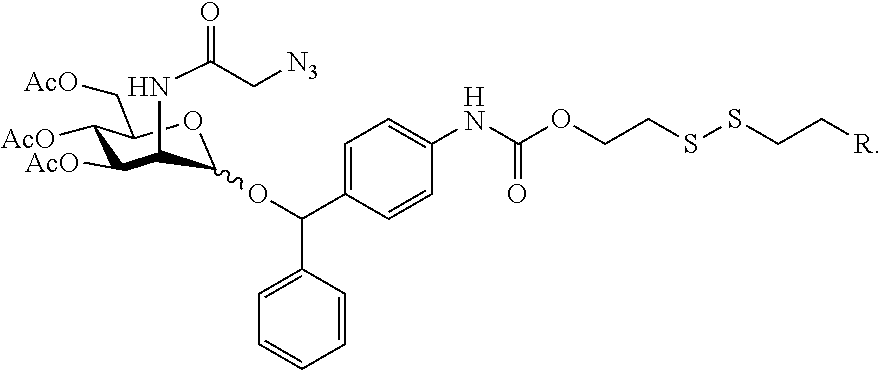


wherein:

-
- wherein
- R5 represents H, tri((C1-C6)alkyl)silyl, or —C(O)((C1-C6)alkyl);
- R6 represents H, (C1-C6)alkyl, or heterocycloalkyl;
- R7 represents H, halo, —C(O)2H, (C1-C6)alkoxy, di((C1-C6)alkyl)amino, —NO2, —O(CH2CH2O)qCH3; and
- q is 1 or 2.


wherein
R5 represents H, tri((C1-C6)alkyl)silyl, or —C(O)((C1-C6)alkyl)
R6 represents H, (C1-C6)alkyl, or heterocycloalkyl; and
n is 1 or 2.

-
- wherein R7 represents H, halo, —C(O)2H, (C1-C6)alkoxy, di((C1-C6)alkyl)amino, —NO2, —O(CH2CH2O)qCH3; and
- q is 1 or 2.

K-Pol-Pep-A2-D (III);
wherein:

wherein:
R1, R2, and R3, independently for each occurrence, represent H, tri((C1-C6)alkyl)silyl, or —C(O)((C1-C6)alkyl).
-
- A2 represents a group —Y2—X2—;
- X2 represents a bond or —C(O)2—;
- Y2 represents a bond or optionally substituted -arylene-((C1)alkylene)- or -heteroarylene-((C1)alkylene)-; and
- X2 and Y2 do not both represent a bond.

-
- wherein
- R5 represents H, tri((C1-C6)alkyl)silyl, or —C(O)((C1-C6)alkyl);
- R6 represents H, (C1-C6)alkyl, or heterocycloalkyl;
- R7 represents H, halo, —C(O)2H, (C1-C6)alkoxy, di((C1-C6)alkyl)amino, —NO2, —O(CH2CH2O)qCH3; and
- q is 1 or 2.


wherein j is an integer from 10-30.


wherein R50 and R51 are as defined above. Certain embodiments of the amide in the present invention will not include imides which may be unstable.


- 1. Brandley, B. K. & Schnaar, R. L. Cell-surface carbohydrates in cell recognition and response. Journal of
Leukocyte Biology 40, 97-111 (1986). - 2. Stoolman, L. M. & Rosen, S. D. Possible role for cell-surface carbohydrate-binding molecules in lymphocyte recirculation. The Journal of cell biology 96, 722-729 (1983).
- 3. Dabelsteen, E. Cell surface carbohydrates as prognostic markers in human carcinomas. The Journal of pathology 179, 358-369 (1996).
- 4. Gorelik, E., Galili, U. & Raz, A. On the role of cell surface carbohydrates and their binding proteins (lectins) in tumor metastasis. Cancer and
Metastasis Reviews 20, 245-277 (2001). - 5. Fukuda, M. Possible roles of tumor-associated carbohydrate antigens. Cancer research 56, 2237-2244 (1996).
- 6. Prescher, J. A., Dube, D. H. & Bertozzi, C. R. Chemical remodelling of cell surfaces in living animals. Nature 430, 873-877 (2004).
- 7. Laughlin, S. T. & Bertozzi, C. R. Metabolic labeling of glycans with azido sugars and subsequent glycan-profiling and visualization via Staudinger ligation.
Nature protocols 2, 2930-2944 (2007). - 8. Saxon, E. et al. Investigating cellular metabolism of synthetic azidosugars with the Staudinger ligation. Journal of the American Chemical Society 124, 14893-14902 (2002).
- 9. Laughlin, S. T., Baskin, J. M., Amacher, S. L. & Bertozzi, C. R. In vivo imaging of membrane-associated glycans in developing zebrafish. Science 320, 664-667 (2008).
- 10. Chang, P. V. et al. Metabolic labeling of sialic acids in living animals with alkynyl sugars. Angewandte
Chemie International Edition 48, 4030-4033 (2009). - 11. Breidenbach, M. A. et al. Targeted metabolic labeling of yeast N-glycans with unnatural sugars. Proceedings of the National Academy of Sciences 107, 3988-3993 (2010).
Claims (6)


Priority Applications (1)
| Application Number | Priority Date | Filing Date | Title |
|---|---|---|---|
| US15/767,070 US11014953B2 (en) | 2015-10-07 | 2016-10-07 | Trigger-activatable metabolic sugar precursors for cancer-selective labeling and targeting |
Applications Claiming Priority (3)
| Application Number | Priority Date | Filing Date | Title |
|---|---|---|---|
| US201562238326P | 2015-10-07 | 2015-10-07 | |
| US15/767,070 US11014953B2 (en) | 2015-10-07 | 2016-10-07 | Trigger-activatable metabolic sugar precursors for cancer-selective labeling and targeting |
| PCT/US2016/056046 WO2017062800A1 (en) | 2015-10-07 | 2016-10-07 | Trigger-activatable metabolic sugar precursors for cancer-selective labeling and targeting |
Publications (2)
| Publication Number | Publication Date |
|---|---|
| US20180298047A1 US20180298047A1 (en) | 2018-10-18 |
| US11014953B2 true US11014953B2 (en) | 2021-05-25 |
Family
ID=58488608
Family Applications (1)
| Application Number | Title | Priority Date | Filing Date |
|---|---|---|---|
| US15/767,070 Active US11014953B2 (en) | 2015-10-07 | 2016-10-07 | Trigger-activatable metabolic sugar precursors for cancer-selective labeling and targeting |
Country Status (6)
| Country | Link |
|---|---|
| US (1) | US11014953B2 (en) |
| EP (1) | EP3371200A4 (en) |
| JP (1) | JP6892694B2 (en) |
| KR (1) | KR20180058737A (en) |
| CN (1) | CN108699095B (en) |
| WO (1) | WO2017062800A1 (en) |
Families Citing this family (28)
| Publication number | Priority date | Publication date | Assignee | Title |
|---|---|---|---|---|
| US9675561B2 (en) | 2011-04-28 | 2017-06-13 | President And Fellows Of Harvard College | Injectable cryogel vaccine devices and methods of use thereof |
| EP3137105A4 (en) | 2014-04-30 | 2017-12-27 | President and Fellows of Harvard College | Combination vaccine devices and methods of killing cancer cells |
| US11752238B2 (en) | 2016-02-06 | 2023-09-12 | President And Fellows Of Harvard College | Recapitulating the hematopoietic niche to reconstitute immunity |
| CN109789092A (en) | 2016-07-13 | 2019-05-21 | 哈佛学院院长等 | Antigen presenting cell mimetic scaffolds and methods of making and using same |
| IL264557B2 (en) | 2016-08-02 | 2024-01-01 | Harvard College | Biomaterials for modulating immune responses |
| US11299509B2 (en) | 2017-02-10 | 2022-04-12 | The Board Of Trustees Of The University Of Illinois | Trigger-activatable sugar conjugates for cancer-selective labeling and targeting |
| WO2020061129A1 (en) | 2018-09-19 | 2020-03-26 | President And Fellows Of Harvard College | Compositions and methods for labeling and modulation of cells in vitro and in vivo |
| CN111153946B (en) * | 2018-11-08 | 2021-08-17 | 中国科学院化学研究所 | N-azidoacetyl-D-mannosamine derivatives and preparation methods thereof and application in the detection of nitroreductase |
| CN111153952B (en) * | 2018-11-08 | 2021-08-17 | 中国科学院化学研究所 | N-azidoacetyl-D-mannosamine derivatives, preparation method thereof and application in detection of esterase |
| CN111208284B (en) * | 2018-11-22 | 2021-08-24 | 北京大学 | Glycometabolism labeling probe, kit containing same and application thereof |
| CN109678751A (en) * | 2019-01-07 | 2019-04-26 | 广州同隽医药科技有限公司 | A kind of compound containing diphenyl-methane structure |
| CN109675052B (en) * | 2019-01-29 | 2022-02-15 | 中国药科大学 | Biological click-triggered high-efficiency targeted conjugate and its multiplex composition, preparation method and application |
| BR112021016399A2 (en) * | 2019-02-20 | 2021-10-19 | Diamidex | METHODS TO LABEL EUKARYOTIC CELLS OF A MULTI-CELLULAR ORGANISM USING MODIFIED MONOSACCHARIDE COMPOUNDS |
| CN110251656B (en) * | 2019-07-04 | 2022-06-10 | 自然资源部第三海洋研究所 | Preparation method of polypeptide compound, application of polypeptide compound and HIV latent activation medicine |
| WO2021061837A1 (en) | 2019-09-23 | 2021-04-01 | President And Fellows Of Harvard College | Biomaterial-based antigen free vaccine and the use thereof |
| WO2021155297A1 (en) * | 2020-01-29 | 2021-08-05 | President And Fellows Of Harvard College | Methods for labeling and targeting cells |
| CN113358865B (en) * | 2020-03-03 | 2024-06-04 | 深圳先进技术研究院 | Method for detecting circulating tumor cells |
| WO2021174416A1 (en) * | 2020-03-03 | 2021-09-10 | 深圳先进技术研究院 | Detection method for circulating tumor cell |
| EP4200614A1 (en) * | 2020-08-19 | 2023-06-28 | Theraonco | Method and kit for labeling eukaryotic cells from a multicellular organism using modified monosaccharide compounds and pharmaceutical composition comprising such cells |
| WO2022038198A1 (en) * | 2020-08-19 | 2022-02-24 | Diamidex | Monosaccharide compound for the labelling of cell secretion |
| US20230406839A1 (en) * | 2020-11-09 | 2023-12-21 | The General Hospital Corporation | Bifunctional Compounds And Methods Of Using The Same |
| CN116178464B (en) * | 2022-11-28 | 2024-06-04 | 山东大学 | Sugar-targeted GSH-responsive epothilone B nanoprodrug and its preparation method and application |
| CN120380004A (en) * | 2022-12-08 | 2025-07-25 | 杭州瑞奥生物医药有限公司 | Monosaccharide, pharmaceutical composition and diagnostic and therapeutic applications |
| CN116239640B (en) * | 2023-01-19 | 2024-03-08 | 中国药科大学 | Gemcitabine prodrugs and their medicinal uses |
| CN116621901B (en) * | 2023-04-19 | 2025-09-02 | 河南大学 | A small molecule probe based on sugar metabolism labeling and its application in improving the targeting of platinum drugs |
| CN116236588A (en) * | 2023-04-19 | 2023-06-09 | 山东大学 | Application of azide-modified hyaluronic acid in drug delivery and/or drug storage |
| CN116640176A (en) * | 2023-04-19 | 2023-08-25 | 河南大学 | A kind of O-GlcNAc glycosylation small molecule probe HBAPE-Ac3GalNAz regulated by reactive oxygen species and its synthesis method and application |
| CN121889407A (en) * | 2023-08-15 | 2026-04-17 | 杭州瑞奥生物医药有限公司 | Functional monosaccharides activatable by ALDH, pharmaceutical compositions and diagnostic and therapeutic uses |
Citations (7)
| Publication number | Priority date | Publication date | Assignee | Title |
|---|---|---|---|---|
| US20080132458A1 (en) | 2004-03-10 | 2008-06-05 | Threshold Pharmaceuticals, Inc. | Hypoxia-Activated Anti-Cancer Agents |
| US20100160299A1 (en) | 2008-09-30 | 2010-06-24 | The Regents Of The University Of Michigan | Dendrimer conjugates |
| US20140010763A1 (en) | 2011-03-15 | 2014-01-09 | Ramot At Tel-Aviv University Ltd. | Activatable fluorogenic compounds and uses thereof as near infrared probes |
| US20140031535A1 (en) | 2005-07-18 | 2014-01-30 | Seattle Genetics, Inc. | Beta-glucuronide-linker drug conjugates |
| US20140046051A1 (en) | 2011-04-11 | 2014-02-13 | Glycom A/S | N-substituted mannosamine derivatives, process for their preparation and their use |
| WO2014065661A1 (en) | 2012-10-23 | 2014-05-01 | Synaffix B.V. | Modified antibody, antibody-conjugate and process for the preparation thereof |
| US20160184459A1 (en) | 2013-08-09 | 2016-06-30 | The Research Foundation For The State University Of New York | Cancer cell specific imaging probes and methods of use |
Family Cites Families (1)
| Publication number | Priority date | Publication date | Assignee | Title |
|---|---|---|---|---|
| CN105517577A (en) * | 2013-06-21 | 2016-04-20 | 先天制药公司 | Enzymatic conjugation of polypeptides |
-
2016
- 2016-10-07 KR KR1020187010399A patent/KR20180058737A/en not_active Withdrawn
- 2016-10-07 CN CN201680071047.4A patent/CN108699095B/en active Active
- 2016-10-07 WO PCT/US2016/056046 patent/WO2017062800A1/en not_active Ceased
- 2016-10-07 EP EP16854444.3A patent/EP3371200A4/en active Pending
- 2016-10-07 JP JP2018517758A patent/JP6892694B2/en active Active
- 2016-10-07 US US15/767,070 patent/US11014953B2/en active Active
Patent Citations (7)
| Publication number | Priority date | Publication date | Assignee | Title |
|---|---|---|---|---|
| US20080132458A1 (en) | 2004-03-10 | 2008-06-05 | Threshold Pharmaceuticals, Inc. | Hypoxia-Activated Anti-Cancer Agents |
| US20140031535A1 (en) | 2005-07-18 | 2014-01-30 | Seattle Genetics, Inc. | Beta-glucuronide-linker drug conjugates |
| US20100160299A1 (en) | 2008-09-30 | 2010-06-24 | The Regents Of The University Of Michigan | Dendrimer conjugates |
| US20140010763A1 (en) | 2011-03-15 | 2014-01-09 | Ramot At Tel-Aviv University Ltd. | Activatable fluorogenic compounds and uses thereof as near infrared probes |
| US20140046051A1 (en) | 2011-04-11 | 2014-02-13 | Glycom A/S | N-substituted mannosamine derivatives, process for their preparation and their use |
| WO2014065661A1 (en) | 2012-10-23 | 2014-05-01 | Synaffix B.V. | Modified antibody, antibody-conjugate and process for the preparation thereof |
| US20160184459A1 (en) | 2013-08-09 | 2016-06-30 | The Research Foundation For The State University Of New York | Cancer cell specific imaging probes and methods of use |
Non-Patent Citations (7)
| Title |
|---|
| Amsberry et al., "Amine prodrugs which utilize hydroxy amide lactonization. I. A potential redox-sensitive amide prodrug," Pharmaceut Res, 8(3):323-330 (1991). |
| Chang (Journal of the American Chemical Society; 132; 28; 2010; 9516-9518). * |
| Extended European Search Report for EP Application No. 16854444.3 dated Mar. 31, 2020. |
| International Search Report and Written Opinion for International Application No. PCT/US16/56046 dated Dec. 27, 2016. |
| Partial Supplementary European Search Report for EP Application No. EP 16854444 dated Dec. 19, 2019. |
| Shim et al., "Cathepsin B-Specific Metabolic Precursor for In Vivo Tumor-Specific Fluorescence Imaging," Angew. Chem. Int. Ed., 55:14698-14703, Oct. 2016. |
| Wang et al., "A Caged Metabolic Precursor for DT-Diaphoraseresponsive Cell Labeling," Chem Commun (Camb)., 54(38):4878-4881, May 2018. |
Also Published As
| Publication number | Publication date |
|---|---|
| JP2018535198A (en) | 2018-11-29 |
| EP3371200A1 (en) | 2018-09-12 |
| EP3371200A4 (en) | 2020-04-29 |
| CN108699095B (en) | 2022-05-13 |
| KR20180058737A (en) | 2018-06-01 |
| US20180298047A1 (en) | 2018-10-18 |
| JP6892694B2 (en) | 2021-06-23 |
| WO2017062800A1 (en) | 2017-04-13 |
| CN108699095A (en) | 2018-10-23 |
Similar Documents
| Publication | Publication Date | Title |
|---|---|---|
| US11014953B2 (en) | Trigger-activatable metabolic sugar precursors for cancer-selective labeling and targeting | |
| US11299509B2 (en) | Trigger-activatable sugar conjugates for cancer-selective labeling and targeting | |
| JP6543342B2 (en) | Conjugation of a pharmaceutically active agent with a transthyretin ligand via a regulatable linker to extend serum half life | |
| US20250177582A1 (en) | High-affinity ligands of fibroblast activation protein for targeted delivery applications | |
| US10293021B2 (en) | Conjugates and prodrugs for treating cancer and inflammatory diseases | |
| CA3150890A1 (en) | Fibroblast activation protein (fap)-targeted imaging and therapy of cancers and other fibrotic and inflammatory diseases | |
| US20110104103A1 (en) | Method of conjugating therapeutic compounds to cell targeting devices via metal complexes | |
| KR20230145162A (en) | Bivalent fibroblast activation protein ligands for targeted delivery applications | |
| US20230125881A1 (en) | Novel polypeptides and uses thereof | |
| US11535623B2 (en) | Cryptate compounds | |
| US11066421B1 (en) | Synthetic cinchona alkaloids against cancer | |
| Chen et al. | A Prostate-Specific Membrane Antigen-Targeting Small Molecule–Drug Conjugate Strategy to Overcome the Hematological Toxicity of Olaparib | |
| CN120390747A (en) | Carbonic anhydrase IX ligands for targeted delivery applications | |
| KR102465431B1 (en) | Cell Penetrating Peptide-linker-anti-cancer drug and Pharmaceutical composition for prevention or treatment of colorectal cancer containing the same | |
| EP4635517A1 (en) | Metal-based antibody-drug conjugates and methods of making and using thereof | |
| KR20260061215A (en) | Method and composition for the treatment of cancer using a PRM T5 inhibitor | |
| CN106344930A (en) | Preparation and application of molecular site-directed targeted and activated short peptide adriamycin | |
| WO2025088200A2 (en) | Acid phosphatase 3 ligands for targeted delivery applications | |
| AU2024365851A1 (en) | Acid phosphatase 3 ligands for targeted delivery applications | |
| HK40126744A (en) | Metal-based antibody-drug conjugates and methods of making and using thereof | |
| Wang et al. | A Dual-mechanism Targeted Cross-convergence Prodrug Activation Strategy Enabled by Biological Stimulus Amplification towards Precision Cancer Therapy |
Legal Events
| Date | Code | Title | Description |
|---|---|---|---|
| FEPP | Fee payment procedure |
Free format text: ENTITY STATUS SET TO UNDISCOUNTED (ORIGINAL EVENT CODE: BIG.); ENTITY STATUS OF PATENT OWNER: SMALL ENTITY |
|
| FEPP | Fee payment procedure |
Free format text: ENTITY STATUS SET TO SMALL (ORIGINAL EVENT CODE: SMAL); ENTITY STATUS OF PATENT OWNER: SMALL ENTITY |
|
| AS | Assignment |
Owner name: THE BOARD OF TRUSTEES OF THE UNIVERSITY OF ILLINOIS, ILLINOIS Free format text: ASSIGNMENT OF ASSIGNORS INTEREST;ASSIGNORS:CHENG, JIANJUN;WANG, HUA;SIGNING DATES FROM 20180621 TO 20180830;REEL/FRAME:047640/0798 Owner name: THE BOARD OF TRUSTEES OF THE UNIVERSITY OF ILLINOI Free format text: ASSIGNMENT OF ASSIGNORS INTEREST;ASSIGNORS:CHENG, JIANJUN;WANG, HUA;SIGNING DATES FROM 20180621 TO 20180830;REEL/FRAME:047640/0798 |
|
| STPP | Information on status: patent application and granting procedure in general |
Free format text: DOCKETED NEW CASE - READY FOR EXAMINATION |
|
| STPP | Information on status: patent application and granting procedure in general |
Free format text: NON FINAL ACTION MAILED |
|
| STPP | Information on status: patent application and granting procedure in general |
Free format text: RESPONSE TO NON-FINAL OFFICE ACTION ENTERED AND FORWARDED TO EXAMINER |
|
| STPP | Information on status: patent application and granting procedure in general |
Free format text: NON FINAL ACTION MAILED |
|
| STPP | Information on status: patent application and granting procedure in general |
Free format text: RESPONSE TO NON-FINAL OFFICE ACTION ENTERED AND FORWARDED TO EXAMINER |
|
| STPP | Information on status: patent application and granting procedure in general |
Free format text: FINAL REJECTION MAILED |
|
| STPP | Information on status: patent application and granting procedure in general |
Free format text: RESPONSE AFTER FINAL ACTION FORWARDED TO EXAMINER |
|
| STPP | Information on status: patent application and granting procedure in general |
Free format text: NOTICE OF ALLOWANCE MAILED -- APPLICATION RECEIVED IN OFFICE OF PUBLICATIONS |
|
| STPP | Information on status: patent application and granting procedure in general |
Free format text: NOTICE OF ALLOWANCE MAILED -- APPLICATION RECEIVED IN OFFICE OF PUBLICATIONS |
|
| STPP | Information on status: patent application and granting procedure in general |
Free format text: AWAITING TC RESP., ISSUE FEE NOT PAID |
|
| STPP | Information on status: patent application and granting procedure in general |
Free format text: NOTICE OF ALLOWANCE MAILED -- APPLICATION RECEIVED IN OFFICE OF PUBLICATIONS |
|
| STPP | Information on status: patent application and granting procedure in general |
Free format text: PUBLICATIONS -- ISSUE FEE PAYMENT RECEIVED |
|
| STPP | Information on status: patent application and granting procedure in general |
Free format text: PUBLICATIONS -- ISSUE FEE PAYMENT VERIFIED |
|
| STPP | Information on status: patent application and granting procedure in general |
Free format text: AWAITING TC RESP, ISSUE FEE PAYMENT VERIFIED |
|
| STPP | Information on status: patent application and granting procedure in general |
Free format text: PUBLICATIONS -- ISSUE FEE PAYMENT VERIFIED |
|
| STCF | Information on status: patent grant |
Free format text: PATENTED CASE |
|
| MAFP | Maintenance fee payment |
Free format text: PAYMENT OF MAINTENANCE FEE, 4TH YR, SMALL ENTITY (ORIGINAL EVENT CODE: M2551); ENTITY STATUS OF PATENT OWNER: SMALL ENTITY Year of fee payment: 4 |