US11014895B2 - Heterocyclic urea compound, and drug composition and application thereof - Google Patents
Heterocyclic urea compound, and drug composition and application thereof Download PDFInfo
- Publication number
- US11014895B2 US11014895B2 US16/477,779 US201816477779A US11014895B2 US 11014895 B2 US11014895 B2 US 11014895B2 US 201816477779 A US201816477779 A US 201816477779A US 11014895 B2 US11014895 B2 US 11014895B2
- Authority
- US
- United States
- Prior art keywords
- dmso
- nmr
- mhz
- ppm
- substituted
- Prior art date
- Legal status (The legal status is an assumption and is not a legal conclusion. Google has not performed a legal analysis and makes no representation as to the accuracy of the status listed.)
- Expired - Fee Related
Links
- 0 [1*]C.[2*]CC(=C)CC1=[Y]OC=C1/C(=N/O)NC1=CC=CC=C1 Chemical compound [1*]C.[2*]CC(=C)CC1=[Y]OC=C1/C(=N/O)NC1=CC=CC=C1 0.000 description 16
- ZQKIUZKUQAQCQB-UHFFFAOYSA-N CC1=CC=C(NC(=O)NC2=NON=C2/C(=N/O)NC2=CC=C(F)C(Br)=C2)C=C1 Chemical compound CC1=CC=C(NC(=O)NC2=NON=C2/C(=N/O)NC2=CC=C(F)C(Br)=C2)C=C1 ZQKIUZKUQAQCQB-UHFFFAOYSA-N 0.000 description 3
- PEMVBCULSYTAMR-UHFFFAOYSA-N O=C(CC1=CC=CC=C1)CC1=COC=C1/C(=N/O)NC1=CC(Br)=C(F)C=C1 Chemical compound O=C(CC1=CC=CC=C1)CC1=COC=C1/C(=N/O)NC1=CC(Br)=C(F)C=C1 PEMVBCULSYTAMR-UHFFFAOYSA-N 0.000 description 2
- KUYVUAJOBLIBDL-WLBPCOFQSA-L C.C1CCOC1.COC1=CC=C(N=C=O)C=C1.COC1=CC=C(NC(=O)NC2=NON=C2/C(=N/O)NC2=CC=C(F)C(Br)=C2)C=C1.COC1=CC=C(NC(=O)NC2=NON=C2C2=NOC(=O)N2C2=CC=C(F)C(Br)=C2)C=C1.NC1=CC(Br)=C(F)C=C1.NC1=NOC=C1C1=NOC(=O)N1C1=CC(Br)=C(F)C=C1.NC1=NON=C1/C(=N/O)NC1=CC(Br)=C(F)C=C1.NC1=NON=C1/C(Cl)=N/O.NC1=NON=C1/C(N)=N/O.O=COO[Na].O[Na].[2H]CI Chemical compound C.C1CCOC1.COC1=CC=C(N=C=O)C=C1.COC1=CC=C(NC(=O)NC2=NON=C2/C(=N/O)NC2=CC=C(F)C(Br)=C2)C=C1.COC1=CC=C(NC(=O)NC2=NON=C2C2=NOC(=O)N2C2=CC=C(F)C(Br)=C2)C=C1.NC1=CC(Br)=C(F)C=C1.NC1=NOC=C1C1=NOC(=O)N1C1=CC(Br)=C(F)C=C1.NC1=NON=C1/C(=N/O)NC1=CC(Br)=C(F)C=C1.NC1=NON=C1/C(Cl)=N/O.NC1=NON=C1/C(N)=N/O.O=COO[Na].O[Na].[2H]CI KUYVUAJOBLIBDL-WLBPCOFQSA-L 0.000 description 1
- CLIKBVSIIPDEOY-JARICKQPSA-L C/N=C(\Cl)C1=CO[Y]=C1N.II.I[IH]I.NC1=[Y]OC=C1/C(N)=N/O Chemical compound C/N=C(\Cl)C1=CO[Y]=C1N.II.I[IH]I.NC1=[Y]OC=C1/C(N)=N/O CLIKBVSIIPDEOY-JARICKQPSA-L 0.000 description 1
- RUQGTZOVFMWFCG-UHFFFAOYSA-N CC(C)CC(=O)CC1=COC=C1/C(=N/O)NC1=CC(Br)=C(F)C=C1 Chemical compound CC(C)CC(=O)CC1=COC=C1/C(=N/O)NC1=CC(Br)=C(F)C=C1 RUQGTZOVFMWFCG-UHFFFAOYSA-N 0.000 description 1
- GKMSZZVIJABFKW-UHFFFAOYSA-N CC(C)CC(=O)CC1=NOC=C1/C(=N/O)NC1=CC(Br)=C(F)C=C1 Chemical compound CC(C)CC(=O)CC1=NOC=C1/C(=N/O)NC1=CC(Br)=C(F)C=C1 GKMSZZVIJABFKW-UHFFFAOYSA-N 0.000 description 1
- BARZEFKRAHVCOX-UHFFFAOYSA-N CC1=CC=C(CC(=N)CC2=NON=C2/C(=N/O)NC2=CC(Br)=C(F)C=C2)C=C1 Chemical compound CC1=CC=C(CC(=N)CC2=NON=C2/C(=N/O)NC2=CC(Br)=C(F)C=C2)C=C1 BARZEFKRAHVCOX-UHFFFAOYSA-N 0.000 description 1
- DQYMTMHRHQMZQZ-UHFFFAOYSA-N CC1=CC=C(CC(=S)CC2=NON=C2/C(=N/O)NC2=CC(Br)=C(F)C=C2)C=C1 Chemical compound CC1=CC=C(CC(=S)CC2=NON=C2/C(=N/O)NC2=CC(Br)=C(F)C=C2)C=C1 DQYMTMHRHQMZQZ-UHFFFAOYSA-N 0.000 description 1
- QCOQLCOYGKXBEW-UHFFFAOYSA-N CC1CCC(CC(=O)CC2=NON=C2/C(=N/O)NC2=CC(Br)=C(F)C=C2)CC1 Chemical compound CC1CCC(CC(=O)CC2=NON=C2/C(=N/O)NC2=CC(Br)=C(F)C=C2)CC1 QCOQLCOYGKXBEW-UHFFFAOYSA-N 0.000 description 1
- RQPOEAQNWNDGBA-UHFFFAOYSA-N CCC1=CC(NC(=O)NC2=NON=C2/C(=N/O)NC2=CC=C(F)C(Br)=C2)=CC=C1 Chemical compound CCC1=CC(NC(=O)NC2=NON=C2/C(=N/O)NC2=CC=C(F)C(Br)=C2)=CC=C1 RQPOEAQNWNDGBA-UHFFFAOYSA-N 0.000 description 1
- ZXKFTLUEHMIVFK-UHFFFAOYSA-N CCCCC(=O)CC1=COC=C1/C(=N/O)NC1=CC(Br)=C(F)C=C1 Chemical compound CCCCC(=O)CC1=COC=C1/C(=N/O)NC1=CC(Br)=C(F)C=C1 ZXKFTLUEHMIVFK-UHFFFAOYSA-N 0.000 description 1
- FKNBIMLXLSWQMW-UHFFFAOYSA-N CCCCC(=O)CC1=NOC=C1/C(=N/O)NC1=CC(Br)=C(F)C=C1 Chemical compound CCCCC(=O)CC1=NOC=C1/C(=N/O)NC1=CC(Br)=C(F)C=C1 FKNBIMLXLSWQMW-UHFFFAOYSA-N 0.000 description 1
- YWFOXSLHAWRYGV-UHFFFAOYSA-N COC1=CC(CC(=O)CC2=COC=C2/C(=N/O)NC2=CC(Br)=C(F)C=C2)=CC=C1 Chemical compound COC1=CC(CC(=O)CC2=COC=C2/C(=N/O)NC2=CC(Br)=C(F)C=C2)=CC=C1 YWFOXSLHAWRYGV-UHFFFAOYSA-N 0.000 description 1
- JKFWJERMDLWXLU-UHFFFAOYSA-N COC1=CC(CC(=O)CC2=CON=C2/C(=N/O)NC2=CC(Br)=C(F)C=C2)=CC=C1 Chemical compound COC1=CC(CC(=O)CC2=CON=C2/C(=N/O)NC2=CC(Br)=C(F)C=C2)=CC=C1 JKFWJERMDLWXLU-UHFFFAOYSA-N 0.000 description 1
- ZIBGMOVVOKKDPI-UHFFFAOYSA-N COC1=CC(CC(=O)CC2=NOC=C2/C(=N/O)NC2=CC(Br)=C(F)C=C2)=CC=C1 Chemical compound COC1=CC(CC(=O)CC2=NOC=C2/C(=N/O)NC2=CC(Br)=C(F)C=C2)=CC=C1 ZIBGMOVVOKKDPI-UHFFFAOYSA-N 0.000 description 1
- YCSHZUKTQXAVFM-UHFFFAOYSA-N COC1=CC=C(CC(=N)CC2=COC=C2/C(=N/O)NC2=CC(Br)=C(F)C=C2)C=C1 Chemical compound COC1=CC=C(CC(=N)CC2=COC=C2/C(=N/O)NC2=CC(Br)=C(F)C=C2)C=C1 YCSHZUKTQXAVFM-UHFFFAOYSA-N 0.000 description 1
- YUDXUUOVHXSXQK-UHFFFAOYSA-N COC1=CC=C(CC(=N)CC2=CON=C2/C(=N/O)NC2=CC(Cl)=C(F)C=C2)C=C1 Chemical compound COC1=CC=C(CC(=N)CC2=CON=C2/C(=N/O)NC2=CC(Cl)=C(F)C=C2)C=C1 YUDXUUOVHXSXQK-UHFFFAOYSA-N 0.000 description 1
- XXGBCQCGODTZAS-UHFFFAOYSA-N COC1=CC=C(CC(=N)CC2=NOC=C2/C(=N/O)NC2=CC(Br)=C(F)C=C2)C=C1 Chemical compound COC1=CC=C(CC(=N)CC2=NOC=C2/C(=N/O)NC2=CC(Br)=C(F)C=C2)C=C1 XXGBCQCGODTZAS-UHFFFAOYSA-N 0.000 description 1
- SHJYBZGBXHOKBY-UHFFFAOYSA-N COC1=CC=C(CC(=N)CC2=NON=C2/C(=N/O)NC2=CC(Br)=C(F)C=C2)C=C1 Chemical compound COC1=CC=C(CC(=N)CC2=NON=C2/C(=N/O)NC2=CC(Br)=C(F)C=C2)C=C1 SHJYBZGBXHOKBY-UHFFFAOYSA-N 0.000 description 1
- CRILVJAPTKPVBG-UHFFFAOYSA-N COC1=CC=C(CC(=O)CC2=COC=C2/C(=N/O)NC2=CC(Br)=C(F)C=C2)C=C1 Chemical compound COC1=CC=C(CC(=O)CC2=COC=C2/C(=N/O)NC2=CC(Br)=C(F)C=C2)C=C1 CRILVJAPTKPVBG-UHFFFAOYSA-N 0.000 description 1
- UGYWRCWKTGFXBT-UHFFFAOYSA-N COC1=CC=C(CC(=O)CC2=CON=C2/C(=N/O)NC2=CC(Br)=C(F)C=C2)C=C1 Chemical compound COC1=CC=C(CC(=O)CC2=CON=C2/C(=N/O)NC2=CC(Br)=C(F)C=C2)C=C1 UGYWRCWKTGFXBT-UHFFFAOYSA-N 0.000 description 1
- ZBMXKGDNOLBJLI-UHFFFAOYSA-N COC1=CC=C(CC(=O)CC2=CON=C2/C(=N/O)NC2=CC(Cl)=C(F)C=C2)C=C1 Chemical compound COC1=CC=C(CC(=O)CC2=CON=C2/C(=N/O)NC2=CC(Cl)=C(F)C=C2)C=C1 ZBMXKGDNOLBJLI-UHFFFAOYSA-N 0.000 description 1
- IRNPJUXRFMLZGW-UHFFFAOYSA-N COC1=CC=C(CC(=O)CC2=NOC=C2/C(=N/O)NC2=CC(Br)=C(F)C=C2)C=C1 Chemical compound COC1=CC=C(CC(=O)CC2=NOC=C2/C(=N/O)NC2=CC(Br)=C(F)C=C2)C=C1 IRNPJUXRFMLZGW-UHFFFAOYSA-N 0.000 description 1
- ZFWWWUJEVIPMSI-UHFFFAOYSA-N COC1=CC=C(CC(=O)CC2=NOC=C2/C(=N/O)NC2=CC(Cl)=C(F)C=C2)C=C1 Chemical compound COC1=CC=C(CC(=O)CC2=NOC=C2/C(=N/O)NC2=CC(Cl)=C(F)C=C2)C=C1 ZFWWWUJEVIPMSI-UHFFFAOYSA-N 0.000 description 1
- BKCLJHUVYUFYKR-UHFFFAOYSA-N COC1=CC=C(CC(=O)CC2=NON=C2/C(=N/O)NC2=CC(Cl)=C(F)C=C2)C=C1 Chemical compound COC1=CC=C(CC(=O)CC2=NON=C2/C(=N/O)NC2=CC(Cl)=C(F)C=C2)C=C1 BKCLJHUVYUFYKR-UHFFFAOYSA-N 0.000 description 1
- SKHDUQOTINVUDG-UHFFFAOYSA-N COC1=CC=C(CC(=O)CC2=NON=C2/C(=N/O)NC2=CC=C(F)C=C2)C=C1 Chemical compound COC1=CC=C(CC(=O)CC2=NON=C2/C(=N/O)NC2=CC=C(F)C=C2)C=C1 SKHDUQOTINVUDG-UHFFFAOYSA-N 0.000 description 1
- NBFSYZFICIAIQU-UHFFFAOYSA-N COC1=CC=C(CC(=S)CC2=COC=C2/C(=N/O)NC2=CC(Br)=C(F)C=C2)C=C1 Chemical compound COC1=CC=C(CC(=S)CC2=COC=C2/C(=N/O)NC2=CC(Br)=C(F)C=C2)C=C1 NBFSYZFICIAIQU-UHFFFAOYSA-N 0.000 description 1
- XPQQSKXILHFNHX-UHFFFAOYSA-N COC1=CC=C(CC(=S)CC2=CON=C2/C(=N/O)NC2=CC(Cl)=C(F)C=C2)C=C1 Chemical compound COC1=CC=C(CC(=S)CC2=CON=C2/C(=N/O)NC2=CC(Cl)=C(F)C=C2)C=C1 XPQQSKXILHFNHX-UHFFFAOYSA-N 0.000 description 1
- MJMRCXBXJGKVFI-UHFFFAOYSA-N COC1=CC=C(CC(=S)CC2=NOC=C2/C(=N/O)NC2=CC(Br)=C(F)C=C2)C=C1 Chemical compound COC1=CC=C(CC(=S)CC2=NOC=C2/C(=N/O)NC2=CC(Br)=C(F)C=C2)C=C1 MJMRCXBXJGKVFI-UHFFFAOYSA-N 0.000 description 1
- MOVJGJBAYOAJOG-UHFFFAOYSA-N COC1=CC=C(CC(=S)CC2=NON=C2/C(=N/O)NC2=CC(Br)=C(F)C=C2)C=C1 Chemical compound COC1=CC=C(CC(=S)CC2=NON=C2/C(=N/O)NC2=CC(Br)=C(F)C=C2)C=C1 MOVJGJBAYOAJOG-UHFFFAOYSA-N 0.000 description 1
- UTMDGFZKEHAVHF-UHFFFAOYSA-N COC1=CC=C(NC(=O)NC2=NON=C2/C(=N/O)NC2=CC=C(F)C(Br)=C2)C=C1 Chemical compound COC1=CC=C(NC(=O)NC2=NON=C2/C(=N/O)NC2=CC=C(F)C(Br)=C2)C=C1 UTMDGFZKEHAVHF-UHFFFAOYSA-N 0.000 description 1
- UPJNLMSIEQAGDU-UHFFFAOYSA-N COC1=CC=C(NC(=O)NC2=NON=C2C2=NOC(=O)N2C2=CC=C(F)C(Br)=C2)C=C1 Chemical compound COC1=CC=C(NC(=O)NC2=NON=C2C2=NOC(=O)N2C2=CC=C(F)C(Br)=C2)C=C1 UPJNLMSIEQAGDU-UHFFFAOYSA-N 0.000 description 1
- LWGWDDBDFJAOLC-UHFFFAOYSA-N COC1=CC=CC=C1NC(=O)NC1=NON=C1/C(=N/O)NC1=CC=C(F)C(Br)=C1 Chemical compound COC1=CC=CC=C1NC(=O)NC1=NON=C1/C(=N/O)NC1=CC=C(F)C(Br)=C1 LWGWDDBDFJAOLC-UHFFFAOYSA-N 0.000 description 1
- XUICBCISKZIOFZ-UHFFFAOYSA-N CS(=O)(=O)N1CCC(CC(=O)CC2=NON=C2/C(=N/O)NC2=CC(Br)=C(F)C=C2)CC1 Chemical compound CS(=O)(=O)N1CCC(CC(=O)CC2=NON=C2/C(=N/O)NC2=CC(Br)=C(F)C=C2)CC1 XUICBCISKZIOFZ-UHFFFAOYSA-N 0.000 description 1
- BNNFJAAUVKIBDL-UHFFFAOYSA-N CS(=O)(=O)N1CCN(C(=O)CC2=NON=C2/C(=N/O)NC2=CC(Br)=C(F)C=C2)CC1 Chemical compound CS(=O)(=O)N1CCN(C(=O)CC2=NON=C2/C(=N/O)NC2=CC(Br)=C(F)C=C2)CC1 BNNFJAAUVKIBDL-UHFFFAOYSA-N 0.000 description 1
- ZSRCUZOLBDBOKZ-UHFFFAOYSA-N CS(=O)(=O)N1CCN(C(=O)CC2=NON=C2/C(=N/O)NC2=CC=C(F)C=C2)CC1 Chemical compound CS(=O)(=O)N1CCN(C(=O)CC2=NON=C2/C(=N/O)NC2=CC=C(F)C=C2)CC1 ZSRCUZOLBDBOKZ-UHFFFAOYSA-N 0.000 description 1
- PXLAVFNGOBDRIG-UHFFFAOYSA-N CS(=O)(=O)NCCCC(=O)CC1=COC=C1/C(=N/O)NC1=CC(Br)=C(F)C=C1 Chemical compound CS(=O)(=O)NCCCC(=O)CC1=COC=C1/C(=N/O)NC1=CC(Br)=C(F)C=C1 PXLAVFNGOBDRIG-UHFFFAOYSA-N 0.000 description 1
- BUFBUPGXYPDDCH-UHFFFAOYSA-N CS(=O)(=O)NCCCC(=O)CC1=NOC=C1/C(=N/O)NC1=CC(Br)=C(F)C=C1 Chemical compound CS(=O)(=O)NCCCC(=O)CC1=NOC=C1/C(=N/O)NC1=CC(Br)=C(F)C=C1 BUFBUPGXYPDDCH-UHFFFAOYSA-N 0.000 description 1
- SWMLHAYZCZKMPO-UHFFFAOYSA-N CS(=O)(=O)NCCCC(=O)CC1=NON=C1/C(=N/O)NC1=CC(Cl)=C(F)C=C1 Chemical compound CS(=O)(=O)NCCCC(=O)CC1=NON=C1/C(=N/O)NC1=CC(Cl)=C(F)C=C1 SWMLHAYZCZKMPO-UHFFFAOYSA-N 0.000 description 1
- QSYLWQMWLQQYHQ-UHFFFAOYSA-N CS(=O)(=O)NCCCCC(=O)CC1=NON=C1/C(=N/O)NC1=CC(Br)=C(F)C=C1 Chemical compound CS(=O)(=O)NCCCCC(=O)CC1=NON=C1/C(=N/O)NC1=CC(Br)=C(F)C=C1 QSYLWQMWLQQYHQ-UHFFFAOYSA-N 0.000 description 1
- XQKGZFZEGLIUBV-UCNIYVFASA-L II.I[IH]I.NC1=[Y]OC=C1/C(Cl)=N/O.NC1=[Y]OC=C1/C(N)=N/O Chemical compound II.I[IH]I.NC1=[Y]OC=C1/C(Cl)=N/O.NC1=[Y]OC=C1/C(N)=N/O XQKGZFZEGLIUBV-UCNIYVFASA-L 0.000 description 1
- OTVGCXIMUYHBPF-UHFFFAOYSA-N N=C(CC1=CC=C(N)C=C1)CC1=NON=C1/C(=N/O)NC1=CC(Br)=C(F)C=C1 Chemical compound N=C(CC1=CC=C(N)C=C1)CC1=NON=C1/C(=N/O)NC1=CC(Br)=C(F)C=C1 OTVGCXIMUYHBPF-UHFFFAOYSA-N 0.000 description 1
- BFVLOHOPTLEEFD-UHFFFAOYSA-N N=C(CC1=CC=C(O)C=C1)CC1=NON=C1/C(=N/O)NC1=CC(Br)=C(F)C=C1 Chemical compound N=C(CC1=CC=C(O)C=C1)CC1=NON=C1/C(=N/O)NC1=CC(Br)=C(F)C=C1 BFVLOHOPTLEEFD-UHFFFAOYSA-N 0.000 description 1
- FRAHDKSFGNHZGN-UHFFFAOYSA-N N=C(CC1=CC=CC=C1)CC1=COC=C1/C(=N/O)NC1=CC(Br)=C(F)C=C1 Chemical compound N=C(CC1=CC=CC=C1)CC1=COC=C1/C(=N/O)NC1=CC(Br)=C(F)C=C1 FRAHDKSFGNHZGN-UHFFFAOYSA-N 0.000 description 1
- MYEGFQSIWCWRAK-UHFFFAOYSA-N N=C(CC1=CC=CC=C1)CC1=CON=C1/C(=N/O)NC1=CC(Cl)=C(F)C=C1 Chemical compound N=C(CC1=CC=CC=C1)CC1=CON=C1/C(=N/O)NC1=CC(Cl)=C(F)C=C1 MYEGFQSIWCWRAK-UHFFFAOYSA-N 0.000 description 1
- YUIUHXSLYVTAMD-UHFFFAOYSA-N N=C(CC1=CC=CC=C1)CC1=NOC=C1/C(=N/O)NC1=CC(Br)=C(F)C=C1 Chemical compound N=C(CC1=CC=CC=C1)CC1=NOC=C1/C(=N/O)NC1=CC(Br)=C(F)C=C1 YUIUHXSLYVTAMD-UHFFFAOYSA-N 0.000 description 1
- GHYZAIXKDHHEAV-UHFFFAOYSA-N N=C(CC1=CC=CC=C1)CC1=NON=C1/C(=N/O)NC1=CC(Br)=C(F)C=C1 Chemical compound N=C(CC1=CC=CC=C1)CC1=NON=C1/C(=N/O)NC1=CC(Br)=C(F)C=C1 GHYZAIXKDHHEAV-UHFFFAOYSA-N 0.000 description 1
- IIHWDSGFBIOHFU-UHFFFAOYSA-N N=C(CC1=COC=C1/C(=N/O)NC1=CC(Br)=C(F)C=C1)CC1CCCCC1 Chemical compound N=C(CC1=COC=C1/C(=N/O)NC1=CC(Br)=C(F)C=C1)CC1CCCCC1 IIHWDSGFBIOHFU-UHFFFAOYSA-N 0.000 description 1
- PUQOEHWOHYSZLK-UHFFFAOYSA-N N=C(CC1=CON=C1/C(=N/O)NC1=CC(Cl)=C(F)C=C1)CC1CCCCC1 Chemical compound N=C(CC1=CON=C1/C(=N/O)NC1=CC(Cl)=C(F)C=C1)CC1CCCCC1 PUQOEHWOHYSZLK-UHFFFAOYSA-N 0.000 description 1
- FYZDMDBQKAARJK-UHFFFAOYSA-N N=C(CC1=NOC=C1/C(=N/O)NC1=CC(Br)=C(F)C=C1)CC1CCCCC1 Chemical compound N=C(CC1=NOC=C1/C(=N/O)NC1=CC(Br)=C(F)C=C1)CC1CCCCC1 FYZDMDBQKAARJK-UHFFFAOYSA-N 0.000 description 1
- MHYMSHCLOYZEGP-UHFFFAOYSA-N N=C(CC1=NON=C1/C(=N/O)NC1=CC(Br)=C(F)C=C1)CC1=C(F)C=C(CO)C=C1 Chemical compound N=C(CC1=NON=C1/C(=N/O)NC1=CC(Br)=C(F)C=C1)CC1=C(F)C=C(CO)C=C1 MHYMSHCLOYZEGP-UHFFFAOYSA-N 0.000 description 1
- OTYIQRKDLNXEEL-UHFFFAOYSA-N N=C(CC1=NON=C1/C(=N/O)NC1=CC(Br)=C(F)C=C1)CC1CC1 Chemical compound N=C(CC1=NON=C1/C(=N/O)NC1=CC(Br)=C(F)C=C1)CC1CC1 OTYIQRKDLNXEEL-UHFFFAOYSA-N 0.000 description 1
- LANOLHYWBMCQAE-UHFFFAOYSA-N N=C(CC1=NON=C1/C(=N/O)NC1=CC(Br)=C(F)C=C1)CC1CCC(N)CC1 Chemical compound N=C(CC1=NON=C1/C(=N/O)NC1=CC(Br)=C(F)C=C1)CC1CCC(N)CC1 LANOLHYWBMCQAE-UHFFFAOYSA-N 0.000 description 1
- VIXMLHVQWWOOSS-UHFFFAOYSA-N N=C(CC1=NON=C1/C(=N/O)NC1=CC(Br)=C(F)C=C1)CC1CCC(O)CC1 Chemical compound N=C(CC1=NON=C1/C(=N/O)NC1=CC(Br)=C(F)C=C1)CC1CCC(O)CC1 VIXMLHVQWWOOSS-UHFFFAOYSA-N 0.000 description 1
- CVSGJCOBBJYRIL-UHFFFAOYSA-N N=C(CC1=NON=C1/C(=N/O)NC1=CC(Br)=C(F)C=C1)CC1CCCC1 Chemical compound N=C(CC1=NON=C1/C(=N/O)NC1=CC(Br)=C(F)C=C1)CC1CCCC1 CVSGJCOBBJYRIL-UHFFFAOYSA-N 0.000 description 1
- KMKLEJSYKFXDJG-UHFFFAOYSA-N N=C(CC1=NON=C1/C(=N/O)NC1=CC(Br)=C(F)C=C1)CC1CCCCC1 Chemical compound N=C(CC1=NON=C1/C(=N/O)NC1=CC(Br)=C(F)C=C1)CC1CCCCC1 KMKLEJSYKFXDJG-UHFFFAOYSA-N 0.000 description 1
- QINWDBBFEFCLBB-UHFFFAOYSA-N N=C(CC1=NON=C1/C(=N/O)NC1=CC(Br)=C(F)C=C1)CC1CCNCC1 Chemical compound N=C(CC1=NON=C1/C(=N/O)NC1=CC(Br)=C(F)C=C1)CC1CCNCC1 QINWDBBFEFCLBB-UHFFFAOYSA-N 0.000 description 1
- NIYFGPUXKWXWPS-UHFFFAOYSA-N N=C(CCCCO)CC1=NON=C1/C(=N/O)NC1=CC(Br)=C(F)C=C1 Chemical compound N=C(CCCCO)CC1=NON=C1/C(=N/O)NC1=CC(Br)=C(F)C=C1 NIYFGPUXKWXWPS-UHFFFAOYSA-N 0.000 description 1
- LIJCUIWHAFHVNC-UHFFFAOYSA-N N=C(CCCN)CC1=NON=C1/C(=N/O)NC1=CC(Br)=C(F)C=C1 Chemical compound N=C(CCCN)CC1=NON=C1/C(=N/O)NC1=CC(Br)=C(F)C=C1 LIJCUIWHAFHVNC-UHFFFAOYSA-N 0.000 description 1
- VDFVEKIIIFJONA-UHFFFAOYSA-N N=C(CCCO)CC1=NON=C1/C(=N/O)NC1=CC(Br)=C(F)C=C1 Chemical compound N=C(CCCO)CC1=NON=C1/C(=N/O)NC1=CC(Br)=C(F)C=C1 VDFVEKIIIFJONA-UHFFFAOYSA-N 0.000 description 1
- YCHDDHMONAUGDB-UHFFFAOYSA-N NC(CC1)CCC1NC(Nc1c[o]cc1/C(/Nc(cc1Br)ccc1F)=N/O)=O Chemical compound NC(CC1)CCC1NC(Nc1c[o]cc1/C(/Nc(cc1Br)ccc1F)=N/O)=O YCHDDHMONAUGDB-UHFFFAOYSA-N 0.000 description 1
- QQFZJNMSFXBBOK-UHFFFAOYSA-N NC(CC1)CCC1NC(Nc1n[o]nc1/C(/Nc(cc1Br)ccc1F)=N/O)=N Chemical compound NC(CC1)CCC1NC(Nc1n[o]nc1/C(/Nc(cc1Br)ccc1F)=N/O)=N QQFZJNMSFXBBOK-UHFFFAOYSA-N 0.000 description 1
- XTEJMGXWVITRNS-UHFFFAOYSA-N NC1=CC=C(CC(=O)CC2=NON=C2/C(=N/O)NC2=CC(Cl)=C(F)C=C2)C=C1 Chemical compound NC1=CC=C(CC(=O)CC2=NON=C2/C(=N/O)NC2=CC(Cl)=C(F)C=C2)C=C1 XTEJMGXWVITRNS-UHFFFAOYSA-N 0.000 description 1
- RDFNKISKPULBDE-UHFFFAOYSA-N NC1=CC=C(CC(=S)CC2=NON=C2/C(=N/O)NC2=CC(Br)=C(F)C=C2)C=C1 Chemical compound NC1=CC=C(CC(=S)CC2=NON=C2/C(=N/O)NC2=CC(Br)=C(F)C=C2)C=C1 RDFNKISKPULBDE-UHFFFAOYSA-N 0.000 description 1
- ZSTVBWKWXBVZJB-UHFFFAOYSA-N NC1=NON=C1C1=NOC(=O)N1C1=CC(Br)=C(F)C=C1 Chemical compound NC1=NON=C1C1=NOC(=O)N1C1=CC(Br)=C(F)C=C1 ZSTVBWKWXBVZJB-UHFFFAOYSA-N 0.000 description 1
- HZZYMTWROOTRPV-IPZCTEOASA-M NC1=[Y]OC=C1/C(=N/O)NC1=CC(Br)=C(F)C=C1 Chemical compound NC1=[Y]OC=C1/C(=N/O)NC1=CC(Br)=C(F)C=C1 HZZYMTWROOTRPV-IPZCTEOASA-M 0.000 description 1
- BALIFECXZXCHLL-UHFFFAOYSA-N NC1CCC(CC(=O)CC2=COC=C2/C(=N/O)NC2=CC(Br)=C(F)C=C2)CC1 Chemical compound NC1CCC(CC(=O)CC2=COC=C2/C(=N/O)NC2=CC(Br)=C(F)C=C2)CC1 BALIFECXZXCHLL-UHFFFAOYSA-N 0.000 description 1
- HUKZGBHJFODRAS-UHFFFAOYSA-N NC1CCC(CC(=O)CC2=CON=C2/C(=N/O)NC2=CC(Br)=C(F)C=C2)CC1 Chemical compound NC1CCC(CC(=O)CC2=CON=C2/C(=N/O)NC2=CC(Br)=C(F)C=C2)CC1 HUKZGBHJFODRAS-UHFFFAOYSA-N 0.000 description 1
- IDNJXGQXDWYYRF-UHFFFAOYSA-N NC1CCC(CC(=O)CC2=NOC=C2/C(=N/O)NC2=CC(Br)=C(F)C=C2)CC1 Chemical compound NC1CCC(CC(=O)CC2=NOC=C2/C(=N/O)NC2=CC(Br)=C(F)C=C2)CC1 IDNJXGQXDWYYRF-UHFFFAOYSA-N 0.000 description 1
- JEECMCVSVJNKBU-UHFFFAOYSA-N NC1CCC(CC(=O)CC2=NON=C2/C(=N/O)NC2=CC(Cl)=C(F)C=C2)CC1 Chemical compound NC1CCC(CC(=O)CC2=NON=C2/C(=N/O)NC2=CC(Cl)=C(F)C=C2)CC1 JEECMCVSVJNKBU-UHFFFAOYSA-N 0.000 description 1
- XAURJLVTNOTORW-UHFFFAOYSA-N NC1CCC(CC(=S)CC2=NON=C2/C(=N/O)NC2=CC(Br)=C(F)C=C2)CC1 Chemical compound NC1CCC(CC(=S)CC2=NON=C2/C(=N/O)NC2=CC(Br)=C(F)C=C2)CC1 XAURJLVTNOTORW-UHFFFAOYSA-N 0.000 description 1
- ZJJNEINGSAODCV-UHFFFAOYSA-N NCCCC(=O)CC1=COC=C1/C(=N/O)NC1=CC(Br)=C(F)C=C1 Chemical compound NCCCC(=O)CC1=COC=C1/C(=N/O)NC1=CC(Br)=C(F)C=C1 ZJJNEINGSAODCV-UHFFFAOYSA-N 0.000 description 1
- LVSXBVSGNVRGRZ-UHFFFAOYSA-N NCCCC(=O)CC1=CON=C1/C(=N/O)NC1=CC(Br)=C(F)C=C1 Chemical compound NCCCC(=O)CC1=CON=C1/C(=N/O)NC1=CC(Br)=C(F)C=C1 LVSXBVSGNVRGRZ-UHFFFAOYSA-N 0.000 description 1
- CIDVCPJEWGDMIN-UHFFFAOYSA-N NCCCC(=O)CC1=NOC=C1/C(=N/O)NC1=CC(Br)=C(F)C=C1 Chemical compound NCCCC(=O)CC1=NOC=C1/C(=N/O)NC1=CC(Br)=C(F)C=C1 CIDVCPJEWGDMIN-UHFFFAOYSA-N 0.000 description 1
- FTVHBBFTRZCJHS-UHFFFAOYSA-N NCCCC(=O)CC1=NON=C1/C(=N/O)NC1=CC(Br)=C(F)C=C1 Chemical compound NCCCC(=O)CC1=NON=C1/C(=N/O)NC1=CC(Br)=C(F)C=C1 FTVHBBFTRZCJHS-UHFFFAOYSA-N 0.000 description 1
- QHAIPTKHBSZXPG-UHFFFAOYSA-N NCCCC(=S)CC1=NON=C1/C(=N/O)NC1=CC(Br)=C(F)C=C1 Chemical compound NCCCC(=S)CC1=NON=C1/C(=N/O)NC1=CC(Br)=C(F)C=C1 QHAIPTKHBSZXPG-UHFFFAOYSA-N 0.000 description 1
- YIIKVRBXFBQRCH-UHFFFAOYSA-N NCCCCC(=O)CC1=COC=C1/C(=N/O)NC1=CC(Br)=C(F)C=C1 Chemical compound NCCCCC(=O)CC1=COC=C1/C(=N/O)NC1=CC(Br)=C(F)C=C1 YIIKVRBXFBQRCH-UHFFFAOYSA-N 0.000 description 1
- IZOBMJUBAUHLHN-UHFFFAOYSA-N NCCCCC(=O)CC1=NOC=C1/C(=N/O)NC1=CC(Br)=C(F)C=C1 Chemical compound NCCCCC(=O)CC1=NOC=C1/C(=N/O)NC1=CC(Br)=C(F)C=C1 IZOBMJUBAUHLHN-UHFFFAOYSA-N 0.000 description 1
- UKKPUHGIMSNUHN-UHFFFAOYSA-N NCCCCC(=O)CC1=NON=C1/C(=N/O)NC1=CC(Br)=C(F)C=C1 Chemical compound NCCCCC(=O)CC1=NON=C1/C(=N/O)NC1=CC(Br)=C(F)C=C1 UKKPUHGIMSNUHN-UHFFFAOYSA-N 0.000 description 1
- NSWZEVRSUOJQDY-UHFFFAOYSA-N NS(=O)(=O)N1CCC(CC(=O)CC2=NON=C2/C(=N/O)NC2=CC(Br)=C(F)C=C2)CC1 Chemical compound NS(=O)(=O)N1CCC(CC(=O)CC2=NON=C2/C(=N/O)NC2=CC(Br)=C(F)C=C2)CC1 NSWZEVRSUOJQDY-UHFFFAOYSA-N 0.000 description 1
- ZEFHZXLQHZNTFW-UHFFFAOYSA-N NS(=O)(=O)N1CCN(C(=O)CC2=NON=C2/C(=N/O)NC2=CC=C(F)C=C2)CC1 Chemical compound NS(=O)(=O)N1CCN(C(=O)CC2=NON=C2/C(=N/O)NC2=CC=C(F)C=C2)CC1 ZEFHZXLQHZNTFW-UHFFFAOYSA-N 0.000 description 1
- JIHWHSHLZORWFH-UHFFFAOYSA-N NS(=O)(=O)NCCCC(=O)CC1=NON=C1/C(=N/O)NC1=CC(Cl)=C(F)C=C1 Chemical compound NS(=O)(=O)NCCCC(=O)CC1=NON=C1/C(=N/O)NC1=CC(Cl)=C(F)C=C1 JIHWHSHLZORWFH-UHFFFAOYSA-N 0.000 description 1
- ACJQUDLFPDYDRR-UHFFFAOYSA-N NS(=O)(=O)NCCCCC(=O)CC1=NON=C1/C(=N/O)NC1=CC(Br)=C(F)C=C1 Chemical compound NS(=O)(=O)NCCCCC(=O)CC1=NON=C1/C(=N/O)NC1=CC(Br)=C(F)C=C1 ACJQUDLFPDYDRR-UHFFFAOYSA-N 0.000 description 1
- ZMPDPIIRZXYPEO-UHFFFAOYSA-N O/N=C(/c1c[o]nc1NC(NC1CCCCC1)=O)\Nc(cc1Br)ccc1F Chemical compound O/N=C(/c1c[o]nc1NC(NC1CCCCC1)=O)\Nc(cc1Br)ccc1F ZMPDPIIRZXYPEO-UHFFFAOYSA-N 0.000 description 1
- ZEUZATPGDRBJCV-UHFFFAOYSA-N O/N=C(/c1n[o]cc1NC(NC1CCCCC1)=O)\Nc(cc1Br)ccc1F Chemical compound O/N=C(/c1n[o]cc1NC(NC1CCCCC1)=O)\Nc(cc1Br)ccc1F ZEUZATPGDRBJCV-UHFFFAOYSA-N 0.000 description 1
- ADQAKIDEFVWWJB-UHFFFAOYSA-N O/N=C(/c1n[o]cc1NC(NC1CCCCC1)=O)\Nc(cc1Cl)ccc1F Chemical compound O/N=C(/c1n[o]cc1NC(NC1CCCCC1)=O)\Nc(cc1Cl)ccc1F ADQAKIDEFVWWJB-UHFFFAOYSA-N 0.000 description 1
- HRXMNVMBIICTQX-UHFFFAOYSA-N O/N=C(/c1n[o]nc1NC(NC1CCCCC1)=S)\Nc(cc1Br)ccc1F Chemical compound O/N=C(/c1n[o]nc1NC(NC1CCCCC1)=S)\Nc(cc1Br)ccc1F HRXMNVMBIICTQX-UHFFFAOYSA-N 0.000 description 1
- OQPVUWJUPLIVSF-UHFFFAOYSA-N O/N=C(/c1n[o]nc1NC(NC1CCCCCC1)=O)\Nc(cc1Br)ccc1F Chemical compound O/N=C(/c1n[o]nc1NC(NC1CCCCCC1)=O)\Nc(cc1Br)ccc1F OQPVUWJUPLIVSF-UHFFFAOYSA-N 0.000 description 1
- NEHZJFPYCITERR-UHFFFAOYSA-N O/N=C(/c1n[o]nc1NC(NC1CCNCC1)=O)\Nc(cc1Br)ccc1F Chemical compound O/N=C(/c1n[o]nc1NC(NC1CCNCC1)=O)\Nc(cc1Br)ccc1F NEHZJFPYCITERR-UHFFFAOYSA-N 0.000 description 1
- FFJPOWKVGARXMI-UHFFFAOYSA-N O/N=C(/c1n[o]nc1NC(Nc1ncncc1)=O)\Nc(cc1Br)ccc1F Chemical compound O/N=C(/c1n[o]nc1NC(Nc1ncncc1)=O)\Nc(cc1Br)ccc1F FFJPOWKVGARXMI-UHFFFAOYSA-N 0.000 description 1
- WPSWHLCBQRGYLP-UHFFFAOYSA-N O/N=C(\NC1=CC(Br)=C(F)C=C1)C1=COC=C1CC(=S)CC1=CC=CC=C1 Chemical compound O/N=C(\NC1=CC(Br)=C(F)C=C1)C1=COC=C1CC(=S)CC1=CC=CC=C1 WPSWHLCBQRGYLP-UHFFFAOYSA-N 0.000 description 1
- OPCBBKVQNNZTMB-UHFFFAOYSA-N O/N=C(\NC1=CC(Br)=C(F)C=C1)C1=COC=C1CC(=S)CC1CCCCC1 Chemical compound O/N=C(\NC1=CC(Br)=C(F)C=C1)C1=COC=C1CC(=S)CC1CCCCC1 OPCBBKVQNNZTMB-UHFFFAOYSA-N 0.000 description 1
- GXLKUERQBUOANU-UHFFFAOYSA-N O/N=C(\NC1=CC(Br)=C(F)C=C1)C1=CON=C1CC(=S)CC1=CC=CC=C1 Chemical compound O/N=C(\NC1=CC(Br)=C(F)C=C1)C1=CON=C1CC(=S)CC1=CC=CC=C1 GXLKUERQBUOANU-UHFFFAOYSA-N 0.000 description 1
- MFFLCAIRDVAWHF-UHFFFAOYSA-N O/N=C(\NC1=CC(Br)=C(F)C=C1)C1=CON=C1CC(=S)CC1CCCCC1 Chemical compound O/N=C(\NC1=CC(Br)=C(F)C=C1)C1=CON=C1CC(=S)CC1CCCCC1 MFFLCAIRDVAWHF-UHFFFAOYSA-N 0.000 description 1
- ONJYKIVWYVHGOA-UHFFFAOYSA-N O/N=C(\NC1=CC(Br)=C(F)C=C1)C1=NON=C1CC(=S)CC1=CC=C(O)C=C1 Chemical compound O/N=C(\NC1=CC(Br)=C(F)C=C1)C1=NON=C1CC(=S)CC1=CC=C(O)C=C1 ONJYKIVWYVHGOA-UHFFFAOYSA-N 0.000 description 1
- RDBGVQIQPUBPJA-UHFFFAOYSA-N O/N=C(\NC1=CC(Br)=C(F)C=C1)C1=NON=C1CC(=S)CC1=CC=CC=C1 Chemical compound O/N=C(\NC1=CC(Br)=C(F)C=C1)C1=NON=C1CC(=S)CC1=CC=CC=C1 RDBGVQIQPUBPJA-UHFFFAOYSA-N 0.000 description 1
- HBKBLKSDYWRVSU-UHFFFAOYSA-N O/N=C(\NC1=CC(Br)=C(F)C=C1)C1=NON=C1CC(=S)CC1CC1 Chemical compound O/N=C(\NC1=CC(Br)=C(F)C=C1)C1=NON=C1CC(=S)CC1CC1 HBKBLKSDYWRVSU-UHFFFAOYSA-N 0.000 description 1
- ZNPHDVNBCMAYAF-UHFFFAOYSA-N O/N=C(\NC1=CC(Br)=C(F)C=C1)C1=NON=C1CC(=S)CC1CCC(O)CC1 Chemical compound O/N=C(\NC1=CC(Br)=C(F)C=C1)C1=NON=C1CC(=S)CC1CCC(O)CC1 ZNPHDVNBCMAYAF-UHFFFAOYSA-N 0.000 description 1
- JXNWSZAHDCKKEK-UHFFFAOYSA-N O/N=C(\NC1=CC(Br)=C(F)C=C1)C1=NON=C1CC(=S)CC1CCCC1 Chemical compound O/N=C(\NC1=CC(Br)=C(F)C=C1)C1=NON=C1CC(=S)CC1CCCC1 JXNWSZAHDCKKEK-UHFFFAOYSA-N 0.000 description 1
- BSMZSHMEWQUNMO-UHFFFAOYSA-N O/N=C(\NC1=CC(Br)=C(F)C=C1)C1=NON=C1CC(=S)CC1CCCCC1 Chemical compound O/N=C(\NC1=CC(Br)=C(F)C=C1)C1=NON=C1CC(=S)CC1CCCCC1 BSMZSHMEWQUNMO-UHFFFAOYSA-N 0.000 description 1
- GJLNHODOVQPBCJ-UHFFFAOYSA-N O/N=C(\NC1=CC(Br)=C(F)C=C1)C1=NON=C1CC(=S)CC1CCNCC1 Chemical compound O/N=C(\NC1=CC(Br)=C(F)C=C1)C1=NON=C1CC(=S)CC1CCNCC1 GJLNHODOVQPBCJ-UHFFFAOYSA-N 0.000 description 1
- KLBMXNNSCPYKGR-UHFFFAOYSA-N O/N=C(\NC1=CC(Cl)=C(F)C=C1)C1=NOC=C1CC(=S)CC1=CC=CC=C1 Chemical compound O/N=C(\NC1=CC(Cl)=C(F)C=C1)C1=NOC=C1CC(=S)CC1=CC=CC=C1 KLBMXNNSCPYKGR-UHFFFAOYSA-N 0.000 description 1
- MXUBXBNBQDVSFH-UHFFFAOYSA-N O/N=C(\NC1=CC(Cl)=C(F)C=C1)C1=NOC=C1CC(=S)CC1CCCCC1 Chemical compound O/N=C(\NC1=CC(Cl)=C(F)C=C1)C1=NOC=C1CC(=S)CC1CCCCC1 MXUBXBNBQDVSFH-UHFFFAOYSA-N 0.000 description 1
- DVBJDMQMYULGMB-UHFFFAOYSA-N O=C(CC1=CC=C(CO)C(C(F)(F)F)=C1)CC1=NON=C1/C(=N/O)NC1=CC(Br)=C(F)C=C1 Chemical compound O=C(CC1=CC=C(CO)C(C(F)(F)F)=C1)CC1=NON=C1/C(=N/O)NC1=CC(Br)=C(F)C=C1 DVBJDMQMYULGMB-UHFFFAOYSA-N 0.000 description 1
- FAGSQFSZHKCANI-UHFFFAOYSA-N O=C(CC1=CC=C(O)C=C1)CC1=NON=C1/C(=N/O)NC1=CC(Cl)=C(F)C=C1 Chemical compound O=C(CC1=CC=C(O)C=C1)CC1=NON=C1/C(=N/O)NC1=CC(Cl)=C(F)C=C1 FAGSQFSZHKCANI-UHFFFAOYSA-N 0.000 description 1
- MUNKXAWBCFRWBH-UHFFFAOYSA-N O=C(CC1=CC=CC=C1)CC1=CON=C1/C(=N/O)NC1=CC(Br)=C(F)C=C1 Chemical compound O=C(CC1=CC=CC=C1)CC1=CON=C1/C(=N/O)NC1=CC(Br)=C(F)C=C1 MUNKXAWBCFRWBH-UHFFFAOYSA-N 0.000 description 1
- QFTHSHZKVNYHNG-UHFFFAOYSA-N O=C(CC1=CC=CC=C1)CC1=CON=C1/C(=N/O)NC1=CC(Cl)=C(F)C=C1 Chemical compound O=C(CC1=CC=CC=C1)CC1=CON=C1/C(=N/O)NC1=CC(Cl)=C(F)C=C1 QFTHSHZKVNYHNG-UHFFFAOYSA-N 0.000 description 1
- WYTHPZHQXJIKRD-UHFFFAOYSA-N O=C(CC1=CC=CC=C1)CC1=NOC=C1/C(=N/O)NC1=CC(Cl)=C(F)C=C1 Chemical compound O=C(CC1=CC=CC=C1)CC1=NOC=C1/C(=N/O)NC1=CC(Cl)=C(F)C=C1 WYTHPZHQXJIKRD-UHFFFAOYSA-N 0.000 description 1
- LNKMTKHVUZJDSY-UHFFFAOYSA-N O=C(CC1=CC=CC=C1)CC1=NON=C1/C(=N/O)NC1=CC(Br)=C(F)C=C1 Chemical compound O=C(CC1=CC=CC=C1)CC1=NON=C1/C(=N/O)NC1=CC(Br)=C(F)C=C1 LNKMTKHVUZJDSY-UHFFFAOYSA-N 0.000 description 1
- JFPVLFVEYUSSPD-UHFFFAOYSA-N O=C(CC1=CC=CC=C1)CC1=NON=C1/C(=N/O)NC1=CC=C(F)C=C1 Chemical compound O=C(CC1=CC=CC=C1)CC1=NON=C1/C(=N/O)NC1=CC=C(F)C=C1 JFPVLFVEYUSSPD-UHFFFAOYSA-N 0.000 description 1
- IDQLGAHTBCHDKI-UHFFFAOYSA-N O=C(CC1=CC=CN=C1)CC1=COC=C1/C(=N/O)NC1=CC(Br)=C(F)C=C1 Chemical compound O=C(CC1=CC=CN=C1)CC1=COC=C1/C(=N/O)NC1=CC(Br)=C(F)C=C1 IDQLGAHTBCHDKI-UHFFFAOYSA-N 0.000 description 1
- KTVVFCFHSVOFHI-UHFFFAOYSA-N O=C(CC1=CC=CN=C1)CC1=NOC=C1/C(=N/O)NC1=CC(Br)=C(F)C=C1 Chemical compound O=C(CC1=CC=CN=C1)CC1=NOC=C1/C(=N/O)NC1=CC(Br)=C(F)C=C1 KTVVFCFHSVOFHI-UHFFFAOYSA-N 0.000 description 1
- BJQGWADIWMAPKI-UHFFFAOYSA-N O=C(CC1=CC=NC=C1)CC1=NON=C1/C(=N/O)NC1=CC(Br)=C(F)C=C1 Chemical compound O=C(CC1=CC=NC=C1)CC1=NON=C1/C(=N/O)NC1=CC(Br)=C(F)C=C1 BJQGWADIWMAPKI-UHFFFAOYSA-N 0.000 description 1
- OKBJABBPKMJPIB-UHFFFAOYSA-N O=C(CC1=CC=NC=N1)CC1=NON=C1/C(=N/O)NC1=CC(Br)=C(F)C=C1 Chemical compound O=C(CC1=CC=NC=N1)CC1=NON=C1/C(=N/O)NC1=CC(Br)=C(F)C=C1 OKBJABBPKMJPIB-UHFFFAOYSA-N 0.000 description 1
- BLJAATNBRRIPIU-UHFFFAOYSA-N O=C(CC1=CNC2=C1C=CC=C2)CC1=NOC=C1/C(=N/O)NC1=CC(Br)=C(F)C=C1 Chemical compound O=C(CC1=CNC2=C1C=CC=C2)CC1=NOC=C1/C(=N/O)NC1=CC(Br)=C(F)C=C1 BLJAATNBRRIPIU-UHFFFAOYSA-N 0.000 description 1
- WSSRWHKMYYCBFV-UHFFFAOYSA-N O=C(CC1=CNC2=C1C=CC=C2)CC1=NON=C1/C(=N/O)NC1=CC(Br)=C(F)C=C1 Chemical compound O=C(CC1=CNC2=C1C=CC=C2)CC1=NON=C1/C(=N/O)NC1=CC(Br)=C(F)C=C1 WSSRWHKMYYCBFV-UHFFFAOYSA-N 0.000 description 1
- PIDPSNZYRDVYJY-UHFFFAOYSA-N O=C(CC1=CNC=C1)CC1=COC=C1/C(=N/O)NC1=CC(Br)=C(F)C=C1 Chemical compound O=C(CC1=CNC=C1)CC1=COC=C1/C(=N/O)NC1=CC(Br)=C(F)C=C1 PIDPSNZYRDVYJY-UHFFFAOYSA-N 0.000 description 1
- CSIOVLNAEUVXJN-UHFFFAOYSA-N O=C(CC1=CNC=C1)CC1=NON=C1/C(=N/O)NC1=CC(Br)=C(F)C=C1 Chemical compound O=C(CC1=CNC=C1)CC1=NON=C1/C(=N/O)NC1=CC(Br)=C(F)C=C1 CSIOVLNAEUVXJN-UHFFFAOYSA-N 0.000 description 1
- RXCCXNXZUSXCCA-UHFFFAOYSA-N O=C(CC1=COC2=C1C=CC=C2)CC1=NON=C1/C(=N/O)NC1=CC(Br)=C(F)C=C1 Chemical compound O=C(CC1=COC2=C1C=CC=C2)CC1=NON=C1/C(=N/O)NC1=CC(Br)=C(F)C=C1 RXCCXNXZUSXCCA-UHFFFAOYSA-N 0.000 description 1
- XNXSQEZOEPVGHU-UHFFFAOYSA-N O=C(CC1=COC=C1)CC1=COC=C1/C(=N/O)NC1=CC(Br)=C(F)C=C1 Chemical compound O=C(CC1=COC=C1)CC1=COC=C1/C(=N/O)NC1=CC(Br)=C(F)C=C1 XNXSQEZOEPVGHU-UHFFFAOYSA-N 0.000 description 1
- CDBBMYUUOWAJRE-UHFFFAOYSA-N O=C(CC1=COC=C1)CC1=NON=C1/C(=N/O)NC1=CC(Br)=C(F)C=C1 Chemical compound O=C(CC1=COC=C1)CC1=NON=C1/C(=N/O)NC1=CC(Br)=C(F)C=C1 CDBBMYUUOWAJRE-UHFFFAOYSA-N 0.000 description 1
- VJPAEHXLXAOFOK-UHFFFAOYSA-N O=C(CC1=COC=C1/C(=N/O)NC1=CC(Br)=C(F)C=C1)CC1=C2C=CNC2=CC=C1 Chemical compound O=C(CC1=COC=C1/C(=N/O)NC1=CC(Br)=C(F)C=C1)CC1=C2C=CNC2=CC=C1 VJPAEHXLXAOFOK-UHFFFAOYSA-N 0.000 description 1
- CMOGGQVSCGPGFH-UHFFFAOYSA-N O=C(CC1=COC=C1/C(=N/O)NC1=CC(Br)=C(F)C=C1)CC1=CNC2=C1C=CC=C2 Chemical compound O=C(CC1=COC=C1/C(=N/O)NC1=CC(Br)=C(F)C=C1)CC1=CNC2=C1C=CC=C2 CMOGGQVSCGPGFH-UHFFFAOYSA-N 0.000 description 1
- LWAGRZFLJOJYEF-UHFFFAOYSA-N O=C(CC1=COC=C1/C(=N/O)NC1=CC(Br)=C(F)C=C1)CC1CC1 Chemical compound O=C(CC1=COC=C1/C(=N/O)NC1=CC(Br)=C(F)C=C1)CC1CC1 LWAGRZFLJOJYEF-UHFFFAOYSA-N 0.000 description 1
- YXSLKJYLBFEFOE-UHFFFAOYSA-N O=C(CC1=COC=C1/C(=N/O)NC1=CC(Br)=C(F)C=C1)CC1CCC(O)CC1 Chemical compound O=C(CC1=COC=C1/C(=N/O)NC1=CC(Br)=C(F)C=C1)CC1CCC(O)CC1 YXSLKJYLBFEFOE-UHFFFAOYSA-N 0.000 description 1
- NMSUTJUALHJTEB-UHFFFAOYSA-N O=C(CC1=COC=C1/C(=N/O)NC1=CC(Br)=C(F)C=C1)CC1CCCC1 Chemical compound O=C(CC1=COC=C1/C(=N/O)NC1=CC(Br)=C(F)C=C1)CC1CCCC1 NMSUTJUALHJTEB-UHFFFAOYSA-N 0.000 description 1
- IGLMNKURBMHZJJ-UHFFFAOYSA-N O=C(CC1=COC=C1/C(=N/O)NC1=CC(Br)=C(F)C=C1)CC1CCCCC1 Chemical compound O=C(CC1=COC=C1/C(=N/O)NC1=CC(Br)=C(F)C=C1)CC1CCCCC1 IGLMNKURBMHZJJ-UHFFFAOYSA-N 0.000 description 1
- USSXTLYKZALGPA-UHFFFAOYSA-N O=C(CC1=COC=C1/C(=N/O)NC1=CC(Br)=C(F)C=C1)CC1CCNCC1 Chemical compound O=C(CC1=COC=C1/C(=N/O)NC1=CC(Br)=C(F)C=C1)CC1CCNCC1 USSXTLYKZALGPA-UHFFFAOYSA-N 0.000 description 1
- PJACONXECAUQNW-UHFFFAOYSA-N O=C(CC1=CON=C1/C(=N/O)NC1=CC(Br)=C(F)C=C1)CC1CC1 Chemical compound O=C(CC1=CON=C1/C(=N/O)NC1=CC(Br)=C(F)C=C1)CC1CC1 PJACONXECAUQNW-UHFFFAOYSA-N 0.000 description 1
- FLICDNSVCABAGR-UHFFFAOYSA-N O=C(CC1=CON=C1/C(=N/O)NC1=CC(Br)=C(F)C=C1)CC1CCC(O)CC1 Chemical compound O=C(CC1=CON=C1/C(=N/O)NC1=CC(Br)=C(F)C=C1)CC1CCC(O)CC1 FLICDNSVCABAGR-UHFFFAOYSA-N 0.000 description 1
- WAGLACJMZAANDZ-UHFFFAOYSA-N O=C(CC1=CON=C1/C(=N/O)NC1=CC(Br)=C(F)C=C1)CC1CCCC1 Chemical compound O=C(CC1=CON=C1/C(=N/O)NC1=CC(Br)=C(F)C=C1)CC1CCCC1 WAGLACJMZAANDZ-UHFFFAOYSA-N 0.000 description 1
- XGFOYYQAYUXYLW-UHFFFAOYSA-N O=C(CC1=CON=C1/C(=N/O)NC1=CC(Br)=C(F)C=C1)CC1CCCCC1 Chemical compound O=C(CC1=CON=C1/C(=N/O)NC1=CC(Br)=C(F)C=C1)CC1CCCCC1 XGFOYYQAYUXYLW-UHFFFAOYSA-N 0.000 description 1
- LIZCZNKNJTZDIF-UHFFFAOYSA-N O=C(CC1=CON=C1/C(=N/O)NC1=CC(Br)=C(F)C=C1)CC1CCNCC1 Chemical compound O=C(CC1=CON=C1/C(=N/O)NC1=CC(Br)=C(F)C=C1)CC1CCNCC1 LIZCZNKNJTZDIF-UHFFFAOYSA-N 0.000 description 1
- BUJADWGLYCHIOI-UHFFFAOYSA-N O=C(CC1=CON=C1/C(=N/O)NC1=CC(Cl)=C(F)C=C1)CC1CCCCC1 Chemical compound O=C(CC1=CON=C1/C(=N/O)NC1=CC(Cl)=C(F)C=C1)CC1CCCCC1 BUJADWGLYCHIOI-UHFFFAOYSA-N 0.000 description 1
- PVSBEHOLVBNIKG-UHFFFAOYSA-N O=C(CC1=CSC2=C1C=CC=C2)CC1=NON=C1/C(=N/O)NC1=CC(Br)=C(F)C=C1 Chemical compound O=C(CC1=CSC2=C1C=CC=C2)CC1=NON=C1/C(=N/O)NC1=CC(Br)=C(F)C=C1 PVSBEHOLVBNIKG-UHFFFAOYSA-N 0.000 description 1
- PNOVKMFGLLFUSC-UHFFFAOYSA-N O=C(CC1=CSC=C1)CC1=COC=C1/C(=N/O)NC1=CC(Br)=C(F)C=C1 Chemical compound O=C(CC1=CSC=C1)CC1=COC=C1/C(=N/O)NC1=CC(Br)=C(F)C=C1 PNOVKMFGLLFUSC-UHFFFAOYSA-N 0.000 description 1
- MEPXSJXONVYVOF-UHFFFAOYSA-N O=C(CC1=CSC=C1)CC1=NON=C1/C(=N/O)NC1=CC(Br)=C(F)C=C1 Chemical compound O=C(CC1=CSC=C1)CC1=NON=C1/C(=N/O)NC1=CC(Br)=C(F)C=C1 MEPXSJXONVYVOF-UHFFFAOYSA-N 0.000 description 1
- MYEMBOUPINBUKM-UHFFFAOYSA-N O=C(CC1=NC=CC=N1)CC1=NON=C1/C(=N/O)NC1=CC(Br)=C(F)C=C1 Chemical compound O=C(CC1=NC=CC=N1)CC1=NON=C1/C(=N/O)NC1=CC(Br)=C(F)C=C1 MYEMBOUPINBUKM-UHFFFAOYSA-N 0.000 description 1
- HAJCZXNFOLINOB-UHFFFAOYSA-N O=C(CC1=NC=CN1)CC1=NON=C1/C(=N/O)NC1=CC(Br)=C(F)C=C1 Chemical compound O=C(CC1=NC=CN1)CC1=NON=C1/C(=N/O)NC1=CC(Br)=C(F)C=C1 HAJCZXNFOLINOB-UHFFFAOYSA-N 0.000 description 1
- JRQGVLQQBWYEHM-UHFFFAOYSA-N O=C(CC1=NC=NC=N1)CC1=NON=C1/C(=N/O)NC1=CC(Br)=C(F)C=C1 Chemical compound O=C(CC1=NC=NC=N1)CC1=NON=C1/C(=N/O)NC1=CC(Br)=C(F)C=C1 JRQGVLQQBWYEHM-UHFFFAOYSA-N 0.000 description 1
- HETMIPATHRKGRQ-UHFFFAOYSA-N O=C(CC1=NOC=C1/C(=N/O)NC1=CC(Br)=C(F)C=C1)CC1=C2C=CNC2=CC=C1 Chemical compound O=C(CC1=NOC=C1/C(=N/O)NC1=CC(Br)=C(F)C=C1)CC1=C2C=CNC2=CC=C1 HETMIPATHRKGRQ-UHFFFAOYSA-N 0.000 description 1
- DCEMXDBPHSGVOP-UHFFFAOYSA-N O=C(CC1=NOC=C1/C(=N/O)NC1=CC(Br)=C(F)C=C1)CC1CC1 Chemical compound O=C(CC1=NOC=C1/C(=N/O)NC1=CC(Br)=C(F)C=C1)CC1CC1 DCEMXDBPHSGVOP-UHFFFAOYSA-N 0.000 description 1
- VBTXOLWUGPATRI-UHFFFAOYSA-N O=C(CC1=NOC=C1/C(=N/O)NC1=CC(Br)=C(F)C=C1)CC1CCC(O)CC1 Chemical compound O=C(CC1=NOC=C1/C(=N/O)NC1=CC(Br)=C(F)C=C1)CC1CCC(O)CC1 VBTXOLWUGPATRI-UHFFFAOYSA-N 0.000 description 1
- ULYKVDLFXPMLMQ-UHFFFAOYSA-N O=C(CC1=NOC=C1/C(=N/O)NC1=CC(Br)=C(F)C=C1)CC1CCCC1 Chemical compound O=C(CC1=NOC=C1/C(=N/O)NC1=CC(Br)=C(F)C=C1)CC1CCCC1 ULYKVDLFXPMLMQ-UHFFFAOYSA-N 0.000 description 1
- GXJUDXLUHAXDRD-UHFFFAOYSA-N O=C(CC1=NOC=C1/C(=N/O)NC1=CC(Br)=C(F)C=C1)CC1CCCCC1 Chemical compound O=C(CC1=NOC=C1/C(=N/O)NC1=CC(Br)=C(F)C=C1)CC1CCCCC1 GXJUDXLUHAXDRD-UHFFFAOYSA-N 0.000 description 1
- WFAUBGXIDYAQGN-UHFFFAOYSA-N O=C(CC1=NOC=C1/C(=N/O)NC1=CC(Br)=C(F)C=C1)CC1CCNCC1 Chemical compound O=C(CC1=NOC=C1/C(=N/O)NC1=CC(Br)=C(F)C=C1)CC1CCNCC1 WFAUBGXIDYAQGN-UHFFFAOYSA-N 0.000 description 1
- HECDTNKZVCBNRS-UHFFFAOYSA-N O=C(CC1=NOC=C1/C(=N/O)NC1=CC(Cl)=C(F)C=C1)CC1CCCCC1 Chemical compound O=C(CC1=NOC=C1/C(=N/O)NC1=CC(Cl)=C(F)C=C1)CC1CCCCC1 HECDTNKZVCBNRS-UHFFFAOYSA-N 0.000 description 1
- MSAMDDPIEYBPRE-UHFFFAOYSA-N O=C(CC1=NON=C1/C(=N/O)NC1=CC(Br)=C(F)C=C1)CC1=C(F)C=C(CO)C=C1 Chemical compound O=C(CC1=NON=C1/C(=N/O)NC1=CC(Br)=C(F)C=C1)CC1=C(F)C=C(CO)C=C1 MSAMDDPIEYBPRE-UHFFFAOYSA-N 0.000 description 1
- MOJCGQBZUMSQKC-UHFFFAOYSA-N O=C(CC1=NON=C1/C(=N/O)NC1=CC(Br)=C(F)C=C1)CC1=C2C=CNC2=CC=C1 Chemical compound O=C(CC1=NON=C1/C(=N/O)NC1=CC(Br)=C(F)C=C1)CC1=C2C=CNC2=CC=C1 MOJCGQBZUMSQKC-UHFFFAOYSA-N 0.000 description 1
- BDOYBFXPOASWMM-UHFFFAOYSA-N O=C(CC1=NON=C1/C(=N/O)NC1=CC(Br)=C(F)C=C1)CC1=C2NC=CC2=CC=C1 Chemical compound O=C(CC1=NON=C1/C(=N/O)NC1=CC(Br)=C(F)C=C1)CC1=C2NC=CC2=CC=C1 BDOYBFXPOASWMM-UHFFFAOYSA-N 0.000 description 1
- CSKVNMNRCWKUSN-UHFFFAOYSA-N O=C(CC1=NON=C1/C(=N/O)NC1=CC(Br)=C(F)C=C1)CC1CC1 Chemical compound O=C(CC1=NON=C1/C(=N/O)NC1=CC(Br)=C(F)C=C1)CC1CC1 CSKVNMNRCWKUSN-UHFFFAOYSA-N 0.000 description 1
- ATAUVMGAVIBEPY-UHFFFAOYSA-N O=C(CC1=NON=C1/C(=N/O)NC1=CC(Br)=C(F)C=C1)CC1CCC1 Chemical compound O=C(CC1=NON=C1/C(=N/O)NC1=CC(Br)=C(F)C=C1)CC1CCC1 ATAUVMGAVIBEPY-UHFFFAOYSA-N 0.000 description 1
- VBJVBVFPIRMISA-UHFFFAOYSA-N O=C(CC1=NON=C1/C(=N/O)NC1=CC(Br)=C(F)C=C1)CC1CCCC1 Chemical compound O=C(CC1=NON=C1/C(=N/O)NC1=CC(Br)=C(F)C=C1)CC1CCCC1 VBJVBVFPIRMISA-UHFFFAOYSA-N 0.000 description 1
- KRORPSXYASSNPB-UHFFFAOYSA-N O=C(CC1=NON=C1/C(=N/O)NC1=CC(Br)=C(F)C=C1)CC1CCCCC1 Chemical compound O=C(CC1=NON=C1/C(=N/O)NC1=CC(Br)=C(F)C=C1)CC1CCCCC1 KRORPSXYASSNPB-UHFFFAOYSA-N 0.000 description 1
- RDYRAYGWIFYVBS-UHFFFAOYSA-N O=C(CC1=NON=C1/C(=N/O)NC1=CC(Br)=C(F)C=C1)CC1CCCCCC1 Chemical compound O=C(CC1=NON=C1/C(=N/O)NC1=CC(Br)=C(F)C=C1)CC1CCCCCC1 RDYRAYGWIFYVBS-UHFFFAOYSA-N 0.000 description 1
- UAZLKPAYPUVIKF-UHFFFAOYSA-N O=C(CC1=NON=C1/C(=N/O)NC1=CC(Br)=C(F)C=C1)CC1CCNCC1 Chemical compound O=C(CC1=NON=C1/C(=N/O)NC1=CC(Br)=C(F)C=C1)CC1CCNCC1 UAZLKPAYPUVIKF-UHFFFAOYSA-N 0.000 description 1
- NGCKTJWZMKXYPI-UHFFFAOYSA-N O=C(CC1=NON=C1/C(=N/O)NC1=CC(Br)=C(F)C=C1)CC1CCOCC1 Chemical compound O=C(CC1=NON=C1/C(=N/O)NC1=CC(Br)=C(F)C=C1)CC1CCOCC1 NGCKTJWZMKXYPI-UHFFFAOYSA-N 0.000 description 1
- SGXNEBGNHQZZKV-UHFFFAOYSA-N O=C(CC1=NON=C1/C(=N/O)NC1=CC(Br)=C(F)C=C1)N1CCNCC1 Chemical compound O=C(CC1=NON=C1/C(=N/O)NC1=CC(Br)=C(F)C=C1)N1CCNCC1 SGXNEBGNHQZZKV-UHFFFAOYSA-N 0.000 description 1
- RZEJWUZFXBYNRL-UHFFFAOYSA-N O=C(CC1=NON=C1/C(=N/O)NC1=CC(Br)=C(F)C=C1)N1CCOCC1 Chemical compound O=C(CC1=NON=C1/C(=N/O)NC1=CC(Br)=C(F)C=C1)N1CCOCC1 RZEJWUZFXBYNRL-UHFFFAOYSA-N 0.000 description 1
- FRTBUQICYZJBQS-UHFFFAOYSA-N O=C(CC1=NON=C1/C(=N/O)NC1=CC(Br)=C(F)C=C1)NC1CCOC1 Chemical compound O=C(CC1=NON=C1/C(=N/O)NC1=CC(Br)=C(F)C=C1)NC1CCOC1 FRTBUQICYZJBQS-UHFFFAOYSA-N 0.000 description 1
- QHQAGRSFMOWHTA-UHFFFAOYSA-N O=C(CC1=NON=C1/C(=N/O)NC1=CC(Cl)=C(F)C=C1)CC1CCC(O)CC1 Chemical compound O=C(CC1=NON=C1/C(=N/O)NC1=CC(Cl)=C(F)C=C1)CC1CCC(O)CC1 QHQAGRSFMOWHTA-UHFFFAOYSA-N 0.000 description 1
- QBCLCGIRZGATCQ-UHFFFAOYSA-N O=C(CC1=NON=C1/C(=N/O)NC1=CC(Cl)=C(F)C=C1)CC1CCCCC1 Chemical compound O=C(CC1=NON=C1/C(=N/O)NC1=CC(Cl)=C(F)C=C1)CC1CCCCC1 QBCLCGIRZGATCQ-UHFFFAOYSA-N 0.000 description 1
- YLFMWLVEVXKEHR-UHFFFAOYSA-N O=C(CC1=NON=C1/C(=N/O)NC1=CC=C(F)C=C1)CC1CCC(O)CC1 Chemical compound O=C(CC1=NON=C1/C(=N/O)NC1=CC=C(F)C=C1)CC1CCC(O)CC1 YLFMWLVEVXKEHR-UHFFFAOYSA-N 0.000 description 1
- NVGNOQWUZFZQNF-UHFFFAOYSA-N O=C(CC1=NON=C1/C(=N/O)NC1=CC=C(F)C=C1)CC1CCCCC1 Chemical compound O=C(CC1=NON=C1/C(=N/O)NC1=CC=C(F)C=C1)CC1CCCCC1 NVGNOQWUZFZQNF-UHFFFAOYSA-N 0.000 description 1
- ZCFZFLBITUTWMN-UHFFFAOYSA-N O=C(CCCCO)CC1=CON=C1/C(=N/O)NC1=CC(Br)=C(F)C=C1 Chemical compound O=C(CCCCO)CC1=CON=C1/C(=N/O)NC1=CC(Br)=C(F)C=C1 ZCFZFLBITUTWMN-UHFFFAOYSA-N 0.000 description 1
- CGVWWYVDIVSPDE-UHFFFAOYSA-N O=C(CCCCO)CC1=NON=C1/C(=N/O)NC1=CC(Br)=C(F)C=C1 Chemical compound O=C(CCCCO)CC1=NON=C1/C(=N/O)NC1=CC(Br)=C(F)C=C1 CGVWWYVDIVSPDE-UHFFFAOYSA-N 0.000 description 1
- MDYPSRKPWNMIBW-UHFFFAOYSA-N O=C(CCCO)CC1=COC=C1/C(=N/O)NC1=CC(Br)=C(F)C=C1 Chemical compound O=C(CCCO)CC1=COC=C1/C(=N/O)NC1=CC(Br)=C(F)C=C1 MDYPSRKPWNMIBW-UHFFFAOYSA-N 0.000 description 1
- IGPZAZYESIROGT-UHFFFAOYSA-N O=C(CCCO)CC1=CON=C1/C(=N/O)NC1=CC(Br)=C(F)C=C1 Chemical compound O=C(CCCO)CC1=CON=C1/C(=N/O)NC1=CC(Br)=C(F)C=C1 IGPZAZYESIROGT-UHFFFAOYSA-N 0.000 description 1
- ZZHAKCGUZOWZFY-UHFFFAOYSA-N O=C(CCCO)CC1=NOC=C1/C(=N/O)NC1=CC(Br)=C(F)C=C1 Chemical compound O=C(CCCO)CC1=NOC=C1/C(=N/O)NC1=CC(Br)=C(F)C=C1 ZZHAKCGUZOWZFY-UHFFFAOYSA-N 0.000 description 1
- CTLPIHUVSPHHBC-UHFFFAOYSA-N O=C(CCCO)CC1=NON=C1/C(=N/O)NC1=CC(Cl)=C(F)C=C1 Chemical compound O=C(CCCO)CC1=NON=C1/C(=N/O)NC1=CC(Cl)=C(F)C=C1 CTLPIHUVSPHHBC-UHFFFAOYSA-N 0.000 description 1
- LZJCFZVMUJFGJV-UHFFFAOYSA-N O=C(NC1=CC=C(F)C=C1)NC1=NON=C1/C(=N/O)NC1=CC=C(F)C(Br)=C1 Chemical compound O=C(NC1=CC=C(F)C=C1)NC1=NON=C1/C(=N/O)NC1=CC=C(F)C(Br)=C1 LZJCFZVMUJFGJV-UHFFFAOYSA-N 0.000 description 1
- CAQQUPJUSOKYNN-UHFFFAOYSA-N OCC1=CC(F)=C(CC(=S)CC2=NON=C2/C(=N/O)NC2=CC(Br)=C(F)C=C2)C=C1 Chemical compound OCC1=CC(F)=C(CC(=S)CC2=NON=C2/C(=N/O)NC2=CC(Br)=C(F)C=C2)C=C1 CAQQUPJUSOKYNN-UHFFFAOYSA-N 0.000 description 1
- AKQVWMIQOYUENU-UHFFFAOYSA-N OCCCC(=S)CC1=NON=C1/C(=N/O)NC1=CC(Br)=C(F)C=C1 Chemical compound OCCCC(=S)CC1=NON=C1/C(=N/O)NC1=CC(Br)=C(F)C=C1 AKQVWMIQOYUENU-UHFFFAOYSA-N 0.000 description 1
- PMEVDUQJPPQGMK-UHFFFAOYSA-N OCCCCC(=S)CC1=NON=C1/C(=N/O)NC1=CC(Br)=C(F)C=C1 Chemical compound OCCCCC(=S)CC1=NON=C1/C(=N/O)NC1=CC(Br)=C(F)C=C1 PMEVDUQJPPQGMK-UHFFFAOYSA-N 0.000 description 1
- OUSMCDJVSCUHJN-UHFFFAOYSA-N OCCNC(Nc1n[o]nc1/C(/Nc(cc1Cl)ccc1F)=N/O)=O Chemical compound OCCNC(Nc1n[o]nc1/C(/Nc(cc1Cl)ccc1F)=N/O)=O OUSMCDJVSCUHJN-UHFFFAOYSA-N 0.000 description 1
- SREZKEXPNQWUIS-UHFFFAOYSA-N [C-]#[N+]C1=CC=C(CC(=O)CC2=NON=C2/C(=N/O)NC2=CC=C(F)C=C2)C=C1 Chemical compound [C-]#[N+]C1=CC=C(CC(=O)CC2=NON=C2/C(=N/O)NC2=CC=C(F)C=C2)C=C1 SREZKEXPNQWUIS-UHFFFAOYSA-N 0.000 description 1
Classifications
-
- C—CHEMISTRY; METALLURGY
- C07—ORGANIC CHEMISTRY
- C07D—HETEROCYCLIC COMPOUNDS
- C07D271/00—Heterocyclic compounds containing five-membered rings having two nitrogen atoms and one oxygen atom as the only ring hetero atoms
- C07D271/02—Heterocyclic compounds containing five-membered rings having two nitrogen atoms and one oxygen atom as the only ring hetero atoms not condensed with other rings
- C07D271/08—1,2,5-Oxadiazoles; Hydrogenated 1,2,5-oxadiazoles
-
- C—CHEMISTRY; METALLURGY
- C07—ORGANIC CHEMISTRY
- C07D—HETEROCYCLIC COMPOUNDS
- C07D261/00—Heterocyclic compounds containing 1,2-oxazole or hydrogenated 1,2-oxazole rings
- C07D261/02—Heterocyclic compounds containing 1,2-oxazole or hydrogenated 1,2-oxazole rings not condensed with other rings
- C07D261/06—Heterocyclic compounds containing 1,2-oxazole or hydrogenated 1,2-oxazole rings not condensed with other rings having two or more double bonds between ring members or between ring members and non-ring members
- C07D261/10—Heterocyclic compounds containing 1,2-oxazole or hydrogenated 1,2-oxazole rings not condensed with other rings having two or more double bonds between ring members or between ring members and non-ring members with hetero atoms or with carbon atoms having three bonds to hetero atoms with at the most one bond to halogen, e.g. ester or nitrile radicals, directly attached to ring carbon atoms
- C07D261/18—Carbon atoms having three bonds to hetero atoms, with at the most one bond to halogen
-
- A—HUMAN NECESSITIES
- A61—MEDICAL OR VETERINARY SCIENCE; HYGIENE
- A61P—SPECIFIC THERAPEUTIC ACTIVITY OF CHEMICAL COMPOUNDS OR MEDICINAL PREPARATIONS
- A61P35/00—Antineoplastic agents
-
- A—HUMAN NECESSITIES
- A61—MEDICAL OR VETERINARY SCIENCE; HYGIENE
- A61P—SPECIFIC THERAPEUTIC ACTIVITY OF CHEMICAL COMPOUNDS OR MEDICINAL PREPARATIONS
- A61P35/00—Antineoplastic agents
- A61P35/02—Antineoplastic agents specific for leukemia
-
- C—CHEMISTRY; METALLURGY
- C07—ORGANIC CHEMISTRY
- C07D—HETEROCYCLIC COMPOUNDS
- C07D271/00—Heterocyclic compounds containing five-membered rings having two nitrogen atoms and one oxygen atom as the only ring hetero atoms
- C07D271/02—Heterocyclic compounds containing five-membered rings having two nitrogen atoms and one oxygen atom as the only ring hetero atoms not condensed with other rings
- C07D271/04—1,2,3-Oxadiazoles; Hydrogenated 1,2,3-oxadiazoles
-
- C—CHEMISTRY; METALLURGY
- C07—ORGANIC CHEMISTRY
- C07D—HETEROCYCLIC COMPOUNDS
- C07D307/00—Heterocyclic compounds containing five-membered rings having one oxygen atom as the only ring hetero atom
- C07D307/02—Heterocyclic compounds containing five-membered rings having one oxygen atom as the only ring hetero atom not condensed with other rings
- C07D307/34—Heterocyclic compounds containing five-membered rings having one oxygen atom as the only ring hetero atom not condensed with other rings having two or three double bonds between ring members or between ring members and non-ring members
- C07D307/56—Heterocyclic compounds containing five-membered rings having one oxygen atom as the only ring hetero atom not condensed with other rings having two or three double bonds between ring members or between ring members and non-ring members with hetero atoms or with carbon atoms having three bonds to hetero atoms with at the most one bond to halogen, e.g. ester or nitrile radicals, directly attached to ring carbon atoms
- C07D307/68—Carbon atoms having three bonds to hetero atoms with at the most one bond to halogen
-
- C—CHEMISTRY; METALLURGY
- C07—ORGANIC CHEMISTRY
- C07D—HETEROCYCLIC COMPOUNDS
- C07D405/00—Heterocyclic compounds containing both one or more hetero rings having oxygen atoms as the only ring hetero atoms, and one or more rings having nitrogen as the only ring hetero atom
- C07D405/02—Heterocyclic compounds containing both one or more hetero rings having oxygen atoms as the only ring hetero atoms, and one or more rings having nitrogen as the only ring hetero atom containing two hetero rings
- C07D405/12—Heterocyclic compounds containing both one or more hetero rings having oxygen atoms as the only ring hetero atoms, and one or more rings having nitrogen as the only ring hetero atom containing two hetero rings linked by a chain containing hetero atoms as chain links
-
- C—CHEMISTRY; METALLURGY
- C07—ORGANIC CHEMISTRY
- C07D—HETEROCYCLIC COMPOUNDS
- C07D407/00—Heterocyclic compounds containing two or more hetero rings, at least one ring having oxygen atoms as the only ring hetero atoms, not provided for by group C07D405/00
- C07D407/02—Heterocyclic compounds containing two or more hetero rings, at least one ring having oxygen atoms as the only ring hetero atoms, not provided for by group C07D405/00 containing two hetero rings
- C07D407/12—Heterocyclic compounds containing two or more hetero rings, at least one ring having oxygen atoms as the only ring hetero atoms, not provided for by group C07D405/00 containing two hetero rings linked by a chain containing hetero atoms as chain links
-
- C—CHEMISTRY; METALLURGY
- C07—ORGANIC CHEMISTRY
- C07D—HETEROCYCLIC COMPOUNDS
- C07D409/00—Heterocyclic compounds containing two or more hetero rings, at least one ring having sulfur atoms as the only ring hetero atoms
- C07D409/02—Heterocyclic compounds containing two or more hetero rings, at least one ring having sulfur atoms as the only ring hetero atoms containing two hetero rings
- C07D409/12—Heterocyclic compounds containing two or more hetero rings, at least one ring having sulfur atoms as the only ring hetero atoms containing two hetero rings linked by a chain containing hetero atoms as chain links
-
- C—CHEMISTRY; METALLURGY
- C07—ORGANIC CHEMISTRY
- C07D—HETEROCYCLIC COMPOUNDS
- C07D413/00—Heterocyclic compounds containing two or more hetero rings, at least one ring having nitrogen and oxygen atoms as the only ring hetero atoms
- C07D413/02—Heterocyclic compounds containing two or more hetero rings, at least one ring having nitrogen and oxygen atoms as the only ring hetero atoms containing two hetero rings
- C07D413/12—Heterocyclic compounds containing two or more hetero rings, at least one ring having nitrogen and oxygen atoms as the only ring hetero atoms containing two hetero rings linked by a chain containing hetero atoms as chain links
Definitions
- the present invention relates to a heterocyclic urea compound, and more particularly, to a heterocyclic urea compound or a pharmaceutically acceptable salt or a stereoisomer and a prodrug molecule thereof, a drug composition containing the compound, and an application of the compound or the composition in preparing drugs.
- Tryptophan is one of the essential amino acids in a body of a mammal, and plays an important role in a biosynthesis process of some important proteins and nicotinic acids as well as some neurotransmitters (e.g., 5-hydroxytryptamine, i.e., serotonin) in the body, thus maintaining cell activation and proliferation.
- the tryptophan needs to be taken in large quantities from food, and the deficiency of the tryptophan may lead to the dysfunction of some important cells.
- Indoleamine-2,3-dioxygenase is a monomeric enzyme containing heme, which was firstly found in a cell by Hayaishi group in 1967, and a cDNA encoding protein is composed of 403 amino acids with a molecular weight of 45 kDa, and is widely expressed in various mammalian tissues (Hayaishi O. et al Science, 1969, 164, 389-396).
- the IDO is responsible for cleaning up the tryptophan in a human body, and is the first enzyme in a metabolic pathway of the invivo tryptophan and is a rate-limiting enzyme.
- the IDO can catalyze the tryptophan to be converted into N-formylkynurenine through oxidation reaction, and when the IDO is overexpressed, a microenvironment of deletion of the invivo tryptophan can be caused.
- the IDO is closely related to the pathogenesis of many diseases, and it has been proved to be a target of major diseases such as cancer, Alzheimer's disease, depression, and cataract (Swanson et al. Am. J. Respir. Cell Mol.Biol. 2003 30, 311) (Guillemin G. J. et al Neuropathol. and Appl. Neurobiol. 2005, 31, 395-404). Finding a high-efficiency inhibitor based on the IDO target has become a research hotspot in drug development in recent years.
- the IDO can inhibit a local T cell immune response in a tumor microenvironment through the following ways: tryptophan depletion, toxic metabolism and induced regulatory T cell proliferation.
- the IDO is overexpressed in tumors, thus consuming local tryptophan and generating a large number of metabolites such as kynurenine.
- proliferation inhibition, activity reduction and even apoptosis can occur to a T cell.
- IDO activity can effectively prevent the degradation of the tryptophan around a tumor cell and promote the T cell proliferation, thus enhancing the body's ability to attack the tumor cell.
- the IDO inhibitor can also be combined with chemotherapy drugs to reduce a drug resistance of the tumor cell, thus enhancing an anti-tumor activity of conventional cytotoxic therapy. Meanwhile, taking IDO preparation can also improve a curative effect of a therapeutic vaccine for a cancer patient. The research and development of the IDO inhibitor has become a hot field of tumor immunotherapy.
- the IDO inhibitor has a broad application prospect as the drug, but no suitable IDO inhibitor has been put on the market as the drug so far, and it is of great theoretical significance and application value to find a new and efficient IDO inhibitor.
- a technical problem to be solved by the present invention is to provide an indoleamine-2,3-dioxygenase inhibitor of a heterocyclic urea compound aiming at the defects existing in the prior art, which is used to solve the problems of weak curative effect and large toxic and side effects of existing immunological therapy drugs.
- Another technical problem to be solved by the present invention is to provide a preparation method for the indoleamine-2,3-dioxygenase inhibitor of a heterocyclic urea compound above.
- Another technical problem to be solved by the present invention is to provide a pharmaceutical purpose of the indoleamine-2,3-dioxygenase inhibitor of a heterocyclic urea compound above or a pharmaceutically acceptable salt thereof.
- the present invention provides a heterocyclic urea compound having a chemical structure of general formula I, or a pharmaceutically acceptable salt, an isomer, a racemate, a prodrug or a solvate thereof:
- X and Y are optionally N or C;
- Z is optionally O, S, or N;
- R 1 represents a substituent on a benzene ring, and is selected from a hydrogen, halogen, a nitro, acyano, a hydroxyl, an amino, a dimethylamino, a C 1-6 alkyl, C 1-6 perfluoroalkyl, a C 2-6 alkenyl, a C 2-6 alkynyl, a C 3-6 cycloalkyl, a C 3-12 heterocyclyl or a C 1-6 alkoxy; and
- a R 2 group is optionally selected from one of the followings:
- the C 6 -C 12 aryl, the heteroaryl, the —CH 2 —(C 6 -C 12 aryl) and the —CH 2 -heteroaryl contain or do not contain one or more substituents, and the substituent is selected from the halogen, the amino, the hydroxyl, the nitro, the cyano, the C 1 -C 12 alkyl, the C 1 -C 12 alkoxy, a C 1 -C 12 aminoalkyl, the C 1 -C 12 acyl, the C 1 -C 12 acyloxy, a C 1 -C 12 thioalkyl, the carboxyl or a phenyl; and
- the C 3 -C 12 cycloalkyl contains or does not contain one or more substituents, and the substituent is selected from the halogen, the amino, the hydroxyl, the nitro, the cyano, the C 1 -C 12 alkyl, the C 1 -C 12 alkoxy, the C 1 -C 12 aminoalkyl, a C 1 -C 12 acyl, a C 1 -C 12 acyloxy, a C 1 -C 12 sulfonylalkyl, the carboxyl or the phenyl.
- the present invention further provides a preparation method for the heterocyclic urea compound of formula I, which comprises the following steps of:
- the organic solvent is selected from one or more of a dichloromethane, a tetrahydrofuran (THF), a dimethylformamide (DMF), an ethylene glycol dimethyl ether, a 1,2-dichloroethane, a dimethyl phthalate (DMP), a methanol, an ethanol, a petroleum ether, a n-hexane and a diethyl ether.
- a dichloromethane a tetrahydrofuran (THF), a dimethylformamide (DMF), an ethylene glycol dimethyl ether, a 1,2-dichloroethane, a dimethyl phthalate (DMP), a methanol, an ethanol, a petroleum ether, a n-hexane and a diethyl ether.
- the acid is selected from one or more of an acetic acid, a trifluoroacetic acid, a formic acid, a propionic acid, a sulfuric acid, a nitric acid and a hydrochloric acid.
- the alkali is selected from one or more of a potassium carbonate, a sodium carbonate, a sodium bicarbonate, a magnesium carbonate, a calcium carbonate, a cesium carbonate, a sodium hydroxide, a potassium hydroxide, a lithium hydroxide, a cesium hydroxide, a magnesium hydroxide, an imidazole hydroxide, a triethylamine, a diisopropylethylamine, a piperidine, a dimethylpyridine, an N-methylmorpholine, a DABCO and a pyridine; and
- the aromatic amine is selected from one or more of an aniline, a phenethylamine, a halogen, a nitro, a cyano, a hydroxyl, an amino, a dimethylamino, a C 1-6 alkyl, a C 1-6 perfluoroalkyl, a C 2-6 alkenyl, a C 2-6 alkynyl, a C 3-6 cycloalkyl, and a C 3-12 heterocyclyl or aniline monosubstituted or polysubstituted by a C 1-6 alkoxy.
- the isocyanate, the isothiocyanate or the isocyanurate is selected from a hydrogen, a C 1 -C 12 alkyl, a —CH 2 —O—CH 2 —(C 1 -C 12 alkyl), a —CH 2 —NH—CH 2 —(C 1 -C 12 alkyl), a —CH 2 —S—(C 1 -C 12 alkyl), a C 6 -C 12 aryl, a heteroaryl, a —CH 2 —(C 6 -C 12 aryl) or a —CH 2 -heteroaryl, a C 3 -C 9 cycloalkyl, a C 4 -C 9 heterocycloalkyl or an isocyanate substituted by a —CH 2 —NH—SO 2 —NH 2 /CH 3 (C 1 -C 12 alkyl), or an isothiocyanate or an isocyanurate.
- the present invention further provides an anti-tumor drug composition, which comprises the heterocyclic urea compound of general formula I, or the pharmaceutically acceptable salt, the isomer, the racemate, the prodrug or the solvate thereof, and a pharmaceutically acceptable vector.
- the present invention further provides application of the heterocyclic urea compound of general formula I, and the pharmaceutically acceptable salt, or a stereoisomer or a prodrug molecule thereof in preparing drugs for treating or preventing tumors.
- the application is to use an effective dose of the compound to treat a lymphoma, a non-small cell lung cancer, a small cell lung cancer, a lung adenocarcinoma, a lung squamous cell carcinoma, a gastric cancer, a colon cancer, a colorectal cancer, a renal cancer, an ovarian cancer, a pancreatic cancer, a breast cancer, a prostate cancer, a liver cancer, a brain cancer, a melanoma, a multiple myeloma, a skin cancer, an epithelial cell cancer, a leukemia and cervical cancer, comprising metastatic lesions of tissues or organs far away from a primary tumor site.
- the drugs for treating or preventing tumors comprise but are not limited to immunotherapeutic drugs for cancers containing a PD-1 antibody, a PD-L1 antibody, a PD-L2 antibody, a CTLA-4 antibody, and any other chemotherapeutic drugs or targeted therapeutic drugs.
- heterocyclic urea compound and the pharmaceutically acceptable salt thereof can be used for preparing and treating tumor transitional proliferative diseases of human beings and other mammals.
- the heterocyclic urea compound referred to in the present invention and the pharmaceutically acceptable salt thereof can effectively inhibit the generation of kynurenine in various tumor cells, have an inhibiting effect on indoleamine-2,3-dioxygenase, and can be used for preparing anti-tumor drugs.
- heterocyclic urea compound referred to in the present invention and the pharmaceutically acceptable salt thereof can be used for treating mammalian diseases related to abnormal regulation of indoleamine-2,3-dioxygenase, comprising cancers, neurodegenerative diseases, AIDS and senile dementia.
- the heterocyclic urea compound of general formula I according to the present invention or the salt thereof has an IDO inhibition effect, can be used as an effective component for treating or preventing tumors, and has the advantages of good curative effect and small toxic and side effects, and the heterocyclic urea compound of general formula I according to the present invention passes an in vitro biological activity measurement experiment.
- variable such as R1, R2, etc.
- the definition of the variable in each apearance is independent of definitions of the variable in other apearance.
- combinations of substituents and variables are allowed as long as the combinations stabilize the compound.
- a line drawn from the substituent into a ring system represents that a bond specified can be connected to any annular atom that can be substituted. If the ring system is polycyclic, the bond is only connected to any suitable carbon atom adjacent to a ring.
- alkyl refers to a straight chain or a branch chain
- a C 1 ⁇ n alkyl represents a saturated aliphatic group of 1-n carbon atoms, comprising the straight chain and the branch chain
- a “C 1 ⁇ 12 alkyl” refers to that the group is the alkyl, and a number of carbon atoms on a carbon chain of the alkyl is between 1 and 12.
- a “cycloalkyl” refers to a monocyclic saturated aliphatic group with a specific number of carbon atoms.
- the “cycloalkyl” comprises a cyclopropyl, a methyl-cyclopropyl, a 2,2-dimethyl-cyclobutyl, a 2-ethyl-cyclopentyl, a cyclohexyl, etc.
- heteroaryl represents a stable monocyclic ring with up to 6 atoms in the ring or a bicyclic carbocyclic ring with up to 6 atoms in each ring, wherein at least one ring is an aromatic ring and contains 1 to 4 heteroatoms selected from O, N and S.
- heteroaryl in the scope of the definition comprises but is not limited to: an imidazolyl, a thiazolyl, a pyrazolyl, a furyl, a thienyl, an oxazolyl, an isoxazolyl, a pyrazinyl, a pyridazinyl, a pyrimidinyl, a pyrrolyl, and a pyridyl.
- the “heteroaryl” is also understood to comprise any N-oxide derivative of the heteroaryl containing nitrogen.
- each substituent of the heteroaryl is connected by the aromatic ring or the ring containing the heteroatom.
- pharmaceutically acceptable salt refers to a salt that is suitable for contact with tissues of mammals, especially human beings, without excessive toxicity, irritation, allergic reactions, etc. in a reasonable medical judgment scope and matched with a reasonable benefit/risk ratio, for example, a medically acceptable salt of an amine, a carboxylic acid and other types of compounds is well known in the art.
- isomer refers to two or more compounds with the same molecular composition but different structures and properties.
- racemate refers to an equimolar mixture of a chiral molecule with optical rotation and an enantiomer thereof, which is formed by equal mixing of molecules with opposite optical rotation directions and the same optical rotation capacity, and the optical rotation is cancelled out due to an interaction among these molecules, so as to be not optically rotary.
- solvate refers to a mixture of a compound and a solvent, for example, a crystal is a solvate.
- prodrug refers to a compound rapidly converted in vivo through hydrolysis in blood to produce a parent compound with the chemical formula above.
- halogen used in the text is meant to comprise chlorine, fluorine, bromine and iodine.
- substituents of the alkyl, the cycloalkyl, the aryl, the heteroaryl and a heterocyclyl can be unsubstituted or substituted.
- a (C 1 -C 6 ) alkyl can be substituted with one, two, or three substituents selected from an OH, a halogen, an alkoxy, a dialkylamino, or the heterocyclyl, such as a morpholinyl, a piperidyl, etc.
- the present invention comprises a free form of the formula I, as well as the pharmaceutically acceptable salt and a stereoisomer.
- Some specific exemplary compounds in the text are protonated salts of amine compounds.
- the term “free form” refers to the amine compound in non-salt form.
- the pharmaceutically acceptable salt comprises not only an exemplary salt of a specific compound described in the text, but also typical pharmaceutically acceptable salts of all compounds of formula I in free form.
- the free form of specific salt of the compound can be separated using a technology known in the art. For example, the salt is processed with an appropriate alkali dilute solution such as a sodium hydroxide dilute solution, a sodium carbonate dilute solution, an ammonia dilute solution and a potassium bicarbonate dilute solution to regenerate the free form.
- the free forms are somewhat different from salt forms in some physical properties such as a solubility in a polar solvent, but for the invention object, the acid salt and the alkali salt are equivalent to the free forms in other pharmaceutical aspects.
- the pharmaceutically acceptable salt of the present invention can be synthesized from the compound of the present invention containing an alkali part or an acid part by a conventional chemical method.
- a salt of an alkali compound is prepared by an ion exchange chromatography or reaction of a free alkali with an inorganic or organic acid with a stoichiometric amount or an excessive amount in a required salt form in an appropriate solvent or a combination of multiple solvents.
- the salt of the compound is formed by reaction with the appropriate inorganic or organic alkali.
- the pharmaceutically acceptable salt of the compound of the present invention comprises a conventional non-toxic salt of the compound of the present invention formed by the reaction of the alkali compound of the present invention with the inorganic or organic acid.
- the conventional non-toxic salt comprises a salt prepared from the inorganic acid such as a hydrochloric acid, a sulfuric acid, a hydrobromic acid, a sulfamic acid, a phosphoric acid, a nitric acid, etc., as well as a salt prepared from the organic acid such as an acetic acid, a propionic acid, a succinic acid, a glycolic acid, an acetic acid, a stearic acid, a lactic acid, a malic acid, a tartaric acid, a citric acid, an ascorbic acid, a pamoic acid, a maleic acid, a hydroxymaleic acid, a phenylacetic acid, a glutamic acid, a benzoic acid, a salicy
- the appropriate “pharmaceutically acceptable salt” refers to a salt prepared with a pharmaceutically acceptable non-toxic alkali comprising the inorganic alkali and the organic alkali.
- the salt prepared from the inorganic alkali comprises an aluminum salt, an ammonium salt, a calcium salt, a copper salt, an iron salt, a ferrous salt, a lithium salt, a magnesium salt, a manganic salt, a manganous salt, a potassium salt, a sodium salt, a zinc salt, etc.
- the alkali comprises a salt of a primary amine, a secondary amine and a tertiary amine
- a substituted amine comprises a naturally existing substituted amine, a cyclic amine and an alkaline ion exchange resin, such as arginine, sugar beet, caffeine, choline, N,N′-dibenzylethylenediamine, diethylamine, 2-diethylaminoethanol, 2-dimethylaminoethanol, aminoethanol, ethanolamine, ethylenediamine, N-ethylmorpholine, N-ethylpiperidine, sulfate glucosamine, glucosamine, methylglucosamine, histidine, lysine, isopropylamine, morpholine, piperidine, polyamine resin, procaine, purine, theobromine, triethylamine, trimethylamine, tripropylamine, t
- the application provides a method for treating transitional proliferative diseases or symptoms such as tumors of human beings or other mammals using a compound having the formula (I) and a pharmaceutically acceptable salt thereof.
- the compound designed by the application and the pharmaceutically acceptable salt thereof can be used for treating or controlling the transitional proliferative diseases such as a lymphoma, a non-small cell lung cancer, a small cell lung cancer, a lung adenocarcinoma, a lung squamous carcinoma, a gastric cancer, a pancreatic cancer, a breast cancer, a prostate cancer, a liver cancer, a skin cancer, an epithelial cell cancer, a leukemia, a cervical cancer, etc.
- transitional proliferative diseases such as a lymphoma, a non-small cell lung cancer, a small cell lung cancer, a lung adenocarcinoma, a lung squamous carcinoma, a gastric cancer, a pancreatic cancer, a breast cancer, a prostate cancer, a liver cancer, a skin cancer, an epithelial cell cancer, a leukemia, a cervical cancer, etc.
- the compound designed by the application and the pharmaceutically acceptable salt thereof can be used together with a cytotoxin/cell inhibitor, an estrogen receptor modulator, an androgen receptor modulator, a retinoid receptor modulator, an antiproliferative, a protein transferase inhibitor, a HMG-CoA reductase inhibitor, a HIV protease inhibitor, a reverse transcriptase inhibitor, an angiogenesis inhibitor, a cell proliferation and survival signal inhibitor, a drug interfering with a cell cycle checkpoint and an apoptosis inducer, a cytotoxic drug, a tyrosine protein inhibitor, an EGFR inhibitor, a VEGFR inhibitor, a serine/threonine protein inhibitor, a Bcr-Abl inhibitor, a c-Kit inhibitor, a Met inhibitor, a Raf inhibitor, a MEK inhibitor, a MMP inhibitor, a topoisomerase inhibitor, a histone deacetylase inhibitor, a proteasome inhibitor,
- the compound referred to in the application and the pharmaceutically acceptable salt thereof can be used to treat the following diseases and other diseases not listed below according to the following methods:
- a method for treating a breast cancer of human beings or other mammals using a pharmaceutical composition comprising the compound that is referred to in the application and has a structure of formula (I) and the pharmaceutically acceptable salt thereof, comprising but being not limited to an invasive ductal carcinoma, an invasive lobular carcinoma, an in-situ ductal carcinoma, and an in-situ lobular carcinoma;
- a method for treating a brain cancer of human beings or other mammals using the pharmaceutical composition comprising the compound that is referred to in the application and has the structure of formula (I) and the pharmaceutically acceptable salt thereof, comprising but being not limited to a brain stem glioma and an immediate glioma, a cerebellum astrocytoma and a cerebral astrocytoma, an ependymoma, and a neuroectodermal tumor and a pinealoma;
- a method for treating a tumor of female and male reproductive organs of human beings or other mammals using the pharmaceutical composition comprising the compound that is referred to in the application and has the structure of formula (I) and the pharmaceutically acceptable salt thereof, the tumor of male reproductive organ comprising but being not limited to a prostate cancer and a testicular cancer, and the tumor of female reproductive organ comprising but being not limited to a cervical cancer, an endometrial cancer, an ovarian cancer, a vaginal cancer and a vulvar cancer, and an intrauterine tumor;
- a method for treating a gastrointestinal cancer of human beings or other mammals using the pharmaceutical composition comprising the compound that is referred to in the application and has the structure of formula (I) and the pharmaceutically acceptable salt thereof, comprising but being not limited to an anal cancer, a colon cancer, a colorectal cancer, an esophageal cancer, a gastric cancer, a pancreatic cancer, a rectal cancer, a small intestinal cancer and a salivary gland cancer;
- a method for treating an urethral carcinoma of human beings or other mammals using the pharmaceutical composition comprising the compound that is referred to in the application and has the structure of formula (I) and the pharmaceutically acceptable salt thereof, comprising but being not limited to a bladder cancer, a penis cancer, a kidney cancer, a renal pelvis cancer, an ureter cancer and an urethral carcinoma;
- a method for treating a liver cancer of human beings or other mammals using the pharmaceutical composition comprising the compound that is referred to in the application and has the structure of formula (I) and the pharmaceutically acceptable salt thereof, comprising but being not limited to a hepatocellular carcinoma (hepatocellular carcinoma with or without a fiberboard change), a cholangiocarcinoma (intrahepatic cholangiocarcinoma) and a mixed hepatocellular cholangiocarcinoma;
- a method for treating a skin cancer of human beings or other mammals using the pharmaceutical composition comprising the compound that is referred to in the application and has the structure of formula (I) and the pharmaceutically acceptable salt thereof, comprising but being not limited to a flat cell carcinoma, a Kaposi's sarcoma, a malignant melanoma, a Merck's cell skin cancer and a non-melanoma cell carcinoma;
- a method for treating a head and neck cancer of human beings or other mammals using the pharmaceutical composition comprising the compound that is referred to in the application and has the structure of formula (I) and the pharmaceutically acceptable salt thereof, comprising but being not limited to a laryngeal cancer, a hypopharyngeal cancer, a nasopharynx cancer, an oropharyngeal cancer, and a lip cancer and oral cancer;
- a method for treating a lymphoma of human beings or other mammals using the pharmaceutical composition comprising the compound that is referred to in the application and has the structure of formula (I) and the pharmaceutically acceptable salt thereof, comprising but being not limited to an AIDS-related lymphoma, a non-Hodgkin lymphoma, a cutaneous T-cell lymphoma, a systemic T-cell lymphoma, a Hodgkin lymphoma and a central nervous system lymphoma;
- a method for treating a sarcoma of human beings or other mammals using the pharmaceutical composition comprising the compound that is referred to in the application and has the structure of formula (I) and the pharmaceutically acceptable salt thereof, comprising but being not limited to a soft tissue sarcoma, an osteosarcoma, a malignant fibrous histiocytoma, a lymphosarcoma and a rhabdomyosarcoma; and
- a method for treating a leukemia of human beings or other mammals using the pharmaceutical composition comprising the compound that is referred to in the application and has the structure of formula (I) and the pharmaceutically acceptable salt thereof, comprising but being not limited to an acute myeloid leukemia, an acute lymphoblastic leukemia, a chronic lymphoblastic leukemia, a chronic myeloid leukemia and a polychaete leukemia.
- the compound of the present invention can be administered to the mammals and preferably human beings separately or in combination with a pharmaceutically acceptable receptor, an excipient or a diluent in the pharmaceutical composition.
- the compound can be administered orally or subcutaneously, intramuscularly, intraperitoneally, intravenously, rectally and locally, and parenterally, or by eyes, lungs and nasal cavities.
- a dosage range is 0.1 to 500 mg/day per kg of body weight orally.
- An appropriate administration method is single-dose administration per day, multiple administration for twice, three times, four times per day, or administration by a slow release technology.
- a preferred dosage range is 0.1 to 1500 mg/day/kg per kg of body weight.
- the dose is 1 mg to 500 mg.
- the daily dose for adult patients can be as low as 0.1 mg/day.
- a dosage range is 0.1 to 500 mg/day/per kg of body weight intravenously.
- An appropriate administration method is single-dose administration per day, multiple administration for twice, three times, four times per day, or administration by a slow release technology.
- a preferred dosage range is 0.1 to 1500 mg/day per kg of body weight.
- the dose is 1 mg to 500 mg.
- the daily dose for adult patients can be as low as 0.1 mg/day.
- the pharmaceutical composition containing an active ingredient of the present invention can be prepared into a form suitable for oral administration, such as a tablet, a buccal tablet, a lozenge, a water or oil suspension, dispersible powder or granule, an emulsion, a hard capsule or a soft capsule, or a syrup or a tincture.
- a composition intended for oral administration can be prepared according to any known method in the field of pharmaceutical composition manufacturing, and in order to provide a pharmaceutically refined and palatable preparation, the composition can contain one or more agents selected from a sweetening agent, a flavoring agent, a coloring agent and a preservative.
- the tablet contains an active ingredient and a non-toxic pharmaceutically acceptable excipient suitable for manufacturing the tablet.
- excipients can be, for example, inert diluents such as calcium carbonate, sodium carbonate, lactose, calcium phosphate or sodium phosphate; granulating agents and disintegrating agents such as microcrystalline cellulose, croscarmellose sodium, corn starch or alginic acid; binders such as starch, gelatin, polyvinylpyrrolidone or acacia; and lubricants such as magnesium stearate, stearic acid or talc.
- inert diluents such as calcium carbonate, sodium carbonate, lactose, calcium phosphate or sodium phosphate
- granulating agents and disintegrating agents such as microcrystalline cellulose, croscarmellose sodium, corn starch or alginic acid
- binders such as starch, gelatin, polyvinylpyrrolidone or acacia
- the tablet can be uncoated or coated by a known technology to cover a bad taste of the drug or prolong disintegration and absorption of the drug in a gastrointestinal tract, thus providing a drug effect that lasts longer.
- a raw material with the taste capable of being covered by water solubility such as hydroxypropyl-methyl cellulose or hydroxypropyl cellulose can be used, or a delayed raw material such as ethyl cellulose and cellulose acetate butyrate can be used.
- a tablet dosage form can be 0.1 mg/tablet, 0.2 mg/tablet, 0.25 mg/tablet, 0.5 mg/tablet, 1 mg/tablet, 2 mg/tablet, 5 mg/tablet, 10 mg/tablet, 25 mg/tablet, 50 mg/tablet, 100 mg/tablet, and 250 mg/tablet.
- Other dosage forms such as a capsule can be used as reference for similar dosage.
- An oral preparation can also be made into a hard gelatin capsule, wherein the active ingredient is mixed into an inactive solid diluent such as calcium carbonate, sodium carbonate or kaolin; or made into a soft gelatin capsule, wherein the active ingredient is mixed into a water soluble vector such as polyvinyl glycol or oil medium, such as peanut oil, liquid paraffin or olive oil.
- a water suspension contains an active material mixed with the excipient suitable for preparing the water suspension.
- the excipient is a suspending agent such as carboxymethylcellulose odium, methylcellulose, hydroxypropyl-methylcellulose, sodium alginate, polyvinylpyrrolidone, or Arabic gum; the water suspension can also contain one or more preservatives such as ethyl p-hydroxybenzoate or n-propyl p-hydroxybenzoate, one or more coloring agents, one or more flavoring agents, and one or more sweetening agents such as sucrose, saccharin or aspartame.
- the oil suspension can be prepared through suspending the active ingredient in vegetable oil such as peanut oil, sesame oil, coconut oil, or olive oil, and mineral oil such as liquid paraffin.
- the oil suspension can contain a thickening agent such as beeswax, paraffin wax or cetyl alcohol.
- sweetening agent and the flavoring agent described above can be added to provide the preparation suitable for oral administration.
- These compositions can be stored by adding an antioxidant such as butylated hydroxyanisole or tocopherol.
- Dispersible powder or granule is suitable for preparing the water suspension by adding water to provide the active ingredient mixed with a dispersing or wetting agent, the suspending agent and one or more preservatives.
- a dispersing or wetting agent e.g., water, water, or water, a surfactant, or a surfactant, or a surfactant, or a surfactant, or a surfactant, or a surfactant, the sweetening agent and the suspending agent.
- Other excipients such as the sweetening agent, the flavoring agent and the coloring agent can also be present.
- These compositions can be stored by adding the antioxidant such as ascorbic acid.
- the composition of the present invention can be made in the form of an oil-in-water emulsion.
- the oil phase can be the vegetable oil such as peanut oil or olive oil, or the mineral oil such as liquid paraffin or a mixture thereof.
- An appropriate emulsifying agent can be a naturally existing phospholipid such as soybean lecithin and ester or partial ester obtained from a mixture of fatty acid and hexitol anhydride such as dehydrated sorbitol monooleat and a condensation product of the partial ester and alkylene oxide such as polyoxyethylene dehydrated sorbitol monooleat.
- the emulsion can also contain the sweetening agent, the flavoring agent, the antioxidant and the preservative.
- the syrup and the tincture can be prepared with the sweetening agent such as glycerol, propylene glycol, sorbitol, or sucrose.
- the preparation can also contain the wetting agent, the flavoring agent, the coloring agent, the antioxidant and the preservative.
- composition of the present invention can be made into sterile injectable solution.
- Water, a Ringer's solution and an isotonic sodium chloride solution can be used in the acceptable vector and the solvent.
- the sterile injection can also be made into a sterile injectable oil-in-water microemulsion in which the active ingredient is dissolved in the oil phase.
- the active ingredient is firstly dissolved in a mixture of soybean oil and lecithin, and then the oil solution is put into a mixture of water and glycerol, and processed to prepare the microemulsion.
- the pharmaceutical composition can be made into the sterile injectable solution or the oil suspension for intramuscular or subcutaneous administration.
- the suspension can be prepared with the dispersing agent or the wetting agent and the suspending agent mentioned above according to the known technology.
- the sterile injectable preparation can also be made into the sterile injectable solution or the suspension in a non-toxic parenterally acceptable diluent or solvent, such as a solution in 1,3-butanediol.
- non-volatile oil is conventionally used as a solvent or a suspension medium.
- any non-irritating non-volatile oil can be used comprising synthetic monoglyceride or diglyceride.
- the fatty acid such as oleic acid has been found to be used in the injectable preparation.
- Metabolites of the compound referred to in the application and the pharmaceutically acceptable salt thereof, as well as the prodrugs that can be converted into structures of the compound referred to in the application and the pharmaceutically acceptable salt thereof in vivo are also included in the patent requirements of the application.
- the compound of formula (I) can be used in combination with other drugs known to treat or improve similar symptoms.
- the original drug administration method and dose are unchanged while the compound of formula (I) is administered simultaneously or subsequently.
- the pharmaceutical composition containing one or more known drugs and the compound of formula (I) is preferably used.
- Drug combination also comprises administering the compound of formula (I) and one or more other known drugs in overlapping time periods.
- the dose of the compound of formula (I) or the known drug may be lower than the dose while being used separately.
- the drug or the active ingredient that can be used in combination with the compound of formula I comprises but is not limited to: a cytotoxin/cell inhibitor, an estrogen receptor modulator, an androgen receptor modulator, a retinoid receptor modulator, an antiproliferative, a protein transferase inhibitor, a HMG-CoA reductase inhibitor, a HIV protease inhibitor, a reverse transcriptase inhibitor, an angiogenesis inhibitor, a cell proliferation and survival signal inhibitor, a drug interfering with a cell cycle checkpoint and an apoptosis inducer, a cytotoxic drug, a tyrosine protein inhibitor, an EGFR inhibitor, a VEGFR inhibitor, a serine/threonine protein inhibitor, a Bcr-Abl inhibitor, a c-Kit inhibitor, a Met inhibitor, a Raf inhibitor, a MEK inhibitor, a MMP inhibitor, a topoisomerase inhibitor, a histone deacetylase inhibitor, a prote
- the drug that can be used in combination with the compound of formula (I) comprises but is not limited to: aldesleukin, alendronic acid, interferon, alitretinoin, allopurinol, allopurinol sodium, palonosetron hydrochloride, altratamine, aminoglutamide, amifostine, amrubicin, amsacrine, anastrozole, dolasetron, aranesp, arglabin, arsenic trioxide, anoxin, 5-azacytidine, azathioprine, BCG Vaccine, betadine, betamethasone acetate, betamethasone sodium phosphate, bexarotene, bleomycin sulfate, bromogeramine, bortezomib, busulfan, calcitonin, alemtuzumab injection, capecitabine, carboplatin, cisplatin, Casodex, cefesone, celmoleukin,
- the conventional post-treatment method is as follows: after the reaction is completed, an appropriate amount of water is added to a reaction solution to separate an organic phase and a water phase, and combine the organic phases; and if necessary, drying is performed with 5% HCl solution and/or saturated Na2SO4 in sequence, decompression and drying are performed after filtering to obtain a crude product, and a final product is obtained after column chromatography purification.
- Acetic acid (5 mL), hydrochloric acid (4N) (5 mL), and an aqueous solution (5 ml) of NaNO 2 (2.42 g, 34.96 mmol) were added into a raw material (5 g, 34.96 mmol) at 0° C. in sequence, then the mixture was heated to a room temperature to react for 18 h, added with ethyl acetate (25 mL) and laminationed, an aqueous phase was extracted with ethyl acetate (2*25 ml), and then an organic phase was combined, washed with saturated brine (25 ml), dried with anhydrous sodium sulfate, and concentrated to obtain an intermediate (4.5 g).
- CDI (8.0 g, 36.3 mmol) was added into an ethyl acetate solution (10 mL) of a raw material (3.8 g, 12.1 mmol), then the mixture was heated to 70° C. to react for 5 h, added with water (20 ml) and laminationed after a TLC detection showed that the reaction was complete, an aqueous phase was extracted with ethyl acetate (2*20 mL), and then an organic phase was combined, washed with saturated brine (10 ml), dried with anhydrous sodium sulfate, concentrated, and subjected to column chromatography to obtain a compound (3.3 g, 81%).
- the synthesis method was the same as that in Embodiment 1.
- the synthesis method was the same as that in Embodiment 1.
- the synthesis method was the same as that in Embodiment 1.
- the synthesis method was the same as that in Embodiment 1.
- the synthesis method was the same as that in Embodiment 1.
- the synthesis method was the same as that in Embodiment 1.
- the synthesis method was the same as that in Embodiment 1.
- the synthesis method was the same as that in Embodiment 1.
- the synthesis method was the same as that in Embodiment 1.
- the synthesis method was the same as that in Embodiment 1.
- the synthesis method was the same as that in Embodiment 1.
- the synthesis method was the same as that in Embodiment 1.
- the synthesis method was the same as that in Embodiment 1.
- the synthesis method was the same as that in Embodiment 1.
- the synthesis method was the same as that in Embodiment 1.
- the synthesis method was the same as that in Embodiment 1.
- the synthesis method was the same as that in Embodiment 1.
- the synthesis method was the same as that in Embodiment 1.
- the synthesis method was the same as that in Embodiment 1.
- the synthesis method was the same as that in Embodiment 1.
- the synthesis method was the same as that in Embodiment 1.
- the synthesis method was the same as that in Embodiment 1.
- the synthesis method was the same as that in Embodiment 1.
- the synthesis method was the same as that in Embodiment 1.
- the synthesis method was the same as that in Embodiment 1.
- the synthesis method was the same as that in Embodiment 1.
- the synthesis method was the same as that in Embodiment 1.
- the synthesis method was the same as that in Embodiment 1.
- the synthesis method was the same as that in Embodiment 1.
- the synthesis method was the same as that in Embodiment 1.
- the synthesis method was the same as that in Embodiment 1.
- the synthesis method was the same as that in Embodiment 1.
- the synthesis method was the same as that in Embodiment 1.
- the synthesis method was the same as that in Embodiment 1.
- the synthesis method was the same as that in Embodiment 1.
- the synthesis method was the same as that in Embodiment 1.
- the synthesis method was the same as that in Embodiment 1.
- the synthesis method was the same as that in Embodiment 1.
- the synthesis method was the same as that in Embodiment 1.
- the synthesis method was the same as that in Embodiment 1.
- the synthesis method was the same as that in Embodiment 1.
- the synthesis method was the same as that in Embodiment 1.
- the synthesis method was the same as that in Embodiment 1.
- the synthesis method was the same as that in Embodiment 1.
- the synthesis method was the same as that in Embodiment 1.
- the synthesis method was the same as that in Embodiment 1.
- the synthesis method was the same as that in Embodiment 1.
- the synthesis method was the same as that in Embodiment 1.
- the synthesis method was the same as that in Embodiment 1.
- the synthesis method was the same as that in Embodiment 1.
- the synthesis method was the same as that in Embodiment 1.
- the synthesis method was the same as that in Embodiment 1.
- the synthesis method was the same as that in Embodiment 1.
- the synthesis method was the same as that in Embodiment 1.
- the synthesis method was the same as that in Embodiment 1.
- the synthesis method was the same as that in Embodiment 1.
- the synthesis method was the same as that in Embodiment 1.
- the synthesis method was the same as that in Embodiment 1.
- the synthesis method was the same as that in Embodiment 1.
- the synthesis method was the same as that in Embodiment 1.
- the synthesis method was the same as that in Embodiment 1.
- the synthesis method was the same as that in Embodiment 1.
- the synthesis method was the same as that in Embodiment 1.
- the synthesis method was the same as that in Embodiment 1.
- the synthesis method was the same as that in Embodiment 1.
- the synthesis method was the same as that in Embodiment 1.
- the synthesis method was the same as that in Embodiment 1.
- the synthesis method was the same as that in Embodiment 1.
- the synthesis method was the same as that in Embodiment 1.
- the synthesis method was the same as that in Embodiment 1.
- the synthesis method was the same as that in Embodiment 1.
- the synthesis method was the same as that in Embodiment 1.
- the synthesis method was the same as that in Embodiment 1.
- the synthesis method was the same as that in Embodiment 1.
- the synthesis method was the same as that in Embodiment 1.
- the synthesis method was the same as that in Embodiment 1.
- the synthesis method was the same as that in Embodiment 1.
- the synthesis method was the same as that in Embodiment 1.
- the synthesis method was the same as that in Embodiment 1.
- the synthesis method was the same as that in Embodiment 1.
- the synthesis method was the same as that in Embodiment 1.
- the synthesis method was the same as that in Embodiment 1.
- the synthesis method was the same as that in Embodiment 1.
- the synthesis method was the same as that in Embodiment 1.
- the synthesis method was the same as that in Embodiment 1.
- the synthesis method was the same as that in Embodiment 1.
- the synthesis method was the same as that in Embodiment 1.
- the synthesis method was the same as that in Embodiment 1.
- the synthesis method was the same as that in Embodiment 1.
- the synthesis method was the same as that in Embodiment 1.
- the synthesis method was the same as that in Embodiment 1.
- the synthesis method was the same as that in Embodiment 1.
- the synthesis method was the same as that in Embodiment 1.
- the synthesis method was the same as that in Embodiment 1.
- the synthesis method was the same as that in Embodiment 1.
- the synthesis method was the same as that in Embodiment 1.
- the synthesis method was the same as that in Embodiment 1.
- the synthesis method was the same as that in Embodiment 1.
- the synthesis method was the same as that in Embodiment 1.
- the synthesis method was the same as that in Embodiment 1.
- the synthesis method was the same as that in Embodiment 1.
- the synthesis method was the same as that in Embodiment 1.
- the synthesis method was the same as that in Embodiment 1.
- the synthesis method was the same as that in Embodiment 1.
- the synthesis method was the same as that in Embodiment 1.
- the synthesis method was the same as that in Embodiment 1.
- the synthesis method was the same as that in Embodiment 1.
- the synthesis method was the same as that in Embodiment 1.
- the synthesis method was the same as that in Embodiment 1.
- the synthesis method was the same as that in Embodiment 1.
- the synthesis method was the same as that in Embodiment 1.
- the synthesis method was the same as that in Embodiment 1.
- the synthesis method was the same as that in Embodiment 1.
- the synthesis method was the same as that in Embodiment 1.
- the synthesis method was the same as that in Embodiment 1.
- the synthesis method was the same as that in Embodiment 1.
- the synthesis method was the same as that in Embodiment 1.
- the synthesis method was the same as that in Embodiment 1.
- the synthesis method was the same as that in Embodiment 1.
- the synthesis method was the same as that in Embodiment 1.
- the synthesis method was the same as that in Embodiment 1.
- the synthesis method was the same as that in Embodiment 1.
- the synthesis method was the same as that in Embodiment 1.
- the synthesis method was the same as that in Embodiment 1.
- the synthesis method was the same as that in Embodiment 1.
- the synthesis method was the same as that in Embodiment 1.
- the synthesis method was the same as that in Embodiment 1.
- the synthesis method was the same as that in Embodiment 1.
- the synthesis method was the same as that in Embodiment 1.
- the synthesis method was the same as that in Embodiment 1.
- the synthesis method was the same as that in Embodiment 1.
- the synthesis method was the same as that in Embodiment 1.
- the synthesis method was the same as that in Embodiment 1.
- the synthesis method was the same as that in Embodiment 1.
- the synthesis method was the same as that in Embodiment 1.
- the synthesis method was the same as that in Embodiment 1.
- the synthesis method was the same as that in Embodiment 1.
- the synthesis method was the same as that in Embodiment 1.
- the synthesis method was the same as that in Embodiment 1.
- the synthesis method was the same as that in Embodiment 1.
- the synthesis method was the same as that in Embodiment 1.
- the synthesis method was the same as that in Embodiment 1.
- the synthesis method was the same as that in Embodiment 1.
- the synthesis method was the same as that in Embodiment 1.
- the synthesis method was the same as that in Embodiment 1.
- the synthesis method was the same as that in Embodiment 1.
- the synthesis method was the same as that in Embodiment 1.
- the synthesis method was the same as that in Embodiment 1.
- the synthesis method was the same as that in Embodiment 1.
- the synthesis method was the same as that in Embodiment 1.
- the synthesis method was the same as that in Embodiment 1.
- the synthesis method was the same as that in Embodiment 1.
- the synthesis method was the same as that in Embodiment 1.
- the synthesis method was the same as that in Embodiment 1.
- the synthesis method was the same as that in Embodiment 1.
- the synthesis method was the same as that in Embodiment 1.
- the synthesis method was the same as that in Embodiment 1.
- the synthesis method was the same as that in Embodiment 1.
- the synthesis method was the same as that in Embodiment 1.
- the synthesis method was the same as that in Embodiment 1.
- Hela cells were cultured and passaged in a DMEM medium supplemented with antibiotics in a 37° C. CO 2 incubator, inoculated into a 96-well plate for overnight culture, then 1 ⁇ l of heterocyclic urea compound with appropriate concentration was added to each well, and then 100 ⁇ l of interferon ⁇ (final concentration was 100 ng/ml) was added. After the cells were continuously cultured for 72 hours, 70 ⁇ l of cell culture supernatant was added to a 96-well V-bottom plate, 5 ⁇ l of trichloroacetic acid (6.1 N) was added to each well, incubated at 50° C. for 30 min, then taken out and centrifuged at 25000 rpm for 10 min.
- a DMEM medium supplemented with antibiotics in a 37° C. CO 2 incubator
- 1 ⁇ l of heterocyclic urea compound with appropriate concentration was added to each well, and then 100 ⁇ l of interferon ⁇ (final concentration was 100 ng/m
- IC 50 in Table 1 represents drug concentrations required for 50% growth inhibition of IDO1 enzyme and cell.
- heterocyclic urea compounds and the pharmaceutical compositions and applications thereof provided by the embodiments of the invention are described in detail above. Specific examples are applied to explain the principles and embodiments of the invention. The above embodiments are merely used to help understand the method of the invention and the core ideas thereof. Meanwhile, those skilled in the art may make changes in the specific implementations and application scopes according to the idea of the invention. To sum up, the contents of this description should not be construed as limiting the invention.
Landscapes
- Organic Chemistry (AREA)
- Chemical & Material Sciences (AREA)
- Health & Medical Sciences (AREA)
- Life Sciences & Earth Sciences (AREA)
- Medicinal Chemistry (AREA)
- Nuclear Medicine, Radiotherapy & Molecular Imaging (AREA)
- General Chemical & Material Sciences (AREA)
- Pharmacology & Pharmacy (AREA)
- Chemical Kinetics & Catalysis (AREA)
- Animal Behavior & Ethology (AREA)
- General Health & Medical Sciences (AREA)
- Public Health (AREA)
- Veterinary Medicine (AREA)
- Hematology (AREA)
- Oncology (AREA)
- Pharmaceuticals Containing Other Organic And Inorganic Compounds (AREA)
Abstract
Description


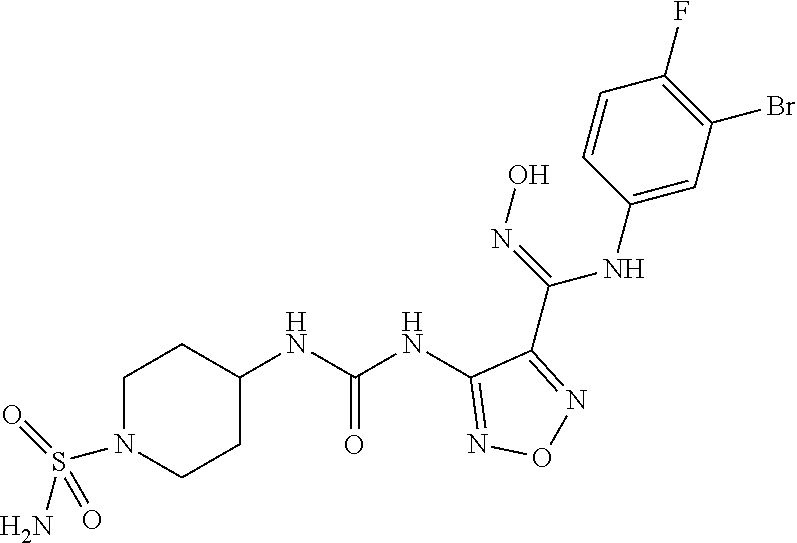


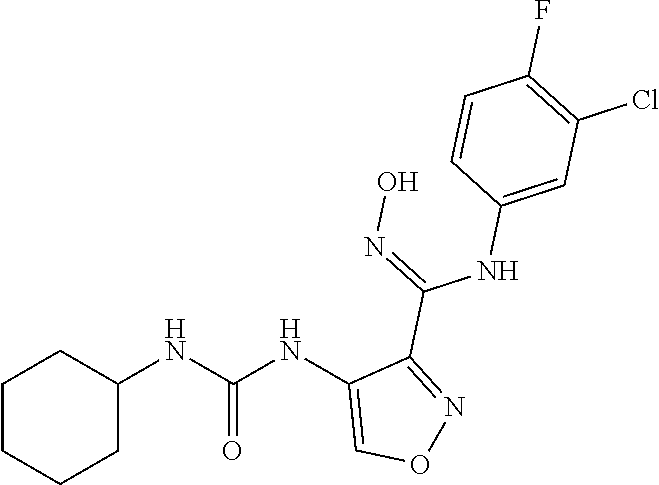


| TABLE 1 |
| Determination results of IDO1 enzyme and cell inhibitory activity |
| Urea compounds prepared | ||
| in the embodiments | IDO1 (IC50 μM) | Hela (IC50 μM) |
| Embodiment 1 | B | B |
| Embodiment 2 | B | B |
| Embodiment 3 | C | C |
| Embodiment 4 | C | C |
| Embodiment 5 | C | C |
| Embodiment 6 | C | C |
| Embodiment 7 | B | B |
| Embodiment 8 | B | B |
| Embodiment 9 | C | C |
| Embodiment 10 | A | A |
| Embodiment 11 | A | A |
| Embodiment 12 | B | B |
| Embodiment 13 | A | A |
| Embodiment 14 | A | A |
| Embodiment 15 | A | A |
| Embodiment 16 | B | B |
| Embodiment 17 | A | A |
| Embodiment 18 | A | A |
| Embodiment 19 | B | B |
| Embodiment 20 | B | B |
| Embodiment 21 | B | B |
| Embodiment 22 | B | B |
| Embodiment 23 | A | A |
| Embodiment 24 | A | A |
| Embodiment 25 | B | B |
| Embodiment 26 | A | A |
| Embodiment 27 | A | A |
| Embodiment 28 | A | A |
| Embodiment 29 | A | A |
| Embodiment 30 | A | A |
| Embodiment 31 | B | B |
| Embodiment 32 | B | B |
| Embodiment 33 | B | B |
| Embodiment 34 | B | B |
| Embodiment 35 | B | B |
| Embodiment 36 | B | B |
| Embodiment 37 | B | B |
| Embodiment 38 | B | B |
| Embodiment 39 | B | B |
| Embodiment 40 | B | B |
| Embodiment 41 | B | B |
| Embodiment 42 | C | C |
| Embodiment 43 | C | C |
| Embodiment 44 | C | C |
| Embodiment 45 | C | C |
| Embodiment 46 | C | C |
| Embodiment 47 | B | B |
| Embodiment 48 | B | B |
| Embodiment 49 | B | B |
| Embodiment 50 | B | B |
| Embodiment 51 | B | B |
| Embodiment 52 | B | B |
| Embodiment 53 | B | B |
| Embodiment 54 | B | B |
| Embodiment 55 | A | A |
| Embodiment 56 | A | A |
| Embodiment 57 | C | C |
| Embodiment 58 | B | B |
| Embodiment 59 | C | C |
| Embodiment 60 | C | C |
| Embodiment 61 | B | B |
| Embodiment 62 | B | B |
| Embodiment 63 | A | A |
| Embodiment 64 | B | B |
| Embodiment 65 | B | B |
| Embodiment 66 | B | B |
| Embodiment 67 | B | B |
| Embodiment 68 | B | B |
| Embodiment 69 | B | B |
| Embodiment 70 | B | B |
| Embodiment 71 | B | B |
| Embodiment 72 | B | B |
| Embodiment 73 | B | B |
| Embodiment 74 | B | B |
| Embodiment 75 | B | B |
| Embodiment 76 | C | C |
| Embodiment 77 | C | C |
| Embodiment 78 | C | C |
| Embodiment 79 | B | B |
| Embodiment 80 | C | C |
| Embodiment 81 | B | B |
| Embodiment 82 | B | B |
| Embodiment 83 | C | C |
| Embodiment 84 | B | B |
| Embodiment 85 | A | A |
| Embodiment 86 | C | C |
| Embodiment 87 | A | A |
| Embodiment 88 | A | A |
| Embodiment 89 | A | A |
| Embodiment 90 | A | A |
| Embodiment 91 | B | B |
| Embodiment 92 | B | B |
| Embodiment 93 | A | A |
| Embodiment 94 | B | B |
| Embodiment 95 | B | B |
| Embodiment 96 | B | B |
| Embodiment 97 | B | B |
| Embodiment 98 | B | B |
| Embodiment 99 | B | B |
| Embodiment 100 | B | B |
| Embodiment 101 | B | B |
| Embodiment 102 | B | B |
| Embodiment 103 | B | B |
| Embodiment 104 | C | C |
| Embodiment 105 | A | A |
| Embodiment 106 | A | A |
| Embodiment 107 | C | C |
| Embodiment 108 | B | B |
| Embodiment 109 | A | A |
| Embodiment 110 | A | A |
| Embodiment 111 | A | A |
| Embodiment 112 | B | B |
| Embodiment 113 | B | B |
| Embodiment 114 | A | A |
| Embodiment 115 | B | B |
| Embodiment 116 | B | B |
| Embodiment 117 | A | A |
| Embodiment 118 | A | A |
| Embodiment 119 | C | C |
| Embodiment 120 | C | C |
| Embodiment 121 | B | B |
| Embodiment 122 | C | C |
| Embodiment 123 | A | A |
| Embodiment 124 | A | A |
| Embodiment 125 | C | C |
| Embodiment 126 | B | B |
| Embodiment 127 | A | A |
| Embodiment 128 | A | A |
| Embodiment 129 | B | B |
| Embodiment 130 | B | B |
| Embodiment 131 | B | B |
| Embodiment 132 | B | B |
| Embodiment 133 | B | B |
| Embodiment 134 | B | B |
| Embodiment 135 | B | B |
| Embodiment 136 | C | C |
| Embodiment 137 | B | B |
| Embodiment 138 | B | B |
| Embodiment 139 | A | A |
| Embodiment 140 | B | B |
| Embodiment 141 | A | A |
| Embodiment 142 | A | A |
| Embodiment 143 | C | C |
| Embodiment 144 | B | B |
| Embodiment 145 | A | A |
| Embodiment 146 | C | C |
| Embodiment 147 | A | A |
| Embodiment 148 | A | A |
| Embodiment 149 | C | C |
| Embodiment 150 | B | B |
| Embodiment 151 | A | A |
| Embodiment 152 | A | A |
| Embodiment 153 | A | A |
| Embodiment 154 | B | B |
| Embodiment 155 | B | B |
| Embodiment 156 | B | B |
| Embodiment 157 | B | B |
| Embodiment 158 | B | B |
| Embodiment 159 | B | B |
| Embodiment 160 | B | B |
| Embodiment 161 | B | B |
| Embodiment 162 | B | B |
| INCB24360 | B | B |
Claims (5)


Applications Claiming Priority (3)
| Application Number | Priority Date | Filing Date | Title |
|---|---|---|---|
| CN201710042276.XA CN106866571B (en) | 2017-01-20 | 2017-01-20 | Heterocyclic urea compound and its pharmaceutical composition and application |
| CN201710042276.X | 2017-01-20 | ||
| PCT/CN2018/072046 WO2018133716A1 (en) | 2017-01-20 | 2018-01-10 | Heterocyclic urea compound and pharmaceutical composition and application thereof |
Publications (2)
| Publication Number | Publication Date |
|---|---|
| US20190367465A1 US20190367465A1 (en) | 2019-12-05 |
| US11014895B2 true US11014895B2 (en) | 2021-05-25 |
Family
ID=59158585
Family Applications (1)
| Application Number | Title | Priority Date | Filing Date |
|---|---|---|---|
| US16/477,779 Expired - Fee Related US11014895B2 (en) | 2017-01-20 | 2018-01-01 | Heterocyclic urea compound, and drug composition and application thereof |
Country Status (4)
| Country | Link |
|---|---|
| US (1) | US11014895B2 (en) |
| CN (1) | CN106866571B (en) |
| GB (1) | GB2572305B (en) |
| WO (1) | WO2018133716A1 (en) |
Families Citing this family (13)
| Publication number | Priority date | Publication date | Assignee | Title |
|---|---|---|---|---|
| TWI794171B (en) | 2016-05-11 | 2023-03-01 | 美商滬亞生物國際有限公司 | Combination therapies of hdac inhibitors and pd-l1 inhibitors |
| TWI808055B (en) | 2016-05-11 | 2023-07-11 | 美商滬亞生物國際有限公司 | Combination therapies of hdac inhibitors and pd-1 inhibitors |
| CN107954999B (en) * | 2016-10-17 | 2023-01-24 | 上海医药集团股份有限公司 | Oxadiazole ring-containing compound, preparation method, intermediate, composition and application |
| CN106866571B (en) * | 2017-01-20 | 2018-06-29 | 中国药科大学 | Heterocyclic urea compound and its pharmaceutical composition and application |
| CN106967004B (en) * | 2017-03-29 | 2019-09-17 | 中国药科大学 | IDO1 and IDO2 double inhibitor, its preparation method and its medical usage containing urea groups |
| CN108863976B (en) * | 2017-09-11 | 2022-09-16 | 郑州泰基鸿诺医药股份有限公司 | Compounds useful as IDO modulators and uses thereof |
| CN109942565B (en) * | 2017-12-20 | 2021-03-26 | 海创药业股份有限公司 | Indoleamine-2, 3-dioxygenase inhibitor and preparation method and application thereof |
| CN111909107B (en) * | 2019-05-10 | 2023-02-03 | 药康众拓(江苏)医药科技有限公司 | IDO/HDAC dual inhibitor and pharmaceutical composition and application thereof |
| CN112062732B (en) * | 2019-06-10 | 2023-10-24 | 鲁南制药集团股份有限公司 | An IDO inhibitor and its composition, preparation method and use |
| CN111718310B (en) * | 2019-08-19 | 2021-06-11 | 中国药科大学 | Phenyl-substituted five-membered heterocyclic compound, and preparation method, application and pharmaceutical composition thereof |
| US11839659B2 (en) | 2020-07-02 | 2023-12-12 | Northwestern University | Proteolysis-targeting chimeric molecules (PROTACs) that induce degradation of indoleamine 2,3-dioxygenase (IDO) protein |
| CN113105366B (en) * | 2021-03-04 | 2022-05-24 | 中国药科大学 | Phenyl-containing hydroximic structure derivatives, and preparation method and application thereof |
| CN120476113A (en) * | 2022-12-20 | 2025-08-12 | 杭州中美华东制药有限公司 | Oxime-containing compounds with STING inhibitory effect and pharmaceutical compositions and uses thereof |
Citations (2)
| Publication number | Priority date | Publication date | Assignee | Title |
|---|---|---|---|---|
| US8034953B2 (en) * | 2005-05-10 | 2011-10-11 | Incyte Corporation | Modulators of indoleamine 2,3-dioxygenase and methods of using the same |
| CN106967004A (en) * | 2017-03-29 | 2017-07-21 | 中国药科大学 | IDO1 and IDO2 double inhibitors, its preparation method and its medical usage containing urea groups |
Family Cites Families (5)
| Publication number | Priority date | Publication date | Assignee | Title |
|---|---|---|---|---|
| JP4437270B2 (en) * | 1997-12-22 | 2010-03-24 | バイエル コーポレイション | Inhibition of RAF kinase using substituted heterocyclic ureas |
| TW200940537A (en) * | 2008-02-26 | 2009-10-01 | Astrazeneca Ab | Heterocyclic urea derivatives and methods of use thereof |
| TW201002728A (en) * | 2008-06-04 | 2010-01-16 | Astrazeneca Ab | Heterocyclic urea derivatives and methods of use thereof |
| CN104125947A (en) * | 2011-12-21 | 2014-10-29 | 生物区欧洲有限公司 | Heterocyclic urea compounds |
| CN106866571B (en) * | 2017-01-20 | 2018-06-29 | 中国药科大学 | Heterocyclic urea compound and its pharmaceutical composition and application |
-
2017
- 2017-01-20 CN CN201710042276.XA patent/CN106866571B/en not_active Expired - Fee Related
-
2018
- 2018-01-01 US US16/477,779 patent/US11014895B2/en not_active Expired - Fee Related
- 2018-01-10 WO PCT/CN2018/072046 patent/WO2018133716A1/en not_active Ceased
- 2018-01-10 GB GB1910135.1A patent/GB2572305B/en not_active Expired - Fee Related
Patent Citations (2)
| Publication number | Priority date | Publication date | Assignee | Title |
|---|---|---|---|---|
| US8034953B2 (en) * | 2005-05-10 | 2011-10-11 | Incyte Corporation | Modulators of indoleamine 2,3-dioxygenase and methods of using the same |
| CN106967004A (en) * | 2017-03-29 | 2017-07-21 | 中国药科大学 | IDO1 and IDO2 double inhibitors, its preparation method and its medical usage containing urea groups |
Non-Patent Citations (2)
| Title |
|---|
| Dörwald, F. Zaragoza. Side Reactions in Organic Synthesis: A Guide to Successful Synthesis Design, Weinheim: Wiley-VCH Verlag GmbH & Co. KGaA, 2005, Preface (Year: 2005). * |
| Patani et al. Chem. Rev. 1996, 96, 3147-3176 (Year: 1996). * |
Also Published As
| Publication number | Publication date |
|---|---|
| GB201910135D0 (en) | 2019-08-28 |
| GB2572305A (en) | 2019-09-25 |
| CN106866571B (en) | 2018-06-29 |
| US20190367465A1 (en) | 2019-12-05 |
| WO2018133716A1 (en) | 2018-07-26 |
| CN106866571A (en) | 2017-06-20 |
| GB2572305B (en) | 2022-03-30 |
Similar Documents
| Publication | Publication Date | Title |
|---|---|---|
| US20190367465A1 (en) | Heterocyclic urea compound, and drug composition and application thereof | |
| JP6474068B2 (en) | 2-Aminopyrimidine compounds and drug compositions and uses thereof | |
| CN104125957B (en) | Substituted benzylpyrazoles | |
| CN101885722B (en) | Heterocycle alkyne and benzene compound, medicinal composition and application thereof | |
| KR20250003838A (en) | JAK inhibitor analogues, preparations, and uses thereof | |
| US9765058B2 (en) | Substituted benzylpyrazoles | |
| US20060293345A1 (en) | Heterobicyclic metalloprotease inhibitors | |
| EA020282B1 (en) | Benzimidazole derivatives as anti- inflammatory agents | |
| US20070155737A1 (en) | Heterobicyclic metalloprotease inhibitors | |
| WO2014079232A1 (en) | 7-oxo-pyridopyrimidine derivatives, pharmaceutical compositions and uses thereof | |
| CN101575333A (en) | Quinazoline derivatives and medical application thereof | |
| CN108530444B (en) | Novel NAMPT and IDO dual inhibitor and preparation method and medical application thereof | |
| US10093631B2 (en) | Bifunctional compounds and use for reducing uric acid levels | |
| US9862712B2 (en) | Benzimidazole based EGFR inhibitors | |
| JP2023551197A (en) | Dihydroisoquinolinone and isoindolinone derivatives and their use | |
| CN101747330A (en) | Pyridyl thiazole amine compound and medicinal composition and application thereof | |
| US12428375B2 (en) | Compounds and compositions for treating conditions associated with LPA receptor activity | |
| CN101289444B (en) | Pyrimidine derivate and medicinal use thereof | |
| CN112313213A (en) | 3-amino pyrazole compound and application thereof | |
| CN112538038B (en) | 2-indolone ERR alpha inverse agonist and pharmaceutical composition and application thereof | |
| CN110437220B (en) | Triazole compound and application thereof | |
| CN103664734B (en) | Heterocycle hydroximic acid compound and medicinal compositions thereof and application | |
| JP7288161B2 (en) | Novel dihydroquinazolinone compound or pharmacologically acceptable salt thereof, and cell growth inhibitor | |
| RU2845863C1 (en) | 1,4,5,6-tetrahydropyrimidine-2-amine derivative | |
| US12077523B2 (en) | N-(isopropyl-triazolyl)pyridinyl)-heteroaryl-carboxamide derivatives and use thereof |
Legal Events
| Date | Code | Title | Description |
|---|---|---|---|
| AS | Assignment |
Owner name: CHINA PHARMACEUTICAL UNIVERSITY, CHINA Free format text: ASSIGNMENT OF ASSIGNORS INTEREST;ASSIGNORS:JIANG, SHENG;TU, ZHENGCHAO;HAO, HAIPING;AND OTHERS;SIGNING DATES FROM 20190707 TO 20190709;REEL/FRAME:049741/0346 |
|
| FEPP | Fee payment procedure |
Free format text: ENTITY STATUS SET TO UNDISCOUNTED (ORIGINAL EVENT CODE: BIG.); ENTITY STATUS OF PATENT OWNER: SMALL ENTITY |
|
| FEPP | Fee payment procedure |
Free format text: ENTITY STATUS SET TO SMALL (ORIGINAL EVENT CODE: SMAL); ENTITY STATUS OF PATENT OWNER: SMALL ENTITY |
|
| STPP | Information on status: patent application and granting procedure in general |
Free format text: NON FINAL ACTION MAILED |
|
| STPP | Information on status: patent application and granting procedure in general |
Free format text: FINAL REJECTION MAILED |
|
| STPP | Information on status: patent application and granting procedure in general |
Free format text: ADVISORY ACTION MAILED |
|
| STPP | Information on status: patent application and granting procedure in general |
Free format text: NOTICE OF ALLOWANCE MAILED -- APPLICATION RECEIVED IN OFFICE OF PUBLICATIONS |
|
| STPP | Information on status: patent application and granting procedure in general |
Free format text: PUBLICATIONS -- ISSUE FEE PAYMENT RECEIVED |
|
| STPP | Information on status: patent application and granting procedure in general |
Free format text: PUBLICATIONS -- ISSUE FEE PAYMENT VERIFIED |
|
| STCF | Information on status: patent grant |
Free format text: PATENTED CASE |
|
| FEPP | Fee payment procedure |
Free format text: MAINTENANCE FEE REMINDER MAILED (ORIGINAL EVENT CODE: REM.); ENTITY STATUS OF PATENT OWNER: SMALL ENTITY |
|
| LAPS | Lapse for failure to pay maintenance fees |
Free format text: PATENT EXPIRED FOR FAILURE TO PAY MAINTENANCE FEES (ORIGINAL EVENT CODE: EXP.); ENTITY STATUS OF PATENT OWNER: SMALL ENTITY |
|
| STCH | Information on status: patent discontinuation |
Free format text: PATENT EXPIRED DUE TO NONPAYMENT OF MAINTENANCE FEES UNDER 37 CFR 1.362 |
|
| FP | Lapsed due to failure to pay maintenance fee |
Effective date: 20250525 |