US11004266B2 - Articulated model registration apparatus and method - Google Patents
Articulated model registration apparatus and method Download PDFInfo
- Publication number
- US11004266B2 US11004266B2 US16/494,055 US201816494055A US11004266B2 US 11004266 B2 US11004266 B2 US 11004266B2 US 201816494055 A US201816494055 A US 201816494055A US 11004266 B2 US11004266 B2 US 11004266B2
- Authority
- US
- United States
- Prior art keywords
- landmark
- dimensional coordinate
- estimating
- landmarks
- articulated
- Prior art date
- Legal status (The legal status is an assumption and is not a legal conclusion. Google has not performed a legal analysis and makes no representation as to the accuracy of the status listed.)
- Active
Links
Images


Classifications
-
- G—PHYSICS
- G06—COMPUTING OR CALCULATING; COUNTING
- G06T—IMAGE DATA PROCESSING OR GENERATION, IN GENERAL
- G06T7/00—Image analysis
- G06T7/70—Determining position or orientation of objects or cameras
- G06T7/73—Determining position or orientation of objects or cameras using feature-based methods
- G06T7/75—Determining position or orientation of objects or cameras using feature-based methods involving models
-
- G—PHYSICS
- G06—COMPUTING OR CALCULATING; COUNTING
- G06T—IMAGE DATA PROCESSING OR GENERATION, IN GENERAL
- G06T17/00—Three-dimensional [3D] modelling for computer graphics
- G06T17/20—Finite element generation, e.g. wire-frame surface description, tesselation
-
- G—PHYSICS
- G06—COMPUTING OR CALCULATING; COUNTING
- G06T—IMAGE DATA PROCESSING OR GENERATION, IN GENERAL
- G06T19/00—Manipulating three-dimensional [3D] models or images for computer graphics
- G06T19/20—Editing of three-dimensional [3D] images, e.g. changing shapes or colours, aligning objects or positioning parts
-
- G—PHYSICS
- G06—COMPUTING OR CALCULATING; COUNTING
- G06T—IMAGE DATA PROCESSING OR GENERATION, IN GENERAL
- G06T7/00—Image analysis
- G06T7/70—Determining position or orientation of objects or cameras
- G06T7/73—Determining position or orientation of objects or cameras using feature-based methods
-
- G—PHYSICS
- G06—COMPUTING OR CALCULATING; COUNTING
- G06T—IMAGE DATA PROCESSING OR GENERATION, IN GENERAL
- G06T2207/00—Indexing scheme for image analysis or image enhancement
- G06T2207/10—Image acquisition modality
- G06T2207/10024—Color image
-
- G—PHYSICS
- G06—COMPUTING OR CALCULATING; COUNTING
- G06T—IMAGE DATA PROCESSING OR GENERATION, IN GENERAL
- G06T2207/00—Indexing scheme for image analysis or image enhancement
- G06T2207/20—Special algorithmic details
- G06T2207/20084—Artificial neural networks [ANN]
-
- G—PHYSICS
- G06—COMPUTING OR CALCULATING; COUNTING
- G06T—IMAGE DATA PROCESSING OR GENERATION, IN GENERAL
- G06T2207/00—Indexing scheme for image analysis or image enhancement
- G06T2207/30—Subject of image; Context of image processing
- G06T2207/30196—Human being; Person
Definitions
- the present invention relates to the three-dimensionally restoration of an articulated model of a body, such as a hand, an upper body, and a whole body, from an image and to the acquisition of a two-dimensional landmark from a two-dimensional image to generate and estimate a three-dimensional articulated model corresponding thereto.
- the present invention relates to an articulated model registration apparatus and method which three-dimensionally restore an articulated model of a body from an image and acquire a two-dimensional landmark from a two-dimensional image to estimate a three-dimensional articulated model corresponding thereto with a less computation amount so that less processing time is consumed, a local minimum problem is solved and power consumption of a portable device such as a smart phone is reduced.
- the present invention provides an articulated model registration method including: a body image detecting step of detecting an image of a body area from an original image, a landmark extracting step of extracting one or more landmarks including an articulated point from the detected image of the body area, a body shape model generating step of generating an average three-dimensional body shape model, a conversion estimating step of estimating a position on a three-dimensional coordinate of the generated body shape model from a conversion estimating landmark including any one or more landmarks among the extracted landmarks, and a posture estimating step of estimating a position on a three-dimensional coordinate of the generated body shape model from any one or more landmarks among the extracted landmarks in which the posture estimating unit estimates the position on the three-dimensional coordinate of the landmark from a reference straight line connecting the position on the three-dimensional coordinate estimated from any one or more of the landmarks, in an arbitrary position on the three-dimensional coordinate.
- an articulated model registration apparatus including: a body image detecting unit which detects an image of a body area from an original image, a landmark extracting unit which extracts one or more landmarks including an articulated point from the detected image of the body area, a body shape model generating unit which generates an average three-dimensional body shape model, a conversion estimating unit which estimates a position on a three-dimensional coordinate of the generated body shape model from one or more landmarks other than the articulated point among the landmarks, and a posture estimating unit which estimates a position on a three-dimensional coordinate of the generated body shape model from one or more articulated points among the landmarks in which the posture estimating unit estimates the position on the three-dimensional coordinate of the articulated point from a reference straight line connecting the position on the three-dimensional coordinate estimated from any one or more of the articulated points, in an arbitrary position on the three-dimensional coordinate.
- the articulated model registration apparatus and method according to the present invention acquire a two-dimensional landmark from a two-dimensional image to estimate a three-dimensional articulated model of a corresponding body, for example, a hand, an upper body, or a whole body, with a less computation amount, so that the processing time is reduced by up to one-two-hundredth of the IK technique, and specifically, the power consumption of the portable device such as a smart phone is reduced. Further, several candidate solutions are calculated as a closed-form solution so that local minimum problem caused when an optimization technique such as the IK technique is used does not occur.
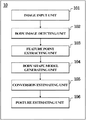
- FIG. 1 illustrates an exemplary embodiment of an articulated model registration apparatus 10 according to the present invention.
- FIGS. 2 and 3 illustrate an exemplary embodiment of an articulated model registration apparatus 10 according to the present invention.
- FIG. 4 illustrates an exemplary embodiment of an articulated model registration method according to the present invention.
- FIG. 5 two-dimensionally illustrates a process for a step of calculating a reference straight line.
- FIG. 6 illustrates specific steps included in a posture estimating step S 15 according to the present invention.
- FIG. 7 illustrates an example which estimates positions on a three-dimensional coordinate of a landmark P 0 corresponding to a shoulder of the body, a landmark P 1 corresponding to an elbow, and a landmark P 2 corresponding to a wrist of the end of the body in this order, by an iterative estimating step S 153 according to the present invention.
- FIG. 8 illustrates an example which estimates positions on a three-dimensional coordinate of a landmark P 0 corresponding to a root joint of the hand of the body, specifically, the index finger, landmarks P 1 and P 2 corresponding to two joints of the index finger, and a landmark P 3 corresponding to an end of the index finger in this order, by an iterative estimating step S 153 according to the present invention.
- FIG. 9 illustrates specific steps included in an iterative estimating step S 153 according to the present invention.
- FIG. 10 two-dimensionally illustrates a calculating step of Equation 6.
- FIG. 11 illustrates an example which selects an appropriate root among candidates of a second joint of a middle finger of a hand of a body.
- unit”, “module”, “device”, or “system” refers to a computer related entity, such as hardware, a combination of hardware and software, or software.
- unit”, “module”, “device”, or “system” may be a process which is being executed, a processor, an object, an executable file, a thread of execution, a program, and/or a computer, but is not limited thereto.
- both an application which is being executed in a computer and the computer may correspond to “unit”, “module”, “device”, or “system” of this specification.
- FIG. 1 illustrates an exemplary embodiment of an articulated model registration apparatus 10 according to the present invention.
- the articulated model registration apparatus 10 includes a body image detecting unit 102 which detects an image of a body area from an original image, a landmark extracting unit 103 which extracts one or more landmarks including an articulated point from the detected image of the body area, a body shape model generating unit 104 which generates an average three-dimensional body shape model, a conversion estimating unit 105 which estimates a position on a three-dimensional coordinate of the generated body shape model from one or more landmarks other than the articulated point among the landmarks, and a posture estimating unit 106 which estimates a position on a three-dimensional coordinate of the generated body shape model from one or more articulated points of the landmarks.
- the articulated model registration apparatus 10 may further include an image input unit 101 .
- the image input unit 101 may receive an original image in the form of electronic data.
- the image input unit 101 may be a camera 204 or receive an original image input from the camera 204 .
- the original image input unit 101 may receive the original image from database in which the original image is stored as electronic data.
- the image input unit 101 may receive the original image from an external network connected to database in which the original image is stored as electronic data.
- the image input unit 101 may receive a camera matrix representing a photographing referential point and direction on a three-dimensional coordinate of the original image.
- the body image detecting unit 102 may detect an image of a body area from the original image.
- the body image detecting unit 102 is not limited and may be an object detector or use the object detector.
- the object detector may be a machine learning based detector and for example, may be a single shot multibox detector (SSD) or you only look once (YOLO).
- the landmark extracting unit 103 detects a boundary vector between the body area and a background area and then detects a body end point and a point between body ends at the boundary vector. Specifically, in the case of a hand area, a thumb area and an area of fingers other than the thumb may be detected.
- an area in which a color value of each pixel of the detected image of the body area corresponds to a range of a skin color value and an area in which the color value does not correspond to a range of the skin color value are converted into a white area and a black area, respectively, and then the boundary line vector between the body area and the background area may be detected.
- a point corresponding to an inflection point which is equal to or lower than a predetermined angle is detected as a body end point and a point between body ends.
- the point may be detected by a deep learning based method, specifically, a convolutional pose machine (CPM) based segmentation technique.
- CCM convolutional pose machine
- the boundary vector between the detected body area and the background area is input to a Harris corner detector and when a neighbor vector including a point corresponding to an inflection point has a concave shape, the point is detected as a body end point and when the neighbor vector has a convex shape, the point is detected as an inter-body point.
- a three-dimensional body shape model generating unit 104 may load a three-dimensional body shape model from a three-dimensional body shape model database in which one or more three-dimensional body shape models are stored to generate the three-dimensional body shape model.
- the “three-dimensional body shape model” is a position information set on a three-dimensional space of an end point and articulated points of the body and may refer to a three-dimensional body posture to be recognized from the original image.
- the body shape model may be a basis vector set of a body shape dispersion constructed by the average three-dimensional body skeleton and principal component analysis.
- the average three-dimensional body shape model may be information on a shape and a size of a normal body with an average size of a body shape and a size used at the time of machine learning, for the purpose of registration of a three-dimensional body shape.
- the conversion estimating unit 105 may estimate a position on a three-dimensional coordinate of the generated body shape model, not from an articulated point, but from one or more landmarks among a camera matrix on the three-dimensional coordinate and the landmarks of the original image, for example, by calling SolvePnP function of OpenCV.
- the posture estimating unit 106 may estimate the position on the three-dimensional coordinate of the articulated point with respect to a straight line connecting the position on the three-dimensional coordinate estimated from any one or more of the articulated points, in an arbitrary position on the three-dimensional coordinate.
- the “posture” may refer to a position information set on the three-dimensional space of the end point and articulated points of the body.
- FIG. 2 illustrates an exemplary embodiment of an articulated model registration apparatus 10 according to the present invention.
- the articulated model registration apparatus 10 may include a memory 201 , a processor 202 , and a communication unit 203 .
- the memory 201 may include a body image detecting unit 101 , the landmark extracting unit 102 , the body shape model generating unit 103 , the conversion estimating unit 104 , and the posture estimating unit 105 .
- the memory 201 may be executed through the processor 202 by statically or dynamically allocating the corresponding unit/module.
- the memory 201 may include an arbitrary combination of volatile and nonvolatile memory appropriate for an intended purpose (which may be distributed or localized as appropriate) and for the convenience of description, may include other memory segments which is not illustrated in this example.
- the memory 208 may include a code storage area, a code execution area, and a data area without departing from the scope of the present invention.
- the communication unit 203 may provide a data communication function to search still image contents, audio and video contents or other contents and other activities through a satellite, a cable, a storage medium, Internet, or other content providers if it is appropriate for a given embodied example, and for example, may include a wireless communication standard such as wired Ethernet, cellular wireless communication, and Bluetooth®.
- a wireless communication standard such as wired Ethernet, cellular wireless communication, and Bluetooth®.
- FIG. 3 illustrates an exemplary embodiment of an articulated model registration apparatus 10 according to the present invention.
- the articulated model registration apparatus 10 may include a memory 201 , a processor 202 , a communication unit 203 , a camera 204 , and a display 205 .
- the memory 201 may include the body image detecting unit 101 , the landmark extracting unit 102 , the body shape model generating unit 103 , the conversion estimating unit 104 , and the posture estimating unit 105 .
- the camera 204 may convert optical information into two-dimensional pixel color information. Further, the camera 204 may convert two-dimensional pixel depth information. Furthermore, the camera 204 may generate a camera matrix representing a photographing reference point and direction on a three-dimensional coordinate of the original image.
- the “image” may be data of two-dimensional visual information or data including depth information in addition to the two-dimensional visual information. Further, the image may correspond to any one frame of a moving image formed of a plurality of frames.
- the display 205 optically displays images
- the display 205 is not limited and for example, may be a cathode ray tube, a liquid crystal display device, a light emitting diode device, a plasma display, and further include a touch panel.
- the articulated model registration apparatus 10 may perform an articulated model registration method which will be described below and all the description of the articulated model registration method described below may be applied.
- FIG. 4 illustrates an exemplary embodiment of an articulated model registration method according to the present invention.
- the articulated model registration method according to the present invention includes a body image detecting step S 11 of detecting an image of a body area from an original image, a landmark extracting step S 12 of extracting one or more landmarks including an articulated point from the detected image of the body area, a body shape model generating step S 13 of generating an average three-dimensional body shape model, a conversion estimating step S 14 of estimating a position on a three-dimensional coordinate of the generated body shape model from a conversion estimating landmark including any one or more landmarks among the extracted landmarks, and a posture estimating step S 15 of estimating a position on a three-dimensional coordinate of the generated body shape model from any one or more landmarks among the extracted landmarks.
- the posture estimating step S 15 may estimate the position on the three-dimensional coordinate of the landmark from a reference straight line connecting the position on the three-dimensional coordinate estimated from any one or more of the landmarks, in an arbitrary position on the three-dimensional coordinate.
- the body posture recognition method may further include a step of receiving an original image (not illustrated).
- the original image may be input in the form of electronic data, for example, input in the form of electronic data from the camera or the original image may be transmitted from the database in which the original image is stored as electronic data.
- the original image input unit 101 may receive the original image from an external network connected to a database in which the original image is stored as electronic data or receive the original image from the camera 204 .
- the body image detecting step S 11 may detect an image of a hand area from the original image.
- the body image detecting step S 11 detects an image of a body area from the original image
- the body image detecting step S 11 is not limited and may be an object detector or use the object detector.
- the object detector may be a machine learning based detector and for example, may be a single shot multibox detector (SSD) or you only look once (YOLO).
- the landmark extracting step S 12 detects a boundary vector between the body area and a background area and then detects a body end point and a point between body ends at the boundary vector. Specifically, in the case of a hand area, a thumb area and an area of fingers other than the thumb may be detected.
- an area in which a color value of each pixel of the detected image of the body area corresponds to a range of a skin color value and an area in which the color value does not correspond to a range of the skin color value are converted into a white area and a black area, respectively, and then the boundary line vector between the body area and the background area may be detected.
- a point corresponding to an inflection point which is equal to or lower than a predetermined angle is detected as a point between a body end point and a body end.
- the point may be detected by a deep learning based method, specifically, a convolutional pose machine (CPM) based segmentation technique.
- CPM convolutional pose machine
- the boundary vector between the detected body area and the background area is input to a Harris corner detector and when a neighbor vector including a point corresponding to an inflection point has a concave shape, the point is detected as a finger end point and when the neighbor vector has a convex shape, the point is detected as a point between fingers.
- the body shape model generating step S 13 may generate a three-dimensional body shape model by matching an average three-dimensional hand shape model from a three-dimensional body shape model database in which one or more three-dimensional body shape models are stored.
- the conversion estimating step S 14 may estimate a position on a three-dimensional coordinate of the generated body shape model, not from an articulated point, but one or more landmarks among a camera matrix on the three-dimensional coordinate and the landmarks of the original image.
- the conversion estimating step S 14 may call SolvePnP function of OpenCV to estimate the position of the body shape model on the three-dimensional coordinate.
- the conversion estimating landmark may be a landmark corresponding to a joint which does not change according to the change of the joint angle.
- the conversion estimating landmark may be a landmark corresponding to any one selected from a group consisting of a wrist, a root joint of an index finger, a root joint of a middle finger, a root joint of a ring finger, and a root joint of a small finger.
- a joint corresponding to a thumb and joints other than roots of the remaining four fingers have a high degree of freedom by the pose of the hand as well as the position of the hand so that the joints may not be used to estimate a position without estimating a pose which will be performed in a next step.
- the conversion estimating landmark may be a landmark corresponding to a shoulder or hip joint.
- FIG. 6 illustrates specific steps included in a posture estimating step S 15 according to the present invention.
- the posture estimating step S 15 may include a step S 151 of calculating a reference straight line connecting a camera matrix on a three-dimensional coordinate of the original image and a landmark at which the position on the three-dimensional coordinate is estimated.
- the posture estimating step S 15 may include a step S 151 ′ of calculating a reference straight line with a camera matrix which is a projection reference matrix on a three-dimensional coordinate and a landmark on a two-dimensional coordinate projected by the camera matrix from the original image and the process therefor is two-dimensionally illustrated in FIG. 5 .
- the step S 151 ′ of calculating a reference straight line may include a step S 151 ′ of calculating a reference straight line represented by the following Equation 1. P b +D t [Equation 1]
- Equation 1 a direction vector D is represented by the following Equation 2 and P b is represented by the following Equation 3.
- D ( C 0 ⁇ C 2 ⁇ x ′′) ⁇ ( C 0 ⁇ C 2 ⁇ y ′′) [Equation 2]
- C 0 and C 2 are first and third row components of the camera matrix C which is a projection reference matrix on a three-dimensional coordinate from the original image and x′′ and y′′ are coordinates on a two-dimensional coordinate system of the posture landmark.
- P b may be calculated by setting a z coordinate value to be 0.
- P 3D lies on a straight line.
- the straight line is P b +Dt
- one point P b and the direction vector D of the straight line may be obtained by the following method.
- P b obtains a cross point of the straight line and an xy plane.
- P b is assumed as (x b , y b , 0) and x b and y b may be calculated by solving a simultaneous equation for two expressions and two unknowns.
- the posture estimating step S 15 may include a step S 152 of moving an estimation start landmark to a position on a three-dimensional coordinate which is the most proximate from the reference straight line.
- the posture estimating step S 15 may include an iterative estimating step S 153 which estimates a position on the three-dimensional coordinate of the landmark in the connecting order from the estimation start landmark to an end landmark.
- FIG. 7 illustrates an example which estimates positions on a three-dimensional coordinate of a landmark P 0 corresponding to a shoulder of the body, a landmark P 1 corresponding to an elbow, and a landmark P 2 corresponding to a wrist of the end of the body in this order, by an iterative estimating step S 153 according to the present invention.
- FIG. 8 illustrates an example which estimates positions on a three-dimensional coordinate of a landmark P 0 corresponding to a root joint of the hand of the body, specifically, the index finger, landmarks P 1 and P 2 corresponding to two joints of the index finger, and a landmark P 3 corresponding to an end of the index finger in this order, by an iterative estimating step S 153 according to the present invention.
- FIG. 9 illustrates specific steps included in an iterative estimating step S 153 according to the present invention.
- the iterative estimating step S 153 may include a step S 1531 of calculating a landmark root satisfying a condition that a distance to a straight line on a three-dimensional coordinate calculated by a landmark at which estimation is completed and a landmark which is a next connecting order is equal to the distance between the landmark at which estimation is completed and a landmark which is a next connecting order, with respect to the landmark at which estimation is completed.
- a vertex which is located on a three-dimensional straight line corresponding to the landmark of the next joint to be spaced apart from P c by r may be obtained by solving the following Equation 4 with respect to t. Normally, there are two roots of P a and P b . However, there is one corresponding vertex (when the quadratic equation has multiple roots) or there is no vertex, depending on the distance r.
- Equation 4 Pc is a position on the three-dimensional coordinate of the landmark at which estimation is completed, r is a distance between a landmark at which estimation is completed and a landmark which is a next connecting order, and P b and D are equal to those of Equation 1.
- the iterative estimating step S 153 may include a step S 1532 of estimating a root of a landmark as a landmark which is a next connecting order of a landmark at which estimation is completed.
- the iterative estimating step S 153 may include a step S 1533 of estimating a root included in a movable area of a body joint as a landmark which is a next connecting order of the landmark at which estimation is completed.
- the step S 1533 of estimating to be a landmark may include a step S 1533 ′ of estimating P candidate satisfying the following Equation 5 by a landmark which is a next connecting order. ( P candidate ⁇ P c ) ⁇ N [Equation 5]
- Equation 6 L may be P candidate ⁇ P c , that is, a link direction which is a difference between the position on the three-dimensional coordinate and a position on the three-dimensional coordinate of the root joint, C may be a cross direction which is a difference of any two landmarks among the estimation start landmarks.
- L may be P candidate ⁇ P c , that is, a link direction which is a difference between the position on the three-dimensional coordinate and a position on the three-dimensional coordinate of the root joint
- C may be a cross direction which is a difference of any two landmarks among the estimation start landmarks.
- the first joint of each finger is bent in a palm direction, so that the palm direction may be set as a norm direction.
- the iterative estimating step S 153 may include a step S 1534 of estimating a position which is the shortest distance from Pc in the reference straight line as a landmark which is a next connecting order.
- P c and the shortest distance may be the midpoint of the straight line on a three-dimensional coordinate between P A and P B .
- FIG. 11 illustrates an example which selects an appropriate root among candidates of a second joint of a middle finger of a hand of a body.
- C of the above Equation 6 may be a cross direction which is a difference of the vector on the three-dimensional coordinate between a landmark corresponding to a root joint of a small finger and a landmark corresponding to a root joint of an index finger.
- the present invention may provide a program including a command for executing the articulated model registration method.
- the present invention may provide a computer readable recording medium in which the above-described program is stored.
Landscapes
- Engineering & Computer Science (AREA)
- Physics & Mathematics (AREA)
- General Physics & Mathematics (AREA)
- Theoretical Computer Science (AREA)
- Computer Graphics (AREA)
- Software Systems (AREA)
- Geometry (AREA)
- Computer Vision & Pattern Recognition (AREA)
- Architecture (AREA)
- Computer Hardware Design (AREA)
- General Engineering & Computer Science (AREA)
- Image Analysis (AREA)
Abstract
Description
P b +D t [Equation 1]
D=(C 0 −C 2 ·x″)×(C 0 −C 2 ·y″) [Equation 2]
(C 0 −C 2 ·x″)·P b=0,(C 0 −C 2 ·y″)·P b=0 [Equation 3]
(x′,y′,z′)=C·P 3D ,P 2D=(x″,y″)=(x′/z′,y′/z′) [Equation 3A]
x′=C 0 ·P 3D ,y=C 1 ·P 3D ,z′=C 2 ·P 3D
x″=C 0 ·P 3D /C 2 ·P 3D ,y″=C 1 ·P 3D /C 2 ·P 3D
(C 0 −C 2 ·x″)·P 3D=0,(C 0 −C 2 ·y″)·P 3D=0
D=(C 0 −C 2 ·x″)×(C 0 −C 2 ·y″) [Equation 3B]
(P c −P b +D·t)2 −r 2=0 [Equation 4]
(P candidate −P c)·N [Equation 5]
N=L×C [Equation 6]
Claims (5)
Applications Claiming Priority (1)
| Application Number | Priority Date | Filing Date | Title |
|---|---|---|---|
| PCT/KR2018/016548 WO2020130211A1 (en) | 2018-12-21 | 2018-12-21 | Joint model registration device and method |
Publications (2)
| Publication Number | Publication Date |
|---|---|
| US20200334904A1 US20200334904A1 (en) | 2020-10-22 |
| US11004266B2 true US11004266B2 (en) | 2021-05-11 |
Family
ID=71102115
Family Applications (1)
| Application Number | Title | Priority Date | Filing Date |
|---|---|---|---|
| US16/494,055 Active US11004266B2 (en) | 2018-12-21 | 2018-12-21 | Articulated model registration apparatus and method |
Country Status (2)
| Country | Link |
|---|---|
| US (1) | US11004266B2 (en) |
| WO (1) | WO2020130211A1 (en) |
Cited By (1)
| Publication number | Priority date | Publication date | Assignee | Title |
|---|---|---|---|---|
| US12327071B1 (en) * | 2020-06-18 | 2025-06-10 | Nvidia Corporation | Internal solver for articulations in simulation applications |
Families Citing this family (2)
| Publication number | Priority date | Publication date | Assignee | Title |
|---|---|---|---|---|
| US12443902B2 (en) | 2016-06-12 | 2025-10-14 | Green Grid Inc. | Method and system for utility infrastructure condition monitoring, detection and response |
| CN113609917B (en) | 2021-07-12 | 2022-09-27 | 深圳市鸿合创新信息技术有限责任公司 | Human hand position information determination method and related equipment |
Citations (16)
| Publication number | Priority date | Publication date | Assignee | Title |
|---|---|---|---|---|
| JP4667900B2 (en) | 2005-02-17 | 2011-04-13 | 株式会社ユニメック | 3D analysis method from 2D image and system to execute it |
| US20120070070A1 (en) * | 2010-09-16 | 2012-03-22 | Primesense Ltd. | Learning-based pose estimation from depth maps |
| US20150186716A1 (en) * | 2011-09-11 | 2015-07-02 | Apple Inc. | Learning-based estimation of hand and finger pose |
| US20170316578A1 (en) * | 2016-04-29 | 2017-11-02 | Ecole Polytechnique Federale De Lausanne (Epfl) | Method, System and Device for Direct Prediction of 3D Body Poses from Motion Compensated Sequence |
| US20170316255A1 (en) * | 2016-04-28 | 2017-11-02 | Panasonic Intellectual Property Management Co., Ltd. | Identification device, identification method, and recording medium recording identification program |
| US20170344829A1 (en) * | 2016-05-31 | 2017-11-30 | Microsoft Technology Licensing, Llc | Skeleton -based action detection using recurrent neural network |
| US20180068461A1 (en) * | 2013-07-30 | 2018-03-08 | Canon Kabushiki Kaisha | Posture estimating apparatus, posture estimating method and storing medium |
| US20180353836A1 (en) * | 2016-12-30 | 2018-12-13 | Intel Corporation | Positional analysis using computer vision sensor synchronization |
| US20190139297A1 (en) * | 2017-11-07 | 2019-05-09 | Microsoft Technology Licensing, Llc | 3d skeletonization using truncated epipolar lines |
| US20190147225A1 (en) * | 2016-05-19 | 2019-05-16 | Visiana Aps | Image processing apparatus and method |
| US20190164346A1 (en) * | 2017-11-27 | 2019-05-30 | Electronics And Telecommunications Research Institute | Method and apparatus for providing realistic 2d/3d ar experience service based on video image |
| US20190272670A1 (en) * | 2016-08-14 | 2019-09-05 | Uvic Industry Partnerships Inc. | Real-time hand modeling and tracking using convolution models |
| US20190278983A1 (en) * | 2018-03-12 | 2019-09-12 | Nvidia Corporation | Three-dimensional (3d) pose estimation from a monocular camera |
| US20190347826A1 (en) * | 2018-05-11 | 2019-11-14 | Samsung Electronics Co., Ltd. | Method and apparatus for pose processing |
| US20190385381A1 (en) * | 2010-06-10 | 2019-12-19 | Brown University | Parameterized Model of 2D Articulated Human Shape |
| US20200098166A1 (en) * | 2018-09-25 | 2020-03-26 | Sony Corporation | Reconstruction and detection of occluded portions of 3d human body model using depth data from single viewpoint |
Family Cites Families (3)
| Publication number | Priority date | Publication date | Assignee | Title |
|---|---|---|---|---|
| KR100763578B1 (en) * | 2005-12-01 | 2007-10-04 | 한국전자통신연구원 | Method for Estimating 3-Dimensional Position of Human's Joint using Sphere Projecting Technique |
| WO2009086088A1 (en) * | 2007-12-21 | 2009-07-09 | Honda Motor Co., Ltd. | Controlled human pose estimation from depth image streams |
| KR101072944B1 (en) * | 2009-08-31 | 2011-10-17 | 서울대학교산학협력단 | System for creating 3d human body model and method therefor |
-
2018
- 2018-12-21 WO PCT/KR2018/016548 patent/WO2020130211A1/en not_active Ceased
- 2018-12-21 US US16/494,055 patent/US11004266B2/en active Active
Patent Citations (16)
| Publication number | Priority date | Publication date | Assignee | Title |
|---|---|---|---|---|
| JP4667900B2 (en) | 2005-02-17 | 2011-04-13 | 株式会社ユニメック | 3D analysis method from 2D image and system to execute it |
| US20190385381A1 (en) * | 2010-06-10 | 2019-12-19 | Brown University | Parameterized Model of 2D Articulated Human Shape |
| US20120070070A1 (en) * | 2010-09-16 | 2012-03-22 | Primesense Ltd. | Learning-based pose estimation from depth maps |
| US20150186716A1 (en) * | 2011-09-11 | 2015-07-02 | Apple Inc. | Learning-based estimation of hand and finger pose |
| US20180068461A1 (en) * | 2013-07-30 | 2018-03-08 | Canon Kabushiki Kaisha | Posture estimating apparatus, posture estimating method and storing medium |
| US20170316255A1 (en) * | 2016-04-28 | 2017-11-02 | Panasonic Intellectual Property Management Co., Ltd. | Identification device, identification method, and recording medium recording identification program |
| US20170316578A1 (en) * | 2016-04-29 | 2017-11-02 | Ecole Polytechnique Federale De Lausanne (Epfl) | Method, System and Device for Direct Prediction of 3D Body Poses from Motion Compensated Sequence |
| US20190147225A1 (en) * | 2016-05-19 | 2019-05-16 | Visiana Aps | Image processing apparatus and method |
| US20170344829A1 (en) * | 2016-05-31 | 2017-11-30 | Microsoft Technology Licensing, Llc | Skeleton -based action detection using recurrent neural network |
| US20190272670A1 (en) * | 2016-08-14 | 2019-09-05 | Uvic Industry Partnerships Inc. | Real-time hand modeling and tracking using convolution models |
| US20180353836A1 (en) * | 2016-12-30 | 2018-12-13 | Intel Corporation | Positional analysis using computer vision sensor synchronization |
| US20190139297A1 (en) * | 2017-11-07 | 2019-05-09 | Microsoft Technology Licensing, Llc | 3d skeletonization using truncated epipolar lines |
| US20190164346A1 (en) * | 2017-11-27 | 2019-05-30 | Electronics And Telecommunications Research Institute | Method and apparatus for providing realistic 2d/3d ar experience service based on video image |
| US20190278983A1 (en) * | 2018-03-12 | 2019-09-12 | Nvidia Corporation | Three-dimensional (3d) pose estimation from a monocular camera |
| US20190347826A1 (en) * | 2018-05-11 | 2019-11-14 | Samsung Electronics Co., Ltd. | Method and apparatus for pose processing |
| US20200098166A1 (en) * | 2018-09-25 | 2020-03-26 | Sony Corporation | Reconstruction and detection of occluded portions of 3d human body model using depth data from single viewpoint |
Non-Patent Citations (2)
| Title |
|---|
| Erol, Ali, et al. "Vision-based hand pose estimation: A review." Computer Vision and Image Understanding 108.1-2 (2007): 52-73. * |
| Pisharady, Pramod Kumar, and Martin Saerbeck. "Recent methods and databases in vision-based hand gesture recognition: A review." Computer Vision and Image Understanding 141 (2015): 152-165. * |
Cited By (1)
| Publication number | Priority date | Publication date | Assignee | Title |
|---|---|---|---|---|
| US12327071B1 (en) * | 2020-06-18 | 2025-06-10 | Nvidia Corporation | Internal solver for articulations in simulation applications |
Also Published As
| Publication number | Publication date |
|---|---|
| US20200334904A1 (en) | 2020-10-22 |
| WO2020130211A1 (en) | 2020-06-25 |
Similar Documents
| Publication | Publication Date | Title |
|---|---|---|
| US11120254B2 (en) | Methods and apparatuses for determining hand three-dimensional data | |
| KR101865655B1 (en) | Method and apparatus for providing service for augmented reality interaction | |
| US9911219B2 (en) | Detection, tracking, and pose estimation of an articulated body | |
| KR102334139B1 (en) | Eye gaze tracking based upon adaptive homography mapping | |
| CN112489102B (en) | Three-dimensional reconstruction method, device, equipment and storage medium | |
| CN103839277B (en) | A kind of mobile augmented reality register method of outdoor largescale natural scene | |
| CN111291885A (en) | Near-infrared image generation method, network generation training method and device | |
| CN112785674A (en) | Texture map generation method, rendering method, device, equipment and storage medium | |
| CN110109535A (en) | Augmented reality generation method and device | |
| CN104317391A (en) | Stereoscopic vision-based three-dimensional palm posture recognition interactive method and system | |
| WO2016123913A1 (en) | Data processing method and apparatus | |
| US9613404B2 (en) | Image processing method, image processing apparatus and electronic device | |
| US11004266B2 (en) | Articulated model registration apparatus and method | |
| EP4614443A1 (en) | Data processing method and apparatus, device, and storage medium | |
| CN112657176A (en) | Binocular projection man-machine interaction method combined with portrait behavior information | |
| CN114494150A (en) | Design method of monocular vision odometer based on semi-direct method | |
| CN112785524A (en) | Character image restoration method and device and electronic equipment | |
| KR102315696B1 (en) | Apparatus for fitting of articulated model and method for the same | |
| KR20080029080A (en) | Magnetic Position Estimation System and Method of Mobile Robot Using Monocular Zoom Camera | |
| WO2020223940A1 (en) | Posture prediction method, computer device and storage medium | |
| KR102333768B1 (en) | Hand recognition augmented reality-intraction apparatus and method | |
| US20230144111A1 (en) | A method for generating a 3d model | |
| CN119963642A (en) | Spatial positioning method, device and equipment | |
| CN112150527A (en) | Measuring method and device, electronic device and storage medium | |
| CN106980386A (en) | Hand-type tracking, device and computer-readable medium |
Legal Events
| Date | Code | Title | Description |
|---|---|---|---|
| AS | Assignment |
Owner name: ALCHERA INC., KOREA, REPUBLIC OF Free format text: ASSIGNMENT OF ASSIGNORS INTEREST;ASSIGNORS:CHANG, JUNG WOO;HWANG, YOUNG KYOO;KIM, JUNG BAE;REEL/FRAME:050371/0139 Effective date: 20181227 |
|
| FEPP | Fee payment procedure |
Free format text: ENTITY STATUS SET TO UNDISCOUNTED (ORIGINAL EVENT CODE: BIG.); ENTITY STATUS OF PATENT OWNER: MICROENTITY |
|
| FEPP | Fee payment procedure |
Free format text: ENTITY STATUS SET TO MICRO (ORIGINAL EVENT CODE: MICR); ENTITY STATUS OF PATENT OWNER: MICROENTITY Free format text: ENTITY STATUS SET TO SMALL (ORIGINAL EVENT CODE: SMAL); ENTITY STATUS OF PATENT OWNER: MICROENTITY |
|
| STPP | Information on status: patent application and granting procedure in general |
Free format text: NOTICE OF ALLOWANCE MAILED -- APPLICATION RECEIVED IN OFFICE OF PUBLICATIONS |
|
| STPP | Information on status: patent application and granting procedure in general |
Free format text: PUBLICATIONS -- ISSUE FEE PAYMENT RECEIVED |
|
| STPP | Information on status: patent application and granting procedure in general |
Free format text: PUBLICATIONS -- ISSUE FEE PAYMENT VERIFIED |
|
| STCF | Information on status: patent grant |
Free format text: PATENTED CASE |
|
| FEPP | Fee payment procedure |
Free format text: ENTITY STATUS SET TO SMALL (ORIGINAL EVENT CODE: SMAL); ENTITY STATUS OF PATENT OWNER: SMALL ENTITY |
|
| MAFP | Maintenance fee payment |
Free format text: PAYMENT OF MAINTENANCE FEE, 4TH YR, SMALL ENTITY (ORIGINAL EVENT CODE: M2551); ENTITY STATUS OF PATENT OWNER: SMALL ENTITY Year of fee payment: 4 |