US11001586B2 - Alkyl pyrrolopyrimidine analogs and methods of making and using same - Google Patents
Alkyl pyrrolopyrimidine analogs and methods of making and using same Download PDFInfo
- Publication number
- US11001586B2 US11001586B2 US16/461,300 US201716461300A US11001586B2 US 11001586 B2 US11001586 B2 US 11001586B2 US 201716461300 A US201716461300 A US 201716461300A US 11001586 B2 US11001586 B2 US 11001586B2
- Authority
- US
- United States
- Prior art keywords
- alkyl
- further aspect
- alkoxy
- substituted
- alkylamino
- Prior art date
- Legal status (The legal status is an assumption and is not a legal conclusion. Google has not performed a legal analysis and makes no representation as to the accuracy of the status listed.)
- Expired - Fee Related
Links
- 0 CCC[C@](C)Nc1ncc(c(C(CC2)CCN2C(c2ccc(*)cc2)=O)c[n]2[C@](CC3)CC[C@]3O)c2n1 Chemical compound CCC[C@](C)Nc1ncc(c(C(CC2)CCN2C(c2ccc(*)cc2)=O)c[n]2[C@](CC3)CC[C@]3O)c2n1 0.000 description 37
- SSAUZUXWAAOOMJ-BEKAANFMSA-N CCC[C@H](C)NC1=NC=C2C(C3CCN(C(=O)C4=CC(C)=NC(C)=C4)CC3)=CN(C[C@H]3CC[C@H](N)CC3)C2=N1.CCC[C@H](C)NC1=NC=C2C(C3CCN(C(=O)C4=CC(C)=NC(C)=C4)CC3)=CN(C[C@H]3CC[C@H](O)CC3)C2=N1 Chemical compound CCC[C@H](C)NC1=NC=C2C(C3CCN(C(=O)C4=CC(C)=NC(C)=C4)CC3)=CN(C[C@H]3CC[C@H](N)CC3)C2=N1.CCC[C@H](C)NC1=NC=C2C(C3CCN(C(=O)C4=CC(C)=NC(C)=C4)CC3)=CN(C[C@H]3CC[C@H](O)CC3)C2=N1 SSAUZUXWAAOOMJ-BEKAANFMSA-N 0.000 description 7
- MDBBCBCCJLRWJY-UHFFFAOYSA-N CC(C)C1CCN(C(C)C)C1 Chemical compound CC(C)C1CCN(C(C)C)C1 MDBBCBCCJLRWJY-UHFFFAOYSA-N 0.000 description 6
- DVJBXOZOFXSSIF-PFVLTCFJSA-N CC1=CC(CN2CCC(C3=CN([C@H]4CC[C@H](O)CC4)C4=NC(N[C@@H](C)C5=CC=CC=C5)=NC=C34)CC2)=CC(C)=N1.CCC[C@H](C)NC1=NC=C2C(C3CCN(CC4=CC(C)=NC(C)=C4)CC3)=CN([C@H]3CC[C@H](O)CC3)C2=N1.C[C@H](NC1=NC=C2C(C3CCN(CC4CCCCC4)CC3)=CN([C@H]3CC[C@H](O)CC3)C2=N1)C1=CC=CC=C1 Chemical compound CC1=CC(CN2CCC(C3=CN([C@H]4CC[C@H](O)CC4)C4=NC(N[C@@H](C)C5=CC=CC=C5)=NC=C34)CC2)=CC(C)=N1.CCC[C@H](C)NC1=NC=C2C(C3CCN(CC4=CC(C)=NC(C)=C4)CC3)=CN([C@H]3CC[C@H](O)CC3)C2=N1.C[C@H](NC1=NC=C2C(C3CCN(CC4CCCCC4)CC3)=CN([C@H]3CC[C@H](O)CC3)C2=N1)C1=CC=CC=C1 DVJBXOZOFXSSIF-PFVLTCFJSA-N 0.000 description 4
- IYTUQAOHAOCPAQ-DIVCQZSQSA-N CCC(CC)CNc1ncc(c(C(CC2)CCN2C(c2cc(C)nc(C)c2)=O)c[n]2[C@H](CC3)CC[C@@H]3O)c2n1 Chemical compound CCC(CC)CNc1ncc(c(C(CC2)CCN2C(c2cc(C)nc(C)c2)=O)c[n]2[C@H](CC3)CC[C@@H]3O)c2n1 IYTUQAOHAOCPAQ-DIVCQZSQSA-N 0.000 description 4
- NBIOGGWEVWYBFI-RQNOJGIXSA-N CCCCNc1ncc(c(C(CC2)CCN2C(c2cc(C)nc(C)c2)=O)c[n]2[C@H](CC3)CC[C@@H]3O)c2n1 Chemical compound CCCCNc1ncc(c(C(CC2)CCN2C(c2cc(C)nc(C)c2)=O)c[n]2[C@H](CC3)CC[C@@H]3O)c2n1 NBIOGGWEVWYBFI-RQNOJGIXSA-N 0.000 description 4
- HDOOINVYZGQKSP-OYDLWJJNSA-N CCC[C@H](C)NC1=NC=C2C(C3CCN(C(=O)C4CCCCC4)CC3)=CN([C@H]3CC[C@H](O)CC3)C2=N1 Chemical compound CCC[C@H](C)NC1=NC=C2C(C3CCN(C(=O)C4CCCCC4)CC3)=CN([C@H]3CC[C@H](O)CC3)C2=N1 HDOOINVYZGQKSP-OYDLWJJNSA-N 0.000 description 4
- RCQLJPMEVONOSW-GGHZGINBSA-N CC[C@@H](C1)[C@H]1Nc1ncc(c(C(CC2)CCN2C(c2cc(C)nc(C)c2)=O)c[n]2[C@H](CC3)CC[C@@H]3O)c2n1 Chemical compound CC[C@@H](C1)[C@H]1Nc1ncc(c(C(CC2)CCN2C(c2cc(C)nc(C)c2)=O)c[n]2[C@H](CC3)CC[C@@H]3O)c2n1 RCQLJPMEVONOSW-GGHZGINBSA-N 0.000 description 4
- ZPSOGZDKVQCCSP-RIYKVYGDSA-N CC1=CC(C(=O)N2CCC(C3=CN([C@H]4CC[C@H](O)CC4)C4=NC(NCC5CCCCC5)=NC=C34)CC2)=CC(C)=N1.CC1=CC(C(=O)N2CCC(C3=CN([C@H]4CC[C@H](O)CC4)C4=NC(N[C@@H](C)C5=CC=C(F)C=C5)=NC=C34)CC2)=CC(C)=N1.CC1=CC(C(=O)N2CCC(C3=CN([C@H]4CC[C@H](O)CC4)C4=NC(N[C@@H]5CCC6=CC=CC=C65)=NC=C34)CC2)=CC(C)=N1 Chemical compound CC1=CC(C(=O)N2CCC(C3=CN([C@H]4CC[C@H](O)CC4)C4=NC(NCC5CCCCC5)=NC=C34)CC2)=CC(C)=N1.CC1=CC(C(=O)N2CCC(C3=CN([C@H]4CC[C@H](O)CC4)C4=NC(N[C@@H](C)C5=CC=C(F)C=C5)=NC=C34)CC2)=CC(C)=N1.CC1=CC(C(=O)N2CCC(C3=CN([C@H]4CC[C@H](O)CC4)C4=NC(N[C@@H]5CCC6=CC=CC=C65)=NC=C34)CC2)=CC(C)=N1 ZPSOGZDKVQCCSP-RIYKVYGDSA-N 0.000 description 3
- BVGJNPJMZYLNBE-RNCAPKPVSA-N CC1=CC(C(=O)N2CCC(C3=CN([C@H]4CC[C@H](O)CC4)C4=NC(N[C@@H](C)C5=CC=CC=C5)=NC=C34)CC2)=CC(C)=N1 Chemical compound CC1=CC(C(=O)N2CCC(C3=CN([C@H]4CC[C@H](O)CC4)C4=NC(N[C@@H](C)C5=CC=CC=C5)=NC=C34)CC2)=CC(C)=N1 BVGJNPJMZYLNBE-RNCAPKPVSA-N 0.000 description 3
- VFYFXRADVZFSLR-UINVRILOSA-N CCCC1=CC=C(C(=O)N2CCC(C3=CN([C@H]4CC[C@H](O)CC4)C4=NC(N[C@@H](C)CCC)=NC=C34)CC2)C=C1.CCC[C@H](C)NC1=NC=C2C(C3CCN(C(=O)C4=CC(C)=NC(C)=C4)CC3)=CN([C@H]3CC[C@H](CO)CC3)C2=N1.CCC[C@H](C)NC1=NC=C2C(C3CCN(C(=O)C4=CC=C(C)C=C4)CC3)=CN([C@H]3CC[C@H](O)CC3)C2=N1 Chemical compound CCCC1=CC=C(C(=O)N2CCC(C3=CN([C@H]4CC[C@H](O)CC4)C4=NC(N[C@@H](C)CCC)=NC=C34)CC2)C=C1.CCC[C@H](C)NC1=NC=C2C(C3CCN(C(=O)C4=CC(C)=NC(C)=C4)CC3)=CN([C@H]3CC[C@H](CO)CC3)C2=N1.CCC[C@H](C)NC1=NC=C2C(C3CCN(C(=O)C4=CC=C(C)C=C4)CC3)=CN([C@H]3CC[C@H](O)CC3)C2=N1 VFYFXRADVZFSLR-UINVRILOSA-N 0.000 description 3
- OUNWKMVWDHVXRC-HRNNMHKYSA-N CCC[C@H](C)NC1=NC=C2C(C3CCN(C(=O)C4=CC(C)=CC(C)=C4)CC3)=CN([C@H]3CC[C@H](O)CC3)C2=N1 Chemical compound CCC[C@H](C)NC1=NC=C2C(C3CCN(C(=O)C4=CC(C)=CC(C)=C4)CC3)=CN([C@H]3CC[C@H](O)CC3)C2=N1 OUNWKMVWDHVXRC-HRNNMHKYSA-N 0.000 description 3
- URYZXSZGLQZFMS-MLWZQTDLSA-N CCC[C@H](C)NC1=NC=C2C(C3CCN(C(=O)C4=CC(C)=NC(C)=C4)CC3)=CN(C3CCC(O)CC3)C2=N1.S Chemical compound CCC[C@H](C)NC1=NC=C2C(C3CCN(C(=O)C4=CC(C)=NC(C)=C4)CC3)=CN(C3CCC(O)CC3)C2=N1.S URYZXSZGLQZFMS-MLWZQTDLSA-N 0.000 description 3
- PIWCNOOEGYHOAN-DSGSKSNQSA-N CCC[C@H](C)NC1=NC=C2C(C3CCN(C(=O)C4=CC(C)=NC(C)=C4)CC3)=CN([C@H]3CC[C@H](C(F)F)CC3)C2=N1.CCC[C@H](C)NC1=NC=C2C(C3CCN(C(=O)C4=CC=C(C)C=C4)CC3)=CN([C@H]3CC[C@H](O)CC3)C2=N1.CCC[C@H](C)NC1=NC=C2C(C3CCN(C(=O)C4=CC=C(CN(C)C)C=C4)CC3)=CN([C@H]3CC[C@H](O)CC3)C2=N1 Chemical compound CCC[C@H](C)NC1=NC=C2C(C3CCN(C(=O)C4=CC(C)=NC(C)=C4)CC3)=CN([C@H]3CC[C@H](C(F)F)CC3)C2=N1.CCC[C@H](C)NC1=NC=C2C(C3CCN(C(=O)C4=CC=C(C)C=C4)CC3)=CN([C@H]3CC[C@H](O)CC3)C2=N1.CCC[C@H](C)NC1=NC=C2C(C3CCN(C(=O)C4=CC=C(CN(C)C)C=C4)CC3)=CN([C@H]3CC[C@H](O)CC3)C2=N1 PIWCNOOEGYHOAN-DSGSKSNQSA-N 0.000 description 3
- ZBDUUPGQNNROPB-LQGLAIQGSA-N CCC[C@H](C)NC1=NC=C2C(C3CCN(C(=O)C4=CC(C)=NC(C)=C4)CC3)=CN([C@H]3CC[C@H](N)CC3)C2=N1 Chemical compound CCC[C@H](C)NC1=NC=C2C(C3CCN(C(=O)C4=CC(C)=NC(C)=C4)CC3)=CN([C@H]3CC[C@H](N)CC3)C2=N1 ZBDUUPGQNNROPB-LQGLAIQGSA-N 0.000 description 3
- DYVDCDCIWSURNX-MBLRAUETSA-N CCC[C@H](C)NC1=NC=C2C(C3CCN(C(=O)C4=CC(F)=CC(C)=C4)CC3)=CN([C@H]3CC[C@H](O)CC3)C2=N1.CCC[C@H](C)NC1=NC=C2C(C3CCN(C(=O)C4=CC=C(C)C=C4)CC3)=CN([C@H]3CC[C@H](O)CC3)C2=N1.CCC[C@H](C)NC1=NC=C2C(C3CCN(C(=O)C4=CC=C(CC)C=C4)CC3)=CN([C@H]3CC[C@H](O)CC3)C2=N1 Chemical compound CCC[C@H](C)NC1=NC=C2C(C3CCN(C(=O)C4=CC(F)=CC(C)=C4)CC3)=CN([C@H]3CC[C@H](O)CC3)C2=N1.CCC[C@H](C)NC1=NC=C2C(C3CCN(C(=O)C4=CC=C(C)C=C4)CC3)=CN([C@H]3CC[C@H](O)CC3)C2=N1.CCC[C@H](C)NC1=NC=C2C(C3CCN(C(=O)C4=CC=C(CC)C=C4)CC3)=CN([C@H]3CC[C@H](O)CC3)C2=N1 DYVDCDCIWSURNX-MBLRAUETSA-N 0.000 description 3
- DSYFWYVXEVRCKI-NYVOZVTQSA-N CCC[C@H](C)NC1=NC=C2C(C3CCN(C(=O)C4=CNC=C4)CC3)=CN([C@H]3CC[C@H](O)CC3)C2=N1 Chemical compound CCC[C@H](C)NC1=NC=C2C(C3CCN(C(=O)C4=CNC=C4)CC3)=CN([C@H]3CC[C@H](O)CC3)C2=N1 DSYFWYVXEVRCKI-NYVOZVTQSA-N 0.000 description 3
- UMDYOZVBFSREGI-OYDLWJJNSA-N CCC[C@H](C)NC1=NC=C2C(C3CCN(C4CCCCC4)CC3)=CN([C@H]3CC[C@H](O)CC3)C2=N1 Chemical compound CCC[C@H](C)NC1=NC=C2C(C3CCN(C4CCCCC4)CC3)=CN([C@H]3CC[C@H](O)CC3)C2=N1 UMDYOZVBFSREGI-OYDLWJJNSA-N 0.000 description 3
- IMNQFLXLQFCDCY-TUSQITKMSA-N CCC[C@H](C)NC1=NC=C2C(C3CCN(CC4CCN(C)CC4)CC3)=CN([C@H]3CC[C@H](O)CC3)C2=N1 Chemical compound CCC[C@H](C)NC1=NC=C2C(C3CCN(CC4CCN(C)CC4)CC3)=CN([C@H]3CC[C@H](O)CC3)C2=N1 IMNQFLXLQFCDCY-TUSQITKMSA-N 0.000 description 3
- WTSDFBYTFWDZCR-QZIALSFQSA-N CCC[C@H](C)NC1=NC=C2C(C3CCN(S(=O)(=O)C4CCCCC4)CC3)=CN([C@H]3CC[C@H](O)CC3)C2=N1.CCC[C@H](C)NC1=NC=C2C(C3CCN(S(=O)(=O)C4CCCCC4)CC3)=CN([C@H]3CC[C@H](O)CC3)C2=N1.CCC[C@H](C)NC1=NC=C2C(C3CCN(S(=O)(=O)C4CCN(C)CC4)CC3)=CN([C@H]3CC[C@H](O)CC3)C2=N1 Chemical compound CCC[C@H](C)NC1=NC=C2C(C3CCN(S(=O)(=O)C4CCCCC4)CC3)=CN([C@H]3CC[C@H](O)CC3)C2=N1.CCC[C@H](C)NC1=NC=C2C(C3CCN(S(=O)(=O)C4CCCCC4)CC3)=CN([C@H]3CC[C@H](O)CC3)C2=N1.CCC[C@H](C)NC1=NC=C2C(C3CCN(S(=O)(=O)C4CCN(C)CC4)CC3)=CN([C@H]3CC[C@H](O)CC3)C2=N1 WTSDFBYTFWDZCR-QZIALSFQSA-N 0.000 description 3
- YDYNMQWTFDKPER-BVSLBCMMSA-N CCC[C@H](C)NC1=NC=C2C(C3CCN(S(=O)(=O)C4CCNCC4)CC3)=CN([C@H]3CC[C@H](O)CC3)C2=N1 Chemical compound CCC[C@H](C)NC1=NC=C2C(C3CCN(S(=O)(=O)C4CCNCC4)CC3)=CN([C@H]3CC[C@H](O)CC3)C2=N1 YDYNMQWTFDKPER-BVSLBCMMSA-N 0.000 description 3
- DLKUKWUHCCFYTF-VCAIXKDPSA-N CCC[C@H](C)NC1=NC=C2C(C3CCNC3)=CN([C@H]3CC[C@H](O)CC3)C2=N1 Chemical compound CCC[C@H](C)NC1=NC=C2C(C3CCNC3)=CN([C@H]3CC[C@H](O)CC3)C2=N1 DLKUKWUHCCFYTF-VCAIXKDPSA-N 0.000 description 3
- XIYMFRUJZHQSEM-TUSQITKMSA-N CCC[C@H](C)Nc1ncc(c(C(CC2)CCN2C(C2CCN(CCF)CC2)=O)c[n]2[C@H](CC3)CC[C@@H]3O)c2n1 Chemical compound CCC[C@H](C)Nc1ncc(c(C(CC2)CCN2C(C2CCN(CCF)CC2)=O)c[n]2[C@H](CC3)CC[C@@H]3O)c2n1 XIYMFRUJZHQSEM-TUSQITKMSA-N 0.000 description 3
- KNGTXHAHJFSMPG-IGKWTDBASA-N CCC[C@H](C)Nc1ncc(c(C(CC2)CCN2C(c(cc2)ccc2Cl)=O)c[n]2[C@H](CC3)CC[C@@H]3O)c2n1 Chemical compound CCC[C@H](C)Nc1ncc(c(C(CC2)CCN2C(c(cc2)ccc2Cl)=O)c[n]2[C@H](CC3)CC[C@@H]3O)c2n1 KNGTXHAHJFSMPG-IGKWTDBASA-N 0.000 description 3
- WTBRDNQZOOILBP-MZBJOSPHSA-N CCC[C@H](C)Nc1ncc(c(C(CC2)CCN2C(c(cc2)ccc2N(C)C)=O)c[n]2[C@H](CC3)CC[C@@H]3O)c2n1 Chemical compound CCC[C@H](C)Nc1ncc(c(C(CC2)CCN2C(c(cc2)ccc2N(C)C)=O)c[n]2[C@H](CC3)CC[C@@H]3O)c2n1 WTBRDNQZOOILBP-MZBJOSPHSA-N 0.000 description 3
- CFGDBDCIYYTKFK-NWVWQQAFSA-N CCC[C@H](C)Nc1ncc(c(C(CC2)CCN2C(c2cc(F)cc(F)c2)=O)c[n]2[C@H](CC3)CC[C@@H]3O)c2n1 Chemical compound CCC[C@H](C)Nc1ncc(c(C(CC2)CCN2C(c2cc(F)cc(F)c2)=O)c[n]2[C@H](CC3)CC[C@@H]3O)c2n1 CFGDBDCIYYTKFK-NWVWQQAFSA-N 0.000 description 3
- XVGSRXOSSSIZFS-OYDLWJJNSA-N CCC[C@H](C)Nc1ncc(c(C(CC2)CCN2C(c2cc(OC)cc(OC)c2)=O)c[n]2[C@H](CC3)CC[C@@H]3O)c2n1 Chemical compound CCC[C@H](C)Nc1ncc(c(C(CC2)CCN2C(c2cc(OC)cc(OC)c2)=O)c[n]2[C@H](CC3)CC[C@@H]3O)c2n1 XVGSRXOSSSIZFS-OYDLWJJNSA-N 0.000 description 3
- HMPVOPPEDSHUFT-VJBMBRPKSA-N CCN1CCC(C2=CN([C@H]3CC[C@H](O)CC3)C3=NC(N[C@@H](C)C4=CC=CC=C4)=NC=C23)CC1 Chemical compound CCN1CCC(C2=CN([C@H]3CC[C@H](O)CC3)C3=NC(N[C@@H](C)C4=CC=CC=C4)=NC=C23)CC1 HMPVOPPEDSHUFT-VJBMBRPKSA-N 0.000 description 3
- AJXIVXGLNDBMAV-ZURQEGGNSA-N CC[C@@H](C1)[C@H]1Nc1ncc(c(C(CC2)CCN2C(c2ccncc2)=O)c[n]2[C@H](CC3)CC[C@@H]3O)c2n1 Chemical compound CC[C@@H](C1)[C@H]1Nc1ncc(c(C(CC2)CCN2C(c2ccncc2)=O)c[n]2[C@H](CC3)CC[C@@H]3O)c2n1 AJXIVXGLNDBMAV-ZURQEGGNSA-N 0.000 description 3
- RCQLJPMEVONOSW-ZCIWVVNKSA-N CC[C@H](C1)[C@@H]1Nc1ncc(c(C(CC2)CCN2C(c2cc(C)nc(C)c2)=O)c[n]2[C@H](CC3)CC[C@@H]3O)c2n1 Chemical compound CC[C@H](C1)[C@@H]1Nc1ncc(c(C(CC2)CCN2C(c2cc(C)nc(C)c2)=O)c[n]2[C@H](CC3)CC[C@@H]3O)c2n1 RCQLJPMEVONOSW-ZCIWVVNKSA-N 0.000 description 3
- AJXIVXGLNDBMAV-PXOHRUDZSA-N CC[C@H](C1)[C@@H]1Nc1ncc(c(C(CC2)CCN2C(c2ccncc2)=O)c[n]2[C@H](CC3)CC[C@@H]3O)c2n1 Chemical compound CC[C@H](C1)[C@@H]1Nc1ncc(c(C(CC2)CCN2C(c2ccncc2)=O)c[n]2[C@H](CC3)CC[C@@H]3O)c2n1 AJXIVXGLNDBMAV-PXOHRUDZSA-N 0.000 description 3
- HZTIIALBILLWKM-SOAUALDESA-N Cc1nc(C)cc(C(N(CC2)CCC2c2c[n]([C@H](CC3)CC[C@@H]3O)c3nc(NCCC4CC4)ncc23)=O)c1 Chemical compound Cc1nc(C)cc(C(N(CC2)CCC2c2c[n]([C@H](CC3)CC[C@@H]3O)c3nc(NCCC4CC4)ncc23)=O)c1 HZTIIALBILLWKM-SOAUALDESA-N 0.000 description 3
- OWHZXABIMHZHNM-CJIFZOGGSA-N C=C(C1=CC=C(C)C=C1)N1CCC(C2=CN([C@H]3CC[C@H](O)CC3)C3=NC(N[C@@H](C)CCC)=NC=C23)CC1.C=C(C1=CC=CC(C)=C1)N1CCC(C2=CN([C@H]3CC[C@H](O)CC3)C3=NC(N[C@@H](C)CCC)=NC=C23)CC1.CCC[C@H](C)NC1=NC=C2C(C3CCN(C(=O)C4=CC=CC=C4)CC3)=CN([C@H]3CC[C@H](O)CC3)C2=N1 Chemical compound C=C(C1=CC=C(C)C=C1)N1CCC(C2=CN([C@H]3CC[C@H](O)CC3)C3=NC(N[C@@H](C)CCC)=NC=C23)CC1.C=C(C1=CC=CC(C)=C1)N1CCC(C2=CN([C@H]3CC[C@H](O)CC3)C3=NC(N[C@@H](C)CCC)=NC=C23)CC1.CCC[C@H](C)NC1=NC=C2C(C3CCN(C(=O)C4=CC=CC=C4)CC3)=CN([C@H]3CC[C@H](O)CC3)C2=N1 OWHZXABIMHZHNM-CJIFZOGGSA-N 0.000 description 2
- VYNKAOLLHBJFKO-OTOSYNEESA-N C=C(C1=CC=C(C)C=C1)N1CCC(C2=CN([C@H]3CC[C@H](O)CC3)C3=NC(N[C@@H](C)CCC)=NC=C23)CC1.CCC[C@H](C)NC1=NC=C2C(C3CCN(C(=O)C4=CC=CC=C4)CC3)=CN([C@H]3CC[C@H](O)CC3)C2=N1.CCC[C@H](C)NC1=NC=C2C(C3CCN(C(=O)C4=CC=CC=N4)CC3)=CN([C@H]3CC[C@H](O)CC3)C2=N1 Chemical compound C=C(C1=CC=C(C)C=C1)N1CCC(C2=CN([C@H]3CC[C@H](O)CC3)C3=NC(N[C@@H](C)CCC)=NC=C23)CC1.CCC[C@H](C)NC1=NC=C2C(C3CCN(C(=O)C4=CC=CC=C4)CC3)=CN([C@H]3CC[C@H](O)CC3)C2=N1.CCC[C@H](C)NC1=NC=C2C(C3CCN(C(=O)C4=CC=CC=N4)CC3)=CN([C@H]3CC[C@H](O)CC3)C2=N1 VYNKAOLLHBJFKO-OTOSYNEESA-N 0.000 description 2
- RLDOSCCYSYUTFW-YEDYFUIGSA-N C=C(C1=CC=CC(C)=C1)N1CCC(C2=CN([C@H]3CC[C@H](O)CC3)C3=NC(N[C@@H](C)CCC)=NC=C23)CC1.C=C(C1=CC=CC=C1C)N1CCC(C2=CN([C@H]3CC[C@H](O)CC3)C3=NC(N[C@@H](C)CCC)=NC=C23)CC1.CCC[C@H](C)NC1=NC=C2C(C3CCN(C(=O)C4=CC(C)=NC(C)=C4)CC3)=CN([C@H]3CC[C@H](O)CC3)C2=N1 Chemical compound C=C(C1=CC=CC(C)=C1)N1CCC(C2=CN([C@H]3CC[C@H](O)CC3)C3=NC(N[C@@H](C)CCC)=NC=C23)CC1.C=C(C1=CC=CC=C1C)N1CCC(C2=CN([C@H]3CC[C@H](O)CC3)C3=NC(N[C@@H](C)CCC)=NC=C23)CC1.CCC[C@H](C)NC1=NC=C2C(C3CCN(C(=O)C4=CC(C)=NC(C)=C4)CC3)=CN([C@H]3CC[C@H](O)CC3)C2=N1 RLDOSCCYSYUTFW-YEDYFUIGSA-N 0.000 description 2
- VSPKTPOWFYZITO-UHFFFAOYSA-N CC(C)C1CCN(C(C)C)C1.CC(C)C1CCN(C(C)C)CC1.CC(C)N1CCC2(C(C)C)CC2C1 Chemical compound CC(C)C1CCN(C(C)C)C1.CC(C)C1CCN(C(C)C)CC1.CC(C)N1CCC2(C(C)C)CC2C1 VSPKTPOWFYZITO-UHFFFAOYSA-N 0.000 description 2
- RWHHZRIUWKYUJA-OYDLWJJNSA-N CC(C)N1CCC(C2=CN([C@H]3CC[C@H](O)CC3)C3=NC(N[C@@H](C)C4=CC=CC=C4)=NC=C23)CC1 Chemical compound CC(C)N1CCC(C2=CN([C@H]3CC[C@H](O)CC3)C3=NC(N[C@@H](C)C4=CC=CC=C4)=NC=C23)CC1 RWHHZRIUWKYUJA-OYDLWJJNSA-N 0.000 description 2
- DIQRRSFCKXHPID-QRGKYEMQSA-N CC(C)[C@@H](C)C1=CC=CC=C1.CC[C@@H]1C[C@H]1C(C)C.CC[C@H]1C[C@@H]1C(C)C Chemical compound CC(C)[C@@H](C)C1=CC=CC=C1.CC[C@@H]1C[C@H]1C(C)C.CC[C@H]1C[C@@H]1C(C)C DIQRRSFCKXHPID-QRGKYEMQSA-N 0.000 description 2
- RIXYJFUGGXKHPG-MCZWQBSQSA-N CC1=CC(C(=O)N2CCC(C3=CN([C@H]4CC[C@H](O)CC4)C4=NC(NCC5=CC=CC=C5)=NC=C34)CC2)=CC(C)=N1 Chemical compound CC1=CC(C(=O)N2CCC(C3=CN([C@H]4CC[C@H](O)CC4)C4=NC(NCC5=CC=CC=C5)=NC=C34)CC2)=CC(C)=N1 RIXYJFUGGXKHPG-MCZWQBSQSA-N 0.000 description 2
- UNMVCJDEIUDEJY-LBUJBTIPSA-N CC1=CC(C(=O)N2CCC(C3=CN([C@H]4CC[C@H](O)CC4)C4=NC(NCC5=CC=CC=C5)=NC=C34)CC2)=CC(C)=N1.CC1=CC(C(=O)N2CCC(C3=CN([C@H]4CC[C@H](O)CC4)C4=NC(NCCC5CC5)=NC=C34)CC2)=CC(C)=N1.CCC[C@H](C)NC1=NC=C2C(C3CCN(C(=O)C4=CC(C)=CC(C)=C4)CC3)=CN([C@H]3CC[C@H](O)CC3)C2=N1 Chemical compound CC1=CC(C(=O)N2CCC(C3=CN([C@H]4CC[C@H](O)CC4)C4=NC(NCC5=CC=CC=C5)=NC=C34)CC2)=CC(C)=N1.CC1=CC(C(=O)N2CCC(C3=CN([C@H]4CC[C@H](O)CC4)C4=NC(NCCC5CC5)=NC=C34)CC2)=CC(C)=N1.CCC[C@H](C)NC1=NC=C2C(C3CCN(C(=O)C4=CC(C)=CC(C)=C4)CC3)=CN([C@H]3CC[C@H](O)CC3)C2=N1 UNMVCJDEIUDEJY-LBUJBTIPSA-N 0.000 description 2
- MLEGYBAUGFHNOW-MCZWQBSQSA-N CC1=CC(C(=O)N2CCC(C3=CN([C@H]4CC[C@H](O)CC4)C4=NC(NCC5CCCCC5)=NC=C34)CC2)=CC(C)=N1 Chemical compound CC1=CC(C(=O)N2CCC(C3=CN([C@H]4CC[C@H](O)CC4)C4=NC(NCC5CCCCC5)=NC=C34)CC2)=CC(C)=N1 MLEGYBAUGFHNOW-MCZWQBSQSA-N 0.000 description 2
- UFCBFGGBPWUKAF-YHBQERECSA-N CC1=CC(C(=O)N2CCC(C3=CN([C@H]4CC[C@H](O)CC4)C4=NC(NCCCC(F)(F)F)=NC=C34)CC2)=CC(C)=N1 Chemical compound CC1=CC(C(=O)N2CCC(C3=CN([C@H]4CC[C@H](O)CC4)C4=NC(NCCCC(F)(F)F)=NC=C34)CC2)=CC(C)=N1 UFCBFGGBPWUKAF-YHBQERECSA-N 0.000 description 2
- VPRQPPWLEAVEAI-RQNOJGIXSA-N CC1=CC(C(=O)N2CCC(C3=CN([C@H]4CC[C@H](O)CC4)C4=NC(NCCCCO)=NC=C34)CC2)=CC(C)=N1 Chemical compound CC1=CC(C(=O)N2CCC(C3=CN([C@H]4CC[C@H](O)CC4)C4=NC(NCCCCO)=NC=C34)CC2)=CC(C)=N1 VPRQPPWLEAVEAI-RQNOJGIXSA-N 0.000 description 2
- HJRZMYBXJLMXHF-FAQZDJIUSA-N CC1=CC(C(=O)N2CCC(C3=CN([C@H]4CC[C@H](O)CC4)C4=NC(N[C@@H](C)C5=CC=C(F)C=C5)=NC=C34)CC2)=CC(C)=N1 Chemical compound CC1=CC(C(=O)N2CCC(C3=CN([C@H]4CC[C@H](O)CC4)C4=NC(N[C@@H](C)C5=CC=C(F)C=C5)=NC=C34)CC2)=CC(C)=N1 HJRZMYBXJLMXHF-FAQZDJIUSA-N 0.000 description 2
- BGSWWJPEXPOCRJ-NNNYZSMNSA-N CC1=CC(C(=O)N2CCC(C3=CN([C@H]4CC[C@H](O)CC4)C4=NC(N[C@@H](C)C5=CC=CC=C5)=NC=C34)C2)=CC(C)=N1 Chemical compound CC1=CC(C(=O)N2CCC(C3=CN([C@H]4CC[C@H](O)CC4)C4=NC(N[C@@H](C)C5=CC=CC=C5)=NC=C34)C2)=CC(C)=N1 BGSWWJPEXPOCRJ-NNNYZSMNSA-N 0.000 description 2
- CQDPDRDSMJRDHR-IXXLRTMQSA-N CC1=CC(C(=O)N2CCC(C3=CN([C@H]4CC[C@H](O)CC4)C4=NC(N[C@@H](C)C5=CC=CC=C5)=NC=C34)C2)=CC(C)=N1.CCC[C@H](C)NC1=NC=C2C(C3CCCC3)=CN([C@H]3CC[C@H](O)CC3)C2=N1.CCC[C@H](C)NC1=NC=C2C(C3CCN(C(=O)C4=CC(C)=NC(C)=C4)C3)=CN([C@H]3CC[C@H](O)CC3)C2=N1 Chemical compound CC1=CC(C(=O)N2CCC(C3=CN([C@H]4CC[C@H](O)CC4)C4=NC(N[C@@H](C)C5=CC=CC=C5)=NC=C34)C2)=CC(C)=N1.CCC[C@H](C)NC1=NC=C2C(C3CCCC3)=CN([C@H]3CC[C@H](O)CC3)C2=N1.CCC[C@H](C)NC1=NC=C2C(C3CCN(C(=O)C4=CC(C)=NC(C)=C4)C3)=CN([C@H]3CC[C@H](O)CC3)C2=N1 CQDPDRDSMJRDHR-IXXLRTMQSA-N 0.000 description 2
- GAZFCMBOTHVCNP-MMXANPLTSA-N CC1=CC(C(=O)N2CCC(C3=CN([C@H]4CC[C@H](O)CC4)C4=NC(N[C@@H]5CCC6=CC=CC=C65)=NC=C34)CC2)=CC(C)=N1 Chemical compound CC1=CC(C(=O)N2CCC(C3=CN([C@H]4CC[C@H](O)CC4)C4=NC(N[C@@H]5CCC6=CC=CC=C65)=NC=C34)CC2)=CC(C)=N1 GAZFCMBOTHVCNP-MMXANPLTSA-N 0.000 description 2
- GAZFCMBOTHVCNP-HEWUYBSCSA-N CC1=CC(C(=O)N2CCC(C3=CN([C@H]4CC[C@H](O)CC4)C4=NC(N[C@H]5CCC6=CC=CC=C65)=NC=C34)CC2)=CC(C)=N1 Chemical compound CC1=CC(C(=O)N2CCC(C3=CN([C@H]4CC[C@H](O)CC4)C4=NC(N[C@H]5CCC6=CC=CC=C65)=NC=C34)CC2)=CC(C)=N1 GAZFCMBOTHVCNP-HEWUYBSCSA-N 0.000 description 2
- ABISMLZVIRPDRB-SKWSMXDCSA-N CC1=CC(C(=O)N2CCC(C3=CN([C@H]4CC[C@H](O)CC4)C4=NC(N[C@H]5CCC6=CC=CC=C65)=NC=C34)CC2)=CC(C)=N1.CCC[C@H](C)NC1=NC=C2C(C3CCN(C(=O)C4=CC(OC)=CC(OC)=C4)CC3)=CN([C@H]3CC[C@H](O)CC3)C2=N1.CCC[C@H](C)NC1=NC=C2C(C3CCN(C(=O)C4=CC=C(N(C)C)C=C4)CC3)=CN([C@H]3CC[C@H](O)CC3)C2=N1 Chemical compound CC1=CC(C(=O)N2CCC(C3=CN([C@H]4CC[C@H](O)CC4)C4=NC(N[C@H]5CCC6=CC=CC=C65)=NC=C34)CC2)=CC(C)=N1.CCC[C@H](C)NC1=NC=C2C(C3CCN(C(=O)C4=CC(OC)=CC(OC)=C4)CC3)=CN([C@H]3CC[C@H](O)CC3)C2=N1.CCC[C@H](C)NC1=NC=C2C(C3CCN(C(=O)C4=CC=C(N(C)C)C=C4)CC3)=CN([C@H]3CC[C@H](O)CC3)C2=N1 ABISMLZVIRPDRB-SKWSMXDCSA-N 0.000 description 2
- NAOHATQHGKGARO-GHPJVDHGSA-N CC1=CC(CN2CCC(C3=CN([C@H]4CC[C@H](O)CC4)C4=NC(N[C@@H](C)C5=CC=CC=C5)=NC=C34)CC2)=CC(C)=N1 Chemical compound CC1=CC(CN2CCC(C3=CN([C@H]4CC[C@H](O)CC4)C4=NC(N[C@@H](C)C5=CC=CC=C5)=NC=C34)CC2)=CC(C)=N1 NAOHATQHGKGARO-GHPJVDHGSA-N 0.000 description 2
- OLDPEEJQAOJKDS-NQWRDQKCSA-N CCCCNC1=NC=C2C(C3CC4CCC(C3)N4)=CN([C@H]3CC[C@H](O)CC3)C2=N1 Chemical compound CCCCNC1=NC=C2C(C3CC4CCC(C3)N4)=CN([C@H]3CC[C@H](O)CC3)C2=N1 OLDPEEJQAOJKDS-NQWRDQKCSA-N 0.000 description 2
- JXPOLSKBTUYKJB-QMMMGPOBSA-N CCC[C@H](C)C(C)C Chemical compound CCC[C@H](C)C(C)C JXPOLSKBTUYKJB-QMMMGPOBSA-N 0.000 description 2
- HHWXDVMPWLKSTG-AZPYBGMOSA-N CCC[C@H](C)NC1=NC=C2C(C3=CCCCC3)=CN([C@H]3CC[C@H](O)CC3)C2=N1.CCC[C@H](C)NC1=NC=C2C(C3=CCN(S(=O)(=O)C4CCOCC4)CC3)=CN([C@H]3CC[C@H](O)CC3)C2=N1.CCC[C@H](C)NC1=NC=C2C(C3CCN(S(=O)(=O)C4CCOCC4)CC3)=CN([C@H]3CC[C@H](O)CC3)C2=N1.O=S(=O)(Cl)C1CCOCC1 Chemical compound CCC[C@H](C)NC1=NC=C2C(C3=CCCCC3)=CN([C@H]3CC[C@H](O)CC3)C2=N1.CCC[C@H](C)NC1=NC=C2C(C3=CCN(S(=O)(=O)C4CCOCC4)CC3)=CN([C@H]3CC[C@H](O)CC3)C2=N1.CCC[C@H](C)NC1=NC=C2C(C3CCN(S(=O)(=O)C4CCOCC4)CC3)=CN([C@H]3CC[C@H](O)CC3)C2=N1.O=S(=O)(Cl)C1CCOCC1 HHWXDVMPWLKSTG-AZPYBGMOSA-N 0.000 description 2
- PHXWCBIKWLVOEU-WCJFCGTLSA-N CCC[C@H](C)NC1=NC=C2C(C3=CCCCC3)=CN([C@H]3CC[C@H](O)CC3)C2=N1.CCC[C@H](C)NC1=NC=C2C(C3CCCCC3)=CN([C@H]3CC[C@H](O)CC3)C2=N1.CCC[C@H](C)NC1=NC=C2C(C3CCN(C(=O)C4CCN(C)CC4)CC3)=CN([C@H]3CC[C@H](O)CC3)C2=N1.CN1CCC(C(=O)O)CC1 Chemical compound CCC[C@H](C)NC1=NC=C2C(C3=CCCCC3)=CN([C@H]3CC[C@H](O)CC3)C2=N1.CCC[C@H](C)NC1=NC=C2C(C3CCCCC3)=CN([C@H]3CC[C@H](O)CC3)C2=N1.CCC[C@H](C)NC1=NC=C2C(C3CCN(C(=O)C4CCN(C)CC4)CC3)=CN([C@H]3CC[C@H](O)CC3)C2=N1.CN1CCC(C(=O)O)CC1 PHXWCBIKWLVOEU-WCJFCGTLSA-N 0.000 description 2
- PMZYOKWPZXIVCF-VCRYMAJLSA-N CCC[C@H](C)NC1=NC=C2C(C3CCCCC3)=CN([C@H]3CC[C@H](O)CC3)C2=N1.CCC[C@H](C)NC1=NC=C2C(C3CCN(C)CC3)=CN([C@H]3CC[C@H](O)CC3)C2=N1 Chemical compound CCC[C@H](C)NC1=NC=C2C(C3CCCCC3)=CN([C@H]3CC[C@H](O)CC3)C2=N1.CCC[C@H](C)NC1=NC=C2C(C3CCN(C)CC3)=CN([C@H]3CC[C@H](O)CC3)C2=N1 PMZYOKWPZXIVCF-VCRYMAJLSA-N 0.000 description 2
- HMLAOGYJGKIMSB-BNYUOSKZSA-N CCC[C@H](C)NC1=NC=C2C(C3CCN(C(=O)C4=CC(C)=NC(C)=C4)C3)=CN([C@H]3CC[C@H](O)CC3)C2=N1 Chemical compound CCC[C@H](C)NC1=NC=C2C(C3CCN(C(=O)C4=CC(C)=NC(C)=C4)C3)=CN([C@H]3CC[C@H](O)CC3)C2=N1 HMLAOGYJGKIMSB-BNYUOSKZSA-N 0.000 description 2
- KRZDIGNGIVVOOA-QXWFJRNPSA-N CCC[C@H](C)NC1=NC=C2C(C3CCN(C(=O)C4=CC(C)=NC(C)=C4)CC3)=CN([C@H]3CC[C@H](C(F)F)CC3)C2=N1 Chemical compound CCC[C@H](C)NC1=NC=C2C(C3CCN(C(=O)C4=CC(C)=NC(C)=C4)CC3)=CN([C@H]3CC[C@H](C(F)F)CC3)C2=N1 KRZDIGNGIVVOOA-QXWFJRNPSA-N 0.000 description 2
- VFLYDQZCPLNLTQ-CHZKFRDHSA-N CCC[C@H](C)NC1=NC=C2C(C3CCN(C(=O)C4=CC(C)=NC(C)=C4)CC3)=CN([C@H]3CC[C@H](CO)CC3)C2=N1 Chemical compound CCC[C@H](C)NC1=NC=C2C(C3CCN(C(=O)C4=CC(C)=NC(C)=C4)CC3)=CN([C@H]3CC[C@H](CO)CC3)C2=N1 VFLYDQZCPLNLTQ-CHZKFRDHSA-N 0.000 description 2
- MSWOWUREQODTRO-LQGLAIQGSA-N CCC[C@H](C)NC1=NC=C2C(C3CCN(C(=O)C4=CC(C)=NC(C)=C4)CC3)=CN([C@H]3CC[C@H](O)CC3)C2=N1 Chemical compound CCC[C@H](C)NC1=NC=C2C(C3CCN(C(=O)C4=CC(C)=NC(C)=C4)CC3)=CN([C@H]3CC[C@H](O)CC3)C2=N1 MSWOWUREQODTRO-LQGLAIQGSA-N 0.000 description 2
- BVIDZAGIDOQWSF-IGKWTDBASA-N CCC[C@H](C)NC1=NC=C2C(C3CCN(C(=O)C4=CC(C)=NC=C4)CC3)=CN([C@H]3CC[C@H](O)CC3)C2=N1 Chemical compound CCC[C@H](C)NC1=NC=C2C(C3CCN(C(=O)C4=CC(C)=NC=C4)CC3)=CN([C@H]3CC[C@H](O)CC3)C2=N1 BVIDZAGIDOQWSF-IGKWTDBASA-N 0.000 description 2
- VBJBKOXRROBGIW-TUSQITKMSA-N CCC[C@H](C)NC1=NC=C2C(C3CCN(C(=O)C4=CC=C(C)C=C4)CC3)=CN([C@H]3CC[C@H](O)CC3)C2=N1 Chemical compound CCC[C@H](C)NC1=NC=C2C(C3CCN(C(=O)C4=CC=C(C)C=C4)CC3)=CN([C@H]3CC[C@H](O)CC3)C2=N1 VBJBKOXRROBGIW-TUSQITKMSA-N 0.000 description 2
- BFGXMTRHVJENCP-MZBJOSPHSA-N CCC[C@H](C)NC1=NC=C2C(C3CCN(C(=O)C4=CC=C(CC)C=C4)CC3)=CN([C@H]3CC[C@H](O)CC3)C2=N1 Chemical compound CCC[C@H](C)NC1=NC=C2C(C3CCN(C(=O)C4=CC=C(CC)C=C4)CC3)=CN([C@H]3CC[C@H](O)CC3)C2=N1 BFGXMTRHVJENCP-MZBJOSPHSA-N 0.000 description 2
- NYCNTYXFQPTLCL-CAVYSCNFSA-N CCC[C@H](C)NC1=NC=C2C(C3CCN(C(=O)C4=CC=C(CN(C)C)C=C4)CC3)=CN([C@H]3CC[C@H](O)CC3)C2=N1 Chemical compound CCC[C@H](C)NC1=NC=C2C(C3CCN(C(=O)C4=CC=C(CN(C)C)C=C4)CC3)=CN([C@H]3CC[C@H](O)CC3)C2=N1 NYCNTYXFQPTLCL-CAVYSCNFSA-N 0.000 description 2
- RMHXIXWLHLMNHA-MZBJOSPHSA-N CCC[C@H](C)NC1=NC=C2C(C3CCN(C(=O)C4=CC=C(CNC)C=C4)CC3)=CN([C@H]3CC[C@H](O)CC3)C2=N1 Chemical compound CCC[C@H](C)NC1=NC=C2C(C3CCN(C(=O)C4=CC=C(CNC)C=C4)CC3)=CN([C@H]3CC[C@H](O)CC3)C2=N1 RMHXIXWLHLMNHA-MZBJOSPHSA-N 0.000 description 2
- QHOAMQHFHLWBBY-IGKWTDBASA-N CCC[C@H](C)NC1=NC=C2C(C3CCN(C(=O)C4=CC=C(F)C=C4)CC3)=CN([C@H]3CC[C@H](O)CC3)C2=N1 Chemical compound CCC[C@H](C)NC1=NC=C2C(C3CCN(C(=O)C4=CC=C(F)C=C4)CC3)=CN([C@H]3CC[C@H](O)CC3)C2=N1 QHOAMQHFHLWBBY-IGKWTDBASA-N 0.000 description 2
- MZJIYGGLMGVQRK-NGTGKIDISA-N CCC[C@H](C)NC1=NC=C2C(C3CCN(C(=O)C4=CC=C(N(C)C)C=C4)CC3)=CN([C@H]3CC[C@H](O)CC3)C2=N1.CCC[C@H](C)NC1=NC=C2C(C3CCN(C(=O)C4=CC=C(N(C)C)C=C4)CC3)=CN([C@H]3CC[C@H](O)CC3)C2=N1.CCC[C@H](C)NC1=NC=C2C(C3CCN(C(=O)C4=CC=C(N(C)C)C=C4)CC3)=CN([C@H]3CC[C@H](O)CC3)C2=N1 Chemical compound CCC[C@H](C)NC1=NC=C2C(C3CCN(C(=O)C4=CC=C(N(C)C)C=C4)CC3)=CN([C@H]3CC[C@H](O)CC3)C2=N1.CCC[C@H](C)NC1=NC=C2C(C3CCN(C(=O)C4=CC=C(N(C)C)C=C4)CC3)=CN([C@H]3CC[C@H](O)CC3)C2=N1.CCC[C@H](C)NC1=NC=C2C(C3CCN(C(=O)C4=CC=C(N(C)C)C=C4)CC3)=CN([C@H]3CC[C@H](O)CC3)C2=N1 MZJIYGGLMGVQRK-NGTGKIDISA-N 0.000 description 2
- DQJWDFKQEVWMEP-IGKWTDBASA-N CCC[C@H](C)NC1=NC=C2C(C3CCN(C(=O)C4=CC=C(N)C=C4)CC3)=CN([C@H]3CC[C@H](O)CC3)C2=N1 Chemical compound CCC[C@H](C)NC1=NC=C2C(C3CCN(C(=O)C4=CC=C(N)C=C4)CC3)=CN([C@H]3CC[C@H](O)CC3)C2=N1 DQJWDFKQEVWMEP-IGKWTDBASA-N 0.000 description 2
- GBFYICZSVKJXSJ-TUSQITKMSA-N CCC[C@H](C)NC1=NC=C2C(C3CCN(C(=O)C4=CC=CC(C)=C4)CC3)=CN([C@H]3CC[C@H](O)CC3)C2=N1 Chemical compound CCC[C@H](C)NC1=NC=C2C(C3CCN(C(=O)C4=CC=CC(C)=C4)CC3)=CN([C@H]3CC[C@H](O)CC3)C2=N1 GBFYICZSVKJXSJ-TUSQITKMSA-N 0.000 description 2
- REEXHUDUDMELRT-OYDLWJJNSA-N CCC[C@H](C)NC1=NC=C2C(C3CCN(C(=O)C4=CC=CC=C4)CC3)=CN([C@H]3CC[C@H](O)CC3)C2=N1 Chemical compound CCC[C@H](C)NC1=NC=C2C(C3CCN(C(=O)C4=CC=CC=C4)CC3)=CN([C@H]3CC[C@H](O)CC3)C2=N1 REEXHUDUDMELRT-OYDLWJJNSA-N 0.000 description 2
- GVJAOSZQCPRZIG-BLFVHMNESA-N CCC[C@H](C)NC1=NC=C2C(C3CCN(C(=O)C4=CC=CC=C4)CC3)=CN([C@H]3CC[C@H](O)CC3)C2=N1.CCC[C@H](C)NC1=NC=C2C(C3CCN(C(=O)C4=CC=CN=C4)CC3)=CN([C@H]3CC[C@H](O)CC3)C2=N1.CCC[C@H](C)NC1=NC=C2C(C3CCN(C(=O)[C@H]4CCCN(C)C4)CC3)=CN([C@H]3CC[C@H](O)CC3)C2=N1 Chemical compound CCC[C@H](C)NC1=NC=C2C(C3CCN(C(=O)C4=CC=CC=C4)CC3)=CN([C@H]3CC[C@H](O)CC3)C2=N1.CCC[C@H](C)NC1=NC=C2C(C3CCN(C(=O)C4=CC=CN=C4)CC3)=CN([C@H]3CC[C@H](O)CC3)C2=N1.CCC[C@H](C)NC1=NC=C2C(C3CCN(C(=O)[C@H]4CCCN(C)C4)CC3)=CN([C@H]3CC[C@H](O)CC3)C2=N1 GVJAOSZQCPRZIG-BLFVHMNESA-N 0.000 description 2
- QGAKKSSLQCKUHH-XWGVYQGASA-N CCC[C@H](C)NC1=NC=C2C(C3CCN(C(=O)C4=CC=CC=C4C)CC3)=CN([C@H]3CC[C@H](O)CC3)C2=N1 Chemical compound CCC[C@H](C)NC1=NC=C2C(C3CCN(C(=O)C4=CC=CC=C4C)CC3)=CN([C@H]3CC[C@H](O)CC3)C2=N1 QGAKKSSLQCKUHH-XWGVYQGASA-N 0.000 description 2
- WLJALOYLOJDZQW-BVSLBCMMSA-N CCC[C@H](C)NC1=NC=C2C(C3CCN(C(=O)C4=CC=CC=N4)CC3)=CN([C@H]3CC[C@H](O)CC3)C2=N1 Chemical compound CCC[C@H](C)NC1=NC=C2C(C3CCN(C(=O)C4=CC=CC=N4)CC3)=CN([C@H]3CC[C@H](O)CC3)C2=N1 WLJALOYLOJDZQW-BVSLBCMMSA-N 0.000 description 2
- UGUSCAFQQVKUJR-FVWPLYBOSA-N CCC[C@H](C)NC1=NC=C2C(C3CCN(C(=O)C4=CC=CC=N4)CC3)=CN([C@H]3CC[C@H](O)CC3)C2=N1.CCC[C@H](C)NC1=NC=C2C(C3CCN(C(=O)C4=CN=CC=N4)CC3)=CN([C@H]3CC[C@H](O)CC3)C2=N1.CCC[C@H](C)NC1=NC=C2C(C3CCN(C(=O)C4=CN=CN=C4)CC3)=CN([C@H]3CC[C@H](O)CC3)C2=N1 Chemical compound CCC[C@H](C)NC1=NC=C2C(C3CCN(C(=O)C4=CC=CC=N4)CC3)=CN([C@H]3CC[C@H](O)CC3)C2=N1.CCC[C@H](C)NC1=NC=C2C(C3CCN(C(=O)C4=CN=CC=N4)CC3)=CN([C@H]3CC[C@H](O)CC3)C2=N1.CCC[C@H](C)NC1=NC=C2C(C3CCN(C(=O)C4=CN=CN=C4)CC3)=CN([C@H]3CC[C@H](O)CC3)C2=N1 UGUSCAFQQVKUJR-FVWPLYBOSA-N 0.000 description 2
- OCHLQSQSCMLGCL-FVWPLYBOSA-N CCC[C@H](C)NC1=NC=C2C(C3CCN(C(=O)C4=CC=CC=N4)CC3)=CN([C@H]3CC[C@H](O)CC3)C2=N1.CCC[C@H](C)NC1=NC=C2C(C3CCN(C(=O)C4=CN=CN=C4)CC3)=CN([C@H]3CC[C@H](O)CC3)C2=N1.CCC[C@H](C)NC1=NC=C2C(C3CCN(C(=O)C4=NC=CC=N4)CC3)=CN([C@H]3CC[C@H](O)CC3)C2=N1 Chemical compound CCC[C@H](C)NC1=NC=C2C(C3CCN(C(=O)C4=CC=CC=N4)CC3)=CN([C@H]3CC[C@H](O)CC3)C2=N1.CCC[C@H](C)NC1=NC=C2C(C3CCN(C(=O)C4=CN=CN=C4)CC3)=CN([C@H]3CC[C@H](O)CC3)C2=N1.CCC[C@H](C)NC1=NC=C2C(C3CCN(C(=O)C4=NC=CC=N4)CC3)=CN([C@H]3CC[C@H](O)CC3)C2=N1 OCHLQSQSCMLGCL-FVWPLYBOSA-N 0.000 description 2
- PBKAMEAJVDQTNZ-JBACZVJFSA-N CCC[C@H](C)NC1=NC=C2C(C3CCN(C(=O)C4=CC=CN4)CC3)=CN([C@H]3CC[C@H](O)CC3)C2=N1 Chemical compound CCC[C@H](C)NC1=NC=C2C(C3CCN(C(=O)C4=CC=CN4)CC3)=CN([C@H]3CC[C@H](O)CC3)C2=N1 PBKAMEAJVDQTNZ-JBACZVJFSA-N 0.000 description 2
- SQSDVLDLFXWCQW-IRFJHMJMSA-N CCC[C@H](C)NC1=NC=C2C(C3CCN(C(=O)C4=CC=CN4)CC3)=CN([C@H]3CC[C@H](O)CC3)C2=N1.CCC[C@H](C)NC1=NC=C2C(C3CCN(C(=O)C4=CC=CS4)CC3)=CN([C@H]3CC[C@H](O)CC3)C2=N1.CCC[C@H](C)NC1=NC=C2C(C3CCN(C(=O)C4=CCC=C4)CC3)=CN([C@H]3CC[C@H](O)CC3)C2=N1 Chemical compound CCC[C@H](C)NC1=NC=C2C(C3CCN(C(=O)C4=CC=CN4)CC3)=CN([C@H]3CC[C@H](O)CC3)C2=N1.CCC[C@H](C)NC1=NC=C2C(C3CCN(C(=O)C4=CC=CS4)CC3)=CN([C@H]3CC[C@H](O)CC3)C2=N1.CCC[C@H](C)NC1=NC=C2C(C3CCN(C(=O)C4=CCC=C4)CC3)=CN([C@H]3CC[C@H](O)CC3)C2=N1 SQSDVLDLFXWCQW-IRFJHMJMSA-N 0.000 description 2
- RKHZVGZUMZCVIE-IRFJHMJMSA-N CCC[C@H](C)NC1=NC=C2C(C3CCN(C(=O)C4=CC=CN4)CC3)=CN([C@H]3CC[C@H](O)CC3)C2=N1.CCC[C@H](C)NC1=NC=C2C(C3CCN(C(=O)C4=CCC=C4)CC3)=CN([C@H]3CC[C@H](O)CC3)C2=N1.CCC[C@H](C)NC1=NC=C2C(C3CCN(C(=O)C4=NC=CC4)CC3)=CN([C@H]3CC[C@H](O)CC3)C2=N1 Chemical compound CCC[C@H](C)NC1=NC=C2C(C3CCN(C(=O)C4=CC=CN4)CC3)=CN([C@H]3CC[C@H](O)CC3)C2=N1.CCC[C@H](C)NC1=NC=C2C(C3CCN(C(=O)C4=CCC=C4)CC3)=CN([C@H]3CC[C@H](O)CC3)C2=N1.CCC[C@H](C)NC1=NC=C2C(C3CCN(C(=O)C4=NC=CC4)CC3)=CN([C@H]3CC[C@H](O)CC3)C2=N1 RKHZVGZUMZCVIE-IRFJHMJMSA-N 0.000 description 2
- NAAAZTBWVPSSHE-VJBMBRPKSA-N CCC[C@H](C)NC1=NC=C2C(C3CCN(C(=O)C4=CC=CN=C4)CC3)=CN([C@H]3CC[C@H](O)CC3)C2=N1 Chemical compound CCC[C@H](C)NC1=NC=C2C(C3CCN(C(=O)C4=CC=CN=C4)CC3)=CN([C@H]3CC[C@H](O)CC3)C2=N1 NAAAZTBWVPSSHE-VJBMBRPKSA-N 0.000 description 2
- KDGJVFGQEDTRMY-IRFJHMJMSA-N CCC[C@H](C)NC1=NC=C2C(C3CCN(C(=O)C4=CC=CN=C4)CC3)=CN([C@H]3CC[C@H](O)CC3)C2=N1.CCC[C@H](C)NC1=NC=C2C(C3CCN(C(=O)C4=CC=CN=N4)CC3)=CN([C@H]3CC[C@H](O)CC3)C2=N1.CCC[C@H](C)NC1=NC=C2C(C3CCN(C(=O)C4=NC=CC4)CC3)=CN([C@H]3CC[C@H](O)CC3)C2=N1 Chemical compound CCC[C@H](C)NC1=NC=C2C(C3CCN(C(=O)C4=CC=CN=C4)CC3)=CN([C@H]3CC[C@H](O)CC3)C2=N1.CCC[C@H](C)NC1=NC=C2C(C3CCN(C(=O)C4=CC=CN=N4)CC3)=CN([C@H]3CC[C@H](O)CC3)C2=N1.CCC[C@H](C)NC1=NC=C2C(C3CCN(C(=O)C4=NC=CC4)CC3)=CN([C@H]3CC[C@H](O)CC3)C2=N1 KDGJVFGQEDTRMY-IRFJHMJMSA-N 0.000 description 2
- DXVASTUYBALYBX-IRFJHMJMSA-N CCC[C@H](C)NC1=NC=C2C(C3CCN(C(=O)C4=CC=CN=C4)CC3)=CN([C@H]3CC[C@H](O)CC3)C2=N1.CCC[C@H](C)NC1=NC=C2C(C3CCN(C(=O)C4=CC=CN=N4)CC3)=CN([C@H]3CC[C@H](O)CC3)C2=N1.CCC[C@H](C)NC1=NC=C2C(C3CCN(C(=O)C4=NC=CC=N4)CC3)=CN([C@H]3CC[C@H](O)CC3)C2=N1 Chemical compound CCC[C@H](C)NC1=NC=C2C(C3CCN(C(=O)C4=CC=CN=C4)CC3)=CN([C@H]3CC[C@H](O)CC3)C2=N1.CCC[C@H](C)NC1=NC=C2C(C3CCN(C(=O)C4=CC=CN=N4)CC3)=CN([C@H]3CC[C@H](O)CC3)C2=N1.CCC[C@H](C)NC1=NC=C2C(C3CCN(C(=O)C4=NC=CC=N4)CC3)=CN([C@H]3CC[C@H](O)CC3)C2=N1 DXVASTUYBALYBX-IRFJHMJMSA-N 0.000 description 2
- UVXCGYVEUGYYNC-JBACZVJFSA-N CCC[C@H](C)NC1=NC=C2C(C3CCN(C(=O)C4=CC=CN=N4)CC3)=CN([C@H]3CC[C@H](O)CC3)C2=N1 Chemical compound CCC[C@H](C)NC1=NC=C2C(C3CCN(C(=O)C4=CC=CN=N4)CC3)=CN([C@H]3CC[C@H](O)CC3)C2=N1 UVXCGYVEUGYYNC-JBACZVJFSA-N 0.000 description 2
- VZVYBXYYHYTHFQ-PEHNWLGWSA-N CCC[C@H](C)NC1=NC=C2C(C3CCN(C(=O)C4=CC=CS4)CC3)=CN([C@H]3CC[C@H](O)CC3)C2=N1.CCC[C@H](C)NC1=NC=C2C(C3CCN(C(=O)C4=CCC=N4)CC3)=CN([C@H]3CC[C@H](O)CC3)C2=N1.CCC[C@H](C)NC1=NC=C2C(C3CCN(C(=O)C4=NC=CS4)CC3)=CN([C@H]3CC[C@H](O)CC3)C2=N1 Chemical compound CCC[C@H](C)NC1=NC=C2C(C3CCN(C(=O)C4=CC=CS4)CC3)=CN([C@H]3CC[C@H](O)CC3)C2=N1.CCC[C@H](C)NC1=NC=C2C(C3CCN(C(=O)C4=CCC=N4)CC3)=CN([C@H]3CC[C@H](O)CC3)C2=N1.CCC[C@H](C)NC1=NC=C2C(C3CCN(C(=O)C4=NC=CS4)CC3)=CN([C@H]3CC[C@H](O)CC3)C2=N1 VZVYBXYYHYTHFQ-PEHNWLGWSA-N 0.000 description 2
- DWFDADABQIDXBP-VJBMBRPKSA-N CCC[C@H](C)NC1=NC=C2C(C3CCN(C(=O)C4=CC=NC=C4)CC3)=CN([C@H]3CC[C@H](O)CC3)C2=N1 Chemical compound CCC[C@H](C)NC1=NC=C2C(C3CCN(C(=O)C4=CC=NC=C4)CC3)=CN([C@H]3CC[C@H](O)CC3)C2=N1 DWFDADABQIDXBP-VJBMBRPKSA-N 0.000 description 2
- PHINIAPYUBKDAN-JBACZVJFSA-N CCC[C@H](C)NC1=NC=C2C(C3CCN(C(=O)C4=CC=NC=N4)CC3)=CN([C@H]3CC[C@H](O)CC3)C2=N1 Chemical compound CCC[C@H](C)NC1=NC=C2C(C3CCN(C(=O)C4=CC=NC=N4)CC3)=CN([C@H]3CC[C@H](O)CC3)C2=N1 PHINIAPYUBKDAN-JBACZVJFSA-N 0.000 description 2
- KFXRRWQDJNJMKE-NYVOZVTQSA-N CCC[C@H](C)NC1=NC=C2C(C3CCN(C(=O)C4=CC=NN=C4)CC3)=CN([C@H]3CC[C@H](O)CC3)C2=N1 Chemical compound CCC[C@H](C)NC1=NC=C2C(C3CCN(C(=O)C4=CC=NN=C4)CC3)=CN([C@H]3CC[C@H](O)CC3)C2=N1 KFXRRWQDJNJMKE-NYVOZVTQSA-N 0.000 description 2
- BOHSEWFNQJXFAO-JBACZVJFSA-N CCC[C@H](C)NC1=NC=C2C(C3CCN(C(=O)C4=CN=CC=N4)CC3)=CN([C@H]3CC[C@H](O)CC3)C2=N1 Chemical compound CCC[C@H](C)NC1=NC=C2C(C3CCN(C(=O)C4=CN=CC=N4)CC3)=CN([C@H]3CC[C@H](O)CC3)C2=N1 BOHSEWFNQJXFAO-JBACZVJFSA-N 0.000 description 2
- ZAPJKVKBAKZIMU-NYVOZVTQSA-N CCC[C@H](C)NC1=NC=C2C(C3CCN(C(=O)C4=CN=CN=C4)CC3)=CN([C@H]3CC[C@H](O)CC3)C2=N1 Chemical compound CCC[C@H](C)NC1=NC=C2C(C3CCN(C(=O)C4=CN=CN=C4)CC3)=CN([C@H]3CC[C@H](O)CC3)C2=N1 ZAPJKVKBAKZIMU-NYVOZVTQSA-N 0.000 description 2
- HDMJZWFDBUETRK-IHPCNDPISA-N CCC[C@H](C)NC1=NC=C2C(C3CCN(C(=O)C4=CN=CS4)CC3)=CN([C@H]3CC[C@H](O)CC3)C2=N1 Chemical compound CCC[C@H](C)NC1=NC=C2C(C3CCN(C(=O)C4=CN=CS4)CC3)=CN([C@H]3CC[C@H](O)CC3)C2=N1 HDMJZWFDBUETRK-IHPCNDPISA-N 0.000 description 2
- MQKBHIPASUSQRC-IHPCNDPISA-N CCC[C@H](C)NC1=NC=C2C(C3CCN(C(=O)C4=CSC=N4)CC3)=CN([C@H]3CC[C@H](O)CC3)C2=N1 Chemical compound CCC[C@H](C)NC1=NC=C2C(C3CCN(C(=O)C4=CSC=N4)CC3)=CN([C@H]3CC[C@H](O)CC3)C2=N1 MQKBHIPASUSQRC-IHPCNDPISA-N 0.000 description 2
- PAROFFYOYWXNTL-JBACZVJFSA-N CCC[C@H](C)NC1=NC=C2C(C3CCN(C(=O)C4=NC=CC4)CC3)=CN([C@H]3CC[C@H](O)CC3)C2=N1 Chemical compound CCC[C@H](C)NC1=NC=C2C(C3CCN(C(=O)C4=NC=CC4)CC3)=CN([C@H]3CC[C@H](O)CC3)C2=N1 PAROFFYOYWXNTL-JBACZVJFSA-N 0.000 description 2
- RGFGVLQJEABYNU-JBACZVJFSA-N CCC[C@H](C)NC1=NC=C2C(C3CCN(C(=O)C4=NC=CC=N4)CC3)=CN([C@H]3CC[C@H](O)CC3)C2=N1 Chemical compound CCC[C@H](C)NC1=NC=C2C(C3CCN(C(=O)C4=NC=CC=N4)CC3)=CN([C@H]3CC[C@H](O)CC3)C2=N1 RGFGVLQJEABYNU-JBACZVJFSA-N 0.000 description 2
- GMZCZFHFGSHWST-IHPCNDPISA-N CCC[C@H](C)NC1=NC=C2C(C3CCN(C(=O)C4=NC=CS4)CC3)=CN([C@H]3CC[C@H](O)CC3)C2=N1 Chemical compound CCC[C@H](C)NC1=NC=C2C(C3CCN(C(=O)C4=NC=CS4)CC3)=CN([C@H]3CC[C@H](O)CC3)C2=N1 GMZCZFHFGSHWST-IHPCNDPISA-N 0.000 description 2
- RHUKVIUOXMHKLY-VJBMBRPKSA-N CCC[C@H](C)NC1=NC=C2C(C3CCN(C(=O)C4CCCC4)CC3)=CN([C@H]3CC[C@H](O)CC3)C2=N1 Chemical compound CCC[C@H](C)NC1=NC=C2C(C3CCN(C(=O)C4CCCC4)CC3)=CN([C@H]3CC[C@H](O)CC3)C2=N1 RHUKVIUOXMHKLY-VJBMBRPKSA-N 0.000 description 2
- QKBWKGZRTCZWRU-VKTGAGKASA-N CCC[C@H](C)NC1=NC=C2C(C3CCN(C(=O)C4CCCC4)CC3)=CN([C@H]3CC[C@H](O)CC3)C2=N1.CCC[C@H](C)NC1=NC=C2C(C3CCN(C(=O)C4CCCC4)CC3)=CN([C@H]3CC[C@H](O)CC3)C2=N1.CCC[C@H](C)NC1=NC=C2C(C3CCN(C(=O)C4CCCN4C)CC3)=CN([C@H]3CC[C@H](O)CC3)C2=N1.CCC[C@H](C)NC1=NC=C2C(C3CCN(C(=O)C4CCN(C)C4)CC3)=CN([C@H]3CC[C@H](O)CC3)C2=N1 Chemical compound CCC[C@H](C)NC1=NC=C2C(C3CCN(C(=O)C4CCCC4)CC3)=CN([C@H]3CC[C@H](O)CC3)C2=N1.CCC[C@H](C)NC1=NC=C2C(C3CCN(C(=O)C4CCCC4)CC3)=CN([C@H]3CC[C@H](O)CC3)C2=N1.CCC[C@H](C)NC1=NC=C2C(C3CCN(C(=O)C4CCCN4C)CC3)=CN([C@H]3CC[C@H](O)CC3)C2=N1.CCC[C@H](C)NC1=NC=C2C(C3CCN(C(=O)C4CCN(C)C4)CC3)=CN([C@H]3CC[C@H](O)CC3)C2=N1 QKBWKGZRTCZWRU-VKTGAGKASA-N 0.000 description 2
- KZMDRJIFHQFBCZ-RIKGBBFMSA-N CCC[C@H](C)NC1=NC=C2C(C3CCN(C(=O)C4CCCC4)CC3)=CN([C@H]3CC[C@H](O)CC3)C2=N1.CCC[C@H](C)NC1=NC=C2C(C3CCN(C(=O)C4CCCN4C)CC3)=CN([C@H]3CC[C@H](O)CC3)C2=N1.CCC[C@H](C)NC1=NC=C2C(C3CCN(C(=O)C4CN(C)C4)CC3)=CN([C@H]3CC[C@H](O)CC3)C2=N1 Chemical compound CCC[C@H](C)NC1=NC=C2C(C3CCN(C(=O)C4CCCC4)CC3)=CN([C@H]3CC[C@H](O)CC3)C2=N1.CCC[C@H](C)NC1=NC=C2C(C3CCN(C(=O)C4CCCN4C)CC3)=CN([C@H]3CC[C@H](O)CC3)C2=N1.CCC[C@H](C)NC1=NC=C2C(C3CCN(C(=O)C4CN(C)C4)CC3)=CN([C@H]3CC[C@H](O)CC3)C2=N1 KZMDRJIFHQFBCZ-RIKGBBFMSA-N 0.000 description 2
- WUHGCCVXBHUUSZ-PTFKTHEZSA-N CCC[C@H](C)NC1=NC=C2C(C3CCN(C(=O)C4CCCCN4C)CC3)=CN([C@H]3CC[C@H](O)CC3)C2=N1 Chemical compound CCC[C@H](C)NC1=NC=C2C(C3CCN(C(=O)C4CCCCN4C)CC3)=CN([C@H]3CC[C@H](O)CC3)C2=N1 WUHGCCVXBHUUSZ-PTFKTHEZSA-N 0.000 description 2
- RPXUPQNHYGEYEU-YARHKQPVSA-N CCC[C@H](C)NC1=NC=C2C(C3CCN(C(=O)C4CCCN(C)C4)CC3)=CN([C@H]3CC[C@H](O)CC3)C2=N1 Chemical compound CCC[C@H](C)NC1=NC=C2C(C3CCN(C(=O)C4CCCN(C)C4)CC3)=CN([C@H]3CC[C@H](O)CC3)C2=N1 RPXUPQNHYGEYEU-YARHKQPVSA-N 0.000 description 2
- OQBALBRQCYSVGJ-KCZMMTCQSA-N CCC[C@H](C)NC1=NC=C2C(C3CCN(C(=O)C4CCCN(C)C4)CC3)=CN([C@H]3CC[C@H](O)CC3)C2=N1.CCC[C@H](C)NC1=NC=C2C(C3CCN(C(=O)[C@@H]4CCCNC4)CC3)=CN([C@H]3CC[C@H](O)CC3)C2=N1.CCC[C@H](C)NC1=NC=C2C(C3CCN(C(=O)[C@H]4CCCNC4)CC3)=CN([C@H]3CC[C@H](O)CC3)C2=N1 Chemical compound CCC[C@H](C)NC1=NC=C2C(C3CCN(C(=O)C4CCCN(C)C4)CC3)=CN([C@H]3CC[C@H](O)CC3)C2=N1.CCC[C@H](C)NC1=NC=C2C(C3CCN(C(=O)[C@@H]4CCCNC4)CC3)=CN([C@H]3CC[C@H](O)CC3)C2=N1.CCC[C@H](C)NC1=NC=C2C(C3CCN(C(=O)[C@H]4CCCNC4)CC3)=CN([C@H]3CC[C@H](O)CC3)C2=N1 OQBALBRQCYSVGJ-KCZMMTCQSA-N 0.000 description 2
- FVMXIGRGLFHRDF-WTHYHGFTSA-N CCC[C@H](C)NC1=NC=C2C(C3CCN(C(=O)C4CCCN4C)CC3)=CN([C@H]3CC[C@H](O)CC3)C2=N1 Chemical compound CCC[C@H](C)NC1=NC=C2C(C3CCN(C(=O)C4CCCN4C)CC3)=CN([C@H]3CC[C@H](O)CC3)C2=N1 FVMXIGRGLFHRDF-WTHYHGFTSA-N 0.000 description 2
- ZRKDBKODBRRCMJ-UCEFQSHXSA-N CCC[C@H](C)NC1=NC=C2C(C3CCN(C(=O)C4CCN(C)C4)CC3)=CN([C@H]3CC[C@H](O)CC3)C2=N1 Chemical compound CCC[C@H](C)NC1=NC=C2C(C3CCN(C(=O)C4CCN(C)C4)CC3)=CN([C@H]3CC[C@H](O)CC3)C2=N1 ZRKDBKODBRRCMJ-UCEFQSHXSA-N 0.000 description 2
- UGODXHKPBLIJKJ-OYDLWJJNSA-N CCC[C@H](C)NC1=NC=C2C(C3CCN(C(=O)C4CCN(C)CC4)CC3)=CN([C@H]3CC[C@H](O)CC3)C2=N1 Chemical compound CCC[C@H](C)NC1=NC=C2C(C3CCN(C(=O)C4CCN(C)CC4)CC3)=CN([C@H]3CC[C@H](O)CC3)C2=N1 UGODXHKPBLIJKJ-OYDLWJJNSA-N 0.000 description 2
- FFOOKUORWYXLHW-TTZRZWQXSA-N CCC[C@H](C)NC1=NC=C2C(C3CCN(C(=O)C4CCNC4)CC3)=CN([C@H]3CC[C@H](O)CC3)C2=N1 Chemical compound CCC[C@H](C)NC1=NC=C2C(C3CCN(C(=O)C4CCNC4)CC3)=CN([C@H]3CC[C@H](O)CC3)C2=N1 FFOOKUORWYXLHW-TTZRZWQXSA-N 0.000 description 2
- DQBJILRXXZYJRU-VJBMBRPKSA-N CCC[C@H](C)NC1=NC=C2C(C3CCN(C(=O)C4CCNCC4)CC3)=CN([C@H]3CC[C@H](O)CC3)C2=N1 Chemical compound CCC[C@H](C)NC1=NC=C2C(C3CCN(C(=O)C4CCNCC4)CC3)=CN([C@H]3CC[C@H](O)CC3)C2=N1 DQBJILRXXZYJRU-VJBMBRPKSA-N 0.000 description 2
- OHFCYJVNUVCECF-VJBMBRPKSA-N CCC[C@H](C)NC1=NC=C2C(C3CCN(C(=O)C4CCOCC4)CC3)=CN([C@H]3CC[C@H](O)CC3)C2=N1 Chemical compound CCC[C@H](C)NC1=NC=C2C(C3CCN(C(=O)C4CCOCC4)CC3)=CN([C@H]3CC[C@H](O)CC3)C2=N1 OHFCYJVNUVCECF-VJBMBRPKSA-N 0.000 description 2
- VMWMWUJBDJMIPF-NYVOZVTQSA-N CCC[C@H](C)NC1=NC=C2C(C3CCN(C(=O)C4CN(C)C4)CC3)=CN([C@H]3CC[C@H](O)CC3)C2=N1 Chemical compound CCC[C@H](C)NC1=NC=C2C(C3CCN(C(=O)C4CN(C)C4)CC3)=CN([C@H]3CC[C@H](O)CC3)C2=N1 VMWMWUJBDJMIPF-NYVOZVTQSA-N 0.000 description 2
- DQLULLNZJPOGFB-YYWHXJBOSA-N CCC[C@H](C)NC1=NC=C2C(C3CCN(C(=O)C4CNC4)CC3)=CN([C@H]3CC[C@H](O)CC3)C2=N1 Chemical compound CCC[C@H](C)NC1=NC=C2C(C3CCN(C(=O)C4CNC4)CC3)=CN([C@H]3CC[C@H](O)CC3)C2=N1 DQLULLNZJPOGFB-YYWHXJBOSA-N 0.000 description 2
- XTPBZRMKPLKARW-JBACZVJFSA-N CCC[C@H](C)NC1=NC=C2C(C3CCN(C(=O)CCOC)CC3)=CN([C@H]3CC[C@H](O)CC3)C2=N1 Chemical compound CCC[C@H](C)NC1=NC=C2C(C3CCN(C(=O)CCOC)CC3)=CN([C@H]3CC[C@H](O)CC3)C2=N1 XTPBZRMKPLKARW-JBACZVJFSA-N 0.000 description 2
- WUHGCCVXBHUUSZ-SZBRSHHCSA-N CCC[C@H](C)NC1=NC=C2C(C3CCN(C(=O)[C@@H]4CCCCN4C)CC3)=CN([C@H]3CC[C@H](O)CC3)C2=N1 Chemical compound CCC[C@H](C)NC1=NC=C2C(C3CCN(C(=O)[C@@H]4CCCCN4C)CC3)=CN([C@H]3CC[C@H](O)CC3)C2=N1 WUHGCCVXBHUUSZ-SZBRSHHCSA-N 0.000 description 2
- MDSXATHHUMOAMA-MALNDZBISA-N CCC[C@H](C)NC1=NC=C2C(C3CCN(C(=O)[C@@H]4CCCNC4)CC3)=CN([C@H]3CC[C@H](O)CC3)C2=N1 Chemical compound CCC[C@H](C)NC1=NC=C2C(C3CCN(C(=O)[C@@H]4CCCNC4)CC3)=CN([C@H]3CC[C@H](O)CC3)C2=N1 MDSXATHHUMOAMA-MALNDZBISA-N 0.000 description 2
- RPXUPQNHYGEYEU-BIHRQFPBSA-N CCC[C@H](C)NC1=NC=C2C(C3CCN(C(=O)[C@H]4CCCN(C)C4)CC3)=CN([C@H]3CC[C@H](O)CC3)C2=N1 Chemical compound CCC[C@H](C)NC1=NC=C2C(C3CCN(C(=O)[C@H]4CCCN(C)C4)CC3)=CN([C@H]3CC[C@H](O)CC3)C2=N1 RPXUPQNHYGEYEU-BIHRQFPBSA-N 0.000 description 2
- MDSXATHHUMOAMA-UDIDDNNKSA-N CCC[C@H](C)NC1=NC=C2C(C3CCN(C(=O)[C@H]4CCCNC4)CC3)=CN([C@H]3CC[C@H](O)CC3)C2=N1 Chemical compound CCC[C@H](C)NC1=NC=C2C(C3CCN(C(=O)[C@H]4CCCNC4)CC3)=CN([C@H]3CC[C@H](O)CC3)C2=N1 MDSXATHHUMOAMA-UDIDDNNKSA-N 0.000 description 2
- YMSJHHQEJSJLEI-CLTRGCNDSA-N CCC[C@H](C)NC1=NC=C2C(C3CCN(C)C3)=CN([C@H]3CC[C@H](O)CC3)C2=N1 Chemical compound CCC[C@H](C)NC1=NC=C2C(C3CCN(C)C3)=CN([C@H]3CC[C@H](O)CC3)C2=N1 YMSJHHQEJSJLEI-CLTRGCNDSA-N 0.000 description 2
- SBQUYTFLRBZHIH-OYDLWJJNSA-N CCC[C@H](C)NC1=NC=C2C(C3CCN(C4CCN(C)CC4)CC3)=CN([C@H]3CC[C@H](O)CC3)C2=N1 Chemical compound CCC[C@H](C)NC1=NC=C2C(C3CCN(C4CCN(C)CC4)CC3)=CN([C@H]3CC[C@H](O)CC3)C2=N1 SBQUYTFLRBZHIH-OYDLWJJNSA-N 0.000 description 2
- VEAVJBNAEUIYBE-YGTNHRGNSA-N CCC[C@H](C)NC1=NC=C2C(C3CCN(C4CCN(C)CC4)CC3)=CN([C@H]3CC[C@H](O)CC3)C2=N1.CCC[C@H](C)NC1=NC=C2C(C3CCN(CC4CCCCC4)CC3)=CN([C@H]3CC[C@H](O)CC3)C2=N1.CCC[C@H](C)NC1=NC=C2C(C3CCN(CC4CCN(C)CC4)CC3)=CN([C@H]3CC[C@H](O)CC3)C2=N1 Chemical compound CCC[C@H](C)NC1=NC=C2C(C3CCN(C4CCN(C)CC4)CC3)=CN([C@H]3CC[C@H](O)CC3)C2=N1.CCC[C@H](C)NC1=NC=C2C(C3CCN(CC4CCCCC4)CC3)=CN([C@H]3CC[C@H](O)CC3)C2=N1.CCC[C@H](C)NC1=NC=C2C(C3CCN(CC4CCN(C)CC4)CC3)=CN([C@H]3CC[C@H](O)CC3)C2=N1 VEAVJBNAEUIYBE-YGTNHRGNSA-N 0.000 description 2
- KDYGVGVZGXBONW-XZZVZQAVSA-N CCC[C@H](C)NC1=NC=C2C(C3CCN(CC4=CC(C)=NC(C)=C4)CC3)=CN([C@H]3CC[C@H](O)CC3)C2=N1 Chemical compound CCC[C@H](C)NC1=NC=C2C(C3CCN(CC4=CC(C)=NC(C)=C4)CC3)=CN([C@H]3CC[C@H](O)CC3)C2=N1 KDYGVGVZGXBONW-XZZVZQAVSA-N 0.000 description 2
- MFMGCNRBRYJVAT-OYDLWJJNSA-N CCC[C@H](C)NC1=NC=C2C(C3CCN(CC4CCNCC4)CC3)=CN([C@H]3CC[C@H](O)CC3)C2=N1 Chemical compound CCC[C@H](C)NC1=NC=C2C(C3CCN(CC4CCNCC4)CC3)=CN([C@H]3CC[C@H](O)CC3)C2=N1 MFMGCNRBRYJVAT-OYDLWJJNSA-N 0.000 description 2
- BKUHZLWBAKOQPY-PMVMPFDFSA-N CCC[C@H](C)NC1=NC=C2C(C3CCN(S(=O)(=O)C4CCN(C)CC4)CC3)=CN([C@H]3CC[C@H](O)CC3)C2=N1 Chemical compound CCC[C@H](C)NC1=NC=C2C(C3CCN(S(=O)(=O)C4CCN(C)CC4)CC3)=CN([C@H]3CC[C@H](O)CC3)C2=N1 BKUHZLWBAKOQPY-PMVMPFDFSA-N 0.000 description 2
- BZUTZGPXMWEYRV-BVSLBCMMSA-N CCC[C@H](C)NC1=NC=C2C(C3CCN(S(=O)(=O)C4CCOCC4)CC3)=CN([C@H]3CC[C@H](O)CC3)C2=N1 Chemical compound CCC[C@H](C)NC1=NC=C2C(C3CCN(S(=O)(=O)C4CCOCC4)CC3)=CN([C@H]3CC[C@H](O)CC3)C2=N1 BZUTZGPXMWEYRV-BVSLBCMMSA-N 0.000 description 2
- SJGKZTJOWJOMAX-JBACZVJFSA-N CCC[C@H](C)NC1=NC=C2C(C3CCN(S(=O)(=O)CCOC)CC3)=CN([C@H]3CC[C@H](O)CC3)C2=N1 Chemical compound CCC[C@H](C)NC1=NC=C2C(C3CCN(S(=O)(=O)CCOC)CC3)=CN([C@H]3CC[C@H](O)CC3)C2=N1 SJGKZTJOWJOMAX-JBACZVJFSA-N 0.000 description 2
- RNOGFYURWHXLGG-WDSOQIARSA-N CCC[C@H](C)NC1=NC=C2C(C3CCN(S(C)(=O)=O)CC3)=CN([C@H]3CC[C@H](O)CC3)C2=N1 Chemical compound CCC[C@H](C)NC1=NC=C2C(C3CCN(S(C)(=O)=O)CC3)=CN([C@H]3CC[C@H](O)CC3)C2=N1 RNOGFYURWHXLGG-WDSOQIARSA-N 0.000 description 2
- HQVPUZZSOUVIPN-VJBMBRPKSA-N CCC[C@H](C)Nc1ncc(c(C(CC2)CCN2C2CCNCC2)c[n]2[C@H](CC3)CC[C@@H]3O)c2n1 Chemical compound CCC[C@H](C)Nc1ncc(c(C(CC2)CCN2C2CCNCC2)c[n]2[C@H](CC3)CC[C@@H]3O)c2n1 HQVPUZZSOUVIPN-VJBMBRPKSA-N 0.000 description 2
- XWYUTOOPMCWQMH-YCOSFGPESA-N CC[C@@H]1C[C@H]1NC1=NC=C2C(C3CCN(C(=O)C4=CC(C)=CC(C)=C4)CC3)=CN([C@H]3CC[C@H](O)CC3)C2=N1.CC[C@@H]1C[C@H]1NC1=NC=C2C(C3CCN(C(=O)C4=CC=CC=C4)CC3)=CN([C@H]3CC[C@H](O)CC3)C2=N1.CC[C@H]1C[C@@H]1NC1=NC=C2C(C3CCN(C(=O)C4=CC=CC=C4)CC3)=CN([C@H]3CC[C@H](O)CC3)C2=N1 Chemical compound CC[C@@H]1C[C@H]1NC1=NC=C2C(C3CCN(C(=O)C4=CC(C)=CC(C)=C4)CC3)=CN([C@H]3CC[C@H](O)CC3)C2=N1.CC[C@@H]1C[C@H]1NC1=NC=C2C(C3CCN(C(=O)C4=CC=CC=C4)CC3)=CN([C@H]3CC[C@H](O)CC3)C2=N1.CC[C@H]1C[C@@H]1NC1=NC=C2C(C3CCN(C(=O)C4=CC=CC=C4)CC3)=CN([C@H]3CC[C@H](O)CC3)C2=N1 XWYUTOOPMCWQMH-YCOSFGPESA-N 0.000 description 2
- BIAQHMCYVBCQBG-RNCAPKPVSA-N C[C@H](NC1=NC=C2C(C3CCN(CC4CCCCC4)CC3)=CN([C@H]3CC[C@H](O)CC3)C2=N1)C1=CC=CC=C1 Chemical compound C[C@H](NC1=NC=C2C(C3CCN(CC4CCCCC4)CC3)=CN([C@H]3CC[C@H](O)CC3)C2=N1)C1=CC=CC=C1 BIAQHMCYVBCQBG-RNCAPKPVSA-N 0.000 description 2
- MGIMKXDVCFGXKG-YRQVLWTDSA-N *.*.*.*.*.*.*.*.CC[C@@H]1C[C@H]1C.CC[C@@H]1C[C@H]1C(=O)N[C@@H](C)C1=CC=CC=C1.CC[C@@H]1C[C@H]1C(=O)O.CC[C@@H]1C[C@H]1N.Cl.S Chemical compound *.*.*.*.*.*.*.*.CC[C@@H]1C[C@H]1C.CC[C@@H]1C[C@H]1C(=O)N[C@@H](C)C1=CC=CC=C1.CC[C@@H]1C[C@H]1C(=O)O.CC[C@@H]1C[C@H]1N.Cl.S MGIMKXDVCFGXKG-YRQVLWTDSA-N 0.000 description 1
- RTLRFKAEKWEEIA-IJMZYBENSA-N *.*.*.*.CCSC(=O)[C@@H]1C[C@H]1CC.CC[C@@H]1C[C@H]1C(=O)O Chemical compound *.*.*.*.CCSC(=O)[C@@H]1C[C@H]1CC.CC[C@@H]1C[C@H]1C(=O)O RTLRFKAEKWEEIA-IJMZYBENSA-N 0.000 description 1
- FLOVHILZQJBJIV-ABSTZVSASA-N *.*.C.CC[C@@H]1C[C@H]1C(=O)N[C@@H](C)C1=CC=CC=C1.CC[C@H]1C[C@@H]1C(=O)N[C@@H](C)C1=CC=CC=C1.P.S.S.S.S.S Chemical compound *.*.C.CC[C@@H]1C[C@H]1C(=O)N[C@@H](C)C1=CC=CC=C1.CC[C@H]1C[C@@H]1C(=O)N[C@@H](C)C1=CC=CC=C1.P.S.S.S.S.S FLOVHILZQJBJIV-ABSTZVSASA-N 0.000 description 1
- GXJRDOMYRDXXNY-DIUFSLKGSA-N *.*.CC/C=C/C(=O)N[C@@H](C)C1=CC=CC=C1.CC/C=C/C(=O)O.CC[C@@H]1C[C@H]1C(=O)N[C@@H](C)C1=CC=CC=C1.CC[C@H]1C[C@@H]1C(=O)N[C@@H](C)C1=CC=CC=C1.C[C@H](N)C1=CC=CC=C1.S.S.S.S.S.S Chemical compound *.*.CC/C=C/C(=O)N[C@@H](C)C1=CC=CC=C1.CC/C=C/C(=O)O.CC[C@@H]1C[C@H]1C(=O)N[C@@H](C)C1=CC=CC=C1.CC[C@H]1C[C@@H]1C(=O)N[C@@H](C)C1=CC=CC=C1.C[C@H](N)C1=CC=CC=C1.S.S.S.S.S.S GXJRDOMYRDXXNY-DIUFSLKGSA-N 0.000 description 1
- SAHWBARCQUAFSM-PHDIDXHHSA-N *.*.CC[C@@H]1C[C@H]1C Chemical compound *.*.CC[C@@H]1C[C@H]1C SAHWBARCQUAFSM-PHDIDXHHSA-N 0.000 description 1
- NEZWQTAIJWQNHI-RFZPGFLSSA-N *.*.CC[C@@H]1C[C@H]1C(=O)O Chemical compound *.*.CC[C@@H]1C[C@H]1C(=O)O NEZWQTAIJWQNHI-RFZPGFLSSA-N 0.000 description 1
- GAZWKJNMLLGPKV-RFZPGFLSSA-N *.*.CC[C@@H]1C[C@H]1N.Cl Chemical compound *.*.CC[C@@H]1C[C@H]1N.Cl GAZWKJNMLLGPKV-RFZPGFLSSA-N 0.000 description 1
- SVFSRWGCZBVPHD-DDIIFEGLSA-N *.*.CC[C@@H]1C[C@H]1NC1=NC=C2C(C3CCN(C(=O)C4CCCCC4)CC3)=CN([C@H]3CC[C@H](O)CC3)C2=N1.CC[C@@H]1C[C@H]1NC1=NC=C2C(C3CCN(C(=O)C4CCCCC4)CC3)=CN([C@H]3CC[C@H](O)CC3)C2=N1.CC[C@H]1C[C@@H]1NC1=NC=C2C(C3CCN(C(=O)C4CCCCC4)CC3)=CN([C@H]3CC[C@H](O)CC3)C2=N1 Chemical compound *.*.CC[C@@H]1C[C@H]1NC1=NC=C2C(C3CCN(C(=O)C4CCCCC4)CC3)=CN([C@H]3CC[C@H](O)CC3)C2=N1.CC[C@@H]1C[C@H]1NC1=NC=C2C(C3CCN(C(=O)C4CCCCC4)CC3)=CN([C@H]3CC[C@H](O)CC3)C2=N1.CC[C@H]1C[C@@H]1NC1=NC=C2C(C3CCN(C(=O)C4CCCCC4)CC3)=CN([C@H]3CC[C@H](O)CC3)C2=N1 SVFSRWGCZBVPHD-DDIIFEGLSA-N 0.000 description 1
- UJGBBVROHIZKNS-RXTRLVMLSA-N C.CCC[C@H](C)NC1=NC=C2C(C3CCN(C(=O)C4=CC(C)=NC(C)=C4)CC3)=CN(CC3CCC(N)CC3)C2=N1.S Chemical compound C.CCC[C@H](C)NC1=NC=C2C(C3CCN(C(=O)C4=CC(C)=NC(C)=C4)CC3)=CN(CC3CCC(N)CC3)C2=N1.S UJGBBVROHIZKNS-RXTRLVMLSA-N 0.000 description 1
- HHBUBDLVAANHFN-RXTRLVMLSA-N C.CCC[C@H](C)NC1=NC=C2C(C3CCN(C(=O)C4=CC(C)=NC(C)=C4)CC3)=CN(CC3CCC(O)CC3)C2=N1.S Chemical compound C.CCC[C@H](C)NC1=NC=C2C(C3CCN(C(=O)C4=CC(C)=NC(C)=C4)CC3)=CN(CC3CCC(O)CC3)C2=N1.S HHBUBDLVAANHFN-RXTRLVMLSA-N 0.000 description 1
- YWJQZCNVEKOTNB-XEQVPDRLSA-N C=C(C1=CC=C(C)C=C1)N1CCC(C2=CN([C@H]3CC[C@H](O)CC3)C3=NC(N[C@@H](C)CCC)=NC=C23)CC1.C=C(C1=CC=CC(C)=C1)N1CCC(C2=CN([C@H]3CC[C@H](O)CC3)C3=NC(N[C@@H](C)CCC)=NC=C23)CC1.C=C(C1=CC=CC=C1C)N1CCC(C2=CN([C@H]3CC[C@H](O)CC3)C3=NC(N[C@@H](C)CCC)=NC=C23)CC1 Chemical compound C=C(C1=CC=C(C)C=C1)N1CCC(C2=CN([C@H]3CC[C@H](O)CC3)C3=NC(N[C@@H](C)CCC)=NC=C23)CC1.C=C(C1=CC=CC(C)=C1)N1CCC(C2=CN([C@H]3CC[C@H](O)CC3)C3=NC(N[C@@H](C)CCC)=NC=C23)CC1.C=C(C1=CC=CC=C1C)N1CCC(C2=CN([C@H]3CC[C@H](O)CC3)C3=NC(N[C@@H](C)CCC)=NC=C23)CC1 YWJQZCNVEKOTNB-XEQVPDRLSA-N 0.000 description 1
- XHPRQXPYUVSTKR-RNJOUKQGSA-N C=C(C1=CC=CC=C1C)N1CCC(C2=CN([C@H]3CC[C@H](O)CC3)C3=NC(N[C@@H](C)CCC)=NC=C23)CC1.CCC[C@H](C)NC1=NC=C2C(C3CCN(C(=O)C4=CC(C)=CC=C4)CC3)=CN([C@H]3CC[C@H](O)CC3)C2=N1.CCC[C@H](C)NC1=NC=C2C(C3CCN(C(=O)C4=CC(C)=NC(C)=C4)CC3)=CN([C@H]3CC[C@H](O)CC3)C2=N1.CCC[C@H](C)NC1=NC=C2C(C3CCN(C(=O)C4CCN(CCC)CC4)CC3)=CN([C@H]3CC[C@H](O)CC3)C2=N1 Chemical compound C=C(C1=CC=CC=C1C)N1CCC(C2=CN([C@H]3CC[C@H](O)CC3)C3=NC(N[C@@H](C)CCC)=NC=C23)CC1.CCC[C@H](C)NC1=NC=C2C(C3CCN(C(=O)C4=CC(C)=CC=C4)CC3)=CN([C@H]3CC[C@H](O)CC3)C2=N1.CCC[C@H](C)NC1=NC=C2C(C3CCN(C(=O)C4=CC(C)=NC(C)=C4)CC3)=CN([C@H]3CC[C@H](O)CC3)C2=N1.CCC[C@H](C)NC1=NC=C2C(C3CCN(C(=O)C4CCN(CCC)CC4)CC3)=CN([C@H]3CC[C@H](O)CC3)C2=N1 XHPRQXPYUVSTKR-RNJOUKQGSA-N 0.000 description 1
- VTAYXEBVPOSTNC-DCPCLGISSA-N C=C(C1=CC=CC=C1C)N1CCC(C2=CN([C@H]3CC[C@H](O)CC3)C3=NC(N[C@@H](C)CCC)=NC=C23)CC1.CCC[C@H](C)NC1=NC=C2C(C3CCN(C(=O)C4=CC(C)=NC(C)=C4)CC3)=CN([C@H]3CC[C@H](O)CC3)C2=N1.CCC[C@H](C)NC1=NC=C2C(C3CCN(C(=O)C4=CC(C)=NC=C4)CC3)=CN([C@H]3CC[C@H](O)CC3)C2=N1 Chemical compound C=C(C1=CC=CC=C1C)N1CCC(C2=CN([C@H]3CC[C@H](O)CC3)C3=NC(N[C@@H](C)CCC)=NC=C23)CC1.CCC[C@H](C)NC1=NC=C2C(C3CCN(C(=O)C4=CC(C)=NC(C)=C4)CC3)=CN([C@H]3CC[C@H](O)CC3)C2=N1.CCC[C@H](C)NC1=NC=C2C(C3CCN(C(=O)C4=CC(C)=NC=C4)CC3)=CN([C@H]3CC[C@H](O)CC3)C2=N1 VTAYXEBVPOSTNC-DCPCLGISSA-N 0.000 description 1
- ONLIKIFNBJIOBP-CSPVRJEESA-N CC(C)N1CCC(C2=CN([C@H]3CC[C@H](O)CC3)C3=NC(N[C@@H](C)C4=CC=CC=C4)=NC=C23)CC1.CC1=CC(CN2CCC(C3=CN([C@H]4CC[C@H](O)CC4)C4=NC(N[C@@H](C)C5=CC=CC=C5)=NC=C34)CC2)=CC(C)=N1.CCN1CCC(C2=CN([C@H]3CC[C@H](O)CC3)C3=NC(N[C@@H](C)C4=CC=CC=C4)=NC=C23)CC1.C[C@H](NC1=NC=C2C(C3CCN(CC4CCCCC4)CC3)=CN([C@H]3CC[C@H](O)CC3)C2=N1)C1=CC=CC=C1 Chemical compound CC(C)N1CCC(C2=CN([C@H]3CC[C@H](O)CC3)C3=NC(N[C@@H](C)C4=CC=CC=C4)=NC=C23)CC1.CC1=CC(CN2CCC(C3=CN([C@H]4CC[C@H](O)CC4)C4=NC(N[C@@H](C)C5=CC=CC=C5)=NC=C34)CC2)=CC(C)=N1.CCN1CCC(C2=CN([C@H]3CC[C@H](O)CC3)C3=NC(N[C@@H](C)C4=CC=CC=C4)=NC=C23)CC1.C[C@H](NC1=NC=C2C(C3CCN(CC4CCCCC4)CC3)=CN([C@H]3CC[C@H](O)CC3)C2=N1)C1=CC=CC=C1 ONLIKIFNBJIOBP-CSPVRJEESA-N 0.000 description 1
- ZOSQBAIQVCJPAO-PPZSPPMPSA-N CC(C)N1CCC(C2=CN([C@H]3CC[C@H](O)CC3)C3=NC(N[C@@H](C)C4=CC=CC=C4)=NC=C23)CC1.CCC[C@H](C)NC1=NC=C2C(C3CCN(C(=O)C4=CC(C)=NC(C)=C4)CC3)=CN([C@H]3CC[C@H](N)CC3)C2=N1.CCN1CCC(C2=CN([C@H]3CC[C@H](O)CC3)C3=NC(N[C@@H](C)C4=CC=CC=C4)=NC=C23)CC1 Chemical compound CC(C)N1CCC(C2=CN([C@H]3CC[C@H](O)CC3)C3=NC(N[C@@H](C)C4=CC=CC=C4)=NC=C23)CC1.CCC[C@H](C)NC1=NC=C2C(C3CCN(C(=O)C4=CC(C)=NC(C)=C4)CC3)=CN([C@H]3CC[C@H](N)CC3)C2=N1.CCN1CCC(C2=CN([C@H]3CC[C@H](O)CC3)C3=NC(N[C@@H](C)C4=CC=CC=C4)=NC=C23)CC1 ZOSQBAIQVCJPAO-PPZSPPMPSA-N 0.000 description 1
- WPFNLOKOZDJQAJ-WBFVNCODSA-N CC(C)N1CCC(C2=CN([C@H]3CC[C@H](O)CC3)C3=NC(N[C@@H](C)C4=CC=CC=C4)=NC=C23)CC1.CCN1CCC(C2=CN([C@H]3CC[C@H](O)CC3)C3=NC(N[C@@H](C)C4=CC=CC=C4)=NC=C23)CC1 Chemical compound CC(C)N1CCC(C2=CN([C@H]3CC[C@H](O)CC3)C3=NC(N[C@@H](C)C4=CC=CC=C4)=NC=C23)CC1.CCN1CCC(C2=CN([C@H]3CC[C@H](O)CC3)C3=NC(N[C@@H](C)C4=CC=CC=C4)=NC=C23)CC1 WPFNLOKOZDJQAJ-WBFVNCODSA-N 0.000 description 1
- LCXYFAYOIVYCMH-UHFFFAOYSA-N CC.CC(C)C1=CC(C(C)C)=C(C(C)C)C=C1 Chemical compound CC.CC(C)C1=CC(C(C)C)=C(C(C)C)C=C1 LCXYFAYOIVYCMH-UHFFFAOYSA-N 0.000 description 1
- HVZXZGMOKNJIOQ-UHFFFAOYSA-N CC.CC(C)C1=CC=C(C(C)C)C=C1 Chemical compound CC.CC(C)C1=CC=C(C(C)C)C=C1 HVZXZGMOKNJIOQ-UHFFFAOYSA-N 0.000 description 1
- SHQHRDPILKDALG-UHFFFAOYSA-N CC.CC(C)C1=CC=CC=C1 Chemical compound CC.CC(C)C1=CC=CC=C1 SHQHRDPILKDALG-UHFFFAOYSA-N 0.000 description 1
- IIOMHDFJVMUZMT-AXPYYHHPSA-N CC/C=C/C(=O)N[C@@H](C)C1=CC=CC=C1.S Chemical compound CC/C=C/C(=O)N[C@@H](C)C1=CC=CC=C1.S IIOMHDFJVMUZMT-AXPYYHHPSA-N 0.000 description 1
- OCYLZDYSZISCEW-UHFFFAOYSA-N CC1=C(C)C(C(C)C)=C(C(C)C)C(C)=C1C(C)C Chemical compound CC1=C(C)C(C(C)C)=C(C(C)C)C(C)=C1C(C)C OCYLZDYSZISCEW-UHFFFAOYSA-N 0.000 description 1
- CCDDNWQIDHQEDN-UHFFFAOYSA-N CC1=C(C)C(C)=C(C(C)C)C(C)=C1C Chemical compound CC1=C(C)C(C)=C(C(C)C)C(C)=C1C CCDDNWQIDHQEDN-UHFFFAOYSA-N 0.000 description 1
- PVHZWQZDWZGQCO-MNDIAXRUSA-N CC1=CC(C(=O)N2CC=C(C3=CN([C@H]4CC[C@H](O)CC4)C4=NC(Cl)=NC=C34)CC2)=CC(C)=N1.CC1=CCN(C(=O)C2=CC(C)=NC(C)=C2)CC1.CCCCN.CCCCNC1=NC=C2C(C3=CCN(C(=O)C4=CC(C)=NC(C)=C4)CC3)=CN([C@H]3CC[C@H](O)CC3)C2=N1.O[C@H]1CC[C@H](N2C=C(Br)C3=CN=C(Cl)N=C32)CC1 Chemical compound CC1=CC(C(=O)N2CC=C(C3=CN([C@H]4CC[C@H](O)CC4)C4=NC(Cl)=NC=C34)CC2)=CC(C)=N1.CC1=CCN(C(=O)C2=CC(C)=NC(C)=C2)CC1.CCCCN.CCCCNC1=NC=C2C(C3=CCN(C(=O)C4=CC(C)=NC(C)=C4)CC3)=CN([C@H]3CC[C@H](O)CC3)C2=N1.O[C@H]1CC[C@H](N2C=C(Br)C3=CN=C(Cl)N=C32)CC1 PVHZWQZDWZGQCO-MNDIAXRUSA-N 0.000 description 1
- LFQLJPCVHLLJEX-LZFLXIRWSA-N CC1=CC(C(=O)N2CCC(C3=CN([C@H]4CC[C@H](O)CC4)C4=NC(NCC5=CC=CC=C5)=NC=C34)CC2)=CC(C)=N1.CC1=CC(C(=O)N2CCC(C3=CN([C@H]4CC[C@H](O)CC4)C4=NC(NCCC5CC5)=NC=C34)CC2)=CC(C)=N1.CC1=CC(C(=O)N2CCC(C3=CN([C@H]4CC[C@H](O)CC4)C4=NC(N[C@@H](C)C5=CC=CC=C5)=NC=C34)CC2)=CC(C)=N1 Chemical compound CC1=CC(C(=O)N2CCC(C3=CN([C@H]4CC[C@H](O)CC4)C4=NC(NCC5=CC=CC=C5)=NC=C34)CC2)=CC(C)=N1.CC1=CC(C(=O)N2CCC(C3=CN([C@H]4CC[C@H](O)CC4)C4=NC(NCCC5CC5)=NC=C34)CC2)=CC(C)=N1.CC1=CC(C(=O)N2CCC(C3=CN([C@H]4CC[C@H](O)CC4)C4=NC(N[C@@H](C)C5=CC=CC=C5)=NC=C34)CC2)=CC(C)=N1 LFQLJPCVHLLJEX-LZFLXIRWSA-N 0.000 description 1
- MJZBCOYYYPWWDX-IIXAZPKFSA-N CC1=CC(C(=O)N2CCC(C3=CN([C@H]4CC[C@H](O)CC4)C4=NC(NCC5=CC=CC=C5)=NC=C34)CC2)=CC(C)=N1.CC1=CC(C(=O)N2CCC(C3=CN([C@H]4CC[C@H](O)CC4)C4=NC(N[C@@H](C)C5=CC=CC=C5)=NC=C34)CC2)=CC(C)=N1 Chemical compound CC1=CC(C(=O)N2CCC(C3=CN([C@H]4CC[C@H](O)CC4)C4=NC(NCC5=CC=CC=C5)=NC=C34)CC2)=CC(C)=N1.CC1=CC(C(=O)N2CCC(C3=CN([C@H]4CC[C@H](O)CC4)C4=NC(N[C@@H](C)C5=CC=CC=C5)=NC=C34)CC2)=CC(C)=N1 MJZBCOYYYPWWDX-IIXAZPKFSA-N 0.000 description 1
- UUKLCNFOIMKDIX-VOPVVJRWSA-N CC1=CC(C(=O)N2CCC(C3=CN([C@H]4CC[C@H](O)CC4)C4=NC(NCC5CCCCC5)=NC=C34)CC2)=CC(C)=N1.CC1=CC(C(=O)N2CCC(C3=CN([C@H]4CC[C@H](O)CC4)C4=NC(N[C@@H](C)C5=CC=C(F)C=C5)=NC=C34)CC2)=CC(C)=N1.CC1=CC(C(=O)N2CCC(C3=CN([C@H]4CC[C@H](O)CC4)C4=NC(N[C@@H](C)C5=CC=CC=C5)=NC=C34)CC2)=CC(C)=N1 Chemical compound CC1=CC(C(=O)N2CCC(C3=CN([C@H]4CC[C@H](O)CC4)C4=NC(NCC5CCCCC5)=NC=C34)CC2)=CC(C)=N1.CC1=CC(C(=O)N2CCC(C3=CN([C@H]4CC[C@H](O)CC4)C4=NC(N[C@@H](C)C5=CC=C(F)C=C5)=NC=C34)CC2)=CC(C)=N1.CC1=CC(C(=O)N2CCC(C3=CN([C@H]4CC[C@H](O)CC4)C4=NC(N[C@@H](C)C5=CC=CC=C5)=NC=C34)CC2)=CC(C)=N1 UUKLCNFOIMKDIX-VOPVVJRWSA-N 0.000 description 1
- XDOFFIBYTPPJFK-WRWHXILNSA-N CC1=CC(C(=O)N2CCC(C3=CN([C@H]4CC[C@H](O)CC4)C4=NC(NCCC5CC5)=NC=C34)CC2)=CC(C)=N1.CCC[C@H](C)NC1=NC=C2C(C3CCN(C(=O)C4=CC(C)=CC(C)=C4)CC3)=CN([C@H]3CC[C@H](O)CC3)C2=N1 Chemical compound CC1=CC(C(=O)N2CCC(C3=CN([C@H]4CC[C@H](O)CC4)C4=NC(NCCC5CC5)=NC=C34)CC2)=CC(C)=N1.CCC[C@H](C)NC1=NC=C2C(C3CCN(C(=O)C4=CC(C)=CC(C)=C4)CC3)=CN([C@H]3CC[C@H](O)CC3)C2=N1 XDOFFIBYTPPJFK-WRWHXILNSA-N 0.000 description 1
- QWNMWRFCZKBKIE-ZUFYFJGJSA-N CC1=CC(C(=O)N2CCC(C3=CN([C@H]4CC[C@H](O)CC4)C4=NC(NCCCC(F)(F)F)=NC=C34)CC2)=CC(C)=N1.CC1=CC(C(=O)N2CCC(C3=CN([C@H]4CC[C@H](O)CC4)C4=NC(NCCCCO)=NC=C34)CC2)=CC(C)=N1.CCC[C@H](C)NC1=NC=C2C(C3CCN(C)C3)=CN([C@H]3CC[C@H](O)CC3)C2=N1 Chemical compound CC1=CC(C(=O)N2CCC(C3=CN([C@H]4CC[C@H](O)CC4)C4=NC(NCCCC(F)(F)F)=NC=C34)CC2)=CC(C)=N1.CC1=CC(C(=O)N2CCC(C3=CN([C@H]4CC[C@H](O)CC4)C4=NC(NCCCCO)=NC=C34)CC2)=CC(C)=N1.CCC[C@H](C)NC1=NC=C2C(C3CCN(C)C3)=CN([C@H]3CC[C@H](O)CC3)C2=N1 QWNMWRFCZKBKIE-ZUFYFJGJSA-N 0.000 description 1
- VOEZIPBAMWDVAM-NYCSVFNQSA-N CC1=CC(C(=O)N2CCC(C3=CN([C@H]4CC[C@H](O)CC4)C4=NC(N[C@@H](C)C5=CC=CC=C5)=NC=C34)C2)=CC(C)=N1.CCC[C@H](C)NC1=NC=C2C(C3CCN(C(=O)C4=CC(C)=NC(C)=C4)C3)=CN([C@H]3CC[C@H](O)CC3)C2=N1.CCC[C@H](C)NC1=NC=C2C(C3CCN(C)C3)=CN([C@H]3CC[C@H](O)CC3)C2=N1 Chemical compound CC1=CC(C(=O)N2CCC(C3=CN([C@H]4CC[C@H](O)CC4)C4=NC(N[C@@H](C)C5=CC=CC=C5)=NC=C34)C2)=CC(C)=N1.CCC[C@H](C)NC1=NC=C2C(C3CCN(C(=O)C4=CC(C)=NC(C)=C4)C3)=CN([C@H]3CC[C@H](O)CC3)C2=N1.CCC[C@H](C)NC1=NC=C2C(C3CCN(C)C3)=CN([C@H]3CC[C@H](O)CC3)C2=N1 VOEZIPBAMWDVAM-NYCSVFNQSA-N 0.000 description 1
- UMBDWSQTTHWVKD-IGKLIAMHSA-N CC1=CC(C(=O)N2CCC(C3=CN([C@H]4CC[C@H](O)CC4)C4=NC(N[C@@H]5CCC6=CC=CC=C65)=NC=C34)CC2)=CC(C)=N1.CC1=CC(C(=O)N2CCC(C3=CN([C@H]4CC[C@H](O)CC4)C4=NC(N[C@H]5CCC6=CC=CC=C65)=NC=C34)CC2)=CC(C)=N1.CCC[C@H](C)NC1=NC=C2C(C3CCN(C(=O)C4=CC=C(N(C)C)C=C4)CC3)=CN([C@H]3CC[C@H](O)CC3)C2=N1 Chemical compound CC1=CC(C(=O)N2CCC(C3=CN([C@H]4CC[C@H](O)CC4)C4=NC(N[C@@H]5CCC6=CC=CC=C65)=NC=C34)CC2)=CC(C)=N1.CC1=CC(C(=O)N2CCC(C3=CN([C@H]4CC[C@H](O)CC4)C4=NC(N[C@H]5CCC6=CC=CC=C65)=NC=C34)CC2)=CC(C)=N1.CCC[C@H](C)NC1=NC=C2C(C3CCN(C(=O)C4=CC=C(N(C)C)C=C4)CC3)=CN([C@H]3CC[C@H](O)CC3)C2=N1 UMBDWSQTTHWVKD-IGKLIAMHSA-N 0.000 description 1
- PAPMEPKYZJDFOK-DOXOWFKXSA-N CC1=CC(C(=O)N2CCC(C3=CN([C@H]4CC[C@H](O)CC4)C4=NC(N[C@H]5CCC6=CC=CC=C65)=NC=C34)CC2)=CC(C)=N1.CCC[C@H](C)NC1=NC=C2C(C3CCN(C(=O)C4=CC=C(N(C)C)C=C4)CC3)=CN([C@H]3CC[C@H](O)CC3)C2=N1.CCC[C@H](C)NC1=NC=C2C(C3CCN(C(=O)C4=CC=C(N(C)C)C=C4)CC3)=CN([C@H]3CC[C@H](O)CC3)C2=N1 Chemical compound CC1=CC(C(=O)N2CCC(C3=CN([C@H]4CC[C@H](O)CC4)C4=NC(N[C@H]5CCC6=CC=CC=C65)=NC=C34)CC2)=CC(C)=N1.CCC[C@H](C)NC1=NC=C2C(C3CCN(C(=O)C4=CC=C(N(C)C)C=C4)CC3)=CN([C@H]3CC[C@H](O)CC3)C2=N1.CCC[C@H](C)NC1=NC=C2C(C3CCN(C(=O)C4=CC=C(N(C)C)C=C4)CC3)=CN([C@H]3CC[C@H](O)CC3)C2=N1 PAPMEPKYZJDFOK-DOXOWFKXSA-N 0.000 description 1
- JNCBDQBHWKQTSH-WYQIXGJMSA-N CC1=CC(C)=CC(C(=O)N2CCC(C3=CN([C@H]4CC[C@H](O)CC4)C4=NC(NCC5=CC=CC=C5)=NC=C34)CC2)=C1.CC1=CC(C)=CC(C(=O)N2CCC(C3=CN([C@H]4CC[C@H](O)CC4)C4=NC(N[C@@H](C)C5=CC=C(F)C=C5)=NC=C34)CC2)=C1.CC1=CC(C)=CC(C(=O)N2CCC(C3=CN([C@H]4CC[C@H](O)CC4)C4=NC(N[C@@H](C)C5=CC=CC=C5)=NC=C34)CC2)=C1 Chemical compound CC1=CC(C)=CC(C(=O)N2CCC(C3=CN([C@H]4CC[C@H](O)CC4)C4=NC(NCC5=CC=CC=C5)=NC=C34)CC2)=C1.CC1=CC(C)=CC(C(=O)N2CCC(C3=CN([C@H]4CC[C@H](O)CC4)C4=NC(N[C@@H](C)C5=CC=C(F)C=C5)=NC=C34)CC2)=C1.CC1=CC(C)=CC(C(=O)N2CCC(C3=CN([C@H]4CC[C@H](O)CC4)C4=NC(N[C@@H](C)C5=CC=CC=C5)=NC=C34)CC2)=C1 JNCBDQBHWKQTSH-WYQIXGJMSA-N 0.000 description 1
- CTHYFOMXFDMMCY-CXYVRMMWSA-N CC1=CC(C)=CC(C(=O)N2CCC(C3=CN([C@H]4CC[C@H](O)CC4)C4=NC(NCC5CCCCC5)=NC=C34)CC2)=C1.CC1=CC(C)=CC(C(=O)N2CCC(C3=CN([C@H]4CC[C@H](O)CC4)C4=NC(N[C@@H]5CCC6=CC=CC=C65)=NC=C34)CC2)=C1.CC1=CC(C)=CC(C(=O)N2CCC(C3=CN([C@H]4CC[C@H](O)CC4)C4=NC(N[C@H]5CCC6=CC=CC=C65)=NC=C34)CC2)=C1 Chemical compound CC1=CC(C)=CC(C(=O)N2CCC(C3=CN([C@H]4CC[C@H](O)CC4)C4=NC(NCC5CCCCC5)=NC=C34)CC2)=C1.CC1=CC(C)=CC(C(=O)N2CCC(C3=CN([C@H]4CC[C@H](O)CC4)C4=NC(N[C@@H]5CCC6=CC=CC=C65)=NC=C34)CC2)=C1.CC1=CC(C)=CC(C(=O)N2CCC(C3=CN([C@H]4CC[C@H](O)CC4)C4=NC(N[C@H]5CCC6=CC=CC=C65)=NC=C34)CC2)=C1 CTHYFOMXFDMMCY-CXYVRMMWSA-N 0.000 description 1
- DEFBFVFQVJCBSK-ZAXFIZDISA-N CC1=CC(C)=CC(C(=O)N2CCC(C3=CN([C@H]4CC[C@H](O)CC4)C4=NC(NCCC5CC5)=NC=C34)CC2)=C1.CCCCNC1=NC=C2C(C3CCN(C(=O)C4=CC(C)=CC(C)=C4)CC3)=CN([C@H]3CC[C@H](O)CC3)C2=N1.CCC[C@H](C)NC1=NC=C2C(C3CCN(C(=O)C4=CC(C)=CC(C)=C4)CC3)=CN([C@H]3CC[C@H](O)CC3)C2=N1 Chemical compound CC1=CC(C)=CC(C(=O)N2CCC(C3=CN([C@H]4CC[C@H](O)CC4)C4=NC(NCCC5CC5)=NC=C34)CC2)=C1.CCCCNC1=NC=C2C(C3CCN(C(=O)C4=CC(C)=CC(C)=C4)CC3)=CN([C@H]3CC[C@H](O)CC3)C2=N1.CCC[C@H](C)NC1=NC=C2C(C3CCN(C(=O)C4=CC(C)=CC(C)=C4)CC3)=CN([C@H]3CC[C@H](O)CC3)C2=N1 DEFBFVFQVJCBSK-ZAXFIZDISA-N 0.000 description 1
- FXGRTWUWRMQAOI-RPTUPKIWSA-N CC1=CCCCC1.CCC[C@H](C)N.CCC[C@H](C)NC1=NC=C2C(Br)=CN([C@H]3CC[C@H](O)CC3)C2=N1.CCC[C@H](C)NC1=NC=C2C(C3=CCCCC3)=CN([C@H]3CC[C@H](O)CC3)C2=N1.CCC[C@H](C)NC1=NC=C2C(C3=CCCCC3)=CN([C@H]3CC[C@H](O)CC3)C2=N1.O[C@H]1CC[C@H](N2C=C(Br)C3=CN=C(Cl)N=C32)CC1 Chemical compound CC1=CCCCC1.CCC[C@H](C)N.CCC[C@H](C)NC1=NC=C2C(Br)=CN([C@H]3CC[C@H](O)CC3)C2=N1.CCC[C@H](C)NC1=NC=C2C(C3=CCCCC3)=CN([C@H]3CC[C@H](O)CC3)C2=N1.CCC[C@H](C)NC1=NC=C2C(C3=CCCCC3)=CN([C@H]3CC[C@H](O)CC3)C2=N1.O[C@H]1CC[C@H](N2C=C(Br)C3=CN=C(Cl)N=C32)CC1 FXGRTWUWRMQAOI-RPTUPKIWSA-N 0.000 description 1
- AKDMYUGQPYTZCD-UGQAEBCMSA-N CC1=CCCCC1.CCC[C@H](C)NC1=NC=C2C(Br)=CN([C@H]3CC[C@H](O)CC3)C2=N1.CCC[C@H](C)NC1=NC=C2C(C3=CCCCC3)=CN([C@H]3CC[C@H](O)CC3)C2=N1.CCC[C@H](C)NC1=NC=C2C(C3=CCCCC3)=CN([C@H]3CC[C@H](O)CC3)C2=N1 Chemical compound CC1=CCCCC1.CCC[C@H](C)NC1=NC=C2C(Br)=CN([C@H]3CC[C@H](O)CC3)C2=N1.CCC[C@H](C)NC1=NC=C2C(C3=CCCCC3)=CN([C@H]3CC[C@H](O)CC3)C2=N1.CCC[C@H](C)NC1=NC=C2C(C3=CCCCC3)=CN([C@H]3CC[C@H](O)CC3)C2=N1 AKDMYUGQPYTZCD-UGQAEBCMSA-N 0.000 description 1
- NWUFHLBBMXTAOX-CFXIDQCBSA-N CCC(C1)[C@H]1Nc1ncc(c(C(CC2)CCN2C(C2CCOCC2)O)c[n]2[C@H](CC3)CC[C@@H]3O)c2n1 Chemical compound CCC(C1)[C@H]1Nc1ncc(c(C(CC2)CCN2C(C2CCOCC2)O)c[n]2[C@H](CC3)CC[C@@H]3O)c2n1 NWUFHLBBMXTAOX-CFXIDQCBSA-N 0.000 description 1
- QOFZGECUGRIFTL-ZVEKXVSUSA-N CCC(CC)CNC1=NC=C2C(C3CCN(C(=O)C4=CC(C)=CC(C)=C4)CC3)=CN([C@H]3CC[C@H](O)CC3)C2=N1.CCCCNC1=NC=C2C(C3CCN(C(=O)C4=CC(C)=CC(C)=C4)CC3)=CN([C@H]3CC[C@H](O)CC3)C2=N1.CC[C@H]1C[C@@H]1NC1=NC=C2C(C3CCN(C(=O)C4=CC(C)=CC(C)=C4)CC3)=CN([C@H]3CC[C@H](O)CC3)C2=N1 Chemical compound CCC(CC)CNC1=NC=C2C(C3CCN(C(=O)C4=CC(C)=CC(C)=C4)CC3)=CN([C@H]3CC[C@H](O)CC3)C2=N1.CCCCNC1=NC=C2C(C3CCN(C(=O)C4=CC(C)=CC(C)=C4)CC3)=CN([C@H]3CC[C@H](O)CC3)C2=N1.CC[C@H]1C[C@@H]1NC1=NC=C2C(C3CCN(C(=O)C4=CC(C)=CC(C)=C4)CC3)=CN([C@H]3CC[C@H](O)CC3)C2=N1 QOFZGECUGRIFTL-ZVEKXVSUSA-N 0.000 description 1
- FJIRMFBQOGJBNA-HRJNBPPQSA-N CCC(CC)CNC1=NC=C2C(C3CCN(C(=O)C4=CC(C)=CC(C)=C4)CC3)=CN([C@H]3CC[C@H](O)CC3)C2=N1.CC[C@@H]1C[C@H]1NC1=NC=C2C(C3CCN(C(=O)C4=CC(C)=CC(C)=C4)CC3)=CN([C@H]3CC[C@H](O)CC3)C2=N1.CC[C@H]1C[C@@H]1NC1=NC=C2C(C3CCN(C(=O)C4=CC(C)=CC(C)=C4)CC3)=CN([C@H]3CC[C@H](O)CC3)C2=N1 Chemical compound CCC(CC)CNC1=NC=C2C(C3CCN(C(=O)C4=CC(C)=CC(C)=C4)CC3)=CN([C@H]3CC[C@H](O)CC3)C2=N1.CC[C@@H]1C[C@H]1NC1=NC=C2C(C3CCN(C(=O)C4=CC(C)=CC(C)=C4)CC3)=CN([C@H]3CC[C@H](O)CC3)C2=N1.CC[C@H]1C[C@@H]1NC1=NC=C2C(C3CCN(C(=O)C4=CC(C)=CC(C)=C4)CC3)=CN([C@H]3CC[C@H](O)CC3)C2=N1 FJIRMFBQOGJBNA-HRJNBPPQSA-N 0.000 description 1
- GNPPAZXCCWOQGH-KHDCEAKHSA-N CCC(CC)CNC1=NC=C2C(C3CCN(C(=O)C4=CC(C)=NC(C)=C4)CC3)=CN([C@H]3CC[C@H](O)CC3)C2=N1.CCCCNC1=NC=C2C(C3CCN(C(=O)C4=CC(C)=NC(C)=C4)CC3)=CN([C@H]3CC[C@H](O)CC3)C2=N1.CCC[C@H](C)NC1=NC=C2C(C3CCN(C(=O)C4=CC(C)=CC(C)=C4)CC3)=CN([C@H]3CC[C@H](O)CC3)C2=N1 Chemical compound CCC(CC)CNC1=NC=C2C(C3CCN(C(=O)C4=CC(C)=NC(C)=C4)CC3)=CN([C@H]3CC[C@H](O)CC3)C2=N1.CCCCNC1=NC=C2C(C3CCN(C(=O)C4=CC(C)=NC(C)=C4)CC3)=CN([C@H]3CC[C@H](O)CC3)C2=N1.CCC[C@H](C)NC1=NC=C2C(C3CCN(C(=O)C4=CC(C)=CC(C)=C4)CC3)=CN([C@H]3CC[C@H](O)CC3)C2=N1 GNPPAZXCCWOQGH-KHDCEAKHSA-N 0.000 description 1
- AZWSKUZWGBMYJT-PVULROOWSA-N CCC(CC)CNC1=NC=C2C(C3CCN(C(=O)C4=CC(C)=NC(C)=C4)CC3)=CN([C@H]3CC[C@H](O)CC3)C2=N1.CCCCNC1=NC=C2C(C3CCN(C(=O)C4=CC(C)=NC(C)=C4)CC3)=CN([C@H]3CC[C@H](O)CC3)C2=N1.CCC[C@H](C)NC1=NC=C2C(C3CCN(C(=O)C4=CN=CC=N4)CC3)=CN([C@H]3CC[C@H](O)CC3)C2=N1 Chemical compound CCC(CC)CNC1=NC=C2C(C3CCN(C(=O)C4=CC(C)=NC(C)=C4)CC3)=CN([C@H]3CC[C@H](O)CC3)C2=N1.CCCCNC1=NC=C2C(C3CCN(C(=O)C4=CC(C)=NC(C)=C4)CC3)=CN([C@H]3CC[C@H](O)CC3)C2=N1.CCC[C@H](C)NC1=NC=C2C(C3CCN(C(=O)C4=CN=CC=N4)CC3)=CN([C@H]3CC[C@H](O)CC3)C2=N1 AZWSKUZWGBMYJT-PVULROOWSA-N 0.000 description 1
- QTHUMBTUSDDZJB-AQOKIJQRSA-N CCC(CC)CNC1=NC=C2C(C3CCN(C(=O)C4=CC(C)=NC(C)=C4)CC3)=CN([C@H]3CC[C@H](O)CC3)C2=N1.CCCCNC1=NC=C2C(C3CCN(C(=O)C4=CC(C)=NC(C)=C4)CC3)=CN([C@H]3CC[C@H](O)CC3)C2=N1.CC[C@H]1C[C@@H]1NC1=NC=C2C(C3CCN(C(=O)C4=CC(C)=NC(C)=C4)CC3)=CN([C@H]3CC[C@H](O)CC3)C2=N1 Chemical compound CCC(CC)CNC1=NC=C2C(C3CCN(C(=O)C4=CC(C)=NC(C)=C4)CC3)=CN([C@H]3CC[C@H](O)CC3)C2=N1.CCCCNC1=NC=C2C(C3CCN(C(=O)C4=CC(C)=NC(C)=C4)CC3)=CN([C@H]3CC[C@H](O)CC3)C2=N1.CC[C@H]1C[C@@H]1NC1=NC=C2C(C3CCN(C(=O)C4=CC(C)=NC(C)=C4)CC3)=CN([C@H]3CC[C@H](O)CC3)C2=N1 QTHUMBTUSDDZJB-AQOKIJQRSA-N 0.000 description 1
- IZCBDIGVBYNLEJ-UHFFFAOYSA-N CCC1CC1C(C)C Chemical compound CCC1CC1C(C)C IZCBDIGVBYNLEJ-UHFFFAOYSA-N 0.000 description 1
- FQGUYHSHDKAUIZ-PYGSEXDBSA-N CCCC(=O)N1CCC(C2=CN([C@H]3CC[C@H](O)CC3)C3=NC(N[C@@H](C)CCC)=NC=C23)CC1.CCC[C@H](C)NC1=NC=C2C(C3CCN(C(=O)C4CCCCC4)CC3)=CN([C@H]3CC[C@H](O)CC3)C2=N1 Chemical compound CCCC(=O)N1CCC(C2=CN([C@H]3CC[C@H](O)CC3)C3=NC(N[C@@H](C)CCC)=NC=C23)CC1.CCC[C@H](C)NC1=NC=C2C(C3CCN(C(=O)C4CCCCC4)CC3)=CN([C@H]3CC[C@H](O)CC3)C2=N1 FQGUYHSHDKAUIZ-PYGSEXDBSA-N 0.000 description 1
- BJQOJRVQFRLZOQ-RPDBWOFDSA-N CCCC(=O)N1CCC(C2=CN([C@H]3CC[C@H](O)CC3)C3=NC(N[C@@H](C)CCC)=NC=C23)CC1.CCC[C@H](C)NC1=NC=C2C(C3CCN(C(=O)C4CCCCC4)CC3)=CN([C@H]3CC[C@H](O)CC3)C2=N1.CCC[C@H](C)NC1=NC=C2C(C3CCN(C(=O)C4CCCCC4)CC3)=CN([C@H]3CC[C@H](O)CC3)C2=N1 Chemical compound CCCC(=O)N1CCC(C2=CN([C@H]3CC[C@H](O)CC3)C3=NC(N[C@@H](C)CCC)=NC=C23)CC1.CCC[C@H](C)NC1=NC=C2C(C3CCN(C(=O)C4CCCCC4)CC3)=CN([C@H]3CC[C@H](O)CC3)C2=N1.CCC[C@H](C)NC1=NC=C2C(C3CCN(C(=O)C4CCCCC4)CC3)=CN([C@H]3CC[C@H](O)CC3)C2=N1 BJQOJRVQFRLZOQ-RPDBWOFDSA-N 0.000 description 1
- KZBNNZCRYSYFPY-DUUXWASZSA-N CCCC(=O)N1CCC(C2=CN([C@H]3CC[C@H](O)CC3)C3=NC(N[C@@H](C)CCC)=NC=C23)CC1.CCC[C@H](C)NC1=NC=C2C(C3CCN(C(=O)C4CCCCC4)CC3)=CN([C@H]3CC[C@H](O)CC3)C2=N1.CCC[C@H](C)NC1=NC=C2C(C3CCN(C(=O)C4CCCCC4)CC3)=CN([C@H]3CC[C@H](O)CC3)C2=N1.CCC[C@H](C)NC1=NC=C2C(C3CCN(S(C)(=O)=O)CC3)=CN([C@H]3CC[C@H](O)CC3)C2=N1 Chemical compound CCCC(=O)N1CCC(C2=CN([C@H]3CC[C@H](O)CC3)C3=NC(N[C@@H](C)CCC)=NC=C23)CC1.CCC[C@H](C)NC1=NC=C2C(C3CCN(C(=O)C4CCCCC4)CC3)=CN([C@H]3CC[C@H](O)CC3)C2=N1.CCC[C@H](C)NC1=NC=C2C(C3CCN(C(=O)C4CCCCC4)CC3)=CN([C@H]3CC[C@H](O)CC3)C2=N1.CCC[C@H](C)NC1=NC=C2C(C3CCN(S(C)(=O)=O)CC3)=CN([C@H]3CC[C@H](O)CC3)C2=N1 KZBNNZCRYSYFPY-DUUXWASZSA-N 0.000 description 1
- BBWJSOTYDREFIG-SWZJRSRHSA-N CCCC(=O)N1CCC(C2=CN([C@H]3CC[C@H](O)CC3)C3=NC(N[C@@H](C)CCC)=NC=C23)CC1.CCC[C@H](C)NC1=NC=C2C(C3CCN(C(=O)C4CCCCC4)CC3)=CN([C@H]3CC[C@H](O)CC3)C2=N1.CCC[C@H](C)NC1=NC=C2C(C3CCN(S(=O)(=O)CCC)CC3)=CN([C@H]3CC[C@H](O)CC3)C2=N1.CCC[C@H](C)NC1=NC=C2C(C3CCN(S(C)(=O)=O)CC3)=CN([C@H]3CC[C@H](O)CC3)C2=N1 Chemical compound CCCC(=O)N1CCC(C2=CN([C@H]3CC[C@H](O)CC3)C3=NC(N[C@@H](C)CCC)=NC=C23)CC1.CCC[C@H](C)NC1=NC=C2C(C3CCN(C(=O)C4CCCCC4)CC3)=CN([C@H]3CC[C@H](O)CC3)C2=N1.CCC[C@H](C)NC1=NC=C2C(C3CCN(S(=O)(=O)CCC)CC3)=CN([C@H]3CC[C@H](O)CC3)C2=N1.CCC[C@H](C)NC1=NC=C2C(C3CCN(S(C)(=O)=O)CC3)=CN([C@H]3CC[C@H](O)CC3)C2=N1 BBWJSOTYDREFIG-SWZJRSRHSA-N 0.000 description 1
- JXPOLSKBTUYKJB-UHFFFAOYSA-N CCCC(C)C(C)C Chemical compound CCCC(C)C(C)C JXPOLSKBTUYKJB-UHFFFAOYSA-N 0.000 description 1
- QJCINRPQKLDCKI-LQQJLTMOSA-N CCCC1=CC=C(C(=O)N2CCC(C3=CN([C@H]4CC[C@H](O)CC4)C4=NC(N[C@@H](C)CCC)=NC=C34)CC2)C=C1.CCC[C@H](C)NC1=NC=C2C(C3CCN(C(=O)C4=CC(C)=CC(C)=C4)CC3)=CN([C@H]3CC[C@H](CO)CC3)C2=N1.CCC[C@H](C)NC1=NC=C2C(C3CCN(C(=O)C4=CC=C(CN(C)C)C=C4)CC3)=CN([C@H]3CC[C@H](O)CC3)C2=N1 Chemical compound CCCC1=CC=C(C(=O)N2CCC(C3=CN([C@H]4CC[C@H](O)CC4)C4=NC(N[C@@H](C)CCC)=NC=C34)CC2)C=C1.CCC[C@H](C)NC1=NC=C2C(C3CCN(C(=O)C4=CC(C)=CC(C)=C4)CC3)=CN([C@H]3CC[C@H](CO)CC3)C2=N1.CCC[C@H](C)NC1=NC=C2C(C3CCN(C(=O)C4=CC=C(CN(C)C)C=C4)CC3)=CN([C@H]3CC[C@H](O)CC3)C2=N1 QJCINRPQKLDCKI-LQQJLTMOSA-N 0.000 description 1
- DXSNWVVXFWZBKE-RVPVEUQXSA-N CCCC1=CC=C(C(=O)N2CCC(C3=CN([C@H]4CC[C@H](O)CC4)C4=NC(N[C@@H](C)CCC)=NC=C34)CC2)C=C1.CCC[C@H](C)NC1=NC=C2C(C3CCN(C(=O)C4=CC=C(C)C=C4)CC3)=CN([C@H]3CC[C@H](O)CC3)C2=N1.CCC[C@H](C)NC1=NC=C2C(C3CCN(C(=O)C4=CC=C(NC)C=C4)CC3)=CN([C@H]3CC[C@H](O)CC3)C2=N1.[HH] Chemical compound CCCC1=CC=C(C(=O)N2CCC(C3=CN([C@H]4CC[C@H](O)CC4)C4=NC(N[C@@H](C)CCC)=NC=C34)CC2)C=C1.CCC[C@H](C)NC1=NC=C2C(C3CCN(C(=O)C4=CC=C(C)C=C4)CC3)=CN([C@H]3CC[C@H](O)CC3)C2=N1.CCC[C@H](C)NC1=NC=C2C(C3CCN(C(=O)C4=CC=C(NC)C=C4)CC3)=CN([C@H]3CC[C@H](O)CC3)C2=N1.[HH] DXSNWVVXFWZBKE-RVPVEUQXSA-N 0.000 description 1
- XKZPRXBKJNEOHG-NRXNVLQBSA-N CCCCNC1=NC=C2C(C3CC4CCC(C4)C3)=CN([C@H]3CC[C@H](O)CC3)C2=N1.CCC[C@H](C)NC1=NC=C2C(C3CCN(C(=O)C4CCC4)CC3)=CN([C@H]3CC[C@H](O)CC3)C2=N1.CCC[C@H](C)NC1=NC=C2C(C3CCN(C(=O)C4CCN(C)CC4)CC3)=CN([C@H]3CC[C@H](O)CC3)C2=N1 Chemical compound CCCCNC1=NC=C2C(C3CC4CCC(C4)C3)=CN([C@H]3CC[C@H](O)CC3)C2=N1.CCC[C@H](C)NC1=NC=C2C(C3CCN(C(=O)C4CCC4)CC3)=CN([C@H]3CC[C@H](O)CC3)C2=N1.CCC[C@H](C)NC1=NC=C2C(C3CCN(C(=O)C4CCN(C)CC4)CC3)=CN([C@H]3CC[C@H](O)CC3)C2=N1 XKZPRXBKJNEOHG-NRXNVLQBSA-N 0.000 description 1
- MONHLYVKXFOIGI-RMTNWKGQSA-N CCC[C@@H](C)C(C)C.CCC[C@H](C)C(C)C Chemical compound CCC[C@@H](C)C(C)C.CCC[C@H](C)C(C)C MONHLYVKXFOIGI-RMTNWKGQSA-N 0.000 description 1
- NXNGGSZGKVSIRN-WDSOQIARSA-N CCC[C@H](C)NC1=NC=C2C(C3=CCCCC3)=CN([C@H]3CC[C@H](O)CC3)C2=N1 Chemical compound CCC[C@H](C)NC1=NC=C2C(C3=CCCCC3)=CN([C@H]3CC[C@H](O)CC3)C2=N1 NXNGGSZGKVSIRN-WDSOQIARSA-N 0.000 description 1
- HZVUAYUIXXPQED-BVSLBCMMSA-N CCC[C@H](C)NC1=NC=C2C(C3=CCN(S(=O)(=O)C4CCOCC4)CC3)=CN([C@H]3CC[C@H](O)CC3)C2=N1 Chemical compound CCC[C@H](C)NC1=NC=C2C(C3=CCN(S(=O)(=O)C4CCOCC4)CC3)=CN([C@H]3CC[C@H](O)CC3)C2=N1 HZVUAYUIXXPQED-BVSLBCMMSA-N 0.000 description 1
- JUBBFUHBOKPGIH-RLIYXDTASA-N CCC[C@H](C)NC1=NC=C2C(C3CCC(S(C)(=O)=O)CC3)=CN([C@H]3CC[C@H](O)CC3)C2=N1.CCC[C@H](C)NC1=NC=C2C(C3CCN(C(=O)C4=CC(C)=NC(C)=C4)C3)=CN([C@H]3CC[C@H](O)CC3)C2=N1 Chemical compound CCC[C@H](C)NC1=NC=C2C(C3CCC(S(C)(=O)=O)CC3)=CN([C@H]3CC[C@H](O)CC3)C2=N1.CCC[C@H](C)NC1=NC=C2C(C3CCN(C(=O)C4=CC(C)=NC(C)=C4)C3)=CN([C@H]3CC[C@H](O)CC3)C2=N1 JUBBFUHBOKPGIH-RLIYXDTASA-N 0.000 description 1
- AROKPGYCMYRTHK-DMEGJIAESA-N CCC[C@H](C)NC1=NC=C2C(C3CCCC3)=CN([C@H]3CC[C@H](O)CC3)C2=N1.CCC[C@H](C)NC1=NC=C2C(C3CCN(C(=O)C4=CC(C)=NC(C)=C4)CC3)=CN([C@H]3CC[C@H](CO)CC3)C2=N1.CCC[C@H](C)NC1=NC=C2C(C3CCN(C(=O)C4=CC(C)=NC(C)=C4)CC3)=CN([C@H]3CC[C@H](N)CC3)C2=N1 Chemical compound CCC[C@H](C)NC1=NC=C2C(C3CCCC3)=CN([C@H]3CC[C@H](O)CC3)C2=N1.CCC[C@H](C)NC1=NC=C2C(C3CCN(C(=O)C4=CC(C)=NC(C)=C4)CC3)=CN([C@H]3CC[C@H](CO)CC3)C2=N1.CCC[C@H](C)NC1=NC=C2C(C3CCN(C(=O)C4=CC(C)=NC(C)=C4)CC3)=CN([C@H]3CC[C@H](N)CC3)C2=N1 AROKPGYCMYRTHK-DMEGJIAESA-N 0.000 description 1
- QCBORWYQABOSQR-AELGWCSNSA-N CCC[C@H](C)NC1=NC=C2C(C3CCN(C(=O)C4=CC(C)=CC(C)=C4)CC3)=CN([C@H]3CC[C@H](C(F)F)CC3)C2=N1.CCC[C@H](C)NC1=NC=C2C(C3CCN(C(=O)C4=CC(C)=CC(C)=C4)CC3)=CN([C@H]3CC[C@H](CO)CC3)C2=N1.CCC[C@H](C)NC1=NC=C2C(C3CCN(C(=O)C4=CC=C(CN(C)C)C=C4)CC3)=CN([C@H]3CC[C@H](O)CC3)C2=N1 Chemical compound CCC[C@H](C)NC1=NC=C2C(C3CCN(C(=O)C4=CC(C)=CC(C)=C4)CC3)=CN([C@H]3CC[C@H](C(F)F)CC3)C2=N1.CCC[C@H](C)NC1=NC=C2C(C3CCN(C(=O)C4=CC(C)=CC(C)=C4)CC3)=CN([C@H]3CC[C@H](CO)CC3)C2=N1.CCC[C@H](C)NC1=NC=C2C(C3CCN(C(=O)C4=CC=C(CN(C)C)C=C4)CC3)=CN([C@H]3CC[C@H](O)CC3)C2=N1 QCBORWYQABOSQR-AELGWCSNSA-N 0.000 description 1
- AWNPRQWHTDNXIK-GVOSBJCNSA-N CCC[C@H](C)NC1=NC=C2C(C3CCN(C(=O)C4=CC(C)=CC(C)=C4)CC3)=CN([C@H]3CC[C@H](C(F)F)CC3)C2=N1.CCC[C@H](C)NC1=NC=C2C(C3CCN(C(=O)C4=CC=C(C)C=C4)CC3)=CN([C@H]3CC[C@H](O)CC3)C2=N1.CCC[C@H](C)NC1=NC=C2C(C3CCN(C4CCCCC4)CC3)=CN([C@H]3CC[C@H](O)CC3)C2=N1 Chemical compound CCC[C@H](C)NC1=NC=C2C(C3CCN(C(=O)C4=CC(C)=CC(C)=C4)CC3)=CN([C@H]3CC[C@H](C(F)F)CC3)C2=N1.CCC[C@H](C)NC1=NC=C2C(C3CCN(C(=O)C4=CC=C(C)C=C4)CC3)=CN([C@H]3CC[C@H](O)CC3)C2=N1.CCC[C@H](C)NC1=NC=C2C(C3CCN(C4CCCCC4)CC3)=CN([C@H]3CC[C@H](O)CC3)C2=N1 AWNPRQWHTDNXIK-GVOSBJCNSA-N 0.000 description 1
- GJGYKYIEFWLIBZ-SULHMYSHSA-N CCC[C@H](C)NC1=NC=C2C(C3CCN(C(=O)C4=CC(C)=CC(C)=C4)CC3)=CN([C@H]3CC[C@H](O)CC3)C2=N1.CCC[C@H](C)NC1=NC=C2C(C3CCN(C(=O)C4=CC(C)=CC=C4)CC3)=CN([C@H]3CC[C@H](O)CC3)C2=N1.CCC[C@H](C)NC1=NC=C2C(C3CCN(C(=O)C4CCN(CCC)CC4)CC3)=CN([C@H]3CC[C@H](O)CC3)C2=N1.CC[C@H]1C[C@@H]1NC1=NC=C2C(C3CCN(C(=O)C4=CC(C)=CC(C)=C4)CC3)=CN([C@H]3CC[C@H](O)CC3)C2=N1 Chemical compound CCC[C@H](C)NC1=NC=C2C(C3CCN(C(=O)C4=CC(C)=CC(C)=C4)CC3)=CN([C@H]3CC[C@H](O)CC3)C2=N1.CCC[C@H](C)NC1=NC=C2C(C3CCN(C(=O)C4=CC(C)=CC=C4)CC3)=CN([C@H]3CC[C@H](O)CC3)C2=N1.CCC[C@H](C)NC1=NC=C2C(C3CCN(C(=O)C4CCN(CCC)CC4)CC3)=CN([C@H]3CC[C@H](O)CC3)C2=N1.CC[C@H]1C[C@@H]1NC1=NC=C2C(C3CCN(C(=O)C4=CC(C)=CC(C)=C4)CC3)=CN([C@H]3CC[C@H](O)CC3)C2=N1 GJGYKYIEFWLIBZ-SULHMYSHSA-N 0.000 description 1
- XFTCRLRBZCBNTE-RQBIYFJUSA-N CCC[C@H](C)NC1=NC=C2C(C3CCN(C(=O)C4=CC(C)=CC=C4)CC3)=CN([C@H]3CC[C@H](O)CC3)C2=N1.CCC[C@H](C)NC1=NC=C2C(C3CCN(C(=O)C4CCN(CCC)CC4)CC3)=CN([C@H]3CC[C@H](O)CC3)C2=N1 Chemical compound CCC[C@H](C)NC1=NC=C2C(C3CCN(C(=O)C4=CC(C)=CC=C4)CC3)=CN([C@H]3CC[C@H](O)CC3)C2=N1.CCC[C@H](C)NC1=NC=C2C(C3CCN(C(=O)C4CCN(CCC)CC4)CC3)=CN([C@H]3CC[C@H](O)CC3)C2=N1 XFTCRLRBZCBNTE-RQBIYFJUSA-N 0.000 description 1
- LDZVFBRXGZUWQK-JXGNSESSSA-N CCC[C@H](C)NC1=NC=C2C(C3CCN(C(=O)C4=CC(C)=CC=C4)CC3)=CN([C@H]3CC[C@H](O)CC3)C2=N1.CCC[C@H](C)NC1=NC=C2C(C3CCN(C(=O)C4CCN(CCC)CC4)CC3)=CN([C@H]3CC[C@H](O)CC3)C2=N1.CCC[C@H](C)NC1=NC=C2C(C3CCN(C(=O)CCN(C)C)CC3)=CN([C@H]3CC[C@H](O)CC3)C2=N1 Chemical compound CCC[C@H](C)NC1=NC=C2C(C3CCN(C(=O)C4=CC(C)=CC=C4)CC3)=CN([C@H]3CC[C@H](O)CC3)C2=N1.CCC[C@H](C)NC1=NC=C2C(C3CCN(C(=O)C4CCN(CCC)CC4)CC3)=CN([C@H]3CC[C@H](O)CC3)C2=N1.CCC[C@H](C)NC1=NC=C2C(C3CCN(C(=O)CCN(C)C)CC3)=CN([C@H]3CC[C@H](O)CC3)C2=N1 LDZVFBRXGZUWQK-JXGNSESSSA-N 0.000 description 1
- YIPIFZHPAOSXCP-XCGJSCMRSA-N CCC[C@H](C)NC1=NC=C2C(C3CCN(C(=O)C4=CC(C)=NC(C)=C4)C3)=CN([C@H]3CC[C@H](O)CC3)C2=N1.CCC[C@H](C)NC1=NC=C2C(C3CCN(C(=O)C4=CC(C)=NC(C)=C4)CC3)=CN([C@H]3CC[C@H](N)CC3)C2=N1.CCC[C@H](C)NC1=NC=C2C(C3CCN(S(C)(=O)=O)CC3)=CN([C@H]3CC[C@H](O)CC3)C2=N1 Chemical compound CCC[C@H](C)NC1=NC=C2C(C3CCN(C(=O)C4=CC(C)=NC(C)=C4)C3)=CN([C@H]3CC[C@H](O)CC3)C2=N1.CCC[C@H](C)NC1=NC=C2C(C3CCN(C(=O)C4=CC(C)=NC(C)=C4)CC3)=CN([C@H]3CC[C@H](N)CC3)C2=N1.CCC[C@H](C)NC1=NC=C2C(C3CCN(S(C)(=O)=O)CC3)=CN([C@H]3CC[C@H](O)CC3)C2=N1 YIPIFZHPAOSXCP-XCGJSCMRSA-N 0.000 description 1
- URHIFPSGPJDXIV-JOXCLOAZSA-N CCC[C@H](C)NC1=NC=C2C(C3CCN(C(=O)C4=CC(C)=NC(C)=C4)CC3)=CN(C[C@H]3CC[C@H](N)CC3)C2=N1.S Chemical compound CCC[C@H](C)NC1=NC=C2C(C3CCN(C(=O)C4=CC(C)=NC(C)=C4)CC3)=CN(C[C@H]3CC[C@H](N)CC3)C2=N1.S URHIFPSGPJDXIV-JOXCLOAZSA-N 0.000 description 1
- CZSRNSQKFSHZBM-JOXCLOAZSA-N CCC[C@H](C)NC1=NC=C2C(C3CCN(C(=O)C4=CC(C)=NC(C)=C4)CC3)=CN(C[C@H]3CC[C@H](O)CC3)C2=N1.S Chemical compound CCC[C@H](C)NC1=NC=C2C(C3CCN(C(=O)C4=CC(C)=NC(C)=C4)CC3)=CN(C[C@H]3CC[C@H](O)CC3)C2=N1.S CZSRNSQKFSHZBM-JOXCLOAZSA-N 0.000 description 1
- AKPJILYQRUXYMM-WPNHERMQSA-N CCC[C@H](C)NC1=NC=C2C(C3CCN(C(=O)C4=CC(C)=NC(C)=C4)CC3)=CN([C@H]3CC[C@H](CO)CC3)C2=N1.CCC[C@H](C)NC1=NC=C2C(C3CCN(C(=O)C4=CC(C)=NC(C)=C4)CC3)=CN([C@H]3CC[C@H](N)CC3)C2=N1.CCC[C@H](C)NC1=NC=C2C(C3CCN(C)C3)=CN([C@H]3CC[C@H](O)CC3)C2=N1 Chemical compound CCC[C@H](C)NC1=NC=C2C(C3CCN(C(=O)C4=CC(C)=NC(C)=C4)CC3)=CN([C@H]3CC[C@H](CO)CC3)C2=N1.CCC[C@H](C)NC1=NC=C2C(C3CCN(C(=O)C4=CC(C)=NC(C)=C4)CC3)=CN([C@H]3CC[C@H](N)CC3)C2=N1.CCC[C@H](C)NC1=NC=C2C(C3CCN(C)C3)=CN([C@H]3CC[C@H](O)CC3)C2=N1 AKPJILYQRUXYMM-WPNHERMQSA-N 0.000 description 1
- ZLWBOGCRQAZDIY-ZPVKXCAWSA-N CCC[C@H](C)NC1=NC=C2C(C3CCN(C(=O)C4=CC(F)=CC(C)=C4)CC3)=CN([C@H]3CC[C@H](O)CC3)C2=N1.CCC[C@H](C)NC1=NC=C2C(C3CCN(C(=O)C4=CC(OC)=CC(OC)=C4)CC3)=CN([C@H]3CC[C@H](O)CC3)C2=N1.CCC[C@H](C)NC1=NC=C2C(C3CCN(C(=O)C4=CC=C(C)C=C4)CC3)=CN([C@H]3CC[C@H](O)CC3)C2=N1 Chemical compound CCC[C@H](C)NC1=NC=C2C(C3CCN(C(=O)C4=CC(F)=CC(C)=C4)CC3)=CN([C@H]3CC[C@H](O)CC3)C2=N1.CCC[C@H](C)NC1=NC=C2C(C3CCN(C(=O)C4=CC(OC)=CC(OC)=C4)CC3)=CN([C@H]3CC[C@H](O)CC3)C2=N1.CCC[C@H](C)NC1=NC=C2C(C3CCN(C(=O)C4=CC=C(C)C=C4)CC3)=CN([C@H]3CC[C@H](O)CC3)C2=N1 ZLWBOGCRQAZDIY-ZPVKXCAWSA-N 0.000 description 1
- RVWRZIMHGYDTNM-UAQOWYSNSA-N CCC[C@H](C)NC1=NC=C2C(C3CCN(C(=O)C4=CC(F)=CC(C)=C4)CC3)=CN([C@H]3CC[C@H](O)CC3)C2=N1.CCC[C@H](C)NC1=NC=C2C(C3CCN(C(=O)C4=CC(OC)=CC(OC)=C4)CC3)=CN([C@H]3CC[C@H](O)CC3)C2=N1.CCC[C@H](C)NC1=NC=C2C(C3CCN(C(=O)C4=CC=C(N(C)C)C=C4)CC3)=CN([C@H]3CC[C@H](O)CC3)C2=N1 Chemical compound CCC[C@H](C)NC1=NC=C2C(C3CCN(C(=O)C4=CC(F)=CC(C)=C4)CC3)=CN([C@H]3CC[C@H](O)CC3)C2=N1.CCC[C@H](C)NC1=NC=C2C(C3CCN(C(=O)C4=CC(OC)=CC(OC)=C4)CC3)=CN([C@H]3CC[C@H](O)CC3)C2=N1.CCC[C@H](C)NC1=NC=C2C(C3CCN(C(=O)C4=CC=C(N(C)C)C=C4)CC3)=CN([C@H]3CC[C@H](O)CC3)C2=N1 RVWRZIMHGYDTNM-UAQOWYSNSA-N 0.000 description 1
- LREOADXQGLJTIO-XZBDHSEYSA-N CCC[C@H](C)NC1=NC=C2C(C3CCN(C(=O)C4=CC(OC)=CC(OC)=C4)CC3)=CN([C@H]3CC[C@H](O)CC3)C2=N1.CCC[C@H](C)NC1=NC=C2C(C3CCN(C(=O)C4=CC=C(N(C)C)C=C4)CC3)=CN([C@H]3CC[C@H](O)CC3)C2=N1.CCC[C@H](C)NC1=NC=C2C(C3CCN(C(=O)C4=CC=C(N(C)C)C=C4)CC3)=CN([C@H]3CC[C@H](O)CC3)C2=N1 Chemical compound CCC[C@H](C)NC1=NC=C2C(C3CCN(C(=O)C4=CC(OC)=CC(OC)=C4)CC3)=CN([C@H]3CC[C@H](O)CC3)C2=N1.CCC[C@H](C)NC1=NC=C2C(C3CCN(C(=O)C4=CC=C(N(C)C)C=C4)CC3)=CN([C@H]3CC[C@H](O)CC3)C2=N1.CCC[C@H](C)NC1=NC=C2C(C3CCN(C(=O)C4=CC=C(N(C)C)C=C4)CC3)=CN([C@H]3CC[C@H](O)CC3)C2=N1 LREOADXQGLJTIO-XZBDHSEYSA-N 0.000 description 1
- KRZOUEXGKWYNQE-DIAGNWMTSA-N CCC[C@H](C)NC1=NC=C2C(C3CCN(C(=O)C4=CC=C(C)C=C4)CC3)=CN([C@H]3CC[C@H](O)CC3)C2=N1.CCC[C@H](C)NC1=NC=C2C(C3CCN(C(=O)C4=CC=C(C)C=C4)CC3)=CN([C@H]3CC[C@H](O)CC3)C2=N1.CCC[C@H](C)NC1=NC=C2C(C3CCN(C(=O)C4=CC=C(CC)C=C4)CC3)=CN([C@H]3CC[C@H](O)CC3)C2=N1 Chemical compound CCC[C@H](C)NC1=NC=C2C(C3CCN(C(=O)C4=CC=C(C)C=C4)CC3)=CN([C@H]3CC[C@H](O)CC3)C2=N1.CCC[C@H](C)NC1=NC=C2C(C3CCN(C(=O)C4=CC=C(C)C=C4)CC3)=CN([C@H]3CC[C@H](O)CC3)C2=N1.CCC[C@H](C)NC1=NC=C2C(C3CCN(C(=O)C4=CC=C(CC)C=C4)CC3)=CN([C@H]3CC[C@H](O)CC3)C2=N1 KRZOUEXGKWYNQE-DIAGNWMTSA-N 0.000 description 1
- BLNTUTCBSUDYOL-RUPLBHCNSA-N CCC[C@H](C)NC1=NC=C2C(C3CCN(C(=O)C4=CC=C(C)C=C4)CC3)=CN([C@H]3CC[C@H](O)CC3)C2=N1.CCC[C@H](C)NC1=NC=C2C(C3CCN(C4CCCCC4)CC3)=CN([C@H]3CC[C@H](O)CC3)C2=N1.CCC[C@H](C)NC1=NC=C2C(C3CCN(C4CCN(C)CC4)CC3)=CN([C@H]3CC[C@H](O)CC3)C2=N1 Chemical compound CCC[C@H](C)NC1=NC=C2C(C3CCN(C(=O)C4=CC=C(C)C=C4)CC3)=CN([C@H]3CC[C@H](O)CC3)C2=N1.CCC[C@H](C)NC1=NC=C2C(C3CCN(C4CCCCC4)CC3)=CN([C@H]3CC[C@H](O)CC3)C2=N1.CCC[C@H](C)NC1=NC=C2C(C3CCN(C4CCN(C)CC4)CC3)=CN([C@H]3CC[C@H](O)CC3)C2=N1 BLNTUTCBSUDYOL-RUPLBHCNSA-N 0.000 description 1
- QOZAXLRTAXMMIY-NXMDGIALSA-N CCC[C@H](C)NC1=NC=C2C(C3CCN(C(=O)C4=CC=CC=C4)CC3)=CN([C@H]3CC[C@H](O)CC3)C2=N1.CCC[C@H](C)NC1=NC=C2C(C3CCN(C(=O)C4=CC=CC=C4)CC3)=CN([C@H]3CC[C@H](O)CC3)C2=N1.CCC[C@H](C)NC1=NC=C2C(C3CCN(C(=O)C4=CC=CC=N4)CC3)=CN([C@H]3CC[C@H](O)CC3)C2=N1.CCC[C@H](C)NC1=NC=C2C(C3CCN(C(=O)C4=CC=CN=C4)CC3)=CN([C@H]3CC[C@H](O)CC3)C2=N1 Chemical compound CCC[C@H](C)NC1=NC=C2C(C3CCN(C(=O)C4=CC=CC=C4)CC3)=CN([C@H]3CC[C@H](O)CC3)C2=N1.CCC[C@H](C)NC1=NC=C2C(C3CCN(C(=O)C4=CC=CC=C4)CC3)=CN([C@H]3CC[C@H](O)CC3)C2=N1.CCC[C@H](C)NC1=NC=C2C(C3CCN(C(=O)C4=CC=CC=N4)CC3)=CN([C@H]3CC[C@H](O)CC3)C2=N1.CCC[C@H](C)NC1=NC=C2C(C3CCN(C(=O)C4=CC=CN=C4)CC3)=CN([C@H]3CC[C@H](O)CC3)C2=N1 QOZAXLRTAXMMIY-NXMDGIALSA-N 0.000 description 1
- BNXZHHBBQPKQNC-RLEHYBFASA-N CCC[C@H](C)NC1=NC=C2C(C3CCN(C(=O)C4=CC=CC=C4)CC3)=CN([C@H]3CC[C@H](O)CC3)C2=N1.CCC[C@H](C)NC1=NC=C2C(C3CCN(C(=O)C4=CC=CC=N4)CC3)=CN([C@H]3CC[C@H](O)CC3)C2=N1.CCC[C@H](C)NC1=NC=C2C(C3CCN(C(=O)C4=CC=CN=C4)CC3)=CN([C@H]3CC[C@H](O)CC3)C2=N1 Chemical compound CCC[C@H](C)NC1=NC=C2C(C3CCN(C(=O)C4=CC=CC=C4)CC3)=CN([C@H]3CC[C@H](O)CC3)C2=N1.CCC[C@H](C)NC1=NC=C2C(C3CCN(C(=O)C4=CC=CC=N4)CC3)=CN([C@H]3CC[C@H](O)CC3)C2=N1.CCC[C@H](C)NC1=NC=C2C(C3CCN(C(=O)C4=CC=CN=C4)CC3)=CN([C@H]3CC[C@H](O)CC3)C2=N1 BNXZHHBBQPKQNC-RLEHYBFASA-N 0.000 description 1
- DJJUJWYRXMWYLO-PBSGFNFGSA-N CCC[C@H](C)NC1=NC=C2C(C3CCN(C(=O)C4=CC=CC=C4)CC3)=CN([C@H]3CC[C@H](O)CC3)C2=N1.CCC[C@H](C)NC1=NC=C2C(C3CCN(C(=O)C4=CC=CC=N4)CC3)=CN([C@H]3CC[C@H](O)CC3)C2=N1.CCC[C@H](C)NC1=NC=C2C(C3CCN(C(=O)C4=CC=CN=C4)CC3)=CN([C@H]3CC[C@H](O)CC3)C2=N1.CCC[C@H](C)NC1=NC=C2C(C3CCN(C(=O)[C@H]4CCCN(C)C4)CC3)=CN([C@H]3CC[C@H](O)CC3)C2=N1 Chemical compound CCC[C@H](C)NC1=NC=C2C(C3CCN(C(=O)C4=CC=CC=C4)CC3)=CN([C@H]3CC[C@H](O)CC3)C2=N1.CCC[C@H](C)NC1=NC=C2C(C3CCN(C(=O)C4=CC=CC=N4)CC3)=CN([C@H]3CC[C@H](O)CC3)C2=N1.CCC[C@H](C)NC1=NC=C2C(C3CCN(C(=O)C4=CC=CN=C4)CC3)=CN([C@H]3CC[C@H](O)CC3)C2=N1.CCC[C@H](C)NC1=NC=C2C(C3CCN(C(=O)[C@H]4CCCN(C)C4)CC3)=CN([C@H]3CC[C@H](O)CC3)C2=N1 DJJUJWYRXMWYLO-PBSGFNFGSA-N 0.000 description 1
- OIBKAXRTSRBPQB-YBDIYOEYSA-N CCC[C@H](C)NC1=NC=C2C(C3CCN(C(=O)C4=CC=CC=N4)CC3)=CN([C@H]3CC[C@H](O)CC3)C2=N1.CCC[C@H](C)NC1=NC=C2C(C3CCN(C(=O)C4=CN=CC=N4)CC3)=CN([C@H]3CC[C@H](O)CC3)C2=N1.CCC[C@H](C)NC1=NC=C2C(C3CCN(C(=O)C4=CN=CN=C4)CC3)=CN([C@H]3CC[C@H](O)CC3)C2=N1.CCC[C@H](C)NC1=NC=C2C(C3CCN(C(=O)C4=NC=CC=N4)CC3)=CN([C@H]3CC[C@H](O)CC3)C2=N1 Chemical compound CCC[C@H](C)NC1=NC=C2C(C3CCN(C(=O)C4=CC=CC=N4)CC3)=CN([C@H]3CC[C@H](O)CC3)C2=N1.CCC[C@H](C)NC1=NC=C2C(C3CCN(C(=O)C4=CN=CC=N4)CC3)=CN([C@H]3CC[C@H](O)CC3)C2=N1.CCC[C@H](C)NC1=NC=C2C(C3CCN(C(=O)C4=CN=CN=C4)CC3)=CN([C@H]3CC[C@H](O)CC3)C2=N1.CCC[C@H](C)NC1=NC=C2C(C3CCN(C(=O)C4=NC=CC=N4)CC3)=CN([C@H]3CC[C@H](O)CC3)C2=N1 OIBKAXRTSRBPQB-YBDIYOEYSA-N 0.000 description 1
- JDEKOQIJUHXRQY-JVPUVWTCSA-N CCC[C@H](C)NC1=NC=C2C(C3CCN(C(=O)C4=CC=CN4)CC3)=CN([C@H]3CC[C@H](O)CC3)C2=N1.CCC[C@H](C)NC1=NC=C2C(C3CCN(C(=O)C4=CC=CS4)CC3)=CN([C@H]3CC[C@H](O)CC3)C2=N1.CCC[C@H](C)NC1=NC=C2C(C3CCN(C(=O)C4=CCC=N4)CC3)=CN([C@H]3CC[C@H](O)CC3)C2=N1.CCC[C@H](C)NC1=NC=C2C(C3CCN(C(=O)C4=NC=CS4)CC3)=CN([C@H]3CC[C@H](O)CC3)C2=N1 Chemical compound CCC[C@H](C)NC1=NC=C2C(C3CCN(C(=O)C4=CC=CN4)CC3)=CN([C@H]3CC[C@H](O)CC3)C2=N1.CCC[C@H](C)NC1=NC=C2C(C3CCN(C(=O)C4=CC=CS4)CC3)=CN([C@H]3CC[C@H](O)CC3)C2=N1.CCC[C@H](C)NC1=NC=C2C(C3CCN(C(=O)C4=CCC=N4)CC3)=CN([C@H]3CC[C@H](O)CC3)C2=N1.CCC[C@H](C)NC1=NC=C2C(C3CCN(C(=O)C4=NC=CS4)CC3)=CN([C@H]3CC[C@H](O)CC3)C2=N1 JDEKOQIJUHXRQY-JVPUVWTCSA-N 0.000 description 1
- SYZLFYNRNCEDHT-RUQPRCPDSA-N CCC[C@H](C)NC1=NC=C2C(C3CCN(C(=O)C4=CC=CN=C4)CC3)=CN([C@H]3CC[C@H](O)CC3)C2=N1.CCC[C@H](C)NC1=NC=C2C(C3CCN(C(=O)C4=CC=CN=N4)CC3)=CN([C@H]3CC[C@H](O)CC3)C2=N1.CCC[C@H](C)NC1=NC=C2C(C3CCN(C(=O)C4=CCC=C4)CC3)=CN([C@H]3CC[C@H](O)CC3)C2=N1.CCC[C@H](C)NC1=NC=C2C(C3CCN(C(=O)C4=NC=CC4)CC3)=CN([C@H]3CC[C@H](O)CC3)C2=N1 Chemical compound CCC[C@H](C)NC1=NC=C2C(C3CCN(C(=O)C4=CC=CN=C4)CC3)=CN([C@H]3CC[C@H](O)CC3)C2=N1.CCC[C@H](C)NC1=NC=C2C(C3CCN(C(=O)C4=CC=CN=N4)CC3)=CN([C@H]3CC[C@H](O)CC3)C2=N1.CCC[C@H](C)NC1=NC=C2C(C3CCN(C(=O)C4=CCC=C4)CC3)=CN([C@H]3CC[C@H](O)CC3)C2=N1.CCC[C@H](C)NC1=NC=C2C(C3CCN(C(=O)C4=NC=CC4)CC3)=CN([C@H]3CC[C@H](O)CC3)C2=N1 SYZLFYNRNCEDHT-RUQPRCPDSA-N 0.000 description 1
- JCEVZABXHNBJTJ-RFXHDMBKSA-N CCC[C@H](C)NC1=NC=C2C(C3CCN(C(=O)C4=CCC=N4)CC3)=CN([C@H]3CC[C@H](O)CC3)C2=N1.CCC[C@H](C)NC1=NC=C2C(C3CCN(C(=O)C4=NC=CS4)CC3)=CN([C@H]3CC[C@H](O)CC3)C2=N1.CCC[C@H](C)NC1=NC=C2C(C3CCN(C(=O)C4CCN(CCC)CC4)CC3)=CN([C@H]3CC[C@H](O)CC3)C2=N1 Chemical compound CCC[C@H](C)NC1=NC=C2C(C3CCN(C(=O)C4=CCC=N4)CC3)=CN([C@H]3CC[C@H](O)CC3)C2=N1.CCC[C@H](C)NC1=NC=C2C(C3CCN(C(=O)C4=NC=CS4)CC3)=CN([C@H]3CC[C@H](O)CC3)C2=N1.CCC[C@H](C)NC1=NC=C2C(C3CCN(C(=O)C4CCN(CCC)CC4)CC3)=CN([C@H]3CC[C@H](O)CC3)C2=N1 JCEVZABXHNBJTJ-RFXHDMBKSA-N 0.000 description 1
- NLLXYKTXZWLOTE-RHWPLUQFSA-N CCC[C@H](C)NC1=NC=C2C(C3CCN(C(=O)C4=CCC=N4)CC3)=CN([C@H]3CC[C@H](O)CC3)C2=N1.CCC[C@H](C)NC1=NC=C2C(C3CCN(C(=O)C4=NC=CS4)CC3)=CN([C@H]3CC[C@H](O)CC3)C2=N1.CC[C@@H]1C[C@H]1NC1=NC=C2C(C3CCN(C(=O)C4=CC(C)=NC(C)=C4)CC3)=CN([C@H]3CC[C@H](O)CC3)C2=N1 Chemical compound CCC[C@H](C)NC1=NC=C2C(C3CCN(C(=O)C4=CCC=N4)CC3)=CN([C@H]3CC[C@H](O)CC3)C2=N1.CCC[C@H](C)NC1=NC=C2C(C3CCN(C(=O)C4=NC=CS4)CC3)=CN([C@H]3CC[C@H](O)CC3)C2=N1.CC[C@@H]1C[C@H]1NC1=NC=C2C(C3CCN(C(=O)C4=CC(C)=NC(C)=C4)CC3)=CN([C@H]3CC[C@H](O)CC3)C2=N1 NLLXYKTXZWLOTE-RHWPLUQFSA-N 0.000 description 1
- YGOOOHYCKCPNSW-FOHXOHONSA-N CCC[C@H](C)NC1=NC=C2C(C3CCN(C(=O)C4=CN=CC=N4)CC3)=CN([C@H]3CC[C@H](O)CC3)C2=N1.CC[C@@H]1C[C@H]1NC1=NC=C2C(C3CCN(C(=O)C4=CC=CC=C4)CC3)=CN([C@H]3CC[C@H](O)CC3)C2=N1.CC[C@H]1C[C@@H]1NC1=NC=C2C(C3CCN(C(=O)C4=CC=CC=C4)CC3)=CN([C@H]3CC[C@H](O)CC3)C2=N1 Chemical compound CCC[C@H](C)NC1=NC=C2C(C3CCN(C(=O)C4=CN=CC=N4)CC3)=CN([C@H]3CC[C@H](O)CC3)C2=N1.CC[C@@H]1C[C@H]1NC1=NC=C2C(C3CCN(C(=O)C4=CC=CC=C4)CC3)=CN([C@H]3CC[C@H](O)CC3)C2=N1.CC[C@H]1C[C@@H]1NC1=NC=C2C(C3CCN(C(=O)C4=CC=CC=C4)CC3)=CN([C@H]3CC[C@H](O)CC3)C2=N1 YGOOOHYCKCPNSW-FOHXOHONSA-N 0.000 description 1
- RJEMGNWTIUTXKD-UDJNPFHOSA-N CCC[C@H](C)NC1=NC=C2C(C3CCN(C(=O)C4CCC4)CC3)=CN([C@H]3CC[C@H](O)CC3)C2=N1.CCC[C@H](C)NC1=NC=C2C(C3CCN(C(=O)C4CCCCC4)CC3)=CN([C@H]3CC[C@H](O)CC3)C2=N1.CCC[C@H](C)NC1=NC=C2C(C3CCN(C(=O)C4CCN(C)CC4)CC3)=CN([C@H]3CC[C@H](O)CC3)C2=N1 Chemical compound CCC[C@H](C)NC1=NC=C2C(C3CCN(C(=O)C4CCC4)CC3)=CN([C@H]3CC[C@H](O)CC3)C2=N1.CCC[C@H](C)NC1=NC=C2C(C3CCN(C(=O)C4CCCCC4)CC3)=CN([C@H]3CC[C@H](O)CC3)C2=N1.CCC[C@H](C)NC1=NC=C2C(C3CCN(C(=O)C4CCN(C)CC4)CC3)=CN([C@H]3CC[C@H](O)CC3)C2=N1 RJEMGNWTIUTXKD-UDJNPFHOSA-N 0.000 description 1
- WHCVIAGESPOPFV-GSHXLBPYSA-N CCC[C@H](C)NC1=NC=C2C(C3CCN(C(=O)C4CCC4)CC3)=CN([C@H]3CC[C@H](O)CC3)C2=N1.CCC[C@H](C)NC1=NC=C2C(C3CCN(C(=O)C4CCCCC4)CC3)=CN([C@H]3CC[C@H](O)CC3)C2=N1.CCC[C@H](C)NC1=NC=C2C(C3CCN(C(=O)C4CCN(C)CC4)CC3)=CN([C@H]3CC[C@H](O)CC3)C2=N1.CCC[C@H](C)NC1=NC=C2C(C3CCN(C(=O)C4CN(C)C4)CC3)=CN([C@H]3CC[C@H](O)CC3)C2=N1 Chemical compound CCC[C@H](C)NC1=NC=C2C(C3CCN(C(=O)C4CCC4)CC3)=CN([C@H]3CC[C@H](O)CC3)C2=N1.CCC[C@H](C)NC1=NC=C2C(C3CCN(C(=O)C4CCCCC4)CC3)=CN([C@H]3CC[C@H](O)CC3)C2=N1.CCC[C@H](C)NC1=NC=C2C(C3CCN(C(=O)C4CCN(C)CC4)CC3)=CN([C@H]3CC[C@H](O)CC3)C2=N1.CCC[C@H](C)NC1=NC=C2C(C3CCN(C(=O)C4CN(C)C4)CC3)=CN([C@H]3CC[C@H](O)CC3)C2=N1 WHCVIAGESPOPFV-GSHXLBPYSA-N 0.000 description 1
- MZAAXLVYDSHXHZ-YULMRGNPSA-N CCC[C@H](C)NC1=NC=C2C(C3CCN(C(=O)C4CCC4)CC3)=CN([C@H]3CC[C@H](O)CC3)C2=N1.CCC[C@H](C)NC1=NC=C2C(C3CCN(C(=O)C4CCN(C)CC4)CC3)=CN([C@H]3CC[C@H](O)CC3)C2=N1.CCC[C@H](C)NC1=NC=C2C(C3CCN(C(=O)C4CN(C)C4)CC3)=CN([C@H]3CC[C@H](O)CC3)C2=N1 Chemical compound CCC[C@H](C)NC1=NC=C2C(C3CCN(C(=O)C4CCC4)CC3)=CN([C@H]3CC[C@H](O)CC3)C2=N1.CCC[C@H](C)NC1=NC=C2C(C3CCN(C(=O)C4CCN(C)CC4)CC3)=CN([C@H]3CC[C@H](O)CC3)C2=N1.CCC[C@H](C)NC1=NC=C2C(C3CCN(C(=O)C4CN(C)C4)CC3)=CN([C@H]3CC[C@H](O)CC3)C2=N1 MZAAXLVYDSHXHZ-YULMRGNPSA-N 0.000 description 1
- ZIUJOQIHUYHDRH-QCUYYLKASA-N CCC[C@H](C)NC1=NC=C2C(C3CCN(C(=O)C4CCC4)CC3)=CN([C@H]3CC[C@H](O)CC3)C2=N1.CCC[C@H](C)NC1=NC=C2C(C3CCN(C(=O)C4CCN(C)CC4)CC3)=CN([C@H]3CC[C@H](O)CC3)C2=N1.CCC[C@H](C)NC1=NC=C2C(C3CCN(C(=O)C4CN(C)C4)CC3)=CN([C@H]3CC[C@H](O)CC3)C2=N1.CC[C@@H]1C[C@H]1NC1=NC=C2C(C3CCN(C)CC3)=CN([C@H]3CC[C@H](C)CC3)C2=N1 Chemical compound CCC[C@H](C)NC1=NC=C2C(C3CCN(C(=O)C4CCC4)CC3)=CN([C@H]3CC[C@H](O)CC3)C2=N1.CCC[C@H](C)NC1=NC=C2C(C3CCN(C(=O)C4CCN(C)CC4)CC3)=CN([C@H]3CC[C@H](O)CC3)C2=N1.CCC[C@H](C)NC1=NC=C2C(C3CCN(C(=O)C4CN(C)C4)CC3)=CN([C@H]3CC[C@H](O)CC3)C2=N1.CC[C@@H]1C[C@H]1NC1=NC=C2C(C3CCN(C)CC3)=CN([C@H]3CC[C@H](C)CC3)C2=N1 ZIUJOQIHUYHDRH-QCUYYLKASA-N 0.000 description 1
- LJXIBBFFRXYAOC-RPFGWVSZSA-N CCC[C@H](C)NC1=NC=C2C(C3CCN(C(=O)C4CCCC4)CC3)=CN([C@H]3CC[C@H](O)CC3)C2=N1.CCC[C@H](C)NC1=NC=C2C(C3CCN(C(=O)C4CCCC4)CC3)=CN([C@H]3CC[C@H](O)CC3)C2=N1.CCC[C@H](C)NC1=NC=C2C(C3CCN(C(=O)C4CCCN4C)CC3)=CN([C@H]3CC[C@H](O)CC3)C2=N1 Chemical compound CCC[C@H](C)NC1=NC=C2C(C3CCN(C(=O)C4CCCC4)CC3)=CN([C@H]3CC[C@H](O)CC3)C2=N1.CCC[C@H](C)NC1=NC=C2C(C3CCN(C(=O)C4CCCC4)CC3)=CN([C@H]3CC[C@H](O)CC3)C2=N1.CCC[C@H](C)NC1=NC=C2C(C3CCN(C(=O)C4CCCN4C)CC3)=CN([C@H]3CC[C@H](O)CC3)C2=N1 LJXIBBFFRXYAOC-RPFGWVSZSA-N 0.000 description 1
- IIRWCGQLBJMQOX-IBOCLNQBSA-N CCC[C@H](C)NC1=NC=C2C(C3CCN(C(=O)C4CCCC4)CC3)=CN([C@H]3CC[C@H](O)CC3)C2=N1.CCC[C@H](C)NC1=NC=C2C(C3CCN(C(=O)C4CCCCC4)CC3)=CN([C@H]3CC[C@H](O)CC3)C2=N1.CCC[C@H](C)NC1=NC=C2C(C3CCN(C(=O)C4CCN(C)C4)CC3)=CN([C@H]3CC[C@H](O)CC3)C2=N1 Chemical compound CCC[C@H](C)NC1=NC=C2C(C3CCN(C(=O)C4CCCC4)CC3)=CN([C@H]3CC[C@H](O)CC3)C2=N1.CCC[C@H](C)NC1=NC=C2C(C3CCN(C(=O)C4CCCCC4)CC3)=CN([C@H]3CC[C@H](O)CC3)C2=N1.CCC[C@H](C)NC1=NC=C2C(C3CCN(C(=O)C4CCN(C)C4)CC3)=CN([C@H]3CC[C@H](O)CC3)C2=N1 IIRWCGQLBJMQOX-IBOCLNQBSA-N 0.000 description 1
- ZVCDMFRHSHVRQA-VQYGBVHOSA-N CCC[C@H](C)NC1=NC=C2C(C3CCN(C(=O)C4CCCC4)CC3)=CN([C@H]3CC[C@H](O)CC3)C2=N1.CCC[C@H](C)NC1=NC=C2C(C3CCN(C(=O)C4CCN(C)C4)CC3)=CN([C@H]3CC[C@H](O)CC3)C2=N1.CCC[C@H](C)NC1=NC=C2C(C3CCN(C(=O)[C@H]4CCCCN4)CC3)=CN([C@H]3CC[C@H](O)CC3)C2=N1 Chemical compound CCC[C@H](C)NC1=NC=C2C(C3CCN(C(=O)C4CCCC4)CC3)=CN([C@H]3CC[C@H](O)CC3)C2=N1.CCC[C@H](C)NC1=NC=C2C(C3CCN(C(=O)C4CCN(C)C4)CC3)=CN([C@H]3CC[C@H](O)CC3)C2=N1.CCC[C@H](C)NC1=NC=C2C(C3CCN(C(=O)[C@H]4CCCCN4)CC3)=CN([C@H]3CC[C@H](O)CC3)C2=N1 ZVCDMFRHSHVRQA-VQYGBVHOSA-N 0.000 description 1
- NNSWIGQLPVAHMI-QAMWDAQOSA-N CCC[C@H](C)NC1=NC=C2C(C3CCN(C(=O)C4CCCCC4)CC3)=CN([C@H]3CC[C@H](O)CC3)C2=N1.CCC[C@H](C)NC1=NC=C2C(C3CCN(C(=O)C4CCCCC4)CC3)=CN([C@H]3CC[C@H](O)CC3)C2=N1.CCC[C@H](C)NC1=NC=C2C(C3CCN(C(=O)C4CCCCN4C)CC3)=CN([C@H]3CC[C@H](O)CC3)C2=N1.CCC[C@H](C)NC1=NC=C2C(C3CCN(C(=O)[C@@H]4CCCCN4C)CC3)=CN([C@H]3CC[C@H](O)CC3)C2=N1 Chemical compound CCC[C@H](C)NC1=NC=C2C(C3CCN(C(=O)C4CCCCC4)CC3)=CN([C@H]3CC[C@H](O)CC3)C2=N1.CCC[C@H](C)NC1=NC=C2C(C3CCN(C(=O)C4CCCCC4)CC3)=CN([C@H]3CC[C@H](O)CC3)C2=N1.CCC[C@H](C)NC1=NC=C2C(C3CCN(C(=O)C4CCCCN4C)CC3)=CN([C@H]3CC[C@H](O)CC3)C2=N1.CCC[C@H](C)NC1=NC=C2C(C3CCN(C(=O)[C@@H]4CCCCN4C)CC3)=CN([C@H]3CC[C@H](O)CC3)C2=N1 NNSWIGQLPVAHMI-QAMWDAQOSA-N 0.000 description 1
- XTWJNAPPRZECED-RVUQWPIOSA-N CCC[C@H](C)NC1=NC=C2C(C3CCN(C(=O)C4CCCCC4)CC3)=CN([C@H]3CC[C@H](O)CC3)C2=N1.CCC[C@H](C)NC1=NC=C2C(C3CCN(C(=O)C4CCCCC4)CC3)=CN([C@H]3CC[C@H](O)CC3)C2=N1.CCC[C@H](C)NC1=NC=C2C(C3CCN(C(=O)C4CCCN(C)C4)CC3)=CN([C@H]3CC[C@H](O)CC3)C2=N1 Chemical compound CCC[C@H](C)NC1=NC=C2C(C3CCN(C(=O)C4CCCCC4)CC3)=CN([C@H]3CC[C@H](O)CC3)C2=N1.CCC[C@H](C)NC1=NC=C2C(C3CCN(C(=O)C4CCCCC4)CC3)=CN([C@H]3CC[C@H](O)CC3)C2=N1.CCC[C@H](C)NC1=NC=C2C(C3CCN(C(=O)C4CCCN(C)C4)CC3)=CN([C@H]3CC[C@H](O)CC3)C2=N1 XTWJNAPPRZECED-RVUQWPIOSA-N 0.000 description 1
- YDSVKBMMBCBMGV-WZGWHFMZSA-N CCC[C@H](C)NC1=NC=C2C(C3CCN(C(=O)C4CCCCC4)CC3)=CN([C@H]3CC[C@H](O)CC3)C2=N1.CCC[C@H](C)NC1=NC=C2C(C3CCN(C(=O)C4CCCCC4)CC3)=CN([C@H]3CC[C@H](O)CC3)C2=N1.CCC[C@H](C)NC1=NC=C2C(C3CCN(C(=O)C4CCCN(C)C4)CC3)=CN([C@H]3CC[C@H](O)CC3)C2=N1.CCC[C@H](C)NC1=NC=C2C(C3CCN(C(=O)[C@H]4CCCN(C)C4)CC3)=CN([C@H]3CC[C@H](O)CC3)C2=N1 Chemical compound CCC[C@H](C)NC1=NC=C2C(C3CCN(C(=O)C4CCCCC4)CC3)=CN([C@H]3CC[C@H](O)CC3)C2=N1.CCC[C@H](C)NC1=NC=C2C(C3CCN(C(=O)C4CCCCC4)CC3)=CN([C@H]3CC[C@H](O)CC3)C2=N1.CCC[C@H](C)NC1=NC=C2C(C3CCN(C(=O)C4CCCN(C)C4)CC3)=CN([C@H]3CC[C@H](O)CC3)C2=N1.CCC[C@H](C)NC1=NC=C2C(C3CCN(C(=O)[C@H]4CCCN(C)C4)CC3)=CN([C@H]3CC[C@H](O)CC3)C2=N1 YDSVKBMMBCBMGV-WZGWHFMZSA-N 0.000 description 1
- WMNTVXQOZVRYBC-VQHCUBRWSA-N CCC[C@H](C)NC1=NC=C2C(C3CCN(C(=O)C4CCCCC4)CC3)=CN([C@H]3CC[C@H](O)CC3)C2=N1.CCC[C@H](C)NC1=NC=C2C(C3CCN(C(=O)C4CCCCN4C)CC3)=CN([C@H]3CC[C@H](O)CC3)C2=N1.CCC[C@H](C)NC1=NC=C2C(C3CCN(C(=O)[C@@H]4CCCCN4C)CC3)=CN([C@H]3CC[C@H](O)CC3)C2=N1 Chemical compound CCC[C@H](C)NC1=NC=C2C(C3CCN(C(=O)C4CCCCC4)CC3)=CN([C@H]3CC[C@H](O)CC3)C2=N1.CCC[C@H](C)NC1=NC=C2C(C3CCN(C(=O)C4CCCCN4C)CC3)=CN([C@H]3CC[C@H](O)CC3)C2=N1.CCC[C@H](C)NC1=NC=C2C(C3CCN(C(=O)[C@@H]4CCCCN4C)CC3)=CN([C@H]3CC[C@H](O)CC3)C2=N1 WMNTVXQOZVRYBC-VQHCUBRWSA-N 0.000 description 1
- ZTLPXXRHVXEOAX-XCPCLIFJSA-N CCC[C@H](C)NC1=NC=C2C(C3CCN(C(=O)C4CCCCC4)CC3)=CN([C@H]3CC[C@H](O)CC3)C2=N1.CCC[C@H](C)NC1=NC=C2C(C3CCN(C(=O)C4CCNCC4)CC3)=CN([C@H]3CC[C@H](O)CC3)C2=N1.CCC[C@H](C)NC1=NC=C2C(C3CCN(C(=O)CCOC)CC3)=CN([C@H]3CC[C@H](O)CC3)C2=N1 Chemical compound CCC[C@H](C)NC1=NC=C2C(C3CCN(C(=O)C4CCCCC4)CC3)=CN([C@H]3CC[C@H](O)CC3)C2=N1.CCC[C@H](C)NC1=NC=C2C(C3CCN(C(=O)C4CCNCC4)CC3)=CN([C@H]3CC[C@H](O)CC3)C2=N1.CCC[C@H](C)NC1=NC=C2C(C3CCN(C(=O)CCOC)CC3)=CN([C@H]3CC[C@H](O)CC3)C2=N1 ZTLPXXRHVXEOAX-XCPCLIFJSA-N 0.000 description 1
- JYWPWGBJNGVBDT-MZELNEIASA-N CCC[C@H](C)NC1=NC=C2C(C3CCN(C(=O)C4CCCCN4C)CC3)=CN([C@H]3CC[C@H](O)CC3)C2=N1.CCC[C@H](C)NC1=NC=C2C(C3CCN(C(=O)[C@@H]4CCCCN4)CC3)=CN([C@H]3CC[C@H](O)CC3)C2=N1.CCC[C@H](C)NC1=NC=C2C(C3CCN(C(=O)[C@@H]4CCCCN4C)CC3)=CN([C@H]3CC[C@H](O)CC3)C2=N1 Chemical compound CCC[C@H](C)NC1=NC=C2C(C3CCN(C(=O)C4CCCCN4C)CC3)=CN([C@H]3CC[C@H](O)CC3)C2=N1.CCC[C@H](C)NC1=NC=C2C(C3CCN(C(=O)[C@@H]4CCCCN4)CC3)=CN([C@H]3CC[C@H](O)CC3)C2=N1.CCC[C@H](C)NC1=NC=C2C(C3CCN(C(=O)[C@@H]4CCCCN4C)CC3)=CN([C@H]3CC[C@H](O)CC3)C2=N1 JYWPWGBJNGVBDT-MZELNEIASA-N 0.000 description 1
- BPMAUJFTYRWWOB-XCCMWWLOSA-N CCC[C@H](C)NC1=NC=C2C(C3CCN(C(=O)C4CCCCN4C)CC3)=CN([C@H]3CC[C@H](O)CC3)C2=N1.CCC[C@H](C)NC1=NC=C2C(C3CCN(C(=O)[C@@H]4CCCCN4)CC3)=CN([C@H]3CC[C@H](O)CC3)C2=N1.CCC[C@H](C)NC1=NC=C2C(C3CCN(C(=O)[C@@H]4CCCCN4C)CC3)=CN([C@H]3CC[C@H](O)CC3)C2=N1.CCC[C@H](C)NC1=NC=C2C(C3CCN(C(=O)[C@H]4CCCCN4)CC3)=CN([C@H]3CC[C@H](O)CC3)C2=N1 Chemical compound CCC[C@H](C)NC1=NC=C2C(C3CCN(C(=O)C4CCCCN4C)CC3)=CN([C@H]3CC[C@H](O)CC3)C2=N1.CCC[C@H](C)NC1=NC=C2C(C3CCN(C(=O)[C@@H]4CCCCN4)CC3)=CN([C@H]3CC[C@H](O)CC3)C2=N1.CCC[C@H](C)NC1=NC=C2C(C3CCN(C(=O)[C@@H]4CCCCN4C)CC3)=CN([C@H]3CC[C@H](O)CC3)C2=N1.CCC[C@H](C)NC1=NC=C2C(C3CCN(C(=O)[C@H]4CCCCN4)CC3)=CN([C@H]3CC[C@H](O)CC3)C2=N1 BPMAUJFTYRWWOB-XCCMWWLOSA-N 0.000 description 1
- PUZRFENGIYORBI-MLDUORNMSA-N CCC[C@H](C)NC1=NC=C2C(C3CCN(C(=O)C4CCCCN4C)CC3)=CN([C@H]3CC[C@H](O)CC3)C2=N1.CCC[C@H](C)NC1=NC=C2C(C3CCN(C(=O)[C@@H]4CCCCN4C)CC3)=CN([C@H]3CC[C@H](O)CC3)C2=N1.CCC[C@H](C)NC1=NC=C2C(C3CCN(C(=O)[C@H]4CCCNC4)CC3)=CN([C@H]3CC[C@H](O)CC3)C2=N1 Chemical compound CCC[C@H](C)NC1=NC=C2C(C3CCN(C(=O)C4CCCCN4C)CC3)=CN([C@H]3CC[C@H](O)CC3)C2=N1.CCC[C@H](C)NC1=NC=C2C(C3CCN(C(=O)[C@@H]4CCCCN4C)CC3)=CN([C@H]3CC[C@H](O)CC3)C2=N1.CCC[C@H](C)NC1=NC=C2C(C3CCN(C(=O)[C@H]4CCCNC4)CC3)=CN([C@H]3CC[C@H](O)CC3)C2=N1 PUZRFENGIYORBI-MLDUORNMSA-N 0.000 description 1
- QXHYPVWRHQLAOY-ILFJOCJXSA-N CCC[C@H](C)NC1=NC=C2C(C3CCN(C(=O)C4CCCN(C)C4)CC3)=CN([C@H]3CC[C@H](O)CC3)C2=N1.CCC[C@H](C)NC1=NC=C2C(C3CCN(C(=O)[C@@H]4CCCNC4)CC3)=CN([C@H]3CC[C@H](O)CC3)C2=N1.CCC[C@H](C)NC1=NC=C2C(C3CCN(C(=O)[C@H]4CCCN(C)C4)CC3)=CN([C@H]3CC[C@H](O)CC3)C2=N1 Chemical compound CCC[C@H](C)NC1=NC=C2C(C3CCN(C(=O)C4CCCN(C)C4)CC3)=CN([C@H]3CC[C@H](O)CC3)C2=N1.CCC[C@H](C)NC1=NC=C2C(C3CCN(C(=O)[C@@H]4CCCNC4)CC3)=CN([C@H]3CC[C@H](O)CC3)C2=N1.CCC[C@H](C)NC1=NC=C2C(C3CCN(C(=O)[C@H]4CCCN(C)C4)CC3)=CN([C@H]3CC[C@H](O)CC3)C2=N1 QXHYPVWRHQLAOY-ILFJOCJXSA-N 0.000 description 1
- VYSBPULMTIWWJE-WXDRHXLHSA-N CCC[C@H](C)NC1=NC=C2C(C3CCN(C(=O)C4CCN(C)C4)CC3)=CN([C@H]3CC[C@H](O)CC3)C2=N1.CCC[C@H](C)NC1=NC=C2C(C3CCN(C(=O)[C@@H]4CCCCN4)CC3)=CN([C@H]3CC[C@H](O)CC3)C2=N1.CCC[C@H](C)NC1=NC=C2C(C3CCN(C(=O)[C@H]4CCCCN4)CC3)=CN([C@H]3CC[C@H](O)CC3)C2=N1 Chemical compound CCC[C@H](C)NC1=NC=C2C(C3CCN(C(=O)C4CCN(C)C4)CC3)=CN([C@H]3CC[C@H](O)CC3)C2=N1.CCC[C@H](C)NC1=NC=C2C(C3CCN(C(=O)[C@@H]4CCCCN4)CC3)=CN([C@H]3CC[C@H](O)CC3)C2=N1.CCC[C@H](C)NC1=NC=C2C(C3CCN(C(=O)[C@H]4CCCCN4)CC3)=CN([C@H]3CC[C@H](O)CC3)C2=N1 VYSBPULMTIWWJE-WXDRHXLHSA-N 0.000 description 1
- MDXPBBMBAFKRNT-HDCPKXGZSA-N CCC[C@H](C)NC1=NC=C2C(C3CCN(C(=O)C4CCNCC4)CC3)=CN([C@H]3CC[C@H](O)CC3)C2=N1.CCC[C@H](C)NC1=NC=C2C(C3CCN(S(=O)(=O)CCOC)CC3)=CN([C@H]3CC[C@H](O)CC3)C2=N1.CCC[C@H](C)NC1=NC=C2C(C3CCN(S(C)(=O)=O)CC3)=CN([C@H]3CC[C@H](O)CC3)C2=N1 Chemical compound CCC[C@H](C)NC1=NC=C2C(C3CCN(C(=O)C4CCNCC4)CC3)=CN([C@H]3CC[C@H](O)CC3)C2=N1.CCC[C@H](C)NC1=NC=C2C(C3CCN(S(=O)(=O)CCOC)CC3)=CN([C@H]3CC[C@H](O)CC3)C2=N1.CCC[C@H](C)NC1=NC=C2C(C3CCN(S(C)(=O)=O)CC3)=CN([C@H]3CC[C@H](O)CC3)C2=N1 MDXPBBMBAFKRNT-HDCPKXGZSA-N 0.000 description 1
- KWKPSQDBPXVGKM-BVSLBCMMSA-N CCC[C@H](C)NC1=NC=C2C(C3CCN(C(=O)CCN(C)C)CC3)=CN([C@H]3CC[C@H](O)CC3)C2=N1 Chemical compound CCC[C@H](C)NC1=NC=C2C(C3CCN(C(=O)CCN(C)C)CC3)=CN([C@H]3CC[C@H](O)CC3)C2=N1 KWKPSQDBPXVGKM-BVSLBCMMSA-N 0.000 description 1
- AXJQFUWVCPWWNE-JJXAXSODSA-N CCC[C@H](C)NC1=NC=C2C(C3CCN(C(=O)CCN(C)C)CC3)=CN([C@H]3CC[C@H](O)CC3)C2=N1.CC[C@@H]1C[C@H]1NC1=NC=C2C(C3CCN(S(=O)(=O)C4CCCCC4)CC3)=CN([C@H]3CC[C@H](O)CC3)C2=N1.CC[C@H]1C[C@@H]1NC1=NC=C2C(C3CCN(S(=O)(=O)C4CCCCC4)CC3)=CN([C@H]3CC[C@H](O)CC3)C2=N1 Chemical compound CCC[C@H](C)NC1=NC=C2C(C3CCN(C(=O)CCN(C)C)CC3)=CN([C@H]3CC[C@H](O)CC3)C2=N1.CC[C@@H]1C[C@H]1NC1=NC=C2C(C3CCN(S(=O)(=O)C4CCCCC4)CC3)=CN([C@H]3CC[C@H](O)CC3)C2=N1.CC[C@H]1C[C@@H]1NC1=NC=C2C(C3CCN(S(=O)(=O)C4CCCCC4)CC3)=CN([C@H]3CC[C@H](O)CC3)C2=N1 AXJQFUWVCPWWNE-JJXAXSODSA-N 0.000 description 1
- AGCQXTIPCNZDDF-MXWDKXQNSA-N CCC[C@H](C)NC1=NC=C2C(C3CCN(C(=O)[C@@H]4CCCN(C)C4)CC3)=CN([C@H]3CC[C@H](O)CC3)C2=N1.CC[C@@H]1C[C@H]1NC1=NC=C2C(C3CCN(C(=O)[C@H]4CCCN(C)C4)CC3)=CN([C@H]3CC[C@H](O)CC3)C2=N1.CC[C@H]1C[C@@H]1NC1=NC=C2C(C3CCN(C(=O)[C@H]4CCCN(C)C4)CC3)=CN([C@H]3CC[C@H](O)CC3)C2=N1 Chemical compound CCC[C@H](C)NC1=NC=C2C(C3CCN(C(=O)[C@@H]4CCCN(C)C4)CC3)=CN([C@H]3CC[C@H](O)CC3)C2=N1.CC[C@@H]1C[C@H]1NC1=NC=C2C(C3CCN(C(=O)[C@H]4CCCN(C)C4)CC3)=CN([C@H]3CC[C@H](O)CC3)C2=N1.CC[C@H]1C[C@@H]1NC1=NC=C2C(C3CCN(C(=O)[C@H]4CCCN(C)C4)CC3)=CN([C@H]3CC[C@H](O)CC3)C2=N1 AGCQXTIPCNZDDF-MXWDKXQNSA-N 0.000 description 1
- OGNGCUGQMPSKKI-RUPLBHCNSA-N CCC[C@H](C)NC1=NC=C2C(C3CCN(C4CCCCC4)CC3)=CN([C@H]3CC[C@H](O)CC3)C2=N1.CCC[C@H](C)NC1=NC=C2C(C3CCN(C4CCN(C)CC4)CC3)=CN([C@H]3CC[C@H](O)CC3)C2=N1.CCC[C@H](C)NC1=NC=C2C(C3CCN(CC4CCCCC4)CC3)=CN([C@H]3CC[C@H](O)CC3)C2=N1 Chemical compound CCC[C@H](C)NC1=NC=C2C(C3CCN(C4CCCCC4)CC3)=CN([C@H]3CC[C@H](O)CC3)C2=N1.CCC[C@H](C)NC1=NC=C2C(C3CCN(C4CCN(C)CC4)CC3)=CN([C@H]3CC[C@H](O)CC3)C2=N1.CCC[C@H](C)NC1=NC=C2C(C3CCN(CC4CCCCC4)CC3)=CN([C@H]3CC[C@H](O)CC3)C2=N1 OGNGCUGQMPSKKI-RUPLBHCNSA-N 0.000 description 1
- OTWLUIBWYNPGHW-WSCOTUGOSA-N CCC[C@H](C)NC1=NC=C2C(C3CCN(C4CCCCC4)CC3)=CN([C@H]3CC[C@H](O)CC3)C2=N1.CCC[C@H](C)NC1=NC=C2C(C3CCN(C4CCN(C)CC4)CC3)=CN([C@H]3CC[C@H](O)CC3)C2=N1.CC[C@@H]1C[C@H]1NC1=NC=C2C(C3CCN(C(=O)C4=CC=CC=C4)CC3)=CN([C@H]3CC[C@H](O)CC3)C2=N1 Chemical compound CCC[C@H](C)NC1=NC=C2C(C3CCN(C4CCCCC4)CC3)=CN([C@H]3CC[C@H](O)CC3)C2=N1.CCC[C@H](C)NC1=NC=C2C(C3CCN(C4CCN(C)CC4)CC3)=CN([C@H]3CC[C@H](O)CC3)C2=N1.CC[C@@H]1C[C@H]1NC1=NC=C2C(C3CCN(C(=O)C4=CC=CC=C4)CC3)=CN([C@H]3CC[C@H](O)CC3)C2=N1 OTWLUIBWYNPGHW-WSCOTUGOSA-N 0.000 description 1
- PGRXEAPVHCQPIY-ZGBHMBIASA-N CCC[C@H](C)NC1=NC=C2C(C3CCN(CC4=CC(C)=NC(C)=C4)CC3)=CN([C@H]3CC[C@H](O)CC3)C2=N1.CCC[C@H](C)NC1=NC=C2C(C3CCN(CC4CCCCC4)CC3)=CN([C@H]3CC[C@H](O)CC3)C2=N1.CCC[C@H](C)NC1=NC=C2C(C3CCN(CC4CCN(C)CC4)CC3)=CN([C@H]3CC[C@H](O)CC3)C2=N1 Chemical compound CCC[C@H](C)NC1=NC=C2C(C3CCN(CC4=CC(C)=NC(C)=C4)CC3)=CN([C@H]3CC[C@H](O)CC3)C2=N1.CCC[C@H](C)NC1=NC=C2C(C3CCN(CC4CCCCC4)CC3)=CN([C@H]3CC[C@H](O)CC3)C2=N1.CCC[C@H](C)NC1=NC=C2C(C3CCN(CC4CCN(C)CC4)CC3)=CN([C@H]3CC[C@H](O)CC3)C2=N1 PGRXEAPVHCQPIY-ZGBHMBIASA-N 0.000 description 1
- HFYFJDMUPKLDJI-IVFJZEIDSA-N CCC[C@H](C)NC1=NC=C2C(C3CCN(CC4CCCCC4)CC3)=CN([C@H]3CC[C@H](O)CC3)C2=N1.CCC[C@H](C)NC1=NC=C2C(C3CCN(CC4CCN(C)CC4)CC3)=CN([C@H]3CC[C@H](O)CC3)C2=N1.CC[C@H]1C[C@@H]1NC1=NC=C2C(C3CCN(C(=O)C4=CC(C)=NC(C)=C4)CC3)=CN([C@H]3CC[C@H](O)CC3)C2=N1 Chemical compound CCC[C@H](C)NC1=NC=C2C(C3CCN(CC4CCCCC4)CC3)=CN([C@H]3CC[C@H](O)CC3)C2=N1.CCC[C@H](C)NC1=NC=C2C(C3CCN(CC4CCN(C)CC4)CC3)=CN([C@H]3CC[C@H](O)CC3)C2=N1.CC[C@H]1C[C@@H]1NC1=NC=C2C(C3CCN(C(=O)C4=CC(C)=NC(C)=C4)CC3)=CN([C@H]3CC[C@H](O)CC3)C2=N1 HFYFJDMUPKLDJI-IVFJZEIDSA-N 0.000 description 1
- DIEZDEVZBJNHRE-OCKGPCGDSA-N CCC[C@H](C)NC1=NC=C2C(C3CCN(S(=O)(=O)C4CCCCC4)CC3)=CN([C@H]3CC[C@H](O)CC3)C2=N1.CCC[C@H](C)NC1=NC=C2C(C3CCN(S(=O)(=O)C4CCCCC4)CC3)=CN([C@H]3CC[C@H](O)CC3)C2=N1.CCC[C@H](C)NC1=NC=C2C(C3CCN(S(=O)(=O)C4CCN(C)CC4)CC3)=CN([C@H]3CC[C@H](O)CC3)C2=N1.CCC[C@H](C)NC1=NC=C2C(C3CCN(S(=O)(=O)CCC)CC3)=CN([C@H]3CC[C@H](O)CC3)C2=N1 Chemical compound CCC[C@H](C)NC1=NC=C2C(C3CCN(S(=O)(=O)C4CCCCC4)CC3)=CN([C@H]3CC[C@H](O)CC3)C2=N1.CCC[C@H](C)NC1=NC=C2C(C3CCN(S(=O)(=O)C4CCCCC4)CC3)=CN([C@H]3CC[C@H](O)CC3)C2=N1.CCC[C@H](C)NC1=NC=C2C(C3CCN(S(=O)(=O)C4CCN(C)CC4)CC3)=CN([C@H]3CC[C@H](O)CC3)C2=N1.CCC[C@H](C)NC1=NC=C2C(C3CCN(S(=O)(=O)CCC)CC3)=CN([C@H]3CC[C@H](O)CC3)C2=N1 DIEZDEVZBJNHRE-OCKGPCGDSA-N 0.000 description 1
- RDMBWYMOFVOOHK-ZBPNWJHTSA-N CCC[C@H](C)NC1=NC=C2C(C3CCN(S(=O)(=O)C4CCN(C)CC4)CC3)=CN([C@H]3CC[C@H](O)CC3)C2=N1.CCC[C@H](C)NC1=NC=C2C(C3CCN(S(=O)(=O)C4CCNCC4)CC3)=CN([C@H]3CC[C@H](O)CC3)C2=N1.CCC[C@H](C)NC1=NC=C2C(C3CCN(S(=O)(=O)C4CCOCC4)CC3)=CN([C@H]3CC[C@H](O)CC3)C2=N1 Chemical compound CCC[C@H](C)NC1=NC=C2C(C3CCN(S(=O)(=O)C4CCN(C)CC4)CC3)=CN([C@H]3CC[C@H](O)CC3)C2=N1.CCC[C@H](C)NC1=NC=C2C(C3CCN(S(=O)(=O)C4CCNCC4)CC3)=CN([C@H]3CC[C@H](O)CC3)C2=N1.CCC[C@H](C)NC1=NC=C2C(C3CCN(S(=O)(=O)C4CCOCC4)CC3)=CN([C@H]3CC[C@H](O)CC3)C2=N1 RDMBWYMOFVOOHK-ZBPNWJHTSA-N 0.000 description 1
- XWYMFDNLMXUHSQ-PMVMPFDFSA-N CCC[C@H](C)Nc(nc1)nc2c1c(C(CC1)CCN1C(c(cccc1)c1OC)=O)c[n]2[C@H](CC1)CC[C@@H]1O Chemical compound CCC[C@H](C)Nc(nc1)nc2c1c(C(CC1)CCN1C(c(cccc1)c1OC)=O)c[n]2[C@H](CC1)CC[C@@H]1O XWYMFDNLMXUHSQ-PMVMPFDFSA-N 0.000 description 1
- MAABCPMXYCJJMB-FTLHBZISSA-N CCC[C@H](C)Nc1ncc(c(C(CC2)CCN2C(C2NCCC2)=O)c[n]2[C@H](CC3)CC[C@@H]3O)c2n1 Chemical compound CCC[C@H](C)Nc1ncc(c(C(CC2)CCN2C(C2NCCC2)=O)c[n]2[C@H](CC3)CC[C@@H]3O)c2n1 MAABCPMXYCJJMB-FTLHBZISSA-N 0.000 description 1
- SSXZMLFKSRFQIX-FGJSELGCSA-N CCC[C@H](C)Nc1ncc(c(C(CC2)CCN2C([C@@H]2NCCCC2)=O)c[n]2[C@H](CC3)CC[C@@H]3O)c2n1 Chemical compound CCC[C@H](C)Nc1ncc(c(C(CC2)CCN2C([C@@H]2NCCCC2)=O)c[n]2[C@H](CC3)CC[C@@H]3O)c2n1 SSXZMLFKSRFQIX-FGJSELGCSA-N 0.000 description 1
- SOCAVOFPHNVMSV-OPXMRZJTSA-N CCC[C@H](C)Nc1ncc(c(C(CC2)CCN2C(c(cc2)ccc2NC)=O)c[n]2[C@H](CC3)CC[C@@H]3O)c2n1 Chemical compound CCC[C@H](C)Nc1ncc(c(C(CC2)CCN2C(c(cc2)ccc2NC)=O)c[n]2[C@H](CC3)CC[C@@H]3O)c2n1 SOCAVOFPHNVMSV-OPXMRZJTSA-N 0.000 description 1
- CDDZWSVJMGGWLT-OYDLWJJNSA-N CCC[C@H](C)Nc1ncc(c(C(CC2)CCN2C(c(cc2)ccc2OC)=O)c[n]2[C@H](CC3)CC[C@@H]3O)c2n1 Chemical compound CCC[C@H](C)Nc1ncc(c(C(CC2)CCN2C(c(cc2)ccc2OC)=O)c[n]2[C@H](CC3)CC[C@@H]3O)c2n1 CDDZWSVJMGGWLT-OYDLWJJNSA-N 0.000 description 1
- BSWBWYYUDUHJFT-YGPDHOBYSA-N CCC[C@H](C)Nc1ncc(c(C2CCN(Cc3cc(C)cc(C)c3)CC2)c[n]2[C@H](CC3)CC[C@@H]3O)c2n1 Chemical compound CCC[C@H](C)Nc1ncc(c(C2CCN(Cc3cc(C)cc(C)c3)CC2)c[n]2[C@H](CC3)CC[C@@H]3O)c2n1 BSWBWYYUDUHJFT-YGPDHOBYSA-N 0.000 description 1
- RXMUDNIXVUPIKJ-RXZNUWRWSA-N CC[C@@H]1C[C@H]1C(C)C.CC[C@H]1C[C@@H]1C(C)C Chemical compound CC[C@@H]1C[C@H]1C(C)C.CC[C@H]1C[C@@H]1C(C)C RXMUDNIXVUPIKJ-RXZNUWRWSA-N 0.000 description 1
- LQZLHIVCRKFMBW-ZKZZGHIUSA-N CC[C@@H]1C[C@H]1NC1=NC=C2C(C3CCN(C(=O)C4=CC(C)=NC(C)=C4)CC3)=CN([C@H]3CC[C@H](O)CC3)C2=N1.CC[C@@H]1C[C@H]1NC1=NC=C2C(C3CCN(C(=O)C4=CC=CC=C4)CC3)=CN([C@H]3CC[C@H](O)CC3)C2=N1.CC[C@H]1C[C@@H]1NC1=NC=C2C(C3CCN(C(=O)C4=CC=CC=C4)CC3)=CN([C@H]3CC[C@H](O)CC3)C2=N1 Chemical compound CC[C@@H]1C[C@H]1NC1=NC=C2C(C3CCN(C(=O)C4=CC(C)=NC(C)=C4)CC3)=CN([C@H]3CC[C@H](O)CC3)C2=N1.CC[C@@H]1C[C@H]1NC1=NC=C2C(C3CCN(C(=O)C4=CC=CC=C4)CC3)=CN([C@H]3CC[C@H](O)CC3)C2=N1.CC[C@H]1C[C@@H]1NC1=NC=C2C(C3CCN(C(=O)C4=CC=CC=C4)CC3)=CN([C@H]3CC[C@H](O)CC3)C2=N1 LQZLHIVCRKFMBW-ZKZZGHIUSA-N 0.000 description 1
- WXRPLFDUYMTSQQ-WIPROVCOSA-N CC[C@@H]1C[C@H]1NC1=NC=C2C(C3CCN(C(=O)C4CCCCC4)CC3)=CN([C@H]3CC[C@H](O)CC3)C2=N1.CC[C@H]1C[C@@H]1NC1=NC=C2C(C3CCN(C(=O)C4=CC=CC=C4)CC3)=CN([C@H]3CC[C@H](O)CC3)C2=N1.CC[C@H]1C[C@@H]1NC1=NC=C2C(C3CCN(C(=O)C4CCCCC4)CC3)=CN([C@H]3CC[C@H](O)CC3)C2=N1 Chemical compound CC[C@@H]1C[C@H]1NC1=NC=C2C(C3CCN(C(=O)C4CCCCC4)CC3)=CN([C@H]3CC[C@H](O)CC3)C2=N1.CC[C@H]1C[C@@H]1NC1=NC=C2C(C3CCN(C(=O)C4=CC=CC=C4)CC3)=CN([C@H]3CC[C@H](O)CC3)C2=N1.CC[C@H]1C[C@@H]1NC1=NC=C2C(C3CCN(C(=O)C4CCCCC4)CC3)=CN([C@H]3CC[C@H](O)CC3)C2=N1 WXRPLFDUYMTSQQ-WIPROVCOSA-N 0.000 description 1
- VVTUPYREVDQJLA-UOZDKCHNSA-N CC[C@@H]1C[C@H]1NC1=NC=C2C(C3CCN(C(=O)C4CCCCC4)CC3)=CN([C@H]3CC[C@H](O)CC3)C2=N1.CC[C@H]1C[C@@H]1NC1=NC=C2C(C3CCN(C(=O)C4CCCCC4)CC3)=CN([C@H]3CC[C@H](O)CC3)C2=N1.CC[C@H]1C[C@@H]1NC1=NC=C2C(C3CCN(C(=O)C4CCCCC4)CC3)=CN([C@H]3CC[C@H](O)CC3)C2=N1.S Chemical compound CC[C@@H]1C[C@H]1NC1=NC=C2C(C3CCN(C(=O)C4CCCCC4)CC3)=CN([C@H]3CC[C@H](O)CC3)C2=N1.CC[C@H]1C[C@@H]1NC1=NC=C2C(C3CCN(C(=O)C4CCCCC4)CC3)=CN([C@H]3CC[C@H](O)CC3)C2=N1.CC[C@H]1C[C@@H]1NC1=NC=C2C(C3CCN(C(=O)C4CCCCC4)CC3)=CN([C@H]3CC[C@H](O)CC3)C2=N1.S VVTUPYREVDQJLA-UOZDKCHNSA-N 0.000 description 1
- MAJQQGJMEXIIAQ-KEQYJFKNSA-N CC[C@@H]1C[C@H]1NC1=NC=C2C(C3CCN(C(=O)C4CCCN(C)C4)CC3)=CN([C@H]3CC[C@H](O)CC3)C2=N1.CC[C@H]1C[C@@H]1NC1=NC=C2C(C3CCN(C(=O)C4CCCN(C)C4)CC3)=CN([C@H]3CC[C@H](O)CC3)C2=N1.CC[C@H]1C[C@@H]1NC1=NC=C2C(C3CCN(C)CC3)=CN([C@H]3CC[C@H](C)CC3)C2=N1 Chemical compound CC[C@@H]1C[C@H]1NC1=NC=C2C(C3CCN(C(=O)C4CCCN(C)C4)CC3)=CN([C@H]3CC[C@H](O)CC3)C2=N1.CC[C@H]1C[C@@H]1NC1=NC=C2C(C3CCN(C(=O)C4CCCN(C)C4)CC3)=CN([C@H]3CC[C@H](O)CC3)C2=N1.CC[C@H]1C[C@@H]1NC1=NC=C2C(C3CCN(C)CC3)=CN([C@H]3CC[C@H](C)CC3)C2=N1 MAJQQGJMEXIIAQ-KEQYJFKNSA-N 0.000 description 1
- ZMGAKTKCMSSVLF-PXOHRUDZSA-N CC[C@@H]1C[C@H]1NC1=NC=C2C(C3CCN(C(=O)C4CCOCC4)CC3)=CN([C@H]3CC[C@H](O)CC3)C2=N1 Chemical compound CC[C@@H]1C[C@H]1NC1=NC=C2C(C3CCN(C(=O)C4CCOCC4)CC3)=CN([C@H]3CC[C@H](O)CC3)C2=N1 ZMGAKTKCMSSVLF-PXOHRUDZSA-N 0.000 description 1
- SGKVWDDDYSMMTR-VALFRTSSSA-N CC[C@@H]1C[C@H]1NC1=NC=C2C(C3CCN(C)CC3)=CN([C@H]3CC[C@H](C)CC3)C2=N1 Chemical compound CC[C@@H]1C[C@H]1NC1=NC=C2C(C3CCN(C)CC3)=CN([C@H]3CC[C@H](C)CC3)C2=N1 SGKVWDDDYSMMTR-VALFRTSSSA-N 0.000 description 1
- HTTLHZOKARYSAK-CNVLFFCLSA-N CC[C@H](C)C(Nc1ncc(c(C(CC2)CCN2C(c2cc(C)nc(C)c2)=O)c[n]2[C@H](CC3)CC[C@@H]3O)c2n1)=C Chemical compound CC[C@H](C)C(Nc1ncc(c(C(CC2)CCN2C(c2cc(C)nc(C)c2)=O)c[n]2[C@H](CC3)CC[C@@H]3O)c2n1)=C HTTLHZOKARYSAK-CNVLFFCLSA-N 0.000 description 1
- ZLRKZXHRAJGTBO-RSLHMRQOSA-N CC[C@H]1C[C@@H]1C(=O)O.S.S Chemical compound CC[C@H]1C[C@@H]1C(=O)O.S.S ZLRKZXHRAJGTBO-RSLHMRQOSA-N 0.000 description 1
- YWGKLLKLWCFAPX-FUPBAWOGSA-N CC[C@H]1C[C@@H]1C.CC[C@H]1C[C@@H]1C(=O)N[C@@H](C)C1=CC=CC=C1.CC[C@H]1C[C@@H]1C(=O)O.CC[C@H]1C[C@@H]1N.Cl.S.S.S.S.S.S.S.S.S Chemical compound CC[C@H]1C[C@@H]1C.CC[C@H]1C[C@@H]1C(=O)N[C@@H](C)C1=CC=CC=C1.CC[C@H]1C[C@@H]1C(=O)O.CC[C@H]1C[C@@H]1N.Cl.S.S.S.S.S.S.S.S.S YWGKLLKLWCFAPX-FUPBAWOGSA-N 0.000 description 1
- PFSBWJVCROJLPZ-USPAICOZSA-N CC[C@H]1C[C@@H]1C.S.S Chemical compound CC[C@H]1C[C@@H]1C.S.S PFSBWJVCROJLPZ-USPAICOZSA-N 0.000 description 1
- CYPWNZVXXJIKKX-RSLHMRQOSA-N CC[C@H]1C[C@@H]1N.Cl.S.S Chemical compound CC[C@H]1C[C@@H]1N.Cl.S.S CYPWNZVXXJIKKX-RSLHMRQOSA-N 0.000 description 1
- ZMGAKTKCMSSVLF-ZURQEGGNSA-N CC[C@H]1C[C@@H]1NC1=NC=C2C(C3CCN(C(=O)C4CCOCC4)CC3)=CN([C@H]3CC[C@H](O)CC3)C2=N1 Chemical compound CC[C@H]1C[C@@H]1NC1=NC=C2C(C3CCN(C(=O)C4CCOCC4)CC3)=CN([C@H]3CC[C@H](O)CC3)C2=N1 ZMGAKTKCMSSVLF-ZURQEGGNSA-N 0.000 description 1
- OMTPGOGLMSYWFV-LJLKPOLSSA-N C[C@H](NC1=NC=NC2NC=NC12)C1=CC2=CC=CC(Cl)=C2C(=O)N1C1=CC=CC=C1 Chemical compound C[C@H](NC1=NC=NC2NC=NC12)C1=CC2=CC=CC(Cl)=C2C(=O)N1C1=CC=CC=C1 OMTPGOGLMSYWFV-LJLKPOLSSA-N 0.000 description 1
- XUSGEONJKBRAHL-UHFFFAOYSA-N [H]C1=C(C(C)C)C(C)=C(C)C(C(C)C)=C1[H].[H]C1=C(C(C)C)C(C)=C(C)C(C(C)C)=C1[H].[H]C1=C(C)C(C(C)C)=C(C)C([H])=C1C(C)C.[H]C1=C(C)C(C(C)C)=C(C)C([H])=C1C(C)C.[H]C1=C(C)C(C(C)C)=C(C)C([H])=C1C(C)C.[H]C1=C(C)C(C(C)C)=C(C)C([H])=C1C(C)C.[H]C1=C(C)C(C(C)C)=C([H])C(C)=C1C(C)C.[H]C1=C(C)C(C(C)C)=C([H])C(C)=C1C(C)C.[H]C1=C(C)C(C(C)C)=C([H])C(C)=C1C(C)C.[H]C1=C(C)C(C(C)C)=C([H])C(C)=C1C(C)C.[H]C1=C([H])C(C(C)C)=C(C)C(C)=C1C(C)C.[H]C1=C([H])C(C(C)C)=C(C)C(C)=C1C(C)C Chemical compound [H]C1=C(C(C)C)C(C)=C(C)C(C(C)C)=C1[H].[H]C1=C(C(C)C)C(C)=C(C)C(C(C)C)=C1[H].[H]C1=C(C)C(C(C)C)=C(C)C([H])=C1C(C)C.[H]C1=C(C)C(C(C)C)=C(C)C([H])=C1C(C)C.[H]C1=C(C)C(C(C)C)=C(C)C([H])=C1C(C)C.[H]C1=C(C)C(C(C)C)=C(C)C([H])=C1C(C)C.[H]C1=C(C)C(C(C)C)=C([H])C(C)=C1C(C)C.[H]C1=C(C)C(C(C)C)=C([H])C(C)=C1C(C)C.[H]C1=C(C)C(C(C)C)=C([H])C(C)=C1C(C)C.[H]C1=C(C)C(C(C)C)=C([H])C(C)=C1C(C)C.[H]C1=C([H])C(C(C)C)=C(C)C(C)=C1C(C)C.[H]C1=C([H])C(C(C)C)=C(C)C(C)=C1C(C)C XUSGEONJKBRAHL-UHFFFAOYSA-N 0.000 description 1
- LTDZNPLVLXIDOS-UHFFFAOYSA-N [H]C1=C(C)C(C(C)C)=C([H])C([H])=C1C(C)C.[H]C1=C(C)C(C(C)C)=C([H])C([H])=C1C(C)C.[H]C1=C([H])C(C(C)C)=C(C)C([H])=C1C(C)C.[H]C1=C([H])C(C(C)C)=C(C)C([H])=C1C(C)C Chemical compound [H]C1=C(C)C(C(C)C)=C([H])C([H])=C1C(C)C.[H]C1=C(C)C(C(C)C)=C([H])C([H])=C1C(C)C.[H]C1=C([H])C(C(C)C)=C(C)C([H])=C1C(C)C.[H]C1=C([H])C(C(C)C)=C(C)C([H])=C1C(C)C LTDZNPLVLXIDOS-UHFFFAOYSA-N 0.000 description 1
- SPPWGCYEYAMHDT-UHFFFAOYSA-N [H]C1=C([H])C(C(C)C)=C([H])C([H])=C1C(C)C Chemical compound [H]C1=C([H])C(C(C)C)=C([H])C([H])=C1C(C)C SPPWGCYEYAMHDT-UHFFFAOYSA-N 0.000 description 1
Classifications
-
- A—HUMAN NECESSITIES
- A61—MEDICAL OR VETERINARY SCIENCE; HYGIENE
- A61P—SPECIFIC THERAPEUTIC ACTIVITY OF CHEMICAL COMPOUNDS OR MEDICINAL PREPARATIONS
- A61P35/00—Antineoplastic agents
-
- C—CHEMISTRY; METALLURGY
- C07—ORGANIC CHEMISTRY
- C07D—HETEROCYCLIC COMPOUNDS
- C07D487/00—Heterocyclic compounds containing nitrogen atoms as the only ring hetero atoms in the condensed system, not provided for by groups C07D451/00 - C07D477/00
- C07D487/02—Heterocyclic compounds containing nitrogen atoms as the only ring hetero atoms in the condensed system, not provided for by groups C07D451/00 - C07D477/00 in which the condensed system contains two hetero rings
- C07D487/04—Ortho-condensed systems
-
- A—HUMAN NECESSITIES
- A61—MEDICAL OR VETERINARY SCIENCE; HYGIENE
- A61K—PREPARATIONS FOR MEDICAL, DENTAL OR TOILETRY PURPOSES
- A61K31/00—Medicinal preparations containing organic active ingredients
- A61K31/33—Heterocyclic compounds
- A61K31/395—Heterocyclic compounds having nitrogen as a ring hetero atom, e.g. guanethidine or rifamycins
- A61K31/495—Heterocyclic compounds having nitrogen as a ring hetero atom, e.g. guanethidine or rifamycins having six-membered rings with two or more nitrogen atoms as the only ring heteroatoms, e.g. piperazine or tetrazines
- A61K31/505—Pyrimidines; Hydrogenated pyrimidines, e.g. trimethoprim
- A61K31/519—Pyrimidines; Hydrogenated pyrimidines, e.g. trimethoprim ortho- or peri-condensed with heterocyclic rings
-
- C—CHEMISTRY; METALLURGY
- C07—ORGANIC CHEMISTRY
- C07D—HETEROCYCLIC COMPOUNDS
- C07D519/00—Heterocyclic compounds containing more than one system of two or more relevant hetero rings condensed among themselves or condensed with a common carbocyclic ring system not provided for in groups C07D453/00 or C07D455/00
Definitions
- MerTK is a member of a receptor tyrosine kinase (RTK) family known as TAM, which also includes AXL and TYRO3. Each member of the TAM family contains an extracellular domain, a transmembrane domain, and a conserved intracellular kinase domain. The TAM family members undergo ligand-induced homodimerization, followed by catalytic tyrosine kinase activation and intracellular signaling. Cross-phosphorylation has also been demonstrated within this RTK family, suggesting heterodimerization can occur also. These RTKs are widely expressed in many epithelial tissues and in cells of the immune, nervous, and reproductive systems. MerTK was given its name by the Earp laboratory because it was found to be expressed in monocytes and in tissues of epithelial and reproductive tissue.
- RTK receptor tyrosine kinase
- ligand-bound MerTK can complex with phosphatidyl serine and it binds apoptotic cells which triggers ingestion and suppresses inflammatory cytokines. It is aberrantly expressed in certain cancers (e.g., acute leukemia (ALL and AML)) and some solid tumors (e.g., breast cancer, colon cancer, non-small cell lung carcinoma, glioblastoma, and others).
- ALL and AML acute leukemia
- solid tumors e.g., breast cancer, colon cancer, non-small cell lung carcinoma, glioblastoma, and others.
- the MerTK ligands include growth arrest-specific 6 protein (GAS6; Chen, et al; Oncogene (1997) 14, 2033-2039), protein-S, tubby and tubby-like protein-1 (TULP), and galectin-3.
- GAS6 growth arrest-specific 6 protein
- TULP tubby and tubby-like protein-1
- galectin-3 galectin-3
- MerTK is ectopically expressed or overexpressed in a number of hematologic and epithelial malignant cells. Expression of MerTK and GAS6 correlates with poor prognosis and/or chemoresistance in these tumor types.
- MerTK ⁇ / ⁇ knock-out mice are less susceptible to tumor growth than normal mice (Cook et al. (2013) J Clin. Invest. 123: 3231-3242).
- MerTK is normally expressed in myeloid lineage cells where it acts to suppress pro-inflammatory cytokines following ingestion of apoptotic material. It was found that MerTK ⁇ / ⁇ leukocytes exhibit lower tumor cell-induced expression of wound healing cytokines (IL-10 and GAS6) and enhanced expression of acute inflammatory cytokines (IL-12 and IL-6). Further, intratumoral CD8+ lymphocytes are increased. The loss of MerTK in the tumor microenvironment in Mer ⁇ / ⁇ mice slowed the establishment, growth, and metastasis of mammary tumors and melanomas in immune competent, syngeneic mice.
- TAM receptor tyrosine kinases have been investigated for their involvement in certain infectious diseases. For example, Shimojima et al, reported the involvement of members of the Tyro3 receptor tyrosine kinase family, Ax1, Dkt and MerTK, in the cell entry of filoviruses Ebola virus and Marburg virus, and concluded that each Tyro3 family member is likely a cell entry factor in the infection (Shimokima et al. (2006) Journal of Virology p. 10109-10116). Additional diseases for which TAM receptor tyrosine kinases have been studied include, but are not limited to, microbial infections (U.S. Pat. No.
- TAM (Tyro3-Ax1-Mer) receptor tyrosine kinases have also been investigated for their involvement in platelet aggregation.
- MerTK presumably through activation by its ligand Gas6, participates in the regulation of platelet function in vitro and platelet-dependent thrombosis in vivo (Chen et al. (2004) Arterioscler. Thrombosis Vase. Biol. 1118-1123).
- Chen reported that PtdSer on aggregating platelets activates MerTK, helping to stabilize clot formation.
- MerTK knockout mice have decreased platelet aggregation while maintaining normal bleeding times and coagulation parameters. Consequently, these mice appear to be protected from thrombosis without concomitant increased spontaneous bleeding. See also, Angelillo-Scherrer et al. (2005) J Clin. Invest. 115(2): 237-246).
- the invention in one aspect, relates to alkyl pyrrolopyrimidine compounds useful in the treatment of a variety of disorders and diseases including, but not limited to, disorders of uncontrolled cellular proliferation such as, for example, cancer, infectious diseases, and thrombotic disorders.
- the present disclosure relates to compounds having a structure represented by a formula:
- Cy 1 is selected from C3-C8 cycloalkyl and C2-C7 heterocycloalkyl, and substituted with 0, 1, 2, or 3 groups independently selected from halogen, C1-C4 alkyl, C1-C4 haloalkyl, C1-C4 alkoxy, C1-C4 hydroxyalkyl, C1-C4 alkylamino, and (C1-C4)(C1-C4) dialkylamino; wherein R 1a is selected from hydrogen, C1-C8 alkyl, and Cy 2 , and substituted with 0, 1, 2, or 3 groups independently selected from halogen, C1-C4 alkyl, C1-C4 haloalkyl, C1-C4 alkoxy, C1-C4 hydroxyalkyl, C1-C4 alkylamino, and (C1-C4)(C1-C4) dialkylamino; wherein Cy 2 , when present, is selected from C3-C9 cycloalkyl, C1
- R 1b is selected from Cy 2 and (C1-C4 alkyl)Cy 2 , or a pharmaceutically acceptable salt thereof.
- Cy 1 is selected from C3-C8 cycloalkyl and C2-C7 heterocycloalkyl, and substituted with 0, 1, 2, or 3 groups independently selected from halogen, C1-C4 alkyl, C1-C4 haloalkyl, C1-C4 alkoxy, C1-C4 hydroxyalkyl, C1-C4 alkylamino, and (C1-C4)(C1-C4) dialkylamino; wherein R 1a is selected from hydrogen, C1-C8 alkyl, and Cy 2 , and substituted with 0, 1, 2, or 3 groups independently selected from halogen, C1-C4 alkyl, C1-C4 haloalkyl, C1-C4 alkoxy, C1-C4 hydroxyalkyl, C1-C4 alkylamino, and (C1-C4)(C1-C4) dialkylamino; wherein Cy 2 , when present, is selected from C3-C8 cycloalkyl, C1
- compositions comprising a therapeutically effective amount of at least one disclosed compound, and a pharmaceutically acceptable carrier.
- Also disclosed are methods for inhibiting a Mer tyrosine kinase in at least one cell the method comprising the step of contacting the at least one cell with an effective amount of at least one disclosed compound, thereby treating the infection.
- kits comprising at least one disclosed compound and one or more of: (a) at least one agent known to increase Mer tyrosine kinase activity; (b) at least one agent known to increase Tyro3 tyrosine kinase activity; (c) at least one agent known to treat a disorder of uncontrolled cellular proliferation; (d) at least one agent known to a bacterial infection; (e) at least one antiviral agent; (f) instructions for treating a disorder associated with Mer tyrosine kinase dysfunction; (g) instructions for treating a disorder associated with Tyro3 tyrosine kinase dysfunction; (h) instructions for treating a disorder of uncontrolled cellular proliferation; or (i) instructions for treating an infection.
- Ranges can be expressed herein as from “about” one particular value, and/or to “about” another particular value. When such a range is expressed, another aspect includes from the one particular value and/or to the other particular value. Similarly, when values are expressed as approximations, by use of the antecedent “about,” it will be understood that the particular value forms another aspect. It will be further understood that the endpoints of each of the ranges are significant both in relation to the other endpoint, and independently of the other endpoint. It is also understood that there are a number of values disclosed herein, and that each value is also herein disclosed as “about” that particular value in addition to the value itself. For example, if the value “10” is disclosed, then “about 10” is also disclosed. It is also understood that each unit between two particular units are also disclosed. For example, if 10 and 15 are disclosed, then 11, 12, 13, and 14 are also disclosed.
- references in the specification and concluding claims to parts by weight of a particular element or component in a composition denotes the weight relationship between the element or component and any other elements or components in the composition or article for which a part by weight is expressed.
- component X and Y are present at a weight ratio of 2:5, and are present in such ratio regardless of whether additional components are contained in the compound.
- a weight percent (wt. %) of a component is based on the total weight of the formulation or composition in which the component is included.
- the terms “optional” or “optionally” mean that the subsequently described event or circumstance can or cannot occur, and that the description includes instances where said event or circumstance occurs and instances where it does not.
- the term “subject” can be a vertebrate, such as a mammal, a fish, a bird, a reptile, or an amphibian.
- the subject of the herein disclosed methods can be a human, non-human primate, horse, pig, rabbit, dog, sheep, goat, cow, cat, guinea pig, or rodent.
- the term does not denote a particular age or sex. Thus, adult and newborn subjects, as well as fetuses, whether male or female, are intended to be covered.
- the subject is a mammal.
- a patient refers to a subject afflicted with a viral infection.
- patient includes human and veterinary subjects.
- the subject has been diagnosed with a need for treatment of one or more viral infections prior to the administering step.
- the one or more disorders is selected from chikungunya, Venezuelan equine encephalitis, dengue, influenza, and zika.
- treatment refers to the medical management of a patient with the intent to cure, ameliorate, stabilize, or prevent a disease, pathological condition, or disorder.
- This term includes active treatment, that is, treatment directed specifically toward the improvement of a disease, pathological condition, or disorder, and also includes causal treatment, that is, treatment directed toward removal of the cause of the associated disease, pathological condition, or disorder.
- this term includes palliative treatment, that is, treatment designed for the relief of symptoms rather than the curing of the disease, pathological condition, or disorder; preventative treatment, that is, treatment directed to minimizing or partially or completely inhibiting the development of the associated disease, pathological condition, or disorder; and supportive treatment, that is, treatment employed to supplement another specific therapy directed toward the improvement of the associated disease, pathological condition, or disorder.
- the term covers any treatment of a subject, including a mammal (e.g., a human), and includes: (i) preventing the disease from occurring in a subject that can be predisposed to the disease but has not yet been diagnosed as having it; (ii) inhibiting the disease, i.e., arresting its development: or (iii) relieving the disease, i.e., causing regression of the disease.
- the subject is a mammal such as a primate, and, in a further aspect, the subject is a human.
- subject also includes domesticated animals (e.g., cats, dogs, etc.), livestock (e.g., cattle, horses, pigs, sheep, goats, etc.), and laboratory animals (e.g., mouse, rabbit, rat, guinea pig, fruit fly, etc.).
- domesticated animals e.g., cats, dogs, etc.
- livestock e.g., cattle, horses, pigs, sheep, goats, etc.
- laboratory animals e.g., mouse, rabbit, rat, guinea pig, fruit fly, etc.
- prevent refers to precluding, averting, obviating, forestalling, stopping, or hindering something from happening, especially by advance action. It is understood that where reduce, inhibit, or prevent are used herein, unless specifically indicated otherwise, the use of the other two words is also expressly disclosed.
- the term “diagnosed” means having been subjected to a physical examination by a person of skill, for example, a physician, and found to have a condition that can be diagnosed or treated by the compounds, compositions, or methods disclosed herein. In some aspects of the disclosed methods, the subject has been diagnosed with a need for treatment of a viral infection prior to the administering step.
- the phrase “identified to be in need of treatment for a disorder,” or the like refers to selection of a subject based upon need for treatment of the disorder. It is contemplated that the identification can, in one aspect, be performed by a person different from the person making the diagnosis. It is also contemplated, in a further aspect, that the administration can be performed by one who subsequently performed the administration.
- administering refers to any method of providing a pharmaceutical preparation to a subject. Such methods are well known to those skilled in the art and include, but are not limited to, oral administration, transdermal administration, administration by inhalation, nasal administration, topical administration, intravaginal administration, ophthalmic administration, intraaural administration, intracerebral administration, rectal administration, and parenteral administration, including injectable such as intravenous administration, intra-arterial administration, intramuscular administration, and subcutaneous administration. Administration can be continuous or intermittent.
- a preparation can be administered therapeutically: that is, administered to treat an existing disease or condition.
- a preparation can be administered prophylactically; that is, administered for prevention of a disease or condition.
- treating refers to relieving the disease, disorder, or condition, i.e., causing regression of the disease, disorder, and/or condition.
- preventing refers to preventing a disease, disorder, or condition from occurring in a human or an animal that may be predisposed to the disease, disorder and/or condition, but has not yet been diagnosed as having it; and/or inhibiting the disease, disorder, or condition, i.e., arresting its development.
- contacting refers to bringing a disclosed compound and a cell, target receptor, or other biological entity together in such a manner that the compound can affect the activity of the target (e.g., receptor, cell, etc.), either directly; i.e., by interacting with the target itself, or indirectly; i.e., by interacting with another molecule, co-factor, factor, or protein on which the activity of the target is dependent.
- the target e.g., receptor, cell, etc.
- the terms “effective amount” and “amount effective” refer to an amount that is sufficient to achieve the desired result or to have an effect on an undesired condition.
- a “therapeutically effective amount” refers to an amount that is sufficient to achieve the desired therapeutic result or to have an effect on undesired symptoms, but is generally insufficient to cause adverse side effects.
- the specific therapeutically effective dose level for any particular patient will depend upon a variety of factors including the disorder being treated and the severity of the disorder: the specific composition employed; the age, body weight, general health, sex and diet of the patient; the time of administration; the route of administration; the rate of excretion of the specific compound employed; the duration of the treatment; drugs used in combination or coincidental with the specific compound employed and like factors well known in the medical arts. For example, it is well within the skill of the art to start doses of a compound at levels lower than those required to achieve the desired therapeutic effect and to gradually increase the dosage until the desired effect is achieved. If desired, the effective daily dose can be divided into multiple doses for purposes of administration.
- compositions can contain such amounts or submultiples thereof to make up the daily dose.
- the dosage can be adjusted by the individual physician in the event of any contraindications. Dosage can vary, and can be administered in one or more dose administrations daily, for one or several days. Guidance can be found in the literature for appropriate dosages for given classes of pharmaceutical products.
- a preparation can be administered in a “prophylactically effective amount”; that is, an amount effective for prevention of a disease or condition.
- EC 90 is intended to refer to the concentration of a substance (e.g., a compound or a drug) that is required for 90% inhibition of a biological process, or component of a process, including a protein, subunit, organelle, ribonucleoprotein, etc.
- a substance e.g., a compound or a drug
- an EC 90 can refer to the concentration of a substance that is required for 90% inhibition in vivo, as further defined elsewhere herein.
- the compounds according to this disclosure may form prodrugs at hydroxyl or amino functionalities using alkoxy, amino acids, etc., groups as the prodrug forming moieties.
- the hydroxymethyl position may form mono-, di- or triphosphates and again these phosphates can form prodrugs.
- Preparations of such prodrug derivatives are discussed in various literature sources (examples are: Alexander et al., J. Med. Chem. 1988, 31, 318; Aligas-Martin et al., PCT WO 2000/041531, p. 30).
- the nitrogen function converted in preparing these derivatives is one (or more) of the nitrogen atoms of a compound of the disclosure.
- “Derivatives” of the compounds disclosed herein are pharmaceutically acceptable salts, prodrugs, deuterated forms, radio-actively labeled forms, isomers, solvates and combinations thereof.
- the “combinations” mentioned in this context are refer to derivatives falling within at least two of the groups: pharmaceutically acceptable salts, prodrugs, deuterated forms, radio-actively labeled forms, isomers, and solvates.
- Examples of radio-actively labeled forms include compounds labeled with tritium, phosphorous-32, iodine-129, carbon-11, fluorine-18, and the like.
- “Pharmaceutically acceptable salts” refer to derivatives of the disclosed compounds wherein the parent compound is modified by making acid or base salts thereof.
- the compounds of this disclosure form acid addition salts with a wide variety of organic and inorganic acids and include the physiologically acceptable salts which are often used in pharmaceutical chemistry. Such salts are also part of this disclosure.
- Typical inorganic acids used to form such salts include hydrochloric, hydrobromic, hydroiodic, nitric, sulfuric, phosphoric, hypophosphoric acid, and the like.
- Salts derived from organic acids such as aliphatic mono- and dicarboxylic acids, phenyl substituted alkanoic acids, hydroxyalkanoic and hydroxyalkandioic acids, aromatic acids, aliphatic and aromatic sulfonic acids may also be used.
- Such pharmaceutically acceptable salts thus include acetate, phenylacetate, trifluoroacetate, acrylate, ascorbate, benzoate, chlorobenzoate, dinitrobenzoate, hydroxybenzoate, methoxybenzoate, methylbenzoate, o-acetoxybenzoate, naphthalene-2-benzoate, bromide, isobutyrate, phenylbutyrate, ⁇ -hydroxybutyrate, butyne-1,4-dioate, hexyne-1,4-dioate, caprate, caprylate, chloride, cinnamate, citrate, formate, fumarate, glycollate, heptanoate, hippurate, lactate, malate, maleate, hydroxymaleate, malonate, mandelate, mesylate, nicotinate, isonicotinate, nitrate, oxalate, phthalate, teraphthalate, phosphate, monohydrogenphosphat
- the compounds of the present disclosure relate to all optical isomers and stereo-isomers at the various possible atoms of the molecule, unless specified otherwise.
- Compounds may be separated or prepared as their pure enantiomers or diasteriomers by crystallization, chromatography or synthesis.
- leaving group refers to an atom (or a group of atoms) with electron withdrawing ability that can be displaced as a stable species, taking with it the bonding electrons.
- suitable leaving groups include sulfonate esters, including triflate, mesylate, tosylate, brosylate, and halides.
- a residue of a chemical species refers to the moiety that is the resulting product of the chemical species in a particular reaction scheme or subsequent formulation or chemical product, regardless of whether the moiety is actually obtained from the chemical species.
- an ethylene glycol residue in a polyester refers to one or more —OCH 2 CH 2 O— units in the polyester, regardless of whether ethylene glycol was used to prepare the polyester.
- a sebacic acid residue in a polyester refers to one or more —CO(CH 2 ) 8 CO— moieties in the polyester, regardless of whether the residue is obtained by reacting sebacic acid or an ester thereof to obtain the polyester.
- the term “substituted” is contemplated to include all permissible substituents of organic compounds.
- the permissible substituents include acyclic and cyclic, branched and unbranched, carbocyclic and heterocyclic, and aromatic and nonaromatic substituents of organic compounds.
- Illustrative substituents include, for example, those described below.
- the permissible substituents can be one or more and the same or different for appropriate organic compounds.
- the heteroatoms, such as nitrogen can have hydrogen substituents and/or any permissible substituents of organic compounds described herein which satisfy the valences of the heteroatoms.
- substitution or “substituted with” include the implicit proviso that such substitution is in accordance with permitted valence of the substituted atom and the substituent, and that the substitution results in a stable compound, e.g., a compound that does not spontaneously undergo transformation such as by rearrangement, cyclization, elimination, etc. It is also contemplated that, in certain aspects, unless expressly indicated to the contrary, individual substituents can be further optionally substituted (i.e., further substituted or unsubstituted).
- a 1 ,” “A 2 ,” “A 3 ,” and “A 4 ” are used herein as generic symbols to represent various specific substituents. These symbols can be any substituent, not limited to those disclosed herein, and when they are defined to be certain substituents in one instance, they can, in another instance, be defined as some other substituents.
- alkyl as used herein is a branched or unbranched saturated hydrocarbon group of 1 to 24 carbon atoms, such as methyl, ethyl, n-propyl, isopropyl, n-butyl, isobutyl, s-butyl, t-butyl, n-pentyl, isopentyl, s-pentyl, neopentyl, hexyl, heptyl, octyl, nonyl, decyl, dodecyl, tetradecyl, hexadecyl, eicosyl, tetracosyl, and the like.
- the alkyl group can also be substituted or unsubstituted.
- the alkyl group can be substituted with one or more groups including, but not limited to, optionally substituted alkyl, cycloalkyl, alkoxy, amino, ether, halide, hydroxy, nitro, silyl, sulfo-oxo, or thiol, as described herein.
- a “lower alkyl” group is an alkyl group containing from one to six (e.g., from one to four) carbon atoms.
- alkyl is generally used to refer to both unsubstituted alkyl groups and substituted alkyl groups; however, substituted alkyl groups are also specifically referred to herein by identifying the specific substituent(s) on the alkyl group.
- halogenated alkyl specifically refers to an alkyl group that is substituted with one or more halide, e.g., fluorine, chlorine, bromine, or iodine.
- alkoxyalkyl specifically refers to an alkyl group that is substituted with one or more alkoxy groups, as described below.
- alkylamino specifically refers to an alkyl group that is substituted with one or more amino groups, as described below, and the like.
- alkyl is used in one instance and a specific term such as “alkylalcohol” is used in another, it is not meant to imply that the term “alkyl” does not also refer to specific terms such as “alkylalcohol” and the like.
- cycloalkyl refers to both unsubstituted and substituted cycloalkyl moieties
- the substituted moieties can, in addition, be specifically identified herein; for example, a particular substituted cycloalkyl can be referred to as, e.g., an “alkylcycloalkyl.”
- a substituted alkoxy can be specifically referred to as, e.g., a “halogenated alkoxy”
- a particular substituted alkenyl can be, e.g., an “alkenylalcohol,” and the like.
- the practice of using a general term, such as “cycloalkyl,” and a specific term, such as “alkylcycloalkyl,” is not meant to imply that the general term does not also include the specific term.
- cycloalkyl as used herein is a non-aromatic carbon-based ring composed of at least three carbon atoms.
- examples of cycloalkyl groups include, but are not limited to, cyclopropyl, cyclobutyl, cyclopentyl, cyclohexyl, norbornyl, and the like.
- heterocycloalkyl is a type of cycloalkyl group as defined above, and is included within the meaning of the term “cycloalkyl,” where at least one of the carbon atoms of the ring is replaced with a heteroatom such as, but not limited to, nitrogen, oxygen, sulfur, or phosphorus.
- the cycloalkyl group and heterocycloalkyl group can be substituted or unsubstituted.
- the cycloalkyl group and heterocycloalkyl group can be substituted with one or more groups including, but not limited to, optionally substituted alkyl, cycloalkyl, alkoxy, amino, ether, halide, hydroxy, nitro, silyl, sulfo-oxo, or thiol as described herein.
- polyalkylene group as used herein is a group having two or more CH 2 groups linked to one another.
- the polyalkylene group can be represented by the formula —(CH 2 ) a —, where “a” is an integer of from 2 to 500.
- Alkoxy also includes polymers of alkoxy groups as just described; that is, an alkoxy can be a polyether such as —OA 1 ⁇ OA 2 or —OA 1 —(OA 2 ) a -OA 3 , where “a” is an integer of from 1 to 200 and A 1 , A 2 , and A 3 are alkyl and/or cycloalkyl groups.
- alkenyl as used herein is a hydrocarbon group of from 2 to 24 carbon atoms with a structural formula containing at least one carbon-carbon double bond.
- Asymmetric structures such as (A 1 A 2 )C ⁇ C(A 3 A 4 ) are intended to include both the E and Z isomers. This can be presumed in structural formulae herein wherein an asymmetric alkene is present, or it can be explicitly indicated by the bond symbol C ⁇ C.
- the alkenyl group can be substituted with one or more groups including, but not limited to, optionally substituted alkyl, cycloalkyl, alkoxy, alkenyl, cycloalkenyl, alkynyl, cycloalkynyl, aryl, heteroaryl, aldehyde, amino, carboxylic acid, ester, ether, halide, hydroxy, ketone, azide, nitro, silyl, sulfo-oxo, or thiol, as described herein.
- cycloalkenyl as used herein is a non-aromatic carbon-based ring composed of at least three carbon atoms and containing at least one carbon-carbon double bound, i.e., C ⁇ C.
- Examples of cycloalkenyl groups include, but are not limited to, cyclopropenyl, cyclobutenyl, cyclopentenyl, cyclopentadienyl, cyclohexenyl, cyclohexadienyl, norbornenyl, and the like.
- heterocycloalkenyl is a type of cycloalkenyl group as defined above, and is included within the meaning of the term “cycloalkenyl.” where at least one of the carbon atoms of the ring is replaced with a heteroatom such as, but not limited to, nitrogen, oxygen, sulfur, or phosphorus.
- the cycloalkenyl group and heterocycloalkenyl group can be substituted or unsubstituted.
- the cycloalkenyl group and heterocycloalkenyl group can be substituted with one or more groups including, but not limited to, optionally substituted alkyl, cycloalkyl, alkoxy, alkenyl, cycloalkenyl, alkynyl, cycloalkynyl, aryl, heteroaryl, aldehyde, amino, carboxylic acid, ester, ether, halide, hydroxy, ketone, azide, nitro, silyl, sulfo-oxo, or thiol as described herein.
- alkynyl as used herein is a hydrocarbon group of 2 to 24 carbon atoms with a structural formula containing at least one carbon-carbon triple bond.
- the alkynyl group can be unsubstituted or substituted with one or more groups including, but not limited to, optionally substituted alkyl, cycloalkyl, alkoxy, alkenyl, cycloalkenyl, alkynyl, cycloalkynyl, aryl, heteroaryl, aldehyde, amino, carboxylic acid, ester, ether, halide, hydroxy, ketone, azide, nitro, silyl, sulfo-oxo, or thiol, as described herein.
- cycloalkynyl as used herein is a non-aromatic carbon-based ring composed of at least seven carbon atoms and containing at least one carbon-carbon triple bound.
- cycloalkynyl groups include, but are not limited to, cycloheptynyl, cyclooctynyl, cyclononynyl, and the like.
- heterocycloalkynyl is a type of cycloalkenyl group as defined above, and is included within the meaning of the term “cycloalkynyl,” where at least one of the carbon atoms of the ring is replaced with a heteroatom such as, but not limited to, nitrogen, oxygen, sulfur, or phosphorus.
- the cycloalkynyl group and heterocycloalkynyl group can be substituted or unsubstituted.
- the cycloalkynyl group and heterocycloalkynyl group can be substituted with one or more groups including, but not limited to, optionally substituted alkyl, cycloalkyl, alkoxy, alkenyl, cycloalkenyl, alkynyl, cycloalkynyl, aryl, heteroaryl, aldehyde, amino, carboxylic acid, ester, ether, halide, hydroxy, ketone, azide, nitro, silyl, sulfo-oxo, or thiol as described herein.
- aryl as used herein is a group that contains any carbon-based aromatic group including, but not limited to, benzene, naphthalene, phenyl, biphenyl, phenoxybenzene, and the like.
- aryl also includes “heteroaryl,” which is defined as a group that contains an aromatic group that has at least one heteroatom incorporated within the ring of the aromatic group. Examples of heteroatoms include, but are not limited to, nitrogen, oxygen, sulfur, and phosphorus.
- non-heteroaryl which is also included in the term “aryl,” defines a group that contains an aromatic group that does not contain a heteroatom. The aryl group can be substituted or unsubstituted.
- the aryl group can be substituted with one or more groups including, but not limited to, optionally substituted alkyl, cycloalkyl, alkoxy, alkenyl, cycloalkenyl, alkynyl, cycloalkynyl, aryl, heteroaryl, aldehyde, amino, carboxylic acid, ester, ether, halide, hydroxy, ketone, azide, nitro, silyl, sulfo-oxo, or thiol as described herein.
- biasing is a specific type of aryl group and is included in the definition of “aryl.”
- Biaryl refers to two aryl groups that are bound together via a fused ring structure, as in naphthalene, or are attached via one or more carbon-carbon bonds, as in biphenyl.
- aldehyde as used herein is represented by the formula —C(O)H. Throughout this specification “C(O)” is a short hand notation for a carbonyl group, i.e., C ⁇ O.
- amine or “amino” as used herein are represented by the formula —NA 1 A 2 , where A 1 and A 2 can be, independently, hydrogen or alkyl, cycloalkyl, alkenyl, cycloalkenyl, alkynyl, cycloalkynyl, aryl, or heteroaryl group as described herein.
- alkylamino as used herein is represented by the formula —NH(-alkyl) where alkyl is a described herein.
- Representative examples include, but are not limited to, methylamino group, ethylamino group, propylamino group, isopropylamino group, butylamino group, isobutylamino group, (sec-butyl)amino group, (tert-butyl)amino group, pentylamino group, isopentylamino group, (tert-pentyl)amino group, hexylamino group, and the like.
- dialkylamino as used herein is represented by the formula —N(-alkyl) 2 where alkyl is a described herein.
- Representative examples include, but are not limited to, dimethylamino group, diethylamino group, dipropylamino group, diisopropylamino group, dibutylamino group, diisobutylamino group, di(sec-butyl)amino group, di(tert-butyl)amino group, dipentylamino group, diisopentylamino group, di(tert-pentyl)amino group, dihexylamino group, N-ethyl-N-methylamino group, N-methyl-N-propylamino group, N-ethyl-N-propylamino group and the like.
- carboxylic acid as used herein is represented by the formula —C(O)OH.
- esters as used herein is represented by the formula —OC(O)A 1 or —C(O)OA 1 , where A 1 can be an optionally substituted alkyl, cycloalkyl, alkenyl, cycloalkenyl, alkynyl, cycloalkynyl, aryl, or heteroaryl group as described herein.
- polyester as used herein is represented by the formula -(A 1 O(O)C-A 2 -C(O)O) a — or -(A 1 O(O)C-A 2 -OC(O)) a —, where A 1 and A 2 can be, independently, an optionally substituted alkyl, cycloalkyl, alkenyl, cycloalkenyl, alkynyl, cycloalkynyl, aryl, or heteroaryl group described herein and “a” is an integer from 1 to 500. “Polyester” is as the term used to describe a group that is produced by the reaction between a compound having at least two carboxylic acid groups with a compound having at least two hydroxyl groups.
- ether as used herein is represented by the formula A 1 OA 2 , where A 1 and A 2 can be, independently, an optionally substituted alkyl, cycloalkyl, alkenyl, cycloalkenyl, alkynyl, cycloalkynyl, aryl, or heteroaryl group described herein.
- polyether as used herein is represented by the formula -(A 1 O-A 3 O) a —, where A 1 and A 2 can be, independently, an optionally substituted alkyl, cycloalkyl, alkenyl, cycloalkenyl, alkynyl, cycloalkynyl, aryl, or heteroaryl group described herein and “a” is an integer of from 1 to 500.
- Examples of polyether groups include polyethylene oxide, polypropylene oxide, and polybutylene oxide.
- halide refers to the halogens fluorine, chlorine, bromine, and iodine.
- heterocycle refers to single and multi-cyclic aromatic or non-aromatic ring systems in which at least one of the ring members is other than carbon.
- Heterocycle includes pyridine, pyrimidine, furan, thiophene, pyrrole, isoxazole, isothiazole, pyrazole, oxazole, thiazole, imidazole, oxazole, including, 1,2,3-oxadiazole, 1,2,5-oxadiazole and 1,3,4-oxadiazole, thiadiazole, including, 1,2,3-thiadiazole, 1,2,5-thiadiazole, and 1,3,4-thiadiazole, triazole, including, 1,2,3-triazole, 1,3,4-triazole, tetrazole, including 1,2,3,4-tetrazole and 1,2,4,5-tetrazole, pyridine, pyridazine, pyrimidine, pyrazine,
- hydroxyl as used herein is represented by the formula —OH.
- ketone as used herein is represented by the formula A 1 C(O)A 2 , where A 1 and A 2 can be, independently, an optionally substituted alkyl, cycloalkyl, alkenyl, cycloalkenyl, alkynyl, cycloalkynyl, aryl, or heteroaryl group as described herein.
- nitro as used herein is represented by the formula —NO 2 .
- nitrile as used herein is represented by the formula —CN.
- sil as used herein is represented by the formula —SiA 1 A 2 A 3 , where A 1 , A 2 , and A 3 can be, independently, hydrogen or an optionally substituted alkyl, cycloalkyl, alkoxy, alkenyl, cycloalkenyl, alkynyl, cycloalkynyl, aryl, or heteroaryl group as described herein.
- sulfo-oxo as used herein is represented by the formulas —S(O)A 1 , —S(O) 2 A 1 , —OS(O) 2 A 1 , or —OS(O) 2 OA 1 , where A 1 can be hydrogen or an optionally substituted alkyl, cycloalkyl, alkenyl, cycloalkenyl, alkynyl, cycloalkynyl, aryl, or heteroaryl group as described herein.
- S(O) is a short hand notation for S ⁇ O.
- sulfonyl is used herein to refer to the sulfo-oxo group represented by the formula —S(O) 2 A 1 , where A 1 can be hydrogen or an optionally substituted alkyl, cycloalkyl, alkenyl, cycloalkenyl, alkynyl, cycloalkynyl, aryl, or heteroaryl group as described herein.
- a 1 S(O) 2 A 2 is represented by the formula A 1 S(O) 2 A 2 , where A 1 and A 2 can be, independently, an optionally substituted alkyl, cycloalkyl, alkenyl, cycloalkenyl, alkynyl, cycloalkynyl, aryl, or heteroaryl group as described herein.
- sulfoxide as used herein is represented by the formula A 1 S(O)A 2 , where A 1 and A 2 can be, independently, an optionally substituted alkyl, cycloalkyl, alkenyl, cycloalkenyl, alkynyl, cycloalkynyl, aryl, or heteroaryl group as described herein.
- thiol as used herein is represented by the formula —SH.
- R 1 ,” “R 2 ,” “R 3 ,” “R 4 ,” where n is an integer, as used herein can, independently, possess one or more of the groups listed above.
- R 1 is a straight chain alkyl group
- one of the hydrogen atoms of the alkyl group can optionally be substituted with a hydroxyl group, an alkoxy group, an alkyl group, a halide, and the like.
- a first group can be incorporated within second group or, alternatively, the first group can be pendant (i.e., attached) to the second group.
- the amino group can be incorporated within the backbone of the alkyl group.
- the amino group can be attached to the backbone of the alkyl group. The nature of the group(s) that is (are) selected will determine if the first group is embedded or attached to the second group.
- compounds of the invention may contain “optionally substituted” moieties.
- substituted whether preceded by the term “optionally” or not, means that one or more hydrogens of the designated moiety are replaced with a suitable substituent.
- an “optionally substituted” group may have a suitable substituent at each substitutable position of the group, and when more than one position in any given structure may be substituted with more than one substituent selected from a specified group, the substituent may be either the same or different at every position.
- Combinations of substituents envisioned by this invention are preferably those that result in the formation of stable or chemically feasible compounds.
- individual substituents can be further optionally substituted (i.e., further substituted or unsubstituted).
- stable refers to compounds that are not substantially altered when subjected to conditions to allow for their production, detection, and, in certain aspects, their recovery, purification, and use for one or more of the purposes disclosed herein.
- Suitable monovalent substituents on a substitutable carbon atom of an “optionally substituted” group are independently halogen; —(CH 2 ) 0-4 R ⁇ ; —(CH 2 ) 0-4 OR ⁇ ; —O(CH 2 ) 0-4 R ⁇ , —O—(CH 2 ) 0-4 C(O)OR ⁇ ; —(CH 2 ) 0-4 CH(OR ⁇ ) 2 ; —(CH 2 ) 0-4 SR ⁇ ; —(CH 2 ) 0-4 Ph, which may be substituted with R ⁇ ; —(CH 2 ) 0-4 O(CH 2 ) 0-4 Ph which may be substituted with R ⁇ ; —CH ⁇ CHPh, which may be substituted with R ⁇ ; —(CH 2 ) 0-4 O(CH 2 ) 0-4 -pyridyl which may be substituted with R ⁇ ; —NO 2 ; —CN;
- Suitable monovalent substituents on R ⁇ are independently halogen, —(CH 2 ) 0-2 R • , -(haloR • ), —(CH 2 ) 0-2 OH, —(CH 2 ) 0-2 OR • , —(CH 2 ) 0-2 CH(OR • ) 2 ; —O(haloR • ), —CN, —N 3 , —(CH 2 ) 0-2 C(O)R • , —(CH 2 ) 0-2 C(O)OH, —(CH 2 ) 0-2 C(O)OR • , —(CH 2 ) 0-2 SR • , —(CH 2 ) 0-2 SH, —(CH 2 ) 0-2 NH 2 , —(CH 2 ) 0-2 NHR • , —(CH 2 ) 0-2 NR • 2
- Suitable divalent substituents on a saturated carbon atom of an “optionally substituted” group include the following: ⁇ O, ⁇ S, ⁇ NNR* 2 , ⁇ NNHC(O)R*, ⁇ NNHC(O)OR*, ⁇ NNHS(O) 2 R*, ⁇ NR*, ⁇ NOR*, —O(C(R* 2 )) 2-3 O—, or —S(C(R* 2 )) 2-3 S—, wherein each independent occurrence of R* is selected from hydrogen, C 1-6 aliphatic which may be substituted as defined below, or an unsubstituted 5-6-membered saturated, partially unsaturated, or aryl ring having 0-4 heteroatoms independently selected from nitrogen, oxygen, or sulfur.
- Suitable divalent substituents that are bound to vicinal substitutable carbons of an “optionally substituted” group include: —O(CR* 2 ) 2-3 O—, wherein each independent occurrence of R* is selected from hydrogen, C 1-6 aliphatic which may be substituted as defined below, or an unsubstituted 5-6-membered saturated, partially unsaturated, or aryl ring having 0-4 heteroatoms independently selected from nitrogen, oxygen, or sulfur.
- Suitable substituents on the aliphatic group of R* include halogen, —R • , -(haloR • ), —OH, —OR • , —O(haloR • ), —CN, —C(O)OH, —C(O)OR • , —NH 2 , —NHR • , —NR • 2 , or —NO 2 , wherein each R • is unsubstituted or where preceded by “halo” is substituted only with one or more halogens, and is independently C 1-4 aliphatic, —CH 2 Ph, —O(CH 2 ) 0-1 Ph, or a 5-6-membered saturated, partially unsaturated, or aryl ring having 0-4 heteroatoms independently selected from nitrogen, oxygen, or sulfur.
- Suitable substituents on a substitutable nitrogen of an “optionally substituted” group include —R ⁇ , —NR ⁇ 2 , —C(O)R ⁇ , —C(O)OR ⁇ , —C(O)C(O)R ⁇ , —C(O)CH 2 C(O)R ⁇ , —S(O) 2 R ⁇ , —S(O) 2 NR ⁇ 2 , —C(S)NR ⁇ 2 , —C(NH)NR ⁇ 2 , or —N(R ⁇ )S(O) 2 R ⁇ ; wherein each R ⁇ is independently hydrogen, C 1-6 aliphatic which may be substituted as defined below, unsubstituted —OPh, or an unsubstituted 5-6-membered saturated, partially unsaturated, or aryl ring having 0-4 heteroatoms independently selected from nitrogen, oxygen, or sulfur, or, notwithstanding the definition above, two independent occurrence
- Suitable substituents on the aliphatic group of R ⁇ are independently halogen, —R • , -(haloR • ), —OH, —OR • , —O(haloR • ), —CN, —C(O)OH, —C(O)OR • , —NH 2 , —NHR • , —NR • 2 , or —NO 2 , wherein each R • is unsubstituted or where preceded by “halo” is substituted only with one or more halogens, and is independently C 1-4 aliphatic, —CH 2 Ph, —O(CH 2 ) 0-1 Ph, or a 5-6-membered saturated, partially unsaturated, or aryl ring having 0-4 heteroatoms independently selected from nitrogen, oxygen, or sulfur.
- organic residue defines a carbon containing residue, i.e., a residue comprising at least one carbon atom, and includes but is not limited to the carbon-containing groups, residues, or radicals defined hereinabove.
- Organic residues can contain various heteroatoms, or be bonded to another molecule through a heteroatom, including oxygen, nitrogen, sulfur, phosphorus, or the like. Examples of organic residues include but are not limited alkyl or substituted alkyls, alkoxy or substituted alkoxy, mono or di-substituted amino, amide groups, etc.
- Organic residues can preferably comprise 1 to 18 carbon atoms, 1 to 15, carbon atoms, 1 to 12 carbon atoms, 1 to 8 carbon atoms, 1 to 6 carbon atoms, or 1 to 4 carbon atoms.
- an organic residue can comprise 2 to 18 carbon atoms, 2 to 15, carbon atoms, 2 to 12 carbon atoms, 2 to 8 carbon atoms, 2 to 4 carbon atoms, or 2 to 4 carbon atoms
- radical for example an alkyl
- substituted alkyl can be further modified (i.e., substituted alkyl) by having bonded thereto one or more “substituent radicals.”
- the number of atoms in a given radical is not critical to the present invention unless it is indicated to the contrary elsewhere herein.
- Organic radicals contain one or more carbon atoms.
- An organic radical can have, for example, 1-26 carbon atoms, 1-18 carbon atoms, 1-12 carbon atoms, 1-8 carbon atoms, 1-6 carbon atoms, or 1-4 carbon atoms.
- an organic radical can have 2-26 carbon atoms, 2-18 carbon atoms, 2-12 carbon atoms, 2-8 carbon atoms, 2-6 carbon atoms, or 2-4 carbon atoms.
- Organic radicals often have hydrogen bound to at least some of the carbon atoms of the organic radical.
- an organic radical that comprises no inorganic atoms is a 5, 6, 7, 8-tetrahydro-2-naphthyl radical.
- an organic radical can contain 1-10 inorganic heteroatoms bound thereto or therein, including halogens, oxygen, sulfur, nitrogen, phosphorus, and the like.
- organic radicals include but are not limited to an alkyl, substituted alkyl, cycloalkyl, substituted cycloalkyl, mono-substituted amino, di-substituted amino, acyloxy, cyano, carboxy, carboalkoxy, alkylcarboxamide, substituted alkylcarboxamide, dialkylcarboxamide, substituted dialkylcarboxamide, alkylsulfonyl, alkylsulfinyl, thioalkyl, thiohaloalkyl, alkoxy, substituted alkoxy, haloalkyl, haloalkoxy, aryl, substituted aryl, heteroaryl, heterocyclic, or substituted heterocyclic radicals, wherein the terms are defined elsewhere herein.
- organic radicals that include heteroatoms include alkoxy radicals, trifluoromethoxy radicals, acetoxy radicals, dimethylamino radicals and the like.
- Inorganic radicals contain no carbon atoms and therefore comprise only atoms other than carbon.
- Inorganic radicals comprise bonded combinations of atoms selected from hydrogen, nitrogen, oxygen, silicon, phosphorus, sulfur, selenium, and halogens such as fluorine, chlorine, bromine, and iodine, which can be present individually or bonded together in their chemically stable combinations.
- Inorganic radicals have 10 or fewer, or preferably one to six or one to four inorganic atoms as listed above bonded together. Examples of inorganic radicals include, but not limited to, amino, hydroxy, halogens, nitro, thiol, sulfate, phosphate, and like commonly known inorganic radicals.
- the inorganic radicals do not have bonded therein the metallic elements of the periodic table (such as the alkali metals, alkaline earth metals, transition metals, lanthanide metals, or actinide metals), although such metal ions can sometimes serve as a pharmaceutically acceptable cation for anionic inorganic radicals such as a sulfate, phosphate, or like anionic inorganic radical.
- Inorganic radicals do not comprise metalloids elements such as boron, aluminum, gallium, germanium, arsenic, tin, lead, or tellurium, or the noble gas elements, unless otherwise specifically indicated elsewhere herein.
- a formula with chemical bonds shown only as solid lines and not as wedges or dashed lines contemplates each possible isomer, e.g., each enantiomer and diastereomer, and a mixture of isomers, such as a racemic or scalemic mixture.
- Compounds described herein can contain one or more asymmetric centers and, thus, potentially give rise to diastereomers and optical isomers.
- the present invention includes all such possible diastereomers as well as their racemic mixtures, their substantially pure resolved enantiomers, all possible geometric isomers, and pharmaceutically acceptable salts thereof. Mixtures of stereoisomers, as well as isolated specific stereoisomers, are also included.
- the products of such procedures can be a mixture of stereoisomers.
- a specific stereoisomer can also be referred to as an enantiomer, and a mixture of such isomers is often called an enantiomeric mixture.
- a 50:50 mixture of enantiomers is referred to as a racemic mixture.
- Many of the compounds described herein can have one or more chiral centers and therefore can exist in different enantiomeric forms. If desired, a chiral carbon can be designated with an asterisk (*). When bonds to the chiral carbon are depicted as straight lines in the disclosed formulas, it is understood that both the (R) and (S) configurations of the chiral carbon, and hence both enantiomers and mixtures thereof, are embraced within the formula.
- one of the bonds to the chiral carbon can be depicted as a wedge (bonds to atoms above the plane) and the other can be depicted as a series or wedge of short parallel lines is (bonds to atoms below the plane).
- the Cahn-Inglod-Prelog system can be used to assign the (R) or (S) configuration to a chiral carbon.
- a disclosed compound includes both enantiomers and mixtures of enantiomers, such as the specific 50:50 mixture referred to as a racemic mixture.
- the enantiomers can be resolved by methods known to those skilled in the art, such as formation of diastereoisomeric salts which may be separated, for example, by crystallization (see, CRC Handbook of Optical Resolutions via Diastereomeric Salt Formation by David Kozma (CRC Press, 2001)); formation of diastereoisomeric derivatives or complexes which may be separated, for example, by crystallization, gas-liquid or liquid chromatography; selective reaction of one enantiomer with an enantiomer-specific reagent, for example enzymatic esterification; or gas-liquid or liquid chromatography in a chiral environment, for example on a chiral support for example silica with a bound chiral ligand or in the presence of a chiral solvent.
- a further step can liberate the desired enantiomeric form.
- specific enantiomers can be synthesized by asymmetric synthesis using optically active reagents, substrates, catalysts or solvents, or by converting one enantiomer into the other by asymmetric transformation.
- Designation of a specific absolute configuration at a chiral carbon in a disclosed compound is understood to mean that the designated enantiomeric form of the compounds can be provided in enantiomeric excess (e.e.).
- Enantiomeric excess is the presence of a particular enantiomer at greater than 50%, for example, greater than 60% greater than 70%, greater than 75%, greater than 80%, greater than 85%, greater than 90%, greater than 95%, greater than 98%, or greater than 99%.
- the designated enantiomer is substantially free from the other enantiomer.
- the “R” forms of the compounds can be substantially free from the “S” forms of the compounds and are, thus, in enantiomeric excess of the “S” forms.
- “S” forms of the compounds can be substantially free of “R” forms of the compounds and are, thus, in enantiomeric excess of the “R” forms.
- a disclosed compound When a disclosed compound has two or more chiral carbons, it can have more than two optical isomers and can exist in diastereoisomeric forms. For example, when there are two chiral carbons, the compound can have up to four optical isomers and two pairs of enantiomers ((S,S)/(R,R) and (R,S)/(S,R)).
- the pairs of enantiomers e.g., (S,S)/(R,R)
- the stereoisomers that are not mirror-images e.g., (S,S) and (R,S) are diastereomers.
- diastereoisomeric pairs can be separated by methods known to those skilled in the art, for example chromatography or crystallization and the individual enantiomers within each pair may be separated as described above. Unless otherwise specifically excluded, a disclosed compound includes each diastereoisomer of such compounds and mixtures thereof.
- Compounds described herein comprise atoms in both their natural isotopic abundance and in non-natural abundance.
- the disclosed compounds can be isotopically-labeled or isotopically-substituted compounds identical to those described, but for the fact that one or more atoms are replaced by an atom having an atomic mass or mass number different from the atomic mass or mass number typically found in nature.
- isotopes that can be incorporated into compounds of the invention include isotopes of hydrogen, carbon, nitrogen, oxygen, phosphorous, fluorine and chlorine, such as 2 H, 3 H, 13 C, 14 C, 15 N, 18 O, 17 O, 35 S, 18 F and 36 Cl, respectively.
- Compounds further comprise prodrugs thereof, and pharmaceutically acceptable salts of said compounds or of said prodrugs which contain the aforementioned isotopes and/or other isotopes of other atoms are within the scope of this invention.
- Certain isotopically-labeled compounds of the present invention for example those into which radioactive isotopes such as 3 H and 14 C are incorporated, are useful in drug and/or substrate tissue distribution assays. Tritiated, i.e., H, and carbon-14, i.e., 14 C, isotopes are particularly preferred for their ease of preparation and detectability.
- isotopically labeled compounds of the present invention and prodrugs thereof can generally be prepared by carrying out the procedures below, by substituting a readily available isotopically labeled reagent for a non-isotopically labeled reagent.
- the compounds described in the invention can be present as a solvate.
- “Solvates” refers to the compound formed by the interaction of a solvent and a solute and includes hydrates. Solvates are usually crystalline solid adducts containing solvent molecules within the crystal structure, in either stoichiometric or nonstoichiometric proportions.
- the solvent used to prepare the solvate is an aqueous solution, and the solvate is then often referred to as a hydrate.
- the compounds can be present as a hydrate, which can be obtained, for example, by crystallization from a solvent or from aqueous solution.
- one, two, three or any arbitrary number of solvate or water molecules can combine with the compounds according to the invention to form solvates and hydrates. Unless stated to the contrary, the invention includes all such possible solvates.
- co-crystal means a physical association of two or more molecules which owe their stability through non-covalent interaction.
- One or more components of this molecular complex provide a stable framework in the crystalline lattice.
- the guest molecules are incorporated in the crystalline lattice as anhydrates or solvates, see e.g. “Crystal Engineering of the Composition of Pharmaceutical Phases. Do Pharmaceutical Co-crystals Represent a New Path to Improved Medicines?” Almarasson, O., et, al., The Royal Society of Chemistry, 1889-1896, 2004.
- Examples of co-crystals include p-toluenesulfonic acid and benzenesulfonic acid.
- polymorphic forms It is known that chemical substances form solids which are present in different states of order which are termed polymorphic forms or modifications.
- the different modifications of a polymorphic substance can differ greatly in their physical properties.
- the compounds according to the invention can be present in different polymorphic forms, with it being possible for particular modifications to be metastable. Unless stated to the contrary, the invention includes all such possible polymorphic forms.
- a structure of a compound can be represented by a formula:
- n is typically an integer. That is, R n is understood to represent five independent substituents, R n(a) , R n(b) , R n(c) , R n(d) , R n(e) . In each such case, each of the five R n can be hydrogen or a recited substituent.
- independent substituents it is meant that each R substituent can be independently defined. For example, if in one instance R n(a) is halogen, then R n(b) is not necessarily halogen in that instance.
- a structure of a compound can be represented by a formula:
- R y represents, for example, 0-2 independent substituents selected from A 1 , A 2 , and A 3 , which is understood to be equivalent to the groups of formulae:
- each R substituent can be independently defined. For example, if in one instance R y1 is A 1 , then R y2 is not necessarily A 1 in that instance.
- a structure of a compound can be represented by a formula
- Q comprises three substituents independently selected from hydrogen and A, which is understood to be equivalent to a formula:
- Certain materials, compounds, compositions, and components disclosed herein can be obtained commercially or readily synthesized using techniques generally known to those of skill in the art.
- the starting materials and reagents used in preparing the disclosed compounds and compositions are either available from commercial suppliers such as Aldrich Chemical Co., (Milwaukee, Wis.), Acros Organics (Morris Plains, N.J.), Fisher Scientific (Pittsburgh, Pa.), or Sigma (St. Louis.
- compositions of the invention Disclosed are the components to be used to prepare the compositions of the invention as well as the compositions themselves to be used within the methods disclosed herein.
- these and other materials are disclosed herein, and it is understood that when combinations, subsets, interactions, groups, etc, of these materials are disclosed that while specific reference of each various individual and collective combinations and permutation of these compounds cannot be explicitly disclosed, each is specifically contemplated and described herein. For example, if a particular compound is disclosed and discussed and a number of modifications that can be made to a number of molecules including the compounds are discussed, specifically contemplated is each and every combination and permutation of the compound and the modifications that are possible unless specifically indicated to the contrary.
- A-D is disclosed, then even if each is not individually recited each is individually and collectively contemplated meaning combinations, A-E, A-F, B-D, B-E, B-F, C-D, C-E, and C-F are considered disclosed. Likewise, any subset or combination of these is also disclosed. Thus, for example, the sub-group of A-E, B-F, and C-E would be considered disclosed.
- This concept applies to all aspects of this application including, but not limited to, steps in methods of making and using the compositions of the invention. Thus, if there are a variety of additional steps that can be performed it is understood that each of these additional steps can be performed with any specific aspect or combination of aspects of the methods of the invention.
- compositions disclosed herein have certain functions. Disclosed herein are certain structural requirements for performing the disclosed functions, and it is understood that there are a variety of structures that can perform the same function that are related to the disclosed structures, and that these structures will typically achieve the same result.
- the invention relates to compounds useful in treating a variety of disorders and diseases including, but not limited to, disorders of uncontrolled cellular proliferation such as, for example, cancer, infectious diseases, and thrombosis.
- the disclosed compounds exhibit antiviral activity.
- the disclosed compounds exhibit antibacterial activity.
- the compounds of the invention are useful in inhibiting viral and/or bacterial activity in a mammal. In a still further aspect, the compounds of the invention are useful in inhibiting viral and/or bacterial activity in at least one cell.
- the compounds of the invention are useful in inhibiting a Mer tyrosine kinase in at least one cell. In a still further aspect, the compounds of the invention are useful in inhibiting a Tyro3 tyrosine kinase in at least one cell.
- the compounds of the invention are useful in the treatment of a disorder associated with Mer tyrosine kinase dysfunction and/or Tyro3 tyrosine kinase dysfunction in a subject. In a still further aspect, the compounds of the invention are useful in the treatment of a disorder associated with Mer tyrosine kinase dysfunction in a subject. In yet a further aspect, the compounds of the invention are useful in the treatment of a disorder associated with Tyro3 tyrosine kinase dysfunction in a subject.
- the compounds of the invention are useful in immunostimulatory therapy.
- the compounds of the invention are useful in immunomodulaton therapy.
- the compounds of the invention are useful in the treatment of viral and/or bacterial disorders, as further described herein.
- the compounds of the invention are useful in the treatment of a cancer, as further described herein.
- the compounds of the invention are useful in the treatment of thrombosis, as further described herein.
- each disclosed derivative can be optionally further substituted. It is also contemplated that any one or more derivative can be optionally omitted from the invention. It is understood that a disclosed compound can be provided by the disclosed methods. It is also understood that the disclosed compounds can be employed in the disclosed methods of using.
- Cy 1 is selected from C3-C8 cycloalkyl and C2-C7 heterocycloalkyl, and substituted with 0, 1, 2, or 3 groups independently selected from halogen, C1-C4 alkyl, C1-C4 haloalkyl, C1-C4 alkoxy, C1-C4 hydroxyalkyl, C1-C4 alkylamino, and (C1-C4)(C1-C4) dialkylamino; wherein R 1a is selected from hydrogen, C1-C8 alkyl, and Cy 2 , and substituted with 0, 1, 2, or 3 groups independently selected from halogen, C1-C4 alkyl, C1-C4 haloalkyl, C1-C4 alkoxy, C1-C4 hydroxyalkyl, C1-C4 alkylamino, and (C1-C4)(C1-C4) dialkylamino; wherein Cy 2 , when present, is selected from C3-C9 cycloalkyl, C1
- R 1b is selected from Cy 2 and (C1-C4 alkyl)Cy 2 , or a pharmaceutically acceptable salt thereof.
- Cy 1 is selected from C3-C8 cycloalkyl and C2-C7 heterocycloalkyl, and substituted with 0, 1, 2, or 3 groups independently selected from halogen, C1-C4 alkyl, C1-C4 haloalkyl, C1-C4 alkoxy, C1-C4 hydroxyalkyl, C1-C4 alkylamino, and (C1-C4)(C1-C4) dialkylamino; wherein R 1a is selected from hydrogen, C1-C8 alkyl, and Cy 2 , and substituted with 0, 1, 2, or 3 groups independently selected from halogen, C1-C4 alkyl, C1-C4 haloalkyl, C1-C4 alkoxy, C1-C4 hydroxyalkyl, C1-C4 alkylamino, and (C1-C4)(C1-C4) dialkylamino; wherein Cy 2 , when present, is selected from C3-C8 cycloalkyl, C1
- the compound has a structure:
- the compound has a structure:
- the compound has a structure selected from:
- the compound has a structure selected from:
- the compound has a structure:
- the compound has a structure selected from:
- the compound has a structure selected from:
- the compound has a structure:
- r is selected from 0 and 1.
- the compound is selected from:
- the compound has a structure selected from:
- substituents on the carbons marked “a” and “b” are in a cis configuration. In a still further aspect, the substituents on the carbons marked “a” and “b” are in a trans configuration.
- n is selected from 0, 1, 2, 3, and 4. In a further aspect, n is selected from 0, 1, 2, and 3. In a still further aspect, n is selected from 0, 1, and 2. In yet a further aspect, n is selected from 0 and 1. In an even further aspect, n is 0. In a still further aspect, n is 1. In yet a further aspect, n is 2. In an even further aspect, n is 3. In a still further aspect, n is 4.
- q is selected from 0, 1, 2, 3, and 4. In a further aspect, q is selected from 0, 1, 2, and 3. In a still further aspect, q is selected from 0, 1, and 2. In yet a further aspect, q is selected from 0 and 1. In an even further aspect, q is 0. In a still further aspect, q is 1. In yet a further aspect, q is 2. In an even further aspect, q is 3. In a still further aspect, q is 4.
- p is selected from 0, 1, and 2. In a further aspect, p is selected from 0 and 1. In a still further aspect, p is selected from 1 and 2. In yet a further aspect, p is 0. In an even further aspect, p is 1. In a still further aspect, p is 2.
- r is selected from 0 and 1. In a further aspect, r is 0. In a still further aspect, r is 1.
- R 1a is selected from hydrogen, C1-C8 alkyl, and Cy 2 , and substituted with 0, 1, 2, or 3 groups independently selected from halogen, C1-C4 alkyl, C1-C4 haloalkyl, C1-C4 alkoxy, C1-C4 hydroxyalkyl, C1-C4 alkylamino, and (C1-C4)(C1-C4) dialkylamino.
- R 1a is hydrogen.
- R 1a is selected from hydrogen, C1-C8 alkyl, and Cy 2 , and substituted with 0, 1, or 2 groups independently selected from halogen, C1-C4 alkyl, C1-C4 haloalkyl, C1-C4 alkoxy, C1-C4 hydroxyalkyl, C1-C4 alkylamino, and (C1-C4)(C1-C4) dialkylamino.
- R 1a is selected from hydrogen, C1-C8 alkyl, and Cy 2 , and substituted with 0 or 1 group selected from halogen, C1-C4 alkyl, C1-C4 haloalkyl, C1-C4 alkoxy, C1-C4 hydroxyalkyl, C1-C4 alkylamino, and (C1-C4)(C1-C4) dialkylamino.
- R 1a is selected from hydrogen, C1-C8 alkyl, and Cy 2 , and monosubstituted with a group selected from halogen, C1-C4 alkyl, C1-C4 haloalkyl, C1-C4 alkoxy, C1-C4 hydroxyalkyl, C1-C4 alkylamino, and (C1-C4)(C1-C4) dialkylamino.
- R 1a is selected from hydrogen, C1-C8 alkyl, and Cy 2 , and unsubstituted.
- R 1a is selected from C1-C8 alkyl and Cy 2 , and substituted with 0, 1, 2, or 3 groups independently selected from halogen, C1-C4 alkyl, C1-C4 haloalkyl, C1-C4 alkoxy, C1-C4 hydroxyalkyl, C1-C4 alkylamino, and (C1-C4)(C1-C4) dialkylamino.
- R 1a is selected from C1-C8 alkyl and Cy 2 , and substituted with 0, 1, or 2 groups independently selected from halogen, C1-C4 alkyl, C1-C4 haloalkyl, C1-C4 alkoxy, C1-C4 hydroxyalkyl, C1-C4 alkylamino, and (C1-C4)(C1-C4) dialkylamino.
- R 1a is selected from C1-C8 alkyl and Cy 2 , and substituted with 0 or 1 group selected from halogen, C1-C4 alkyl, C1-C4 haloalkyl, C1-C4 alkoxy, C1-C4 hydroxyalkyl, C1-C4 alkylamino, and (C1-C4)(C1-C4) dialkylamino.
- R 1a is selected from C1-C8 alkyl and Cy 2 , and monosubstituted with a group selected from halogen, C1-C4 alkyl, C1-C4 haloalkyl, C1-C4 alkoxy, C1-C4 hydroxyalkyl, C1-C4 alkylamino, and (C1-C4)(C1-C4) dialkylamino.
- R 1a is selected from C1-C8 alkyl and Cy 2 , and unsubstituted.
- R 1a is selected from C1-C4 alkyl and Cy 2 , and substituted with 0, 1, 2, or 3 groups independently selected from halogen, C1-C4 alkyl, C1-C4 haloalkyl, C1-C4 alkoxy, C1-C4 hydroxyalkyl, C1-C4 alkylamino, and (C1-C4)(C1-C4) dialkylamino.
- R 1a is selected from C1-C4 alkyl and Cy 2 , and substituted with 0, 1, or 2 groups independently selected from halogen, C1-C4 alkyl, C1-C4 haloalkyl, C1-C4 alkoxy, C1-C4 hydroxyalkyl, C1-C4 alkylamino, and (C1-C4)(C1-C4) dialkylamino.
- R 1a is selected from C1-C4 alkyl and Cy 2 , and substituted with 0 or 1 group selected from halogen, C1-C4 alkyl, C1-C4 haloalkyl, C1-C4 alkoxy, C1-C4 hydroxyalkyl, C1-C4 alkylamino, and (C1-C4)(C1-C4) dialkylamino.
- halogen C1-C4 alkyl
- C1-C4 haloalkyl C1-C4 alkoxy
- C1-C4 hydroxyalkyl C1-C4 alkylamino
- C1-C4 alkylamino C1-C4 alkylamino
- (C1-C4)(C1-C4) dialkylamino dialkylamino
- R 1a is selected from C1-C4 alkyl and Cy 2 , and monosubstituted with a group selected from halogen, C1-C4 alkyl, C1-C4 haloalkyl, C1-C4 alkoxy, C1-C4 hydroxyalkyl, C1-C4 alkylamino, and (C1-C4)(C1-C4) dialkylamino.
- R 1a is selected from C1-C4 alkyl and Cy 2 , and unsubstituted.
- R 1a is C1-C8 alkyl substituted with 0, 1, 2, or 3 groups independently selected from halogen, C1-C4 alkyl, C1-C4 haloalkyl, C1-C4 alkoxy, C1-C4 hydroxyalkyl, C1-C4 alkylamino, and (C1-C4)(C1-C4) dialkylamino.
- R 1a is C1-C8 alkyl substituted with 0, 1, or 2 groups independently selected from halogen, C1-C4 alkyl, C1-C4 haloalkyl, C1-C4 alkoxy, C1-C4 hydroxyalkyl, C1-C4 alkylamino, and (C1-C4)(C1-C4) dialkylamino.
- R 1a is C1-C8 alkyl substituted with 0 or 1 group selected from halogen, C1-C4 alkyl, C1-C4 haloalkyl, C1-C4 alkoxy, C1-C4 hydroxyalkyl, C1-C4 alkylamino, and (C1-C4)(C1-C4) dialkylamino.
- R 1a is C1-C8 alkyl monosubstituted with a group selected from halogen, C1-C4 alkyl, C1-C4 haloalkyl, C1-C4 alkoxy, C1-C4 hydroxyalkyl, C1-C4 alkylamino, and (C1-C4)(C1-C4) dialkylamino.
- R 1a is unsubstituted C1-C8 alkyl.
- R 1a is C1-C4 alkyl substituted with 0, 1, 2, or 3 groups independently selected from halogen, C1-C4 alkyl, C1-C4 haloalkyl, C1-C4 alkoxy, C1-C4 hydroxyalkyl, C1-C4 alkylamino, and (C1-C4)(C1-C4) dialkylamino.
- R 1a is C1-C4 alkyl substituted with 0, 1, or 2 groups independently selected from halogen, C1-C4 alkyl, C1-C4 haloalkyl, C1-C4 alkoxy, C1-C4 hydroxyalkyl, C1-C4 alkylamino, and (C1-C4)(C1-C4) dialkylamino.
- R 1a is C1-C4 alkyl substituted with 0 or 1 group selected from halogen, C1-C4 alkyl, C1-C4 haloalkyl, C1-C4 alkoxy, C1-C4 hydroxyalkyl, C1-C4 alkylamino, and (C1-C4)(C1-C4) dialkylamino.
- R 1a is C1-C4 alkyl monosubstituted with a group selected from halogen, C1-C4 alkyl, C1-C4 haloalkyl, C1-C4 alkoxy, C1-C4 hydroxyalkyl, C1-C4 alkylamino, and (C1-C4)(C1-C4) dialkylamino.
- R 1a is unsubstituted C1-C4 alkyl.
- R 1a is C1-C8 alkyl substituted with 0, 1, 2, or 3 groups independently selected from halogen, C1-C4 alkyl, C1-C4 haloalkyl, C1-C4 alkoxy, C1-C4 hydroxyalkyl, C1-C4 alkylamino, and (C1-C4)(C1-C4) dialkylamino.
- R 1a is C1-C8 alkyl substituted with 0, 1, or 2 groups independently selected from halogen, C1-C4 alkyl, C1-C4 haloalkyl, C1-C4 alkoxy, C1-C4 hydroxyalkyl, C1-C4 alkylamino, and (C1-C4)(C1-C4) dialkylamino.
- R 1a is C1-C8 alkyl substituted with 0 or 1 group selected from halogen, C1-C4 alkyl, C1-C4 haloalkyl, C1-C4 alkoxy, C1-C4 hydroxyalkyl, C1-C4 alkylamino, and (C1-C4)(C1-C4) dialkylamino.
- R 1a is C1-C8 alkyl monosubstituted with a group selected from halogen, C1-C4 alkyl, C1-C4 haloalkyl, C1-C4 alkoxy, C1-C4 hydroxyalkyl, C1-C4 alkylamino, and (C1-C4)(C1-C4) dialkylamino.
- R 1a is unsubstituted C1-C8 alkyl.
- R 1a is C1-C8 alkyl monosubstituted with a C1-C4 alkyl. In a further aspect, R 1a is C1-C4 alkyl monosubstituted with a C1-C4 alkyl. In a still further aspect, R 1a is selected from methyl, ethyl, n-propyl, and i-propyl, and monosubstituted with a C1-C4 alkyl. In yet a further aspect, R 1a is n-butyl monosubstituted with a C1-C4 alkyl.
- R 1a is C1-C8 alkyl monosubstituted with a methyl group. In a further aspect, R 1a is C1-C4 alkyl monosubstituted with a methyl group. In a still further aspect, R 1a is selected from methyl, ethyl, n-propyl, and i-propyl, and monosubstituted with a methyl group. In yet a further aspect, R 1a is n-butyl monosubstituted with a methyl group.
- R 1a is selected from methyl, ethyl, n-propyl, and i-propyl, and substituted with 0, 1, 2, or 3 groups independently selected from halogen, C1-C4 alkyl, C1-C4 haloalkyl, C1-C4 alkoxy, C1-C4 hydroxyalkyl, C1-C4 alkylamino, and (C1-C4)(C1-C4) dialkylamino.
- R 1a is selected from methyl, ethyl, n-propyl, and i-propyl, and substituted with 0, 1, or 2 groups independently selected from halogen, C1-C4 alkyl, C1-C4 haloalkyl, C1-C4 alkoxy, C1-C4 hydroxyalkyl, C1-C4 alkylamino, and (C1-C4)(C1-C4) dialkylamino.
- R 1a is selected from methyl, ethyl, n-propyl, and i-propyl, and substituted with 0 or 1 group selected from halogen, C1-C4 alkyl, C1-C4 haloalkyl, C1-C4 alkoxy, C1-C4 hydroxyalkyl, C1-C4 alkylamino, and (C1-C4)(C1-C4) dialkylamino.
- R 1a is selected from methyl, ethyl, n-propyl, and i-propyl, and monosubstituted with a group selected from halogen, C1-C4 alkyl, C1-C4 haloalkyl, C1-C4 alkoxy, C1-C4 hydroxyalkyl, C1-C4 alkylamino, and (C1-C4)(C1-C4) dialkylamino.
- R 1a is selected from methyl, ethyl, n-propyl, and i-propyl, and unsubstituted.
- R 1a is Cy 2 substituted with 0, 1, 2, or 3 groups independently selected from halogen, C1-C4 alkyl, C1-C4 haloalkyl, C1-C4 alkoxy, C1-C4 hydroxyalkyl, C1-C4 alkylamino, and (C1-C4)(C1-C4) dialkylamino.
- R 1a is Cy 2 substituted with 0, 1, 2, or 3 groups independently selected from halogen, C1-C4 alkyl, C1-C4 haloalkyl, C1-C4 alkoxy, C1-C4 hydroxyalkyl, C1-C4 alkylamino, and (C1-C4)(C1-C4) dialkylamino.
- R 1a is Cy 2 substituted with 0, 1, or 2 groups independently selected from halogen, C1-C4 alkyl, C1-C4 haloalkyl, C1-C4 alkoxy, C1-C4 hydroxyalkyl, C1-C4 alkylamino, and (C1-C4)(C1-C4) dialkylamino.
- R 1a is Cy 2 substituted with 0 or 1 group selected from halogen, C1-C4 alkyl, C1-C4 haloalkyl, C1-C4 alkoxy, C1-C4 hydroxyalkyl, C1-C4 alkylamino, and (C1-C4)(C1-C4) dialkylamino.
- R 1a is Cy 2 monosubstituted with a group selected from halogen, C1-C4 alkyl, C1-C4 haloalkyl, C1-C4 alkoxy, C1-C4 hydroxyalkyl, C1-C4 alkylamino, and (C1-C4)(C1-C4) dialkylamino.
- R 1a is unsubstituted Cy 2 .
- R 1a is cyclopropyl substituted with 0, 1, 2, or 3 groups independently selected from halogen, C1-C4 alkyl, C1-C4 haloalkyl, C1-C4 alkoxy, C1-C4 hydroxyalkyl, C1-C4 alkylamino, and (C1-C4)(C1-C4) dialkylamino.
- R 1a is cyclopropyl substituted with 0, 1, or 2 groups independently selected from halogen, C1-C4 alkyl, C1-C4 haloalkyl, C1-C4 alkoxy, C1-C4 hydroxyalkyl, C1-C4 alkylamino, and (C1-C4)(C1-C4) dialkylamino.
- R 1a is cyclopropyl substituted with 0 or 1 group selected from halogen, C1-C4 alkyl, C1-C4 haloalkyl, C1-C4 alkoxy, C1-C4 hydroxyalkyl, C1-C4 alkylamino, and (C1-C4)(C1-C4) dialkylamino.
- R 1a is cyclopropyl monosubstituted with a group selected from halogen, C1-C4 alkyl, C1-C4 haloalkyl, C1-C4 alkoxy, C1-C4 hydroxyalkyl, C1-C4 alkylamino, and (C1-C4)(C1-C4) dialkylamino.
- R 1a is unsubstituted cyclopropyl.
- R 1a is Cy 2 monosubstituted with a C1-C4 alkyl. In a further aspect, R 1a is cyclopropyl monosubstituted with a C1-C4 alkyl.
- R 1a is Cy 2 monosubstituted with an ethyl group. In a further aspect. R 1a is cyclopropyl monosubstituted with an ethyl group.
- R 1b is selected from C1-C8 alkyl, Cy 2 , and (C1-C4 alkyl)Cy 2 , and substituted with 0, 1, 2, or 3 groups independently selected from halogen, C1-C4 alkyl, C1-C4 haloalkyl, C1-C4 alkoxy, C1-C4 hydroxyalkyl, C1-C4 alkylamino, and (C1-C4)(C1-C4) dialkylamino.
- R 1b is selected from C1-C8 alkyl, Cy 2 , and (C1-C4 alkyl)Cy 2 , and substituted with 0, 1, or 2 groups independently selected from halogen, C1-C4 alkyl, C1-C4 haloalkyl, C1-C4 alkoxy, C1-C4 hydroxyalkyl, C1-C4 alkylamino, and (C1-C4)(C1-C4) dialkylamino.
- R 1b is selected from C1-C8 alkyl, Cy 2 , and (C1-C4 alkyl)Cy 2 , and substituted with 0 or 1 group selected from halogen, C1-C4 alkyl, C1-C4 haloalkyl, C1-C4 alkoxy, C1-C4 hydroxyalkyl, C1-C4 alkylamino, and (C1-C4)(C1-C4) dialkylamino.
- halogen C1-C4 alkyl, C1-C4 haloalkyl, C1-C4 alkoxy, C1-C4 hydroxyalkyl, C1-C4 alkylamino, and (C1-C4)(C1-C4) dialkylamino.
- R 1b is selected from C1-C8 alkyl, Cy 2 , and (C1-C4 alkyl)Cy 2 , and monosubstituted with a group selected from halogen, C1-C4 alkyl, C1-C4 haloalkyl, C1-C4 alkoxy, C1-C4 hydroxyalkyl, C1-C4 alkylamino, and (C1-C4)(C1-C4) dialkylamino.
- R 1b is selected from C1-C8 alkyl, Cy 2 , and (C1-C4 alkyl)Cy 2 , and unsubstituted.
- R 1b is selected from C1-C8 alkyl and Cy 2 , and substituted with 0, 1, 2, or 3 groups independently selected from halogen, C1-C4 alkyl, C1-C4 haloalkyl, C1-C4 alkoxy, C1-C4 hydroxyalkyl, C1-C4 alkylamino, and (C1-C4)(C1-C4) dialkylamino.
- R 1b is selected from C1-C8 alkyl and Cy 2 , and substituted with 0, 1, or 2 groups independently selected from halogen, C1-C4 alkyl, C1-C4 haloalkyl, C1-C4 alkoxy, C1-C4 hydroxyalkyl, C1-C4 alkylamino, and (C1-C4)(C1-C4) dialkylamino.
- R 1b is selected from C1-C8 alkyl and Cy 2 , and substituted with 0 or 1 group selected from halogen, C1-C4 alkyl, C1-C4 haloalkyl, C1-C4 alkoxy, C1-C4 hydroxyalkyl, C1-C4 alkylamino, and (C1-C4)(C1-C4) dialkylamino.
- R 1b is selected from C1-C8 alkyl and Cy 2 , and monosubstituted with a group selected from halogen, C1-C4 alkyl, C1-C4 haloalkyl, C1-C4 alkoxy, C1-C4 hydroxyalkyl, C1-C4 alkylamino, and (C1-C4)(C1-C4) dialkylamino.
- R 1b is selected from C1-C8 alkyl and Cy 2 , and unsubstituted.
- R 1b is selected from C1-C4 alkyl and Cy 2 , and substituted with 0, 1, 2, or 3 groups independently selected from halogen, C1-C4 alkyl, C1-C4 haloalkyl, C1-C4 alkoxy, C1-C4 hydroxyalkyl, C1-C4 alkylamino, and (C1-C4)(C1-C4) dialkylamino.
- R 1b is selected from methyl, ethyl, n-propyl, i-propyl, and Cy 2 , and substituted with 0, 1, 2, or 3 groups independently selected from halogen, C1-C4 alkyl, C1-C4 haloalkyl, C1-C4 alkoxy, C1-C4 hydroxyalkyl, C1-C4 alkylamino, and (C1-C4)(C1-C4) dialkylamino.
- R 1b is selected methyl, ethyl, and Cy 2 , and substituted with 0, 1, 2, or 3 groups independently selected from halogen, C1-C4 alkyl, C1-C4 haloalkyl, C1-C4 alkoxy, C1-C4 hydroxyalkyl, C1-C4 alkylamino, and (C1-C4)(C1-C4) dialkylamino.
- R 1b is selected from ethyl and Cy 2 , and substituted with 0, 1, 2, or 3 groups independently selected from halogen, C1-C4 alkyl, C1-C4 haloalkyl, C1-C4 alkoxy, C1-C4 hydroxyalkyl, C1-C4 alkylamino, and (C1-C4)(C1-C4) dialkylamino.
- R 1b is selected from methyl and Cy 2 , and substituted with 0, 1, 2, or 3 groups independently selected from halogen, C1-C4 alkyl, C1-C4 haloalkyl, C1-C4 alkoxy, C1-C4 hydroxyalkyl, C1-C4 alkylamino, and (C1-C4)(C1-C4) dialkylamino.
- R 1b is C1-C8 alkyl substituted with 0, 1, 2, or 3 groups independently selected from halogen, C1-C4 alkyl, C1-C4 haloalkyl, C1-C4 alkoxy, C1-C4 hydroxyalkyl, C1-C4 alkylamino, and (C1-C4)(C1-C4) dialkylamino.
- R 1b is C1-C8 alkyl substituted with 0, 1, or 2 groups independently selected from halogen, C1-C4 alkyl, C1-C4 haloalkyl, C1-C4 alkoxy, C1-C4 hydroxyalkyl, C1-C4 alkylamino, and (C1-C4)(C1-C4) dialkylamino.
- R 1b is C1-C8 alkyl substituted with 0 or 1 group selected from halogen, C1-C4 alkyl, C1-C4 haloalkyl, C1-C4 alkoxy, C1-C4 hydroxyalkyl, C1-C4 alkylamino, and (C1-C4)(C1-C4) dialkylamino.
- R 1b is C1-C8 alkyl monosubstituted with a group selected from halogen.
- R 1b is unsubstituted C1-C8 alkyl.
- R 1b is C1-C4 alkyl substituted with 0, 1, 2, or 3 groups independently selected from halogen, C1-C4 alkyl, C1-C4 haloalkyl, C1-C4 alkoxy, C1-C4 hydroxyalkyl, C1-C4 alkylamino, and (C1-C4)(C1-C4) dialkylamino.
- R 1b is C1-C4 alkyl substituted with 0, 1, or 2 groups independently selected from halogen, C1-C4 alkyl, C1-C4 haloalkyl, C1-C4 alkoxy, C1-C4 hydroxyalkyl, C1-C4 alkylamino, and (C1-C4)(C1-C4) dialkylamino.
- R 1b is C1-C4 alkyl substituted with 0, 1, or 2 groups independently selected from halogen, C1-C4 alkyl, C1-C4 haloalkyl, C1-C4 alkoxy, C1-C4 hydroxyalkyl, C1-C4 alkylamino, and (C1-C4)(C1-C4) dialkylamino.
- R 1b is C1-C4 alkyl substituted with 0 or 1 group selected from halogen, C1-C4 alkyl, C1-C4 haloalkyl, C1-C4 alkoxy, C1-C4 hydroxyalkyl, C1-C4 alkylamino, and (C1-C4)(C1-C4) dialkylamino.
- R 1b is C1-C4 alkyl monosubstituted with a group selected from halogen, C1-C4 alkyl, C1-C4 haloalkyl, C1-C4 alkoxy, C1-C4 hydroxyalkyl, C1-C4 alkylamino, and (C1-C4)(C1-C4) dialkylamino.
- R 1b is unsubstituted C1-C4 alkyl.
- R 1b is selected from methyl, ethyl, n-propyl, and i-propyl, and substituted with 0, 1, 2, or 3 groups independently selected from halogen, C1-C4 alkyl, C1-C4 haloalkyl, C1-C4 alkoxy, C1-C4 hydroxyalkyl, C1-C4 alkylamino, and (C1-C4)(C1-C4) dialkylamino.
- R 1b is selected from methyl, ethyl, n-propyl, and i-propyl, and substituted with 0, 1, or 2 groups independently selected from halogen, C1-C4 alkyl, C1-C4 haloalkyl, C1-C4 alkoxy, C1-C4 hydroxyalkyl, C1-C4 alkylamino, and (C1-C4)(C1-C4) dialkylamino.
- R 1b is selected from methyl, ethyl, n-propyl, and i-propyl, and substituted with 0 or 1 group selected from halogen, C1-C4 alkyl, C1-C4 haloalkyl, C1-C4 alkoxy, C1-C4 hydroxyalkyl, C1-C4 alkylamino, and (C1-C4)(C1-C4) dialkylamino.
- R 1b is selected from methyl, ethyl, n-propyl, and i-propyl, and monosubstituted with a group selected from halogen, C1-C4 alkyl, C1-C4 haloalkyl, C1-C4 alkoxy, C1-C4 hydroxyalkyl, C1-C4 alkylamino, and (C1-C4)(C1-C4) dialkylamino.
- R 1b is selected from methyl, ethyl, n-propyl, and i-propyl, and unsubstituted.
- R 1b is C1-C8 alkyl monosubstituted with a C1-C4 alkyl. In a further aspect, R 1b is C1-C4 alkyl monosubstituted with a C1-C4 alkyl. In a still further aspect. R 1b is selected from methyl, ethyl, n-propyl, and i-propyl, and monosubstituted with a C1-C4 alkyl. In yet a further aspect, R 1b is n-butyl monosubstituted with a C1-C4 alkyl.
- R 1b is C1-C8 alkyl monosubstituted with a methyl group. In a further aspect, R 1b is C1-C4 alkyl monosubstituted with a methyl group. In a still further aspect. R 1b is selected from methyl, ethyl, n-propyl, and i-propyl, and monosubstituted with a methyl group. In yet a further aspect, R 1b is n-butyl monosubstituted with a methyl group.
- R 1b is selected from Cy 2 and (C1-C4 alkyl)Cy 2 and substituted with 0, 1, 2, or 3 groups independently selected from halogen, C1-C4 alkyl, C1-C4 haloalkyl, C1-C4 alkoxy, C1-C4 hydroxyalkyl, C1-C4 alkylamino, and (C1-C4)(C1-C4) dialkylamino.
- R 1b is selected from Cy 2 and (C1-C4 alkyl)Cy 2 and substituted with 0, 1, or 2 groups independently selected from halogen, C1-C4 alkyl, C1-C4 haloalkyl, C1-C4 alkoxy, C1-C4 hydroxyalkyl, C1-C4 alkylamino, and (C1-C4)(C1-C4) dialkylamino.
- R 1b is selected from Cy 2 and (C1-C4 alkyl)Cy 2 and substituted with 0 or 1 group selected from halogen, C1-C4 alkyl, C1-C4 haloalkyl, C1-C4 alkoxy, C1-C4 hydroxyalkyl, C1-C4 alkylamino, and (C1-C4)(C1-C4) dialkylamino.
- R 1b is selected from Cy 2 and (C1-C4 alkyl)Cy 2 and monosubstituted with a group selected from halogen, C1-C4 alkyl, C1-C4 haloalkyl, C1-C4 alkoxy, C1-C4 hydroxyalkyl, C1-C4 alkylamino, and (C1-C4)(C1-C4) dialkylamino.
- R 1b is selected from Cy 2 and (C1-C4 alkyl)Cy 2 and unsubstituted.
- R 1b is Cy 2 substituted with 0, 1, 2, or 3 groups independently selected from halogen, C1-C4 alkyl, C1-C4 haloalkyl, C1-C4 alkoxy, C1-C4 hydroxyalkyl, C1-C4 alkylamino, and (C1-C4)(C1-C4) dialkylamino.
- R 1b is Cy 2 substituted with 0, 1, or 2 groups independently selected from halogen, C1-C4 alkyl, C1-C4 haloalkyl, C1-C4 alkoxy, C1-C4 hydroxyalkyl, C1-C4 alkylamino, and (C1-C4)(C1-C4) dialkylamino.
- R 1b is Cy 2 substituted with 0 or 1 group selected from halogen, C1-C4 alkyl, C1-C4 haloalkyl, C1-C4 alkoxy, C1-C4 hydroxyalkyl, C1-C4 alkylamino, and (C1-C4)(C1-C4) dialkylamino.
- R 1b is Cy 2 monosubstituted with a group selected from halogen, C1-C4 alkyl, C1-C4 haloalkyl, C1-C4 alkoxy, C1-C4 hydroxyalkyl, C1-C4 alkylamino, and (C1-C4)(C1-C4) dialkylamino.
- R 1b is unsubstituted Cy 2 .
- R 1b is cyclopropyl substituted with 0, 1, 2, or 3 groups independently selected from halogen, C1-C4 alkyl, C1-C4 haloalkyl, C1-C4 alkoxy, C1-C4 hydroxyalkyl, C1-C4 alkylamino, and (C1-C4)(C1-C4) dialkylamino.
- R 1b is cyclopropyl substituted with 0, 1, or 2 groups independently selected from halogen, C1-C4 alkyl, C1-C4 haloalkyl, C1-C4 alkoxy, C1-C4 hydroxyalkyl, C1-C4 alkylamino, and (C1-C4)(C1-C4) dialkylamino.
- R 1b is cyclopropyl substituted with 0 or 1 group selected from halogen, C1-C4 alkyl, C1-C4 haloalkyl, C1-C4 alkoxy, C1-C4 hydroxyalkyl, C1-C4 alkylamino, and (C1-C4)(C1-C4) dialkylamino.
- R 1b is cyclopropyl monosubstituted with a group selected from halogen, C1-C4 alkyl, C1-C4 haloalkyl, C1-C4 alkoxy, C1-C4 hydroxyalkyl, C1-C4 alkylamino, and (C1-C4)(C1-C4) dialkylamino.
- R 1b is unsubstituted cyclopropyl.
- R 1b is Cy 2 monosubstituted with a C1-C4 alkyl. In a further aspect. R 1b is cyclopropyl monosubstituted with a C1-C4 alkyl.
- R 1b is Cy 2 monosubstituted with an ethyl group. In a further aspect, R 1b is cyclopropyl monosubstituted with an ethyl group.
- R 1b is (C1-C4 alkyl)Cy 2 substituted with 0, 1, 2, or 3 groups independently selected from halogen, C1-C4 alkyl, C1-C4 haloalkyl, C1-C4 alkoxy, C1-C4 hydroxyalkyl, C1-C4 alkylamino, and (C1-C4)(C1-C4) dialkylamino.
- R 1b is (C1-C4 alkyl)Cy 2 substituted with 0, 1, or 2 groups independently selected from halogen, C1-C4 alkyl, C1-C4 haloalkyl, C1-C4 alkoxy, C1-C4 hydroxyalkyl, C1-C4 alkylamino, and (C1-C4)(C1-C4) dialkylamino.
- R 1b is (C1-C4 alkyl)Cy 2 substituted with 0 or 1 group selected from halogen, C1-C4 alkyl, C1-C4 haloalkyl, C1-C4 alkoxy, C1-C4 hydroxyalkyl, C1-C4 alkylamino, and (C1-C4)(C1-C4) dialkylamino.
- R 1b is (C1-C4 alkyl)Cy 2 monosubstituted with a group selected from halogen, C1-C4 alkyl, C1-C4 haloalkyl, C1-C4 alkoxy, C1-C4 hydroxyalkyl, C1-C4 alkylamino, and (C1-C4)(C1-C4) dialkylamino.
- R 1b is unsubstituted (C1-C4 alkyl)Cy 2 .
- R 1b is C1-C8 alkyl.
- R 1b is a structure:
- R 1b is a structure selected from:
- R 1b is a structure:
- R 1b is a structure:
- R 1b is a structure selected from:
- R 1b is a structure selected from:
- R 2 is selected from hydrogen, C1-C4 alkyl, —C(O)R 20 , —C(O)N(R 22 )R 20 , —N(R)C(O)R 20 , —SO 2 N(R 22 )R 21 , —N(R 22 )SO 2 R 21 , —SO 2 R 21 , and —(CH 2 ) n Cy 3 .
- R 2 is hydrogen.
- R 2 is selected from —C(O)R 20 , —C(O)N(R 22 )R 20 , —N(R 22 )C(O)R 20 , —SO 2 N(R 22 )R 21 , —N(R 22 )SO 2 R 21 , —SO 2 R 21 , and —(CH 2 ) n Cy 3 .
- R 2 is selected from —C(O)R 20 , —C(O)N(R 22 )R 20 , —SO 2 N(R 22 )R 21 , —SO 2 R 21 , and —(CH 2 ) n Cy 3 .
- R 2 is selected from —C(O)R 20 , —C(O)N(R 22 )R 20 , —SO 2 R 21 , and —(CH 2 ) n Cy 3 .
- R 2 is selected from —C(O)R 20 , —SO 2 R 21 , and —(CH 2 )Cy 3 .
- R 2 is selected from —C(O)N(R 22 )R 20 , —SO 2 N(R 22 )R 21 , and —(CH 2 ) n Cy 3 .
- R 2 is —C(O)N(R 22 )R 20 .
- R 2 is —SO 2 N(R 22 )R 21 .
- R 2 is —(CH 2 ) n Cy 3 .
- R 2 is selected from —C(O)R 20 , —N(R 22 )C(O)R 20 , —N(R 22 )SO 2 R 21 , —SO 2 R 21 , and —(CH 2 )Cy 3 .
- R 2 is selected from —N(R 22 )C(O)R 20 , —N(R 22 )SO 2 R 21 , and —(CH 2 ) n Cy 3 .
- R 2 is —N(R 22 )C(O)R 20 .
- R 2 is —N(R 22 )SO 2 R 21 .
- R 2 is selected from —C(O)R 20 and —SO 2 R 21 . In a still further aspect. R 2 is —C(O)R 20 . In yet a further aspect, R 2 is —SO 2 R 21 .
- R 2 is selected form hydrogen and C1-C4 alkyl. In a still further aspect, R 2 is selected from hydrogen, methyl, ethyl, n-propyl, and i-propyl. In yet a further aspect, R 2 is selected from hydrogen, methyl, and ethyl. In an even further aspect, R 2 is selected from hydrogen and ethyl. In a still further aspect, R 2 is selected from hydrogen and methyl.
- R 2 is selected from methyl, ethyl, n-propyl, i-propyl, n-butyl, i-butyl, s-butyl, and t-butyl. In a still further aspect, R 2 is selected from methyl, ethyl, n-propyl, and i-propyl. In yet a further aspect. R 2 is selected from methyl and ethyl. In an even further aspect, R 2 is ethyl. In a still further aspect, R 2 is methyl.
- R 3 is selected from —(CH 2 ) p OH and —(CH 2 ) p NHR 23 . In a further aspect, R 3 is —(CH 2 ) p OH. In a still further aspect, R 3 is —(CH 2 ) p NHR 23 .
- R 3 is selected from —CH 2 OH and —CH 2 NHR 23 . In a still further aspect, R 3 is —CH 2 OH. In yet a further aspect, R 3 is —CH 2 NHR 23 .
- R 3 is selected from —OH and —NHR 23 . In a still further aspect. R 3 is —OH. In yet a further aspect, R 3 is —NHR 23 .
- each of R 20 and R 21 when present, is selected from C1-C4 alkyl, —(CH 2 ) q OR 30 , and Cy 4 . In a further aspect, each of R 20 and R 21 , when present, is Cy 4 .
- each of R 2 and R 20 when present, is selected from methyl, ethyl, n-propyl, i-propyl, n-butyl, s-butyl, i-butyl, and t-butyl.
- each of R 20 and R 21 when present, is selected from methyl, ethyl, n-propyl, and i-propyl.
- each of R 20 and R 21 when present, is selected from methyl and ethyl.
- each of R 20 and R 21 when present, is ethyl.
- each of R 20 and R 21 when present, is methyl.
- each of R 20 and R 21 when present, is —(CH 2 ) q OR 30 . In a still further aspect, each of R 20 and R 21 , when present, is —(CH 2 ) 3 OR 30 . In yet a further aspect, each of R 20 and R 21 , when present, is —(CH 2 ) 2 OR 30 . In an even further aspect, each of R 20 and R 21 , when present, is —CH 2 OR 30 . In a still further aspect, each of R 20 and R 21 , when present, is —OR 30 .
- each of R 20 and R 21 when present, is —(CH 2 ) q OH. In a still further aspect, each of R 20 and R 21 , when present, is —(CH 2 ) 3 OH. In yet a further aspect, each of R 20 and R 21 , when present, is —(CH 2 ) 2 OH. In an even further aspect, each of R 20 and R 21 , when present, is —CH 2 OH. In a still further aspect, each of R 20 and R 21 , when present, is —OH.
- R 22 when present, is selected from hydrogen and C1-C4 alkyl. In a further aspect, R 22 , when present, is hydrogen.
- R 22 when present, is selected from hydrogen, methyl, ethyl, n-propyl, and i-propyl. In a still further aspect, R 22 , when present, is selected from hydrogen, methyl, and ethyl. In yet a further aspect. R 22 , when present, is selected from hydrogen and ethyl. In an even further aspect, R 22 , when present, is selected from hydrogen and methyl.
- R 22 when present, is C1-C4 alkyl. In a still further aspect, R 22 , when present, is selected from methyl, ethyl, n-propyl, and i-propyl. In yet a further aspect, R 22 , when present, is selected from methyl and ethyl. In an even further aspect, R 22 , when present, is ethyl. In a still further aspect, R, when present, is methyl.
- R 23 when present, is selected from hydrogen and C1-C4 alkyl. In a further aspect, R 23 , when present, is hydrogen.
- R 23 when present, is selected from hydrogen, methyl, ethyl, n-propyl, and i-propyl. In a still further aspect, R 23 , when present, is selected from hydrogen, methyl, and ethyl. In yet a further aspect, R 23 , when present, is selected from hydrogen and ethyl. In an even further aspect, R 23 , when present, is selected from hydrogen and methyl.
- R 23 when present, is C1-C4 alkyl. In a still further aspect, R 23 , when present, is selected from methyl, ethyl, n-propyl, and i-propyl. In yet a further aspect, R 23 , when present, is selected from methyl and ethyl. In an even further aspect, R 23 , when present, is ethyl. In a still further aspect, R 23 , when present, is methyl.
- R 30 when present, is selected from hydrogen and C1-C4 alkyl. In a further aspect, R 30 , when present, is hydrogen.
- R 30 when present, is selected from hydrogen, methyl, ethyl, n-propyl, and i-propyl. In a still further aspect, R 30 , when present, is selected from hydrogen, methyl, and ethyl. In yet a further aspect. R 30 , when present, is selected from hydrogen and ethyl. In an even further aspect, R 30 , when present, is selected from hydrogen and methyl.
- R 30 when present, is C1-C4 alkyl. In a still further aspect, R 30 , when present, is selected from methyl, ethyl, n-propyl, and i-propyl. In yet a further aspect, R 30 , when present, is selected from methyl and ethyl. In an even further aspect, R 30 , when present, is ethyl. In a still further aspect, R 30 , when present, is methyl.
- each of R 40a and R 40b when present, is independently selected from hydrogen and C1-C4 alkyl. In a further aspect, each of R 40a and R 40b , when present, is hydrogen.
- each of R 40a and R 40b when present, is independently selected from hydrogen, methyl, ethyl, n-propyl, and i-propyl.
- each of R 41a and R 40b when present, is independently selected from hydrogen, methyl, and ethyl.
- each of R 40a and R 40b when present, is independently selected from hydrogen and ethyl.
- each of R 40a and R 40b when present, is independently selected from hydrogen and methyl.
- each of R 40a and R 40b when present, is independently C1-C4 alkyl. In a still further aspect, each of R 40a and R 40b , when present, is independently selected from methyl, ethyl, n-propyl, and i-propyl. In yet a further aspect, each of R 40a and R 40b , when present, is independently selected from methyl and ethyl. In an even further aspect, each of R 40a and R 40b , when present, is methyl.
- Cy 1 is selected from C3-C8 cycloalkyl and C2-C7 heterocycloalkyl, and substituted with 0, 1, 2, or 3 groups independently selected from halogen, C1-C4 alkyl, C1-C4 haloalkyl, C1-C4 alkoxy, C1-C4 hydroxyalkyl, C1-C4 alkylamino, and (C1-C4)(C1-C4) dialkylamino.
- halogen C1-C4 alkyl, C1-C4 haloalkyl, C1-C4 alkoxy, C1-C4 hydroxyalkyl, C1-C4 alkylamino, and (C1-C4)(C1-C4) dialkylamino.
- Cy 1 is selected from C3-C8 cycloalkyl and C2-C7 heterocycloalkyl, and substituted with 0, 1, or 2 groups independently selected from halogen, C1-C4 alkyl, C1-C4 haloalkyl, C1-C4 alkoxy, C1-C4 hydroxyalkyl, C1-C4 alkylamino, and (C1-C4)(C1-C4) dialkylamino.
- Cy 1 is selected from C3-C8 cycloalkyl and C2-C7 heterocycloalkyl, and substituted with 0 or 1 group selected from halogen, C1-C4 alkyl, C1-C4 haloalkyl, C1-C4 alkoxy, C1-C4 hydroxyalkyl, C1-C4 alkylamino, and (C1-C4)(C1-C4) dialkylamino.
- Cy 1 is selected from C3-C8 cycloalkyl and C2-C7 heterocycloalkyl, and monosubstituted with a group selected from halogen, C1-C4 alkyl, C1-C4 haloalkyl, C1-C4 alkoxy, C1-C4 hydroxyalkyl, C1-C4 alkylamino, and (C1-C4)(C1-C4) dialkylamino.
- Cy 1 is selected from C3-C8 cycloalkyl and C2-C7 heterocycloalkyl, and unsubstituted.
- Cy 1 is C3-C8 cycloalkyl substituted with 0, 1, 2, or 3 groups independently selected from halogen, C1-C4 alkyl, C1-C4 haloalkyl, C1-C4 alkoxy, C1-C4 hydroxyalkyl, C1-C4 alkylamino, and (C1-C4)(C1-C4) dialkylamino.
- Cy 1 is C3-C8 cycloalkyl substituted with 0, 1, or 2 groups independently selected from halogen, C1-C4 alkyl, C1-C4 haloalkyl, C1-C4 alkoxy, C1-C4 hydroxyalkyl, C1-C4 alkylamino, and (C1-C4)(C1-C4) dialkylamino.
- Cy 1 is C3-C8 cycloalkyl substituted with 0 or 1 group selected from halogen, C1-C4 alkyl, C1-C4 haloalkyl, C1-C4 alkoxy, C1-C4 hydroxyalkyl, C1-C4 alkylamino, and (C1-C4)(C1-C4) dialkylamino.
- Cy 1 is C3-C8 cycloalkyl monosubstituted with a group selected from halogen, C1-C4 alkyl, C1-C4 haloalkyl, C1-C4 alkoxy, C1-C4 hydroxyalkyl, C1-C4 alkylamino, and (C1-C4)(C1-C4) dialkylamino.
- Cy 1 is unsubstituted C3-C8 cycloalkyl.
- Cy 1 is C2-C7 heterocycloalkyl substituted with 0, 1, 2, or 3 groups independently selected from halogen, C1-C4 alkyl, C1-C4 haloalkyl, C1-C4 alkoxy, C1-C4 hydroxyalkyl, C1-C4 alkylamino, and (C1-C4)(C1-C4) dialkylamino.
- Cy 1 is C2-C7 heterocycloalkyl substituted with 0, 1, or 2 groups independently selected from halogen, C1-C4 alkyl, C1-C4 haloalkyl, C1-C4 alkoxy, C1-C4 hydroxyalkyl, C1-C4 alkylamino, and (C1-C4)(C1-C4) dialkylamino.
- Cy 1 is C2-C7 heterocycloalkyl substituted with 0 or 1 group selected from halogen, C1-C4 alkyl, C1-C4 haloalkyl, C1-C4 alkoxy, C1-C4 hydroxyalkyl, C1-C4 alkylamino, and (C1-C4)(C1-C4) dialkylamino.
- Cy 1 is C2-C7 heterocycloalkyl monosubstituted with a group selected from halogen, C1-C4 alkyl, C1-C4 haloalkyl, C1-C4 alkoxy, C1-C4 hydroxyalkyl, C1-C4 alkylamino, and (C1-C4)(C1-C4) dialkylamino.
- Cy 1 is unsubstituted C2-C7 heterocycloalkyl.
- Cy 1 is piperidinyl substituted with 0, 1, 2, or 3 groups independently selected from halogen, C1-C4 alkyl, C1-C4 haloalkyl, C1-C4 alkoxy, C1-C4 hydroxyalkyl, C1-C4 alkylamino, and (C1-C4)(C1-C4) dialkylamino.
- Cy 1 is piperidinyl substituted with 0, 1, or 2 groups independently selected from halogen, C1-C4 alkyl, C1-C4 haloalkyl, C1-C4 alkoxy, C1-C4 hydroxyalkyl, C1-C4 alkylamino, and (C1-C4)(C1-C4) dialkylamino.
- Cy 1 is piperidinyl substituted with 0 or 1 group selected from halogen, C1-C4 alkyl, C1-C4 haloalkyl, C1-C4 alkoxy, C1-C4 hydroxyalkyl, C1-C4 alkylamino, and (C1-C4)(C1-C4) dialkylamino.
- Cy 1 is piperidinyl monosubstituted with a group selected from halogen, C1-C4 alkyl, C1-C4 haloalkyl, C1-C4 alkoxy, C1-C4 hydroxyalkyl, C1-C4 alkylamino, and (C1-C4)(C1-C4) dialkylamino.
- Cy 1 is unsubstituted piperidinyl.
- Cy 1 is tetrahydro-2H-pyranyl substituted with 0, 1, 2, or 3 groups independently selected from halogen, C1-C4 alkyl, C1-C4 haloalkyl, C1-C4 alkoxy, C1-C4 hydroxyalkyl, C1-C4 alkylamino, and (C1-C4)(C1-C4) dialkylamino.
- Cy 1 is tetrahydro-2H-pyranyl substituted with 0, 1, or 2 groups independently selected from halogen, C1-C4 alkyl, C1-C4 haloalkyl, C1-C4 alkoxy, C1-C4 hydroxyalkyl, C1-C4 alkylamino, and (C1-C4)(C1-C4) dialkylamino.
- Cy 1 is tetrahydro-2H-pyranyl substituted with 0 or 1 group selected from halogen, C1-C4 alkyl, C1-C4 haloalkyl, C1-C4 alkoxy, C1-C4 hydroxyalkyl, C1-C4 alkylamino, and (C1-C4)(C1-C4) dialkylamino.
- Cy 1 is tetrahydro-2H-pyranyl monosubstituted with a group selected from halogen, C1-C4 alkyl, C1-C4 haloalkyl, C1-C4 alkoxy, C1-C4 hydroxyalkyl, C1-C4 alkylamino, and (C1-C4)(C1-C4) dialkylamino.
- Cy 1 is unsubstituted tetrahydro-2H-pyranyl.
- Cy 1 is a structure selected from:
- Cy 1 is a structure selected from:
- Cy 1 is a structure selected from:
- Cy 2 when present, is selected from C3-C9 cycloalkyl, C2-C7 heterocycloalkyl, C5-C6 aryl, and C4-C5 heteroaryl and substituted with 0, 1, 2, or 3 groups independently selected from halogen, C1-C4 alkyl, C1-C4 haloalkyl, C1-C4 alkoxy, C1-C4 hydroxyalkyl, C1-C4 alkylamino, and (C1-C4)(C1-C4) dialkylamino.
- Cy 2 when present, is selected from C3-C9 cycloalkyl, C2-C7 heterocycloalkyl, C5-C6 aryl, and C4-C5 heteroaryl and substituted with 0, 1, or 2 groups independently selected from halogen, C1-C4 alkyl, C1-C4 haloalkyl, C1-C4 alkoxy, C1-C4 hydroxyalkyl, C1-C4 alkylamino, and (C1-C4)(C1-C4) dialkylamino.
- Cy 2 when present, is selected from C3-C9 cycloalkyl, C2-C7 heterocycloalkyl, C5-C6 aryl, and C4-C5 heteroaryl and substituted with 0 or 1 group selected from halogen, C1-C4 alkyl, C1-C4 haloalkyl, C1-C4 alkoxy, C1-C4 hydroxyalkyl, C1-C4 alkylamino, and (C1-C4)(C1-C4) dialkylamino.
- Cy 2 when present, is selected from C3-C9 cycloalkyl, C2-C7 heterocycloalkyl, C5-C6 aryl, and C4-C5 heteroaryl and monosubstituted with a group selected from halogen, C1-C4 alkyl, C1-C4 haloalkyl, C1-C4 alkoxy, C1-C4 hydroxyalkyl, C1-C4 alkylamino, and (C1-C4)(C1-C4) dialkylamino.
- Cy 2 when present, is selected from C3-C9 cycloalkyl, C2-C7 heterocycloalkyl, C5-C6 aryl, and C4-C5 heteroaryl and unsubstituted.
- Cy 2 when present, is selected from C3-C8 cycloalkyl, C2-C7 heterocycloalkyl.
- Cy 2 when present, is selected from C3-C8 cycloalkyl, C2-C7 heterocycloalkyl, C5-C6 aryl, and C4-C5 heteroaryl and substituted with 0, 1, or 2 groups independently selected from halogen, C1-C4 alkyl, C1-C4 haloalkyl, C1-C4 alkoxy, C1-C4 hydroxyalkyl, C1-C4 alkylamino, and (C1-C4)(C1-C4) dialkylamino.
- Cy 2 when present, is selected from C3-C8 cycloalkyl, C2-C7 heterocycloalkyl, C5-C6 aryl, and C4-C5 heteroaryl and substituted with 0 or 1 group selected from halogen, C1-C4 alkyl, C1-C4 haloalkyl, C1-C4 alkoxy, C1-C4 hydroxyalkyl, C1-C4 alkylamino, and (C1-C4)(C1-C4) dialkylamino.
- Cy 2 when present, is selected from C3-C8 cycloalkyl, C2-C7 heterocycloalkyl, C5-C6 aryl, and C4-C5 heteroaryl and monosubstituted with a group selected from halogen, C1-C4 alkyl, C1-C4 haloalkyl, C1-C4 alkoxy, C1-C4 hydroxyalkyl, C1-C4 alkylamino, and (C1-C4)(C1-C4) dialkylamino.
- Cy 2 when present, is selected from C3-C8 cycloalkyl, C2-C7 heterocycloalkyl, C5-C6 aryl, and C4-C5 heteroaryl and unsubstituted.
- Cy 2 when present, is selected from C3-C8 cycloalkyl and C2-C7 heterocycloalkyl, and substituted with 0, 1, 2, or 3 groups independently selected from halogen, C1-C4 alkyl, C1-C4 haloalkyl, C1-C4 alkoxy, C1-C4 hydroxyalkyl, C1-C4 alkylamino, and (C1-C4)(C1-C4) dialkylamino.
- Cy 2 when present, is selected from C3-C8 cycloalkyl and C2-C7 heterocycloalkyl, and substituted with 0, 1, or 2 groups independently selected from halogen, C1-C4 alkyl, C1-C4 haloalkyl, C1-C4 alkoxy, C1-C4 hydroxyalkyl, C1-C4 alkylamino, and (C1-C4)(C1-C4) dialkylamino.
- Cy 2 when present, is selected from C3-C8 cycloalkyl and C2-C7 heterocycloalkyl, and substituted with 0 or 1 group selected from halogen, C1-C4 alkyl, C1-C4 haloalkyl, C1-C4 alkoxy, C1-C4 hydroxyalkyl, C1-C4 alkylamino, and (C1-C4)(C1-C4) dialkylamino.
- Cy 2 when present, is selected from C3-C8 cycloalkyl and C2-C7 heterocycloalkyl, and monosubstituted with a group selected from halogen, C1-C4 alkyl, C1-C4 haloalkyl, C1-C4 alkoxy, C1-C4 hydroxyalkyl, C1-C4 alkylamino, and (C1-C4)(C1-C4) dialkylamino.
- Cy 2 when present, is selected from C3-C8 cycloalkyl and C2-C7 heterocycloalkyl, and unsubstituted.
- Cy 2 when present, is C3-C9 cycloalkyl substituted with 0, 1, 2, or 3 groups independently selected from halogen, C1-C4 alkyl, C1-C4 haloalkyl, C1-C4 alkoxy, C1-C4 hydroxyalkyl, C1-C4 alkylamino, and (C1-C4)(C1-C4) dialkylamino.
- Cy 2 when present, is C3-C9 cycloalkyl substituted with 0, 1, or 2 groups independently selected from halogen, C1-C4 alkyl, C1-C4 haloalkyl, C1-C4 alkoxy, C1-C4 hydroxyalkyl, C1-C4 alkylamino, and (C1-C4)(C1-C4) dialkylamino.
- Cy 2 when present, is C3-C9 cycloalkyl substituted with 0 or 1 group selected from halogen, C1-C4 alkyl, C1-C4 haloalkyl, C1-C4 alkoxy, C1-C4 hydroxyalkyl, C1-C4 alkylamino, and (C1-C4)(C1-C4) dialkylamino.
- Cy 2 when present, is C3-C9 cycloalkyl monosubstituted with a group selected from halogen, C1-C4 alkyl, C1-C4 haloalkyl, C1-C4 alkoxy, C1-C4 hydroxyalkyl, C1-C4 alkylamino, and (C1-C4)(C1-C4) dialkylamino.
- Cy 2 when present, is unsubstituted C3-C9 cycloalkyl.
- Cy 2 when present, is C3-C8 cycloalkyl substituted with 0, 1, 2, or 3 groups independently selected from halogen, C1-C4 alkyl, C1-C4 haloalkyl, C1-C4 alkoxy, C1-C4 hydroxyalkyl, C1-C4 alkylamino, and (C1-C4)(C1-C4) dialkylamino.
- Cy 2 when present, is C3-C8 cycloalkyl substituted with 0, 1, 2, or 3 groups independently selected from halogen, C1-C4 alkyl, C1-C4 haloalkyl, C1-C4 alkoxy, C1-C4 hydroxyalkyl, C1-C4 alkylamino, and (C1-C4)(C1-C4) dialkylamino.
- Cy 2 when present, is C3-C8 cycloalkyl substituted with 0, 1, or 2 groups independently selected from halogen, C1-C4 alkyl, C1-C4 haloalkyl, C1-C4 alkoxy, C1-C4 hydroxyalkyl, C1-C4 alkylamino, and (C1-C4)(C1-C4) dialkylamino.
- Cy 2 when present, is C3-C8 cycloalkyl substituted with 0 or 1 group selected from halogen, C1-C4 alkyl, C1-C4 haloalkyl, C1-C4 alkoxy, C1-C4 hydroxyalkyl, C1-C4 alkylamino, and (C1-C4)(C1-C4) dialkylamino.
- Cy 2 when present, is C3-C8 cycloalkyl monosubstituted with a group selected from halogen, C1-C4 alkyl, C1-C4 haloalkyl, C1-C4 alkoxy, C1-C4 hydroxyalkyl, C1-C4 alkylamino, and (C1-C4)(C1-C4) dialkylamino.
- Cy 2 when present, is unsubstituted C3-C8 cycloalkyl.
- Cy 2 when present, is cyclopropyl substituted with 0, 1, 2, or 3 groups independently selected from halogen, C1-C4 alkyl, C1-C4 haloalkyl, C1-C4 alkoxy, C1-C4 hydroxyalkyl, C1-C4 alkylamino, and (C1-C4)(C1-C4) dialkylamino.
- Cy 2 when present, is cyclopropyl substituted with 0, 1, or 2 groups independently selected from halogen, C1-C4 alkyl, C1-C4 haloalkyl, C1-C4 alkoxy, C1-C4 hydroxyalkyl, C1-C4 alkylamino, and (C1-C4)(C1-C4) dialkylamino.
- Cy 2 when present, is cyclopropyl substituted with 0 or 1 group selected from halogen, C1-C4 alkyl, C1-C4 haloalkyl, C1-C4 alkoxy, C1-C4 hydroxyalkyl, C1-C4 alkylamino, and (C1-C4)(C1-C4) dialkylamino.
- Cy 2 when present, is cyclopropyl monosubstituted with a group selected from halogen, C1-C4 alkyl, C1-C4 haloalkyl, C1-C4 alkoxy, C1-C4 hydroxyalkyl, C1-C4 alkylamino, and (C1-C4)(C1-C4) dialkylamino.
- Cy 2 when present, is unsubstituted cyclopropyl.
- Cy 2 is C3-C8 cycloalkyl monosubstituted with a C1-C4 alkyl. In a further aspect. Cy 2 is cyclopropyl monosubstituted with a C1-C4 alkyl.
- Cy 2 is C3-C8 cycloalkyl monosubstituted with an ethyl group. In a further aspect, Cy 2 is cyclopropyl monosubstituted with an ethyl group.
- Cy 2 when present, is C2-C7 heterocycloalkyl substituted with 0, 1, 2, or 3 groups independently selected from halogen, C1-C4 alkyl, C1-C4 haloalkyl, C1-C4 alkoxy, C1-C4 hydroxyalkyl, C1-C4 alkylamino, and (C1-C4)(C1-C4) dialkylamino.
- Cy 2 when present, is C2-C7 heterocycloalkyl substituted with 0, 1, or 2 groups independently selected from halogen, C1-C4 alkyl, C1-C4 haloalkyl, C1-C4 alkoxy, C1-C4 hydroxyalkyl, C1-C4 alkylamino, and (C1-C4)(C1-C4) dialkylamino.
- Cy 2 when present, is C2-C7 heterocycloalkyl substituted with 0 or 1 group selected from halogen, C1-C4 alkyl, C1-C4 haloalkyl, C1-C4 alkoxy, C1-C4 hydroxyalkyl, C1-C4 alkylamino, and (C1-C4)(C1-C4) dialkylamino.
- Cy 2 when present, is C2-C7 heterocycloalkyl monosubstituted with a group selected from halogen, C1-C4 alkyl, C1-C4 haloalkyl, C1-C4 alkoxy, C1-C4 hydroxyalkyl, C1-C4 alkylamino, and (C1-C4)(C1-C4) dialkylamino.
- Cy 2 when present, is unsubstituted C2-C7 heterocycloalkyl.
- Cy 2 when present, is selected from azetidine, aziridine, oxetane, oxirane, piperidine, pyrrolidine, tetrahydro-2H-pyran, tetrahydro-2H-thiopyran, tetrahydrofuran, tetrahydrothiophene, thietane, thiirane, and substituted with 0, 1, 2, or 3 groups independently selected from halogen, C1-C4 alkyl, C1-C4 haloalkyl, C1-C4 alkoxy, C1-C4 hydroxyalkyl, C1-C4 alkylamino, and (C1-C4)(C1-C4) dialkylamino.
- Cy 2 when present, is selected from azetidine, aziridine, oxetane, oxirane, piperidine, pyrrolidine, tetrahydro-2H-pyran, tetrahydro-2H-thiopyran, tetrahydrofuran, tetrahydrothiophene, thietane, thiirane, and substituted with 0, 1, or 2 groups independently selected from halogen, C1-C4 alkyl, C1-C4 haloalkyl, C1-C4 alkoxy, C1-C4 hydroxyalkyl, C1-C4 alkylamino, and (C1-C4)(C1-C4) dialkylamino.
- Cy 2 when present, is selected from azetidine, aziridine, oxetane, oxirane, piperidine, pyrrolidine, tetrahydro-2H-pyran, tetrahydro-2H-thiopyran, tetrahydrofuran, tetrahydrothiophene, thietane, thiirane, and substituted with 0 or 1 group selected from halogen, C1-C4 alkyl, C1-C4 haloalkyl, C1-C4 alkoxy, C1-C4 hydroxyalkyl, C1-C4 alkylamino, and (C1-C4)(C1-C4) dialkylamino.
- Cy 2 when present, is selected from azetidine, aziridine, oxetane, oxirane, piperidine, pyrrolidine, tetrahydro-2H-pyran, tetrahydro-2H-thiopyran, tetrahydrofuran, tetrahydrothiophene, thietane, thiirane, and monosubstituted with a group selected from halogen, C1-C4 alkyl, C1-C4 haloalkyl, C1-C4 alkoxy, C1-C4 hydroxyalkyl, C1-C4 alkylamino, and (C1-C4)(C1-C4) dialkylamino.
- Cy 2 when present, is selected from azetidine, aziridine, oxetane, oxirane, piperidine, pyrrolidine, tetrahydro-2H-pyran, tetrahydro-2H-thiopyran, tetrahydrofuran, tetrahydrothiophene, thietane, thiirane, and unsubstituted.
- Cy 2 when present, is selected from C5-C6 aryl and C4-C5 heteroaryl and substituted with 0, 1, 2, or 3 groups independently selected from halogen.
- Cy 2 when present, is selected from C5-C6 aryl and C4-C5 heteroaryl and substituted with 0, 1, or 2 groups independently selected from halogen, C1-C4 alkyl, C1-C4 haloalkyl, C1-C4 alkoxy, C1-C4 hydroxyalkyl, C1-C4 alkylamino, and (C1-C4)(C1-C4) dialkylamino.
- Cy 2 when present, is selected from C5-C6 aryl and C4-C5 heteroaryl and substituted with 0 or 1 group selected from halogen, C1-C4 alkyl, C1-C4 haloalkyl, C1-C4 alkoxy, C1-C4 hydroxyalkyl, C1-C4 alkylamino, and (C1-C4)(C1-C4) dialkylamino.
- Cy 2 when present, is selected from C5-C6 aryl and C4-C5 heteroaryl and monosubstituted with a group selected from halogen, C1-C4 alkyl, C1-C4 haloalkyl, C1-C4 alkoxy, C1-C4 hydroxyalkyl, C1-C4 alkylamino, and (C1-C4)(C1-C4) dialkylamino.
- Cy 2 when present, is selected from C5-C6 aryl and C4-C5 heteroaryl and unsubstituted.
- Cy 2 when present, is C5-C6 aryl substituted with 0, 1, 2, or 3 groups independently selected from halogen, C1-C4 alkyl, C1-C4 haloalkyl, C1-C4 alkoxy. C1-C4 hydroxyalkyl, C1-C4 alkylamino, and (C1-C4)(C1-C4) dialkylamino.
- Cy 2 when present, is C5-C6 aryl substituted with 0, 1, or 2 groups independently selected from halogen, C1-C4 alkyl, C1-C4 haloalkyl, C1-C4 alkoxy, C1-C4 hydroxyalkyl, C1-C4 alkylamino, and (C1-C4)(C1-C4) dialkylamino.
- Cy 2 when present, is C5-C6 aryl substituted with 0 or 1 group selected from halogen, C1-C4 alkyl, C1-C4 haloalkyl, C1-C4 alkoxy, C1-C4 hydroxyalkyl, C1-C4 alkylamino, and (C1-C4)(C1-C4) dialkylamino.
- Cy 2 when present, is C5-C6 aryl monosubstituted with a group selected from halogen, C1-C4 alkyl, C1-C4 haloalkyl, C1-C4 alkoxy, C1-C4 hydroxyalkyl, C1-C4 alkylamino, and (C1-C4)(C1-C4) dialkylamino.
- Cy 2 when present, is unsubstituted C5-C6 aryl.
- Cy 2 when present, is phenyl substituted with 0, 1, 2, or 3 groups independently selected from halogen, C1-C4 alkyl, C1-C4 haloalkyl, C1-C4 alkoxy, C1-C4 hydroxyalkyl, C1-C4 alkylamino, and (C1-C4)(C1-C4) dialkylamino.
- Cy 2 when present, is phenyl substituted with 0, 1, or 2 groups independently selected from halogen, C1-C4 alkyl, C1-C4 haloalkyl, C1-C4 alkoxy, C1-C4 hydroxyalkyl, C1-C4 alkylamino, and (C1-C4)(C1-C4) dialkylamino.
- Cy 2 when present, is phenyl substituted with 0 or 1 group selected from halogen, C1-C4 alkyl, C1-C4 haloalkyl, C1-C4 alkoxy, C1-C4 hydroxyalkyl, C1-C4 alkylamino, and (C1-C4)(C1-C4) dialkylamino.
- Cy 2 when present, is phenyl monosubstituted with a group selected from halogen, C1-C4 alkyl, C1-C4 haloalkyl, C1-C4 alkoxy, C1-C4 hydroxyalkyl, C1-C4 alkylamino, and (C1-C4)(C1-C4) dialkylamino.
- Cy 2 when present, is unsubstituted phenyl.
- Cy 2 when present, is C4-C5 heteroaryl substituted with 0, 1, 2, or 3 groups independently selected from halogen, C1-C4 alkyl, C1-C4 haloalkyl, C1-C4 alkoxy, C1-C4 hydroxyalkyl, C1-C4 alkylamino, and (C1-C4)(C1-C4) dialkylamino.
- Cy 2 when present, is C4-C5 heteroaryl substituted with 0, 1, or 2 groups independently selected from halogen, C1-C4 alkyl, C1-C4 haloalkyl, C1-C4 alkoxy, C1-C4 hydroxyalkyl, C1-C4 alkylamino, and (C1-C4)(C1-C4) dialkylamino.
- Cy 2 when present, is C4-C5 heteroaryl substituted with 0 or 1 group selected from halogen, C1-C4 alkyl, C1-C4 haloalkyl, C1-C4 alkoxy, C1-C4 hydroxyalkyl, C1-C4 alkylamino, and (C1-C4)(C1-C4) dialkylamino.
- Cy 2 when present, is C4-C5 heteroaryl monosubstituted with a group selected from halogen, C1-C4 alkyl, C1-C4 haloalkyl, C1-C4 alkoxy, C1-C4 hydroxyalkyl, C1-C4 alkylamino, and (C1-C4)(C1-C4) dialkylamino.
- Cy 2 when present, is unsubstituted C4-C5 heteroaryl.
- Cy 2 when present, is selected from 1H-pyrrole, furan, pyridine, and thiophene, and substituted with 0, 1, 2, or 3 groups independently selected from halogen, C1-C4 alkyl, C1-C4 haloalkyl, C1-C4 alkoxy, C1-C4 hydroxyalkyl, C1-C4 alkylamino, and (C1-C4)(C1-C4) dialkylamino.
- Cy 2 when present, is selected from 1H-pyrrole, furan, pyridine, and thiophene, and substituted with 0, 1, or 2 groups independently selected from halogen, C1-C4 alkyl, C1-C4 haloalkyl, C1-C4 alkoxy, C1-C4 hydroxyalkyl, C1-C4 alkylamino, and (C1-C4)(C1-C4) dialkylamino.
- halogen C1-C4 alkyl, C1-C4 haloalkyl, C1-C4 alkoxy, C1-C4 hydroxyalkyl, C1-C4 alkylamino, and (C1-C4)(C1-C4) dialkylamino.
- Cy 2 when present, is selected from 1H-pyrrole, furan, pyridine, and thiophene, and substituted with 0 or 1 group selected from halogen, C1-C4 alkyl, C1-C4 haloalkyl, C1-C4 alkoxy, C1-C4 hydroxyalkyl, C1-C4 alkylamino, and (C1-C4)(C1-C4) dialkylamino.
- Cy 2 when present, is selected from 1H-pyrrole, furan, pyridine, and thiophene, and monosubstituted with a group selected from halogen, C1-C4 alkyl, C1-C4 haloalkyl, C1-C4 alkoxy, C1-C4 hydroxyalkyl, C1-C4 alkylamino, and (C1-C4)(C1-C4) dialkylamino.
- Cy 2 when present, is selected from 1H-pyrrole, furan, pyridine, and thiophene, and unsubstituted.
- Cy 3 when present, is selected from C3-C8 cycloalkyl, C2-C7 heterocycloalkyl, C5-C6 aryl, and C4-C5 heteroaryl and substituted with 0, 1, 2, or 3 groups independently selected from halogen, C1-C4 alkyl, C1-C4 haloalkyl, C1-C4 alkoxy, C1-C4 hydroxyalkyl, C1-C4 alkylamino, and (C1-C4)(C1-C4) dialkylamino.
- Cy 3 when present, is selected from C3-C8 cycloalkyl, C2-C7 heterocycloalkyl.
- halogen C1-C4 alkyl
- C1-C4 haloalkyl C1-C4 alkoxy
- C1-C4 hydroxyalkyl C1-C4 alkylamino
- C1-C4 alkylamino C1-C4 alkylamino
- dialkylamino dialkylamino
- Cy 3 when present, is selected from C3-C8 cycloalkyl, C2-C7 heterocycloalkyl, C5-C6 aryl, and C4-C5 heteroaryl and substituted with 0 or 1 group selected from halogen, C1-C4 alkyl, C1-C4 haloalkyl, C1-C4 alkoxy, C1-C4 hydroxyalkyl, C1-C4 alkylamino, and (C1-C4)(C1-C4) dialkylamino.
- Cy 3 when present, is selected from C3-C8 cycloalkyl, C2-C7 heterocycloalkyl, C5-C6 aryl, and C4-C5 heteroaryl and monosubstituted with a group selected from halogen, C1-C4 alkyl, C1-C4 haloalkyl, C1-C4 alkoxy, C1-C4 hydroxyalkyl, C1-C4 alkylamino, and (C1-C4)(C1-C4) dialkylamino.
- Cy 3 when present, is selected from C3-C8 cycloalkyl, C2-C7 heterocycloalkyl, C5-C6 aryl, and C4-C5 heteroaryl and unsubstituted.
- Cy 3 when present, is selected from C3-C8 cycloalkyl and C2-C7 heterocycloalkyl, and substituted with 0, 1, 2, or 3 groups independently selected from halogen, C1-C4 alkyl, C1-C4 haloalkyl, C1-C4 alkoxy, C1-C4 hydroxyalkyl, C1-C4 alkylamino, and (C1-C4)(C1-C4) dialkylamino.
- Cy 3 when present, is selected from C3-C8 cycloalkyl and C2-C7 heterocycloalkyl, and substituted with 0, 1, or 2 groups independently selected from halogen, C1-C4 alkyl, C1-C4 haloalkyl, C1-C4 alkoxy, C1-C4 hydroxyalkyl, C1-C4 alkylamino, and (C1-C4)(C1-C4) dialkylamino.
- Cy 3 when present, is selected from C3-C8 cycloalkyl and C2-C7 heterocycloalkyl, and substituted with 0 or 1 group selected from halogen, C1-C4 alkyl, C1-C4 haloalkyl, C1-C4 alkoxy, C1-C4 hydroxyalkyl, C1-C4 alkylamino, and (C1-C4)(C1-C4) dialkylamino.
- Cy 3 when present, is selected from C3-C8 cycloalkyl and C2-C7 heterocycloalkyl, and monosubstituted with a group selected from halogen, C1-C4 alkyl, C1-C4 haloalkyl, C1-C4 alkoxy, C1-C4 hydroxyalkyl, C1-C4 alkylamino, and (C1-C4)(C1-C4) dialkylamino.
- Cy 3 when present, is selected from C3-C8 cycloalkyl and C2-C7 heterocycloalkyl, and unsubstituted.
- Cy 3 when present, is C3-C8 cycloalkyl substituted with 0, 1, 2, or 3 groups independently selected from halogen, C1-C4 alkyl, C1-C4 haloalkyl, C1-C4 alkoxy, C1-C4 hydroxyalkyl, C1-C4 alkylamino, and (C1-C4)(C1-C4) dialkylamino.
- Cy 3 when present, is C3-C8 cycloalkyl substituted with 0, 1, or 2 groups independently selected from halogen, C1-C4 alkyl, C1-C4 haloalkyl, C1-C4 alkoxy, C1-C4 hydroxyalkyl, C1-C4 alkylamino, and (C1-C4)(C1-C4) dialkylamino.
- Cy 3 when present, is C3-C8 cycloalkyl substituted with 0 or 1 group selected from halogen, C1-C4 alkyl, C1-C4 haloalkyl, C1-C4 alkoxy, C1-C4 hydroxyalkyl, C1-C4 alkylamino, and (C1-C4)(C1-C4) dialkylamino.
- Cy 3 when present, is C3-C8 cycloalkyl monosubstituted with a group selected from halogen, C1-C4 alkyl, C1-C4 haloalkyl, C1-C4 alkoxy, C1-C4 hydroxyalkyl, C1-C4 alkylamino, and (C1-C4)(C1-C4) dialkylamino.
- Cy 3 when present, is unsubstituted C3-C8 cycloalkyl.
- Cy 3 when present, is C2-C7 heterocycloalkyl substituted with 0, 1, 2, or 3 groups independently selected from halogen, C1-C4 alkyl, C1-C4 haloalkyl, C1-C4 alkoxy, C1-C4 hydroxyalkyl, C1-C4 alkylamino, and (C1-C4)(C1-C4) dialkylamino.
- Cy 3 when present, is C2-C7 heterocycloalkyl substituted with 0, 1, or 2 groups independently selected from halogen, C1-C4 alkyl, C1-C4 haloalkyl, C1-C4 alkoxy, C1-C4 hydroxyalkyl, C1-C4 alkylamino, and (C1-C4)(C1-C4) dialkylamino.
- Cy 3 when present, is C2-C7 heterocycloalkyl substituted with 0 or 1 group selected from halogen, C1-C4 alkyl, C1-C4 haloalkyl, C1-C4 alkoxy, C1-C4 hydroxyalkyl, C1-C4 alkylamino, and (C1-C4)(C1-C4) dialkylamino.
- Cy 3 when present, is C2-C7 heterocycloalkyl monosubstituted with a group selected from halogen, C1-C4 alkyl, C1-C4 haloalkyl, C1-C4 alkoxy, C1-C4 hydroxyalkyl, C1-C4 alkylamino, and (C1-C4)(C1-C4) dialkylamino.
- Cy 3 when present, is unsubstituted C2-C7 heterocycloalkyl.
- Cy 3 when present, is pyridinyl substituted with 0, 1, 2, or 3 groups independently selected from halogen, C1-C4 alkyl, C1-C4 haloalkyl, C1-C4 alkoxy, C1-C4 hydroxyalkyl, C1-C4 alkylamino, and (C1-C4)(C1-C4) dialkylamino.
- Cy 3 when present, is pyridinyl substituted with 0, 1, or 2 groups independently selected from halogen, C1-C4 alkyl, C1-C4 haloalkyl, C1-C4 alkoxy, C1-C4 hydroxyalkyl, C1-C4 alkylamino, and (C1-C4)(C1-C4) dialkylamino.
- halogen halogen
- C1-C4 alkyl C1-C4 haloalkyl
- C1-C4 alkoxy C1-C4 hydroxyalkyl
- C1-C4 alkylamino C1-C4 alkylamino
- (C1-C4)(C1-C4) dialkylamino dialkylamino
- Cy 3 when present, is pyridinyl substituted with 0 or 1 group selected from halogen, C1-C4 alkyl, C1-C4 haloalkyl, C1-C4 alkoxy, C1-C4 hydroxyalkyl, C1-C4 alkylamino, and (C1-C4)(C1-C4) dialkylamino.
- Cy 3 when present, is pyridinyl monosubstituted with a group selected from halogen, C1-C4 alkyl, C1-C4 haloalkyl, C1-C4 alkoxy, C1-C4 hydroxyalkyl, C1-C4 alkylamino, and (C1-C4)(C1-C4) dialkylamino.
- Cy 3 when present, is unsubstituted pyridinyl.
- Cy 3 when present, is selected from C5-C6 aryl and C4-C5 heteroaryl and substituted with 0, 1, 2, or 3 groups independently selected from halogen.
- Cy 3 when present, is selected from C5-C6 aryl and C4-C5 heteroaryl and substituted with 0, 1, or 2 groups independently selected from halogen, C1-C4 alkyl, C1-C4 haloalkyl, C1-C4 alkoxy, C1-C4 hydroxyalkyl, C1-C4 alkylamino, and (C1-C4)(C1-C4) dialkylamino.
- Cy 3 when present, is selected from C5-C6 aryl and C4-C5 heteroaryl and substituted with 0 or 1 group selected from halogen, C1-C4 alkyl, C1-C4 haloalkyl, C1-C4 alkoxy, C1-C4 hydroxyalkyl. C1-C4 alkylamino, and (C1-C4)(C1-C4) dialkylamino.
- Cy 3 when present, is selected from C5-C6 aryl and C4-C5 heteroaryl and monosubstituted with a group selected from halogen, C1-C4 alkyl, C1-C4 haloalkyl, C1-C4 alkoxy, C1-C4 hydroxyalkyl, C1-C4 alkylamino, and (C1-C4)(C1-C4) dialkylamino.
- Cy 3 when present, is selected from C5-C6 aryl and C4-C5 heteroaryl and unsubstituted.
- Cy 3 when present, is C5-C6 aryl substituted with 0, 1, 2, or 3 groups independently selected from halogen, C1-C4 alkyl, C1-C4 haloalkyl, C1-C4 alkoxy. C1-C4 hydroxyalkyl, C1-C4 alkylamino, and (C1-C4)(C1-C4) dialkylamino.
- Cy 3 when present, is C5-C6 aryl substituted with 0, 1, or 2 groups independently selected from halogen, C1-C4 alkyl, C1-C4 haloalkyl, C1-C4 alkoxy, C1-C4 hydroxyalkyl, C1-C4 alkylamino, and (C1-C4)(C1-C4) dialkylamino.
- Cy 3 when present, is C5-C6 aryl substituted with 0 or 1 group selected from halogen, C1-C4 alkyl, C1-C4 haloalkyl, C1-C4 alkoxy, C1-C4 hydroxyalkyl, C1-C4 alkylamino, and (C1-C4)(C1-C4) dialkylamino.
- Cy 3 when present, is C5-C6 aryl monosubstituted with a group selected from halogen, C1-C4 alkyl, C1-C4 haloalkyl, C1-C4 alkoxy, C1-C4 hydroxyalkyl, C1-C4 alkylamino, and (C1-C4)(C1-C4) dialkylamino.
- Cy 3 when present, is unsubstituted C5-C6 aryl.
- Cy 3 when present, is phenyl substituted with 0, 1, 2, or 3 groups independently selected from halogen, C1-C4 alkyl, C1-C4 haloalkyl, C1-C4 alkoxy, C1-C4 hydroxyalkyl, C1-C4 alkylamino, and (C1-C4)(C1-C4) dialkylamino.
- Cy 3 when present, is phenyl substituted with 0, 1, or 2 groups independently selected from halogen, C1-C4 alkyl, C1-C4 haloalkyl, C1-C4 alkoxy, C1-C4 hydroxyalkyl, C1-C4 alkylamino, and (C1-C4)(C1-C4) dialkylamino.
- Cy 3 when present, is phenyl substituted with 0 or 1 group selected from halogen, C1-C4 alkyl, C1-C4 haloalkyl, C1-C4 alkoxy, C1-C4 hydroxyalkyl, C1-C4 alkylamino, and (C1-C4)(C1-C4) dialkylamino.
- Cy 3 when present, is phenyl monosubstituted with a group selected from halogen, C1-C4 alkyl, C1-C4 haloalkyl, C1-C4 alkoxy, C1-C4 hydroxyalkyl, C1-C4 alkylamino, and (C1-C4)(C1-C4) dialkylamino.
- Cy 3 when present, is unsubstituted phenyl.
- Cy 3 when present, is C4-C5 heteroaryl substituted with 0, 1, 2, or 3 groups independently selected from halogen, C1-C4 alkyl, C1-C4 haloalkyl, C1-C4 alkoxy, C1-C4 hydroxyalkyl, C1-C4 alkylamino, and (C1-C4)(C1-C4) dialkylamino.
- Cy 3 when present, is C4-C5 heteroaryl substituted with 0, 1, or 2 groups independently selected from halogen, C1-C4 alkyl, C1-C4 haloalkyl, C1-C4 alkoxy, C1-C4 hydroxyalkyl, C1-C4 alkylamino, and (C1-C4)(C1-C4) dialkylamino.
- Cy 3 when present, is C4-C5 heteroaryl substituted with 0 or 1 group selected from halogen, C1-C4 alkyl, C1-C4 haloalkyl, C1-C4 alkoxy, C1-C4 hydroxyalkyl, C1-C4 alkylamino, and (C1-C4)(C1-C4) dialkylamino.
- Cy 3 when present, is C4-C5 heteroaryl monosubstituted with a group selected from halogen, C1-C4 alkyl, C1-C4 haloalkyl, C1-C4 alkoxy, C1-C4 hydroxyalkyl, C1-C4 alkylamino, and (C1-C4)(C1-C4) dialkylamino.
- Cy 3 when present, is unsubstituted C4-C5 heteroaryl.
- Cy 3 when present, is selected from 1H-pyrrole, furan, pyridine, and thiophene, and substituted with 0, 1, 2, or 3 groups independently selected from halogen, C1-C4 alkyl, C1-C4 haloalkyl, C1-C4 alkoxy, C1-C4 hydroxyalkyl, C1-C4 alkylamino, and (C1-C4)(C1-C4) dialkylamino.
- Cy 3 when present, is selected from 1H-pyrrole, furan, pyridine, and thiophene, and substituted with 0, 1, or 2 groups independently selected from halogen, C1-C4 alkyl, C1-C4 haloalkyl, C1-C4 alkoxy, C1-C4 hydroxyalkyl, C1-C4 alkylamino, and (C1-C4)(C1-C4) dialkylamino.
- Cy 3 when present, is selected from 1H-pyrrole, furan, pyridine, and thiophene, and substituted with 0 or 1 group selected from halogen, C1-C4 alkyl, C1-C4 haloalkyl, C1-C4 alkoxy, C1-C4 hydroxyalkyl, C1-C4 alkylamino, and (C1-C4)(C1-C4) dialkylamino.
- Cy 3 when present, is selected from 1H-pyrrole, furan, pyridine, and thiophene, and monosubstituted with a group selected from halogen, C1-C4 alkyl, C1-C4 haloalkyl, C1-C4 alkoxy, C1-C4 hydroxyalkyl, C1-C4 alkylamino, and (C1-C4)(C1-C4) dialkylamino.
- Cy 3 when present, is selected from 1H-pyrrole, furan, pyridine, and thiophene, and unsubstituted.
- Cy 4 when present, is selected from C3-C8 cycloalkyl, C2-C7 heterocycloalkyl, C5-C6 aryl, and C3-C5 heteroaryl and substituted with 0, 1, 2, or 3 groups independently selected from halogen, —NH 2 , C1-C4 alkyl, C1-C4 haloalkyl, C1-C4 alkoxy, C1-C4 hydroxyalkyl, C1-C4 alkylamino, (C1-C4)(C1-C4) dialkylamino, and (C1-C4 alkyl)NR 40a R 40b .
- Cy 4 when present, is selected from C3-C8 cycloalkyl, C2-C7 heterocycloalkyl, C5-C6 aryl, and C3-C5 heteroaryl and substituted with 0, 1, or 2 groups independently selected from halogen, —NH 2 , C1-C4 alkyl, C1-C4 haloalkyl, C1-C4 alkoxy, C1-C4 hydroxyalkyl, C1-C4 alkylamino, (C1-C4)(C1-C4) dialkylamino, and (C1-C4 alkyl)NR 40a R 40b .
- Cy 4 when present, is selected from C3-C8 cycloalkyl, C2-C7 heterocycloalkyl, C5-C6 aryl, and C3-C5 heteroaryl and substituted with 0 or 1 group selected from halogen, —NH 2 , C1-C4 alkyl, C1-C4 haloalkyl, C1-C4 alkoxy, C1-C4 hydroxyalkyl, C1-C4 alkylamino. (C1-C4)(C1-C4) dialkylamino, and (C1-C4 alkyl)NR 40a R 40b .
- Cy 4 when present, is selected from C3-C8 cycloalkyl, C2-C7 heterocycloalkyl, C5-C6 aryl, and C3-C5 heteroaryl and monosubstituted with a group selected from halogen, —NH 2 , C1-C4 alkyl, C1-C4 haloalkyl, C1-C4 alkoxy, C1-C4 hydroxyalkyl, C1-C4 alkylamino, (C1-C4)(C1-C4) dialkylamino, and (C1-C4 alkyl)NR 40a R 40b .
- Cy 4 when present, is selected from C3-C8 cycloalkyl, C2-C7 heterocycloalkyl, C5-C6 aryl, and C3-C5 heteroaryl and unsubstituted.
- Cy 4 when present, is selected from C3-C8 cycloalkyl, C2-C7 heterocycloalkyl, C5-C6 aryl, and C4-C5 heteroaryl and substituted with 0, 1, 2, or 3 groups independently selected from halogen, C1-C4 alkyl, C1-C4 haloalkyl, C1-C4 alkoxy, C1-C4 hydroxyalkyl, C1-C4 alkylamino, and (C1-C4)(C1-C4) dialkylamino.
- Cy 4 when present, is selected from C3-C8 cycloalkyl, C2-C7 heterocycloalkyl, C5-C6 aryl, and C4-C5 heteroaryl and substituted with 0, 1, or 2 groups independently selected from halogen, C1-C4 alkyl, C1-C4 haloalkyl, C1-C4 alkoxy, C1-C4 hydroxyalkyl, C1-C4 alkylamino, and (C1-C4)(C1-C4) dialkylamino.
- Cy 4 when present, is selected from C3-C8 cycloalkyl, C2-C7 heterocycloalkyl, C5-C6 aryl, and C4-C5 heteroaryl and substituted with 0 or 1 group selected from halogen, C1-C4 alkyl, C1-C4 haloalkyl, C1-C4 alkoxy, C1-C4 hydroxyalkyl, C1-C4 alkylamino, and (C1-C4)(C1-C4) dialkylamino.
- Cy 4 when present, is selected from C3-C8 cycloalkyl, C2-C7 heterocycloalkyl, C5-C6 aryl, and C4-C5 heteroaryl and monosubstituted with a group selected from halogen, C1-C4 alkyl, C1-C4 haloalkyl, C1-C4 alkoxy, C1-C4 hydroxyalkyl, C1-C4 alkylamino, and (C1-C4)(C1-C4) dialkylamino.
- Cy 4 when present, is selected from C3-C8 cycloalkyl. C2-C7 heterocycloalkyl, C5-C6 aryl, and C4-C5 heteroaryl and unsubstituted.
- Cy 4 when present, is selected from C3-C8 cycloalkyl and C2-C7 heterocycloalkyl, and substituted with 0, 1, 2, or 3 groups independently selected from halogen, C1-C4 alkyl, C1-C4 haloalkyl, C1-C4 alkoxy, C1-C4 hydroxyalkyl, C1-C4 alkylamino, and (C1-C4)(C1-C4) dialkylamino.
- Cy 4 when present, is selected from C3-C8 cycloalkyl and C2-C7 heterocycloalkyl, and substituted with 0, 1, or 2 groups independently selected from halogen, C1-C4 alkyl, C1-C4 haloalkyl, C1-C4 alkoxy, C1-C4 hydroxyalkyl, C1-C4 alkylamino, and (C1-C4)(C1-C4) dialkylamino.
- Cy 4 when present, is selected from C3-C8 cycloalkyl and C2-C7 heterocycloalkyl, and substituted with 0 or 1 group selected from halogen, C1-C4 alkyl, C1-C4 haloalkyl, C1-C4 alkoxy, C1-C4 hydroxyalkyl, C1-C4 alkylamino, and (C1-C4)(C1-C4) dialkylamino.
- Cy 4 when present, is selected from C3-C8 cycloalkyl and C2-C7 heterocycloalkyl, and monosubstituted with a group selected from halogen, C1-C4 alkyl, C1-C4 haloalkyl, C1-C4 alkoxy, C1-C4 hydroxyalkyl, C1-C4 alkylamino, and (C1-C4)(C1-C4) dialkylamino.
- Cy 4 when present, is selected from C3-C8 cycloalkyl and C2-C7 heterocycloalkyl, and unsubstituted.
- Cy 4 when present, is C3-C8 cycloalkyl substituted with 0, 1, 2, or 3 groups independently selected from halogen, C1-C4 alkyl, C1-C4 haloalkyl, C1-C4 alkoxy, C1-C4 hydroxyalkyl, C1-C4 alkylamino, and (C1-C4)(C1-C4) dialkylamino.
- Cy 4 when present, is C3-C8 cycloalkyl substituted with 0, 1, or 2 groups independently selected from halogen, C1-C4 alkyl, C1-C4 haloalkyl, C1-C4 alkoxy, C1-C4 hydroxyalkyl, C1-C4 alkylamino, and (C1-C4)(C1-C4) dialkylamino.
- Cy 4 when present, is C3-C8 cycloalkyl substituted with 0 or 1 group selected from halogen, C1-C4 alkyl, C1-C4 haloalkyl, C1-C4 alkoxy, C1-C4 hydroxyalkyl, C1-C4 alkylamino, and (C1-C4)(C1-C4) dialkylamino.
- Cy 4 when present, is C3-C8 cycloalkyl monosubstituted with a group selected from halogen, C1-C4 alkyl, C1-C4 haloalkyl, C1-C4 alkoxy, C1-C4 hydroxyalkyl, C1-C4 alkylamino, and (C1-C4)(C1-C4) dialkylamino.
- Cy 4 when present, is unsubstituted C3-C8 cycloalkyl.
- Cy 4 when present, is cyclopropyl substituted with 0, 1, 2, or 3 groups independently selected from halogen, C1-C4 alkyl, C1-C4 haloalkyl, C1-C4 alkoxy, C1-C4 hydroxyalkyl, C1-C4 alkylamino, and (C1-C4)(C1-C4) dialkylamino.
- Cy 4 when present, is cyclopropyl substituted with 0, 1, or 2 groups independently selected from halogen, C1-C4 alkyl, C1-C4 haloalkyl, C1-C4 alkoxy, C1-C4 hydroxyalkyl.
- Cy 4 when present, is cyclopropyl substituted with 0 or 1 group selected from halogen, C1-C4 alkyl, C1-C4 haloalkyl, C1-C4 alkoxy, C1-C4 hydroxyalkyl, C1-C4 alkylamino, and (C1-C4)(C1-C4) dialkylamino.
- Cy 4 when present, is cyclopropyl monosubstituted with a group selected from halogen, C1-C4 alkyl, C1-C4 haloalkyl, C1-C4 alkoxy, C1-C4 hydroxyalkyl, C1-C4 alkylamino, and (C1-C4)(C1-C4) dialkylamino.
- Cy 4 when present, is unsubstituted cyclopropyl.
- Cy 4 is C3-C8 cycloalkyl monosubstituted with a C1-C4 alkyl. In a further aspect, Cy 4 is cyclopropyl monosubstituted with a C1-C4 alkyl.
- Cy 4 is C3-C8 cycloalkyl monosubstituted with an ethyl group. In a further aspect, Cy 4 is cyclopropyl monosubstituted with an ethyl group.
- Cy 4 when present, is C2-C7 heterocycloalkyl substituted with 0, 1, 2, or 3 groups independently selected from halogen, C1-C4 alkyl, C1-C4 haloalkyl, C1-C4 alkoxy, C1-C4 hydroxyalkyl, C1-C4 alkylamino, and (C1-C4)(C1-C4) dialkylamino.
- Cy 4 when present, is C2-C7 heterocycloalkyl substituted with 0, 1, or 2 groups independently selected from halogen, C1-C4 alkyl, C1-C4 haloalkyl, C1-C4 alkoxy, C1-C4 hydroxyalkyl, C1-C4 alkylamino, and (C1-C4)(C1-C4) dialkylamino.
- Cy 4 when present, is C2-C7 heterocycloalkyl substituted with 0 or 1 group selected from halogen, C1-C4 alkyl, C1-C4 haloalkyl, C1-C4 alkoxy, C1-C4 hydroxyalkyl, C1-C4 alkylamino, and (C1-C4)(C1-C4) dialkylamino.
- Cy 4 when present, is C2-C7 heterocycloalkyl monosubstituted with a group selected from halogen, C1-C4 alkyl, C1-C4 haloalkyl, C1-C4 alkoxy, C1-C4 hydroxyalkyl, C1-C4 alkylamino, and (C1-C4)(C1-C4) dialkylamino.
- Cy 4 when present, is unsubstituted C2-C7 heterocycloalkyl.
- Cy 4 when present, is selected from azetidine, aziridine, oxetane, oxirane, piperidine, pyrrolidine, tetrahydro-2H-pyran, tetrahydro-2H-thiopyran, tetrahydrofuran, tetrahydrothiophene, thietane, thiirane, and substituted with 0, 1, 2, or 3 groups independently selected from halogen, C1-C4 alkyl, C1-C4 haloalkyl, C1-C4 alkoxy, C1-C4 hydroxyalkyl, C1-C4 alkylamino, and (C1-C4)(C1-C4) dialkylamino.
- Cy 4 when present, is selected from azetidine, aziridine, oxetane, oxirane, piperidine, pyrrolidine, tetrahydro-2H-pyran, tetrahydro-2H-thiopyran, tetrahydrofuran, tetrahydrothiophene, thietane, thiirane, and substituted with 0, 1, or 2 groups independently selected from halogen, C1-C4 alkyl, C1-C4 haloalkyl, C1-C4 alkoxy, C1-C4 hydroxyalkyl, C1-C4 alkylamino, and (C1-C4)(C1-C4) dialkylamino.
- Cy 4 when present, is selected from azetidine, aziridine, oxetane, oxirane, piperidine, pyrrolidine, tetrahydro-2H-pyran, tetrahydro-2H-thiopyran, tetrahydrofuran, tetrahydrothiophene, thietane, thiirane, and substituted with 0 or 1 group selected from halogen, C1-C4 alkyl, C1-C4 haloalkyl, C1-C4 alkoxy, C1-C4 hydroxyalkyl, C1-C4 alkylamino, and (C1-C4)(C1-C4) dialkylamino.
- Cy 4 when present, is selected from azetidine, aziridine, oxetane, oxirane, piperidine, pyrrolidine, tetrahydro-2H-pyran, tetrahydro-2H-thiopyran, tetrahydrofuran, tetrahydrothiophene, thietane, thiirane, and monosubstituted with a group selected from halogen, C1-C4 alkyl, C1-C4 haloalkyl, C1-C4 alkoxy, C1-C4 hydroxyalkyl, C1-C4 alkylamino, and (C1-C4)(C1-C4) dialkylamino.
- Cy 4 when present, is selected from azetidine, aziridine, oxetane, oxirane, piperidine, pyrrolidine, tetrahydro-2H-pyran, tetrahydro-2H-thiopyran, tetrahydrofuran, tetrahydrothiophene, thietane, thiirane, and unsubstituted.
- Cy 4 when present, is selected from C5-C6 aryl and C4-C5 heteroaryl and substituted with 0, 1, 2, or 3 groups independently selected from halogen, C1-C4 alkyl, C1-C4 haloalkyl, C1-C4 alkoxy, C1-C4 hydroxyalkyl, C1-C4 alkylamino, and (C1-C4)(C1-C4) dialkylamino.
- Cy 4 when present, is selected from C5-C6 aryl and C4-C5 heteroaryl and substituted with 0, 1, or 2 groups independently selected from halogen, C1-C4 alkyl, C1-C4 haloalkyl, C1-C4 alkoxy, C1-C4 hydroxyalkyl, C1-C4 alkylamino, and (C1-C4)(C1-C4) dialkylamino.
- Cy 4 when present, is selected from C5-C6 aryl and C4-C5 heteroaryl and substituted with 0 or 1 group selected from halogen, C1-C4 alkyl, C1-C4 haloalkyl, C1-C4 alkoxy, C1-C4 hydroxyalkyl, C1-C4 alkylamino, and (C1-C4)(C1-C4) dialkylamino.
- Cy 4 when present, is selected from C5-C6 aryl and C4-C5 heteroaryl and monosubstituted with a group selected from halogen, C1-C4 alkyl, C1-C4 haloalkyl, C1-C4 alkoxy, C1-C4 hydroxyalkyl, C1-C4 alkylamino, and (C1-C4)(C1-C4) dialkylamino.
- Cy 4 when present, is selected from C5-C6 aryl and C4-C5 heteroaryl and unsubstituted.
- Cy 4 when present, is C5-C6 aryl substituted with 0, 1, 2, or 3 groups independently selected from halogen, C1-C4 alkyl, C1-C4 haloalkyl, C1-C4 alkoxy, C1-C4 hydroxyalkyl, C1-C4 alkylamino, and (C1-C4)(C1-C4) dialkylamino.
- Cy 4 when present, is C5-C6 aryl substituted with 0, 1, or 2 groups independently selected from halogen, C1-C4 alkyl, C1-C4 haloalkyl, C1-C4 alkoxy, C1-C4 hydroxyalkyl, C1-C4 alkylamino, and (C1-C4)(C1-C4) dialkylamino.
- Cy 4 when present, is C5-C6 aryl substituted with 0 or 1 group selected from halogen, C1-C4 alkyl, C1-C4 haloalkyl, C1-C4 alkoxy, C1-C4 hydroxyalkyl, C1-C4 alkylamino, and (C1-C4)(C1-C4) dialkylamino.
- Cy 4 when present, is C5-C6 aryl monosubstituted with a group selected from halogen, C1-C4 alkyl, C1-C4 haloalkyl, C1-C4 alkoxy, C1-C4 hydroxyalkyl, C1-C4 alkylamino, and (C1-C4)(C1-C4) dialkylamino.
- Cy 4 when present, is unsubstituted C5-C6 aryl.
- Cy 4 when present, is phenyl substituted with 0, 1, 2, or 3 groups independently selected from halogen, C1-C4 alkyl, C1-C4 haloalkyl, C1-C4 alkoxy. C1-C4 hydroxyalkyl, C1-C4 alkylamino, and (C1-C4)(C1-C4) dialkylamino.
- Cy 4 when present, is phenyl substituted with 0, 1, or 2 groups independently selected from halogen, C1-C4 alkyl, C1-C4 haloalkyl, C1-C4 alkoxy, C1-C4 hydroxyalkyl, C1-C4 alkylamino, and (C1-C4)(C1-C4) dialkylamino.
- Cy 4 when present, is phenyl substituted with 0 or 1 group selected from halogen, C1-C4 alkyl, C1-C4 haloalkyl, C1-C4 alkoxy, C1-C4 hydroxyalkyl, C1-C4 alkylamino, and (C1-C4)(C1-C4) dialkylamino. In an even further aspect.
- Cy 4 when present, is phenyl monosubstituted with a group selected from halogen, C1-C4 alkyl, C1-C4 haloalkyl, C1-C4 alkoxy, C1-C4 hydroxyalkyl, C1-C4 alkylamino, and (C1-C4)(C1-C4) dialkylamino.
- Cy 4 when present, is unsubstituted phenyl.
- Cy 4 when present, is C4-C5 heteroaryl substituted with 0, 1, 2, or 3 groups independently selected from halogen, C1-C4 alkyl, C1-C4 haloalkyl, C1-C4 alkoxy, C1-C4 hydroxyalkyl, C1-C4 alkylamino, and (C1-C4)(C1-C4) dialkylamino.
- halogen when present, is C4-C5 heteroaryl substituted with 0, 1, 2, or 3 groups independently selected from halogen, C1-C4 alkyl, C1-C4 haloalkyl, C1-C4 alkoxy, C1-C4 hydroxyalkyl, C1-C4 alkylamino, and (C1-C4)(C1-C4) dialkylamino.
- Cy 4 when present, is C4-C5 heteroaryl substituted with 0, 1, or 2 groups independently selected from halogen, C1-C4 alkyl, C1-C4 haloalkyl, C1-C4 alkoxy, C1-C4 hydroxyalkyl, C1-C4 alkylamino, and (C1-C4)(C1-C4) dialkylamino.
- Cy 4 when present, is C4-C5 heteroaryl substituted with 0 or 1 group selected from halogen, C1-C4 alkyl, C1-C4 haloalkyl, C1-C4 alkoxy, C1-C4 hydroxyalkyl, C1-C4 alkylamino, and (C1-C4)(C1-C4) dialkylamino.
- Cy 4 when present, is C4-C5 heteroaryl monosubstituted with a group selected from halogen, C1-C4 alkyl, C1-C4 haloalkyl, C1-C4 alkoxy, C1-C4 hydroxyalkyl, C1-C4 alkylamino, and (C1-C4)(C1-C4) dialkylamino.
- Cy 4 when present, is unsubstituted C4-C5 heteroaryl.
- Cy 4 when present, is selected from 1H-pyrrole, furan, pyridine, and thiophene, and substituted with 0, 1, 2, or 3 groups independently selected from halogen, C1-C4 alkyl, C1-C4 haloalkyl, C1-C4 alkoxy, C1-C4 hydroxyalkyl, C1-C4 alkylamino, and (C1-C4)(C1-C4) dialkylamino.
- Cy 4 when present, is selected from 1H-pyrrole, furan, pyridine, and thiophene, and substituted with 0, 1, or 2 groups independently selected from halogen, C1-C4 alkyl, C1-C4 haloalkyl, C1-C4 alkoxy, C1-C4 hydroxyalkyl, C1-C4 alkylamino, and (C1-C4)(C1-C4) dialkylamino.
- Cy 4 when present, is selected from 1H-pyrrole, furan, pyridine, and thiophene, and substituted with 0 or 1 group selected from halogen, C1-C4 alkyl, C1-C4 haloalkyl, C1-C4 alkoxy, C1-C4 hydroxyalkyl, C1-C4 alkylamino, and (C1-C4)(C1-C4) dialkylamino.
- Cy 4 when present, is selected from 1H-pyrrole, furan, pyridine, and thiophene, and monosubstituted with a group selected from halogen, C1-C4 alkyl, C1-C4 haloalkyl, C1-C4 alkoxy, C1-C4 hydroxyalkyl, C1-C4 alkylamino, and (C1-C4)(C1-C4) dialkylamino.
- Cy 4 when present, is selected from 1H-pyrrole, furan, pyridine, and thiophene, and unsubstituted.
- a compound can be present as one or more of the following structures:
- a compound can be present as one or more of the following structures:
- a compound can be present as one or more of the following structures:
- a compound can be present as one or more of the following structures:
- a compound can be present as one or more of the following structures:
- a compound can be present as the following structure:
- the following compound examples are prophetic, and can be prepared using the synthesis methods described herein above and other general methods as needed as would be known to one skilled in the art. It is anticipated that the prophetic compounds would be useful in treating a variety of disorders and diseases including, but not limited to, disorders of uncontrolled cellular proliferation such as, for example, cancer, infectious diseases, and thrombosis, and such activity can be determined using the assay methods described herein.
- a compound can be selected from:
- the invention relates to pharmaceutical compositions comprising at least one disclosed compound and a pharmaceutically acceptable carrier.
- a pharmaceutical composition can be provided comprising a therapeutically effective amount of at least one disclosed compound.
- a pharmaceutical composition can be provided comprising a prophylactically effective amount of at least one disclosed compound.
- the invention relates to pharmaceutical compositions comprising a pharmaceutically acceptable carrier and a compound, wherein the compound is present in an effective amount.
- compositions comprising a therapeutically effective amount of at lease one compound having a structure represented by a formula:
- Cy 1 is selected from C3-C8 cycloalkyl and C2-C7 heterocycloalkyl, and substituted with 0, 1, 2, or 3 groups independently selected from halogen, C1-C4 alkyl, C1-C4 haloalkyl, C1-C4 alkoxy, C1-C4 hydroxyalkyl, C1-C4 alkylamino, and (C1-C4)(C1-C4) dialkylamino; wherein R 1a is selected from hydrogen, C1-C8 alkyl, and Cy 2 , and substituted with 0, 1, 2, or 3 groups independently selected from halogen, C1-C4 alkyl, C1-C4 haloalkyl, C1-C4 alkoxy, C1-C4 hydroxyalkyl, C1-C4 alkylamino, and (C1-C4)(C1-C4) dialkylamino; wherein Cy 2 , when present, is selected from C3-C9 cycloalkyl, C1
- R 1b is selected from Cy 2 and (C1-C4 alkyl)Cy 2 , or a pharmaceutically acceptable salt thereof, and a pharmaceutically acceptable carrier.
- compositions comprising a therapeutically effective amount of at lease one compound having a structure represented by a formula:
- Cy 1 is selected from C3-C8 cycloalkyl and C2-C7 heterocycloalkyl, and substituted with 0, 1, 2, or 3 groups independently selected from halogen, C1-C4 alkyl, C1-C4 haloalkyl, C1-C4 alkoxy, C1-C4 hydroxyalkyl, C1-C4 alkylamino, and (C1-C4)(C1-C4) dialkylamino; wherein R 1a is selected from hydrogen, C1-C8 alkyl, and Cy 2 , and substituted with 0, 1, 2, or 3 groups independently selected from halogen, C1-C4 alkyl, C1-C4 haloalkyl, C1-C4 alkoxy, C1-C4 hydroxyalkyl, C1-C4 alkylamino, and (C1-C4)(C1-C4) dialkylamino; wherein Cy 2 , when present, is selected from C3-C8 cycloalkyl, C1
- the compounds are active against Mer tyrosine kinase, and generally have IC 50 values against Mer tyrosine kinase ranging from 0.01 nM to 30 ⁇ M.
- IC 50 refers to the concentration of the compound that is required for 50% antagonism or inhibition of Mer tyrosine kinase.
- IC 50 also refers to the concentration of a substance that is required for 50% antagonism or inhibition of Mer tyrosine kinase in vivo.
- the activity of the compounds, including IC 50 is determined according to the procedures discussed below in the Examples section.
- the compounds are active against Tyro3 tyrosine kinase, and generally have IC 50 values against Tyro3 tyrosine kinase ranging from 0.01 nM to 30 ⁇ M.
- IC 50 refers to the concentration of the compound that is required for 50% antagonism or inhibition of Tyro3 tyrosine kinase.
- IC 50 also refers to the concentration of a substance that is required for 50% antagonism or inhibition of Tyro3 tyrosine kinase in vivo.
- the activity of the compounds, including IC 50 is determined according to the procedures discussed below in the Examples section.
- Pharmaceutically acceptable salts of the compounds are conventional acid-addition salts or base-addition salts that retain the biological effectiveness and properties of the compounds and are formed from suitable non-toxic organic or inorganic acids or organic or inorganic bases.
- Exemplary acid-addition salts include those derived from inorganic acids such as hydrochloric acid, hydrobromic acid, hydroiodic acid, sulfuric acid, sulfamic acid, phosphoric acid and nitric acid, and those derived from organic acids such as p-toluenesulfonic acid, salicylic acid, methanesulfonic acid, oxalic acid, succinic acid, citric acid, malic acid, lactic acid, fumaric acid, and the like.
- Example base-addition salts include those derived from ammonium, potassium, sodium and, quaternary ammonium hydroxides, such as for example, tetramethylammonium hydroxide.
- Chemical modification of a pharmaceutical compound into a salt is a known technique to obtain improved physical and chemical stability, hygroscopicity, flowability and solubility of compounds. See, e.g., H. Ansel et, al., Pharmaceutical Dosage Forms and Drug Delivery Systems (6th Ed. 1995) at pp. 196 and 1456-1457.
- compositions comprise the compounds in a pharmaceutically acceptable carrier.
- a pharmaceutically acceptable carrier refers to sterile aqueous or nonaqueous solutions, dispersions, suspensions or emulsions, as well as sterile powders for reconstitution into sterile injectable solutions or dispersions just prior to use.
- suitable aqueous and nonaqueous carriers, diluents, solvents or vehicles include water, ethanol, polyols (such as glycerol, propylene glycol, polyethylene glycol and the like), carboxymethylcellulose and suitable mixtures thereof, vegetable oils (such as olive oil) and injectable organic esters such as ethyl oleate.
- the compounds can be formulated with pharmaceutically acceptable carriers or diluents as well as any other known adjuvants and excipients in accordance with conventional techniques such as those disclosed in Remington: The Science and Practice of Pharmacy, 19th Edition, Gennaro, Ed., Mack Publishing Co., Easton, Pa., 1995.
- the pharmaceutical composition is administered to a mammal.
- the mammal is a human.
- the human is a patient.
- the pharmaceutical composition is administered following identification of the mammal in need of treatment of an infection.
- the mammal has been diagnosed with a need for treatment of an infection prior to the administering step.
- the infection is a viral infection or a bacterial infection.
- the infection is a bacterial infection.
- the infection is a viral infection.
- the viral infection has a virion envelope phosphatidyl serine.
- the pharmaceutical composition is administered following identification of the mammal in need of treatment of a thrombotic disorder or a clotting disorder.
- the mammal has been diagnosed with a need for treatment of a thrombotic disorder or a clotting disorder prior to the administering step.
- the pharmaceutical composition is administered following identification of the mammal in need of treatment of a disorder of uncontrolled cellular proliferation.
- the mammal has been diagnosed with a need for treatment of a disorder of uncontrolled cellular proliferation prior to the administering step.
- the disclosed pharmaceutical compositions comprise the disclosed compounds (including pharmaceutically acceptable salt(s) thereof) as an active ingredient, a pharmaceutically acceptable carrier, and, optionally, other therapeutic ingredients or adjuvants.
- the instant compositions include those suitable for oral, rectal, topical, and parenteral (including subcutaneous, intramuscular, and intravenous) administration, although the most suitable route in any given case will depend on the particular host, and nature and severity of the conditions for which the active ingredient is being administered.
- the pharmaceutical compositions can be conveniently presented in unit dosage form and prepared by any of the methods well known in the art of pharmacy.
- compositions of the present invention are merely exemplary and are in no way limiting.
- Formulations suitable for oral administration can consist of (a) liquid solutions, such as an effective amount of the compound dissolved in diluents, such as water, saline, or orange juice; (b) capsules, sachets, tablets, lozenges, and troches, each containing a predetermined amount of the active ingredient, as solids or granule; (c) powders; (d) suspensions in an appropriate liquid; and (e) suitable emulsions.
- Liquid formulations may include diluents, such as water, cyclodextrin, dimethyl sulfoxide and alcohols, for example, ethanol, benzyl alcohol, propylene glycol, glycerin, and the polyethylene alcohols including polyethylene glycol, either with or without the addition of a pharmaceutically acceptable surfactant, suspending agent, or emulsifying agent.
- diluents such as water, cyclodextrin, dimethyl sulfoxide and alcohols, for example, ethanol, benzyl alcohol, propylene glycol, glycerin, and the polyethylene alcohols including polyethylene glycol, either with or without the addition of a pharmaceutically acceptable surfactant, suspending agent, or emulsifying agent.
- Capsule forms can be of the ordinary hard- or soft-shelled gelatin type containing, for example, surfactants, lubricants, and inert fillers, such as lactose, sucrose, calcium phosphat
- Tablet forms can include one or more of the following: lactose, sucrose, mannitol, corn starch, potato starch, alginic acid, microcrystalline cellulose, acacia, gelatin, guar gum, colloidal silicon dioxide, croscarmellose sodium, talc, magnesium stearate, calcium stearate, zinc stearate, stearic acid, and other excipients, colorants, diluents, buffering agents, disintegrating agents, moistening agents, preservatives, flavoring agents, and pharmacologically compatible carriers.
- Lozenge forms can comprise the active ingredient in a flavor, usually sucrose and acacia or tragacanth, as well as pastilles comprising the active ingredient in an inert base, such as gelatin and glycerin, or sucrose and acadia, emulsions, and gels containing, the addition to the active ingredient in an inert base, such as gelatin and glycerin, or sucrose and acadia, emulsions, and gels containing, in addition to the active ingredient, such carriers as are known in the art.
- an inert base such as gelatin and glycerin, or sucrose and acadia, emulsions, and gels containing, in addition to the active ingredient, such carriers as are known in the art.
- the compounds of the present disclosure alone or in combination with other suitable components, can be made into aerosol formulations to be administered via inhalation.
- aerosol formulations can be placed into pressurized acceptable propellants, such as dichlorodifluoromethane, propane, and nitrogen. They also may be formulated as pharmaceuticals for non-pressured preparations, such as in a nebulizer or an atomizer.
- Formulations suitable for parenteral administration include aqueous and non-aqueous, isotonic sterile injection solutions, which can contain anti-oxidants, buffers, bacteriostats, and solutes that render the formulation isotonic with the blood of the intended recipient, and aqueous and non-aqueous sterile suspensions that can include suspending agents, solubilizers, thickening agents, stabilizers, and preservatives.
- the compound can be administered in a physiologically acceptable diluent in a pharmaceutical carrier, such as a sterile liquid or mixture of liquids, including water, saline, aqueous dextrose and related sugar solutions, an alcohol, such as ethanol, isopropanol, or hexadecyl alcohol, glycols, such as propylene glycol or polyethylene glycol such as poly(ethyleneglycol) 400, glycerol ketals, such as 2,2-dimethyl-1, 3-dioxolane-4-methanol, ethers, an oil, a fatty acid, a fatty acid ester or glyceride, or an acetylated fatty acid glyceride with or without the addition of a pharmaceutically acceptable surfactant, such as a soap or a detergent, suspending agent, such as pectin, carbomers, methylcellulose, hydroxypropylmethylcellulose, or carboxymethylcellulose, or emulsifying agents and other pharmaceutical adjuvant
- Oils which can be used in parenteral formulations include petroleum, animal, vegetable, or synthetic oils. Specific examples of oils include peanut, soybean, sesame, cottonseed, corn, olive, petrolatum, and mineral. Suitable fatty acids for use in parenteral formulations include oleic acid, stearic acid, and isostearic acid. Ethyl oleate and isopropyl myristate are examples of suitable fatty acid esters.
- Suitable soaps for use in parenteral formulations include fatty alkali metal, ammonium, and triethanolamine salts
- suitable detergents include (a) cationic detergents such as, for example, dimethyldialkylammonium halides, and alkylpyridinium halides, (b) anionic detergents such as, for example, alkyl, aryl, and olefin sulfonates, alkyl olefin, ether, and monoglyceride sulfates, and sulfosuccinates, (c) nonionic detergents such as, for example, fatty amine oxides, fatty acid alkanolamides, and polyoxyethylene polypropylene copolymers, (d) amphoteric detergents such as, for example, alkyl ⁇ -aminopropionates, and 2-alkylimidazoline quaternary ammonium salts, and (e) mixtures thereof.
- cationic detergents such as, for
- the parenteral formulations typically contain from about 0.5% to about 25% by weight of the active ingredient in solution. Suitable preservatives and buffers can be used in such formulations. In order to minimize or eliminate irritation at the site of injection, such compositions may contain one or more nonionic surfactants having a hydrophile-lipophile balance (HLB) of from about 12 to about 17. The quantity of surfactant in such formulations ranges from about 5% to about 15% by weight. Suitable surfactants include polyethylene sorbitan fatty acid esters, such as sorbitan monooleate and the high molecular weight adducts of ethylene oxide with a hydrophobic base, formed by the condensation of propylene oxide with propylene glycol.
- HLB hydrophile-lipophile balance
- compositions of the present disclosure are also well-known to those who are skilled in the art. The choice of excipient will be determined in part by the particular compound, as well as by the particular method used to administer the composition. Accordingly, there is a wide variety of suitable formulations of the pharmaceutical composition of the present disclosure. The following methods and excipients are merely exemplary and are in no way limiting.
- the pharmaceutically acceptable excipients preferably do not interfere with the action of the active ingredients and do not cause adverse side-effects.
- Suitable carriers and excipients include solvents such as water, alcohol, and propylene glycol, solid absorbants and diluents, surface active agents, suspending agent, tableting binders, lubricants, flavors, and coloring agents.
- the formulations can be presented in unit-dose or multi-dose sealed containers, such as ampules and vials, and can be stored in a freeze-dried (lyophilized) condition requiring only the addition of the sterile liquid excipient, for example, water, for injections, immediately prior to use.
- sterile liquid excipient for example, water
- Extemporaneous injection solutions and suspensions can be prepared from sterile powders, granules, and tablets.
- the requirements for effective pharmaceutical carriers for injectable compositions are well known to those of ordinary skill in the art. See Pharmaceutics and Pharmacy Practice , J.B. Lippincott Co., Philadelphia, Pa., Banker and Chalmers, Eds., 238-250 (1982) and ASHP Handbook on Injectable Drugs , Toissel, 4 th ed., 622-630 (1986).
- Formulations suitable for topical administration include lozenges comprising the active ingredient in a flavor, usually sucrose and acacia or tragacanth; pastilles comprising the active ingredient in an inert base, such as gelatin and glycerin, or sucrose and acacia; and mouthwashes comprising the active ingredient in a suitable liquid carrier; as well as creams, emulsions, and gels containing, in addition to the active ingredient, such carriers as are known in the art.
- formulations suitable for rectal administration may be presented as suppositories by mixing with a variety of bases such as emulsifying bases or water-soluble bases.
- Formulations suitable for vaginal administration may be presented as pessaries, tampons, creams, gels, pastes, foams, or spray formulas containing, in addition to the active ingredient, such carriers as are known in the art to be appropriate.
- the present method includes the administration to an animal, particularly a mammal, and more particularly a human, of a therapeutically effective amount of the compound effective in the inhibition of Mer tyrosine kinase and/or Tyro3 tyrosine kinase.
- the method also includes the administration of a therapeutically effect amount of the compound for the treatment of patient having a predisposition for being afflicted with a disorder associated Mer tyrosine kinase dysfunction or Tyro3 tyrosine kinase dysfunction, or an infectious disease.
- the dose administered to an animal, particularly a human, in the context of the present invention should be sufficient to affect a therapeutic response in the animal over a reasonable time frame.
- dosage will depend upon a variety of factors including the condition of the animal, the body weight of the animal, as well as the severity and stage of the disorder or infectious disease.
- the total amount of the compound of the present disclosure administered in a typical treatment is preferably between about 10 mg/kg and about 1000 mg/kg of body weight for mice, and between about 100 mg/kg and about 500 mg/kg of body weight, and more preferably between 200 mg/kg and about 400 mg/kg of body weight for humans per daily dose.
- This total amount is typically, but not necessarily, administered as a series of smaller doses over a period of about one time per day to about three times per day for about 24 months, and preferably over a period of twice per day for about 12 months.
- the size of the dose also will be determined by the route, timing and frequency of administration as well as the existence, nature and extent of any adverse side effects that might accompany the administration of the compound and the desired physiological effect. It will be appreciated by one of skill in the art that various conditions or disease states, in particular chronic conditions or disease states, may require prolonged treatment involving multiple administrations.
- the composition further comprises at least one agent known to treat a viral infection.
- viral infections include, but are not limited to, human immunodeficiency virus (HIV), human papillomavirus (HPV), influenza, chicken pox, infectious mononucleosis, mumps, measles, rubella, shingles, ebola, viral gastroenteritis, viral hepatitis, viral meningitis, human metapneumovirus, human parainfluenza virus type 1, parainfluenza virus type 2, parainfluenza virus type 3, respiratory syncytial virus, viral pneumonia, chikungunya, Venezuelan equine encephalitis, dengue, influenza, and zika.
- the composition further comprises at least one agent known to have a side effect of increasing the risk of a viral infection.
- the composition further comprises at least one agent known to treat a bacterial infection.
- bacterial infections include, but are not limited to, M. tuberculosis, M. bovis, M. bovis strain BCG, BCG substrains, M. avium, M. intracellulare, M. africanumn, M. kansasii, M. marinum, M. ulcerans, P.
- avium subspecies paratuberculosis Nocardia asteroides , other Nocardia species, Legionella pneumophila , other Legionella species, Salmonella typhi , other Salmonella species, Shigella species, Yersinia pestis, Pasteurella haemolvtica, Pasteurella multocida , other Pasteurella species, Actinobacillus pleuropneumoniae, Listeria monocytogenes, Listeria ivanovii, Brucella abortus , other Brucella species, Cowdria ruminantium, Chlamydia pneumoniae, Chlamydia trachomatis, Chlamydia psittaci, Coxiella burnetti , other Rickettsial species, Ehrlichia species, Staphylococcus aureus, Staphylococcus epidermidis, Streptococcus pneumoniae, Streptococcus pyogenes, Streptococc
- the composition further comprises at least one agent known to treat a thrombotic disorder or a clotting disorder.
- the thrombotic disorder or the clotting disorder is selected from myocardial infarction, deep vein thrombosis, pulmonary embolism, and stroke.
- the composition further comprises at least one agent known to have a side effect of increasing the risk of a thrombotic disorder or a clotting disorder.
- the composition further comprises at least one agent known to treat a disorder of uncontrolled cellular proliferation.
- the disorder of uncontrolled cellular proliferation is a cancer.
- cancers include, but are not limited to, leukemias, lymphomas, and solid tumors.
- the cancer can be a cancer selected from cancers of the gastrointestinal tract, hematologic, colon, rectum, liver, omentum, breast, kidney, lymphatic system, stomach, lung, pancreas, liver and skin.
- the cancer is selected from leukemia and gastrointestinal stroma tumor.
- the composition further comprises at least one agent known to have a side effect of increasing the risk of a disorder of uncontrolled cellular proliferation.
- compositions can be prepared from the disclosed compounds. It is also understood that the disclosed compositions can be employed in the disclosed methods of using.
- Cy 1 is selected from C3-C8 cycloalkyl and C2-C7 heterocycloalkyl, and substituted with 0, 1, 2, or 3 groups independently selected from halogen, C1-C4 alkyl, C1-C4 haloalkyl, C1-C4 alkoxy, C1-C4 hydroxyalkyl, C1-C4 alkylamino, and (C1-C4)(C1-C4) dialkylamino; wherein R a is selected from hydrogen, C1-C8 alkyl, and Cy 2 , and substituted with 0, 1, 2, or 3 groups independently selected from halogen, C1-C4 alkyl, C1-C4 haloalkyl, C1-C4 alkoxy, C1-C4 hydroxyalkyl, C1-C4 alkylamino, and (C1-C4)(C1-C4) dialkylamino; wherein Cy 2 , when present, is selected from C3-C9 cycloalkyl, C1
- R 1b is selected from Cy 2 and (C1-C4 alkyl)Cy 2 , or a pharmaceutically acceptable salt thereof.
- Cy 1 is selected from C3-C8 cycloalkyl and C2-C7 heterocycloalkyl, and substituted with 0, 1, 2, or 3 groups independently selected from halogen, C1-C4 alkyl, C1-C4 haloalkyl, C1-C4 alkoxy, C1-C4 hydroxyalkyl, C1-C4 alkylamino, and (C1-C4)(C1-C4) dialkylamino; wherein R 1a is selected from hydrogen, C1-C8 alkyl, and Cy 2 , and substituted with 0, 1, 2, or 3 groups independently selected from halogen, C1-C4 alkyl, C1-C4 haloalkyl, C1-C4 alkoxy, C1-C4 hydroxyalkyl, C1-C4 alkylamino, and (C1-C4)(C1-C4) dialkylamino; wherein Cy 2 , when present, is selected from C3-C8 cycloalkyl, C1
- methods of making compounds useful to treat a thrombotic disorder or a clotting disorder are disclosed.
- the disclosed compounds comprise the products of the synthetic methods described herein.
- the disclosed compounds comprise a compound produced by a synthetic method described herein.
- the invention comprises a pharmaceutical composition comprising a therapeutically effective amount of the product of the disclosed methods and a pharmaceutically acceptable carrier.
- the invention comprises a method for manufacturing a medicament comprising combining at least one compound of any of disclosed compounds or at least one product of the disclosed methods with a pharmaceutically acceptable carrier or diluent.
- alkyl pyrrolopyrimidine analogs can be prepared as shown below.
- compounds of type 1.4, and similar compounds can be prepared according to reaction Scheme 1B above.
- compounds of type 1.7 can be prepared by a coupling reaction of an appropriate alkenyl halide, e.g., 1.5 as shown above, and an appropriate boron compound, e.g., 1.6 as shown above.
- Appropriate alkenyl halides and appropriate boron compounds are commercially available or prepared by methods known to one skilled in the art.
- the coupling reaction is carried out in the presence of an appropriate catalyst, e.g., tetrakis(triphenylphosphine)palladium (0), and an appropriate base, e.g., potassium carbonate, in an appropriate solvent system, e.g., dioxane and water, at an appropriate temperature, e.g., 90° C., for an appropriate period of time, e.g., 2 hours.
- an appropriate catalyst e.g., tetrakis(triphenylphosphine)palladium (0)
- an appropriate base e.g., potassium carbonate
- an appropriate solvent system e.g., dioxane and water
- Compounds of type 1.8 can be prepared by deprotection of an appropriate amine, e.g., 1.7 as shown above.
- the deprotection is carried out in the presence of an appropriate acid, e.g., hydrochloric acid, in an appropriate solvent, e.g., methanol, for an appropriate period of time, e.g., 1 hour.
- an appropriate acid e.g., hydrochloric acid
- an appropriate solvent e.g., methanol
- an appropriate period of time e.g. 1 hour.
- alkyl pyrrolopyrimidine analogs can be prepared as shown below.
- compounds of type 2.3 can be prepared according to reaction Scheme 2B above.
- compounds of type 2.5 can be prepared by a coupling reaction of an appropriate amine, e.g., 1.8 as shown above, and an appropriate acyl halide or sulfonyl halide, e.g., 2.4 as shown above.
- Appropriate acyl halides and appropriate sulfonyl halides are commercially available or prepared by methods known to one skilled in the art.
- the coupling reaction is carried out in the presence of an appropriate catalyst, e.g., 2-(1H-benzotriazol-1-yl)-1,1,3,3-tetramethyluronium hexafluorophosphate (HBTU), and an appropriate base, e.g., diisopropylethylamine (DIPEA), in an appropriate solvent, e.g., dimethylformamide (DMF), for an appropriate period of time, e.g., 1 hour.
- an appropriate catalyst e.g., 2-(1H-benzotriazol-1-yl)-1,1,3,3-tetramethyluronium hexafluorophosphate (HBTU)
- DIPEA diisopropylethylamine
- DMF dimethylformamide
- Compounds of type 2.6 can be prepared by hydrogenation of an appropriate alkene, e.g., 2.5 as shown above.
- the hydrogenation is carried out in the presence of an appropriate hydrogen source, e.g., hydrogen gas, and an appropriate catalyst, e.g., palladium on Carbon, in an appropriate solvent, e.g., methanol.
- an appropriate hydrogen source e.g., hydrogen gas
- an appropriate catalyst e.g., palladium on Carbon
- an appropriate solvent e.g., methanol.
- the above reaction provides an example of a generalized approach wherein compounds similar in structure to the specific reactants above (compounds similar to compounds of type 1.4, 2.1, and 2.2), can be substituted in the reaction to provide substituted alkyl pyrrolopyrimidine analogs similar to Formula 23.
- alkyl pyrrolopyrimidine analogs can be prepared as shown below.
- compounds of type 3.3 can be prepared according to reaction Scheme 3B above.
- compounds of type 3.4 can be prepared by hydrogenation of an appropriate alkene, e.g., 1.8 as shown above. The hydrogenation is carried out in the presence of an appropriate hydrogen source, e.g., hydrogen gas, and an appropriate catalyst, e.g., palladium on Carbon, in an appropriate solvent, e.g., methanol.
- Compounds of type 3.6 can be prepared by a coupling reaction of an appropriate amine, e.g., 3.4 as shown above, and an appropriate carboxylic acid, e.g., 3.5 as shown above. Appropriate carboxylic acids are commercially available or prepared by methods known to one skilled in the art.
- the coupling reaction is carried out in the presence of an appropriate catalyst, e.g., 2-(1H-benzotriazol-1-yl)-1,1,3,3-tetramethyluronium hexafluorophosphate (HBTU), and an appropriate base, e.g., diisopropylethylamine (DIPEA), in an appropriate solvent, e.g., dimethylformamide (DMF), for an appropriate period of time, e.g., 1 hour.
- an appropriate catalyst e.g., 2-(1H-benzotriazol-1-yl)-1,1,3,3-tetramethyluronium hexafluorophosphate (HBTU)
- DIPEA diisopropylethylamine
- DMF dimethylformamide
- the above reaction provides an example of a generalized approach wherein compounds similar in structure to the specific reactants above (compounds similar to compounds of type 1.4, 3.1, and 3.2), can be substituted in the reaction to provide substituted alkyl pyrrolopyrimidine analogs similar to Formula 3.3.
- alkyl pyrrolopyrimidine analogs can be prepared as shown below.
- compounds of type 4.1 can be prepared according to reaction Scheme 4B above.
- compounds of type 4.2 can be prepared by reductive amination of an appropriate amine, e.g., 3.4 as shown above, with an appropriate aldehyde, e.g., formaldehyde as shown above.
- Appropriate aldehydes are commercially available or prepared by methods known to one skilled in the art.
- the reductive amination is carried out in the presence of an appropriate catalyst, e.g., sodium triacetoxyborohydride, in an appropriate solvent, e.g., dichloromethane, for an appropriate period of time, e.g., 30 minutes.
- the above reaction provides an example of a generalized approach wherein compounds similar in structure to the specific reactants above (compound similar to compounds of type 3.1), can be substituted in the reaction to provide substituted alkyl pyrrolopyrimidine analogs similar to Formula 4.2.
- the compounds and pharmaceutical compositions of the invention are useful in treating or controlling a variety of disorders including, but not limited to, disorders of uncontrolled cellular proliferation such as, for example, cancer, infections such as, for example, a viral infection and a bacterial infection, and thrombotic disorders.
- disorders of uncontrolled cellular proliferation include, but are not limited to, cancer.
- viral infections examples include, but are not limited to, human immunodeficiency virus (HIV), human papillomavirus (HPV), influenza, chicken pox, infectious mononucleosis, mumps, measles, rubella, shingles, ebola, viral gastroenteritis, viral hepatitis, viral meningitis, human metapneumovirus, human parainfluenza virus type 1, parainfluenza virus type 2, parainfluenza virus type 3, respiratory syncytial virus, viral pneumonia, chikungunya. Venezuelan equine encephalitis, dengue, influenza, and zika.
- bacterial infections include, but are not limited to, Gram-negative bacilli (GNB) (e.g., Escherichia coli , Gram-positive cocci (GPC), Staphylococcus aureus, Enterococcus faecalis, Streptococcus pneumoniae ) and Gram-positive bacilli (e.g., species from Bacillus, Listeria, Staphylococcus, Enterococcus, Lactobacillus, Lactococcus, Leuconostoc, Pedicoccus, Streptococcus, Acetobacterium, Clostridium, Eubacterium, Heliobacterium, Heliospirillum, Megasphaera, Pectinatus, Selenomonas, Zymophilus, Sporomusa, Mycoplasma, Spiroplasma, Ureaplasma , or Erysipelothrix ).
- GNB Gram-negative bacilli
- GPC Gram-positive cocci
- thrombotic disorders include, but are not limited to, myocardial infarction, deep vein thrombosis, pulmonary embolism, and stroke.
- the compounds and pharmaceutical compositions comprising the compounds are administered to a subject in need thereof, such as a vertebrate, e.g., a mammal, a fish, a bird, a reptile, or an amphibian.
- the subject can be a human, non-human primate, horse, pig, rabbit, dog, sheep, goat, cow, cat, guinea pig or rodent.
- the term does not denote a particular age or sex. Thus, adult and newborn subjects, as well as fetuses, whether male or female, are intended to be covered.
- the subject is preferably a mammal, such as a human.
- the subject Prior to administering the compounds or compositions, the subject can be diagnosed with a need for treatment of a disorder or infection.
- the compounds or compositions can be administered to the subject according to any method.
- Such methods are well known to those skilled in the art and include, but are not limited to, oral administration, transdermal administration, administration by inhalation, nasal administration, topical administration, intravaginal administration, ophthalmic administration, intraaural administration, intracerebral administration, rectal administration, sublingual administration, buccal administration and parenteral administration, including injectable such as intravenous administration, intra-arterial administration, intramuscular administration, and subcutaneous administration.
- Administration can be continuous or intermittent.
- a preparation can be administered therapeutically; that is, administered to treat an existing disease or condition.
- a preparation can also be administered prophylactically; that is, administered for prevention of a disorder or infection.
- the therapeutically effective amount or dosage of the compound can vary within wide limits. Such a dosage is adjusted to the individual requirements in each particular case including the specific compound(s) being administered, the route of administration, the condition being treated, as well as the patient being treated. In general, in the case of oral or parenteral administration to adult humans weighing approximately 70 Kg or more, a daily dosage of about 10 mg to about 10,000 mg, preferably from about 200 mg to about 1,000 mg, should be appropriate, although the upper limit may be exceeded.
- the daily dosage can be administered as a single dose or in divided doses, or for parenteral administration, as a continuous infusion. Single dose compositions can contain such amounts or submultiples thereof of the compound or composition to make up the daily dose. The dosage can be adjusted by the individual physician in the event of any contraindications. Dosage can vary, and can be administered in one or more dose administrations daily, for one or several days.
- the compounds disclosed herein are useful for treating or controlling disorders of uncontrolled cellular proliferation, infections, and/or thrombotic or clotting disorders.
- a method comprising administering a therapeutically effective amount of a disclosed compound or a composition comprising a disclosed compound to a subject.
- the compounds disclosed herein are also useful as immunomodulatory or immunostimulatory agents.
- a disclosed compound or composition is capable of direct anti-cancer effects by inhibiting Mer tyrosine kinase within tumor cells.
- the cancer treated overexpresses MerTK.
- the cancer which overexpresses MerTK is selected from the group consisting of acute myeloid leukemia, T-cell acute lymphoid leukemia, B-cell acute lymphoid leukemia, lung cancer, glioma, melanoma, prostate cancer, schwannoma, mantle cell lymphoma, and rhabdomyosarcoma.
- the cancer ectopically expresses MerTK.
- the cancer treated has a mutation in the amino acid sequence of the MerTK extracellular or transmembrane domain selected from P40S (melanoma), S 159F (lung), E204K (urinary tract) S428G (gastric), 143 IF (lung), A446G (kidney), N454S (liver), W485S/C (lymphoma), and V4861 (melanoma).
- the cancer treated has a mutation in the amino acid sequence of the MerTK cytosolic domain mutation selected from L586F (urinary tract), G594R (breast), S626C (urinary tract), P672S (lung), L688M (colon), A708S (head and neck), N718Y (lung), R722stop (colon), M790V (lung), P802S (melanoma), V8731 Giver), S905F (lung), K923R (melanoma), P958L (kidney), D983N (liver), and D990N (colon).
- the compound administered is selected from UNC381 OA and U C4202A.
- a disclosed compound or composition is administered to a host with a cancer in combination with one or more additional chemotherapeutic agents, resulting in a synergistic anti-cancer effect and the prolonged survival of a host compared to treatment with either a compound described herein or chemotherapeutic agent alone.
- the use of a Mer TKI compound described herein in combination with a chemotherapeutic agent provides for increased antitumor effects without an increase in the standard of care dosage of the chemotherapeutic agent.
- the use of a Mer TKI compound described herein in combination with a chemotherapeutic provides for equivalent or increased anti-tumor effects utilizing a lower dosage of a chemotherapeutic agent than the standard of care dosage.
- a disclosed compound or composition for use in treating a non-small cell lung carcinoma (NSCLC).
- a method is provided to treat a host with non-small cell lung carcinoma (NSCLC) comprising administering to the host an effective amount of a disclosed compound or composition in combination with one or more additional chemotherapeutic agents.
- a method is provided to treat a host with cancer comprising administering to the host an effective amount of a Mer TKI including active compounds of the present invention in combination with another tyrosine kinase inhibitor.
- the tyrosine kinase inhibitor is a fibroblast growth factor receptor (FGFR) inhibitor.
- the FGFR inhibitor is AZD-4547.
- the cancer is non-small cell lung carcinoma (NSCLC).
- NSCLC non-small cell lung carcinoma
- a method is provided to treat a host with non-small cell lung carcinoma (NSCLC) comprising administering to the host an effective amount of a Mer TKI including active compounds of the present invention in combination with an additional tyrosine kinase inhibitor, wherein the additional tyrosine kinase inhibitor is selected from the group consisting of gefitinib and crizotinib.
- a disclosed compound or composition for use in treating a melanoma.
- the administration of the Mer TKI compound described herein is combined with a chemotherapeutic agent.
- the chemotherapeutic agent is an anti-programmed cell death-1 (PD-1) agent.
- the chemotherapeutic agent is a B-RAF inhibitor.
- the B-RAF inhibitor is vemurafenib.
- the host does not have a melanoma with a B-RAF mutation.
- the host has a melanoma with a B-RAF mutation.
- the host has a melanoma with a RAS mutation.
- the melanoma over-expresses MerT.
- the melanoma has metastasized.
- a disclosed compound or composition for use in treating Acute Lymphoblastic Leukemia (ALL).
- ALL Acute Lymphoblastic Leukemia
- a method is provided to, treat a host with ALL comprising administering to the host an effective amount of a disclosed compound or composition in combination with methotrexate.
- a disclosed compound or composition for use in treating Acute Myeloid Leukemia (AML).
- AML contains a wild type FLT3 protein.
- the replication of the AML cells are dependent on FLT3 expression.
- the AML contains a FLT3-ITD mutation.
- the AML contains a FLT3-TKD mutation.
- the AML contains both a FLT3-ITD and FLT3-TKD mutation.
- a FLT3 or dual MER/FLT3 inhibitor described herein is administered to a host suffering from AML, wherein the AML contains a mutation within the FLT3-TKD at amino acid F691 or D835.
- a tumor survival-signal inhibiting amount for example 0.5 to 150 mg dose
- a tumor survival-signal inhibiting amount for example, at least 150 mg/dose, and in some aspects, at least 200, 250, 300, 350, 400, 450, or 500 mg/dosage or more
- the Mer TKI and the chemotherapeutic agent act synergistically.
- the use of a Mer TKI in combination with a chemotherapeutic agent provides for increased anti-tumor effects without an increase in the standard of care dosage of the chemotherapeutic agent.
- a Mer TKI including compounds of the present invention in combination with a chemotherapeutic provides for equivalent or increased antitumor effects utilizing a lower dosage of a chemotherapeutic agent than the standard of care dosage.
- the Mer TKI including compounds of the present invention can be administered to a host with a cancer prior to, during, or after administration with a chemotherapeutic agent or exposure to ionizing radiation.
- a host is administered an effective amount of a chemotherapeutic agent or ionizing radiation and subsequently administered a Mer TKI.
- a method is provided to treat a host with cancer comprising administering to the host an effective amount of a disclosed compound or composition in combination with an immunomodulatory agent.
- the immunomodulatory agent is selected from the group consisting of a CTLA-4 inhibitor, PD-1 or anti-PD-1 ligand, IFN-alpha, IFN-beta, and a vaccine, for example, a cancer vaccine.
- a method is provided to treat a host with cancer comprising administering to the host an effective amount of a Mer TKI including active compounds of the present invention in combination with Keytruda® (pembrolizumab).
- a method is provided to treat a host with cancer comprising administering to the host an effective amount of a Mer TKI including active compounds of the present invention in combination with Opdivo (nivolumab).
- a method is provided to treat a host with cancer comprising administering to the host an effective amount of a Mer TKI including active compounds of the present invention in combination with Yervoy® (ipilimumab).
- a method is provided to treat a host with cancer comprising administering to the host an effective amount of a Mer TKI including active compounds of the present invention in combination with an immunomodulatory agent selected from the group consisting of pembrolizumab and ipilimumab, wherein the cancer is melanoma.
- the Mer T Is useful in the present invention, including active compounds of the present invention are dual MER/Tyro3 TKIs.
- the Mer TKIs are dual MER Ax1 TKIs.
- the Mer TKIs are dual MER/FLT-3 TKIs.
- the Mer TKIs are MER-specific TKIs.
- the Mer TKIs are Tyro3-specific TKIs.
- the cancer treated can be a primary tumor or a metastatic tumor.
- the methods described herein are used to treat a solid tumor, for example, melanoma, lung cancer (including lung adenocarcinoma, basal cell carcinoma, squamous cell carcinoma, large cell carcinoma, bronchioloalveolar carcinoma, bronchiogenic carcinoma, non-small-cell carcinoma, small cell carcinoma, mesothelioma); breast cancer (including ductal carcinoma, lobular carcinoma, inflammatory breast cancer, clear cell carcinoma, mucinous carcinoma, serosal cavities breast carcinoma); colorectal cancer (colon cancer, rectal cancer, colorectal adenocarcinoma); anal cancer; pancreatic cancer (including pancreatic adenocarcinoma, islet cell carcinoma, neuroendocrine tumors); prostate cancer; prostate adenocarcinoma; ovarian carcinoma (ovarian epithelial carcinoma or
- a method is provided to treat a host with a glioblastoma comprising administering to the host an effective amount of a Mer TKI including active compounds of the present invention in combination with temozolomide. In some aspects, a method is provided to treat a host with a breast cancer comprising administering to the host an effective amount of a Mer TKI including active compounds of the present invention in combination with trastuzumab.
- the cancer is NSCLC. In one aspect, the cancer is a melanoma. In one aspect, the cancer is breast cancer. In one aspect, the cancer is a glioblastoma. In one aspect, the cancer is a bone cancer. In one aspect, the cancer is a brain cancer. In one aspect, the cancer is a colon cancer. In one aspect, the cancer is a rectal cancer. In one aspect, the cancer is an endometrial cancer. In one aspect, the cancer is an esophageal cancer. In one aspect, the cancer is a cancer of the gastrointestinal tract. In one aspect, the cancer is a kidney cancer. In one aspect, the cancer is a liver cancer. In one aspect, the cancer is a lung cancer.
- the cancer is a mantle cell lymphoma. In one aspect, the cancer is an ovarian cancer. In one aspect, the cancer is a pancreatic cancer. In one aspect, the cancer is a pituitary cancer. In one aspect, the cancer is a prostate cancer. In one aspect, the cancer is a skeletal muscle cancer. In one aspect, the cancer is a skin cancer. In one aspect, the cancer is a stomach cancer. In one aspect, the cancer is a thyroid cancer. In one aspect, the cancer is a neuroendocrine cancer. In one aspect, the cancer is a gastroesophageal cancer. In one aspect, the cancer is a renal cell cancer. In one aspect, the cancer is a head and neck cancer. In some aspects, the Mer TKI used to treat a host having a cancer is selected from the group consisting of UNC381 OA and UNC4202A.
- the methods described herein are useful for treating a host suffering from a lymphoma or lymphocytic or myelocytic proliferation disorder or abnormality.
- the Mer TKIs as described herein can be administered to a subject suffering from a Hodgkin Lymphoma of a Non-Hodgkin Lymphoma.
- the subject can be suffering from a Non-Hodgkin Lymphoma such as, but not limited to: an AIDS-Related Lymphoma; Anaplastic Large-Cell Lymphoma; Angioimmunoblastic Lymphoma; Blastic NK-Cell Lymphoma; Burkitt's Lymphoma; Burkitt-like Lymphoma (Small Non-Cleaved Cell Lymphoma); Chronic Lymphocytic Leukemia/Small Lymphocytic Lymphoma; Cutaneous T-Cell Lymphoma; Diffuse Large B-Cell Lymphoma; Enteropathy-Type T-Cell Lymphoma; Follicular Lymphoma; Hepatosplenic Gamma-Delta T-Cell Lymphoma Lymphoblastic Lymphoma; Mantle Cell Lymphoma; Marginal Zone Lymphoma; Nasal T-Cell Lymphoma; Pediatric Lymphoma; Peripheral T
- the subject may be suffering from a Hodgkin Lymphoma, such as, but not limited to: Nodular Sclerosis Classical Hodgkin's Lymphoma (CHL); Mixed Cellularity CHL; Lymphocyte-depletion CHL; Lymphocyte-rich CHL; Lymphocyte Predominant Hodgkin Lymphoma; or Nodular Lymphocyte Predominant HL.
- CHL Nodular Sclerosis Classical Hodgkin's Lymphoma
- Mixed Cellularity CHL Lymphocyte-depletion CHL
- Lymphocyte-rich CHL Lymphocyte Predominant Hodgkin Lymphoma
- Lymphocyte Predominant Hodgkin Lymphoma or Nodular Lymphocyte Predominant HL.
- the methods as described herein may be useful to treat a host suffering from a specific T-cell, a B-cell, or a NK-cell based lymphoma, proliferative disorder, or abnormality.
- the subject can be suffering from a specific T-cell or NK-cell lymphoma, for example, but not limited to: Peripheral T-cell lymphoma, for example, peripheral T-cell lymphoma and peripheral T-cell lymphoma not otherwise specified (PTCL-NOS); anaplastic large cell lymphoma, for example anaplastic lymphoma kinase (ALK) positive, ALK negative anaplastic large cell lymphoma, or primary cutaneous anaplastic large cell lymphoma; angioimmunoblastic lymphoma; cutaneous T-cell lymphoma, for example mycosis fungoides, S zary syndrome, primary cutaneous anaplastic large cell lymphoma, primary cutaneous CD30+ T-cell lymphoprolifer
- the subject may be suffering from a specific B-cell lymphoma or proliferative disorder such as, but not limited to: multiple myeloma; Diffuse large B cell lymphoma; Follicular lymphoma; Mucosa-Associated Lymphatic Tissue lymphoma (MALT); Small cell lymphocytic lymphoma; Mantle cell lymphoma (MCL); Burkitt lymphoma; Mediastinal large B cell lymphoma; Waldenstrom macroglobulinemia; Nodal marginal zone B cell lymphoma (NMZL); Splenic marginal zone lymphoma (SMZL); Intravascular large B-cell lymphoma; Primary effusion lymphoma; or Lymphomatoid granulomatosis; Chronic lymphocytic leukemia/small lymphocytic lymphoma; B-cell prolymphocyte leukemia; Hairy cell leukemia Splenic lymphoma/leukemia, unclassifiable; Splenic diffuse
- Mu heavy chain disease Plasma cell myeloma; Solitary plasmacytoma of bone; Extraosseous plasmacytoma; Primary cutaneous follicle center lymphoma; T cell/histiocyte rich large B-cell lymphoma; DLBCL associated with chronic inflammation; Epstein-Barr virus (EBV)+ DLBCL of—the elderly; Primary mediastinal (thymic) large B-cell lymphoma; Primary cutaneous DLBCL, leg type; ALK+ large B-cell lymphoma; Plasmablastic lymphoma; Large B-cell lymphoma arising in HHV8-associated multicentric; Castleman disease; B-cell lymphoma, unclassifiable, with features intermediate between diffuse large B-cell lymphoma and Burkitt lymphoma; B-cell lymphoma, unclassifiable, with features intermediate between diffuse large B-cell lymphoma and classical Hodgkin lymphoma; Nodular sclerosis classical Hodgkin lymphoma; Lymphocyte-
- the methods described herein can be used to a subject suffering from a leukemia.
- the subject may be suffering from an acute or chronic leukemia of a lymphocytic or myelogenous origin, such as, but not limited to: Acute lymphoblastic leukemia (ALL); Acute myelogenous leukemia (A L); Chronic lymphocytic leukemia (CLL); Chronic myelogenous leukemia (CML); juvenile myelomonocytic leukemia (JMML); hairy cell leukemia (HCL); acute promyelocytic leukemia (a subtype of AML); T-cell prolymphocyte leukemia (TPLL); large granular lymphocytic leukemia; or Adult T-cell chronic leukemia; large granular lymphocytic leukemia (LGL).
- ALL Acute lymphoblastic leukemia
- a L Acute myelogenous leukemia
- CLL Chronic lymphocytic leukemia
- CML Chronic
- the patient suffers from an acute myelogenous leukemia, for example an undifferentiated AML (MO); myeloblastic leukemia (M1; with/without minimal cell maturation); myeloblastic leukemia (M2; with cell maturation); promyelocytic leukemia (M3 or M3 variant [M3V]); myelomonocytic leukemia (M4 or M4 variant with eosinophilia [M4E]); monocytic leukemia (M5); erythroleukemia (M6); or megakaryoblastic leukemia (M7).
- MO undifferentiated AML
- M1 myeloblastic leukemia
- M2 myeloblastic leukemia
- M3V promyelocytic leukemia
- M5 monocytic leukemia
- M6 erythroleukemia
- M7 megakaryoblastic leukemia
- the methods described herein can be used to treat a host suffering from Acute Myeloid Leukemia (AML).
- AML contains a wild type FLT3 protein.
- the replication of the AML cells are dependent on FLT3 expression.
- the AML contains a FLT3-ITD mutation.
- the AML contains a FLT3-T D mutation.
- the AML contains both a FLT3-ITD and FLT3-TKD mutation.
- FLT3-ITD mutations are well known in the art.
- FLT3-TKD mutations are also well known in the art.
- a FLT3 or dual MER/FLT3 inhibitor is administered to a host suffering from AML, wherein the AML contains a mutation within the FLT3-TKD at amino acid F691 or D835.
- the FLT3-TKD mutation is selected from D835H. D835N, D835Y, D835A, D835V. D835V. D835E, I836F, I836L, 1836V, 1836D, 1836H, 1836M, and F691L.
- the host is suffering from the FLT3-TKD mutation D835Y.
- the host is suffering from the FLT3-TKD mutation F691L.
- the host is suffering from acute promyelocytic leukemia (a subtype of AML); a minimally differentiated AML (MO); myeloblastic leukemia (M1; with/without minimal cell maturation); myeloblastic leukemia (M2; with cell maturation); promyelocytic leukemia (M3 or M3 variant [M3V]); myelomonocytic leukemia (M4 or M4 variant with eosinophilia [M4E]); monocytic leukemia (M5); erythroleukemia (M6); or megakaryocyte leukemia (M7).
- the host is suffering from AML that has relapsed or become refractory to previous treatments.
- the host has previously been treated with a FLT3 inhibitor or other chemotherapeutic agent.
- the FLT3 inhibitors are efficacious against AML having both FLT3-ITD and FLT3-TKD mutations, wherein resistance to other FLT3 inhibitors, for example, AC220, has been established.
- the host has an Acute Myeloid Leukemia (AML) comprising a FLT3 mutation, wherein the mutation confers resistance to a FLT3 inhibitor other than the FLT3 inhibitors described herein.
- AML Acute Myeloid Leukemia
- the host has an AML comprising a FLT3 mutation, wherein the mutation has conferred resistance to quizartinib (AC220) or other FLT3 inhibitor selected from lestaurtinib, sunitinib, sorafenib, tandutinib, midostaurin, amuvatinib crenolanib, dovitinib, ENMD-2076 (EntreMed), or KW-2449 (Kyowa Hakko Kirin), or a combination thereof.
- AML Acute Myeloid Leukemia
- an active compound or Mer TKI as described herein is used in combination or alternation with a chemotherapeutic agent.
- agents may include, but are not limited to, tamoxifen, midazolam, letrozole, bortezomib, anastrozole, goserelin, an mTOR inhibitor, a P13 kinase inhibitors, dual mTOR-PBK inhibitors, MEK inhibitors, RAS inhibitors, ALK inhibitors, HSP inhibitors (for example, HSP70 and HSP 90 inhibitors, or a combination thereof).
- mTOR inhibitors include but are not limited to rapamycin and its analogs, everolimus (Afinitor), temsirolimus, ridaforolimus, sirolimus, and deforolimus.
- P13 kinase inhibitors include but are not limited to Wortmannin, demethoxyviridin, perifosine, idelalisib, PX-866, IPI-145, BAY 80-6946, BEZ235, RP6503, TGR 1202 (RP5264), MLN 1117 (FNK1117), Pictilisib, Buparlisib, SAR245408 (XL147), SAR245409 (XL765), Palomid 529, ZSTK474, PWT33597, RP6530, CUDC-907, and AEZS-136.
- Examples of MEK inhibitors include but are not limited to Trametinib, Selumetinib, MEK162, GDC-0973 (XL518), and PD0325901.
- Examples of RAS inhibitors include but are not limited to Reolysin and siG12D LODER.
- Examples of ALK inhibitors include but are not limited to Crizotinib, AP261 13, and LDK378.
- HSP inhibitors include but are not limited to Geldanamcin or 17-N-Allylamino-17-demethoxygeldanamycin (17AAG), and Radicicol.
- the chemotherapeutic agent is an anti-programmed cell death-1 (PD-1) agent, for example, nivolumab, pembrolizumab, BMS936559, lambrolizumab, MPDL3280A, pidilizumab, AMP-244, and MED 14736.
- the chemotherapeutic agent is a B-RAF inhibitor, for example, vemurafenib or sorafenib.
- the chemotherapeutic agent is a FGFR inhibitor, for example, but not limited to, AZD4547, dovitinib, BGJ398, LY2874455, and ponatinib.
- an active compound or Mer TKI as described herein is used in combination with crizotinib.
- the additional therapeutic agent is an anti-inflammatory agent, a chemotherapeutic agent, a radiotherapeutic, an additional therapeutic agent, or an immunosuppressive agent.
- Suitable chemotherapeutic agents include, but are not limited to, radioactive molecules, toxins, also referred to as cytotoxins or cytotoxic agents, which includes any agent that is detrimental to the viability of cells, agents, and liposomes or other vesicles containing chemotherapeutic compounds.
- General anticancer pharmaceutical agents include: Vincristine (Oncovin®) or liposomal vincristine (Marqibo®), Daunorubicin (daunomycin or Cerubidine®) or doxorubicin (Adriamycin®), Cytarabine (cytosine arabinoside, ara-C, or Cytosar®), L-asparaginase (Elspar®) or PEG-L-asparaginase (pegaspargase or Oncaspar®), Etoposide (VP-16), Teniposide (Vumon®), 6-mercaptopurine (6-MP or Purinethol®), Methotrexate, Cyclophosphamide (Cytoxan®), Prednisone, Dexamethasone (Decadron), imatinib (Gleevec®), dasatinib (Sprycel®), nilotinib (Tasigna®), bosutinib (Bosul
- chemotherapeutic agents include but are not limited to 1-dehydrotestosterone, 5-fluorouracil decarbazine, 6-mercaptopurine, 6-thioguanine, actinomycin D, adriamycin, aldesleukin, alkylating agents, allopurinol sodium, altretamine, amifostine, anastrozole, anthramycin (AMC)), anti-mitotic agents, cis-dichlorodiamine platinum (IT) (DDP) cisplatin), diamino-dichloro-platinum, anthracyclines, antibiotics, antimetabolites, asparaginase, BCG live (intravesical), betamethasone sodium phosphate and betamethasone acetate, bicalutamide, bleomycin sulfate, busulfan, calcium leucovorin, calicheamicin, capecitabine, carboplatin, lomustine (CCNU), carmustine (BSNU)
- Cyclophosphamide Cytarabine, Cytarabine, cytochalasin B, Cytoxan, dacarbazine, Dactinomycin, dactinomycin (formerly actinomvcin), Daunorubicin HCl, Daunorubicin citrate, denileukin diftitox, Dexrazoxane, Dibromomannitol, dihydroxy anthracin dione, Docetaxel, dolasetron mesylate, doxorubicin HCl, dronabinol, E, coli L-asparaginase, emetine, epoetin-a, Erwinia L-asparaginase, esterified estrogens, estradiol, estramustine phosphate sodium, ethidium bromide, ethinyl estradiol, etidronate, etoposide citrovorum factor, etoposide phosphate, filgra
- Additional therapeutic agents that can be administered in combination with a compound disclosed herein can include bevacizumab, sutinib, sorafenib, 2-methoxyestradiol or 2ME2, finasunate, vatalanib, vandetanib, aflibercept, volociximab, etaracizumab (MEDI-522), cilengitide, erlotinib, cetuximab, panitumumab, gefitinib, icotinib, trastuzumab, dovitinib, figitumumab, atacicept, rituximab, alemtuzumab, aldesleukine, atlizumab, tocilizumab, temsirolimus, everolimus, lucatumumab, dacetuzumab, HLL1, huN901-DMI, atiprimod, natalizumab, bortezomib,
- a FLT3 or dual MER/FLT3 inhibitor described herein is used in combination with a chemotherapeutic agent for the treatment of AML.
- chemotherapeutic agents may include, but are not limited to, cytarabine (ara-C), anthracycline drugs including but not limited to, daunorubicin, idarubicin; cladribine, fludarabine, Gleevec® (imatinib), Sprycel® (dasatinib), adriamycin, arsenic trioxide, cerubidine, clafen, cyclophosphamide, cytarabine, daunorubicin, doxorubicin, vincristine, and topotecan.
- cytarabine ara-C
- anthracycline drugs including but not limited to, daunorubicin, idarubicin; cladribine, fludarabine, Gleevec® (imat
- a FLT3 or dual MER/FLT3 inhibitor described herein is used in combination with cytarabine.
- a FLT3 or dual MER/FLT3 inhibitor described herein is used in combination with an additional FLT3 inhibitor to treat with a host suffering from AML.
- Additional FLT3 inhibitors for use in combination with the FLT3 or dual MER/FLT3 inhibitors described herein include lestaurtinib, sunitinib, sorafenib, tandutinib, midostaurin, crenolanib, dovitinib, ENMD-2076 (Entremed), amuvatinib, or KW-2449 (Kyowa Hakko Kirin).
- a FLT3 or dual MER/FLT3 inhibitor described herein is used in combination with a Ras inhibitor.
- RAS inhibitors include but are not limited to Reolysin, FusOn-H2, and siG 12D LODER.
- a FLT3 or dual MER/FLT3 inhibitor described herein is used in combination with a Phosphoinositide 3-kinase inhibitor (P13K inhibitor).
- P13K inhibitors that may be used in the present invention are well known.
- P13K inhibitors include but are not limited to Wortmannin, demethoxyviridin, perifosine, idelalisib, Pictilisib, Palomid 529, ZSTK474, PWT33597, CUDC-907, AEZS-136, PX-866, IPI-145, RP6503, SAR245408 (XL 147), duvelisib, GS-9820, GDC-0032 (2-[4-[2-(2-Isopropyl-5-methyl-1,2,4-triazol-3-yl)-5,6-dmydroimidazo[1,2-d][1,4]benzoxazepin-9-yl]pyrazol-1-yl]-2-methylpropanamide), MLN-I 1 17 ((2R)-1-Phenoxy-2-butanyl hydrogen (S)-methylphosphonate; or Methyl(oxo) ⁇ [(2R)-1-phenoxy-2-butanyl]
- SAR245409 N-(4-(N-(3-((3,5-dimethoxyphenyl)amino)quinoxaUn-2-yl)sulfamoyl)phenyl)-3-methoxy-4 methylbenzamide), BAY80-6946 (2-amino-N-(7-memoxy-8-(3-mo holinopro oxy)-2,3-dihydroi idazo[1,2-c]quinaz), AS 252424 (5-[1-[5-(4-Fluoro-2-hydroxy-phenyl)-furan-2-yl]-meth-(Z)-ylidene]-thiazolidine-2,4-dione).
- CZ 24832 (5-(2-amino-8-fluoro-[1,2,4]triazolo[1,5-a]pyridin-6-yl)-N-tert-butylpyridme-3-sulfona Buparlisib (5-[2,6-Di(4-morpholinyl)-4-pyrimidinyl]-4-(txifluoromemyl)-2-pyridmanune), GDC-0941 (2-(1H-Indazol-4-yl)-6-[[4-(methylsulfonyl)-1-piperazinyl]methyl]-4-(4-morpholmyl)thieno[3,2-d]pyrimidine), GDC-0980 ((S)-1-(4 (2-(2-aminopyrimidin-5-yl)-7-meth 1-4-mo holmotrueno[3,2-d]pyriInidin-6 yl)methyl)piperazin-1-yl)-2-hydroxypropan-1
- a FLT3 or dual MER/FLT3 inhibitor described herein is used in combination with a modulator of the STATS pathway.
- Compounds which modulate the Janus Kinase 2 (JAK2)—Signal Transducer and Activator of Transcription 5 (STATS) pathway include but are not limited to Lestaurtinib, Ruxolitinib, SB1518, CYT387, LY3009104, INC424, LY2784544, BMS-91 1543, NS-018, and TG101348.
- a FLT3 or dual MER/FLT3 inhibitor described herein is used in combination with an AKT inhibitor, including but not limited to, MK-2206, GSK690693, Perifosine, (KRX-0401), GDC-0068, Triciribine, AZD5363, Honokiol, PF-04691502, and Miltefosine.
- AKT inhibitor including but not limited to, MK-2206, GSK690693, Perifosine, (KRX-0401), GDC-0068, Triciribine, AZD5363, Honokiol, PF-04691502, and Miltefosine.
- Active compounds as described herein used in a dosage for direct effect on the diseased cell can be used in combination with one or more immunotherapy agents for additive or synergistic efficacy against solid tumors.
- a tumor associated macrophage MerT inhibiting amount of a Mer T J is used in combination or alternation with the immunomodulatory agent.
- a host tumor survival-signal inhibiting, antiviral or antibacterial amount of a Mer T I is used in combination or alternation with the immunomodulatory agent.
- Immunomodulators are small molecules or biologic agents that treat a disease by inducing, enhancing or suppressing the host's immune system.
- one or more immunomodulators are selected that induce or enhance the host's immune system.
- Some immunomodulators boost the host's immune system and others help train the host's immune system to better attack tumor cells.
- Other immunomodulators target proteins that help cancer grow.
- Antibodies are typically administered as monoclonals, although that is not required. “Naked monoclonal antibodies” work by attaching to antigens on tumor cells. Some antibodies can act as a marker for the body's immune system to destroy the tumor cells. Others block signaling agents for tumor cells. Antibodies can generally be used to bind to any signaling or metabolic agent that directly or indirectly facilitates tumor growth. Examples are alemtuzumab (Campath) which binds to CD52 antigen, and trastuzumab (Herceptin), which binds to the HER2 protein.
- an antibody in another aspect, can be used that is conjugated to another moiety that increases it delivery or efficacy.
- the antibody can be connected to a cytotoxic drug or a radiolabel.
- Conjugated antibodies are sometimes referred to as “tagged, labeled or loaded”.
- Radiolabeled antibodies have small radioactive particles attached to them. Examples are Zevalin, which is an antibody against CD20 used to treat lymphoma.
- Chemolabeled antibodies are antibodies that have cytotoxic agents attached to them. Examples are Adcetris, which targets CD30, and Kadcyla, which targets HER2. Ontak, while not an antibody, is similar in that it is interleukin-2 attached to a toxin from diphtheria
- cancer vaccine Another category of immunotherapy that can be used in the present invention is a cancer vaccine.
- Most cancer vaccines are prepared from tumor cells, parts of tumor cells or pure antigens.
- the vaccine can be used with an adjuvant to help boost the immune response.
- An example is Provenge, which is the first cancer vaccine approved by the US FDA.
- the vaccine can for example be a dendritic cell vaccine or a vector-based vaccine
- Nonspecific tumor immunotherapies and adjuvants include compounds that stimulate the immune system to do a better job at attacking the tumor cells.
- Such immunotherapies include cytokines, interleukins, interferons (a primarily but can be also 3 or y).
- Specific agents include granulocyte-macrophage colony-stimulating factor (GM-CSF), IL-12, IL-7, IL-21, drugs that target CTLA-4 (such as Yervoy, which is Ipilimumab) and drugs that target PD-1 or PDL-1 (such as for example, nivolumab (BMS), pembrolizumab (Merck), pidilizumab (CureTechTeva), AMP-244 (Amplimmune/GSK), BMS-936559 (BMS), and MEDI4736 (Roche/Genentech)).
- GM-CSF granulocyte-macrophage colony-stimulating factor
- IL-12 such as Yervoy, which
- thalidomide lenalidomide
- pomalidomide the Bacille Calmette-Gurin bacteria
- Imiquimod additional therapeutic agents that can be used in combination with the MerTK inhibitor include bispecific antibodies, chimeric antigen receptor (CAR) T-cell therapy and tumor-infiltrating lymphocytes.
- CAR chimeric antigen receptor
- a compound described herein can be combined with at least one immunosuppressive agent.
- the immunosuppressive agent is preferably selected from the group consisting of a calcineurin inhibitor, e.g. a cyclosporin or an ascomycin, e.g. Cyclosporin A (NEORAL®), FK506 (tacrolimus), pimecrolimus, a mTOR inhibitor, e.g. rapamycin or a derivative thereof, e.g. Sirolimus (RAPAMUNE®), Everolimus (Certican®), temsirolimus, zotarolimus, biolimus-7, biolimus-9, a rapalog, e.g.
- Mycophenolate Mofetil (CELLCEPT®), OKT3 (ORTHOCLONE OKT3®), Prednisone, ATGAM®, THYMOGLOBULIN®, Brequinar Sodium, OKT4, T10B9.A-3A, 33B3.1, 15-deoxyspergualin, tresperimus, Leflunomide ARAVA®, CTLAI-Ig, anti-CD25, anti-IL2R, Basiliximab (SIMULECT®), Daclizumab (ZENAPAX®), mizorbine, methotrexate, dexamethasone, ISAtx-247, SDZ ASM 981 (pimecrolimus, Elidel®), CTLA41g (Abatacept), belatacept, LFA31g, etanercept (sold as Enbrel® by Immunex), adalimumab (Humira®), infliximab (Remicade@), an anti-LFA-1 antibody, natal
- the compounds described herein can be used as immunomodulatory agents that reverse the MerTK-induced suppression of proimflammatory cytokines such as wound healing cytokines (IL-10 and GAS6) and enhance the expression of acute inflammatory cytokines (IL-12 and IL-6).
- proimflammatory cytokines such as wound healing cytokines (IL-10 and GAS6)
- IL-12 and IL-6 acute inflammatory cytokines
- the pyrrolopyrimidine compounds can “re-normalize” or “re-program” the host microenvironment in the diseased tissue area to attack the diseased cells.
- This immunostimulatory activity can be used therapeutically to treat a host with a tumor, cancer or other neoplasm, or alternatively, to treat a host with an infection, for example, a viral or bacterial infection.
- a MERTK-negative ( ⁇ / ⁇ ) tumor or cancer may be used for the treatment of a MERTK-negative ( ⁇ / ⁇ ) tumor or cancer.
- the cancer is a MERTK-negative ( ⁇ / ⁇ ) breast cancer.
- one or more of the compounds disclosed herein can be used as adjunctive therapy for its immunostimulatory effect as a means to increase the efficacy of the antineoplastic standard of care therapies, such as chemotherapeutic compounds or radiation.
- one or more of the compounds disclosed herein can be used as adjunctive therapy for its immunostimulatory effect as a means to increase the efficacy of the antiviral or antibacterial standard of care therapies.
- a disclosed compound or composition is administered to a host in an immunomodulatory effective amount to inhibit Mer tyrosine kinase activity in the host's tumor associated macrophage to suppress tumor immunity.
- the dosage of the Mer TKI administered as an immunomodulatory agent to stimulate innate anti-tumor immunity is lower than a dosage of a Mer TKI administered to a host as a direct anti-cancer agent.
- the Mer TKI is administered at a dosage which exhibits immunomodulatory but not direct cytotoxic effect.
- the cancer is a MERTK-negative ( ⁇ / ⁇ ) cancer.
- a chemotherapeutic agent results in the apoptosis of tumor cells, exposing antigenic tumor proteins.
- the host's innate immune system is thus stimulated to recognize the antigenic apoptotic components from the tumor cells after chemotherapy or ionizing radiation and mount an immune response.
- the administration of a chemotherapeutic agent or ionizing radiation, before, with or subsequently followed by the administration of a Mer TKI is carried out using the normal standard of care chemotherapeutic protocol.
- the standard of care protocol of the chemotherapeutic is changed in a manner that causes less toxicity to the host due to the adjunctive or synergistic activity of the Mer TKI.
- a method for the treatment of a tumor includes administering an effective amount of a Mer TKI to inhibit TK signaling in a tumor associated macrophage, without inhibiting the survival signal in the tumor itself.
- the Mer TKI can be used to ramp up the immune response to the tumor by inhibiting macrophage tumorogenic tolerance during normal tumor chemotherapeutic agent.
- the immunomodulatory dosage of the Mer TKI can be given prior to, with or after chemotherapeutic therapy and can be used simultaneously with or intermittently with the chemotherapeutic therapy.
- less chemotherapeutic therapy is needed than the normal standard of care defined for that chemotherapeutic agent, due to the increased efficacy of the immune response in the surrounding tumor microenvironment.
- a dose of Mer TKI including active compounds of the present invention is given as a type of adjunctive therapy with the chemotherapeutic agent.
- a Mer TKI is administered to a host having a cancer as an immunomodulatory agent to inhibit Mer tyrosine kinase activity in a tumor associated macrophage in order to suppress tumor immunity.
- the dosage of the Mer TKI administered as an immunomodulatory agent to stimulate innate anti-tumor immunity is lower than a dosage of a Mer TKI administered to a host as a direct anti-cancer agent.
- the Mer TKI is administered at a dosage which exhibits immunomodulatory but not direct cytotoxic effects on the cancer.
- the dose associated with the immunomodulatory effect of an active compound of the present invention is about 2-fold, about 3-fold, about 4-fold, about 5-fold, about 6-fold, about 7-fold, about 8-fold, about 9-fold, about 10-fold or greater lower than the dose associated with a direct survival-signal inhibiting anti-tumor or cytotoxic effect, or the direct antiviral or antibacterial effect.
- the dose used to induce an immunomodulatory effect in a host is between about 0.5 mg and about 150 mg.
- the dose is about 1 mg, about 2 mg, about 3 mg, about 4 mg, about 5 mg, about 10 mg, about 12 mg, about 15 mg, about 20 mg, about 25 mg, about 30 mg, about 35 mg, about 40 mg, about 45 mg, about 50 mg, about 55 mg, about 60 mg, about 65 mg, about 70 mg, about 75 mg, about 80 mg, about 85 mg, about 90 mg, about 95 mg, about 100 mg, about 110 mg, about 125 mg, about 140 mg, or about 150 mg.
- an effective amount of a disclosed compound or composition can be administered as an immunomodulatory agent to stimulate the innate immune system.
- This immunostimulatory activity can be used therapeutically to treat a host with an infection.
- the infection is a viral infection.
- the infection is a bacterial infection.
- an effective amount of a disclosed compound or composition can be used to treat a host bearing any virus-related infection where the virus has a virion envelope phosphatidyl serine that complexes with MerTK to achieve viral entry or is otherwise facilitated by MerTK in the infectious process or maintenance.
- the virus may be an enveloped virus or a non-enveloped virus.
- the host is infected or threatened to become infected with a virus selected from, for example, Flaviviridae viruses, including Flavivirus (such as Yellow Fever, West Nile and Dengue), Hepacivirus (Hepatitis C virus, “HCV”), Pegivirus and Pestivirus (Bovine viral diarrhea virus); Filoviridae viruses, including Ebola viruses; Togaviridae viruses, including Chikungunya virus; Coronaviruses, such as SARS (Severe acute respiratory syndrome) and MERS (Middle East respiratory syndrome); Orthomyxoviridae viruses, for example influenza; Paramyxoviridae viruses, for example Respiratory syncytial virus (RSV), measles and mumps; and Caliciviridae viruses, including Lagovirus, Vesivirus, and Sapovirus and Norovirus (Norwalk-like virus), and Lentiviruses, for example, HIV
- the host to be treated may be infected with an enveloped virus including, but not limited to, viruses of the following families; Bomaviridae, Bunyaviridae, Coronaviridae, Filoviridae, Flaviridae, Hepadnaviridae, Herpesviridae, Nyamiviridae, Orthomyxoviridae, Paramyxoviridae, Poxyiridae, Retroviridae, Rhabdoviridae, and Togaviridae.
- viruses form the Bunyaviridae family include, but are not limited to, bunya viruses such as La Crosse virus and Hantaan.
- viruses from the Coronaviridae family include, but are not limited to, coronaviruses such as SARS virus or Toroviruses.
- viruses from the Filoviradae family include, but are not limited to, Ebola and Marburg.
- viruses from the Flaviridae family include, but are not limited to, dengue, encephalitis viruses including West Nile virus, Japanese encephalitis virus and yellow fever virus and Hepatitis C virus.
- viruses from the Hepadnaviridae family include, but are not limited to, Hepatitis B.
- viruses from the Herpesviridae family include, but are not limited to, cytomegalovirus, herpes simplex viruses 1 and 2, HHV-6, HHV-7, HHV-8, pseudorabies virus, and varicella zoster virus.
- viruses from the Orthomvxoviridae family include, but are not limited to, influenza virus.
- viruses from the Paramyxoviridae family include, but are not limited to, measles, metapneumovirus, mumps, parainfluenza, respiratory syncytial virus, and sendai.
- viruses from the Poxyiridae family include, but are not limited to, pox viruses such as smallpox, monkey pox, and MoUuscum contagiosum virus, variola viruses, vaccinia virus, and yatapox viruses such as Tanapox and Yabapox.
- viruses from the Retroviridae family include, but are not limited to, Coltiviruses such as CTFV and Banna virus, human immunodeficiency viruses such as HIV-1 and HTV-2, murine leukemia virus, simian immunodeficiency virus, feline immunodeficiency virus, human T-cell leukemia viruses 1 and 2, and XMRV.
- viruses from the Rhabdoviridae family include, but are not limited to, vesicular stomatitis and rabies.
- viruses from the Togaviridae family include, but are not limited to, rubella viruses or alpha viruses such as Chikungunya virus, Eastern equine encephalitis virus, O'nyong'nyong virus, Ross River virus, Semliki Forest virus, Sindbis, Venezuelan equine encephalitis or Western equine encephalitis virus.
- the host is infected with Chikungunya virus. In one aspect, the host is infected with Ebola virus. In one aspect, an active compound or Mer TKI as described herein is used in combination with brincidofovir (CMXOOI).
- CMXOOI brincidofovir
- the host is infected with a non-enveloped virus, such as, but not limited to, viruses of the following families; Adenoviridae, Arenaviridae, Bimaviridae. Calciviridae, Iridoviridae, Ophioviridae Parvoviradae, Papillomaviridae. Papovaviridae, Picornaviridae, and Reoviridae.
- viruses from the Adenoviridae family include, but are not limited to adenoviruses.
- viruses from the Arenaviradae family include, but are not limited to, hemorrhagic fever viruses such as Guanarito, LCMV, Lassa, Junin, and Machupo.
- viruses from the Iridoviridae family include, but are not limited to, African swine fever virus.
- viruses from the Papillomavirus family include, but are not limited to, papillomaviruses.
- viruses from the Papovaviridae family include, but are not limited to, polyoma viruses such as BK virus and JC virus.
- viruses from the Parvoviridae family include, but are not limited to, parvoviruses such as human bocavirus and adeno-associated virus.
- viruses from the Picomaviridae family include, but are not limited to, aptoviruses, cardioviruses, coxsackieviruses, echoviruses, enteric viruses, enteroviruses, foot and mouth disease virus, hepatitis A virus, hepatoviruses, Poliovirus, and rhinovirus.
- viruses from the Reoviradae family include, but are not limited to, orbiviruses, reoviruses and rotaviruses.
- a host is infected with a virus such as an astroviruses, caliciviruses including but not limited to, Norovirus and Norwalk, and Hepeviruses including, but not limited to, Hepatitis E.
- a virus such as an astroviruses, caliciviruses including but not limited to, Norovirus and Norwalk, and Hepeviruses including, but not limited to, Hepatitis E.
- a compound described herein can be administered to a host suffering from a viral infection in combination with another anti-viral or anti-infective compound.
- Antiviral compounds that can be used in combination with the compounds described herein include, but are not limited to, abacavir, acyclovir, adefovir, amantadine, amprenavir, ampligen, arbitol, atazanavir, balavir, boceprevir, boceprevirertet, cidofovir, dolutegravir, darunavir, delavirdine, didanosine, docosanol, edoxudine, efavirenz, emtricitabine, epivir, enfuvirtide, entecavir, famciclovir, fomivirsen, fosamprenavir, foscarnet, fosfonet, ganciclovir, ibacitabine, imunovir, idoxuridine, imi
- a host is infected with a human immunodeficiency virus and is administered a compound described herein in combination with the anti-HIV combination drug, such as AtriplaV or other drug that includes emtricitabine.
- the patient with the human immunodeficiency virus can be treated with atazanavir, ritonavir, or Truvada®, in combination with a compound described herein.
- the patient infected with human immunodeficiencv virus can be treated with the combination of dolutegravir, Truvada, and a compound described herein.
- human immunodeficiency virus can be treated with the combination dolutegravir, Epzicom® and a compound described herein.
- a host infected with human immunodeficiency virus can be treated with a combination of raltegravir, Truvada® and a compound described herein.
- a host infected with human immunodeficiency virus can be treated with the combination of Complera® and a compound described herein. It will be appreciated by one skilled in the art that a host infected with HIV can be treated with a number of combinations of drugs depending on the mutation pattern of the virus. The patient can be treated with an appropriate combination of drugs in combination with a compound described herein.
- the host is infected with a hepatitis C virus and is treated with an anti-hepatitis C drug in addition to the active compound described herein.
- the patient can be treated with a combination of SovaldiTM, Harvoni®, ribavirin, and/or a pegylated interferon and a compound described herein.
- the pegylated interferon is Peglntron®.
- the pegylated interferon is Pegasys®.
- the host infected with hepatitis C virus is treated with SovaldiTM, ribavirin and a compound described herein.
- the host infected with hepatitis C virus is treated with Harvoni®, ribavirin and a compound described herein.
- a host infected with hepatitis C virus is treated with a combination of OlysioTM, ribavirin, a pegylated interferon and a compound described herein.
- the pegylated interferon is Peglntron®.
- the pegylated interferon is PegasysTM.
- the host is infected with a hepatitis C virus and is treated with a combination of ABT-267, ABT-333 and ABT-450/ritonavir, in addition to an active compound described herein.
- the host is infected with a hepatitis C virus and is treated with a combination of MK-5172 and MK-8742, in addition to an active compound described herein.
- a host infected with hepatitis C genotype 1 is treated with a combination of SovaldiTM, ribavirin, a pegylated interferon and a compound described herein for 12 weeks.
- a host infected with hepatitis C genotype 1 is treated with SovaldiTM and a compound described herein for 12 weeks followed by ribavirin, pegylated interferon and a compound described herein for 24 weeks.
- a host infected with hepatitis C genotype 2 is treated with SovaldiTM, ribavirin, and a compound described herein for 12 weeks.
- a host infected with hepatitis C genotype 3 is treated with SovaldiTM, ribavirin, and a compound described herein for 24 weeks.
- a host infected with hepatitis C genotype 3 is treated with SovaldiTM, ribavirin, pegylated interferon, and a compound described herein for 12 weeks.
- a host infected with hepatitis C genotype 4 is treated with SovaldiTM, ribavirin, pegylated interferon, and a compound described herein for 12 weeks.
- a host infected with hepatitis C genotype 4 is treated with a combination of OlysioTM, and a compound described herein for 12 weeks followed by ribavirin, pegylated interferon and a compound described herein for 24-28 weeks.
- a host infected with hepatitis C genotype 5 is treated with SovaldiTM, ribavirin, pegylated interferon, and a compound described herein for 12 weeks.
- a host infected with hepatitis C genotype 5 is treated with ribavirin, pegylated interferon, and a compound described herein for 48 weeks.
- a host infected with hepatitis C genotype 6 is treated with SovaldiTM, ribavirin, pegylated interferon, and a compound described herein for 12 weeks. In one aspect, a host infected with hepatitis C genotype 6 is treated with ribavirin, pegylated interferon, and a compound described herein for 48 weeks.
- a host infected with hepatitis C genotype 1 is treated with SovaldiTM, Olysio, ribavirin, and a compound described herein for 12 weeks.
- a host infected with hepatitis C genotype 1 is treated with SovaldiTM, ribavirin, and a compound described herein for 24 weeks.
- a host infected with hepatitis C genotype 2 is treated with SovaldiTM, ribavirin, and a compound described herein for 12 weeks.
- a host infected with hepatitis C genotype 3 is treated with SovaldiTM, ribavirin, and a compound described herein for 24 weeks.
- a patient infected with hepatitis C genotype 4 is treated with SovaldiTM, ribavirin, and a compound described herein for 24 weeks.
- a host infected with papilloma virus is treated with imiquimod and a compound described herein.
- a host infected with papilloma virus is treated with cryotherapy and a compound described herein.
- papilloma virus is surgically removed from a host and the host is treated with a compound described herein.
- the host receives a compound described herein prior to, during, and post-surgery.
- the patient receives a compound described herein post-surgery.
- a host infected with herpes simplex type 2 is treated with Famvir® and a compound described herein.
- a host infected with herpes simplex type 1 is treated with acyclovir and a compound described herein.
- a host infected with herpes simplex type 2 is treated with acyclovir and a compound described herein.
- a host infected with herpes simplex type 1 is treated with Valtrex® and a compound described herein.
- a host infected with herpes simplex type 2 is treated with Valtrex® and a compound described herein.
- a host infected with herpes simplex type 1 virus receives a compound described herein for 7 days prior to treatment with acyclovir. In one aspect, a host infected with herpes simplex type 2 virus receives a compound described herein for 7 days prior to treatment with acyclovir. In one aspect, a host infected with herpes simplex type 1 virus receives a compound described herein for 7 days prior to treatment with Valtrex®. In one aspect, a host infected with herpes simplex type 2 virus receives a compound described herein for 7 days prior to treatment with Valtrex®.
- a host infected with varicella zoster virus, VZV is treated with acyclovir and a compound described herein.
- a host infected with varicella zoster virus, VZV is treated with Valtrex® and a compound described herein.
- a host infected with varicella zoster virus. VZV is treated with famciclovir and a compound described herein.
- a host infected with varicella zoster virus, VZV is treated with foscamet and a compound described herein.
- a host infected with varicella zoster virus is treated with a compound described herein prior to vaccination with Zostavax.
- a host infected with varicella zoster virus is treated with a compound described herein prior to and post vaccination with Zostavax®.
- a host infected with influenza virus is treated with Relenza® and a compound described herein.
- a host infected with influenza virus is treated with Tamiflu® and a compound described herein.
- a host is infected with influenza virus and is treated with amantadine and a compound described herein.
- a host infected with influenza virus is treated with rimantadine and a compound described herein.
- a host infected with cytomegalovirus is treated with valganciclovir and a compound described herein.
- a host infected with cytomegalovirus is treated with ganciclovir and a compound described herein.
- a host infected with cytomegalovirus is treated with foscarnet and a compound described herein.
- a host infected with cytomegalovirus is treated with cidofovir and a compound described herein.
- a host infected with hepatitis B virus is treated with lamivudine and a compound described herein.
- a host infected with hepatitis B virus is treated with adefovir and a compound described herein.
- a host infected with hepatitis B virus is treated with tenofovir and a compound described herein.
- a host infected with hepatitis B virus is treated with telbivudine and a compound described herein.
- a disclosed compound or composition is used in an effective amount to treat a host infected with a bacterial infection.
- the bacteria treated is, for example, a Gram-negative bacilli (GNB), especially Escherichia coli .
- the bacterial infection may be caused, for example, by a Gram-negative bacteria, including, but not limited to Escherichia coli, Salmonella , and other Enterobacteriaceae, Pseudomonas, Moraxella, Helicobacter, Stenotrophomonas, Bdellovibrio , acetic acid bacteria, Legionella, Staphylococcus aureus, Hemophilus influenzae, Klebsiella pneumoniae, Legionella pneumophila, Pseudomonas aeruginosa, Vibrio cholerae, Proteus mirabilis, Enterobacter cloacae, Serratia marcescens, Clostridium tetani, Helicobacter pylori, Salmonella enteritidis, Salmonella tvphi, Shigella flexneri , or Acinetobacter baumanii .
- a Gram-negative bacteria including, but not limited to Escherichia coli, Salmonella , and other Enterobacter
- the bacterial infection may be caused, for example, by a Gram-positive species from the following genera; Bacillus, Listeria, Staphylococcus, Enterococcus, Lactobacillus, Lactococcus, Leuconostoc, Pedicoccus, Streptococcus, Acetobacterium, Clostridium, Eubacterium, Heliobacterium. Heliospirillum, Megasphaera, Pectinatus, Selenomonas, Zymophilus, Sporomusa, Mycoplasma, Spiroplasma, Ureaplasma , or Erysipelothrix.
- Bacillus Listeria, Staphylococcus, Enterococcus, Lactobacillus, Lactococcus, Leuconostoc, Pedicoccus, Streptococcus, Acetobacterium, Clostridium, Eubacterium, Heliobacterium.
- Heliospirillum Megasphaera, Pectinatus, Selenomona
- the bacterial infection is associated with liver failure.
- an active compound disclosed herein is administered in combination with an antibiotic or another anti-bacterial agent.
- the bacterial infection is associated with liver failure.
- an active compound disclosed herein is administered in combination with an antibiotic or another anti-bacterial agent.
- a patient is suffering from acute-on-chronic liver failure (ACLF).
- ACLF acute-on-chronic liver failure
- a patient is suffering from acute liver failure.
- a patient is suffering from chronic liver failure.
- the liver failure is caused by a disease or condition selected from alcoholic liver disease, chronic viral hepatitis type C, chronic viral hepatitis type B, chronic bile duct blockage. Wilson's disease, hemochromatosis, exposure to drug and toxins, autoimmune hepatitis, cystic fibrosis, alpha antitrypsin deficiency, obesity or schistosomiasis.
- an active compound disclosed herein is administered in combination with an antibiotic for the prevention or treatment of bacterial infections.
- antibiotics include, but are not limited to, cefotaxime (Claforan), ofloxacin (Floxin), norfloxacin (Noroxin) or trimethoprim sulfamethoxazole (Bactrim, Septra).
- a compound described herein is used in the treatment of blot clot (thrombus) formation in a host in need thereof.
- the host is suffering from coronary artery disease, peripheral vascular disease, or cerebrovascular disease.
- a compound described herein is administered to a host prior to any medical or surgical procedure in which diminished coagulation potential is desirable.
- an active compound disclosed herein is administered in combination with another anti-thrombotic or anti-clotting agent.
- a disclosed compound or composition as described herein for use in treating blot clot (thrombus) formation in a subject in need thereof, comprising administering an active compound as described herein, or a pharmaceutically acceptable composition, salt, isotopic analog, or prodrug thereof.
- the treatment of blood clot formation is in, for example, a subject with coronary artery disease, peripheral vascular disease, or cerebrovascular disease, or the treatment is given prior to any medical or surgical procedure in which diminished coagulation potential is desirable.
- Coronary artery disease includes, for example, any coronary dysfunction (pathological state) resulting from coronary artherosclerosis, i.e. partial or total occlusion of coronary vessels.
- the term also includes a range of various acute and chronical pathological states comprising stable and unstable angina pectoris (SAP and UAP, respectively), left ventricular dysfunction LVD, (congestive) heart failure CHF, myocardial death.
- Peripheral vascular disease includes, for example, occlusive or functional peripheral arterial disease (PAD).
- occlusive PAD examples include peripheral arterial occlusion, which may be acute, and Buerger's disease (thomboangiitis obliterans).
- functional PAD examples include Raynaud's disease, Raynaud's phenomenon, and acrocyanosis.
- Cerebrovascular disease includes, for example, any abnormality of the brain resulting from a pathologic process of a blood vessel.
- the cerebrovascular disease is selected from cerebral ischemia, cerebral hemorrhage, ischemic stroke, hemorrhagic stroke, or ischemic reperfusion injury resulting from reintroduction of blood flow following cerebral ischemia or ischemic stroke.
- the medical or surgical procedure is pulmonary vein ablation.
- the treatment of blood clot formation is in a host having thrombi in blood vessels from pathologies or treatments including, for example, myocardial infarction, unstable angina, atrial fibrillation, stroke, renal damage, percutaneous transluminal coronary angioplasty, atherosclerosis, disseminated intravascular coagulation, sepsis, endotoxemia (i.e., the presence of endotoxins in the blood); pulmonary embolism and deep vein thrombosis.
- pathologies or treatments including, for example, myocardial infarction, unstable angina, atrial fibrillation, stroke, renal damage, percutaneous transluminal coronary angioplasty, atherosclerosis, disseminated intravascular coagulation, sepsis, endotoxemia (i.e., the presence of endotoxins in the blood); pulmonary embolism and deep vein thrombosis.
- the compounds described herein are administered to a host having blood clots on the surfaces of artificial organs, shunts and prostheses (for example, artificial heart valves that are implanted into a patient), and in patients that have received an intracoronary stent.
- a host is administered an effective amount of a compound described herein due to the formation of clots resulting from some pathological conditions (for example, genetic mutation of VWF cleaving protease, ADAMT13), which may cause spontaneous binding of VWF to platelets resulting in formation of microthrombi in blood vessels leading to thrombotic thrombocytopenic purpura and other microangiopathy.
- Microangiopathy is a disease of blood vessels in which the walls of very small blood vessels (capillaries) become so thick and weak that they bleed, leak protein, and slow the flow of blood.
- the treatment is in a patient with hemolytic uremic syndrome.
- an active compound disclosed herein is administered in combination with an additional anti-platelet agent.
- anti-platelet agents include, but are not limited to, aspirin, tirofiban (Aggrastat), Aggrenox, Agrylin, triflusal (Disgren), Flolan, eptifibatide (Integrilin), dipyridamole (Presantine), cilostazol (Pletal), abciximab (ReoPro), and Terutroban.
- a compound selected from UNC3810A and U C4202A is administered in combination with an additional anti-platelet agent.
- the Mer TKI and the additional anti-platelet agent act synergistically.
- the use of a Mer TKI in combination with an additional anti-platelet agent provides for increased anti-thrombotic or anti-clotting effects without an increase in the standard of care dosage.
- the additional anti-platelet agent is an adenosine diphosphate (ADP) receptor inhibitor.
- ADP receptor inhibitors include, but are not limited to, clopidogrel (Plavix), prasugrel (Effient), ticagrelor (Brilinta), ticlopidine (Ticlid), N6-methyl-2′-deoxyadenosine-3′,5′-bisphosphate (MRS2179; P 2 Y1 inhibitor), and 2-methylthioadenosine 5′-monophosphate triethylammonium salt (2-Me-SAMP; P 2 Y 12 inhibitor).
- an active compound disclosed herein is administered in combination with multiple anti-platelet agents.
- an active compound disclosed herein is administered in combination with N6-methyl-2′-deoxyadenosine-3′,5′-bisphosphate and 2-methylthioadenosine 5′-monophosphate triethylammonium salt.
- an active compound disclosed herein is administered in combination with an anti-coagulant.
- the anti-coagulant is a heparin composition.
- the heparin composition is a low molecular weight heparin composition.
- Low molecular weight heparin compositions are well known to those of skill in the art and include, but are not limited to, tinzaparin, certoparin, pamaparin, nadroparin, ardeparin, enoxaparin, reviparin, dalteparin, and fraxiparin. Additional examples of anticoagulants include, but are not limited to, warfarin (Coumadin), Fragmin, Hep-Lock, Lovenox, and Miradon.
- a compound selected from U C3810A and UNC4202A is administered in combination with an anti-coagulant.
- an effective amount of an active compound as described herein is incorporated into nanoparticles, e.g. for convenience of delivery and/or extended release delivery.
- the use of materials in nanoscale provides one the ability to modify fundamental physical properties such as solubility, diffusivity, blood circulation half-life, drug release characteristics, and immunogenicity.
- nanoparticle-based therapeutic and diagnostic agents have been developed for the treatment of cancer, diabetes, pain, asthma, allergy, and infections. These nanoscale agents can provide more effective and/or more convenient routes of administration, lower therapeutic toxicity, extend the product life cycle, and ultimately reduce health-care costs.
- nanoparticles allow targeted delivery and controlled release.
- nanoparticle-based drug delivery can be used to release drugs at a sustained rate and thus lower the frequency of administration, deliver drugs in a target manner to minimize systemic side effects, or deliver two or more drugs simultaneously for combination therapy to generate a synergistic effect and suppress drug resistance.
- nanotechnology-based therapeutic products have been approved for clinical use.
- liposomal drugs and polymer-based conjugates account for more than 80% of the products. See. Zhang. L., et al., Nanoparticles in Medicine: Therapeutic Applications and Developments, Clin. Pharm. and Ther., 83(5):761-769, 2008.
- Optimal solid lipid nanoparticles can be produced in a controlled fashion when a fraction of lipid in the crystalline alpha form can be created and preserved.
- the SLN carrier has a built in trigger mechanism as lipids transform from the alpha to beta form and consequently control drug release.
- Drug release profiles can be modified according to the composition of the lipid matrix, surfactant concentration and production parameters. See, Muller, R. H., et al., Solid lipid nanoparticles (SLN) for controlled drug delivery—a review of the state of the art, Eur. H. Pharm. Biopharm., 50:161-177, 2000.
- Consien et al have recently disclosed lipid nanoparticles having novel amino-lipids that form lipid nanoparticles and their use for the intracellular delivery of biologically active compounds, e.g., nucleic acids. See. U.S. Pat. No. 8,691,750 to Consien et al.
- Kanwar has recently disclosed alginate adsorbed chitosan adsorbed lactoferrin adsorbed calcium phosphate nanoparticles and the controlled release of lactoferrin from the nanoparticles. See, WO 2012/145801 to Kanwar.
- Armes et al have recently disclosed polymer-templated core-shell nanoparticles adapted to facilitate controlled release of at least one active agent into a system in response to controlled changes in the pH of the system. See, U.S. Pat. No. 8,580,311 to Armes, S, et al, incorporated by reference herein.
- Nanoparticles may be prepared using a wide variety of methods known in the art.
- nanoparticles can be formed by methods as nanoprecipitation, flow focusing fluidic channels, spray drying, single and double emulsion solvent evaporation, solvent extraction, phase separation, milling, microemulsion procedures, microfabrication, nanofabrication, sacrificial layers, simple and complex coacervation, and other methods well known to those of ordinary skill in the art.
- aqueous and organic solvent syntheses for monodisperse semiconductor, conductive, magnetic, organic, and other nanomaterials have been described (Pellegrino et al., 2005, Small, 1:48; Murray et al., 2000, Ann. Rev. Mat.
- Nanoparticles may comprise natural polymers, including but not limited to chitosan, alginate, dextran, gelatin, and albumin, and synthetic polymers such as, but not limited to, poly(lactide-co-glycolide) (PLGA), (3-hydroxybutyrate-co-3-hydroxyvalerate) (PHBV), poly(sebacic anhydride), poly(e-caprolactone), polystyrene, thermoresponsive (i.e., NIPAAm and CMCTS-g-PDEA) and pH-responsive (i.e., Eudragit LI 00, Eudragit S and AQOAT AS-MG) polymers.
- PLGA poly(lactide-co-glycolide)
- PHBV 3-hydroxybutyrate-co-3-hydroxyvalerate)
- PHBV poly(sebacic anhydride)
- poly(e-caprolactone) polystyrene
- thermoresponsive i.e., NIPAAm and CMCTS-g-P
- the polymeric particle is between about 0.1 nm to about 10000 nm, between about 1 nm to about 1000 nm, between about 10 nm and 1000 nm, between about 100 nm and 800 nm, between about 400 nm and 600 nm, or about 500 nm.
- the micro-particles are about 0.1 nm, 0.5 nm, 1.0 nm, 5.0 nm, 10 nm, 25 nm, 50 nm, 75 nm, 100 nm, 150 nm, 200 nm, 250 nm, 300 nm, 400 nm, 450 nm, 500 nm, 550 nm, 600 nm, 650 nm, 700 nm, 750 nm, 800 nm, 850 nm, 900 nm, 950 nm, 1000 nm, 1250 nm, 1500 nm, 1750 nm, or 2000 nm.
- the compounds described herein are covalently coupled to a polystyrene particle, PLGA particle, PLA particle, or other nanoparticle.
- the nanoparticle can be solid or hollow and can comprise one or more layers. In some aspects, each layer has a unique composition and unique properties relative to the other layer(s).
- the nanoparticle may have a core/shell structure, wherein the core is one layer (e.g. a polymeric core) and the shell is a second layer (e.g. a lipid bilayer or monolayer). In some aspects, the nanoparticle may comprise a plurality of different layers. In some aspects, the compounds described herein can be incorporated into or surrounded by one or more layers.
- the nanoparticles comprising the compounds described herein may optionally comprise one or more lipids.
- a nanoparticle may comprise a liposome.
- a nanoparticle may comprise a lipid bilayer.
- a nanoparticle may comprise a lipid monolayer.
- a nanoparticle may comprise a micelle.
- a nanoparticle may comprise a core comprising a polymeric matrix surrounded by a lipid layer (e.g., lipid bilayer, lipid monolayer, etc.).
- a nanoparticle may comprise a non-polymeric core (e.g., metal particle, quantum dot, ceramic particle, bone particle, viral particle, proteins, nucleic acids, carbohydrates, etc.) surrounded by a lipid layer (e.g., lipid bilayer, lipid monolayer, etc.).
- a non-polymeric core e.g., metal particle, quantum dot, ceramic particle, bone particle, viral particle, proteins, nucleic acids, carbohydrates, etc.
- lipid layer e.g., lipid bilayer, lipid monolayer, etc.
- the nanoparticle may comprise metal particles, quantum dots, ceramic particles, etc.
- a non-polymeric nanoparticle is an aggregate of non-polymeric components, such as an aggregate of metal atoms (e.g., gold atoms).
- nanoparticles may optionally comprise one or more amphiphilic entities.
- an amphiphilic entity can promote the production of nanoparticles with increased stability, improved uniformity, or increased viscosity.
- amphiphilic entities can be associated with the interior surface of a lipid membrane (e.g., lipid bilayer, lipid monolayer, etc.). Many amphiphilic entities known in the art are suitable for use in making nanoparticles useful in the present invention.
- amphiphilic entities include, but are not limited to, phosphoglycerides; phosphatidylcholines; dipalmitoyl phosphatidylcholine (DPPC); dioleylphosphatidyl ethanolamine (DOPE); dioleyloxypropyltriethylammonium (DOTMA); dioleoylphosphatidylcholine; cholesterol; cholesterol ester; diacylglycerol; diacylglycerolsuccinate; diphosphatidyl glycerol (DPPG); hexanedecanol; fatty alcohols such as polyethylene glycol (PEG); polyoxyethylene-9-lauryl ether; a surface active fatty acid, such as palmitic acid or oleic acid; fatty acids; fatty acid monoglycerides; fatty acid diglycerides; fatty acid amides; sorbitan trioleate (Span® 85) glycocholate; sorbitan monolaurate (Span® 20); polysorbate 20
- amphiphilic entity component may be a mixture of different amphiphilic entities. Those skilled in the art will recognize that this is an exemplary, not comprehensive, list of substances with surfactant activity. Any amphiphilic entity may be used in the production of nanoparticles to be used in accordance with the present invention.
- a nanoparticle may optionally comprise one or more carbohydrates.
- Carbohydrates may be natural or synthetic.
- a carbohydrate may be a derivatized natural carbohydrate.
- a carbohydrate comprises monosaccharide or disaccharide, including but not limited to glucose, fructose, galactose, ribose, lactose, sucrose, maltose, trehalose, cellbiose, mannose, xylose, arabinose, glucoronic acid, galactoronic acid, mannuronic acid, glucosamine, galatosamine, and neuramic acid.
- a carbohydrate is a polysaccharide, including but not limited to pullulan, cellulose, microcrystalline cellulose, hydroxypropyl methylcellulose (HPMC), hydroxycellulose (HC), methylcellulose (C), dextran, cyclodextran, glycogen, hydroxyethylstarch, carageenan, glycon, amylose, chitosan, N,0-carboxylmethylchitosan, algin and alginic acid, starch, chitin, inulin, konjac, glucommannan, pustulan, heparin, hyaluronic acid, curdlan, and xanthan.
- the nanoparticle does not comprise (or specifically exclude) carbohydrates, such as a polysaccharide.
- the carbohydrate may comprise a carbohydrate derivative such as a sugar alcohol, including but not limited to mannitol, sorbitol, xylitol, erythritol, maltitol, and -lactitol.
- the associated nanoparticle can comprise one or more polymers.
- the nanoparticle comprises one or more polymers that are a non-methoxy-terminated, pluronic polymer. In some aspects, at least 1%, 2%, 3%, 4%, 5%, 10%, 15%, 20%, 25%, 30%, 35%, 40%, 45%, 50%, 55%, 60%, 65%, 70%, 75%, 80%, 85%, 90%, 95%, 97%, or 99% (weight/weight) of the polymers that make up the nanoparticles are non-methoxy-terminated, pluronic polymers. In some aspects, all of the polymers that make up the nanoparticle are non-methoxy-terminated, pluronic polymers.
- the nanoparticle comprises one or more polymers that are a non-methoxy-terminated polymer. In some aspects, at least 1%, 2%, 3%., 4%, 5%, 10%, 15%, 2 0 %, 25%, 30%, 35%, 40%, 45%, 50%, 55%, 60%, 65%, 70%, 75%, 80%, 85%, 90%, 95%, 97%, or 99% (weight/weight) of the polymers that make up the nanoparticles are non-methoxy-terminated polymers. In some aspects, all of the polymers that make up the nanoparticle are non-methoxy-terminated polymers. In some aspects, the nanoparticle comprises one or more polymers that do not comprise pluronic polymer.
- all of the polymers that make up the nanoparticles do not comprise pluronic polymer.
- such a polymer can be surrounded by a coating layer (e.g., liposome, lipid monolayer, micelle, etc.).
- various elements of the nanoparticle can be coupled with the polymer.
- polymers include, but are not limited to polyethylenes, polycarbonates (e.g. poly(1,3-dioxan-2one)), polyanhydrides (e.g. poly(sebacic anhydride)), polypropylfumerates, polyamides (e.g. polycaprolactam), polyacetals, polyethers, polyesters (e.g., polylactide, polyglycolide, polylactide-co-glycolide, polycaprolactone, polyhydroxyacid (e.g.
- nanoparticles include polymers which have been approved for use in humans by the U.S. Food and Drug Administration (FDA) under 21 C.F.R. ⁇ 177.2600, including but not limited to polyesters (e.g., polylactic acid, poly(lactic-co-glycolic acid), polycaprolactone, polyvalerolactone, poly(1,3-dioxan-2one)); polyanhydrides (e.g., poly(sebacic anhydride)); polyethers (e.g., polyethylene glycol); polyurethanes; polymethacrylates; polyacrylates; and polycyanoacrylates.
- polyesters e.g., polylactic acid, poly(lactic-co-glycolic acid), polycaprolactone, polyvalerolactone, poly(1,3-dioxan-2one)
- polyanhydrides e.g., poly(sebacic anhydride)
- polyethers e.g., polyethylene glycol
- polyurethanes poly
- polymers can be hydrophilic.
- polymers may comprise anionic groups (e.g., phosphate group, sulphate group, carboxylate group); cationic groups (e.g., quaternary amine group); or polar groups (e.g., hydroxyl group, thiol group, amine group).
- a nanoparticles comprising a hydrophilic polymeric matrix generates a hydrophilic environment within the nanoparticle.
- polymers can be hydrophobic.
- a nanoparticles comprising a hydrophobic polymeric matrix generates a hydrophobic environment within the nanoparticle. Selection of the hydrophilicity or hydrophobicity of the polymer may have an impact on the nature of materials that are incorporated (e.g., coupled) within the nanoparticle.
- polymers may be modified with a lipid or fatty acid group.
- a fatty acid group may be one or more of butyric, caproic, caprylic, capric, lauric, myristic, palmitic, stearic, arachidic, behenic, or lignoceric acid.
- a fatty acid group may be one or more of palmitoleic, oleic, vaccenic, linoleic, alpha-linoleic, gamma-linoleic, arachidonic, gadoleic, arachidonic, eicosapentaenoic, docosahexaenoic, or erucic acid.
- polymers may be one or more acrylic polymers.
- acrylic polymers include, for example, acrylic acid and methacrylic acid copolymers, methyl methacrylate copolymers, ethoxyethyl methacrylates, cyanoethyl methacrylate, aminoalkyl methacrylate copolymer, poly(acrylic acid), poly(methacrylic acid), methacrylic acid alkylamide copolymer, poly(methyl methacrylate), poly(methacrylic acid anhydride), methyl methacrylate, polymethacrylate, poly(methyl methacrylate) copolymer, polyacrylamide, aminoalkyl methacrylate copolymer, glycidyl methacrylate copolymers, polycyanoacrylates, and combinations comprising one or more of the foregoing polymers.
- the acrylic polymer may comprise fully-polymerized copolymers of acrylic and methacrylic acid esters with a low content of quaternary ammonium groups
- polymers can be cationic polymers.
- cationic polymers are able to condense and/or protect negatively charged strands of nucleic acids (e.g. DNA, or derivatives thereof).
- Amine-containing polymers such as poly(lysine) (Zauner et al., 1998, Adv. Drug Del. Rev., 30:97; and Kabanov et al., 1995, Bioconjugate Chem., 6:7), polyethylene imine) (PEI; Boussif et al., 1995, Proc. Natl. Acad.
- the nanoparticles may not comprise (or may exclude) cationic polymers.
- polymers can be degradable polyesters bearing cationic side chains (Putnam et al., 1999, acromolecules, 32:3658; Barrera et al., 1993. J. Am. Chem. Soc, 115:11010; Kwon et al., 1989. Macromolecules, 22:3250; Lim et al., 1999. J. Am. Chem. Soc, 121:5633; and Zhou et al., 1990. Macromolecules, 23:3399).
- polyesters include poly(L-lactide-co-L-lysine) (Barrera et al., 1993, J. Am. Chem.
- Polymers can be linear or branched polymers. In some aspects, polymers can be dendrimers. In some aspects, polymers can be substantially cross-linked to one another. In some aspects, polymers can be substantially free of cross-links. In some aspects, polymers can be used without undergoing a cross-linking step. It is further to be understood that a nanoparticle may comprise block copolymers, graft copolymers, blends, mixtures, and/or adducts of any of the foregoing and other polymers. Those skilled in the art will recognize that the polymers listed herein represent an exemplary, not comprehensive, list of polymers that can be of use in accordance with the present invention.
- the compounds of the present invention can be coupled to a nanoparticle by any of a number of methods.
- the coupling can be a result of bonding between the compound and the nanoparticle. This bonding can result in the compound being attached to the surface of the nanoparticle and/or contained within (encapsulated) the nanoparticle.
- the compounds are encapsulated by the nanoparticle as a result of the structure of the nanoparticle rather than bonding to the nanoparticle.
- the nanoparticle comprises a polymer as provided herein, and the compounds described herein are coupled to the nanoparticle.
- the compounds described herein may be encapsulated into nanoparticles as desirable using a variety of methods including but not limited to C.
- nanoparticles are prepared by a nanoprecipitation process or spray drying. Conditions used in preparing nanoparticles may be altered to yield particles of a desired size or property (e.g., hydrophobicity, hydrophilicity, external morphology, “stickiness.” shape, etc.).
- the method of preparing the nanoparticles and the conditions (e.g., solvent, temperature, concentration, air flow rate, etc.) used may depend on the materials to be coupled to the nanoparticles and/or the composition of the polymer matrix. If particles prepared by any of the above methods have a size range outside of the desired range, particles can be sized, for example, using a sieve.
- PRINT technology is used to manufacture nanoparticles comprising a compound described herein.
- liposome based nanoparticles comprising a compound described herein.
- a liposome based nanoparticle comprises a compound described herein formulated for controlled-release.
- polymer based nanoparticles comprising a compound described herein.
- polymer based nanoparticles comprising a compound described herein formulated for controlled-release.
- nanoparticles are comprised of albumin and a compound described herein. In another aspect, nanoparticles are comprised of a polysaccharide and a compound described herein. In one aspect, nanoparticles are comprised of a metal and a compound described herein. In another aspect, nanoparticles are comprised of gold and a compound described herein. In another aspect, nanoparticles are comprised of iron oxide and a compound described herein. In one aspect, nanoparticles are comprised of silicon and a compound described herein.
- nanoparticles are comprised of L-glutamic acid copolymers and a compound described herein. In another aspect, nanoparticles are comprised of L-alanine copolymers and a compound described herein. In one aspect, nanoparticles are comprised of L-lysine copolymers and a compound described herein. In another aspect, nanoparticles are comprised of L-tyrosine copolymers and a compound described herein. In other aspect, nanoparticles are comprised of poly(lactic-co-glycolic acid) and a compound described herein. In another aspect, nanoparticles are comprised of methoxy-PEG-poly(D,L-lactide) and a compound described herein.
- nanoparticles are comprised of HPMA copolymer and a compound described herein.
- nanoparticles are comprised of polycyclodextran and a compound described herein.
- nanoparticles are comprised of polyglutamate and a compound described herein.
- nanoparticles are comprised of poly(iso-hexyl-cyanoacrylate) and a compound described herein.
- nanoparticles are comprised of poly-L-lysine and a compound described herein.
- nanoparticles are comprised of PEG and a compound described herein.
- nanoparticles are made of combinations of polymers and a compound described herein.
- a compound described herein is released from a nanoparticle over a period of between about 1 and about 90 days. In one aspect, the compound is released over a period of about 3 to 28 days. In one aspect, the compound is released over a period of about 5 to 21 days.
- the disorder is associated with Mer tyrosine kinase.
- the disorder is associated with Tyro3 tyrosine kinase.
- the disorder is associated with Mer tyrosine kinase dysfunction and Tyro3 kinase.
- a disorder associated with Mer tyrosine kinase and/or Tyro3 tyrosine kinase in a subject, the method comprising the step of administering to the subject an effective amount of at least one compound having a structure represented by a formula:
- Cy 1 is selected from C3-C8 cycloalkyl and C2-C7 heterocycloalkyl, and substituted with 0, 1, 2, or 3 groups independently selected from halogen, C1-C4 alkyl, C1-C4 haloalkyl.
- R 1a is selected from hydrogen, C1-C8 alkyl, and Cy 2 , and substituted with 0, 1, 2, or 3 groups independently selected from halogen, C1-C4 alkyl, C1-C4 haloalkyl, C1-C4 alkoxy, C1-C4 hydroxyalkyl, C1-C4 alkylamino, and (C1-C4)(C1-C4) dialkylamino; wherein Cy 2 , when present, is selected from C3-C9 cycloalkyl, C2-C7 heterocycloalkyl, C5-C6 aryl, and C4-C5 heteroaryl and substituted with 0, 1, 2, or 3 groups independently selected from halogen, C1-C4 alkyl, C1-C4 haloalkyl, C1
- R 1b is selected from Cy 2 and (C1-C4 alkyl)Cy 2 , or a pharmaceutically acceptable salt thereof, thereby treating the disorder.
- a disorder associated with Mer tyrosine kinase dysfunction and/or Tyro3 tyrosine kinase dysfunction in a subject, the method comprising the step of administering to the subject an effective amount of at least one compound having a structure represented by a formula:
- Cy 1 is selected from C3-C8 cycloalkyl and C2-C7 heterocycloalkyl, and substituted with 0, 1, 2, or 3 groups independently selected from halogen, C1-C4 alkyl, C1-C4 haloalkyl, C1-C4 alkoxy, C1-C4 hydroxyalkyl, C1-C4 alkylamino, and (C1-C4)(C1-C4) dialkylamino; wherein R 1a is selected from hydrogen, C1-C8 alkyl, and Cy 2 , and substituted with 0, 1, 2, or 3 groups independently selected from halogen, C1-C4 alkyl, C1-C4 haloalkyl, C1-C4 alkoxy, C1-C4 hydroxyalkyl, C1-C4 alkylamino, and (C1-C4)(C1-C4) dialkylamino; wherein Cy 2 , when present, is selected from C3-C8 cycloalkyl, C1
- the subject has been diagnosed with a need for treatment of the tumor prior to the administering step.
- the method further comprises the step of identifying a subject in need of treatment of the tumor.
- the tumor is MerTK+/+. In a still further aspect, the tumor is MerTK ⁇ / ⁇ .
- the subject has been diagnosed with a need for treatment of the cancer prior to the administering step.
- the method further comprises the step of identifying a subject in need of treatment of the cancer.
- the cancer is MerTK+/+. In a still further aspect, the cancer is MerTK ⁇ / ⁇ .
- the subject has been diagnosed with a need for treatment of the immunosuppressed microenvironment prior to the administering step.
- the method further comprises the step of identifying a subject in need of treatment of the immunosuppressed microenvironment.
- Also disclosed are methods of treating a thrombotic disorder in a subject comprising administering to the subject an effective amount of a disclosed compound or composition.
- the subject has been diagnosed with a need for anti-thrombotic therapy prior to the administering step.
- the method further comprises the step of identifying a subject in need of anti-thrombotic therapy.
- the subject is a mammal.
- the mammal is a human.
- the subject has been diagnosed with a need for treatment of the disorder prior to the administering step.
- the method further comprises the step of identifying a subject in need of treatment of the disorder.
- the subject has been diagnosed with a need for treatment of an immunosuppressed microenvironment surrounding diseased tissue.
- the method further comprises the step of identifying a subject in need of treatment of an immunosuppressed microenvironment surrounding diseased tissue.
- the effective amount is a therapeutically effective amount. In a still further aspect, the effective amount is a prophylactically effective amount.
- the disorder is a cancer, an infection, a fibrosis, a thrombotic disorder, or a clotting disorder.
- the disorder is an infection.
- the infection is a bacterial infection.
- the infection is a viral infection.
- the viral infection has a virion envelope phosphatidyl serine.
- the disorder is associated with an immunosuppressed microenvironment surrounding diseased tissue.
- the disorder is a disorder of uncontrolled cellular proliferation.
- the disorder of uncontrolled cellular proliferation is cancer.
- the cancer is selected from breast cancer, cervical cancer, gastrointestinal cancer, colorectal cancer, brain cancer, skin cancer, prostate cancer, ovarian cancer, thyroid cancer, testicular cancer, pancreatic cancer, endometrial cancer, melanoma, glioma, leukemia, lymphoma, chronic myeloproliferative disorder, myelodysplastic syndrome, myeloproliferative neoplasm, and plasma cell neoplasm (myeloma).
- the cancer is MerTK+/+.
- the cancer is MerTK ⁇ / ⁇ .
- the disorder is a thrombotic disorder or a clotting disorder.
- thrombotic disorders include, but are not limited to, myocardial infarction, deep vein thrombosis, pulmonary embolism, and stroke.
- the disorder is a liver disorder.
- liver disorders include, but are not limited to, alcohol-related liver diseases, cirrhosis, non-alcoholic fatty liver disease, hepatitis, haemochromatosis, and primary biliary cirrhosis.
- the disorder is associated with Mer tyrosine kinase dysfunction. In a still further aspect, the disorder is associated with Tyro3 tyrosine kinase dysfunction.
- disclosed are methods for the treatment of an infection in a subject comprising the step of administering to the subject an effective amount of at least one disclosed compound, or a pharmaceutically acceptable salt thereof, thereby treating the infection.
- tyrosine kinase and/or Tyro3 tyrosine kinase in a subject, the method comprising the step of administering to the subject an effective amount of at least one compound having a structure represented by a formula:
- Cy 1 is selected from C3-C8 cycloalkyl and C2-C7 heterocycloalkyl, and substituted with 0, 1, 2, or 3 groups independently selected from halogen, C1-C4 alkyl, C1-C4 haloalkyl, C1-C4 alkoxy, C1-C4 hydroxyalkyl, C1-C4 alkylamino, and (C1-C4)(C1-C4) dialkylamino; wherein R 1a is selected from hydrogen, C1-C8 alkyl, and Cy 2 , and substituted with 0, 1, 2, or 3 groups independently selected from halogen, C1-C4 alkyl, C1-C4 haloalkyl, C1-C4 alkoxy, C1-C4 hydroxyalkyl, C1-C4 alkylamino, and (C1-C4)(C1-C4) dialkylamino; wherein Cy 2 , when present, is selected from C3-C9 cycloalkyl, C1
- R 1b is selected from Cy 2 and (C1-C4 alkyl)Cy 2 , or a pharmaceutically acceptable salt thereof, thereby treating the infection.
- Cy 1 is selected from C3-C8 cycloalkyl and C2-C7 heterocycloalkyl, and substituted with 0, 1, 2, or 3 groups independently selected from halogen, C1-C4 alkyl, C1-C4 haloalkyl, C1-C4 alkoxy, C1-C4 hydroxyalkyl, C1-C4 alkylamino, and (C1-C4)(C1-C4) dialkylamino; wherein R 1a is selected from hydrogen, C1-C8 alkyl, and Cy 2 , and substituted with 0, 1, 2, or 3 groups independently selected from halogen, C1-C4 alkyl, C1-C4 haloalkyl, C1-C4 alkoxy, C1-C4 hydroxyalkyl, C1-C4 alkylamino, and (C1-C4)(C1-C4) dialkylamino; wherein Cy 2 , when present, is selected from C3-C8 cycloalkyl, C1
- R 3 is selected from —(CH 2 ) p OH and —(CH 2 ) p NHR 23 ; wherein p is selected from 0, 1, or 2; and wherein R 23 , when present, is selected from hydrogen and C1-C4 alkyl, or a pharmaceutically acceptable salt thereof.
- the infection is a viral infection or a bacterial infection. In a still further aspect, the infection is a bacterial infection. In yet a further aspect, the infection is a viral infection. In an even further aspect, the viral infection has a virion envelope phosphatidyl serine.
- the subject is a mammal.
- the mammal is a human.
- the subject has been diagnosed with a need for treatment of the infection prior to the administering step.
- the method further comprises the step of identifying a subject in need of treatment of the infection.
- the method further comprises administering an effective amount of an antiviral agent to the subject.
- the effective amount is a therapeutically effective amount. In a still further aspect, the effective amount is a prophylactically effective amount.
- the infection is associated with Mer tyrosine kinase dysfunction and/or Tyro3 tyrosine kinase dysfunction. In a still further aspect, the infection is associated with Mer tyrosine kinase dysfunction. In yet a further aspect, the infection is associated with Tyro3 tyrosine kinase dysfunction. In an even further aspect, the infection is associated with Mer tyrosine kinase dysfunction and Tyro3 tyrosine kinase dysfunction.
- disclosed are methods for inhibiting a Mer tyrosine kinase in at least one cell comprising the step of contacting the at least one cell with an effective amount of at least one disclosed compound, thereby treating the infection.
- a Mer tyrosine kinase in at least one cell, the method comprising the step of contacting the at least one cell with an effective amount of at least one compound having a structure represented by a formula:
- Cy 1 is selected from C3-C8 cycloalkyl and C2-C7 heterocycloalkyl, and substituted with 0, 1, 2, or 3 groups independently selected from halogen, C1-C4 alkyl, C1-C4 haloalkyl, C1-C4 alkoxy, C1-C4 hydroxyalkyl, C1-C4 alkylamino, and (C1-C4)(C1-C4) dialkylamino; wherein R 1a is selected from hydrogen, C1-C8 alkyl, and Cy 2 , and substituted with 0, 1, 2, or 3 groups independently selected from halogen, C1-C4 alkyl, C1-C4 haloalkyl, C1-C4 alkoxy, C1-C4 hydroxyalkyl, C1-C4 alkylamino, and (C1-C4)(C1-C4) dialkylamino; wherein Cy 2 , when present, is selected from C3-C8 cycloalkyl, C1
- a Mer tyrosine kinase in at least one cell comprising the step of contacting the at least one cell with an effective amount of at least one compound having a structure selected from:
- the cell is mammalian. In a still further aspect, the cell is human. In yet a further aspect, the cell has been isolated from a mammal prior to the contacting step.
- contacting is via administration to a mammal.
- the mammal has been diagnosed with a need for inhibiting a Mer tyrosine kinase prior to the administering step.
- the mammal has been diagnosed with a need for treatment of a disorder related to dysfunction of a Mer tyrosine kinase prior to the administering step.
- inhibiting a Mer tyrosine kinase is associated with treating a cancer.
- the compound exhibits inhibition of MerTK with an IC 50 of less than about 30 ⁇ M. In a still further aspect, the compound exhibits inhibition of MerTK with an IC 50 of less than about 25 ⁇ M. In yet a further aspect, the compound exhibits inhibition of MerTK with an IC 50 of less than about 20 ⁇ M. In an even further aspect, the compound exhibits inhibition of MerTK with an IC 50 of less than about 15 ⁇ M. In a still further aspect, the compound exhibits inhibition of MerTK with an IC 50 of less than about 10 ⁇ M. In yet a further aspect, the compound exhibits inhibition of MerTK with an IC 50 of less than about 5 ⁇ M. In an even further aspect, the compound exhibits inhibition of MerTK with an IC 50 of less than about 1 ⁇ M. In a still further aspect, the compound exhibits inhibition of MerTK with an IC 50 of less than about 0.5 ⁇ M.
- disclosed are methods for inhibiting a Tyro3 tyrosine kinase in at least one cell comprising the step of contacting the at least one cell with an effective amount of at least one disclosed compound, thereby treating the infection.
- a Tyro3 tyrosine kinase in at least one cell, the method comprising the step of contacting the at least one cell with an effective amount of at least one compound having a structure represented by a formula:
- Cy 1 is selected from C3-C8 cycloalkyl and C2-C7 heterocycloalkyl, and substituted with 0, 1, 2, or 3 groups independently selected from halogen, C1-C4 alkyl, C1-C4 haloalkyl, C1-C4 alkoxy, C1-C4 hydroxyalkyl, C1-C4 alkylamino, and (C1-C4)(C1-C4) dialkylamino; wherein R 1a is selected from hydrogen, C1-C8 alkyl, and Cy 2 , and substituted with 0, 1, 2, or 3 groups independently selected from halogen, C1-C4 alkyl, C1-C4 haloalkyl, C1-C4 alkoxy, C1-C4 hydroxyalkyl, C1-C4 alkylamino, and (C1-C4)(C1-C4) dialkylamino; wherein Cy 2 , when present, is selected from C3-C8 cycloalkyl, C1
- a Tyro3 tyrosine kinase in at least one cell comprising the step of contacting the at least one cell with an effective amount of at least one compound having a structure selected from:
- the cell is mammalian. In a still further aspect, the cell is human. In yet a further aspect, the cell has been isolated from a mammal prior to the contacting step.
- contacting is via administration to a mammal.
- the mammal has been diagnosed with a need for inhibiting a Tyro3 tyrosine kinase prior to the administering step.
- the mammal has been diagnosed with a need for treatment of a disorder related to dysfunction of a Tyro3 tyrosine kinase prior to the administering step.
- the compound exhibits inhibition of Tyro3TK with an IC 50 of less than about 30 ⁇ M. In a still further aspect, the compound exhibits inhibition of Tyro3TK with an IC 50 of less than about 25 ⁇ M. In yet a further aspect, the compound exhibits inhibition of Tyro3TK with an IC 50 of less than about 20 ⁇ M. In an even further aspect, the compound exhibits inhibition of Tyro3TK with an IC 5 of less than about 15 ⁇ M. In a still further aspect, the compound exhibits inhibition of Tyro3TK with an IC 50 of less than about 10 ⁇ M. In yet a further aspect, the compound exhibits inhibition of Tyro3TK with an IC 50 of less than about 5 ⁇ M. In an even further aspect, the compound exhibits inhibition of Tyro3TK with an IC 50 of less than about 1 ⁇ M. In a still further aspect, the compound exhibits inhibition of Tyro3TK with an IC 50 of less than about 0.5 ⁇ M.
- inhibiting a Tyro3 tyrosine kinase is associated with treating a cancer.
- the invention relates to the use of a disclosed compound or a product of a disclosed method.
- a use relates to the manufacture of a medicament for the treatment of a disorder in a mammal.
- the disorder is associated with Mer tyrosine kinase dysfunction.
- the disorder is associated with Tyro3 tyrosine kinase dysfunction.
- the invention relates to the use of a disclosed compound or a product of a disclosed method in immunostimulatory therapy.
- the invention relates to the use of a disclosed compound or a product of a disclosed method in immunomodulatory therapy.
- a use relates to the manufacture of a medicament for the treatment of an infection in a mammal.
- the infection is associated with Mer tyrosine kinase dysfunction.
- the infection is associated with Tyro3 tyrosine kinase dysfunction.
- the invention relates to use of at least one disclosed compound; or a pharmaceutically acceptable salt, hydrate, solvate, or polymorph thereof.
- the compound used is a product of a disclosed method of making.
- the use relates to a process for preparing a pharmaceutical composition
- a pharmaceutical composition comprising a therapeutically effective amount of a disclosed compound or a product of a disclosed method of making, or a pharmaceutically acceptable salt, solvate, or polymorph thereof, for use as a medicament.
- the use relates to a process for preparing a pharmaceutical composition
- a pharmaceutical composition comprising a therapeutically effective amount of a disclosed compound or a product of a disclosed method of making, or a pharmaceutically acceptable salt, solvate, or polymorph thereof, wherein a pharmaceutically acceptable carrier is intimately mixed with a therapeutically effective amount of the compound or the product of a disclosed method of making.
- the invention relates to a method for the manufacture of a medicament for treating a disorder in a subject, the method comprising combining an effective amount of a disclosed compound or product of a disclosed method with a pharmaceutically acceptable carrier or diluent.
- the invention relates to a method for the manufacture of a medicament for treating an infection in a subject, the method comprising combining an effective amount of a disclosed compound or product of a disclosed method with a pharmaceutically acceptable carrier or diluent.
- the present method includes the administration to an animal, particularly a mammal, and more particularly a human, of a therapeutically effective amount of the compound effective in the inhibition of MerTK and/or Tyro3TK.
- the dose administered to an animal, particularly a human, in the context of the present invention should be sufficient to affect a therapeutic response in the animal over a reasonable time frame.
- dosage will depend upon a variety of factors including the condition of the animal and the body weight of the animal.
- the total amount of the compound of the present disclosure administered in a typical treatment is preferably between about 10 mg/kg and about 1000 mg/kg of body weight for mice, and between about 100 mg/kg and about 500 mg/kg of body weight, and more preferably between 200 mg/kg and about 400 mg/kg of body weight for humans per daily dose.
- This total amount is typically, but not necessarily, administered as a series of smaller doses over a period of about one time per day to about three times per day for about 24 months, and preferably over a period of twice per day for about 12 months.
- the size of the dose also will be determined by the route, timing and frequency of administration as well as the existence, nature and extent of any adverse side effects that might accompany the administration of the compound and the desired physiological effect. It will be appreciated by one of skill in the art that various conditions or disease states, in particular chronic conditions or disease states, may require prolonged treatment involving multiple administrations.
- the invention relates to the manufacture of a medicament comprising combining a disclosed compound or a product of a disclosed method of making, or a pharmaceutically acceptable salt, solvate, or polymorph thereof, with a pharmaceutically acceptable carrier or diluent.
- kits comprising at least one compound of claim 1 and one or more of: (a) at least one agent known to increase Mer tyrosine kinase activity; (b) at least one agent known to increase Tyro3 tyrosine kinase activity; (c) at least one agent known to treat a disorder of uncontrolled cellular proliferation; (d) at least one antibacterial agent; (e) at least one antiviral agent; (f) instructions for treating a disorder associated with Mer tyrosine kinase dysfunction (g) instructions for treating a disorder associated with Tyro3 tyrosine kinase dysfunction (h) instructions for treating a disorder of uncontrolled cellular proliferation; or (i) instructions for treating an infection.
- the disorder is an infection.
- the disorder is a viral infection.
- viral infections include, but are not limited to, human immunodeficiency virus (HIV), human papillomavirus (HPV), influenza, chicken pox, infectious mononucleosis, mumps, measles, rubella, shingles, ebola, viral gastroenteritis, viral hepatitis, viral meningitis, human metapneumovirus, human parainfluenza virus type 1, parainfluenza virus type 2, parainfluenza virus type 3, respiratory syncytial virus, viral pneumonia, chikungunya, Venezuelan equine encephalitis, dengue, influenza, and zika.
- HCV human immunodeficiency virus
- HPV human papillomavirus
- influenza chicken pox
- infectious mononucleosis mumps
- measles rubella
- shingles ebola
- viral gastroenteritis viral hepatitis
- the infection is a bacterial infection.
- bacterial infections include, but are not limited to, M, tuberculosis. M, bovis. M, bovis strain BCG, BCG substrains, M, avium, M, intracellulare, M. africanum, M. kansasii., M. marinum, M. ulcerans, M.
- avium subspecies paratuberculosis Nocardia asteroides , other Nocardia species, Legionella pneumophila , other Legionella species, Salmonella typhi , other Salmonella species, Shigella species, Yersinia pestis, Pasteurella haemolylica, Pasteurella multocida , other Pasteurella species, Actinobacillus pleuropneumoniae, Listeria monocytogenes, Listeria ivanovii, Brucella abortus , other Brucella species, Cowdria ruminantium, Chlamydia pneumoniae, Chlamydia trachomatis, Chlamydia psittaci, Coxiella burnetti , other Rickettsial species, Ehrlichia species, Staphylococcus aureus, Staphylococcus epidermidis, Streptococcus pneumoniae, Streptococcus pyogenes, Streptoc
- the composition further comprises at least one agent known to have a side effect of increasing the risk of a bacterial infection.
- the disorder is a thrombotic disorder or a clotting disorder.
- thrombotic disorders include, but are not limited to, myocardial infarction, deep vein thrombosis, pulmonary embolism, and stroke.
- the disorder is a disorder of uncontrolled cellular proliferation.
- the disorder of uncontrolled cellular proliferation is a cancer.
- cancers include, but are not limited to, leukemias, lymphomas, and solid tumors.
- the cancer can be a cancer selected from cancers of the gastrointestinal tract, hematologic, colon, rectum, liver, omentum, breast, kidney, lymphatic system, stomach, lung, pancreas, liver and skin.
- the cancer is selected from leukemia and gastrointestinal stroma tumor.
- the agent known to treat a disorder of uncontrolled cellular proliferation is a chemotherapeutic agent.
- chemotherapeutic agents include, but are not limited to, alkylating agents such as busulfan, cis-platin, mitomycin C, and carboplatin; antimitotic agents such as colchicine, vinblastine, paclitaxel (e.g., TAXOL®), and docetaxel; topoisomerase I inhibitors such as camptothecin and topotecan; topoisomerase II inhibitors such as doxorubicin and etoposide; RNA/DNA antimetabolites such as 5-azacytidine, 5-fluorouracil and methotrexate; DNA antimetabolites such as 5-fluoro-2′-deoxy-uridine, ara-C, hydroxyurea, gemcitabine, capecitabine and thioguanine; antibodies such as HERCEPTIN® and RITUXAN®, as well as other known chemotherapeutic agents
- the antibacterial agent is selected from erythromycin, azithronmycin, clarithromycin, telithromycin, penicillin, cephalosporin, carbapenem, imipenem, meropenem, penicillin G, penicillin V, methicillin, oxacillin, cloxacillin, dicloxacillin, nafcillin, ampicillin, amoxicillin, carbenicillin, ticarcillin, meziocillin, piperacillin, azlocillin, temocillin, cepalothin, cephapirin, cephradine, cephaloridine, cefazolin, cefamandole, cefuroxime, cephalexin, cefprozil, cefaclor, loracarbef, cefoxitin, cefmetazole, cefotaxime, ceftizoxime, ceftriaxone, cefoperazone, ceftazidime, cefixime, ce
- the antiviral agent is selected from selected from acemannan, acyclovir, acyclovir sodium, adamantanamine, adefovir, adenine arabinoside, alovudine, alvircept sudotox, amantadine hydrochloride, aranotin, arildone, atevirdine mesylate, avridine, cidofovir, cipamfylline, cytarabine hydrochloride, BMS 806, C31G, carrageenan, cellulose sulfate, cyclodextrins, dapivirine, delavirdine mesylate, desciclovir, dextrin 2-sulfate, didanosine, disoxaril, dolutegravir, edoxudine, enviradene, envirozime, etravirine, famciclovir, famotine hydrochloride,
- the at least one compound and the at least one agent are co-formulated. In a further aspect, the at least one compound and the at least one agent are co-packaged.
- kits can also comprise compounds and/or products co-packaged, co-formulated, and/or co-delivered with other components.
- a drug manufacturer, a drug reseller, a physician, a compounding shop, or a pharmacist can provide a kit comprising a disclosed compound and/or product and another component for delivery to a patient.
- kits can be prepared from the disclosed compounds, products, and pharmaceutical compositions. It is also understood that the disclosed kits can be employed in connection with the disclosed methods of using.
Landscapes
- Chemical & Material Sciences (AREA)
- Organic Chemistry (AREA)
- Health & Medical Sciences (AREA)
- Veterinary Medicine (AREA)
- General Health & Medical Sciences (AREA)
- Medicinal Chemistry (AREA)
- Public Health (AREA)
- Pharmacology & Pharmacy (AREA)
- Life Sciences & Earth Sciences (AREA)
- Animal Behavior & Ethology (AREA)
- Epidemiology (AREA)
- General Chemical & Material Sciences (AREA)
- Nuclear Medicine, Radiotherapy & Molecular Imaging (AREA)
- Chemical Kinetics & Catalysis (AREA)
- Pharmaceuticals Containing Other Organic And Inorganic Compounds (AREA)
- Nitrogen Condensed Heterocyclic Rings (AREA)
- Nitrogen And Oxygen Or Sulfur-Condensed Heterocyclic Ring Systems (AREA)
Abstract
Description

wherein Cy1 is selected from C3-C8 cycloalkyl and C2-C7 heterocycloalkyl, and substituted with 0, 1, 2, or 3 groups independently selected from halogen, C1-C4 alkyl, C1-C4 haloalkyl, C1-C4 alkoxy, C1-C4 hydroxyalkyl, C1-C4 alkylamino, and (C1-C4)(C1-C4) dialkylamino; wherein R1a is selected from hydrogen, C1-C8 alkyl, and Cy2, and substituted with 0, 1, 2, or 3 groups independently selected from halogen, C1-C4 alkyl, C1-C4 haloalkyl, C1-C4 alkoxy, C1-C4 hydroxyalkyl, C1-C4 alkylamino, and (C1-C4)(C1-C4) dialkylamino; wherein Cy2, when present, is selected from C3-C9 cycloalkyl, C2-C7 heterocycloalkyl, C5-C6 aryl, and C4-C5 heteroaryl and substituted with 0, 1, 2, or 3 groups independently selected from halogen, C1-C4 alkyl, C1-C4 haloalkyl, C1-C4 alkoxy, C1-C4 hydroxyalkyl, C1-C4 alkylamino, and (C1-C4)(C1-C4) dialkylamino; wherein R1b is selected from C1-C8 alkyl, Cy2, and (C1-C4 alkyl)Cy2, and substituted with 0, 1, 2, or 3 groups independently selected from halogen, C1-C4 alkyl, C1-C4 haloalkyl, C1-C4 alkoxy, C1-C4 hydroxyalkyl, C1-C4 alkylamino, and (C1-C4)(C1-C4) dialkylamino; wherein R2 is selected from hydrogen, C1-C4 alkyl, —C(O)R20, —C(O)N(R22)R20, —N(R22)C(O)R20, —SO2N(R22)R21, —N(R22)SO2R21, —SO2R21, and —(CH2)nCy3; wherein n is selected from 0, 1, 2, 3, and 4; wherein each of R20 and R21, when present, is selected from C1-C4 alkyl, —(CH2)qOR30, and Cy4; wherein q is selected from 0, 1, 2, 3, and 4; wherein R30, when present, is selected from hydrogen and C1-C4 alkyl; wherein Cy4, when present, is selected from C3-C8 cycloalkyl, C2-C7 heterocycloalkyl, C5-C6 aryl, and C3-C5 heteroaryl and substituted with 0, 1, 2, or 3 groups independently selected from halogen, —NH2, C1-C4 alkyl, C1-C4 haloalkyl, C1-C4 alkoxy, C1-C4 hydroxyalkyl, C1-C4 alkylamino, (C1-C4)(C1-C4) dialkylamino, and (C1-C4 alkyl)NR40aR40b; wherein each of R40a and R40b, when present, is independently selected from hydrogen and C1-C4 alkyl; wherein R22, when present, is selected from hydrogen and C1-C4 alkyl; wherein Cy3, when present, is selected from C3-C8 cycloalkyl, C2-C7 heterocycloalkyl, C5-C6 aryl, and C4-C5 heteroaryl and substituted with 0, 1, 2, or 3 groups independently selected from halogen, C1-C4 alkyl, C1-C4 haloalkyl, C1-C4 alkoxy, C1-C4 hydroxyalkyl, C1-C4 alkylamino, and (C1-C4)(C1-C4) dialkylamino; and wherein R3 is selected from —(CH2)pOH and —(CH2)pNHR23; wherein p is selected from 0, 1, and 2; and wherein R23, when present, is selected from hydrogen and C1-C4 alkyl, provided that when R2 is hydrogen or C1-C4 alkyl, then Cy1 is a structure:

provided that when R2 is C1-C4 alkyl, then R1b is selected from Cy2 and (C1-C4 alkyl)Cy2, or a pharmaceutically acceptable salt thereof.

wherein Cy1 is selected from C3-C8 cycloalkyl and C2-C7 heterocycloalkyl, and substituted with 0, 1, 2, or 3 groups independently selected from halogen, C1-C4 alkyl, C1-C4 haloalkyl, C1-C4 alkoxy, C1-C4 hydroxyalkyl, C1-C4 alkylamino, and (C1-C4)(C1-C4) dialkylamino; wherein R1a is selected from hydrogen, C1-C8 alkyl, and Cy2, and substituted with 0, 1, 2, or 3 groups independently selected from halogen, C1-C4 alkyl, C1-C4 haloalkyl, C1-C4 alkoxy, C1-C4 hydroxyalkyl, C1-C4 alkylamino, and (C1-C4)(C1-C4) dialkylamino; wherein Cy2, when present, is selected from C3-C8 cycloalkyl, C2-C7 heterocycloalkyl. C5-C6 aryl, and C4-C5 heteroaryl and substituted with 0, 1, 2, or 3 groups independently selected from halogen, C1-C4 alkyl, C1-C4 haloalkyl, C1-C4 alkoxy, C1-C4 hydroxyalkyl, C1-C4 alkylamino, and (C1-C4)(C1-C4) dialkylamino; wherein R1b is selected from C1-C8 alkyl and Cy2, and substituted with 0, 1, 2, or 3 groups independently selected from halogen, C1-C4 alkyl, C1-C4 haloalkyl, C1-C4 alkoxy, C1-C4 hydroxyalkyl, C1-C4 alkylamino, and (C1-C4)(C1-C4) dialkylamino; wherein R2 is selected from —C(O)R2, —C(O)N(R22)R20, —N(R22)C(O)R20, —SO2N(R22)R21, —N(R22)SO2R21, —SO2R21, and —(CH2)nCy3; wherein n is selected from 0, 1, 2, 3, and 4; wherein each of R20 and R21, when present, is selected from C1-C4 alkyl, —(CH2)qOR30, and Cy4; wherein q is selected from 0, 1, 2, 3, and 4; wherein R30, when present, is selected from hydrogen and C1-C4 alkyl; wherein Cy4, when present, is selected from C3-C8 cycloalkyl, C2-C7 heterocycloalkyl, C5-C6 aryl, and C4-C5 heteroaryl and substituted with 0, 1, 2, or 3 groups independently selected from halogen, C1-C4 alkyl, C1-C4 haloalkyl, C1-C4 alkoxy, C1-C4 hydroxyalkyl, C1-C4 alkylamino, and (C1-C4)(C1-C4) dialkylamino; wherein R22, when present, is selected from hydrogen and C1-C4 alkyl; wherein Cy3, when present, is selected from C3-C8 cycloalkyl, C2-C7 heterocycloalkyl. C5-C6 aryl, and C4-C5 heteroaryl and substituted with 0, 1, 2, or 3 groups independently selected from halogen, C1-C4 alkyl, C1-C4 haloalkyl, C1-C4 alkoxy, C1-C4 hydroxyalkyl, C1-C4 alkylamino, and (C1-C4)(C1-C4) dialkylamino; and wherein R3 is selected from —(CH2)pOH and —(CH2)pNHR23; wherein p is selected from 0, 1, or 2; and wherein R23, when present, is selected from hydrogen and C1-C4 alkyl, or a pharmaceutically acceptable salt thereof.

or a pharmaceutically acceptable salt thereof.

regardless of whether thiazolidinedione is used to prepare the compound. In some aspects the radical (for example an alkyl) can be further modified (i.e., substituted alkyl) by having bonded thereto one or more “substituent radicals.” The number of atoms in a given radical is not critical to the present invention unless it is indicated to the contrary elsewhere herein.

which is understood to be equivalent to a formula:

wherein n is typically an integer. That is, Rn is understood to represent five independent substituents, Rn(a), Rn(b), Rn(c), Rn(d), Rn(e). In each such case, each of the five Rn can be hydrogen or a recited substituent. By “independent substituents,” it is meant that each R substituent can be independently defined. For example, if in one instance Rn(a) is halogen, then Rn(b) is not necessarily halogen in that instance.

wherein Ry represents, for example, 0-2 independent substituents selected from A1, A2, and A3, which is understood to be equivalent to the groups of formulae:
-
- wherein Ry represents 0 independent substituents

-
- wherein Ry represents 1 independent substituent

-
- wherein Ry represents 2 independent substituents


wherein, for example, Q comprises three substituents independently selected from hydrogen and A, which is understood to be equivalent to a formula:


wherein Cy1 is selected from C3-C8 cycloalkyl and C2-C7 heterocycloalkyl, and substituted with 0, 1, 2, or 3 groups independently selected from halogen, C1-C4 alkyl, C1-C4 haloalkyl, C1-C4 alkoxy, C1-C4 hydroxyalkyl, C1-C4 alkylamino, and (C1-C4)(C1-C4) dialkylamino; wherein R1a is selected from hydrogen, C1-C8 alkyl, and Cy2, and substituted with 0, 1, 2, or 3 groups independently selected from halogen, C1-C4 alkyl, C1-C4 haloalkyl, C1-C4 alkoxy, C1-C4 hydroxyalkyl, C1-C4 alkylamino, and (C1-C4)(C1-C4) dialkylamino; wherein Cy2, when present, is selected from C3-C9 cycloalkyl, C2-C7 heterocycloalkyl, C5-C6 aryl, and C4-C5 heteroaryl and substituted with 0, 1, 2, or 3 groups independently selected from halogen, C1-C4 alkyl, C1-C4 haloalkyl, C1-C4 alkoxy, C1-C4 hydroxyalkyl, C1-C4 alkylamino, and (C1-C4)(C1-C4) dialkylamino; wherein R1b is selected from C1-C8 alkyl, Cy2, and (C1-C4 alkyl)Cy2, and substituted with 0, 1, 2, or 3 groups independently selected from halogen, C1-C4 alkyl, C1-C4 haloalkyl, C1-C4 alkoxy, C1-C4 hydroxyalkyl, C1-C4 alkylamino, and (C1-C4)(C1-C4) dialkylamino; wherein R2 is selected from hydrogen, C1-C4 alkyl, —C(O)R20, —C(O)N(R22)R20, —N(R22)C(O)R20, —SO2N(R22)R20, —N(R22)SO2R21, —SO2R21, and —(CH2)nCy3; wherein n is selected from 0, 1, 2, 3, and 4; wherein each of R2 and R21, when present, is selected from C1-C4 alkyl, —(CH2)qOR20, and Cy4; wherein q is selected from 0, 1, 2, 3, and 4; wherein R30, when present, is selected from hydrogen and C1-C4 alkyl; wherein Cy4, when present, is selected from C3-C8 cycloalkyl, C2-C7 heterocycloalkyl, C5-C6 aryl, and C3-C5 heteroaryl and substituted with 0, 1, 2, or 3 groups independently selected from halogen, —NH2, C1-C4 alkyl, C1-C4 haloalkyl, C1-C4 alkoxy, C1-C4 hydroxyalkyl, C1-C4 alkylamino, (C1-C4)(C1-C4) dialkylamino, and (C1-C4 alkyl)NR40aR40b; wherein each of R40a and R40b, when present, is independently selected from hydrogen and C1-C4 alkyl; wherein R22, when present, is selected from hydrogen and C1-C4 alkyl; wherein Cy3, when present, is selected from C3-C8 cycloalkyl, C2-C7 heterocycloalkyl, C5-C6 aryl, and C4-C5 heteroaryl and substituted with 0, 1, 2, or 3 groups independently selected from halogen, C1-C4 alkyl, C1-C4 haloalkyl, C1-C4 alkoxy, C1-C4 hydroxyalkyl, C1-C4 alkylamino, and (C1-C4)(C1-C4) dialkylamino; and wherein R3 is selected from —(CH2)pOH and —(CH2)pNHR23; wherein p is selected from 0, 1, and 2; and wherein R23, when present, is selected from hydrogen and C1-C4 alkyl, provided that when R2 is hydrogen or C1-C4 alkyl, then Cy1 is a structure:

or
provided that when R2 is C1-C4 alkyl, then R1b is selected from Cy2 and (C1-C4 alkyl)Cy2, or a pharmaceutically acceptable salt thereof.

wherein Cy1 is selected from C3-C8 cycloalkyl and C2-C7 heterocycloalkyl, and substituted with 0, 1, 2, or 3 groups independently selected from halogen, C1-C4 alkyl, C1-C4 haloalkyl, C1-C4 alkoxy, C1-C4 hydroxyalkyl, C1-C4 alkylamino, and (C1-C4)(C1-C4) dialkylamino; wherein R1a is selected from hydrogen, C1-C8 alkyl, and Cy2, and substituted with 0, 1, 2, or 3 groups independently selected from halogen, C1-C4 alkyl, C1-C4 haloalkyl, C1-C4 alkoxy, C1-C4 hydroxyalkyl, C1-C4 alkylamino, and (C1-C4)(C1-C4) dialkylamino; wherein Cy2, when present, is selected from C3-C8 cycloalkyl, C2-C7 heterocycloalkyl, C5-C6 aryl, and C4-C5 heteroaryl and substituted with 0, 1, 2, or 3 groups independently selected from halogen, C1-C4 alkyl, C1-C4 haloalkyl, C1-C4 alkoxy, C1-C4 hydroxyalkyl, C1-C4 alkylamino, and (C1-C4)(C1-C4) dialkylamino; wherein R1b is selected from C1-C8 alkyl and Cy2, and substituted with 0, 1, 2, or 3 groups independently selected from halogen, C1-C4 alkyl, C1-C4 haloalkyl, C1-C4 alkoxy, C1-C4 hydroxyalkyl, C1-C4 alkylamino, and (C1-C4)(C1-C4) dialkylamino; wherein R2 is selected from —C(O)R2, —C(O)N(R22)R20, —N(R22)C(O)R20, —SO2N(R22)R21, —N(R2)SO2R21, —SO2R21, and —(CH2)nCy3; wherein n is selected from 0, 1, 2, 3, and 4; wherein each of R20 and R21, when present, is selected from C1-C4 alkyl, —(CH2)qOR30, and Cy4; wherein q is selected from 0, 1, 2, 3, and 4; wherein R30, when present, is selected from hydrogen and C1-C4 alkyl; wherein Cy4, when present, is selected from C3-C8 cycloalkyl, C2-C7 heterocycloalkyl, C5-C6 aryl, and C4-C5 heteroaryl and substituted with 0, 1, 2, or 3 groups independently selected from halogen, C1-C4 alkyl, C1-C4 haloalkyl, C1-C4 alkoxy, C1-C4 hydroxyalkyl, C1-C4 alkylamino, and (C1-C4)(C1-C4) dialkylamino; wherein R22, when present, is selected from hydrogen and C1-C4 alkyl; wherein Cy3, when present, is selected from C3-C8 cycloalkyl, C2-C7 heterocycloalkyl, C5-C6 aryl, and C4-C5 heteroaryl and substituted with 0, 1, 2, or 3 groups independently selected from halogen, C1-C4 alkyl, C1-C4 haloalkyl, C1-C4 alkoxy, C1-C4 hydroxyalkyl, C1-C4 alkylamino, and (C1-C4)(C1-C4) dialkylamino; and wherein R3 is selected from —(CH2)pOH and —(CH2)pNHR23; wherein p is selected from 0, 1, or 2; and wherein R23, when present, is selected from hydrogen and C1-C4 alkyl, or a pharmaceutically acceptable salt thereof.

or a pharmaceutically acceptable salt thereof.


wherein r is selected from 0 and 1.


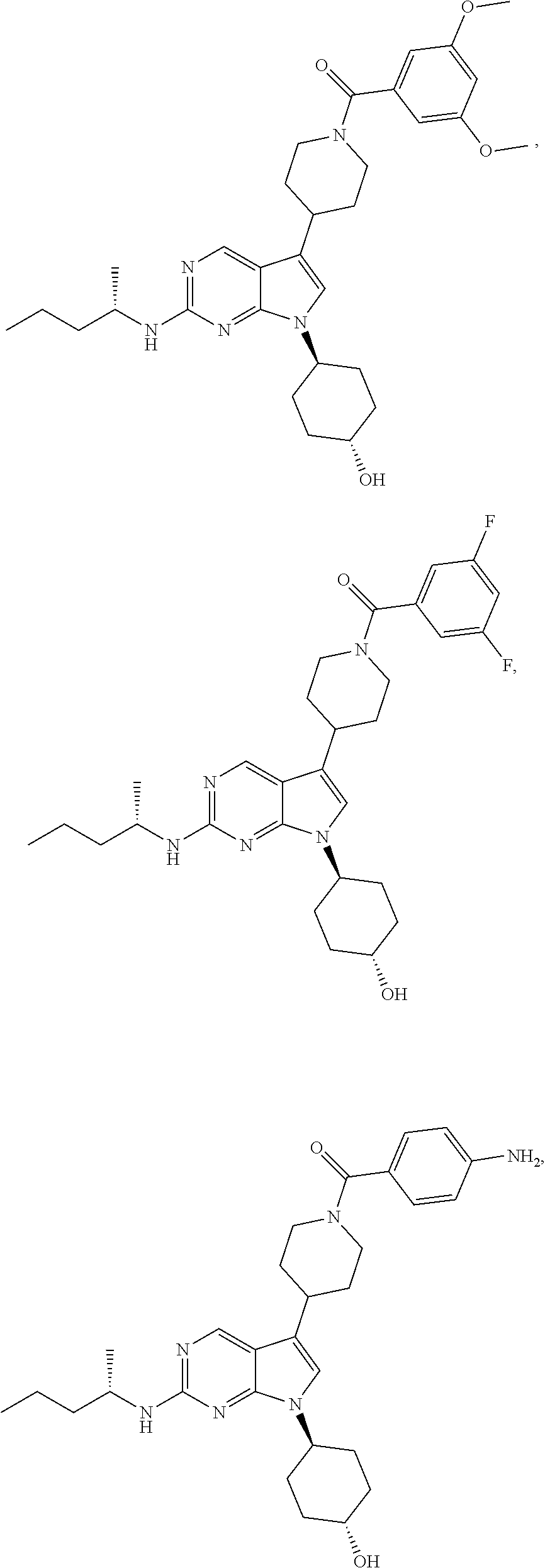


or a pharmaceutically acceptable salt thereof.


or a pharmaceutically acceptable salt thereof.


or a pharmaceutically acceptable salt thereof.


or a pharmaceutically acceptable salt thereof.

or a pharmaceutically acceptable salt thereof.

or a pharmaceutically acceptable salt thereof.


or a pharmaceutically acceptable salt thereof.

wherein Cy1 is selected from C3-C8 cycloalkyl and C2-C7 heterocycloalkyl, and substituted with 0, 1, 2, or 3 groups independently selected from halogen, C1-C4 alkyl, C1-C4 haloalkyl, C1-C4 alkoxy, C1-C4 hydroxyalkyl, C1-C4 alkylamino, and (C1-C4)(C1-C4) dialkylamino; wherein R1a is selected from hydrogen, C1-C8 alkyl, and Cy2, and substituted with 0, 1, 2, or 3 groups independently selected from halogen, C1-C4 alkyl, C1-C4 haloalkyl, C1-C4 alkoxy, C1-C4 hydroxyalkyl, C1-C4 alkylamino, and (C1-C4)(C1-C4) dialkylamino; wherein Cy2, when present, is selected from C3-C9 cycloalkyl, C2-C7 heterocycloalkyl, C5-C6 aryl, and C4-C5 heteroaryl and substituted with 0, 1, 2, or 3 groups independently selected from halogen, C1-C4 alkyl, C1-C4 haloalkyl, C1-C4 alkoxy, C1-C4 hydroxyalkyl, C1-C4 alkylamino, and (C1-C4)(C1-C4) dialkylamino; wherein R1b is selected from C1-C8 alkyl, Cy2, and (C1-C4 alkyl)Cy2, and substituted with 0, 1, 2, or 3 groups independently selected from halogen, C1-C4 alkyl, C1-C4 haloalkyl, C1-C4 alkoxy, C1-C4 hydroxyalkyl, C1-C4 alkylamino, and (C1-C4)(C1-C4) dialkylamino; wherein R2 is selected from hydrogen, C1-C4 alkyl, —C(O)R20, —C(O)N(R22)R20, —N(R22)C(O)R20, —SO2N(R22)R21, —N(R22)SO2R21, —SO2R21, and —(CH2)nCy3; wherein n is selected from 0, 1, 2, 3, and 4; wherein each of R20 and R21, when present, is selected from C1-C4 alkyl, —(CH2)qOR30, and Cy4; wherein q is selected from 0, 1, 2, 3, and 4; wherein R30, when present, is selected from hydrogen and C1-C4 alkyl; wherein Cy4, when present, is selected from C3-C8 cycloalkyl, C2-C7 heterocycloalkyl. C5-C6 aryl, and C3-C5 heteroaryl and substituted with 0, 1, 2, or 3 groups independently selected from halogen, —NH2, C1-C4 alkyl, C1-C4 haloalkyl, C1-C4 alkoxy, C1-C4 hydroxyalkyl, C1-C4 alkylamino, (C1-C4)(C1-C4) dialkylamino, and (C1-C4 alkyl)NR40aR40b; wherein each of R40a and R40b, when present, is independently selected from hydrogen and C1-C4 alkyl; wherein R22, when present, is selected from hydrogen and C1-C4 alkyl; wherein Cy3, when present, is selected from C3-C8 cycloalkyl, C2-C7 heterocycloalkyl, C5-C6 aryl, and C4-C5 heteroaryl and substituted with 0, 1, 2, or 3 groups independently selected from halogen, C1-C4 alkyl, C1-C4 haloalkyl, C1-C4 alkoxy, C1-C4 hydroxyalkyl, C1-C4 alkylamino, and (C1-C4)(C1-C4) dialkylamino; and wherein R3 is selected from —(CH2)pOH and —(CH2)pNHR23; wherein p is selected from 0, 1, and 2; and wherein R23, when present, is selected from hydrogen and C1-C4 alkyl, provided that when R2 is hydrogen or C1-C4 alkyl, then Cy1 is a structure:

provided that when R2 is C1-C4 alkyl, then R1b is selected from Cy2 and (C1-C4 alkyl)Cy2, or a pharmaceutically acceptable salt thereof, and a pharmaceutically acceptable carrier.

wherein Cy1 is selected from C3-C8 cycloalkyl and C2-C7 heterocycloalkyl, and substituted with 0, 1, 2, or 3 groups independently selected from halogen, C1-C4 alkyl, C1-C4 haloalkyl, C1-C4 alkoxy, C1-C4 hydroxyalkyl, C1-C4 alkylamino, and (C1-C4)(C1-C4) dialkylamino; wherein R1a is selected from hydrogen, C1-C8 alkyl, and Cy2, and substituted with 0, 1, 2, or 3 groups independently selected from halogen, C1-C4 alkyl, C1-C4 haloalkyl, C1-C4 alkoxy, C1-C4 hydroxyalkyl, C1-C4 alkylamino, and (C1-C4)(C1-C4) dialkylamino; wherein Cy2, when present, is selected from C3-C8 cycloalkyl, C2-C7 heterocycloalkyl, C5-C6 aryl, and C4-C5 heteroaryl and substituted with 0, 1, 2, or 3 groups independently selected from halogen, C1-C4 alkyl, C1-C4 haloalkyl, C1-C4 alkoxy, C1-C4 hydroxyalkyl, C1-C4 alkylamino, and (C1-C4)(C1-C4) dialkylamino; wherein R1b is selected from C1-C8 alkyl and Cy2, and substituted with 0, 1, 2, or 3 groups independently selected from halogen, C1-C4 alkyl, C1-C4 haloalkyl, C1-C4 alkoxy, C1-C4 hydroxyalkyl, C1-C4 alkylamino, and (C1-C4)(C1-C4) dialkylamino; wherein R2 is selected from —C(O)R20, —C(O)N(R22)R20, —N(R22)C(O)R20, —SO2N(R22)R21, —N(R22)SO2R21, —SO2R21, and —(CH2)nCy3; wherein n is selected from 0, 1, 2, 3, and 4; wherein each of R20 and R21, when present, is selected from C1-C4 alkyl, —(CH2)qOR3, and Cy4; wherein q is selected from 0, 1, 2, 3, and 4; wherein R30, when present, is selected from hydrogen and C1-C4 alkyl; wherein Cy4, when present, is selected from C3-C8 cycloalkyl, C2-C7 heterocycloalkyl, C5-C6 aryl, and C4-C5 heteroaryl and substituted with 0, 1, 2, or 3 groups independently selected from halogen, C1-C4 alkyl. C1-C4 haloalkyl, C1-C4 alkoxy, C1-C4 hydroxyalkyl, C1-C4 alkylamino, and (C1-C4)(C1-C4) dialkylamino; wherein R22, when present, is selected from hydrogen and C1-C4 alkyl; wherein Cy3, when present, is selected from C3-C8 cycloalkyl, C2-C7 heterocycloalkyl. C5-C6 aryl, and C4-C5 heteroaryl and substituted with 0, 1, 2, or 3 groups independently selected from halogen, C1-C4 alkyl, C1-C4 haloalkyl, C1-C4 alkoxy, C1-C4 hydroxyalkyl, C1-C4 alkylamino, and (C1-C4)(C1-C4) dialkylamino; and wherein R3 is selected from —(CH2)pOH and —(CH2)pNHR23; wherein p is selected from 0, 1, or 2; and wherein R23, when present, is selected from hydrogen and C1-C4 alkyl, or a pharmaceutically acceptable salt thereof, and a pharmaceutically acceptable carrier.

wherein Cy1 is selected from C3-C8 cycloalkyl and C2-C7 heterocycloalkyl, and substituted with 0, 1, 2, or 3 groups independently selected from halogen, C1-C4 alkyl, C1-C4 haloalkyl, C1-C4 alkoxy, C1-C4 hydroxyalkyl, C1-C4 alkylamino, and (C1-C4)(C1-C4) dialkylamino; wherein Ra is selected from hydrogen, C1-C8 alkyl, and Cy2, and substituted with 0, 1, 2, or 3 groups independently selected from halogen, C1-C4 alkyl, C1-C4 haloalkyl, C1-C4 alkoxy, C1-C4 hydroxyalkyl, C1-C4 alkylamino, and (C1-C4)(C1-C4) dialkylamino; wherein Cy2, when present, is selected from C3-C9 cycloalkyl, C2-C7 heterocycloalkyl, C5-C6 aryl, and C4-C5 heteroaryl and substituted with 0, 1, 2, or 3 groups independently selected from halogen, C1-C4 alkyl, C1-C4 haloalkyl, C1-C4 alkoxy, C1-C4 hydroxyalkyl, C1-C4 alkylamino, and (C1-C4)(C1-C4) dialkylamino; wherein R1b is selected from C1-C8 alkyl, Cy2, and (C1-C4 alkyl)Cy2, and substituted with 0, 1, 2, or 3 groups independently selected from halogen, C1-C4 alkyl, C1-C4 haloalkyl, C1-C4 alkoxy, C1-C4 hydroxyalkyl, C1-C4 alkylamino, and (C1-C4)(C1-C4) dialkylamino; wherein R2 is selected from hydrogen, C1-C4 alkyl, —C(O)R20, —C(O)N(R22)R20, —N(R22)C(O)R20, —SO2N(R22)R20, —N(R22)SO2R21, —SO2R21, and —(CH2)nCy3; wherein n is selected from 0, 1, 2, 3, and 4; wherein each of R2 and R21, when present, is selected from C1-C4 alkyl, —(CH2)qOR30, and Cy4; wherein q is selected from 0, 1, 2, 3, and 4; wherein R30, when present, is selected from hydrogen and C1-C4 alkyl; wherein Cy4, when present, is selected from C3-C8 cycloalkyl, C2-C7 heterocycloalkyl, C5-C6 aryl, and C3-C5 heteroaryl and substituted with 0, 1, 2, or 3 groups independently selected from halogen, —NH2, C1-C4 alkyl, C1-C4 haloalkyl, C1-C4 alkoxy, C1-C4 hydroxyalkyl, C1-C4 alkylamino, (C1-C4)(C1-C4) dialkylamino, and (C1-C4 alkyl)NR40aR40b; wherein each of R40a and R40b, when present, is independently selected from hydrogen and C1-C4 alkyl; wherein R22, when present, is selected from hydrogen and C1-C4 alkyl; wherein Cy3, when present, is selected from C3-C8 cycloalkyl, C2-C7 heterocycloalkyl, C5-C6 aryl, and C4-C5 heteroaryl and substituted with 0, 1, 2, or 3 groups independently selected from halogen, C1-C4 alkyl, C1-C4 haloalkyl, C1-C4 alkoxy, C1-C4 hydroxyalkyl, C1-C4 alkylamino, and (C1-C4)(C1-C4) dialkylamino; and wherein R3 is selected from —(CH2)pOH and —(CH2)pNHR23; wherein p is selected from 0, 1, and 2; and wherein R23, when present, is selected from hydrogen and C1-C4 alkyl, provided that when R2 is hydrogen or C1-C4 alkyl, then Cy1 is a structure:

or
provided that when R2 is C1-C4 alkyl, then R1b is selected from Cy2 and (C1-C4 alkyl)Cy2, or a pharmaceutically acceptable salt thereof.

wherein Cy1 is selected from C3-C8 cycloalkyl and C2-C7 heterocycloalkyl, and substituted with 0, 1, 2, or 3 groups independently selected from halogen, C1-C4 alkyl, C1-C4 haloalkyl, C1-C4 alkoxy, C1-C4 hydroxyalkyl, C1-C4 alkylamino, and (C1-C4)(C1-C4) dialkylamino; wherein R1a is selected from hydrogen, C1-C8 alkyl, and Cy2, and substituted with 0, 1, 2, or 3 groups independently selected from halogen, C1-C4 alkyl, C1-C4 haloalkyl, C1-C4 alkoxy, C1-C4 hydroxyalkyl, C1-C4 alkylamino, and (C1-C4)(C1-C4) dialkylamino; wherein Cy2, when present, is selected from C3-C8 cycloalkyl, C2-C7 heterocycloalkyl, C5-C6 aryl, and C4-C5 heteroaryl and substituted with 0, 1, 2, or 3 groups independently selected from halogen, C1-C4 alkyl, C1-C4 haloalkyl, C1-C4 alkoxy, C1-C4 hydroxyalkyl, C1-C4 alkylamino, and (C1-C4)(C1-C4) dialkylamino; wherein R1b is selected from C1-C8 alkyl and Cy2, and substituted with 0, 1, 2, or 3 groups independently selected from halogen, C1-C4 alkyl, C1-C4 haloalkyl, C1-C4 alkoxy, C1-C4 hydroxyalkyl, C1-C4 alkylamino, and (C1-C4)(C1-C4) dialkylamino; wherein R“is selected from —C(O)R2, —C(O)N(R”)R20, —N(R22)C(O)R20, —SO2N(R22)R21, —N(R22)SO2R21, —SO2R21, and —(CH2)nCy3; wherein n is selected from 0, 1, 2, 3, and 4; wherein each of R20 and R21, when present, is selected from C1-C4 alkyl, —(CH2)qOR3, and Cy4; wherein q is selected from 0, 1, 2, 3, and 4; wherein R30, when present, is selected from hydrogen and C1-C4 alkyl; wherein Cy4, when present, is selected from C3-C8 cycloalkyl, C2-C7 heterocycloalkyl, C5-C6 aryl, and C4-C5 heteroaryl and substituted with 0, 1, 2, or 3 groups independently selected from halogen, C1-C4 alkyl, C1-C4 haloalkyl, C1-C4 alkoxy, C1-C4 hydroxyalkyl, C1-C4 alkylamino, and (C1-C4)(C1-C4) dialkylamino; wherein R22, when present, is selected from hydrogen and C1-C4 alkyl; wherein Cy3, when present, is selected from C3-C8 cycloalkyl, C2-C7 heterocycloalkyl, C5-C6 aryl, and C4-C5 heteroaryl and substituted with 0, 1, 2, or 3 groups independently selected from halogen, C1-C4 alkyl, C1-C4 haloalkyl, C1-C4 alkoxy, C1-C4 hydroxyalkyl, C1-C4 alkylamino, and (C1-C4)(C1-C4) dialkylamino; and wherein R3 is selected from —(CH2)pOH and —(CH2)pNHR20; wherein p is selected from 0, 1, or 2; and wherein R23, when present, is selected from hydrogen and C1-C4 alkyl, or a pharmaceutically acceptable salt thereof.

or a pharmaceutically acceptable salt thereof.


wherein Cy1 is selected from C3-C8 cycloalkyl and C2-C7 heterocycloalkyl, and substituted with 0, 1, 2, or 3 groups independently selected from halogen, C1-C4 alkyl, C1-C4 haloalkyl. C1-C4 alkoxy, C1-C4 hydroxyalkyl, C1-C4 alkylamino, and (C1-C4)(C1-C4) dialkylamino; wherein R1a is selected from hydrogen, C1-C8 alkyl, and Cy2, and substituted with 0, 1, 2, or 3 groups independently selected from halogen, C1-C4 alkyl, C1-C4 haloalkyl, C1-C4 alkoxy, C1-C4 hydroxyalkyl, C1-C4 alkylamino, and (C1-C4)(C1-C4) dialkylamino; wherein Cy2, when present, is selected from C3-C9 cycloalkyl, C2-C7 heterocycloalkyl, C5-C6 aryl, and C4-C5 heteroaryl and substituted with 0, 1, 2, or 3 groups independently selected from halogen, C1-C4 alkyl, C1-C4 haloalkyl, C1-C4 alkoxy, C1-C4 hydroxyalkyl, C1-C4 alkylamino, and (C1-C4)(C1-C4) dialkylamino; wherein R1b is selected from C1-C8 alkyl, Cy2, and (C1-C4 alkyl)Cy2, and substituted with 0, 1, 2, or 3 groups independently selected from halogen, C1-C4 alkyl, C1-C4 haloalkyl, C1-C4 alkoxy, C1-C4 hydroxyalkyl, C1-C4 alkylamino, and (C1-C4)(C1-C4) dialkylamino; wherein R2 is selected from hydrogen. C1-C4 alkyl, —C(O)R20, —C(O)N(R22)R20, —N(R22)C(O)R20, —SO2N(R22)R21, —N(R22)SO2R21, —SO2R21, and —(CH2)nCy3; wherein n is selected from 0, 1, 2, 3, and 4; wherein each of R2 and R21, when present, is selected from C1-C4 alkyl, —(CH2)qOR30, and Cy4; wherein q is selected from 0, 1, 2, 3, and 4; wherein R30, when present, is selected from hydrogen and C1-C4 alkyl; wherein Cy4, when present, is selected from C3-C8 cycloalkyl, C2-C7 heterocycloalkyl. C5-C6 aryl, and C3-C5 heteroaryl and substituted with 0, 1, 2, or 3 groups independently selected from halogen, —NH2, C1-C4 alkyl, C1-C4 haloalkyl, C1-C4 alkoxy, C1-C4 hydroxyalkyl, C1-C4 alkylamino, (C1-C4)(C1-C4) dialkylamino, and (C1-C4 alkyl)NR40aR40b; wherein each of R40a and R40b, when present, is independently selected from hydrogen and C1-C4 alkyl; wherein R22, when present, is selected from hydrogen and C1-C4 alkyl; wherein Cy3, when present, is selected from C3-C8 cycloalkyl, C2-C7 heterocycloalkyl, C5-C6 aryl, and C4-C5 heteroaryl and substituted with 0, 1, 2, or 3 groups independently selected from halogen, C1-C4 alkyl, C1-C4 haloalkyl, C1-C4 alkoxy, C1-C4 hydroxyalkyl, C1-C4 alkylamino, and (C1-C4)(C1-C4) dialkylamino; and wherein R3 is selected from —(CH2)pOH and —(CH2)pNHR23; wherein p is selected from 0, 1, and 2; and wherein R23, when present, is selected from hydrogen and C1-C4 alkyl, provided that when R2 is hydrogen or C1-C4 alkyl, then Cy1 is a structure:

or
provided that when R2 is C1-C4 alkyl, then R1b is selected from Cy2 and (C1-C4 alkyl)Cy2, or a pharmaceutically acceptable salt thereof, thereby treating the disorder.

wherein Cy1 is selected from C3-C8 cycloalkyl and C2-C7 heterocycloalkyl, and substituted with 0, 1, 2, or 3 groups independently selected from halogen, C1-C4 alkyl, C1-C4 haloalkyl, C1-C4 alkoxy, C1-C4 hydroxyalkyl, C1-C4 alkylamino, and (C1-C4)(C1-C4) dialkylamino; wherein R1a is selected from hydrogen, C1-C8 alkyl, and Cy2, and substituted with 0, 1, 2, or 3 groups independently selected from halogen, C1-C4 alkyl, C1-C4 haloalkyl, C1-C4 alkoxy, C1-C4 hydroxyalkyl, C1-C4 alkylamino, and (C1-C4)(C1-C4) dialkylamino; wherein Cy2, when present, is selected from C3-C8 cycloalkyl, C2-C7 heterocycloalkyl, C5-C6 aryl, and C4-C5 heteroaryl and substituted with 0, 1, 2, or 3 groups independently selected from halogen, C1-C4 alkyl, C1-C4 haloalkyl, C1-C4 alkoxy, C1-C4 hydroxyalkyl, C1-C4 alkylamino, and (C1-C4)(C1-C4) dialkylamino; wherein R1b is selected from C1-C8 alkyl and Cy2, and substituted with 0, 1, 2, or 3 groups independently selected from halogen, C1-C4 alkyl, C1-C4 haloalkyl, C1-C4 alkoxy, C1-C4 hydroxyalkyl, C1-C4 alkylamino, and (C1-C4)(C1-C4) dialkylamino; wherein R2 is selected from —C(O)R20, —C(O)N(R22)R20, —N(R22)C(O)R20, —SO2N(R22)R21, —N(R22)SO2R21, —SO2R21, and —(CH2)nCy3; wherein n is selected from 0, 1, 2, 3, and 4; wherein each of R20 and R21, when present, is selected from C1-C4 alkyl, —(CH2)qOR30, and Cy4; wherein q is selected from 0, 1, 2, 3, and 4; wherein R30, when present, is selected from hydrogen and C1-C4 alkyl; wherein Cy4, when present, is selected from C3-C8 cycloalkyl, C2-C7 heterocycloalkyl, C5-C6 aryl, and C4-C5 heteroaryl and substituted with 0, 1, 2, or 3 groups independently selected from halogen, C1-C4 alkyl. C1-C4 haloalkyl, C1-C4 alkoxy, C1-C4 hydroxyalkyl, C1-C4 alkylamino, and (C1-C4)(C1-C4) dialkylamino; wherein R22, when present, is selected from hydrogen and C1-C4 alkyl; wherein Cy3, when present, is selected from C3-C8 cycloalkyl, C2-C7 heterocycloalkyl. C5-C6 aryl, and C4-C5 heteroaryl and substituted with 0, 1, 2, or 3 groups independently selected from halogen, C1-C4 alkyl, C1-C4 haloalkyl, C1-C4 alkoxy, C1-C4 hydroxyalkyl, C1-C4 alkylamino, and (C1-C4)(C1-C4) dialkylamino; and wherein R3 is selected from —(CH2)pOH and —(CH2)pNHR23; wherein p is selected from 0, 1, or 2; and wherein R23, when present, is selected from hydrogen and C1-C4 alkyl, or a pharmaceutically acceptable salt thereof, thereby treating the disorder.

wherein Cy1 is selected from C3-C8 cycloalkyl and C2-C7 heterocycloalkyl, and substituted with 0, 1, 2, or 3 groups independently selected from halogen, C1-C4 alkyl, C1-C4 haloalkyl, C1-C4 alkoxy, C1-C4 hydroxyalkyl, C1-C4 alkylamino, and (C1-C4)(C1-C4) dialkylamino; wherein R1a is selected from hydrogen, C1-C8 alkyl, and Cy2, and substituted with 0, 1, 2, or 3 groups independently selected from halogen, C1-C4 alkyl, C1-C4 haloalkyl, C1-C4 alkoxy, C1-C4 hydroxyalkyl, C1-C4 alkylamino, and (C1-C4)(C1-C4) dialkylamino; wherein Cy2, when present, is selected from C3-C9 cycloalkyl, C2-C7 heterocycloalkyl, C5-C6 aryl, and C4-C5 heteroaryl and substituted with 0, 1, 2, or 3 groups independently selected from halogen, C1-C4 alkyl, C1-C4 haloalkyl, C1-C4 alkoxy, C1-C4 hydroxyalkyl, C1-C4 alkylamino, and (C1-C4)(C1-C4) dialkylamino; wherein R1b is selected from C1-C8 alkyl, Cy2, and (C1-C4 alkyl)Cy2, and substituted with 0, 1, 2, or 3 groups independently selected from halogen, C1-C4 alkyl, C1-C4 haloalkyl, C1-C4 alkoxy, C1-C4 hydroxyalkyl, C1-C4 alkylamino, and (C1-C4)(C1-C4) dialkylamino; wherein R2 is selected from hydrogen, C1-C4 alkyl, —C(O)R20, —C(O)N(R)R20, —N(R22)C(O)R20, —SO2N(R22)R21, —N(R22)SO2R21, —SO2R21, and —(CH2)Cy3; wherein n is selected from 0, 1, 2, 3, and 4; wherein each of R20 and R21, when present, is selected from C1-C4 alkyl, —(CH2)qOR30, and Cy4; wherein q is selected from 0, 1, 2, 3, and 4; wherein R30, when present, is selected from hydrogen and C1-C4 alkyl; wherein Cy4, when present, is selected from C3-C8 cycloalkyl, C2-C7 heterocycloalkyl, C5-C6 aryl, and C3-C5 heteroaryl and substituted with 0, 1, 2, or 3 groups independently selected from halogen, —NH2, C1-C4 alkyl, C1-C4 haloalkyl, C1-C4 alkoxy, C1-C4 hydroxyalkyl, C1-C4 alkylamino, (C1-C4)(C1-C4) dialkylamino, and (C1-C4 alkyl)NR40aR40b; wherein each of R40a and R40b, when present, is independently selected from hydrogen and C1-C4 alkyl; wherein R22, when present, is selected from hydrogen and C1-C4 alkyl; wherein Cy3, when present, is selected from C3-C8 cycloalkyl, C2-C7 heterocycloalkyl, C5-C6 aryl, and C4-C5 heteroaryl and substituted with 0, 1, 2, or 3 groups independently selected from halogen, C1-C4 alkyl, C1-C4 haloalkyl, C1-C4 alkoxy, C1-C4 hydroxyalkyl, C1-C4 alkylamino, and (C1-C4)(C1-C4) dialkylamino; and wherein R3 is selected from —(CH2)pOH and —(CH2)pNHR3; wherein p is selected from 0, 1, and 2; and wherein R23, when present, is selected from hydrogen and C1-C4 alkyl, provided that when R2 is hydrogen or C1-C4 alkyl, then Cy1 is a structure:

or
provided that when R2 is C1-C4 alkyl, then R1b is selected from Cy2 and (C1-C4 alkyl)Cy2, or a pharmaceutically acceptable salt thereof, thereby treating the infection.

wherein Cy1 is selected from C3-C8 cycloalkyl and C2-C7 heterocycloalkyl, and substituted with 0, 1, 2, or 3 groups independently selected from halogen, C1-C4 alkyl, C1-C4 haloalkyl, C1-C4 alkoxy, C1-C4 hydroxyalkyl, C1-C4 alkylamino, and (C1-C4)(C1-C4) dialkylamino; wherein R1a is selected from hydrogen, C1-C8 alkyl, and Cy2, and substituted with 0, 1, 2, or 3 groups independently selected from halogen, C1-C4 alkyl, C1-C4 haloalkyl, C1-C4 alkoxy, C1-C4 hydroxyalkyl, C1-C4 alkylamino, and (C1-C4)(C1-C4) dialkylamino; wherein Cy2, when present, is selected from C3-C8 cycloalkyl, C2-C7 heterocycloalkyl, C5-C6 aryl, and C4-C5 heteroaryl and substituted with 0, 1, 2, or 3 groups independently selected from halogen, C1-C4 alkyl, C1-C4 haloalkyl, C1-C4 alkoxy, C1-C4 hydroxyalkyl, C1-C4 alkylamino, and (C1-C4)(C1-C4) dialkylamino; wherein R1b is selected from C1-C8 alkyl and Cy2, and substituted with 0, 1, 2, or 3 groups independently selected from halogen, C1-C4 alkyl, C1-C4 haloalkyl, C1-C4 alkoxy, C1-C4 hydroxyalkyl, C1-C4 alkylamino, and (C1-C4)(C1-C4) dialkylamino; wherein R2 is selected from —C(O)R20, —C(O)N(R22)R20, —N(R22)C(O)R20, —SO2N(R22)R21, —N(R22)SO2R21, —SO2R21, and —(CH2)Cy3; wherein n is selected from 0, 1, 2, 3, and 4; wherein each of R20 and R21, when present, is selected from C1-C4 alkyl, —(CH2)qOR30, and Cy4; wherein q is selected from 0, 1, 2, 3, and 4; wherein R30, when present, is selected from hydrogen and C1-C4 alkyl; wherein Cy4, when present, is selected from C3-C8 cycloalkyl, C2-C7 heterocycloalkyl. C5-C6 aryl, and C4-C5 heteroaryl and substituted with 0, 1, 2, or 3 groups independently selected from halogen, C1-C4 alkyl, C1-C4 haloalkyl, C1-C4 alkoxy, C1-C4 hydroxyalkyl, C1-C4 alkylamino, and (C1-C4)(C1-C4) dialkylamino; wherein R22, when present, is selected from hydrogen and C1-C4 alkyl; wherein Cy3, when present, is selected from C3-C8 cycloalkyl, C2-C7 heterocycloalkyl, C5-C6 aryl, and C4-C5 heteroaryl and substituted with 0, 1, 2, or 3 groups independently selected from halogen, C1-C4 alkyl, C1-C4 haloalkyl, C1-C4 alkoxy, C1-C4 hydroxyalkyl. C1-C4 alkylamino, and (C1-C4)(C1-C4) dialkylamino; and wherein R3 is selected from —(CH2)pOH and —(CH2)pNHR23; wherein p is selected from 0, 1, or 2; and wherein R23, when present, is selected from hydrogen and C1-C4 alkyl, or a pharmaceutically acceptable salt thereof.

or a pharmaceutically acceptable salt thereof.

wherein Cy1 is selected from C3-C8 cycloalkyl and C2-C7 heterocycloalkyl, and substituted with 0, 1, 2, or 3 groups independently selected from halogen, C1-C4 alkyl, C1-C4 haloalkyl, C1-C4 alkoxy, C1-C4 hydroxyalkyl, C1-C4 alkylamino, and (C1-C4)(C1-C4) dialkylamino; wherein R1a is selected from hydrogen, C1-C8 alkyl, and Cy2, and substituted with 0, 1, 2, or 3 groups independently selected from halogen, C1-C4 alkyl, C1-C4 haloalkyl, C1-C4 alkoxy, C1-C4 hydroxyalkyl, C1-C4 alkylamino, and (C1-C4)(C1-C4) dialkylamino; wherein Cy2, when present, is selected from C3-C8 cycloalkyl, C2-C7 heterocycloalkyl, C5-C6 aryl, and C4-C5 heteroaryl and substituted with 0, 1, 2, or 3 groups independently selected from halogen, C1-C4 alkyl, C1-C4 haloalkyl, C1-C4 alkoxy, C1-C4 hydroxyalkyl, C1-C4 alkylamino, and (C1-C4)(C1-C4) dialkylamino; wherein R1b is selected from C1-C8 alkyl and Cy2, and substituted with 0, 1, 2, or 3 groups independently selected from halogen, C1-C4 alkyl, C1-C4 haloalkyl, C1-C4 alkoxy, C1-C4 hydroxyalkyl, C1-C4 alkylamino, and (C1-C4)(C1-C4) dialkylamino; wherein R“is selected from —C(O)R), —C(O)N(R”)R20, —N(R22)C(O)R20, —SO2N(R22)R21, —N(R2)SO2R21, —SO2R21, and —(CH2)nCy3; wherein n is selected from 0, 1, 2, 3, and 4; wherein each of R20 and R21, when present, is selected from C1-C4 alkyl, —(CH2)qOR0, and Cy4; wherein q is selected from 0, 1, 2, 3, and 4; wherein R30, when present, is selected from hydrogen and C1-C4 alkyl; wherein Cy4, when present, is selected from C3-C8 cycloalkyl, C2-C7 heterocycloalkyl, C5-C6 aryl, and C4-C5 heteroaryl and substituted with 0, 1, 2, or 3 groups independently selected from halogen, C1-C4 alkyl, C1-C4 haloalkyl, C1-C4 alkoxy, C1-C4 hydroxyalkyl, C1-C4 alkylamino, and (C1-C4)(C1-C4) dialkylamino; wherein R22, when present, is selected from hydrogen and C1-C4 alkyl; wherein Cy3, when present, is selected from C3-C8 cycloalkyl, C2-C7 heterocycloalkyl, C5-C6 aryl, and C4-C5 heteroaryl and substituted with 0, 1, 2, or 3 groups independently selected from halogen, C1-C4 alkyl, C1-C4 haloalkyl, C1-C4 alkoxy, C1-C4 hydroxyalkyl, C1-C4 alkylamino, and (C1-C4)(C1-C4) dialkylamino; and wherein R3 is selected from —(CH2)pOH and —(CH2)pNHR2′3 wherein p is selected from 0, 1, or 2; and wherein R23, when present, is selected from hydrogen and C1-C4 alkyl, or a pharmaceutically acceptable salt thereof, thereby treating the infection.

or a pharmaceutically acceptable salt thereof.

wherein Cy1 is selected from C3-C8 cycloalkyl and C2-C7 heterocycloalkyl, and substituted with 0, 1, 2, or 3 groups independently selected from halogen, C1-C4 alkyl, C1-C4 haloalkyl, C1-C4 alkoxy, C1-C4 hydroxyalkyl, C1-C4 alkylamino, and (C1-C4)(C1-C4) dialkylamino; wherein R1a is selected from hydrogen, C1-C8 alkyl, and Cy2, and substituted with 0, 1, 2, or 3 groups independently selected from halogen, C1-C4 alkyl, C1-C4 haloalkyl, C1-C4 alkoxy, C1-C4 hydroxyalkyl, C1-C4 alkylamino, and (C1-C4)(C1-C4) dialkylamino; wherein Cy2, when present, is selected from C3-C8 cycloalkyl, C2-C7 heterocycloalkyl, C5-C6 aryl, and C4-C5 heteroaryl and substituted with 0, 1, 2, or 3 groups independently selected from halogen, C1-C4 alkyl, C1-C4 haloalkyl, C1-C4 alkoxy, C1-C4 hydroxyalkyl, C1-C4 alkylamino, and (C1-C4)(C1-C4) dialkylamino; wherein R1b is selected from C1-C8 alkyl and Cy2, and substituted with 0, 1, 2, or 3 groups independently selected from halogen, C1-C4 alkyl, C1-C4 haloalkyl, C1-C4 alkoxy, C1-C4 hydroxyalkyl, C1-C4 alkylamino, and (C1-C4)(C1-C4) dialkylamino; wherein R2 is selected from —C(O)R20, —C(O)N(R22)R20, —N(R22)C(O)R20, —SO2N(R22)R21, —N(R22)SO2R21, —SO2R21, and —(CH2)nCy3; wherein n is selected from 0, 1, 2, 3, and 4; wherein each of R20 and R21, when present, is selected from C1-C4 alkyl, —(CH2)qOR3, and Cy4; wherein q is selected from 0, 1, 2, 3, and 4; wherein R30, when present, is selected from hydrogen and C1-C4 alkyl; wherein Cy4, when present, is selected from C3-C8 cycloalkyl, C2-C7 heterocycloalkyl, C5-C6 aryl, and C4-C5 heteroaryl and substituted with 0, 1, 2, or 3 groups independently selected from halogen, C1-C4 alkyl. C1-C4 haloalkyl, C1-C4 alkoxy, C1-C4 hydroxyalkyl, C1-C4 alkylamino, and (C1-C4)(C1-C4) dialkylamino; wherein R22, when present, is selected from hydrogen and C1-C4 alkyl; wherein Cy3, when present, is selected from C3-C8 cycloalkyl, C2-C7 heterocycloalkyl, C5-C6 aryl, and C4-C5 heteroaryl and substituted with 0, 1, 2, or 3 groups independently selected from halogen, C1-C4 alkyl, C1-C4 haloalkyl, C1-C4 alkoxy, C1-C4 hydroxyalkyl, C1-C4 alkylamino, and (C1-C4)(C1-C4) dialkylamino; and wherein R3 is selected from —(CH2)pOH and —(CH2)pNHR23; wherein p is selected from 0, 1, or 2; and wherein R23, when present, is selected from hydrogen and C1-C4 alkyl, or a pharmaceutically acceptable salt thereof, thereby treating the infection.

or a pharmaceutically acceptable salt thereof.


| TABLE 1 | |||
| No. | Structure | MW | Name |
| 1 |
 |
531.7 | (1S,4R)-4-(5-(1-((1- methylpiperidin-4- yl)sulfonyl)piperidin-4-yl)- 2-(((S)-pentan-2-yl)amino)- 7H-pyrrolo[2,3- d]pyrimidin-7- yl)cyclohexan-1-ol |
| 2 |
 |
533.7 | (1S,4R)-4-(2-(((S)-pentan- 2-yl)amino)-5-(1- ((tetrahydro-2H-pyran-4- yl)sulfonyl)piperidin-4-yl)- 7H-pyrrolo[2,3- d]pyrimidin-7- yl)cyclohexan-1-ol |
| 3 |
 |
532.8 | (1S,4R)-4-(2-(((S)-pentan- 2-yl)amino)-5-(1- (piperidin-4- ylsulfonyl)piperidin-4-yl)- 7H-pyrrolo[2,3- d]pyrimidin-7- yl)cyclohexan-1-ol |
| 4 |
 |
507.7 | (1S,4R)-4-(5-(1-((2- methoxyethyl)sulfonyl) piperidin-4-yl)-2-(((S)-pentan- 2-yl)amino)-7H- pyrrolo[2,3-d]pyrimidin-7- yl)cyclohexan-1-ol |
| 5 |
 |
463.6 | (1S,4R)-4-(5-(1- (methylsulfonyl)piperidin- 4-yl)-2-(((S)-pentan-2- yl)amino)-7H-pyrrolo[2,3- d]pyrimidin-7- yl)cyclohexan-1-ol |
| 8 |
 |
496.7 | (4-(7-((1R,4S)-4- hydroxycyclohexyl)-2- (((S)-pentan-2-yl)amino)- 7H-pyrrolo[2,3- d]pyrimidin-5-yl)piperidin- 1-yl)(piperidin-4- yl)methanone |
| 9 |
 |
471.7 | 1-(4-(7-((1R,4S)-4- hydroxycyclohexyl)-2- (((S)-pentan-2-yl)amino)- 7H-pyrrolo[2,3- d]pyrimidin-5-yl)piperidin- 1-yl)-3-methoxypropan-1- one |
| 10 |
 |
497.7 | (4-(7-((1R,4S)-4- hydroxycyclohexyl)-2- (((S)-pentan-2-yl)amino)- 7H-pyrrolo[2,3- d]pyrimidin-5-yl)piperidin- 1-yl)(tetrahydro-2H-pyran- 4-yl)methanone |
| 11 |
 |
510.7 | (4-(7-((1R,4S)-4- hydroxycyclohexyl)-2- (((S)-pentan-2-yl)amino)- 7H-pyrrolo[2,3- d]pyrimidin-5-yl)piperidin- 1-yl)(1-methylpiperidin-4- yl)methanone |
| 12 |
 |
397.6 | (1R,4R)-4-(5-((1R,3S,5S)- 8-azabicyclo[3.2.1]octan-3- yl)-2-(butylamino)-7H- pyrrolo[2,3-d]pyrimidin-7- yl)cyclohexan-1-ol |
| 13 |
 |
468.7 | Azetidin-3-yl(4-(7- ((1R,4S)-4- hydroxycyclohexyl)-2- (((S)-pentan-2-yl)amino)- 7H-pyrrolo[2,3- d]pyrimidin-5-yl)piperidin- 1-yl)methanone |
| 14 |
 |
482.7 | (4-(7-((1R,4S)-4- hydroxycyclohexyl)-2- (((S)-pentan-2-yl)amino)- 7H-pyrrolo[2,3- d]pyrimidin-5-yl)piperidin- 1-yl)(1-methylazetidin-3- yl)methanone |
| 15 |
 |
482.7 | 7-((1R,4S)-4- hydroxycyclohexyl)-2- (((S)-pentan-2-yl)amino)-5- (1-prolylpiperidin-4-yl)-7H- pyrrolo[2,3-d]pyrimidine |
| 16 |
 |
496.7 | 7-((1R,4S)-4- hydroxycyclohexyl)-5-(1- (methylprolyl)piperidin-4- yl)-2-(((S)-pentan-2- yl)amino)-7H-pyrrolo[2,3- d]pyrimidine |
| 17 |
 |
482.7 | (4-(7-((1R,4S)-4- hydroxycyclohexyl)-2- (((S)-pentan-2-yl)amino)- 7H-pyrrolo[2,3- d]pyrimidin-5-yl)piperidin- 1-yl)(pyrrolidin-3- yl)methanone |
| 18 |
 |
496.7 | (4-(7-((1R,4S)-4- hydroxycyclohexyl)-2- (((S)-pentan-2-yl)amino)- 7H-pyrrolo[2,3- d]pyrimidin-5-yl)piperidin- 1-yl)(1-methylpyrrolidin-3- yl)methanone |
| 19 |
 |
496.7 | (4-(7-((1R,4S)-4- hydroxycyclohexyl)-2- (((S)-pentan-2-yl)amino)- 7H-pyrrolo[2,3- d]pyrimidin-5-yl)piperidin- 1-yl)((S)-piperidin-2- yl)methanone |
| 20 |
 |
496.7 | (4-(7-((1R,4S)-4- hydroxycyclohexyl)-2- (((S)-pentan-2-yl)amino)- 7H-pyrrolo[2,3- d]pyrimidin-5-yl)piperidin- 1-yl)((R)-piperidin-2- yl)methanone |
| 21 |
 |
510.7 | (4-(7-((1R,4S)-4- hydroxycyclohexyl)-2- (((S)-pentan-2-yl)amino)- 7H-pyrrolo[2,3- d]pyrimidin-5-yl)piperidin- 1-yl)(1-methylpyrrolidin-2- yl)methanone |
| 22 |
 |
510.7 | (4-(7-((1R,4S)-4- hydroxycyclohexyl)-2- (((S)-pentan-2-yl)amino)- 7H-pyrrolo[2,3- d]pyrimidin-5-yl)piperidin- 1-yl)((S)-1- methylpiperidin-2- yl)methanone |
| 23 |
 |
496.7 | (4-(7-((1R,4S)-4- hydroxycyclohexyl)-2- (((S)-pentan-2-yl)amino)- 7H-pyrrolo[2,3- d]pyrimidin-5-yl)piperidin- 1-yl)((R)-piperidin-3- yl)methanone |
| 24 |
 |
496.7 | (4-(7-((1R,4S)-4- hydroxycyclohexyl)-2- (((S)-pentan-2-yl)amino)- 7H-pyrrolo[2,3- d]pyrimidin-5-yl)piperidin- 1-yl)((S)-piperidin-3- yl)methanone |
| 25 |
 |
510.7 | (4-(7-((1r,4S)-4- hydroxycyclohexyl)-2- (((S)-pentan-2-yl)amino)- 7H-pyrrolo[2,3- d]pyrimidin-5-yl)piperidin- 1-yl)(1-methylpiperidin-3- yl)methanone |
| 26 |
 |
510.7 | (4-(7-((1R,4S)-4- hydroxycyclohexyl)-2- (((S)-pentan-2-yl)amino)- 7H-pyrrolo[2,3- d]pyrimidin-5-yl)piperidin- 1-yl)((S)-1- methylpiperidin-3- yl)methanone |
| 27 |
 |
490.7 | (4-(7-((1R,4S)-4- hydroxycyclohexyl)-2- (((S)-pentan-2-yl)amino)- 7H-pyrrolo[2,3- d]pyrimidin-5-yl)piperidin- 1-yl)(pyridin-4- yl)methanone |
| 28 |
 |
490.7 | (4-(7-((1R,4S)-4- hydroxycyclohexyl)-2- (((S)-pentan-2-yl)amino)- 7H-pyrrolo[2,3- d]pyrimidin-5-yl)piperidin- 1-yl)(pyridin-3- yl)methanone |
| 29 |
 |
490.7 | (4-(7-((1R,4S)-4- hydroxycyclohexyl)-2- (((S)-pentan-2-yl)amino)- 7H-pyrrolo[2,3- d]pyrimidin-5-yl)piperidin- 1-yl)(pyridin-2- yl)methanone |
| 30 |
 |
489.7 | (4-(7-((1R,4S)-4- hydroxycyclohexyl)-2- (((S)-pentan-2-yl)amino)- 7H-pyrrolo[2,3- d]pyrimidin-5-yl)piperidin- 1-yl)(phenyl)methanone |
| 31 |
 |
519.7 | (4-(7-((1R,4S)-4- hydroxycyclohexyl)-2- (((S)-pentan-2-yl)amino)- 7H-pyrrolo[2,3- d]pyrimidin-5-yl)piperidin- 1-yl)(4- methoxyphenyl)methanone |
| 32 |
 |
519.7 | (4-(7-((1R,4S)-4- hydroxycyclohexyl)-2- (((S)-pentan-2-yl)amino)- 7H-pyrrolo[2,3- d]pyrimidin-5-yl)piperidin- 1-yl)(3- methoxyphenyl)methanone |
| 33 |
 |
519.7 | (4-(7-((1R,4S)-4- hydroxycyclohexyl)-2- (((S)-pentan-2-yl)amino)- 7H-pyrrolo[2,3- d]pyrimidin-5-yl)piperidin- 1-yl)(2- methoxyphenyl)methanone |
| 34 |
 |
518.7 | (2,6-dimethylpyridin-4- yl)(4-(7-((1R,4S)-4- hydroxycyclohexyl)-2- (((S)-pentan-2-yl)amino)- 7H-pyrrolo[2,3- d]pyrimidin-5-yl)piperidin- 1-yl)methanone |
| 35 |
 |
504.7 | (4-(7-((1R,4S)-4- hydroxycyclohexyl)-2- (((S)-pentan-2-yl)amino)- 7H-pyrrolo[2,3- d]pyrimidin-5-yl)piperidin- 1-yl)(2-methylpyridin-4- yl)methanone |
| 36 |
 |
542.7 | (1-(2-fluoroethyl)piperidin- 4-yl)(4-(7-((1R,4S)-4- hydroxycyclohexyl)-2- (((S)-pentan-2-yl)amino)- 7H-pyrrolo[2,3- d]pyrimidin-5-yl)piperidin- 1-yl)methanone |
| 37 |
 |
584.7 | 3-(dimethylamino)-1-(4-(7- ((1R,4S)-4- hydroxycyclohexyl)-2- (((S)-pentan-2-yl)amino)- 7H-pyrrolo[2,3- d]pyrimidin-5-yl)piperidin- 1-yl)propan-1-one |
| 38 |
 |
495.7 | (4-(2-(((1S,2S)-2- ethylcyclopropyl)amino)-7- ((1R,4S)-4- hydroxycyclohexyl)-7H- pyrrolo[2,3-d]pyrimidin-5- yl)piperidin-1- yl)(tetrahydro-2H-pyran-4- yl)methanone |
| 39 |
 |
495.7 | (4-(2-(((1R,2R)-2- ethylcyclopropyl)amino)-7- ((1R,4R)-4- hydroxycyclohexyl)-7H- pyrrolo[2,3-d]pyrimidin-5- yl)piperidin-1- yl)(tetrahydro-2H-pyran-4- yl)methanone |
| 42 |
 |
488.6 | (4-(2-(((1S,2S)-2- ethylcyclopropyl)amino)-7- ((1R,4S)-4- hydroxycyclohexyl)-7H- pyrrolo[2,3-d]pyrimidin-5- yl)piperidin-1-yl)(pyridin- 4-yl)methanone |
| 43 |
 |
488.6 | (4-(2-(((1R,2R)-2- ethylcyclopropyl)amino)-7- ((1R,4R)-4- hydroxycyclohexyl)-7H- pyrrolo[2,3-d]pyrimidin-5- yl)piperidin-1-yl)(pyridin- 4-yl)methanone |
| 51 |
 |
468.7 | (1S,4R)-4-(5-([1,4′- bipiperidin]-4-yl)-2-(((S)- pentan-2-yl)amino)-7H- pyrrolo[2,3-d]pyrimidin-7- yl)cyclohexan-1-ol |
| 52 |
 |
482.7 | (1S,4R)-4-(5-(1′-methyl- [1,4′-bipiperidin]-4-yl)-2- (((S)-pentan-2-yl)amino)- 7H-pyrrolo[2,3- d]pyrimidin-7- yl)cyclohexan-1-ol |
| 53 |
 |
482.7 | (1S,4R)-4-(2-(((S)-pentan- 2-yl)amino)-5-(1- (piperidin-4- ylmethyl)piperidin-4-yl)- 7H-pyrrolo[2,3- d]pyrimidin-7- yl)cyclohexan-1-ol |
| 54 |
 |
496.7 | (1S,4R)-4-(5-(1-((1- methylpiperidin-4- yl)methyl)piperidin-4-yl)-2- (((S)-pentan-2-yl)amino)- 7H-pyrrolo[2,3- d]pyrimidin-7- yl)cyclohexan-1-ol |
| 55 |
 |
516.7 | (2,6-dimethylpyridin-4- yl)(4-(2-(((1S,2S)-2- ethylcyclopropyl)amino)-7- ((1r,4S)-4- hydroxycyclohexyl)-7H- pyrrolo[2,3-d]pyrimidin-5- yl)piperidin-1- yl)methanone |
| 56 |
 |
516.7 | (2,6-dimethylpyridin-4- yl)(4-(2-(((1R,2R)-2- ethylcyclopropyl)amino)-7- ((1r,4R)-4- hydroxycyclohexyl)-7H- pyrrolo[2,3-d]pyrimidin-5- yl)piperidin-1- yl)methanone |
| 57 |
 |
496.7 | (4-(7-((1r,4S)-4- hydroxycyclohexyl)-2- (((S)-pentan-2-yl)amino)- 7H-pyrrolo[2,3- d]pyrimidin-5-yl)piperidin- 1-yl)(thiazol-2- yl)methanone |
| 58 |
 |
496.7 | (4-(7-((1r,4S)-4- hydroxycyclohexyl)-2- (((S)-pentan-2-yl)amino)- 7H-pyrrolo[2,3- d]pyrimidin-5-yl)piperidin- 1-yl)(thiazol-4- yl)methanone |
| 59 |
 |
496.7 | (4-(7-((1r,4S)-4- hydroxycyclohexyl)-2- (((S)-pentan-2-yl)amino)- 7H-pyrrolo[2,3- d]pyrimidin-5-yl)piperidin- 1-yl)(thiazol-5- yl)methanone |
| 60 |
 |
478.6 | (4-(7-((1r,4S)-4- hydroxycyclohexyl)-2- (((S)-pentan-2-yl)amino)- 7H-pyrrolo[2,3- d]pyrimidin-5-yl)piperidin- 1-yl)(1H-pyrrol-2- yl)methanone |
| 61 |
 |
478.6 | (4-(7-((1r,4S)-4- hydroxycyclohexyl)-2- (((S)-pentan-2-yl)amino)- 7H-pyrrolo[2,3- d]pyrimidin-5-yl)piperidin- 1-yl)(1H-pyrrol-3- yl)methanone |
| 62 |
 |
479.6 | (4-(7-((1r,4S)-4- hydroxycyclohexyl)-2- (((S)-pentan-2-yl)amino)- 7H-pyrrolo[2,3- d]pyrimidin-5-yl)piperidin- 1-yl)(1H-imidazol-2- yl)methanone |
| 63 |
 |
491.6 | (4-(7-((1r,4S)-4- hydroxycyclohexyl)-2- (((S)-pentan-2-yl)amino)- 7H-pyrrolo[2,3- d]pyrimidin-5-yl)piperidin- 1-yl)(pyridazin-3- yl)methanone |
| 64 |
 |
491.6 | (4-(7-((1r,4S)-4- hydroxycyclohexyl)-2- (((S)-pentan-2-yl)amino)- 7H-pyrrolo[2,3- d]pyrimidin-5-yl)piperidin- 1-yl)(pyridazin-4- yl)methanone |
| 65 |
 |
491.6 | (4-(7-((1r,4S)-4- hydroxycyclohexyl)-2- (((S)-pentan-2-yl)amino)- 7H-pyrrolo[2,3- d]pyrimidin-5-yl)piperidin- 1-yl)(pyrimidin-2- yl)methanone |
| 66 |
 |
491.6 | (4-(7-((1r,4S)-4- hydroxycyclohexyl)-2- (((S)-pentan-2-yl)amino)- 7H-pyrrolo[2,3- d]pyrimidin-5-yl)piperidin- 1-yl)(pyrimidin-4- yl)methanone |
| 67 |
 |
491.6 | (4-(7-((1r,4S)-4- hydroxycyclohexyl)-2- (((S)-pentan-2-yl)amino)- 7H-pyrrolo[2,3- d]pyrimidin-5-yl)piperidin- 1-yl)(pyrimidin-5- yl)methanone |
| 68 |
 |
491.6 | (4-(7-((1r,4S)-4- hydroxycyclohexyl)-2- (((S)-pentan-2-yl)amino)- 7H-pyrrolo[2,3- d]pyrimidin-5-yl)piperidin- 1-yl)(pyrazin-2- yl)methanone |
| 69 |
 |
532.7 | (2,6-dimethylpyridin-4- yl)(4-(2-((2- ethylbutyl)amino)-7- ((1r,4r)-4- hydroxycyclohexyl)-7H- pyrrolo[2,3-d]pyrimidin-5- yl)piperidin-1- yl)methanone |
| 70 |
 |
504.7 | (4-(2-(butylamino)-7- ((1r,4r)-4- hydroxycyclohexyl)-7H- pyrrolo[2,3-d]pyrimidin-5- yl)piperidin-1-yl)(2,6- dimethylpyridin-4- yl)methanone |
| 71 |
 |
517.7 | (3,5-dimethylphenyl)(4-(7- ((1r,4S)-4- hydroxycyclohexyl)-2- (((S)-pentan-2-yl)amino)- 7H-pyrrolo[2,3- d]pyrimidin-5-yl)piperidin- 1-yl)methanone |
| 72 |
 |
516.7 | (4-(2-((2- cyclopropylethyl)amino)-7- ((1r,4r)-4- hydroxycyclohexyl)-7H- pyrrolo[2,3-d]pyrimidin-5- yl)piperidin-1-yl)(2,6- dimethylpyridin-4- yl)methanone |
| 73 |
 |
538.7 | (4-(2-(benzylamino)-7- ((1r,4r)-4- hydroxycyclohexyl)-7H- pyrrolo[2,3-d]pyrimidin-5- yl)piperidin-1-yl)(2,6- dimethylpyridin-4- yl)methanone |
| 74 |
 |
552.7 | (2,6-dimethylpyridin-4- yl)(4-(7-((1r,4S)-4- hydroxycyclohexyl)-2- (((S)-1-phenylethyl)amino)- 7H-pyrrolo[2,3- d]pyrimidin-5-yl)piperidin- 1-yl)methanone |
| 75 |
 |
570.7 | (2,6-dimethylpyridin-4- yl)(4-(2-(((S)-1-(4- fluorophenyl)ethyl)amino)- 7-((1r,4S)-4- hydroxycyclohexyl)-7H- pyrrolo[2,3-d]pyrimidin-5- yl)piperidin-1- yl)methanone |
| 76 |
 |
544.7 | (4-(2- ((cyclohexylmethyl)amino)- 7-((1r,4r)-4- hydroxycyclohexyl)-7H- pyrrolo[2,3-d]pyrimidin-5- yl)piperidin-1-yl)(2,6- dimethylpyridin-4- yl)methanone |
| 77 |
 |
564.7 | (4-(2-(((R)-2,3-dihydro-1H- inden-1-yl)amino)-7- ((1r,4R)-4- hydroxycyclohexyl)-7H- pyrrolo[2,3-d]pyrimidin-5- yl)piperidin-1-yl)(2,6- dimethylpyridin-4- yl)methanone |
| 78 |
 |
564.7 | (4-(2-(((S)-2,3-dihydro-1H- inden-1-yl)amino)-7- ((1r,4S)-4- hydroxycyclohexyl)-7H- pyrrolo[2,3-d]pyrimidin-5- yl)piperidin-1-yl)(2,6- dimethylpyridin-4- yl)methanone |
| 79 |
 |
532.7 | (4- (dimethylamino)phenyl)(4- (7-((1r,4S)-4- hydroxycyclohexyl)-2- (((S)-pentan-2-yl)amino)- 7H-pyrrolo[2,3- d]pyrimidin-5-yl)piperidin- 1-yl)methanone |
| 80 |
 |
549.7 | (3,5-dimethoxyphenyl)(4- (7-((1r,4S)-4- hydroxycyclohexyl)-2- (((S)-pentan-2-yl)amino)- 7H-pyrrolo[2,3- d]pyrimidin-5-yl)piperidin- 1-yl)methanone |
| 81 |
 |
525.6 | (3,5-difluorophenyl)(4-(7- ((1r,4S)-4- hydroxycyclohexyl)-2- (((S)-pentan-2-yl)amino)- 7H-pyrrolo[2,3- d]pyrimidin-5-yl)piperidin- 1-yl)methanone |
| 82 |
 |
504.7 | (4-aminophenyl)(4-(7- ((1r,4S)-4- hydroxycyclohexyl)-2- (((S)-pentan-2-yl)amino)- 7H-pyrrolo[2,3- d]pyrimidin-5-yl)piperidin- 1-yl)methanone |
| 83 |
 |
518.7 | (4-(7-((1r,4S)-4- hydroxycyclohexyl)-2- (((S)-pentan-2-yl)amino)- 7H-pyrrolo[2,3- d]pyrimidin-5-yl)piperidin- 1-yl)(4- (methylamino)phenyl) methanone |
| 84 |
 |
524.1 | (4-chlorophenyl)(4-(7- ((1r,4S)-4- hydroxycyclohexyl)-2- (((S)-pentan-2-yl)amino)- 7H-pyrrolo[2,3- d]pyrimidin-5-yl)piperidin- 1-yl)methanone |
| 85 |
 |
532.7 | (4-(7-((1r,4S)-4- hydroxycyclohexyl)-2- (((S)-pentan-2-yl)amino)- 7H-pyrrolo[2,3- d]pyrimidin-5-yl)piperidin- 1-yl)(4- ((methylamino)methyl) phenyl)methanone |
| 86 |
 |
532.7 | (2,6-dimethylpyridin-4- yl)(4-(7-((1r,4S)-4- hydroxymethyl)cyclohexyl)- 2-(((S)-pentan-2- yl)amino)-7H-pyrrolo[2,3- d]pyrimidin-5-yl)piperidin- 1-yl)methanone |
| 87 |
 |
546.8 | (4- ((dimethylamino)methyl) phenyl)(4-(7-((1r,4S)-4- hydroxycyclohexyl)-2- (((S)-pentan-2-yl)amino)- 7H-pyrrolo[2,3- d]pyrimidin-5-yl)piperidin- 1-yl)methanone |
| 88 |
 |
552.7 | (4-(7-((1r,4S)-4- (difluoromethyl)cyclohexyl)- 2-(((S)-pentan-2- yl)amino)-7H-pyrrolo[2,3- d]pyrimidin-5-yl)piperidin- 1-yl)(2,6-dimethylpyridin- 4-yl)methanone |
| 89 |
 |
507.7 | (4-fluorophenyl)(4-(7- ((1r,4S)-4- hydroxycyclohexyl)-2- (((S)-pentan-2-yl)amino)- 7H-pyrrolo[2,3- d]pyrimidin-5-yl)piperidin- 1-yl)methanone |
| 90 |
 |
504.7 | (1S,4r)-4-(5-(1-((2,6- dimethylpyridin-4- yl)methyl)piperidin-4-yl)-2- (((S)-pentan-2-yl)amino)- 7H-pyrrolo[2,3- d]pyrimidin-7- yl)cyclohexan-1-ol |
| 91 |
 |
538.7 | (1S,4r)-4-(5-(1-((2,6- dimethylpyridin-4- yl)methyl)piperidin-4-yl)-2- (((S)-1-phenylethyl)amino)- 7H-pyrrolo[2,3- d]pyrimidin-7- yl)cyclohexan-1-ol |
| 92 |
 |
515.8 | (1S,4r)-4-(5-(1- (cyclohexylmethyl)piperidin- 4-yl)-2-(((S)-1- phenylethyl)amino)-7H- pyrrolo[2,3-d]pyrimidin-7- yl)cyclohexan-1-ol |
| 93 |
 |
447.6 | (1S,4r)-4-(5-(1- ethylpiperidin-4-yl)-2-(((S)- 1-phenylethyl)amino)-7H- pyrrolo[2,3-d]pyrimidin-7- yl)cyclohexan-1-ol |
| 94 |
 |
461.7 | (1S,4r)-4-(5-(1- isopropylpiperidin-4-yl)-2- (((S)-1-phenylethyl)amino)- 7H-pyrrolo[2,3- d]pyrimidin-7- yl)cyclohexan-1-ol |
| 95 |
 |
517.7 | (4-(7-((1r,4S)-4- aminocyclohexyl)-2-(((S)- pentan-2-yl)amino)-7H- pyrrolo[2,3-d]pyrimidin-5- yl)piperidin-1-yl)(2,6- dimethylpyridin-4- yl)methanone |
| 96 |
 |
504.7 | (2,6-dimethylpyridin-4- yl)(3-(7-((1r,4S)-4- hydroxycyclohexyl)-2- (((S)-pentan-2-yl)amino)- 7H-pyrrolo[2,3- d]pyrimidin-5- yl)pyrrolidin-1- yl)methanone |
| 97 |
 |
538.7 | (2,6-dimethylpyridin-4- yl)(3-(7-((1r,4S)-4- hydroxycyclohexyl)-2- (((S)-1-phenylethyl)amino)- 7H-pyrrolo[2,3- d]pyrimidin-5- yl)pyrrolidin-1- yl)methanone |
| 98 |
 |
371.5 | (1S,4r)-4-(2-(((S)-pentan-2- yl)amino)-5-(pyrrolidin-3- yl)-7H-pyrrolo[2,3- d]pyrimidin-7- yl)cyclohexan-1-ol |
| 99 |
 |
385.6 | (1S,4r)-4-(5-(1- methylpyrrolidin-3-yl)-2- (((S)-pentan-2-yl)amino)- 7H-pyrrolo[2,3- d]pyrimidin-7- yl)cyclohexan-1-ol |
| 100 |
 |
520.7 | (2,6-dimethylpyridin-4- yl)(4-(2-((4- hydroxybutyl)amino)-7- ((1r,4r)-4- hydroxycyclohexyl)-7H- pyrrolo[2,3-d]pyrimidin-5- yl)piperidin-1- yl)methanone |
| 101 |
 |
558.7 | (2,6-dimethylpyridin-4- yl)(4-(7-((1r,4r)-4- hydroxycyclohexyl)-2- ((4,4,4- trifluorobutyl)amino)-7H- pyrrolo[2,3-d]pyrimidin-5- yl)piperidin-1- yl)methanone |
| 102 |
 |
531.8 | (4-(7-(((1r,4S)-4- aminocyclohexyl)methyl)- 2-(((S)-pentan-2-yl)amino)- 7H-pyrrolo[2,3- d]pyrimidin-5-yl)piperidin- 1-yl)(2,6-dimethylpyridin- 4-yl)methanone |
| 103 |
 |
532.7 | (2,6-dimethylpyridin-4- yl)(4-(7-(((1r,4S)-4- hydroxycyclohexyl)methyl)- 2-(((S)-pentan-2- yl)amino)-7H-pyrrolo[2,3- d]pyrimidin-5-yl)piperidin- 1-yl)methanone |
| TABLE 2 | ||
| No. | Mer IC50 | Tyro3 IC50 |
| 1 | ++++ | +++ |
| 2 | ++++ | ++ |
| 3 | ++++ | +++ |
| 4 | ++++ | ++ |
| 5 | ++++ | ++ |
| 8 | ++++ | +++ |
| 9 | ++++ | ++ |
| 10 | ++++ | +++ |
| 11 | ++++ | +++ |
| 12 | +++ | + |
| 13 | ++++ | +++ |
| 14 | ++++ | +++ |
| 15 | ++++ | +++ |
| 16 | ++++ | +++ |
| 17 | ++++ | +++ |
| 18 | ++++ | +++ |
| 19 | ++++ | +++ |
| 20 | ++++ | ++ |
| 21 | ++++ | +++ |
| 22 | ++++ | +++ |
| 23 | ++++ | +++ |
| 24 | ++++ | +++ |
| 25 | ++++ | +++ |
| 26 | ++++ | +++ |
| 27 | ++++ | +++ |
| 28 | ++++ | ++ |
| 29 | ++++ | ++ |
| 30 | ++++ | +++ |
| 31 | ++++ | ++ |
| 32 | ++++ | ++ |
| 33 | ++++ | ++ |
| 34 | ++++ | +++ |
| 35 | ++++ | +++ |
| 36 | ++++ | +++ |
| 42 | ++++ | ++ |
| 43 | ++++ | ++ |
| 51 | ++++ | +++ |
| 52 | ++++ | +++ |
| 53 | ++++ | +++ |
| 54 | ++++ | +++ |
| 55 | ++++ | +++ |
| 56 | ++++ | +++ |
| 57 | ++++ | ++ |
| 58 | ++++ | +++ |
| 59 | ++++ | +++ |
| 60 | ++++ | ++ |
| 61 | ++++ | ++ |
| 62 | ++++ | ++ |
| 63 | ++++ | ++ |
| 64 | ++++ | +++ |
| 65 | ++++ | +++ |
| 66 | ++++ | +++ |
| 67 | ++++ | +++ |
| 68 | ++++ | ++ |
| 69 | ++++ | +++ |
| 70 | ++++ | ++ |
| 71 | ++++ | ++ |
| 72 | ++++ | ++ |
| 73 | ++++ | ++ |
| 74 | ++++ | ++ |
| 75 | ++++ | +++ |
| 76 | ++++ | + |
| 77 | +++ | ++ |
| 78 | +++ | + |
| 79 | ++++ | ++ |
| 80 | ++++ | ++ |
| 81 | ++++ | ++ |
| 82 | ++++ | ++ |
| 83 | ++++ | +++ |
| 84 | ++++ | ++ |
| 85 | ++++ | +++ |
| 86 | ++++ | +++ |
| 87 | ++++ | +++ |
| 88 | ++++ | ++ |
| 89 | ++++ | ++ |
| 90 | ++++ | ++ |
| 91 | +++ | ++ |
| 92 | ++++ | ++ |
| 93 | +++ | ++ |
| 94 | +++ | ++ |
| 95 | ++++ | +++ |
| 96 | +++ | ++ |
| 97 | ++ | ++ |
| 98 | ++++ | +++ |
| 99 | ++++ | ++ |
| 100 | ++++ | + |
| 101 | ++++ | + |
| 102 | ++++ | ++ |
| 103 | +++ | ++ |
Claims (20)


Priority Applications (1)
| Application Number | Priority Date | Filing Date | Title |
|---|---|---|---|
| US16/461,300 US11001586B2 (en) | 2016-11-17 | 2017-11-17 | Alkyl pyrrolopyrimidine analogs and methods of making and using same |
Applications Claiming Priority (3)
| Application Number | Priority Date | Filing Date | Title |
|---|---|---|---|
| US201662423731P | 2016-11-17 | 2016-11-17 | |
| US16/461,300 US11001586B2 (en) | 2016-11-17 | 2017-11-17 | Alkyl pyrrolopyrimidine analogs and methods of making and using same |
| PCT/US2017/062329 WO2018094227A1 (en) | 2016-11-17 | 2017-11-17 | Alkyl pyrrolopyrimidine analogs and methods of making and using same |
Publications (2)
| Publication Number | Publication Date |
|---|---|
| US20200062764A1 US20200062764A1 (en) | 2020-02-27 |
| US11001586B2 true US11001586B2 (en) | 2021-05-11 |
Family
ID=62146851
Family Applications (1)
| Application Number | Title | Priority Date | Filing Date |
|---|---|---|---|
| US16/461,300 Expired - Fee Related US11001586B2 (en) | 2016-11-17 | 2017-11-17 | Alkyl pyrrolopyrimidine analogs and methods of making and using same |
Country Status (5)
| Country | Link |
|---|---|
| US (1) | US11001586B2 (en) |
| EP (1) | EP3541391A4 (en) |
| JP (1) | JP2020502062A (en) |
| CN (1) | CN110177553A (en) |
| WO (1) | WO2018094227A1 (en) |
Families Citing this family (3)
| Publication number | Priority date | Publication date | Assignee | Title |
|---|---|---|---|---|
| CN110177553A (en) | 2016-11-17 | 2019-08-27 | 北卡罗来纳大学教堂山分校 | Alkyl Pyrrolopyrimidine is like object and its preparation and application |
| WO2019222524A1 (en) * | 2018-05-16 | 2019-11-21 | The University Of North Carolina At Chapel Hill | Alkyl pyrrolopyrimidines as pan-tam inhibitors and their application in cancer treatment |
| CN114591215B (en) * | 2022-03-09 | 2023-12-01 | 华东师范大学 | N-substituted indole compounds and their use in the treatment of tuberculosis |
Citations (10)
| Publication number | Priority date | Publication date | Assignee | Title |
|---|---|---|---|---|
| WO2011146313A1 (en) | 2010-05-19 | 2011-11-24 | The University Of North Carolina At Chapel Hill | Pyrazolopyrimidine compounds for the treatment of cancer |
| US8415355B2 (en) | 2008-08-22 | 2013-04-09 | Novartis Ag | Pyrrolopyrimidine compounds and their uses |
| US8415361B2 (en) | 2007-11-09 | 2013-04-09 | The Salk Institute For Biological Studies | Use of TAM receptor inhibitors as antimicrobials |
| WO2013052417A1 (en) | 2011-10-03 | 2013-04-11 | The University Of North Carolina At Chapel Hill | Pyrrolopyrimidine compounds for the treatment of cancer |
| WO2013124324A1 (en) | 2012-02-21 | 2013-08-29 | Institut National De La Sante Et De La Recherche Medicale (Inserm) | Tam receptors as virus entry cofactors |
| WO2014062774A1 (en) | 2012-10-17 | 2014-04-24 | The University Of North Carolina At Chapel Hill | Pyrazolopyrimidine compounds for the treatment of cancer |
| US20150210702A1 (en) | 2012-01-13 | 2015-07-30 | Acea Biosciences Inc. | Novel pyrrolopyrimidine compounds as inhibitors of protein kinases |
| WO2015157123A1 (en) * | 2014-04-11 | 2015-10-15 | The University Of North Carolina At Chapel Hill | Mertk-specific pyrrolopyrimidine compounds |
| WO2018094227A1 (en) | 2016-11-17 | 2018-05-24 | The University Of North Carolina At Chapel Hill | Alkyl pyrrolopyrimidine analogs and methods of making and using same |
| JP2019526553A (en) | 2016-08-15 | 2019-09-19 | バイエル・クロップサイエンス・アクチェンゲゼルシャフト | Fused bicyclic heterocyclic derivatives as pest control agents |
Family Cites Families (37)
| Publication number | Priority date | Publication date | Assignee | Title |
|---|---|---|---|---|
| US4946929A (en) | 1983-03-22 | 1990-08-07 | Massachusetts Institute Of Technology | Bioerodible articles useful as implants and prostheses having predictable degradation rates |
| US4638045A (en) | 1985-02-19 | 1987-01-20 | Massachusetts Institute Of Technology | Non-peptide polyamino acid bioerodible polymers |
| US4806621A (en) | 1986-01-21 | 1989-02-21 | Massachusetts Institute Of Technology | Biocompatible, bioerodible, hydrophobic, implantable polyimino carbonate article |
| US5759830A (en) | 1986-11-20 | 1998-06-02 | Massachusetts Institute Of Technology | Three-dimensional fibrous scaffold containing attached cells for producing vascularized tissue in vivo |
| CA1340581C (en) | 1986-11-20 | 1999-06-08 | Joseph P. Vacanti | Chimeric neomorphogenesis of organs by controlled cellular implantation using artificial matrices |
| US5736372A (en) | 1986-11-20 | 1998-04-07 | Massachusetts Institute Of Technology | Biodegradable synthetic polymeric fibrous matrix containing chondrocyte for in vivo production of a cartilaginous structure |
| US5019379A (en) | 1987-07-31 | 1991-05-28 | Massachusetts Institute Of Technology | Unsaturated polyanhydrides |
| US5010167A (en) | 1989-03-31 | 1991-04-23 | Massachusetts Institute Of Technology | Poly(amide-and imide-co-anhydride) for biological application |
| US5399665A (en) | 1992-11-05 | 1995-03-21 | Massachusetts Institute Of Technology | Biodegradable polymers for cell transplantation |
| US5512600A (en) | 1993-01-15 | 1996-04-30 | Massachusetts Institute Of Technology | Preparation of bonded fiber structures for cell implantation |
| US5514378A (en) | 1993-02-01 | 1996-05-07 | Massachusetts Institute Of Technology | Biocompatible polymer membranes and methods of preparation of three dimensional membrane structures |
| US5565215A (en) | 1993-07-23 | 1996-10-15 | Massachusettes Institute Of Technology | Biodegradable injectable particles for imaging |
| US5543158A (en) | 1993-07-23 | 1996-08-06 | Massachusetts Institute Of Technology | Biodegradable injectable nanoparticles |
| US6007845A (en) | 1994-07-22 | 1999-12-28 | Massachusetts Institute Of Technology | Nanoparticles and microparticles of non-linear hydrophilic-hydrophobic multiblock copolymers |
| US5716404A (en) | 1994-12-16 | 1998-02-10 | Massachusetts Institute Of Technology | Breast tissue engineering |
| US6123727A (en) | 1995-05-01 | 2000-09-26 | Massachusetts Institute Of Technology | Tissue engineered tendons and ligaments |
| US6095148A (en) | 1995-11-03 | 2000-08-01 | Children's Medical Center Corporation | Neuronal stimulation using electrically conducting polymers |
| US5902599A (en) | 1996-02-20 | 1999-05-11 | Massachusetts Institute Of Technology | Biodegradable polymer networks for use in orthopedic and dental applications |
| US5837752A (en) | 1997-07-17 | 1998-11-17 | Massachusetts Institute Of Technology | Semi-interpenetrating polymer networks |
| US6686446B2 (en) | 1998-03-19 | 2004-02-03 | The Regents Of The University Of California | Methods and compositions for controlled polypeptide synthesis |
| US6506577B1 (en) | 1998-03-19 | 2003-01-14 | The Regents Of The University Of California | Synthesis and crosslinking of catechol containing copolypeptides |
| US6632922B1 (en) | 1998-03-19 | 2003-10-14 | The Regents Of The University Of California | Methods and compositions for controlled polypeptide synthesis |
| AU771776B2 (en) | 1999-01-13 | 2004-04-01 | Genentech Inc. | Serine protease inhibitors |
| AU2001247244B2 (en) | 2000-02-28 | 2005-06-02 | Genesegues, Inc. | Nanocapsule encapsulation system and method |
| US6818732B2 (en) | 2001-08-30 | 2004-11-16 | The Regents Of The University Of California | Transition metal initiators for controlled poly (beta-peptide) synthesis from beta-lactam monomers |
| JP4586021B2 (en) | 2003-09-23 | 2010-11-24 | ザ ユニバーシティ オブ ノース カロライナ アット チャペル ヒル | Photocurable perfluoropolyethers for use as novel materials in microfluidic devices |
| KR102005840B1 (en) | 2003-12-19 | 2019-07-31 | 더 유니버시티 오브 노쓰 캐롤라이나 엣 채플 힐 | Methods for fabricating isolated micro- and nano- structures using soft or imprint lithography |
| US8158728B2 (en) | 2004-02-13 | 2012-04-17 | The University Of North Carolina At Chapel Hill | Methods and materials for fabricating microfluidic devices |
| JO3235B1 (en) * | 2006-05-26 | 2018-03-08 | Astex Therapeutics Ltd | Pyrrolopyrimidine compounds and their uses |
| WO2008013952A2 (en) | 2006-07-27 | 2008-01-31 | The University Of North Carolina At Chapel Hill | Nanoparticle fabrication methods, systems, and materials for fabricating artificial red blood cells |
| GB0617480D0 (en) | 2006-09-06 | 2006-10-18 | Univ Sheffield | Novel nanoparticles |
| EP2394657A1 (en) | 2007-10-12 | 2011-12-14 | Massachusetts Institute Of Technology | Vaccine nanotechnology |
| WO2012145801A1 (en) | 2011-04-29 | 2012-11-01 | Jagat Rakesh Kanwar | Nanoparticle |
| US8691750B2 (en) | 2011-05-17 | 2014-04-08 | Axolabs Gmbh | Lipids and compositions for intracellular delivery of biologically active compounds |
| MX386085B (en) | 2012-11-01 | 2025-03-18 | Infinity Pharmaceuticals Inc | Treatment of cancers using pi3 kinase isoform modulators |
| WO2017062797A1 (en) * | 2015-10-07 | 2017-04-13 | The University Of North Carolina At Chapel Hill | The methods for treatment of tumors |
| WO2019006548A1 (en) * | 2017-07-04 | 2019-01-10 | Trillium Therapeutics Inc. | Fluorinated 2,4-diaminopyrimidine compounds as mer tyrosine kinase (mertk) inhibitors and uses thereof |
-
2017
- 2017-11-17 CN CN201780083164.7A patent/CN110177553A/en active Pending
- 2017-11-17 WO PCT/US2017/062329 patent/WO2018094227A1/en not_active Ceased
- 2017-11-17 JP JP2019526553A patent/JP2020502062A/en active Pending
- 2017-11-17 US US16/461,300 patent/US11001586B2/en not_active Expired - Fee Related
- 2017-11-17 EP EP17872731.9A patent/EP3541391A4/en not_active Withdrawn
Patent Citations (13)
| Publication number | Priority date | Publication date | Assignee | Title |
|---|---|---|---|---|
| US8415361B2 (en) | 2007-11-09 | 2013-04-09 | The Salk Institute For Biological Studies | Use of TAM receptor inhibitors as antimicrobials |
| US8415355B2 (en) | 2008-08-22 | 2013-04-09 | Novartis Ag | Pyrrolopyrimidine compounds and their uses |
| WO2011146313A1 (en) | 2010-05-19 | 2011-11-24 | The University Of North Carolina At Chapel Hill | Pyrazolopyrimidine compounds for the treatment of cancer |
| WO2013052417A1 (en) | 2011-10-03 | 2013-04-11 | The University Of North Carolina At Chapel Hill | Pyrrolopyrimidine compounds for the treatment of cancer |
| US20150210702A1 (en) | 2012-01-13 | 2015-07-30 | Acea Biosciences Inc. | Novel pyrrolopyrimidine compounds as inhibitors of protein kinases |
| WO2013124324A1 (en) | 2012-02-21 | 2013-08-29 | Institut National De La Sante Et De La Recherche Medicale (Inserm) | Tam receptors as virus entry cofactors |
| WO2014062774A1 (en) | 2012-10-17 | 2014-04-24 | The University Of North Carolina At Chapel Hill | Pyrazolopyrimidine compounds for the treatment of cancer |
| WO2015157123A1 (en) * | 2014-04-11 | 2015-10-15 | The University Of North Carolina At Chapel Hill | Mertk-specific pyrrolopyrimidine compounds |
| JP2019526553A (en) | 2016-08-15 | 2019-09-19 | バイエル・クロップサイエンス・アクチェンゲゼルシャフト | Fused bicyclic heterocyclic derivatives as pest control agents |
| WO2018094227A1 (en) | 2016-11-17 | 2018-05-24 | The University Of North Carolina At Chapel Hill | Alkyl pyrrolopyrimidine analogs and methods of making and using same |
| CN110177553A (en) | 2016-11-17 | 2019-08-27 | 北卡罗来纳大学教堂山分校 | Alkyl Pyrrolopyrimidine is like object and its preparation and application |
| EP3541391A1 (en) | 2016-11-17 | 2019-09-25 | The University of North Carolina at Chapel Hill | Alkyl pyrrolopyrimidine analogs and methods of making and using same |
| JP2020502062A (en) | 2016-11-17 | 2020-01-23 | ザ ユニバーシティ オブ ノース カロライナ アット チャペル ヒル | Alkylpyrrolopyrimidine analogs and methods of making and using same |
Non-Patent Citations (36)
| Title |
|---|
| Acute Leukemia, Merck Manual (Online Edition) 6 pages, pp. 1-6 (2013). * |
| Angelillo-Scherrer et al. (2005) "Role of Gas6 Receptors in Platelet Signaling During Thrombus Stabilization and Implications for Antithrombotic Therapy" J. Clin. Invest. 115(2): 237-246. |
| Bernsmeier et al. (2015) "Patients With Acute-On-Chronic Liver Failure Have Increased Numbers of Regulatory Immune Cells Expressing the Receptor Tyrosine Kinase MERTK" Gastroenterology 148(3): 603-615. |
| Bhattacharayya et al. (2013) "Enveloped Viruses Disable Innate Immune Responses in Dendritic Cells by Direct Activation of TAM Receptors" Cell Host & Microbe 14: 136-147. |
| Bosseray et al., PubMed Abstract (Pathol Biol (Paris) 50(8):483-92), 2002. * |
| Brindley, et al. (2011) "Tyrosine Kinase Receptor Axl Enhances Entry of Zaire Ebolavirus Without Direct Interactions With the Viral Glycoprotein" Virology 415: 83-84. |
| Chen et al. (2004) "Mer Receptor Tyrosine Kinase Signaling Participates in Platelet Function" Arterioscler. Thrombosis Vase. Biol. 24(6): 1118-1123. |
| Chen, et al. (1997) "Identification of Gas6 as a Ligand for Mer, a Neural Cell Adhesion Molecule Related Receptor Tyrosine Kinase Implicated in Cellular Transformation" Oncogene 14: 2033-2039. |
| Christoph, et al. (2013) "UNC569, a Novel Small-Molecule Mer Inhibitor With Efficacy Against Acute Lymphoblastic Leukemia in Vitro and in Vivo" Mol. Cancer Ther. 12(11): 2367-77. |
| Cook, et al. (2013) "MerTK Inhibition in Tumor Leukocytes Decreases Tumor Growth and Metastasis" J. Clin. Invest. 123: 3231-3242. |
| Douglas, Jr., Introduction to Viral Diseases, Cecil Textbook of Medicine, 20th Edition, vol. 2, pp. 1739-1747, 1996. * |
| Frye, S. "Academic Drug Discovery and Chemical Biology: A Tale of Two Targets," Presentation at Northwestern's 18th Annual Drug Discovery Symposium, Nov. 2013. Posted by Center for Molecular Innovation and Drug Discovery on Dec. 3, 2013. Accessed Jul. 10, 2020 via https://youtu.be/uKznSYBg1Zk. |
| Goff, PubMed Abstract (J Gene Med. 3(6):517-28), 2001. * |
| Gura, Systems for identifying New Drugs Are Often Faulty, Cancer Models, Science, vol. 278, No. 5340, pp. 1041-1042, Nov. 1997. * |
| International Preliminary Report on Patentability dated May 21, 2019 by the International Searching Authority for International Application No. PCT/US2017/062329, filed on Nov. 17, 2017 and published as WO 2018/094227 on May 24, 2018 (Applicant—The University of North Carolina at Chapel Hill) (7 Pages). |
| International Search Report and Written Opinion were dated May 24, 2018 by the International Searching Authority for International Application No. PCT/US2017/062329, filed on Nov. 17, 2017 and published as WO 2018/094227 on May 24, 2018 (Applicant—The University of North Carolina at Chapel Hill) (15 Pages). |
| Johnson et al., Relationships between drug activity in NCI preclinical in vitro and in vivo models and early clinical trials, British Journal of Cancer (2001) 64(10): 1424-1431. * |
| Lee-Sherick et al., Efficacy of a Mer and Flt3 tyrosine kinase small molecule inhibitor, UNC1666, in acute myeloid leukemia, Oncotarget, vol. 6, No. 9, pp. 6722-6736 (2015). * |
| Lee-Sherick, et al. (2015) "Efficacy of a Mer and Flt3 Tyrosine Kinase Small Molecule Inhibitor, UNC1666, in Acute Myeloid Leukemia" Octotarget. 6(9): 6722-36. |
| Linger, et al. (2013) "Mer Receptor Tyrosine Kinase Is a Therapeutic Target in pre-B-cell Acute Lymphoblastic Leukemia" Blood 122: 1599-1609. |
| Liu, et al. (2012) "Discovery of Novel Small Molecule Mer Kinase Inhibitors for the Treatment of Pediatric Acute Lymphoblastic Leukemia" ACS Med Chem. Lett 3(2): 129-134. |
| Liu, et al. (2013) "UNC1062, a New and Potent Mer Inhibitor" Eur. J. Med. Chem. 65: 83-93. |
| Meertens et al. (2012) "The TIM and TAM Families of Phosphatidylserine Receptors Mediate Dengue Virus Entry" Cell Host Microbe 12: 544-557. |
| Mercer and Helenius (2008) "Vaccinia Virus Uses Macropinocytosis and Apoptotic Mimicry to Enter Host Cells" Science 320: 531-535. |
| Morizono, et al. (2011) "The Soluble Serum Protein Gas6 Bridges Virion Envelope Phosphatidylserine to the TAM Receptor Tyrosine Kinase Axl to Mediate Viral Entry" Cell Host & Microbe 9: 286-298. |
| Morzono and Chen (2014) "Role of Phosphatidylserine Receptors in Enveloped Virus Infection" J. Virology 88(8): 4275-4290. |
| Nomura et al. (2017) "Activated Microglia Desialylate and Phagocytose Cells via Neuraminidase, Galectin-3, and Mer Tyrosine Kinase" Journal of Immunology, 198: 4792-4801. |
| Paolino, et al. (2014) "The E3 Ligase Cbl-b and TAM Receptors Regulate Cancer Metastasis via Natural Killer Cells" Nature 507: 508-512. |
| Pearce et al., Failure modes in anticancer drug discovery and development, Cancer Drug Design and Discovery Edited by Stephen Neidle, Chapter 18, pp. 424-435 (2008). * |
| Petta et al (2016)"MERTK rs4374383 Polymorphism Affects the Severity of Fibrosis in Non-Alcoholic Fatty Liver Disease" Journal of Hepatology 64: 682-690. |
| Razonable et al., PubMed Abstract (Herpes 10(3):60-5), 2003. * |
| Schlegal, et al. (2013) "MERTK Receptor Tyrosine Kinase Is a Therapeutic Target in Melanoma" J. Clin. Invest. 123(5): 2257-67. |
| Shimojima, et al. (2006) "Tyro3 Family-Mediated Cell Entry of Ebola and Marburg Viruses" ournal of Virology, 10109-10116. |
| Simone, Oncology: Introduction, Cecil Textbook of Medicine, 20th Edition, vol. 1, pp. 1004-1010, 1996. * |
| U.S. Appl. No. 62/423,731, filed Nov. 17, 2016, Xiaodong Wang, et al. (The University of North Carolina at Chapel Hill). |
| Zhang, et al. (2013) "Pseudo-cyclization Through Intramolecular Hydrogen Bond Enables Discovery of Pyridine Substituted Pyrimidines as New Mer Kinase Inhibitors" J. Med. Chem. 56: 9683-9698. |
Also Published As
| Publication number | Publication date |
|---|---|
| EP3541391A4 (en) | 2020-06-17 |
| JP2020502062A (en) | 2020-01-23 |
| US20200062764A1 (en) | 2020-02-27 |
| CN110177553A (en) | 2019-08-27 |
| EP3541391A1 (en) | 2019-09-25 |
| WO2018094227A1 (en) | 2018-05-24 |
Similar Documents
| Publication | Publication Date | Title |
|---|---|---|
| US9649309B2 (en) | Therapeutic uses of selected pyrimidine compounds with anti-Mer tyrosine kinase activity | |
| US11529347B2 (en) | SHP2 phosphatase inhibitors and methods of use thereof | |
| EP3340983B1 (en) | Aryl, heteroaryl, and heterocyclic compounds for treatment of immune and inflammatory disorders | |
| WO2019222538A1 (en) | Aminopyrimidines and aminopyridines as mertk inhibitors and their application in cancer treatment | |
| US12448365B2 (en) | Aryl aminopyrimidines as dual MerTK and TYRO3 inhibitors and methods thereof | |
| CN119212987A (en) | Methods and compositions for targeting PD-L1 | |
| US11001586B2 (en) | Alkyl pyrrolopyrimidine analogs and methods of making and using same | |
| WO2019222524A1 (en) | Alkyl pyrrolopyrimidines as pan-tam inhibitors and their application in cancer treatment | |
| WO2019222509A1 (en) | Pyrazolopyrimidines as mertk inhibitors and their application in cancer treatment | |
| HK40058398B (en) | 2'3'-cyclic dinucleotides and prodrugs thereof |
Legal Events
| Date | Code | Title | Description |
|---|---|---|---|
| FEPP | Fee payment procedure |
Free format text: ENTITY STATUS SET TO UNDISCOUNTED (ORIGINAL EVENT CODE: BIG.); ENTITY STATUS OF PATENT OWNER: SMALL ENTITY |
|
| FEPP | Fee payment procedure |
Free format text: ENTITY STATUS SET TO SMALL (ORIGINAL EVENT CODE: SMAL); ENTITY STATUS OF PATENT OWNER: SMALL ENTITY |
|
| AS | Assignment |
Owner name: THE UNIVERSITY OF NORTH CAROLINA AT CHAPEL HILL, NORTH CAROLINA Free format text: ASSIGNMENT OF ASSIGNORS INTEREST;ASSIGNORS:WANG, XIAODONG;ZHENG, HONGCHAO;ZHAO, JICHEN;AND OTHERS;REEL/FRAME:050901/0988 Effective date: 20161128 |
|
| STPP | Information on status: patent application and granting procedure in general |
Free format text: DOCKETED NEW CASE - READY FOR EXAMINATION |
|
| STPP | Information on status: patent application and granting procedure in general |
Free format text: NON FINAL ACTION MAILED |
|
| STPP | Information on status: patent application and granting procedure in general |
Free format text: PUBLICATIONS -- ISSUE FEE PAYMENT VERIFIED |
|
| STCF | Information on status: patent grant |
Free format text: PATENTED CASE |
|
| FEPP | Fee payment procedure |
Free format text: MAINTENANCE FEE REMINDER MAILED (ORIGINAL EVENT CODE: REM.); ENTITY STATUS OF PATENT OWNER: SMALL ENTITY |
|
| LAPS | Lapse for failure to pay maintenance fees |
Free format text: PATENT EXPIRED FOR FAILURE TO PAY MAINTENANCE FEES (ORIGINAL EVENT CODE: EXP.); ENTITY STATUS OF PATENT OWNER: SMALL ENTITY |
|
| STCH | Information on status: patent discontinuation |
Free format text: PATENT EXPIRED DUE TO NONPAYMENT OF MAINTENANCE FEES UNDER 37 CFR 1.362 |
|
| FP | Lapsed due to failure to pay maintenance fee |
Effective date: 20250511 |