US11001024B2 - Apparatuses and methods for applying pressure to edge surfaces - Google Patents
Apparatuses and methods for applying pressure to edge surfaces Download PDFInfo
- Publication number
- US11001024B2 US11001024B2 US16/421,900 US201916421900A US11001024B2 US 11001024 B2 US11001024 B2 US 11001024B2 US 201916421900 A US201916421900 A US 201916421900A US 11001024 B2 US11001024 B2 US 11001024B2
- Authority
- US
- United States
- Prior art keywords
- roller
- frame
- biasing member
- workpiece
- rotation
- Prior art date
- Legal status (The legal status is an assumption and is not a legal conclusion. Google has not performed a legal analysis and makes no representation as to the accuracy of the status listed.)
- Active, expires
Links
Images




Classifications
-
- B—PERFORMING OPERATIONS; TRANSPORTING
- B30—PRESSES
- B30B—PRESSES IN GENERAL
- B30B3/00—Presses characterised by the use of rotary pressing members, e.g. rollers, rings, discs
- B30B3/04—Presses characterised by the use of rotary pressing members, e.g. rollers, rings, discs co-operating with one another, e.g. with co-operating cones
-
- B—PERFORMING OPERATIONS; TRANSPORTING
- B25—HAND TOOLS; PORTABLE POWER-DRIVEN TOOLS; MANIPULATORS
- B25B—TOOLS OR BENCH DEVICES NOT OTHERWISE PROVIDED FOR, FOR FASTENING, CONNECTING, DISENGAGING, OR HOLDING
- B25B5/00—Clamps
- B25B5/02—Clamps with sliding jaws
-
- B—PERFORMING OPERATIONS; TRANSPORTING
- B25—HAND TOOLS; PORTABLE POWER-DRIVEN TOOLS; MANIPULATORS
- B25B—TOOLS OR BENCH DEVICES NOT OTHERWISE PROVIDED FOR, FOR FASTENING, CONNECTING, DISENGAGING, OR HOLDING
- B25B5/00—Clamps
- B25B5/16—Details, e.g. jaws, jaw attachments
- B25B5/163—Jaws or jaw attachments
-
- B—PERFORMING OPERATIONS; TRANSPORTING
- B25—HAND TOOLS; PORTABLE POWER-DRIVEN TOOLS; MANIPULATORS
- B25B—TOOLS OR BENCH DEVICES NOT OTHERWISE PROVIDED FOR, FOR FASTENING, CONNECTING, DISENGAGING, OR HOLDING
- B25B5/00—Clamps
- B25B5/16—Details, e.g. jaws, jaw attachments
- B25B5/166—Slideways; Guiding and/or blocking means for jaws thereon
-
- B—PERFORMING OPERATIONS; TRANSPORTING
- B30—PRESSES
- B30B—PRESSES IN GENERAL
- B30B11/00—Presses specially adapted for forming shaped articles from material in particulate or plastic state, e.g. briquetting presses, tabletting presses
- B30B11/005—Control arrangements
- B30B11/006—Control arrangements for roller presses
-
- B—PERFORMING OPERATIONS; TRANSPORTING
- B30—PRESSES
- B30B—PRESSES IN GENERAL
- B30B9/00—Presses specially adapted for particular purposes
- B30B9/02—Presses specially adapted for particular purposes for squeezing-out liquid from liquid-containing material, e.g. juice from fruits, oil from oil-containing material
- B30B9/24—Presses specially adapted for particular purposes for squeezing-out liquid from liquid-containing material, e.g. juice from fruits, oil from oil-containing material using an endless pressing band
- B30B9/241—Presses specially adapted for particular purposes for squeezing-out liquid from liquid-containing material, e.g. juice from fruits, oil from oil-containing material using an endless pressing band co-operating with a drum or roller
-
- B—PERFORMING OPERATIONS; TRANSPORTING
- B30—PRESSES
- B30B—PRESSES IN GENERAL
- B30B9/00—Presses specially adapted for particular purposes
- B30B9/02—Presses specially adapted for particular purposes for squeezing-out liquid from liquid-containing material, e.g. juice from fruits, oil from oil-containing material
- B30B9/24—Presses specially adapted for particular purposes for squeezing-out liquid from liquid-containing material, e.g. juice from fruits, oil from oil-containing material using an endless pressing band
- B30B9/245—Presses specially adapted for particular purposes for squeezing-out liquid from liquid-containing material, e.g. juice from fruits, oil from oil-containing material using an endless pressing band the edges of the band being folded over the material
-
- B—PERFORMING OPERATIONS; TRANSPORTING
- B30—PRESSES
- B30B—PRESSES IN GENERAL
- B30B9/00—Presses specially adapted for particular purposes
- B30B9/28—Presses specially adapted for particular purposes for forming shaped articles
-
- B—PERFORMING OPERATIONS; TRANSPORTING
- B25—HAND TOOLS; PORTABLE POWER-DRIVEN TOOLS; MANIPULATORS
- B25B—TOOLS OR BENCH DEVICES NOT OTHERWISE PROVIDED FOR, FOR FASTENING, CONNECTING, DISENGAGING, OR HOLDING
- B25B1/00—Vices
- B25B1/02—Vices with sliding jaws
Definitions
- the apparatus comprises a frame, a first roller, a second roller, a rotation-control member, a first biasing member, and a second biasing member.
- the first roller is coupled to the frame and is rotatable relative to the frame about a first pivot axis.
- the second roller is coupled to the frame and is rotatable relative to the frame about a second pivot axis. At least one of the first roller or the second roller is translatable relative to the frame along a first axis, which intersects and is perpendicular to the first pivot axis and to the second pivot axis.
- the rotation-control member is coupled to the frame and is movable relative to the frame.
- the first biasing member is coupled to the first roller and to the second roller and is configured to operate in tension.
- the second biasing member is positioned, in compression, between the frame and the rotation-control member.
- Apparatus is configured to apply the pressure to at least the portion of edge surface while apparatus is supported by e.g., workpiece. Apparatus can be installed on workpiece by an operator with minimal efforts, e.g., using only one hand. Furthermore, apparatus is configured to retain on workpiece, supported by opposing faces of workpiece. Apparatus applies the pressure uniformly using first biasing member, which is configured to operate in tension and conformally contact at least the portion of edge surface. The level of pressure is determined by stretching of first biasing member and, in some examples, is controllable by the degree of protrusion of workpiece into apparatus.
- Also disclosed herein is a method of applying pressure to at least a portion of an edge surface, which bridges opposing faces of a workpiece.
- the method uses an apparatus that comprises a frame, a first roller, a second roller, a rotation-control member, a first biasing member, and a second biasing member.
- the first roller is coupled to the frame and is rotatable relative to the frame about a first pivot axis.
- the second roller is coupled to the frame and is rotatable relative to the frame about a second pivot axis.
- the second pivot axis is spaced from the first pivot axis along a first axis, which intersects and is perpendicular to the first pivot axis and to the second pivot axis.
- the rotation-control member is coupled to the frame and is movable relative to the frame.
- the first biasing member is coupled to the first roller and to the second roller.
- the second biasing member is positioned, in compression, between the frame and the rotation-control member.
- the method comprises aligning the apparatus with the workpiece, such that the edge surface of the workpiece is centered along a second axis that is perpendicular to the first axis and that extends between the first pivot axis of the first roller and the second pivot axis of the second roller.
- the method further comprises positioning the rotation-control member at a first location relative to the frame, such that the first roller and the second roller are rotatable relative to the frame.
- the method also comprises, with the rotation-control member positioned at the first location relative to the frame, moving the apparatus and the workpiece relative to each other, such that the workpiece is received between the first roller and the second roller, stretching the first biasing member so that the first biasing member applies the pressure to at least the portion of the edge surface of the workpiece, while increasing spacing D 2 between the first pivot axis of the first roller and the second pivot axis of the second roller along the first axis, and the first roller and the second roller apply equal and opposite forces to opposing faces of the workpiece.
- the method additionally comprises positioning the rotation-control member at a second location relative to the frame, such that the first roller and the second roller are rotationally fixed relative to the frame, creating a frictional coupling between the apparatus and the workpiece, which maintains the pressure, applied to at least the portion of the edge surface by the first biasing member.
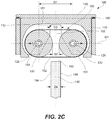
- Aligning apparatus with workpiece ensures that workpiece can be later inserted between first roller and second roller. Furthermore, positioning rotation-control member at the first location relative to frame ensues that first roller and second roller are able rotatable relative to frame as, for example, is shown in FIG. 2B .
- the rotation of first roller and second roller allows for workpiece to be inserted between first roller and second roller. Moving apparatus and workpiece relative to each other results in workpiece being received between first roller and second roller.
- first biasing member stretches. In some examples, the contact with first biasing member and stretching first biasing member occurs before workpiece is received between first roller and second roller.
- first biasing member applies the pressure to at least the portion of edge surface of workpiece.
- the level of pressure depends on the level of stretching and how far workpiece is received between first roller and second roller.
- FIGS. 1A and 1B are, collectively, a block diagram of an apparatus for applying pressure to at least a portion of an edge surface of a workpiece, according to one or more examples of the present disclosure
- FIG. 2A is a cross-sectional side view of the apparatus of FIGS. 1A and 1B with the rotation-control member of the apparatus at a second location relative to the frame, according to one or more examples of the present disclosure;
- FIG. 2B is a cross-sectional side view of the apparatus of FIGS. 1A and 1B with the rotation-control member of the apparatus at a first location relative to the frame, according to one or more examples of the present disclosure;
- FIG. 2C is a cross-sectional side view of the apparatus of FIGS. 1A and 1B , showing a workpiece aligned relative to the apparatus and prior to receiving the workpiece between the first roller and the second roller of the apparatus, according to one or more examples of the present disclosure;
- FIG. 2D is a cross-sectional side view of the apparatus of FIGS. 1A and 1B prior to the workpiece being received between the first roller and the second roller of the apparatus, according to one or more examples of the present disclosure;
- FIG. 2E is a cross-sectional side view of the apparatus of FIGS. 1A and 1B while the workpiece is being received between the first roller and the second roller of the apparatus, according to one or more examples of the present disclosure;
- FIG. 2F is a cross-sectional side view of the apparatus of FIGS. 1A and 1B after the workpiece is received between the first roller and the second roller of the apparatus, according to one or more examples of the present disclosure
- FIG. 2G is an expanded view of a portion of FIG. 2E , illustrating a first engagement portion of a first biasing member of the apparatus of FIGS. 1A and 1B and a second engagement portion of the first biasing member, positioned over and applying pressure on the edge surface, according to one or more examples of the present disclosure;
- FIG. 2H is a cross-sectional side view of the apparatus of FIGS. 1A and 1B after the workpiece is received between the first roller and the second roller of the apparatus and after the rotation-control member of the apparatus is positioned at the second location relative to the frame, according to one or more examples of the present disclosure;
- FIG. 3A is a cross-sectional side view of the apparatus of FIGS. 1A and 1B with the first biasing member of the apparatus having an open shape and with the rotation-control member of the apparatus at a second location relative to the frame, according to one or more examples of the present disclosure;
- FIG. 3B is a cross-sectional side view of the apparatus of FIGS. 1A and 1B with the first biasing member of the apparatus having an open shape and with the rotation-control member of the apparatus at a first location relative to the frame, according to one or more examples of the present disclosure;
- FIG. 3C is a cross-sectional side view of the apparatus of FIGS. 1A and 1B prior to the workpiece being received between the first roller and the second roller of the apparatus, according to one or more examples of the present disclosure;
- FIG. 3D is a cross-sectional side view of the apparatus of FIGS. 1A and 1B while the workpiece is being received between the first roller and the second roller of the apparatus, according to one or more examples of the present disclosure;
- FIG. 3E is an expanded view of a portion of FIG. 3D , illustrating a first engagement portion of a first biasing member of the apparatus, positioned over and applying pressure on the edge surface, according to one or more examples of the present disclosure
- FIG. 3F is a cross-sectional side view of the apparatus of FIGS. 1A and 1B after the workpiece is received between the first roller and the second roller of the apparatus, according to one or more examples of the present disclosure
- FIG. 3G is a cross-sectional side view of the apparatus of FIGS. 1A and 1B after the workpiece is received between the first roller and the second roller of the apparatus and with the rotation-control member of the apparatus back at the second location relative to the frame, according to one or more examples of the present disclosure;
- FIGS. 3H and 3I are cross-sectional top views of the apparatus of FIGS. 1A and 1B , showing the first roller and the second roller translatable relative to the frame along the first axis, according to one or more examples of the present disclosure;
- FIGS. 3J and 3K are cross-sectional top views of the apparatus of FIGS. 1A and 1B , showing only the first roller, but not the second roller, translatable relative to the frame along the first axis, according to one or more examples of the present disclosure;
- FIG. 4 is a block diagram of a method of applying pressure to at least a portion of an edge surface of a workpiece, using the apparatus of FIGS. 1A and 1B , according to one or more examples of the present disclosure;
- FIG. 5 is a block diagram of aircraft production and service methodology
- FIG. 6 is a schematic illustration of an aircraft.
- solid lines, if any, connecting various elements and/or components may represent mechanical, electrical, fluid, optical, electromagnetic and other couplings and/or combinations thereof.
- “coupled” means associated directly as well as indirectly.
- a member A may be directly associated with a member B, or may be indirectly associated therewith, e.g., via another member C. It will be understood that not all relationships among the various disclosed elements are necessarily represented. Accordingly, couplings other than those depicted in the block diagrams may also exist.
- Dashed lines, if any, connecting blocks designating the various elements and/or components represent couplings similar in function and purpose to those represented by solid lines; however, couplings represented by the dashed lines may either be selectively provided or may relate to alternative examples of the present disclosure.
- elements and/or components, if any, represented with dashed lines indicate alternative examples of the present disclosure.
- One or more elements shown in solid and/or dashed lines may be omitted from a particular example without departing from the scope of the present disclosure.
- Environmental elements, if any, are represented with dotted lines. Virtual (imaginary) elements may also be shown for clarity. Those skilled in the art will appreciate that some of the features illustrated in FIGS.
- FIGS. 1A and 1B may be combined in various ways without the need to include other features described in FIGS. 1A and 1B , other drawing figures, and/or the accompanying disclosure, even though such combination or combinations are not explicitly illustrated herein. Similarly, additional features not limited to the examples presented, may be combined with some or all of the features shown and described herein.
- the blocks may represent operations and/or portions thereof and lines connecting the various blocks do not imply any particular order or dependency of the operations or portions thereof. Blocks represented by dashed lines indicate alternative operations and/or portions thereof. Dashed lines, if any, connecting the various blocks represent alternative dependencies of the operations or portions thereof. It will be understood that not all dependencies among the various disclosed operations are necessarily represented.
- FIGS. 5 and 6 and the accompanying disclosure describing the operations of the method(s) set forth herein should not be interpreted as necessarily determining a sequence in which the operations are to be performed. Rather, although one illustrative order is indicated, it is to be understood that the sequence of the operations may be modified when appropriate. Accordingly, certain operations may be performed in a different order or simultaneously. Additionally, those skilled in the art will appreciate that not all operations described need be performed.
- first,” “second,” etc. are used herein merely as labels, and are not intended to impose ordinal, positional, or hierarchical requirements on the items to which these terms refer. Moreover, reference to, e.g., a “second” item does not require or preclude the existence of, e.g., a “first” or lower-numbered item, and/or, e.g., a “third” or higher-numbered item.
- a system, apparatus, structure, article, element, component, or hardware “configured to” perform a specified function is indeed capable of performing the specified function without any alteration, rather than merely having potential to perform the specified function after further modification.
- the system, apparatus, structure, article, element, component, or hardware “configured to” perform a specified function is specifically selected, created, implemented, utilized, programmed, and/or designed for the purpose of performing the specified function.
- “configured to” denotes existing characteristics of a system, apparatus, structure, article, element, component, or hardware which enable the system, apparatus, structure, article, element, component, or hardware to perform the specified function without further modification.
- a system, apparatus, structure, article, element, component, or hardware described as being “configured to” perform a particular function may additionally or alternatively be described as being “adapted to” and/or as being “operative to” perform that function.
- apparatus 100 for applying pressure to at least a portion of edge surface 192 , which bridges opposing faces 194 of workpiece 190 , is disclosed.
- Apparatus 100 comprises frame 110 , first roller 120 , second roller 130 , first biasing member 150 , and second biasing member 160 .
- First roller 120 is coupled to frame 110 and is rotatable relative to frame 110 about first pivot axis 125 .
- Second roller 130 is coupled to frame 110 and is rotatable relative to frame 110 about second pivot axis 135 .
- first roller 120 or second roller 130 is translatable relative to frame 110 along first axis 101 , which intersects and is perpendicular to first pivot axis 125 and to second pivot axis 135 .
- Rotation-control member 140 is coupled to frame 110 and is movable relative to frame 110 .
- First biasing member 150 is coupled to first roller 120 and to second roller 130 and is configured to operate in tension.
- Second biasing member 160 is positioned, in compression, between frame 110 and rotation-control member 140 .
- first roller 120 and second roller 130 are rotatable relative to frame 110 .
- first roller 120 and second roller 130 are rotationally fixed relative to frame 110 .
- Apparatus 100 is configured to apply the pressure to at least the portion of edge surface 192 while apparatus 100 is supported by workpiece 190 .
- Apparatus 100 can be installed on workpiece 190 by an operator with minimal efforts, e.g., using only one hand.
- apparatus 100 is configured to retain on workpiece 190 , supported by opposing faces 194 of workpiece 190 .
- Apparatus 100 applies the pressure uniformly using first biasing member 150 , which is configured to operate in tension and conformally contact at least the portion of edge surface 192 .
- the level of pressure is determined by stretching of first biasing member 150 and, in some examples, is controllable by the degree of protrusion of workpiece 190 into apparatus 100 .
- first biasing member 150 comes in contact with at least the portion of edge surface 192 . Furthermore, first biasing member 150 stretches thereby applying the pressure to at least the portion of edge surface 192 .
- the location of rotation-control member 140 controls rotation of first roller 120 and second roller 130 thereby determining when workpiece 190 can be received between first roller 120 and second roller 130 and/or retracted from apparatus 100 .
- workpiece 190 forms frictional coupling with first roller 120 and second roller 130 , either directly or through first biasing member 150 . This frictional coupling ensures that workpiece 190 can be inserted between first roller 120 and second roller 130 and/or retracted from apparatus 100 only when first roller 120 and second roller 130 rotate.
- first roller 120 and second roller 130 are rotatable relative to frame 110 .
- the rotation of first roller 120 and second roller 130 allows workpiece 190 to be inserted between first roller 120 and second roller 130 and/or retracted from apparatus 100 .
- rotation-control member 140 is moved to the first location relative to frame 110 prior to both of these operations and kept at the first location during these operations.
- first roller 120 and second roller 130 are not rotatable relative to frame 110 .
- Workpiece 190 cannot be inserted between first roller 120 and second roller 130 and/or retracted from apparatus 100 . If workpiece 190 has been previously inserted between first roller 120 and second roller 130 , workpiece 190 retains the position relative to first roller 120 and second roller 130 and to frame 110 . This position is retained even through the pressure is applied to at least the portion of edge surface 192 of workpiece 190 . No external support or forces are needed to apparatus 100 , which effectively hangs on workpiece 190 due to the frictional coupling between workpiece 190 and each of first roller 120 and second roller 130 , either directly or indirectly.
- rotation-control member 140 is first brought back to the first location relative to frame 110 .
- first roller 120 and second roller 130 are able to rotate while rotation-control member 140 is at the first location.
- the rotation of first roller 120 and second roller 130 allows workpiece 190 to advance linearly along second axis 102 and be retracted from apparatus.
- Workpiece 190 remains frictionally coupled to first roller 120 and second roller 130 while passing the gap between first roller 120 and second roller 130 .
- an operator forces rotation-control member 140 to frame 110 to bring rotation-control member 140 to the first location relative to frame 110 .
- frame 110 or, more specifically, first roller 120 and second roller 130 or first biasing member 150 wrapping around first roller 120 and second roller 130 is already contacting workpiece 190 and provide reference support.
- the operator slides apparatus 100 over workpiece 190 or, more specifically, over edge surface 192 or workpiece 190 .
- the operator then releases rotation-control member 140 thereby bringing rotation-control member 140 to the second location relative to frame 110 . No further support is needed by the operator.
- Apparatus 100 remains supported on workpiece 190 , while applying pressure on at least a portion of edge surface 192 .
- the operator again forces rotation-control member 140 to frame 110 to bring rotation-control member 140 to the first location relative to frame 110 .
- first roller 120 and second roller 130 are frictionally coupled to workpiece 190 and provide reference support.
- the operator pulls apparatus 100 along second axis 102 and away from edge surface 192 of workpiece 190 .
- First roller 120 is coupled to and rotatable relative to frame 110 .
- first roller 120 is coupled relative to frame 110 using a bearing, such as a plain bearing (e.g., bushing, journal bearing, sleeve bearing, rifle bearing, composite bearing), a rolling-element bearing (e.g., ball bearing, roller bearing), a jewel bearing, a fluid bearing, a magnetic bearing, and a flexure bearing.
- a plain bearing e.g., bushing, journal bearing, sleeve bearing, rifle bearing, composite bearing
- a rolling-element bearing e.g., ball bearing, roller bearing
- jewel bearing e.g., a fluid bearing, a magnetic bearing, and a flexure bearing.
- Second roller 130 is coupled and rotatable to frame 110 .
- second roller 130 is coupled relative to frame 110 using a bearing, such as a plain bearing (e.g., bushing, journal bearing, sleeve bearing, rifle bearing, composite bearing), a rolling-element bearing (e.g., ball bearing, roller bearing), a jewel bearing, a fluid bearing, a magnetic bearing, and a flexure bearing.
- a plain bearing e.g., bushing, journal bearing, sleeve bearing, rifle bearing, composite bearing
- a rolling-element bearing e.g., ball bearing, roller bearing
- a jewel bearing e.g., a fluid bearing, a magnetic bearing, and a flexure bearing.
- At least one of first roller 120 or second roller 130 is translatable relative to frame 110 along first axis 101 , which allows workpiece 190 to protrude between first roller 120 and second roller 130 , while first roller 120 and second roller 130 apply equal and opposite forces to opposing faces 194 of workpiece 190 .
- width D 2 of the gap between first roller 120 and second roller 130 is initially smaller than width D 4 of workpiece 190 .
- at least one of first roller 120 or second roller 130 translates away from second axis 102 thereby increasing width D 2 of the gap between first roller 120 and second roller 130 .
- Rotation-control member 140 is coupled to frame 110 and is movable relative to frame 110 .
- rotation-control member 140 is slidable relative to frame 110 along second axis 102 .
- a linear bearing is positioned between rotation-control member 140 and frame 110 to ensure this moveability.
- Second biasing member 160 is positioned, in compression, between frame 110 and rotation-control member 140 . More specifically, second biasing member 160 urges rotation-control member 140 to the second location relative to frame 110 .
- the operator brings rotation-control member 140 to the first location relative to frame 110 by overcoming the counter-force from second biasing member 160 .
- second biasing member 160 moves rotation-control member 140 back to the second location relative to frame 110 using this counter-force.
- second biasing member 160 is one or more compression springs. When multiple compression springs are used, both springs in each pair of the springs are equally offset from second axis 102 .
- first biasing member 150 is elastically stretchable and is supported by first roller 120 and by second roller 130 .
- first biasing member 150 is used to control the pressure, applied by first biasing member 150 pressure to at least a portion of edge surface 192 of workpiece 190 . More stretching corresponds to the higher pressure and vice versa. Furthermore, the stretching of first biasing member 150 provides space for workpiece 190 when workpiece 190 is inserted between first roller 120 and second roller 130 .
- first biasing member 150 is made from an elastically stretchable material, such as an elastomer, e.g., natural rubber, synthetic rubber, nitrile rubber, silicone rubber, urethane rubber, chloroprene rubber, Ethylene Vinyl Acetate (EVA) rubber, and the like.
- first biasing member 150 has a closed shape.
- First roller 120 and second roller 130 are circumscribed by first biasing member 150 and first biasing member 150 wraps around a portion of first roller 120 and a portion of second roller 130 .
- the preceding subject matter of this paragraph characterizes example 3 of the present disclosure, wherein example 3 also includes the subject matter according to example 2, above.
- first biasing member 150 When first biasing member 150 has a closed shape and wraps around a portion of first roller 120 and a portion of second roller 130 , first biasing member 150 does not require special attachment, such as attachment points, to first roller 120 and second roller 130 . During assembly of apparatus 100 , first biasing member 150 is slid over first roller 120 and second roller 130 . Furthermore, when first biasing member 150 is able to slip relative to first roller 120 and second roller 130 , the rotation of first roller 120 and second roller 130 does not impact stretching of first biasing member 150 . It should be noted that stretching of first biasing member 150 determines the pressure, applied to edge surface 192 of workpiece 190 .
- first biasing member 150 when first biasing member 150 has a closed shape, first biasing member 150 is positioned between workpiece 190 and each of first roller 120 and second roller 130 when workpiece 190 protrudes between first roller 120 and second roller 130 as, for example, is shown in FIGS. 2D and 2E .
- First biasing member 150 is also positioned between rotation-control member 140 and each of first roller 120 and second roller 130 as, for example, is shown in FIG. 2A .
- first biasing member 150 is relied on to form frictional couplings between rotation-control member 140 and each of first roller 120 and second roller 130 and also between workpiece 190 and each of first roller 120 and second roller 130 . Collectively, this forms a coupling between workpiece 190 and apparatus 100 .
- first biasing member 150 is a closed-loop belt, which is at least partially stretched when installed over first roller 120 and second roller 130 .
- each of first roller 120 and second roller 130 comprises a groove on a circumference of each first roller 120 and second roller 130 , such that first biasing member 150 partially protrudes into the groove.
- the groove is used to maintain orientation in a direction, which is perpendicular to both first axis 101 and second axis 102 , and prevents first biasing member 150 from slipping of first roller 120 and second roller 130 comprises.
- first biasing member 150 comprises first straight portion 151 , second straight portion 152 , first circular-arc portion 153 , and second circular-arc portion 154 .
- First circular-arc portion 153 is in circumferential contact with first roller 120 .
- Second circular-arc portion 154 is in circumferential contact with second roller 130 .
- First straight portion 151 and second straight portion 152 are parallel to each other and to first axis 101 .
- First straight portion 151 and second straight portion 152 are on opposite sides of first axis 101 .
- First straight portion 151 interconnects first circular-arc portion 153 and second circular-arc portion 154 .
- Second straight portion 152 interconnects first circular-arc portion 153 and second circular-arc portion 154 .
- First roller 120 and second roller 130 support first biasing member 150 and keep first biasing member 150 in tension, in some examples, even before workpiece 190 is inserted between first roller 120 and second roller 130 .
- This tension keeps first biasing member 150 on first roller 120 and second roller 130 .
- first biasing member 150 is a belt that is slid onto first roller 120 and second roller 130 .
- First straight portion 151 and second straight portion 152 ensures that first circular-arc portion 153 and second circular-arc portion 154 conform to first roller 120 and second roller 130 , respectively.
- first circular-arc portion 153 is in circumferential contact with first roller 120 and separates first roller 120 from rotation-control member 140 .
- second circular-arc portion 154 is in circumferential contact with second roller 130 and separates second roller 130 from rotation-control member 140 . As such, when rotation-control member 140 is at the second location relative to frame 110 , rotation-control member 140 contacts first circular-arc portion 153 and second circular-arc portion 154 rather than first roller 120 and second roller 130 .
- first biasing member 150 is made from an elastic material (e.g., rubber). More specifically, this elastic material has a higher friction coefficient when in contact with rotation-control member 140 than, for example, when rotation-control member 140 directly contacts first roller 120 and second roller 130 . Furthermore, the elastic material keeps first biasing member 150 is tension and supported on first roller 120 and second roller 130 .
- an elastic material e.g., rubber
- first circular-arc portion 153 of first biasing member 150 is in circumferential contact with at least one half of first roller 120 .
- Second circular-arc portion 154 of first biasing member 150 is in circumferential contact with at least one half of second roller 130 .
- Maintaining the contact of first circular-arc portion 153 with at least one half of first roller 120 support first biasing member 150 on first roller 120 .
- maintaining the contact of second circular-arc portion 154 with at least one half of second roller 130 support first biasing member 150 on second roller 130 .
- first biasing member 150 is in tension and first circular-arc portion 153 of first biasing member 150 is in circumferential contact with about one half of first roller 120 .
- second circular-arc portion 154 of first biasing member 150 is in circumferential contact with about one half of second roller 130 .
- first straight portion 151 of first biasing member 150 tangentially extends from first roller 120 and tangentially extends from second roller 130 .
- Second straight portion 152 of first biasing member 150 tangentially extends from first roller 120 and tangentially extends from second roller 130 .
- first straight portion 151 and second straight portion 152 are parallel to each other and to first axis 101 .
- first biasing member 150 is in tension when first roller 120 and second roller 130 are circumscribed by first biasing member 150 and first biasing member 150 wraps around portion of first roller 120 and portion of second roller 130 .
- First biasing member 150 being in tension ensures that first biasing member 150 is supported by first roller 120 and second roller 130 . Furthermore, the initial tension in first biasing member 150 is used to control the pressure, applied by first biasing member 150 to at least a portion of edge surface 192 of workpiece 190 when workpiece 190 protrudes between first roller 120 and second roller 130 . It should be noted that the tension in first biasing member 150 determines the level of pressure. Furthermore, it should be noted that first biasing member 150 further extends and experiences higher tension while workpiece 190 protrudes between first roller 120 and second roller 130 .
- first biasing member 150 is made from an elastically stretchable material, such as an elastomer, e.g., natural rubber, synthetic rubber, nitrile rubber, silicone rubber, urethane rubber, chloroprene rubber, EVA rubber, and the like.
- an elastomer e.g., natural rubber, synthetic rubber, nitrile rubber, silicone rubber, urethane rubber, chloroprene rubber, EVA rubber, and the like.
- the elastically stretchable material ensures that first biasing member 150 is able to experience various levels of tension.
- example 8 of the present disclosure when rotation-control member 140 is at second location relative to frame 110 , one portion of first biasing member 150 is compressed between a portion of rotation-control member 140 and a portion of first roller 120 and another portion of first biasing member 150 is compressed between a portion of rotation-control member 140 and a portion of second roller 130 .
- the preceding subject matter of this paragraph characterizes example 8 of the present disclosure, wherein example 8 also includes the subject matter according to any one of examples 3 to 7, above.
- first biasing member 150 When one portion of first biasing member 150 is compressed between the portion of rotation-control member 140 and the portion of first roller 120 , first biasing member 150 provides frictional coupling between rotation-control member 140 and first roller 120 thereby preventing first roller 120 from rotating relative to rotation-control member 140 and about first pivot axis 125 . Similarly, when one portion of first biasing member 150 is compressed between the portion of rotation-control member 140 and the portion of second roller 130 , first biasing member 150 provides frictional coupling between rotation-control member 140 and second roller 130 thereby preventing second roller 130 from rotating relative to rotation-control member 140 and about second pivot axis 135 . Therefore, first biasing member 150 is able to frictionally couple first roller 120 and second roller 130 to rotation-control member 140 .
- first biasing member 150 is made from an elastic material (e.g., rubber), which has a higher friction coefficient when in contact with rotation-control member 140 than, for example, when rotation-control member 140 directly contacts first roller 120 and second roller 130 .
- an elastic material e.g., rubber
- example 9 when rotation-control member 140 is at the first location relative to frame 110 , rotation-control member 140 does not contact first biasing member 150 .
- rotation-control member 140 When rotation-control member 140 is at the second location relative to frame 110 , rotation-control member 140 contacts first biasing member 150 .
- First biasing member 150 is used to form friction coupling between rotation-control member 140 and each of first roller 120 and second roller 130 .
- first biasing member 150 is positioned between first roller 120 and rotation-control member 140 and also between second roller 130 and rotation-control member 140 .
- rotation-control member 140 does not contact first biasing member 150 .
- rotation-control member 140 When rotation-control member 140 is at the second location relative to frame 110 as, for example, is shown in FIG. 2B , rotation-control member 140 contacts first biasing member 150 .
- First biasing member 150 is frictionally coupled to rotation-control member 140 and also established frictional coupling between rotation-control member 140 and each of first roller 120 and second roller 130 , This in turn prevents first roller 120 and second roller 130 from rotating.
- portions of rotation-control member 140 contacting first biasing member 150 are in the form of wedges to provide higher contact areas between rotation-control member 140 and first biasing member 150 . Furthermore, the wedges are positioned in such a way that the clockwise rotation of first roller 120 is restricted more than the counterclockwise rotation and that the counterclockwise rotation of second roller 130 is restricted more than the clockwise rotation. The clockwise rotation of first roller 120 and the counterclockwise rotation of second roller 130 correspond to removal of workpiece 190 from apparatus 100 .
- first biasing member 150 has an open shape and comprises first end 155 and second end 156 .
- First end 155 is attached to first roller 120 at first attachment point 121 .
- Second end 156 is attached to second roller 130 at second attachment point 131 .
- first biasing member 150 When first biasing member 150 has an open shape and first end 155 of first biasing member 150 is attached to first roller 120 while second end 156 is attached to second roller 130 , first biasing member 150 is not compressed between rotation-control member 140 and each of first roller 120 and second roller 130 during operation of apparatus 100 . Furthermore, first biasing member 150 is not compressed between workpiece 190 and each of first roller 120 and second roller 130 during operation of apparatus 100 . This lack of compression allows more precisely controlled stretching of first biasing member 150 . As noted above, stretching of first biasing member 150 controls the pressure, applied to at least a portion of edge surface 192 of workpiece 190 .
- first biasing member 150 is a stretchable belt.
- First end 155 is crimped, glued, or otherwise attached first roller 120 at first attachment point 121 .
- second end 156 is crimped, glued, or otherwise attached first roller 120 at second attachment point 131 .
- the rotation of first roller 120 and second roller 130 changes the position of first biasing member 150 , e.g., by moving first attachment point 121 and second attachment point 131 .
- the rotation of first roller 120 and second roller 130 changes the stretching level of first biasing member 150 , e.g., by moving first attachment point 121 and second attachment point 131 .
- first biasing member 150 is in tension between first attachment point 121 and second attachment point 131 .
- first biasing member 150 in tension even before workpiece 190 is introduced between first roller 120 and second roller 130 allows increasing the pressure, applied to at least a portion of edge surface 192 of workpiece 190 . It should be noted that this pressure depends, at least in part, on the level of stretching of first biasing member 150 .
- the initial stretching (pre-stretching) of first biasing member 150 is at least 10% of the initial unstretched length of first biasing member 150 or, more specifically, at least 25% or even at least 50%. It should be noted that first biasing member 150 is further stretches, besides the initial tension when first biasing member 150 extends along first axis 101 , as shown in FIG. 3A , when first roller 120 and second roller 130 rotate and/or when workpiece 190 contacts first biasing member 150 .
- first biasing member 150 is straight when apparatus 100 is not applying pressure to at least the portion of edge surface 192 .
- the preceding subject matter of this paragraph characterizes example 12 of the present disclosure, wherein example 12 also includes the subject matter according to example 11, above.
- First biasing member 150 being straight ensures that first biasing member 150 in tension even before workpiece 190 is introduced between first roller 120 and second roller 130 allows increasing the pressure, applied to at least a portion of edge surface 192 of workpiece 190 . It should be noted that this pressure depends, at least in part, on the level of stretching of first biasing member 150 .
- the initial stretching (pre-stretching) of first biasing member 150 is at least 10% of the initial unstretched length of first biasing member 150 or, more specifically, at least 25% or even at least 50%. It should be noted that first biasing member 150 is further stretches, besides the initial tension when first biasing member 150 extends along first axis 101 , as shown in FIG. 3A , when first roller 120 and second roller 130 rotate and/or when workpiece 190 contacts first biasing member 150 .
- example 13 when rotation-control member 140 is at the first location relative to frame 110 , rotation-control member 140 does not contact either one of first roller 120 or second roller 130 .
- rotation-control member 140 contacts, directly or indirectly, first outer cylindrical surface 122 of first roller 120 and second outer cylindrical surface 132 of second roller 130 .
- first roller 120 and second roller 130 are able to rotate about first pivot axis 125 and second pivot axis 135 , respectively.
- Rotation-control member 140 does not interfere with this rotation, either directly (e.g., direct contact with first roller 120 and second roller 130 ) or indirectly (through first biasing member 150 ). More specifically, at the first location, rotation-control member 140 does not contact either one of first roller 120 or second roller 130 . Furthermore, at the first location, rotation-control member 140 does not contact first biasing member 150 , which, in some examples, wraps around a portion of first roller 120 and a portion of second roller 130 .
- rotation-control member 140 when rotation-control member 140 is at the second location relative to frame 110 , rotation-control member 140 contacts, directly or indirectly, first outer cylindrical surface 122 of first roller 120 and second outer cylindrical surface 132 of second roller 130 . More specifically, at the second location, rotation-control member 140 prevents first roller 120 and second roller 130 from rotating about first pivot axis 125 and second pivot axis 135 , respectively. In some examples, e.g., shown in FIGS. 3A and 3D , rotation-control member 140 directly contacts first outer cylindrical surface 122 of first roller 120 and second outer cylindrical surface 132 of second roller 130 . In other examples, e.g., shown in FIGS. 2A and 2G , rotation-control member 140 indirectly contacts (e.g., through first biasing member 150 ) first outer cylindrical surface 122 of first roller 120 and second outer cylindrical surface 132 of second roller 130 .
- portions of rotation-control member 140 contacting first biasing member 150 are in the form of wedges to provide higher contact areas between rotation-control member 140 and first biasing member 150 . Furthermore, the wedges are positioned in such a way that the clockwise rotation of first roller 120 is restricted more than the counterclockwise rotation and that the counterclockwise rotation of second roller 130 is restricted more than the clockwise rotation. The clockwise rotation of first roller 120 and the counterclockwise rotation of second roller 130 correspond to removal of workpiece 190 from apparatus 100 .
- first roller 120 or second roller 130 is translatable relative to frame 110 along first axis 101 .
- first roller 120 or second roller 130 is translatable relative to frame 110 along first axis 101 .
- first roller 120 is translatable relative to frame 110 along first axis 101 , forces, applied to opposing faces 194 of workpiece 190 , more precisely. Furthermore, the design of apparatus 100 is simplified resulting in lower weight and simpler operation. As shown in FIGS. 3J and 3K , first roller 120 is translatable relative to frame 110 , while second roller 130 is stationary.
- frame 110 comprises a channel, extending along first axis 101 , through which the axle of first roller 120 protrudes.
- example 15 of present disclosure, wherein example 15 also includes the subject matter according to example 14, above.
- first roller 120 or second roller 130 When only the one of first roller 120 or second roller 130 , translatable relative to frame 110 along first axis 101 , is biased toward another one of first roller 120 or second roller 130 , this biasing feature controls the forces, applied to opposing faces 194 of workpiece 190 , more precisely. Furthermore, the design of apparatus 100 is simplified resulting in lower weight and simpler operation. Biasing only one of first roller 120 or second roller 130 allows for precise control of these forces. As shown in FIGS. 3J and 3K , third biasing member 183 is positioned between frame 110 and the axle of first roller 120 , which causes biasing of first roller 120 toward second roller 130 .
- first roller 120 or second roller 130 translatable relative to frame 110 along first axis 101 , is biased toward another one of first roller 120 or second roller 130 by first biasing member 150 .
- first biasing member 150 The preceding subject matter of this paragraph characterizes example 16 of present disclosure, wherein example 16 also includes the subject matter according to example 15, above.
- first biasing member 150 operates in tension and engages first roller 120 and second roller 130 pulling first roller 120 and second roller 130 . This feature eliminates the need for additional components. As such, first biasing member 150 serves multiple functions, such as applying pressure to at least the portion of edge surface 192 and biasing first roller 120 and second roller 130 toward each other. As shown in FIGS. 2A and 2B , first biasing member 150 wraps around first roller 120 and second roller 130 . As shown in FIGS. 3A and 3B , first biasing member 150 is attached to first roller 120 at first attachment point 121 and also attached to second roller 130 at second attachment point 131 .
- example 17 of present disclosure wherein example 17 also includes the subject matter according to example 15, above.
- Third biasing member 183 provides independent control (e.g., from first biasing member 150 ) of the forces applied to opposing faces 194 of workpiece 190 , thereby assuring that these forces are more precisely controlled.
- first biasing member 150 is used to apply the forces, these forces depend on the degree of stretching of first biasing member 150 and other factors, which can be difficult to control during operation of apparatus 100 .
- third biasing member 183 is positioned between frame 110 and the axle of first roller 120 , which causes biasing of first roller 120 toward second roller 130 .
- each one of first roller 120 and second roller 130 is translatable relative to frame 110 along first axis 101 .
- the preceding subject matter of this paragraph characterizes example 18 of present disclosure, wherein example 18 also includes the subject matter according to any one of examples 2 to 13, above.
- first roller 120 and second roller 130 when each one of first roller 120 and second roller 130 is translatable relative to frame 110 along first axis 101 , the gap between first roller 120 and second roller 130 remains substantially centered with second axis 102 of apparatus 100 . Therefore, apparatus 100 and workpiece remains aligned along second axis 102 as workpiece 190 is being inserted between first roller 120 and second roller 130 .
- each of first roller 120 and second roller 130 is translatable relative to frame 110 .
- frame 110 comprises one channel, extending along first axis 101 , through which the axle of first roller 120 protrudes, and another channel, extending along first axis 101 , through which the axle of second roller 130 .
- both first roller 120 and second roller 130 are biased, relative to frame 110 , toward each other.
- the preceding subject matter of this paragraph characterizes example 19 of present disclosure, wherein example 19 also includes the subject matter according to example 18, above.
- first roller 120 and second roller 130 are biased, relative to frame 110 , toward each other, higher forces can be applied to opposing faces 194 of workpiece 190 , thereby assuring more better friction coupling between opposing faces 194 and each of first roller 120 and second roller 130 .
- third biasing member 183 is positioned between frame 110 and the axle of first roller 120 , which causes biasing of first roller 120 toward second roller 130 .
- fourth biasing member 184 is positioned between frame 110 and the axle of second roller 130 , which causes biasing of second roller 130 toward first roller 120 .
- both first roller 120 and second roller 130 are biased, relative to frame 110 , toward each other, by first biasing member 150 .
- first biasing member 150 first biasing member 150 .
- example 10 also includes the subject matter according to example 19, above.
- both first roller 120 and second roller 130 are biased, relative to frame 110 , toward each other, higher forces can be applied to opposing faces 194 of workpiece 190 , thereby assuring more better friction coupling between opposing faces 194 and each of first roller 120 and second roller 130 .
- first biasing member 150 operates in tension and engages first roller 120 and second roller 130 pulling first roller 120 and second roller 130 . This feature eliminates the need for additional components. As such, first biasing member 150 serves multiple functions, such as applying pressure to at least the portion of edge surface 192 and biasing first roller 120 and second roller 130 toward each other. As shown in FIGS. 2A and 2B , first biasing member 150 wraps around first roller 120 and second roller 130 . As shown in FIGS. 3A and 3B , first biasing member 150 is attached to first roller 120 at first attachment point 121 and also attached to second roller 130 at second attachment point 131 .
- first roller 120 is biased relative to frame 110 and toward second roller 130 by third biasing member 183 .
- Second roller 130 is biased relative to frame 110 and toward first roller 120 by fourth biasing member 184 .
- first roller 120 and second roller 130 are biased, relative to frame 110 , toward each other, higher forces can be applied to opposing faces 194 of workpiece 190 , thereby assuring more better friction coupling between opposing faces 194 and each of first roller 120 and second roller 130 .
- third biasing member 183 is positioned between frame 110 and the axle of first roller 120 , which causes biasing of first roller 120 toward second roller 130 .
- fourth biasing member 184 is positioned between frame 110 and the axle of second roller 130 , which causes biasing of second roller 130 toward first roller 120 .
- second biasing member 160 biases rotation-control member 140 toward first roller 120 and toward second roller 130 .
- the preceding subject matter of this paragraph characterizes example 12 of present disclosure, wherein example 12 also includes the subject matter according to any one of examples 1 to 21, above.
- second biasing member 160 is used to move rotation-control member 140 from the first location to the second location relative to frame 110 when no external forces are applied between rotation-control member 140 and frame 110 .
- eliminating the external force, applied to rotation-control member 140 along second axis 102 toward workpiece 190 results in second biasing member 160 extending and moving frame 110 and rotation-control member 140 relative to each other in opposite directions.
- Rotation-control member 140 is moved until first roller 120 and second roller 130 become frictionally coupled with rotation-control member 140 . At this point, rotation-control member 140 is at the second location and first roller 120 and second roller 130 are no longer able to rotate.
- second biasing member 160 is a spring, positioned between rotation-control member 140 and frame 110 . More specifically, second biasing member 160 is a spring, such as a compression spring (configured to operate with a compression load), a constant-rate spring, a variable-rate spring, a flat spring, a machined spring, a serpentine spring, a garter spring, a cantilever spring, a coil spring or helical spring, and the like.
- a compression spring configured to operate with a compression load
- a constant-rate spring a constant-rate spring
- a variable-rate spring a flat spring
- a machined spring a serpentine spring
- garter spring a garter spring
- cantilever spring a coil spring or helical spring
- frame 110 comprises channel 112 , extending along and longitudinally centered on second axis 102 , which is perpendicular to first axis 101 .
- channel 112 extending along and longitudinally centered on second axis 102 , which is perpendicular to first axis 101 .
- channel 112 is used for alignment of workpiece 190 within apparatus 100 and, more specifically, relative to first biasing member 150 .
- Channel 112 is aligned relatively to the gap between first roller 120 and second roller 130 along second axis 102 , such that both are centered along second axis 102 . This axial centering of channel 112 and the gap ensures that workpiece 190 protrudes into channel 112 without interference from frame 110 and ensures the alignment of workpiece 190 .
- channel 112 comprises channel surface 114 , extending parallel to first axis 101 .
- Channel surface 114 is operable as a positive stop when workpiece 190 protrudes between and past first roller 120 and second roller 130 and into channel 112 . Furthermore, In some examples, channel surface 114 conforms to at least a portion of edge surface 192 of workpiece 190 and is used for alignment of workpiece 190 in channel 112 .
- the position of channel surface 114 relative to first axis 101 also determined the depth of channel 112 and how far workpiece 190 is able to protrude between first roller 120 and second roller 130 and stretch first biasing member 150 . This, in turn, determined the pressure, applied to at least the portion of edge surface 192 .
- Method 700 uses apparatus 100 that comprises frame 110 , first roller 120 , second roller 130 , rotation-control member 140 , first biasing member 150 , and second biasing member 160 .
- First roller 120 is coupled to frame 110 and is rotatable relative to frame 110 about first pivot axis 125 .
- Second roller 130 is coupled to frame 110 and is rotatable relative to frame 110 about second pivot axis 135 . At least one of first roller 120 or second roller 130 is translatable relative to frame 110 .
- Second pivot axis 135 is spaced from first pivot axis 125 along first axis 101 , which intersects and is perpendicular to first pivot axis 125 and to second pivot axis 135 .
- Rotation-control member 140 is coupled to frame 110 and is movable relative to frame 110 .
- First biasing member 150 is coupled to first roller 120 and to second roller 130 .
- Second biasing member 160 is positioned, in compression, between frame 110 and rotation-control member 140 .
- Method 700 comprises (block 710 ) aligning apparatus 100 with workpiece 190 , such that edge surface 192 of workpiece 190 is centered along second axis 102 that is perpendicular to first axis 101 and that extends between first pivot axis 125 of first roller 120 and second pivot axis 135 of second roller 130 .
- Method 700 further comprises (block 720 ) positioning rotation-control member 140 at a first location relative to frame 110 , such that first roller 120 and second roller 130 are rotatable relative to frame 110 .
- Method 700 also comprises, with rotation-control member 140 positioned at first location relative to frame 110 , (block 730 ) moving apparatus 100 and workpiece 190 relative to each other, such that workpiece 190 is received between first roller 120 and second roller 130 , stretching first biasing member 150 so that first biasing member 150 applies the pressure to at least the portion of edge surface 192 of workpiece 190 , while increasing spacing D 1 between first pivot axis 125 of first roller 120 and second pivot axis 135 of second roller 130 along first axis 101 , and first roller 120 and second roller 130 apply equal and opposite forces to opposing faces 194 of workpiece 190 .
- Method 700 additionally comprises (block 740 ) positioning rotation-control member 140 at a second location relative to frame 110 , such that first roller 120 and second roller 130 are rotationally fixed relative to frame 110 , creating a frictional coupling between apparatus 100 and workpiece 190 , which maintains pressure, applied to at least the portion of edge surface 192 by first biasing member 150 .
- Aligning apparatus 100 with workpiece 190 ensures that edge surface 192 of workpiece 190 is centered along second axis 102 , ensures that workpiece 190 can be later inserted between first roller 120 and second roller 130 . Furthermore, positioning rotation-control member 140 at the first location relative to frame 110 ensues that first roller 120 and second roller 130 are able rotatable relative to frame 110 as, for example, is shown in FIG. 2B . The rotation of first roller 120 and second roller 130 allows for workpiece 190 to be inserted between first roller 120 and second roller 130 .
- first biasing member 150 stretches.
- the contact with first biasing member 150 and stretching first biasing member 150 occurs before workpiece 190 is received between first roller 120 and second roller 130 .
- the contact with first biasing member 150 and stretching first biasing member 150 occurs before workpiece 190 is received between first roller 120 and second roller 130 .
- This contact and stretching results in first biasing member 150 applying the pressure to at least the portion of edge surface 192 of workpiece 190 .
- the level of pressure depends on the level of stretching and how far workpiece 190 is received between first roller 120 and second roller 130 .
- first roller 120 and second roller 130 apply equal and opposite forces to opposing faces 194 of workpiece 190 .
- This causes frictional coupling between opposing faces 194 of workpiece 190 and each of first roller 120 and second roller 130 , either through a direct contact or through first biasing member 150 .
- This frictional coupling allows workpiece 190 to move along second axis 102 only when first roller 120 and second roller 130 rotate.
- Positioning rotation-control member 140 at the second location relative to frame 110 prevents further rotation of first roller 120 and second roller 130 .
- Workpiece 190 cannot longer move along second axis 102 .
- the frictional coupling between opposing faces 194 of workpiece 190 and each of first roller 120 and second roller 130 now translates into a frictional coupling between apparatus 100 and workpiece 190 .
- apparatus 100 or, more specifically, at least a portion of first biasing member 150 maintains pressure, applied to at least the portion of edge surface 192 by first biasing member 150 .
- apparatus 100 is configured to apply the pressure to at least the portion of edge surface 192 while apparatus 100 is supported by workpiece 190 .
- Apparatus 100 can be installed on workpiece 190 by an operator with minimal efforts, e.g., using only one hand.
- apparatus 100 is configured to retain on workpiece 190 , supported by opposing faces 194 of workpiece 190 .
- Apparatus 100 applies the pressure uniformly using first biasing member 150 , which is configured to operate in tension and conformally contact at least the portion of edge surface 192 .
- the level of pressure is determined by stretching of first biasing member 150 and, in some examples, is controllable by the degree of protrusion of workpiece 190 into apparatus 100 .
- an operator forces rotation-control member 140 to frame 110 to bring rotation-control member 140 to the first location relative to frame 110 .
- frame 110 or, more specifically, first roller 120 and second roller 130 or first biasing member 150 wrapping around first roller 120 and second roller 130 is already contacting workpiece 190 and provide reference support.
- the operator slides apparatus 100 over workpiece 190 or, more specifically, over edge surface 192 or workpiece 190 .
- the operator then releases rotation-control member 140 thereby bringing rotation-control member 140 to the second location relative to frame 110 . No further support is needed by the operator.
- Apparatus 100 remains supported on workpiece 190 , while applying pressure on at least a portion of edge surface 192 .
- the operator again forces rotation-control member 140 to frame 110 to bring rotation-control member 140 to the first location relative to frame 110 .
- first roller 120 and second roller 130 are frictionally coupled to workpiece 190 and provide reference support.
- the operator pulls apparatus 100 along second axis 102 and away from edge surface 192 of workpiece 190 .
- First roller 120 is coupled to and rotatable relative to frame 110 .
- first roller 120 is coupled relative to frame 110 using a bearing, such as a plain bearing (e.g., bushing, journal bearing, sleeve bearing, rifle bearing, composite bearing), a rolling—element bearing (e.g., ball bearing, roller bearing), a jewel bearing, a fluid bearing, a magnetic bearing, and a flexure bearing.
- a plain bearing e.g., bushing, journal bearing, sleeve bearing, rifle bearing, composite bearing
- a rolling—element bearing e.g., ball bearing, roller bearing
- a jewel bearing e.g., a fluid bearing, a magnetic bearing, and a flexure bearing.
- Second roller 130 is coupled and rotatable to frame 110 .
- second roller 130 is coupled relative to frame 110 using a bearing, such as a plain bearing (e.g., bushing, journal bearing, sleeve bearing, rifle bearing, composite bearing), a rolling-element bearing (e.g., ball bearing, roller bearing), a jewel bearing, a fluid bearing, a magnetic bearing, and a flexure bearing.
- a plain bearing e.g., bushing, journal bearing, sleeve bearing, rifle bearing, composite bearing
- a rolling-element bearing e.g., ball bearing, roller bearing
- a jewel bearing e.g., a fluid bearing, a magnetic bearing, and a flexure bearing.
- At least one of first roller 120 or second roller 130 is translatable relative to frame 110 along first axis 101 , which allows workpiece 190 to protrude between first roller 120 and second roller 130 , while first roller 120 and second roller 130 apply equal and opposite forces to opposing faces 194 of workpiece 190 .
- width D 2 of the gap between first roller 120 and second roller 130 is initially smaller than width D 4 of workpiece 190 .
- at least one of first roller 120 or second roller 130 translates away from second axis 102 thereby increasing width D 2 of the gap between first roller 120 and second roller 130 .
- Rotation-control member 140 is movable relative to frame 110 .
- rotation-control member 140 is slidable relative to frame 110 along second axis 102 .
- a linear bearing is positioned between rotation-control member 140 and frame 110 to ensure this moveability.
- Second biasing member 160 is positioned, in compression, between frame 110 and rotation-control member 140 . More specifically, second biasing member 160 urges rotation-control member 140 to the second location relative to frame 110 . For example, when an operator applies an external force to rotation-control member 140 relative to frame 110 , the operator brings rotation-control member 140 to the first location relative to frame 110 by overcoming the counter-force from second biasing member 160 .
- second biasing member 160 moves rotation-control member 140 back to the second location relative to frame 110 using this counter-force.
- second biasing member 160 is one or more compression springs. When multiple compression springs are used, each pair of the springs is equally offset from second axis 102 .
- method 700 further comprises, with rotation-control member 140 positioned at the first location relative to frame 110 , moving apparatus 100 and workpiece 190 relative to each other, such that workpiece 190 is extracted from a gap between first roller 120 and second roller 130 .
- rotation-control member 140 positioned at the first location relative to frame 110 , moving apparatus 100 and workpiece 190 relative to each other, such that workpiece 190 is extracted from a gap between first roller 120 and second roller 130 .
- an operator applies force into rotation-control member 140 relative to frame 110 to move rotation-control member 140 from the second location to the first location.
- Moving apparatus 100 and workpiece 190 relative to each other involves pulling apparatus 100 relative to workpiece 190 at least in the direction along second axis 102 .
- step 720 positioning rotation-control member 140 at the first location relative to frame 110 comprises (block 722 ) compressing second biasing member 160 .
- second biasing member 160 is used to move rotation-control member 140 from the first location to the second location relative to frame 110 when no external forces are applied between rotation-control member 140 and frame 110 . In these examples, to bring rotation-control member 140 back to the first location relative to frame 110 second biasing member 160 is compressed.
- second biasing member 160 is a spring, such as a compression spring (configured to operate with a compression load), a constant-rate spring, a variable-rate spring, a flat spring, a machined spring, a serpentine spring, a garter spring, a cantilever spring, a coil spring or helical spring, and the like.
- a compression spring configured to operate with a compression load
- a constant-rate spring a variable-rate spring
- a flat spring a machined spring
- a serpentine spring a garter spring
- a cantilever spring a coil spring or helical spring, and the like.
- compressing second biasing member 160 comprises applying an external force to rotation-control member 140 along second axis 102 toward workpiece 190 .
- second biasing member 160 is used to move rotation-control member 140 from the first location to the second location relative to frame 110 when no external forces are applied between rotation-control member 140 and frame 110 .
- second biasing member 160 is compressed or, more specifically, an external force is applied to rotation-control member 140 along second axis 102 toward workpiece 190 . It should be noted that during this operation, frame 110 directly or indirectly engages workpiece 190 .
- second biasing member 160 is a spring, such as a compression spring (configured to operate with a compression load), a constant-rate spring, a variable-rate spring, a flat spring, a machined spring, a serpentine spring, a garter spring, a cantilever spring, a coil spring or helical spring, and the like.
- a compression spring configured to operate with a compression load
- a constant-rate spring a variable-rate spring
- a flat spring a machined spring
- a serpentine spring a garter spring
- a cantilever spring a coil spring or helical spring, and the like.
- positioning rotation-control member 140 at the second location relative to frame 110 comprises eliminating the external force, applied to rotation-control member 140 along second axis 102 toward workpiece 190 , so that second biasing member 160 extends and moves frame 110 and rotation-control member 140 relative to each other in opposite directions until first roller 120 and second roller 130 become frictionally coupled with rotation-control member 140 .
- second biasing member 160 extends and moves frame 110 and rotation-control member 140 relative to each other in opposite directions until first roller 120 and second roller 130 become frictionally coupled with rotation-control member 140 .
- second biasing member 160 is used to move rotation-control member 140 from the first location to the second location relative to frame 110 when no external forces are applied between rotation-control member 140 and frame 110 .
- eliminating the external force, applied to rotation-control member 140 along second axis 102 toward workpiece 190 results in second biasing member 160 extending and moving frame 110 and rotation-control member 140 relative to each other in opposite directions.
- Rotation-control member 140 is moved until first roller 120 and second roller 130 become frictionally coupled with rotation-control member 140 . At this point, rotation-control member 140 is at the second location and first roller 120 and second roller 130 are no longer able to rotate.
- second biasing member 160 is a spring, positioned between rotation-control member 140 and frame 110 . More specifically, second biasing member 160 is a spring, such as a compression spring (configured to operate with a compression load), a constant-rate spring, a variable-rate spring, a flat spring, a machined spring, a serpentine spring, a garter spring, a cantilever spring, a coil spring or helical spring, and the like.
- a compression spring configured to operate with a compression load
- a constant-rate spring a constant-rate spring
- a variable-rate spring a flat spring
- a machined spring a serpentine spring
- garter spring a garter spring
- cantilever spring a coil spring or helical spring
- (block 720 ) positioning rotation-control member 140 at the first location relative to frame 110 comprises (block 724 ) terminating the direct contact between rotation-control member 140 and each of first roller 120 and second roller 130 or terminating the direct contact between rotation-control member 140 and first biasing member 150 .
- rotation-control member 140 When rotation-control member 140 is at the second location, rotation-control member 140 directly contacts first roller 120 and second roller 130 or directly contacts first biasing member 150 . In either case, rotation-control member 140 is frictionally coupled to first roller 120 and second roller 130 thereby preventing first roller 120 and second roller 130 from rotating. Positioning rotation-control member 140 at the first location relative to frame 110 severs this frictional coupling. More specifically, positioning rotation-control member 140 at the first location terminates the direct contact between rotation-control member 140 and each of first roller 120 and second roller 130 or terminates the direct contact between n-control member 140 and first biasing member 150 .
- terminating the direct contact between rotation-control member 140 and each of first roller 120 and second roller 130 or terminating the direct contact between rotation-control member 140 and first biasing member 150 involves applying a force to rotation-control member 140 relative to frame 110 .
- first biasing member 150 has a closed shape.
- First roller 120 and second roller 130 are circumscribed by first biasing member 150 and first biasing member 150 wraps around a portion of first roller 120 and a portion of second roller 130 .
- the preceding subject matter of this paragraph characterizes example 31 of the present disclosure, wherein example 31 also includes the subject matter according to any of examples 25 to 30, above.
- first biasing member 150 When first biasing member 150 has a closed shape and wraps around a portion of first roller 120 and a portion of second roller 130 , first biasing member 150 does not require special attachment, such as attachment points, to first roller 120 and second roller 130 . During assembly of apparatus 100 , first biasing member 150 is slid over first roller 120 and second roller 130 . Furthermore, when first biasing member 150 is able to slip relative to first roller 120 and second roller 130 , the rotation of first roller 120 and second roller 130 does not impact stretching of first biasing member 150 . It should be noted that stretching of first biasing member 150 determines the pressure, applied to edge surface 192 of workpiece 190 .
- first biasing member 150 when first biasing member 150 has a closed shape, first biasing member 150 is positioned between workpiece 190 and each of first roller 120 and second roller 130 when workpiece 190 protrudes between first roller 120 and second roller 130 as, for example, is shown in FIGS. 2D and 2E .
- First biasing member 150 is also positioned between rotation-control member 140 and each of first roller 120 and second roller 130 as, for example, is shown in FIG. 2A .
- first biasing member 150 is relied on to form frictional couplings between rotation-control member 140 and each of first roller 120 and second roller 130 and also between workpiece 190 and each of first roller 120 and second roller 130 . Collectively, this forms a coupling between workpiece 190 and apparatus 100 .
- first biasing member 150 is a closed-loop belt, which is at least partially stretched when installed over first roller 120 and second roller 130 .
- each of first roller 120 and second roller 130 comprises a groove on a circumference of each first roller 120 and second roller 130 , such that first biasing member 150 partially protrudes into the groove.
- the groove is used to maintain orientation in a direction, which is perpendicular to both first axis 101 and second axis 102 , and prevents first biasing member 150 from slipping of first roller 120 and second roller 130 comprises.
- first biasing member 150 comprises first straight portion 151 , second straight portion 152 , first circular-arc portion 153 , and second circular-arc portion 154 .
- First circular-arc portion 153 is in circumferential contact with first roller 120 .
- Second circular-arc portion 154 is in circumferential contact with second roller 130 .
- First straight portion 151 and second straight portion 152 are parallel to each other and to first axis 101 .
- First straight portion 151 and second straight portion 152 are on opposite sides of first axis 101 .
- First straight portion 151 interconnects first circular-arc portion 153 and second circular-arc portion 154 .
- Second straight portion 152 interconnects first circular-arc portion 153 and second circular-arc portion 154 .
- First roller 120 and second roller 130 support first biasing member 150 and keep first biasing member 150 in tension, in some examples, even before workpiece 190 is inserted between first roller 120 and second roller 130 .
- This tension keeps first biasing member 150 on first roller 120 and second roller 130 .
- first biasing member 150 is a belt that is slid onto first roller 120 and second roller 130 .
- First straight portion 151 and second straight portion 152 ensures that first circular-arc portion 153 and second circular-arc portion 154 conform to first roller 120 and second roller 130 , respectively.
- first circular-arc portion 153 is in circumferential contact with first roller 120 and separates first roller 120 from rotation-control member 140 .
- second circular-arc portion 154 is in circumferential contact with second roller 130 and separates second roller 130 from rotation-control member 140 . As such, when rotation-control member 140 is at the second location relative to frame 110 , rotation-control member 140 contacts first circular-arc portion 153 and second circular-arc portion 154 rather than first roller 120 and second roller 130 .
- first biasing member 150 is made from an elastic material (e.g., rubber). More specifically, this elastic material has a higher friction coefficient when in contact with rotation-control member 140 than, for example, when rotation-control member 140 directly contacts first roller 120 and second roller 130 . Furthermore, the elastic material keeps first biasing member 150 is tension and supported on first roller 120 and second roller 130 .
- an elastic material e.g., rubber
- (block 730 ) moving apparatus 100 and workpiece 190 relative to each other, such that workpiece 190 is received between first roller 120 and second roller 130 comprises (block 731 ) positioning first portion 157 of first biasing member 150 between workpiece 190 and first roller 120 and (block 732 ) positioning second portion 158 of first biasing member 150 between workpiece 190 and second roller 130 .
- the preceding subject matter of this paragraph characterizes example 33 of the present disclosure, wherein example 33 also includes the subject matter according to example 31 or 32, above.
- first biasing member 150 When first biasing member 150 has a closed shape, first biasing member 150 extends between workpiece 190 and each of first roller 120 and second roller 130 . More specifically, first portion 157 of first biasing member 150 is positioned between workpiece 190 and first roller 120 while second portion 158 of first biasing member 150 is positioned between workpiece 190 and second roller 130 as, for example, is shown in FIG. 2E . First portion 157 and second portion 158 provides frictional coupling between workpiece 190 and each of first roller 120 and second roller 130 .
- moving apparatus 100 and workpiece 190 relative to each other comprises contacting at least the portion of edge surface 192 of workpiece 190 with first engagement portion 161 of first biasing member 150 , such that first engagement portion 161 conforms to and applies the pressure to at least the portion of edge surface 192 of workpiece 190 .
- first engagement portion 161 conforms to and applies the pressure to at least the portion of edge surface 192 of workpiece 190 .
- First engagement portion 161 is flexible and conforms to at least the portion of edge surface 192 of workpiece 190 , which first engagement portion 161 contacts. This conformity ensures uniform application of pressure to edge surface 192 . In some examples, first engagement portion 161 contacts only a portion of edge surface 192 of workpiece 190 . Alternatively, first engagement portion 161 contacts only edge surface 192 of workpiece 190 in its entirety.
- first biasing member 150 further comprises third straight portion 170 , fourth straight portion 171 , fifth straight portion 172 , third circular-arc portion 173 , and fourth circular-arc portion 174 .
- Third circular-arc portion 173 is in circumferential contact with first roller 120 .
- Fourth circular-arc portion 174 is in circumferential contact with second roller 130 .
- Fourth straight portion 171 and fifth straight portion 172 are parallel to each other and to second axis 102 . Fourth straight portion 171 and fifth straight portion 172 are on opposite sides of second axis 102 .
- Third straight portion 170 is parallel to first axis 101 and is spaced apart from first engagement portion 161 . Third straight portion 170 interconnects third circular-arc portion 173 and fourth circular-arc portion 174 . Fourth straight portion 171 interconnects third circular-arc portion 173 and first engagement portion 161 .
- Fifth straight portion 172 interconnects fourth circular-arc portion 174 and first engagement portion 161 .
- first engagement portion 161 is pulled down by fourth straight portion 171 and fifth straight portion 172 .
- First engagement portion 161 does not contact any other portions of first biasing member 150 or apparatus that would add to the applied pressure.
- Other portions of first biasing member 150 ensure support of first biasing member 150 on first roller 120 and second roller 130 and continuity of first biasing member 150 .
- third circular-arc portion 173 is in circumferential contact with first roller 120 .
- Fourth circular-arc portion 174 is in circumferential contact with second roller 130 .
- Third straight portion 170 interconnect third circular-arc portion 173 is and fourth circular-arc portion 174 .
- third straight portion 170 is separated from first engagement portion 161 and does not contact first engagement portion 161 . Therefore, third straight portion 170 does not directly applying any pressure to first engagement portion 161 , However, stretching of first biasing member 150 impacts the pressure applied by first engagement portion 161 onto at least a portion of edge surface 192 .
- moving apparatus 100 and workpiece 190 relative to each other comprises contacting first engagement portion 161 of first biasing member 150 with second engagement portion 162 of first biasing member 150 , such that second engagement portion 162 conforms to first engagement portion 161 and such that first engagement portion 161 is positioned between second engagement portion 162 and at least the portion of edge surface 192 of workpiece 190 .
- first engagement portion 161 of first biasing member 150 with second engagement portion 162 of first biasing member 150
- second engagement portion 162 conforms to first engagement portion 161 and such that first engagement portion 161 is positioned between second engagement portion 162 and at least the portion of edge surface 192 of workpiece 190 .
- first engagement portion 161 and second engagement portion 162 of first biasing member 150 form a stack over at least the portion of edge surface 192 of workpiece 190 and both contribute to the pressure, applied to at least the portion of edge surface 192 of workpiece 190 .
- second engagement portion 162 applies pressure onto first engagement portion 161 , which transfer this pressure and, in some examples, adds to this pressure.
- contributions of first engagement portion 161 and second engagement portion 162 to the total pressure, applied to at least the portion of edge surface 192 of workpiece 190 are greater than the contribution of second engagement portion 162 .
- contributions depends on relative stretching of first engagement portion 161 and second engagement portion 162 as well as portions of first biasing member 150 directly attached to first engagement portion 161 and second engagement portion 162 .
- contributions depend rotation of first roller 120 and second roller 130 and potential slip of first biasing member 150 relative to each of first roller 120 and second roller 130 .
- first biasing member 150 further comprises sixth straight portion 163 , seventh straight portion 164 , eighth straight portion 165 , ninth straight portion 166 , fifth circular-arc portion 167 , and sixth circular-arc portion 168 .
- Fifth circular-arc portion 167 is in circumferential contact with first roller 120 .
- Sixth circular-arc portion 168 is in circumferential contact with second roller 130 .
- Eighth straight portion 165 and ninth straight portion 166 are parallel to each other and to second axis 102 . Eighth straight portion 165 and ninth straight portion 166 are on opposite sides of second axis 102 . Sixth straight portion 163 is not parallel to either one of second axis 102 or first axis 101 . Seventh straight portion 164 is not parallel to either one of second axis 102 or first axis 101 . Sixth straight portion 163 interconnects fifth circular-arc portion 167 and second engagement portion 162 . Seventh straight portion 164 interconnects sixth circular-arc portion 168 and second engagement portion 162 . Eighth straight portion 165 interconnects fifth circular-arc portion 167 and first engagement portion 161 . Ninth straight portion 166 interconnects sixth circular-arc portion 168 and first engagement portion 161 .
- the preceding subject matter of this paragraph characterizes example 37 of the present disclosure, wherein example 37 also includes the subject matter according to example 36, above.
- first engagement portion 161 and second engagement portion 162 of first biasing member 150 form a stack over at least the portion of edge surface 192 of workpiece 190 and both contribute to the pressure, applied to at least the portion of edge surface 192 of workpiece 190 .
- First engagement portion 161 is pulled down along second axis 102 by eighth straight portion 165 and ninth straight portion 166 extending parallel to each other.
- Second engagement portion 162 is pulled down along second axis 102 by sixth straight portion 163 and seventh straight portion 164 .
- Ninth straight portion 166 , fifth circular-arc portion 167 , and sixth circular-arc portion 168 interconnect sixth straight portion 163 and seventh straight portion 164 with eighth straight portion 165 and ninth straight portion 166 .
- first biasing member 150 has an open shape and comprises first end 155 and second end 156 .
- First end 155 is attached to first roller 120 at first attachment point 121 .
- Second end 156 is attached to second roller 130 at second attachment point 131 .
- first biasing member 150 When first biasing member 150 has an open shape and first end 155 of first biasing member 150 is attached to first roller 120 while second end 156 is attached to second roller 130 , first biasing member 150 is not compressed between rotation-control member 140 and each of first roller 120 and second roller 130 during operation of apparatus 100 . Furthermore, first biasing member 150 is not compressed between workpiece 190 and each of first roller 120 and second roller 130 during operation of apparatus 100 . This lack of compression allows more precisely controlled stretching of first biasing member 150 . As noted above, stretching of first biasing member 150 controls the pressure, applied to at least a portion of edge surface 192 of workpiece 190 .
- first biasing member 150 is in tension between first attachment point 121 and second attachment point 131 .
- first biasing member 150 in tension even before workpiece 190 is introduced between first roller 120 and second roller 130 allows increasing the pressure, applied to at least a portion of edge surface 192 of workpiece 190 . It should be noted that this pressure depends, at least in part, on the level of stretching of first biasing member 150 .
- the initial stretching (pre-stretching) of first biasing member 150 is at least 10% of the initial unstretched length of first biasing member 150 or, more specifically, at least 25% or even at least 50%. It should be noted that first biasing member 150 is further stretches, besides the initial tension when first biasing member 150 extends along first axis 101 , as shown in FIG. 3A , when first roller 120 and second roller 130 rotate and/or when workpiece 190 contacts first biasing member 150 .
- first biasing member 150 is straight.
- First biasing member 150 being straight ensures that first biasing member 150 in tension even before workpiece 190 is introduced between first roller 120 and second roller 130 allows increasing the pressure, applied to at least a portion of edge surface 192 of workpiece 190 . It should be noted that this pressure depends, at least in part, on the level of stretching of first biasing member 150 .
- the initial retching (pre-stretching) of first biasing member 150 is at least 10% of the initial unstretched length of first biasing member 150 or, more specifically, at least 25% or even at least 50%. It should be noted that first biasing member 150 is further stretches, besides the initial tension when first biasing member 150 extends along first axis 101 , as shown in FIG. 3A , when first roller 120 and second roller 130 rotate and/or when workpiece 190 contacts first biasing member 150 .
- moving apparatus 100 and workpiece 190 relative to each other comprises moving first biasing member 150 away from first axis 101 .
- first biasing member 150 comprises moving first biasing member 150 away from first axis 101 .
- First biasing member 150 moves away from first axis 101 due to rotation of first roller 120 and second roller when workpiece 190 is received between first roller 120 and second roller. Furthermore, in some examples, additional movement and change of shape of first biasing member 150 is caused by contact from at least the portion of edge surface 192 of workpiece 190 . These movement and shape changes causes first biasing member 150 to stretch, which in turn controls the level of pressure, applied by first biasing member 150 to at least the portion of edge surface 192 of workpiece 190 .
- first biasing member 150 is formed from a compressible material, such as an elastomer, e.g., natural rubber, synthetic rubber, nitrile rubber, silicone rubber, urethane rubber, chloroprene rubber, EVA rubber, and the like.
- a compressible material such as an elastomer, e.g., natural rubber, synthetic rubber, nitrile rubber, silicone rubber, urethane rubber, chloroprene rubber, EVA rubber, and the like.
- moving apparatus 100 and workpiece 190 relative to each other comprises contacting at least the portion of edge surface 192 of workpiece 190 with first engagement portion 161 of first biasing member 150 , such that first engagement portion 161 conforms and applies the pressure to at least the portion of edge surface 192 of workpiece 190 .
- first engagement portion 161 conforms and applies the pressure to at least the portion of edge surface 192 of workpiece 190 .
- first engagement portion 161 contacts only a portion of edge surface 192 of workpiece 190 .
- first engagement portion 161 contacts only edge surface 192 of workpiece 190 in its entirety.
- first biasing member 150 comprises tenth straight portion 181 and eleventh straight portion 182 .
- Tenth straight portion 181 is attached to first roller 120 at first attachment point 121 and comprises first end 155 .
- Eleventh straight portion 182 is attached to second roller 130 at second attachment point 131 and comprises second end 156 .
- First engagement portion 161 interconnects tenth straight portion 181 and eleventh straight portion 182 .
- First engagement portion 161 is pulled down along second axis 102 by tenth straight portion 181 and eleventh straight portion 182 , which are attached to first roller 120 and second roller 130 , respectively.
- the tension in tenth straight portion 181 and eleventh straight portion 182 determined the level of pressure, applied to at least the portion of edge surface 192 of workpiece 190 .
- step 733 increasing spacing D 1 between first pivot axis 125 of first roller 120 and second pivot axis 135 of second roller 130 comprises (block 734 ) translating only one of first roller 120 or second roller 130 relative to frame 110 along first axis 101 .
- first roller 120 is translatable relative to frame 110 along first axis 101 , forces, applied to opposing faces 194 of workpiece 190 , more precisely. Furthermore, the design of apparatus 100 is simplified resulting in lower weight and simpler operation. As shown in FIGS. 3J and 3K , first roller 120 is translatable relative to frame 110 , while second roller 130 is stationary.
- frame 110 comprises a channel, extending along first axis 101 , through which the axle of first roller 120 protrudes.
- translating only one of first roller 120 or second roller 130 relative to frame 110 along first axis 101 comprises compressing third biasing member 183 that biases only one of first roller 120 or second roller 130 relative to frame 110 and toward another one of first roller 120 or second roller 130 .
- third biasing member 183 that biases only one of first roller 120 or second roller 130 relative to frame 110 and toward another one of first roller 120 or second roller 130 .
- first roller 120 or second roller 130 When only the one of first roller 120 or second roller 130 , translatable relative to frame 110 along first axis 101 , is biased toward another one of first roller 120 or second roller 130 , this biasing feature controls the forces, applied to opposing faces 194 of workpiece 190 , more precisely. Furthermore, the design of apparatus 100 is simplified resulting in lower weight and simpler operation. Biasing only one of first roller 120 or second roller 130 allows for precise control of these forces. As shown in FIGS. 3J and 3K , third biasing member 183 is positioned between frame 110 and the axle of first roller 120 , which causes biasing of first roller 120 toward second roller 130 .
- example 46 of the present disclosure wherein example 46 also includes the subject matter according to any one of examples 25 to 43, above.
- first roller 120 and second roller 130 when each one of first roller 120 and second roller 130 is translatable relative to frame 110 along first axis 101 , the gap between first roller 120 and second roller 130 remains substantially centered with second axis 102 of apparatus 100 . Therefore, apparatus 100 and workpiece remains aligned along second axis 102 as workpiece 190 is being inserted between first roller 120 and second roller 130 .
- each of first roller 120 and second roller 130 is translatable relative to frame 110 .
- frame 110 comprises one channel, extending along first axis 101 , through which the axle of first roller 120 protrudes, and another channel, extending along first axis 101 , through which the axle of second roller 130 .
- translating both first roller 120 and second roller 130 relative to frame 110 toward each other along first axis 101 comprises compressing third biasing member 183 and fourth biasing member 184 .
- Third biasing member 183 biases first roller 120 relative to frame 110 .
- Fourth biasing member 184 biases second roller 130 relative to frame 110 .
- first roller 120 and second roller 130 are biased, relative to frame 110 , toward each other, higher forces can be applied to opposing faces 194 of workpiece 190 , thereby assuring more better friction coupling between opposing faces 194 and each of first roller 120 and second roller 130 .
- third biasing member 183 is positioned between frame 110 and the axle of first roller 120 , which causes biasing of first roller 120 toward second roller 130 .
- fourth biasing member 184 is positioned between frame 110 and the axle of second roller 130 , which causes biasing of second roller 130 toward first roller 120 .
- illustrative method 1100 may include specification and design (block 1104 ) of aircraft 1102 and material procurement (block 1106 ).
- material procurement block 1106
- component and subassembly manufacturing block 1108
- system integration block 1110
- aircraft 1102 may go through certification and delivery (block 1112 ) to be placed in service (block 1114 ).
- aircraft 1102 may be scheduled for routine maintenance and service (block 1116 ). Routine maintenance and service may include modification, reconfiguration, refurbishment, etc. of one or more systems of aircraft 1102 .
- a system integrator may include, without limitation, any number of aircraft manufacturers and major-system subcontractors; a third party may include, without limitation, any number of vendors, subcontractors, and suppliers; and an operator may be an airline, leasing company, military entity, service organization, and so on.
- aircraft 1102 produced by illustrative method 1100 may include airframe 1118 with a plurality of high-level systems 1120 and interior 1122 .
- high-level systems 1120 include one or more of propulsion system 1124 , electrical system 1126 , hydraulic system 1128 , and environmental system 1130 . Any number of other systems may be included.
- propulsion system 1124 the principles disclosed herein may be applied to other industries, such as the automotive industry. Accordingly, in addition to aircraft 1102 , the principles disclosed herein may apply to other vehicles, e.g., land vehicles, marine vehicles, space vehicles, etc.
- Apparatus(es) and method(s) shown or described herein may be employed during any one or more of the stages of the manufacturing and service method 1100 .
- components or subassemblies corresponding to component and subassembly manufacturing (block 1108 ) may be fabricated or manufactured in a manner similar to components or subassemblies produced while aircraft 1102 is in service (block 1114 ).
- one or more examples of the apparatus(es), method(s), or combination thereof may be utilized during production stages 1108 and 1110 , for example, by substantially expediting assembly of or reducing the cost of aircraft 1102 .
- one or more examples of the apparatus or method realizations, or a combination thereof may be utilized, for example and without limitation, while aircraft 1102 is in service (block 1114 ) and/or during maintenance and service (block 1116 .
Landscapes
- Engineering & Computer Science (AREA)
- Mechanical Engineering (AREA)
- Tyre Moulding (AREA)
- Absorbent Articles And Supports Therefor (AREA)
Abstract
Description
Claims (20)
Priority Applications (1)
| Application Number | Priority Date | Filing Date | Title |
|---|---|---|---|
| US16/421,900 US11001024B2 (en) | 2019-05-24 | 2019-05-24 | Apparatuses and methods for applying pressure to edge surfaces |
Applications Claiming Priority (1)
| Application Number | Priority Date | Filing Date | Title |
|---|---|---|---|
| US16/421,900 US11001024B2 (en) | 2019-05-24 | 2019-05-24 | Apparatuses and methods for applying pressure to edge surfaces |
Publications (2)
| Publication Number | Publication Date |
|---|---|
| US20200368986A1 US20200368986A1 (en) | 2020-11-26 |
| US11001024B2 true US11001024B2 (en) | 2021-05-11 |
Family
ID=73457216
Family Applications (1)
| Application Number | Title | Priority Date | Filing Date |
|---|---|---|---|
| US16/421,900 Active 2039-12-27 US11001024B2 (en) | 2019-05-24 | 2019-05-24 | Apparatuses and methods for applying pressure to edge surfaces |
Country Status (1)
| Country | Link |
|---|---|
| US (1) | US11001024B2 (en) |
Citations (12)
| Publication number | Priority date | Publication date | Assignee | Title |
|---|---|---|---|---|
| US4465422A (en) * | 1980-10-30 | 1984-08-14 | The Pope Company, Inc. | Methods and apparatus for threading a pipe |
| DE4214624A1 (en) * | 1992-05-02 | 1993-11-04 | Skf Gmbh | Bearing system for two printing rollers - incorporates two small rollers between axle stubs at each end |
| US20020113448A1 (en) * | 2000-12-07 | 2002-08-22 | Homayoon Kazerooni | Mechanical grapple for manipulating objects |
| US20020125727A1 (en) * | 2000-12-07 | 2002-09-12 | Homayoon Kazerooni | Mechanical grapple for grabbin and holding sacks and bags |
| US6458022B1 (en) * | 1999-10-21 | 2002-10-01 | Smw Autoblok Spannsysteme Gmbh | Self-centering steady rest clamping device |
| US20080041245A1 (en) * | 2004-07-07 | 2008-02-21 | Peter Judocus | Solids Removal Press, Method and Feed System |
| US20130087054A1 (en) * | 2010-06-18 | 2013-04-11 | Meinhard Frangenberg | Roller press having torque balance |
| US20130129887A1 (en) * | 2010-08-04 | 2013-05-23 | Modernpack Hoppe Gmbh | Separating machine and method |
| US20140094099A1 (en) * | 2012-10-01 | 2014-04-03 | Supfina Grieshaber Gmbh & Co. Kg | Belt finishing device, belt finishing system and method for producing a belt finishing device |
| US20180326590A1 (en) * | 2015-11-16 | 2018-11-15 | Takatori Corporation | Wire saw device, and processing method and processing device for workpiece |
| US20190076569A1 (en) * | 2017-09-08 | 2019-03-14 | James Peterson | Air Duct Sterilization System and Device and Method for Production |
| US10363635B2 (en) * | 2016-12-21 | 2019-07-30 | Amazon Technologies, Inc. | Systems for removing items from a container |
-
2019
- 2019-05-24 US US16/421,900 patent/US11001024B2/en active Active
Patent Citations (12)
| Publication number | Priority date | Publication date | Assignee | Title |
|---|---|---|---|---|
| US4465422A (en) * | 1980-10-30 | 1984-08-14 | The Pope Company, Inc. | Methods and apparatus for threading a pipe |
| DE4214624A1 (en) * | 1992-05-02 | 1993-11-04 | Skf Gmbh | Bearing system for two printing rollers - incorporates two small rollers between axle stubs at each end |
| US6458022B1 (en) * | 1999-10-21 | 2002-10-01 | Smw Autoblok Spannsysteme Gmbh | Self-centering steady rest clamping device |
| US20020113448A1 (en) * | 2000-12-07 | 2002-08-22 | Homayoon Kazerooni | Mechanical grapple for manipulating objects |
| US20020125727A1 (en) * | 2000-12-07 | 2002-09-12 | Homayoon Kazerooni | Mechanical grapple for grabbin and holding sacks and bags |
| US20080041245A1 (en) * | 2004-07-07 | 2008-02-21 | Peter Judocus | Solids Removal Press, Method and Feed System |
| US20130087054A1 (en) * | 2010-06-18 | 2013-04-11 | Meinhard Frangenberg | Roller press having torque balance |
| US20130129887A1 (en) * | 2010-08-04 | 2013-05-23 | Modernpack Hoppe Gmbh | Separating machine and method |
| US20140094099A1 (en) * | 2012-10-01 | 2014-04-03 | Supfina Grieshaber Gmbh & Co. Kg | Belt finishing device, belt finishing system and method for producing a belt finishing device |
| US20180326590A1 (en) * | 2015-11-16 | 2018-11-15 | Takatori Corporation | Wire saw device, and processing method and processing device for workpiece |
| US10363635B2 (en) * | 2016-12-21 | 2019-07-30 | Amazon Technologies, Inc. | Systems for removing items from a container |
| US20190076569A1 (en) * | 2017-09-08 | 2019-03-14 | James Peterson | Air Duct Sterilization System and Device and Method for Production |
Non-Patent Citations (6)
| Title |
|---|
| DE-4214624-A1 translation, Espacenet website (Year: 2021). * |
| Howard, Jesse P., Apparatuses and Methods for Applying Pressure to Edge Surfaces, U.S. Appl. No. 16/421,896, filed Mary 24, 2019. |
| Howard, Jesse P., Apparatuses and Methods for Applying Pressure to Edge Surfaces, U.S. Appl. No. 16/421,904, filed May 24, 2019. |
| Howard, Jesse P., Apparatuses and Methods for Applying Pressure to Edge Surfaces, U.S. Appl. No. 16/421,912, filed May 24, 2019. |
| Howard, Jesse P., Apparatuses and Methods for Applying Pressure to Edge Surfaces, U.S. Appl. No. 16/421,919, filed May 24, 2019. |
| Howard, Jesse P., Apparatuses and Methods for Applying Pressure to Edge Surfaces, U.S. Appl. No. 16/421,935, filed May 24, 2019. |
Also Published As
| Publication number | Publication date |
|---|---|
| US20200368986A1 (en) | 2020-11-26 |
Similar Documents
| Publication | Publication Date | Title |
|---|---|---|
| CA2638406C (en) | Centering mandrel | |
| US11123761B2 (en) | Methods for loading and unloading brushes to and from end-effector | |
| US10663276B2 (en) | Retractable index pins and methods of operating thereof | |
| US7934710B2 (en) | Clamp and method for operating same | |
| US10335823B2 (en) | Apparatuses for applying glutinous substances to seams | |
| US11052624B2 (en) | Apparatuses and methods for applying pressure to edge surfaces | |
| US20200368986A1 (en) | Apparatuses and methods for applying pressure to edge surfaces | |
| US11007740B2 (en) | Apparatuses and methods for applying pressure to edge surfaces | |
| US11000887B2 (en) | Apparatuses and methods for applying pressure to edge surfaces | |
| US11007741B2 (en) | Apparatuses and methods for applying pressure to edge surfaces | |
| US11014320B2 (en) | Apparatuses and methods for applying pressure to edge surfaces | |
| JP2017145961A (en) | Load relief tie rod | |
| US20210276274A1 (en) | Method and systems using independently controlled pallets for fabricating composite stringers | |
| US9839996B2 (en) | Apparatus and method for remote fastener installation | |
| CN107538765B (en) | Dynamic guide for flexible track | |
| US11027461B2 (en) | Apparatus for applying materials over fastener heads protruding from non-horizontal surfaces | |
| US9751166B2 (en) | Apparatus and methods for manipulating a fastener | |
| US20210016874A1 (en) | Mechanical link with preload verification | |
| US11835076B1 (en) | Axial locking mechanisms and methods for supporting a workpiece | |
| US8359725B1 (en) | Single action swage | |
| US10583919B1 (en) | Mechanical link with preload verification | |
| EP4618325A1 (en) | Wire insertion tools and methods | |
| EP2804720B1 (en) | Low force temporary fastener | |
| US20250262733A1 (en) | Fastener tools and methods | |
| US11229982B2 (en) | Tooling fixtures and systems and methods of supporting a workpiece during manufacturing |
Legal Events
| Date | Code | Title | Description |
|---|---|---|---|
| AS | Assignment |
Owner name: THE BOEING COMPANY, ILLINOIS Free format text: ASSIGNMENT OF ASSIGNORS INTEREST;ASSIGNOR:HOWARD, JESSE P.;REEL/FRAME:049278/0137 Effective date: 20190523 |
|
| FEPP | Fee payment procedure |
Free format text: ENTITY STATUS SET TO UNDISCOUNTED (ORIGINAL EVENT CODE: BIG.); ENTITY STATUS OF PATENT OWNER: LARGE ENTITY |
|
| STPP | Information on status: patent application and granting procedure in general |
Free format text: NOTICE OF ALLOWANCE MAILED -- APPLICATION RECEIVED IN OFFICE OF PUBLICATIONS |
|
| STPP | Information on status: patent application and granting procedure in general |
Free format text: PUBLICATIONS -- ISSUE FEE PAYMENT VERIFIED Free format text: AWAITING TC RESP, ISSUE FEE PAYMENT VERIFIED |
|
| STPP | Information on status: patent application and granting procedure in general |
Free format text: PUBLICATIONS -- ISSUE FEE PAYMENT VERIFIED |
|
| STCF | Information on status: patent grant |
Free format text: PATENTED CASE |
|
| MAFP | Maintenance fee payment |
Free format text: PAYMENT OF MAINTENANCE FEE, 4TH YEAR, LARGE ENTITY (ORIGINAL EVENT CODE: M1551); ENTITY STATUS OF PATENT OWNER: LARGE ENTITY Year of fee payment: 4 |