US10993899B2 - Composition for dyeing keratin fibres, comprising a styryl or naphthylamide direct dye bearing an aminoalkyl function, dyeing process and dye - Google Patents
Composition for dyeing keratin fibres, comprising a styryl or naphthylamide direct dye bearing an aminoalkyl function, dyeing process and dye Download PDFInfo
- Publication number
- US10993899B2 US10993899B2 US16/061,907 US201616061907A US10993899B2 US 10993899 B2 US10993899 B2 US 10993899B2 US 201616061907 A US201616061907 A US 201616061907A US 10993899 B2 US10993899 B2 US 10993899B2
- Authority
- US
- United States
- Prior art keywords
- och
- group
- optionally substituted
- alkyl
- hydrogen atom
- Prior art date
- Legal status (The legal status is an assumption and is not a legal conclusion. Google has not performed a legal analysis and makes no representation as to the accuracy of the status listed.)
- Expired - Fee Related, expires
Links
- 0 [5*]C1=CC([7*])=C([8*])C=C1/C=C/C1=CC=CC=[N+]1CN.[5*]C1=CC([7*])=C([8*])C=C1/C=C/C1=CC=[N+](CN)C=C1 Chemical compound [5*]C1=CC([7*])=C([8*])C=C1/C=C/C1=CC=CC=[N+]1CN.[5*]C1=CC([7*])=C([8*])C=C1/C=C/C1=CC=[N+](CN)C=C1 0.000 description 10
- TXNWMICHNKMOBR-UHFFFAOYSA-N CC1=C(C)CCCC1 Chemical compound CC1=C(C)CCCC1 TXNWMICHNKMOBR-UHFFFAOYSA-N 0.000 description 5
- DYDBHDWWVUNFGK-UHFFFAOYSA-N CCCC[N+]1=CC=C(/C=C/C2=CC=C(N(CC)CC)C=C2)C=C1.[Cl-] Chemical compound CCCC[N+]1=CC=C(/C=C/C2=CC=C(N(CC)CC)C=C2)C=C1.[Cl-] DYDBHDWWVUNFGK-UHFFFAOYSA-N 0.000 description 3
- DBEYMPWSZJUGEQ-GGPJVJJOSA-N C/C=C/C1=CC=CC=C1.CC.CC.CC.CCC.NC[N+]1=CC=CC=C1 Chemical compound C/C=C/C1=CC=CC=C1.CC.CC.CC.CCC.NC[N+]1=CC=CC=C1 DBEYMPWSZJUGEQ-GGPJVJJOSA-N 0.000 description 2
- DBFHKSFIIYDOAZ-UHFFFAOYSA-N C1=CC2=C(C=C1)CCCC2.CC.CC.CC.CC.CC.CC.CC.CC.CC.CC.CC.CC.CC.CC=CC.CCC.CCN(C)C.CCN(C)C.CCN1C(=O)C2=C3C(=CC=C2)/C=C\C=C/3C1=O.CCN1C(=O)C2=C3C(=CC=C2)/C=C\C=C/3C1=O.CC[N+]1=CC=CC=C1 Chemical compound C1=CC2=C(C=C1)CCCC2.CC.CC.CC.CC.CC.CC.CC.CC.CC.CC.CC.CC.CC.CC=CC.CCC.CCN(C)C.CCN(C)C.CCN1C(=O)C2=C3C(=CC=C2)/C=C\C=C/3C1=O.CCN1C(=O)C2=C3C(=CC=C2)/C=C\C=C/3C1=O.CC[N+]1=CC=CC=C1 DBFHKSFIIYDOAZ-UHFFFAOYSA-N 0.000 description 2
- UELCAMIZHZVSBW-UHFFFAOYSA-N C1=CC2=C(C=C1)CCCC2.CC.CC.CC.CC.CCC.CCC(C)=C(C)C.NC[N+]1=CC=CC=C1 Chemical compound C1=CC2=C(C=C1)CCCC2.CC.CC.CC.CC.CCC.CCC(C)=C(C)C.NC[N+]1=CC=CC=C1 UELCAMIZHZVSBW-UHFFFAOYSA-N 0.000 description 2
- MQEZSPKOSYXQNF-UHFFFAOYSA-O C.O=C(CCCSSCCNC(=O)CCC[N+]1=CC=C(/C=C/C2=CC=C(N(CCO)CCO)C=C2)C=C1)CCC[N+]1=CC=C(/C=C/C2=CC=C(N(CCO)CCO)C=C2)C=C1 Chemical compound C.O=C(CCCSSCCNC(=O)CCC[N+]1=CC=C(/C=C/C2=CC=C(N(CCO)CCO)C=C2)C=C1)CCC[N+]1=CC=C(/C=C/C2=CC=C(N(CCO)CCO)C=C2)C=C1 MQEZSPKOSYXQNF-UHFFFAOYSA-O 0.000 description 1
- YGQDNCQDQSTNRY-UHFFFAOYSA-N C1=CC2=C(C=C1)CCCC2.C1=CC2=C(C=C1)CCCC2.CC.CC.CC.CC.CC.CCC.CCC.CCC(C)=C(C)C.CCC(C)=O.CC[N+]1=CC=CC=C1 Chemical compound C1=CC2=C(C=C1)CCCC2.C1=CC2=C(C=C1)CCCC2.CC.CC.CC.CC.CC.CCC.CCC.CCC(C)=C(C)C.CCC(C)=O.CC[N+]1=CC=CC=C1 YGQDNCQDQSTNRY-UHFFFAOYSA-N 0.000 description 1
- PQWWLIZCGDXYEN-UHFFFAOYSA-N C1=CC2=C(C=C1)CCCC2.CC.CC.CC.CC.CC.CC(C)=C(C)C.CCC.CC[N+]1=CC=CC=C1 Chemical compound C1=CC2=C(C=C1)CCCC2.CC.CC.CC.CC.CC.CC(C)=C(C)C.CCC.CC[N+]1=CC=CC=C1 PQWWLIZCGDXYEN-UHFFFAOYSA-N 0.000 description 1
- NOJQSRNLCJWPPM-UHFFFAOYSA-O C1=CC2=C(C=C1)CCCC2.CC.CC.CC.CC.CC.CC.CC.CC.CC.CC.CC=CCCC.CCC.CCCC.CCCC.CCCC.CCN(C)C.CCN1C(=O)C2=CC=CC3=CC=CC(=C32)C1=O.CN(C)CN.NCN1C(=O)C2=CC=C/C3=C/C=C\C(=C23)C1=O.NC[NH2+]C1=CC=CC=C1 Chemical compound C1=CC2=C(C=C1)CCCC2.CC.CC.CC.CC.CC.CC.CC.CC.CC.CC.CC=CCCC.CCC.CCCC.CCCC.CCCC.CCN(C)C.CCN1C(=O)C2=CC=CC3=CC=CC(=C32)C1=O.CN(C)CN.NCN1C(=O)C2=CC=C/C3=C/C=C\C(=C23)C1=O.NC[NH2+]C1=CC=CC=C1 NOJQSRNLCJWPPM-UHFFFAOYSA-O 0.000 description 1
- VOSBMFXJTXUDDA-UHFFFAOYSA-N C1=CC2=C(C=C1)CCCC2.CC.CC.CC.CC.CC.CC.CC.CCC.CN=NC.NC[N+]1=CC=CC=C1 Chemical compound C1=CC2=C(C=C1)CCCC2.CC.CC.CC.CC.CC.CC.CC.CCC.CN=NC.NC[N+]1=CC=CC=C1 VOSBMFXJTXUDDA-UHFFFAOYSA-N 0.000 description 1
- HKNIKPILVFVHMK-CLWNPPBDSA-N C1=CC=NC=C1.CC.CC.CC.CC.CC.CC.CCC.CCC.CCN.NCO.NC[N+]1=CC=CC=C1.[2HH].[2HH] Chemical compound C1=CC=NC=C1.CC.CC.CC.CC.CC.CC.CCC.CCC.CCN.NCO.NC[N+]1=CC=CC=C1.[2HH].[2HH] HKNIKPILVFVHMK-CLWNPPBDSA-N 0.000 description 1
- OPLLKRKPIJEVIK-UHFFFAOYSA-N CC1=CC=NC=C1.CC1=CC=[N+](CCCCCCN)C=C1.Cl.Cl.NCCCCCCCl.[Cl-] Chemical compound CC1=CC=NC=C1.CC1=CC=[N+](CCCCCCN)C=C1.Cl.Cl.NCCCCCCCl.[Cl-] OPLLKRKPIJEVIK-UHFFFAOYSA-N 0.000 description 1
- AVKVXYJYMYNWSJ-UHFFFAOYSA-N CC1=CC=[N+](CCCCCCN)C=C1.Cl.Cl.NCCCCCC[N+]1=CC=C(/C=C/C2=CC=C(N(CCO)CCO)C=C2)C=C1.O=CC1=CC=C(N(CCO)CCO)C=C1.[Cl-].[Cl-] Chemical compound CC1=CC=[N+](CCCCCCN)C=C1.Cl.Cl.NCCCCCC[N+]1=CC=C(/C=C/C2=CC=C(N(CCO)CCO)C=C2)C=C1.O=CC1=CC=C(N(CCO)CCO)C=C1.[Cl-].[Cl-] AVKVXYJYMYNWSJ-UHFFFAOYSA-N 0.000 description 1
- HDVJAFPHOJOCOX-UHFFFAOYSA-N CCCCCCCCCCCC(C)N1C(=O)C2=C3C(=C(NCCCN(C)C)C=C2)/C=C\C=C/3C1=O Chemical compound CCCCCCCCCCCC(C)N1C(=O)C2=C3C(=C(NCCCN(C)C)C=C2)/C=C\C=C/3C1=O HDVJAFPHOJOCOX-UHFFFAOYSA-N 0.000 description 1
- XPPTTZJSTSVQJD-UHFFFAOYSA-N CCCCCC[N+]1=CC=C(/C=C/C2=CC=C(N(CCO)CCO)C=C2)C=C1.[Cl-] Chemical compound CCCCCC[N+]1=CC=C(/C=C/C2=CC=C(N(CCO)CCO)C=C2)C=C1.[Cl-] XPPTTZJSTSVQJD-UHFFFAOYSA-N 0.000 description 1
- LDFBBTAUZCYRTE-UHFFFAOYSA-N CCN(C)C.CCN1C(=O)C2=C3C(=CC=C2)/C=C\C=C/3C1=O Chemical compound CCN(C)C.CCN1C(=O)C2=C3C(=CC=C2)/C=C\C=C/3C1=O LDFBBTAUZCYRTE-UHFFFAOYSA-N 0.000 description 1
- FXCJRHARHOFIBB-UHFFFAOYSA-N CCN(C)C.NCN1C(=O)C2=C3C(=CC=C2)/C=C\C=C/3C1=O Chemical compound CCN(C)C.NCN1C(=O)C2=C3C(=CC=C2)/C=C\C=C/3C1=O FXCJRHARHOFIBB-UHFFFAOYSA-N 0.000 description 1
- XMMCEGFLMTZLLQ-UHFFFAOYSA-N CN(C)CCCNC1=C2/C=C\C=C3\C(=O)N(CCCCCCCCCCCCN)C(=O)C(=C23)C=C1 Chemical compound CN(C)CCCNC1=C2/C=C\C=C3\C(=O)N(CCCCCCCCCCCCN)C(=O)C(=C23)C=C1 XMMCEGFLMTZLLQ-UHFFFAOYSA-N 0.000 description 1
- BIRTWROHEBFSNP-UHFFFAOYSA-N CN(C)[W]N(C)C Chemical compound CN(C)[W]N(C)C BIRTWROHEBFSNP-UHFFFAOYSA-N 0.000 description 1
- MTUGFHRBKVEJRG-UHFFFAOYSA-O COC1=CC2=C(C=C1N)OC1=CC(=[N+](C)C)C=CC1=N2.[Cl-] Chemical compound COC1=CC2=C(C=C1N)OC1=CC(=[N+](C)C)C=CC1=N2.[Cl-] MTUGFHRBKVEJRG-UHFFFAOYSA-O 0.000 description 1
- BLFHPPVBWKDWAA-UHFFFAOYSA-O CS(=O)(=O)[O-].OCCN(CCO)C1=CC=C(/C=C/C2=CC=[N+](CCS)C=C2)C=C1 Chemical compound CS(=O)(=O)[O-].OCCN(CCO)C1=CC=C(/C=C/C2=CC=[N+](CCS)C=C2)C=C1 BLFHPPVBWKDWAA-UHFFFAOYSA-O 0.000 description 1
- MGNWNQNZEAJEQH-UHFFFAOYSA-N Cl.NCCCCCCCl.NCCCCCCO.O=S(Cl)Cl Chemical compound Cl.NCCCCCCCl.NCCCCCCO.O=S(Cl)Cl MGNWNQNZEAJEQH-UHFFFAOYSA-N 0.000 description 1
Images


Classifications
-
- A—HUMAN NECESSITIES
- A61—MEDICAL OR VETERINARY SCIENCE; HYGIENE
- A61K—PREPARATIONS FOR MEDICAL, DENTAL OR TOILETRY PURPOSES
- A61K8/00—Cosmetics or similar toiletry preparations
- A61K8/18—Cosmetics or similar toiletry preparations characterised by the composition
- A61K8/30—Cosmetics or similar toiletry preparations characterised by the composition containing organic compounds
- A61K8/49—Cosmetics or similar toiletry preparations characterised by the composition containing organic compounds containing heterocyclic compounds
- A61K8/4906—Cosmetics or similar toiletry preparations characterised by the composition containing organic compounds containing heterocyclic compounds with one nitrogen as the only hetero atom
- A61K8/4926—Cosmetics or similar toiletry preparations characterised by the composition containing organic compounds containing heterocyclic compounds with one nitrogen as the only hetero atom having six membered rings
-
- A—HUMAN NECESSITIES
- A61—MEDICAL OR VETERINARY SCIENCE; HYGIENE
- A61Q—SPECIFIC USE OF COSMETICS OR SIMILAR TOILETRY PREPARATIONS
- A61Q5/00—Preparations for care of the hair
- A61Q5/06—Preparations for styling the hair, e.g. by temporary shaping or colouring
- A61Q5/065—Preparations for temporary colouring the hair, e.g. direct dyes
-
- A—HUMAN NECESSITIES
- A61—MEDICAL OR VETERINARY SCIENCE; HYGIENE
- A61Q—SPECIFIC USE OF COSMETICS OR SIMILAR TOILETRY PREPARATIONS
- A61Q5/00—Preparations for care of the hair
- A61Q5/08—Preparations for bleaching the hair
-
- A—HUMAN NECESSITIES
- A61—MEDICAL OR VETERINARY SCIENCE; HYGIENE
- A61K—PREPARATIONS FOR MEDICAL, DENTAL OR TOILETRY PURPOSES
- A61K2800/00—Properties of cosmetic compositions or active ingredients thereof or formulation aids used therein and process related aspects
- A61K2800/20—Chemical, physico-chemical or functional or structural properties of the composition as a whole
- A61K2800/30—Characterized by the absence of a particular group of ingredients
-
- A—HUMAN NECESSITIES
- A61—MEDICAL OR VETERINARY SCIENCE; HYGIENE
- A61K—PREPARATIONS FOR MEDICAL, DENTAL OR TOILETRY PURPOSES
- A61K2800/00—Properties of cosmetic compositions or active ingredients thereof or formulation aids used therein and process related aspects
- A61K2800/40—Chemical, physico-chemical or functional or structural properties of particular ingredients
- A61K2800/42—Colour properties
- A61K2800/43—Pigments; Dyes
- A61K2800/432—Direct dyes
-
- A—HUMAN NECESSITIES
- A61—MEDICAL OR VETERINARY SCIENCE; HYGIENE
- A61K—PREPARATIONS FOR MEDICAL, DENTAL OR TOILETRY PURPOSES
- A61K2800/00—Properties of cosmetic compositions or active ingredients thereof or formulation aids used therein and process related aspects
- A61K2800/40—Chemical, physico-chemical or functional or structural properties of particular ingredients
- A61K2800/42—Colour properties
- A61K2800/43—Pigments; Dyes
- A61K2800/436—Interference pigments, e.g. Iridescent, Pearlescent
Definitions
- the invention relates to a process for dyeing and/or lightening keratin fibres using direct dyes of styryl or naphthylamide type bearing a (C 1 -C 18 )aminoalkyl group.
- Direct dyeing or semi-permanent dyeing consists in introducing the colour via a coloured molecule which becomes adsorbed at the surface of the individual hair or which penetrates into the individual hair.
- the process conventionally used in direct dyeing consists in applying to the keratin fibres direct dyes, which are coloured and colouring molecules that have affinity for the fibres, in leaving the fibres in contact with the colouring molecules and in then optionally rinsing the fibres.
- this technique leads to chromatic colourings.
- the aim of the present invention is to provide novel systems for dyeing the hair, which can, even without the use of a chemical oxidizing and/or reducing agent, produce improved colourings, especially in terms of fastness with respect to external agents, homogeneity of the colouring (little selectivity between the root and the end of the keratin fibres), intensity and chromaticity, and/or which do not impair the cosmetic properties of the keratin fibres.
- Another aim of the invention is to be able to dye light-coloured keratin fibres efficiently in a chestnut, dark chestnut or even black colour, by mixing the direct dyes.
- a first subject of which is a process for dyeing and/or lightening keratin materials, in particular keratin fibres, preferably human keratin fibres such as the hair, which consists in applying to said materials a cosmetic composition comprising at least one direct dye chosen from those of formulae (I), (IIa) and (IIb) below:
- the ring represents a (hetero)aryl group fused to the phenyl ring; or alternatively is absent from the phenyl; preferentially, when the ring is present, the ring is a benzo;
- novel dyes chosen from those of formulae (I′′′′a) and (I′′′′b) below:
- Another subject of the invention is a cosmetic composition
- a cosmetic composition comprising at least one direct dye chosen from those of formulae (I′′′′a), (I′′′′b), (IIa) and (IIb) as defined previously.
- Another subject of the invention is the use of at least one direct dye chosen from those of formulae (I), (IIa) and (IIb) as defined previously, for dyeing and/or lightening dark keratin materials, in particular keratin fibres with a tone depth of less than or equal to 6, preferably less than or equal to 4.
- the colourings obtained are aesthetic, strong, chromatic and fast with respect to common attacking factors such as sunlight, perspiration, sebum and other hair treatments such as successive shampooing, while at the same time being gentle on the keratin fibres.
- the intensity obtained is noteworthy. This is likewise the case for the homogeneity of the colour from the root to the end of the keratin fibres.
- the process and the composition of the invention make it possible to obtain, with the fluorescent dyes of the invention, lightening of dark keratin materials.
- the process of the invention makes it possible to obtain lightening of keratin fibres such as the hair, which lightening is very fast with respect to shampooing, common attacking factors (sunlight, perspiration) and other hair treatments without degrading the keratin fibre.
- FIG. 1 is a graph showing the result of reflectance of TD2 keratin fibres undyed and after dyeing/lightening using compounds 1 to 4 of the invention.
- FIG. 2 is a graph showing the result of reflectance of TD2 keratin fibres undyed and after dyeing/lightening using compounds 1 to 4 of the invention, followed by 10 successive shampoo washes.
- FIG. 3 is a graph showing the result of reflectance of TD2 keratin fibres undyed and after dyeing/lightening using compounds 1 to 4 of the invention, followed by 20 successive shampoo washes.
- the term “dark hair” means hair with a tone depth of less than or equal to 6 (dark blond) and preferably less than or equal to 4 (chestnut-brown).
- tone depth which characterizes the degree or level of lightening.
- tone is based on the classification of natural shades, one tone separating each shade from the shade immediately following or preceding it. This definition and the classification of natural shades are well known to hairstyling professionals and are published in the book “Sciences des.s capillaires [Hair treatment sciences]” by Charles Zviak, 1988, published by Masson, pages 215 and 278.
- the tone depths range from 1 (black) to 10 (very light blond), one unit corresponding to one tone; the higher the figure, the lighter the shade.
- An artificially dyed keratin fibre is a fibre whose colour has been modified by a dyeing treatment, for example dyeing with direct dyes or oxidation dyes.
- composition of the invention after application to dark keratin fibres, for example chestnut-brown fibres, may be achieved by reflectance:
- the wavelength at which the difference is maximal between the reflectance curve for the treated hair and that for the untreated hair is in the wavelength range from 450 to 650 nanometres and preferably in the wavelength range from 450 to 620 nanometres.
- composition according to the invention is a cosmetic composition, i.e. it is in a cosmetic medium and comprises at least one direct dye chosen from those of formulae (I), (IIa) and (IIb) as defined previously.
- the cosmetic composition comprises one or more direct dyes of formula (I), (IIa) or (IIb) as defined previously and one or more blue dyes, in particular direct dyes, preferably cationic dyes.
- the cosmetic composition of the invention does not comprise any dyes other than the direct dyes of formula (I), (IIa) or (IIb) as defined previously and the blue dyes as defined previously.
- the Cosmetic Medium is a Cosmetic medium.
- cosmetic medium means a medium that is suitable for dyeing keratin fibres, also known as a dye support, which is a cosmetic medium generally formed from water or a mixture of water and one or more organic solvents or a mixture of organic solvents.
- the composition comprises water and in a content especially of between 5% and 95% inclusive relative to the total weight of the composition.
- organic solvent means an organic substance capable of dissolving another substance without chemically modifying it.
- organic solvent for example, of lower C 1 -C 4 alkanols, such as ethanol and isopropanol, polyols and polyol ethers, such as 2-butoxyethanol, propylene glycol, propylene glycol monomethyl ether, diethylene glycol monoethyl ether and diethylene glycol monomethyl ether, and also aromatic alcohols, such as benzyl alcohol or phenoxyethanol, and mixtures thereof.
- lower C 1 -C 4 alkanols such as ethanol and isopropanol
- polyols and polyol ethers such as 2-butoxyethanol
- propylene glycol propylene glycol monomethyl ether
- diethylene glycol monoethyl ether diethylene glycol monoethyl ether
- diethylene glycol monomethyl ether and also aromatic alcohols, such as benzyl alcohol or phenoxyethanol, and mixtures thereof.
- aromatic alcohols such as benzyl alcohol or phenoxyethanol
- the organic solvents are preferably present in proportions preferably of between 0.1% and 40% by weight inclusive relative to the total weight of the dye composition, more preferably between 1% and 30% by weight approximately and even more preferably of between 5% and 25% by weight inclusive relative to the total weight of the composition.
- the dye(s) of the invention are of formula (I).
- the direct dye(s) of the invention are chosen from the styryl dyes of formula (I′) below:
- dye(s) of the invention are chosen from those of formula (I′) for which:
- the direct dye(s) of the invention are chosen from the styryl dyes of formula (I′′) below:
- the group G is in the para position relative to the —CH ⁇ CH— group, i.e. in position 4′ of the phenyl group. According to another particular embodiment, the group G is in the ortho position relative to the —CH ⁇ CH— group, i.e. in position 2′ of the phenyl group. According to one embodiment, the —CH ⁇ CH— group is in the para position of the pyridinium group, i.e. in position 4.
- the —CH ⁇ CH— group is in the ortho position of the pyridinium group, i.e. in position 2.
- the dyes of the invention are chosen from the compounds of formulae (I′′′a) and (I′′′b) below:
- the dye(s) are of formula (I′′′a) with:
- the dye(s) are of formula (I′′′b) with:
- novel dyes chosen from those of formulae (I′′′′a) and (I′′′′b) below:
- novel dye(s) are of formula (I′′′′a) or (I′′′′b) with:
- the direct dye(s) are chosen from those of formulae (IIa) and (IIb), preferably (IIa) and in particular (II′a) having the following formula:
- R 1 , R 2 , R e , R f , R g and m are as defined previously; preferably, the amino group R f —R e —N(R g )— is on the carbon atom in position 3;
- R 1 and R 2 which may be identical or different, represent a hydrogen atom or a (C 1 -C 6 )alkyl group, preferentially a hydrogen atom;
- R g represents a (C 1 -C 4 )alkyl group, preferably a hydrogen atom;
- R e represents an unsubstituted (C 1 -C 6 )alkylene group,
- R f represents a (di)(C 1 -C 4 )(alkyl)amino group;
- the dye(s) of the invention are chosen from those having the following formula:
- the dyes of the invention are synthesized from commercial reagents or may be synthesized via methods known to those skilled in the art. Mention may be made especially of Angewandte Chemie [ Applied Chemistry ], International Edition (2004), 43(46), 6331-6335.
- a first step of diazotization of an amino pyridine (a) is performed in a manner known to those skilled in the art. They may be obtained from the references described in Color Chemistry, H. Zollinger, 3 rd Edn, Wiley VCH, pages 166-169.
- said amine is placed in contact with phosphoric acid and tert-butyl nitrite.
- this reaction is carried out at a temperature between ⁇ 20° C. and 30° C.; preferably between ⁇ 10° C. and 20° C., at a pH of between 0 and 12.
- the reaction is carried out in the presence of a suitable solvent, among which mention may be made of water, alcohols, in particular aliphatic alcohols comprising up to 4 carbon atoms, organic acids, for example a carboxylic acid or sulfonic acid comprising up to 10 carbon atoms, and/or mineral acids of the type such as hydrochloric or sulfuric acid.
- a suitable solvent among which mention may be made of water, alcohols, in particular aliphatic alcohols comprising up to 4 carbon atoms, organic acids, for example a carboxylic acid or sulfonic acid comprising up to 10 carbon atoms, and/or mineral acids of the type such as hydrochloric or sulfuric acid.
- the product obtained is coupled with a compound of the aniline type (b) followed by an aminoalkylation with product (c), preferably by heating at the reflux point of the solvent, to give the compound of formula (IA).
- this reaction is carried out in the presence of a solvent which may be that of the preceding step.
- the temperature is conventionally between ⁇ 15° C. and 30° C.; preferably between ⁇ 10° C. and 20° C., at a pH preferably of between 0 and 8.
- the product may be isolated via the techniques known to those skilled in the art (precipitation, evaporation, etc.).
- the dyes of the invention are chosen from the styryl dyes of formula (I′) as defined previously.
- the compounds of formula (I′) may be obtained according to the following synthetic route:
- the first step consists in functionalizing an amino alcohol derivative with a leaving (electrofugal) group such as a halogen, for example chlorine or bromine, a sulfate or a polyhalosulfate such as triflate.
- a leaving (electrofugal) group such as a halogen, for example chlorine or bromine, a sulfate or a polyhalosulfate such as triflate.
- solvent used in the first step use may be made of polar aprotic solvents such as halogenated solvents chosen in particular from dichloromethane, 1,2-dichloroethane, 1,1,1-trichloroethane, chloroform, acetonitrile, toluene, dioxane, tetrahydrofuran, 1,2-dimethoxyethane, cyclohexane, or a mixture of these solvents.
- the reaction is performed at a temperature of between 20° C. and 120° C. and preferably at the boiling point of the solvent.
- the derivative (1) may be obtained by evaporation of the reaction solvent, or by precipitation from a solvent in which the expected product is insoluble, for instance acetone, ethyl acetate, isopropyl acetate, ethyl ether or isopropyl ether.
- the derivative (1) is then reacted with the pyridine derivative, preferably without solvent, or in the presence of a solvent of polar protic type, in particular an alcohol such as ethanol, isopropanol or n-butanol, at a temperature close to the boiling point of the solvent (in the case of a reaction in the presence of solvent) or at the boiling point of the pyridine derivative reacted in the case of a solvent-free reaction.
- a solvent of polar protic type in particular an alcohol such as ethanol, isopropanol or n-butanol
- the derivative (2) is thus obtained after evaporation of the solvent.
- pyridine derivative in a polar protic solvent of alcohol type such as methanol, ethanol, isopropanol or n-butanol in the presence of an organic base in catalytic or stoichiometric amount, for instance pyrrolidine, or in the presence of an organic salt which buffers the medium, for instance pyrrolidine acetate.
- a polar protic solvent of alcohol type such as methanol, ethanol, isopropanol or n-butanol
- an organic base in catalytic or stoichiometric amount, for instance pyrrolidine
- organic salt which buffers the medium
- the expected product may precipitate from the medium, in which case it is isolated by filtration. In the contrary case, it may be obtained by precipitation or recrystallization from a solvent in which it is insoluble or very sparingly soluble, for instance acetone, ethyl acetate, isopropyl acetate, ethyl ether or isopropyl ether.
- a solvent in which it is insoluble or very sparingly soluble for instance acetone, ethyl acetate, isopropyl acetate, ethyl ether or isopropyl ether.
- composition according to the invention contains, in a cosmetic medium, an amount of dyes of formula (I), (IIa) or (IIb) as defined previously, generally of between 0.001% and 30% inclusive, relative to the total weight of the composition.
- the amount of dyes of formula (I), (IIa) or (IIb) is between 0.01% and 5% by weight inclusive relative to the total weight of the composition.
- the dye(s) are in an amount of between 0.01% and 2% inclusive.
- the composition of the dyeing and/or lightening process of the invention is in liquid form and contains one or more cationic direct dyes of formula (I), (IIa) or (IIb) as defined previously.
- addition salts that may be used in the context of the invention may be chosen from salts of addition with a cosmetically acceptable base such as basifying agents as defined below, for instance alkali metal hydroxides such as sodium hydroxide, potassium hydroxide, aqueous ammonia, amines or alkanolamines.
- a cosmetically acceptable base such as basifying agents as defined below, for instance alkali metal hydroxides such as sodium hydroxide, potassium hydroxide, aqueous ammonia, amines or alkanolamines.
- the composition comprises one or more alkaline agents.
- This agent may be chosen from mineral or organic or hybrid alkaline agents or mixtures thereof.
- the mineral alkaline agent(s) are preferably chosen from aqueous ammonia, alkali metal carbonates or bicarbonates such as sodium or potassium carbonates and sodium or potassium bicarbonates, sodium hydroxide or potassium hydroxide, or mixtures thereof.
- the alkaline agent(s) are organic amines, i.e. they contain at least one substituted or unsubstituted amino group.
- the organic alkaline agent(s) are preferably chosen from organic amines with a pK b at 25° C. of less than 12, preferably of less than 10 and more advantageously still of less than 6. It should be noted that it concerns the pK b corresponding to the function having the highest basicity.
- Hybrid compounds that may be mentioned include the salts of the amines mentioned previously with acids such as carbonic acid or hydrochloric acid.
- organic alkaline agent(s) are chosen, for example, from alkanolamines, oxyethylenated and/or oxypropylenated ethylenediamines, amino acids and the compounds having formula (II) below:
- Examples of such amines that may be mentioned include 1,3-diaminopropane, 1,3-diamino-2-propanol, spermine and spermidine.
- alkanolamine means an organic amine comprising a primary, secondary or tertiary amine function, and one or more linear or branched C 1 -C 8 alkyl groups bearing one or more hydroxyl radicals.
- Alkanolamines such as monoalkanolamines, dialkanolamines or trialkanolamines comprising from one to three identical or different C 1 -C 4 hydroxyalkyl radicals are in particular suitable for performing the invention.
- amino acids that may be used are of natural or synthetic origin, in their L, D or racemic form, and comprise at least one acid function chosen more particularly from carboxylic acid, sulfonic acid, phosphonic acid and phosphoric acid functions.
- the amino acids may be in neutral or ionic form.
- amino acids that may be used in the present invention, mention may be made in particular of aspartic acid, glutamic acid, alanine, arginine, ornithine, citrulline, asparagine, carnitine, cysteine, glutamine, glycine, histidine, lysine, isoleucine, leucine, methionine, N-phenylalanine, proline, serine, taurine, threonine, tryptophan, tyrosine and valine.
- the amino acids are basic amino acids comprising an additional amine function optionally included in a ring or in a ureido function.
- Such basic amino acids are preferably chosen from those corresponding to formula (IV) below, R—CH 2 —CH(NH)—C(O)—OH, with R representing a group chosen from imidazolyl, in particular 4-imidazolyl, aminopropyl; aminoethyl, —(CH 2 ) 2 —NH—C(O)—NH 2 and —(CH 2 ) 2 —NH—C( ⁇ NH)—NH 2 .
- the compounds corresponding to the formula (IV) are in particular histidine, lysine, arginine, ornithine and citrulline.
- the organic amine may also be chosen from organic amines of heterocyclic type.
- histidine that has already been mentioned in the amino acids, mention may be made in particular of pyridine, piperidine, imidazole, triazole, tetrazole and benzimidazole.
- the organic amine may also be chosen from amino acid dipeptides.
- amino acid dipeptides that may be used in the present invention, mention may be made especially of carnosine, anserine and balenine.
- the organic amine is chosen from compounds comprising a guanidine function.
- amines of this type that may be used in the present invention, besides arginine, which has already been mentioned as an amino acid, mention may be made especially of creatine, creatinine, 1,1-dimethylguanidine, 1,1-diethylguanidine, glycocyamine, metformin, agmatine, N-amidinoalanine, 3-guanidinopropionic acid, 4-guanidinobutyric acid and 2-([amino(imino)methyl]amino)ethane-1-sulfonic acid.
- composition of the invention preferably contains one or more alkanolamines and/or one or more basic amino acids, more advantageously one or more alkanolamines. Even more preferentially, the organic amine is monoethanolamine.
- the composition of the invention comprises as alkaline agent one or more alkanolamines.
- the alkanolamine is ethanolamine (or monoethanolamine).
- the composition comprises, as alkaline agent, one or more alkanolamines (preferably ethanolamine) and aqueous ammonia.
- alkanolamines preferably ethanolamine
- the alkanolamine(s) are present in a predominant amount relative to the aqueous ammonia.
- the composition according to the invention has a content of alkaline agent(s) ranging from 0.01% to 30% by weight, preferably from 0.1% to 20% by weight and better still from 1% to 10% by weight relative to the weight of said composition.
- composition of the invention as defined previously may also contain various adjuvants conventionally used in hair dye compositions, such as anionic, cationic or nonionic surfactants or mixtures thereof, anionic, cationic, nonionic, amphoteric or zwitterionic polymers or mixtures thereof, mineral or organic thickeners, penetrants, sequestrants, fragrances, buffers, dispersants, conditioning agents, for instance volatile or non-volatile and modified or unmodified silicones, film-forming agents, ceramides, preserving agents or opacifiers.
- adjuvants conventionally used in hair dye compositions, such as anionic, cationic or nonionic surfactants or mixtures thereof, anionic, cationic, nonionic, amphoteric or zwitterionic polymers or mixtures thereof, mineral or organic thickeners, penetrants, sequestrants, fragrances, buffers, dispersants, conditioning agents, for instance volatile or non-volatile and modified or unmodified silicones, film-forming
- the above adjuvants are preferably present in an amount for each of them of between 0.01% and 20% by weight relative to the weight of the composition.
- composition comprising the dye(s) of formula (I), (IIa) or (IIb) as defined previously of the process of the invention may also contain one or more additional direct dyes other than the disulfide, thiol or protected-thiol direct dyes of formula (I), (IIa) or (IIb) according to the invention.
- direct dyes are chosen, for example, from those conventionally used in direct dyeing, and among which mention may be made of any commonly used aromatic and/or non-aromatic dye such as neutral, acidic or cationic nitrobenzene direct dyes, neutral, acidic or cationic azo direct dyes, natural direct dyes, neutral, acidic or cationic quinone and in particular anthraquinone direct dyes, azine, triarylmethane, indoamine, methine, styryl, porphyrin, metalloporphyrin, phthalocyanine and cyanine methine direct dyes, and fluorescent dyes other than the dyes of formula (I), (IIa) or (IIb).
- aromatic and/or non-aromatic dye such as neutral, acidic or cationic nitrobenzene direct dyes, neutral, acidic or cationic azo direct dyes, natural direct dyes, neutral, acidic or cationic quinone and in particular anthraquinone
- the additional direct dye(s) used according to the invention preferably represent from 0.001% to 10% by weight approximately relative to the total weight of the dye composition comprising the dye(s) of formula (I), (IIa) or (IIb) as defined previously and even more preferentially from 0.05% to 5% by weight approximately.
- composition comprising the dye(s) of formula (I), (IIa) or (IIb) as defined above of the process of the invention may also contain one or more oxidation bases and/or one or more couplers conventionally used for the dyeing of keratin fibres.
- oxidation bases mention may be made of para-phenylenediamines, bis(phenyl)alkylenediamines, para-aminophenols, bis-para-aminophenols, ortho-aminophenols and heterocyclic bases, and the addition salts thereof.
- couplers mention may be made especially of meta-phenylenediamines, meta-aminophenols, meta-diphenols, naphthalene-based couplers and heterocyclic couplers, and the addition salts thereof.
- the coupler(s) are each generally present in an amount of between 0.001% and 10% by weight and preferably between 0.005% and 6% by weight relative to the total weight of the dye composition.
- the oxidation base(s) present in the dye composition are each generally present in an amount of between 0.001% and 10% by weight and preferably between 0.005% and 6% by weight relative to the total weight of the dye composition.
- composition of the process of the invention contains at least one oxidation base and optionally at least one coupler as defined above.
- the process of the invention may also use another composition that comprises one or more chemical oxidizing agents.
- chemical oxidizing agent means chemical oxidizing agents other than atmospheric oxygen, such as those described previously.
- the content of oxidizing agent(s) is generally between 1% and 40% inclusive by weight relative to the weight of the composition and preferably between 1% and 20% by weight relative to the weight of the composition containing them.
- the composition of the process of the invention does not contain any chemical oxidizing agent.
- the process of the invention does not use any chemical oxidizing agent.
- neither the composition nor the process contain or use any oxidation base and/or coupler.
- the pH of the composition according to the invention is particularly between 2 and 12 approximately and preferably between 3 and 11 approximately. It may be adjusted to the desired value by means of acidifying or basifying agents usually used in the dyeing of keratin fibres, or alternatively using standard buffer systems.
- the pH of the composition is preferentially inclusively between 6 and 9, particularly between 7 and 9, and more particularly between 7.5 and 9.
- acidifying agents that may be mentioned, for example, are mineral or organic acids, for instance hydrochloric acid, orthophosphoric acid or sulfuric acid, carboxylic acids, for instance acetic acid, tartaric acid, citric acid and lactic acid, and sulfonic acids.
- alkaline agents that may be mentioned, for example, are aqueous ammonia, alkali metal carbonates, alkanolamines such as monoethanolamines, diethanolamines and triethanolamines, and other alkaline agents as defined previously.
- the dye composition comprising the dye(s) of formula (I), (IIa) or (IIb) as defined above may be in various galenical forms, such as in the form of liquids, lotions, creams or gels or in any other form suitable for dyeing keratin fibres. It may also be packaged under pressure in an aerosol container in the presence of a propellant or in a non-aerosol container and may form a foam.
- One subject of the invention is a process for dyeing and/or lightening keratin materials, in particular keratin fibres, preferably human keratin fibres such as the hair, which consists in applying to said materials a cosmetic composition comprising at least one direct dye chosen from those of formulae (I), (IIa) and (IIb) as defined previously.
- the dyeing process is used for dyeing light keratin materials, more particularly light keratin fibres preferably with a tone depth of greater than 6 (TD>6), which consists in applying to said materials a cosmetic composition comprising at least one direct dye chosen from those of formulae (I), (IIa) and (IIb) as defined previously.
- the dyeing and lightening process is performed on dark keratin material, more particularly dark keratin fibres preferably with a tone depth TD of less than or equal to 6, more preferentially less than or equal to 4, such as 2, which consists in applying to said materials a cosmetic composition comprising at least one direct dye chosen from those of formulae (I), (IIa) and (IIb) as defined previously.
- a cosmetic composition comprising at least one fluorescent direct dye chosen from those of formulae (I′), (I′′), (I′′′a), (I′′′b), (I′′′′a), (I′′′′b), (IIa) and (IIb) as defined previously is applied to said materials.
- the leave-in time of the dye composition i.e. the composition comprising the dye(s) of formula (I), (IIa) or (IIb) as defined previously, is between 5 minutes and 1 hour inclusive and preferably between 10 minutes and 40 minutes.
- the dyeing process is a process for dyeing light keratin materials, in particular light keratin fibres with a tone depth of greater than 6, comprising i) a step of applying to said keratin materials cosmetic composition which comprises one or more direct dyes of formula (I), (IIa) or (IIb) as defined previously and ii) a step of applying a cosmetic composition which comprises one or more blue dyes, in particular direct blue dyes, preferably cationic blue dyes; steps i) and ii) possibly being performed together or separately.
- step i) is performed before step ii).
- steps i) and ii) are performed simultaneously.
- One variant of the latter embodiment is to apply to the light keratin materials a cosmetic composition which comprises one or more direct dyes of formula (I), (IIa) or (IIb) as defined previously and one or more blue dyes, in particular direct blue dyes, preferably cationic blue dyes.
- the process for dyeing light keratin materials using one or more direct dyes of formula (I), (IIa) or (IIb) as defined previously and one or more blue dyes, in particular direct blue dyes, preferably cationic blue dyes, does not use any other dyes.
- This process for dyeing light keratin materials using a combination of one or more direct dyes of formula (I), (IIa) or (IIb) as defined previously and of blue dyes makes it possible to obtain dark brown, dark chestnut-brown or even black colours.
- the dye composition(s) are generally applied at room temperature. However, they may be applied at temperatures ranging from 20 to 180° C.
- the dyeing and/or lightening process according to the invention may be followed by shampooing with a standard shampoo and/or drying of the keratin fibres.
- neither the composition nor the process of the invention involves a reducing agent.
- neither the composition nor the process of the invention involves a chemical oxidizing agent.
- the reaction medium was then evaporated under reduced pressure and dried under vacuum in the presence of P 2 O 5 to constant weight.
- the reaction medium was cooled to 50° C. and 300 ml of acetone were then added. The reaction medium was stirred for 30 minutes at room temperature. The precipitate was filtered off through a polypropylene gauze, washed thoroughly with acetone and dried under vacuum in the presence of P 2 O 5 to constant weight.
- the final product was obtained in the form of a dark brown powder.
- the pyrrolidine acetate solution prepared beforehand was then added to the reaction medium.
- the reaction medium was brought, with stirring, to 50° C. while monitoring the progress by TLC in an elution system: 84/15/1 dichloromethane/methanol/aqueous ammonia with UV revelation.
- the reaction medium was cooled to 40° C. and 150 ml of ethanol were then added.
- the solution thus obtained was added dropwise into 1.2 litres of acetone with stirring.
- the precipitate thus formed was filtered off through a polypropylene gauze in a filtration system under forced pressure of argon.
- the precipitate was washed thoroughly with acetone and dried under vacuum in the presence of P 2 O 5 to constant weight.
- the final product was obtained in the form of a red powder.
- the compound is prepared according to the same procedure as in Example 1, using:
- the compound is prepared according to the same procedure as in Example 1, using:
- the compound is prepared according to the same procedure as in Example 1, using:
- the colorimetric measurements were taken using a Konica Minolta brand CM-2600d/2500d spectrophotometer. This machine has a wavelength range from 360 nm to 740 nm and can measure in various colorimetric spaces (L*a*b*, L*C*h*, CMC, XYZ . . . ).
- the data processing software used is the Color Data Software CM-S100W.
- the three parameters denote, respectively, the colour intensity (L*), the green/red colour axis (a*) and the blue/yellow colour axis (b*).
- the colour build-up is represented by the colour difference ⁇ E between the untreated lock and the treated lock: the greater the value of ⁇ E, the greater the colour build-up.
- L*, a* and b* represent the values measured on treated locks of hair and L 0 *, a 0 * and b 0 * represent the values measured on untreated locks of hair.
- the comparative product is a disulfide fluorescent dye having the following structure:
- each lock of hair treated with a composition according to the invention is higher than that of the untreated hair, especially over the 500 to 760 nm section.
- the treated locks thus appear lighter.
- Step 1 Application of Cleansing Shampoo (so as to Obtain Clean Hair):
- the locks are then shampooed according to the following protocol, which may be repeated according to the number of shampoo washes performed:
- Another application variant is to perform steps 1 and 2 and then to perform step 2′ below, which makes it possible to combine a fluorescent dye and a blue direct dye in two successive steps.
- Step 2′ Application of the Blue Direct Dye Test Product
- Step 1 may be performed after step 2′. Steps 1 and 2′ may also be performed in a single action. Another variant is to add 0.5% of blue direct dye to solution A and to follow step 2 above.
- the dyes are applied to locks of Caucasian hair NW 90%.
- the blue direct dye is Basic Blue 124: (3-amino-7-(dimethylamino)-2-methoxyphenoxazin-5-ium) chloride, having the following structure:
- the colours derived from the mixture are also persistent especially with regard to successive shampoo washing, and significantly more intense than the colouring obtained with the blue dye alone (see Table 3).
Landscapes
- Health & Medical Sciences (AREA)
- Life Sciences & Earth Sciences (AREA)
- Animal Behavior & Ethology (AREA)
- General Health & Medical Sciences (AREA)
- Public Health (AREA)
- Veterinary Medicine (AREA)
- Birds (AREA)
- Epidemiology (AREA)
- Cosmetics (AREA)
Abstract
Description

and also the organic or mineral acid or base salts thereof, the optical isomers, geometrical isomers and tautomers thereof, and the solvates thereof such as hydrates; in which formulae (I), (IIa) and (IIb):
-
- R1 and R2, which may be identical or different, represent a hydrogen atom or a C1-C6 alkyl group; preferentially a hydrogen atom;
- T1 represents a nitrogen atom or a group C(Ri);
- T2 represents a nitrogen atom or a group C(Ri′);
- Ra, R′a, R″a, R′″a, Rb, R′b, R″b, and R′″b, which may be identical or different, represent a) a hydrogen atom, b) a halogen atom, a group from among: c) amino, d) (C1-C4)alkylamino, e) (C1-C4)dialkylamino, f) cyano, g) carboxy —C(O)OH or carboxylate —C(O)O−, Q+, h) hydroxy —OH or alkoxide —O−Q+, i) (poly)halo(C1-C6)alkyl such as trifluoromethyl, j) acylamino, k) (C1-C6)alkoxy, 1) (C1-C6)alkylthio, m) (poly)hydroxy(C2-C4)alkoxy, n) (C1-C6)alkylcarbonyloxy, o) (C1-C6)alkoxycarbonyl, p) (C1-C6)alkylcarbonylamino, q) acylamino, r) carbamoyl, s) (C1-C6)alkylsulfonylamino, t) aminosulfonyl, u) —SO3H or sulfonate —SO3 +, Q+ or v) (C1-C6)alkyl optionally substituted with a group chosen from (C1-C6)alkoxy, hydroxyl, cyano, carboxyl, amino, (di)(C1-C4)alkylamino, or alternatively the two alkyl radicals borne by the nitrogen atom of the amino group form a 5- to 7-membered heterocycle optionally comprising another nitrogen or non-nitrogen heteroatom; particularly Ra, R′a, R″a, R′″a, Rb, R′b, R″b, and R′″b represent a hydrogen or halogen atom or a (C1-C4)alkyl group, preferably a hydrogen atom;
- or alternatively two groups Ra and R′a; Rb, and R′b borne by two adjacent carbon atoms together form a benzo or indeno ring, a fused heterocycloalkyl or fused heteroaryl group; the benzo, indeno, heterocycloalkyl or heteroaryl ring being optionally substituted with a halogen atom, an amino, (C1-C4)alkylamino, (C1-C4)dialkylamino, nitro, cyano, carboxyl, hydroxyl or trifluoromethyl group, an acylamino, (C1-C4)alkoxy (poly)hydroxy(C1-C4)alkoxy, (C1-C4)alkylcarbonyloxy, (C1-C4)alkoxycarbonyl or (C1-C4)alkylcarbonylamino radical, an acylamino, carbamoyl or alkoxyalkylsulfonylamino radical, an aminosulfonyl radical, or a (C1-C6)alkyl radical optionally substituted with: a group chosen from (C1-C6)alkoxy, hydroxyl, cyano, carboxyl, amino, (C1-C4)alkylamino and (C1-C4)dialkylamino, or alternatively the two alkyl radicals borne by the nitrogen atom of the amino group form a 5- to 7-membered heterocycle optionally comprising another nitrogen or non-nitrogen heteroatom; preferentially, Ra and R′a together form a benzo group;
- or alternatively when T1 represents CRi, two groups Ri and Ra; and/or when T2 represents a group, R′, and R′a together form a fused (hetero)cycloalkyl, preferentially cycloalkyl such as cyclohexyl;
- Rg represents a hydrogen atom, a (hetero)aryl(C1-C4)alkyl group or a (C1-C6)alkyl group that is optionally substituted; preferentially, Rb represents a hydrogen atom or a (C1-C3)alkyl or benzyl group;
- Re represents a covalent bond, a linear or branched, optionally substituted (C1-C8)alkylene or (C2-C8)alkenylene hydrocarbon-based chain, preferably R. represents an unsubstituted (C1-C6)alkylene;
- Rf represents a hydrogen atom, a (C1-C4)alkoxy group, an amino group R3R4N—, a quaternary ammonium group M′, R3R4R5N+— in which R3, R4 and R5, which may be identical or different, represent a hydrogen atom or a (C1-C4) alkyl group or R3R4N-represents an optionally substituted heteroaryl group, preferentially an optionally substituted imidazolyl group, or alternatively M′, R3R4R5N+— represents an optionally substituted cationic heteroaryl group, preferentially an imidazolinium group optionally substituted with a (C1-C3)alkyl group;
- G represents a group i) —NRcRd, ii) —OR with R representing a) a hydrogen atom, b) an optionally substituted, preferentially unsubstituted (C1-C6)alkyl group, c) an optionally substituted (hetero)aryl group, d) an optionally substituted (hetero)aryl(C1-C6)alkyl group such as benzyl, e) optionally substituted (hetero)cycloalkyl group, f) optionally substituted (hetero)cycloalkyl(C1-C6)alkyl group; according to a particular embodiment, G represents a group —NRcRd, according to another particular embodiment, G represents a (C1-C6)alkoxy group; or alternatively when G represents —NRcRd, two groups Rc and R′a and/or Rd and Ra together form a saturated heteroaryl or heterocycle, optionally substituted with one or more (C1-C6)alkyl groups, preferentially a 5- to 7-membered heterocycle containing one or two heteroatoms chosen from nitrogen and oxygen; more preferentially, the heterocycle is chosen from morpholinyl, piperazinyl, piperidyl and pyrrolidinyl groups;
- Rc and Rd, which may be identical or different, represent a hydrogen atom or a group from among: a) optionally substituted (hetero)aryl such as phenyl, b) optionally substituted (hetero)aryl(C1-C4)alkyl, c) optionally substituted (hetero)cycloalkyl, d) optionally substituted (hetero)cycloalkyl(C1-C4)alkyl or f) optionally substituted (C1-C8)alkyl;
- or alternatively two adjacent radicals Rc and Rd borne by the same nitrogen atom together form an optionally substituted heterocyclic or optionally substituted heteroaryl group;
- Ri and R′i, which may be identical or different, represent a hydrogen atom or a (C1-C4)alkyl group;

represents a (hetero)aryl group fused to the phenyl ring; or alternatively is absent from the phenyl; preferentially, when the ring is present, the ring is a benzo;
-
- m represents an integer between 1 and 18 inclusive, particularly an integer between 1 and 14 inclusive; preferentially an integer between 2 and 10 inclusive; more preferentially an integer between 3 and 8; more particularly an integer between 4 and 6;
- M′ represents an anionic counterion, derived from a salt of an organic or mineral acid, or from an organic or mineral base that ensures the electrical neutrality of the molecule;
- Q+ represents a cationic counterion, derived from a salt of an organic or mineral acid, or from an organic or mineral base that ensures the electrical neutrality of the molecule such as alkali metal, alkaline-earth metal or ammonium;
it being understood that when the molecule comprises a carboxylate, sulfonate or alkoxide group, then M′ and Q+ may be absent to ensure the electrical neutrality of said molecule.

and also the organic or mineral acid or base salts thereof, the optical isomers, geometrical isomers and tautomers thereof, and the solvates thereof such as hydrates; in which formulae (I″″a) and (I″″b) R5, R7, R8 and m are as defined below for (I′″a) and (I′″b).
-
- the fibres are irradiated with visible light in the wavelength range from 400 to 700 nanometres;
- the curves of reflectance as a function of the wavelength, for fibres treated with the composition of the invention and for untreated fibres, are then compared;
- the curve corresponding to the treated fibres should show a reflectance in the wavelength range from 450 to 700 nanometres higher than the curve corresponding to the untreated fibres.
-
- the dyes according to the invention are capable of absorbing light at a wavelength λabs particularly of between 400 and 700 nm inclusive;
- the “fluorescent” dyes according to the invention are styryl dyes of formula (I), i.e. in which T1 and T2 represent a group CRi and CRi′, preferably CH, or of formula (IIa) or (IIb) which are capable of absorbing light in the visible range at a wavelength λabs particularly between 400 and 800 nm and of re-emitting in the visible range at a longer wavelength λem than that absorbed of between 400 and 800 nm; the difference between the absorption wavelength and the emission wavelength, also known as the Stoke's shift, is between 1 nm and 100 nm. More preferentially, fluorescent dyes are dyes that are capable of absorbing at a wavelength λabs of between 420 and 550 nm and of re-emitting in the visible range at a wavelength λem of between 470 and 600 nm;
- the “blue” dyes according to the invention are dyes that absorb light in the visible spectrum and which appear blue visually, i.e. which absorb light at an absorption wavelength Amax greater than 550 nm and less than or equal to 700 nm, in particular between 560 nm and 700 nm, preferably between 580 and 650 nm these dyes are preferably direct dyes, and may be cationic or non-cationic, and are preferably cationic;
- an “alkylene chain” represents a C1-C8 divalent acyclic hydrocarbon-based chain; particularly C1-C6, more particularly linear C1-C4; optionally substituted with one or more groups, which may be identical or different, chosen from i) hydroxyl, ii) (C1-C2)alkoxy, iii) (poly)hydroxy(C2-C4)alkoxy(di)(C1-C2)(alkyl)amino, iv) Ra—Za—C(Zb)—Zc, and v) Ra—Za—S(O)tZc— with Za and Zb, which may be identical or different, representing an oxygen or sulfur atom, or a group NRa′, Zc, representing a bond, an oxygen or sulfur atom, or a group NRa; Ra, representing an alkali metal, a hydrogen atom, an alkyl group, or alternatively is absent if another part of the cationic molecule, and Ra′ representing a hydrogen atom or an alkyl group, and t is equal to 1 or 2; more particularly, the groups iv) are chosen from carboxylate —C(O)—O− and —C(O)—O−, Q+ with Q+ as defined previously, carboxyl —C(O)—OH, guanidino H2H—C(NH2)—N(H)—, amidino H2H—C(NH2)—, (thio)ureo H2N—C(O)—N(H)— and H2N—C(S)—N(H)—, aminocarbonyl —C(O)—NRa′2 or aminothiocarbonyl —C(S)—NRa′2; carbamoyl Ra′—C(O)—NRa′- or thiocarbamoyl Ra′—C(S)—N(Ra′)- with Ra′, which may be identical or different, representing a hydrogen atom or a (C1-C4)alkyl group;
- the “aryl” or “heteroaryl” radicals or the aryl or heteroaryl part of a radical may be substituted with at least one substituent borne by a carbon atom, chosen from:
- a C1-C16 and preferably C1-C8 alkyl radical optionally substituted with one or more radicals chosen from hydroxyl, C1-C2 alkoxy, C2-C4 (poly)hydroxyalkoxy, acylamino, amino substituted with two C1-C4 alkyl radicals, which may be identical or different, optionally bearing at least one hydroxyl group, or the two radicals possibly forming, with the nitrogen atom to which they are attached, a saturated or unsaturated, optionally substituted 5- to 7-membered and preferably 5- or 6-membered heterocycle optionally comprising another nitrogen or non-nitrogen heteroatom;
- a halogen atom;
- a hydroxyl group;
- a C1-C2 alkoxy radical;
- a (poly)hydroxy(C2-C4)alkoxy radical;
- an amino radical;
- a 5- or 6-membered heterocycloalkyl radical;
- an optionally cationic 5- or 6-membered heteroaryl radical, preferentially imidazolium, optionally substituted with a (C1-C4)alkyl radical, preferentially methyl;
- an amino radical substituted with one or two identical or different C1-C6 alkyl radicals, optionally bearing at least:
- i) a hydroxyl group,
- ii) an amino group optionally substituted with one or two optionally substituted C1-C3 alkyl radicals, said alkyl radicals possibly forming with the nitrogen atom to which they are attached a saturated or unsaturated, optionally substituted 5- to 7-membered heterocycle, optionally comprising at least one other nitrogen or non-nitrogen heteroatom,
- iii) a quaternary ammonium group —N+R′R″R′″, M− for which R′, R″ and R′″, which may be identical or different, represent a hydrogen atom or a C1-C4 alkyl group; and M− represents the counterion of the organic or mineral acid or of the corresponding halide, or
- iv) an optionally cationic 5- or 6-membered heteroaryl radical, preferentially imidazolium, optionally substituted with a (C1-C4)alkyl radical, preferentially methyl;
- an acylamino radical (—NR—C(O)—R′) in which the radical R is a hydrogen atom or a C1-C4 alkyl radical optionally bearing at least one hydroxyl group and the radical R′ is a C1-C2 alkyl radical;
- a carbamoyl radical ((R)2N—C(O)—) in which the radicals R, which may be identical or different, represent a hydrogen atom or a C1-C4 alkyl radical optionally bearing at least one hydroxyl group;
- an alkylsulfonylamino radical (R′—S(O)2—N(R)—) in which the radical R represents a hydrogen atom or a C1-C4 alkyl radical optionally bearing at least one hydroxyl group and the radical R′ represents a C1-C4 alkyl radical, or a phenyl radical;
- an aminosulfonyl radical ((R)2N—S(O)2—) in which the radicals R, which may be identical or different, represent a hydrogen atom or a C1-C4 alkyl radical optionally bearing at least one hydroxyl group;
- a carboxyl radical in the acid or salified form (preferably salified with an alkali metal or a substituted or unsubstituted ammonium);
- a cyano group;
- a nitro or nitroso group;
- a polyhaloalkyl group, preferably trifluoromethyl;
- a C1-C16 and preferably C1-C8 alkyl radical optionally substituted with one or more radicals chosen from hydroxyl, C1-C2 alkoxy, C2-C4 (poly)hydroxyalkoxy, acylamino, amino substituted with two C1-C4 alkyl radicals, which may be identical or different, optionally bearing at least one hydroxyl group, or the two radicals possibly forming, with the nitrogen atom to which they are attached, a saturated or unsaturated, optionally substituted 5- to 7-membered and preferably 5- or 6-membered heterocycle optionally comprising another nitrogen or non-nitrogen heteroatom;
- the cyclic or heterocyclic part of a non-aromatic radical may be substituted with at least one substituent chosen from the following groups:
- hydroxyl;
- C1-C4 alkoxy, C2-C4 (poly)hydroxyalkoxy;
- C1-C4 alkyl;
- alkylcarbonylamino (R—C(O)—N(R′)—) in which the radical R′ is a hydrogen atom or a C1-C4 alkyl radical optionally bearing at least one hydroxyl group, and the radical R is a C1-C2 alkyl radical or an amino radical optionally substituted with one or two C1-C4 alkyl groups, which may be identical or different, themselves optionally bearing at least one hydroxyl group, said alkyl radicals possibly forming, with the nitrogen atom to which they are attached, a saturated or unsaturated, optionally substituted 5- to 7-membered heterocycle optionally comprising at least one other nitrogen or non-nitrogen heteroatom;
- alkylcarbonyloxy (R—C(O)—O—) in which the radical R is a C1-C4 alkyl radical or an amino group optionally substituted with one or two identical or different C1-C4 alkyl groups themselves optionally bearing at least one hydroxyl group, said alkyl radicals possibly forming with the nitrogen atom to which they are attached a saturated or unsaturated, optionally substituted 5- to 7-membered heterocycle, optionally comprising at least one other nitrogen or non-nitrogen heteroatom;
- alkoxycarbonyl (R—X—C(O)—) in which the radical R is a C1-C4 alkoxy radical, X is an oxygen atom or an amino group optionally substituted with a C1-C4 alkyl group itself optionally bearing at least one hydroxyl group, said alkyl radical possibly forming with the nitrogen atom to which it is attached a saturated or unsaturated, optionally substituted 5- to 7-membered heterocycle, optionally comprising at least one other nitrogen or non-nitrogen heteroatom;
- a cyclic or heterocyclic radical, or a non-aromatic part of an aryl or heteroaryl radical, which may also be substituted with one or more oxo groups;
- a hydrocarbon-based chain is unsaturated when it comprises one or more double bonds and/or one or more triple bonds;
- an “aryl” radical represents a monocyclic or fused or non-fused polycyclic carbon-based group containing from 6 to 22 carbon atoms, at least one ring of which is aromatic;
- preferentially, the aryl radical is a phenyl, biphenyl, naphthyl, indenyl, anthracenyl or tetrahydronaphthyl;
- a “heteroaryl radical” represents an optionally cationic, 5- to 22-membered, monocyclic or fused or non-fused polycyclic group, comprising from 1 to 6 heteroatoms chosen from nitrogen, oxygen, sulfur and selenium, at least one ring of which is aromatic; preferentially, a heteroaryl radical is chosen from acridinyl, benzimidazolyl, benzobistriazolyl, benzopyrazolyl, benzopyridazinyl, benzoquinolyl, benzothiazolyl, benzotriazolyl, benzoxazolyl, pyridinyl, tetrazolyl, dihydrothiazolyl, imidazopyridyl, imidazolyl, indolyl, isoquinolyl, naphthoimidazolyl, naphthoxazolyl, naphthopyrazolyl, oxadiazolyl, oxazolyl, oxazolopyridyl, phenazinyl, phenoxazolyl, pyrazinyl, pyrazolyl, pyrilyl, pyrazoyltriazyl, pyridyl, pyridinoimidazolyl, pyrrolyl, quinolyl, tetrazolyl, thiadiazolyl, thiazolyl, thiazolopyridinyl, thiazoylimidazolyl, thiopyrylyl, triazolyl, xanthyl and the ammonium salt thereof;
- a “heterocyclic radical” or is a radical which may contain one or two unsaturations, but is a monocyclic or fused or non-fused polycyclic, 5- to 22-membered non-aromatic radical comprising from 1 to 6 heteroatoms chosen from nitrogen, oxygen, sulfur and selenium;
- a “heterocycloalkyl radical” is a heterocyclic radical comprising at least one saturated ring;
- an “alky/radical” is a linear or branched C1-C10 and preferably C1-C4hydrocarbon-based radical;
- an “alkenylene radical” is an unsaturated hydrocarbon-based divalent radical as defined previously, which may contain from 1 to 4 conjugated or unconjugated double bonds —C═C—; the alkenylene group particularly contains 1 or 2 unsaturations;
- the term “optionally substituted” attributed to the alkyl radical implies that said alkyl radical may be substituted with one or more radicals chosen from the following radicals: i) hydroxyl, ii) C1-C4 alkoxy, iii) acylamino, iv) amino optionally substituted with one or two identical or different C1-C4 alkyl radicals, said alkyl radicals possibly forming with the nitrogen atom that bears them a 5- to 7-membered heterocycle optionally comprising another heteroatom identical to or different from nitrogen; v) or a quaternary ammonium group —N+R′R″R′″, M− for which R′, R″ and R′″, which may be identical or different, represent a hydrogen atom or a C1-C4 alkyl group, or alternatively —N+R′R″R′″ forms a heteroaryl such as imidazolium optionally substituted with a C1-C4 alkyl group, and M− represents the counterion of the organic or mineral acid or of the corresponding halide;
- an “alkoxy radical” is an alkyl-oxy radical for which the alkyl radical is a linear or branched C1-C8 and preferentially C1-C6 hydrocarbon-based radical;
- when the alkoxy group is optionally substituted, this implies that the alkyl group is optionally substituted as defined above;
- the “tone depth” is the unit known to hairstyling professionals, and published in the book “Science des traitements capillaires [Hair treatment sciences]” by Charles Zviak, 1988, published by Masson, pages 215 and 278; the tone depths range from 1 (black) to 10 (very light blond), one unit corresponding to one tone, the higher the figure, the lighter the shade;
- a “dark” keratin fibre is a keratin fibre whose lightness L* measured in the CIE L*a*b* system is less than or equal to 45 and preferably less than or equal to 40, given moreover that L*=0 is equivalent to black and L*=100 is equivalent to white;
- “naturally or artificially dark hair” means hair whose tone depth is less than or equal to 6 (dark blond) and preferably less than or equal to 4 (chestnut-brown). Artificially dyed hair is hair whose colour has been modified by a dye treatment, for example dyeing with direct dyes or oxidation dyes;
- the term “organic or mineral acid salt” more particularly means the salts chosen from a salt derived from i) hydrochloric acid HCl, ii) hydrobromic acid HBr, iii) sulfuric acid H2SO4, iv) alkylsulfonic acids: Alk-S(O)2OH such as methanesulfonic acid and ethanesulfonic acid; v) arylsulfonic acids: Ar—S(O)2OH such as benzenesulfonic acid and toluenesulfonic acid; vi) citric acid; vii) succinic acid; viii) tartaric acid; ix) lactic acid; x) alkoxysulfinic acids: Alk-O—S(O)—OH such as methoxysulfinic acid and ethoxysulfinic acid; xi) aryloxysulfinic acids such as tolueneoxysulfinic acid and phenoxysulfinic acid; xii) phosphoric acid H3PO4; xiii) acetic acid CH3C(O)—OH; xiv) triflic acid CF3SO3H; and xv) tetrafluoroboric acid HBF4;
- the term “anionic counterion” means an anion or an anionic group derived from an organic or mineral acid which counterbalances the cationic charge of the dye; more particularly, the anionic counterion is chosen from: i) halides such as chloride or bromide; ii) nitrates; iii) sulfonates, including C1-C6 alkylsulfonates: Alk-S(O)2O− such as methanesulfonate or mesylate and ethanesulfonate; iv) arylsulfonates: Ar—S(O)2O− such as benzenesulfonate and toluenesulfonate or tosylate; v) carboxylates Alk-C(O)—OH with Alk representing a (C1-C6)alkyl group optionally substituted with one or more hydroxyl or carboxylate groups such as citrate; vi) succinate; vii) tartrate; viii) lactate; ix) alkyl sulfates: Alk-O—S(O)O− such as methyl sulfate and ethyl sulfate; x) aryl sulfates: Ar—O—S(O)O− such as benzene sulfate and toluene sulfate; xi) alkoxy sulfates: Alk-O—S(O)2O− such as methoxy sulfate and ethoxy sulfate; xii) aryloxy sulfates: Ar—O—S(O)2O−, xiii) phosphates O═P(OH)2—O−, O═P(O−)2—OH O═P(O−)3, HO—[P(O)(O−)]W—P(O)(O−)2 with w being an integer; xiv) acetate; xv) triflate; and xvi) borates such as tetrafluoroborate, xvii) disulfate (O=)2S(O−)2 or SO4 2− and monosulfate HSO4 −,
- the anionic counterion, derived from the organic or mineral acid salt, ensures the electrical neutrality of the molecule; thus, it is understood that when the anion comprises several anionic charges, then the same anion may serve for the electrical neutrality of several cationic groups in the same molecule or else may serve for the electrical neutrality of several molecules; for example, a dye of formula (I), (IIa) or (IIb) which contains two cationic groups may contain either two “singly charged” anionic counterions or a “doubly charged” anionic counterion such as (O=)2S(O−)2 or O═P(O−)2—OH;
- moreover, the addition salts that may be used in the context of the invention are especially chosen from salts of addition with a cosmetically acceptable base such as basifying agents as defined below, for instance alkali metal hydroxides, such as sodium hydroxide or potassium hydroxide, aqueous ammonia, amines or alkanolamines;
- the expression “at least one” is equivalent to “one or more”; and
- the expression “inclusive” for a range of concentrations means that the limits of the range are included in the defined range.
The Composition of the Invention

and also the organic or mineral acid or base salts thereof, the optical isomers, geometrical isomers and tautomers thereof, and the solvates thereof such as hydrates; in which formula (I′) G, Ra, R′a, R″a, Rb, R′b, R″b, Ri, R′i, R1, R2 and m are as defined previously for (I).
-
- R1 and R2, which may be identical or different, represent a hydrogen atom;
- Ri and R′i, which may be identical or different, represent a hydrogen atom or a (C1-C4)alkyl group, preferably hydrogen;
- Ra, R′a and R″a, which may be identical or different, represent a hydrogen atom, a halogen atom such as fluorine, or an —OH, —O−Q+, (C1-C6)alkoxy, nitro, or cyano group, with Q+ as defined previously;
- Rb, R′b, and R″b, which may be identical or different, represent a hydrogen atom or a (C1-C6)alkyl group;
- or alternatively two contiguous radicals Rb and R′b form, together with the carbon atoms that bear them, a benzo group that is fused to the pyridinium group, said benzo group possibly being substituted; preferably, said benzo group is unsubstituted;
- G represents a group —NRcRd or (C1-C6)alkoxy group which is optionally substituted, preferentially unsubstituted; according to a particular embodiment, G represents a group —NRcRd, according to another particular embodiment, G represents a (C1-C6)alkoxy group;
- Ri and R′i, which may be identical or different, represent a hydrogen atom or a (C1-C4)alkyl group;

-
- represents an aryl or heteroaryl group fused to the phenyl ring; or alternatively is absent from the phenyl ring; preferentially, when the ring is present, the ring is a benzo;
- m represents an integer between 1 and 18 inclusive, particularly an integer between 2 and 16 inclusive; preferentially an integer between 3 and 10; more preferentially an integer between 4 and 6;
- Rc and Rd, which may be identical or different, represent a hydrogen atom, a (C1-C8)alkyl group optionally substituted in particular with one or more groups chosen from i) cyano, ii) (C1-C3)alkoxy, iii) hydroxyl and iv) (C1-C3)alkylcarbonyl, preferably with one or more hydroxyl groups; and
- M′ represents an anionic counterion, derived from a salt of an organic or mineral acid, or from an organic or mineral base that ensures the electrical neutrality of the molecule; it being understood that when the molecule comprises an alkoxide group, then M′ and Q+ may be absent to ensure the electrical neutrality of said molecule.

and also the organic or mineral acid salts thereof, the optical isomers, geometrical isomers and tautomers thereof, and the solvates thereof such as hydrates;
in which formula (I″) G, Ra, R′a, Rb, R′b and m are as defined previously.

and also the organic or mineral acid salts thereof, the optical isomers, geometrical isomers and tautomers thereof, and the solvates thereof such as hydrates;
in which formula (I′″a) or (I′″b):
-
- R1, R2, R3 and R4, which may be identical or different, represent a hydrogen atom or a (C1-C6)alkyl group; preferably R2 and R3 represent a hydrogen atom and R1 and R4, which may be identical or different, represent a hydrogen atom or a (C1-C4)alkyl group;
- R5, R6, R7, Re and R9, which may be identical or different, represent i) a hydrogen atom or ii) a halogen atom such as Cl, Br or F, iii) a group OR in which R represents a hydrogen atom or Q+ as described previously, or a (C1-C3)alkyl group, a group from among iv) aryl such as benzene, v) aryl(C1-C3)alkyl such as benzyl, vi) cyano, vii) nitro, viii) (C1-C3)alkylthio, ix) amino NR10R11 with R10 and R11, which may be identical or different, representing a) a hydrogen atom or b) a (C1-C8)alkyl group optionally substituted with one or more groups chosen from:
- cyano,
- (C1-C3)alkoxy,
- hydroxyl, and
- (C1-C3)alkylcarbonyl;
- in particular R10 and R11, which may be identical or different, represent a hydrogen atom or a (C1-C6)alkyl group substituted with one or more hydroxyl, cyano or (C1-C3)alkylcarbonyl groups such as methyl, ethyl, butyl, isobutyl, cyanoethyl, methylcarbonylethyl, or hydroxyethyl;
- m represents an integer between 1 and 18 inclusive, particularly an integer between 2 and 16 inclusive; preferentially an integer between 3 and 10; more preferentially an integer between 4 and 6;
- M′ represents an anionic counterion derived from salts of organic or mineral acids preferably originating from Y;
it being understood that when the molecule comprises an alkoxide group, then M′ and Q+ may be absent to ensure the electrical neutrality of said molecule.
| R1 | R2 | R3 | R4 | R5 | R6 | R7 | R8 | R9 | m |
| H | H | H | H | H | H | OCH3 | OCH3 | OCH3 | 2 |
| H | H | H | H | OH | OCH3 | H | H | H | 2 |
| H | H | H | H | H | H | H | H | H | 2 |
| H | H | H | H | H | OCH3 | OCH3 | H | H | 2 |
| H | H | H | H | OH | H | OH | H | H | 6 |
| H | H | H | H | OCH3 | H | OCH3 | OCH3 | H | 6 |
| H | H | H | H | H | H | OH | H | H | 6 |
| H | H | H | H | OCH3 | H | H | H | F | 2 |
| H | H | H | H | H | H | C(O)—OH | H | H | 2 |
| H | H | H | H | H | H | Isopropyl | H | H | 2 |
| H | H | H | H | H | H | N(CH2CH2C(O)CH3)2 | H | H | 2 |
| H | H | H | H | OH | H | OCH3 | H | H | 2 |
| H | H | H | H | H | H | OH | H | H | 2 |
| H | H | H | H | H | OCH3 | OH | OH | H | 2 |
| H | H | H | H | H | CH3 | OCH2Ph | CH3 | H | 2 |
| H | H | H | H | H | OCH3 | OCH3 | OCH3 | H | 2 |
| H | H | H | H | H | OCH3 | OCH3 | OCH3 | H | 6 |
| H | H | H | H | H | H | N(CH3)2 | H | H | 6 |
| H | H | H | H | H | H | OCH3 | OCH3 | OCH3 | 6 |
| H | H | H | H | H | H | Phenyl | H | H | 6 |
| H | H | H | H | H | OCH3 | OCH3 | H | H | 6 |
| H | H | H | H | H | H | C(O)—OH | H | H | 6 |
| H | H | H | H | H | H | N(n-Butyl)2 | H | H | 2 |
| H | H | H | H | H | H | OCH3 | OCH3 | H | 3 |
| H | H | H | H | H | H | OCH3 | OCH3 | H | 2 |
| H | H | H | H | H | H | OCH3 | OCH3 | H | 5 |
| H | H | H | H | H | H | OCH3 | H | H | 3 |
| H | H | H | H | H | H | N(CH3)2 | H | H | 3 |
| H | H | H | H | H | H | H | H | H | 3 |
and also the organic or mineral acid or base salts thereof, the optical isomers, geometrical isomers and tautomers thereof, and the solvates thereof such as hydrates.
| R1 | R2 | R3 | R4 | R5 | R6 | R7 | R8 | R9 | m |
| CH3 | H | H | H | OH | H | OCH3 | H | H | 2 |
| CH3 | H | H | H | H | H | OCH3 | OCH2—Ph | H | 2 |
| CH3 | H | H | H | H | H | H | H | OCH3 | 2 |
| CH3 | H | H | H | F | H | H | H | H | 2 |
| CH3 | H | H | H | H | H | H | OPh | H | 2 |
| CH3 | H | H | H | H | H | N(CH2CH2OAc)2 | H | H | 2 |
| CH3 | H | H | H | OCH3 | H | OCH3 | OCH3 | H | 2 |
| CH3 | H | H | H | H | H | H | CH3 | H | 2 |
| CH3 | H | H | H | H | H | OH | H | H | 2 |
| CH3 | H | H | H | H | OCH3 | OCH3 | OCH3 | H | 2 |
| CH3 | H | H | H | H | OCH3 | OH | OH | H | 2 |
| CH3 | H | H | H | H | H | OCH3 | OCH3 | OCH3 | 2 |
| CH3 | H | H | H | H | H | H | OCH3 | OH | 2 |
| CH3 | H | H | H | H | H | N(n-butyl)2 | H | H | 2 |
| CH3 | H | H | H | H | OCH3 | OCH3 | H | H | 2 |
| CH3 | H | H | H | H | H | H | H | H | 2 |
| CH3 | H | H | H | H | H | i-propyl | H | H | 2 |
| H | H | H | H | H | H | OH | H | H | 6 |
| H | H | H | H | H | OCH3 | OCH3 | OCH3 | H | 6 |
| H | H | H | H | OH | H | OCH3 | H | H | 2 |
| H | H | H | H | OCH3 | H | H | OCH3 | OCH3 | 2 |
| H | H | H | H | H | H | H | H | Br | 2 |
| H | H | H | H | H | H | OH | H | H | 2 |
| H | H | H | H | H | H | N(CH3)2 | H | H | 6 |
| H | H | H | H | OCH3 | OCH3 | OCH3 | H | H | 6 |
| H | H | H | H | OH | OCH3 | H | H | H | 6 |
| H | H | H | H | H | OCH3 | OCH3 | H | H | 6 |
| H | H | H | H | H | OCH3 | OCH3 | H | H | 2 |
| H | H | H | H | H | H | C(O)—OH | H | H | 6 |
| H | H | H | H | H | H | C(O)—OH | H | H | 2 |
| H | H | H | H | H | H | i-propyl | H | H | 2 |
| H | H | H | H | H | H | N(CH3)CH2CH2CN | H | H | 2 |
| H | H | H | H | H | H | OCH3 | OCH2Ph | H | 2 |
| H | H | H | H | H | H | H | OPh | H | 2 |
| H | H | H | H | H | H | N(CH2CH2C(O)CH3)2 | H | H | 2 |
| H | H | H | H | OH | H | OCH3 | H | H | 6 |
| H | H | H | H | H | OCH3 | OCH3 | OCH3 | H | 2 |
| H | H | H | H | OCH3 | H | OCH3 | OCH3 | H | 6 |
| H | H | H | H | H | H | H | CH3 | H | 2 |
| H | H | H | H | H | H | N(CH3)CH2CH2OH | H | H | 2 |
| CH3 | H | H | H | H | H | N(CH3)2 | H | H | 2 |
and also the organic or mineral acid or base salts thereof, the geometrical isomers and tautomers thereof, and the solvates thereof such as hydrates.
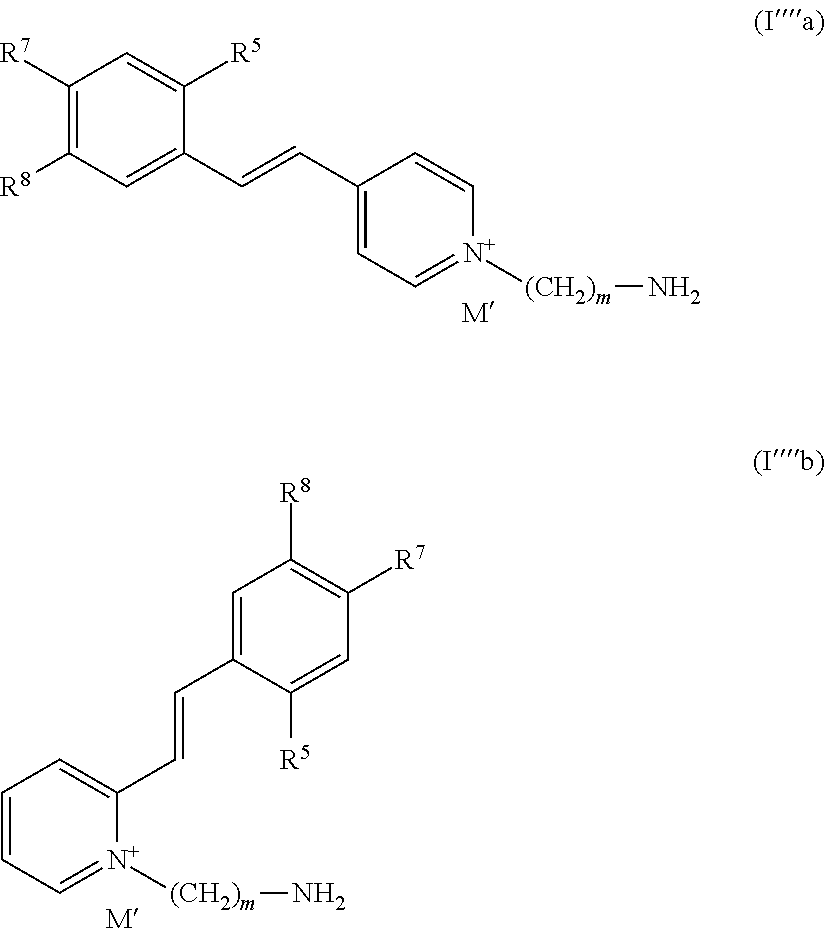
in which formulae (I″″a) and (I″″b) R5, R7, R8 and m are as defined previously for (I′″a) and (I′″b), in particular:
-
- R5 and R8, which may be identical or different, represent a hydrogen atom or a (C1-C4)alkoxy group such as methoxy;
- R7 represents a (C1-C4)alkoxy or NR10R11 group with R10 and R11, which may be identical or different, representing a) a hydrogen atom, or b) a (C1-C8)alkyl group optionally substituted with one or more groups chosen from i) cyano, ii) (C1-C3)alkoxy, iii) hydroxyl, and iv) (C1-C3)alkylcarbonyl;
- in particular, R10 and R11, which may be identical or different, represent a hydrogen atom, or a (C1-C6)alkyl group optionally substituted with one or more hydroxyl, cyano or (C1-C3)alkylcarbonyl groups such as methyl, ethyl, butyl, isobutyl, cyanoethyl, methylcarbonylethyl, or hydroxyethyl; preferably, R10 and R11, which may be identical or different, represent a (C1-C6)alkyl group optionally substituted with one or more hydroxyl groups such as hydroxyethyl;
- m represents an integer between 1 and 18 inclusive; particularly an integer between 2 and 16 inclusive; preferentially an integer between 3 and 10; more preferentially an integer between 4 and 6; and
- M′ represents an anionic counterion, derived from a salt of an organic or mineral acid, or from an organic or mineral base that ensures the electrical neutrality of the molecule.
| R5 | R7 | R8 | m | |
| H | N(CH2CH2OH)2 | H | 2 | |
| H | N(CH2CH2OH)2 | H | 3 | |
| H | N(CH2CH2OH)2 | H | 4 | |
| H | N(CH2CH2OH)2 | H | 5 | |
| H | N(CH2CH2OH)2 | H | 6 | |
| H | N(CH2CH2OH)2 | H | 8 | |
| H | N(CH2CH2OH)2 | H | 10 | |
| H | N(CH2CH2OH)2 | H | 12 | |
| H | N(CH2CH2OH)2 | H | 14 | |
| H | N(CH2CH2OH)2 | H | 16 | |
and
| R5 | R7 | R8 | m | |
| OCH3 | OCH3 | OCH3 | 2 | |
| OCH3 | OCH3 | OCH3 | 3 | |
| OCH3 | OCH3 | OCH3 | 3 | |
| OCH3 | OCH3 | OCH3 | 4 | |
| OCH3 | OCH3 | OCH3 | 5 | |
| OCH3 | OCH3 | OCH3 | 8 | |
| OCH3 | OCH3 | OCH3 | 10 | |
| OCH3 | OCH3 | OCH3 | 12 | |
| OCH3 | OCH3 | OCH3 | 14 | |
| OCH3 | OCH3 | OCH3 | 16 | |
and also the organic or mineral acid or base salts thereof, the geometrical isomers and tautomers thereof, and the solvates thereof such as hydrates.

and also the organic or mineral acid or base salts thereof, the optical isomers, geometrical isomers and tautomers thereof, and the solvates thereof such as hydrates;
in which formula (II′a) R1, R2, Re, Rf, Rg and m are as defined previously; preferably, the amino group Rf—Re—N(Rg)— is on the carbon atom in position 3;
according to a particular embodiment of the invention, R1 and R2, which may be identical or different, represent a hydrogen atom or a (C1-C6)alkyl group, preferentially a hydrogen atom; Rg represents a (C1-C4)alkyl group, preferably a hydrogen atom; Re represents an unsubstituted (C1-C6)alkylene group, Rf represents a (di)(C1-C4)(alkyl)amino group; m represents an integer between 1 and 16 inclusive, preferentially an integer between 2 and 14 inclusive; more preferentially an integer between 3 and 12; more particularly an integer between 4 and 10.

Process for Synthesizing the Direct Dyes of the Invention:

and also the organic or mineral acid or base salts thereof, the optical isomers, geometrical isomers and tautomers thereof, and the solvates thereof such as hydrates,
in which formula (IA) G, Ra, R′a, R″a, Rb, R′b, R″b, R1, R2, M′ and m are as defined previously for (I) preferably according to (1′).

with G, Ra, R′a, R″a, Rb, R′b, R″b, R1, R2, M′ and m as defined previously.


in which G, Ra, R′a, R″a, Rb, R′b, R″b, Ri, R′i, R1, R2 and m are as defined previously for (I′).

in which formula (XX):
-
- W is a divalent C1-C6 alkylene radical optionally substituted with a hydroxyl group or a C1-C6 alkyl radical, and/or optionally interrupted with one or more heteroatoms such as oxygen or NRu;
- Rx, Ry, Rz Rt and Ru, which may be identical or different, represent a hydrogen atom or a C1-C6 alkyl, C1-C6 hydroxyalkyl or C1-C6 aminoalkyl radical.


Procedure:

Procedure:

Procedure:

-
- 7.3 g of 1-(2-aminoethyl)-4-methylpyridinium chloride hydrochloride (0.035 mol)
- 8 g of 4-[bis(2-hydroxyethyl)amino]benzaldehyde (0.038 mol).

-
- 10 g of 1-(3-aminopropyl)-4-methylpyridinium chloride hydrochloride (0.045 mol)
- 10.3 g of 4-[bis(2-hydroxyethyl)amino]benzaldehyde (0.049 mol).

-
- 10 g of 1-(5-aminopentyl)-4-methylpyridinium chloride hydrochloride (0.040 mol)
- 9.2 g of 4-[bis(2-hydroxyethyl)amino]benzaldehyde (0.044 mol).
ΔE=√{square root over ((L*−L 0*)2+(a*−a o*)2+(b*−b o*)2)} (i)
C*=√{square root over ((a*)2+(b*)2)}
in which a* and b* represent the values measured on locks of treated hair. The greater the value of ΔE, the greater the colour chromaticity.
-
- Example 1: 1-(6-aminohexyl)-4-[2-{4-[bis(2-hydroxyethyl)amino]phenyl}ethenyl]pyridinium chloride hydrochloride (0.001095 mol)
- Example 2: 1-(2-aminoethyl)-4-[2-{4-[bis(2-hydroxyethyl)amino]phenyl}ethenyl]pyridinium chloride hydrochloride (0.001249 mol)
- Example 3: 1-(3-aminopropyl)-4-[2-{4-[bis(2-hydroxyethyl)amino]phenyl}ethenyl]pyridinium chloride hydrochloride (0.001207 mol)
- Example 4: 1-(5-aminopentyl)-4-[2-{4-[bis(2-hydroxyethyl)amino]phenyl}ethenyl]pyridinium chloride hydrochloride (0.00113 mol)
Application of Cleansing Shampoo (so as to Obtain Clean Hair): - 1. Weigh out 0.4 ml of cleansing shampoo per gram of hair in a watch glass.
- 2. Wet the lock with tap water, passing the lock between the fingers for 5 seconds.
- 3. Drain the lock of hair dry between two fingers.
- 4. Apply the cleansing shampoo along the lock of hair (from the root to the end homogeneously).
- 5. Massage the lock gently between two fingers along its length (so as to work the shampoo into a lather) for 15 seconds from top to bottom (without making knots).
- 6. Rinse under tap water for 10 seconds, passing the lock between the fingers.
- 7. Drain the lock dry between two fingers.
- 8. Comb the lock.
- 9. Dry the lock with a hairdryer.

-
- 1. Prepare the dye solution at 0.5% w/w in water (10 ml of solution).
- 2. Place a 1 g lock in a channel.
- 3. Apply the solution of the test product along the lock of hair (from the root to the end homogeneously; Bath ratio: 1 g of lock of hair per 10 g of composition, BR=10).
- 4. Leave the composition to stand on the lock for 20 minutes on a hotplate at 25° C.
- 5. Rinse under tap water for 10 seconds, passing the lock between the fingers.
- 6. Drain the lock dry between two fingers.
- 7. Comb the lock.
- 8. Dry the lock under a hood.
Application of Shampoo (Persistence): - 1. Weigh out 0.4 ml of DOP camomile shampoo per gram of hair in a watch glass.
- 2. Wet the lock with tap water, passing the lock between the fingers for 5 seconds.
- 3. Drain the lock of hair dry between two fingers.
- 4. Apply the cleansing shampoo along the lock of hair (from the root to the end homogeneously).
- 5. Massage the lock gently between two fingers along its length (so as to work the shampoo into a lather) for 15 seconds from top to bottom (without making knots).
- 6. Rinse under tap water for 10 seconds, passing the lock between the fingers.
- 7. Drain the lock dry between two fingers.
- 8. Comb the lock.
- 9. Repeat steps 4 to 8 as many times as there are shampoo washes to be performed (5, 10 and 20 shampoo washes).
- 10. Dry the lock under a hood.
| TABLE 1 | ||||||
| No. of | ||||||
| shampoo | L* | a* | b* | ΔE* | ||
| Product | washes | (D65) | (D65) | (D65) | (D65) | |
| Comparative* |
| Compound 5 | 0 | 32.52 | 39.53 | 26.50 | 44.21 | |
| Compound 5 | 10 | 35.85 | 40.87 | 29.76 | 45.46 |
| Invention** |
| |
0 | 36.37 | 44.19 | 37.12 | 51.52 | |
| |
10 | 38.42 | 46.87 | 38.15 | 53.79 | |
| |
20 | 40.11 | 45.93 | 41.37 | 54.41 | |
| |
0 | 27.23 | 34.54 | 22.53 | 41.29 | |
| |
10 | 34.22 | 45.49 | 31.89 | 50.80 | |
| |
20 | 36.60 | 49.11 | 36.48 | 55.27 | |
| Compound 3 | 0 | 33.26 | 44.15 | 32.21 | 50.10 | |
| Compound 3 | 10 | 38.15 | 47.52 | 36.26 | 53.47 | |
| Compound 3 | 20 | 37.96 | 46.30 | 37.86 | 53.26 | |
| Compound 4 | 0 | 35.03 | 39.67 | 32.29 | 45.83 | |
| Compound 4 | 10 | 39.68 | 46.57 | 39.29 | 53.88 | |
| Compound 4 | 20 | 41.97 | 46.95 | 42.83 | 55.77 | |
| * at pH 9.5 and after a reductive pretreatment, results obtained on natural grey hair containing 90% white hairs (N90W). | ||||||
| ** at spontaneous pH without reductive pretreatment, results obtained on natural grey hair containing 90% white hairs (N90W). | ||||||
| TABLE 2 | |||||
| Test compounds | L* (D65) | a* (D65) | b* (D65) | ΔE* (D65) | C* (D65) |
| Example 1 (invention) | 27.23 | 34.54 | 22.53 | 41.28 | 41.23 |
 |
48.21 | 21.84 | 19.85 | 21.91 | 29.51 |
-
- 1. Weigh out 0.4 ml of cleansing shampoo per gram of hair in a watch glass.
- 2. Wet the lock with tap water, passing the lock between the fingers for 5 seconds.
- 3. Drain the lock of hair dry between two fingers.
- 4. Apply the cleansing shampoo along the lock of hair (from the root to the end homogeneously).
- 5. Massage the lock gently between two fingers along its length (so as to work the shampoo into a lather) for 15 seconds from top to bottom (without making knots).
- 6. Rinse under tap water for 10 seconds, passing the lock between the fingers.
- 7. Drain the lock dry between two fingers.
- 8. Comb the lock.
- 9. Dry the lock with a hairdryer.
Protocol for Applying the Dyes of the Invention:
Step 2: Application of the Test Product of the Invention: - 1. Prepare the solution of the dye compound of Example 1 at 0.5% w/w in water (solution A).
- 2. Place a 1 g lock in a channel.
- 3. Apply the solution of the test product along the lock of hair (from the root to the end homogeneously, BR=10).
- 4. Leave the composition to stand on the lock for 20 minutes on a hotplate at 37° C.
- 5. Rinse under tap water for 10 seconds, passing the lock between the fingers.
- 6. Drain the lock dry between two fingers.
-
- 1. Weigh out 0.4 ml of DOP camomile shampoo per gram of hair in a watch glass.
- 2. Wet the lock with tap water, passing the lock between the fingers for 5 seconds.
- 3. Drain the lock of hair dry between two fingers.
- 4. Apply the cleansing shampoo along the lock of hair (from the root to the end homogeneously).
- 5. Massage the lock gently between two fingers along its length (so as to work the shampoo into a lather) for 15 seconds from top to bottom (without making knots).
- 6. Rinse under tap water for 10 seconds, passing the lock between the fingers.
- 7. Drain the lock dry between two fingers.
- 8. Comb the lock.
- 9. Repeat steps 4 to 8 as many times as there are shampoo washes to be performed (1 to 10 shampoo washes).
- 10. Dry the lock under a hood.
-
- 1. Prepare the solution of the blue direct dye at 0.5% w/w in water (solution A).
- 2. Place a 1 g lock in a channel.
- 3. Apply the solution of the test product along the lock of hair (from the root to the end homogeneously, bath ratio of 10).
- 4. Leave the composition to stand on the lock for 20 minutes on a hotplate at 37° C.
- 5. Rinse under tap water for 10 seconds, passing the lock between the fingers.
- 6. Drain the lock dry between two fingers.

(absorption wavelength λmax=624 nm)
| TABLE 3 | ||||||
| No. | ||||||
| shampoo | a* | b* | ΔE* | |||
| Product | pH | washes | L* (D65) | (D65) | (D65) | (D65) |
| Basic Blue | spontan- | 1 | 18.89 | 0.73 | −10.13 | — |
| 124 | eous | |||||
| Basic Blue | 8.5 | 0 | 16.15 | 2.14 | −0.86 | 35.50 |
| 124 + | ||||||
| compound | ||||||
| of Example 1 | ||||||
| Basic Blue | 8.5 | 5 | 16.30 | 1.45 | −2.48 | 35.94 |
| 124 + | ||||||
| compound of | ||||||
| Example 1 | ||||||
| Basic Blue | 8.5 | 10 | 16.71 | 1.26 | −2.98 | 35.74 |
| 124 + | ||||||
| |
||||||
Claims (17)


Applications Claiming Priority (3)
| Application Number | Priority Date | Filing Date | Title |
|---|---|---|---|
| FR1562838 | 2015-12-18 | ||
| FR1562838A FR3045359B1 (en) | 2015-12-18 | 2015-12-18 | COMPOSITION FOR COLORING KERATINIC FIBERS, INCLUDING A DIRECT STYRYL OR NAPHYLAMIDE DYE WITH AMINOALKYL FUNCTION, Dyeing process and dye |
| PCT/EP2016/081341 WO2017103045A1 (en) | 2015-12-18 | 2016-12-16 | Composition for dyeing keratin fibres, comprising a styryl or naphthylamide direct dye bearing an aminoalkyl function, dyeing process and dye |
Publications (2)
| Publication Number | Publication Date |
|---|---|
| US20200163855A1 US20200163855A1 (en) | 2020-05-28 |
| US10993899B2 true US10993899B2 (en) | 2021-05-04 |
Family
ID=55752432
Family Applications (1)
| Application Number | Title | Priority Date | Filing Date |
|---|---|---|---|
| US16/061,907 Expired - Fee Related US10993899B2 (en) | 2015-12-18 | 2016-12-16 | Composition for dyeing keratin fibres, comprising a styryl or naphthylamide direct dye bearing an aminoalkyl function, dyeing process and dye |
Country Status (7)
| Country | Link |
|---|---|
| US (1) | US10993899B2 (en) |
| EP (1) | EP3389617A1 (en) |
| KR (2) | KR20180095039A (en) |
| CN (1) | CN108366949A (en) |
| BR (1) | BR112018011898B1 (en) |
| FR (1) | FR3045359B1 (en) |
| WO (1) | WO2017103045A1 (en) |
Citations (5)
| Publication number | Priority date | Publication date | Assignee | Title |
|---|---|---|---|---|
| FR2788432A1 (en) | 1999-01-19 | 2000-07-21 | Oreal | USE FOR DIRECT DYING OF KERATINIC FIBERS FROM A COMBINATION OF TWO CATIONIC DYES |
| FR2912137A1 (en) | 2007-02-05 | 2008-08-08 | Oreal | Fluorescent dyes comprising new 2-aminophenylvinyl-1-sulfanylalkyl-pyridinium salts, used in compositions for the treatment of keratin fibres, especially for lightening dark hair |
| US7988741B2 (en) | 2006-03-24 | 2011-08-02 | L'oreal S.A. | Specific naphthalmide-type dyes, dye composition comprising at least one such dye, process using same and uses |
| CN103525117A (en) | 2013-10-30 | 2014-01-22 | 苏州大学 | Hemicyanine fluorescent dye and preparation method and application thereof |
| US20140041132A1 (en) * | 2011-02-25 | 2014-02-13 | L'oreal | Composition for dyeing keratin fibres comprising a direct dye bearing a disulphide/thiol function, a non-cellulose-based thickening polymer, an alkaline agent and a reducing agent |
Family Cites Families (2)
| Publication number | Priority date | Publication date | Assignee | Title |
|---|---|---|---|---|
| US7384388B2 (en) * | 2004-04-13 | 2008-06-10 | New York University | Styryl dyes with linker |
| ATE508170T1 (en) * | 2006-03-24 | 2011-05-15 | Oreal | DYEING COMPOSITION COMPRISING A THIOL/DISULFIDE LUMINOUS DYE WITH AMINE GROUPS AND AN INTERNAL CATIONIC CHARGE AND METHOD FOR LIGHTENING KERATIN MATERIAL USING THIS DYE |
-
2015
- 2015-12-18 FR FR1562838A patent/FR3045359B1/en not_active Expired - Fee Related
-
2016
- 2016-12-16 CN CN201680074261.5A patent/CN108366949A/en active Pending
- 2016-12-16 BR BR112018011898-2A patent/BR112018011898B1/en not_active IP Right Cessation
- 2016-12-16 EP EP16819511.3A patent/EP3389617A1/en not_active Withdrawn
- 2016-12-16 KR KR1020187020495A patent/KR20180095039A/en not_active Ceased
- 2016-12-16 WO PCT/EP2016/081341 patent/WO2017103045A1/en not_active Ceased
- 2016-12-16 KR KR1020207035490A patent/KR20200140947A/en not_active Withdrawn
- 2016-12-16 US US16/061,907 patent/US10993899B2/en not_active Expired - Fee Related
Patent Citations (5)
| Publication number | Priority date | Publication date | Assignee | Title |
|---|---|---|---|---|
| FR2788432A1 (en) | 1999-01-19 | 2000-07-21 | Oreal | USE FOR DIRECT DYING OF KERATINIC FIBERS FROM A COMBINATION OF TWO CATIONIC DYES |
| US7988741B2 (en) | 2006-03-24 | 2011-08-02 | L'oreal S.A. | Specific naphthalmide-type dyes, dye composition comprising at least one such dye, process using same and uses |
| FR2912137A1 (en) | 2007-02-05 | 2008-08-08 | Oreal | Fluorescent dyes comprising new 2-aminophenylvinyl-1-sulfanylalkyl-pyridinium salts, used in compositions for the treatment of keratin fibres, especially for lightening dark hair |
| US20140041132A1 (en) * | 2011-02-25 | 2014-02-13 | L'oreal | Composition for dyeing keratin fibres comprising a direct dye bearing a disulphide/thiol function, a non-cellulose-based thickening polymer, an alkaline agent and a reducing agent |
| CN103525117A (en) | 2013-10-30 | 2014-01-22 | 苏州大学 | Hemicyanine fluorescent dye and preparation method and application thereof |
Non-Patent Citations (2)
| Title |
|---|
| International Search Report for Application No. PCT/EP2016/081341, dated May 16, 2017/. |
| STIC Search Report dated Mar. 17, 2020. * |
Also Published As
| Publication number | Publication date |
|---|---|
| BR112018011898A2 (en) | 2018-11-27 |
| FR3045359B1 (en) | 2020-10-30 |
| WO2017103045A1 (en) | 2017-06-22 |
| BR112018011898B1 (en) | 2021-08-24 |
| CN108366949A (en) | 2018-08-03 |
| KR20180095039A (en) | 2018-08-24 |
| FR3045359A1 (en) | 2017-06-23 |
| KR20200140947A (en) | 2020-12-16 |
| US20200163855A1 (en) | 2020-05-28 |
| EP3389617A1 (en) | 2018-10-24 |
Similar Documents
| Publication | Publication Date | Title |
|---|---|---|
| ES2363100T3 (en) | STAINING COMPOSITION CONTAINING A THIOL / DISULFIDE FLUORESCENT DYE WITH AMINATED GROUPS AND WITH INTERNAL CATIONIC CHARGE AND LIGHTENING PROCEDURE OF KERATINAL MATTERS FROM THIS COLORANT. | |
| EP3558254B1 (en) | Process for dyeing keratin fibres using at least one particular 2- or 4-azopyridinium dye and at least one fluorescent dye | |
| US11278482B2 (en) | Process for dyeing keratin materials using at least one blue, purple or green dye and at least one disulfide, thiol or protected thiol fluorescent dye | |
| US10959930B2 (en) | Process for dyeing keratin fibres using at least one particular triarylmethane dye and at least one fluorescent dye | |
| US10980729B2 (en) | Process for dyeing keratin fibres using at least one particular azinium dye and at least one fluorescent dye | |
| WO2017103038A2 (en) | Composition for dyeing keratin fibres, comprising a styryl or naphthylamide direct dye bearing a hydroxyalkyl function, dyeing process and dye | |
| JP6894514B2 (en) | A method for dyeing keratin fibers using at least one specific 2-azo (benzo) imidazolium dye and at least one fluorescent dye. | |
| US20200163855A1 (en) | Composition for dyeing keratin fibres, comprising a styryl or naphthylamide direct dye bearing an aminoalkyl function, dyeing process and dye | |
| CN103998530A (en) | Triaromatic azomethine direct dyes comprising at least one unit derived from resorcinol, dyeing composition, method and use | |
| WO2018109153A1 (en) | Dissymmetric azomethine direct dyes and process for their preparation, cosmetic composition comprising at least one such dye and use thereof | |
| WO2011110627A1 (en) | New cationic 7-amino-1,2,3,4- tetrahydroquinolines, deying composition comprising a cationic 7-amino-1,2,3,4-tetrahydroquinoline, method and uses. | |
| EP2791106A1 (en) | Particular quinone direct dyes, dye composition comprising at least one such dye, implementation process therefor and use thereof | |
| US20220016009A1 (en) | Symmetric azomethine direct dyes, process for their preparation, cosmetic composition comprising at least one such dye and use thereof |
Legal Events
| Date | Code | Title | Description |
|---|---|---|---|
| FEPP | Fee payment procedure |
Free format text: ENTITY STATUS SET TO UNDISCOUNTED (ORIGINAL EVENT CODE: BIG.); ENTITY STATUS OF PATENT OWNER: LARGE ENTITY |
|
| AS | Assignment |
Owner name: L'OREAL, FRANCE Free format text: ASSIGNMENT OF ASSIGNORS INTEREST;ASSIGNORS:BLAISE, CHRISTIAN;MESSAVUSSU, ABEL;SIGNING DATES FROM 20180514 TO 20180525;REEL/FRAME:053823/0628 |
|
| STPP | Information on status: patent application and granting procedure in general |
Free format text: PUBLICATIONS -- ISSUE FEE PAYMENT RECEIVED |
|
| STPP | Information on status: patent application and granting procedure in general |
Free format text: WITHDRAW FROM ISSUE AWAITING ACTION |
|
| STPP | Information on status: patent application and granting procedure in general |
Free format text: NOTICE OF ALLOWANCE MAILED -- APPLICATION RECEIVED IN OFFICE OF PUBLICATIONS |
|
| STPP | Information on status: patent application and granting procedure in general |
Free format text: PUBLICATIONS -- ISSUE FEE PAYMENT VERIFIED |
|
| STCF | Information on status: patent grant |
Free format text: PATENTED CASE |
|
| FEPP | Fee payment procedure |
Free format text: MAINTENANCE FEE REMINDER MAILED (ORIGINAL EVENT CODE: REM.); ENTITY STATUS OF PATENT OWNER: LARGE ENTITY |
|
| LAPS | Lapse for failure to pay maintenance fees |
Free format text: PATENT EXPIRED FOR FAILURE TO PAY MAINTENANCE FEES (ORIGINAL EVENT CODE: EXP.); ENTITY STATUS OF PATENT OWNER: LARGE ENTITY |
|
| STCH | Information on status: patent discontinuation |
Free format text: PATENT EXPIRED DUE TO NONPAYMENT OF MAINTENANCE FEES UNDER 37 CFR 1.362 |
|
| FP | Lapsed due to failure to pay maintenance fee |
Effective date: 20250504 |