US10993557B2 - Pressure management warming headrest - Google Patents

Pressure management warming headrest Download PDF

Info

Publication number
US10993557B2
US10993557B2 US16/054,005 US201816054005A US10993557B2 US 10993557 B2 US10993557 B2 US 10993557B2 US 201816054005 A US201816054005 A US 201816054005A US 10993557 B2 US10993557 B2 US 10993557B2
Authority
US
United States
Prior art keywords
layer
pressure management
heating
headrest
heating element
Prior art date
Legal status (The legal status is an assumption and is not a legal conclusion. Google has not performed a legal analysis and makes no representation as to the accuracy of the status listed.)
Active, expires
Application number
US16/054,005
Other versions
US20200037798A1 (en
Inventor
Richard P. Nardo
Andrew M. D. Moss
Current Assignee (The listed assignees may be inaccurate. Google has not performed a legal analysis and makes no representation or warranty as to the accuracy of the list.)
American Sterilizer Co
Original Assignee
American Sterilizer Co
Priority date (The priority date is an assumption and is not a legal conclusion. Google has not performed a legal analysis and makes no representation as to the accuracy of the date listed.)
Filing date
Publication date
Application filed by American Sterilizer Co filed Critical American Sterilizer Co
Assigned to AMERICAN STERILIZER COMPANY reassignment AMERICAN STERILIZER COMPANY ASSIGNMENT OF ASSIGNORS INTEREST (SEE DOCUMENT FOR DETAILS). Assignors: MOSS, ANDREW M.D., NARDO, RICHARD P.
Priority to US16/054,005 priority Critical patent/US10993557B2/en
Priority to CA3072488A priority patent/CA3072488C/en
Priority to MX2020001533A priority patent/MX2020001533A/en
Priority to PCT/US2018/045310 priority patent/WO2019032420A1/en
Priority to AU2018312928A priority patent/AU2018312928B2/en
Priority to EP18843488.0A priority patent/EP3664761B1/en
Publication of US20200037798A1 publication Critical patent/US20200037798A1/en
Publication of US10993557B2 publication Critical patent/US10993557B2/en
Application granted granted Critical
Active legal-status Critical Current
Adjusted expiration legal-status Critical

Links

Images

Classifications

    • AHUMAN NECESSITIES
    • A47FURNITURE; DOMESTIC ARTICLES OR APPLIANCES; COFFEE MILLS; SPICE MILLS; SUCTION CLEANERS IN GENERAL
    • A47GHOUSEHOLD OR TABLE EQUIPMENT
    • A47G9/00Bed-covers; Counterpanes; Travelling rugs; Sleeping rugs; Sleeping bags; Pillows
    • A47G9/10Pillows
    • A47G9/1036Pillows with cooling or heating means
    • AHUMAN NECESSITIES
    • A47FURNITURE; DOMESTIC ARTICLES OR APPLIANCES; COFFEE MILLS; SPICE MILLS; SUCTION CLEANERS IN GENERAL
    • A47GHOUSEHOLD OR TABLE EQUIPMENT
    • A47G9/00Bed-covers; Counterpanes; Travelling rugs; Sleeping rugs; Sleeping bags; Pillows
    • A47G9/10Pillows
    • AHUMAN NECESSITIES
    • A61MEDICAL OR VETERINARY SCIENCE; HYGIENE
    • A61GTRANSPORT, PERSONAL CONVEYANCES, OR ACCOMMODATION SPECIALLY ADAPTED FOR PATIENTS OR DISABLED PERSONS; OPERATING TABLES OR CHAIRS; CHAIRS FOR DENTISTRY; FUNERAL DEVICES
    • A61G13/00Operating tables; Auxiliary appliances therefor
    • A61G13/10Parts, details or accessories
    • A61G13/12Rests specially adapted therefor; Arrangements of patient-supporting surfaces
    • A61G13/1205Rests specially adapted therefor; Arrangements of patient-supporting surfaces for specific parts of the body
    • A61G13/121Head or neck
    • AHUMAN NECESSITIES
    • A47FURNITURE; DOMESTIC ARTICLES OR APPLIANCES; COFFEE MILLS; SPICE MILLS; SUCTION CLEANERS IN GENERAL
    • A47GHOUSEHOLD OR TABLE EQUIPMENT
    • A47G9/00Bed-covers; Counterpanes; Travelling rugs; Sleeping rugs; Sleeping bags; Pillows
    • A47G9/10Pillows
    • A47G2009/1018Foam pillows
    • AHUMAN NECESSITIES
    • A61MEDICAL OR VETERINARY SCIENCE; HYGIENE
    • A61GTRANSPORT, PERSONAL CONVEYANCES, OR ACCOMMODATION SPECIALLY ADAPTED FOR PATIENTS OR DISABLED PERSONS; OPERATING TABLES OR CHAIRS; CHAIRS FOR DENTISTRY; FUNERAL DEVICES
    • A61G2203/00General characteristics of devices
    • A61G2203/30General characteristics of devices characterised by sensor means
    • A61G2203/46General characteristics of devices characterised by sensor means for temperature

Definitions

  • the present invention relates generally to a pressure management device, and more particularly to a pressure management device with an integrated warming apparatus.
  • occiput pressure management devices are typically donut-shaped, U-shaped, stepped conformal, and T-shaped; made of materials, including, but not limited to, gel and foam; and sized for pediatric, adult, and bariatric patients.
  • Several existing occipital pressure management devices have a round hole or recess to provide pressure management for the occiput.
  • the round hole or recess is not best suited to the anatomy of the human head in either the supine or side-laying positions. Accordingly, there are drawbacks to existing surgical headrests with respect to pressure management.
  • the hypothalamus region of the brain is the physiological control center for human temperature regulation. Warming of the hypothalamus can actuate the Arterio-venous anastomoses (AVA) causing more blood to flow to the extremities and promote future warming of the patient under anesthesia [Arterio-venous anastomoses in the human skin and their role in temperature control, Temperature (Austin). 2016 January-March; 3(1): 92-103. Published online 2015 Oct. 12]. Furthermore, studies of human anatomy have shown that the most important areas of the head to warm are the vascular region of the neck, sides, and the back of the head.
  • AVA Arterio-venous anastomoses
  • the present invention provides a pressure management device with an integrated warming apparatus that overcomes drawbacks of prior art surgical headrests.
  • a pressure management warming headrest comprising a spacer layer; a heating layer including a heating member having a heating element; and a pressure management layer comprised of at least one foam layer, wherein said spacer layer, heating layer and pressure management layer are bonded together.
  • a pressure management warming headrest system comprising: a pressure management warming headrest and a controller for controlling operation of the pressure management warming headrest.
  • the pressure management warming headrest comprises a spacer layer, a heating layer including a heating member having a heating element, and a pressure management layer comprised of at least one foam layer, wherein said spacer layer, heating layer and pressure management layer are bonded together.
  • An advantage of the present invention is the provision of a pressure management warming headrest that combines a pressure management device with an integrated warming apparatus.
  • Another advantage of the present invention is the provision of a pressure management warming headrest that accommodates patients in both supine and side-laying positions.
  • Another advantage of the present invention is the provision of a pressure management warming headrest that provides convective warming of a patient.
  • Still another advantage of the present invention is the provision of a pressure management warming headrest that can be stored in a minimal volume storage package.
  • Still another advantage of the present invention is the provision of a pressure management warming headrest that can be easily adapted to a size accommodating bariatric, adult, pediatric, and neonatal patients.
  • FIG. 1 is a top perspective view of a pressure management warming headrest (PMWH), according to an embodiment of the present invention
  • FIG. 2 is bottom perspective view of the PMWH shown in FIG. 1 ;
  • FIG. 3 shows the PMWH of FIG. 1 as part of a PMWH system according to an embodiment of the present invention
  • FIG. 4 is a cross-sectional view of the PMWH, as shown in FIG. 3 ;
  • FIG. 5 is an exploded view of the PMWH shown in FIG. 1 ;
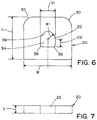
  • FIG. 6 is a top plan view of a high density (HD) foam layer of the PMWH shown in FIG. 1 ;
  • FIG. 7 is a side plan view of the high density (HD) foam layer of the PMWH shown in FIG. 1 ;
  • FIG. 8 is a top plan view of a heating layer of the PMWH shown in FIG. 1 ;
  • FIG. 9 is an enlarged view of a connector interface of the heating layer shown in FIG. 8 , as coupled with a controller cable interface according to an embodiment of the present invention.
  • FIG. 10 is a perspective view of the controller cable interface of the PWMH system shown in FIG. 3 .
  • FIGS. 1-5 show a pressure management warming headrest (PMWH) 10 according to an embodiment of the present invention.
  • PMWH 10 is generally comprised of a high density (HD) foam layer 20 , a low density (LD) foam layer 40 , a heating layer 50 , a spacer layer 100 , and a head cover 120 .
  • head cover 120 is omitted from FIGS. 1, 2 and 5 for greater clarity.
  • PMWH 10 is a component of a PMWH system 5 shown in FIG. 3 .
  • HD foam layer 20 has a central opening 22 , a lower surface 24 , and an upper surface 26 , as best seen in FIG. 5 .
  • HD foam layer 20 takes the form of a high density polyurethane foam, such as 2-inch thick SENL polyether polyurethane foam from William T. Burnett & Co. having a density of 2+/ ⁇ 10% lbs/ft 3 and an indentation load deflection (ILD) of 26 lbs/50 in 2 to 35 lbs/50 in 2 .
  • ILD indentation load deflection
  • rear corners 30 of HD foam layer 20 are curved to accommodate head cover 120 , described below.
  • rear corners 30 may be a curved surface defined by a radius of 63.5 mm.
  • opening 22 is comprised of a substantially rectangular region 34 and a semi-circular region 36 .
  • rectangular region 34 is defined, in part, by a pair of curved surfaces 38 .
  • curved surfaces 38 may be defined by a radius of 19.1 mm.
  • Exemplary dimensions for the illustrated embodiment are as follows:
  • the dimensions for opening 22 are preferably selected to facilitate superior pressure management for patients oriented on PMWH 10 in both supine and side-laying positions.
  • LD foam layer 40 has a central opening 42 , a lower surface 44 , and an upper surface 46 .
  • LD foam layer 40 takes the form of a low density polyurethane foam, such as Flexible Foam Products (#10030) 1-inch thick 100% open cell polyurethane foam having a density of 0.9-1 lbs/ft 3 and an indentation load deflection (ILD) of 25 lbs/50 in 2 to 35 lbs/50 in 2 .
  • LD foam layer 40 has substantially the same shape and dimensions as HD foam layer 20 , except thickness T is reduced.
  • the HD foam layer 20 and LD foam layer 40 in combination, provide a pressure management layer for PMWH 10 .
  • the pressure management layer may be comprised of one or more foam layers.
  • Heating layer 50 is generally comprised of a flexible heating member 60 and a connector interface 70 , as best seen in FIGS. 1 and 5 .
  • flexible heating member 60 is comprised of a heating element in the form of a conductive material that is applied to a flexible substrate (e.g., polyester (PET), polyimide (PI), polycarbonate (PC), and thermoplastic polyurethanes (TPU)).
  • the flexible substrate provides support for the heating element and serves as a dielectric.
  • the heating element is sandwiched between a pair of the flexible substrates.
  • the heating element may be applied to the flexible substrate by a screen printing process or other well-known fluid deposition processes, such as gravure/flexographic, ink jet, controlled spray, and the like.
  • the flexible substrate is a PET substrate having a thickness in the range of 0.003 inch to 0.010 inch.
  • the heating element takes the form of a positive temperature coefficient (PTC) material (e.g., a PTC heating film or PTC thermistor).
  • PTC positive temperature coefficient
  • a PTC heating element is typically made with a thermoplastic PTC carbon ink.
  • a PTC heating element is a self-regulating heating element because as the PTC heating element warms up, its resistance increases (i.e., conductivity decreases), thereby reducing power. Accordingly, a PTC heating element is capable of regulating its temperature without any outside controls.
  • the PTC heating element is preferably configured with a watt density (watts/area) such that the size of the heating element provides a thermal flux that matches the heat loss of a patient.
  • heating member 60 is comprised of a heating element applied to a PET substrate (e.g., having a thickness of 0.003 inch).
  • the heating element takes the form of a layer of conductive particles.
  • the conductive particles may be applied to the substrate by processes such as screen printing, gravure/flexographic, ink jet, controlled spray, and the like.
  • the conductive particles can take several forms, including, but not limited to, carbon ink (e.g., Engineered Conductive Materials CI-2002 Series), carbon nanotube, graphite, and a carbon-based PTC resistor paste (PTC ink), such as DuPont 7292 PTC Carbon Resister.
  • carbon ink e.g., Engineered Conductive Materials CI-2002 Series
  • PTC ink carbon-based PTC resistor paste
  • PTC ink provides a safety benefit by allowing PMWH 10 to have a resistance magnification effect at 45° C. which is the desired heating temperature for spacer layer 100 to achieve a desired 39° C. patient surface contact temperature.
  • carbon is a desirable material since it allows for radiolucency.
  • heating member 60 also includes a silver bus bar of interdigitated fingers to bring current to the PTC carbon resistor ink that serves as the heating element.
  • the silver bus bar is formed on the substrate by screen printing.
  • heating member 60 is silkscreened for labelling, and die-cut using a steel-ruled die (or alternatively a laser, a water jet, or the like) to form a spiral 66 for pressure management, as best seen in FIG. 8 .
  • Spiral 66 has a corresponding gap 68 (e.g., approximately 2 mm).
  • the die cutting also forms a circular center disk 62 having a slit 64 (e.g., 1 inch) for additional pressure management.
  • Slit 64 preferably extends along the direction of the electron path, as shown in FIG. 8 . However, slit 64 may be oriented orthogonal to the electron path with perforations in the heating element to control undesirable electron flow. It should be appreciated that die-cutting heating member 60 in the manner described above allows the other layers of PMWH 10 to move, thereby reducing pressure on the patient's tissues.
  • slit 64 may be replaced with a hole, thereby making center disk 62 ring-shaped.
  • the spiral configuration preferably has a double start helix so that positive and negative terminal connections can be provided at a peripheral outer exposed end of heating member 60 for easier connection with a controller.
  • This configuration also eliminates the need to locate copper connecting wires within an X-ray zone.
  • heating element density (Watts/area) that is less than 115 W/m 2 .
  • the total heating area of heating element is 0.055 m 2 . Therefore, wattage is 6.325 W for this embodiment of the present invention.
  • the wattage of heating member 60 according to an embodiment of the present invention may be in the range of about 5 W to 45 W.
  • heating member 60 has been described herein with respect to a PTC heating element, it is contemplated that other types of heating elements, including those that are not self-regulating may be implemented in connection with the present invention. Furthermore, it is contemplated that according to alternative embodiments of the present invention heating member 60 may be die-cut into forms other than the illustrated spiral shape.
  • Connector interface 70 of heating layer 50 will now be described with particular reference to FIGS. 8 and 9 .
  • Connector interface 70 is comprised of a conductive layer (e.g., silver) sandwiched between two flexible substrates.
  • the conductive layer is electrically connected with the heating element of heating member 60 .
  • the substrates may be formed of the same material as the substrates described above in connection with heating member 60 (e.g., PET).
  • Holes are formed in the substrates and conductive layer to receive positive and negative terminals 72 , 74 .
  • positive and negative terminals 72 , 74 take the form of studs or snaps that are crimped onto the holes. It is contemplated that terminals 72 , 74 may take other forms, including, alligator clips or CrimpFlexTM contacts that are crimped through the PET substrate into the conductive inks forming the conductive layer.
  • Connector interface also includes an alignment hole 78 (e.g., 5 mm) and a thermal pad 80 which serves as a proxy for the temperature of the heating element of heating member 60 .
  • thermal pad 80 takes the form of screen printed carbon and silver sandwiched by dielectric substrates.
  • the area of thermal pad 80 is selected to have substantially the same thermal wattage density as the heating area of the heating element. Therefore, a costly temperature sensor does not need to be an integral component of PMWH 10 , thereby making PMWH 10 less costly to implement as a disposable article.
  • thermal pad 80 is a square having side dimensions of 5-6 mm.
  • Spacer layer 100 functioning as a comfort layer, includes a lower surface 104 and an upper surface 106 .
  • spacer layer 100 is formed of a spacer fabric, such as Muller Textil GmbH 3Mesh® three-dimensional spacer knit fabric T6010-1000 or 3Mesh® three-dimensional spacer knit fabric T5975-1000.
  • the spacer fabric provides pressure immersion and comfort to the touch.
  • spacer layer 100 has a thickness of approximately 10 mm, but can be increased to allow for better pressure management. While an increased layer thickness increases thermal resistance, this can be accommodated by increasing the power to heating member 60 to allow for the same resultant patient contact temperature.
  • 3Mesh® spacer fabric has a substantially consistent temperature with a drop of (0.25 C) for both the compressed and uncompressed state.
  • spacer layer 100 has substantially the same shape and dimensions as HD foam layer 20 , except thickness T is reduced and a central opening is omitted.
  • HD foam layer 20 , LD foam layer 40 , heating layer 50 and spacer layer 100 are bonded to each other by use an adhesive, such as SIMALFA® water-based adhesive, 3MTM Super77TM multipurpose spray adhesive, or Claire® Mist Adhesive. Accordingly, thin layers of adhesive (not shown) are located between these layers. It should be appreciated that the adhesive may be applied to all or only portions of the layer surfaces.
  • an adhesive such as SIMALFA® water-based adhesive, 3MTM Super77TM multipurpose spray adhesive, or Claire® Mist Adhesive. Accordingly, thin layers of adhesive (not shown) are located between these layers. It should be appreciated that the adhesive may be applied to all or only portions of the layer surfaces.
  • head cover 120 will now be described with reference to FIGS. 3 and 4 .
  • head cover 120 is made of a lightweight, non-woven material such as an air-laid non-woven material. Air-laid non-woven materials are preferable since they are more thermally resistive than carded non-woven materials.
  • a 5 mil air-laid polyolefin fabric provides a thermal resistance of approximately 0.32 R ([M 2 K]/W) which optimizes the insulation value based on the maximum desired thickness of the non-woven material.
  • Head cover 120 is stretched over a patient's head to capture and trap convective warming heat.
  • Other suitable materials for head cover 120 include olefin and polypropylene.
  • the flat pattern unsewn shape of head cover 120 is circular with a diameter of 36 inches.
  • Head cover 120 includes an elastic gather 130 stitched into the round edge to keep it gathered around a patient's face.
  • Elastic gather 130 is lightly stretched during the sewing process for a finished size of 5 to 6 inches diameter when relaxed.
  • the inner surface of head cover 120 is attached to lower surface 24 of HD foam layer 20 using an adhesive 15 , as illustrated in FIG. 4 .
  • the adhesive may be the same as the adhesive used for bonding together HD foam layer 20 , LD foam layer 40 , heating layer 50 , and spacer layer 100 .
  • elastic gather 130 may be replaced or supplemented with a repositionable, biocompatible adhesive bonded onto a plastic film.
  • the adhesive allows the head cover to stick to a region surrounding the patient's face.
  • Head cover 120 includes a hole 126 and a slit 128 .
  • Hole 126 aligns with the central opening 22 of HD foam layer 20 . This allows the head cover 120 to be stuffed into central opening 22 for packaging and shipping. Since PMWH 10 is typically placed on a foam table pad for usage there is negligible heat loss through hole 126 .
  • Slit 128 provides an opening that allows connector interface 70 to pass through head cover 120 for connection with controller cable interface 170 .
  • PMWH 10 may be compressed for compact storage by vacuum packing.
  • air may be removed from the foam layers to reduce volume.
  • Controller 160 is a conventional processing device programmed to control operation of PMWH 10 .
  • controller 160 may take the form of a control unit running an open loop at 36V designed to a self-regulating 39° C. max, at an ambient temperature of 22° C. Accordingly, the voltage delivered to the heating element is 36V with a desired temperature up to 39° C.
  • An open loop controller may drive a PTC ink heating element with a corresponding pulse width modulation (PWM) duty cycle to obtain a desired operating temperature, as selected at controller 160 (e.g., 35° C., 36° C., 37° C. 38° C., or 39° C.).
  • PWM pulse width modulation
  • a 20% PWM duty cycle may achieve a temperature of 35° C.
  • a 90% PWM duty cycle may achieve a temperature of 39° C.
  • temperature sensor 180 of controller cable interface 170 could be used to drive the heating element in a closed loop fashion.
  • Controller 160 includes a connecting cable having a controller cable interface 170 , as shown in FIG. 10 .
  • Controller cable interface 170 includes an insulated housing 171 having a recess dimensioned to receive connector interface 70 of heating layer 50 .
  • Controller cable interface 170 also includes positive and negative contacts 172 , 174 , alignment pin 178 , and a temperature sensor 180 .
  • Positive and negative contacts 172 , 174 respectively engage with positive and negative terminals 72 , 74 of connector interface 70 .
  • Alignment pin 178 is dimensioned to be received in alignment hole 78 to align and secure connector interface 70 to controller cable interface 170 .
  • Temperature sensor 180 is aligned with thermal pad 80 to sense the temperature of thermal pad 80 in order to determine the temperature of heating member 60 .
  • temperature sensor 180 may take the form of a thermocouple, a thermistor, or a resistance temperature detector (RTD). Temperature sensor 180 functions as a safety backup for the self-regulating heating element of heating member 60 . Accordingly, temperature sensor 180 ensures that a maximum allowable temperature is not exceeded. While controller 160 is shown herein as an external device to PMWH 10 , it is also contemplated that controller 160 may be integrated into PMWH 10 to form a non-disposable PMWH 10 .
  • PMWH 10 as shown and described herein is disclosed solely for the purpose of illustrating an embodiment of the present invention and not for limiting same. It is contemplated that alternative configurations, shapes, dimensions, and materials may be substituted for those disclosed herein without departing from the present invention.
  • alternative materials for the foam layers include, but are not limited to, elastic foam, viscoelastic foam, gel, air cells, gel, viscous fluid, water, and wool.
  • alternative shapes include, but are not limited to, donut-shaped, U-shaped, stepped conformal, and T-shaped.
  • Dimensions of the present invention may be adapted to accommodate bariatric, adult, pediatric, and neonatal patients.
  • PMWH 10 may be adapted to support portions of a patient's body other than the head.

Landscapes

  • Health & Medical Sciences (AREA)
  • General Health & Medical Sciences (AREA)
  • Otolaryngology (AREA)
  • Pulmonology (AREA)
  • Neurosurgery (AREA)
  • Engineering & Computer Science (AREA)
  • Biomedical Technology (AREA)
  • Life Sciences & Earth Sciences (AREA)
  • Animal Behavior & Ethology (AREA)
  • Public Health (AREA)
  • Veterinary Medicine (AREA)
  • Thermotherapy And Cooling Therapy Devices (AREA)

Abstract

A pressure management device with an integrated warming apparatus that provides improvements to pressure management for patients in the supine and side-laying positions, warms a patient's head during surgery; and allows for compact storage. The pressure management device includes a pressure management layer and a heating layer having a heating member that includes a heating element.

Description

This application claims the benefit of U.S. Provisional Application No. 62/542,964 filed Aug. 9, 2017, which is hereby fully incorporated herein by reference.
FIELD OF THE INVENTION
The present invention relates generally to a pressure management device, and more particularly to a pressure management device with an integrated warming apparatus.
BACKGROUND OF THE INVENTION
It is well known that the back part of the head is at risk for pressure ulcers if the patient is not properly positioned. Therefore, pressure management with respect to surgical headrests often focuses on pressure management for the occiput. There are many existing occiput pressure management devices. Such devices are typically donut-shaped, U-shaped, stepped conformal, and T-shaped; made of materials, including, but not limited to, gel and foam; and sized for pediatric, adult, and bariatric patients. Several existing occipital pressure management devices have a round hole or recess to provide pressure management for the occiput. However, it is believed that the round hole or recess is not best suited to the anatomy of the human head in either the supine or side-laying positions. Accordingly, there are drawbacks to existing surgical headrests with respect to pressure management.
With regard to patient warming, several studies have shown significant heat loss from a patient under anesthetic during surgery (0.25° C. in 15 minutes [Kimberger, O., Resistive Polymer Versus Forced-Air Warming: Comparable Heat Transfer and Core Rewarming Rates in Volunteers, International Anesthesia Research Society, V105, No. 5, November 2008], and 1.6° C. in 60 minutes [Sessler, D. I., Perioperative Heat Balance. Anesthesiology, V92, No. 2, February 2000]). Furthermore, it has been recognized that uncovered head losses for cooler temperatures can account for a large portion of a body's heat loss (50% at −4° C. [Heat Losses From the Human Head, Gerd Froese, Alan C. Burton, Journal of Applied Physiology Published 1 Mar. 1957 Vol. 10 no. 2, 235-241 DOI:]). This is particularly important in neonate and pediatric cases where physiologic thermoregulation of patients and smaller sizes relative to head sizes make it difficult to maintain normothermia [(Archives of Disease in Childhood, (1981 July) Vol. 56, No. 7, pp. 530-4. Journal code: 0372434. E-ISSN: 1468-2044. L-ISSN: 0003-9888. Report No.: NLM-PMC1627361) and (Journal of Pediatric Surgery, (1983 December) Vol. 18, No. 6, pp. 909-13. Journal code: 0052631. ISSN: 0022-3468. L-ISSN: 0022-3468)].
When exposed to a cool environment, a newborn infant responds by nonshivering thermogenesis. The increased heat production is at the expense of body fuel and energy stores. A significant quantity of heat is lost from the head because of its large surface area and the high metabolic activity of the neonatal brain. Studies have been conducted to determine whether dry cranial heat loss can be significantly reduced by covering the head with a highly insulated material, and to determine whether plastic lined head coverings decrease evaporative heat loss. A total of 46 full term and premature infants were studied. Head coverings insulated with material made of olefin and polyester reduced cranial dry heat loss by 73% and 63%. Plastic-lined head coverings reduced evaporative heat loss by 68%. The insulated and lined head coverings proved to be a simple and safe method of effectively reducing dry and evaporative heat loss [https://doi.org/10.1016/50022-3468(83)80045-1].
The hypothalamus region of the brain is the physiological control center for human temperature regulation. Warming of the hypothalamus can actuate the Arterio-venous anastomoses (AVA) causing more blood to flow to the extremities and promote future warming of the patient under anesthesia [Arterio-venous anastomoses in the human skin and their role in temperature control, Temperature (Austin). 2016 January-March; 3(1): 92-103. Published online 2015 Oct. 12]. Furthermore, studies of human anatomy have shown that the most important areas of the head to warm are the vascular region of the neck, sides, and the back of the head.
Moreover, it has also been observed that the operating room is a crowded environment with minimal storage space. Many existing pressure management devices are bulky and can take up a considerable amount of storage space. For example, foam-based pressure management devices are typically stored in cardboard boxes that take up significant amounts of limited storage space.
In view of the foregoing, there is a need for a pressure management device that provides improvements to pressure management for patients in the supine and side-laying positions; warms a patient's head during surgery; and allows for compact storage.
The present invention provides a pressure management device with an integrated warming apparatus that overcomes drawbacks of prior art surgical headrests.
SUMMARY OF THE INVENTION
In accordance with the present invention, there is provided a pressure management warming headrest comprising a spacer layer; a heating layer including a heating member having a heating element; and a pressure management layer comprised of at least one foam layer, wherein said spacer layer, heating layer and pressure management layer are bonded together.
In accordance with the present invention, there is provided a pressure management warming headrest system comprising: a pressure management warming headrest and a controller for controlling operation of the pressure management warming headrest. The pressure management warming headrest comprises a spacer layer, a heating layer including a heating member having a heating element, and a pressure management layer comprised of at least one foam layer, wherein said spacer layer, heating layer and pressure management layer are bonded together.
An advantage of the present invention is the provision of a pressure management warming headrest that combines a pressure management device with an integrated warming apparatus.
Another advantage of the present invention is the provision of a pressure management warming headrest that accommodates patients in both supine and side-laying positions.
Another advantage of the present invention is the provision of a pressure management warming headrest that provides convective warming of a patient.
Still another advantage of the present invention is the provision of a pressure management warming headrest that can be stored in a minimal volume storage package.
Still another advantage of the present invention is the provision of a pressure management warming headrest that can be easily adapted to a size accommodating bariatric, adult, pediatric, and neonatal patients.
These and other advantages will become apparent from the following description of illustrated embodiments taken together with the accompanying drawings and the appended claims.
BRIEF DESCRIPTION OF THE DRAWINGS
The invention may take physical form in certain parts and arrangement of parts, an embodiment of which will be described in detail in the specification and illustrated in the accompanying drawings which form a part hereof, and wherein:
FIG. 1 is a top perspective view of a pressure management warming headrest (PMWH), according to an embodiment of the present invention;
FIG. 2 is bottom perspective view of the PMWH shown in FIG. 1;
FIG. 3 shows the PMWH of FIG. 1 as part of a PMWH system according to an embodiment of the present invention;
FIG. 4 is a cross-sectional view of the PMWH, as shown in FIG. 3;
FIG. 5 is an exploded view of the PMWH shown in FIG. 1;
FIG. 6 is a top plan view of a high density (HD) foam layer of the PMWH shown in FIG. 1;
FIG. 7 is a side plan view of the high density (HD) foam layer of the PMWH shown in FIG. 1;
FIG. 8 is a top plan view of a heating layer of the PMWH shown in FIG. 1;
FIG. 9 is an enlarged view of a connector interface of the heating layer shown in FIG. 8, as coupled with a controller cable interface according to an embodiment of the present invention; and
FIG. 10 is a perspective view of the controller cable interface of the PWMH system shown in FIG. 3.
DETAILED DESCRIPTION OF THE INVENTION
Referring now to the drawings wherein the showings are for the purpose of illustrating embodiment(s) of the invention only and not for the purposes of limiting same, FIGS. 1-5 show a pressure management warming headrest (PMWH) 10 according to an embodiment of the present invention. In the illustrated embodiment, PMWH 10 is generally comprised of a high density (HD) foam layer 20, a low density (LD) foam layer 40, a heating layer 50, a spacer layer 100, and a head cover 120. It should be noted that head cover 120 is omitted from FIGS. 1, 2 and 5 for greater clarity. PMWH 10 is a component of a PMWH system 5 shown in FIG. 3.
HD foam layer 20 has a central opening 22, a lower surface 24, and an upper surface 26, as best seen in FIG. 5. In one embodiment of the present invention, HD foam layer 20 takes the form of a high density polyurethane foam, such as 2-inch thick SENL polyether polyurethane foam from William T. Burnett & Co. having a density of 2+/−10% lbs/ft3 and an indentation load deflection (ILD) of 26 lbs/50 in2 to 35 lbs/50 in2. According to the illustrated embodiment, rear corners 30 of HD foam layer 20 are curved to accommodate head cover 120, described below. For example, rear corners 30 may be a curved surface defined by a radius of 63.5 mm.
Referring now to FIGS. 6 and 7, exemplary dimensions for an illustrated embodiment of HD foam layer 20 will be discussed. In the illustrated embodiment, opening 22 is comprised of a substantially rectangular region 34 and a semi-circular region 36. As shown in FIG. 6, rectangular region 34 is defined, in part, by a pair of curved surfaces 38. For example, curved surfaces 38 may be defined by a radius of 19.1 mm. Exemplary dimensions for the illustrated embodiment are as follows:
    • D1=101.6 mm
    • D2=50.8 mm
    • R1 (radius)=50.8 mm
    • L (length)=279.4 mm
    • W (width)=317.5 mm
    • T (thickness)=50.8 mm
The dimensions for opening 22 are preferably selected to facilitate superior pressure management for patients oriented on PMWH 10 in both supine and side-laying positions.
LD foam layer 40, according to an embodiment of the present invention, has a central opening 42, a lower surface 44, and an upper surface 46. In one embodiment of the present invention, LD foam layer 40 takes the form of a low density polyurethane foam, such as Flexible Foam Products (#10030) 1-inch thick 100% open cell polyurethane foam having a density of 0.9-1 lbs/ft3 and an indentation load deflection (ILD) of 25 lbs/50 in2 to 35 lbs/50 in2. In the illustrated embodiment, LD foam layer 40 has substantially the same shape and dimensions as HD foam layer 20, except thickness T is reduced.
HD foam layer 20 and LD foam layer 40, in combination, provide a pressure management layer for PMWH 10. In accordance with contemplated alternative embodiments of the present invention, the pressure management layer may be comprised of one or more foam layers.
Heating layer 50 is generally comprised of a flexible heating member 60 and a connector interface 70, as best seen in FIGS. 1 and 5. According to an embodiment of the present invention, flexible heating member 60 is comprised of a heating element in the form of a conductive material that is applied to a flexible substrate (e.g., polyester (PET), polyimide (PI), polycarbonate (PC), and thermoplastic polyurethanes (TPU)). The flexible substrate provides support for the heating element and serves as a dielectric. In one embodiment of the present invention, the heating element is sandwiched between a pair of the flexible substrates. The heating element may be applied to the flexible substrate by a screen printing process or other well-known fluid deposition processes, such as gravure/flexographic, ink jet, controlled spray, and the like. In the illustrated embodiment, the flexible substrate is a PET substrate having a thickness in the range of 0.003 inch to 0.010 inch.
In accordance with one embodiment of the present invention, the heating element takes the form of a positive temperature coefficient (PTC) material (e.g., a PTC heating film or PTC thermistor). A PTC heating element is typically made with a thermoplastic PTC carbon ink. A PTC heating element is a self-regulating heating element because as the PTC heating element warms up, its resistance increases (i.e., conductivity decreases), thereby reducing power. Accordingly, a PTC heating element is capable of regulating its temperature without any outside controls. The PTC heating element is preferably configured with a watt density (watts/area) such that the size of the heating element provides a thermal flux that matches the heat loss of a patient.
In one exemplary embodiment of the present invention, heating member 60 is comprised of a heating element applied to a PET substrate (e.g., having a thickness of 0.003 inch). The heating element takes the form of a layer of conductive particles. The conductive particles may be applied to the substrate by processes such as screen printing, gravure/flexographic, ink jet, controlled spray, and the like. The conductive particles can take several forms, including, but not limited to, carbon ink (e.g., Engineered Conductive Materials CI-2002 Series), carbon nanotube, graphite, and a carbon-based PTC resistor paste (PTC ink), such as DuPont 7292 PTC Carbon Resister. It should be appreciated that use of a PTC ink provides a safety benefit by allowing PMWH 10 to have a resistance magnification effect at 45° C. which is the desired heating temperature for spacer layer 100 to achieve a desired 39° C. patient surface contact temperature. Furthermore, carbon is a desirable material since it allows for radiolucency.
In one embodiment of the present invention, heating member 60 also includes a silver bus bar of interdigitated fingers to bring current to the PTC carbon resistor ink that serves as the heating element. The silver bus bar is formed on the substrate by screen printing.
After the process of applying the PTC ink is completed, heating member 60 is silkscreened for labelling, and die-cut using a steel-ruled die (or alternatively a laser, a water jet, or the like) to form a spiral 66 for pressure management, as best seen in FIG. 8. Spiral 66 has a corresponding gap 68 (e.g., approximately 2 mm). The die cutting also forms a circular center disk 62 having a slit 64 (e.g., 1 inch) for additional pressure management. Slit 64 preferably extends along the direction of the electron path, as shown in FIG. 8. However, slit 64 may be oriented orthogonal to the electron path with perforations in the heating element to control undesirable electron flow. It should be appreciated that die-cutting heating member 60 in the manner described above allows the other layers of PMWH 10 to move, thereby reducing pressure on the patient's tissues.
In accordance with an alternative embodiment of the present invention, it is contemplated that slit 64 may be replaced with a hole, thereby making center disk 62 ring-shaped.
As illustrated, the spiral configuration preferably has a double start helix so that positive and negative terminal connections can be provided at a peripheral outer exposed end of heating member 60 for easier connection with a controller. This configuration also eliminates the need to locate copper connecting wires within an X-ray zone.
To be a low heat transfer device in accordance with ISA Standard IEC80601-2-35, it is desirable to have a heating element density (Watts/area) that is less than 115 W/m2. In the illustrated embodiment, the total heating area of heating element is 0.055 m2. Therefore, wattage is 6.325 W for this embodiment of the present invention. The wattage of heating member 60 according to an embodiment of the present invention may be in the range of about 5 W to 45 W.
While heating member 60 has been described herein with respect to a PTC heating element, it is contemplated that other types of heating elements, including those that are not self-regulating may be implemented in connection with the present invention. Furthermore, it is contemplated that according to alternative embodiments of the present invention heating member 60 may be die-cut into forms other than the illustrated spiral shape.
Connector interface 70 of heating layer 50 will now be described with particular reference to FIGS. 8 and 9. Connector interface 70 is comprised of a conductive layer (e.g., silver) sandwiched between two flexible substrates. The conductive layer is electrically connected with the heating element of heating member 60. The substrates may be formed of the same material as the substrates described above in connection with heating member 60 (e.g., PET).
Holes (e.g., 2 mm) are formed in the substrates and conductive layer to receive positive and negative terminals 72, 74. In an illustrated embodiment of the present invention, positive and negative terminals 72, 74 take the form of studs or snaps that are crimped onto the holes. It is contemplated that terminals 72, 74 may take other forms, including, alligator clips or CrimpFlex™ contacts that are crimped through the PET substrate into the conductive inks forming the conductive layer.
Connector interface also includes an alignment hole 78 (e.g., 5 mm) and a thermal pad 80 which serves as a proxy for the temperature of the heating element of heating member 60. In one embodiment of the present invention, thermal pad 80 takes the form of screen printed carbon and silver sandwiched by dielectric substrates. To serve as the proxy for the temperature of the heating element, the area of thermal pad 80 is selected to have substantially the same thermal wattage density as the heating area of the heating element. Therefore, a costly temperature sensor does not need to be an integral component of PMWH 10, thereby making PMWH 10 less costly to implement as a disposable article. In an illustrated embodiment, thermal pad 80 is a square having side dimensions of 5-6 mm.
Spacer layer 100, functioning as a comfort layer, includes a lower surface 104 and an upper surface 106. According to an embodiment of the present invention, spacer layer 100 is formed of a spacer fabric, such as Muller Textil GmbH 3Mesh® three-dimensional spacer knit fabric T6010-1000 or 3Mesh® three-dimensional spacer knit fabric T5975-1000. The spacer fabric provides pressure immersion and comfort to the touch. In one embodiment of the invention, spacer layer 100 has a thickness of approximately 10 mm, but can be increased to allow for better pressure management. While an increased layer thickness increases thermal resistance, this can be accommodated by increasing the power to heating member 60 to allow for the same resultant patient contact temperature. 3Mesh® spacer fabric has a substantially consistent temperature with a drop of (0.25 C) for both the compressed and uncompressed state. In the illustrated embodiment, spacer layer 100 has substantially the same shape and dimensions as HD foam layer 20, except thickness T is reduced and a central opening is omitted.
It should be understood that HD foam layer 20, LD foam layer 40, heating layer 50 and spacer layer 100 are bonded to each other by use an adhesive, such as SIMALFA® water-based adhesive, 3M™ Super77™ multipurpose spray adhesive, or Claire® Mist Adhesive. Accordingly, thin layers of adhesive (not shown) are located between these layers. It should be appreciated that the adhesive may be applied to all or only portions of the layer surfaces.
Head cover 120 will now be described with reference to FIGS. 3 and 4. In the illustrated embodiment, head cover 120 is made of a lightweight, non-woven material such as an air-laid non-woven material. Air-laid non-woven materials are preferable since they are more thermally resistive than carded non-woven materials. A 5 mil air-laid polyolefin fabric provides a thermal resistance of approximately 0.32 R ([M2K]/W) which optimizes the insulation value based on the maximum desired thickness of the non-woven material. Head cover 120 is stretched over a patient's head to capture and trap convective warming heat. Other suitable materials for head cover 120 include olefin and polypropylene.
In one embodiment of the present invention, the flat pattern unsewn shape of head cover 120 is circular with a diameter of 36 inches. Head cover 120 includes an elastic gather 130 stitched into the round edge to keep it gathered around a patient's face. Elastic gather 130 is lightly stretched during the sewing process for a finished size of 5 to 6 inches diameter when relaxed. The inner surface of head cover 120 is attached to lower surface 24 of HD foam layer 20 using an adhesive 15, as illustrated in FIG. 4. The adhesive may be the same as the adhesive used for bonding together HD foam layer 20, LD foam layer 40, heating layer 50, and spacer layer 100.
It is contemplated in accordance with an alternative embodiment of the present invention that elastic gather 130 may be replaced or supplemented with a repositionable, biocompatible adhesive bonded onto a plastic film. The adhesive allows the head cover to stick to a region surrounding the patient's face.
Head cover 120 includes a hole 126 and a slit 128. Hole 126 aligns with the central opening 22 of HD foam layer 20. This allows the head cover 120 to be stuffed into central opening 22 for packaging and shipping. Since PMWH 10 is typically placed on a foam table pad for usage there is negligible heat loss through hole 126. Slit 128 provides an opening that allows connector interface 70 to pass through head cover 120 for connection with controller cable interface 170.
PMWH 10 may be compressed for compact storage by vacuum packing. In this regard, air may be removed from the foam layers to reduce volume.
Controller 160 is a conventional processing device programmed to control operation of PMWH 10. In one embodiment of the present invention, controller 160 may take the form of a control unit running an open loop at 36V designed to a self-regulating 39° C. max, at an ambient temperature of 22° C. Accordingly, the voltage delivered to the heating element is 36V with a desired temperature up to 39° C. An open loop controller may drive a PTC ink heating element with a corresponding pulse width modulation (PWM) duty cycle to obtain a desired operating temperature, as selected at controller 160 (e.g., 35° C., 36° C., 37° C. 38° C., or 39° C.). For example, a 20% PWM duty cycle may achieve a temperature of 35° C., while a 90% PWM duty cycle may achieve a temperature of 39° C. It is also contemplated that temperature sensor 180 of controller cable interface 170 could be used to drive the heating element in a closed loop fashion.
Controller 160 includes a connecting cable having a controller cable interface 170, as shown in FIG. 10. Controller cable interface 170 includes an insulated housing 171 having a recess dimensioned to receive connector interface 70 of heating layer 50. Controller cable interface 170 also includes positive and negative contacts 172, 174, alignment pin 178, and a temperature sensor 180. Positive and negative contacts 172, 174 respectively engage with positive and negative terminals 72, 74 of connector interface 70. Alignment pin 178 is dimensioned to be received in alignment hole 78 to align and secure connector interface 70 to controller cable interface 170. Temperature sensor 180 is aligned with thermal pad 80 to sense the temperature of thermal pad 80 in order to determine the temperature of heating member 60. For example, temperature sensor 180 may take the form of a thermocouple, a thermistor, or a resistance temperature detector (RTD). Temperature sensor 180 functions as a safety backup for the self-regulating heating element of heating member 60. Accordingly, temperature sensor 180 ensures that a maximum allowable temperature is not exceeded. While controller 160 is shown herein as an external device to PMWH 10, it is also contemplated that controller 160 may be integrated into PMWH 10 to form a non-disposable PMWH 10.
It should be appreciated that PMWH 10 as shown and described herein is disclosed solely for the purpose of illustrating an embodiment of the present invention and not for limiting same. It is contemplated that alternative configurations, shapes, dimensions, and materials may be substituted for those disclosed herein without departing from the present invention. For example, alternative materials for the foam layers include, but are not limited to, elastic foam, viscoelastic foam, gel, air cells, gel, viscous fluid, water, and wool. Examples of alternative shapes include, but are not limited to, donut-shaped, U-shaped, stepped conformal, and T-shaped. Dimensions of the present invention may be adapted to accommodate bariatric, adult, pediatric, and neonatal patients. Furthermore, it is contemplated that PMWH 10 may be adapted to support portions of a patient's body other than the head.
Other modifications and alterations will occur to others upon their reading and understanding of the specification. It is intended that all such modifications and alterations be included insofar as they come within the scope of the invention as claimed or the equivalents thereof.

Claims (26)

Having described the invention, the following is claimed:
1. A pressure management warming headrest, comprising:
a spacer layer configured to contact a user's head;
a heating layer including a heating member having a heating element; and
a pressure management layer through which a central opening extends, the central opening being defined by the pressure management layer, the pressure management layer being comprised of at least one foam layer,
wherein said heating layer is disposed between said spacer layer and said central opening,
wherein said heating layer is in contact with said spacer layer and said pressure management layer, and
wherein said spacer layer, said heating layer, and said pressure management layer are secured together.
2. The headrest according to claim 1, wherein the heating element is a self-regulating heating element.
3. The headrest according to claim 1, wherein the pressure management layer is comprised of first and second foam layers, said first foam layer being a high density foam layer and said second foam layer being a low density foam layer.
4. The headrest according to claim 1, wherein the heating layer forms a spiral.
5. The headrest according claim 1, wherein the heating member includes at least one substrate.
6. The headrest according to claim 1, wherein the heating layer further comprises a connector interface electrically connected to the heating element.
7. The headrest according to claim 6, wherein the connector interface includes a thermal pad having a watt density equal to a watt density of a heating area of the heating element.
8. The headrest according to claim 1, wherein the spacer layer is comprised of a three-dimensional spacer knit fabric.
9. The headrest according to claim 1, wherein the central opening is defined as a rectangular region and a semicircular region by the pressure management layer.
10. The headrest according to claim 1, wherein the headrest further comprises an adhesive for securing the spacer layer, the heating layer, and the pressure management layer together.
11. The headrest according to claim 1, wherein the headrest further comprises a head cover attached to the pressure management layer.
12. The headrest according to claim 11, wherein the head cover is formed of an air-laid non-woven material.
13. A pressure management warming headrest system, comprising:
a pressure management warming headrest, including:
a spacer layer configured to contact a user's head;
a heating layer including a heating member having a heating element; and
a pressure management layer through which a central opening extends,
the central opening being defined by the pressure management layer and the heating layer, the pressure management layer being comprised of at least one foam layer; and
a controller for controlling operation of the pressure management warming headrest,
wherein the heating layer is disposed between said spacer layer and said central opening,
wherein said heating layer is in contact with said spacer layer and said pressure management layer, and
wherein said spacer layer, said heating layer, and said pressure management layer are secured together.
14. The system according to claim 13, wherein the heating element is a self-regulating heating element.
15. The system according to claim 13, wherein the pressure management layer is comprised of first and second foam layers, said first foam layer being a high density foam layer and said second foam layer being a low density foam layer.
16. The system according to claim 13, wherein the heating layer forms a spiral.
17. The system according to claim 13, wherein the heating member includes at least one substrate.
18. The system according to claim 13, wherein the heating layer further comprises a connector interface electrically connected to the heating element.
19. The system according to claim 18, wherein the connector interface includes a thermal pad having a watt density that is equal to a watt density of a heating area of the heating element.
20. The system according to claim 19, wherein said system further comprises a controller cable interface for electrically connecting pressure management warming headrest to the controller.
21. The system according to claim 20, wherein the controller cable interface includes a temperature sensor for sensing the temperature of the thermal pad.
22. The system according to claim 13, wherein the spacer layer is comprised of a three-dimensional spacer knit fabric.
23. The system according to claim 13, wherein said central opening is defined as a rectangular region and a semicircular region by the pressure management layer.
24. The system according to claim 13, wherein the pressure management warming headrest further comprises an adhesive for securing the spacer layer, the heating layer, and the pressure management layer together.
25. The system according to claim 13, wherein the pressure management warming headrest further comprises a head cover attached to the pressure management layer.
26. The system according to claim 25, wherein the head cover is formed of an air-laid non-woven material.
US16/054,005 2017-08-09 2018-08-03 Pressure management warming headrest Active 2039-02-10 US10993557B2 (en)

Priority Applications (6)

Application Number Priority Date Filing Date Title
US16/054,005 US10993557B2 (en) 2018-08-03 2018-08-03 Pressure management warming headrest
AU2018312928A AU2018312928B2 (en) 2017-08-09 2018-08-06 Pressure management warming headrest
MX2020001533A MX2020001533A (en) 2017-08-09 2018-08-06 THERMAL PRESSURE CONTROL HEADREST.
PCT/US2018/045310 WO2019032420A1 (en) 2017-08-09 2018-08-06 Pressure management warming headrest
CA3072488A CA3072488C (en) 2017-08-09 2018-08-06 Pressure management warming headrest
EP18843488.0A EP3664761B1 (en) 2017-08-09 2018-08-06 Pressure management warming headrest

Applications Claiming Priority (1)

Application Number Priority Date Filing Date Title
US16/054,005 US10993557B2 (en) 2018-08-03 2018-08-03 Pressure management warming headrest

Publications (2)

Publication Number Publication Date
US20200037798A1 US20200037798A1 (en) 2020-02-06
US10993557B2 true US10993557B2 (en) 2021-05-04

Family

ID=69228057

Family Applications (1)

Application Number Title Priority Date Filing Date
US16/054,005 Active 2039-02-10 US10993557B2 (en) 2017-08-09 2018-08-03 Pressure management warming headrest

Country Status (1)

Country Link
US (1) US10993557B2 (en)

Cited By (1)

* Cited by examiner, † Cited by third party
Publication number Priority date Publication date Assignee Title
US11696861B1 (en) * 2020-06-15 2023-07-11 Kendrick L. Riley Crib bedding with temperature gauge

Families Citing this family (3)

* Cited by examiner, † Cited by third party
Publication number Priority date Publication date Assignee Title
CN219595132U (en) * 2022-11-25 2023-08-29 普勒森(香港)科技有限公司 Protective sleeve of cervical vertebra traction pillow and cervical vertebra traction pillow
US12036170B2 (en) * 2022-12-15 2024-07-16 Pleson (Hk) Technology Limited Cervical traction pillow
US11963919B1 (en) * 2022-12-15 2024-04-23 Pleson (Hk) Technology Limited Cervical traction pillow

Citations (94)

* Cited by examiner, † Cited by third party
Publication number Priority date Publication date Assignee Title
US1402889A (en) * 1920-09-21 1922-01-10 Potstada George Electric heating element
US1439094A (en) * 1922-04-17 1922-12-19 Gingras Henri Heating bag
US2473183A (en) * 1947-07-16 1949-06-14 Bates Mfg Co Electrically conductive fabric
US3202801A (en) * 1962-07-11 1965-08-24 Sam P Saluri Body heating means
US4104509A (en) * 1975-09-23 1978-08-01 U.S. Philips Corporation Self-regulating heating element
US4534886A (en) 1981-01-15 1985-08-13 International Paper Company Non-woven heating element
US4668857A (en) 1985-08-16 1987-05-26 Belton Corporation Temperature self-regulating resistive heating element
US4777346A (en) * 1986-09-24 1988-10-11 Swanton Jr Joseph E Electrically heated therapeutic pillow
US4822980A (en) 1987-05-04 1989-04-18 Gte Products Corporation PTC heater device
US4868898A (en) * 1988-08-12 1989-09-19 Hiroshi Seto Electrically heated portable seat
US5008515A (en) 1990-05-10 1991-04-16 Mccormack William C Body temperature responsive transport warming blanket
US5125238A (en) 1991-04-29 1992-06-30 Progressive Dynamics, Inc. Patient warming or cooling blanket
CA2136066A1 (en) 1992-05-19 1993-11-25 Magnus Peter Mikael Gustavsson Electric heating device
US5371340A (en) * 1992-10-20 1994-12-06 Stanfield; Phillip W. Low energy animal heating pad with directional heat transfer
US5413837A (en) * 1992-06-30 1995-05-09 Malden Mills Industries, Inc. Three-dimensional knit fabric
US5658325A (en) 1993-05-18 1997-08-19 Augustine Medical, Inc. Convective thermal blanket
US5809573A (en) 1996-01-02 1998-09-22 Bary; Susan Exothermic chemically heated ear warmer
US5835983A (en) * 1996-09-13 1998-11-10 Sunbeam Products, Inc. Heating device and method of manufacturing the same
US5932129A (en) * 1995-02-27 1999-08-03 Vesture Corporation Thermal retention device
WO2000000117A1 (en) 1998-06-26 2000-01-06 Hill-Rom, Inc. Heated patient support apparatus
US6050265A (en) * 1998-06-23 2000-04-18 Richardson; Albert Lee Therapeutic pillows
US6073284A (en) 1997-11-07 2000-06-13 Hill-Rom, Inc. Surgical table
US6078026A (en) 1998-03-26 2000-06-20 West; Arlen C. Thermal warming blanket for patient temperature management
US6093910A (en) 1998-10-30 2000-07-25 Tachi-S Engineering, Usa Inc. Electric seat heater
US6149674A (en) 1997-11-07 2000-11-21 Hill-Rom, Inc. Patient thermal regulation system
US6172344B1 (en) 1993-12-24 2001-01-09 Gorix Limited Electrically conductive materials
US6194692B1 (en) 1998-10-02 2001-02-27 Engelhard Corporation Electric heating sheet and method of making the same
US20020133213A1 (en) * 2001-03-15 2002-09-19 Tippitt Joseph A. Automotive therapeutic heat pad
US6483087B2 (en) 1999-12-10 2002-11-19 Thermion Systems International Thermoplastic laminate fabric heater and methods for making same
US6541744B2 (en) 2000-08-18 2003-04-01 Watlow Polymer Technologies Packaging having self-contained heater
US6581400B2 (en) * 1997-08-26 2003-06-24 Arizant Healthcare Inc. Apparatus, system, and method for convectively and evaporatively cooling a head
US20030131419A1 (en) * 2000-03-28 2003-07-17 Vansteenburg Kip P. Patient support surface
WO2003086500A2 (en) 2002-04-10 2003-10-23 Arizant Healthcare Inc Patient comfort apparatus and system
US6664512B2 (en) 2001-09-11 2003-12-16 Sunbeam Products, Inc. Warming blanket with heat reflective strips
USD485338S1 (en) 2003-04-10 2004-01-13 Arizant Healthcare Inc. Forced air warming unit
US6706402B2 (en) 2001-07-25 2004-03-16 Nantero, Inc. Nanotube films and articles
US6734250B2 (en) 2000-08-17 2004-05-11 Shin-Etsu Chemical Co., Ltd. Electrically conductive silicone rubber composition
US6781166B2 (en) 1999-07-02 2004-08-24 President & Fellows Of Harvard College Nanoscopic wire-based devices and arrays
US20040173028A1 (en) 2001-04-27 2004-09-09 Robert Rix Electroconductive textile sensor
US6803543B2 (en) 2001-12-28 2004-10-12 Ge Medical Systems Global Technology Company, Llc Heated patient diagnostic table
US6814889B1 (en) 1998-12-04 2004-11-09 Inditherm Plc Conductive materials
US6859967B2 (en) 2002-02-22 2005-03-01 Samuel W. Harrison Overlay mattress
US6912749B2 (en) 1996-08-02 2005-07-05 Hill-Rom Services, Inc. Surface pad system for a surgical table
US6924467B2 (en) * 2000-06-14 2005-08-02 American Healthcare Products, Inc. Heating pad systems, such as for patient warming applications
US20050173414A1 (en) 2002-06-19 2005-08-11 Takahito Ishii Flexible ptc heating element and method of manufacturing the heating element
US20050187527A1 (en) 2002-11-01 2005-08-25 Robert Rix Electro-conductive textiles having enhanced uniformity of electrical resistance and heat profile and process of making same
US6967309B2 (en) 2000-06-14 2005-11-22 American Healthcare Products, Inc. Personal warming systems and apparatuses for use in hospitals and other settings, and associated methods of manufacture and use
US6974935B2 (en) 1998-12-04 2005-12-13 Inditherm Plc Electrical connection
US7022950B2 (en) 2001-04-19 2006-04-04 Haas William S Thermal warming devices
US20060137099A1 (en) 2004-12-28 2006-06-29 Steve Feher Convective cushion with positive coefficient of resistance heating mode
US20070013213A1 (en) * 2005-04-12 2007-01-18 Hyperion Innovations, Inc. Portable heated seating
US7191482B2 (en) 1998-05-06 2007-03-20 Hill Rom Services, Inc. Patient support
US20070093882A1 (en) 2005-10-20 2007-04-26 Arizant Healthcare Inc. Multifunction warming device for perioperative use
US20080085944A1 (en) 2006-09-29 2008-04-10 Kai Hirsch Support part on the basis of foam material, and method for the production of such a support part
US7416699B2 (en) 1998-08-14 2008-08-26 The Board Of Trustees Of The Leland Stanford Junior University Carbon nanotube devices
US20080249447A1 (en) 2007-04-09 2008-10-09 Tyco Healthcare Group Lp Compression Device Having Cooling Capability
US7468332B2 (en) 2005-09-02 2008-12-23 Jamshid Avloni Electroconductive woven and non-woven fabric
US20090000031A1 (en) 2007-06-29 2009-01-01 Steve Feher Multiple convective cushion seating and sleeping systems and methods
US7543344B2 (en) 2005-09-29 2009-06-09 Augustine Biomedical And Design Llc Cover for a heating blanket
US7714255B2 (en) 2005-09-29 2010-05-11 Augustine Biomedical And Design, Llc Bus bar attachments for flexible heating elements
US7851729B2 (en) 2005-09-29 2010-12-14 Augustine Temperature Management LLC Electric warming blanket having optimized temperature zones
US20110066217A1 (en) 2009-09-16 2011-03-17 Board Of Regents, The University Of Texas System Altering temperature in a mammalian body
US7967377B2 (en) * 2006-05-16 2011-06-28 Grammer Ag Auto-adjust vehicle headrest
US20110172750A1 (en) 2010-01-11 2011-07-14 David Ellsworth Cassidy Methods and apparatus for active patient warming
WO2011084957A1 (en) 2010-01-05 2011-07-14 Curo Medical, Inc. Medical heating device and method with self-limiting electrical heating element
US8062343B2 (en) 2006-10-13 2011-11-22 Augustine Temperature Management LLC Heating blanket
US20120049586A1 (en) * 2009-05-26 2012-03-01 Panasonic Corporation Planar heating device and seat with same
US8153940B2 (en) 2006-03-24 2012-04-10 Thüringisches Institut für Textil-und Kunststoff-Forschung E.V. Flat heater including conductive non-woven cellulose material
US20120131747A1 (en) * 2010-09-24 2012-05-31 Kids Ii, Inc. Nursing and infant support pillow with accessory unit
US20120228904A1 (en) * 2011-03-10 2012-09-13 Dean Mouradian Heated and/or cooled home and office furnishings
US8283602B2 (en) 2007-03-19 2012-10-09 Augustine Temperature Management LLC Heating blanket
US20120279953A1 (en) * 2011-03-16 2012-11-08 Augustine Biomedical And Design Llc Heated under-body warming systems
US8474079B1 (en) * 2012-02-26 2013-07-02 Frances Gangitano Body support pillow assembly
US20130186884A1 (en) 2012-01-20 2013-07-25 W.E.T. Automotive Systems, Ltd. Felt heater and method of making
US8581158B2 (en) 2006-08-02 2013-11-12 Battelle Memorial Institute Electrically conductive coating composition
US20130312192A1 (en) * 2012-05-24 2013-11-28 Munsoo LEE Pillow Device
US8624164B2 (en) 2007-01-18 2014-01-07 Augustine Temperature Management LLC Shut-off timer for a heating blanket
US20140041091A1 (en) * 2012-08-07 2014-02-13 David Bret Sternlight Eye mask
US20140152057A1 (en) * 2012-11-30 2014-06-05 Scott E. Truant Heated headrest
US20150033474A1 (en) 2012-10-18 2015-02-05 Tempur-Pedic Management, Llc Support cushions and methods for controlling surface temperature of same
US20150290027A1 (en) 2014-04-10 2015-10-15 Augustine Biomedical And Design, Llc Underbody Warming Systems with Core Temperature Monitoring
US9191997B2 (en) 2010-10-19 2015-11-17 Gentherm Gmbh Electrical conductor
US20150352988A1 (en) * 2014-06-06 2015-12-10 Travis Lyn KNAPP Adjustable head and neck support system
US20150373781A1 (en) 2007-03-19 2015-12-24 Agustine Temperature Management LLC Electric heating pad
US20150366367A1 (en) 2007-03-19 2015-12-24 Augustine Temperature Management LLC Electric heating pad with electrosurgical grounding
US20160066716A1 (en) * 2014-09-05 2016-03-10 Raj Rao Electronically Controllable Pillow
US20160081846A1 (en) 2013-05-14 2016-03-24 MAQUET GmbH Arrangement for heating a patient support
US20160143091A1 (en) 2014-11-13 2016-05-19 Augustine Temperature Management LLC Heated underbody warming systems with electrosurgical grounding
WO2016113633A1 (en) 2015-01-12 2016-07-21 Laminaheat Holding Ltd. Fabric heating element
WO2017068416A1 (en) 2015-10-19 2017-04-27 Laminaheat Holding Ltd. Laminar heating elements with customized or non-uniform resistance and/or irregular shapes, and processes for manufacture
WO2017216631A2 (en) 2016-06-14 2017-12-21 Laminaheat Holding Ltd. Products with embedded carbon veil heating elements
US20180055252A1 (en) * 2015-02-13 2018-03-01 Gemma Jensen Neck support pillow
US10076189B2 (en) * 2014-03-12 2018-09-18 Alejandra Mariah MACDOUGALL Attachable headrest with eye cover
US10201240B1 (en) * 2016-09-20 2019-02-12 Chandler A. Arrighi Headrest

Patent Citations (103)

* Cited by examiner, † Cited by third party
Publication number Priority date Publication date Assignee Title
US1402889A (en) * 1920-09-21 1922-01-10 Potstada George Electric heating element
US1439094A (en) * 1922-04-17 1922-12-19 Gingras Henri Heating bag
US2473183A (en) * 1947-07-16 1949-06-14 Bates Mfg Co Electrically conductive fabric
US3202801A (en) * 1962-07-11 1965-08-24 Sam P Saluri Body heating means
US4104509A (en) * 1975-09-23 1978-08-01 U.S. Philips Corporation Self-regulating heating element
US4534886A (en) 1981-01-15 1985-08-13 International Paper Company Non-woven heating element
US4668857A (en) 1985-08-16 1987-05-26 Belton Corporation Temperature self-regulating resistive heating element
US4777346A (en) * 1986-09-24 1988-10-11 Swanton Jr Joseph E Electrically heated therapeutic pillow
US4822980A (en) 1987-05-04 1989-04-18 Gte Products Corporation PTC heater device
US4868898A (en) * 1988-08-12 1989-09-19 Hiroshi Seto Electrically heated portable seat
US5008515A (en) 1990-05-10 1991-04-16 Mccormack William C Body temperature responsive transport warming blanket
US5125238A (en) 1991-04-29 1992-06-30 Progressive Dynamics, Inc. Patient warming or cooling blanket
CA2136066A1 (en) 1992-05-19 1993-11-25 Magnus Peter Mikael Gustavsson Electric heating device
US5643480A (en) 1992-05-19 1997-07-01 Nordica S.P.A. Field of the invention
US5413837A (en) * 1992-06-30 1995-05-09 Malden Mills Industries, Inc. Three-dimensional knit fabric
US5371340A (en) * 1992-10-20 1994-12-06 Stanfield; Phillip W. Low energy animal heating pad with directional heat transfer
US5658325A (en) 1993-05-18 1997-08-19 Augustine Medical, Inc. Convective thermal blanket
US6172344B1 (en) 1993-12-24 2001-01-09 Gorix Limited Electrically conductive materials
US5932129A (en) * 1995-02-27 1999-08-03 Vesture Corporation Thermal retention device
US5809573A (en) 1996-01-02 1998-09-22 Bary; Susan Exothermic chemically heated ear warmer
US6912749B2 (en) 1996-08-02 2005-07-05 Hill-Rom Services, Inc. Surface pad system for a surgical table
US5835983A (en) * 1996-09-13 1998-11-10 Sunbeam Products, Inc. Heating device and method of manufacturing the same
US6581400B2 (en) * 1997-08-26 2003-06-24 Arizant Healthcare Inc. Apparatus, system, and method for convectively and evaporatively cooling a head
US6073284A (en) 1997-11-07 2000-06-13 Hill-Rom, Inc. Surgical table
US6149674A (en) 1997-11-07 2000-11-21 Hill-Rom, Inc. Patient thermal regulation system
US6078026A (en) 1998-03-26 2000-06-20 West; Arlen C. Thermal warming blanket for patient temperature management
US7191482B2 (en) 1998-05-06 2007-03-20 Hill Rom Services, Inc. Patient support
US6050265A (en) * 1998-06-23 2000-04-18 Richardson; Albert Lee Therapeutic pillows
WO2000000117A1 (en) 1998-06-26 2000-01-06 Hill-Rom, Inc. Heated patient support apparatus
US6582456B1 (en) 1998-06-26 2003-06-24 Hill-Rom Services, Inc. Heated patient support apparatus
US7416699B2 (en) 1998-08-14 2008-08-26 The Board Of Trustees Of The Leland Stanford Junior University Carbon nanotube devices
US6194692B1 (en) 1998-10-02 2001-02-27 Engelhard Corporation Electric heating sheet and method of making the same
US6093910A (en) 1998-10-30 2000-07-25 Tachi-S Engineering, Usa Inc. Electric seat heater
US6974935B2 (en) 1998-12-04 2005-12-13 Inditherm Plc Electrical connection
US6814889B1 (en) 1998-12-04 2004-11-09 Inditherm Plc Conductive materials
US6781166B2 (en) 1999-07-02 2004-08-24 President & Fellows Of Harvard College Nanoscopic wire-based devices and arrays
US6483087B2 (en) 1999-12-10 2002-11-19 Thermion Systems International Thermoplastic laminate fabric heater and methods for making same
US20030131419A1 (en) * 2000-03-28 2003-07-17 Vansteenburg Kip P. Patient support surface
US6967309B2 (en) 2000-06-14 2005-11-22 American Healthcare Products, Inc. Personal warming systems and apparatuses for use in hospitals and other settings, and associated methods of manufacture and use
US6924467B2 (en) * 2000-06-14 2005-08-02 American Healthcare Products, Inc. Heating pad systems, such as for patient warming applications
US6734250B2 (en) 2000-08-17 2004-05-11 Shin-Etsu Chemical Co., Ltd. Electrically conductive silicone rubber composition
US6541744B2 (en) 2000-08-18 2003-04-01 Watlow Polymer Technologies Packaging having self-contained heater
US20020133213A1 (en) * 2001-03-15 2002-09-19 Tippitt Joseph A. Automotive therapeutic heat pad
US7022950B2 (en) 2001-04-19 2006-04-04 Haas William S Thermal warming devices
US20040173028A1 (en) 2001-04-27 2004-09-09 Robert Rix Electroconductive textile sensor
US7745810B2 (en) 2001-07-25 2010-06-29 Nantero, Inc. Nanotube films and articles
US6706402B2 (en) 2001-07-25 2004-03-16 Nantero, Inc. Nanotube films and articles
US6664512B2 (en) 2001-09-11 2003-12-16 Sunbeam Products, Inc. Warming blanket with heat reflective strips
US6803543B2 (en) 2001-12-28 2004-10-12 Ge Medical Systems Global Technology Company, Llc Heated patient diagnostic table
US6859967B2 (en) 2002-02-22 2005-03-01 Samuel W. Harrison Overlay mattress
WO2003086500A2 (en) 2002-04-10 2003-10-23 Arizant Healthcare Inc Patient comfort apparatus and system
US7001416B2 (en) 2002-04-10 2006-02-21 Arizant Healthcare Inc. Patient comfort apparatus and system
US20050173414A1 (en) 2002-06-19 2005-08-11 Takahito Ishii Flexible ptc heating element and method of manufacturing the heating element
US20050187527A1 (en) 2002-11-01 2005-08-25 Robert Rix Electro-conductive textiles having enhanced uniformity of electrical resistance and heat profile and process of making same
USD485338S1 (en) 2003-04-10 2004-01-13 Arizant Healthcare Inc. Forced air warming unit
US20060137099A1 (en) 2004-12-28 2006-06-29 Steve Feher Convective cushion with positive coefficient of resistance heating mode
US20070013213A1 (en) * 2005-04-12 2007-01-18 Hyperion Innovations, Inc. Portable heated seating
US7468332B2 (en) 2005-09-02 2008-12-23 Jamshid Avloni Electroconductive woven and non-woven fabric
US7851729B2 (en) 2005-09-29 2010-12-14 Augustine Temperature Management LLC Electric warming blanket having optimized temperature zones
US7786408B2 (en) 2005-09-29 2010-08-31 Hot Dog International Llc Bus bar interfaces for flexible heating elements
US7543344B2 (en) 2005-09-29 2009-06-09 Augustine Biomedical And Design Llc Cover for a heating blanket
US7714255B2 (en) 2005-09-29 2010-05-11 Augustine Biomedical And Design, Llc Bus bar attachments for flexible heating elements
US20070093882A1 (en) 2005-10-20 2007-04-26 Arizant Healthcare Inc. Multifunction warming device for perioperative use
US8153940B2 (en) 2006-03-24 2012-04-10 Thüringisches Institut für Textil-und Kunststoff-Forschung E.V. Flat heater including conductive non-woven cellulose material
US7967377B2 (en) * 2006-05-16 2011-06-28 Grammer Ag Auto-adjust vehicle headrest
US8581158B2 (en) 2006-08-02 2013-11-12 Battelle Memorial Institute Electrically conductive coating composition
US20080085944A1 (en) 2006-09-29 2008-04-10 Kai Hirsch Support part on the basis of foam material, and method for the production of such a support part
US8062343B2 (en) 2006-10-13 2011-11-22 Augustine Temperature Management LLC Heating blanket
US8624164B2 (en) 2007-01-18 2014-01-07 Augustine Temperature Management LLC Shut-off timer for a heating blanket
US20150366367A1 (en) 2007-03-19 2015-12-24 Augustine Temperature Management LLC Electric heating pad with electrosurgical grounding
US20150327332A1 (en) 2007-03-19 2015-11-12 Augustine Temperature Management LLC Electric heating blanket or pad
US8772676B2 (en) 2007-03-19 2014-07-08 Augustine Temperature Management LLC Heating blanket
US8283602B2 (en) 2007-03-19 2012-10-09 Augustine Temperature Management LLC Heating blanket
US20150373781A1 (en) 2007-03-19 2015-12-24 Agustine Temperature Management LLC Electric heating pad
US8016779B2 (en) 2007-04-09 2011-09-13 Tyco Healthcare Group Lp Compression device having cooling capability
US20080249447A1 (en) 2007-04-09 2008-10-09 Tyco Healthcare Group Lp Compression Device Having Cooling Capability
US20090000031A1 (en) 2007-06-29 2009-01-01 Steve Feher Multiple convective cushion seating and sleeping systems and methods
US20120049586A1 (en) * 2009-05-26 2012-03-01 Panasonic Corporation Planar heating device and seat with same
US20110066217A1 (en) 2009-09-16 2011-03-17 Board Of Regents, The University Of Texas System Altering temperature in a mammalian body
WO2011084957A1 (en) 2010-01-05 2011-07-14 Curo Medical, Inc. Medical heating device and method with self-limiting electrical heating element
US20110172750A1 (en) 2010-01-11 2011-07-14 David Ellsworth Cassidy Methods and apparatus for active patient warming
US20120131747A1 (en) * 2010-09-24 2012-05-31 Kids Ii, Inc. Nursing and infant support pillow with accessory unit
US9191997B2 (en) 2010-10-19 2015-11-17 Gentherm Gmbh Electrical conductor
US20120228904A1 (en) * 2011-03-10 2012-09-13 Dean Mouradian Heated and/or cooled home and office furnishings
US20120279953A1 (en) * 2011-03-16 2012-11-08 Augustine Biomedical And Design Llc Heated under-body warming systems
US20130186884A1 (en) 2012-01-20 2013-07-25 W.E.T. Automotive Systems, Ltd. Felt heater and method of making
US8474079B1 (en) * 2012-02-26 2013-07-02 Frances Gangitano Body support pillow assembly
US20130312192A1 (en) * 2012-05-24 2013-11-28 Munsoo LEE Pillow Device
US20140041091A1 (en) * 2012-08-07 2014-02-13 David Bret Sternlight Eye mask
US20150033474A1 (en) 2012-10-18 2015-02-05 Tempur-Pedic Management, Llc Support cushions and methods for controlling surface temperature of same
US20140152057A1 (en) * 2012-11-30 2014-06-05 Scott E. Truant Heated headrest
US20160081846A1 (en) 2013-05-14 2016-03-24 MAQUET GmbH Arrangement for heating a patient support
US10076189B2 (en) * 2014-03-12 2018-09-18 Alejandra Mariah MACDOUGALL Attachable headrest with eye cover
US9962122B2 (en) * 2014-04-10 2018-05-08 Augustine Temperature Management LLC Underbody warming systems
US20150290027A1 (en) 2014-04-10 2015-10-15 Augustine Biomedical And Design, Llc Underbody Warming Systems with Core Temperature Monitoring
US20150352988A1 (en) * 2014-06-06 2015-12-10 Travis Lyn KNAPP Adjustable head and neck support system
US20160066716A1 (en) * 2014-09-05 2016-03-10 Raj Rao Electronically Controllable Pillow
US20160143091A1 (en) 2014-11-13 2016-05-19 Augustine Temperature Management LLC Heated underbody warming systems with electrosurgical grounding
WO2016113633A1 (en) 2015-01-12 2016-07-21 Laminaheat Holding Ltd. Fabric heating element
US20180055252A1 (en) * 2015-02-13 2018-03-01 Gemma Jensen Neck support pillow
WO2017068416A1 (en) 2015-10-19 2017-04-27 Laminaheat Holding Ltd. Laminar heating elements with customized or non-uniform resistance and/or irregular shapes, and processes for manufacture
WO2017216631A2 (en) 2016-06-14 2017-12-21 Laminaheat Holding Ltd. Products with embedded carbon veil heating elements
US10201240B1 (en) * 2016-09-20 2019-02-12 Chandler A. Arrighi Headrest

Non-Patent Citations (5)

* Cited by examiner, † Cited by third party
Title
"Operating Room Positioning Products" Catalog, COVIDIEN Company, Jun. 2015.
"PTC thermistor—Positive Temperature Coefficient," The Resister Guide (E-Book), website printout from www.resistorguide.com/ptc-thermistor, printout date May 18, 2017.
"Self-regulating heater," Wikipedia, https://en.wikipedia.org/w/index.php?title=Self-regulating_heater&oldid=723007142, last edited May 31, 2016, printout date May 18, 2017.
"ThermaZone Occipital Rear Head Relief Pad," BraceMart LLC, website printout from www.brace-mart.com/physical-therapy/thermazone-occipital-rear-head-relief-pad/, printout date Jul. 25, 2018.
International Search Report and Written Opinion from corresponding International Patent Application No. PCT/US2018/045310 dated Oct. 3, 2018.

Cited By (1)

* Cited by examiner, † Cited by third party
Publication number Priority date Publication date Assignee Title
US11696861B1 (en) * 2020-06-15 2023-07-11 Kendrick L. Riley Crib bedding with temperature gauge

Also Published As

Publication number Publication date
US20200037798A1 (en) 2020-02-06

Similar Documents

Publication Publication Date Title
US10993557B2 (en) Pressure management warming headrest
US11388782B2 (en) Heating blanket
US8062343B2 (en) Heating blanket
US7786408B2 (en) Bus bar interfaces for flexible heating elements
US8986359B2 (en) Multi-zone electric warming blanket
US8624164B2 (en) Shut-off timer for a heating blanket
US20090099630A1 (en) Tuckable electric warming blanket for patient warming
AU2021213192B2 (en) PTC heating element and warming device including same for use in a patient warming system
CA3072488C (en) Pressure management warming headrest
EP2062460B1 (en) Heating blanket
CN222917905U (en) Infusion heating device and infusion heating system

Legal Events

Date Code Title Description
AS Assignment

Owner name: AMERICAN STERILIZER COMPANY, OHIO

Free format text: ASSIGNMENT OF ASSIGNORS INTEREST;ASSIGNORS:NARDO, RICHARD P.;MOSS, ANDREW M.D.;SIGNING DATES FROM 20180726 TO 20180803;REEL/FRAME:046706/0239

FEPP Fee payment procedure

Free format text: ENTITY STATUS SET TO UNDISCOUNTED (ORIGINAL EVENT CODE: BIG.); ENTITY STATUS OF PATENT OWNER: LARGE ENTITY

STPP Information on status: patent application and granting procedure in general

Free format text: NON FINAL ACTION MAILED

STPP Information on status: patent application and granting procedure in general

Free format text: RESPONSE TO NON-FINAL OFFICE ACTION ENTERED AND FORWARDED TO EXAMINER

STPP Information on status: patent application and granting procedure in general

Free format text: NOTICE OF ALLOWANCE MAILED -- APPLICATION RECEIVED IN OFFICE OF PUBLICATIONS

STPP Information on status: patent application and granting procedure in general

Free format text: PUBLICATIONS -- ISSUE FEE PAYMENT RECEIVED

STPP Information on status: patent application and granting procedure in general

Free format text: PUBLICATIONS -- ISSUE FEE PAYMENT VERIFIED

STCF Information on status: patent grant

Free format text: PATENTED CASE

MAFP Maintenance fee payment

Free format text: PAYMENT OF MAINTENANCE FEE, 4TH YEAR, LARGE ENTITY (ORIGINAL EVENT CODE: M1551); ENTITY STATUS OF PATENT OWNER: LARGE ENTITY

Year of fee payment: 4