US10984490B2 - Artificial intelligence real estate platform - Google Patents
Artificial intelligence real estate platform Download PDFInfo
- Publication number
- US10984490B2 US10984490B2 US16/213,120 US201816213120A US10984490B2 US 10984490 B2 US10984490 B2 US 10984490B2 US 201816213120 A US201816213120 A US 201816213120A US 10984490 B2 US10984490 B2 US 10984490B2
- Authority
- US
- United States
- Prior art keywords
- user
- computer
- further configured
- real estate
- based network
- Prior art date
- Legal status (The legal status is an assumption and is not a legal conclusion. Google has not performed a legal analysis and makes no representation as to the accuracy of the status listed.)
- Active, expires
Links
Images

Classifications
-
- G—PHYSICS
- G06—COMPUTING OR CALCULATING; COUNTING
- G06Q—INFORMATION AND COMMUNICATION TECHNOLOGY [ICT] SPECIALLY ADAPTED FOR ADMINISTRATIVE, COMMERCIAL, FINANCIAL, MANAGERIAL OR SUPERVISORY PURPOSES; SYSTEMS OR METHODS SPECIALLY ADAPTED FOR ADMINISTRATIVE, COMMERCIAL, FINANCIAL, MANAGERIAL OR SUPERVISORY PURPOSES, NOT OTHERWISE PROVIDED FOR
- G06Q50/00—Information and communication technology [ICT] specially adapted for implementation of business processes of specific business sectors, e.g. utilities or tourism
- G06Q50/10—Services
- G06Q50/16—Real estate
-
- G—PHYSICS
- G06—COMPUTING OR CALCULATING; COUNTING
- G06N—COMPUTING ARRANGEMENTS BASED ON SPECIFIC COMPUTATIONAL MODELS
- G06N20/00—Machine learning
-
- G—PHYSICS
- G06—COMPUTING OR CALCULATING; COUNTING
- G06N—COMPUTING ARRANGEMENTS BASED ON SPECIFIC COMPUTATIONAL MODELS
- G06N5/00—Computing arrangements using knowledge-based models
- G06N5/02—Knowledge representation; Symbolic representation
-
- G—PHYSICS
- G06—COMPUTING OR CALCULATING; COUNTING
- G06Q—INFORMATION AND COMMUNICATION TECHNOLOGY [ICT] SPECIALLY ADAPTED FOR ADMINISTRATIVE, COMMERCIAL, FINANCIAL, MANAGERIAL OR SUPERVISORY PURPOSES; SYSTEMS OR METHODS SPECIALLY ADAPTED FOR ADMINISTRATIVE, COMMERCIAL, FINANCIAL, MANAGERIAL OR SUPERVISORY PURPOSES, NOT OTHERWISE PROVIDED FOR
- G06Q30/00—Commerce
- G06Q30/02—Marketing; Price estimation or determination; Fundraising
- G06Q30/0201—Market modelling; Market analysis; Collecting market data
-
- G—PHYSICS
- G06—COMPUTING OR CALCULATING; COUNTING
- G06Q—INFORMATION AND COMMUNICATION TECHNOLOGY [ICT] SPECIALLY ADAPTED FOR ADMINISTRATIVE, COMMERCIAL, FINANCIAL, MANAGERIAL OR SUPERVISORY PURPOSES; SYSTEMS OR METHODS SPECIALLY ADAPTED FOR ADMINISTRATIVE, COMMERCIAL, FINANCIAL, MANAGERIAL OR SUPERVISORY PURPOSES, NOT OTHERWISE PROVIDED FOR
- G06Q40/00—Finance; Insurance; Tax strategies; Processing of corporate or income taxes
- G06Q40/12—Accounting
-
- G—PHYSICS
- G06—COMPUTING OR CALCULATING; COUNTING
- G06N—COMPUTING ARRANGEMENTS BASED ON SPECIFIC COMPUTATIONAL MODELS
- G06N3/00—Computing arrangements based on biological models
- G06N3/02—Neural networks
- G06N3/08—Learning methods
-
- G—PHYSICS
- G06—COMPUTING OR CALCULATING; COUNTING
- G06N—COMPUTING ARRANGEMENTS BASED ON SPECIFIC COMPUTATIONAL MODELS
- G06N3/00—Computing arrangements based on biological models
- G06N3/12—Computing arrangements based on biological models using genetic models
- G06N3/126—Evolutionary algorithms, e.g. genetic algorithms or genetic programming
-
- G—PHYSICS
- G06—COMPUTING OR CALCULATING; COUNTING
- G06N—COMPUTING ARRANGEMENTS BASED ON SPECIFIC COMPUTATIONAL MODELS
- G06N5/00—Computing arrangements using knowledge-based models
- G06N5/01—Dynamic search techniques; Heuristics; Dynamic trees; Branch-and-bound
-
- G—PHYSICS
- G06—COMPUTING OR CALCULATING; COUNTING
- G06N—COMPUTING ARRANGEMENTS BASED ON SPECIFIC COMPUTATIONAL MODELS
- G06N5/00—Computing arrangements using knowledge-based models
- G06N5/04—Inference or reasoning models
- G06N5/046—Forward inferencing; Production systems
-
- G—PHYSICS
- G06—COMPUTING OR CALCULATING; COUNTING
- G06N—COMPUTING ARRANGEMENTS BASED ON SPECIFIC COMPUTATIONAL MODELS
- G06N5/00—Computing arrangements using knowledge-based models
- G06N5/04—Inference or reasoning models
- G06N5/048—Fuzzy inferencing
-
- G—PHYSICS
- G06—COMPUTING OR CALCULATING; COUNTING
- G06N—COMPUTING ARRANGEMENTS BASED ON SPECIFIC COMPUTATIONAL MODELS
- G06N7/00—Computing arrangements based on specific mathematical models
- G06N7/02—Computing arrangements based on specific mathematical models using fuzzy logic
- G06N7/023—Learning or tuning the parameters of a fuzzy system
Definitions
- the world is changing and the sharing economy is one of the current changes affecting the global economy.
- This sharing economy There are several drivers of this sharing economy.
- Business models are adapting to the sharing economy; customers are becoming linked through social networks; and advances in electronic commerce make it easier to use shared goods and services.
- the sharing economy involves using information technology that provides individuals and businesses with information that allows resource optimization, i.e., the sharing of goods and services where society benefits.
- Embodiments of the subject invention provide forward-thinking technology linking owners, buyers, sellers, lessees, lessors, agents, brokers, title companies, mortgage companies, surveyors, advertising companies, decorators, contractors, educators, financial advisors, warranty companies, SMART (intelligent) home consultants, sales & marketing firms, students, and/or any person or company involved in the real estate industry. Many embodiments provide improved CRM systems to this end.
- Participants of a CRM system of embodiments of the subject invention can accumulate rewards for each interaction with the system. These rewards can include, for example, an allocation of profit sharing participation (e.g., a regular profit sharing such as annual profit sharing).
- the system provides the ability to see how everyone is related.
- An electronic “bread crumb trail” is left on each transaction linking any location (L—a physical address), entity (E—a person), and organization (O—a business entity) that interacts with a member. For example, all information related to a particular member or particular transaction can be accessed and viewed, so that it can be used to learn about that particular member or transaction. All of this is done through the member portal that resides behind a secure firewall.
- the system incentivizes members to maintain data superiority, e.g., through rewards.
- the system provides participants with the ability to spend more time with others assisting in the buying, selling, and renting of real properties.
- the system eliminates the need to search multiple databases or silos for bits and pieces of information, thereby also inhibiting getting bogged down by duplicate information.
- the system centralizes the data and provides it all in one location in real time.
- an incentivized customer relationship management system for real estate can include: a private blockchain network for storing real estate transaction related information; and a computer-based network configured to transmit educational materials to a first user of the system, authorize transfer of profit sharing to members of the system, provide artificial intelligence based information to the first user, transmit sales and marketing materials to the first user, authorize membership, and gather real estate based information.
- the system can be configured such that the first user can permit a third party to access the respective stored real estate transaction related information of the first user. Though this is indicated as being for a generic “first user”, the same features and principles can apply for all users of the system.
- a computer-based method of incentivizing a customer relationship management system can comprise: providing a computer network configured to transmit educational materials to a first user of the customer relationship management system, provide artificial intelligence based information to the first user, transmit sales and marketing materials to the first user, authorize membership, and gather real estate based information of the first user; detecting, by a processor, each instance of interaction by the first user with the customer relationship management system; and allocating a predefined quantity of reward units for each instance of interaction by the first user with the customer relationship management system.
- the goal of a real estate CRM is to integrate sales, marketing, and customer support.
- Related art CRM systems fail due to the lack of buy-in from the stakeholders, which causes data to be untimely and inaccurate. Additionally, traditional CRM systems do not provide immediate and robust intelligence to those who interact with it.
- the LEO system provides stakeholders with a system that incentivizes participation.
- the LEO system documents and organizes each interaction between a user and the system to keep data accurate and timely on a continuous basis.
- Inbound and outbound communications from users, LEO, and third parties can go through and be captured by the LEO system. This includes, for example, emails, texts, chats, phone calls, and transaction documents. It is not necessary to have separate respective systems for phone calls, email, accounting, referrals, social media, opportunity management, or engagements.
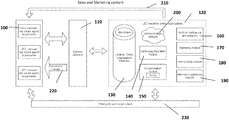
- FIG. 1 is a block diagram of a system according to an embodiment of the subject invention.
- FIG. 2 is a block diagram of a blockchain that can be used with a system according to an embodiment of the subject invention.
- Embodiments of the subject invention provide forward-thinking technology linking owners, buyers, sellers, lessees, lessors, agents, brokers, title companies, mortgage companies, surveyors, advertising companies, decorators, contractors, educators, financial advisors, warranty companies, SMART (intelligent) home consultants, sales & marketing firms, students, and/or any person or company involved in the real estate industry. Many embodiments provide improved customer relationship management (CRM) systems to this end.
- CRM customer relationship management
- Participants of a CRM system of embodiments of the subject invention can accumulate rewards for each interaction with the system. These rewards can include, for example, an allocation of profit sharing participation (e.g., a regular profit sharing such as annual profit sharing).
- the system provides the ability to see how everyone is related. An electronic “bread crumb trail” is left on each transaction linking any location (L—a physical address), entity (E—a person), and organization (O—a business entity) that interacts with a member. All of this is done through the member portal that resides behind a secure firewall.
- the system incentivizes members to maintain data superiority, e.g., through rewards.
- the system provides participants with the ability to spend more time with others assisting in the buying, selling, and renting of real properties.
- the system eliminates the need to search multiple databases or silos for bits and pieces of information, thereby also inhibiting getting bogged down by duplicate information.
- the system centralizes the data and provides it all in one location in real time.
- LEO location, entity, organization
- alter a user's relationship with the system by providing a reward to the user for each interaction or “touch” with the system. If, for example, the user sets up an account and enters user information, he or she is allotted a certain percentage of profit sharing participation (e.g., a regular profit sharing such as annual profit sharing). If the user updates the user information (e.g., the user location or employer), the user can receive additional profit sharing.
- a LEO location, entity, organization
- the user can receive additional profit sharing.
- a referral e.g., for a new user/potential member
- one or more ideas for improving the system e.g., an idea provided to a location, entity, organization, or member higher up in the system
- the user can receive additional profit sharing.
- Each interaction with the system does not necessarily result in the same allotment of percentage of profit sharing. For example, if a user lists a property through the system they may receive a certain percentage of profit sharing, whereas a user who reviews educational content may receive a different percentage (e.g., a lower percentage or a higher percentage) of the profits.
- the system can allocate units of profit sharing (for example, such a unit can be referred to as a “brick”, though embodiments are not limited thereto), and certain types of user interactions with the system can result in the user being rewarded with a certain number of units (e.g., one unit, two units, three units, etc.), depending on the type of interaction.
- the number of units can be made known to users ahead of time, in order to incentivize and/or encourage certain types of interactions or activity even more than certain other types.
- the number of units held by a user can be divided by the total number of units allocated to all users to determine that user's percentage of profit sharing.
- the number of units can be used to determine ownership of a portion or the entirety of the system (e.g., the number of units held by a user can be divided by the total number of units allocated to all users to determine that user's percentage of ownership of a portion of the system available for user ownership).
- the types of interactions that can lead to receiving a percentage of the profits include, but are not necessarily limited to, setting up an account, updating contact information, listing a property, searching for properties, electronic or telephonic communication through the system, and reviewing educational content.
- FIG. 1 shows a block diagram of a system according to an embodiment of the subject invention.
- a user 100 can access the system through a web page or mobile application 110 .
- Users can include current LEO members, prospective members, or other non-member third parties.
- the interface 110 can be accessed through a mobile computing device, desktop computer, or other computing device and connects the user 100 to the backend LEO system 120 .
- the LEO system 120 includes a history of data deposits, messages, or transactions organized in a series of blocks 130 , a continuing education module 140 for providing educational content 220 to a user, a compensation module 150 for calculating the amount of compensation (e.g., profit sharing percentage such as units (“bricks”)) to be paid to a LEO member 100 , an artificial intelligence and analytics module 160 for processing data and providing analytics, a marketing module for transmitting sales and marketing content 210 to members or users 100 , a membership module 180 for managing new and existing member information, and an information gathering module 190 for gathering information to provide to the other modules.
- the system as seen in FIG. 1 , is implemented in the form of software algorithms operated on specially programmed general purpose computers. Each above-referenced module is a sub-system of the system that receives and generates data that is transmitted to other modules.
- the overall function of the system is to implement embodiments of the present invention of an incentivized, improved CRM system.
- Each module can refer to software, firmware, hardware, and/or various combinations thereof.
- the modules can be combined, integrated, separated, and/or duplicated to support various functions or applications and may be centralized or distributed.
- a function described herein as being performed at a particular module may be performed at one or more other modules and/or by one or more other devices instead of or in addition to the function performed at the particular module.
- the modules may be implemented across multiple devices and/or other components local or remote to one another.
- the devices and components that comprise one module may or may not be distinct from the devices and components that comprise other modules.
- FIG. 2 shows a diagram of a private blockchain configuration 130 that can be used in a system according to an embodiment of the subject invention.
- Each member-related transaction can be identified by one of three distinct characteristics: location; entity; and organization.
- One or more application program interfaces e.g., third party APIs
- Any one of location, organization, entity, and member can communicate directly with one or more APIs (e.g., third party API plug-ins). That is, all of location, organization, entity, and member (or any subset thereof) can respectively communicate directly with one or more APIs (e.g., third party API plug-ins).
- the APIs are optional.
- the worldwide normalized blockchain server shown in FIG. 2 is optional. If it is not present, the location, organization, entity, and member communicate with each other directly, instead of going through the worldwide normalized blockchain server. Whether the worldwide normalized blockchain server is present or not, all locations, entities, organizations, and members that confirm their information at least once per year can participate in the profit sharing by earning units of profit sharing.
- the architecture shown in FIG. 2 with or without the worldwide normalized blockchain server (and with or without APIs) can be infused in all enterprises.
- Each private blockchain is a ledger of all real estate transactions conducted through the LEO system and based upon the member, location, entity, and organization of the parties involved.
- a record of a transaction can be sequentially stored in respective blockchains based upon member, location, entity, and organization.
- One or more computing devices or nodes can be configured to process and record the transactions as part of a block in a respective blockchain. Once a computing device has processed a block, the block is added to the respective blockchain and the transaction record is thereby updated.
- the blockchain can be a ledger of transactions in sequential order, or other order that may be suitable for use by the LEO system.
- Entries can include property locations, financial transactions related to the respective locations, financial institutions involved in the transactions, and negotiated terms of exchange between the parties.
- additional information may be captured, such as a timestamp, geolocation, and/or related transactions.
- a respective block of a blockchain comprises additional data including proof of work and/or any other suitable verification techniques associated therewith. In some cases, such data may be included in the blockchain as part of transactions, such as included in additional data appended to transaction data.
- the system can include multiple different computer nodes that each operate to mine and thereby validate transactions submitted by members to the blockchain. Initially, the information can be transmitted by a member to a node of the blockchain. Once the node receives a transaction, it may propagate the transaction to other nodes within the blockchain.
- a member 100 can transmit transaction information through the interface 110 . Once the information is verified, the system can append a record of the transaction to the blockchain.
- the membership module 180 can issue a token to a third party service provider 230 .
- the token denotes permission by the member and the conditions upon which those permissions were granted.
- the system can be configured to interact with other systems, including third party service providers.
- the continuing education module 140 services all uploading, transmission, and viewing of educational content.
- System administrators can upload educational content including video and audio files to the system.
- the educational content 220 can be sub-divided into categories and topics.
- instructional videos can be provided to new members 100 to provide guidance on using the system.
- advanced educational content 220 can be provided to provide business insight including advanced sales techniques and strategies that incorporate economic forecasting.
- a user 100 can access the system to browse a list of available categories and topics, and choose to stream or download a file.
- the artificial intelligence and analytics module 140 can gather data from the user to suggest titles based upon a user's projected needs or past selections. Each time that a member 100 accesses the education content 220 , the member 100 can be rewarded by a percentage of profits (e.g., one or more “bricks”).
- the compensation module 150 services all computation and requests for compensation for interactions with the system.
- the compensation module 150 records each interaction with the system and allocates a reward based upon each respective interaction.
- the profit percentage reward (e.g., number of “bricks”) can be based upon each specific activity invoked by each interaction with the system.
- the profit percentage amount is not static and can be varied based upon changes to the business environment.
- the compensation module 150 records each interaction, computes a percentage of profit sharing (alternatively, or additionally, ownership) to be allotted to the member, and initiates transfer of funds to the members.
- the compensation module 150 can also provide an up-to-date record of the profit percentage owed to each member from determining the premium/discount rates for the components as well as current rates of percentages provided for each activity.
- Profit percentage allotments can be further sub-divided into sub-groups. For example, members can be rewarded with greater profit percentages for engaging the system for an increased period of time or greater frequency than other members. The profit percentage allotments for each activity can be available to individual users by accessing the system.
- the artificial intelligence and analytics module 160 provides support for members engaging in real estate transactions. For example, a member 100 can access to system to query the module 160 for advice including but not limited to financial instruments, projected property values, product trends, and population trends.
- the artificial intelligence and analytics module 160 can also receive member data and not only provide the member 100 with suggestions for educational content 220 based upon projected value added to the member, but recommend additional educational content 220 to the system administrators based upon the member's current and projected needs.
- the educational content 220 and advice provided by the artificial intelligence and analytics module can promote strategic thinking and partnership amongst the LEO members. For example, a member seeking to purchase property in a specific geographic location can be recommended to another member who is offering financing in that location.
- the artificial intelligence and analytics module 160 can review a member's information including location, entity, and organization and recommend or initiate the transmission of targeted sales and marketing materials 210 to the member.
- the artificial intelligence and analytics module 160 continues to learn based upon input from members including but not limited to member questions, geographic, economic, and transactional data. The knowledge from learning is used to enhance the services provide by the module.
- the artificial intelligence module 160 uses computational algorithms that combine data, techniques, and methodologies to assist members and entities to navigate through real estate-based transactions.
- the artificial intelligence module can be trained using available data sets and learn to optimize performance in a changing real estate environment.
- the artificial intelligence module 160 can include at least one of the following computational techniques: neural network; constraint program; fuzzy logic; classification; conventional artificial intelligence; symbolic manipulation; fuzzy set theory; evolutionary computation; cybernetics; data mining; approximate reasoning; derivative-free optimization; decision trees; soft computing; or a combination thereof.
- the marketing module 170 may receive or query location data from one or more members 100 .
- the marketing module 170 can receive location-based data from a member's computing or mobile device or from the database 130 .
- the location-based information can be received along with other data.
- a mobile device identifier may be received and may be used to identify stored preferences, stored searches, transaction history, credit rating, and other data associated with a user of a member 100 .
- the marketing module 170 can receive as, for example, user preferences, a search item, a specified price range, a specified location range, one or more product attributes, one or more service attributes, payment information, and account information.
- the marketing module 170 may further include a transmission device to communicate with a member 100 .
- the computing device can transmit real estate information, including pricing information, contractual information, and other notifications.
- the marketing module 170 may include one or more modes of communication to reach the system, a member, buyer or seller, third party vendor or other similar user.
- the user transmission device may further be configured to send an electronic communication, including emails and advertisements to a user.
- the user device may further be configured to communicate via social media.
- the marketing module 170 may be coupled with a printing device to print sales and marketing materials that are automatically mailed to a member.
- the marketing module 170 may be coupled to a device to generate automatic telephone calls, or “robo-calls,” or other similar communication mediums to communicate with a member.
- the marketing module 170 can also receive data from the artificial intelligence module 160 to tailor marketing materials transmitted to a member based upon a member's projected needs.
- the marketing module can also transit materials, for example potential listings based on an artificial intelligence module's projection of the real estate landscape.
- the membership module 180 services all membership records including entering new member information, updating existing member information, and verifying membership.
- the membership module 180 can also monitor changes in membership information including changes to location, entity, and organization and transmit changes in membership information to other modules including the artificial intelligence module 160 and the marketing module 170 .
- the membership module 180 is coupled to the interface 110 to permit new and existing members to enter and update their data through the interface.
- the information gathering module 190 retrieves and stores data from external sources for use from other modules.
- the information gathering module 190 can gather housing data and employment data.
- Other modules, for example, the artificial intelligence module can retrieve data from the information gathering module 190 to perform market analysis and provide recommendations to members 100 .
- the information gathering module 190 will seek data from more than member input.
- the module will be search publically available databases and can have access to private databases through subscription or licensing agreements.
- the information gathering module 190 can also receive direction from the artificial intelligence module 160 to retrieve particular types of data or data from particular sources to assist members.
- a member can access the system using a computing device (not shown).
- the computing device can includes a global navigation satellite system (GNSS) receiver, an accelerometer, a gyroscope, a processor, memory device, communication interface, peripheral device interface, display device interface, and/or a storage device.
- GNSS global navigation satellite system
- the memory device can be or can include a device such as a Dynamic Random Access Memory (D-RAM), Static RAM (S-RAM), or other RAM or a flash memory.
- the storage device can be or include a hard disk, a magneto-optical medium, an optical medium such as a CD-ROM, a digital versatile disk (DVDs), or BLU-RAY disc (BD), or other type of device for electronic data storage.
- the communication network 200 may be, for example, a communications port, a wired transceiver, a wireless transceiver, and/or a network card.
- the communication network 200 may can communicate using technologies such as Ethernet, fiber optics, microwave, xDSL (Digital Subscriber Line), Wireless Local Area Network (WLAN) technology, wireless cellular technology, BLUETOOTH technology and/or any other appropriate technology.
- technologies such as Ethernet, fiber optics, microwave, xDSL (Digital Subscriber Line), Wireless Local Area Network (WLAN) technology, wireless cellular technology, BLUETOOTH technology and/or any other appropriate technology.
- the display device interface can be an interface configured to communicate data to display device.
- the display device may be, for example, an in-dash display, a monitor or television display, a plasma display, a liquid crystal display (LCD), and/or a display based on a technology such as front or rear projection, light emitting diodes (LEDs), organic light-emitting diodes (OLEDs), or Digital Light Processing (DLP).
- the display device interface may operate using technology such as Video Graphics Array (VGA), Super VGA (S-VGA), Digital Visual Interface (DVI), High-Definition Multimedia Interface (HDMI), or other appropriate technology.
- the display device interface can communicate display data from the processor to the display device for display by the display device.
- the display device can be distinct from the computing device, and coupled to the computing device via the display device interface. Alternatively, the display device can be included in the computing device.
- the communication network 200 can also include party to party communication capabilities. Communication capabilities include internet-based calls, text messages including short message service (SMS) and multimedia messaging service (MMS), and voicemails.
- SMS short message service
- MMS multimedia messaging service
- the system through a caller's communication device, can be notified of the intent to establish a telephone call connection over an internet connection by caller party to a receiving party. Then the system can establish a connection with the caller and receiving party's communication device and automatically establish an internet connection and then a connection to a directory service on the Internet.
- Systems of embodiments of the subject invention permit members to allow access to their information by third party service providers 230 .
- the system can be configured to permit members to grant access to, or revoke access from, respective third party service providers 230 at any time.
- the third party service providers 230 can use the information to direct sales and marketing materials directly to the members 100 .
- the members 100 can then purchase products directly from the third party service providers 230 .
- the compensation module 150 can record the third party vendor 230 access to the member information contained in the blockchain framework and direct compensation (e.g., “bricks”) to the member 100 in exchange for granting the license.
- Systems of embodiments of the subject invention provides at least the following features and advantages: (1) inclusive widely-defined membership of traditional and non-traditional real estate participants; (2) information gathering functionality from expanded sources and types; (3) a compensation system for all members; (4) educational content that teaches and provides insight; (5) behavior/experience strategies that promote collaboration between members; (6) efficiency, effectiveness, flexibility, and profitability (inherent in all LEO interactions (“touches”)); (7) positive influences on business/organizational matters through the speed, value, and immediacy of information; (8) intelligence driven sales and marketing tactics and strategies; (9) artificial intelligence driven value to all aspects of business for members; and (10) instant access to knowledge and information.
- the methods and processes described herein can be embodied as code and/or data.
- the software code and data described herein can be stored on one or more machine-readable media (e.g., computer-readable media), which may include any device or medium that can store code and/or data for use by a computer system.
- machine-readable media e.g., computer-readable media
- the computer system and/or processor When a computer system and/or processor reads and executes the code and/or data stored on a computer-readable medium, the computer system and/or processor performs the methods and processes embodied as data structures and code stored within the computer-readable storage medium.
- computer-readable media include removable and non-removable structures/devices that can be used for storage of information, such as computer-readable instructions, data structures, program modules, and other data used by a computing system/environment.
- a computer-readable medium includes, but is not limited to, volatile memory such as random access memories (RAM, DRAM, SRAM); and non-volatile memory such as flash memory, various read-only-memories (ROM, PROM, EPROM, EEPROM), magnetic and ferromagnetic/ferroelectric memories (MRAM, FeRAM), and magnetic and optical storage devices (hard drives, magnetic tape, CDs, DVDs); network devices; or other media now known or later developed that are capable of storing computer-readable information/data.
- volatile memory such as random access memories (RAM, DRAM, SRAM
- non-volatile memory such as flash memory, various read-only-memories (ROM, PROM, EPROM, EEPROM), magnetic and ferromagnetic/ferroelectric memories (MRAM, FeRAM), and magnetic and optical
- Computer-readable media should not be construed or interpreted to include any propagating signals.
- a computer-readable medium of the subject invention can be, for example, a compact disc (CD), digital video disc (DVD), flash memory device, volatile memory, or a hard disk drive (HDD), such as an external HDD or the HDD of a computing device, though embodiments are not limited thereto.
- a computing device can be, for example, a laptop computer, desktop computer, server, cell phone, or tablet, though embodiments are not limited thereto.
- the subject invention includes, but is not limited to, the following exemplified embodiments.
- An incentivized customer relationship management system for real estate comprising:
- a computer-based network configured to transmit educational materials to a first user of the system, authorize transfer of profit sharing to members of the system, provide artificial intelligence based information to the first user, transmit sales and marketing materials to the first user, authorize membership, and gather real estate based information,
- system is configured such that the first user can permit a third party to access the respective stored real estate transaction related information of the first user.
- the private blockchain network comprises:
- a member blockchain configured to record a transaction based upon user identity
- a location blockchain configured to record a transaction based on property location
- an entity blockchain configured to record a transaction based on entity
- an organization blockchain configured to record a transaction based on organization.
- system is configured such that the profit sharing units allocated to the first user are used to calculate a percentage of profit sharing received by the first user, wherein the percentage of profit sharing received by the first user is calculated by dividing the number of profit sharing units allocated to the first user by the total number of profit sharing units allocated to all users of the system.
- the computer-based network is further configured to transmit at least one of an electronic communication, a print material, and a robo-call to the first user.
- the computer-based network is further configured to transmit at least one of an electronic communication, a print material, or a robo-call to a second user who is in a real estate transaction with the first user.
- the computer-based network is further configured to recommend educational content to the first user based upon respective stored real estate transaction related information of the first user.
- a computer-based method of incentivizing a customer relationship management system comprising:
- a computer network configured to transmit educational materials to a first user of the customer relationship management system, provide artificial intelligence based information to the first user, transmit sales and marketing materials to the first user, authorize membership, and gather real estate based information of the first user;
Landscapes
- Business, Economics & Management (AREA)
- Engineering & Computer Science (AREA)
- Finance (AREA)
- Accounting & Taxation (AREA)
- Strategic Management (AREA)
- Theoretical Computer Science (AREA)
- Physics & Mathematics (AREA)
- Development Economics (AREA)
- General Physics & Mathematics (AREA)
- Economics (AREA)
- General Business, Economics & Management (AREA)
- Marketing (AREA)
- Entrepreneurship & Innovation (AREA)
- Data Mining & Analysis (AREA)
- Tourism & Hospitality (AREA)
- Software Systems (AREA)
- General Engineering & Computer Science (AREA)
- Artificial Intelligence (AREA)
- Human Resources & Organizations (AREA)
- Mathematical Physics (AREA)
- Primary Health Care (AREA)
- Health & Medical Sciences (AREA)
- General Health & Medical Sciences (AREA)
- Computing Systems (AREA)
- Technology Law (AREA)
- Evolutionary Computation (AREA)
- Game Theory and Decision Science (AREA)
- Computational Linguistics (AREA)
- Computer Vision & Pattern Recognition (AREA)
- Medical Informatics (AREA)
- Management, Administration, Business Operations System, And Electronic Commerce (AREA)
Abstract
Description
-
- A
member 100 can grant conditional access or license to their personal information on the blockchain through theinterface 110. The member can designate conditional permissions for particular personal information and restrict access to other information. These permissions can be transmitted to the membership module to 180 to initiate an agreement between themember 100 and a thirdparty service provider 230. The member can authorize themembership module 180 to initiate agreements with other providers with respective particular terms. The agreements can use suitable protocols to execute and enforce the agreements between the parties. The agreements can be both self-executing and or self-enforcing. A record of the agreements, including modifications and termination, can be recorded in the blockchain.
- A
Claims (1)
Priority Applications (1)
| Application Number | Priority Date | Filing Date | Title |
|---|---|---|---|
| US16/213,120 US10984490B2 (en) | 2018-12-07 | 2018-12-07 | Artificial intelligence real estate platform |
Applications Claiming Priority (1)
| Application Number | Priority Date | Filing Date | Title |
|---|---|---|---|
| US16/213,120 US10984490B2 (en) | 2018-12-07 | 2018-12-07 | Artificial intelligence real estate platform |
Publications (2)
| Publication Number | Publication Date |
|---|---|
| US20200184582A1 US20200184582A1 (en) | 2020-06-11 |
| US10984490B2 true US10984490B2 (en) | 2021-04-20 |
Family
ID=70971001
Family Applications (1)
| Application Number | Title | Priority Date | Filing Date |
|---|---|---|---|
| US16/213,120 Active 2039-11-15 US10984490B2 (en) | 2018-12-07 | 2018-12-07 | Artificial intelligence real estate platform |
Country Status (1)
| Country | Link |
|---|---|
| US (1) | US10984490B2 (en) |
Families Citing this family (5)
| Publication number | Priority date | Publication date | Assignee | Title |
|---|---|---|---|---|
| US11615463B2 (en) * | 2018-08-01 | 2023-03-28 | Appfolio, Inc. | Artificial intelligence based digital leasing assistant |
| US10984490B2 (en) * | 2018-12-07 | 2021-04-20 | Lehr Holdings, Inc. | Artificial intelligence real estate platform |
| EP4369229A3 (en) * | 2018-12-31 | 2024-09-25 | INTEL Corporation | Securing systems employing artificial intelligence |
| US11606424B1 (en) * | 2021-04-23 | 2023-03-14 | Amdocs Development Limited | System, method, and computer program for blockchain-based entity group management |
| US20240394815A1 (en) * | 2023-05-24 | 2024-11-28 | Myrealtytech Inc. | Intelligent real estate transaction system with personalized recommendations based on user preferences and intent |
Citations (2)
| Publication number | Priority date | Publication date | Assignee | Title |
|---|---|---|---|---|
| US20030105705A1 (en) * | 2001-09-24 | 2003-06-05 | Eyre Ethan B. | Computer web-based auction platform |
| US20200184582A1 (en) * | 2018-12-07 | 2020-06-11 | Lehr Holdings, Inc. | Artificial intelligence real estate platform |
-
2018
- 2018-12-07 US US16/213,120 patent/US10984490B2/en active Active
Patent Citations (2)
| Publication number | Priority date | Publication date | Assignee | Title |
|---|---|---|---|---|
| US20030105705A1 (en) * | 2001-09-24 | 2003-06-05 | Eyre Ethan B. | Computer web-based auction platform |
| US20200184582A1 (en) * | 2018-12-07 | 2020-06-11 | Lehr Holdings, Inc. | Artificial intelligence real estate platform |
Also Published As
| Publication number | Publication date |
|---|---|
| US20200184582A1 (en) | 2020-06-11 |
Similar Documents
| Publication | Publication Date | Title |
|---|---|---|
| Cui et al. | Informational challenges in omnichannel marketing: Remedies and future research | |
| US20250232336A1 (en) | System and method providing personalized recommendations | |
| Goldfarb et al. | Digital economics | |
| Khern-am-nuai et al. | Extrinsic versus intrinsic rewards for contributing reviews in an online platform | |
| Manchanda et al. | The role of targeted communication and contagion in product adoption | |
| Urban | Don't just relate-advocate!: A blueprint for profit in the era of customer power | |
| Graef | EU Competition Law, Data Protection and Online Platforms: Data as Essential Facility: Data as Essential Facility | |
| Zhang | The sound of silence: Observational learning in the US kidney market | |
| US20200184582A1 (en) | Artificial intelligence real estate platform | |
| US12443935B1 (en) | Video revenue sharing program | |
| Matidza et al. | Use of digital marketing in estate agency industry in Malawi | |
| US10475059B2 (en) | Syndicated sharing of promotional information | |
| RU2483474C2 (en) | System and method for supporting consumer aggregation procedure in electronic network | |
| WO2009086266A1 (en) | Using social network information | |
| KR102094161B1 (en) | System for providing platform for knowledge trading and service method for knowledge trading based on blockchain and computer program for the same | |
| US8768773B2 (en) | Interactive system for providing an individual with control of the collection/distribution and content management of transaction and activities data | |
| McKean | Customer's new voice: extreme relevancy and experience through volunteered customer information | |
| US20220005053A1 (en) | Social media network mining | |
| Nguyen | Exploring collaborative consumption business models-case peer-to-peer digital platforms | |
| Wakeling et al. | Interlending and resource sharing in UK public libraries: A mixed methods study | |
| US20150278760A1 (en) | Integrated private office | |
| Sreedharan | Digital Marketing | |
| Rao | From brand to customer | |
| Sangeeta et al. | Digital Marketing: Strategies, Tools, and Techniques for Success | |
| Sundar et al. | Introduction to digital entrepreneurs and digital business management |
Legal Events
| Date | Code | Title | Description |
|---|---|---|---|
| FEPP | Fee payment procedure |
Free format text: ENTITY STATUS SET TO UNDISCOUNTED (ORIGINAL EVENT CODE: BIG.); ENTITY STATUS OF PATENT OWNER: SMALL ENTITY |
|
| FEPP | Fee payment procedure |
Free format text: ENTITY STATUS SET TO SMALL (ORIGINAL EVENT CODE: SMAL); ENTITY STATUS OF PATENT OWNER: SMALL ENTITY |
|
| AS | Assignment |
Owner name: LEHR HOLDINGS, INC., FLORIDA Free format text: ASSIGNMENT OF ASSIGNORS INTEREST;ASSIGNOR:FOX, WILLIAM;REEL/FRAME:047928/0352 Effective date: 20181219 |
|
| STPP | Information on status: patent application and granting procedure in general |
Free format text: NOTICE OF ALLOWANCE MAILED -- APPLICATION RECEIVED IN OFFICE OF PUBLICATIONS |
|
| STPP | Information on status: patent application and granting procedure in general |
Free format text: PUBLICATIONS -- ISSUE FEE PAYMENT RECEIVED |
|
| STPP | Information on status: patent application and granting procedure in general |
Free format text: PUBLICATIONS -- ISSUE FEE PAYMENT VERIFIED |
|
| STCF | Information on status: patent grant |
Free format text: PATENTED CASE |
|
| FEPP | Fee payment procedure |
Free format text: MAINTENANCE FEE REMINDER MAILED (ORIGINAL EVENT CODE: REM.); ENTITY STATUS OF PATENT OWNER: SMALL ENTITY |
|
| FEPP | Fee payment procedure |
Free format text: ENTITY STATUS SET TO MICRO (ORIGINAL EVENT CODE: MICR); ENTITY STATUS OF PATENT OWNER: MICROENTITY |
|
| FEPP | Fee payment procedure |
Free format text: SURCHARGE FOR LATE PAYMENT, MICRO ENTITY (ORIGINAL EVENT CODE: M3554); ENTITY STATUS OF PATENT OWNER: MICROENTITY |
|
| MAFP | Maintenance fee payment |
Free format text: PAYMENT OF MAINTENANCE FEE, 4TH YEAR, MICRO ENTITY (ORIGINAL EVENT CODE: M3551); ENTITY STATUS OF PATENT OWNER: MICROENTITY Year of fee payment: 4 |