US10984308B2 - Compression method for deep neural networks with load balance - Google Patents
Compression method for deep neural networks with load balance Download PDFInfo
- Publication number
- US10984308B2 US10984308B2 US15/390,556 US201615390556A US10984308B2 US 10984308 B2 US10984308 B2 US 10984308B2 US 201615390556 A US201615390556 A US 201615390556A US 10984308 B2 US10984308 B2 US 10984308B2
- Authority
- US
- United States
- Prior art keywords
- neural network
- wer
- submatrices
- matrices
- compression ratio
- Prior art date
- Legal status (The legal status is an assumption and is not a legal conclusion. Google has not performed a legal analysis and makes no representation as to the accuracy of the status listed.)
- Active, expires
Links
Images
Classifications
-
- G06N3/0445—
-
- G—PHYSICS
- G06—COMPUTING OR CALCULATING; COUNTING
- G06N—COMPUTING ARRANGEMENTS BASED ON SPECIFIC COMPUTATIONAL MODELS
- G06N3/00—Computing arrangements based on biological models
- G06N3/02—Neural networks
- G06N3/04—Architecture, e.g. interconnection topology
- G06N3/044—Recurrent networks, e.g. Hopfield networks
-
- G—PHYSICS
- G06—COMPUTING OR CALCULATING; COUNTING
- G06N—COMPUTING ARRANGEMENTS BASED ON SPECIFIC COMPUTATIONAL MODELS
- G06N3/00—Computing arrangements based on biological models
- G06N3/02—Neural networks
- G06N3/04—Architecture, e.g. interconnection topology
- G06N3/0495—Quantised networks; Sparse networks; Compressed networks
-
- G—PHYSICS
- G06—COMPUTING OR CALCULATING; COUNTING
- G06N—COMPUTING ARRANGEMENTS BASED ON SPECIFIC COMPUTATIONAL MODELS
- G06N3/00—Computing arrangements based on biological models
- G06N3/02—Neural networks
- G06N3/04—Architecture, e.g. interconnection topology
- G06N3/044—Recurrent networks, e.g. Hopfield networks
- G06N3/0442—Recurrent networks, e.g. Hopfield networks characterised by memory or gating, e.g. long short-term memory [LSTM] or gated recurrent units [GRU]
-
- G—PHYSICS
- G06—COMPUTING OR CALCULATING; COUNTING
- G06N—COMPUTING ARRANGEMENTS BASED ON SPECIFIC COMPUTATIONAL MODELS
- G06N3/00—Computing arrangements based on biological models
- G06N3/02—Neural networks
- G06N3/04—Architecture, e.g. interconnection topology
- G06N3/045—Combinations of networks
-
- G06N3/0454—
-
- G—PHYSICS
- G06—COMPUTING OR CALCULATING; COUNTING
- G06N—COMPUTING ARRANGEMENTS BASED ON SPECIFIC COMPUTATIONAL MODELS
- G06N3/00—Computing arrangements based on biological models
- G06N3/02—Neural networks
- G06N3/08—Learning methods
- G06N3/082—Learning methods modifying the architecture, e.g. adding, deleting or silencing nodes or connections
-
- G—PHYSICS
- G06—COMPUTING OR CALCULATING; COUNTING
- G06N—COMPUTING ARRANGEMENTS BASED ON SPECIFIC COMPUTATIONAL MODELS
- G06N3/00—Computing arrangements based on biological models
- G06N3/02—Neural networks
- G06N3/08—Learning methods
- G06N3/09—Supervised learning
Definitions
- the present invention relates to a compression method considering load balance for deep neural networks and the device thereof.
- ANNs Artificial Neural Networks
- NNs are a distributed parallel information processing models which imitate behavioral characteristics of animal neural networks.
- studies of ANNs have achieved rapid developments, and ANNs have been widely applied in various fields, such as image recognition, speech recognition, natural language processing, weather forecasting, gene expression, contents pushing, etc.
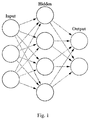
- Neural networks In neural networks, there exists a large number of nodes (also called neurons) which are connected to each other. Neural networks have two features: 1) Each neuron calculates the weighted input values from other adjacent neurons via certain output function (also called Activation Function); 2) The information transmission intensity between neurons is measured by so-called weights, and such weights might be adjusted by self-learning of certain algorithms.
- output function also called Activation Function
- DNNs Deep Neural Networks
- RNNs are commonly used DNN models, which differ from conventional Feed-forward Neural Networks in that RNNs have introduced oriented loop and are capable of processing forward-backward correlations between inputs.
- RNNs have introduced oriented loop and are capable of processing forward-backward correlations between inputs.
- speech recognition there are strong forward-backward correlations between input signals. For example, one word is closely related to its preceding word in a series of voice signals.
- RNNs has been widely applied in speech recognition domain.
- connection relations between neurons can be expressed mathematically as a series of matrices.
- matrices are dense matrices. That is, the matrices are filled with non-zero elements, consuming extensive storage resources and computation resources, which reduces computational speed and increases costs.
- it faces huge challenges in deploying DNNs in mobile terminals, significantly restricting practical use and development of neural networks.
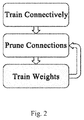
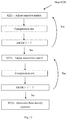
- FIG. 2 shows a compression method which was proposed by one of the inventors in earlier works.
- the compression method comprises learning, pruning, and training the neural network.
- it learns which connection is important by training connectivity.
- the second step is to prune the low-weight connections.
- it retrains the neural networks by fine-tuning the weights of neural network.
- elements with larger weights represent important connections, while other elements with smaller weights have relatively small impact and can be removed (e.g., set to zero).
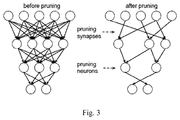
- low-weight connections are pruned, converting a dense network into a sparse network.
- FIG. 3 shows synapses and neurons before and after pruning according to the method proposed in FIG. 2 .
- the final step of FIG. 2 involves retraining the sparse network to learn the final weights for the remaining sparse connections.
- the remaining weights in the matrix can be adjusted, ensuring that the accuracy of the network will not be compromised.
- CRS Compressed Row Storage
- CCS Compressed Column Storage
- encoded sparse weight matrix W can be stored in a variation of compressed column storage (CCS) format.
- CCS compressed column storage
- each column W j of matrix W it stores a vector v that contains the non-zero weights, and a second, equal-length vector z that encodes the number of zeros before the corresponding entry in v.
- Each entry of v and z is represented by a four-bit value. If more than 15 zeros appear before a non-zero entry, we add a zero in vector v. For example, it encodes the following column [0,0,1,2,0,0,0,0,0,0,0,0,0,0,0,0,0,0,0,0,0,0,0,0,0,0,0,0,0,3].
- v and z of all columns are stored in one large pair of arrays with a pointer vector p pointing to the beginning of the vector for each column.
- a final entry in p points one beyond the last vector element so that the number of non-zeros in column j (including padded zeros) is given by p j+1 ⁇ p j .
- Speech recognition is a widely applicable field of ANNs. Speech recognition is to sequentially map analogue signals of a language to a specific set of words. In recent years, methods applying ANNs have achieved much better effects than conventional methods in speech recognition domain, and have become the mainstream in the industry. In particular, DNNs have been widely applied in speech recognition domain.
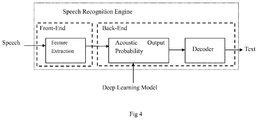
- FIG. 4 a general frame of the speech recognition engine is shown in FIG. 4 .
- FIG. 4 it involves computing acoustic output probability using a deep learning model. That is, conducting similarity prediction between a series of input speech signals and various possible candidates.
- Running the DNN in FIG. 4 can be accelerated via FPGA, for example.
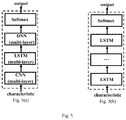
- FIG. 5 shows a deep learning model applied in the speech recognition engine of FIG. 4 .
- FIG. 5( a ) shows a deep learning model including CNN (Convolutional Neural Network) module, LSTM (Long Short-Term Memory) module, DNN (Deep Neural Network) module, Softmax module, etc.
- CNN Convolutional Neural Network
- LSTM Long Short-Term Memory
- DNN Deep Neural Network
- Softmax Softmax
- FIG. 5( b ) is a deep learning model where the present invention can be applied, which uses multi-layer LSTM.
- the input of the network is a section of voice. For example, for a voice of about 1 second, it will be cut into about 100 frames in sequence, and the characteristics of each frame is represented by a float type vector.
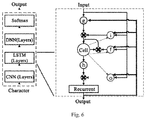
- FIG. 6 shows a LSTM network model applied in speech recognition.
- LSTM neural network is one type of RNN, which changes simple repetitive neural network modules in normal RNN into complex interconnecting relations. LSTM neural networks have achieved very good effect in speech recognition.
- LSTM is one type of RNN.
- the main difference between RNNs and DNNs lies in that RNNs are time-dependent. More specifically, for RNNs, the input at time T depends on the output at time T ⁇ 1. That is, calculation of the current frame depends on the calculated result of the previous frame.
- Symbol i represents the input gate i which controls the flow of input activations into the memory cell
- Symbol o represents the output gate o which controls the output flow of cell activations into the rest of the network
- Symbol f represents the forget gate which scales the internal state of the cell before adding it as input to the cell, therefore adaptively forgetting or resetting the cell's memory;
- Symbol g represents the characteristic input of the cell
- Each gate has a weight matrix, and the computation amount for the input of time T and the output of time T ⁇ 1 at the gates is relatively intensive;
- the dashed lines represent peephole connections, and the operations correspond to the peephole connections and the three cross-product signs are element-wise operations, which require relatively little computation amount.
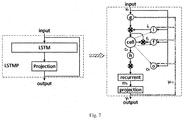
- FIG. 7 shows an improved LSTM network model.
- an additional projection layer is introduced to reduce the dimension of the model.
- the W terms denote weight matrices (e.g., Wix is the matrix of weights from the input gate to the input), and Wic, Wfc, Woc are diagonal weight matrices for peephole connections which correspond to the three dashed lines in FIG. 7 .
- the b terms denote bias vectors (b i is the gate bias vector), ⁇ is the logistic sigmoid function.
- the symbols i, f, o, c are respectively the input gate, forget gate, output gate and cell activation vectors, and all of which are the same size as the cell output activation vectors m.
- ⁇ is the element-wise product of the vectors, g and h are the cell input and cell output activation functions, generally tan h.
- FPGA Field-Programmable Gate Array
- the present invention proposes an improved compression method for deep neural network (for example, LSTM) considering load balance on multiple processing elements (PEs), so as to accelerate the neural network model implemented upon FPGA platform or the like, and reduce storage resources and power consumption.
- LSTM deep neural network
- PEs processing elements
- a method for compressing a neural network wherein the connection relations between the neurons of the neural network are characterized by a plurality of matrices.
- the method comprises: dividing step, for dividing at least one of said plurality of matrices into a plurality of submatrices; compression step, for compressing the submatrices into sparse submatrices; and encoding step, for encoding the compressed sparse submatrices.
- another method for compressing a neural network wherein the connection relations between the neurons of the neural network are characterized by a plurality of matrices.
- the method comprises: dividing step, for dividing at least one of said plurality of matrices in to a plurality of submatrices; sensitivity analysis step, for analyzing the sensitivity of each of said plurality of matrices, so as to determine an initial compression ratio for each of said plurality of matrices; compression step, for compressing the plurality of submatrices of respective matrix according to its corresponding initial compression ratio, so as to obtain a compressed neural network; fine-tuning step, for fine-tuning said compressed neural network, so as to obtain a final neural network.
- another method for compressing a neural network wherein the weights between the neurons of the neural network are characterized by a plurality of matrices.
- the method comprises: sensitivity analysis step, for analyzing the sensitivity of each of said plurality of matrices, and determining an initial compression ratio for each of said plurality of matrices; compression step, for compressing each of said plurality of matrices based on the initial compression ratio, so as to obtain a compressed neural network, including dividing step for dividing each of said plurality of matrices into a plurality of submatrices, and pruning step for pruning the submatrices into sparse submatrices; and fine-tuning step, for fine-tuning the compressed neural network.
- a device for compressing a neural network wherein the connection relations between the neurons of the neural network are characterized by a plurality of matrices.
- the device comprises: a dividing unit, for dividing at least one of said plurality of matrices into a plurality of submatrices; a compression unit, for compressing the submatrices into sparse submatrices; and an encoding unit, for encoding the compressed sparse submatrices.
- another device for compressing a neural network wherein the connection relations between the neurons of the neural network are characterized by a plurality of matrices.
- the device comprises: a dividing unit, for dividing at least one of said plurality of matrices in to a plurality of submatrices; a sensitivity analysis unit, for analyzing the sensitivity of each of said plurality of matrices, so as to determine an initial compression ratio for each of said plurality of matrices; a compression unit, for compressing each submatrix according to the initial compression ratio, so as to obtain a compressed neural network; and a fine-tuning unit, for fine-tuning the compressed neural network, so as to obtain a final neural network.
- FIG. 1 shows a model of deep neural networks
- FIG. 2 shows a compression method for neural networks
- FIG. 3 shows synapses and neurons before and after pruning
- FIG. 4 shows an example of a speech recognition engine using DNNs
- FIG. 5 shows a deep learning model applied in the speech recognition engine
- FIG. 6 shows a LSTM network model applied in speech recognition
- FIG. 7 shows an improved LSTM network model
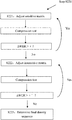
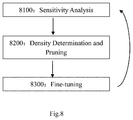
- FIG. 8 shows a multi-iteration compression method for LSTM neural networks according to one embodiment of the present invention
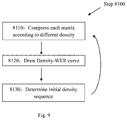
- FIG. 9 shows the steps in sensitivity analysis according to one embodiment of the present invention.
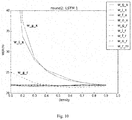
- FIG. 10 shows the corresponding curves obtained by the sensitivity tests according to one embodiment of the present invention.
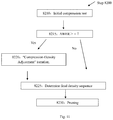
- FIG. 11 shows the steps in density determination and pruning according to one embodiment of the present invention.
- FIG. 12 shows the sub-steps in “Compression-Density Adjustment” iteration according to one embodiment of the present invention
- FIG. 13 shows the steps in fine-tuning according to one embodiment of the present invention.
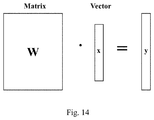
- FIG. 14 shows an example of matrix-vector multiplication
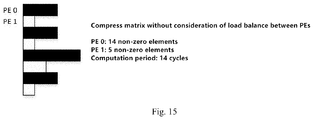
- FIG. 15 shows an exemplary result of matrix compression without considering load balance
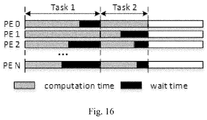
- FIG. 16 shows an example of a no-load cycle due to load imbalance
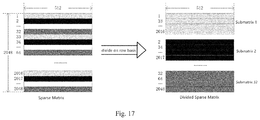
- FIG. 17 shows an example of dividing a dense matrix
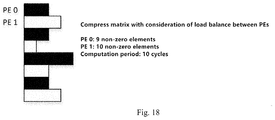
- FIG. 18 shows an exemplary result of matrix compression considering load balance.
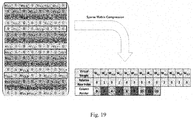
- FIG. 19 shows an example of storing a sparse matrix according to a specific sparse matrix storage format
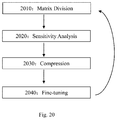
- FIG. 20 shows the steps of the compression method with load balance according to the present invention
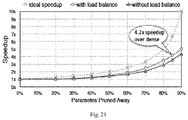
- FIG. 21 shows the speed-up ratio under different compression ratio according to conventional compression method and the proposed compression method with load balance.
- the pruning method includes the following steps:
- Initializing Initializing the ANN to establish all connections of CONV layers and FC layers, said connections being assigned weights of random values.
- Training Training said ANN by adjusting connection weights of CONV layers and FC layers of ANN until the accuracy of ANN reaches a predetermined level.
- Said training uses a stochastic gradient descent algorithm to adjust weights of ANN. For example, the values of weights are stochastically adjusted, and then some adjusted weights are chosen based on the gradient descent of ANN's accuracy.
- the accuracy of ANN can be measured by, for example, inputting a benchmark test data to the ANN and decide how accurate the prediction results of said ANN is.
- Pruning Pruning said ANN to remove insignificant connections, said insignificant connections are decided based on a predetermined criterion. More specifically, the weights of the pruned connections are no longer stored. For example, pruning uses at least one of the followings as said predetermined criteria: if the weight of a connection is zero, said connection is insignificant; or, if the weight of a connection is smaller than a threshold, said connection is insignificant.
- Fine-tuning Fine-tuning said ANN to restore the pruned connections and assigning zero-value weights to these restored connections.
- the present invention further proposes a multi-iteration compression method for deep neural networks.
- FIG. 8 shows a multi-iteration compression method for LSTM neural networks according to one embodiment of the present invention. It should be noted that the proposed compression method can also be applied in other types of neural networks.
- each iteration comprises three steps: sensitivity analysis, pruning and fine-tuning. Now, each step will be explained in detail.
- Step 8100 Sensitivity Analysis
- sensitivity analysis is conducted for all the matrices in a LSTM network, so as to determine the initial densities (or, the initial compression ratios) for different matrices in the neural network.
- FIG. 9 shows the specific steps in sensitivity analysis according to the embodiment.
- step 8110 it compresses each matrix in LSTM network according to different densities (for example, the selected densities are 0.1, 0.2 . . . 0.9, and the related compression method is explained in detail in step 8200 ).
- WER is usually measured in percentage. In general, the WER of the network after compression will increase, which means that the accuracy of the network after compression will decrease.
- step 8120 for each matrix, we further draw a Density-WER curve based on the measured WERs as a function of different densities, wherein x-axis represents the density and y-axis represents the WER of the network after compression.
- step 8130 for each matrix, we locate the point in the Density-WER curve where WER changes most abruptly, and choose the density that corresponds to said point as the initial density.
- the inflection point is determined as follows:
- WER initial The WER of the initial neural network before compression in the present iteration is known as WER initial ;
- the WER of the network after compression according to different densities is: WER 0.1 , WER 0.2 . . . WER 0.9 , respectively;
- the inflection point refers to the point with the smallest density among all the points with a ⁇ WER below a certain threshold.
- WER changes most abruptly can be selected according to other criteria, and all such variants shall fall into the scope of the present invention.
- each layer comprises 9 dense matrices (Wix, Wfx, Wcx, Wox, Wir, Wfr, Wcr, Wor, and Wrm) to be compressed
- a total number of 27 dense matrices need to be compressed.
- the WER of the initial neural network before compression is 24%
- the point with the smallest density among all the points with a WER below 25% is chosen as the inflection point, and the corresponding density of this inflection point is chosen as the initial density of the corresponding matrix.
- An example of the initial density sequence is as follows, wherein the order of the matrices is Wcx, Wix, Wfx, Wox, Wcr, Wir, Wfr, Wor, and Wrm.
- densityList [0.2, 0.1, 0.1, 0.1, 0.3, 0.3, 0.1, 0.1, 0.3, 0.5, 0.1, 0.1, 0.1, 0.2, 0.1, 0.1, 0.1, 0.3, 0.4, 0.3, 0.1, 0.2, 0.3, 0.3, 0.1, 0.2, 0.5]
- FIG. 10 shows the corresponding Density-WER curves of the 9 matrices in one layer of the LSTM neural network.
- the sensitivity of each matrix to be compressed differs dramatically.
- w_g_x, w_r_m, w_g_r are more sensitive to compression as there are points with max ( ⁇ WER)>1% in their Density-WER curves.
- Step 8200 Density Determination and Pruning
- FIG. 11 shows the specific steps in density determination and pruning.
- step 8200 comprises several sub-steps.
- step 8210 compressing each matrix based on the initial density sequence determined in step 8130 .
- step 8215 measuring the WER of the neural network obtained in step 8210 . If ⁇ WER of the network before and after compression is above certain threshold ⁇ , for example, 4%, then goes to the next step 8220 .
- step 8220 adjusting the initial density sequence via “Compression-Density Adjustment” iteration.
- step 8225 obtaining the final density sequence.
- step 8215 if ⁇ WER of the neural network before and after compression does not exceed said threshold ⁇ , then it goes to step 8225 directly, and the initial density sequence is set as the final density sequence.
- step 8230 pruning the LSTM neural network based on the final density sequence.
- Step 8210 conducting an initial compression test on the basis of an initial density.
- each matrix in each matrix, all the elements are ranked from small to large according to their absolute values. Then, each matrix is compressed according to the initial density determined in Step 8100 , and only a corresponding ratio of elements with larger absolute values are remained, while other elements with smaller values are set to zero. For example, if the initial density of a matrix is 0.4, then only 40% of the elements in said matrix with larger absolute values are remained, while the other 60% of the elements with smaller absolute values are set to zero.
- Step 8215 determining whether ⁇ WER of the network before and after compression is above a certain threshold ⁇ , for example, 4%.
- Step 8220 if ⁇ WER of the network before and after compression is above said threshold ⁇ , for example, 4%, then conducting the “Compression-Density Adjustment” iteration.
- Step 8225 obtaining the final density sequence through density adjustment performed in step 8220 .
- FIG. 12 shows the specific steps in the “Compression-Density Adjustment” iteration.
- step 8221 it adjusts the density of the matrices that are relatively sensitive. That is, for each sensitive matrix, increasing its initial density, for example, by 0.05. Then, conducting a compression test for said matrix based on the adjusted density.
- the compression test is conducted in a similar manner as the initial compression test of step 8210 .
- other compression strategies can be used, all of which fall into the scope of the present invention.
- the density of the matrices that are less sensitive can be adjusted slightly, so that ⁇ WER of the network before and after compression can be below certain threshold ⁇ ′, for example, 3.5%. In this way, the accuracy of the network after compression can be further improved.
- the process for adjusting insensitive matrices is similar to that for sensitive matrices.
- the initial WER of a network is 24.2%
- the WER of the compressed network is worsened to be 32%, which means that the initial density sequence needs to be adjusted.
- the steps for adjusting the initial density sequence is as follows:
- step 8100 Wcx, Wcr, Wir, Wrm in the first layer, Wcx, Wcr, Wrm in the second layer, and Wcx, Wix, Wox, Wcr, Wir, Wor, Wrm in the third layer are relatively sensitive, while the other matrices are insensitive.
- the density of matrices that are less sensitive can be adjusted slightly, so that ⁇ WER of the network before and after compression will be below 3.5%. In this example, this step is omitted.
- the overall density of the neural network after compression is now around 0.24.
- Step 8230 pruning based on the final density sequence.
- pruning is also based on the absolute values of the elements in the matrices.
- each matrix For each matrix, all elements are ranked from small to large according to their absolute values. Then, each matrix is compressed according to its final density, and only a corresponding ratio of elements with larger absolute values are remained, while other elements with smaller values are set to zero.
- Step 8300 Fine Tuning
- Loss function refers to the difference between the ideal result and the actual result of a neural network model under predetermined input. It is therefore desirable to minimize the value of loss function.
- Fine tuning is to search the optimal solution based on a suboptimal solution. That is, continuing to train the neural network on certain basis.
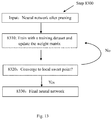
- FIG. 13 shows the specific steps in fine-tuning.
- the input of fine-tuning is the neural network after pruning in step 8200 .
- step 8310 it trains the sparse neural network obtained in step 8200 with a predetermined data set, and updates the weight matrix.
- step 8320 it determines whether the matrix has converged to a local sweet point. If not, it goes back to step 8310 and repeats the training and updating process; and if yes, it goes to step 8330 and obtains the final neural network.
- stochastic gradient descent algorithm is used during fine-tuning to update the weight matrix.
- step ⁇ can be changed.
- F(x) can be interpreted as a loss function.
- stochastic gradient descent algorithm can help reducing prediction loss.
- the fine-tuning method of LSTM neural network is as follows:
- W refers to weight matrix
- ⁇ refers to learning rate (that is, the step of the stochastic gradient descent algorithm)
- f refers to loss function
- ⁇ F refers to gradient of the loss function
- x refers to training data
- t+1 refers to weight update.
- the above equations means updating the weight matrix by subtracting the product of learning rate and gradient of the loss function ( ⁇ * ⁇ F) from the weight matrix.
- a mask matrix containing only “0” and “1” is used to keep the distribution of non-zero elements in the matrix after compression.
- the gradient of the loss function is multiplied by the mask matrix, assuring that the gradient matrix will have the same shape as the mask matrix.
- the input of fine-tuning includes: the network to be trained, the learning rate, max_iters (which refers to the maximum number of training iterations), min_iters (which refers to the minimum number of training iterations), keep_lr_iters (which refers to the number of iterations that keep the initial learning rate), start_halving_impr (which is used for determining when to change the learning rate, for example, 0.01), end_halving_impr (which is used to determine when to terminate the training, for example, 0.001), halving_factor (for example, 0.5), data sets (including training set, cross-validation set, testing set), etc.
- max_iters which refers to the maximum number of training iterations
- min_iters which refers to the minimum number of training iterations
- keep_lr_iters which refers to the number of iterations that keep the initial learning rate
- start_halving_impr which is used for determining when to change the learning rate, for example,
- the input of fine-tuning also includes parameters such as learning momentum, num-stream, batch-size, etc., all of which are omitted detailed description herein.
- the output of fine-tuning is the well-trained network.
- Iterative training is divided into several “epochs”, wherein an epoch (hereinafter referred to as “one iteration”) means that all data in the training dataset has been run for once, and the total number of iterations shall not be more than max_iters or less than min_iters;
- loss_prev that of the previous valid training
- loss_prev that of the previous valid training
- Conditions for learning rate modification and training termination input parameters related to learning rate modification and training termination includes: start_halving_impr, end_halving_impr, halving_factor, etc. After each iteration, calculating the improvement (referred to as real_impr) based on (loss_prev-loss)/loss_prev, wherein real_impr refers to the relative improvement of the loss of the present iteration compared to that of the previous iteration. Then, based on real_impr, we have:
- start_halving_impr for example, 0.01
- start_halving_factor which is usually 0.5
- convergence criteria can also be whether the WER of the trained network meets certain standard, for example. It should be understood that these criteria also fall into the scope of the present invention.
- the WER of the network decreases via fine-tuning, reducing accuracy loss due to compression.
- the WER of a compressed LSTM network with a density of 0.24 can drop from 27.7% to 25.8% after fine-tuning.
- the neural network will be compressed to a desired density via multi-iteration, that is, by repeating the above-mentioned steps 8100 , 8200 and 8300 .
- the desired final density of one exemplary neural network is 0.14.
- the network obtained after Step 8300 has a density of 0.24 and a WER of 25.8%.
- steps 8100 , 8200 and 8300 are repeated.
- the network obtained after Step 8300 has a density of 0.18 and a WER of 24.7%.
- the network obtained after Step 8300 has a density of 0.14 and a WER of 24.6% which meets the requirements.
- neural network model is usually compressed from a dense neural network into a sparse neural network, so as to effectively reduce the amount of calculation and storage and achieve acceleration purpose.
- an exemplary LSTM calculation involves 9 matrices, namely: Wix, Wir, Wfx, Wfr, Wcx, Wcr, Wox, Wor, and Wry.
- the matrix needed to be compressed and stored.
- FIG. 15 shows an exemplary result of matrix compression without considering load balance.
- PE 0 it takes PE 0 , PE 1 as an example.
- PE 1 After compression, there are 14 non-zero elements in PE 0 , which leads to a longer computation time; however, there are only 5 non-zero elements in PE 1 , which leads to a shorter computation time. Since both PEs share the same input vectors when conducting matrix-vector multiplication, even if PE 1 completes its computation first, it has to wait for PE 0 , causing no-load period.
- FIG. 16 shows an example of a no-load period due to load imbalance among different PEs. As can be seen from the figure, the more unbalanced among the loads of PEs, the longer the no-load period is.
- the present invention proposes a compression method considering load balance.
- each submatrix contains a similar number of non-zero elements.
- each divided submatrix needs to be of same (or, similar) size and has similar number of non-zero elements.
- the present invention divides a dense matrix by regularly extracting one row out of every N rows, so as to form N submatrices of same size. In this way, the imbalance of non-zero values in the matrix might be erased or reduced by said regular extracting, and the submatrices formed tends to have a similar number of non-zero elements.
- the PEs tend to have a more balanced number of non-zero elements.
- FIG. 17 shows an example of dividing a 2048*512 dense matrix into 32 submatrices according to the above-mentioned extracting strategy.
- the size of each submatrix is therefore 64*512.
- said 32 submatrices may correspond to 32 processing elements (PEs), or other number of PEs (e.g., 16, 8, or 4).
- each submatrix is compressed with the same compression ratio. For example, in each submatrix, all the elements are ranked from small to large according to their absolute values. Then, only a corresponding ratio of elements with larger absolute values are remained, while the other elements with smaller values are set to zero.
- FIG. 18 shows an exemplary result of matrix compression considering load balance.
- PE 0 has 10 non-zero elements and PE 1 has 9 non-zero elements.
- PE 0 and PE 1 will need similar computation time, reducing the no-load period and shortening the whole computation cycle.
- this step it encodes and stores the compressed sparse submatrices.
- the sparse submatrices By storing the sparse submatrices using a special sparse matrix storage format, storage space can be reduced significantly.
- FIG. 19 shows storing a submatrix consisting of the selected rows according to a specific sparse matrix storage format.
- true value, relative row index and column pointer vectors are used to represent the original sparse matrix.
- FIG. 20 shows a compression method for deep neural network (e.g. LSTM neural network) according to one embodiment of the present invention.
- LSTM neural network e.g. LSTM neural network
- each iteration includes 4 steps: matrix division, sensitivity analysis, compression, and fine-tuning. Now, detailed explanation of each step will be given below.
- this step it compresses each matrix (i.e. all its submatrices) in the LSTM neural network according to different compression ratios. Then, it determines the initial compression ratio for each matrix according to the WER of the network after compression, wherein the submatrices divided from the same matrix will have the same compression ratio.
- the initial compression ratio can be determined according to the method explained with reference to FIG. 8 and FIG. 9 .
- Step 2030 Compression (e.g., by Pruning)
- this step it compresses each submatrix according to the initial compression ratio determined in Step 2020 .
- each submatrix all elements are ranked from small to large according to their absolute values. Then, only a corresponding ratio of elements with larger absolute values are remained, while the other elements with smaller values are set to zero.
- the initial compression ratio of each submatrix can be adjusted via “Compression-Density Adjustment” iteration.
- “Compression-Density Adjustment” iteration please refer to Step 8200 in FIG. 8 and the process illustrated in FIG. 11 and FIG. 12 .
- Step 2040 Fine-Tuning (i.e., Retraining)
- this step it retrains the neural networks obtained in step 2030 and improves the accuracy of the networks while keeping the compression ratio unchanged.
- the neural network obtained in step 2030 trains the neural network obtained in step 2030 using a training dataset and updates corresponding weight matrix. Then, it determines whether the weight matrix has converged to a local sweet point. If not, it returns to the training step; and if yes, this neural network is regarded as the final neural network.
- step 8300 in FIG. 8 For more details of this retraining (e.g., fine-tuning) step, please refer to step 8300 in FIG. 8 and the process illustrated in FIG. 13 .
- FIG. 21 shows a performance comparison, indicating speed-up ratios v. different compression ratios in three situations, conventional compression method without load balance, the compression method considering load balance according to the present invention, and the ideal optimal case. As shown, the computation efficiency of the network is improved by using the load-balancing compression method of the present invention.
- the compression method considering load balance proposed by the present invention has the following beneficial technical effects:
- the original dense network can be compressed into a new sparse network with the same accuracy but less parameters involved in computation. Therefore, the storage space is reduced and the computation efficiency is improved.
- load imbalance between PEs will lead to significant differences between the actual performance and the theoretical peak performance of the hardware.
- the PEs will have a similar number of non-zero elements participated in computation, ensuring load balance among PEs and improving utilization of resources of the hardware platform.
Landscapes
- Engineering & Computer Science (AREA)
- Theoretical Computer Science (AREA)
- Physics & Mathematics (AREA)
- Data Mining & Analysis (AREA)
- General Health & Medical Sciences (AREA)
- Biomedical Technology (AREA)
- Biophysics (AREA)
- Computational Linguistics (AREA)
- Life Sciences & Earth Sciences (AREA)
- Evolutionary Computation (AREA)
- Artificial Intelligence (AREA)
- Molecular Biology (AREA)
- Computing Systems (AREA)
- General Engineering & Computer Science (AREA)
- General Physics & Mathematics (AREA)
- Mathematical Physics (AREA)
- Software Systems (AREA)
- Health & Medical Sciences (AREA)
- Compression, Expansion, Code Conversion, And Decoders (AREA)
Abstract
Description
[0,0,1,2,0,0,0,0,0,0,0,0,0,0,0,0,0,0,0,0,0,0,3].
v=[1,2,0,3],z=[2,0,15,2].
i t=σ(W ix x t +W ir y t−1 +W ic c t−1 +b i)
f t=σ(W fx x t +W fr y t−1 +W fc c t−1 +b f)
c t =f t ⊙c t−1 +i t ⊙g(W cx x t +W cr y t−1 +b c)
o t=σ(W ox x i +W or y t−1 +W oc c t +b o)
m t =o t ⊙h(c t)
y t =W ym m t
WER=(I+D+S)/N.
densityList=[0.2, 0.1, 0.1, 0.1, 0.3, 0.3, 0.1, 0.1, 0.3, 0.5, 0.1, 0.1, 0.1, 0.2, 0.1, 0.1, 0.1, 0.3, 0.4, 0.3, 0.1, 0.2, 0.3, 0.3, 0.1, 0.2, 0.5]
densityList=[0.2, 0.1, 0.1, 0.1, 0.3, 0.3, 0.1, 0.1, 0.3, 0.5, 0.1, 0.1, 0.1, 0.2, 0.1, 0.1, 0.1, 0.3, 0.4, 0.3, 0.1, 0.2, 0.3, 0.3, 0.1, 0.2, 0.5],
densityList=[0.25, 0.1, 0.1, 0.1, 0.35, 0.35, 0.1, 0.1, 0.35, 0.55, 0.1, 0.1, 0.1, 0.25, 0.1, 0.1, 0.1, 0.35, 0.45, 0.35, 0.1, 0.25, 0.35, 0.35, 0.1, 0.25, 0.55]
b=a−γ∇F(a)
is true when γ>0 is a value that is small enough, then F(a)≥F(b), wherein a is a vector.
x n+1 =x n−γn ∇F(x n), n≥0
F(x 0)≥F(x 1)≥F(x 2)≥ . . .
| Initial Dense Phase |
| while not converged do | |||
| | {tilde over (W)}(t) = W(t−1) − η(t)∇ f(W(t−1); x(t−1)); | |||
| | t = l + 1; | |||
| end | |||
W (t) =W (t−1)−η(t) ∇f(W (t−1) ;x (t−1))·Mask
Mask=(W t(0)≠0)
Claims (16)
Priority Applications (1)
| Application Number | Priority Date | Filing Date | Title |
|---|---|---|---|
| US15/390,556 US10984308B2 (en) | 2016-08-12 | 2016-12-26 | Compression method for deep neural networks with load balance |
Applications Claiming Priority (12)
| Application Number | Priority Date | Filing Date | Title |
|---|---|---|---|
| CN201610663563 | 2016-08-12 | ||
| CN201610663201.9 | 2016-08-12 | ||
| CN201610663201 | 2016-08-12 | ||
| CN201610663563.8 | 2016-08-12 | ||
| CN201610663175.XA CN107239823A (en) | 2016-08-12 | 2016-08-12 | A kind of apparatus and method for realizing sparse neural network |
| CN201610663175.X | 2016-08-12 | ||
| US15/242,624 US20180046903A1 (en) | 2016-08-12 | 2016-08-22 | Deep processing unit (dpu) for implementing an artificial neural network (ann) |
| US15/242,625 US20180046895A1 (en) | 2016-08-12 | 2016-08-22 | Device and method for implementing a sparse neural network |
| US15/242,622 US10621486B2 (en) | 2016-08-12 | 2016-08-22 | Method for optimizing an artificial neural network (ANN) |
| CN201611105081.7 | 2016-12-05 | ||
| CN201611105081.7A CN107239825B (en) | 2016-08-22 | 2016-12-05 | Deep neural network compression method considering load balance |
| US15/390,556 US10984308B2 (en) | 2016-08-12 | 2016-12-26 | Compression method for deep neural networks with load balance |
Related Parent Applications (1)
| Application Number | Title | Priority Date | Filing Date |
|---|---|---|---|
| US15/242,622 Continuation-In-Part US10621486B2 (en) | 2016-08-12 | 2016-08-22 | Method for optimizing an artificial neural network (ANN) |
Publications (2)
| Publication Number | Publication Date |
|---|---|
| US20180046914A1 US20180046914A1 (en) | 2018-02-15 |
| US10984308B2 true US10984308B2 (en) | 2021-04-20 |
Family
ID=61160253
Family Applications (1)
| Application Number | Title | Priority Date | Filing Date |
|---|---|---|---|
| US15/390,556 Active 2038-06-13 US10984308B2 (en) | 2016-08-12 | 2016-12-26 | Compression method for deep neural networks with load balance |
Country Status (1)
| Country | Link |
|---|---|
| US (1) | US10984308B2 (en) |
Cited By (3)
| Publication number | Priority date | Publication date | Assignee | Title |
|---|---|---|---|---|
| US20200401893A1 (en) * | 2018-12-04 | 2020-12-24 | Google Llc | Controlled Adaptive Optimization |
| US20230130779A1 (en) * | 2021-10-26 | 2023-04-27 | Samsung Electronics Co., Ltd. | Method and apparatus with neural network compression |
| US12271810B2 (en) | 2018-12-04 | 2025-04-08 | Google Llc | Federated learning with adaptive optimization |
Families Citing this family (39)
| Publication number | Priority date | Publication date | Assignee | Title |
|---|---|---|---|---|
| US11315018B2 (en) * | 2016-10-21 | 2022-04-26 | Nvidia Corporation | Systems and methods for pruning neural networks for resource efficient inference |
| US11995539B2 (en) * | 2017-06-09 | 2024-05-28 | Samsung Electronics Co., Ltd. | Electronic apparatus and method for re-learning trained model |
| US11200495B2 (en) * | 2017-09-08 | 2021-12-14 | Vivante Corporation | Pruning and retraining method for a convolution neural network |
| US10235625B1 (en) * | 2018-02-09 | 2019-03-19 | Capital One Services, Llc | Automatically scaling neural networks based on load |
| WO2019165316A1 (en) * | 2018-02-23 | 2019-08-29 | The Regents Of The University Of California | Architecture to compute sparse neural network |
| US10892953B2 (en) * | 2018-02-23 | 2021-01-12 | Nec Corporation | Network-based application acceleration |
| CN109716288A (en) * | 2018-04-17 | 2019-05-03 | 深圳鲲云信息科技有限公司 | Network model compiler and Related product |
| WO2019216514A1 (en) | 2018-05-09 | 2019-11-14 | Samsung Electronics Co., Ltd. | Electronic apparatus for compression and decompression of data and compression method thereof |
| US11568237B2 (en) | 2018-05-10 | 2023-01-31 | Samsung Electronics Co., Ltd. | Electronic apparatus for compressing recurrent neural network and method thereof |
| RU2702978C1 (en) * | 2018-10-15 | 2019-10-14 | Самсунг Электроникс Ко., Лтд. | Bayesian rarefaction of recurrent neural networks |
| US10832139B2 (en) * | 2018-06-22 | 2020-11-10 | Moffett Technologies Co. Limited | Neural network acceleration and embedding compression systems and methods with activation sparsification |
| CN109086819B (en) * | 2018-07-26 | 2023-12-05 | 北京京东尚科信息技术有限公司 | caffemodel model compression method, system, equipment and media |
| US11449756B2 (en) | 2018-09-24 | 2022-09-20 | Samsung Electronics Co., Ltd. | Method to balance sparsity for efficient inference of deep neural networks |
| US12008475B2 (en) | 2018-11-14 | 2024-06-11 | Nvidia Corporation | Transposed sparse matrix multiply by dense matrix for neural network training |
| KR102744307B1 (en) | 2018-12-12 | 2024-12-18 | 삼성전자주식회사 | Method and apparatus for load balancing in neural network |
| CN111353591B (en) * | 2018-12-20 | 2024-08-20 | 中科寒武纪科技股份有限公司 | A computing device and related products |
| CN111382835B (en) * | 2018-12-27 | 2024-08-20 | 中科寒武纪科技股份有限公司 | A neural network compression method, electronic device and computer readable medium |
| US11042797B2 (en) * | 2019-01-08 | 2021-06-22 | SimpleMachines Inc. | Accelerating parallel processing of data in a recurrent neural network |
| KR102543413B1 (en) | 2019-02-12 | 2023-06-13 | 에스케이하이닉스 주식회사 | Method for formatting weight matrix, accelerator using the formatted weight matrix and system including the same |
| US11966837B2 (en) * | 2019-03-13 | 2024-04-23 | International Business Machines Corporation | Compression of deep neural networks |
| KR102782971B1 (en) | 2019-05-08 | 2025-03-18 | 삼성전자주식회사 | A computing device for training an artificial neural network model, a method for training an artificial neural network model, and a memory system for storing the same |
| KR102236582B1 (en) | 2019-05-14 | 2021-04-06 | 삼성전자주식회사 | Image processing apparatus and operating method for the same |
| CN111985597B (en) * | 2019-05-22 | 2023-10-24 | 华为技术有限公司 | Model compression method and device |
| WO2021009901A1 (en) * | 2019-07-18 | 2021-01-21 | 技術研究組合光電子融合基盤技術研究所 | Parallel computing method and system |
| WO2021040921A1 (en) * | 2019-08-29 | 2021-03-04 | Alibaba Group Holding Limited | Systems and methods for providing vector-wise sparsity in a neural network |
| CN112561050B (en) * | 2019-09-25 | 2023-09-05 | 杭州海康威视数字技术股份有限公司 | A neural network model training method and device |
| US11640528B2 (en) * | 2019-10-22 | 2023-05-02 | Baidu Usa Llc | Method, electronic device and computer readable medium for information processing for accelerating neural network training |
| US11816574B2 (en) * | 2019-10-25 | 2023-11-14 | Alibaba Group Holding Limited | Structured pruning for machine learning model |
| CN111104215B (en) * | 2019-11-15 | 2023-03-24 | 河海大学 | Random gradient descent optimization method based on distributed coding |
| US11935271B2 (en) * | 2020-01-10 | 2024-03-19 | Tencent America LLC | Neural network model compression with selective structured weight unification |
| KR102804761B1 (en) | 2020-01-16 | 2025-05-07 | 에스케이하이닉스 주식회사 | Semiconductor device for compressing a neural network based on a target performance |
| US12001929B2 (en) * | 2020-04-01 | 2024-06-04 | Samsung Electronics Co., Ltd. | Mixed-precision neural processing unit (NPU) using spatial fusion with load balancing |
| US11430124B2 (en) | 2020-06-24 | 2022-08-30 | Samsung Electronics Co., Ltd. | Visual object instance segmentation using foreground-specialized model imitation |
| JP7598714B2 (en) * | 2020-07-02 | 2024-12-12 | ルネサスエレクトロニクス株式会社 | Semiconductor device and data generation method used therein |
| KR20220116656A (en) | 2021-02-15 | 2022-08-23 | 삼성전자주식회사 | Neural network based inference method and apparatus |
| JP7581979B2 (en) * | 2021-03-08 | 2024-11-13 | オムロン株式会社 | Inference device, model generation device, inference method, and inference program |
| CN116229949A (en) * | 2022-12-29 | 2023-06-06 | 科大讯飞股份有限公司 | Audio recognition method and training method of audio recognition model |
| CN116133140B (en) * | 2023-01-19 | 2025-10-17 | 西安电子科技大学 | User association method based on online learning |
| CN116187408B (en) * | 2023-04-23 | 2023-07-21 | 成都甄识科技有限公司 | Sparse acceleration unit, calculation method and sparse neural network hardware acceleration system |
Citations (8)
| Publication number | Priority date | Publication date | Assignee | Title |
|---|---|---|---|---|
| CN102129397A (en) | 2010-12-29 | 2011-07-20 | 深圳市永达电子股份有限公司 | Method and system for predicating self-adaptive disk array failure |
| CN104915322A (en) | 2015-06-09 | 2015-09-16 | 中国人民解放军国防科学技术大学 | Method for accelerating convolution neutral network hardware and AXI bus IP core thereof |
| CN205139973U (en) | 2015-10-26 | 2016-04-06 | 中国人民解放军军械工程学院 | BP neural network based on FPGA device founds |
| CN105488565A (en) | 2015-11-17 | 2016-04-13 | 中国科学院计算技术研究所 | Calculation apparatus and method for accelerator chip accelerating deep neural network algorithm |
| US9317482B2 (en) | 2012-10-14 | 2016-04-19 | Microsoft Technology Licensing, Llc | Universal FPGA/ASIC matrix-vector multiplication architecture |
| CN105681628A (en) | 2016-01-05 | 2016-06-15 | 西安交通大学 | Convolution network arithmetic unit, reconfigurable convolution neural network processor and image de-noising method of reconfigurable convolution neural network processor |
| CN105760933A (en) | 2016-02-18 | 2016-07-13 | 清华大学 | Method and apparatus for fixed-pointing layer-wise variable precision in convolutional neural network |
| US20170076196A1 (en) * | 2015-06-05 | 2017-03-16 | Google Inc. | Compressed recurrent neural network models |
-
2016
- 2016-12-26 US US15/390,556 patent/US10984308B2/en active Active
Patent Citations (8)
| Publication number | Priority date | Publication date | Assignee | Title |
|---|---|---|---|---|
| CN102129397A (en) | 2010-12-29 | 2011-07-20 | 深圳市永达电子股份有限公司 | Method and system for predicating self-adaptive disk array failure |
| US9317482B2 (en) | 2012-10-14 | 2016-04-19 | Microsoft Technology Licensing, Llc | Universal FPGA/ASIC matrix-vector multiplication architecture |
| US20170076196A1 (en) * | 2015-06-05 | 2017-03-16 | Google Inc. | Compressed recurrent neural network models |
| CN104915322A (en) | 2015-06-09 | 2015-09-16 | 中国人民解放军国防科学技术大学 | Method for accelerating convolution neutral network hardware and AXI bus IP core thereof |
| CN205139973U (en) | 2015-10-26 | 2016-04-06 | 中国人民解放军军械工程学院 | BP neural network based on FPGA device founds |
| CN105488565A (en) | 2015-11-17 | 2016-04-13 | 中国科学院计算技术研究所 | Calculation apparatus and method for accelerator chip accelerating deep neural network algorithm |
| CN105681628A (en) | 2016-01-05 | 2016-06-15 | 西安交通大学 | Convolution network arithmetic unit, reconfigurable convolution neural network processor and image de-noising method of reconfigurable convolution neural network processor |
| CN105760933A (en) | 2016-02-18 | 2016-07-13 | 清华大学 | Method and apparatus for fixed-pointing layer-wise variable precision in convolutional neural network |
Non-Patent Citations (32)
| Title |
|---|
| 1. Image-Net Large-Scale Vision Recognition Challenge (ILSVRC) 2012. |
| 12. A dynamically configurable coprocessor for convolutional neural networks. |
| 15. Long short-term memory recurrent neural network architectures for large scale acoustic modeling[C]//Interspeech. 2014: 338-342. |
| 16. Long short-term memory based recurrent neural network architectures for large vocabulary speech recognition[J]. arXiv preprint arXiv:1402.1128, 2014. |
| 18. Deep compression: Compressing deep neural networks with pruning, trained quantization and Huffman coding. |
| 19. Diannao: A small-footprint high-throughput accelerator for ubiquitous machine-learning. |
| 2. Reconfigurable pipelined 2-d convolvers for fast digital signal processing. |
| 21. Dadiannao: A machine-learning supercomputer. |
| 22. Shidiannao: shifting vision processing closer to the sensor. |
| 23. DSD: Regularizing Deep Neural Networks with Dense-Sparse-Dense Training Flow in NIPS 2016. |
| 3. Second order derivatives for network pruning: Optimal brain surgeon. |
| 5. Cnp: An fpga-based processor for convolutional networks. |
| 6. Optimizing fpga-based accelerator design for deep convolutional neural networks. |
| 7. Pudiannao: A polyvalent machine learning accelerator. |
| 8. DSD: Regularizing Deep Neural Networks with Dense-Sparse-Dense Training Flow in NIPS 2016. |
| 9. Long Short-term Memory, Neural Computation 9(8):1735-80 ⋅ Dec. 1997, DOI: 10.1162/neco.1997.9.8.1735. |
| A Massively Parallel Coprocessor for Convolutional Neural Networks, DOI: 10.1109/ASAP.2009.25. |
| Baugher "Sparse Matrix Sparse Vector Multiplication using Parallel and Reconfigurable Computing", university of Tennessee (Year: 2004). * |
| Baugher "Sparse Matrix SParse Vector Multiplication using parallel and Reconfigurable Computing", University of Tennessee, 2004 (Year: 2004). * |
| Going Deeper with Embedded FPGA Platform for Convolutional Neural Network, DOI: 10.1145/2847263.2847265. |
| Han, "EIE: Efficient Inference Engine on Compressed Deep Neural Network", IEEE 243-254 (Year: 2016). * |
| Han, "EIE: Efficient Inference Engine on Compressed Deep Neural Nework", IEEE p. 243-254 (Year: 2016). * |
| Han2, "Deep Compression: Compressing Deep Neural Networks with Pruning, Trained Quantization and Huffman coding" (Year: 2016). * |
| Han2, "Deep Compression: COmpressing Deep Neural Networks with Pruning, Trained Quantization and Huffman Coding", 2016 (Year: 2016). * |
| Hinton, "Neural Networks for Machine Learning, Lecture 6a Overview of Mini-batch gradient descent" (Year: 2015). * |
| Jaeyong Chung, "Simplifying Deep Neural Networks for Neuromorphic Architectures", IEEE, 2016 (Year: 2016). * |
| Learning both Weights and Connections for Efficient Neural Networks, arXiv:1506.02626v3 [cs.NE] Oct. 30, 2015. |
| NeuFlow: Dataflow vision processing system-on-a-chip, DOI: 10.1109/MWSCAS.2012.6292202. |
| Sivan Gleichman, "Blind Compressed Sensing", 2010 (Year: 2010). * |
| Storm, "Scalable Distributed DNN training using Commodity GPU cloud Computing", 2015 (Year: 2015). * |
| Sun, "Sparsifying Neural Network Connections for Face Recognition", 2015 (Year: 2015). * |
| Touretzky, "Backpropagation Learning", 2006 (Year: 2006). * |
Cited By (6)
| Publication number | Priority date | Publication date | Assignee | Title |
|---|---|---|---|---|
| US20200401893A1 (en) * | 2018-12-04 | 2020-12-24 | Google Llc | Controlled Adaptive Optimization |
| US11775823B2 (en) * | 2018-12-04 | 2023-10-03 | Google Llc | Controlled adaptive optimization |
| US20230394310A1 (en) * | 2018-12-04 | 2023-12-07 | Google Llc | Controlled Adaptive Optimization |
| US12271810B2 (en) | 2018-12-04 | 2025-04-08 | Google Llc | Federated learning with adaptive optimization |
| US12373692B2 (en) * | 2018-12-04 | 2025-07-29 | Google Llc | Controlled adaptive optimization |
| US20230130779A1 (en) * | 2021-10-26 | 2023-04-27 | Samsung Electronics Co., Ltd. | Method and apparatus with neural network compression |
Also Published As
| Publication number | Publication date |
|---|---|
| US20180046914A1 (en) | 2018-02-15 |
Similar Documents
| Publication | Publication Date | Title |
|---|---|---|
| US20180046914A1 (en) | Compression method for deep neural networks with load balance | |
| US10762426B2 (en) | Multi-iteration compression for deep neural networks | |
| US10832123B2 (en) | Compression of deep neural networks with proper use of mask | |
| US11308392B2 (en) | Fixed-point training method for deep neural networks based on static fixed-point conversion scheme | |
| CN107729999B (en) | Deep neural network compression method considering matrix correlation | |
| US10929744B2 (en) | Fixed-point training method for deep neural networks based on dynamic fixed-point conversion scheme | |
| CN107239825B (en) | Deep neural network compression method considering load balance | |
| US20190050734A1 (en) | Compression method of deep neural networks | |
| CN110969251B (en) | Neural network model quantification method and device based on unlabeled data | |
| Shen et al. | Fractional skipping: Towards finer-grained dynamic cnn inference | |
| WO2022252455A1 (en) | Methods and systems for training graph neural network using supervised contrastive learning | |
| US20220383126A1 (en) | Low-Rank Adaptation of Neural Network Models | |
| US20230196202A1 (en) | System and method for automatic building of learning machines using learning machines | |
| CN110135510A (en) | A dynamic domain adaptive method, device and computer-readable storage medium | |
| JP7696429B2 (en) | Weight-Based Adjustment in Neural Networks | |
| CN120562521A (en) | Large model fine-tuning method and device, electronic equipment, medium, product | |
| Li et al. | Using feature entropy to guide filter pruning for efficient convolutional networks | |
| KR102647521B1 (en) | Optimization for ann model and npu | |
| CN111967528A (en) | Image identification method for deep learning network structure search based on sparse coding | |
| KR102624710B1 (en) | Structural response estimation method using gated recurrent unit | |
| CN110222817A (en) | Convolutional neural networks compression method, system and medium based on learning automaton | |
| Peter et al. | Resource-efficient dnns for keyword spotting using neural architecture search and quantization | |
| CN111368976B (en) | Data compression method based on neural network feature recognition | |
| CN114386576A (en) | Brain-like binary neural network automated structure learning method | |
| Wang et al. | Reinforcement Learning Based Quantization Strategy Optimal Assignment Algorithm for Mixed Precision |
Legal Events
| Date | Code | Title | Description |
|---|---|---|---|
| AS | Assignment |
Owner name: BEIJING DEEPHI INTELLIGENCE TECHNOLOGY CO., LTD., CHINA Free format text: ASSIGNMENT OF ASSIGNORS INTEREST;ASSIGNORS:LI, XIN;LU, ZHILIN;HAN, SONG;REEL/FRAME:040777/0331 Effective date: 20161226 Owner name: BEIJING DEEPHI INTELLIGENCE TECHNOLOGY CO., LTD., Free format text: ASSIGNMENT OF ASSIGNORS INTEREST;ASSIGNORS:LI, XIN;LU, ZHILIN;HAN, SONG;REEL/FRAME:040777/0331 Effective date: 20161226 |
|
| STPP | Information on status: patent application and granting procedure in general |
Free format text: DOCKETED NEW CASE - READY FOR EXAMINATION |
|
| AS | Assignment |
Owner name: BEIJING DEEPHI INTELLIGENCE TECHNOLOGY CO., LTD., CHINA Free format text: ASSIGNMENT OF ASSIGNORS INTEREST;ASSIGNOR:SHAN, YI;REEL/FRAME:041198/0145 Effective date: 20161226 Owner name: BEIJING DEEPHI INTELLIGENCE TECHNOLOGY CO., LTD., Free format text: ASSIGNMENT OF ASSIGNORS INTEREST;ASSIGNOR:SHAN, YI;REEL/FRAME:041198/0145 Effective date: 20161226 |
|
| AS | Assignment |
Owner name: BEIJING DEEPHI TECHNOLOGY CO., LTD., CHINA Free format text: CORRECTIVE ASSIGNMENT TO CORRECT THE ASSIGNEE'S NAME PREVIOUSLY RECORDED AT REEL: 041198 FRAME: 0145. ASSIGNOR(S) HEREBY CONFIRMS THE ASSIGNMENT;ASSIGNOR:SHAN, YI;REEL/FRAME:045528/0502 Effective date: 20161226 Owner name: BEIJING DEEPHI TECHNOLOGY CO., LTD., CHINA Free format text: CORRECTIVE ASSIGNMENT TO CORRECT THE ASSIGNEE'S NAME PREVIOUSLY RECORDED AT REEL: 040777 FRAME: 0331. ASSIGNOR(S) HEREBY CONFIRMS THE ASSIGNMENT;ASSIGNORS:LI, XIN;LU, ZHILIN;HAN, SONG;REEL/FRAME:045528/0491 Effective date: 20161226 |
|
| AS | Assignment |
Owner name: BEIJING DEEPHI INTELLIGENT TECHNOLOGY CO., LTD., CHINA Free format text: CORRECTIVE ASSIGNMENT TO CORRECT THE ASSIGNEE NAME PREVIOUSLY RECORDED AT REEL: 045528 FRAME: 0491. ASSIGNOR(S) HEREBY CONFIRMS THE CORRECTIVE ASSIGNMENT;ASSIGNORS:LI, XIN;LU, ZHILIN;HAN, SONG;REEL/FRAME:046566/0637 Effective date: 20161226 Owner name: BEIJING DEEPHI INTELLIGENT TECHNOLOGY CO., LTD., C Free format text: CORRECTIVE ASSIGNMENT TO CORRECT THE ASSIGNEE NAME PREVIOUSLY RECORDED AT REEL: 045528 FRAME: 0491. ASSIGNOR(S) HEREBY CONFIRMS THE CORRECTIVE ASSIGNMENT;ASSIGNORS:LI, XIN;LU, ZHILIN;HAN, SONG;REEL/FRAME:046566/0637 Effective date: 20161226 |
|
| STPP | Information on status: patent application and granting procedure in general |
Free format text: NON FINAL ACTION MAILED |
|
| STPP | Information on status: patent application and granting procedure in general |
Free format text: RESPONSE TO NON-FINAL OFFICE ACTION ENTERED AND FORWARDED TO EXAMINER |
|
| STPP | Information on status: patent application and granting procedure in general |
Free format text: FINAL REJECTION MAILED |
|
| STPP | Information on status: patent application and granting procedure in general |
Free format text: ADVISORY ACTION MAILED |
|
| AS | Assignment |
Owner name: XILINX TECHNOLOGY BEIJING LIMITED, CHINA Free format text: ASSIGNMENT OF ASSIGNORS INTEREST;ASSIGNOR:BEIJING DEEPHI INTELLIGENT TECHNOLOGY CO., LTD.;REEL/FRAME:053581/0037 Effective date: 20200817 |
|
| STPP | Information on status: patent application and granting procedure in general |
Free format text: NOTICE OF ALLOWANCE MAILED -- APPLICATION RECEIVED IN OFFICE OF PUBLICATIONS |
|
| AS | Assignment |
Owner name: BEIJING DEEPHI INTELLIGENT TECHNOLOGY CO., LTD., CHINA Free format text: CORRECTIVE ASSIGNMENT TO CORRECT THE ASSIGNEE NAME ON COVER SHEET PREVIOUSLY RECORDED ON REEL 045528 FRAME 0502. ASSIGNOR(S) HEREBY CONFIRMS THE CORRECTIVE ASSIGNMENT;ASSIGNOR:SHAN, YI;REEL/FRAME:055584/0433 Effective date: 20161226 |
|
| FEPP | Fee payment procedure |
Free format text: ENTITY STATUS SET TO UNDISCOUNTED (ORIGINAL EVENT CODE: BIG.); ENTITY STATUS OF PATENT OWNER: LARGE ENTITY |
|
| STPP | Information on status: patent application and granting procedure in general |
Free format text: PUBLICATIONS -- ISSUE FEE PAYMENT RECEIVED |
|
| STPP | Information on status: patent application and granting procedure in general |
Free format text: PUBLICATIONS -- ISSUE FEE PAYMENT VERIFIED |
|
| STCF | Information on status: patent grant |
Free format text: PATENTED CASE |
|
| MAFP | Maintenance fee payment |
Free format text: PAYMENT OF MAINTENANCE FEE, 4TH YEAR, LARGE ENTITY (ORIGINAL EVENT CODE: M1551); ENTITY STATUS OF PATENT OWNER: LARGE ENTITY Year of fee payment: 4 |