US10978482B2 - Ferroelectric memory device with select gate transistor and method of forming the same - Google Patents
Ferroelectric memory device with select gate transistor and method of forming the same Download PDFInfo
- Publication number
- US10978482B2 US10978482B2 US16/456,736 US201916456736A US10978482B2 US 10978482 B2 US10978482 B2 US 10978482B2 US 201916456736 A US201916456736 A US 201916456736A US 10978482 B2 US10978482 B2 US 10978482B2
- Authority
- US
- United States
- Prior art keywords
- semiconductor channel
- select gate
- gate electrode
- semiconductor
- ferroelectric
- Prior art date
- Legal status (The legal status is an assumption and is not a legal conclusion. Google has not performed a legal analysis and makes no representation as to the accuracy of the status listed.)
- Active, expires
Links
Images




Classifications
-
- H—ELECTRICITY
- H10—SEMICONDUCTOR DEVICES; ELECTRIC SOLID-STATE DEVICES NOT OTHERWISE PROVIDED FOR
- H10B—ELECTRONIC MEMORY DEVICES
- H10B51/00—Ferroelectric RAM [FeRAM] devices comprising ferroelectric memory transistors
- H10B51/30—Ferroelectric RAM [FeRAM] devices comprising ferroelectric memory transistors characterised by the memory core region
-
- H01L27/1159—
-
- G—PHYSICS
- G11—INFORMATION STORAGE
- G11C—STATIC STORES
- G11C11/00—Digital stores characterised by the use of particular electric or magnetic storage elements; Storage elements therefor
- G11C11/21—Digital stores characterised by the use of particular electric or magnetic storage elements; Storage elements therefor using electric elements
- G11C11/22—Digital stores characterised by the use of particular electric or magnetic storage elements; Storage elements therefor using electric elements using ferroelectric elements
- G11C11/223—Digital stores characterised by the use of particular electric or magnetic storage elements; Storage elements therefor using electric elements using ferroelectric elements using MOS with ferroelectric gate insulating film
-
- G—PHYSICS
- G11—INFORMATION STORAGE
- G11C—STATIC STORES
- G11C11/00—Digital stores characterised by the use of particular electric or magnetic storage elements; Storage elements therefor
- G11C11/21—Digital stores characterised by the use of particular electric or magnetic storage elements; Storage elements therefor using electric elements
- G11C11/22—Digital stores characterised by the use of particular electric or magnetic storage elements; Storage elements therefor using electric elements using ferroelectric elements
- G11C11/225—Auxiliary circuits
- G11C11/2253—Address circuits or decoders
- G11C11/2255—Bit-line or column circuits
-
- G—PHYSICS
- G11—INFORMATION STORAGE
- G11C—STATIC STORES
- G11C11/00—Digital stores characterised by the use of particular electric or magnetic storage elements; Storage elements therefor
- G11C11/21—Digital stores characterised by the use of particular electric or magnetic storage elements; Storage elements therefor using electric elements
- G11C11/22—Digital stores characterised by the use of particular electric or magnetic storage elements; Storage elements therefor using electric elements using ferroelectric elements
- G11C11/225—Auxiliary circuits
- G11C11/2253—Address circuits or decoders
- G11C11/2257—Word-line or row circuits
-
- G—PHYSICS
- G11—INFORMATION STORAGE
- G11C—STATIC STORES
- G11C11/00—Digital stores characterised by the use of particular electric or magnetic storage elements; Storage elements therefor
- G11C11/21—Digital stores characterised by the use of particular electric or magnetic storage elements; Storage elements therefor using electric elements
- G11C11/22—Digital stores characterised by the use of particular electric or magnetic storage elements; Storage elements therefor using electric elements using ferroelectric elements
- G11C11/225—Auxiliary circuits
- G11C11/2259—Cell access
-
- G—PHYSICS
- G11—INFORMATION STORAGE
- G11C—STATIC STORES
- G11C11/00—Digital stores characterised by the use of particular electric or magnetic storage elements; Storage elements therefor
- G11C11/21—Digital stores characterised by the use of particular electric or magnetic storage elements; Storage elements therefor using electric elements
- G11C11/22—Digital stores characterised by the use of particular electric or magnetic storage elements; Storage elements therefor using electric elements using ferroelectric elements
- G11C11/225—Auxiliary circuits
- G11C11/2273—Reading or sensing circuits or methods
-
- H01L27/11597—
-
- H01L29/40111—
-
- H01L29/42368—
-
- H01L29/42376—
-
- H01L29/6684—
-
- H01L29/78391—
-
- H—ELECTRICITY
- H10—SEMICONDUCTOR DEVICES; ELECTRIC SOLID-STATE DEVICES NOT OTHERWISE PROVIDED FOR
- H10B—ELECTRONIC MEMORY DEVICES
- H10B51/00—Ferroelectric RAM [FeRAM] devices comprising ferroelectric memory transistors
- H10B51/10—Ferroelectric RAM [FeRAM] devices comprising ferroelectric memory transistors characterised by the top-view layout
-
- H—ELECTRICITY
- H10—SEMICONDUCTOR DEVICES; ELECTRIC SOLID-STATE DEVICES NOT OTHERWISE PROVIDED FOR
- H10B—ELECTRONIC MEMORY DEVICES
- H10B51/00—Ferroelectric RAM [FeRAM] devices comprising ferroelectric memory transistors
- H10B51/20—Ferroelectric RAM [FeRAM] devices comprising ferroelectric memory transistors characterised by the three-dimensional [3D] arrangements, e.g. with cells on different height levels
-
- H—ELECTRICITY
- H10—SEMICONDUCTOR DEVICES; ELECTRIC SOLID-STATE DEVICES NOT OTHERWISE PROVIDED FOR
- H10D—INORGANIC ELECTRIC SEMICONDUCTOR DEVICES
- H10D64/00—Electrodes of devices having potential barriers
- H10D64/01—Manufacture or treatment
- H10D64/031—Manufacture or treatment of data-storage electrodes
- H10D64/033—Manufacture or treatment of data-storage electrodes comprising ferroelectric layers
-
- H—ELECTRICITY
- H10—SEMICONDUCTOR DEVICES; ELECTRIC SOLID-STATE DEVICES NOT OTHERWISE PROVIDED FOR
- H10D—INORGANIC ELECTRIC SEMICONDUCTOR DEVICES
- H10D64/00—Electrodes of devices having potential barriers
- H10D64/20—Electrodes characterised by their shapes, relative sizes or dispositions
- H10D64/27—Electrodes not carrying the current to be rectified, amplified, oscillated or switched, e.g. gates
- H10D64/311—Gate electrodes for field-effect devices
- H10D64/411—Gate electrodes for field-effect devices for FETs
- H10D64/511—Gate electrodes for field-effect devices for FETs for IGFETs
- H10D64/514—Gate electrodes for field-effect devices for FETs for IGFETs characterised by the insulating layers
- H10D64/516—Gate electrodes for field-effect devices for FETs for IGFETs characterised by the insulating layers the thicknesses being non-uniform
-
- H—ELECTRICITY
- H10—SEMICONDUCTOR DEVICES; ELECTRIC SOLID-STATE DEVICES NOT OTHERWISE PROVIDED FOR
- H10D—INORGANIC ELECTRIC SEMICONDUCTOR DEVICES
- H10D64/00—Electrodes of devices having potential barriers
- H10D64/20—Electrodes characterised by their shapes, relative sizes or dispositions
- H10D64/27—Electrodes not carrying the current to be rectified, amplified, oscillated or switched, e.g. gates
- H10D64/311—Gate electrodes for field-effect devices
- H10D64/411—Gate electrodes for field-effect devices for FETs
- H10D64/511—Gate electrodes for field-effect devices for FETs for IGFETs
- H10D64/517—Gate electrodes for field-effect devices for FETs for IGFETs characterised by the conducting layers
- H10D64/518—Gate electrodes for field-effect devices for FETs for IGFETs characterised by the conducting layers characterised by their lengths or sectional shapes
-
- H—ELECTRICITY
- H10—SEMICONDUCTOR DEVICES; ELECTRIC SOLID-STATE DEVICES NOT OTHERWISE PROVIDED FOR
- H10D—INORGANIC ELECTRIC SEMICONDUCTOR DEVICES
- H10D30/00—Field-effect transistors [FET]
- H10D30/01—Manufacture or treatment
- H10D30/021—Manufacture or treatment of FETs having insulated gates [IGFET]
- H10D30/0415—Manufacture or treatment of FETs having insulated gates [IGFET] of FETs having ferroelectric gate insulators
-
- H—ELECTRICITY
- H10—SEMICONDUCTOR DEVICES; ELECTRIC SOLID-STATE DEVICES NOT OTHERWISE PROVIDED FOR
- H10D—INORGANIC ELECTRIC SEMICONDUCTOR DEVICES
- H10D30/00—Field-effect transistors [FET]
- H10D30/60—Insulated-gate field-effect transistors [IGFET]
- H10D30/701—IGFETs having ferroelectric gate insulators, e.g. ferroelectric FETs
Definitions
- the present disclosure relates generally to the field of semiconductor memory devices, and in particular to ferroelectric memory devices and a method of forming the same.
- a ferroelectric material refers to a material that displays spontaneous polarization of electrical charges in the absence of an applied electric field.
- the net polarization P of electrical charges within the ferroelectric material is non-zero in the minimum energy state.
- spontaneous ferroelectric polarization of the material occurs, and the ferroelectric material accumulates surfaces charges of opposite polarity types on two opposing surfaces.
- Polarization P of a ferroelectric material as a function of an applied voltage V thereacross displays hysteresis.
- the product of the remanent polarization and the coercive field of a ferroelectric material is a metric for characterizing effectiveness of the ferroelectric material.
- a ferroelectric memory device is a memory device containing the ferroelectric material which is used to store information.
- the ferroelectric material acts as the memory material of the memory device.
- the dipole moment of the ferroelectric material is programmed in two different orientations (e.g., “up” or “down” polarization positions based on atom positions, such as oxygen and/or metal atom positions, in the crystal lattice) depending on the polarity of the applied electric field to the ferroelectric material to store information in the ferroelectric material.
- the different orientations of the dipole moment of the ferroelectric material can be detected by the electric field generated by the dipole moment of the ferroelectric material. For example, the orientation of the dipole moment can be detected by measuring electrical current passing through a semiconductor channel provided adjacent to the ferroelectric material in a field effect transistor ferroelectric memory device.
- a memory cell includes a ferroelectric memory transistor, and a select gate transistor which shares a common semiconductor channel, a common source region and a common drain region with the ferroelectric memory transistor.
- the select gate transistor controls access between the common source region and the common semiconductor channel.
- a method of forming at least one ferroelectric memory element comprising forming a source region in a substrate; forming a stepped semiconductor material structure comprising a fin portion having a first height and a base portion having a second height over a first region of a top surface of the source region; forming a vertical semiconductor channel comprising a vertical stack of a first semiconductor channel portion and a second semiconductor channel portion that overlies the first semiconductor channel portion in the fin portion of the stepped semiconductor material structure; forming a select gate dielectric on one side of the vertical semiconductor channel and on a second region of the top surface of the source region; forming a control gate dielectric comprising a ferroelectric material layer on another side of the vertical semiconductor channel on a top surface of the base portion of the stepped semiconductor material structure; and forming a drain region on a top end of the vertical semiconductor channel.
- FIG. 1 is a vertical cross-sectional view of a first exemplary structure after formation of a source region, a first semiconductor channel material layer, a second semiconductor channel material layer, and a drain material layer according to an embodiment of the present disclosure.
- FIG. 2A is a first vertical cross-sectional view of the first exemplary structure after formation of dielectric isolation rails according to an embodiment of the present disclosure.
- FIG. 2B is a second vertical cross-sectional view of the first exemplary structure at the processing steps of FIG. 2A .
- FIG. 2C is a top-down view of a first configuration of the first exemplary structure at the processing steps of FIGS. 2A and 2B .
- the plane A-A′ corresponds to the plane of the vertical cross-section for FIG. 2A .
- the plane B-B′ corresponds to the plane of the vertical cross-section for FIG. 2B .
- FIG. 2D is a top-down view of a second configuration of the first exemplary structure at the processing steps of FIGS. 2A and 2B .
- the plane A-A′ corresponds to the plane of the vertical cross-section for FIG. 2A .
- the plane B-B′ corresponds to the plane of the vertical cross-section for FIG. 2B .
- FIG. 3A is a first vertical cross-sectional view of the first exemplary structure after formation of first line trenches and patterning the dielectric isolation rails into discrete dielectric isolation structures according to an embodiment of the present disclosure.
- FIG. 3B is a second vertical cross-sectional view of the first exemplary structure at the processing steps of FIG. 3A .
- FIG. 3C is a top-down view of a first configuration of the first exemplary structure at the processing steps of FIGS. 3A and 3B .
- the plane A-A′ corresponds to the plane of the vertical cross-section for FIG. 3A .
- the plane B-B′ corresponds to the plane of the vertical cross-section for FIG. 3B .
- FIG. 3D is a top-down view of a second configuration of the first exemplary structure at the processing steps of FIGS. 3A and 3B .
- the plane A-A′ corresponds to the plane of the vertical cross-section for FIG. 3A .
- the plane B-B′ corresponds to the plane of the vertical cross-section for FIG. 3B .
- FIG. 4A is a first vertical cross-sectional view of the first exemplary structure after formation of select gate dielectrics and select gate electrodes according to an embodiment of the present disclosure.
- FIG. 4B is a second vertical cross-sectional view of the first exemplary structure at the processing steps of FIG. 4A .
- FIG. 4C is a top-down view of a first configuration of the first exemplary structure at the processing steps of FIGS. 4A and 4B .
- the plane A-A′ corresponds to the plane of the vertical cross-section for FIG. 4A .
- the plane B-B′ corresponds to the plane of the vertical cross-section for FIG. 4B .
- FIG. 4D is a top-down view of a second configuration of the first exemplary structure at the processing steps of FIGS. 4A and 4B .
- the plane A-A′ corresponds to the plane of the vertical cross-section for FIG. 4A .
- the plane B-B′ corresponds to the plane of the vertical cross-section for FIG. 4B .
- FIG. 5A is a first vertical cross-sectional view of the first exemplary structure after formation of select gate cap dielectric rails according to an embodiment of the present disclosure.
- FIG. 5B is a second vertical cross-sectional view of the first exemplary structure at the processing steps of FIG. 5A .
- FIG. 5C is a top-down view of a first configuration of the first exemplary structure at the processing steps of FIGS. 5A and 5B .
- the plane A-A′ corresponds to the plane of the vertical cross-section for FIG. 5A .
- the plane B-B′ corresponds to the plane of the vertical cross-section for FIG. 5B .
- FIG. 5D is a top-down view of a second configuration of the first exemplary structure at the processing steps of FIGS. 5A and 5B .
- the plane A-A′ corresponds to the plane of the vertical cross-section for FIG. 5A .
- the plane B-B′ corresponds to the plane of the vertical cross-section for FIG. 5B .
- FIG. 6A is a first vertical cross-sectional view of the first exemplary structure after formation of second line trenches that pattern semiconductor pillars into U-shaped stepped semiconductor material structures and pattern the dielectric isolation structures according to an embodiment of the present disclosure.
- FIG. 6B is a second vertical cross-sectional view of the first exemplary structure at the processing steps of FIG. 6A .
- FIG. 6C is a top-down view of a first configuration of the first exemplary structure at the processing steps of FIGS. 6A and 6B .
- the plane A-A′ corresponds to the plane of the vertical cross-section for FIG. 6A .
- the plane B-B′ corresponds to the plane of the vertical cross-section for FIG. 6B .
- FIG. 6D is a top-down view of a second configuration of the first exemplary structure at the processing steps of FIGS. 6A and 6B .
- the plane A-A′ corresponds to the plane of the vertical cross-section for FIG. 6A .
- the plane B-B′ corresponds to the plane of the vertical cross-section for FIG. 6B .
- FIG. 7A is a first vertical cross-sectional view of the first exemplary structure after conversion of horizontal portions of the U-shaped stepped semiconductor material structures into spacer material portions by implantation of first conductivity type dopants, oxygen atoms, or nitrogen atoms according to an embodiment of the present disclosure.
- FIG. 7B is a second vertical cross-sectional view of the first exemplary structure at the processing steps of FIG. 7A .
- FIG. 7C is a top-down view of a first configuration of the first exemplary structure at the processing steps of FIGS. 7A and 7B .
- the plane A-A′ corresponds to the plane of the vertical cross-section for FIG. 7A .
- the plane B-B′ corresponds to the plane of the vertical cross-section for FIG. 7B .
- FIG. 7D is a top-down view of a second configuration of the first exemplary structure at the processing steps of FIGS. 7A and 7B .
- the plane A-A′ corresponds to the plane of the vertical cross-section for FIG. 7A .
- the plane B-B′ corresponds to the plane of the vertical cross-section for FIG. 7B .
- FIG. 8A is a first vertical cross-sectional view of the first exemplary structure after formation of control gate dielectrics according to an embodiment of the present disclosure.
- FIG. 8B is a second vertical cross-sectional view of the first exemplary structure at the processing steps of FIG. 8A .
- FIG. 8C is a top-down view of a first configuration of the first exemplary structure at the processing steps of FIGS. 8A and 8B .
- the plane A-A′ corresponds to the plane of the vertical cross-section for FIG. 8A .
- the plane B-B′ corresponds to the plane of the vertical cross-section for FIG. 8B .
- FIG. 8D is a top-down view of a second configuration of the first exemplary structure at the processing steps of FIGS. 8A and 8B .
- the plane A-A′ corresponds to the plane of the vertical cross-section for FIG. 8A .
- the plane B-B′ corresponds to the plane of the vertical cross-section for FIG. 8B .
- FIG. 9B is a second vertical cross-sectional view of the first exemplary structure at the processing steps of FIG. 9A .
- FIG. 9C is a top-down view of a first configuration of the first exemplary structure at the processing steps of FIGS. 9A and 9B .
- the plane A-A′ corresponds to the plane of the vertical cross-section for FIG. 9A .
- the plane B-B′ corresponds to the plane of the vertical cross-section for FIG. 9B .
- FIG. 9D is a top-down view of a second configuration of the first exemplary structure at the processing steps of FIGS. 9A and 9B .
- the plane A-A′ corresponds to the plane of the vertical cross-section for FIG. 9A .
- the plane B-B′ corresponds to the plane of the vertical cross-section for FIG. 9B .
- FIG. 10A is a first vertical cross-sectional view of the first exemplary structure after formation of first contact via structures and first bit lines according to an embodiment of the present disclosure.
- FIG. 10B is a second vertical cross-sectional view of the first exemplary structure at the processing steps of FIG. 10A .
- FIG. 10C is a top-down view of a first configuration of the first exemplary structure at the processing steps of FIGS. 10A and 10B .
- the plane A-A′ corresponds to the plane of the vertical cross-section for FIG. 10A .
- the plane B-B′ corresponds to the plane of the vertical cross-section for FIG. 10B .
- FIG. 10D is a top-down view of a second configuration of the first exemplary structure at the processing steps of FIGS. 10A and 10B .
- FIG. 11A is a first vertical cross-sectional view of the first exemplary structure after formation of second contact via structures and second bit lines according to a first embodiment of the present disclosure.
- FIG. 11B is a second vertical cross-sectional view of the first exemplary structure at the processing steps of FIG. 11A .
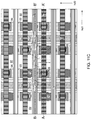
- FIG. 11C is a top-down view of a first configuration of the first exemplary structure at the processing steps of FIGS. 11A and 11B .
- the plane A-A′ corresponds to the plane of the vertical cross-section for FIG. 11A .
- the plane B-B′ corresponds to the plane of the vertical cross-section for FIG. 11B .
- FIG. 11D is a top-down view of a second configuration of the first exemplary structure at the processing steps of FIGS. 11A and 11B .
- FIG. 12A is a first vertical cross-sectional view of a second exemplary structure after formation of second contact via structures and second bit lines according to a second embodiment of the present disclosure.
- FIG. 12B is a second vertical cross-sectional view of the second exemplary structure at the processing steps of FIG. 12A .
- FIG. 12C is a top-down view of a first configuration of the second exemplary structure at the processing steps of FIGS. 12A and 12B .
- the plane A-A′ corresponds to the plane of the vertical cross-section for FIG. 12A .
- the plane B-B′ corresponds to the plane of the vertical cross-section for FIG. 12B .
- FIG. 12D is a top-down view of a second configuration of the second exemplary structure at the processing steps of FIGS. 12A and 12B .
- FIGS. 13A and 13B are circuit diagrams of the respective second and first exemplary structures of the second and first embodiments of the present disclosure.
- FIGS. 14A and 14B are tables illustrating exemplary voltages that may be used to operate the circuit of FIG. 13A .
- the present disclosure is directed to ferroelectric memory devices containing a ferroelectric memory transistor and a select gate transistor in each memory cell, and a method of forming the same, the various aspect of which are described herein in detail.
- the select gate transistor contains a select gate electrode which is longer than the control gate electrode of the ferroelectric memory transistor.
- the transistors share a common channel, and the longer select gate electrode controls a portion of the channel adjacent to the common source region to reduce the disturb of the ferroelectric memory transistor during operation of the device.
- a first element located “on” a second element may be located on the exterior side of a surface of the second element or on the interior side of the second element.
- a first element is located “directly on” a second element if there exist a physical contact between a surface of the first element and a surface of the second element.
- a first element is “electrically connected to” a second element if there exists a conductive path consisting of at least one conductive material between the first element and the second element.
- a “prototype” structure or an “in-process” structure refers to a transient structure that is subsequently modified in the shape or composition of at least one component therein.
- a “layer” refers to a material portion including a region having a thickness.
- a layer may extend over the entirety of an underlying or overlying structure, or may have an extent less than the extent of an underlying or overlying structure. Further, a layer may be a region of a homogeneous or inhomogeneous continuous structure that has a thickness less than the thickness of the continuous structure. For example, a layer may be located between any pair of horizontal planes between, or at, a top surface and a bottom surface of the continuous structure. A layer may extend horizontally, vertically, and/or along a tapered surface.
- a substrate may be a layer, may include one or more layers therein, or may have one or more layer thereupon, thereabove, and/or therebelow.
- a first surface and a second surface are “vertically coincident” with each other if the second surface overlies or underlies the first surface and there exists a vertical plane or a substantially vertical plane that includes the first surface and the second surface.
- a substantially vertical plane is a plane that extends straight along a direction that deviates from a vertical direction by an angle less than 5 degrees.
- a vertical plane or a substantially vertical plane is straight along a vertical direction or a substantially vertical direction, and may, or may not, include a curvature along a direction that is perpendicular to the vertical direction or the substantially vertical direction.
- a “semiconducting material” refers to a material having electrical conductivity in the range from 1.0 ⁇ 10 ⁇ 5 S/m to 1.0 ⁇ 10 5 S/m.
- a “semiconductor material” refers to a material having electrical conductivity in the range from 1.0 ⁇ 10 ⁇ 5 S/m to 1.0 S/m in the absence of electrical dopants therein, and is capable of producing a doped material having electrical conductivity in a range from 1.0 S/m to 1.0 ⁇ 10 5 S/m upon suitable doping with an electrical dopant.
- an “electrical dopant” refers to a p-type dopant that adds a hole to a valence band within a band structure, or an n-type dopant that adds an electron to a conduction band within a band structure.
- a “conductive material” refers to a material having electrical conductivity greater than 1.0 ⁇ 10 5 S/m.
- an “insulator material” or a “dielectric material” refers to a material having electrical conductivity less than 1.0 ⁇ 10 ⁇ 5 S/m.
- a “heavily doped semiconductor material” refers to a semiconductor material that is doped with electrical dopant at a sufficiently high atomic concentration to become a conductive material either as formed as a crystalline material or if converted into a crystalline material through an anneal process (for example, from an initial amorphous state), i.e., to have electrical conductivity greater than 1.0 ⁇ 10 5 S/m.
- a “doped semiconductor material” may be a heavily doped semiconductor material, or may be a semiconductor material that includes electrical dopants (i.e., p-type dopants and/or n-type dopants) at a concentration that provides electrical conductivity in the range from 1.0 ⁇ 10 ⁇ 5 S/m to 1.0 ⁇ 10 5 S/m.
- An “intrinsic semiconductor material” refers to a semiconductor material that is not doped with electrical dopants.
- a semiconductor material may be semiconducting or conductive, and may be an intrinsic semiconductor material or a doped semiconductor material.
- a doped semiconductor material can be semiconducting or conductive depending on the atomic concentration of electrical dopants therein.
- a “metallic material” refers to a conductive material including at least one metallic element therein. All measurements for electrical conductivities are made at the standard condition.
- the first exemplary structure includes a substrate 8 , which can be a semiconductor substrate that includes a semiconductor material at least at an upper portion thereof.
- the semiconductor material of the substrate 8 may include a single crystalline semiconductor material or a polycrystalline semiconductor material.
- the substrate 8 may include a commercially available single crystalline semiconductor substrate such as a silicon wafer.
- the semiconductor material of the substrate 9 is referred to herein as a substrate semiconductor layer 9 , which may comprise a semiconductor (e.g., silicon) wafer, a doped well in the wafer, or a silicon layer over another substrate material (e.g., silicon on insulator type structure).
- the substrate semiconductor layer 9 may have a doping of a first conductivity type, and may include dopants of the first conductivity type at an atomic concentration in a range from 1.0 ⁇ 10 13 /cm 3 to 3.0 ⁇ 10 17 /cm 3 .
- Dopants of a second conductivity type can be provided (e.g., diffused or implanted) into an upper portion of the substrate semiconductor layer 9 or a doped semiconductor layer may be grown epitaxially on the substrate semiconductor layer 9 .
- the doped upper portion of the substrate semiconductor layer 9 is converted into a source region 6 .
- the source region 6 can have a net doping of the second conductivity type such that the atomic concentration of dopants of the second conductivity type is in a range from 1 ⁇ 10 18 /cm 3 to 2 ⁇ 10 21 /cm 3 .
- the source region 6 functions as a common source region (e.g., source line or plate) for vertical field effect transistors to be subsequently formed.
- the thickness of the source region 6 can be in a range from 30 nm to 300 nm, although lesser and greater thicknesses can also be employed.
- a metal or metal alloy source line or plate may be formed under the source region 6 .
- the substrate semiconductor layer 9 comprises a single crystalline semiconductor material
- the source region 6 can be formed by introducing dopants of a second conductivity type that is the opposite of the first conductivity type into a portion of the substrate semiconductor layer 9 .
- the source region 6 comprises a first single crystalline semiconductor material portion.
- the source region 6 can be located in a substrate 8 , and can comprise a single crystalline doped semiconductor layer that continuously extends in a memory array region in which a two-dimensional array of ferroelectric memory elements is subsequently formed.
- a first epitaxial semiconductor material (e.g., single crystalline silicon) including dopants of a first conductivity type at a first dopant concentration can be grown on the top surface of the source region 6 to form a first semiconductor channel material layer 33 L.
- the first dopant concentration may be in a range from 1 ⁇ 10 16 /cm 3 to 1 ⁇ 10 18 /cm 3 , although lesser and greater dopant concentrations can also be employed.
- the thickness of the first semiconductor channel material layer 33 L can be in a range from 10 nm to 100 nm, although lesser and greater thicknesses can also be employed.
- a second epitaxial semiconductor material (e.g., single crystalline silicon) including dopants of the first conductivity type at a second dopant concentration can be grown on the top surface of the first semiconductor channel material layer 33 L to form a second semiconductor channel material layer 34 L.
- the second dopant concentration can be less than the first dopant concentration, and may be in a range from 1.0 ⁇ 10 13 /cm 3 to 1.0 ⁇ 10 17 /cm 3 , such as from 1.0 ⁇ 10 14 /cm 3 to 1.0 ⁇ 10 16 /cm 3 , although lesser and greater dopant concentrations can also be employed.
- Dopants of the second conductivity type can be provided (e.g., diffused or implanted) into an upper region of the second semiconductor channel material layer 34 L to provide a doped semiconductor material layer having a doping of the second conductivity type.
- the doped semiconductor material layer is herein referred to as a drain material layer 36 L.
- the doped drain material layer 36 L may be formed by epitaxial growth on the second semiconductor channel material layer 34 L.
- the atomic concentration of dopants of the second conductivity in the drain material layer 36 L can be in a range from in a range from 1 ⁇ 10 18 /cm 3 to 2 ⁇ 10 21 /cm 3 .
- the thickness of the second semiconductor channel material layer 34 L can be in a range from 30 nm to 600 nm, such as from 60 nm to 300 nm, although lesser and greater thicknesses can also be employed.
- the thickness of the drain material layer 36 L can be in a range from 30 nm to 300 nm, although lesser and greater thicknesses can also be employed.
- dielectric isolation rails 22 R can be formed thorough the layer stack of the drain material layer 36 L, the second semiconductor channel material layer 34 L, and the first semiconductor channel material layer 33 L.
- FIGS. 2A, 2B, and 2C illustrate a first configuration of the first exemplary structure
- FIGS. 2A, 2B, and 2D illustrate a second configuration of the first exemplary structure.
- a photoresist layer (not shown) can be applied over the drain material layer 36 L, and can be lithographically patterned to form a line and space pattern that laterally extend along a horizontal direction.
- each patterned portion of the photoresist layer can have a same width, which is herein referred to as a line width, and each neighboring pair of patterned portions of the photoresist layer can be laterally spaced apart by a same spacing.
- the patterned portions of the photoresist layer can constitute a periodic one-dimensional array.
- the horizontal direction along which patterned portions of the photoresist layer laterally extend is parallel to the horizontal direction along which bit lines are to be subsequently formed, and perpendicular to the horizontal direction along which word lines are to be subsequently formed.
- the horizontal direction along which patterned portions of the photoresist layer laterally extend is not perpendicular to the horizontal direction along which the bit lines and word lines are to be subsequently formed.
- first horizontal direction e.g., bit line direction
- second horizontal direction e.g., word line direction
- linear openings in the photoresist layer laterally extend along the second horizontal direction hd 2 in the first configuration of the first exemplary structure
- linear openings in the photoresist layer laterally extends at an angle in a range between 0 degree and 90 degrees, such as from 30 degrees to 60 degrees, with respect to the first horizontal direction hd 2 in the second configuration of the first exemplary structure.
- Initial line trenches can be formed through the layer stack of the drain material layer 36 L, the second semiconductor channel material layer 34 L, and the first semiconductor channel material layer 33 L by performing an anisotropic etch process employing the patterned photoresist layer as an etch mask.
- Each drain material layer 36 L is divided into drain material rails 36 R
- each second semiconductor channel material layer 34 L is divided into second semiconductor channel material rails 34 R
- each first semiconductor channel material layer 33 L is divided into first semiconductor channel material rails 33 R.
- Each vertical stack of a first semiconductor channel material rail 33 R, a second semiconductor channel material rail 34 R, and a drain material rail 36 R is formed between a respective pair of line trenches.
- a top surface of the source region 6 may be exposed in the initial line trenches, in which case the source region 6 functions as an etch stop region.
- a diffusion barrier dielectric liner (such as silicon nitride) can be optionally deposited in the line trenches.
- a dielectric fill material such as undoped silicate glass (e.g., silicon oxide), a doped silicate glass, or organosilicate glass can be deposited in remaining volumes of the line trenches. Excess portions of the dielectric fill material and the optional dielectric diffusion barrier material can be removed from above the horizontal plane including the top surfaces of the drain material rails 36 R by a planarization process, which can employ chemical mechanical polishing and/or a recess etch process. Each remaining portion of the dielectric fill material and the optional dielectric diffusion barrier material constitutes a dielectric isolation rail 22 R.
- first line trenches 41 laterally extending along the second horizontal direction hd 2 are formed through the vertical stacks of a first semiconductor channel material rail 33 R, a second semiconductor channel material rail 34 R, and a drain material rail 36 R and through the dielectric isolation rails 22 R.
- FIG. 3C illustrates the first configuration of the first exemplary structure
- FIG. 3D illustrates the second configuration of the first exemplary structure.
- a photoresist layer can be applied over the vertical stacks of a first semiconductor channel material rail 33 R, a second semiconductor channel material rail 34 R, and a drain material rail 36 R and over the dielectric isolation rails 22 R, and can be lithographically patterned into a line and space pattern.
- the line and space pattern may be a periodic pattern with a same line width for each patterned portion of the photoresist layer and a same spacing for each laterally neighboring pair of patterned photoresist portions.
- the spacing between laterally neighboring pair of patterned photoresist strips may be a lithographic critical dimension, i.e., a minimum dimension that can be printed employing a single lithographic exposure process and a single lithographic development process.
- the width of each patterned photoresist strip may be in a range from twice the lithographic critical dimension to six times the lithographic critical dimension. In one embodiment, the width of each patterned photoresist strip may be about four times the lithographic critical dimension.
- An anisotropic etch process is performed to etch through the drain material rails 36 R, the second semiconductor material rails 34 R, the first semiconductor channel material rails 33 R, and the dielectric isolation rails 22 R.
- the anisotropic etch process can stop on the top surface of the source region 6 .
- the anisotropic etch process can have a chemistry that etches the materials of the drain material rails 36 R, the second semiconductor material rails 34 R, the first semiconductor channel material rails 33 R, and the dielectric isolation rails 22 R, or can include multiple etch steps such that the semiconductor materials of the drain material rails 36 R, the second semiconductor material rails 34 R, and the first semiconductor channel material rails 33 R are etched in one of the etch steps of the anisotropic etch process, and the dielectric isolation rails 22 R are etched in another of the etch steps of the anisotropic etch process.
- the patterned photoresist layer protects underlying portions of the drain material rails 36 R, the second semiconductor material rails 34 R, the first semiconductor channel material rails 33 R, and the dielectric isolation rails 22 R during the anisotropic etch process.
- the first line trenches 41 are formed within areas that are not covered by the patterned photoresist strips. The depth of the first line trenches 41 is herein referred to as a first depth.
- Each of the drain material rails 36 R are divided into drain material portions 36 ′.
- the second semiconductor material rails 34 R are divided into second semiconductor channel material portions 34 ′.
- the first semiconductor channel material rails 33 R are divided into first semiconductor channel material portions 33 ′.
- the dielectric isolation rails 22 R are divided into discrete dielectric isolation structures 22 ′.
- the first line trenches 41 divide each of the dielectric isolation rails 22 R into a two-dimensional array of discrete dielectric isolation structures (e.g., dielectric pillars) 22 ′.
- Each vertical stack of a first semiconductor channel material portion 33 ′, a second semiconductor channel material portion 34 ′, and a drain material portion 36 ′ constitutes a semiconductor pillar ( 33 ′, 34 ′, 36 ′).
- Each semiconductor pillar ( 33 ′, 34 ′, 36 ′) can have a rectangular horizontal cross-sectional shape that is invariant with translation along the vertical direction.
- a two-dimensional array of semiconductor pillars ( 33 ′, 34 ′, 36 ′) can be interlaced (i.e., alternated) with the two-dimensional array of discrete dielectric isolation structures 22 ′ along the second horizontal direction hd 2 .
- the patterned photoresist strips can be subsequently removed, for example, by ashing.
- a first gate dielectric and a first gate electrode line is formed within each first line trench 41 .
- Each first gate dielectric is herein referred to as a select gate dielectric 40
- each first gate electrode line is herein referred to as a select gate electrode line 46 .
- the select gate electrode line 46 may also be referred to as a pass gate electrode line, access gate electrode line, a back gate electrode line or a read line (since this line is activated during the read operation, as will be discussed with respect to FIGS. 14A and 14B below).
- FIG. 4C illustrates the first configuration of the first exemplary structure
- FIG. 4D illustrates the second configuration of the first exemplary structure.
- a select gate dielectric material layer can be deposited in the first line trenches 41 by a conformal deposition process.
- the select gate dielectric material layer can include a gate dielectric material such as silicon oxide and/or a dielectric metal oxide.
- the select gate dielectric material layer can be formed by a chemical vapor deposition process and/or a dielectric conversion process (such as a thermal oxidation process and/or a thermal nitridation process) of the underlying semiconductor (e.g., silicon) material.
- the thickness of the select gate dielectric material layer can be in a range from 1 nm to 12 nm, such as from 2 nm to 6 nm, although lesser and greater thicknesses can also be employed.
- a select gate electrode material can be deposited over the select gate dielectric material layer.
- the select gate electrode material can include a heavily doped semiconductor material, an elemental metal, an intermetallic alloy, a metal silicide, and/or a conductive metallic compound including at least one metal and at least one non-metallic element (e.g., a metal nitride, such as TiN).
- the planarization process can employ a recess etch process and/or a chemical mechanical polishing process.
- top surfaces of remaining portions of the select gate electrode material can be vertically recessed below the horizontal plane including the top surfaces of the drain material portions 36 ′ and the discrete dielectric isolation structures 22 ′ by a selective etch.
- Each remaining portion of the select gate dielectric material layer constitutes a select gate dielectric 40 .
- Each select gate dielectric 40 extends up to, or above, the horizontal plane including the interfaces between the second semiconductor channel material portions 34 ′ and the drain material portions 36 ′.
- Each remaining portion of the select gate electrode material constitutes a select gate electrode line 46 .
- Each select gate electrode line 46 can have a top surface located at, or above, the horizontal plane including the interfaces between the second semiconductor channel material portions 34 ′ and the drain material portions 36 ′.
- a select gate dielectric 40 can be formed on a sidewall of a first semiconductor channel material portion 33 ′, on a sidewall of a second semiconductor channel material portion 34 ′ that overlies the first semiconductor channel material portion 33 ′, and on a portion of the top surface of the source region 6 .
- Each select gate dielectric 40 can have a first U-shaped vertical cross-sectional profile, and can include a horizontal select gate dielectric portion contacting a portion of the top surface of the source region 6 , a first vertical select gate dielectric portion adjoined to a first edge of the horizontal select gate dielectric portion, and a second vertical select gate dielectric portion adjoined to a second edge of the horizontal select gate dielectric portion.
- a dielectric material can be deposited and planarized to fill cavities overlying the select gate electrode lines 46 .
- the remaining portions of the dielectric material that overlie the select gate electrode lines 46 constitute select gate cap dielectric rails 60 .
- the select gate cap dielectric rails 60 includes a dielectric material such as undoped silicate glass, and laterally extends along a horizontal direction, which may, or may not, be the second horizontal direction hd 2 .
- FIG. 5C illustrates the first configuration of the first exemplary structure
- FIG. 5D illustrates the second configuration of the first exemplary structure.
- a photoresist layer 57 can be applied over the drain material portions 36 ′ and the select gate cap dielectric rails 60 , and can be lithographically patterned to form line-shaped strips that overlie a respective one of the select gate cap dielectric rails 60 .
- FIG. 6C illustrates the first configuration of the first exemplary structure
- FIG. 6D illustrates the second configuration of the first exemplary structure.
- each opening in the photoresist layer 57 can have a uniform width, and can laterally extend along the second horizontal direction hd 2 .
- each opening in the photoresist layer 57 can have a pair of straight edges that are parallel to the sidewalls of the first line trenches 41 that include a respective combination of a select gate dielectric 40 , a select gate electrode line 46 , and a select gate cap dielectric rail 60 .
- the straight edges of each opening in the photoresist layer 57 may be approximately equidistant from proximal sidewalls of a pair of first line trenches that are covered by a neighboring pair of photoresist strips of the patterned photoresist layer 57 .
- the width of each opening in the photoresist layer 57 may have a lithographic critical dimension.
- An anisotropic etch process can be performed employing the patterned photoresist layer 57 as an etch mask. Unmasked portions of the drain material portions 36 ′, the second semiconductor channel material portions 34 ′, and the discrete dielectric isolation structures 22 ′ can be etched to form second line trenches 51 . Each second line trench 51 can have a uniform width throughout. A top surface of a first semiconductor channel material portion 33 ′ can be physically exposed at the bottom of each second line trench 51 after the anisotropic etch process. The first semiconductor channel material portions 33 ′ can function as an etch stop structure during the anisotropic etch process.
- the anisotropic etch process can etch the materials of the drain material portions 36 ′, the second semiconductor channel material portions 34 ′, and the discrete dielectric isolation structures 22 ′.
- the anisotropic etch process can include multiple etch steps, which include an anisotropic etch step that etches the materials of the drain material portions 36 ′ and the second semiconductor channel material portions 34 ′, and another anisotropic etch step that etches the material of the discrete dielectric isolation structures 22 ′.
- the second line trenches 51 pattern the semiconductor pillars ( 33 ′, 34 ′, 36 ′) into stepped semiconductor material structures ( 33 ′, 34 , 36 ) having a respective U-shaped vertical cross-sectional profile, and pattern the discrete dielectric isolation structures 22 ′ into U-shaped dielectric isolation structures 22 .
- the discrete dielectric isolation structures 22 ′ may be etched all the way through to the source region 6 to form two separate pillar shaped dielectric isolation structures 22 .
- Each second semiconductor channel material portion 34 ′ is divided into two semiconductor channel material portions, which are herein referred to as second semiconductor channel portions 34 .
- Each drain material portion 36 ′ is divided into two drain regions 36 .
- Each U-shaped stepped semiconductor material structure ( 33 ′, 34 , 36 ) can include a first semiconductor channel material portion 33 ′, a pair of second semiconductor channel portions 34 , and a pair of drain regions 36 .
- Each stepped semiconductor material structure ( 33 ′, 34 , 36 ) can comprise two fin portions 30 F having a first height hl and a base portion 30 B having a second height hd 2 and located over a first region of a top surface of the source region 6 .
- Each fin portion 30 F can include a drain region 36 , a second semiconductor channel portion 34 , and a region of a first semiconductor channel material portion 33 ′ that underlies second semiconductor channel portion 34 .
- Each base portion 30 B can include a region of a first semiconductor channel material portion 33 ′ that does not underlie any second semiconductor channel portion 34 .
- Each stepped semiconductor material structure ( 33 ′, 34 , 36 ) can comprise a pair of outer sidewalls having the first height hd 1 and a pair of inner sidewalls having a height that is less than the first height hd 1 located between the pair of outer sidewalls.
- a second line trench 51 is formed between, and is laterally bounded by, the pair of inner sidewalls. The second line trenches 51 form a groove within each of the discrete dielectric isolation structures 22 ′, thereby converting the discrete dielectric isolation structures 22 ′ into the U-shaped or pillar shaped dielectric isolation structures 22 .
- the stepped semiconductor material structures ( 33 ′, 34 , 36 ) can be formed by patterning semiconductor material portions with line trenches ( 41 , 51 ) having substantially vertical sidewalls (e.g., within 0 to 10 degrees of vertical due to etching variations).
- the line trenches can comprise first line trenches 41 having a first depth that is the same as the first height h 1 and second line trenches 51 having a second depth that is less than the first height h 1 .
- the base portions 30 B of the stepped semiconductor material structures ( 33 ′, 34 , 36 ) are converted into spacer material portions 23 which decrease electrical conductivity between the source region 6 and the second semiconductor channel portion 34 .
- the spacer material portions 23 may be formed by implantation of first conductivity type dopants, oxygen atoms, and/or nitrogen atoms into the semiconductor base portions 30 B (i.e., into segments of the first semiconductor channel material portions 33 ′ that do not underlie any of the second semiconductor channel portions 34 ).
- FIG. 7C illustrates the first configuration of the first exemplary structure
- FIG. 7D illustrates the second configuration of the first exemplary structure.
- Electrical conduction through the base portions 30 B of the stepped semiconductor material structures ( 33 ′, 34 , 36 ) between the source region 6 and the second semiconductor channel portions 34 can be reduced by implanting dopants of the first conductivity type into the base portions 30 B, or by implanting electrically inactive atoms, such as oxygen atoms and/or nitrogen atoms, that convert the semiconductor material of the base portions 30 B into an insulating material, such as silicon oxide, silicon nitride or silicon oxynitride.
- the photoresist layer 57 is used as a mask during the ion implantation and can be removed by ashing after the implantation.
- Each unimplanted region of the first semiconductor channel material portions 33 ′ constitutes a first semiconductor channel portion 33 .
- Each vertical stack of a first semiconductor channel portion 33 and a second semiconductor channel portion 34 constitutes a vertical semiconductor channel ( 33 , 34 ).
- Each vertical semiconductor channel ( 33 , 34 ) i.e., a vertical stack of a first semiconductor channel portion 33 and a second semiconductor channel portion 34 that overlies the first semiconductor channel portion 33 ) is located in a respective fin portion 30 F of each stepped semiconductor material structure ( 23 , 33 , 34 , 36 ).
- the source region 6 comprises a first single crystalline semiconductor material portion
- each first semiconductor channel portion 33 comprises a second single crystalline semiconductor material portion in epitaxial alignment with the first single crystalline semiconductor material portion.
- Each second semiconductor channel portion 34 can comprise a third single crystalline semiconductor material portion in epitaxial alignment with the second single crystalline semiconductor material portion of an underlying first semiconductor channel portion 33 .
- Each first semiconductor channel portion 33 can comprise electrical dopants of a first conductivity type at a first atomic concentration
- each second semiconductor channel portion 34 comprises electrical dopants of the first conductivity type at a second atomic concentration that is less than the first atomic concentration.
- a drain region 36 is provided on a top end of each vertical semiconductor channel ( 33 , 34 ).
- the drain regions 36 can form a two-dimensional array of discrete drain regions.
- the drain region 36 comprises electrical dopants of the second conductivity type at an atomic concentration greater than the second atomic concentration (i.e., the atomic concentration of dopants of the second conductivity type in the first semiconductor channel portions 34 ).
- At least one second gate dielectric material layer can be formed by a respective conformal deposition process.
- the at least one second gate dielectric material layer can include a non-ferroelectric gate dielectric material layer and a continuous ferroelectric material layer.
- the non-ferroelectric gate dielectric material layer if present, can include any non-ferroelectric gate dielectric material such as silicon oxide and/or a dielectric metal oxide.
- the thickness of the non-ferroelectric gate dielectric material layer can be in a range from 3 nm to 60 nm, such as from 6 nm to 30 nm, although lesser and greater thicknesses can also be employed.
- the continuous ferroelectric material layer includes a ferroelectric material.
- a “ferroelectric material” refers to a crystalline material that exhibits spontaneous electrical polarization in the absence of an external electric field.
- the ferroelectric material in the continuous ferroelectric material layer may be an insulating ferroelectric material.
- the continuous ferroelectric material layer comprises an orthorhombic phase hafnium oxide layer including at least one dopant selected from Al, Zr, and/or Si.
- Other suitable ferroelectric materials may also be used, as such as titanate ferroelectric materials (e.g., barium titanate, lead titanate, lead zirconate titanate, lead lanthanum zirconate titanate (“PLZT”), etc.).
- the continuous ferroelectric material layer can have a thickness in a range from 3 nm to 60 nm, such as from 6 nm to 30 nm, although lesser and greater thicknesses can also be employed.
- the continuous ferroelectric material layer can be deposited by a conformal deposition process such as chemical vapor deposition (CVD) or atomic layer deposition (ALD).
- CVD chemical vapor deposition
- ALD atomic layer deposition
- An anisotropic etch process such as a sidewall spacer etch process, can be performed to remove horizontal portions of the continuous ferroelectric material layer.
- Each remaining portion of the gate dielectric layer 50 and the continuous ferroelectric material layer 52 constitutes a control gate dielectric ( 52 , 50 ).
- a pair of ferroelectric material layers 52 can be formed within each second line trench 51 .
- Each control gate dielectric ( 52 , 50 ) comprises the pair of ferroelectric material layers 52 and a U-shaped gate dielectric layer 50 , which is a remaining portion of the non-ferroelectric gate dielectric material layer.
- a control gate electrode material can be deposited on the control gate dielectrics ( 52 , 50 ).
- the control gate electrode material can include a heavily doped semiconductor material, an elemental metal, an intermetallic alloy, a metal silicide, and/or a conductive metallic compound including at least one metal and at least one non-metallic element (such as a metal nitride, e.g., TiN).
- Portions of the control gate electrode material that overlie the top surfaces of the drain regions 36 and the select gate cap dielectric rails 60 can be removed by a planarization process.
- the planarization process can employ a recess etch process and/or a chemical mechanical polishing process. Further, top surfaces of remaining portions of the control gate electrode material can be vertically recessed below the horizontal plane including the top surfaces of the drain regions 36 and the select gate cap dielectric rails 60 by a recess etch.
- the first contact-level dielectric layer 70 includes an interlayer dielectric material such as undoped silicate glass, a doped silicate glass, or organosilicate glass.
- the first contact-level dielectric layer 70 may include a single dielectric material layer, or may include a plurality of dielectric material layers that are sequentially formed.
- the first contact-level dielectric layer 70 may be planarized to provide a planar top surface.
- First contact via structures (e.g., first drain electrodes) 76 can be formed on a first subset of the drain regions 36 , which is herein referred to as first drain regions 36 A.
- each stepped semiconductor material structures ( 23 , 33 , 34 , 36 ) can include a first drain region 36 A that is contacted by a first contact via structure 76 and a second drain region 36 B that is not contacted by any first contact via structure 76 .
- First bit lines 78 laterally extending the along first horizontal direction hd 1 can be formed by forming line trenches in an upper portion of the first contact-level dielectric layer 70 , and by filling the line trenches with at least one conductive material such as a metallic material.
- the first bit lines 78 can be electrically connected to a respective subset of the drain regions 36 (each of which is a first drain region 36 A) of the two-dimensional array of ferroelectric memory elements.
- the lengthwise directions of the select gate electrode lines 46 and the word lines 56 can be parallel to each other, and can be at a non-zero angle with respect to the first horizontal direction hd 1 .
- the non-zero angle may be 90 degrees as illustrated in FIG. 10C , or may be in a range from 15 degree and 75 degrees as illustrated in FIG. 10D .
- a second contact-level dielectric layer 80 can be deposited over the first contact-level dielectric layer 70 and the first bit lines 78 .
- FIG. 11C illustrates the first configuration of the first exemplary structure
- FIG. 11D illustrates the second configuration of the first exemplary structure.
- the second contact-level dielectric layer 80 is omitted in FIGS. 11C and 11D to illustrate underlying elements.
- the second contact-level dielectric layer 80 includes an interlayer dielectric material such as undoped silicate glass, a doped silicate glass, or organosilicate glass.
- the second contact-level dielectric layer 80 may include a single dielectric material layer, or may include a plurality of dielectric material layers that are sequentially formed.
- the second contact-level dielectric layer 80 may be planarized to provide a planar top surface.
- Second contact via structures (e.g., second drain electrodes) 86 can be formed on a second subset of the drain regions 36 , which is herein referred to as second drain regions 36 B.
- each stepped semiconductor material structures ( 23 , 33 , 34 , 36 ) can include a first drain region 36 A that is contacted by a first contact via structure 76 and a second drain region 36 B that is contacted by a second contact via structure 86 .
- Second bit lines 88 laterally extending the along first horizontal direction hd 1 can be formed by forming line trenches in an upper portion of the second contact-level dielectric layer 80 , and by filling the line trenches with at least one conductive material such as a metallic material.
- the second bit lines 88 can be electrically connected to a respective subset of the drain regions 36 (each of which is a second drain region 36 B) of the two-dimensional array of ferroelectric memory elements.
- the process steps may be performed in a different order.
- the second line trenches 51 and the word lines 56 may be formed first, followed by forming the first line trenches 41 and the select gate electrode line 46 .
- each memory cell 100 (e.g., 100 A or 100 B) includes a ferroelectric memory transistor 102 (e.g., 102 A or 102 B) and a select gate transistor 104 (e.g., 104 A or 104 B).
- the select gate transistor 104 may also be referred to as a pass gate transistor or access transistor.
- a portion of the select gate electrode line 46 located in the select gate transistor 104 functions as a select gate electrode 46 S (i.e., a pass gate electrode or an access gate electrode) of the select gate transistor 104 .
- a portion of the word line 56 located in the ferroelectric memory transistor 102 functions as a control gate electrode 56 C of the ferroelectric memory transistor 102 .
- the ferroelectric memory transistor 102 and the select gate transistor 104 in the same memory cell 100 share the same vertical semiconductor channel ( 33 , 34 ) and the same source region 6 and the same drain region 36 .
- the ferroelectric memory transistor 102 includes the ferroelectric material layer 52 in addition to the gate dielectric layer 50 made of a non-ferroelectric material between the shared vertical semiconductor channel ( 33 , 34 ) and the control gate electrode 56 C.
- the select gate transistor 104 contains the gate dielectric layer 50 made of a non-ferroelectric material and excludes the ferroelectric material layer 52 between the shared vertical semiconductor channel ( 33 , 34 ) and the select gate electrode 46 S.
- the select gate electrode 46 S has a longer gate length (i.e., size in the vertical direction in FIG. 11A ) than the control gate electrode 56 C in the same memory cell 100 .
- the select gate electrode 46 S is located adjacent to the first semiconductor channel portion 33 , while the control gate electrode 56 C is not located adjacent to the first semiconductor channel portion 33 . Therefore, the select gate electrode 46 S controls access between the source region 6 and the common vertical semiconductor channel ( 33 , 34 ) by activating and deactivating the first semiconductor channel portion 33 , such as during a read operation.
- the control gate electrode 56 C cannot independently activate or deactivate the first semiconductor channel portion 33 to permit current to flow between the source region 6 and the vertical semiconductor channel ( 33 , 34 ).
- Each memory cell 100 (e.g., 100 A or 100 B) of the first exemplary structure illustrated in FIGS. 11A and 11C has a size 4F 2 , where F is a lithographic critical dimension, i.e., a minimum dimension that can be printed employing a single lithographic exposure process and a single lithographic development process.
- F is a lithographic critical dimension, i.e., a minimum dimension that can be printed employing a single lithographic exposure process and a single lithographic development process.
- a second exemplary structure can be derived from the first exemplary structure of FIGS. 11A-11D by omitting formation of the first contact via structures 76 and the first bit lines 78 .
- the first drain regions 36 A (which are a first subset of the drain regions 36 ) are not contacted by any contact via structure
- the second drain regions 36 B (which are a second subset of the drain regions 36 ) are contacted by a respective one of the second contact via structures 86 , which are also referred to as drain contact via structures 86 in this embodiment.
- Each memory cell 100 (e.g., 100 A or 100 B) of the second exemplary structure of FIG. 12A has a size 8F 2 , where F is a lithographic critical dimension, i.e., a minimum dimension that can be printed employing a single lithographic exposure process and a single lithographic development process.
- F is a lithographic critical dimension, i.e., a minimum dimension that can be printed employing a single lithographic exposure process and a single lithographic development process.
- FIG. 13A illustrates a circuit schematic for a two-dimensional array of ferroelectric memory elements containing the second exemplary structure shown in FIGS. 12A-12D .
- FIG. 13B illustrates a circuit schematic for a two-dimensional array of ferroelectric memory elements containing the first exemplary structure shown in FIGS. 11A-11D .
- Each ferroelectric memory element (e.g., memory cell 100 ) includes a parallel connection of two field effect transistors.
- the source region 6 of the two-dimensional array of ferroelectric memory elements may comprise a continuous doped semiconductor material layer having a doping of the second conductivity type, and functions as the source lines SL in the circuit schematic.
- the bit lines 88 function as the bit lines BL of the circuit schematic.
- Each vertical stack of a first semiconductor channel portion 33 and a second semiconductor channel portion 34 functions as a channel ( 33 , 34 ) of the select gate transistor 104 (e.g., 104 A or 104 B), which is labeled as “SG” in the circuit diagram.
- Each select gate electrode line 46 of the two-dimensional array of ferroelectric memory elements corresponds to the read line RL of the circuit schematic.
- Each second semiconductor channel portion 34 functions as a channel of a ferroelectric memory transistor (i.e., ferroelectric memory field effect transistor) 102 (e.g., 102 A or 102 B) which is labeled as “FeFET” in the circuit diagram.
- Each word line 56 of the two-dimensional array of ferroelectric memory elements corresponds to the word line WL of the circuit schematic, and its portions in each ferroelectric memory transistor 102 (e.g., 102 A or 102 B) correspond to the control gate electrode 56 C of the ferroelectric memory transistor.
- each memory cell 100 e.g., 100 A or 100 B
- a pair of the select gate transistor 104 and the ferroelectric memory transistor 102 share a common vertical semiconductor channel (e.g., at least the second semiconductor channel portion 34 ).
- Deactivation of the select gate transistor 104 by application of a turn-off gate bias voltage to the select gate electrode line 46 deactivates the ferroelectric memory transistor 102 in the same memory cell because electrical current cannot pass through the first semiconductor channel portion 33 that underlies the second semiconductor channel portion 34 of the common vertical semiconductor channel ( 33 , 34 ).
- the ferroelectric polarization of the ferroelectric material layer 52 of the ferroelectric memory transistor 102 can be read only when the turn-on gate bias voltage applied to the select gate electrode line 46 of the select gate transistor 104 electrically connects the common vertical semiconductor channel to the source region 6 , and thus enables the read current to flow between the source region and the shared the second semiconductor channel portion 34 of the ferroelectric memory transistor 102 .
- the turn-on gate bias voltage for the select gate electrode line 46 is selected such that the polarization state of the ferroelectric material layer 52 determines the amount of the electrical current that flows through the vertical semiconductor channel ( 33 , 34 ) in conjunction with a word line bias voltage applied to the word line 56 of the ferroelectric memory transistor 102 .
- a low leakage current and a reduced write, erase and/or read distrub may be obtained in a two-dimensional array of ferroelectric memory elements by turning off unselected ferroelectric memory transistors 102 by applying a turn-off gate bias voltage to all select gate electrode lines 46 that are not selected.
- FIGS. 14A and 14B are tables illustrating exemplary voltages that may be used to operate the circuit of FIG. 13A .
- FIG. 14A illustrates the exemplary voltages that may be used to operate a single level cell 100 in a negative voltage channel potential control scheme (columns 2 , 3 and 4 ) and in a positive voltage channel potential control scheme (columns 5 , 6 and 7 ).
- FIG. 14B illustrates the exemplary voltages that are used to operate a multi-level cell 100 in a negative voltage channel potential control scheme (columns 2 , 3 and 4 ) and in a positive voltage channel potential control scheme (columns 5 , 6 and 7 ).
- the voltages shown are exemplary and other suitable voltages may be used for different device dimensions and materials.
- the selected word line 56 (i.e., the word line of the selected memory cell) is set to a high negative voltage for write/inhibit, to a high positive voltage for erase/inhibit and to 0V or a low positive/negative voltage for read/inhibit.
- the unselected word lines 56 are set to a lower negative voltage for write/inhibit, a lower positive voltage for erase/inhibit, and to 0V for read/inhibit.
- the selected read lines RL i.e., select gate electrode line 46 of the selected memory cell is set to 0V for write and erase and to V dd and 0V for read/inhibit, respectively.
- the select gate transistor 104 bottom portion (i.e., the first semiconductor channel portion 33 ) is off during write, erase and read inhibit, and on during read.
- the bit lines BL ( 88 ) are set to 0V/low negative voltage for write/inhibit, to 0V/low positive voltage for erase/inhibit, and to V dd for read/inhibit.
- the source line SL ( 6 ) is set to 0V for write, erase and read.
- the operating units are per page of the device.
- the selected word line 56 (i.e., the word line of the selected memory cell) is set to a high positive voltage for write/inhibit, to 0V for erase/inhibit and to 0V or a low positive/negative voltage for read/inhibit.
- the unselected word lines 56 are set to a lower positive voltage for write/inhibit, a lower positive voltage for erase/inhibit, and to 0V for read/inhibit.
- the selected read lines RL i.e., select gate electrode line 46 of the selected memory cell is set to 0V for write and erase and to V dd and 0V for read/inhibit, respectively.
- the select gate transistor 104 bottom portion (i.e., the first semiconductor channel portion 33 ) is off during write, erase and read inhibit, and on during read.
- the bit lines BL ( 88 ) are set to 0V/low positive voltage for write/inhibit, to a high positive voltage/0V for erase/inhibit, and to V dd for read/inhibit.
- the source line SL ( 6 ) is set to 0V/low positive voltage for write/inhibit, to high positive voltage/0V for erase/inhibit and to 0V read/inhibit.
- the operating units are per page of the device.
- a memory cell 100 includes a ferroelectric memory transistor 102 , and a select gate transistor 104 which shares a common semiconductor channel ( 33 , 34 ), a common source region 6 and a common drain region 36 with the ferroelectric memory transistor 102 .
- the select gate transistor 104 controls access between the common source region 6 and the common semiconductor channel ( 33 , 34 ).
- the common semiconductor channel ( 33 , 34 ) comprises a vertical semiconductor channel comprising a vertical stack of a first semiconductor channel portion 33 that is located on the common source region 6 and a second semiconductor channel portion 34 that overlies the first semiconductor channel portion 33 .
- the ferroelectric memory transistor 102 comprises a control gate electrode 56 C and a control gate dielectric ( 50 , 52 ) comprising a ferroelectric material layer 52 located between the vertical semiconductor channel ( 33 , 34 ) and the control gate electrode 56 C.
- the select gate transistor 104 comprises a select gate electrode 46 S and a select gate dielectric 40 located between the select gate electrode 46 S and the vertical semiconductor channel ( 33 , 34 ).
- control gate dielectric ( 50 , 52 ) further comprises a gate dielectric layer 50 made of a non-ferroelectric material.
- the select gate dielectric 40 is made of a non-ferroelectric material and preferably excludes a ferroelectric material.
- the select gate electrode 46 S has a longer gate length than the control gate electrode 56 C in a direction between the common source region 6 and the common drain region 36 .
- the select gate electrode 46 S is located adjacent to the first semiconductor channel portion 33 , while the control gate electrode 56 C is not located adjacent to the first semiconductor channel portion 33 .
- the select gate electrode 46 S controls access between the common source region 6 and the vertical semiconductor channel ( 33 , 34 ) by activating and deactivating the first semiconductor channel portion 33 .
- the select gate dielectric 40 is located on a first side of the vertical semiconductor channel ( 33 , 34 ) and contacts a top surface of the common source region 6 .
- the control gate dielectric ( 50 , 52 ) is located on a second side of the vertical semiconductor channel ( 33 , 34 ) and is spaced from the top surface of the common source region by a spacer material portion 23 .
- the common drain region 36 is located on a top end of the vertical semiconductor channel ( 33 , 34 ).
- the first semiconductor channel portion 33 comprises electrical dopants of a first conductivity type at a first atomic concentration; and the second semiconductor channel portion 34 comprises electrical dopants of the first conductivity type at a second atomic concentration that is less than the first atomic concentration.
- the spacer material portion 23 comprises an additional single crystalline semiconductor material portion in epitaxial alignment with the first single crystalline semiconductor material portion and the second single crystalline semiconductor material portion and includes dopants of the first conductivity type at a third atomic concentration that is greater than the second d atomic concentration.
- the spacer material portion 23 comprises a semiconductor material doped with oxygen atoms and/or nitrogen atoms at an atomic concentration greater than the first atomic concentration.
- spacer material portion 23 may comprise silicon oxide, silicon nitride or silicon oxynitride.
- the source region 6 comprises electrical dopants of a second conductivity type that is the opposite of the first conductivity type at an atomic concentration greater than the first atomic concentration.
- the drain region 36 comprises electrical dopants of the second conductivity type at an atomic concentration greater than the first atomic concentration.
- the select gate electrode 46 S comprises a portion of a select gate electrode line 46
- the control gate electrode 56 C comprises a portion of word line 56
- a bit line 88 is electrically connected to the common drain region 36 by the source electrode 86 .
- a method of reading the memory cell 100 comprises applying a read voltage (e.g., V dd ) to the bit line 88 and to the select gate electrode line (i.e., read line) 46 while applying zero volts to the word line 56 and the common source region 6 .
- a read voltage e.g., V dd
Landscapes
- Engineering & Computer Science (AREA)
- Computer Hardware Design (AREA)
- Semiconductor Memories (AREA)
- Insulated Gate Type Field-Effect Transistor (AREA)
- Non-Volatile Memory (AREA)
Abstract
Description
Claims (19)
Priority Applications (5)
| Application Number | Priority Date | Filing Date | Title |
|---|---|---|---|
| US16/456,736 US10978482B2 (en) | 2019-06-28 | 2019-06-28 | Ferroelectric memory device with select gate transistor and method of forming the same |
| KR1020217019530A KR102591269B1 (en) | 2019-06-28 | 2019-12-30 | Ferroelectric memory device with select gate transistor and method of forming same |
| CN201980081329.6A CN113196480B (en) | 2019-06-28 | 2019-12-30 | Ferroelectric memory device with select gate transistor and method of forming the same |
| EP19934798.0A EP3881355B1 (en) | 2019-06-28 | 2019-12-30 | Ferroelectric memory device with select gate transistor and method of forming the same |
| PCT/US2019/068869 WO2020263338A1 (en) | 2019-06-28 | 2019-12-30 | Ferroelectric memory device with select gate transistor and method of forming the same |
Applications Claiming Priority (1)
| Application Number | Priority Date | Filing Date | Title |
|---|---|---|---|
| US16/456,736 US10978482B2 (en) | 2019-06-28 | 2019-06-28 | Ferroelectric memory device with select gate transistor and method of forming the same |
Publications (2)
| Publication Number | Publication Date |
|---|---|
| US20200411533A1 US20200411533A1 (en) | 2020-12-31 |
| US10978482B2 true US10978482B2 (en) | 2021-04-13 |
Family
ID=74043832
Family Applications (1)
| Application Number | Title | Priority Date | Filing Date |
|---|---|---|---|
| US16/456,736 Active 2039-07-11 US10978482B2 (en) | 2019-06-28 | 2019-06-28 | Ferroelectric memory device with select gate transistor and method of forming the same |
Country Status (5)
| Country | Link |
|---|---|
| US (1) | US10978482B2 (en) |
| EP (1) | EP3881355B1 (en) |
| KR (1) | KR102591269B1 (en) |
| CN (1) | CN113196480B (en) |
| WO (1) | WO2020263338A1 (en) |
Cited By (7)
| Publication number | Priority date | Publication date | Assignee | Title |
|---|---|---|---|---|
| US11282848B2 (en) * | 2020-05-18 | 2022-03-22 | Sandisk Technologies Llc | Three-dimensional memory device including ferroelectric-metal-insulator memory cells and methods of making the same |
| US12035535B2 (en) | 2019-12-27 | 2024-07-09 | Sandisk Technologies Llc | Three-dimensional NOR array including vertical word lines and discrete memory elements and methods of manufacture |
| TWI876348B (en) * | 2022-06-16 | 2025-03-11 | 南韓商三星電子股份有限公司 | Semiconductor device including a ferroelectric transistor |
| US12317502B2 (en) | 2019-09-12 | 2025-05-27 | SanDisk Technologies, Inc. | Three-dimensional memory device containing ferroelectric-assisted memory elements and method of making the same |
| US12362301B2 (en) | 2020-06-26 | 2025-07-15 | SanDisk Technologies, Inc. | Bonded memory devices and methods of making the same |
| US12563973B2 (en) | 2020-06-26 | 2026-02-24 | SanDisk Technologies, Inc. | Bonded memory devices and methods of making the same |
| US12581665B2 (en) | 2023-08-22 | 2026-03-17 | SanDisk Technologies, Inc. | Bonded memory MRAM arrays sharing a common driver circuit and methods of making the same |
Families Citing this family (22)
| Publication number | Priority date | Publication date | Assignee | Title |
|---|---|---|---|---|
| US11120884B2 (en) | 2015-09-30 | 2021-09-14 | Sunrise Memory Corporation | Implementing logic function and generating analog signals using NOR memory strings |
| DE102019104255B4 (en) * | 2018-08-29 | 2023-03-16 | Taiwan Semiconductor Manufacturing Co. Ltd. | Memory structure with FeRAM device and method for its production as well as an integrated chip with a first FeRAM cell and a second FeRAM cell |
| WO2021127218A1 (en) | 2019-12-19 | 2021-06-24 | Sunrise Memory Corporation | Process for preparing a channel region of a thin-film transistor |
| US12256547B2 (en) | 2020-01-22 | 2025-03-18 | Sunrise Memory Corporation | Silicon oxide nitride tunnel dielectric for a storage transistor in a 3-dimensional NOR memory string array |
| US12550382B2 (en) | 2020-01-22 | 2026-02-10 | Sunrise Memory Corporation | Thin-film storage transistor with ferroelectric storage layer |
| TWI767512B (en) | 2020-01-22 | 2022-06-11 | 美商森恩萊斯記憶體公司 | Cool electron erasing in thin-film storage transistors |
| TWI836184B (en) | 2020-02-07 | 2024-03-21 | 美商森恩萊斯記憶體公司 | High capacity memory circuit with low effective latency |
| US11699765B2 (en) * | 2020-11-27 | 2023-07-11 | Samsung Electronics Co., Ltd. | Semiconductor device |
| JP2022118607A (en) * | 2021-02-02 | 2022-08-15 | キオクシア株式会社 | memory device |
| US12051692B2 (en) * | 2021-02-16 | 2024-07-30 | Intel Corporation | Integrated circuit structure with front side signal lines and backside power delivery |
| US11514982B2 (en) * | 2021-03-03 | 2022-11-29 | Taiwan Semiconductor Manufacturing Company Limited | Computation unit including an asymmetric ferroelectric device pair and methods of forming the same |
| US12137570B2 (en) * | 2021-04-09 | 2024-11-05 | Taiwan Semiconductor Manufacturing Company, Ltd. | Three dimensional memory device |
| WO2023287908A1 (en) | 2021-07-16 | 2023-01-19 | Sunrise Memory Corporation | 3-dimensional memory string array of thin-film ferroelectric transistors |
| US12615769B2 (en) | 2021-09-03 | 2026-04-28 | Sunrise Memory Corporation | Three-dimensional nor memory string arrays of thin-film ferroelectric transistors |
| JP2023040758A (en) * | 2021-09-10 | 2023-03-23 | ルネサスエレクトロニクス株式会社 | Semiconductor device and manufacturing method thereof |
| US12279445B2 (en) | 2021-09-14 | 2025-04-15 | SanDisk Technologies, Inc. | Field effect transistors with gate fins and method of making the same |
| WO2023043504A1 (en) * | 2021-09-14 | 2023-03-23 | Sandisk Technologies Llc | Field effect transistors with gate fins and method of making the same |
| US12015084B2 (en) | 2021-09-14 | 2024-06-18 | Sandisk Technologies Llc | Field effect transistors with gate fins and method of making the same |
| US11967626B2 (en) | 2021-09-14 | 2024-04-23 | Sandisk Technologies Llc | Field effect transistors with gate fins and method of making the same |
| US12402319B2 (en) | 2021-09-14 | 2025-08-26 | Sunrise Memory Corporation | Three-dimensional memory string array of thin-film ferroelectric transistors formed with an oxide semiconductor channel |
| KR20230139624A (en) * | 2022-03-28 | 2023-10-05 | 삼성전자주식회사 | 3d ferroelectric memory devices |
| US20230413571A1 (en) * | 2022-06-15 | 2023-12-21 | Taiwan Semiconductor Manufacturing Company, Ltd. | Semiconductor device structure and methods of forming the same |
Citations (8)
| Publication number | Priority date | Publication date | Assignee | Title |
|---|---|---|---|---|
| US20010017386A1 (en) | 2000-02-14 | 2001-08-30 | Harald Bachhofer | Memory configuration and method for reading a state from and storing a state in a ferroelectric transistor |
| US20120195095A1 (en) | 2011-02-01 | 2012-08-02 | Stmicroelectronics S.R.I | Memory support provided with memory elements of ferroelectric material and non-destructive reading method thereof |
| US8385099B2 (en) * | 2009-02-24 | 2013-02-26 | Panasonic Corporation | Semiconductor memory cell and manufacturing method thereof, and semiconductor memory devices |
| US9355727B1 (en) | 2014-12-09 | 2016-05-31 | Sandisk Technologies Inc. | Three-dimensional memory structure having a back gate electrode |
| US20160163729A1 (en) | 2014-12-09 | 2016-06-09 | SanDisk Technologies, Inc. | Three-dimensional memory structure having a back gate electrode |
| US9941299B1 (en) | 2017-05-24 | 2018-04-10 | Sandisk Technologies Llc | Three-dimensional ferroelectric memory device and method of making thereof |
| WO2018111215A1 (en) | 2016-12-12 | 2018-06-21 | Intel Corporation | One transistor and ferroelectric fet based memory cell |
| US10283190B1 (en) | 2017-12-18 | 2019-05-07 | Qualcomm Incorporated | Transpose non-volatile (NV) memory (NVM) bit cells and related data arrays configured for row and column, transpose access operations |
Family Cites Families (5)
| Publication number | Priority date | Publication date | Assignee | Title |
|---|---|---|---|---|
| US7790531B2 (en) * | 2007-12-18 | 2010-09-07 | Micron Technology, Inc. | Methods for isolating portions of a loop of pitch-multiplied material and related structures |
| US20160118404A1 (en) * | 2014-10-09 | 2016-04-28 | Haibing Peng | Three-dimensional non-volatile ferroelectric random access memory |
| US9972640B1 (en) * | 2016-11-17 | 2018-05-15 | Sandisk Technologies Llc | Three-dimensional memory device with self-aligned drain side select gate electrodes and method of making thereof |
| US10672783B2 (en) * | 2017-08-30 | 2020-06-02 | Taiwan Semiconductor Manufacturing Co., Ltd. | Integrated circuit and method for manufacturing the same |
| US11289509B2 (en) * | 2017-09-29 | 2022-03-29 | Intel Corporation | Double-gated ferroelectric field-effect transistor |
-
2019
- 2019-06-28 US US16/456,736 patent/US10978482B2/en active Active
- 2019-12-30 CN CN201980081329.6A patent/CN113196480B/en active Active
- 2019-12-30 WO PCT/US2019/068869 patent/WO2020263338A1/en not_active Ceased
- 2019-12-30 EP EP19934798.0A patent/EP3881355B1/en active Active
- 2019-12-30 KR KR1020217019530A patent/KR102591269B1/en active Active
Patent Citations (11)
| Publication number | Priority date | Publication date | Assignee | Title |
|---|---|---|---|---|
| US20010017386A1 (en) | 2000-02-14 | 2001-08-30 | Harald Bachhofer | Memory configuration and method for reading a state from and storing a state in a ferroelectric transistor |
| US8385099B2 (en) * | 2009-02-24 | 2013-02-26 | Panasonic Corporation | Semiconductor memory cell and manufacturing method thereof, and semiconductor memory devices |
| US20120195095A1 (en) | 2011-02-01 | 2012-08-02 | Stmicroelectronics S.R.I | Memory support provided with memory elements of ferroelectric material and non-destructive reading method thereof |
| US9355727B1 (en) | 2014-12-09 | 2016-05-31 | Sandisk Technologies Inc. | Three-dimensional memory structure having a back gate electrode |
| US20160163729A1 (en) | 2014-12-09 | 2016-06-09 | SanDisk Technologies, Inc. | Three-dimensional memory structure having a back gate electrode |
| US20160163389A1 (en) | 2014-12-09 | 2016-06-09 | SanDisk Technologies, Inc. | Three-dimensional memory structure having a back gate electrode |
| US9576971B2 (en) | 2014-12-09 | 2017-02-21 | Sandisk Technologies Llc | Three-dimensional memory structure having a back gate electrode |
| US20170098655A1 (en) | 2014-12-09 | 2017-04-06 | Sandisk Technologies Llc | Three-dimensional memory structure having a back gate electrode |
| WO2018111215A1 (en) | 2016-12-12 | 2018-06-21 | Intel Corporation | One transistor and ferroelectric fet based memory cell |
| US9941299B1 (en) | 2017-05-24 | 2018-04-10 | Sandisk Technologies Llc | Three-dimensional ferroelectric memory device and method of making thereof |
| US10283190B1 (en) | 2017-12-18 | 2019-05-07 | Qualcomm Incorporated | Transpose non-volatile (NV) memory (NVM) bit cells and related data arrays configured for row and column, transpose access operations |
Non-Patent Citations (8)
| Title |
|---|
| Notification of Transmittal of the International Search Report and Written Opinion of the International Search Authority for International Patent Application No. PCT/US2019/068869, dated May 6, 2020, 9 pages. |
| U.S. Appl. No. 16/227,889, filed Dec. 20, 2018, SanDisk Technologies LLC. |
| U.S. Appl. No. 16/249,300, filed Jan. 16, 2019, SanDisk Technologies LLC. |
| U.S. Appl. No. 16/291,673, filed Mar. 4, 2019, SanDisk Technologies LLC. |
| U.S. Appl. No. 16/374,330, filed Apr. 3, 2019, SanDisk Technologies LLC. |
| U.S. Appl. No. 16/412,764, filed May 5, 2019, SanDisk Technologies LLC. |
| U.S. Appl. No. 16/454,458, filed Jun. 27, 2019, SanDisk Technologies LLC. |
| U.S. Appl. No. 16/454,475, filed Jun. 27, 2019, SanDisk Technologies LLC. |
Cited By (7)
| Publication number | Priority date | Publication date | Assignee | Title |
|---|---|---|---|---|
| US12317502B2 (en) | 2019-09-12 | 2025-05-27 | SanDisk Technologies, Inc. | Three-dimensional memory device containing ferroelectric-assisted memory elements and method of making the same |
| US12035535B2 (en) | 2019-12-27 | 2024-07-09 | Sandisk Technologies Llc | Three-dimensional NOR array including vertical word lines and discrete memory elements and methods of manufacture |
| US11282848B2 (en) * | 2020-05-18 | 2022-03-22 | Sandisk Technologies Llc | Three-dimensional memory device including ferroelectric-metal-insulator memory cells and methods of making the same |
| US12362301B2 (en) | 2020-06-26 | 2025-07-15 | SanDisk Technologies, Inc. | Bonded memory devices and methods of making the same |
| US12563973B2 (en) | 2020-06-26 | 2026-02-24 | SanDisk Technologies, Inc. | Bonded memory devices and methods of making the same |
| TWI876348B (en) * | 2022-06-16 | 2025-03-11 | 南韓商三星電子股份有限公司 | Semiconductor device including a ferroelectric transistor |
| US12581665B2 (en) | 2023-08-22 | 2026-03-17 | SanDisk Technologies, Inc. | Bonded memory MRAM arrays sharing a common driver circuit and methods of making the same |
Also Published As
| Publication number | Publication date |
|---|---|
| CN113196480A (en) | 2021-07-30 |
| WO2020263338A1 (en) | 2020-12-30 |
| US20200411533A1 (en) | 2020-12-31 |
| CN113196480B (en) | 2024-11-26 |
| EP3881355B1 (en) | 2025-12-24 |
| EP3881355A4 (en) | 2022-07-20 |
| EP3881355A1 (en) | 2021-09-22 |
| KR102591269B1 (en) | 2023-10-20 |
| KR20210095182A (en) | 2021-07-30 |
Similar Documents
| Publication | Publication Date | Title |
|---|---|---|
| US10978482B2 (en) | Ferroelectric memory device with select gate transistor and method of forming the same | |
| US10879269B1 (en) | Ferroelectric memory device containing a series connected select gate transistor and method of forming the same | |
| US10916287B2 (en) | Ferroelectric memory device containing a series connected select gate transistor and method of forming the same | |
| EP3895213B1 (en) | Ferroelectric memory device containing a series connected select gate transistor and method of forming the same | |
| US10868042B1 (en) | Ferroelectric memory device containing word lines and pass gates and method of forming the same | |
| US11088170B2 (en) | Three-dimensional ferroelectric memory array including integrated gate selectors and methods of forming the same | |
| US10811431B1 (en) | Ferroelectric memory device containing word lines and pass gates and method of forming the same | |
| US11935574B2 (en) | Memory cells and methods of forming a capacitor including current leakage paths having different total resistances | |
| US11678483B2 (en) | Memory arrays and methods used in forming a memory array | |
| CN110459546A (en) | Integrated assembly with ferroelectric transistor and method of forming an integrated assembly | |
| CN113035867B (en) | Storage devices and semiconductor devices | |
| US11792995B2 (en) | Semiconductor device including ferroelectric layer and method of manufacturing the same | |
| CN114245938A (en) | Integrated transistor having gate material through a pillar of semiconductor material, and method of forming an integrated transistor | |
| US20230247840A1 (en) | Semiconductor device including ferroelectric layer and method of manufacturing the same | |
| CN112447716A (en) | Vertical transistor array and method of forming a vertical transistor array | |
| TW202349757A (en) | Semiconductor device | |
| EP3991205A1 (en) | Ferroelectric memory device containing word lines and pass gates and method of forming the same | |
| US20240064962A1 (en) | Doped dielectric material | |
| US20250261410A1 (en) | Ferroelectric Transistor, Memory Circuitry Comprising Ferroelectric Transistors, And Method Used In Forming Memory Circuitry Comprising Memory Cells That Individually Comprise A Horizontal Ferroelectric Transistor | |
| US20250024672A1 (en) | Three-dimensional memory device including horizontal semiconductor channels and methods of forming the same | |
| US20250374551A1 (en) | Vertical Ferroelectric Transistor, Ferroelectric Memory Circuitry, And Method Used In Forming A Vertical Ferroelectric Transistor | |
| WO2025216835A1 (en) | Ferroelectric memory circuitry and method used in forming ferroelectric memory circuitry |
Legal Events
| Date | Code | Title | Description |
|---|---|---|---|
| FEPP | Fee payment procedure |
Free format text: ENTITY STATUS SET TO UNDISCOUNTED (ORIGINAL EVENT CODE: BIG.); ENTITY STATUS OF PATENT OWNER: LARGE ENTITY |
|
| AS | Assignment |
Owner name: SANDISK TECHNOLOGIES LLC, TEXAS Free format text: ASSIGNMENT OF ASSIGNORS INTEREST;ASSIGNORS:ALSMEIER, JOHANN;ZHANG, YANLI;REEL/FRAME:049777/0211 Effective date: 20190627 |
|
| STPP | Information on status: patent application and granting procedure in general |
Free format text: NOTICE OF ALLOWANCE MAILED -- APPLICATION RECEIVED IN OFFICE OF PUBLICATIONS |
|
| STPP | Information on status: patent application and granting procedure in general |
Free format text: PUBLICATIONS -- ISSUE FEE PAYMENT RECEIVED |
|
| STPP | Information on status: patent application and granting procedure in general |
Free format text: PUBLICATIONS -- ISSUE FEE PAYMENT VERIFIED |
|
| STCF | Information on status: patent grant |
Free format text: PATENTED CASE |
|
| MAFP | Maintenance fee payment |
Free format text: PAYMENT OF MAINTENANCE FEE, 4TH YEAR, LARGE ENTITY (ORIGINAL EVENT CODE: M1551); ENTITY STATUS OF PATENT OWNER: LARGE ENTITY Year of fee payment: 4 |
|
| AS | Assignment |
Owner name: SANDISK TECHNOLOGIES, INC., CALIFORNIA Free format text: ASSIGNMENT OF ASSIGNORS INTEREST;ASSIGNOR:SANDISK TECHNOLOGIES LLC;REEL/FRAME:069796/0423 Effective date: 20241227 |
|
| AS | Assignment |
Owner name: SANDISK TECHNOLOGIES, INC., CALIFORNIA Free format text: PARTIAL RELEASE OF SECURITY INTERESTS;ASSIGNOR:JPMORGAN CHASE BANK, N.A., AS AGENT;REEL/FRAME:071382/0001 Effective date: 20250424 Owner name: JPMORGAN CHASE BANK, N.A., AS COLLATERAL AGENT, ILLINOIS Free format text: SECURITY AGREEMENT;ASSIGNOR:SANDISK TECHNOLOGIES, INC.;REEL/FRAME:071050/0001 Effective date: 20250424 |