US10976388B2 - Minimizing intravascular magnetic resonance imaging (MRI) guidewire heating with single layer MRI transmit/receive radio frequency coil - Google Patents
Minimizing intravascular magnetic resonance imaging (MRI) guidewire heating with single layer MRI transmit/receive radio frequency coil Download PDFInfo
- Publication number
- US10976388B2 US10976388B2 US15/923,437 US201815923437A US10976388B2 US 10976388 B2 US10976388 B2 US 10976388B2 US 201815923437 A US201815923437 A US 201815923437A US 10976388 B2 US10976388 B2 US 10976388B2
- Authority
- US
- United States
- Prior art keywords
- coil
- mri
- magnitude
- capacitor
- induced current
- Prior art date
- Legal status (The legal status is an assumption and is not a legal conclusion. Google has not performed a legal analysis and makes no representation as to the accuracy of the status listed.)
- Active, expires
Links
Images




Classifications
-
- G—PHYSICS
- G01—MEASURING; TESTING
- G01R—MEASURING ELECTRIC VARIABLES; MEASURING MAGNETIC VARIABLES
- G01R33/00—Arrangements or instruments for measuring magnetic variables
- G01R33/20—Arrangements or instruments for measuring magnetic variables involving magnetic resonance
- G01R33/28—Details of apparatus provided for in groups G01R33/44 - G01R33/64
- G01R33/288—Provisions within MR facilities for enhancing safety during MR, e.g. reduction of the specific absorption rate [SAR], detection of ferromagnetic objects in the scanner room
-
- A—HUMAN NECESSITIES
- A61—MEDICAL OR VETERINARY SCIENCE; HYGIENE
- A61B—DIAGNOSIS; SURGERY; IDENTIFICATION
- A61B5/00—Measuring for diagnostic purposes; Identification of persons
- A61B5/05—Detecting, measuring or recording for diagnosis by means of electric currents or magnetic fields; Measuring using microwaves or radio waves
- A61B5/055—Detecting, measuring or recording for diagnosis by means of electric currents or magnetic fields; Measuring using microwaves or radio waves involving electronic [EMR] or nuclear [NMR] magnetic resonance, e.g. magnetic resonance imaging
-
- A—HUMAN NECESSITIES
- A61—MEDICAL OR VETERINARY SCIENCE; HYGIENE
- A61B—DIAGNOSIS; SURGERY; IDENTIFICATION
- A61B5/00—Measuring for diagnostic purposes; Identification of persons
- A61B5/06—Devices, other than using radiation, for detecting or locating foreign bodies ; Determining position of diagnostic devices within or on the body of the patient
-
- A—HUMAN NECESSITIES
- A61—MEDICAL OR VETERINARY SCIENCE; HYGIENE
- A61M—DEVICES FOR INTRODUCING MEDIA INTO, OR ONTO, THE BODY; DEVICES FOR TRANSDUCING BODY MEDIA OR FOR TAKING MEDIA FROM THE BODY; DEVICES FOR PRODUCING OR ENDING SLEEP OR STUPOR
- A61M25/00—Catheters; Hollow probes
- A61M25/01—Introducing, guiding, advancing, emplacing or holding catheters
- A61M25/0105—Steering means as part of the catheter or advancing means; Markers for positioning
- A61M25/0127—Magnetic means; Magnetic markers
-
- A—HUMAN NECESSITIES
- A61—MEDICAL OR VETERINARY SCIENCE; HYGIENE
- A61M—DEVICES FOR INTRODUCING MEDIA INTO, OR ONTO, THE BODY; DEVICES FOR TRANSDUCING BODY MEDIA OR FOR TAKING MEDIA FROM THE BODY; DEVICES FOR PRODUCING OR ENDING SLEEP OR STUPOR
- A61M25/00—Catheters; Hollow probes
- A61M25/01—Introducing, guiding, advancing, emplacing or holding catheters
- A61M25/09—Guide wires
-
- G—PHYSICS
- G01—MEASURING; TESTING
- G01R—MEASURING ELECTRIC VARIABLES; MEASURING MAGNETIC VARIABLES
- G01R33/00—Arrangements or instruments for measuring magnetic variables
- G01R33/20—Arrangements or instruments for measuring magnetic variables involving magnetic resonance
- G01R33/28—Details of apparatus provided for in groups G01R33/44 - G01R33/64
- G01R33/285—Invasive instruments, e.g. catheters or biopsy needles, specially adapted for tracking, guiding or visualization by NMR
-
- G—PHYSICS
- G01—MEASURING; TESTING
- G01R—MEASURING ELECTRIC VARIABLES; MEASURING MAGNETIC VARIABLES
- G01R33/00—Arrangements or instruments for measuring magnetic variables
- G01R33/20—Arrangements or instruments for measuring magnetic variables involving magnetic resonance
- G01R33/28—Details of apparatus provided for in groups G01R33/44 - G01R33/64
- G01R33/32—Excitation or detection systems, e.g. using radio frequency signals
- G01R33/36—Electrical details, e.g. matching or coupling of the coil to the receiver
- G01R33/3628—Tuning/matching of the transmit/receive coil
-
- G—PHYSICS
- G01—MEASURING; TESTING
- G01R—MEASURING ELECTRIC VARIABLES; MEASURING MAGNETIC VARIABLES
- G01R33/00—Arrangements or instruments for measuring magnetic variables
- G01R33/20—Arrangements or instruments for measuring magnetic variables involving magnetic resonance
- G01R33/44—Arrangements or instruments for measuring magnetic variables involving magnetic resonance using nuclear magnetic resonance [NMR]
- G01R33/48—NMR imaging systems
-
- G—PHYSICS
- G01—MEASURING; TESTING
- G01R—MEASURING ELECTRIC VARIABLES; MEASURING MAGNETIC VARIABLES
- G01R33/00—Arrangements or instruments for measuring magnetic variables
- G01R33/20—Arrangements or instruments for measuring magnetic variables involving magnetic resonance
- G01R33/28—Details of apparatus provided for in groups G01R33/44 - G01R33/64
- G01R33/32—Excitation or detection systems, e.g. using radio frequency signals
- G01R33/34—Constructional details, e.g. resonators, specially adapted to MR
- G01R33/34046—Volume type coils, e.g. bird-cage coils; Quadrature bird-cage coils; Circularly polarised coils
-
- G—PHYSICS
- G01—MEASURING; TESTING
- G01R—MEASURING ELECTRIC VARIABLES; MEASURING MAGNETIC VARIABLES
- G01R33/00—Arrangements or instruments for measuring magnetic variables
- G01R33/20—Arrangements or instruments for measuring magnetic variables involving magnetic resonance
- G01R33/28—Details of apparatus provided for in groups G01R33/44 - G01R33/64
- G01R33/32—Excitation or detection systems, e.g. using radio frequency signals
- G01R33/34—Constructional details, e.g. resonators, specially adapted to MR
- G01R33/341—Constructional details, e.g. resonators, specially adapted to MR comprising surface coils
- G01R33/3415—Constructional details, e.g. resonators, specially adapted to MR comprising surface coils comprising arrays of sub-coils, i.e. phased-array coils with flexible receiver channels
Definitions
- iMRI interventional magnetic resonance imaging
- RF radio frequency
- a guidewire tip can reach a temperature of up to 74° C. after only thirty seconds of scanning. This level of heating is not safe for patients, limits the amount of imaging data that may be acquired, and thus minimizes the utility of endovascular guidewires used in iMRI.
- a typical iMRI procedure employs a whole body coil (WBC) as part of an MRI system.
- WBC coil is a powerful RF transmitter that may generate more than 25 uT at 1.5 T and consume many KW of power.
- the guidewire may resonate with the WBC of the MRI system, causing excessive heating of the guidewire.
- a pTx approach includes many transmit (Tx) modes supported by pTx coils. By controlling the magnitude and phase of each transmit coil, the pTx coils can generate modes that induce little heat on a guidewire tip.
- a mode in this approach is defined as one combination of all transmitting coils in which each coil has its own unique magnitude and phase.
- a mode having lower induced heat compared to a conventional WBC approach may be defined as a low heat mode. There may be many low heat modes for pTx coils.
- the low heat modes are not as effective as a conventional WBC Tx field regarding Tx field uniformity but can still generate acceptable MRI images for iMRI applications.
- Examples of a parallel transmitting approach include M. Etezadi-Amoli et al, “Controlling induced currents in guidewires using parallel transmit”, Proc. Intl. Soc. Mag. Reson. Med. 18 (2010), M. Etezadi-Amoli et al, “Transmit array concepts for improved MRI safety in the presence of long conductors”, Proc. Intl. Soc. Mag. Reson. Med. 17 (2009), and Natalia Gudino et al, “Parallel transmit excitation at 1.5 T based on the minimization of a driving function for device heating”, Proc.
- a magnetic resonance imaging (MRI) system including an iMRI system, may include two kinds of MRI RF coils.
- the first kind of MRI RF coil is a transmit (Tx) coil.
- a Tx coil while operating in Tx mode, transmits high power RF energy into the anatomy of the subject being imaged to excite nuclei spins in the tissue being imaged.
- the second kind of MRI RF coil is a receive (Rx) coil.
- An Rx coil while operating in Rx mode, detects weak signals from nuclei spins of the anatomy being imaged.
- a conventional MRI system uses a built-in whole body coil (WBC) as a Tx coil.
- WBC built-in whole body coil
- the WBC applies RF energy to a much larger region of tissue than is required to image a given region of interest.
- RF energy For example, when a head scan is performed and a WBC is used, not only the head, but also the shoulders and chest also receive a high level of RF energy.
- SAR specific absorption rate
- a local Tx coil is designed to apply RF energy into only the anatomy being imaged.
- a first conventional approach is to use a direct connection between the power source to the Tx coil using wires.
- a direct connection using wires is energy efficient because the energy loss in the connection wires is trivial.
- a disadvantage of direct connection using wires is that dedicated wiring is required, which increases the cost and complexity of the coil.
- a second conventional approach to transmitting energy from a power source to a local Tx coil is to use inductive coupling.
- a primary coil is directly connected to a power source.
- the primary coil may be a WBC or another large coil.
- the primary coil is a resonant LC circuit.
- a smaller second coil i.e., a local coil
- the second coil is another resonant circuit and is inductively coupled to the primary coil.
- the second coil can be used to excite nearby anatomy more efficiently than the WBC because the second coil is smaller and closer to the nearby anatomy than the WBC.
- the inductive coupling approach may be less efficient than direct wiring but is still more efficient than a conventional WBC.
- One benefit of the inductive coupling approach is that no special wiring is required.
- conventional inductive coupling approaches require the use of multiple coils.
- the first (inner) layer includes a plurality of Rx coil elements which detect signals from the anatomy while operating in Rx mode, and which are decoupled from the transmitting field while operating in Tx mode.
- the second (outer) layer is typically a standard birdcage coil that inductively couples to a WBC to create a local amplified transmitting field in Tx mode and which is disabled in Rx mode.
- this conventional inductively coupled dual layer coil has drawbacks.
- all the individual Rx coil elements in a conventional dual layer coil need associated circuits for decoupling the Rx coil and the local Tx coil while operating in Tx mode.
- Conventional inductively coupled dual layer coils also require circuits for switching off the Tx coil while operating in Rx mode, which requires complex and expensive control circuitry. This leads to complex and expensive coils.
- These multiple decoupling circuits and complex control circuits can also decrease the signal to noise ratio (SNR), thereby reducing image quality.
- SNR signal to noise ratio
- the outer layer by its proximity to the inner layer, will create additional noise when the inner layer is operating in Rx mode.
- conventional approaches to mitigating unwanted RF heating of guidewires in iMRI procedures, and the coils used therein are suboptimal.
- FIG. 1 illustrates inductively coupled resonant RF coils.
- FIG. 2 illustrates a circuit diagram of an eight-rung birdcage coil.
- FIG. 3 illustrates a circuit diagram of an eight-rung birdcage coil and equivalent circuit.
- FIG. 4 illustrates current distribution through a birdcage coil.
- FIG. 5 illustrates an example birdcage coil.
- FIG. 6 illustrates an example single-layer MRI RF coil element.
- FIG. 7 illustrates an example single-layer MRI RF coil arrays.
- FIG. 8 illustrates an example single-layer MRI RF coil element.
- FIG. 9 illustrates an example single-layer MRI RF coil element.
- FIG. 10 illustrates an example single-layer MRI RF coil element.
- FIG. 11 illustrates an example single-layer MRI RF coil element.
- FIG. 12 illustrates an example single-layer MRI RF coil element.
- FIG. 13 illustrates an example open shape configuration single-layer MRI RF array.
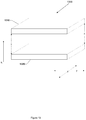
- FIG. 14 illustrates an example open shape configuration single-layer MRI RF array.
- FIG. 15 illustrates an example single-layer MRI RF coil element.
- FIG. 16 illustrates an example single-layer MRI RF coil element.
- FIG. 17 illustrates an example single-layer MRI RF coil element.
- FIG. 18 illustrates example single-layer MRI RF coil elements.
- FIG. 19 illustrates inductively coupled resonant RF coils.
- FIG. 20 illustrates an example single-layer MRI RF coil array.
- FIG. 21 illustrates an example MRI apparatus.
- FIG. 22 illustrates an example iMRI apparatus.
- FIG. 23 illustrates an example method for controlling a heating mode of an iMRI guidewire.
- Embodiments described herein generate an amplified local Tx field using inductive coupling between a WBC and a local single-layer MRI RF coil array in which the magnitude or phase of an induced current in individual coil array elements of the local single-layer MRI RF coil array are independently adjustable to mitigate RF heating of an iMRI guidewire.
- Embodiments adjust the magnitude and phase of the induced current in individual coil array elements independently to vary the uniformity of the Tx field such that guidewire heating is mitigated during an iMRI procedure while image quality is maintained at a clinically useful level.
- FIG. 1 illustrates an RF coil 110 and an RF coil 120 .
- Coil 110 and coil 120 are resonant RF coils and are inductively coupled to each other.
- Coil 110 and coil 120 may be part of an MRI system or iMRI system.
- coil 110 operates as a primary coil and is driven by RF amplifier ⁇ 130 .
- Coil 120 operates as a secondary coil.
- Secondary coil 120 is inductively coupled to the primary coil 110 by mutual inductance M.
- Secondary coil 120 is driven by the mutual inductively coupled RF power from the primary coil 110 .
- the primary coil 110 is, in this example, a WBC, while the secondary coil 120 is a local inductively coupled smaller coil.
- R p , C p , and L p are defined as the coil loss resistance, the equivalent coil breaking point capacitance, and the equivalent total coil inductance respectively.
- the RF amplifier ⁇ 130 is defined as an equivalent RF voltage source from an RF power amplifier through a matching circuit, which is not illustrated for clarity.
- the resistive loss from the RF amplifier ⁇ 130 is absorbed by R p , which may be pre-defined for simplicity of calculation.
- the mutual inductance between primary coil 110 and secondary coil 120 is defined as M.
- the resistive loss, the equivalent breaking point capacitance, and the total inductance of secondary RF coil 120 are defined as R s , C s , and L s respectively.
- the RF current through primary coil 110 is defined as i p
- the RF current through secondary coil 120 is defined as i s .
- Mutual inductance between primary RF coil 110 (e.g. L p ) and secondary RF coil 120 (e.g. L s ) generates an induced voltage on primary coil 110 L p , which may be expressed as +/ ⁇ j ⁇ Mi s .
- the sign of j ⁇ Mi s is determined by the polarity between primary coil 110 and secondary coil 120 . For clarity of exposition, the positive sign is used in this example.
- the mutual inductance between secondary coil 120 and primary coil 110 generates an induced voltage on secondary coil 120 , which may be expressed as +/ ⁇ j ⁇ Mi p .
- the sign is the same for both primary coil 110 and secondary coil 120 .
- Equation 1 may be re-written in matrix format, resulting in:
- the ratio between i s and i p is ⁇ j ⁇ M/R s .
- the secondary coil 120 's quality factor (Q) may be high, i.e., the value of R s may be small. Therefore the ratio between current i s and i p may be large.
- secondary coil 120 is smaller than primary coil 110 and is also closer to the imaging area than primary coil 110 , the same magnitude of RF current generates a larger magnetic transmitting field at the area being imaged.
- a local inductive coil is significantly more power efficient than a large WBC coil and the local inductive coil's current is dominant compared to the primary coil's current even though their phases are opposite to each other.
- the induced current i s in secondary coil 120 can be written as:
- the frequency deviation of secondary coil 120 from primary coil 110 can reduce the magnitude of i s and change the phase of i s .
- This approach may be used by embodiments described herein to reduce the local coil 120 's RF power efficiency if a particular MRI application requires it.
- the induced current i s is a function of a coil loss resistance of primary coil 110 , a coil loss resistance of secondary coil 120 , or a difference between a working frequency of primary coil 110 and a resonant frequency of secondary coil 120 .
- embodiments described herein may independently adjust a magnitude of the induced current in a local coil (e.g.
- Embodiments described herein may therefore also adjust the magnitude of local Tx field generated by a single layer MRI RF coil operating in Tx mode.
- Embodiments described herein include a single-layer MRI RF coil array that employs a single-layer approach to achieve a local inductively coupled Tx transmitter from a plurality of Rx receivers.
- An example single-layer MRI RF coil array may operate in a Tx mode or an Rx mode. In Rx mode the single-layer MRI RF coil array functions as a plurality of Rx receivers. In Tx mode multiple PIN diodes may be used to re-configure all or less than all the plurality of Rx receivers so that either all or less than all of the plurality of Rx receivers may inductively couple to the WBC and amplify the transmit field. Under this single-layer approach there are multiple approaches that may be employed by embodiments described herein to create a Tx field with a local inductively coupled coil.
- a first single-layer approach is to use PIN diodes to configure a plurality of Rx coils together to create a local volume coil, such as a birdcage coil, and to inductively couple the local volume coil to a larger WBC.
- This first approach may be demonstrated by an example Rx coil that includes 8 loops configured as independent receivers on a cylindrical former.
- a loop is considered to be an RF coil element, or RF coil array element.
- FIG. 2 is a diagram of an example 8-loop coil 200 in Rx mode.
- 8-loop coil 200 includes loops 201 - 208 .
- a loop serves as an independent receiver, and includes receive electronics 221 - 228 respectively.
- Between directly neighboring loops e.g. loops 202 , 203 , 204 ), the directly neighboring loops overlap each other to achieve good isolation, i.e., minimum mutual inductance. Good isolation between loops can also be achieved by using capacitors.
- FIG. 3 illustrates an Rx coil 300 that is similar to Rx 8-loop coil 200 illustrated in FIG. 2 , but with additional elements and details.
- Rx coil 300 includes multiple PIN diodes 306 , 308 , and 310 .
- a PIN diode has low impedance (e.g. is shorted) when it is forward biased by a DC power supply. In Tx mode the PIN diodes 306 , 308 , and 310 are forward biased.
- the circuitry supporting the PIN diodes 306 , 308 , and 310 such as RF chokes, is not illustrated in FIG. 3 for clarity.
- the equivalent circuit 350 illustrates an 8-rung birdcage coil that will inductively couple to a WBC in Tx mode and amplify the transmitting field and increase the efficiency of the WBC.
- the first approach of single-layer technology uses PIN diodes to reconfigure all or some of the Rx coil elements in a plurality of Rx coil elements into a local volume coil to increase WBC efficiency using inductive coupling, and to electrically link Rx coil elements together as one larger inductively coupled Tx coil. This first, conventional approach may be sub-optimal for two reasons.
- a first reason is that many diodes are required to link different Rx coils together. This increases the complexity of the coils. Therefore, this first, conventional approach may be expensive. The other reason is that even though PIN diodes are considered to be shorted when a forward bias is applied to the PIN diodes, the resistive losses of the PIN diodes are not trivial.
- a typical value of a forward biased PIN diode is 0.5 Ohm. This 0.5 Ohm could be larger than the coil loss itself for some high Q coils. This additional PIN diode resistive loss reduces the local inductively coupled RF coil's power efficiency.
- Example embodiments described herein employ a second, different single-layer approach that uses PIN diodes to facilitate switching an Rx coil element into Tx mode so that all or part of all the Rx elements in a plurality of Rx elements can inductively couple to a WBC individually.
- this approach unlike in the first conventional approach, there are no PIN diodes between Rx elements (e.g., loops, RF coil elements) to link the Rx elements together.
- a PIN diode may produce a negligible resistance (e.g., ⁇ 0.1 ⁇ ), which is essentially a short-circuit.
- a PIN diode When reverse-biased, a PIN diode may produce a high resistance (e.g., ⁇ 200 k ⁇ ) in parallel with a low capacitance (e.g., ⁇ 2 pF), which is essentially an open-circuit.
- a high resistance e.g., ⁇ 200 k ⁇
- a low capacitance e.g., ⁇ 2 pF
- FIG. 4 illustrates current distribution through rungs of a 4N-rung birdcage coil in circular polarized (CP) mode.
- Current distribution for a B field in the horizontal direction (B x ) is illustrated at 410 .
- the current through a rung k can be written as:
- I ky ⁇ I 0 ⁇ cos ⁇ ( 2 ⁇ ⁇ ⁇ 4 ⁇ N ⁇ k ) ⁇ cos ⁇ ( ⁇ 0 ⁇ t ) ( Eq . ⁇ 6 )
- the time domain function is cosine instead of sine due to the circular polarized mode requirement.
- the “ ⁇ ” symbol indicates that the direction of B y may be upward or downward. This affects the rotational direction of the final circular polarized B field, illustrated at 430 , by making the final circular polarized B field rotate either clockwise or counterclockwise.
- the total current through a rung k is the sum of the two currents described in equation 5 and equation 6. Therefore:
- a first rung has the same current magnitude I 0 and angular frequency ⁇ 0 as another, different rung.
- the currents in different rungs differ with respect to phase.
- a typical high pass, low pass, or bandpass WBC's current distribution in its rungs can be described by Eq. 7.
- FIG. 4 element 430 illustrates current distribution for a B field generated from a birdcage coil or WBC in this situation.
- good isolation among all loops is assumed.
- each loop is identical, the loops use overlap to isolate the directly neighboring elements, all loops are in the same row, and the loops are wrapped around a cylindrical former.
- FIG. 5 illustrates an example 16 loop coil 500 configured as a birdcage coil.
- the CP B 1 field from a birdcage coil induces voltage in each loop.
- the induced voltage for a loop can be written as
- V induced d ⁇ ( B 1 ⁇ , A k ⁇ ) dt ( Eq . ⁇ 8 ) where is the area vector, where the magnitude is the area of the k th loop and the direction is the direction perpendicular to the area towards the outside of the coil.
- the B 1 field and area vector can be written as:
- a k ⁇ A 0 ( cos ⁇ ( 2 ⁇ ⁇ ⁇ 8 ⁇ N + ( k - 1 ) * 2 ⁇ ⁇ ⁇ 4 ⁇ N ) ⁇ x ⁇ + sin ⁇ ( 2 ⁇ ⁇ ⁇ 8 ⁇ N + ( k - 1 ) * 2 ⁇ ⁇ ⁇ 4 ⁇ N ) ⁇ y ⁇ ( Eq . ⁇ 9 ⁇ a )
- a 0 is the area of a loop. Loops in this example have identical dimensions and thus have the same areas. In particular embodiments, loops may have different areas, and calculations may be adjusted accordingly.
- equation 8 can be re-written as:
- the isolations between coil elements are very small. If the isolations are not small and the mutual inductance is defined as M kj between the k th and j th , elements, high order coupling among elements may be ignored, and thus:
- V kj M kj ⁇ d ⁇ ( I j ) dt ( Eq . ⁇ 12 ) Therefore, the k th element will see additional coupled voltage from the j th element.
- the second term in the right side of equation 14 still creates a uniform B 1 field. Therefore, compared to the non-coupled case described in equation 11, the coupled case still creates a uniform B 1 field.
- the couplings create the coupled B 1 field which makes the whole coil array less power efficient than the non-coupled case.
- this uniform coupled field is still more efficient than the primary coil, (i.e., the WBC) the coil elements may still be used to resonate to improve RF power efficiency and reduce SAR.
- FIG. 6 illustrates an example embodiment of an MRI RF coil element 600 that may be part of a single-layer MRI RF coil array, and that may be used in an iMRI procedure.
- MRI RF coil element 600 employs the second approach to generate a local Tx field.
- the configuration illustrated includes one Rx element only, for clarity.
- Employing a MRI RF coil element 600 as part of a single-layer MRI RF coil array using the second approach is simpler than the first approach because fewer PIN diodes are required to switch between Tx mode and Rx mode.
- Example embodiments thus improve on conventional approaches by saving space within the bore of an MRI apparatus because less hardware is used to construct example embodiments, by avoiding electromagnetic (EM) interference that may be caused by unnecessary hardware, and by reducing manufacturing costs by requiring less hardware, including PIN diodes, than conventional approaches.
- Example embodiments therefore offer at least one measurable improvement on conventional approaches in addition to providing improved SNR and more uniform fields.
- FIG. 6 illustrates an MRI RF coil element 600 configured to operate in a transmit (Tx) mode or in a receive (Rx) mode.
- MRI RF coil element 600 may be part of a single-layer MRI RF coil array configured for use in an iMRI system.
- a single-layer MRI RF coil array comprises at least one RF coil element (e.g., MRI RF coil element 600 ).
- the single-layer MRI RF coil array may be arranged in an anatomy-specific shape or configuration, including a closed-shape configuration (e.g. a birdcage coil), or arranged in an open-shape configuration (e.g. in a “C” or “U” shape), or other shaped configuration.
- the single-layer MRI RF coil array may be a birdcage coil array.
- FIG. 5 illustrates an example birdcage coil array 500 .
- Birdcage coil array 500 is a sixteen loop, single-row coil array comprising sixteen MRI RF coils.
- a member of the sixteen MRI RF coils may be, for example, MRI RF coil element 600 .
- an element of the single-layer MRI RF coil array is configured in a saddle-like configuration.
- a first element of the single-layer MRI RF coil array is configured in a saddle-like configuration, while a second, different element of the single-layer MRI RF coil array is configured as a loop.
- the at least one RF coil element 600 includes an LC coil 610 , a matching and Tx/Rx switch circuit 620 , and a preamplifier 630 .
- LC coil 610 includes at least one inductor 640 and at least one capacitor 650 .
- the at least one inductor 640 and the at least one capacitor 650 resonate at a first frequency (i.e., a resonant frequency).
- the at least one inductor 640 may be, for example, a co-axial cable, a copper wire, a copper foil soldered to a circuit board, or other conductor.
- RF coils for MRI may need to be tuned and matched.
- Tuning involves establishing or manipulating the capacitance in a coil so that a desired resistance is produced.
- Matching involves establishing or manipulating the capacitance in a coil so that a desired reactance is achieved.
- Tuning may be performed to achieve a desired tuning frequency for a coil.
- ⁇ 0 identifies the desired tuning frequency.
- ⁇ 0 may be, for example, 63.87 MHz at 1.5 T.
- the size of a conventional coil facilitates estimating inductance L.
- values for capacitors can be computed to produce a desired resonant peak in an appropriate location with respect to ⁇ 0 . Once capacitors are selected, the resonant peak can be observed and a more accurate L can be computed. The capacitors can then be adjusted to produce the desired resistance. Once the desired resistance is achieved, then capacitance can be adjusted to cancel reactance.
- the matching and Tx/Rx switch circuit 620 when operating in Tx mode, electrically isolates the LC coil 610 from the preamplifier 630 upon the LC coil 610 resonating with a primary coil (not illustrated) at a working frequency of the primary coil.
- the matching and Tx/Rx switch circuit 620 electrically isolates the LC coil 610 from the preamplifier 630 by providing a threshold level of impedance between the LC coil 610 and the preamplifier 630 .
- the primary coil may be, for example, a WBC or other primary coil that is larger than RF coil element 600 .
- the LC coil 610 upon resonating with the primary coil at the working frequency, generates a local amplified Tx field based on an induced current in the LC coil 610 .
- the induced current has a magnitude and a phase.
- the magnitude of the induced current or the phase of the induced current may be independently adjustable.
- the induced current is a function of at least a coil loss resistance of the WBC, a coil loss resistance of the LC coil 610 , or a difference between a working frequency of the WBC and a resonant frequency of the LC coil 610 .
- the frequency of the induced current is the same as the working frequency of the current in the primary coil or WBC, even though the resonant frequency of the LC coil 610 may be different.
- Embodiments described herein facilitate adjusting the coil loss resistance of the WBC, the coil loss resistance of the LC coil 610 , or the difference between the working frequency of the WBC and the resonant frequency of the LC coil 610 .
- the magnitude of the induced current or the phase of the induced current are configured to be varied over a range of magnitudes or phases respectively. Example embodiments thus facilitate independently adjusting the magnitude of an induced current in LC coil 610 , or a phase of the induced current.
- Matching and Tx/Rx switch circuit 620 when operating in Rx mode, electrically connects the LC coil 610 with the preamplifier 630 by providing low impedance between the LC coil 610 and the preamplifier 630 .
- Preamplifier 630 may be a low input impedance low noise amplifier (LNA).
- LNA low input impedance low noise amplifier
- matching and Tx/Rx switch circuit 620 may be a capacitive matching and Tx/Rx switch circuit.
- matching and Tx/Rx switch circuit 620 may be an inductive matching and Tx/Rx switch circuit.
- Example MRI RF coil elements, MRI RF coil arrays, MRI RF coils, apparatus, and other embodiments, may be configured, for example, as bird cage coils.
- FIG. 7 illustrates one embodiment of a single-layer MRI RF coil array 710 that includes at least one MRI RF coil elements arranged in a single-row birdcage configuration.
- the at least one MRI RF coil elements may include, for example, MRI RF coil element 600 , 800 , 900 , 1000 , 1100 , 1200 , or 1500 .
- FIG. 7 also illustrates an example embodiment of a single-layer MRI RF coil array 720 that includes at least one example MRI RF coil elements arranged in a two-row configuration.
- Single-layer MRI RF coil array 720 includes a first row 722 aligned with a second row 724 .
- First row 722 includes at least four RF coil elements.
- Second row 724 includes at least four RF coil elements.
- FIG. 7 further illustrates another, single-layer MRI RF coil array 730 .
- Single layer MRI coil array 730 is similar to single-layer MRI RF coil array 720 , except the first row 732 is not aligned with second row 734 .
- first row 732 may be rotated a number of degrees around a central axis (e.g. z axis) shared with second row 734 , while 734 is not rotated, or is rotated a different number of degrees.
- first row 732 may be aligned to within a threshold level of alignment with second row 734 .
- MRI RF coil array 720 includes a first plurality of RF coil elements (e.g. first row 722 ) and a second plurality of RF coil elements (e.g. second row 724 ).
- the first plurality of RF coil elements and the second plurality of RF coil elements are radially disposed about a longitudinal axis 702 .
- the first plurality and the second plurality may be longitudinally offset a threshold distance greater than zero along the longitudinal axis 702 .
- an element of the first plurality of RF coil elements is axially offset a threshold amount from a respective element of the second plurality of RF coil elements.
- an element of the first plurality of RF coil elements may be axially offset 15 degrees, 30 degrees, or another, different number of degrees, from a respective element of the second plurality of RF coil elements.
- the first plurality and the second plurality may include the same number of RF coil elements, or may include different numbers of RF coil elements.
- the first plurality may include eight RF coil elements, while the second plurality may include nine RF coil elements.
- Other, different numbers of RF coil elements may be employed.
- the at least one RF coil elements is arranged in a three-row configuration.
- a three-row single layer MRI RF coil array may include a first row that includes at least five RF coil elements, a second row that includes at least five RF coil elements, and a third row that includes at least five RF coil elements.
- the first row, second row, and third row may be aligned axially, or may be unaligned axially.
- other different numbers of rows, number of RF coil elements, or combinations of alignments may be employed.
- MRI RF coil array 720 includes a first plurality of RF coil elements 722 , a second plurality of RF coil elements 724 , and a third plurality of RF coil elements (not illustrated).
- the first plurality of RF coil elements 722 , the second plurality of RF coil elements 724 , and the third plurality of RF coil elements are radially disposed about a longitudinal axis.
- the first plurality 722 , the second plurality 724 , and the third plurality are longitudinally offset a threshold amount along the longitudinal axis.
- an element of the first plurality 722 of RF coil elements is axially offset a threshold amount from a respective element of the second plurality 724 of RF coil elements or the third plurality of RF coil elements.
- the first plurality 722 , the second plurality 724 , and the third plurality may include the same number of RF coil elements, or may include different numbers of RF coil elements.
- the first plurality 722 may include eight RF coil elements
- the second plurality 724 may include nine RF coil elements
- the third plurality may include seven RF coil elements.
- the first plurality 722 , the second plurality 724 , or the third plurality may include other, different numbers of RF coil elements.
- FIG. 8 illustrates an MRI RF coil element 800 .
- MRI RF coil element 800 is similar to MRI RF coil element 600 , but includes additional elements and details.
- MRI RF coil element 800 may be part of a single-layer MRI RF coil array.
- the single-layer MRI RF coil array comprises at least one RF coil element 800 .
- MRI RF coil element 800 includes a matching and Tx/Rx switch circuit 820 configured to operate as a capacitive matching and Tx/Rx circuit.
- matching and Tx/Rx switch circuit 820 includes a matching capacitor Cm, a first diode D 1 , a capacitor Cd, and a first inductor Ld.
- First diode D 1 may be a PIN diode.
- the first diode D 1 , capacitor Cd, and first inductor Ld create a resonant tank circuit in Tx mode when first diode D 1 is forward biased.
- This resonant tank circuit isolates input to the LNA preamplifier 630 from an induced high current or voltage in LC coil 610 .
- the resonant tank circuit further facilitates LC coil 610 , including capacitors 650 , inductors 640 , and matching capacitor Cm, to resonate at a high Q without preamplifier 630 being electrically connected to the RF coil.
- matching capacitor Cm has a first terminal and a second terminal.
- Matching capacitor Cm is connected, at a first terminal, to a first terminal of first inductor Ld.
- First inductor Ld is connected at a first terminal, to a capacitor Cd, at a first terminal.
- Capacitor Cd is connected, at a second terminal, to first diode D 1 , at a first terminal.
- First diode D 1 is connected, at a second terminal to first inductor Ld, at a second terminal.
- First inductor Ld is connected, at a second terminal, to a first input terminal of preamplifier 630 .
- Preamplifier 630 is connected, at a second input terminal, to the second terminal of matching capacitor Cm.
- first diode D 1 In Rx mode, first diode D 1 is backward biased (i.e, first diode D 1 has a high impedance in Rx mode), so that effectively only Ld is presented between Cm and Preamplifier 630 . While in this example first inductor Ld, first diode D 1 , and capacitor Cd are illustrated on a connection path between the first terminal of matching capacitor Cm and a first input terminal of preamplifier 630 , in another embodiment, first inductor Ld, first diode D 1 , and capacitor Cd may be connected instead between the second terminal of matching capacitor Cm and the second input terminal of preamplifier 630 .
- MRI RF coil element 800 further includes a PIN diode control circuit 850 .
- PIN diode control circuit 850 facilitates selective control of first diode D 1 .
- PIN diode control circuit 850 controls a forward bias applied to first diode D 1 .
- PIN diode control circuit 850 may be operably connected to, for example, first diode D 1 .
- PIN diode control circuit 850 facilitates selective control of other, different diodes, including shunt diodes, or PIN diodes that comprise a magnitude/phase control component.
- FIG. 9 illustrates an MRI RF coil element 900 .
- MRI RF coil element 900 is similar to MRI RF coil element 800 , but includes additional elements and details.
- MRI RF coil element 900 includes matching and Tx/Rx switch circuit 920 .
- matching and Tx/Rx switch circuit 920 includes matching capacitor Cm, first diode D 1 , first capacitor Cd, and first inductor Ld.
- Matching and Tx/Rx switch 920 also includes second diode D 9 , second capacitor Cd 9 , and second inductor Ld 9 .
- Second diode D 9 may be a PIN diode.
- the first diode D 1 , first capacitor Cd first inductor Ld, and second diode D 9 , second capacitor Cd 9 , and second inductor Ld 9 create a resonant tank circuit in Tx mode when first diode D 1 or second diode D 14 is forward biased.
- This resonant tank circuit isolates input to preamplifier 630 from an induced high current or voltage in LC coil 610 .
- the resonant tank circuit further facilitates LC coil 610 , including capacitors 650 , inductors 640 , and matching capacitor Cm, resonating at a high Q without preamplifier 630 being electrically connected to the RF coil.
- matching capacitor Cm has a first terminal and a second terminal.
- Matching capacitor Cm is connected, at a first terminal, to a first terminal of first inductor Ld.
- First inductor Ld is attached at a first terminal, to first capacitor Cd, at a first terminal.
- First capacitor Cd is attached, at a second terminal, to first diode D 1 , at a first terminal.
- First diode D 1 is attached, at a second terminal to a second terminal of first inductor Ld.
- First inductor Ld is connected, at a second terminal, to a first input terminal of preamplifier 630 .
- Matching capacitor Cm is connected, at a second terminal, to a first terminal of second inductor Ld 9 .
- Second inductor Ld 9 is connected, at a first terminal, to second capacitor Cd 9 , at a first terminal.
- Second capacitor Cd 9 is connected, at a second terminal, to second diode D 9 , at a first terminal.
- Second diode D 9 is connected, at a second terminal, to a second terminal of second inductor Ld 9 .
- Second inductor Ld 9 is connected, at a second terminal, to a second input terminal of preamplifier 630 .
- MR RF coil element 900 further includes a balun 930 .
- balun 930 is connected, at a first coaxial or two-connection terminal, to a first coaxial or two-connection output terminal of preamplifier 630 .
- balun 930 is connected between matching and Tx/Rx switch 920 and preamplifier 630 . Balun 930 reduces a common mode current flowing in transmission lines that may connect MRI RF coil element 900 with an MRI system or iMRI system (not illustrated).
- FIG. 10 illustrates an MRI RF coil element 1000 .
- MRI RF coil element 1000 is similar to MRI RF coil element 800 , but includes additional elements and details.
- MRI RF coil element 1000 may be part of a single-layer MRI RF coil array.
- the single-layer MRI RF coil array comprises at least one RF coil element 1000 .
- MRI RF coil element 1000 includes shunt diode D 2 .
- Shunt diode D 2 may be a PIN diode.
- Shunt diode D 2 has a first terminal and second terminal. Shunt diode D 2 is connected, at a first terminal, to the first input terminal of preamplifier 630 .
- Shunt diode D 2 is connected, at a second terminal, to the second input terminal of preamplifier 630 .
- shunt diode D 2 provides additional shunt protection for the LNA preamplifier 630 .
- FIG. 11 illustrates an MRI RF coil element 1100 .
- MRI RF coil element 1100 is similar to MRI RF coil element 600 , but includes additional elements and details.
- MRI RF coil element 1100 may be part of a single-layer MRI RF coil array.
- the single-layer MRI RF coil array comprises at least one RF coil element 1100 .
- RF coil element 1100 includes an LC coil 1110 .
- LC coil 1110 is similar to LC coil 610 but includes a matching inductor Lm having a first terminal and a second terminal.
- LC coil 1110 also includes at least one conductor 640 having a first end connected to the first terminal of the matching inductor Lm, and a second end connected to the second terminal of the matching inductor Lm.
- matching and Tx/Rx switch 1120 operates as an inductive matching circuit.
- Matching and Tx/Rx switch 1120 is connected to matching inductor Lm.
- Matching and Tx/Rx switch 1120 includes first inductor Ld having a first terminal and a second terminal, first diode D 1 having a first terminal and a second terminal, and matching capacitor Cm having a first terminal and a second terminal.
- Matching inductor Lm is connected at a first terminal with the first terminal of matching capacitor Cm.
- Matching capacitor Cm is connected at a first terminal with the first terminal of first inductor Ld.
- First inductor Ld is connected at a second terminal with the first terminal of first diode D 1 .
- First diode D 1 is connected at a second terminal with the second terminal of matching capacitor Cm.
- Matching capacitor Cm is connected at a second terminal with a first input terminal of pre-amplifier 630 .
- Matching inductor Lm is connected, at a second terminal, with a second input terminal of pre-amplifier 630 .
- the first diode D 1 , matching capacitor Cm, and first inductor Ld isolate input to the preamplifier 630 from an induced high current or voltage in LC circuit 1110 when first diode D 1 is forward biased.
- first inductor Ld, first diode D 1 , and matching capacitor Cm are illustrated on a connection path between the first terminal of matching inductor Lm and a first input terminal of preamplifier 630
- first inductor Ld, first diode D 1 , and matching capacitor Cm may be connected instead between the second terminal of matching inductor Lm and the second input terminal of preamplifier 630 .
- FIG. 12 illustrates an MRI RF coil element 1200 .
- MRI RF coil element 1200 is similar to MRI RF coil element 1100 , but includes additional elements and details.
- MRI RF coil element 1200 may be part of a single-layer MRI RF coil array.
- the single-layer MRI RF coil array comprises at least one RF coil element 1200 .
- MRI RF coil element 1200 includes shunt diode D 2 .
- Shunt diode D 2 has a first terminal and second terminal.
- Shunt diode D 2 is connected, at a first terminal, to a first input terminal of preamplifier 630 .
- Shunt diode D 2 is connected, at a second terminal, to a second input terminal of preamplifier 630 .
- shunt diode D 2 provides additional shunt protection.
- Embodiments described herein may include single-layer MRI RF coil arrays configured in shapes other than the cylindrical shape described above.
- other shapes including elliptical, rectangular, square, or other different shapes, may be used to build an Rx coil or single-layer MRI RF coil array for particular applications.
- Non-cylindrical shaped single-layer MRI RF coils may differ from cylindrical single-layer MRI RF coils in that the induced B 1 field of the other, non-cylindrical shapes is not as uniform as the induced B 1 field of the cylindrical case, but is still more than uniform enough for a Tx field in a clinical environment, including an iMRI procedure.
- the non-cylindrical shapes or cross sections discussed above are enclosed shapes or closed-shape configurations.
- Embodiments are not only applicable to an enclosed shape but may also be implemented as opened shapes, including MRI RF coil elements arranged on a single plane, on two parallel planes, on two planes that are within a threshold of parallel, or MRI RF coil elements arranged in an enclosed shape with a side not present, for example, a “C” shape or a “U” shape.
- One embodiment of a single-layer MRI RF coil array that employs an opened shape includes a plurality of loops, saddles, or other MRI RF coil elements arranged on two parallel planes, or on non-parallel planes that are within a threshold tolerance of being parallel to each other, located at least a threshold distance apart, and that face each other directly.
- a threshold tolerance of being parallel may be, for example, a 1% tolerance, a 10% tolerance, or other, different tolerance.
- a first point on a first MRI RF coil element may be located 20 cm from a corresponding first point on a facing, second MRI RF coil element, while a second point on the first MRI RF coil element may be located 22 cm from a corresponding second point on the second MRI RF coil element.
- the size of the loops may be identical, or may be within a threshold margin of difference.
- a first loop may describe an area of ⁇ cm 2
- a second loop may describe an area of 0.9 ⁇ cm 2 .
- a plurality of different sized loops may be located on a first plane, while a second plurality of different sized loops may be located on a second, parallel plane, or on a second plane that is within a threshold tolerance of being parallel with the first plane.
- FIG. 13 illustrates one embodiment of a single layer MRI RF coil array 1300 that includes at least two RF coil elements. While in this embodiment, only two RF coil loops are illustrated, in another embodiment, other, different numbers of RF coil loops may be employed.
- the at least two RF coil elements includes a first RF coil element 1310 and a second RF coil element 1320 .
- First RF coil element 1310 and second RF coil element 1320 may include a single layer MRI RF coil element, including MRI RF coil element 600 , 800 , 900 , 1000 , 1100 , 1200 , or 1500 , or other single-layer MRI RF coil elements described herein.
- First RF coil element 1310 is arranged on a first plane, while second RF coil element 1320 is arranged on a second, different plane parallel to the first plane.
- FIG. 13 illustrates an example open shape configuration.
- the first plane and the second plane may be parallel to each other, and are located at least a threshold distance from each other.
- the threshold distance is a distance greater than zero.
- the threshold distance may be a function of a volume to be imaged, for example, the size or shape of a human knee, wrist, or head.
- the at least a threshold distance is indicated by “x” in FIG. 13 .
- the first plane and the second plane may, in another embodiment, be within threshold of parallel from each other.
- the first RF coil element 1310 and the second RF coil element 1320 may be offset laterally from each other a distance greater than zero, or may be directly aligned.
- the first RF coil element 1310 and second RF coil element 1320 may be located 30 cm from each other in the x axis, and laterally offset 3 cm in the y axis or z axis. In other embodiments, other offsets may be employed.
- First RF coil element 1310 and second RF coil element 1320 inductively couple to each other since they face each other. If both first RF coil element 1310 and second RF coil element 1320 are tuned independently to the same frequency without the presence of the other coil, their resonant frequency will split into two frequencies: a lower frequency and a higher frequency.
- the lower frequency is for the current of both RF coil element 1310 and RF coil element 1320 flowing in the same direction.
- the higher frequency is for the current of both RF coil element 1310 and RF coil element 1320 flowing in opposite directions.
- the frequencies may be written as
- first RF coil element 1310 and second RF coil element 1320 are placed inside a WBC and the WBC generates a circular polarized (CP) uniform or a uniform B 1 field perpendicular to the planes of the coils, then the current induced in one of first RF coil element 1310 or second RF coil element 1320 by the WBC directly may be expressed as
- first RF coil element 1310 or second RF coil element 1320 includes RF coil element 600 , 800 , 900 , 1000 , 1100 , 1200 , or 1500
- the area A of the loop corresponds to the area of LC coil 610 or LC coil 1110 .
- R is the only term in the denominator of Eq. 15 because
- the final current i 1 of the first RF coil element 1310 includes the additional current caused by mutual inductance coupling.
- the final currents i 1 and i 2 can be written as:
- Both i 1 and i 2 flow in the same direction and have the same current magnitude.
- the coupling or mutual inductance between the first loop or first RF coil element 1310 and the second loop or second RF coil element 1320 causes a Tx efficiency loss.
- the sign before M in equation 17 and equation 18 is “ ⁇ ”, (i.e., negative sign).
- This embodiment thus may function as the equivalent of a two-turn solenoid or a saddle coil which generates a transmitting field that has a uniformity suitable for clinical use, including iMRI procedures. In another embodiment, other, different configurations of coils may be employed.
- a member of the at least two RF coil elements includes an LC coil, a matching and Tx/Rx switch circuit, and a preamplifier.
- the LC coil includes at least one inductor and at least one capacitor. The at least one inductor and the at least one capacitor resonate at a first frequency.
- the LC coil is connected with the matching and transmit Tx/Rx switch circuit.
- the matching and transmit Tx/Rx switch circuit is connected to the preamplifier.
- the matching and Tx/Rx switch circuit when operating in Tx mode, electrically isolates the LC coil from the preamplifier upon the LC coil resonating with a primary coil at the first frequency.
- the LC coil upon resonating with the primary coil at the first frequency, generates a local amplified Tx field based on an induced current in the LC coil.
- a magnitude of the induced current or a phase of the induced current is independently adjustable.
- the magnitude or phase of the induced current may be variable over a range of magnitudes or phases respectively, by varying the coil loss resistance of the primary coil, the coil loss resistance of first RF coil element 1310 or second RF coil element 1320 , or the difference between the working frequency of the primary coil and the resonant frequency of first RF coil element 1310 or second RF coil element 1320 .
- the matching and Tx/Rx switch circuit when operating in Rx mode, electrically connects the LC coil with the preamplifier.
- the matching and Tx/Rx switch circuit is a capacitive matching and Tx/Rx switch circuit.
- the matching and Tx/Rx switch circuit is an inductive matching and Tx/Rx switch circuit.
- the LC coil includes a shunt PIN diode or protection PIN diode that provides further shunt protection to the preamplifier.
- FIG. 14 illustrates a single-layer MRI RF coil array 1400 that is similar to single-layer MRI RF coil array 1300 but that includes additional details and elements.
- Single-layer MRI RF coil array 1400 includes first RF coil element 1310 , second RF coil element 1320 , and also includes a third RF coil element 1430 .
- FIG. 14 illustrates first RF coil element 1310 , second RF coil element 1320 , and third RF coil element 1430 disposed in an open shape configuration.
- the RF coil elements 1310 , 1320 , and 1430 of MRI RF coil array 1400 are arranged approximately in the shape of a “C” or “U”.
- First loop or RF coil element 1310 is arranged on a first plane, while second loop or RF coil element 1320 is arranged on a second, different plane.
- the first plane and the second plane may be parallel or slightly non-parallel to each other, and are located at least a threshold distance from each other.
- the threshold distance is a non-zero distance greater than zero. In this example, the at least a threshold distance is indicated by “x” in FIG. 14 .
- third RF coil element 1430 is arranged on a third plane that is perpendicular to the first plane and the second plane.
- third RF coil element 1430 is arranged on a third plane that is within a threshold degree of parallel with the first plane or the second plane.
- the third RF coil element 1430 is arranged on a third plane that is perpendicular with the first plane and the second plane.
- the third RF coil element 1430 is arranged on a third plane that is not perpendicular with the first plane and the second plane.
- an angle formed by the intersection of the third plane with the first plane or the second plane is user adjustable.
- third RF coil element 1430 is offset from the first RF coil element 1310 or the second RF coil element 1320 a non-zero amount along a y axis or a z axis.
- the first RF coil element 1310 and second RF coil element 1320 may be located 30 cm from each other in the x axis, and laterally offset 3 cm in the y axis.
- the third RF coil element 1430 may be laterally offset 2 cm in the z axis from the first RF coil element 1310 and the second RF coil element 1320 . In other embodiments, other offsets may be employed.
- Third RF coil element 1430 may include an MRI RF coil element described herein, including MRI RF coil elements 600 , 800 , 900 , 1000 , 1100 , 1200 , or 1500 . While three RF coil elements are illustrated, in another embodiment, other, different numbers of RF coil elements may be employed.
- a member of the at least three RF coil elements includes an LC coil, a matching and transmit (Tx)/receive (Rx) switch circuit, and a preamplifier.
- the LC coil includes at least one inductor and at least one capacitor. The at least one inductor and the at least one capacitor resonate at a first frequency.
- the matching and Tx/Rx switch circuit when operating in Tx mode, electrically isolates the LC coil from the preamplifier upon the LC coil resonating with a primary coil at the first frequency.
- the LC coil upon resonating with the primary coil at the first frequency, generates a local amplified Tx field based on an induced current in the LC coil.
- a magnitude of the induced current or a phase of the induced current is independently adjustable.
- the matching and Tx/Rx switch circuit when operating in Rx mode, electrically connects the LC coil with the preamplifier.
- the matching and Tx/Rx switch circuit is a capacitive matching and Tx/Rx switch circuit.
- the matching and Tx/Rx switch circuit is an inductive matching and Tx/Rx switch circuit.
- the LC coil includes a shunt PIN diode or protection PIN diode that provides further shunt protection to the preamplifier.
- Embodiments described herein may also be described using a mode approach.
- two identical coils facing each other may both resonate at the same frequency if the other coil does not exist. Due to mutual inductance the two coils create two intrinsic resonant modes.
- the first mode is the lower frequency mode which is called saddle mode or corotation mode, where both coils' currents flow in the same direction.
- the other mode has a higher frequency and is called anti-saddle mode or counter-rotation mode in which the currents of the coils flow in opposite directions. If a uniform external field or a circular polarized uniform external field is applied to the coils, only the saddle mode configuration will have induced voltage because its net flux is non-zero while the anti-saddle mode's net flux is zero.
- N coil elements in which some or all of the N coil elements' isolations may not be good (i.e., the isolation may not be within a threshold tolerance)
- the N coil elements will couple to each other and create M Eigen-resonant modes in which a mode is a sum of some or all coil elements with different weighting coefficients and phases, where N and M are integers.
- a mode is excited proportionally by the net magnetic flux of each mode from the WBC. The most uniform mode among all modes has the largest net magnetic flux from the WBC. For example, a two-element embodiment will be more uniform among modes.
- the most uniform mode among the modes is the strongest mode excited by the WBC. If other less uniform modes' net magnetic fluxes from the WBC are not zero, they will be also excited but the induced fields from them are weaker than the most uniform mode, on average. The other less uniform modes make the final combined induced field more uniform than the induced field from the most uniform mode only. Thus, the final combined induced field is sufficiently uniform for use in clinical MRI applications, including iMRI procedures.
- a plurality of single-layer MRI RF coils or MRI RF coil elements configured as a single-layer MRI RF coil array, resonating with a WBC coil in Tx mode will induce a local amplified Tx field.
- a coil array element may have the magnitude and phase of an induced current adjusted independently of another, different coil array element.
- the local amplified Tx field has a threshold level of uniformity and the single-layer MRI RF coil array is used as a transmitter coil. This amplified Tx field improves the WBC power efficiency and reduces the SAR compared to conventional approaches because non-related anatomy areas will not experience a high Tx field from the WBC.
- the RF heating of an iMRI guidewire that is subjected to the Tx field may be minimized or controlled by varying the uniformity of the local amplified Tx field.
- MRI RF array coils that connect to an MRI system can be connected through cables or may be connected wirelessly with no cables.
- Embodiments described herein are configured such that the magnitude of the induced current or the phase of the induced current are variable over a range of magnitudes or phases respectively.
- Example embodiments adjust the magnitude and phase of the induced current i s of a coil in Tx mode such that the image quality is still acceptable for MRI or iMRI purposes.
- a single-layer MRI RF coil array operates in Rx mode, it operates as a phased array receiving coil with a frequency tuned to the working frequency for optimum SNR.
- Embodiments described herein provide magnitude and phase adjustment for an RF coil operating in Tx mode. Different approaches to adjust a coil's magnitude and phase are now described herein.
- i s - j ⁇ ⁇ ⁇ ⁇ ⁇ M ⁇ ⁇ ⁇ ( R p ⁇ R s + ⁇ 2 ⁇ M 2 ) ( Eq . ⁇ 3.1 )
- i s the induced current of local RF coil
- R p the coil loss resistance of the WBC
- R s the coil loss resistance of the local RF coil
- M the mutual inductance between the WBC and the local RF coil
- e is the driving voltage of the WBC.
- Eq. 3.1 immediately above assumes that both the WBC and the local RF coil resonate at the same working frequency. Because the local coil is smaller than the WBC, the magnetic field generated by i s is significantly larger than the magnetic field generated from the WBC.
- the WBC is part of the iMRI system and its frequency is fixed at the nominal working frequency. Typically, the working frequency of the WBC cannot be changed, and typically, a WBC cannot be removed from an iMRI system in normal clinical practice.
- Embodiments are configured to adjust the magnitude and phase of the induced i s of a coil (e.g, a loop, a coil array element) in a single-layer MRI RF coil array while operating in Tx mode, and facilitate ensuring that the coil Tx mode is a low heat mode and that the image quality is still acceptable for an iMRI procedure.
- Embodiments thus provide the equivalent to a pTx coil without requiring the use of an expensive pTx system.
- a coil in a single-layer MRI RF coil array When a coil in a single-layer MRI RF coil array is operating in Rx mode, it operates as a phased array receiving coil where a coil's frequency is tuned to the working frequency for optimum SNR.
- FIG. 15 illustrates an example single-layer MRI RF coil array element 1500 configured to operate in a Tx mode and an Rx mode.
- Single-layer MRI RF coil array element 1500 is similar to RF coil element 600 , 800 , 900 , 1000 , 1100 , or 1200 , but includes additional elements and details.
- Single-layer MRI RF coil array element 1500 includes an LC coil 1510 , a matching and Tx/Rx switch circuit 1520 operably connected to the LC coil 1510 , and a preamplifier or other Rx electronics 1530 operably connected to the matching and Tx/Rx circuit 1520 .
- LC coil 1510 further includes a magnitude/phase control component 1512 operably connected to LC coil 1510 .
- LC coil 1510 includes at least one inductor and at least one capacitor, where the at least one inductor and the at least one capacitor resonate at a first frequency.
- the first frequency may be, for example, the working frequency.
- LC coil 1510 may be configured as LC coil 610 illustrated in FIG. 6, 8, 9 , or 10 .
- LC coil 1510 may be configured as LC coil 1110 as illustrated in FIG. 11 or 12 .
- LC coil 1510 includes at least one conductor.
- the at least one conductor may be a flexible co-axial cable.
- LC coil 1510 may be configured as a flexible LC coil
- single-layer MRI RF coil array element 1500 may be configured as a flexible single-layer MRI RF coil array element.
- the matching and Tx/Rx switch circuit 1520 when operating in Tx mode, electrically isolates LC coil 1510 from preamplifier 1530 upon LC coil 1510 resonating with a primary coil (not illustrated).
- the primary coil has a working frequency.
- the matching and Tx/Rx switch circuit 1520 is a capacitive matching and Tx/Rx switch circuit.
- matching and Tx/Rx switch circuit 1520 may be configured as matching and Tx/Rx switch circuit 820 illustrated in FIG. 8 .
- matching and Tx/Rx switch circuit 1520 may be configured as matching and Tx/Rx switch circuit 920 illustrated in FIG. 9 .
- matching and Tx/Rx switch circuit 1520 may be configured using other, different matching and Tx/Rx switch circuitry configurations.
- LC coil 1510 upon resonating with the primary coil, generates a local amplified Tx field based on an induced current in LC coil 1510 .
- the induced current is generated by inductive coupling between LC coil 1510 and the primary coil.
- a magnitude of the induced current or a phase of the induced current is independently adjustable.
- the magnitude of the induced current or the phase of the induced current is configured to be varied over a range of magnitudes or phases respectively.
- the matching and Tx/Rx switch circuit 1520 when operating in Rx mode, electrically connects LC coil 1510 with preamplifier 1530 .
- the magnitude/phase control component 1512 is configured to adjust the magnitude of the induced current or the phase of the induced current.
- the magnitude/phase control component 1512 is configured to, upon the single-layer MRI RF coil array element operating in Tx mode, adjust the magnitude of the induced current or the phase of the induced current by shifting the first frequency of the LC coil relative to the working frequency of the primary coil.
- magnitude/phase control component 1512 is configured to use a first approach to adjust a magnitude of the induced current or the phase of the induced current by shifting the MR coil's (e.g., LC coil 1510 ) resonant frequency from the working frequency of the WBC.
- the induced current i s may be expressed as:
- this additional term has a value of zero.
- Example embodiments adjust this new term by changing the frequency to either higher than the working frequency or lower than the working frequency. This facilitates adjusting the magnitude and phase of the induced current i s simultaneously. If the magnitude and phase of i s are changed, the magnitude and phase of the induced field is also changed.
- a coil that is a pTx-equivalent coil. Eq. 4 changes magnitude and phase simultaneously. In some situations, it may be desirable to have additional freedom to control magnitude and phase independently.
- magnitude/phase control component 1512 is configured to use a second approach to adjust a coil's magnitude and phase by independently adding additional coil loss (i.e., resistance) when operating in Tx mode.
- the magnitude/phase control component 1512 is configured to, upon the single-layer MRI RF coil array element 1500 operating in Tx mode, adjust the magnitude of the induced current or the phase of the induced current by adding coil loss to the LC coil 1510 .
- the magnitude/phase control component 1512 comprises a resistor and a PIN diode connected in parallel with the at least one capacitor, where the single-layer MRI RF coil array element 1500 operates in Tx mode upon the injection of a DC bias into the PIN diode, where the DC bias forward biases the PIN diode.
- This second approach includes increasing R s when operating in Tx mode. Increasing R s reduces the magnitude alone if the coil's resonant frequency is the same as the working frequency. Increasing R s reduces both magnitude and phase if the coil's resonant frequency and the working frequency are different.
- FIG. 16 One example implementation of this second approach is illustrated in FIG. 16 , which includes adding coil loss.
- the single-layer MRI RF coil array element 1600 includes a magnitude/phase control component 1620 , and LC coil 1610 that includes one or more breaking point capacitors 1622 .
- a resistor 1624 is added in parallel to the capacitor 1622 through a PIN diode 1626 . Matching and Rx/Tx 1520 and 1530 are not illustrated for clarity.
- the breaking point can also be a feeding point, i.e., a matching capacitor.
- Tx mode the PIN diode 1626 is shorted and the resistor 1624 is in parallel with capacitor 1622 , which causes R s to increase.
- the value of R s may be chosen to meet particular magnitude and phase requirements for different heating modes, including low heating modes.
- the resistor 1624 is configured to be powerful enough to take a high current in Tx mode. For example, resistors having resistance within the kilo-Ohms range may be employed to reduce current magnitude significantly. The smaller the resistor value, the lesser the current magnitude, and the lower the coil Q in Tx mode.
- Rx mode the PIN diode 1626 is open, and the resistor 1624 is therefore not part of the coil resistance. This still results in a high Q receiving coil.
- the magnitude/phase control component 1512 is configured to, upon the single-layer MRI RF coil array element 1500 operating in Tx mode, adjust the magnitude of the induced current or the phase of the induced current by decreasing the induced current. In this embodiment, the magnitude/phase control component 1512 is configured to decrease the induced current by operating as a parallel resonant circuit when in Tx mode.
- the magnitude/phase control component 1512 comprises an inductor and a PIN diode connected in parallel with a first member of the at least one capacitor, where the first member of the at least one capacitor has a higher capacitance than a second, different member of the at least one capacitor, where the single-layer MRI RF coil array element operates in Tx mode upon the injection of a DC bias into the PIN diode, where the DC bias forward biases the PIN diode.
- the magnitude/phase control component 1512 introduces a blocking impedance of less than one-hundred Ohms to the LC coil when operating in Tx mode.
- magnitude/phase control component 1512 is configured to use a third approach that includes introducing a parallel resonant circuit in the coil when operating in Tx mode only.
- FIG. 17 illustrates a single-layer MRI RF coil array element 1700 that includes LC coil 1710 , and magnitude/phase control component 1720 .
- Magnitude/phase control component 1720 is configured as an LC parallel resonant circuit.
- Magnitude/phase control component 1720 includes a PIN diode 1722 that controls magnitude/phase control component 1720 to minimize the induced current in a coil 1710 when operating in Tx mode.
- the blocking impedance of magnitude/phase control component 1720 when operating in Tx mode as an LC parallel resonant circuit is very large, e.g., several kOhm. This impedance almost completely eliminates the induced current in coil 1710 .
- Example embodiments may still need to use the induced current. Thus, example embodiments may reduce current magnitude, but do not need to almost completely eliminate the current. Therefore example embodiments may employ a weak blocking impedance of several Ohms to tens of Ohms, instead of a strong blocking impedance of several kOhms.
- Example embodiments may use a capacitor 1724 having a large value of capacitance and inductor 1726 having a small value of inductance to resonate.
- Magnitude/phase control component 1720 may be installed anywhere in LC coil 1710 to reduce the induced current in Tx mode only by operating as a parallel resonant circuit. Recalling that
- example embodiments thus facilitate controlling current magnitude by changing the value of R s .
- the PIN diode 1722 is open.
- FIG. 18 illustrates single-layer MRI RF coil array elements 1810 , 1830 , and 1850 .
- FIG. 18 does not include matching and Tx/Rx switch circuitry or a preamplifier or other Rx electronics.
- FIG. 18 illustrates magnitude/phase control components 1812 , 1832 , and 1852 which are configured to provide two-mode switching. Mode switching is conducted by applying a bias to PIN diode pairs 1815 and 1817 , 1835 and 1837 , or 1853 and 1855 .
- Each of PIN diode pairs 1815 and 1817 , 1835 and 1837 , or 1853 and 1855 includes a pair of back-to-back PIN diodes. In other embodiments, three or more modes switching may be implemented by adding more back to back diodes into the path.
- the back to back diodes in PIN diode pairs 1815 and 1817 , 1835 and 1837 , or 1853 and 1855 have reverse polarization from each other.
- the PIN diodes' breakdown voltage may be greater than the induced voltage across the capacitor 1811 , 1834 , or 1857 respectively when operating in Tx mode.
- PIN diode pair 1815 In Tx mode only one pair of diodes (e.g., either PIN diode pair 1815 or PIN diode pair 1817 ) will be ON (short).
- PIN diode pair 1815 can be ON(short) and PIN diode pair 1817 can be OFF(open) or vice versa in Tx mode.
- the PIN diode pair 1815 pair path and the PIN diode pair 1817 pair path will have different induced magnitude and phase. These different magnitudes and phases may be used for different purposes depending on particular clinical scanning requirements.
- the breakdown voltage that is greater than the induced voltage across the capacitor will ensure the not-ON PIN diode pair path is not part of the coil and the pair of PIN diodes survives the currents generated when operating in Tx mode.
- the approach may be extended to more than two modes switching, such as three modes, four modes, or more modes.
- Magnitude/phase control component 1812 is configured to provide control of two different switchable magnitudes and phases by frequency shifting using reactance.
- Reactance components 1811 may include a capacitor or an inductor.
- Magnitude/phase control component 1832 is configured to provide control of two different switchable magnitudes and phases using coil losses generated with the resistor-based approach described with respect to FIG. 16 .
- magnitude/phase control component 1832 is similar to magnitude/phase control component 1812 , but includes resistors 1831 instead of reactance components 1811 .
- Magnitude/phase control component 1852 is configured to provide control of two different switchable magnitudes and phases control using coil loss produced by the LC parallel resonance approach described with respect to FIG. 17 .
- Magnitude/phase control component 1852 includes inductors 1854 configured to operate similarly to inductor 1726 .
- Example embodiments thus provide circuits, components, means, or techniques to facilitate independent magnitude and phase control for an MRI RF coil by solving the magnitude and phase equation with the controllable variables as described above. Furthermore, example embodiments facilitate choosing more than one different magnitude and phase combinations, i.e., more than one different Tx field pattern for different scanning or different heat mode imaging requirements. In embodiments described herein, these approaches create Tx fields in Tx mode. In Rx mode, coils described herein operate as a phased array coil at the nominal working frequency.
- an MRI RF coil array element as described herein may experience induced current from other MRI RF coil array elements due to non-trivial mutual inductance among the MRF RF coil array element and the other MRI RF coil array elements.
- FIG. 19 demonstrates this induced current.
- Two MRI RF coil array elements 1910 and 1920 exposed in a uniform B 1 field of a WBC are shown in FIG. 19 .
- the two coil elements 1910 and 1920 have areas A 1 and A 2 respectively.
- the uniform B 1 field is applied perpendicularly to areas A 1 and A 2 .
- the two coil elements 1910 and 1920 have non-trivial mutual inductance between them.
- the self inductances L 1 and L 2 , capacitances C 1 and C 2 , coil losses R 1 and R 2 , current flow I 1 and I 2 , and projected areas A 1 and A 2 for coil elements 1910 and 1920 respectively are illustrated as shown in FIG. 19 .
- equations 19 and 20 may be defined:
- I 1 j ⁇ ⁇ ⁇ 0 ⁇ B 1 ⁇ A 1 - j ⁇ ⁇ ⁇ 0 ⁇ B 1 ⁇ A 2 ⁇ j ⁇ ⁇ ⁇ 0 ⁇ M R 2 ( ⁇ 0 ⁇ M ) 2 R 2 + R 1 Eq . ⁇ 23
- I 2 j ⁇ ⁇ ⁇ 0 ⁇ B 1 ⁇ A 2 - j ⁇ ⁇ ⁇ 0 ⁇ B 1 ⁇ A 1 ⁇ j ⁇ ⁇ ⁇ 0 ⁇ M R 1 ( ⁇ 0 ⁇ M ) 2 R 1 + R 2 Eq . ⁇ 24
- Eq. 23 and 24 can be simplified as:
- I 1 is determined by the WBC induced voltage in coil 1920 , that is, by its neighbor coil 1910 instead of coil 1920 itself, and vice versa. Consequently, the local mutual inductance coupled modes among local array coils are dominant if the mutual inductances are not trivial. Therefore, the final induced field of the array coils (e.g., 1910 and 1920 ) from the WBC is the sum of the WBC induced fields from coils with trivial mutual inductance from other elements and the local coupled modes among the coils having non-trivial mutual inductances.
- the local coupled modes may have multiple different frequencies and different Tx field patterns.
- the correct local coupled mode or modes must be adjusted in such a way that its or their frequencies must be same as the working frequency ⁇ 0 .
- FIG. 20 illustrates an example embodiment of a four-channel single-layer MRI RF coil array 2000 configured to operate in a low heat mode.
- single-layer MRI RF coil array 2000 is illustrated operating in Tx mode.
- MRI RF coil array 2000 includes four single-layer MRI RF coil array elements 2010 , 2020 , 2030 , and 2040 .
- the magnitudes and phases of induced current in single-layer MRI RF coil array elements 2010 , 2020 , 2030 , and 2040 are configured in a low heat mode.
- Single-layer MRI RF coil array elements 2010 , 2020 , 2030 , and 2040 may be, for example, embodiments of single-layer MRI RF coil array elements 1500 described herein.
- the four single-layer MRI RF coil array elements 2010 , 2020 , 2030 , and 2040 are arranged in one row and on the same plane.
- the row is oriented in the B 0 direction as illustrated.
- other different numbers of single-layer MRI RF coil array elements may be arranged in other configurations of rows.
- single-layer MRI RF coil array elements 2010 and 2040 each have areas A 1 having the same, first, value.
- Single-layer MRI RF coil array elements 2020 and 2030 each have areas A 2 having the same, second value, where area A 1 does not equal area A 2 .
- the area A 1 must exceed a threshold level of difference from A 2 , e.g., be at least 20% different.
- all single-layer MRI RF coil array elements 2010 , 2020 , 2030 , and 2040 have the same coil inductance, defined as L. This coil inductance can be achieved by putting an extra solenoid inductor into a smaller area coil (e.g. single-layer MRI RF coil array elements 2020 and 2030 ) to boost their inductance.
- all single-layer MRI RF coil array elements 2010 , 2020 , 2030 , and 2040 have the same resistance R, which can be achieved by adding a small resistor into the single-layer MRI RF coil array elements 2010 , 2020 , 2030 , and 2040 to make their resistances R equal.
- Each of the single-layer MRI RF coil array elements' 2010 , 2020 , 2030 , and 2040 resonances is adjusted by adjusting its capacitance C, illustrated as C 1 , C 2 , C 3 and C 4 .
- single-layer MRI RF coil array elements 2010 , 2020 , 2030 , and 2040 have the same current magnitude but different phases, such as 180 degrees, 0 degrees, 0 degrees, and 180 degrees per the definition of current flow direction. While in a conventional iMRI system, the phases of the induced current in MRI RF coil array elements may be controlled using complex and expensive pTx techniques to drive the MRI RF coil array elements, embodiments described herein control the magnitude and phase independently using, for example, example single-layer MRI RF coil array elements configured with exemplary magnitude/phase control components or circuitry, without requiring pTx systems.
- Single-layer MRI RF coil array elements 2010 and 2020 experience non-trivial mutual inductance by choosing an overlap between single-layer MRI RF coil array elements 2010 and 2020 that is less than a perfect overlap, i.e., an under-overlap.
- Single-layer MRI RF coil array elements 2030 and 2040 are similarly arranged (i.e., with an under-overlap).
- Mutual inductance between coil array elements may be considered as trivial when they are either direct neighbors, in which situation the mutual inductance can be minimized using a particular overlap, such as between single-layer MRI RF coil array elements 2020 and 2030 , or when they are far enough away from each other that the mutual inductance is small, such as between single-layer MRI RF coil array elements 2010 and 2030 , between single-layer MRI RF coil array elements 2010 and 2030 , and between single-layer MRI RF coil array elements 2020 and 2040 .
- I 1 j ⁇ ⁇ ⁇ 0 ⁇ B 1 ⁇ A 1 ⁇ R + ( A 1 - A 2 ) ⁇ B 1 ⁇ M ⁇ ⁇ ⁇ 0 2 R ⁇ ( R - 2 ⁇ ⁇ j ⁇ ⁇ M ⁇ ⁇ ⁇ 0 ) Eq . ⁇ 30
- I 2 - ⁇ 0 ⁇ B 1 ⁇ A 2 ⁇ R + j ⁇ ( A 1 - A 2 ) ⁇ B 1 ⁇ M ⁇ ⁇ ⁇ 0 2 R ⁇ ( jR + 2 ⁇ M ⁇ ⁇ ⁇ 0 ) Eq . ⁇ 31
- Eq. 30 and Eq. 31 can be simplified as:
- I 1 j ⁇ ( A 1 - A 2 ) ⁇ B 1 ⁇ ⁇ 0 2 ⁇ R Eq . ⁇ 32
- I 2 - j ⁇ ( A 1 - A 2 ) ⁇ B 1 ⁇ ⁇ 0 2 ⁇ R Eq . ⁇ 33
- single-layer MRI RF coil array elements 2010 and 2020 have the same magnitudes but opposite phases. Since single-layer MRI RF coil array element 2030 's area is same as that of single-layer MRI RF coil array element 2020 , and since single-layer MRI RF coil array element 2040 has an area the same as that of single-layer MRI RF coil array element 2010 , then the induced current of single-layer MRI RF coil array element 2040 will, in this example, be same as that of single-layer MRI RF coil array element 2010 . Similarly, the induced current in single-layer MRI RF coil array element 2030 will be same as that of single-layer MRI RF coil array element 2020 . This is the same current magnitude and phase configuration as defined in the low heat mode previously.
- Embodiments described herein may be configured as a single-layer MRI RF coil array.
- One embodiment includes a single-layer MRI RF coil array configured to operate in a Tx mode or in an Rx mode during an iMRI procedure.
- the coil array includes a plurality of single-layer MRI RF coil array elements (e.g., single-layer MRI RF coil array elements 600 , 800 , 900 , 1000 , 1100 , 1200 , or 1500 ).
- a single-layer MRI RF coil array element includes, in this embodiment, an LC coil, a matching and Tx/Rx switch circuit operably connected to the LC coil, a preamplifier operably connected to the matching and Tx/Rx circuit, and a magnitude/phase control component operably connected to the LC coil.
- the matching and Tx/Rx switch circuit is a capacitive matching and Tx/Rx switch circuit, while in another embodiment, the matching and Tx/Rx switch circuit is an inductive matching and Tx/Rx switch circuit.
- the LC coil includes at least one inductor and at least one capacitor.
- the at least one inductor and the at least one capacitor resonate at a first frequency.
- the matching and Tx/Rx switch circuit when operating in Tx mode, electrically isolates the LC coil from the preamplifier upon the LC coil resonating with a primary coil.
- the matching and Tx/Rx switch circuit when operating in Rx mode, electrically connects the LC coil with the preamplifier.
- the primary coil has a working frequency.
- the LC coil upon resonating with the primary coil, generates a local amplified Tx field based on an induced current in the LC coil.
- the induced current is generated by inductive coupling between the LC coil and the primary coil.
- a magnitude of the induced current or a phase of the induced current is independently adjustable.
- the magnitude of the induced current or the phase of the induced current is configured to be varied over a range of magnitudes or phases respectively.
- the magnitude/phase control component is configured to adjust the magnitude of the induced current or the phase of the induced current.
- the magnitude/phase control component is configured to, upon the single-layer MRI RF coil array element operating in Tx mode, adjust the magnitude of the induced current or the phase of the induced current by shifting the first frequency of the LC coil relative to the working frequency of the primary coil.
- the magnitude/phase control component is configured to, upon the single-layer MRI RF coil array element operating in Tx mode, adjust the magnitude of the induced current or the phase of the induced current by adding coil loss to the LC coil.
- the magnitude/phase control component includes a resistor and a PIN diode connected in parallel with the at least one capacitor.
- the single-layer MRI RF coil array element operates in Tx mode upon the injection of a DC bias into the PIN diode. The DC bias forward biases the PIN diode.
- the magnitude/phase control component is configured to, upon the single-layer MRI RF coil array element operating in Tx mode, adjust the magnitude of the induced current or the phase of the induced current by decreasing the induced current.
- the magnitude/phase control component is configured to operate as a parallel resonant circuit when the single-layer MRI RF coil array element operates in Tx mode.
- the magnitude/phase control component includes an inductor and a PIN diode connected in parallel with a first member of the at least one capacitor.
- the first member of the at least one capacitor has a higher capacitance than a second, different member of the at least one capacitor, where the single-layer MRI RF coil array element operates in Tx mode upon the injection of a DC bias into the PIN diode, where the DC bias forward biases the PIN diode.
- the first member of the at least one capacitor may be a capacitor with a large capacitance value.
- 1000 pF is considered a large capacitance value at 63.78 MHz.
- the impedance of such a capacitor is ⁇ j2.5 Ohm at 63.78 MHz. 6.24 nH is +j2.5 Ohm at 63.78 MHz.
- 6.24 nH is considered, in this example, as a low inductance value.
- FIG. 21 illustrates an example MRI apparatus 2100 configured with a set of example single-layer MRI RF coils.
- MRI apparatus 2100 may be, for example, an iMRI apparatus, or may be operably connected with an iMRI apparatus or iMRI system.
- the apparatus 2100 includes a basic field magnet(s) 2110 and a basic field magnet supply 2120 .
- the basic field magnets 2110 would produce a uniform B0 field.
- the B0 field may not be uniform, and may vary over an object being imaged by the MRI apparatus 2100 .
- MRI apparatus 2100 may include gradient coils 2135 configured to emit gradient magnetic fields like G x , G y and G z .
- the gradient coils 2135 may be controlled, at least in part, by a gradient coils supply 2130 .
- the timing, strength, and orientation of the gradient magnetic fields may be controlled, and thus selectively adapted during an MRI procedure.
- MRI apparatus 2100 may include a primary coil 2165 configured to generate RF pulses.
- the primary coil 2165 may be a whole body coil.
- the primary coil 2165 may be, for example, a birdcage coil.
- the primary coil 2165 may be controlled, at least in part, by an RF transmission unit 2160 .
- RF transmission unit 2160 may provide a signal to primary coil 2165 .
- MRI apparatus 2100 may include a set of RF antennas 2150 that are configured to inductively couple with primary coil 2165 and generate RF pulses and to receive resulting magnetic resonance signals from an object to which the RF pulses are directed.
- a member of the set of RF antennas 2150 may be fabricated from flexible coaxial cable.
- the set of RF antennas 2150 may be connected with an RF receive unit 2164 .
- the gradient coils supply 2130 and the RF transmission units 2160 may be controlled, at least in part, by a control computer 2170 .
- the magnetic resonance signals received from the set of RF antennas 2150 can be employed to generate an image, and thus may be subject to a transformation process like a two dimensional fast Fourier transform (FFT) that generates pixilated image data.
- the transformation can be performed by an image computer 2180 or other similar processing device.
- the image data may then be shown on a display 2199 .
- RF Rx Units 2164 may be connected with control computer 2170 or image computer 2180 . While FIG. 12 illustrates an example MRI apparatus 2100 that includes various components connected in various ways, it is to be appreciated that other MRI apparatus may include other components connected in other ways.
- MRI apparatus 2100 may include control computer 2170 .
- a member of the set of RF antennas 2150 may be individually controllable by the control computer 2170 .
- a member of the set of RF antennas 2150 may be an example MRI RF coil element, or an example single-layer MRI RF coil array.
- MRI RF coil elements 600 , 800 , 900 , 1000 , 1100 , 1200 , or 1500 may be implemented as part of RF antennas 2150 illustrated in FIG. 21 .
- RF antennas 2150 may include single-layer MRI RF array 2000 .
- the set of RF antennas 2150 may include other, different combinations of example embodiments of MRI RF coil elements or example embodiments of single-layer MRF RF coil arrays.
- the magnitude and phase of an induced current in members of RF antennas 2150 may be independently adjustable according to embodiments described herein. Independently adjusting the magnitude and phase of an induced current in members of RF antennas 2150 faciliates adjusting the value of a Tx field generated by RF antennas 2150 , and facilitates controlling the heating mode of an iMRI guidewire that may be subjected to the Tx field.
- An MRI apparatus may include, among other components, a controller and an RF coil operably connected to the controller.
- the controller may provide the RF coil with a current, a voltage, or a control signal.
- the coil may be a whole body coil.
- the coil may inductively couple with an example MRI RF coil element or single-layer MRI coil array, as described herein, including MRI RF coil element 600 , 700 , 800 , 900 , 1000 , 1100 , 1200 , or 1500 , or single-layer MRI coil array 2000 .
- FIG. 22 illustrates an interventional magnetic resonance imaging (iMRI) apparatus 2200 .
- iMRI apparatus may be implemented as part of MRI apparatus, including MRI apparatus 2100 , or may be operably connected to an MRI apparatus, including MRI apparatus 2100 .
- iMRI apparatus 2200 includes a controller 2210 , a whole body coil (WBC) 2220 , an intravascular guidewire 2230 , and a single-layer MRI radio frequency (RF) coil 2240 operably connected to the controller 2210 .
- Controller 2210 provides the single-layer MRI RF coil 2240 with a current, a voltage, or a control signal. Controller 2210 may provide a DC bias to single-layer MRI RF coil 2240 .
- WBC whole body coil
- RF radio frequency
- Single-layer MRI RF coil 2240 includes a plurality of transmit (Tx)/receive (Rx) loops, where a member of the plurality of Tx/Rx loops includes a PIN diode, and an induced current magnitude/phase control component.
- Single-layer MRI RF coil 2240 is configured to operate in an Rx mode and in a Tx mode.
- a member of the plurality of Rx loops may be, for example, single-layer MRI RF coil array element 1500 , or other embodiment described herein.
- Single-layer MRI RF coil 2240 may be an array of single-layer MRI RF coil array elements, including, for example, single-layer MRI RF coil array 2000 or other embodiment as described herein.
- Single-layer MRI RF coil 2240 operates in the Tx mode upon the injection of a DC bias into the PIN diode. The DC bias forward biases the PIN diode.
- Single-layer MRI RF coil 2240 inductively couples with the WBC 2220 when operating in Tx mode.
- Single-layer MRI RF coil 2240 upon resonating with the WBC 2220 in Tx mode, induces a local amplified Tx field.
- the local amplified Tx field is based, at least in part, on an induced current in a member of the plurality of Rx loops, the induced current generated by inductive coupling with the WBC 2220 .
- the uniformity of the local amplified Tx field is varied by adjusting the magnitude of the induced current or the phase of the induced current in a member of the plurality of Tx/Rx loops.
- the induced current magnitude/phase control component controls a difference between a working frequency of the WBC 2220 and a resonant frequency of a member of the plurality of Tx/Rx loops, a coil loss resistance of a member of the plurality of Tx/Rx loops, or a blocking impedance of an LC circuit connected in parallel with the member of the plurality of Tx/Rx loops.
- the magnitude of the induced current or a phase of the induced current in a member of the plurality of Tx/Rx loops is independently adjustable based, at least in part, on at least one of the difference, the coil loss resistance, or the blocking impedance.
- the magnitude of the induced current or the phase of the induced current adjusts the uniformity of the local amplified Tx field, and thus controls a heating mode of the guidewire 2230 .
- the guidewire 2230 may experience a first level of heating while in a first location of the Tx field generated by single-layer MRI RF coil 2240 , where the Tx field in the first location is dominated by a first member of the plurality of Tx/Rx loops.
- Controller 2210 may control the magnitude or phase of a member of the plurality of Tx/Rx loops such that the Tx field is altered, thus changing the level of RF heating induced in the guidewire.
- the guidewire 2230 may experience RF heating induced by a different location of the Tx field dominated by a second, different member of the plurality of Rx loops.
- Controller 2210 may then control the magnitude or phase of a second, different member of the plurality of Tx/Rx loops such that the Tx field is altered, thus changing the level of RF heating induced in the guidewire at the second point in time. While two members of the plurality of Tx/Rx loops are described here, embodiments may include more than two Tx/Rx loops, and controller 2210 may control more than two Tx/Rx loops.
- guidewire 2230 may be, for example, a catheter or other surgical device subjectable to RF heating during an interventional magnetic resonance procedure.
- FIG. 23 illustrates an example method 2300 for controlling a heating mode of an iMRI guidewire during an iMRI procedure.
- Method 2300 includes, at 2310 controlling, during an iMRI procedure, a magnitude of an induced current in a single-layer MRI radio frequency (RF) coil used in the iMRI procedure, or a phase of the induced current.
- Method 2300 may include, at 2312 , controlling the magnitude or phase of the induced current by adjusting a difference between a working frequency of a whole body coil (WBC) used in the iMRI procedure and a resonant frequency of the single layer MRI RF coil.
- Method 2300 may also include, at 2314 , controlling the magnitude or phase by adjusting a coil loss resistance of the single layer MRI RF coil.
- WBC whole body coil
- Method 2300 may also include, at 2316 , controlling the magnitude or phase by adjusting a blocking impedance of an LC circuit connected in parallel with the single-layer MRI RF coil. In another embodiment, method 2300 controls the heating mode of a catheter, or other device subject to RF heating during an iMRI procedure.
- Method 2300 further includes, at 2320 , controlling a heating mode of the guidewire based, at least in part on the magnitude or phase of the induced current. Controlling the magnitude or phase of the induced current varies the uniformity of a Tx field generated by the single-layer MRI RF coil. Varying the uniformity of the Tx field changes the heating mode experienced by the guidewire.
- a heating mode may be a low-heat mode, or other mode.
- references to “one embodiment”, “an embodiment”, “one example”, and “an example” indicate that the embodiment(s) or example(s) so described may include a particular feature, structure, characteristic, property, element, or limitation, but that not every embodiment or example necessarily includes that particular feature, structure, characteristic, property, element or limitation. Furthermore, repeated use of the phrase “in one embodiment” does not necessarily refer to the same embodiment, though it may.
- Circuit includes but is not limited to hardware, firmware, or combinations of each to perform a function(s) or an action(s), or to cause a function or action from another circuit, logic, method, or system.
- Circuit may include a software controlled microprocessor, a discrete logic (e.g., ASIC), an analog circuit, a digital circuit, a programmed logic device, a memory device containing instructions, and other physical devices.
- a circuit may include one or more gates, combinations of gates, or other circuit components. Where multiple logical circuits are described, it may be possible to incorporate the multiple logical circuits into one physical circuit. Similarly, where a single logical circuit is described, it may be possible to distribute that single logical logic between multiple physical circuits.
- the phrase “one or more of, A, B, and C” is employed herein, (e.g., a data store configured to store one or more of, A, B, and C) it is intended to convey the set of possibilities A, B, C, AB, AC, BC, and/or ABC (e.g., the data store may store only A, only B, only C, A&B, A&C, B&C, and/or A&B&C). It is not intended to require one of A, one of B, and one of C.
- the applicants intend to indicate “at least one of A, at least one of B, and at least one of C”, then the phrasing “at least one of A, at least one of B, and at least one of C” will be employed.
Landscapes
- Health & Medical Sciences (AREA)
- Physics & Mathematics (AREA)
- Life Sciences & Earth Sciences (AREA)
- Engineering & Computer Science (AREA)
- General Health & Medical Sciences (AREA)
- Condensed Matter Physics & Semiconductors (AREA)
- Animal Behavior & Ethology (AREA)
- General Physics & Mathematics (AREA)
- Veterinary Medicine (AREA)
- Biomedical Technology (AREA)
- Heart & Thoracic Surgery (AREA)
- Public Health (AREA)
- Biophysics (AREA)
- Pathology (AREA)
- Nuclear Medicine, Radiotherapy & Molecular Imaging (AREA)
- Surgery (AREA)
- Molecular Biology (AREA)
- Medical Informatics (AREA)
- High Energy & Nuclear Physics (AREA)
- Pulmonology (AREA)
- Anesthesiology (AREA)
- Hematology (AREA)
- Radiology & Medical Imaging (AREA)
- Human Computer Interaction (AREA)
- Magnetic Resonance Imaging Apparatus (AREA)
Abstract
Description
for primary coil 110:Z p i p +jωMi s=ε
for secondary coil 120:jωMi p +Z s i s=0 (Eq. 1),
where
where Z represents impedance.
Recall that the phase of is is opposite to the phase of ip, per Lenz's Law. The ratio between is and ip is −jωM/Rs. The
where k is the rung number (k=1, . . . , 4N) and ω0 is the working frequency.
where

where A0 is the area of a loop. Loops in this example have identical dimensions and thus have the same areas. In particular embodiments, loops may have different areas, and calculations may be adjusted accordingly.
where R is the impedance of a loop. At the resonant frequency the reactive part of the impedance is self-cancelled and only the real part is left. As demonstrated by both equation 11 and
Therefore, the kth element will see additional coupled voltage from the jth element.
where L is the inductance of the coil, C is the capacitance, and M is the mutual inductance between
where A is the area of the loop, B1 is the magnitude of WBC field, and R is the coil loss. In an example embodiment in which first
at the resonant frequency ω0. The same current is also true for the other coil. For clarity, herein only the B1 field perpendicular to the first plane and second plane is described. However, a B1 field that is not perpendicular to the first plane and second plane may be described similarly. This is shown in equation 16 below.
where is is the induced current of local RF coil, Rp is the coil loss resistance of the WBC, Rs is the coil loss resistance of the local RF coil, M is the mutual inductance between the WBC and the local RF coil and e is the driving voltage of the WBC. Eq. 3.1 immediately above assumes that both the WBC and the local RF coil resonate at the same working frequency. Because the local coil is smaller than the WBC, the magnetic field generated by is is significantly larger than the magnetic field generated from the WBC. Therefore the Tx field is dominated by the local coil. The WBC is part of the iMRI system and its frequency is fixed at the nominal working frequency. Typically, the working frequency of the WBC cannot be changed, and typically, a WBC cannot be removed from an iMRI system in normal clinical practice.
where there is an additional term
in the denominator.
and Eq. 4, example embodiments thus facilitate controlling current magnitude by changing the value of Rs. In Rx mode the
jω 0 B 1 A 1 =R 1 I 1 +jω 0 MI 2 Eq. 21
jω 0 B 1 A 2 =R 2 I 2 +jω 0 MI 1 Eq. 22
where B1 is the magnetic field from the WBC.
into Eq. 27 and Eq. 28, then the following results:
Claims (22)
Priority Applications (1)
| Application Number | Priority Date | Filing Date | Title |
|---|---|---|---|
| US15/923,437 US10976388B2 (en) | 2017-03-24 | 2018-03-16 | Minimizing intravascular magnetic resonance imaging (MRI) guidewire heating with single layer MRI transmit/receive radio frequency coil |
Applications Claiming Priority (2)
| Application Number | Priority Date | Filing Date | Title |
|---|---|---|---|
| US201762476288P | 2017-03-24 | 2017-03-24 | |
| US15/923,437 US10976388B2 (en) | 2017-03-24 | 2018-03-16 | Minimizing intravascular magnetic resonance imaging (MRI) guidewire heating with single layer MRI transmit/receive radio frequency coil |
Publications (2)
| Publication Number | Publication Date |
|---|---|
| US20180275226A1 US20180275226A1 (en) | 2018-09-27 |
| US10976388B2 true US10976388B2 (en) | 2021-04-13 |
Family
ID=63581075
Family Applications (1)
| Application Number | Title | Priority Date | Filing Date |
|---|---|---|---|
| US15/923,437 Active 2039-06-19 US10976388B2 (en) | 2017-03-24 | 2018-03-16 | Minimizing intravascular magnetic resonance imaging (MRI) guidewire heating with single layer MRI transmit/receive radio frequency coil |
Country Status (1)
| Country | Link |
|---|---|
| US (1) | US10976388B2 (en) |
Cited By (1)
| Publication number | Priority date | Publication date | Assignee | Title |
|---|---|---|---|---|
| US11099249B2 (en) * | 2017-10-12 | 2021-08-24 | Koninklijke Philips N.V. | Feeding a coil for magnetic resonance imaging |
Families Citing this family (12)
| Publication number | Priority date | Publication date | Assignee | Title |
|---|---|---|---|---|
| US10386430B2 (en) * | 2016-09-21 | 2019-08-20 | Quality Electrodynamics, Llc | Single layer magnetic resonance imaging transmit/receive radio frequency coil |
| US10852373B2 (en) | 2016-09-21 | 2020-12-01 | Quality Electrodynamics, Llc | Modulating magnetic resonance imaging transmit field in magnetic resonance fingerprinting using single layer transmit/receive radio frequency coil |
| US11156682B2 (en) | 2017-03-24 | 2021-10-26 | Quality Electrodynamics, Llc | Single layer magnetic resonance imaging transmit/receive radio frequency coil for different anatomies |
| US10649048B2 (en) | 2017-04-28 | 2020-05-12 | Quality Electrodynamics, Llc | Single layer magnetic resonance imaging (MRI) transmit/receive (TX/RX) radio frequency (RF) coil with integrated shimming |
| US11193992B2 (en) | 2017-05-05 | 2021-12-07 | Quality Electrodynamics, Llc | Single layer magnetic resonance imaging (MRI) transmit/receive (Tx/Rx) radio frequency (RF) coil with induced current failsafe protection |
| US10838028B2 (en) | 2017-06-19 | 2020-11-17 | Quality Electrodynamics, Llc | Decoupling magnetic resonance imaging (MRI) radio frequency (RF) coil elements with high acceleration factor in parallel transmit (pTx) or receive (Rx) coils using fewer channels |
| US10859647B2 (en) * | 2018-02-19 | 2020-12-08 | Quality Electrodynamics, Llc | Magnetic resonance imaging (MRI) transmit (Tx)/ receive (Rx) coil using the same array coil |
| US11204401B2 (en) * | 2019-03-12 | 2021-12-21 | Quality Electrodynamics, Llc | Cylindrical-like single layer technology (SLT) magnetic resonance imaging (MRI) array coil with at least one row as a birdcage coil in transmit mode |
| US11204402B2 (en) * | 2019-03-12 | 2021-12-21 | Quality Electrodynamics, Llc | Minimizing coupling in multi-row cylindrical-shaped magnetic resonance imaging (MRI) radio frequency (RF) coil |
| CN110471121B (en) * | 2019-08-30 | 2021-06-04 | 中国石油大学(北京) | Nuclear magnetic resonance coil array and decoupling method thereof, and nuclear magnetic resonance detection device |
| CN111856358A (en) * | 2020-08-04 | 2020-10-30 | 江苏美时医疗技术有限公司 | A high temperature superconducting thick film dual frequency radio frequency coil for magnetic resonance imaging |
| CN113534028B (en) * | 2021-06-30 | 2023-03-10 | 中南大学湘雅二医院 | A skin-specific surface phased array receiving coil |
Citations (49)
| Publication number | Priority date | Publication date | Assignee | Title |
|---|---|---|---|---|
| US4680549A (en) | 1984-01-20 | 1987-07-14 | Instrumentarium Corp. | NMR coil arrangement |
| US4825162A (en) | 1987-12-07 | 1989-04-25 | General Electric Company | Nuclear magnetic resonance (NMR) imaging with multiple surface coils |
| US4987370A (en) | 1988-06-14 | 1991-01-22 | U.S. Philips Corporation | Rf quadrature coil system for an MRI apparatus |
| US5355087A (en) | 1989-02-27 | 1994-10-11 | Medrad, Inc. | Intracavity probe and interface device for MRI imaging and spectroscopy |
| US5386191A (en) | 1993-03-01 | 1995-01-31 | The Regents Of The University Of California | RF coil providing reduced obstruction access to image volume in transverse magnet MRI system |
| US5455595A (en) * | 1993-01-29 | 1995-10-03 | Nec Corporation | Antenna for portable radio communication apparatus |
| US5777474A (en) * | 1996-11-08 | 1998-07-07 | Advanced Imaging Research, Inc. | Radio-frequency coil and method for resonance imaging/analysis |
| US5903150A (en) | 1996-06-03 | 1999-05-11 | Roznitsky; Samuel | Antenna system for NMR and MRI apparatus |
| US5910728A (en) | 1996-11-12 | 1999-06-08 | Beth Israel Deaconess Medical Center | Simultaneous acquisition of spatial harmonics (SMASH): ultra-fast imaging with radiofrequency coil arrays |
| US6177797B1 (en) * | 1996-12-19 | 2001-01-23 | Advanced Imaging Research, Inc. | Radio-frequency coil and method for resonance/imaging analysis |
| US6249121B1 (en) | 1999-05-17 | 2001-06-19 | General Electric Company | RF body coil |
| US6323648B1 (en) | 1997-11-26 | 2001-11-27 | Medrad, Inc. | Peripheral vascular array |
| US20020169374A1 (en) | 2001-04-18 | 2002-11-14 | Jovan Jevtic | Phased array local coil for MRI imaging having non-overlapping regions of sensitivity |
| US6529005B1 (en) | 1999-05-18 | 2003-03-04 | Bruker Analytik Gmbh | Device for homogenizing a magnetic field |
| US20030097064A1 (en) | 2001-11-13 | 2003-05-22 | Dnyanesh Talpade | Impedance-matching apparatus and construction for intravascular device |
| US6791328B1 (en) | 2003-06-06 | 2004-09-14 | General Electric Company | Method and apparatus for very high field magnetic resonance imaging systems |
| US6799067B2 (en) | 2001-12-26 | 2004-09-28 | Advanced Cardiovascular Systems, Inc. | MRI compatible guide wire |
| US6982554B2 (en) | 2004-04-29 | 2006-01-03 | General Electric Company | System and method for operating transmit or transmit/receive elements in an MR system |
| US20060071661A1 (en) | 2004-09-24 | 2006-04-06 | Quantx Wellbore Instrumentation Limited | Measurement apparatus and method |
| US7180296B2 (en) | 2002-04-29 | 2007-02-20 | Imperial College Innovations Limited | Magnetic resonance imaging receive circuit |
| US20090121482A1 (en) * | 2003-11-06 | 2009-05-14 | Varispeed Electric Motors Pty Ltd | Variable speed power generator having two induction generators on a common shaft |
| US20100022868A1 (en) | 2005-09-14 | 2010-01-28 | The Government Of The U.S.A., As Represented By The Secretar, Dept. Of Hhs | ACTIVE MRI COMPATIBLE AND VISIBLE iMRI CATHETER |
| US7663367B2 (en) | 2005-05-03 | 2010-02-16 | The General Hospital Corporation | Shaped MRI coil array |
| US20100213941A1 (en) | 2007-09-28 | 2010-08-26 | Max-Planck-Gesellschaft zur Foerdering der Wissenschafften e.V. | Stripline antenna and antenna array for a magnetic resonance device |
| US20110118723A1 (en) * | 2009-11-17 | 2011-05-19 | Bsd Medical Corporation | Microwave coagulation applicator and system |
| US20120223709A1 (en) | 2011-02-28 | 2012-09-06 | Schillak Scott M | Simultaneous tx-rx for mri systems and other antenna devices |
| US20120262173A1 (en) | 2009-11-30 | 2012-10-18 | Hitachi Medical Corporation | High-frequency coil unit and magnetic resonance imaging device |
| US20120326515A1 (en) * | 2010-12-15 | 2012-12-27 | Central Japan Railway Company | Electric power receiving device and method of receiving electric power |
| US20130063147A1 (en) * | 2010-05-27 | 2013-03-14 | Koninklijke Philips Electronics N.V. | Decoupling of multiple channels of an mri rf coil array |
| US20130119991A1 (en) | 2010-08-17 | 2013-05-16 | Yoshihisa Soutome | High-frequency coil and magnetic resonance imaging device employing same |
| US20130314091A1 (en) | 2011-02-14 | 2013-11-28 | Hitachi, Ltd. | Rf coil and magnetic resonance imaging device |
| US8643372B2 (en) | 2009-01-27 | 2014-02-04 | Koninklijke Philips N.V. | RF safe transformer-coupled transmission line for MRI with reduced artifacts |
| WO2015043612A1 (en) | 2013-09-25 | 2015-04-02 | Max-Planck-Gesellschaft zur Förderung der Wissenschaften e. V. | A transmit/receive switch, a transmit coil array and a receive coil array for mri |
| US20150260821A1 (en) | 2014-03-13 | 2015-09-17 | Stephan Biber | Receiver Assembly of a Magnetic Resonance Imaging System |
| US20150323628A1 (en) | 2012-12-07 | 2015-11-12 | Lawrence Wald | System and method for improved radio-frequency detection or b0 field shimming in magnetic resonance imaging |
| US20160116556A1 (en) * | 2014-10-22 | 2016-04-28 | Duke University | Rf coil elements with split dc loops for magnetic resonance imaging systems for integrated parallel reception, excitation, and shimming and related methods and devices |
| US20160231400A1 (en) | 2015-02-06 | 2016-08-11 | Siemens Aktiengesellschaft | Gradient coil arrangement, magnetic resonance apparatus and method for damping a gradient coil arrangement |
| US20160254705A1 (en) * | 2013-10-31 | 2016-09-01 | Hanrim Postech Co., Ltd. | Hybrid wireless power transmitting system and method therefor |
| US20160334479A1 (en) | 2015-05-12 | 2016-11-17 | Hyperfine Research, Inc. | Radio frequency coil methods and apparatus |
| US9541614B2 (en) | 2011-04-11 | 2017-01-10 | Hitachi, Ltd. | High frequency coil unit and magnetic resonance imaging apparatus |
| US20170146622A1 (en) | 2015-11-20 | 2017-05-25 | Quality Electrodynamics, Llc | Current magnitude control at different sections in one coil |
| US20180081008A1 (en) | 2016-09-21 | 2018-03-22 | Quality Electrodynamics, Llc | Modulating magnetic resonance imaging transmit field in magnetic resonance fingerprinting using single layer transmit/receive radio frequency coil |
| US20180275233A1 (en) | 2017-03-24 | 2018-09-27 | Quality Electrodynamics, Llc | Single layer magnetic resonance imaging transmit/receive radio frequency coil for different anatomies |
| US20180275234A1 (en) | 2015-11-06 | 2018-09-27 | Cedars-Sinai Medical Center | Unified coil (unic) systems and method for next generation magnetic resonance coils |
| US20180313918A1 (en) | 2017-04-28 | 2018-11-01 | Quality Electrodynamics, Llc | Single layer magnetic resonance imaging (mri) transmit/receive (tx/rx) radio frequency (rf) coil with integrated shimming |
| US20180321339A1 (en) | 2017-05-05 | 2018-11-08 | Quality Electrodynamics, Llc | SINGLE LAYER MAGNETIC RESONANCE IMAGING (MRI) TRANSMIT/RECEIVE (Tx/Rx) RADIO FREQUENCY (RF) COIL WITH INDUCED CURRENT FAILSAFE PROTECTION |
| US20180364318A1 (en) | 2017-06-19 | 2018-12-20 | Quality Electrodynamics, Llc | DECOUPLING MAGNETIC RESONANCE IMAGING (MRI) RADIO FREQUENCY (RF) COIL ELEMENTS WITH HIGH ACCELERATION FACTOR IN PARALLEL TRANSMIT (pTX) OR RECEIVE (RX) COILS USING FEWER CHANNELS |
| US10324147B2 (en) | 2016-11-22 | 2019-06-18 | Hyperfine Research, Inc. | Rotatable magnet methods and apparatus for a magnetic resonance imaging system |
| US20200065020A1 (en) | 2018-08-23 | 2020-02-27 | Micron Technology, Inc. | Hybrid wear leveling for in-place data replacement media |
-
2018
- 2018-03-16 US US15/923,437 patent/US10976388B2/en active Active
Patent Citations (58)
| Publication number | Priority date | Publication date | Assignee | Title |
|---|---|---|---|---|
| US4680549A (en) | 1984-01-20 | 1987-07-14 | Instrumentarium Corp. | NMR coil arrangement |
| US4825162A (en) | 1987-12-07 | 1989-04-25 | General Electric Company | Nuclear magnetic resonance (NMR) imaging with multiple surface coils |
| US4987370A (en) | 1988-06-14 | 1991-01-22 | U.S. Philips Corporation | Rf quadrature coil system for an MRI apparatus |
| US5355087A (en) | 1989-02-27 | 1994-10-11 | Medrad, Inc. | Intracavity probe and interface device for MRI imaging and spectroscopy |
| US5455595A (en) * | 1993-01-29 | 1995-10-03 | Nec Corporation | Antenna for portable radio communication apparatus |
| US5386191A (en) | 1993-03-01 | 1995-01-31 | The Regents Of The University Of California | RF coil providing reduced obstruction access to image volume in transverse magnet MRI system |
| US5903150A (en) | 1996-06-03 | 1999-05-11 | Roznitsky; Samuel | Antenna system for NMR and MRI apparatus |
| US5777474A (en) * | 1996-11-08 | 1998-07-07 | Advanced Imaging Research, Inc. | Radio-frequency coil and method for resonance imaging/analysis |
| US5910728A (en) | 1996-11-12 | 1999-06-08 | Beth Israel Deaconess Medical Center | Simultaneous acquisition of spatial harmonics (SMASH): ultra-fast imaging with radiofrequency coil arrays |
| US6177797B1 (en) * | 1996-12-19 | 2001-01-23 | Advanced Imaging Research, Inc. | Radio-frequency coil and method for resonance/imaging analysis |
| US6323648B1 (en) | 1997-11-26 | 2001-11-27 | Medrad, Inc. | Peripheral vascular array |
| US6249121B1 (en) | 1999-05-17 | 2001-06-19 | General Electric Company | RF body coil |
| US6529005B1 (en) | 1999-05-18 | 2003-03-04 | Bruker Analytik Gmbh | Device for homogenizing a magnetic field |
| US20020169374A1 (en) | 2001-04-18 | 2002-11-14 | Jovan Jevtic | Phased array local coil for MRI imaging having non-overlapping regions of sensitivity |
| US20030097064A1 (en) | 2001-11-13 | 2003-05-22 | Dnyanesh Talpade | Impedance-matching apparatus and construction for intravascular device |
| US6799067B2 (en) | 2001-12-26 | 2004-09-28 | Advanced Cardiovascular Systems, Inc. | MRI compatible guide wire |
| US7180296B2 (en) | 2002-04-29 | 2007-02-20 | Imperial College Innovations Limited | Magnetic resonance imaging receive circuit |
| US6791328B1 (en) | 2003-06-06 | 2004-09-14 | General Electric Company | Method and apparatus for very high field magnetic resonance imaging systems |
| US20090121482A1 (en) * | 2003-11-06 | 2009-05-14 | Varispeed Electric Motors Pty Ltd | Variable speed power generator having two induction generators on a common shaft |
| US6982554B2 (en) | 2004-04-29 | 2006-01-03 | General Electric Company | System and method for operating transmit or transmit/receive elements in an MR system |
| US20060071661A1 (en) | 2004-09-24 | 2006-04-06 | Quantx Wellbore Instrumentation Limited | Measurement apparatus and method |
| US7663367B2 (en) | 2005-05-03 | 2010-02-16 | The General Hospital Corporation | Shaped MRI coil array |
| US20100022868A1 (en) | 2005-09-14 | 2010-01-28 | The Government Of The U.S.A., As Represented By The Secretar, Dept. Of Hhs | ACTIVE MRI COMPATIBLE AND VISIBLE iMRI CATHETER |
| US20100213941A1 (en) | 2007-09-28 | 2010-08-26 | Max-Planck-Gesellschaft zur Foerdering der Wissenschafften e.V. | Stripline antenna and antenna array for a magnetic resonance device |
| US8643372B2 (en) | 2009-01-27 | 2014-02-04 | Koninklijke Philips N.V. | RF safe transformer-coupled transmission line for MRI with reduced artifacts |
| US20110118723A1 (en) * | 2009-11-17 | 2011-05-19 | Bsd Medical Corporation | Microwave coagulation applicator and system |
| US9274189B2 (en) | 2009-11-30 | 2016-03-01 | Hitachi Medical Corporation | High-frequency coil unit and magnetic resonance imaging device |
| US20120262173A1 (en) | 2009-11-30 | 2012-10-18 | Hitachi Medical Corporation | High-frequency coil unit and magnetic resonance imaging device |
| US20130063147A1 (en) * | 2010-05-27 | 2013-03-14 | Koninklijke Philips Electronics N.V. | Decoupling of multiple channels of an mri rf coil array |
| US20130119991A1 (en) | 2010-08-17 | 2013-05-16 | Yoshihisa Soutome | High-frequency coil and magnetic resonance imaging device employing same |
| US9638771B2 (en) | 2010-08-17 | 2017-05-02 | Hitachi, Ltd. | High-frequency coil and magnetic resonance imaging device employing same |
| US20120326515A1 (en) * | 2010-12-15 | 2012-12-27 | Central Japan Railway Company | Electric power receiving device and method of receiving electric power |
| US20130314091A1 (en) | 2011-02-14 | 2013-11-28 | Hitachi, Ltd. | Rf coil and magnetic resonance imaging device |
| US9459331B2 (en) | 2011-02-14 | 2016-10-04 | Hitachi, Ltd. | RF coil and magnetic resonance imaging device |
| US20120223709A1 (en) | 2011-02-28 | 2012-09-06 | Schillak Scott M | Simultaneous tx-rx for mri systems and other antenna devices |
| US9097769B2 (en) | 2011-02-28 | 2015-08-04 | Life Services, LLC | Simultaneous TX-RX for MRI systems and other antenna devices |
| US20150338478A1 (en) | 2011-02-28 | 2015-11-26 | Life Services Llc | Simultaneous tx-rx for antenna devices |
| US9541614B2 (en) | 2011-04-11 | 2017-01-10 | Hitachi, Ltd. | High frequency coil unit and magnetic resonance imaging apparatus |
| US10261145B2 (en) | 2012-12-07 | 2019-04-16 | The General Hospital Corporation | System and method for improved radio-frequency detection or B0 field shimming in magnetic resonance imaging |
| US20150323628A1 (en) | 2012-12-07 | 2015-11-12 | Lawrence Wald | System and method for improved radio-frequency detection or b0 field shimming in magnetic resonance imaging |
| US10168402B2 (en) | 2013-09-25 | 2019-01-01 | Max-Planck-Gesellschaft Zur Foerderung Der Wissenschaften E. V. | Transmit/receive switch, a transmit coil array and a receive coil array for MRI |
| US20160209481A1 (en) | 2013-09-25 | 2016-07-21 | Max-Planck-Gesellschaft zur Förderung der Wissenschaften e. V. | A transmit/receive switch, a transmit coil array and a receive coil array for mri |
| WO2015043612A1 (en) | 2013-09-25 | 2015-04-02 | Max-Planck-Gesellschaft zur Förderung der Wissenschaften e. V. | A transmit/receive switch, a transmit coil array and a receive coil array for mri |
| US20160254705A1 (en) * | 2013-10-31 | 2016-09-01 | Hanrim Postech Co., Ltd. | Hybrid wireless power transmitting system and method therefor |
| US20150260821A1 (en) | 2014-03-13 | 2015-09-17 | Stephan Biber | Receiver Assembly of a Magnetic Resonance Imaging System |
| US9880242B2 (en) | 2014-10-22 | 2018-01-30 | Duke University | RF coil elements with split DC loops for magnetic resonance imaging systems for integrated parallel reception, excitation, and shimming and related methods and devices |
| US20160116556A1 (en) * | 2014-10-22 | 2016-04-28 | Duke University | Rf coil elements with split dc loops for magnetic resonance imaging systems for integrated parallel reception, excitation, and shimming and related methods and devices |
| US20160231400A1 (en) | 2015-02-06 | 2016-08-11 | Siemens Aktiengesellschaft | Gradient coil arrangement, magnetic resonance apparatus and method for damping a gradient coil arrangement |
| US20160334479A1 (en) | 2015-05-12 | 2016-11-17 | Hyperfine Research, Inc. | Radio frequency coil methods and apparatus |
| US20180275234A1 (en) | 2015-11-06 | 2018-09-27 | Cedars-Sinai Medical Center | Unified coil (unic) systems and method for next generation magnetic resonance coils |
| US20170146622A1 (en) | 2015-11-20 | 2017-05-25 | Quality Electrodynamics, Llc | Current magnitude control at different sections in one coil |
| US20180081008A1 (en) | 2016-09-21 | 2018-03-22 | Quality Electrodynamics, Llc | Modulating magnetic resonance imaging transmit field in magnetic resonance fingerprinting using single layer transmit/receive radio frequency coil |
| US10324147B2 (en) | 2016-11-22 | 2019-06-18 | Hyperfine Research, Inc. | Rotatable magnet methods and apparatus for a magnetic resonance imaging system |
| US20180275233A1 (en) | 2017-03-24 | 2018-09-27 | Quality Electrodynamics, Llc | Single layer magnetic resonance imaging transmit/receive radio frequency coil for different anatomies |
| US20180313918A1 (en) | 2017-04-28 | 2018-11-01 | Quality Electrodynamics, Llc | Single layer magnetic resonance imaging (mri) transmit/receive (tx/rx) radio frequency (rf) coil with integrated shimming |
| US20180321339A1 (en) | 2017-05-05 | 2018-11-08 | Quality Electrodynamics, Llc | SINGLE LAYER MAGNETIC RESONANCE IMAGING (MRI) TRANSMIT/RECEIVE (Tx/Rx) RADIO FREQUENCY (RF) COIL WITH INDUCED CURRENT FAILSAFE PROTECTION |
| US20180364318A1 (en) | 2017-06-19 | 2018-12-20 | Quality Electrodynamics, Llc | DECOUPLING MAGNETIC RESONANCE IMAGING (MRI) RADIO FREQUENCY (RF) COIL ELEMENTS WITH HIGH ACCELERATION FACTOR IN PARALLEL TRANSMIT (pTX) OR RECEIVE (RX) COILS USING FEWER CHANNELS |
| US20200065020A1 (en) | 2018-08-23 | 2020-02-27 | Micron Technology, Inc. | Hybrid wear leveling for in-place data replacement media |
Non-Patent Citations (21)
| Title |
|---|
| International Search Report and Written Opinion dated Nov. 9, 2017 in connection with International Patent Application No. PCT/US2017/042590. |
| Jovan Jevtic, "Ladder Networks for Capacitive Decoupling in Phased-Array Coils", Proc. Intl. Soc. Mag. Reson. Med 9 (2001). |
| Klaas P. Pruessmann et al, "SENSE: Sensitivity Encoding for Fast MRI", Magnetic Resonance in Medicine 42:952-962 (1999). |
| Konings et al., "Heating Around Intravascular Guidewires by Resonating RF Waves", JMRI 12 :79-85, 2000. |
| M. Etezadi-Amoli et al, "Controlling induced currents in guidewires using parallel transmit", Proc. Intl. Soc. Mag. Reson. Med. 18 (2010). |
| M. Etezadi-Amoli et al, "Transmit array concepts for improved MRI safety in the presence of long conductors", Proc. Intl. Soc. Mag. Reson. Med. 17 (2009). |
| Natalia Gudino et al, "Parallel transmit excitation at 1.5 T based on the minimization of a driving function for device heating", Proc. Intl. Soc. Mag. Reson. Med. 21 (2013). |
| Non-Final Office Action dated Nov. 18, 2019 in connection with U.S. Appl. No. 15/706,005. |
| Non-Final Office Action dated Nov. 8, 2018 in connection with U.S. Appl. No. 15/583,345. |
| Notice of Allowance dated Apr. 10, 2019 in connection with U.S. Appl. No. 15/583,345. |
| Notice of Allowance dated Jan. 10, 2020 in connection with U.S. Appl. No. 15/964,390. |
| Notice of Allowance dated Jul. 31, 2020 in connection with U.S. Appl. No. 15/706,005. |
| U.S. Appl. No. 15/583,345, filed May 1, 2017. |
| U.S. Appl. No. 15/706,005, filed Sep. 15, 2017. |
| U.S. Appl. No. 15/933,860, filed Mar. 23, 2018. |
| U.S. Appl. No. 15/964,390, filed Apr. 27, 2018. |
| U.S. Appl. No. 15/971,075, filed May 4, 2018. |
| U.S. Appl. No. 16/009,546, filed Jun. 15, 2018. |
| Ulrich Katscher et al, "Transmit Sense", Magnetic Resonance in Medicine 49:144-150 (2003). |
| W. Wang, et al., "Inductive Coupled Local TX Coil Design", Proc. Intl. Soc. Mag. Reson. Med. 18 (2010). |
| Wang J., "A Novel Method to Reduce the Signal Coupling of Surface Coils for MRI", Proc. ISMRM 4:1434 (1996). |
Cited By (1)
| Publication number | Priority date | Publication date | Assignee | Title |
|---|---|---|---|---|
| US11099249B2 (en) * | 2017-10-12 | 2021-08-24 | Koninklijke Philips N.V. | Feeding a coil for magnetic resonance imaging |
Also Published As
| Publication number | Publication date |
|---|---|
| US20180275226A1 (en) | 2018-09-27 |
Similar Documents
| Publication | Publication Date | Title |
|---|---|---|
| US10649048B2 (en) | Single layer magnetic resonance imaging (MRI) transmit/receive (TX/RX) radio frequency (RF) coil with integrated shimming | |
| US20180275226A1 (en) | Minimizing intravascular magnetic resonance imaging (mri) guidewire heating with single layer mri transmit/receive radio frequency coil | |
| US11193992B2 (en) | Single layer magnetic resonance imaging (MRI) transmit/receive (Tx/Rx) radio frequency (RF) coil with induced current failsafe protection | |
| US11156682B2 (en) | Single layer magnetic resonance imaging transmit/receive radio frequency coil for different anatomies | |
| US10852373B2 (en) | Modulating magnetic resonance imaging transmit field in magnetic resonance fingerprinting using single layer transmit/receive radio frequency coil | |
| US10386430B2 (en) | Single layer magnetic resonance imaging transmit/receive radio frequency coil | |
| KR100677021B1 (en) | Rf body coil | |
| US8742759B2 (en) | High-frequency coil and magnetic resonance imaging device | |
| US10353028B2 (en) | Current magnitude control at different sections in one coil | |
| US20150002156A1 (en) | Multi-resonant t/r antenna for mr image generation | |
| US12183990B2 (en) | Transmission line coupled antenna and detuning circuit | |
| US11204402B2 (en) | Minimizing coupling in multi-row cylindrical-shaped magnetic resonance imaging (MRI) radio frequency (RF) coil | |
| US9341689B2 (en) | Devices and cabling for use in a multi-resonant magnetic resonance system | |
| US20130207660A1 (en) | Rf antenna arrangement for mri comprising a trap circuit | |
| US10690737B2 (en) | Hidden coil transmission lines in magnetic resonance imaging (MRI) coil | |
| US10859647B2 (en) | Magnetic resonance imaging (MRI) transmit (Tx)/ receive (Rx) coil using the same array coil | |
| US11486947B2 (en) | Multi-row array RF coil with minimized couplings using birdcage coils | |
| US10942233B2 (en) | Multi-turn magnetic resonance imaging (MRI) array coil with ring decoupling for improved coil isolation | |
| US11269031B2 (en) | Magnetic resonance imaging (MRI) radio frequency (RF) coil tuning, matching, decoupling, and balun circuit |
Legal Events
| Date | Code | Title | Description |
|---|---|---|---|
| AS | Assignment |
Owner name: QUALITY ELECTRODYNAMICS, LLC, OHIO Free format text: ASSIGNMENT OF ASSIGNORS INTEREST;ASSIGNORS:YANG, XIAOYU;ZHENG, TSINGHUA;ZHU, HAOQIN;REEL/FRAME:045255/0079 Effective date: 20180314 |
|
| FEPP | Fee payment procedure |
Free format text: ENTITY STATUS SET TO UNDISCOUNTED (ORIGINAL EVENT CODE: BIG.); ENTITY STATUS OF PATENT OWNER: LARGE ENTITY |
|
| STPP | Information on status: patent application and granting procedure in general |
Free format text: DOCKETED NEW CASE - READY FOR EXAMINATION |
|
| STPP | Information on status: patent application and granting procedure in general |
Free format text: NON FINAL ACTION MAILED |
|
| STPP | Information on status: patent application and granting procedure in general |
Free format text: NOTICE OF ALLOWANCE MAILED -- APPLICATION RECEIVED IN OFFICE OF PUBLICATIONS |
|
| STPP | Information on status: patent application and granting procedure in general |
Free format text: AWAITING TC RESP., ISSUE FEE NOT PAID |
|
| STPP | Information on status: patent application and granting procedure in general |
Free format text: NOTICE OF ALLOWANCE MAILED -- APPLICATION RECEIVED IN OFFICE OF PUBLICATIONS |
|
| STPP | Information on status: patent application and granting procedure in general |
Free format text: PUBLICATIONS -- ISSUE FEE PAYMENT RECEIVED |
|
| STPP | Information on status: patent application and granting procedure in general |
Free format text: PUBLICATIONS -- ISSUE FEE PAYMENT VERIFIED |
|
| STCF | Information on status: patent grant |
Free format text: PATENTED CASE |
|
| MAFP | Maintenance fee payment |
Free format text: PAYMENT OF MAINTENANCE FEE, 4TH YEAR, LARGE ENTITY (ORIGINAL EVENT CODE: M1551); ENTITY STATUS OF PATENT OWNER: LARGE ENTITY Year of fee payment: 4 |