US10969880B1 - Mouse device - Google Patents
Mouse device Download PDFInfo
- Publication number
- US10969880B1 US10969880B1 US16/905,937 US202016905937A US10969880B1 US 10969880 B1 US10969880 B1 US 10969880B1 US 202016905937 A US202016905937 A US 202016905937A US 10969880 B1 US10969880 B1 US 10969880B1
- Authority
- US
- United States
- Prior art keywords
- mouse device
- operation body
- frame
- hollow portion
- resting
- Prior art date
- Legal status (The legal status is an assumption and is not a legal conclusion. Google has not performed a legal analysis and makes no representation as to the accuracy of the status listed.)
- Active
Links
Images


Classifications
-
- G—PHYSICS
- G06—COMPUTING OR CALCULATING; COUNTING
- G06F—ELECTRIC DIGITAL DATA PROCESSING
- G06F3/00—Input arrangements for transferring data to be processed into a form capable of being handled by the computer; Output arrangements for transferring data from processing unit to output unit, e.g. interface arrangements
- G06F3/01—Input arrangements or combined input and output arrangements for interaction between user and computer
- G06F3/03—Arrangements for converting the position or the displacement of a member into a coded form
- G06F3/033—Pointing devices displaced or positioned by the user, e.g. mice, trackballs, pens or joysticks; Accessories therefor
- G06F3/0354—Pointing devices displaced or positioned by the user, e.g. mice, trackballs, pens or joysticks; Accessories therefor with detection of two-dimensional [2D] relative movements between the device, or an operating part thereof, and a plane or surface, e.g. 2D mice, trackballs, pens or pucks
- G06F3/03543—Mice or pucks
-
- G—PHYSICS
- G06—COMPUTING OR CALCULATING; COUNTING
- G06F—ELECTRIC DIGITAL DATA PROCESSING
- G06F2203/00—Indexing scheme relating to G06F3/00 - G06F3/048
- G06F2203/033—Indexing scheme relating to G06F3/033
- G06F2203/0333—Ergonomic shaped mouse for one hand
Definitions
- the present disclosure relates to a mouse device.
- mouse devices allow users to move cursors on computer screens quickly by moving the mouse devices and allow the users to perform quick input operations such as confirmation, cancellation, and the like by the operation of the mouse devices. Therefore, the mouse devices greatly improve convenience for the users to operate the computers.
- mouse devices can adjust the positions of the overall centers of gravity thereof by adding weight blocks (for example, using drawer-type weights for installation or removal), the purpose of the adjustment is to meet the needs of the user's operating feel and cannot effectively alleviate the aforementioned discomfort.
- An aspect of the disclosure is to provide a mouse device that can efficiently solve the aforementioned problems.
- a mouse device includes an operation body and a frame.
- the frame is engaged with the operation body and has a hollow portion.
- the hollow portion penetrates the mouse device from a side of the mouse device to another side of the mouse device.
- the frame includes two finger resting portions and a palm resting portion.
- the two finger resting portions are respectively located at opposite sides of the operation body.
- the palm resting portion is connected between the two finger resting portions.
- the hollow portion is formed among the two finger resting portions and the palm resting portion. In a forward-backward axial direction of the mouse device, the frame is located behind the operation body.
- a length of the frame in the forward-backward axial direction is greater than a length of the operation body in the forward-backward axial direction.
- the hollow portion penetrates the mouse device in an upward-downward axial direction of the mouse device.
- the hollow portion penetrates the mouse device in a left-right axial direction of the mouse device.
- the hollow portion penetrates the mouse device in an upward-downward axial direction and a left-right axial direction of the mouse device.
- the frame further includes a supporting portion connected to an end of the palm resting portion away from the operation body.
- the supporting portion extends toward the operation body.
- the palm resting portion is located behind the two finger resting portions in the forward-backward axial direction.
- the frame further includes two connecting portions.
- the two finger resting portions are connected to the palm resting portion respectively through the two connecting portions.
- each of the two connecting portions forms a part of a bottom of the mouse device.
- At least one of the two connecting portions has at least one through hole.
- the hollow portion is adjoined between a part of the palm resting portion away from the operation body and the two connecting portions in the forward-backward axial direction.
- the frame further includes an engaging portion.
- the engaging portion is connected between the two finger resting portions and engaged with a bottom of the operation body.
- the engaging portion forms a part of a bottom of the mouse device.
- the palm resting portion has at least one through hole.
- the hollow portion is adjoined between the operation body and the palm resting portion in the forward-backward axial direction.
- the mouse device further includes a weight member.
- the weight member is located at the hollow portion and detachably engaged with the frame.
- the mouse device further includes a battery compartment.
- the battery compartment is located at the hollow portion and detachably engaged with the operation body.
- the mouse device further includes a weight member.
- the weight member is located at the hollow portion and detachably engaged with the battery compartment.
- the battery compartment has a slot.
- the weight member is detachably inserted into the slot.
- the operation body has a connection port having an engaging block therein.
- the battery compartment is detachably engaged with the connection port and has an engaging groove.
- the engaging block is slidably engaged with the engaging groove.
- the operation body and the frame are respectively located at the front and rear of the mouse device in the forward-backward axial direction of the mouse device. Therefore, functional operating elements of the mouse device (e.g., the buttons, the scroll wheel, the touchpad, etc.) and electronic components (e.g., the circuit board, the light emitter, the light receiver, etc.) can be integrated and concentrated in the front operating body, and the rear frame can be used to support the palm of a user.
- the hollow portion of the frame has a structure that penetrates from one side to the other side of the mouse device, which can effectively reduce the weight of the frame, thereby achieving the weight reduction of the mouse device.
- FIG. 1A is a perspective view of a mouse device according to an embodiment of the disclosure.
- FIG. 1B is an exploded view of the mouse device in FIG. 1A ;
- FIG. 2 is a top view of the mouse device in FIG. 1A ;
- FIG. 3 is a bottom view of the mouse device in FIG. 1A ;
- FIG. 4 is a side view of the mouse device in FIG. 1A ;
- FIG. 5 is a perspective view of a mouse device according to an embodiment of the disclosure.
- FIG. 6 is a perspective view of some components of the mouse device in FIG. 5 ;
- FIG. 7 is a perspective view of a mouse device according to an embodiment of the disclosure.
- FIG. 8 is an exploded view of some components of the mouse device in FIG. 7 ;
- FIG. 9 is a perspective view of a mouse device according to an embodiment of the disclosure.
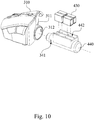
- FIG. 10 is an exploded view of some components of the mouse device in FIG. 9 .
- FIG. 1A is a perspective view of a mouse device 100 according to an embodiment of the disclosure.
- FIG. 1B is an exploded view of the mouse device 100 in FIG. 1A .
- FIG. 2 is a top view of the mouse device 100 in FIG. 1A .
- FIG. 3 is a bottom view of the mouse device in FIG. 1A .
- FIG. 4 is a side view of the mouse device 100 in FIG. 1A .
- the mouse device 100 includes an operation body 110 and a frame 120 .
- the operation body 110 may be provided with functional operating elements (e.g., buttons, a scroll wheel, a touch pad, etc.) for a user's hand to operate.
- Electronic components may be provided inside the operation body 110 to convert operations of the user on the aforementioned functional operating elements into input signals.
- the frame 120 is engaged with the operation body 110 and can be used to support the palm of the user.
- the frame 120 has hollow portions 120 a , 120 b . Each of the hollow portions 120 a , 120 b penetrates the mouse device 100 from a side of the mouse device 100 to another side of the mouse device 100 . In a forward-backward axial direction D 1 of the mouse device 100 , the frame 120 is located behind the operation body 110 .
- the hollow portion 120 a of the frame 120 penetrates the mouse device 100 in an upward-downward axial direction D 2 of the mouse device 100 . That is, the hollow portion 120 a penetrates from the top side of the mouse device 100 to the bottom side of the mouse device 100 .
- the upward-downward axial direction D 2 of the mouse device 100 is perpendicular to a bottom surface of the mouse device 100 , but the present disclosure is not limited in this regard.
- the hollow portions 120 a , 120 b penetrate the mouse device 100 in a left-right axial direction D 3 of the mouse device 100 . That is, the hollow portions 120 a , 120 b penetrate from the left side of the mouse device 100 to the right side of the mouse device 100 .
- the left-right axial direction D 3 of the mouse device 100 is parallel to the bottom surface of the mouse device 100 and perpendicular to the upward-downward axial direction D 2 , but the present disclosure is not limited in this regard.
- the frame 120 may only have a hollow portion penetrating the mouse device 100 in the upward-downward axial direction D 2 of the mouse device 100 , or only a hollow portion penetrating the mouse device 100 in the left-right axial direction D 3 .
- the frame 120 may only have a hollow portion penetrating from the top side/bottom side of the mouse device 100 to one of the left and right sides of the mouse device 100 .
- the volume of the operation body 110 integrating the functional operating elements and the electronic components can be reduced toward the front half of the mouse device 100 , and the frame 120 having the hollow portions 120 a , 120 b can be extended to the rear half of the mouse device 100 , thereby achieving the weight reduction of the mouse device 100 .
- a length L 1 of the frame 120 in the forward-backward axial direction D 1 is greater than a length L 2 of the operation body 110 in the forward-backward axial direction D 1 .
- the frame 120 includes two finger resting portions 121 and a palm resting portion 122 .
- the two finger resting portions 121 are respectively located at opposite sides of the operation body 110 .
- the palm resting portion 122 is connected between the two finger resting portions 121 .
- the hollow portion 120 a is formed among the two finger resting portions 121 and the palm resting portion 122 , and is adjoined between the operation body 110 and the palm resting portion 122 in the forward-backward axial direction D 1 .
- one of the finger resting portions 121 can be used to support the thumb of the user, and the other finger resting portions 121 can be used to support at least the ring finger and the little finger of the user.
- the palm resting portion 122 can be used to support the palm of the user.
- the palm resting portion 122 is located behind the two finger resting portions 121 in the forward-backward axial direction D 1 of the mouse device 100 .
- the volume of the frame 120 can be reduced as much as possible, so that the aforementioned effect of reducing the weight of the mouse device 100 is more significant.
- the palm resting portion 122 has a plurality of through holes 122 a , 122 b , so as to achieve the purpose of reducing the weight of the mouse device 100 . As shown in FIG.
- the palm resting portion 122 has a through hole 122 a penetrating the palm resting portion 122 in the forward-backward axial direction D 1 , and has a plurality of through holes 122 b penetrating the palm resting portion 122 in the upward-downward axial direction D 2 .
- the opening area of the through hole 122 a is larger than the opening area of any of the through holes 122 b , but the present disclosure is not limited in this regard.
- a bottom surface of the operation body 110 forms a part of a bottom of the mouse device 100 .
- the operation body 110 can slide on the operation surface.
- the palm resting portion 122 also forms a part of the bottom of the mouse device 100 .
- the frame 120 further includes a supporting portion 125 .
- the supporting portion 125 is connected to an end of the palm resting portion 122 away from the operation body 110 and extends toward the operation body 110 .
- the supporting portion 125 located behind the mouse device 100 can contact the operation surface, and can avoid the problem that the operation body 110 in the front is lifted up because the palm resting portion 122 is pressed down by the palm of the user.
- foot pads e.g., wear-resistant pads
- foot pads may be provided on the bottom surface of the operation body 110 and the bottom surface of the supporting portion 125 .
- the frame 120 further includes two connecting portions 123 .
- the two finger resting portions 121 are connected to the palm resting portion 122 respectively through the two connecting portions 123 .
- the two connecting portions 123 extend from the bottoms of the two finger resting portions 121 along the left-right axial direction D 3 , and are connected upward to the palm resting portion 122 along the upward-downward axial direction D 2 .
- the hollow portion 120 b is adjoined between a part of the palm resting portion 122 away from the operation body 110 and the two connecting portions 123 in the forward-backward axial direction D 1 .
- each of the two connecting portions 123 has a plurality of through holes 123 a , so as to achieve the purpose of reducing the weight of the mouse device 100 .
- there is a through hole 123 a penetrating the connecting portion 123 in the left-right axial direction D 3 but the present disclosure is not limited in this regard.
- each of the two connecting portions 123 forms a part of the bottom of the mouse device 100 .
- the connecting portions 123 located on the left and right sides of the mouse device 100 can contact the operation surface, and the problem that the mouse device 100 is tilted to the left and right sides thereof during operation can be avoided.
- foot pads e.g., wear-resistant pads
- the frame 120 further includes an engaging portion 124 .
- the engaging portion 124 is connected between the two finger resting portions 121 and engaged with the bottom of the operation body 110 .
- the mouse device 100 further includes screws 130 .
- the screws 130 are fixed to the bottom of the operation body 110 through holes of the engaging portion 124 .
- the screws 130 completely sink into the holes of the engaging portion 124 without protruding from the bottom of the mouse device 100 , as shown in FIG. 4 .
- the frame 120 may also cancel the aforementioned engaging portion 124 , and the two finger resting portions 121 may be respectively engaged with both sides of the operation body 110 by means of engagement. As such, the purpose of detachably connecting the frame 120 to the operation body 110 can still be achieved.
- the engaging portion 124 forms a part of the bottom of the mouse device 100 .
- the engaging portion 124 located at the bottom of the operation body 110 can contact the operation surface, and can avoid excessive wear of the bottom of the operation body 110 after long-term use.
- foot pads e.g., wear-resistant pads
- FIG. 5 is a perspective view of a mouse device 200 according to an embodiment of the disclosure.
- FIG. 6 is a perspective view of some components of the mouse device 200 in FIG. 5 .
- the mouse device 200 of the present embodiment further includes one or more weight members 230
- the frame 220 further includes a suspension portion 225 .
- the weight members 230 are located at the hollow portions 120 a , 120 b and detachably engaged with the suspension portion 225 of the frame 220 .
- the suspension portion 225 is connected to the below the palm resting portion 122 and has a columnar shape.
- the weight members 230 are sheet-shaped and can pass through the suspension portion 225 to be hung on the suspension portion 225 . Hence, the user can arbitrarily select the number and weight of the weight members 230 to be suspended to adjust the overall position of the center of gravity of the mouse device 200 , so that the mouse device 200 can meet the operation feel requirements of the user.
- FIG. 7 is a perspective view of a mouse device 300 according to an embodiment of the disclosure.
- FIG. 8 is an exploded view of some components of the mouse device 300 in FIG. 7 .
- the mouse device 300 of the present embodiment further includes a battery compartment 340 , and the operation body 310 has a connection port 311 .
- the battery compartment 340 is located at the hollow portions 120 a , 120 b and detachably engaged with the connection port 311 of the operation body 310 .
- the battery compartment 340 can be provided with a battery for supplying power to the electronic components inside the operation body 310 through the connection port 311 .
- the mouse device 300 of the present embodiment may be a wireless mouse provided with power from the battery in the battery compartment 340 .
- the configuration in which the frame 120 is detachably engaged with the operation body 310 and the configuration in which the battery compartment 340 is detachably engaged with the operation body 310 can achieve the effect of facilitating battery replacement.
- connection port 311 of the operation body 310 has an engaging block 312 therein, and the battery compartment 340 is substantially cylindrical and has an engaging groove 341 .
- An entrance of the engaging groove 341 is located at an end of the battery compartment 340 .
- the engaging groove 341 extends from the entrance substantially parallel to a central axis of the battery compartment 340 and then extends axially around the central axis of the battery compartment 340 .
- the battery compartment 340 can be inserted into the connection port 311 of the operation body 310 , and then the battery compartment 340 can be rotated to slide and engage the engaging block 312 with a distal end of the engaging groove 341 , thereby engaging the battery compartment 340 to the operation body 310 .
- FIG. 9 is a perspective view of a mouse device 400 according to an embodiment of the disclosure.
- FIG. 10 is an exploded view of some components of the mouse device 400 in FIG. 9 .
- the battery compartment 440 of the mouse device 400 of the present embodiment has one or more slots 442
- the mouse device 400 further includes one or more weight members 430 .
- the weight members 430 are located at the hollow portions 120 a , 120 b and detachably inserted into the slots 442 of the battery compartment 440 .
- the user can arbitrarily select the number and weight of the weight members 430 to be suspended to adjust the overall position of the center of gravity of the mouse device 400 , so that the mouse device 400 can meet the operation feel requirements of the user.
- the configuration in which the frame 120 is detachably engaged with the operation body 310 and the configuration in which the battery compartment 440 is detachably engaged with the operation body 310 can achieve the effect of facilitating battery replacement.
- the operation body and the frame are respectively located at the front and rear of the mouse device in the forward-backward axial direction of the mouse device. Therefore, functional operating elements of the mouse device (e.g., the buttons, the scroll wheel, the touchpad, etc.) and electronic components (e.g., the circuit board, the light emitter, the light receiver, etc.) can be integrated and concentrated in the front operating body, and the rear frame can be used to support the palm of a user.
- the hollow portion of the frame has a structure that penetrates from one side to the other side of the mouse device, which can effectively reduce the weight of the frame, thereby achieving the weight reduction of the mouse device.
Landscapes
- Engineering & Computer Science (AREA)
- General Engineering & Computer Science (AREA)
- Theoretical Computer Science (AREA)
- Human Computer Interaction (AREA)
- Physics & Mathematics (AREA)
- General Physics & Mathematics (AREA)
- Position Input By Displaying (AREA)
- Measuring Pulse, Heart Rate, Blood Pressure Or Blood Flow (AREA)
Abstract
A mouse device includes an operation body and a frame. The frame is engaged with the operation body and has a hollow portion. The hollow portion penetrates the mouse device from a side of the mouse device to another side of the mouse device. The frame includes two finger resting portions and a palm resting portion. The two finger resting portions are respectively located at opposite sides of the operation body. The palm resting portion is connected between the two finger resting portions. The hollow portion is formed among the two finger resting portions and the palm resting portion. In a forward-backward axial direction of the mouse device, the frame is located behind the operation body.
Description
This application claims priority to Taiwan Application Serial Number 109103587, filed Feb. 5, 2020, which is herein incorporated by reference.
The present disclosure relates to a mouse device.
As important external input devices of computers, mouse devices allow users to move cursors on computer screens quickly by moving the mouse devices and allow the users to perform quick input operations such as confirmation, cancellation, and the like by the operation of the mouse devices. Therefore, the mouse devices greatly improve convenience for the users to operate the computers.
It should be noted that after using a mouse device for a long time, it may cause a burden on the wrist and cause discomfort. Although some commercially available mouse devices can adjust the positions of the overall centers of gravity thereof by adding weight blocks (for example, using drawer-type weights for installation or removal), the purpose of the adjustment is to meet the needs of the user's operating feel and cannot effectively alleviate the aforementioned discomfort.
Accordingly, how to provide a mouse device to solve the aforementioned problems becomes an important issue to be solved by those in the industry.
An aspect of the disclosure is to provide a mouse device that can efficiently solve the aforementioned problems.
According to an embodiment of the disclosure, a mouse device includes an operation body and a frame. The frame is engaged with the operation body and has a hollow portion. The hollow portion penetrates the mouse device from a side of the mouse device to another side of the mouse device. The frame includes two finger resting portions and a palm resting portion. The two finger resting portions are respectively located at opposite sides of the operation body. The palm resting portion is connected between the two finger resting portions. The hollow portion is formed among the two finger resting portions and the palm resting portion. In a forward-backward axial direction of the mouse device, the frame is located behind the operation body.
In an embodiment of the disclosure, a length of the frame in the forward-backward axial direction is greater than a length of the operation body in the forward-backward axial direction.
In an embodiment of the disclosure, the hollow portion penetrates the mouse device in an upward-downward axial direction of the mouse device.
In an embodiment of the disclosure, the hollow portion penetrates the mouse device in a left-right axial direction of the mouse device.
In an embodiment of the disclosure, the hollow portion penetrates the mouse device in an upward-downward axial direction and a left-right axial direction of the mouse device.
In an embodiment of the disclosure, the frame further includes a supporting portion connected to an end of the palm resting portion away from the operation body. The supporting portion extends toward the operation body.
In an embodiment of the disclosure, the palm resting portion is located behind the two finger resting portions in the forward-backward axial direction.
In an embodiment of the disclosure, the frame further includes two connecting portions. The two finger resting portions are connected to the palm resting portion respectively through the two connecting portions.
In an embodiment of the disclosure, each of the two connecting portions forms a part of a bottom of the mouse device.
In an embodiment of the disclosure, at least one of the two connecting portions has at least one through hole.
In an embodiment of the disclosure, the hollow portion is adjoined between a part of the palm resting portion away from the operation body and the two connecting portions in the forward-backward axial direction.
In an embodiment of the disclosure, the frame further includes an engaging portion. The engaging portion is connected between the two finger resting portions and engaged with a bottom of the operation body.
In an embodiment of the disclosure, the engaging portion forms a part of a bottom of the mouse device.
In an embodiment of the disclosure, the palm resting portion has at least one through hole.
In an embodiment of the disclosure, the hollow portion is adjoined between the operation body and the palm resting portion in the forward-backward axial direction.
In an embodiment of the disclosure, the mouse device further includes a weight member. The weight member is located at the hollow portion and detachably engaged with the frame.
In an embodiment of the disclosure, the mouse device further includes a battery compartment. The battery compartment is located at the hollow portion and detachably engaged with the operation body.
In an embodiment of the disclosure, the mouse device further includes a weight member. The weight member is located at the hollow portion and detachably engaged with the battery compartment.
In an embodiment of the disclosure, the battery compartment has a slot. The weight member is detachably inserted into the slot.
In an embodiment of the disclosure, the operation body has a connection port having an engaging block therein. The battery compartment is detachably engaged with the connection port and has an engaging groove. The engaging block is slidably engaged with the engaging groove.
Accordingly, in the mouse device of the present disclosure, the operation body and the frame are respectively located at the front and rear of the mouse device in the forward-backward axial direction of the mouse device. Therefore, functional operating elements of the mouse device (e.g., the buttons, the scroll wheel, the touchpad, etc.) and electronic components (e.g., the circuit board, the light emitter, the light receiver, etc.) can be integrated and concentrated in the front operating body, and the rear frame can be used to support the palm of a user. In addition, the hollow portion of the frame has a structure that penetrates from one side to the other side of the mouse device, which can effectively reduce the weight of the frame, thereby achieving the weight reduction of the mouse device.
It is to be understood that both the foregoing general description and the following detailed description are by examples, and are intended to provide further explanation of the disclosure as claimed.
The disclosure can be more fully understood by reading the following detailed description of the embodiment, with reference made to the accompanying drawings as follows:
Reference will now be made in detail to the present embodiments of the disclosure, examples of which are illustrated in the accompanying drawings. Wherever possible, the same reference numbers are used in the drawings and the description to refer to the same or like parts. However, specific structural and functional details disclosed herein are merely representative for purposes of describing example embodiments, and thus may be embodied in many alternate forms and should not be construed as limited to only example embodiments set forth herein. Therefore, it should be understood that there is no intent to limit example embodiments to the particular forms disclosed, but on the contrary, example embodiments are to cover all modifications, equivalents, and alternatives falling within the scope of the disclosure.
Reference is made to FIG. 1 to FIG. 4 . FIG. 1A is a perspective view of a mouse device 100 according to an embodiment of the disclosure. FIG. 1B is an exploded view of the mouse device 100 in FIG. 1A . FIG. 2 is a top view of the mouse device 100 in FIG. 1A . FIG. 3 is a bottom view of the mouse device in FIG. 1A . FIG. 4 is a side view of the mouse device 100 in FIG. 1A . As shown in FIGS. 1 to 4 , in the present embodiment, the mouse device 100 includes an operation body 110 and a frame 120. The operation body 110 may be provided with functional operating elements (e.g., buttons, a scroll wheel, a touch pad, etc.) for a user's hand to operate. Electronic components (e.g., a circuit board, a light emitter, a light receiver, etc.) may be provided inside the operation body 110 to convert operations of the user on the aforementioned functional operating elements into input signals. The frame 120 is engaged with the operation body 110 and can be used to support the palm of the user. The frame 120 has hollow portions 120 a, 120 b. Each of the hollow portions 120 a, 120 b penetrates the mouse device 100 from a side of the mouse device 100 to another side of the mouse device 100. In a forward-backward axial direction D1 of the mouse device 100, the frame 120 is located behind the operation body 110.
For example, as shown in FIGS. 2 and 3 , the hollow portion 120 a of the frame 120 penetrates the mouse device 100 in an upward-downward axial direction D2 of the mouse device 100. That is, the hollow portion 120 a penetrates from the top side of the mouse device 100 to the bottom side of the mouse device 100. In some embodiments, the upward-downward axial direction D2 of the mouse device 100 is perpendicular to a bottom surface of the mouse device 100, but the present disclosure is not limited in this regard.
For example, as shown in FIG. 4 , the hollow portions 120 a, 120 b penetrate the mouse device 100 in a left-right axial direction D3 of the mouse device 100. That is, the hollow portions 120 a, 120 b penetrate from the left side of the mouse device 100 to the right side of the mouse device 100. In some embodiments, the left-right axial direction D3 of the mouse device 100 is parallel to the bottom surface of the mouse device 100 and perpendicular to the upward-downward axial direction D2, but the present disclosure is not limited in this regard.
In some other embodiments, the frame 120 may only have a hollow portion penetrating the mouse device 100 in the upward-downward axial direction D2 of the mouse device 100, or only a hollow portion penetrating the mouse device 100 in the left-right axial direction D3.
In some other embodiments, the frame 120 may only have a hollow portion penetrating from the top side/bottom side of the mouse device 100 to one of the left and right sides of the mouse device 100.
With the foregoing structural configurations, the volume of the operation body 110 integrating the functional operating elements and the electronic components can be reduced toward the front half of the mouse device 100, and the frame 120 having the hollow portions 120 a, 120 b can be extended to the rear half of the mouse device 100, thereby achieving the weight reduction of the mouse device 100.
In some embodiments, as shown in FIGS. 2 and 3 , a length L1 of the frame 120 in the forward-backward axial direction D1 is greater than a length L2 of the operation body 110 in the forward-backward axial direction D1. With the structural configuration, the aforementioned effect of reducing the weight of the mouse device 100 can be made more significant.
As shown in FIGS. 1A to 4 , in the present embodiment, the frame 120 includes two finger resting portions 121 and a palm resting portion 122. The two finger resting portions 121 are respectively located at opposite sides of the operation body 110. The palm resting portion 122 is connected between the two finger resting portions 121. The hollow portion 120 a is formed among the two finger resting portions 121 and the palm resting portion 122, and is adjoined between the operation body 110 and the palm resting portion 122 in the forward-backward axial direction D1. For example, one of the finger resting portions 121 can be used to support the thumb of the user, and the other finger resting portions 121 can be used to support at least the ring finger and the little finger of the user. The palm resting portion 122 can be used to support the palm of the user.
In some embodiments, the palm resting portion 122 is located behind the two finger resting portions 121 in the forward-backward axial direction D1 of the mouse device 100. With the structural configuration, in addition to making the frame 120 better ergonomically fit the positions of the user's fingers and palm, the volume of the frame 120 can be reduced as much as possible, so that the aforementioned effect of reducing the weight of the mouse device 100 is more significant. In addition, the palm resting portion 122 has a plurality of through holes 122 a, 122 b, so as to achieve the purpose of reducing the weight of the mouse device 100. As shown in FIG. 1A , the palm resting portion 122 has a through hole 122 a penetrating the palm resting portion 122 in the forward-backward axial direction D1, and has a plurality of through holes 122 b penetrating the palm resting portion 122 in the upward-downward axial direction D2. The opening area of the through hole 122 a is larger than the opening area of any of the through holes 122 b, but the present disclosure is not limited in this regard.
In some embodiments, as shown in FIGS. 3 and 4 , a bottom surface of the operation body 110 forms a part of a bottom of the mouse device 100. Hence, when the user uses the mouse device 100 on an operation surface (e.g., a desktop), the operation body 110 can slide on the operation surface. In addition, the palm resting portion 122 also forms a part of the bottom of the mouse device 100. Specifically, the frame 120 further includes a supporting portion 125. The supporting portion 125 is connected to an end of the palm resting portion 122 away from the operation body 110 and extends toward the operation body 110. Hence, when the user uses the mouse device 100 on this operation surface, the supporting portion 125 located behind the mouse device 100 can contact the operation surface, and can avoid the problem that the operation body 110 in the front is lifted up because the palm resting portion 122 is pressed down by the palm of the user. In addition, foot pads (e.g., wear-resistant pads) may be provided on the bottom surface of the operation body 110 and the bottom surface of the supporting portion 125.
As shown in FIGS. 1A to 4 , in the present embodiment, the frame 120 further includes two connecting portions 123. The two finger resting portions 121 are connected to the palm resting portion 122 respectively through the two connecting portions 123. Specifically, the two connecting portions 123 extend from the bottoms of the two finger resting portions 121 along the left-right axial direction D3, and are connected upward to the palm resting portion 122 along the upward-downward axial direction D2. The hollow portion 120 b is adjoined between a part of the palm resting portion 122 away from the operation body 110 and the two connecting portions 123 in the forward-backward axial direction D1. In addition, each of the two connecting portions 123 has a plurality of through holes 123 a, so as to achieve the purpose of reducing the weight of the mouse device 100. As shown in FIG. 1A , for each connecting portion 123, there is a through hole 123 a penetrating the connecting portion 123 in the left-right axial direction D3, but the present disclosure is not limited in this regard.
As shown in FIG. 3 , each of the two connecting portions 123 forms a part of the bottom of the mouse device 100. Hence, when the user uses the mouse device 100 on the operation surface, the connecting portions 123 located on the left and right sides of the mouse device 100 can contact the operation surface, and the problem that the mouse device 100 is tilted to the left and right sides thereof during operation can be avoided. In addition, foot pads (e.g., wear-resistant pads) may be provided on bottom surfaces of the connecting portions 123.
As shown in FIGS. 1B and 3 , in the present embodiment, the frame 120 further includes an engaging portion 124. The engaging portion 124 is connected between the two finger resting portions 121 and engaged with the bottom of the operation body 110. Specifically, the mouse device 100 further includes screws 130. The screws 130 are fixed to the bottom of the operation body 110 through holes of the engaging portion 124. In addition, the screws 130 completely sink into the holes of the engaging portion 124 without protruding from the bottom of the mouse device 100, as shown in FIG. 4 .
In practical applications, the frame 120 may also cancel the aforementioned engaging portion 124, and the two finger resting portions 121 may be respectively engaged with both sides of the operation body 110 by means of engagement. As such, the purpose of detachably connecting the frame 120 to the operation body 110 can still be achieved.
As shown in FIG. 3 , the engaging portion 124 forms a part of the bottom of the mouse device 100. Hence, when the user uses the mouse device 100 on the operation surface, the engaging portion 124 located at the bottom of the operation body 110 can contact the operation surface, and can avoid excessive wear of the bottom of the operation body 110 after long-term use. In addition, foot pads (e.g., wear-resistant pads) may be provided on a bottom surface of the engaging portion 124.
Reference is made to FIGS. 5 and 6 . FIG. 5 is a perspective view of a mouse device 200 according to an embodiment of the disclosure. FIG. 6 is a perspective view of some components of the mouse device 200 in FIG. 5 . Differences between the present embodiment and the embodiment shown in FIG. 1A are that the mouse device 200 of the present embodiment further includes one or more weight members 230, and the frame 220 further includes a suspension portion 225. The weight members 230 are located at the hollow portions 120 a, 120 b and detachably engaged with the suspension portion 225 of the frame 220. Specifically, the suspension portion 225 is connected to the below the palm resting portion 122 and has a columnar shape. The weight members 230 are sheet-shaped and can pass through the suspension portion 225 to be hung on the suspension portion 225. Hence, the user can arbitrarily select the number and weight of the weight members 230 to be suspended to adjust the overall position of the center of gravity of the mouse device 200, so that the mouse device 200 can meet the operation feel requirements of the user.
Reference is made to FIGS. 7 and 8 . FIG. 7 is a perspective view of a mouse device 300 according to an embodiment of the disclosure. FIG. 8 is an exploded view of some components of the mouse device 300 in FIG. 7 . Differences between the present embodiment and the embodiment shown in FIG. 1A are that the mouse device 300 of the present embodiment further includes a battery compartment 340, and the operation body 310 has a connection port 311. The battery compartment 340 is located at the hollow portions 120 a, 120 b and detachably engaged with the connection port 311 of the operation body 310. The battery compartment 340 can be provided with a battery for supplying power to the electronic components inside the operation body 310 through the connection port 311. In other words, the mouse device 100 shown in FIG. 1A may be a wired mouse, and the mouse device 300 of the present embodiment may be a wireless mouse provided with power from the battery in the battery compartment 340. In addition, the configuration in which the frame 120 is detachably engaged with the operation body 310 and the configuration in which the battery compartment 340 is detachably engaged with the operation body 310 can achieve the effect of facilitating battery replacement.
In some embodiments, as shown in FIG. 8 , the connection port 311 of the operation body 310 has an engaging block 312 therein, and the battery compartment 340 is substantially cylindrical and has an engaging groove 341. An entrance of the engaging groove 341 is located at an end of the battery compartment 340. The engaging groove 341 extends from the entrance substantially parallel to a central axis of the battery compartment 340 and then extends axially around the central axis of the battery compartment 340. With the structural configuration, the battery compartment 340 can be inserted into the connection port 311 of the operation body 310, and then the battery compartment 340 can be rotated to slide and engage the engaging block 312 with a distal end of the engaging groove 341, thereby engaging the battery compartment 340 to the operation body 310.
Reference is made to FIGS. 9 and 10 . FIG. 9 is a perspective view of a mouse device 400 according to an embodiment of the disclosure. FIG. 10 is an exploded view of some components of the mouse device 400 in FIG. 9 . Differences between the present embodiment and the embodiments shown in FIGS. 5 and 7 are that the battery compartment 440 of the mouse device 400 of the present embodiment has one or more slots 442, and the mouse device 400 further includes one or more weight members 430. The weight members 430 are located at the hollow portions 120 a, 120 b and detachably inserted into the slots 442 of the battery compartment 440. Hence, the user can arbitrarily select the number and weight of the weight members 430 to be suspended to adjust the overall position of the center of gravity of the mouse device 400, so that the mouse device 400 can meet the operation feel requirements of the user. In addition, the configuration in which the frame 120 is detachably engaged with the operation body 310 and the configuration in which the battery compartment 440 is detachably engaged with the operation body 310 can achieve the effect of facilitating battery replacement.
According to the foregoing recitations of the embodiments of the disclosure, it can be seen that in the mouse device of the present disclosure, the operation body and the frame are respectively located at the front and rear of the mouse device in the forward-backward axial direction of the mouse device. Therefore, functional operating elements of the mouse device (e.g., the buttons, the scroll wheel, the touchpad, etc.) and electronic components (e.g., the circuit board, the light emitter, the light receiver, etc.) can be integrated and concentrated in the front operating body, and the rear frame can be used to support the palm of a user. In addition, the hollow portion of the frame has a structure that penetrates from one side to the other side of the mouse device, which can effectively reduce the weight of the frame, thereby achieving the weight reduction of the mouse device.
Although the present disclosure has been described in considerable detail with reference to certain embodiments thereof, other embodiments are possible. Therefore, the spirit and scope of the appended claims should not be limited to the description of the embodiments contained herein.
It will be apparent to those skilled in the art that various modifications and variations can be made to the structure of the present disclosure without departing from the scope or spirit of the disclosure. In view of the foregoing, it is intended that the present disclosure cover modifications and variations of this disclosure provided they fall within the scope of the following claims.
Claims (18)
1. A mouse device, comprising:
an operation body; and
a frame engaged with the operation body and having a hollow portion, wherein the hollow portion penetrates the mouse device from a side of the mouse device to another side of the mouse device, and the frame comprises:
two finger resting portions respectively located at opposite sides of the operation body;
a palm resting portion connected between the two finger resting portions, wherein the hollow portion is surrounded by the two finger resting portions and the palm resting portion; and
two connecting portions, wherein the two finger resting portions are connected to the palm resting portion respectively through the two connecting portions, and each of the two connecting portions forms a part of a bottom of the mouse device,
wherein in a forward-backward axial direction of the mouse device, the frame is located behind the operation body.
2. The mouse device of claim 1 , wherein a length of the frame in the forward-backward axial direction is greater than a length of the operation body in the forward-backward axial direction.
3. The mouse device of claim 1 , wherein the hollow portion penetrates the mouse device in an upward-downward axial direction of the mouse device.
4. The mouse device of claim 1 , wherein the hollow portion penetrates the mouse device in a left-right axial direction of the mouse device.
5. The mouse device of claim 1 , wherein the hollow portion penetrates the mouse device in an upward-downward axial direction and a left-right axial direction of the mouse device.
6. The mouse device of claim 1 , wherein the frame further comprises a supporting portion connected to an end of the palm resting portion away from the operation body, and the supporting portion extends toward the operation body.
7. The mouse device of claim 1 , wherein the palm resting portion is located behind the two finger resting portions in the forward-backward axial direction.
8. The mouse device of claim 1 , wherein at least one of the two connecting portions has at least one through hole.
9. The mouse device of claim 1 , wherein the frame further comprises an engaging portion, and the engaging portion is connected between the two finger resting portions and engaged with a bottom of the operation body.
10. The mouse device of claim 9 , wherein the engaging portion forms a part of the bottom of the mouse device.
11. The mouse device of claim 1 , wherein the palm resting portion has at least one through hole.
12. The mouse device of claim 1 , wherein the hollow portion is adjoined between the operation body and the palm resting portion in the forward-backward axial direction.
13. The mouse device of claim 1 , further comprising a weight member located at the hollow portion and detachably engaged with the frame.
14. The mouse device of claim 1 , further comprising a battery compartment located at the hollow portion and detachably engaged with the operation body.
15. The mouse device of claim 14 , further comprising a weight member located at the hollow portion and detachably engaged with the battery compartment.
16. The mouse device of claim 15 , wherein the battery compartment has a slot, and the weight member is detachably inserted into the slot.
17. A mouse device, comprising:
an operation body; and
a frame engaged with the operation body and having a hollow portion, wherein the hollow portion penetrates the mouse device from a side of the mouse device to another side of the mouse device, and the frame comprises:
two finger resting portions respectively located at opposite sides of the operation body;
a palm resting portion connected between the two finger resting portions, wherein the hollow portion is surrounded by the two finger resting portions and the palm resting portion; and
two connecting portions, wherein the two finger resting portions are connected to the palm resting portion respectively through the two connecting portions, and the hollow portion is adjoined between a part of the palm resting portion away from the operation body and the two connecting portions in the forward-backward axial direction,
wherein in a forward-backward axial direction of the mouse device, the frame is located behind the operation body.
18. A mouse device, comprising:
an operation body having a connection port having an engaging block therein;
a frame engaged with the operation body and having a hollow portion, wherein the hollow portion penetrates the mouse device from a side of the mouse device to another side of the mouse device, and the frame comprises:
two finger resting portions respectively located at opposite sides of the operation body; and
a palm resting portion connected between the two finger resting portions, wherein the hollow portion is surrounded by the two finger resting portions and the palm resting portion; and
a battery compartment located at the hollow portion and detachably engaged with the connection port, wherein the battery compartment has an engaging groove, and the engaging block is slidably engaged with the engaging groove,
wherein in a forward-backward axial direction of the mouse device, the frame is located behind the operation body.
Applications Claiming Priority (2)
| Application Number | Priority Date | Filing Date | Title |
|---|---|---|---|
| TW109103587 | 2020-02-05 | ||
| TW109103587A TWI789570B (en) | 2020-02-05 | 2020-02-05 | Mouse device |
Publications (1)
| Publication Number | Publication Date |
|---|---|
| US10969880B1 true US10969880B1 (en) | 2021-04-06 |
Family
ID=75275707
Family Applications (1)
| Application Number | Title | Priority Date | Filing Date |
|---|---|---|---|
| US16/905,937 Active US10969880B1 (en) | 2020-02-05 | 2020-06-19 | Mouse device |
Country Status (2)
| Country | Link |
|---|---|
| US (1) | US10969880B1 (en) |
| TW (1) | TWI789570B (en) |
Cited By (2)
| Publication number | Priority date | Publication date | Assignee | Title |
|---|---|---|---|---|
| US20220308684A1 (en) * | 2021-03-23 | 2022-09-29 | Dexin Corporation | Mouse having replaceable palm rest and replaceable finger rest |
| US12468401B2 (en) | 2021-09-08 | 2025-11-11 | Razer (Asia-Pacific) Pte. Ltd. | Wrist rest and system |
Citations (7)
| Publication number | Priority date | Publication date | Assignee | Title |
|---|---|---|---|---|
| US20020084985A1 (en) * | 1997-08-15 | 2002-07-04 | William P. Hesley | Ergonomic dual-section computer-pointing device |
| US20070125913A1 (en) * | 2005-12-05 | 2007-06-07 | Microsoft Corporation | Removable mouse palm rest |
| TWI291644B (en) * | 2006-01-06 | 2007-12-21 | Darfon Electronics Corp | Mouse capable of adjusting weight |
| US8054292B1 (en) * | 2006-02-14 | 2011-11-08 | Logitech Europe S.A. | Mouse having an exchangeable palm rest |
| US20120056812A1 (en) * | 2010-09-08 | 2012-03-08 | Key Mouse Electronic Enter | Mouse having adjustable weight cartridge at its center of gravity |
| US20140210718A1 (en) * | 2013-01-26 | 2014-07-31 | Dexin Corporation | Computer mouse with adjustable decorative wing |
| US20190179430A1 (en) * | 2017-12-12 | 2019-06-13 | FinalMouse | Computer mouse with lightweight housing |
Family Cites Families (3)
| Publication number | Priority date | Publication date | Assignee | Title |
|---|---|---|---|---|
| TW201039189A (en) * | 2009-04-24 | 2010-11-01 | Kye Systems Corp | A locking structure for accessories of input device |
| TWM560620U (en) * | 2018-02-14 | 2018-05-21 | 德國商洛卡特股份有限公司 | Responsive mouse click mechanism |
| TWD200856S (en) * | 2018-12-28 | 2019-11-11 | 寶德科技股份有限公司 | mouse part |
-
2020
- 2020-02-05 TW TW109103587A patent/TWI789570B/en active
- 2020-06-19 US US16/905,937 patent/US10969880B1/en active Active
Patent Citations (7)
| Publication number | Priority date | Publication date | Assignee | Title |
|---|---|---|---|---|
| US20020084985A1 (en) * | 1997-08-15 | 2002-07-04 | William P. Hesley | Ergonomic dual-section computer-pointing device |
| US20070125913A1 (en) * | 2005-12-05 | 2007-06-07 | Microsoft Corporation | Removable mouse palm rest |
| TWI291644B (en) * | 2006-01-06 | 2007-12-21 | Darfon Electronics Corp | Mouse capable of adjusting weight |
| US8054292B1 (en) * | 2006-02-14 | 2011-11-08 | Logitech Europe S.A. | Mouse having an exchangeable palm rest |
| US20120056812A1 (en) * | 2010-09-08 | 2012-03-08 | Key Mouse Electronic Enter | Mouse having adjustable weight cartridge at its center of gravity |
| US20140210718A1 (en) * | 2013-01-26 | 2014-07-31 | Dexin Corporation | Computer mouse with adjustable decorative wing |
| US20190179430A1 (en) * | 2017-12-12 | 2019-06-13 | FinalMouse | Computer mouse with lightweight housing |
Cited By (3)
| Publication number | Priority date | Publication date | Assignee | Title |
|---|---|---|---|---|
| US20220308684A1 (en) * | 2021-03-23 | 2022-09-29 | Dexin Corporation | Mouse having replaceable palm rest and replaceable finger rest |
| US11520417B2 (en) * | 2021-03-23 | 2022-12-06 | Dexin Corporation | Mouse having replaceable palm rest and replaceable finger rest |
| US12468401B2 (en) | 2021-09-08 | 2025-11-11 | Razer (Asia-Pacific) Pte. Ltd. | Wrist rest and system |
Also Published As
| Publication number | Publication date |
|---|---|
| TWI789570B (en) | 2023-01-11 |
| TW202131145A (en) | 2021-08-16 |
Similar Documents
| Publication | Publication Date | Title |
|---|---|---|
| US5956018A (en) | Compact pointing control stick circuit board assembly having electrical vias | |
| US11550403B2 (en) | Modular keyboard | |
| US9164551B2 (en) | Tablet computer | |
| US20170045959A1 (en) | Mouse with translating module | |
| US11622036B2 (en) | Terminal case, gripping device, and information processing device | |
| TWI789570B (en) | Mouse device | |
| WO2022067459A1 (en) | Computer mouse module | |
| US8054292B1 (en) | Mouse having an exchangeable palm rest | |
| US20130048801A1 (en) | Low-Profile Stand | |
| US6229700B1 (en) | Portable computer host without any user interface | |
| US20100039759A1 (en) | Keyboard | |
| CN112424897B (en) | An input device | |
| KR200478720Y1 (en) | Computer mouse having adjustable size | |
| CN113253854B (en) | Mouse device | |
| WO2005059734A3 (en) | Input device for multiple use with a digitising tablet | |
| US20080218477A1 (en) | Computer mouse | |
| TWM541593U (en) | Electronic device | |
| US20030098849A1 (en) | Double roller mouse structure | |
| CN103970299A (en) | Wireless mouse | |
| RU2551796C1 (en) | Data input device | |
| US11086414B2 (en) | Mouse device | |
| CN210692956U (en) | Clamping type docking station | |
| US11137836B2 (en) | Electronic device | |
| JP2022013750A (en) | Combination mouse | |
| TWM456532U (en) | Touch pad module and electronic device |
Legal Events
| Date | Code | Title | Description |
|---|---|---|---|
| FEPP | Fee payment procedure |
Free format text: ENTITY STATUS SET TO UNDISCOUNTED (ORIGINAL EVENT CODE: BIG.); ENTITY STATUS OF PATENT OWNER: LARGE ENTITY |
|
| STCF | Information on status: patent grant |
Free format text: PATENTED CASE |
|
| MAFP | Maintenance fee payment |
Free format text: PAYMENT OF MAINTENANCE FEE, 4TH YEAR, LARGE ENTITY (ORIGINAL EVENT CODE: M1551); ENTITY STATUS OF PATENT OWNER: LARGE ENTITY Year of fee payment: 4 |