US10968203B2 - Pyrimidinyl-pyridyloxy-naphthyl compounds and methods of treating IRE1-related diseases and disorders - Google Patents

Pyrimidinyl-pyridyloxy-naphthyl compounds and methods of treating IRE1-related diseases and disorders Download PDF

Info

Publication number
US10968203B2
US10968203B2 US15/989,008 US201815989008A US10968203B2 US 10968203 B2 US10968203 B2 US 10968203B2 US 201815989008 A US201815989008 A US 201815989008A US 10968203 B2 US10968203 B2 US 10968203B2
Authority
US
United States
Prior art keywords
methyl
och
compound
oxy
alkyldiyl
Prior art date
Legal status (The legal status is an assumption and is not a legal conclusion. Google has not performed a legal analysis and makes no representation as to the accuracy of the status listed.)
Active
Application number
US15/989,008
Other versions
US20180265497A1 (en
Inventor
Marie-Gabrielle Braun
Paul Gibbons
Wendy Lee
Cuong Ly
Joachim Rudolph
Jacob Schwarz
Avi Ashkenazi
Leo Fu
Tommy Lai
Fei Wang
Ramsay Beveridge
Liang Zhao
Current Assignee (The listed assignees may be inaccurate. Google has not performed a legal analysis and makes no representation or warranty as to the accuracy of the list.)
Wuxi Apptec Shanghai Co Ltd
Wuxi Apptec Co Ltd
Genentech Inc
University of California San Diego UCSD
Original Assignee
Genentech Inc
University of California San Diego UCSD
Priority date (The priority date is an assumption and is not a legal conclusion. Google has not performed a legal analysis and makes no representation as to the accuracy of the date listed.)
Filing date
Publication date
Family has litigation
First worldwide family litigation filed litigation Critical https://patents.darts-ip.com/?family=63522807&utm_source=google_patent&utm_medium=platform_link&utm_campaign=public_patent_search&patent=US10968203(B2) "Global patent litigation dataset” by Darts-ip is licensed under a Creative Commons Attribution 4.0 International License.
Application filed by Genentech Inc, University of California San Diego UCSD filed Critical Genentech Inc
Publication of US20180265497A1 publication Critical patent/US20180265497A1/en
Assigned to THE REGENTS OF THE UNIVERSITY OF CALIFORNIA reassignment THE REGENTS OF THE UNIVERSITY OF CALIFORNIA ASSIGNMENT OF ASSIGNORS INTEREST (SEE DOCUMENT FOR DETAILS). Assignors: HOWARD HUGHES MEDICAL INSTITUTE
Assigned to GENENTECH, INC. reassignment GENENTECH, INC. ASSIGNMENT OF ASSIGNORS INTEREST (SEE DOCUMENT FOR DETAILS). Assignors: PARAZA PHARMA, INC.
Assigned to GENENTECH, INC. reassignment GENENTECH, INC. ASSIGNMENT OF ASSIGNORS INTEREST (SEE DOCUMENT FOR DETAILS). Assignors: WUXI APPTEC CO. LTD.
Assigned to WUXI APPTEC CO. LTD. reassignment WUXI APPTEC CO. LTD. ASSIGNMENT OF ASSIGNORS INTEREST (SEE DOCUMENT FOR DETAILS). Assignors: WUXI APPTEC (SHANGHAI) CO. LTD.
Assigned to WUXI APPTEC (SHANGHAI) CO. LTD. reassignment WUXI APPTEC (SHANGHAI) CO. LTD. ASSIGNMENT OF ASSIGNORS INTEREST (SEE DOCUMENT FOR DETAILS). Assignors: LAI, TOMMY, WANG, FEI, FU, LEO
Assigned to PARAZA PHARMA INC. reassignment PARAZA PHARMA INC. ASSIGNMENT OF ASSIGNORS INTEREST (SEE DOCUMENT FOR DETAILS). Assignors: BEVERIDGE, RAMSAY, ZHAO, LIANG
Assigned to THE REGENTS OF THE UNIVERSITY OF CALIFORNIA, HOWARD HUGHES MEDICAL INSTITUTE, GENENTECH, INC. reassignment THE REGENTS OF THE UNIVERSITY OF CALIFORNIA ASSIGNMENT OF 50 % INTEREST TOTAL TO ASSIGNEES (25% TO EACH OF THE REGENTS OF UNIVERSITY OF CALIFORNIA AND HOWARD HUGHES MEDICAL INSTITUTE); ASSIGNOR RETAINS 50%. INTEREST. Assignors: GENENTECH, INC.
Assigned to GENENTECH, INC. reassignment GENENTECH, INC. ASSIGNMENT OF ASSIGNORS INTEREST (SEE DOCUMENT FOR DETAILS). Assignors: GIBBONS, PAUL, LY, CUONG, ASHKENAZI, AVI, SCHWARZ, JACOB, BRAUN, Marie-Gabrielle, LEE, WENDY, RUDOLPH, JOACHIM
Publication of US10968203B2 publication Critical patent/US10968203B2/en
Application granted granted Critical
Active legal-status Critical Current
Anticipated expiration legal-status Critical

Links

Classifications

    • CCHEMISTRY; METALLURGY
    • C07ORGANIC CHEMISTRY
    • C07DHETEROCYCLIC COMPOUNDS
    • C07D413/00Heterocyclic compounds containing two or more hetero rings, at least one ring having nitrogen and oxygen atoms as the only ring hetero atoms
    • C07D413/14Heterocyclic compounds containing two or more hetero rings, at least one ring having nitrogen and oxygen atoms as the only ring hetero atoms containing three or more hetero rings
    • AHUMAN NECESSITIES
    • A61MEDICAL OR VETERINARY SCIENCE; HYGIENE
    • A61KPREPARATIONS FOR MEDICAL, DENTAL OR TOILETRY PURPOSES
    • A61K31/00Medicinal preparations containing organic active ingredients
    • A61K31/33Heterocyclic compounds
    • A61K31/395Heterocyclic compounds having nitrogen as a ring hetero atom, e.g. guanethidine or rifamycins
    • A61K31/495Heterocyclic compounds having nitrogen as a ring hetero atom, e.g. guanethidine or rifamycins having six-membered rings with two or more nitrogen atoms as the only ring heteroatoms, e.g. piperazine or tetrazines
    • A61K31/505Pyrimidines; Hydrogenated pyrimidines, e.g. trimethoprim
    • A61K31/506Pyrimidines; Hydrogenated pyrimidines, e.g. trimethoprim not condensed and containing further heterocyclic rings
    • AHUMAN NECESSITIES
    • A61MEDICAL OR VETERINARY SCIENCE; HYGIENE
    • A61PSPECIFIC THERAPEUTIC ACTIVITY OF CHEMICAL COMPOUNDS OR MEDICINAL PREPARATIONS
    • A61P35/00Antineoplastic agents
    • CCHEMISTRY; METALLURGY
    • C07ORGANIC CHEMISTRY
    • C07DHETEROCYCLIC COMPOUNDS
    • C07D401/00Heterocyclic compounds containing two or more hetero rings, having nitrogen atoms as the only ring hetero atoms, at least one ring being a six-membered ring with only one nitrogen atom
    • C07D401/02Heterocyclic compounds containing two or more hetero rings, having nitrogen atoms as the only ring hetero atoms, at least one ring being a six-membered ring with only one nitrogen atom containing two hetero rings
    • C07D401/04Heterocyclic compounds containing two or more hetero rings, having nitrogen atoms as the only ring hetero atoms, at least one ring being a six-membered ring with only one nitrogen atom containing two hetero rings directly linked by a ring-member-to-ring-member bond
    • CCHEMISTRY; METALLURGY
    • C07ORGANIC CHEMISTRY
    • C07DHETEROCYCLIC COMPOUNDS
    • C07D401/00Heterocyclic compounds containing two or more hetero rings, having nitrogen atoms as the only ring hetero atoms, at least one ring being a six-membered ring with only one nitrogen atom
    • C07D401/14Heterocyclic compounds containing two or more hetero rings, having nitrogen atoms as the only ring hetero atoms, at least one ring being a six-membered ring with only one nitrogen atom containing three or more hetero rings
    • CCHEMISTRY; METALLURGY
    • C07ORGANIC CHEMISTRY
    • C07DHETEROCYCLIC COMPOUNDS
    • C07D405/00Heterocyclic compounds containing both one or more hetero rings having oxygen atoms as the only ring hetero atoms, and one or more rings having nitrogen as the only ring hetero atom
    • C07D405/14Heterocyclic compounds containing both one or more hetero rings having oxygen atoms as the only ring hetero atoms, and one or more rings having nitrogen as the only ring hetero atom containing three or more hetero rings
    • CCHEMISTRY; METALLURGY
    • C07ORGANIC CHEMISTRY
    • C07DHETEROCYCLIC COMPOUNDS
    • C07D417/00Heterocyclic compounds containing two or more hetero rings, at least one ring having nitrogen and sulfur atoms as the only ring hetero atoms, not provided for by group C07D415/00
    • C07D417/14Heterocyclic compounds containing two or more hetero rings, at least one ring having nitrogen and sulfur atoms as the only ring hetero atoms, not provided for by group C07D415/00 containing three or more hetero rings
    • AHUMAN NECESSITIES
    • A61MEDICAL OR VETERINARY SCIENCE; HYGIENE
    • A61KPREPARATIONS FOR MEDICAL, DENTAL OR TOILETRY PURPOSES
    • A61K45/00Medicinal preparations containing active ingredients not provided for in groups A61K31/00 - A61K41/00
    • A61K45/06Mixtures of active ingredients without chemical characterisation, e.g. antiphlogistics and cardiaca

Definitions

  • IRE1 alpha, ⁇ target inositol requiring enzyme 1
  • pharmaceutical compositions comprising such compounds, and methods of using such compounds to treat, prevent or diagnose diseases.
  • IRE1 a alpha, ⁇
  • UPR unfolded protein response
  • IRE1 ⁇ is a transmembrane, bifunctional protein with a luminal domain that binds to misfolded proteins, a transmembrane segment, and a cytoplasmic portion consisting of a kinase moiety and a tandem endoribonuclease domain.
  • Structure-activity relationship (SAR) studies led to compounds selective in recombinant IRE1 ⁇ kinase screens and potent against endoribonuclease activity of recombinant IRE1 ⁇ as well as cellular IRE1 ⁇ .
  • IRE1 ⁇ activity mediates certain cytoprotective and pro-survival functions of the UPR, increases viability and growth in certain tumor cell lines, and may be an effective therapeutic target for specific small molecule inhibitors that block malignant tumor growth, contrary to an earlier report (Harrington, P. E. et al (2015) ACS Med. Chem. Lett. 6:68-72).
  • inhibitors of IRE1 ⁇ may be therapeutically useful for other types of diseases besides cancer including certain autoimmune, neurodegenerative, fibrotic and metabolic disorders (Wang M. and Kaufman, R. J. (2016) Nature 529:326-335).
  • ER endoplasmic reticulum
  • IRE1 ⁇ endoplasmic reticulum
  • PERK endoplasmic reticulum
  • ATF6 unfolded protein response
  • An increase in demand for protein folding in the ER or certain types of cellular injury or stress lead to the accumulation of unfolded proteins in the ER—a condition called ER stress.
  • Cells respond to ER stress by activating the UPR to help adjust or maintain their high-fidelity protein synthetic capacity (Walter, P. and Ron, D. (2011) Science, 334:1081-1086).
  • IRE1 ⁇ is the most evolutionarily conserved of the three branches of the UPR. Importantly, the UPR makes life/death decisions for the cell, depending on the severity and duration of ER stress, and the final outcome is either cell survival and recovery or programmed cell death (apoptosis) (Sovolyova et al, (2014) Biol Chem 395: 1-13). All three pathways of the UPR form a coordinated reaction to the accumulation of unfolded proteins; and several studies have demonstrated that there is cross talk between the different pathways (Yamamoto et al, J. Biochem. (2004) 136:343-350); Arai et al, FEBS Letts. (2006) 580:184-190; Adachi et al, Cell Struct. Func.
  • ER stress and activation of the UPR can be caused by mechanical injury, inflammation, genetic mutations, infections, oxidative stress, metabolic stress, and other types of cellular stress associated with malignancy.
  • ER stress has also been implicated in diseases that result in fibrotic remodeling of internal organs, such as chronic liver diseases (Galligan et al, J. Toxicol. (2012) Vol. 2012, Article ID 207594, 12 pgs.; Shin et al, Cell Reports (2013) 5:654-665; Ji, Int. J. Hepatol. (2014) Vol. 2014, Article ID 513787, 11 pages), pulmonary fibrosis (Baek et al, Am. J. Resp. Cell Mol. Bio.
  • IRE1 ⁇ (alpha) is a transmembrane, bifunctional protein with cytoplasmic kinase and endoribonuclease activity.
  • the N-terminal domain of IRE1 ⁇ is proposed to sense the presence of unfolded proteins in the ER lumen, triggering activation of the cytoplasmic kinase domain, which, in turn, activates the C-terminal endoribonuclease.
  • IRE1 ⁇ transmits information across the ER lipid bilayer (Tirasophon et al, Genes & Develop. (2000) 14:2725-2736).
  • the IRE1 ⁇ endoribonuclease has the ability to cleave the mRNA that encodes unspliced X box protein 1 (XBP1u); this excises a 26-nucleotide intron and leads to formation of spliced XBP1 (XBP1s) mRNA, which encodes a potent transcription factor.
  • XBP1s unspliced X box protein 1
  • the XBP1s protein binds to UPR promoter elements to initiate transcription of genes that enhance the ability of the ER to cope with unfolded proteins, for example, through enhanced ER-associated degradation of misfolded proteins, and through elevated levels of chaperones and disulfide isomerases that support protein folding in the ER.
  • IRE1 ⁇ activation is also associated with enlargement of the ER volume, which has been interpreted as an adaptive mechanism to increase protein folding capacity (Sriburi et al, J. Cell. Bio. (2004) 167:35-41); (Chen, Y. (2013) Trends Cell Biol., 23, 547-555).
  • the IRE1 ⁇ endoribonuclease cleaves various mRNAs in a process called regulated IRE1 ⁇ -dependent decay of mRNA (RIDD), which reduces both protein translation and import of proteins into the ER to help reestablish homeostasis (Hollien & Weissman, Science (2006) 313:104-107).
  • RIDD regulated IRE1 ⁇ -dependent decay of mRNA
  • IRE1 ⁇ suppresses ER-stress-induced apoptosis by reducing the mRNA levels of death receptor 5 (DR5) through RIDD (Lu et al., Science (2014) 345:98-101).
  • miRs are short noncoding RNA oligonucleotides consisting of 17-25 nucleotides that generally act to inhibit gene expression by binding to complementary sequences in the 30-untranslated region of target mRNAs, either to repress mRNA translation or to induce mRNA cleavage.
  • a number of cellular functions such as proliferation, differentiation, and apoptosis are regulated by miRs, and aberrant miR expression is observed in a variety of human diseases including fibrosis (Bowen et al, J. Pathol (2013) 229:274-285).
  • Inhibitors that specifically target individual components of the UPR have recently been described.
  • the inhibitor 4 ⁇ 8C that stably binds to lysine 907 in the IRE1 ⁇ endoribonuclease domain has been shown to inhibit both RIDD activity and XBP-1 splicing (Cross et al, Proc Natl. Acad. Sci. (2012) 109:E869-E878).
  • Activation of the UPR has been shown to be an important survival pathway for tumors of secretory cell origin like multiple myeloma that have a very high protein synthesis burden. Therefore, efforts to disrupt the UPR by blocking the IRE1 ⁇ endoribonuclease cleavage and activation of XBP1 have been an active area of cancer research. As a specific IRE1 ⁇ RNase product, XBP1s is a direct indicator of functional IRE1 inhibition. A potent and selective IRE1 ⁇ inhibitor would serve as an important tool to test the hypothesis that, without full UPR activation, tumor cells would be driven to apoptosis. IRE1 ⁇ inhibitors and activating compounds have been reported (Harrington, P. E. et al (2015) ACS Med.
  • the invention relates generally to heteroaryl compounds with IRE1 modulation activity or function having the Formula I structure:
  • An aspect of the invention is a pharmaceutical composition of a Formula I compound and a pharmaceutically acceptable carrier, glidant, diluent, or excipient.
  • An aspect of the invention is a process for making a Formula I compound or a pharmaceutical composition comprising a Formula I compound.
  • An aspect of the invention is a method of treating an IRE1-related disease or disorder in a patient comprising administering a therapeutically effective amount of the pharmaceutical composition to a patient with an IRE1-related disease or disorder.
  • An aspect of the invention is a kit for treating a condition mediated by an IRE1 receptor, comprising:
  • substituted denotes an atom or a group of atoms replacing a hydrogen atom on the parent molecule.
  • substituted denotes that a specified group bears one or more substituents. Where any group may carry multiple substituents and a variety of possible substituents is provided, the substituents are independently selected and need not to be the same.
  • unsubstituted means that the specified group bears no substituents.
  • optionally substituted means that the specified group is unsubstituted or substituted by one or more substituents, independently chosen from the group of possible substituents.
  • the term “one or more” means from one substituent to the highest possible number of substitution, i.e. replacement of one hydrogen up to replacement of all hydrogens by substituents.
  • alkyl refers to a saturated linear or branched-chain monovalent hydrocarbon radical of one to twelve carbon atoms (C 1 -C 12 ), wherein the alkyl radical may be optionally substituted independently with one or more substituents described below.
  • an alkyl radical is one to eight carbon atoms (C 1 -C 8 ), or one to six carbon atoms (C 1 -C 6 ).
  • alkyl groups include, but are not limited to, methyl (Me, —CH 3 ), ethyl (Et, —CH 2 CH 3 ), 1-propyl (n-Pr, n-propyl, —CH 2 CH 2 CH 3 ), 2-propyl (i-Pr, i-propyl, —CH(CH 3 ) 2 ), 1-butyl (n-Bu, n-butyl, —CH 2 CH 2 CH 2 CH 3 ), 2-methyl-1-propyl (i-Bu, i-butyl, —CH 2 CH(CH 3 ) 2 ), 2-butyl (s-Bu, s-butyl, —CH(CH 3 )CH 2 CH 3 ), 2-methyl-2-propyl (t-Bu, t-butyl, —C(CH 3 ) 3 ), 1-pentyl (n-pentyl, —CH 2 CH 2 CH 2 CH 3 ), 2-pentyl (—CH(CH(CH 2
  • alkyldiyl refers to a saturated linear or branched-chain divalent hydrocarbon radical of about one to twelve carbon atoms (C 1 -C 12 ), wherein the alkyldiyl radical may be optionally substituted independently with one or more substituents described below.
  • an alkyldiyl radical is one to eight carbon atoms (C 1 -C 8 ), or one to six carbon atoms (C 1 -C 6 ).
  • alkyldiyl groups include, but are not limited to, methylene (—CH 2 —), ethylene (—CH 2 CH 2 —), propylene (—CH 2 CH 2 CH 2 —), and the like.
  • An alkyldiyl group may also be referred to as an “alkylene” group.
  • alkenyl refers to linear or branched-chain monovalent hydrocarbon radical of two to eight carbon atoms (C 2 -C 8 ) with at least one site of unsaturation, i.e., a carbon-carbon, sp 2 double bond, wherein the alkenyl radical may be optionally substituted independently with one or more substituents described herein, and includes radicals having “cis” and “trans” orientations, or alternatively, “E” and “Z” orientations. Examples include, but are not limited to, ethenyl or vinyl (—CH ⁇ CH 2 ), allyl (—CH 2 CH ⁇ CH 2 ), and the like.
  • alkenylene or “alkenyldiyl” refer to a linear or branched-chain divalent hydrocarbon radical of two to eight carbon atoms (C 2 -C 8 ) with at least one site of unsaturation, i.e., a carbon-carbon, sp 2 double bond, wherein the alkenylene radical may be optionally substituted independently with one or more substituents described herein, and includes radicals having “cis” and “trans” orientations, or alternatively, “E” and “Z” orientations. Examples include, but are not limited to, ethenylene or vinylene (—CH ⁇ CH—), allyl (—CH 2 CH ⁇ CH—), and the like.
  • alkynyl refers to a linear or branched monovalent hydrocarbon radical of two to eight carbon atoms (C 2 -C 8 ) with at least one site of unsaturation, i.e., a carbon-carbon, sp triple bond, wherein the alkynyl radical may be optionally substituted independently with one or more substituents described herein. Examples include, but are not limited to, ethynyl (—C ⁇ CH), 1-propynyl (—C ⁇ CCH 3 ), propargyl (—CH 2 C ⁇ CH), and the like.
  • alkynylene or “alkynyldiyl” refer to a linear or branched divalent hydrocarbon radical of two to eight carbon atoms (C 2 -C 8 ) with at least one site of unsaturation, i.e., a carbon-carbon, sp triple bond, wherein the alkynylene radical may be optionally substituted independently with one or more substituents described herein. Examples include, but are not limited to, ethynylene (—C ⁇ C—), propynylene (propargylene, —CH 2 C ⁇ C—), and the like.
  • carrier refers to a monovalent non-aromatic, saturated or partially unsaturated ring having 3 to 12 carbon atoms (C 3 -C 12 ) as a monocyclic ring or 7 to 12 carbon atoms as a bicyclic ring.
  • Bicyclic carbocycles having 7 to 12 atoms can be arranged, for example, as a bicyclo [4,5], [5,5], [5,6] or [6,6] system, and bicyclic carbocycles having 9 or 10 ring atoms can be arranged as a bicyclo [5,6] or [6,6] system, or as bridged systems such as bicyclo[2.2.1]heptane, bicyclo[2.2.2]octane and bicyclo[3.2.2]nonane.
  • Spiro carbocyclyl moieties are also included within the scope of this definition. Examples of spiro carbocyclyl moieties include [2.2]pentanyl, [2.3]hexanyl, and [2.4]heptanyl.
  • Examples of monocyclic carbocycles include, but are not limited to, cyclopropyl, cyclobutyl, cyclopentyl, 1-cyclopent-1-enyl, 1-cyclopent-2-enyl, 1-cyclopent-3-enyl, cyclohexyl, 1-cyclohex-1-enyl, 1-cyclohex-2-enyl, 1-cyclohex-3-enyl, cyclohexadienyl, cycloheptyl, cyclooctyl, cyclononyl, cyclodecyl, cycloundecyl, cyclododecyl, and the like.
  • Carbocyclyl groups are optionally substituted independently with one or more substituents described herein.
  • Carbocyclyldiyl refers to a divalent non-aromatic, saturated or partially unsaturated ring having 3 to 12 carbon atoms (C 3 -C 12 ) as a monocyclic ring or 7 to 12 carbon atoms as a bicyclic ring.
  • Aryl means a monovalent aromatic hydrocarbon radical of 6-20 carbon atoms (C 6 -C 20 ) derived by the removal of one hydrogen atom from a single carbon atom of a parent aromatic ring system. Some aryl groups are represented in the exemplary structures as “Ar”. Aryl includes bicyclic radicals comprising an aromatic ring fused to a saturated, partially unsaturated ring, or aromatic carbocyclic ring.
  • Typical aryl groups include, but are not limited to, radicals derived from benzene (phenyl), substituted benzenes, naphthalene, anthracene, biphenyl, indenyl, indanyl, 1,2-dihydronaphthalene, 1,2,3,4-tetrahydronaphthyl, and the like.
  • Aryl groups are optionally substituted independently with one or more substituents described herein.
  • arylene or “aryldiyl” mean a divalent aromatic hydrocarbon radical of 6-20 carbon atoms (C 6 -C 20 ) derived by the removal of two hydrogen atom from a two carbon atoms of a parent aromatic ring system.
  • Some aryldiyl groups are represented in the exemplary structures as “Ar”.
  • Aryldiyl includes bicyclic radicals comprising an aromatic ring fused to a saturated, partially unsaturated ring, or aromatic carbocyclic ring.
  • Typical aryldiyl groups include, but are not limited to, radicals derived from benzene (phenyldiyl), substituted benzenes, naphthalene, anthracene, biphenylene, indenylene, indanylene, 1,2-dihydronaphthalene, 1,2,3,4-tetrahydronaphthyl, and the like.
  • Aryldiyl groups are also referred to as “arylene”, and are optionally substituted with one or more substituents described herein.
  • heterocycle refers to a saturated or a partially unsaturated (i.e., having one or more double and/or triple bonds within the ring) carbocyclic radical of 3 to about 20 ring atoms in which at least one ring atom is a heteroatom selected from nitrogen, oxygen, phosphorus and sulfur, the remaining ring atoms being C, where one or more ring atoms is optionally substituted independently with one or more substituents described below.
  • a heterocycle may be a monocycle having 3 to 7 ring members (2 to 6 carbon atoms and 1 to 4 heteroatoms selected from N, O, P, and S) or a bicycle having 7 to 10 ring members (4 to 9 carbon atoms and 1 to 6 heteroatoms selected from N, O, P, and S), for example: a bicyclo [4,5], [5,5], [5,6], or [6,6] system.
  • Heterocycles are described in Paquette, Leo A.; “Principles of Modern Heterocyclic Chemistry” (W. A.
  • Heterocyclyl also includes radicals where heterocycle radicals are fused with a saturated, partially unsaturated ring, or aromatic carbocyclic or heterocyclic ring.
  • heterocyclic rings include, but are not limited to, morpholin-4-yl, piperidin-1-yl, piperazinyl, piperazin-4-yl-2-one, piperazin-4-yl-3-one, pyrrolidin-1-yl, thiomorpholin-4-yl, S-dioxothiomorpholin-4-yl, azocan-1-yl, azetidin-1-yl, octahydropyrido[1,2-a]pyrazin-2-yl, [1,4]diazepan-1-yl, pyrrolidinyl, tetrahydrofuranyl, dihydrofuranyl, tetrahydrothienyl, tetrahydropyranyl, dihydropyranyl, tetrahydrothiopyranyl, piperidino, morpholino, thiomorpholino, thioxanyl, piperazinyl, homopiperazinyl, a
  • Spiro heterocyclyl moieties are also included within the scope of this definition.
  • spiro heterocyclyl moieties include azaspiro[2.5]octanyl and azaspiro[2.4]heptanyl.
  • examples of a heterocyclic group wherein 2 ring atoms are substituted with oxo ( ⁇ O) moieties are pyrimidinonyl and 1,1-dioxo-thiomorpholinyl.
  • the heterocycle groups herein are optionally substituted independently with one or more substituents described herein.
  • heterocyclyldiyl refers to a divalent, saturated or a partially unsaturated (i.e., having one or more double and/or triple bonds within the ring) carbocyclic radical of 3 to about 20 ring atoms in which at least one ring atom is a heteroatom selected from nitrogen, oxygen, phosphorus and sulfur, the remaining ring atoms being C, where one or more ring atoms is optionally substituted independently with one or more substituents as described.
  • heteroaryl refers to a monovalent aromatic radical of 5-, 6-, or 7-membered rings, and includes fused ring systems (at least one of which is aromatic) of 5-20 atoms, containing one or more heteroatoms independently selected from nitrogen, oxygen, and sulfur.
  • heteroaryl groups are pyridinyl (including, for example, 2-hydroxypyridinyl), imidazolyl, imidazopyridinyl, pyrimidinyl (including, for example, 4-hydroxypyrimidinyl), pyrazolyl, triazolyl, pyrazinyl, tetrazolyl, furyl, thienyl, isoxazolyl, thiazolyl, oxadiazolyl, oxazolyl, isothiazolyl, pyrrolyl, quinolinyl, isoquinolinyl, tetrahydroisoquinolinyl, indolyl, benzimidazolyl, benzofuranyl, cinnolinyl, indazolyl, indolizinyl, phthalazinyl, pyridazinyl, triazinyl, isoindolyl, pteridinyl, purinyl, oxadiazol
  • heteroaryldiyl refers to a divalent aromatic radical of 5-, 6-, or 7-membered rings, and includes fused ring systems (at least one of which is aromatic) of 5-20 atoms, containing one or more heteroatoms independently selected from nitrogen, oxygen, and sulfur.
  • the heterocycle or heteroaryl groups may be carbon (carbon-linked), or nitrogen (nitrogen-linked) bonded where such is possible.
  • carbon bonded heterocycles or heteroaryls are bonded at position 2, 3, 4, 5, or 6 of a pyridine, position 3, 4, 5, or 6 of a pyridazine, position 2, 4, 5, or 6 of a pyrimidine, position 2, 3, 5, or 6 of a pyrazine, position 2, 3, 4, or 5 of a furan, tetrahydrofuran, thiofuran, thiophene, pyrrole or tetrahydropyrrole, position 2, 4, or 5 of an oxazole, imidazole or thiazole, position 3, 4, or 5 of an isoxazole, pyrazole, or isothiazole, position 2 or 3 of an aziridine, position 2, 3, or 4 of an azetidine, position 2, 3, 4, 5, 6, 7, or 8 of a quinoline or position 1, 3, 4, 5, 6,
  • nitrogen bonded heterocycles or heteroaryls are bonded at position 1 of an aziridine, azetidine, pyrrole, pyrrolidine, 2-pyrroline, 3-pyrroline, imidazole, imidazolidine, 2-imidazoline, 3-imidazoline, pyrazole, pyrazoline, 2-pyrazoline, 3-pyrazoline, piperidine, piperazine, indole, indoline, 1H-indazole, position 2 of a isoindole, or isoindoline, position 4 of a morpholine, and position 9 of a carbazole, or 3-carboline.
  • beneficial or desired clinical results include, but are not limited to, alleviation of symptoms, diminishment of extent of disease, stabilized (i.e., not worsening) state of disease, delay or slowing of disease progression, amelioration or palliation of the disease state, and remission (whether partial or total), whether detectable or undetectable.
  • Treatment can also mean prolonging survival as compared to expected survival if not receiving treatment. Those in need of treatment include those with the condition or disorder.
  • terapéuticaally effective amount means an amount of a compound of the present invention that (i) treats the particular disease, condition, or disorder, (ii) attenuates, ameliorates, or eliminates one or more symptoms of the particular disease, condition, or disorder, or (iii) prevents or delays the onset of one or more symptoms of the particular disease, condition, or disorder described herein.
  • the therapeutically effective amount of the drug may reduce the number of cancer cells; reduce the tumor size; inhibit (i.e., slow to some extent and preferably stop) cancer cell infiltration into peripheral organs; inhibit (i.e., slow to some extent and preferably stop) tumor metastasis; inhibit, to some extent, tumor growth; and/or relieve to some extent one or more of the symptoms associated with the cancer.
  • the drug may prevent growth and/or kill existing cancer cells, it may be cytostatic and/or cytotoxic.
  • efficacy can be measured, for example, by assessing the time to disease progression (TTP) and/or determining the response rate (RR).
  • cancer refers to or describe the physiological condition in mammals that is typically characterized by unregulated cell growth.
  • a “tumor” comprises one or more cancerous cells. Examples of cancer include, but are not limited to, carcinoma, lymphoma, blastoma, sarcoma, and leukemia or lymphoid malignancies.
  • squamous cell cancer e.g., epithelial squamous cell cancer
  • lung cancer including small-cell lung cancer, non-small cell lung cancer (“NSCLC”), adenocarcinoma of the lung and squamous carcinoma of the lung, cancer of the peritoneum, hepatocellular cancer, gastric or stomach cancer including gastrointestinal cancer, pancreatic cancer, glioblastoma, cervical cancer, ovarian cancer, liver cancer, bladder cancer, hepatoma, breast cancer, colon cancer, rectal cancer, colorectal cancer, endometrial or uterine carcinoma, salivary gland carcinoma, kidney or renal cancer, prostate cancer, vulval cancer, thyroid cancer, hepatic carcinoma, anal carcinoma, penile carcinoma, as well as head and neck cancer.
  • NSCLC non-small cell lung cancer
  • adenocarcinoma of the lung and squamous carcinoma of the lung cancer of the peritoneum, hepatocellular cancer, gastric or stomach cancer including gastrointestinal cancer
  • Hematological malignancies are the types of cancer that affect blood, bone marrow, and lymph nodes. As the three are intimately connected through the immune system, a disease affecting one of the three will often affect the others as well: although lymphoma is a disease of the lymph nodes, it often spreads to the bone marrow, affecting the blood. Hematological malignancies are malignant neoplasms (“cancer”), and they are generally treated by specialists in hematology and/or oncology. In some centers “Hematology/oncology” is a single subspecialty of internal medicine while in others they are considered separate divisions (there are also surgical and radiation oncologists).
  • Hematological malignancies may derive from either of the two major blood cell lineages: myeloid and lymphoid cell lines.
  • the myeloid cell line normally produces granulocytes, erythrocytes, thrombocytes, macrophages and mast cells; the lymphoid cell line produces B, T, NK and plasma cells.
  • Lymphomas, lymphocytic leukemias, and myeloma are from the lymphoid line, while acute and chronic myelogenous leukemia, myelodysplastic syndromes and myeloproliferative diseases are myeloid in origin.
  • Leukemias include Acute lymphoblastic leukemia (ALL), Acute myelogenous leukemia (AML), Chronic lymphocytic leukemia (CLL), Chronic myelogenous leukemia (CML), Acute monocytic leukemia (AMOL) and small lymphocytic lymphoma (SLL).
  • Lymphomas include Hodgkin's lymphomas (all four subtypes) and Non-Hodgkin's lymphomas (NHL, all subtypes).
  • a “chemotherapeutic agent” is a chemical compound useful in the treatment of cancer, regardless of mechanism of action.
  • Classes of chemotherapeutic agents include, but are not limited to: alkylating agents, antimetabolites, spindle poison plant alkaloids, cytotoxic/antitumor antibiotics, topoisomerase inhibitors, antibodies, photosensitizers, and kinase inhibitors.
  • Chemotherapeutic agents include compounds used in “targeted therapy” and conventional chemotherapy. Examples of chemotherapeutic agents include proteasome inhibitors such as bortezomib (VELCADE®, Millennium Pharm., CAS Reg. No. 179324-69-7), carfilzomib (KYPROLIS®, Amgen, CAS Reg. No.
  • ixazomib Takeda, CAS Reg. No. 1072833-77-2
  • lenalidomide REVLIMID®, Celgene, CAS Reg. No. 191732-72-6
  • pomalidomide POMALYST®, Celgene, CAS Reg. No. 19171-19-8
  • venetoclax VENCLEXTA®, GDC-0199, ABT-199, AbbVie/Genentech, CAS Reg. No. 1257044-40-8
  • ibrutinib IMBRUVICATM, APCI-32765, Pharmacyclics Inc./Janssen Biotech Inc.; CAS Reg. No. 936563-96-1, U.S. Pat.
  • idelalisib ZYDELIG®, CAL-101, GS 1101, GS-1101, Gilead Sciences Inc.; CAS Reg. No. 1146702-54-6
  • erlotinib TARCEVA®, Genentech/OSI Pharm.
  • docetaxel TXOTERE®, Sanofi-Aventis
  • 5-FU fluorouracil, 5-fluorouracil, CAS Reg. No. 51-21-8
  • gemcitabine GEMZAR®, Lilly
  • PD-0325901 CAS No.
  • tamoxifen (Z)-2-[4-(1,2-diphenylbut-1-enyl)phenoxy]-N,N-dimethylethanamine, NOLVADEX®, ISTUBAL®, VALODEX®), and doxorubicin (ADRIAMYCIN®, CAS No. 23214-92-8), Akti-1/2, HPPD, and rapamycin.
  • Chemotherapeutic agents include inhibitors of B-cell receptor targets such as BTK, Bcl-2 and JAK inhibitors.
  • chemotherapeutic agents include: oxaliplatin (ELOXATIN®, Sanofi), sutent (SUNITINIB®, SU11248, Pfizer), letrozole (FEMARA®, Novartis), palbociclib, (IBRANCE®, Pfizer), imatinib mesylate (GLEEVEC®, Novartis), cobimetinib (COTELLICTM, GDC-0973, XL-518, Exelixis, WO 2007/044515, CAS Reg. No.
  • ARRY-886 (Mek inhibitor, AZD6244, Array BioPharma, Astra Zeneca), SF-1126 (PI3K inhibitor, Semafore Pharmaceuticals), BEZ-235 (PI3K inhibitor, Novartis), XL-147 (PI3K inhibitor, Exelixis), PTK787/ZK 222584 (Novartis), fulvestrant (FASLODEX®, AstraZeneca), leucovorin (folinic acid), rapamycin (sirolimus, RAPAMUNE®, Wyeth), lapatinib (TYKERB®, GSK572016, Glaxo Smith Kline), lonafarnib (SARASARTM, SCH 66336, Schering Plough), sorafenib (NEXAVAR®, BAY43-9006, Bayer Labs), gefitinib (IRESSA®, AstraZeneca), irinotecan (CAMPTOSAR®, CPT-11
  • dynemicin dynemicin A
  • bisphosphonates such as clodronate
  • an esperamicin as well as neocarzinostatin chromophore and related chromoprotein enediyne antibiotic chromophores
  • aclacinomysins actinomycin, authramycin, azaserine, bleomycins, cactinomycin, carabicin, carminomycin, carzinophilin, chromomycinis, dactinomycin, daunorubicin, detorubicin, 6-diazo-5-oxo-L-norleucine, morpholino-doxorubicin, cyanomorpholino-doxorubicin, 2-pyrrolino-doxorubicin and deoxydoxorubicin), epirubicin, esorubicin, idarubicin,
  • chemotherapeutic agent also included in the definition of “chemotherapeutic agent” are: (i) anti-hormonal agents that act to regulate or inhibit hormone action on tumors such as anti-estrogens and selective estrogen receptor modulators (SERMs), including, for example, tamoxifen (including NOLVADEX®; tamoxifen citrate), raloxifene, droloxifene, 4-hydroxytamoxifen, trioxifene, ketoxifene, LY117018, onapristone, and FARESTON® (toremifine citrate) and selective estrogen receptor modulators (SERDs) such as brilanestrant (GDC-0810, AR810, Genentech, Seragon), GDC-0927 (Genentech, Seragon), fulvestrant (FASLODEX®, Astra Zeneca); (ii) aromatase inhibitors that inhibit the enzyme aromatase, which regulates estrogen production in the adrenal glands, such as, for example,
  • chemotherapeutic agent therapeutic antibodies such as atezolizumab (TECENTRIQ®, anti-PDL-1, Genentech, CAS Reg. No. 1380723-44-3), nivolumab (OPDIVO®, Bristol-Myers Squib, CAS Reg. No. 946414-94-4), daratumumab (DARZALEX®, anti-CD38, Janssen Biotech, CAS Reg. No. 945721-28-8), pembrolizumab (KEYTRUDA®, MK-3475, lambrolizumab, Merck, anti-PD 1, CAS Reg. No.
  • atezolizumab TECENTRIQ®, anti-PDL-1, Genentech, CAS Reg. No. 1380723-44-3
  • nivolumab OPDIVO®, Bristol-Myers Squib, CAS Reg. No. 946414-94-4
  • daratumumab DARZALEX®, anti-CD38
  • alemtuzumab (Campath), bevacizumab (AVASTIN®, Genentech); cetuximab (ERBITUX®, Imclone); panitumumab (VECTIBIX®, Amgen), rituximab (RITUXAN®, Genentech/Biogen Idec), pertuzumab (PERJETATM, 2C4, Genentech), trastuzumab (HERCEPTIN®, Genentech), trastuzumab emtansine (KADCYLA®, Genentech Inc.), and tositumomab (BEXXAR, Corixia).
  • a “metabolite” is a product produced through metabolism in the body of a specified compound or salt thereof. Metabolites of a compound may be identified using routine techniques known in the art and their activities determined using tests such as those described herein. Such products may result for example from the oxidation, reduction, hydrolysis, amidation, deamidation, esterification, deesterification, enzymatic cleavage, and the like, of the administered compound. Accordingly, the invention includes metabolites of compounds of the invention, including compounds produced by a process comprising contacting a Formula I compound of this invention with a mammal for a period of time sufficient to yield a metabolic product thereof.
  • package insert is used to refer to instructions customarily included in commercial packages of therapeutic products, that contain information about the indications, usage, dosage, administration, contraindications and/or warnings concerning the use of such therapeutic products.
  • chiral refers to molecules which have the property of non-superimposability of the mirror image partner, while the term “achiral” refers to molecules which are superimposable on their mirror image partner.
  • stereoisomers refers to compounds which have identical chemical constitution, but differ with regard to the arrangement of the atoms or groups in space.
  • Diastereomer refers to a stereoisomer with two or more centers of chirality and whose molecules are not mirror images of one another. Diastereomers have different physical properties, e.g. melting points, boiling points, spectral properties, and reactivities. Mixtures of diastereomers may separate under high resolution analytical procedures such as electrophoresis and chromatography.
  • Enantiomers refer to two stereoisomers of a compound which are non-superimposable mirror images of one another.
  • the compounds of the invention may contain asymmetric or chiral centers, and therefore exist in different stereoisomeric forms. It is intended that all stereoisomeric forms of the compounds of the invention, including but not limited to, diastereomers, enantiomers and atropisomers, as well as mixtures thereof such as racemic mixtures, form part of the present invention.
  • optically active compounds i.e., they have the ability to rotate the plane of plane-polarized light.
  • the prefixes D and L, or R and S are used to denote the absolute configuration of the molecule about its chiral center(s).
  • the prefixes d and 1 or (+) and ( ⁇ ) are employed to designate the sign of rotation of plane-polarized light by the compound, with ( ⁇ ) or 1 meaning that the compound is levorotatory.
  • a compound prefixed with (+) or d is dextrorotatory.
  • these stereoisomers are identical except that they are mirror images of one another.
  • a specific stereoisomer may also be referred to as an enantiomer, and a mixture of such isomers is often called an enantiomeric mixture.
  • a 50:50 mixture of enantiomers is referred to as a racemic mixture or a racemate, which may occur where there has been no stereoselection or stereospecificity in a chemical reaction or process.
  • the terms “racemic mixture” and “racemate” refer to an equimolar mixture of two enantiomeric species, devoid of optical activity.
  • Enantiomers may be separated from a racemic mixture by a chiral separation method, such as supercritical fluid chromatography (SFC). Assignment of configuration at chiral centers in separated stereoisomers may be tentative, and depicted in Table 1 structures for illustrative purposes, before stereochemistry is definitively established, such as from x-ray crystallographic data.
  • SFC supercritical fluid chromatography
  • tautomer or “tautomeric form” refers to structural isomers of different energies which are interconvertible via a low energy barrier.
  • proton tautomers also known as prototropic tautomers
  • Valence tautomers include interconversions by reorganization of some of the bonding electrons.
  • pharmaceutically acceptable salts denotes salts which are not biologically or otherwise undesirable.
  • Pharmaceutically acceptable salts include both acid and base addition salts.
  • pharmaceutically acceptable indicates that the substance or composition must be compatible chemically and/or toxicologically, with the other ingredients comprising a formulation, and/or the mammal being treated therewith.
  • pharmaceutically acceptable acid addition salt denotes those pharmaceutically acceptable salts formed with inorganic acids such as hydrochloric acid, hydrobromic acid, sulfuric acid, nitric acid, carbonic acid, phosphoric acid, and organic acids selected from aliphatic, cycloaliphatic, aromatic, aryl-aliphatic, heterocyclic, carboxylic, and sulfonic classes of organic acids such as formic acid, acetic acid, propionic acid, glycolic acid, gluconic acid, lactic acid, pyruvic acid, oxalic acid, malic acid, maleic acid, malonic acid, succinic acid, fumaric acid, tartaric acid, citric acid, aspartic acid, ascorbic acid, glutamic acid, anthranilic acid, benzoic acid, cinnamic acid, mandelic acid, embonic acid, phenylacetic acid, methanesulfonic acid “mesylate”, ethanesulfonic acid, p-
  • pharmaceutically acceptable base addition salt denotes those pharmaceutically acceptable salts formed with an organic or inorganic base.
  • acceptable inorganic bases include sodium, potassium, ammonium, calcium, magnesium, iron, zinc, copper, manganese, and aluminum salts.
  • Salts derived from pharmaceutically acceptable organic nontoxic bases includes salts of primary, secondary, and tertiary amines, substituted amines including naturally occurring substituted amines, cyclic amines and basic ion exchange resins, such as isopropylamine, trimethylamine, diethylamine, triethylamine, tripropylamine, ethanolamine, 2-diethylaminoethanol, trimethamine, dicyclohexylamine, lysine, arginine, histidine, caffeine, procaine, hydrabamine, choline, betaine, ethylenediamine, glucosamine, methylglucamine, theobromine, purines, piperazine, piperidine, N-ethylpiperidine, and polyamine resins.
  • substituted amines including naturally occurring substituted amines, cyclic amines and basic ion exchange resins, such as isopropylamine, trimethylamine, diethylamine, trieth
  • a “solvate” refers to an association or complex of one or more solvent molecules and a compound of the invention.
  • solvents that form solvates include, but are not limited to, water (i.e., “hydrate”), isopropanol, ethanol, methanol, DMSO, ethylacetate (EtOAc), acetic acid (AcOH), and ethanolamine.
  • EC 50 is the half maximal effective concentration” and denotes the plasma concentration of a particular compound required for obtaining 50% of the maximum of a particular effect in vivo.
  • Ki is the inhibition constant and denotes the absolute binding affinity of a particular inhibitor to a receptor. It is measured using competition binding assays and is equal to the concentration where the particular inhibitor would occupy 50% of the receptors if no competing ligand (e.g. a radioligand) was present. Ki values can be converted logarithmically to pKi values ( ⁇ log Ki), in which higher values indicate exponentially greater potency.
  • IC 50 is the half maximal inhibitory concentration and denotes the concentration of a particular compound required for obtaining 50% inhibition of a biological process in vitro. IC 50 values can be converted logarithmically to pIC 50 values ( ⁇ log IC 50 ), in which higher values indicate exponentially greater potency. The IC 50 value is not an absolute value but depends on experimental conditions e.g. concentrations employed, and can be converted to an absolute inhibition constant (Ki) using the Cheng-Prusoff equation (Biochem. Pharmacol. (1973) 22:3099). Other percent inhibition parameters, such as IC 70 , IC 90 , etc., may be calculated.
  • compound of this invention and “compounds of the present invention” and “compounds of Formula I” include compounds of Formula I, and stereoisomers, geometric isomers, tautomers, solvates, metabolites, and pharmaceutically acceptable salts and prodrugs thereof.
  • any formula or structure given herein, including Formula I compounds, is also intended to represent unlabeled forms as well as isotopically labeled forms of the compounds.
  • Isotopically labeled compounds have structures depicted by the formulas given herein except that one or more atoms are replaced by an atom having a selected atomic mass or mass number.
  • isotopes that can be incorporated into compounds of the invention include isotopes of hydrogen, carbon, nitrogen, oxygen, phosphorous, fluorine, and chlorine, such as, but not limited to 2 H (deuterium, D), 3 H (tritium), 11 C, 13 C, 14 C, 15 N, 18 F, 31 P, 32 P, 35 S, 36 Cl, and 125 I.
  • isotopically labeled compounds of the present invention for example those into which radioactive isotopes such as 3 H and 14 C are incorporated.
  • Such isotopically labeled compounds may be useful in metabolic studies, reaction kinetic studies, detection or imaging techniques, such as positron emission tomography (PET) or single-photon emission computed tomography (SPECT) including drug or substrate tissue distribution assays, or in radioactive treatment of patients.
  • Deuterium labeled or substituted therapeutic compounds of the invention may have improved DMPK (drug metabolism and pharmacokinetics) properties, relating to distribution, metabolism, and excretion (ADME).
  • DMPK drug metabolism and pharmacokinetics
  • substitution with heavier isotopes such as deuterium may afford certain therapeutic advantages resulting from greater metabolic stability, for example increased in vivo half-life or reduced dosage requirements.
  • An 18F labeled compound may be useful for PET or SPECT studies.
  • Isotopically labeled compounds of this invention and prodrugs thereof can generally be prepared by carrying out the procedures disclosed in the schemes or in the examples and preparations described below by substituting a readily available isotopically labeled reagent for a non-isotopically labeled reagent.
  • substitution with heavier isotopes, particularly deuterium i.e., 2 H or D
  • may afford certain therapeutic advantages resulting from greater metabolic stability for example increased in vivo half-life or reduced dosage requirements or an improvement in therapeutic index.
  • deuterium in this context is regarded as a substituent in the compound of the formula (I).
  • concentration of such a heavier isotope, specifically deuterium may be defined by an isotopic enrichment factor.
  • any atom not specifically designated as a particular isotope is meant to represent any stable isotope of that atom.
  • a position is designated specifically as “H” or “hydrogen”, the position is understood to have hydrogen at its natural abundance isotopic composition.
  • any atom specifically designated as a deuterium (D) is meant to represent deuterium.
  • IRE1 ⁇ RNase activity was determined in an enzyme assay that measured cleavage of the XBP1 stem loop by autophosphorylated IRE1 ⁇ . This assay format was chosen to ensure that inhibitors of either the IRE1 ⁇ kinase or the RNase domains would be identified. Binding to the ATP pocket and inhibition of IRE1 ⁇ kinase activity are not necessarily required to inhibit the RNase activity.
  • the present invention provides pyrimidinyl-pyridyloxy-naphthyl compounds of Formula I including subgeneric formulas and pharmaceutical formulations thereof, which are potentially useful in the treatment of diseases, conditions and/or disorders modulated by inositol requiring enzyme 1 (IRE1).
  • IRE1 inositol requiring enzyme 1
  • Compounds of the invention include salt forms of Formula I compounds.
  • IRE1 ⁇ inhibitors were designed and prepared.
  • R 1 is selected from C 3 -C 12 cycloalkyl, C 3 -C 12 heterocyclyl, C 1 -C 12 heteroaryl, C 6 -C 20 aryl, —(C 1 -C 6 alkyldiyl)-(C 3 -C 12 cycloalkyl), and —(C 1 -C 6 alkyldiyl)-(C 3 -C 12 heterocyclyl);
  • R 2 is selected from H, F, Cl, —CN, —OCH 3 , —OCH 2 CH 3 , and C 1 -C 6 alkyl;
  • R 3 and R 4 are independently selected from H, —CN, C 3 -C 12 cycloalkyl, C 3 -C 12 heterocyclyl, C 1 -C 12 heteroaryl, C 6 -C 20 aryl, —O—(C 1 -C 12 heteroaryl), —O—(C 1 -C 6 alkyldiyl)-(C 6 -C 20 aryl), —NR 8 R 9 , —NR 8 C(O)R 9 , —NR 8 C(O)OR 9 , —NR 8 C(O)NHR 9 , —NR 8 SO 2 —(C 1 -C 6 alkyl), —NR 8 SO 2 —(C 1 -C 6 alkenyl), —NR 8 SO 2 —(C 1 -C 12 heteroaryl), —NR 8 SO 2 —(C 1 -C 6 alkyldiyl)-(C 3 -C 12 cycloalkyl), —NR 8 SO 2 —
  • R 5 and R 7 are independently selected from H, F, Cl, —CN, —CH 2 OH, —C(O)NH 2 , —OH, —OCH 3 , —OCH 2 CH 3 , and C 1 -C 6 alkyl;
  • R 6 are independently selected from H, F, Cl, Br, I, —CN, —NO 2 , and C 1 -C 6 alkyl;
  • R 8 is independently selected from H, and C 1 -C 6 alkyl
  • R 9 is independently selected from C 1 -C 6 alkyl, C 2 -C 6 alkenyl, C 3 -C 12 cycloalkyl, C 3 -C 12 heterocyclyl, C 1 -C 12 heteroaryl, C 6 -C 20 aryl; —(C 1 -C 6 alkyldiyl)-(C 3 -C 12 cycloalkyl), —(C 1 -C 6 alkyldiyl)-(C 3 -C 12 heterocyclyl), —(C 1 -C 6 alkyldiyl)-(C 1 -C 6 heteroaryl), —(C 1 -C 6 alkyldiyl)-(C 6 -C 20 aryl), and —(C 1 -C 6 alkyldiyl)-O—(C 6 -C 20 aryl); and
  • n 0, 1, 2, or 3;
  • cycloalkyl, heterocyclyl, heteroaryl, aryl, alkyl, alkyldiyl, and alkenyl are optionally and independently substituted with one or more groups selected from F, Cl, Br, I, —CN, —CH 3 , —CH 2 CH 3 , —CH 2 CH 2 CH 3 , —CH(CH 3 ) 2 , —CH 2 CH(CH 3 ) 2 , —CH(CH 3 )CH 2 CH 3 , —CH 2 C(CH 3 ) 3 , —CH 2 OH, —CH 2 OCH 3 , —CH 2 CH 2 OH, —C(CH 3 ) 2 OH, —CH(OH)CH(CH 3 ) 2 , —C(CH 3 ) 2 CH 2 OH, —CH 2 CH 2 CH 2 OH, —CH 2 CH 2 C(CH 3 ) 2 OH, —CH 2 CH 2 OCH 3 , —CH 2 CH(CH 3 )OC
  • the compound of the Formula I, or stereoisomers, tautomers, or pharmaceutically acceptable salts thereof is other than Compound Nos. 1x-17x of Table 1X.
  • R 3 is other than —NH-(heteroaryl).
  • R 1 is C 3 -C 12 cycloalkyl, C 3 -C 12 heterocyclyl, C 1 -C 12 heteroaryl, C 6 -C 20 aryl, —(C 1 -C 6 alkyldiyl)-(C 3 -C 12 cycloalkyl), or —(C 1 -C 6 alkyldiyl)-(C 3 -C 12 heterocyclyl);
  • R 2 is H, F, Cl, —CN, —OCH 3 , —OCH 2 CH 3 , or C 1 -C 6 alkyl;
  • R 3 is H, —CN, C 3 -C 12 cycloalkyl, C 3 -C 12 heterocyclyl, C 1 -C 12 heteroaryl, C 6 -C 20 aryl, —O—(C 1 -C 12 heteroaryl), —O—(C 1 -C 6 alkyldiyl)-(C 6 -C 20 aryl), —N(R 8 )(C 1 -C 6 alkyl), —NR 8 C(O)R 9 , —NR 8 C(O)OR 9 , —NR 8 C(O)NHR 9 , —NR 8 SO 2 —(C 1 -C 6 alkyl), —NR 8 SO 2 —(C 1 -C 6 alkenyl), —NR 8 SO 2 —(C 3 -C 12 cycloalkyl), —NR 8 SO 2 —(C 1 -C 12 heteroaryl), —NR 8 SO 2 —(C 1 -C 6 alkyld
  • R 4 is H, —CN, C 3 -C 12 cycloalkyl, C 3 -C 12 heterocyclyl, C 1 -C 12 heteroaryl, C 6 -C 20 aryl, —O—(C 1 -C 12 heteroaryl), —O—(C 1 -C 6 alkyldiyl)-(C 6 -C 20 aryl), —NR 8 R 9 , —NR 8 C(O)R 9 , —NR 8 C(O)OR 9 , —NR 8 C(O)NHR 9 , —NR 8 SO 2 —(C 1 -C 6 alkyl), —NR 8 SO 2 —(C 1 -C 6 alkenyl), —NR 8 SO 2 —(C 1 -C 12 heteroaryl), —NR 8 SO 2 —(C 3 -C 12 cycloalkyl), —NR 8 SO 2 —(C 3 -C 12 heterocyclyl), —NR 8 SO 2 —(C
  • each R 5 and R 7 are independently H, F, Cl, —CN, —CH 2 OH, —C(O)NH 2 , —OH, —OCH 3 , —OCH 2 CH 3 , or C 1 -C 6 alkyl;
  • n 0, 1, 2, or 3;
  • each R 6 is independently H, F, Cl, Br, I, —CN, —NO 2 , —O—(C 1 -C 6 alkyl) or C 1 -C 6 alkyl;
  • each R 8 is independently H, or C 1 -C 6 alkyl
  • each R 9 is independently C 1 -C 6 alkyl, C 2 -C 6 alkenyl, C 3 -C 12 cycloalkyl, C 3 -C 12 heterocyclyl, C 1 -C 12 heteroaryl, C 6 -C 20 aryl; —(C 1 -C 6 alkyldiyl)-(C 3 -C 12 cycloalkyl), —(C 1 -C 6 alkyldiyl)-(C 3 -C 12 heterocyclyl), —(C 1 -C 6 alkyldiyl)-(C 1 -C 6 heteroaryl), —(C 1 -C 6 alkyldiyl)-(C 6 -C 20 aryl), or —(C 1 -C 6 alkyldiyl)-O—(C 6 -C 20 aryl); and
  • cycloalkyl, heterocyclyl, heteroaryl, aryl, alkyl, alkyldiyl, and alkenyl are optionally and independently substituted with one or more (e.g., 1 to 2, 1 to 3, 1 to 4, or 1 to 5) substituents selected from the group consisting of F, Cl, Br, I, —CN, —CH 3 , —CH 2 CH 3 , —CH 2 CH 2 CH 3 , —CH(CH 3 ) 2 , —CH 2 CH(CH 3 ) 2 , —CH(CH 3 )CH 2 CH 3 , —CH 2 C(CH 3 ) 3 , —CH 2 OH, —CH 2 OCH 3 , —CH 2 CH 2 OH, —C(CH 3 ) 2 OH, —CH(OH)CH(CH 3 ) 2 , —C(CH 3 ) 2 CH 2 OH, —CH 2 CH 2 CH 2 OH, —CH 2 CH 2 C(CH 3 )
  • R 1 is optionally substituted C 3 -C 12 cycloalkyl or optionally substituted C 3 -C 12 heterocyclyl.
  • R 1 is cyclohexyl or piperidinyl, optionally substituted with one or more (e.g., 1 to 2, 1 to 3, 1 to 4, or 1 to 5) substituents selected from the group consisting of F, —CH 3 , and —NH 2 .
  • R 1 is piperidinyl (e,g, 3-piperidinyl) optionally substituted with one or more substituents selected from the group consisting of F, —CH 3 and —OCH 3 .
  • R 1 is piperidinyl (e,g, 3-piperidinyl) optionally substituted with one to four substituents selected from the group consisting of F, —CH 3 and —OCH 3 .
  • R 1 is selected from the group consisting of piperidin-3-yl, 5-fluoropiperidin-3-yl, 5-methylpiperidin-3-yl and 5-fluoro-5-methylpiperidin-3-yl.
  • R 2 is H, F, Cl or C 1 -C 6 alkyl. In some embodiments, R 2 is C 1 -C 6 alkyl (e.g., methyl). In some embodiments, R 3 is H, C 3 -C 12 heterocyclyl, —N(R 8 )(C 1 -C 6 alkyl), —NR 8 C(O)R 9 , —NR 8 SO 2 —(C 1 -C 6 alkyl), —NR 8 SO 2 —(C 1 -C 6 alkenyl), —NR 8 SO 2 —(C 3 -C 12 cycloalkyl), —NR 8 SO 2 —(C 1 -C 12 heteroaryl), —NR 8 SO 2 —(C 1 -C 6 alkyldiyl)-(C 3 -C 12 cycloalkyl), —NR 8 SO 2 —(C 1 -C 6 alkyldiyl)-(C 3 -C 12 cycloalkyl),
  • R 3 is H
  • R 4 is C 3 -C 12 cycloalkyl, C 3 -C 12 heterocyclyl, C 1 -C 12 heteroaryl, C 6 -C 20 aryl, —O—(C 1 -C 12 heteroaryl), —O—(C 1 -C 6 alkyldiyl)-(C 6 -C 20 aryl), —NR 8 R 9 , —NR 8 C(O)R 9 , —NR 8 C(O)OR 9 , —NR 8 C(O)NHR 9 , —NR 8 SO 2 —(C 1 -C 6 alkyl), —NR 8 SO 2 —(C 1 -C 6 alkenyl), —NR 8 SO 2 —(C 1 -C 12 heteroaryl), —NR 8 SO 2 —(C 3 -C 12 cycloalkyl), —NR 8 SO 2 —(C 3 -C 12 heterocyclyl), —NR 8 SO 2 —(C
  • R 5 is H, F, Cl or CH 3 . In some embodiments, R 5 is H. In some embodiments, R 7 is hydrogen or fluoro. In some embodiments, R 5 and R 7 are hydrogen. In any of these embodiments, cycloalkyl, heterocyclyl, heteroaryl, aryl, alkyl, alkyldiyl, and alkenyl are optionally and independently substituted as defined for Formula I′.
  • Exemplary embodiments of Formula I or I′ compounds include Formula Ia:
  • R 10 is selected from H, F, —CH 3 , and —NH 2 .
  • Formula I or I′ compounds include Formula Ic:
  • R 11 is selected from C 1 -C 6 alkyl, C 1 -C 6 alkenyl, C 1 -C 12 heteroaryl, (C 1 -C 6 alkyldiyl)-(C 3 -C 12 heterocyclyl), (C 1 -C 6 alkyldiyl)-(C 1 -C 12 heteroaryl), (C 1 -C 6 alkyldiyl)-(C 6 -C 20 aryl), (C 1 -C 6 alkyldiyl)-(C 6 -C 20 aryl), NR 7 —(C 1 -C 12 heteroaryl), NR 7 —(C 1 -C 6 alkyl), and NR 7 —(C 1 -C 6 alkyldiyl)-(C 6 -C 20 aryl).
  • Formula Ic compounds include wherein R 11 is selected from benzyl, cyclopropyl, cyclopropylmethyl, cyclobutyl, cyclobutylmethyl, cyclopentanyl, cyclopentanylmethyl, cyclohexyl, cyclohexylmethyl, pyrrolidin-1-yl, piperidin-1-yl, pyridyl, pyridylmethyl, tetrahydrofuranyl, tetrahydrofuranylmethyl, and tetrahydropyranyl, tetrahydropyranylmethyl, thiazolyl, and thiazolylmethyl, optionally and independently substituted with one groups selected from fluoro, chloro, bromo, —CH 3 , —CH 2 CH 3 , —CH 2 OH, and —CN.
  • Formula Ic compounds include wherein R 11 is selected from —CH 3 , —CH 2 CH 3 , —CH ⁇ CH 2 , —CH 2 CH 2 CH 3 , —CH(CH 3 ) 2 , —CH 2 CH(CH 3 ) 2 , —CH(CH 3 )CH 2 CH 3 , —CH 2 C(CH 3 ) 3 , —CH 2 CHF 2 , —CH 2 CH 2 CHF 2 , —CH 2 CF 3 , —CH 2 CH 2 CF 3 , —CH 2 CH 2 OCH 3 , —CH 2 CH 2 CH 2 OCH 3 , —CH 2 CH(CH 3 )OCH 3 , —CH 2 F, —CH 2 Cl, —CH 2 Br, —CH 2 CN, —NH 2 , —NHCH 3 , —N(CH 3 ) 2 , and —N(CH 3 )CH 2 CH 3 .
  • the compound of Formula I or I′ or stereoisomers, tautomers, or pharmaceutically acceptable salts thereof, wherein R 1 is optionally substituted piperidin-3-yl.
  • the compound is of Formula Ih:
  • R 10a and R 10b are independently H, F, —CH 3 or —NH 2 ; and R 2 , R 3 , R 4 , R 5 , R 6 and R 7 are as described for Formula I or I′.
  • R 2 is H, F, Cl or C 1 -C 6 alkyl.
  • R 2 is C 1 -C 6 alkyl (e.g., methyl).
  • R 5 is H, F, Cl or CH 3 .
  • R 7 is hydrogen or fluoro. In some embodiments, R 5 and R 7 are hydrogen.
  • R 6 is H, F, Cl, Br, —OCH 3 , or C 1 -C 6 alkyl (e.g., methyl and ethyl). In some embodiments, R 6 is H. In some embodiments, R 10a and R 10b are independently H, F or —CH 3 .
  • the compound of Formula Ih is of the Formula Ii:
  • n 0 and the compound is of Formula Ij:
  • R 11 is C 1 -C 6 alkyl, C 1 -C 6 alkenyl, C 1 -C 12 heteroaryl, C 3 -C 12 cycloalkyl, C 3 -C 12 heterocyclyl, —(C 1 -C 6 alkyldiyl)-(C 3 -C 12 cycloalkyl), —(C 1 -C 6 alkyldiyl)-(C 3 -C 12 heterocyclyl), —(C 1 -C 6 alkyldiyl)-(C 1 -C 12 heteroaryl), —(C 1 -C 6 alkyldiyl)-(C 6 -C 20 aryl), —NR 8 —(C 1 -C 12 heteroaryl), —NR 8 —(C 1 -C 6 alkyl), or —NR 8 —(C 1 -C 6 alkyldiyl)-(C 6 -C 20 aryl); and R 1 , R 2
  • R 11 is C 1 -C 6 alkyl, C 1 -C 6 alkenyl, C 1 -C 12 heteroaryl, C 3 -C 12 cycloalkyl, C 3 -C 12 heterocyclyl, —(C 1 -C 6 alkyldiyl)-(C 3 -C 12 cycloalkyl), —(C 1 -C 6 alkyldiyl)-(C 3 -C 12 heterocyclyl), —(C 1 -C 6 alkyldiyl)-(C 1 -C 12 heteroaryl), or —(C 1 -C 6 alkyldiyl)-(C 6 -C 20 aryl).
  • R 11 is —NR 8 —(C 1 -C 12 heteroaryl), —NR 8 —(C 1 -C 6 alkyl), or —NR 8 —(C 1 -C 6 alkyldiyl)-(C 6 -C 20 aryl); and R 8 is H or —CH 3 .
  • R 11 is selected from the group consisting of benzyl, cyclopropyl, cyclopropylmethyl, cyclobutyl, cyclobutylmethyl, cyclopentanyl, cyclopentanylmethyl, cyclohexyl, cyclohexylmethyl, pyrrolidin-1-yl, piperidin-1-yl, pyridyl, pyridylmethyl, tetrahydrofuranyl, tetrahydrofuranylmethyl, and tetrahydropyranyl, tetrahydropyranylmethyl, thiazolyl, and thiazolylmethyl; each of which is optionally and independently substituted with one or more (e.g., 1 to 2, 1 to 3, 1 to 4, or 1 to 5) substituents selected from fluoro, chloro, bromo, —CH 3 , —CH 2 CH 3 , —CH 2 OH, and —CN.
  • substituents selected from fluoro,
  • R 11 is selected from the group consisting of —CH 3 , —CH 2 CH 3 , —CH ⁇ CH 2 , —CH 2 CH 2 CH 3 , —CH(CH 3 ) 2 , —CH 2 CH(CH 3 ) 2 , —CH(CH 3 )CH 2 CH 3 , —CH 2 C(CH 3 ) 3 , —CH 2 CHF 2 , —CH 2 CH 2 CHF 2 , —CH 2 CF 3 , —CH 2 CH 2 CF 3 , —CH 2 CH 2 OCH 3 , —CH 2 CH 2 CH 2 OCH 3 , —CH 2 CH(CH 3 )OCH 3 , —CH 2 F, —CH 2 Cl, —CH 2 Br, —CH 2 CN, —NH 2 , —NHCH 3 , —N(CH 3 ) 2 , and —N(CH 3 )CH 2 CH 3 .
  • R 2 is H, F, Cl or C 1 -C 6 alkyl. In some embodiments, R 2 is C 1 -C 6 alkyl (e.g., methyl). In some embodiments, R 3 is H. In some embodiments, R 5 is H, F, Cl or CH 3 . In some embodiments, R 7 is hydrogen or fluoro. In some embodiments, R 5 and R 7 are hydrogen. In some embodiments, R 6 is H, F, Cl, Br, —OCH 3 , or C 1 -C 6 alkyl (e.g., methyl and ethyl). In some embodiments, R 6 is H.
  • the compound of Formula Ij is of the Formula Ik:
  • R 10a and R 10b are independently H, F or —CH 3 .
  • R 10a and R 10b are H.
  • one of R 10a and R 10b is F and the other one of R 10a and R 10b is H.
  • one of R 10a and R 10b is H and the other one of R 10a and R 10b is —CH 3 .
  • one of R 10a and R 10b is F and the other one of R 10a and R 10b is —CH 3 .
  • R 2 is —CH 3 , R 3 , R 6 and R 7 are H, R 5 is F; and the compound is of the Formula Il:
  • R 10a and R 10b are H; and the compound is of the Formula Im:
  • R 10a is F and R 10b is H; and the compound is of the Formula In:
  • R 10a is H and R 10b is —CH 3 ; and the compound is of the Formula Io:
  • R 10a is F and R 10b is —CH 3 ; and the compound is of the Formula Ip:
  • R 10a and R 10b are independently H, F or CH 3 ; and R 4 and R 5 are as described for Formula I or I′.
  • R 4 is —CN, C 3 -C 12 cycloalkyl, C 3 -C 12 heterocyclyl, C 1 -C 12 heteroaryl, C 6 -C 20 aryl, —O—(C 1 -C 12 heteroaryl), —O—(C 1 -C 6 alkyldiyl)-(C 6 -C 20 aryl), —NR 8 R 9 , —NR 8 C(O)R 9 , —NR 8 C(O)OR 9 , —NR 8 C(O)NHR 9 , or —SO 2 NR 8 R 9 .
  • R 4 is C 3 -C 12 heterocyclyl, C 1 -C 12 heteroaryl, —NR 8 R 9 , —NR 8 C(O)R 9 , —NR 8 C(O)OR 9 , —NR 8 C(O)NHR 9 or —SO 2 NR 8 R 9 .
  • R 4 is C 3 -C 12 heterocyclyl, C 1 -C 12 heteroaryl, —NR 8 R 9 or —NR 8 C(O)R 9 .
  • R 5 is H, F, Cl or CH 3 .
  • R 5 is H or F.
  • R 5 is H.
  • R 5 is F.
  • R 10a and R 10b are H. In some of these embodiments, one of R 10a and R 10b is F and the other one of R 10a and R 10b are H. In some of these embodiments, one of R 10a and R 10b is H and the other one of R 10a and R 10b is —CH 3 . In some of these embodiments, one of R 10a and R 10b is F and the other one of R 10a and R 10b is —CH 3 .
  • the compound of Formula Iq is of the Formula Ir:
  • the compound of Formula Iq is of the Formula Is:
  • the compound of Formula Iq is of the Formula It:
  • the compound of Formula Iq is of the Formula Iu:
  • the compound of Formula Iq is of the Formula Iv:
  • the compound of Formula Iq is of the Formula Iw:
  • R 10a and R 10b are independently H, F or CH 3 ; and R 2 , R 3 , R 6 and R 7 are as described for Formula I or I′.
  • R 2 is H, F, Cl or C 1 -C 6 alkyl.
  • R 2 is C 1 -C 6 alkyl (e.g., methyl).
  • R 6 is H, F, Cl, Br, —OCH 3 , or C 1 -C 6 alkyl (e.g., methyl and ethyl).
  • R 6 is H.
  • R 7 is hydrogen or fluoro. In some embodiments, R 7 is hydrogen.
  • R 3 is —CN, C 3 -C 12 cycloalkyl, C 3 -C 12 heterocyclyl, C 1 -C 12 heteroaryl, C 6 -C 20 aryl, —O—(C 1 -C 12 heteroaryl), —O—(C 1 -C 6 alkyldiyl)-(C 6 -C 20 aryl), —N(R 8 )(C 1 -C 6 alkyl), —NR 8 C(O)R 9 , —NR 8 C(O)OR 9 , —NR 8 C(O)NHR 9 , —NR 8 SO 2 —(C 1 -C 6 alkyl), —NR 8 SO 2 —(C 1 -C 6 alkenyl), —NR 8 SO 2 —(C 3 -C 12 cycloalkyl), —NR 8 SO 2 —(C 1 -C 12 heteroaryl), —NR 8 SO 2 —(C 1 -C 6 alky
  • R 3 is C 3 -C 12 heterocyclyl, —N(R 8 )(C 1 -C 6 alkyl) or —NR 8 C(O)R 9 .
  • R 3 is —NR 8 SO 2 —(C 1 -C 6 alkyl), —NR 8 SO 2 —(C 1 -C 6 alkenyl), —NR 8 SO 2 —(C 3 -C 12 cycloalkyl), —NR 8 SO 2 —(C 1 -C 12 heteroaryl), —NR 8 SO 2 —(C 1 -C 6 alkyldiyl)-(C 3 -C 12 cycloalkyl), —NR 8 SO 2 —(C 1 -C 6 alkyldiyl)-(C 3 -C 12 heterocyclyl), —NR 8 SO 2 —(C 1 -C 6 alkyldiyl)-(C 3 -C 12 heterocyclyl), —NR 8 SO 2 —(C 1 -
  • R 3 is —NR 8 SO 2 —(C 1 -C 6 alkyl).
  • R 10a and R 10b are H.
  • one of R 10a and R 10b is F and the other one of R 10a and R 10b are H.
  • one of R 10a and R 10b is H and the other one of R 10a and R 10b is —CH 3 .
  • one of R 10a and R 10b is F and the other one of R 10a and R 10b is —CH 3 .
  • R 2 is C 1 -C 6 alkyl (e.g., methyl), R 3 is C 3 -C 12 heterocyclyl, —N(R 8 )(C 1 -C 6 alkyl) or —NR 8 C(O)R 9 and R 7 is hydrogen.
  • R 2 is C 1 -C 6 alkyl (e.g., methyl)
  • R 3 is —NR 8 SO 2 —(C 1 -C 6 alkyl) and R 7 is fluoro.
  • R 7 is hydrogen or fluoro. In some embodiments, R 7 is hydrogen. In some embodiments, R 7 is fluoro.
  • R 7 is hydrogen or fluoro. In some embodiments, R 7 is hydrogen. In some embodiments, R 7 is fluoro.
  • R 7 is hydrogen or fluoro. In some embodiments, R 7 is hydrogen. In some embodiments, R 7 is fluoro.
  • R 11 is as described for the Formula Ij or a variation thereof.
  • Formula I or I′ compounds include wherein R 1 is C 3 -C 12 cycloalkyl or C 3 -C 12 heterocyclyl.
  • Formula I or I′ compounds include wherein R 1 is cyclohexyl or piperidinyl, optionally substituted with one or more groups selected from F, —CH 3 , and —NH 2 .
  • Formula I or I′ compounds include wherein R 2 is —CH 3 .
  • Formula I compounds include wherein R 3 is selected from —NR 6 R 7 , —NR 6 C(O)R 7 , —NR 6 C(O)R 7 , —NR 6 C(O)OR 7 , —NR 6 C(O)NR 6 , —NR 6 SO 2 —(C 1 -C 6 alkyl), —NR 6 SO 2 —(C 1 -C 6 alkenyl), —NR 6 SO 2 —(C 1 -C 12 heteroaryl), —NR 6 SO 2 —(C 1 -C 6 alkyldiyl)-(C 3 -C 12 heterocyclyl), —NR 6 SO 2 —(C 1 -C 6 alkyldiyl)-(C 1 -C 12 heteroaryl), —NR 6 SO 2 —(C 1 -C 6 alkyldiyl)-(C 1 -C 12 heteroaryl), —NR 6 SO 2 —(C 1 -C 6 alkyldiyl)
  • Formula I compounds include wherein each of the three R 6 is H.
  • Formula I compounds include wherein R 4 is selected from —NR 6 R 7 , —NR 6 C(O)R 7 , —NR 6 C(O)R 7 , —NR 6 C(O)OR 7 , —NR 6 C(O)NR 6 , —NR 6 SO 2 —(C 1 -C 6 alkyl), —NR 6 SO 2 —(C 1 -C 6 alkenyl), —NR 6 SO 2 —(C 1 -C 12 heteroaryl), —NR 6 SO 2 —(C 1 -C 6 alkyldiyl)-(C 3 -C 12 heterocyclyl), —NR 6 SO 2 —(C 1 -C 6 alkyldiyl)-(C 1 -C 12 heteroaryl), —NR 6 SO 2 —(C 1 -C 6 alkyldiyl)-(C 1 -C 12 heteroaryl), —NR 6 SO 2 —(C 1 -C 6 alkyldiyl)
  • cycloalkyl, heterocyclyl, heteroaryl, aryl, alkyl, alkyldiyl, and alkenyl are optionally and independently substituted as defined for Formula I or I′.
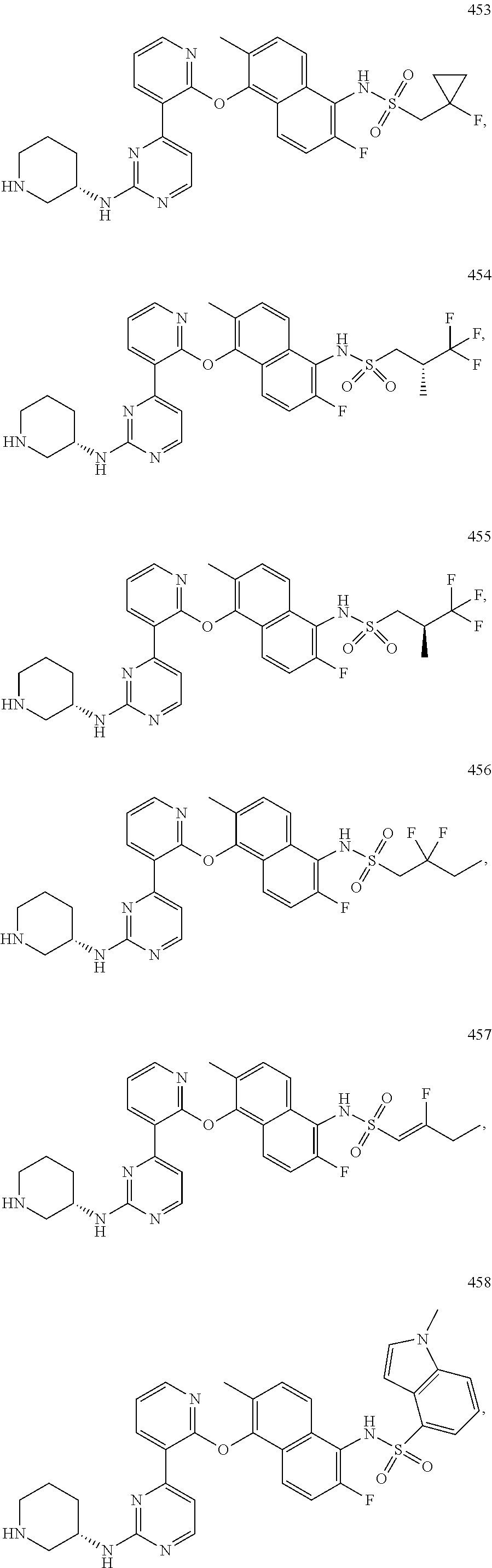
  • Exemplary embodiments of Formula I or I′ compounds include the compounds of Tables 1, 2 and 3.
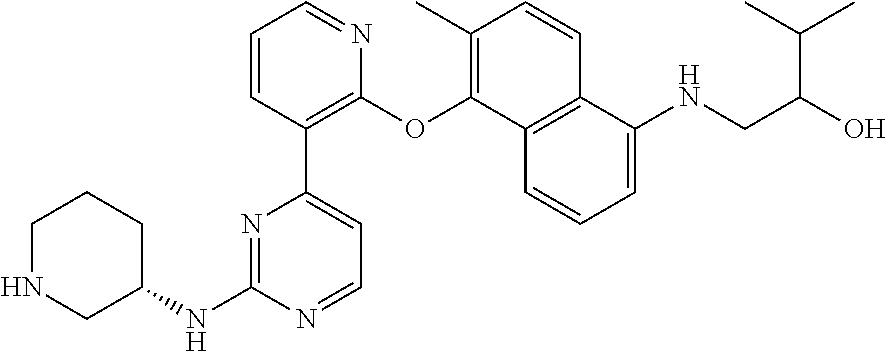
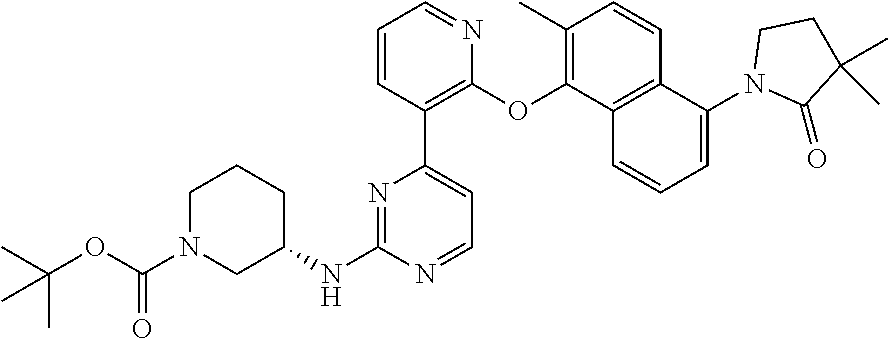
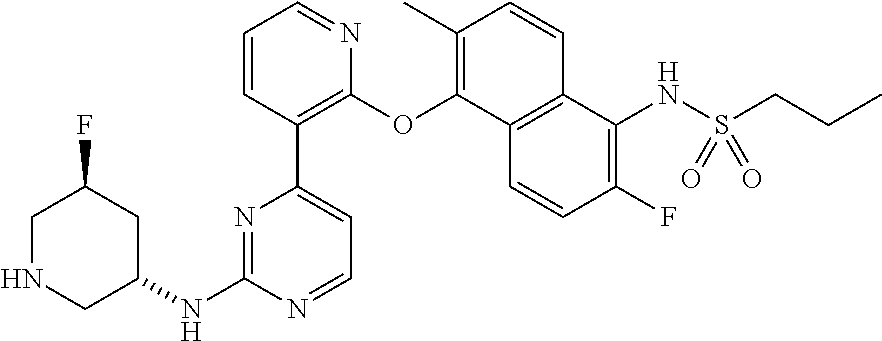
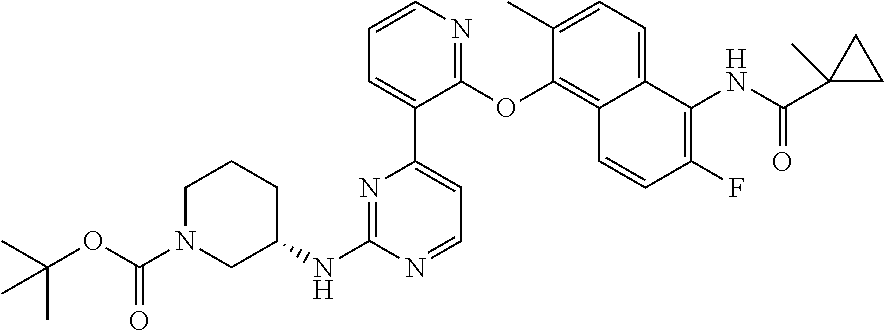
  • a compound of Formula I or I′, or pharmaceutically acceptable salt thereof wherein the compound is selected from the group consisting of one or more of Compound Nos. 101-392 of Table 1, Compound Nos. 393-500 of Table 2, and Compound Nos. 501-545 of Table 3.
  • the compound is selected from the group consisting of Compound Nos. 101-392 in Table 1.
  • the compound is selected from the group consisting of Compound Nos. 393-500 of Table 2.
  • the compound is selected from the group consisting of Compound Nos. 501-545 of Table 3.
  • the relative efficacies of Formula I or I′ compounds as inhibitors of an enzyme activity can be established by determining the concentrations at which each compound inhibits the activity to a predefined extent and then comparing the results.
  • the preferred determination is the concentration that inhibits 50% of the activity in a biochemical assay, i.e., the 50% inhibitory concentration or “IC 50 ”.
  • Determination of IC 50 values can be accomplished using conventional techniques known in the art. In general, an IC 50 can be determined by measuring the activity of a given enzyme in the presence of a range of concentrations of the inhibitor under study. The experimentally obtained values of enzyme activity then are plotted against the inhibitor concentrations used.
  • the concentration of the inhibitor that shows 50% enzyme activity is taken as the IC 50 value.
  • other inhibitory concentrations can be defined through appropriate determinations of activity. For example, in some settings it can be desirable to establish a 90% inhibitory concentration, i.e., IC 90 , etc.
  • Cell proliferation, cytotoxicity, and cell viability of the Formula I or I′ compounds can be measured by the CellTiter-Glo® Luminescent Cell Viability Assay (Promega Corp.).
  • the CellTiter-Glo® Luminescent Cell Viability Assay is a homogeneous method of determining the number of viable cells in culture based on quantitation of the ATP present, an indicator of metabolically active cells.
  • the CellTiter-Glo® Assay is designed for use with multiwell formats, making it ideal for automated high-throughput screening (HTS), cell proliferation and cytotoxicity assays.
  • the homogeneous assay procedure involves adding the single reagent (CellTiter-Glo® Reagent) directly to cells cultured in serum-supplemented medium. Cell washing, removal of medium and multiple pipetting steps are not required. The system detects as few as 15 cells/well in a 384-well format in 10 minutes after adding reagent and mixing.
  • Biological activity of Formula I or I′ compounds was measured by an IRE1 biochemical binding assay (Example 901), a biochemical RNase assay (Example 902), a cellular PD assay, XBP1s-LUC reporter (Example 903), and an IRE1 ⁇ -based inhibition of multiple myeloma (MM) cell proliferation assay.
  • the chemical structure shall define the compound. Assignment of configuration at chiral centers in separated stereoisomers may be tentative, and depicted in Tables 1 and 2 structures for illustrative purposes, before stereochemistry is definitively established, such as from x-ray crystallographic data. In some cases, stereoisomers are separated and tested for biological activity before the stereochemistry of the separated stereoisomers is determined; and stereochemistry in some instances was inferred based on structure-activity relationship (SAR) knowledge from previous compounds. In some cases, the compounds are tested as racemic or diastereomeric mixtures.
  • SAR structure-activity relationship
  • the compounds of the invention may be administered by any route appropriate to the condition to be treated. Suitable routes include oral, parenteral (including subcutaneous, intramuscular, intravenous, intraarterial, intradermal, intrathecal and epidural), transdermal, rectal, nasal, topical (including buccal and sublingual), vaginal, intraperitoneal, intrapulmonary and intranasal.
  • routes include oral, parenteral (including subcutaneous, intramuscular, intravenous, intraarterial, intradermal, intrathecal and epidural), transdermal, rectal, nasal, topical (including buccal and sublingual), vaginal, intraperitoneal, intrapulmonary and intranasal.
  • the compounds may be administered by intralesional administration, including perfusing or otherwise contacting the graft with the inhibitor before transplantation.
  • the preferred route may vary with for example the condition of the recipient.
  • the compound may be formulated as a pill, capsule, tablet, etc. with a pharmaceutically acceptable carrier or excipient.
  • the compound
  • a dose to treat human patients may range from about 10 mg to about 1000 mg of Formula I or I′ compound.
  • a typical dose may be about 100 mg to about 300 mg of the compound.
  • a dose may be administered once a day (QID), twice per day (BID), or more frequently, depending on the pharmacokinetic and pharmacodynamic properties, including absorption, distribution, metabolism, and excretion of the particular compound.
  • toxicity factors may influence the dosage and administration regimen.
  • the pill, capsule, or tablet may be ingested daily or less frequently for a specified period of time. The regimen may be repeated for a number of cycles of therapy.
  • Formula I or I′ compounds of the present invention are useful for treating a human or animal patient suffering from a disease or disorder arising from abnormal cell growth, function or behavior associated with the UPR pathway such as cancer, an immune disorder, cardiovascular disease, viral infection, inflammation, a metabolism/endocrine disorder or a neurological disorder, may thus be treated by a method comprising the administration thereto of a compound of the present invention as defined above.
  • a human or animal patient suffering from cancer may also be treated by a method comprising the administration thereto of a compound of the present invention as defined above. The condition of the patient may thereby be improved or ameliorated.
  • Methods of the invention also include treating cancer selected from breast, ovary, cervix, prostate, testis, genitourinary tract, esophagus, larynx, glioblastoma, neuroblastoma, stomach, skin, keratoacanthoma, lung, epidermoid carcinoma, large cell carcinoma, non-small cell lung carcinoma (NSCLC), small cell carcinoma, lung adenocarcinoma, bone, colon, adenoma, pancreas, adenocarcinoma, thyroid, follicular carcinoma, undifferentiated carcinoma, papillary carcinoma, seminoma, melanoma, sarcoma, bladder carcinoma, liver carcinoma and biliary passages, kidney carcinoma, pancreatic, myeloid disorders, lymphoma, hairy cells, buccal cavity, naso-pharyngeal, pharynx, lip, tongue, mouth, small intestine, colon-rectum, large intestine, rectum, brain and
  • a method of treating an IRE1-related disease or disorder in a patient comprising administering a therapeutically effective amount of a compound of Formula I or I′, or any variations detailed herein, or a stereoisomer, tautomer, or pharmaceutically acceptable salt thereof, to a patient with an IRE1-related disease or condition.
  • the method comprises administering to a patient with an IRE1-related disease or condition an effective amount of a pharmaceutical composition comprising a compound of Formula I or I′, or any variations detailed herein, or a stereoisomer, tautomer, or pharmaceutically acceptable salt thereof, and a pharmaceutically acceptable carrier, glidant, diluent, or excipient.
  • the compound is of the Formula I excluding compounds of Table 1X. In other embodiments, the compound is of the Formula I including compounds of Table 1X. In some embodiments, the compound is of the Formula I′ or variations thereof. In some embodiments, the compound is selected from Tables 1, 2 and 3, or a pharmaceutically acceptable salt thereof. In some embodiments, the patient is a human patient.
  • a compound of Formula I or I′ or any variations detailed herein, or a stereoisomer, tautomer, or pharmaceutically acceptable salt thereof, for use in a method for treating an IRE1-related disease or disorder.
  • the IRE1-related disease or disorder is cancer selected from the group consisting of squamous cell cancer, small-cell lung cancer, non-small cell lung cancer (“NSCLC”), adenocarcinoma of the lung and squamous carcinoma of the lung, cancer of the peritoneum, hepatocellular cancer, stomach cancer, gastrointestinal cancer, esophageal cancer, pancreatic cancer, glioblastoma, cervical cancer, ovarian cancer, liver cancer, bladder cancer, hepatoma, breast cancer, colon cancer, rectal cancer, colorectal cancer, endometrial or uterine carcinoma, salivary gland carcinoma, kidney or renal cancer, prostate cancer, vulval cancer, thyroid cancer, hepatic carcinoma, anal carcinoma, penile carcinoma, and head and neck cancer.
  • NSCLC non-small cell lung cancer
  • the IRE1-related disease or disorder is a hematological malignancy selected from the group consisting of lymphomas, lymphocytic leukemia, myeloma, acute and chronic myelogenous leukemia, myelodysplastic syndrome and myeloproliferative disease.
  • the IRE1-related disease or disorder is multiple myeloma. In some embodiments, wherein the IRE1-related disease or disorder is a breast cancer (e.g., a triple-negative breast cancer (“TNBC”)).
  • TNBC triple-negative breast cancer
  • an IRE1-related disease or disorder in a patient comprising administering a therapeutically effective amount of a compound of Formula I or I′, or any variations detailed herein, or a stereoisomer, tautomer, or pharmaceutically acceptable salt thereof, to a patient with an IRE1-related disease or condition, the method further comprising administering one or more additional therapeutic agent(s) selected from the group consisting of an anti-inflammatory agent, a corticosteroid, an immunomodulatory agent, chemotherapeutic agent, an apoptosis-enhancer, a neurotropic factor, an agent for treating cardiovascular disease, an agent for treating liver disease, an anti-viral agent, an agent for treating blood disorders, an agent for treating diabetes, an agent for treating metabolic disorders, an agent for treating autoimmune disorders, an agent for treating immunodeficiency disorders, and combinations thereof.
  • additional therapeutic agent(s) selected from the group consisting of an anti-inflammatory agent, a corticosteroid, an immunomodulatory agent, chemotherapeutic agent, an apop
  • the additional therapeutic agent is a corticosteroid, a proteasome inhibitor, an IMiD, an antibody, or a combination thereof.
  • the additional therapeutic agent is a proteasome inhibitor (e.g. carfilzomib, bortezomib, or ixazomib).
  • the additional therapeutic agent is an IMiD (e.g. lenalidomide or pomalidomide).
  • the additional therapeutic agent is an antibody (e.g., an anti-CD38 antibody, an anti-VEGF-A antibody, an anti-PD-1 antibody, an anti-PD-L1 antibody or an anti-interleukin-6 antibody).
  • the additional therapeutic agent is a corticosteroid (e.g., dexamethasone).
  • the method further comprises radiotherapy.
  • Also provided herein is a method of treating a disease caused by abnormal levels of Ire1 activity in a human or animal patient in need of such treatment with a Formula I or I′ compound.
  • the disease may be caused by an amount of Ire1 activity that is too low or too high.
  • the disease may be caused by a deficiency in Ire1 activity or by abnormally high Ire1 activity (e.g., hyperactivity of Ire1).
  • the method includes administering to the patient a therapeutically effective amount of an Ire1 modulator Formula I or I′ compound.
  • Ire1 deficiency is a decreased amount of Ire1 activity compared to normal levels of Ire1 activity in a particular subject or a population of healthy subjects.
  • the decreased amount of Ire1 activity results in excessive amounts of misfolded protein accumulation thereby causing the disease state.
  • Ire1 hyperactivity is an increased amount of Ire1 activity compared to normal levels of Ire1 activity in a particular subject or a population of healthy subjects.
  • the increased amount of Ire1 activity may result in, for example, excessive amounts of cell proliferation thereby causing the disease state.
  • the disease is associated with Ire1 deficiency.
  • diseases include, but are not limited to, cystic fibrosis, retinitis pigmentosa, diabetes, or a neurodegenerative disease.
  • the neurodegenerative disease may include Alexander's disease, Alper's disease, Alzheimer's disease, Amyotrophic lateral sclerosis, Ataxia telangiectasia, Batten disease (also known as Spielmeyer-Vogt-Sjogren-Batten disease).
  • Bovine spongiform encephalopathy (BSF), Canavan disease, Cockayne syndrome, Corticobasal degeneration, Creutzfeldt-Jakob disease, Huntington's disease, HIV-associated dementia, Kennedy's disease, Krabbe's disease, Lewy body dementia, Machado-Joseph disease (Spinocerebellar ataxia type 3), Multiple sclerosis, Multiple System Atrophy, Narcolepsy, Neuroborreliosis, Parkinson's disease, Pelizaeus-Merzbacher Disease, Pick's disease, Primary lateral sclerosis, Prion diseases, Refsum's disease, Sandhoffs disease, Schilder's disease, Subacute combined degeneration of spinal cord secondary to Pernicious Anaemia, Schizophrenia, Spinocerebellar ataxia (multiple types with varying characteristics), Spinal muscular atrophy, Steele-Richardson-Olszewski disease, or Tabes dorsalis.
  • BSF Bovine s
  • the disease is associated with abnormally high Ire1.
  • diseases include, but are not limited, to cancers, inflammatory diseases, and autoimmune diseases.
  • Exemplary cancers include, but am not limited to, breast cancer and multiple myeloma.
  • the disease is multiple myeloma.
  • the disease is a triple-negative breast cancer.
  • Exemplary inflammatory diseases include, but are not limited to, asthma, chronic inflammation, chronic prostatitis, glomerulonephritis, hypersensitivities, inflammatory bowel diseases, pelvic inflammatory disease; reperfusion injury, rheumatoid arthritis, transplant rejection, and vasculitis.
  • Exemplary autoimmune diseases include, but are not limited to, XBP1-linked Crohn's disease, Coeliac disease, diabetes mellitus type 1 (IDDM), systemic lupus erythematosus (SLE), Sjogren's syndrome, Churg-Strauss Syndrome, Hashimoto's thyroiditis, Graves' disease, idiopathic thrombocytopenic purpura, and rheumatoid arthritis.
  • IDDM diabetes mellitus type 1
  • SLE systemic lupus erythematosus
  • Sjogren's syndrome Sjogren's syndrome
  • Churg-Strauss Syndrome Hashimoto's thyroiditis
  • Graves' disease idiopathic thrombocytopenic purpura
  • rheumatoid arthritis rheumatoid arthritis.
  • the disease is XBP1-linked. Crohn's disease.
  • a Formula I or I′ compound for the therapeutic treatment of mammals including humans, it is normally formulated in accordance with standard pharmaceutical practice as a pharmaceutical composition.
  • a pharmaceutical composition comprising a compound of this invention in association with a pharmaceutically acceptable diluent or carrier.
  • a typical formulation is prepared by mixing a compound of the present invention and a carrier, diluent or excipient.
  • Suitable carriers, diluents and excipients are well known to those skilled in the art and include materials such as carbohydrates, waxes, water soluble and/or swellable polymers, hydrophilic or hydrophobic materials, gelatin, oils, solvents, water and the like.
  • the particular carrier, diluent or excipient used will depend upon the means and purpose for which the compound of the present invention is being applied. Solvents are generally selected based on solvents recognized by persons skilled in the art as safe (GRAS) to be administered to a mammal.
  • GRAS solvents recognized by persons skilled in the art as safe
  • safe solvents are non-toxic aqueous solvents such as water and other non-toxic solvents that are soluble or miscible in water.
  • Suitable aqueous solvents include water, ethanol, propylene glycol, polyethylene glycols (e.g., PEG 400, PEG 300), etc. and mixtures thereof.
  • the formulations may also include one or more buffers, stabilizing agents, surfactants, wetting agents, lubricating agents, emulsifiers, suspending agents, preservatives, antioxidants, opaquing agents, glidants, processing aids, colorants, sweeteners, perfuming agents, flavoring agents and other known additives to provide an elegant presentation of the drug (i.e., a compound of the present invention or pharmaceutical composition thereof) or aid in the manufacturing of the pharmaceutical product (i.e., medicament).
  • buffers stabilizing agents, surfactants, wetting agents, lubricating agents, emulsifiers, suspending agents, preservatives, antioxidants, opaquing agents, glidants, processing aids, colorants, sweeteners, perfuming agents, flavoring agents and other known additives to provide an elegant presentation of the drug (i.e., a compound of the present invention or pharmaceutical composition thereof) or aid in the manufacturing of the pharmaceutical product (i.e., medicament).
  • the formulations may be prepared using conventional dissolution and mixing procedures.
  • the bulk drug substance i.e., compound of the present invention or stabilized form of the compound (e.g., complex with a cyclodextrin derivative or other known complexation agent) is dissolved in a suitable solvent in the presence of one or more of the excipients described above.
  • the compound of the present invention is typically formulated into pharmaceutical dosage forms to provide an easily controllable dosage of the drug and to enable patient compliance with the prescribed regimen.
  • the pharmaceutical composition (or formulation) for application may be packaged in a variety of ways depending upon the method used for administering the drug.
  • an article for distribution includes a container having deposited therein the pharmaceutical formulation in an appropriate form.
  • Suitable containers are well known to those skilled in the art and include materials such as bottles (plastic and glass), sachets, ampoules, plastic bags, metal cylinders, and the like.
  • the container may also include a tamper-proof assemblage to prevent indiscreet access to the contents of the package.
  • the container has deposited thereon a label that describes the contents of the container. The label may also include appropriate warnings.
  • compositions of the compounds of the present invention may be prepared for various routes and types of administration.
  • a compound of Formula I or I′ having the desired degree of purity may optionally be mixed with pharmaceutically acceptable diluents, carriers, excipients or stabilizers (Remington's Pharmaceutical Sciences (1980) 16th edition, Osol, A. Ed.), in the form of a lyophilized formulation, milled powder, or an aqueous solution.
  • Formulation may be conducted by mixing at ambient temperature at the appropriate pH, and at the desired degree of purity, with physiologically acceptable carriers, i.e., carriers that are non-toxic to recipients at the dosages and concentrations employed.
  • the pH of the formulation depends mainly on the particular use and the concentration of compound, but may range from about 3 to about 8.
  • Formulation in an acetate buffer at pH 5 is a suitable embodiment.
  • the compound ordinarily can be stored as a solid composition, a lyophilized formulation or as an aqueous solution.
  • compositions of the invention will be formulated, dosed and administered in a fashion, i.e., amounts, concentrations, schedules, course, vehicles and route of administration, consistent with good medical practice.
  • Factors for consideration in this context include the particular disorder being treated, the particular mammal being treated, the clinical condition of the individual patient, the cause of the disorder, the site of delivery of the agent, the method of administration, the scheduling of administration, and other factors known to medical practitioners.
  • the “therapeutically effective amount” of the compound to be administered will be governed by such considerations, and is the minimum amount necessary to ameliorate, or treat the hyperproliferative disorder.
  • the initial pharmaceutically effective amount of the inhibitor administered parenterally per dose will be in the range of about 0.01-100 mg/kg, namely about 0.1 to 20 mg/kg of patient body weight per day, with the typical initial range of compound used being 0.3 to 15 mg/kg/day.
  • Acceptable diluents, carriers, excipients and stabilizers are nontoxic to recipients at the dosages and concentrations employed, and include buffers such as phosphate, citrate and other organic acids; antioxidants including ascorbic acid and methionine; preservatives (such as octadecyldimethylbenzyl ammonium chloride; hexamethonium chloride; benzalkonium chloride, benzethonium chloride; phenol, butyl or benzyl alcohol; alkyl parabens such as methyl or propyl paraben; catechol; resorcinol; cyclohexanol; 3-pentanol; and m-cresol); low molecular weight (less than about 10 residues) polypeptides; proteins, such as serum albumin, gelatin, or immunoglobulins; hydrophilic polymers such as polyvinylpyrrolidone; amino acids such as glycine, glutamine, asparagine,
  • the active pharmaceutical ingredients may also be entrapped in microcapsules prepared, for example, by coacervation techniques or by interfacial polymerization, for example, hydroxymethylcellulose or gelatin-microcapsules and poly-(methylmethacylate) microcapsules, respectively, in colloidal drug delivery systems (for example, liposomes, albumin microspheres, microemulsions, nano-particles and nanocapsules) or in macroemulsions.
  • colloidal drug delivery systems for example, liposomes, albumin microspheres, microemulsions, nano-particles and nanocapsules
  • Sustained-release preparations of compounds of Formula I or I′ may be prepared.
  • suitable examples of sustained-release preparations include semipermeable matrices of solid hydrophobic polymers containing a compound of Formula I or I′, which matrices are in the form of shaped articles, e.g., films, or microcapsules.
  • sustained-release matrices include polyesters, hydrogels (for example, poly(2-hydroxyethyl-methacrylate), or poly(vinyl alcohol)), polylactides (U.S. Pat. No.
  • copolymers of L-glutamic acid and gamma-ethyl-L-glutamate non-degradable ethylene-vinyl acetate
  • degradable lactic acid-glycolic acid copolymers such as the LUPRON DEPOTTM (injectable microspheres composed of lactic acid-glycolic acid copolymer and leuprolide acetate) and poly-D-( ⁇ )-3-hydroxybutyric acid.
  • the formulations include those suitable for the administration routes detailed herein.
  • the formulations may conveniently be presented in unit dosage form and may be prepared by any of the methods well known in the art of pharmacy. Techniques and formulations generally are found in Remington's Pharmaceutical Sciences (Mack Publishing Co., Easton, Pa.). Such methods include the step of bringing into association the active ingredient with the carrier which constitutes one or more accessory ingredients. In general the formulations are prepared by uniformly and intimately bringing into association the active ingredient with liquid carriers or finely divided solid carriers or both, and then, if necessary, shaping the product.
  • Formulations of a compound of Formula I or I′ suitable for oral administration may be prepared as discrete units such as pills, capsules, cachets or tablets each containing a predetermined amount of a compound of Formula I or I′.
  • Compressed tablets may be prepared by compressing in a suitable machine the active ingredient in a free-flowing form such as a powder or granules, optionally mixed with a binder, lubricant, inert diluent, preservative, surface active or dispersing agent.
  • Molded tablets may be made by molding in a suitable machine a mixture of the powdered active ingredient moistened with an inert liquid diluent.
  • the tablets may optionally be coated or scored and optionally are formulated so as to provide slow or controlled release of the active ingredient therefrom.
  • Tablets, troches, lozenges, aqueous or oil suspensions, dispersible powders or granules, emulsions, hard or soft capsules, e.g., gelatin capsules, syrups or elixirs may be prepared for oral use.
  • Formulations of compounds of Formula I or I′ intended for oral use may be prepared according to any method known to the art for the manufacture of pharmaceutical compositions and such compositions may contain one or more agents including sweetening agents, flavoring agents, coloring agents and preserving agents, in order to provide a palatable preparation.
  • Tablets containing the active ingredient in admixture with non-toxic pharmaceutically acceptable excipient which are suitable for manufacture of tablets are acceptable.
  • excipients may be, for example, inert diluents, such as calcium or sodium carbonate, lactose, calcium or sodium phosphate; granulating and disintegrating agents, such as maize starch, or alginic acid; binding agents, such as starch, gelatin or acacia; and lubricating agents, such as magnesium stearate, stearic acid or talc. Tablets may be uncoated or may be coated by known techniques including microencapsulation to delay disintegration and adsorption in the gastrointestinal tract and thereby provide a sustained action over a longer period. For example, a time delay material such as glyceryl monostearate or glyceryl distearate alone or with a wax may be employed.
  • the formulations are preferably applied as a topical ointment or cream containing the active ingredient(s) in an amount of, for example, 0.075 to 20% w/w.
  • the active ingredients may be employed with either a paraffinic or a water-miscible ointment base.
  • the active ingredients may be formulated in a cream with an oil-in-water cream base.
  • the aqueous phase of the cream base may include a polyhydric alcohol, i.e., an alcohol having two or more hydroxyl groups such as propylene glycol, butane 1,3-diol, mannitol, sorbitol, glycerol and polyethylene glycol (including PEG 400) and mixtures thereof.
  • the topical formulations may desirably include a compound which enhances absorption or penetration of the active ingredient through the skin or other affected areas. Examples of such dermal penetration enhancers include dimethyl sulfoxide and related analogs.
  • the oily phase of the emulsions of this invention may be constituted from known ingredients in a known manner.
  • the phase may comprise merely an emulsifier, it desirably comprises a mixture of at least one emulsifier with a fat or an oil or with both a fat and an oil.
  • a hydrophilic emulsifier is included together with a lipophilic emulsifier which acts as a stabilizer. It is also preferred to include both an oil and a fat.
  • the emulsifier(s) with or without stabilizer(s) make up the so-called emulsifying wax, and the wax together with the oil and fat make up the so-called emulsifying ointment base which forms the oily dispersed phase of the cream formulations.
  • Emulsifiers and emulsion stabilizers suitable for use in the formulation of the invention include Tween® 60, Span® 80, cetostearyl alcohol, benzyl alcohol, myristyl alcohol, glyceryl mono-stearate and sodium lauryl sulfate.
  • Aqueous suspensions of Formula I or I′ compounds contain the active materials in admixture with excipients suitable for the manufacture of aqueous suspensions.
  • excipients include a suspending agent, such as sodium carboxymethylcellulose, croscarmellose, povidone, methylcellulose, hydroxypropyl methylcellulose, sodium alginate, polyvinylpyrrolidone, gum tragacanth and gum acacia, and dispersing or wetting agents such as a naturally occurring phosphatide (e.g., lecithin), a condensation product of an alkylene oxide with a fatty acid (e.g., polyoxyethylene stearate), a condensation product of ethylene oxide with a long chain aliphatic alcohol (e.g., heptadecaethyleneoxycetanol), a condensation product of ethylene oxide with a partial ester derived from a fatty acid and a hexitol anhydride (e.g., polyoxyethylene sorbitan mono
  • the aqueous suspension may also contain one or more preservatives such as ethyl or n-propyl p-hydroxybenzoate, one or more coloring agents, one or more flavoring agents and one or more sweetening agents, such as sucrose or saccharin.
  • preservatives such as ethyl or n-propyl p-hydroxybenzoate
  • coloring agents such as a coloring agent
  • flavoring agents such as sucrose or saccharin.
  • sweetening agents such as sucrose or saccharin.
  • compositions of compounds of Formula I or I′ may be in the form of a sterile injectable preparation, such as a sterile injectable aqueous or oleaginous suspension.
  • a sterile injectable preparation such as a sterile injectable aqueous or oleaginous suspension.
  • This suspension may be formulated according to the known art using those suitable dispersing or wetting agents and suspending agents which have been mentioned above.
  • the sterile injectable preparation may also be a sterile injectable solution or suspension in a non-toxic parenterally acceptable diluent or solvent, such as a solution in 1,3-butanediol or prepared as a lyophilized powder.
  • the acceptable vehicles and solvents that may be employed are water, Ringer's solution and isotonic sodium chloride solution.
  • sterile fixed oils may conventionally be employed as a solvent or suspending medium.
  • any bland fixed oil may be employed including synthetic mono- or diglycerides.
  • fatty acids such as oleic acid may likewise be used in the preparation of injectables.
  • a time-release formulation intended for oral administration to humans may contain approximately 1 to 1000 mg of active material compounded with an appropriate and convenient amount of carrier material which may vary from about 5 to about 95% of the total compositions (weight:weight).
  • the pharmaceutical composition can be prepared to provide easily measurable amounts for administration.
  • an aqueous solution intended for intravenous infusion may contain from about 3 to 500 ⁇ g of the active ingredient per milliliter of solution in order that infusion of a suitable volume at a rate of about 30 mL/hr can occur.
  • Formulations suitable for parenteral administration include aqueous and non-aqueous sterile injection solutions which may contain anti-oxidants, buffers, bacteriostats and solutes which render the formulation isotonic with the blood of the intended recipient; and aqueous and non-aqueous sterile suspensions which may include suspending agents and thickening agents.
  • Formulations suitable for topical administration to the eye also include eye drops wherein the active ingredient is dissolved or suspended in a suitable carrier, especially an aqueous solvent for the active ingredient.
  • the active ingredient is preferably present in such formulations in a concentration of about 0.5 to 20% w/w, for example about 0.5 to 10% w/w, for example about 1.5% w/w.
  • Formulations suitable for topical administration in the mouth include lozenges comprising the active ingredient in a flavored basis, usually sucrose and acacia or tragacanth; pastilles comprising the active ingredient in an inert basis such as gelatin and glycerin, or sucrose and acacia; and mouthwashes comprising the active ingredient in a suitable liquid carrier.
  • Formulations for rectal administration may be presented as a suppository with a suitable base comprising for example cocoa butter or a salicylate.
  • Formulations suitable for intrapulmonary or nasal administration have a particle size for example in the range of 0.1 to 500 microns (including particle sizes in a range between 0.1 and 500 microns in increments microns such as 0.5, 1, 30 microns, 35 microns, etc.), which is administered by rapid inhalation through the nasal passage or by inhalation through the mouth so as to reach the alveolar sacs.
  • Suitable formulations include aqueous or oily solutions of the active ingredient.
  • Formulations suitable for aerosol or dry powder administration may be prepared according to conventional methods and may be delivered with other therapeutic agents such as compounds heretofore used in the treatment or prophylaxis disorders as described below.
  • Formulations suitable for vaginal administration may be presented as pessaries, tampons, creams, gels, pastes, foams or spray formulations containing in addition to the active ingredient such carriers as are known in the art to be appropriate.
  • the formulations may be packaged in unit-dose or multi-dose containers, for example sealed ampoules and vials, and may be stored in a freeze-dried (lyophilized) condition requiring only the addition of the sterile liquid carrier, for example water, for injection immediately prior to use.
  • sterile liquid carrier for example water
  • Extemporaneous injection solutions and suspensions are prepared from sterile powders, granules and tablets of the kind previously described.
  • Preferred unit dosage formulations are those containing a daily dose or unit daily sub-dose, as herein above recited, or an appropriate fraction thereof, of the active ingredient.
  • the invention further provides veterinary compositions comprising at least one active ingredient as above defined together with a veterinary carrier therefore.
  • Veterinary carriers are materials useful for the purpose of administering the composition and may be solid, liquid or gaseous materials which are otherwise inert or acceptable in the veterinary art and are compatible with the active ingredient. These veterinary compositions may be administered parenterally, orally or by any other desired route.
  • the compounds of Formula I or I′ may be employed alone or in combination with additional therapeutic agents for the treatment of a disease or disorder described herein, such as inflammation or a hyperproliferative disorder (e.g., cancer).
  • a compound of Formula I or I′ is combined in a pharmaceutical combination formulation, or dosing regimen as combination therapy, with an additional, second therapeutic compound that has anti-inflammatory or anti-hyperproliferative properties or that is useful for treating an inflammation, immune-response disorder, or hyperproliferative disorder (e.g., cancer).
  • the additional therapeutic may be a Bcl-2 inhibitor, a JAK inhibitor, a PI3K inhibitor, an mTOR inhibitor, an anti-inflammatory agent, an immunomodulatory agent, chemotherapeutic agent, an apoptosis-enhancer, a neurotropic factor, an agent for treating cardiovascular disease, an agent for treating liver disease, an anti-viral agent, an agent for treating blood disorders, an agent for treating diabetes, and an agent for treating immunodeficiency disorders.
  • the second therapeutic agent may be an NSAID anti-inflammatory agent.
  • the second therapeutic agent may be a chemotherapeutic agent.
  • the second compound of the pharmaceutical combination formulation or dosing regimen preferably has complementary activities to the compound of Formula I or I′ such that they do not adversely affect each other.
  • composition of this invention comprises a compound of Formula I or I′, or a stereoisomer, tautomer, solvate, metabolite, or pharmaceutically acceptable salt or prodrug thereof, in combination with a therapeutic agent such as an NSAID.
  • the combination therapy may be administered as a simultaneous or sequential regimen.
  • the combination may be administered in two or more administrations.
  • the combined administration includes coadministration, using separate formulations or a single pharmaceutical formulation, and consecutive administration in either order, wherein preferably there is a time period while both (or all) active agents simultaneously exert their biological activities.
  • Suitable dosages for any of the above coadministered agents are those presently used and may be lowered due to the combined action (synergy) of the newly identified agent and other therapeutic agents or treatments.
  • the combination therapy may provide “synergy” and prove “synergistic”, i.e., the effect achieved when the active ingredients used together is greater than the sum of the effects that results from using the compounds separately.
  • a synergistic effect may be attained when the active ingredients are: (1) co-formulated and administered or delivered simultaneously in a combined, unit dosage formulation; (2) delivered by alternation or in parallel as separate formulations; or (3) by some other regimen.
  • a synergistic effect may be attained when the compounds are administered or delivered sequentially, e.g., by different injections in separate syringes, separate pills or capsules, or separate infusions.
  • an effective dosage of each active ingredient is administered sequentially, i.e., serially
  • effective dosages of two or more active ingredients are administered together.
  • a compound of Formula I or I′, or a stereoisomer, tautomer, solvate, metabolite, or pharmaceutically acceptable salt or prodrug thereof may be combined with other therapeutic, hormonal or antibody agents such as those described herein, as well as combined with surgical therapy and radiotherapy.
  • Combination therapies according to the present invention thus comprise the administration of at least one compound of Formula I or I′, or a stereoisomer, tautomer, solvate, metabolite, or pharmaceutically acceptable salt or prodrug thereof, and the use of at least one other cancer treatment method.
  • the amounts of the compound(s) of Formula I or I′, and the other pharmaceutically active therapeutic agent(s) and the relative timings of administration will be selected in order to achieve the desired combined therapeutic effect.
  • a compound of Formula I or I′, or a pharmaceutically acceptable salt thereof is used in combination with an aromatase inhibitor, a phosphoinositide 3-kinase (PI3K)/mTOR pathway inhibitor, a CDK 4/6 inhibitor, a HER-2 inhibitor, an EGFR inhibitor, a PD-1 inhibitor, poly ADP-ribose polymerase (PARP) inhibitor, a histone deacetylase (HDAC) inhibitor, an HSP90 inhibitor, a VEGFR inhibitor, an AKT inhibitor, chemotherapy, or any combination thereof.
  • an aromatase inhibitor a phosphoinositide 3-kinase (PI3K)/mTOR pathway inhibitor
  • PI3K phosphoinositide 3-kinase
  • CDK 4/6 a HER-2 inhibitor
  • an EGFR inhibitor a PD-1 inhibitor
  • PARP poly ADP-ribose polymerase
  • HDAC histone deacetylase
  • a pharmaceutical composition comprising a compound of Formula I or I′, or a pharmaceutically acceptable salt thereof, is administered in combination with a therapeutic agent selected from paclitaxel, anastrozole, exemestane, cyclophosphamide, epirubicin, fulvestrant, letrozole, palbociclib, gemcitabine, trastuzumab (HERCEPTIN®, Genentech), trastuzumab emtansine (KADCYLA®, Genentech), pegfilgrastim, filgrastim, tamoxifen, docetaxel, toremifene, vinorelbine, capecitabine, and ixabepilone.
  • a therapeutic agent selected from paclitaxel, anastrozole, exemestane, cyclophosphamide, epirubicin, fulvestrant, letrozole, palbociclib, gemcitabine, trastuzumab (HERCEPTIN®, Genentech), trastuzum
  • a compound of Formula I or I′, or a pharmaceutically acceptable salt thereof is used in combination with hormone blocking therapy, chemotherapy, radiation therapy, monoclonal antibodies, or combinations thereof.
  • the in vivo metabolic products of Formula I or I′ described herein include metabolites of compounds of Formula I or I′, including compounds produced by a process comprising contacting a compound of this invention with a mammal for a period of time sufficient to yield a metabolic product thereof.
  • Metabolite products typically are identified by preparing a radiolabelled (e.g., 14 C or 3 H) isotope of a compound of the invention, administering it parenterally in a detectable dose (e.g., greater than about 0.5 mg/kg) to an animal such as rat, mouse, guinea pig, monkey, or to man, allowing sufficient time for metabolism to occur (typically about 30 seconds to 30 hours) and isolating its conversion products from the urine, blood or other biological samples.
  • a detectable dose e.g., greater than about 0.5 mg/kg
  • metabolites In general, analysis of metabolites is done in the same way as conventional drug metabolism studies well known to those skilled in the art.
  • the metabolite products so long as they are not otherwise found in vivo, are useful in diagnostic assays for therapeutic dosing of the compounds of the invention.
  • kits containing materials useful for the treatment of the diseases and disorders described above.
  • the kit comprises a container comprising a compound of Formula I or I′, or a stereoisomer, tautomer, solvate, metabolite, or pharmaceutically acceptable salt or prodrug thereof.
  • the kit may further comprise a label or package insert on or associated with the container.
  • package insert is used to refer to instructions customarily included in commercial packages of therapeutic products, that contain information about the indications, usage, dosage, administration, contraindications and/or warnings concerning the use of such therapeutic products.
  • Suitable containers include, for example, bottles, vials, syringes, blister pack, etc.
  • the container may be formed from a variety of materials such as glass or plastic.
  • the container may hold a compound of Formula I or I′ or a formulation thereof which is effective for treating the condition and may have a sterile access port (for example, the container may be an intravenous solution bag or a vial having a stopper pierceable by a hypodermic injection needle).
  • At least one active agent in the composition is a compound of Formula I or I′.
  • the label or package insert indicates that the composition is used for treating the condition of choice, such as cancer.
  • the label or package insert may indicate that the patient to be treated is one having a disorder such as a hyperproliferative disorder, neurodegeneration, cardiac hypertrophy, pain, migraine or a neurotraumatic disease or event.
  • the label or package inserts indicates that the composition comprising a compound of Formula I or I′ can be used to treat a disorder resulting from abnormal cell growth.
  • the label or package insert may also indicate that the composition can be used to treat other disorders.
  • the article of manufacture may further comprise a second container comprising a pharmaceutically acceptable buffer, such as bacteriostatic water for injection (BWFI), phosphate-buffered saline, Ringer's solution and dextrose solution. It may further include other materials desirable from a commercial and user standpoint, including other buffers, diluents, filters, needles, and syringes.
  • the kit may further comprise directions for the administration of the compound of Formula I or I′ and, if present, the second pharmaceutical formulation.
  • the kit may further comprise directions for the simultaneous, sequential or separate administration of the first and second pharmaceutical compositions to a patient in need thereof.
  • kits are suitable for the delivery of solid oral forms of a compound of Formula I or I′, such as tablets or capsules.
  • a kit preferably includes a number of unit dosages.
  • Such kits can include a card having the dosages oriented in the order of their intended use.
  • An example of such a kit is a “blister pack”.
  • Blister packs are well known in the packaging industry and are widely used for packaging pharmaceutical unit dosage forms.
  • a memory aid can be provided, for example in the form of numbers, letters, or other markings or with a calendar insert, designating the days in the treatment schedule in which the dosages can be administered.
  • a kit may comprise (a) a first container with a compound of Formula I or I′ contained therein; and optionally (b) a second container with a second pharmaceutical formulation contained therein, wherein the second pharmaceutical formulation comprises a second compound with anti-hyperproliferative activity.
  • the kit may further comprise a third container comprising a pharmaceutically-acceptable buffer, such as bacteriostatic water for injection (BWFI), phosphate-buffered saline, Ringer's solution and dextrose solution. It may further include other materials desirable from a commercial and user standpoint, including other buffers, diluents, filters, needles, and syringes.
  • BWFI bacteriostatic water for injection
  • the kit may comprise a container for containing the separate compositions such as a divided bottle or a divided foil packet, however, the separate compositions may also be contained within a single, undivided container.
  • the kit comprises directions for the administration of the separate components.
  • the kit form is particularly advantageous when the separate components are preferably administered in different dosage forms (e.g., oral and parenteral), are administered at different dosage intervals, or when titration of the individual components of the combination is desired by the prescribing physician.
  • Formula I or I′ compounds may be synthesized by synthetic routes that include processes analogous to those well-known in the chemical arts, particularly in light of the description contained herein, and those for other heterocycles described in: Comprehensive Heterocyclic Chemistry II, Editors Katritzky and Rees, Elsevier, 1997, e.g. Volume 3; Liebigs Annalen der Chemie, (9):1910-16, (1985); Helvetica Chimica Acta, 41:1052-60, (1958); Arzneistoff-Forschung, 40(12):1328-31, (1990), each of which are expressly incorporated by reference.
  • Synthetic chemistry transformations and protecting group methodologies useful in synthesizing Formula I or I′ compounds and necessary reagents and intermediates are known in the art and include, for example, those described in R. Larock, Comprehensive Organic Transformations, VCH Publishers (1989); T. W. Greene and P. G. M. Wuts, Protective Groups in Organic Synthesis, 3 rd Ed., John Wiley and Sons (1999); and L. Paquette, ed., Encyclopedia of Reagents for Organic Synthesis, John Wiley and Sons (1995) and subsequent editions thereof.
  • Compounds of Formula I or I′ may be prepared singly or as compound libraries comprising at least 2, for example 5 to 1,000 compounds, or 10 to 100 compounds.
  • Libraries of compounds of Formula I or I′ may be prepared by a combinatorial ‘split and mix’ approach or by multiple parallel syntheses using either solution phase or solid phase chemistry, by procedures known to those skilled in the art.
  • a compound library comprising at least 2 compounds, or pharmaceutically acceptable salts thereof.
  • the Examples provide exemplary methods for preparing Formula I or I′ compounds. Those skilled in the art will appreciate that other synthetic routes may be used to synthesize the Formula I or I′ compounds. Although specific starting materials and reagents are depicted and discussed in the Examples, other starting materials and reagents can be easily substituted to provide a variety of derivatives and/or reaction conditions. In addition, many of the exemplary compounds prepared by the described methods can be further modified in light of this disclosure using conventional chemistry well known to those skilled in the art.
  • Suitable amino-protecting groups include acetyl, trifluoroacetyl, t-butoxycarbonyl (BOC), benzyloxycarbonyl (CBz) and 9-fluorenylmethyleneoxycarbonyl (Fmoc).
  • BOC t-butoxycarbonyl
  • CBz benzyloxycarbonyl
  • Fmoc 9-fluorenylmethyleneoxycarbonyl
  • reagents selected to bind to or render otherwise separable a desired product, unreacted starting material, reaction by product, or the like.
  • reagents include adsorbents or absorbents such as activated carbon, molecular sieves, ion exchange media, or the like.
  • the reagents can be acids in the case of a basic material, bases in the case of an acidic material, binding reagents such as antibodies, binding proteins, selective chelators such as crown ethers, liquid/liquid ion extraction reagents (LIX), or the like.
  • Diastereomeric mixtures can be separated into their individual diastereomers on the basis of their physical chemical differences by methods well known to those skilled in the art, such as by chromatography and/or fractional crystallization.
  • Enantiomers can be separated by converting the enantiomeric mixture into a diastereomeric mixture by reaction with an appropriate optically active compound (e.g., chiral auxiliary such as a chiral alcohol or Mosher's acid chloride), separating the diastereomers and converting (e.g., hydrolyzing) the individual diastereoisomers to the corresponding pure enantiomers.
  • an appropriate optically active compound e.g., chiral auxiliary such as a chiral alcohol or Mosher's acid chloride
  • converting e.g., hydrolyzing
  • some of the compounds of the present invention may be atropisomers (e.g., substituted biaryls) and are considered as part of this invention.
  • Enantiomers can also be
  • a single stereoisomer, e.g., an enantiomer, substantially free of its stereoisomer may be obtained by resolution of the racemic mixture using a method such as formation of diastereomers using optically active resolving agents (Eliel, E. and Wilen, S. “Stereochemistry of Organic Compounds,” John Wiley & Sons, Inc., New York, 1994; Lochmuller, C. H., (1975) J. Chromatogr., 113(3):283-302).
  • Racemic mixtures of chiral compounds of the invention can be separated and isolated by any suitable method, including: (1) formation of ionic, diastereomeric salts with chiral compounds and separation by fractional crystallization or other methods, (2) formation of diastereomeric compounds with chiral derivatizing reagents, separation of the diastereomers, and conversion to the pure stereoisomers, and (3) separation of the substantially pure or enriched stereoisomers directly under chiral conditions. See: “Drug Stereochemistry, Analytical Methods and Pharmacology,” Irving W. Wainer, Ed., Marcel Dekker, Inc., New York (1993).
  • diastereomeric salts can be formed by reaction of enantiomerically pure chiral bases such as brucine, quinine, ephedrine, strychnine, ⁇ -methyl- ⁇ -phenylethylamine (amphetamine), and the like with asymmetric compounds bearing acidic functionality, such as carboxylic acid and sulfonic acid.
  • the diastereomeric salts may be induced to separate by fractional crystallization or ionic chromatography.
  • addition of chiral carboxylic or sulfonic acids such as camphorsulfonic acid, tartaric acid, mandelic acid, or lactic acid can result in formation of the diastereomeric salts.
  • the substrate to be resolved is reacted with one enantiomer of a chiral compound to form a diastereomeric pair
  • a diastereomeric pair E. and Wilen, S. “Stereochemistry of Organic Compounds”, John Wiley & Sons, Inc., 1994, p. 322.
  • Diastereomeric compounds can be formed by reacting asymmetric compounds with enantiomerically pure chiral derivatizing reagents, such as menthyl derivatives, followed by separation of the diastereomers and hydrolysis to yield the pure or enriched enantiomer.
  • a method of determining optical purity involves making chiral esters, such as a menthyl ester, e.g., ( ⁇ ) menthyl chloroformate in the presence of base, or Mosher ester, ⁇ -methoxy- ⁇ -(trifluoromethyl)phenyl acetate (Jacob III. J. Org. Chem. (1982) 47:4165), of the racemic mixture, and analyzing the 1 H NMR spectrum for the presence of the two atropisomeric enantiomers or diastereomers.
  • chiral esters such as a menthyl ester, e.g., ( ⁇ ) menthyl chloroformate in the presence of base, or Mosher ester, ⁇ -methoxy- ⁇ -(trifluoromethyl)phenyl acetate (Jacob III. J. Org. Chem. (1982) 47:4165), of the racemic mixture, and analyzing the 1 H NMR spectrum for the presence of the two atropis
  • Stable diastereomers of atropisomeric compounds can be separated and isolated by normal- and reverse-phase chromatography following methods for separation of atropisomeric naphthyl-isoquinolines (WO 96/15111).
  • a racemic mixture of two enantiomers can be separated by chromatography using a chiral stationary phase (“Chiral Liquid Chromatography” (1989) W. J. Lough, Ed., Chapman and Hall, New York; Okamoto, J. Chromatogr., (1990) 513:375-378).
  • Enriched or purified enantiomers can be distinguished by methods used to distinguish other chiral molecules with asymmetric carbon atoms, such as optical rotation and circular dichroism.
  • Formula I or I′ compounds can be prepared by procedures in the Examples, the General Procedures, and generally by Schemes 1-4, where R groups are as described in Formula I or I′ compounds, or precursors thereof.
  • Scheme 2 shows coupling of a naphthalen-1-ol compound D with a 4-(2-halopyridin-3-yl)-2-(alkylthio)pyrimidine compound C to form a 4-(2-(naphthalen-1-yloxy)pyridin-3-yl)pyrimidine-2-alkylthiol E compound.
  • Oxidation of the sulfur atom forms 2-(alkylsulfinyl)-4-(2-(naphthalen-1-yloxy)pyridin-3-yl)pyrimidine compound F.
  • the sulfoxide is displaced with a primary amine (R 1 —NH 2 ) to form a Formula I or I′ compound, or an intermediate to be converted to a Formula I or I′ compound.
  • Scheme 3 shows an alternative route to Formula I or I′ compounds where a 4-(2-halopyridin-3-yl)-2-(alkylthio)pyrimidine compound C is oxidized to a 4-(2-halopyridin-3-yl)-2-(alkylsulfinyl)pyrimidine compound G.
  • the sulfoxide is displaced with a primary amine (R 1 —NH 2 ) to form a 4-(2-halopyridin-3-yl)-N-alkylpyrimidin-2-amine compound H.
  • Coupling of compound H with a naphthalen-1-ol compound D forms a Formula I or I′ compound, or an intermediate to be converted to a Formula I or I′ compound.
  • Scheme 4 shows the general preparation of exemplary compounds from aniline intermediate, tert-butyl (S)-3-((4-(2-((5-amino-2-methylnaphthalen-1-yl)oxy)pyridin-3-yl)pyrimidin-2-yl)amino)piperidine-1-carboxylate (see, Example 101).
  • the aniline intermediate is treated with a carboxylic acid (R a COOH) and a coupling reagent, such as 1-[Bis(dimethylamino)methylene]-1H-1,2,3-triazolo[4,5-b]pyridinium 3-oxide hexafluorophosphate (HATU) as in General Procedure C, or alternatively with an acid chloride (R a COCl) and an amine base such as diisopropylethylamine (DIPEA) or pyridine, to form Boc-protected, amide intermediates (top).
  • a coupling reagent such as 1-[Bis(dimethylamino)methylene]-1H-1,2,3-triazolo[4,5-b]pyridinium 3-oxide hexafluorophosphate (HATU) as in General Procedure C, or alternatively with an acid chloride (R a COCl) and an amine base such as diisopropylethylamine (DIPEA)
  • the aniline intermediate is treated with a sulfonyl chloride (R b SO 2 Cl) and an amine base to form Boc-protected, sulfonamide intermediates (middle) as in General Procedure A.
  • the aniline intermediate is treated with an alkylating agent as in General Procedure G, or by reductive amination (R c CHO) to form Boc-protected, amine intermediates (bottom) as in General Procedure E.
  • the Boc-protected intermediates are deprotected with acid, such as hydrochloric acid as in General Procedure B, to form exemplary compounds, such as those in Tables 1 and 2 and the following Examples.
  • SHIMADZU LC-MS 2010EV coupled with SHIMADZU LC20AB using ESI as ionization source The LC separation was using Column: MERCK, RP-18e 25-2 mm; Detector: PDA, ELSD; Wavelength: UV 220 nm; Column temperature: 50° C.; mobile Phase: 1.5 mL/4 LTFA in water (solvent A) and 0.75 mL/4 L TFA in acetonitrile (solvent B), using the elution gradient 5%-95% (solvent B) over 0.7 minutes and holding at 95% for 0.4 minutes at a flow rate of 1.5 mL/min;
  • SHIMADZU LC-MS 2010EV coupled with SHIMADZU LC20AB using ESI as ionization source was using Column: MERCK, RP-18e 25-2 mm; Detector: PDA, ELSD; Wavelength: UV 220 nm; Column temperature: 50° C.; mobile Phase: 1.5 mL/4 L TFA in water (solvent A) and 0.75 mL/4 L TFA in acetonitrile (solvent B), using the elution gradient 5%-95% (solvent B) over 0.7 minutes and holding at 95% for 0.4 minutes at a flow rate of 1.5 mL/min;
  • SHIMADZU 2020 HPLC coupled with SHIMADZU MSD mass spectrometer using ESI as ionization source The LC separation was using an Shim-Pack XR-ODS-C18, 50 ⁇ 3.0 mm column with a 1 ml/minute flow rate. Solvent A is water with 0.05% TFA and solvent B is acetonitrile with 0.05% TFA. The gradient consisted with 5-100% solvent B over 2.2 minutes and hold 100% B for 1 minute. LC column temperature is 40° C. UV absorbance was collected from 190 nm to 400 nm and mass spec full scan was applied to all experiments.
  • SHIMADZU 2020 HPLC coupled with SHIMADZU MSD mass spectrometer using ESI as ionization source The LC separation was using an Gemini-NX 3 ⁇ C18 110 A, 50 ⁇ 3.0 mm column with a 1.2 ml/minute flow rate. Solvent A is water with 0.4% NH 4 HCO3 and solvent B is acetonitrile. The gradient consisted with 10-50% solvent B over 4 minutes and hold 50% B for 1.2 minutes. LC column temperature is 40° C. UV absorbance was collected from 190 nm to 400 nm and mass spec full scan was applied to all experiments.
  • SHIMADZU UFLC-MS 2010EV coupled with SHIMADZU MSD mass spectrometer using ESI as ionization source The LC separation was using a Shim-pack XR-ODS-C18, 50 ⁇ 3.0 mm column with a 1 ml/minute flow rate. Solvent A is water with 0.05% TFA and solvent B is acetonitrile with 0.05% TFA. The gradient consisted with 5-100% solvent B over 2.2 minutes and hold 100% B for 1 minute. LC column temperature is 40° C. UV absorbance was collected from 190 nm to 400 nm and mass spec full scan was applied to all experiments.
  • Step 2 tert-Butyl 6-((diethylamino)methyl)-5-hydroxynaphthalen-1-ylcarbamate
  • Step 5 4-(2-Fluoropyridin-3-yl)-2-(methylthio)pyrimidine
  • Step 6 6-Methyl-5-(3-(2-(methylthio)pyrimidin-4-yl)pyridin-2-yloxy)naphthalen-1-amine
  • the title compound can be prepared by the following scheme where 4-chloro-2-(methylthio)pyrimidine and (2-chloropyridin-3-yl)boronic acid are coupled as in Step 5 to form 4-(2-chloropyridin-3-yl)-2-(methylthio)pyrimidine which is reacted with 5-amino-2-methylnaphthalen-1-ol hydrochloride:
  • Step 7 6-Methyl-5-((3-(2-(methylsulfinyl)pyrimidin-4-yl)pyridin-2-yl)oxy)naphthalen-1-amine
  • Step 8 tert-Butyl (S)-3-((4-(2-((5-amino-2-methylnaphthalen-1-yl)oxy)pyridin-3-yl)pyrimidin-2-yl)amino)piperidine-1-carboxylate
  • Step 9 (S)-tert-Butyl 3-(4-(2-(4-(3-(2-cyanopropan-2-yl)benzamido)-2-methylnaphthalen-1-yloxy)pyridin-3-yl)pyrimidin-2-ylamino)piperidine-1-carboxylate
  • Step 10 (S)-3-(2-Cyanopropan-2-yl)-N-(6-methyl-5-((3-(2-(piperidin-3-ylamino)pyrimidin-4-yl)pyridin-2-yl)oxy)naphthalen-1-yl)benzamide
  • Step 1 (S)-tert-Butyl 3-((4-(2-((5-((2-chlorophenyl)methylsulfonamido)-6-fluoro-2-methylnaphthalen-1-yl)oxy)pyridin-3-yl)pyrimidin-2-yl)amino)piperidine-1-carboxylate
  • Step 2 (S)-1-(2-Chlorophenyl)-N-(2-fluoro-6-methyl-5-((3-(2-(piperidin-3-ylamino)pyrimidin-4-yl)pyridin-2-yl)oxy)naphthalen-1-yl)methanesulfonamide
  • Step 1 tert-Butyl (S)-3-(4-(2-(5-(ethylsulfonamido)-2-methylnaphthalen-1-yloxy)pyridin-3-yl)pyrimidin-2-ylamino)piperidine-1-carboxylate
  • Step 2 (S)—N-(6-Methyl-5-(3-(2-(piperidin-3-ylamino)pyrimidin-4-yl)pyridin-2-yloxy)naphthalen-1-yl)ethanesulfonamide hydrochloride
  • Step 1 tert-Butyl (S)-3-(4-(2-(2-methyl-5-(propylsulfonamido)naphthalen-1-yloxy)pyridin-3-yl)pyrimidin-2-ylamino)piperidine-1-carboxylate
  • Step 2 (S)—N-(6-Methyl-5-(3-(2-(piperidin-3-ylamino)pyrimidin-4-yl)pyridin-2-yloxy)naphthalen-1-yl)propane-1-sulfonamide hydrochloride
  • Step 1 tert-Butyl (S)-3-(4-(2-(2-methyl-5-(cyclopropanesulfonamido)naphthalen-1-yloxy)pyridin-3-yl)pyrimidin-2-ylamino)piperidine-1-carboxylate
  • Step 2 (S)—N-(6-Methyl-5-((3-(2-(piperidin-3-ylamino)pyrimidin-4-yl)pyridin-2-yl)oxy)naphthalen-1-yl)cyclopropanesulfonamide hydrochloride
  • Step 1 tert-Butyl (S)-3-(4-(2-(2-methyl-5-(methylethylpropanesulfonamido)naphthalen-1-yloxy)pyridin-3-yl)pyrimidin-2-ylamino)piperidine-1-carboxylate
  • Step 2 (S)—N-(6-Methyl-5-((3-(2-(piperidin-3-ylamino)pyrimidin-4-yl)pyridin-2-yl)oxy)naphthalen-1-yl) methylethylsulfonamide hydrochloride
  • Step 1 tert-Butyl (S)-3-((4-(2-((5-(Cyclobutanesulfonamido)-2-methylnaphthalen-1-yl)oxy)pyridin-3-yl)pyrimidin-2-yl)amino)piperidine-1-carboxylate
  • Step 2 (S)—N-(6-Methyl-5-((3-(2-(piperidin-3-ylamino)pyrimidin-4-yl)pyridin-2-yl)oxy)naphthalen-1-yl)cyclobutanesulfonamide hydrochloride
  • Step 1 tert-Butyl (S)-3-((4-(2-((2-methyl-5-(pyrrolidine-1-sulfonamido)naphthalen-1-yl)oxy)pyridin-3-yl)pyrimidin-2-yl)amino)piperidine-1-carboxylate
  • Step 2 (S)—N-(6-Methyl-5-((3-(2-(piperidin-3-ylamino)pyrimidin-4-yl)pyridin-2-yl)oxy)naphthalen-1-yl)pyrrolidine-1-sulfonamide hydrochloride
  • Example 109 4-[2-[[5-(Dimethylsulfamoylamino)-2-methyl-1-naphthyl]oxy]-3-pyridyl]-2-[[(3S)-3-piperidyl]amino]pyrimidine hydrochloride 109
  • Step 1 tert-Butyl 3-(4-(2-(5-(N,N-dimethylsulfamoylamino)-2-methylnaphthalen-1-yloxy)pyridin-3-yl)pyrimidin-2-ylamino)piperidine-1-carboxylate
  • Step 2 4-[2-[[5-(Dimethylsulfamoylamino)-2-methyl-1-naphthyl]oxy]-3-pyridyl]-2-[[(3S)-3-piperidyl]amino]pyrimidine hydrochloride
  • Step 1 tert-Butyl ((trans)-4-((4-(2-((2-methyl-4-((phenylmethyl)sulfonamido)naphthalen-1-yl)oxy)pyridin-3-yl)pyrimidin-2-yl)amino)cyclohexyl)carbamate
  • Step 2 N-(4-((3-(2-(((trans)-4-aminocyclohexyl)amino)pyrimidin-4-yl)pyridin-2-yl)oxy)-3-methylnaphthalen-1-yl)-1-phenylmethanesulfonamide
  • Step 1 tert-Butyl ((trans)-4-((4-(2-((4-(Cyclobutanesulfonamido)-2-methylnaphthalen-1-yl)oxy)pyridin-3-yl)pyrimidin-2-yl)amino)cyclohexyl)carbamate
  • Step 2 N-(4-((3-(2-(((trans)-4-Aminocyclohexyl)amino)pyrimidin-4-yl)pyridin-2-yl)oxy)-3-methylnaphthalen-1-yl)cyclobutanesulfonamide hydrochloride
  • Step 1 tert-Butyl (S)-3-((4-(2-((2-methyl-5-((phenylmethyl)sulfonamido)naphthalen-1-yl)oxy)pyridin-3-yl)pyrimidin-2-yl)amino)piperidine-1-carboxylate
  • Step 2 (S)—N-(6-Methyl-5-((3-(2-(piperidin-3-ylamino)pyrimidin-4-yl)pyridin-2-yl)oxy)naphthalen-1-yl)-1-phenylmethanesulfonamide hydrochloride
  • Example 113 4-[2-[[5-[[Ethyl(methyl)sulfamoyl]amino]-2-methyl-1-naphthyl]oxy]-3-pyridyl]-2-[[(3S)-3-piperidyl]amino]pyrimidine hydrochloride 113
  • Step 1 tert-Butyl (S)-3-((4-(2-((5-((N-ethyl-N-methylsulfamoyl)amino)-2-methylnaphthalen-1-yl)oxy)pyridin-3-yl)pyrimidin-2-yl)amino)piperidine-1-carboxylate
  • Step 2 4-[2-[[5-[[Ethyl(methyl)sulfamoyl]amino]-2-methyl-1-naphthyl]oxy]-3-pyridyl]-2-[[(3 S)-3-piperidyl]amino]pyrimidine hydrochloride
  • Step 1 tert-Butyl (S)-3-((4-(2-((2-methyl-5-(piperidine-1-sulfonamido)naphthalen-1-yl)oxy)pyridin-3-yl)pyrimidin-2-yl)amino)piperidine-1-carboxylate
  • Step 2 (S)—N-(6-Methyl-5-((3-(2-(piperidin-3-ylamino)pyrimidin-4-yl)pyridin-2-yl)oxy)naphthalen-1-yl)piperidine-1-sulfonamide hydrochloride
  • Step 1 tert-Butyl (S)-3-((4-(2-((5-benzamido-2-methylnaphthalen-1-yl)oxy)pyridin-3-yl)pyrimidin-2-yl)amino)piperidine-1-carboxylate
  • Step 2 (S)—N-(6-Methyl-5-((3-(2-(piperidin-3-ylamino)pyrimidin-4-yl)pyridin-2-yl)oxy)naphthalen-1-yl)benzamide hydrochloride
  • Step 1 tert-Butyl (S)-3-((4-(2-((2-methyl-5-(piperidine-1-carboxamido)naphthalen-1-yl)oxy)pyridin-3-yl)pyrimidin-2-yl)amino)piperidine-1-carboxylate
  • Step 2 (S)—N-(6-Methyl-5-((3-(2-(piperidin-3-ylamino)pyrimidin-4-yl)pyridin-2-yl)oxy)naphthalen-1-yl)piperidine-1-carboxamide hydrochloride
  • Step 1 tert-Butyl (S)-3-((4-(2-((5-butyramido-2-methylnaphthalen-1-yl)oxy)pyridin-3-yl)pyrimidin-2-yl)amino)piperidine-1-carboxylate
  • Step 2 (S)—N-(6-Methyl-5-((3-(2-(piperidin-3-ylamino)pyrimidin-4-yl)pyridin-2-yl)oxy)naphthalen-1-yl)butyramide hydrochloride
  • Step 1 tert-Butyl (S)-3-((4-(2-((5-((3-fluoropropyl)sulfonamido)-2-methylnaphthalen-1-yl)oxy)pyridin-3-yl)pyrimidin-2-yl)amino)piperidine-1-carboxylate
  • Step 2 (S)-3-Fluoro-N-(6-methyl-5-((3-(2-(piperidin-3-ylamino)pyrimidin-4-yl)pyridin-2-yl)oxy)naphthalen-1-yl)propane-1-sulfonamide hydrochloride
  • Step 1 tert-Butyl ((trans)-4-((4-(2-((4-(cyclopentanesulfonamido)-2-methylnaphthalen-1-yl)oxy)pyridin-3-yl)pyrimidin-2-yl)amino)cyclohexyl)carbamate
  • Step 2 N-(4-((3-(2-(((trans)-4-aminocyclohexyl)amino)pyrimidin-4-yl)pyridin-2-yl)oxy)-3-methylnaphthalen-1-yl)cyclopentanesulfonamide hydrochloride
  • Step 1 tert-Butyl (S)-3-((4-(2-((5-(cyclopentanesulfonamido)-2-methylnaphthalen-1-yl)oxy)pyridin-3-yl)pyrimidin-2-yl)amino)piperidine-1-carboxylate
  • Step 2 (S)—N-(6-Methyl-5-((3-(2-(piperidin-3-ylamino)pyrimidin-4-yl)pyridin-2-yl)oxy)naphthalen-1-yl)cyclopentanesulfonamide hydrochloride
  • Step 1 tert-Butyl (S)-3-((4-(2-((2-methyl-5-((2-methylpropyl)sulfonamido)naphthalen-1-yl)oxy)pyridin-3-yl)pyrimidin-2-yl)amino)piperidine-1-carboxylate
  • Step 2 (S)-2-Methyl-N-(6-methyl-5-((3-(2-(piperidin-3-ylamino)pyrimidin-4-yl)pyridin-2-yl)oxy)naphthalen-1-yl)propane-1-sulfonamide hydrochloride
  • Step 1 tert-Butyl (S)-3-((4-(2-((2-methyl-5-((2,2,2-trifluoroethyl)sulfonamido)naphthalen-1-yl)oxy)pyridin-3-yl)pyrimidin-2-yl)amino)piperidine-1-carboxylate
  • Step 2 (S)-2,2,2-Trifluoro-N-(6-methyl-5-((3-(2-(piperidin-3-ylamino)pyrimidin-4-yl)pyridin-2-yl)oxy)naphthalen-1-yl)ethane-1-sulfonamide hydrochloride
  • Step 1 tert-Butyl (S)-3-((4-(2-((2-methyl-5-((3,3,3-trifluoropropyl)sulfonamido)naphthalen-1-yl)oxy)pyridin-3-yl)pyrimidin-2-yl)amino)piperidine-1-carboxylate
  • Step 2 (S)-3,3,3-Trifluoro-N-(6-methyl-5-((3-(2-(piperidin-3-ylamino)pyrimidin-4-yl)pyridin-2-yl)oxy)naphthalen-1-yl)propane-1-sulfonamide hydrochloride
  • Step 1 tert-Butyl (S)-3-((4-(2-((5-((cyclopropylmethyl)sulfonamido)-2-methylnaphthalen-1-yl)oxy)pyridin-3-yl)pyrimidin-2-yl)amino)piperidine-1-carboxylate
  • Step 2 (S)-1-Cyclopropyl-N-(6-methyl-5-((3-(2-(piperidin-3-ylamino)pyrimidin-4-yl)pyridin-2-yl)oxy)naphthalen-1-yl)methanesulfonamide hydrochloride
  • Step 1 tert-Butyl (S)-3-((4-(2-((2-methyl-5-((pyridin-3-ylmethyl)sulfonamido)naphthalen-1-yl)oxy)pyridin-3-yl)pyrimidin-2-yl)amino)piperidine-1-carboxylate
  • Step 2 (S)—N-(6-Methyl-5-((3-(2-(piperidin-3-ylamino)pyrimidin-4-yl)pyridin-2-yl)oxy)naphthalen-1-yl)-1-(pyridin-3-yl)methanesulfonamide hydrochloride
  • Step 1 tert-Butyl (S)-3-((4-(2-((2-methyl-5-((pyridin-2-ylmethyl)sulfonamido)naphthalen-1-yl)oxy)pyridin-3-yl)pyrimidin-2-yl)amino)piperidine-1-carboxylate
  • Step 2 (S)—N-(6-Methyl-5-((3-(2-(piperidin-3-ylamino)pyrimidin-4-yl)pyridin-2-yl)oxy)naphthalen-1-yl)-1-(pyridin-2-yl)methanesulfonamide hydrochloride
  • Step 1 (S)-tert-Butyl 3-((4-(2-((5-(cyclobutylmethylsulfonamido)-2-methylnaphthalen-1-yl)oxy)pyridin-3-yl)pyrimidin-2-yl)amino)piperidine-1-carboxylate
  • Step 2 (S)-1-Cyclobutyl-N-(6-methyl-5-((3-(2-(piperidin-3-ylamino)pyrimidin-4-yl)pyridin-2-yl)oxy)naphthalen-1-yl)methanesulfonamide
  • Step 1 (S)-tert-Butyl 3-((4-(2-((5-(cyclopentylmethylsulfonamido)-2-methylnaphthalen-1-yl)oxy)pyridin-3-yl)pyrimidin-2-yl)amino)piperidine-1-carboxylate
  • Step 2 (S)-tert-Butyl 3-((4-(2-((5-(cyclopentylmethylsulfonamido)-2-methylnaphthalen-1-yl)oxy)pyridin-3-yl)pyrimidin-2-yl)amino)piperidine-1-carboxylate
  • Step 1 (S)-tert-Butyl 3-((4-(2-((5-(2-cyclopropylethylsulfonamido)-2-methylnaphthalen-1-yl)oxy)pyridin-3-yl)pyrimidin-2-yl)amino)piperidine-1-carboxylate
  • Step 2 (S)-2-Cyclopropyl-N-(6-methyl-5-((3-(2-(piperidin-3-ylamino)pyrimidin-4-yl)pyridin-2-yl)oxy)naphthalen-1-yl)ethanesulfonamide
  • Step 1 (S)-tert-Butyl 3-((4-(2-((5-(2-cyclohexylacetamido)-2-methylnaphthalen-1-yl)oxy)pyridin-3-yl)pyrimidin-2-yl)amino)piperidine-1-carboxylate
  • Step 2 (S)-2-Cyclohexyl-N-(6-methyl-5-((3-(2-(piperidin-3-ylamino)pyrimidin-4-yl)pyridin-2-yl)oxy)naphthalen-1-yl)acetamide
  • Step 1 (S)-tert-Butyl 3-((4-(2-((5-(cyclobutanecarboxamido)-2-methylnaphthalen-1-yl)oxy)pyridin-3-yl)pyrimidin-2-yl)amino)piperidine-1-carboxylate
  • Step 2 (S)—N-(6-Methyl-5-((3-(2-(piperidin-3-ylamino)pyrimidin-4-yl)pyridin-2-yl)oxy)naphthalen-1-yl)cyclobutanecarboxamide
  • Step 1 tert-Butyl (S)-3-((4-(2-((5-((3-methoxypropyl)sulfonamido)-2-methylnaphthalen-1-yl)oxy)pyridin-3-yl)pyrimidin-2-yl)amino)piperidine-1-carboxylate
  • Step 2 (S)-3-Methoxy-N-(6-methyl-5-((3-(2-(piperidin-3-ylamino)pyrimidin-4-yl)pyridin-2-yl)oxy)naphthalen-1-yl)propane-1-sulfonamide hydrochloride
  • Step 1 tert-Butyl (S)-3-((4-(2-((2-methyl-5-(((tetrahydro-2H-pyran-4-yl)methyl)sulfonamido)naphthalen-1-yl)oxy)pyridin-3-yl)pyrimidin-2-yl)amino)piperidine-1-carboxylate
  • Step 2 (S)—N-(6-Methyl-5-((3-(2-(piperidin-3-ylamino)pyrimidin-4-yl)pyridin-2-yl)oxy)naphthalen-1-yl)-1-(tetrahydro-2H-pyran-4-yl)methanesulfonamide hydrochloride
  • Step 1 (3S)-tert-Butyl 3-((4-(2-((2-methyl-5-(1-methylpropylsulfonamido)naphthalen-1-yl)oxy)pyridin-3-yl)pyrimidin-2-yl)amino)piperidine-1-carboxylate
  • Step 2 N-(6-Methyl-5-((3-(2-((S)-piperidin-3-ylamino)pyrimidin-4-yl)pyridin-2-yl)oxy)naphthalene-1-yl)butane-2-sulfonamide
  • Step 1 (S)-tert-Butyl 3-((4-(2-((5-((2-chlorophenyl)methylsulfonamido)-2-methylnaphthalen-1-yl)oxy)pyridin-3-yl)pyrimidin-2-yl)amino)piperidine-1-carboxylate
  • Step 2 (S)-1-(2-Chlorophenyl)-N-(6-methyl-5-((3-(2-(piperidin-3-ylamino)pyrimidin-4-yl) pyridin-2-yl)oxy)naphthalen-1-yl)methanesulfonamide
  • Step 1 (S)-tert-Butyl 3-((4-(2-((5-(butylsulfonamido)-2-methylnaphthalen-1-yl)oxy)pyridin-3-yl)pyrimidin-2-yl)amino)piperidine-1-carboxylate
  • Step 2 (S)—N-(6-Methyl-5-((3-(2-(piperidin-3-ylamino)pyrimidin-4-yl)pyridin-2-yl)oxy)naphthalene-1-yl)butane-1-sulfonamide
  • Step 1 (S)-tert-Butyl 3-((4-(2-((5-(2-methoxyethylsulfonamido)-2-methylnaphthalen-1-yl)oxy)pyridin-3-yl)pyrimidin-2-yl)amino)piperidine-1-carboxylate
  • Step 2 (S)-2-Methoxy-N-(6-methyl-5-((3-(2-(piperidin-3-ylamino)pyrimidin-4-yl)pyridin-2-yl)oxy)naphthalen-1-yl)ethanesulfonamide
  • Step 1 (3S)-tert-Butyl 3-((4-(2-((5-(2-methoxypropylsulfonamido)-2-methylnaphthalen-1-yl)oxy)pyridin-3-yl)pyrimidin-2-yl)amino)piperidine-1-carboxylate
  • Step 2 2-Methoxy-N-(6-methyl-5-((3-(2-((S)-piperidin-3-ylamino)pyrimidin-4-yl)pyridin-2-yl)oxy)naphthalen-1-yl)propane-1-sulfonamide
  • Step 1 (S)-tert-Butyl 3-((4-(2-((5-(2,2-dimethylpropylsulfonamido)-2-methylnaphthalen-1-yl)oxy)pyridin-3-yl)pyrimidin-2-yl)amino)piperidine-1-carboxylate
  • Step 2 (S)-2,2-Dimethyl-N-(6-methyl-5-((3-(2-(piperidin-3-ylamino)pyrimidin-4-yl)pyridin-2-yl)oxy)naphthalen-1-yl)propane-1-sulfonamide
  • Step 1 (S)-tert-Butyl 3-((4-(2-((5-(cyclohexanesulfonamido)-2-methylnaphthalen-1-yl)oxy)pyridin-3-yl)pyrimidin-2-yl)amino)piperidine-1-carboxylate
  • Step 2 (S)—N-(6-Methyl-5-((3-(2-(piperidin-3-ylamino)pyrimidin-4-yl)pyridin-2-yl)oxy)naphthalen-1-yl)cyclohexanesulfonamide
  • Step 1 (3S)-tert-Butyl 3-((4-(2-((2-methyl-5-((tetrahydrofuran-2-yl)methylsulfonamido)naphthalen-1-yl)oxy)pyridin-3-yl)pyrimidin-2-yl)amino)piperidine-1-carboxylate
  • Step 2 N-(6-Methyl-5-((3-(2-((S)-piperidin-3-ylamino)pyrimidin-4-yl)pyridin-2-yl)oxy)naphthalen-1-yl)-1-(tetrahydrofuran-2-yl)methanesulfonamide
  • Step 1 (S)-tert-Butyl 3-((4-(2-((2-methyl-5-((2-(trifluoromethyl)phenyl)methylsulfonamido)naphthalen-1-yl)oxy)pyridin-3-yl)pyrimidin-2-yl)amino)piperidine-1-carboxylate
  • Step 2 (S)—N-(6-Methyl-5-((3-(2-(piperidin-3-ylamino)pyrimidin-4-yl)pyridin-2-yl)oxy)naphthalen-1-yl)-1-(2-(trifluoromethyl)phenyl)methanesulfonamide
  • Step 1 (S)-tert-Butyl 3-((4-(2-((5-((4-chlorophenyl)methylsulfonamido)-2-methylnaphthalen-1-yl)oxy)pyridin-3-yl)pyrimidin-2-yl)amino)piperidine-1-carboxylate
  • Step 2 (S)-1-(4-Chlorophenyl)-N-(6-methyl-5-((3-(2-(piperidin-3-ylamino)pyrimidin-4-yl)pyridin-2-yl)oxy)naphthalen-1-yl)methanesulfonamide
  • Step 1 (S)-tert-Butyl 3-((4-(2-((5-((3-Chlorophenyl)methylsulfonamido)-2-methylnaphthalen-1-yl)oxy)pyridin-3-yl)pyrimidin-2-yl)amino)piperidine-1-carboxylate
  • Step 2 (S)-1-(3-Chlorophenyl)-N-(6-methyl-5-((3-(2-(piperidin-3-ylamino)pyrimidin-4-yl)pyridin-2-yl)oxy)naphthalen-1-yl)methanesulfonamide
  • Step 1 (S)-tert-Butyl 3-((4-(2-((5-((2-fluorophenyl)methylsulfonamido)-2-methylnaphthalen-1-yl)oxy)pyridin-3-yl)pyrimidin-2-yl)amino)piperidine-1-carboxylate
  • Step 2 (S)-1-(2-Fluorophenyl)-N-(6-methyl-5-((3-(2-(piperidin-3-ylamino)pyrimidin-4-yl)pyridin-2-yl)oxy)naphthalen-1-yl)methanesulfonamide
  • Step 1 (S)-tert-Butyl 3-((4-(2-((5-((2-chlorophenyl)methylsulfonamido)-2-methylnaphthalen-1-yl)oxy)pyridin-3-yl)pyrimidin-2-yl)amino)piperidine-1-carboxylate
  • Step 2 (S)-1-(2-Cyanophenyl)-N-(6-methyl-5-((3-(2-(piperidin-3-ylamino)pyrimidin-4-yl)pyridin-2-yl)oxy)naphthalen-1-yl)methanesulfonamide
  • Step 1 (S)-tert-Butyl 3-((4-(2-((2-methyl-5-(vinylsulfonamido)naphthalen-1-yl)oxy)pyridin-3-yl)pyrimidin-2-yl)amino)piperidine-1-carboxylate
  • Step 2 (S)—N-(6-Methyl-5-((3-(2-(piperidin-3-ylamino)pyrimidin-4-yl)pyridin-2-yl)oxy)naphthalen-1-yl)ethenesulfonamide
  • Step 3 (3R,5S)-Benzyl 3-fluoro-5-((4-(2-((2-methyl-5-(phenylmethylsulfonamido)naphthalen-1-yl)oxy)pyridin-3-yl)pyrimidin-2-yl)amino)piperidine-1-carboxylate
  • Step 4 N-(5-((3-(2-(((3S,5R)-5-Fluoropiperidin-3-yl)amino)pyrimidin-4-yl)pyridin-2-yl)oxy)-6-methylnaphthalen-1-yl)-1-phenylmethanesulfonamide
  • Step 1 (S)-tert-Butyl 3-((4-(2-((2-methyl-5-(pyridine-3-sulfonamido)naphthalen-1-yl)oxy)pyridin-3-yl)pyrimidin-2-yl)amino)piperidine-1-carboxylate
  • Step 2 (S)—N-(6-Methyl-5-((3-(2-(piperidin-3-ylamino)pyrimidin-4-yl)pyridin-2-yl)oxy)naphthalen-1-yl)pyridine-3-sulfonamide
  • Step 1 (S)-tert-Butyl 3-((4-(2-((5-((4-fluorophenyl)methylsulfonamido)-2-methylnaphthalen-1-yl)oxy)pyridin-3-yl)pyrimidin-2-yl)amino)piperidine-1-carboxylate
  • Step 2 (S)-1-(4-Fluorophenyl)-N-(6-methyl-5-((3-(2-(piperidin-3-ylamino)pyrimidin-4-yl)pyridin-2-yl)oxy)naphthalen-1-yl)methanesulfonamide
  • Step 1 (S)-tert-Butyl 3-((4-(2-((5-(chloromethylsulfonamido)-2-methylnaphthalen-1-yl)oxy)pyridin-3-yl)pyrimidin-2-yl)amino)piperidine-1-carboxylate
  • Step 2 (S)-1-Chloro-N-(6-methyl-5-((3-(2-(piperidin-3-ylamino)pyrimidin-4-yl)pyridin-2-yl)oxy)naphthalen-1-yl)methanesulfonamide
  • Step 1 tert-Butyl ((trans)-4-((4-(2-((2-methyl-5-(phenylmethylsulfonamido)naphthalen-1-yl)oxy)pyridin-3-yl)pyrimidin-2-yl)amino)cyclohexyl)carbamate
  • Step 2 N-(5-((3-(2-(((trans)-4-Aminocyclohexyl)amino)pyrimidin-4-yl)pyridin-2-yl)oxy)-6-methylnaphthalen-1-yl)-1-phenylmethanesulfonamide
  • Step 1 (S)-tert-Butyl 3-((4-(2-((5-((ethoxycarbonyl)amino)-2-methylnaphthalen-1-yl)oxy) pyridin-3-yl)pyrimidin-2-yl)amino)piperidine-1-carboxylate
  • Step 2 (S)-Ethyl (6-methyl-5-((3-(2-(piperidin-3-ylamino)pyrimidin-4-yl)pyridin-2-yl)oxy)naphthalen-1-yl)carbamate
  • Step 1 tert-Butyl (S)-3-((4-(2-((2-methyl-5-(1-methylcyclopropane-1-carboxamido)naphthalen-1-yl)oxy)pyridin-3-yl)pyrimidin-2-yl)amino)piperidine-1-carboxylate
  • Step 2 (S)-1-Methyl-N-(6-methyl-5-((3-(2-(piperidin-3-ylamino)pyrimidin-4-yl)pyridin-2-yl)oxy)naphthalen-1-yl)cyclopropane-1-carboxamide
  • Step 1 tert-Butyl (S)-3-((4-(2-((5-(1-fluorocyclopropane-1-carboxamido)-2-methylnaphthalen-1-yl)oxy)pyridin-3-yl)pyrimidin-2-yl)amino)piperidine-1-carboxylate
  • Step 2 (S)-1-Fluoro-N-(6-methyl-5-((3-(2-(piperidin-3-ylamino)pyrimidin-4-yl)pyridin-2-yl)oxy)naphthalen-1-yl)cyclopropane-1-carboxamide
  • Step 2 tert-Butyl (S)-3-((4-(2-((2-methyl-5-((thiazol-4-ylmethyl)sulfonamido)naphthalen-1-yl)oxy)pyridin-3-yl)pyrimidin-2-yl)amino)piperidine-1-carboxylate
  • Step 4 (S)—N-(6-Methyl-5-((3-(2-(piperidin-3-ylamino)pyrimidin-4-yl)pyridin-2-yl)oxy)naphthalen-1-yl)-1-(thiazol-4-yl)methanesulfonamide
  • Step 1 (S)-tert-Butyl 3-((4-(2-((5-((2,4-difluorophenyl)methylsulfonamido)-2-methylnaphthalen-1-yl)oxy)pyridin-3-yl)pyrimidin-2-yl)amino)piperidine-1-carboxylate
  • Step 2 (S)-1-(2,4-Difluorophenyl)-N-(6-methyl-5-((3-(2-(piperidin-3-ylamino)pyrimidin-4-yl)pyridin-2-yl)oxy)naphthalen-1-yl)methanesulfonamide
  • Step 1 tert-Butyl ((trans)-4-((4-(2-((2-methyl-5-(propylsulfonamido)naphthalen-1-yl)oxy)pyridin-3-yl)pyrimidin-2-yl)amino)cyclohexyl)carbamate
  • N-(6-methyl-5-((3-(2-(methylsulfinyl)pyrimidin-4-yl)pyridin-2-yl)oxy)naphthalen-1-yl)propane-1-sulfonamide 100 mg, 0.20 mmol
  • 1,4-dioxane 3 mL
  • N,N-diisopropylethylamine 0.1 mL, 0.55 mmol
  • tert-butyl N-(4-aminocyclohexyl)carbamate 65 mg, 0.30 mmol.
  • Step 2 N-(5-((3-(2-(((trans)-4-Aminocyclohexyl)amino)pyrimidin-4-yl)pyridin-2-yl)oxy)-6-methylnaphthalen-1-yl)propane-1-sulfonamide
  • Step 1 (S)-tert-Butyl 3-(4-(2-(5-(fluoromethylsulfonamido)-2-methylnaphthalen-1-yloxy)pyridin-3-yl)pyrimidin-2-ylamino)piperidine-1-carboxylate
  • Step 2 (S)-1-Fluoro-N-(6-methyl-5-(3-(2-(piperidin-3-ylamino)pyrimidin-4-yl)pyridin-2-yloxy)naphthalen-1-yl)methanesulfonamide
  • Step 1 (S)-tert-Butyl 3-((4-(2-((5-((4-(difluoromethyl)phenyl)methylsulfonamido)-2-methylnaphthalen-1-yl)oxy)pyridin-3-yl)pyrimidin-2-yl)amino)piperidine-1-carboxylate
  • Step 2 (S)-1-(4-(Difluoromethyl)phenyl)-N-(6-methyl-5-((3-(2-(piperidin-3-ylamino)pyrimidin-4-yl)pyridin-2-yl)oxy)naphthalen-1-yl)methanesulfonamide
  • Step 1 Benzyl 3-((tert-butoxycarbonyl)amino)-5-hydroxypiperidine-1-carboxylate
  • Step 2 Benzyl 3-((tert-butoxycarbonyl)amino)-5-methoxypiperidine-1-carboxylate
  • Step 3 Benzyl 3-amino-5-methoxypiperidine-1-carboxylate
  • Step 4 Benzyl 3-methoxy-5-((4-(2-((2-methyl-5-(phenylmethylsulfonamido)naphthalen-1-yl)oxy)pyridin-3-yl)pyrimidin-2-yl)amino)piperidine-1-carboxylate
  • Step 5 N-(5-((3-(2-(((3S,5R)-5-Methoxypiperidin-3-yl)amino)pyrimidin-4-yl)pyridin-2-yl)oxy)-6-methylnaphthalen-1-yl)-1-phenylmethanesulfonamide
  • Step 1 tert-Butyl 4-fluoro-3-((4-(2-((2-methyl-5-(phenylmethylsulfonamido)naphthalen-1-yl)oxy)pyridin-3-yl)pyrimidin-2-yl)amino)piperidine-1-carboxylate
  • N-(6-methyl-5-((3-(2-(methylsulfinyl)pyrimidin-4-yl)pyridin-2-yl)oxy)naphthalen-1-yl)propane-1-sulfonamide 100 mg, 0.18 mmol
  • 1,4-dioxane 3 mL
  • N,N-diisopropylethylamine 0.1 mL, 0.55 mmol
  • trans-tert-butyl N-(4-aminocyclohexyl)carbamate 40 mg, 0.18 mmol
  • Step 2 N-(5-((3-(2-((4-Fluoropiperidin-3-yl)amino)pyrimidin-4-yl)pyridin-2-yl)oxy)-6-methylnaphthalen-1-yl)-1-phenylmethanesulfonamide
  • Step 1 (S)-tert-Butyl 3-((4-(2-((2-methyl-4-(phenylmethylsulfonamido)naphthalen-1-yl)oxy)pyridin-3-yl)pyrimidin-2-yl)amino)piperidine-1-carboxylate
  • Step 2 (S)—N-(3-Methyl-4-((3-(2-(piperidin-3-ylamino)pyrimidin-4-yl)pyridin-2-yl)oxy)naphthalen-1-yl)-1-phenylmethanesulfonamide
  • Step 1 (S)-tert-Butyl 3-((4-(2-((2-methyl-4-(propylsulfonamido)naphthalen-1-yl)oxy) pyridin-3-yl)pyrimidin-2-yl)amino)piperidine-1-carboxylate
  • Step 2 (S)—N-(3-Methyl-4-((3-(2-(piperidin-3-ylamino)pyrimidin-4-yl)pyridin-2-yl)oxy)naphthalen-1-yl)propane-1-sulfonamide
  • Step 1 N-(5-((3-(2-(((3S,5S)-5-Fluoro-1-(4-methoxybenzyl)piperidin-3-yl)amino)pyrimidin-4-yl)pyridin-2-yl)oxy)-6-methylnaphthalen-1-yl)propane-1-sulfonamide
  • N-[6-methyl-5-[[3-(2-methylsulfinylpyrimidin-4-yl)-2-pyridyl]oxy]-1-naphthyl]propane-1-sulfonamide 100 mg, 0.2 mmol
  • 1,4-dioxane 3 mL
  • N,N-diisopropylethylamine 0.11 mL, 0.6 mmol
  • (3S,5S)-5-fluoro-1-[(4-methoxyphenyl)methyl]piperidin-3-amine 52.8 mg, 0.22 mmol.
  • the mixture was stirred at 120° C. for 64 h.
  • Step 2 N-(5-((3-(2-(((3S,5S)-5-Fluoropiperidin-3-yl)amino)pyrimidin-4-yl)pyridin-2-yl)oxy)-6-methylnaphthalen-1-yl)propane-1-sulfonamide
  • Step 1 (S)-tert-Butyl 3-((4-(2-((5-((2-(methoxycarbonyl)phenyl)methylsulfonamido)-2-methylnaphthalen-1-yl)oxy)pyridin-3-yl)pyrimidin-2-yl)amino)piperidine-1-carboxylate
  • Step 2 (S)-tert-Butyl 3-((4-(2-((5-((2-(hydroxymethyl)phenyl)methylsulfonamido)-2-methylnaphthalen-1-yl)oxy)pyridin-3-yl)pyrimidin-2-yl)amino)piperidine-1-carboxylate
  • Step 3 (S)-1-(2-(Hydroxymethyl)phenyl)-N-(6-methyl-5-((3-(2-(piperidin-3-ylamino)pyrimidin-4-yl)pyridin-2-yl)oxy)naphthalen-1-yl)methanesulfonamide
  • Step 1 tert-Butyl (S)-3-((4-(2-((2-methyl-5-((pyridin-4-ylmethyl)sulfonamido)naphthalen-1-yl)oxy)pyridin-3-yl)pyrimidin-2-yl)amino)piperidine-1-carboxylate
  • Step 2 (S)—N-(6-Methyl-5-((3-(2-(piperidin-3-ylamino)pyrimidin-4-yl)pyridin-2-yl)oxy)naphthalen-1-yl)-1-(pyridin-4-yl)methanesulfonamide
  • Step 1 tert-Butyl (S)-3-((4-(2-((2-methyl-5-((3-methylisothiazole)-5-sulfonamido)naphthalen-1-yl)oxy)pyridin-3-yl)pyrimidin-2-yl)amino)piperidine-1-carboxylate
  • Step 2 (S)-3-Methyl-N-(6-methyl-5-((3-(2-(piperidin-3-ylamino)pyrimidin-4-yl)pyridin-2-yl)oxy)naphthalen-1-yl)isothiazole-5-sulfonamide
  • Step 1 tert-Butyl 4-methyl-3-((4-(2-((2-methyl-5-(propylsulfonamido)naphthalen-1-yl)oxy)pyridin-3-yl)pyrimidin-2-yl)amino)piperidine-1-carboxylate
  • Step 2 tert-Butyl 4-methyl-3-((4-(2-((2-methyl-5-(propylsulfonamido)naphthalen-1-yl)oxy)pyridin-3-yl)pyrimidin-2-yl)amino)piperidine-1-carboxylate
  • Step 3 N-(6-Methyl-5-((3-(2-(((3S,4R)-4-methylpiperidin-3-yl)amino)pyrimidin-4-yl)pyridin-2-yl)oxy)naphthalen-1-yl)propane-1-sulfonamide
  • Step 1 (S)-tert-Butyl 3-((4-(2-((5-((2-(fluoromethyl)phenyl)methylsulfonamido)-2-methylnaphthalen-1-yl)oxy)pyridin-3-yl)pyrimidin-2-yl)amino)piperidine-1-carboxylate
  • Step 2 (S)-1-(2-(Fluoromethyl)phenyl)-N-(6-methyl-5-((3-(2-(piperidin-3-ylamino)pyrimidin-4-yl)pyridin-2-yl)oxy)naphthalen-1-yl)methanesulfonamide
  • Step 1 (S)-tert-Butyl 3-((4-(2-((2-methyl-5-(6-methylpyridine-2-sulfonamido)naphthalen-1-yl)oxy)pyridin-3-yl)pyrimidin-2-yl)amino)piperidine-1-carboxylate
  • Step 2 (S)-6-Methyl-N-(6-methyl-5-((3-(2-(piperidin-3-ylamino)pyrimidin-4-yl)pyridin-2-yl)oxy)naphthalen-1-yl)pyridine-2-sulfonamide
  • Step 1 (S)-tert-Butyl 3-(4-(2-(5-(bromomethylsulfonamido)-2-methylnaphthalen-1-yloxy)pyridin-3-yl)pyrimidin-2-ylamino)piperidine-1-carboxylate
  • Step 2 (S)-1-Bromo-N-(6-methyl-5-(3-(2-(piperidin-3-ylamino)pyrimidin-4-yl)pyridin-2-yloxy)naphthalen-1-yl)methanesulfonamide
  • Step 1 tert-Butyl (S)-3-((4-(2-((2-methyl-5-propionamidonaphthalen-1-yl)oxy)pyridin-3-yl)pyrimidin-2-yl)amino)piperidine-1-carboxylate
  • Step 2 (S)—N-(6-Methyl-5-((3-(2-(piperidin-3-ylamino)pyrimidin-4-yl)pyridin-2-yl)oxy)naphthalen-1-yl)propionamide

Landscapes

  • Chemical & Material Sciences (AREA)
  • Organic Chemistry (AREA)
  • Health & Medical Sciences (AREA)
  • Life Sciences & Earth Sciences (AREA)
  • General Health & Medical Sciences (AREA)
  • Veterinary Medicine (AREA)
  • Public Health (AREA)
  • Pharmacology & Pharmacy (AREA)
  • Medicinal Chemistry (AREA)
  • Animal Behavior & Ethology (AREA)
  • Epidemiology (AREA)
  • Chemical Kinetics & Catalysis (AREA)
  • General Chemical & Material Sciences (AREA)
  • Nuclear Medicine, Radiotherapy & Molecular Imaging (AREA)
  • Pharmaceuticals Containing Other Organic And Inorganic Compounds (AREA)
  • Plural Heterocyclic Compounds (AREA)
  • Medicines That Contain Protein Lipid Enzymes And Other Medicines (AREA)
  • Medicines Containing Antibodies Or Antigens For Use As Internal Diagnostic Agents (AREA)
  • Pyridine Compounds (AREA)

Abstract

Described herein are pyrimidinyl-pyridyloxy-naphthyl compounds with inositol requiring enzyme 1 (IRE1) modulation activity or function having the Formula I or I′ structure:
Figure US10968203-20210406-C00001
    • or stereoisomers, tautomers, or pharmaceutically acceptable salts thereof, and with the substituents and structural features described herein. Also described are pharmaceutical compositions and medicaments that include the Formula I or I′ compounds, as well as methods of using such IRE1 modulators, alone and in combination with other therapeutic agents, for treating diseases or conditions that are mediated or dependent upon estrogen receptors.

Description

CROSS-REFERENCE TO RELATED APPLICATIONS
This application is a continuation of International Patent Application No. PCT/CN2018/079292 filed 16 Mar. 2018, which claims the benefit of priority to International Patent Application No. PCT/CN2017/077059 filed 17 Mar. 2017, the contents of which applications are hereby incorporated by reference in their entirety.
FIELD OF THE INVENTION
Described herein are compounds that target inositol requiring enzyme 1 (IRE1 alpha,α), including pharmaceutically acceptable salts, solvates, metabolites, prodrugs thereof, pharmaceutical compositions comprising such compounds, and methods of using such compounds to treat, prevent or diagnose diseases.
BACKGROUND OF THE INVENTION
The kinase/endoribonuclease inositol requiring enzyme 1 (IRE1 a, alpha,α), one of the key sensors of misfolded protein accumulation in the endoplasmic reticulum that triggers the unfolded protein response (UPR), is a potential therapeutic target for diverse diseases including cancer for inhibitors that bind to the ATP-binding site on the kinase moiety of IRE1α and block its endoribonuclease activity. IRE1α is a transmembrane, bifunctional protein with a luminal domain that binds to misfolded proteins, a transmembrane segment, and a cytoplasmic portion consisting of a kinase moiety and a tandem endoribonuclease domain. Structure-activity relationship (SAR) studies led to compounds selective in recombinant IRE1α kinase screens and potent against endoribonuclease activity of recombinant IRE1α as well as cellular IRE1α. IRE1α activity mediates certain cytoprotective and pro-survival functions of the UPR, increases viability and growth in certain tumor cell lines, and may be an effective therapeutic target for specific small molecule inhibitors that block malignant tumor growth, contrary to an earlier report (Harrington, P. E. et al (2015) ACS Med. Chem. Lett. 6:68-72). In addition, inhibitors of IRE1α may be therapeutically useful for other types of diseases besides cancer including certain autoimmune, neurodegenerative, fibrotic and metabolic disorders (Wang M. and Kaufman, R. J. (2016) Nature 529:326-335).
Homeostatic regulation of protein folding in the endoplasmic reticulum (ER) is under the control of three key intracellular signaling pathways: IRE1α, PERK, and ATF6, which together orchestrate the unfolded protein response (UPR) (Schroder, et al (2005) Mutat Res-Fund Mol Mech Metagenesis 569:29-63). An increase in demand for protein folding in the ER or certain types of cellular injury or stress lead to the accumulation of unfolded proteins in the ER—a condition called ER stress. Cells respond to ER stress by activating the UPR to help adjust or maintain their high-fidelity protein synthetic capacity (Walter, P. and Ron, D. (2011) Science, 334:1081-1086). IRE1α is the most evolutionarily conserved of the three branches of the UPR. Importantly, the UPR makes life/death decisions for the cell, depending on the severity and duration of ER stress, and the final outcome is either cell survival and recovery or programmed cell death (apoptosis) (Sovolyova et al, (2014) Biol Chem 395: 1-13). All three pathways of the UPR form a coordinated reaction to the accumulation of unfolded proteins; and several studies have demonstrated that there is cross talk between the different pathways (Yamamoto et al, J. Biochem. (2004) 136:343-350); Arai et al, FEBS Letts. (2006) 580:184-190; Adachi et al, Cell Struct. Func. (2008) 33:75-89). ER stress and activation of the UPR can be caused by mechanical injury, inflammation, genetic mutations, infections, oxidative stress, metabolic stress, and other types of cellular stress associated with malignancy. ER stress has also been implicated in diseases that result in fibrotic remodeling of internal organs, such as chronic liver diseases (Galligan et al, J. Toxicol. (2012) Vol. 2012, Article ID 207594, 12 pgs.; Shin et al, Cell Reports (2013) 5:654-665; Ji, Int. J. Hepatol. (2014) Vol. 2014, Article ID 513787, 11 pages), pulmonary fibrosis (Baek et al, Am. J. Resp. Cell Mol. Bio. (2012) 46:731-739); Tanjore et al, Biochim Biophys Acta (2012, online), (2013) 1832:940-947), kidney fibrosis (Chiang et al, Mol. Med. (2011) 17:1295-1305), cardiovascular disease (Spitler & Webb, Hypertension (2014) 63:e40-e45), and inflammatory bowel disease (Bogaert et al, PLoS One (2011) 6(10) e25589; Cao et al, Gastroent (2013) 144:989-1000).
IRE1α (alpha) is a transmembrane, bifunctional protein with cytoplasmic kinase and endoribonuclease activity. The N-terminal domain of IRE1α is proposed to sense the presence of unfolded proteins in the ER lumen, triggering activation of the cytoplasmic kinase domain, which, in turn, activates the C-terminal endoribonuclease. IRE1α transmits information across the ER lipid bilayer (Tirasophon et al, Genes & Develop. (2000) 14:2725-2736). Increased ER protein load and presence of unfolded proteins leads to the dissociation of the ER chaperone GRP78/BiP from IRE1α molecules, which bind to misfolded proteins and then undergo dimerization and trans-autophosphorylation in the cytoplasmic kinase domain. This leads to activation of the IRE1α endoribonuclease moiety in the cytosol. The IRE1α endoribonuclease has the ability to cleave the mRNA that encodes unspliced X box protein 1 (XBP1u); this excises a 26-nucleotide intron and leads to formation of spliced XBP1 (XBP1s) mRNA, which encodes a potent transcription factor. After transport into the nucleus, the XBP1s protein binds to UPR promoter elements to initiate transcription of genes that enhance the ability of the ER to cope with unfolded proteins, for example, through enhanced ER-associated degradation of misfolded proteins, and through elevated levels of chaperones and disulfide isomerases that support protein folding in the ER. IRE1α activation is also associated with enlargement of the ER volume, which has been interpreted as an adaptive mechanism to increase protein folding capacity (Sriburi et al, J. Cell. Bio. (2004) 167:35-41); (Chen, Y. (2013) Trends Cell Biol., 23, 547-555). In addition, the IRE1α endoribonuclease cleaves various mRNAs in a process called regulated IRE1α-dependent decay of mRNA (RIDD), which reduces both protein translation and import of proteins into the ER to help reestablish homeostasis (Hollien & Weissman, Science (2006) 313:104-107). In cancer cells, IRE1α suppresses ER-stress-induced apoptosis by reducing the mRNA levels of death receptor 5 (DR5) through RIDD (Lu et al., Science (2014) 345:98-101).
Besides degrading mRNA (Binet et al, Cell Metabol. (2013) 17:353-371), it was recently shown that IRE1α also has the ability to degrade microRNAs (miRs) (Upton et al, Science (2012) 338:818-822). miRs are short noncoding RNA oligonucleotides consisting of 17-25 nucleotides that generally act to inhibit gene expression by binding to complementary sequences in the 30-untranslated region of target mRNAs, either to repress mRNA translation or to induce mRNA cleavage. A number of cellular functions such as proliferation, differentiation, and apoptosis are regulated by miRs, and aberrant miR expression is observed in a variety of human diseases including fibrosis (Bowen et al, J. Pathol (2013) 229:274-285). Inhibitors that specifically target individual components of the UPR have recently been described. The inhibitor 4μ8C that stably binds to lysine 907 in the IRE1α endoribonuclease domain has been shown to inhibit both RIDD activity and XBP-1 splicing (Cross et al, Proc Natl. Acad. Sci. (2012) 109:E869-E878). High levels of 4μ8C cause no measurable toxicity in cells and concentrations ranging from 80 to 128 lM of 4μ8C completely block XBP1 splicing without affecting IRE1α (alpha) kinase activity (Cross et al, 2012). The inhibitor 4μ8C thus represents an important tool to delineate the functions of IRE1α in vivo as IRE1α-knockout mice die during embryonic development. Inhibition of IRE1α prevents activation of myofibroblasts and reduces fibrosis in animal models of liver and skin fibrosis. Pharmacological inhibition of IRE1α could revert the profibrotic phenotype of activated myofibroblasts isolated from patients with scleroderma and indicates that ER stress inhibitors should be taken into consideration when developing new strategies for the treatment of fibrotic diseases (Heindryckx, F. et al (2016) EMBO Molecular Medicine Vol 8(7):729-744).
Activation of the UPR has been shown to be an important survival pathway for tumors of secretory cell origin like multiple myeloma that have a very high protein synthesis burden. Therefore, efforts to disrupt the UPR by blocking the IRE1α endoribonuclease cleavage and activation of XBP1 have been an active area of cancer research. As a specific IRE1α RNase product, XBP1s is a direct indicator of functional IRE1 inhibition. A potent and selective IRE1α inhibitor would serve as an important tool to test the hypothesis that, without full UPR activation, tumor cells would be driven to apoptosis. IRE1α inhibitors and activating compounds have been reported (Harrington, P. E. et al (2015) ACS Med. Chem. Lett. 6:68-72; Volkmann, K., et al (2011) J. Biol. Chem., 286:12743-12755; Cross, B. C. S., et al (2012) Proc. Natl. Acad. Sci. U.S.A., 109:E869-E878; Wang, L., et al (2012) Nat. Chem. Biol., 8:982-989; Ghosh, R., et al (2014) Cell, 158:534-548; Ranatunga, S., et al (2014) J. Med. Chem., 57, 4289-4301; U.S. Pat. Nos. 9,382,230; 8,815,885).
SUMMARY OF THE INVENTION
The invention relates generally to heteroaryl compounds with IRE1 modulation activity or function having the Formula I structure:
Figure US10968203-20210406-C00002
or stereoisomers, tautomers, or pharmaceutically acceptable salts thereof, and with the substituents and structural features described herein.
An aspect of the invention is a pharmaceutical composition of a Formula I compound and a pharmaceutically acceptable carrier, glidant, diluent, or excipient.
An aspect of the invention is a process for making a Formula I compound or a pharmaceutical composition comprising a Formula I compound.
An aspect of the invention is a method of treating an IRE1-related disease or disorder in a patient comprising administering a therapeutically effective amount of the pharmaceutical composition to a patient with an IRE1-related disease or disorder.
An aspect of the invention is a kit for treating a condition mediated by an IRE1 receptor, comprising:
a) a pharmaceutical composition comprising a Formula I compound; and
b) instructions for use.
DETAILED DESCRIPTION OF EXEMPLARY EMBODIMENTS
Reference will now be made in detail to certain embodiments of the invention, examples of which are illustrated in the accompanying structures and formulas. While the invention will be described in conjunction with the enumerated embodiments, it will be understood that they are not intended to limit the invention to those embodiments. On the contrary, the invention is intended to cover all alternatives, modifications, and equivalents which may be included within the scope of the present invention as defined by the claims. One skilled in the art will recognize many methods and materials similar or equivalent to those described herein, which could be used in the practice of the present invention. The present invention is in no way limited to the methods and materials described. In the event that one or more of the incorporated literature, patents, and similar materials differs from or contradicts this application, including but not limited to defined terms, term usage, described techniques, or the like, this application controls. Unless otherwise defined, all technical and scientific terms used herein have the same meaning as commonly understood by one of ordinary skill in the art to which this invention belongs. Although methods and materials similar or equivalent to those described herein can be used in the practice or testing of the invention, suitable methods and materials are described below. All publications, patent applications, patents, and other references mentioned herein are incorporated by reference in their entirety. The nomenclature used in this Application is based on IUPAC systematic nomenclature, unless indicated otherwise.
Definitions
The term “substituent” denotes an atom or a group of atoms replacing a hydrogen atom on the parent molecule. The term “substituted” denotes that a specified group bears one or more substituents. Where any group may carry multiple substituents and a variety of possible substituents is provided, the substituents are independently selected and need not to be the same. The term “unsubstituted” means that the specified group bears no substituents. The term “optionally substituted” means that the specified group is unsubstituted or substituted by one or more substituents, independently chosen from the group of possible substituents. When indicating the number of substituents, the term “one or more” means from one substituent to the highest possible number of substitution, i.e. replacement of one hydrogen up to replacement of all hydrogens by substituents.
The term “alkyl” as used herein refers to a saturated linear or branched-chain monovalent hydrocarbon radical of one to twelve carbon atoms (C1-C12), wherein the alkyl radical may be optionally substituted independently with one or more substituents described below. In another embodiment, an alkyl radical is one to eight carbon atoms (C1-C8), or one to six carbon atoms (C1-C6). Examples of alkyl groups include, but are not limited to, methyl (Me, —CH3), ethyl (Et, —CH2CH3), 1-propyl (n-Pr, n-propyl, —CH2CH2CH3), 2-propyl (i-Pr, i-propyl, —CH(CH3)2), 1-butyl (n-Bu, n-butyl, —CH2CH2CH2CH3), 2-methyl-1-propyl (i-Bu, i-butyl, —CH2CH(CH3)2), 2-butyl (s-Bu, s-butyl, —CH(CH3)CH2CH3), 2-methyl-2-propyl (t-Bu, t-butyl, —C(CH3)3), 1-pentyl (n-pentyl, —CH2CH2CH2CH2CH3), 2-pentyl (—CH(CH3)CH2CH2CH3), 3-pentyl (—CH(CH2CH3)2), 2-methyl-2-butyl (—C(CH3)2CH2CH3), 3-methyl-2-butyl (—CH(CH3)CH(CH3)2), 3-methyl-1-butyl (—CH2CH2CH(CH3)2), 2-methyl-1-butyl (—CH2CH(CH3)CH2CH3), 1-hexyl (—CH2CH2CH2CH2CH2CH3), 2-hexyl (—CH(CH3)CH2CH2CH2CH3), 3-hexyl (—CH(CH2CH3)(CH2CH2CH3)), 2-methyl-2-pentyl (—C(CH3)2CH2CH2CH3), 3-methyl-2-pentyl (—CH(CH3)CH(CH3)CH2CH3), 4-methyl-2-pentyl (—CH(CH3)CH2CH(CH3)2), 3-methyl-3-pentyl (—C(CH3)(CH2CH3)2), 2-methyl-3-pentyl (—CH(CH2CH3)CH(CH3)2), 2,3-dimethyl-2-butyl (—C(CH3)2CH(CH3)2), 3,3-dimethyl-2-butyl (—CH(CH3)C(CH3)3, 1-heptyl, 1-octyl, and the like.
The term “alkyldiyl” as used herein refers to a saturated linear or branched-chain divalent hydrocarbon radical of about one to twelve carbon atoms (C1-C12), wherein the alkyldiyl radical may be optionally substituted independently with one or more substituents described below. In another embodiment, an alkyldiyl radical is one to eight carbon atoms (C1-C8), or one to six carbon atoms (C1-C6). Examples of alkyldiyl groups include, but are not limited to, methylene (—CH2—), ethylene (—CH2CH2—), propylene (—CH2CH2CH2—), and the like. An alkyldiyl group may also be referred to as an “alkylene” group.
The term “alkenyl” refers to linear or branched-chain monovalent hydrocarbon radical of two to eight carbon atoms (C2-C8) with at least one site of unsaturation, i.e., a carbon-carbon, sp2 double bond, wherein the alkenyl radical may be optionally substituted independently with one or more substituents described herein, and includes radicals having “cis” and “trans” orientations, or alternatively, “E” and “Z” orientations. Examples include, but are not limited to, ethenyl or vinyl (—CH═CH2), allyl (—CH2CH═CH2), and the like.
The terms “alkenylene” or “alkenyldiyl” refer to a linear or branched-chain divalent hydrocarbon radical of two to eight carbon atoms (C2-C8) with at least one site of unsaturation, i.e., a carbon-carbon, sp2 double bond, wherein the alkenylene radical may be optionally substituted independently with one or more substituents described herein, and includes radicals having “cis” and “trans” orientations, or alternatively, “E” and “Z” orientations. Examples include, but are not limited to, ethenylene or vinylene (—CH═CH—), allyl (—CH2CH═CH—), and the like.
The term “alkynyl” refers to a linear or branched monovalent hydrocarbon radical of two to eight carbon atoms (C2-C8) with at least one site of unsaturation, i.e., a carbon-carbon, sp triple bond, wherein the alkynyl radical may be optionally substituted independently with one or more substituents described herein. Examples include, but are not limited to, ethynyl (—C≡CH), 1-propynyl (—C≡CCH3), propargyl (—CH2C≡CH), and the like.
The term “alkynylene” or “alkynyldiyl” refer to a linear or branched divalent hydrocarbon radical of two to eight carbon atoms (C2-C8) with at least one site of unsaturation, i.e., a carbon-carbon, sp triple bond, wherein the alkynylene radical may be optionally substituted independently with one or more substituents described herein. Examples include, but are not limited to, ethynylene (—C≡C—), propynylene (propargylene, —CH2C≡C—), and the like.
The terms “carbocycle”, “carbocyclyl”, “carbocyclic ring” and “cycloalkyl” refer to a monovalent non-aromatic, saturated or partially unsaturated ring having 3 to 12 carbon atoms (C3-C12) as a monocyclic ring or 7 to 12 carbon atoms as a bicyclic ring. Bicyclic carbocycles having 7 to 12 atoms can be arranged, for example, as a bicyclo [4,5], [5,5], [5,6] or [6,6] system, and bicyclic carbocycles having 9 or 10 ring atoms can be arranged as a bicyclo [5,6] or [6,6] system, or as bridged systems such as bicyclo[2.2.1]heptane, bicyclo[2.2.2]octane and bicyclo[3.2.2]nonane. Spiro carbocyclyl moieties are also included within the scope of this definition. Examples of spiro carbocyclyl moieties include [2.2]pentanyl, [2.3]hexanyl, and [2.4]heptanyl. Examples of monocyclic carbocycles include, but are not limited to, cyclopropyl, cyclobutyl, cyclopentyl, 1-cyclopent-1-enyl, 1-cyclopent-2-enyl, 1-cyclopent-3-enyl, cyclohexyl, 1-cyclohex-1-enyl, 1-cyclohex-2-enyl, 1-cyclohex-3-enyl, cyclohexadienyl, cycloheptyl, cyclooctyl, cyclononyl, cyclodecyl, cycloundecyl, cyclododecyl, and the like. Carbocyclyl groups are optionally substituted independently with one or more substituents described herein.
The term “carbocyclyldiyl” refers to a divalent non-aromatic, saturated or partially unsaturated ring having 3 to 12 carbon atoms (C3-C12) as a monocyclic ring or 7 to 12 carbon atoms as a bicyclic ring.
“Aryl” means a monovalent aromatic hydrocarbon radical of 6-20 carbon atoms (C6-C20) derived by the removal of one hydrogen atom from a single carbon atom of a parent aromatic ring system. Some aryl groups are represented in the exemplary structures as “Ar”. Aryl includes bicyclic radicals comprising an aromatic ring fused to a saturated, partially unsaturated ring, or aromatic carbocyclic ring. Typical aryl groups include, but are not limited to, radicals derived from benzene (phenyl), substituted benzenes, naphthalene, anthracene, biphenyl, indenyl, indanyl, 1,2-dihydronaphthalene, 1,2,3,4-tetrahydronaphthyl, and the like. Aryl groups are optionally substituted independently with one or more substituents described herein.
The terms “arylene” or “aryldiyl” mean a divalent aromatic hydrocarbon radical of 6-20 carbon atoms (C6-C20) derived by the removal of two hydrogen atom from a two carbon atoms of a parent aromatic ring system. Some aryldiyl groups are represented in the exemplary structures as “Ar”. Aryldiyl includes bicyclic radicals comprising an aromatic ring fused to a saturated, partially unsaturated ring, or aromatic carbocyclic ring. Typical aryldiyl groups include, but are not limited to, radicals derived from benzene (phenyldiyl), substituted benzenes, naphthalene, anthracene, biphenylene, indenylene, indanylene, 1,2-dihydronaphthalene, 1,2,3,4-tetrahydronaphthyl, and the like. Aryldiyl groups are also referred to as “arylene”, and are optionally substituted with one or more substituents described herein.
The terms “heterocycle,” “heterocyclyl” and “heterocyclic ring” are used interchangeably herein and refer to a saturated or a partially unsaturated (i.e., having one or more double and/or triple bonds within the ring) carbocyclic radical of 3 to about 20 ring atoms in which at least one ring atom is a heteroatom selected from nitrogen, oxygen, phosphorus and sulfur, the remaining ring atoms being C, where one or more ring atoms is optionally substituted independently with one or more substituents described below. A heterocycle may be a monocycle having 3 to 7 ring members (2 to 6 carbon atoms and 1 to 4 heteroatoms selected from N, O, P, and S) or a bicycle having 7 to 10 ring members (4 to 9 carbon atoms and 1 to 6 heteroatoms selected from N, O, P, and S), for example: a bicyclo [4,5], [5,5], [5,6], or [6,6] system. Heterocycles are described in Paquette, Leo A.; “Principles of Modern Heterocyclic Chemistry” (W. A. Benjamin, New York, 1968), particularly Chapters 1, 3, 4, 6, 7, and 9; “The Chemistry of Heterocyclic Compounds, A series of Monographs” (John Wiley & Sons, New York, 1950 to present), in particular Volumes 13, 14, 16, 19, and 28; and J. Am. Chem. Soc. (1960) 82:5566. “Heterocyclyl” also includes radicals where heterocycle radicals are fused with a saturated, partially unsaturated ring, or aromatic carbocyclic or heterocyclic ring. Examples of heterocyclic rings include, but are not limited to, morpholin-4-yl, piperidin-1-yl, piperazinyl, piperazin-4-yl-2-one, piperazin-4-yl-3-one, pyrrolidin-1-yl, thiomorpholin-4-yl, S-dioxothiomorpholin-4-yl, azocan-1-yl, azetidin-1-yl, octahydropyrido[1,2-a]pyrazin-2-yl, [1,4]diazepan-1-yl, pyrrolidinyl, tetrahydrofuranyl, dihydrofuranyl, tetrahydrothienyl, tetrahydropyranyl, dihydropyranyl, tetrahydrothiopyranyl, piperidino, morpholino, thiomorpholino, thioxanyl, piperazinyl, homopiperazinyl, azetidinyl, oxetanyl, thietanyl, homopiperidinyl, oxepanyl, thiepanyl, oxazepinyl, diazepinyl, thiazepinyl, 2-pyrrolinyl, 3-pyrrolinyl, indolinyl, 2H-pyranyl, 4H-pyranyl, dioxanyl, 1,3-dioxolanyl, pyrazolinyl, dithianyl, dithiolanyl, dihydropyranyl, dihydrothienyl, dihydrofuranyl, pyrazolidinylimidazolinyl, imidazolidinyl, 3-azabicyco[3.1.0]hexanyl, 3-azabicyclo[4.1.0]heptanyl, azabicyclo[2.2.2]hexanyl, 3H-indolyl quinolizinyl and N-pyridyl ureas. Spiro heterocyclyl moieties are also included within the scope of this definition. Examples of spiro heterocyclyl moieties include azaspiro[2.5]octanyl and azaspiro[2.4]heptanyl. Examples of a heterocyclic group wherein 2 ring atoms are substituted with oxo (═O) moieties are pyrimidinonyl and 1,1-dioxo-thiomorpholinyl. The heterocycle groups herein are optionally substituted independently with one or more substituents described herein.
The term “heterocyclyldiyl” refers to a divalent, saturated or a partially unsaturated (i.e., having one or more double and/or triple bonds within the ring) carbocyclic radical of 3 to about 20 ring atoms in which at least one ring atom is a heteroatom selected from nitrogen, oxygen, phosphorus and sulfur, the remaining ring atoms being C, where one or more ring atoms is optionally substituted independently with one or more substituents as described.
The term “heteroaryl” refers to a monovalent aromatic radical of 5-, 6-, or 7-membered rings, and includes fused ring systems (at least one of which is aromatic) of 5-20 atoms, containing one or more heteroatoms independently selected from nitrogen, oxygen, and sulfur. Examples of heteroaryl groups are pyridinyl (including, for example, 2-hydroxypyridinyl), imidazolyl, imidazopyridinyl, pyrimidinyl (including, for example, 4-hydroxypyrimidinyl), pyrazolyl, triazolyl, pyrazinyl, tetrazolyl, furyl, thienyl, isoxazolyl, thiazolyl, oxadiazolyl, oxazolyl, isothiazolyl, pyrrolyl, quinolinyl, isoquinolinyl, tetrahydroisoquinolinyl, indolyl, benzimidazolyl, benzofuranyl, cinnolinyl, indazolyl, indolizinyl, phthalazinyl, pyridazinyl, triazinyl, isoindolyl, pteridinyl, purinyl, oxadiazolyl, triazolyl, thiadiazolyl, thiadiazolyl, furazanyl, benzofurazanyl, benzothiophenyl, benzothiazolyl, benzoxazolyl, quinazolinyl, quinoxalinyl, naphthyridinyl, and furopyridinyl. Heteroaryl groups are optionally substituted independently with one or more substituents described herein.
The term “heteroaryldiyl” refers to a divalent aromatic radical of 5-, 6-, or 7-membered rings, and includes fused ring systems (at least one of which is aromatic) of 5-20 atoms, containing one or more heteroatoms independently selected from nitrogen, oxygen, and sulfur.
The heterocycle or heteroaryl groups may be carbon (carbon-linked), or nitrogen (nitrogen-linked) bonded where such is possible. By way of example and not limitation, carbon bonded heterocycles or heteroaryls are bonded at position 2, 3, 4, 5, or 6 of a pyridine, position 3, 4, 5, or 6 of a pyridazine, position 2, 4, 5, or 6 of a pyrimidine, position 2, 3, 5, or 6 of a pyrazine, position 2, 3, 4, or 5 of a furan, tetrahydrofuran, thiofuran, thiophene, pyrrole or tetrahydropyrrole, position 2, 4, or 5 of an oxazole, imidazole or thiazole, position 3, 4, or 5 of an isoxazole, pyrazole, or isothiazole, position 2 or 3 of an aziridine, position 2, 3, or 4 of an azetidine, position 2, 3, 4, 5, 6, 7, or 8 of a quinoline or position 1, 3, 4, 5, 6, 7, or 8 of an isoquinoline.
By way of example and not limitation, nitrogen bonded heterocycles or heteroaryls are bonded at position 1 of an aziridine, azetidine, pyrrole, pyrrolidine, 2-pyrroline, 3-pyrroline, imidazole, imidazolidine, 2-imidazoline, 3-imidazoline, pyrazole, pyrazoline, 2-pyrazoline, 3-pyrazoline, piperidine, piperazine, indole, indoline, 1H-indazole, position 2 of a isoindole, or isoindoline, position 4 of a morpholine, and position 9 of a carbazole, or 3-carboline.
The terms “treat” and “treatment” refer to therapeutic treatment, wherein the object is to slow down (lessen) an undesired physiological change or disorder, such as the development or spread of arthritis or cancer. For purposes of this invention, beneficial or desired clinical results include, but are not limited to, alleviation of symptoms, diminishment of extent of disease, stabilized (i.e., not worsening) state of disease, delay or slowing of disease progression, amelioration or palliation of the disease state, and remission (whether partial or total), whether detectable or undetectable. “Treatment” can also mean prolonging survival as compared to expected survival if not receiving treatment. Those in need of treatment include those with the condition or disorder.
The phrase “therapeutically effective amount” means an amount of a compound of the present invention that (i) treats the particular disease, condition, or disorder, (ii) attenuates, ameliorates, or eliminates one or more symptoms of the particular disease, condition, or disorder, or (iii) prevents or delays the onset of one or more symptoms of the particular disease, condition, or disorder described herein. In the case of cancer, the therapeutically effective amount of the drug may reduce the number of cancer cells; reduce the tumor size; inhibit (i.e., slow to some extent and preferably stop) cancer cell infiltration into peripheral organs; inhibit (i.e., slow to some extent and preferably stop) tumor metastasis; inhibit, to some extent, tumor growth; and/or relieve to some extent one or more of the symptoms associated with the cancer. To the extent the drug may prevent growth and/or kill existing cancer cells, it may be cytostatic and/or cytotoxic. For cancer therapy, efficacy can be measured, for example, by assessing the time to disease progression (TTP) and/or determining the response rate (RR).
The terms “cancer” refers to or describe the physiological condition in mammals that is typically characterized by unregulated cell growth. A “tumor” comprises one or more cancerous cells. Examples of cancer include, but are not limited to, carcinoma, lymphoma, blastoma, sarcoma, and leukemia or lymphoid malignancies. More particular examples of such cancers include squamous cell cancer (e.g., epithelial squamous cell cancer), lung cancer including small-cell lung cancer, non-small cell lung cancer (“NSCLC”), adenocarcinoma of the lung and squamous carcinoma of the lung, cancer of the peritoneum, hepatocellular cancer, gastric or stomach cancer including gastrointestinal cancer, pancreatic cancer, glioblastoma, cervical cancer, ovarian cancer, liver cancer, bladder cancer, hepatoma, breast cancer, colon cancer, rectal cancer, colorectal cancer, endometrial or uterine carcinoma, salivary gland carcinoma, kidney or renal cancer, prostate cancer, vulval cancer, thyroid cancer, hepatic carcinoma, anal carcinoma, penile carcinoma, as well as head and neck cancer.
“Hematological malignancies” (British spelling “Haematological” malignancies) are the types of cancer that affect blood, bone marrow, and lymph nodes. As the three are intimately connected through the immune system, a disease affecting one of the three will often affect the others as well: although lymphoma is a disease of the lymph nodes, it often spreads to the bone marrow, affecting the blood. Hematological malignancies are malignant neoplasms (“cancer”), and they are generally treated by specialists in hematology and/or oncology. In some centers “Hematology/oncology” is a single subspecialty of internal medicine while in others they are considered separate divisions (there are also surgical and radiation oncologists). Not all hematological disorders are malignant (“cancerous”); these other blood conditions may also be managed by a hematologist. Hematological malignancies may derive from either of the two major blood cell lineages: myeloid and lymphoid cell lines. The myeloid cell line normally produces granulocytes, erythrocytes, thrombocytes, macrophages and mast cells; the lymphoid cell line produces B, T, NK and plasma cells. Lymphomas, lymphocytic leukemias, and myeloma are from the lymphoid line, while acute and chronic myelogenous leukemia, myelodysplastic syndromes and myeloproliferative diseases are myeloid in origin. Leukemias include Acute lymphoblastic leukemia (ALL), Acute myelogenous leukemia (AML), Chronic lymphocytic leukemia (CLL), Chronic myelogenous leukemia (CML), Acute monocytic leukemia (AMOL) and small lymphocytic lymphoma (SLL). Lymphomas include Hodgkin's lymphomas (all four subtypes) and Non-Hodgkin's lymphomas (NHL, all subtypes).
A “chemotherapeutic agent” is a chemical compound useful in the treatment of cancer, regardless of mechanism of action. Classes of chemotherapeutic agents include, but are not limited to: alkylating agents, antimetabolites, spindle poison plant alkaloids, cytotoxic/antitumor antibiotics, topoisomerase inhibitors, antibodies, photosensitizers, and kinase inhibitors. Chemotherapeutic agents include compounds used in “targeted therapy” and conventional chemotherapy. Examples of chemotherapeutic agents include proteasome inhibitors such as bortezomib (VELCADE®, Millennium Pharm., CAS Reg. No. 179324-69-7), carfilzomib (KYPROLIS®, Amgen, CAS Reg. No. 868540-17-4) and ixazomib (NINLARO®, Takeda, CAS Reg. No. 1072833-77-2); lenalidomide (REVLIMID®, Celgene, CAS Reg. No. 191732-72-6); pomalidomide (POMALYST®, Celgene, CAS Reg. No. 19171-19-8); venetoclax (VENCLEXTA®, GDC-0199, ABT-199, AbbVie/Genentech, CAS Reg. No. 1257044-40-8); ibrutinib (IMBRUVICA™, APCI-32765, Pharmacyclics Inc./Janssen Biotech Inc.; CAS Reg. No. 936563-96-1, U.S. Pat. No. 7,514,444), idelalisib (ZYDELIG®, CAL-101, GS 1101, GS-1101, Gilead Sciences Inc.; CAS Reg. No. 1146702-54-6), erlotinib (TARCEVA®, Genentech/OSI Pharm.), docetaxel (TAXOTERE®, Sanofi-Aventis), 5-FU (fluorouracil, 5-fluorouracil, CAS Reg. No. 51-21-8), gemcitabine (GEMZAR®, Lilly), PD-0325901 (CAS No. 391210-10-9, Pfizer), cisplatin (Platinol®, (SP-4-2)-diamminedichloroplatinum(II), cis-diamine, dichloroplatinum(II), CAS No. 15663-27-1), carboplatin (CAS No. 41575-94-4), paclitaxel (TAXOL®, Bristol-Myers Squibb Oncology, Princeton, N.J.), trastuzumab (HERCEPTIN®, Genentech), temozolomide (4-methyl-5-oxo-2,3,4,6,8-pentazabicyclo [4.3.0]nona-2,7,9-triene-9-carboxamide, CAS No. 85622-93-1, TEMODAR®, TEMODAL®, Schering Plough), tamoxifen ((Z)-2-[4-(1,2-diphenylbut-1-enyl)phenoxy]-N,N-dimethylethanamine, NOLVADEX®, ISTUBAL®, VALODEX®), and doxorubicin (ADRIAMYCIN®, CAS No. 23214-92-8), Akti-1/2, HPPD, and rapamycin.
Chemotherapeutic agents include inhibitors of B-cell receptor targets such as BTK, Bcl-2 and JAK inhibitors.
More examples of chemotherapeutic agents include: oxaliplatin (ELOXATIN®, Sanofi), sutent (SUNITINIB®, SU11248, Pfizer), letrozole (FEMARA®, Novartis), palbociclib, (IBRANCE®, Pfizer), imatinib mesylate (GLEEVEC®, Novartis), cobimetinib (COTELLIC™, GDC-0973, XL-518, Exelixis, WO 2007/044515, CAS Reg. No. 934660-93-2), ARRY-886 (Mek inhibitor, AZD6244, Array BioPharma, Astra Zeneca), SF-1126 (PI3K inhibitor, Semafore Pharmaceuticals), BEZ-235 (PI3K inhibitor, Novartis), XL-147 (PI3K inhibitor, Exelixis), PTK787/ZK 222584 (Novartis), fulvestrant (FASLODEX®, AstraZeneca), leucovorin (folinic acid), rapamycin (sirolimus, RAPAMUNE®, Wyeth), lapatinib (TYKERB®, GSK572016, Glaxo Smith Kline), lonafarnib (SARASAR™, SCH 66336, Schering Plough), sorafenib (NEXAVAR®, BAY43-9006, Bayer Labs), gefitinib (IRESSA®, AstraZeneca), irinotecan (CAMPTOSAR®, CPT-11, Pfizer), tipifarnib (ZARNESTRA™ Johnson & Johnson), ABRAXANE™ (Cremophor-free), albumin-engineered nanoparticle formulations of paclitaxel (American Pharmaceutical Partners, Schaumberg, Ill.), vandetanib (rINN, ZD6474, ZACTIMA®, AstraZeneca), chlorambucil, AG1478, AG1571 (SU 5271; Sugen), temsirolimus (TORISEL®, Wyeth), pazopanib (GlaxoSmithKline), canfosfamide (TELCYTA®, Telik), thiotepa and cyclosphosphamide (CYTOXAN®, NEOSAR®); alkyl sulfonates such as busulfan, improsulfan and piposulfan; aziridines such as benzodopa, carboquone, meturedopa, and uredopa; ethylenimines and methylamelamines including altretamine, triethylenemelamine, triethylenephosphoramide, triethylenethiophosphoramide and trimethylomelamine; acetogenins (especially bullatacin and bullatacinone); a camptothecin (including the synthetic analog topotecan); bryostatin; callystatin; CC-1065 (including its adozelesin, carzelesin and bizelesin synthetic analogs); cryptophycins (particularly cryptophycin 1 and cryptophycin 8); dolastatin; duocarmycin (including the synthetic analogs, KW-2189 and CB1-TM1); eleutherobin; pancratistatin; a sarcodictyin; spongistatin; nitrogen mustards such as chlorambucil, chlornaphazine, chlorophosphamide, estramustine, ifosfamide, mechlorethamine, mechlorethamine oxide hydrochloride, melphalan, novembichin, phenesterine, prednimustine, trofosfamide, uracil mustard; nitrosoureas such as carmustine, chlorozotocin, fotemustine, lomustine, nimustine, and ranimnustine; antibiotics such as the enediyne antibiotics (e.g., calicheamicin, calicheamicin gamma1I, calicheamicin omegaI1 (Angew Chem. Intl. Ed. Engl. (1994) 33:183-186); dynemicin, dynemicin A; bisphosphonates, such as clodronate; an esperamicin; as well as neocarzinostatin chromophore and related chromoprotein enediyne antibiotic chromophores), aclacinomysins, actinomycin, authramycin, azaserine, bleomycins, cactinomycin, carabicin, carminomycin, carzinophilin, chromomycinis, dactinomycin, daunorubicin, detorubicin, 6-diazo-5-oxo-L-norleucine, morpholino-doxorubicin, cyanomorpholino-doxorubicin, 2-pyrrolino-doxorubicin and deoxydoxorubicin), epirubicin, esorubicin, idarubicin, nemorubicin, marcellomycin, mitomycins such as mitomycin C, mycophenolic acid, nogalamycin, olivomycins, peplomycin, porfiromycin, puromycin, quelamycin, rodorubicin, streptonigrin, streptozocin, tubercidin, ubenimex, zinostatin, zorubicin; anti-metabolites such as methotrexate and 5-fluorouracil (5-FU); folic acid analogs such as denopterin, methotrexate, pteropterin, trimetrexate; purine analogs such as fludarabine, 6-mercaptopurine, thiamiprine, thioguanine; pyrimidine analogs such as ancitabine, azacitidine, 6-azauridine, carmofur, cytarabine, dideoxyuridine, doxifluridine, enocitabine, floxuridine; androgens such as calusterone, dromostanolone propionate, epitiostanol, mepitiostane, testolactone; anti-adrenals such as aminoglutethimide, mitotane, trilostane; folic acid replenisher such as frolinic acid; aceglatone; aldophosphamide glycoside; aminolevulinic acid; eniluracil; amsacrine; bestrabucil; bisantrene; edatraxate; defofamine; demecolcine; diaziquone; elfornithine; elliptinium acetate; an epothilone; etoglucid; gallium nitrate; hydroxyurea; lentinan; lonidainine; maytansinoids such as maytansine and ansamitocins; mitoguazone; mitoxantrone; mopidanmol; nitraerine; pentostatin; phenamet; pirarubicin; losoxantrone; podophyllinic acid; 2-ethylhydrazide; procarbazine; PSK® polysaccharide complex (JHS Natural Products, Eugene, Oreg.); razoxane; rhizoxin; sizofiran; spirogermanium; tenuazonic acid; triaziquone; 2,2′,2″-trichlorotriethylamine; trichothecenes (especially T-2 toxin, verracurin A, roridin A and anguidine); urethan; vindesine; dacarbazine; mannomustine; mitobronitol; mitolactol; pipobroman; gacytosine; arabinoside (“Ara-C”); cyclophosphamide; thiotepa; 6-thioguanine; mercaptopurine; methotrexate; platinum analogs such as cisplatin and carboplatin; vinblastine; etoposide (VP-16); ifosfamide; mitoxantrone; vincristine; vinorelbine (NAVELBINE®); novantrone; teniposide; edatrexate; daunomycin; aminopterin; capecitabine (XELODA®, Roche); ibandronate; CPT-11; topoisomerase inhibitor RFS 2000; difluoromethylornithine (DMFO); retinoids such as retinoic acid; and pharmaceutically acceptable salts, acids and derivatives of any of the above.
Also included in the definition of “chemotherapeutic agent” are: (i) anti-hormonal agents that act to regulate or inhibit hormone action on tumors such as anti-estrogens and selective estrogen receptor modulators (SERMs), including, for example, tamoxifen (including NOLVADEX®; tamoxifen citrate), raloxifene, droloxifene, 4-hydroxytamoxifen, trioxifene, ketoxifene, LY117018, onapristone, and FARESTON® (toremifine citrate) and selective estrogen receptor modulators (SERDs) such as brilanestrant (GDC-0810, AR810, Genentech, Seragon), GDC-0927 (Genentech, Seragon), fulvestrant (FASLODEX®, Astra Zeneca); (ii) aromatase inhibitors that inhibit the enzyme aromatase, which regulates estrogen production in the adrenal glands, such as, for example, 4(5)-imidazoles, aminoglutethimide, MEGASE® (megestrol acetate), AROMASIN® (exemestane; Pfizer), formestanie, fadrozole, RIVISOR® (vorozole), FEMARA® (letrozole; Novartis), and ARIMIDEX® (anastrozole; AstraZeneca); (iii) anti-androgens such as flutamide, nilutamide, bicalutamide, leuprolide, and goserelin; as well as troxacitabine (a 1,3-dioxolane nucleoside cytosine analog); (iv) protein kinase inhibitors such as MEK inhibitors, such as cobimetinib (WO 2007/044515); (v) lipid kinase inhibitors, such as taselisib (GDC-0032, Genentech Inc.); (vi) antisense oligonucleotides, particularly those which inhibit expression of genes in signaling pathways implicated in aberrant cell proliferation, for example, PKC-alpha, Raf and H-Ras, such as oblimersen (GENASENSE®, Genta Inc.); (vii) ribozymes such as VEGF expression inhibitors (e.g., ANGIOZYME®) and HER2 expression inhibitors; (viii) vaccines such as gene therapy vaccines, for example, ALLOVECTIN®, LEUVECTIN®, and VAXID®; PROLEUKIN® rIL-2; topoisomerase 1 inhibitors such as LURTOTECAN®; ABARELIX® rmRH; (ix) anti-angiogenic agents such as bevacizumab (AVASTIN®, Genentech); and pharmaceutically acceptable salts, acids and derivatives of any of the above.
Also included in the definition of “chemotherapeutic agent” are therapeutic antibodies such as atezolizumab (TECENTRIQ®, anti-PDL-1, Genentech, CAS Reg. No. 1380723-44-3), nivolumab (OPDIVO®, Bristol-Myers Squib, CAS Reg. No. 946414-94-4), daratumumab (DARZALEX®, anti-CD38, Janssen Biotech, CAS Reg. No. 945721-28-8), pembrolizumab (KEYTRUDA®, MK-3475, lambrolizumab, Merck, anti-PD 1, CAS Reg. No. 1374853-91-4), alemtuzumab (Campath), bevacizumab (AVASTIN®, Genentech); cetuximab (ERBITUX®, Imclone); panitumumab (VECTIBIX®, Amgen), rituximab (RITUXAN®, Genentech/Biogen Idec), pertuzumab (PERJETA™, 2C4, Genentech), trastuzumab (HERCEPTIN®, Genentech), trastuzumab emtansine (KADCYLA®, Genentech Inc.), and tositumomab (BEXXAR, Corixia).
A “metabolite” is a product produced through metabolism in the body of a specified compound or salt thereof. Metabolites of a compound may be identified using routine techniques known in the art and their activities determined using tests such as those described herein. Such products may result for example from the oxidation, reduction, hydrolysis, amidation, deamidation, esterification, deesterification, enzymatic cleavage, and the like, of the administered compound. Accordingly, the invention includes metabolites of compounds of the invention, including compounds produced by a process comprising contacting a Formula I compound of this invention with a mammal for a period of time sufficient to yield a metabolic product thereof.
The term “package insert” is used to refer to instructions customarily included in commercial packages of therapeutic products, that contain information about the indications, usage, dosage, administration, contraindications and/or warnings concerning the use of such therapeutic products.
The term “chiral” refers to molecules which have the property of non-superimposability of the mirror image partner, while the term “achiral” refers to molecules which are superimposable on their mirror image partner.
The term “stereoisomers” refers to compounds which have identical chemical constitution, but differ with regard to the arrangement of the atoms or groups in space.
“Diastereomer” refers to a stereoisomer with two or more centers of chirality and whose molecules are not mirror images of one another. Diastereomers have different physical properties, e.g. melting points, boiling points, spectral properties, and reactivities. Mixtures of diastereomers may separate under high resolution analytical procedures such as electrophoresis and chromatography.
“Enantiomers” refer to two stereoisomers of a compound which are non-superimposable mirror images of one another.
Stereochemical definitions and conventions used herein generally follow S. P. Parker, Ed., McGraw-Hill Dictionary of Chemical Terms (1984) McGraw-Hill Book Company, New York; and Eliel, E. and Wilen, S., “Stereochemistry of Organic Compounds”, John Wiley & Sons, Inc., New York, 1994. The compounds of the invention may contain asymmetric or chiral centers, and therefore exist in different stereoisomeric forms. It is intended that all stereoisomeric forms of the compounds of the invention, including but not limited to, diastereomers, enantiomers and atropisomers, as well as mixtures thereof such as racemic mixtures, form part of the present invention. Many organic compounds exist in optically active forms, i.e., they have the ability to rotate the plane of plane-polarized light. In describing an optically active compound, the prefixes D and L, or R and S, are used to denote the absolute configuration of the molecule about its chiral center(s). The prefixes d and 1 or (+) and (−) are employed to designate the sign of rotation of plane-polarized light by the compound, with (−) or 1 meaning that the compound is levorotatory. A compound prefixed with (+) or d is dextrorotatory. For a given chemical structure, these stereoisomers are identical except that they are mirror images of one another. A specific stereoisomer may also be referred to as an enantiomer, and a mixture of such isomers is often called an enantiomeric mixture. A 50:50 mixture of enantiomers is referred to as a racemic mixture or a racemate, which may occur where there has been no stereoselection or stereospecificity in a chemical reaction or process. The terms “racemic mixture” and “racemate” refer to an equimolar mixture of two enantiomeric species, devoid of optical activity. Enantiomers may be separated from a racemic mixture by a chiral separation method, such as supercritical fluid chromatography (SFC). Assignment of configuration at chiral centers in separated stereoisomers may be tentative, and depicted in Table 1 structures for illustrative purposes, before stereochemistry is definitively established, such as from x-ray crystallographic data.
The term “tautomer” or “tautomeric form” refers to structural isomers of different energies which are interconvertible via a low energy barrier. For example, proton tautomers (also known as prototropic tautomers) include interconversions via migration of a proton, such as keto-enol and imine-enamine isomerizations. Valence tautomers include interconversions by reorganization of some of the bonding electrons.
The term “pharmaceutically acceptable salts” denotes salts which are not biologically or otherwise undesirable. Pharmaceutically acceptable salts include both acid and base addition salts. The phrase “pharmaceutically acceptable” indicates that the substance or composition must be compatible chemically and/or toxicologically, with the other ingredients comprising a formulation, and/or the mammal being treated therewith.
The term “pharmaceutically acceptable acid addition salt” denotes those pharmaceutically acceptable salts formed with inorganic acids such as hydrochloric acid, hydrobromic acid, sulfuric acid, nitric acid, carbonic acid, phosphoric acid, and organic acids selected from aliphatic, cycloaliphatic, aromatic, aryl-aliphatic, heterocyclic, carboxylic, and sulfonic classes of organic acids such as formic acid, acetic acid, propionic acid, glycolic acid, gluconic acid, lactic acid, pyruvic acid, oxalic acid, malic acid, maleic acid, malonic acid, succinic acid, fumaric acid, tartaric acid, citric acid, aspartic acid, ascorbic acid, glutamic acid, anthranilic acid, benzoic acid, cinnamic acid, mandelic acid, embonic acid, phenylacetic acid, methanesulfonic acid “mesylate”, ethanesulfonic acid, p-toluenesulfonic acid, and salicyclic acid.
The term “pharmaceutically acceptable base addition salt” denotes those pharmaceutically acceptable salts formed with an organic or inorganic base. Examples of acceptable inorganic bases include sodium, potassium, ammonium, calcium, magnesium, iron, zinc, copper, manganese, and aluminum salts. Salts derived from pharmaceutically acceptable organic nontoxic bases includes salts of primary, secondary, and tertiary amines, substituted amines including naturally occurring substituted amines, cyclic amines and basic ion exchange resins, such as isopropylamine, trimethylamine, diethylamine, triethylamine, tripropylamine, ethanolamine, 2-diethylaminoethanol, trimethamine, dicyclohexylamine, lysine, arginine, histidine, caffeine, procaine, hydrabamine, choline, betaine, ethylenediamine, glucosamine, methylglucamine, theobromine, purines, piperazine, piperidine, N-ethylpiperidine, and polyamine resins.
A “solvate” refers to an association or complex of one or more solvent molecules and a compound of the invention. Examples of solvents that form solvates include, but are not limited to, water (i.e., “hydrate”), isopropanol, ethanol, methanol, DMSO, ethylacetate (EtOAc), acetic acid (AcOH), and ethanolamine.
The term “EC50” is the half maximal effective concentration” and denotes the plasma concentration of a particular compound required for obtaining 50% of the maximum of a particular effect in vivo.
The term “Ki” is the inhibition constant and denotes the absolute binding affinity of a particular inhibitor to a receptor. It is measured using competition binding assays and is equal to the concentration where the particular inhibitor would occupy 50% of the receptors if no competing ligand (e.g. a radioligand) was present. Ki values can be converted logarithmically to pKi values (−log Ki), in which higher values indicate exponentially greater potency.
The term “IC50” is the half maximal inhibitory concentration and denotes the concentration of a particular compound required for obtaining 50% inhibition of a biological process in vitro. IC50 values can be converted logarithmically to pIC50 values (−log IC50), in which higher values indicate exponentially greater potency. The IC50 value is not an absolute value but depends on experimental conditions e.g. concentrations employed, and can be converted to an absolute inhibition constant (Ki) using the Cheng-Prusoff equation (Biochem. Pharmacol. (1973) 22:3099). Other percent inhibition parameters, such as IC70, IC90, etc., may be calculated.
The terms “compound of this invention,” and “compounds of the present invention” and “compounds of Formula I” include compounds of Formula I, and stereoisomers, geometric isomers, tautomers, solvates, metabolites, and pharmaceutically acceptable salts and prodrugs thereof.
Any formula or structure given herein, including Formula I compounds, is also intended to represent hydrates, solvates, and polymorphs of such compounds, and mixtures thereof.
Any formula or structure given herein, including Formula I compounds, is also intended to represent unlabeled forms as well as isotopically labeled forms of the compounds. Isotopically labeled compounds have structures depicted by the formulas given herein except that one or more atoms are replaced by an atom having a selected atomic mass or mass number. Examples of isotopes that can be incorporated into compounds of the invention include isotopes of hydrogen, carbon, nitrogen, oxygen, phosphorous, fluorine, and chlorine, such as, but not limited to 2H (deuterium, D), 3H (tritium), 11C, 13C, 14C, 15N, 18F, 31P, 32P, 35S, 36Cl, and 125I. Various isotopically labeled compounds of the present invention, for example those into which radioactive isotopes such as 3H and 14C are incorporated. Such isotopically labeled compounds may be useful in metabolic studies, reaction kinetic studies, detection or imaging techniques, such as positron emission tomography (PET) or single-photon emission computed tomography (SPECT) including drug or substrate tissue distribution assays, or in radioactive treatment of patients. Deuterium labeled or substituted therapeutic compounds of the invention may have improved DMPK (drug metabolism and pharmacokinetics) properties, relating to distribution, metabolism, and excretion (ADME). Substitution with heavier isotopes such as deuterium may afford certain therapeutic advantages resulting from greater metabolic stability, for example increased in vivo half-life or reduced dosage requirements. An 18F labeled compound may be useful for PET or SPECT studies. Isotopically labeled compounds of this invention and prodrugs thereof can generally be prepared by carrying out the procedures disclosed in the schemes or in the examples and preparations described below by substituting a readily available isotopically labeled reagent for a non-isotopically labeled reagent. Further, substitution with heavier isotopes, particularly deuterium (i.e., 2H or D) may afford certain therapeutic advantages resulting from greater metabolic stability, for example increased in vivo half-life or reduced dosage requirements or an improvement in therapeutic index. It is understood that deuterium in this context is regarded as a substituent in the compound of the formula (I). The concentration of such a heavier isotope, specifically deuterium, may be defined by an isotopic enrichment factor. In the compounds of this invention any atom not specifically designated as a particular isotope is meant to represent any stable isotope of that atom. Unless otherwise stated, when a position is designated specifically as “H” or “hydrogen”, the position is understood to have hydrogen at its natural abundance isotopic composition. Accordingly, in the compounds of this invention any atom specifically designated as a deuterium (D) is meant to represent deuterium.
IRE1 Assays
Inhibition of IRE1α RNase activity was determined in an enzyme assay that measured cleavage of the XBP1 stem loop by autophosphorylated IRE1α. This assay format was chosen to ensure that inhibitors of either the IRE1α kinase or the RNase domains would be identified. Binding to the ATP pocket and inhibition of IRE1α kinase activity are not necessarily required to inhibit the RNase activity. Compounds were also profiled in cellular assays by direct measurement of XBP s (B-DNA assay) or by quantification of the luciferase signal in HT1080 XBP1-Luc, which carries a luciferase fusion that is only in frame and expressed from the spliced XBP1 transcript. In the IRE1α enzyme and XPB1-Luc assays, pyrimidinyl-pyridyloxy-naphthyl compounds described herein (e.g., compounds in Tables 1 and 2) demonstrated activity.
Pyrimidinyl-Pyridyloxy-Naphthyl Compounds
The present invention provides pyrimidinyl-pyridyloxy-naphthyl compounds of Formula I including subgeneric formulas and pharmaceutical formulations thereof, which are potentially useful in the treatment of diseases, conditions and/or disorders modulated by inositol requiring enzyme 1 (IRE1).
Compounds of the invention include salt forms of Formula I compounds.
In an effort to probe this pathway and identify suitable therapeutic compounds, IRE1α inhibitors were designed and prepared.
Formula I compounds have the structure:
Figure US10968203-20210406-C00003
or stereoisomers, tautomers, or pharmaceutically acceptable salts thereof, wherein:
R1 is selected from C3-C12 cycloalkyl, C3-C12 heterocyclyl, C1-C12 heteroaryl, C6-C20 aryl, —(C1-C6 alkyldiyl)-(C3-C12 cycloalkyl), and —(C1-C6 alkyldiyl)-(C3-C12 heterocyclyl);
R2 is selected from H, F, Cl, —CN, —OCH3, —OCH2CH3, and C1-C6 alkyl;
R3 and R4 are independently selected from H, —CN, C3-C12 cycloalkyl, C3-C12 heterocyclyl, C1-C12 heteroaryl, C6-C20 aryl, —O—(C1-C12 heteroaryl), —O—(C1-C6 alkyldiyl)-(C6-C20 aryl), —NR8R9, —NR8C(O)R9, —NR8C(O)OR9, —NR8C(O)NHR9, —NR8SO2—(C1-C6 alkyl), —NR8SO2—(C1-C6 alkenyl), —NR8SO2—(C1-C12 heteroaryl), —NR8SO2—(C1-C6 alkyldiyl)-(C3-C12 cycloalkyl), —NR8SO2—(C1-C6 alkyldiyl)-(C3-C12 heterocyclyl), —NR8SO2—(C1-C6 alkyldiyl)-(C1-C12 heteroaryl), —NR8SO2—(C1-C6 alkyldiyl)-(C6-C20 aryl), —NR8SO2NR8R9, and —SO2NR8R9;
R5 and R7 are independently selected from H, F, Cl, —CN, —CH2OH, —C(O)NH2, —OH, —OCH3, —OCH2CH3, and C1-C6 alkyl;
R6 are independently selected from H, F, Cl, Br, I, —CN, —NO2, and C1-C6 alkyl;
R8 is independently selected from H, and C1-C6 alkyl;
R9 is independently selected from C1-C6 alkyl, C2-C6 alkenyl, C3-C12 cycloalkyl, C3-C12 heterocyclyl, C1-C12 heteroaryl, C6-C20 aryl; —(C1-C6 alkyldiyl)-(C3-C12 cycloalkyl), —(C1-C6 alkyldiyl)-(C3-C12 heterocyclyl), —(C1-C6 alkyldiyl)-(C1-C6 heteroaryl), —(C1-C6 alkyldiyl)-(C6-C20 aryl), and —(C1-C6 alkyldiyl)-O—(C6-C20 aryl); and
n is 0, 1, 2, or 3;
wherein cycloalkyl, heterocyclyl, heteroaryl, aryl, alkyl, alkyldiyl, and alkenyl are optionally and independently substituted with one or more groups selected from F, Cl, Br, I, —CN, —CH3, —CH2CH3, —CH2CH2CH3, —CH(CH3)2, —CH2CH(CH3)2, —CH(CH3)CH2CH3, —CH2C(CH3)3, —CH2OH, —CH2OCH3, —CH2CH2OH, —C(CH3)2OH, —CH(OH)CH(CH3)2, —C(CH3)2CH2OH, —CH2CH2CH2OH, —CH2CH2C(CH3)2OH, —CH2CH2OCH3, —CH2CH(CH3)OCH3, —CH2CH2CH2OCH3, —CH2CH2C(CH3)2OCH3, —CH2CH2SO2CH3, —CH2OP(O)(OH)2, —CH2F, —CHF2, —CH2NH2, —CH2NHSO2CH3, —CH2NHCH3, —CH2N(CH3)2, —CF3, —CH2CF3, —CH2CHF2, —CH2CH2CHF2, —CH2CH2CF3, —CH(CH3)CN, —C(CH3)2CN, —CH2CN, —CO2H, —COCH3, —CO2CH3, —CO2C(CH3)3, —COCH(OH)CH3, —CONH2, —CONHCH3, —CONHCH2CH3, —CONHCH(CH3)2, —CON(CH3)2, —C(CH3)2CONH2, —NH2, —NHCH3, —N(CH3)2, —N(CH3)CH2CH3, —NHCOCH3, —N(CH3)COCH3, —NHS(O)2CH3, —N(CH3)C(CH3)2CONH2, —N(CH3)CH2CH2S(O)2CH3, —NO2, ═O, —OH, —OCH3, —OCH2CH3, —OCH2CH2OCH3, —OCH2CH2OH, —OCH2CH2N(CH3)2, —OP(O)(OH)2, —S(O)2N(CH3)2, —SCH3, —S(O)2CH3, —S(O)3H, cyclopropyl, cyclopropylamide, cyclobutyl, oxetanyl, azetidinyl, 1-methylazetidin-3-yl)oxy, N-methyl-N-oxetan-3-ylamino, azetidin-1-ylmethyl, benzyloxyphenyl, pyrrolidin-1-yl, pyrrolidin-1-yl-methanone, phenyl, piperazin-1-yl, piperidin-1-yl, morpholinomethyl, morpholino-methanone, and morpholino.
In some embodiments of the compound of the Formula I, or stereoisomers, tautomers, or pharmaceutically acceptable salts thereof, the compound is other than Compound Nos. 1x-17x of Table 1X. In some embodiments of the Formula I, or stereoisomers, tautomers, or pharmaceutically acceptable salts thereof, wherein R3 is other than —NH-(heteroaryl).
TABLE 1X
No. Name
1x 1,4-Cyclohexanediamine, N1-[4-[2-[[4-(2-benzoxazolylamino)-2-methyl-1-
naphthalenyl]oxy]-3-pyridinyl]-2-pyrimidinyl]-, trans-
2x 1H-Benzimidazol-2-amine, N-[3-methyl-4-[[3-[2-[(3S)-3-piperidinylamino]-4-
pyrimidinyl]-2-pyridinyl]oxy]-1-naphthalenyl]-
3x 1,4-Cyclohexanediamine, N1-[4-[2-[[4-(1H-benzimidazol-2-ylamino)-2-methyl-
1-naphthalenyl]oxy]-3-pyridinyl]-2-pyrimidinyl]-, trans-
4x 1,4-Cyclohexanediamine, N1-[4-[2-[[4-(1H-benzimidazol-2-ylamino)-1-
naphthalenyl]oxy]-3-pyridinyl]-2-pyrimidinyl]-, cis-
5x 1,4-Cyclohexanediamine, N1-[4-[2-[[4-(1H-benzimidazol-2-ylamino)-1-
naphthalenyl]oxy]-3-pyridinyl]-2-pyrimidinyl]-, trans-
6x 1H-Benzimidazol-2-amine, N-[4-[[3-[2-[(3S)-3-piperidinylamino]-4-
pyrimidinyl]-2-pyridinyl]oxy]-1-naphthalenyl]-
7x 1H-Benzimidazol-2-amine, N-[4-[[3-[2-[(3R)-3-piperidinylamino]-4-
pyrimidinyl]-2-pyridinyl]oxy]-1-naphthalenyl]-
8x 1H-Benzimidazol-2-amine, N-[4-[[3-[2-[(1-methyl-3-piperidinyl)amino]-4-
pyrimidinyl]-2-pyridinyl]oxy]-1-naphthalenyl]-
9x Ethanol, 2-[[4-[2-[[4-(1H-benzimidazol-2-ylamino)-1-naphthalenyl]oxy]-3-
pyridinyl]-2-pyrimidinyl]amino]-
10x  1H-Benzimidazol-2-amine, N-[4-[[3-[2-[(3-methylbutyl)amino]-4-pyrimidinyl]-
2-pyridinyl]oxy]-1-naphthalenyl]-
11x  1,2-Ethanediamine, N2-[4-[2-[[4-(1H-benzimidazol-2-ylamino)-2-methyl-1-
naphthalenyl]oxy]-3-pyridinyl]-2-pyrimidinyl]-N1,N1-dimethyl-
12x  1H-Benzimidazol-2-amine, N-[4-[[3-[2-[[3-(1-piperidinyl)propyl]amino]-4-
pyrimidinyl]-2-pyridinyl]oxy]-1-naphthalenyl]-
13x  1H-Benzimidazol-2-amine, N-[4-[[3-[2-[(1-methyl-4-piperidinyl)amino]-4-
pyrimidinyl]-2-pyridinyl]oxy]-1-naphthalenyl]-
14x  1H-Benzimidazol-2-amine, N-[4-[[3-[2-[[(1-ethyl-4-piperidinyl)methyl]amino]-
4-pyrimidinyl]-2-pyridinyl]oxy]-1-naphthalenyl]-
15x  1H-Benzimidazol-2-amine, N-[4-[[3-[2-[[2-(1-methyl-2-
pyrrolidinyl)ethyl]amino]-4-pyrimidinyl]-2-pyridinyl]oxy]-1-naphthalenyl]-
16x  1H-Benzimidazol-2-amine, N-[4-[[3-[2-[[3-(1-pyrrolidinyl)propyl]amino]-4-
pyrimidinyl]-2-pyridinyl]oxy]-1-naphthalenyl]-
17x  1H-Benzimidazol-2-amine, N-[4-[[3-[2-[[2-(4-morpholinyl)ethyl]amino]-4-
pyrimidinyl]-2-pyridinyl]oxy]-1-naphthalenyl]-
In some embodiments, provided is a compound of the Formula I′:
Figure US10968203-20210406-C00004
or a stereoisomer, tautomer, or pharmaceutically acceptable salt thereof, wherein:
R1 is C3-C12 cycloalkyl, C3-C12 heterocyclyl, C1-C12 heteroaryl, C6-C20 aryl, —(C1-C6 alkyldiyl)-(C3-C12 cycloalkyl), or —(C1-C6 alkyldiyl)-(C3-C12 heterocyclyl);
R2 is H, F, Cl, —CN, —OCH3, —OCH2CH3, or C1-C6 alkyl;
R3 is H, —CN, C3-C12 cycloalkyl, C3-C12 heterocyclyl, C1-C12 heteroaryl, C6-C20 aryl, —O—(C1-C12 heteroaryl), —O—(C1-C6 alkyldiyl)-(C6-C20 aryl), —N(R8)(C1-C6 alkyl), —NR8C(O)R9, —NR8C(O)OR9, —NR8C(O)NHR9, —NR8SO2—(C1-C6 alkyl), —NR8SO2—(C1-C6 alkenyl), —NR8SO2—(C3-C12 cycloalkyl), —NR8SO2—(C1-C12 heteroaryl), —NR8SO2—(C1-C6 alkyldiyl)-(C3-C12 cycloalkyl), —NR8SO2—(C1-C6 alkyldiyl)-(C3-C12 heterocyclyl), —NR8SO2—(C1-C6 alkyldiyl)-(C1-C12 heteroaryl), —NR8SO2—(C1-C6 alkyldiyl)-(C6-C20 aryl), —NR8SO2NR8R9, or —SO2NR8R9;
R4 is H, —CN, C3-C12 cycloalkyl, C3-C12 heterocyclyl, C1-C12 heteroaryl, C6-C20 aryl, —O—(C1-C12 heteroaryl), —O—(C1-C6 alkyldiyl)-(C6-C20 aryl), —NR8R9, —NR8C(O)R9, —NR8C(O)OR9, —NR8C(O)NHR9, —NR8SO2—(C1-C6 alkyl), —NR8SO2—(C1-C6 alkenyl), —NR8SO2—(C1-C12 heteroaryl), —NR8SO2—(C3-C12 cycloalkyl), —NR8SO2—(C3-C12 heterocyclyl), —NR8SO2—(C1-C6 alkyldiyl)-(C3-C12 cycloalkyl), —NR8SO2—(C1-C6 alkyldiyl)-(C3-C12 heterocyclyl), —NR8SO2—(C1-C6 alkyldiyl)-(C1-C12 heteroaryl), —NR8SO2—(C1-C6 alkyldiyl)-(C6-C20 aryl), —NR8SO2NR8R9, or —SO2NR8R9;
each R5 and R7 are independently H, F, Cl, —CN, —CH2OH, —C(O)NH2, —OH, —OCH3, —OCH2CH3, or C1-C6 alkyl;
n is 0, 1, 2, or 3;
each R6 is independently H, F, Cl, Br, I, —CN, —NO2, —O—(C1-C6 alkyl) or C1-C6 alkyl;
each R8 is independently H, or C1-C6 alkyl;
each R9 is independently C1-C6 alkyl, C2-C6 alkenyl, C3-C12 cycloalkyl, C3-C12 heterocyclyl, C1-C12 heteroaryl, C6-C20 aryl; —(C1-C6 alkyldiyl)-(C3-C12 cycloalkyl), —(C1-C6 alkyldiyl)-(C3-C12 heterocyclyl), —(C1-C6 alkyldiyl)-(C1-C6 heteroaryl), —(C1-C6 alkyldiyl)-(C6-C20 aryl), or —(C1-C6 alkyldiyl)-O—(C6-C20 aryl); and
wherein cycloalkyl, heterocyclyl, heteroaryl, aryl, alkyl, alkyldiyl, and alkenyl are optionally and independently substituted with one or more (e.g., 1 to 2, 1 to 3, 1 to 4, or 1 to 5) substituents selected from the group consisting of F, Cl, Br, I, —CN, —CH3, —CH2CH3, —CH2CH2CH3, —CH(CH3)2, —CH2CH(CH3)2, —CH(CH3)CH2CH3, —CH2C(CH3)3, —CH2OH, —CH2OCH3, —CH2CH2OH, —C(CH3)2OH, —CH(OH)CH(CH3)2, —C(CH3)2CH2OH, —CH2CH2CH2OH, —CH2CH2C(CH3)2OH, —CH2CH2OCH3, —CH2CH(CH3)OCH3, —CH2CH2CH2OCH3, —CH2CH2C(CH3)2OCH3, —CH2CH2SO2CH3, —CH2OP(O)(OH)2, —CH2F, —CHF2, —CH2NH2, —CH2NHSO2CH3, —CH2NHCH3, —CH2N(CH3)2, —CF3, —CH2CF3, —CH2CHF2, —CH2CH2CHF2, —CH2CH2CF3, —CH(CH3)CN, —C(CH3)2CN, —CH2CN, —CO2H, —COCH3, —CO2CH3, —CO2C(CH3)3, —COCH(OH)CH3, —CONH2, —CONHCH3, —CONHCH2CH3, —CONHCH(CH3)2, —CON(CH3)2, —C(CH3)2CONH2, —NH2, —NHCH3, —N(CH3)2, —N(CH3)CH2CH3, —NHCOCH3, —N(CH3)COCH3, —NHS(O)2CH3, —N(CH3)C(CH3)2CONH2, —N(CH3)CH2CH2S(O)2CH3, —NO2, ═O, —OH, —OCH3, —OCH2CH3, —OCH2CH2OCH3, —OCH2CH2OH, —OCH2CH2N(CH3)2, —OP(O)(OH)2, —S(O)2N(CH3)2, —SCH3, —S(O)2CH3, —S(O)3H, cyclopropyl, cyclopropylamide, cyclobutyl, oxetanyl, azetidinyl, 1-methylazetidin-3-yl)oxy, N-methyl-N-oxetan-3-ylamino, azetidin-1-ylmethyl, benzyloxyphenyl, pyrrolidin-1-yl, pyrrolidin-1-yl-methanone, phenyl, piperazin-1-yl, piperidin-1-yl, morpholinomethyl, morpholino-methanone, and morpholino.
In some embodiments of the compound of Formula I′, or stereoisomers, tautomers, or pharmaceutically acceptable salts thereof, wherein R1 is optionally substituted C3-C12 cycloalkyl or optionally substituted C3-C12 heterocyclyl. In some embodiments, R1 is cyclohexyl or piperidinyl, optionally substituted with one or more (e.g., 1 to 2, 1 to 3, 1 to 4, or 1 to 5) substituents selected from the group consisting of F, —CH3, and —NH2. In some embodiments, R1 is piperidinyl (e,g, 3-piperidinyl) optionally substituted with one or more substituents selected from the group consisting of F, —CH3 and —OCH3. In some embodiments, R1 is piperidinyl (e,g, 3-piperidinyl) optionally substituted with one to four substituents selected from the group consisting of F, —CH3 and —OCH3. In some embodiments, R1 is selected from the group consisting of piperidin-3-yl, 5-fluoropiperidin-3-yl, 5-methylpiperidin-3-yl and 5-fluoro-5-methylpiperidin-3-yl. In some embodiments, R2 is H, F, Cl or C1-C6 alkyl. In some embodiments, R2 is C1-C6 alkyl (e.g., methyl). In some embodiments, R3 is H, C3-C12 heterocyclyl, —N(R8)(C1-C6 alkyl), —NR8C(O)R9, —NR8SO2—(C1-C6 alkyl), —NR8SO2—(C1-C6 alkenyl), —NR8SO2—(C3-C12 cycloalkyl), —NR8SO2—(C1-C12 heteroaryl), —NR8SO2—(C1-C6 alkyldiyl)-(C3-C12 cycloalkyl), —NR8SO2—(C1-C6 alkyldiyl)-(C3-C12 heterocyclyl), —NR8SO2—(C1-C6 alkyldiyl)-(C1-C12 heteroaryl), —NR8SO2—(C1-C6 alkyldiyl)-(C6-C20 aryl), —NR8SO2NR8R9, or —SO2NR8R9. In some embodiments, R3 is H, and R4 is C3-C12 cycloalkyl, C3-C12 heterocyclyl, C1-C12 heteroaryl, C6-C20 aryl, —O—(C1-C12 heteroaryl), —O—(C1-C6 alkyldiyl)-(C6-C20 aryl), —NR8R9, —NR8C(O)R9, —NR8C(O)OR9, —NR8C(O)NHR9, —NR8SO2—(C1-C6 alkyl), —NR8SO2—(C1-C6 alkenyl), —NR8SO2—(C1-C12 heteroaryl), —NR8SO2—(C3-C12 cycloalkyl), —NR8SO2—(C3-C12 heterocyclyl), —NR8SO2—(C1-C6 alkyldiyl)-(C3-C12 cycloalkyl), —NR8SO2—(C1-C6 alkyldiyl)-(C3-C12 heterocyclyl), —NR8SO2—(C1-C6 alkyldiyl)-(C1-C12 heteroaryl), —NR8SO2—(C1-C6 alkyldiyl)-(C6-C20 aryl), —NR8SO2NR8R9, or —SO2NR8R9. In some embodiments, R5 is H, F, Cl or CH3. In some embodiments, R5 is H. In some embodiments, R7 is hydrogen or fluoro. In some embodiments, R5 and R7 are hydrogen. In any of these embodiments, cycloalkyl, heterocyclyl, heteroaryl, aryl, alkyl, alkyldiyl, and alkenyl are optionally and independently substituted as defined for Formula I′.
Exemplary embodiments of Formula I or I′ compounds include Formula Ia:
Figure US10968203-20210406-C00005
wherein R10 is selected from H, F, —CH3, and —NH2.
Exemplary embodiments of Formula Ia compounds include Formula Ib:
Figure US10968203-20210406-C00006
Exemplary embodiments of Formula I or I′ compounds include Formula Ic:
Figure US10968203-20210406-C00007
wherein R11 is selected from C1-C6 alkyl, C1-C6 alkenyl, C1-C12 heteroaryl, (C1-C6 alkyldiyl)-(C3-C12 heterocyclyl), (C1-C6 alkyldiyl)-(C1-C12 heteroaryl), (C1-C6 alkyldiyl)-(C6-C20 aryl), (C1-C6 alkyldiyl)-(C6-C20 aryl), NR7—(C1-C12 heteroaryl), NR7—(C1-C6 alkyl), and NR7—(C1-C6 alkyldiyl)-(C6-C20 aryl).
Formula Ic compounds include wherein R11 is selected from benzyl, cyclopropyl, cyclopropylmethyl, cyclobutyl, cyclobutylmethyl, cyclopentanyl, cyclopentanylmethyl, cyclohexyl, cyclohexylmethyl, pyrrolidin-1-yl, piperidin-1-yl, pyridyl, pyridylmethyl, tetrahydrofuranyl, tetrahydrofuranylmethyl, and tetrahydropyranyl, tetrahydropyranylmethyl, thiazolyl, and thiazolylmethyl, optionally and independently substituted with one groups selected from fluoro, chloro, bromo, —CH3, —CH2CH3, —CH2OH, and —CN.
Formula Ic compounds include wherein R11 is selected from —CH3, —CH2CH3, —CH═CH2, —CH2CH2CH3, —CH(CH3)2, —CH2CH(CH3)2, —CH(CH3)CH2CH3, —CH2C(CH3)3, —CH2CHF2, —CH2CH2CHF2, —CH2CF3, —CH2CH2CF3, —CH2CH2OCH3, —CH2CH2CH2OCH3, —CH2CH(CH3)OCH3, —CH2F, —CH2Cl, —CH2Br, —CH2CN, —NH2, —NHCH3, —N(CH3)2, and —N(CH3)CH2CH3.
Exemplary embodiments of Formula Ic compounds have Formula Id:
Figure US10968203-20210406-C00008
Exemplary embodiments of Formula Id compounds have Formula Ie:
Figure US10968203-20210406-C00009
Exemplary embodiments of Formula Ie compounds have Formula If:
Figure US10968203-20210406-C00010
Formula If compounds include wherein R5 is F, having Formula Ig:
Figure US10968203-20210406-C00011
In some embodiments of the compound of Formula I or I′, or stereoisomers, tautomers, or pharmaceutically acceptable salts thereof, wherein R1 is optionally substituted piperidin-3-yl. In some embodiments, the compound is of Formula Ih:
Figure US10968203-20210406-C00012

wherein R10a and R10b are independently H, F, —CH3 or —NH2; and R2, R3, R4, R5, R6 and R7 are as described for Formula I or I′. In some embodiments, R2 is H, F, Cl or C1-C6 alkyl. In some embodiments, R2 is C1-C6 alkyl (e.g., methyl). In some embodiments, R5 is H, F, Cl or CH3. In some embodiments, R7 is hydrogen or fluoro. In some embodiments, R5 and R7 are hydrogen. In some embodiments, R6 is H, F, Cl, Br, —OCH3, or C1-C6 alkyl (e.g., methyl and ethyl). In some embodiments, R6 is H. In some embodiments, R10a and R10b are independently H, F or —CH3.
In some embodiments of the compound of Formula Ih, or a variation thereof, the compound is of the Formula Ii:
Figure US10968203-20210406-C00013
In some embodiments of the compound of Formula I′, or stereoisomers, tautomers, or pharmaceutically acceptable salts thereof, n is 0 and the compound is of Formula Ij:
Figure US10968203-20210406-C00014

wherein R11 is C1-C6 alkyl, C1-C6 alkenyl, C1-C12 heteroaryl, C3-C12 cycloalkyl, C3-C12 heterocyclyl, —(C1-C6 alkyldiyl)-(C3-C12 cycloalkyl), —(C1-C6 alkyldiyl)-(C3-C12 heterocyclyl), —(C1-C6 alkyldiyl)-(C1-C12 heteroaryl), —(C1-C6 alkyldiyl)-(C6-C20 aryl), —NR8—(C1-C12 heteroaryl), —NR8—(C1-C6 alkyl), or —NR8—(C1-C6 alkyldiyl)-(C6-C20 aryl); and R1, R2, R3, R4, R5, R6, R7 and R8 are as described for Formula I′. In some embodiments, R11 is C1-C6 alkyl, C1-C6 alkenyl, C1-C12 heteroaryl, C3-C12 cycloalkyl, C3-C12 heterocyclyl, —(C1-C6 alkyldiyl)-(C3-C12 cycloalkyl), —(C1-C6 alkyldiyl)-(C3-C12 heterocyclyl), —(C1-C6 alkyldiyl)-(C1-C12 heteroaryl), or —(C1-C6 alkyldiyl)-(C6-C20 aryl). In some embodiments, R11 is —NR8—(C1-C12 heteroaryl), —NR8—(C1-C6 alkyl), or —NR8—(C1-C6 alkyldiyl)-(C6-C20 aryl); and R8 is H or —CH3. In some embodiments, R11 is selected from the group consisting of benzyl, cyclopropyl, cyclopropylmethyl, cyclobutyl, cyclobutylmethyl, cyclopentanyl, cyclopentanylmethyl, cyclohexyl, cyclohexylmethyl, pyrrolidin-1-yl, piperidin-1-yl, pyridyl, pyridylmethyl, tetrahydrofuranyl, tetrahydrofuranylmethyl, and tetrahydropyranyl, tetrahydropyranylmethyl, thiazolyl, and thiazolylmethyl; each of which is optionally and independently substituted with one or more (e.g., 1 to 2, 1 to 3, 1 to 4, or 1 to 5) substituents selected from fluoro, chloro, bromo, —CH3, —CH2CH3, —CH2OH, and —CN. In some embodiments, R11 is selected from the group consisting of —CH3, —CH2CH3, —CH═CH2, —CH2CH2CH3, —CH(CH3)2, —CH2CH(CH3)2, —CH(CH3)CH2CH3, —CH2C(CH3)3, —CH2CHF2, —CH2CH2CHF2, —CH2CF3, —CH2CH2CF3, —CH2CH2OCH3, —CH2CH2CH2OCH3, —CH2CH(CH3)OCH3, —CH2F, —CH2Cl, —CH2Br, —CH2CN, —NH2, —NHCH3, —N(CH3)2, and —N(CH3)CH2CH3. In some embodiments, R2 is H, F, Cl or C1-C6 alkyl. In some embodiments, R2 is C1-C6 alkyl (e.g., methyl). In some embodiments, R3 is H. In some embodiments, R5 is H, F, Cl or CH3. In some embodiments, R7 is hydrogen or fluoro. In some embodiments, R5 and R7 are hydrogen. In some embodiments, R6 is H, F, Cl, Br, —OCH3, or C1-C6 alkyl (e.g., methyl and ethyl). In some embodiments, R6 is H.
In some embodiments of the compound of Formula Ij, or a variation thereof, the compound is of the Formula Ik:
Figure US10968203-20210406-C00015

wherein R10a and R10b are independently H, F or —CH3. In some embodiments, R10a and R10b are H. In some embodiments, one of R10a and R10b is F and the other one of R10a and R10b is H. In some embodiments, one of R10a and R10b is H and the other one of R10a and R10b is —CH3. In some embodiments, one of R10a and R10b is F and the other one of R10a and R10b is —CH3.
In some embodiments of the compound of Formula Ik, or a variation thereof, R2 is —CH3, R3, R6 and R7 are H, R5 is F; and the compound is of the Formula Il:
Figure US10968203-20210406-C00016
In some embodiments of the compound of Formula Il, or a variation thereof, R10a and R10b are H; and the compound is of the Formula Im:
Figure US10968203-20210406-C00017
In some embodiments of the compound of Formula Il, or a variation thereof, R10a is F and R10b is H; and the compound is of the Formula In:
Figure US10968203-20210406-C00018
In some embodiments of the compound of Formula II, or a variation thereof, R10a is H and R10b is —CH3; and the compound is of the Formula Io:
Figure US10968203-20210406-C00019
In some embodiments of the compound of Formula II, or a variation thereof, R10a is F and R10b is —CH3; and the compound is of the Formula Ip:
Figure US10968203-20210406-C00020
In some embodiments of the compound of Formula I or I′, or stereoisomers, tautomers, or pharmaceutically acceptable salts thereof, wherein n is 0, R2 is —CH3, R3 and R7 are H, R1 is optionally substituted piperidin-3-yl, and the compound is of Formula Iq:
Figure US10968203-20210406-C00021

wherein R10a and R10b are independently H, F or CH3; and R4 and R5 are as described for Formula I or I′. In some embodiments, R4 is —CN, C3-C12 cycloalkyl, C3-C12 heterocyclyl, C1-C12 heteroaryl, C6-C20 aryl, —O—(C1-C12 heteroaryl), —O—(C1-C6 alkyldiyl)-(C6-C20 aryl), —NR8R9, —NR8C(O)R9, —NR8C(O)OR9, —NR8C(O)NHR9, or —SO2NR8R9. In some embodiments, R4 is C3-C12 heterocyclyl, C1-C12 heteroaryl, —NR8R9, —NR8C(O)R9, —NR8C(O)OR9, —NR8C(O)NHR9 or —SO2NR8R9. In some embodiments, R4 is C3-C12 heterocyclyl, C1-C12 heteroaryl, —NR8R9 or —NR8C(O)R9. In some embodiments, R5 is H, F, Cl or CH3. In some embodiments, R5 is H or F. In one variation, R5 is H. In another variation, R5 is F. In some of these embodiments, R10a and R10b are H. In some of these embodiments, one of R10a and R10b is F and the other one of R10a and R10b are H. In some of these embodiments, one of R10a and R10b is H and the other one of R10a and R10b is —CH3. In some of these embodiments, one of R10a and R10b is F and the other one of R10a and R10b is —CH3.
In some embodiments of the compound of Formula Iq, or a variation thereof, the compound is of the Formula Ir:
Figure US10968203-20210406-C00022
In some embodiments of the compound of Formula Iq, or a variation thereof, the compound is of the Formula Is:
Figure US10968203-20210406-C00023
In some embodiments of the compound of Formula Iq, or a variation thereof, the compound is of the Formula It:
Figure US10968203-20210406-C00024
In some embodiments of the compound of Formula Iq, or a variation thereof, the compound is of the Formula Iu:
Figure US10968203-20210406-C00025
In some embodiments of the compound of Formula Iq, or a variation thereof, the compound is of the Formula Iv:
Figure US10968203-20210406-C00026
In some embodiments of the compound of Formula Iq, or a variation thereof, the compound is of the Formula Iw:
Figure US10968203-20210406-C00027
In some embodiments of the compound of Formula I or I′, or stereoisomers, tautomers, or pharmaceutically acceptable salts thereof, wherein R4 and R5 are H, R1 is optionally substituted piperidin-3-yl, and the compound is of Formula Ix:
Figure US10968203-20210406-C00028

wherein R10a and R10b are independently H, F or CH3; and R2, R3, R6 and R7 are as described for Formula I or I′. In some embodiments, R2 is H, F, Cl or C1-C6 alkyl. In some embodiments, R2 is C1-C6 alkyl (e.g., methyl). In some embodiments, R6 is H, F, Cl, Br, —OCH3, or C1-C6 alkyl (e.g., methyl and ethyl). In some embodiments, R6 is H. In some embodiments, R7 is hydrogen or fluoro. In some embodiments, R7 is hydrogen. In some embodiments, R3 is —CN, C3-C12 cycloalkyl, C3-C12 heterocyclyl, C1-C12 heteroaryl, C6-C20 aryl, —O—(C1-C12 heteroaryl), —O—(C1-C6 alkyldiyl)-(C6-C20 aryl), —N(R8)(C1-C6 alkyl), —NR8C(O)R9, —NR8C(O)OR9, —NR8C(O)NHR9, —NR8SO2—(C1-C6 alkyl), —NR8SO2—(C1-C6 alkenyl), —NR8SO2—(C3-C12 cycloalkyl), —NR8SO2—(C1-C12 heteroaryl), —NR8SO2—(C1-C6 alkyldiyl)-(C3-C12 cycloalkyl), —NR8SO2—(C1-C6 alkyldiyl)-(C3-C12 heterocyclyl), —NR8SO2—(C1-C6 alkyldiyl)-(C1-C12 heteroaryl), —NR8SO2—(C1-C6 alkyldiyl)-(C6-C20 aryl), —NR8SO2NR8R9, or —SO2NR8R9. In some embodiments, R3 is C3-C12 heterocyclyl, —N(R8)(C1-C6 alkyl) or —NR8C(O)R9. In some embodiments, R3 is —NR8SO2—(C1-C6 alkyl), —NR8SO2—(C1-C6 alkenyl), —NR8SO2—(C3-C12 cycloalkyl), —NR8SO2—(C1-C12 heteroaryl), —NR8SO2—(C1-C6 alkyldiyl)-(C3-C12 cycloalkyl), —NR8SO2—(C1-C6 alkyldiyl)-(C3-C12 heterocyclyl), —NR8SO2—(C1-C6 alkyldiyl)-(C1-C12 heteroaryl), —NR8SO2—(C1-C6 alkyldiyl)-(C6-C20 aryl) or —NR8SO2NR8R9. In some embodiments, R3 is —NR8SO2—(C1-C6 alkyl). In some of these embodiments, R10a and R10b are H. In some of these embodiments, one of R10a and R10b is F and the other one of R10a and R10b are H. In some of these embodiments, one of R10a and R10b is H and the other one of R10a and R10b is —CH3. In some of these embodiments, one of R10a and R10b is F and the other one of R10a and R10b is —CH3.
In some embodiments of the compound of Formula Ix, R2 is C1-C6 alkyl (e.g., methyl), R3 is C3-C12 heterocyclyl, —N(R8)(C1-C6 alkyl) or —NR8C(O)R9 and R7 is hydrogen. In some embodiments of the compound of Formula Ix, R2 is C1-C6 alkyl (e.g., methyl), R3 is —NR8SO2—(C1-C6 alkyl) and R7 is fluoro.
In some embodiments of the compound of Formula Ix, or a variation thereof, where R2 and R6 are hydrogen, and the compound is of the Formula Iy:
Figure US10968203-20210406-C00029

In some embodiments, R7 is hydrogen or fluoro. In some embodiments, R7 is hydrogen. In some embodiments, R7 is fluoro.
In some embodiments of the compound of Formula Ix, or a variation thereof, where R2 and R6 are hydrogen, and the compound is of the Formula Iz:
Figure US10968203-20210406-C00030

In some embodiments, R7 is hydrogen or fluoro. In some embodiments, R7 is hydrogen. In some embodiments, R7 is fluoro.
In some embodiments of the compound of Formula Ix, or a variation thereof, where R2 and R6 are hydrogen, and the compound is of the Formula Iaa:
Figure US10968203-20210406-C00031

In some embodiments, R7 is hydrogen or fluoro. In some embodiments, R7 is hydrogen. In some embodiments, R7 is fluoro.
In some embodiments of the compound of Formula Ix, or a variation thereof, where R2 is hydrogen and R7 is fluoro, and the compound is of the Formula Iab:
Figure US10968203-20210406-C00032

wherein R11 is as described for the Formula Ij or a variation thereof.
In some embodiments of the compound of Formula Iab, or a variation thereof, wherein R6 is hydrogen, and the compound is of the Formula Iac:
Figure US10968203-20210406-C00033
In some embodiments of the compound of Formula Iab, or a variation thereof, wherein R6 is hydrogen, and the compound is of the Formula Iad:
Figure US10968203-20210406-C00034
In some embodiments of the compound of Formula Iab, or a variation thereof, wherein R6 is hydrogen, and the compound is of the Formula Iae:
Figure US10968203-20210406-C00035
Formula I or I′ compounds include wherein R1 is C3-C12 cycloalkyl or C3-C12 heterocyclyl.
Formula I or I′ compounds include wherein R1 is cyclohexyl or piperidinyl, optionally substituted with one or more groups selected from F, —CH3, and —NH2.
Formula I or I′ compounds include wherein R2 is —CH3.
Formula I compounds include wherein R3 is selected from —NR6R7, —NR6C(O)R7, —NR6C(O)R7, —NR6C(O)OR7, —NR6C(O)NR6, —NR6SO2—(C1-C6 alkyl), —NR6SO2—(C1-C6 alkenyl), —NR6SO2—(C1-C12 heteroaryl), —NR6SO2—(C1-C6 alkyldiyl)-(C3-C12 heterocyclyl), —NR6SO2—(C1-C6 alkyldiyl)-(C1-C12 heteroaryl), —NR6SO2—(C1-C6 alkyldiyl)-(C6-C20 aryl), —NR6SO2NR6—(C1-C12 heteroaryl), —NR6SO2NR6—(C1-C6 alkyl), and —NR6SO2NR6—(C1-C6 alkyldiyl)-(C6-C20 aryl).
Formula I compounds include wherein each of the three R6 is H.
Formula I compounds include wherein R4 is selected from —NR6R7, —NR6C(O)R7, —NR6C(O)R7, —NR6C(O)OR7, —NR6C(O)NR6, —NR6SO2—(C1-C6 alkyl), —NR6SO2—(C1-C6 alkenyl), —NR6SO2—(C1-C12 heteroaryl), —NR6SO2—(C1-C6 alkyldiyl)-(C3-C12 heterocyclyl), —NR6SO2—(C1-C6 alkyldiyl)-(C1-C12 heteroaryl), —NR6SO2—(C1-C6 alkyldiyl)-(C6-C20 aryl), —NR6SO2NR6—(C1-C12 heteroaryl), —NR6SO2NR6—(C1-C6 alkyl), and —NR6SO2NR6—(C1-C6 alkyldiyl)-(C6-C20 aryl).
In any of the embodiments described for the Formulae Ia-Iad, or variations thereof, where applicable, cycloalkyl, heterocyclyl, heteroaryl, aryl, alkyl, alkyldiyl, and alkenyl are optionally and independently substituted as defined for Formula I or I′.
Exemplary embodiments of Formula I or I′ compounds include the compounds of Tables 1, 2 and 3.
In some embodiments, provided is a compound of Formula I or I′, or pharmaceutically acceptable salt thereof, wherein the compound is selected from the group consisting of one or more of Compound Nos. 101-392 of Table 1, Compound Nos. 393-500 of Table 2, and Compound Nos. 501-545 of Table 3. In some embodiments, the compound is selected from the group consisting of Compound Nos. 101-392 in Table 1. In some embodiments, the compound is selected from the group consisting of Compound Nos. 393-500 of Table 2. In some embodiments, the compound is selected from the group consisting of Compound Nos. 501-545 of Table 3.
Biological Evaluation
The relative efficacies of Formula I or I′ compounds as inhibitors of an enzyme activity (or other biological activity) can be established by determining the concentrations at which each compound inhibits the activity to a predefined extent and then comparing the results. Typically, the preferred determination is the concentration that inhibits 50% of the activity in a biochemical assay, i.e., the 50% inhibitory concentration or “IC50”. Determination of IC50 values can be accomplished using conventional techniques known in the art. In general, an IC50 can be determined by measuring the activity of a given enzyme in the presence of a range of concentrations of the inhibitor under study. The experimentally obtained values of enzyme activity then are plotted against the inhibitor concentrations used. The concentration of the inhibitor that shows 50% enzyme activity (as compared to the activity in the absence of any inhibitor) is taken as the IC50 value. Analogously, other inhibitory concentrations can be defined through appropriate determinations of activity. For example, in some settings it can be desirable to establish a 90% inhibitory concentration, i.e., IC90, etc.
Cell proliferation, cytotoxicity, and cell viability of the Formula I or I′ compounds can be measured by the CellTiter-Glo® Luminescent Cell Viability Assay (Promega Corp.). The CellTiter-Glo® Luminescent Cell Viability Assay is a homogeneous method of determining the number of viable cells in culture based on quantitation of the ATP present, an indicator of metabolically active cells. The CellTiter-Glo® Assay is designed for use with multiwell formats, making it ideal for automated high-throughput screening (HTS), cell proliferation and cytotoxicity assays. The homogeneous assay procedure involves adding the single reagent (CellTiter-Glo® Reagent) directly to cells cultured in serum-supplemented medium. Cell washing, removal of medium and multiple pipetting steps are not required. The system detects as few as 15 cells/well in a 384-well format in 10 minutes after adding reagent and mixing.
Biological activity of Formula I or I′ compounds was measured by an IRE1 biochemical binding assay (Example 901), a biochemical RNase assay (Example 902), a cellular PD assay, XBP1s-LUC reporter (Example 903), and an IRE1α-based inhibition of multiple myeloma (MM) cell proliferation assay.
All of the exemplary Formula I or I′ compounds in Tables 1 and 2 were made and characterized by LCMS [M+H]+ (liquid chromatography mass spectroscopy) with detection of parent ion. All of the exemplary Formula I compounds in Tables 1 and 2 were prepared according to the procedures of the Schemes, General Procedures, and Examples. All of the exemplary Formula I or I′ compounds in Tables 1 and 2 were tested for binding to IRE1 (inositol requiring enzyme 1 alpha) and biological activity according to the assays and protocols of Example 901-903. Exemplary Formula I or I′ compounds in Tables 1 and 2 have the following structures, corresponding IUPAC names (ChemBioDraw, Version 12.0.2, CambridgeSoft Corp., Cambridge Mass.), and biological activity. Where more than one name is associated with a Formula I or I′ compound or intermediate in Tables 1 and 2 and the Experimental Procedures, the chemical structure shall define the compound. Assignment of configuration at chiral centers in separated stereoisomers may be tentative, and depicted in Tables 1 and 2 structures for illustrative purposes, before stereochemistry is definitively established, such as from x-ray crystallographic data. In some cases, stereoisomers are separated and tested for biological activity before the stereochemistry of the separated stereoisomers is determined; and stereochemistry in some instances was inferred based on structure-activity relationship (SAR) knowledge from previous compounds. In some cases, the compounds are tested as racemic or diastereomeric mixtures. Where more than one potency value is entered on a row, separated stereoisomers represented by the structure and name on that row were tested. Exemplary compounds of Formula I or I′ in Table 3 can be prepared using methods known in the art or according to procedures similar to those described in the Schemes, General Procedures, and Examples 101-500. Biological activities of compounds in Table 3 can be tested in biological assays, for example, those in Examples 901, 902 and 903 described herein.
TABLE 1
XBP1s-luc
293 LUC
(IC50)
No. Structure Name (μmol)
101
Figure US10968203-20210406-C00036
(S)-3-(2- Cyanopropan-2-yl)- N-(6-methyl-5-((3- (2-(piperidin-3- ylamino)pyrimidin- 4-yl)pyridin-2- yl)oxy)naphthalen- 1-yl)benzamide 0.102
102
Figure US10968203-20210406-C00037
(S)-1-(2- Chlorophenyl)-N- (2-fluoro-6-methyl- 5-((3-(2- (piperidin-3- ylamino)pyrimidin- 4-yl)pyridin-2- yl)oxy)naphthalen- 1-yl)methanesul- fonamide 0.0046
103
Figure US10968203-20210406-C00038
(S)-N-(6-Methyl-5- (3-(2-(piperidin-3- ylamino)pyrimidin- 4-yl)pyridin-2- yloxy)naphthalen- 1-yl)ethanesulfon- amide 0.255
104
Figure US10968203-20210406-C00039
(S)-N-(6-Methyl-5- (3-(2-(piperidin-3- ylamino)pyrimidin- 4-yl)pyridin-2- yloxy)naphthalen- 1-yl)propane-1- sulfonamide 0.131
105
Figure US10968203-20210406-C00040
(S)-N-(6-Methyl-5- ((3-(2-(piperidin-3- ylamino)pyrimidin- 4-yl)pyridin-2- yl)oxy)naphthalen- 1-yl)cyclopropane- sulfonamide 0.493
106
Figure US10968203-20210406-C00041
(S)-N-(6-Methyl-5- ((3-(2-(piperidin-3- ylamino)pyrimidin- 4-yl)pyridin-2- yl)oxy)naphthalen- 1-yl)methylethyl- sulfonamide 0.349
107
Figure US10968203-20210406-C00042
(S)-N-(6-Methyl-5- ((3-(2-(piperidin-3- ylamino)pyrimidin- 4-yl)pyridin-2- yl)oxy)naphthalen- 1-yl)cyclobutane- sulfonamide 0.252
108
Figure US10968203-20210406-C00043
(S)-N-(6-Methyl-5- ((3-(2-(piperidin-3- ylamino)pyrimidin- 4-yl)pyridin-2- yl)oxy)naphthalen- 1-yl)pyrrolidine-1- sulfonamide 0.298
109
Figure US10968203-20210406-C00044
4-[2-[[5-(Dimethyl- sulfamoylamino)- 2-methyl-1- naphthyl]oxy]-3- pyridyl]-2-[[(3S)-3- piperidyl]ami- no]pyrimidine 0.222
110
Figure US10968203-20210406-C00045
N-(4-((3-(2- (((1R,4R)-4- Aminocyclohex- yl)amino)py- rimidin-4- yl)pyridin-2- yl)oxy)-3- methylnaphthalen- 1-yl)-1-phenyl- methanesulfon- amide 0.119
111
Figure US10968203-20210406-C00046
N-(4-((3-(2- (((1R,4R)-4- Aminocyclohex- yl)amino)pyrimi- din-4-yl)pyridin- 2-yl)oxy)-3- methylnaphthalen- 1-yl)-1-yl)cyclo- butanesulfonamide 0.447
112
Figure US10968203-20210406-C00047
N-[6-methyl-5- [[3-[2-[[(3S)-3- Piperidyl]a- mino]pyrimidin-4- yl]-2-pyridyl]oxy]- 1-naphthyl]-1- phenyl-methane- sulfonamide 0.021
113
Figure US10968203-20210406-C00048
4-[2-[[5- [[Ethyl(methyl)sul- famoyl]amino]-2- methyl-1- naphthyl]oxy]-3- pyridyl]-2-[[(3S)- 3-piperidyl]ami- no]pyrimidine 0.343
114
Figure US10968203-20210406-C00049
(S)-N-(6-methyl-5- ((3-(2-(Piperidin-3- ylamino)pyrimidin- 4-yl)pyridin-2- yl)oxy)naphthalen- 1-yl)piperidine-1- sulfonamide 0.382
115
Figure US10968203-20210406-C00050
N-[6-methyl-5-[[3- [2-[[(3S)-3- Piperidyl]ami- no]pyrimidin-4-yl]- 2-pyridyl]oxy]-1- naphthyl]benz- amide 0.262
116
Figure US10968203-20210406-C00051
N-[6-methyl-5-[[3- [2-[[(3S)-3- Piperidyl]ami- no]pyrimidin-4- yl]-2-pyridyl]oxy]- 1- naphthyl]piper- idine-1- carboxamide 0.43
117
Figure US10968203-20210406-C00052
N-[6-methyl-5-[[3- [2-[[(3S)-3- Piperidyl]ami- no]pyrimidin-4- yl]-2-pyridyl]oxy]- 1-naphthyl]butan- amide 0.145
118
Figure US10968203-20210406-C00053
3-Fluoro-N-[6- methyl-5-[[3-[2- [[(3S)-3- piperidyl]ami- no]pyrimidin-4-yl]- 2-pyridyl]oxy]-1- naphthyl]propane- 1-sulfonamide 0.323
119
Figure US10968203-20210406-C00054
N-(4-((3-(2- (((trans)-4-Amino- cyclohexyl)ami- no)pyrimidin-4- yl)pyridin-2- yl)oxy)-3- methylnaphthalen- 1-yl)cyclopentane- sulfonamide 0.312
120
Figure US10968203-20210406-C00055
(S)-N-(6-Methyl-5- ((3-(2-(piperidin-3- ylamino)pyrimidin- 4-yl)pyridin-2- yl)oxy)naphthalen- 1-yl)cyclopentane- sulfonamide 0.18
121
Figure US10968203-20210406-C00056
(S)-2-Methyl-N-(6- methyl-5-((3-(2- (piperidin-3- ylamino)pyrimidin- 4-yl)pyridin-2- yl)oxy)naphthalen- 1-yl)propane-1- sulfonamide 0.103
122
Figure US10968203-20210406-C00057
(S)-2,2,2-Trifluoro- N-(6-methyl-5-((3- (2-(piperidin-3- ylamino)pyrimidin- 4-yl)pyridin-2- yl)oxy)naphthalen- 1-yl)ethane-1- sulfonamide 0.105
123
Figure US10968203-20210406-C00058
(S)-3,3,3-Trifluoro- N-(6-methyl-5-((3- (2-(piperidin-3- ylamino)pyrimidin- 4-yl)pyridin-2- yl)oxy)naphthalen- 1-yl)propane-1- sulfonamide 0.084
124
Figure US10968203-20210406-C00059
(S)-1-Cyclopropyl- N-(6-methyl-5-((3- (2-(piperidin-3- ylamino)pyrimidin- 4-yl)pyridin-2- yl)oxy)naphthalen- 1-yl)methanesul- fonamide 0.105
125
Figure US10968203-20210406-C00060
(S)-N-(6-Methyl-5- ((3-(2-(piperidin-3- ylamino)pyrimidin- 4-yl)pyridin-2- yl)oxy)naphthalen- 1-yl)-1-(pyridin-3- yl)methanesulfon- amide 0.318
126
Figure US10968203-20210406-C00061
(S)-N-(6-Methyl-5- ((3-(2-(piperidin-3- ylamino)pyrimidin- 4-yl)pyridin-2- yl)oxy)naphthalen- 1-yl)-1-(pyridin-2- yl)methanesulfon- amide 0.054
127
Figure US10968203-20210406-C00062
1-Cyclobutyl-N-[6- methyl-5-[[3-[2- [[(3S)-3- piperidyl]ami- no]pyrimidin-4- yl]-2-pyridyl]oxy]- 1-naphthyl]meth- anesulfonamide 0.233
128
Figure US10968203-20210406-C00063
1-Cyclopentyl-N- [6-methyl-5-[[3-[2- [[(3S)-3- piperidyl]ami- no]pyrimidin-4- yl]-2-pyridyl]oxy]- 1-naphthyl]meth- anesulfonamide 0.317
129
Figure US10968203-20210406-C00064
2-Cyclopropyl-N- [6-methyl-5-[[3-[2- [[(3S)-3- piperidyl]ami- no]pyrimidin-4- yl]-2-pyridyl]oxy]- 1-naphthyl]ethane- sulfonamide 0.301
130
Figure US10968203-20210406-C00065
2-Cyclohexyl-N- [6-methyl-5-[[3-[2- [[(3S)-3- piperidyl]ami- no]pyrimidin-4- yl]-2-pyridyl]oxy]- 1-naphthyl]acet- amide 0.228
131
Figure US10968203-20210406-C00066
(S)-N-(6-Methyl-5- ((3-(2-(piperidin-3- ylamino)pyrimidin- 4-yl)pyridin-2- yl)oxy)naphthalen- 1-yl)cyclobutane- carboxamide 0.153
132
Figure US10968203-20210406-C00067
(S)-3-Methoxy-N- (6-methyl-5-((3-(2- (piperidin-3- ylamino)pyrimidin- 4-yl)pyridin-2- yl)oxy)naphthalen- 1-yl)propane-1- sulfonamide 0.365
133
Figure US10968203-20210406-C00068
(S)-N-(6-Methyl-5- ((3-(2-(piperidin-3- ylamino)pyrimidin- 4-yl)pyridin-2- yl)oxy)naphthalen- 1-yl)-1-(tetrahydro- 2H-pyran-4- yl)methanesulfon- amide 0.158
134
Figure US10968203-20210406-C00069
N-(6-Methyl-5-((3- (2-((S)-piperidin-3- ylamino)pyrimidin- 4-yl)pyridin-2- yl)oxy)naphthalen- 1-yl)butane-2- sulfonamide 0.26
135
Figure US10968203-20210406-C00070
(S)-1-(2- Chlorophenyl)-N- (6-methyl-5-((3-(2- (piperidin-3- ylamino)pyrimidin- 4-yl)pyridin-2- yl)oxy)naphthalen- 1-yl)methane- sulfonamide 0.01
136
Figure US10968203-20210406-C00071
(S)-N-(6-Methyl-5- ((3-(2-(piperidin-3- ylamino)pyrimidin- 4-yl)pyridin-2- yl)oxy)naphthal- ene-1-yl)butane-1- sulfonamide 0.297
137
Figure US10968203-20210406-C00072
(S)-2-Methoxy-N- (6-methyl-5-((3- (2-(piperidin-3- ylamino)pyrimidin- 4-yl)pyridin-2- yl)oxy)naphthalen- 1-yl)ethanesul- fonamide 0.477
138
Figure US10968203-20210406-C00073
2-Methoxy-N-(6- methyl-5-((3-(2- ((S)-piperidin-3- ylamino)pyrimidin- 4-yl)pyridin-2- yl)oxy)naphthalen- 1-yl)propane-1- sulfonamide 0.388
139
Figure US10968203-20210406-C00074
((S)-2,2-Dimethyl- N-(6-methyl-5-((3- (2-(piperidin-3- ylamino)pyrimidin- 4-yl)pyridin-2- yl)oxy)naphthalen- 1-yl)propane-1- sulfonamide 0.241
140
Figure US10968203-20210406-C00075
(S)-N-(6-Methyl-5- ((3-(2-(piperidin-3- ylamino)pyrimidin- 4-yl)pyridin-2- yl)oxy)naphthalen- 1-yl)cyclohexane- sulfonamide 0.177
141
Figure US10968203-20210406-C00076
N-(6-Methyl-5- ((3-(2-((S)- piperidin-3- ylamino)pyrimidin- 4-yl)pyridin-2- yl)oxy)naphthalen- 1-yl)-1- (tetrahydrofuran-2- yl)methanesulfon- amide 0.457
142
Figure US10968203-20210406-C00077
(S)-N-(6-Methyl-5- ((3-(2-(piperidin-3- ylamino)pyrimidin- 4-yl)pyridin-2- yl)oxy)naphthalen- 1-yl)-1-(2-(triflu- oromethyl)phen- yl)methanesulfon- amide 0.008
143
Figure US10968203-20210406-C00078
(S)-1-(4- Chlorophenyl)-N- (6-methyl-5-((3-(2- (piperidin-3- ylamino)pyrimidin- 4-yl)pyridin-2- yl)oxy)naphthalen- 1-yl)methanesul- fonamide 0.017
144
Figure US10968203-20210406-C00079
(S)-1-(3- Chlorophenyl)-N- (6-methyl-5-((3- (2-(piperidin-3- ylamino)pyrimidin- 4-yl)pyridin-2- yl)oxy)naphthalen- 1-yl)methane- sulfonamide 0.025
145
Figure US10968203-20210406-C00080
(S)-1-(2- Fluorophenyl)-N- (6-methyl-5-((3-(2- (piperidin-3- ylamino)pyrimidin- 4-yl)pyridin-2- yl)oxy)naphthalen- 1-yl)methanesul- fonamide 0.015
146
Figure US10968203-20210406-C00081
(S)-1-(2- Cyanophenyl)-N- (6-methyl-5-((3- (2-(piperidin-3- ylamino)pyrimidin- 4-yl)pyridin-2- yl)oxy)naphthalen- 1-yl)methanesul- fonamide 0.018
147
Figure US10968203-20210406-C00082
(S)-N-(6-Methyl-5- ((3-(2-(piperidin-3- ylamino)pyrimidin- 4-yl)pyridin-2- yl)oxy)naphthalen- 1-yl)ethenesulfon- amide 0.139
148
Figure US10968203-20210406-C00083
N-(5-((3-(2- (((3S,5R)-5- Fluoropiperidin-3- yl)amino)pyrimi- din-4-yl)pyridin-2- yl)oxy)-6- methylnaphthalen- 1-yl)-1- phenylmethane- sulfonamide 0.211
149
Figure US10968203-20210406-C00084
(S)-N-(6-Methyl- 5-((3-(2- (piperidin-3- ylamino)pyrimidin- 4-yl)pyridin-2- yl)oxy)naphthalen- 1-yl)pyridine-3- sulfonamide 0.494
150
Figure US10968203-20210406-C00085
(S)-1-(4- Fluorophenyl)-N- (6-methyl-5-((3- (2-(piperidin-3- ylamino)pyrimidin- 4-yl)pyridin-2- yl)oxy)naphthalen- 1-yl)methanesul- fonamide 0.025
151
Figure US10968203-20210406-C00086
(S)-1-Chloro-N-(6- methyl-5-((3-(2- (piperidin-3- ylamino)pyrimidin- 4-yl)pyridin-2- yl)oxy)naphthalen- 1-yl)methanesul- fonamid 0.14
152
Figure US10968203-20210406-C00087
N-(5-((3-(2- (((trans)-4- Aminocyclohex- yl)amino)pyrimi- din-4-yl)pyridin-2- yl)oxy)-6- methylnaphthalen- 1-yl)-1- phenylmethanesul- fonamide 0.241
153
Figure US10968203-20210406-C00088
Ethyl N-[6-methyl- 5-[[3-[2-[[(3S)-3- piperidyl]ami- no]pyrimidin-4- yl]-2-pyridyl]oxy]- 1- naphthyl]carbamate 0.143
154
Figure US10968203-20210406-C00089
1-Methyl-N-[6- methyl-5-[[3-[2- [[(3S)-3- piperidyl]ami- no]pyrimidin-4- yl]-2- pyridyl]oxy]-1- naphthyl]cyclopro- panecarboxamide 0.239
155
Figure US10968203-20210406-C00090
1-Fluoro-N-[6- methyl-5-[[3-[2- [[(3S)-3- piperidyl]ami- no]pyrimidin-4- yl]-2- pyridyl]oxy]-1- naphthyl]cyclopro- panecarboxamide 0.38
156
Figure US10968203-20210406-C00091
(S)-N-(6-Methyl-5- ((3-(2-(piperidin-3- ylamino)pyrimidin- 4-yl)pyridin-2- yl)oxy)naphthalen- 1-yl)-1-(thiazol-4- yl)methanesulfon- amide 0.157
157
Figure US10968203-20210406-C00092
1-(2,4- Difluorophenyl)-N- [6-methyl-5-[[3-[2- [[(3S)-3- piperidyl]ami- no]pyrimidin-4- yl]-2- pyridyl]oxy]-1- naphthyl]methane- sulfonamide 0.008
158
Figure US10968203-20210406-C00093
N-(5-((3-(2- (((trans)-4- Aminocyclohex- yl)amino)pyrimi- din-4-yl)pyridin-2- yl)oxy)-6- methylnaphthalen- 1-yl)propane-1- sulfonamide 0.471
159
Figure US10968203-20210406-C00094
(S)-1-Fluoro-N-(6- methyl-5-(3-(2- (piperidin-3- ylamino)pyrimidin- 4-yl)pyridin-2- yloxy)naphthalen- 1-yl)methanesul- fonamide 0.174
160
Figure US10968203-20210406-C00095
1-[4-(Difluoro- methyl)phenyl]- N-[6-methyl-5- [[3-[2-[[(3S)-3- piperidyl]ami- no]pyrimidin-4- yl]-2-pyridyl]oxy]- 1-naphthyl]meth- anesulfonamide 0.013
161
Figure US10968203-20210406-C00096
N-(5-((3-(2- (((3S,5R)-5- Methoxypiperidin- 3- yl)amino)pyrimi- din-4-yl)pyridin-2- yl)oxy)-6- methylnaphthalen- 1-yl)-1- phenylmethanesul- fonamide 0.046
162
Figure US10968203-20210406-C00097
N-[5-[[3-[2-[(4- Fluoro-3- piperidyl)ami- no]pyrimidin-4- yl]-2-pyridyl]oxy]- 6-methyl-1- naphthyl]-1- phenyl-methane- sulfonamide 0.067
163
Figure US10968203-20210406-C00098
N-[3-Methyl-4-[[3- [2-[[(3S)-3- piperidyl]ami- no]pyrimidin-4- yl]-2-pyridyl]oxy]- 1-naphthyl]-1- phenyl-methane- sulfonamide 0.047
164
Figure US10968203-20210406-C00099
N-[3-Methyl-4-[[3- [2-[[(3S)-3- piperidyl]ami- no]pyrimidin-4- yl]-2- pyridyl]oxy]-1- naphthyl]propane- 1-sulfonamide 0.147
165
Figure US10968203-20210406-C00100
N-[5-[[3-[2- [[(3S,5S)-5- Fluoro-3- piperidyl]ami- no]py-rimidin-4- yl]-2- pyridyl]oxy]-6- methyl-1- naphthyl]propane- 1-sulfonamide 0.164
166
Figure US10968203-20210406-C00101
1-[2- (Hydroxymeth- yl)phenyl]-N-[6- methyl-5-[[3-[2- [[(3S)-3- piperidyl]ami- no]py-rimidin-4- yl]-2- pyridyl]oxy]-1- naphthyl]methane- sulfonamide 0.118
167
Figure US10968203-20210406-C00102
N-[6-Methyl-5-[[3- [2-[[(3S)-3- piperidyl]ami- no]pyrimidin-4- yl]-2- pyridyl]oxy]-1- naphthyl]-1-(4- pyridyl)methane- sulfonamide 0.019
168
Figure US10968203-20210406-C00103
3-Methyl-N-[6- methyl-5-[[3-[2- [[(3S)-3-piper- idyl]amino]pyr- imidin-4-yl]-2- pyridyl]oxy]-1- naphthyl]iso- thiazole-5- sulfonamide 0.172
169
Figure US10968203-20210406-C00104
N-(6-Methyl-5-((3- (2-(((3S,4R)-4- methylpiperidin-3- yl)amino)pyrimi- din-4-yl)pyridin-2- yl)oxy)naphthalen- 1-yl)propane-1- sulfonamide 0.121
170
Figure US10968203-20210406-C00105
1-[2-(Fluorometh- yl)phenyl]-N-[6- methyl-5-[[3-[2- [[(3S)-3-piper- idyl]amino]pyr- imidin-4-yl]-2- pyridyl]oxy]-1- naphthyl]methane- sulfonamide 0.015
171
Figure US10968203-20210406-C00106
6-Methyl-N-[6- methyl-5-[[3-[2- [[(3S)-3-piper- idyl]amino]pyr- imidin-4-yl]-2- pyridyl]oxy]-1- naphthyl]pyridine- 2-sulfonamide 0.309
172
Figure US10968203-20210406-C00107
(S)-1-Bromo-N-(6- methyl-5-(3-(2- (piperidin-3- ylamino)pyrimidin- 4-yl)pyridin-2- yloxy)naphthalen- 1- yl)methanesulfon- amide 0.393
173
Figure US10968203-20210406-C00108
N-[6-Methyl-5-[[3- [2-[[(3S)-3- piperidyl]ami- no]pyrimidin-4- yl]-2-pyridyl]oxy]- 1-naphthyl]propan- amide 0.226
174
Figure US10968203-20210406-C00109
N-[6-Methyl-5-[[3- [2-[[(3S)-3- piperidyl]ami- no]pyrimidin-4-yl]- 2-pyridyl]oxy]- 1-naphthyl]naph- thalene-2- carboxamide 0.278
175
Figure US10968203-20210406-C00110
N-[6-Methyl-5-[[3- [2-[[(3S)-3- piperidyl]ami- no]pyrimidin-4-yl]- 2-pyridyl]oxy]-1- naphthyl]pyridine- 2-carboxamide 0.333
176
Figure US10968203-20210406-C00111
(S)-1-Methyl-N-(6- methyl-5-((3-(2- (piperidin-3- ylamino)pyrimidin- 4-yl)pyridin-2- yl)oxy)naphthalen- 1-yl)-1H- imidazole-4- carboxamide 0.368
177
Figure US10968203-20210406-C00112
2-(2- Fluorophenyl)-N- [6-methyl-5-[[3- [2-[[(3S)-3-piper- idyl]amino]pyr- imidin-4-yl]-2- pyridyl]oxy]-1- naphthyl]acetamide 0.108
178
Figure US10968203-20210406-C00113
4,4,4-Trifluoro-N- [6-methyl-5-[[3-[2- [[(3S)-3-piper- idyl]amino]pyr- imidin-4-yl]-2- pyridyl]oxy]-1- naphthyl]butan- amide 0.125
179
Figure US10968203-20210406-C00114
(R)-2,2-Difluoro- N-(6-methyl-5-((3- (2-(((S)-piperidin- 3- yl)amino)pyrimi- din-4-yl)pyridin-2- yl)oxy)naphthalen- 1-yl)cyclopropane- 1-carboxamide 0.076
180
Figure US10968203-20210406-C00115
(S)-2,2-Difluoro- N-(6-methyl-5- ((3-(2-(((S)- piperidin-3- yl)amino)pyrimi- din-4-yl)pyridin-2- yl)oxy)naphthalen- 1-yl)cyclopropane- 1-carboxamide 0.213
181
Figure US10968203-20210406-C00116
N-[6-Chloro-5-[[3- [2-[[(3S)-3- piperidyl]ami- no]pyrimidin-4-yl]- 2-pyridyl]oxy]-1- naphthyl]propane- 1-sulfonamide 0.185
182
Figure US10968203-20210406-C00117
2-Methyl-N-(6- methyl-5-((3-(2- (((S)-piperidin-3- yl)amino)pyrimi- din-4-yl)pyridin-2- yl)oxy)naphthalen- 1-yl)butanamide 0.154
183
Figure US10968203-20210406-C00118
2-Cyano-N-[6- methyl-5-[[3-[2- [[(3S)-3- piperidyl]ami- no]pyrimidin-4- yl]-2-pyridyl]oxy]- 1- naphthyl]acetamide 0.26
184
Figure US10968203-20210406-C00119
N-[6-Methyl-5-[[3- [2-[[(3S)-3- piperidyl]ami- no]pyrimidin-4- yl]-2-pyridyl]oxy]- 1-naphthyl]-2- phenyl-acetamide 0.1
185
Figure US10968203-20210406-C00120
(S)-N-(2-Fluoro-6- methyl-5-((3-(2- (piperidin-3- ylamino)pyrimidin- 4-yl)pyridin-2- yl)oxy)naphthalen- 1-yl)-2- methoxyethanesul- fonamid 0.0735
186
Figure US10968203-20210406-C00121
(S)-1-(2,4- Difluorophenyl)-N- (2-fluoro-6-methyl- 5-((3-(2-(piperidin- 3- ylamino)pyrimidin- 4-yl)pyridin-2- yl)oxy)naphthalen- 1-yl)methanesul- fonamide 0.00489
187
Figure US10968203-20210406-C00122
N-[6-Methyl-5-[[3- [2-[[(3S)-3- piperidyl]ami- no]pyrimidin-4-yl]- 2-pyridyl]oxy]-1- naphthyl]cyclopen- tanecarboxamide 0.157
188
Figure US10968203-20210406-C00123
3-Methyl-N-[6- methyl-5-[[3-[2- [[(3S)-3- piperidyl]ami- no]pyrimidin-4- yl]-2- pyridyl]oxy]-1- naphthyl]butan- amide 0.141
189
Figure US10968203-20210406-C00124
(S)-1-(2,3- Difluorophenyl)-N- (2-fluoro-6-methyl- 5-((3-(2-(piperidin- 3- ylamino)pyrimidin- 4-yl)pyridin-2- yl)oxy)naphthalen- 1-yl)methanesul- fonamide 0.00507
190
Figure US10968203-20210406-C00125
N-Methyl-5-[[3-[2- [[(3S)-3- piperidyl]ami- no]pyrimidin-4-yl]- 2-pyridyl]oxy]-1- naphthyl]cyclohex- anecarboxamide 0.273
191
Figure US10968203-20210406-C00126
2-Cyclopropyl-N- [6-methyl-5-[[3-[2- [[(3S)-3- piperidyl]ami- no]pyrimidin-4-yl]- 2-pyridyl]oxy]-1- naphthyl]acetamide 0.234
192
Figure US10968203-20210406-C00127
2-Methyl-N-[6- methyl-5-[[3-[2- [[(3S)-3- piperidyl]ami- no]pyrimidin-4-yl]- 2-pyridyl]oxy]-1- naphthyl]thiazol-4- amine 0.444
193
Figure US10968203-20210406-C00128
2-(3- Fluorophenyl)-N- [6-methyl-5-[[3- [2-[[(3S)-3- piperidyl]ami- no]pyrimidin-4- yl]-2- pyridyl]oxy]-1- naphthyl]acetamide 0.086
194
Figure US10968203-20210406-C00129
4-[2-[[5-(1,1- Dioxo-1,2- thiazolidin-2-yl)- 2-methyl-1- naphthyl]oxy]-3- pyridyl]-N-[(3S)-3- piperidyl]pyrimi- din-2-amine 0.313
195
Figure US10968203-20210406-C00130
N-[6-Methyl-5-[[3- [2-[[(3S)-3- piperidyl]ami- no]py-rimidin-4- yl]-2-pyridyl]oxy]- 1- naphthyl]azetidine- 1-sulfonamide 0.202
196
Figure US10968203-20210406-C00131
N-(6-Methyl-5-((3- (2-(((3S,6S)-6- methylpiperidin-3- yl)amino)pyrimi- din-4-yl)pyridin-2- yl)oxy)naphthalen- 1-yl)propane-1- sulfonamide 0.162
197
Figure US10968203-20210406-C00132
4-[2-[[5- (Butylamino)-2- methyl-1- naphthyl]oxy]-3- pyridyl]-N-[(3S)-3- piperidyl]pyrimi- din-2-amine 0.228
198
Figure US10968203-20210406-C00133
3,3-Dimethyl-N-[6- methyl-5-[[3-[2- [[(3S)-3- piperidyl]ami- no]pyrimidin-4-yl]- 2-pyridyl]oxy]-1- naphthyl]butan- amide 0.161
199
Figure US10968203-20210406-C00134
2-(4- Fluorophenyl)- N-[6-methyl-5-[[3- [2-[[(3S)-3- piperidyl]ami- no]pyrimidin-4- yl]-2- pyridyl]oxy]-1- naphthyl]acetamide 0.155
200
Figure US10968203-20210406-C00135
3-Methyl-1-((6- methyl-5-((3-(2- ((S)-piperidin-3- ylamino)pyrimidin- 4-yl)pyridin-2- yl)oxy)naphthalen- 1-yl)amino)butan- 2-ol 0.077
201
Figure US10968203-20210406-C00136
(R)-4-((6-Methyl- 5-((3-(2-(((S)- piperidin-3- yl)amino)pyrimi- din-4-yl)pyridin-2- yl)oxy)naphthalen- 1-yl)amino)butan- 2-ol 0.133
202
Figure US10968203-20210406-C00137
(S)-4-((6-Methyl- 5-((3-(2-(((S)- piperidin-3- yl)amino)pyrimi- din-4-yl)pyridin-2- yl)oxy)naphthalen- 1-yl)amino)butan- 2-ol 0.123
203
Figure US10968203-20210406-C00138
(S)-2-Methyl-N-(6- methyl-5-((3-(2- (((S)-piperidin-3- yl)amino)pyrimi- din-4-yl)pyridin-2- yl)oxy)naphthalen- 1-yl)butanamide 0.161
204
Figure US10968203-20210406-C00139
(R)-2-methyl-N-(6- methyl-5-((3-(2- (((S)-piperidin-3- yl)amino)pyrimi- din-4-yl)pyridin-2- yl)oxy)naphthalen- 1-yl)butanamide 0.449
205
Figure US10968203-20210406-C00140
1-(4- Chlorophenyl)-N- (5-((3-(2- (((3S,5R)-5- methoxypiperidin- 3-yl)amino)pyrimi- din-4-yl)pyridin-2- yl)oxy)-6- methylnaphthalen- 1-yl)methanesul- fonamide 0.13
206
Figure US10968203-20210406-C00141
N-(5-((3-(2- (((3R,4R)-4- Fluoropiperidin-3- yl)amino)pyrimi- din-4-yl)pyridin-2- yl)oxy)-6- methylnaphthalen- 1-yl)propane-1- sulfonamide 0.487
207
Figure US10968203-20210406-C00142
4-[2-[[2-Methyl-5- (4-methylpyrazol- 1-yl)-1- naphthyl]oxy]-3- pyridyl]-N-[(3S)-3- piperidyl]pyrimi- din-2-amine 0.251
208
Figure US10968203-20210406-C00143
N-(2-Fluoro-5-((3- (2-(((3S,5S)-5- fluoropiperidin-3- yl)amino)pyrimi- din-4-yl)pyridin-2- yl)oxy)-6- methylnaphthalen- 1-yl)-2- methylpropane-1- sulfonamide 0.0182
209
Figure US10968203-20210406-C00144
(S)-1-(4- Chlorophenyl)-N- (2-fluoro-6-methyl- 5-((3-(2-(piperidin- 3- ylamino)pyrimidin- 4-yl)pyridin-2- yl)oxy)naphthalen- 1-yl)methanesul- fonamide 0.00804
210
Figure US10968203-20210406-C00145
2-Methyl-N-[6- methyl-5-[[3-[2- [[(3S)-3- piperidyl]ami- no]pyrimidin-4- yl]-2- pyridyl]oxy]-1- naphthyl]thiazole- 5-sulfonamide 0.459
211
Figure US10968203-20210406-C00146
4-[2-[[2-Methyl-5- (thiazol-4- ylmethylamino)-1- naphthyl]oxy]-3- pyridyl]-N-[(3S)-3- piperidyl]pyrimi- din-2-amine 0.07
212
Figure US10968203-20210406-C00147
(1S,2S)-2-Fluoro- N-[6-methyl-5-[[3- [2-[[(3S)-3- piperidyl]ami- no]pyrimidin-4- yl]-2- pyridyl]oxy]-1- naphthyl]cyclopro- panecarboxamide 0.122
213
Figure US10968203-20210406-C00148
(S)-1-(2,6- Difluorophenyl)-N- (2-fluoro-6-methyl- 5-((3-(2-(piperidin- 3- ylamino)pyrimidin- 4-yl)pyridin-2- yl)oxy)naphthalen- 1-yl)methanesul- fonamide 0.00457
214
Figure US10968203-20210406-C00149
(S)-N-(6-Methyl-5- ((3-(2-((S)- piperidin-3- ylamino)pyrimidin- 4-yl)pyridin-2- yl)oxy)naphthalen- 1-yl)-1- phenylethanesul- fonamide 0.076
215
Figure US10968203-20210406-C00150
(R)-N-(6-Methyl- 5-((3-(2-((S)- piperidin-3- ylamino)pyrimidin- 4-yl)pyridin-2- yl)oxy)naphthalen- 1-yl)-1- phenylethanesul- fonamide 0.211
216
Figure US10968203-20210406-C00151
1-[6-Methyl-5-[[3- [2-[[(3S)-3- piperidyl]ami- no]pyrimidin-4- yl]-2-pyridyl]oxy]- 1-naphthyl]pyrrol- idin-2-one 0.26
217
Figure US10968203-20210406-C00152
(S)-N-(6-Methyl- 5-((3-(2-(((S)- piperidin-3- yl)amino)pyrimi- din-4-yl)pyridin-2- yl)oxy)naphthalen- 1-yl)spiro[2.2]pent- ane-1-carboxamide 0.055
218
Figure US10968203-20210406-C00153
(R)-N-(6-Methyl- 5-((3-(2-(((S)- piperidin-3- yl)amino)pyrimi- din-4-yl)pyridin-2- yl)oxy)naphthalen- 1-yl)spiro[2.2]pent- ane-1-carboxamide 0.174
219
Figure US10968203-20210406-C00154
(S)-3,3-Difluoro- N-(6-methyl-5-(3- (2-(piperidin-3- ylamino)pyrimidin- 4-yl)pyridin-2- yloxy)naphthalen- 1-yl)cyclobutane- carboxamide 0.119
220
Figure US10968203-20210406-C00155
(S)-N-(6-Methyl-5- (3-(2-(piperidin-3- ylamino)pyrimidin- 4-yl)pyridin-2- yloxy)naphthalen- 1-yl)-1- (trifluorometh- yl)cyclopropane- carboxamide 0.309
221
Figure US10968203-20210406-C00156
N-[2-Fluoro-6- methyl-5-[[3-[2- [[(3S)-3- piperidyl]ami- no]pyrimidin-4- yl]-2-pyridyl]oxy]- 1- naphthyl]propane- 1-sulfonamide 0.037
222
Figure US10968203-20210406-C00157
(1R,2R)-2-Fluoro- N-[6-methyl-5-[[3- [2-[[(3S)-3- piperidyl]ami- no]pyrimidin-4-yl]- 2-pyridyl]oxy]-1- naphthyl]cyclopro- panecarboxamide 0.093
223
Figure US10968203-20210406-C00158
4-[2-[[5- (Cyclopropylmeth- ylamino)-2- methyl-1- naphthyl]oxy]-3- pyridyl]-N-[(3S)- 3-piperidyl]pyr- imidin-2-amine 0.212
224
Figure US10968203-20210406-C00159
4-[2-[[5-(2- Cyclopropylethyl- amino)-2-methyl- 1-naphthyl]oxy]-3- pyridyl]-N-[(3S)-3- piperidyl]pyrimi- din-2-amine 0.177
225
Figure US10968203-20210406-C00160
N-[5-[[3-[2- [[(3S,5R)-5- Fluoro-3- piperidyl]ami- no]pyrimidin-4- yl]-2- pyridyl]oxy]-6- methyl-1- naphthyl]-1-(2- pyridyl)methane- sulfonamide 0.467
226
Figure US10968203-20210406-C00161
2-Fluoro-N-(6- methyl-5-((3-(2- (((S)-piperidin-3- yl)amino)pyrimi- din-4-yl)pyridin-2- yl)oxy)naphthalen- 1-yl)-2-phenyl- cyclopropane-1- carboxamide 0.223
227
Figure US10968203-20210406-C00162
N-(6-Methyl-5-((3- (2-(((S)-piperidin- 3- yl)amino)pyrimi- din-4-yl)pyridin-2- yl)oxy)naphthalen- 1-yl)-2-(trifluoro- methyl)cyclopro- pane-1- carboxamide 0.493
228
Figure US10968203-20210406-C00163
N-(6-Methyl-5-((3- (2-(((S)-piperidin- 3- yl)amino)pyrimi- din-4-yl)pyridin-2- yl)oxy)naphthalen- 1-yl)-2-(trifluoro- methyl)cyclopro- pane-1- carboxamide 0.088
229
Figure US10968203-20210406-C00164
2-Isopropyl-N-(6- methyl-5-((3-(2- (((S)-piperidin-3- yl)amino)pyrimi- din-4-yl)pyridin-2- yl)oxy)naphthalen- 1-yl)cyclopropane- 1-carboxamide 0.454
230
Figure US10968203-20210406-C00165
2-Isopropyl-N-(6- methyl-5-((3-(2- (((S)-piperidin-3- yl)amino)pyrimi- din-4-yl)pyridin-2- yl)oxy)naphthalen- 1-yl)cyclopropane- 1-carboxamide 0.08
231
Figure US10968203-20210406-C00166
(1R,2S)-2-Methyl- N-(6-methyl-5-((3- (2-(((S)-piperidin- 3- yl)amino)pyrimi- din-4-yl)pyridin-2- yl)oxy)naphthalen- 1-yl)cyclopropane- 1-carboxamide 0.053 0.0333
232
Figure US10968203-20210406-C00167
(1R,2R)-2- Methyl-N-(6- methyl-5-((3-(2- (((S)-piperidin-3- yl)amino)pyrimi- din-4-yl)pyridin-2- yl)oxy)naphthalen- 1-yl)cyclopropane- 1-carboxamide 0.136
233
Figure US10968203-20210406-C00168
(1S,2R)-2- Methyl-N-(6- methyl-5-((3-(2- (((S)-piperidin-3- yl)amino)pyrimi- din-4-yl)pyridin-2- yl)oxy)naphthalen- 1-yl)cyclopropane- 1-carboxamide 0.332 0.11
234
Figure US10968203-20210406-C00169
(1S,2S)-2- Methyl-N-(6- methyl-5-((3-(2- (((S)-piperidin-3- yl)amino)pyrimi- din-4-yl)pyridin-2- yl)oxy)naphthalen- 1-yl)cyclopropane- 1-carboxamide 0.111
235
Figure US10968203-20210406-C00170
(1R,2S)-2- Fluoro-N-(6- methyl-5-((3-(2- (((S)-piperidin-3- yl)amino)pyrimi- din-4-yl)pyridin-2- yl)oxy)naphthalen- 1-yl)cyclopropane- 1-carboxamide 0.145
236
Figure US10968203-20210406-C00171
(1S,2S)-2- Fluoro-N-(6- methyl-5-((3-(2- (((S)-piperidin-3- yl)amino)pyrimi- din-4-yl)pyridin-2- yl)oxy)naphthalen- 1-yl)cyclopropane- 1-carboxamide 0.174
237
Figure US10968203-20210406-C00172
5-Methyl-1-(6- methyl-5-((3-(2- (((S)-piperidin-3- yl)amino)pyrimi- din-4-yl)pyridin-2- yl)oxy)naphthalen- 1-yl)pyrrolidin-2- one 0.472
238
Figure US10968203-20210406-C00173
3,3-Dimethyl-1- [6-methyl-5-[[3- [2-[[(3S)-3- piperidyl]ami- no]pyrimidin-4- yl]-2-pyridyl]oxy]- 1-naphthyl]pyrroli- din-2-one 0.275
239
Figure US10968203-20210406-C00174
4-[2-[[2-Methyl-5- (2-pyridyloxy)-1- naphthyl]oxy]-3- pyridyl]-N-[(3S)-3- piperidyl]pyrimi- din-2-amine 0.245
240
Figure US10968203-20210406-C00175
N-[6-Methyl-5- [[5-methyl-3-[2- [[(3S)-3- piperidyl]ami- no]pyrimidin-4- yl]-2-pyridyl]oxy]- 1-naphthyl]pro- pane-1- sulfonamide 0.167
241
Figure US10968203-20210406-C00176
4-[2-[[5-(3-Fluoro- propylamino)-2- methyl-1- naphthyl]oxy]-3- pyridyl]-N-[(3S)- 3-piperidyl]pyrimi- din-2-amine 0.141
242
Figure US10968203-20210406-C00177
1-(Fluoromethyl)- N-[6-methyl-5-[[3- [2-[[(3S)-3- piperidyl]ami- no]pyrimidin-4- yl]-2- pyridyl]oxy]-1- naphthyl]cyclopro- panecarboxamide 0.361
243
Figure US10968203-20210406-C00178
(S)-N-(2-Fluoro- 6-methyl-5-((3-(2- (piperidin-3- ylamino)pyrimi- din-4-yl)pyridin-2- yl)oxy)naphthalen- 1-yl)-3- methylbutane-1- sulfonamide 0.068
244
Figure US10968203-20210406-C00179
4-[2-[[2-Methyl-5- [(2-methylthiazol- 4- yl)methylamino]- 1-naphthyl]oxy]-3- pyridyl]-N-[(3S)- 3-piperidyl]pyrimi- din-2-amine 0.012
245
Figure US10968203-20210406-C00180
5-Methyl-2-(6- methyl-5-((3-(2- (((S)-piperidin-3- yl)amino)pyrimi- din-4-yl)pyridin-2- yl)oxy)naphthalen- 1-yl)isothiazolidine 1,1-dioxide 0.294
246
Figure US10968203-20210406-C00181
4-[2-[[2-Methyl-5- (5-methylpyrazol- 1-yl)-1- naphthyl]oxy]-3- pyridyl]-N-[(3S)- 3-piperidyl]pyrim- idin-2-amine 0.235
247
Figure US10968203-20210406-C00182
4-[2-[[2-Methyl- 5-(5-methyl-1,1- dioxo-1,2,5- thiadiazolidin-2- yl)-1- naphthyl]oxy]-3- pyridyl]-N-[(3S)- 3-piperidyl]py- rimidin-2-amine 0.36
248
Figure US10968203-20210406-C00183
6-(6-Methyl-5- ((3-(2-(((S)- piperidin-3- yl)amino)pyrimi- din-4-yl)pyridin- 2-yl)oxy)naphtha- len-1-yl)-6-aza- bicyclo[3.2.0]hep- tan-7-one 0.457
249
Figure US10968203-20210406-C00184
1-[6-Methyl-5- [[3-[2-[[(3S)-3- piperidyl]ami- no]pyrimidin-4- yl]-2- pyridyl]oxy]-1- naphthyl]azepan- 2-one 0.309
250
Figure US10968203-20210406-C00185
4-[2-[[2-Methyl- 5-(3- methylpyrazol-1- yl)-1- naphthyl]oxy]-3- pyridyl]-N-[(3S)- 3- piperidyl]pyrimi- din-2-amine 0.258
251
Figure US10968203-20210406-C00186
2,2-Difluoro-N- (6-methyl-5-((3- (2-(((S)-piperidin- 3- yl)amino)pyrimi- din-4-yl)pyridin- 2- yl)oxy)naphtha- len-1- yl)cyclopentane- 1-carboxamide 0.145
252
Figure US10968203-20210406-C00187
3,3,3-Trifluoro- N-[6-methyl-5- [[3-[2-[[(3S)-3- piperidyl]ami- no]pyrimidin-4- yl]-2- pyridyl]oxy]-1- naphthyl]propan- amide 0.134
253
Figure US10968203-20210406-C00188
(S)-N-(6- Methyl-5-((3-(2- (((S)-piperidin-3- yl)amino)pyrimi- din-4-yl)pyridin- 2-yl)oxy)naphth- alen-1- yl)spiro[2.4]hep- tane-1- carboxamide 0.352
254
Figure US10968203-20210406-C00189
(R)-N-(6- Methyl-5-((3-(2- (((S)-piperidin-3- yl)amino)pyrim- idin-4-yl)pyridin- 2-yl)oxy)naphth- alen-1- yl)spiro[2.4]hep- tane-1- carboxamide 0.069
255
Figure US10968203-20210406-C00190
N-[6-Methyl-5- [[3-[2-[[(3S)-3- piperidyl]ami- no]pyrimidin-4- yl]-2- pyridyl]oxy]-1- naphthyl]spi- ro[3.3]heptane- 2-carboxamide 0.182
256
Figure US10968203-20210406-C00191
4-[2-[[5-[(2- Isopropylthiazol- 4-yl)methylami- no]-2-methyl-1- naphthyl]oxy]- 3-pyridyl]-N- [(3S)-3-piper- idyl]pyrimidin-2- amine 0.21
257
Figure US10968203-20210406-C00192
(S)-3-Methyl- 1-(6-methyl-5- ((3-(2-((S)- piperidin-3- ylamino)pyrim- idin-4-yl)pyridin- 2-yl)oxy)naphtha- len-1- yl)pyrrolidin- 2-one 0.264
258
Figure US10968203-20210406-C00193
4-[2-[[5-[(1,5- Dimethylpyraz- ol-3-yl)amino]- 2-methyl-1- naphthyl]oxy]- 3-pyridyl]-N- [(3S)-3- piperidyl]py- rimidin-2-amine 0.419
259
Figure US10968203-20210406-C00194
(S)-N-(5-((5- Ethyl-3-(2- (piperidin-3- ylamino)pyrim- idin-4- yl)pyridin-2- yl)oxy)-6-meth- ylnaphthalen-1- yl)propane-1- sulfonamide 0.361
260
Figure US10968203-20210406-C00195
4-[2-[[2- Methyl-5-(2- thiazol-4- ylethylamino)-1- naphthyl]oxy]- 3-pyridyl]-N- [(3S)-3- piperidyl]py- rimidin-2-amine 0.103
261
Figure US10968203-20210406-C00196
4-[2-[[2- Methyl-5-(2- pyridylmethyl- amino)-1- naphthyl]oxy]- 3-pyridyl]-N- [(3S)-3- piperidyl]py- rimidin-2-amine 0.22
262
Figure US10968203-20210406-C00197
4-[2-[[2- Methyl-5-[(1- methylpyrazol- 3-yl)methyl- amino]-1- naphthyl]oxy]- 3-pyridyl]-N- [(3S)-3- piperidyl]py- rimidin-2-amine 0.171
263
Figure US10968203-20210406-C00198
(S)-N-(6- Methyl-5-((3- (2-(piperidin-3- ylamino)pyrim- idin-4-yl)pyridin- 2-yl)oxy)naphth- alen-1- yl)isobutyramide 0.362
264
Figure US10968203-20210406-C00199
(S)-N-(6- Methyl-5-((3-(2- (piperidin-3- ylamino)pyrimi- din-4-yl)pyridin- 2-yl)oxy)naphth- alen-1-yl)-2-(1- methylcyclohex- yl)acetamide 0.350
265
Figure US10968203-20210406-C00200
4-[2-[[2- Methyl-5-[(1- methylpyrazol-4- yl)methylamino]- 1-naphthyl]oxy]- 3-pyridyl]-N- [(3S)-3- piperidyl]pyrim- idin-2-amine 0.393
266
Figure US10968203-20210406-C00201
(R)-3-Ethyl-1- (6-methyl-5-((3- (2-(((S)- piperidin-3- yl)amino)pyrim- idin-4- yl)pyridin-2- yl)oxy)naphth- alen-1- yl)pyrrolidin-2- one 0.121
267
Figure US10968203-20210406-C00202
2-(1- Methylcyclo- pentyl)-N-[6- methyl-5-[[3-[2- [[(3S)-3- piperidyl]ami- no]pyrimidin-4- yl]-2- pyridyl]oxy]-1- naphthyl]acet- amide 0.162
268
Figure US10968203-20210406-C00203
2-(1- Methylcyclo- propyl)-N-[6- methyl-5-[[3-[2- [[(3S)-3- piperidyl]ami- no]pyrimidin-4- yl]-2- pyridyl]oxy]-1- naphthyl]acet- amide 0.257
269
Figure US10968203-20210406-C00204
(R)-3,3- Difluoro-N-(6- methyl-5-((3-(2- (((S)-piperidin-3- yl)amino)pyrim- idin-4-yl)pyridin- 2-yl)oxy)naphth- alen-1- yl)cyclopentane- 1-carboxamide 0.336
270
Figure US10968203-20210406-C00205
(S)-3,3- Difluoro-N-(6- methyl-5-((3-(2- (((S)-piperidin-3- yl)amino)pyrim- idin-4-yl)pyridin- 2-yl)oxy)naphth- alen-1- yl)cyclopentane- 1-carboxamide 0.189
271
Figure US10968203-20210406-C00206
N-[2-Fluoro-6- methyl-5-[[3-[2- [[(3S)-3- piperidyl]ami- no]pyrimidin-4- yl]-2- pyridyl]oxy]-1- naphthyl]cyclo- propanecarbox- amide 0.271
272
Figure US10968203-20210406-C00207
4-[2-[[5-[(1- Ethylpyrazol-3- yl)amino]-2- methyl-1- naphthyl]oxy]- 3-pyridyl]-N- [(3S)-3- piperidyl]pyrim- idin-2-amine 0.463
273
Figure US10968203-20210406-C00208
(2S)-N-(6- Methyl-5-((3- (2-(((S)- piperidin-3- yl)amino)pyr- imidin-4- yl)pyridin-2- yl)oxy)naphthalen- 1-yl)-[1,1′- bi(cyclopropane)]- 2-carboxamide 0.305
274
Figure US10968203-20210406-C00209
(2R)-N-(6- Methyl-5-((3-(2- (((S)-piperidin-3- yl)amino)pyr- imidin-4- yl)pyridin-2- yl)oxy)naphthalen- 1-yl)-[1,1′- bi(cyclopropane)]- 2-carboxamide 0.10
275
Figure US10968203-20210406-C00210
N-[2-Fluoro-6- methyl-5-[[3-[2- [[(3S)-3- piperidyl]ami- no]pyrimidin-4- yl]-2- pyridyl]oxy]-1- naphthyl]-3,3- dimethyl- butanamide 0.075
276
Figure US10968203-20210406-C00211
3,3,3-Trifluoro- N-[2-fluoro-6- methyl-5-[[3-[2- [[(3S)-3- piperidyl]ami- no]pyrimidin-4- yl]-2- pyridyl]oxy]-1- naphthyl]pro- pane-1- sulfonamide 0.0441
277
Figure US10968203-20210406-C00212
(1R)-3-Methyl- N-(6-methyl-5- ((3-(2-(((S)- piperidin-3- yl)amino)pyri- midin-4- yl)pyridin-2- yl)oxy)naphthalen- 1-yl)cyclopentane- 1-carboxamide 0.171
278
Figure US10968203-20210406-C00213
(1S)-3-Methyl- N-(6-methyl-5- ((3-(2-(((S)- piperidin-3- yl)amino)pyri- midin-4- yl)pyridin-2- yl)oxy)naphthalen- 1-yl)cyclopentane- 1-carboxamide 0.313
279
Figure US10968203-20210406-C00214
N-[2-Fluoro-6- methyl-5-[[3-[2- [[(3S)-3- piperidyl]ami- no]pyrimidin-4- yl]-2- pyridyl]oxy]-1- naphthyl]-2- methyl-propane- 1-sulfonamide 0.0247
280
Figure US10968203-20210406-C00215
4-[2-[[2-Methyl- 5-[(5- methylisoxazol-3- yl)methylamino]- 1-naphthyl]oxy]- 3-pyridyl]-N- [(3S)-3- piperidyl]pyrim- idin-2-amine 0.134
281
Figure US10968203-20210406-C00216
N-(6-Methyl-5- ((3-(2-(((S)- piperidin-3- yl)amino)pyrim- idin-4-yl)pyridin- 2- yl)oxy)naphthalen- 1- yl)spiro[2.5]oc- tane-1- carboxamide 0.089
282
Figure US10968203-20210406-C00217
N-[2-Fluoro-6- methyl-5-[[3-[2- [[(3S)-3- piperidyl]ami- no]pyrimidin-4- yl]-2- pyridyl]oxy]-1- naphthyl]cyclo- hexanesulfonamide 0.0248
283
Figure US10968203-20210406-C00218
N-[2-Fluoro-6- methyl-5-[[3-[2- [[(3S)-3- piperidyl]ami- no]pyrimidin-4- yl]-2-pyridyl]oxy]- 1-naphthyl]-1- phenyl-methane- sulfonamide 0.00296
284
Figure US10968203-20210406-C00219
N-[2,6-Dimethyl- 5-[[3-[2-[[(3S)-3- piperidyl]ami- no]pyrimidin-4- yl]-2- pyridyl]oxy]-1- naphthyl]cyclopro- panecarboxamide 0.0982
285
Figure US10968203-20210406-C00220
N-[2,6-Dimethyl- 5-[[3-[2-[[(3S)-3- piperidyl]ami- no]pyrimidin-4-yl]- 2-pyridyl]oxy]-1- naphthyl]propane- 1-sulfonamide 0.071
286
Figure US10968203-20210406-C00221
2-(Bicy- clo[2.2.1]heptan- 2-yl)-N-(6-methyl- 5-((3-(2-(((S)- piperidin-3- yl)amino)pyrim- idin-4-yl)pyridin- 2- yl)oxy)naphthalen- 1-yl)acetamide 0.174
287
Figure US10968203-20210406-C00222
(R)-2,2-Dimethyl- N-(6-methyl-5-((3- (2-(((S)-piperidin- 3- yl)amino)pyrim- idin-4-yl)pyridin- 2- yl)oxy)naphthalen- 1-yl)cyclopropane- 1-carboxamide 0.0394
288
Figure US10968203-20210406-C00223
(S)-2,2-Dimethyl- N-(6-methyl-5-((3- (2-(((S)-piperidin- 3- yl)amino)pyrimidin- 4-yl)pyridin-2- yl)oxy)naphthalen- 1-yl)cyclopropane- 1-carboxamide 0.185
289
Figure US10968203-20210406-C00224
N-(6-Methyl-5- ((3-(2-(((S)- piperidin-3- yl)amino)pyrim- idin-4-yl)pyridin- 2- yl)oxy)naphthalen- 1-yl)-5- oxaspiro[2.4]hep- tane-1- carboxamide 0.431
290
Figure US10968203-20210406-C00225
4-[2-[[5-(4- Ethylpyrazol-1- yl)-2-methyl-1- naphthyl]oxy]-3- pyridyl]-N-[(3S)- 3-piper- idyl]pyrimidin- 2-amine 0.409
291
Figure US10968203-20210406-C00226
4-(2-((5-((2-((R)- 2,2-difluorocyclo- propyl)ethyl)ami- no)-2-methyl- naphthalen-1- yl)oxy)pyridin-3- yl)-N-((S)- piperidin-3- yl)pyrimidin-2- amine 0.361
292
Figure US10968203-20210406-C00227
4-(2-((5-((2-((S)- 2,2-Difluorocyclo- propyl)ethyl)ami- no)-2- methylnaphthalen- 1-yl)oxy)pyridin- 3-yl)-N-((S)- piperidin-3- yl)pyrimidin-2- amine 0.294
293
Figure US10968203-20210406-C00228
(1R,2R)-2- (Difluoromethyl)- N-(6-methyl-5- ((3-(2-(((S)- piperidin-3- yl)amino)pyrim- idin-4-yl)pyridin- 2-yl)oxy)naphth- alen-1-yl)cyclo- propane-1- carboxamide 0.0905
294
Figure US10968203-20210406-C00229
4-[2-[[5-[(2,5- Dimethylthiazol- 4- yl)methylamino]- 2-methyl-1- naphthyl]oxy]-3- pyridyl]-N-[(3S)- 3-piperidyl]pyrim- idin-2-amine 0.241
295
Figure US10968203-20210406-C00230
4-(2-((2-Methyl- 5-((1-(thiazol-4- yl)ethyl)ami- no)naphthalen-1- yl)oxy)pyridin-3- yl)-N-((S)- piperidin-3- yl)pyrimidin-2- amine 0.209
296
Figure US10968203-20210406-C00231
4-[2-[[6-Fluoro-2- methyl-5-(2- pyridylmethyl- amino)-1- naphthyl]oxy]-3- pyridyl]-N-[(3S)- 3- piperidyl]pyrim- idin-2-amine 0.22
297
Figure US10968203-20210406-C00232
5-[6-Methyl-5- [[3-[2-[[(3S)-3- piperidyl]ami- no]pyrimidin-4- yl]-2- pyridyl]oxy]-1- naphthyl]-5- azaspiro[2.4]hep- tan-4-one 0.173
298
Figure US10968203-20210406-C00233
(2R)-1,1,1- Trifluoro-3-[[6- methyl-5-[[3-[2- [[(3S)-3- piperidyl]ami- no]pyrimidin-4- yl]-2- pyridyl]oxy]-1- naphthyl]ami- no]propan-2-ol 0.0672
299
Figure US10968203-20210406-C00234
(2S)-1,1,1- Trifluoro-3-[[6- methyl-5-[[3-[2- [[(3S)-3- piperidyl]ami- no]pyrimidin-4- yl]-2- pyridyl]oxy]-1- naphthyl]ami- no]propan-2-ol 0.00858
300
Figure US10968203-20210406-C00235
(2R)-1-[[6- Methyl-5-[[3-[2- [[(3S)-3- piperidyl]ami- no]pyrimidin-4- yl]-2- pyridyl]oxy]-1- naphthyl]ami- no]propan-2-ol 0.0554
301
Figure US10968203-20210406-C00236
(2S)-1-[[6- Methyl-5-[[3-[2- [[(3S)-3- piperidyl]ami- no]pyrimidin-4- yl]-2- pyridyl]oxy]-1- naphthyl]ami- no]propan-2-ol 0.424
302
Figure US10968203-20210406-C00237
3,3-Dimethyl-N- [6-methyl-5-[[3- [2-[[(3S,5R)-5- methyl-3- piperidyl]ami- no]pyrimidin-4- yl]-2- pyridyl]oxy]-1- naphthyl]butan- amide 0.0935
303
Figure US10968203-20210406-C00238
2-Cyclohexyl-N- [6-methyl-5-[[3- [2-[[(3S,5R)-5- methyl-3- piperidyl]ami- no]pyrimidin-4- yl]-2- pyridyl]oxy]-1- naphthyl]acet- amide 0.126
304
Figure US10968203-20210406-C00239
2-Methyl-N-[6- methyl-5-[[3-[2- [[(3S,5R)-5-methyl- 3-piperidyl]ami- no]pyrimidin-4-yl]- 2-pyridyl]oxy]-1- naphthyl]propane- 1-sulfonamide 0.105
305
Figure US10968203-20210406-C00240
N-[6-Fluoro-5- [[3-[2-[[(3S)-3- piperidyl]ami- no]pyrimidin-4-yl]- 2-pyridyl]oxy]-1- naphthyl]propane- 1-sulfonamide 0.481
306
Figure US10968203-20210406-C00241
2-Methyl-1-[[6- methyl-5-[[3-[2- [[(3S)-3- piperidyl]ami- no]pyrimidin-4- yl]-2- pyridyl]oxy]-1- naphthyl]ami- no]propan-2-ol 0.24
307
Figure US10968203-20210406-C00242
4-[2-[[6-Fluoro- 2-methyl-5-[(2- methylthiazol-4- yl)methylamino]- 1-naphthyl]oxy]- 3-pyridyl]-N- [(3S,5R)-5- methyl-3- piperidyl]pyrim- idin-2-amine 0.36
308
Figure US10968203-20210406-C00243
2-[6-Methyl-5- [[3-[2-[[(3S)-3- piperidyl]ami- no]pyrimidin-4- yl]-2- pyridyl]oxy]-1- naphthyl]-2- azaspiro[4.5]decan- 1-one 0.211
309
Figure US10968203-20210406-C00244
(1S)-2-[[6-Methyl- 5-[[3-[2-[[(3S)-3- piperidyl]ami- no]pyrimidin-4-yl]- 2-pyridyl]oxy]-1- naphthyl]amino]- 1-phenyl-ethanol 0.433
310
Figure US10968203-20210406-C00245
N-[2-Fluoro-6- methyl-5-[[3-[2- [[(3S,5R)-5-methyl- 3-piperidyl]ami- no]pyrimidin-4- yl]-2-pyridyl]oxy]- 1-naphthyl]cyclo- propanecarbox- amide 0.135
311
Figure US10968203-20210406-C00246
3,3,3-Trifluoro-N- [2-fluoro-6-methyl- 5-[[3-[2-[[(3S,5R)- 5-methyl-3- piperidyl]ami- no]pyrimidin-4- yl]-2-pyridyl]oxy]- 1-naphthyl]pro- pane-1-sulfonamide 0.00616
312
Figure US10968203-20210406-C00247
(2R)-1-[[6-Methyl- 5-[[3-[2-[[(3S)-3- piperidyl]ami- no]pyrimidin-4-yl]- 2-pyridyl]oxy]-1- naphthyl]ami- no]butan-2-ol 0.0274
313
Figure US10968203-20210406-C00248
(2S)-1-[[6-Methyl- 5-[[3-[2-[[(3S)-3- piperidyl]ami- no]pyrimidin-4- yl]-2-pyridyl]oxy]- 1-naphthyl]ami- no]butan-2-ol 0.148
314
Figure US10968203-20210406-C00249
Methyl 2-[[6- methyl-5-[[3-[2- [[(3S)-3- piperidyl]ami- no]pyrimidin-4- yl]-2-pyridyl]oxy]- 1-naphthyl]ami- no]acetate 0.208
315
Figure US10968203-20210406-C00250
(R)-3- (Fluoromethyl)-1- (6-methyl-5-((3-(2- (((S)-piperidin-3- yl)amino)pyrimidin- 4-yl)pyridin-2- yl)oxy)naphthalen- 1-yl)pyrrolidin-2- one 0.471
316
Figure US10968203-20210406-C00251
(S)-3- (Fluoromethyl)-1- (6-methyl-5-((3-(2- (((S)-piperidin-3- yl)amino)pyrimidin- 4-yl)pyridin-2- yl)oxy)naphthalen- 1-yl)pyrrolidin-2- one 0.213
317
Figure US10968203-20210406-C00252
N-[2-Fluoro-6- methyl-5-[[3-[2- [[(3S,5R)-5-methyl- 3-piperidyl]ami- no]pyrimidin-4-yl]- 2-pyridyl]oxy]-1- naphthyl]cyclo- hexanesulfonamide 0.0176
318
Figure US10968203-20210406-C00253
N-[2,6-Dimethyl- 5-[[3-[2-[[(3S)-3- piperidyl]ami- no]pyrimidin-4- yl]-2-pyridyl]oxy]- 1-naphthyl]-3,3,3- trifluoro-propane- 1-sulfonamide 0.0417
319
Figure US10968203-20210406-C00254
(2S)-3-[[2,6- Dimethyl-5-[[3-[2- [[(3S)-3- piperidyl]ami- no]pyrimidin-4-yl]- 2-pyridyl]oxy]-1- naphthyl]amino]- 1,1,1-trifluoro- propan-2-ol 0.0482
320
Figure US10968203-20210406-C00255
4-[2-[[2-Methyl-5- [(5-methyl-1,2,4- oxadiazol-3- yl)methylamino]- 1-naphthyl]oxy]-3- pyridyl]-N-[(3S)-3- piperidyl]pyrimidin- 2-amine 0.74
321
Figure US10968203-20210406-C00256
(2S)-1,1,1- Trifluoro-3-[[6- methyl-5-[[3-[2- [[(3S,5R)-5- methyl-3-piper- idyl]amino]pyrim- idin-4-yl]-2- pyridyl]oxy]-1- naphthyl]ami- no]propan-2-ol 0.00736
322
Figure US10968203-20210406-C00257
N-(2-Fluoro-5-((3- (2-(((3S,5S)-5- fluoropiperidin-3- yl)amino)pyrimidin- 4-yl)pyridin-2- yl)oxy)-6- methylnaphthalen- 1-yl)-3,3- dimethylbutan- amide 0.0407
323
Figure US10968203-20210406-C00258
4-(2-((2-Methyl-5- (((2-methylthiazol- 4-yl)methyl)ami- no)naphthalen-1- yl)oxy)pyridin-3- yl)-N-((3S,5R)-5- methylpiperidin-3- yl)pyrimidin-2- amine 0.0889
324
Figure US10968203-20210406-C00259
4-[2-[[5- (Dimethylsulfamo- ylamino)-6-fluoro- 2-methyl-1- naphthyl]oxy]-3- pyridyl]-2-[[(3S)- 3-piperidyl]ami- no]pyrimidine 0.0455
325
Figure US10968203-20210406-C00260
4-[2-[[5- (Dimethylsulfamo- ylamino)-6-fluoro- 2-methyl-1- naphthyl]oxy]-3- pyridyl]-2- [[(3S,5R)-5-methyl- 3-piperidyl]ami- no]pyrimidine 0.035
326
Figure US10968203-20210406-C00261
4-[2-[[2-Methyl-5- [[(2S)-3,3,3- trifluoro-2- methoxy- propyl]amino]-1- naphthyl]oxy]-3- pyridyl]-N-[(3S)-3- piperidyl]pyrim- idin-2-amine 0.0284
327
Figure US10968203-20210406-C00262
N-(2-Fluoro-6- methyl-5-((3-(2- (((3S,4R)-4- methylpiperidin-3- yl)amino)pyrim- idin-4-yl)pyridin-2- yl)oxy)naphthalen- 1-yl)propane-1- sulfonamide 0.254
328
Figure US10968203-20210406-C00263
N-(2-Fluoro-5-((3- (2-(((3S,5S)-5- fluoropiperidin-3- yl)amino)pyrimidin- 4-yl)pyridin-2- yl)oxy)-6- methylnaphthalen- 1-yl)propane-1- sulfonamide 0.0152
329
Figure US10968203-20210406-C00264
(S)-3-((6-Methyl- 5-((3-(2-(piperidin- 3- ylamino)pyrimidin- 4-yl)pyridin-2- yl)oxy)naphthalen- 1-yl)amino)pro- panenitrile 0.123
330
Figure US10968203-20210406-C00265
4-[2-[[2-Methyl-5- [(1-methylpyrazol- 3-yl)methylamino]- 1-naphthyl]oxy]-3- pyridyl]-N- [(3S,5R)-5-methyl- 3- piperidyl]pyrimidin- 2-amine 0.197
331
Figure US10968203-20210406-C00266
(R)-3-Ethyl-1-(6- methyl-5-((3-(2- (((3S,5R)-5- methylpiperidin-3- yl)amino)pyrimidin- 4-yl)pyridin-2- yl)oxy)naphthalen- 1-yl)pyrrolidin-2- one 0.0579
332
Figure US10968203-20210406-C00267
(S)-3-Ethyl-1-(6- methyl-5-((3-(2- (((3S,5R)-5- methylpiperidin-3- yl)amino)pyrimidin- 4-yl)pyridin-2- yl)oxy)naphthalen- 1-yl)pyrrolidin-2- one 0.194
333
Figure US10968203-20210406-C00268
(S)-1-Fluoro-3-((6- methyl-5-((3-(2- (((S)-piperidin-3- yl)amino)pyrimidin- 4-yl)pyridin-2- yl)oxy)naphthalen- 1-yl)amino)propan- 2-ol 0.0446
334
Figure US10968203-20210406-C00269
(R)-1-Fluoro-3- ((6-methyl-5-((3-(2- (((S)-piperidin-3- yl)amino)pyrimidin- 4-yl)pyridin-2- yl)oxy)naphthalen- 1-yl)amino)propan- 2-ol 0.0897
335
Figure US10968203-20210406-C00270
(S)-1-(2-Fluoro-6- methyl-5-((3-(2- (piperidin-3- ylamino)pyrimidin- 4-yl)pyridin-2- yl)oxy)naphthalen- 1-yl)pyrrolidin-2- one 0.384
336
Figure US10968203-20210406-C00271
(S)-N-(5-((5- Bromo-3-(2- (piperidin-3- ylamino)pyrimidin- 4-yl)pyridin-2- yl)oxy)-6- methylnaphthalen- 1-yl)propane-1- sulfonamide 0.54
337
Figure US10968203-20210406-C00272
(S)-N-(6-Methyl-5- ((3-(2-(piperidin-3- ylamino)pyrimidin- 4-yl)pyridin-2- yl)oxy)naphthalen- 1-yl)cyclopropane- carboxamide 0.0842
338
Figure US10968203-20210406-C00273
(S)-2,2-Dichloro- N-(6-methyl-5-(3- (2-(piperidin-3- ylamino)pyrimidin- 4-yl)pyridin-2- yloxy)naphthalen- 1-yl)acetamide 0.161
339
Figure US10968203-20210406-C00274
(S)-N-(6-methyl- 5-((3-(2-(((S)- piperidin-3- yl)amino)pyrimidin- 4-yl)pyridin-2- yl)oxy)naphthalen- 1- yl)spiro[2.3]hexane- 1-carboxamide 0.137
340
Figure US10968203-20210406-C00275
(R)-N-(6-Methyl- 5-((3-(2-(((S)- piperidin-3- yl)amino)pyrimidin- 4-yl)pyridin-2- yl)oxy)naphthalen- 1- yl)spiro[2.3]hexane- 1-carboxamide 0.0177
341
Figure US10968203-20210406-C00276
4-(2-((5-(((2,2- Difluorocyclopro- pyl)methyl)amino)- 2- methylnaphthalen- 1- yl)oxy)pyridin-3- yl)-N-((S)- piperidin-3- yl)pyrimidin-2- amine 0.118
342
Figure US10968203-20210406-C00277
4-(2-((5-((((R)-2,2- Difluorocyclopro- pyl)methyl)amino)- 2- methylnaphthalen- 1-yl)oxy)pyridin-3- yl)-N-((S)-piperidin- 3-yl)pyrimidin-2- amine 0.121
343
Figure US10968203-20210406-C00278
4-(2-((5-((((S)-2,2- Difluorocyclopro- pyl)methyl)amino)- 2- methylnaphthalen- 1-yl)oxy)pyridin-3- yl)-N-((S)-piperidin- 3-yl)pyrimidin-2- amine 0.181
344
Figure US10968203-20210406-C00279
(S)-4-(2-((2-Methyl- 5-((4,4,4- trifluorobutyl)ami- no)naphthalen-1- yl)oxy)pyridin-3- yl)-N-(piperidin-3- yl)pyrimidin-2- amine 0.35
345
Figure US10968203-20210406-C00280
(S)-4-(2-((5-(((2- Ethylthiazol-4- yl)methyl)amino)-2- methylnaphthalen- 1-yl)oxy)pyridin-3- yl)-N-(piperidin-3- yl)pyrimidin-2- amine 0.171
346
Figure US10968203-20210406-C00281
(S)-4-(2-((2- Methyl-5-(((5- methylthiazol-4- yl)methyl)ami- no)naphthalen-1- yl)oxy)pyridin-3- yl)-N-(piperidin- 3-yl)pyrimidin-2- amine 0.136
347
Figure US10968203-20210406-C00282
(S)-2,2-Dimethyl-4- ((6-methyl-5-((3-(2- (piperidin-3- ylamino)pyrimidin- 4-yl)pyridin-2- yl)oxy)naphthalen- 1-yl)amino)butane- nitrile 0.048
348
Figure US10968203-20210406-C00283
(S)-4-(2-((2-Methyl- 5-((3,3,3- trifluoropropyl)ami- no)naphthalen-1- yl)oxy)pyridin-3- yl)-N-(piperidin-3- yl)pyrimidin-2- amine 0.079
349
Figure US10968203-20210406-C00284
(S)-4-(2-((5- (Isobutylamino)-2- methylnaphthalen- 1-yl)oxy)pyridin-3- yl)-N-(piperidin-3- yl)pyrimidin-2- amine 0.432
350
Figure US10968203-20210406-C00285
(S)-N-(2-Fluoro-6- methyl-5-((3-(2- (piperidin-3- ylamino)pyrimidin- 4-yl)pyridin-2- yl)oxy)naphthalen- 1-yl)-2,2- dimethylpropane- 1-sulfonamide 0.0374
351
Figure US10968203-20210406-C00286
4-(2-((2-Methyl-5- ((((S)- tetrahydrofuran-3- yl)methyl)ami- no)naphthalen-1- yl)oxy)pyridin-3- yl)-N-((S)- piperidin-3- yl)pyrimidin-2- amine 0.50
352
Figure US10968203-20210406-C00287
4-(2-((2-Methyl-5- ((((R)- tetrahydrofuran-3- yl)methyl)ami- no)naphthalen-1- yl)oxy)pyridin-3- yl)-N-((S)- piperidin-3- yl)pyrimidin-2- amine 0.499
353
Figure US10968203-20210406-C00288
(S)-4-(2-((2- Methyl-5-(pyridin- 2-yl)naphthalen-1- yl)oxy)pyridin-3- yl)-N-(piperidin-3- yl)pyrimidin-2- amine 0.133
354
Figure US10968203-20210406-C00289
3-Methyl-1-(6- methyl-5-((3-(2- ((S)-piperidin-3- ylamino)pyrimidin- 4-yl)pyridin-2- yl)oxy)naphthalen- 1-yl)piperidin-2- one 0.318
355
Figure US10968203-20210406-C00290
(S)-3-Ethyl-1-(6- methyl-5-((3-(2- (((S)-piperidin-3- yl)amino)pyrimidin- 4-yl)pyridin-2- yl)oxy)naphthalen- 1-yl)pyrrolidin-2- one 0.365
356
Figure US10968203-20210406-C00291
4-Ethyl-1-(6-methyl- 5-((3-(2-((S)- piperidin-3- ylamino)pyrimidin- 4-yl)pyridin-2- yl)oxy)naphthalen- 1-yl)pyrrolidin-2- one 0.279
357
Figure US10968203-20210406-C00292
5-Ethyl-1-(6- methyl-5-((3-(2- ((S)-piperidin-3- ylamino)pyrimidin- 4-yl)pyridin-2- yl)oxy)naphthalen- 1-yl)pyrrolidin-2- one 0.26
358
Figure US10968203-20210406-C00293
(S)-4-(2-((5-((1,4- Dimethyl- 1H-pyrazol-3- yl)amino)-2- methylnaphthalen- 1-yl)oxy)pyridin-3- yl)-N-(piperidin-3- yl)pyrimidin-2- amine 0.266
359
Figure US10968203-20210406-C00294
(S)-4-(2-((6-Fluoro- 2-methyl-5-((1- methyl-1H-pyrazol- 3-yl)amino)naphth- alen-1- yl)oxy)pyridin- 3-yl)-N-(piperidin- 3-yl)pyrimidin-2- amine 0.438
360
Figure US10968203-20210406-C00295
(S)-4-(2-((5-((4- Fluoro-1-methyl- 1H-pyrazol-3- yl)amino)-2- methylnaphthalen- 1-yl)oxy)pyridin-3- yl)-N-(piperidin-3- yl)pyrimidin-2- amine 0.455
361
Figure US10968203-20210406-C00296
N-(6-Methyl-5-((3- (2-(((3S,5R)-5- methylpiperidin-3- yl)amino)pyrimidin- 4-yl)pyridin-2- yl)oxy)naphthalen- 1-yl)propane-1- sulfonamide 0.0851
362
Figure US10968203-20210406-C00297
(S)-2,2,2-Trifluoro- N-(2-fluoro-6- methyl-5-((3-(2- (piperidin-3- ylamino)pyrimidin- 4-yl)pyridin-2- yl)oxy)naphthalen- 1-yl)ethanesulfon- amide 0.0234
363
Figure US10968203-20210406-C00298
(S)-2-Cyano-2- methyl-N-(6-methyl- 5-((3-(2-(piperidin- 3- ylamino)pyrimidin- 4-yl)pyridin-2- yl)oxy)naphthalene- 1-yl)propanamide 0.408
364
Figure US10968203-20210406-C00299
(S)-2-Cyclohexyl- N-(2-fluoro-6- methyl-5-((3-(2- (piperidin-3- ylamino)pyrimidin- 4-yl)pyridin-2- yl)oxy)naphthalen- 1-yl)acetamide 0.216
365
Figure US10968203-20210406-C00300
(S)-N-(2-Fluoro-6- methyl-5-((3-(2- (piperidin-3- ylamino)pyrimidin- 4-yl)pyridin-2- yl)oxy)naphthalen- 1-yl)-1-methylcy- clopropanecarbox- amide 0.438
366
Figure US10968203-20210406-C00301
2-Cyclohexyl-N-(2- fluoro-6-methyl-5- ((3-(2-(((3S,5R)-5- methylpiperidin-3- yl)amino)pyrimidin- 4-yl)pyridin-2- yl)oxy)naphthalen- 1-yl)acetamide 0.101
367
Figure US10968203-20210406-C00302
N-(2-Fluoro-6- methyl-5-((3-(2- (((3S,5R)-5- methylpiperidin-3- yl)amino)pyrimidin- 4-yl)pyridin-2- yl)oxy)naphthalen- 1-yl)propane-1- sulfonamide 0.0145
368
Figure US10968203-20210406-C00303
1-Methyl-N-(6- methyl-5-((3-(2- (((3S,5R)-5- methylpiperidin-3- yl)amino)pyrimidin- 4-yl)pyridin-2- yl)oxy)naphthalen- 1-yl)cyclopropane- carboxamide 0.214
369
Figure US10968203-20210406-C00304
N-(2-Fluoro-6- methyl-5-((3-(2- (((3S,5R)-5- methylpiperidin-3- yl)amino)pyrimidin- 4-yl)pyridin-2- yl)oxy)naphthalen- 1-yl)-2- methylpropane-1- sulfonamide 0.0194
370
Figure US10968203-20210406-C00305
(S)-N-(2-Chloro-6- methyl-5-((3-(2- (piperidin-3- ylamino)pyrimidin- 4-yl)pyridin-2- yl)oxy)naphthalen- 1-yl)propane-1- sulfonamide 0.0276
371
Figure US10968203-20210406-C00306
(S)-4-(2-((6-Fluoro- 2-methyl-5-(((2- methylthiazol-4- yl)methyl)ami- no)naphthalen-1- yl)oxy)pyridin-3- yl)-N-(piperidin-3- yl)pyrimidin-2- amine 0.381
372
Figure US10968203-20210406-C00307
(1S)-2-Methyl-N- (6-methyl-5-((3-(2- (((S)-piperidin-3- yl)amino)pyrimidin- 4-yl)pyridin-2- yl)oxy)naphthalen- 1-yl)cyclopentane- 1-carboxamide 0.47
373
Figure US10968203-20210406-C00308
(1R)-2-Methyl-N- (6-methyl-5-((3-(2- (((S)-piperidin-3- yl)amino)pyrimidin- 4-yl)pyridin-2- yl)oxy)naphthalen- 1-yl)cyclopentane- 1-carboxamide 0.193
374
Figure US10968203-20210406-C00309
N-(2-Fluoro-6- methyl-5-((3-(2- (((3S,5R)-5- methylpiperidin-3- yl)amino)pyrimidin- 4-yl)pyridin-2- yl)oxy)naphthalen- 1-yl)-3,3- dimethylbutanamide 0.0394
375
Figure US10968203-20210406-C00310
2,2,2-Trifluoro-N- (2-fluoro-6-methyl- 5-((3-(2-(((3R,5R)- 5-methylpiperidin-3- yl)amino)pyrimidin- 4-yl)pyridin-2- yl)oxy)naphthalen- 1-yl)ethanesulfon- amide 0.0132
376
Figure US10968203-20210406-C00311
(S)-N-(2,6- Dimethyl-5-((3-(2- (piperidin-3- ylamino)pyrimidin- 4-yl)pyridin-2- yl)oxy)naphthalen- 1-yl)-2- methylpropane-1- sulfonamide 0.0735
377
Figure US10968203-20210406-C00312
(S)-1,1,1-Trifluoro- 3-((2-fluoro-6- methyl-5-((3-(2- ((S)-piperidin-3- ylamino)pyrimidin- 4-yl)pyridin-2- yl)oxy)naphthalen- 1-yl)amino)propan- 2-ol 0.0102
378
Figure US10968203-20210406-C00313
N-(2-Fluoro-6- methyl-5-((3-(2- (((3S,5R)-5- methylpiperidin-3- yl)amino)pyrimidin- 4-yl)pyridin-2- yl)oxy)naphthalen- 1-yl)-1- phenylmethanesul- fonamide 0.00141
379
Figure US10968203-20210406-C00314
(S)-N-(2-Fluoro-6- methyl-5-((3-(2- (((S)-piperidin-3- yl)amino)pyrimidin- 4-yl)pyridin-2- yl)oxy)naphthalen- 1- yl)spiro[2.2]pentane- 1-carboxamide 0.279
380
Figure US10968203-20210406-C00315
(R)-N-(2-Fluoro-6- methyl-5-((3-(2- (((S)-piperidin-3- yl)amino)pyrimidin- 4-yl)pyridin-2- yl)oxy)naphthalen- 1- yl)spiro[2.2]pentane- 1-carboxamide 0.0566
381
Figure US10968203-20210406-C00316
anti-3-((6-Methyl-5- ((3-(2-(((S)- piperidin-3- yl)amino)pyrimidin- 4-yl)pyridin-2- yl)oxy)naphthalen- 1-yl)amino)butan- 2-ol 0.403
382
Figure US10968203-20210406-C00317
(R)-2-Methyl-3-((6- methyl-5-((3-(2-((S)- piperidin-3- ylamino)pyrimidin- 4-yl)pyridin-2- yl)oxy)naphthalen- 1-yl)amino)propane- nitrile 0.0623
383
Figure US10968203-20210406-C00318
anti-2-((6-Methyl-5- ((3-(2-((S)- piperidin-3- ylamino)pyrimidin- 4-yl)pyridin-2- yl)oxy)naphthalen- 1-yl)amino)cyclo- pentanol 0.231
384
Figure US10968203-20210406-C00319
trans-2-((6-Methyl- 5-((3-(2-((S)- piperidin-3- ylamino)pyrimidin- 4-yl)pyridin-2- yl)oxy)naphthalen- 1-yl)amino)cyclo- hexanol 0.146
385
Figure US10968203-20210406-C00320
(S)-N-(5-((5-Chloro- 3-(2-(piperidin-3- ylamino)pyrimidin- 4-yl)pyridin-2- yl)oxy)-6- methylnaphthalen- 1-yl)propane-1- sulfonamide 0.366
386
Figure US10968203-20210406-C00321
(S)-N-(2-Fluoro-6- methyl-5-((3-(2- (((S)-piperidin-3- yl)amino)pyrimidin- 4-yl)pyridin-2- yl)oxy)naphthalen- 1- yl)spiro[2.3]hexane- 1-carboxamide 0.28
387
Figure US10968203-20210406-C00322
(R)-N-(2-Fluoro-6- methyl-5-((3-(2- (((S)-piperidin-3- yl)amino)pyrimidin- 4-yl)pyridin-2- yl)oxy)naphthalen- 1- yl)spiro[2.3]hexane- 1-carboxamide 0.0283
388
Figure US10968203-20210406-C00323
(S)-N-(2-Fluoro-6- methyl-5-((3-(2- (((3S,5R)-5- methylpiperidin-3- yl)amino)pyrimidin- 4-yl)pyridin-2- yl)oxy)naphthalen- 1- yl)spiro[2.2]pentane- 1-carboxamide 0.136
389
Figure US10968203-20210406-C00324
(R)-N-(2-Fluoro-6- methyl-5-((3-(2- (((3S,5R)-5- methylpiperidin-3- yl)amino)pyrimidin- 4-yl)pyridin-2- yl)oxy)naphthalen- 1- yl)spiro[2.2]pentane- 1-carboxamide 0.0417
390
Figure US10968203-20210406-C00325
4-((6-Methyl-5-((3- (2-((S)-piperidin-3- ylamino)pyrimidin- 4-yl)pyridin-2- yl)oxy)naphthalen- 1-yl)amino)butan- 2-ol 0.143
391
Figure US10968203-20210406-C00326
(S)-N-(2-Fluoro-6- methyl-5-((3-(2- (piperidin-3- ylamino)pyrimidin- 4-yl)pyridin-2- yl)oxy)naphthalen-1- yl)-1-(2- fluorophenyl)meth- anesulfonamide 0.00277
392
Figure US10968203-20210406-C00327
(S)-N-(2-Fluoro-6- methyl-5-((3-(2- (piperidin-3- ylamino)pyrimidin- 4-yl)pyridin-2- yl)oxy)naphthalen- 1-yl)-1-(2- (trifluorometh- yl)phenyl)methane- sulfonamide 0.00632
TABLE 2
XBP1s-
luc 293
LUC
(IC50)
No. Structure Name (μmol)
393
Figure US10968203-20210406-C00328
(S)-N-(2-Fluoro-6- methyl-5-((3-(2- (((S)-piperidin-3- yl)amino)pyrimidin-4- yl)pyridin-2-yl)oxy) naphthalen-1-yl)-2- methoxypropane-1- sulfonamide 0.076
394
Figure US10968203-20210406-C00329
(R)-N-(2-Fluoro-6- methyl-5-((3- (2-(((S)-piperidin-3- yl)amino)pyrimidin-4- yl)pyridin-2-yl)oxy) naphthalen-1-yl)-2- methoxypropane-1- sulfonamide 0.028
395
Figure US10968203-20210406-C00330
(1R,2R)-2-((6-Methyl-5- ((3-(2-((S)-piperidin-3- ylamino)pyrimidin-4- yl)pyridin-2- yl)oxy)naphthalen-1- yl)amino)cyclopentanol 0.109
396
Figure US10968203-20210406-C00331
(1S,25)-2-((6-Methyl-5- ((3-(2-((S)-piperidin-3- ylamino)pyrimidin-4- yl)pyridin-2- yl)oxy)naphthalen-1- yl)amino)cyclopentanol 0.27
397
Figure US10968203-20210406-C00332
N-[2-Fluoro-6-methyl- 5-[[3-[2-[[(3S)-3- piperidyl]amino] pyrimidin- 4-yl]-2-pyridyl]oxy]-1- naphthyl]butane-1- sulfonamide 0.034
398
Figure US10968203-20210406-C00333
3,3-Difluoro-N-[2- fluoro-6-methyl- 5-[[3-[2-[[(3S)- 3-piperidyl]amino] pyrimidin- 4-yl]-2-pyridyl]oxy]-1- naphthyl]propane-1- sulfonamide 0.022
399
Figure US10968203-20210406-C00334
2-Cyclopropyl-N-[2- fluoro-6-methyl-5- [[3-[2-[[(3S)-3- piperidyl]amino] pyrimidin-4- yl]-2-pyridyl]oxy]-1- naphthyl] ethanesulfonamide 0.072
400
Figure US10968203-20210406-C00335
1-Cyclobutyl-N-[2- fluoro-6-methyl- 5-[[3-[2-[[(3S)-3- piperidyl]amino] pyrimidin-4-yl]- 2-pyridyl]oxy]-1- naphthyl] methanesulfonamide 0.026
401
Figure US10968203-20210406-C00336
N-[2-Fluoro-6-methyl- 5-[[3-[2-[[(3S,5S)- 5-methyl-3-piperidyl] amino]pyrimidin- 4-yl]-2-pyridyl]oxy]- 1-naphthyl]-2-methyl- propane-1-sulfonamide 0.067
402
Figure US10968203-20210406-C00337
N-[2-Fluoro-6-methyl- 5-[[3-[2-[[(3S)-3- piperidyl]amino] pyrimidin-4-yl]-2- pyridyl]oxy]-1- naphthyl]-1- thiazol-4-yl- methanesulfonamide 0.051
403
Figure US10968203-20210406-C00338
N-[2-Fluoro-6-methyl- 5-[[3-[2-[[(3S)-3- piperidyl]amino] pyrimidin-4- yl]-2-pyridyl]oxy]-1- naphthyl]-1,3- benzodioxole-5- sulfonamide 0.044
404
Figure US10968203-20210406-C00339
N-(2-Fluoro-6-methyl- 5-((3-(2-(((S)- piperidin-3- yl)amino)pyrimidin-4- yl)pyridin-2-yl) oxy)naphthalen-1-yl)- 2-methoxypropane-1- sulfonamide 0.034
405
Figure US10968203-20210406-C00340
1-Cyclopropyl-N-[2- fluoro-6-methyl-5- [[3-[2-[[(3S)-3- piperidyl]amino] pyrimidin-4- yl]-2-pyridyl]oxy]-1- naphthyl] methanesulfonamide 0.025
406
Figure US10968203-20210406-C00341
3-Fluoro-N-[2-fluoro-6- methyl-5-[[3-[2-[[(3S)- 3-piperidyl]amino] pyrimidin-4- yl]-2-pyridyl]oxy]-1- naphthyl]propane-1- sulfonamide 0.031
407
Figure US10968203-20210406-C00342
(E)-4,4,4-Trifluoro-N- [6-methyl-5-[[3-[2- [[(3S)- 3-piperidyl]amino] pyrimidin-4- yl]-2-pyridyl]oxy]-1- naphthyl] but-2-enamide 0.221
408
Figure US10968203-20210406-C00343
1-(6-Methyl-5-((3-(2- (((S)-piperidin-3- yl)amino)pyrimidin-4- yl)pyridin-2- yl)oxy)naphthalen-1- yl)pyrrolidin-3-ol 0.47 (Isomer 1)
Figure US10968203-20210406-C00344
Figure US10968203-20210406-C00345
409
Figure US10968203-20210406-C00346
N-(2-Fluoro-6-methyl- 5-((3-(2-(((S)-piperidin- 3-yl)amino)pyrimidin- 4-yl)pyridin-2-yl) oxy)naphthalen-1- yl)-2-methylbutane-1- sulfonamide 0.025
410
Figure US10968203-20210406-C00347
4-[2-[[5-[[Benzyl (methyl)sulfamoyl] amino]-6-fluoro-2- methyl-1-naphthyl] oxy]-3-pyridyl]-2- [[(3S)-3-piperidyl] amino]pyrimidine 0.087
411
Figure US10968203-20210406-C00348
N-[2-Fluoro-6-methyl- 5-[[3-[2-[[(3S)-3- piperidyl]amino] pyrimidin- 4-yl]-2-pyridyl]oxy]-1- naphthyl]-1-(2- methylthiazol-4-yl) methanesulfonamide 0.012
412
Figure US10968203-20210406-C00349
N-[2-Fluoro-6-methyl- 5-[[3-[2-[[(3S)-3- piperidyl]amino] pyrimidin-4- yl]-2-pyridyl]oxy]-1- naphthyl]-1-(5- methylisoxazol-3-yl) methanesulfonamide 0.007
413
Figure US10968203-20210406-C00350
1-Cyclobutylidene-N- [2-fluoro-6-methyl- 5-[[3-[2-[[(3S)-3- piperidyl] amino]pyrimidin-4- yl]-2-pyridyl]oxy]-1- naphthyl] methanesulfonamide 0.05
414
Figure US10968203-20210406-C00351
(R)-2-Methyl-3-((6- methyl-5-((3-(2- (((S)-piperidin-3- yl)amino)pyrimidin-4- yl)pyridin-2- yl)oxy)naphthalen-1- yl)amino)propanenitrile 0.059
415
Figure US10968203-20210406-C00352
(S)-2-Methyl-3-((6- methyl-5-((3- (2-(((S)-piperidin-3- yl)amino)pyrimidin-4- yl)pyridin-2- yl)oxy)naphthalen-1- yl)amino) propanenitrile 0.269
416
Figure US10968203-20210406-C00353
N-(2-Fluoro-6-methyl- 5-((3-(2-(((S)- piperidin-3-yl)amino) pyrimidin-4-yl) pyridin-2-yl)oxy) naphthalen-1-yl)-1- ((S)-tetrahydrofuran- 2-yl) methanesulfonamide 0.105
417
Figure US10968203-20210406-C00354
N-(2-Fluoro-6-methyl- 5-((3-(2-(((S)- piperidin-3-yl)amino) pyrimidin-4-yl) pyridin-2-yl)oxy) naphthalen-1-yl)-1- ((R)-tetrahydrofuran- 2-yl) methanesulfonamide 0.074
418
Figure US10968203-20210406-C00355
N-[2-Fluoro-5-[[3-[2- [[(3S,5S)-5-fluoro-3- piperidyl]amino] pyrimidin-4-yl]-2- pyridyl]oxy]-6-methyl- 1-naphthyl]-1-phenyl- methanesulfonamide 0.002
419
Figure US10968203-20210406-C00356
N-[2-Fluoro-6-methyl- 5-[[3-[2-[[(3S)-3- piperidyl]amino] pyrimidin-4- yl]-2-pyridyl]oxy]-1- naphthyl]-1-[4- (trifluoromethoxy) phenyl] methanesulfonamide 0.129
420
Figure US10968203-20210406-C00357
4-[2-[[6-Fluoro-2- methyl-5-[[methyl (propyl)sulfamoyl] amino]-1-naphthyl] oxy]- 3-pyridyl]-2-[[(3S)-3- piperidyl]amino] pyrimidine 0.041
421
Figure US10968203-20210406-C00358
4-[2-[[5-[[Ethyl (methyl)sulfamoyl] amino]-6-fluoro-2- methyl-1-naphthyl] oxy]-3-pyridyl]-2- [[(3S)-3-piperidyl] amino]pyrimidine 0.044
422
Figure US10968203-20210406-C00359
(R)-3-Methyl-2-(((6- methyl-5- ((3-(2-(((S)-piperidin-3- yl)amino)pyrimidin-4- yl)pyridin-2- yl)oxy)naphthalen-1-yl) amino)methyl) butanenitrile 0.083
423
Figure US10968203-20210406-C00360
(S)-3-Methyl-2-(((6- methyl- 5-((3-(2-(((S)-piperidin- 3-yl)amino)pyrimidin-4- yl)pyridin-2- yl)oxy)naphthalen-1-yl) amino)methyl) butanenitrile 0.207
424
Figure US10968203-20210406-C00361
N-[5-[[5-Methoxy-3-[2- [[(3S)-3-piperidyl] amino]pyrimidin-4-yl]- 2-pyridyl]oxy]-6- methyl- 1-naphthyl]propane-1- sulfonamide 0.392
425
Figure US10968203-20210406-C00362
1-(3-Cyanophenyl)- N-[2-fluoro-6- methyl-5-[[3-[2- [[(3S)-3-piperidyl] amino]pyrimidin-4- yl]-2-pyridyl]oxy]-1- naphthyl] methanesulfonamide 0.016
426
Figure US10968203-20210406-C00363
1-(4-Cyanophenyl)- N-[2-fluoro-6- methyl-5-[[3-[2- [[(3S)-3-piperidyl] amino]pyrimidin-4- yl]-2-pyridyl]oxy]-1- naphthyl] methanesulfonamide 0.005
427
Figure US10968203-20210406-C00364
4-[2-[[6-Fluoro-2- methyl-5-[[methyl (2,2,2-trifluoroethyl) sulfamoyl]amino]-1- naphthyl]oxy]-3- pyridyl]-2-[[(3S)-3- piperidyl]amino] pyrimidine 0.006
428
Figure US10968203-20210406-C00365
N-[2-Fluoro-6-methyl- 5-[[3-[2-[[(3S)-3- piperidyl]amino] pyrimidin-4-yl]- 2-pyridyl]oxy]-1- naphthyl]pyrrolidine- 1-sulfonamide 0.028
429
Figure US10968203-20210406-C00366
N-[2-Fluoro-6-methyl- 5-[[3-[2-[[(3S)-3- piperidyl]amino] pyrimidin-4- yl]-2-pyridyl]oxy]-1- naphthyl]-1-(3- methoxyphenyl) methanesulfonamide 0.005
430
Figure US10968203-20210406-C00367
4-[2-[[5-(3- Methoxypropylamino)- 2-methyl-1-naphthyl] oxy]-3-pyridyl]-N- [(3S)-3-piperidyl] pyrimidin-2-amine 0.275
431
Figure US10968203-20210406-C00368
N-[2-Fluoro-6-methyl- 5-[[3-[2-[[(3S,5R)-5- methyl-3-piperidyl] amino]pyrimidin-4-yl]- 2-pyridyl]oxy]-1- naphthyl]-2-methoxy- ethanesulfonamide 0.034
432
Figure US10968203-20210406-C00369
3,3,3-Trifluoro-N-(2- fluoro- 5-((3-(2-(((3S,5S)-5- fluoropiperidin-3- yl)amino)pyrimidin-4- yl)pyridin-2-yl)oxy)-6- methylnaphthalen-1-yl) propane-1-sulfonamide 0.028
433
Figure US10968203-20210406-C00370
1-(3,3- Difluorocyclobutyl)- N-[2-fluoro-6-methyl- 5-[[3-[2-[[(3S)-3- piperidyl] amino]pyrimidin- 4-yl]-2-pyridyl]oxy]-1- naphthyl] methanesulfonamide 0.076
434
Figure US10968203-20210406-C00371
1-(2-Cyanophenyl)- N-[2-fluoro-6- methyl-5-[[3-[2- [[(3S)-3-piperidyl] amino]pyrimidin- 4-yl]-2-pyridyl]oxy]-1- naphthyl] methanesulfonamide 0.006
435
Figure US10968203-20210406-C00372
(S)-4,4,4-Trifluoro-3- hydroxy-N- (6-methyl-5-((3-(2-(((S)- piperidin-3- yl)amino)pyrimidin-4- yl)pyridin-2- yl)oxy)naphthalen-1- yl)butanamide 0.338
436
Figure US10968203-20210406-C00373
(R)-4,4,4-Trifluoro- 3-hydroxy-N-(6- methyl-5-((3-(2-(((S)- piperidin-3- yl)amino)pyrimidin-4- yl)pyridin-2- yl)oxy)naphthalen-1- yl)butanamide 0.075
437
Figure US10968203-20210406-C00374
1-(3-Chloro-2-methoxy- phenyl)-N-[2-fluoro-6- methyl-5-[[3-[2-[[(3S)-3- piperidyl]amino] pyrimidin- 4-yl]-2-pyridyl]oxy]-1- naphthyl] methanesulfonamide 0.018
438
Figure US10968203-20210406-C00375
1-[4-(Difluoromethyl) phenyl]-N-[2-fluoro- 6-methyl-5-[[3-[2- [[(3S)-3-piperidyl] amino]pyrimidin- 4-yl]-2-pyridyl]oxy]- 1-naphthyl] methanesulfonamide 0.005
439
Figure US10968203-20210406-C00376
2,2,3,3,3-Pentafluoro- N-[2-fluoro-6- methyl-5-[[3-[2- [[(3S)-3-piperidyl] amino]pyrimidin- 4-yl]-2-pyridyl]oxy]-1- naphthyl]propane-1- sulfonamide 0.155
440
Figure US10968203-20210406-C00377
4-[2-[[5- [[Cyclopropyl(methyl) sulfamoyl]amino]- 6-fluoro-2-methyl-1- naphthyl]oxy]-3- pyridyl]-2-[[(3S)-3- piperidyl]amino] pyrimidine 0.026
441
Figure US10968203-20210406-C00378
4-[2-[[6-Fluoro-2- methyl- 5-[[methyl(3,3,3- trifluoropropyl) sulfamoyl]amino]- 1-naphthyl]oxy]- 3-pyridyl]-2-[[(3S)-3- piperidyl]amino] pyrimidine 0.048
442
Figure US10968203-20210406-C00379
3,3-Difluoro-N-[2- fluoro-6-methyl-5- [[3-[2-[[(3S)-3- piperidyl]amino] pyrimidin- 4-yl]-2-pyridyl]oxy]-1- naphthyl]butane-1- sulfonamide 0.04
443
Figure US10968203-20210406-C00380
1-(1,2-Benzoxazol-3-yl)- N-[2-fluoro-6- methyl-5-[[3- [2-[[(3S)-3-piperidyl] amino]pyrimidin-4- yl]-2-pyridyl]oxy]-1- naphthyl] methanesulfonamide 0.008
444
Figure US10968203-20210406-C00381
2,2,2-Trifluoro-N-(2- fluoro- 5-((3-(2-(((3S,5S)-5- fluoropiperidin-3- yl)amino)pyrimidin-4- yl)pyridin-2-yl)oxy)-6- methylnaphthalen-1-yl) ethane-1-sulfonamide 0.019
445
Figure US10968203-20210406-C00382
4-[2-[[5-[[(2S)-2- Ethoxy-3,3,3- trifluoro-propyl]amino]- 2-methyl-1-naphthyl] oxy]-3-pyridyl]-N- [(3S)-3-piperidyl] pyrimidin-2-amine 0.078
446
Figure US10968203-20210406-C00383
(1S,2S)-2-((6-Methyl-5- ((3-(2-(((S)-piperidin-3- yl)amino)pyrimidin-4- yl)pyridin-2-yl) oxy)naphthalen-1-yl) amino)cyclohexan-1-ol 0.067
447
Figure US10968203-20210406-C00384
(1R,2R)-2-((6-Methyl-5- ((3-(2-(((S)-piperidin-3- yl)amino)pyrimidin-4- yl)pyridin-2- yl)oxy)naphthalen-1-yl) amino)cyclohexan-1-ol 0.146
448
Figure US10968203-20210406-C00385
1-(4-Chloro-1-methyl- pyrazol-3-yl)- N-[2-fluoro-6-methyl-5- [[3-[2-[[(3S)-3- piperidyl]amino] pyrimidin- 4-yl]-2-pyridyl]oxy]-1- naphthyl] methanesulfonamide 0.019
449
Figure US10968203-20210406-C00386
N-[2-Fluoro-6-methyl- 5-[[3-[2-[[(3S)-3- piperidyl]amino] pyrimidin-4- yl]-2-pyridyl]oxy]-1- naphthyl]-1-(1- methylpyrazol-3-yl) methanesulfonamide 0.025
450
Figure US10968203-20210406-C00387
N-[2-Fluoro-6-methyl- 5-[[3-[2-[[(3S)-3- piperidyl]amino] pyrimidin-4- yl]-2-pyridyl]oxy]-1- naphthyl]-3- methoxy-propane- 1-sulfonamide 0.104
451
Figure US10968203-20210406-C00388
3,3,3-Trifluoro-N-[5- [[3-[2- [[(3S)-3-piperidyl] amino]pyrimidin- 4-yl]-2-pyridyl]oxy]-1- naphthyl]propane-1- sulfonamide 0.345
452
Figure US10968203-20210406-C00389
1-Phenyl-N-[5-[[3-[2- [[(3S)-3-piperidyl] amino]pyrimidin-4- yl]-2-pyridyl]oxy]-1- naphthyl] methanesulfonamide 0.019
453
Figure US10968203-20210406-C00390
1-(1- Fluorocyclopropyl)- N-[2-fluoro-6- methyl-5-[[3-[2-[[(3S)- 3-piperidyl]amino] pyrimidin- 4-yl]-2-pyridyl]oxy]-1- naphthyl] methanesulfonamide 0.018
454
Figure US10968203-20210406-C00391
(S)-3,3,3-Trifluoro-N- (2-fluoro-6-methyl-5-((3- (2-(((S)-piperidin-3- yl)amino)pyrimidin-4- yl)pyridin-2-yl)oxy) naphthalen-1-yl)-2- methylpropane-1- sulfonamide 0.024
455
Figure US10968203-20210406-C00392
(R)-3,3,3-Trifluoro-N- (2-fluoro-6- methyl-5-((3-(2- (((S)-piperidin-3- yl)amino)pyrimidin-4- yl)pyridin-2-yl) oxy)naphthalen-1-yl)-2- methylpropane-1- sulfonamide 0.018
456
Figure US10968203-20210406-C00393
2,2-Difluoro-N-[2- fluoro-6-methyl-5- [[3-[2-[[(3S)-3- piperidyl]amino] pyrimidin- 4-yl]-2-pyridyl]oxy]-1- naphthyl]butane-1- sulfonamide 0.011
457
Figure US10968203-20210406-C00394
(Z)-2-Fluoro-N-[2- fluoro-6-methyl-5- [[3-[2-[[(3S)- 3-piperidyl] amino]pyrimidin- 4-yl]-2-pyridyl]oxy]-1- naphthyl]but-1-ene-1- sulfonamide 0.105
458
Figure US10968203-20210406-C00395
N-[2-Fluoro-6-methyl- 5-[[3-[2-[[(3S)-3- piperidyl]amino] pyrimidin-4-yl]-2- pyridyl]oxy]-1- naphthyl]-1-methyl- indole-4-sulfonamide 0.019
459
Figure US10968203-20210406-C00396
1-Cyclopropyl-2-[[6- methyl-5-[[3-[2-[[(3S)- 3-piperidyl]amino] pyrimidin-4-yl]-2- pyridyl]oxy]-1- naphthyl]amino] ethanone 0.312
460
Figure US10968203-20210406-C00397
4-(2-((5-((2,3- Difluoropropyl)amino)- 2-methylnaphthalen- 1-yl)oxy)pyridin- 3-yl)-N-((S)- piperidin-3-yl) pyrimidin-2-amine 0.092
461
Figure US10968203-20210406-C00398
(R)-3-Methyl-1-((6- methyl-5-((3-(2- (((S)-piperidin-3- yl)amino)pyrimidin-4- yl)pyridin-2- yl)oxy)naphthalen-1- yl)amino)butan-2-ol 0.042
462
Figure US10968203-20210406-C00399
(S)-3-Methyl-1-((6- methyl-5-((3-(2- (((S)-piperidin-3- yl)amino)pyrimidin-4- yl)pyridin-2- yl)oxy)naphthalen-1- yl)amino)butan-2-ol 0.11
463
Figure US10968203-20210406-C00400
N-(2-Fluoro-5-((3-(2- (((3R,5R)-5- fluoropiperidin- 3-yl)amino)pyrimidin-4- yl)pyridin-2-yl)oxy)-6- methylnaphthalen-1-yl)- 1-(2-fluorophenyl) methanesulfonamide 0.268
464
Figure US10968203-20210406-C00401
N-(2-Fluoro-5-((3-(2- (((3S,5S)-5- fluoropiperidin- 3-yl)amino)pyrimidin-4- yl)pyridin-2-yl)oxy)-6- methylnaphthalen-1-yl)- 1-(2-fluorophenyl) methanesulfonamide 0.004
465
Figure US10968203-20210406-C00402
N-(2-Fluoro-6-methyl- 5-((3-(2-(((S)- piperidin-3- yl)amino)pyrimidin-4- yl)pyridin-2- yl)oxy)naphthalen-1- yl)spiro[2.2]pentane-1- carboxamide 0.057
466
Figure US10968203-20210406-C00403
1-Cyclopentyl-N-[2- fluoro-6-methyl-5- [[3-[2-[[(3S)-3- piperidyl]amino] pyrimidin- 4-yl]-2-pyridyl]oxy]-1- naphthyl] methanesulfonamide
467
Figure US10968203-20210406-C00404
1-(2,2- Difluorocyclopropyl)- N-(2-fluoro-6-methyl-5- ((3-(2-(((S)-piperidin-3- yl)amino)pyrimidin-4- yl)pyridin-2- yl)oxy)naphthalen-1- yl)methanesulfonamide 0.042
468
Figure US10968203-20210406-C00405
N-(2-Fluoro-5-((3-(2- (((3S,5S)-5- fluoropiperidin-3- yl)amino)pyrimidin-4- yl)pyridin-2-yl)oxy)-6- methylnaphthalen-1-yl)- 1-(5-methylisoxazol-3- yl)methanesulfonamide 0.01
469
Figure US10968203-20210406-C00406
(S)-1,1,1-Trifluoro-3- ((5-(3-(2-(((3S,5S)-5- fluoropiperidin-3- yl)amino)pyrimidin-4- yl)pyridin-2-yl)oxy)-6- methylnaphthalen-1- yl)amino)propan-2-ol 0.005
470
Figure US10968203-20210406-C00407
1-((S)-2,2- Difluorocyclobutyl)-N- (2-fluoro-6-methyl-5- ((3-(2-(((S)-piperidin-3- yl)amino)pyrimidin-4- yl)pyridin-2- yl)oxy)naphthalen-1- yl)methanesulfonamide 0.024
471
Figure US10968203-20210406-C00408
1-((R)-2,2- Difluorocyclobutyl)-N- (2-fluoro-6-methyl- 5-((3-(2-(((S)- piperidin-3- yl)amino)pyrimidin-4- yl)pyridin-2- yl)oxy)naphthalen-1- yl)methanesulfonamide 0.017
472
Figure US10968203-20210406-C00409
3,3-Difluoro-N-[2- fluoro-6-methyl-5- [[3-[2-[[(3S,5R)- 5-methyl-3-piperidyl] amino]pyrimidin- 4-yl]-2-pyridyl]oxy]-1- naphthyl]propane-1- sulfonamide 0.008
473
Figure US10968203-20210406-C00410
N-(2-Fluoro-6-methyl-5- ((3-(2-(((S)-piperidin-3- yl)amino)pyrimidin-4- yl)pyridin-2-yl) oxy)naphthalen-1-yl)-1- ((S)-spiro[2.2]pentan-1- yl)methanesulfonamide 0.076
474
Figure US10968203-20210406-C00411
N-(2-Fluoro-6-methyl-5- ((3-(2-(((S)-piperidin-3- yl)amino)pyrimidin-4- yl)pyridin-2-yl) oxy)naphthalen-1-yl)-1- ((R)-spiro[2.2]pentan-1- yl)methanesulfonamide 0.052
475
Figure US10968203-20210406-C00412
(S-1,1-Difluoro-3-((6- methyl-5- ((3-(2-(((S)-piperidin-3- yl)amino)pyrimidin-4- yl)pyridin-2- yl)oxy)naphthalen-1- yl)amino)propan-2-ol 0.019
476
Figure US10968203-20210406-C00413
(R)-1,1-Difluoro-3-((6- methyl-5- ((3-(2-(((S)-piperidin-3- yl)amino)pyrimidin-4- yl)pyridin-2- yl)oxy)naphthalen-1- yl)amino)propan-2-ol 0.129
477
Figure US10968203-20210406-C00414
N-[2-Fluoro-6-methyl- 5-[[3-[2-[[(3S,5R)- 5-methyl-3-piperidyl] amino]pyrimidin- 4-yl]-2-pyridyl]oxy]-1- naphthyl]-1-(2- fluorophenyl) methanesulfonamide 0.007
478
Figure US10968203-20210406-C00415
3,3,3-Trifluoro-N-[3- methyl-4-[[3-[2-[[(3S)-3- piperidyl]amino] pyrimidin- 4-yl]-2-pyridyl]oxy]-1- naphthyl]propane-1- sulfonamide 0.118
479
Figure US10968203-20210406-C00416
N-[6-Methyl-5-[[3-[2- [[(3S,5R)-5-methyl-3- piperidyl]amino] pyrimidin- 4-yl]-2-pyridyl]oxy]-1- naphthyl]-1-phenyl- methanesulfonamide 0.012
480
Figure US10968203-20210406-C00417
N-[2-Fluoro-3-methyl- 4-[[3-[2-[[(3S)-3- piperidyl]amino] pyrimidin- 4-yl]-2-pyridyl]oxy]-1- naphthyl]-1-phenyl- methanesulfonamide 0.007
481
Figure US10968203-20210406-C00418
3,3,3-Trifluoro-N-[6- methyl-5-[[3-[2- [[(3S,5R)-5-methyl-3- pipendyl]amino] pyrimidin- 4-yl]-2-pyridyl]oxy]-1- naphthyl]propane-1- sulfonamide 0.07
482
Figure US10968203-20210406-C00419
3,3,3-Trifluoro- N-[2-fluoro-3- methyl-4-[[3-[2-[[(3S)-3- piperidyl]amino] pyrimidin- 4-yl]-2-pyridyl]oxy]-1- naphthyl]propane-1- sulfonamide 0.065
483
Figure US10968203-20210406-C00420
N-(4-((3-(2-(((trans)-4- Aminocyclohexyl) amino) pyrimidin-4-yl)pyridin- 2-yl)oxy)-2-fluoro-3- methylnaphthalen-1-yl)- 3,3,3-trifluoropropane- 1-sulfonamide 0.146
484
Figure US10968203-20210406-C00421
1-(4-Cyanophenyl)- N-(2-fluoro- 5-((3-(2-(((3S,5S)- 5-fluoropiperidin-3- yl)amino)pyrimidin-4- yl)pyridin-2-yl)oxy)-6- methylnaphthalen-1- yl)methanesulfonamide 0.005
485
Figure US10968203-20210406-C00422
3,3-Difluoro-N-[2- fluoro- 6-methyl-5-[[3-[2- [[(3S,5R)-5-methyl-3- piperidyl]amino] pyrimidin- 4-yl]-2-pyridyl]oxy]-1- naphthyl]butane-1- sulfonamide 0.006
486
Figure US10968203-20210406-C00423
2,2-Difluoro-N-[2- fluoro- 6-methyl-5-[[3-[2- [[(3S,5R)-5-methyl-3- piperidyl]amino] pyrimidin- 4-yl]-2-pyridyl]oxy]-1- naphthyl]butane-1- sulfonamide 0.003
487
Figure US10968203-20210406-C00424
1-(1- Fluorocyclopropyl)- N-[2-fluoro-6- methyl-5-[[3-[2- [[(3S,5R)-5-methyl-3- piperidyl]amino] pyrimidin- 4-yl]-2-pyridyl]oxy]-1- naphthyl] methanesulfonamide 0.009
488
Figure US10968203-20210406-C00425
(S)-1-Cyclopropyl-2- ((6-methyl-5-((3-(2- (((S)-piperidin-3- yl)amino)pyrimidin-4- yl)pyridin-2- yl)oxy)naphthalen-1- yl)amino)ethan-1-ol 0.03
489
Figure US10968203-20210406-C00426
(R)-1-Cyclopropyl-2- ((6-methyl-5-((3-(2- (((S)-piperidin-3- yl)amino)pyrimidin-4- yl)pyridin-2- yl)oxy)naphthalen-1- yl)amino)ethan-1-ol 0.132
490
Figure US10968203-20210406-C00427
N-(2-Fluoro-5-((3-(2- (((3S,5S)-5- fluoropiperidin-3-yl) amino)pyrimidin-4-yl) pyridin-2-yl)oxy)-6- methylnaphthalen-1-yl)- 1-(2-methylthiazol-4- yl)methanesulfonamide 0.004
491
Figure US10968203-20210406-C00428
N-(2-Fluoro-5-((3-(2- (((3R,5R)-5- fluoropiperidin-3- yl)amino)pyrimidin-4- yl)pyridin-2-yl)oxy)-6- methylnaphthalen-1-yl)- 1-(2-methylthiazol-4- yl)methanesulfonamide 0.117
492
Figure US10968203-20210406-C00429
N-((3R,5R)-5- Fluoropiperidin-3-yl)- 4-(2-((2-methyl-5-(((S)- 3,3,3-trifluoro-2- methoxypropyl)amino) naphthalen- 1-yl)oxy)pyridin-3- yl)pyrimidin-2-amine
493
Figure US10968203-20210406-C00430
N-((3S,5S)-5- Fluoropiperidin-3-yl)- 4-(2-((2-methyl-5-(((S)- 3,3,3-trifluoro-2- methoxypropyl)amino) naphthalen- 1-yl)oxy)pyridin-3- yl)pyrimidin-2-amine 0.021
494
Figure US10968203-20210406-C00431
N-[2-Fluoro-6-methyl- 5-[[3-[2-[[(3S)-3- piperidyl]amino] pyrimidin- 4-yl]-2-pyridyl]oxy]-1- naphthyl]-1-(2- pyridyl) methanesulfonamide 0.0125
495
Figure US10968203-20210406-C00432
2,2-Difluoro-N-(2- fluoro- 5-((3-(2-(((3R,5R)-5- fluoropiperidin-3- yl)amino)pyrimidin-4- yl)pyridin-2-yl)oxy)-6- methylnaphthalen-1-yl) butane-1-sulfonamide 0.469
496
Figure US10968203-20210406-C00433
2,2-Difluoro-N-(2- fluoro- 5-((3-(2-(((3S,5S)-5- fluoropiperidin-3- yl)amino)pyrimidin-4- yl)pyridin-2-yl)oxy)-6- methylnaphthalen-1-yl) butane-1-sulfonamide 0.0179
497
Figure US10968203-20210406-C00434
3,3-Difluoro-N-(2- fluoro- 5-((3-(2-(((3R,5R)-5- fluoropiperidin-3- yl)amino)pyrimidin-4- yl)pyridin-2-yl)oxy)-6- methylnaphthalen-1-yl) butane-1-sulfonamide 5.1
498
Figure US10968203-20210406-C00435
3,3-Difluoro-N-(2- fluoro- 5-((3-(2-(((3S,5S)-5- fluoropiperidin-3- yl)amino)pyrimidin-4- yl)pyridin-2-yl)oxy)-6- methylnaphthalen-1-yl) butane-1-sulfonamide 0.033
499
Figure US10968203-20210406-C00436
4-[2-[[6-Fluoro-2- methyl- 5-[[methyl(2,2,2- trifluoroethyl)sulfamoyl] amino]-1-naphthyl] oxy]-3-pyridyl]- 2-[[(3R,5R)-5-fluoro-3- piperidyl]amino] pyrimidine 0.68
500
Figure US10968203-20210406-C00437
4-[2-[[6-Fluoro-2- methyl- 5-[[methyl(2,2,2- trifluoroethyl)sulfamoyl] amino]-1-naphthyl] oxy]-3-pyridyl]- 2-[[(3S,5S)-5-fluoro-3- piperidyl]amino] pyrimidine 0.0087
TABLE 3
No. Structure Name
501
Figure US10968203-20210406-C00438
1,1,1-Trifluoro-3-((3-methyl-4-((3-(2-(((S)- piperidin-3-yl)amino)pyrimidin-4-yl)pyridin- 2-yl)oxy)naphthalen-1-yl)amino)propan-2-ol
502
Figure US10968203-20210406-C00439
N-(2-Fluoro-4-((3-(2-(((3S,5S)-5- fluoropiperidin-3-yl)amino)pyrimidin-4- yl)pyridin-2-yl)oxy)-3-methylnaphthalen-1- yl)-1-phenylmethanesulfonamide
503
Figure US10968203-20210406-C00440
N-(2-Fluoro-4-((3-(2-(((3S,5S)-5- fluoropiperidin-3-yl)amino)pyrimidin-4- yl)pyridin-2-yl)oxy)-3-methylnaphthalen-1- yl)-3,3-dimethylbutane-1-sulfonamide
504
Figure US10968203-20210406-C00441
2,2-D-N-(2-fluoro-4-((3-(2-(((3S,5S)-5- fluoropiperidin-3-yl)amino)pyrimidin-4- yl)pyridin-2-yl)oxy)-3-methylnaphthalen-1- yl)butane-1-sulfonamide
505
Figure US10968203-20210406-C00442
N-(2-Fluoro-4-((3-(2-(((3S,5S)-5- fluoropiperidin-3-yl)amino)pyrimidin-4- yl)pyridin-2-yl)oxy)-3-methylnaphthalen-1- yl)butane-1-sulfonamide
506
Figure US10968203-20210406-C00443
N-(2-Fluoro-4-((3-(2-(((3S,5S)-5- fluoropiperidin-3-yl)amino)pyrimidin-4- yl)pyridin-2-yl)oxy)-3-methylnaphthalen-1- yl)propane-1-sulfonamide
507
Figure US10968203-20210406-C00444
3-Fluoro-N-(2-fluoro-4-((3-(2-(((3S,5S)-5- fluoropiperidin-3-yl)amino)pyrimidin-4- yl)pyridin-2-yl)oxy)-3-methylnaphthalen-1- yl)-3-methylbutane-1-sulfonamide
508
Figure US10968203-20210406-C00445
3,3-Difluoro-N-(2-fluoro-4-((3-(2-(((3S,5S)- 5-fluoropiperidin-3-yl)amino)pyrimidin-4- yl)pyridin-2-yl)oxy)-3-methylnaphthalen-1- yl)butane-1-sulfonamide
509
Figure US10968203-20210406-C00446
N-(2-Fluoro-4-((3-(2-(((3S,5S)-5- fluoropiperidin-3-yl)amino)pyrimidin-4- yl)pyridin-2-yl)oxy)-3-methylnaphthalen-1- yl)propane-1-sulfonamide
510
Figure US10968203-20210406-C00447
1,1,1-Trifluoro-3-((2-fluoro-4-((3-(2- (((3S,5S)-5-fluoropiperidin-3- yl)amino)pyrimidin-4-yl)pyridin-2-yl)oxy)- 3-methylnaphthalen-1-yl)amino)propan-2-ol
511
Figure US10968203-20210406-C00448
1,1,1-Trifluoro-3-((4-((3-(2-(((3S,5S)-5- fluoropiperidin-3-yl)amino)pyrimidin-4- yl)pyridin-2-yl)oxy)-3-methylnaphthalen-1- yl)amino)propan-2-ol
512
Figure US10968203-20210406-C00449
3-Ethyl-1-(4-((3-(2-(((3S,5S)-5- fluoropiperidin-3-yl)amino)pyrimidin-4- yl)pyridin-2-yl)oxy)-3-methylnaphthalen-1- yl)pyrrolidin-2-one
513
Figure US10968203-20210406-C00450
N-(4-((3-(2-(((3S,5S)-5-Fluoropiperidin-3- yl)amino)pyrimidin-4-yl)pyridin-2-yl)oxy)- 3-methylnaphthalen-1-yl)butyramide
514
Figure US10968203-20210406-C00451
N-(4-((2′-(((3S,5S)-5-fluoropiperidin-3- yl)amino)-[3,4′-bipyridin]-2-yl)oxy)-3- methylnaphthalen-1- yl)cyclopropanecarboxamide
515
Figure US10968203-20210406-C00452
N-(4-((2′-(((3S,5R)-5-Fluoropiperidin-3- yl)amino)-[3,4′-bipyridin]-2-yl)oxy)-3- methylnaphthalen-1- yl)cyclopropanecarboxamide
516
Figure US10968203-20210406-C00453
1,1,1-Trifluoro-3-((3-methyl-4-((3-(2- (((3S,5R)-5-methylpiperidin-3- yl)amino)pyrimidin-4-yl)pyridin-2- yl)oxy)naphthalen-1-yl)amino)propan-2-ol
517
Figure US10968203-20210406-C00454
3-Fluoro-3-methyl-N-(3-methyl-4-((3-(2- (((3S,5R)-5-methylpiperidin-3- yl)amino)pyrimidin-4-yl)pyridin-2- yl)oxy)naphthalen-1-yl)butane-1- sulfonamide
518
Figure US10968203-20210406-C00455
N-(3-Methyl-4-((3-(2-(((3S,5R)-5- methylpiperidin-3-yl)amino)pyrimidin-4- yl)pyridin-2-yl)oxy)naphthalen-1- yl)propane-1-sulfonamide
519
Figure US10968203-20210406-C00456
N-(2-Fuoro-3-methyl-4-((3-(2-(((3S,5R)-5- methylpiperidin-3-yl)amino)pyrimidin-4- yl)pyridin-2-yl)oxy)naphthalen-1- yl)propane-1-sulfonamide
520
Figure US10968203-20210406-C00457
N-(2-Fluoro-3-methyl-4-((3-(2-(((3S,5R)-5- methylpiperidin-3-yl)amino)pyrimidin-4- yl)pyridin-2-yl)oxy)naphthalen-1-yl)butane- 1-sulfonamide
521
Figure US10968203-20210406-C00458
3,3-Difluoro-N-(2-fluoro-3-methyl-4-((3-(2- (((3S,5R)-5-methylpiperidin-3- yl)amino)pyrimidin-4-yl)pyridin-2- yl)oxy)naphthalen-1-yl)butane-1- sulfonamide
522
Figure US10968203-20210406-C00459
N-2,2-Difluoro-N-(2-fluoro-3-methyl-4-((3-(2- (((3S,5R)-5-methylpiperidin-3- yl)amino)pyrimidin-4-yl)pyridin-2- yl)oxy)naphthalen-1-yl)butane-1- sulfonamide
523
Figure US10968203-20210406-C00460
N-(2-Fluoro-3-methyl-4-((3-(2-(((3S,5R)-5- methylpiperidin-3-yl)amino)pyrimidin-4- yl)pyridin-2-yl)oxy)naphthalen-1-yl)-3,3- dimethylbutane-1-sulfonamide
524
Figure US10968203-20210406-C00461
N-(2-Fluoro-3-methyl-4-((3-(2-(((3S,5R)-5- methylpiperidin-3-yl)amino)pyrimidin-4- yl)pyridin-2-yl)oxy)naphthalen-1-yl)-1- phenylmethanesulfonamide
525
Figure US10968203-20210406-C00462
N-(4-((3-(2-(((3S,5S)-5-Fluoro-5- methylpiperidin-3-yl)amino)pyrimidin-4- yl)pyridin-2-yl)oxy)-3-methylnaphthalen-1- yl)propane-1-sulfonamide
526
Figure US10968203-20210406-C00463
3-fFuoro-N-(4-((3-(2-(((3S,5S)-5-fluoro-5- methylpiperidin-3-yl)amino)pyrimidin-4- yl)pyridin-2-yl)oxy)-3-methylnaphthalen-1- yl)-3-methylbutane-1-sulfonamide
527
Figure US10968203-20210406-C00464
3,3-Difluoro-N-(2-fluoro-4-((3-(2-(((3S,5S)- 5-fluoro-5-methylpiperidin-3- yl)amino)pyrimidin-4-yl)pyridin-2-yl)oxy)- 3-methylnaphthalen-1-yl)butane-1- sulfonamide
528
Figure US10968203-20210406-C00465
N-(2-Fluoro-4-((3-(2-(((3S,5S)-5-fluoro-5- methylpiperidin-3-yl)amino)pyrimidin-4- yl)pyridin-2-yl)oxy)-3-methylnaphthalen-1- yl)propane-1-sulfonamide
529
Figure US10968203-20210406-C00466
N-(2-Fluoro-4-((3-(2-(((3S,5S)-5-fluoro-5- methylpiperidin-3-yl)amino)pyrimidin-4- yl)pyridin-2-yl)oxy)-3-methylnaphthalen-1- yl)butane-1-sulfonamide
530
Figure US10968203-20210406-C00467
2,2-Difluoro-N-(2-fluoro-4-((3-(2-(((3S,5S)- 5-fluoro-5-methylpiperidin-3- yl)amino)pyrimidin-4-yl)pyridin-2-yl)oxy)- 3-methylnaphthalen-1-yl)butane-1- sulfonamide
531
Figure US10968203-20210406-C00468
N-(2-Fluoro-4-((3-(2-(((3S,5S)-5-fluoro-5- methylpiperidin-3-yl)amino)pyrimidin-4- yl)pyridin-2-yl)oxy)-3-methylnaphthalen-1- yl)-3,3-dimethylbutane-1-sulfonamide
532
Figure US10968203-20210406-C00469
N-(2-fFuoro-4-((3-(2-(((3S,5S)-5-fluoro-5- methylpiperidin-3-yl)amino)pyrimidin-4- yl)pyridin-2-yl)oxy)-3-methylnaphthalen-1- yl)-1-phenylmethanesulfonamide
533
Figure US10968203-20210406-C00470
N-(5-((3-(2-(((3S,5S)-5-Fluoro-5- methylpiperidin-3-yl)amino)pyrimidin-4- yl)pyridin-2-yl)oxy)-6-methylnaphthalen-1- yl)butyramide
534
Figure US10968203-20210406-C00471
3-Ethyl-1-(5-((3-(2-(((3S,5S)-5-fluoro-5- methylpiperidin-3-yl)amino)pyrimidin-4- yl)pyridin-2-yl)oxy)-6-methylnaphthalen-1- yl)pyrrolidin-2-one
535
Figure US10968203-20210406-C00472
3-Ethyl-1-(2-fluoro-5-((3-(2-(((3S,5S)-5- fluoro-5-methylpiperidin-3- yl)amino)pyrimidin-4-yl)pyridin-2-yl)oxy)- 6-methylnaphthalen-1-yl)pyrrolidin-2-one
536
Figure US10968203-20210406-C00473
(S)-1,1,1-Trifluoro-3-((2-fluoro-5-((3-(2- (((3S,5S)-5-fluoro-5-methylpiperidin-3- yl)amino)pyrimidin-4-yl)pyridin-2-yl)oxy)- 6-methylnaphthalen-1-yl)amino)propan-2-ol
537
Figure US10968203-20210406-C00474
N-(2-Fluoro-5-((3-(2-(((3S,5S)-5-fluoro-5- methylpiperidin-3-yl)amino)pyrimidin-4- yl)pyridin-2-yl)oxy)-6-methylnaphthalen-1- yl)propane-1-sulfonamide
538
Figure US10968203-20210406-C00475
N-(2-Fluoro-5-((3-(2-(((3S,5S)-5-fluoro-5- methylpiperidin-3-yl)amino)pyrimidin-4- yl)pyridin-2-yl)oxy)-6-methylnaphthalen-1- yl)butane-1-sulfonamide
539
Figure US10968203-20210406-C00476
3,3-Difluoro-N-(2-fluoro-5-((3-(2-(((3S,5S)- 5-fluoro-5-methylpiperidin-3- yl)amino)pyrimidin-4-yl)pyridin-2-yl)oxy)- 6-methylnaphthalen-1-yl)butane-1- sulfonamide
540
Figure US10968203-20210406-C00477
2,2-Difluoro-N-(2-fluoro-5-((3-(2-(((3S,5S)- 5-fluoro-5-methylpiperidin-3- yl)amino)pyrimidin-4-yl)pyridin-2-yl)oxy)- 6-methylnaphthalen-1-yl)butane-1- sulfonamide
541
Figure US10968203-20210406-C00478
3,3,3-Trifluoro-N-(2-fluoro-5-((3-(2- (((3S,5S)-5-fluoro-5-methylpiperidin-3- yl)amino)pyrimidin-4-yl)pyridin-2-yl)oxy)- 6-methylnaphthalen-1-yl)propane-1- sulfonamide
542
Figure US10968203-20210406-C00479
N-(2-Fluoro-5-((3-(2-(((3S,55)-5-fluoro-5- methylpiperidin-3-yl)amino)pyrimidin-4- yl)pyridin-2-yl)oxy)-6-methylnaphthalen-1- yl)-1-(2-fluorophenyl)methanesulfonamide
543
Figure US10968203-20210406-C00480
N-(2-Fluoro-5-((3-(2-(((3S,5S)-5-fluoro-5- methylpiperidin-3-yl)amino)pyrimidin-4- yl)pyridin-2-yl)oxy)-6-methylnaphthalen-1- yl)-1-phenylmethanesulfonamide
544
Figure US10968203-20210406-C00481
N-(2-Fluoro-5-((3-(2-(((3S,5S)-5-fluoro-5- methylpiperidin-3-yl)amino)pyrimidin-4- yl)pyridin-2-yl)oxy)-6-methylnaphthalen-1- yl)-1-(1- fluorocyclopropyl)methanesulfonamide
545
Figure US10968203-20210406-C00482
N-(2-Fluoro-5-((3-(2-(((3S,5S)-5- fluoropiperidin-3-yl)amino)pyrimidin-4- yl)pyridin-2-yl)oxy)-6-methylnaphthalen-1- yl)-1-(1- fluorocyclopropyl)methanesulfonamide

Administration of Compounds
The compounds of the invention may be administered by any route appropriate to the condition to be treated. Suitable routes include oral, parenteral (including subcutaneous, intramuscular, intravenous, intraarterial, intradermal, intrathecal and epidural), transdermal, rectal, nasal, topical (including buccal and sublingual), vaginal, intraperitoneal, intrapulmonary and intranasal. For local immunosuppressive treatment, the compounds may be administered by intralesional administration, including perfusing or otherwise contacting the graft with the inhibitor before transplantation. It will be appreciated that the preferred route may vary with for example the condition of the recipient. Where the compound is administered orally, it may be formulated as a pill, capsule, tablet, etc. with a pharmaceutically acceptable carrier or excipient. Where the compound is administered parenterally, it may be formulated with a pharmaceutically acceptable parenteral vehicle and in a unit dosage injectable form, as detailed below.
A dose to treat human patients may range from about 10 mg to about 1000 mg of Formula I or I′ compound. A typical dose may be about 100 mg to about 300 mg of the compound. A dose may be administered once a day (QID), twice per day (BID), or more frequently, depending on the pharmacokinetic and pharmacodynamic properties, including absorption, distribution, metabolism, and excretion of the particular compound. In addition, toxicity factors may influence the dosage and administration regimen. When administered orally, the pill, capsule, or tablet may be ingested daily or less frequently for a specified period of time. The regimen may be repeated for a number of cycles of therapy.
Methods of Treatment
Formula I or I′ compounds of the present invention are useful for treating a human or animal patient suffering from a disease or disorder arising from abnormal cell growth, function or behavior associated with the UPR pathway such as cancer, an immune disorder, cardiovascular disease, viral infection, inflammation, a metabolism/endocrine disorder or a neurological disorder, may thus be treated by a method comprising the administration thereto of a compound of the present invention as defined above. A human or animal patient suffering from cancer may also be treated by a method comprising the administration thereto of a compound of the present invention as defined above. The condition of the patient may thereby be improved or ameliorated.
Methods of the invention also include treating cancer selected from breast, ovary, cervix, prostate, testis, genitourinary tract, esophagus, larynx, glioblastoma, neuroblastoma, stomach, skin, keratoacanthoma, lung, epidermoid carcinoma, large cell carcinoma, non-small cell lung carcinoma (NSCLC), small cell carcinoma, lung adenocarcinoma, bone, colon, adenoma, pancreas, adenocarcinoma, thyroid, follicular carcinoma, undifferentiated carcinoma, papillary carcinoma, seminoma, melanoma, sarcoma, bladder carcinoma, liver carcinoma and biliary passages, kidney carcinoma, pancreatic, myeloid disorders, lymphoma, hairy cells, buccal cavity, naso-pharyngeal, pharynx, lip, tongue, mouth, small intestine, colon-rectum, large intestine, rectum, brain and central nervous system, Hodgkin's, leukemia, bronchus, thyroid, liver and intrahepatic bile duct, hepatocellular, gastric, glioma/glioblastoma, endometrial, melanoma, kidney and renal pelvis, urinary bladder, uterine corpus, uterine cervix, multiple myeloma, acute myelogenous leukemia, chronic myelogenous leukemia, lymphocytic leukemia, chronic lymphoid leukemia (CLL), myeloid leukemia, oral cavity and pharynx, non-Hodgkin lymphoma, melanoma, and villous colon adenoma.
In one aspect, provided is a method of treating an IRE1-related disease or disorder in a patient comprising administering a therapeutically effective amount of a compound of Formula I or I′, or any variations detailed herein, or a stereoisomer, tautomer, or pharmaceutically acceptable salt thereof, to a patient with an IRE1-related disease or condition. In another aspect, the method comprises administering to a patient with an IRE1-related disease or condition an effective amount of a pharmaceutical composition comprising a compound of Formula I or I′, or any variations detailed herein, or a stereoisomer, tautomer, or pharmaceutically acceptable salt thereof, and a pharmaceutically acceptable carrier, glidant, diluent, or excipient. In some embodiments, the compound is of the Formula I excluding compounds of Table 1X. In other embodiments, the compound is of the Formula I including compounds of Table 1X. In some embodiments, the compound is of the Formula I′ or variations thereof. In some embodiments, the compound is selected from Tables 1, 2 and 3, or a pharmaceutically acceptable salt thereof. In some embodiments, the patient is a human patient.
In one aspect, provided is a compound of Formula I or I′, or any variations detailed herein, or a stereoisomer, tautomer, or pharmaceutically acceptable salt thereof, for use in a method for treating an IRE1-related disease or disorder. In one aspect, provided is a use of a compound of Formula I or I′, or any variations detailed herein, or a stereoisomer, tautomer, or pharmaceutically acceptable salt thereof, in the manufacture of a medicament for the treatment of an IRE1-related disease or disorder.
In some embodiments, the IRE1-related disease or disorder is cancer selected from the group consisting of squamous cell cancer, small-cell lung cancer, non-small cell lung cancer (“NSCLC”), adenocarcinoma of the lung and squamous carcinoma of the lung, cancer of the peritoneum, hepatocellular cancer, stomach cancer, gastrointestinal cancer, esophageal cancer, pancreatic cancer, glioblastoma, cervical cancer, ovarian cancer, liver cancer, bladder cancer, hepatoma, breast cancer, colon cancer, rectal cancer, colorectal cancer, endometrial or uterine carcinoma, salivary gland carcinoma, kidney or renal cancer, prostate cancer, vulval cancer, thyroid cancer, hepatic carcinoma, anal carcinoma, penile carcinoma, and head and neck cancer.
In some embodiments, the IRE1-related disease or disorder is a hematological malignancy selected from the group consisting of lymphomas, lymphocytic leukemia, myeloma, acute and chronic myelogenous leukemia, myelodysplastic syndrome and myeloproliferative disease.
In some embodiments, the IRE1-related disease or disorder is multiple myeloma. In some embodiments, wherein the IRE1-related disease or disorder is a breast cancer (e.g., a triple-negative breast cancer (“TNBC”)).
In some embodiments of the method of treating an IRE1-related disease or disorder in a patient comprising administering a therapeutically effective amount of a compound of Formula I or I′, or any variations detailed herein, or a stereoisomer, tautomer, or pharmaceutically acceptable salt thereof, to a patient with an IRE1-related disease or condition, the method further comprising administering one or more additional therapeutic agent(s) selected from the group consisting of an anti-inflammatory agent, a corticosteroid, an immunomodulatory agent, chemotherapeutic agent, an apoptosis-enhancer, a neurotropic factor, an agent for treating cardiovascular disease, an agent for treating liver disease, an anti-viral agent, an agent for treating blood disorders, an agent for treating diabetes, an agent for treating metabolic disorders, an agent for treating autoimmune disorders, an agent for treating immunodeficiency disorders, and combinations thereof. In some embodiments, the additional therapeutic agent is a corticosteroid, a proteasome inhibitor, an IMiD, an antibody, or a combination thereof. In some embodiments, the additional therapeutic agent is a proteasome inhibitor (e.g. carfilzomib, bortezomib, or ixazomib). In some embodiments, the additional therapeutic agent is an IMiD (e.g. lenalidomide or pomalidomide). In some embodiments, the additional therapeutic agent is an antibody (e.g., an anti-CD38 antibody, an anti-VEGF-A antibody, an anti-PD-1 antibody, an anti-PD-L1 antibody or an anti-interleukin-6 antibody). In some embodiments, the additional therapeutic agent is a corticosteroid (e.g., dexamethasone). In some embodiments, the method further comprises radiotherapy.
Also provided herein is a method of treating a disease caused by abnormal levels of Ire1 activity in a human or animal patient in need of such treatment with a Formula I or I′ compound. The disease may be caused by an amount of Ire1 activity that is too low or too high. For example, the disease may be caused by a deficiency in Ire1 activity or by abnormally high Ire1 activity (e.g., hyperactivity of Ire1). The method includes administering to the patient a therapeutically effective amount of an Ire1 modulator Formula I or I′ compound.
Ire1 deficiency is a decreased amount of Ire1 activity compared to normal levels of Ire1 activity in a particular subject or a population of healthy subjects. The decreased amount of Ire1 activity results in excessive amounts of misfolded protein accumulation thereby causing the disease state.
Ire1 hyperactivity is an increased amount of Ire1 activity compared to normal levels of Ire1 activity in a particular subject or a population of healthy subjects. The increased amount of Ire1 activity may result in, for example, excessive amounts of cell proliferation thereby causing the disease state.
In some embodiments, the disease is associated with Ire1 deficiency. Such diseases include, but are not limited to, cystic fibrosis, retinitis pigmentosa, diabetes, or a neurodegenerative disease. The neurodegenerative disease may include Alexander's disease, Alper's disease, Alzheimer's disease, Amyotrophic lateral sclerosis, Ataxia telangiectasia, Batten disease (also known as Spielmeyer-Vogt-Sjogren-Batten disease). Bovine spongiform encephalopathy (BSF), Canavan disease, Cockayne syndrome, Corticobasal degeneration, Creutzfeldt-Jakob disease, Huntington's disease, HIV-associated dementia, Kennedy's disease, Krabbe's disease, Lewy body dementia, Machado-Joseph disease (Spinocerebellar ataxia type 3), Multiple sclerosis, Multiple System Atrophy, Narcolepsy, Neuroborreliosis, Parkinson's disease, Pelizaeus-Merzbacher Disease, Pick's disease, Primary lateral sclerosis, Prion diseases, Refsum's disease, Sandhoffs disease, Schilder's disease, Subacute combined degeneration of spinal cord secondary to Pernicious Anaemia, Schizophrenia, Spinocerebellar ataxia (multiple types with varying characteristics), Spinal muscular atrophy, Steele-Richardson-Olszewski disease, or Tabes dorsalis.
In other embodiments, the disease is associated with abnormally high Ire1. Such diseases include, but are not limited, to cancers, inflammatory diseases, and autoimmune diseases. Exemplary cancers include, but am not limited to, breast cancer and multiple myeloma. In one embodiment, the disease is multiple myeloma. In one embodiment, the disease is a triple-negative breast cancer. Exemplary inflammatory diseases include, but are not limited to, asthma, chronic inflammation, chronic prostatitis, glomerulonephritis, hypersensitivities, inflammatory bowel diseases, pelvic inflammatory disease; reperfusion injury, rheumatoid arthritis, transplant rejection, and vasculitis. Exemplary autoimmune diseases include, but are not limited to, XBP1-linked Crohn's disease, Coeliac disease, diabetes mellitus type 1 (IDDM), systemic lupus erythematosus (SLE), Sjogren's syndrome, Churg-Strauss Syndrome, Hashimoto's thyroiditis, Graves' disease, idiopathic thrombocytopenic purpura, and rheumatoid arthritis. In one embodiment, the disease is XBP1-linked. Crohn's disease.
Pharmaceutical Formulations
In order to use a Formula I or I′ compound for the therapeutic treatment of mammals including humans, it is normally formulated in accordance with standard pharmaceutical practice as a pharmaceutical composition. According to this aspect of the invention there is provided a pharmaceutical composition comprising a compound of this invention in association with a pharmaceutically acceptable diluent or carrier.
A typical formulation is prepared by mixing a compound of the present invention and a carrier, diluent or excipient. Suitable carriers, diluents and excipients are well known to those skilled in the art and include materials such as carbohydrates, waxes, water soluble and/or swellable polymers, hydrophilic or hydrophobic materials, gelatin, oils, solvents, water and the like. The particular carrier, diluent or excipient used will depend upon the means and purpose for which the compound of the present invention is being applied. Solvents are generally selected based on solvents recognized by persons skilled in the art as safe (GRAS) to be administered to a mammal. In general, safe solvents are non-toxic aqueous solvents such as water and other non-toxic solvents that are soluble or miscible in water. Suitable aqueous solvents include water, ethanol, propylene glycol, polyethylene glycols (e.g., PEG 400, PEG 300), etc. and mixtures thereof. The formulations may also include one or more buffers, stabilizing agents, surfactants, wetting agents, lubricating agents, emulsifiers, suspending agents, preservatives, antioxidants, opaquing agents, glidants, processing aids, colorants, sweeteners, perfuming agents, flavoring agents and other known additives to provide an elegant presentation of the drug (i.e., a compound of the present invention or pharmaceutical composition thereof) or aid in the manufacturing of the pharmaceutical product (i.e., medicament).
The formulations may be prepared using conventional dissolution and mixing procedures. For example, the bulk drug substance (i.e., compound of the present invention or stabilized form of the compound (e.g., complex with a cyclodextrin derivative or other known complexation agent) is dissolved in a suitable solvent in the presence of one or more of the excipients described above. The compound of the present invention is typically formulated into pharmaceutical dosage forms to provide an easily controllable dosage of the drug and to enable patient compliance with the prescribed regimen.
The pharmaceutical composition (or formulation) for application may be packaged in a variety of ways depending upon the method used for administering the drug. Generally, an article for distribution includes a container having deposited therein the pharmaceutical formulation in an appropriate form. Suitable containers are well known to those skilled in the art and include materials such as bottles (plastic and glass), sachets, ampoules, plastic bags, metal cylinders, and the like. The container may also include a tamper-proof assemblage to prevent indiscreet access to the contents of the package. In addition, the container has deposited thereon a label that describes the contents of the container. The label may also include appropriate warnings.
Pharmaceutical formulations of the compounds of the present invention may be prepared for various routes and types of administration. For example, a compound of Formula I or I′ having the desired degree of purity may optionally be mixed with pharmaceutically acceptable diluents, carriers, excipients or stabilizers (Remington's Pharmaceutical Sciences (1980) 16th edition, Osol, A. Ed.), in the form of a lyophilized formulation, milled powder, or an aqueous solution. Formulation may be conducted by mixing at ambient temperature at the appropriate pH, and at the desired degree of purity, with physiologically acceptable carriers, i.e., carriers that are non-toxic to recipients at the dosages and concentrations employed. The pH of the formulation depends mainly on the particular use and the concentration of compound, but may range from about 3 to about 8. Formulation in an acetate buffer at pH 5 is a suitable embodiment.
The compound ordinarily can be stored as a solid composition, a lyophilized formulation or as an aqueous solution.
The pharmaceutical compositions of the invention will be formulated, dosed and administered in a fashion, i.e., amounts, concentrations, schedules, course, vehicles and route of administration, consistent with good medical practice. Factors for consideration in this context include the particular disorder being treated, the particular mammal being treated, the clinical condition of the individual patient, the cause of the disorder, the site of delivery of the agent, the method of administration, the scheduling of administration, and other factors known to medical practitioners. The “therapeutically effective amount” of the compound to be administered will be governed by such considerations, and is the minimum amount necessary to ameliorate, or treat the hyperproliferative disorder.
As a general proposition, the initial pharmaceutically effective amount of the inhibitor administered parenterally per dose will be in the range of about 0.01-100 mg/kg, namely about 0.1 to 20 mg/kg of patient body weight per day, with the typical initial range of compound used being 0.3 to 15 mg/kg/day.
Acceptable diluents, carriers, excipients and stabilizers are nontoxic to recipients at the dosages and concentrations employed, and include buffers such as phosphate, citrate and other organic acids; antioxidants including ascorbic acid and methionine; preservatives (such as octadecyldimethylbenzyl ammonium chloride; hexamethonium chloride; benzalkonium chloride, benzethonium chloride; phenol, butyl or benzyl alcohol; alkyl parabens such as methyl or propyl paraben; catechol; resorcinol; cyclohexanol; 3-pentanol; and m-cresol); low molecular weight (less than about 10 residues) polypeptides; proteins, such as serum albumin, gelatin, or immunoglobulins; hydrophilic polymers such as polyvinylpyrrolidone; amino acids such as glycine, glutamine, asparagine, histidine, arginine, or lysine; monosaccharides, disaccharides and other carbohydrates including glucose, mannose, or dextrins; chelating agents such as EDTA; sugars such as sucrose, mannitol, trehalose or sorbitol; salt-forming counter-ions such as sodium; metal complexes (e.g., Zn-protein complexes); and/or non-ionic surfactants such as TWEEN™, PLURONICS™ or polyethylene glycol (PEG). The active pharmaceutical ingredients may also be entrapped in microcapsules prepared, for example, by coacervation techniques or by interfacial polymerization, for example, hydroxymethylcellulose or gelatin-microcapsules and poly-(methylmethacylate) microcapsules, respectively, in colloidal drug delivery systems (for example, liposomes, albumin microspheres, microemulsions, nano-particles and nanocapsules) or in macroemulsions. Such techniques are disclosed in Remington's Pharmaceutical Sciences 16th edition, Osol, A. Ed. (1980).
Sustained-release preparations of compounds of Formula I or I′ may be prepared. Suitable examples of sustained-release preparations include semipermeable matrices of solid hydrophobic polymers containing a compound of Formula I or I′, which matrices are in the form of shaped articles, e.g., films, or microcapsules. Examples of sustained-release matrices include polyesters, hydrogels (for example, poly(2-hydroxyethyl-methacrylate), or poly(vinyl alcohol)), polylactides (U.S. Pat. No. 3,773,919), copolymers of L-glutamic acid and gamma-ethyl-L-glutamate, non-degradable ethylene-vinyl acetate, degradable lactic acid-glycolic acid copolymers such as the LUPRON DEPOT™ (injectable microspheres composed of lactic acid-glycolic acid copolymer and leuprolide acetate) and poly-D-(−)-3-hydroxybutyric acid.
The formulations include those suitable for the administration routes detailed herein. The formulations may conveniently be presented in unit dosage form and may be prepared by any of the methods well known in the art of pharmacy. Techniques and formulations generally are found in Remington's Pharmaceutical Sciences (Mack Publishing Co., Easton, Pa.). Such methods include the step of bringing into association the active ingredient with the carrier which constitutes one or more accessory ingredients. In general the formulations are prepared by uniformly and intimately bringing into association the active ingredient with liquid carriers or finely divided solid carriers or both, and then, if necessary, shaping the product.
Formulations of a compound of Formula I or I′ suitable for oral administration may be prepared as discrete units such as pills, capsules, cachets or tablets each containing a predetermined amount of a compound of Formula I or I′. Compressed tablets may be prepared by compressing in a suitable machine the active ingredient in a free-flowing form such as a powder or granules, optionally mixed with a binder, lubricant, inert diluent, preservative, surface active or dispersing agent. Molded tablets may be made by molding in a suitable machine a mixture of the powdered active ingredient moistened with an inert liquid diluent. The tablets may optionally be coated or scored and optionally are formulated so as to provide slow or controlled release of the active ingredient therefrom. Tablets, troches, lozenges, aqueous or oil suspensions, dispersible powders or granules, emulsions, hard or soft capsules, e.g., gelatin capsules, syrups or elixirs may be prepared for oral use. Formulations of compounds of Formula I or I′ intended for oral use may be prepared according to any method known to the art for the manufacture of pharmaceutical compositions and such compositions may contain one or more agents including sweetening agents, flavoring agents, coloring agents and preserving agents, in order to provide a palatable preparation. Tablets containing the active ingredient in admixture with non-toxic pharmaceutically acceptable excipient which are suitable for manufacture of tablets are acceptable. These excipients may be, for example, inert diluents, such as calcium or sodium carbonate, lactose, calcium or sodium phosphate; granulating and disintegrating agents, such as maize starch, or alginic acid; binding agents, such as starch, gelatin or acacia; and lubricating agents, such as magnesium stearate, stearic acid or talc. Tablets may be uncoated or may be coated by known techniques including microencapsulation to delay disintegration and adsorption in the gastrointestinal tract and thereby provide a sustained action over a longer period. For example, a time delay material such as glyceryl monostearate or glyceryl distearate alone or with a wax may be employed.
For treatment of the eye or other external tissues, e.g., mouth and skin, the formulations are preferably applied as a topical ointment or cream containing the active ingredient(s) in an amount of, for example, 0.075 to 20% w/w. When formulated in an ointment, the active ingredients may be employed with either a paraffinic or a water-miscible ointment base. Alternatively, the active ingredients may be formulated in a cream with an oil-in-water cream base. If desired, the aqueous phase of the cream base may include a polyhydric alcohol, i.e., an alcohol having two or more hydroxyl groups such as propylene glycol, butane 1,3-diol, mannitol, sorbitol, glycerol and polyethylene glycol (including PEG 400) and mixtures thereof. The topical formulations may desirably include a compound which enhances absorption or penetration of the active ingredient through the skin or other affected areas. Examples of such dermal penetration enhancers include dimethyl sulfoxide and related analogs. The oily phase of the emulsions of this invention may be constituted from known ingredients in a known manner. While the phase may comprise merely an emulsifier, it desirably comprises a mixture of at least one emulsifier with a fat or an oil or with both a fat and an oil. Preferably, a hydrophilic emulsifier is included together with a lipophilic emulsifier which acts as a stabilizer. It is also preferred to include both an oil and a fat. Together, the emulsifier(s) with or without stabilizer(s) make up the so-called emulsifying wax, and the wax together with the oil and fat make up the so-called emulsifying ointment base which forms the oily dispersed phase of the cream formulations. Emulsifiers and emulsion stabilizers suitable for use in the formulation of the invention include Tween® 60, Span® 80, cetostearyl alcohol, benzyl alcohol, myristyl alcohol, glyceryl mono-stearate and sodium lauryl sulfate.
Aqueous suspensions of Formula I or I′ compounds contain the active materials in admixture with excipients suitable for the manufacture of aqueous suspensions. Such excipients include a suspending agent, such as sodium carboxymethylcellulose, croscarmellose, povidone, methylcellulose, hydroxypropyl methylcellulose, sodium alginate, polyvinylpyrrolidone, gum tragacanth and gum acacia, and dispersing or wetting agents such as a naturally occurring phosphatide (e.g., lecithin), a condensation product of an alkylene oxide with a fatty acid (e.g., polyoxyethylene stearate), a condensation product of ethylene oxide with a long chain aliphatic alcohol (e.g., heptadecaethyleneoxycetanol), a condensation product of ethylene oxide with a partial ester derived from a fatty acid and a hexitol anhydride (e.g., polyoxyethylene sorbitan monooleate). The aqueous suspension may also contain one or more preservatives such as ethyl or n-propyl p-hydroxybenzoate, one or more coloring agents, one or more flavoring agents and one or more sweetening agents, such as sucrose or saccharin.
The pharmaceutical compositions of compounds of Formula I or I′ may be in the form of a sterile injectable preparation, such as a sterile injectable aqueous or oleaginous suspension. This suspension may be formulated according to the known art using those suitable dispersing or wetting agents and suspending agents which have been mentioned above. The sterile injectable preparation may also be a sterile injectable solution or suspension in a non-toxic parenterally acceptable diluent or solvent, such as a solution in 1,3-butanediol or prepared as a lyophilized powder. Among the acceptable vehicles and solvents that may be employed are water, Ringer's solution and isotonic sodium chloride solution. In addition, sterile fixed oils may conventionally be employed as a solvent or suspending medium. For this purpose any bland fixed oil may be employed including synthetic mono- or diglycerides. In addition, fatty acids such as oleic acid may likewise be used in the preparation of injectables.
The amount of active ingredient that may be combined with the carrier material to produce a single dosage form will vary depending upon the host treated and the particular mode of administration. For example, a time-release formulation intended for oral administration to humans may contain approximately 1 to 1000 mg of active material compounded with an appropriate and convenient amount of carrier material which may vary from about 5 to about 95% of the total compositions (weight:weight). The pharmaceutical composition can be prepared to provide easily measurable amounts for administration. For example, an aqueous solution intended for intravenous infusion may contain from about 3 to 500 μg of the active ingredient per milliliter of solution in order that infusion of a suitable volume at a rate of about 30 mL/hr can occur.
Formulations suitable for parenteral administration include aqueous and non-aqueous sterile injection solutions which may contain anti-oxidants, buffers, bacteriostats and solutes which render the formulation isotonic with the blood of the intended recipient; and aqueous and non-aqueous sterile suspensions which may include suspending agents and thickening agents.
Formulations suitable for topical administration to the eye also include eye drops wherein the active ingredient is dissolved or suspended in a suitable carrier, especially an aqueous solvent for the active ingredient. The active ingredient is preferably present in such formulations in a concentration of about 0.5 to 20% w/w, for example about 0.5 to 10% w/w, for example about 1.5% w/w.
Formulations suitable for topical administration in the mouth include lozenges comprising the active ingredient in a flavored basis, usually sucrose and acacia or tragacanth; pastilles comprising the active ingredient in an inert basis such as gelatin and glycerin, or sucrose and acacia; and mouthwashes comprising the active ingredient in a suitable liquid carrier.
Formulations for rectal administration may be presented as a suppository with a suitable base comprising for example cocoa butter or a salicylate.
Formulations suitable for intrapulmonary or nasal administration have a particle size for example in the range of 0.1 to 500 microns (including particle sizes in a range between 0.1 and 500 microns in increments microns such as 0.5, 1, 30 microns, 35 microns, etc.), which is administered by rapid inhalation through the nasal passage or by inhalation through the mouth so as to reach the alveolar sacs. Suitable formulations include aqueous or oily solutions of the active ingredient. Formulations suitable for aerosol or dry powder administration may be prepared according to conventional methods and may be delivered with other therapeutic agents such as compounds heretofore used in the treatment or prophylaxis disorders as described below.
Formulations suitable for vaginal administration may be presented as pessaries, tampons, creams, gels, pastes, foams or spray formulations containing in addition to the active ingredient such carriers as are known in the art to be appropriate.
The formulations may be packaged in unit-dose or multi-dose containers, for example sealed ampoules and vials, and may be stored in a freeze-dried (lyophilized) condition requiring only the addition of the sterile liquid carrier, for example water, for injection immediately prior to use. Extemporaneous injection solutions and suspensions are prepared from sterile powders, granules and tablets of the kind previously described. Preferred unit dosage formulations are those containing a daily dose or unit daily sub-dose, as herein above recited, or an appropriate fraction thereof, of the active ingredient.
The invention further provides veterinary compositions comprising at least one active ingredient as above defined together with a veterinary carrier therefore. Veterinary carriers are materials useful for the purpose of administering the composition and may be solid, liquid or gaseous materials which are otherwise inert or acceptable in the veterinary art and are compatible with the active ingredient. These veterinary compositions may be administered parenterally, orally or by any other desired route.
Combination Therapy
The compounds of Formula I or I′ may be employed alone or in combination with additional therapeutic agents for the treatment of a disease or disorder described herein, such as inflammation or a hyperproliferative disorder (e.g., cancer). In certain embodiments, a compound of Formula I or I′ is combined in a pharmaceutical combination formulation, or dosing regimen as combination therapy, with an additional, second therapeutic compound that has anti-inflammatory or anti-hyperproliferative properties or that is useful for treating an inflammation, immune-response disorder, or hyperproliferative disorder (e.g., cancer). The additional therapeutic may be a Bcl-2 inhibitor, a JAK inhibitor, a PI3K inhibitor, an mTOR inhibitor, an anti-inflammatory agent, an immunomodulatory agent, chemotherapeutic agent, an apoptosis-enhancer, a neurotropic factor, an agent for treating cardiovascular disease, an agent for treating liver disease, an anti-viral agent, an agent for treating blood disorders, an agent for treating diabetes, and an agent for treating immunodeficiency disorders. The second therapeutic agent may be an NSAID anti-inflammatory agent. The second therapeutic agent may be a chemotherapeutic agent. The second compound of the pharmaceutical combination formulation or dosing regimen preferably has complementary activities to the compound of Formula I or I′ such that they do not adversely affect each other. Such compounds are suitably present in combination in amounts that are effective for the purpose intended. In one embodiment, a composition of this invention comprises a compound of Formula I or I′, or a stereoisomer, tautomer, solvate, metabolite, or pharmaceutically acceptable salt or prodrug thereof, in combination with a therapeutic agent such as an NSAID.
The combination therapy may be administered as a simultaneous or sequential regimen. When administered sequentially, the combination may be administered in two or more administrations. The combined administration includes coadministration, using separate formulations or a single pharmaceutical formulation, and consecutive administration in either order, wherein preferably there is a time period while both (or all) active agents simultaneously exert their biological activities.
Suitable dosages for any of the above coadministered agents are those presently used and may be lowered due to the combined action (synergy) of the newly identified agent and other therapeutic agents or treatments.
The combination therapy may provide “synergy” and prove “synergistic”, i.e., the effect achieved when the active ingredients used together is greater than the sum of the effects that results from using the compounds separately. A synergistic effect may be attained when the active ingredients are: (1) co-formulated and administered or delivered simultaneously in a combined, unit dosage formulation; (2) delivered by alternation or in parallel as separate formulations; or (3) by some other regimen. When delivered in alternation therapy, a synergistic effect may be attained when the compounds are administered or delivered sequentially, e.g., by different injections in separate syringes, separate pills or capsules, or separate infusions. In general, during alternation therapy, an effective dosage of each active ingredient is administered sequentially, i.e., serially, whereas in combination therapy, effective dosages of two or more active ingredients are administered together.
In a particular embodiment of therapy, a compound of Formula I or I′, or a stereoisomer, tautomer, solvate, metabolite, or pharmaceutically acceptable salt or prodrug thereof, may be combined with other therapeutic, hormonal or antibody agents such as those described herein, as well as combined with surgical therapy and radiotherapy. Combination therapies according to the present invention thus comprise the administration of at least one compound of Formula I or I′, or a stereoisomer, tautomer, solvate, metabolite, or pharmaceutically acceptable salt or prodrug thereof, and the use of at least one other cancer treatment method. The amounts of the compound(s) of Formula I or I′, and the other pharmaceutically active therapeutic agent(s) and the relative timings of administration will be selected in order to achieve the desired combined therapeutic effect.
In some embodiments, a compound of Formula I or I′, or a pharmaceutically acceptable salt thereof, is used in combination with an aromatase inhibitor, a phosphoinositide 3-kinase (PI3K)/mTOR pathway inhibitor, a CDK 4/6 inhibitor, a HER-2 inhibitor, an EGFR inhibitor, a PD-1 inhibitor, poly ADP-ribose polymerase (PARP) inhibitor, a histone deacetylase (HDAC) inhibitor, an HSP90 inhibitor, a VEGFR inhibitor, an AKT inhibitor, chemotherapy, or any combination thereof.
In some embodiments, a pharmaceutical composition comprising a compound of Formula I or I′, or a pharmaceutically acceptable salt thereof, is administered in combination with a therapeutic agent selected from paclitaxel, anastrozole, exemestane, cyclophosphamide, epirubicin, fulvestrant, letrozole, palbociclib, gemcitabine, trastuzumab (HERCEPTIN®, Genentech), trastuzumab emtansine (KADCYLA®, Genentech), pegfilgrastim, filgrastim, tamoxifen, docetaxel, toremifene, vinorelbine, capecitabine, and ixabepilone.
In some embodiments, a compound of Formula I or I′, or a pharmaceutically acceptable salt thereof, is used in combination with hormone blocking therapy, chemotherapy, radiation therapy, monoclonal antibodies, or combinations thereof.
Metabolites of Compounds of Formula I or I′
Also falling within the scope of this invention are the in vivo metabolic products of Formula I or I′ described herein. Such products may result for example from the oxidation, reduction, hydrolysis, amidation, deamidation, esterification, deesterification, enzymatic cleavage, and the like, of the administered compound. Accordingly, the invention includes metabolites of compounds of Formula I or I′, including compounds produced by a process comprising contacting a compound of this invention with a mammal for a period of time sufficient to yield a metabolic product thereof.
Metabolite products typically are identified by preparing a radiolabelled (e.g., 14C or 3H) isotope of a compound of the invention, administering it parenterally in a detectable dose (e.g., greater than about 0.5 mg/kg) to an animal such as rat, mouse, guinea pig, monkey, or to man, allowing sufficient time for metabolism to occur (typically about 30 seconds to 30 hours) and isolating its conversion products from the urine, blood or other biological samples. These products are easily isolated since they are labeled (others are isolated by the use of antibodies capable of binding epitopes surviving in the metabolite). The metabolite structures are determined in conventional fashion, e.g., by MS, LC/MS or NMR analysis. In general, analysis of metabolites is done in the same way as conventional drug metabolism studies well known to those skilled in the art. The metabolite products, so long as they are not otherwise found in vivo, are useful in diagnostic assays for therapeutic dosing of the compounds of the invention.
Articles of Manufacture
In another embodiment of the invention, an article of manufacture, or “kit”, containing materials useful for the treatment of the diseases and disorders described above is provided. In one embodiment, the kit comprises a container comprising a compound of Formula I or I′, or a stereoisomer, tautomer, solvate, metabolite, or pharmaceutically acceptable salt or prodrug thereof. The kit may further comprise a label or package insert on or associated with the container. The term “package insert” is used to refer to instructions customarily included in commercial packages of therapeutic products, that contain information about the indications, usage, dosage, administration, contraindications and/or warnings concerning the use of such therapeutic products. Suitable containers include, for example, bottles, vials, syringes, blister pack, etc. The container may be formed from a variety of materials such as glass or plastic. The container may hold a compound of Formula I or I′ or a formulation thereof which is effective for treating the condition and may have a sterile access port (for example, the container may be an intravenous solution bag or a vial having a stopper pierceable by a hypodermic injection needle). At least one active agent in the composition is a compound of Formula I or I′. The label or package insert indicates that the composition is used for treating the condition of choice, such as cancer. In addition, the label or package insert may indicate that the patient to be treated is one having a disorder such as a hyperproliferative disorder, neurodegeneration, cardiac hypertrophy, pain, migraine or a neurotraumatic disease or event. In one embodiment, the label or package inserts indicates that the composition comprising a compound of Formula I or I′ can be used to treat a disorder resulting from abnormal cell growth. The label or package insert may also indicate that the composition can be used to treat other disorders. Alternatively, or additionally, the article of manufacture may further comprise a second container comprising a pharmaceutically acceptable buffer, such as bacteriostatic water for injection (BWFI), phosphate-buffered saline, Ringer's solution and dextrose solution. It may further include other materials desirable from a commercial and user standpoint, including other buffers, diluents, filters, needles, and syringes.
The kit may further comprise directions for the administration of the compound of Formula I or I′ and, if present, the second pharmaceutical formulation. For example, if the kit comprises a first composition comprising a compound of Formula I or I′ and a second pharmaceutical formulation, the kit may further comprise directions for the simultaneous, sequential or separate administration of the first and second pharmaceutical compositions to a patient in need thereof.
In another embodiment, the kits are suitable for the delivery of solid oral forms of a compound of Formula I or I′, such as tablets or capsules. Such a kit preferably includes a number of unit dosages. Such kits can include a card having the dosages oriented in the order of their intended use. An example of such a kit is a “blister pack”. Blister packs are well known in the packaging industry and are widely used for packaging pharmaceutical unit dosage forms. If desired, a memory aid can be provided, for example in the form of numbers, letters, or other markings or with a calendar insert, designating the days in the treatment schedule in which the dosages can be administered.
According to one embodiment, a kit may comprise (a) a first container with a compound of Formula I or I′ contained therein; and optionally (b) a second container with a second pharmaceutical formulation contained therein, wherein the second pharmaceutical formulation comprises a second compound with anti-hyperproliferative activity. Alternatively, or additionally, the kit may further comprise a third container comprising a pharmaceutically-acceptable buffer, such as bacteriostatic water for injection (BWFI), phosphate-buffered saline, Ringer's solution and dextrose solution. It may further include other materials desirable from a commercial and user standpoint, including other buffers, diluents, filters, needles, and syringes.
In certain other embodiments wherein the kit comprises a composition of Formula I or I′ and a second therapeutic agent, the kit may comprise a container for containing the separate compositions such as a divided bottle or a divided foil packet, however, the separate compositions may also be contained within a single, undivided container. Typically, the kit comprises directions for the administration of the separate components. The kit form is particularly advantageous when the separate components are preferably administered in different dosage forms (e.g., oral and parenteral), are administered at different dosage intervals, or when titration of the individual components of the combination is desired by the prescribing physician.
Preparation of Formula I or I′ Compounds
Formula I or I′ compounds may be synthesized by synthetic routes that include processes analogous to those well-known in the chemical arts, particularly in light of the description contained herein, and those for other heterocycles described in: Comprehensive Heterocyclic Chemistry II, Editors Katritzky and Rees, Elsevier, 1997, e.g. Volume 3; Liebigs Annalen der Chemie, (9):1910-16, (1985); Helvetica Chimica Acta, 41:1052-60, (1958); Arzneimittel-Forschung, 40(12):1328-31, (1990), each of which are expressly incorporated by reference. Starting materials are generally available from commercial sources such as Aldrich Chemicals (Milwaukee, Wis.) or are readily prepared using methods well known to those skilled in the art (e.g., prepared by methods generally described in Louis F. Fieser and Mary Fieser, Reagents for Organic Synthesis, v. 1-23, Wiley, N.Y. (1967-2006 ed.), or Beilsteins Handbuch der organischen Chemie, 4, Aufl. ed. Springer-Verlag, Berlin, including supplements (also available via the Beilstein online database). Formula I or I′ compounds may also be made following the procedures found in U.S. Pat. Nos. 8,476,434, 7,880,000, WO 2005/113494, U.S. Pat. No. 7,868,177, and WO 2007/100646.
Synthetic chemistry transformations and protecting group methodologies (protection and deprotection) useful in synthesizing Formula I or I′ compounds and necessary reagents and intermediates are known in the art and include, for example, those described in R. Larock, Comprehensive Organic Transformations, VCH Publishers (1989); T. W. Greene and P. G. M. Wuts, Protective Groups in Organic Synthesis, 3rd Ed., John Wiley and Sons (1999); and L. Paquette, ed., Encyclopedia of Reagents for Organic Synthesis, John Wiley and Sons (1995) and subsequent editions thereof.
Compounds of Formula I or I′ may be prepared singly or as compound libraries comprising at least 2, for example 5 to 1,000 compounds, or 10 to 100 compounds. Libraries of compounds of Formula I or I′ may be prepared by a combinatorial ‘split and mix’ approach or by multiple parallel syntheses using either solution phase or solid phase chemistry, by procedures known to those skilled in the art. Thus according to a further aspect of the invention there is provided a compound library comprising at least 2 compounds, or pharmaceutically acceptable salts thereof.
The Examples provide exemplary methods for preparing Formula I or I′ compounds. Those skilled in the art will appreciate that other synthetic routes may be used to synthesize the Formula I or I′ compounds. Although specific starting materials and reagents are depicted and discussed in the Examples, other starting materials and reagents can be easily substituted to provide a variety of derivatives and/or reaction conditions. In addition, many of the exemplary compounds prepared by the described methods can be further modified in light of this disclosure using conventional chemistry well known to those skilled in the art.
In preparing compounds of Formula I or I′, protection of remote functionality (e.g., primary or secondary amine) of intermediates may be necessary. The need for such protection will vary depending on the nature of the remote functionality and the conditions of the preparation methods. Suitable amino-protecting groups include acetyl, trifluoroacetyl, t-butoxycarbonyl (BOC), benzyloxycarbonyl (CBz) and 9-fluorenylmethyleneoxycarbonyl (Fmoc). The need for such protection is readily determined by one skilled in the art. For a general description of protecting groups and their use, see T. W. Greene, Protective Groups in Organic Synthesis, John Wiley & Sons, New York, 1991.
In the methods of preparing Formula I or I′ compounds, it may be advantageous to separate reaction products from one another and/or from starting materials. The desired products of each step or series of steps is separated and/or purified to the desired degree of homogeneity by the techniques common in the art. Typically such separations involve multiphase extraction, crystallization from a solvent or solvent mixture, distillation, sublimation, or chromatography. Chromatography can involve any number of methods including, for example: reverse-phase and normal phase; size exclusion; ion exchange; high, medium and low pressure liquid chromatography methods and apparatus; small scale analytical; simulated moving bed (SMB) and preparative thin or thick layer chromatography, as well as techniques of small scale thin layer and flash chromatography.
Another class of separation methods involves treatment of a mixture with a reagent selected to bind to or render otherwise separable a desired product, unreacted starting material, reaction by product, or the like. Such reagents include adsorbents or absorbents such as activated carbon, molecular sieves, ion exchange media, or the like. Alternatively, the reagents can be acids in the case of a basic material, bases in the case of an acidic material, binding reagents such as antibodies, binding proteins, selective chelators such as crown ethers, liquid/liquid ion extraction reagents (LIX), or the like. Selection of appropriate methods of separation depends on the nature of the materials involved, such as, boiling point and molecular weight in distillation and sublimation, presence or absence of polar functional groups in chromatography, stability of materials in acidic and basic media in multiphase extraction, and the like.
Diastereomeric mixtures can be separated into their individual diastereomers on the basis of their physical chemical differences by methods well known to those skilled in the art, such as by chromatography and/or fractional crystallization. Enantiomers can be separated by converting the enantiomeric mixture into a diastereomeric mixture by reaction with an appropriate optically active compound (e.g., chiral auxiliary such as a chiral alcohol or Mosher's acid chloride), separating the diastereomers and converting (e.g., hydrolyzing) the individual diastereoisomers to the corresponding pure enantiomers. Also, some of the compounds of the present invention may be atropisomers (e.g., substituted biaryls) and are considered as part of this invention. Enantiomers can also be separated by use of a chiral HPLC column.
A single stereoisomer, e.g., an enantiomer, substantially free of its stereoisomer may be obtained by resolution of the racemic mixture using a method such as formation of diastereomers using optically active resolving agents (Eliel, E. and Wilen, S. “Stereochemistry of Organic Compounds,” John Wiley & Sons, Inc., New York, 1994; Lochmuller, C. H., (1975) J. Chromatogr., 113(3):283-302). Racemic mixtures of chiral compounds of the invention can be separated and isolated by any suitable method, including: (1) formation of ionic, diastereomeric salts with chiral compounds and separation by fractional crystallization or other methods, (2) formation of diastereomeric compounds with chiral derivatizing reagents, separation of the diastereomers, and conversion to the pure stereoisomers, and (3) separation of the substantially pure or enriched stereoisomers directly under chiral conditions. See: “Drug Stereochemistry, Analytical Methods and Pharmacology,” Irving W. Wainer, Ed., Marcel Dekker, Inc., New York (1993).
Under method (1), diastereomeric salts can be formed by reaction of enantiomerically pure chiral bases such as brucine, quinine, ephedrine, strychnine, α-methyl-β-phenylethylamine (amphetamine), and the like with asymmetric compounds bearing acidic functionality, such as carboxylic acid and sulfonic acid. The diastereomeric salts may be induced to separate by fractional crystallization or ionic chromatography. For separation of the optical isomers of amino compounds, addition of chiral carboxylic or sulfonic acids, such as camphorsulfonic acid, tartaric acid, mandelic acid, or lactic acid can result in formation of the diastereomeric salts.
Alternatively, by method (2), the substrate to be resolved is reacted with one enantiomer of a chiral compound to form a diastereomeric pair (E. and Wilen, S. “Stereochemistry of Organic Compounds”, John Wiley & Sons, Inc., 1994, p. 322). Diastereomeric compounds can be formed by reacting asymmetric compounds with enantiomerically pure chiral derivatizing reagents, such as menthyl derivatives, followed by separation of the diastereomers and hydrolysis to yield the pure or enriched enantiomer. A method of determining optical purity involves making chiral esters, such as a menthyl ester, e.g., (−) menthyl chloroformate in the presence of base, or Mosher ester, α-methoxy-α-(trifluoromethyl)phenyl acetate (Jacob III. J. Org. Chem. (1982) 47:4165), of the racemic mixture, and analyzing the 1H NMR spectrum for the presence of the two atropisomeric enantiomers or diastereomers. Stable diastereomers of atropisomeric compounds can be separated and isolated by normal- and reverse-phase chromatography following methods for separation of atropisomeric naphthyl-isoquinolines (WO 96/15111). By method (3), a racemic mixture of two enantiomers can be separated by chromatography using a chiral stationary phase (“Chiral Liquid Chromatography” (1989) W. J. Lough, Ed., Chapman and Hall, New York; Okamoto, J. Chromatogr., (1990) 513:375-378). Enriched or purified enantiomers can be distinguished by methods used to distinguish other chiral molecules with asymmetric carbon atoms, such as optical rotation and circular dichroism.
Formula I or I′ compounds can be prepared by procedures in the Examples, the General Procedures, and generally by Schemes 1-4, where R groups are as described in Formula I or I′ compounds, or precursors thereof.
Figure US10968203-20210406-C00483
Scheme 1 shows coupling of a (2-halopyridin-3-yl)boronic acid or ester compound A (R=H, C1-C6 alkyl, pinacol; X1=halogen) with a 4-chloro-2-(methylthio)pyrimidine compound B (R=C1-C6 alkyl, X2=halogen) under palladium catalysis to form 4-(2-halopyridin-3-yl)-2-(alkylthio)pyrimidine compound C.
Figure US10968203-20210406-C00484
Scheme 2 shows coupling of a naphthalen-1-ol compound D with a 4-(2-halopyridin-3-yl)-2-(alkylthio)pyrimidine compound C to form a 4-(2-(naphthalen-1-yloxy)pyridin-3-yl)pyrimidine-2-alkylthiol E compound. Oxidation of the sulfur atom forms 2-(alkylsulfinyl)-4-(2-(naphthalen-1-yloxy)pyridin-3-yl)pyrimidine compound F. The sulfoxide is displaced with a primary amine (R1—NH2) to form a Formula I or I′ compound, or an intermediate to be converted to a Formula I or I′ compound.
Figure US10968203-20210406-C00485
Scheme 3 shows an alternative route to Formula I or I′ compounds where a 4-(2-halopyridin-3-yl)-2-(alkylthio)pyrimidine compound C is oxidized to a 4-(2-halopyridin-3-yl)-2-(alkylsulfinyl)pyrimidine compound G. The sulfoxide is displaced with a primary amine (R1—NH2) to form a 4-(2-halopyridin-3-yl)-N-alkylpyrimidin-2-amine compound H. Coupling of compound H with a naphthalen-1-ol compound D forms a Formula I or I′ compound, or an intermediate to be converted to a Formula I or I′ compound.
Figure US10968203-20210406-C00486
Scheme 4 shows the general preparation of exemplary compounds from aniline intermediate, tert-butyl (S)-3-((4-(2-((5-amino-2-methylnaphthalen-1-yl)oxy)pyridin-3-yl)pyrimidin-2-yl)amino)piperidine-1-carboxylate (see, Example 101). The aniline intermediate is treated with a carboxylic acid (RaCOOH) and a coupling reagent, such as 1-[Bis(dimethylamino)methylene]-1H-1,2,3-triazolo[4,5-b]pyridinium 3-oxide hexafluorophosphate (HATU) as in General Procedure C, or alternatively with an acid chloride (RaCOCl) and an amine base such as diisopropylethylamine (DIPEA) or pyridine, to form Boc-protected, amide intermediates (top). The aniline intermediate is treated with a sulfonyl chloride (RbSO2Cl) and an amine base to form Boc-protected, sulfonamide intermediates (middle) as in General Procedure A. The aniline intermediate is treated with an alkylating agent as in General Procedure G, or by reductive amination (RcCHO) to form Boc-protected, amine intermediates (bottom) as in General Procedure E. The Boc-protected intermediates are deprotected with acid, such as hydrochloric acid as in General Procedure B, to form exemplary compounds, such as those in Tables 1 and 2 and the following Examples.
The following General Procedures illustrate synthetic reactions and operations useful to prepare certain Example compounds (Tables 1 and 2). The reagents, solvents, amounts, equivalents, and conditions are illustrative and exemplary, and not meant to be limiting.
General Procedure A—Sulfonamide Synthesis:
To a solution of the aniline (1.0 equiv) in pyridine (5 mL/mmol) and a solvent such as dichloromethane (DCM) at 0° C. or room temperature (rt) was added the corresponding sulfonyl chloride (1.2 equiv typically otherwise noted). After the addition was completed, the reaction solution was stirred at rt for about 16 h. Water (10 mL) was added. The mixture was extracted with DCM. The organic layer was dried over anhydrous sodium sulfate, filtered and concentrated in vacuo.
General Procedure B—Boc Deprotection
To a mixture of the t-butyl-carbamate (Boc) intermediate (100 mg, 0.16 mmol) in DCM (25 mL/mmol) or EtOAc was added hydrochloric acid (4 M in dioxane, 10 mL/mmol). The mixture was then stirred at rt for 1 h and concentrated in vacuo or the resulting HCl salt was isolated by filtration.
General Procedure C—Amide Coupling Using Carboxylic Acids:
To a solution of the aniline intermediate (1.05 equiv otherwise indicated) and DIPEA (3.0 equiv otherwise indicated) in DCM (16 mL/mmol otherwise indicated) was added HATU (2.0 equiv otherwise indicated). The mixture was stirred at rt for 0.5 h. The acid (1.0 equiv otherwise indicated) was added and the resulting mixture was refluxed overnight. The mixture was diluted in DCM, washed with water and brine, dried on anhydrous sodium sulfate, and concentrated in vacuo. Alternatively, to a solution of the aniline in CH2Cl2 was added the acid chloride followed by addition of (iPr)2NEt or Et3N or pyridine and stirring at rt. Alternatively, to a solution of the aniline in DMF was added the carboxylic acid and HATU followed by addition of (iPr)2NEt or Et3N and stirring at rt. Other coupling reagents may be used in General Procedure C. The crude product was isolated and purified using methods known in the art or as described in the Examples.
General Procedure E—Reductive Amination:
To a mixture of aniline and aldehyde in CH2Cl2 was added sodium triacetoxyborohydride and HOAc (caution bubbling—vent vessel) and the mixture stirred at rt. The crude product was isolated and purified using methods known in the art or as described in the Examples.
General Procedure F—Epoxide Ring Opening:
A mixture of aniline and epoxide in HOAc was stirred at rt unless otherwise noted. When complete, the mixture was concentrated in vacuo. The crude product was isolated and purified using methods known in the art or as described in the Examples.
General Procedure G—Aniline Alkylation with Alkyl Halides:
A mixture of aniline, alkyl-halide, cesium carbonate, Cs2CO3 and tetrabutylammonium iodide in DMF was heated at 50° C. The crude product was isolated and purified using methods known in the art or as described in the Examples.
General Procedure H—Cbz Deprotection:
A mixture of benzyl-carbamate, palladium on carbon (Pd/C) and ammonium formate in iPrOH was heated at 60° C. When complete, the mixture was filtered through celite using MeOH/CH2Cl2 and concentrated in vacuo.
Analytical Methods.
LCMS (Liquid Chromatography Mass Spectrometry) methods to separate and characterize the exemplary compounds were performed on the following:
SHIMADZU LC-MS 2010EV coupled with SHIMADZU LC20AB using ESI as ionization source. The LC separation was using Column: MERCK, RP-18e 25-2 mm; Detector: PDA, ELSD; Wavelength: UV 220 nm; Column temperature: 50° C.; mobile Phase: 1.5 mL/4 LTFA in water (solvent A) and 0.75 mL/4 L TFA in acetonitrile (solvent B), using the elution gradient 5%-95% (solvent B) over 0.7 minutes and holding at 95% for 0.4 minutes at a flow rate of 1.5 mL/min;
SHIMADZU LC-MS 2010EV coupled with SHIMADZU LC20AB using ESI as ionization source. The LC separation was using Column: MERCK, RP-18e 25-2 mm; Detector: PDA, ELSD; Wavelength: UV 220 nm; Column temperature: 50° C.; mobile Phase: 1.5 mL/4 L TFA in water (solvent A) and 0.75 mL/4 L TFA in acetonitrile (solvent B), using the elution gradient 5%-95% (solvent B) over 0.7 minutes and holding at 95% for 0.4 minutes at a flow rate of 1.5 mL/min;
Agilent 1200 Series coupled with 6110 Quadrupole mass spectrometer, using ESI as ionization source. The LC separation was using Column: Xtimate C18 2.1×30 mm, 3 μm; Wavelength: UV 220 nm; Column temperature: 50° C.; Detector: PDA&ELSD, mobile Phase: 1.5 mL/4 L TFA in water (solvent A) and 0.75 mL/4 LTFA in acetonitrile (solvent B), using the elution gradient 10%-80% (solvent B) over 0.9 minutes and holding at 80% for 0.6 minutes at a flow rate of 1.2 mL/min.
SHIMADZU 2020 HPLC coupled with SHIMADZU MSD mass spectrometer using ESI as ionization source. The LC separation was using an Shim-Pack XR-ODS-C18, 50×3.0 mm column with a 1 ml/minute flow rate. Solvent A is water with 0.05% TFA and solvent B is acetonitrile with 0.05% TFA. The gradient consisted with 5-100% solvent B over 2.2 minutes and hold 100% B for 1 minute. LC column temperature is 40° C. UV absorbance was collected from 190 nm to 400 nm and mass spec full scan was applied to all experiments.
SHIMADZU 2020 HPLC coupled with SHIMADZU MSD mass spectrometer using ESI as ionization source. The LC separation was using an Gemini-NX 3μ C18 110 A, 50×3.0 mm column with a 1.2 ml/minute flow rate. Solvent A is water with 0.4% NH4HCO3 and solvent B is acetonitrile. The gradient consisted with 10-50% solvent B over 4 minutes and hold 50% B for 1.2 minutes. LC column temperature is 40° C. UV absorbance was collected from 190 nm to 400 nm and mass spec full scan was applied to all experiments.
SHIMADZU UFLC-MS 2010EV coupled with SHIMADZU MSD mass spectrometer using ESI as ionization source. The LC separation was using a Shim-pack XR-ODS-C18, 50×3.0 mm column with a 1 ml/minute flow rate. Solvent A is water with 0.05% TFA and solvent B is acetonitrile with 0.05% TFA. The gradient consisted with 5-100% solvent B over 2.2 minutes and hold 100% B for 1 minute. LC column temperature is 40° C. UV absorbance was collected from 190 nm to 400 nm and mass spec full scan was applied to all experiments.
Waters Alliance 2695 HPLC with column heater coupled with Waters ZQ 2000 mass spectrometer using ESI as ionization source (ES+, 100-1200 amu). The LC separation was using an XBridge C18, 3.5 μm, 4.6×30 mm column at 25° C. with a 3.0 mL/minute flow rate. Solvent A is Milli-Q H2O+10 mM Ammonium Formate pH: 3.8, and solvent B is acetonitrile. The gradient consisted of isocratic 5% solvent B for 0.2 min, 5% to 100% B in 1.8 minutes; hold 100% B for 1 minute. LC column temperature is 25° C. UV absorbance was collected from 195-320 nm using a Waters PDA 996 UV detector and mass spec full scan was applied to all experiments.
Waters Alliance 2695 HPLC with column heater coupled with Waters ZQ 2000 mass spectrometer using ESI as ionization source (ES+, 100-1200 amu). The LC separation was using an XBridge C18, 3.5 μm, 4.6×30 mm column at 25° C. with a 3.0 mL/minute flow rate. Solvent A is Milli-Q H2O+10 mM Ammonium Bicarbonate pH: 10, and solvent B is acetonitrile. The gradient consisted of isocratic 5% solvent B for 0.2 min, 5% to 100% B in 1.8 minutes; hold 100% B for 1 minute. LC column temperature is 25° C. UV absorbance was collected from 195-320 nm using a Waters PDA 996 UV detector and mass spec full scan was applied to all experiments.
EXAMPLES Synthetic Examples Example 101 (S)-3-(2-Cyanopropan-2-yl)-N-(6-methyl-5-((3-(2-(piperidin-3-ylamino)pyrimidin-4-yl)pyridin-2-yl)oxy)naphthalen-1-yl)benzamide 101 Step 1: tert-Butyl 5-hydroxynaphthalen-1-ylcarbamate
Figure US10968203-20210406-C00487
To a 5 L 4-necked round-bottom flask was placed 5-aminonaphthalen-1-ol (400 g, 2.51 mol, 1.00 equiv.), di-tert-butyl dicarbonate, Boc2O (660 g, 3.01 mol, 1.20 equiv.) and 1,4-dioxane (2.5 L). The resulting solution was stirred at rt for 30 min and then heated under reflux for 3 h. The reaction mixture was then cooled to rt and concentrated in vacuo. The product was re-crystallized from ethyl acetate:petroleum ether (1:5) to yield 500 g (77%) of the title compound as a gray solid. LCMS (ESI) [M+H−56]+=204.
Step 2: tert-Butyl 6-((diethylamino)methyl)-5-hydroxynaphthalen-1-ylcarbamate
Figure US10968203-20210406-C00488
To a 2000-mL 4-necked round-bottom flask was placed tert-butyl N-(5-hydroxynaphthalen-1-yl)carbamate (100 g, 386 mmol), methanol (800 mL), diethylamine (31.4 g, 424 mmol, 1.10 equiv.) and formaldehyde (35 g, 424 mmol, 37% solution in water). The resulting solution was stirred at rt for 1 h and concentrated in vacuo. The residue was applied onto a silica gel column and eluted with ethyl acetate/petroleum ether (1:5-1:3) to yield 100 g (75%) of the title compound as a reddish oil. LCMS (ESI) [M+H]+=345.
Step 3; tert-Butyl 5-hydroxy-6-methylnaphthalen-1-ylcarbamate
Figure US10968203-20210406-C00489
To a 3 L 4-necked round-bottom flask was placed tert-butyl N-[6-[(diethylamino)methyl]-5-hydroxynaphthalen-1-yl]carbamate (200 g, 581 mmol), ethanol (1.5 L) and palladium on carbon (30 g). Hydrogen, H2 (gas) was introduced via a hydrogen balloon) to the above system. The resulting suspension was stirred at rt (room temperature) overnight and filtered. The filtrate was concentrated in vacuo to yield 200 g of the crude title compound as a brown oil. LCMS (ESI) [M+H−56]+=218.
Step 4: 5-Amino-2-methylnaphthalen-1-ol hydrochloride
Figure US10968203-20210406-C00490
To a 5 L 4-necked round-bottom flask was placed a solution of tert-butyl N-(5-hydroxy-6-methylnaphthalen-1-yl)carbamate (100 g, 366 mmol) in dichloromethane, DCM (3 L) followed by bubbling hydrogen chloride, HCl (gas). The resulting solution was stirred at rt for 2 h and concentrated in vacuo. The crude product was purified by re-crystallization from DCM. The solids were collected by filtration and dried in vacuo to yield 73 g (95%) of the title compound as a white solid. LCMS (ESI) [M+H]+=174.
Step 5: 4-(2-Fluoropyridin-3-yl)-2-(methylthio)pyrimidine
Figure US10968203-20210406-C00491
To a 3 L 4-necked round-bottom flask purged and maintained with an inert atmosphere of nitrogen was placed 4-chloro-2-(methylsulfanyl)pyrimidine (80 g, 498 mmol), (2-fluoropyridin-3-yl)boronic acid (98.7 g, 697 mmol), sodium carbonate (117 g, 1.10 mol), tetrakis(triphenylphosphine)palladium(0) (29 g, 24.9 mmol), water (160 mL) and 1,4-dioxane (1.6 L). The resulting solution was stirred at 100° C. in an oil bath overnight, cooled to rt, and filtered. The filtrate was diluted with brine and was then extracted with ethyl acetate. The combined organic layers were dried over anhydrous sodium sulfate, and concentrated in vacuo. The residue was purified via flash silica chromatography (solvent gradient: 10-50% ethyl acetate in petroleum ether) to yield 80 g (73%) of the title compound as a yellow solid. LCMS (ESI) [M+H]+=222.
Step 6: 6-Methyl-5-(3-(2-(methylthio)pyrimidin-4-yl)pyridin-2-yloxy)naphthalen-1-amine
Figure US10968203-20210406-C00492
To a 2 L 4-necked round-bottom flask purged and maintained with an inert atmosphere of nitrogen was placed 5-amino-2-methylnaphthalen-1-ol hydrochloride (100 g, 477 mmol), N-methyl-2-pyrrolidone, NMP (1 L), 4-(2-fluoropyridin-3-yl)-2-(methylsulfanyl)pyrimidine (105 g, 477 mmol), and caesium carbonate (328 g, 1.00 mol). The resulting solution was stirred at 120° C. in an oil bath overnight, cooled to room temperature, and diluted with 1 L of brine. The resulting solution was extracted with ethyl acetate. The combined organic layers were dried over anhydrous sodium sulfate, and concentrated in vacuo. The residue was purified via flash silica chromatography (solvent gradient: 20-50% ethyl acetate in petroleum ether) to yield 80 g (45%) of the title compound as a brown solid. LCMS (ESI) [M+H]+=375.
Alternatively, the title compound can be prepared by the following scheme where 4-chloro-2-(methylthio)pyrimidine and (2-chloropyridin-3-yl)boronic acid are coupled as in Step 5 to form 4-(2-chloropyridin-3-yl)-2-(methylthio)pyrimidine which is reacted with 5-amino-2-methylnaphthalen-1-ol hydrochloride:
Figure US10968203-20210406-C00493
Step 7: 6-Methyl-5-((3-(2-(methylsulfinyl)pyrimidin-4-yl)pyridin-2-yl)oxy)naphthalen-1-amine
Figure US10968203-20210406-C00494
To a 3 L 4-necked round-bottom flask purged and maintained with an inert atmosphere of nitrogen was placed 6-methyl-5-([3-[2-(methylsulfanyl)pyrimidin-4-yl]pyridin-2-yl]oxy)naphthalen-1-amine (100 g, 267 mmol), DCM (2 L) and 3-chlorobenzene-1-carboperoxoic acid (56 g, 321 mmol). The resulting solution was stirred at rt for 4 h and quenched with the addition of 1 L of a saturated solution of sodium hydrogenocarbonate. The organic phase was separated, dried over anhydrous sodium sulfate, and concentrated in vacuo. The residue was purified via flash silica chromatography (solvent gradient: 20% ethyl acetate in petroleum ether and then 2% methanol in DCM) to yield 65 g (62%) of the title compound as a yellow solid.
Step 8: tert-Butyl (S)-3-((4-(2-((5-amino-2-methylnaphthalen-1-yl)oxy)pyridin-3-yl)pyrimidin-2-yl)amino)piperidine-1-carboxylate
Figure US10968203-20210406-C00495
To a 2 L 3-necked round-bottom flask purged and maintained with an inert atmosphere of nitrogen was placed 5-[[3-(2-methanesulfinylpyrimidin-4-yl)pyridin-2-yl]oxy]-6-methylnaphthalen-1-amine (75 g, 192 mmol), tert-butyl (3S)-3-aminopiperidine-1-carboxylate (152 g, 768 mmol), 1,4-dioxane (1 L) and DIPEA (98 g, 768 mmol). The resulting solution was stirred at 110° C. in an oil bath overnight, cooled to rt and concentrated in vacuo. The residue was purified via flash silica chromatography (solvent gradient: 20% ethyl acetate in petroleum ether and then 2% methanol in DCM) to yield 50.5 g (50%) of the title compound as a yellow solid. LCMS: (ES, m/z): [M+H]+=527.
Step 9: (S)-tert-Butyl 3-(4-(2-(4-(3-(2-cyanopropan-2-yl)benzamido)-2-methylnaphthalen-1-yloxy)pyridin-3-yl)pyrimidin-2-ylamino)piperidine-1-carboxylate
Figure US10968203-20210406-C00496
A solution of tert-butyl (S)-3-((4-(2-((5-amino-2-methylnaphthalen-1-yl)oxy)pyridin-3-yl)pyrimidin-2-yl)amino)piperidine-1-carboxylate (275 mg, 0.52 mmol), 1-[Bis(dimethylamino)methylene]-1H-1,2,3-triazolo[4,5-b]pyridinium 3-oxide hexafluorophosphate, HATU, CAS Reg. No. 148893-10-1, (218 mg, 0.57 mmol), DIPEA (134 mg, 1.04 mmol), and 3-(2-cyanopropan-2-yl)benzoic acid (108 mg, 0.57 mmol) in dry N,N-dimethylformamide (10 mL) was stirred at room temperature for 12 h. The reaction mixture was poured into water and then extracted with ethyl acetate. The organic extracts were dried over magnesium sulfate, filtered, and concentrated under reduced pressure. The crude was purified by silica gel column chromatography (petroleum/EtOAc=2:1 to 1:1) to yield 200 mg (55% yield) of the title compound as a white solid. LCMS (ESI) [M+H]+=698.8.
Step 10: (S)-3-(2-Cyanopropan-2-yl)-N-(6-methyl-5-((3-(2-(piperidin-3-ylamino)pyrimidin-4-yl)pyridin-2-yl)oxy)naphthalen-1-yl)benzamide
Figure US10968203-20210406-C00497
The General Procedure B was followed, using (S)-tert-butyl 3-(4-(2-(4-(3-(2-cyanopropan-2-yl)benzamido)-2-methylnaphthalen-1-yloxy)pyridin-3-yl)pyrimidin-2-ylamino)piperidine-1-carboxylate (200 mg, 0.31 mmol), ethylacetate (3 mL) and hydrochloric acid (4 M in dioxane, 3 mL, 12 mmol). The residue was purified by Prep-HPLC to yield 100 mg (65%) of 101 as a white solid. LCMS (ESI): [M+H]+=598.3; NMR (400 MHz, DMSO-d6) δ 10.57 (s, 1H), 8.51 (d, J=7.7 Hz, 1H), 8.42 (d, J=5.1 Hz, 1H), 8.20 (t, J=1.9 Hz, 1H), 8.13-8.08 (m, 1H), 8.06 (dd, J=5.0, 1.9 Hz, 1H), 7.85 (d, J=8.7 Hz, 1H), 7.83-7.78 (m, 1H), 7.65 (t, J=7.8 Hz, 2H), 7.55 (dd, J=7.4, 1.3 Hz, 1H), 7.50 (dd, J=8.4, 5.7 Hz, 2H), 7.46 (d, J=5.2 Hz, 1H), 7.27 (dd, J=7.6, 4.8 Hz, 1H), 7.11 (d, J=8.0 Hz, 1H), 4.09 (q, J=5.2 Hz, 1H), 3.89 (s, 1H), 3.10 (d, J=11.7 Hz, 1H), 2.78 (m, 1H), 2.47-2.37 (m, 2H), 2.23 (s, 3H), 1.93 (d, J=11.6 Hz, 1H), 1.78 (s, 6H), 1.64 (m, 1H), 1.56-1.36 (m, 2H).
Example 102 (S)-1-(2-Chlorophenyl)-N-(2-fluoro-6-methyl-5-((3-(2-(piperidin-3-ylamino)pyrimidin-4-yl)pyridin-2-yl)oxy)naphthalen-yl)oxy)naphthalen-1-yl)methanesulfonamide 102 Step 1: (S)-tert-Butyl 3-((4-(2-((5-((2-chlorophenyl)methylsulfonamido)-6-fluoro-2-methylnaphthalen-1-yl)oxy)pyridin-3-yl)pyrimidin-2-yl)amino)piperidine-1-carboxylate
Figure US10968203-20210406-C00498
Prepared using (S)-tert-butyl 3-((4-(2-((5-amino-6-fluoro-2-methylnaphthalen-1-yl)oxy)pyridin-3-yl)pyrimidin-2-yl)amino)piperidine-1-carboxylate from Example 275 (65 mg, 0.12 mmol), pyridine (0.14 mL, 1.79 mmol), DMAP (1.5 mg, 0.01 mmol), DCM (0.9 mL), and (2-chlorophenyl)methanesulfonyl chloride (54 mg, 0.24 mmol). After stirring 1 h at rt, the reaction was diluted with DCM and washed with 1N KHSO4(aq) (10 mL), dried (Na2SO4), filtered and evaporated. The crude product was purified by flash chromatography through silica gel (0-50% EtOAc/DCM) to provide 58 mg (88% yield) of the title compound as a solid. LCMS (ESI) [M+H]+=733.5, rt=2.04 min.
Step 2: (S)-1-(2-Chlorophenyl)-N-(2-fluoro-6-methyl-5-((3-(2-(piperidin-3-ylamino)pyrimidin-4-yl)pyridin-2-yl)oxy)naphthalen-1-yl)methanesulfonamide
Figure US10968203-20210406-C00499
Prepared using (S)-tert-butyl 3-((4-(2-((5-((2-chlorophenyl)methylsulfonamido)-6-fluoro-2-methylnaphthalen-1-yl)oxy)pyridin-3-yl)pyrimidin-2-yl)amino)piperidine-1-carboxylate (58 mg, 0.08 mmol), 1,4-dioxane (0.5 mL) and hydrochloric acid (4 M in dioxane, 0.73 mL, 2.92 mmol). After 60 min, the suspension was diluted with Et2O (15 mL) and the precipitate was filtered and washed with Et2O. The precipitate was dissolved in MeCN and water and lyophilized to provide 46 mg (88% yield) of 102 as a fluffy light yellow solid. LCMS (ESI) [M+H]+=633.5, rt=1.53 min; 1H NMR (400 MHz, d6-dmso) δ 10.04 (s, 1H), 8.84 (bs, 2H), 8.66 (s, 1H), 8.48 (d, J=5.2 Hz, 1H), 8.09 (dd, J=4.8, 2.0 Hz, 1H), 8.02 (d, J=8.8 Hz, 1H), 7.74 (dd, J=9.2, 5.1 Hz, 1H), 7.66-7.46 (m, 6H), 7.46-7.36 (m, 2H), 7.29 (dd, J=7.6, 4.8 Hz, 1H), 4.77 (s, 2H), 4.27 (s, 1H), 3.50-3.37 (m, 1H), 3.21 (d, J=12.0 Hz, 1H), 2.96-2.74 (m, 2H), 2.19 (s, 3H), 2.07-1.97 (m, 1H), 1.97-1.87 (m, 1H), 1.82-1.55 (m, 2H).
Example 103 (S)—N-(6-Methyl-5-((3-(2-(piperidin-3-ylamino)pyrimidin-4-yl)pyridin-2-yl)oxy)naphthalen-1-yl)ethanesulfonamide 103 Step 1: tert-Butyl (S)-3-(4-(2-(5-(ethylsulfonamido)-2-methylnaphthalen-1-yloxy)pyridin-3-yl)pyrimidin-2-ylamino)piperidine-1-carboxylate
Figure US10968203-20210406-C00500
The General Procedure A was followed, using tert-butyl (S)-3-((4-(2-((5-amino-2-methylnaphthalen-1-yl)oxy)pyridin-3-yl)pyrimidin-2-yl)amino)piperidine-1-carboxylate from Example 101 (100 mg, 0.19 mmol), pyridine (2 mL) and ethanesulfonyl chloride (29 mg, 0.23 mmol). The residue was purified by Prep-TLC (normal phase, petroleum ether/ethyl acetate=2/1) to yield 110 mg (93%) of the title compound as a white solid. LCMS (ESI) [M+H]+=619.
Step 2: (S)—N-(6-Methyl-5-(3-(2-(piperidin-3-ylamino)pyrimidin-4-yl)pyridin-2-yloxy)naphthalen-1-yl)ethanesulfonamide hydrochloride
Figure US10968203-20210406-C00501
The General Procedure B was followed, using tert-butyl (S)-3-(4-(2-(5-(ethylsulfonamido)-2-methylnaphthalen-1-yloxy)pyridin-3-yl)pyrimidin-2-ylamino)piperidine-1-carboxylate (110 mg, 0.18 mmol), DCM (5 mL) and hydrochloric acid (4 M in dioxane, 2 mL, 8 mmol). The residue was purified by Prep-HPLC (mobile phase: A: water (0.05% TFA) B: ACN) to yield 40 mg (40%) of hydrochloride 103 as a white solid. LCMS (ESI): [M+H]+=519.7; 1H NMR (400 MHz, CD3OD) δ 8.67 (m, 1H), 8.46 (d, J=5.6 Hz, 1H), 8.16 (d, J=8.8 Hz, 1H), 8.01 (m, 1H), 7.71 (d, J=5.6 Hz, 1H), 7.64 (d, J=8.8 Hz, 1H), 7.57 (s, 1H), 7.54 (s, 1H), 7.39 (t, J=8 Hz, 15.6 Hz, 1H), 7.26-7.22 (m, 1H), 4.37-4.36 (m, 1H), 3.66-3.61 (m, 1H), 3.37-3.32 (m, 1H), 3.21-3.15 (m, 2H), 3.11-3.04 (m, 2H), 2.29 (s, 3H), 2.23-2.11 (m, 2H), 1.93-1.83 (m, 2H), 1.41-1.31 (m, 3H).
Example 104 (S)—N-(6-Methyl-5-(3-(2-(piperidin-3-ylamino)pyrimidin-4-yl)pyridin-2-yloxy)naphthalen-1-yl)propane-1-sulfonamide hydrochloride 104 Step 1: tert-Butyl (S)-3-(4-(2-(2-methyl-5-(propylsulfonamido)naphthalen-1-yloxy)pyridin-3-yl)pyrimidin-2-ylamino)piperidine-1-carboxylate
Figure US10968203-20210406-C00502
The General Procedure A was followed, using tert-butyl (3S)-3-[[4-[2-[(5-amino-2-methyl-1-naphthyl)oxy]-3-pyridyl]pyrimidin-2-yl]amino]piperidine-1-carboxylate (100 mg, 0.19 mmol), pyridine (2 mL) and 1-propanesulfonyl chloride (200 mg, 1.4 mmol). The crude was then purified by Prep-TLC (petroleum ether/ethyl acetate=1/1) to yield 100 mg (82% yield) of the title compound as a brown solid. LCMS (ESI) [M+H]+=633.
Step 2: (S)—N-(6-Methyl-5-(3-(2-(piperidin-3-ylamino)pyrimidin-4-yl)pyridin-2-yloxy)naphthalen-1-yl)propane-1-sulfonamide hydrochloride
Figure US10968203-20210406-C00503
The General Procedure B was followed, using tert-butyl (3S)-3-[[4-[2-[[2-methyl-5-(propylsulfonylamino)-1-naphthyl]oxy]-3-pyridyl]pyrimidin-2-yl]amino]piperidine-1-carboxylate (100 mg, 0.16 mmol), DCM (5 mL) and hydrochloric acid (4 M in dioxane, 2 mL, 8 mmol). The residue was purified by Prep-HPLC to yield 52 mg (62%) of 104 as a white solid. LCMS (ESI): [M+H]+=533; 1H NMR (400 MHz, DMSO-d6) δ 8.54 (s, 1H), 8.43 (d, J=5.1 Hz, 1H), 8.33 (s, 1H), 8.13 (d, J=8.7 Hz, 1H), 8.04 (dd, J=4.8, 1.9 Hz, 1H), 7.56-7.51 (m, 2H), 7.49 (d, J=5.1 Hz, 1H), 7.46-7.37 (m, 2H), 7.32-7.24 (m, 2H), 4.06 (s, 1H), 3.24 (d, J=10.5 Hz, 1H), 3.16-3.08 (m, 2H), 2.97 (d, J=12.3 Hz, 1H), 2.71-2.54 (m, 2H), 2.21 (s, 3H), 1.96 (s, 1H), 1.83-1.69 (m, 3H), 1.56 (s, 2H), 0.96 (t, J=7.4 Hz).
Example 105 (S)—N-(6-Methyl-5-((3-(2-(piperidin-3-ylamino)pyrimidin-4-yl)pyridin-2-yl)oxy)naphthalen-1-yl)cyclopropanesulfonamide hydrochloride 105 Step 1: tert-Butyl (S)-3-(4-(2-(2-methyl-5-(cyclopropanesulfonamido)naphthalen-1-yloxy)pyridin-3-yl)pyrimidin-2-ylamino)piperidine-1-carboxylate
Figure US10968203-20210406-C00504
The General Procedure A was followed, using tert-butyl (S)-3-((4-(2-((5-amino-2-methylnaphthalen-1-yl)oxy)pyridin-3-yl)pyrimidin-2-yl)amino)piperidine-1-carboxylate from Example 101 (100 mg, 0.19 mmol), pyridine (2 mL) and cyclopropanesulfonyl chloride (200 mg, 1.4 mmol). The crude was then purified by Prep-TLC (petroleum ether/ethyl acetate=1/1) to yield 37 mg (29% yield) of the title compound as a white solid. LCMS (ESI) [M+H]+=631.
Step 2: (S)—N-(6-Methyl-5-((3-(2-(piperidin-3-ylamino)pyrimidin-4-yl)pyridin-2-yl)oxy)naphthalen-1-yl)cyclopropanesulfonamide hydrochloride
Figure US10968203-20210406-C00505
The General Procedure B was followed, using tert-butyl (S)-3-(4-(2-(2-methyl-5-(cyclopropanesulfonamido)naphthalen-1-yloxy)pyridin-3-yl)pyrimidin-2-ylamino)piperidine-1-carboxylate (37 mg, 0.16 mmol), DCM (5 mL) and hydrochloric acid (4 M in dioxane, 1 mL, 4 mmol). The residue was purified by Prep-HPLC to yield 16 mg (52%) of hydrochloride 105 as a white solid. LCMS (ESI): [M+H]+=531; 1H NMR (400 MHz, CD3OD) δ 8.67 (d, J=6.8 Hz, 1H), 8.58 (s, 1H), 8.44 (d, J=5.2 Hz, 1H), 8.21 (d, J=8.7 Hz, 1H), 8.07-7.95 (m, 1H), 7.76-7.65 (m, 2H), 7.56 (dd, J=12.2, 8.1 Hz, 2H), 7.39 (t, J=7.9 Hz, 15.8 Hz, 1H), 7.23 (dd, J=7.5, 4.9 Hz, 1H), 4.33 (s, 1H), 3.58 (d, J=9.8 Hz, 1H), 3.27 (s, 1H), 2.98 (t, J=10.8 Hz, 21.6 Hz, 2H), 2.73-2.56 (m, 1H), 2.28 (s, 3H), 2.19 (d, J=11.1 Hz, 1H), 2.07 (d, J=14.1 Hz, 1H), 1.96-1.68 (m, 2H), 1.03 (d, J=3.2 Hz, 2H), 0.95 (d, J=7.5 Hz, 2H).
Example 106 (S)—N-(6-Methyl-5-((3-(2-(piperidin-3-ylamino)pyrimidin-4-yl)pyridin-2-yl)oxy)naphthalen-1-yl) methylethylsulfonamide hydrochloride 106 Step 1: tert-Butyl (S)-3-(4-(2-(2-methyl-5-(methylethylpropanesulfonamido)naphthalen-1-yloxy)pyridin-3-yl)pyrimidin-2-ylamino)piperidine-1-carboxylate
Figure US10968203-20210406-C00506
The General Procedure A was followed, using tert-butyl (S)-3-((4-(2-((5-amino-2-methylnaphthalen-1-yl)oxy)pyridin-3-yl)pyrimidin-2-yl)amino)piperidine-1-carboxylate from Example 101 (100 mg, 0.19 mmol), pyridine (2 mL) and isopropylsulfonyl chloride (32 mg, 0.23 mmol). The crude was then purified by Prep-TLC (petroleum ether/ethyl acetate=2/1) to yield (50 mg, 0.08 mmol, 40% yield) as a white solid.
Step 2: (S)—N-(6-Methyl-5-((3-(2-(piperidin-3-ylamino)pyrimidin-4-yl)pyridin-2-yl)oxy)naphthalen-1-yl) methylethylsulfonamide hydrochloride
Figure US10968203-20210406-C00507
The General Procedure B was followed, using tert-butyl (3S)-3-[[4-[2-[[2-methyl-5-(propylsulfonylamino)-1-naphthyl]oxy]-3-pyridyl]pyrimidin-2-yl]amino]piperidine-1-carboxylate (50 mg, 0.08 mmol), DCM (5 mL) and hydrochloric acid (4 M in dioxane, 1 mL, 4 mmol). The residue was purified by Prep-HPLC (mobile phase: A: water (0.05% TFA) B: ACN) to yield 30 mg (60%) of hydrochloride 106 as a white solid. LCMS (ESI): [M+H]+=533.7; 1H NMR (400 MHz, CD3OD) δ 8.66 (d, J=6.8 Hz, 1H), 8.46 (d, J=5.2 Hz, 1H), 8.17 (d, J=8.8 Hz, 1H), 8.01 (m, 1H), 7.71 (d, J=5.2 Hz, 1H), 7.63-7.54 (m, 3H), 7.38 (t, J=8 Hz, 16.4 Hz, 1H), 7.26-7.22 (m, 1H), 4.37 (s, 1H), 3.66-3.62 (m, 1H), 3.41-3.28 (m, 2H), 3.11-3.04 (m, 2H), 2.28 (s, 3H), 2.23-2.11 (m, 2H), 1.92-1.80 (m, 2H), 1.42 (s, 3H), 1.40 (s, 3H).
Example 107 (S)—N-(6-Methyl-5-((3-(2-(piperidin-3-ylamino)pyrimidin-4-yl)pyridin-2-yl)oxy)naphthalen-1-yl)cyclobutanesulfonamide hydrochloride 107 Step 1: tert-Butyl (S)-3-((4-(2-((5-(Cyclobutanesulfonamido)-2-methylnaphthalen-1-yl)oxy)pyridin-3-yl)pyrimidin-2-yl)amino)piperidine-1-carboxylate
Figure US10968203-20210406-C00508
The General Procedure A was followed, using tert-butyl (S)-3-((4-(2-((5-amino-2-methylnaphthalen-1-yl)oxy)pyridin-3-yl)pyrimidin-2-yl)amino)piperidine-1-carboxylate from Example 101 (100 mg, 0.19 mmol), pyridine (2 mL) and cyclobutanesulfonyl chloride (35 mg, 0.23 mmol). The crude was then purified by Prep-TLC (petroleum ether/ethyl acetate=1/1) to yield 120 mg (95% yield) of the title compound as a brown solid. LCMS (ESI) [M+H]+=645.
Step 2: (S)—N-(6-Methyl-5-((3-(2-(piperidin-3-ylamino)pyrimidin-4-yl)pyridin-2-yl)oxy)naphthalen-1-yl)cyclobutanesulfonamide hydrochloride
Figure US10968203-20210406-C00509
The General Procedure B was followed, using tert-butyl (3S)-3-[[4-[2-[[2-methyl-5-(propylsulfonylamino)-1-naphthyl]oxy]-3-pyridyl]pyrimidin-2-yl]amino]piperidine-1-carboxylate (120 mg, 0.19 mmol), DCM (5 mL) and hydrochloric acid (4 M in dioxane, 2 mL, 8 mmol). The residue was purified by Prep-HPLC to yield 90 mg (88% yield) of 107 as a white solid. LCMS (ESI): [M+H]+=560; 1H NMR (400 MHz, CD3OD) δ 8.68 (d, J=7.2 Hz, 1H), 8.45 (d, J=5.6 Hz, 1H), 8.10 (d, J=8.4 Hz, 1H), 8.01 (m, 1H), 7.74 (s, 1H), 7.64 (d, J=8.4 Hz, 1H), 7.53 (t, J=8.8 Hz, 16.4 Hz, 2H), 7.38 (t, J=8.4 Hz, 16.8 Hz, 1H), 7.26-7.23 (m, 1H), 4.39 (s, 1H), 3.97-3.88 (m, 1H), 3.66-3.62 (m, 1H), 3.37-3.32 (m, 1H), 3.11-3.03 (m, 2H), 2.56-2.46 (m, 2H), 2.28-2.21 (m, 7H), 2.12-1.88 (m, 4H).
Example 108 (S)—N-(6-Methyl-5-((3-(2-(piperidin-3-ylamino)pyrimidin-4-yl)pyridin-2-yl)oxy)naphthalen-1-yl)pyrrolidine-1-sulfonamide hydrochloride 108 Step 1: tert-Butyl (S)-3-((4-(2-((2-methyl-5-(pyrrolidine-1-sulfonamido)naphthalen-1-yl)oxy)pyridin-3-yl)pyrimidin-2-yl)amino)piperidine-1-carboxylate
Figure US10968203-20210406-C00510
The General Procedure A was followed, using tert-butyl (S)-3-((4-(2-((5-amino-2-methylnaphthalen-1-yl)oxy)pyridin-3-yl)pyrimidin-2-yl)amino)piperidine-1-carboxylate from Example 101 (100 mg, 0.19 mmol), pyridine (2 mL) and pyrrolidine-1-sulfonyl chloride (200 mg, 1.18 mmol). The crude was then purified by Prep-TLC (petroleum ether/ethyl acetate=1/1) to yield 100 mg (73% yield) of the title compound as a white solid. LCMS (ESI) [M+H]+=660.
Step 2: (S)—N-(6-Methyl-5-((3-(2-(piperidin-3-ylamino)pyrimidin-4-yl)pyridin-2-yl)oxy)naphthalen-1-yl)pyrrolidine-1-sulfonamide hydrochloride
Figure US10968203-20210406-C00511
The General Procedure B was followed, using tert-butyl (S)-3-((4-(2-((2-methyl-5-(pyrrolidine-1-sulfonamido)naphthalen-1-yl)oxy)pyridin-3-yl)pyrimidin-2-yl)amino)piperidine-1-carboxylate (100 mg, 0.15 mmol), DCM (5 mL) and hydrochloric acid (4 M in dioxane, 2 mL, 8 mmol). The residue was purified by Prep-HPLC to yield 36 mg (42% yield) of hydrochloride 108 as a white solid. LCMS (ESI): [M+H]+=560; 1H NMR (400 MHz, DMSO-d6) δ 8.54 (s, 1H), 8.43 (d, J=5.1 Hz, 1H), 8.35 (s, 1H), 8.15 (d, J=8.7 Hz, 1H), 8.04 (dd, J=4.7, 1.8 Hz, 1H), 7.51 (dd, J=13.4, 7.2 Hz, 4H), 7.39 (t, J=7.9 Hz, 15.8 Hz, 1H), 7.34-7.21 (m, 2H), 4.05 (s, 1H), 3.19 (s, 5H), 2.96 (d, J=11.2 Hz, 1H), 2.73-2.53 (m, 2H), 2.21 (s, 3H), 1.96 (s, 1H), 1.78-1.73 (m, 5H), 1.56 (d, J=8.6 Hz, 2H).
Example 109 4-[2-[[5-(Dimethylsulfamoylamino)-2-methyl-1-naphthyl]oxy]-3-pyridyl]-2-[[(3S)-3-piperidyl]amino]pyrimidine hydrochloride 109 Step 1: tert-Butyl 3-(4-(2-(5-(N,N-dimethylsulfamoylamino)-2-methylnaphthalen-1-yloxy)pyridin-3-yl)pyrimidin-2-ylamino)piperidine-1-carboxylate
Figure US10968203-20210406-C00512
The General Procedure A was followed, using tert-butyl (S)-3-((4-(2-((5-amino-2-methylnaphthalen-1-yl)oxy)pyridin-3-yl)pyrimidin-2-yl)amino)piperidine-1-carboxylate from Example 101 (100 mg, 0.19 mmol), pyridine (2 mL) and dimethylsulfamoyl chloride (200 mg, 1.39 mmol). The crude was then purified by Prep-TLC (petroleum ether/ethyl acetate=1/1) to yield 90 mg (70% yield) of the title compound as a white solid. LCMS (ESI) [M+H]+=634.
Step 2: 4-[2-[[5-(Dimethylsulfamoylamino)-2-methyl-1-naphthyl]oxy]-3-pyridyl]-2-[[(3S)-3-piperidyl]amino]pyrimidine hydrochloride
Figure US10968203-20210406-C00513
The General Procedure B was followed, using tert-butyl (3S)-3-[[4-[2-[[5-(dimethylsulfamoylamino)-2-methyl-1-naphthyl]oxy]-3-pyridyl]pyrimidin-2-yl]amino]piperidine-1-carboxylate (90 mg, 0.14 mmol), DCM (5 mL) and hydrochloric acid (4 M in dioxane, 3 mL, 12 mmol). The residue was purified by Prep-HPLC to yield 42 mg (55% yield) of hydrochloride 109 as a white solid. LCMS (ESI): [M+H]+=534; 1H NMR (400 MHz, DMSO-d6) δ 8.55 (s, 1H), 8.43 (d, J=5.1 Hz, 1H), 8.34 (s, 1H), 8.17 (d, J=8.7 Hz, 1H), 8.04 (dd, J=4.8, 1.8 Hz, 1H), 7.49 (dd, J=16.7, 8.1 Hz, 4H), 7.40-7.33 (m, 1H), 7.33-7.22 (m, 2H), 4.06 (s, 1H), 3.23 (s, 1H), 2.95 (s, 1H), 2.72 (s, 6H), 2.62 (s, 2H), 2.21 (s, 3H), 1.97 (s, 1H), 1.76 (s, 1H), 1.56 (s, 2H).
Example 110 N-(4-((3-(2-(((1r,4r)-4-aminocyclohexyl)amino)pyrimidin-4-yl)pyridin-2-yl)oxy)-3-methylnaphthalen-1-yl)-1-phenylmethanesulfonamide hydrochloride 110 Step 1: tert-Butyl ((trans)-4-((4-(2-((2-methyl-4-((phenylmethyl)sulfonamido)naphthalen-1-yl)oxy)pyridin-3-yl)pyrimidin-2-yl)amino)cyclohexyl)carbamate
Figure US10968203-20210406-C00514
The General Procedure A was followed, using tert-butyl N-[4-[[4-[2-[(4-amino-2-methyl-1-naphthyl)oxy]-3-pyridyl]pyrimidin-2-yl]amino]cyclohexyl]carbamate (90 mg, 0.17 mmol), pyridine (2 mL) and alpha-toluenesulfonylchloride (222 mg, 1.17 mmol). The crude was then purified by Prep-TLC (petroleum ether/ethyl acetate=1/1) to yield 100 mg (86% yield) of the title compound as a yellow solid. LCMS (ESI) [M+H]+=695.
Step 2: N-(4-((3-(2-(((trans)-4-aminocyclohexyl)amino)pyrimidin-4-yl)pyridin-2-yl)oxy)-3-methylnaphthalen-1-yl)-1-phenylmethanesulfonamide
Figure US10968203-20210406-C00515
The General Procedure B was followed, using tert-butyl ((1r,4r)-4-((4-(2-((2-methyl-4-((phenylmethyl)sulfonamido)naphthalen-1-yl)oxy)pyridin-3-yl)pyrimidin-2-yl)amino)cyclohexyl)carbamate (100 mg, 0.14 mmol), DCM (5 mL) and hydrochloric acid (4 M in dioxane, 3 mL, 12 mmol). The residue was purified by Prep-HPLC to yield 39 mg (42% yield) of the title compound as a yellow solid.
Example 111 N-(4-((3-(2-(((trans)-4-Aminocyclohexyl)amino)pyrimidin-4-yl)pyridin-2-yl)oxy)-3-methylnaphthalen-1-yl)cyclobutanesulfonamide hydrochloride 111 Step 1: tert-Butyl ((trans)-4-((4-(2-((4-(Cyclobutanesulfonamido)-2-methylnaphthalen-1-yl)oxy)pyridin-3-yl)pyrimidin-2-yl)amino)cyclohexyl)carbamate
Figure US10968203-20210406-C00516
The General Procedure A was followed, using tert-butyl N-[4-[[4-[2-[(4-amino-2-methyl-1-naphthyl)oxy]-3-pyridyl]pyrimidin-2-yl]amino]cyclohexyl]carbamate (100 mg, 0.19 mmol), pyridine (2 mL) and cyclobutanesulfonyl chloride (43 mg, 0.28 mmol). The crude was then purified by Prep-TLC (petroleum ether/ethyl acetate=1/1) to yield 60 mg (50% yield) of the title compound as a white solid. LCMS (ESI) [M+H]+=660.
Step 2: N-(4-((3-(2-(((trans)-4-Aminocyclohexyl)amino)pyrimidin-4-yl)pyridin-2-yl)oxy)-3-methylnaphthalen-1-yl)cyclobutanesulfonamide hydrochloride
Figure US10968203-20210406-C00517
The General Procedure B was followed, using tert-butyl ((1r,4r)-4-((4-(2-((4-(cyclobutanesulfonamido)-2-methylnaphthalen-1-yl)oxy)pyridin-3-yl)pyrimidin-2-yl)amino)cyclohexyl)carbamate (60 mg, 0.09 mmol), DCM (5 mL) and hydrochloric acid (4 M in dioxane, 1 mL, 4.1 mmol). The residue was purified by Prep-HPLC to yield 42 mg (55% yield) of 111 as a yellow solid. LCMS (ESI): [M+H]+=560; 1H NMR (400 MHz, CD3OD) δ 8.61 (d, J=7.6 Hz, 1H), 8.40 (d, J=5.6 Hz, 1H), 8.23 (d, J=8.4 Hz, 1H), 8.04 (d, J=4.4 Hz, 1H), 7.75 (d, J=8.8 Hz, 1H), 7.76-7.68 (m, 1H), 7.56 (d, J=7.2 Hz, 1H), 7.53 (s, 1H), 7.46 (t, J=15.2, 8 Hz, Hz, 1H), 7.27-7.25 (m, 1H), 3.94-4.02 (m, 2H), 3.20-3.14 (m, 1H), 2.56-2.48 (m, 2H), 2.33-2.28 (m, 7H), 2.14-2.11 (m, 2H), 2.05-1.96 (m, 2H), 1.51-1.72 (m, 4H).
Example 112 (S)—N-(6-Methyl-5-((3-(2-(piperidin-3-ylamino)pyrimidin-4-yl)pyridin-2-yl)oxy)naphthalen-1-yl)-1-phenylmethanesulfonamide hydrochloride 112 Step 1: tert-Butyl (S)-3-((4-(2-((2-methyl-5-((phenylmethyl)sulfonamido)naphthalen-1-yl)oxy)pyridin-3-yl)pyrimidin-2-yl)amino)piperidine-1-carboxylate
Figure US10968203-20210406-C00518
The General Procedure A was followed, using tert-butyl (S)-3-((4-(2-((5-amino-2-methylnaphthalen-1-yl)oxy)pyridin-3-yl)pyrimidin-2-yl)amino)piperidine-1-carboxylate from Example 101 (90 mg, 0.17 mmol), pyridine (2 mL) and alpha-toluenesulfonylchloride (162 mg, 0.85 mmol). The crude was then purified by Prep-TLC (petroleum ether/ethyl acetate=1/1) to yield 130 mg (72% yield) of the title compound as a white solid. LCMS (ESI) [M+H]+=681.
Step 2: (S)—N-(6-Methyl-5-((3-(2-(piperidin-3-ylamino)pyrimidin-4-yl)pyridin-2-yl)oxy)naphthalen-1-yl)-1-phenylmethanesulfonamide hydrochloride
Figure US10968203-20210406-C00519
The General Procedure B was followed, using tert-butyl (S)-3-((4-(2-((2-methyl-5-((phenylmethyl)sulfonamido)naphthalen-1-yl)oxy)pyridin-3-yl)pyrimidin-2-yl)amino)piperidine-1-carboxylate (130 mg, 0.19 mmol), DCM (5 mL) and hydrochloric acid (4 M in dioxane, 4 mL, 16 mmol). The residue was purified by Prep-HPLC to yield 60 mg (50% yield) of 112 as a white solid. LCMS (ESI): [M+H]+=581; 1H NMR (400 MHz, CD3OD) δ 8.68 (d, J=6.4 Hz, 1H), 8.46 (d, J=5.2 Hz, 1H), 8.02-8.00 (m, 2H), 7.74 (d, J=5.2 Hz, 1H), 7.62 (d, J=8.0 Hz, 1H), 7.51-7.48 (m, 2H), 7.38-7.33 (m, 6H), 7.26-7.23 (m, 1H), 4.48 (s, 2H), 4.41-4.36 (m, 1H), 3.64 (dd, J=12.4, 3.2 Hz, 1H), 3.32-3.42 (m, 1H), 3.11-3.03 (m, 2H), 2.33 (s, 3H), 2.28-2.11 (m, 2H), 1.93-1.80 (m, 2H).
Example 113 4-[2-[[5-[[Ethyl(methyl)sulfamoyl]amino]-2-methyl-1-naphthyl]oxy]-3-pyridyl]-2-[[(3S)-3-piperidyl]amino]pyrimidine hydrochloride 113 Step 1: tert-Butyl (S)-3-((4-(2-((5-((N-ethyl-N-methylsulfamoyl)amino)-2-methylnaphthalen-1-yl)oxy)pyridin-3-yl)pyrimidin-2-yl)amino)piperidine-1-carboxylate
Figure US10968203-20210406-C00520
The General Procedure A was followed, using tert-butyl (S)-3-((4-(2-((5-amino-2-methylnaphthalen-1-yl)oxy)pyridin-3-yl)pyrimidin-2-yl)amino)piperidine-1-carboxylate from Example 101 (90 mg, 0.17 mmol), pyridine (2 mL) and N-ethyl-N-methyl-sulfamoyl chloride (269 mg, 1.71 mmol). The crude was then purified by Prep-TLC (petroleum ether/ethyl acetate=1/1) to yield 80 mg (72% yield) of the title compound as a yellow solid. LCMS (ESI) [M+H]+=648.
Step 2: 4-[2-[[5-[[Ethyl(methyl)sulfamoyl]amino]-2-methyl-1-naphthyl]oxy]-3-pyridyl]-2-[[(3 S)-3-piperidyl]amino]pyrimidine hydrochloride
Figure US10968203-20210406-C00521
The General Procedure B was followed, using tert-butyl (S)-3-((4-(2-((5-((N-ethyl-N-methylsulfamoyl)amino)-2-methylnaphthalen-1-yl)oxy)pyridin-3-yl)pyrimidin-2-yl)amino)piperidine-1-carboxylate (80 mg, 0.12 mmol), DCM (8 mL) and hydrochloric acid (4 M in dioxane, 4 mL, 16 mmol). The residue was purified by Prep-HPLC to yield 18 mg (25% yield) of 113 as a white solid. LCMS (ESI): [M+H]+=548; 1H NMR (400 MHz, CD3OD) 8.66 (d, J=6.8 Hz, 1H), 8.46 (d, J=5.2 Hz, 1H), 8.16 (d, J=8.8 Hz, 1H), 8.01 (dd, J=1.6, 4.8 Hz, 1H), 7.71 (d, J=5.2 Hz, 1H), 7.60-7.52 (m, 3H), 7.39-7.35 (m, 1H), 7.25-7.22 (m, 1H), 4.40-4.33 (m, 1H), 3.63 (dd, J=3.2, 12.4 Hz, 1H), 3.38-3.32 (m, 1H), 3.25-3.18 (m, 2H), 3.08-3.02 (m, 2H), 2.83 (s, 3H), 2.28 (s, 3H), 2.24-2.09 (m, 2H), 1.95-1.77 (m, 2H), 1.09-1.05 (m, 3H).
Example 114 (S)—N-(6-Methyl-5-((3-(2-(piperidin-3-ylamino)pyrimidin-4-yl)pyridin-2-yl)oxy)naphthalen-1-yl)piperidine-1-sulfonamide hydrochloride 114 Step 1: tert-Butyl (S)-3-((4-(2-((2-methyl-5-(piperidine-1-sulfonamido)naphthalen-1-yl)oxy)pyridin-3-yl)pyrimidin-2-yl)amino)piperidine-1-carboxylate
Figure US10968203-20210406-C00522
The General Procedure A was followed, using tert-butyl (S)-3-((4-(2-((5-amino-2-methylnaphthalen-1-yl)oxy)pyridin-3-yl)pyrimidin-2-yl)amino)piperidine-1-carboxylate from Example 101 (100 mg, 0.19 mmol), pyridine (2 mL) and piperidine-1-sulfonylchloride (200 mg, 1.09 mmol). The crude was then purified by Prep-TLC (petroleum ether/ethyl acetate=1/1) to yield 100 mg (78% yield) of the title compound as a white solid. LCMS (ESI) [M+H]+=674.
Step 2: (S)—N-(6-Methyl-5-((3-(2-(piperidin-3-ylamino)pyrimidin-4-yl)pyridin-2-yl)oxy)naphthalen-1-yl)piperidine-1-sulfonamide hydrochloride
Figure US10968203-20210406-C00523
The General Procedure B was followed, using tert-butyl (S)-3-((4-(2-((2-methyl-5-(piperidine-1-sulfonamido)naphthalen-1-yl)oxy)pyridin-3-yl)pyrimidin-2-yl)amino)piperidine-1-carboxylate (100 mg, 0.15 mmol), DCM (5 mL) and hydrochloric acid (4 M in dioxane, 3 mL, 12 mmol). The residue was purified by Prep-HPLC to yield 42 mg (55% yield) of 114 as a white solid. LCMS (ESI): [M+H]+=574; 1H NMR (400 MHz, DMSO-d6) δ 9.77 (s, 1H), 8.71 (s, 2H), 8.58 (s, 1H), 8.48 (d, J=5.2 Hz, 1H), 8.15 (d, J=8.7 Hz, 1H), 8.06 (dd, J=4.7, 1.8 Hz, 1H), 7.65-7.48 (m, 5H), 7.41 (t, J=7.9 Hz, 15.8 Hz, 1H), 7.27 (dd, J=7.5, 4.9 Hz, 1H), 4.25 (s, 1H), 3.45 (s, 1H), 3.23 (d, J=12.8 Hz, 1H), 3.13 (s, 4H), 2.86 (s, 2H), 2.21 (s, 3H), 2.02 (d, J=10.0 Hz, 1H), 1.93 (d, J=13.9 Hz, 1H), 1.81-1.57 (m, 2H), 1.52-1.40 (m, 6H).
Example 115 (S)—N-(6-Methyl-5-((3-(2-(piperidin-3-ylamino)pyrimidin-4-yl)pyridin-2-yl)oxy)naphthalen-1-yl)benzamide hydrochloride 115 Step 1: tert-Butyl (S)-3-((4-(2-((5-benzamido-2-methylnaphthalen-1-yl)oxy)pyridin-3-yl)pyrimidin-2-yl)amino)piperidine-1-carboxylate
Figure US10968203-20210406-C00524
To an ice-cooled solution of tert-butyl (3S)-3-[[4-[2-[(5-amino-2-methyl-1-naphthyl)oxy]-3-pyridyl]pyrimidin-2-yl]amino]piperidine-1-carboxylate (100 mg, 0.19 mmol) and pyridine (1 mL) in dichloromethane (5 mL) was added benzoyl chloride (29 mg, 0.21 mmol). After being stirred at room temperature for 1 h, the mixture was concentrated to give crude tert-butyl (3S)-3-[[4-[2-[(5-benzamido-2-methyl-1-naphthyl)oxy]-3-pyridyl]pyrimidin-2-yl]amino]piperidine-1-carboxylate (120 mg, 94% yield) as a yellow solid, which was used in the next step without further purification. LCMS (ESI) [M+H]+=631.3.
Step 2: (S)—N-(6-Methyl-5-((3-(2-(piperidin-3-ylamino)pyrimidin-4-yl)pyridin-2-yl)oxy)naphthalen-1-yl)benzamide hydrochloride
Figure US10968203-20210406-C00525
The General Procedure B was followed, using tert-butyl (S)-3-((4-(2-((2-methyl-5-(piperidine-1-sulfonamido)naphthalen-1-yl)oxy)pyridin-3-yl)pyrimidin-2-yl)amino)piperidine-1-carboxylate (120 mg, 0.19 mmol), DCM (5 mL) and hydrochloric acid (4 M in dioxane, 2 mL, 8 mmol). The residue was purified by Prep-HPLC to yield 99 mg (91% yield) of 115 as a white solid. LCMS (ESI): RT (min)=1.562, [M+H]+=531.3, method=A; 1H NMR (400 MHz, CD3OD) δ 8.68 (d, J=6.8 Hz, 1H), 8.48 (d, J=5.2 Hz, 1H), 8.11-8.09 (m, 2H), 8.03-8.02 (m, 1H), 7.92-7.91 (m, 1H), 7.77-7.76 (m, 1H), 7.72-7.64 (m, 2H), 7.61-7.57 (m, 3H), 7.53-7.45 (m, 2H), 7.25 (dd, J=4.8, 7.6 Hz, 1H), 4.42-4.40 (m, 1H), 3.65-3.62 (m, 1H), 3.36-3.33 (m, 1H), 3.12-3.03 (m, 2H), 2.29 (s, 3H), 2.23-2.11 (m, 2H), 1.95-1.81 (m, 2H).
Example 116 (S)—N-(6-Methyl-5-((3-(2-(piperidin-3-ylamino)pyrimidin-4-yl)pyridin-2-yl)oxy)naphthalen-1-yl)piperidine-1-carboxamide hydrochloride 116 Step 1: tert-Butyl (S)-3-((4-(2-((2-methyl-5-(piperidine-1-carboxamido)naphthalen-1-yl)oxy)pyridin-3-yl)pyrimidin-2-yl)amino)piperidine-1-carboxylate
Figure US10968203-20210406-C00526
To a solution of tert-butyl (3S)-3-[[4-[2-[(5-amino-2-methyl-1-naphthyl)oxy]-3-pyridyl]pyrimidin-2-yl]amino]piperidine-1-carboxylate (100 mg, 0.19 mmol) and triethylamine (38 mg, 0.38 mmol) in dry tetrahydrofuran (5 mL) was added triphosgene (33 mg, 0.11 mmol) at 0° C. After addition, the reaction mixture was stirred at rt for 1 h. Then piperidine (16 mg, 0.19 mmol) was added to the reaction and continued to stir at rt for 2 h. The reaction was concentrated to dryness and the residue was taken up in ethyl acetate (20 mL). The organics were washed with water and brine. The organics were then separated and dried (magnesium sulphate) before concentration to dryness. The crude was then purified by Prep-TLC (petroleum ether/ethyl acetate=1/1) to yield 100 mg (56% yield) of the title compound as a white solid. LCMS (ESI) [M+H]+=638.
Step 2: (S)—N-(6-Methyl-5-((3-(2-(piperidin-3-ylamino)pyrimidin-4-yl)pyridin-2-yl)oxy)naphthalen-1-yl)piperidine-1-carboxamide hydrochloride
Figure US10968203-20210406-C00527
To a mixture of tert-butyl (S)-3-((4-(2-((2-methyl-5-(piperidine-1-carboxamido)naphthalen-1-yl)oxy)pyridin-3-yl)pyrimidin-2-yl)amino)piperidine-1-carboxylate (100 mg, 0.16 mmol) in DCM (5 mL) was added hydrochloric acid (4 M in dioxane, 3 mL, 12.48 mmol). Then the mixture was stirred at rt for 1 h. The mixture was concentrated to dryness. The residue was purified by Prep-HPLC to yield 34 mg (40% yield) of 116 as a white solid. LCMS (ESI): M+H]+=538; 1H NMR (400 MHz, DMSO-d6) δ 8.56 (s, 1H), 8.44 (d, J=5.2 Hz, 1H), 8.35 (s, 1H), 8.10-8.03 (m, 1H), 7.76 (d, J=8.7 Hz, 1H), 7.52 (d, J=5.1 Hz, 1H), 7.45 (d, J=8.7 Hz, 2H), 7.41-7.30 (m, 3H), 7.26 (dd, J=7.6, 4.7 Hz, 1H), 4.08 (s, 2H), 3.51 (d, J=5.6 Hz, 4H), 3.25 (s, 1H), 2.99 (d, J=11.0 Hz, 1H), 2.70-2.57 (m, 2H), 2.21 (s, 3H), 1.98 (s, 1H), 1.77 (s, 1H), 1.62 (s, 2H), 1.56 (s, 6H).
Example 117 (S)—N-(6-Methyl-5-((3-(2-(piperidin-3-ylamino)pyrimidin-4-yl)pyridin-2-yl)oxy)naphthalen-1-yl)butyramide hydrochloride 117 Step 1: tert-Butyl (S)-3-((4-(2-((5-butyramido-2-methylnaphthalen-1-yl)oxy)pyridin-3-yl)pyrimidin-2-yl)amino)piperidine-1-carboxylate
Figure US10968203-20210406-C00528
To a solution of tert-butyl (3S)-3-[[4-[2-[(5-amino-2-methyl-1-naphthyl)oxy]-3-pyridyl]pyrimidin-2-yl]amino]piperidine-1-carboxylate (100 mg, 0.19 mmol) and pyridine (0.05 mL, 0.57 mmol) in dry dichloromethane (10 mL) was added butyryl chloride (24 mg, 0.23 mmol) at 0° C. After addition completed, the mixture was stirred at 25° C. for 2 h. Methanol was added and the mixture was concentrated to yield 113 mg (99% yield) of the title compound as a yellow solid. LC-MS (ESI): [M+H]+=597.4.
Step 2: (S)—N-(6-Methyl-5-((3-(2-(piperidin-3-ylamino)pyrimidin-4-yl)pyridin-2-yl)oxy)naphthalen-1-yl)butyramide hydrochloride
Figure US10968203-20210406-C00529
The General Procedure B was followed, using tert-butyl (S)-3-((4-(2-((2-methyl-5-(piperidine-1-sulfonamido)naphthalen-1-yl)oxy)pyridin-3-yl)pyrimidin-2-yl)amino)piperidine-1-carboxylate (113 mg, 0.19 mmol), DCM (3 mL) and hydrochloric acid (4 M in dioxane, 3 mL, 12 mmol). The residue was purified by Prep-HPLC to yield 50 mg (50% yield) of 117 as a white solid. LCMS (ESI): [M+H]+=497.3; 1H NMR (400 MHz, CD3OD) δ 8.69 (d, J=7.6 Hz, 1H), 8.47 (d, J=5.2 Hz, 1H), 8.02 (d, J=2.4 Hz, 1H), 7.90 (d, J=8.8 Hz, 1H), 7.77 (d, J=5.6 Hz, 1H), 7.63-7.51 (m, 3H), 7.40 (t, J=8.0 Hz, 1H), 7.27-7.23 (m, 1H), 4.41 (m, 1H), 3.63 (dd, J=12.4, 3.2 Hz, 1H), 3.12-3.03 (m, 2H), 2.56 (t, J=7.2 Hz, 2H), 2.29 (s, 3H), 2.16-2.11 (m, 2H), 1.93-1.81 (m, 4H), 1.12 (t, J=6.8 Hz, 3H).
Example 118 (S)-3-Fluoro-N-(6-methyl-5-((3-(2-(piperidin-3-ylamino)pyrimidin-4-yl)pyridin-2-yl)oxy)naphthalen-1-yl)propane-1-sulfonamide hydrochloride 118 Step 1: tert-Butyl (S)-3-((4-(2-((5-((3-fluoropropyl)sulfonamido)-2-methylnaphthalen-1-yl)oxy)pyridin-3-yl)pyrimidin-2-yl)amino)piperidine-1-carboxylate
Figure US10968203-20210406-C00530
The General Procedure A was followed, using tert-butyl (S)-3-((4-(2-((5-amino-2-methylnaphthalen-1-yl)oxy)pyridin-3-yl)pyrimidin-2-yl)amino)piperidine-1-carboxylate from Example 101 (100 mg, 0.19 mmol), pyridine (2 mL) and 3-fluoropropane-1-sulfonyl chloride (30 mg, 0.19 mmol). The crude was then purified by Prep-TLC (petroleum ether/ethyl acetate=1/1) to yield 100 mg (81% yield) of the title compound as a white solid. LCMS (ESI) [M+H]+=651.
Step 2: (S)-3-Fluoro-N-(6-methyl-5-((3-(2-(piperidin-3-ylamino)pyrimidin-4-yl)pyridin-2-yl)oxy)naphthalen-1-yl)propane-1-sulfonamide hydrochloride
Figure US10968203-20210406-C00531
The General Procedure B was followed, using tert-butyl (S)-3-((4-(2-((5-((3-fluoropropyl)sulfonamido)-2-methylnaphthalen-1-yl)oxy)pyridin-3-yl)pyrimidin-2-yl)amino)piperidine-1-carboxylate (100 mg, 0.15 mmol), DCM (5 mL) and hydrochloric acid (4 M in dioxane, 2 mL, 8 mmol). The residue was purified by Prep-HPLC to yield 65 mg (75% yield) of 118 as a red solid. LCMS (ESI): [M+H]+=551; 1H NMR (400 MHz, DMSO-d6) δ 8.56 (s, 1H), 8.44 (d, J=5.1 Hz, 1H), 8.32 (s, 1H), 8.14 (d, J=8.6 Hz, 1H), 8.05 (d, J=4.6 Hz, 1H), 7.49 (t, J=10.1 Hz, 3H), 7.40 (t, J=8.5 Hz, 2H), 7.34 (d, J=7.3 Hz, 1H), 7.30-7.22 (m, 1H), 4.60 (t, J=5.9 Hz, 1H), 4.48 (t, J=5.8 Hz, 1H), 4.07 (s, 1H), 3.25 (s, 1H), 3.23-3.18 (m, 2H), 3.00 (d, J=12.0 Hz, 1H), 2.71-2.56 (m, 2H), 2.21 (s, 3H), 2.12 (d, J=24.7 Hz, 2H), 1.97 (s, 1H), 1.77 (s, 1H), 1.56 (s, 2H).
Example 119 N-(4-((3-(2-(((trans)-4-aminocyclohexyl)amino)pyrimidin-4-yl)pyridin-2-yl)oxy)-3-methylnaphthalen-1-yl)cyclopentanesulfonamide hydrochloride 119 Step 1: tert-Butyl ((trans)-4-((4-(2-((4-(cyclopentanesulfonamido)-2-methylnaphthalen-1-yl)oxy)pyridin-3-yl)pyrimidin-2-yl)amino)cyclohexyl)carbamate
Figure US10968203-20210406-C00532
The General Procedure A was followed, using tert-butyl N-[4-[[4-[2-[(4-amino-2-methyl-1-naphthyl)oxy]-3-pyridyl]pyrimidin-2-yl]amino]cyclohexyl]carbamate (100 mg, 0.18 mmol), pyridine (2 mL) and cyclopentanesulfonylchloride (31 mg, 0.18 mmol). The crude was then purified by Prep-TLC (petroleum ether/ethyl acetate=1/1) to yield 30 mg (24% yield) of the title compound as a yellow solid. LCMS (ESI) [M+H]+=573.
Step 2: N-(4-((3-(2-(((trans)-4-aminocyclohexyl)amino)pyrimidin-4-yl)pyridin-2-yl)oxy)-3-methylnaphthalen-1-yl)cyclopentanesulfonamide hydrochloride
Figure US10968203-20210406-C00533
The General Procedure B was followed, using tert-Butyl ((trans)-4-((4-(2-((4-(cyclopentanesulfonamido)-2-methylnaphthalen-1-yl)oxy)pyridin-3-yl)pyrimidin-2-yl)amino)cyclohexyl)carbamate (30 mg, 0.04 mmol), DCM (2 mL) and hydrochloric acid (4 M in dioxane, 1 mL, 4 mmol). The residue was purified by Prep-HPLC to yield 17 mg (62% yield) of 119 as a white solid. LCMS (ESI): [M+H]+=573; 1H NMR (400 MHz, CD3OD) δ 8.60 (d, J=6.4 Hz, 1H), 8.40 (d, J=5.6 Hz, 1H), 8.29 (d, J=8.4 Hz, 1H), 8.04-8.03 (m, 1H), 7.75 (d, J=8.4 Hz, 1H), 7.65 (d, J=6.4 Hz, 1H), 7.60-7.45 (m, 3H), 7.25 (dd, J=4.8, 7.6 Hz, 1H), 4.06-3.92 (m, 1H), 3.71-3.63 (m, 1H), 3.18-3.14 (m, 1H), 2.31-2.23 (m, 5H), 2.17-2.11 (m, 4H), 2.02-1.96 (m, 2H), 1.68-1.60 (m, 2H), 1.56-1.48 (m, 6H).
Example 120 (S)—N-(6-Methyl-5-((3-(2-(piperidin-3-ylamino)pyrimidin-4-yl)pyridin-2-yl)oxy)naphthalen-1-yl)cyclopentanesulfonamide hydrochloride 120
Figure US10968203-20210406-C00534
Step 1: tert-Butyl (S)-3-((4-(2-((5-(cyclopentanesulfonamido)-2-methylnaphthalen-1-yl)oxy)pyridin-3-yl)pyrimidin-2-yl)amino)piperidine-1-carboxylate
The General Procedure A was followed, using tert-butyl (S)-3-((4-(2-((5-amino-2-methylnaphthalen-1-yl)oxy)pyridin-3-yl)pyrimidin-2-yl)amino)piperidine-1-carboxylate from Example 101 (100 mg, 0.19 mmol), pyridine (2 mL) and cyclopentanesulfonylchloride (32 mg, 0.19 mmol). The crude was then purified by Prep-TLC (petroleum ether/ethyl acetate=1/1) to yield 90 mg (72% yield) of the title compound as a white solid. LCMS (ESI) [M+H]+=659.
Step 2: (S)—N-(6-Methyl-5-((3-(2-(piperidin-3-ylamino)pyrimidin-4-yl)pyridin-2-yl)oxy)naphthalen-1-yl)cyclopentanesulfonamide hydrochloride
Figure US10968203-20210406-C00535
The General Procedure B was followed, using tert-butyl (S)-3-((4-(2-((5-(cyclopentanesulfonamido)-2-methylnaphthalen-1-yl)oxy)pyridin-3-yl)pyrimidin-2-yl)amino)piperidine-1-carboxylate (140 mg, 0.22 mmol), DCM (4 mL) and hydrochloric acid (4 M in dioxane, 3 mL, 12 mmol). The residue was purified by Prep-HPLC to yield 15 mg (18% yield) of 120 as a yellow solid. LCMS (ESI): [M+H]+=559; 1H-NMR (400 MHz, CD3OD) δ 8.68 (d, J=7.6 Hz, 1H), 8.46 (d, J=5.6 Hz, 1H), 8.16 (d, J=8.8 Hz, 1H), 8.01 (d, J=4.8 Hz, 1H), 7.73 (d, J=5.6 Hz, 1H), 7.64-7.54 (m, 3H), 7.40-7.36 (m, 1H), 7.26-7.23 (m, 1H), 4.43-4.34 (m, 1H), 3.65-3.60 (m, 2H), 3.39-3.32 (m, 1H), 3.10-3.03 (m, 2H), 2.28 (s, 3H), 2.22-1.76 (m, 10H), 1.67-1.57 (m, 2H).
Example 121 (S)-2-Methyl-N-(6-methyl-5-((3-(2-(piperidin-3-ylamino)pyrimidin-4-yl)pyridin-2-yl)oxy)naphthalen-1-yl)propane-1-sulfonamide hydrochloride 121 Step 1: tert-Butyl (S)-3-((4-(2-((2-methyl-5-((2-methylpropyl)sulfonamido)naphthalen-1-yl)oxy)pyridin-3-yl)pyrimidin-2-yl)amino)piperidine-1-carboxylate
Figure US10968203-20210406-C00536
The General Procedure A was followed, using tert-butyl (S)-3-((4-(2-((5-amino-2-methylnaphthalen-1-yl)oxy)pyridin-3-yl)pyrimidin-2-yl)amino)piperidine-1-carboxylate from Example 101 (100 mg, 0.19 mmol), pyridine (3 mL) and isobutanesulfonylchloride (0.15 mL, 1.15 mmol). The crude was then purified by Prep-TLC (petroleum ether/ethyl acetate=1/1) to yield 120 mg (95% yield) of the title compound as a white solid. LCMS (ESI) [M+H]+=647.
Step 2: (S)-2-Methyl-N-(6-methyl-5-((3-(2-(piperidin-3-ylamino)pyrimidin-4-yl)pyridin-2-yl)oxy)naphthalen-1-yl)propane-1-sulfonamide hydrochloride
Figure US10968203-20210406-C00537
The General Procedure B was followed, using tert-butyl (S)-3-((4-(2-((2-methyl-5-((2-methylpropyl)sulfonamido)naphthalen-1-yl)oxy)pyridin-3-yl)pyrimidin-2-yl)amino)piperidine-1-carboxylate (140 mg, 0.22 mmol), DCM (3 mL) and hydrochloric acid (4 M in dioxane, 3 mL, 12 mmol). The residue was purified by Prep-HPLC to yield 37 mg (29% yield) of 121 as a white solid. LCMS (ESI): [M+H]+=547; 1H-NMR (400 MHz, CD3OD) δ: 8.69 (d, J=7.3 Hz, 1H), 8.57-8.56 (m, 1H), 8.45-8.44 (m, 1H), 8.14 (d, J=4.6 Hz, 1H), 7.69-7.63 (m, 2H), 7.56 (s, 1H), 7.55 (s, 1H), 7.40 (t, J=8.1 Hz, 1H), 7.24 (q, J=5.0 Hz, 1H), 4.31-4.29 (m, 1H), 3.55 (d, J=7.2 Hz, 1H), 3.30-3.26 (m, 1H), 3.06 (s, 1H), 3.04 (s, 1H), 3.00-2.94 (m, 2H), 2.32-2.25 (m, 4H), 2.20-2.17 (m, 1H), 2.09-2.05 (m, 1H), 1.90-1.72 (m, 2H), 1.08 (d, J=7.8 Hz, 6H).
Example 122 (S)-2,2,2-Trifluoro-N-(6-methyl-5-((3-(2-(piperidin-3-ylamino)pyrimidin-4-yl)pyridin-2-yl)oxy)naphthalen-1-yl)ethane-1-sulfonamide hydrochloride 122 Step 1: tert-Butyl (S)-3-((4-(2-((2-methyl-5-((2,2,2-trifluoroethyl)sulfonamido)naphthalen-1-yl)oxy)pyridin-3-yl)pyrimidin-2-yl)amino)piperidine-1-carboxylate
Figure US10968203-20210406-C00538
The General Procedure A was followed, using tert-butyl (S)-3-((4-(2-((5-amino-2-methylnaphthalen-1-yl)oxy)pyridin-3-yl)pyrimidin-2-yl)amino)piperidine-1-carboxylate from Example 101 (150 mg, 0.28 mmol), pyridine (2 mL) and 2,2,2-trifluoroethanesulfonyl chloride (52 mg, 0.28 mmol). The crude was then purified by Prep-TLC (petroleum ether/ethyl acetate=1/1) to yield 170 mg (89% yield) of the title compound as a colorless oil. LCMS (ESI) [M+H]+=673.
Step 2: (S)-2,2,2-Trifluoro-N-(6-methyl-5-((3-(2-(piperidin-3-ylamino)pyrimidin-4-yl)pyridin-2-yl)oxy)naphthalen-1-yl)ethane-1-sulfonamide hydrochloride
Figure US10968203-20210406-C00539
The General Procedure B was followed, using tert-butyl (S)-3-((4-(2-((2-methyl-5-((2,2,2-trifluoroethyl)sulfonamido)naphthalen-1-yl)oxy)pyridin-3-yl)pyrimidin-2-yl)amino)piperidine-1-carboxylate (170 mg, 0.25 mmol), DCM (4 mL) and hydrochloric acid (4 M in dioxane, 2 mL, 8 mmol). The residue was purified by Prep-HPLC to yield 100 mg (65% yield) of 122 as a white solid. LCMS (ESI): [M+H]+=592; 1H-NMR (400 MHz, CD3OD) δ 8.68 (d, J=6.8 Hz, 1H), 8.46 (d, J=5.2 Hz, 1H), 8.13 (d, J=8.8 Hz, 1H), 8.01 (d, J=2.8 Hz, 1H), 7.74-7.70 (m, 2H), 7.60-7.57 (m, 2H), 7.43 (t, J=8.0 Hz, 16 Hz, 1H), 7.25 (dd, J=4.8, 7.6 Hz, 1H), 4.40-4.38 (m, 1H), 4.24-4.18 (m, 2H), 3.65-3.62 (m, 1H), 3.10-3.03 (m, 2H), 2.29 (s, 3H), 2.23-2.11 (m, 2H), 1.92-1.81 (m, 2H).
Example 123 (S)-3,3,3-Trifluoro-N-(6-methyl-5-((3-(2-(piperidin-3-ylamino)pyrimidin-4-yl)pyridin-2-yl)oxy)naphthalen-1-yl)propane-1-sulfonamide hydrochloride 123 Step 1: tert-Butyl (S)-3-((4-(2-((2-methyl-5-((3,3,3-trifluoropropyl)sulfonamido)naphthalen-1-yl)oxy)pyridin-3-yl)pyrimidin-2-yl)amino)piperidine-1-carboxylate
Figure US10968203-20210406-C00540
The General Procedure A was followed, using tert-butyl (S)-3-((4-(2-((5-amino-2-methylnaphthalen-1-yl)oxy)pyridin-3-yl)pyrimidin-2-yl)amino)piperidine-1-carboxylate from Example 101 (100 mg, 0.19 mmol), pyridine (3 mL) and 3,3,3-trifluoropropane-1-sulfonylchloride (300 mg, 1.53 mmol). The crude was then purified by Prep-TLC (petroleum ether/ethyl acetate=1/2) to yield 70 mg (54% yield) of the title compound as a white solid. LCMS (ESI) [M+H]+=587.
Step 2: (S)-3,3,3-Trifluoro-N-(6-methyl-5-((3-(2-(piperidin-3-ylamino)pyrimidin-4-yl)pyridin-2-yl)oxy)naphthalen-1-yl)propane-1-sulfonamide hydrochloride
Figure US10968203-20210406-C00541
The General Procedure B was followed, using tert-butyl (S)-3-((4-(2-((2-methyl-5-((3,3,3-trifluoropropyl)sulfonamido)naphthalen-1-yl)oxy)pyridin-3-yl)pyrimidin-2-yl)amino)piperidine-1-carboxylate (70 mg, 0.10 mmol), DCM (3 mL) and hydrochloric acid (4 M in dioxane, 3 mL, 12 mmol). The residue was purified by Prep-HPLC to yield 51 mg (80% yield) of 123 as a yellow solid. LCMS (ESI): [M+H]+=587.2; 1H-NMR (400 Hz, CD3OD) δ 8.70 (d, J=7.2 Hz, 1H), 8.47 (d, J=5.5 Hz, 1H), 8.14 (d, J=8.7 Hz, 1H), 8.02 (dd, J=4.9, 1.6 Hz, 1H), 7.76 (d, J=4.9 Hz, 1H), 7.69 (d, J=8.5 Hz, 1H), 7.60-7.55 (m, 2H), 7.42 (t, J=2.0 Hz, 1H), 7.27-7.24 (m, 1H), 4.40 (s, 1H), 3.64 (dd, J=12.2, 8.6 Hz, 1H), 3.43-3.39 (m, 3H), 3.11-3.03 (m, 2H), 2.83-2.71 (m, 2H), 2.30 (s, 3H), 2.29-2.11 (m, 2H), 1.93-1.79 (m, 2H).
Example 124 (S)-1-Cyclopropyl-N-(6-methyl-5-((3-(2-(piperidin-3-ylamino)pyrimidin-4-yl)pyridin-2-yl)oxy)naphthalen-1-yl)methanesulfonamide hydrochloride 124 Step 1: tert-Butyl (S)-3-((4-(2-((5-((cyclopropylmethyl)sulfonamido)-2-methylnaphthalen-1-yl)oxy)pyridin-3-yl)pyrimidin-2-yl)amino)piperidine-1-carboxylate
Figure US10968203-20210406-C00542
The General Procedure A was followed, using tert-butyl (S)-3-((4-(2-((5-amino-2-methylnaphthalen-1-yl)oxy)pyridin-3-yl)pyrimidin-2-yl)amino)piperidine-1-carboxylate from Example 101 (100 mg, 0.19 mmol), pyridine (2 mL) and cyclopropylmethanesulfonyl chloride (100 mg, 0.65 mmol). The crude was then purified by Prep-TLC (petroleum ether/ethyl acetate=1/1) to yield 120 mg (98% yield) of the title compound as a white solid. LCMS (ESI) [M+H]+=645.
Step 2: (S)-1-Cyclopropyl-N-(6-methyl-5-((3-(2-(piperidin-3-ylamino)pyrimidin-4-yl)pyridin-2-yl)oxy)naphthalen-1-yl)methanesulfonamide hydrochloride
Figure US10968203-20210406-C00543
The General Procedure B was followed, using tert-butyl (S)-3-((4-(2-((5-((cyclopropylmethyl)sulfonamido)-2-methylnaphthalen-1-yl)oxy)pyridin-3-yl)pyrimidin-2-yl)amino)piperidine-1-carboxylate (120 mg, 0.19 mmol), DCM (4 mL) and hydrochloric acid (4 M in dioxane, 3 mL, 12 mmol). The residue was purified by Prep-HPLC to yield 97 mg (89% yield) of 124 as a yellow solid. LCMS (ESI): [M+H]+=545; 1H-NMR: (400 MHz, CD3OD) δ 8.68 (d, J=6.8 Hz, 1H), 8.46 (d, J=5.2 Hz, 1H), 8.16 (d, J=8.4 Hz, 1H), 8.01 (d, J=3.6 Hz, 1H), 7.74 (d, J=5.6 Hz, 1H), 7.63-7.54 (m, 3H), 7.41-7.37 (m, 1H), 7.24 (dd, J=4.8, 7.2 Hz, 1H), 4.43-4.32 (m, 1H), 3.66-3.62 (m, 1H), 3.39-3.36 (m, 1H), 3.13-3.03 (m, 4H), 2.29-2.11 (m, 5H), 1.92-1.80 (m, 2H), 1.21-1.12 (m, 1H), 0.66-0.61 (m, 2H), 0.37-0.33 (m, 2H).
Example 125 (S)—N-(6-Methyl-5-((3-(2-(piperidin-3-ylamino)pyrimidin-4-yl)pyridin-2-yl)oxy)naphthalen-1-yl)-1-(pyridin-3-yl)methanesulfonamide hydrochloride 125 Step 1: tert-Butyl (S)-3-((4-(2-((2-methyl-5-((pyridin-3-ylmethyl)sulfonamido)naphthalen-1-yl)oxy)pyridin-3-yl)pyrimidin-2-yl)amino)piperidine-1-carboxylate
Figure US10968203-20210406-C00544
The General Procedure A was followed, using tert-butyl (S)-3-((4-(2-((5-amino-2-methylnaphthalen-1-yl)oxy)pyridin-3-yl)pyrimidin-2-yl)amino)piperidine-1-carboxylate from Example 101 (100 mg, 0.19 mmol), pyridine (2 mL) and 3-pyridylmethanesulfonyl chloride (200 mg, 1.04 mmol). The crude was then purified by Prep-TLC (petroleum ether/ethyl acetate=1/1) to yield 25 mg (19% yield) of the title compound as a white solid. LCMS (ESI) [M+H]+=682.
Step 2: (S)—N-(6-Methyl-5-((3-(2-(piperidin-3-ylamino)pyrimidin-4-yl)pyridin-2-yl)oxy)naphthalen-1-yl)-1-(pyridin-3-yl)methanesulfonamide hydrochloride
Figure US10968203-20210406-C00545
The General Procedure B was followed, using tert-butyl (S)-3-((4-(2-((2-methyl-5-((pyridin-3-ylmethyl)sulfonamido)naphthalen-1-yl)oxy)pyridin-3-yl)pyrimidin-2-yl)amino)piperidine-1-carboxylate (25 mg, 0.04 mmol), DCM (4 mL) and hydrochloric acid (4 M in dioxane, 1 mL, 4 mmol). The residue was purified by Prep-HPLC to yield 97 mg (89% yield) of 125 as a yellow solid. LCMS (ESI): [M+H]+=582; 1H-NMR: (400 MHz, CD3OD) δ 8.86-8.79 (m, 3H), 8.59 (d, J=8.0 Hz, 1H), 8.49 (d, J=5.2 Hz, 1H), 8.11 (d, J=4.0 Hz, 1H), 8.04-7.98 (m, 2H), 7.91-7.87 (m, 1H), 7.69-7.58 (m, 3H), 7.45-7.41 (m, 1H), 7.34-7.31 (m, 1H), 4.92-4.83 (m, 2H), 4.62-4.47 (m, 1H), 3.69-3.62 (m, 1H), 3.43-3.36 (m, 1H), 3.13-3.09 (m, 2H), 2.31-2.13 (m, 5H), 1.98-1.81 (m, 2H).
Example 126 (S)—N-(6-Methyl-5-((3-(2-(piperidin-3-ylamino)pyrimidin-4-yl)pyridin-2-yl)oxy)naphthalen-1-yl)-1-(pyridin-2-yl)methanesulfonamide hydrochloride 126 Step 1: tert-Butyl (S)-3-((4-(2-((2-methyl-5-((pyridin-2-ylmethyl)sulfonamido)naphthalen-1-yl)oxy)pyridin-3-yl)pyrimidin-2-yl)amino)piperidine-1-carboxylate
Figure US10968203-20210406-C00546
The General Procedure A was followed, using tert-butyl (S)-3-((4-(2-((5-amino-2-methylnaphthalen-1-yl)oxy)pyridin-3-yl)pyrimidin-2-yl)amino)piperidine-1-carboxylate from Example 101 (100 mg, 0.19 mmol), pyridine (2 mL) and 2-pyridylmethanesulfonyl chloride (200 mg, 1.04 mmol). After addition completed, the reaction mixture was stirred at 40° C. overnight. The crude was then purified by Prep-TLC (petroleum ether/ethyl acetate=1/1) to yield 85 mg (65% yield) of the title compound as a white solid. LCMS (ESI) [M+H]+=682.
Step 2: (S)—N-(6-Methyl-5-((3-(2-(piperidin-3-ylamino)pyrimidin-4-yl)pyridin-2-yl)oxy)naphthalen-1-yl)-1-(pyridin-2-yl)methanesulfonamide hydrochloride
Figure US10968203-20210406-C00547
The General Procedure B was followed, using tert-butyl (S)-3-((4-(2-((2-methyl-5-((pyridin-2-ylmethyl)sulfonamido)naphthalen-1-yl)oxy)pyridin-3-yl)pyrimidin-2-yl)amino)piperidine-1-carboxylate (25 mg, 0.04 mmol), DCM (4 mL) and hydrochloric acid (4 M in dioxane, 1 mL, 4 mmol). The residue was purified by Prep-HPLC to yield 25 mg (32% yield) of 126 as a yellow solid. LCMS (ESI): [M+H]+=582; 1H-NMR: (400 MHz, CD3OD) δ 8.86-8.79 (m, 3H), 8.59 (d, J=8.0 Hz, 1H), 8.49 (d, J=5.2 Hz, 1H), 8.11 (d, J=4.0 Hz, 1H), 8.04-7.98 (m, 2H), 7.91-7.87 (m, 1H), 7.69-7.58 (m, 3H), 7.45-7.41 (m, 1H), 7.34-7.31 (m, 1H), 4.92-4.83 (m, 2H), 4.62-4.47 (m, 1H), 3.69-3.62 (m, 1H), 3.43-3.36 (m, 1H), 3.13-3.09 (m, 2H), 2.31-2.13 (m, 5H), 1.98-1.81 (m, 2H).
Example 127 (S)-1-Cyclobutyl-N-(6-methyl-5-((3-(2-(piperidin-3-ylamino)pyrimidin-4-yl) pyridin-2-yl)oxy)naphthalen-1-yl)methanesulfonamide 127 Step 1: (S)-tert-Butyl 3-((4-(2-((5-(cyclobutylmethylsulfonamido)-2-methylnaphthalen-1-yl)oxy)pyridin-3-yl)pyrimidin-2-yl)amino)piperidine-1-carboxylate
Figure US10968203-20210406-C00548
The General Procedure A was followed, using (S)-tert-butyl 3-((4-(2-((5-amino-2-methylnaphthalen-1-yl)oxy)pyridin-3-yl)pyrimidin-2-yl)amino)piperidine-1-carboxylate (100 mg, 0.19 mmol), pyridine (2 mL) and cyclobutylmethanesulfonyl chloride (38 mg, 0.23 mmol). The mixture was concentrated, dissolved in dichloromethane (20 mL) and washed with H2O (15 mL×2). The organic phase was dried over anhydrous sodium sulfate, concentrated to yield 100 mg (crude) of the title compound as a brown oil. LCMS (ESI) [M+H]+=659.2.
Step 2: (S)-1-Cyclobutyl-N-(6-methyl-5-((3-(2-(piperidin-3-ylamino)pyrimidin-4-yl)pyridin-2-yl)oxy)naphthalen-1-yl)methanesulfonamide
Figure US10968203-20210406-C00549
The General Procedure B was followed, using (S)-tert-butyl 3-((4-(2-((5-(cyclobutylmethylsulfonamido)-2-methylnaphthalen-1-yl)oxy)pyridin-3-yl)pyrimidin-2-yl)amino)piperidine-1-carboxylate (100 mg, 0.15 mmol), dichloromethane (1 mL) and hydrochloric acid (4 M in ethyl acetate, 0.4 mL, 1.6 mmol). The residue was purified by Prep-HPLC (mobile phase: A: water (0.05% HCl); B: ACN) to yield 28 mg (30%, HCl salt) of 127 as a brown solid. LCMS (ESI) [M+H]+=559.1; 1H NMR (400 MHz, DMSO-d6) δ 9.79 (s, 1H), 9.31-9.01 (m., 2H), 8.85-8.59 (m, 1H), 8.48 (d, J=5.2 Hz, 1H), 8.12 (d, J=8.4 Hz, 1H), 8.09-8.04 (m, 1H), 7.76-7.58 (m, 2H), 7.56-7.49 (m, 2H), 7.48-7.38 (m, 2H), 7.31-7.24 (m, 1H), 4.50-4.05 (m, 1H), 3.47-3.38 (m, 1H), 3.30-3.26 (m, 2H), 3.24-3.15 (m, 1H), 2.91-2.73 (m, 3H), 2.21 (s, 3H), 2.11-2.00 (m, 3H), 1.94-1.74 (m, 6H), 1.69-1.58 (m, 1H).
Example 128 (S)-1-Cyclopentyl-N-(6-methyl-5-((3-(2-(piperidin-3-ylamino)pyrimidin-4-yl)pyridin-2-yl)oxy)naphthalen-1-yl)methanesulfonamide 128 Step 1: (S)-tert-Butyl 3-((4-(2-((5-(cyclopentylmethylsulfonamido)-2-methylnaphthalen-1-yl)oxy)pyridin-3-yl)pyrimidin-2-yl)amino)piperidine-1-carboxylate
Figure US10968203-20210406-C00550
The General Procedure A was followed, using tert-butyl (3S)-3-[[4-[2-[(5-amino-2-methyl-1-naphthyl)oxy]-3-pyridyl]pyrimidin-2-yl]amino]piperidine-1-carboxylate (100 mg, 0.19 mmol), pyridine (2 mL) and cyclopentylmethanesulfonyl chloride (38 mg, 0.21 mmol). The resulting solution was extracted with ethyl acetate. The combined organic layers were dried over anhydrous sodium sulfate, and concentrated in vacuo to yield 110 mg of the crude title compound as a yellow solid. LCMS (ESI) [M+Na]+=695.1.
Step 2: (S)-tert-Butyl 3-((4-(2-((5-(cyclopentylmethylsulfonamido)-2-methylnaphthalen-1-yl)oxy)pyridin-3-yl)pyrimidin-2-yl)amino)piperidine-1-carboxylate
Figure US10968203-20210406-C00551
The General Procedure B was followed, using tert-butyl (3S)-3-[[4-[2-[[2-methyl-5-(sec-butylsulfonylamino)-1-naphthyl]oxy]-3-pyridyl]pyrimidin-2-yl]amino]piperidine-1-carboxylate (110 mg, 0.16 mmol), dichloromethane (2 mL) and hydrochloric acid (4 M in dioxane, 2 mL, 8 mmol). The residue was purified by Prep-HPLC (mobile phase: A: water (0.05% HCl); B: ACN) to yield 22.8 mg (22%, yield HCl salt) of 128 as a yellow solid. LCMS (ESI) [M+H]+=573.1. 1H NMR (400 MHz, DMSO-d6) δ 9.82 (s, 1H), 9.22 (s, 2H), 8.49 (d, J=4.8 Hz, 1H), 8.14 (d, J=8.8 Hz, 1H), 8.07 (s., 1H), 7.65 (s., 1H), 7.57-7.54 (m, 2H), 7.48-7.38 (m, 2H), 7.30-7.27 (m, 1H), 4.38 (s, 1H), 3.80 (s, 1H), 3.45-3.40 (m, 1H), 3.19 (d, J=6.4 Hz, 2H), 2.89-2.78 (m, 2H), 2.33-2.27 (m, 1H), 2.21 (s, 3H), 2.06-1.77 (m, 5H), 1.68-1.43 (m, 5H), 1.32-1.19 (m, 2H).
Example 129 (S)-2-Cyclopropyl-N-(6-methyl-5-((3-(2-(piperidin-3-ylamino)pyrimidin-4-yl)pyridin-2-yl)oxy)naphthalen-1-yl)ethanesulfonamide 129 Step 1: (S)-tert-Butyl 3-((4-(2-((5-(2-cyclopropylethylsulfonamido)-2-methylnaphthalen-1-yl)oxy)pyridin-3-yl)pyrimidin-2-yl)amino)piperidine-1-carboxylate
Figure US10968203-20210406-C00552
The General Procedure A was followed, using (S)-tert-butyl 3-((4-(2-((5-amino-2-methylnaphthalen-1-yl)oxy)pyridin-3-yl)pyrimidin-2-yl)amino)piperidine-1-carboxylate (100 mg, 0.19 mmol), pyridine (2 mL) and 2-cyclopropylethanesulfonyl chloride (38 mg, 0.23 mmol). The mixture was concentrated, dissolved in dichloromethane (20 mL), and washed with H2O (15 mL×2). The organic phase was dried over anhydrous sodium sulfate, concentrated to give 100 mg (crude) of the title compound as a brown oil. LCMS (ESI) [M+H]+=659.1.
Step 2: (S)-2-Cyclopropyl-N-(6-methyl-5-((3-(2-(piperidin-3-ylamino)pyrimidin-4-yl)pyridin-2-yl)oxy)naphthalen-1-yl)ethanesulfonamide
Figure US10968203-20210406-C00553
The General Procedure B was followed, using (S)-tert-butyl 3-((4-(2-((5-(2-cyclopropylethylsulfonamido)-2-methylnaphthalen-1-yl)oxy)pyridin-3-yl)pyrimidin-2-yl)amino) piperidine-1-carboxylate (100 mg, 0.15 mmol), dichloromethane (1 mL) and hydrochloric acid (4 M in ethyl acetate, 0.4 mL, 1.6 mmol). The residue was purified via Prep-HPLC (mobile phase: A: water (0.05% HCl); B: ACN) to yield 26 mg (28%, yield HCl salt) of 129 as a brown solid. LCMS (ESI) [M+H]+=559.1; 1H NMR (400 MHz, DMSO-d6) δ 9.85 (s, 1H), 9.51-9.14 (m, 2H), 8.90-8.67 (m, 1H), 8.50 (d, J=5.2 Hz, 1H), 8.13 (d, J=8.4 Hz, 1H), 8.09-8.06 (m, 1H), 7.94-7.62 (m, 2H), 7.59-7.53 (m, 2H), 7.48-7.40 (m, 2H), 7.31-7.25 (m, 1H), 4.51-4.27 (m, 1H), 3.47-3.37 (m, 1H), 3.26-3.15 (m, 3H), 2.89-2.79 (m, 2H), 2.22 (s, 3H), 2.07-1.98 (m, 1H), 1.96-1.87 (m, 1H), 1.85-1.72 (m, 1H), 1.70-1.60 (m, 3H), 0.86-0.72 (m, 1H), 0.42-0.35 (m, 2H), 0.09-0.01 (m, 2H).
Example 130 (S)-2-Cyclohexyl-N-(6-methyl-5-((3-(2-(piperidin-3-ylamino)pyrimidin-4-yl)pyridin-2-yl)oxy)naphthalen-1-yl)acetamide 130 Step 1: (S)-tert-Butyl 3-((4-(2-((5-(2-cyclohexylacetamido)-2-methylnaphthalen-1-yl)oxy)pyridin-3-yl)pyrimidin-2-yl)amino)piperidine-1-carboxylate
Figure US10968203-20210406-C00554
The General Procedure A was followed, using (S)-tert-butyl 3-((4-(2-((5-amino-2-methylnaphthalen-1-yl)oxy)pyridin-3-yl)pyrimidin-2-yl)amino)piperidine-1-carboxylate (100 mg, 0.19 mmol), pyridine (2 mL) and 2-cyclohexylacetyl chloride (46 mg, 0.28 mmol). The mixture was concentrated, dissolved in dichloromethane (20 mL) and washed with H2O (15 mL×2). The organic phase was dried over anhydrous sodium sulfate and concentrated in vacuo to give 100 mg (crude) of the title compound as a brown oil. LCMS (ESI) [M+H]+=651.3
Step 2: (S)-2-Cyclohexyl-N-(6-methyl-5-((3-(2-(piperidin-3-ylamino)pyrimidin-4-yl)pyridin-2-yl)oxy)naphthalen-1-yl)acetamide
Figure US10968203-20210406-C00555
The General Procedure B was followed, using (S)-tert-butyl 3-((4-(2-((5-(2-cyclohexylacetamido)-2-methylnaphthalen-1-yl)oxy)pyridin-3-yl)pyrimidin-2-yl)amino)piperidine-1-carboxylate (100 mg, 0.15 mmol), dichloromethane (1 mL) and hydrochloric acid (4 M in ethyl acetate, 0.4 mL, 1.6 mmol). The residue was purified by Prep-HPLC (mobile phase: A: water (0.05% HCl); B: ACN) to yield 54 mg (59%, yield HCl salt) of 130 as a brown solid. LCMS (ESI) [M+H]+=551.3; 1H NMR (400 MHz, DMSO-d6) δ 9.95 (s, 1H), 9.45-9.11 (m, 2H), 8.90-8.67 (m, 1H), 8.50 (d, J=5.2 Hz, 1H), 8.07 (d, J=4.8 Hz, 1H), 7.95-7.89 (m, 1H), 7.87-7.73 (m, 1H), 7.67-7.57 (m, 2H), 7.54-7.45 (m, 2H), 7.42-7.37 (m, 1H), 7.30-7.25 (m, 1H), 4.46-4.33 (m, 1H), 3.49-3.36 (m, 1H), 3.25-3.14 (m, 1H), 2.91-2.76 (m, 2H), 2.40-2.36 (m, 2H), 2.22 (s, 3H), 2.07-1.98 (m, 1H), 1.96-1.88 (m, 1H), 1.83-1.61 (m, 8H), 1.32-1.15 (m, 3H), 1.12-1.00 (m, 2H).
Example 131 (S)—N-(6-Methyl-5-((3-(2-(piperidin-3-ylamino)pyrimidin-4-yl)pyridin-2-yl)oxy)naphthalen-1-yl)cyclobutanecarboxamide 131 Step 1: (S)-tert-Butyl 3-((4-(2-((5-(cyclobutanecarboxamido)-2-methylnaphthalen-1-yl)oxy)pyridin-3-yl)pyrimidin-2-yl)amino)piperidine-1-carboxylate
Figure US10968203-20210406-C00556
The General Procedure A was followed, using (S)-tert-butyl 3-((4-(2-((5-amino-2-methylnaphthalen-1-yl)oxy)pyridin-3-yl)pyrimidin-2-yl)amino)piperidine-1-carboxylate (100 mg, 0.19 mmol), pyridine (2 mL) and cyclobutanecarbonyl chloride (34 mg, 0.28 mmol). The mixture was concentrated, dissolved in dichloromethane (20 mL) and washed with H2O (15 mL×2). The organic phase was dried over anhydrous sodium sulfate and concentrated in vacuo to yield 100 mg (crude) of the title compound as a yellow oil.
Step 2: (S)—N-(6-Methyl-5-((3-(2-(piperidin-3-ylamino)pyrimidin-4-yl)pyridin-2-yl)oxy)naphthalen-1-yl)cyclobutanecarboxamide
Figure US10968203-20210406-C00557
The General Procedure B was followed, using (S)-tert-butyl 3-((4-(2-((5-(cyclobutanecarboxamido)-2-methylnaphthalen-1-yl)oxy)pyridin-3-yl)pyrimidin-2-yl)amino)piperidine-1-carboxylate (100 mg, 0.16 mmol), dichloromethane (1 mL) and hydrochloric acid (4 M in ethyl acetate, 0.4 mL, 1.6 mmol). The residue was purified by Prep-HPLC (mobile phase: A: water (0.05% HCl); B: ACN) to yield 66 mg (72%, yield HCl salt) of 131 as a yellow solid. LCMS (ESI) [M+H]+=509.2; 1H NMR (400 MHz, DMSO-d6) δ 9.86 (s, 1H), 9.77-9.53 (m, 1H), 9.45-9.27 (m, 1H), 9.00-8.81 (m, 1H), 8.53 (d, J=4.8 Hz, 1H), 8.42-8.22 (m, 1H), 8.16-8.06 (m, 1H), 7.89 (d, J=8.4 Hz, 1H), 7.83-7.71 (m, 1H), 7.61 (d, J=6.8 Hz, 1H), 7.53-7.46 (m, 2H), 7.43-7.37 (m, 1H), 7.31-7.26 (m, 1H), 4.61-4.35 (m, 1H), 3.54-3.38 (m, 2H), 3.24-3.14 (m, 1H), 2.92-2.79 (m, 2H), 2.35-2.26 (m, 2H), 2.24-2.15 (m, 5H), 2.08-1.78 (m, 5H), 1.74-1.59 (m, 1H).
Example 132 (S)-3-Methoxy-N-(6-methyl-5-((3-(2-(piperidin-3-ylamino)pyrimidin-4-yl)pyridin-2-yl)oxy)naphthalen-1-yl)propane-1-sulfonamide hydrochloride 132 Step 1: tert-Butyl (S)-3-((4-(2-((5-((3-methoxypropyl)sulfonamido)-2-methylnaphthalen-1-yl)oxy)pyridin-3-yl)pyrimidin-2-yl)amino)piperidine-1-carboxylate
Figure US10968203-20210406-C00558
The General Procedure A was followed, using tert-butyl (S)-3-((4-(2-((5-amino-2-methylnaphthalen-1-yl)oxy)pyridin-3-yl)pyrimidin-2-yl)amino)piperidine-1-carboxylate from Example 101 (100 mg, 0.19 mmol), pyridine (3 mL) and 3-methoxypropane-1-sulfonyl chloride (32 mg, 0.19 mmol). LCMS (ESI) [M+H]+=689.
Step 2: (S)-3-Methoxy-N-(6-methyl-5-((3-(2-(piperidin-3-ylamino)pyrimidin-4-yl)pyridin-2-yl)oxy)naphthalen-1-yl)propane-1-sulfonamide hydrochloride
Figure US10968203-20210406-C00559
The General Procedure B was followed, using crude tert-butyl (S)-3-((4-(2-((5-((3-methoxypropyl)sulfonamido)-2-methylnaphthalen-1-yl)oxy)pyridin-3-yl)pyrimidin-2-yl)amino)piperidine-1-carboxylate, DCM (4 mL) and hydrochloric acid (4 M in dioxane, 3 mL, 12 mmol). The residue was purified by Prep-HPLC to yield 59 mg (52% yield over 2 steps) of 132 as a white solid. LCMS (ESI): [M+H]+=589; 1H-NMR: (400 MHz, CD3OD) 1HNMR (400 MHz, CD3OD) δ 8.68 (d, J=6.9 Hz, 1H), 8.47 (d, J=5.5 Hz, 1H), 8.15 (d, J=9.7 Hz, 1H), 8.01 (d, J=4.7 Hz, 1H), 7.73 (s, 1H), 7.65 (d, J=8.5 Hz, 1H), 7.56 (d, J=8.1 Hz, 2H), 7.40 (t, J=7.9 Hz, 1H), 7.27-7.23 (m, 1H), 4.38 (s, 1H), 3.64 (dd, J=12.2, 2.8 Hz, 1H), 3.47 (t, J=6.0 Hz, 2H), 3.37 (s, 1H), 3.29 (s, 1H), 3.25-3.22 (m, 2H), 3.10-3.03 (m, 2H), 2.29 (s, 3H), 2.23-2.07 (m, 4H), 1.93-1.80 (m, 2H).
Example 133 (S)—N-(6-Methyl-5-((3-(2-(piperidin-3-ylamino)pyrimidin-4-yl)pyridin-2-yl)oxy)naphthalen-1-yl)-1-(tetrahydro-2H-pyran-4-yl)methanesulfonamide hydrochloride 133 Step 1: tert-Butyl (S)-3-((4-(2-((2-methyl-5-(((tetrahydro-2H-pyran-4-yl)methyl)sulfonamido)naphthalen-1-yl)oxy)pyridin-3-yl)pyrimidin-2-yl)amino)piperidine-1-carboxylate
Figure US10968203-20210406-C00560
The General Procedure A was followed, using tert-butyl (S)-3-((4-(2-((5-amino-2-methylnaphthalen-1-yl)oxy)pyridin-3-yl)pyrimidin-2-yl)amino)piperidine-1-carboxylate from Example 101 (100 mg, 0.19 mmol), pyridine (2 mL) and tetrahydropyran-4-ylmethanesulfonyl chloride (45 mg, 0.19 mmol). LCMS (ESI) [M+H]+=689.
Step 2: (S)—N-(6-Methyl-5-((3-(2-(piperidin-3-ylamino)pyrimidin-4-yl)pyridin-2-yl)oxy)naphthalen-1-yl)-1-(tetrahydro-2H-pyran-4-yl)methanesulfonamide hydrochloride
Figure US10968203-20210406-C00561
The General Procedure B was followed, using crude tert-butyl (S)-3-((4-(2-((2-methyl-5-(((tetrahydro-2H-pyran-4-yl)methyl)sulfonamido)naphthalen-1-yl)oxy)pyridin-3-yl)pyrimidin-2-yl)amino)piperidine-1-carboxylate, DCM (4 mL) and hydrochloric acid (4 M in dioxane, 3 mL, 12 mmol). The residue was purified by Prep-HPLC to yield 59 mg (52% yield over 2 steps) of 133 as a white solid. LCMS (ESI): [M+H]+=589; 1HNMR (400 MHz, CD3OD) δ 8.70 (s, 1H), 8.46 (d, J=5.4 Hz, 1H), 8.14 (d, J=8.8 Hz, H), 8.02 (d, J=4.5 Hz, 1H), 7.77 (s, 1H), 7.65 (d, J=8.4 Hz, 1H), 7.56 (d, J=8.0 Hz, 2H), 740 (t, J=7.5 Hz, 1H), 7.25 (q, J=4.8 Hz, 1H), 4.41 (s, 1H), 3.91-3.88 (m, 2H), 3.65 (d, J=11.5 Hz, 1H), 3.40 (t, J=11.8 Hz, 3H), 3.12-3.04 (m, 4H), 2.29 (s, 3H), 2.26-2.11 (m, 3H), 1.96-1.80 (m, 4H), 1.45-1.35 (m, 2H).
Example 134 N-(6-Methyl-5-((3-(2-((S)-piperidin-3-ylamino)pyrimidin-4-yl)pyridin-2-yl)oxy)naphthalen-1-yl) butane-2-sulfonamide 134 Step 1: (3S)-tert-Butyl 3-((4-(2-((2-methyl-5-(1-methylpropylsulfonamido)naphthalen-1-yl)oxy)pyridin-3-yl)pyrimidin-2-yl)amino)piperidine-1-carboxylate
Figure US10968203-20210406-C00562
The General Procedure A was followed, using tert-butyl (3S)-3-[[4-[2-[(5-amino-2-methyl-1-naphthyl)oxy]-3-pyridyl]pyrimidin-2-yl]amino]piperidine-1-carboxylate (100 mg, 0.19 mmol), pyridine (2 mL) and butane-2-sulfonyl chloride (45 mg, 0.28 mmol). The resulting solution was extracted with ethyl acetate. The combined organic layers were dried over anhydrous sodium sulfate, and concentrated in vacuo to yield 110 mg of the crude title compound as a yellow solid. LCMS (ESI) [M+H]+=647.1.
Step 2: N-(6-Methyl-5-((3-(2-((S)-piperidin-3-ylamino)pyrimidin-4-yl)pyridin-2-yl)oxy)naphthalene-1-yl)butane-2-sulfonamide
Figure US10968203-20210406-C00563
The General Procedure B was followed, using tert-butyl (3S)-3-[[4-[2-[[2-methyl-5-(sec-butylsulfonylamino)-1-naphthyl]oxy]-3-pyridyl]pyrimidin-2-yl]amino]piperidine-1-carboxylate (100 mg, 0.15 mmol), dichloromethane (2 mL) and hydrochloric acid (4 M in dioxane, 2 mL, 8 mmol). The residue was purified by Prep-HPLC (mobile phase: A: water (0.05% HCl); B: ACN) to yield 38.4 mg (42%, yield HCl salt) of 134 as a yellow solid and as a racemic mixture of enantiomers. LCMS (ESI) [M+H]+=547.1. 1H NMR (400 MHz, DMSO-d6) δ 9.81 (s, 1H), 9.49 (s, 1H), 9.22 (s, 1H), 8.84 (s, 1H), 8.50 (d, J=5.2 Hz, 1H), 8.15 (d, J=8.4 Hz, 1H), 8.08 (s, 1H), 7.70 (s, 1H), 7.58-7.52 (m, 2H), 7.50-7.45 (m, 1H), 7.44-7.37 (m, 1H), 7.32-7.26 (m, 1H), 4.50-4.30 (m, 1H), 3.45-3.40 (m, 1H), 3.25-3.16 (m, 1H), 3.15-3.05 (m, 1H), 2.95-2.80 (m, 2H), 2.23 (s, 3H), 2.02-1.82 (m, 3H), 1.81-1.70 (m, 1H), 1.69-1.55 (m, 1H), 1.51-1.47 (m, 1H), 1.31 (d, J=6.4 Hz, 3H), 0.94 (d, J=6.8 Hz, 3H).
Example 135 (S)-1-(2-Chlorophenyl)-N-(6-methyl-5-((3-(2-(piperidin-3-ylamino) pyrimidin-4-yl)pyridin-2-yl)oxy)naphthalen-1-yl)methanesulfonamide 135 Step 1: (S)-tert-Butyl 3-((4-(2-((5-((2-chlorophenyl)methylsulfonamido)-2-methylnaphthalen-1-yl)oxy)pyridin-3-yl)pyrimidin-2-yl)amino)piperidine-1-carboxylate
Figure US10968203-20210406-C00564
The General Procedure A was followed, using tert-butyl (3S)-3-[[4-[2-[(5-amino-2-methyl-1-naphthyl)oxy]-3-pyridyl]pyrimidin-2-yl]amino]piperidine-1-carboxylate (100 mg, 0.19 mmol), pyridine (2 mL) and (2-chlorophenyl)methanesulfonyl chloride (47 mg, 0.21 mmol). The reaction mixture was concentrated and the residue taken up in ethyl acetate (20 mL) and then washed with water (10 mL). The organic phase was dried over anhydrous sodium sulfate and concentrated in vacuo to yield (140 mg crude) of the title compound as a pale brown oil. LCMS (ESI) [M+H]+=715.2.
Step 2: (S)-1-(2-Chlorophenyl)-N-(6-methyl-5-((3-(2-(piperidin-3-ylamino)pyrimidin-4-yl) pyridin-2-yl)oxy)naphthalen-1-yl)methanesulfonamide
Figure US10968203-20210406-C00565
The General Procedure B was followed, using (S)-tert-butyl 3-((4-(2-((5-((2-chlorophenyl) methylsulfonamido)-2-methylnaphthalen-1-yl)oxy)pyridin-3-yl)pyrimidin-2-yl)amino) piperidine-1-carboxylate ((140 mg, 0.20 mmol)), ethyl acetate (2 mL) and hydrochloric acid (4 M in ethyl acetate, 2 mL, 8 mmol). The residue was purified by Prep-HPLC (mobile phase: A: water (0.05% HCl); B: ACN) to yield 59 mg (46%, yield HCl salt) of 135 as a white solid. LCMS (ESI): [M+H]+=615.1; 1H NMR (400 MHz, DMSO-d6) δ 10.12 (s, 1H), 9.35-8.78 (m, 2H), 8.49 (d, J=5.6 Hz, 1H), 8.10-8.06 (m, 2H), 7.80-7.60 (m, 1H), 7.58-7.32 (m, 8H), 7.30-7.25 (m, 1H), 4.72 (s, 2H), 4.40-4.35 (m, 1H), 3.45-3.40 (m, 1H), 3.22-3.17 (m, 1H), 2.80-2.70 (m, 2H), 2.22 (s, 3H), 2.05-1.90 (m, 2H), 1.88-1.63 (m, 2H).
Example 136 (S)—N-(6-Methyl-5-((3-(2-(piperidin-3-ylamino)pyrimidin-4-yl)pyridin-2-yl)oxy)naphthalen-1-yl) butane-1-sulfonamide 136 Step 1: (S)-tert-Butyl 3-((4-(2-((5-(butylsulfonamido)-2-methylnaphthalen-1-yl)oxy)pyridin-3-yl)pyrimidin-2-yl)amino)piperidine-1-carboxylate
Figure US10968203-20210406-C00566
The General Procedure A was followed, using tert-butyl (3S)-3-[[4-[2-[(5-amino-2-methyl-1-naphthyl)oxy]-3-pyridyl]pyrimidin-2-yl]amino]piperidine-1-carboxylate (100 mg, 0.19 mmol), pyridine (3 mL) and 1-butanesulfonyl chloride (36 mg, 0.23 mmol). The solution was concentrated to afford 120 mg of the crude title compound as a brown solid. LCMS (ESI) [M+H]+=647.1.
Step 2: (S)—N-(6-Methyl-5-((3-(2-(piperidin-3-ylamino)pyrimidin-4-yl)pyridin-2-yl)oxy)naphthalene-1-yl)butane-1-sulfonamide
Figure US10968203-20210406-C00567
The General Procedure B was followed, using (S)-tert-butyl 3-((4-(2-((5-(butylsulfonamido)-2-methylnaphthalen-1-yl)oxy)pyridin-3-yl)pyrimidin-2-yl)amino)piperidine-1-carboxylate (100 mg, 0.15 mmol), dichloromethane (5 mL) and hydrochloric acid (4 M in ethyl acetate, 2 mL, 8 mmol). The residue was purified by Prep-HPLC (mobile phase: A: water (0.05% HCl); B: ACN) to yield 67 mg (80%, yield HCl salt) of 136 as a white solid. LCMS (ESI): [M+H]+=547.1; 1H NMR (400 MHz, DMSO-d6) δ 9.85 (s, 1H), 9.72 (s, 1H), 9.36 (s, 1H), 8.92 (s, 1H), 8.53 (d, J=5.2 Hz, 1H), 8.18-8.06 (m, 2H), 7.79 (s, 1H), 7.60-7.51 (m, 2H), 7.48-7.39 (m, 2H), 7.31-7.26 (m, 1H), 4.66-4.41 (m, 1H), 3.48-3.36 (m, 2H), 3.17-3.10 (m, 2H), 2.86 (d, J=10.0 Hz, 2H), 2.22 (s, 3H), 2.08-1.88 (m, 2H), 1.87-1.59 (m, 4H), 1.42-1.38 (m, 2H), 0.85 (t, J=7.2 Hz, 3H).
Example 137 (S)-2-Methoxy-N-(6-methyl-5-((3-(2-(piperidin-3-ylamino)pyrimidin-4-yl)pyridin-2-yl)oxy)naphthalen-1-yl)ethanesulfonamide 137 Step 1: (S)-tert-Butyl 3-((4-(2-((5-(2-methoxyethylsulfonamido)-2-methylnaphthalen-1-yl)oxy)pyridin-3-yl)pyrimidin-2-yl)amino)piperidine-1-carboxylate
Figure US10968203-20210406-C00568
The General Procedure A was followed, using tert-butyl (3S)-3-[[4-[2-[(5-amino-2-methyl-1-naphthyl)oxy]-3-pyridyl]pyrimidin-2-yl]amino]piperidine-1-carboxylate (100 mg, 0.19 mmol), pyridine (3 mL) and 2-methoxy-1-ethanesulfonyl chloride (36 mg, 0.23 mmol). The solution was concentrated to yield 100 mg of the crude title compound as a yellow solid. LCMS (ESI) [M+H]+=649.1.
Step 2: (S)-2-Methoxy-N-(6-methyl-5-((3-(2-(piperidin-3-ylamino)pyrimidin-4-yl)pyridin-2-yl)oxy)naphthalen-1-yl)ethanesulfonamide
Figure US10968203-20210406-C00569
The General Procedure B was followed, using (S)-tert-butyl 3-((4-(2-((5-(2-methoxyethylsulfonamido)-2-methylnaphthalen-1-yl)oxy)pyridin-3-yl)pyrimidin-2-yl)amino)piperidine-1-carboxylate (100 mg, 0.15 mmol), dichloromethane (5 mL) and hydrochloric acid (4 M in ethyl acetate, 2 mL, 8 mmol). The residue was purified by Prep-HPLC (mobile phase: A: water (0.05% HCl); B: ACN) to yield 76 mg (84%, yield HCl salt) of 137 as a white solid. LCMS (ESI): [M+H]+=549.1; 1H NMR (400 MHz, DMSO-d6) δ 9.88 (s, 1H), 9.57 (s, 1H), 9.28 (s, 1H), 8.86 (s, 1H), 8.51 (d, J=5.4 Hz, 1H), 8.15 (d, J=8.5 Hz, 1H), 8.10 (d, J=3.5 Hz, 1H), 7.80-7.52 (m, 2H), 7.52-7.46 (m, 1H), 7.46-7.38 (m, 1H), 7.32-7.27 (m, 1H), 4.60-4.20 (m, 1H), 3.73 (t, J=6.0 Hz, 2H), 3.43 (t, J=6.4 Hz, 3H), 3.23 (s, 3H), 3.20-3.16 (m, 1H), 2.90-2.80 (m, 2H), 2.22 (s, 3H), 2.08-1.57 (m, 4H).
Example 138 2-Methoxy-N-(6-methyl-5-((3-(2-((S)-piperidin-3-ylamino)pyrimidin-4-yl)pyridin-2-yl)oxy)naphthalen-1-yl)propane-1-sulfonamide 138 Step 1: (3S)-tert-Butyl 3-((4-(2-((5-(2-methoxypropylsulfonamido)-2-methylnaphthalen-1-yl)oxy)pyridin-3-yl)pyrimidin-2-yl)amino)piperidine-1-carboxylate
Figure US10968203-20210406-C00570
The General Procedure A was followed, using tert-butyl (3S)-3-[[4-[2-[(5-amino-2-methyl-1-naphthyl)oxy]-3-pyridyl]pyrimidin-2-yl]amino]piperidine-1-carboxylate (100 mg, 0.19 mmol), pyridine (3 mL) and 2-methoxypropane-1-sulfonyl chloride (33 mg, 0.19 mmol). The solution was concentrated to afford 130 mg of the crude title compound as a yellow solid. LCMS (ESI) [M+H]+=663.1.
Step 2: 2-Methoxy-N-(6-methyl-5-((3-(2-((S)-piperidin-3-ylamino)pyrimidin-4-yl)pyridin-2-yl)oxy)naphthalen-1-yl)propane-1-sulfonamide
Figure US10968203-20210406-C00571
The General Procedure B was followed, using (3S)-tert-butyl 3-((4-(2-((5-(2-methoxypropylsulfonamido)-2-methylnaphthalen-1-yl)oxy)pyridin-3-yl)pyrimidin-2-yl)amino)piperidine-1-carboxylate (100 mg, 0.15 mmol), dichloromethane (5 mL) and hydrochloric acid (4 M in ethyl acetate, 2 mL, 8 mmol). The residue was purified by Prep-HPLC (mobile phase: A: water (0.05% HCl); B: ACN) to yield 73 mg (81%, yield HCl salt) of 138 as a yellow solid. LCMS (ESI): [M+H]+=563.1; 1H NMR (400 MHz, DMSO-d6) δ 9.91-9.80 (m, 1H), 9.68 (s, 1H), 9.34 (s, 1H), 8.89 (s, 1H), 8.52 (d, J=4.8 Hz, 1H), 8.16 (d, J=8.8 Hz, 1H), 8.10 (s, 1H), 7.76 (s, 1H), 7.56 (t, J=9.2 Hz, 2H), 7.52-7.47 (m, 1H), 7.47-7.36 (m, 1H), 7.33-7.26 (m, 1H), 4.47-4.53 (m, 1H), 3.85-3.76 (m, 1H), 3.46-3.35 (m, 2H), 3.27-3.20 (m, 2H), 3.19 (s, 3H), 2.85 (d, J=9.6 Hz, 2H), 2.22 (s, 3H), 2.07-1.61 (m, 4H), 1.20 (d, J=6.4 Hz, 3H).
Example 139 ((S)-2,2-Dimethyl-N-(6-methyl-5-((3-(2-(piperidin-3-ylamino)pyrimidin-4-yl)pyridin-2-yl)oxy)naphthalen-1-yl)propane-1-sulfonamide 139 Step 1: (S)-tert-Butyl 3-((4-(2-((5-(2,2-dimethylpropylsulfonamido)-2-methylnaphthalen-1-yl)oxy)pyridin-3-yl)pyrimidin-2-yl)amino)piperidine-1-carboxylate
Figure US10968203-20210406-C00572
The General Procedure A was followed, using tert-butyl (3S)-3-[[4-[2-[(5-amino-2-methyl-1-naphthyl)oxy]-3-pyridyl]pyrimidin-2-yl]amino]piperidine-1-carboxylate (100 mg, 0.19 mmol), pyridine (2 mL) and 2,2-dimethylpropane-1-sulfonyl chloride (39 mg, 0.230 mmol). The resulting solution was extracted with ethyl acetate. The combined organic layers were dried over anhydrous sodium sulfate, and concentrated in vacuo to yield 120 mg of the crude title compound as a yellow solid. LCMS (ESI) [M+H]+=661.2.
Step 2: (S)-2,2-Dimethyl-N-(6-methyl-5-((3-(2-(piperidin-3-ylamino)pyrimidin-4-yl)pyridin-2-yl)oxy)naphthalen-1-yl)propane-1-sulfonamide
Figure US10968203-20210406-C00573
The General Procedure B was followed, using (S)-tert-butyl-3-((4-(2-((5-(2,2-dimethylpropylsulfonamido)-2-methylnaphthalen-1-yl)oxy)pyridin-3-yl)pyrimidin-2-yl)amino)piperidine-1-carboxylate (110 mg, 0.16 mmol), dichloromethane (2 mL) and hydrochloric acid (4 M in dioxane, 2 mL, 8 mmol). The residue was purified by Prep-HPLC (mobile phase: A: water (0.05% HCl); B: ACN) to yield 31 mg (30%, yield HCl salt) of 139 as a yellow solid. LCMS (ESI) [M+H]+=561.3. 1H NMR (400 MHz, DMSO-d6) δ 9.82 (s, 1H), 9.05 (s, 1H), 8.48 (d, J=4.8 Hz, 1H), 8.13 (d, J=8.8 Hz, 1H), 8.07 (s, 1H), 7.70-7.61 (m, 2H), 7.54 (d, J=5.2 Hz, 2H), 7.50-7.40 (m, 2H), 7.31-7.25 (m, 1H), 3.45-3.40 (m, 1H), 3.22-3.18 (m, 1H), 3.13 (s, 2H), 2.90-2.80 (m, 3H), 2.21 (s, 3H), 2.04-1.97 (m, 1H), 1.95-1.85 (m, 1H), 1.83-1.76 (m, 1H), 1.72-1.65 (m, 1H), 1.09 (s, 9H).
Example 140 (S)—N-(6-Methyl-5-((3-(2-(piperidin-3-ylamino)pyrimidin-4-yl)pyridin-2-yl)oxy)naphthalen-1-yl)cyclohexanesulfonamide 140 Step 1: (S)-tert-Butyl 3-((4-(2-((5-(cyclohexanesulfonamido)-2-methylnaphthalen-1-yl)oxy)pyridin-3-yl)pyrimidin-2-yl)amino)piperidine-1-carboxylate
Figure US10968203-20210406-C00574
The General Procedure A was followed, using (S)-tert-butyl 3-((4-(2-((5-amino-2-methylnaphthalen-1-yl)oxy)pyridin-3-yl)pyrimidin-2-yl)amino)piperidine-1-carboxylate (100 mg, 0.19 mmol), pyridine (2 mL) and cyclohexanesulfonylchloride (42 mg, 0.23 mmol). The mixture was concentrated in vacuo and dissolved in dichloromethane (15 mL) and washed with H2O (15 mL×2). The organic phase was dried over anhydrous sodium sulfate and concentrated in vacuo to yield 100 mg (crude) of the title compound as a yellow oil.
Step 2: (S)—N-(6-Methyl-5-((3-(2-(piperidin-3-ylamino)pyrimidin-4-yl)pyridin-2-yl)oxy)naphthalen-1-yl)cyclohexanesulfonamide
Figure US10968203-20210406-C00575
The General Procedure B was followed, using (S)-tert-butyl 3-((4-(2-((5-(cyclohexanesulfonamido)-2-methylnaphthalen-1-yl)oxy)pyridin-3-yl)pyrimidin-2-yl)amino)piperidine-1-carboxylate (100 mg, 0.15 mmol), dichloromethane (1 mL) and hydrochloric acid (4 M in ethyl acetate, 0.4 mL, 1.6 mmol). The residue was purified by Prep-HPLC (mobile phase: A: water (0.05% HCl); B: ACN) to yield 78 mg (85%, yield HCl salt) of 140 as a yellow solid. LCMS (ESI) [M+H]+=573.1; 1H NMR (400 MHz, DMSO-d6) δ 9.80 (s, 1H), 9.50-9.31 (m, 1H), 9.02-8.81 (m, 1H), 8.59-8.27 (m, 2H), 8.19-8.08 (m, 2H), 7.87-7.67 (m, 1H), 7.59-7.53 (m, 2H), 7.50-7.45 (m, 1H), 7.44-7.38 (m, 1H), 7.32-7.26 (m, 1H), 4.69-4.40 (m, 1H), 3.48-3.37 (m, 1H), 3.24-3.13 (m, 1H), 3.12-3.02 (m, 1H), 2.94-2.78 (m, 2H), 2.22 (s, 3H), 2.16-1.99 (m, 3H), 1.94-1.59 (m, 6H), 1.52-1.38 (m, 2H), 1.32-1.04 (m, 3H).
Example 141 N-(6-Methyl-5-((3-(2-((S)-piperidin-3-ylamino)pyrimidin-4-yl)pyridin-2-yl)oxy)naphthalen-1-yl)-1-(tetrahydrofuran-2-yl)methanesulfonamide 141 Step 1: (3S)-tert-Butyl 3-((4-(2-((2-methyl-5-((tetrahydrofuran-2-yl)methylsulfonamido)naphthalen-1-yl)oxy)pyridin-3-yl)pyrimidin-2-yl)amino)piperidine-1-carboxylate
Figure US10968203-20210406-C00576
The General Procedure A was followed, using (S)-tert-butyl 3-((4-(2-((5-amino-2-methylnaphthalen-1-yl)oxy)pyridin-3-yl)pyrimidin-2-yl)amino)piperidine-1-carboxylate (100 mg, 0.19 mmol), pyridine (2 mL) and tetrahydrofuran-2-ylmethanesulfonyl chloride (70 mg, 0.38 mmol). The mixture was concentrated and dissolved in dichloromethane (20 mL), washed with H2O (15 mL×2). The organic phase was dried over anhydrous sodium sulfate and concentrated to yield 100 mg (crude) of the title compound as a brown oil.
Step 2: N-(6-Methyl-5-((3-(2-((S)-piperidin-3-ylamino)pyrimidin-4-yl)pyridin-2-yl)oxy)naphthalen-1-yl)-1-(tetrahydrofuran-2-yl)methanesulfonamide
Figure US10968203-20210406-C00577
The General Procedure B was followed, using (S)-tert-butyl 3-((4-(2-((5-(cyclobutanecarboxamido)-2-methylnaphthalen-1-yl)oxy)pyridin-3-yl)pyrimidin-2-yl)amino)piperidine-1-carboxylate (100 mg, 0.15 mmol), dichloromethane (2 mL) and hydrochloric acid (4 M in ethyl acetate, 0.37 mL, 1.48 mmol). The residue was purified by Prep-HPLC (mobile phase: A: water (0.05% HCl); B: ACN) to yield 55 mg (65%, yield HCl salt) of 141 as a yellow solid. LCMS (ESI) [M+H]+=575.1; 1H NMR (400 MHz, DMSO-d6) δ 9.86 (s, 1H), 9.73-9.23 (m, 1H), 8.99-8.76 (m, 1H), 8.56-8.47 (m, 1H), 8.25-8.15 (m, 3H), 7.75-7.25 (m, 7H), 4.45-4.22 (m, 2H), 3.78-3.58 (m, 2H), 3.35-3.33 (m, 3H), 3.25-3.13 (m, 1H), 2.93-2.80 (m, 2H), 2.29-2.18 (m, 3H), 2.10-1.99 (m, 2H), 1.97-1.76 (m, 4H), 1.72-1.60 (m, 2H).
Example 142 (S)—N-(6-Methyl-5-((3-(2-(piperidin-3-ylamino)pyrimidin-4-yl)pyridin-2-yl)oxy)naphthalen-1-yl)-1-(2-(trifluoromethyl)phenyl)methanesulfonamide 142 Step 1: (S)-tert-Butyl 3-((4-(2-((2-methyl-5-((2-(trifluoromethyl)phenyl)methylsulfonamido)naphthalen-1-yl)oxy)pyridin-3-yl)pyrimidin-2-yl)amino)piperidine-1-carboxylate
Figure US10968203-20210406-C00578
Prepared using (S)-tert-butyl 3-((4-(2-((5-amino-2-methylnaphthalen-1-yl)oxy)pyridin-3-yl)pyrimidin-2-yl)amino)piperidine-1-carboxylate (400 mg, 0.760 mmol), pyridine (1 mL), DCM (3 mL), and (2-(trifluoromethyl)phenyl)methanesulfonyl chloride (295 mg, 1.14 mmol). After 20 h, the mixture was diluted with DCM (75 mL) and washed with saturated NaHCO3(aq) (25 mL), dried (Na2SO4), filtered and concentrated in vacuo. The crude was purified by flash chromatography through silica gel (0-100% EtOAc/hexanes) to provide 392 mg (69% yield) of the title compound as a light yellow gum. LCMS (ESI) [M+H]+=749.1, rt=2.02 min.
Step 2: (S)—N-(6-Methyl-5-((3-(2-(piperidin-3-ylamino)pyrimidin-4-yl)pyridin-2-yl)oxy)naphthalen-1-yl)-1-(2-(trifluoromethyl)phenyl)methanesulfonamide
Figure US10968203-20210406-C00579
Prepared using (S)-tert-butyl 3-((4-(2-((2-methyl-5-((2-(trifluoromethyl)phenyl)methylsulfonamido)naphthalen-1-yl)oxy)pyridin-3-yl)pyrimidin-2-yl)amino)piperidine-1-carboxylate (392 mg, 0.524 mmol), EtOAc (3 mL), and hydrochloric acid (4 M in dioxane, 3 mL, 12 mmol). After 3 h, the mixture was concentrated in vacuo and the crude solid was washed with EtOAc (3×3 mL) and then MeCN (3×3 mL). The solid product was then sonicated, concentrated in vacuo with MeCN (3×3 mL) and then dissolved in H2O and MeCN. Lyophilization provided 292 mg (81% yield) of 142 as a fluffy white solid. LCMS (ESI) [M+H]+=649.3, rt=1.48 min; 1H NMR (400 MHz, DMSO-d6) δ 10.19 (s, 1H), 8.96-8.73 (m, 2H), 8.69-8.54 (m, 1H), 8.48 (d, J=5.2 Hz, 1H), 8.13-8.04 (m, 2H), 7.78 (d, J=7.9 Hz, 1H), 7.74-7.66 (m, 2H), 7.64-7.51 (m, 5H), 7.49-7.40 (m, 2H), 7.28 (dd, J=7.5, 4.8 Hz, 1H), 4.72 (s, 2H), 4.38-4.16 (m, 1H), 3.21 (d, J=11.3 Hz, 2H), 2.95-2.76 (m, 2H), 2.22 (s, 3H), 2.09-1.84 (m, 2H), 1.83-1.55 (m, 2H).
Example 143 (S)-1-(4-Chlorophenyl)-N-(6-methyl-5-((3-(2-(piperidin-3-ylamino)pyrimidin-4-yl)pyridin-2-yl)oxy)naphthalen-1-yl)methanesulfonamide 143 Step 1: (S)-tert-Butyl 3-((4-(2-((5-((4-chlorophenyl)methylsulfonamido)-2-methylnaphthalen-1-yl)oxy)pyridin-3-yl)pyrimidin-2-yl)amino)piperidine-1-carboxylate
Figure US10968203-20210406-C00580
The General Procedure A was followed, using (S)-tert-butyl 3-((4-(2-((5-amino-2-methylnaphthalen-1-yl)oxy)pyridin-3-yl)pyrimidin-2-yl)amino)piperidine-1-carboxylate (100 mg, 0.19 mmol), pyridine (2 mL) and (4-chlorophenyl)methanesulfonylchloride (64 mg, 0.28 mmol). The mixture was concentrated, dissolved in ethyl acetate (20 mL), and washed with H2O (15 mL×2). The organic phase was dried over anhydrous sodium sulfate, concentrated to yield 100 mg (crude) of the title compound as a brown oil.
Step 2: (S)-1-(4-Chlorophenyl)-N-(6-methyl-5-((3-(2-(piperidin-3-ylamino)pyrimidin-4-yl)pyridin-2-yl)oxy)naphthalen-1-yl)methanesulfonamide
Figure US10968203-20210406-C00581
The General Procedure B was followed, using (S)-1-(4-chlorophenyl)-N-(6-methyl-5-((3-(2-(piperidin-3-ylamino)pyrimidin-4-yl)pyridin-2-yl)oxy)naphthalen-1-yl)methanesulfonamide (100 mg, 0.14 mmol), dichloromethane (1 mL) and hydrochloric acid (4 M in ethyl acetate, 0.4 mL, 1.6 mmol). The residue was purified by Prep-HPLC (mobile phase: A: water (0.05% HCl); B: ACN) to yield 42 mg (46%, yield HCl salt) of 143 as a brown solid. LCMS (ESI) [M+H]+=615.1; 1H NMR (400 MHz, DMSO-d6) δ 9.91 (s, 1H), 9.23-8.83 (m, 2H), 8.78-8.61 (m, 1H), 8.53-8.42 (m, 1H), 8.13-7.96 (m, 2H), 7.66-7.49 (m, 3H), 7.48-7.36 (m, 4H), 7.30-7.25 (m, 1H), 4.66-4.48 (m, 2H), 4.40-4.21 (m, 1H), 3.46-3.18 (m, 2H), 2.93-2.77 (m, 2H), 2.24-2.07 (m, 3H), 2.06-1.86 (m, 2H), 1.84-1.58 (m, 2H).
Example 144 (S)-1-(3-Chlorophenyl)-N-(6-methyl-5-((3-(2-(piperidin-3-ylamino)pyrimidin-4-yl)pyridin-2-yl)oxy)naphthalen-1-yl)methanesulfonamide 144 Step 1: (S)-tert-Butyl 3-((4-(2-((5-((3-Chlorophenyl)methylsulfonamido)-2-methylnaphthalen-1-yl)oxy)pyridin-3-yl)pyrimidin-2-yl)amino)piperidine-1-carboxylate
Figure US10968203-20210406-C00582
The General Procedure A was followed, using tert-butyl (3S)-3-[[4-[2-[(5-amino-2-methyl-1-naphthyl)oxy]-3-pyridyl]pyrimidin-2-yl]amino]piperidine-1-carboxylate (100 mg, 0.19 mmol), pyridine (2 mL) and (3-chlorophenyl)methanesulfonyl chloride (51 mg, 0.22 mmol). The resulting solution was extracted with ethyl acetate. The combined organic layers were dried over anhydrous sodium sulfate, and concentrated in vacuo to yield 115 mg of the crude title compound as a yellow solid. LCMS (ESI) [M+H]+=715.0.
Step 2: (S)-1-(3-Chlorophenyl)-N-(6-methyl-5-((3-(2-(piperidin-3-ylamino)pyrimidin-4-yl)pyridin-2-yl)oxy)naphthalen-1-yl)methanesulfonamide
Figure US10968203-20210406-C00583
The General Procedure B was followed, using (S)-tert-butyl 3-((4-(2-((5-((3-chlorophenyl)methylsulfonamido)-2-methylnaphthalen-1-yl)oxy)pyridin-3-yl)pyrimidin-2-yl)amino)piperidine-1-carboxylate (110 mg, 0.15 mmol), dichloromethane (2 mL) and hydrochloric acid (4 M in dioxane, 2 mL, 8 mmol). The residue was purified by Prep-HPLC (mobile phase: A: water (0.05% HCl); B: ACN) to yield 99 mg (95%, yield HCl salt) of 144 as a yellow solid. LCMS (ESI) [M+H]+=615.3. 1H NMR (400 MHz, DMSO-d6) δ 9.95 (s, 1H), 8.91 (s, 1H), 8.48 (d, J=5.2 Hz, 1H), 8.09-8.05 (m, 1H), 8.02 (d, J=8.8 Hz, 1H), 7.50-7.60 (m, 4H), 7.48-7.34 (m, 6H), 7.29-7.26 (m, 1H), 4.60 (s, 2H), 4.28 (s, 1H), 3.21 (d, J=12.0 Hz, 2H), 2.85-2.81 (m, 2H), 2.21 (s, 3H), 2.04-1.96 (m, 1H), 1.92-1.85 (m, 1H), 1.75-1.66 (m, 1H), 1.65-1.55 (m, 1H).
Example 145 (S)-1-(2-Fluorophenyl)-N-(6-methyl-5-((3-(2-(piperidin-3-ylamino)pyrimidin-4-yl)pyridin-2-yl)oxy)naphthalen-1-yl)methanesulfonamide 145 Step 1: (S)-tert-Butyl 3-((4-(2-((5-((2-fluorophenyl)methylsulfonamido)-2-methylnaphthalen-1-yl)oxy)pyridin-3-yl)pyrimidin-2-yl)amino)piperidine-1-carboxylate
Figure US10968203-20210406-C00584
The General Procedure A was followed, using (S)-tert-butyl 3-((4-(2-((5-amino-2-methylnaphthalen-1-yl)oxy)pyridin-3-yl)pyrimidin-2-yl)amino)piperidine-1-carboxylate (100 mg, 0.19 mmol), pyridine (4 mL) and (2-fluorophenyl)methanesulfonyl chloride (47.5 mg, 0.23 mmol). The mixture was concentrated, dissolved in dichloromethane (30 mL) and washed with H2O (40 mL×2). The organic phase was dried over anhydrous sodium sulfate and concentrated to give 110 mg (83% yield) of the title compound as a brown oil.
Step 2: (S)-1-(2-Fluorophenyl)-N-(6-methyl-5-((3-(2-(piperidin-3-ylamino)pyrimidin-4-yl)pyridin-2-yl)oxy)naphthalen-1-yl)methanesulfonamide
Figure US10968203-20210406-C00585
The General Procedure B was followed, using (S)-tert-butyl 3-((4-(2-((5-((2-fluorophenyl)methylsulfonamido)-2-methylnaphthalen-1-yl)oxy)pyridin-3-yl)pyrimidin-2-yl)amino)piperidine-1-carboxylate (110 mg, 0.16 mmol), ethyl acetate (1 mL) and hydrochloric acid (4 M in ethyl acetate, 3 mL, 12 mmol). The residue was purified by Prep-HPLC (mobile phase: A: water (0.05% HCl); B: ACN) to yield 45.7 mg (46%, yield HCl salt) of 145 as a white solid. LCMS (ESI) [M+H]+=599.2.; 1H NMR (400 MHz, DMSO-d6) δ 10.07 (s, 1H), 9.69-9.00 (m, 2H), 8.85 (s, 1H), 8.51 (d, J=5.2 Hz, 1H), 8.14-8.04 (m, 2H), 7.72 (m, 1H), 7.58 (d, J=8.4 Hz, 1H), 7.54 (d, J=8.8 Hz, 1H), 7.50-7.37 (m, 4H), 7.31-7.27 (m, 1H), 7.24-7.19 (m, 2H), 4.60 (s, 2H), 4.54-4.44 (m, 1H), 3.53-3.37 (m, 1H), 3.28-3.13 (m, 1H), 2.93-2.79 (m, 2H), 2.22 (s, 3H), 2.09-1.98 (m, 1H), 1.97-1.86 (m, 1H), 1.85-1.73 (m, 1H), 1.72-1.56 (m, 1H).
Example 146 (S)-1-(2-Cyanophenyl)-N-(6-methyl-5-((3-(2-(piperidin-3-ylamino)pyrimidin-4-yl)pyridin-2-yl)oxy)naphthalen-1-yl)methanesulfonamide 146 Step 1: (S)-tert-Butyl 3-((4-(2-((5-((2-chlorophenyl)methylsulfonamido)-2-methylnaphthalen-1-yl)oxy)pyridin-3-yl)pyrimidin-2-yl)amino)piperidine-1-carboxylate
Figure US10968203-20210406-C00586
The General Procedure A was followed, using tert-butyl (3S)-3-[[4-[2-[(5-amino-2-methyl-1-naphthyl)oxy]-3-pyridyl]pyrimidin-2-yl]amino]piperidine-1-carboxylate (100 mg, 0.19 mmol), pyridine (2 mL) and (2-cyanophenyl)methanesulfonyl chloride (49 mg, 0.23 mmol) (47 mg, 0.21 mmol). The reaction mixture was concentrated and the residue was taken up in ethyl acetate (20 mL) and washed with water (10 mL). The organic phase was dried over anhydrous sodium sulfate and concentrated in vacuo to yield (130 mg crude) of the title compound as a pale brown oil. LCMS (ESI) [M+H]+=705.1.
Step 2: (S)-1-(2-Cyanophenyl)-N-(6-methyl-5-((3-(2-(piperidin-3-ylamino)pyrimidin-4-yl)pyridin-2-yl)oxy)naphthalen-1-yl)methanesulfonamide
Figure US10968203-20210406-C00587
The General Procedure B was followed, using (S)-tert-butyl 3-((4-(2-((5-((2-chlorophenyl) methylsulfonamido)-2-methylnaphthalen-1-yl)oxy)pyridin-3-yl)pyrimidin-2-yl)amino)piperidine-1-carboxylate (130 mg, 0.18 mmol), ethyl acetate (2 mL) and hydrochloric acid (4 M in ethyl acetate, 2 mL, 8 mmol). The residue was purified by Prep-HPLC (mobile phase: A: water (0.05% NH4OH); B: ACN) to yield 32 mg (30%, yield HCl salt) of 146 as a white solid. LCMS (ESI): [M+H]+=606.1; 1H NMR (400 MHz, DMSO-d6) δ 8.55 (s, 1H), 8.46 (d, J=5.2 Hz, 1H), 8.19 (d, J=8.8 Hz, 1H), 8.06-8.04 (m, 1H), 7.82 (d, J=7.6 Hz, 1H), 7.55 (t, J=4.8 Hz, 1H), 7.56-7.49 (m, 3H), 7.40-7.30 (m, 3H), 7.15-7.11 (m, 2H), 4.44 (s, 2H), 4.14-4.09 (m, 1H), 3.08-3.04 (m, 2H), 2.71-2.65 (m, 2H), 2.20 (s, 3H), 2.02-1.98 (m, 1H), 1.85-1.80 (m, 1H), 1.65-1.55 (m, 2H).
Example 147 (S)—N-(6-Methyl-5-((3-(2-(piperidin-3-ylamino)pyrimidin-4-yl)pyridin-2-yl)oxy)naphthalen-1-yl)ethenesulfonamide 147 Step 1: (S)-tert-Butyl 3-((4-(2-((2-methyl-5-(vinylsulfonamido)naphthalen-1-yl)oxy)pyridin-3-yl)pyrimidin-2-yl)amino)piperidine-1-carboxylate
Figure US10968203-20210406-C00588
The General Procedure A was followed, using tert-butyl (3S)-3-[[4-[2-[(5-amino-2-methyl-1-naphthyl)oxy]-3-pyridyl]pyrimidin-2-yl]amino]piperidine-1-carboxylate (100 mg, 0.19 mmol), pyridine (3 mL) and 2-methoxypropane-1-sulfonyl chloride (33 mg, 0.19 mmol). The solution was concentrated to yield 140 mg of the crude title compound as a yellow solid. LCMS (ESI) [M+H]+=617.1.
Step 2: (S)—N-(6-Methyl-5-((3-(2-(piperidin-3-ylamino)pyrimidin-4-yl)pyridin-2-yl)oxy)naphthalen-1-yl)ethenesulfonamide
Figure US10968203-20210406-C00589
The General Procedure B was followed, using (S)-tert-butyl 3-((4-(2-((2-methyl-5-(vinylsulfonamido)naphthalen-1-yl)oxy)pyridin-3-yl)pyrimidin-2-yl)amino)piperidine-1-carboxylate (100 mg, 0.16 mmol), dichloromethane (5 mL) and hydrochloric acid (4 M in ethyl acetate, 2 mL, 8 mmol). The residue was purified by Prep-HPLC (mobile phase: A: water (0.05% HCl); B: ACN) to yield 3 mg (4%, yield HCl salt) of 147 as a yellow solid. LCMS (ESI): [M+H]+=517.1; 1H NMR (400 MHz, DMSO-d6) δ 8.87 (s, 1H), 8.49 (d, J=6.0 Hz, 1H), 8.12 (d, J=8.8 Hz, 3H), 7.62 (d, J=8.4 Hz, 1H), 7.54 (d, J=8.8 Hz, 1H), 7.47 (d, J=7.5 Hz, 1H), 7.41-7.29 (m, 2H), 6.79 (dd, J=16.4, 10.0, 1H), 6.08 (d, J=16.8 Hz, 1H), 5.91 (d, J=9.6 Hz, 1H), 4.63 (s, 1H), 3.68 (d, J=11.6 Hz, 1H), 3.40 (d, J=12.8 Hz, 1H), 3.18-3.03 (m, 2H), 2.34-2.09 (m, 5H), 2.05-1.81 (m, 2H).
Example 148 N-(5-((3-(2-(((3S,5R)-5-Fluoropiperidin-3-yl)amino)pyrimidin-4-yl)pyridin-2-yl)oxy)-6-methylnaphthalen-1-yl)-1-phenylmethanesulfonamide 148 Step 1: (3S,5R)-Benzyl 3-((tert-butoxycarbonyl)amino)-5-fluoropiperidine-1-carboxylate
Figure US10968203-20210406-C00590
To a solution of tert-butyl ((3S,5R)-5-fluoropiperidin-3-yl) carbamate (500 mg, 0.23 mmol) in THF (2 mL) and H2O (1 mL) was added sodium carbonate (48.6 mg, 0.46 mmol). Benzyl chloroformate (0.03 ml, 0.23 mmol) was added dropwise at 0° C. and stirred at 0° C. to rt for 1 h. The mixture was concentrated to dryness and the residue was dissolved in dichloromethane (20 mL) and washed with H2O (10 mL×2). The organic phase was dried over anhydrous sodium sulfate, concentrated and purified by silica gel chromatography (eluting with 0-1% methanol in dichloromethane) to yield 200 mg (82% yield) of the title compound as a colorless oil; LCMS (ESI) [M+H]+=398.1; 1H NMR (400 MHz, CDCl3) δ 7.41-7.29 (m, 5H), 5.28-5.03 (m, 3H), 4.95-4.63 (m, 1H), 4.45-4.25 (m, 1H), 4.19-3.97 (m, 1H), 3.95-3.81 (m, 1H), 3.35-3.02 (m, 2H), 2.17-1.82 (m, 2H), 1.40 (s, 9H).
Step 2: (3S,5R)-Benzyl 3-amino-5-fluoropiperidine-1-carboxylate
Figure US10968203-20210406-C00591
To a solution of benzyl (3S,5R)-3-(tert-butoxycarbonylamino)-5-fluoro-piperidine-1-carboxylate (200 mg, 0.57 mmol) in ethyl acetate (1 mL) was added (4 M in ethyl acetate, 3 mL, 12 mmol) and stirred at 25° C. for 1 h. The mixture was concentrated to yield 138 mg (84% yield) of the title compound as a white solid. 1H NMR (400 MHz, CD3OD) δ 7.44-7.29 (m, 5H), 5.28-5.07 (m, 2H), 4.96 (s, 1H), 4.31-4.08 (m, 2H), 3.60-3.35 (m, 3H), 2.30-2.10 (m, 2H).
Step 3: (3R,5S)-Benzyl 3-fluoro-5-((4-(2-((2-methyl-5-(phenylmethylsulfonamido)naphthalen-1-yl)oxy)pyridin-3-yl)pyrimidin-2-yl)amino)piperidine-1-carboxylate
Figure US10968203-20210406-C00592
To a stirred solution of N-[6-methyl-5-[[3-(2-methylsulfinylpyrimidin-4-yl)-2-pyridyl]oxy]-1-naphthyl]-1-phenyl-methanesulfonamide, made following the procedures of Example 101 (100 mg, 0.18 mmol):
Figure US10968203-20210406-C00593

in 1,4-dioxane (3 mL) was added N,N-diethylpropan-2-amine (0.16 mL, 0.92 mmol) and (3S,5R)-benzyl 3-amino-5-fluoropiperidine-1-carboxylate (64 mg, 0.22 mmol), the mixture was stirred at 140° C. for 88 h. After cooling down, the mixture was concentrated and the residue was dissolved in ethyl acetate (20 mL) and washed with H2O (20 mL). The organic phase was dried over anhydrous sodium sulfate, concentrated and purified by Prep-TLC (5% methanol in dichloromethane, Rf=0.5) to give 65 mg (48% yield) of the title compound as a white solid. LCMS (ESI) [M+H]+=733.1.
Step 4: N-(5-((3-(2-(((3S,5R)-5-Fluoropiperidin-3-yl)amino)pyrimidin-4-yl)pyridin-2-yl)oxy)-6-methylnaphthalen-1-yl)-1-phenylmethanesulfonamide
Figure US10968203-20210406-C00594
To a solution of (3R,5S)-benzyl 3-fluoro-5-((4-(2-((2-methyl-5-(phenylmethylsulfonamido)naphthalen-1-yl)oxy)pyridin-3-yl)pyrimidin-2-yl)amino)piperidine-1-carboxylate (80 mg, 0.11 mmol) in methanol (10 mL) was added 10% wet palladium (30 mg) on carbon followed by stirring at 40° C. under hydrogen gas (35 Psi) for 12 h. The mixture was filtered and purified by Prep-HPLC (mobile phase: A: water (0.05% HCl); B: ACN) to yield 2.6 mg (3.9% yield) of 148 as a white solid; LCMS (ESI) [M+H]+=599.1; 1H NMR (400 MHz, DMSO-d6) δ 9.87 (s, 1H), 9.37-9.19 (m, 1H), 8.51 (d, J=5.2 Hz, 1H), 8.12-8.02 (m, 2H), 7.65-7.55 (m, 2H), 7.52 (d, J=8.8 Hz, 1H), 7.45-7.40 (m, 2H), 7.38-7.33 (m, 5H), 7.29-7.26 (m, 1H), 5.16-4.98 (m, 1H), 4.54 (s, 2H), 4.50-4.41 (m, 1H), 3.53-3.42 (m, 2H), 3.26-3.18 (m, 1H), 3.08-3.02 (m, 1H), 2.21 (s, 3H), 2.13-2.00 (m, 2H).
Example 149 (S)—N-(6-Methyl-5-((3-(2-(piperidin-3-ylamino)pyrimidin-4-yl)pyridin-2-yl)oxy)naphthalen-1-yl)pyridine-3-sulfonamide 149 Step 1: (S)-tert-Butyl 3-((4-(2-((2-methyl-5-(pyridine-3-sulfonamido)naphthalen-1-yl)oxy)pyridin-3-yl)pyrimidin-2-yl)amino)piperidine-1-carboxylate
Figure US10968203-20210406-C00595
The General Procedure A was followed, using (S)-tert-butyl 3-((4-(2-((5-amino-2-methylnaphthalen-1-yl)oxy)pyridin-3-yl)pyrimidin-2-yl)amino)piperidine-1-carboxylate (100 mg, 0.19 mmol), pyridine (3 mL) and pyridine-3-sulfonylchloride (37.1 mg, 0.21 mmol). The mixture was concentrated, dissolved in ethyl acetate (20 mL) and washed with H2O (15 mL×2). The organic phase was dried over anhydrous sodium sulfate and concentrated to give 100 mg (crude) of the title compound as a brown solid.
Step 2: (S)—N-(6-Methyl-5-((3-(2-(piperidin-3-ylamino)pyrimidin-4-yl)pyridin-2-yl)oxy)naphthalen-1-yl)pyridine-3-sulfonamide
Figure US10968203-20210406-C00596
The General Procedure B was followed, using (S)-tert-butyl 3-((4-(2-((5-(cyclobutanecarboxamido)-2-methylnaphthalen-1-yl)oxy)pyridin-3-yl)pyrimidin-2-yl)amino)piperidine-1-carboxylate (100 mg, 0.15 mmol), dichloromethane (2 mL) and hydrochloric acid (4 M in ethyl acetate, 0.4 mL, 1.6 mmol). The residue was purified by Prep-HPLC (mobile phase: A: water (0.05% HCl); B: ACN) to yield 29.4 mg (32%, yield as HCl salt) of 149 as a yellow solid. LCMS (ESI) [M+H]+=568.1; 1H NMR (400 MHz, DMSO-d6) δ 10.69-10.60 (m, 1H), 9.18-9.05 (m, 1H), 8.85-8.73 (m, 2H), 8.51-8.43 (m, 1H), 8.14-8.01 (m, 2H), 7.88-7.79 (m, 1H), 7.70-7.53 (m, 3H), 7.45-7.40 (m, 1H), 7.38-7.31 (m, 1H), 7.30-7.23 (m, 1H), 7.15-7.09 (m, 1H), 3.48-3.14 (m, 2H), 2.92-2.75 (m, 2H), 2.16 (s, 3H), 2.06-1.86 (m, 2H), 1.84-1.57 (m, 2H).
Example 150 (S)-1-(4-Fluorophenyl)-N-(6-methyl-5-((3-(2-(piperidin-3-ylamino)pyrimidin-4-yl)pyridin-2-yl)oxy)naphthalen-1-yl)methanesulfonamide 150 Step 1: (S)-tert-Butyl 3-((4-(2-((5-((4-fluorophenyl)methylsulfonamido)-2-methylnaphthalen-1-yl)oxy)pyridin-3-yl)pyrimidin-2-yl)amino)piperidine-1-carboxylate
Figure US10968203-20210406-C00597
The General Procedure A was followed, using tert-butyl (3S)-3-[[4-[2-[(5-amino-2-methyl-1-naphthyl)oxy]-3-pyridyl]pyrimidin-2-yl]amino]piperidine-1-carboxylate (100 mg, 0.19 mmol), pyridine (2 mL) and 4-fluorophenyl)methanesulfonylchloride (48 mg, 0.23 mmol). The reaction mixture was concentrated in vacuo and the residue taken up in ethyl acetate (20 mL) and washed with water (10 mL). The organic phase was dried over anhydrous sodium sulfate and concentrated in vacuo to yield (130 mg crude) of the title compound as a pale brown oil. LCMS (ESI) [M+H]+=699.3.
Step 2: (S)-1-(4-Fluorophenyl)-N-(6-methyl-5-((3-(2-(piperidin-3-ylamino)pyrimidin-4-yl)pyridin-2-yl)oxy)naphthalen-1-yl)methanesulfonamide
Figure US10968203-20210406-C00598
The General Procedure B was followed, using (S)-tert-butyl 3-((4-(2-((5-((4-fluorophenyl) methylsulfonamido)-2-methylnaphthalen-1-yl)oxy)pyridin-3-yl)pyrimidin-2-yl)amino)piperidine-1-carboxylate (130 mg, 0.19 mmol), ethyl acetate (2 mL) and hydrochloric acid (4 M in ethyl acetate, 2 mL, 8 mmol). The residue was purified by Prep-HPLC (mobile phase: A: water (0.05% HCl); B: ACN) to yield 47 mg (40% yield) of 150 as a white solid. LCMS (ESI): [M+H]+=599.3; 1H NMR (400 MHz, DMSO-d6) δ 9.90 (s, 1H), 9.17 (s, 1H), 8.50 (d, J=5.2 Hz, 1H), 8.13-8.00 (m, 2H), 7.65 (s, 1H), 7.58-7.50 (m, 2H), 7.47-7.34 (m, 3H), 7.30-7.27 (m, 1H), 7.20 (t, J=8.8 Hz, 2H), 4.56 (s, 2H), 4.40-4.35 (m, 1H), 3.45-3.38 (m, 1H), 3.22-3.15 (m, 1H), 2.90-2.80 (m, 2H), 2.22 (s, 3H), 2.07-2.00 (m, 1H), 1.96-1.88 (m, 1H), 1.85-1.71 (m, 1H), 1.69-1.62 (m, 1H).
Example 151 (S)-1-Chloro-N-(6-methyl-5-((3-(2-(piperidin-3-ylamino)pyrimidin-4-yl)pyridin-2-yl)oxy)naphthalen-1-yl)methanesulfonamide 151 Step 1: (S)-tert-Butyl 3-((4-(2-((5-(chloromethylsulfonamido)-2-methylnaphthalen-1-yl)oxy)pyridin-3-yl)pyrimidin-2-yl)amino)piperidine-1-carboxylate
Figure US10968203-20210406-C00599
The General Procedure A was followed, using (S)-tert-butyl 3-((4-(2-((5-amino-2-methylnaphthalen-1-yl)oxy)pyridin-3-yl)pyrimidin-2-yl)amino)piperidine-1-carboxylate (300 mg, 0.57 mmol), pyridine (2 mL) and chloromethanesulfonylchloride (0.06 mL, 0.68 mmol). The mixture was concentrated and dissolved in dichloromethane (100 mL) and washed with H2O (80 mL×2). The organic phase was dried over anhydrous sodium sulfate and concentrated in vacuo to yield 110 mg (83% yield) of the title compound as a brown oil. LCMS (ESI) [M+H]+=639.1.
Step 2: (S)-1-Chloro-N-(6-methyl-5-((3-(2-(piperidin-3-ylamino)pyrimidin-4-yl)pyridin-2-yl)oxy)naphthalen-1-yl)methanesulfonamide
Figure US10968203-20210406-C00600
The General Procedure B was followed, using (S)-tert-butyl 3-((4-(2-((5-(chloromethylsulfonamido)-2-methylnaphthalen-1-yl)oxy)pyridin-3-yl)pyrimidin-2-yl)amino)piperidine-1-carboxylate (110 mg, 0.17 mmol), ethyl acetate (1 mL) and hydrochloric (4 M in ethyl acetate, 0.6 mL, 2.4 mmol). The residue was purified by Prep-HPLC (mobile phase: A: water (0.05% HCl); B: ACN) to yield 34 mg (34% yield) of 151 as a yellow solid. LCMS (ESI) [M+H]+=539.1; 1H NMR (400 MHz, DMSO-d6) δ 10.44 (s, 1H), 9.10-8.60 (m, 2H), 8.48 (d, J=5.6 Hz, 1H), 8.14 (d, J=8.8 Hz, 1H), 8.06 (d, J=3.2 Hz, 1H), 7.65-7.54 (m, 4H), 7.52-7.47 (m, 1H), 7.46-7.40 (m, 1H), 7.29-7.26 (m, 1H), 5.05 (s, 2H), 4.36-4.25 (m, 1H), 3.48-3.38 (m, 1H), 3.26-3.14 (m, 1H), 2.90-2.80 (m, 2H), 2.22 (s, 3H), 2.07-1.97 (m, 1H), 1.95-1.85 (m, 1H), 1.81-1.70 (m, 1H), 1.67-1.55 (m, 1H).
Example 152 N-(5-((3-(2-(((trans)-4-Aminocyclohexyl)amino)pyrimidin-4-yl)pyridin-2-yl)oxy)-6-methylnaphthalen-1-yl)-1-phenylmethanesulfonamide 152 Step 1: tert-Butyl ((trans)-4-((4-(2-((2-methyl-5-(phenylmethylsulfonamido)naphthalen-1-yl)oxy)pyridin-3-yl)pyrimidin-2-yl)amino)cyclohexyl)carbamate
Figure US10968203-20210406-C00601
To a stirred solution of N-[6-methyl-5-[[3-(2-methylsulfinylpyrimidin-4-yl)-2-pyridyl]oxy]-1-naphthyl]-1-phenyl-methanesulfonamide from Example 148 (100 mg, 0.18 mmol) in 1,4-dioxane (3 mL) was added N,N-diisopropylethylamine (0.1 mL, 0.55 mmol) and tert-butyl N-(4-aminocyclohexyl)carbamate (39 mg, 0.18 mmol). The mixture was stirred at 130° C. for 3 days and then concentrated in vacuo and purified by flash column chromatography eluting with 0-2% methanol in dichloromethane (Rf=0.5) to yield 100 mg (78% yield) of the title compound as a brown solid. LCMS (ESI) [M+H]+=695.4.
Step 2: N-(5-((3-(2-(((trans)-4-Aminocyclohexyl)amino)pyrimidin-4-yl)pyridin-2-yl)oxy)-6-methylnaphthalen-1-yl)-1-phenylmethanesulfonamide
Figure US10968203-20210406-C00602
The General Procedure B was followed, using tert-butyl ((1r,4r)-4-((4-(2-((2-methyl-5-(phenylmethylsulfonamido)naphthalen-1-yl)oxy)pyridin-3-yl)pyrimidin-2-yl)amino)cyclohexyl) carbamate (100 mg, 0.14 mmol), dichloromethane (5 mL) and hydrochloric acid (4 M in ethyl acetate, 2 mL, 8 mmol). The residue was purified by Prep-HPLC (mobile phase: A: water (0.05% HCl); B: ACN) to yield 73 mg (80% yield) of 152 as a yellow solid. LCMS (ESI): [M+H]+=595.4; 1H NMR (400 MHz, DMSO-d6) δ 9.92 (s, 1H), 8.59-8.43 (m, 2H), 8.25-8.04 (m, 5H), 7.74-7.27 (m, 12H), 4.58-4.51 (m, 2H), 3.99-3.84 (m, 1H), 3.09-2.97 (m, 1H), 2.22 (s, 3H), 2.15-1.98 (m, 4H), 1.60-1.39 (m, 4H).
Example 153 (S)-Ethyl (6-methyl-5-((3-(2-(piperidin-3-ylamino)pyrimidin-4-yl)pyridin-2-yl)oxy)naphthalen-1-yl)carbamate 153 Step 1: (S)-tert-Butyl 3-((4-(2-((5-((ethoxycarbonyl)amino)-2-methylnaphthalen-1-yl)oxy) pyridin-3-yl)pyrimidin-2-yl)amino)piperidine-1-carboxylate
Figure US10968203-20210406-C00603
The General Procedure A was followed, using tert-butyl (3S)-3-[[4-[2-[(5-amino-2-methyl-1-naphthyl)oxy]-3-pyridyl]pyrimidin-2-yl]amino]piperidine-1-carboxylate (150 mg, 0.28 mmol), triethylamine (0.16 mL, 1.14 mmol) and ethyl chloroformate (0.26 mL, 2.76 mmol). The solution was concentrated to afford 200 mg of the crude title compound as a yellow solid. LCMS (ESI) [M+Na]+=621.1.
Step 2: (S)-Ethyl (6-methyl-5-((3-(2-(piperidin-3-ylamino)pyrimidin-4-yl)pyridin-2-yl)oxy)naphthalen-1-yl)carbamate
Figure US10968203-20210406-C00604
The General Procedure B was followed, using (S)-tert-butyl 3-((4-(2-((5-((ethoxycarbonyl)amino)-2-methylnaphthalen-1-yl)oxy)pyridin-3-yl)pyrimidin-2-yl)amino)piperidine-1-carboxylate (100 mg, 0.17 mmol), dichloromethane (5 mL) and hydrochloric acid (4 M in ethyl acetate, 2 mL, 8 mmol). The residue was purified by Prep-HPLC (mobile phase: A: water (0.05% HCl); B: ACN) to yield 29 mg (34% yield) of 153 as a yellow solid. LCMS (ESI): [M+H]+=517.2; 1H NMR (400 MHz, DMSO-d6) δ 9.59 (s, 1H), 9.22 (s, 1H), 8.50 (d, J=5.2 Hz, 1H), 8.07 (d, J=3.2 Hz, 1H), 7.94 (d, J=8.4 Hz, 1H), 7.67 (s, 1H), 7.56 (d, J=7.1 Hz, 1H), 7.48 (t, J=8.8 Hz, 2H), 7.43-7.36 (m, 1H), 7.27 (d, J=7.7 Hz, 1H), 4.42 (s, 1H), 4.14 (s, 2H), 3.43 (d, J=8.4 Hz, 1H), 3.19 (d, J=12.0 Hz, 1H), 2.85 (t, J=9.6 Hz, 2H), 2.27-2.13 (m, 3H), 2.03 (d, J=9.2 Hz, 1H), 1.96-1.87 (m, 1H), 1.86-1.72 (m, 1H), 1.65 (d, J=9.6 Hz, 1H), 1.28 (t, J=7.2 Hz, 3H).
Example 154 (S)-1-Methyl-N-(6-methyl-5-((3-(2-(piperidin-3-ylamino)pyrimidin-4-yl)pyridin-2-yl)oxy)naphthalen-1-yl)cyclopropane-1-carboxamide 154 Step 1: tert-Butyl (S)-3-((4-(2-((2-methyl-5-(1-methylcyclopropane-1-carboxamido)naphthalen-1-yl)oxy)pyridin-3-yl)pyrimidin-2-yl)amino)piperidine-1-carboxylate
Figure US10968203-20210406-C00605
The General Procedure C was followed, using tert-butyl (S)-3-((4-(2-((5-amino-2-methylnaphthalen-1-yl)oxy)pyridin-3-yl)pyrimidin-2-yl)amino)piperidine-1-carboxylate from Example 101 (138 mg, 0.25 mmol), 1-methycyclopropane carboxylic acid (25 mg, 0.25 mmol), DIPEA (0.131 mL, 0.75 mmol), HATU (194 mg, 0.50 mmol) and DCM (4 mL). The crude was used in the next steps without further purification.
Step 2: (S)-1-Methyl-N-(6-methyl-5-((3-(2-(piperidin-3-ylamino)pyrimidin-4-yl)pyridin-2-yl)oxy)naphthalen-1-yl)cyclopropane-1-carboxamide
Figure US10968203-20210406-C00606
The General Procedure B was followed, using crude tert-butyl (S)-3-((4-(2-((2-methyl-5-(1-methylcyclopropane-1-carboxamido)naphthalen-1-yl)oxy)pyridin-3-yl)pyrimidin-2-yl)amino)piperidine-1-carboxylate, DCM (4 mL) and hydrochloric acid (4 M in dioxane, 3 mL, 12 mmol). The residue was purified via reverse-phase HPLC and lyophilized to yield 50 mg (39% yield over 2 steps) of 154. LCMS (ESI): [M+H]+=509.2; 1H NMR (400 MHz, DMSO-d6) δ 9.47 (s, 1H), 8.54-8.47 (m, 1H), 8.42 (d, J=5.1 Hz, 1H), 8.03 (dd, J=4.8, 2.0 Hz, 1H), 7.71 (d, J=8.7 Hz, 1H), 7.56 (d, J=8.0 Hz, 1H), 7.51-7.45 (m, 2H), 7.42-7.34 (m, 2H), 7.25 (dd, J=7.6, 4.8 Hz, 1H), 7.19 (d, J=7.9 Hz, 1H), 3.96 (s, 1H), 3.20-3.12 (m, 1H), 2.87 (d, J=12.8 Hz, 1H), 2.22 (s, 3H), 1.99-1.90 (m, 1H), 1.73-1.65 (m, 1H), 1.52 (s, 3H), 1.54-1.46 (m, 1H), 1.18-1.13 (m, 2H), 0.72-0.68 (m, 2H).
Example 155 (S)-1-Fluoro-N-(6-methyl-5-((3-(2-(piperidin-3-ylamino)pyrimidin-4-yl)pyridin-2-yl)oxy)naphthalen-1-yl)cyclopropane-1-carboxamide 155 Step 1: tert-Butyl (S)-3-((4-(2-((5-(1-fluorocyclopropane-1-carboxamido)-2-methylnaphthalen-1-yl)oxy)pyridin-3-yl)pyrimidin-2-yl)amino)piperidine-1-carboxylate
Figure US10968203-20210406-C00607
The General Procedure C was followed, using tert-butyl (S)-3-((4-(2-((5-amino-2-methylnaphthalen-1-yl)oxy)pyridin-3-yl)pyrimidin-2-yl)amino)piperidine-1-carboxylate from Example 101 (133 mg, 0.25 mmol), 1-fluorocyclopropanecarboxylic acid (25 mg, 0.24 mmol), DIPEA (0.126 mL, 0.72 mmol), HATU (186 mg, 0.48 mmol) and DCM (4 mL). The crude was directly used in the next step.
Step 2: (S)-1-Fluoro-N-(6-methyl-5-((3-(2-(piperidin-3-ylamino)pyrimidin-4-yl)pyridin-2-yl)oxy)naphthalen-1-yl)cyclopropane-1-carboxamide
Figure US10968203-20210406-C00608
The General Procedure B was followed, using crude tert-butyl (S)-3-((4-(2-((5-(1-fluorocyclopropane-1-carboxamido)-2-methylnaphthalen-1-yl)oxy)pyridin-3-yl)pyrimidin-2-yl)amino)piperidine-1-carboxylate, DCM (4 mL) and hydrochloric acid (4 M in dioxane, 3 mL, 12 mmol). The residue was purified via reverse-phase HPLC and lyophilized to yield 68 mg (55% yield over 2 steps) of 155. LCMS (ESI): [M+H]+=513.2; 1H NMR (400 MHz, DMSO-d6) δ 10.45 (d, J=2.0 Hz, 1H), 8.50 (d, J=7.6 Hz, 1H), 8.41 (d, J=5.1 Hz, 1H), 8.04 (dd, J=4.8, 2.0 Hz, 1H), 7.75 (d, J=8.7 Hz, 1H), 7.65-7.58 (m, 1H), 7.52 (d, J=8.7 Hz, 1H), 7.48-7.40 (m, 3H), 7.26 (dd, J=7.5, 4.8 Hz, 1H), 7.13 (d, J=8.0 Hz, 1H), 3.90 (s, 1H), 3.14-3.05 (m, 1H), 2.85-2.75 (m, 1H), 2.48-2.41 (m, 2H), 2.22 (s, 3H), 1.97-1.88 (m, 1H), 1.68-1.59 (m, 1H), 1.58-1.27 (m, 6H).
Example 156 (S)—N-(6-Methyl-5-((3-(2-(piperidin-3-ylamino)pyrimidin-4-yl)pyridin-2-yl)oxy)naphthalen-1-yl)-1-(thiazol-4-yl)methanesulfonamide 156 Step 1: Thiazol-4-ylmethanesulfonyl chloride
Figure US10968203-20210406-C00609
A mixture of 4-(chloromethyl)thiazole (1.0 g, 7.5 mmol), sodium sulfite (1.10 g, 9.0 mmol), and tetrabutylammonium bromide (120 mg, 0.37 mmol) in water (10 mL) was heated at 80° C. overnight, concentrated in vacuo, azeotroped with toluene (2×), and dried under high vacuum to afford thiazol-4-ylmethylsulfonyloxysodium. The crude product was used in the next step without further purification.
Thiazol-4-ylmethylsulfonyloxysodium (1.3 g, 6.5 mmol) was suspended in DMF (10 mL) cooled in ice bath. Thionyl chloride (0.71 mL, 9.7 mmol) was added dropwise. The resulting yellow mixture was allowed to warm to room temperature, stirred for 30 min. It was poured into crushed ice (˜75 mL), extracted with iPrOAc (2×40 mL), washed with brine, dried over MgSO4, filtered and concentrated in vacuo to afford 523 mg (41% yield) of the title compound as off-white solid. LCMS (ESI) [M+H]+=198. The material obtained after workup was used immediately in the next step.
Step 2: tert-Butyl (S)-3-((4-(2-((2-methyl-5-((thiazol-4-ylmethyl)sulfonamido)naphthalen-1-yl)oxy)pyridin-3-yl)pyrimidin-2-yl)amino)piperidine-1-carboxylate
Figure US10968203-20210406-C00610
The General Procedure A was followed, using tert-butyl (3S)-3-[[4-[2-[(5-amino-2-methyl-1-naphthyl)oxy]-3-pyridyl]pyrimidin-2-yl]amino]piperidine-1-carboxylate (100 mg, 0.19 mmol), pyridine (2 mL), DCM (2 mL), and thiazol-4-ylmethanesulfonyl chloride (523 mg, 2.64 mmol). After work up, the title compound was obtained as a brown solid (145 mg, 100% yield). The product was used in the next step without further purification. LCMS (ESI) [M+H]+=688.
Step 4: (S)—N-(6-Methyl-5-((3-(2-(piperidin-3-ylamino)pyrimidin-4-yl)pyridin-2-yl)oxy)naphthalen-1-yl)-1-(thiazol-4-yl)methanesulfonamide
Figure US10968203-20210406-C00611
The General Procedure B was followed, using tert-butyl (S)-3-((4-(2-((2-methyl-5-((thiazol-4-ylmethyl)sulfonamido)naphthalen-1-yl)oxy)pyridin-3-yl)pyrimidin-2-yl)amino)piperidine-1-carboxylate (145 mg, 211 mmol). The crude product was purified via reverse-phase HPLC and lyophilized to yield 20.3 mg (16.5% yield) of 156 as an off-white solid. LCMS (ESI) [M+H]+=588; 1H NMR (400 MHz, DMSO-d6) δ 9.06 (d, J=2.0 Hz, 1H), 8.51 (d, J=7.7 Hz, 1H), 8.42 (d, J=5.1 Hz, 1H), 8.13 (d, J=8.7 Hz, 1H), 8.05 (dd, J=4.8, 2.0 Hz, 1H), 7.68 (d, J=2.0 Hz, 1H), 7.50-7.39 (m, 3H), 7.36-7.29 (m, 1H), 7.25 (dd, J=7.6, 4.8 Hz, 1H), 7.21 (d, J=7.9 Hz, 1H), 4.59 (s, 2H), 3.98 (s, 1H), 3.20 (d, J=16.6 Hz, 2H), 2.90 (d, J=12.2 Hz, 1H), 2.61-2.53 (m, 1H), 2.20 (s, 3H), 1.99-1.92 (m, 1H), 1.75-1.68 (m, 1H), 1.57-1.46 (m, 2H).
Example 157 (S)-1-(2,4-Difluorophenyl)-N-(6-methyl-5-((3-(2-(piperidin-3-ylamino)pyrimidin-4-yl)pyridin-2-yl)oxy)naphthalen-yl)oxy)naphthalen-1-yl)methanesulfonamide 157 Step 1: (S)-tert-Butyl 3-((4-(2-((5-((2,4-difluorophenyl)methylsulfonamido)-2-methylnaphthalen-1-yl)oxy)pyridin-3-yl)pyrimidin-2-yl)amino)piperidine-1-carboxylate
Figure US10968203-20210406-C00612
The General Procedure A was followed, using tert-butyl (3S)-3-[[4-[2-[(5-amino-2-methyl-1-naphthyl)oxy]-3-pyridyl]pyrimidin-2-yl]amino]piperidine-1-carboxylate (150 mg, 0.28 mmol), pyridine (3 mL) and 2,4-difluorophenyl)methanesulfonyl chloride (65 mg, 0.28 mmol). The solution was concentrated to afford 150 mg (74% yield) of the crude title compound as a yellow solid. LCMS (ESI) [M+H]+=717.1.
Step 2: (S)-1-(2,4-Difluorophenyl)-N-(6-methyl-5-((3-(2-(piperidin-3-ylamino)pyrimidin-4-yl)pyridin-2-yl)oxy)naphthalen-1-yl)methanesulfonamide
Figure US10968203-20210406-C00613
The General Procedure B was followed, using (S)-tert-butyl 3-((4-(2-((5-((2,4-difluorophenyl)methylsulfonamido)-2-methylnaphthalen-1-yl)oxy)pyridin-3-yl)pyrimidin-2-yl)amino) piperidine-1-carboxylate (150 mg, 0.21 mmol), dichloromethane (5 mL) and hydrochloric acid (4 M in ethyl acetate, 2 mL, 8 mmol). The residue was purified by Prep-HPLC (mobile phase: A: water (0.05% HCl); B: ACN) to yield 38 mg (29% yield) of 157 as a yellow solid. LCMS (ESI): [M+H]+=517.2; 1H NMR (400 MHz, DMSO-d6) δ 10.12-10.02 (m, 1H), 9.67 (s, 1H), 9.35 (s, 1H), 8.89 (s, 1H), 8.52 (d, J=5.6 Hz, 1H), 8.15-8.02 (m, 2H), 7.74 (s, 1H), 7.60-7.38 (m, 5H), 7.34-7.23 (m, 2H), 7.12 (t, J=8.4 Hz, 1H), 4.59 (s, 2H), 4.49 (s, 1H), 3.51-3.13 (m, 2H), 2.94-2.78 (m, 2H), 2.21 (s, 3H), 2.09-1.56 (m, 4H).
Example 158 N-(5-((3-(2-(((trans)-4-Aminocyclohexyl)amino)pyrimidin-4-yl)pyridin-2-yl)oxy)-6-methylnaphthalen-1-yl)propane-1-sulfonamide 158 Step 1: tert-Butyl ((trans)-4-((4-(2-((2-methyl-5-(propylsulfonamido)naphthalen-1-yl)oxy)pyridin-3-yl)pyrimidin-2-yl)amino)cyclohexyl)carbamate
Figure US10968203-20210406-C00614
To a stirred solution of N-(6-methyl-5-((3-(2-(methylsulfinyl)pyrimidin-4-yl)pyridin-2-yl)oxy)naphthalen-1-yl)propane-1-sulfonamide (100 mg, 0.20 mmol) in 1,4-dioxane (3 mL) was added N,N-diisopropylethylamine (0.1 mL, 0.55 mmol) and tert-butyl N-(4-aminocyclohexyl)carbamate (65 mg, 0.30 mmol). The mixture was stirred at 130° C. for 16 h. The reaction was concentrated to dryness and purified by flash column chromatography eluting with 0-10% methanol in dichloromethane (Rf=0.5) to yield 100 mg (77% yield) of the title compound as a yellow solid. LCMS (ESI) [M+H]+=647.1.
Step 2: N-(5-((3-(2-(((trans)-4-Aminocyclohexyl)amino)pyrimidin-4-yl)pyridin-2-yl)oxy)-6-methylnaphthalen-1-yl)propane-1-sulfonamide
Figure US10968203-20210406-C00615
The General Procedure B was followed, using tert-butyl ((1r,4r)-4-((4-(2-((2-methyl-5-(propylsulfonamido)naphthalen-1-yl)oxy)pyridin-3-yl)pyrimidin-2-yl)amino)cyclohexyl)carbamate (100 mg, 0.15 mmol), dichloromethane (5 mL) and hydrochloric acid (4 M in ethyl acetate, 2 mL, 8 mmol). The residue was purified by Prep-HPLC (mobile phase: A: water (0.05% HCl); B: ACN) to yield 45 mg (49% yield) of 158 as a yellow solid. LCMS (ESI): [M+H]+=547.1; 1H NMR (400 MHz, DMSO-d6) δ 9.84 (s, 1H), 8.63-8.43 (m, 3H), 8.24-8.13 (m, 5H), 7.70-7.66 (m, 1H), 7.63-7.54 (m, 2H), 7.49-7.41 (m, 2H), 7.36-7.31 (m, 1H), 3.96-3.85 (m, 1H), 3.17-3.10 (m, 2H), 3.08-2.97 (m, 1H), 2.23 (s, 3H), 2.14-1.99 (m, 4H), 1.83-1.71 (m, 2H), 1.62-1.38 (m, 4H), 0.97 (t, J=7.2 Hz, 3H).
Example 159 (S)-1-Fluoro-N-(6-methyl-5-(3-(2-(piperidin-3-ylamino)pyrimidin-4-yl)pyridin-2-yloxy)naphthalen-1-yl)methanesulfonamide 159 Step 1: (S)-tert-Butyl 3-(4-(2-(5-(fluoromethylsulfonamido)-2-methylnaphthalen-1-yloxy)pyridin-3-yl)pyrimidin-2-ylamino)piperidine-1-carboxylate
Figure US10968203-20210406-C00616
The General Procedure A was followed, using tert-butyl (3S)-3-[[4-[2-[(5-amino-2-methyl-1-naphthyl)oxy]-3-pyridyl]pyrimidin-2-yl]amino]piperidine-1-carboxylate (50 mg, 0.095 mmol), pyridine (1 mL) and fluoromethanesulfonyl chloride (81 mg, 0.61 mmol). The crude was then purified by flash chromatography (gradient 0 to 80% of 1:4 MeOH/DCM in DCM) to yield 38 mg (64% yield) of the title compound as a brown solid. LCMS (ESI) [M+H]+=623.3.
Step 2: (S)-1-Fluoro-N-(6-methyl-5-(3-(2-(piperidin-3-ylamino)pyrimidin-4-yl)pyridin-2-yloxy)naphthalen-1-yl)methanesulfonamide
Figure US10968203-20210406-C00617
To (S)-tert-butyl 3-(4-(2-(5-(fluoromethylsulfonamido)-2-methylnaphthalen-1-yloxy)pyridin-3-yl)pyrimidin-2-ylamino)piperidine-1-carboxylate (38 mg, 0.061 mmol) in DCM (6 mL) was added trifluoroacetic acid (1 mL). The mixture was concentrated and the residue purified by Prep-HPLC to yield 19.8 mg (40% yield) of 159 as a white solid. LCMS (ESI): [M+H]+=523.1; 1HNMR (400 MHz, DMSO-d6) δ 8.45 (d, J=5.2 Hz, 2H), 8.23 (m, 1H), 8.04 (dd, J=4.8, 2.0 Hz, 1H), 7.54 (d, J=5.2 Hz, 1H), 7.37 (d, J=7.5 Hz, 1H), 7.29 (d, J=8.7 Hz, 1H), 7.23 (dd, J=7.6, 4.8 Hz, 1H), 7.21-7.10 (m, 2H), 7.01 (d, J=8.1 Hz, 1H), 5.03 (d, J=47.8 Hz, 2H), 4.14 (s, 1H), 3.09 (dd, J=10.4, 6.4 Hz, 1H), 2.82-2.68 (m, 2H), 2.18 (s, 3H), 2.00 (s, 1H), 1.84 (s, 1H), 1.62 (q, J=10.7 Hz, 2H).
Example 160 (S)-1-(4-(Difluoromethyl)phenyl)-N-(6-methyl-5-((3-(2-(piperidin-3-ylamino)pyrimidin-4-yl)pyridin-2-yl)oxy)naphthalen-1-yl)methanesulfonamide 160 Step 1: (S)-tert-Butyl 3-((4-(2-((5-((4-(difluoromethyl)phenyl)methylsulfonamido)-2-methylnaphthalen-1-yl)oxy)pyridin-3-yl)pyrimidin-2-yl)amino)piperidine-1-carboxylate
Figure US10968203-20210406-C00618
The General Procedure A was followed, using tert-butyl (3S)-3-[[4-[2-[(5-amino-2-methyl-1-naphthyl)oxy]-3-pyridyl]pyrimidin-2-yl]amino]piperidine-1-carboxylate (100 mg, 0.19 mmol), pyridine (2 mL) and [4-(difluoromethyl)phenyl]methanesulfonyl chloride (91 mg, 0.38 mmol). The resulting solution was extracted with ethyl acetate. The combined organic layers were dried over anhydrous sodium sulfate, and concentrated in vacuo to yield 80 mg of the crude title compound as a yellow solid. LCMS (ESI) [M+Na]+=753.1.
Step 2: (S)-1-(4-(Difluoromethyl)phenyl)-N-(6-methyl-5-((3-(2-(piperidin-3-ylamino)pyrimidin-4-yl)pyridin-2-yl)oxy)naphthalen-1-yl)methanesulfonamide
Figure US10968203-20210406-C00619
The General Procedure B was followed, using (S)-tert-butyl 3-((4-(2-((5-((4-(difluoromethyl)phenyl)methylsulfonamido)-2-methylnaphthalen-1-yl)oxy)pyridin-3-yl)pyrimidin-2-yl)amino)piperidine-1-carboxylate (80 mg, 0.11 mmol), dichloromethane (2 mL) and hydrochloric acid (4 M in dioxane, 2 mL, 8 mmol). The residue was purified by Prep-HPLC (mobile phase: A: water (0.05% HCl); B: ACN) to yield 33 mg (45% yield) of 160 as a yellow solid. LCMS (ESI) [M+H]+=631.1. 1H NMR (400 MHz, DMSO-d6) δ 9.96 (s, 1H), 9.44 (s, 1H), 9.22 (s, 1H), 8.82 (s, 1H), 8.50 (d, J=5.4 Hz, 1H), 8.09 (d, J=3.2 Hz, 1H), 8.04 (d, J=8.8 Hz, 1H), 7.90 (s, 1H), 7.68 (s, 1H), 7.60-7.50 (m, 5H), 7.49-7.38 (m, 2H), 7.31-7.26 (m, 1H), 7.05 (t, J=56.0 Hz 1H), 4.64 (s, 2H), 4.45-4.35 (m, 1H), 3.46-3.42 (m, 1H), 3.22-3.18 (m, 1H), 2.90-2.80 (m, 2H), 2.22 (s, 3H), 2.04-1.97 (m, 1H), 1.95-1.88 (m, 1H), 1.85-1.75 (m, 1H), 1.65 (m, 1H).
Example 161 N-(5-((3-(2-(((3S,5R)-5-Methoxypiperidin-3-yl)amino)pyrimidin-4-yl)pyridin-2-yl)oxy)-6-methylnaphthalen-1-yl)-1-phenylmethanesulfonamide 161 Step 1: Benzyl 3-((tert-butoxycarbonyl)amino)-5-hydroxypiperidine-1-carboxylate
Figure US10968203-20210406-C00620
To a solution of benzyl chloroformate, Cbz-Cl (1.03 mL, 7.21 mmol), and sodium bicarbonate (505 mg, 6.01 mmol) in tetrahydrofuran (5 mL) was added tert-butyl-N-(5-hydroxy-3-piperidyl)carbamate (1.3 g, 6.01 mmol). The mixture was stirred at 21° C. for 4 h. The solution was concentrated and purified by chromatography on silica (solvent gradient: methanol in dichloromethane) to yield 2 g (95% yield) of the title compound as a white solid. LCMS (ESI) [M+Na]+=372.9.
Step 2: Benzyl 3-((tert-butoxycarbonyl)amino)-5-methoxypiperidine-1-carboxylate
Figure US10968203-20210406-C00621
To a solution of benzyl 3-((tert-butoxycarbonyl)amino)-5-hydroxypiperidine-1-carboxylate (3.0 g, 8.6 mmol), silver oxide, Ag2O (2 g, 8.6 mmol) in acetonitrile (60 mL) and N,N-dimethylformamide (15 mL) was added iodomethane, MeI (7.0 mL, 111.46 mmol). The mixture was stirred at 25° C. for 24 h. The solution was filtered and concentrated. The residue was purified by chromatography on silica (solvent gradient: 0-40% ethyl acetate in petroleum ether) to yield 2.3 g (74% yield) of the title compound as a colorless oil. LCMS (ESI) [M+Na]+=387.1.
Step 3: Benzyl 3-amino-5-methoxypiperidine-1-carboxylate
Figure US10968203-20210406-C00622
To a solution of benzyl 3-((tert-butoxycarbonyl)amino)-5-methoxypiperidine-1-carboxylate (2.2 g, 6.04 mmol) in dichloromethane (20 mL) was added 4M hydrochloric acid (10 mL, 44 mmol) in ethyl acetate and the mixture was stirred at 25° C. for 1 h. The reaction solution was concentrated in vacuo to yield 2 g of the crude title compound as a white solid. LCMS (ESI) [M+H]+=264.9.
Step 4: Benzyl 3-methoxy-5-((4-(2-((2-methyl-5-(phenylmethylsulfonamido)naphthalen-1-yl)oxy)pyridin-3-yl)pyrimidin-2-yl)amino)piperidine-1-carboxylate
Figure US10968203-20210406-C00623
To a solution of N-[6-methyl-5-[[3-(2-methylsulfinylpyrimidin-4-yl)-2-pyridyl]oxy]-1-naphthyl]-1-phenyl-methanesulfonamide from Example 148 (600 mg, 1.1 mmol) in 1,4-dioxane (5 mL) was added N,N-diisopropylethylamine (0.59 mL, 3.3 mmol) and benzyl 3-amino-5-methoxypiperidine-1-carboxylate (420.0 mg, 1.59 mmol). The mixture was stirred at 130° C. for 16 h. The solution was concentrated and purified by prep-TLC (5% methanol in dichloromethane, Rf=0.5) and then purified by using chiral SFC (SFC80; Chiralpak AD 250×30 mm I.D., 10 μm; supercritical CO2/MeOH+NH3.H2O=55/55; 80 mL/min) to afford (3S,5R)-benzyl 3-methoxy-5-((4-(2-((2-methyl-5-(phenylmethylsulfonamido) naphthalen-1-yl)oxy)pyridin-3-yl)pyrimidin-2-yl)amino)piperidine-1-carboxylate (300 mg, 40% yield, Rt=1.80 min) and (3R,5S)-benzyl-3-methoxy-5-((4-(2-((2-methyl-5-(phenylmethylsulfonamido)naphthalen-1-yl)oxy) pyridine-3-yl)pyrimidin-2-yl)amino)piperidine-1-carboxylate (250 mg, 33.3% yield, Rt=3.06 min) as a yellow solid. LCMS (ESI) [M+H]+=745.2.
Step 5: N-(5-((3-(2-(((3S,5R)-5-Methoxypiperidin-3-yl)amino)pyrimidin-4-yl)pyridin-2-yl)oxy)-6-methylnaphthalen-1-yl)-1-phenylmethanesulfonamide
Figure US10968203-20210406-C00624
To a solution of thiourea (77 mg, 1.01 mmol), 1-methylimidazole (66 mg, 0.81 mmol) and (3R,5S)-benzyl3-methoxy-5-((4-(2-((2-methyl-5-(phenylmethylsulfonamido)naphthalen-1-yl)oxy)pyridin-3-yl)pyrimidin-2-yl)amino)piperidine-1-carboxylate (150 mg, 0.20 mmol, the second peak in step 2) in redistilled acetonitrile (2 mL) was added iodotrimethylsilane (0.23 mL, 1.65 mmol) dropwise. Then the mixture was stirred for 16 h. Then the mixture was quenched with water (15 mL) and extracted with ethyl acetate (20 mL×3). The combined organic extracts were concentrated in vacuo and the residue was purified by Prep-HPLC (mobile phase: A: water (0.05% NH4OH); B: ACN) to afford 161 (37 mg, 29.5% yield) as a white solid (ee=95%). LCMS (ESI) [M+H]+=611.1; 1H NMR (400 MHz, CDCl3) δ 8.63-8.54 (m, 1H), 8.37 (d, J=5.4 Hz, 1H), 8.01 (d, J=4.8 Hz, 1H), 7.69 (d, J=8.4 Hz, 1H), 7.65-7.56 (m, 3H), 7.44-7.28 (m, 6H), 7.26 (d, J=2.0 Hz, 1H), 7.11 (d, J=7.6 Hz, 1H), 6.21 (s, 1H), 4.39 (s, 2H), 4.20-4.15 (m, 1H), 3.44 (s, 3H), 3.41-3.35 (m, 1H), 3.09-2.91 (m, 4H), 2.30 (s, 3H), 2.20-2.16 (m, 1H), 1.93-1.88 (m, 1H).
Example 162 N-(5-((3-(2-((4-Fluoropiperidin-3-yl)amino)pyrimidin-4-yl)pyridin-2-yl)oxy)-6-methylnaphthalen-1-yl)-1-phenylmethanesulfonamide 162 Step 1: tert-Butyl 4-fluoro-3-((4-(2-((2-methyl-5-(phenylmethylsulfonamido)naphthalen-1-yl)oxy)pyridin-3-yl)pyrimidin-2-yl)amino)piperidine-1-carboxylate
Figure US10968203-20210406-C00625
To a stirred solution of N-(6-methyl-5-((3-(2-(methylsulfinyl)pyrimidin-4-yl)pyridin-2-yl)oxy)naphthalen-1-yl)propane-1-sulfonamide (100 mg, 0.18 mmol) in 1,4-dioxane (3 mL) was added N,N-diisopropylethylamine (0.1 mL, 0.55 mmol) and trans-tert-butyl N-(4-aminocyclohexyl)carbamate (40 mg, 0.18 mmol), the mixture was stirred at 135° C. for 4 days. The reaction was concentrated in vacuo and purified by flash column chromatography eluting with 0-10% methanol in dichloromethane (Rf=0.5) to yield 100 mg (78% yield) of the title compound as a yellow solid. LCMS (ESI) [M+H]+=699.1.
Step 2: N-(5-((3-(2-((4-Fluoropiperidin-3-yl)amino)pyrimidin-4-yl)pyridin-2-yl)oxy)-6-methylnaphthalen-1-yl)-1-phenylmethanesulfonamide
Figure US10968203-20210406-C00626
The General Procedure B was followed, using tert-butyl ((1r,4r)-4-((4-(2-((2-methyl-5-(propylsulfonamido)naphthalen-1-yl)oxy)pyridin-3-yl)pyrimidin-2-yl)amino)cyclohexyl)carbamate (100 mg, 0.14 mmol), dichloromethane (5 mL) and hydrochloric acid (4 M in ethyl acetate, 2 mL, 8 mmol). The residue was purified by Prep-HPLC (mobile phase: A: water (0.05% HCl); B: ACN) to yield 17 mg (18% yield) of 162 as a yellow solid (as mixture of enantiomers). LCMS (ESI): [M+H]+=599.1; 1H NMR (400 MHz, DMSO-d6) δ 9.90 (s, 1H), 9.44 (s, 1H), 8.98-8.42 (m, 2H), 8.13-7.92 (m, 3H), 7.80-7.62 (m, 1H), 7.59-7.49 (m, 2H), 7.44-7.33 (m, 7H), 7.31-7.25 (m, 1H), 5.03-4.74 (m, 2H), 4.59-4.48 (m, 2H), 3.53-3.26 (m, 2H), 3.11-2.89 (m, 2H), 2.39-2.29 (m, 1H), 2.21 (s, 3H), 2.13-1.98 (m, 1H).
Example 163 (S)—N-(3-Methyl-4-((3-(2-(piperidin-3-ylamino)pyrimidin-4-yl)pyridin-2-yl)oxy)naphthalen-1-yl)-1-phenylmethanesulfonamide 163 Step 1: (S)-tert-Butyl 3-((4-(2-((2-methyl-4-(phenylmethylsulfonamido)naphthalen-1-yl)oxy)pyridin-3-yl)pyrimidin-2-yl)amino)piperidine-1-carboxylate
Figure US10968203-20210406-C00627
The General Procedure A was followed, using tert-butyl (3S)-3-[[4-[2-[(4-amino-2-methyl-1-naphthyl)oxy]-3-pyridyl]pyrimidin-2-yl]amino]piperidine-1-carboxylate (200 mg, 0.38 mmol), pyridine (2 mL) and phenylmethanesulfonyl chloride (108 mg, 0.57 mmol). The reaction was then concentrated in vacuo to yield 200 mg of the crude title compound as a brown solid. LCMS (ESI) [M+Na]+=703.1.
Step 2: (S)—N-(3-Methyl-4-((3-(2-(piperidin-3-ylamino)pyrimidin-4-yl)pyridin-2-yl)oxy)naphthalen-1-yl)-1-phenylmethanesulfonamide
Figure US10968203-20210406-C00628
The General Procedure B was followed, using (S)-tert-butyl 3-((4-(2-((2-methyl-4-(phenylmethylsulfonamido)naphthalen-1-yl)oxy)pyridin-3-yl)pyrimidin-2-yl)amino)piperidine-1-carboxylate (200 mg, 0.29 mmol), dichloromethane (5 mL) and hydrochloric acid (4 M in dioxane, 2 mL, 8 mmol). The residue was purified by Prep-HPLC (mobile phase: A: water (0.05% HCl); B: ACN) to yield 56 mg (30% yield) of 163 as a yellow solid. LCMS (ESI): [M+H]+=581.1; 1H NMR (400 MHz, DMSO-d6) δ 9.89-9.78 (m, 1H), 9.60-9.18 (m, 2H), 8.94-8.70 (m, 1H), 8.55-8.46 (m, 1H), 8.40-8.07 (m, 2H), 8.05-7.62 (m, 3H), 7.54-7.37 (m, 6H), 7.33-7.26 (m, 2H), 4.58 (s, 2H), 4.46-4.38 (m, 1H), 3.49-3.38 (m, 1H), 3.26-3.14 (m, 1H), 2.93-2.77 (m, 2H), 2.18 (s, 3H), 2.07-1.87 (m, 2H), 1.86-1.59 (m, 2H).
Example 164 (S)—N-(3-Methyl-4-((3-(2-(piperidin-3-ylamino)pyrimidin-4-yl)pyridin-2-yl)oxy)naphthalen-1-yl)propane-1-sulfonamide 164 Step 1: (S)-tert-Butyl 3-((4-(2-((2-methyl-4-(propylsulfonamido)naphthalen-1-yl)oxy) pyridin-3-yl)pyrimidin-2-yl)amino)piperidine-1-carboxylate
Figure US10968203-20210406-C00629
The General Procedure A was followed, using tert-butyl (3S)-3-[[4-[2-[(4-amino-2-methyl-1-naphthyl)oxy]-3-pyridyl]pyrimidin-2-yl]amino]piperidine-1-carboxylate (200 mg, 0.38 mmol), pyridine (2 mL) and 1-propanesulfonyl chloride (82 mg, 0.57 mmol). The reaction mixture was then concentrated to yield 200 mg of the crude title compound as a brown oil. LCMS (ESI) [M+Na]+=655.1.
Step 2: (S)—N-(3-Methyl-4-((3-(2-(piperidin-3-ylamino)pyrimidin-4-yl)pyridin-2-yl)oxy)naphthalen-1-yl)propane-1-sulfonamide
Figure US10968203-20210406-C00630
The General Procedure B was followed, using (S)-tert-butyl 3-((4-(2-((2-methyl-4-(propylsulfonamido)naphthalen-1-yl)oxy)pyridin-3-yl)pyrimidin-2-yl)amino)piperidine-1-carboxylate (200 mg, 0.31 mmol), dichloromethane (5 mL) and hydrochloric acid (4 M in dioxane, 2 mL, 8 mmol). The residue was purified by Prep-HPLC (mobile phase: A: water (0.05% HCl); B: ACN) to yield 56 mg (30% yield) of 164 as a yellow solid. LCMS (ESI): [M+H]+=533.1; 1H NMR (400 MHz, DMSO-d6) δ 9.83-9.47 (m, 2H), 9.41-9.19 (m, 1H), 9.02-8.74 (m, 1H), 8.56-8.46 (m, 1H), 8.30-8.05 (m, 3H), 7.83-7.62 (m, 2H), 7.59-7.52 (m, 1H), 7.48-7.42 (m, 2H), 7.32-7.27 (m, 1H), 4.67-4.33 (m, 1H), 3.48-3.38 (m, 1H), 3.24-3.11 (m, 3H), 2.92-2.79 (m, 2H), 2.22 (s, 3H), 2.09-1.99 (m, 1H), 1.96-1.87 (m, 1H), 1.86-1.74 (m, 3H), 1.73-1.60 (m, 1H), 0.99 (t, J=7.2 Hz, 3H).
Example 165 N-(5-((3-(2-(((3S,5S)-5-Fluoropiperidin-3-yl)amino) pyrimidin-4-yl)pyridin-2-yl)oxy)-6-methylnaphthalen-1-yl)propane-1-sulfonamide 165 Step 1: N-(5-((3-(2-(((3S,5S)-5-Fluoro-1-(4-methoxybenzyl)piperidin-3-yl)amino)pyrimidin-4-yl)pyridin-2-yl)oxy)-6-methylnaphthalen-1-yl)propane-1-sulfonamide
Figure US10968203-20210406-C00631
To a solution of N-[6-methyl-5-[[3-(2-methylsulfinylpyrimidin-4-yl)-2-pyridyl]oxy]-1-naphthyl]propane-1-sulfonamide (100 mg, 0.2 mmol) in 1,4-dioxane (3 mL) was added N,N-diisopropylethylamine (0.11 mL, 0.6 mmol) and (3S,5S)-5-fluoro-1-[(4-methoxyphenyl)methyl]piperidin-3-amine (52.8 mg, 0.22 mmol). The mixture was stirred at 120° C. for 64 h. After cooling down, the mixture was concentrated in vacuo, dissolved in dichloromethane (30 mL) and washed with H2O (30 mL×2). The organic phase was dried over anhydrous sodium sulfate, concentrated in vacuo and the residue was purified by Prep-TLC (5% methanol in dichloromethane, Rf=0.6) to yield 34 mg (25% yield) of the title compound as a yellow solid; LCMS (ESI) [M+H]+=671.0
Step 2: N-(5-((3-(2-(((3S,5S)-5-Fluoropiperidin-3-yl)amino)pyrimidin-4-yl)pyridin-2-yl)oxy)-6-methylnaphthalen-1-yl)propane-1-sulfonamide
Figure US10968203-20210406-C00632
To a solution of N-[5-[[3-[2-[[(3S,5S)-5-fluoro-1-[(4-methoxyphenyl)methyl]-3-piperidyl]amino]pyrimidin-4-yl]-2-pyridyl]oxy]-6-methyl-1-naphthyl]propane-1-sulfonamide (24 mg, 0.04 mmol) in 1,2-dichloroethane (1 mL) was added triethylamine (6.8 mL, 0.36 mmol) and 1-chloroethyl chloroformate (51.2 mg, 0.36 mmol). The mixture was stirred at 20° C. for 4 h and then concentrated and dissolved in methanol (20 mL). Heating at 70° C. for 16 h, followed by concentration in vacuum and purification by Prep-HPLC (mobile phase: A: water (0.05% NH4OH); B: ACN) yielded 5.1 mg (18% yield) of 165 as a white solid; LCMS (ESI) [M+H]+=551.3; 1H NMR (400 MHz, DMSO-d6) δ 8.58-8.47 (m, 1H), 8.42 (d, J=4.8 Hz, 1H), 8.12 (d, J=8.4 Hz, 1H), 8.04-8.03 (m, 1H), 7.60-7.51 (m, 2H), 7.49-7.38 (m, 3H), 7.30-7.19 (m, 2H), 4.92-4.71 (m, 1H), 4.28-4.09 (m, 1H), 3.15-3.00 (m, 3H), 2.95-2.82 (m, 1H), 2.77-2.70 (m, 1H), 2.42-2.39 (m, 1H), 2.26-2.08 (m, 4H), 1.95-1.67 (m, 3H), 0.96 (t, J=7.6 Hz, 3H).
Example 166 (S)-1-(2-(Hydroxymethyl)phenyl)-N-(6-methyl-5-((3-(2-(piperidin-3-ylamino)pyrimidin-4-yl)pyridin-2-yl)oxy)naphthalen-1-yl)methanesulfonamide 166 Step 1: (S)-tert-Butyl 3-((4-(2-((5-((2-(methoxycarbonyl)phenyl)methylsulfonamido)-2-methylnaphthalen-1-yl)oxy)pyridin-3-yl)pyrimidin-2-yl)amino)piperidine-1-carboxylate
Figure US10968203-20210406-C00633
The General Procedure A was followed, using tert-butyl (3S)-3-[[4-[2-[(5-amino-2-methyl-1-naphthyl)oxy]-3-pyridyl]pyrimidin-2-yl]amino]piperidine-1-carboxylate (400 mg, 0.76 mmol), pyridine (10 mL) and 2,4-difluorophenyl methanesulfonyl chloride (189 mg, 0.76 mmol). The organic layer was concentrated and purified by column chromatography on silica (solvent gradient: methanol in dichloromethane) to yield 500 mg (89% yield) of the title compound as a yellow solid. LCMS (ESI) [M+H]+=739.1.
Step 2: (S)-tert-Butyl 3-((4-(2-((5-((2-(hydroxymethyl)phenyl)methylsulfonamido)-2-methylnaphthalen-1-yl)oxy)pyridin-3-yl)pyrimidin-2-yl)amino)piperidine-1-carboxylate
Figure US10968203-20210406-C00634
To a solution of (S)-tert-butyl 3-((4-(2-((5-((2-(methoxycarbonyl)phenyl)methylsulfonamido)-2-methylnaphthalen-1-yl)oxy)pyridin-3-yl)pyrimidin-2-yl)amino)piperidine-1-carboxylate (400 mg, 0.54 mmol) in tetrahydrofuran (20 mL) was added lithium aluminum hydride (21 mg, 0.54 mmol) at −40° C. The mixture was stirred at −40° C. for 5 h. The solution was added water (10 mL) and anhydrous sodium sulfate (10 g). The solution was filtered and concentrated in vacuo to yield 300 mg (78% yield) as a yellow solid. LCMS (ESI) [M+H]+=711.3.
Step 3: (S)-1-(2-(Hydroxymethyl)phenyl)-N-(6-methyl-5-((3-(2-(piperidin-3-ylamino)pyrimidin-4-yl)pyridin-2-yl)oxy)naphthalen-1-yl)methanesulfonamide
Figure US10968203-20210406-C00635
The General Procedure B was followed, using (S)-tert-butyl 3-((4-(2-((5-((2-(hydroxymethyl)phenyl)methylsulfonamido)-2-methylnaphthalen-1-yl)oxy)pyridin-3-yl)pyrimidin-2-yl)amino)piperidine-1-carboxylate (50 mg, 0.07 mmol), dichloromethane (5 mL) and hydrochloric acid (4 M in ethyl acetate, 2 mL, 8 mmol). The residue was purified by Prep-HPLC (mobile phase: A: water (0.05% NH4OH); B: ACN) to yield 13 mg (28% yield) of 166 as a yellow solid. LCMS (ESI): [M+H]+=611.1; 1H NMR (400 MHz, DMSO-d6) δ 9.97 (s, 1H), 9.08 (s, 1H), 8.49 (d, J=5.6 Hz, 1H), 8.13-8.04 (m, 2H), 7.63 (s, 1H), 7.59-7.50 (m, 2H), 7.47-7.38 (m, 3H), 7.34 (t, J=7.2 Hz, 1H), 7.31-7.21 (m, 3H), 4.65 (s, 2H), 4.62 (s, 2H), 4.36-4.30 (m, 1H), 3.45-3.40 (m, 1H), 3.22-3.18 (m, 1H), 2.90-2.80 (m, 2H), 2.25 (s, 3H), 2.09-1.58 (m, 4H).
Example 167 (S)—N-(6-Methyl-5-((3-(2-(piperidin-3-ylamino)pyrimidin-4-yl)pyridin-2-yl)oxy)naphthalen-1-yl)-1-(pyridin-4-yl)methanesulfonamide 167 Step 1: tert-Butyl (S)-3-((4-(2-((2-methyl-5-((pyridin-4-ylmethyl)sulfonamido)naphthalen-1-yl)oxy)pyridin-3-yl)pyrimidin-2-yl)amino)piperidine-1-carboxylate
Figure US10968203-20210406-C00636
The General Procedure A was followed. To a solution of tert-butyl (3S)-3-[[4-[2-[(5-amino-2-methyl-1-naphthyl)oxy]-3-pyridyl]pyrimidin-2-yl]amino]piperidine-1-carboxylate (100 mg, 0.19 mmol) in pyridine (1.25 mL) was added (4-pyridylmethyl)sulfonyl chloride triflate (97.3 mg, 0.29 mmol) followed by stirring at room temperature for 72 h with an extra (1.45 mmol) of (4-pyridylmethyl)sulfonyl chloride triflate added in between. The mixture was diluted with 10% citric acid, extracted with iPrOAc (2×10 mL), dried over MgSO4 and concentrated. The residue was purified by silica gel chromatography (24 g column) eluting with 0-5% MeOH/DCM to give 32 mg (25% yield) of a brown solid. This product was used in the next step without further purification. LCMS (ESI) [M+H]+=682.
Step 2: (S)—N-(6-Methyl-5-((3-(2-(piperidin-3-ylamino)pyrimidin-4-yl)pyridin-2-yl)oxy)naphthalen-1-yl)-1-(pyridin-4-yl)methanesulfonamide
Figure US10968203-20210406-C00637
The General Procedure B was followed, using tert-butyl (S)-3-((4-(2-((2-methyl-5-((pyridin-4-ylmethyl)sulfonamido)naphthalen-1-yl)oxy)pyridin-3-yl)pyrimidin-2-yl)amino)piperidine-1-carboxylate (32 mg, 0.047 mmol). The crude product was purified via reverse-phase HPLC and lyophilized to yield 11.8 mg (43% yield) of 167 as an off-white solid. LCMS (ESI) [M+H]+=582; 1H NMR (400 MHz, DMSO-d6) δ 8.53-8.50 (m, 2H), 8.45 (d, J=5.2 Hz, 1H), 8.09 (d, J=8.7 Hz, 1H), 8.05 (dd, J=4.8, 2.0 Hz, 1H), 7.53 (d, J=5.2 Hz, 1H), 7.43-7.39 (m, 1H), 7.39-7.30 (m, 5H), 7.26 (dd, J=7.6, 4.8 Hz, 1H), 4.44 (s, 2H), 4.12 (s, 1H), 3.06 (d, J=12.4 Hz, 1H), 2.77-2.65 (m, 2H), 2.20 (s, 3H), 2.02-1.94 (m, 1H), 1.86-1.78 (m, 1H), 1.69-1.54 (m, 2H).
Example 168 (S)-3-Methyl-N-(6-methyl-5-((3-(2-(piperidin-3-ylamino)pyrimidin-4-yl)pyridin-2-yl)oxy)naphthalen-1-yl)isothiazole-5-sulfonamide 168 Step 1: tert-Butyl (S)-3-((4-(2-((2-methyl-5-((3-methylisothiazole)-5-sulfonamido)naphthalen-1-yl)oxy)pyridin-3-yl)pyrimidin-2-yl)amino)piperidine-1-carboxylate
Figure US10968203-20210406-C00638
The General Procedure A was followed, using tert-butyl (3S)-3-[[4-[2-[(5-amino-2-methyl-1-naphthyl)oxy]-3-pyridyl]pyrimidin-2-yl]amino]piperidine-1-carboxylate (50 mg, 0.09 mmol) and 3-methylisothiazole-5-sulfonyl chloride (28.16 mg, 0.14 mmol) in pyridine (1 mL) to afford 55 mg (65.3% yield) of the title compound as a brown solid. It was carried on as is. LCMS (ESI) [M+H]+=688.
Step 2: (S)-3-Methyl-N-(6-methyl-5-((3-(2-(piperidin-3-ylamino)pyrimidin-4-yl)pyridin-2-yl)oxy)naphthalen-1-yl)isothiazole-5-sulfonamide
Figure US10968203-20210406-C00639
The General Procedure B was followed, using tert-butyl (S)-3-((4-(2-((2-methyl-5-((3-methylisothiazole)-5-sulfonamido)naphthalen-1-yl)oxy)pyridin-3-yl)pyrimidin-2-yl)amino)piperidine-1-carboxylate (55 mg, 0.08 mmol). The crude product was purified via reverse-phase HPLC and lyophilized to yield 11.5 mg (24.5% yield) of 168 as an off-white solid. LCMS (ESI) [M+H]+=588; 1H NMR (400 MHz, DMSO-d6) δ 8.50 (s, 2H), 8.45 (d, J=5.2 Hz, 1H), 8.25 (d, J=8.6 Hz, 1H), 8.04 (dd, J=4.8, 2.0 Hz, 1H), 7.55 (d, J=5.2 Hz, 1H), 7.43 (d, J=7.4 Hz, 1H), 7.25-7.18 (m, 3H), 7.10 (dd, J=7.7, 1.2 Hz, 1H), 7.04 (t, J=7.9 Hz, 1H), 6.83 (d, J=8.2 Hz, 1H), 4.21 (s, 1H), 3.43 (d, J=12.6 Hz, 2H), 3.18 (d, J=12.8 Hz, 1H), 2.89-2.78 (m, 2H), 2.31 (s, 3H), 2.16 (s, 3H), 2.04-1.97 (m, 1H), 1.94-1.86 (m, 1H), 1.74-1.58 (m, 2H).
Example 169 N-(6-Methyl-5-((3-(2-((4-methylpiperidin-3-yl)amino)pyrimidin-4-yl)pyridin-2-yl)oxy)naphthalen-1-yl)propane-1-sulfonamide 169 Step 1: tert-Butyl 4-methyl-3-((4-(2-((2-methyl-5-(propylsulfonamido)naphthalen-1-yl)oxy)pyridin-3-yl)pyrimidin-2-yl)amino)piperidine-1-carboxylate
Figure US10968203-20210406-C00640
To a 100 mL 3-necked round-bottom flask purged and maintained with an inert atmosphere of nitrogen was placed N-[6-methyl-5-[[3-(2-methylsulfinylpyrimidin-4-yl)-2-pyridyl]oxy]-1-naphthyl]propane-1-sulfonamide (2.0 g, 4.03 mmol), tert-butyl 3-amino-4-methyl-piperidine-1-carboxylate (1.0 g, 4.83 mmol), 1,4-dioxane (20 mL) and N,N-diisopropylethylamine (2.11 mL, 12.08 mmol). The resulting solution was stirred at 130° C. in an oil bath for 36 h, cooled to room temperature and concentrated in vacuo. The residue was purified by Prep-HPLC (mobile phase: A: water (0.05% NH4OH); B: ACN) to give two major products. First HPLC peak: 950 mg (16% yield); second HPLC peak: 170 mg (3% yield). The second peak corresponds to the title product which was obtained as a white solid. LCMS (ESI) [M+H]+=647.1. The trans relative stereochemistry of the title compound was based on 2D-NMR analysis.
Step 2: tert-Butyl 4-methyl-3-((4-(2-((2-methyl-5-(propylsulfonamido)naphthalen-1-yl)oxy)pyridin-3-yl)pyrimidin-2-yl)amino)piperidine-1-carboxylate
Figure US10968203-20210406-C00641
tert-Butyl4-methyl-3-[[4-[2-[[2-methyl-5-(propylsulfonylamino)-1-naphthyl]oxy]-3-pyridyl]pyrimidin-2-yl]amino]piperidine-1-carboxylate (170 mg, 0.26 mmol) (second peak on HPLC in step 1) was purified by SFC(AS (250 mm×30 mm, 10 μm); 0.1% NH3H2O EtOH: 40%; flow rate (80 mL/min) to give trans-tert-butyl 4-methyl-3-[[4-[2-[[2-methyl-5-(propylsulfonylamino)-1-naphthyl]oxy]-3-pyridyl]pyrimidin-2-yl]amino]piperidine-1-carboxylate (70 mg, 41% yield) (first peak on SFC, Rt=4.49 min) and trans-tert-butyl 4-methyl-3-[[4-[2-[[2-methyl-5-(propylsulfonylamino)-1-naphthyl]oxy]-3-pyridyl]pyrimidin-2-yl]amino]piperidine-1-carboxylate (70 mg, 41% yield) (second peak on SFC, Rt=4.82 min) as a white solid.
Step 3: N-(6-Methyl-5-((3-(2-(((3S,4R)-4-methylpiperidin-3-yl)amino)pyrimidin-4-yl)pyridin-2-yl)oxy)naphthalen-1-yl)propane-1-sulfonamide
Figure US10968203-20210406-C00642
The General Procedure B was followed, using 4-methyl-3-[[4-[2-[[2-methyl-5-(propylsulfonylamino)-1-naphthyl]oxy]-3-pyridyl]pyrimidin-2-yl]amino]piperidine-1-carboxylate (70 mg, 0.11 mmol) (second peak on SFC in step 2), dichloromethane (2 mL) and hydrochloric acid (4 M in dioxane, 2 mL, 8 mmol). The residue was purified by Prep-HPLC (mobile phase: A: water (0.05% ammonia hydroxide) B: ACN) to yield 45 mg (74% yield) of 169 as a white solid. LCMS (ESI): [M+H]+=547.1; 1H NMR (400 MHz, DMSO-d6) δ 8.52 (s, 1H), 8.39 (d, J=5.2 Hz, 1H), 8.14 (d, J=8.8 Hz, 1H), 8.05-8.01 (m, 1H), 7.49 (d, J=8.8 Hz, 1H), 7.43 (d, J=5.2 Hz, 1H), 7.42-7.33 (m, 2H), 7.29-7.22 (m, 1H), 7.17 (d, J=8.8 Hz, 1H), 3.68 (s, 1H), 3.16 (s, 1H), 3.10-3.04 (m, 2H), 2.93-2.90 (m, 1H), 2.52-2.52 (m, 1H), 2.31 (d, J=10.4 Hz, 1H), 2.20 (s, 3H), 1.80-1.66 (m, 3H), 1.65-1.54 (m, 1H), 1.27-1.12 (m, 1H), 0.99-0.91 (m, 1H), 0.99-0.91 (m, 5H). The absolute stereochemistry was tentatively assigned based on the XBP1 reporter potency.
Example 170 (S)-1-(2-(Fluoromethyl)phenyl)-N-(6-methyl-5-((3-(2-(piperidin-3-ylamino)pyrimidin-4-yl)pyridin-2-yl)oxy)naphthalen-yl)oxy)naphthalen-1-yl)methanesulfonamide 170 Step 1: (S)-tert-Butyl 3-((4-(2-((5-((2-(fluoromethyl)phenyl)methylsulfonamido)-2-methylnaphthalen-1-yl)oxy)pyridin-3-yl)pyrimidin-2-yl)amino)piperidine-1-carboxylate
Figure US10968203-20210406-C00643
To a solution of tert-butyl (3S)-3-[[4-[2-[[5-[[2-(hydroxymethyl)phenyl]methylsulfonylamino]-2-methyl-1-naphthyl]oxy]-3-pyridyl]pyrimidin-2-yl]amino]piperidine-1-carboxylate (200 mg, 0.28 mmol) in dichloromethane (2 mL) was added diethylaminosulfur trifluoride (59 mg, 0.37 mmol) in dichloromethane (2 mL) dropwised at −78° C. The mixture was stirred at −78° C. for 0.5 h. The solution was washed with water (10 mL) and extracted with dichloromethane (20 mL×3). The organic layer was concentrated to yield 200 mg (99% yield) of the title compound as a yellow solid. LCMS (ESI): [M+H]+=713.0.
Step 2: (S)-1-(2-(Fluoromethyl)phenyl)-N-(6-methyl-5-((3-(2-(piperidin-3-ylamino)pyrimidin-4-yl)pyridin-2-yl)oxy)naphthalen-1-yl)methanesulfonamide
Figure US10968203-20210406-C00644
The General Procedure B was followed, using (S)-tert-butyl 3-((4-(2-((5-((2-(fluoromethyl)phenyl)methylsulfonamido)-2-methylnaphthalen-1-yl)oxy)pyridin-3-yl)pyrimidin-2-yl)amino)piperidine-1-carboxylate (200 mg, 0.28 mmol), dichloromethane (5 mL) and hydrochloric acid (4 M in ethyl acetate, 2 mL, 8 mmol). The residue was purified by Prep-HPLC (mobile phase: A: water (0.05% HCl) B: ACN) to yield 13 mg (7%) yield of 170 as a yellow solid. LCMS (ESI): [M+H]+=613.1; 1H NMR (400 MHz, DMSO-d6) δ 10.08-10.01 (m, 1H), 9.11 (s, 1H), 8.50 (d, J=5.6 Hz, 1H), 8.08 (d, J=7.2 Hz, 2H), 7.70-7.51 (m, 3H), 7.51-7.36 (m, 6H), 7.29 (d, J=7.2 Hz, 1H), 5.67-5.48 (m, 2H), 4.73-4.62 (m, 2H), 4.41-4.34 (m, 1H), 3.49-3.13 (m, 2H), 2.93-2.76 (m, 2H), 2.22 (s, 3H), 2.09-1.58 (m, 4H).
Example 171 (S)-6-Methyl-N-(6-methyl-5-((3-(2-(piperidin-3-ylamino)pyrimidin-4-yl)pyridin-2-yl)oxy)naphthalen-1-yl)pyridine-2-sulfonamide 171 Step 1: (S)-tert-Butyl 3-((4-(2-((2-methyl-5-(6-methylpyridine-2-sulfonamido)naphthalen-1-yl)oxy)pyridin-3-yl)pyrimidin-2-yl)amino)piperidine-1-carboxylate
Figure US10968203-20210406-C00645
The General Procedure A was followed, using tert-butyl (3S)-3-[[4-[2-[(5-amino-2-methyl-1-naphthyl)oxy]-3-pyridyl]pyrimidin-2-yl]amino]piperidine-1-carboxylate (100 mg, 0.19 mmol), pyridine (2 mL) and 6-methylpyridine-2-sulfonyl chloride (44 mg, 0.23 mmol). The reaction mixture was concentrated in vacuo and the residue was taken up in ethyl acetate (20 mL), and washed with water (10 mL). The organic phase was dried over anhydrous sodium sulfate and concentrated in vacuo to yield (130 mg crude) of the title compound as a pale brown oil. LCMS (ESI) [M+H]+=682.1.
Step 2: (S)-6-Methyl-N-(6-methyl-5-((3-(2-(piperidin-3-ylamino)pyrimidin-4-yl)pyridin-2-yl)oxy)naphthalen-1-yl)pyridine-2-sulfonamide
Figure US10968203-20210406-C00646
The General Procedure B was followed, using (S)-tert-butyl 3-((4-(2-((2-methyl-5-(6-methylpyridine-2-sulfonamido)naphthalen-1-yl)oxy)pyridin-3-yl)pyrimidin-2-yl)amino)piperidine-1-carboxylate (130 mg, 0.19 mmol), ethyl acetate (2 mL) and hydrochloric acid (4 M in ethyl acetate, 2 mL, 8 mmol). The residue was purified by Prep-HPLC (mobile phase: A: water (0.05% HCl) B: ACN) to yield 73 mg (62% yield) of 171 as a white solid. LCMS (ESI): [M+H]+=582.1; 1H NMR (400 MHz, DMSO-d6) δ 10.58 (s, 1H), 9.37 (s, 1H), 8.51 (d, J=4.8 Hz, 1H), 8.12-7.99 (m, 2H), 7.91-7.81 (m, 1H), 7.61 (d, J=8.0 Hz, 1H), 7.55-7.39 (m, 3H), 7.36-7.24 (m, 2H), 7.21 (d, J=7.6 Hz, 1H), 4.40-4.35 (m, 1H), 3.45-3.40 (m, 1H), 3.20-3.15 (m, 1H), 2.90-2.80 (m, 2H), 2.57 (s, 3H), 2.17 (s, 3H), 2.04-1.99 (m, 1H), 1.97-1.58 (m, 3H).
Example 172 (S)-1-Bromo-N-(6-methyl-5-(3-(2-(piperidin-3-ylamino)pyrimidin-4-yl)pyridin-2-yloxy)naphthalen-1-yl)methanesulfonamide 172 Step 1: (S)-tert-Butyl 3-(4-(2-(5-(bromomethylsulfonamido)-2-methylnaphthalen-1-yloxy)pyridin-3-yl)pyrimidin-2-ylamino)piperidine-1-carboxylate
Figure US10968203-20210406-C00647
The General Procedure A was followed, using tert-butyl (3S)-3-[[4-[2-[(5-amino-2-methyl-1-naphthyl)oxy]-3-pyridyl]pyrimidin-2-yl]amino]piperidine-1-carboxylate (50 mg, 0.095 mmol), pyridine (1 mL) and bromomethanesulfonyl chloride (250 mg, 1.3 mmol). The mixture was concentrated and the crude product was directly used in step 2. LCMS (ESI) [M+H]+=683.2.
Step 2: (S)-1-Bromo-N-(6-methyl-5-(3-(2-(piperidin-3-ylamino)pyrimidin-4-yl)pyridin-2-yloxy)naphthalen-1-yl)methanesulfonamide
Figure US10968203-20210406-C00648
To the crude (S)-tert-butyl 3-(4-(2-(5-(bromomethylsulfonamido)-2-methylnaphthalen-1-yloxy)pyridin-3-yl)pyrimidin-2-ylamino)piperidine-1-carboxylate from step 1 in DCM (6 mL) was added trifluoroacetic acid (1 mL). The mixture was concentrated and the residue purified by Prep-HPLC to yield 4.7 mg (9% yield) of 172 as a white solid. LCMS (ESI): [M+H]+=583.1; 1H NMR (400 MHz, DMSO-d6) δ 8.55 (s, 1H), 8.47 (dd, J=5.2, 3.4 Hz, 1H), 8.21-8.10 (m, 1H), 8.07-8.00 (m, 1H), 7.63-7.27 (m, 6H), 7.11-6.97 (m, 1H), 4.87 (d, J=27.4 Hz, 2H), 4.23 (s, 1H), 3.21 (d, J=12.8 Hz, 1H), 2.85 (q, J=11.7 Hz, 2H), 2.21 (s, 3H), 2.01 (s, 1H), 1.90 (s, 1H), 1.75-1.62 (m, 2H).
Example 173 (S)—N-(6-Methyl-5-((3-(2-(piperidin-3-ylamino)pyrimidin-4-yl)pyridin-2-yl)oxy)naphthalen-1-yl)propionamide 173 Step 1: tert-Butyl (S)-3-((4-(2-((2-methyl-5-propionamidonaphthalen-1-yl)oxy)pyridin-3-yl)pyrimidin-2-yl)amino)piperidine-1-carboxylate
Figure US10968203-20210406-C00649
The General Procedure C was followed, using tert-butyl (S)-3-((4-(2-((5-amino-2-methylnaphthalen-1-yl)oxy)pyridin-3-yl)pyrimidin-2-yl)amino)piperidine-1-carboxylate from Example 101 (90 mg, 0.17 mmol), propionic acid (19 mg, 0.26 mmol), DIPEA (0.089 mL, 0.51 mmol), HATU (97 mg, 0.26 mmol) and DCM (1.7 mL). The crude was directly used in the next step.
Step 2: (S)—N-(6-Methyl-5-((3-(2-(piperidin-3-ylamino)pyrimidin-4-yl)pyridin-2-yl)oxy)naphthalen-1-yl)propionamide
Figure US10968203-20210406-C00650
The General Procedure B was followed, using crude tert-butyl (S)-3-((4-(2-((2-methyl-5-propionamidonaphthalen-1-yl)oxy)pyridin-3-yl)pyrimidin-2-yl)amino)piperidine-1-carboxylate, DCM (1.7 mL) and hydrochloric acid (4 M in dioxane, 0.430 mL, 1.71 mmol). The residue was purified via reverse-phase HPLC and lyophilized to yield 16.1 mg of 173. LCMS (ESI): [M+H]+=483.2; 1H NMR (400 MHz, DMSO-d6) δ 9.89 (s, 1H), 8.52-8.46 (m, 1H), 8.42-8.37 (m, 1H), 8.04-8.00 (m, 1H), 7.92 (d, J=8.7 Hz, 1H), 7.62 (d, J=7.4 Hz, 1H), 7.50 (d, J=8.7 Hz, 3H), 7.46-7.36 (m, 2H), 7.25 (dd, J=7.6, 4.8 Hz, 1H), 7.11 (d, J=7.7 Hz, 1H), 3.96-3.59 (m, 1H), 3.13-3.03 (m, 1H), 2.85-2.71 (m, 1H), 2.46-2.37 (m, 1H), 2.22 (s, 3H), 1.97-1.81 (m, 1H), 1.67-1.24 (m, 3H), 1.17 (t, J=7.6 Hz, 3H).
Example 174 (S)—N-(6-Methyl-5-((3-(2-(piperidin-3-ylamino)pyrimidin-4-yl)pyridin-2-yl)oxy)naphthalen-1-yl)-2-naphthamide 174 Step 1: tert-Butyl (S)-3-((4-(2-((5-(2-naphthamido)-2-methylnaphthalen-1-yl)oxy)pyridin-3-yl)pyrimidin-2-yl)amino)piperidine-1-carboxylate
Figure US10968203-20210406-C00651
The General Procedure C was followed, using tert-butyl (S)-3-((4-(2-((5-amino-2-methylnaphthalen-1-yl)oxy)pyridin-3-yl)pyrimidin-2-yl)amino)piperidine-1-carboxylate from Example 101 (90 mg, 0.17 mmol), naphthalene-2-carboxylic acid (44 mg, 0.26 mmol), DIPEA (0.089 mL, 0.51 mmol), HATU (97 mg, 0.26 mmol) and DCM (1.7 mL). The crude was directly used in the next step.
Step 2: (S)—N-(6-methyl-5-((3-(2-(piperidin-3-ylamino)pyrimidin-4-yl)pyridin-2-yl)oxy)naphthalen-1-yl)-2-naphthamide
Figure US10968203-20210406-C00652
The General Procedure B was followed, using crude tert-butyl (S)-3-((4-(2-((5-(2-naphthamido)-2-methylnaphthalen-1-yl)oxy)pyridin-3-yl)pyrimidin-2-yl)amino)piperidine-1-carboxylate, DCM (1.7 mL) and hydrochloric acid (4 M in dioxane, 0.430 mL, 1.71 mmol). The residue was purified via reverse-phase HPLC and lyophilized to yield 31 mg of 174. LCMS (ESI): [M+H]+=581.2; 1H NMR (400 MHz, DMSO-d6) δ 10.64 (s, 1H), 8.75 (d, J=1.6 Hz, 1H), 8.55-8.48 (m, 1H), 8.43 (d, J=5.1 Hz, 1H), 8.23-8.00 (m, 5H), 7.92 (d, J=8.7 Hz, 1H), 7.74-7.58 (m, 4H), 7.54-7.44 (m, 3H), 7.28 (dd, J=7.6, 4.8 Hz, 1H), 7.15 (d, J=8.0 Hz, 1H), 3.92 (s, 1H), 3.18-3.06 (m, 1H), 2.87-2.77 (m, 1H), 2.24 (s, 3H), 2.01-1.87 (m, 1H), 1.70-1.60 (m, 1H), 1.56-1.38 (m, 2H).
Example 175 (S)—N-(6-Methyl-5-((3-(2-(piperidin-3-ylamino)pyrimidin-4-yl)pyridin-2-yl)oxy)naphthalen-1-yl)picolinamide 175 Step 1: tert-Butyl (S)-3-((4-(2-((2-methyl-5-(picolinamido)naphthalen-1-yl)oxy)pyridin-3-yl)pyrimidin-2-yl)amino)piperidine-1-carboxylate
The General Procedure C was followed, using tert-butyl (S)-3-((4-(2-((5-amino-2-methylnaphthalen-1-yl)oxy)pyridin-3-yl)pyrimidin-2-yl)amino)piperidine-1-carboxylate from Example 101 (90 mg, 0.17 mmol), pyridine-2-carboxylic acid (44 mg, 0.26 mmol), DIPEA (0.089 mL, 0.51 mmol), HATU (97 mg, 0.26 mmol) and DCM (1.7 mL). The crude was directly used in the next step.
Figure US10968203-20210406-C00653
Step 2: (S)—N-(6-Methyl-5-((3-(2-(piperidin-3-ylamino)pyrimidin-4-yl)pyridin-2-yl)oxy)naphthalen-1-yl)picolinamide
Figure US10968203-20210406-C00654
The General Procedure B was followed, using crude tert-butyl (S)-3-((4-(2-((2-methyl-5-(picolinamido)naphthalen-1-yl)oxy)pyridin-3-yl)pyrimidin-2-yl)amino)piperidine-1-carboxylate, DCM (1.7 mL) and hydrochloric acid (4 M in dioxane, 0.430 mL, 1.71 mmol). The residue was purified via reverse-phase HPLC and lyophilized to yield 40 mg of 175. LCMS (ESI): [M+H]+=532.2; 1H NMR (400 MHz, DMSO-d6) δ 10.94 (s, 1H), 8.85-8.82 (m, 1H), 8.54-8.47 (m, 1H), 8.42 (d, J=5.1 Hz, 1H), 8.23-8.19 (m, 1H), 8.12 (td, J=7.7, 1.7 Hz, 1H), 8.06 (dd, J=4.8, 1.9 Hz, 1H), 7.85 (t, J=7.7 Hz, 2H), 7.74 (ddd, J=7.5, 4.8, 1.3 Hz, 1H), 7.60 (d, J=8.5 Hz, 1H), 7.55 (d, J=8.8 Hz, 1H), 7.52-7.44 (m, 2H), 7.27 (dd, J=7.5, 4.8 Hz, 1H), 7.12 (d, J=8.0 Hz, 1H), 3.89 (s, 1H), 3.16-3.01 (m, 1H), 2.85-2.76 (m, 1H), 2.47-2.38 (m, 2H), 2.24 (s, 3H), 1.97-1.86 (m, 1H), 1.70-1.61 (m, 1H), 1.56-1.37 (m, 2H).
Example 176 (S)-1-Methyl-N-(6-methyl-5-((3-(2-(piperidin-3-ylamino)pyrimidin-4-yl)pyridin-2-yl)oxy)naphthalen-1-yl)-1H-imidazole-4-carboxamide 176 Step 1: tert-Butyl (S)-3-((4-(2-((2-methyl-5-(1-methyl-1H-imidazole-4-carboxamido)naphthalen-1-yl)oxy)pyridin-3-yl)pyrimidin-2-yl)amino)piperidine-1-carboxylate
Figure US10968203-20210406-C00655
The General Procedure C was followed, using tert-butyl (S)-3-((4-(2-((5-amino-2-methylnaphthalen-1-yl)oxy)pyridin-3-yl)pyrimidin-2-yl)amino)piperidine-1-carboxylate from Example 101 (90 mg, 0.17 mmol), 1-methylimidazole-4-methyl carboxylic acid (32 mg, 0.26 mmol), DIPEA (0.089 mL, 0.51 mmol), HATU (97 mg, 0.26 mmol) and DCM (1.7 mL). The crude was directly used in the next step.
Step 2: (S)-1-Methyl-N-(6-methyl-5-((3-(2-(piperidin-3-ylamino)pyrimidin-4-yl)pyridin-2-yl)oxy)naphthalen-1-yl)-1H-imidazole-4-carboxamide
Figure US10968203-20210406-C00656
The General Procedure B was followed, using crude tert-butyl (S)-3-((4-(2-((2-methyl-5-(1-methyl-1H-imidazole-4-carboxamido)naphthalen-1-yl)oxy)pyridin-3-yl)pyrimidin-2-yl)amino)piperidine-1-carboxylate, (1.7 mL) and hydrochloric acid (4 M in dioxane, 0.430 mL, 1.71 mmol). The residue was purified via reverse-phase HPLC and lyophilized to yield 32 mg of 176 as a mixture of two rotamers (ratio=3:1). LCMS (ESI): [M+H]+=535.2; 1H NMR (400 MHz, DMSO-d6) δ 10.02, 9.99 (2s, 1H), 8.57-8.47 (m, 1H), 8.43 (d, J=5.1 Hz, 0.75H), 8.40 (d, J=5.1 Hz, 0.25H), 8.06 (dd, J=4.8, 2.0 Hz, 0.75H), 8.01-7.74 (m, 4.25H), 7.57-7.34 (m, 4H), 7.30-7.18 (m, 1.75H), 7.10-7.05 (m, 0.25H), 5.75 (s, 1H), 4.13-3.91 (m, 1H), 3.77 (s, 3H), 3.23-3.15 (m, 1H), 2.98-2.86 (m, 1H), 2.63-2.50 (m, 1H), 2.23 (s, 3H), 2.18 (s, 1H), 2.12-1.90 (m, 2H), 1.76-1.63 (m, 1H), 1.60-1.37 (m, 2H).
Example 177 (S)-2-(2-Fluorophenyl)-N-(6-methyl-5-((3-(2-(piperidin-3-ylamino)pyrimidin-4-yl)pyridin-2-yl)oxy)naphthalen-1-yl)acetamide 177 Step 1: tert-Butyl (S)-3-((4-(2-((5-(2-(2-fluorophenyl)acetamido)-2-methylnaphthalen-1-yl)oxy)pyridin-3-yl)pyrimidin-2-yl)amino)piperidine-1-carboxylate
Figure US10968203-20210406-C00657
The General Procedure C was followed, using tert-butyl (S)-3-((4-(2-((5-amino-2-methylnaphthalen-1-yl)oxy)pyridin-3-yl)pyrimidin-2-yl)amino)piperidine-1-carboxylate from Example 101 (90 mg, 0.17 mmol), 2-(2-fluorophenyl)acetic acid (39.5 mg, 0.26 mmol), DIPEA (0.089 mL, 0.51 mmol), HATU (97 mg, 0.26 mmol) and DCM (1.7 mL). The crude was directly used in the next step.
Step 2: (S)-2-(2-Fluorophenyl)-N-(6-methyl-5-((3-(2-(piperidin-3-ylamino)pyrimidin-4-yl)pyridin-2-yl)oxy)naphthalen-1-yl)acetamide
Figure US10968203-20210406-C00658
The General Procedure B was followed, using crude tert-butyl (S)-3-((4-(2-((5-(2-(2-fluorophenyl)acetamido)-2-methylnaphthalen-1-yl)oxy)pyridin-3-yl)pyrimidin-2-yl)amino)piperidine-1-carboxylate, DCM (1.7 mL) and hydrochloric acid (4 M in dioxane, 0.430 mL, 1.71 mmol). The residue was purified via reverse-phase HPLC and lyophilized to yield 33 mg of 177. LCMS (ESI): [M+H]+=563.2; 1H NMR (400 MHz, DMSO-d6) δ 10.22 (s, 1H), 8.69-8.52 (m, 2H), 8.48 (d, J=5.2 Hz, 1H), 8.05 (dd, J=4.8, 2.0 Hz, 1H), 7.97 (d, J=8.7 Hz, 1H), 7.65-7.18 (m, 11H), 4.30-4.17 (m, 1H), 3.93 (s, 2H), 3.52-3.42 (m, 1H), 3.27-3.19 (m, 1H), 2.96-2.83 (m, 1H), 2.22 (s, 3H), 2.07-1.90 (m, 2H), 1.78-1.57 (m, 2H).
Example 178 (S)-4,4,4-Trifluoro-N-(6-methyl-5-((3-(2-(piperidin-3-ylamino)pyrimidin-4-yl)pyridin-2-yl)oxy)naphthalen-1-yl) butanamide 178 Step 1: tert-Butyl (S)-3-((4-(2-((2-methyl-5-(4,4,4-trifluorobutanamido)naphthalen-1-yl)oxy)pyridin-3-yl)pyrimidin-2-yl)amino)piperidine-1-carboxylate
Figure US10968203-20210406-C00659
The General Procedure C was followed, using tert-butyl (S)-3-((4-(2-((5-amino-2-methylnaphthalen-1-yl)oxy)pyridin-3-yl)pyrimidin-2-yl)amino)piperidine-1-carboxylate from Example 101 (90 mg, 0.17 mmol), 4,4,4-trifluorobutanoic acid (36 mg, 0.26 mmol), DIPEA (0.089 mL, 0.51 mmol), HATU (97 mg, 0.26 mmol) and DCM (1.7 mL). The crude was directly used in the next step.
Step 2: (S)-4,4,4-Trifluoro-N-(6-methyl-5-((3-(2-(piperidin-3-ylamino)pyrimidin-4-yl)pyridin-2-yl)oxy)naphthalen-1-yl)butanamide
Figure US10968203-20210406-C00660
The General Procedure B was followed, using crude tert-butyl (S)-3-((4-(2-((2-methyl-5-(4,4,4-trifluorobutanamido)naphthalen-1-yl)oxy)pyridin-3-yl)pyrimidin-2-yl)amino)piperidine-1-carboxylate, DCM (1.7 mL) and hydrochloric acid (4 M in dioxane, 0.430 mL, 1.71 mmol). The residue was purified via reverse-phase HPLC and lyophilized to yield 25 mg of 178. LCMS (ESI): [M+H]+=551.2; 1H NMR (400 MHz, DMSO-d6) δ 10.10 (s, 1H), 8.69-8.51 (m, 2H), 8.48 (d, J=5.2 Hz, 1H), 8.06 (dd, J=4.8, 2.0 Hz, 1H), 7.95 (d, J=8.7 Hz, 1H), 7.66-7.46 (m, 4H), 7.41 (dd, J=8.4, 7.4 Hz, 1H), 7.27 (dd, J=7.5, 4.8 Hz, 1H), 4.25 (s, 1H), 3.27-3.18 (m, 1H), 2.94-2.77 (m, 3H), 2.75-2.57 (m, 2H), 2.22 (s, 3H), 2.06-1.98 (m, 1H), 1.98-1.89 (m, 1H), 1.77-1.57 (m, 1H), 1.28-1.23 (m, 1H).
Example 179 (R)-2,2-Difluoro-N-(6-methyl-5-((3-(2-(((S)-piperidin-3-yl)amino)pyrimidin-4-yl)pyridin-2-yl)oxy)naphthalen-1-yl)cyclopropane-1-carboxamide 179
Figure US10968203-20210406-C00661
Step 1: I-Butyl (S)-3-((4-(2-((5-((R)-2,2-difluorocyclopropane-1-carboxamido)-2-methylnaphthalen-1-yl)oxy)pyridin-3-yl)pyrimidin-2-yl)amino)piperidine-1-carboxylate
Figure US10968203-20210406-C00662
The General Procedure C was followed, using tert-butyl (S)-3-((4-(2-((5-amino-2-methylnaphthalen-1-yl)oxy)pyridin-3-yl)pyrimidin-2-yl)amino)piperidine-1-carboxylate from Example 101 (207 mg, 0.39 mmol), 2,2-difluorocyclopropanecarboxylic acid (40 mg, 0.33 mmol), DIPEA (0.171 mL, 0.98 mmol), HATU (381 mg, 0.98 mmol) and DCM (8 mL). The residue was purified via reverse-phase HPLC to provide a mixture of the two isomers. This mixture was then purified via chiral reverse-phase HPLC and lyophilized to yield 82 mg and 85 mg of the two single stereoisomers possessing a stereocenter at the 1 position of the cyclopropyl amide.
Step 2: (R)-2,2-difluoro-N-(6-methyl-5-((3-(2-(((S)-piperidin-3-yl)amino)pyrimidin-4-yl)pyridin-2-yl)oxy)naphthalen-1-yl)cyclopropane-1-carboxamide
Figure US10968203-20210406-C00663
The General Procedure B was followed, using tert-butyl (S)-3-((4-(2-((5-((R)-2,2-difluorocyclopropane-1-carboxamido)-2-methylnaphthalen-1-yl)oxy)pyridin-3-yl)pyrimidin-2-yl)amino)piperidine-1-carboxylate (85 mg, 0.132 mmol), DCM (4 mL) and hydrochloric acid (4 M in dioxane, 3 mL, 12 mmol). The residue was purified via reverse-phase HPLC and lyophilized to yield 39.8 mg (55% yield) of 179. The stereochemistry was tentatively and arbitrarily assigned. LCMS (ESI): [M+H]+=531.2; 1H NMR (400 MHz, DMSO-d6) δ 10.42 (s, 1H), 8.50 (d, J=7.5 Hz, 1H), 8.41 (d, J=5.1 Hz, 1H), 8.03 (dd, J=4.8, 2.0 Hz, 1H), 7.94 (d, J=8.7 Hz, 1H), 7.66 (d, J=7.3 Hz, 1H), 7.55 (d, J=8.7 Hz, 2H), 7.49-7.38 (m, 2H), 7.26 (dd, J=7.5, 4.8 Hz, 1H), 7.12 (d, J=8.0 Hz, 1H), 3.89 (s, 1H), 3.15-3.05 (m, 2H), 2.83-2.76 (m, 1H), 2.48-2.38 (m, 2H), 2.22 (s, 3H), 2.11-1.97 (m, 2H), 1.96-1.89 (m, 1H), 1.68-1.60 (m, 1H), 1.55-1.37 (m, 2H).
Example 180 (S)-2,2-Difluoro-N-(6-methyl-5-((3-(2-(((S)-piperidin-3-yl)amino)pyrimidin-4-yl)pyridin-2-yl)oxy)naphthalen-1-yl)cyclopropane-1-carboxamide 180
Figure US10968203-20210406-C00664
Following Example 179 and the General Procedure B, tert-butyl (S)-3-((4-(2-((5-((S)-2,2-difluorocyclopropane-1-carboxamido)-2-methylnaphthalen-1-yl)oxy)pyridin-3-yl)pyrimidin-2-yl)amino)piperidine-1-carboxylate (82 mg, 0.127 mmol), DCM (4 mL) and hydrochloric acid (4 M in dioxane, 3 mL, 12 mmol) were reacted. The residue was purified via reverse-phase HPLC and lyophilized to yield 23.8 mg (34% yield) of 180. The stereochemistry was tentatively and arbitrarily assigned. LCMS (ESI): [M+H]+=531.21H NMR (400 MHz, DMSO-d6) δ 10.42 (s, 1H), 8.50 (d, J=7.5 Hz, 1H), 8.41 (d, J=5.1 Hz, 1H), 8.03 (dd, J=4.8, 2.0 Hz, 1H), 7.94 (d, J=8.7 Hz, 1H), 7.66 (d, J=7.3 Hz, 1H), 7.55 (d, J=8.7 Hz, 2H), 7.49-7.38 (m, 2H), 7.26 (dd, J=7.5, 4.8 Hz, 1H), 7.12 (d, J=8.0 Hz, 1H), 3.89 (s, 1H), 3.15-3.05 (m, 2H), 2.83-2.76 (m, 1H), 2.48-2.38 (m, 2H), 2.22 (s, 3H), 2.11-1.97 (m, 2H), 1.96-1.89 (m, 1H), 1.68-1.60 (m, 1H), 1.55-1.37 (m, 2H).
Example 181 N-(5-((3-(2-(((3S,5S)-5-Fluoropiperidin-3-yl)amino)pyrimidin-4-yl)pyridin-2-yl)oxy)-6-methylnaphthalen-1-yl)propane-1-sulfonamide 181 Step 1: tert-Butyl (5-hydroxynaphthalen-1-yl)carbamate
Figure US10968203-20210406-C00665
To a solution of 5-amino-1-naphthol (5 g, 31.4 mmol) in 1,4-dioxane (50 mL) was added di-tert-butyldicarbonate (8.43 g, 38.6 mmol), the mixture was stirred at 60° C. for 12 h. The reaction mixture was concentrated in vacuo and the residue purified by silica gel chromatography (solvent gradient: 0-50% ethyl acetate in petroleum ether, Rf=0.8) to yield 8 g (98% yield) of the title compound as red solid; 1H NMR (400 MHz, DMSO-d6) δ 10.10 (s, 1H), 9.06 (s, 1H), 7.94 (d, J=7.6 Hz, 1H), 7.51 (d, J=7.2 Hz, 1H), 7.46 (d, J=8.8 Hz, 1H), 7.37 (t, J=7.6 Hz, 1H), 7.29 (t, J=8.2 Hz, 1H), 6.86 (d, J=7.6 Hz, 1H), 1.48 (s, 9H).
Step 2: tert-Butyl (6-chloro-5-hydroxynaphthalen-1-yl)carbamate
Figure US10968203-20210406-C00666
To a solution of tert-butyl N-(5-hydroxy-1-naphthyl)carbamate (600 mg, 2.3 mmol) in a solution of sodium hydroxide (1.4 mL, 2.8 mmol, 2N) in H2O (6 mL) was added sodium hypochloride (1.9 mL, 2.3 mmol, 9%) and the mixture was stirred at 0° C. for 1 h. H2O (50 mL) and ethyl acetate (60 mL) were added, the organic phase was dried over anhydrous sodium sulfate, concentrated and purified by silica gel chromatography (50% ethyl acetate in petroleum ether, Rf=0.8) to yield 300 mg (44% yield) of the title compound as a brown solid; 1H NMR (400 MHz, CD3OD) δ 8.08 (d, J=8.4 Hz, 1H), 7.57 (d, J=7.6 Hz, 1H), 7.53-7.47 (m, 2H), 7.47-7.42 (m, 1H), 7.37 (d, J=9.2 Hz, 1H), 1.54 (s, 9H).
Step 3: 5-Amino-2-chloronaphthalen-1-ol
Figure US10968203-20210406-C00667
To a stirred solution of tert-butyl N-(6-chloro-5-hydroxy-1-naphthyl)carbamate (300 mg, 1.02 mmol) in ethyl acetate (1 mL) was added hydrochloric acid (4 M in ethyl acetate, 2.6 mL, 10.4 mmol) followed by stirring at 20° C. for 3 h. The mixture was concentrated and the residue was dissolved in ethyl acetate (50 mL) and washed with saturated sodium bicarbonate aqueous solution. The organic phase was dried over anhydrous sodium sulfate, concentrated and purified by Prep-TLC (9% ethyl acetate in petroleum ether, Rf=0.7) to yield 74 mg (37% yield) of the title compound as a tan solid. 1H NMR (400 MHz, DMSO-d6) δ 9.59 (s, 1H), 7.56 (d, J=8.8 Hz, 1H), 7.38 (d, J=8.8 Hz, 1H), 7.25 (d, J=8.8 Hz, 1H), 7.20 (t, J=8.0 Hz, 1H), 6.67 (d, J=7.6 Hz, 1H), 5.71 (s, 2H).
Step 4: (S)-tert-Butyl 3-((4-(2-((5-amino-2-chloronaphthalen-1-yl)oxy)pyridin-3-yl)pyrimidin-2-yl)amino)piperidine-1-carboxylate
Figure US10968203-20210406-C00668
To a solution of tert-butyl (3S)-3-[[4-(2-fluoro-3-pyridyl)pyrimidin-2-yl]amino]piperidine-1-carboxylate (100 mg, 0.27 mmol) and 5-amino-2-chloro-naphthalen-1-ol hydrochloride (74 mg, 0.32 mmol):
Figure US10968203-20210406-C00669
in 1-methyl-2-pyrrolidinone (6 mL) was added caesium carbonate (262 mg, 0.8 mmol) followed by stirring at 120° C. for 12 h. After cooling down, the mixture was diluted in ethyl acetate (50 mL) and washed with H2O (40 mL) and brine (40 mL). The organic phase was dried over anhydrous sodium sulfate, concentrated and purified by Prep-TLC (50% ethyl acetate in petroleum ether, Rf=0.8) to yield 90 mg (61% yield) of the title compound as a tan solid; LCMS (ESI) [M+H]+=547.1.
Step 5: (S)-tert-Butyl 3-((4-(2-((2-chloro-5-(propylsulfonamido)naphthalen-1-yl)oxy)pyridin-3-yl)pyrimidin-2-yl)amino)piperidine-1-carboxylate
Figure US10968203-20210406-C00670
To a solution of tert-butyl (3S)-3-[[4-[2-[(5-amino-2-chloro-1-naphthyl)oxy]-3-pyridyl]pyrimidin-2-yl]amino]piperidine-1-carboxylate (90 mg, 0.16 mmol) in pyridine (3 mL) was added 1-propanesulfonyl chloride (0.02 mL, 0.2 mmol) and stirred at 26° C. for 12 h. The mixture was concentrated, dissolved in dichloromethane (50 mL) and washed with H2O (40 mL). The organic phase was dried over anhydrous sodium sulfate, concentrated and purified by prep-TLC (50% ethyl acetate in petroleum ether, Rf=0.6) to yield 60 mg (42% yield) of the title compound as a white solid; LCMS (ESI) [M+H]+=653.0.
Step 6: (S)—N-(6-Chloro-5-((3-(2-(piperidin-3-ylamino)pyrimidin-4-yl)pyridin-2-yl)oxy)naphthalen-1-yl)propane-1-sulfonamide
Figure US10968203-20210406-C00671
To a solution of tert-butyl (3S)-3-[[4-[2-[[2-chloro-5-(propylsulfonylamino)-1-naphthyl]oxy]-3-pyridyl]pyrimidin-2-yl]amino]piperidine-1-carboxylate (60 mg, 0.09 mmol) in ethyl acetate (0.5 mL) was added hydrochloric acid (4 M in ethyl acetate, 0.2 mL, 0.8 mmol) and stirred at 26° C. for 1 h. The residue was concentrated and purified by Prep-HPLC (mobile phase: A: water (0.05% HCl); B: ACN) to yield 22.7 mg (39% yield) of hydrochloride 181 as a white solid; LCMS (ESI) [M+H]+=553.1; 1H NMR (400 MHz, DMSO-d6) δ 9.95 (s, 1H), 9.20-9.00 (m, 2H), 8.82-8.63 (m, 1H), 8.49 (d, J=5.2 Hz, 1H), 8.24 (d, J=8.8 Hz, 1H), 8.09 (d, J=3.6 Hz, 1H), 7.76 (d, J=8.8 Hz, 1H), 7.69 (d, J=7.6 Hz, 1H), 7.66-7.51 (m, 4H), 7.34-7.31 (m, 1H), 4.43-4.19 (m, 1H), 3.49-3.37 (m, 1H), 3.26-3.11 (m, 3H), 2.94-2.75 (m, 2H), 2.06-1.98 (m, 1H), 1.96-1.87 (m, 1H), 1.83-1.69 (m, 3H), 1.68-1.58 (m, 1H), 0.98 (t, J=7.2 Hz, 3H).
Example 183 (S)-2-Cyano-N-(6-methyl-5-((3-(2-(piperidin-3-ylamino)pyrimidin-4-yl)pyridin-2-yl)oxy)naphthalen-1-yl)acetamide 183 Step 1: tert-Butyl (S)-3-((4-(2-((5-(2-cyanoacetamido)-2-methylnaphthalen-1-yl)oxy)pyridin-3-yl)pyrimidin-2-yl)amino)piperidine-1-carboxylate
Figure US10968203-20210406-C00672
The General Procedure C was followed, using tert-butyl (S)-3-((4-(2-((5-amino-2-methylnaphthalen-1-yl)oxy)pyridin-3-yl)pyrimidin-2-yl)amino)piperidine-1-carboxylate from Example 101 (90 mg, 0.17 mmol), 2-cyanoacetic acid (22 mg, 0.26 mmol), DIPEA (0.089 mL, 0.51 mmol), HATU (97 mg, 0.26 mmol) and DCM (1.7 mL). The crude was directly used in the next step.
Step 2: (S)-2-Cyano-N-(6-methyl-5-((3-(2-(piperidin-3-ylamino)pyrimidin-4-yl)pyridin-2-yl)oxy)naphthalen-1-yl)acetamide
Figure US10968203-20210406-C00673
The General Procedure B was followed, using crude tert-butyl (S)-3-((4-(2-((5-(2-cyanoacetamido)-2-methylnaphthalen-1-yl)oxy)pyridin-3-yl)pyrimidin-2-yl)amino)piperidine-1-carboxylate, DCM (1.7 mL) and hydrochloric acid (4 M in dioxane, 0.430 mL, 1.71 mmol). The residue was purified via reverse-phase HPLC and lyophilized to yield 8 mg of 183. LCMS (ESI): [M+H]+=494.2; 1H NMR (400 MHz, DMSO-d6) δ 10.30 (s, 1H), 8.50 (d, J=7.5 Hz, 1H), 8.41 (d, J=5.1 Hz, 1H), 8.03 (dd, J=4.8, 2.0 Hz, 1H), 7.94 (d, J=8.7 Hz, 1H), 7.64-7.60 (m, 1H), 7.58-7.53 (m, 2H), 7.45-7.41 (m, 2H), 7.26 (dd, J=7.5, 4.8 Hz, 1H), 7.13 (d, J=8.0 Hz, 1H), 4.10 (s, 2H), 3.90 (s, 1H), 3.14-3.06 (m, 1H), 2.84-2.77 (m, 1H), 2.49-2.40 (m, 2H), 1.97-1.87 (m, 1H), 1.69-1.61 (m, 1H), 1.57-1.36 (m, 2H).
Example 184 N-[6-Methyl-5-[[3-[2-[[(3S)-3-piperidyl]amino]pyrimidin-4-yl]-2-pyridyl]oxy]-1-naphthyl]-2-phenyl-acetamide 184 Step 1: tert-Butyl (S)-3-((4-(2-((2-methyl-5-(2-phenylacetamido)naphthalen-1-yl)oxy)pyridin-3-yl)pyrimidin-2-yl)amino)piperidine-1-carboxylate
Figure US10968203-20210406-C00674
The General Procedure C was followed, using tert-butyl (S)-3-((4-(2-((5-amino-2-methylnaphthalen-1-yl)oxy)pyridin-3-yl)pyrimidin-2-yl)amino)piperidine-1-carboxylate from Example 101 (90 mg, 0.17 mmol), 2-phenylacetic acid (35 mg, 0.26 mmol), DIPEA (0.089 mL, 0.51 mmol), HATU (97 mg, 0.26 mmol) and DCM (1.7 mL). The crude was directly used in the next step.
Step 2: N-[6-Methyl-5-[[3-[2-[[(3S)-3-piperidyl]amino]pyrimidin-4-yl]-2-pyridyl]oxy]-1-naphthyl]-2-phenyl-acetamide
Figure US10968203-20210406-C00675
The General Procedure B was followed, using crude tert-butyl (S)-3-((4-(2-((2-methyl-5-(2-phenylacetamido)naphthalen-1-yl)oxy)pyridin-3-yl)pyrimidin-2-yl)amino)piperidine-1-carboxylate, DCM (1.7 mL) and hydrochloric acid (4 M in dioxane, 0.430 mL, 1.71 mmol). The residue was purified via reverse-phase HPLC and lyophilized to yield 13 mg of 184. LCMS (ESI): [M+H]+=1H NMR (400 MHz, DMSO-d6) δ 10.17 (s, 1H), 8.49 (d, J=7.2 Hz, 1H), 8.41 (d, J=5.2 Hz, 1H), 8.02 (dd, J=4.8, 2.0 Hz, 1H), 7.90 (d, J=8.8 Hz, 1H), 7.62 (d, J=7.4 Hz, 1H), 7.54-7.47 (m, 2H), 7.47-7.20 (m, 9H), 7.14 (d, J=7.9 Hz, 1H), 3.91 (s, 1H), 3.83 (s, 2H), 3.69-3.62 (m, 1H), 3.15-3.07 (d, J=11.6 Hz, 1H), 2.85-2.76 (m, 1H), 2.46-2.41 (m, 1H), 2.20 (s, 3H), 1.97-1.88 (m, 1H), 1.70-1.59 (m, 1H), 1.55-1.37 (m, 2H).
Example 185 (S)—N-(2-Fluoro-6-methyl-5-((3-(2-(piperidin-3-ylamino)pyrimidin-4-yl)pyridin-2-yl)oxy)naphthalen-1-yl)-2-methoxyethanesulfonamide 185 Step 1: (S)-tert-Butyl 3-((4-(2-((6-fluoro-5-(2-methoxyethylsulfonamido)-2-methylnaphthalen-1-yl)oxy)pyridin-3-yl)pyrimidin-2-yl)amino)piperidine-1-carboxylate
Figure US10968203-20210406-C00676
Prepared using (S)-tert-butyl 3-((4-(2-((5-amino-6-fluoro-2-methylnaphthalen-1-yl)oxy)pyridin-3-yl)pyrimidin-2-yl)amino)piperidine-1-carboxylate from Example 275 (75 mg, 0.138 mmol), pyridine (0.167 mL, 2.07 mmol), DCM (0.9 mL), 2-methoxyethanesulfonyl chloride (43.7 mg, 0.275 mmol) and DMAP (1.68 mg, 0.014 mmol). After 16 h, the mixture was diluted with 1M KHSO4(aq), extracted twice with DCM, dried (Na2SO4), filtered and concentrated in vacuo. The crude was purified by flash chromatography through silica gel (0-55% EtOAc/DCM) to provide 42 mg (46% yield) of the title compound. LCMS (ESI) [M+H]+=667.4, rt=1.82 min.
Step 2: (S)—N-(2-Fluoro-6-methyl-5-((3-(2-(piperidin-3-ylamino)pyrimidin-4-yl)pyridin-2-yl)oxy)naphthalen-1-yl)-2-methoxyethanesulfonamide
Figure US10968203-20210406-C00677
Prepared according to General Procedure B using (S)-tert-butyl 3-((4-(2-((6-fluoro-5-(2-methoxyethylsulfonamido)-2-methylnaphthalen-1-yl)oxy)pyridin-3-yl)pyrimidin-2-yl)amino)piperidine-1-carboxylate (42 mg, 0.063 mmol), 1,4-dioxane (0.5 mL) and hydrochloric acid (4 M in dioxane, 0.53 mL, 2.11 mmol). After 1 h, the reaction was diluted with Et2O and sonicated for a few seconds. The solid was collected by filtration, washed with Et2O, dissolved in H2O and MeCN and lyophilized to provide 36 mg (95% yield) of 185. LCMS (ESI) [M+H]+=567.4, rt=1.29 min; 1H NMR (400 MHz, DMSO-d6) δ 9.80 (s, 1H), 8.92 (bs, 2H), 8.69 (s, 1H), 8.48 (d, J=5.2 Hz, 1H), 8.11-8.00 (m, 2H), 7.72 (dd, J=9.3, 5.2 Hz, 1H), 7.63 (d, J=8.8 Hz, 1H), 7.57 (d, J=5.5 Hz, 2H), 7.46 (t, J=9.5 Hz, 1H), 7.29 (dd, J=7.6, 4.8 Hz, 1H), 3.82 (t, J=6.5 Hz, 2H), 3.49 (t, J=6.5 Hz, 2H), 3.46-3.38 (m, 1H), 3.29 (s, 3H), 3.20 (d, J=12.2 Hz, 1H), 2.94-2.76 (m, 2H), 2.19 (s, 3H), 2.06-1.97 (m, 1H), 1.95-1.85 (m, 1H), 1.84-1.54 (m, 2H).
Example 186 (S)-1-(2,4-Difluorophenyl)-N-(2-fluoro-6-methyl-5-((3-(2-(piperidin-3-ylamino)pyrimidin-4-yl)pyridin-2-yl)oxy)naphthalen-yl)oxy)naphthalen-1-yl)methanesulfonamide 186 Step 1: (S)-tert-Butyl 3-((4-(2-((5-((2,4-difluorophenyl)methylsulfonamido)-6-fluoro-2-methylnaphthalen-1-yl)oxy)pyridin-3-yl)pyrimidin-2-yl)amino)piperidine-1-carboxylate
Figure US10968203-20210406-C00678
Prepared using (S)-tert-butyl 3-((4-(2-((5-amino-6-fluoro-2-methylnaphthalen-1-yl)oxy)pyridin-3-yl)pyrimidin-2-yl)amino)piperidine-1-carboxylate from Example 275 (50 mg, 0.092 mmol), pyridine (0.5 mL, 6.18 mmol), DCM (1 mL), and (2,4-difluorophenyl)methanesulfonyl chloride (52 mg, 0.23 mmol). After 16 h, the mixture was diluted with DCM (50 mL), washed with saturated NaHCO3(aq) (10 mL), dried (Na2SO4), filtered and concentrated in vacuo. The crude was purified by flash chromatography through silica gel (0-75% EtOAc/Hexanes) to provide 45 mg (67% yield) of the title compound. LCMS (ESI) [M+H]+=735.3, rt=2.00 min.
Step 2: (S)-1-(2,4-Difluorophenyl)-N-(2-fluoro-6-methyl-5-((3-(2-(piperidin-3-ylamino)pyrimidin-4-yl)pyridin-2-yl)oxy)naphthalen-1-yl)methanesulfonamide
Figure US10968203-20210406-C00679
Prepared using (S)-tert-butyl 3-((4-(2-((5-((2,4-difluorophenyl)methylsulfonamido)-6-fluoro-2-methylnaphthalen-1-yl)oxy)pyridin-3-yl)pyrimidin-2-yl)amino)piperidine-1-carboxylate (45 mg, 0.061 mmol), EtOAc (2 mL), and hydrochloric acid (4 M in dioxane, 1 mL, 4 mmol). After 4 h, volatiles were removed in vacuo and the residue was washed with EtOAc (3×3 mL), then with MeCN (3×3 mL). The residue was then sonicated and concentrated in vacuo with MeCN (3×3 mL) and the resulting solid dissolved in water and MeCN and lyophilized to provide 28 mg (68% yield) of 186 as a white solid. LCMS (ESI) [M+H]+=635.2, rt=1.50 min; 1H NMR (400 MHz, DMSO-d6) δ 9.96 (s, 1H), 8.87-8.67 (m, 2H), 8.66-8.53 (m, 1H), 8.47 (d, J=7.0 Hz, 1H), 8.09 (dd, J=4.8, 1.9 Hz, 1H), 8.01 (d, J=8.7 Hz, 1H), 7.73 (dd, J=12.7, 6.5 Hz, 1H), 7.64-7.45 (m, 5H), 7.39-7.26 (m, 2H), 7.17 (td, J=8.5, 2.1 Hz, 1H), 4.62 (s, 2H), 4.16-4.33 (m, 1H), 3.47-3.42 (m, 1H), 3.21 (d, J=12.5 Hz, 1H), 2.96-2.76 (m, 2H), 2.19 (s, 3H), 2.08-1.97 (m, 1H), 1.97-1.85 (m, 1H), 1.81-1.56 (m, 2H).
Example 187 (S)—N-(6-Methyl-5-((3-(2-(piperidin-3-ylamino)pyrimidin-4-yl)pyridin-2-yl)oxy)naphthalen-1-yl)cyclopentanecarboxamide 187 Step 1: tert-Butyl (S)-3-((4-(2-((5-(cyclopentanecarboxamido)-2-methylnaphthalen-1-yl)oxy)pyridin-3-yl)pyrimidin-2-yl)amino)piperidine-1-carboxylate
Figure US10968203-20210406-C00680
The General Procedure C was followed, using tert-butyl (S)-3-((4-(2-((5-amino-2-methylnaphthalen-1-yl)oxy)pyridin-3-yl)pyrimidin-2-yl)amino)piperidine-1-carboxylate from Example 101 (90 mg, 0.17 mmol), cyclopentanecarboxylic acid (29 mg, 0.26 mmol), DIPEA (0.089 mL, 0.51 mmol), HATU (97 mg, 0.26 mmol) and DCM (1.7 mL). The crude was directly used in the next step.
Step 2: (S)—N-(6-Methyl-5-((3-(2-(piperidin-3-ylamino)pyrimidin-4-yl)pyridin-2-yl)oxy)naphthalen-1-yl)cyclopentanecarboxamide
Figure US10968203-20210406-C00681
The General Procedure B was followed, using crude tert-butyl (S)-3-((4-(2-((5-(cyclopentanecarboxamido)-2-methylnaphthalen-1-yl)oxy)pyridin-3-yl)pyrimidin-2-yl)amino)piperidine-1-carboxylate, DCM (1.7 mL) and hydrochloric acid (4 M in dioxane, 0.430 mL, 1.71 mmol). The residue was purified via reverse-phase HPLC and lyophilized to yield 16 mg of 187. LCMS (ESI): [M+H]+=523.3; 1H NMR (400 MHz, DMSO-d6) δ 9.87 (s, 1H), 8.49 (d, J=7.5 Hz, 1H), 8.41 (d, J=5.1 Hz, 1H), 8.02 (dd, J=4.8, 2.0 Hz, 1H), 7.89 (d, J=8.6 Hz, 1H), 7.59 (d, J=7.4 Hz, 1H), 7.50 (d, J=8.7 Hz, 3H), 7.35-7.46 (m, 2H), 7.25 (dd, J=7.5, 4.8 Hz, 1H), 7.10 (d, J=8.0 Hz, 1H), 3.88 (s, 1H), 2.97-3.11 (m, 2H), 2.82-2.74 (d, J=12.1 Hz, 1H), 2.35-2.46 (m, 2H), 2.22 (s, 3H), 1.88-2.02 (m, 3H), 1.36-1.87 (m, 9H).
Example 188 (S)-3-Methyl-N-(6-methyl-5-((3-(2-(piperidin-3-ylamino)pyrimidin-4-yl)pyridin-2-yl)oxy)naphthalen-1-yl)butanamide 188 Step 1: tert-Butyl (S)-3-((4-(2-((5-isobutyramido-2-methylnaphthalen-1-yl)oxy)pyridin-3-yl)pyrimidin-2-yl)amino)piperidine-1-carboxylate
The General Procedure C was followed, using tert-butyl (S)-3-((4-(2-((5-amino-2-methylnaphthalen-1-yl)oxy)pyridin-3-yl)pyrimidin-2-yl)amino)piperidine-1-carboxylate from Example 101 (90 mg, 0.17 mmol), 3-methylbutanoic acid (26 mg, 0.26 mmol), DIPEA (0.089 mL, 0.51 mmol), HATU (97 mg, 0.26 mmol) and DCM (1.7 mL). The crude was directly used in the next step.
Figure US10968203-20210406-C00682
Step 2: (S)-3-Methyl-N-(6-methyl-5-((3-(2-(piperidin-3-ylamino)pyrimidin-4-yl)pyridin-2-yl)oxy)naphthalen-1-yl)butanamide
Figure US10968203-20210406-C00683
The General Procedure B was followed, using crude (S)-3-Methyl-N-(6-methyl-5-((3-(2-(piperidin-3-ylamino)pyrimidin-4-yl)pyridin-2-yl)oxy)naphthalen-1-yl)butanamide, DCM (1.7 mL) and hydrochloric acid (4 M in dioxane, 0.430 mL, 1.71 mmol). The residue was purified via reverse-phase HPLC and lyophilized to yield 11 mg of 188. LCMS (ESI): [M+H]+=511.2; 1HNMR (400 MHz, DMSO-d6) δ 9.88 (s, 1H), 8.49 (d, J=7.6 Hz, 1H), 8.41 (d, J=5.1 Hz, 1H), 8.02 (dd, J=4.8, 2.0 Hz, 1H), 7.91 (d, J=8.7 Hz, 1H), 7.60 (d, J=7.3 Hz, 1H), 7.51 (d, J=8.7 Hz, 2H), 7.46-7.39 (m, 2H), 7.25 (dd, J=7.6, 4.8 Hz, 1H), 7.10 (d, J=8.0 Hz, 1H), 3.88 (s, 1H), 3.13-3.05 (m, 1H), 2.82-2.74 (m, 1H), 2.47-2.30 (m, 4H), 2.22 (s, 3H), 2.19-2.10 (m, 1H), 1.96-1.88 (m, 1H), 1.68-1.60 (m, 1H), 1.54-1.37 (m, 2H), 1.02 (d, J=6.6 Hz, 6H).
Example 189 (S)-1-(2,3-Difluorophenyl)-N-(2-fluoro-6-methyl-5-((3-(2-(piperidin-3-ylamino)pyrimidin-4-yl)pyridin-2-yl)oxy)naphthalen-yl)oxy)naphthalen-1-yl)methanesulfonamide 189 Step 1: (S)-tert-Butyl 3-((4-(2-((5-((2,3-difluorophenyl)methylsulfonamido)-6-fluoro-2-methylnaphthalen-1-yl)oxy)pyridin-3-yl)pyrimidin-2-yl)amino)piperidine-1-carboxylate
Figure US10968203-20210406-C00684
Prepared using (S)-tert-butyl 3-((4-(2-((5-amino-6-fluoro-2-methylnaphthalen-1-yl)oxy)pyridin-3-yl)pyrimidin-2-yl)amino)piperidine-1-carboxylate from Example 275 (50 mg, 0.092 mmol), pyridine (0.5 mL, 6.18 mmol), DCM (1 mL), and (2,3-difluorophenyl)methanesulfonyl chloride (52 mg, 0.23 mmol). After 16 h, the mixture was diluted DCM (50 mL), washed with saturated NaHCO3(aq) (10 mL), dried (Na2SO4), filtered and concentrated in vacuo. The crude was purified by flash chromatography through silica gel (0-70% EtOAc/Hexanes) to provide 45 mg (67% yield) of the title compound. LCMS (ESI) [M+H]+=735.3, rt=1.99 min.
Step 2: (S)-1-(2,3-Difluorophenyl)-N-(2-fluoro-6-methyl-5-((3-(2-(piperidin-3-ylamino)pyrimidin-4-yl)pyridin-2-yl)oxy)naphthalen-1-yl)methanesulfonamide
Figure US10968203-20210406-C00685
Prepared using (S)-tert-butyl 3-((4-(2-((5-((2,3-difluorophenyl)methylsulfonamido)-6-fluoro-2-methylnaphthalen-1-yl)oxy)pyridin-3-yl)pyrimidin-2-yl)amino)piperidine-1-carboxylate (45 mg, 0.061 mmol), EtOAc (1 mL), and hydrochloric acid (4 M in dioxane, 1 mL, 4 mmol). After 90 min, volatiles were removed in vacuo and the residue was washed with EtOAc (3×3 mL), then with MeCN (3×3 mL). The residue was then sonicated and concentrated in vacuo with MeCN (3×3 mL) and the resulting solid dissolved in water and MeCN and lyophilized to provide 26 mg (63% yield) of 189 as a white solid. LCMS (ESI) [M+H]+=635.2, rt=1.51 min; 1H NMR (400 MHz, d6-dmso) δ 10.04 (s, 1H), 8.95-8.72 (m, 2H), 8.69-8.53 (m, 1H), 8.47 (d, J=7.0 Hz, 1H), 8.09 (dd, J=4.8, 1.8 Hz, 1H), 8.01 (d, J=8.7 Hz, 1H), 7.74 (dd, J=9.3, 5.1 Hz, 1H), 7.62 (d, J=8.8 Hz, 1H), 7.59-7.43 (m, 4H), 7.40-7.20 (m, 3H), 4.70 (s, 2H), 4.34-4.18 (m, 1H), 3.44 (d, J=10.1 Hz, 1H), 3.21 (d, J=12.0 Hz, 1H), 2.96-2.78 (m, 2H), 2.19 (s, 3H), 2.07-1.87 (m, 2H), 1.81-1.54 (m, 2H).
Example 190 (S)—N-(6-Methyl-5-((3-(2-(piperidin-3-ylamino)pyrimidin-4-yl)pyridin-2-yl)oxy)naphthalen-1-yl)cyclohexanecarboxamide 190 Step 1: tert-Butyl (S)-3-((4-(2-((5-(cyclohexanecarboxamido)-2-methylnaphthalen-1-yl)oxy)pyridin-3-yl)pyrimidin-2-yl)amino)piperidine-1-carboxylate
Figure US10968203-20210406-C00686
The General Procedure C was followed, using tert-butyl (S)-3-((4-(2-((5-amino-2-methylnaphthalen-1-yl)oxy)pyridin-3-yl)pyrimidin-2-yl)amino)piperidine-1-carboxylate from Example 101 (90 mg, 0.17 mmol), cyclopentanecarboxylic acid (mg, 0.26 mmol), DIPEA (0.089 mL, 0.51 mmol), HATU (97 mg, 0.26 mmol) and DCM (1.7 mL). The crude was directly used in the next step.
Step 2: (S)—N-(6-Methyl-5-((3-(2-(piperidin-3-ylamino)pyrimidin-4-yl)pyridin-2-yl)oxy)naphthalen-1-yl)cyclohexanecarboxamide
Figure US10968203-20210406-C00687
The General Procedure B was followed, using crude tert-butyl (S)-3-((4-(2-((5-(cyclohexanecarboxamido)-2-methylnaphthalen-1-yl)oxy)pyridin-3-yl)pyrimidin-2-yl)amino)piperidine-1-carboxylate, DCM (1.7 mL) and hydrochloric acid (4 M in dioxane, 0.430 mL, 1.71 mmol). The residue was purified via reverse-phase HPLC and lyophilized to yield 22 mg of 190. LCMS (ESI): [M+H]+=537.3; 1H NMR (400 MHz, DMSO-d6) δ 9.80 (s, 1H), 8.49 (d, J=7.6 Hz, 1H), 8.41 (d, J=5.0 Hz, 1H), 8.02 (dd, J=4.8, 2.0 Hz, 1H), 7.88 (d, J=8.7 Hz, 1H), 7.58 (d, J=7.4 Hz, 1H), 7.50 (dd, J=8.7, 4.3 Hz, 2H), 7.43 (d, J=5.1 Hz, 1H), 7.39 (dd, J=8.5, 7.3 Hz, 1H), 7.25 (dd, J=7.5, 4.8 Hz, 1H), 7.10 (d, J=8.0 Hz, 1H), 3.88 (s, 1H), 3.08 (d, J=11.6 Hz, 1H), 2.82-2.75 (m, 1H), 2.47-2.38 (m, 2H), 2.21 (s, 3H), 1.99-1.89 (m, 3H), 1.84-1.76 (m, 1H), 1.73-1.60 (m, 2H), 1.54-1.18 (m, 7H).
Example 191 (S)-2-Cyclopropyl-N-(6-methyl-5-((3-(2-(piperidin-3-ylamino)pyrimidin-4-yl)pyridin-2-yl)oxy)naphthalen-1-yl)acetamide 191 Step 1: tert-Butyl (S)-3-((4-(2-((5-(2-cyclopropylacetamido)-2-methylnaphthalen-1-yl)oxy)pyridin-3-yl)pyrimidin-2-yl)amino)piperidine-1-carboxylate
Figure US10968203-20210406-C00688
The General Procedure C was followed, using tert-butyl (S)-3-((4-(2-((5-amino-2-methylnaphthalen-1-yl)oxy)pyridin-3-yl)pyrimidin-2-yl)amino)piperidine-1-carboxylate from Example 101 (90 mg, 0.17 mmol), 2-cyclopropyl acetic acid (26 mg, 0.26 mmol), DIPEA (0.089 mL, 0.51 mmol), HATU (97 mg, 0.26 mmol) and DCM (1.7 mL). The crude was directly used in the next step.
Step 2: (S)-2-Cyclopropyl-N-(6-methyl-5-((3-(2-(piperidin-3-ylamino)pyrimidin-4-yl)pyridin-2-yl)oxy)naphthalen-1-yl)acetamide
Figure US10968203-20210406-C00689
The General Procedure B was followed, using, DCM (1.7 mL) and hydrochloric acid (4 M in dioxane, 0.430 mL, 1.71 mmol). The residue was purified via reverse-phase HPLC and lyophilized to yield 15 mg of 191. LCMS (ESI): [M+H]+=509.2; 1H NMR (400 MHz, DMSO-d6) δ 9.82 (s, 1H), 8.49 (d, J=7.5 Hz, 1H), 8.41 (d, J=5.1 Hz, 1H), 8.03 (dd, J=4.8, 2.0 Hz, 1H), 7.92 (d, J=8.7 Hz, 1H), 7.63 (d, J=7.4 Hz, 1H), 7.51 (d, J=8.8 Hz, 2H), 7.48-7.36 (m, 2H), 7.25 (dd, J=7.6, 4.8 Hz, 1H), 7.11 (d, J=8.0 Hz, 1H), 3.89 (s, 1H), 3.13-3.06 (m, 1H), 2.82-2.76 (m, 1H), 2.45-2.32 (m, 3H), 2.22 (s, 3H), 1.96-1.89 (m, 1H), 1.67-1.60 (m 1H), 1.59-1.37 (m, 2H), 1.20-1.10 (m, 1H), 0.57-0.52 (m, 2H), 0.32-0.26 (m, 2H).
Example 192 (S)-2-Methyl-N-(6-methyl-5-((3-(2-(piperidin-3-ylamino)pyrimidin-4-yl)pyridin-2-yl)oxy)naphthalen-1-yl) thiazol-4-amine 192 Step 1: tert-Butyl (S)-3-((4-(2-((2-methyl-5-((2-methylthiazol-4-yl)amino)naphthalen-1-yl)oxy)pyridin-3-yl)pyrimidin-2-yl)amino)piperidine-1-carboxylate
Figure US10968203-20210406-C00690
A mixture of tert-butyl (3S)-3-[[4-[2-[(5-amino-2-methyl-1-naphthyl)oxy]-3-pyridyl]pyrimidin-2-yl]amino]piperidine-1-carboxylate (100 mg, 0.19 mmol), 4-bromo-2-methylthiazole (53.4 mg, 0.28 mmol), Brettphos Pd G3 (18.1 mg, 0.019 mmol), Brettphos (16.10 mg, 0.028 mmol), and sodium tert-butoxide (28.2 mg, 0.28 mmol) in 1,4-dioxane (1.5 mL) was capped in a microwave vial, degassed with N2, and heated in a microwave reactor at 120° C. for 45 min. Additional 4-bromo-2-methylthiazole (53.4 mg), Brettphos Pd G3 (18 mg), Brettphos (16.0 mg), and sodium tert-butoxide (28.2 mg) were added followed by heating at 120° C. for 45 min. Additional Brettphos Pd G3 (18 mg) and Brettphos (16.0 mg) were added followed by additional heating at 120° C. for 45 min.
The mixture was diluted with iPrOAc (10 mL), filtered through Celite® (Johns Manville). The crude material was purified by chromatography (silica gel chromatography), 24 g column, eluting with 0-5% MeOH/DCM to afford 22 mg (18.6% yield) of the title compound as a brown solid. LCMS (ESI) [M+H]+=624.
Step 2: (S)-2-Methyl-N-(6-methyl-5-((3-(2-(piperidin-3-ylamino)pyrimidin-4-yl)pyridin-2-yl)oxy)naphthalen-1-yl)thiazol-4-amine
Figure US10968203-20210406-C00691
The General Procedure B was followed, using tert-butyl (S)-3-((4-(2-((2-methyl-5-((2-methylthiazol-4-yl)amino)naphthalen-1-yl)oxy)pyridin-3-yl)pyrimidin-2-yl)amino)piperidine-1-carboxylate (22 mg, 0.03 mmol). The crude product was purified via reverse-phase HPLC and lyophilized to yield 6.7 mg (18.5% yield) of 192 as an off-white solid. LCMS (ESI) [M+H]+=524; 1H NMR (400 MHz, DMSO-d6) δ 8.78 (s, 1H), 8.49 (s, 1H), 8.41 (d, J=5.1 Hz, 1H), 8.13 (d, J=8.7 Hz, 1H), 8.03 (dd, J=4.8, 1.9 Hz, 1H), 7.48-7.40 (m, 2H), 7.37-7.32 (m, 1H), 7.31-7.22 (m, 2H), 7.18 (d, J=8.3 Hz, 1H), 7.15-7.08 (m, 1H), 3.90 (s, 1H), 3.10 (s, 1H), 2.81 (d, J=12.0 Hz, 1H), 2.64 (s, 3H), 2.45 (s, 1H), 2.21 (s, 3H), 1.97-1.90 (m, 1H), 1.69-1.63 (m, 1H), 1.55-1.40 (m, 2H).
Example 193 (S)-2-(3-Fluorophenyl)-N-(6-methyl-5-((3-(2-(piperidin-3-ylamino)pyrimidin-4-yl)pyridin-2-yl)oxy)naphthalen-1-yl)acetamide 193 Step 1: tert-Butyl (S)-3-((4-(2-((5-(2-(3-fluorophenyl)acetamido)-2-methylnaphthalen-1-yl)oxy)pyridin-3-yl)pyrimidin-2-yl)amino)piperidine-1-carboxylate
Figure US10968203-20210406-C00692
The General Procedure C was followed, using tert-butyl (S)-3-((4-(2-((5-amino-2-methylnaphthalen-1-yl)oxy)pyridin-3-yl)pyrimidin-2-yl)amino)piperidine-1-carboxylate from Example 101 (90 mg, 0.17 mmol), 2-(3-fluorophenyl)acetic acid (39.5 mg, 0.26 mmol), DIPEA (0.089 mL, 0.51 mmol), HATU (97 mg, 0.26 mmol) and DCM (1.7 mL). The crude was directly used in the next step.
Step 2: (S)-2-(3-Fluorophenyl)-N-(6-methyl-5-((3-(2-(piperidin-3-ylamino)pyrimidin-4-yl)pyridin-2-yl)oxy)naphthalen-1-yl)acetamide
Figure US10968203-20210406-C00693
The General Procedure B was followed, using crude tert-butyl (S)-3-((4-(2-((5-(2-(3-fluorophenyl)acetamido)-2-methylnaphthalen-1-yl)oxy)pyridin-3-yl)pyrimidin-2-yl)amino)piperidine-1-carboxylate, DCM (1.7 mL) and hydrochloric acid (4 M in dioxane, 0.430 mL, 1.71 mmol). The residue was purified via reverse-phase HPLC and lyophilized to yield 6 mg of 193. LCMS (ESI): [M+H]+=563.2; 1H NMR (400 MHz, DMSO-d6) δ 10.20 (s, 1H), 8.49 (d, J=7.5 Hz, 1H), 8.40 (d, J=5.1 Hz, 1H), 8.02 (dd, J=4.8, 2.0 Hz, 1H), 7.91 (d, J=8.6 Hz, 0H), 7.62 (d, J=7.3 Hz, 1H), 7.55-7.50 (m, 2H), 7.46-7.35 (m, 3H), 7.30-7.21 (m, 3H), 7.14-7.08 (m, 2H), 3.87 (s, 3H), 3.12-3.05 (d, J=11.9 Hz, 1H), 2.81-2.74 (m, 1H), 2.46-2.37 (m, 1H), 2.22 (s, 3H), 1.96-1.88 (m, 1H), 1.67-1.58 (m, 1H), 1.55-1.35 (m, 2H).
Example 194 (S)-tert-Butyl 3-((4-(2-((5-(1,1-dioxidoisothiazolidin-2-yl)-2-methylnaphthalen-1-yl)oxy)pyridin-3-yl)pyrimidin-2-yl)pyrimidine-1-carboxylate 194 Step 1: (S)-tert-Butyl 3-((4-(2-((5-iodo-2-methylnaphthalen-1-yl)oxy)pyridin-3-yl)pyrimidin-2-yl)amino)piperidine-1-carboxylate
Figure US10968203-20210406-C00694
To a solution of tert-butyl (3S)-3-[[4-[2-[(5-amino-2-methyl-1-naphthyl)oxy]-3-pyridyl]pyrimidin-2-yl]amino]piperidine-1-carboxylate (4 g, 7.6 mmol) in acetonitrile (200 mL) was added 4-methylbenzenesulfonic acid hydrate (4.3 g, 22.8 mmol) and the mixture was cooled to 0° C. Then a solution of potassium iodide (3.2 g, 19 mmol) and sodium nitrite (1.05 g, 15.2 mmol) in H2O (60 mL) was added followed by stirring at 20° C. for 2 h. To the reaction mixture was then added H2O (150 mL), sodium bicarbonate (1 M; until pH=9-10) and sodium thiosulfate (2 M, 120 mL). The precipitated was filtered off and the filtrate was extracted with ethyl acetate (30 mL). The organic extract was dried over anhydrous sodium sulfate and purified by silica gel chromatography (50% ethyl acetate in petroleum ether, Rf=0.6) to yield 1.5 g (31% yield) of the title compound as a white solid; LCMS (ESI) [M+H]+=638.0.
Step 2: (S)-tert-Butyl 3-((4-(2-((5-(1,1-dioxidoisothiazolidin-2-yl)-2-methylnaphthalen-1-yl)oxy)pyridin-3-yl)pyrimidin-2-yl)amino)piperidine-1-carboxylate
Figure US10968203-20210406-C00695
To a solution of tert-butyl (3S)-3-[[4-[2-[(5-iodo-2-methyl-1-naphthyl)oxy]-3-pyridyl]pyrimidin-2-yl]amino]piperidine-1-carboxylate (110 mg, 0.17 mmol) in CH3CN (2 mL) was added 1,3-propanesultam (209.1 mg, 1.73 mmol), copper iodide (1.6 mg, 0.01 mmol), N,N′-dimethyl-1,2-ethanediamine (7.6 mg, 0.09 mmol) and potassium carbonate (47.8 mg, 0.34 mmol). The mixture was purged with N2 and stirred at 80° C. for 88 h. After cooling down, the mixture was filtered, concentrated, dissolved in ethyl acetate (60 mL) and washed with H2O (50 mL×2). The organic phase was dried over anhydrous sodium sulfate and concentrated and the residue was purified by Prep-TLC (50% ethyl acetate in petroleum ether, Rf=0.1) to yield 55 mg (51%) of the title compound as a brown oil. LCMS (ESI) [M+H]+=631.0.
Step 3: (S)-2-(6-Methyl-5-((3-(2-(piperidin-3-ylamino)pyrimidin-4-yl)pyridin-2-yl)oxy)naphthalen-1-yl)isothiazolidine 1,1-dioxide
Figure US10968203-20210406-C00696
The General Procedure B was followed, using tert-butyl (3S)-3-[[4-[2-[[5-(1,1-dioxo-1,2-thiazolidin-2-yl)-2-methyl-1-naphthyl]oxy]-3-pyridyl]pyrimidin-2-yl]amino]piperidine-1-carboxylate (110 mg, 0.17 mmol), ethyl acetate (0.5 mL) and hydrochloric acid (4 M in ethyl acetate, 0.4 mL, 1.6 mmol). The residue was purified by Prep-HPLC (mobile phase: A: water (0.05% HCl); B: ACN) to yield 20 mg (21% yield) of 194 as a white solid. LCMS (ESI): [M+H]+=531.3; 1H NMR (400 MHz, DMSO-d6) δ 8.50 (s, 1H), 8.41 (d, J=5.2 Hz, 1H), 8.11 (d, J=8.4 Hz, 1H), 8.06-8.04 (m, 1H), 7.70 (d, J=8.4 Hz, 1H), 7.62-7.59 (m, 1H), 7.56 (d, J=8.8 Hz, 1H), 7.53-7.48 (m, 1H), 7.45 (d, J=5.6 Hz, 1H), 7.28-7.25 (m, 1H), 7.18 (d, J=8.0 Hz, 1H), 4.02-3.87 (m, 1H), 3.81 (t, J=6.4 Hz, 2H), 3.56 (t, J=7.2 Hz, 2H), 3.18-3.08 (m, 1H), 2.88-2.78 (m, 1H), 2.57-2.54 (m, 1H), 2.53-2.52 (m, 1H), 2.48-2.45 (m, 2H), 2.22 (s, 3H), 1.98-1.90 (m, 1H), 1.71-1.63 (m, 1H), 1.57-1.40 (m, 2H).
Example 195 (S)—N-(6-Methyl-5-((3-(2-(piperidin-3-ylamino)pyrimidin-4-yl)pyridin-2-yl)oxy)naphthalen-1-yl)azetidine-1-sulfonamide 195 Step 1: (S)-tert-Butyl 3-((4-(2-((5-(azetidine-1-sulfonamido)-2-methylnaphthalen-1-yl)oxy)pyridin-3-yl)pyrimidin-2-yl)amino)piperidine-1-carboxylate
Figure US10968203-20210406-C00697
The General Procedure A was followed, using tert-butyl (3S)-3-[[4-[2-[(5-amino-2-methyl-1-naphthyl)oxy]-3-pyridyl]pyrimidin-2-yl]amino]piperidine-1-carboxylate (100 mg, 0.19 mmol), pyridine (2 mL) and azetidine-1-sulfonyl chloride (38 mg, 0.25 mmol). The residue was purified by Prep-TLC (normal phase, petroleum ether/ethyl acetate=2/1) to yield 60 mg (49% yield) of the title compound as a brown oil. LCMS (ESI) [M+H]+=646.1.
Step 2: (S)—N-(6-Methyl-5-((3-(2-(piperidin-3-ylamino)pyrimidin-4-yl)pyridin-2-yl)oxy)naphthalen-1-yl)azetidine-1-sulfonamide
Figure US10968203-20210406-C00698
The General Procedure B was followed, using tert-butyl (3S)-3-[[4-[2-[[5-(azetidin-1-ylsulfonylamino)-2-methyl-1-naphthyl]oxy]-3-pyridyl]pyrimidin-2-yl]amino]piperidine-1-carboxylate (40 mg, 0.06 mmol), dichloromethane (1 mL) and 2,2,2-trifluoroacetic acid (0.1 mL, 1.34 mmol). The residue was purified by Prep-HPLC (mobile phase: A: water (0.05% NH4OH) B: ACN) to yield 16 mg (46% yield) of 195 as a yellow solid. LCMS (ESI): [M+H]+=546.2; 1H NMR (400 MHz, DMSO-d6) δ 8.50 (s, 1H), 8.43-8.39 (m, 1H), 8.15 (m, 1H), 8.05-8.00 (m, 1H), 7.48-7.43 (m, 2H), 7.37-7.28 (m, 2H), 7.27-7.22 (m, 1H), 7.21-7.17 (m, 1H), 3.97-3.91 (m, 1H), 3.80-3.69 (m, 4H), 3.17 (s, 2H), 2.89-2.87 (m, 1H), 2.56-2.55 (m, 1H), 2.44-2.40 (m, 1H), 2.19 (s, 3H), 2.15-2.02 (m, 2H), 1.96-1.90 (m, 1H), 1.70-1.65 (m, 1H), 1.54-1.45 (m, 2H).
Example 196 N-(6-Methyl-5-((3-(2-(((3S,6S)-6-methylpiperidin-3-yl)amino)pyrimidin-4-yl)pyridin-2-yl)oxy)naphthalen-1-yl)propane-1-sulfonamide 196 Step 1: Benzyl 5-((tert-butoxycarbonyl)amino)-2-methylpiperidine-1-carboxylate
Figure US10968203-20210406-C00699
To a 100 mL 3-necked round-bottom flask was placed benzyl chloroformate (0.8 mL, 5.6 mmol), sodium bicarbonate (392 mg, 4.67 mmol), tert-butyl N-(6-methyl-3-piperidyl)carbamate (1.0 g, 4.67 mmol) and tetrahydrofuran (5 mL). The resulting solution was stirred at rt for 4 h. The reaction mixture was then cooled to room temperature and concentrated in vacuo. The residue was purified chromatography on silica (solvent gradient: 0-20% ethyl acetate in petroleum ether) to yield 1.1 g (68% yield) of the title compound as a colorless oil. 1H-NMR: (400 MHz, DMSO-d6) δ 7.36-7.33 (m, 4H), 6.86 (d, J=7.2 Hz, 1H), 5.07 (s, 2H), 4.29 (s, 1H), 3.93 (d, J=13.2 Hz, 1H), 3.20 (s, 1H), 2.57 (s, 1H), 1.63-1.49 (m, 4H), 1.38 (s, 9H), 1.07 (d, J=7.2 Hz, 3H)
Step 2: Benzyl 5-amino-2-methylpiperidine-1-carboxylate
Figure US10968203-20210406-C00700
The General Procedure B was followed, using benzyl 5-((tert-butoxycarbonyl)amino)-2-methylpiperidine-1-carboxylate (1.0 g, 2.87 mmol), dichloromethane (5 mL) and hydrochloric acid (4 M in dioxane, 20 mL, 80 mmol). The organic phase was dried over anhydrous sodium sulfate, concentrated to yield 610 mg of the title crude product as a white solid.
Step 3: Benzyl 2-methyl-5-((4-(2-((2-methyl-5-(propylsulfonamido)naphthalen-1-yl)oxy)pyridin-3-yl)pyrimidin-2-yl)amino)piperidine-1-carboxylate
Figure US10968203-20210406-C00701
To a 100 mL 3-necked round-bottom flask was placed N-[6-methyl-5-[[3-(2-methylsulfinylpyrimidin-4-yl)-2-pyridyl]oxy]-1-naphthyl]propane-1-sulfonamide (0.8 g, 1.61 mmol), N,N-diisopropylethylamine (0.84 mL, 4.83 mmol), benzyl 5-amino-2-methyl-piperidine-1-carboxylate (400.0 mg, 1.61 mmol) and 1,4-dioxane (10 mL). The resulting solution was stirred at 130° C. for 36 h. The solution was concentrated and purified by flash chromatography on silica gel eluting with 0-10% methanol/dichloromethane to yield 0.7 g (61% yield) of the title compound as a brown solid. LCMS (ESI) [M+H]+=681.1.
Step 4: N-(6-Methyl-5-((3-(2-((6-methylpiperidin-3-yl)amino)pyrimidin-4-yl)pyridin-2-yl)oxy)naphthalen-1-yl)propane-1-sulfonamide
Figure US10968203-20210406-C00702
A solution of benzyl 2-methyl-5-[[4-[2-[[2-methyl-5-(propylsulfonylamino)-1-naphthyl]oxy]-3-pyridyl]pyrimidin-2-yl]amino]piperidine-1-carboxylate (600 mg, 0.88 mmol), 10% wet palladium (47 mg, 0.040 mmol) on carbon in methanol (20 mL) at 30° C. was exposed to a hydrogen atmosphere (15 Psi). The reaction was stirred at 30° C. for 14 h. Then the mixture was filtered and concentrated and the residue was purified by Prep-HPLC (mobile phase: A: water (0.05% NH4OH) B: ACN) to give
Peak 1: cis isomer mixture, N-[6-Methyl-5-[[3-[2-[(6-methyl-3-piperidyl)amino]pyrimidin-4-yl]-2-pyridyl]oxy]-1-naphthyl]propane-1-sulfonamide (80 mg, 17% yield) (peak 1 on HPLC). LCMS (ESI) [M+H]+=547.1; 1H NMR (400 MHz, DMSO-d6) δ 8.50 (s, 1H), 8.40 (d, J=4.8 Hz, 1H), 8.14 (d, J=8.8 Hz, 1H), 8.05-8.00 (m, 1H), 7.50 (d, J=8.8 Hz, 2H), 7.46-7.35 (m, 3H), 7.29-7.23 (m, 1H), 7.16 (d, J=7.2 Hz, 1H), 3.87 (s, 1H), 3.24 (s, 1H), 3.11-3.04 (m, 2H), 2.56-2.54 (m, 1H), 2.44 (s, 1H), 2.20 (s, 3H), 1.97 (d, J=10.8 Hz, 1H), 1.79-1.72 (m, 2H), 1.68 (d, J=12.4 Hz, 1H), 1.47-1.41 (m, 1H), 1.21-1.14 (m, 1H), 1.02 (d, J=6.4 Hz, 3H), 0.96 (t, J=7.6 Hz, 3H).
Peak 2: trans isomer mixture, N-[6-methyl-5-[[3-[2-[(6-methyl-3-piperidyl)amino]pyrimidin-4-yl]-2-pyridyl]oxy]-1-naphthyl]propane-1-sulfonamide (40 mg, 8% yield) (peak 2 on HPLC), obtained as a white solid. LCMS (ESI) [M+H]+=547.1; 1H NMR (400 MHz, DMSO-d6) δ 8.54-8.47 (m, 1H), 8.43 (d, J=5.2 Hz, 1H), 8.14 (d, J=8.8 Hz, 1H), 8.03 (d, J=3.2 Hz, 1H), 7.50 (d, J=8.6 Hz, 1H), 7.47 (d, J=5.0 Hz, 1H), 7.43-7.34 (m, 2H), 7.26-7.20 (m, 1H), 6.98 (d, J=7.6 Hz, 1H), 4.04 (s, 1H), 3.11-3.05 (m, 2H), 3.01 (d, J=12.4 Hz, 1H), 2.85 (d, J=10.8 Hz, 1H), 2.67 (s, 1H), 2.20 (s, 3H), 1.92 (s, 1H), 1.78-1.68 (m, 2H), 1.63 (t, J=12.4 Hz, 1H), 1.50-1.42 (m, 1H), 1.37 (d, J=12.8 Hz, 1H), 1.04 (d, J=6.4 Hz, 3H), 0.96 (t, J=7.2 Hz, 3H).
Step 5: N-(6-methyl-5-((3-(2-(((3S,6S)-6-methylpiperidin-3-yl)amino)pyrimidin-4-yl)pyridin-2-yl)oxy)naphthalen-1-yl)propane-1-sulfonamide
Figure US10968203-20210406-C00703
N-[6-methyl-5-[[3-[2-[(6-methyl-3-piperidyl)amino]pyrimidin-4-yl]-2-pyridyl]oxy]-1-naphthyl]propane-1-sulfonamide (40 mg, 0.070 mmol) was purified by SFC (AD (250 mm×30 mm, 5 μm); Base-EtOH: 40%; (flow rate 60 mL/min) to give 196 (10 mg, 24.5% yield) (second peak on SFC, Rt=6.64 min) as a white solid. The absolute stereochemistry inferred based on the activity in the XBP1 reporter potency. LCMS (ESI) [M+H]+=547.1; 1H NMR (400 MHz, DMSO-d6) δ 8.54-8.47 (m, 1H), 8.43 (d, J=5.2 Hz, 1H), 8.14 (d, J=8.8 Hz, 1H), 8.03 (d, J=3.2 Hz, 1H), 7.50 (d, J=8.6 Hz, 1H), 7.47 (d, J=5.0 Hz, 1H), 7.43-7.34 (m, 2H), 7.26-7.20 (m, 1H), 6.98 (d, J=7.6 Hz, 1H), 4.04 (s, 1H), 3.11-3.05 (m, 2H), 3.01 (d, J=12.4 Hz, 1H), 2.85 (d, J=10.8 Hz, 1H), 2.67 (s, 1H), 2.20 (s, 3H), 1.92 (s, 1H), 1.78-1.68 (m, 2H), 1.63 (t, J=12.4 Hz, 1H), 1.50-1.42 (m, 1H), 1.37 (d, J=12.8 Hz, 1H), 1.04 (d, J=6.4 Hz, 3H), 0.96 (t, J=7.2 Hz, 3H).
Example 197 (S)-4-(2-((5-(Butylamino)-2-methylnaphthalen-1-yl)oxy)pyridin-3-yl)-N-(piperidin-3-yl)pyrimidin-2-amine 197 Step 1: tert-Butyl (S)-3-((4-(2-((5-(butylamino)-2-methylnaphthalen-1-yl)oxy)pyridin-3-yl)pyrimidin-2-yl)amino)piperidine-1-carboxylate
Figure US10968203-20210406-C00704
The General Procedure E was followed, using tert-butyl (3S)-3-[[4-[2-[(5-amino-2-methyl-1-naphthyl)oxy]-3-pyridyl]pyrimidin-2-yl]amino]piperidine-1-carboxylate (100 mg, 0.19 mmol) and DIPEA (0.083 mL, 0.48 mmol) in DMF (1 mL), together with, 1-bromobutane (0.031 mL, 0.29 mmol). The reaction mixture was purified by silica gel chromatography (12 g column), eluting with 0-5% MeOH/DCM to afford 67 mg (60% yield) of the title compound as a brown solid. LCMS (ESI) [M+H]+=583.
Step 2: (S)-4-(2-((5-(Butylamino)-2-methylnaphthalen-1-yl)oxy)pyridin-3-yl)-N-(piperidin-3-yl)pyrimidin-2-amine
Figure US10968203-20210406-C00705
The General Procedure B was followed, using tert-butyl (S)-3-((4-(2-((5-(butylamino)-2-methylnaphthalen-1-yl)oxy)pyridin-3-yl)pyrimidin-2-yl)amino)piperidine-1-carboxylate (67 mg, 0.11 mmol). The crude product was purified via reverse-phase HPLC and lyophilized to yield 9.3 mg (17% yield) of 197 as a light brown solid. LCMS (ESI) [M+H]+=524; 1H NMR (400 MHz, DMSO-d6) δ 8.49 (s, 1H), 8.40 (d, J=5.1 Hz, 1H), 8.03-7.99 (m, 2H), 7.45 (d, J=5.2 Hz, 1H), 7.32 (d, J=8.7 Hz, 1H), 7.23 (dd, J=7.6, 4.8 Hz, 1H), 7.16 (t, J=8.2 Hz, 2H), 6.82 (d, J=8.3 Hz, 1H), 6.42 (dd, J=7.7, 0.9 Hz, 1H), 6.15 (t, J=5.3 Hz, 1H), 3.93 (s, 1H), 3.23-3.18 (m, 1H), 3.14 (d, J=13.8 Hz, 3H), 2.84 (d, J=12.3 Hz, 1H), 2.18 (s, 3H), 1.98-1.89 (m, 1H), 1.72-1.63 (m, 3H), 1.54-1.38 (m, 4H), 0.95 (t, J=7.4 Hz, 3H).
Example 198 (S)-3,3-Dimethyl-N-(6-methyl-5-((3-(2-(piperidin-3-ylamino)pyrimidin-4-yl)pyridin-2-yl)oxy)naphthalen-1-yl) butanamide 198 Step 1: tert-Butyl (S)-3-((4-(2-((5-(3,3-dimethylbutanamido)-2-methylnaphthalen-1-yl)oxy)pyridin-3-yl)pyrimidin-2-yl)amino)piperidine-1-carboxylate
Figure US10968203-20210406-C00706
The General Procedure C was followed, using tert-butyl (S)-3-((4-(2-((5-amino-2-methylnaphthalen-1-yl)oxy)pyridin-3-yl)pyrimidin-2-yl)amino)piperidine-1-carboxylate from Example 101 (90 mg, 0.17 mmol), 3,3-dimethylbutanoic acid (30 mg, 0.26 mmol), DIPEA (0.089 mL, 0.51 mmol), HATU (97 mg, 0.26 mmol) and DCM (1.7 mL). The crude was directly used in the next step.
Step 2: (S)-3,3-Dimethyl-N-(6-methyl-5-((3-(2-(piperidin-3-ylamino)pyrimidin-4-yl)pyridin-2-yl)oxy)naphthalen-1-yl)butanamide
Figure US10968203-20210406-C00707
The General Procedure B was followed, using crude tert-butyl (S)-3-((4-(2-((5-(3,3-dimethylbutanamido)-2-methylnaphthalen-1-yl)oxy)pyridin-3-yl)pyrimidin-2-yl)amino)piperidine-1-carboxylate, DCM (1.7 mL) and hydrochloric acid (4 M in dioxane, 0.430 mL, 1.71 mmol). The residue was purified via reverse-phase HPLC and lyophilized to yield 27 mg of 198. LCMS (ESI): [M+H]+=525.2; 1H NMR (400 MHz, DMSO-d6) δ 9.83 (s, 1H), 8.54 (s, 1H), 8.47 (d, J=5.2 Hz, 1H), 8.04 (dd, J=4.8, 2.0 Hz, 1H), 7.95-7.91 (m, 1H), 7.62 (d, J=7.2, 1H), 7.58-7.36 (m, 5H), 7.27 (dd, J=7.6, 4.8 Hz, 1H), 4.18 (s, 1H), 3.44-3.36 (m, 2H), 3.20-3.12 (m, 1H), 2.86-2.74 (m, 2H), 2.38 (s, 2H), 2.22 (s, 3H), 2.03-1.97 (m, 1H), 1.93-1.84 (m, 1H), 1.73-1.56 (m, 2H), 1.10 (s, 9H).
Example 199 (S)-2-(4-Fluorophenyl)-N-(6-methyl-5-((3-(2-(piperidin-3-ylamino)pyrimidin-4-yl)pyridin-2-yl)oxy)naphthalen-1-yl)acetamide 199 Step 1: tert-Butyl (S)-3-((4-(2-((5-(2-(4-fluorophenyl)acetamido)-2-methylnaphthalen-1-yl)oxy)pyridin-3-yl)pyrimidin-2-yl)amino)piperidine-1-carboxylate
Figure US10968203-20210406-C00708
The General Procedure C was followed, using tert-butyl (S)-3-((4-(2-((5-amino-2-methylnaphthalen-1-yl)oxy)pyridin-3-yl)pyrimidin-2-yl)amino)piperidine-1-carboxylate from Example 101 (90 mg, 0.17 mmol), 2-(4-fluorophenyl)acetic acid (39.5 mg), DIPEA (0.302 mL, 1.72 mmol), HATU (97 mg, 0.26 mmol) and DCM (1.7 mL). The crude was directly used in the next step.
Step 2: (S)-2-(4-Fluorophenyl)-N-(6-methyl-5-((3-(2-(piperidin-3-ylamino)pyrimidin-4-yl)pyridin-2-yl)oxy)naphthalen-1-yl)acetamide
Figure US10968203-20210406-C00709
The General Procedure B was followed, using crude (S)-2-(4-fluorophenyl)-N-(6-methyl-5-((3-(2-(piperidin-3-ylamino)pyrimidin-4-yl)pyridin-2-yl)oxy)naphthalen-1-yl)acetamide, DCM (1.7 mL) and hydrochloric acid (4 M in dioxane, 0.430 mL, 1.71 mmol). The residue was purified via reverse-phase HPLC and lyophilized to yield 7 mg of 199. LCMS (ESI): [M+H]+=563.2; 1H NMR (400 MHz, DMSO-d6) δ 10.20 (s, 1H), 8.49 (d, J=7.5 Hz, 1H), 8.40 (d, J=5.1 Hz, 1H), 8.02 (dd, J=4.8, 2.0 Hz, 1H), 7.91 (d, J=8.6 Hz, 1H), 7.62 (d, J=7.3 Hz, 1H), 7.57-7.43 (m, 2H), 7.48-7.37 (m, 3H), 7.31-7.21 (m, 3H), 7.14-7.07 (m, 2H), 3.87 (s, 3H), 3.13-3.05 (m, 1H), 2.82-2.74 (m, 1H), 2.46-2.38 (m, 3H), 2.22 (s, 3H), 1.96-1.88 (m, 1H), 1.67-1.60 (m, 1H), 1.52-1.36 (m, 2H).
Example 200 3-Methyl-1-((6-methyl-5-((3-(2-((S)-piperidin-3-ylamino)pyrimidin-4-yl)pyridin-2-yl)oxy)naphthalen-1-yl)amino) butan-2-ol 200 Step 1: (3S)-tert-Butyl 3-((4-(2-((5-((2-hydroxy-3-methylbutyl)amino)-2-methylnaphthalen-1-yl)oxy)pyridin-3-yl)pyrimidin-2-yl)amino)piperidine-1-carboxylate
Figure US10968203-20210406-C00710
Prepared using (S)-tert-butyl 3-((4-(2-((5-amino-2-methylnaphthalen-1-yl)oxy)pyridin-3-yl)pyrimidin-2-yl)amino)piperidine-1-carboxylate (200 mg, 0.380 mmol), 2-isopropyloxirane (0.052 mL, 0.492 mmol), in acetic acid (0.5 mL), at rt. After 16 h, the mixture was placed in a 75° C. bath overnight. After a further 16 h, acetic acid was evaporated in vacuo and the residue purified directly by C18 reverse phase flash chromatography (0-65% MeCN/10 mM aqueous ammonium formate, pH=3.8). The product fractions were combined and lyophilized to provide 84 mg (36% yield) of the title compound. LCMS (ESI) [M+H]+=613.4, rt=2.02 min.
Step 2: 3-Methyl-1-((6-methyl-5-((3-(2-((S)-piperidin-3-ylamino)pyrimidin-4-yl)pyridin-2-yl)oxy)naphthalen-1-yl)amino)butan-2-ol
Figure US10968203-20210406-C00711
Prepared using (3S)-tert-butyl 3-((4-(2-((5-((2-hydroxy-3-methylbutyl)amino)-2-methylnaphthalen-1-yl)oxy)pyridin-3-yl)pyrimidin-2-yl)amino)piperidine-1-carboxylate (20 mg, 0.033 mmol), 1,4-dioxane (1 mL) and hydrochloric acid (4 M in dioxane, 0.5 mL, 2 mmol). After 4 h, the mixture was concentrated in vacuo. The residue was triturated in MeCN and the resulting solids collected by filtration, dissolved in MeCN and water and lyophilized to provide 17 mg (95% yield) of 200 as a mixture of the two isomers of the aminoalcohol. LCMS (ESI) [M+H]+=513.2, r.t.=1.43 min; 1H NMR (400 MHz, d4-MeOH) δ 8.83-8.73 (m, 1H), 8.48 (d, J=5.6 Hz, 1H), 8.07-7.99 (m, 2H), 7.86 (s, 1H), 7.79 (d, J=8.0 Hz, 1H), 7.69 (d, J=8.8 Hz, 1H), 7.57-7.46 (m, 2H), 7.29 (dd, J=7.6, 4.9 Hz, 1H), 4.48 (s, 1H), 3.78-3.57 (m, 3H), 3.48-3.34 (m, 2H), 3.17-3.00 (m, 2H), 2.31 (s, 3H), 2.28-2.18 (m, 1H), 2.17-2.06 (m, 1H), 2.01-1.70 (m, 3H), 0.99 (dd, J=17.5, 6.8 Hz, 6H).
Example 201 (R)-4-((6-Methyl-5-((3-(2-(((S)-piperidin-3-yl)amino)pyrimidin-4-yl)pyridin-2-yl)oxy)naphthalen-1-yl)amino)butan-2-ol 201 Step 1: (S)-tert-Butyl 3-((4-(2-((2-methyl-5-((3-oxobutyl)amino)naphthalen-1-yl)oxy)pyridin-3-yl)pyrimidin-2-yl)amino)piperidine-1-carboxylate
Figure US10968203-20210406-C00712
Following the procedures of Example 390, to a suspension of (S)-tert-butyl 3-((4-(2-((5-amino-2-methylnaphthalen-1-yl)oxy)pyridin-3-yl)pyrimidin-2-yl)amino)piperidine-1-carboxylate (140 mg, 0.266 mmol) in methanol (1.3 mL), was added but-3-en-2-one (65 μL, 0.80 mmol) followed by triethylamine (111 μL, 0.80 mmol) and the mixture stirred at rt. After 18 h, a further portion of but-3-en-2-one (32 μL, 0.40 mmol) was added and after a further 16 h at rt, the reaction mixture was diluted with H2O and extracted twice with DCM, dried (Na2SO4), filtered and concentrated in vacuo. The crude was purified by flash chromatography through Si (silica) gel (0-60% EtOAc/DCM) to provide 156 mg (98% yield) of the title compound. LCMS (ESI) [M+H]+=597.6, rt=1.96 min.
Step 2: (3S)-tert-Butyl 3-((4-(2-((5-((3-hydroxybutyl)amino)-2-methylnaphthalen-1-yl)oxy)pyridin-3-yl)pyrimidin-2-yl)amino)piperidine-1-carboxylate
Figure US10968203-20210406-C00713
A solution of (S)-tert-butyl 3-((4-(2-((2-methyl-5-((3-oxobutyl)amino)naphthalen-1-yl)oxy)pyridin-3-yl)pyrimidin-2-yl)amino)piperidine-1-carboxylate (156 mg, 0.261 mmol) in THF (0.45 mL) and methanol (0.45 mL) was cooled 0° C. and to this was then added sodium borohydride (34 mg, 0.91 mmol). The mixture was stirred 30 min at 0° C., then diluted with H2O and extracted three times with DCM, dried (Na2SO4), filtered and concentrated in vacuo. The crude was purified by C18 reverse phase flash chromatography (55-100% MeCN/10 mM aqueous ammonium formate, pH=3.8). The appropriate fractions were combined, concentrated to remove some MeCN, and lyophilized to provide 89 mg (57% yield) of the title compound. LCMS (ESI) [M+H]+=599.7, rt=1.89 min.
Step 3: tert-Butyl (S)-3-((4-(2-((5-(((R)-3-hydroxybutyl)amino)-2-methylnaphthalen-1-yl)oxy)pyridin-3-yl)pyrimidin-2-yl)amino)piperidine-1-carboxylate (Isomer-1) and tert-butyl (S)-3-((4-(2-((5-(((S)-3-hydroxybutyl)amino)-2-methylnaphthalen-1-yl)oxy)pyridin-3-yl)pyrimidin-2-yl)amino)piperidine-1-carboxylate (Isomer-2)
Figure US10968203-20210406-C00714
The stereoisomers from Step 2 (89 mg, 0.15 mmol), were subjected to chiral normal phase semi-prep purification (Conditions: Chiralpak IB, 5 uM, 20×250 mm, 6:6:88 MeOH:EtOH:Hexanes, 2-4 mg/inj.) to provide two stereoisomers possessing a stereocenter at the alcohol position: (isomer-1), 25 mg (16% yield), ee=98.4%, (ESI) [M+H]+=599.7, rt=1.89 min; and (isomer-2), 27 mg (17% yield), ee=97.7%, (ESI) [M+H]+=599.7, rt=1.89 min.
Step 4: (R)-4-((6-Methyl-5-((3-(2-(((S)-piperidin-3-yl)amino)pyrimidin-4-yl)pyridin-2-yl)oxy)naphthalen-1-yl)amino)butan-2-ol (Isomer-1)
Figure US10968203-20210406-C00715
Prepared according to General Procedure B using tert-butyl (S)-3-((4-(2-((5-(((R)-3-hydroxybutyl)amino)-2-methylnaphthalen-1-yl)oxy)pyridin-3-yl)pyrimidin-2-yl)amino)piperidine-1-carboxylate (isomer-1) (25 mg, 0.042 mmol), 1,4-dioxane (0.5 mL) and hydrochloric acid (4 M in dioxane, 0.5 mL, 2 mmol). After 45 min, the reaction was diluted with Et2O, and the resulting solids collected by filtration, dissolved in a mixture of MeCN and H2O, and lyophilized to provide 15 mg (68% yield) of 201. The stereochemistry was tentatively and arbitrarily assigned. LCMS (ESI) [M+H]+=499.2, rt=1.30 min; 1H NMR (400 MHz, d6-dmso) δ 9.02 (br.s, 2H), 8.69 (s, 1H), 8.48 (d, J=5.3 Hz, 1H), 8.19-7.95 (m, 2H), 7.61 (s, 2H), 7.41 (d, J=8.8 Hz, 1H), 7.36-7.16 (m, 2H), 7.00 (s, 1H), 6.70 (s, 1H), 3.87-3.69 (m, 1H), 3.51-3.35 (m, 1H), 3.35-3.25 (m, 2H), 3.20 (d, J=12.1 Hz, 1H), 2.96-2.75 (m, 2H), 2.19 (s, 3H), 2.10-1.97 (m, 1H), 1.97-1.86 (m, 1H), 1.86-1.50 (m, 4H), 1.13 (d, J=6.2 Hz, 3H).
Example 202 (S)-4-((6-Methyl-5-((3-(2-(((S)-piperidin-3-yl)amino)pyrimidin-4-yl)pyridin-2-yl)oxy)naphthalen-1-yl)amino)butan-2-ol 202
Figure US10968203-20210406-C00716
Prepared according to Example 201 and General Procedure B using tert-butyl (S)-3-((4-(2-((5-(((S)-3-hydroxybutyl)amino)-2-methylnaphthalen-1-yl)oxy)pyridin-3-yl)pyrimidin-2-yl)amino)piperidine-1-carboxylate (isomer-2) (27 mg, 0.045 mmol), 1,4-dioxane (0.5 mL) and hydrochloric acid (4 M in dioxane, 0.5 mL, 2 mmol). After 45 min, the reaction mixture was diluted with Et2O, and the resulting solids collected by filtration, dissolved in a mixture of MeCN and H2O, and lyophilized to provide 16 mg (64% yield) of 202. The stereochemistry was tentatively and arbitrarily assigned. LCMS (ESI) [M+H]+=499.2, rt=1.30 min; 1H NMR (400 MHz, d6-dmso) δ 9.01 (br.s, 2H), 8.71 (s, 1H), 8.48 (d, J=5.3 Hz, 1H), 8.13-7.91 (m, 2H), 7.60 (s, 2H), 7.40 (d, J=8.6 Hz, 1H), 7.32-7.14 (m, 2H), 7.00 (s, 1H), 6.69 (s, 1H), 3.96-3.71 (m, 2H), 3.50-3.34 (m, 1H), 3.34-3.24 (m, 2H), 3.20 (d, J=12.3 Hz, 1H), 2.97-2.74 (m, 2H), 2.19 (s, 3H), 2.11-1.96 (m, 1H), 1.96-1.84 (m, 1H), 1.86-1.50 (m, 4H), 1.13 (d, J=6.2 Hz, 3H).
Example 203 (S)-2-methyl-N-(6-methyl-5-((3-(2-(((S)-piperidin-3-yl)amino)pyrimidin-4-yl)pyridin-2-yl)oxy)naphthalen-1-yl) butanamide 203 Step 1: tert-Butyl (3S)-3-((4-(2-((2-methyl-5-(2-methylbutanamido)naphthalen-1-yl)oxy)pyridin-3-yl)pyrimidin-2-yl)amino)piperidine-1-carboxylate
Figure US10968203-20210406-C00717
The General Procedure C was followed, using tert-butyl (S)-3-((4-(2-((5-amino-2-methylnaphthalen-1-yl)oxy)pyridin-3-yl)pyrimidin-2-yl)amino)piperidine-1-carboxylate from Example 101 (90 mg, 0.17 mmol), 2-methylbutanoic acid (23 mg, 0.26 mmol), DIPEA (0.089 mL, 0.51 mmol), HATU (91 mg, 0.24 mmol) and DCM (1.7 mL). The crude mixture of diastereomers was directly used in the next step.
Step 2: (S)-2-methyl-N-(6-methyl-5-((3-(2-(((S)-piperidin-3-yl)amino)pyrimidin-4-yl)pyridin-2-yl)oxy)naphthalen-1-yl)butanamide
Figure US10968203-20210406-C00718
The General Procedure B was followed, using crude (S)-2-(4-fluorophenyl)-N-(6-methyl-5-((3-(2-(piperidin-3-ylamino)pyrimidin-4-yl)pyridin-2-yl)oxy)naphthalen-1-yl)acetamide, DCM (1.7 mL) and hydrochloric acid (4 M in dioxane, 0.430 mL, 1.71 mmol). The residue was purified via reverse-phase HPLC to provide a mixture of the two isomers, this mixture was then purified via chiral reverse-phase HPLC and lyophilized to yield 11.7 mg of 203 and 10.1 mg of 204, the two single stereoisomers enantiomeric at the 2 position of the butanamide. The stereochemical assignments of 203 and 204 were randomly assigned and may be determined later.
203: LCMS (ESI): [M+H]+=511.2; 1H NMR (400 MHz, DMSO-d6) δ 9.87 (s, 1H), 8.50 (d, J=7.6 Hz, 1H), 8.41 (d, J=5.1 Hz, 1H), 8.02 (dd, J=4.8, 2.0 Hz, 1H), 7.89 (d, J=8.6 Hz, 1H), 7.60-7.40 (m, 3H), 7.46-7.36 (m, 2H), 7.25 (dd, J=7.5, 4.8 Hz, 1H), 7.12 (d, J=8.0 Hz, 1H), 3.89 (s, 1H), 3.13-3.07 (m, 1H), 2.83-2.76 (m, 1H), 2.69-2.60 (m, 1H), 2.46-2.37 (m, 2H), 2.22 (s, 3H), 1.97-1.87 (m, 1H), 1.75-1.61 (m, 2H), 1.58-1.38 (m, 3H), 1.18 (d, J=6.8 Hz, 3H), 0.97 (t, J=7.4 Hz, 3H).
Example 204 (R)-2-methyl-N-(6-methyl-5-((3-(2-(((S)-piperidin-3-yl)amino)pyrimidin-4-yl)pyridin-2-yl)oxy)naphthalen-1-yl)butanamide 204
The procedures of Example 203 were followed to give 204: LCMS (ESI): [M+H]+=511.2; 1H NMR (400 MHz, DMSO-d6) δ 9.87 (s, 1H), 8.50 (d, J=7.6 Hz, 1H), 8.41 (d, J=5.1 Hz, 1H), 8.02 (dd, J=4.8, 2.0 Hz, 1H), 7.89 (d, J=8.6 Hz, 1H), 7.60-7.40 (m, 3H), 7.46-7.36 (m, 2H), 7.25 (dd, J=7.5, 4.8 Hz, 1H), 7.12 (d, J=8.0 Hz, 1H), 3.89 (s, 1H), 3.13-3.07 (m, 1H), 2.83-2.76 (m, 1H), 2.69-2.60 (m, 1H), 2.46-2.37 (m, 2H), 2.22 (s, 3H), 1.97-1.87 (m, 1H), 1.75-1.61 (m, 2H), 1.58-1.38 (m, 3H), 1.18 (d, J=6.8 Hz, 3H), 0.97 (t, J=7.4 Hz, 3H).
Example 205 1-(4-Chlorophenyl)-N-(5-((3-(2-(((3S,5R)-5-methoxypiperidin-3-yl)amino)pyrimidin-4-yl)pyridin-2-yl)oxy)-6-methylnaphthalen-1-yl)methanesulfonamide 205 Step 1: Benzyl 3-((4-(2-((5-((4-chlorophenyl)methylsulfonamido)-2-methylnaphthalen-1-yl)oxy)pyridin-3-yl)pyrimidin-2-yl)amino)-5-methoxypiperidine-1-carboxylate
Figure US10968203-20210406-C00719
To a 100 mL 3-necked round-bottom flask purged and maintained with an inert atmosphere of nitrogen was placed 1-(4-chlorophenyl)-N-[6-methyl-5-[[3-(2-methylsulfinylpyrimidin-4-yl)-2-pyridyl]oxy]-1-naphthyl]methanesulfonamide (500 mg, 0.86 mmol), benzyl 3-amino-5-methoxy-piperidine-1-carboxylate (273 mg, 1.04 mmol), 1,4-dioxane (8 mL) and N,N-diisopropylethylamine (0.21 mL, 1.21 mmol). The resulting solution was stirred at 130° C. in an oil bath overnight, cooled to rt and concentrated in vacuo. The residue was purified via flash silica chromatography (solvent gradient: 2% methanol in dichloromethane) to yield 430 mg (64% yield) of the title compound as a yellow solid. LCMS: (ES, m/z): [M+H]+=779.1.
Step 2: Benzyl 3-((4-(2-((5-((4-chlorophenyl)methylsulfonamido)-2-methylnaphthalen-1-yl)oxy)pyridin-3-yl)pyrimidin-2-yl)amino)-5-methoxypiperidine-1-carboxylate
Figure US10968203-20210406-C00720
Benzyl 3-[[4-[2-[[5-[(4-chlorophenyl)methylsulfonylamino]-2-methyl-1-naphthyl]oxy]-3-pyridyl]pyrimidin-2-yl]amino]-5-methoxy-piperidine-1-carboxylate (360 mg, 0.46 mmol) was purified by SFC (AD (250 mm×30 mm, 10 μm); Base-EtOH: 40%; flow rate (80 ml/min) to give benzyl3-[[4-[2-[[5-[(4-chlorophenyl)methylsulfonylamino]-2-methyl-1-naphthyl]oxy]-3-pyridyl] pyrimidin-2-yl]amino]-5-methoxy-piperidine-1-carboxylate (120 mg, 33% yield) (first peak on SFC) and benzyl 3-[[4-[2-[[5-[(4-chlorophenyl)methylsulfonylamino]-2-methyl-1-naphthyl]oxy]-3-pyridyl]pyrimidin-2-yl]amino]-5-methoxy-piperidine-1-carboxylate (200 mg, 56% yield) (second peak on SFC) as a white solid.
Step 3: 1-(4-Chlorophenyl)-N-(5-((3-(2-(((3S,5R)-5-methoxypiperidin-3-yl)amino)pyrimidin-4-yl)pyridin-2-yl)oxy)-6-methylnaphthalen-1-yl)methanesulfonamide
Figure US10968203-20210406-C00721
To a 100 mL 3-necked round-bottom flask was placed benzyl 3-[[4-[2-[[5-[(4-chlorophenyl)methylsulfonylamino]-2-methyl-1-naphthyl]oxy]-3-pyridyl]pyrimidin-2-yl]amino]-5-methoxy-piperidine-1-carboxylate (196 mg, 0.25 mmol) (second peak on SFC in step 2), 1-methylimidazole (33 mg, 0.42 mmol), thiourea (97 mg, 1.29 mmol), iodotrimethylane (0.30 mL, 2.1 mmol) and acetonitrile (2 mL). The mixture was stirred at room temperature for 12 h and concentrated in a vacuum. The residue was purified by Prep-HPLC (mobile phase: A: water (0.05% NH4OH) B: ACN) to yield 42 mg (25% yield) of 205 as a white solid. LCMS (ESI): [M+H]+=645.2. 1H NMR (400 MHz, DMSO-d6) δ 8.49 (s, 1H), 8.42 (d, J=4.8 Hz, 1H), 8.06-8.01 (m, 2H), 7.51-7.48 (m, 1H), 7.46-7.43 (m, 2H), 7.41-7.38 (m, 4H), 7.37 (s, 1H), 7.28-7.19 (m, 2H), 4.53 (s, 2H), 4.10-3.90 (m, 1H), 3.25 (s, 3H), 3.15-3.10 (m, 2H), 2.56-2.53 (m, 2H), 2.45-2.40 (m, 1H), 2.27 (m, 1H), 2.21 (s, 3H), 1.40-1.29 (m, 1H). The absolute stereochemistry was tentatively assigned based on the potency in the XBP1 reporter assay.
Example 206 N-(5-((3-(2-(((3R,4R)-4-fluoropiperidin-3-yl)amino)pyrimidin-4-yl)pyridin-2-yl)oxy)-6-methylnaphthalen-1-yl)propane-1-sulfonamide 206
Figure US10968203-20210406-C00722
Step 1: tert-Butyl 4-fluoro-3-((4-(2-((2-methyl-5-(propylsulfonamido)naphthalen-1-yl)oxy)pyridin-3-yl)pyrimidin-2-yl)amino)piperidine-1-carboxylate
Figure US10968203-20210406-C00723
To a solution of N-[6-methyl-5-[[3-(2-methylsulfinylpyrimidin-4-yl)-2-pyridyl]oxy]-1-naphthyl]propane-1-sulfonamide (500 mg, 1.01 mmol) in 1,4-dioxane (5 mL) was added N,N-diisopropylethylamine (0.53 mL, 3.02 mmol) and tert-butyl 3-amino-4-fluoro-piperidine-1-carboxylate (263.7 mg, 1.21 mmol), the mixture was stirred at 120° C. for 80 h. After cooling, the mixture was concentrated to dryness and the residue was dissolved in DCM (50 mL) and washed with H2O (40 mL×2). The organic phase was dried over anhydrous sodium sulfate, filtered and the filtrate was concentrated and purified by silica gel chromatography (solvent gradient: 0-50% ethyl acetate in petroleum ether, Rf=0.7) and prep-TLC (50% ethyl acetate in petroleum ether, Rf=0.7) to yield 100 mg (15% yield) of the title compound of the trans mixture product as a white solid. LCMS (ESI) [M+H]+=651.0.
Step 2: tert-Butyl 4-fluoro-3-((4-(2-((2-methyl-5-(propylsulfonamido)naphthalen-1-yl)oxy)pyridin-3-yl)pyrimidin-2-yl)amino)piperidine-1-carboxylate
Figure US10968203-20210406-C00724
The trans mixture of tert-butyl 4-fluoro-3-((4-(2-((2-methyl-5-(propylsulfonamido)naphthalen-1-yl)oxy)pyridin-3-yl)pyrimidin-2-yl)amino)piperidine-1-carboxylate (300 mg, 0.46 mmol) was separated by chiral SFC (SFC 13, AS (250 mm×30 mm, 5 μm), 40% 40 mL/min, 0.1% NH3H2O in methanol) to yield tert-butyl 4-fluoro-3-[[4-[2-[[2-methyl-5-(propylsulfonylamino)-1-naphthyl]oxy]-3-pyridyl]pyrimidin-2-yl]amino]piperidine-1-carboxylate (90 mg, 14% yield) (first peak on SFC, Rt=4.95 min) as a white solid. LCMS (ESI) [M+H]+=651.1; and tert-butyl 4-fluoro-3-[[4-[2-[[2-methyl-5-(propylsulfonylamino)-1-naphthyl]oxy]-3-pyridyl]pyrimidin-2-yl]amino]piperidine-1-carboxylate (80 mg, 12% yield) (second peak on SFC, Rt=5.15 min) as a white solid. LCMS (ESI) [M+H]+=651.1.
Step 3: N-(5-((3-(2-(((3R,4R)-4-Fluoropiperidin-3-yl)amino)pyrimidin-4-yl)pyridin-2-yl)oxy)-6-methylnaphthalen-1-yl)propane-1-sulfonamide
Figure US10968203-20210406-C00725
To a solution of tert-butyl 4-fluoro-3-[[4-[2-[[2-methyl-5-(propylsulfonylamino)-1-naphthyl]oxy]-3-pyridyl]pyrimidin-2-yl]amino]piperidine-1-carboxylate (80 mg, 0.12 mmol) (second peak on SFC in step 2) in ethyl acetate (1 mL) was added 4M of HCl (0.35 mL, 1.38 mmol) in ethyl acetate and the mixture was stirred at 20° C. for 2 h. The mixture was concentrated and the residue was purified by Prep-HPLC (mobile phase: A: water (0.05% NH4OH) B: ACN) to yield 206 (38 mg, 56% yield) as a white solid; LCMS (ESI) [M+H]+=551.2; 1H NMR (400 MHz, DMSO-d6) δ 10.0-9.88 (m, 1H), 9.83 (s, 1H), 9.45 (s, 1H), 9.03-8.77 (m, 1H), 8.51 (d, J=5.6 Hz, 1H), 8.14 (d, J=8.8 Hz, 1H), 8.08 (d, J=3.2 Hz, 1H), 7.80-7.65 (m, 1H), 7.60-7.51 (m, 2H), 7.48-7.39 (m, 2H), 7.30-7.26 (m, 1H), 5.01-4.46 (m, 2H), 3.56-3.26 (m, 2H), 3.21-3.08 (m, 2H), 3.07-2.89 (m, 2H), 2.42-2.29 (m, 1H), 2.21 (s, 3H), 2.15-1.96 (m, 1H), 1.85-1.68 (m, 2H), 0.96 (t, J=7.2 Hz, 3H). The absolute stereochemistry was tentitiavely assigned based on potency in the XBP1 reporter assay.
Example 207 (S)-4-(2-((2-Methyl-5-(4-methyl-1H-pyrazol-1-yl)naphthalen-1-yl)oxy)pyridin-3-yl)-N-(piperidin-3-yl)pyrimidin-2-amine 207
Figure US10968203-20210406-C00726
Step 1: tert-Butyl (S)-3-((4-(2-((2-methyl-5-(4-methyl-1H-pyrazol-1-yl)naphthalen-1-yl)oxy)pyridin-3-yl)pyrimidin-2-yl)amino)piperidine-1-carboxylate
Figure US10968203-20210406-C00727
A mixture of 4-methyl-1H-pyrazole (23 mg, 0.28 mmol), tert-butyl (3S)-3-[[4-[2-[(5-iodo-2-methyl-1-naphthyl)oxy]-3-pyridyl]pyrimidin-2-yl]amino]piperidine-1-carboxylate (120 mg, 0.188 mmol), cuprous iodide 911 mg, 0.057 mmol), cesium carbonate (123 mg, 0.38 mmol) in DMF (1.5 mL) was evacuated and filled with nitrogen twice. The reaction mixture was stirred at rt for 30 min, and then at 120° C. overnight. After 16 hours, the mixture was cooled to room temperature and the mixture diluted with DCM and water, followed by separation of the layers. The organic phase was washed with saturated NaCl(aq), dried over sodium sulfate, filtered and concentrated in vacuo. The residue was purified on a silica column 5 to 80% (isopropylacetate/MeOH (3:1):heptanes) to provide 92 mg of the title compound (74% yield).
Step 2: (S)-4-(2-((2-Methyl-5-(4-methyl-1H-pyrazol-1-yl)naphthalen-1-yl)oxy)pyridin-3-yl)-N-(piperidin-3-yl)pyrimidin-2-amine
Figure US10968203-20210406-C00728
The General Procedure B was followed using tert-butyl (S)-3-((4-(2-((2-methyl-5-(4-methyl-1H-pyrazol-1-yl)naphthalen-1-yl)oxy)pyridin-3-yl)pyrimidin-2-yl)amino)piperidine-1-carboxylate (82 mg, 0.14 mmol), DCM (4 mL) and hydrochloric acid (4 M in dioxane, 3 mL, 12 mmol). The residue was purified via reverse-phase HPLC and lyophilized to yield 3.2 mg (5% yield) of 207. LCMS (ESI): [M+H]+=492.2; 1H NMR (400 MHz, DMSO-d6) δ 8.57-8.48 (m, 1H), 8.43 (d, J=5.1 Hz, 1H), 8.07-8.02 (m, 1H), 7.99-7.97 (m, 1H), 7.81-7.62 (m, 3H), 7.58-7.41 (m, 4H), 7.32-7.22 (m, 1H), 7.20 (d, J=7.8 Hz, 1H), 4.01-3.88 (m, 1H), 3.19-3.13 (m, 1H), 2.87 (d, J=12.3 Hz, 1H), 2.22 (s, 3H), 2.18 (s, 3H), 1.99-1.89 (m, 1H), 1.73-1.68 (m, 1H), 1.55-1.42 (m, 1H).
Example 208 N-(2-Fluoro-5-((3-(2-(((trans)-5-fluoropiperidin-3-yl)amino)pyrimidin-4-yl)pyridin-2-yl)oxy)-6-methylnaphthalen-1-yl)-2-methylpropane-1-sulfonamide 208 Step 1: trans-tert-Butyl 3-fluoro-5-((4-(2-((6-fluoro-2-methyl-5-(2-methylpropylsulfonamido)naphthalen-1-yl)oxy)pyridin-3-yl)pyrimidin-2-yl)amino)piperidine-1-carboxylate
Figure US10968203-20210406-C00729
Prepared using trans-tert-butyl 3-((4-(2-((5-amino-6-fluoro-2-methylnaphthalen-1-yl)oxy)pyridin-3-yl)pyrimidin-2-yl)amino)-5-fluoropiperidine-1-carboxylate (150 mg, 0.267 mmol), pyridine (0.323 mL, 4.00 mmol), DCM (0.89 mL), 2-methylpropane-1-sulfonyl chloride (0.070 mL, 0.533 mmol) and DMAP (1.63 mg, 0.013 mmol). After 16 h, a further portion of 2-methylpropane-1-sulfonyl chloride (0.070 mL, 0.533 mmol) was added and the reaction mixture stirred a further 6 h. The reaction mixture was diluted with 1M KHSO4(aq), extracted twice with DCM, dried (Na2SO4), filtered and concentrated in vacuo. The crude was purified by flash chromatography through silica gel (0-50% EtOAc/DCM) to provide 92 mg (50% yield) of the title compound. LCMS (ESI) [M+H]+=683.6, rt=1.93 min.
Step 2: tert-butyl (3S,5S)-3-fluoro-5-((4-(2-((6-fluoro-2-methyl-5-((2-methylpropyl)sulfonamido)naphthalen-1-yl)oxy)pyridin-3-yl)pyrimidin-2-yl)amino)piperidine-1-carboxylate (Isomer-1) and tert-butyl (3R,5R)-3-fluoro-5-((4-(2-((6-fluoro-2-methyl-5-((2-methylpropyl)sulfonamido)naphthalen-1-yl)oxy)pyridin-3-yl)pyrimidin-2-yl)amino)piperidine-1-carboxylate (Isomer-2)
Figure US10968203-20210406-C00730
The trans enantiomers from Step 1 were subjected to chiral normal phase semi-prep purification (Conditions: Chiralpak IA, 5 uM, 20×250 mm, 10:5:85 MeOH:iPrOH:Hexanes, 7-10 mg/inj.) to provide two trans-piperidine enantiomers: (isomer-1), 65 mg (36% yield), ee=97.2%, (ESI) [M+H]+=683.3, rt=1.91 min; and (isomer-2), 66 mg (37% yield), ee=97.7%, (ESI) [M+H]+=683.3, rt=1.91 min.
Step 3: N-(2-Fluoro-5-((3-(2-(((3S,5S)-5-fluoropiperidin-3-yl)amino)pyrimidin-4-yl)pyridin-2-yl)oxy)-6-methylnaphthalen-1-yl)-2-methylpropane-1-sulfonamide (Isomer-1)
Figure US10968203-20210406-C00731
Prepared according to General Procedure B using tert-butyl (3S,5S)-3-fluoro-5-((4-(2-((6-fluoro-2-methyl-5-((2-methylpropyl)sulfonamido)naphthalen-1-yl)oxy)pyridin-3-yl)pyrimidin-2-yl)amino)piperidine-1-carboxylate (isomer-1) (66 mg, 0.097 mmol), 1,4-dioxane (0.5 mL) and hydrochloric acid (4 M in dioxane, 1 mL, 4 mmol). After 3 h, the reaction mixture was diluted with Et2O and the resulting solids collected by filtration and washed with Et2O. The collected solids were dissolved in a mixture of MeCN and H2O and lyophilized to provide 54 mg (91% yield) of 208. LCMS (ESI) [M+H]+=583.4, rt=1.44 min; 1H NMR (400 MHz, DMSO-d6) δ 9.70 (s, 1H), 9.61 (d, J=11.4 Hz, 1H), 9.34-9.06 (m, 1H), 8.79-8.56 (m, 1H), 8.49 (d, J=5.2 Hz, 1H), 8.08 (dd, J=4.7, 1.9 Hz, 1H), 8.06 (d, J=9.0 Hz, 1H), 7.71 (dd, J=9.3, 5.1 Hz, 1H), 7.66-7.55 (m, 3H), 7.45 (t, J=9.5 Hz, 1H), 7.29 (dd, J=7.6, 4.8 Hz, 1H), 5.24 (d, J=45.4 Hz, 1H), 4.52 (s, 1H), 3.57-3.39 (m, 2H), 3.34-3.14 (m, 1H), 3.11 (d, J=6.4 Hz, 2H), 2.83 (q, J=10.9 Hz, 1H), 2.42-2.22 (m, 2H), 2.19 (s, 3H), 1.94 (dt, J=24.6, 12.8 Hz, 1H), 1.07 (d, J=6.7 Hz, 6H).
Example 209 (S)-1-(4-Chlorophenyl)-N-(2-fluoro-6-methyl-5-((3-(2-(piperidin-3-ylamino)pyrimidin-4-yl)pyridin-2-yl)oxy)naphthalen-yl)oxy)naphthalen-1-yl)methanesulfonamide 209 Step 1: (S)-tert-Butyl 3-((4-(2-((5-((4-chlorophenyl)methylsulfonamido)-6-fluoro-2-methylnaphthalen-1-yl)oxy)pyridin-3-yl)pyrimidin-2-yl)amino)piperidine-1-carboxylate
Figure US10968203-20210406-C00732
Prepared using (S)-tert-butyl 3-((4-(2-((5-amino-6-fluoro-2-methylnaphthalen-1-yl)oxy)pyridin-3-yl)pyrimidin-2-yl)amino)piperidine-1-carboxylate from Example 275 (60 mg, 0.11 mmol), pyridine (0.090 mL, 1.11 mmol), DCM (1.5 mL), and (4-chlorophenyl)methanesulfonyl chloride (50 mg, 0.22 mmol). After 16 h, the reaction mixture was concentrated in vacuo and the residue diluted with EtOAc, then washed twice with 1M HCl(aq), followed by saturated NaHCO3(aq) and brine. The solution was dried (MgSO4), filtered and concentrated in vacuo, and the resulting crude product purified by C18 reverse phase flash chromatography (0-70% MeCN/10 mM aqueous ammonium formate, pH=3.8). The product fractions were combined, concentrated, and lyophilized to provide 54 mg (67% yield) of the title compound. LCMS (ESI) [M+H]+=733.3, rt=2.06 min.
Step 2: (S)-1-(4-Chlorophenyl)-N-(2-fluoro-6-methyl-5-((3-(2-(piperidin-3-ylamino)pyrimidin-4-yl)pyridin-2-yl)oxy)naphthalen-1-yl)methanesulfonamide
Figure US10968203-20210406-C00733
Prepared using (S)-tert-butyl 3-((4-(2-((5-((4-chlorophenyl)methylsulfonamido)-6-fluoro-2-methylnaphthalen-1-yl)oxy)pyridin-3-yl)pyrimidin-2-yl)amino)piperidine-1-carboxylate (54 mg, 0.074 mmol), 1,4-dioxane (1.5 mL), and hydrochloric acid (4 M in dioxane, 0.5 mL, 2 mmol). After 4 h, the reaction mixture was diluted with MTBE (5 mL), and the resulting solids collected by filtration and washed with MTBE. The solids were then dissolved in a mixture of MeCN and H2O, and lyophilized to provide 42 mg (85% yield) of 209. LCMS (ESI) [M+H]+=633.1, rt=1.56 min. 1H NMR (400 MHz, d4-MeOH) δ 8.69 (d, J=6.7 Hz, 1H), 8.46 (d, J=5.4 Hz, 1H), 8.09 (d, J=8.8 Hz, 1H), 8.02 (dd, J=4.8, 1.9 Hz, 1H), 7.78 (dd, J=9.3, 4.9 Hz, 1H), 7.73 (d, J=5.4 Hz, 1H), 7.56 (d, J=8.8 Hz, 1H), 7.50-7.45 (m, 2H), 7.43-7.32 (m, 3H), 7.25 (dd, J=7.6, 4.8 Hz, 1H), 4.56 (s, 2H), 4.47-4.32 (m, 1H), 3.63 (dd, J=12.2, 3.6 Hz, 1H), 3.39-3.33 (m, 1H), 3.11-2.99 (m, 2H), 2.24 (s, 3H), 2.23-2.06 (m, 2H), 1.98-1.74 (m, 2H).
Example 210 (S)-2-Methyl-N-(6-methyl-5-((3-(2-(piperidin-3-ylamino)pyrimidin-4-yl)pyridin-2-yl)oxy)naphthalen-1-yl) thiazole-5-sulfonamide 210 Step 1: tert-Butyl (S)-3-((4-(2-((2-methyl-5-((2-methylthiazole)-5-sulfonamido)naphthalen-1-yl)oxy)pyridin-3-yl)pyrimidin-2-yl)amino)piperidine-1-carboxylate
Figure US10968203-20210406-C00734
The General Procedure A was followed, using tert-butyl (3S)-3-[[4-[2-[(5-amino-2-methyl-1-naphthyl)oxy]-3-pyridyl]pyrimidin-2-yl]amino]piperidine-1-carboxylate (100 mg, 0.19 mmol) and 2-methylthiazole-5-sulfonyl chloride (56.31 mg, 0.56 mmol) in pyridine (1 mL), stirred at room temperature for 48 h. Purification was conducted by silica gel chromatography (12 g column) eluting with 0-5% MeOH/DCM to afford 50 mg (38% yield) of the title compound as a brown solid. LCMS (ESI) [M+H]+=688.
Step 2: (S)-2-Methyl-N-(6-methyl-5-((3-(2-(piperidin-3-ylamino)pyrimidin-4-yl)pyridin-2-yl)oxy)naphthalen-1-yl)thiazole-5-sulfonamide
Figure US10968203-20210406-C00735
The General Procedure B was followed, using tert-butyl (S)-3-((4-(2-((2-methyl-5-((2-methylthiazole)-5-sulfonamido)naphthalen-1-yl)oxy)pyridin-3-yl)pyrimidin-2-yl)amino)piperidine-1-carboxylate (50 mg, 0.08 mmol). The crude product was purified via reverse-phase HPLC and lyophilized to yield 30.7 mg (72% yield) of 210 as a light gray solid: LCMS (ESI) [M+H]+=588; 1H NMR (400 MHz, DMSO-d6) δ 8.50 (s, 1H), 8.44 (d, J=5.2 Hz, 1H), 8.24 (d, J=8.7 Hz, 1H), 8.04 (dd, J=4.8, 2.0 Hz, 1H), 7.65 (s, 1H), 7.54 (d, J=5.2 Hz, 1H), 7.41 (d, J=7.5 Hz, 1H), 7.22 (dt, J=7.6, 4.8 Hz, 2H), 7.10-7.00 (m, 2H), 6.84 (s, 1H), 4.18 (s, 1H), 3.40 (d, J=11.0 Hz, 1H), 3.15 (d, J=12.9 Hz, 1H), 2.86-2.75 (m, 2H), 2.56-2.53 (m, 3H), 2.16 (s, 3H), 2.03-1.97 (m, 1H), 1.92-1.86 (m, 1H), 1.71-1.57 (m, 1H).
Example 211 (S)-4-(2-((2-Methyl-5-((thiazol-4-ylmethyl)amino)naphthalen-1-yl)oxy)pyridin-3-yl)-N-(piperidin-3-yl)pyrimidin-2-amine 211 Step 1: tert-Butyl (S)-3-((4-(2-((2-methyl-5-((thiazol-4-ylmethyl)amino)naphthalen-1-yl)oxy)pyridin-3-yl)pyrimidin-2-yl)amino)piperidine-1-carboxylate
Figure US10968203-20210406-C00736
To a solution of tert-butyl (3S)-3-[[4-[2-[(5-amino-2-methyl-1-naphthyl)oxy]-3-pyridyl]pyrimidin-2-yl]amino]piperidine-1-carboxylate (100 mg, 0.19 mmol) and DIPEA (0.13 mL, 0.7596 mmol) in DMF (1 mL) was added 4-(chloromethyl)thiazole hydrochloride (64.59 mg, 0.38 mmol). The mixture was heated at 65° C. for 48 h. It was then diluted with 10% citric acid, extracted with iPrOAc (2×10 ml), dried over MgSO4 and filtered. The crude material was purified by silica gel chromatography (12 g column) eluting with 0-5% MeOH/DCM to afford 51 mg (43% yield) of the title compound as a brown sticky gum. LCMS (ESI) [M+H]+=624.
Step 2: (S)-4-(2-((2-Methyl-5-((thiazol-4-ylmethyl)amino)naphthalen-1-yl)oxy)pyridin-3-yl)-N-(piperidin-3-yl)pyrimidin-2-amine
Figure US10968203-20210406-C00737
The General Procedure B was followed, using tert-butyl (S)-3-((4-(2-((2-methyl-5-((thiazol-4-ylmethyl)amino)naphthalen-1-yl)oxy)pyridin-3-yl)pyrimidin-2-yl)amino)piperidine-1-carboxylate (51 mg, 0.08 mmol). The crude product was purified via reverse-phase HPLC and lyophilized to yield 2.5 mg (6% yield) of 211 as a pale brown solid. LCMS (ESI) [M+H]+=524; 1H NMR (400 MHz, DMSO-d6) δ 8.48 (s, 1H), 8.39 (d, J=5.1 Hz, 1H), 8.08 (d, J=8.8 Hz, 1H), 8.01 (dd, J=4.8, 2.0 Hz, 1H), 7.48-7.41 (m, 2H), 7.37 (d, J=8.7 Hz, 1H), 7.22 (dd, J=7.6, 4.8 Hz, 1H), 7.14-7.07 (m, 2H), 6.95 (t, J=5.9 Hz, 1H), 6.85 (d, J=8.5 Hz, 1H), 6.42 (dd, J=7.6, 1.0 Hz, 1H), 4.62 (d, J=5.8 Hz, 2H), 3.89 (s, 1H), 3.14-3.07 (m, 1H), 2.80 (d, J=12.2 Hz, 1H), 2.19 (s, 3H), 1.96-1.87 (m, 1H), 1.68-1.62 (m, 1H), 1.52-1.40 (m, 2H).
Example 212 (1S,2S)-2-Fluoro-N-[6-methyl-5-[[3-[2-[[(3S)-3-piperidyl]amino]pyrimidin-4-yl]-2-pyridyl]oxy]-1-naphthyl]cyclopropanecarboxamide 212 Step 1: tert-Butyl (S)-3-((4-(2-((5-((1S,2S)-2-fluorocyclopropane-1-carboxamido)-2-methylnaphthalen-1-yl)oxy)pyridin-3-yl)pyrimidin-2-yl)amino)piperidine-1-carboxylate
Figure US10968203-20210406-C00738
The General Procedure C was followed, using tert-butyl (S)-3-((4-(2-((5-amino-2-methylnaphthalen-1-yl)oxy)pyridin-3-yl)pyrimidin-2-yl)amino)piperidine-1-carboxylate from Example 101 (243 mg, 0.46 mmol), (cis)-2-fluorocyclopropanecarboxylic acid (40 mg, 0.38 mmol), DIPEA (0.201 mL, 1.15 mmol), HATU (671 mg, 1.73 mmol) and DCM (10 mL). The residue was purified via reverse-phase HPLC to provide a mixture of the two isomers. This mixture was then purified via chiral reverse-phase HPLC and lyophilized to yield 50 mg and 52 mg of the two single cis stereoisomers possessing a stereocenter at the 1 and 2 positions of the cyclopropyl amide moiety.
Step 2: (1S,2S)-2-Fluoro-N-[6-methyl-5-[[3-[2-[[(3S)-3-piperidyl]amino]pyrimidin-4-yl]-2-pyridyl]oxy]-1-naphthyl]cyclopropanecarboxamide
Figure US10968203-20210406-C00739
The General Procedure B was followed, using tert-butyl (3S)-3-((4-(2-((5-(2-fluorocyclopropane-1-carboxamido)-2-methylnaphthalen-1-yl)oxy)pyridin-3-yl)pyrimidin-2-yl)amino)piperidine-1-carboxylate (50 mg), DCM (4 mL) and hydrochloric acid (4 M in dioxane, 3 mL, 12 mmol). The residue was purified via reverse-phase HPLC and lyophilized to yield 17.8 mg of 212. The stereochemistry was tentatively and randomly assigned. LCMS (ESI): [M+H]+=513.2; 1H NMR (400 MHz, DMSO-d6) δ 10.24 (s, 1H), 8.55-8.50 (m, 1H), 8.42 (d, J=5.1 Hz, 1H), 8.03 (dd, J=4.8, 2.0 Hz, 1H), 7.94 (d, J=8.5 Hz, 1H), 7.64 (d, J=7.4 Hz, 1H), 7.52 (d, J=8.8 Hz, 2H), 7.46 (d, J=5.1 Hz, 1H), 7.44-7.37 (m, 1H), 7.26 (dd, J=7.6, 4.8 Hz, 1H), 7.18 (d, J=7.9 Hz, 1H), 5.12-4.89 (m, 1H), 3.95 (s, 1H), 3.19-3.10 (m, 1H), 2.88-2.82 (m, 1H), 2.31-2.25 (m, 1H), 2.22 (s, 3H), 2.01-1.88 (m, 1H), 1.73-1.62 (m, 2H), 1.56-1.42 (m, 2H), 1.23-1.14 (m, 1H).
Example 213 (S)-1-(2,6-Difluorophenyl)-N-(2-fluoro-6-methyl-5-((3-(2-(piperidin-3-ylamino)pyrimidin-4-yl)pyridin-2-yl)oxy)naphthalen-yl)oxy)naphthalen-1-yl)methanesulfonamide 213 Step 1: (S)-tert-butyl 3-((4-(2-((5-((2,6-difluorophenyl)methylsulfonamido)-6-fluoro-2-methylnaphthalen-1-yl)oxy)pyridin-3-yl)pyrimidin-2-yl)amino)piperidine-1-carboxylate
Figure US10968203-20210406-C00740
Prepared using (S)-tert-butyl 3-((4-(2-((5-amino-6-fluoro-2-methylnaphthalen-1-yl)oxy)pyridin-3-yl)pyrimidin-2-yl)amino)piperidine-1-carboxylate from Example 275 (60 mg, 0.11 mmol), pyridine (0.090 mL, 1.11 mmol), DCM (1.5 mL), and (2,6-difluorophenyl)methanesulfonyl chloride (50 mg, 0.22 mmol). After 16 h, the reaction mixture was concentrated in vacuo and the residue was diluted with EtOAc, washed twice with 1M HCl(aq), then with saturated NaHCO3(aq), then brine, dried (MgSO4), filtered and concentrated in vacuo. The crude was purified by C18 reverse phase flash chromatography (0-70% MeCN/10 mM aqueous ammonium formate, pH=3.8). The product fractions were combined and concentrated to remove some MeCN, and lyophilized to provide 58 mg (72% yield) of the title compound. LCMS (ESI) [M+H]+=735.3, rt=1.97 min.
Step 2: (S)-1-(2,6-Difluorophenyl)-N-(2-fluoro-6-methyl-5-((3-(2-(piperidin-3-ylamino)pyrimidin-4-yl)pyridin-2-yl)oxy)naphthalen-1-yl)methanesulfonamide
Figure US10968203-20210406-C00741
Prepared using (S)-tert-butyl 3-((4-(2-((5-((2,6-difluorophenyl)methylsulfonamido)-6-fluoro-2-methylnaphthalen-1-yl)oxy)pyridin-3-yl)pyrimidin-2-yl)amino)piperidine-1-carboxylate (58 mg, 0.079 mmol), 1,4-dioxane (1.5 mL), and hydrochloric acid (4 M in dioxane, 0.5 mL, 2 mmol). After 4 h, the reaction mixture was diluted with MTBE (5 mL), and the resulting solids collected by filtration and washed with MTBE. The resulting solids were dissolved in a mixture of MeCN and H2O, and lyophilized to provide 39 mg (74% yield) of 213. LCMS (ESI) [M+H]+=635.2, rt=1.47 min. 1H NMR (400 MHz, CD3OD) δ 8.72 (d, J=6.5 Hz, 1H), 8.47 (d, J=5.6 Hz, 1H), 8.12 (d, J=8.8 Hz, 1H), 8.05 (dd, J=4.8, 1.8 Hz, 1H), 7.84-7.75 (m, 2H), 7.57 (d, J=8.8 Hz, 1H), 7.51-7.40 (m, 1H), 7.36 (t, J=9.5 Hz, 1H), 7.27 (dd, J=7.6, 4.9 Hz, 1H), 7.10-6.99 (m, 2H), 4.74 (s, 2H), 4.50-4.34 (m, 1H), 3.66-3.60 (m, 1H), 3.41-3.34 (m, 1H), 3.12-2.99 (m, 2H), 2.25 (s, 3H), 2.23-2.07 (m, 2H), 1.98-1.74 (m, 2H).
Example 214 (S)—N-(6-Methyl-5-((3-(2-((S)-piperidin-3-ylamino)pyrimidin-4-yl)pyridin-2-yl)oxy)naphthalen-1-yl)-1-phenylethanesulfonamide 214 Step 1: N-(6-Methyl-5-((3-(2-(methylthio)pyrimidin-4-yl)pyridin-2-yl)oxy)naphthalen-1-yl)-1-phenylmethanesulfonamide
Figure US10968203-20210406-C00742
The General Procedure A was followed, using 6-methyl-5-[[3-(2-methylsulfanylpyrimidin-4-yl)-2-pyridyl]oxy]naphthalen-1-amine (2.0 g, 5.34 mmol), pyridine (10 mL) and benzyl sulfonyl chloride (1.2 g, 6.41 mmol). The organic layer was concentrated and purified by chromatography on silica (solvent gradient: 0-30% ethyl acetate in petroleum ether) to yield 2.6 g (92% yield) of the title compound as a yellow solid.
Step 2: N-(methoxymethyl)-N-(6-methyl-5-((3-(2-(methylthio)pyrimidin-4-yl)pyridin-2-yl)oxy)naphthalen-1-yl)-1-phenylmethanesulfonamide
Figure US10968203-20210406-C00743
To a solution of N-[6-methyl-5-[[3-(2-methylsulfanylpyrimidin-4-yl)-2-pyridyl]oxy]-1-naphthyl]-1-phenyl-methanesulfonamide (2.4 g, 4.54 mmol), N,N-diisopropylethylamine (0.87 mL, 4.99 mmol) in dichloromethane (20 mL) was added chloromethyl methyl ether (0.85 mL, 11.18 mmol) at 25° C. The mixture was warmed to 25° C. for 1 h. The solution was concentrated and purified by chromatography on silica (solvent gradient: 0-50% ethyl acetate in petroleum ether) to yield 2.3 g (88% yield) of the title compound as a yellow solid.
Step 3: N-(Methoxymethyl)-N-(6-methyl-5-((3-(2-(methylthio)pyrimidin-4-yl)pyridin-2-yl)oxy)naphthalen-1-yl)-1-phenylethanesulfonamide
Figure US10968203-20210406-C00744
To a solution of N-(methoxymethyl)-N-[6-methyl-5-[[3-(2-methylsulfanylpyrimidin-4-yl)-2-pyridyl]oxy]-1-naphthyl]-1-phenyl-methanesulfonamide (1.2 g, 2.10 mmol) in tetrahydrofuran (5 mL) was added lithium bis(trimethylsilyl)azanide (4.19 mL, 4.19 mmol) at −78° C. and stirred for 30 min at −78° C. The solution was warmed to 18° C. and cooled to −78° C. Iodomethane (0.16 mL, 2.51 mmol) was added into the solution. The mixture was stirred at −78° C. for 2 h. Water (30 mL) was added and extracted by dichloromethane (50 mL×3). The organic layer was concentrated and purified by chromatography on silica (solvent gradient: 0-30% ethyl acetate in petroleum ether) to yield 2.0 g (95% yield) of the title compound as a white solid.
Step 4: N-(Methoxymethyl)-N-(6-methyl-5-((3-(2-(methylsulfinyl)pyrimidin-4-yl)pyridin-2-yl)oxy)naphthalen-1-yl)-1-phenylethanesulfonamide
Figure US10968203-20210406-C00745
To a solution of N-(methoxymethyl)-N-[6-methyl-5-[[3-(2-methylsulfanylpyrimidin-4-yl)-2-pyridyl]oxy]-1-naphthyl]-1-phenyl-ethanesulfonamide (1.0 g, 1.70 mmol) in dichloromethane (3 mL) at 0° C. was added 80% 3-chloroperoxybenzoic acid (404 mg, 1.87 mmol). The resulting mixture was stirred at 0° C. for 0.5 h. To the solution was added saturated sodium bicarbonate to pH=9 and then sodium sulfite until the starch potassium iodide test does not change color. The solution was extracted by dichloromethane (30 mL×3) and water (30 mL×2) and the organic layer was concentrated to yield 1.0 g (97% yield) of the title compound as a yellow solid.
Step 5: (S)-tert-Butyl 3-((4-(2-((5-((S)—N-(methoxymethyl)-1-phenylethylsulfonamido)-2-methylnaphthalen-1-yl)oxy)pyridin-3-yl)pyrimidin-2-yl)amino)piperidine-1-carboxylate & (S)-tert-butyl 3-((4-(2-((5-((R)—N-(methoxymethyl)-1-phenylethylsulfonamido)-2-methylnaphthalen-1-yl)oxy)pyridin-3-yl)pyrimidin-2-yl)amino)piperidine-1-carboxylate
Figure US10968203-20210406-C00746
To a stirred solution of N,N-diisopropylethylamine (0.44 mL, 2.49 mmol) in 1,4-dioxane (5 mL) was added N-(methoxymethyl)-N-[6-methyl-5-[[3-(2-methylsulfinylpyrimidin-4-yl)-2-pyridyl]oxy]-1-naphthyl]-1-phenyl-ethanesulfonamide (500 mg, 0.83 mmol) and tert-butyl (3S)-3-amino-1-piperidinecarboxylate (249 mg, 1.24 mmol), the mixture was stirred at 130° C. for 16 h. The solution was concentrated and purified by chromatography on silica (solvent gradient: 0-50% ethyl acetate in petroleum ether) and separated using chiral SFC (SFC80; Chiralpak AD 250×30 mm I.D., 10 μm; Supercritical CO2/MEOH+NH3.H2O=40/40; 80 mL/min) to yield tert-butyl (3S)-3-[[4-[2-[[2-methyl-5-(1-phenylethylsulfonylamino)-1-naphthyl]oxy]-3-pyridyl]pyrimidin-2-yl]amino]piperidine-1-carboxylate (210 mg, 48% yield) as a white solid and tert-butyl (3S)-3-[[4-[2-[[2-methyl-5-(1-phenylethylsulfonylamino)-1-naphthyl]oxy]-3-pyridyl]pyrimidin-2-yl]amino]piperidine-1-carboxylate (180 mg, 41% yield) as a white solid. LCMS (ESI): [M+Na]+=761.0.
Step 6: (S)—N-(6-methyl-5-((3-(2-((S)-piperidin-3-ylamino)pyrimidin-4-yl)pyridin-2-yl)oxy)naphthalen-1-yl)-1-phenylethanesulfonamide
The General Procedure B was followed, using (S)-tert-butyl 3-((4-(2-((5-((S)—N-(methoxymethyl)-1-phenylethylsulfonamido)-2-methylnaphthalen-1-yl)oxy)pyridin-3-yl)pyrimidin-2-yl)amino)piperidine-1-carboxylate (100 mg, 0.14 mmol) or (R)-tert-butyl 3-((4-(2-((5-((R)—N-(methoxymethyl)-1-phenylethylsulfonamido)-2-methylnaphthalen-1-yl)oxy)pyridin-3-yl)pyrimidin-2-yl)amino)piperidine-1-carboxylate (100 mg, 0.14 mmol), dichloromethane (5 mL) and trifluoroacetic acid (2 mL, 14 mmol). The residue was purified by Prep-HPLC (mobile phase: A: water (0.05% ammonia) B: ACN) to yield two separate isomers. The absolute stereochemistry of 214 and 215 was assigned arbitrarly.
Figure US10968203-20210406-C00747
214: (S)—N-(6-Methyl-5-((3-(2-((S)-piperidin-3-ylamino)pyrimidin-4-yl)pyridin-2-yl)oxy)naphthalen-1-yl)-1-phenylethanesulfonamide (3.2 mg 3.6% yield) as a yellow solid. LCMS (ESI): [M+H]+=595.2. 1H NMR (400 MHz, CDCl3) δ 8.67 (d, J=7.2 Hz, 1H), 8.35 (d, J=5.6 Hz, 1H), 8.01 (d, J=4.8 Hz, 1H), 7.67 (d, J=5.6 Hz, 1H), 7.61 (d, J=8.4 Hz, 1H), 7.54 (d, J=7.2 Hz, 1H), 7.40-7.27 (m, 8H), 7.11 (d, J=4.8 Hz, 1H), 5.69 (s, 1H), 4.45 (q, J=7.2 Hz, 1H), 4.30 (s, 1H), 3.44 (d, J=10.4 Hz, 1H), 3.05 (s, 1H), 2.93-2.86 (m, 2H), 2.27 (s, 3H), 2.08-1.94 (m, 2H), 1.84 (d, J=7.2 Hz, 3H), 1.79-1.68 (m, 2H).
Example 215 (R)—N-(6-methyl-5-((3-(2-((S)-piperidin-3-ylamino)pyrimidin-4-yl)pyridin-2-yl)oxy)naphthalen-1-yl)-1-phenylethanesulfonamide 215
Figure US10968203-20210406-C00748
Following the procedures of Example 214, 215 was isolated (11.4 mg, 13% yield) as a white solid. LCMS (ESI): [M+H]+=595.2. 1H NMR (400 MHz, CDCl3) δ 8.63 (d, J=7.2 Hz, 1H), 8.38 (d, J=5.2 Hz, 1H), 8.04 (d, J=5.2 Hz, 1H), 7.67-7.54 (m, 3H), 7.43-7.28 (m, 8H), 7.12 (d, J=7.2 Hz, 1H), 5.43 (d, J=7.2 Hz, 1H), 4.45 (q, J=7.2 Hz, 1H), 4.11 (s, 1H), 3.32 (d, J=10.4 Hz, 1H), 3.00-2.89 (m, 1H), 2.80-2.67 (m, 2H), 2.29 (s, 3H), 2.05-1.94 (m, 2H), 1.85 (d, J=7.2 Hz, 3H), 1.74-1.72 (m, 2H).
Example 216 (S)-1-(6-Methyl-5-((3-(2-(piperidin-3-ylamino)pyrimidin-4-yl)pyridin-2-yl)oxy)naphthalen-1-yl)pyrrolidin-2-one 216 Step 1: (S)-tert-Butyl 3-((4-(2-((2-methyl-5-(2-oxopyrrolidin-1-yl)naphthalen-1-yl)oxy)pyridin-3-yl)pyrimidin-2-yl)amino)piperidine-1-carboxylate
Figure US10968203-20210406-C00749
To a solution of tert-butyl (3S)-3-[[4-[2-[(5-iodo-2-methyl-1-naphthyl)oxy]-3-pyridyl]pyrimidin-2-yl]amino]piperidine-1-carboxylate (100 mg, 0.16 mmol) in 1,4-dioxane (2 mL) was added 2-pyrrolidone (100 mg, 1.18 mmol), copper (I) iodide (1.5 mg, 0.01 mmol), N, N′-dimethyl-1,2-ethanediamine (1.38 mg, 0.02 mmol) and potassium carbonate (65 mg, 0.47 mmol). The mixture was stirred at 110° C. for 12 h and then concentrated, dissolved in ethyl acetate (50 mL), and washed with H2O (30 mL) and brine (30 mL). The organic phase was dried over anhydrous sodium sulfate and filtered, and the filtrate was concentrated and purified by Prep-TLC (50% ethyl acetate in petroleum ether, Rf=0.2) to yield 60 mg (64% yield) of the title compound as a white solid. LCMS (ESI) [M+H]+=595.2.
Step 2: (S)-1-(6-Methyl-5-((3-(2-(piperidin-3-ylamino)pyrimidin-4-yl)pyridin-2-yl)oxy)naphthalen-1-yl)pyrrolidin-2-one
Figure US10968203-20210406-C00750
To a solution of tert-butyl (3S)-3-[[4-[2-[[2-methyl-5-(2-oxopyrrolidin-1-yl)-1-naphthyl]oxy]-3-pyridyl]pyrimidin-2-yl]amino]piperidine-1-carboxylate (90 mg, 0.15 mmol) in ethyl acetate (1 mL) was added 4M hydrochloric acid (0.38 mL, 1.51 mmol) in ethyl acetate and the mixture was stirred at 20° C. for 1 h. The mixture was concentrated and ethyl acetate (50 mL) and was added followed by washing with saturated sodium bicarbonate aqueous solution (50 mL) and H2O (40 mL×2). The organic phase was dried over anhydrous sodium sulfate, filtered and the filtrate was concentrated and purified by prep-TLC (50% ethyl acetate in petroleum ether, Rf=0.2) to yield 17.3 mg (22%) yield of 216 as a white solid. LCMS (ESI) [M+H]+=495.2; 1H NMR (400 MHz, DMSO-d6) δ 8.55-8.46 (m, 1H), 8.41 (d, J=5.2 Hz, 1H), 8.08-8.03 (m, 1H), 7.70-7.61 (m, 2H), 7.55-7.39 (m, 4H), 7.29-7.24 (m, 1H), 7.21-7.13 (m, 1H), 4.00-3.78 (m, 3H), 3.19-3.07 (m, 1H), 2.86-2.77 (m, 1H), 2.59-2.54 (m, 2H), 2.54-2.54 (m, 1H), 2.47-2.40 (m, 2H), 2.30-2.18 (m, 5H), 1.99-1.89 (m, 1H), 1.71-1.61 (m, 1H), 1.55-1.39 (m, 2H).
Example 217 (S)—N-(6-Methyl-5-((3-(2-(((S)-piperidin-3-yl)amino)pyrimidin-4-yl)pyridin-2-yl)oxy)naphthalen-1-yl)spiro[2.2]pentane-1-carboxamide 217 Step 1: tert-Butyl (S)-3-((4-(2-((2-methyl-5-((S)-spiro[2.2]pentane-1-carboxamido)naphthalen-1-yl)oxy)pyridin-3-yl)pyrimidin-2-yl)amino)piperidine-1-carboxylate
Figure US10968203-20210406-C00751
The General Procedure C was followed, using tert-butyl (3S)-3-[[4-[2-[(5-amino-2-methyl-1-naphthyl)oxy]-3-pyridyl]pyrimidin-2-yl]amino]piperidine-1-carboxylate (300 mg, 0.57 mmol), spiro[2.2]pentane-1-carboxylic acid (95.8 mg, 0.85 mmol), DIPEA (0.29 mL, 1.71 mmol), and HATU (442 mg, 1.14 mmol) in DMF (3 mL) was stirred at room temperature overnight to afford 325 mg (91.9% yield) of the title compound as a brown solid. The crude product was purified via reverse-phase HPLC and chiral SFC separation, isomer-1 (tR=1.107 min) affording the desired product in a yield of 124 mg and isomer-2 (tR=1.503 min) in a yield of 145 mg. LCMS (ESI) [M+H]+=621.
Step 2: N-(6-Methyl-5-((3-(2-(((S)-piperidin-3-yl)amino)pyrimidin-4-yl)pyridin-2-yl)oxy)naphthalen-1-yl)spiro[2.2]pentane-1-carboxamide
Figure US10968203-20210406-C00752
The General Procedure B was followed, using tert-butyl (S)-3-((4-(2-((2-methyl-5-((S)-spiro[2.2]pentane-1-carboxamido)naphthalen-1-yl)oxy)pyridin-3-yl)pyrimidin-2-yl)amino)piperidine-1-carboxylate (isomer-1, 124 mg, 0.20 mmol). The crude product was lyophilized to yield 111 mg (99.5% yield) of 217 (isomer-1) as an off-white solid. The absolute configuration of 217 and 218 was randomly assigned and may be later determined. LCMS (ESI) [M+H]+=521; 1H NMR (400 MHz, DMSO-d6) δ 10.00 (s, 1H), 8.82-8.53 (m, 4H), 8.48 (d, J=5.2 Hz, 1H), 8.05 (dd, J=4.8, 2.0 Hz, 1H), 7.94 (d, J=8.7 Hz, 1H), 7.67 (s, 1H), 7.58 (d, J=5.2 Hz, 1H), 7.54-7.44 (m, 3H), 7.38 (dd, J=8.5, 7.4 Hz, 1H), 7.27 (dd, J=7.6, 4.8 Hz, 1H), 4.26 (s, 1H), 3.23 (s, 1H), 2.86 (s, 2H), 2.46 (s, 1H), 2.22 (s, 3H), 2.07-1.89 (m, 2H), 1.81-1.59 (m, 2H), 1.44 (t, J=3.9 Hz, 1H), 1.36 (s, 1H), 1.00-0.76 (m, 4H).
Example 218 (R)—N-(6-Methyl-5-((3-(2-(((S)-piperidin-3-yl)amino)pyrimidin-4-yl)pyridin-2-yl)oxy)naphthalen-1-yl)spiro[2.2]pentane-1-carboxamide 218
Figure US10968203-20210406-C00753
The General Procedure B was followed, using tert-butyl (S)-3-((4-(2-((2-methyl-5-((R)-spiro[2.2]pentane-1-carboxamido)naphthalen-1-yl)oxy)pyridin-3-yl)pyrimidin-2-yl)amino)piperidine-1-carboxylate (isomer-2, 145 mg, 0.26 mmol). The crude product was lyophilized to yield 109 mg (83.5% yield) of 218 (isomer-2) as an off-white solid. LCMS (ESI) [M+H]+=521; 1H NMR (400 MHz, DMSO-d6) δ 10.01 (s, 1H), 8.83-8.53 (m, 4H), 8.48 (d, J=5.2 Hz, 1H), 8.05 (dd, J=4.8, 2.0 Hz, 1H), 7.94 (d, J=8.7 Hz, 1H), 7.66 (s, 1H), 7.58 (d, J=5.2 Hz, 1H), 7.55-7.43 (m, 3H), 7.38 (dd, J=8.5, 7.4 Hz, 1H), 7.27 (dd, J=7.6, 4.8 Hz, 1H), 4.26 (s, 1H), 3.21 (d, J=12.5 Hz, 1H), 2.85 (d, J=13.7 Hz, 2H), 2.48-2.40 (m, 1H), 2.22 (s, 3H), 2.07-1.98 (m, 1H), 1.97-1.88 (m, 1H), 1.79-1.57 (m, 2H), 1.44 (t, J=3.8 Hz, 1H), 1.41-1.32 (m, 1H), 1.01-0.78 (m, 4H).
Example 219 (S)-3,3-Difluoro-N-(6-methyl-5-(3-(2-(piperidin-3-ylamino)pyrimidin-4-yl)pyridin-2-yloxy)naphthalen-1-yl)cyclobutanecarboxamide 219 Step 1: (S)-tert-Butyl 3-(4-(2-(5-(3,3-difluorocyclobutanecarboxamido)-2-methylnaphthalen-1-yloxy)pyridin-3-yl)pyrimidin-2-ylamino)piperidine-1-carboxylate
Figure US10968203-20210406-C00754
The General Procedure C was followed, using tert-butyl (3S)-3-[[4-[2-[(5-amino-2-methyl-1-naphthyl)oxy]-3-pyridyl]pyrimidin-2-yl]amino]piperidine-1-carboxylate (50 mg, 0.095 mmol), HATU (72 mg, 0.19 mmol), diisopropylethylamine (36 mg, 0.29 mmol), and 3,3-difluorocyclobutanecarboxylic acid (26 mg, 0.19 mmol). The product obtained after workup was used in step 2 without further purification. LCMS (ESI) [M+H]+=645.4.
Step 2: (S)-3,3-Difluoro-N-(6-methyl-5-(3-(2-(piperidin-3-ylamino)pyrimidin-4-yl)pyridin-2-yloxy)naphthalen-1-yl)cyclobutanecarboxamide
Figure US10968203-20210406-C00755
To the crude (S)-tert-butyl 3-(4-(2-(5-(3,3-difluorocyclobutanecarboxamido)-2-methylnaphthalen-1-yloxy)pyridin-3-yl)pyrimidin-2-ylamino)piperidine-1-carboxylate from step 1 in DCM (6 mL) was added trifluoroacetic acid (1 mL). The mixture was concentrated and the residue purified by Prep-HPLC to yield 24 mg (47% yield) of 219 as a white solid. LCMS (ESI): [M+H]+=545.2; 1H NMR (400 MHz, DMSO-d6) δ 10.11 (s, 1H), 8.56-8.43 (m, 1H), 8.41 (d, J=5.1 Hz, 1H), 8.03 (dd, J=4.8, 2.0 Hz, 1H), 7.90 (d, J=8.7 Hz, 1H), 7.71-7.60 (m, 1H), 7.55-7.51 (m, 2H), 7.42 (m, 2H), 7.26 (dd, J=7.6, 4.8 Hz, 1H), 7.12 (d, J=8.0 Hz, 1H), 3.89 (br s, 1H), 3.37 (m, 1H), 3.10 (d, J=11.8 Hz, 1H), 2.96-2.73 (m, 5H), 2.48-2.36 (m, 2H), 2.22 (s, 3H), 1.92-1.89 (m, 1H), 1.66-1.63 (m, 1H), 1.48-1.44 (m, 2H).
Example 220 (S)—N-(6-Methyl-5-(3-(2-(piperidin-3-ylamino)pyrimidin-4-yl)pyridin-2-yloxy)naphthalen-1-yl)-1-(trifluoromethyl)cyclopropanecarboxamide 220 Step 1: (S)-tert-Butyl 3-(4-(2-(2-methyl-5-(1-(trifluoromethyl)cyclopropanecarboxamido)naphthalen-1-yloxy)pyridin-3-yl)pyrimidin-2-ylamino)piperidine-1-carboxylate
Figure US10968203-20210406-C00756
The General Procedure C was followed, using tert-butyl (3S)-3-[[4-[2-[(5-amino-2-methyl-1-naphthyl)oxy]-3-pyridyl]pyrimidin-2-yl]amino]piperidine-1-carboxylate (50 mg, 0.095 mmol), HATU (72 mg, 0.19 mmol), diisopropylethylamine (36 mg, 0.29 mmol), and 1-(trifluoromethyl)cyclopropane-1-carboxylic acid (22 mg, 0.14 mmol). The product obtained after workup was used in step 2 without further purification. LCMS (ESI) [M+H]+=663.3.
Step 2: (S)—N-(6-Methyl-5-(3-(2-(piperidin-3-ylamino)pyrimidin-4-yl)pyridin-2-yloxy)naphthalen-1-yl)-1-(trifluoromethyl)cyclopropanecarboxamide
Figure US10968203-20210406-C00757
To the crude (S)-tert-butyl 3-(4-(2-(2-methyl-5-(1-(trifluoromethyl)cyclopropanecarboxamido)naphthalen-1-yloxy)pyridin-3-yl)pyrimidin-2-ylamino)piperidine-1-carboxylate from step 1 in DCM (6 mL) was added trifluoroacetic acid (1 mL). The mixture was concentrated and the residue purified by Prep-HPLC to yield 1.6 mg (3% yield) of 220 as a white solid. LCMS (ESI): [M+H]+=563.2.
Example 221 (S)—N-(2-Fluoro-6-methyl-5-((3-(2-(piperidin-3-ylamino)pyrimidin-4-yl)pyridin-2-yl)oxy)naphthalen-1-yl)propane-1-sulfonamide 221 Step 1: ((5-Bromo-6-fluoro-3,4-dihydronaphthalen-1-yl)oxy)trimethylsilane
Figure US10968203-20210406-C00758
To a solution of 5-bromo-6-fluoro-tetralin-1-one (5.0 g, 20.57 mmol) and triethylamine (11.56 mL, 82.28 mmol) in anhydrous dichloromethane (50 mL) was added trimethylsilyl trifluoromethanesulfonate (7.45 mL, 41.14 mmol) dropwise at 0° C. under nitrogen atmosphere. The reaction mixture was stirred at 25° C. for 2 h. The reaction was then quenched with ice water (50 mL) and extracted with methyl tert butyl ether (50 mL). The organic layer was separated, dried over anhydrous sodium sulfate, filtered and concentrated in vacuo to yield 6.4 g (crude) of the title compound as a yellow oil.
Step 2: 5-Bromo-6-fluoronaphthalen-1-ol
Figure US10968203-20210406-C00759
To a solution of ((5-bromo-6-fluoro-3,4-dihydronaphthalen-1-yl)oxy)trimethylsilane (6.0 g, 19.03 mmol) in anhydrous dimethyl sulfoxide (180 mL) was added palladium(II)acetate (427 mg, 1.9 mmol). The reaction mixture was stirred at 35° C. for 16 h under an oxygen atmosphere (15 Psi). After the addition of water (200 mL) at 0° C., the reaction mixture was filtered and then extracted with ethyl acetate (100 mL×2). The combined organic layers were separated, dried over anhydrous sodium sulfate, filtered and concentrated in vacuo. The residue was purified via flash silica chromatography (solvent gradient: 0-2% ethyl acetate in petroleum ether) to yield 3.5 g (76% yield) of the title compound as a pale brown solid. 1H NMR (400 MHz, CDCl3) δ 8.22-8.17 (m, 1H), 7.77 (d, J=8.4 Hz, 1H), 7.41 (t, J=8.4 Hz, 1H), 7.24 (d, J=7.6 Hz, 1H), 6.80 (d, J=7.6 Hz, 1H).
Step 3: 5-Bromo-2-((diethylamino)methyl)-6-fluoronaphthalen-1-ol
Figure US10968203-20210406-C00760
To a solution of 5-bromo-6-fluoronaphthalen-1-ol (4.0 g, 16.59 mmol) and 38% aqueous formaldehyde (1.34 mL, 18.25 mmol) in methanol (30 mL) was added diethylamine (1.97 mL, 19.08 mmol). The mixture was stirred at 25° C. for 12 h. The mixture was concentrated in vacuo and the residue was taken up in ethyl acetate (50 mL), washed with H2O (50 mL×2) and saturated brine solution (50 mL). The organic layer was dried over sodium sulfate, filtered and concentrated in vacuo. The residue was purified via flash silica chromatography (solvent gradient: 0-25% ethyl acetate in petroleum ether) to yield 3.5 g (65% yield) of the title compound as red brown oil. 1H NMR (400 MHz, CDCl3) δ 8.26-8.21 (m, 1H), 7.60 (d, J=8.4 Hz, 2H), 7.25-7.19 (m, 2H), 3.93 (s, 2H), 2.69 (q, J=7.6 Hz, 4H), 1.16 (t, J=7.6 Hz, 6H).
Step 4: N-((1-(Benzyloxy)-5-bromo-6-fluoronaphthalen-2-yl)methyl)-N-ethylethanamine
Figure US10968203-20210406-C00761
To a solution of 5-bromo-2-((diethylamino)methyl)-6-fluoronaphthalen-1-ol (3.5 g, 10.73 mmol) and potassium carbonate (2.97 g, 21.46 mmol) in DMF (35 mL) was added benzyl bromide (1.84 g, 10.73 mmol) dropwise. The resulting mixture was stirred at 25° C. for 16 h. The mixture was filtered and concentrated in vacuo. The crude product was purified via flash silica chromatography (solvent gradient: 0-10% ethyl acetate in petroleum ether) to yield 3.5 g (78% yield) of the title compound as a red oil. 1H NMR (400 MHz, CDCl3) δ 8.08-8.05 (m, 1H), 7.99 (d, J=8.4 Hz, 1H), 7.81 (d, J=8.4 Hz, 1H), 7.52-7.48 (m, 2H), 7.47-7.40 (m, 3H), 7.31-7.28 (m, 1H), 5.05 (s, 2H), 3.74 (s, 2H), 2.56 (q, J=7.6 Hz, 4H), 1.04 (t, J=7.6 Hz, 6H).
Step 5: N-(5-(Benzyloxy)-6-((diethylamino)methyl)-2-fluoronaphthalen-1-yl)propane-1-sulfonamide
Figure US10968203-20210406-C00762
To a solution of N-[(1-benzyloxy-5-bromo-6-fluoro-2-naphthyl)methyl]-N-ethyl-ethanamine (1.0 g, 2.4 mmol), propane-1-sulfonamide (355 mg, 2.88 mmol) and potassium carbonate (664 mg, 4.8 mmol) in 2-methyltetrahydrofuran (15 mL) were added 2-di-tert-butylphosphino-2′,4′,6′-triisopropylbiphenyl (102 mg, 0.24 mmol) and allyl palladium(II) chloride dimer (44 mg, 0.12 mmol). The mixture was heated to 80° C. for 12 h under an argon atmosphere. The mixture was filtered and concentrated in vacuo. The residue was purified via flash silica chromatography (solvent gradient: 0-1% methanol in dichloromethane) to yield 500 mg (45% yield) of the title compound as a white solid. 1H NMR (400 MHz, CDCl3) δ 8.14-8.08 (m, 2H), 7.80 (d, J=8.8 Hz, 1H), 7.52 (d, J=8.8 Hz, 2H), 7.47-7.40 (m, 3H), 7.31-7.28 (m, 1H), 5.04 (s, 2H), 3.74 (s, 2H), 3.25-3.21 (m, 2H), 2.56 (q, J=7.6 Hz, 4H), 2.05-1.98 (m, 2H), 1.11 (t, J=7.6 Hz, 3H), 1.04 (t, J=7.2 Hz, 6H).
Step 6: N-(2-Fluoro-5-hydroxy-6-methylnaphthalen-1-yl)propane-1-sulfonamide
Figure US10968203-20210406-C00763
To a solution of N-[5-benzyloxy-6-(diethylaminomethyl)-2-fluoro-1-naphthyl]propane-1-sulfonamide (300 mg, 0.65 mmol) in ethanol (120 mL) was added 10% weight palladium (139 mg, 0.13 mmol) on carbon. The mixture was stirred at 25° C. under hydrogen gas (15 Psi) for 1 h. And acetic acid (0.12 mL, 1.96 mmol) was added and the mixture was stirred at 25° C. under hydrogen gas (15 Psi) for 16 h. The mixture was filtered and concentrated in vacuo. The residue was purified by Prep-TLC (50% ethyl acetate in petroleum ether) to 50 mg (26% yield) of the title compound as a yellow solid.
Step 7: (S)-tert-Butyl 3-((4-(2-((6-fluoro-2-methyl-5-(propylsulfonamido)naphthalen-1-yl)oxy) pyridine-3-yl)pyrimidin-2-yl)amino)piperidine-1-carboxylate
Figure US10968203-20210406-C00764
To a solution of (S)-tert-butyl 3-((4-(2-((6-fluoro-2-methyl-5-(propylsulfonamido)naphthalen-1-yl)oxy) pyridine-3-yl)pyrimidin-2-yl)amino)piperidine-1-carboxylate (38 mg, 0.10 mmol) and N-(2-fluoro-5-hydroxy-6-methyl-1-naphthyl)propane-1-sulfonamide (30 mg, 0.10 mmol) in anhydrous dimethyl sulfoxide (1.5 mL) was added cesium carbonate (66 mg, 0.20 mmol). The mixture was heated to 80° C. for 1 h. The mixture was filtered and water (5 mL) was added. The mixture was extracted with ethyl acetate (10 mL×2). The combined organic layers were dried over anhydrous sodium sulfate, filtered and concentrated in vacuo. The residue was purified by Prep-TLC (50% ethyl acetate in petroleum ether) to yield 30 mg (46% yield) of the title compound as a pale brown solid. LCMS (ESI) [M+Na]+=673.1.
Step 8: (S)—N-(2-Fluoro-6-methyl-5-((3-(2-(piperidin-3-ylamino)pyrimidin-4-yl)pyridin-2-yl)oxy) naphthalen-1-yl)propane-1-sulfonamide
Figure US10968203-20210406-C00765
To a solution of (S)-tert-butyl 3-((4-(2-((6-fluoro-2-methyl-5-(propylsulfonamido)naphthalen-1-yl)oxy) pyridine-3-yl)pyrimidin-2-yl)amino)piperidine-1-carboxylate (30 mg, 0.05 mmol) in ethyl acetate (0.50 mL) was added hydrochloric acid (4 M in ethyl acetate, 0.35 mL, 1.38 mmol). The reaction mixture was stirred at 20° C. for 1 h. The mixture was concentrated in vacuo and the residue was taken up in ethyl acetate (10 mL) and saturated sodium bicarbonate (5 mL). The organic layer was separated, dried over anhydrous sodium sulfate, filtered and concentrated in vacuo. The residue was purified by prep-TLC (10% methanol in dichloromethane) to yield 15 mg (59% yield) of 221 as a pale yellow solid. LCMS (ESI): [M+H]+=551. 1H NMR (400 MHz, DMSO-d6) δ 8.54-8.50 (m, 1H), 8.42 (d, J=5.2 Hz, 1H), 8.08-8.04 (m, 2H), 7.71-7.68 (m, 1H), 7.61 (d, J=8.8 Hz, 1H), 7.50-7.44 (m, 2H), 7.29-7.21 (m, 2H), 3.99-3.95 (m, 1H), 3.18-3.13 (m, 3H), 2.90-2.86 (m, 1H), 2.54-2.51 (m, 2H), 2.19 (s, 3H), 1.98-1.92 (m, 1H), 1.88-1.82 (m, 2H), 1.73-1.69 (m, 1H), 1.54-1.46 (2H), 1.02 (t, J=7.6 Hz, 3H).
Example 222 (1R,2R)-2-Fluoro-N-[6-methyl-5-[[3-[2-[[(3S)-3-piperidyl]amino]pyrimidin-4-yl]-2-pyridyl]oxy]-1-naphthyl]cyclopropanecarboxamide 222
The General Procedure B was followed, using tert-butyl (S)-3-((4-(2-((5-((1R,2R)-2-fluorocycyclopropane-1-carboxamido)-2-methylnaphthalen-1-yl)oxy)pyridin-3-yl)pyrimidin-2-yl)amino)piperidine-1-carboxylate from Example 212 (52 mg), DCM (4 mL) and hydrochloric acid (4 M in dioxane, 3 mL, 12 mmol). The residue was purified via reverse-phase HPLC and lyophilized to yield 19.3 mg of 222. LCMS (ESI): [M+H]+=513.2; 1H NMR (400 MHz, DMSO-d6) δ 10.24 (s, 1H), 8.55-8.50 (m, 1H), 8.42 (d, J=5.1 Hz, 1H), 8.03 (dd, J=4.8, 2.0 Hz, 1H), 7.94 (d, J=8.5 Hz, 1H), 7.64 (d, J=7.4 Hz, 1H), 7.52 (d, J=8.8 Hz, 2H), 7.44 (d, J=5.1 Hz, 1H), 7.43-7.37 (m, 1H), 7.26 (dd, J=7.6, 4.8 Hz, 1H), 7.12 (d, J=7.9 Hz, 1H), 5.12-4.89 (m, 1H), 3.89 (s, 1H), 3.14-3.07 (m, 1H), 2.84-2.77 (m, 1H), 2.46-2.39 (m, 1H), 2.31-2.25 (m, 1H), 2.22 (s, 3H), 1.97-1.88 (m, 1H), 1.73-1.62 (m, 2H), 1.56-1.42 (m, 2H), 1.23-1.14 (m, 1H).
Example 223 (S)-4-(2-((5-((Cyclopropylmethyl)amino)-2-methylnaphthalen-1-yl)oxy)pyridin-3-yl)-N-(piperidin-3-yl)pyrimidin-2-amine 223 Step 1: tert-Butyl (S)-3-((4-(2-((5-((cyclopropylmethyl)amino)-2-methylnaphthalen-1-yl)oxy)pyridin-3-yl)pyrimidin-2-yl)amino)piperidine-1-carboxylate
Figure US10968203-20210406-C00766
The General Procedure E was followed, using tert-butyl (3S)-3-[[4-[2-[(5-amino-2-methyl-1-naphthyl)oxy]-3-pyridyl]pyrimidin-2-yl]amino]piperidine-1-carboxylate (100 mg, 0.19 mmol) and (bromomethyl)cyclopropane (77 mg, 0.57 mmol). The crude material was purified by silica gel chromatography (12 g column), eluting with 0-5% MeOH/DCM to afford 46 mg (42% yield) of the title compound as a brown solid. LCMS (ESI) [M+H]+=581.
Step 2: (S)-4-(2-((5-((Cyclopropylmethyl)amino)-2-methylnaphthalen-1-yl)oxy)pyridin-3-yl)-N-(piperidin-3-yl)pyrimidin-2-amine
Figure US10968203-20210406-C00767
The General Procedure B was followed, using tert-butyl (S)-3-((4-(2-((5-((cyclopropylmethyl)amino)-2-methylnaphthalen-1-yl)oxy)pyridin-3-yl)pyrimidin-2-yl)amino)piperidine-1-carboxylate (46 mg, 0.08 mmol). The crude product was purified via reverse-phase HPLC and lyophilized to yield 21 mg (55.7% yield) of 223 as an off-white solid. LCMS (ESI) [M+H]+=481; 1H NMR (400 MHz, DMSO-d6) δ 8.48 (s, 1H), 8.39 (d, J=5.1 Hz, 1H), 8.04 (d, J=8.6 Hz, 1H), 8.00 (dd, J=4.8, 2.0 Hz, 1H), 7.43 (d, J=5.1 Hz, 1H), 7.34 (d, J=8.7 Hz, 1H), 7.22 (dd, J=7.6, 4.8 Hz, 1H), 7.16 (dd, J=8.3, 7.7 Hz, 1H), 7.09 (d, J=8.0 Hz, 1H), 6.83 (d, J=8.4 Hz, 1H), 6.49-6.45 (m, 1H), 6.28-6.21 (m, 1H), 3.87 (s, 1H), 3.09 (s, 3H), 2.78 (d, J=12.2 Hz, 1H), 2.43 (dd, J=12.8, 4.1 Hz, 3H), 2.18 (s, 3H), 1.92 (s, 1H), 1.64 (d, J=11.8 Hz, 1H), 1.54-1.38 (m, 1H), 1.26-1.16 (m, 1H), 0.54-0.46 (m, 2H), 0.29 (dd, J=4.8, 1.6 Hz, 2H).
Example 224 (S)-4-(2-((5-((2-Cyclopropylethyl)amino)-2-methylnaphthalen-1-yl)oxy)pyridin-3-yl)-N-(piperidin-3-yl)pyrimidin-2-amine 224 Step 1: tert-Butyl (S)-3-((4-(2-((5-((2-Cyclopropylethyl)amino)-2-methylnaphthalen-1-yl)oxy)pyridin-3-yl)pyrimidin-2-yl)amino)piperidine-1-carboxylate
Figure US10968203-20210406-C00768
The General Procedure E was followed, using tert-butyl (3S)-3-[[4-[2-[(5-amino-2-methyl-1-naphthyl)oxy]-3-pyridyl]pyrimidin-2-yl]amino]piperidine-1-carboxylate (100 mg, 0.19 mmol) and (2-bromoethyl)cyclopropane (89 mg, 0.57 mmol) to afford 46 mg (47% yield) of the title compound as a brown solid. It was carried on as is. LCMS (ESI) [M+H]+=595.
Step 2: (S)-4-(2-((5-((2-Cyclopropylethyl)amino)-2-methylnaphthalen-1-yl)oxy)pyridin-3-yl)-N-(piperidin-3-yl)pyrimidin-2-amine
Figure US10968203-20210406-C00769
The General Procedure B was followed, using tert-butyl (S)-3-((4-(2-((5-((2-cyclopropylethyl)amino)-2-methylnaphthalen-1-yl)oxy)pyridin-3-yl)pyrimidin-2-yl)amino)piperidine-1-carboxylate (46 mg, 0.08 mmol). The crude product was purified via reverse-phase HPLC and lyophilized to yield 21 mg (55% yield) of 224 as an off-white solid. LCMS (ESI) [M+H]+=495; 1H NMR (400 MHz, DMSO-d6) δ 8.49 (d, J=11.6 Hz, 1H), 8.39 (d, J=5.1 Hz, 1H), 8.03-7.98 (m, 2H), 7.43 (d, J=5.1 Hz, 1H), 7.32 (d, J=8.7 Hz, 1H), 7.22 (dd, J=7.5, 4.8 Hz, 1H), 7.17 (t, J=8.0 Hz, 1H), 7.09 (d, J=8.0 Hz, 1H), 6.83 (d, J=8.3 Hz, 1H), 6.46-6.42 (m, 1H), 3.88 (s, 1H), 3.09 (d, J=10.9 Hz, 1H), 2.78 (d, J=12.2 Hz, 1H), 2.47-2.38 (m, 3H), 2.18 (s, 3H), 1.92 (s, 1H), 1.67-1.57 (m, 3H), 1.54-1.39 (m, 2H), 0.89-0.81 (m, 1H), 0.48-0.41 (m, 2H), 0.16-0.08 (m, 2H).
Example 225 N-(5-((3-(2-(((3S,5R)-5-Fluoropiperidin-3-yl)amino)pyrimidin-4-yl)pyridin-2-yl)oxy)-6-methylnaphthalen-1-yl)-1-(pyridin-2-yl) methanesulfonamide 225 Step 1: (3S,5R)-Benzyl 3-((tert-butoxycarbonyl)amino)-5-fluoropiperidine-1-carboxylate
Figure US10968203-20210406-C00770
To a 100 mL 3-necked round-bottom flask was placed benzyl chloroformate (0.16 mL, 5.6 mmol), sodium bicarbonate (115 mg, 1.37 mmol), tert-butyl N-[(3S,5R)-5-fluoro-3-piperidyl]carbamate (300 mg, 1.37 mmol) and tetrahydrofuran (6 mL). The resulting solution was stirred at room temperature for 4 h. TLC (33% ethyl acetate in petroleum ether, Rf=0.4) showed that the reaction was complete. The residue was purified chromatography by silica gel chromatography (solvent gradient: 0-20% ethyl acetate in petroleum ether) to yield 0.35 g (72% yield) of the title compound as a white solid.
Step 2: (3S,5R)-Benzyl 3-amino-5-fluoropiperidine-1-carboxylate
Figure US10968203-20210406-C00771
The General Procedure B was followed, using benzyl (3S,5R)-3-(tert-butoxycarbonylamino)-5-fluoro-piperidine-1-carboxylate (350 mg, 0.99 mmol), dichloromethane (5 mL) and hydrochloric acid (4 M in dioxane, 2 mL, 8 mmol). The resulting solution was stirred at room temperature for 2 h. The solution was concentrated to yield 330 mg (crude) of the title product as a white solid.
Step 3: (3S,5R)-Benzyl 3-((4-(2-((5-amino-2-methylnaphthalen-1-yl)oxy)pyridin-3-yl)pyrimidin-2-yl)amino)-5-fluoropiperidine-1-carboxylate
Figure US10968203-20210406-C00772
To a 100 mL 3-necked round-bottom flask purged and maintained with an inert atmosphere of nitrogen was placed 6-methyl-5-[[3-(2-methylsulfinylpyrimidin-4-yl)-2-pyridyl]oxy]naphthalen-1-amine (300 mg, 0.77 mmol), benzyl (3S,5R)-3-amino-5-fluoro-piperidine-1-carboxylate (252 mg, 1 mmol), 1,4-dioxane (6 mL) and N,N-diisopropylethylamine (0.16 mL, 0.91 mmol). The resulting solution was stirred at 110° C. in an oil bath for 24 h, cooled to room temperature and concentrated in vacuo. The residue was purified via flash silica chromatography (solvent gradient: 5% methanol in dichloromethane) to yield 0.3 g (67% yield) of the title compound as a yellow solid. LCMS: (ES, m/z): [M+H]+=579.2.
Step 4: (3R,5S)-Benzyl-3-fluoro-5-((4-(2-((2-methyl-5-(pyridin-2-ylmethylsulfonamido) naphthalene-1-yl)oxy)pyridin-3-yl)pyrimidin-2-yl)amino)piperidine-1-carboxylate
Figure US10968203-20210406-C00773
The General Procedure A was followed, using benzyl (3S,5R)-3-[[4-[2-[(5-amino-2-methyl-1-naphthyl)oxy]-3-pyridyl]pyrimidin-2-yl]amino]-5-fluoro-piperidine-1-carboxylate (300 mg, 0.52 mmol), pyridine (4 mL) and 2-pyridylmethanesulfonyl chloride (119 mg, 0.62 mmol). The residue was purified by Prep-TLC (normal phase, petroleum ether/ethyl acetate=2/1) to yield 60 mg (16% yield) of the title compound as a brown oil. LCMS (ESI) [M+H]+=734.1.
Step 5: N-(5-((3-(2-(((3S,5R)-5-Fluoropiperidin-3-yl)amino)pyrimidin-4-yl)pyridin-2-yl)oxy)-6-methylnaphthalen-1-yl)-1-(pyridin-2-yl)methanesulfonamide
Figure US10968203-20210406-C00774
To a 100 mL 3-necked round-bottom flask was placed benzyl (3R,5S)-3-fluoro-5-[[4-[2-[[2-methyl-5-(2-pyridylmethylsulfonylamino)-1-naphthyl]oxy]-3-pyridyl]pyrimidin-2-yl]amino]piperidine-1-carboxylate (45 mg, 0.06 mmol), 1-methylimidazole (20 mg, 0.25 mmol), thiourea (23 mg, 0.31 mmol), iodotrimethylsilane (0.07 mL, 0.49 mmol) and acetonitrile (1 mL). The mixture was then stirred at room temperature for 1 h and concentrated in vacuo. The residue was purified by Prep-HPLC (mobile phase: A: water (0.05% NH4OH) B: ACN) to yield 6.3 mg (17% yield) of 225 as a white solid. LCMS (ESI): [M+H]+=600.2. 1H NMR (400 MHz, DMSO-d6) δ 8.56 (d, J=4.6 Hz, 1H), 8.50 (s, 1H), 8.42 (d, J=5.2 Hz, 1H), 8.11-8.02 (m, 2H), 7.86-7.77 (m, 1H), 7.62-7.55 (m, 2H), 7.54-7.49 (m, 2H), 7.47 (d, J=5.2 Hz, 1H), 7.43 (d, J=8.0 Hz, 1H), 7.41-7.35 (m, 1H), 7.28-7.19 (m, 2H), 4.64 (s, 3H), 3.99 (s, 1H), 3.10 (m, 2H), 2.45 (m, 1H), 2.39-2.29 (m, 2H), 2.21 (s, 3H), 1.75-1.55 (m, 1H).
Example 226 2-Fluoro-N-(6-methyl-5-((3-(2-(((S)-piperidin-3-yl)amino)pyrimidin-4-yl)pyridin-2-yl)oxy)naphthalen-1-yl)-2-phenylcyclopropane-1-carboxamide 226 Step 1: tert-Butyl (3S)-3-((4-(2-((5-(2-fluoro-2-phenylcyclopropane-1-carboxamido)-2-methylnaphthalen-1-yl)oxy)pyridin-3-yl)pyrimidin-2-yl)amino)piperidine-1-carboxylate
Figure US10968203-20210406-C00775
The General Procedure C was followed, using tert-butyl (S)-3-((4-(2-((5-amino-2-methylnaphthalen-1-yl)oxy)pyridin-3-yl)pyrimidin-2-yl)amino)piperidine-1-carboxylate from Example 101 (210 mg, 0.40 mmol), 2-fluoro-2-phenyl-cyclopropanecarboxylic acid (60 mg, 0.33 mmol), DIPEA (0.174 mL, 1.0 mmol), HATU (388 mg, 1.73 mmol) and DCM (10 mL). The residue was purified via reverse-phase HPLC to provide a mixture of the two isomers. This mixture was purified via chiral reverse-phase HPLC and lyophilized to yield 31.6 mg and 34.4 mg of the two single stereoisomers enantiomeric at the 1 and 2 positions of the cyclopropyl amide.
Step 2: 2-Fluoro-N-(6-methyl-5-((3-(2-(((S)-piperidin-3-yl)amino)pyrimidin-4-yl)pyridin-2-yl)oxy)naphthalen-1-yl)-2-phenylcyclopropane-1-carboxamide
Figure US10968203-20210406-C00776
The General Procedure B was followed using tert-butyl (3S)-3-((4-(2-((5-(2-fluoro-2-phenylcyclopropane-1-carboxamido)-2-methylnaphthalen-1-yl)oxy)pyridin-3-yl)pyrimidin-2-yl)amino)piperidine-1-carboxylate (31.6 mg, 0.046 mmol), DCM (4 mL) and hydrochloric acid (4 M in dioxane, 3 mL, 12 mmol). The residue was purified via reverse-phase HPLC and lyophilized to yield 20.1 mg (74% yield) of 226. The stereochemistry was tentatively and randomly assigned. LCMS (ESI): [M+H]+=589.2; 1H NMR (400 MHz, DMSO-d6) δ 10.35 (s, 1H), 8.50-8.45 (m, 1H), 8.43-8.39 (m, 1H), 8.00 (dd, J=4.9, 2.0 Hz, 1H), 7.61-7.53 (m, 3H), 7.47-7.36 (m, 7H), 7.31-7.27 (m, 1H), 7.25 (dd, J=7.5, 4.8 Hz, 1H), 7.12 (d, J=8.0 Hz, 1H), 3.90 (s, 1H), 2.84-2.78 (m, 1H), 2.81 (d, J=12.7 Hz, 1H), 2.50-2.40 (m, 1H), 2.19 (s, 3H), 2.07-1.99 (m, 12H), 1.95-1.83 (m, 2H), 1.68-1.61 (m, 1H), 1.53-1.39 (m, 2H).
Example 227 N-(6-Methyl-5-((3-(2-(((S)-piperidin-3-yl)amino)pyrimidin-4-yl)pyridin-2-yl)oxy)naphthalen-1-yl)-2-(trifluoromethyl)cyclopropane-1-carboxamide 227 Step 1: tert-Butyl (3S)-3-((4-(2-((2-methyl-5-(2-(trifluoromethyl)cyclopropane-1-carboxamido)naphthalen-1-yl)oxy)pyridin-3-yl)pyrimidin-2-yl)amino)piperidine-1-carboxylate
Figure US10968203-20210406-C00777
The General Procedure C was followed, using tert-butyl (S)-3-((4-(2-((5-amino-2-methylnaphthalen-1-yl)oxy)pyridin-3-yl)pyrimidin-2-yl)amino)piperidine-1-carboxylate from Example 101 (357 mg, 0.40 mmol), 2-(trifluoromethyl)cyclopropanecarboxylic acid (95 mg, 0.62 mmol), DIPEA (0.323 mL, 1.85 mmol), HATU (718 mg, 1.85 mmol) and DCM (10 mL). The residue was purified via reverse-phase HPLC to provide a mixture of the two isomers. This mixture was then purified via chiral reverse-phase HPLC and lyophilized to yield 71 mg and 61 mg of the two single stereoisomers possessing stereocenters at the 1 and 2 positions of the cyclopropyl amide.
Step 2: N-(6-Methyl-5-((3-(2-(((S)-piperidin-3-yl)amino)pyrimidin-4-yl)pyridin-2-yl)oxy)naphthalen-1-yl)-2-(trifluoromethyl)cyclopropane-1-carboxamide
Figure US10968203-20210406-C00778
The General Procedure B was followed, using tert-butyl (3S)-3-((4-(2-((2-methyl-5-(2-(trifluoromethyl)cyclopropane-1-carboxamido)naphthalen-1-yl)oxy)pyridin-3-yl)pyrimidin-2-yl)amino)piperidine-1-carboxylate (71 mg, 0.11 mmol), DCM (4 mL) and hydrochloric acid (4 M in dioxane, 3 mL, 12 mmol). The residue was purified via reverse-phase HPLC and lyophilized to yield 40.9 mg of 227. The stereochemistry was tentatively and randomly assigned. LCMS (ESI): [M+H]+=563.2; 1H NMR (400 MHz, DMSO-d6) δ 10.45 (s, 1H), 8.52-8.47 (m, 1H), 8.41 (d, J=5.1 Hz, 1H), 8.03 (dd, J=4.8, 2.0 Hz, 1H), 7.98 (d, J=8.7 Hz, 1H), 7.71 (d, J=7.5 Hz, 1H), 7.57-7.51 (m, 2H), 7.45-7.36 (m, 2H), 7.26 (dd, J=7.6, 4.8 Hz, 1H), 7.11 (d, J=8.1 Hz, 1H), 3.88 (s, 1H), 3.13-3.05 (m, 1H), 2.81-2.75 (m, 1H), 2.71-2.60 (m, 1H), 2.48-2.36 (m, 2H), 2.36-2.27 (m, 1H), 2.22 (s, 3H), 1.96-1.88 (m, 1H), 1.68-1.57 (m, 1H), 1.53-1.40 (m, 2H), 1.35 (t, J=7.4 Hz, 2H).
Example 228 N-(6-Methyl-5-((3-(2-(((S)-piperidin-3-yl)amino)pyrimidin-4-yl)pyridin-2-yl)oxy)naphthalen-1-yl)-2-(trifluoromethyl)cyclopropane-1-carboxamide 228
Figure US10968203-20210406-C00779
The General Procedure B was followed, using tert-butyl (3S)-3-((4-(2-((2-methyl-5-(2-(trifluoromethyl)cyclopropane-1-carboxamido)naphthalen-1-yl)oxy)pyridin-3-yl)pyrimidin-2-yl)amino)piperidine-1-carboxylate from Example 227 (61 mg, 0.092 mmol), DCM (4 mL) and hydrochloric acid (4 M in dioxane, 3 mL, 12 mmol). The residue was purified via reverse-phase HPLC and lyophilized to yield 30.1 mg of 228. LCMS (ESI): [M+H]+=563.3; 1H NMR (400 MHz, DMSO-d6) δ 10.45 (s, 1H), 8.52-8.47 (m, 1H), 8.41 (d, J=5.1 Hz, 1H), 8.03 (dd, J=4.8, 2.0 Hz, 1H), 7.98 (d, J=8.7 Hz, 1H), 7.71 (d, J=7.5 Hz, 1H), 7.57-7.51 (m, 2H), 7.45-7.36 (m, 2H), 7.26 (dd, J=7.6, 4.8 Hz, 1H), 7.11 (d, J=8.1 Hz, 1H), 3.88 (s, 1H), 3.13-3.05 (m, 1H), 2.81-2.75 (m, 1H), 2.71-2.60 (m, 1H), 2.48-2.36 (m, 2H), 2.36-2.27 (m, 1H), 2.22 (s, 3H), 1.96-1.88 (m, 1H), 1.68-1.57 (m, 1H), 1.53-1.40 (m, 2H), 1.35 (t, J=7.4 Hz, 2H).
Example 229 2-Isopropyl-N-(6-methyl-5-((3-(2-(((S)-piperidin-3-yl)amino)pyrimidin-4-yl)pyridin-2-yl)oxy)naphthalen-1-yl)cyclopropane-1-carboxamide 229 Step 1: tert-Butyl (3S)-3-((4-(2-((5-(2-isopropylcyclopropane-1-carboxamido)-2-methylnaphthalen-1-yl)oxy)pyridin-3-yl)pyrimidin-2-yl)amino)piperidine-1-carboxylate
Figure US10968203-20210406-C00780
The General Procedure C was followed, using tert-butyl (S)-3-((4-(2-((5-amino-2-methylnaphthalen-1-yl)oxy)pyridin-3-yl)pyrimidin-2-yl)amino)piperidine-1-carboxylate from Example 101 (362 mg, 0.69 mmol), 2-isopropylcyclopropanecarboxylic acid (80 mg, 0.62 mmol), DIPEA (0.327 mL, 1.87 mmol), HATU (727 mg, 1.87 mmol) and DCM (10 mL). The residue was purified via reverse-phase HPLC to provide a mixture of the two isomers. This mixture was purified via chiral reverse-phase HPLC and lyophilized to yield 98 mg and 78 mg of the two single stereoisomers enantiomeric at the 1 and 2 positions of the cyclopropyl amide.
Step 2: 2-Isopropyl-N-(6-methyl-5-((3-(2-(((S)-piperidin-3-yl)amino)pyrimidin-4-yl)pyridin-2-yl)oxy)naphthalen-1-yl)cyclopropane-1-carboxamide
Figure US10968203-20210406-C00781
The General Procedure B was followed, using tert-butyl (3S)-3-((4-(2-((5-(2-isopropylcyclopropane-1-carboxamido)-2-methylnaphthalen-1-yl)oxy)pyridin-3-yl)pyrimidin-2-yl)amino)piperidine-1-carboxylate (98 mg, 0.153 mmol), DCM (4 mL) and hydrochloric acid (4 M in dioxane, 3 mL, 12 mmol). The residue was purified via reverse-phase HPLC and lyophilized to yield 45 mg of 229. LCMS (ESI): [M+H]+=537.2; 1H NMR (400 MHz, DMSO-d6) δ 10.10 (s, 1H), 8.53-8.47 (m, 1H), 8.42 (d, J=5.1 Hz, 1H), 8.03 (dd, J=4.8, 2.0 Hz, 1H), 7.97 (d, J=8.6 Hz, 1H), 7.68 (d, J=7.5 Hz, 1H), 7.53 (d, J=8.8 Hz, 1H), 7.50-7.45 (m, 1H), 7.45 (d, J=5.1 Hz, 1H), 7.38 (dd, J=8.5, 7.5 Hz, 1H), 7.25 (dd, J=7.6, 4.8 Hz, 1H), 7.16 (d, J=7.9 Hz, 1H), 3.93 (s, 1H), 3.17-3.09 (m, 1H), 2.87-2.80 (m, 1H), 2.22 (s, 3H), 1.98-1.90 (m, 2H), 1.70-1.63 (m, 1H), 1.56-1.41 (m, 2H), 1.24-1.08 (m, 2H), 1.07-0.96 (m, 8H), 0.80-0.73 (m, 1H).
Example 230 2-Isopropyl-N-(6-methyl-5-((3-(2-(((S)-piperidin-3-yl)amino)pyrimidin-4-yl)pyridin-2-yl)oxy)naphthalen-1-yl)cyclopropane-1-carboxamide 230
Figure US10968203-20210406-C00782
The General Procedure B was followed using tert-butyl (3S)-3-((4-(2-((5-(2-isopropylcyclopropane-1-carboxamido)-2-methylnaphthalen-1-yl)oxy)pyridin-3-yl)pyrimidin-2-yl)amino)piperidine-1-carboxylate (78 mg, 0.20 mmol), DCM (4 mL) and hydrochloric acid (4 M in dioxane, 3 mL, 12 mmol). The residue was purified via reverse-phase HPLC and lyophilized to yield 39.9 mg of 230. LCMS (ESI): [M+H]+=537.3; 1H NMR (400 MHz, DMSO-d6) δ 10.10 (s, 1H), 8.53-8.47 (m, 1H), 8.42 (d, J=5.1 Hz, 1H), 8.03 (dd, J=4.8, 2.0 Hz, 1H), 7.97 (d, J=8.6 Hz, 1H), 7.68 (d, J=7.5 Hz, 1H), 7.53 (d, J=8.8 Hz, 1H), 7.50-7.45 (m, 1H), 7.44 (d, J=5.1 Hz, 1H), 7.38 (dd, J=8.5, 7.5 Hz, 1H), 7.25 (dd, J=7.6, 4.8 Hz, 1H), 7.12 (d, J=7.9 Hz, 1H), 3.88 (s, 1H), 3.13-3.05 (m, 1H), 2.83-2.77 (m, 1H), 2.47-2.39 (m, 1H), 2.22 (s, 3H), 1.98-1.90 (m, 2H), 1.68-1.61 (m, 1H), 1.56-1.41 (m, 2H), 1.24-1.08 (m, 2H), 1.07-0.96 (m, 8H), 0.80-0.73 (m, 1H).
Example 231 (1R,2S)-2-Methyl-N-(6-methyl-5-((3-(2-(((S)-piperidin-3-yl)amino)pyrimidin-4-yl)pyridin-2-yl)oxy)naphthalen-1-yl)cyclopropane-1-carboxamide 231 Step 1: tert-Butyl (S)-3-((4-(2-((2-methyl-5-((1R,2S)-2-methylcyclopropane-1-carboxamido)naphthalen-1-yl)oxy)pyridin-3-yl)pyrimidin-2-yl)amino)piperidine-1-carboxylate
Figure US10968203-20210406-C00783
The General Procedure C was followed, using tert-butyl (S)-3-((4-(2-((5-amino-2-methylnaphthalen-1-yl)oxy)pyridin-3-yl)pyrimidin-2-yl)amino)piperidine-1-carboxylate from Example 101 (405 mg, 0.77 mmol), 2-methylcyclopropanecarboxylic acid (70 mg, 0.70 mmol), DIPEA (0.366 mL, 2.10 mmol), HATU (814 mg, 2.10 mmol) and DCM (10 mL). The residue was purified via reverse-phase HPLC to provide a mixture of the two isomers, this mixture was then purified via chiral reverse-phase HPLC and lyophilized to yield 8 mg, 57 mg, 32 mg and 13 mg of the four single stereoisomers at the 1 and 2 positions of the cyclopropyl amide.
Step 2: (1R,2S)-2-Methyl-N-(6-methyl-5-((3-(2-(((S)-piperidin-3-yl)amino)pyrimidin-4-yl)pyridin-2-yl)oxy)naphthalen-1-yl)cyclopropane-1-carboxamide
Figure US10968203-20210406-C00784
Prepared according to Example 233, following General Procedure B, and using tert-butyl (S)-3-((4-(2-((2-methyl-5-((1R,2S)-2-methylcyclopropane-1-carboxamido)naphthalen-1-yl)oxy)pyridin-3-yl)pyrimidin-2-yl)amino)piperidine-1-carboxylate (isomer-2) (43 mg, 0.071 mmol), 1,4-dioxane (1 mL) and hydrochloric acid (4 M in dioxane, 1 mL, 4 mmol). After 60 min reaction time, the resulting suspension was diluted with MTBE (15 mL) and the precipitate was filtered and washed with MTBE. The collected solids were dissolved in MeCN and water and lyophilized to provide 34 mg (88% yield) of 231 as a fluffy light yellow solid. LCMS (ESI) [M+H]+=509.5, rt=1.37 min; 1H NMR (400 MHz, d6-dmso) δ 10.15 (s, 1H), 9.06-8.51 (m, 3H), 8.48 (d, J=5.2 Hz, 1H), 8.05 (dd, J=4.8, 2.0 Hz, 1H), 7.96 (d, J=8.7 Hz, 1H), 7.63 (d, J=7.1 Hz, 1H), 7.59 (d, J=4.9 Hz, 1H), 7.55 (d, J=7.7 Hz, 1H), 7.52 (d, J=8.9 Hz, 1H), 7.47 (d, J=8.3 Hz, 1H), 7.43-7.36 (m, 1H), 7.27 (dd, J=7.6, 4.8 Hz, 1H), 4.28 (s, 1H), 3.21 (d, J=12.1 Hz, 1H), 2.96-2.73 (m, 2H), 2.22 (s, 3H), 2.16-2.06 (m, 1H), 2.06-1.98 (m, 1H), 1.98-1.86 (m, 1H), 1.75 (q, J=12.5 Hz, 1H), 1.63 (d, J=10.7 Hz, 1H), 1.38-1.27 (m, 1H), 1.17 (d, J=6.1 Hz, 3H), 1.05-0.93 (m, 1H), 0.82 (dd, J=10.6, 5.4 Hz, 1H).
Example 232 (1R,2R)-2-Methyl-N-(6-methyl-5-((3-(2-(((S)-piperidin-3-yl)amino)pyrimidin-4-yl)pyridin-2-yl)oxy)naphthalen-1-yl)cyclopropane-1-carboxamide 232
Figure US10968203-20210406-C00785
The General Procedure B was followed using tert-butyl (S)-3-((4-(2-((2-methyl-5-((1R,2R)-2-methylcyclopropane-1-carboxamido)naphthalen-1-yl)oxy)pyridin-3-yl)pyrimidin-2-yl)amino)piperidine-1-carboxylate (57 mg, 0.094 mmol), DCM (4 mL) and hydrochloric acid (4 M in dioxane, 3 mL, 12 mmol). The residue was purified via reverse-phase HPLC and lyophilized to yield 38.6 mg (81% yield) of 232. LCMS (ESI): [M+H]+=509.2; 1H NMR (400 MHz, DMSO-d6) δ 10.11 (s, 1H), 8.50 (d, J=7.7 Hz, 1H), 8.41 (d, J=5.1 Hz, 1H), 8.05-7.98 (m, 2H), 7.98-7.96 (m, 1H), 7.67 (d, J=7.5 Hz, 1H), 7.53-7.36 (m, 4H), 7.25 (dd, J=7.5, 4.9 Hz, 1H), 7.13 (d, J=7.9 Hz, 1H), 3.90 (s, 1H), 3.11 (d, J=12.0 Hz, 1H), 2.86-2.76 (m, 1H), 2.47-2.42 (m, 2H), 2.22 (s, 3H), 2.14-2.03 (m, 1H), 1.96-1.90 (m, 1H), 1.70-1.60 (m, 1H), 1.55-1.40 (m, 2H), 1.37-1.24 (m, 1H), 1.17 (d, J=6.1 Hz, 3H), 1.02-0.95 (m, 1H), 0.85-0.80 (m, 1H).
Example 233 (1S,2R)-2-Methyl-N-(6-methyl-5-((3-(2-(((S)-piperidin-3-yl)amino)pyrimidin-4-yl)pyridin-2-yl)oxy)naphthalen-1-yl)cyclopropane-1-carboxamide 233 Step 1: (3S)-tert-Butyl 3-((4-(2-((2-methyl-5-(2-methylcyclopropanecarboxamido)naphthalen-1-yl)oxy)pyridin-3-yl)pyrimidin-2-yl)amino)piperidine-1-carboxylate
Figure US10968203-20210406-C00786
To a solution of cis-2-methylcyclopropanecarboxylic acid (0.07 mL, 0.67 mmol) in DCM (3 mL) cooled to 0° C. was added oxalyl chloride (86 μL, 1.0 mmol). The mixture was stirred for 30 min and then tert-butyl (3S)-3-[[4-[2-[(5-amino-2-methyl-1-naphthyl)oxy]-3-pyridyl]pyrimidin-2-yl]amino]piperidine-1-carboxylate (529 mg, 1.0 mmol) and pyridine (0.32 mL, 4.02 mmol) were added. The reaction mixture was stirred for 3 days and then diluted with water (10 mL) and EtOAc (30 mL), followed by separation of the layers. The organic phase was washed with saturated NaHCO3(aq) (20 mL), then brine (20 mL), then saturated NH4Cl(aq) (10 mL). The organic phase was then dried (MgSO4), filtered and concentrated to dryness. The crude product was purified by flash chromatography through silica gel (0-100% EtOAc/DCM) followed by further purification by C18 reverse phase flash chromatography (40-70% MeCN/0.1% TFA in water). The product fractions were combined, 5 mL of ammonium hydroxide was added and most of the acetonitrile was removed on the rotavap. The product suspension in water was extracted with DCM (2×50 mL), dried (MgSO4), filtered and concentrated to provide 103 mg (25% yield) of the title compound. LCMS (ESI) [M+H]+=609.6, rt=1.93 min.
Step 2: tert-Butyl (S)-3-((4-(2-((2-methyl-5-((1S,2R)-2-methylcyclopropane-1-carboxamido)naphthalen-1-yl)oxy)pyridin-3-yl)pyrimidin-2-yl)amino)piperidine-1-carboxylate (Isomer-1) and tert-butyl (S)-3-((4-(2-((2-methyl-5-((1R,2S)-2-methylcyclopropane-1-carboxamido)naphthalen-1-yl)oxy)pyridin-3-yl)pyrimidin-2-yl)amino)piperidine-1-carboxylate (Isomer-2)
Figure US10968203-20210406-C00787
The mixture of stereoisomers from Step 1 were subjected to chiral normal phase semi-prep purification (conditions: Chiralpak IB, 5 uM, 20×250 mm, Isocratic 5% MeOH, 5% EtOH, 90% hexane, 15 mL/min, 5-10 mg/inj.) to provide two stereoisomers enantiomeric with respect to the cyclopropane: (isomer-1), 47 mg (46% yield), white solid, ee=99.4%, rt=15.2 min, LCMS (ESI) [M+H]+=609.6, rt=1.90 min; and (isomer-2), 43 mg (42% yield), white solid, ee=98.9%, rt=17.8 min, LCMS (ESI) [M+H]+=609.6, rt=1.91 min.
Step 3: (1S,2R)-2-Methyl-N-(6-methyl-5-((3-(2-(((S)-piperidin-3-yl)amino)pyrimidin-4-yl)pyridin-2-yl)oxy)naphthalen-1-yl)cyclopropane-1-carboxamide (Isomer-1)
Figure US10968203-20210406-C00788
Prepared following General Procedure B and using tert-butyl (S)-3-((4-(2-((2-methyl-5-((1S,2R)-2-methylcyclopropane-1-carboxamido)naphthalen-1-yl)oxy)pyridin-3-yl)pyrimidin-2-yl)amino)piperidine-1-carboxylate (isomer-1) (47 mg, 0.077 mmol), 1,4-dioxane (1 mL) and hydrochloric acid (4 M in dioxane, 1 mL, 4 mmol). After 60 min, the resulting suspension was diluted with MTBE (15 mL) and the precipitate was filtered and washed with MTBE. The collected solids were dissolved in MeCN and water and lyophilized to provide 36 mg (85% yield) of 233 as a fluffy light yellow solid. LCMS (ESI) [M+H]+=509.5, rt=1.37 min; 1H NMR (400 MHz, d6-dmso) δ 10.15 (s, 1H), 9.11-8.51 (m, 3H), 8.48 (d, J=5.2 Hz, 1H), 8.05 (dd, J=4.8, 2.0 Hz, 1H), 7.96 (d, J=8.6 Hz, 1H), 7.63 (d, J=7.2 Hz, 1H), 7.59 (d, J=4.9 Hz, 1H), 7.53 (t, J=8.2 Hz, 2H), 7.47 (d, J=8.3 Hz, 1H), 7.43-7.34 (m, 1H), 7.27 (dd, J=7.6, 4.8 Hz, 1H), 4.28 (s, 1H), 3.21 (d, J=12.1 Hz, 1H), 2.89-2.79 (m, 2H), 2.22 (s, 3H), 2.16-2.07 (m, 1H), 2.07-1.97 (m, 1H), 1.97-1.85 (m, 1H), 1.74 (q, J=10.3 Hz, 1H), 1.63 (q, J=9.4 Hz, 1H), 1.37-1.26 (m, 1H), 1.17 (d, J=6.1 Hz, 3H), 1.06-0.94 (m, 1H), 0.82 (dd, J=10.7, 5.3 Hz, 1H).
Example 234 (1S,2S)-2-Methyl-N-(6-methyl-5-((3-(2-(((S)-piperidin-3-yl)amino)pyrimidin-4-yl)pyridin-2-yl)oxy)naphthalen-1-yl)cyclopropane-1-carboxamide 234
Figure US10968203-20210406-C00789
The General Procedure B was followed using tert-butyl (S)-3-((4-(2-((2-methyl-5-((1S,2S)-2-methylcyclopropane-1-carboxamido)naphthalen-1-yl)oxy)pyridin-3-yl)pyrimidin-2-yl)amino)piperidine-1-carboxylate (13 mg, 0.021 mmol), DCM (4 mL) and hydrochloric acid (4 M in dioxane, 3 mL, 12 mmol). The residue was purified via reverse-phase HPLC and lyophilized to yield 5.2 mg (48% yield) of 234. LCMS (ESI): [M+H]+=509.2; 1H NMR (400 MHz, DMSO-d6) δ 10.11 (s, 1H), 8.50 (d, J=7.7 Hz, 1H), 8.41 (d, J=5.1 Hz, 1H), 8.05-7.98 (m, 2H), 7.98-7.96 (m, 1H), 7.67 (d, J=7.5 Hz, 1H), 7.53-7.36 (m, 4H), 7.25 (dd, J=7.5, 4.8 Hz, 1H), 7.12 (d, J=7.9 Hz, 1H), 3.90 (s, 1H), 3.18-3.09 (m, 1H), 2.87-2.79 (m, 1H), 2.48-2.40 (m, 2H), 2.22 (s, 3H), 2.14-2.03 (m, 1H), 1.96-1.90 (m, 1H), 1.70-1.60 (m, 1H), 1.57-1.38 (m, 2H), 1.36-1.24 (m, 1H), 1.17 (d, J=6.1 Hz, 3H), 1.02-0.95 (m, 1H), 0.85-0.80 (m, 1H).
Example 235 (IR, 2S)-2-Fluoro-N-(6-methyl-5-((3-(2-(((S)-piperidin-3-yl)amino)pyrimidin-4-yl)pyridin-2-yl)oxy)naphthalen-1-yl)cyclopropane-1-carboxamide 235 Step 1: tert-Butyl (S)-3-((4-(2-((5-((1R,2S)-2-fluorocyclopropane-1-carboxamido)-2-methylnaphthalen-1-yl)oxy)pyridin-3-yl)pyrimidin-2-yl)amino)piperidine-1-carboxylate
Figure US10968203-20210406-C00790
The General Procedure C was followed, using tert-butyl (S)-3-((4-(2-((5-amino-2-methylnaphthalen-1-yl)oxy)pyridin-3-yl)pyrimidin-2-yl)amino)piperidine-1-carboxylate from Example 101 (364 mg, 0.69 mmol), (trans)-2-fluorocyclopropanecarboxylic acid (60 mg, 0.58 mmol), DIPEA (0.302 mL, 0.51 mmol), HATU (671 mg, 1.73 mmol) and DCM (10 mL). The residue was purified via reverse-phase HPLC to provide a mixture of the two isomers. This mixture was then purified via chiral reverse-phase HPLC and lyophilized to yield 62 mg and 56 mg of the two single trans stereoisomers enantiomeric at the 1 and 2 positions of the cyclopropyl amide.
Step 2: (1R,2S)-2-Fluoro-N-(6-methyl-5-((3-(2-(((S)-piperidin-3-yl)amino)pyrimidin-4-yl)pyridin-2-yl)oxy)naphthalen-1-yl)cyclopropane-1-carboxamide
Figure US10968203-20210406-C00791
The General Procedure B was followed, using tert-butyl (3S)-3-((4-(2-((5-(2-fluorocycyclopropane-1-carboxamido)-2-methylnaphthalen-1-yl)oxy)pyridin-3-yl)pyrimidin-2-yl)amino)piperidine-1-carboxylate (56 mg, 0.091 mmol), DCM (4 mL) and hydrochloric acid (4 M in dioxane, 3 mL, 12 mmol). The residue was purified via reverse-phase HPLC and lyophilized to yield 31.6 mg of 235. LCMS (ESI): [M+H]+=513.2; 1H NMR (400 MHz, DMSO-d6) δ 10.37 (s, 1H), 8.60-8.50 (m, 1H), 8.45 (d, J=5.1 Hz, 1H), 8.06-7.96 (m, 2H), 7.67 (d, J=7.5 Hz, 1H), 7.56-7.47 (m, 2H), 7.46-7.32 (m, 2H), 7.27 (dd, J=7.5, 4.8 Hz, 1H), 5.12-4.89 (m, 1H), 4.14 (s, 1H), 3.15-3.07 (m, 1H), 2.78-2.59 (m, 3H), 2.22 (s, 3H), 1.97-1.89 (m, 1H), 1.88-1.80 (m, 1H), 1.69-1.40 (m, 3H), 1.33-1.22 (m, 1H).
Example 236 (1S,2R)-2-Fluoro-N-(6-methyl-5-((3-(2-(((S)-piperidin-3-yl)amino)pyrimidin-4-yl)pyridin-2-yl)oxy)naphthalen-1-yl)cyclopropane-1-carboxamide 236
The General Procedure B was followed, using tert-butyl (S)-3-((4-(2-((5-((1S,2R)-2-fluorocyclopropane-1-carboxamido)-2-methylnaphthalen-1-yl)oxy)pyridin-3-yl)pyrimidin-2-yl)amino)piperidine-1-carboxylate (62 mg, 0.10 mmol), DCM (4 mL) and hydrochloric acid (4 M in dioxane, 3 mL, 12 mmol). The residue was purified via reverse-phase HPLC and lyophilized to yield 36.8 mg of 236. LCMS (ESI): [M+H]+=513.2; 1H NMR (400 MHz, DMSO-d6) δ 10.37 (s, 1H), 8.53-8.47 (m, 1H), 8.41 (d, J=5.1 Hz, 1H), 8.04-7.96 (m, 2H), 7.67 (d, J=7.5 Hz, 1H), 7.56-7.51 (m, 2H), 7.46-7.37 (m, 2H), 7.26 (dd, J=7.5, 4.8 Hz, 1H), 7.13 (d, J=8.0 Hz, 1H), 5.12-4.89 (m, 1H), 3.90 (s, 1H), 3.15-3.07 (m, 1H), 2.85-2.80 (m, 1H), 2.70-2.59 (m, 1H), 2.46-2.41 (m, 1H), 2.22 (s, 3H), 1.97-1.89 (m, 1H), 1.69-1.40 (m, 3H), 1.33-1.22 (m, 1H).
Example 237 5-Methyl-1-(6-methyl-5-((3-(2-((S)-piperidin-3-ylamino)pyrimidin-4-yl)pyridin-2-yl)oxy)naphthalen-1-yl)pyrrolidin-2-one 237
Figure US10968203-20210406-C00792
Step 1: (3S)-tert-Butyl 3-((4-(2-((2-methyl-5-(2-methyl-5-oxopyrrolidin-1-yl)naphthalen-1-yl)oxy)pyridin-3-yl)pyrimidin-2-yl)amino)piperidine-1-carboxylate
Figure US10968203-20210406-C00793
To a solution of tert-butyl (3S)-3-[[4-[2-[(5-iodo-2-methyl-1-naphthyl)oxy]-3-pyridyl]pyrimidin-2-yl]amino]piperidine-1-carboxylate (110 mg, 0.17 mmol) in 1,4-dioxane (2 mL) was added copper (I) iodide (3 mg, 0.02 mmol), potassium carbonate (65 mg, 0.47 mmol), 5-methyl-2-pyrrolidinone (31 mg, 0.31 mmol) and N,N′-dimethyl-1,2-ethanediamine (2.77 mg, 0.03 mmol). The mixture was purged with N2 and stirred at 110° C. for 12 h. After cooling, the mixture was filtered, concentrated and dissolved in ethyl acetate (60 mL), and subsequently washed with H2O (50 mL×2). The organic phase was dried over anhydrous sodium sulfate and filtered and the filtrate was concentrated and purified by prep-TLC (50% ethyl acetate in petroleum ether, Rf=0.1) to yield 80 mg (83% yield) of the title compound as a white solid. LCMS (ESI) [M+H]+=609.1.
Step 2: 5-Methyl-1-(6-methyl-5-((3-(2-((S)-piperidin-3-ylamino)pyrimidin-4-yl)pyridin-2-yl)oxy)naphthalen-1-yl)pyrrolidin-2-one
Figure US10968203-20210406-C00794
The General Procedure B was followed, using (3S)-tert-butyl 3-((4-(2-((2-methyl-5-(2-methyl-5-oxopyrrolidin-1-yl)naphthalen-1-yl)oxy)pyridin-3-yl)pyrimidin-2-yl)amino)piperidine-1-carboxylate (80 mg, 0.13 mmol), dichloromethane (2 mL) and hydrochloric acid (4 M in dioxane, 2 mL, 8 mmol). The residue was purified by Prep-HPLC (mobile phase: A: water (0.05% HCl); B: ACN) to yield 25.8 mg (36% yield) of 237 as a yellow solid and as mixture of diastereomers. LCMS (ESI) [M+H]+=509.2. 1H NMR (400 MHz, DMSO-d6) δ 9.99 (s, 1H), 9.51 (s, 1H), 9.15-8.75 (m, 1H), 8.57 (s, 1H), 8.18 (s, 1H), 7.93 (s, 1H), 7.67 (s, 2H), 7.53-7.43 (m, 2H), 7.33-7.30 (m, 1H), 4.65 (s, 1H), 4.28 (s, 1H), 3.43 (s, 1H), 3.19 (s, 1H), 2.89 (t, J=9.6 Hz, 2H), 2.56 (s, 2H), 2.48-2.36 (m, 1H), 2.22 (s, 3H), 2.09-2.00 (m, 1H), 1.97-1.64 (m, 4H), 1.03 (s, 3H).
Example 238 (S)-3,3-Dimethyl-1-(6-methyl-5-((3-(2-(piperidin-3-ylamino)pyrimidin-4-yl)pyridin-2-yl)oxy)naphthalen-1-yl)pyrrolidin-2-one 238 Step 1: (S)-tert-Butyl 3-((4-(2-((5-(3,3-dimethyl-2-oxopyrrolidin-1-yl)-2-methylnaphthalen-1-yl)oxy)pyridin-3-yl)pyrimidin-2-yl)amino)piperidine-1-carboxylate
Figure US10968203-20210406-C00795
To a solution of tert-butyl (3S)-3-[[4-[2-[(5-iodo-2-methyl-1-naphthyl)oxy]-3-pyridyl]pyrimidin-2-yl]amino]piperidine-1-carboxylate (100 mg, 0.16 mmol) in 1,4-dioxane (2 mL) was added copper (I) iodide CuI (3 mg, 0.02 mmol), potassium carbonate (65 mg, 0.47 mmol), 3,3-dimethylpyrrolidin-2-one (35 mg, 0.31 mmol) and N,N′-dimethyl-1,2-ethanediamine (3 mg, 0.03 mmol), the mixture was subjected to a nitrogen atmosphere and stirred at 110° C. for 12 h. After cooling down, the mixture was filtered, concentrated and dissolved in ethyl acetate (60 mL), and then washed with H2O (50 mL×2). The organic phase was dried over anhydrous sodium sulfate and filtered and the filtrate was concentrated and purified by prep-TLC (50% ethyl acetate in petroleum ether, Rf=0.1) to yield 80 mg (82% yield) of the title compound as a white solid. LCMS (ESI) [M+H]+=623.1.
Step 2: (S)-3,3-Dimethyl-1-(6-methyl-5-((3-(2-(piperidin-3-ylamino)pyrimidin-4-yl)pyridin-2-yl)oxy)naphthalen-1-yl)pyrrolidin-2-one
Figure US10968203-20210406-C00796
The General Procedure B was followed, using (S)-tert-butyl 3-((4-(2-((5-(3,3-dimethyl-2-oxopyrrolidin-1-yl)-2-methylnaphthalen-1-yl)oxy)pyridin-3-yl)pyrimidin-2-yl)amino)piperidine-1-carboxylate (80 mg, 0.13 mmol), dichloromethane (2 mL) and hydrochloric acid (4 M in dioxane, 0.32 mL, 1.28 mmol). The residue was purified by Prep-HPLC (mobile phase: A: water (0.05% HCl); B: ACN) to yield 42.2 mg (58% yield) of 238 as a white solid. LCMS (ESI) [M+H]+=523.1. 1H NMR (400 MHz, DMSO-d6) δ 9.06 (s, 1H), 8.49 (d, J=5.2 Hz, 1H), 8.10-8.01 (m, 1H), 7.65 (d, J=8.4 Hz, 2H), 7.60-7.52 (m, 2H), 7.51-7.46 (m, 1H), 7.44-7.39 (m, 1H), 7.30-7.27 (m, 1H), 4.35 (s, 1H), 3.78 (s, 2H), 3.43 (d, J=9.2 Hz, 1H), 3.20 (d, J=11.2 Hz, 1H), 2.92-2.77 (m, 2H), 2.22 (s, 3H), 2.15 (t, J=6.8 Hz, 2H), 2.02 (d, J=8.8 Hz, 1H), 1.92 (m, 1H), 1.81-1.71 (m, 1H), 1.64 (m, 1H), 1.26 (s, 6H).
Example 239 (S)-4-(2-((2-Methyl-5-(pyridin-2-yloxy)naphthalen-1-yl)oxy)pyridin-3-yl)-N-(piperidin-3-yl)pyrimidin-2-amine 239 Step 1: (S)-tert-butyl 3-((4-(2-((2-methyl-5-(pyridin-2-yloxy)naphthalen-1-yl)oxy)pyridin-3-yl)pyrimidin-2-yl)amino)piperidine-1-carboxylate
Figure US10968203-20210406-C00797
To a solution of tert-butyl (3S)-3-[[4-[2-[(5-iodo-2-methyl-1-naphthyl)oxy]-3-pyridyl]pyrimidin-2-yl]amino]piperidine-1-carboxylate (100 mg, 0.16 mmol), 8-hydroxyquinoline (3 mg, 0.02 mmol), potassium carbonate (43 mg, 0.31 mmol), copper(I) iodide (3 mg, 0.02 mmol) in dimethyl sulfoxide (1 mL) was added 1H-pyridin-2-one (18 mg, 0.19 mmol). The mixture was stirred at 120° C. under nitrogen atmosphere for 24 h. The solution was concentrated and purified by prep-TLC (50% ethyl acetate in petroleum ether, Rf=0.5) to yield 50 mg (53% yield) of the title compound as a yellow solid. LCMS (ESI): [M+H]+=605.2.
Step 2: (S)-4-(2-((2-methyl-5-(pyridin-2-yloxy)naphthalen-1-yl)oxy)pyridin-3-yl)-N-(piperidin-3-yl)pyrimidin-2-amine
Figure US10968203-20210406-C00798
The General Procedure B was followed, using (S)-tert-butyl 3-((4-(2-((2-methyl-5-(pyridin-2-yloxy)naphthalen-1-yl)oxy)pyridin-3-yl)pyrimidin-2-yl)amino)piperidine-1-carboxylate (50 mg, 0.08 mmol), dichloromethane (5 mL) and hydrochloric acid (4 M in ethyl acetate, 2 mL, 8 mmol). The residue was purified by Prep-HPLC (mobile phase: A: water (0.05% HCl); B: ACN) to yield 13 mg (29% yield) of 239 as a yellow solid. LCMS (ESI): [M+H]+=505.2. 1H NMR (400 MHz, DMSO-d6) δ 9.81 (s, 1H), 9.41 (s, 1H), 8.97 (s, 1H), 8.54 (s, 2H), 8.15 (s, 1H), 8.07 (d, J=3.6 Hz, 1H), 7.95-7.86 (m, 1H), 7.70 (d, J=8.4 Hz, 1H), 7.60-7.51 (m, 1H), 7.46 (dd, J=4.0, 8.0 Hz, 2H), 7.37-7.28 (m, 1H), 7.21 (d, J=8.0 Hz, 2H), 7.17-7.09 (m, 1H), 4.58 (s, 1H), 3.43 (s, 1H), 3.19 (s, 1H), 2.90-2.80 (m, 2H), 2.21 (s, 3H), 2.10-1.62 (m, 4H).
Example 240 (S)—N-(6-Methyl-5-((5-methyl-3-(2-(piperidin-3-ylamino)pyrimidin-4-yl)pyridin-2-yl)oxy)naphthalen-1-yl)propane-1-sulfonamide 240 Step 1: 2-Chloro-4-(2-fluoro-5-methylpyridin-3-yl)pyrimidine
Figure US10968203-20210406-C00799
To the mixture of 2,4-dichloropyrimidine (149 mg, 1.0 mmol), 2-fluoro-5-methyl-3-(4,4,5,5-tetramethyl-1,3,2-dioxaborolan-2-yl)pyridine (237 mg, 1.0 mmol) and potassium carbonate (346 mg, 2.5 mmol) in 1,4-dioxane (3 mL) and water (1 mL) was added tetrakis(triphenylphosphine)palladium (0) (58 mg, 0.05 equiv). The reaction mixture was purged with nitrogen, heated to 90° C., stirred at the same temperature overnight, cooled to room temperature, filtered, and concentrated under vacuum. To the residue was added ethyl acetate and water. The organic layer was separated, washed with water and brine, dried over anhydrous sodium sulfate, and concentrated in vacuo. The residue was purified via silica gel column chromatography (isopropylacetate in heptanes, 0 to 80%) to yield 170 mg of the title compound (76% yield).
Step 2: tert-Butyl (S)-3-((4-(2-fluoro-5-methylpyridin-3-yl)pyrimidin-2-yl)amino)piperidine-1-carboxylate
Figure US10968203-20210406-C00800
The solution of 2-chloro-4-(2-fluoro-5-methyl-3-pyridyl)pyrimidine (170 mg, 0.76 mmol), tert-butyl (3S)-3-[[4-(2-fluoro-5-methyl-3-pyridyl)pyrimidin-2-yl]amino]piperidine-1-carboxylate (138 mg, 0.36 mmol) and triethylamine (0.212 mL, 1.52 mmol) in dimethylsulfoxide (1.5 mL) was stirred at 100° C. overnight. To the solution was added water and ethyl acetate. The organic layer was separated, washed with water and brine, dried over anhydrous sodium sulfate, and concentrated under vacuum to afford an oily residue. The residue was purified via silica gel column chromatography (isopropylacetate/methanol (3:1) in heptanes, 0 to 80%) to yield 138 mg of the title compound (47% yield).
Step 3: tert-Butyl (S)-3-((4-(2-((5-amino-2-methylnaphthalen-1-yl)oxy)-5-methylpyridin-3-yl)pyrimidin-2-yl)amino)piperidine-1-carboxylate
Figure US10968203-20210406-C00801
To a round-bottom flask purged and maintained with an inert atmosphere of nitrogen was placed tert-butyl (3S)-3-[[4-(2-fluoro-5-methyl-3-pyridyl)pyrimidin-2-yl]amino]piperidine-1-carboxylate (139 mg, 0.36 mmol), 5-amino-2-methylnaphathalene-1-ol HCl (72 mg, 0.33 mmol), cesium carbonate (0.98 mmol, 319 mg) and 1-methyl-2-pyrrolidinone (2 mL). The resulting mixture was stirred overnight at 125° C., cooled to room temperature, diluted with water, and extracted with ethyl acetate. The combined organic layers were dried over anhydrous sodium sulfate and concentrated under vacuum. The residue was purified via silica column chromatography (isopropylacetate/methanol (3:1) in heptanes, 0 to 80%) to yield 160 mg of the title compound (91% yield).
Step 4: tert-Butyl (S)-3-((4-(5-methyl-2-((2-methyl-5-(propylsulfonamido)naphthalen-1-yl)oxy)pyridin-3-yl)pyrimidin-2-yl)amino)piperidine-1-carboxylate
Figure US10968203-20210406-C00802
The General Procedure A was followed, using tert-butyl (S)-3-((4-(2-((5-amino-2-methylnaphthalen-1-yl)oxy)pyridin-3-yl)pyrimidin-2-yl)amino)piperidine-1-carboxylate from Example 101 (160 mg, 0.30 mmol), pyridine (3 mL) and 1-propanesulfonyl chloride (50 mg, 0.36 mmol). The crude was then purified by silica column chromatography (isopropylacetate/methanol (3:1) in heptanes, 0 to 80%) to yield 90 mg (47% yield) of the title compound as a white solid. LCMS (ESI) [M+H]+=647.
Step 5: (S)—N-(6-Methyl-5-((5-methyl-3-(2-(piperidin-3-ylamino)pyrimidin-4-yl)pyridin-2-yl)oxy)naphthalen-1-yl)propane-1-sulfonamide
Figure US10968203-20210406-C00803
The General Procedure B was followed, using tert-butyl (S)-3-((4-(5-methyl-2-((2-methyl-5-(propylsulfonamido)naphthalen-1-yl)oxy)pyridin-3-yl)pyrimidin-2-yl)amino)piperidine-1-carboxylate (90 mg, 0.14 mmol), DCM (4 mL) and hydrochloric acid (4 M in dioxane, 3 mL, 12 mmol). The residue was purified via reverse-phase HPLC and lyophilized to yield 23.3 mg (14% yield) of 240; LCMS (ESI): [M+H]+=547.2; 1H NMR (400 MHz, DMSO-d6) δ 8.40 (d, J=5.1 Hz, 1H), 8.32 (d, J=3.5 Hz, 1H), 8.12 (d, J=8.8 Hz, 1H), 7.84 (d, J=2.4 Hz, 1H), 7.54-7.34 (m, 5H), 7.17 (d, J=7.9 Hz, 1H), 3.93 (s, 1H), 3.18-3.10 (m, 1H), 2.90-2.82 (m, 1H), 2.28 (s, 3H), 2.20 (s, 3H), 1.97-1.90 (m, 1H), 1.81-1.65 (m, 3H), 1.55-1.45 (m, 2H), 0.96 (t, J=7.4 Hz, 3H).
Example 241 (S)-4-(2-((5-((3-Fluoropropyl)amino)-2-methylnaphthalen-1-yl)oxy)pyridin-3-yl)-N-(piperidin-3-yl)pyrimidin-2-amine 241 Step 1: tert-Butyl (S)-3-((4-(2-((5-((3-fluoropropyl)amino)-2-methylnaphthalen-1-yl)oxy)pyridin-3-yl)pyrimidin-2-yl)amino)piperidine-1-carboxylate
Figure US10968203-20210406-C00804
The General Procedure E was followed, using tert-butyl (3S)-3-[[4-[2-[(5-amino-2-methyl-1-naphthyl)oxy]-3-pyridyl]pyrimidin-2-yl]amino]piperidine-1-carboxylate (150 mg, 0.28 mmol) and 1-bromo-3-fluoro-propane (120.5 mg, 0.85 mmol) to afford 156 mg (93% yield) of the title compound as a brown gum. It was carried on as is. LCMS (ESI) [M+H]+=587.
Step 2: (S)-4-(2-((5-((3-Fluoropropyl)amino)-2-methylnaphthalen-1-yl)oxy)pyridin-3-yl)-N-(piperidin-3-yl)pyrimidin-2-amine
Figure US10968203-20210406-C00805
The General Procedure B was followed, using tert-butyl (S)-3-((4-(2-((5-((3-fluoropropyl)amino)-2-methylnaphthalen-1-yl)oxy)pyridin-3-yl)pyrimidin-2-yl)amino)piperidine-1-carboxylate (156 mg, 0.26 mmol). The crude product was purified via reverse-phase HPLC and lyophilized to yield 3.8 mg (3% yield) of 241 as an off-white solid. LCMS (ESI) [M+H]+=487; 1H NMR (400 MHz, DMSO-d6) δ 8.48 (s, 1H), 8.40 (d, J=5.1 Hz, 1H), 8.03-7.99 (m, 2H), 7.43 (d, J=5.1 Hz, 1H), 7.34 (d, J=8.7 Hz, 1H), 7.23 (dd, J=7.6, 4.8 Hz, 1H), 7.18 (t, J=8.0 Hz, 1H), 7.11 (d, J=8.0 Hz, 1H), 6.86 (d, J=8.4 Hz, 1H), 6.48-6.43 (m, 1H), 6.28-6.22 (m, 1H), 4.68 (t, J=5.8 Hz, 1H), 4.56 (t, J=5.9 Hz, 1H), 3.89 (s, 1H), 3.15-3.06 (m, 1H), 2.84-2.76 (m, 2H), 2.45-2.42 (m, 2H), 2.18 (s, 3H), 2.11 (q, J=6.3 Hz, 1H), 2.04 (p, J=6.6 Hz, 1H), 1.96-1.89 (m, 2H), 1.69-1.60 (m, 1H), 1.52-1.41 (m, 2H).
Example 242 (S)-1-(Fluoromethyl)-N-(6-methyl-5-((3-(2-(piperidin-3-ylamino)pyrimidin-4-yl)pyridin-2-yl)oxy)naphthalen-1-yl)cyclopropane-1-carboxamide 242 Step 1: tert-Butyl (S)-3-((4-(2-((5-(1-(fluoromethyl)cyclopropane-1-carboxamido)-2-methylnaphthalen-1-yl)oxy)pyridin-3-yl)pyrimidin-2-yl)amino)piperidine-1-carboxylate
Figure US10968203-20210406-C00806
The General Procedure C was followed, using tert-butyl (3S)-3-[[4-[2-[(5-amino-2-methyl-1-naphthyl)oxy]-3-pyridyl]pyrimidin-2-yl]amino]piperidine-1-carboxylate (150 mg, 0.28 mmol) and 1-(fluoromethyl)cyclopropanecarboxylic acid (50.4 mg, 0.43 mmol), HATU (221.0 mg, 0.57 mmol), DIPEA (0.15 mL, 0.85 mmol), and DMF (1.5 mL). The crude material was purified by silica gel chromatography (12 g column), eluted with 0-5% MeOH/DCM to afford 123 mg (69% yield) of the title compound as a brown solid. LCMS (ESI) [M+H]+=627.
Step 2: (S)-1-(Fluoromethyl)-N-(6-methyl-5-((3-(2-(piperidin-3-ylamino)pyrimidin-4-yl)pyridin-2-yl)oxy)naphthalen-1-yl)cyclopropane-1-carboxamide
Figure US10968203-20210406-C00807
The General Procedure B was followed, using tert-butyl (S)-3-((4-(2-((5-(1-(fluoromethyl)cyclopropane-1-carboxamido)-2-methylnaphthalen-1-yl)oxy)pyridin-3-yl)pyrimidin-2-yl)amino)piperidine-1-carboxylate (123 mg, 0.19 mmol). The crude product was purified via reverse-phase HPLC and lyophilized to yield 90 mg (87% yield) of 242 as a brown solid. LCMS (ESI) [M+H]+=487; 1H NMR (400 MHz, DMSO-d6) δ 9.65 (s, 1H), 8.49 (d, J=7.4 Hz, 1H), 8.41 (d, J=5.1 Hz, 1H), 8.03 (dd, J=4.8, 2.0 Hz, 1H), 7.70 (dd, J=8.5, 0.8 Hz, 1H), 7.58 (d, J=7.9 Hz, 1H), 7.50 (d, J=8.7 Hz, 1H), 7.46-7.42 (m, 2H), 7.41-7.39 (m, 1H), 7.25 (dd, J=7.6, 4.8 Hz, 1H), 7.12 (d, J=8.0 Hz, 1H), 4.79 (d, J=48.5 Hz, 2H), 3.89 (s, 1H), 3.10 (d, J=11.9 Hz, 1H), 2.85-2.75 (m, 1H), 2.46-2.39 (m, 2H), 2.22 (s, 3H), 1.97-1.89 (m, 1H), 1.68-1.61 (m, 1H), 1.54-1.41 (m, 2H), 1.38-1.32 (m, 2H), 1.05-0.99 (m, 2H).
Example 243 (S)—N-(2-Fluoro-6-methyl-5-((3-(2-(piperidin-3-ylamino)pyrimidin-4-yl)pyridin-2-yl)oxy)naphthalen-1-yl)-3-methylbutane-1-sulfonamide 243 Step 1: (S)-tert-Butyl 3-((4-(2-((6-fluoro-2-methyl-5-(3-methylbutylsulfonamido)naphthalen-1-yl)oxy)pyridin-3-yl)pyrimidin-2-yl)amino)piperidine-1-carboxylate
Figure US10968203-20210406-C00808
Prepared using (S)-tert-butyl 3-((4-(2-((5-amino-6-fluoro-2-methylnaphthalen-1-yl)oxy)pyridin-3-yl)pyrimidin-2-yl)amino)piperidine-1-carboxylate from Example 275 (85 mg, 0.16 mmol), pyridine (0.19 mL, 2.3 mmol), DCM (0.78 mL), 3-methylbutane-1-sulfonyl chloride (53 mg, 0.31 mmol) and DMAP (1.9 mg, 0.016 mmol). After 18 h, a further portion of 3-methylbutane-1-sulfonyl chloride (53 mg, 0.31 mmol) was added and after a further 16 h, the mixture was diluted with 1M KHSO4(aq), extracted twice with DCM, dried (Na2SO4), filtered and concentrated in vacuo. The crude was purified by flash chromatography through silica gel (0-50% EtOAc/DCM) to provide 53 mg (50% yield) of the title compound. LCMS (ESI) [M+H]+=679.4, rt=2.03 min.
Step 2: (S)—N-(2-fluoro-6-methyl-5-((3-(2-(piperidin-3-ylamino)pyrimidin-4-yl)pyridin-2-yl)oxy)naphthalen-1-yl)-3-methylbutane-1-sulfonamide
Figure US10968203-20210406-C00809
Prepared according to General Procedure B using (S)-tert-butyl 3-((4-(2-((6-fluoro-2-methyl-5-(3-methylbutylsulfonamido)naphthalen-1-yl)oxy)pyridin-3-yl)pyrimidin-2-yl)amino)piperidine-1-carboxylate (53 mg, 0.078 mmol), 1,4-dioxane (0.3 mL) and hydrochloric acid (4 M in dioxane, 0.4 mL, 1.60 mmol). After 45 min, the reaction was diluted with Et2O and the resulting solids collected by filtration, washed with Et2O, dissolved in a mixture of H2O and MeCN and lyophilized to provide 42 mg (88% yield) of 243. LCMS (ESI) [M+H]+=579.4, rt=1.52 min; 1H NMR (400 MHz, DMSO-d6) δ 9.70 (s, 1H), 8.91 (bs, 2H), 8.69 (s, 1H), 8.48 (d, J=5.2 Hz, 1H), 8.11-8.01 (m, 2H), 7.71 (dd, J=9.2, 5.2 Hz, 1H), 7.63 (d, J=8.8 Hz, 1H), 7.57 (s, 2H), 7.46 (t, J=9.5 Hz, 1H), 7.29 (dd, J=7.6, 4.8 Hz, 1H), 4.29 (s, 1H), 3.50-3.36 (m, 1H), 3.28-3.10 (m, 3H), 3.01-2.73 (m, 2H), 2.19 (s, 3H), 2.06-1.85 (m, 2H), 1.83-1.52 (m, 5H), 0.92 (d, J=6.3 Hz, 6H).
Example 244 (S)-4-(2-((2-Methyl-5-(((2-methylthiazol-4-yl)methyl)amino)naphthalen-1-yl)oxy)pyridin-3-yl)-N-(piperidin-3-yl)pyrimidin-2-amine 244 Step 1: tert-Butyl (S)-3-((4-(2-((2-methyl-5-(((2-methylthiazol-4-yl)methyl)amino)naphthalen-1-yl)oxy)pyridin-3-yl)pyrimidin-2-yl)amino)piperidine-1-carboxylate
Figure US10968203-20210406-C00810
A mixture of tert-butyl (3S)-3-[[4-[2-[(5-amino-2-methyl-1-naphthyl)oxy]-3-pyridyl]pyrimidin-2-yl]amino]piperidine-1-carboxylate (100 mg, 0.19 mmol) and 4-formyl-2-methylthiazole (33.05 mg, 0.25 mmol) in EtOH (2 mL) was added AcOH (3 drops). The resulting mixture was heated at 50° C. overnight.
After cooled, sodium borohydride (14.4 mg, 0.38 mmol) was added at once, followed by stirring at room temperature for 3 h. The reaction mixture was diluted with water, extracted with iPrOAc (2×10 mL), dried over MgSO4, filtered, concentrated in vacuo. It was purified by silica gel chromatography (12 g column), eluting with 0-5% MeOH/DCM to afford 43 mg (35.5% yield) of the title compound as a brown solid. LCMS (ESI) [M+H]+=638.
Step 2: (S)-4-(2-((2-Methyl-5-(((2-methylthiazol-4-yl)methyl)amino)naphthalen-1-yl)oxy)pyridin-3-yl)-N-(piperidin-3-yl)pyrimidin-2-amine
Figure US10968203-20210406-C00811
The General Procedure B was followed, using tert-butyl (S)-3-((4-(2-((2-methyl-5-(((2-methylthiazol-4-yl)methyl)amino)naphthalen-1-yl)oxy)pyridin-3-yl)pyrimidin-2-yl)amino)piperidine-1-carboxylate (43 mg, 0.07 mmol). The crude product was purified via reverse-phase HPLC and lyophilized to yield 37.2 mg (96% yield) of 244 as a yellow solid. LCMS (ESI) [M+H]+=538. 1H NMR (400 MHz, DMSO-d6) δ 8.76 (s, 2H), 8.46 (d, J=5.2 Hz, 1H), 8.08 (d, J=8.7 Hz, 1H), 8.03 (dd, J=4.8, 2.0 Hz, 1H), 7.56 (d, J=5.2 Hz, 1H), 7.50 (d, J=7.4 Hz, 1H), 7.38 (d, J=8.7 Hz, 1H), 7.27-7.20 (m, 2H), 7.15-7.07 (m, 1H), 6.82 (d, J=8.4 Hz, 1H), 6.46-6.39 (m, 1H), 4.52 (s, 2H), 4.26 (s, 1H), 3.21 (d, J=12.9 Hz, 2H), 2.84 (d, J=14.5 Hz, 2H), 2.64 (s, 3H), 2.19 (s, 3H), 2.06-1.97 (m, 1H), 1.96-1.88 (m, 1H), 1.79-1.56 (m, 2H).
Example 245 5-Methyl-2-(6-methyl-5-((3-(2-((S)-piperidin-3-ylamino)pyrimidin-4-yl)pyridin-2-yl)oxy)naphthalen-1-yl) isothiazolidine 1,1-dioxide 245 Step 1: 2-(4-Methoxybenzyl)isothiazolidine 1,1-dioxide
Figure US10968203-20210406-C00812
To a solution of isothiazolidine 1,1-dioxide (500 mg, 4.13 mmol) in acetonitrile (10 mL) was added potassium carbonate (1.14 g, 8.25 mmol), 4-methoxybenzyl chloride (646 mg, 4.13 mmol). The mixture was heated to 80° C. for 12 h under nitrogen atmosphere. The mixture was poured into H2O (50 mL) and extracted with ethyl acetate (50 mL). The organic layer was washed with H2O (50 mL×2) and saturated brine solution (50 mL). The organic layers was dried over anhydrous sodium sulfate, filtered and concentrated in vacuo. The residue was purified via flash silica chromatography (solvent gradient: 0-40% ethyl acetate in petroleum ether) to yield 1.0 g (99% yield) of the title compound as a white solid. 1H NMR (400 MHz, CDCl3) δ 7.28 (d, J=8.4 Hz, 2H), 9.89 (d, J=8.8 Hz, 2H), 4.13 (s, 2H), 3.82 (s, 3H), 3.23-3.18 (t, J=8.8 Hz, 2H), 3.12-3.07 (m, 2H), 2.34-2.25 (m, 2H).
Step 2: 2-(4-Methoxybenzyl)-5-methylisothiazolidine 1,1-dioxide
Figure US10968203-20210406-C00813
To a solution of 2-(4-methoxybenzyl)isothiazolidine 1,1-dioxide (800 mg, 3.32 mmol) in THF (10 mL) was added n-BuLi (2.5 M in hexanes, 1.99 mL, 4.97 mmol) dropwise at −78° C. under nitrogen atmosphere. After stirring at −78° C. for 1 h, iodomethane (600 mg, 4.23 mmol) was added at −78° C. After stirring at −78° C. for 1 h, the mixture was poured into saturated ammonium chloride solution (40 mL), extracted with ethyl acetate (2×30 mL) and the organic phase was washed with water (50 mL×2) and saturated brine solution (50 mL). The organic phase was dried over anhydrous sodium sulfate, filtered and concentrated in vacuo. The residue was purified by pre-TLC (50% ethyl acetate in petroleum ether) to yield 250 mg (30% yield) of the title compound as a yellow oil.
Step 3: 5-Methylisothiazolidine 1,1-dioxide
Figure US10968203-20210406-C00814
To a solution of 2-(4-methoxybenzyl)-5-methylisothiazolidine 1,1-dioxide (350 mg, 1.37 mmol) in anhydrous DCM (2 mL) was added trifluoroacetic acid (2.03 mL, 27.42 mmol). The mixture was stirred at for 1 h at room temperature. The mixture was concentrated in vacuo and the residue was dissolved in ethyl acetate (10 mL) and washed with saturated sodium bicarbonate (5 mL). The organic phase was separated, dried over anhydrous sodium sulfate, filtered and concentrated in vacuo. The residue was purified by prep-TLC (50% ethyl acetate in petroleum ether) to yield 120 mg (65% yield) of the title compound. as a pale yellow oil. 1H NMR (400 MHz, CDCl3) δ 4.21 (s, 1H), 3.38-3.34 (m, 2H), 3.20-3.17 (m, 1H), 2.59-2.54 (m, 1H), 2.11-2.06 (m, 1H), 4.43 (d, J=7.2 Hz, 3H).
Step 4: (3S)-tert-Butyl 3-((4-(2-((2-methyl-5-(5-methyl-1,1-dioxidoisothiazolidin-2-yl)naphthalen-1-yl)oxy)pyridin-3-yl)pyrimidin-2-yl)amino)piperidine-1-carboxylate
Figure US10968203-20210406-C00815
To a stirred solution of (S)-tert-butyl 3-((4-(2-((5-iodo-2-methylnaphthalen-1-yl)oxy)pyridin-3-yl)pyrimidin-2-yl)amino)piperidine-1-carboxylate (100 mg, 0.16 mmol) and 5-methyl-1,2-thiazolidine 1,1-dioxide (42 mg, 0.31 mmol) in N,N-dimethylacetamide (3 mL) was added tribasic potassium phosphate (100 mg, 0.47 mmol), CuI (12 mg, 0.06 mmol) and 2-(dimethylamino)acetic acid (6 mg, 0.06 mmol). The mixture was stirred at 130° C. for 40 h. After cooling to room temperature, the mixture was filtered and concentrated in vacuo. The residue was dissolved in ethyl acetate (50 mL) and washed with H2O (40 mL×2). The organic phase was dried over anhydrous sodium sulfate, filtered and concentrated in vacuo. The residue was purified by prep-TLC (50% ethyl acetate in petroleum ether) to yield 25 mg (25% yield) of the title compound as pale brown oil. LCMS (ESI): [M+H]+=645.3.
Step 5: 5-Methyl-2-(6-methyl-5-((3-(2-((S)-piperidin-3-ylamino)pyrimidin-4-yl)pyridin-2-yl)oxy)naphthalen-1-yl)isothiazolidine 1,1-dioxide
Figure US10968203-20210406-C00816
The General Procedure B was followed, using (3S)-tert-butyl 3-((4-(2-((2-methyl-5-(5-methyl-1,1-dioxidoisothiazolidin-2-yl)naphthalen-1-yl)oxy)pyridin-3-yl)pyrimidin-2-yl)amino)piperidine-1-carboxylate (25 mg, 0.04 mmol), dichloromethane (2 mL) and hydrochloric acid (4 M in dioxane, 2 mL, 8 mmol). The residue was purified by Prep-HPLC (mobile phase: A: water (0.05% NH4OH); B: ACN) to yield 8 mg (38% yield) of the title compound as a white solid (mixture of diastereomers). LCMS (ESI): [M+H]+=545.3; 1H NMR (400 MHz, DMSO-d6) δ 8.53-8.51 (m, 2H), 8.41 (d, J=5.2 Hz, 1H), 8.09 (d, J=8.8 Hz, 1H), 8.07-8.04 (m, 1H), 7.72 (d, J=7.6 Hz, 1H), 7.65-7.49 (m, 3H), 7.44 (d, J=5.2 Hz, 1H), 7.29-7.25 (m, 1H), 7.14 (d, J=8.0 Hz, 1H), 3.98-3.76 (m, 2H), 3.76-3.58 (m, 2H), 3.13-3.04 (m, 1H), 2.72-2.60 (m, 3H), 2.48-2.39 (m, 1H), 2.22-2.16 (m, 4H), 1.96-1.90 (m, 1H), 1.66-1.63 (m, 1H), 1.51-1.40 (m, 5H).
Example 246 (S)-4-(2-((2-Methyl-5-(5-methyl-1H-pyrazol-1-yl)naphthalen-1-yl)oxy)phenyl)-N-(piperidin-3-yl)pyrimidin-2-amine 246 Step 1: (S)-tert-Butyl 3-((4-(2-((2-methyl-5-(5-methyl-1H-pyrazol-1-yl)naphthalen-1-yl)oxy)pyridin-3-yl)pyrimidin-2-yl)amino)piperidine-1-carboxylate
Figure US10968203-20210406-C00817
To a solution of tert-butyl (3S)-3-[[4-[2-[(5-iodo-2-methyl-1-naphthyl)oxy]-3-pyridyl]pyrimidin-2-yl]amino]piperidine-1-carboxylate (150 mg, 0.24 mmol) in DMSO (2 mL) was added 5-methyl-1H-pyrazole (23.2 mg, 0.28 mmol), copper (I) iodide (4.5 mg, 0.02 mmol), 8-hydroxyquinoline (6.8 mg, 0.05 mmol) and potassium carbonate (97.6 mg, 0.71 mmol) and stirred at 120° C. for 40 h. The mixture was concentrated and the residue was dissolved in ethyl acetate (50 mL), washed with H2O (50 mL) and brine (50 mL). The organic phase was dried over anhydrous sodium sulfate, concentrated and purified by prep-TLC (50% ethyl acetate in petroleum ether, Rf=0.5) to give a mixture of the title compound and its 5-methyl pyrazole isomer (10 mg, 7% yield) as a white solid. LCMS (ESI) [M+H]+=592.3; 1H NMR (400 MHz, CDCl3) δ 8.89-8.57 (m, 1H), 8.42 (s, 1H), 8.10-8.02 (m, 1H), 7.89 (d, J=8.0 Hz, 1H), 7.70 (s, 2H), 7.50-7.35 (m, 3H), 7.18-7.10 (m, 2H), 6.29 (s, 1H), 5.27 (s, 1H), 4.20-4.08 (m, 1H), 4.03-3.76 (m, 1H), 3.69-3.52 (m, 1H), 3.47-3.10 (m, 1H), 2.30 (s, 3H), 2.15 (s, 3H), 2.10-2.00 (m, 1H), 1.89-1.77 (m, 2H), 1.75-1.67 (m, 3H), 1.42 (s, 9H);
and the 3-methyl pyrazole isomer: (S)-tert-Butyl 3-((4-(2-((2-methyl-5-(3-methyl-1H-pyrazol-1-yl)naphthalen-1-yl)oxy)pyridin-3-yl)pyrimidin-2-yl)amino)piperidine-1-carboxylate
Figure US10968203-20210406-C00818
(an intermediate for Example 250) as a white solid (13 mg, 9% yield). LCMS (ESI) [M+H]+=592.3; 1H NMR (400 MHz, CDCl3) δ 8.83-8.54 (m, 1H), 8.42 (s, 1H), 8.05 (d, J=4.8 Hz, 1H), 7.83 (d, J=8.4 Hz, 1H), 7.77-7.63 (m, 3H), 7.51-7.36 (m, 3H), 7.27-7.23 (m, 1H), 7.14-7.11 (m, 1H), 6.33 (s, 1H), 6.38-6.26 (m, 1H), 5.34-5.15 (m, 1H), 4.25-4.05 (m, 1H), 3.98-3.74 (m, 1H), 3.68-3.53 (m, 1H), 3.47-3.20 (m, 1H), 2.45 (s, 3H), 2.30 (s, 3H), 2.14-1.97 (m, 1H), 1.86-1.77 (m, 1H), 1.75-1.64 (m, 3H), 1.42 (s, 9H).
Step 2: (S)-4-(2-((2-Methyl-5-(5-methyl-1H-pyrazol-1-yl)naphthalen-1-yl)oxy)phenyl)-N-(piperidin-3-yl)pyrimidin-2-amine
Figure US10968203-20210406-C00819
The General Procedure B was followed, using tert-butyl (3S)-3-[[4-[2-[[2-methyl-5-(5-methylpyrazol-1-yl)-1-naphthyl]oxy]-3-pyridyl]pyrimidin-2-yl]amino]piperidine-1-carboxylate (10 mg, 0.02 mmol) in ethyl acetate (0.5 mL). To this mixture was added hydrochloric acid (4 M in ethyl acetate, 0.04 mL, 0.16 mmol) followed by stirring at 25° C. for 1 h. The mixture was concentrated and dissolved in ethyl acetate (30 mL), washed with saturated sodium bicarbonate aqueous solution (30 mL). The organic phase was concentrated and purified by prep-TLC (10% methanol in dichloromethane, Rf=0.4) to yield 3 mg (31% yield) of 246 as a white solid. LCMS (ESI) [M+H]+=492.2; 1H NMR (400 MHz, DMSO-d6) δ 8.58-8.47 (m, 1H), 8.43 (d, J=5.2 Hz, 1H), 8.08-8.06 (m, 1H), 7.86 (d, J=8 Hz, 1H), 7.69 (d, J=1.6 Hz, 1H), 7.62-7.45 (m, 3H), 7.31-7.28 (m, 1H), 7.16 (d, J=8.0 Hz, 1H), 7.01 (d, J=8.8 Hz, 1H), 6.39 (s, 1H), 4.02-3.80 (m, 1H), 3.17-3.05 (m, 1H), 2.86-2.76 (m, 1H), 2.47-2.37 (m, 2H), 2.22 (s, 3H), 2.10 (s, 3H), 2.01-1.88 (m, 1H), 1.70-1.61 (m, 1H), 1.54-1.41 (m, 2H).
Example 247 (S)-2-Methyl-5-(6-methyl-5-((3-(2-(piperidin-3-ylamino)pyrimidin-4-yl)pyridin-2-yl)oxy)naphthalen-1-yl)-1,2,5-thiadiazolidine 1,1-dioxide 247
Figure US10968203-20210406-C00820
Step 1: (S)-tert-Butyl 3-((4-(2-((2-methyl-5-(5-methyl-1,1-dioxido-1,2,5-thiadiazolidin-2-yl)naphthalen-1-yl)oxy)pyridin-3-yl)pyrimidin-2-yl)amino)piperidine-1-carboxylate
Figure US10968203-20210406-C00821
To a solution of tert-butyl (3S)-3-[[4-[2-[(5-iodo-2-methyl-1-naphthyl)oxy]-3-pyridyl]pyrimidin-2-yl]amino]piperidine-1-carboxylate (150 mg, 0.24 mmol) in acetonitrile (2 mL) was added 2-methyl-1,2,5-thiadiazolidine 1,1-dioxide (64.1 mg, 0.47 mmol), copper (I) iodide (22.4 mg, 0.12 mmol), N,N′-dimethyl-1,2-ethanediamine (20.7 mg, 0.24 mmol) and potassium carbonate (97.6 mg, 0.71 mmol) followed by stirring at 80° C. for 40 h. After cooling, the mixture was filtered, concentrated and dissolved in ethyl acetate (50 mL) and subsequently washed with H2O (40 mL×2). The organic phase was dried over anhydrous sodium sulfate and filtered and the filtrate was concentrated in vacuo and purified by prep-TLC (50% ethyl acetate in petroleum ether, Rf=0.1) to yield 22 mg (15% yield) of the title compound as a white solid. LCMS (ESI) [M+Na]+=646.1.
Step 2: (S)-2-Methyl-5-(6-methyl-5-((3-(2-(piperidin-3-ylamino)pyrimidin-4-yl)pyridin-2-yl)oxy)naphthalen-1-yl)-1,2,5-thiadiazolidine 1,1-dioxide
Figure US10968203-20210406-C00822
The General Procedure B was followed, using (S)-tert-butyl 3-((4-(2-((2-methyl-5-(5-methyl-1,1-dioxido-1,2,5-thiadiazolidin-2-yl)naphthalen-1-yl)oxy)pyridin-3-yl)pyrimidin-2-yl)amino)piperidine-1-carboxylate (22 mg, 0.03 mmol) in ethyl acetate (1 mL). To this mixture was added hydrochloric acid (4 M in ethyl acetate, 0.09 mL, 0.36 mmol) followed by stirring at 25° C. for 1 h. The mixture was diluted with ethyl acetate (30 mL) and washed with saturated sodium bicarbonate aqueous solution (30 mL) and the organic phase was dried over anhydrous sodium sulfate, concentrated, and purified by prep-TLC (50% ethyl acetate in petroleum ether, Rf=0.1) to yield 2.1 mg (11% yield) of 247 as a white solid. LCMS (ESI) [M+Na]+=546.2; 1H NMR (400 MHz, DMSO-d6) δ 8.56-8.48 (m, 1H), 8.42 (d, J=5.6 Hz, 1H), 8.13 (d, J=8.4 Hz, 1H), 8.06-8.04 (m, 1H), 7.73 (d, J=9.2 Hz, 1H), 7.66 (d, J=6.8 Hz, 1H), 7.58 (d, J=8.4 Hz, 1H), 7.56-7.50 (m, 1H), 7.46 (d, J=5.2 Hz, 1H), 7.29-7.25 (m, 1H), 7.22-7.17 (m, 1H), 4.00-3.91 (m, 3H), 3.62-3.56 (m, 2H), 3.26-3.20 (m, 1H), 3.26-3.18 (m, 1H), 2.91-2.84 (m, 1H), 2.79 (s, 3H), 2.67 (t, J=2.0 Hz, 1H), 2.33 (t, J=2.0 Hz, 1H), 2.23 (s, 3H), 1.99-1.88 (m, 1H), 1.72-1.62 (m, 1H), 1.57-1.41 (m, 2H).
Example 248 6-(6-Methyl-5-((3-(2-((S)-piperidin-3-ylamino)pyrimidin-4-yl)pyridin-2-yl)oxy)naphthalen-1-yl)-6-azabicyclo[3.2.0]heptan-7-one 248
Figure US10968203-20210406-C00823
Step 1: (3S)-tert-Butyl 3-((4-(2-((2-methyl-5-(7-oxo-6-azabicyclo[3.2.0]heptan-6-yl)naphthalen-1-yl)oxy)pyridin-3-yl)pyrimidin-2-yl)amino)piperidine-1-carboxylate
Figure US10968203-20210406-C00824
To a solution of (S)-tert-butyl 3-((4-(2-((5-iodo-2-methylnaphthalen-1-yl)oxy)pyridin-3-yl)pyrimidin-2-yl)amino)piperidine-1-carboxylate (50 mg, 0.08 mmol) in 1,4-dioxane (2 mL) was added 6-azabicyclo[3.2.0]heptan-7-one (17.4 mg, 0.16 mmol), copper (I) iodide (1.5 mg, 0.01 mmol), N,N′-dimethyl-1,2-ethanediamine (1.4 mg, 0.02 mmol), and potassium carbonate (32.5 mg, 0.24 mmol) and the mixture was stirred at 110° C. for 12 h. The mixture was concentrated and dissolved in ethyl acetate (50 mL) and subsequently washed with H2O (30 mL) and brine (30 mL). The organic phase was dried over anhydrous sodium sulfate, concentrated and purified by prep-TLC (50% ethyl acetate in petroleum ether, Rf=0.2) to yield 35 mg (72% yield) of the title compound as a white solid. LCMS (ESI) [M+H]+=621.1. The isomers were separated by chiral SFC (OD (250 mm×30 mm, 5 μm), 0.1% NH3H2O EtOH, 40% 60 mL/min) to give:
first peak on SFC: white solid; 1H-NMR (400 MHz, CDCl3) δ 8.83-8.53 (m, 1H), 8.44-8.36 (m, 1H), 8.11-8.04 (m, 1H), 8.10-7.92 (m, 1H), 7.74-7.64 (m, 2H), 7.51-7.47 (m, 1H), 7.45-7.39 (m, 1H), 7.38-7.30 (m, 1H), 7.17-7.09 (m, 1H), 5.30-5.18 (m, 1H), 4.87-4.76 (m, 1H), 4.18-4.08 (m, 1H), 3.79-3.71 (m, 1H), 3.65-3.52 (m, 1H), 3.47-3.05 (m, 1H), 2.38-2.26 (m, 4H), 2.11-2.02 (m, 1H), 1.99-1.76 (m, 5H), 1.75-1.65 (m, 8H), 1.51-1.38 (m, 9H),
second peak on SFC: 31 mg, 44% yield), white solid; 1H-NMR (400 MHz, CDCl3) δ 8.80-8.54 (m, 1H), 8.39 (d, J=5.2 Hz, 1H), 8.10-8.02 (m, 1H), 7.99-7.91 (m, 1H), 7.74-7.64 (m, 2H), 7.53-7.46 (m, 1H), 7.45-7.38 (m, 1H), 7.45-7.38 (m, 1H), 7.38-7.31 (m, 1H), 7.30-7.24 (m, 2H), 7.17-7.07 (m, 1H), 5.31-5.24 (m, 1H), 4.81 (t, J=4.0 Hz, 1H), 4.20-4.05 (m, 1H), 3.79-3.70 (m, 1H), 3.67-3.49 (m, 1H), 3.47-3.16 (m, 1H), 2.35-2.26 (m, 4H), 2.11-2.00 (m, 1H), 1.98-1.79 (m, 5H), 1.75-1.63 (m, 8H), 1.51-1.35 (s, 9H).
Step 3: The first peak on SFC compound from Step 2 was deprotected by the General Procedure B (29 mg, 0.05 mmol) in dichloromethane (0.5 mL) and trifluoroacetic acid (0.5 mL, 6.53 mmol) and stirring at 25° C. for 1 h. The mixture was dissolved in dichloromethane (30 mL) and washed with saturated sodium bicarbonate aqueous solution (30 mL×2). The organic phase was dried over anhydrous sodium sulfate, and purified by prep-TLC (50% ethyl acetate in petroleum ether, Rf=0.2) to yield 10.3 mg (41% yield) as a white solid. LCMS (ESI) [M+H]+=521.1; 1H-NMR (400 MHz, DMSO-d6) δ 8.54-8.43 (m, 1H), 8.37 (d, J=4.8 Hz, 1H), 8.01-7.97 (m, 1H), 7.90 (d, J=8.8 Hz, 1H), 7.57 (d, J=7.2 Hz, 1H), 7.53-7.38 (m, 4H), 7.24-7.21 (m, 1H), 7.12-7.05 (m, 1H), 4.88 (t, J=4.0 Hz, 1H), 3.97-3.84 (m, 1H), 3.71-3.66 (m, 1H), 3.12-3.03 (m, 1H), 2.82-2.73 (m, 1H), 2.46-2.35 (m, 2H), 2.18 (s, 3H), 2.08-2.00 (m, 1H), 1.96-1.81 (m, 2H), 1.76-1.54 (m, 4H), 1.51-1.38 (m, 3H).
Step 4: 6-(6-Methyl-5-((3-(2-((S)-piperidin-3-ylamino)pyrimidin-4-yl)pyridin-2-yl)oxy)naphthalen-1-yl)-6-azabicyclo[3.2.0]heptan-7-one
Figure US10968203-20210406-C00825
The second peak on SFC compound, (3S)-tert-butyl 3-((4-(2-((2-methyl-5-(7-oxo-6-azabicyclo[3.2.0]heptan-6-yl)naphthalen-1-yl)oxy)pyridin-3-yl)pyrimidin-2-yl)amino)piperidine-1-carboxylate (31 mg, 0.05 mmol) from Step 2 was deprotected using General Procedure B in dichloromethane (0.5 mL) and trifluoroacetic acid (0.5 mL, 6.53 mmol) and stirring at 25° C. for 1 h. The mixture was dissolved in dichloromethane (30 mL) and washed with saturated sodium bicarbonate aqueous solution (30 mL×2). The organic phase was dried over anhydrous sodium sulfate, and purified by prep-TLC (50% ethyl acetate in petroleum ether, Rf=0.2) to yield 15 mg (57% yield) of 248 as a white solid. LCMS (ESI) [M+H]+=521.1. 1H NMR (400 MHz, DMSO-d6) δ 8.55-8.48 (m, 1H), 8.42 (d, J=4.8 Hz, 1H), 8.05-8.03 (m, 1H), 7.95 (d, J=8.8 Hz, 1H), 7.61 (d, J=7.2 Hz, 1H), 7.55-7.43 (m, 3H), 7.26-7.26 (m, 1H), 7.14 (d, J=7.6 Hz, 1H), 4.93 (t, J=4.0 Hz, 1H), 3.97-3.84 (m, 1H), 3.73-3.70 (m, 1H), 3.15-3.07 (m, 1H), 2.87-2.78 (m, 1H), 2.48-2.40 (m, 2H), 2.22 (s, 3H), 2.12-2.04 (m, 1H), 1.98-1.85 (m, 2H), 1.79-1.61 (m, 4H), 1.56-1.37 (m, 3H).
Example 249 (S)-1-(6-Methyl-5-((3-(2-(piperidin-3-ylamino)pyrimidin-4-yl)pyridin-2-yl)oxy)naphthalen-1-yl)azepan-2-one 249 Step 1: (S)-tert-Butyl 3-((4-(2-((2-methyl-5-(2-oxoazepan-1-yl)naphthalen-1-yl)oxy)pyridin-3-yl)pyrimidin-2-yl)amino)piperidine-1-carboxylate
Figure US10968203-20210406-C00826
To a solution of tert-butyl (3S)-3-[[4-[2-[(5-iodo-2-methyl-1-naphthyl)oxy]-3-pyridyl]pyrimidin-2-yl]amino]piperidine-1-carboxylate (100 mg, 0.16 mmol) in 1,4-dioxane (2 mL) was added copper (I) iodide (2 mg, 0.01 mmol), potassium carbonate (65 mg, 0.47 mmol), N,N′-dimethyl-1,2-ethanediamine (1 mg, 0.02 mmol) and 2-azepanone (36 mg, 0.31 mmol). The mixture was stirred at 110° C. for 36 h. The reaction was concentrated and purified by pre-TLC (50% ethyl acetate in petroleum ether, Rf=0.2) to yield 80 mg (82% yield) of the title compound as a yellow solid. LCMS (ESI): [M+H]+=623.2.
Step 2: (S)-1-(6-Methyl-5-((3-(2-(piperidin-3-ylamino)pyrimidin-4-yl)pyridin-2-yl)oxy)naphthalen-1-yl)azepan-2-one
Figure US10968203-20210406-C00827
The General Procedure B was followed, using (S)-tert-butyl 3-((4-(2-((2-methyl-5-(2-oxoazepan-1-yl)naphthalen-1-yl)oxy)pyridin-3-yl)pyrimidin-2-yl)amino)piperidine-1-carboxylate (80 mg, 0.13 mmol), dichloromethane (5 mL) and hydrochloric acid (4 M in dioxane, 2 mL, 8 mmol). The residue was purified by Prep-HPLC (mobile phase: A: water (0.05% HCl) B: ACN) to yield 14 mg (19% yield) of 249 as a yellow solid. LCMS (ESI): [M+H]+=523.2; 1H NMR (400 MHz, DMSO-d6) δ 9.77-9.43 (m, 1H), 9.42-9.24 (m, 1H), 8.98-8.75 (m, 1H), 8.52-8.50 (m, 1H), 8.32-8.06 (m, 2H), 7.82-7.71 (m, 1H), 7.67 (d, J=8.6 Hz, 1H), 7.62 (d, J=8.4 Hz, 1H), 7.51 (d, J=8.8 Hz, 1H), 7.44 (t, J=7.8 Hz, 1H), 7.34-7.27 (m, 2H), 4.61-4.19 (m, 1H), 4.01-3.90 (m, 1H), 3.59-3.37 (m, 2H), 3.25-3.13 (m, 1H), 2.94-2.80 (m, 3H), 2.61-2.53 (m, 1H), 2.21 (s, 3H), 2.08-1.99 (m, 1H), 1.95-1.64 (m, 9H).
Example 250 (S)-4-(2-((2-methyl-5-(3-methyl-1H-pyrazol-1-yl)naphthalen-1-yl)oxy)pyridin-3-yl)-N-(piperidin-3-yl)pyrimidin-2-amine 250 Step 1: (S)-tert-Butyl 3-((4-(2-((2-methyl-5-(3-methyl-1H-pyrazol-1-yl)naphthalen-1-yl)oxy)pyridin-3-yl)pyrimidin-2-yl)amino)piperidine-1-carboxylate
Figure US10968203-20210406-C00828
Following the procedures of Example 246, the 3-methyl pyrazole isomer was obtained as a white solid (13 mg, 9% yield). LCMS (ESI) [M+H]+=592.3; 1H NMR (400 MHz, CDCl3) δ 8.83-8.54 (m, 1H), 8.42 (s, 1H), 8.05 (d, J=4.8 Hz, 1H), 7.83 (d, J=8.4 Hz, 1H), 7.77-7.63 (m, 3H), 7.51-7.36 (m, 3H), 7.27-7.23 (m, 1H), 7.14-7.11 (m, 1H), 6.33 (s, 1H), 6.38-6.26 (m, 1H), 5.34-5.15 (m, 1H), 4.25-4.05 (m, 1H), 3.98-3.74 (m, 1H), 3.68-3.53 (m, 1H), 3.47-3.20 (m, 1H), 2.45 (s, 3H), 2.30 (s, 3H), 2.14-1.97 (m, 1H), 1.86-1.77 (m, 1H), 1.75-1.64 (m, 3H), 1.42 (s, 9H).
Step 2: (S)-4-(2-((2-Methyl-5-(3-methyl-1H-pyrazol-1-yl)naphthalen-1-yl)oxy)pyridin-3-yl)-N-(piperidin-3-yl)pyrimidin-2-amine
Figure US10968203-20210406-C00829
The General Procedure B was followed, using (S)-tert-Butyl 3-((4-(2-((2-methyl-5-(3-methyl-1H-pyrazol-1-yl)naphthalen-1-yl)oxy)pyridin-3-yl)pyrimidin-2-yl)amino)piperidine-1-carboxylate (13 mg, 0.02 mmol) in ethyl acetate (0.5 mL). To this mixture was added hydrochloric acid (4 M in ethyl acetate, 0.05 mL, 0.2 mmol) followed by stirring at 25° C. for 1 h. The mixture was concentrated in vacuo, dissolved in ethyl acetate (30 mL), and washed with saturated sodium bicarbonate aqueous solution (30 mL). The organic phase was concentrated and purified by prep-TLC (10% methanol in dichloromethane, Rf=0.4) to yield 2 mg (17% yield) of 250. LCMS (ESI) [M+H]+=492.2; 1H-NMR (400 MHz, DMSO-d6) δ 8.55-8.46 (m, 1H), 8.42 (d, J=5.2 Hz, 1H), 8.08 (d, J=2.0 Hz, 1H), 8.05-8.03 (m, 1H), 7.84-7.75 (m, 1H), 7.72 (d, J=8.8 Hz, 1H), 7.57-7.48 (m, 3H), 7.45 (d, J=5.2 Hz, 1H), 7.29-7.26 (m, 1H), 7.14 (d, J=8.0 Hz, 1H), 6.40 (d, J=2.4 Hz, 1H), 3.98-3.78 (m, 1H), 3.14-3.04 (m, 1H), 2.84-2.73 (m, 1H), 2.46-2.36 (m, 2H), 2.33 (s, 3H), 2.23 (s, 3H), 1.98-1.88 (m, 1H), 1.69-1.59 (m, 1H), 1.56-1.37 (m, 2H).
Example 251 2,2-Difluoro-N-(6-methyl-5-((3-(2-(((S)-piperidin-3-yl)amino)pyrimidin-4-yl)pyridin-2-yl)oxy)naphthalen-1-yl)cyclopentane-1-carboxamide 251 Step 1: (3S)-tert-Butyl 3-(4-(2-(5-(2,2-difluorocyclopentanecarboxamido)-2-methylnaphthalen-1-yloxy)pyridin-3-yl)pyrimidin-2-ylamino)piperidine-1-carboxylate
Figure US10968203-20210406-C00830
The General Procedure C was followed, using tert-butyl (3S)-3-[[4-[2-[(5-amino-2-methyl-1-naphthyl)oxy]-3-pyridyl]pyrimidin-2-yl]amino]piperidine-1-carboxylate (50 mg, 0.095 mmol), HATU (72 mg, 0.19 mmol), diisopropylethylamine (36 mg, 0.29 mmol), and 2,2-difluorocyclopentane-1-carboxylic acid (22 mg, 0.14 mmol). The product obtained after workup was used in step 2 without further purification. LCMS (ESI) [M+H]+=659.3.
Step 2: 2,2-Difluoro-N-(6-methyl-5-((3-(2-(((S)-piperidin-3-yl)amino)pyrimidin-4-yl)pyridin-2-yl)oxy)naphthalen-1-yl)cyclopentane-1-carboxamide
Figure US10968203-20210406-C00831
To the crude (3S)-tert-Butyl 3-(4-(2-(5-(2,2-difluorocyclopentanecarboxamido)-2-methylnaphthalen-1-yloxy)pyridin-3-yl)pyrimidin-2-ylamino)piperidine-1-carboxylate from step 1 in DCM (6 mL) was added trifluoroacetic acid (1 mL). The mixture was concentrated and the residue purified by Prep-HPLC to yield 17.9 mg (34% yield) of 251 as a white solid. LCMS (ESI): [M+H]+=559.2. 1H NMR (400 MHz, DMSO-d6) δ 10.18 (s, 1H), 8.52 (s, 1H), 8.43 (d, J=5.1 Hz, 1H), 8.03 (dd, J=4.8, 2.0 Hz, 1H), 7.90 (m, 1H), 7.59-7.49 (m, 2H), 7.48 (d, J=5.1 Hz, 1H), 7.42 (dd, J=8.6, 7.3 Hz, 1H), 7.26 (dd, J=7.6, 4.8 Hz, 1H), 7.21 (d, J=7.9 Hz, 1H), 3.98 (s, 1H), 3.55 (m, 2H), 2.90 (d, J=12.3 Hz, 1H), 2.55 (d, J=6.1 Hz, 1H), 2.22 (s, 3H), 1.94 (m, 2H), 1.82-1.66 (m, 2H), 1.52 (d, J=8.6 Hz, 2H).
Example 252 (S)-3,3,3-Trifluoro-N-(6-methyl-5-(3-(2-(piperidin-3-ylamino)pyrimidin-4-yl)pyridin-2-yloxy)naphthalen-1-yl)propanamide 252 Step 1: (S)-tert-Butyl 3-(4-(2-(2-methyl-5-(3,3,3-trifluoropropanamido)naphthalen-1-yloxy)pyridin-3-yl)pyrimidin-2-ylamino)piperidine-1-carboxylate
Figure US10968203-20210406-C00832
The General Procedure C was followed, using tert-butyl (3S)-3-[[4-[2-[(5-amino-2-methyl-1-naphthyl)oxy]-3-pyridyl]pyrimidin-2-yl]amino]piperidine-1-carboxylate (50 mg, 0.095 mmol), HATU (72 mg, 0.19 mmol), diisopropylethylamine (36 mg, 0.29 mmol), and 3,3,3-trifluoropropionic acid (19 mg, 0.14 mmol). The product obtained after workup was used in step 2 without further purification. LCMS (ESI) [M+H]+=637.3.
Step 2: (S)-3,3,3-Trifluoro-N-(6-methyl-5-(3-(2-(piperidin-3-ylamino)pyrimidin-4-yl)pyridin-2-yloxy)naphthalen-1-yl)propanamide
Figure US10968203-20210406-C00833
To the crude (S)-tert-butyl 3-(4-(2-(2-methyl-5-(3,3,3-trifluoropropanamido)naphthalen-1-yloxy)pyridin-3-yl)pyrimidin-2-ylamino)piperidine-1-carboxylate from step 1 in DCM (6 mL) was added trifluoroacetic acid (1 mL). The mixture was concentrated and the residue purified by Prep-HPLC to yield 23.6 mg (46% yield) of 252 as a white solid. LCMS (ESI): [M+H]+=537.2. 1H NMR (400 MHz, DMSO-d6) δ 10.32 (s, 1H), 8.50 (s, 1H), 8.42 (d, J=5.1 Hz, 1H), 8.03 (dd, J=4.8, 2.0 Hz, 1H), 7.91 (d, J=8.6 Hz, 1H), 7.63 (dd, J=7.4, 1.0 Hz, 1H), 7.56 (dd, J=8.6, 6.1 Hz, 2H), 7.44 (m, 2H), 7.26 (dd, J=7.6, 4.8 Hz, 1H), 7.16 (d, J=7.9 Hz, 1H), 3.93 (s, 1H), 3.71 (q, J=11.2 Hz, 2H), 3.14 (d, J=11.4 Hz, 1H), 2.84 (d, J=12.5 Hz, 1H), 2.22 (s, 3H), 1.97-1.91 (m, 1H), 1.69-1.66 (m, 1H), 1.53-1.47 (m, 2H).
Example 253 (S)—N-(6-Methyl-5-((3-(2-(((S)-piperidin-3-yl)amino)pyrimidin-4-yl)pyridin-2-yl)oxy)naphthalen-1-yl)spiro[2.4]heptane-1-carboxamide 253 Step 1: tert-Butyl (S)-3-((4-(2-((2-methyl-5-spiro[2.4]heptane-1-carboxamido)naphthalen-1-yl)oxy)pyridin-3-yl)pyrimidin-2-yl)amino)piperidine-1-carboxylate
Figure US10968203-20210406-C00834
The General Procedure C was followed, using tert-butyl (3S)-3-[[4-[2-[(5-amino-2-methyl-1-naphthyl)oxy]-3-pyridyl]pyrimidin-2-yl]amino]piperidine-1-carboxylate (150 mg, 0.28 mmol) and spiro[2.4]heptane-1-carboxylic acid (63.05 mg, 0.43 mmol), HATU (221.0 mg, 0.57 mmol), DIPEA (0.15 mL, 0.85 mmol), and DMF (1.5 mL) to afford 142 mg (76.8% yield) of the title compound as a light brown solid. It was carried on as is. LCMS (ESI) [M+H]+=649.
Step 2: (S)—N-(6-Methyl-5-((3-(2-(((S)-piperidin-3-yl)amino)pyrimidin-4-yl)pyridin-2-yl)oxy)naphthalen-1-yl)spiro[2.4]heptane-1-carboxamide
Figure US10968203-20210406-C00835
The General Procedure B was followed, using tert-butyl (S)-3-((4-(2-((2-methyl-5-((S)-spiro[2.4]heptane-1-carboxamido)naphthalen-1-yl)oxy)pyridin-3-yl)pyrimidin-2-yl)amino)piperidine-1-carboxylate (142 mg, 0.22 mmol). The crude product was purified via reverse-phase HPLC, chiral SFC, and lyophilized to yield 44.9 mg (37% yield) of 253 (isomer-1) as an off-white solid. LCMS (ESI) [M+H]+=549. tR: 1.191 min; 1H NMR (400 MHz, DMSO-d6) δ 10.05 (s, 1H), 8.49 (s, 1H), 8.41 (d, J=5.1 Hz, 1H), 8.02 (dd, J=4.8, 1.9 Hz, 1H), 7.95 (d, J=8.7 Hz, 1H), 7.64 (s, 1H), 7.50 (t, J=9.0 Hz, 2H), 7.46-7.33 (m, 2H), 7.29-7.21 (m, 1H), 7.10 (d, J=8.0 Hz, 1H), 3.85 (s, 1H), 3.07 (d, 1H), 2.78 (d, J=12.4 Hz, 1H), 2.44-2.39 (m, 1H), 2.22 (s, 3H), 2.15-2.09 (m, 1H), 1.96 (s, 2H), 1.75-1.57 (m, 10H), 1.52-1.40 (m, 1H), 1.17 (dd, J=5.5, 3.8 Hz, 1H), 1.05-0.99 (m, 1H).
Example 254 (R)—N-(6-Methyl-5-((3-(2-(((S)-piperidin-3-yl)amino)pyrimidin-4-yl)pyridin-2-yl)oxy)naphthalen-1-yl)spiro[2.4]heptane-1-carboxamide 253
Figure US10968203-20210406-C00836
Following Example 253 and General Procedure B was followed, tert-butyl (S)-3-((4-(2-((2-methyl-5-((R)-spiro[2.4]heptane-1-carboxamido)naphthalen-1-yl)oxy)pyridin-3-yl)pyrimidin-2-yl)amino)piperidine-1-carboxylate was converted to 254 as isomer-2 was obtained 47 mg (39% yield) as an off-white solid. LCMS (ESI) [M+H]+=549. tR: 1.557 min. 1H NMR (400 MHz, DMSO-d6) δ 10.05 (s, 1H), 8.49 (s, 1H), 8.41 (d, J=5.1 Hz, 1H), 8.02 (dd, J=4.8, 2.0 Hz, 1H), 7.95 (d, J=8.7 Hz, 1H), 7.64 (d, 1H), 7.54-7.47 (m, 2H), 7.44 (d, J=5.1 Hz, 1H), 7.39 (t, J=7.9 Hz, 1H), 7.25 (dd, J=7.6, 4.8 Hz, 1H), 7.12 (d, J=8.0 Hz, 1H), 3.89 (s, 1H), 3.09 (s, 1H), 2.80 (d, J=12.4 Hz, 1H), 2.46-2.40 (m, 1H), 2.22 (s, 3H), 2.14-2.07 (m, 5H), 1.96-1.89 (m, 1H), 1.76-1.59 (m, 7H), 1.53-1.39 (m, 1H), 1.17 (dd, J=5.4, 3.8 Hz, 1H), 1.02 (s, 1H).
Example 255 (S)—N-(6-Methyl-5-((3-(2-(piperidin-3-ylamino)pyrimidin-4-yl)pyridin-2-yl)oxy)naphthalen-1-yl)spiro[3.3]heptane-2-carboxamide 255 Step 1: tert-Butyl (S)-3-((4-(2-((2-methyl-5-(spiro[3.3]heptane-2-carboxamido)naphthalen-1-yl)oxy)pyridin-3-yl)pyrimidin-2-yl)amino)piperidine-1-carboxylate
Figure US10968203-20210406-C00837
The General Procedure of Example 217 was followed, using tert-butyl (3S)-3-[[4-[2-[(5-amino-2-methyl-1-naphthyl)oxy]-3-pyridyl]pyrimidin-2-yl]amino]piperidine-1-carboxylate (150 mg, 0.28 mmol) and spiro[3.3]heptane-2-carboxylic acid (61.7 mg, 0.43 mmol), HATU (221.0 mg, 0.57 mmol), DIPEA (0.15 mL, 0.85 mmol), and DMF (1.5 mL). The crude material was purified by silica gel chromatography (12 g column) eluting with 0-5% MeOH/DCM to afford 185 mg (100% yield) of the title compound as a brown solid. LCMS (ESI) [M+H]+=649.
Step 2: (S)—N-(6-Methyl-5-((3-(2-(piperidin-3-ylamino)pyrimidin-4-yl)pyridin-2-yl)oxy)naphthalen-1-yl)spiro[3.3]heptane-2-carboxamide
Figure US10968203-20210406-C00838
The General Procedure B was followed, using tert-butyl (S)-3-((4-(2-((2-methyl-5-(spiro[3.3]heptane-2-carboxamido)naphthalen-1-yl)oxy)pyridin-3-yl)pyrimidin-2-yl)amino)piperidine-1-carboxylate (185 mg, 0.28 mmol). The crude product was purified via reverse-phase HPLC and lyophilized to yield 79.1 mg (50.6% yield) of 255 as an off-white solid. LCMS (ESI) [M+H]+=549. 1H NMR (400 MHz, DMSO-d6) δ 9.74 (s, 1H), 8.49 (d, J=7.4 Hz, 1H), 8.40 (d, J=5.1 Hz, 1H), 8.02 (dd, J=4.8, 2.0 Hz, 1H), 7.86 (d, J=8.7 Hz, 1H), 7.61 (d, J=7.4 Hz, 1H), 7.49 (d, J=8.8 Hz, 2H), 7.45-7.32 (m, 2H), 7.25 (dd, J=7.6, 4.8 Hz, 1H), 7.10 (d, J=8.0 Hz, 1H), 3.87 (s, 1H), 3.08 (d, J=11.6 Hz, 1H), 2.78 (d, J=12.4 Hz, 1H), 2.42 (dd, J=12.4, 3.6 Hz, 3H), 2.24 (d, J=8.5 Hz, 4H), 2.21 (s, 3H), 2.08 (t, J=7.4 Hz, 2H), 1.91 (t, J=7.4 Hz, 3H), 1.81 (q, J=7.5 Hz, 2H), 1.67-1.59 (m, 1H), 1.54-1.37 (m, 2H).
Example 256 (S)-4-(2-((5-(((2-Isopropylthiazol-4-yl)methyl)amino)-2-methylnaphthalen-1-yl)oxy)pyridin-3-yl)-N-(piperidin-3-yl)pyrimidin-2-amine 256 Step 1: tert-Butyl (S)-3-((4-(2-((5-(((2-isopropylthiazol-4-yl)methyl)amino)-2-methylnaphthalen-1-yl)oxy)pyridin-3-yl)pyrimidin-2-yl)amino)piperidine-1-carboxylate
Figure US10968203-20210406-C00839
The General Procedure E was followed, using tert-butyl (3S)-3-[[4-[2-[(5-amino-2-methyl-1-naphthyl)oxy]-3-pyridyl]pyrimidin-2-yl]amino]piperidine-1-carboxylate (150 mg, 0.28 mmol) and 4-(chloromethyl)-2-isopropyl-thiazole (150 mg, 0.85 mmol). The crude material was purified by silica gel chromatography (12 g column) eluting with 0-5% MeOH/DCM to afford 69 mg (36.4% yield) of the title compound as a brown solid. LCMS (ESI) [M+H]+=666.
Step 2: (S)-4-(2-((5-(((2-Isopropylthiazol-4-yl)methyl)amino)-2-methylnaphthalen-1-yl)oxy)pyridin-3-yl)-N-(piperidin-3-yl)pyrimidin-2-amine
Figure US10968203-20210406-C00840
The General Procedure B was followed, using tert-butyl (S)-3-((4-(2-((5-(((2-isopropylthiazol-4-yl)methyl)amino)-2-methylnaphthalen-1-yl)oxy)pyridin-3-yl)pyrimidin-2-yl)amino)piperidine-1-carboxylate (69 mg, 0.10 mmol). The crude product was purified via reverse-phase HPLC and lyophilized to yield 24.1 mg (41% yield) of 256 as an off-white solid. LCMS (ESI) [M+H]+=566. 1H NMR (400 MHz, DMSO-d6) δ 8.50-8.46 (m, 1H), 8.39 (d, J=5.1 Hz, 1H), 8.07 (d, J=8.7 Hz, 1H), 8.01 (dd, J=4.8, 2.0 Hz, 1H), 7.43 (d, J=5.2 Hz, 1H), 7.37 (d, J=8.7 Hz, 1H), 7.30 (s, 1H), 7.25-7.20 (m, 2H), 7.10 (dd, J=8.1, 2.2 Hz, 2H), 6.92-6.83 (m, 2H), 6.43 (dd, J=7.8, 1.0 Hz, 1H), 4.53 (d, J=5.5 Hz, 2H), 3.87 (s, 1H), 3.09 (d, J=11.7 Hz, 1H), 2.85-2.75 (m, 2H), 2.47-2.40 (m, 2H), 2.19 (s, 3H), 1.90 (d, J=7.2 Hz, 1H), 1.64 (d, J=12.2 Hz, 1H), 1.54-1.38 (m, 2H), 1.33 (d, J=6.9 Hz, 6H).
Example 257 (S)-3-Methyl-1-(6-methyl-5-((3-(2-((S)-piperidin-3-ylamino)pyrimidin-4-yl)pyridin-2-yl)oxy)naphthalen-1-yl)pyrrolidin-2-one 257 Step 1: (S)-tert-Butyl 3-((4-(2-((2-methyl-5-((S)-3-methyl-2-oxopyrrolidin-1-yl)naphthalen-1-yl)oxy)pyridin-3-yl)pyrimidin-2-yl)amino)piperidine-1-carboxylate & (S)-tert-butyl 3-((4-(2-((2-methyl-5-((R)-3-methyl-2-oxopyrrolidin-1-yl)naphthalen-1-yl)oxy)pyridin-3-yl)pyrimidin-2-yl)amino)piperidine-1-carboxylate
Figure US10968203-20210406-C00841
To a stirred solution of tert-butyl (3S)-3-[[4-[2-[(5-iodo-2-methyl-1-naphthyl)oxy]-3-pyridyl]pyrimidin-2-yl]amino]piperidine-1-carboxylate (150 mg, 0.24 mmol) in 1,4-dioxane (2 mL) was added copper(I) iodide (5 mg, 0.02 mmol), potassium carbonate (98 mg, 0.71 mmol), N,N′-dimethyl-1,2-ethanediamine (4 mg, 0.05 mmol) and 3-methyl-2-pyrrolidinone (23 mg, 0.24 mmol), the mixture was stirred at 110° C. for 12 h. The combined mixture was concentrated and dissolved in ethyl acetate (50 mL) and subsequently washed with H2O (30 mL) and brine (30 mL). The organic phase was dried over anhydrous sodium sulfate and filtered and the filtrate was concentrated. The residue was purified by chromatography on silica (solvent gradient: 0-50% ethyl acetate in petroleum ether) and separated using chiral SFC (SFC80; Chiralpak AD 250×30 mm I.D., 10 μm; supercritical CO2/MeOH+NH3.H2O=40/40; 60 mL/min) to afford
Peak 1: tert-butyl (3S)-3-[[4-[2-[[2-methyl-5-[(3S)-3-methyl-2-oxo-pyrrolidin-1-yl]-1-naphthyl]oxy]-3-pyridyl]pyrimidin-2-yl]amino]piperidine-1-carboxylate (70 mg, 53.8% yield) as a white solid (first peak).
Peak 2: tert-butyl (3S)-3-[[4-[2-[[2-methyl-5-[(3R)-3-methyl-2-oxo-pyrrolidin-1-yl]-1-naphthyl]oxy]-3-pyridyl]pyrimidin-2-yl]amino]piperidine-1-carboxylate (60 mg, 46.2% yield) as a white solid (second peak). LCMS (ESI): [M+H]+=609.3.
Step 2: (S)-3-Methyl-1-(6-methyl-5-((3-(2-((S)-piperidin-3-ylamino)pyrimidin-4-yl)pyridin-2-yl)oxy)naphthalen-1-yl)pyrrolidin-2-one & (R)-3-methyl-1-(6-methyl-5-((3-(2-((S)-piperidin-3-ylamino)pyrimidin-4-yl)pyridin-2-yl)oxy)naphthalen-1-yl)pyrrolidin-2-one
Figure US10968203-20210406-C00842
The General Procedure B was followed, using (S)-3-methyl-1-(6-methyl-5-((3-(2-((S)-piperidin-3-ylamino)pyrimidin-4-yl)pyridin-2-yl)oxy)naphthalen-1-yl)pyrrolidin-2-one (70 mg, 0.12 mmol) (first peak on SFC in step 1), dichloromethane (5 mL) and hydrochloric acid (4 M in ethyl acetate, 2 mL, 8 mmol). The residue was purified by Prep-HPLC (mobile phase: A: water (0.05% TFA) B: ACN) to yield 19 mg (31% yield) of 257 as a yellow solid. LCMS (ESI): [M+H]+=509.3; 1H NMR (400 MHz, DMSO-d6) δ 9.68 (s, 1H), 9.35 (s, 1H), 8.91 (s, 1H), 8.53 (s, 1H), 8.34 (s, 1H), 8.14 (s, 1H), 7.80 (s, 1H), 7.69-7.58 (m, 2H), 7.55-7.45 (m, 2H), 7.45-7.39 (m, 1H), 7.31 (dd, J=5.2, 7.6 Hz, 1H), 4.53 (s, 1H), 3.83 (s, 1H), 3.71 (s, 1H), 3.44 (d, J=6.4 Hz, 1H), 3.19 (s, 1H), 2.93-2.81 (m, 2H), 2.80-2.71 (m, 1H), 2.46 (s, 1H), 2.23 (s, 3H), 2.06-2.00 (m, 1H), 1.99-1.88 (m, 2H), 1.88-1.60 (m, 2H), 1.25 (d, J=7.2 Hz, 3H). The stereochemistry of the lactam was tentatively and randomly assigned.
Figure US10968203-20210406-C00843
The R methyl isomer was also obtained using the General Procedure B, using (R)-3-methyl-1-(6-methyl-5-((3-(2-((S)-piperidin-3-ylamino)pyrimidin-4-yl)pyridin-2-yl)oxy)naphthalen-1-yl)pyrrolidin-2-one (60 mg, 0.10 mmol)) (second peak on SFC in step 1), dichloromethane (5 mL) and hydrochloric acid (4 M in ethyl acetate, 2 mL, 8 mmol). The residue was purified by Prep-HPLC (mobile phase: A: water (0.05% TFA) B: ACN) to yield 11 mg (22% yield) of (R)-3-methyl-1-(6-methyl-5-((3-(2-((S)-piperidin-3-ylamino)pyrimidin-4-yl)pyridin-2-yl)oxy)naphthalen-1-yl)pyrrolidin-2-one as a yellow solid. LCMS (ESI): [M+H]+=509.2; 1H NMR (400 MHz, DMSO-d6) δ 9.78 (s, 1H), 9.41 (s, 1H), 8.94 (s, 1H), 8.53 (s, 1H), 8.40 (s, 1H), 8.13 (s, 1H), 7.82 (s, 1H), 7.66 (d, J=8.0 Hz, 1H), 7.63-7.57 (m, 1H), 7.54-7.44 (m, 2H), 7.44-7.37 (m, 1H), 7.30 (dd, J=5.2, 7.6 Hz, 1H), 4.74-4.45 (m, 1H), 3.90-3.63 (m, 2H), 3.50-3.35 (m, 1H), 3.18 (s, 1H), 2.93-2.80 (m, 2H), 2.79-2.69 (m, 1H), 2.48-2.40 (m, 1H), 2.22 (s, 3H), 2.06-2.00 (m, 1H), 1.99-1.88 (m, 2H), 1.87-1.59 (m, 2H), 1.24 (d, J=7.2 Hz, 3H). The stereochemistry of the lactam was tentatively and randomly assigned.
Example 258 (S)-4-(2-((5-((1,5-Dimethyl-1H-pyrazol-3-yl)amino)-2-methylnaphthalen-1-yl)oxy)pyridin-3-yl)-N-(piperidin-3-yl)pyrimidin-2-amine 258
Figure US10968203-20210406-C00844
Step 1: (S)-tert-Butyl 3-((4-(2-((5-((1,5-dimethyl-1H-pyrazol-3-yl)amino)-2-methylnaphthalen-1-yl)oxy)pyridin-3-yl)pyrimidin-2-yl)amino)piperidine-1-carboxylate
Figure US10968203-20210406-C00845
To a solution of tert-butyl (3S)-3-[[4-[2-[(5-amino-2-methyl-1-naphthyl)oxy]-3-pyridyl]pyrimidin-2-yl]amino]piperidine-1-carboxylate (100 mg, 0.19 mmol), 3-bromo-1,5-dimethyl-pyrazole (50 mg, 0.28 mmol), 2-methylpropan-2-olate; sodium hydride (46 mg, 0.47 mmol) in 1,4-dioxane were added [2-(2-aminophenyl)phenyl]-methylsulfonyloxy-palladium; dicyclohexyl-[3,6-dimethoxy-2-(2,4,6-triisopropylphenyl)phenyl]phosphane (17 mg, 0.02 mmol), 2-(dicyclohexylphosphino)3,6-dimethoxy-2′,4′,6′-triisopropyl-1,1′-biphenyl (20 mg, 0.04 mmol) under nitrogen atmosphere. The mixture was stirred at 120° C. for 12 h. The solution was concentrated and purified by prep-TLC (50% ethyl acetate in petroleum ether, Rf=0.4) to yield 50 mg (42% yield) of the title compound as a white solid.
Step 2: (S)-4-(2-((5-((1,5-Dimethyl-1H-pyrazol-3-yl)amino)-2-methylnaphthalen-1-yl)oxy)pyridin-3-yl)-N-(piperidin-3-yl)pyrimidin-2-amine
Figure US10968203-20210406-C00846
The General Procedure B was followed, using (S)-tert-butyl 3-((4-(2-((5-((1,5-dimethyl-1H-pyrazol-3-yl)amino)-2-methylnaphthalen-1-yl)oxy)pyridin-3-yl)pyrimidin-2-yl)amino)piperidine-1-carboxylate (50 mg, 0.08 mmol), dichloromethane (5 mL) and hydrochloric acid (4 M in ethyl acetate, 2 mL, 8 mmol). The residue was purified by Prep-HPLC (mobile phase: A: water (0.05% HCl) B: ACN) to yield 14 mg (32% yield) of 258 as a yellow solid. LCMS (ESI): [M+H]+=521.1; 1H NMR (400 MHz, DMSO-d6) δ 9.74 (s, 1H), 9.38 (s, 1H), 8.91 (s, 1H), 8.53 (s, 1H), 8.18-8.02 (m, 2H), 7.80 (s, 1H), 7.64 (d, J=7.4 Hz, 1H), 7.46 (d, J=8.8 Hz, 1H), 7.34-7.25 (m, 2H), 7.21 (d, J=8.4 Hz, 1H), 5.90 (s, 1H), 4.64-4.47 (m, 1H), 3.69 (s, 3H), 3.42 (s, 1H), 3.18 (s, 1H), 2.93-2.79 (m, 2H), 2.26 (s, 3H), 2.21 (s, 3H), 2.09-1.60 (m, 4H).
Example 259 (S)—N-(5-((5-ethyl-3-(2-(piperidin-3-ylamino)pyrimidin-4-yl)pyridin-2-yl)oxy)-6-methylnaphthalen-1-yl)propane-1-sulfonamide 259 Step 1: (S)-tert-Butyl 3-((4-(2-((5-amino-2-methylnaphthalen-1-yl)oxy)-5-vinylpyridin-3-yl)pyrimidin-2-yl)amino)piperidine-1-carboxylate
Figure US10968203-20210406-C00847
To a mixture of tert-butyl (3S)-3-[[4-[2-[(5-amino-2-methyl-1-naphthyl)oxy]-5-bromo-3-pyridyl]pyrimidin-2-yl]amino]piperidine-1-carboxylate (50 mg, 0.083 mmol), palladium(II) acetate (1.8 mg, 0.0083 mmol) and 2-dicyclohexylphosphino-2′,6′-dimethoxybiphenyl (6.8 mg, 0.016 mmol)(S-Phos) was added degassed 1,4-dioxane (0.41 mL) followed by tributyl(vinyl)tin (34 μL, 0.12 mmol). The reaction mixture was heated in a microwave reactor for 35 min at 130° C. and then cooled to rt. The reaction mixture was used directly in the next step as is. LCMS (ESI) [M+H]+=553.3, rt=1.95 min.
Step 2: (S)-tert-Butyl 3-((4-(2-((6-fluoro-2-methyl-5-(propylsulfonamido)naphthalen-1-yl)oxy)-5-vinylpyridin-3-yl)pyrimidin-2-yl)amino)piperidine-1-carboxylate
Figure US10968203-20210406-C00848
Prepared using the crude solution of (S)-tert-butyl 3-((4-(2-((5-amino-2-methylnaphthalen-1-yl)oxy)-5-vinylpyridin-3-yl)pyrimidin-2-yl)amino)piperidine-1-carboxylate (51 mg, 0.092 mmol) prepared in the previous step, pyridine (0.28 mL, 3.46 mmol), 1,4-dioxane (0.4 mL), and 1-propanesulfonyl chloride (71 mg, 0.50 mmol). After 4 h, the reaction mixture was diluted with EtOAc (50 mL) and H2O (2 mL), washed with saturated NH4Cl(aq), then saturated NaHCO3(aq) and brine. The organic phase was dried (MgSO4) filtered and concentrated in vacuo. The crude mixture was dissolved in MeCN, extracted with heptanes and concentrated in vacuo. The crude was purified by flash chromatography through silica gel (0-40% EtOAc/DCM) to provide 33 mg (54% yield) of the title compound. LCMS (ESI) [M+H]+=659.6, rt=2.05 min.
Step 3: (S)-tert-butyl 3-((4-(5-ethyl-2-((6-fluoro-2-methyl-5-(propylsulfonamido)naphthalen-1-yl)oxy)pyridin-3-yl)pyrimidin-2-yl)amino)piperidine-1-carboxylate
Figure US10968203-20210406-C00849
A solution of (S)-tert-butyl 3-((4-(2-((6-fluoro-2-methyl-5-(propylsulfonamido)naphthalen-1-yl)oxy)-5-vinylpyridin-3-yl)pyrimidin-2-yl)amino)piperidine-1-carboxylate (50 mg, 0.076 mmol), in EtOAc (3 mL), was added to a flask containing 10% w/w Pd/C (26 mg, wet). The flask was purged for 5 min with N2 and then purged for 10 min with H2. Then a fresh H2 balloon was attached followed by stirring at rt. After 18 h, the reaction mixture was filtered through celite eluting EtOAc (40 mL). The solution was concentrated in vacuo to provide 40 mg (80% yield) of the title compound as a clear wax which was used in the next step without further purification. LCMS (ESI) [M+H]+=661.4, rt=2.04 min.
Step 4: (S)—N-(5-((5-ethyl-3-(2-(piperidin-3-ylamino)pyrimidin-4-yl)pyridin-2-yl)oxy)-6-methylnaphthalen-1-yl)propane-1-sulfonamide
Figure US10968203-20210406-C00850
Prepared according to General Procedure B using (S)-tert-butyl 3-((4-(5-ethyl-2-((6-fluoro-2-methyl-5-(propylsulfonamido)naphthalen-1-yl)oxy)pyridin-3-yl)pyrimidin-2-yl)amino)piperidine-1-carboxylate (40 mg, 0.060 mmol), EtOAc (2 mL) and hydrochloric acid (4 M in dioxane, 1 mL, 4 mmol). After 16 h, the mixture was concentrated in vacuo and the residue was washed with EtOAc (3×3 mL) and then with MeCN (3×3 mL). The residue was then sonicated and concentrated in vacuo with MeCN (3×3 mL) and the resulting solid residue dissolved in water and MeCN followed by lyophilization to provide 30 mg (88% yield) of 259. LCMS (ESI) [M+H]+=561.2, rt=1.46 min. 1H NMR (400 MHz, d6-dmso) δ 9.90-9.75 (m, 1H), 8.93-8.71 (m, 2H), 8.47 (d, J=5.2 Hz, 1H), 8.37 (s, 1H), 8.16-8.09 (m, 1H), 7.90 (d, J=2.3 Hz, 1H), 7.60-7.52 (m, 3H), 7.48-7.41 (m, 2H), 4.33-4.18 (m, 1H), 3.42-3.37 (m, 1H), 3.20 (d, J=12.2 Hz, 1H), 3.16-3.07 (m, 2H), 2.95-2.81 (m, 2H), 2.67-2.58 (m, 2H), 2.21 (s, 3H), 2.09-1.99 (m, 1H), 1.96-1.87 (m, 1H), 1.82-1.53 (m, 4H), 1.20 (t, J=7.5 Hz, 3H), 0.97 (t, J=7.4 Hz, 3H).
Example 260 (S)-4-(2-((2-Methyl-5-((2-(thiazol-4-yl)ethyl)amino)naphthalen-1-yl)oxy)pyridin-3-yl)-N-(piperidin-3-yl)pyrimidin-2-amine 260 Step 1: tert-Butyl (S)-3-((4-(2-((2-methyl-5-((2-(thiazol-4-yl)ethyl)amino)naphthalen-1-yl)oxy)pyridin-3-yl)pyrimidin-2-yl)amino)piperidine-1-carboxylate
Figure US10968203-20210406-C00851
The General Procedure E was followed, using tert-butyl (3S)-3-[[4-[2-[(5-amino-2-methyl-1-naphthyl)oxy]-3-pyridyl]pyrimidin-2-yl]amino]piperidine-1-carboxylate (150 mg, 0.28 mmol) and 4-(2-chloroethyl)thiazole (126.2 mg, 0.85 mmol). The crude material was purified by silica gel chromatography (12 g column) eluting with 0-5% MeOH/DCM to afford 34 mg (19% yield) of the title compound as a brown solid. LCMS (ESI) [M+H]+=638.
Step 2: (S)-4-(2-((2-Methyl-5-((2-(thiazol-4-yl)ethyl)amino)naphthalen-1-yl)oxy)pyridin-3-yl)-N-(piperidin-3-yl)pyrimidin-2-amine
Figure US10968203-20210406-C00852
The General Procedure B was followed, using tert-butyl (S)-3-((4-(2-((2-methyl-5-((2-(thiazol-4-yl)ethyl)amino)naphthalen-1-yl)oxy)pyridin-3-yl)pyrimidin-2-yl)amino)piperidine-1-carboxylate (34 mg, 0.05 mmol). The crude product was purified via reverse-phase HPLC and lyophilized to yield 11 mg (39% yield) of 260 as a light brown solid. LCMS (ESI) [M+H]+=538. 1H NMR (400 MHz, DMSO-d6) δ 9.07 (d, J=2.0 Hz, 1H), 8.49 (s, 1H), 8.40 (d, J=5.1 Hz, 1H), 8.01 (dd, J=4.8, 2.0 Hz, 1H), 7.97 (d, J=8.8 Hz, 1H), 7.50 (d, J=2.0 Hz, 1H), 7.45 (d, J=5.2 Hz, 1H), 7.35 (d, J=8.7 Hz, 1H), 7.26-7.12 (m, 4H), 6.86 (d, J=8.3 Hz, 1H), 6.57-6.50 (m, 1H), 6.38 (t, J=5.5 Hz, 1H), 3.92 (s, 1H), 3.55 (q, J=6.8 Hz, 2H), 3.18 (t, J=7.3 Hz, 2H), 3.12 (d, 1H), 2.83 (d, J=12.4 Hz, 1H), 2.47-2.43 (m, 2H), 2.18 (s, 3H), 1.97-1.91 (m, 1H), 1.67 (d, J=11.7 Hz, 1H), 1.54-1.41 (m, 2H).
Example 261 (S)-4-(2-((2-Methyl-5-((pyridin-2-ylmethyl)amino)naphthalen-1-yl)oxy)pyridin-3-yl)-N-(piperidin-3-yl)pyrimidin-2-amine 261 Step 1: tert-Butyl (S)-3-((4-(2-((2-methyl-5-((pyridin-2-ylmethyl)amino)naphthalen-1-yl)oxy)pyridin-3-yl)pyrimidin-2-yl)amino)piperidine-1-carboxylate
Figure US10968203-20210406-C00853
The General Procedure E was followed, using tert-butyl (3S)-3-[[4-[2-[(5-amino-2-methyl-1-naphthyl)oxy]-3-pyridyl]pyrimidin-2-yl]amino]piperidine-1-carboxylate (150 mg, 0.28 mmol) and 2-(chloromethyl)pyridine hydrochloride (70.1 mg, 0.43 mmol). (Additional 2-(chloromethyl)pyridine hydrochloride, 35 mg, was added followed by heating for 48 h. The crude material was purified by silica gel chromatography (12 g column) eluting with 0-5% MeOH/DCM to afford 26 mg (15% yield) of the title compound as a brown solid. LCMS (ESI) [M+H]+=618.
Step 2: (S)-4-(2-((2-Methyl-5-((pyridin-2-ylmethyl)amino)naphthalen-1-yl)oxy)pyridin-3-yl)-N-(piperidin-3-yl)pyrimidin-2-amine
Figure US10968203-20210406-C00854
The General Procedure B was followed, using tert-butyl (S)-3-((4-(2-((2-methyl-5-((pyridin-2-ylmethyl)amino)naphthalen-1-yl)oxy)pyridin-3-yl)pyrimidin-2-yl)amino)piperidine-1-carboxylate (26 mg, 0.04 mmol). The crude product was purified via reverse-phase HPLC and lyophilized to yield 3.2 mg (15% yield) of 261 as a yellow solid. LCMS (ESI) [M+H]+=518. 1H NMR (400 MHz, DMSO-d6) δ 8.54 (ddd, J=4.8, 1.8, 0.9 Hz, 1H), 8.51-8.44 (m, 1H), 8.42-8.36 (m, 1H), 8.10 (d, J=8.7 Hz, 1H), 8.01 (dd, J=4.8, 2.0 Hz, 1H), 7.70 (td, J=7.7, 1.9 Hz, 1H), 7.46-7.41 (m, 4H), 7.41-7.34 (m, 1H), 7.28-7.20 (m, 2H), 7.15-7.09 (m, 2H), 7.09-7.03 (m, 1H), 6.84 (d, J=8.5 Hz, 1H), 6.31-6.24 (m, 1H), 4.57 (d, J=5.8 Hz, 2H), 3.89 (s, 1H), 3.16-3.05 (m, 1H), 2.87-2.77 (m, 1H), 2.45-2.41 (m, 2H), 2.20 (s, 3H), 1.96-1.88 (m, 1H), 1.70-1.63 (m, 1H), 1.54-1.39 (m, 2H).
Example 262 (S)-4-(2-((2-Methyl-5-(((1-methyl-1H-pyrazol-3-yl)methyl)amino)naphthalen-1-yl)oxy)pyridin-3-yl)-N-(piperidin-3-yl)pyrimidin-2-amine 262 Step 1: tert-Butyl (S)-3-((4-(2-((2-methyl-5-(((1-methyl-1H-pyrazol-3-yl)methyl)amino)naphthalen-1-yl)oxy)pyridin-3-yl)pyrimidin-2-yl)amino)piperidine-1-carboxylate
Figure US10968203-20210406-C00855
The General Procedure E was followed, using tert-butyl (3S)-3-[[4-[2-[(5-amino-2-methyl-1-naphthyl)oxy]-3-pyridyl]pyrimidin-2-yl]amino]piperidine-1-carboxylate (150 mg, 0.28 mmol) and 3-(chloromethyl)-1-methyl-pyrazole (74.4 mg, 0.57 mmol). The crude material was purified by silica gel chromatography (12 g column) eluting with 0-5% MeOH/DCM to afford 44 mg (25% yield) of the title compound as a brown solid. LCMS (ESI) [M+H]+=621.
Step 2: (S)-4-(2-((2-Methyl-5-(((1-methyl-1H-pyrazol-3-yl)methyl)amino)naphthalen-1-yl)oxy)pyridin-3-yl)-N-(piperidin-3-yl)pyrimidin-2-amine
Figure US10968203-20210406-C00856
The General Procedure B was followed, using tert-butyl (S)-3-((4-(2-((2-methyl-5-(((1-methyl-1H-pyrazol-3-yl)methyl)amino)naphthalen-1-yl)oxy)pyridin-3-yl)pyrimidin-2-yl)amino)piperidine-1-carboxylate (44 mg, 0.07 mmol). The crude product was purified via reverse-phase HPLC and lyophilized to yield 19.3 mg (53% yield) of 262 as a light brown solid. LCMS (ESI) [M+H]+=521. 1H NMR (400 MHz, DMSO-d6) δ 8.48 (s, 1H), 8.39 (d, J=5.1 Hz, 1H), 8.00 (dd, J=4.8, 2.0 Hz, 1H), 7.55 (d, J=2.2 Hz, 1H), 7.43 (d, J=5.1 Hz, 1H), 7.34 (d, J=8.7 Hz, 1H), 7.22 (dd, J=7.6, 4.8 Hz, 1H), 7.15-7.08 (m, 2H), 6.82 (d, J=8.4 Hz, 1H), 6.72 (t, J=5.9 Hz, 1H), 6.48 (dd, J=7.9, 1.0 Hz, 1H), 6.14 (d, J=2.2 Hz, 1H), 4.38 (d, J=5.7 Hz, 2H), 3.91 (s, 1H), 3.79 (s, 3H), 3.12 (d, J=12.0 Hz, 1H), 2.83 (d, J=12.2 Hz, 1H), 2.47-2.42 (m, 2H), 2.18 (s, 3H), 1.96-1.89 (m, 1H), 1.71-1.63 (m, 1H), 1.55-1.42 (m, 2H).
Example 263 (S)—N-(6-M-5-((3-(2-(piperidin-3-ylamino)pyrimidin-4-yl)pyridin-2-yl)oxy)naphthalen-1-yl)isobutyramide hydrochloride 263 Step 1: (S)-tert-butyl 3-((4-(2-((5-Isobutyramido-2-methylnaphthalen-1-yl)oxy)pyridin-3-yl)pyrimidin-2-yl)amino)piperidine-1-carboxylate
Figure US10968203-20210406-C00857
Prepared using (S)-tert-butyl 3-((4-(2-((5-amino-2-methylnaphthalen-1-yl)oxy)pyridin-3-yl)pyrimidin-2-yl)amino)piperidine-1-carboxylate (70 mg, 0.133 mmol), pyridine (0.11 mL, 1.36 mmol), CH2Cl2 (1 mL), and isobutyryl chloride (28 mg, 0.26 mmol). After 16 h, the mixture was concentrated in vacuo and the crude was purified by C18 reverse phase flash chromatography (0-70% MeCN/10 mM pH=3.8 aqueous ammonium formate). The product fractions were collected and lyophilized to provide 68 mg (86% yield) of the title compound. LCMS (ESI) [M+H]+=597.2, rt=1.83 min.
Step 2: (S)—N-(6-Methyl-5-((3-(2-(piperidin-3-ylamino)pyrimidin-4-yl)pyridin-2-yl)oxy)naphthalen-1-yl)isobutyramide hydrochloride 263
Figure US10968203-20210406-C00858
Prepared using (S)-tert-butyl 3-((4-(2-((5-isobutyramido-2-methylnaphthalen-1-yl)oxy)pyridin-3-yl)pyrimidin-2-yl)amino)piperidine-1-carboxylate (68 mg, 0.114 mmol), 1,4-dioxane (2 mL), and hydrochloric acid (4 M in dioxane, 2 mL, 8 mmol). After 5 h, the mixture was diluted with Et2O and the solids were filtered off, washed with Et2O then dissolved in H2O and MeCN. Lyophilization provided 58 mg (95% yield) of 263 as a white solid. LCMS (ESI) [M+H]+=497.1, rt=1.29 min; 1H NMR (400 MHz, d6-DMSO) δ 9.90 (s, 1H), 9.13-8.60 (m, 2H), 8.48 (d, J=5.2 Hz, 1H), 8.06 (dd, J=4.8, 2.0 Hz, 1H), 7.89 (d, J=8.7 Hz, 1H), 7.63-7.57 (m, 3H), 7.51 (d, J=8.9 Hz, 1H), 7.49 (d, J=8.6 Hz, 1H), 7.43-7.36 (m, 1H), 7.27 (dd, J=7.6, 4.8 Hz, 1H), 4.29 (s, 1H), 3.51-3.39 (m, 1H), 3.25-3.14 (m, 1H), 2.95-2.77 (m, 3H), 2.22 (s, 3H), 2.07-1.87 (m, 2H), 1.83-1.55 (m, 2H), 1.20 (d, J=6.8 Hz, 6H).
Example 264 (S)—N-(6-Methyl-5-((3-(2-(piperidin-3-ylamino)pyrimidin-4-yl)pyridin-2-yl)oxy)naphthalen-1-yl)-2-(1-methylcyclohexyl)acetamide hydrochloride 264 Step 1: (S)-tert-Butyl 3-((4-(2-((2-methyl-5-(2-(1-methylcyclohexyl)acetamido)naphthalen-1-yl)oxy)pyridin-3-yl)pyrimidin-2-yl)amino)piperidine-1-carboxylate
Figure US10968203-20210406-C00859
Prepared using (S)-tert-butyl 3-((4-(2-((5-amino-2-methylnaphthalen-1-yl)oxy)pyridin-3-yl)pyrimidin-2-yl)amino)piperidine-1-carboxylate (100 mg, 0.190 mmol), triethylamine (0.10 mL, 0.76 mmol), HATU (144 mg, 0.38 mmol), and 2-(1-methylcyclohexyl)acetic acid (74 mg, 0.47 mmol) in DMF (2 mL). After 16 h, a further portion of triethylamine (0.10 mL, 0.76 mmol), 2-(1-methylcyclohexyl)acetic acid (74 mg, 0.47 mmol), and HATU (144 mg, 0.38 mmol) were added and stirring at rt was continued. After 3 days, the mixture was diluted with EtOAc (50 mL) and washed with sat'd NaHCO3(aq) (10 mL), 50% sat'd NaCl(aq) (4×10 mL), dried (Na2SO4), filtered and concentrated in vacuo. The crude residue was purified by flash chromatography through silica gel (0-100% EtOAc/hex) to provide 42 mg (33% yield) of the title compound as a tan powder. LCMS (ESI) [M+H]+=665.4, rt=2.16 min.
Step 2: (S)—N-(6-Methyl-5-((3-(2-(piperidin-3-ylamino)pyrimidin-4-yl)pyridin-2-yl)oxy)naphthalen-1-yl)-2-(1-methylcyclohexyl)acetamide hydrochloride 264
Figure US10968203-20210406-C00860
Prepared using (S)-tert-butyl 3-((4-(2-((2-methyl-5-(2-(1-methylcyclohexyl)acetamido)naphthalen-1-yl)oxy)pyridin-3-yl)pyrimidin-2-yl)amino)piperidine-1-carboxylate (42 mg, 0.063 mmol), EtOAc (4 mL), and hydrochloric acid (4 M in dioxane, 2 mL, 8 mmol). After 4 h, the mixture was concentrated in vacuo and the crude HCl salt solid was washed with EtOAc (3×3 mL) and then with MeCN (3×3 mL). The solid product was then sonicated and concentrated in vacuo with MeCN (3×3 mL) and then dissolved in H2O and MeCN. Lyophilization provided 25 mg (68% yield) of 264 as a fluffy light yellow solid. LCMS (ESI) [M+H]+=565.3, rt=1.58 min; 1H NMR (400 MHz, d6-DMSO) δ 9.87 (s, 1H), 9.01-8.75 (m, 2H), 8.73-8.53 (m, 1H), 8.48 (d, J=5.2 Hz, 1H), 8.05 (dd, J=4.8, 2.0 Hz, 1H), 7.93 (d, J=8.7 Hz, 1H), 7.67-7.44 (m, 5H), 7.39 (dd, J=8.4, 7.4 Hz, 1H), 7.27 (dd, J=7.6, 4.8 Hz, 1H), 4.40-4.13 (m, 1H), 3.39-3.31 (m, 1H), 3.21 (d, J=13.5 Hz, 1H), 2.94-2.75 (m, 2H), 2.42 (s, 2H), 2.21 (s, 3H), 2.08-1.84 (m, 2H), 1.82-1.60 (m, 2H), 1.60-1.29 (m, 10H), 1.11 (s, 3H).
Example 265 (S)-4-(2-((2-Methyl-5-(((1-methyl-1H-pyrazol-4-yl)methyl)amino)naphthalen-1-yl)oxy)pyridin-3-yl)-N-(piperidin-3-yl)pyrimidin-2-amine 265 Step 1: tert-Butyl (S)-3-((4-(2-((2-methyl-5-(((1-methyl-1H-pyrazol-4-yl)methyl)amino)naphthalen-1-yl)oxy)pyridin-3-yl)pyrimidin-2-yl)amino)piperidine-1-carboxylate
Figure US10968203-20210406-C00861
The General Procedure E was followed, using tert-butyl (3S)-3-[[4-[2-[(5-amino-2-methyl-1-naphthyl)oxy]-3-pyridyl]pyrimidin-2-yl]amino]piperidine-1-carboxylate (200 mg, 0.38 mmol) and 4-(chloromethyl)-1-methyl-1H-pyrazole hydrochloride (95.2 mg, 0.57 mmol). The crude material was purified by silica gel chromatography (12 g column), eluting with 0-5% MeOH/DCM to afford 50 mg (22% yield) of the title compound as a brown solid. LCMS (ESI) [M+H]+=621.
Step 2: (S)-4-(2-((2-Methyl-5-(((1-methyl-1H-pyrazol-4-yl)methyl)amino)naphthalen-1-yl)oxy)pyridin-3-yl)-N-(piperidin-3-yl)pyrimidin-2-amine
Figure US10968203-20210406-C00862
The General Procedure B was followed, using tert-butyl (S)-3-((4-(2-((2-methyl-5-(((1-methyl-1H-pyrazol-4-yl)methyl)amino)naphthalen-1-yl)oxy)pyridin-3-yl)pyrimidin-2-yl)amino)piperidine-1-carboxylate (50 mg, 0.08 mmol). The crude product was purified via reverse-phase HPLC and lyophilized to yield 24.2 mg (58% yield) of 265 as an off-white solid. LCMS (ESI) [M+H]+=521. 1H NMR (400 MHz, DMSO-d6) δ 8.48 (s, 1H), 8.40 (d, J=5.1 Hz, 1H), 8.04-7.98 (m, 2H), 7.62 (d, J=0.9 Hz, 1H), 7.44 (d, J=5.2 Hz, 1H), 7.40 (s, 1H), 7.33 (d, J=8.7 Hz, 1H), 7.22 (dd, J=7.5, 4.8 Hz, 1H), 7.13 (t, J=7.8 Hz, 2H), 6.83 (d, J=8.5 Hz, 1H), 6.58 (d, J=5.9 Hz, 1H), 6.48 (d, J=7.7 Hz, 1H), 4.29 (d, J=5.5 Hz, 2H), 3.93 (s, 1H), 3.77 (s, 3H), 3.13 (s, 1H), 2.84 (d, J=10.8 Hz, 1H), 2.43 (s, 2H), 2.18 (s, 3H), 1.97-1.89 (m, 1H), 1.70-1.65 (m, 1H), 1.54-1.43 (m, 2H).
Example 266 (R)-3-Ethyl-1-(6-methyl-5-((3-(2-(((S)-piperidin-3-yl)amino)pyrimidin-4-yl)pyridin-2-yl)oxy)naphthalen-1-yl)pyrrolidin-2-one 266 Step 1: tert-butyl (3S)-3-((4-(2-((5-(3-Ethyl-2-oxopyrrolidin-1-yl)-2-methylnaphthalen-1-yl)oxy)pyridin-3-yl)pyrimidin-2-yl)amino)piperidine-1-carboxylate
Figure US10968203-20210406-C00863
To a 100 mL 3-necked round-bottom flask purged and maintained with an inert atmosphere of nitrogen was placed tert-butyl (3S)-3-[[4-[2-[(5-iodo-2-methyl-1-naphthyl)oxy]-3-pyridyl]pyrimidin-2-yl]amino]piperidine-1-carboxylate (120 mg, 0.19 mmol), 1,4-dioxane (2 mL), copper (I) iodide (4 mg, 0.02 mmol), potassium carbonate (78 mg, 0.56 mmol), 3-ethylpyrrolidin-2-one (21 mg, 0.19 mmol) and N,N′-dimethyl-1,2-ethanediamine (3.3 mg, 0.04 mmol), the mixture was purged with nitrogen atmosphere and stirred at 110° C. for 12 h. After cooling down, the mixture was filtered, concentrated and dissolved in ethyl acetate (60 mL), and subsequently washed with H2O (50 mL×2). The organic phase was dried over anhydrous sodium sulfate and filtered, and the filtrate was concentrated and purified by prep-TLC (50% ethyl acetate in petroleum ether, Rf=0.3) to yield 110 mg (93% yield) of the title compound as a white solid. LCMS (ESI) [M+H]+=623.3.
tert-Butyl (3S)-3-[[4-[2-[[5-(3-ethyl-2-oxo-pyrrolidin-1-yl)-2-methyl-1-naphthyl]oxy]-3-pyridyl]pyrimidin-2-yl]amino]piperidine-1-carboxylate (110.0 mg, 0.18 mmol) was purified by SFC (AD (250 mm×30 mm, 10 μm); 0.1% NH3H2O EtOH: 40%; flow rate (mL/min): 60) to give
Peak 1: tert-butyl (S)-3-((4-(2-((5-((R)-3-ethyl-2-oxopyrrolidin-1-yl)-2-methylnaphthalen-1-yl)oxy)pyridin-3-yl)pyrimidin-2-yl)amino)piperidine-1-carboxylate (35 mg, 32% yield) (first peak on SFC) as a white solid:
Figure US10968203-20210406-C00864
Peak 2: tert-Butyl (S)-3-((4-(2-((5-((S)-3-ethyl-2-oxopyrrolidin-1-yl)-2-methylnaphthalen-1-yl)oxy)pyridin-3-yl)pyrimidin-2-yl)amino)piperidine-1-carboxylate (35 mg, 32% yield) (second peak on SFC) as a white solid and used in Example 355:
Figure US10968203-20210406-C00865
Step 2: (R)-3-Ethyl-1-(6-methyl-5-((3-(2-(((S)-piperidin-3-yl)amino)pyrimidin-4-yl)pyridin-2-yl)oxy)naphthalen-1-yl)pyrrolidin-2-one
Figure US10968203-20210406-C00866
The General Procedure B was followed, using (3S)-tert-butyl 3-((4-(2-((5-(3-ethyl-2-oxopyrrolidin-1-yl)-2-methylnaphthalen-1-yl)oxy)pyridin-3-yl)pyrimidin-2-yl)amino)piperidine-1-carboxylate (30 mg, 0.05 mmol) (first peak on SFC in step 1), dichloromethane (2 mL) and hydrochloric acid (4 M in dioxane, 0.32 mL, 1.28 mmol). The residue was purified by Prep-HPLC (mobile phase: A: water (0.05% HCl); B: ACN) to yield 27 mg (99% yield) of 266 as a white solid. LCMS (ESI) [M+H]+=523.3. 1H NMR (400 MHz, DMSO-d6) δ 8.51 (s, 1H), 8.42 (d, J=5.2 Hz, 1H), 8.05-8.00 (m, 1H), 7.65 (d, J=7.2 Hz, 1H), 7.59-7.53 (m, 1H), 7.51-7.44 (m, 2H), 7.42 (d, J=5.2 Hz, 1H), 7.40-7.37 (m, 1H), 7.27-7.22 (m, 1H), 7.13 (d, J=7.6 Hz, 1H), 3.91-3.64 (m, 3H), 3.06 (m, 1H), 2.77 (m, 1H), 2.64-2.58 (m, 1H), 2.41 (d, J=14.8 Hz, 3H), 2.20 (s, 3H), 2.02-1.87 (m, 2H), 1.86-1.77 (m, 1H), 1.61 (m, 1H), 1.57-1.35 (m, 3H), 1.01 (t, J=7.2 Hz, 3H). The absolute stereochemistry of the lactam was assigned based on a crystal structure.
Example 267 (S)—N-(6-Methyl-5-((3-(2-(piperidin-3-ylamino)pyrimidin-4-yl)pyridin-2-yl)oxy)naphthalen-1-yl)-2-(1-methylcyclopentyl)acetamide 267 Step 1: (S)-tert-Butyl 3-((4-(2-((2-methyl-5-(2-(1-methylcyclopentyl)acetamido)naphthalen-1-yl)oxy)pyridin-3-yl)pyrimidin-2-yl)amino)piperidine-1-carboxylate
Figure US10968203-20210406-C00867
Prepared using (S)-tert-butyl 3-((4-(2-((5-amino-2-methylnaphthalen-1-yl)oxy)pyridin-3-yl)pyrimidin-2-yl)amino)piperidine-1-carboxylate (100 mg, 0.190 mmol), triethylamine (58 mg, 0.08 mL, 0.57 mmol), HATU (108 mg, 0.285 mmol), and 2-(1-methylcyclopentyl)acetic acid (35 mg, 0.25 mmol) in DMF (0.63 mL). After 96 h, the mixture was diluted with EtOAc and washed with saturated NaCl(aq), then H2O, then saturated NH4Cl(aq). The organic extract was dried (MgSO4), filtered and concentrated in vacuo. The crude residue was purified by flash chromatography through silica gel (0-100% EtOAc/DCM) to provide 90% pure material which was further purified by C18 reverse phase flash chromatography (40-90% MeCN/10 mM pH=3.8 aqueous ammonium formate). Appropriate fractions were combined and MeCN removed on a rotovap and the resulting aqueous solution was diluted with saturated NaCl(aq) and organics extracted with EtOAc, dried (MgSO4), filtered and concentrated in vacuo to provide 104 mg (84% yield) of the title compound as a beige solid. LCMS (ESI) [M+H]+=651.3, rt=2.08 min.
Step 2: (S)—N-(6-Methyl-5-((3-(2-(piperidin-3-ylamino)pyrimidin-4-yl)pyridin-2-yl)oxy)naphthalen-1-yl)-2-(1-methylcyclopentyl)acetamide
Figure US10968203-20210406-C00868
Prepared using (S)-tert-butyl 3-((4-(2-((2-methyl-5-(2-(1-methylcyclopentyl)acetamido)naphthalen-1-yl)oxy)pyridin-3-yl)pyrimidin-2-yl)amino)piperidine-1-carboxylate (104 mg, 0.160 mmol), 1,4-dioxane (1 mL), and hydrochloric acid (4 M in dioxane, 2.5 mL, 9.9 mmol). After 4 h, the heterogeneous mixture was filtered and the collected solids were washed with 1,4-dioxane then Et2O and dried. The solids were then dissolved in H2O and MeCN and lyophilized to provide 92 mg (98% yield) of 267 as a pale yellow solid. LCMS (ESI) [M+H]+=551.2, rt=1.53 min; 1H NMR (400 MHz, d6-dmso) δ 9.92 (s, 1H), 9.26 (br s, 1H), 9.12 (s, 1H), 8.74 (br s, 1H), 8.49 (d, J=5.3 Hz, 1H), 8.06 (dd, J=4.7, 1.8 Hz, 1H), 7.93 (d, J=8.7 Hz, 1H), 7.82-7.61 (m, 2H), 7.60 (d, J=7.3 Hz, 1H), 7.52 (d, J=8.8 Hz, 1H), 7.48 (d, J=8.4 Hz, 1H), 7.45-7.35 (m, 1H), 7.27 (dd, J=7.6, 4.8 Hz, 1H), 4.36 (s, 1H), 3.43 (d, J=9.1 Hz, 1H), 3.20 (d, J=11.5 Hz, 1H), 2.92-2.74 (m, 2H), 2.48 (s, 2H), 2.21 (s, 3H), 2.07-1.97 (m, J=8.9 Hz, 1H), 1.97-1.86 (m, J=14.2 Hz, 1H), 1.86-1.54 (m, 8H), 1.50-1.32 (m, 2H), 1.14 (s, 3H).
Example 268 (S)—N-(6-Methyl-5-((3-(2-(piperidin-3-ylamino)pyrimidin-4-yl)pyridin-2-yl)oxy)naphthalen-1-yl)-2-(1-methylcyclopropyl)acetamide 268 Step 1: (S)-tert-Butyl 3-((4-(2-((2-methyl-5-(2-(1-methylcyclopropyl)acetamido)naphthalen-1-yl)oxy)pyridin-3-yl)pyrimidin-2-yl)amino)piperidine-1-carboxylate
Figure US10968203-20210406-C00869
Prepared using (S)-tert-butyl 3-((4-(2-((5-amino-2-methylnaphthalen-1-yl)oxy)pyridin-3-yl)pyrimidin-2-yl)amino)piperidine-1-carboxylate (100 mg, 0.190 mmol), triethylamine (77 mg, 0.11 mL, 0.76 mmol), HATU (180 mg, 0.475 mmol), and 2-(1-methylcyclopropyl)acetic acid (54 mg, 0.47 mmol) in DMF (1 mL). After 64 h, the mixture was diluted with EtOAc (50 mL) and washed with saturated NaHCO3(aq) (10 mL) and then 50% saturated NaCl(aq) (4×10 mL). The organic extract was dried (Na2SO4), filtered and concentrated in vacuo. The crude residue was purified by flash chromatography through silica gel (0-100% EtOAc/hexanes) to provide 111 mg (94% yield) of the title compound as tan solid. LCMS (ESI) [M+H]+=623.3, rt=1.93 min.
Step 2: (S)—N-(6-Methyl-5-((3-(2-(piperidin-3-ylamino)pyrimidin-4-yl)pyridin-2-yl)oxy)naphthalen-1-yl)-2-(1-methylcyclopropyl)acetamide
Figure US10968203-20210406-C00870
Prepared using (S)-tert-Butyl 3-((4-(2-((2-methyl-5-(2-(1-methylcyclopropyl)acetamido)naphthalen-1-yl)oxy)pyridin-3-yl)pyrimidin-2-yl)amino)piperidine-1-carboxylate (111 mg, 0.178 mmol), EtOAc (6 mL), and hydrochloric acid (4 M in dioxane, 2 mL, 8 mmol). After 4 h, the solution was concentrated in vacuo and the crude residue purified by C18 reverse phase flash chromatography (20-100% MeCN/10 mM pH=3.8 aqueous ammonium formate). The product fractions were combined and lyophilized to provide 6 mg (6% yield) of 268 as a tan powder. LCMS (ESI) [M+H]+=523.3, rt=1.38 min; 1H NMR (400 MHz, d6-dmso) δ 9.82 (s, 1H), 8.55 (br.s, 1H), 8.44 (d, J=5.1 Hz, 1H), 8.35 (s, 1H), 8.03 (dd, J=4.8, 1.9 Hz, 1H), 7.92 (d, J=8.7 Hz, 1H), 7.62 (d, J=7.3 Hz, 1H), 7.56-7.46 (m, 3H), 7.41 (d, J=7.6 Hz, 1H), 7.31 (d, J=7.7 Hz, 1H), 7.26 (dd, J=7.5, 4.8 Hz, 1H), 4.18-3.94 (m, 1H), 3.24 (d, J=9.0 Hz, 1H), 2.97 (d, J=11.9 Hz, 1H), 2.60 (dd, J=22.3, 12.3 Hz, 2H), 2.40 (s, 2H), 2.22 (s, 3H), 2.04-1.91 (m, 1H), 1.81-1.71 (m, 1H), 1.64-1.50 (m, 2H), 1.19 (s, 3H), 0.59 (s, 2H), 0.36 (s, 2H).
Example 269 (R)-3,3-difluoro-N-(6-methyl-5-((3-(2-(((S)-piperidin-3-yl)amino)pyrimidin-4-yl)pyridin-2-yl)oxy)naphthalen-1-yl)cyclopentane-1-carboxamide 269 Step 1: 3,3-Difluoro-N-(6-methyl-5-((3-(2-(methylthio)pyrimidin-4-yl)pyridin-2-yl)oxy)naphthalen-1-yl)cyclopentanecarboxamide
Figure US10968203-20210406-C00871
Prepared using 6-methyl-5-((3-(2-(methylthio)pyrimidin-4-yl)pyridin-2-yl)oxy)naphthalen-1-amine (150 mg, 0.401 mmol), triethylamine (203 mg, 0.279 mL, 2.00 mmol), HATU (380 mg, 1.00 mmol), and 3,3-difluorocyclopentanecarboxylic acid (180 mg, 1.20 mmol) in DMF (2 mL). After 3 days, the mixture was diluted with EtOAc (75 mL) and washed with saturated NaHCO3(aq) (10 mL), then 50% saturated NaCl(aq) (4×10 mL), dried (Na2SO4), filtered and concentrated in vacuo to provide 226 mg (111% yield) of the title compound as an orange solid which was used crude without further purification in the next step. LCMS (ESI) [M+H]+=507.1, rt=1.88 min.
Step 2: 3,3-Difluoro-N-(6-methyl-5-((3-(2-(methylsulfinyl)pyrimidin-4-yl)pyridin-2-yl)oxy)naphthalen-1-yl)cyclopentanecarboxamide
Figure US10968203-20210406-C00872
3,3-Difluoro-N-(6-methyl-5-((3-(2-(methylthio)pyrimidin-4-yl)pyridin-2-yl)oxy)naphthalen-1-yl)cyclopentanecarboxamide (226 mg, 0.446 mmol) was suspended in DCM (20 mL) and to this was then added 3-chloroperbenzoic acid (156 mg of 77% pure reagent, 0.710 mmol) and the mixture was stirred at rt. After 1 h, the mixture was diluted with DCM (75 mL) and washed with saturated NaHCO3(aq) (2×25 mL), dried (Na2SO4), filtered and concentrated in vacuo to provide 245 mg (105% yield) of the title compound which was used crude without further purification in the next step. LCMS (ESI) [M+H]+=523.1, rt=1.48 min.
Step 3: (3S)-tert-Butyl 3-((4-(2-((5-(3,3-difluorocyclopentanecarboxamido)-2-methylnaphthalen-1-yl)oxy)pyridin-3-yl)pyrimidin-2-yl)amino)piperidine-1-carboxylate
Figure US10968203-20210406-C00873
3,3-Difluoro-N-(6-methyl-5-((3-(2-(methylthio)pyrimidin-4-yl)pyridin-2-yl)oxy)naphthalen-1-yl)cyclopentanecarboxamide (245 mg, 0.469 mmol) and (S)-tert-butyl 3-aminopiperidine-1-carboxylate (141 mg, 0.703 mmol) were combined in 1,4-dioxane (3 mL). Triethylamine (142 mg, 0.196 mL, 1.41 mmol) was then added and the flask was sealed and placed in a 120° C. oil bath. After 20 h, the mixture was diluted with EtOAc (75 mL), and washed with saturated NaHCO3(aq) (25 mL), H2O (10 mL), and then saturated NaCl(aq) (10 mL). The solution was dried (MgSO4), filtered and concentrated in vacuo. The crude was purified by flash chromatography through silica gel (0-100% EtOAc/hexanes) to provide 130 mg (42% yield) of the title compound as an orange wax. LCMS (ESI) [M+H]+=659.2, rt=1.92 min.
Step 4: tert-Butyl (S)-3-((4-(2-((5-((R)-3,3-difluorocyclopentane-1-carboxamido)-2-methylnaphthalen-1-yl)oxy)pyridin-3-yl)pyrimidin-2-yl)amino)piperidine-1-carboxylate (Isomer-1) and tert-butyl (S)-3-((4-(2-((5-((S)-3,3-difluorocyclopentane-1-carboxamido)-2-methylnaphthalen-1-yl)oxy)pyridin-3-yl)pyrimidin-2-yl)amino)piperidine-1-carboxylate (Isomer-2)
Figure US10968203-20210406-C00874
(3S)-tert-butyl 3-((4-(2-((5-(3,3-difluorocyclopentanecarboxamido)-2-methylnaphthalen-1-yl)oxy)pyridin-3-yl)pyrimidin-2-yl)amino)piperidine-1-carboxylate (128 mg, 0.194 mmol), was subjected to chiral normal phase semi-prep purification (Conditions: Chiralpak IB, 5 uM, 20×250 mm, 6:6:88 MeOH:DCM:Hexane+0.1% DIPEA, 400 uL (6 mg)/inj) to provide two single stereoisomers enantiomeric at the 4-cyclopentane position: (isomer-1), 43 mg (33% yield), white solid, ee≥99%, rt=14.01 min, LCMS (ESI) [M+H]+=659.5, rt=1.94 min; (isomer-2), 44 mg (34% yield), white solid, ee=98%, rt=15.9 min, LCMS (ESI) [M+H]+=659.5, rt=1.94 min. The absolute stereochemistry of the cyclopentane was randomly assigned.
Step 5: (R)-3,3-Difluoro-N-(6-methyl-5-((3-(2-(((S)-piperidin-3-yl)amino)pyrimidin-4-yl)pyridin-2-yl)oxy)naphthalen-1-yl)cyclopentane-1-carboxamide (Isomer-1)
Figure US10968203-20210406-C00875
Prepared using tert-butyl (S)-3-((4-(2-((5-((R)-3,3-difluorocyclopentane-1-carboxamido)-2-methylnaphthalen-1-yl)oxy)pyridin-3-yl)pyrimidin-2-yl)amino)piperidine-1-carboxylate (isomer-1) (43 mg, 0.065 mmol), EtOAc (2 mL), and hydrochloric acid (4 M in dioxane, 1 mL, 4 mmol). After 16 h, the mixture was concentrated in vacuo and the crude HCl salt solid was washed with EtOAc (3×3 mL) then with MeCN (3×3 mL). The solid product was sonicated and concentrated in vacuo with MeCN (3×3 mL) and then dissolved in H2O and MeCN and lyophilized to provide 29 mg (75% yield) of 269 as a fluffy light yellow solid. The absolute stereochemistries of 269 and 270 were randomly assigned and may be later determined. LCMS (ESI) [M+H]+=559.2, rt=1.38 min; 1H NMR (400 MHz, DMSO-d6) δ 10.07 (s, 1H), 8.93-8.53 (m, 3H), 8.48 (d, J=5.2 Hz, 1H), 8.05 (dd, J=4.8, 1.8 Hz, 1H), 7.91 (d, J=8.7 Hz, 1H), 7.62 (d, J=7.3 Hz, 1H), 7.58 (d, J=4.6 Hz, 1H), 7.56-7.47 (m, 3H), 7.42 (d, J=7.6 Hz, 1H), 7.27 (dd, J=7.5, 4.8 Hz, 1H), 4.38-4.15 (m, 1H), 3.34-3.29 (m, 1H), 3.21 (d, J=12.3 Hz, 1H), 2.97-2.75 (m, 2H), 2.48-2.35 (m, 2H), 2.36-2.09 (m, 7H), 2.09-1.98 (m, 2H), 1.98-1.86 (m, 1H), 1.80-1.54 (m, 2H).
Example 270 (S)-3,3-Difluoro-N-(6-methyl-5-((3-(2-(((S)-piperidin-3-yl)amino)pyrimidin-4-yl)pyridin-2-yl)oxy)naphthalen-1-yl)cyclopentane-1-carboxamide 270
Figure US10968203-20210406-C00876
Prepared using tert-butyl (S)-3-((4-(2-((5-((S)-3,3-difluorocyclopentane-1-carboxamido)-2-methylnaphthalen-1-yl)oxy)pyridin-3-yl)pyrimidin-2-yl)amino)piperidine-1-carboxylate (isomer-2) (44 mg, 0.067 mmol), EtOAc (2 mL), and hydrochloric acid (4 M in dioxane, 1 mL, 4 mmol). After 16 h, the mixture was concentrated in vacuo and the crude solid was washed with EtOAc (3×3 mL) then with MeCN (3×3 mL). The solid product was then sonicated and concentrated in vacuo with MeCN (3×3 mL) then dissolved in H2O and MeCN. Lyophilization provided 30 mg (75% yield) of 270 as a fluffy light yellow solid. LCMS (ESI) [M+H]+=559.2, rt=1.40 min; 1H NMR (400 MHz, DMSO-d6) δ 10.07 (s, 1H), 8.95-8.55 (m, 3H), 8.48 (d, J=5.2 Hz, 1H), 8.05 (dd, J=4.7, 1.8 Hz, 1H), 7.91 (d, J=8.7 Hz, 1H), 7.62 (d, J=7.3 Hz, 1H), 7.58 (d, J=4.7 Hz, 1H), 7.56-7.47 (m, 3H), 7.42 (d, J=7.7 Hz, 1H), 7.27 (dd, J=7.5, 4.8 Hz, 1H), 4.38-4.14 (m, 1H), 3.35-3.26 (m, 1H), 3.21 (d, J=12.0 Hz, 1H), 2.97-2.74 (m, 2H), 2.47-2.35 (m, 2H), 2.35-2.09 (m, 7H), 2.07-1.97 (m, 2H), 1.96-1.87 (m, 1H), 1.81-1.56 (m, 2H).
Example 271 (S)—N-(2-Fluoro-6-methyl-5-((3-(2-(piperidin-3-ylamino)pyrimidin-4-yl)pyridin-2-yl)oxy)naphthalen-1-yl)cyclopropanecarboxamide 271 Step 1: (S)-tert-Butyl 3-((4-(2-((5-(cyclopropanecarboxamido)-6-fluoro-2-methylnaphthalen-1-yl)oxy)pyridin-3-yl)pyrimidin-2-yl)amino)piperidine-1-carboxylate
Figure US10968203-20210406-C00877
Prepared using (S)-tert-butyl 3-((4-(2-((5-amino-6-fluoro-2-methylnaphthalen-1-yl)oxy)pyridin-3-yl)pyrimidin-2-yl)amino)piperidine-1-carboxylate from Example 275 (40 mg, 0.073 mmol), pyridine (87 mg, 0.089 mL, 1.1 mmol), DCM (0.24 mL), and cyclopropanecarbonyl chloride (15 mg, 0.15 mmol). After 16 h, the mixture was concentrated in vacuo and the crude was purified by C18 reverse phase flash chromatography (45-70% MeCN/10 mM pH=3.8 aqueous ammonium formate). Appropriate fractions were collected and concentrated in vacuo and the resulting residue was diluted with EtOAc and washed with saturated NaHCO3(aq), then saturated NaCl(aq). The solution was dried (Na2SO4), filtered and concentrated in vacuo to provide 18 mg (40% yield) of the title compound. LCMS (ESI) [M+H]+=613.3, rt=1.81 min.
Step 2: (S)—N-(2-Fluoro-6-methyl-5-((3-(2-(piperidin-3-ylamino)pyrimidin-4-yl)pyridin-2-yl)oxy)naphthalen-1-yl)cyclopropanecarboxamide
Figure US10968203-20210406-C00878
Prepared using (S)-tert-butyl 3-((4-(2-((5-(cyclopropanecarboxamido)-6-fluoro-2-methylnaphthalen-1-yl)oxy)pyridin-3-yl)pyrimidin-2-yl)amino)piperidine-1-carboxylate (18 mg, 0.114 mmol), 1,4-dioxane (0.3 mL), and hydrochloric acid (4 M in dioxane, 1 mL, 4 mmol). After 1.5 h, the mixture was diluted with Et2O and the solids were filtered off, followed by washing with Et2O and then dissolution in H2O and MeCN. Lyophilization provided 16 mg (99% yield) of 271 as a white solid. LCMS (ESI) [M+H]+=513.2, rt=1.27 min; 1H NMR (400 MHz, d6-dmso) δ 10.18 (s, 1H), 9.13-8.83 (m, 2H), 8.67 (s, 1H), 8.48 (d, J=5.2 Hz, 1H), 8.07 (dd, J=4.8, 2.0 Hz, 1H), 7.75 (d, J=8.7 Hz, 1H), 7.64 (dd, J=9.3, 5.1 Hz, 1H), 7.57 (dd, J=7.8, 5.0 Hz, 3H), 7.41 (t, J=9.4 Hz, 1H), 7.28 (dd, J=7.6, 4.8 Hz, 1H), 4.27 (s, 1H), 3.43 (d, J=9.6 Hz, 1H), 3.20 (d, J=12.2 Hz, 1H), 2.94-2.75 (m, 2H), 2.19 (s, 3H), 2.07-1.97 (m, 2H), 1.91 (dt, J=12.7, 4.1 Hz, 1H), 1.83-1.68 (m, 1H), 1.68-1.56 (m, 1H), 0.93-0.79 (m, 4H).
Example 272 (S)-4-(2-((5-((1-Ethyl-1H-pyrazol-3-yl)amino)-2-methylnaphthalen-1-yl)oxy)pyridin-3-yl)-N-(piperidin-3-yl)pyrimidin-2-amine 272 Step 1: tert-Butyl (S)-3-((4-(2-((5-((1-ethyl-1H-pyrazol-3-yl)amino)-2-methylnaphthalen-1-yl)oxy)pyridin-3-yl)pyrimidin-2-yl)amino)piperidine-1-carboxylate
Figure US10968203-20210406-C00879
The General Procedure F was followed, using tert-butyl (3S)-3-[[4-[2-[(5-amino-2-methyl-1-naphthyl)oxy]-3-pyridyl]pyrimidin-2-yl]amino]piperidine-1-carboxylate (200 mg, 0.38 mmol) and 3-bromo-1-ethyl-pyrazole (199.4 mg, 1.14 mmol). The crude material was purified by silica gel chromatography (12 g column), eluting with 0-5% MeOH/DCM to afford 162 mg (68.7% yield) of the title compound as a brown solid. LCMS (ESI) [M+H]+=621.
Step 2: (S)-4-(2-((5-((1-Ethyl-1H-pyrazol-3-yl)amino)-2-methylnaphthalen-1-yl)oxy)pyridin-3-yl)-N-(piperidin-3-yl)pyrimidin-2-amine
Figure US10968203-20210406-C00880
The General Procedure B was followed, using tert-butyl (S)-3-((4-(2-((5-((1-ethyl-1H-pyrazol-3-yl)amino)-2-methylnaphthalen-1-yl)oxy)pyridin-3-yl)pyrimidin-2-yl)amino)piperidine-1-carboxylate (162 mg, 0.26 mmol). The crude product was purified via reverse-phase HPLC and lyophilized to yield 82.8 mg (60.9% yield) of 272 as an off-white solid. LCMS (ESI) [M+H]+=521; 1H NMR (400 MHz, DMSO-d6) δ 8.48 (s, 1H), 8.40 (d, J=5.1 Hz, 1H), 8.23 (d, J=8.9 Hz, 1H), 8.02 (dd, J=4.8, 2.0 Hz, 1H), 7.73 (dd, J=7.8, 1.0 Hz, 1H), 7.61 (d, J=2.3 Hz, 1H), 7.47-7.38 (m, 2H), 7.27-7.20 (m, 2H), 7.10 (d, J=8.0 Hz, 1H), 7.06 (d, J=8.4 Hz, 1H), 6.02 (d, J=2.3 Hz, 1H), 4.06 (q, J=7.2 Hz, 2H), 3.88 (s, 1H), 3.10 (d, J=11.1 Hz, 1H), 2.79 (d, J=12.4 Hz, 1H), 2.44 (d, J=9.0 Hz, 2H), 2.21 (s, 3H), 1.92 (s, 1H), 1.64 (s, 1H), 1.47 (d, J=9.3 Hz, 2H), 1.38 (t, J=7.2 Hz, 3H).
Example 273 (2S)—N-(6-Methyl-5-((3-(2-(((S)-piperidin-3-yl)amino)pyrimidin-4-yl)pyridin-2-yl)oxy)naphthalen-1-yl)-[1,1′-bi(cyclopropane)]-2-carboxamide 273 Step 1: tert-butyl (3S)-3-((4-(2-((5-((2S)-[1,1′-bi(cyclopropane)]-2-carboxamido)-2-methylnaphthalen-1-yl)oxy)pyridin-3-yl)pyrimidin-2-yl)amino)piperidine-1-carboxylate
Figure US10968203-20210406-C00881
The General Procedure C was followed, using tert-butyl (3S)-3-[[4-[2-[(5-amino-2-methyl-1-naphthyl)oxy]-3-pyridyl]pyrimidin-2-yl]amino]piperidine-1-carboxylate (300 mg, 0.57 mmol), 2-cyclopropylcyclopropane-1-carboxylic acid (111 mg, 0.85 mmol), HATU (442.1 mg, 1.14 mmol), and DIPEA (0.30 mL, 1.71 mmol) in DMF (3 mL). The crude material was purified by silica gel chromatography (12 g column), eluting with 0-5% MeOH/DCM to afford 313 mg (86.5% yield) of the title compound as a brown solid. LCMS (ESI) [M+H]+=635. The enantiomers were separated by chiral SFC to afford isomer-1 (tR=1.213 min) 108.5 mg light yellow solid and isomer-2 (tR=1.801 min) 110.6 mg light yellow solid. The absolute stereochemistry of the cyclopropyl was randomly assigned.
Step 2: (2S)—N-(6-Methyl-5-((3-(2-(((S)-piperidin-3-yl)amino)pyrimidin-4-yl)pyridin-2-yl)oxy)naphthalen-1-yl)-[1,1′-bi(cyclopropane)]-2-carboxamide
Figure US10968203-20210406-C00882
The General Procedure B was followed, using tert-butyl (3S)-3-((4-(2-((5-((2S)-[1,1′-bi(cyclopropane)]-2-carboxamido)-2-methylnaphthalen-1-yl)oxy)pyridin-3-yl)pyrimidin-2-yl)amino)piperidine-1-carboxylate (isomer-1, 108.5 mg, 0.17 mmol). The crude product was lyophilized to yield 95 mg (98% yield) of 273 as an off-white solid. The stereochemical assignments of 273 and 274 were randomly assigned and may be later determined. LCMS (ESI) [M+H]+=535; 1H NMR (400 MHz, DMSO-d6) δ 10.12 (s, 1H), 8.79-8.51 (m, 4H), 8.48 (d, J=5.2 Hz, 1H), 8.05 (dd, J=4.8, 2.0 Hz, 1H), 7.99 (d, J=8.7 Hz, 1H), 7.69 (d, J=7.4 Hz, 1H), 7.58 (d, J=5.1 Hz, 1H), 7.53 (d, J=8.8 Hz, 1H), 7.50 (d, J=7.4 Hz, 1H), 7.45 (d, J=8.5 Hz, 1H), 7.42-7.34 (m, 1H), 7.27 (dd, J=7.6, 4.8 Hz, 1H), 4.25 (s, 1H), 3.27-3.14 (m, 2H), 2.92-2.80 (m, 2H), 2.22 (s, 3H), 2.06-1.97 (m, 1H), 1.97-1.88 (m, 2H), 1.81-1.54 (m, 2H), 1.43-1.32 (m, 1H), 0.96 (dt, J=8.8, 4.4 Hz, 2H), 0.75-0.66 (m, 1H), 0.47-0.39 (m, 2H), 0.20-0.13 (m, 2H).
Example 274 (2R)—N-(6-Methyl-5-((3-(2-(((S)-piperidin-3-yl)amino)pyrimidin-4-yl)pyridin-2-yl)oxy)naphthalen-1-yl)-[1,1′-bi(cyclopropane)]-2-carboxamide 274
Figure US10968203-20210406-C00883
Following Example 273 and General Procedure B, tert-butyl (3S)-3-((4-(2-((5-((2R)-[1,1′-bi(cyclopropane)]-2-carboxamido)-2-methylnaphthalen-1-yl)oxy)pyridin-3-yl)pyrimidin-2-yl)amino)piperidine-1-carboxylate (isomer-2, 110.6 mg, 0.17 mmol) was deprotected. The crude product was lyophilized to yield 98 mg (100% yield) of 274 as an off-white solid. LCMS (ESI) [M+H]+=535; 1H NMR (400 MHz, DMSO-d6) δ 10.14 (s, 1H), 9.09-8.91 (m, 2H), 8.75-8.55 (m, 2H), 8.48 (d, J=5.2 Hz, 1H), 8.06 (dd, J=4.8, 2.0 Hz, 1H), 7.99 (d, J=8.7 Hz, 1H), 7.69 (d, J=7.3 Hz, 1H), 7.58 (dd, J=12.6, 6.4 Hz, 2H), 7.53 (d, J=8.8 Hz, 1H), 7.46 (d, J=8.4 Hz, 1H), 7.40-7.37 (m, 1H), 7.27 (dd, J=7.6, 4.8 Hz, 1H), 4.36-4.25 (m, 1H), 3.24-3.14 (m, 2H), 2.91-2.79 (m, 2H), 2.22 (s, 3H), 2.07-1.98 (m, 1H), 1.98-1.87 (m, 2H), 1.83-1.59 (m, 2H), 1.41-1.34 (m, 1H), 1.01-0.92 (m, 2H), 0.75-0.65 (m, 1H), 0.50-0.38 (m, 2H), 0.24-0.14 (m, 2H).
Example 275 (S)—N-(2-Fluoro-6-methyl-5-((3-(2-(piperidin-3-ylamino)pyrimidin-4-yl)pyridin-2-yl)oxy)naphthalen-1-yl)-3,3-dimethylbutanamide 275 Step 1: (S)-tert-Butyl 3-((4-(2-((5-amino-6-fluoro-2-methylnaphthalen-1-yl)oxy)pyridin-3-yl)pyrimidin-2-yl)amino)piperidine-1-carboxylate
Figure US10968203-20210406-C00884
To a 100 mL 3-necked round-bottom flask purged and maintained with an inert atmosphere of nitrogen was placed tert-butyl (3S)-3-[[4-(2-fluoro-3-pyridyl)pyrimidin-2-yl]amino]piperidine-1-carboxylate (150 mg, 0.40 mmol), 5-amino-6-fluoro-2-methylnaphthalen-1-ol (150 mg, 0.52 mmol), cesium carbonate (392 mg, 1.21 mmol), dimethyl sulfoxide (2 mL). The resulting solution was stirred at 120° C. in an oil bath for 2 h, cooled to room temperature and concentrated in vacuo. The residue was purified prep-TLC (solvent gradient: 50% ethyl acetate in petroleum ether) to yield 160 mg (73% yield) of the title compound as a yellow solid. LCMS: (ES, m/z): [M+H]+=545.1.
Step 2: (S)-tert-Butyl 3-((4-(2-((5-(3,3-dimethylbutanamido)-6-fluoro-2-methylnaphthalen-1-yl)oxy)pyridin-3-yl)pyrimidin-2-yl)amino)piperidine-1-carboxylate
Figure US10968203-20210406-C00885
The General Procedure A was followed, using tert-butyl (3S)-3-[[4-[2-[(5-amino-6-fluoro-2-methyl-1-naphthyl)oxy]-3-pyridyl]pyrimidin-2-yl]amino]piperidine-1-carboxylate (80 mg, 0.15 mmol), pyridine (2 mL), dichloromethane (1 mL) and 3,3-dimethylbutanoyl chloride (24 mg, 0.18 mmol). The residue was purified by Prep-TLC (normal phase, petroleum ether/ethyl acetate=2/1) to yield 90 mg (95% yield) of the title compound as a brown oil. LCMS (ESI) [M+H]+=643.3
Step 3: (S)—N-(2-fluoro-6-methyl-5-((3-(2-(piperidin-3-ylamino)pyrimidin-4-yl)pyridin-2-yl)oxy)naphthalen-1-yl)-3,3-dimethylbutanamide
Figure US10968203-20210406-C00886
The General Procedure B was followed, using tert-butyl (3S)-3-[[4-[2-[[5-(3,3-dimethylbutanoylamino)-6-fluoro-2-methyl-1-naphthyl]oxy]-3-pyridyl]pyrimidin-2-yl]amino]piperidine-1-carboxylate (90 mg, 0.09 mmol), dichloromethane (2 mL) and hydrochloric acid (4 M in dioxane, 0.23 mL, 0.93 mmol). The residue was purified by Prep-HPLC (mobile phase: A: water (0.05% HCl) B: ACN) to yield 62 mg (83% yield) of 275 as a white solid. LCMS (ESI): [M+H]+=543.1; 1H NMR (400 MHz, DMSO-d6) δ 9.85 (s, 1H), 9.38 (s, 1H), 9.15 (s, 1H), 8.79 (s, 1H), 8.50 (d, J=5.4 Hz, 1H), 8.08 (d, J=3.2 Hz, 1H), 7.79 (d, J=8.6 Hz, 1H), 7.70-7.60 (m, 1H), 7.57 (d, J=8.6 Hz, 1H), 7.40 (t, J=9.6 Hz, 1H), 7.30-7.24 (m, 1H), 4.40 (s, 1H), 3.41 (m, 1H), 3.18 (m, 1H), 2.89-2.78 (m, 2H), 2.36 (s, 2H), 2.19 (s, 3H), 2.02 (m, 1H), 1.95-1.87 (m, 1H), 1.75-1.87 (m, 1H), 1.75-1.60 (m, 1H), 1.10 (s, 9H).
Example 276 (S)-3,3,3-Trifluoro-N-(2-fluoro-6-methyl-5-((3-(2-(piperidin-3-ylamino)pyrimidin-4-yl)pyridin-2-yl)oxy)naphthalen-1-yl)propane-1-sulfonamide hydrochloride 276 Step 1: (S)-tert-butyl 3-((4-(2-((6-fluoro-2-methyl-5-(3,3,3-trifluoropropylsulfonamido)naphthalen-1-yl)oxy)pyridin-3-yl)pyrimidin-2-yl)amino)piperidine-1-carboxylate
Figure US10968203-20210406-C00887
The General Procedure A was followed using (S)-tert-butyl 3-((4-(2-((5-amino-6-fluoro-2-methylnaphthalen-1-yl)oxy)pyridin-3-yl)pyrimidin-2-yl)amino)piperidine-1-carboxylate from Example 275 (500 mg, 0.918 mmol), pyridine (2 mL), CH2Cl2 (4 mL), and 3,3,3-trifluoropropane-1-sulfonyl chloride (452 mg, 2.30 mmol). After 16 h, the mixture was diluted with CH2Cl2 (50 mL) and washed with saturated NaHCO3(aq) (10 mL), dried (Na2SO4), filtered and concentrated The crude was purified by flash chromatography through silica gel (0-50% EtOAc/CH2Cl2) to provide 355 mg (55% yield) of the title compound as a yellow wax. LCMS (ESI) [M+H]+=705.2, rt=1.97 min.
Step 2: (S)-3,3,3-Trifluoro-N-(2-fluoro-6-methyl-5-((3-(2-(piperidin-3-ylamino)pyrimidin-4-yl)pyridin-2-yl)oxy)naphthalen-1-yl)propane-1-sulfonamide hydrochloride 276
Prepared according to General Procedure B using (S)-tert-butyl 3-((4-(2-((6-fluoro-2-methyl-5-(3,3,3-trifluoropropylsulfonamido)naphthalen-1-yl)oxy)pyridin-3-yl)pyrimidin-2-yl)amino)piperidine-1-carboxylate (355 mg, 0.50 mmol), EtOAc (3 mL), and hydrochloric acid (4 M in dioxane, 2 mL, 8 mmol). After 16 h, the mixture was concentrated in vacuo and the crude HCl salt solid was washed with EtOAc (3×3 mL) then with MeCN (3×3 mL). The solid product was then sonicated and concentrated in vacuo with MeCN (3×3 mL) and the resulting solid was dissolved in H2O and MeCN and lyophilized to provide 265 mg (82% yield) of 276 as a fluffy light yellow powder and as a HCl salt. LCMS (ESI) [M+H]+=705.2, rt=1.97 min; 1H NMR (400 MHz, d6-DMSO) δ 10.09 (s, 1H), 9.03-8.75 (m, 2H), 8.73-8.56 (m, 1H), 8.47 (d, J=5.2 Hz, 1H), 8.08 (dd, J=4.8, 1.9 Hz, 1H), 8.04 (d, J=8.7 Hz, 1H), 7.75 (dd, J=9.3, 5.1 Hz, 1H), 7.66 (d, J=8.8 Hz, 1H), 7.60-7.52 (m, 2H), 7.49 (t, J=9.5 Hz, 1H), 7.29 (dd, J=7.6, 4.8 Hz, 1H), 4.37-4.16 (m, 1H), 3.47-3.40 (m, 3H), 3.21 (d, J=11.9 Hz, 1H), 2.99-2.75 (m, 4H), 2.18 (s, 3H), 2.08-1.86 (m, 2H), 1.80-1.56 (m, 2H).
Example 277 (1R)-3-Methyl-N-(6-methyl-5-((3-(2-(((S)-piperidin-3-yl)amino)pyrimidin-4-yl)pyridin-2-yl)oxy)naphthalen-1-yl)cyclopentane-1-carboxamide 277 Step 1: 3-Methyl-N-(6-methyl-5-((3-(2-(methylthio)pyrimidin-4-yl)pyridin-2-yl)oxy)naphthalen-1-yl)cyclopentanecarboxamide
Figure US10968203-20210406-C00888
Prepared using 6-methyl-5-((3-(2-(methylthio)pyrimidin-4-yl)pyridin-2-yl)oxy)naphthalen-1-amine (260 mg, 0.694 mmol), triethylamine (211 mg, 0.290 mL, 2.08 mmol), HATU (343 mg, 0.903 mmol), and 3-methylcyclopentanecarboxylic acid (98 mg, 0.76 mmol) in DMF (2 mL). After 3 days, the mixture was diluted with EtOAc and H2O and a precipitate formed which was filtered off, washed with EtOAc and H2O and vacuum dried to provide 272 mg (80% yield) of the title compound as a white solid. LCMS (ESI) [M+H]+=485.3, rt=2.01 min.
Step 2: 3-Methyl-N-(6-methyl-5-((3-(2-(methylsulfinyl)pyrimidin-4-yl)pyridin-2-yl)oxy)naphthalen-1-yl)cyclopentanecarboxamide
Figure US10968203-20210406-C00889
To 3-methyl-N-(6-methyl-5-((3-(2-(methylthio)pyrimidin-4-yl)pyridin-2-yl)oxy)naphthalen-1-yl)cyclopentanecarboxamide (268 mg, 0.553 mmol) in DCM (18 mL) was added 3-chloroperbenzoic acid (135 mg of 77% pure reagent, 0.610 mmol) and the mixture was stirred at rt. After 1 h, the mixture was diluted with DCM and washed with saturated NaHCO3(aq), dried (Na2SO4), filtered and concentrated in vacuo to provide 276 mg (100% yield) of the title compound which was used without further purification in the next step. LCMS (ESI) [M+H]+=501.2, rt=1.59 min.
Step 3: (3S)-tert-Butyl 3-((4-(2-((2-methyl-5-(3-methylcyclopentanecarboxamido)naphthalen-1-yl)oxy)pyridin-3-yl)pyrimidin-2-yl)amino)piperidine-1-carboxylate
Figure US10968203-20210406-C00890
3-Methyl-N-(6-methyl-5-((3-(2-(methylsulfinyl)pyrimidin-4-yl)pyridin-2-yl)oxy)naphthalen-1-yl)cyclopentanecarboxamide (276 mg, 0.551 mmol) and (S)-tert-butyl 3-aminopiperidine-1-carboxylate (166 mg, 0.827 mmol) were combined in 1,4-dioxane (3 mL). Triethylamine (167 mg, 0.230 mL, 1.65 mmol) was then added and the flask was sealed and placed in a 120° C. oil bath. After 20 h, the mixture was diluted with EtOAc, and washed with saturated NaHCO3(aq), then saturated NaCl(aq), dried (MgSO4), filtered and concentrated in vacuo. The crude was purified by flash chromatography through silica gel (0-60% EtOAc/DCM) to provide 254 mg (72% yield) of the title compound as an off-white foam. LCMS (ESI) [M+H]+=637.4, rt=2.04 min.
Step 4: tert-Butyl (3S)-3-((4-(2-((2-methyl-5-((1R)-3-methylcyclopentane-1-carboxamido)naphthalen-1-yl)oxy)pyridin-3-yl)pyrimidin-2-yl)amino)piperidine-1-carboxylate (Isomer-1) and tert-butyl (3S)-3-((4-(2-((2-methyl-5-((1S)-3-methylcyclopentane-1-carboxamido)naphthalen-1-yl)oxy)pyridin-3-yl)pyrimidin-2-yl)amino)piperidine-1-carboxylate (Isomer-2)
Figure US10968203-20210406-C00891
Figure US10968203-20210406-C00892
The mixture of stereoisomers from Step 3 (254 mg, 0.399 mmol) was subjected to chiral normal phase semi-prep purification (Conditions: Chiral pak IB, 5 um, 20×250 mm, 6:2:92 MeOH: IPA: hexanes, stached injection, 0.5-0.75 mg/injections) to provide stereoisomers with respect to the cyclopentane ring: (isomer-1), 101 mg (40% yield), ee≥99%, rt=16.21 min, LCMS (ESI) [M+H]+=637.7, rt=2.04 min; (isomer-2), 105 mg (41% yield), ee=95%, rt=16.75 min, LCMS (ESI) [M+H]+=637.7, rt=2.05 min.
Step 5: (1R)-3-Methyl-N-(6-methyl-5-((3-(2-(((S)-piperidin-3-yl)amino)pyrimidin-4-yl)pyridin-2-yl)oxy)naphthalen-1-yl)cyclopentane-1-carboxamide (Isomer-1)
Figure US10968203-20210406-C00893
Prepared using (3S)-tert-butyl 3-((4-(2-((2-methyl-5-(3-methylcyclopentanecarboxamido)naphthalen-1-yl)oxy)pyridin-3-yl)pyrimidin-2-yl)amino)piperidine-1-carboxylate (isomer-1) (101 mg, 0.159 mmol), 1,4-dioxane (0.5 mL), and hydrochloric acid (4 M in dioxane, 2 mL, 8 mmol). After 30 min, the resulting solids were filtered off and washed with Et2O, and dried. The collected solids were then dissolved in H2O and MeCN and lyophilized to provide 75 mg (83% yield) of 277. The stereochemical assignments of 277 and 278 were randomly assigned and may be later determined. LCMS (ESI) [M+H]+=537.5, rt=1.49 min; 1H NMR (400 MHz, d6-DMSO) δ 9.90 (s, 1H), 9.44-8.96 (m, 2H), 8.71 (br.s, 1H), 8.49 (d, J=5.3 Hz, 1H), 8.06 (dd, J=4.8, 1.9 Hz, 1H), 7.89 (d, J=8.7 Hz, 1H), 7.74-7.55 (m, 3H), 7.49 (dd, J=12.5, 8.8 Hz, 2H), 7.44-7.34 (m, 1H), 7.27 (dd, J=7.6, 4.8 Hz, 1H), 3.43 (d, J=10.3 Hz, 1H), 3.28-3.03 (m, 2H), 2.95-2.74 (m, 2H), 2.21 (s, 3H), 2.18-2.07 (m, 1H), 2.08-1.96 (m, 2H), 1.98-1.87 (m, 3H), 1.87-1.68 (m, 2H), 1.70-1.55 (m, 1H), 1.39 (dd, J=21.9, 9.9 Hz, 1H), 1.33-1.14 (m, 1H), 1.10-0.96 (m, 3H).
Example 278 (1S)-3-Methyl-N-(6-methyl-5-((3-(2-(((S)-piperidin-3-yl)amino)pyrimidin-4-yl)pyridin-2-yl)oxy)naphthalen-1-yl)cyclopentane-1-carboxamide 278 Step 1: 3-Methyl-N-(6-methyl-5-((3-(2-((S)-piperidin-3-ylamino)pyrimidin-4-yl)pyridin-2-yl)oxy)naphthalen-1-yl)cyclopentanecarboxamide (Isomer-2)
Figure US10968203-20210406-C00894
Prepared using tert-butyl (3S)-3-((4-(2-((2-methyl-5-((1S)-3-methylcyclopentane-1-carboxamido)naphthalen-1-yl)oxy)pyridin-3-yl)pyrimidin-2-yl)amino)piperidine-1-carboxylate (isomer-2) (105 mg, 0.165 mmol), 1,4-dioxane (0.5 mL), and hydrochloric acid (4 M in dioxane, 2 mL, 8 mmol). After 30 min, the resulting solids were filtered off and washed with Et2O, and dried. The collected solids were then dissolved in H2O and MeCN and lyophilized to provide 74 mg (78% yield) of 278. LCMS (ESI) [M+H]+=537.4, rt=1.49 min; 1H NMR (400 MHz, d6-dmso) δ 9.93 (s, 1H), 9.49 (br.s, 1H), 9.27 (s, 1H), 8.81 (br.s, 1H), 8.50 (d, J=5.4 Hz, 1H), 8.44 (s, 1H), 8.07 (dd, J=4.7, 1.8 Hz, 1H), 7.90 (d, J=8.7 Hz, 1H), 7.67 (s, 1H), 7.59 (d, J=7.2 Hz, 1H), 7.54-7.45 (m, 2H), 7.44-7.33 (m, 1H), 7.27 (dd, J=7.6, 4.8 Hz, 1H), 4.41 (s, 1H), 3.49-3.34 (m, 1H), 3.28-3.02 (m, 2H), 2.96-2.73 (m, 2H), 2.21 (s, 3H), 2.19-2.08 (m, 1H), 2.08-1.96 (m, 2H), 1.97-1.87 (m, 3H), 1.87-1.72 (m, 2H), 1.72-1.56 (m, 1H), 1.39 (dd, J=21.9, 9.9 Hz, 1H), 1.32-1.15 (m, 1H), 1.10-0.98 (m, 3H).
Example 279 (S)—N-(2-Fluoro-6-methyl-5-((3-(2-(piperidin-3-ylamino)pyrimidin-4-yl)pyridin-2-yl)oxy)naphthalen-1-yl)-2-methylpropane-1-sulfonamide 279 Step 1: (S)-tert-Butyl 3-((4-(2-((6-fluoro-2-methyl-5-(2-methylpropylsulfonamido)naphthalen-1-yl)oxy)pyridin-3-yl)pyrimidin-2-yl)amino)piperidine-1-carboxylate
Figure US10968203-20210406-C00895
Prepared using (S)-tert-butyl 3-((4-(2-((5-amino-6-fluoro-2-methylnaphthalen-1-yl)oxy)pyridin-3-yl)pyrimidin-2-yl)amino)piperidine-1-carboxylate from Example 275 (45 mg, 0.083 mmol), pyridine (98 mg, 0.10 mL, 1.2 mmol), DCM (0.28 mL), DMAP (3 mg, 0.024 mmol), and 2-methylpropane-1-sulfonyl chloride (26 mg, 0.16 mmol). After 16 h, a further portion of 2-methylpropane-1-sulfonyl chloride (26 mg, 0.16 mmol) added and after stirring a further 20 h the mixture was concentrated in vacuo and the crude was purified by C18 reverse phase flash chromatography (25-75% MeCN/10 mM pH=10 aqueous ammonium bicarbonate). The product fractions were collected and concentrated in vacuo and the resulting residue was diluted with EtOAc and washed with saturated NaHCO3(aq), then saturated NaCl(aq). The solution was dried (Na2SO4), filtered and concentrated in vacuo to provide 27 mg (49% yield) of the title compound. LCMS (ESI) [M+H]+=665.3, rt=1.96 min.
Step 2: (S)—N-(2-Fluoro-6-methyl-5-((3-(2-(piperidin-3-ylamino)pyrimidin-4-yl)pyridin-2-yl)oxy)naphthalen-1-yl)-2-methylpropane-1-sulfonamide
Figure US10968203-20210406-C00896
Prepared according to General Procedure B using (S)-tert-butyl 3-((4-(2-((6-fluoro-2-methyl-5-(2-methylpropylsulfonamido)naphthalen-1-yl)oxy)pyridin-3-yl)pyrimidin-2-yl)amino)piperidine-1-carboxylate (27 mg, 0.041 mmol), 1,4-dioxane (0.2 mL), and hydrochloric acid (4 M in dioxane, 1 mL, 4 mmol). After 1.5 h, the mixture was diluted with Et2O and the solids were filtered off, washed with Et2O and then dissolved in H2O and purified by C18 reverse phase flash chromatography (25-45% MeCN/10 mM pH=10 aqueous ammonium bicarbonate). Appropriate fractions were collected and concentrated in vacuo and the resulting residue was diluted with EtOAc and washed with saturated NaHCO3(aq), dried (Na2SO4), filtered and concentrated in vacuo. The material thus obtained was dissolved in 1,4-dioxane (0.2 mL) and treated with hydrochloric acid (4 M in dioxane, 1 mL, 4 mmol) and stirred at rt. After 5 min, the mixture was diluted with Et2O and the solids were filtered off, washed with Et2O and then dissolved in H2O and MeCN. Lyophilization provided 16 mg (64% yield) of the title compound as a white solid. LCMS (ESI) [M+H]+=565.1, rt=1.43 min; 1H NMR (400 MHz, d6-DMSO) δ 9.70 (s, 1H), 9.01-8.77 (m, 2H), 8.68 (s, 1H), 8.47 (d, J=5.2 Hz, 1H), 8.10-8.04 (m, 2H), 7.71 (dd, J=9.3, 5.1 Hz, 1H), 7.63 (d, J=8.8 Hz, 1H), 7.55 (dd, J=9.3, 6.4 Hz, 2H), 7.46 (t, J=9.5 Hz, 1H), 7.29 (dd, J=7.6, 4.8 Hz, 1H), 4.27 (s, 1H), 3.43 (d, J=8.7 Hz, 1H), 3.21 (d, J=12.2 Hz, 1H), 3.11 (d, J=6.4 Hz, 2H), 2.94-2.76 (m, 2H), 2.28 (dt, J=13.3, 6.6 Hz, 1H), 2.19 (s, 3H), 2.01 (d, J=12.2 Hz, 1H), 1.92 (dd, J=14.6, 3.5 Hz, 1H), 1.80-1.69 (m, 1H), 1.69-1.57 (m, 1H), 1.07 (d, J=6.7 Hz, 6H).
Example 280 (S)-4-(2-((2-Methyl-5-(((5-methylisoxazol-3-yl)methyl)amino)naphthalen-1-yl)oxy)pyridin-3-yl)-N-(piperidin-3-yl)pyrimidin-2-amine 280 Step 1: tert-Butyl (S)-3-((4-(2-((2-methyl-5-(((5-methylisoxazol-3-yl)methyl)amino)naphthalen-1-yl)oxy)pyridin-3-yl)pyrimidin-2-yl)amino)piperidine-1-carboxylate
Figure US10968203-20210406-C00897
The General Procedure E was followed, using tert-butyl (3S)-3-[[4-[2-[(5-amino-2-methyl-1-naphthyl)oxy]-3-pyridyl]pyrimidin-2-yl]amino]piperidine-1-carboxylate (200 mg, 0.38 mmol) and 3-(bromomethyl)-5-methylisoxazole (137.8 mg, 0.76 mmol). The crude material was purified by silica gel chromatography (12 g column), eluting with 0-5% MeOH/DCM to afford 69 mg (29% yield) of the title compound as a brown solid. LCMS (ESI) [M+H]+=622.
Step 2: (S)-4-(2-((2-Methyl-5-(((5-methylisoxazol-3-yl)methyl)amino)naphthalen-1-yl)oxy)pyridin-3-yl)-N-(piperidin-3-yl)pyrimidin-2-amine
Figure US10968203-20210406-C00898
The General Procedure B was followed, using tert-butyl (S)-3-((4-(2-((2-methyl-5-(((5-methylisoxazol-3-yl)methyl)amino)naphthalen-1-yl)oxy)pyridin-3-yl)pyrimidin-2-yl)amino)piperidine-1-carboxylate (69 mg, 0.07 mmol). The crude product was purified via reverse-phase HPLC and lyophilized to yield 19.8 mg (52.6% yield) of 280 as an off-white solid. LCMS (ESI) [M+H]+=522; 1H NMR (400 MHz, DMSO-d6) δ 8.51-8.45 (m, 1H), 8.39 (d, J=5.2 Hz, 1H), 8.02-7.97 (m, 1H), 7.43 (d, J=5.1 Hz, 1H), 7.38 (d, J=8.7 Hz, 1H), 7.22 (dd, J=7.6, 4.8 Hz, 1H), 7.14-7.10 (m, 2H), 6.95-6.85 (m, 2H), 6.46 (dd, J=7.8, 1.0 Hz, 1H), 6.14 (s, 1H), 4.47 (d, J=6.0 Hz, 2H), 3.96-3.82 (m, 1H), 3.16-3.08 (m, 1H), 2.86-2.77 (m, 1H), 2.47-2.40 (m, 2H), 2.33 (d, J=0.9 Hz, 3H), 2.19 (s, 3H), 1.97-1.90 (m, 1H), 1.69-1.63 (m, 1H), 1.54-1.41 (m, 2H).
Example 281 N-(6-Methyl-5-((3-(2-(((S)-piperidin-3-yl)amino)pyrimidin-4-yl)pyridin-2-yl)oxy)naphthalen-1-yl)spiro[2.5]octane-1-carboxamide 281 Step 1: tert-Butyl (3S)-3-((4-(2-((2-methyl-5-(spiro[2.5]octane-1-carboxamido)naphthalen-1-yl)oxy)pyridin-3-yl)pyrimidin-2-yl)amino)piperidine-1-carboxylate
Figure US10968203-20210406-C00899
The General Procedure C was followed, using tert-butyl (3S)-3-[[4-[2-[(5-amino-2-methyl-1-naphthyl)oxy]-3-pyridyl]pyrimidin-2-yl]amino]piperidine-1-carboxylate (200 mg, 0.38 mmol), spiro[2.5]octane-2-carboxylic acid (87.8 mg, 0.57 mmol), HATU (294.7 mg, 0.76 mmol), DMF (2 mL), and DIPEA (0.20 mL, 1.14 mmol). The crude material was purified by chromatography (silica gel chromatography) 12 g column, eluting with 0-5% MeOH/DCM to afford 239 mg (94.5 yield) of the title compound as a yellow solid. LCMS (ESI) [M+H]+=663.
Step 2: N-(6-Methyl-5-((3-(2-(((S)-piperidin-3-yl)amino)pyrimidin-4-yl)pyridin-2-yl)oxy)naphthalen-1-yl)spiro[2.5]octane-1-carboxamide
Figure US10968203-20210406-C00900
The General Procedure B was followed, using tert-butyl (3S)-3-((4-(2-((2-methyl-5-(spiro[2.5]octane-1-carboxamido)naphthalen-1-yl)oxy)pyridin-3-yl)pyrimidin-2-yl)amino)piperidine-1-carboxylate (239 mg, 0.36 mmol). The crude product was purified via reverse-phase HPLC and lyophilized to yield 18.8 mg (9.3% yield) of 281 as a white solid and as a mixture of two isomers enantiomeric at the 1-cyclopropane position. LCMS (ESI) [M+H]+=563; 1H NMR (400 MHz, DMSO-d6) δ 10.12 (s, 1H), 8.49 (d, J=7.5 Hz, 1H), 8.41 (d, J=5.1 Hz, 1H), 8.02 (dd, J=4.8, 2.0 Hz, 1H), 7.97 (d, J=8.7 Hz, 1H), 7.60 (d, J=7.3 Hz, 1H), 7.55-7.47 (m, 2H), 7.44 (d, J=5.1 Hz, 1H), 7.39 (t, J=7.9 Hz, 1H), 7.25 (dd, J=7.6, 4.8 Hz, 1H), 7.13-7.07 (m, 1H), 3.94-3.82 (m, 1H), 3.12-3.02 (m, 1H), 2.82-2.72 (m, 1H), 2.47-2.36 (m, 2H), 2.22 (s, 3H), 1.97-1.90 (m, 2H), 1.73-1.27 (m, 14H), 1.06-1.00 (m, 1H), 0.85-0.78 (m, 1H).
Example 282 (S)—N-(2-Fluoro-6-methyl-5-((3-(2-(piperidin-3-ylamino)pyrimidin-4-yl)pyridin-2-yl)oxy)naphthalen-1-yl)cyclohexanesulfonamide 282 Step 1: (S)-tert-Butyl 3-((4-(2-((5-(cyclohexanesulfonamido)-6-fluoro-2-methylnaphthalen-1-yl)oxy)pyridin-3-yl)pyrimidin-2-yl)amino)piperidine-1-carboxylate
Figure US10968203-20210406-C00901
Prepared using (S)-tert-butyl 3-((4-(2-((5-amino-6-fluoro-2-methylnaphthalen-1-yl)oxy)pyridin-3-yl)pyrimidin-2-yl)amino)piperidine-1-carboxylate from Example 275 (50 mg, 0.092 mmol), pyridine (109 mg, 0.11 mL, 1.38 mmol), DCM (0.30 mL), DMAP (3 mg, 0.024 mmol), and cyclohexanesulfonyl chloride (117 mg, 0.643 mmol). After 16 h, a further portion of DMAP (3 mg, 0.024 mmol), and cyclohexanesulfonyl chloride (117 mg, 0.643 mmol) was added and after stirring a further 20 h the mixture was concentrated in vacuo and the crude was purified by C18 reverse phase flash chromatography (50-80% MeCN/10 mM pH=3.8 aqueous ammonium formate). Appropriate fractions were collected and concentrated in vacuo and the resulting residue was diluted with EtOAc and washed with saturated NaHCO3(aq), then saturated NaCl(aq), dried (Na2SO4), filtered and concentrated in vacuo to provide 12 mg (19% yield) of the title compound. LCMS (ESI) [M+H]+=691.3, rt=2.03 min.
Step 2: (S)—N-(2-Fluoro-6-methyl-5-((3-(2-(piperidin-3-ylamino)pyrimidin-4-yl)pyridin-2-yl)oxy)naphthalen-1-yl)cyclohexanesulfonamide
Figure US10968203-20210406-C00902
Prepared according to General Procedure B using (S)-tert-Butyl 3-((4-(2-((5-(cyclohexanesulfonamido)-6-fluoro-2-methylnaphthalen-1-yl)oxy)pyridin-3-yl)pyrimidin-2-yl)amino)piperidine-1-carboxylate (12 mg, 0.017 mmol), 1,4-dioxane (0.2 mL), and hydrochloric acid (4 M in dioxane, 1 mL, 4 mmol). After 1.5 h, the mixture was diluted with Et2O and the solids were filtered off, washed with Et2O and then dissolved in H2O. Lyophilization provided 11 mg (103% yield) of 282 as a white solid. LCMS (ESI) [M+H]+=591.2, rt=1.49 min; 1H NMR (400 MHz, d6-dmso) δ 9.58 (s, 1H), 8.95-8.72 (m, 2H), 8.70-8.57 (m, 1H), 8.47 (d, J=5.2 Hz, 1H), 8.10-8.04 (m, 2H), 7.70 (dd, J=9.3, 5.1 Hz, 1H), 7.63 (d, J=8.8 Hz, 1 Hz), 7.55 (dd, J=11.8, 6.2 Hz, 2H), 7.44 (t, J=9.5 Hz, 1H), 7.29 (dd, J=7.6, 4.8 Hz, 1H), 4.27 (s, 1H), 3.45-3.30 (m, 2H), 3.21 (d, J=12.6 Hz, 1H), 3.04 (tt, J=11.9, 3.0 Hz, 1H), 2.93-2.77 (m, 2H), 2.28-2.21 (m, 2H), 2.19 (s, 3H), 2.01 (d, J=9.4 Hz, 1H), 1.97-1.82 (m, 3H), 1.78-1.57 (m, 3H), 1.50 (qd, J=12.6, 3.2 Hz, 2H), 1.37-1.13 (m, 2H)
Example 283 (S)—N-(2-Fluoro-6-methyl-5-((3-(2-(piperidin-3-ylamino)pyrimidin-4-yl)pyridin-2-yl)oxy)naphthalen-1-yl)-1-phenylmethanesulfonamide 283 Step 1: (S)-tert-Butyl 3-((4-(2-((6-fluoro-2-methyl-5-(phenylmethylsulfonamido)naphthalen-1-yl)oxy)pyridin-3-yl)pyrimidin-2-yl)amino)piperidine-1-carboxylate
Figure US10968203-20210406-C00903
Prepared using (S)-tert-Butyl 3-((4-(2-((5-amino-6-fluoro-2-methylnaphthalen-1-yl)oxy)pyridin-3-yl)pyrimidin-2-yl)amino)piperidine-1-carboxylate from Example 275 (700 mg, 1.28 mmol), pyridine (2 mL), DCM (7 mL), and phenylmethanesulfonyl chloride (367 mg, 1.93 mmol). After 64 h, a further portion of phenylmethanesulfonyl chloride (245 mg, 1.28 mmol) was added and stirring continued at rt. After a further 4 h, the mixture was diluted with DCM (50 mL) and washed with saturated NaHCO3(aq) (25 mL), dried (Na2SO4), filtered and concentrated in vacuo. The crude was purified by flash chromatography through silica gel (0-50% EtOAc/DCM) to provide 340 mg (38% yield) of the title compound as a yellow foam. LCMS (ESI) [M+H]+=699.3, rt=1.98 min.
Step 2: (S)—N-(2-Fluoro-6-methyl-5-((3-(2-(piperidin-3-ylamino)pyrimidin-4-yl)pyridin-2-yl)oxy)naphthalen-1-yl)-1-phenylmethanesulfonamide
Figure US10968203-20210406-C00904
Prepared according to General Procedure B using (S)-tert-butyl 3-((4-(2-((6-fluoro-2-methyl-5-(phenylmethylsulfonamido)naphthalen-1-yl)oxy)pyridin-3-yl)pyrimidin-2-yl)amino)piperidine-1-carboxylate (340 mg, 0.490 mmol), EtOAc (3 mL), and hydrochloric acid (4 M in dioxane, 2 mL, 8 mmol). After 3 h, the mixture was diluted with Et2O (10 mL) and the resulting solids were filtered off, washed with Et2O (2×5 mL), and dried. The collected solids were dissolved in H2O and MeCN and lyophilized to provide 248 mg (80% yield) of 283 as a light yellow powder and as a HCl salt. LCMS (ESI) [M+H]+=599.2, rt=1.45 min; 1H NMR (400 MHz, d6-DMSO) δ 9.78 (s, 1H), 8.98-8.53 (m, 3H), 8.48 (d, J=5.2 Hz, 1H), 8.09 (dd, J=4.8, 1.8 Hz, 1H), 7.99 (d, J=8.7 Hz, 1H), 7.73 (dd, J=9.2, 5.1 Hz, 1H), 7.60 (d, J=8.8 Hz, 1H), 7.58-7.51 (m, 2H), 7.50-7.37 (m, 6H), 7.30 (dd, J=7.5, 4.8 Hz, 1H), 4.56 (s, 2H), 4.36-4.18 (m, 1H), 3.44 (d, J=9.5 Hz, 1H), 3.21 (d, J=11.6 Hz, 1H), 2.96-2.76 (m, 2H), 2.19 (s, 3H), 2.06-1.86 (m, 2H), 1.82-1.56 (m, 2H).
Example 284 (S)—N-(2,6-Dimethyl-5-((3-(2-(piperidin-3-ylamino)pyrimidin-4-yl)pyridin-2-yl)oxy)Naphthalen-1-yl)cyclopropanecarboxamide 284 Step 1: (S)-tert-Butyl 3-((4-(2-((5-(cyclopropanecarboxamido)-2,6-dimethylnaphthalen-1-yl)oxy)pyridin-3-yl)pyrimidin-2-yl)amino)piperidine-1-carboxylate
Figure US10968203-20210406-C00905
Prepared using (S)-tert-butyl 3-((4-(2-((5-amino-2,6-dimethylnaphthalen-1-yl)oxy)pyridin-3-yl)pyrimidin-2-yl)amino)piperidine-1-carboxylate (32 mg, 0.059 mmol), pyridine (0.072 mL), DCM (0.5 mL), and cyclopropanecarbonyl chloride (12 mg, 0.12 mmol). After 3 h, the mixture was diluted with DCM and washed with saturated NaHCO3(aq), dried (Na2SO4), filtered and concentrated in vacuo. The crude was purified by flash chromatography through silica gel (20-100% EtOAc/hexanes) to provide 32 mg (89% yield) of the title compound. LCMS (ESI) [M+H]+=609.6, rt=1.84 min.
Step 2: (S)—N-(2,6-Dimethyl-5-((3-(2-(piperidin-3-ylamino)pyrimidin-4-yl)pyridin-2-yl)oxy)Naphthalen-1-yl)cyclopropanecarboxamide
Figure US10968203-20210406-C00906
Prepared according to General Procedure B using (S)-tert-butyl 3-((4-(2-((5-(cyclopropanecarboxamido)-2,6-dimethylnaphthalen-1-yl)oxy)pyridin-3-yl)pyrimidin-2-yl)amino)piperidine-1-carboxylate (32 mg, 0.053 mmol), 1,4-dioxane (0.3 mL), and hydrochloric acid (4 M in dioxane, 0.4 mL, 1.6 mmol). After 3 h, the mixture was triturated with Et2O, filtered and washed with Et2O. The resulting solids were dissolved in H2O and MeCN and lyophilized to provide 28 mg (97% yield) of 284. LCMS (ESI) [M+H]+=509.4, rt=1.28 min; 1H NMR (400 MHz, d6-DMSO) δ 10.01 (s, 1H), 8.82 (s, 2H), 8.48 (d, J=5.2 Hz, 1H), 8.06 (dd, J=4.8, 2.0 Hz, 1H), 7.71 (d, J=8.7 Hz, 1H), 7.56 (dd, J=19.1, 6.1 Hz, 2H), 7.48 (d, J=8.9 Hz, 2H), 7.32 (d, J=8.8 Hz, 1H), 7.26 (dd, J=7.6, 4.8 Hz, 1H), 4.27 (s, 1H), 3.21 (d, J=12.5 Hz, 1H), 2.96-2.75 (m, 2H), 2.25 (s, 3H), 2.19 (s, 3H), 2.09-1.98 (m, 2H), 1.95-1.86 (m, 1H), 1.82-1.55 (m, 2H), 0.93-0.77 (m, 4H).
Example 285 (S)—N-(2,6-Dimethyl-5-((3-(2-(piperidin-3-ylamino)pyrimidin-4-yl)pyridin-2-yl)oxy)Naphthalen-1-yl)propane-1-sulfonamide 285 Step 1: (S)-tert-Butyl 3-((4-(2-((2,6-dimethyl-5-(propylsulfoNamido)Naphthalen-1-yl)oxy)pyridin-3-yl)pyrimidin-2-yl)amino)piperidine-1-carboxylate
Figure US10968203-20210406-C00907
Prepared using (S)-tert-butyl 3-((4-(2-((5-amino-2,6-dimethylNaphthalen-1-yl)oxy)pyridin-3-yl)pyrimidin-2-yl)amino)piperidine-1-carboxylate (32 mg, 0.059 mmol), pyridine (0.072 mL), DCM (0.5 mL), and 1-propanesulfonyl chloride (17 mg, 0.12 mmol). After 4 h, a further portion of 1-propanesulfonyl chloride (84 mg, 0.59 mmol) was added. After 72 h, the mixture was diluted with DCM and washed with saturated NaHCO3(aq), dried (Na2SO4), filtered and concentrated in vacuo. The crude was purified by flash chromatography through silica gel (15-80% EtOAc/hexanes) to provide 17 mg (44% yield) of the title compound. LCMS (ESI) [M+H]+=647.6, rt=1.94 min.
Step 2: (S)—N-(2,6-Dimethyl-5-((3-(2-(piperidin-1-ylamino)pyrimidin-4-yl)pyridin-2-yl)oxy)Naphthalen-1-yl)propane-1-sulfonamide
Figure US10968203-20210406-C00908
Prepared using (S)-tert-butyl 3-((4-(2-((2,6-dimethyl-5-(propylsulfoNamido)Naphthalen-1-yl)oxy)pyridin-3-yl)pyrimidin-2-yl)amino)piperidine-1-carboxylate (17 mg, 0.026 mmol), 1,4-dioxane (0.3 mL), and hydrochloric acid (4 M in dioxane, 0.2 mL, 8 mmol). After 3 h, the mixture was diluted with Et2O and the resulting solids filtered and washed with Et2O. The collected solids were dissolved in H2O and MeCN and lyophilized to provide 13 mg (82% yield) of 285. LCMS (ESI) [M+H]+=547.4, rt=1.38 min; 1H NMR (400 MHz, dmso) δ 9.38 (s, 1H), 8.75 (br.s, 3H), 8.47 (d, J=5.2 Hz, 1H), 8.10-7.99 (m, 2H), 7.57 (d, J=5.1 Hz, 2H), 7.53 (d, J=8.9 Hz, 3H), 7.35 (d, J=8.8 Hz, 1H), 7.27 (dd, J=7.6, 4.8 Hz, 1H), 4.25 (s, 1H), 3.26-3.09 (m, 3H), 3.00-2.74 (m, 2H), 2.48 (s, 4H), 2.19 (s, 3H), 2.01 (d, J=12.2 Hz, 1H), 1.97-1.78 (m, 3H), 1.78-1.56 (m, 2H), 1.03 (t, J=7.4 Hz, 3H).
Example 286 2-(Bicyclo[2.2.1]heptan-2-yl)-N-(6-methyl-5-((3-(2-((S)-piperidin-3-ylamino)pyrimidin-4-yl)pyridin-2-yl)oxy)naphthalen-1-yl)acetamide 286 Step 1: (3S)-tert-Butyl 3-((4-(2-((5-(2-(bicyclo[2.2.1]heptan-2-yl)acetamido)-2-methylnaphthalen-1-yl)oxy)pyridin-3-yl)pyrimidin-2-yl)amino)piperidine-1-carboxylate
Figure US10968203-20210406-C00909
Prepared using (S)-tert-butyl 3-((4-(2-((5-amino-2-methylnaphthalen-1-yl)oxy)pyridin-3-yl)pyrimidin-2-yl)amino)piperidine-1-carboxylate (200 mg, 0.38 mmol), 2-norbornaneacetic acid (146 mg, 0.95 mmol), HATU (289 mg, 0.76 mmol), DMF (2 mL) in that order. Triethylamine (154 mg, 1.52 mmol) was then added and after 16 h, the mixture was diluted with ethyl acetate (50 mL) and washed with saturated sodium bicarbonate (10 mL) then 50% brine/water (4×10 mL), dried (Na2SO4), filtered and concentrated in vacuo. The crude residue was purified by flash chromatography through silica gel (0-100% EtOAc/hexanes) to provide 161 mg (64% yield) of the title compound. LCMS (ESI) [M+H]+=663.3, rt=2.10 min.
Step 2: 2-(Bicyclo[2.2.1]heptan-2-yl)-N-(6-methyl-5-((3-(2-((S)-piperidin-3-ylamino)pyrimidin-4-yl)pyridin-2-yl)oxy)naphthalen-1-yl)acetamide
Figure US10968203-20210406-C00910
Prepared using (3S)-tert-butyl 3-((4-(2-((5-(2-(bicyclo[2.2.1]heptan-2-yl)acetamido)-2-methylnaphthalen-1-yl)oxy)pyridin-3-yl)pyrimidin-2-yl)amino)piperidine-1-carboxylate (150 mg, 0.226 mmol), EtOAc (6 mL), and hydrochloric acid (4 M in dioxane, 2 mL, 8 mmol). After 4 h, the mixture was concentrated in vacuo and the crude HCl salt solid was washed with EtOAc (3×3 mL) then with MeCN (3×3 mL). The solid product was then sonicated and concentrated in vacuo with MeCN (3×3 mL) and the resulting solid was dissolved in H2O and MeCN and lyophilized to provide 132 mg (97% yield) of 286 of uncharacterized stereochemistry as a light yellow solid. LCMS (ESI) [M+H]+=563.3, rt=1.52 min; 1H NMR (400 MHz, dmso) δ 9.92 (s, 1H), 9.11-8.83 (m, 2H), 8.80-8.53 (m, 1H), 8.48 (d, J=5.2 Hz, 1H), 8.05 (dd, J=4.8, 1.9 Hz, 1H), 7.91 (d, J=8.7 Hz, 1H), 7.56 (dt, J=13.7, 8.1 Hz, 4H), 7.44 (dd, J=29.8, 7.9 Hz, 2H), 7.27 (dd, J=7.6, 4.8 Hz, 1H), 4.40-4.17 (m, 1H), 4.07-3.86 (m, 1H), 3.20 (d, J=11.5 Hz, 2H), 2.95-2.77 (m, 2H), 2.47-2.29 (m, 2H), 2.24 (s, 1H), 2.21 (s, 3H), 2.11-1.86 (m, 4H), 1.82-1.59 (m, 2H), 1.56-1.40 (m, 4H), 1.27-1.11 (m, 4H).
Example 287 (R)-2,2-Dimethyl-N-(6-methyl-5-((3-(2-(((S)-piperidin-3-yl)amino)pyrimidin-4-yl)pyridin-2-yl)oxy)naphthalen-1-yl)cyclopropane-1-carboxamide Step 1: (3S)-tert-Butyl 3-((4-(2-((5-(2,2-dimethylcyclopropanecarboxamido)-2-methylNaphthalen-1-yl)oxy)pyridin-3-yl)pyrimidin-2-yl)amino)piperidine-1-carboxylate
Figure US10968203-20210406-C00911
Prepared using (S)-tert-butyl 3-((4-(2-((5-amino-2-methylnaphthalen-1-yl)oxy)pyridin-3-yl)pyrimidin-2-yl)amino)piperidine-1-carboxylate (320 mg, 0.608 mmol), triethylamine (0.85 mL, 6.08 mmol), HATU (1155 mg, 3.04 mmol), and 2,2-dimethylcyclopropanecarboxylic acid (345 mg, 3.04 mmol) in DMF (5 mL). After 16 h, the mixture was diluted with EtOAc (75 mL) and washed with saturated NaHCO3(aq) (25 mL), then with water (10 mL) and 50% saturated NaCl(aq) (4×10 mL), dried (Na2SO4), filtered and concentrated in vacuo. The crude residue was purified by flash chromatography through silica gel (50 g, 0-100% EtOAc/hex) to provide 363 mg (96% yield) of the title compound as a tan solid. LCMS (ESI) [M+H]+=623.3, rt=1.98 min.
Step 2: tert-butyl (S)-3-((4-(2-((5-((R)-2,2-dimethylcyclopropane-1-carboxamido)-2-methylnaphthalen-1-yl)oxy)pyridin-3-yl)pyrimidin-2-yl)amino)piperidine-1-carboxylate (Isomer-1) and tert-butyl (S)-3-((4-(2-((5-((S)-2,2-dimethylcyclopropane-1-carboxamido)-2-methylnaphthalen-1-yl)oxy)pyridin-3-yl)pyrimidin-2-yl)amino)piperidine-1-carboxylate (Isomer-2)
Figure US10968203-20210406-C00912
(3S)-tert-Butyl 3-((4-(2-((5-(2,2-dimethylcyclopropanecarboxamido)-2-methylnaphthalen-1-yl)oxy)pyridin-3-yl)pyrimidin-2-yl)amino)piperidine-1-carboxylate (189 mg, 0.303 mmol), was subjected to chiral normal phase semi-prep purification (Conditions: Chiralpak IA, 5 uM, 20×250 mm, 1:10:89 MeOH:IPA:Hexane+0.1% DEA, 3.5 mg/inj.) to provide two stereoisomers possessing stereocenters at the 1-cyclopropane position. Isomer-1, 58 mg, 31% yield, white solid, ee=95%, rt=21.7 min, LCMS (ESI) [M+H]+=623.4, rt=1.98 min. Isomer-2, 53 mg, 28% yield, white solid, ee=97%, rt=24.3 min, LCMS (ESI) [M+H]+=623.4, rt=1.98 min.
Step 3: (R)-2,2-Dimethyl-N-(6-methyl-5-((3-(2-(((S)-piperidin-3-yl)amino)pyrimidin-4-yl)pyridin-2-yl)oxy)naphthalen-1-yl)cyclopropane-1-carboxamide (Isomer-1)
Figure US10968203-20210406-C00913
Prepared using tert-butyl (S)-3-((4-(2-((5-((R)-2,2-dimethylcyclopropane-1-carboxamido)-2-methylnaphthalen-1-yl)oxy)pyridin-3-yl)pyrimidin-2-yl)amino)piperidine-1-carboxylate (isomer-1) (58 mg, 0.093 mmol), EtOAc (5 mL), and hydrochloric acid (4 M in dioxane, 2 mL, 8 mmol). After 4 h, the mixture was concentrated in vacuo and the crude solid was washed with EtOAc (3×3 mL) then with MeCN (3×3 mL). The solid product was then sonicated and concentrated in vacuo with MeCN (3×3 mL) then dissolved in H2O and MeCN and lyophilized to provide 39 mg (75% yield) of 287 as a fluffy light yellow solid. The stereochemical assignments of 287 and 288 were randomly assigned and may be later determined. LCMS (ESI) [M+H]+=523.5, rt=1.42 min; 1H NMR (400 MHz, DMSO-d6) δ 10.11 (s, 1H), 9.08-8.78 (m, 2H), 8.75-8.54 (m, 1H), 8.48 (d, J=5.2 Hz, 1H), 8.05 (dd, J=4.7, 1.8 Hz, 1H), 7.96 (d, J=8.7 Hz, 1H), 7.68-7.49 (m, 4H), 7.43 (dd, J=26.2, 8.0 Hz, 2H), 7.27 (dd, J=7.5, 4.8 Hz, 1H), 4.40-4.12 (m, 1H), 3.21 (d, J=11.2 Hz, 2H), 2.95-2.76 (m, 2H), 2.22 (s, 3H), 2.10-1.86 (m, 3H), 1.83-1.54 (m, 2H), 1.23 (s, 3H), 1.21 (s, 3H), 1.04-0.99 (m, 1H), 0.88-0.79 (m, 1H).
Example 288 (S)-2,2-Dimethyl-N-(6-methyl-5-((3-(2-(((S)-piperidin-3-yl)amino)pyrimidin-4-yl)pyridin-2-yl)oxy)naphthalen-1-yl)cyclopropane-1-carboxamide 288
Figure US10968203-20210406-C00914
Prepared according to Example 287 using tert-butyl (S)-3-((4-(2-((5-((S)-2,2-dimethylcyclopropane-1-carboxamido)-2-methylnaphthalen-1-yl)oxy)pyridin-3-yl)pyrimidin-2-yl)amino)piperidine-1-carboxylate (isomer-2) (53 mg, 0.085 mmol), EtOAc (5 mL), and hydrochloric acid (4 M in dioxane, 2 mL, 8 mmol). After 4 h, the mixture was concentrated in vacuo and the crude solid was washed with EtOAc (3×3 mL) then with MeCN (3×3 mL). The solid product was sonicated and concentrated in vacuo with MeCN (3×3 mL) then dissolved in H2O and MeCN and lyophilized to provide 35 mg (73% yield) of 288 as a fluffy light yellow solid. LCMS (ESI) [M+H]+=523.5, rt=1.42 min; 1H NMR (400 MHz, DMSO-d6) δ 10.11 (s, 1H), 9.05-8.78 (m, 2H), 8.76-8.52 (m, 1H), 8.48 (d, J=5.2 Hz, 1H), 8.05 (dd, J=4.7, 1.8 Hz, 1H), 7.96 (d, J=8.7 Hz, 1H), 7.68-7.49 (m, 4H), 7.43 (dd, J=26.1, 8.0 Hz, 2H), 7.27 (dd, J=7.5, 4.8 Hz, 1H), 4.38-4.15 (m, 1H), 3.21 (d, J=12.3 Hz, 2H), 2.96-2.76 (m, 2H), 2.22 (s, 3H), 2.08-1.86 (m, 3H), 1.82-1.56 (m, 2H), 1.23 (s, 3H), 1.21 (s, 3H), 1.04-0.99 (m, 1H), 0.90-0.78 (m, 1H).
Example 289 N-(6-Methyl-5-((3-(2-(((S)-piperidin-3-yl)amino)pyrimidin-4-yl)pyridin-2-yl)oxy)naphthalen-1-yl)-5-oxaspiro[2.4]heptane-1-carboxamide 289 Step 1: tert-Butyl (3S)-3-((4-(2-((2-methyl-5-(5-oxaspiro[2.4]heptane-1-carboxamido)naphthalen-1-yl)oxy)pyridin-3-yl)pyrimidin-2-yl)amino)piperidine-1-carboxylate
Figure US10968203-20210406-C00915
The General Procedure C was followed, using tert-butyl (3S)-3-[[4-[2-[(5-amino-2-methyl-1-naphthyl)oxy]-3-pyridyl]pyrimidin-2-yl]amino]piperidine-1-carboxylate (200 mg, 0.38 mmol), 5-oxaspiro[2.4]heptane-2-carboxylic acid (80.9 mg, 0.57 mmol), HATU (294.7 mg, 0.76 mmol), DMF (2 mL), and DIPEA (0.20 mL, 1.14 mmol). The crude material was purified by silica gel chromatography (12 g column), eluting with 0-5% MeOH/DCM to afford 250 mg (100% yield) of the title compound as a yellow solid and as a mixture of isomers. LCMS (ESI) [M+H]+=651.
Step 2: N-(6-Methyl-5-((3-(2-(((S)-piperidin-3-yl)amino)pyrimidin-4-yl)pyridin-2-yl)oxy)naphthalen-1-yl)-5-oxaspiro[2.4]heptane-1-carboxamide
Figure US10968203-20210406-C00916
The General Procedure B was followed, using tert-butyl (3S)-3-((4-(2-((2-methyl-5-(5-oxaspiro[2.4]heptane-1-carboxamido)naphthalen-1-yl)oxy)pyridin-3-yl)pyrimidin-2-yl)amino)piperidine-1-carboxylate (250 mg, 0.38 mmol). The crude product was lyophilized to yield 108 mg (51% yield) of 289 as an off-white solid and as a mixture of isomers. LCMS (ESI) [M+H]+=551; 1H NMR (400 MHz, DMSO-d6) δ 10.19 (d, J=9.8 Hz, 1H), 8.49 (d, J=7.5 Hz, 1H), 8.41 (d, J=5.1 Hz, 1H), 8.02 (dd, J=4.8, 2.0 Hz, 1H), 7.95 (d, J=8.7 Hz, 1H), 7.69-7.61 (m, 1H), 7.52 (t, J=8.2 Hz, 2H), 7.44 (d, J=5.1 Hz, 1H), 7.39 (t, J=8.0 Hz, 1H), 7.25 (dd, J=7.6, 4.8 Hz, 1H), 7.12 (d, J=8.0 Hz, 1H), 3.94-3.80 (m, 2H), 3.70 (q, J=9.2 Hz, 2H), 3.14-3.05 (m, 1H), 2.83-2.74 (m, 1H), 2.48-2.42 (m, 3H), 2.39-2.35 (m, 1H), 2.22 (s, 3H), 2.07-2.00 (m, 1H), 1.97-1.89 (m, 2H), 1.68-1.61 (m, 1H), 1.53-1.40 (m, 2H), 1.24 (d, J=6.4 Hz, 2H).
Example 290 (S)-4-(2-((5-(4-Ethyl-1H-pyrazol-1-yl)-2-methylnaphthalen-1-yl)oxy)pyridin-3-yl)-N-(piperidin-3-yl)pyrimidin-2-amine 290 Step 1: tert-Butyl (S)-3-((4-(2-((5-iodo-2-methylnaphthalen-1-yl)oxy)pyridin-3-yl)pyrimidin-2-yl)amino)piperidine-1-carboxylate
Figure US10968203-20210406-C00917
To a solution of tert-butyl (3S)-3-[[4-[2-[(5-amino-2-methyl-1-naphthyl)oxy]-3-pyridyl]pyrimidin-2-yl]amino]piperidine-1-carboxylate (300 mg, 0.57 mmol) in acetonitrile (4 mL) was added 10% aq. p-toluenesulfonic acid (7 mL) in ice bath temperature followed by the addition of a solution of sodium nitrite (43.2 mg, 0.63 mmol) in water (0.5 mL), stirred for 30 min. Then a solution of sodium iodide (170.8 mg, 1.14 mmol) in water (1 mL) was added at once, followed by stirring for 3 h in ice-bath temperature. The mixture was diluted with water, extracted with iPrOAc (2×30 mL), dried over MgSO4, filtered, concentrated in vacuo, and dried under high vacuum to afford 310 mg (85% yield) of the title compound as a brown solid. It was carried on without further purification. LCMS (ESI) [M+H]+=638.
Step 2: tert-Butyl (S)-3-((4-(2-((5-(4-ethyl-1H-pyrazol-1-yl)-2-methylnaphthalen-1-yl)oxy)pyridin-3-yl)pyrimidin-2-yl)amino)piperidine-1-carboxylate
Figure US10968203-20210406-C00918
A mixture of tert-butyl (3S)-3-[[4-[2-[(5-iodo-2-methyl-1-naphthyl)oxy]-3-pyridyl]pyrimidin-2-yl]amino]piperidine-1-carboxylate (100 mg, 0.16 mmol, 100 mass %), 4-ethyl-1H-pyrazole (30.1 mg, 0.32 mmol), CuI (11.9 mg, 0.063 mmol), (1R,2R)—N,N-dimethyl-1,2-cyclohexanediamine (11.4 mg, 0.078 mmol), and K2CO3 (65.0 mg, 0.47 mmol) in 1,4-dioxane (2 mL) was capped in a microwave vial, degassed with N2, heated in oil bath at 110° C. for 48 h.
More reagents were added and heated for another of 48 h. It was diluted with iPrOAc, filtered through Celite. The crude product was purified by silica gel chromatography (12 g column), eluting with 0-5% MeOH/DCM to afford 18 mg (18.9% yield) of the title compound as a brown solid. LCMS (ESI) [M+H]+=606.
Step 3: (S)-4-(2-((5-(4-Ethyl-1H-pyrazol-1-yl)-2-methylnaphthalen-1-yl)oxy)pyridin-3-yl)-N-(piperidin-3-yl)pyrimidin-2-amine
Figure US10968203-20210406-C00919
The General Procedure B was followed, using tert-Butyl (S)-3-((4-(2-((5-(4-ethyl-1H-pyrazol-1-yl)-2-methylnaphthalen-1-yl)oxy)pyridin-3-yl)pyrimidin-2-yl)amino)piperidine-1-carboxylate (18 mg, 0.03 mmol). The crude product was lyophilized to yield 14 mg (86.9% yield) of 290 as a brown solid. LCMS (ESI) [M+H]+=506; 1H NMR (400 MHz, DMSO-d6) δ 8.82-8.58 (m, 4H), 8.50 (d, J=5.2 Hz, 1H), 8.08 (dd, J=4.8, 2.0 Hz, 1H), 8.01-7.99 (m, 1H), 7.77-7.70 (m, 3H), 7.60 (d, J=5.2 Hz, 1H), 7.56-7.49 (m, 4H), 7.29 (dd, J=7.6, 4.8 Hz, 1H), 4.33-4.21 (m, 1H), 3.26-3.19 (m, 1H), 2.93-2.81 (m, 3H), 2.59 (q, J=7.6 Hz, 2H), 2.23 (s, 3H), 2.06-1.99 (m, 1H), 1.97-1.89 (m, 1H), 1.80-1.59 (m, 2H), 1.26 (t, J=7.6 Hz, 3H).
Example 291 4-(2-((5-((2-((R)-2,2-Difluorocyclopropyl)ethyl)amino)-2-methylnaphthalen-1-yl)oxy)pyridin-3-yl)-N—((S)-piperidin-3-yl)pyrimidin-2-amine 291 Step 1: tert-butyl (S)-3-((4-(2-((5-((2-((R)-2,2-Difluorocyclopropyl)ethyl)amino)-2-methylnaphthalen-1-yl)oxy)pyridin-3-yl)pyrimidin-2-yl)amino)piperidine-1-carboxylate
Figure US10968203-20210406-C00920
The General Procedure E was followed, using tert-butyl (3S)-3-[[4-[2-[(5-amino-2-methyl-1-naphthyl)oxy]-3-pyridyl]pyrimidin-2-yl]amino]piperidine-1-carboxylate (200 mg, 0.38 mmol) and 2-(2-bromoethyl)-1,1-difluorocyclopropane (144.9 mg, 0.76 mmol). The crude material was purified by silica gel chromatography (12 g column), eluting with 0-5% MeOH/DCM to afford 79 mg (33% yield) of the title compound as a brown oil. LCMS (ESI) [M+H]+=631. The isomers were separated by chiral SFC to afford 17 mg isomer-1 (tR=0.698 min) as an off-white solid and 17.5 mg isomer-2 (tR=0.839 min) as an off-white solid.
Step 2: 4-(2-((5-((2-((R)-2,2-Difluorocyclopropyl)ethyl)amino)-2-methylnaphthalen-1-yl)oxy)pyridin-3-yl)-N—((S)-piperidin-3-yl)pyrimidin-2-amine
Figure US10968203-20210406-C00921
The General Procedure B was followed, using tert-butyl (S)-3-((4-(2-((5-((2-((R)-2,2-difluorocyclopropyl)ethyl)amino)-2-methylnaphthalen-1-yl)oxy)pyridin-3-yl)pyrimidin-2-yl)amino)piperidine-1-carboxylate (isomer-1, 17 mg, 0.03 mmol). The crude product was lyophilized to yield 15 mg (95.5% yield) of 291 as a brown solid. The stereochemical assignments of 291 and 292 were randomly assigned and may be later determined. LCMS (ESI) [M+H]+=531; 1H NMR (400 MHz, DMSO-d6) δ 9.03-8.54 (m, 4H), 8.47 (d, J=5.2 Hz, 1H), 8.06-8.00 (m, 2H), 7.59 (d, J=5.1 Hz, 1H), 7.55 (d, J=7.7 Hz, 1H), 7.39-7.33 (m, 1H), 7.24 (dd, J=7.6, 4.8 Hz, 1H), 7.18 (dd, J=8.4, 7.7 Hz, 1H), 6.85 (d, J=8.4 Hz, 1H), 6.50 (d, J=7.7 Hz, 1H), 4.36-4.20 (m, 1H), 3.31 (dd, J=7.5, 5.8 Hz, 2H), 3.25-3.17 (m, 1H), 2.92-2.77 (m, 3H), 2.19 (s, 3H), 2.06-1.97 (m, 1H), 1.97-1.72 (m, 5H), 1.69-1.50 (m, 2H), 1.25-1.16 (m, 1H).
Example 292 4-(2-((5-((2-((S)-2,2-Difluorocyclopropyl)ethyl)amino)-2-methylnaphthalen-1-yl)oxy)pyridin-3-yl)-N—((S)-piperidin-3-yl)pyrimidin-2-amine 292
Figure US10968203-20210406-C00922
Following Example 291 and General Procedure B, tert-butyl (S)-3-((4-(2-((5-((2-((S)-2,2-difluorocyclopropyl)ethyl)amino)-2-methylnaphthalen-1-yl)oxy)pyridin-3-yl)pyrimidin-2-yl)amino)piperidine-1-carboxylate (isomer-2, 17.5 mg, 0.03 mmol) was deprotected. The crude product was lyophilized to yield 15 mg (95% yield) of 292 as a brown solid. LCMS (ESI) [M+H]+=531; 1H NMR (400 MHz, DMSO-d6) δ 8.97-8.51 (m, 4H), 8.47 (d, J=5.2 Hz, 1H), 8.06-8.00 (m, 2H), 7.58 (d, J=4.8 Hz, 1H), 7.53 (d, J=7.5 Hz, 1H), 7.35 (d, J=8.7 Hz, 1H), 7.24 (dd, J=7.6, 4.8 Hz, 1H), 7.18 (dd, J=8.4, 7.6 Hz, 1H), 6.84 (d, J=8.4 Hz, 1H), 6.49 (d, J=7.9 Hz, 1H), 4.34-4.21 (m, 1H), 3.34-3.27 (m, 2H), 3.21 (d, J=12.2 Hz, 1H), 2.93-2.79 (m, 3H), 2.19 (s, 3H), 2.06-1.99 (m, 1H), 1.96-1.71 (m, 6H), 1.69-1.49 (m, 1H), 1.25-1.15 (m, 1H).
Example 293 (1R,2R)-2-(Difluoromethyl)-N-(6-methyl-5-((3-(2-(((S)-piperidin-3-yl)amino)pyrimidin-4-yl)pyridin-2-yl)oxy)naphthalen-1-yl)cyclopropane-1-carboxamide 293 Step 1: tert-Butyl (S)-3-((4-(2-((5-((1R,2R)-2-(difluoromethyl)cyclopropane-1-carboxamido)-2-methylnaphthalen-1-yl)oxy)pyridin-3-yl)pyrimidin-2-yl)amino)piperidine-1-carboxylate
Figure US10968203-20210406-C00923
The General Procedure C was followed, using tert-butyl (S)-3-((4-(2-((5-amino-2-methylnaphthalen-1-yl)oxy)pyridin-3-yl)pyrimidin-2-yl)amino)piperidine-1-carboxylate from Example 101 (90 mg, 0.17 mmol), 2-(difluoromethyl)cyclopropane-1-carboxylic acid (35 mg, 0.26 mmol), DIPEA (0.089 mL, 0.51 mmol), HATU (97 mg, 0.26 mmol) and DCM (1.7 mL). The residue was purified via reverse-phase HPLC to provide a mixture of the two isomers. This mixture was then purified via chiral reverse-phase HPLC and lyophilized to yield 44 mg and 43 mg, of the two single stereoisomers at the 1 and 2 positions of the cyclopropyl amide.
Step 2: (1R,2R)-2-(Difluoromethyl)-N-(6-methyl-5-((3-(2-(((S)-piperidin-3-yl)amino)pyrimidin-4-yl)pyridin-2-yl)oxy)naphthalen-1-yl)cyclopropane-1-carboxamide
Figure US10968203-20210406-C00924
The General Procedure B was followed, using tert-butyl (S)-3-((4-(2-((5-((1R,2R)-2-(difluoromethyl)cyclopropane-1-carboxamido)-2-methylnaphthalen-1-yl)oxy)pyridin-3-yl)pyrimidin-2-yl)amino)piperidine-1-carboxylate (43 mg, 0.067 mmol), DCM (4 mL) and hydrochloric acid (4 M in dioxane, 3 mL, 12 mmol). The residue was purified via reverse-phase HPLC and lyophilized to yield 25 mg (70% yield) of 293. LCMS (ESI): [M+H]+=545.2; 1H NMR (400 MHz, DMSO-d6) δ 10.40 (s, 1H), 8.94-9.68 (m, 2H), 8.48 (d, J=5.2 Hz, 1H), 8.06 (dd, J=4.8, 2.0 Hz, 1H), 7.97 (d, J=8.7 Hz, 1H), 7.68 (d, J=7.4 Hz, 1H), 7.59-7.48 (m, 5H), 7.40 (dd, J=8.5, 7.4 Hz, 1H), 7.27 (dd, J=7.6, 4.8 Hz, 1H), 6.22-5.92 (m, 1H), 4.27 (s, 1H), 3.24-3.17 (m, 1H), 2.93-2.79 (m, 2H), 2.47-2.38 (m, 2H), 2.22 (s, 3H), 2.07-1.98 (m, 1H), 1.97-1.82 (m, 2H), 1.84-1.57 (m, 2H), 1.24-1.16 (m, 2H).
Example 294 (S)-4-(2-((5-(((2,5-Dimethylthiazol-4-yl)methyl)amino)-2-methylnaphthalen-1-yl)oxy)pyridin-3-yl)-N-(piperidin-3-yl)pyrimidin-2-amine 294 Step 1: (S)-tert-Butyl 3-((4-(2-((5-(((2,5-dimethylthiazol-4-yl)methyl)amino)-2-methylnaphthalen-1-yl)oxy)pyridin-3-yl)pyrimidin-2-yl)amino)piperidine-1-carboxylate
Figure US10968203-20210406-C00925
Prepared using (S)-tert-butyl 3-((4-(2-((5-amino-2-methylnaphthalen-1-yl)oxy)pyridin-3-yl)pyrimidin-2-yl)amino)piperidine-1-carboxylate (100 mg, 0.19 mmol), 1-thiazol-4-ylethanone (241 mg, 1.90 mmol), DCM (1 mL), acetic acid (0.016 mL, 0.28 mmol), and sodium triacetoxyborohydride (60 mg, 0.28 mmol). After 72 h, a further portion of sodium triacetoxyborohydride (60 mg, 0.28 mmol) was added. After 16 h, a further portion of sodium triacetoxyborohydride (60 mg, 0.28 mmol) and acetic acid (0.016 mL, 0.28 mmol) was added. After another 16 h, the mixture was diluted with water, followed by EtOAc. The phases were separated, and the organic phase was washed with saturated aqueous ammonium chloride solution, dried (MgSO4), filtered, and concentrated in vacuo. The crude was purified by flash chromatography through silica gel (0-100% EtOAc/DCM) to provide 101 mg (83% yield) of the title compound as a pale brown oil. LCMS (ESI) [M+H]+=638.3, rt=1.98 min.
Step 2: (S)-4-(2-((5-(((2,5-Dimethylthiazol-4-yl)methyl)amino)-2-methylnaphthalen-1-yl)oxy)pyridin-3-yl)-N-(piperidin-3-yl)pyrimidin-2-amine
Figure US10968203-20210406-C00926
Prepared using (S)-tert-butyl 3-((4-(2-((5-(((2,5-dimethylthiazol-4-yl)methyl)amino)-2-methylnaphthalen-1-yl)oxy)pyridin-3-yl)pyrimidin-2-yl)amino)piperidine-1-carboxylate (92 mg, 0.14 mmol), EtOAc (1 mL), and hydrochloric acid (4 M in dioxane, 1 mL, 4 mmol). After 3 h, the resulting solids were collected by filtration, washed with DCM, then dissolved in H2O and lyophilized to provide 81 mg (97% yield) of 294 as an orange solid. LCMS (ESI) [M+H]+=552.3, rt=1.49 min; 1H NMR (400 MHz, DMSO-d6) [NH signal hidden under HOD peak] δ 9.44 (s, 1H), 9.19 (s, 1H), 8.81 (s, 1H), 8.49 (d, J=5.5 Hz, 1H), 8.11-8.02 (m, 2H), 7.95 (br s, 1H), 7.68 (br s, 1H), 7.39 (d, J=8.8 Hz, 1H), 7.25 (dd, J=7.6, 4.8 Hz, 1H), 7.21-7.13 (m, 1H), 6.91 (d, J=8.4 Hz, 1H), 6.58 (d, J=7.6 Hz, 1H), 4.48 (s, 3H), 3.42 (d, J=8.5 Hz, 1H), 3.19 (d, J=12.0 Hz, 1H), 2.91-2.77 (m, 2H), 2.66 (s, 3H), 2.44 (s, 3H), 2.19 (s, 3H), 2.02 (d, J=8.9 Hz, 1H), 1.97-1.86 (m, 1H), 1.79 (q, J=10.4 Hz, 1H), 1.65 (q, J=9.0 Hz, 1H).
Example 295 4-(2-((2-Methyl-5-((1-(thiazol-4-yl)ethyl)amino)naphthalen-1-yl)oxy)pyridin-3-yl)-N—((S)-piperidin-3-yl)pyrimidin-2-amine 295 Step 1: (3S)-tert-Butyl 3-((4-(2-((2-methyl-5-((1-(thiazol-4-yl)ethyl)amino)naphthalen-1-yl)oxy)pyridin-3-yl)pyrimidin-2-yl)amino)piperidine-1-carboxylate
Figure US10968203-20210406-C00927
Prepared using (S)-tert-butyl 3-((4-(2-((5-amino-2-methylnaphthalen-1-yl)oxy)pyridin-3-yl)pyrimidin-2-yl)amino)piperidine-1-carboxylate (150 mg, 0.280 mmol), cesium carbonate (310 mg, 0.95 mmol), tetrabutylammonium iodide (11 mg, 0.030 mmol), 4-(chloromethyl)-2,5-dimethyl-thiazole (113 mg, 0.57 mmol), and DMF (1.5 mL). The mixture was stirred at 50° C. for 16 h, cooled to room temperature and was dissolved in EtOAc and water. The phases were separated and the organic phase was washed with water, then brine, followed by a solution of aqueous saturated ammonium chloride. The organic phase was dried (MgSO4), filtered and concentrated in vacuo. The crude product was purified by flash chromatography through silica gel (0-10% MeOH/DCM) followed by C18 reverse phase flash chromatography (40-90% % MeCN/10 mM aqueous ammonium formate, pH 3.8). The appropriate fractions were combined and concentrated in vacuo to provide 92 mg (50% yield) of the title compound as an off-white solid. LCMS (ESI) [M+H]+=652.4, rt=2.08 min. (3S)-tert-Butyl 3-((4-(2-((2-methyl-5-((1-(thiazol-4-yl)ethyl)amino)naphthalen-1-yl)oxy)pyridin-3-yl)pyrimidin-2-yl)amino)piperidine-1-carboxylate (isomer-1) and (3S)-tert-butyl 3-((4-(2-((2-methyl-5-((1-(thiazol-4-yl)ethyl)amino)naphthalen-1-yl)oxy)pyridin-3-yl)pyrimidin-2-yl)amino)piperidine-1-carboxylate (isomer-2)
Figure US10968203-20210406-C00928
(3S)-tert-Butyl 3-((4-(2-((2-methyl-5-((1-(thiazol-4-yl)ethyl)amino)naphthalen-1-yl)oxy)pyridin-3-yl)pyrimidin-2-yl)amino)piperidine-1-carboxylate (87 mg, 0.14 mmol) was subjected to chiral SFC purification (Conditions: Column IB 10×250 mm, 5 um Isocratic 55% MeOH, 10 mL/min, 100 Bar, Column temp: 35° C., Run Time (min): 8.00, Injection Volume (uL): 30, Wavelength (nm): 240 nm) to provide two stereoisomers enantiomeric at the 1-(thiazol-4-yl)ethyl)amino position: (3S)-tert-butyl 3-((4-(2-((2-methyl-5-((1-(thiazol-4-yl)ethyl)amino)naphthalen-1-yl)oxy)pyridin-3-yl)pyrimidin-2-yl)amino)piperidine-1-carboxylate (isomer-1), 32 mg (37% yield), ee=98.9%, rt=4.2 min, (ESI) [M+H]+=638.4, rt=1.99 min. (3S)-tert-butyl 3-((4-(2-((2-methyl-5-((1-(thiazol-4-yl)ethyl)amino)naphthalen-1-yl)oxy)pyridin-3-yl)pyrimidin-2-yl)amino)piperidine-1-carboxylate (isomer-2), 28 mg (32% yield), ee=98.3%, rt=5.7 min, LCMS (ESI) [M+H]+=638.3, rt=1.98 min.
Step 2: 4-(2-((2-Methyl-5-((1-(thiazol-4-yl)ethyl)amino)naphthalen-1-yl)oxy)pyridin-3-yl)-N—((S)-piperidin-3-yl)pyrimidin-2-amine
Figure US10968203-20210406-C00929
Prepared using (3S)-tert-butyl 3-((4-(2-((2-methyl-5-((1-(thiazol-4-yl)ethyl)amino)naphthalen-1-yl)oxy)pyridin-3-yl)pyrimidin-2-yl)amino)piperidine-1-carboxylate (isomer-2) (28 mg, 0.040 mmol), EtOAc (1 mL), and hydrochloric acid (4 M in dioxane, 0.44 mL, 1.75 mmol). After 3 h, the resulting solids were collected by filtration, washed using DCM, then dissolved in H2O and lyophilized to provide 22 mg (87% yield) of 295 as a brown solid. LCMS (ESI) [M+H]+=538.2, rt=1.41 min; 1H NMR (400 MHz, DMSO-d6) [NH signal hidden under HOD peak] δ 9.22 (br s, 1H), 9.07 (s, 1H), 9.05 (br m, 1H), 8.73 (br s, 1H), 8.47 (s, 1H), 8.22 (d, J=8.2 Hz, 1H), 8.04 (s, 1H), 7.78 (br s, 1H), 7.62 (br s, 1H), 7.45 (s, 1H), 7.40 (d, J=8.5 Hz, 1H), 7.24 (s, 1H), 7.08 (t, J=7.4 Hz, 1H), 6.86 (d, J=8.1 Hz, 1H), 6.42 (s, 1H), 4.96 (q, J=6.6 Hz, 1H), 4.35 (s, 1H), 3.43 (d, J=9.9 Hz, 1H), 3.19 (d, J=11.0 Hz, 1H), 2.89-2.77 (m, 2H), 2.19 (s, 3H), 2.01 (d, J=12.1 Hz, 1H), 1.91 (d, J=13.2 Hz, 1H), 1.76 (q, J=10.1 Hz, 1H), 1.67 (d, J=6.5 Hz, 4H). The absolute stereochemistry of the methyl was randomly assigned.
Example 296 (S)-4-(2-((6-Fluoro-2-methyl-5-((pyridin-2-ylmethyl)amino)naphthalen-1-yl)oxy)pyridin-3-yl)-N-(piperidin-3-yl)pyrimidin-2-amine 296 Step 1: (S)-tert-Butyl 3-((4-(2-((6-fluoro-2-methyl-5-((pyridin-2-ylmethyl)amino)naphthalen-1-yl)oxy)pyridin-3-yl)pyrimidin-2-yl)amino)piperidine-1-carboxylate
Figure US10968203-20210406-C00930
Prepared using tert-butyl (3S)-3-[[4-[2-[(5-amino-2-methyl-1-naphthyl)oxy]-3-pyridyl]pyrimidin-2-yl]amino]piperidine-1-carboxylate (80 mg, 0.15 mmol), 2-pyridine carboxaldehyde (79 mg, 0.73 mmol), acetic acid (25 μL, 0.44 mmol), sodium triacetoxyborohydride (92 mg, 0.44 mmol) in DCM (1 mL). After 18 h at rt, the reaction was still not complete and more sodium triacetoxyborohydride (92 mg, 0.44 mmol) and acetic acid (25 μL, 0.44 mmol) were added and followed by continued stirring at rt. After 5 h, the reaction mixture was diluted with DCM (50 mL), washed with saturated NaHCO3 (aq) (2×25 mL), dried (Na2SO4), filtered and concentrated in vacuo. The residue was purified by flash chromatography through silica gel (0-100 EtOAc/Hexanes) to provide 15 mg (16% yield) of the title compound as a yellow wax. LCMS (ESI) [M+H]+=636.7, rt=1.99 min.
Step 2: (S)-4-(2-((6-Fluoro-2-methyl-5-((pyridin-2-ylmethyl)amino)naphthalen-1-yl)oxy)pyridin-3-yl)-N-(piperidin-3-yl)pyrimidin-2-amine
Figure US10968203-20210406-C00931
Prepared according to General Procedure B using (S)-tert-butyl 3-((4-(2-((6-fluoro-2-methyl-5-((pyridin-2-ylmethyl)amino)naphthalen-1-yl)oxy)pyridin-3-yl)pyrimidin-2-yl)amino)piperidine-1-carboxylate (15 mg, 0.02 mmol), EtOAc (1.0 mL), and hydrochloric acid (4 M in dioxane, 1.0 mL, 4.0 mmol). After 30 min, the volatiles were removed under vacuum. The residue was washed with EtOAc (3×3 mL) and MeCN (3×3 mL). The resulting solid was dissolved in water and MeCN and lyophilized to provide 13 mg (96% yield) of 296. LCMS (ESI) [M+H]+=536.2, rt=1.34 min; 1H NMR (400 MHz, d6-dmso) δ 9.06-8.77 (m, 3H), 8.69 (d, J=4.5 Hz, 1H), 8.66-8.51 (m, 1H), 8.46 (d, J=5.2 Hz, 1H), 8.17 (d, J=8.8 Hz, 2H), 8.05 (dd, J=4.8, 1.9 Hz, 1H), 7.83-7.58 (m, 2H), 7.57-7.46 (m, 3H), 7.26 (dd, J=7.6, 4.8 Hz, 1H), 7.15 (dd, J=12.9, 9.2 Hz, 1H), 7.03 (dd, J=9.1, 4.6 Hz, 1H), 4.85 (s, 2H), 4.38-4.14 (m, 1H), 3.20 (d, J=11.8 Hz, 2H), 2.96-2.75 (m, 2H), 2.18 (s, 3H), 2.06-1.83 (m, 2H), 1.82-1.51 (m, 2H).
Example 297 (S)-5-(6-Methyl-5-((3-(2-(piperidin-3-ylamino)pyrimidin-4-yl)pyridin-2-yl)oxy)naphthalen-1-yl)-5-azaspiro[2.4]heptan-4-one 297 Step 1: tert-Butyl (S)-3-((4-(2-((2-methyl-5-(4-oxo-5-azaspiro[2.4]heptan-5-yl)naphthalen-1-yl)oxy)pyridin-3-yl)pyrimidin-2-yl)amino)piperidine-1-carboxylate
Figure US10968203-20210406-C00932
A flask containing tert-butyl (3S)-3-[[4-[2-[(5-iodo-2-methyl-1-naphthyl)oxy]-3-pyridyl]pyrimidin-2-yl]amino]piperidine-1-carboxylate (100 mg, 0.157 mmol) was charged with 5-azaspiro[2.4]heptan-4-one (31 mg, 0.214 mmol), copper(I) iodide (6.0 mg, 0.0314 mmol), N,N′-dimethylethylenediamine (10 μL, 0.094 mmol), potassium carbonate (54 mg, 0.392 mmol) and 1,4 dioxane (3 mL). The mixture was sparged with nitrogen for 15 min and the flask was heated at reflux overnight. After 16 hours, the mixture was cooled to room temperature and the mixture was diluted with ethyl acetate and water and the phases were separated. The organic extract was washed with saturated NaCl(aq), dried over sodium sulfate, filtered and concentrated in vacuo. The crude product was purified via reverse-phase HPLC and lyophilized to yield to yield 80 mg (82% yield). LCMS (ESI): [M+H]+=621.2.
Step 2: (S)-5-(6-Methyl-5-((3-(2-(piperidin-3-ylamino)pyrimidin-4-yl)pyridin-2-yl)oxy)naphthalen-1-yl)-5-azaspiro[2.4]heptan-4-one hydrochloride
Figure US10968203-20210406-C00933
The General Procedure B was followed, tert-butyl (S)-3-((4-(2-((2-methyl-5-(4-oxo-5-azaspiro[2.4]heptan-5-yl)naphthalen-1-yl)oxy)pyridin-3-yl)pyrimidin-2-yl)amino)piperidine-1-carboxylate (80 mg, 0.13 mmol), DCM (4 mL) and hydrochloric acid (4 M in dioxane, 3 mL, 12 mmol). After 3 h, the mixture was concentrated in vacuo and the crude solid was washed with ethyl acetate (3×3 mL) then with ACN (3×3 mL). The solid product was sonicated and concentrated in vacuo with ACN (3×3 mL) and then dissolved in water and acetonitrile. Lyophilization provided 58 mg (86% yield) of 297 as its hydrochloride salt. LCMS (ESI): [M+H]+=521.2; 1H-NMR: (400 MHz, DMSO-d6) δ 9.05-8.87 (m, 2H), 8.74-8.54 (m, 1H), 8.48 (d, J=5.2 Hz, 1H), 8.09 (dd, J=4.8, 2.0 Hz, 1H), 7.67-7.44 (m, 7H), 7.28 (dd, J=7.6, 4.8 Hz, 1H), 4.33-4.22 (m, 1H), 3.98-3.87 (m, 2H), 3.52-3.45 (m, 1H), 3.24-3.15 (m, 1H), 2.92-2.79 (m, 2H), 2.39 (t, J=7.1 Hz, 2H), 2.22 (s, 3H), 2.05-1.99 (m, 1H), 1.94-1.88 (m, 1H), 1.81-1.59 (m, 2H), 1.08-0.91 (m, 4H).
Example 298 (R)-1,1,1-Trifluoro-3-((6-methyl-5-((3-(2-((S)-piperidin-3-ylamino)pyrimidin-4-yl)pyridin-2-yl)oxy)naphthalen-1-yl)amino)propan-2-ol 298 Step 1: (S)-tert-Butyl 3-((4-(2-((2-methyl-5-(((R)-3,3,3-trifluoro-2-hydroxypropyl)amino)naphthalen-1-yl)oxy)pyridin-3-yl)pyrimidin-2-yl)amino)piperidine-1-carboxylate
Figure US10968203-20210406-C00934
Prepared using tert-butyl (3S)-3-[[4-[2-[(5-amino-2-methyl-1-naphthyl)oxy]-3-pyridyl]pyrimidin-2-yl]amino]piperidine-1-carboxylate (30 mg, 0.06 mmol), (2R)-2-(trifluoromethyl)oxirane (13 mg, 0.11 mmol) and acetic acid (0.30 mL) and heating at 75° C. After 3 h, acetic acid was evaporated under vacuum. The residue was purified by prep TLC (MTBE (methyl t-butyl ether)/hexanes: 1/1). The product containing band was scratched off and stirred in EtOAc (20 mL) for 10 min. The mixture was filtered through celite and the solvent evaporated to provide 20 mg (55% yield) of the title compound. LCMS (ESI) [M+H]+=639.7, rt=1.97 min.
Step 2: (R)-1,1,1-Trifluoro-3-((6-methyl-5-((3-(2-((S)-piperidin-3-ylamino)pyrimidin-4-yl)pyridin-2-yl)oxy)naphthalen-1-yl)amino)propan-2-ol
Figure US10968203-20210406-C00935
Prepared according to General Procedure B using (S)-tert-butyl 3-[[4-[2-[[2-methyl-5-[[(2R)-3,3,3-trifluoro-2-hydroxy-propyl]amino]-1-naphthyl]oxy]-3-pyridyl]pyrimidin-2-yl]amino]piperidine-1-carboxylate (20 mg, 0.03 mmol), 1,4-dioxane (1.0 mL), and hydrochloric acid (4 M in dioxane, 1.0 mL, 4.0 mmol). After 30 min, MTBE, methyl t-butyl ether (15 mL) was added to the suspension to further precipitate out the product. The suspension was stirred at rt overnight and the resulting solids collected by filtration and then dissolved in water and MeCN and lyophilized to provide 17 mg (94% yield) of 298. LCMS (ESI) [M+H]+=539.5, rt=1.41 min; 1H NMR (400 MHz, d6-DMSO) δ 8.75 (s, 1H), 8.45 (d, J=5.2 Hz, 1H), 8.04-7.96 (m, 2H), 7.59-7.47 (m, 2H), 7.36 (d, J=9.0 Hz, 1H), 7.25-7.13 (m, 2H), 6.85 (d, J=8.3 Hz, 1H), 6.47 (d, J=7.5 Hz, 1H), 4.29 (s, 1H), 3.18 (s, 1H), 2.82 (s, 2H), 2.17 (s, 3H), 2.01 (m, 1H), 1.89 (s, 1H), 1.63 (s, 1H)
Example 299 ((S)-1,1,1-Trifluoro-3-((6-methyl-5-((3-(2-((S)-piperidin-3-ylamino)pyrimidin-4-yl)pyridin-2-yl)oxy)naphthalen-1-yl)amino)propan-2-ol 299 Step 1: (S)-tert-Butyl 3-((4-(2-((2-methyl-5-(((S)-3,3,3-trifluoro-2-hydroxypropyl)amino)naphthalen-1-yl)oxy)pyridin-3-yl)pyrimidin-2-yl)amino)piperidine-1-carboxylate
Figure US10968203-20210406-C00936
Prepared using tert-butyl (3S)-3-[[4-[2-[(5-amino-2-methyl-1-naphthyl)oxy]-3-pyridyl]pyrimidin-2-yl]amino]piperidine-1-carboxylate (50 mg, 0.09 mmol), (2S)-2-(trifluoromethyl)oxirane (21 mg, 0.19 mmol), acetic acid (0.30 mL) and heating at 75° C. After 3 h, acetic acid was evaporated under vacuum. The residue was purified by prep TLC (MTBE/Hexanes: 1/1). The product containing band was scratched off and stirred in EtOAc (20 mL) for 10 min. The mixture was filtered through celite and the solvent evaporated to provide 42 mg (69% yield) of the title compound. LCMS (ESI) [M+H]+=639.7, rt=1.97 min.
Step 2: ((S)-1,1,1-Trifluoro-3-((6-methyl-5-((3-(2-((S)-piperidin-3-ylamino)pyrimidin-4-yl)pyridin-2-yl)oxy)naphthalen-1-yl)amino)propan-2-ol
Figure US10968203-20210406-C00937
Prepared according to General Procedure B using (S)-tert-butyl 3-((4-(2-((2-methyl-5-(((S)-3,3,3-trifluoro-2-hydroxypropyl)amino)naphthalen-1-yl)oxy)pyridin-3-yl)pyrimidin-2-yl)amino)piperidine-1-carboxylate (42 mg, 0.07 mmol), 1,4-dioxane (1.0 mL), and hydrochloric acid (4 M in dioxane, 1.0 mL, 4.0 mmol). After 30 min, MTBE (15 mL) was added to the suspension to further precipitate out the product and the suspension was stirred at rt overnight. The resulting solids were collected by filtration and dissolved in water and MeCN and lyophilized to provide 35 mg (93% yield) of 299. LCMS (ESI) [M+H]+=539.5, rt=1.41 min; 1H NMR (400 MHz, d6-DMSO) δ 9.06 (s, 2H), 8.46 (t, J=5.2 Hz, 1H), 8.16-7.95 (m, 2H), 7.62 (s, 2H), 7.36 (d, J=8.9 Hz, 1H), 7.27-7.15 (m, 2H), 6.86 (d, J=8.4 Hz, 1H), 6.47 (d, J=7.5 Hz, 1H), 3.55 (d, J=14.1 Hz, 1H), 3.45-3.30 (m, 2H), 3.17 (s, 1H), 2.94-2.76 (m, 2H), 2.17 (s, 3H), 2.01 (s, 1H), 1.88 (s, 1H), 1.70 (d, J=55.3 Hz, 2H).
Example 300 (R)-1-((6-Methyl-5-((3-(2-((S)-piperidin-3-ylamino)pyrimidin-4-yl)pyridin-2-yl)oxy)naphthalen-1-yl)amino)propan-2-ol 300 Step 1: (S)-tert-Butyl 3-((4-(2-((5-(((R)-2-hydroxypropyl)amino)-2-methylnaphthalen-1-yl)oxy)pyridin-3-yl)pyrimidin-2-yl)amino)piperidine-1-carboxylate
Figure US10968203-20210406-C00938
Prepared using tert-butyl (3S)-3-[[4-[2-[(5-amino-2-methyl-1-naphthyl)oxy]-3-pyridyl]pyrimidin-2-yl]amino]piperidine-1-carboxylate (50 mg, 0.09 mmol), (R)-(+)-propylene oxide (0.01 mL, 0.09 mmol), acetic acid (0.30 mL) and stirring at rt. After 16 h, acetic acid was evaporated under vacuum. The residue was purified by flash chromatography through silica gel (EtOAc/Hexanes) to provide 25 mg (45% yield) of the title compound. LCMS (ESI) [M+H]+=585.3, rt=1.83 min. 1H NMR (400 MHz, CDCl3) δ 8.62 (s, 1H), 8.36 (d, J=5.2 Hz, 1H), 8.04 (dd, J=4.8, 2.0 Hz, 1H), 7.72 (d, J=8.3 Hz, 2H), 7.36 (d, J=8.7 Hz, 1H), 7.22 (d, J=7.6 Hz, 1H), 7.16 (d, J=8.3 Hz, 1H), 7.08 (dd, J=7.6, 4.8 Hz, 1H), 6.61 (dd, J=29.6, 7.1 Hz, 1H), 5.35 (s, 1H), 4.18 (s, 1H), 3.58 (s, 1H), 3.42-3.36 (m, 1H), 3.15 (dd, J=12.6, 8.6 Hz, 1H), 2.26 (s, 4H), 1.79 (s, 2H), 1.75-1.57 (m, 4H), 1.34 (d, J=6.3 Hz, 4H).
Step 2: (((R)-1-((6-Methyl-5-((3-(2-((S)-piperidin-3-ylamino)pyrimidin-4-yl)pyridin-2-yl)oxy)naphthalen-1-yl)amino)propan-2-ol
Figure US10968203-20210406-C00939
Prepared according to General Procedure B using (S)-tert-butyl 3-((4-(2-((5-(((R)-2-hydroxypropyl)amino)-2-methylnaphthalen-1-yl)oxy)pyridin-3-yl)pyrimidin-2-yl)amino)piperidine-1-carboxylate (43 mg, 0.070 mmol), 1,4-dioxane (1.0 mL), and hydrochloric acid (4 M in dioxane, 1.0 mL, 4.0 mmol). After 30 min, MTBE (15 mL) was added to the suspension to further precipitate out the product and the suspension was stirred at rt overnight. The resulting solids were collected by filtration, dissolved in water and MeCN and lyophilized to provide 35 mg (91% yield) of 300. LCMS (ESI) [M+H]+=485.5, rt=1.25 min; 1H NMR (400 MHz, d6-dmso) δ 9.04 (s, 2H), 8.46 (s, 1H), 8.02 (d, J=8.8 Hz, 2H), 7.62 (s, 2H), 7.39 (d, J=8.8 Hz, 1H), 7.23 (ddd, J=16.0, 12.2, 6.9 Hz, 2H), 6.95 (d, J=8.4 Hz, 1H), 6.67 (s, 1H), 3.99 (d, J=6.0 Hz, 2H), 3.40 (s, 1H), 3.17 (s, 3H), 2.81 (d, J=10.3 Hz, 2H), 2.18 (s, 3H), 2.01 (s, 1H), 1.88 (s, 1H), 1.70 (d, J=52.3 Hz, 2H), 1.15 (d, J=6.2 Hz, 3H).
Example 301 (S)-1-((6-Methyl-5-((3-(2-((S)-piperidin-3-ylamino)pyrimidin-4-yl)pyridin-2-yl)oxy)naphthalen-1-yl)amino)propan-2-ol 301 Step 1: (S)-tert-Butyl 3-((4-(2-((5-(((S)-2-hydroxypropyl)amino)-2-methylnaphthalen-1-yl)oxy)pyridin-3-yl)pyrimidin-2-yl)amino)piperidine-1-carboxylate
Figure US10968203-20210406-C00940
Prepared using tert-butyl (3S)-3-[[4-[2-[(5-amino-2-methyl-1-naphthyl)oxy]-3-pyridyl]pyrimidin-2-yl]amino]piperidine-1-carboxylate (50 mg, 0.09 mmol), (R)-(+)-propylene oxide (0.01 mL, 0.09 mmol), acetic acid (0.30 mL) and stirring at rt. After 16 h, acetic acid was evaporated under vacuum. The residue was purified by flash chromatography through silica gel (EtOAc/Hexanes) to provide 25 mg (45% yield) of the title compound. LCMS (ESI) [M+H]+=585.3, rt=1.83 min. 1H NMR (400 MHz, CDCl3) δ 8.62 (s, 1H), 8.36 (d, J=5.2 Hz, 1H), 8.04 (dd, J=4.8, 2.0 Hz, 1H), 7.72 (d, J=8.3 Hz, 2H), 7.36 (d, J=8.7 Hz, 1H), 7.22 (d, J=7.6 Hz, 1H), 7.16 (d, J=8.3 Hz, 1H), 7.08 (dd, J=7.6, 4.8 Hz, 1H), 6.61 (dd, J=29.6, 7.1 Hz, 1H), 5.35 (s, 1H), 4.18 (s, 1H), 3.58 (s, 1H), 3.42-3.36 (m, 1H), 3.15 (dd, J=12.6, 8.6 Hz, 1H), 2.26 (s, 4H), 1.79 (s, 2H), 1.75-1.57 (m, 4H), 1.34 (d, J=6.3 Hz, 4H).
Step 2: (S)-1-((6-Methyl-5-((3-(2-((S)-piperidin-3-ylamino)pyrimidin-4-yl)pyridin-2-yl)oxy)naphthalen-1-yl)amino)propan-2-ol
Figure US10968203-20210406-C00941
Prepared according to General Procedure B using (S)-tert-butyl 3-((4-(2-((5-(((S)-2-hydroxypropyl)amino)-2-methylnaphthalen-1-yl)oxy)pyridin-3-yl)pyrimidin-2-yl)amino)piperidine-1-carboxylate (23 mg, 0.04 mmol), 1,4-dioxane (1.0 mL), and hydrochloric acid (4 M in dioxane, 1.0 mL, 4.0 mmol). After 30 min, MTBE (15 mL) was added to the suspension to further precipitate out the product and the suspension was stirred at rt overnight. The resulting solids were collected by filtration, dissolved in water and MeCN and lyophilized to provide 17 mg (83% yield) of 301. LCMS (ESI) [M+H]+=485.5, rt=1.25 min; 1H NMR (400 MHz, d6-dmso) δ 8.88 (s, 2H), 8.46 (d, J=5.3 Hz, 1H), 8.06-7.96 (m, 2H), 7.58 (s, 3H), 7.36 (d, J=8.8 Hz, 1H), 7.24-7.14 (m, 2H), 6.86 (d, J=8.5 Hz, 1H), 6.53 (d, J=7.8 Hz, 1H), 3.97 (d, J=6.1 Hz, 2H), 3.47-3.38 (m, 2H), 3.15 (d, J=17.8 Hz, 3H), 2.82 (s, 2H), 2.17 (s, 3H), 1.94 (d, J=51.6 Hz, 2H), 1.62 (s, 2H), 1.15 (d, J=6.2 Hz, 3H).
Example 302 3,3-Dimethyl-N-(6-methyl-5-((3-(2-(((3S,5R)-5-methylpiperidin-3-yl)amino)pyrimidin-4-yl)pyridin-2-yl)oxy)naphthalen-1-yl)butanamide 302 Step 1: tert-Butyl (6-methyl-5-((3-(2-(methylthio)pyrimidin-4-yl)pyridin-2-yl)oxy)naphthalen-1-yl)carbamate
Figure US10968203-20210406-C00942
To a suspension of 6-methyl-5-[[3-(2-methylsulfanylpyrimidin-4-yl)-2-pyridyl]oxy]naphthalen-1-amine (1.00 g, 2.67 mmol) in 1,4-dioxane (8 mL) was added di-tert-butyl dicarbonate (0.73 g, 3.34 mmol) followed by triethylamine (0.41 mL, 2.94 mmol) and the mixture was heated at 60° C. After 16 h, EtOAc (16 mL) and brine (32 mL) were added and the phases were separated. The organic extract was washed with saturated NH4Cl(aq) (50 mL), dried (MgSO4), filtered and concentrated under vacuum. The residue was purified by flash chromatography through silica gel (0-10% EtOAc/DCM) to provide 640 mg (50% yield) of the title compound. LCMS (ESI) [M+H]+=475.2, rt=2.06 min.
Step 2: tert-Butyl (6-methyl-5-((3-(2-(methylsulfinyl)pyrimidin-4-yl)pyridin-2-yl)oxy)naphthalen-1-yl)carbamate
Figure US10968203-20210406-C00943
To tert-butyl N-[6-methyl-5-[[3-(2-methylsulfanylpyrimidin-4-yl)-2-pyridyl]oxy]-1-naphthyl]carbamate (200 mg, 0.420 mmol) in DCM (18 mL) was added 3-chloroperbenzoic acid (103 mg of ˜78% pure reagent, 0.460 mmol). After 30 min at rt, the reaction was diluted with DCM (10 mL) and saturated NaHCO3(aq) (60 mL). The phases were separated and the aqueous layer was extracted with DCM (2×20 mL), washed with saturated aq. NaHCO3(aq) (50 mL), dried over Na2SO4 and evaporated under vacuum to provide 200 mg (100% yield) of the title compound which was used in the next step without further purification. LCMS (ESI) [M+H]+=491.1, rt=1.61 min.
Step 3: (3S,5R)-Benzyl 3-((4-(2-((5-((tert-butoxycarbonyl)amino)-2-methylnaphthalen-1-yl)oxy)pyridin-3-yl)pyrimidin-2-yl)amino)-5-methylpiperidine-1-carboxylate
Figure US10968203-20210406-C00944
To a solution of tert-butyl N-[6-methyl-5-[[3-(2-methylsulfinylpyrimidin-4-yl)-2-pyridyl]oxy]-1-naphthyl]carbamate (200 mg, 0.410 mmol) and benzyl (3S,5R)-3-amino-5-methyl-piperidine-1-carboxylate hydrochloride (145 mg, 0.510 mmol) in 1,4-dioxane (4.6 mL) was added triethylamine (0.28 mL, 2.04 mmol). The reaction mixture was stirred at 120° C. After 16 h, the mixture was diluted with EtOAc (20 mL) and 1N KHSO4(aq) (40 mL). The phases were separated and the aqueous layer was extracted with EtOAc (2×20 mL), washed with saturated NaHCO3(aq) (50 mL), dried (Na2SO4) and evaporated under vacuum. The residue was purified by flash chromatography through silica gel (0-30% EtOAc/DCM) to provide 120 mg (44% yield) of the title compound. LCMS (ESI) [M+H]+=675.4, rt=2.14 min.
Step 4: (3S,5R)-Benzyl 3-((4-(2-((5-amino-2-methylnaphthalen-1-yl)oxy)pyridin-3-yl)pyrimidin-2-yl)amino)-5-methylpiperidine-1-carboxylate hydrochloride
Figure US10968203-20210406-C00945
Prepared according to General Procedure B using (3S,5R)-3-[[4-[2-[[5-(tert-butoxycarbonylamino)-2-methyl-1-naphthyl]oxy]-3-pyridyl]pyrimidin-2-yl]amino]-5-methyl-piperidine-1-carboxylate (125 mg, 0.190 mmol), 1,4-dioxane (1.4 mL), and hydrochloric acid (4 M in dioxane, 1.0 mL, 4.0 mmol). After 2.5 h, Et2O (15 mL) was added and the volatiles were evaporated under vacuum. The same process was repeated twice to provide 120 mg (106% yield) of the title compound as a solid. LCMS (ESI) [M+H]+=575.0, rt=1.90 min
Step 5: (3S,5R)-Benzyl 3-((4-(2-((5-(3,3-dimethylbutanamido)-2-methylnaphthalen-1-yl)oxy)pyridin-3-yl)pyrimidin-2-yl)amino)-5-methylpiperidine-1-carboxylate
Figure US10968203-20210406-C00946
Prepared using (3S,5R)-3-[[4-[2-[(5-amino-2-methyl-1-naphthyl)oxy]-3-pyridyl]pyrimidin-2-yl]amino]-5-methyl-piperidine-1-carboxylate hydrochloride (40 mg, 0.07 mmol) in DCM (0.22 mL), tert-butyl acetylchloride (0.02 mL, 0.13 mmol), pyridine (0.08 mL, 0.98 mmol). After 16 h at rt, the reaction was diluted with DCM (15 mL) and saturated NaHCO3(aq) (40 mL). The phases were separated and the aqueous layer was extracted with DCM (2×15 mL), washed with 1N KHSO4(aq) (50 mL), dried (Na2SO4) and evaporated under vacuum to provide 38 mg (86% yield) of the title compound which was used in the next step without further purification. LCMS (ESI) [M+H]+=673.2, rt=2.06 min.
Step 6: 3,3-Dimethyl-N-(6-methyl-5-((3-(2-(((3S,5R)-5-methylpiperidin-3-yl)amino)pyrimidin-4-yl)pyridin-2-yl)oxy)naphthalen-1-yl)butanamide
Figure US10968203-20210406-C00947
Prepared using (3S,5R)-benzyl 3-((4-(2-((5-(3,3-dimethylbutanamido)-2-methylnaphthalen-1-yl)oxy)pyridin-3-yl)pyrimidin-2-yl)amino)-5-methylpiperidine-1-carboxylate (38 mg, 0.06 mmol), iPrOH (1.1 mL), ammonium formate (36 mg, 0.56 mmol), palladium (10 mg of 10 wt % on carbon) and heating at 60° C. After 1 h, the reaction mixture was filtered through celite, washed with MeOH (75 mL), DCM (75 mL) and the filtrate evaporated under vacuum. The residue was diluted with saturated NaHCO3(aq) (50 mL) and EtOAc (25 mL) and the phases were separated. The aqueous layer was extracted with EtOAc (2×25 mL), dried (Na2SO4) and the combined organic phases evaporated under vacuum. The residue was dissolved in dioxane (0.2 mL) and hydrochloric acid (4 M in dioxane, 1.0 mL, 4.0 mmol) was added. After 10 min at rt, the reaction mixture was diluted with Et2O (15 mL). The precipitate was filtered, washed with Et2O (10 mL), dissolved in water and lyophilized to provide 21 mg (65% yield) of 302. LCMS (ESI) [M+H]+=539.2, rt=1.49 min; 1H NMR (400 MHz, d6-DMSO) δ 9.88 (s, 1H), 9.23-8.83 (m, 2H), 8.73 (s, 1H), 8.48 (d, J=5.2 Hz, 1H), 8.05 (dd, J=4.8, 2.0 Hz, 1H), 7.94 (d, J=8.8 Hz, 1H), 7.65-7.45 (m, 5H), 7.40 (dd, J=8.4, 7.4 Hz, 1H), 7.27 (dd, J=7.6, 4.8 Hz, 1H), 4.32 (s, 1H), 3.20 (d, J=10.6 Hz, 1H), 2.69-2.55 (m, 2H), 2.38 (s, 2H), 2.21 (s, 3H), 2.07 (d, J=12.9 Hz, 1H), 1.95 (s, 1H), 1.34-1.23 (m, 1H), 1.10 (s, 10H), 0.93 (d, J=6.3 Hz, 3H).
Example 303 2-Cyclohexyl-N-(6-methyl-5-((3-(2-(((3S,5R)-5-methylpiperidin-3-yl)amino)pyrimidin-4-yl)pyridin-2-yl)oxy)naphthalen-1-yl)acetamide 303 Step 1: (3S,5R)-Benzyl 3-((4-(2-((5-(2-cyclohexylacetamido)-2-methylnaphthalen-1-yl)oxy)pyridin-3-yl)pyrimidin-2-yl)amino)-5-methylpiperidine-1-carboxylate
Figure US10968203-20210406-C00948
Prepared using benzyl (3S,5R)-3-[[4-[2-[(5-amino-2-methyl-1-naphthyl)oxy]-3-pyridyl]pyrimidin-2-yl]amino]-5-methyl-piperidine-1-carboxylate hydrochloride (40 mg, 0.07 mmol) in DCM (0.22 mL), 2-cyclohexylacetyl chloride (0.02 mL, 0.13 mmol), and pyridine (0.08 mL, 0.98 mmol). After 16 h at rt, the mixture was diluted with DCM (15 mL) and saturated NaHCO3(aq) (40 mL). The phases were separated and the aqueous layer was extracted with DCM (2×15 mL), washed with 1N KHSO4(aq) (50 mL), dried (Na2SO4) and evaporated under vacuum to provide 42 mg (86% yield) of the title compound which was used in the next step without further purification. LCMS (ESI) [M+H]+=699.4, rt=2.13 min.
Step 2: 2-Cyclohexyl-N-(6-methyl-5-((3-(2-(((3S,5R)-5-methylpiperidin-3-yl)amino)pyrimidin-4-yl)pyridin-2-yl)oxy)naphthalen-1-yl)acetamide
Figure US10968203-20210406-C00949
Prepared using (3S,5R)-benzyl 3-((4-(2-((5-(2-cyclohexylacetamido)-2-methylnaphthalen-1-yl)oxy)pyridin-3-yl)pyrimidin-2-yl)amino)-5-methylpiperidine-1-carboxylate (42 mg, 0.06 mmol), iPrOH (1.2 mL), ammonium formate (38 mg, 0.60 mmol), palladium (10 mg of 10 wt % on carbon) and heating at 60° C. After 2 h, the reaction mixture was filtered through celite, washed with MeOH (75 mL), DCM (75 mL) and the filtrate evaporated under vacuum. The residue was diluted with saturated NaHCO3(aq) (50 mL) and EtOAc (25 mL) and the phases were separated. The aqueous layer was extracted with EtOAc (2×25 mL) and the combined organic phases dried (Na2SO4) and evaporated under vacuum. The residue was dissolved in dioxane (0.5 mL) and hydrochloric acid (4 M in dioxane, 1.0 mL, 4.0 mmol) was added. After 10 min at rt, the reaction was diluted with Et2O (15 mL), the precipitate was filtered, washed with Et2O (10 mL), dissolved in water (15 mL) and lyophilized to provide 19 mg (53% yield) of 303. LCMS (ESI) [M+H]+=565.3, rt=1.57 min; 1H NMR (400 MHz, d6-dmso) δ 9.93 (s, 1H), 9.22-8.84 (m, 2H), 8.73 (s, 1H), 8.47 (d, J=5.2 Hz, 1H), 8.05 (dd, J=4.8, 2.0 Hz, 1H), 7.91 (d, J=8.7 Hz, 1H), 7.65-7.44 (m, 5H), 7.43-7.35 (m, 1H), 7.26 (dd, J=7.6, 4.8 Hz, 1H), 4.32 (s, 1H), 3.20 (d, J=12.4 Hz, 1H), 2.68-2.54 (m, 2H), 2.37 (d, J=7.0 Hz, 2H), 2.21 (s, 3H), 2.06 (d, J=9.9 Hz, 1H), 1.95 (s, 1H), 1.89-1.59 (m, 6H), 1.35-1.13 (m, 4H), 1.06 (q, J=11.0 Hz, 2H), 0.93 (d, J=6.2 Hz, 3H).
Example 304 2-Methyl-N-(6-methyl-5-((3-(2-(((3S,5R)-5-methylpiperidin-3-yl)amino)pyrimidin-4-yl)pyridin-2-yl)oxy)naphthalen-1-yl)propane-1-sulfonamide 304 Step 1: (3R,5S)-Benzyl 3-methyl-5-((4-(2-((2-methyl-5-(2-methylpropylsulfonamido)naphthalen-1-yl)oxy)pyridin-3-yl)pyrimidin-2-yl)amino)piperidine-1-carboxylate
Figure US10968203-20210406-C00950
Prepared using benzyl (3S,5R)-3-[[4-[2-[(5-amino-2-methyl-1-naphthyl)oxy]-3-pyridyl]pyrimidin-2-yl]amino]-5-methyl-piperidine-1-carboxylate hydrochloride (60 mg, 0.10 mmol), DCM (0.28 mL), 2-methylpropane-1-sulfonyl chloride (0.03 mL, 0.20 mmol), and pyridine (0.12 mL, 1.47 mmol). After 16 h at rt, the mixture was diluted with DCM (15 mL) and saturated NaHCO3(aq) (40 mL) and the phases were separated and the aqueous layer was extracted with DCM (2×15 mL). The combined organic extracts were washed with 1 N KHSO4(aq) (50 mL), dried (Na2SO4) and evaporated under vacuum. The residue was purified by flash chromatography through silica gel (0-35% EtOAc/DCM) to provide 57 mg (84% yield) of the title compound. LCMS (ESI) [M+H]+=695.4, rt=2.02 min.
Step 2: 2-Methyl-N-(6-methyl-5-((3-(2-(((3S,5R)-5-methylpiperidin-3-yl)amino)pyrimidin-4-yl)pyridin-2-yl)oxy)naphthalen-1-yl)propane-1-sulfonamide
Figure US10968203-20210406-C00951
Prepared using (3R,5S)-benzyl 3-methyl-5-((4-(2-((2-methyl-5-(2-methylpropylsulfonamido)naphthalen-1-yl)oxy)pyridin-3-yl)pyrimidin-2-yl)amino)piperidine-1-carboxylate (33 mg, 0.05 mmol), iPrOH (0.95 mL), ammonium formate (30 mg, 0.47 mmol), palladium (10 mg of 10 wt % on carbon). After 1 h at 60° C., the reaction mixture was filtered through celite, washed with MeOH (75 mL), DCM (75 mL) and evaporated under vacuum. The residue was diluted with saturated NaHCO3(aq) (50 mL) and EtOAc (25 mL) and the phases were separated. The aqueous layer was extracted with EtOAc (2×25 mL), and the combined organic extracts were dried (Na2SO4) and evaporated under vacuum. The residue was dissolved in 1,4-dioxane (0.5 mL) and hydrochloric acid (4 M in dioxane, 1.0 mL, 4.0 mmol) was added. After 10 min at rt, the reaction mixture was diluted with Et2O (15 mL), the precipitate was filtered, washed with Et2O (20 mL), dissolved in water and lyophilized to provide 24 mg (86% yield) of 304. LCMS (ESI) [M+H]+=561.3, rt=1.44 min; 1H NMR (400 MHz, d6-DMSO) δ 9.84 (s, 1H), 9.17-8.83 (m, 1H), 8.78-8.66 (m, 1H), 8.47 (d, J=5.2 Hz, 1H), 8.12 (d, J=8.7 Hz, 1H), 8.06 (dd, J=4.8, 1.9 Hz, 1H), 7.61-7.52 (m, 4H), 7.48-7.39 (m, 2H), 7.27 (dd, J=7.6, 4.8 Hz, 1H), 4.38-4.16 (m, 1H), 3.20 (d, J=10.2 Hz, 1H), 3.04 (d, J=6.4 Hz, 2H), 2.71-2.54 (m, 2H), 2.25-2.14 (m, 4H), 2.06 (d, J=10.8 Hz, 1H), 1.95 (s, 1H), 1.27 (q, J=12.0 Hz, 1H), 1.01 (d, J=6.7 Hz, 7H), 0.91 (d, J=18.3 Hz, 3H).
Example 305 (S)—N-(6-Fluoro-5-((3-(2-(piperidin-3-ylamino)pyrimidin-4-yl)pyridin-2-yl)oxy)naphthalen-1-yl)propane-1-sulfonamide 305 Step 1: tert-Butyl (5-hydroxynaphthalen-1-yl)carbamate
Figure US10968203-20210406-C00952
To a solution of 5-amino-1-naphthol (2000 mg, 12.56 mmol) in 1,4-dioxane (12.6 mL) was added di-tert-butyl dicarbonate (3428 mg, 15.71 mmol) and the reaction mixture was stirred at 60° C. After 3 h, the reaction mixture was adsorbed onto silica and purified by flash chromatography through silica gel (10-30% EtOAc/Hexanes) to provide 2538 mg (78% yield) of the title compound as a solid. LCMS (ESI) [M−t−Bu+H]+=203.4, rt=1.58 min; 1H NMR (400 MHz, CDCl3) δ 7.96 (d, J=8.4 Hz, 1H), 7.91 (d, J=6.7 Hz, 1H), 7.45 (dd, J=12.6, 4.7 Hz, 2H), 7.36-7.29 (m, 1H), 6.81 (d, J=7.4 Hz, 2H), 5.47-5.42 (m, 1H), 1.56 (s, 9H).
Step 2: tert-Butyl (5-hydroxynaphthalen-1-yl)carbamate
Figure US10968203-20210406-C00953
tert-Butyl N-(5-hydroxy-1-naphthyl)carbamate (600 mg, 2.31 mmol) was dissolved in EtOH (10 mL) and NMP (10 mL) to give a homogeneous purple solution. To this solution was then added Selectfluor (1393 mg, 3.930 mmol) and the mixture was stirred at rt. After 16 h, volatiles were removed under vacuum and the resulting solution was diluted with EtOAc (75 mL) and H2O (25 mL). The phases were separated and the organic layer was washed with saturated NaHCO3(aq) (10 mL), then with 50% saturated NaCl(aq) (4×15 mL), dried (Na2SO4), filtered and concentrated in vacuo. The residue was adsorbed on silica and purified by flash chromatography through silica gel (10-20% EtOAc/Hexanes) followed by further purification by C18 reverse phase flash chromatography (20-100% MeCN/10 mM ammonium formate aqueous solution, pH=3.8) to provide 75 mg (12% yield) of the title compound. LCMS (ESI) [M−H]+=276.4, rt=1.59 min; 1H NMR (400 MHz, CDCl3) δ 7.96 (d, J=8.5 Hz, 1H), 7.82-7.77 (m, 1H), 7.46 (dd, J=8.0 Hz, 1H), 7.39 (dd, J=9.3, 4.7 Hz, 1H), 7.26 (dd, J=9.5 Hz, 1H), 6.76 (s, 1H), 1.56 (s, 9H).
Step 3: 5-Amino-2-fluoronaphthalen-1-ol hydrochloride
Figure US10968203-20210406-C00954
tert-Butyl N-(6-fluoro-5-hydroxy-1-naphthyl)carbamate (120 mg, 0.430 mmol) was dissolved in EtOAc (5 mL) and treated with hydrochloric acid (4 M in dioxane, 2 mL, 8 mmol) and the reaction mixture was stirred at rt. After 16 h, the reaction was concentrated under vacuum to provide 87 mg (94% yield) of the title compound which was used directly in the next step without further purification. LCMS (ESI) [M+H]+=178.4, rt=1.09 min.
Step 4: (S)-tert-Butyl 3-((4-(2-((5-amino-2-fluoronaphthalen-1-yl)oxy)pyridin-3-yl)pyrimidin-2-yl)amino)piperidine-1-carboxylate
Figure US10968203-20210406-C00955
tert-Butyl (3S)-3-[[4-(2-fluoro-3-pyridyl)pyrimidin-2-yl]amino]piperidine-1-carboxylate (140 mg, 0.370 mmol) and 5-amino-2-fluoro-naphthalen-1-ol hydrochloride (88 mg, 0.41 mmol) were combined in DMSO (2 mL). Cesium carbonate (492 mg, 1.50 mmol) was added and the flask sealed and placed in a 120° C. oil bath. After 3 h, the reaction was diluted with EtOAc (75 mL) and washed with saturated NaHCO3(aq) (25 mL), then H2O (10 mL), then 50% sat'd NaCl(aq) (4×10 mL), dried (Na2SO4), filtered and concentrated under vacuum to provided 112 mg (56% yield) of the title compound as a purple waxy gum which was used directly in the next step without further purification. LCMS (ESI) [M+H]+=631.2, rt=1.80 min.
Step 5: (S)-tert-Butyl 3-((4-(2-((2-fluoro-5-(propylsulfonamido)naphthalen-1-yl)oxy)pyridin-3-yl)pyrimidin-2-yl)amino)piperidine-1-carboxylate
Figure US10968203-20210406-C00956
Prepared using tert-butyl (3S)-3-[[4-[2-[(5-amino-2-fluoro-1-naphthyl)oxy]-3-pyridyl]pyrimidin-2-yl]amino]piperidine-1-carboxylate (112 mg, 0.210 mmol), DCM (2 mL), 1-propanesulfonyl chloride (0.06 mL, 0.53 mmol) and pyridine (1 mL). After 16 h at rt, the reaction was diluted with DCM (50 mL) and washed with saturated NaHCO3(aq) (15 mL), dried (Na2SO4) and evaporated under vacuum. The residue was purified by flash chromatography through silica gel (0-100% EtOAc/Hexanes) to provide 15 mg (11% yield) of the title compound as a yellow waxy gum. LCMS (ESI) [M+H]+=637.3, rt=1.86 min.
Step 6: (S)—N-(6-Fluoro-5-((3-(2-(piperidin-3-ylamino)pyrimidin-4-yl)pyridin-2-yl)oxy)naphthalen-1-yl)propane-1-sulfonamide
Figure US10968203-20210406-C00957
Prepared according to General Procedure B using (3S)-3-[[4-[2-[[2-fluoro-5-(propylsulfonylamino)-1-naphthyl]oxy]-3-pyridyl]pyrimidin-2-yl]amino]piperidine-1-carboxylate (15 mg, 0.02 mmol), EtOAc (2 mL), and hydrochloric acid (4 M in dioxane, 1 m, 4 mmol). After 3 h, the volatiles were evaporated. The residue was purified by C18 reverse phase flash chromatography (0-100% MeCN/10 mM ammonium formate aqueous solution, pH=3.8) and the appropriate fractions were lyophilized to provide 5 mg (40% yield) of 305. LCMS (ESI) [M+H]+=537.2, rt=1.34 min; 1H NMR (400 MHz, d6-DMSO) δ 8.59-8.45 (m, 1H), 8.43 (d, J=5.1 Hz, 1H), 8.32-8.22 (m, 2H), 8.10 (dd, J=4.8, 1.9 Hz, 1H), 7.65-7.51 (m, 2H), 7.50-7.39 (m, 3H), 7.38-7.26 (m, 2H), 4.12-3.93 (m, 2H), 3.10-3.04 (m, 2H), 2.97 (d, J=11.0 Hz, 2H), 2.69-2.55 (m, 2H), 2.02-1.91 (m, 1H), 1.81-1.68 (m, 3H), 1.61-1.46 (m, 2H), 0.96 (t, J=7.5 Hz, 3H).
Example 306 (S)-2-Methyl-1-((6-methyl-5-((3-(2-(piperidin-3-ylamino)pyrimidin-4-yl)pyridin-2-yl)oxy)naphthalen-1-yl)amino)propan-2-ol 306 Step 1: (S)-tert-Butyl 3-((4-(2-((5-((2-hydroxy-2-methylpropyl)amino)-2-methylnaphthalen-1-yl)oxy)pyridin-3-yl)pyrimidin-2-yl)amino)piperidine-1-carboxylate
Figure US10968203-20210406-C00958
tert-Butyl (3S)-3-[[4-[2-[(5-amino-2-methyl-1-naphthyl)oxy]-3-pyridyl]pyrimidin-2-yl]amino]piperidine-1-carboxylate (120 mg, 0.230 mmol) and 1,2-epoxy-2-methylpropane (0.01 mL, 0.21 mmol) were combined in Et2O (1 mL). To this was added lithium perchlorate (221 mg, 2.08 mmol) and the mixture stirred at rt. After 16 h, the reaction mixture was diluted with EtOAc (50 mL), washed with H2O (20 mL), dried (Na2SO4), filtered and concentrated under vacuum. The residue was purified by flash chromatography through silica gel (0-100% EtOAc/Hexanes) to provide 31 mg (25% yield) of the title compound. LCMS (ESI) [M+H]+=599.2, rt=1.91 min.
Step 2: (S)-2-Methyl-1-((6-methyl-5-((3-(2-(piperidin-3-ylamino)pyrimidin-4-yl)pyridin-2-yl)oxy)naphthalen-1-yl)amino)propan-2-ol
Figure US10968203-20210406-C00959
Prepared according to General Procedure B using (S)-tert-butyl 3-((4-(2-((5-((2-hydroxy-2-methylpropyl)amino)-2-methylnaphthalen-1-yl)oxy)pyridin-3-yl)pyrimidin-2-yl)amino)piperidine-1-carboxylate (31 mg, 0.05 mmol), EtOAc (2 mL), and hydrochloric acid (4 M in dioxane, 1 mL, 4 mmol). After 30 min, the volatiles were evaporated. The residue was purified by C18 reverse phase flash chromatography (0-100% MeCN/10 mM ammonium formate aqueous solution, pH=3.8) and the appropriate fractions were lyophilized to provide 5 mg (19% yield) of 306. LCMS (ESI) [M+H]+=499.3, rt=1.33 min; 1H NMR (400 MHz, d6-DMSO) δ 6 8.59-8.44 (m, 1H), 8.42 (d, J=5.1 Hz, 1H), 8.31 (s, 1H), 8.01 (dd, J=4.8, 1.9 Hz, 1H), 7.98 (d, J=8.7 Hz, 1H), 7.47 (d, J=5.1 Hz, 1H), 7.37 (d, J=8.7 Hz, 1H), 7.23 (dd, J=7.4, 4.7 Hz, 2H), 7.17 (t, J=8.0 Hz, 1H), 6.85 (d, J=8.2 Hz, 1H), 6.52 (d, J=7.7 Hz, 1H), 5.65 (t, J=5.3 Hz, 1H), 4.89-4.57 (m, 1H), 4.09-3.86 (m, J=18.9, 9.8 Hz, 1H), 3.15-3.10 (m, 4H), 2.89 (d, J=10.7 Hz, 2H), 2.19 (s, 3H), 2.01-1.89 (m, 1H), 1.78-1.66 (m, 1H), 1.60-1.46 (m, 2H), 1.25 (s, 6H).
Example 307 4-(2-((6-Fluoro-2-methyl-5-(((2-methylthiazol-4-yl)methyl)amino)naphthalen-1-yl)oxy)pyridin-3-yl)-N-((3S,5R)-5-methylpiperidin-3-yl)pyrimidin-2-amine 307 Step 1: (3S,5R)-Benzyl 3-((4-(2-((6-fluoro-2-methyl-5-(((2-methylthiazol-4-yl)methyl)amino)naphthalen-1-yl)oxy)pyridin-3-yl)pyrimidin-2-yl)amino)-5-methylpiperidine-1-carboxylate
Figure US10968203-20210406-C00960
Prepared according to General Procedure G using benzyl (5R)-3-[[4-[2-[(5-amino-6-fluoro-2-methyl-1-naphthyl)oxy]-3-pyridyl]pyrimidin-2-yl]amino]-5-methyl-piperidine-1-carboxylate (75 mg, 0.13 mmol), DMF (1 mL), 4-(chloromethyl)-2-methyl-thiazole hydrochloride (0.01 mL, 0.19 mmol), cesium carbonate (166 mg, 0.51 mmol) and tetrabutylammonium iodide (4.7 mg, 0.01 mmol) and heating at 50° C. After 16 h, a further portion of 4-(chloromethyl)-2-methyl-thiazole hydrochloride (0.01 mL, 0.19 mmol) and cesium carbonate (166 mg, 0.510 mmol) were added and heating continued. After 24 h, the reaction was diluted with EtOAc (15 mL) and water (50 mL). The phases were separated, and the organic layer was washed with water (40 mL), brine (40 mL), saturated NH4Cl(aq) (40 mL), dried (MgSO4), filtered and concentrated under vacuum. The residue was purified by flash chromatography through silica gel (0-10% MeOH/DCM) to provide 24 mg (27% yield) of the title compound. LCMS (ESI) [M+H]+=704.3, rt=2.08 min.
Step 2: 4-(2-((6-Fluoro-2-methyl-5-(((2-methylthiazol-4-yl)methyl)amino)naphthalen-1-yl)oxy)pyridin-3-yl)-N-((3S,5R)-5-methylpiperidin-3-yl)pyrimidin-2-amine
Figure US10968203-20210406-C00961
Prepared using (3S,5R)-benzyl 3-((4-(2-((6-fluoro-2-methyl-5-(((2-methylthiazol-4-yl)methyl)amino)naphthalen-1-yl)oxy)pyridin-3-yl)pyrimidin-2-yl)amino)-5-methylpiperidine-1-carboxylate (20 mg, 0.03 mmol), iPrOH (2 mL), ammonium formate (240 mg, 3.81 mmol), and palladium hydroxide on carbon (40 mg, 0.06 mmol) and heating at 75° C. After 4 h, the reaction mixture was filtered on celite, washed with MeOH (75 mL) and evaporated under vacuum. The residue was purified by C18 reverse phase flash chromatography (0-100% MeCN/10 mM ammonium formate aqueous solution, pH=3.8). The appropriate fractions were combined and lyophilized and the resulting residue dissolved in EtOAc (0.5 mL) and then hydrochloric acid (4 M in dioxane, 1.0 mL, 4 mmol) was added. After 10 min at rt, the resulting precipitate was collected by filtration, washed with DCM (20 mL), dissolved in water and lyophilized to provide 1.5 mg (9% yield) of 307 as an off-white solid. LCMS (ESI) [M+H]+=570.2, rt=1.47 min; 1H NMR (400 MHz, CD3OD) δ 8.80 (s, 1H), 8.46 (d, J=5.6 Hz, 1H), 8.13-7.99 (m, 2H), 7.91 (br s, 1H), 7.54 (d, J=8.4 Hz, 1H), 7.50 (d, J=7.6 Hz, 1H), 7.37 (s, 1H), 7.32-7.27 (m, 1H), 7.20 (t, J=9.5 Hz, 1H), 4.62-4.46 (m, 1H), 3.75 (d, J=11.5 Hz, 1H), 3.37 (d, J=14.4 Hz, 2H), 2.89-2.75 (m, 4H), 2.65 (t, J=12.4 Hz, 1H), 2.33-2.18 (m, 5H), 2.18-2.05 (m, 1H), 1.46 (q, J=12.2 Hz, 1H), 1.08 (d, J=6.6 Hz, 3H).
Example 308 (S)-2-(6-Methyl-5-((3-(2-(piperidin-3-ylamino)pyrimidin-4-yl)pyridin-2-yl)oxy)naphthalen-1-yl)-2-azaspiro[4.5]decan-1-one 308 Step 1: tert-Butyl (S)-3-((4-(2-((2-methyl-5-(1-oxo-2-azaspiro[4.5]decan-2-yl)naphthalen-1-yl)oxy)pyridin-3-yl)pyrimidin-2-yl)amino)piperidine-1-carboxylate
Figure US10968203-20210406-C00962
A flask containing tert-butyl (3S)-3-[[4-[2-[(5-iodo-2-methyl-1-naphthyl)oxy]-3-pyridyl]pyrimidin-2-yl]amino]piperidine-1-carboxylate (1.000 equiv, 0.2353 mmol, 150 mg) was charged with 2-azaspiro[4.5]decan-1-one (65 mg, 0.42 mmol), cuprous iodide (9.0 mg, 0.047 mmol), N,N′-dimethylethylenediamine (15.1 μL, 0.1412 mmol), potassium carbonate (0.59 mmol, 81 mg) and 1,4-dioxane (3 mL). The mixture was sparged with nitrogen for 15 min and the flask was heated at reflux overnight. After 16 hours, the mixture was cooled to room temperature and the mixture was diluted with ethyl acetate and water and the phases were separated. The organic extract was washed with saturated NaCl(aq), dried over sodium sulfate, filtered and concentrated in vacuo. The residue was purified on a silica column 10 to 80% (isopropylacetate/MeOH (3:1):heptanes) to provide 65 mg of the desired compound (42% yield).
Step 2: (S)-2-(6-Methyl-5-((3-(2-(piperidin-3-ylamino)pyrimidin-4-yl)pyridin-2-yl)oxy)naphthalen-1-yl)-2-azaspiro[4.5]decan-1-one
Figure US10968203-20210406-C00963
The General Procedure B was followed, using tert-Butyl (S)-3-((4-(2-((2-methyl-5-(1-oxo-2-azaspiro[4.5]decan-2-yl)naphthalen-1-yl)oxy)pyridin-3-yl)pyrimidin-2-yl)amino)piperidine-1-carboxylate (65 mg), DCM (4 mL) and hydrochloric acid (4 M in dioxane, 3 mL, 12 mmol). The residue was purified via reverse-phase HPLC and lyophilized to yield 19.9 mg (36% yield) of 308. LCMS (ESI): [M+H]+=563.3; 1H NMR (400 MHz, DMSO-d6) δ 8.55-8.45 (m, 1H), 8.43 (d, J=5.1 Hz, 1H), 8.06 (dd, J=4.8, 2.0 Hz, 1H), 7.67 (d, J=8.4 Hz, 1H), 7.58-7.36 (m, 4H), 7.31-7.19 (m, 2H), 3.99 (s, 1H), 3.79-3.75 (m, 2H), 3.21-3.18 (m, 1H), 7.41-7.39 (m, 1H), 4.04-3.93 (m, 1H), 3.78-3.75 (m, 2H), 3.22-3.17 (m, 1H), 2.95-2.86 (m, 1H), 2.63-2.51 (m, 1H), 2.21 (s, 3H), 1.99-1.88 (m, 1H), 1.78-1.22 (m, 14H).
Example 309 (R)-2-((6-Methyl-5-((3-(2-((S)-piperidin-3-ylamino)pyrimidin-4-yl)pyridin-2-yl)oxy)naphthalen-1-yl)amino)-1-phenylethanol 309 Step 1: (S)-tert-Butyl 3-((4-(2-((5-(((R)-2-hydroxy-2-phenylethyl)amino)-2-methylnaphthalen-1-yl)oxy)pyridin-3-yl)pyrimidin-2-yl)amino)piperidine-1-carboxylate
Figure US10968203-20210406-C00964
Prepared using tert-butyl (3S)-3-[[4-[2-[(5-amino-2-methyl-1-naphthyl)oxy]-3-pyridyl]pyrimidin-2-yl]amino]piperidine-1-carboxylate (100 mg, 0.19 mmol), (R)-styrene oxide (0.02 mL, 0.19 mmol) and acetic acid (0.30 mL). After 3 h at rt, a further portion of (R)-styrene oxide (0.02 mL, 0.19 mmol) was added. After 2 h at rt, acetic acid was evaporated under vacuum and the residue was purified by flash chromatography through silica gel (0-100% EtOAc/Hexanes) to provide 102 mg (83% yield) of the title compound. LCMS (ESI) [M+H]+=647.7, rt=1.99.
Step 2: (R)-2-((6-Methyl-5-((3-(2-((S)-piperidin-3-ylamino)pyrimidin-4-yl)pyridin-2-yl)oxy)naphthalen-1-yl)amino)-1-phenylethanol
Figure US10968203-20210406-C00965
Prepared according to General Procedure B using tert-butyl 3-[[4-[2-[[5-[[(2R)-2-hydroxy-2-phenyl-ethyl]amino]-2-methyl-1-naphthyl]oxy]-3-pyridyl]pyrimidin-2-yl]amino]piperidine-1-carboxylate (20 mg, 0.02 mmol), 1,4-dioxane (1.0 mL), and hydrochloric acid (4 M in dioxane, 1.0 mL, 4.0 mmol). After 30 min, MTBE (15 mL) was added and the resulting solids were collected by filtration and purified by C18 reverse phase flash chromatography (MeCN/10 mM ammonium formate aqueous solution, pH=3.8). Appropriate fractions were combined and lyophilized and the residue thus obtained was dissolve in EtOAc (10 mL) and washed with 10% Na2CO3 (aq) (3 mL). The organic extract was dried (Na2SO4), and evaporated under vacuum. The residue obtained was dissolved in 1,4-dioxane (0.5 mL) and hydrochloric acid (4 M in dioxane, 0.1 mL, 0.4 mmol) was added and the resulting precipitate was collected by filtration, dissolved in MeCN and H2O and lyophilized to provide 6 mg (44% yield) of 309. LCMS (ESI) [M+H]+=547.5, rt=1.21 min; 1H NMR (400 MHz, d6-DMSO) δ 9.01-8.92 (m, 1H), 8.46 (s, 1H), 8.25 (d, J=8.5 Hz, 1H), 8.04 (s, 1H), 7.59 (s, 2H), 7.47-7.41 (m, 3H), 7.29 (t, J=7.5 Hz, 2H), 7.21 (t, J=7.4 Hz, 2H), 7.00 (t, J=8.0 Hz, 1H), 6.79 (d, J=8.4 Hz, 1H), 6.20 (d, J=8.0 Hz, 1H), 4.56 (s, 1H), 3.45-3.41 (m, 1H), 3.22-3.16 (m, 1H), 2.84 (s, 2H), 2.21 (s, 3H), 2.02 (s, 1H), 1.90 (s, 1H), 1.80-1.71 (m, 1H), 1.64 (s, 1H).
Example 310 N-(2-Fluoro-6-methyl-5-((3-(2-(((3S,5R)-5-methylpiperidin-3-yl)amino)pyrimidin-4-yl)pyridin-2-yl)oxy)naphthalen-1-yl)cyclopropanecarboxamide 310 Step 1: (3S,5R)-Benzyl 3-((4-(2-((5-(cyclopropanecarboxamido)-6-fluoro-2-methylnaphthalen-1-yl)oxy)pyridin-3-yl)pyrimidin-2-yl)amino)-5-methylpiperidine-1-carboxylate
Figure US10968203-20210406-C00966
Prepared using (3S,5R)-benzyl 3-((4-(2-((5-amino-6-fluoro-2-methylnaphthalen-1-yl)oxy)pyridin-3-yl)pyrimidin-2-yl)amino)-5-methylpiperidine-1-carboxylate (100 mg, 0.17 mmol), in DCM (0.70 mL), pyridine (0.20 mL, 2.53 mmol) and cyclopropanecarbonyl chloride (36 μL, 0.34 mmol). After 3 h at rt, the reaction was diluted with DCM (15 mL), washed with saturated NH4Cl(aq) (2×30 mL), brine (30 mL), dried (Na2SO4) and evaporated under vacuum. The residue was purified by flash chromatography through silica gel (0-50% EtOAc/DCM) to provide 68 mg (61% yield) of the title compound. LCMS (ESI) [M+H]+=661.6, rt=1.92 min.
Step 2: N-(2-Fluoro-6-methyl-5-((3-(2-(((3S,5R)-5-methylpiperidin-3-yl)amino)pyrimidin-4-yl)pyridin-2-yl)oxy)naphthalen-1-yl)cyclopropanecarboxamide
Figure US10968203-20210406-C00967
Prepared using (3S,5R)-benzyl 3-((4-(2-((5-(cyclopropanecarboxamido)-6-fluoro-2-methylnaphthalen-1-yl)oxy)pyridin-3-yl)pyrimidin-2-yl)amino)-5-methylpiperidine-1-carboxylate (70 mg, 0.11 mmol), iPrOH (2.1 mL), ammonium formate (67 mg, 1.1 mmol), palladium (23 mg of 10 wt % on carbon) and heating at 60° C. After 3 h, the reaction mixture was filtered on celite, washed with MeOH (75 mL), then DCM (75 mL) and the filtrate evaporated under vacuum. The residue was diluted with saturated NaHCO3(aq) (50 mL) and DCM (25 mL) and the phases were separated and the aqueous layer was extracted with DCM (2×25 mL). The combined organic extracts were dried (Na2SO4), filtered, and evaporated under vacuum. The residue was dissolved in 1,4-dioxane (0.2 mL) and hydrochloric acid (4 M in dioxane, 0.13 mL, 0.53 mmol) was added. After 10 min at rt, the reaction was diluted with Et2O (10 mL) and the resulting precipitate was filtered, washed with Et2O (10 mL), dissolved in water and lyophilized to provide 44 mg (74% yield) of 310. LCMS (ESI) [M+H]+=527.5, rt=1.32 min; 1H NMR (400 MHz, d6-DMSO) δ 10.16 (s, 1H), 9.04 (bs, 2H), 8.72 (bs, 1H), 8.47 (d, J=5.2 Hz, 1H), 8.07 (dd, J=4.8, 2.0 Hz, 1H), 7.75 (d, J=8.6 Hz, 1H), 7.64 (dd, J=9.3, 5.0 Hz, 1H), 7.61-7.49 (m, 3H), 7.40 (t, J=9.4 Hz, 1H), 7.28 (dd, J=7.6, 4.8 Hz, 1H), 4.30 (bs, 1H), 3.20 (d, J=11.7 Hz, 1H), 2.66-2.55 (m, 1H), 2.19 (s, 3H), 2.14-1.85 (m, 3H), 1.27 (q, J=12.1 Hz, 1H), 0.93 (d, J=5.8 Hz, 3H), 0.90-0.76 (m, 4H).
Example 311 3,3,3-Trifluoro-N-(2-fluoro-6-methyl-5-((3-(2-(((3S,5R)-5-methylpiperidin-3-yl)amino)pyrimidin-4-yl)pyridin-2-yl)oxy)naphthalen-1-yl)propane-1-sulfonamide 311 Step 1: (3S,5R)-Benzyl 3-((4-(2-((6-fluoro-2-methyl-5-(3,3,3-trifluoropropylsulfonamido)naphthalen-1-yl)oxy)pyridin-3-yl)pyrimidin-2-yl)amino)-5-methylpiperidine-1-carboxylate
Figure US10968203-20210406-C00968
Prepared using (3S,5R)-benzyl 3-((4-(2-((5-amino-6-fluoro-2-methylnaphthalen-1-yl)oxy)pyridin-3-yl)pyrimidin-2-yl)amino)-5-methylpiperidine-1-carboxylate (100 mg, 0.17 mmol), DCM (0.56 mL), 3,3,3-trifluoropropane-1-sulfonyl chloride (0.04 mL, 0.34 mmol), pyridine (0.2 mL, 2.5 mmol) and DMAP (3 mg, 0.02 mmol). After 16 h at rt, the reaction was diluted with DCM (15 mL) and 1N KHSO4(aq) (40 mL). The phases were separated and the aqueous layer was extracted with DCM (2×15 mL), and the combined organic extracts dried (Na2SO4) and evaporated under vacuum. The crude residue was purified by flash chromatography through silica gel (0-50% EtOAc/DCM) to provide 69 mg (54% yield) of the title compound. LCMS (ESI) [M+H]+=753.3, rt=2.00 min.
Step 2: 3,3,3-Trifluoro-N-(2-fluoro-6-methyl-5-((3-(2-(((3S,5R)-5-methylpiperidin-3-yl)amino)pyrimidin-4-yl)pyridin-2-yl)oxy)naphthalen-1-yl)propane-1-sulfonamide
Figure US10968203-20210406-C00969
Prepared using (3S,5R)-benzyl 3-((4-(2-((6-fluoro-2-methyl-5-(3,3,3-trifluoropropylsulfonamido)naphthalen-1-yl)oxy)pyridin-3-yl)pyrimidin-2-yl)amino)-5-methylpiperidine-1-carboxylate (69 mg, 0.09 mmol), iPrOH (0.95 mL), ammonium formate (58 mg, 0.92 mmol), palladium (20 mg of 10 wt % on carbon) and heating at 60° C. After 1.5 h, the reaction mixture was filtered on celite, washed with MeOH (75 mL), then DCM (75 mL) and the filtrate evaporated under vacuum. The residue was diluted with saturated NaHCO3(aq) (50 mL) and EtOAc (25 mL) and the phases were separated and the aqueous layer was extracted with EtOAc (2×25 mL). The combined organic extracts were dried (Na2SO4), and evaporated under vacuum. The residue was dissolved in 1,4-dioxane (0.5 mL) and hydrochloric acid (4 M in dioxane, 1.0 mL, 4.0 mmol) was added. After 10 min at rt, the reaction was diluted with Et2O (15 mL) and the resulting precipitate was filtered, washed with Et2O (10 mL), dissolved in water and lyophilized to provide 41 mg (68% yield) of 311. LCMS (ESI) [M+H]+=619.3, rt=1.49 min; 1H NMR (400 MHz, d6-dmso) δ 10.11 (s, 1H), 9.27-8.90 (m, 2H), 8.76 (s, 1H), 8.47 (d, J=5.2 Hz, 1H), 8.07 (dd, J=4.8, 1.9 Hz, 1H), 8.04 (d, J=8.7 Hz, 1H), 7.75 (dd, J=9.3, 5.2 Hz, 1H), 7.65 (d, J=8.8 Hz, 1H), 7.56 (d, J=6.8 Hz, 2H), 7.49 (t, J=9.5 Hz, 1H), 7.29 (dd, J=7.6, 4.8 Hz, 1H), 4.31 (s, 1H), 3.19 (d, J=10.5 Hz, 1H), 2.99-2.84 (m, 2H), 2.66-2.54 (m, 1H), 2.47-2.41 (m, 1H), 2.20 (s, 3H), 2.06 (d, J=12.1 Hz, 1H), 1.95 (s, 1H), 1.26 (q, J=12.2 Hz, 1H), 0.92 (s, 3H).
Example 312 (R)-1-((6-Methyl-5-((3-(2-((S)-piperidin-3-ylamino)pyrimidin-4-yl)pyridin-2-yl)oxy)naphthalen-1-yl)amino)butan-2-ol 312 Step 1: (S)-tert-Butyl 3-((4-(2-((5-(((R)-2-hydroxybutyl)amino)-2-methylnaphthalen-1-yl)oxy)pyridin-3-yl)pyrimidin-2-yl)amino)piperidine-1-carboxylate
Figure US10968203-20210406-C00970
Prepared using tert-butyl (3S)-3-[[4-[2-[(5-amino-2-methyl-1-naphthyl)oxy]-3-pyridyl]pyrimidin-2-yl]amino]piperidine-1-carboxylate (75 mg, 0.14 mmol), (2R)-2-ethyloxirane (13 mg, 0.18 mmol), acetic acid (1 mL), and stirring at rt. After 16 h, the mixture was heated at 50° C. After 1 h, a further portion of (2R)-2-ethyloxirane (10.0 μL) was added and stirring continued at rt. After 72 h, acetic acid was evaporated under vacuum and the residue was purified by flash chromatography through silica gel (0-15% EtOAc/Hexanes) to provide 28 mg (33% yield) of the title compound. LCMS (ESI) [M+H]+=599.3, rt=1.91 min.
Step 2: (R)-1-((6-Methyl-5-((3-(2-((S)-piperidin-3-ylamino)pyrimidin-4-yl)pyridin-2-yl)oxy)naphthalen-1-yl)amino)butan-2-ol
Figure US10968203-20210406-C00971
Prepared according to General Procedure B using ((S)-tert-butyl 3-((4-(2-((5-(((R)-2-hydroxybutyl)amino)-2-methylnaphthalen-1-yl)oxy)pyridin-3-yl)pyrimidin-2-yl)amino)piperidine-1-carboxylate (28 mg, 0.04 mmol), 1,4-dioxane (1.0 mL), and hydrochloric acid (4 M in dioxane, 0.5 mL, 2.0 mmol). After 3 h at rt, the volatiles were evaporated and the residue was triturated with MeCN (5 mL). The resulting precipitate was collected by filtration, dissolved in water and MeCN and lyophilized to provide 21 mg (84% yield) of 312. LCMS (ESI) [M+H]+=499.2, rt=1.33 min; 1H NMR (400 MHz, CD3OD) δ 8.83 (s, 1H), 8.49 (d, J=6.0 Hz, 1H), 8.11-8.00 (m, 2H), 7.94 (s, 1H), 7.84 (d, J=8.4 Hz, 1H), 7.71 (d, J=8.8, 1H), 7.59 (d, J=7.4 Hz, 1H), 7.55-7.48 (m, 1H), 7.32 (dd, J=7.6, 4.9 Hz, 1H), 4.55 (s, 1H), 3.95-3.83 (m, 1H), 3.71-3.57 (m, 2H), 3.46-3.35 (m, 2H), 3.17-3.01 (m, 2H), 2.32 (s, 3H), 2.24 (d, J=12.8 Hz, 1H), 2.19-2.07 (m, 1H), 2.04-1.78 (m, 2H), 1.66-1.52 (m, 2H), 1.01 (t, J=7.4 Hz, 3H).
Example 313 (S)-1-((6-Methyl-5-((3-(2-((S)-piperidin-3-ylamino)pyrimidin-4-yl)pyridin-2-yl)oxy)naphthalen-1-yl)amino)butan-2-ol 313 Step 1: (S)-tert-Butyl 3-((4-(2-((5-(((S)-2-hydroxybutyl)amino)-2-methylnaphthalen-1-yl)oxy)pyridin-3-yl)pyrimidin-2-yl)amino)piperidine-1-carboxylate
Figure US10968203-20210406-C00972
Prepared using tert-butyl (3S)-3-[[4-[2-[(5-amino-2-methyl-1-naphthyl)oxy]-3-pyridyl]pyrimidin-2-yl]amino]piperidine-1-carboxylate (75 mg, 0.14 mmol), (2S)-2-ethyloxirane (13 mg, 0.18 mmol), and acetic acid (1 mL). After 16 h at rt, the mixture was heated to 50° C. for 1 h. To the reaction mixture was then added (2S)-2-ethyloxirane (10 μL) and stirred at rt. After 72 h, acetic acid was evaporated under vacuum and the residue was purified by flash chromatography through silica gel (0-15% EtOAc/Hexanes) to provide 28 mg (33% yield) of the title compound. LCMS (ESI) [M+H]+=599.4, rt=1.92 min.
Step 2: (S)-1-((6-Methyl-5-((3-(2-((S)-piperidin-3-ylamino)pyrimidin-4-yl)pyridin-2-yl)oxy)naphthalen-1-yl)amino)butan-2-ol
Figure US10968203-20210406-C00973
Prepared according to General Procedure B using ((S)-tert-butyl 3-((4-(2-((5-(((S)-2-hydroxybutyl)amino)-2-methylnaphthalen-1-yl)oxy)pyridin-3-yl)pyrimidin-2-yl)amino)piperidine-1-carboxylate (27 mg, 0.05 mmol), 1,4-dioxane (1.0 mL), and hydrochloric acid (4 M in dioxane, 0.5 mL, 2.0 mmol). After 3 h at rt, the volatiles were evaporated and the residue was triturated with MeCN (5 mL). The resulting precipitate was collected by filtration, dissolved in water and MeCN and lyophilized to provide 20 mg (83% yield) of 313. LCMS (ESI) [M+H]+=499.2, rt=1.33 min; 1H NMR (400 MHz, CD3OD) δ 8.86 (s, 1H), 8.49 (d, J=6.1 Hz, 1H), 8.11-8.02 (m, 2H), 7.98 (s, 1H), 7.84 (d, J=8.5 Hz, 1H), 7.72 (d, J=8.8 Hz, 1H), 7.61 (d, J=6.8 Hz, 1H), 7.57-7.49 (m, 1H), 7.33 (dd, J=7.6, 4.8 Hz, 1H), 4.58 (s, 1H), 3.93-3.84 (m, 1H), 3.71-3.57 (m, 2H), 3.46-3.35 (m, 2H), 3.16-3.02 (m, 2H), 2.32 (s, 3H), 2.29-2.20 (m, 1H), 2.19-2.08 (m, 1H), 2.05-1.79 (m, 2H), 1.66-1.51 (m, 2H), 1.01 (t, J=7.4 Hz, 3H).
Example 314 (S)-Methyl 2-((6-methyl-5-((3-(2-(piperidin-3-ylamino)pyrimidin-4-yl)pyridin-2-yl)oxy)naphthalen-1-yl)amino)acetate 314 Step 1: (S)-tert-Butyl 3-((4-(2-((5-((2-methoxy-2-oxoethyl)amino)-2-methylnaphthalen-1-yl)oxy)pyridin-3-yl)pyrimidin-2-yl)amino)piperidine-1-carboxylate
Figure US10968203-20210406-C00974
To a solution of tert-butyl (3S)-3-[[4-[2-[(5-amino-2-methyl-1-naphthyl)oxy]-3-pyridyl]pyrimidin-2-yl]amino]piperidine-1-carboxylate (250 mg, 0.470 mmol) and methyl bromoacetate (80 mg, 0.52 mmol) in DMF (2 mL) was added N,N-diisopropylethylamine (0.12 mL, 0.71 mmol) and the vial was sealed and placed in a 50° C. oil bath. After 16 h, the reaction mixture was diluted with EtOAc (75 mL), washed with H2O (10 mL), saturated NaHCO3(aq) (10 mL), 50% saturated NaCl(aq) (4×10 mL), dried (Na2SO4), filtered and concentrated under vacuum. The residue was purified by flash chromatography through silica gel (0-100% EtOAc/Hexanes) to provide 224 mg (79% yield) of the title compound as an orange powder. LCMS (ESI) [M+H]+=599.3, rt=1.92 min.
Step 2: (S)-Methyl 2-((6-methyl-5-((3-(2-(piperidin-3-ylamino)pyrimidin-4-yl)pyridin-2-yl)oxy)naphthalen-1-yl)amino)acetate
Figure US10968203-20210406-C00975
Prepared according to General Procedure B using ((S)-tert-butyl 3-((4-(2-((5-((2-methoxy-2-oxoethyl)amino)-2-methylnaphthalen-1-yl)oxy)pyridin-3-yl)pyrimidin-2-yl)amino)piperidine-1-carboxylate (40 mg, 0.07 mmol), EtOAc (2 mL), and hydrochloric acid (4 M in dioxane, 1 mL, 4 mmol). After 3 h, the volatiles were evaporated. The residue was purified directly by C18 reverse phase flash chromatography (20-100% MeCN/10 mM ammonium formate aqueous solution, pH=3.8). Appropriate fractions were combined and lyophilized to provide 7 mg (21% yield) of 314. LCMS (ESI) [M+H]+=499.3, rt=1.05 min; 1H NMR (400 MHz, d6-dmso) δ 8.57-8.45 (m, 1H), 8.41 (d, J=5.1 Hz, 1H), 8.29 (s, 1H), 8.08-7.91 (m, 2H), 7.46 (d, J=5.1 Hz, 1H), 7.39 (d, J=8.7 Hz, 1H), 7.28-7.19 (m, 2H), 7.15 (t, J=8.0 Hz, 1H), 6.89 (d, J=8.2 Hz, 1H), 6.78 (t, J=6.3 Hz, 1H), 6.27 (d, J=7.6 Hz, 1H), 4.10 (d, J=6.1 Hz, 2H), 4.04-3.87 (m, 1H), 3.66 (s, 3H), 3.18 (d, J=10.2 Hz, 1H), 2.89 (d, J=11.8 Hz, 1H), 2.61-2.55 (m, 2H), 2.19 (s, 3H), 2.00-1.87 (m, 1H), 1.76-1.64 (m, 1H), 1.59-1.42 (m, 2H).
Example 315 (R)-3-(Fluoromethyl)-1-(6-methyl-5-((3-(2-(((S)-piperidin-3-yl)amino)pyrimidin-4-yl)pyridin-2-yl)oxy)naphthalen-1-yl)pyrrolidin-2-one Step 1: tert-Butyl (S)-3-((4-(2-((5-(-3-(hydroxymethyl)-2-oxopyrrolidin-1-yl)-2-methylnaphthalen-1-yl)oxy)pyridin-3-yl)pyrimidin-2-yl)amino)piperidine-1-carboxylate
Figure US10968203-20210406-C00976
A flask containing tert-butyl (3S)-3-[[4-[2-[(5-iodo-2-methyl-1-naphthyl)oxy]-3-pyridyl]pyrimidin-2-yl]amino]piperidine-1-carboxylate (200 mg, 0.31 mmol) was charged with 3-(hydroxymethyl)pyrrolidin-2-one (65 mg, 0.56 mmol), copper iodide (12 mg, 0.063 mmol), N,N′-dimethylethylenediamine (20 μL, 0.19 mmol), potassium carbonate (0.78 mmol, 108 mg) and 1,4-dioxane (3 mL). The mixture was sparged with nitrogen for 15 min and the flask was heated at reflux overnight. After 16 hours, the mixture was cooled to room temperature and the mixture was diluted with ethyl acetate and water and the phases were separated. The organic extract was washed with saturated NaCl(aq), dried over sodium sulfate, filtered and concentrated in vacuo. The residue was purified on a silica column 10 to 80% (isopropylacetate/MeOH (3:1):heptanes) to provide 150 mg of the desired compound (77% yield) as a mixture of two diastereomers.
Step 2: tert-Butyl (S)-3-((4-(2-((5-((R)-3-(fluoromethyl)-2-oxopyrrolidin-1-yl)-2-methylnaphthalen-1-yl)oxy)pyridin-3-yl)pyrimidin-2-yl)amino)piperidine-1-carboxylate
Figure US10968203-20210406-C00977
To a solution of tert-butyl (S)-3-((4-(2-((5-(-3-(hydroxymethyl)-2-oxopyrrolidin-1-yl)-2-methylnaphthalen-1-yl)oxy)pyridin-3-yl)pyrimidin-2-yl)amino)piperidine-1-carboxylate (110 mg, 0.176 mmol) in DCM (10 mL), was added diethylaminosulfur trifluoride (83 μL, 0.63 mmol) dropwise at −78° C. The reaction mixture was slowly warmed until rt and stirred overnight. The residue was purified via reverse-phase HPLC to provide 51.3 mg of a mixture of the two isomers, this mixture was then purified via chiral reverse-phase HPLC and lyophilized to yield 16.2 mg and 16 mg, of the two single stereoisomers of the lactam.
Step 3: (R)-3-(Fluoromethyl)-1-(6-methyl-5-((3-(2-(((S)-piperidin-3-yl)amino)pyrimidin-4-yl)pyridin-2-yl)oxy)naphthalen-1-yl)pyrrolidin-2-one
Figure US10968203-20210406-C00978
The General Procedure B was followed, using tert-butyl (S)-3-((4-(2-((5-((R)-3-(fluoromethyl)-2-oxopyrrolidin-1-yl)-2-methylnaphthalen-1-yl)oxy)pyridin-3-yl)pyrimidin-2-yl)amino)piperidine-1-carboxylate (16 mg, 0.0255 mmol), DCM (4 mL) and hydrochloric acid (4 M in dioxane, 3 mL, 12 mmol). The residue was purified via reverse-phase HPLC and lyophilized to yield 10.9 mg of 315. LCMS (ESI): [M+H]+=527.2; 1H NMR (400 MHz, DMSO-d6) δ 8.51 (d, J=7.6 Hz, 1H), 8.41 (d, J=5.1 Hz, 1H), 8.06 (dd, J=4.8, 2.0 Hz, 1H), 7.69 (d, J=8.3 Hz, 1H), 7.60 (d, J=8.5 Hz, 1H), 7.53-7.39 (m, 4H), 7.27 (dd, J=7.6, 4.8 Hz, 1H), 7.15 (d, J=8.0 Hz, 1H), 4.93-4.62 (m, 2H), 3.96-3.85 (m, 2H), 3.77-3.69 (m, 1H), 3.19-3.03 (m, 2H), 2.87-2.77 (m, 1H), 2.35-2.26 (m, 1H), 2.22 (s, 3H), 1.97-1.89 (m, 1H), 1.72-1.62 (m, 1H), 1.56-1.40 (m, 2H). The absolute stereochemistry of the lactam was assigned based on the cellular potency,
Example 316 (S)-3-(Fluoromethyl)-1-(6-methyl-5-((3-(2-(((S)-piperidin-3-yl)amino)pyrimidin-4-yl)pyridin-2-yl)oxy)naphthalen-1-yl)pyrrolidin-2-one
Figure US10968203-20210406-C00979
The General Procedure B was followed, using tert-butyl (S)-3-((4-(2-((5-((S)-3-(fluoromethyl)-2-oxopyrrolidin-1-yl)-2-methylnaphthalen-1-yl)oxy)pyridin-3-yl)pyrimidin-2-yl)amino)piperidine-1-carboxylate (16.2 mg, 0.0258 mmol), DCM (4 mL) and hydrochloric acid (4 M in dioxane, 3 mL, 12 mmol). The residue was purified via reverse-phase HPLC and lyophilized to yield 11.2 mg of 316. LCMS (ESI): [M+H]+=527.2; 1H NMR (400 MHz, DMSO-d6) δ 8.51 (d, J=7.5 Hz, 1H), 8.41 (d, J=5.1 Hz, 1H), 8.06 (dd, J=4.8, 2.0 Hz, 1H), 7.69 (d, J=8.4 Hz, 1H), 7.60 (d, J=8.6 Hz, 1H), 7.55-7.40 (m, 4H), 7.27 (dd, J=7.6, 4.8 Hz, 1H), 7.14 (d, J=8.0 Hz, 1H), 4.93-4.62 (m, 2H), 3.96-3.85 (m, 2H), 3.78-3.69 (m, 1H), 3.19-3.06 (m, 2H), 2.87-2.79 (m, 1H), 2.35-2.26 (m, 1H), 2.22 (s, 3H), 1.97-1.90 (m, 1H), 1.69-1.62 (m, 1H), 1.56-1.42 (m, 2H). The absolute stereochemistry of the lactam was assigned based on the cellular potency,
Example 317 N-(2-Fluoro-6-methyl-5-((3-(2-(((3S,5R)-5-methylpiperidin-3-yl)amino)pyrimidin-4-yl)pyridin-2-yl)oxy)naphthalen-1-yl)cyclohexanesulfonamide 317 Step 1: (3S,5R)-Benzyl 3-((4-(2-((5-(cyclohexanesulfonamido)-6-fluoro-2-methylnaphthalen-1-yl)oxy)pyridin-3-yl)pyrimidin-2-yl)amino)-5-methylpiperidine-1-carboxylate
Figure US10968203-20210406-C00980
Prepared using benzyl (3S,5R)-benzyl 3-((4-(2-((5-amino-6-fluoro-2-methylnaphthalen-1-yl)oxy)pyridin-3-yl)pyrimidin-2-yl)amino)-5-methylpiperidine-1-carboxylate (100 mg, 0.17 mmol), DCM (1 mL), cyclohexanesulfonyl chloride (0.17 mL, 1.18 mmol), pyridine (0.2 mL, 2.5 mmol) and DMAP (4 mg, 0.03 mmol). After 72 h at rt, the volatiles were evaporated and the residue was purified by prep TLC (EtOAc/Hexanes). The product containing band was scratched from the plate and EtOAc (20 mL) was added and the mixture stirred for 15 min, filtered and evaporated. The residue was further purified by C18 reverse phase flash chromatography (50-90% MeCN/10 mM ammonium formate aqueous solution, pH=3.8). Appropriate fractions were combined and lyophilized and the material was further purified by C18 reverse phase flash chromatography (50-90% MeCN/10 mM ammonium formate aqueous solution, pH=3.8). Appropriate fractions were combined and lyophilized to provide 12 mg (10% yield) of the title compound. LCMS (ESI) [M+H]+=739.7, rt=2.10 min.
Step 2: N-(2-Fluoro-6-methyl-5-((3-(2-(((3S,5R)-5-methylpiperidin-3-yl)amino)pyrimidin-4-yl)pyridin-2-yl)oxy)naphthalen-1-yl)cyclohexanesulfonamide
Figure US10968203-20210406-C00981
Prepared using (3S,5R)-benzyl 3-((4-(2-((5-(cyclohexanesulfonamido)-6-fluoro-2-methylnaphthalen-1-yl)oxy)pyridin-3-yl)pyrimidin-2-yl)amino)-5-methylpiperidine-1-carboxylate (12 mg, 0.02 mmol), iPrOH (0.5 mL), ammonium formate (30 mg, 0.49 mmol), palladium (10 mg of 10 wt % on carbon) and heating at 70° C. After 1 h, the reaction mixture was filtered on celite, washed with MeOH (75 mL), EtOAc (75 mL) and evaporated under vacuum. The residue was diluted with saturated NaHCO3(aq) (50 mL) and EtOAc (25 mL) and the phases were separated and the aqueous layer was extracted with EtOAc (2×25 mL), and the combined organic extracts were dried (MgSO4), filtered, and evaporated under vacuum. The residue obtained was dissolved in 1,4-dioxane (1 mL) and hydrochloric acid (4 M in dioxane, 0.2 mL, 0.8 mmol) was added. After 10 min at rt, the reaction was diluted with MTBE (5 mL) and the resulting precipitate was filtered, dissolved with water and MeCN and lyophilized to provide 7 mg (67% yield) of 317. LCMS (ESI) [M+H]+=605.6, rt=1.55 min; 1H NMR (400 MHz, d6-DMSO) δ 9.55 (s, 1H), 8.80-8.70 (m, 2H), 8.45 (d, J=5.2 Hz, 1H), 8.05 (d, J=9.3 Hz, 2H), 7.73-7.66 (m, 1H), 7.62 (d, J=8.8 Hz, 1H), 7.58-7.47 (m, 2H), 7.42 (s, 1H), 7.27 (d, J=7.5 Hz, 1H), 3.06-2.98 (m, 1H), 2.44 (s, 2H), 2.18 (s, 3H), 2.07-2.00 (m, 1H), 1.87-1.80 (m, 2H), 1.69-1.62 (m, 1H), 1.55-1.40 (m, 2H), 1.27 (s, 4H), 0.92 (s, 2H).
Example 318 (S)—N-(2,6-Dimethyl-5-((3-(2-(piperidin-3-ylamino)pyrimidin-4-yl)pyridin-2-yl)oxy)naphthalen-1-yl)-3,3,3-trifluoropropane-1-sulfonamide 318 Step 1: (S)-tert-Butyl 3-((4-(2-((5-amino-6-bromo-2-methylnaphthalen-1-yl)oxy)pyridin-3-yl)pyrimidin-2-yl)amino)piperidine-1-carboxylate
Figure US10968203-20210406-C00982
To a solution of tert-butyl (3S)-3-[[4-[2-[(5-amino-2-methyl-1-naphthyl)oxy]-3-pyridyl]pyrimidin-2-yl]amino]piperidine-1-carboxylate (1.0 g, 1.90 mmol) in MeCN (10 mL) and DCM (10 mL) at 0° C. was added a solution of N-bromosuccinimide (freshly recrystallized in water) (237 mg, 1.33 mmol) in MeCN (10 mL) dropwise. The reaction was stirred at 0° C. for 30 minutes then diluted with DCM and saturated NaHCO3(aq), and the phases were separated. The aqueous phase was extracted twice more with DCM, and the combined organic phases were dried (Na2SO4), filtered and concentrated. The crude product was purified by flash chromatography through silica gel (15%-60% EtOAc/hexanes) to provide 719 mg (62% yield) of the title compound. LCMS (ESI) [M+H]+=606.5, rt=2.03 min.
Step 2: (S)-tert-Butyl 3-((4-(2-((5-amino-2,6-dimethylnaphthalen-1-yl)oxy)pyridin-3-yl)pyrimidin-2-yl)amino)piperidine-1-carboxylate
Figure US10968203-20210406-C00983
In a disposable sealed tube under nitrogen were added tert-butyl (3S)-3-[[4-[2-[(5-amino-6-bromo-2-methyl-1-naphthyl)oxy]-3-pyridyl]pyrimidin-2-yl]amino]piperidine-1-carboxylate (630 mg, 1.04 mmol), cesium carbonate (1.02 g, 3.12 mmol), and methylboronic acid (934 mg, 15.6 mmol). Degassed 1,4-dioxane (8.7 mL) and degassed water (1.7 mL) were then added followed by 1,1-bis(diphenylphosphino)ferroce-palladium dichloride-CH2Cl2 adduct (170 mg, 0.21 mmol). The tube was sealed and the reaction mixture was stirred at 90° C. for 18 h. The mixture was then filtered through celite, washed with EtOAc and DCM and concentrated. The residue was partitioned between water and EtOAc and the phases were separated. The organic extract was washed twice with saturated NaCl(aq), dried (MgSO4), filtered and concentrated. The crude was purified by C18 reverse phase flash chromatography (60%-100% MeCN/10 mM aqueous ammonium formate, pH=3.8). The appropriate fractions were combined and concentrated to remove most of the MeCN. The resulting aqueous solution was extracted three times with DCM, then dried by passing through a phase cartridge separator, and concentrated to provide 275 mg (49% yield) of the title compound. LCMS (ESI) [M+H]+=541.6, rt=1.90 min.
Step 3: (S)-tert-Butyl 3-((4-(2-((2,6-dimethyl-5-(3,3,3-trifluoropropylsulfonamido)naphthalen-1-yl)oxy)pyridin-3-yl)pyrimidin-2-yl)amino)piperidine-1-carboxylate
Figure US10968203-20210406-C00984
Prepared using tert-butyl (3S)-3-[[4-[2-[(5-amino-2,6-dimethyl-1-naphthyl)oxy]-3-pyridyl]pyrimidin-2-yl]amino]piperidine-1-carboxylate (90 mg, 0.17 mmol), 3,3,3-trifluoropropane-1-sulfonyl chloride (42.0 μL, 0.33 mmol), pyridine (202 μL, 2.5 mmol), 4-dimethylaminopyridine (2.0 mg, 0.02 mmol) and DCM (0.9 mL). The reaction mixture was stirred at rt for 18 h then diluted with DCM and 1M KHSO4(aq). The phases were separated and the aqueous phase was extracted again with DCM. The combined organic phases were dried by passing through a phase cartridge separator and concentrated. The crude product was purified by flash chromatography through silica gel (0-60% EtOAc/DCM) to provide 107 mg (92% yield) of the title compound. LCMS (ESI) [M+H]+=701.4, rt=1.97 min.
Step 4: (S)—N-(2,6-Dimethyl-5-((3-(2-(piperidin-3-ylamino)pyrimidin-4-yl)pyridin-2-yl)oxy)naphthalen-1-yl)-3,3,3-trifluoropropane-1-sulfonamide
Figure US10968203-20210406-C00985
Prepared according to General Procedure B using tert-butyl (3S)-3-[[4-[2-[[2,6-dimethyl-5-(3,3,3-trifluoropropylsulfonylamino)-1-naphthyl]oxy]-3-pyridyl]pyrimidin-2-yl]amino]piperidine-1-carboxylate (107 mg, 0.15 mmol), 1,4-dioxane (0.5 mL) and hydrochloric acid (4N in dioxane, 1.2 mL, 4.84 mmol). The reaction mixture was stirred at rt for 40 min then diluted with Et2O, and the resulting solids were collected by filtration and washed with Et2O. The collected solids were dissolved in water and MeCN and lyophilized to provide 76 mg (78% yield) of 318. LCMS (ESI) [M+H]+=601.2, rt=1.46 min; 1H NMR (400 MHz, d6-dmso) δ 9.75 (s, 1H), 8.89 (bs, 2H), 8.67 (s, 1H), 8.47 (dd, J=5.2, 0.6 Hz, 1H), 8.06 (dd, J=4.8, 1.9 Hz, 1H), 8.01 (d, J=8.7 Hz, 1H), 7.67-7.51 (m, 4H), 7.37 (d, J=8.8 Hz, 1H), 7.27 (dd, J=7.6, 4.8 Hz, 1H), 4.28 (s, 1H), 3.21 (d, J=12.5 Hz, 1H), 3.01-2.72 (m, 4H), 2.49 (s, 3H), 2.20 (s, 3H), 2.12-1.98 (m, 1H), 1.98-1.85 (m, 1H), 1.85-1.71 (m, 1H), 1.71-1.52 (m, 1H).
Example 319 (S)-3-((2,6-Dimethyl-5-((3-(2-((S)-piperidin-3-ylamino)pyrimidin-4-yl)pyridin-2-yl)oxy)naphthalen-1-yl)amino)-1,1,1-trifluoropropan-2-ol 319
Figure US10968203-20210406-C00986
Step 1: (S)-tert-Butyl 3-((4-(2-((2,6-dimethyl-5-(((S)-3,3,3-trifluoro-2-hydroxypropyl)amino)naphthalen-1-yl)oxy)pyridin-3-yl)pyrimidin-2-yl)amino)piperidine-1-carboxylate
Prepared using tert-butyl (3S)-3-[[4-[2-[(5-amino-2,6-dimethyl-1-naphthyl)oxy]-3-pyridyl]pyrimidin-2-yl]amino]piperidine-1-carboxylate (90 mg, 0.17 mmol), (2S)-2-(trifluoromethyl)oxirane (37 mg, 0.33 mmol) and acetic acid (0.9 mL). After 18 h at rt, the reaction mixture was stirred at 50° C. After 20 h, acetic acid was evaporated in vacuo then the residue was diluted with EtOAc, washed with saturated NaHCO3(aq), dried (Na2SO4), filtered and concentrated. The crude product was purified by flash chromatography through silica gel (0-60% EtOAc/DCM) to provide 50 mg (46% yield) of the title compound. LCMS (ESI) [M+H]+=653.7, rt=2.03 min.
Step 2: (S)-3-((2,6-Dimethyl-5-((3-(2-((S)-piperidin-3-ylamino)pyrimidin-4-yl)pyridin-2-yl)oxy)naphthalen-1-yl)amino)-1,1,1-trifluoropropan-2-ol
Figure US10968203-20210406-C00987
Prepared using tert-butyl (3S)-3-[[4-[2-[[2,6-dimethyl-5-[[(2S)-3,3,3-trifluoro-2-hydroxy-propyl]amino]-1-naphthyl]oxy]-3-pyridyl]pyrimidin-2-yl]amino]piperidine-1-carboxylate (50 mg, 0.08 mmol), 1,4-dioxane (0.5 mL) and hydrochloric acid (4N in dioxane, 0.6 mL, 2.4 mmol). The reaction mixture was stirred at rt for 40 min then diluted with Et2O, and the resulting solids collected by filtration and washed with Et2O. The solids were then dissolved in water and MeCN and lyophilized to provide 42 mg (93% yield) of 319. LCMS (ESI) [M+H]+=553.3, rt=1.44 min 1H NMR (400 MHz, d6-dmso) δ 9.05 (bs, 2H), 8.74 (bs, 1H), 8.48 (d, J=5.3 Hz, 1H), 8.11-7.99 (m, 2H), 7.81-7.52 (m, 2H), 7.44 (d, J=8.8 Hz, 1H), 7.34-7.14 (m, 4H), 4.45-4.16 (m, 3H), 3.49-3.34 (m, 2H), 3.31-3.11 (m, 2H), 2.98-2.77 (m, 2H), 2.40 (s, 3H), 2.18 (s, 3H), 2.08-1.98 (m, 1H), 1.98-1.85 (m, 1H), 1.85-1.70 (m, 1H), 1.70-1.55 (m, 1H).
Example 321 (S)-1,1,1-Trifluoro-3-((6-methyl-5-((3-(2-(((3S,5R)-5-methylpiperidin-3-yl)amino)pyrimidin-4-yl)oxy)pyridin-2 naphthalen-1-yl)amino)propan-2-ol 321 Step 1: (3R,5S)-Benzyl 3-methyl-5-((4-(2-((2-methyl-5-(((S)-3,3,3-trifluoro-2-hydroxypropyl)amino)naphthalen-1-yl)oxy)pyridin-3-yl)pyrimidin-2-yl)amino)piperidine-1-carboxylate
Figure US10968203-20210406-C00988
Prepared using benzyl (3S,5R)-3-[[4-[2-[(5-amino-2-methyl-1-naphthyl)oxy]-3-pyridyl]pyrimidin-2-yl]amino]-5-methyl-piperidine-1-carboxylate (100 mg, 0.17 mmol), (2S)-2-(trifluoromethyl)oxirane (0.03 mL, 0.35 mmol) and acetic acid (0.87 mL). After 16 h at rt, the mixture was then heated to 55° C. for 5.5 h. Acetic acid was then evaporated in vacuo and the residue was diluted with EtOAc and saturated NaHCO3(aq), the phases were separated and the organic extract dried (Na2SO4), filtered and evaporated. The residue obtained was purified by flash chromatography through silica gel (0-25% EtOAc/DCM) to provide 55 mg (46% yield) of the title compound. LCMS (ESI) [M+H]+=687.4, rt=2.03 min.
Step 2: (S)-1,1,1-Trifluoro-3-((6-methyl-5-((3-(2-(((3S,5R)-5-methylpiperidin-3-yl)amino)pyrimidin-4-yl)pyridin-2-yl)oxy)naphthalen-1-yl)amino)propan-2-ol
Figure US10968203-20210406-C00989
Prepared using benzyl (3R,5S)-3-methyl-5-[[4-[2-[[2-methyl-5-[[(2S)-3,3,3-trifluoro-2-hydroxy-propyl]amino]-1-naphthyl]oxy]-3-pyridyl]pyrimidin-2-yl]amino]piperidine-1-carboxylate (55 mg, 0.08 mmol), ammonium formate (50 mg, 0.8 mmol), palladium (17 mg of 10% w/w on activated carbon), and iPrOH (1.6 mL) and heating at 60° C. After 1 h, the reaction mixture was filtered through celite, washed with MeOH and DCM and the filtrate evaporated. The residue obtained was diluted with saturated NaHCO3(aq) and EtOAc and the phases were separated and the organic extract dried (Na2SO4), filtered and evaporated. The obtained residue was dissolved in 1,4-dioxane (0.5 mL) and hydrochloric acid (4N in dioxane, 1.0 mL, 4.0 mmol) was added. After 10 min at rt, the reaction mixture was diluted with Et2O and the resulting solids collected by filtration and washed with Et2O. The solids were then dissolved in water and lyophilized to provide 33 mg (70% yield) of 321. LCMS (ESI) [M+H]+=553.4, rt=1.47 min. 1H NMR (400 MHz, d6-dmso) δ 9.04 (s, 2H), 8.71 (s, 1H), 8.46 (d, J=5.2 Hz, 1H), 8.06-7.99 (m, 2H), 7.62-7.51 (m, 2H), 7.38 (d, J=8.8 Hz, 1H), 7.27-7.17 (m, 2H), 6.87 (d, J=8.4 Hz, 1H), 6.49 (d, J=7.5 Hz, 1H), 6.69-6.20 (m, 1H), 4.39-4.27 (m, 2H), 3.57 (dd, J=13.6, 3.7 Hz, 1H), 3.53-3.43 (m, 1H), 3.36 (dd, J=13.9, 7.5 Hz, 1H), 3.20 (d, J=11.7 Hz, 1H), 2.62 (dd, J=23.7, 12.9 Hz, 1H), 2.47-2.42 (m, 1H), 2.19 (s, 3H), 2.11-2.02 (m, 1H), 1.96 (s, 1H), 1.28 (q, J=12.1 Hz, 1H), 0.94 (d, J=6.6 Hz, 3H).
Example 322 N-(2-Fluoro-5-((3-(2-(((3S,5S)-5-fluoropiperidin-3-yl)amino)pyrimidin-4-yl)pyridin-2-yl)oxy)-6-methylnaphthalen-1-yl)-3,3-dimethylbutanamide 322 Step 1: trans-tert-Butyl 3-((4-(2-((5-amino-6-fluoro-2-methylnaphthalen-1-yl)oxy)pyridin-3-yl)pyrimidin-2-yl)amino)-5-fluoropiperidine-1-carboxylate
Figure US10968203-20210406-C00990
To a solution of 2-fluoro-6-methyl-5-[[3-(2-methylsulfanylpyrimidin-4-yl)-2-pyridyl]oxy]naphthalen-1-amine (275 mg, 0.70 mmol) in DCM (2.8 mL) under nitrogen was added 3-chloroperbenzoic acid (163 mg of ˜78% pure reagent, 0.74 mmol). The reaction is stirred at rt for 45 min then diluted with DCM and saturated NaHCO3(aq) and the phases were separated. The organic extract was washed again with saturated NaHCO3(aq), dried (Na2SO4), filtered and evaporated to afford 286 mg (100% yield) of the sulfoxide 2-fluoro-6-methyl-5-((3-(2-(methylsulfinyl)pyrimidin-4-yl)pyridin-2-yl)oxy)naphthalen-1-amine which was used without further purification.
In a disposable sealed tube, 2-fluoro-6-methyl-5-[[3-(2-methylsulfinylpyrimidin-4-yl)-2-pyridyl]oxy]naphthalen-1-amine (285 mg, 0.70 mmol) and trans-tert-butyl 3-amino-5-fluoro-piperidine-1-carboxylate (198 mg, 0.91 mmol) were combined in 1,4-dioxane (2.3 mL). Triethylamine (0.49 mL, 3.49 mmol) was then added and the vial was sealed and the mixture placed in a 120° C. oil bath. After 3 days, a further portion of trans-tert-butyl 3-amino-5-fluoro-piperidine-1-carboxylate (40 mg, 0.18 mmol) and continued heating at 120° C. After 16 h, a further portion of trans-tert-butyl 3-amino-5-fluoro-piperidine-1-carboxylate (40 mg, 0.18 mmol) was added and the reaction stirred for a further 16 h at 120° C. The reaction mixture was then diluted with EtOAc and 1M KHSO4(aq), the phases were separated and the organic extract were dried (Na2SO4), filtered and evaporated. The residue obtained was purified by flash chromatography through silica gel (0-50% EtOAc/DCM) to provide 210 mg (54% yield) of the title compound. LCMS (ESI) [M+H]+=563.3, rt=1.82 min.
Step 2: trans-tert-Butyl 3-((4-(2-((5-(3,3-dimethylbutanamido)-6-fluoro-2-methylnaphthalen-1-yl)oxy)pyridin-3-yl)pyrimidin-2-yl)amino)-5-fluoropiperidine-1-carboxylate
Figure US10968203-20210406-C00991
Prepared according to General Procedure C using trans-tert-butyl 3-((4-(2-((5-amino-6-fluoro-2-methylnaphthalen-1-yl)oxy)pyridin-3-yl)pyrimidin-2-yl)amino)-5-fluoropiperidine-1-carboxylate (105 mg, 0.19 mmol), tert-butylacetyl chloride (0.05 mL, 0.37 mmol), pyridine (0.23 mL, 2.8 mmol) and DCM (0.62 mL). The reaction mixture was stirred at rt for 16 h then diluted with DCM and 1M KHSO4(aq), the phases were separated and the organic extract dried (Na2SO4), filtered and evaporated. The obtained residue was purified by flash chromatography through silica gel (0-45% EtOAc/DCM) to provide 61 mg (50% yield) of the title compound. LCMS (ESI) [M+H]+=661.4, rt=1.91 min.
Step 4: trans-tert-Butyl 3-((4-(2-((5-(3,3-dimethylbutanamido)-6-fluoro-2-methylnaphthalen-1-yl)oxy)pyridin-3-yl)pyrimidin-2-yl)amino)-5-fluoropiperidine-1-carboxylate (Isomer-1) and trans-tert-butyl 3-((4-(2-((5-(3,3-dimethylbutanamido)-6-fluoro-2-methylnaphthalen-1-yl)oxy)pyridin-3-yl)pyrimidin-2-yl)amino)-5-fluoropiperidine-1-carboxylate (Isomer-2)
Figure US10968203-20210406-C00992
trans-tert-Butyl 3-((4-(2-((5-(3,3-dimethylbutanamido)-6-fluoro-2-methylnaphthalen-1-yl)oxy)pyridin-3-yl)pyrimidin-2-yl)amino)-5-fluoropiperidine-1-carboxylate (61 mg, 0.09 mmol) was subjected to chiral normal phase semi-prep purification (conditions: Chiralpak IA, 5 uM, 20×250 mm, 15 mL/min 8:6:86 EtOH:DCM:Hexane) to provide two trans piperidine enantiomers: trans-tert-butyl 3-((4-(2-((5-(3,3-dimethylbutanamido)-6-fluoro-2-methylnaphthalen-1-yl)oxy)pyridin-3-yl)pyrimidin-2-yl)amino)-5-fluoropiperidine-1-carboxylate (isomer-1), 21 mg (17% yield), 92% ee, LCMS (ESI) [M+H]+=661.4, rt=1.91 min; trans-tert-butyl 3-((4-(2-((5-(3,3-dimethylbutanamido)-6-fluoro-2-methylnaphthalen-1-yl)oxy)pyridin-3-yl)pyrimidin-2-yl)amino)-5-fluoropiperidine-1-carboxylate (isomer-2), 20 mg (16% yield), ee not determined, LCMS (ESI) [M+H]+=661.4, rt=1.91 min.
Step 5: N-(2-Fluoro-5-((3-(2-(((3S,5S)-5-fluoropiperidin-3-yl)amino)pyrimidin-4-yl)pyridin-2-yl)oxy)-6-methylnaphthalen-1-yl)-3,3-dimethylbutanamide (Isomer-1)
Figure US10968203-20210406-C00993
Prepared according to General Procedure B using trans-tert-butyl 3-((4-(2-((5-(3,3-dimethylbutanamido)-6-fluoro-2-methylnaphthalen-1-yl)oxy)pyridin-3-yl)pyrimidin-2-yl)amino)-5-fluoropiperidine-1-carboxylate (isomer-1) (20 mg, 0.03 mmol), hydrochloric acid (4N in dioxane, 1 mL, 4 mmol) and 1,4-dioxane (0.5 mL). The reaction mixture was stirred at rt for 1 h then diluted with Et2O and the resulting solids collected by filtration and washed with Et2O. The solids were then dissolved in water and lyophilized to afford 17 mg (92% yield) of 322 as a white solid. LCMS (ESI) [M+H]+=561.3, rt=1.45 min. 1H NMR (400 MHz, d6-DMSO) δ 9.81 (s, 1H), 9.62 (d, J=9.7 Hz, 1H), 9.42-8.95 (m, 1H), 8.69 (s, 1H), 8.48 (d, J=5.2 Hz, 1H), 8.05 (dd, J=4.8, 1.9 Hz, 1H), 7.77 (d, J=8.7 Hz, 1H), 7.62 (dd, J=9.2, 4.7 Hz, 3H), 7.56 (d, J=8.8 Hz, 1H), 7.38 (t, J=9.4 Hz, 1H), 7.27 (dd, J=7.6, 4.8 Hz, 1H), 5.23 (d, J=45.1 Hz, 1H), 4.51 (s, 1H), 3.54-3.40 (m, 2H), 3.22 (dt, J=41.0, 12.1 Hz, 1H), 2.81 (q, J=10.5 Hz, 1H), 2.34 (s, 3H), 2.18 (s, 3H), 1.92 (dt, J=42.8, 12.4 Hz, 1H), 1.09 (s, 9H).
Example 323 4-(2-((2-Methyl-5-(((2-methylthiazol-4-yl)methyl)amino)naphthalen-1-yl)oxy)pyridin-3-yl)-N-((3S,5R)-5-methylpiperidin-3-yl)pyrimidin-2-amine 323 Step 1: (3R,5S)-Benzyl 3-methyl-5-((4-(2-((2-methyl-5-(((2-methylthiazol-4-yl)methyl)amino)naphthalen-1-yl)oxy)pyridin-3-yl)pyrimidin-2-yl)amino)piperidine-1-carboxylate
Figure US10968203-20210406-C00994
Prepared according to General Procedure G using benzyl (5R)-3-[[4-[2-[(5-amino-2-methyl-1-naphthyl)oxy]-3-pyridyl]pyrimidin-2-yl]amino]-5-methyl-piperidine-1-carboxylate (100 mg, 0.17 mmol), 4-(chloromethyl)-2-methyl-thiazole hydrochloride (0.01 mL, 0.30 mmol), cesium carbonate (228 mg, 0.70 mmol), tetrabutylammonium iodide (6 mg, 0.02 mmol) and DMF (1.2 mL) and heating at 50° C. After 3 days, the reaction was diluted with EtOAc and saturated NaHCO3(aq), the phases were separated and the organic extract dried (Na2SO4), filtered and evaporated. The obtained residue was purified by flash chromatography through silica gel (0-5% MeOH/DCM) to provide 44 mg (37% yield) of the title compound. LCMS (ESI) [M+H]+=686.4; rt=2.04 min.
Step 2: 4-(2-((2-Methyl-5-(((2-methylthiazol-4-yl)methyl)amino)naphthalen-1-yl)oxy)pyridin-3-yl)-N-((3S,5R)-5-methylpiperidin-3-yl)pyrimidin-2-amine
Figure US10968203-20210406-C00995
In a flask containing (3R,5S)-benzyl 3-methyl-5-((4-(2-((2-methyl-5-(((2-methylthiazol-4-yl)methyl)amino)naphthalen-1-yl)oxy)pyridin-3-yl)pyrimidin-2-yl)amino)piperidine-1-carboxylate (44 mg, 0.06 mmol) were added DCM (0.54 mL), MeCN (0.54 mL), dimethyl sulfide (0.3 mL, 4.1 mmol) and boron trifluoride diethyl etherate (0.1 mL, 0.8 mmol) in that order. After 3 h at rt, the mixture was diluted with EtOAc and saturated NaHCO3(aq). The phases were separated and the organic phase was washed with saturated NaCl(aq), dried (MgSO4), filtered and concentrated. The obtained residue was purified by C18 reverse phase flash chromatography (20-50% MeCN/10 mM aqueous ammonium formate, pH=3.8). Appropriate fractions were combined, concentrated to remove MeCN, and extracted with EtOAc, dried (Na2SO4), filtered and evaporated. The obtained residue was dissolved in 1,4-dioxane (0.2 mL) and hydrochlorid acid (4 N in dioxane, 0.6 mL, 2.4 mmol) was added. After 10 min at rt, the reaction was diluted with Et2O and the resulting solids collected by filtration and washed with Et2O. The solids were then dissolved in water and lyophilized to provide 26 mg (68% yield) of 323. LCMS (ESI) [M+H]+=552.6, rt=1.46 min. 1H NMR (400 MHz, d6-DMSO) δ 9.44-8.93 (m, 2H), 8.77 (s, 1H), 8.47 (d, J=5.3 Hz, 1H), 8.09 (d, J=8.7 Hz, 1H), 8.04 (dd, J=4.8, 1.9 Hz, 1H), 7.61 (s, 2H), 7.38 (d, J=8.8 Hz, 1H), 7.26 (s, 1H), 7.24 (dd, J=7.6, 4.8 Hz, 1H), 7.14-7.07 (m, 1H), 6.83 (d, J=8.4 Hz, 1H), 6.44 (d, J=7.7 Hz, 1H), 4.53 (s, 2H), 3.54-3.42 (m, 1H), 3.19 (d, J=11.5 Hz, 1H), 2.68-2.67 (m, 1H), 2.66 (s, 3H), 2.61 (d, J=11.5 Hz, 1H), 2.58-2.53 (m, 1H), 2.46-2.41 (m, 1H), 2.19 (s, 3H), 2.06 (d, J=12.2 Hz, 1H), 1.99 (s, 1H), 1.28 (q, J=12.1 Hz, 1H), 0.94 (d, J=6.5 Hz, 3H).
Example 324 4-[2-[[5-(Dimethylsulfamoylamino)-6-fluoro-2-methyl-1-naphthyl]oxy]-3-pyridyl]-2-[[(3S)-3-piperidyl]amino]pyrimidine 324 Step 1: (S)-tert-Butyl 3-((4-(2-((5-((N,N-dimethylsulfamoyl)amino)-6-fluoro-2-methylnaphthalen-1-yl)oxy)pyridin-3-yl)pyrimidin-2-yl)amino)piperidine-1-carboxylate
Figure US10968203-20210406-C00996
Prepared according to General Procedure A using tert-butyl (3S)-3-[[4-[2-[(5-amino-6-fluoro-2-methyl-1-naphthyl)oxy]-3-pyridyl]pyrimidin-2-yl]amino]piperidine-1-carboxylate (30 mg, 0.05 mmol) DCE (0.5 mL), pyridine (0.06 mL, 0.80 mmol), DMAP (6.5 mg, 0.05 mmol) and dimethylsulfamoyl chloride (0.06 mL, 0.53 mmol). The reaction mixture was stirred 16 h at rt then diluted with DCM (10 mL) and washed with 0.5 M HCl. The organic extract was dried (MgSO4) filtered and concentrated. The crude material was purified by preparative TLC (2:1 EtOAc/Hexanes). The product containing band was scratched off and EtOAc was added and the suspension was stirred for 10 min and then filtered through celite and the solvent was removed to provide 17 mg (48% yield) of the title compound. LCMS (ESI) [M+H]+=652.6, rt=1.89 min.
Step 2: 4-[2-[[5-(Dimethylsulfamoylamino)-6-fluoro-2-methyl-1-naphthyl]oxy]-3-pyridyl]-2-[[(3S)-3-piperidyl]amino]pyrimidine
Figure US10968203-20210406-C00997
Prepared according to General Procedure B using (S)-tert-butyl 3-((4-(2-((5-((N,N-dimethylsulfamoyl)amino)-6-fluoro-2-methylnaphthalen-1-yl)oxy)pyridin-3-yl)pyrimidin-2-yl)amino)piperidine-1-carboxylate (17 mg, 0.03 mmol), 1,4-dioxane (0.5 mL) and hydrochloric acid (4 N in dioxane, 0.5 mL, 2 mmol). The reaction was stirred at rt for 2 h then MTBE (4 mL) was added and the precipitate was filtered, rinsed with MTBE and then dissolved in water and MeCN and lyophilized to provide 14 mg (91% yield) of 324. LCMS (ESI) [M+H]+=552.2, rt=1.34 min. 1H NMR (400 MHz, D2O) δ 8.33 (d, J=6.5 Hz, 1H), 8.20 (d, J=5.8 Hz, 1H), 8.00 (d, J=8.7 Hz, 1H), 7.83 (dd, J=5.0, 1.9 Hz, 1H), 7.65 (dd, J=9.3, 5.2 Hz, 1H), 7.50 (dd, J=12.7, 7.3 Hz, 2H), 7.14 (ddd, J=17.2, 10.7, 6.4 Hz, 2H), 4.22 (s, 1H), 3.43 (d, J=9.0 Hz, 1H), 3.20 (d, J=13.0 Hz, 1H), 3.04-2.88 (m, 4H), 2.74 (s, 6H), 2.07 (s, 3H), 2.06-2.00 (m, 1H), 1.91 (d, J=5.6 Hz, 1H), 1.65 (dd, J=24.4, 15.5 Hz, 2H).
Example 325 4-[2-[[5-(Dimethylsulfamoylamino)-6-fluoro-2-methyl-1-naphthyl]oxy]-3-pyridyl]-2-[[(3S,5R)-5-methyl-3-piperidyl]amino]pyrimidine 325 Step 1: Benzyl (3S,5R)-3-[[4-[2-[[5-(dimethylsulfamoylamino)-6-fluoro-2-methyl-1-naphthyl]oxy]-3-pyridyl]pyrimidin-2-yl]amino]-5-methyl-piperidine-1-carboxylate
Figure US10968203-20210406-C00998
Prepared using benzyl (3S,5R)-3-[[4-[2-[(5-amino-6-fluoro-2-methyl-1-naphthyl)oxy]-3-pyridyl]pyrimidin-2-yl]amino]-5-methyl-piperidine-1-carboxylate (100 mg, 0.17 mmol), DCE (2 mL), pyridine (1 mL), dimethylsulfamoyl chloride (0.25 mL, 1.69 mmol) and DMAP (3 mg, 0.02 mmol) and heating at 50° C. After 22 h, the reaction mixture was diluted with DCM (75 mL), washed with saturated NaHCO3(aq) (25 mL), then H2O (10 mL), then saturated NaCl(aq) (10 mL), dried (Na2SO4), filtered and concentrated in vacuo. The crude product was purified by flash chromatography through silica gel (0-100% EtOAc/hexanes) to provide 43 mg (36% yield) of the title compound as an orange solid. LCMS (ESI) [M+H]+=700.4, rt=1.94 min.
Step 2: 4-[2-[[5-(Dimethylsulfamoylamino)-6-fluoro-2-methyl-1-naphthyl]oxy]-3-pyridyl]-2-[[(3S,5R)-5-methyl-3-piperidyl]amino]pyrimidine
Figure US10968203-20210406-C00999
Benzyl (3S,5R)-3-[[4-[2-[[5-(dimethylsulfamoylamino)-6-fluoro-2-methyl-1-naphthyl]oxy]-3-pyridyl]pyrimidin-2-yl]amino]-5-methyl-piperidine-1-carboxylate (44 mg, 0.06 mmol) was dissolved in a mixture of DCM (0.5 mL) and MeCN (0.5 mL). To this solution was added dimethyl sulfide (0.28 mL, 3.8 mmol) followed by addition of boron trifluoride diethyl etherate (0.24 mL, 1.89 mmol) and the mixture was stirred at rt. After 1 h, a further portion of boron trifluoride diethyl etherate (0.11 mL, 0.87 mmol) was added and the reaction was stirred again for 1 h then diluted with EtOAc (50 mL) and washed with saturated NaHCO3(aq) (2×10 mL), dried (Na2SO4), filtered and concentrated in vacuo. The obtained crude material was purified by C18 reverse phase flash chromatography (20-100% MeCN/10 mM aqueous ammonium formate, pH=3.8). Appropriate fractions were combined and lyophilized to provide 7 mg (19% yield) of 325 as a white solid. LCMS (ESI) [M+H]+=566.3, rt=1.38 min. 1H NMR (400 MHz, d6-DMSO) δ 8.50 (br. s., 1H), 8.41 (d, J=5.2 Hz, 1H), 8.33 (s, 1H), 8.10 (d, J=8.7 Hz, 1H), 8.06 (dd, J=4.8, 2.0 Hz, 1H), 7.67 (s, 1H), 7.60 (d, J=8.8 Hz, 1H), 7.47-7.36 (m, 2H), 7.27 (dd, J=7.6, 4.8 Hz, 1H), 7.20 (d, J=8.1 Hz, 1H), 3.93 (br. s., 1H), 2.88 (d, J=10 Hz, 1H), 2.78 (s, 6H), 2.31-2.21 (m, 1H), 2.19 (s, 3H), 2.10-1.94 (m, 2H), 1.65-1.51 (m, 1H), 1.18-0.99 (m, 1H), 0.85-0.75 (m, 3H).
Example 326 4-(2-((2-Methyl-5-(((S)-3,3,3-trifluoro-2-methoxypropyl)amino)naphthalen-1-yl)oxy)pyridin-3-yl)-N—((S)-piperidin-3-yl)pyrimidin-2-amine 326 Step 1: (S)-tert-Butyl 3-((4-(2-((2-methyl-5-(((S)-3,3,3-trifluoro-2-hydroxypropyl)amino)naphthalen-1-yl)oxy)pyridin-3-yl)pyrimidin-2-yl)amino)piperidine-1-carboxylate
Figure US10968203-20210406-C01000
Prepared according to General Procedure F using tert-butyl (3S)-3-[[4-[2-[(5-amino-2-methyl-1-naphthyl)oxy]-3-pyridyl]pyrimidin-2-yl]amino]piperidine-1-carboxylate (100 mg, 0.19 mmol), (2S)-2-(trifluoromethyl)oxirane (64 mg, 0.57 mmol) and acetic acid (0.3 mL). The reaction was stirred at 75° C. for 2 h, then acetic acid was evaporated in vacuo. The residue was purified by flash chromatography through silica gel (0-100% EtOAc/DCM) to provide 86 mg (71% yield) of the title compound. LCMS (ESI) [M+H]+=639.6, rt=1.99 min.
Step 2: (S)-tert-Butyl 3-((4-(2-((2-methyl-5-(((S)-3,3,3-trifluoro-2-methoxypropyl)amino)naphthalen-1-yl)oxy)pyridin-3-yl)pyrimidin-2-yl)amino)piperidine-1-carboxylate
Figure US10968203-20210406-C01001
To a solution of tert-butyl (3S)-3-[[4-[2-[[2-methyl-5-[[(2S)-3,3,3-trifluoro-2-hydroxy-propyl]amino]-1-naphthyl]oxy]-3-pyridyl]pyrimidin-2-yl]amino]piperidine-1-carboxylate (84 mg, 0.13 mmol) in DMF (0.5 mL) was added cesium carbonate (216 mg, 0.66 mmol) and methyl iodide (37 mg, 0.26 mmol). The reaction was stirred at 70° C. for 30 min then the reaction was quenched with water (10 mL) and EtOAc (30 mL) was added. The phases were separated and the organic extract was dried (MgSO4), filtered and concentrated. The crude was purified by prep HPLC-MS (14 min 60-80% MeCN/10 mM pH: 3.8 NH4CO2H(aq), XBridge BEH C18 OBD Prep Column, 130 Å, 5 μm, 30 mm×50 mm). Appropriate fractions were combined, and lyophilized to provide 12 mg (10% yield) of the title compound. LCMS (ESI) [M+H]+=653.7, rt=2.15 min. 1H NMR (400 MHz, CDCl3) δ 8.64 (s, 1H), 8.37 (d, J=5.2 Hz, 2H), 8.05 (dd, J=4.8, 2.0 Hz, 1H), 7.70 (dd, J=15.6, 6.9 Hz, 2H), 7.30-7.19 (m, 2H), 7.09 (dd, J=7.6, 4.8 Hz, 1H), 6.58 (d, J=7.3 Hz, 1H), 4.78 (s, 1H), 4.17-4.05 (m, 2H), 3.95-3.84 (m, 1H), 3.71 (dd, J=13.6, 4.3 Hz, 2H), 3.60 (s, 3H), 3.49-3.39 (m, 2H), 2.28 (s, 3H), 1.78 (s, 3H), 1.71-1.59 (m, 2H).
Step 3: 4-(2-((2-Methyl-5-(((S)-3,3,3-trifluoro-2-methoxypropyl)amino)naphthalen-1-yl)oxy)pyridin-3-yl)-N—((S)-piperidin-3-yl)pyrimidin-2-amine
Figure US10968203-20210406-C01002
Prepared according to General Procedure B using tert-butyl (3S)-3-[[4-[2-[[2-methyl-5-[[(2S)-3,3,3-trifluoro-2-methoxy-propyl]amino]-1-naphthyl]oxy]-3-pyridyl]pyrimidin-2-yl]amino]piperidine-1-carboxylate (22 mg, 0.03 mmol), 1,4-dioxane (0.2 mL) and hydrochloric acid (4 M in dioxane, 0.2 mL, 0.8 mmol). The reaction stirred at rt for 1 h then MTBE (5 mL) was added and the resulting precipitate filtered, rinsed with MTBE and then dissolved in water and MeCN, and lyophilized to give 17 mg (85% yield) of 326. LCMS (ESI) [M+H]+=553.5, rt=1.55 min. 1H NMR (400 MHz, D2O) δ 8.44 (s, 1H), 8.14 (d, J=6.3 Hz, 1H), 7.85 (dd, J=5.0, 1.9 Hz, 1H), 7.78 (d, J=8.7 Hz, 1H), 7.69 (s, 1H), 7.36 (d, J=8.9 Hz, 1H), 7.14 (dd, J=7.7, 5.0 Hz, 2H), 7.09 (d, J=8.5 Hz, 1H), 6.70 (d, J=7.4 Hz, 1H), 4.30 (s, 1H), 4.06 (s, 1H), 3.62 (dd, J=14.3, 3.2 Hz, 1H), 3.43 (d, J=8.6 Hz, 1H), 3.40 (s, 3H), 3.20 (d, J=13.7 Hz, 1H), 2.95 (dd, J=25.3, 12.5 Hz, 2H), 2.08 (s, 3H), 1.89 (s, 1H), 1.66 (dd, J=21.6, 11.9 Hz, 2H).
Example 327 N-(2-F-6-methyl-5-((3-(2-(((3S,4R)-4-methylpiperidin-3-yl)amino)pyrimidin-4-yl)pyridin-2-yl)oxy)naphthalen-1-yl)propane-1-sulfonamide 327 Step 1: trans-tert-Butyl 3-amino-4-methylpiperidine-1-carboxylate
Figure US10968203-20210406-C01003
To a solution of trans-4-methylpiperidin-3-amine (200 mg, 1.75 mmol) in DCM (3.5 mL) was added triethylamine (0.29 mL, 2.1 mmol), followed by di-tert-butyl dicarbonate (382 mg, 1.75 mmol). The reaction mixture was stirred at rt for 4 h then the reaction was diluted with DCM and saturated NaHCO3(aq), the phases were separated and the organic extract dried (Na2SO4), filtered and evaporated. The residue was purified by flash chromatography through silica gel (0-20% MeOH/DCM) to provide 140 mg (43% yield) of the title compound. LCMS (ESI) [M+H]+=215.4, rt=1.00 min. 1H NMR (400 MHz, CDCl3) δ 3.91 (s, 1H), 3.85 (dd, J=13.3, 2.5 Hz, 1H), 2.99 (dd, J=13.2, 2.4 Hz, 1H), 2.92-2.75 (m, 2H), 1.72 (dd, J=13.4, 6.6, 3.3 Hz, 1H), 1.47-1.44 (m, 10H), 1.43-1.36 (m, 1H), 0.96 (d, J=6.9 Hz, 3H).
Step 2: trans-tert-Butyl 3-((4-(2-((5-amino-6-fluoro-2-methylnaphthalen-1-yl)oxy)pyridin-3-yl)pyrimidin-2-yl)amino)-4-methylpiperidine-1-carboxylate
Figure US10968203-20210406-C01004
In a disposable sealed tube, 2-fluoro-6-methyl-5-[[3-(2-methylsulfinylpyrimidin-4-yl)-2-pyridyl]oxy]naphthalen-1-amine (225 mg, 0.55 mmol) and trans-tert-butyl 3-amino-4-methylpiperidine-1-carboxylate (154 mg, 0.72 mmol) were combined in 1,4-dioxane (2.8 mL). Triethylamine (0.38 mL, 2.75 mmol) was then added and the vial was sealed and the mixture placed in a 120° C. oil bath. After 3 days, the reaction was diluted with EtOAc and 1M KHSO4(aq) and the phases were separated. The organic extract was washed with 1M KHSO4(aq), dried (Na2SO4), filtered and evaporated. The residue was purified by flash chromatography through silica gel (0-50% EtOAc/DCM) to provide 190 mg (62% yield) of the title compound. LCMS (ESI) [M+H]+=559.2, rt=1.93 min.
Step 3: trans-tert-Butyl 3-((4-(2-((6-fluoro-2-methyl-5-(propylsulfonamido)naphthalen-1-yl)oxy)pyridin-3-yl)pyrimidin-2-yl)amino)-4-methylpiperidine-1-carboxylate
Figure US10968203-20210406-C01005
Prepared using trans-tert-butyl 3-((4-(2-((5-amino-6-fluoro-2-methylnaphthalen-1-yl)oxy)pyridin-3-yl)pyrimidin-2-yl)amino)-4-methylpiperidine-1-carboxylate (95 mg, 0.17 mmol), DCM (0.57 mL), 1-propanesulfonyl chloride (0.04 mL, 0.34 mmol), pyridine (0.21 mL, 2.55 mmol) and DMAP (1 crystal). The reaction mixture was stirred at rt for 16 h then diluted with DCM and washed with saturated NaHCO3(aq), dried (Na2SO4) and evaporated. The residue was purified by flash chromatography through silica gel (0-50% EtOAc/DCM) to provide 75 mg (66% yield) of the title compound. LCMS (ESI) [M+H]+=665.3, rt=1.94.
Step 4: trans-tert-Butyl 3-((4-(2-((6-fluoro-2-methyl-5-(propylsulfonamido)naphthalen-1-yl)oxy)pyridin-3-yl)pyrimidin-2-yl)amino)-4-methylpiperidine-1-carboxylate (Isomer-1) and trans-tert-butyl 3-((4-(2-((6-fluoro-2-methyl-5-(propylsulfonamido)naphthalen-1-yl)oxy)pyridin-3-yl)pyrimidin-2-yl)amino)-4-methylpiperidine-1-carboxylate (Isomer-2)
Figure US10968203-20210406-C01006
trans-tert-Butyl 3-((4-(2-((6-fluoro-2-methyl-5-(propylsulfonamido)naphthalen-1-yl)oxy)pyridin-3-yl)pyrimidin-2-yl)amino)-4-methylpiperidine-1-carboxylate (75 mg, 0.11 mmol) was subjected to chiral normal phase semi-prep purification (conditions: Chiralpak IA, 5 um, 20×250 mm, 15 mL/min, 12:88 EtOH:Hexanes, 7.5 mg/injections) to provide two trans piperidine enantiomers: trans-tert-Butyl 3-((4-(2-((6-fluoro-2-methyl-5-(propylsulfonamido)naphthalen-1-yl)oxy)pyridin-3-yl)pyrimidin-2-yl)amino)-4-methylpiperidine-1-carboxylate (isomer-1), 24 mg (21% yield), >97.7% ee, LCMS (ESI) [M+H]+=665.3, rt=1.94 min; trans-tert-Butyl 3-((4-(2-((6-fluoro-2-methyl-5-(propylsulfonamido)naphthalen-1-yl)oxy)pyridin-3-yl)pyrimidin-2-yl)amino)-4-methylpiperidine-1-carboxylate (isomer-2), 18 mg (16% yield), 94.8% ee, LCMS (ESI) [M+H]+=665.3, rt=1.94 min.
Step 5: N-(2-Fluoro-6-methyl-5-((3-(2-(((3S,4R)-4-methylpiperidin-3-yl)amino)pyrimidin-4-yl)pyridin-2-yl)oxy)naphthalen-1-yl)propane-1-sulfonamide
Figure US10968203-20210406-C01007
Prepared according to General Procedure B using trans-tert-Butyl 3-((4-(2-((6-fluoro-2-methyl-5-(propylsulfonamido)naphthalen-1-yl)oxy)pyridin-3-yl)pyrimidin-2-yl)amino)-4-methylpiperidine-1-carboxylate (isomer-1) (18 mg, 0.03 mmol), 1,4-dioxane (0.5 mL), hydrochloric acid (4N in dioxane, 1 mL, 4 mmol). The reaction mixture was stirred at rt for 1 h then diluted with Et2O and the resulting solids collected by filtration and washed with Et2O. The solids were then dissolved in water, and lyophilized to provide 15 mg, (93% yield) of 327. LCMS (ESI) [M+H]+=565.2, rt=1.43 min. 1H NMR (400 MHz, d6-DMSO) δ 9.70 (s, 1H), 8.98 (d, J=8.6 Hz, 1H), 8.63 (s, 1H), 8.56 (d, J=6.4 Hz, 1H), 8.49 (d, J=5.2 Hz, 1H), 8.10-8.04 (m, 2H), 7.78-7.69 (m, 1H), 7.63 (d, J=8.8 Hz, 1H), 7.56 (d, J=5.2 Hz, 1H), 7.46 (t, J=9.5 Hz, 1H), 7.39 (d, J=8.4 Hz, 1H), 7.30 (dd, J=7.6, 4.8 Hz, 1H), 4.53 (s, 1H), 3.33 (d, J=10.5 Hz, 1H), 3.22-3.10 (m, 4H), 3.03-2.88 (m, 1H), 2.19 (s, 3H), 2.17-2.08 (m, 1H), 1.91-1.81 (m, 2H), 1.81-1.65 (m, 2H), 1.02 (t, J=7.4 Hz, 3H), 0.97 (d, J=6.9 Hz, 3H).
Example 328 trans-N-(2-Fluoro-5-((3-(2-(((3S,5S)-5-fluoropiperidin-3-yl)amino)pyrimidin-4-yl)pyridin-2-yl)oxy)-6-methylnaphthalen-1-yl)propane-1-sulfonamide 328 Step 1: trans-tert-Butyl 3-fluoro-5-((4-(2-((6-fluoro-2-methyl-5-(propylsulfonamido)naphthalen-1-yl)oxy)pyridin-3-yl)pyrimidin-2-yl)amino)piperidine-1-carboxylate
Figure US10968203-20210406-C01008
Prepared using trans-tert-butyl 3-((4-(2-((5-amino-6-fluoro-2-methylnaphthalen-1-yl)oxy)pyridin-3-yl)pyrimidin-2-yl)amino)-5-fluoropiperidine-1-carboxylate (105 mg, 0.19 mmol), DCM (0.62 mL), 1-propanesulfonyl chloride (0.04 mL, 0.37 mmol), pyridine (0.23 mL, 2.8 mmol) and DMAP (1 crystal). The reaction mixture was stirred at rt for 16 h then diluted with DCM and washed with 1N KHSO4(aq), dried (Na2SO4), filtered and concentrated. The residue was purified by flash chromatography through silica gel (0-50% EtOAc/DCM) to provide 81 mg (65% yield) of the title compound. LCMS (ESI) [M+H]+=669.2, rt=1.83 min.
Step 2: tert-butyl (3S,5S)-3-fluoro-5-((4-(2-((6-fluoro-2-methyl-5-(propylsulfonamido)naphthalen-1-yl)oxy)pyridin-3-yl)pyrimidin-2-yl)amino)piperidine-1-carboxylate (Isomer-1) and tert-butyl (3R,5S)-3-fluoro-5-((4-(2-((6-fluoro-2-methyl-5-(propylsulfonamido)naphthalen-1-yl)oxy)pyridin-3-yl)pyrimidin-2-yl)amino)piperidine-1-carboxylate (Isomer-2)
Figure US10968203-20210406-C01009
The mixture of enantiomers from Step 1 was subjected to chiral normal phase semi-prep purification (conditions: Chiralpak IA, 5 uM, 30×25 mm, 12 ML/min, 6:12:82 MeOH:EtOH:Hexanes, 4-12 mg/injection) to provide two trans piperidine enantiomers: (isomer-1), 23 mg (18% yield), 95.4% ee, LCMS (ESI) [M+H]+=669.2, rt=1.83 min; (isomer-2), 36 mg (29% yield), 96.9% ee, LCMS (ESI) [M+H]+=669.2, rt=1.83 min. The absolute stereochemistry assignments are tenuous and may be revised subject to additional characterization data.
Step 3: N-(2-Fluoro-5-((3-(2-(((3S,5S)-5-fluoropiperidin-3-yl)amino)pyrimidin-4-yl)pyridin-2-yl)oxy)-6-methylnaphthalen-1-yl)propane-1-sulfonamide (Isomer-1)
Figure US10968203-20210406-C01010
Prepared according to General Procedure B using tert-butyl (3S,5S)-3-fluoro-5-((4-(2-((6-fluoro-2-methyl-5-(propylsulfonamido)naphthalen-1-yl)oxy)pyridin-3-yl)pyrimidin-2-yl)amino)piperidine-1-carboxylate (isomer-1) (23 mg, 0.03 mmol), 1,4-dioxane (0.5 mL), hydrochloric acid (4 N in dioxane, 1 mL, 4 mmol). The reaction mixture was stirred at rt for 1.5 h, then diluted with Et2O and the resulting solids collected by filtration and washed with Et2O. The solids were then dissolved in water, and lyophilized to provide 20 mg (99% yield) of 328. LCMS (ESI) [M+H]+=569.2, rt=1.38 min. 1H NMR (400 MHz, DMSO-d6) δ 9.70 (s, 1H), 9.56 (d, J=10.8 Hz, 1H), 9.23 (s, 1H), 8.71 (s, 1H), 8.49 (d, J=5.2 Hz, 1H), 8.12-8.03 (m, 2H), 7.71 (dd, J=9.3, 5.1 Hz, 1H), 7.68-7.56 (m, 3H), 7.45 (t, J=9.5 Hz, 1H), 7.29 (dd, J=7.6, 4.8 Hz, 1H), 5.25 (d, J=44.3 Hz, 1H), 4.51 (s, 1H), 3.57-3.42 (m, 2H), 3.37-3.23 (m, 1H), 3.20-3.12 (m, 2H), 2.90-2.77 (m, 1H), 2.43-2.29 (m, 1H), 2.19 (s, 3H), 2.06-1.90 (m, 1H), 1.89-1.80 (m, 2H), 1.02 (t, J=7.4 Hz, 3H).
Example 329 (S)-3-((6-Methyl-5-((3-(2-(piperidin-3-ylamino)pyrimidin-4-yl)pyridin-2-yl)oxy)naphthalen-1-yl)amino)propanenitrile 329 Step 1: (S)-tert-Butyl 3-((4-(2-((5-((2-cyanoethyl)amino)-2-methylnaphthalen-1-yl)oxy)pyridin-3-yl)pyrimidin-2-yl)amino)piperidine-1-carboxylate
Figure US10968203-20210406-C01011
tert-Butyl (3S)-3-[[4-[2-[(5-amino-2-methyl-1-naphthyl)oxy]-3-pyridyl]pyrimidin-2-yl]amino]piperidine-1-carboxylate (100 mg, 0.19 mmol) was suspended in 1,4-dioxane (2 mL) and to the suspension was added acrylonitrile (0.06 mL, 0.95 mmol) followed by benzyltrimethylammonium hydroxide solution 40% in MeOH (96 mg, 0.57 mmol). The reaction was stirred at 80° C. for 20 min then a further portion of acrylonitrile (0.06 mL, 0.95 mmol) and benzyltrimethylammonium hydroxide solution 40% in MeOH (96 mg, 0.57 mmol) were added and the solution was stirred again at 80° C. for 20 min. A further portion of acrylonitrile (0.06 mL, 0.95 mmol) and benzyltrimethylammonium hydroxide solution 40% in MeOH (96 mg, 0.57 mmol) were added and the reaction was stirred at 80° C. for 30 min then the reaction was diluted with EtOAc and the clear solution was decanted. The crude was filtered through a short pad of silica gel and the pad was washed with EtOAc and the filtrate was concentrated. The crude was purified by prep HPLC-MS (14 min 50-70% MeCN/10 mM pH: 10 NH4CO3H(aq), XBridge BEH C18 OBD Prep Column, 130 Å, 5 μm, 30 mm×50 mm). Appropriate fractions were combined, most of the MeCN removed in vacuo, and lyophilized to provide 16 mg (14% yield) of the title compound. LCMS (ESI) [M+H]+=580.6, rt=1.91 min.
Step 2: (S)-3-((6-Methyl-5-((3-(2-(piperidin-3-ylamino)pyrimidin-4-yl)pyridin-2-yl)oxy)naphthalen-1-yl)amino)propanenitrile
Figure US10968203-20210406-C01012
Prepared according to General Procedure B using tert-butyl (3S)-3-[[4-[2-[[5-(2-cyanoethylamino)-2-methyl-1-naphthyl]oxy]-3-pyridyl]pyrimidin-2-yl]amino]piperidine-1-carboxylate (27 mg, 0.05 mmol), 1,4-dioxane (1 mL) and hydrochloric acid (4 M in dioxane, 1 mL, 4 mmol). The reaction was stirred at rt for 15 min then diluted with MTBE (10 mL) and the suspension was filtered, and the solids washed with MTBE then dissolved in water and MeCN and lyophilized to provide 21 mg (87% yield) of 329. LCMS (ESI) [M+H]+=480.2, rt=1.50 min. 1H NMR (400 MHz, D2O) δ 8.38 (s, 1H), 8.18 (d, J=6.0 Hz, 1H), 7.84 (dd, J=5.0, 1.9 Hz, 1H), 7.78 (d, J=8.7 Hz, 1H), 7.61 (s, 1H), 7.35 (d, J=8.8 Hz, 1H), 7.19-7.11 (m, 2H), 7.06 (d, J=8.6 Hz, 1H), 6.64 (d, J=7.6 Hz, 1H), 4.26 (s, 1H), 3.55 (t, J=6.5 Hz, 2H), 3.42 (d, J=7.8 Hz, 1H), 3.17 (s, 1H), 2.95 (dd, J=25.1, 12.1 Hz, 2H), 2.76 (t, J=6.5 Hz, 2H), 2.12-2.00 (m, 4H), 1.90 (s, 1H), 1.63 (d, J=9.8 Hz, 2H).
Example 330 4-(2-((2-Methyl-5-(((1-methyl-1H-pyrazol-3-yl)methyl)amino)naphthalen-1-yl)oxy)pyridin-3-yl)-N-((3S,5R)-5-methylpiperidin-3-yl)pyrimidin-2-amine 330 Step 1: (3R,5S)-Benzyl 3-methyl-5-((4-(2-((2-methyl-5-(((1-methyl-1H-pyrazol-3-yl)methyl)amino)naphthalen-1-yl)oxy)pyridin-3-yl)pyrimidin-2-yl)amino)piperidine-1-carboxylate
Figure US10968203-20210406-C01013
In a vial were added benzyl (3S,5R)-3-[[4-[2-[(5-amino-2-methyl-1-naphthyl)oxy]-3-pyridyl]pyrimidin-2-yl]amino]-5-methyl-piperidine-1-carboxylate (100 mg, 0.19 mmol), DCE (1.9 mL), 1-methylpyrazole-3-carbaldehyde (0.04 mL, 0.38 mmol), acetic acid (0.05 mL, 0.95 mmol), then sodium cyanoborohydride (35.2 mg, 0.57 mmol). After 15 min at 55° C., the reaction was diluted with DCM, washed with saturated NaHCO3(aq), dried (Na2SO4), filtered and evaporated. The residue was purified by flash chromatography through silica gel (0-3.5% MeOH/DCM) to provide 93 mg (73% yield) of the title compound. LCMS (ESI) [M+H]+=669.4, rt=1.94 min.
Step 2: 4-(2-((2-Methyl-5-(((1-methyl-1H-pyrazol-3-yl)methyl)amino)naphthalen-1-yl)oxy)pyridin-3-yl)-N-((3S,5R)-5-methylpiperidin-3-yl)pyrimidin-2-amine
Figure US10968203-20210406-C01014
To a solution of (3R,5S)-benzyl 3-methyl-5-((4-(2-((2-methyl-5-(((1-methyl-1H-pyrazol-3-yl)methyl)amino)naphthalen-1-yl)oxy)pyridin-3-yl)pyrimidin-2-yl)amino)piperidine-1-carboxylate (93 mg, 0.14 mmol) in DCM (0.7 mL) and MeCN (0.7 mL), was added dimethyl sulfide (0.65 mL, 8.85 mmol) followed by boron trifluoride diethyl etherate (0.22 mL, 1.71 mmol) and the was mixture stirred at rt. After 5 h, the mixture was diluted with EtOAc and washed with saturated NaHCO3(aq), then saturated NaCl(aq), dried (MgSO4), filtered and concentrated in vacuo. The obtained residue was dissolved in dioxane (0.5 mL) and hydrochloric acid (4 N in dioxane, 1 mL, 4 mmol) was added. After 10 min at rt, the reaction mixture was diluted with Et2O and the resulting solids collected by filtration and washed with Et2O. The collected solids were then dissolved in water and lyophilized to provide 70 mg (88% yield) of 330. LCMS (ESI) [M+H]+=535.2, rt=1.36 min. 1H NMR (400 MHz, d6-DMSO) δ 9.50-8.95 (m, 2H), 8.78 (s, 1H), 8.47 (d, J=5.3 Hz, 1H), 8.04 (dd, J=5.4, 2.4 Hz, 2H), 7.82-7.59 (m, 2H), 7.57 (d, J=2.1 Hz, 1H), 7.37 (d, J=8.8 Hz, 1H), 7.24 (dd, J=7.6, 4.8 Hz, 1H), 7.17-7.09 (m, 1H), 6.85 (d, J=8.4 Hz, 1H), 6.55 (d, J=7.6 Hz, 1H), 6.16 (d, J=2.2 Hz, 1H), 4.39 (s, 2H), 3.79 (s, 3H), 3.57-3.42 (m, 1H), 3.19 (d, J=11.2 Hz, 1H), 2.62 (dd, J=22.6, 12.1 Hz, 1H), 2.45 (t, J=9.9 Hz, 1H), 2.19 (s, 3H), 2.07 (d, J=13.3 Hz, 1H), 1.99 (s, 1H), 1.34-1.21 (m, 1H), 0.94 (d, J=6.5 Hz, 3H).
Example 331 (R)-3-Ethyl-1-(6-methyl-5-((3-(2-(((3S,5R)-5-methylpiperidin-3-yl)amino)pyrimidin-4-yl)oxy)pyridin-2 naphthalen-1-yl)pyrrolidin-2-one 331 Step 1: 4-(2-((5-Bromo-2-methylnaphthalen-1-yl)oxy)pyridin-3-yl)-2-(methylthio)pyrimidine
Figure US10968203-20210406-C01015
To a solution of 6-methyl-5-[[3-(2-methylsulfanylpyrimidin-4-yl)-2-pyridyl]oxy]naphthalen-1-amine (800 mg, 2.14 mmol) in MeCN (14.2 mL) was added copper (I) bromide (460 mg, 3.2 mmol), followed by tert-butyl nitrite (0.51 mL, 4.27 mmol). The reaction mixture was stirred at rt for 16 h and then diluted with water and concentrated NH4OH(aq) followed by extraction with EtOAc. The organic extract was washed with a mixture of water and concentrated NH4OH(aq), dried (Na2SO4), filtered and evaporated. The residue was purified by flash chromatography through silica gel (100% DCM) to provide 350 mg (37% yield) of the title compound. LCMS (ESI) [M+H]+=438.0, 444.0, rt=2.22 min.
Step 2: 4-(2-((5-Bromo-2-methylnaphthalen-1-yl)oxy)pyridin-3-yl)-2-(methylsulfinyl)pyrimidine
Figure US10968203-20210406-C01016
To 4-[2-[(5-bromo-2-methyl-1-naphthyl)oxy]-3-pyridyl]-2-methylsulfanyl-pyrimidine (350 mg, 0.8 mmol) in DCM (2.7 mL) under nitrogen was added 3-chloroperbenzoic acid (186 mg of ˜78% pure reagent, 0.84 mmol). The reaction was stirred at rt for 30 min then diluted with DCM and washed twice with saturated NaHCO3(aq), dried (Na2SO4), filtered and evaporated to provide 362 mg (100% yield) of the title compound which was used in the next step without further purification. LCMS (ESI) [M+H]+=454.0, 456.0, rt=1.72 min.
Step 3: (3S,5R)-Benzyl 3-((4-(2-((5-bromo-2-methylnaphthalen-1-yl)oxy)pyridin-3-yl)pyrimidin-2-yl)amino)-5-methylpiperidine-1-carboxylate
Figure US10968203-20210406-C01017
To a solution of 4-[2-[(5-bromo-2-methyl-1-naphthyl)oxy]-3-pyridyl]-2-methylsulfinyl-pyrimidine (360 mg, 0.79 mmol) in 1,4-dioxane (2.6 mL) was added benzyl (3S,5R)-3-amino-5-methyl-piperidine-1-carboxylate hydrochloride (293 mg, 1.03 mmol), followed by triethylamine (0.55 mL, 3.96 mmol). The reaction mixture was stirred at 120° C. for 16 h, diluted with EtOAc and then washed with saturated NaHCO3(aq), dried (Na2SO4), filtered and evaporated. The residue was purified by flash chromatography through silica gel (0-40% EtOAc/DCM) to provide 359 mg (71% yield). LCMS (ESI) [M+H]+=638.3, 640.2, rt=2.31 min.
Step 4: (3S,5R)-Benzyl 3-((4-(2-((5-(3-ethyl-2-oxopyrrolidin-1-yl)-2-methylnaphthalen-1-yl)oxy)pyridin-3-yl)pyrimidin-2-yl)amino)-5-methylpiperidine-1-carboxylate
Figure US10968203-20210406-C01018
(3S,5R)-Benzyl 3-((4-(2-((5-bromo-2-methylnaphthalen-1-yl)oxy)pyridin-3-yl)pyrimidin-2-yl)amino)-5-methylpiperidine-1-carboxylate (150 mg, 0.23 mmol), 3-ethylpyrrolidin-2-one (0.10 mL, 0.94 mmol), CuI (42 mg, 0.23 mmol), trans-N,N′-dimethylcyclohexyldiamine (0.07 mL, 0.47 mmol) and cesium carbonate (228 mg, 0.70 mmol) were added to a reaction tube followed by addition of toluene (2.3 mL). The solution was degassed with nitrogen and heated at 110° C. for 16 h then diluted with EtOAc and washed with saturated NaHCO3(aq), dried (Na2SO4), filtered and evaporated. The residue was purified by flash chromatography through silica gel (0-50% EtOAc/DCM) to provide 140 mg (88% yield) of the title compound as a mixture of two isomers. LCMS (ESI) [M+H]+=671.4, rt=2.03 min.
Step 5: benzyl (3S,5R)-3-((4-(2-((5-((R)-3-ethyl-2-oxopyrrolidin-1-yl)-2-methylnaphthalen-1-yl)oxy)pyridin-3-yl)pyrimidin-2-yl)amino)-5-methylpiperidine-1-carboxylate (Isomer-1) and benzyl (3S,5R)-3-((4-(2-((5-((S)-3-ethyl-2-oxopyrrolidin-1-yl)-2-methylnaphthalen-1-yl)oxy)pyridin-3-yl)pyrimidin-2-yl)amino)-5-methylpiperidine-1-carboxylate (Isomer-2)
Figure US10968203-20210406-C01019
(3S,5R)-Benzyl 3-((4-(2-((5-(3-ethyl-2-oxopyrrolidin-1-yl)-2-methylnaphthalen-1-yl)oxy)pyridin-3-yl)pyrimidin-2-yl)amino)-5-methylpiperidine-1-carboxylate as a mixture of diastereomers (140 mg, 0.209 mmol) was subjected to chiral normal phase semi-prep purification (conditions: Chiralpak IA, 5 uM, 20×250 mm, 18:82 EtOH:Hexane, 12 et 15 mL/min, 5-10 mg/injection) to provide two stereoisomers enantiomeric at the pyrrolidinone 3-position: (isomer-1), 53 mg (39% yield), 98.6% ee, LCMS (ESI) [M+H]+=671.4, rt=2.03 min; (isomer-2), 52 mg, (38% yield), 96% ee, LCMS (ESI) [M+H]+=671.4, rt=2.03 min.
Step 6: (R)-3-Ethyl-1-(6-methyl-5-((3-(2-(((3S,5R)-5-methylpiperidin-3-yl)amino)pyrimidin-4-yl)pyridin-2-yl)oxy)naphthalen-1-yl)pyrrolidin-2-one
Figure US10968203-20210406-C01020
Prepared according to General Procedure H using benzyl (3S,5R)-3-((4-(2-((5-((R)-3-ethyl-2-oxopyrrolidin-1-yl)-2-methylnaphthalen-1-yl)oxy)pyridin-3-yl)pyrimidin-2-yl)amino)-5-methylpiperidine-1-carboxylate (isomer-1) (52 mg, 0.08 mmol), iPrOH (1.55 mL), ammonium formate (49 mg, 0.78 mmol), palladium (16 mg of 10% wt on activated carbon) and heating at 55° C. After 1 h, the reaction was filtered on celite, washed with MeOH and DCM and the filtrate evaporated. The obtained residue was partitioned between saturated NaHCO3(aq) and EtOAc, and the phases separated. The organic phase was dried (Na2SO4) and evaporated. The residue was dissolved in 1,4-dioxane (0.2 mL) and hydrochloric acid (4N in dioxane, 1 mL, 4 mmol) was added. After 10 min at rt, the reaction was diluted with Et2O and the resulting solids collected by filtration and washed with Et2O. The solids were then dissolved in water and lyophilized to provide 29 mg (65% yield) of 331. LCMS (ESI) [M+H]+=537.2, rt=1.44 min. 1H NMR (400 MHz, d6-DMSO) δ 9.24-8.84 (m, 2H), 8.82-8.64 (m, 1H), 8.47 (d, J=5.2 Hz, 1H), 8.08 (dd, J=4.8, 1.9 Hz, 1H), 7.64 (d, J=8.4 Hz, 1H), 7.62-7.44 (m, 5H), 7.41 (dd, J=7.3, 1.1 Hz, 1H), 7.28 (dd, J=7.6, 4.8 Hz, 1H), 4.30 (s, 1H), 3.77 (d, J=44.8 Hz, 1H), 3.20 (d, J=11.0 Hz, 1H), 2.73-2.55 (m, 2H), 2.49-2.36 (m, 2H), 2.22 (s, 3H), 2.11-1.78 (m, 4H), 1.63-1.46 (m, 1H), 1.27 (q, J=12.0 Hz, 1H), 1.03 (t, J=7.4 Hz, 3H), 0.93 (d, J=6.2 Hz, 3H). The absolute stereochemistry of the lactam was assigned based on the cellular potency.
Example 332 (S)-3-Ethyl-1-(6-methyl-5-((3-(2-(((3S,5R)-5-methylpiperidin-3-yl)amino)pyrimidin-4-yl)oxy)pyridin-2 naphthalen-1-yl)pyrrolidin-2-one 332
Figure US10968203-20210406-C01021
Prepared according to General Procedure H using benzyl (3S,5R)-3-((4-(2-((5-((S)-3-ethyl-2-oxopyrrolidin-1-yl)-2-methylnaphthalen-1-yl)oxy)pyridin-3-yl)pyrimidin-2-yl)amino)-5-methylpiperidine-1-carboxylate (isomer-2) (53 mg, 0.08 mmol), iPrOH (1.55 mL), ammonium formate (49 mg, 0.78 mmol), palladium (16 mg of 10% wt on activated carbon) and heating at 55° C. After 1 h, the reaction was filtered on celite, washed with MeOH and DCM and the filtrate was evaporated. The obtained residue was partitioned between saturated NaHCO3(aq) and EtOAc, and the phases separated and the organic phase dried (Na2SO4) and concentrated in vacuo. The residue was dissolved in 1,4-dioxane (0.2 mL) and hydrochloric acid (4N in dioxane, 1 mL, 4 mmol) was added. After 10 min at rt, the reaction mixture was diluted with Et2O and the resulting solids collected by filtration and washed with Et2O. The solids were then dissolved in water and lyophilized to provide 30 mg (67% yield) of 332. LCMS (ESI) [M+H]+=537.3, rt=1.44 min. 1H NMR (400 MHz, d6-dmso) δ 9.33-8.89 (m, 2H), 8.76 (s, 1H), 8.47 (d, J=5.2 Hz, 1H), 8.08 (dd, J=4.8, 1.9 Hz, 1H), 7.68-7.44 (m, 6H), 7.41 (dd, J=7.3, 1.1 Hz, 1H), 7.28 (dd, J=7.6, 4.8 Hz, 1H), 4.32 (s, 1H), 3.77 (d, J=45.9 Hz, 1H), 3.20 (d, J=12.3 Hz, 1H), 2.72-2.55 (m, 2H), 2.46-2.35 (m, 2H), 2.22 (s, 3H), 2.11-1.78 (m, 4H), 1.62-1.47 (m, 1H), 1.28 (q, J=11.9 Hz, 1H), 1.03 (t, J=7.4 Hz, 3H), 0.93 (d, J=6.0 Hz, 3H). The absolute stereochemistry of the lactam was assigned based on the cellular potency.
Example 333 (S)-1-Fluoro-3-((6-methyl-5-((3-(2-(((S)-piperidin-3-yl)amino)pyrimidin-4-yl)pyridin-2-yl)oxy)naphthalen-1-yl)amino)propan-2-ol 333 Step 1: (3S)-tert-Butyl 3-((4-(2-((5-((3-fluoro-2-hydroxypropyl)amino)-2-methylnaphthalen-1-yl)oxy)pyridin-3-yl)pyrimidin-2-yl)amino)piperidine-1-carboxylate
Figure US10968203-20210406-C01022
Prepared using (S)-tert-Butyl 3-((4-(2-((5-amino-2-methylnaphthalen-1-yl)oxy)pyridin-3-yl)pyrimidin-2-yl)amino)piperidine-1-carboxylate (150 mg, 0.280 mmol), epifluorohydrin (33 mg, 0.43 mmol), and acetic acid (1 mL). After 16 h, the mixture was concentrated in vacuo and the crude was diluted with H2O and extracted with EtOAc. The organic extract was dried (MgSO4), filtered and concentrated in vacuo. The material thus obtained was purified by flash chromatography through silica gel (0-85% EtOAc/DCM) to provide 93 mg (54% yield) of the title compound as a mixture of two isomers. LCMS (ESI) [M+H]+=603.2, rt=1.82 min.
Step 2: tert-Butyl (S)-3-((4-(2-((5-(((S)-3-fluoro-2-hydroxypropyl)amino)-2-methylnaphthalen-1-yl)oxy)pyridin-3-yl)pyrimidin-2-yl)amino)piperidine-1-carboxylate (Isomer-1) and tert-butyl (S)-3-((4-(2-((5-(((R)-3-fluoro-2-hydroxypropyl)amino)-2-methylnaphthalen-1-yl)oxy)pyridin-3-yl)pyrimidin-2-yl)amino)piperidine-1-carboxylate (Isomer-2)
Figure US10968203-20210406-C01023
The diastereomers from Step 1 were subjected to chiral semi-prep SFC purification (conditions: IB 10×250 mm, 5 um Isocratic 40% MeOH, 10 mL/min 100 Bar, Column temp: 35° C., Run Time (min): 9.00) to provide two stereoisomers enantiomeric at the alcohol position: (isomer-1), 27 mg (25% yield), rt=5.34, LCMS (ESI) [M+H]+=603.3, rt=1.82 min; (isomer-2), 27 mg (25% yield), 97.7% ee, rt=6.76, LCMS (ESI) [M+H]+=603.4, rt=1.82 min.
Step 3: (S)-1-Fluoro-3-((6-methyl-5-((3-(2-(((S)-piperidin-3-yl)amino)pyrimidin-4-yl)pyridin-2-yl)oxy)naphthalen-1-yl)amino)propan-2-ol
Figure US10968203-20210406-C01024
Prepared using tert-butyl (S)-3-((4-(2-((5-(((S)-3-fluoro-2-hydroxypropyl)amino)-2-methylnaphthalen-1-yl)oxy)pyridin-3-yl)pyrimidin-2-yl)amino)piperidine-1-carboxylate (isomer-1) (19 mg, 0.032 mmol), 1,4-dioxane (1 mL), and hydrochloric acid (4 M in dioxane, 1 mL, 4 mmol). After 3 h, the mixture was concentrated in vacuo and the resulting residue was triturated in EtOAc and the solids were filtered off. The collected solids were dissolved in H2O and MeCN and lyophilized to provide 16 mg (94% yield) of 333. The stereochemical assignments of 333 and 334 were randomly assigned and may be later determined. LCMS (ESI) [M+H]+=503.1, rt=1.22 min; 1H NMR (400 MHz, d6-dmso) δ 9.23 (s, 1H), 9.07 (s, 1H), 8.75 (s, 1H), 8.49 (d, J=5.0 Hz, 1H), 8.12-7.98 (m, 2H), 7.73 (s, 1H), 7.63 (s, 1H), 7.38 (d, J=8.8 Hz, 1H), 7.25 (dd, J=7.5, 4.8 Hz, 1H), 7.19 (t, J=8.0 Hz, 1H), 6.88 (d, J=8.3 Hz, 1H), 6.56 (d, J=7.7 Hz, 1H), 4.60-4.48 (m, 1H), 4.46-4.33 (m, 1H), 4.14-4.00 (m, 2H), 3.50-3.39 (m, 1H), 3.33 (dd, J=13.0, 5.9 Hz, 1H), 3.26-3.13 (m, 2H), 2.95-2.75 (m, 2H), 2.19 (s, 3H), 2.09-1.86 (m, 2H), 1.87-1.55 (m, 2H).
Example 334 (R)-1-Fluoro-3-((6-methyl-5-((3-(2-(((S)-piperidin-3-yl)amino)pyrimidin-4-yl)pyridin-2-yl)oxy)naphthalen-1-yl)amino)propan-2-ol 334
Figure US10968203-20210406-C01025
Following the procedures of Example 333, tert-butyl (S)-3-((4-(2-((5-(((R)-3-fluoro-2-hydroxypropyl)amino)-2-methylnaphthalen-1-yl)oxy)pyridin-3-yl)pyrimidin-2-yl)amino)piperidine-1-carboxylate (isomer-2) was deprotected with 1,4-dioxane and hydrochloric acid (4 M in dioxane) to give 334: LCMS (ESI) [M+H]+=503.1, rt=1.22 min; 1H NMR (400 MHz, d6-DMSO) δ 9.23 (s, 1H), 9.07 (s, 1H), 8.75 (s, 1H), 8.49 (d, J=5.0 Hz, 1H), 8.12-7.98 (m, 2H), 7.73 (s, 1H), 7.63 (s, 1H), 7.38 (d, J=8.8 Hz, 1H), 7.25 (dd, J=7.5, 4.8 Hz, 1H), 7.19 (t, J=8.0 Hz, 1H), 6.88 (d, J=8.3 Hz, 1H), 6.56 (d, J=7.7 Hz, 1H), 4.60-4.48 (m, 1H), 4.46-4.33 (m, 1H), 4.14-4.00 (m, 2H), 3.50-3.39 (m, 1H), 3.33 (dd, J=13.0, 5.9 Hz, 1H), 3.26-3.13 (m, 2H), 2.95-2.75 (m, 2H), 2.19 (s, 3H), 2.09-1.86 (m, 2H), 1.87-1.55 (m, 2H).
Example 335 (S)-1-(2-Fluoro-6-methyl-5-((3-(2-(piperidin-3-ylamino)pyrimidin-4-yl)pyridin-2-yl)oxy)naphthalen-1-yl)pyrrolidin-2-one 335 Step 1: (S)-tert-Butyl 3-((4-(2-((5-bromo-6-fluoro-2-methylnaphthalen-1-yl)oxy)pyridin-3-yl)pyrimidin-2-yl)amino)piperidine-1-carboxylate
Figure US10968203-20210406-C01026
To a solution of tert-butyl (3S)-3-[[4-[2-[(5-amino-6-fluoro-2-methyl-1-naphthyl)oxy]-3-pyridyl]pyrimidin-2-yl]amino]piperidine-1-carboxylate (1000 mg, 1.84 mmol) in MeCN (7.3 mL) was added copper (I) bromide (922 mg, 6.43 mmol), followed by tert-butyl nitrite (0.33 mL, 2.75 mmol). The reaction mixture was stirred at rt for 16 h then diluted with water and concentrated NH4OH(aq) and extracted with EtOAc. The organic extract was washed with a mixture of water and concentrated NH4OH(aq), dried (Na2SO4), filtered and evaporated. The residue was purified by flash chromatography through silica gel (100% DCM then 0-20% EtOAc/DCM) to provide 265 mg (17% yield) of the title compound. LCMS (ESI) [M+H]+=608.2, 610.2, rt=2.28 min.
Step 2: (S)-tert-Butyl 3-((4-(2-((6-fluoro-2-methyl-5-(2-oxopyrrolidin-1-yl)naphthalen-1-yl)oxy)pyridin-3-yl)pyrimidin-2-yl)amino)piperidine-1-carboxylate
Figure US10968203-20210406-C01027
A reaction tube was charged with tert-butyl (3S)-3-[[4-[2-[(5-bromo-6-fluoro-2-methyl-1-naphthyl)oxy]-3-pyridyl]pyrimidin-2-yl]amino]piperidine-1-carboxylate (25 mg, 0.04 mmol), CuI (7.4 mg, 0.04 mmol), trans-N,N-dimethylcyclohexyldiamine (0.01 mL, 0.08 mmol), cesium carbonate (40 mg, 0.12 mmol) and 2-pyrrolidinone (0.01 mL, 0.16 mmol) in that order. Toluene (0.41 mL) was then added and the solution was degassed with nitrogen and heated at 110° C. for 16 h. The reaction was diluted with EtOAc and washed with saturated NaHCO3(aq), dried (Na2SO4) filtered and evaporated. The residue was purified by flash chromatography through silica gel (0-100% EtOAc/DCM) to provide 23 mg (91% yield). LCMS (ESI) [M+H]+=613.3, rt=1.83 min.
Step 3: (S)-1-(2-Fluoro-6-methyl-5-((3-(2-(piperidin-3-ylamino)pyrimidin-4-yl)pyridin-2-yl)oxy)naphthalen-1-yl)pyrrolidin-2-one
Figure US10968203-20210406-C01028
Prepared according to General Procedure B using (S)-tert-butyl 3-((4-(2-((6-fluoro-2-methyl-5-(2-oxopyrrolidin-1-yl)naphthalen-1-yl)oxy)pyridin-3-yl)pyrimidin-2-yl)amino)piperidine-1-carboxylate (23 mg, 0.04 mmol), 1,4-dioxane (0.5 mL), hydrochloric acid (4N in dioxane, 1 mL, 4 mmol). The reaction mixture was stirred at rt for 1.5 h then diluted with Et2O and the resulting solids collected by filtration and washed with Et2O. The solids were then dissolved in water, and lyophilized to provide 18 mg (86% yield) of 335. LCMS (ESI) [M+H]+=513.3, rt=1.29 min. 1H NMR (400 MHz, d6-DMSO) δ 9.18-8.84 (m, 1H), 8.78-8.59 (m, 1H), 8.48 (d, J=5.2 Hz, 1H), 8.09 (dd, J=4.4, 1.5 Hz, 1H), 7.76 (dd, J=9.4, 5.2 Hz, 1H), 7.68 (d, J=8.7 Hz, 1H), 7.63-7.53 (m, 3H), 7.48 (t, J=9.5 Hz, 1H), 7.29 (dd, J=7.6, 4.8 Hz, 2H), 4.29 (s, 1H), 3.82-3.75 (m, 2H), 3.43 (d, J=8.9 Hz, 1H), 3.20 (d, J=11.8 Hz, 1H), 2.92-2.76 (m, 2H), 2.68-2.52 (m, 2H), 2.43-2.23 (m, 2H), 2.20 (s, 3H), 2.02 (dd, J=12.8, 4.2 Hz, 1H), 1.92 (dt, J=13.2, 3.9 Hz, 2H), 1.83-1.57 (m, 1H).
Example 337 (S)—N-(6-Methyl-5-((3-(2-(piperidin-3-ylamino)pyrimidin-4-yl)pyridin-2-yl)oxy)naphthalen-1-yl)cyclopropanecarboxamide hydrochloride 337
Figure US10968203-20210406-C01029
Step 1: tert-Butyl (S)-3-((4-(2-((5-(Cyclopropanecarboxamido)-2-methylnaphthalen-1-yl)oxy)pyridin-3-yl)pyrimidin-2-yl)amino)piperidine-1-carboxylate
Figure US10968203-20210406-C01030
To a solution of tert-butyl (3S)-3-[[4-[2-[(5-amino-2-methyl-1-naphthyl)oxy]-3-pyridyl]pyrimidin-2-yl]amino]piperidine-1-carboxylate (100 mg, 0.19 mmol) and pyridine (0.20 mL, 0.57 mmol) in dry dichloromethane (5 mL) was added cyclopropanecarbonyl chloride (0.03 mL, 0.29 mmol) at 0° C. After addition completed, the mixture was stirred at 25° C. for 4 h. Methanol was added and the mixture was concentrated to yield 112 mg (99% yield) of the title compound as a yellow solid. LC-MS (ESI): [M+H]+=595.
Step 2: (S)—N-(6-Methyl-5-((3-(2-(piperidin-3-ylamino)pyrimidin-4-yl)pyridin-2-yl)oxy)naphthalen-1-yl)cyclopropanecarboxamide hydrochloride
Figure US10968203-20210406-C01031
The General Procedure B was followed, using tert-butyl (S)-3-((4-(2-((5-(cyclopropanecarboxamido)-2-methylnaphthalen-1-yl)oxy)pyridin-3-yl)pyrimidin-2-yl)amino)piperidine-1-carboxylate (112 mg, 0.19 mmol), DCM (3 mL) and hydrochloric acid (4 M in dioxane, 3 mL, 12 mmol). The residue was purified by Prep-HPLC to yield 62 mg (58% yield) of 337 as a red solid. LCMS (ESI): [M+H]+=495; 1H-NMR (400 MHz, CD3OD) δ 8.65 (d, J=6.9 Hz, 1H), 8.56 (s, 1H), 8.46 (d, J=5.2 Hz, 1H), 8.00-7.99 (m, 1H), 7.94 (d, J=4.3 Hz, 1H), 7.69 (d, J=5.3 Hz, 1H), 7.66 (t, J=7.7 Hz, 2H), 7.52 (d, J=8.7 Hz, 1H), 7.39 (t, J=8.0 Hz, 1H), 7.23 (q, J=4.9 Hz, 1H), 4.38-4.35 (m, 1H), 3.61 (dd, J=11.6, 2.5 Hz, 1H), 3.07-3.00 (m, 2H), 2.29 (s, 3H), 2.29 (s, 3H), 2.22-2.19 (m, 1H), 2.14-2.00 (m, 2H), 1.93-1.76 (m, 2H), 1.05-0.93 (m, 4H).
Example 338 (S)-2,2-Dichloro-N-(6-methyl-5-(3-(2-(piperidin-3-ylamino)pyrimidin-4-yl)pyridin-2-yloxy)naphthalen-1-yl)acetamide 338 Step 1: (S)-tert-Butyl 3-(4-(2-(5-(2,2-dichloroacetamido)-2-methylnaphthalen-1-yloxy)pyridin-3-yl)pyrimidin-2-ylamino)piperidine-1-carboxylate
Figure US10968203-20210406-C01032
The General Procedure C was followed, using tert-butyl (3S)-3-[[4-[2-[(5-amino-2-methyl-1-naphthyl)oxy]-3-pyridyl]pyrimidin-2-yl]amino]piperidine-1-carboxylate (50 mg, 0.095 mmol), HATU (72 mg, 0.19 mmol), diisopropylethylamine (36 mg, 0.29 mmol), and dichloroacetic acid (50 mg, 0.38 mmol). The product obtained after workup was used in step 2 without further purification. LCMS (ESI) [M+H]+=637.2.
Step 2: (S)-2,2-Dichloro-N-(6-methyl-5-(3-(2-(piperidin-3-ylamino)pyrimidin-4-yl)pyridin-2-yloxy)naphthalen-1-yl)acetamide
Figure US10968203-20210406-C01033
To the crude (S)-tert-butyl 3-(4-(2-(5-(2,2-dichloroacetamido)-2-methylnaphthalen-1-yloxy)pyridin-3-yl)pyrimidin-2-ylamino)piperidine-1-carboxylate from step 1 in DCM (6 mL) was added trifluoroacetic acid (1 mL). The mixture was concentrated and the residue purified by Prep-HPLC to yield 23.6 mg (46% yield) of 338 as a white solid. LCMS (ESI): [M+H]+=537.1. 1H NMR (400 MHz, DMSO-d6) δ 10.67 (s, 1H), 8.49 (s, 1H), 8.41 (d, J=5.1 Hz, 1H), 8.03 (dd, J=4.8, 2.0 Hz, 1H), 7.85 (d, J=8.7 Hz, 1H), 7.64-7.56 (m, 3H), 7.49-7.43 (m, 2H), 7.27 (dd, J=7.6, 4.8 Hz, 1H), 7.12 (d, J=8.0 Hz, 1H), 6.87 (s, 1H), 3.89 (s, 1H), 3.13-3.08 (m, 1H), 2.80 (d, J=12.3 Hz, 1H), 2.23 (s, 3H), 1.92 (s, 1H), 1.67-1.61 (m, 1H), 1.51-1.42 (m, 2H).
Example 339 (S)—N-(6-Methyl-5-((3-(2-(((S)-piperidin-3-yl)amino)pyrimidin-4-yl)pyridin-2-yl)oxy)naphthalen-1-yl)spiro[2.3]hexane-1-carboxamide 339 Step 1: tert-Butyl (S)-3-((4-(2-((2-methyl-5-((S)-spiro[2.3]hexane-1-carboxamido)naphthalen-1-yl)oxy)pyridin-3-yl)pyrimidin-2-yl)amino)piperidine-1-carboxylate
Figure US10968203-20210406-C01034
The General Procedure C was followed, using tert-butyl (3S)-3-[[4-[2-[(5-amino-2-methyl-1-naphthyl)oxy]-3-pyridyl]pyrimidin-2-yl]amino]piperidine-1-carboxylate (100 mg, 0.19 mmol) and spiro[2.3]hexane-2-carboxylic acid (35.9 mg, 0.28 mmol), DIPEA (0.10 mL, 0.57 mmol), and HATU (147.4 mg, 0.38 mmol) in DMF (1 mL) was stirred at room temperature overnight. The crude material was purified by silica gel chromatography (12 g column), eluting with 0-5% MeOH/DCM to afford 73 mg (60.5% yield) of the title compound as a yellow solid. LCMS (ESI) [M+H]+=635.
Step 2: (S)—N-(6-Methyl-5-((3-(2-(((S)-piperidin-3-yl)amino)pyrimidin-4-yl)pyridin-2-yl)oxy)naphthalen-1-yl)spiro[2.3]hexane-1-carboxamide
Figure US10968203-20210406-C01035
The General Procedure B was followed, using tert-butyl (3S)-3-((4-(2-((2-methyl-5-(spiro[2.3]hexane-1-carboxamido)naphthalen-1-yl)oxy)pyridin-3-yl)pyrimidin-2-yl)amino)piperidine-1-carboxylate (73 mg, 0.12 mmol). The crude product was purified via reverse-phase HPLC, chiral SFC, and lyophilized to yield 22 mg (35.5% yield) of 339 (isomer-1) as an off-white solid. The stereochemical assignments of 339 and 340 were randomly assigned and may be later determined. LCMS (ESI) [M+H]+=535; tR=1.139 min; 1H NMR (400 MHz, DMSO-d6) δ 10.07 (s, 1H), 8.52-8.47 (m, 1H), 8.41 (d, J=5.1 Hz, 1H), 8.02 (dd, J=4.8, 2.0 Hz, 1H), 7.99 (d, J=8.7 Hz, 1H), 7.67 (d, J=7.1 Hz, 1H), 7.53 (d, J=8.8 Hz, 1H), 7.49 (d, J=8.7 Hz, 2H), 7.44 (d, J=5.1 Hz, 1H), 7.39 (dd, J=8.4, 7.4 Hz, 1H), 7.25 (dd, J=7.6, 4.8 Hz, 1H), 7.11 (d, J=8.0 Hz, 1H), 3.88 (s, 1H), 3.09 (d, J=11.4 Hz, 1H), 2.78 (d, J=12.4 Hz, 1H), 2.47-2.37 (m, 3H), 2.30-1.98 (m, 6H), 1.96-1.89 (m, 1H), 1.69-1.61 (m, 1H), 1.55-1.38 (m, 2H), 1.12 (dd, J=5.4, 4.1 Hz, 1H), 1.04-0.95 (m, 1H).
Example 340 (R)—N-(6-Methyl-5-((3-(2-(((S)-piperidin-3-yl)amino)pyrimidin-4-yl)pyridin-2-yl)oxy)naphthalen-1-yl)spiro[2.3]hexane-1-carboxamide 340
Figure US10968203-20210406-C01036
Following the procedures for Example 339, tert-butyl (3S)-3-((4-(2-((2-methyl-5-(spiro[2.3]hexane-1-carboxamido)naphthalen-1-yl)oxy)pyridin-3-yl)pyrimidin-2-yl)amino)piperidine-1-carboxylate was deprotected by General Procedure B to give 340 as isomer-2, 22 mg (35.7% yield) as an off-white solid. LCMS (ESI) [M+H]+=535; tR=1.491 min; 1H NMR (400 MHz, DMSO-d6) δ 10.07 (s, 1H), 8.49 (d, J=7.5 Hz, 1H), 8.41 (d, J=5.1 Hz, 1H), 8.02 (dd, J=4.8, 2.0 Hz, 1H), 7.99 (d, J=8.7 Hz, 1H), 7.67 (d, J=7.3 Hz, 1H), 7.53 (d, J=8.7 Hz, 1H), 7.49 (d, J=8.2 Hz, 1H), 7.44 (d, J=5.1 Hz, 1H), 7.39 (dd, J=8.4, 7.5 Hz, 1H), 7.25 (dd, J=7.6, 4.8 Hz, 1H), 7.11 (d, J=8.0 Hz, 1H), 3.88 (s, 1H), 3.09 (d, J=11.5 Hz, 1H), 2.79 (d, J=12.3 Hz, 1H), 2.47-2.40 (m, 3H), 2.30-1.99 (m, 6H), 1.95-1.89 (m, 1H), 1.67-1.60 (m, 1H), 1.55-1.39 (m, 2H), 1.12 (dd, J=5.4, 4.1 Hz, 1H), 1.03-0.98 (m, 1H).
Example 341 4-(2-((5-(((2,2-Difluorocyclopropyl)methyl)amino)-2-methylnaphthalen-1-yl)oxy)pyridin-3-yl)-N—((S)-piperidin-3-yl)pyrimidin-2-amine 341 Step 1: tert-Butyl (3S)-3-((4-(2-((5-(((2,2-difluorocyclopropyl)methyl)amino)-2-methylnaphthalen-1-yl)oxy)pyridin-3-yl)pyrimidin-2-yl)amino)piperidine-1-carboxylate
Figure US10968203-20210406-C01037
The General Procedure E was followed, using tert-butyl (3S)-3-[[4-[2-[(5-amino-2-methyl-1-naphthyl)oxy]-3-pyridyl]pyrimidin-2-yl]amino]piperidine-1-carboxylate (150 mg, 0.28 mmol) and 1-bromomethyl-2,2-difluorocyclopropane (154 mg, 0.85 mmol). The crude material was purified by silica gel chromatography, 12 g column, eluting with 0-5% MeOH/DCM to afford 79 mg (45% yield) of the title compound as a brown oil. LCMS (ESI) [M+H]+=617.
Step 2: 4-(2-((5-(((2,2-Difluorocyclopropyl)methyl)amino)-2-methylnaphthalen-1-yl)oxy)pyridin-3-yl)-N—((S)-piperidin-3-yl)pyrimidin-2-amine
Figure US10968203-20210406-C01038
The General Procedure B was followed, using tert-butyl (3S)-3-((4-(2-((5-(((2,2-difluorocyclopropyl)methyl)amino)-2-methylnaphthalen-1-yl)oxy)pyridin-3-yl)pyrimidin-2-yl)amino)piperidine-1-carboxylate (79 mg, 0.13 mmol). The crude product was purified via reverse-phase HPLC and lyophilized to yield 36 mg (54% yield) to afford 36 mg (54% yield) of racemic 341 as an off-white solid. LCMS (ESI) [M+H]+=517; 1H NMR (400 MHz, DMSO-d6) δ 8.48 (s, 1H), 8.40 (d, J=5.1 Hz, 1H), 8.06-7.96 (m, 2H), 7.43 (d, J=5.1 Hz, 1H), 7.36 (d, J=8.7 Hz, 1H), 7.26-7.16 (m, 2H), 7.10 (d, J=8.0 Hz, 1H), 6.89 (d, J=8.4 Hz, 1H), 6.55-6.49 (m, 1H), 6.46 (t, J=5.7 Hz, 1H), 3.88 (s, 1H), 3.44-3.35 (m, 1H), 3.09 (d, J=11.8 Hz, 1H), 2.79 (d, J=12.3 Hz, 1H), 2.48-2.39 (m, 3H), 2.21-2.11 (m, 3H), 1.96-1.88 (m, 1H), 1.68-1.54 (m, 2H), 1.52-1.32 (m, 2H).
Example 342 4-(2-((5-((((R)-2,2-Difluorocyclopropyl)methyl)amino)-2-methylnaphthalen-1-yl)oxy)pyridin-3-yl)-N—((S)-piperidin-3-yl)pyrimidin-2-amine 342 Step 1: tert-butyl (S)-3-((4-(2-((5-((((S)-2,2-Difluorocyclopropyl)methyl)amino)-2-methylnaphthalen-1-yl)oxy)pyridin-3-yl)pyrimidin-2-yl)amino)piperidine-1-carboxylate
Figure US10968203-20210406-C01039
The Example 341 and General Procedure E were followed, using tert-butyl (3S)-3-[[4-[2-[(5-amino-2-methyl-1-naphthyl)oxy]-3-pyridyl]pyrimidin-2-yl]amino]piperidine-1-carboxylate (400 mg, 0.76 mmol), 2-(bromomethyl)-1,1-difluoro-cyclopropane (259.7 mg, 1.52 mmol). The crude material was purified by silica gel chromatography, 24 g column, eluting with 0-5% MeOH/DCM to afford 325 mg (69.4% yield) of the title compound as a brown gum. LCMS (ESI) [M+H]+=617. The enantiomers were separated by chiral SFC to afford 87.3 mg isomer-1 (tR=1.512 min) as an off-white solid and 98.3 mg isomer-2 (tR=1.780 min) as an off-white solid.
Step 2: 4-(2-((5-((((R)-2,2-Difluorocyclopropyl)methyl)amino)-2-methylnaphthalen-1-yl)oxy)pyridin-3-yl)-N—((S)-piperidin-3-yl)pyrimidin-2-amine
Figure US10968203-20210406-C01040
The General Procedure B was followed, using tert-butyl (S)-3-((4-(2-((5-((((S)-2,2-difluorocyclopropyl)methyl)amino)-2-methylnaphthalen-1-yl)oxy)pyridin-3-yl)pyrimidin-2-yl)amino)piperidine-1-carboxylate (isomer-1, 87 mg, 0.14 mmol). The crude product was lyophilized to yield 78 mg (100% yield) of 342 as a light brown solid. The stereochemical assignments of 342 and 343 were randomly assigned and may be later determined. LCMS (ESI) [M+H]+=517; 1H NMR (400 MHz, DMSO-d6) δ 8.88-8.70 (m, 2H), 8.65-8.54 (m, 1H), 8.47 (d, J=5.2 Hz, 1H), 8.06-8.01 (m, 2H), 7.57 (d, J=5.2 Hz, 1H), 7.51 (d, J=7.4 Hz, 1H), 7.37 (d, J=8.7 Hz, 1H), 7.24 (dd, J=7.5, 4.8 Hz, 1H), 7.19 (dd, J=8.4, 7.7 Hz, 1H), 6.86 (d, J=8.3 Hz, 1H), 6.56-6.46 (m, 1H), 4.31-4.20 (m, 1H), 3.33-3.27 (m, 1H), 3.25-3.18 (m, 1H), 2.92-2.80 (m, 2H), 2.19 (s, 3H), 2.18-2.12 (m, 1H), 2.07-1.97 (m, 1H), 1.96-1.90 (m, 1H), 1.79-1.56 (m, 2H), 1.40-1.32 (m, 1H).
Example 343 4-(2-((5-((((S)-2,2-Difluorocyclopropyl)methyl)amino)-2-methylnaphthalen-1-yl)oxy)pyridin-3-yl)-N—((S)-piperidin-3-yl)pyrimidin-2-amine 343
Following Examples 342 and 343, and General Procedure B, tert-butyl (S)-3-((4-(2-((5-((((S)-2,2-difluorocyclopropyl)methyl)amino)-2-methylnaphthalen-1-yl)oxy)pyridin-3-yl)pyrimidin-2-yl)amino)piperidine-1-carboxylate (isomer-2, 98 mg, 0.16 mmol). The crude product was lyophilized to afford 88 mg (94% yield) of 343 as a light brown solid. LCMS (ESI) [M+H]+=517; 1H NMR (400 MHz, DMSO-d6) δ 8.81-8.66 (m, 3H), 8.47 (d, J=5.2 Hz, 1H), 8.06-8.02 (m, 2H), 7.57 (d, J=5.2 Hz, 1H), 7.49 (d, J=7.4 Hz, 1H), 7.37 (d, J=8.7 Hz, 1H), 7.24 (dd, J=7.6, 4.8 Hz, 1H), 7.19 (dd, J=8.4, 7.7 Hz, 1H), 6.86 (d, J=8.4 Hz, 1H), 6.55-6.48 (m, 1H), 4.30-4.20 (m, 1H), 3.25-3.18 (m, 2H), 2.93-2.79 (m, 2H), 2.19 (s, 3H), 2.18-2.12 (m, 1H), 2.05-1.98 (m, 1H), 1.96-1.90 (m, 1H), 1.79-1.54 (m, 2H), 1.41-1.31 (m, 1H).
Example 344 (S)-4-(2-((2-Methyl-5-((4,4,4-trifluorobutyl)amino)naphthalen-1-yl)oxy)pyridin-3-yl)-N-(piperidin-3-yl)pyrimidin-2-amine 344 Step 1: tert-Butyl (S)-3-((4-(2-((2-methyl-5-((4,4,4-trifluorobutyl)amino)naphthalen-1-yl)oxy)pyridin-3-yl)pyrimidin-2-yl)amino)piperidine-1-carboxylate
Figure US10968203-20210406-C01041
The General Procedure E was followed, using tert-butyl (3S)-3-[[4-[2-[(5-amino-2-methyl-1-naphthyl)oxy]-3-pyridyl]pyrimidin-2-yl]amino]piperidine-1-carboxylate (200 mg, 0.38 mmol) and 1-bromo-4,4,4-trifluorobutane (148 mg, 0.76 mmol). The crude material was purified by silica gel chromatography, 12 g column, eluting with 0-5% MeOH/DCM to afford 141 mg (58.3% yield) of the title compound as a brown solid. LCMS (ESI) [M+H]+=637.
Step 2: (S)-4-(2-((2-Methyl-5-((4,4,4-trifluorobutyl)amino)naphthalen-1-yl)oxy)pyridin-3-yl)-N-(piperidin-3-yl)pyrimidin-2-amine
Figure US10968203-20210406-C01042
The General Procedure B was followed, using tert-butyl (S)-3-((4-(2-((2-methyl-5-((4,4,4-trifluorobutyl)amino)naphthalen-1-yl)oxy)pyridin-3-yl)pyrimidin-2-yl)amino)piperidine-1-carboxylate (141 mg, 0.22 mmol). The crude product was purified via reverse-phase HPLC and lyophilized to yield 68.7 mg (58% yield) of 344 as an off-white solid. LCMS (ESI) [M+H]+=537; 1H NMR (400 MHz, DMSO-d6) δ 8.48 (d, J=7.5 Hz, 1H), 8.39 (d, J=5.1 Hz, 1H), 8.01 (dd, J=4.8, 2.0 Hz, 2H), 7.43 (d, J=5.1 Hz, 1H), 7.35 (d, J=8.7 Hz, 1H), 7.23 (dd, J=7.5, 4.8 Hz, 1H), 7.21-7.14 (m, 1H), 7.09 (d, J=8.0 Hz, 1H), 6.86 (d, J=8.4 Hz, 1H), 6.47 (dd, J=7.8, 1.0 Hz, 1H), 6.28 (t, J=5.5 Hz, 1H), 3.87 (s, 1H), 3.29-3.24 (m, 2H), 3.09 (d, J=11.8 Hz, 1H), 2.82-2.74 (m, 1H), 2.46-2.37 (m, 4H), 2.18 (s, 3H), 1.95-1.86 (m, 3H), 1.67-1.60 (m, 1H), 1.54-1.38 (m, 2H).
Example 345 (S)-4-(2-((5-(((2-Ethylthiazol-4-yl)methyl)amino)-2-methylnaphthalen-1-yl)oxy)pyridin-3-yl)-N-(piperidin-3-yl)pyrimidin-2-amine 345 Step 1: tert-Butyl (S)-3-((4-(2-((5-(((2-ethylthiazol-4-yl)methyl)amino)-2-methylnaphthalen-1-yl)oxy)pyridin-3-yl)pyrimidin-2-yl)amino)piperidine-1-carboxylate
Figure US10968203-20210406-C01043
The General Procedure E was followed, using tert-butyl (3S)-3-[[4-[2-[(5-amino-2-methyl-1-naphthyl)oxy]-3-pyridyl]pyrimidin-2-yl]amino]piperidine-1-carboxylate (200 mg, 0.38 mmol) and 4-(chloromethyl)-2-ethyl-1,3-thiazole hydrochloride (150.5 mg, 0.76 mmol). The crude product was purified via reverse-phase HPLC to afford 48.6 mg (19.7% yield) of the title compound as a brown solid. LCMS (ESI) [M+H]+=652.
Step 2: (S)-4-(2-((5-(((2-Ethylthiazol-4-yl)methyl)amino)-2-methylnaphthalen-1-yl)oxy)pyridin-3-yl)-N-(piperidin-3-yl)pyrimidin-2-amine
Figure US10968203-20210406-C01044
The General Procedure B was followed, using tert-butyl (S)-3-((4-(2-((5-(((2-ethylthiazol-4-yl)methyl)amino)-2-methylnaphthalen-1-yl)oxy)pyridin-3-yl)pyrimidin-2-yl)amino)piperidine-1-carboxylate (48.6 mg, 0.07 mmol). The crude product was lyophilized to yield 44 mg (100% yield) of 345 as a yellow solid. LCMS (ESI) [M+H]+=552; 1H NMR (400 MHz, DMSO-d6) 8.91-8.75 (m, 2H), 8.65-8.51 (m, 2H), 8.46 (d, J=5.2 Hz, 1H), 8.09 (d, J=8.7 Hz, 1H), 8.04 (dd, J=4.8, 2.0 Hz, 1H), 7.57 (d, J=5.2 Hz, 1H), 7.51 (d, J=7.4 Hz, 1H), 7.38 (d, J=8.7 Hz, 1H), 7.26-7.21 (m, 2H), 7.11 (dd, J=8.4, 7.7 Hz, 1H), 6.82 (d, J=8.3 Hz, 1H), 6.43 (dd, J=7.8, 1.0 Hz, 1H), 4.53 (s, 2H), 4.32-4.19 (m, 1H), 3.24-3.15 (m, 1H), 2.97 (q, J=7.5 Hz, 2H), 2.92-2.79 (m, 2H), 2.19 (s, 3H), 2.06-1.98 (m, 1H), 1.96-1.88 (m, 1H), 1.80-1.59 (m, 2H), 1.32-1.27 (m, 3H).
Example 346 (S)-4-(2-((2-Methyl-5-(((5-methylthiazol-4-yl)methyl)amino)naphthalen-1-yl)oxy)pyridin-3-yl)-N-(piperidin-3-yl)pyrimidin-2-amine 346 Step 1: tert-Butyl (S)-3-((4-(2-((2-methyl-5-(((5-methylthiazol-4-yl)methyl)amino)naphthalen-1-yl)oxy)pyridin-3-yl)pyrimidin-2-yl)amino)piperidine-1-carboxylate
Figure US10968203-20210406-C01045
The General Procedure E was followed, using tert-butyl (3S)-3-[[4-[2-[(5-amino-2-methyl-1-naphthyl)oxy]-3-pyridyl]pyrimidin-2-yl]amino]piperidine-1-carboxylate (200 mg, 0.38 mmol) and 4-(chloromethyl)-5-methyl-1,3-thiazole hydrochloride (139.8 mg, 0.76 mmol). The crude material was purified by silica gel chromatography, 12 g column, eluting with 0-5% MeOH/DCM and reverse-phase HPLC to afford 57.4 mg (23.7% yield) of the title compound as a brown solid. LCMS (ESI) [M+H]+=638.
Step 2: (S)-4-(2-((2-Methyl-5-(((5-methylthiazol-4-yl)methyl)amino)naphthalen-1-yl)oxy)pyridin-3-yl)-N-(piperidin-3-yl)pyrimidin-2-amine
Figure US10968203-20210406-C01046
The General Procedure B was followed, using tert-butyl (S)-3-((4-(2-((2-methyl-5-(((5-methylthiazol-4-yl)methyl)amino)naphthalen-1-yl)oxy)pyridin-3-yl)pyrimidin-2-yl)amino)piperidine-1-carboxylate (57.4 mg, 0.09 mmol). The crude product was lyophilized to yield 50 mg (96.7% yield) of 346 as a brown solid. LCMS (ESI) [M+H]+=538; 1H NMR (400 MHz, DMSO-d6) δ 9.43-9.09 (m, 2H), 8.93 (d, J=3.2 Hz, 1H), 8.81-8.67 (m, 1H), 8.49 (d, J=5.4 Hz, 1H), 8.11-8.01 (m, 2H), 7.64 (s, 1H), 7.38 (d, J=8.7 Hz, 1H), 7.25 (dd, J=7.6, 4.8 Hz, 1H), 7.15 (t, J=8.0 Hz, 1H), 6.89 (d, J=8.4 Hz, 1H), 6.62 (d, J=7.9 Hz, 1H), 4.54 (s, 2H), 4.44-4.28 (m, 1H), 3.23-3.16 (m, 1H), 2.93-2.79 (m, 3H), 2.19 (s, 3H), 2.06-1.99 (m, 1H), 1.97-1.88 (m, 1H), 1.85-1.73 (m, 1H), 1.71-1.59 (m, 1H).
Example 347 (S)-2,2-Dimethyl-4-((6-methyl-5-((3-(2-(piperidin-3-ylamino)pyrimidin-4-yl)pyridin-2-yl)oxy)naphthalen-1-yl)amino)butanenitrile 347 Step 1: tert-Butyl (S)-3-((4-(2-((5-((3-cyano-3-methylbutyl)amino)-2-methylnaphthalen-1-yl)oxy)pyridin-3-yl)pyrimidin-2-yl)amino)piperidine-1-carboxylate
Figure US10968203-20210406-C01047
The General Procedure E was followed, using tert-butyl (3S)-3-[[4-[2-[(5-amino-2-methyl-1-naphthyl)oxy]-3-pyridyl]pyrimidin-2-yl]amino]piperidine-1-carboxylate (200 mg, 0.38 mmol), 2,2-dimethyl-4-oxo-butanenitrile (84.4 mg, 0.76 mmol), sodium cyanoborohydride (47.7 mg, 0.76 mmol), EtOH (4 mL), and catalytic amount of AcOH. The crude product was purified via reverse-phase HPLC to afford 92.6 mg (39% yield) of the title compound as a brown solid. LCMS (ESI) [M+H]+=622.
Step 2: (S)-2,2-Dimethyl-4-((6-methyl-5-((3-(2-(piperidin-3-ylamino)pyrimidin-4-yl)pyridin-2-yl)oxy)naphthalen-1-yl)amino)butanenitrile
Figure US10968203-20210406-C01048
The General Procedure B was followed, using tert-butyl (S)-3-((4-(2-((5-((3-cyano-3-methylbutyl)amino)-2-methylnaphthalen-1-yl)oxy)pyridin-3-yl)pyrimidin-2-yl)amino)piperidine-1-carboxylate (92.6 mg, 0.15 mmol). The crude product was lyophilized to yield 36.8 mg (47.4% yield) of 347 as an off-white solid. LCMS (ESI) [M+H]+=522; 1H NMR (400 MHz, DMSO-d6) δ 8.52-8.46 (m, 1H), 8.40 (d, J=5.1 Hz, 1H), 8.03-7.96 (m, 2H), 7.44 (d, J=5.1 Hz, 1H), 7.34 (d, J=8.7 Hz, 1H), 7.25-7.16 (m, 2H), 7.11 (d, J=8.0 Hz, 1H), 6.87 (d, J=8.4 Hz, 1H), 6.51-6.45 (m, 1H), 6.30 (t, J=5.5 Hz, 1H), 3.97-3.84 (m, 1H), 3.41-3.35 (m, 2H), 3.14-3.07 (m, 1H), 2.85-2.77 (m, 1H), 2.48-2.41 (m, 2H), 2.18 (s, 3H), 2.01-1.90 (m, 3H), 1.69-1.62 (m, 1H), 1.54-1.42 (m, 2H), 1.41 (s, 6H).
Example 348 (S)-4-(2-((2-Methyl-5-((3,3,3-trifluoropropyl)amino)naphthalen-1-yl)oxy)pyridin-3-yl)-N-(piperidin-3-yl)pyrimidin-2-amine 348 Step 1: tert-Butyl (S)-3-((4-(2-((2-methyl-5-((3,3,3-trifluoropropyl)amino)naphthalen-1-yl)oxy)pyridin-3-yl)pyrimidin-2-yl)amino)piperidine-1-carboxylate
Figure US10968203-20210406-C01049
The General Procedure E was followed, using tert-butyl (3S)-3-[[4-[2-[(5-amino-2-methyl-1-naphthyl)oxy]-3-pyridyl]pyrimidin-2-yl]amino]piperidine-1-carboxylate (200 mg, 0.38 mmol) and 3-bromo-1,1,1-trifluoropropane (134.4 mg, 0.76 mmol). The crude product was purified via reverse-phase HPLC to afford 36 mg (15.2% yield) of the title compound as an off-white solid. LCMS (ESI) [M+H]+=623.
Step 2: (S)-4-(2-((2-Methyl-5-((3,3,3-trifluoropropyl)amino)naphthalen-1-yl)oxy)pyridin-3-yl)-N-(piperidin-3-yl)pyrimidin-2-amine
Figure US10968203-20210406-C01050
The General Procedure B was followed, using tert-butyl (S)-3-((4-(2-((2-methyl-5-((3,3,3-trifluoropropyl)amino)naphthalen-1-yl)oxy)pyridin-3-yl)pyrimidin-2-yl)amino)piperidine-1-carboxylate (36 mg, 0.06 mmol). The crude product was lyophilized to yield 34 mg (100% yield) of 348 as a brown solid. LCMS (ESI) [M+H]+=523; 1H NMR (400 MHz, DMSO-d6) δ 8.81 (d, J=27.1 Hz, 2H), 8.58 (s, 2H), 8.47 (d, J=5.2 Hz, 1H), 8.04 (dd, J=4.8, 2.0 Hz, 1H), 7.98 (d, J=8.7 Hz, 1H), 7.57 (d, J=5.2 Hz, 1H), 7.51 (d, J=7.4 Hz, 1H), 7.38 (d, J=8.7 Hz, 1H), 7.24 (dd, J=7.6, 4.8 Hz, 1H), 7.22-7.17 (m, 1H), 6.88 (d, J=8.4 Hz, 1H), 6.51-6.46 (m, 1H), 4.27 (s, 1H), 3.25-3.17 (m, 2H), 2.93-2.80 (m, 2H), 2.76-2.64 (m, 3H), 2.19 (s, 3H), 2.06-1.98 (m, 1H), 1.97-1.88 (m, 1H), 1.80-1.58 (m, 2H).
Example 349 (S)-4-(2-((5-(Isobutylamino)-2-methylnaphthalen-1-yl)oxy)pyridin-3-yl)-N-(piperidin-3-yl)pyrimidin-2-amine Step 1: tert-Butyl (S)-3-((4-(2-((5-(isobutylamino)-2-methylnaphthalen-1-yl)oxy)pyridin-3-yl)pyrimidin-2-yl)amino)piperidine-1-carboxylate
Figure US10968203-20210406-C01051
The General Procedure E was followed, using tert-butyl (3S)-3-[[4-[2-[(5-amino-2-methyl-1-naphthyl)oxy]-3-pyridyl]pyrimidin-2-yl]amino]piperidine-1-carboxylate (200 mg, 0.38 mmol), isobutyraldehyde (82.1 mg, 1.14 mmol), sodium borohydride (43.1 mg, 1.14 mmol), catalytic AcOH, and EtOH (4 ml). The crude product was purified via reverse-phase HPLC to afford 33.4 mg (15.1% yield) of the title compound as an off-white solid. LCMS (ESI) [M+H]+=583.
Step 2: (S)-4-(2-((5-(Isobutylamino)-2-methylnaphthalen-1-yl)oxy)pyridin-3-yl)-N-(piperidin-3-yl)pyrimidin-2-amine
Figure US10968203-20210406-C01052
The General Procedure B was followed, using tert-butyl (S)-3-((4-(2-((5-(isobutylamino)-2-methylnaphthalen-1-yl)oxy)pyridin-3-yl)pyrimidin-2-yl)amino)piperidine-1-carboxylate (33.4 mg, 0.06 mmol). The crude product was lyophilized to yield 33 mg (100% yield) of 349 as a brown solid. LCMS (ESI) [M+H]+=483; 1H NMR (400 MHz, DMSO-d6) δ 8.72 (d, J=26.7 Hz, 4H), 8.47 (d, J=5.2 Hz, 1H), 8.07 (d, J=8.7 Hz, 1H), 8.03 (dd, J=4.8, 2.0 Hz, 1H), 7.57 (d, J=5.2 Hz, 1H), 7.49 (d, J=7.4 Hz, 1H), 7.34 (d, J=8.7 Hz, 1H), 7.24 (dd, J=7.6, 4.8 Hz, 1H), 7.15 (t, J=8.0 Hz, 1H), 6.79 (d, J=8.3 Hz, 1H), 6.42 (d, J=7.7 Hz, 1H), 4.25 (s, 1H), 3.25-3.18 (m, 1H), 3.02 (d, J=6.9 Hz, 2H), 2.92-2.78 (m, 3H), 2.18 (s, 3H), 2.07-1.99 (m, 2H), 1.96-1.89 (m, 1H), 1.80-1.59 (m, 2H), 0.98 (d, J=6.6 Hz, 6H).
Example 350 (S)—N-(2-Fluoro-6-methyl-5-((3-(2-(piperidin-3-ylamino)pyrimidin-4-yl)pyridin-2-yl)oxy)naphthalen-1-yl)-2,2-dimethylpropane-1-sulfonamide 350 Step 1: tert-Butyl (S)-3-((4-(2-((5-((2,2-dimethylpropyl)sulfonamido)-6-fluoro-2-methylnaphthalen-1-yl)oxy)pyridin-3-yl)pyrimidin-2-yl)amino)piperidine-1-carboxylate
Figure US10968203-20210406-C01053
The General Procedure A was followed, using tert-butyl (3S)-3-[[4-[2-[(5-amino-6-fluoro-2-methyl-1-naphthyl)oxy]-3-pyridyl]pyrimidin-2-yl]amino]piperidine-1-carboxylate (200 mg, 0.37 mmol) and 2,2-dimethylpropane-1-sulfonyl chloride (191.9 mg, 1.10 mmol). The crude product was purified via reverse-phase HPLC to afford 20.8 mg (8.3% yield) of the title compound as an off-white solid. LCMS (ESI) [M+H]+=679.
Step 2: (S)—N-(2-Fluoro-6-methyl-5-((3-(2-(piperidin-3-ylamino)pyrimidin-4-yl)pyridin-2-yl)oxy)naphthalen-1-yl)-2,2-dimethylpropane-1-sulfonamide
Figure US10968203-20210406-C01054
The General Procedure B was followed, using tert-butyl (S)-3-((4-(2-((5-((2,2-dimethylpropyl)sulfonamido)-6-fluoro-2-methylnaphthalen-1-yl)oxy)pyridin-3-yl)pyrimidin-2-yl)amino)piperidine-1-carboxylate (20.8 mg, 0.03 mmol). The crude product was lyophilized to yield 16.2 mg (86% yield) of 350 as an off-white solid. LCMS (ESI) [M+H]+=579; 1H NMR (400 MHz, DMSO-d6) δ 9.67 (s, 1H), 8.75-8.54 (m, 4H), 8.47 (d, J=5.2 Hz, 1H), 8.10-8.04 (m, 2H), 7.71 (dd, J=9.3, 5.1 Hz, 1H), 7.62 (d, J=8.8 Hz, 1H), 7.56 (d, J=5.2 Hz, 1H), 7.52-7.47 (m, 1H), 7.44 (d, J=9.4 Hz, 1H), 7.29 (dd, J=7.6, 4.8 Hz, 1H), 4.24 (s, 1H), 3.26-3.22 (m, 2H), 3.21 (s, 2H), 2.93-2.82 (m, 2H), 2.19 (s, 3H), 2.05-1.98 (m, 1H), 1.96-1.88 (m, 1H), 1.79-1.55 (m, 2H), 1.12 (s, 9H).
Example 351 4-(2-((2-Methyl-5-((((S)-tetrahydrofuran-3-yl)methyl)amino)naphthalen-1-yl)oxy)pyridin-3-yl)-N—((S)-piperidin-3-yl)pyrimidin-2-amine 351 Step 1: tert-Butyl (S)-3-((4-(2-((2-methyl-5-((((S)-tetrahydrofuran-3-yl)methyl)amino)naphthalen-1-yl)oxy)pyridin-3-yl)pyrimidin-2-yl)amino)piperidine-1-carboxylate
Figure US10968203-20210406-C01055
The General Procedure E was followed, using tert-butyl (3S)-3-[[4-[2-[(5-amino-2-methyl-1-naphthyl)oxy]-3-pyridyl]pyrimidin-2-yl]amino]piperidine-1-carboxylate (200 mg, 0.38 mmol) and 3-(bromomethyl)tetrahydrofuran (395 mg, 2.28 mmol). The crude material was purified by silica gel chromatography, 12 g column, eluting with 0-5% MeOH/DCM to afford 150 mg (64.6% yield) of the title compound as a brown solid. LCMS (ESI) [M+H]+=610. The enantiomers were separated by chiral SFC to afford 39 mg isomer-1 (tR=0.849 min) as an off-white solid and 39.7 mg isomer-2 (tR=1.104 min) as an off-white solid.
Step 2: 4-(2-((2-Methyl-5-((((S)-tetrahydrofuran-3-yl)methyl)amino)naphthalen-1-yl)oxy)pyridin-3-yl)-N—((S)-piperidin-3-yl)pyrimidin-2-amine
Figure US10968203-20210406-C01056
The General Procedure B was followed, using tert-butyl (S)-3-((4-(2-((2-methyl-5-((((S)-tetrahydrofuran-3-yl)methyl)amino)naphthalen-1-yl)oxy)pyridin-3-yl)pyrimidin-2-yl)amino)piperidine-1-carboxylate (isomer-1, 39 mg, 0.06 mmol). The crude product was lyophilized to yield 33 mg (94.3% yield) of 351 as an off-white solid. The stereochemical assignments of 351 and 352 were randomly assigned and may be later determined. LCMS (ESI) [M+H]+=510; 1H NMR (400 MHz, DMSO-d6) δ 8.99-8.80 (m, 2H), 8.60 (s, 2H), 8.47 (d, J=5.2 Hz, 1H), 8.07-8.01 (m, 2H), 7.58 (d, J=5.4 Hz, 1H), 7.54 (d, J=7.6 Hz, 1H), 7.35 (d, J=8.7 Hz, 1H), 7.24 (dd, J=7.6, 4.8 Hz, 1H), 7.17 (t, J=8.0 Hz, 1H), 6.83 (d, J=8.4 Hz, 1H), 6.50 (d, J=7.7 Hz, 1H), 4.30 (s, 1H), 3.57 (s, 2H), 3.46-3.41 (m, 1H), 3.24-3.16 (m, 3H), 2.92-2.80 (m, 2H), 2.74-2.64 (m, 1H), 2.19 (s, 3H), 2.10-1.99 (m, 2H), 1.97-1.88 (m, 1H), 1.81-1.59 (m, 3H).
Example 352 4-(2-((2-Methyl-5-((((R)-tetrahydrofuran-3-yl)methyl)amino)naphthalen-1-yl)oxy)pyridin-3-yl)-N—((S)-piperidin-3-yl)pyrimidin-2-amine 352
Figure US10968203-20210406-C01057
Following Example 351 and General Procedure B, tert-butyl (S)-3-((4-(2-((2-methyl-5-((((R)-tetrahydrofuran-3-yl)methyl)amino)naphthalen-1-yl)oxy)pyridin-3-yl)pyrimidin-2-yl)amino)piperidine-1-carboxylate (isomer-2, 39.7 mg, 0.06 mmol). The crude product was lyophilized to yield 33.1 mg (94.3% yield) of 352 as an off-white solid. LCMS (ESI) [M+H]+=510; 1H NMR (400 MHz, DMSO-d6) δ 9.04-8.55 (m, 4H), 8.47 (d, J=5.3 Hz, 1H), 8.07-8.02 (m, 2H), 7.62-7.53 (m, 2H), 7.36 (d, J=8.7 Hz, 1H), 7.24 (dd, J=7.6, 4.8 Hz, 1H), 7.17 (dd, J=8.4, 7.7 Hz, 1H), 6.84 (d, J=8.4 Hz, 1H), 6.50 (d, J=7.7 Hz, 1H), 4.31 (s, 1H), 3.57 (s, 2H), 3.46-3.42 (m, 1H), 3.19 (d, J=7.2 Hz, 3H), 2.92-2.79 (m, 2H), 2.74-2.65 (m, 1H), 2.19 (s, 3H), 2.07-1.99 (m, 2H), 1.95-1.88 (m, 1H), 1.82-1.57 (m, 3H).
Example 353 (S)-4-(2-((2-Methyl-5-(pyridin-2-yl)naphthalen-1-yl)oxy)pyridin-3-yl)-N-(piperidin-3-yl)pyrimidin-2-amine 353 Step 1: (S)-tert-Butyl 3-((4-(2-((2-methyl-5-(pyridin-2-yl)naphthalen-1-yl)oxy)pyridin-3-yl)pyrimidin-2-yl)amino)piperidine-1-carboxylate
Figure US10968203-20210406-C01058
To a solution of tert-butyl (3S)-3-[[4-[2-[(5-iodo-2-methyl-1-naphthyl)oxy]-3-pyridyl]pyrimidin-2-yl]amino]piperidine-1-carboxylate (50 mg, 0.08 mmol) in toluene (5 mL) was added 2-(tributylstannyl)pyridine (35 mg, 0.09 mmol) and tetrakis[triphenylphosphine]palladium(0) (9 mg, 0.01 mmol) and the mixture was stirred at 120° C. for 12 h. The mixture was concentrated and the residue was dissolved in ethyl acetate (50 mL), washed with H2O (50 mL), brined (50 mL). The organic phase was dried over anhydrous sodium sulfate, filtered and the filtrate was concentrated in vacuo. The residue was purified by Prep-HPLC (mobile phase: A: water (0.05% NH4OH) B: ACN) to yield 35 mg (76% yield) of the title compound as a white solid. LCMS (ESI) [M+Na]+=611.1.
Step 2: (S)-4-(2-((2-Methyl-5-(pyridin-2-yl)naphthalen-1-yl)oxy)pyridin-3-yl)-N-(piperidin-3-yl)pyrimidin-2-amine
Figure US10968203-20210406-C01059
The General Procedure B was followed, using tert-butyl (3S)-3-[[4-[2-[[2-methyl-5-(2-pyridyl)-1-naphthyl]oxy]-3-pyridyl]pyrimidin-2-yl]amino]piperidine-1-carboxylate (35 mg, 0.06 mmol) in ethyl acetate (1 mL) was added hydrochloric acid (4 M in ethyl acetate, 0.15 mL, 0.59 mmol) and stirred at 20° C. for 1 h. The residue was purified by Prep-HPLC (mobile phase: A: water (0.05% NH4OH) B: ACN) to yield 9 mg (39% yield) of 353 as a yellow solid. LCMS (ESI) [M+H]+=489.2; 1H NMR (400 MHz, DMSO-d6) δ 9.39-9.10 (m, 1H), 8.94 (d, J=4.8 Hz, 1H), 8.54-8.42 (m, 2H), 8.14-8.03 (m, 2H), 7.96-7.83 (m, 2H), 7.73-7.69 (m, 3H), 7.66-7.59 (m, 2H), 7.55 (d, J=8.8 Hz, 1H), 7.30-7.27 (m, 1H), 4.46-4.26 (m, 1H), 3.45-3.29 (m, 1H), 3.25-3.10 (m, 1H), 2.90-2.76 (m, 2H), 2.22 (s, 3H), 2.09-1.97 (m, 1H), 1.96-1.85 (m, 1H), 1.84-1.70 (m, 1H), 1.69-1.55 (m, 1H).
Example 354 3-Methyl-1-(6-methyl-5-((3-(2-((S)-piperidin-3-ylamino)pyrimidin-4-yl)pyridin-2-yl)oxy)naphthalen-1-yl)piperidin-2-one 354 Step 1: (3S)-tert-Butyl 3-((4-(2-((2-methyl-5-(3-methyl-2-oxopiperidin-1-yl)naphthalen-1-yl)oxy)pyridin-3-yl)pyrimidin-2-yl)amino)piperidine-1-carboxylate
Figure US10968203-20210406-C01060
To a 100 mL 3-necked round-bottom flask purged and maintained with an inert atmosphere of nitrogen was placed tert-butyl (3S)-3-[[4-[2-[(5-iodo-2-methyl-1-naphthyl)oxy]-3-pyridyl]pyrimidin-2-yl]amino]piperidine-1-carboxylate (120 mg, 0.19 mmol), 1,4-dioxane (2 mL), copper (I) iodide (4 mg, 0.02 mmol), potassium carbonate (78 mg, 0.56 mmol), 3-methylpiperidin-2-one (21 mg, 0.19 mmol) and N,N′-dimethyl-1,2-ethanediamine (3.3 mg, 0.04 mmol), the mixture was purged with nitrogen atmosphere and stirred at 110° C. for 12 h. After cooling down, the mixture was filtered, concentrated and dissolved in ethyl acetate (60 mL), washed with H2O (50 mL×2). The organic phase was dried over anhydrous sodium sulfate, filtered and the filtrate was concentrated and purified by prep-TLC (50% ethyl acetate in petroleum ether, Rf=0.3) to yield 100 mg (85% yield) of the title compound as a white solid. LCMS (ESI) [M+H]+=623.3.
Step 2: 3-Methyl-1-(6-methyl-5-((3-(2-((S)-piperidin-3-ylamino)pyrimidin-4-yl)pyridin-2-yl)oxy)naphthalen-1-yl)piperidin-2-one
Figure US10968203-20210406-C01061
The General Procedure B was followed, using (3S)-tert-butyl 3-((4-(2-((2-methyl-5-(3-methyl-2-oxopiperidin-1-yl)naphthalen-1-yl)oxy)pyridin-3-yl)pyrimidin-2-yl)amino)piperidine-1-carboxylate (60 mg, 0.098 mmol), dichloromethane (2 mL) and hydrochloric acid (4 M in dioxane, 0.32 mL, 1.28 mmol). The residue was purified by Prep-HPLC (mobile phase: A: water (0.05% HCl); B: ACN) to yield 27 mg (54% yield) of 354 as a white solid and as a mixture of two lactam isomers. LCMS (ESI) [M+H]+=523.3. 1H NMR (400 MHz, DMSO-d6) δ 8.50 (s, 1H), 8.40 (d, J=4.4 Hz, 1H), 8.07 (s, 1H), 7.61 (d, J=8.6 Hz, 1H), 7.54-7.49 (m, 1H), 7.48-7.42 (m, 1H), 7.48-7.42 (m, 1H), 7.36 (d, J=7.6 Hz, 1H), 7.29-7.24 (m, 1H), 7.14 (d, J=8.4 Hz, 1H), 3.88 (m, 1H), 3.75-3.64 (m, 1H), 3.60 (m, 1H), 3.07 (m, 2H), 2.78 (d, J=12.8 Hz, 1H), 2.38 (s, 2H), 2.21 (s, 3H), 2.08 (m, 2H), 1.91 (m, 1H), 1.82-1.68 (m, 2H), 1.64 (m, 1H), 1.50-1.38 (m, 2H), 1.30-1.19 (m, 3H).
Example 355 (S)-3-Ethyl-1-(6-methyl-5-((3-(2-(((S)-piperidin-3-yl)amino)pyrimidin-4-yl)pyridin-2-yl)oxy)naphthalen-1-yl)pyrrolidin-2-one 355
Figure US10968203-20210406-C01062
Following Example 266, General Procedure B was followed, using tert-butyl (S)-3-((4-(2-((5-((S)-3-ethyl-2-oxopyrrolidin-1-yl)-2-methylnaphthalen-1-yl)oxy)pyridin-3-yl)pyrimidin-2-yl)amino)piperidine-1-carboxylate (30 mg, 0.05 mmol) from the second peak on SFC in step 1 of Example 266, dichloromethane (2 mL) and hydrochloric acid (4 M in dioxane, 0.32 mL, 1.28 mmol). The residue was purified by Prep-HPLC (mobile phase: A: water (0.05% HCl); B: ACN) to yield 11 mg (40% yield) of 355 as a white solid. LCMS (ESI) [M+H]+=523.3. 1H NMR (400 MHz, DMSO-d6) δ 8.47 (s, 1H), 8.39 (d, J=5.2 Hz, 1H), 8.05-8.00 (m, 1H), 7.65 (d, J=7.2 Hz, 1H), 7.59-7.53 (m, 1H), 7.51-7.44 (m, 2H), 7.42 (d, J=5.2 Hz, 1H), 7.40-7.37 (m, 1H), 7.27-7.22 (m, 1H), 7.13 (d, J=7.6 Hz, 1H), 3.91-3.64 (m, 3H), 3.06 (s, 1H), 2.77 (m, 1H), 2.64-2.58 (m, 1H), 2.41 (m, 3H), 2.20 (s, 3H), 2.02-1.87 (m, 2H), 1.86-1.77 (m, 1H), 1.61 (m, 1H), 1.57-1.35 (m, 3H), 1.01 (t, J=7.2 Hz, 3H).
Example 356 4-Ethyl-1-(6-methyl-5-((3-(2-((S)-piperidin-3-ylamino)pyrimidin-4-yl)pyridin-2-yl)oxy)naphthalen-1-yl)pyrrolidin-2-one 356 Step 1: (3S)-tert-Butyl 3-((4-(2-((5-(4-ethyl-2-oxopyrrolidin-1-yl)-2-methylnaphthalen-1-yl)oxy)pyridin-3-yl)pyrimidin-2-yl)amino)piperidine-1-carboxylate
Figure US10968203-20210406-C01063
To a solution of (S)-tert-butyl 3-((4-(2-((5-iodo-2-methylnaphthalen-1-yl)oxy)pyridin-3-yl)pyrimidin-2-yl)amino)piperidine-1-carboxylate (100 mg, 0.16 mmol) in 1,4-dioxane (2 mL) was added 4-ethyl-2-pyrrolidinone (21 mg, 0.19 mmol), copper (I) iodide (3 mg, 0.02 mmol), N,N′-dimethyl-1,2-ethanediamine (2.8 mg, 0.03 mmol), and potassium carbonate (65 mg, 0.47 mmol). The mixture was stirred at 110° C. for 16 h, concentrated and dissolved in ethyl acetate (50 mL), washed with H2O (30 mL), brine (30 mL). The organic phase was dried over anhydrous sodium sulfate, filtered and the filtrate was concentrated and purified by pre-TLC (50% ethyl acetate in petroleum ether, Rf=0.2) to yield 70 mg (72% yield) of the title compound as a white solid. LCMS (ESI) [M+H]+=623.3.
Step 2: (3S)-tert-Butyl 3-((4-(2-((5-(4-ethyl-2-oxopyrrolidin-1-yl)-2-methylnaphthalen-1-yl)oxy)pyridin-3-yl)pyrimidin-2-yl)amino)piperidine-1-carboxylate
Figure US10968203-20210406-C01064
(3S)-tert-Butyl 3-((4-(2-((5-(4-ethyl-2-oxopyrrolidin-1-yl)-2-methylnaphthalen-1-yl)oxy)pyridin-3-yl)pyrimidin-2-yl)amino)piperidine-1-carboxylate (70 mg, 0.11 mmol) was separated by chiral SFC (MG-II, C2 250 mm×30 mm, 10 μm, 0.1% NH3H2O, EtOH, 55% 80 mL/min) to give
Peak 1: (3S)-tert-Butyl 3-((4-(2-((5-(4-ethyl-2-oxopyrrolidin-1-yl)-2-methylnaphthalen-1-yl)oxy)pyridin-3-yl)pyrimidin-2-yl)amino)piperidine-1-carboxylate (30 mg, 43% yield) as a white solid. LCMS (ESI) [M+H]+=623.3;
Peak 2: (3S)-tert-Butyl 3-((4-(2-((5-(4-ethyl-2-oxopyrrolidin-1-yl)-2-methylnaphthalen-1-yl)oxy)pyridin-3-yl)pyrimidin-2-yl)amino)piperidine-1-carboxylate (30 mg, 43% yield) as a white solid. LCMS (ESI) [M+H]+=623.3.
Step 3: 4-Ethyl-1-(6-methyl-5-((3-(2-((S)-piperidin-3-ylamino)pyrimidin-4-yl)pyridin-2-yl)oxy)naphthalen-1-yl)pyrrolidin-2-one
Figure US10968203-20210406-C01065
The diastereomer eluting as the first peak on SFC in step 2, Peak 1 (30 mg, 0.05 mmol) was deprotected by General Procedure B in ethyl acetate (0.5 mL) and HCl (4 M in ethyl acetate, 0.5 mL, 2 mmol). The residue was purified by Prep-HPLC (mobile phase: A: water (0.05% NH4OH) B: ACN) to give the purified diastereomer (4.3 mg, 27% yield) as a white solid. LCMS (ESI) [M+H]+=523.1; 1H NMR (400 MHz, DMSO-d6) δ 8.55-8.44 (m, 1H), 8.41 (d, J=4.8 Hz, 1H), 8.06 (d, J=4.8 Hz, 1H), 7.71-7.60 (m, 2H), 7.53-7.37 (m, 4H), 7.30-7.22 (m, 1H), 7.16 (d, J=8.0 Hz, 1H), 3.99-3.77 (m, 2H), 3.58-3.48 (m, 1H), 3.15-3.04 (m, 1H), 2.85-2.77 (m, 1H), 2.75-2.64 (m, 2H), 2.45-2.26 (m, 3H), 2.22 (s, 3H), 1.97-1.88 (m, 1H), 1.71-1.56 (m, 3H), 1.55-1.35 (m, 2H), 0.96 (t, J=7.2 Hz, 3H).
The General Procedure B was followed, using (3S)-tert-butyl 3-((4-(2-((5-(4-ethyl-2-oxopyrrolidin-1-yl)-2-methylnaphthalen-1-yl)oxy)pyridin-3-yl)pyrimidin-2-yl)amino)piperidine-1-carboxylate (30 mg, 0.05 mmol) (second peak on SFC in step 2) in ethyl acetate (0.5 mL) was added hydrochloric acid (4 M in ethyl acetate, 0.5 mL, 2 mmol). The residue was purified by Prep-HPLC (mobile phase: A: water (0.05% NH4OH) B: ACN) to give 356 (3.4 mg, 13% yield) as a white solid. LCMS (ESI) [M+H]+=523.1; 1H NMR (400 MHz, DMSO-d6) δ 8.55-8.44 (m, 1H), 8.39 (d, J=4.8 Hz, 1H), 8.04 (d, J=3.2 Hz, 1H), 7.69-7.58 (m, 2H), 7.53-7.36 (m, 4H), 7.26-7.23 (m, 1H), 7.15 (d, J=8.0 Hz, 1H), 3.97-3.78 (m, 2H), 3.58-3.47 (m, 1H), 3.14-3.04 (m, 1H), 2.83-2.75 (m, 1H), 2.73-2.62 (m, 2H), 2.44-2.24 (m, 3H), 2.20 (s, 3H), 1.98-1.85 (m, 1H), 1.68-1.54 (m, 3H), 1.52-1.35 (m, 2H), 0.95 (t, J=7.2 Hz, 3H).
Example 357 5-Ethyl-1-(6-methyl-5-((3-(2-((S)-piperidin-3-ylamino)pyrimidin-4-yl)pyridin-2-yl)oxy)naphthalen-1-yl)pyrrolidin-2-one 357 Step 1: (3S)-tert-Butyl 3-((4-(2-((5-(2-ethyl-5-oxopyrrolidin-1-yl)-2-methylnaphthalen-1-yl)oxy)pyridin-3-yl)pyrimidin-2-yl)amino)piperidine-1-carboxylate
Figure US10968203-20210406-C01066
To a solution of (S)-tert-butyl 3-((4-(2-((5-iodo-2-methylnaphthalen-1-yl)oxy)pyridin-3-yl)pyrimidin-2-yl)amino)piperidine-1-carboxylate (100 mg, 0.16 mmol) in 1,4-dioxane (2 mL) was added 5-ethylpyrrolidin-2-one (35.5 mg, 0.31 mmol), copper (I) iodide (1.5 mg, 0.01 mmol), N1,N1,N2,N2-tetramethylethane-1,2-diamine (1.82 mg, 0.02 mmol) and potassium carbonate (65 mg, 0.47 mmol). The mixture was stirred at 110° C. for 3 d, concentrated and the residue was dissolved in ethyl acetate (30 mL) and washed with H2O (25 mL×2), brine (25 mL). The organic phase was then separated and dried over anhydrous sodium sulfate, concentrated and purified by TLC (50% ethyl acetate in petroleum ether, Rf=0.1) to yield 35 mg (24% yield) of the title compound as a yellow solid. LCMS (ESI) [M+H]+=623.3.
Step 2: (3S)-tert-Butyl 3-((4-(2-((5-(2-ethyl-5-oxopyrrolidin-1-yl)-2-methylnaphthalen-1-yl)oxy)pyridin-3-yl)pyrimidin-2-yl)amino)piperidine-1-carboxylate
Figure US10968203-20210406-C01067
(3S)-tert-Butyl 3-((4-(2-((5-(2-ethyl-5-oxopyrrolidin-1-yl)-2-methylnaphthalen-1-yl)oxy)pyridin-3-yl)pyrimidin-2-yl)amino)piperidine-1-carboxylate (35 mg, 0.06 mmol) was separated by chiral SFC (MG-II, C2 250 mm×30 mm, 10 μm, 0.1% NH3H2O, EtOH, 55% 80 mL/min) to give
Peak 1: (3S)-tert-Butyl 3-((4-(2-((5-(2-ethyl-5-oxopyrrolidin-1-yl)-2-methylnaphthalen-1-yl)oxy)pyridin-3-yl)pyrimidin-2-yl)amino)piperidine-1-carboxylate (18 mg, 51% yield) as a white solid. LCMS (ESI) [M+H]+=623.3. and
Peak 2: (3S)-tert-Butyl 3-((4-(2-((5-(2-ethyl-5-oxopyrrolidin-1-yl)-2-methylnaphthalen-1-yl)oxy)pyridin-3-yl)pyrimidin-2-yl)amino)piperidine-1-carboxylate (14 mg, 40% yield) as a white solid. LCMS (ESI) [M+H]+=623.3.
Step 3: 5-Ethyl-1-(6-methyl-5-((3-(2-((S)-piperidin-3-ylamino)pyrimidin-4-yl)pyridin-2-yl)oxy)naphthalen-1-yl)pyrrolidin-2-one
Figure US10968203-20210406-C01068
The General Procedure B was followed, using (3S)-tert-butyl 3-((4-(2-((5-(2-ethyl-5-oxopyrrolidin-1-yl)-2-methylnaphthalen-1-yl)oxy)pyridin-3-yl)pyrimidin-2-yl)amino)piperidine-1-carboxylate (18 mg, 0.03 mmol) (first peak on SFC in step 2) in ethyl acetate (0.5 mL) was added hydrochloric acid (4 M in ethyl acetate, 0.5 mL, 2 mmol). The residue was purified by Prep-HPLC (mobile phase: A: water (0.05% HCl) B: ACN) to give 357 (9.7 mg, 59% yield) as a white solid. LCMS (ESI) [M+H]+=523.2. 1H-NMR (400 MHz, DMSO-d6) δ 9.09-8.02 (m, 2H), 8.47 (d, J=5.2 Hz, 1H), 8.15-8.05 (m, 1H), 7.74-7.39 (m, 6H), 7.30-7.27 (m, 1H), 4.47-3.83 (m, 2H), 3.24-3.12 (m, 1H), 2.90-2.77 (m, 2H), 2.64-2.54 (m, 3H), 2.21 (s, 3H), 2.08-1.56 (m, 6H), 1.46-1.28 (m, 2H), 0.84-0.65 (m, 3H).
The diastereomer eluting as the second peak on SFC in step 2, Peak 2 (14 mg, 0.02 mmol) was deprotected by General Procedure B in ethyl acetate (0.5 mL) and hydrochloric acid (4 M in ethyl acetate, 0.5 mL, 2 mmol) The residue was purified by Prep-HPLC (mobile phase: A: water (0.05% HCl) B: ACN) to give the purified diastereomer (5.6 mg, 44% yield) as a white solid. LCMS (ESI) [M+H]+=523.2. 1H-NMR (400 MHz, DMSO-d6) δ 8.97-8.72 (m, 2H), 8.46 (d, J=5.2 Hz, 1H), 8.14-8.05 (m, 1H), 7.72-7.41 (m, 6H), 7.34-7.24 (m, 1H), 4.41-4.10 (m, 1H), 4.05-3.80 (m, 1H), 3.26-3.14 (m, 1H), 2.93-2.80 (m, 2H), 2.64-2.55 (m, 3H), 2.21 (s, 3H), 2.07-1.56 (m, 6H), 1.45-1.28 (m, 2H), 0.87-0.63 (m, 3H).
Example 358. (S)-4-(2-((5-((1,4-Dimethyl-1H-pyrazol-3-yl)amino)-2-methylnaphthalen-1-yl)oxy)pyridin-3-yl)-N-(piperidin-3-yl)pyrimidin-2-amine 358 Step 1: (S)-tert-Butyl 3-((4-(2-((5-((1,4-dimethyl-1H-pyrazol-3-yl)amino)-2-methylnaphthalen-1-yl)oxy)pyridin-3-yl)pyrimidin-2-yl)amino)piperidine-1-carboxylate
Figure US10968203-20210406-C01069
To a solution of tert-butyl (3S)-3-[[4-[2-[(5-amino-2-methyl-1-naphthyl)oxy]-3-pyridyl]pyrimidin-2-yl]amino]piperidine-1-carboxylate (150 mg, 0.28 mmol) in 1,4-dioxane (2 mL) were added 2-(dicyclohexylphosphino)3,6-dimethoxy-2′,4′,6′-triisopropyl-1,1′-biphenyl (31 mg, 0.06 mmol), [2-(2-aminophenyl)phenyl]-methylsulfonyloxy-palladium; dicyclohexyl-[3,6-dimethoxy-2-(2,4,6-triisopropylphenyl)phenyl]phosphane (26 mg, 0.03 mmol), 2-methylpropan-2-olate; sodium hydride (69 mg, 0.71 mmol) and 3-bromo-1,4-dimethyl-pyrazole (50 mg, 0.28 mmol). The mixture was stirred at 120° C. (MW) under nitrogen atmosphere for 1 h. The solution was concentrated and purified by prep-TLC (50% ethyl acetate in petroleum ether, Rf=0.4) to yield 100 mg (57% yield) of the title compound as a white solid. LCMS (ESI): [M+H]+=621.2.
Step 2: (S)-4-(2-((5-((1,4-Dimethyl-1H-pyrazol-3-yl)amino)-2-methylnaphthalen-1-yl)oxy)pyridin-3-yl)-N-(piperidin-3-yl)pyrimidin-2-amine
Figure US10968203-20210406-C01070
The General Procedure B was followed, using (S)-tert-butyl 3-((4-(2-((5-((1,5-dimethyl-1H-pyrazol-3-yl)amino)-2-methylnaphthalen-1-yl)oxy)pyridin-3-yl)pyrimidin-2-yl)amino)piperidine-1-carboxylate (100 mg, 0.16 mmol), dichloromethane (5 mL) and hydrochloric acid (4 M in ethyl acetate, 2 mL, 8 mmol). The residue was purified by Prep-HPLC (mobile phase: A: water (0.05% HCl) B: ACN) to yield 30 mg (35% yield) of 358 as a yellow solid. LCMS (ESI): [M+H]+=521.1; 1H NMR (400 MHz, DMSO-d6) δ 9.90 (s, 1H), 9.44 (s, 1H), 8.98 (s, 1H), 8.74-8.43 (m, 2H), 8.23-8.05 (m, 2H), 7.97-7.79 (m, 1H), 7.60 (s, 1H), 7.44 (d, J=8.8 Hz, 1H), 7.29 (dd, J=4.8, 7.6 Hz, 1H), 7.25-7.17 (m, 1H), 7.09 (d, J=8.0 Hz, 1H), 6.80 (d, J=7.6 Hz, 1H), 4.61 (s, 1H), 3.75 (s, 3H), 3.42 (s, 1H), 3.18 (s, 1H), 2.87 (d, J=9.2 Hz, 2H), 2.21 (s, 3H), 2.10-2.00 (m, 1H), 1.98-1.82 (m, 5H), 1.70 (s, 1H).
Example 359 (S)-4-(2-((6-Fluoro-2-methyl-5-((1-methyl-1H-pyrazol-3-yl)amino)naphthalen-1-yl)oxy)pyridin-3-yl)-N-(piperidin-3-yl)pyrimidin-2-amine 359 Step 1: N-(5-(Benzyloxy)-6-chloro-2-fluoronaphthalen-1-yl)-1-methyl-1H-pyrazol-3-amine
Figure US10968203-20210406-C01071
To a solution of 1-benzyloxy-5-bromo-2-chloro-6-fluoro-naphthalene (200 mg, 0.55 mmol) in 1,4-dioxane (4 mL) was added 1-methyl-1H-pyrazol-3-amine (58.4 mg, 0.6 mmol), tris(dibenzylideneacetone)dipalladium(0) (50.1 mg, 0.05 mmol), 4,5-bis(diphenylphosphino)-9,9-dimethylxanthene (63.3 mg, 0.11 mmol) and cesium carbonate (534.7 mg, 1.64 mmol). The mixture was stirred at 110° C. for 12 h under nitrogen atmosphere. The mixture was filtered and the filtrate was concentrated in vacuo, the residue was purified by pre-TLC (25% ethyl acetate in petroleum ether, Rf=0.6) to yield 120 mg (58% yield) of the title compound as a white solid. 1H NMR (400 MHz, CDCl3) δ 7.92-7.89 (m, 1H), 7.77 (d, J=9.2 Hz, 1H), 7.59 (d, J=6.8 Hz, 2H), 7.48-7.36 (m, 4H), 7.32 (t, J=9.2 Hz, 1H), 7.11 (d, J=2.2 Hz, 1H), 6.00 (s, 1H), 5.36 (d, J=2.4 Hz, 1H), 5.16 (s, 2H), 3.78 (s, 3H).
Step 2: N-(5-(Benzyloxy)-2-fluoro-6-methylnaphthalen-1-yl)-1-methyl-1H-pyrazol-3-amine
Figure US10968203-20210406-C01072
To a solution of N-(5-benzyloxy-6-chloro-2-fluoro-1-naphthyl)-1-methyl-pyrazol-3-amine (90 mg, 0.24 mmol) in 1,4-dioxane (2 mL), was added trimethylboroxine (118.4 mg, 0.94 mmol), dichloro[1,3-bis(2,6-di-3-pentylphenyl)imidazol-2-ylidene](3-chloropyridyl)palladium(ii) (16.1 mg, 0.020 mmol) and potassium carbonate (97.7 mg, 0.71 mmol). The mixture was purged with nitrogen atmosphere and heated to 100° C. for 12 h under nitrogen atmosphere. After cooling down, the mixture was filtered and the filtrate was diluted with ethyl acetate (40 mL), washed with H2O (20 mL×2), The organic phase was dried over anhydrous sodium sulfate, filtered and the filtrate was purified by pre-TLC (15% ethyl acetate in petroleum ether, Rf=0.6) to yield 50 mg (59% yield) of the title compound as a white solid. LCMS (ESI) [M+H]+=362.0; 1H NMR (400 MHz, CDCl3) δ 7.93-7.90 (m, 1H), 7.75 (d, J=8.8 Hz, 1H), 7.56 (d, J=7.2 Hz, 2H), 7.47-7.38 (m, 3H), 7.34-7.29 (m, 2H), 7.10 (s, 1H), 6.01 (s, 1H), 5.36 (s, 1H), 5.01 (s, 2H), 3.79 (s, 3H), 2.45 (s, 3H).
Step 3: 6-Fluoro-2-methyl-5-((1-methyl-1H-pyrazol-3-yl)amino)naphthalen-1-ol
Figure US10968203-20210406-C01073
To a solution of N-(5-benzyloxy-2-fluoro-6-methyl-1-naphthyl)-1-methyl-pyrazol-3-amine (50 mg, 0.14 mmol) in ethyl acetate (2 mL) was added 10% wet Pd/C (14.7 mg) and stirred at 26° C. for 1 h under a hydrogen balloon (15 Psi). The mixture was filtered and the filtrate was concentrated to yield 30 mg (80% yield) of the title compound as a white solid. 1H NMR (400 MHz, CDCl3) δ 7.98-7.94 (m, 1H), 7.54 (d, J=8.4 Hz, 1H), 7.22 (d, J=8.8 Hz, 1H), 7.08 (d, J=2.2 Hz, 1H), 6.00-5.91 (m, 1H), 5.39-5.32 (m, 1H), 3.78 (s, 3H), 2.39 (s, 3H).
Step 4: (S)-tert-Butyl 3-((4-(2-((6-fluoro-2-methyl-5-((1-methyl-1H-pyrazol-3-yl)amino)naphthalen-1-yl)oxy)pyridin-3-yl)pyrimidin-2-yl)amino)piperidine-1-carboxylate
Figure US10968203-20210406-C01074
A solution of 6-fluoro-2-methyl-5-[(1-methylpyrazol-3-yl)amino]naphthalen-1-ol (30 mg, 0.11 mmol) and tert-butyl (3S)-3-[[4-(2-fluoro-3-pyridyl)pyrimidin-2-yl]amino]piperidine-1-carboxylate (49.6 mg, 0.13 mmol) in 1-methyl-2-pyrrolidinone (1 mL) was added cesium carbonate (90.1 mg, 0.28 mmol) and stirred at 120° C. for 1 h. The mixture was filtered and the filtrate was diluted with ethyl acetate (20 mL), washed with H2O (20 mL×2). The organic phase was concentrated in vacuo and dried over anhydrous sodium sulfate, purified by prep-TLC (9% methanol in dichloromethane, Rf=0.8) to yield 34 mg (49% yield) of the title compound as a white solid. LCMS (ESI) [M+H]+=625.1.
Step 5: (S)-4-(2-((6-Fluoro-2-methyl-5-((1-methyl-1H-pyrazol-3-yl)amino)naphthalen-1-yl)oxy)pyridin-3-yl)-N-(piperidin-3-yl)pyrimidin-2-amine
Figure US10968203-20210406-C01075
The General Procedure B was followed, using (S)-tert-butyl 3-((4-(2-((6-fluoro-2-methyl-5-((1-methyl-1H-pyrazol-3-yl)amino)naphthalen-1-yl)oxy)pyridin-3-yl)pyrimidin-2-yl)amino)piperidine-1-carboxylate (51 mg, 0.08 mmol) in ethyl acetate (1 mL) was added hydrochloric acid (4 M in ethyl acetate, 0.2 mL, 0.8 mmol) and stirred at 25° C. for 1 h. The residue was purified by Prep-HPLC (mobile phase: A: water (0.05% TFA) B: ACN) to yield 36.4 mg (79% yield) of 359 as a yellow solid; LCMS (ESI) [M+H]+=525.2; 1H NMR (400 MHz, DMSO-d6) δ 9.70-9.45 (m, 1H), 9.35-9.18 (m, 1H), 8.98-8.75 (m, 1H), 8.52 (d, J=5.2 Hz, 1H), 8.16-8.07 (m, 1H), 7.91 (d, J=8.8 Hz, 1H), 7.81-7.62 (m, 1H), 7.56 (d, J=2.4 Hz, 1H), 7.53-7.46 (m, 2H), 7.42-7.35 (m, 1H), 7.31-7.28 (m, 1H), 5.60 (d, J=2.4 Hz, 1H), 4.60-4.35 (m, 1H), 3.65 (s, 3H), 3.50-3.37 (m, 1H), 3.27-3.15 (m, 1H), 2.94-2.78 (m, 2H), 2.19 (s, 3H), 2.09-1.99 (m, 1H), 1.97-1.87 (m, 1H), 1.87-1.74 (m, 1H), 1.73-1.55 (m, 1H).
Example 360 (S)-4-(2-((5-((4-Fluoro-1-methyl-1H-pyrazol-3-yl)amino)-2-methylnaphthalen-1-yl)oxy)pyridin-3-yl)-N-(piperidin-3-yl)pyrimidin-2-amine 360 Step 1: 3-Bromo-4-fluoro-1-methyl-1H-pyrazole
Figure US10968203-20210406-C01076
To a solution of 3-bromo-1-methyl-1H-pyrazole (650 mg, 4.04 mmol) in acetonitrile (10 mL) was added 1-chloromethyl-4-fluoro-1,4-diazoniabicyclo[2.2.2]octanebis(tetrafluoroborate) (2.15 g, 6.06 mmol). The mixture was stirred room temperature for 72 h. The reaction was concentrated in vacuo and the residue was dissolved in ethyl acetate (20 mL), washed with saturated sodium bicarbonate (20 mL). The organic layer was dried over anhydrous sodium sulfate, filtered and concentrated in vacuo. The residue was purified via flash silica chromatography (solvent gradient: 0-2% ethyl acetate in petroleum ether) to yield 150 mg crude of the title compound as a white solid.
Step 2: (S)-tert-Butyl 3-((4-(2-((5-((4-fluoro-1-methyl-1H-pyrazol-3-yl)amino)-2-methyl naphthalen-1-yl)oxy)pyridin-3-yl)pyrimidin-2-yl)amino)piperidine-1-carboxylate
Figure US10968203-20210406-C01077
To a solution of 3-bromo-4-fluoro-1-methyl-1H-pyrazole (100 mg, 0.56 mmol) and (S)-tert-butyl 3-((4-(2-((5-amino-2-methylnaphthalen-1-yl)oxy)pyridin-3-yl)pyrimidin-2-yl)amino)piperidine-1-carboxylate in anhydrous 1,4-dioxane (3 mL) were added 2-(dicyclohexylphosphino)3,6-dimethoxy-2′,4′,6′-triisopropyl-1,1′-biphenyl (41 mg, 0.08 mmol), [2-(2-aminophenyl)phenyl]-methylsulfonyloxy-palladium; dicyclohexyl-[3,6-dimethoxy-2-(2,4,6-triisopropylphenyl)phenyl] phosphane (34 mg, 0.04 mmol) and sodium tert-butoxide (91 mg, 0.95 mmol). The mixture was purged with nitrogen atmosphere for 2 min and heated to 120° C. for 1 h under microwave condition. After cooling to room temperature, the mixture was filtered and concentrated in vacuo. The residue was purified via flash silica chromatography (solvent gradient: 0-50% ethyl acetate in petroleum ether) to yield 50 mg (21% yield) of 360 as a yellow oil. LCMS (ESI): [M+H]+=625.4.
Step 3: (S)-4-(2-((5-((4-Fluoro-1-methyl-1H-pyrazol-3-yl)amino)-2-methylnaphthalen-1-yl)oxy)pyridin-3-yl)-N-(piperidin-3-yl)pyrimidin-2-amine
Figure US10968203-20210406-C01078
The General Procedure B was followed, using (S)-tert-butyl 3-((4-(2-((5-((4-fluoro-1-methyl-1H-pyrazol-3-yl)amino)-2-methylnaphthalen-1-yl)oxy)pyridin-3-yl)pyrimidin-2-yl)amino)piperidine-1-carboxylate (50 mg, 0.08 mmol), ethyl acetate (1 mL) and hydrochloric acid (4M in ethyl acetate, 0.5 mL, 2 mmol). The residue was purified by Prep-HPLC (mobile phase: A: water (0.05% HCl) B: ACN) to yield 28 mg (67% yield) of the title compound as orange solid. LCMS (ESI): [M+H]+=525.1; 1H NMR (400 MHz, DMSO-d6) δ 9.62 (s, 1H), 9.31 (s, 1H), 8.87 (s, 1H), 8.52 (d, J=5.6 Hz, 1H), 8.21 (d, J=8.4 Hz, 1H), 8.10-8.05 (m, 1H), 7.88 (d, J=4.4 Hz, 1H), 7.79-7.55 (m, 1H), 7.43 (d, J=8.4 Hz, 1H), 7.28-7.25 (m, 1H), 7.21-7.15 (m, 1H), 7.04 (d, J=8.4 Hz, 1H), 6.79 (d, J=7.6 Hz, 1H), 4.52-4.48 (m, 1H), 3.75 (s, 3H), 3.46-3.40 (m, 1H), 3.26-3.11 (m, 1H), 2.94-2.76 (m, 2H), 2.21 (s, 3H), 2.06-2.00 (m, 1H), 1.97-1.60 (m, 3H).
Example 361 N-(6-Methyl-5-((3-(2-(((3S,5R)-5-methylpiperidin-3-yl)amino)pyrimidin-4-yl)pyridin-2-yl)oxy)naphthalen-1-yl)propane-1-sulfonamide 361 Step 1: (3S,5R)-benzyl 3-amino-5-methylpiperidine-1-carboxylate hydrochloride
Figure US10968203-20210406-C01079
tert-Butyl ((3S,5R)-5-methylpiperidin-3-yl)carbamate (1000 mg, 4.67 mmol) dissolved in THF (10 mL) and H2O (10 mL) and cooled to 0° C. Sodium bicarbonate (15.7 g, 18.7 mmol) was then added followed by dropwise addition of benzyl chloroformate (876 mg, 0.73 mL, 5.13 mmol). The mixture was then stirred overnight in the cooling bath allowing to slowly warm to rt. After 16 h, the mixture was diluted with EtOAc (75 mL) and H2O (25 mL) and the phases were separated. The organic extract was washed with saturated NaHCO3(aq) (10 mL), then with saturated NaCl(aq) (10 mL), dried (Na2SO4), and filtered through a 1″×1″ Si plug topped with celite using 20% EtOAc/hexanes (100 mL) to wash/elute. The filtrate was concentrated in vacuo to provide (3S,5R)-benzyl 3-((tert-butoxycarbonyl)amino)-5-methylpiperidine-1-carboxylate (1560 mg, 95% yield) as a white solid in sufficient purity to use directly in the next step without further purification. LCMS (ESI) [M+H]+=349.3, rt=1.80 min; 1H NMR (400 MHz, CDCl3) δ 7.46-7.29 (m, 5H), 5.27-5.01 (m, 2H), 4.48-4.25 (m, 2H), 4.22-3.95 (m, 2H), 3.65-3.42 (m, 1H), 2.46-2.13 (m, 2H), 2.13-1.98 (m, 1H), 1.76-1.61 (m, 1H), 1.43 (s, 9H), 0.90 (d, J=6.6 Hz, 3H).
(3S,5R)-Benzyl 3-((tert-butoxycarbonyl)amino)-5-methylpiperidine-1-carboxylate prepared above (1560 mg, 4.48 mmol) was dissolved in EtOAc (15 mL) and to this was then added 4N HCl in dioxanes (5.0 mL, 20.0 mmol) and the mixture stirred at rt. After 2 h, LCMS shows ˜50% conversion. A further portion of 4 N HCl in dioxanes was then added (5.0 mL, 20.0 mmol) and after stirring a further 4 h at rt LCMS shows complete deprotection. The mixture was concentrated in vacuo to provide a white solid which was suspended in EtOAc (10 mL) and the solids were filtered off and washed with EtOAc (5×5 mL) and dried to provide 1.36 g (106% yield) of the title compound as a white solid. LCMS (ESI) [M+H]+=249.3, rt=1.16 min; 1H NMR (400 MHz, d6-DMSO) δ 8.36-8.10 (m, 3H), 7.49-7.20 (m, 5H), 5.08 (s, 2H), 4.30 (dd, J=12.7, 3.7 Hz, 1H), 3.95 (d, J=10.2 Hz, 1H), 3.18-2.94 (m, 1H), 2.81-2.55 (m, 1H), 2.47-2.16 (m, 1H), 2.02 (d, J=12.4 Hz, 1H), 1.70-1.45 (m, 1H), 1.12 (q, J=12.1 Hz, 1H), 0.88 (d, J=6.5 Hz, 3H).
Step 2: N-(6-Methyl-5-((3-(2-(methylthio)pyrimidin-4-yl)pyridin-2-yl)oxy)naphthalen-1-yl)propane-1-sulfonamide
Figure US10968203-20210406-C01080
Prepared using 6-methyl-5-((3-(2-(methylthio)pyrimidin-4-yl)pyridin-2-yl)oxy)naphthalen-1-amine (400 mg, 1.07 mmol), pyridine (1 mL), DCM (3 mL), and 1-propanesulfonyl chloride (381 mg, 2.67 mmol). After 3 days, the mixture was diluted with DCM (30 mL) and washed with 1M HCl (30 mL), dried (Na2SO4), filtered and concentrated in vacuo to provide 603 mg (117% yield) of the title compound as a brown solid which was used crude without further purification in the next step. LCMS (ESI) [M+H]+=481.3, rt=1.89 min.
Step 3: N-(6-Methyl-5-((3-(2-(methylsulfinyl)pyrimidin-4-yl)pyridin-2-yl)oxy)naphthalen-1-yl)propane-1-sulfonamide
Figure US10968203-20210406-C01081
N-(6-Methyl-5-((3-(2-(methylthio)pyrimidin-4-yl)pyridin-2-yl)oxy)naphthalen-1-yl)propane-1-sulfonamide (517 mg, 1.08 mmol) was dissolved in DCM (5 mL) and to this was then added 3-chloroperbenzoic acid (241 mg of 77% pure reagent, 1.08 mmol) and the mixture was stirred at rt. After 90 min, the mixture was diluted with DCM (75 mL) and washed with saturated NaHCO3(aq) (2×25 mL), dried (Na2SO4), filtered and concentrated in vacuo to provide 534 mg (100% yield) of the title compound as a brown wax which was used crude without further purification in the next step. LCMS (ESI) [M+H]+=497.4, rt=1.44 min.
Step 4: (3R,5S)-Benzyl 3-methyl-5-((4-(2-((2-methyl-5-(propylsulfonamido)naphthalen-1-yl)oxy)pyridin-3-yl)pyrimidin-2-yl)amino)piperidine-1-carboxylate
Figure US10968203-20210406-C01082
N-(6-Methyl-5-((3-(2-(methylsulfinyl)pyrimidin-4-yl)pyridin-2-yl)oxy)naphthalen-1-yl)propane-1-sulfonamide (240 mg, 0.480 mmol) and (3S,5R)-benzyl 3-amino-5-methylpiperidine-1-carboxylate hydrochloride (151 mg, 0.530 mmol) were combined in 1,4-dioxane (2 mL). Triethylamine (244 mg, 0.34 mL, 2.42 mmol) was then added and the flask was sealed and placed in a 115° C. oil bath. After 16 h, the mixture was diluted with EtOAc (30 mL), and washed with H2O (10 mL), dried (MgSO4), filtered and concentrated in vacuo. The crude was purified by flash chromatography through silica gel (0-100% EtOAc/DCM) to provide 175 mg (53% yield) of the title compound. LCMS (ESI) [M+H]+=681.7, rt=1.98 min.
Step 5: N-(6-Methyl-5-((3-(2-(((3S,5R)-5-methylpiperidin-3-yl)amino)pyrimidin-4-yl)pyridin-2-yl)oxy)naphthalen-1-yl)propane-1-sulfonamide
Figure US10968203-20210406-C01083
(3R,5S)-Benzyl 3-methyl-5-((4-(2-((2-methyl-5-(propylsulfonamido)naphthalen-1-yl)oxy)pyridin-3-yl)pyrimidin-2-yl)amino)piperidine-1-carboxylate (175 mg, 0.240 mmol) dissolved in iPrOH (1 mL) and this solution was added to a mixture of 10% Pd/C (200 mg) and ammonium formate (452 mg, 7.17 mmol) in MeOH (6 mL). The resulting mixture was stirred at rt for 20 min at which time LCMS indicated complete deprotection. The mixture was filtered through celite using MeOH to wash/elute and the filtrate was concentrated in vacuo. The crude residue was dissolved in DMSO/H2O and purified by reverse phase prep HPLC (14 min 20-40% MeCN/10 mM pH: 3.8 NH4CO2H(aq), XBridge BEH C18 OBD Prep Column, 130 Å, 5 μm, 30 mm×50 mm). Appropriate fractions were combined and MeCN removed on a rotovap and the resulting aqueous solution diluted with saturated NaHCO3(aq) (10 mL) and extracted with EtOAc (2×100 mL). The organic extracts were combined, dried (MgSO4), filtered and concentrated in vacuo. The residue thus obtained was dissolved in 1,4-dioxane (5 mL) and treated with 4N HCl in dioxanes (0.4 mL, 1.6 mmol) generating a precipitate. The mixture was diluted with MTBE (10 mL) and the solids filtered off, washed with MTBE and dried. The solids were then dissolved in MeCN/H2O and lyophilized to provide 42 mg (30% yield) of 361. LCMS (ESI) [M+H]+=547.5, rt=1.39 min; 1H NMR (400 MHz, D2O) δ 8.35 (s, 1H), 8.06 (d, J=6.0 Hz, 1H), 7.93 (d, J=8.8 Hz, 1H), 7.80 (dd, J=5.0, 1.8 Hz, 1H), 7.50 (s, 2H), 7.40 (d, J=8.9 Hz, 1H), 7.29 (d, J=7.3 Hz, 1H), 7.18-7.09 (m, 2H), 4.24 (s, 1H), 3.51 (d, J=8.7 Hz, 1H), 3.17 (d, J=10.3 Hz, 1H), 3.11-3.05 (m, 2H), 2.68 (dd, J=16.4, 7.5 Hz, 1H), 2.42 (t, J=12.5 Hz, 1H), 2.03 (s, 3H), 1.66 (dq, J=15.0, 7.5 Hz, 2H), 1.16 (q, J=12.3 Hz, 1H), 0.79 (t, J=7.5 Hz, 3H), 0.71 (s, 3H).
Example 362 (S)-2,2,2-Trifluoro-N-(2-fluoro-6-methyl-5-((3-(2-(piperidin-3-ylamino)pyrimidin-4-yl)pyridin-2-yl)oxy)naphthalen-1-yl)ethanesulfonamide 362 Step 1: (S)-tert-Butyl 3-((4-(2-((6-fluoro-2-methyl-5-(2,2,2-trifluoroethylsulfonamido)naphthalen-1-yl)oxy)pyridin-3-yl)pyrimidin-2-yl)amino)piperidine-1-carboxylate
Figure US10968203-20210406-C01084
Prepared using (S)-tert-butyl 3-((4-(2-((5-amino-6-fluoro-2-methylnaphthalen-1-yl)oxy)pyridin-3-yl)pyrimidin-2-yl)amino)piperidine-1-carboxylate from Example 275 (50 mg, 0.090 mmol), pyridine (109 mg, 1.38 mmol), DCM (0.3 mL), and 2,2,2-trifluoroethanesulfonyl chloride (34 mg, 0.18 mmol). After 16 h, the mixture was diluted with DCM and washed with saturated NaHCO3(aq), dried (Na2SO4), filtered and concentrated in vacuo to provide a mixture of the title compound and bis-sulfonylated title compound. The crude residue was dissolved in THF (1 mL) and to this was then added tetrabutylammonium fluoride (0.5 mL of a 1 M solution in THF) and the mixture was stirred at rt. After 2.5 h, the mixture was diluted with EtOAc, washed with saturated NaHCO3(aq), then with saturated NaCl(aq), dried (Na2SO4), filtered and concentrated in vacuo. The crude was purified by flash chromatography through silica gel (0-40% EtOAc/DCM) to provide 24 mg (38% yield) of the title compound. LCMS (ESI) [M+H]+=691.6, rt=1.94 min.
Step 2: (S)-2,2,2-Trifluoro-N-(2-fluoro-6-methyl-5-((3-(2-(piperidin-3-ylamino)pyrimidin-4-yl)pyridin-2-yl)oxy)naphthalen-1-yl)ethanesulfonamide
Figure US10968203-20210406-C01085
Prepared according to General Procedure B using (S)-tert-butyl 3-((4-(2-((6-fluoro-2-methyl-5-(2,2,2-trifluoroethylsulfonamido)naphthalen-1-yl)oxy)pyridin-3-yl)pyrimidin-2-yl)amino)piperidine-1-carboxylate (24 mg, 0.035 mmol), 1,4-dioxane (0.1 mL), and hydrochloric acid (4 M in dioxane, 0.7 mL, 2.8 mmol). After 15 min, the mixture was diluted with Et2O and the solids were filtered off, washed with Et2O then dissolved in H2O and MeCN and lyophilized to provide 20 mg (94% yield) of 362. LCMS (ESI) [M+H]+=591.4, rt=1.41 min; 1H NMR (400 MHz, d6-dmso) δ 10.45 (s, 1H), 9.22-8.87 (m, 2H), 8.71 (br.s, 1H), 8.48 (d, J=5.2 Hz, 1H), 8.08 (dd, J=4.8, 1.9 Hz, 1H), 8.02 (d, J=8.7 Hz, 1H), 7.76 (dd, J=9.3, 5.2 Hz, 1H), 7.65 (d, J=8.8 Hz, 1H), 7.59 (br.s, 2H), 7.48 (t, J=9.4 Hz, 1H), 7.29 (dd, J=7.6, 4.8 Hz, 1H), 4.58 (q, J=9.7 Hz, 2H), 4.30 (bs, 1H), 3.50-3.36 (m, 1H), 3.20 (d, J=12.5 Hz, 1H), 2.98-2.76 (m, 2H), 2.20 (s, 3H), 2.05-1.83 (m, 2H), 1.83-1.55 (m, 2H).
Example 363 (S)-2-Cyano-2-methyl-N-(6-methyl-5-((3-(2-(piperidin-3-ylamino)pyrimidin-4-yl)pyridin-2-yl)oxy)naphthalen-1-yl)propanamide 363 Step 1: (S)-tert-Butyl 3-((4-(2-((5-(2-cyano-2-methylpropanamido)-2-methylnaphthalen-1-yl)oxy)pyridin-3-yl)pyrimidin-2-yl)amino)piperidine-1-carboxylate
Figure US10968203-20210406-C01086
Prepared using (S)-tert-butyl 3-((4-(2-((5-amino-2-methylnaphthalen-1-yl)oxy)pyridin-3-yl)pyrimidin-2-yl)amino)piperidine-1-carboxylate (150 mg, 0.280 mmol), triethylamine (144 mg, 0.198 mL, 1.42 mmol), HATU (325 mg, 0.854 mmol), and 2-cyano-2-methylpropanoic acid (97 mg, 0.85 mmol) in DMF (2 mL). After 22 h, the mixture was diluted with EtOAc (50 mL) and washed with H2O (10 mL), then saturated NaHCO3(aq) (10 mL), followed by washing with 50% saturated NaCl(aq) (4×10 mL). The organic extract was dried (Na2SO4), filtered and concentrated in vacuo. The crude residue was purified by flash chromatography through silica gel (0-100% EtOAc/hexanes) to provide 111 mg (63% yield) of the title compound as a clear wax. LCMS (ESI) [M+H]+=622.4, rt=1.85 min.
Step 2: (S)-2-Cyano-2-methyl-N-(6-methyl-5-((3-(2-(piperidin-3-ylamino)pyrimidin-4-yl)pyridin-2-yl)oxy)naphthalen-1-yl)propanamide
Figure US10968203-20210406-C01087
Prepared using (S)-tert-butyl 3-((4-(2-((5-(2-cyano-2-methylpropanamido)-2-methylnaphthalen-1-yl)oxy)pyridin-3-yl)pyrimidin-2-yl)amino)piperidine-1-carboxylate (111 mg, 0.180 mmol), 1,4-dioxane (1 mL), and hydrochloric acid (4 M in dioxane, 2.77 mL, 11.1 mmol). After 16 h, the resulting solids were filtered off and washed with 1,4-dioxane, then Et2O, and dried. The collected solids were then dissolved in H2O and lyophilized to provide 84 mg (84% yield) of 363 as a yellow/orange solid. LCMS (ESI) [M+H]+=522.2, rt=1.30 min; 1H NMR (400 MHz, d6-DMSO) [one CH signal hidden under the HOD signal] δ 10.35 (s, 1H), 9.54 (br s, 1H), 9.28 (s, 1H), 9.22-8.68 (m, 1H), 8.51 (d, J=5.5 Hz, 1H), 8.09 (d, J=3.2 Hz, 2H), 7.73 (d, J=8.6 Hz, 2H), 7.61 (d, J=8.3 Hz, 1H), 7.54 (d, J=8.8 Hz, 1H), 7.49-7.42 (m, 1H), 7.39 (d, J=7.0 Hz, 1H), 7.29 (dd, J=7.6, 4.8 Hz, 1H), 3.43 (d, J=7.9 Hz, 1H), 3.19 (d, J=11.2 Hz, 1H), 2.93-2.78 (m, 2H), 2.22 (s, 3H), 2.03 (d, J=9.5 Hz, 1H), 1.97-1.86 (m, 1H), 1.78 (s, 7H), 1.71-1.55 (m, 1H).
Example 364 (S)-2-Cyclohexyl-N-(2-fluoro-6-methyl-5-((3-(2-(piperidin-3-ylamino)pyrimidin-4-yl)oxy)pyridin-2-yl)oxy)naphthalen-1-yl)acetamide 364 Step 1: (S)-tert-Butyl 3-((4-(2-((5-(2-cyclohexylacetamido)-6-fluoro-2-methylnaphthalen-1-yl)oxy)pyridin-3-yl)pyrimidin-2-yl)amino)piperidine-1-carboxylate
Figure US10968203-20210406-C01088
2-cyclohexylacetic acid (33 mg, 0.23 mmol) dissolved in DCM (1 mL) and DMF (5 μL) and cooled to 0° C. Oxalyl chloride (26 mg, 0.017 mL, 0.20 mmol) was then added and the mixture stirred 30 min before addition of (S)-tert-butyl 3-((4-(2-((5-amino-6-fluoro-2-methylnaphthalen-1-yl)oxy)pyridin-3-yl)pyrimidin-2-yl)amino)piperidine-1-carboxylate from Example 275 (50 mg, 0.092 mmol) and pyridine (109 mg, 0.111 mL, 1.38 mmol). After stirring for 1 h, the mixture was diluted with EtOAc and H2O and the phases were separated. The organic extract was washed with saturated NaHCO3(aq), then saturated NaCl(aq), then saturated NH4Cl(aq), dried (MgSO4), filtered and concentrated in vacuo. The crude residue was purified by flash chromatography through silica gel (0-100% EtOAc/DCM) to provide 39 mg (64% yield) of the title compound as a yellow oil. LCMS (ESI) [M+H]+=669.3, rt=2.06 min.
Step 2: (S)-2-Cyclohexyl-N-(2-fluoro-6-methyl-5-((3-(2-(piperidin-3-ylamino)pyrimidin-4-yl)pyridin-2-yl)oxy)naphthalen-1-yl)acetamide
Figure US10968203-20210406-C01089
Prepared using (S)-tert-butyl 3-((4-(2-((5-(2-cyclohexylacetamido)-6-fluoro-2-methylnaphthalen-1-yl)oxy)pyridin-3-yl)pyrimidin-2-yl)amino)piperidine-1-carboxylate (39 mg, 0.058 mmol), 1,4-dioxane (1 mL), and hydrochloric acid (4 M in dioxane, 0.9 mL, 3.6 mmol). After 4 h, the resulting solids were filtered off and washed with 1,4-dioxane, then Et2O, and dried. The collected solids were dissolved in H2O and MeCN and lyophilized to provide 33 mg (94% yield) of 364 as a pale yellow solid. LCMS (ESI) [M+H]+=569.2, rt=1.54 min; 1H NMR (400 MHz, d6-dmso) δ 9.87 (s, 1H), 8.97 (s, 2H), 8.48 (d, J=5.1 Hz, 2H), 8.07 (d, J=4.5 Hz, 1H), 7.75 (d, J=8.6 Hz, 1H), 7.68-7.52 (m, 4H), 7.40 (t, J=9.3 Hz, 1H), 7.32-7.24 (m, 1H), 4.30 (s, 1H), 3.43 (d, J=8.8 Hz, 1H), 3.20 (d, J=11.6 Hz, 1H), 2.92-2.76 (m, 2H), 2.36 (d, J=6.7 Hz, 2H), 2.19 (s, 3H), 2.01 (d, J=10.4 Hz, 1H), 1.91 (d, J=14.2 Hz, 1H), 1.80 (d, J=12.3 Hz, 4H), 1.72 (d, J=12.7 Hz, 2H), 1.65 (d, J=9.4 Hz, 2H), 1.33-1.13 (m, 3H), 1.06 (q, J=11.3 Hz, 2H).
Example 365 (S)—N-(2-Fluoro-6-methyl-5-((3-(2-(piperidin-3-ylamino)pyrimidin-4-yl)pyridin-2-yl)oxy)naphthalen-1-yl)-1-methylcyclopropanecarboxamide 365 Step 1: (S)-tert-Butyl 3-((4-(2-((6-fluoro-2-methyl-5-(1-methylcyclopropanecarboxamido)naphthalen-1-yl)oxy)pyridin-3-yl)pyrimidin-2-yl)amino)piperidine-1-carboxylate
Figure US10968203-20210406-C01090
Prepared using (S)-tert-butyl 3-((4-(2-((5-amino-6-fluoro-2-methylnaphthalen-1-yl)oxy)pyridin-3-yl)pyrimidin-2-yl)amino)piperidine-1-carboxylate from Example 275 (50 mg, 0.090 mmol), DCM (1 mL), pyridine (0.11 mL, 1.4 mmol), and 1-methylcyclopropanecarbonyl chloride (prepared in situ from 1-methylcyclopropanecarboxylic acid (28 mg, 0.28 mmol) diluted in DCM (1 mL), cooled to 0° C. and oxalyl chloride (0.022 mL, 0.260 mmol) added followed by addition of 2 drops of DMF and stirring for 30 min). The mixture stirred at room temperature and after 2 h, the solvent was evaporated in vacuo. The residue was diluted with ethyl acetate, washed with 1M HCl, then with saturated aqueous sodium bicarbonate, and then with brine. The organic phase was dried (MgSO4), filtered, and concentrated in vacuo. The crude product was purified by C18 reverse phase flash chromatography (0-70% % MeCN/10 mM aqueous ammonium formate, pH 3.8). The appropriate fractions were combined and concentrated in vacuo to provide 28 mg (49% yield) of the title compound. LCMS (ESI) [M+H]+=627.1, rt=1.88 min.
Step 2: (S)—N-(2-Fluoro-6-methyl-5-((3-(2-(piperidin-3-ylamino)pyrimidin-4-yl)pyridin-2-yl)oxy)naphthalen-1-yl)-1-methylcyclopropanecarboxamide
Figure US10968203-20210406-C01091
Prepared using (S)-tert-butyl 3-((4-(2-((6-fluoro-2-methyl-5-(1-methylcyclopropanecarboxamido)naphthalen-1-yl)oxy)pyridin-3-yl)pyrimidin-2-yl)amino)piperidine-1-carboxylate (28 mg, 0.040 mmol), 1,4-dioxane (1 mL), and hydrochloric acid (4 M in dioxane, 1 mL, 4 mmol). After 3 h, the mixture was concentrated in vacuo and the residue was diluted with EtOAc, washed twice with a solution of saturated aqueous sodium bicarbonate, then with brine. The organic phase was dried (MgSO4), filtered, and concentrated in vacuo. The crude material thus obtained was purified by C18 reverse phase flash chromatography (40-90% % MeCN/10 mM aqueous ammonium formate, pH 3.8). The appropriate fractions were combined and lyophilized and the obtained solid was treated with hydrochloric acid (4 M in 1,4-dioxane). After 30 min, the mixture was concentrated in vacuo, dried on the vacuum pump, dissolved in a mixture of MeCN/water, and lyophilized to provide 8 mg (32% yield) of 365. LCMS (ESI) [M+H]+=527.1, rt=1.35 min; 1H NMR (400 MHz, DMSO-d6) δ 9.40 (s, 1H), 9.02 (s, 1H), 8.92 (s, 1H), 8.70 (s, 1H), 8.48 (d, J=5.2 Hz, 1H), 8.07 (dd, J=4.7, 1.7 Hz, 1H), 7.70 (d, J=8.7 Hz, 1H), 7.65 (dd, J=9.2, 5.1 Hz, 1H), 7.61-7.54 (m, J=8.6 Hz, 3H), 7.41 (t, J=9.3 Hz, 1H), 7.28 (dd, J=7.5, 4.8 Hz, 1H), 4.27 (s, 1H), 3.59-3.49 (m, 1H), 3.28-3.12 (m, 1H), 2.94-2.75 (m, 2H), 2.19 (s, 3H), 2.01 (d, J=9.7 Hz, 1H), 1.91 (d, J=14.3 Hz, 1H), 1.83-1.56 (m, 2H), 1.51 (s, 3H), 1.17-1.12 (m, 2H), 0.75-0.71 (m, 2H).
Example 366 2-Cyclohexyl-N-(2-fluoro-6-methyl-5-((3-(2-(((3S,5R)-5-methylpiperidin-3-yl)amino)pyrimidin-4-yl)pyridin-2-yl)oxy)naphthalen-1-yl)acetamide 266 Step 1: (3S,5R)-Benzyl 3-((4-(2-((5-(2-cyclohexylacetamido)-6-fluoro-2-methyl naphthalen-1-yl)oxy)pyridin-3-yl)pyrimidin-2-yl)amino)-5-methylpiperidine-1-carboxylate
Figure US10968203-20210406-C01092
Prepared using (3S,5R)-benzyl 3-((4-(2-((5-amino-6-fluoro-2-methylnaphthalen-1-yl)oxy)pyridin-3-yl)pyrimidin-2-yl)amino)-5-methylpiperidine-1-carboxylate (50 mg, 0.080 mmol), 1,2-dichloroethane (0.5 mL), pyridine (0.070 mL, 0.84 mmol) and 2-cyclohexylacetyl chloride (20 mg, 0.13 mmol). After 30 minutes, the mixture was diluted with DCM, silica gel was added and the mixture was concentrated in vacuo. The crude product on silica gel was purified by flash chromatography through silica gel (0-100% EtOAc/hexanes) to provide 39 mg (64% yield) of the title compound. LCMS (ESI) [M+H]+=717.7, rt=2.12 min.
Step 2: 2-Cyclohexyl-N-(2-fluoro-6-methyl-5-((3-(2-(((3S,5R)-5-methylpiperidin-3-yl)amino)pyrimidin-4-yl)pyridin-2-yl)oxy)naphthalen-1-yl)acetamide
Figure US10968203-20210406-C01093
Prepared using (3S,5R)-benzyl 3-((4-(2-((5-(2-cyclohexylacetamido)-6-fluoro-2-methylnaphthalen-1-yl)oxy)pyridin-3-yl)pyrimidin-2-yl)amino)-5-methylpiperidine-1-carboxylate (39 mg, 0,054 mmol), Methanol (1 mL), ammonium formate (103 mg, 1.63 mmol) and palladium (10% on charcoal, 20 mg, 0,019 mmol). The reaction was stirred at rt for 30 min, filtered through Celite and the filter cake was washed with EtOAc and MeOH. The filtrate was concentrated in vacuo and diluted with water (10 mL), a solution of saturated aqueous sodium bicarbonate (2 mL) and EtOAc (20 mL) were added. The phases were separated and the aqueous phase was extracted with EtOAc (2×10 mL). The combined organic extracts were dried (MgSO4), filtered and concentrated in vacuo. The residue thus obtained was dissolved in 1,4-dioxane (1 mL) and HCl (4 M in dioxane, 0.2 mL, 0.8 mmol) was added to precipitate the product. MTBE (10 mL) was added and the solids collected by filtration through a fritted funnel. The collected solids were dissolved in water and MeCN and lyophilized to provide 19 mg (60% yield) of 366. LCMS (ESI) [M+H]+=583.6, rt=1.58 min; 1H NMR (400 MHz, DMSO-d6) δ 9.84 (s, 1H), 8.99 (s, 2H), 8.46 (d, J=5.1 Hz, 1H), 8.05 (s, 1H), 7.73 (d, J=8.1 Hz, 1H), 7.65-7.49 (m, 4H), 7.39 (d, J=9.1 Hz, 1H), 7.26 (s, 1H), 3.22-3.15 (m, 1H), 2.34 (d, J=6.7 Hz, 2H), 2.17 (s, 3H), 1.84 (t, J=69.0 Hz, 9H), 1.19 (dd, J=47.9, 35.8 Hz, 7H), 0.92 (s, 3H).
Example 367 N-(2-Fluoro-6-methyl-5-((3-(2-(((3S,5R)-5-methylpiperidin-3-yl)amino)pyrimidin-4-yl)pyridin-2-yl)oxy)naphthalen-1-yl)propane-1-sulfonamide 367 Step 1: (3S,5R)-Benzyl 3-((4-(2-((6-fluoro-2-methyl-5-(propylsulfoNamido)naphthalen-1-yl)oxy)pyridin-3-yl)pyrimidin-2-yl)amino)-5-methylpiperidine-1-carboxylate
Figure US10968203-20210406-C01094
Prepared using (3S,5R)-benzyl 3-((4-(2-((5-amino-6-fluoro-2-methylnaphthalen-1-yl)oxy)pyridin-3-yl)pyrimidin-2-yl)amino)-5-methylpiperidine-1-carboxylate (50 mg, 0.080 mmol), 1,2-dichloroethane (0.5 mL), pyridine (0.10 mL, 1.3 mmol), DMAP (1.0 mg, 0.010 mmol) and 1-propanesulfonyl chloride (24 mg, 0.17 mmol). After 16 hours, the mixture was diluted with DCM, silica gel was added and the mixture was concentrated in vacuo. The crude product on silica gel was purified by flash chromatography through silica gel (0-100% EtOAc/hexanes) to provide 35 mg (59% yield) of the title compound. LCMS (ESI) [M+H]+=699.6, rt=1.99 min.
Step 2: N-(2-Fluoro-6-methyl-5-((3-(2-(((3S,5R)-5-methylpiperidin-3-yl)amino)pyrimidin-4-yl)pyridin-2-yl)oxy)naphthalen-1-yl)propane-1-sulfonamide
Figure US10968203-20210406-C01095
Prepared using (3S,5R)-benzyl 3-((4-(2-((6-fluoro-2-methyl-5-(propylsulfonamido)naphthalen-1-yl)oxy)pyridin-3-yl)pyrimidin-2-yl)amino)-5-methylpiperidine-1-carboxylate (35 mg, 0,050 mmol), isopropanol (0.5 mL), palladium (10% on charcoal, 20 mg, 0,019 mmol), and ammonium formate (95 mg, 1.5 mmol). The reaction was stirred at 60° C. for 30 min, filtered through Celite and the filter cake was washed with EtOAc and MeOH. The filtrate was concentrated in vacuo and diluted with water (10 mL), a solution of saturated aqueous sodium bicarbonate (2 mL) and EtOAc (20 mL) were added. The phases were separated and the aqueous phase was extracted with EtOAc (2×10 mL). The combined organic extracts were dried (MgSO4), filtered, and concentrated in vacuo. The residue thus obtained was dissolved in 1,4-dioxane (1 mL) and HCl (4 M in dioxane, 0.2 mL, 0.8 mmol) was added to precipitate the product. MTBE (10 mL) was added and the solids were collected by filtration, dissolved in H2O and MeCN and lyophilized to provide 12 mg (42% yield) of 367. LCMS (ESI) [M+H]+=565.5, rt=1.41 min; 1H NMR (400 MHz, dmso) δ 9.67 (s, 1H), 8.82 (s, 2H), 8.45 (d, J=5.2 Hz, 1H), 8.07-8.02 (m, 2H), 7.69 (dd, J=9.2, 5.1 Hz, 1H), 7.61 (d, J=8.8 Hz, 1H), 7.51 (d, J=7.8 Hz, 2H), 7.43 (t, J=9.5 Hz, 1H), 7.27 (dd, J=7.6, 4.8 Hz, 1H), 3.19-3.11 (m, 3H), 2.17 (s, 3H), 2.04 (d, J=11.0 Hz, 1H), 1.96-1.78 (m, 3H), 1.25 (d, J=12.4 Hz, 1H), 1.01 (t, J=7.4 Hz, 3H), 0.92 (s, 3H).
Example 368 1-Methyl-N-(6-methyl-5-((3-(2-(((3S,5R)-5-methylpiperidin-3-yl)amino)pyrimidin-4-yl)pyridin-2-yl)oxy)naphthalen-1-yl)cyclopropanecarboxamide 368 Step 1: (3R,5S)-Benzyl 3-methyl-5-((4-(2-((2-methyl-5-(1-methylcyclopropanecarboxamido)naphthalen-1-yl)oxy)pyridin-3-yl)pyrimidin-2-yl)amino)piperidine-1-carboxylate
Figure US10968203-20210406-C01096
Prepared using (3S,5R)-benzyl 3-((4-(2-((5-amino-2-methylnaphthalen-1-yl)oxy)pyridin-3-yl)pyrimidin-2-yl)amino)-5-methylpiperidine-1-carboxylate (60 mg, 0.10 mmol), DCM (0.5 mL), pyridine (0.12 mL, 1.5 mmol), and a solution of 1-methylcyclopropanecarbonyl chloride in DCM (prepared in situ from 1-methylcyclopropanecarboxylic acid (29 mg, 0.29 mmol) diluted in DCM (0.5 mL), cooled to 0° C. followed by addition of oxalyl chloride (0.024 mL, 0.270 mmol), and 2 drops of DMF and stirring for 30 min). After 16 hours, another portion of 1-methylcyclopropanecarbonyl chloride solution in DCM (prepared in situ from 1-methylcyclopropanecarboxylic acid (29 mg, 0.29 mmol) diluted in DCM (0.5 mL), cooled to 0° C. followed by addition of oxalyl chloride (0.024 mL, 0.270 mmol), and 2 drops of DMF and stirring for 30 min) was added and the mixture stirred for 24 h, then diluted with DCM, and a solution of saturated sodium bicarbonate was added and the phases were separated. The aqueous phase was extracted with ethyl acetate, and the combined organic extracts were dried (Na2SO4), filtered and was concentrated in vacuo. The crude product was purified by flash chromatography through silica gel (0-45% EtOAc/DCM) to provide 35 mg (54% yield) of the title compound. LCMS (ESI) [M+H]+=657.4, rt=1.96 min.
Step 2: 1-Methyl-N-(6-methyl-5-((3-(2-(((3S,5R)-5-methylpiperidin-3-yl)amino)pyrimidin-4-yl)pyridin-2-yl)oxy)naphthalen-1-yl)cyclopropanecarboxamide
Figure US10968203-20210406-C01097
Prepared using (3R,5S)-benzyl 3-methyl-5-((4-(2-((2-methyl-5-(1-methylcyclopropanecarboxamido)naphthalen-1-yl)oxy)pyridin-3-yl)pyrimidin-2-yl)amino)piperidine-1-carboxylate (35 mg, 0.050 mmol), isopropanol (1 mL), palladium (10% on charcoal, 35 mg, 0.033 mmol), and ammonium formate (101 mg, 1.6 mmol). The reaction was stirred at 60° C. for 30 min, filtered through Celite and the filter cake was washed with EtOAc and MeOH. The filtrate was concentrated in vacuo and diluted with water (10 mL), a solution of saturated aqueous sodium bicarbonate (2 mL), and EtOAc (20 mL) were added. The phases were separated and the aqueous phase was extracted with EtOAc (2×10 mL). The combined organic extracts were dried (MgSO4), filtered, and concentrated in vacuo. The residue was dissolved in 1,4-dioxane (1 mL) and HCl (4 M in dioxane, 0.2 mL, 0.8 mmol) was added to precipitate the product. MTBE (10 mL) was added and the solids collected by filtration and dissolved in H2O and MeCN and lyophilized to provide 20 mg (72% yield) of 368. LCMS (ESI) [M+H]+=523.5, rt=1.38 min; 1H NMR (400 MHz, dmso) δ 9.48 (s, 1H), 8.85 (s, 2H), 8.46 (d, J=5.2 Hz, 1H), 8.04 (dd, J=4.8, 2.0 Hz, 1H), 7.70 (d, J=8.8 Hz, 1H), 7.50 (dd, J=13.1, 8.2 Hz, 4H), 7.41-7.34 (m, 2H), 7.25 (dd, J=7.6, 4.8 Hz, 1H), 3.21 (s, 1H), 2.20 (s, 3H), 2.03 (s, 1H), 1.98-1.81 (m, 1H), 1.51 (s, 3H), 1.26 (d, J=12.3 Hz, 1H), 1.13 (d, J=2.7 Hz, 2H), 0.92 (d, J=6.5 Hz, 3H), 0.68 (d, J=2.8 Hz, 2H).
Example 369 N-(2-Fluoro-6-methyl-5-((3-(2-(((3S,5R)-5-methylpiperidin-3-yl)amino)pyrimidin-4-yl)pyridin-2-yl)oxy)naphthalen-1-yl)-2-methylpropane-1-sulfonamide 369 Step 1: (3S,5R)-Benzyl 3-((4-(2-((6-fluoro-2-methyl-5-(2-methylpropylsulfonamido)naphthalen-1-yl)oxy)pyridin-3-yl)pyrimidin-2-yl)amino)-5-methylpiperidine-1-carboxylate
Figure US10968203-20210406-C01098
Prepared using (3S,5R)-benzyl 3-((4-(2-((5-amino-6-fluoro-2-methylNaphthalen-1-yl)oxy)pyridin-3-yl)pyrimidin-2-yl)amino)-5-methylpiperidine-1-carboxylate (50 mg, 0.080 mmol), 1,2-dichloroethane (1 mL), pyridine (0.1 mL, 1.3 mmol), DMAP (1 mg, 0.01 mmol) and 2-methylpropane-1-sulfonyl chloride (66 mg, 0.42 mmol). After 5 days, the mixture was concentrated in vacuo and was purified directly by preparative thin layer chromatography on silica gel (66% MTBE/hexanes, MeOH used to remove the product from the silica) to provide 32 mg (53% yield) of the title compound. LCMS (ESI) [M+H]+=713.7, rt=2.05 min.
Step 2: 1-N-(2-Fluoro-6-methyl-5-((3-(2-(((3S,5R)-5-methylpiperidin-3-yl)amino)pyrimidin-4-yl)pyridin-2-yl)oxy)naphthalen-1-yl)-2-methylpropane-1-sulfonamide
Figure US10968203-20210406-C01099
Prepared using (3S,5R)-benzyl 3-((4-(2-((6-fluoro-2-methyl-5-(2-methylpropylsulfonamido)naphthalen-1-yl)oxy)pyridin-3-yl)pyrimidin-2-yl)amino)-5-methylpiperidine-1-carboxylate (32 mg, 0.040 mmol), isopropanol (0.5 mL), palladium (10% on charcoal, 30 mg, 0.028 mmol), and ammonium formate (85 mg, 1.3 mmol). The reaction was stirred at 60° C. for 60 min, filtered through Celite and the filter cake was washed with EtOAc and MeOH. The filtrate was concentrated in vacuo and diluted with water (10 mL), a solution of saturated aqueous sodium bicarbonate (2 mL) and EtOAc (20 mL) were added. The phases were separated and the aqueous phase was extracted with EtOAc (2×10 mL). The combined organic extracts were dried (MgSO4), filtered and concentrated in vacuo. The residue thus obtained was dissolved in 1,4-dioxane (1 mL) and HCl (4 M in dioxane, 0.2 mL, 0.8 mmol) was added to precipitate the product. MTBE (10 mL) was added and the solids collected by filtration and dissolved in H2O and MeCN and lyophilized to provide 20 mg (77% yield) of 369. LCMS (ESI) [M+H]+=579.5, rt=1.46 min; 1H NMR (400 MHz, DMSO-d6) δ 9.69 (s, 1H), 9.17-8.91 (m, 2H), 8.80-8.61 (m, 1H), 8.47 (d, J=5.2 Hz, 1H), 8.14-8.01 (m, 2H), 7.71 (dd, J=9.2, 5.1, 1H), 7.63 (d, J=8.8 Hz, 1H), 7.59-7.51 (m, 2H), 7.46 (t, J=9.4 Hz, 1H), 7.29 (dd, J=7.5, 4.8 Hz, 1H), 4.39-4.19 (m, 1H), 2.19 (s, 3H), 2.06 (d, J=12.6 Hz, 1H), 2.01-1.89 (m, 1H), 1.35-1.20 (m, 1H), 1.07 (d, J=6.7 Hz, 6H), 0.92 (d, J=5.2 Hz, 3H).
Example 370 (S)—N-(2-Chloro-6-methyl-5-((3-(2-(piperidin-3-ylamino)pyrimidin-4-yl)pyridin-2-yl)oxy)naphthalen-1-yl)propane-1-sulfonamide Step 1: (S)-tert-Butyl 3-((4-(2-((5-amino-6-chloro-2-methylnaphthalen-1-yl)oxy)pyridin-3-yl)pyrimidin-2-yl)amino)piperidine-1-carboxylate
Figure US10968203-20210406-C01100
Copper (I) oxide (71 mg, 0.50 mmol) and L-proline (114 mg, 0.99 mmol) were suspended in ethanol (1 mL), whereto (S)-tert-butyl 3-((4-(2-((5-amino-6-bromo-2-methylnaphthalen-1-yl)oxy)pyridin-3-yl)pyrimidin-2-yl)amino)piperidine-1-carboxylate (100 mg, 0.170 mmol), and tetramethylammonium chloride (181 mg, 1.65 mmol) where added and the mixture placed in a 110° C. bath in a sealed tube. After 4 h, the reaction mixture was diluted with ethyl acetate (20 mL) and water (5 mL). The mixture was filtered through Celite and the phases were separated. silica gel was added to the organic extract and the solvent was removed in vacuo. The crude product on silica gel was purified by flash chromatography through silica gel (0-100% EtOAc/hexanes) to provide 43 mg (46% yield) of the title compound. LCMS (ESI) [M+H]+=561.1, rt=1.98 min.
Step 2: (S)-tert-Butyl 3-((4-(2-((6-chloro-2-methyl-5-(propylsulfonamido)naphthalen-1-yl)oxy)pyridin-3-yl)pyrimidin-2-yl)amino)piperidine-1-carboxylate
Figure US10968203-20210406-C01101
Prepared using (S)-tert-butyl 3-((4-(2-((5-amino-6-chloro-2-methylnaphthalen-1-yl)oxy)pyridin-3-yl)pyrimidin-2-yl)amino)piperidine-1-carboxylate (30 mg, 0.050 mmol), 1,2-dichloroethane (0.5 mL), pyridine (0.06 mL, 0.8 mmol), DMAP (0.7 mg, 0.01 mmol) and 1-propanesulfonyl chloride (30 mg, 0.21 mmol). After 5 days, the mixture was concentrated in vacuo and was purified directly by preparative thin layer chromatography on silica gel (66% MTBE/hexanes, MeOH used to remove the product from the silica) to provide 12 mg (34% yield) of the title compound. LCMS (ESI) [M+H]+=667.6, rt=1.97 min.
Step 3: (S)—N-(2-Chloro-6-methyl-5-((3-(2-(piperidin-3-ylamino)pyrimidin-4-yl)pyridin-2-yl)oxy)naphthalen-1-yl)propane-1-sulfonamide
Figure US10968203-20210406-C01102
Prepared using(S)-tert-butyl 3-((4-(2-((6-chloro-2-methyl-5-(propylsulfonamido)naphthalen-1-yl)oxy)pyridin-3-yl)pyrimidin-2-yl)amino)piperidine-1-carboxylate (12 mg, 0,020 mmol), 1,4-dioxane (0.5 mL), and hydrochloric acid (4 M in dioxane, 1 mL, 4 mmol). After 16 h, the mixture was diluted with MTBE, the solids were collected by filtration then dissolved in H2O and MeCN and lyophilized to provide 6.5 mg (60% yield) of 370. LCMS (ESI) [M+H]+=567.5, rt=1.40 min; 1H NMR (400 MHz, DMSO-d6) δ 9.76 (s, 1H), 8.82-8.58 (m, 3H), 8.46 (d, J=5.2 Hz, 1H), 8.14-8.04 (m, 2H), 7.63 (t, J=8.2 Hz, 2H), 7.52 (dd, J=18.0, 8.3 Hz, 2H), 7.28 (dd, J=7.6, 4.8 Hz, 1H), 3.28-3.23 (m, 3H), 2.90-2.80 (m, 1H), 2.18 (s, 3H), 1.88 (s, 4H), 1.75-1.58 (m, 2H), 1.02 (t, J=7.4 Hz, 3H).
Example 371 (S)-4-(2-((6-Fluoro-2-methyl-5-(((2-methylthiazol-4-yl)methyl)amino)naphthalen-1-yl)oxy)pyridin-3-yl)-N-(piperidin-3-yl)pyrimidin-2-amine 371 Step 1: (S)-tert-Butyl 3-((4-(2-((6-fluoro-2-methyl-5-(((2-methylthiazol-4-yl)methyl)amino)naphthalen-1-yl)oxy)pyridin-3-yl)pyrimidin-2-yl)amino)piperidine-1-carboxylate
Figure US10968203-20210406-C01103
Prepared using (S)-tert-butyl 3-((4-(2-((5-amino-6-fluoro-2-methylnaphthalen-1-yl)oxy)pyridin-3-yl)pyrimidin-2-yl)amino)piperidine-1-carboxylate from Example 275 (65 mg, 0.12 mmol), cesium carbonate (130 mg, 0.40 mmol), 4-(chloromethyl)-2-methyl-thiazole (26 .mg, 0.14 mmol) and DMF (0.9 mL) and the mixture stirred at 50° C. After 16 h, tetrabutylammonium iodide (4.4 mg, 0.010 mmol) was then added and continued stirring at 50° C. After 24 h, further portions of 4-(chloromethyl)-2-methyl-thiazole (26 mg, 0.14 mmol) and cesium carbonate (130 mg, 0.400 mmol) were added and continued stirring at 50° C. After 72 h, the mixture was cooled to room temperature and was dissolved in EtOAc and water. The phases were separated and the organic phase was washed with water, then brine, and then a solution of aqueous saturated ammonium chloride. The organic phase was dried (MgSO4), filtered and concentrated in vacuo. The crude product thus obtained was purified by flash chromatography through silica gel (0-100% EtOAc/DCM) to provide 19 mg (24% yield) of the title compound as a pale yellow oil. LCMS (ESI) [M+H]+=656.3, rt=2.01 min.
Step 2: (S)-4-(2-((6-Fluoro-2-methyl-5-(((2-methylthiazol-4-yl)methyl)amino)naphthalen-1-yl)oxy)pyridin-3-yl)-N-(piperidin-3-yl)pyrimidin-2-amine
Figure US10968203-20210406-C01104
Prepared using (S)-tert-butyl 3-((4-(2-((6-fluoro-2-methyl-5-(((2-methylthiazol-4-yl)methyl)amino)naphthalen-1-yl)oxy)pyridin-3-yl)pyrimidin-2-yl)amino)piperidine-1-carboxylate (18 mg, 0.030 mmol), EtOAc (1 mL), and hydrochloric acid (4 M in dioxane, 0.6 mL, 2.4 mmol). After 15 min, the resulting solids were collected by filtration, washed with DCM and then dissolved in H2O and lyophilized to provide 15 mg (92% yield) of 371 as an orange solid. LCMS (ESI) [M+H]+=556.2, rt=1.42 min; 1H NMR (400 MHz, dmso) [NH peak under the HOD signal] δ 9.27 (br s, 1H), 9.07 (s, 1H), 8.74 (br s, 1H), 8.46 (d, J=5.3 Hz, 1H), 8.13 (d, J=8.8 Hz, 1H), 8.05 (dd, J=4.6, 1.6 Hz, 1H), 7.74 (br s, 1H), 7.59 (s, 1H), 7.44 (d, J=8.8 Hz, 1H), 7.24 (dd, J=7.6, 4.8 Hz, 1H), 7.21-7.11 (m, 2H), 7.01 (dd, J=9.2, 4.5 Hz, 1H), 4.60 (s, 2H), 4.32 (s, 1H), 3.40 (d, J=9.7 Hz, 1H), 3.17 (d, J=12.3 Hz, 1H), 2.90-2.72 (m, 2H), 2.61 (s, 3H), 2.15 (s, 3H), 1.99 (d, J=9.0 Hz, 1H), 1.89 (d, J=14.2 Hz, 1H), 1.75 (q, J=11.7 Hz, 1H), 1.61 (q, J=10.8 Hz, 1H).
Example 372 (1S)-2-Methyl-N-(6-methyl-5-((3-(2-(((S)-piperidin-3-yl)amino)pyrimidin-4-yl)pyridin-2-yl)oxy)naphthalen-1-yl)cyclopentane-1-carboxamide 372 Step 1: 2-Methyl-N-(6-methyl-5-((3-(2-(methylthio)pyrimidin-4-yl)pyridin-2-yl)oxy)naphthalen-1-yl)cyclopentanecarboxamide
Figure US10968203-20210406-C01105
Prepared using 6-methyl-5-((3-(2-(methylthio)pyrimidin-4-yl)pyridin-2-yl)oxy)naphthalen-1-amine (260 mg, 0.690 mmol) and 2-methylcyclopentanecarboxylic acid (98 mg, 0.76 mmol), DMF (2 mL), HATU (317 mg, 0.830 mmol), and triethylamine (0.29 mL, 2.1 mmol) and the mixture was stirred at room temperature for 3 days. The mixture was diluted with EtOAc (75 mL) and washed with aqueous saturated sodium bicarbonate solution (10 mL) then with 50% brine (4×10 mL), and insoluble solids filtered off to provide 58 mg of the title compound as a white solid. The remaining organic extract was dried (Na2SO4), filtered and concentrated in vacuo. The crude was purified by flash chromatography through silica gel (0-100% EA/hexanes) to provide a further 90 mg of the title compound as a white solid. This material was combined with the solid previously obtained to provide 148 mg (44% yield) of the title compound as a white solid. LCMS (ESI) [M+H]+=485.1, rt=1.96 min.
Step 2: 2-Methyl-N-(6-methyl-5-((3-(2-(methylsulfinyl)pyrimidin-4-yl)pyridin-2-yl)oxy)naphthalen-1-yl)cyclopentanecarboxamide
Figure US10968203-20210406-C01106
To a solution of 2-methyl-N-(6-methyl-5-((3-(2-(methylthio)pyrimidin-4-yl)pyridin-2-yl)oxy)naphthalen-1-yl)cyclopentanecarboxamide (148 mg, 0.310 mmol) in DCM (15 mL) was added 3-chloroperbenzoic acid (68 mg of ˜78% pure reagent, 0.31 mmol) and the mixture stirred at room temperature. After 1 h, the mixture was diluted with DCM (75 mL), washed with aqueous saturated sodium bicarbonate solution (25 mL), dried (Na2SO4), filtered, and concentrated in vacuo to provide 74 mg (48% yield) of the title compound as an orange wax. LCMS (ESI) [M+H]+=501.2, rt=1.56 min.
Step 3: (3S)-tert-Butyl 3-((4-(2-((2-methyl-5-(2-methylcyclopentanecarboxamido)naphthalen-1-yl)oxy)pyridin-3-yl)pyrimidin-2-yl)amino)piperidine-1-carboxylate
Figure US10968203-20210406-C01107
2-Methyl-N-(6-methyl-5-((3-(2-(methylsulfinyl)pyrimidin-4-yl)pyridin-2-yl)oxy)naphthalen-1-yl)cyclopentanecarboxamide (74 mg, 0.15 mmol) and (S)-(+)-3-amino-1-boc-piperidine (44 mg, 0.22 mmol) were combined in 1,4-dioxane (2 mL). Triethylamine (0.06 mL, 0.44 mmol) was then added and the mixture placed in a 120° C. oil bath sealed overnight. After 16 h, a further portion of (S)-(+)-3-amino-1-boc-piperidine (62 mg, 0.30 mmol) and triethylamine (0.1 mL, 0.75 mmol) were added in 1,4-dioxane (2 mL) and continued heating at 120° C. sealed. After 20 h, the mixture was cooled to room temperature, diluted with EtOAc (75 mL) and washed with aqueous saturated sodium bicarbonate solution (25 mL), H2O (10 mL), brine (10 mL), dried (Na2SO4), filtered and concentrated in vacuo. The crude was purified by flash chromatography through silica gel (0-100% EtOAc/hexanes) to provide 80 mg (85% yield) of the title compound as a yellow solid. LCMS (ESI) [M+H]+=637.3, rt=2.01 min.
Step 4: tert-Butyl (3S)-3-((4-(2-((2-methyl-5-((1S)-2-methylcyclopentane-1-carboxamido)naphthalen-1-yl)oxy)pyridin-3-yl)pyrimidin-2-yl)amino)piperidine-1-carboxylate (Isomer-1) and tert-butyl (3S)-3-((4-(2-((2-methyl-5-((1R)-2-methylcyclopentane-1-carboxamido)naphthalen-1-yl)oxy)pyridin-3-yl)pyrimidin-2-yl)amino)piperidine-1-carboxylate (Isomer-2)
Figure US10968203-20210406-C01108
The mixture of stereoisomers from Step 3 (80 mg, 0.13 mmol) was subjected to chiral normal phase semi-prep purification (Conditions: Chiralpak IB, 5 uM, 20×250 mm, 2:12:86 EtOH:DCM:Hexane+0.1% ethylenediamine, 2 mg/inj.) to provide two stereoisomers enantiomeric with respect to the cyclopentane ring: (isomer-1), 74 mg (92% yield, contains residual ethylenediamine), ee=>99%, rt=11.4 min, (ESI) [M+H]+=637.4, rt=2.01 min; (isomer-2), 57 mg (71% yield, contains residual ethylenediamine), ee=>95%, rt=12.5 min, MS (ESI) [M+H]+=637.4, rt=2.01 min.
Step 5: (1S)-2-Methyl-N-(6-methyl-5-((3-(2-(((S)-piperidin-3-yl)amino)pyrimidin-4-yl)pyridin-2-yl)oxy)naphthalen-1-yl)cyclopentane-1-carboxamide (Isomer-1)
Figure US10968203-20210406-C01109
Prepared using (3S)-tert-butyl 3-((4-(2-((2-methyl-5-(2-methylcyclopentanecarboxamido)naphthalen-1-yl)oxy)pyridin-3-yl)pyrimidin-2-yl)amino)piperidine-1-carboxylate (isomer-1) (74 mg, 0.12 mmol), EtOAc (3 mL), and hydrochloric acid (4 M in dioxane, 1 mL, 4 mmol). After 18 h, the mixture was concentrated in vacuo and the crude solid was washed with EtOAc (3×3 mL) then with MeCN (3×3 mL). The solid product was then sonicated and concentrated in vacuo with MeCN (3×3 mL) then dissolved in H2O and MeCN and lyophilized. The product obtained was purified by C18 reverse phase flash chromatography (20-100% MeCN/pH=3.8, 10 mM aqueous ammonium formate). The appropriate fractions were combined and lyophilized, then dissolved in ethyl acetate (2 mL) and hydrochloric acid (4 M in dioxane, 1 mL, 4 mmol) was added. After 20 min the volatiles were removed under an air stream and the residue was washed ethyl acetate (3×3 mL) then MeCN (3×3 mL). The residue was then sonicated and concentrated in vacuo with MeCN (3×3 mL) and the resulting solid dissolved in water and MeCN and lyophilized to provide 8 mg (12% yield) of 372 as a mix of diastereomers, and as a fluffy white solid. The stereochemical assignments of 372 and 373 were randomly assigned and may be later determined. LCMS (ESI) [M+H]+=537.2, rt=1.45 min; 1H NMR (400 MHz, DMSO-d6) δ 9.94 (s, 1H), 8.91-8.71 (m, 2H), 8.68-8.54 (m, 1H), 8.48 (d, J=5.2 Hz, 1H), 8.05 (d, J=4.6 Hz, 1H), 7.89 (d, J=8.7 Hz, 1H), 7.69-7.46 (m, 5H), 7.45-7.36 (m, 1H), 7.27 (dd, J=7.5, 4.8 Hz, 1H), 4.37-4.18 (m, 1H), 3.29-3.13 (m, 2H), 2.97-2.77 (m, 2H), 2.21 (s, 3H), 2.20-2.11 (m, 1H), 2.07-1.98 (m, 2H), 1.97-1.79 (m, 3H), 1.78-1.56 (m, 4H), 1.32-1.20 (m, 2H), 1.12 (d, J=6.5 Hz, 3H).
Example 373 (IR)-2-Methyl-N-(6-methyl-5-((3-(2-(((S)-piperidin-3-yl)amino)pyrimidin-4-yl)pyridin-2-yl)oxy)naphthalen-1-yl)cyclopentane-1-carboxamide 373
Figure US10968203-20210406-C01110
Prepared according to Example 372 using (3S)-tert-butyl 3-((4-(2-((2-methyl-5-(2-methylcyclopentanecarboxamido)naphthalen-1-yl)oxy)pyridin-3-yl)pyrimidin-2-yl)amino)piperidine-1-carboxylate (isomer-2) (57 mg, 0.090 mmol), EtOAc (3 mL), and hydrochloric acid (4 M in dioxane, 1 mL, 4 mmol). After 18 h, the mixture was concentrated in vacuo and the crude solid was washed with EtOAc (3×3 mL) then with MeCN (3×3 mL). The solid product was then sonicated and concentrated in vacuo with MeCN (3×3 mL) then dissolved in H2O and MeCN and lyophilized. The product obtained was purified by C18 reverse phase flash chromatography (20-100% MeCN/pH=3.8, 10 mM aqueous ammonium formate). The appropriate fractions were combined and lyophilized, then dissolved in ethyl acetate (2 mL) and hydrochloric acid (4 M in dioxane, 1 mL, 4 mmol) was added. After 20 min the volatiles were removed under an air stream and the residue was washed ethyl acetate (3×3 mL) then MeCN (3×3 mL). The residue was then sonicated and concentrated in vacuo with MeCN (3×3 mL) and the resulting solid was dissolved in water and MeCN and lyophilized to provide 10 mg (19% yield) of the title compound as a fluffy white solid. LCMS (ESI) [M+H]+=537.2, rt=1.47 min; 1H NMR (400 MHz, dmso) δ 9.93 (s, 1H), 8.87-8.52 (m, 3H), 8.48 (d, J=5.2 Hz, 1H), 8.06 (d, J=1.7 Hz, 1H), 7.88 (d, J=8.7 Hz, 1H), 7.67-7.44 (m, 5H), 7.44-7.34 (m, 1H), 7.27 (dd, J=7.5, 4.8 Hz, 1H), 4.38-4.12 (m, 1H), 3.30-3.11 (m, 2H), 2.99-2.79 (m, 2H), 2.21 (s, 3H), 2.19-2.10 (m, 1H), 2.08-1.97 (m, 2H), 1.97-1.79 (m, 3H), 1.78-1.59 (m, 4H), 1.32-1.19 (m, 2H), 1.12 (d, J=6.5 Hz, 3H).
Example 374 N-(2-Fluoro-6-methyl-5-((3-(2-(((3S,5R)-5-methylpiperidin-3-yl)amino)pyrimidin-4-yl)oxy)naphthalen-1-yl)-3,3-dimethylbutanamide 374 Step 1: (3S,5R)-Benzyl 3-((4-(2-((5-(3,3-dimethylbutanamido)-6-fluoro-2-methylnaphthalen-1-yl)oxy)pyridin-3-yl)pyrimidin-2-yl)amino)-5-methylpiperidine-1-carboxylate
Figure US10968203-20210406-C01111
Prepared using (3S,5R)-benzyl 3-((4-(2-((5-amino-6-fluoro-2-methylNaphthalen-1-yl)oxy)pyridin-3-yl)pyrimidin-2-yl)amino)-5-methylpiperidine-1-carboxylate (50 mg, 0.080 mmol), DCM (2 mL), pyridine (1 mL) and tert-butylacetyl chloride (17 mg, 0.13 mmol). After 16 hours, a further portion of tert-butylacetyl chloride (34 mg, 0.26 mmol) was added. After a further 6 hours, a further portion of tert-butylacetyl chloride (34 mg, 0.26 mmol) was added. After 40 hours total the mixture was diluted with DCM (50 mL), washed with saturated NaHCO3(aq) (10 mL), dried (Na2SO4), filtered and concentrated in vacuo to provide 60 mg (103% yield) of the title compound as an orange wax. LCMS (ESI) [M+H]+=691.4, rt=2.04 min.
Step 2: N-(2-Fluoro-6-methyl-5-((3-(2-(((3S,5R)-5-methylpiperidin-3-yl)amino)pyrimidin-4-yl)pyridin-2-yl)oxy)naphthalen-1-yl)-3,3-dimethylbutanamide
Figure US10968203-20210406-C01112
Prepared using (3S,5R)-benzyl 3-((4-(2-((5-(3,3-dimethylbutanamido)-6-fluoro-2-methylnaphthalen-1-yl)oxy)pyridin-3-yl)pyrimidin-2-yl)amino)-5-methylpiperidine-1-carboxylate (60 mg, 0.087 mmol), isopropanol (2 mL), palladium on charcoal (37 mg, 10% w/w wet, 0.035 mmol), and ammonium formate (329 mg, 5.21 mmol). The reaction vial was capped and placed in a 60° C. oil bath. After 2 h, the mixture was cooled to rt and purged with N2 then filtered through celite using 40 mL MeOH to wash/elute and concentrated in vacuo. The residue obtained was re-subjected to the reaction conditions described above using 10% w/w Pd/C (60 mg, 0.057 mmol), isopropanol (1 mL), and ammonium formate (329 mg, 5.21 mmol). After 90 min, the mixture was cooled to room temperature and purged with nitrogen, then filtered through Celite using 40 mL MeOH to wash/elute and concentrated in vacuo. The crude material thus obtained was purified by C18 reverse phase flash column chromatography (20-100% MeCN/pH=3.8, 10 mM aqueous ammonium formate). Appropriate fractions were combined and treated with saturated NaHCO3(aq) (50 mL) and the aqueous phase was extracted with EtOAc (2×50 mL). Organic extracts were combined, dried (Na2SO4), filtered, and concentrated in vacuo. The product thus obtained was dissolved in EtOAc (2 mL) and treated with hydrochloric acid (4M in 1,4-dioxanes, 1 mL, 4 mmol) and stirred 30 min at rt. Volatiles were then removed on a rotovap and the solid residue was washed with EtOAc (3×3 mL), then with MeCN (3×3 mL). The solids were then sonicated and concentrated in vacuo with MeCN (3×3 mL) and the resulting solid was dissolved in water and MeCN and lyophilized to provide 9 mg (17% yield) of 374 as a fluffy white solid. LCMS (ESI) [M+H]+=557.3, rt=1.50 min; 1H NMR (400 MHz, DMSO-d6) δ 9.79 (s, 1H), 8.88-8.56 (m, 3H), 8.47 (d, J=5.1 Hz, 1H), 8.07 (dd, J=4.7, 1.8 Hz, 1H), 7.78 (d, J=8.7 Hz, 1H), 7.64 (dd, J=9.2, 4.9 Hz, 1H), 7.61-7.49 (m, 3H), 7.40 (t, J=9.4 Hz, 1H), 7.28 (dd, J=7.5, 4.8 Hz, 1H), 4.38-4.12 (m, 1H), 3.23-3.12 (m, 2H), 2.62 (d, J=11.3 Hz, 1H), 2.36 (s, 2H), 2.19 (s, 3H), 2.07 (d, J=13.9 Hz, 1H), 2.01-1.83 (m, 1H), 1.28 (dd, J=23.6, 11.3 Hz, 2H), 1.11 (s, 9H), 0.94 (d, J=5.7 Hz, 3H).
Example 375 2,2,2-Trifluoro-N-(2-fluoro-6-methyl-5-((3-(2-(((3S,5R)-5-methylpiperidin-3-yl)amino)pyrimidin-4-yl)pyridin-2-yl)oxy)naphthalen-1-yl)ethanesulfonamide 375 Step 1: (3S,5R)-Benzyl 3-((4-(2-((6-fluoro-2-methyl-5-(2,2,2-trifluoroethylsulfonamido)naphthalen-1-yl)oxy)pyridin-3-yl)pyrimidin-2-yl)amino)-5-methylpiperidine-1-carboxylate
Figure US10968203-20210406-C01113
Prepared using (3S,5R)-benzyl 3-((4-(2-((5-amino-6-fluoro-2-methylnaphthalen-1-yl)oxy)pyridin-3-yl)pyrimidin-2-yl)amino)-5-methylpiperidine-1-carboxylate (59 mg, 0.10 mmol), DCM (1 mL), cooled to 0° C. and 2,2,2-trifluoroethylsulfonyl chloride (22 mg, 0.12 mmol) and pyridine (0.12 mL, 1.5 mmol) were added. After 60 minutes, the mixture was diluted with water and ethyl acetate and transferred to a separatory funnel. The phases were separated and the organic phase was washed with a solution of aqueous saturated sodium bicarbonate, then brine, then aqueous saturated ammonium chloride. The organic phase was dried (MgSO4), filtered, and concentrated to dryness. The crude was purified by flash chromatography through silica gel (0-100% EtOAc/DCM) to provide 56 mg (76% yield) of the title compound as an off-white solid. LCMS (ESI) [M+H]+=739.3, rt=1.98 min.
Step 2: 2,2,2-Trifluoro-N-(2-fluoro-6-methyl-5-((3-(2-(((3S,5R)-5-methylpiperidin-3-yl)amino)pyrimidin-4-yl)pyridin-2-yl)oxy)naphthalen-1-yl)ethanesulfonamide
Figure US10968203-20210406-C01114
Prepared using (3S,5R)-benzyl 3-((4-(2-((6-fluoro-2-methyl-5-(2,2,2-trifluoroethylsulfonamido)naphthalen-1-yl)oxy)pyridin-3-yl)pyrimidin-2-yl)amino)-5-methylpiperidine-1-carboxylate (56 mg, 0.080 mmol), isopropanol (1 mL), ammonium formate (260 mg, 4.12 mmol), and palladium (10% on charcoal, 27 mg, 0.025 mmol). The reaction was stirred at 60° C. for 16 hours, filtered through Celite and the filter cake was washed with DCM and MeOH. The filtrate was concentrated in vacuo and the crude was purified by reverse phase prep HPLC-MS (14 min 40-60% MeCN/10 mM pH: 3.8 aqueous ammonium formate, XBridge BEH C18 OBD Prep Column, 130 Å, 5 μm, 30 mm×50 mm). Appropriate fractions were combined and MeCN was partially removed on the rotavap, the flask was frozen and lyophilized. The product obtained was dissolved in DCM and filtered, then treated with hydrochloric acid (4M in 1,4-dioxanes, 0.1 mL, 0.4 mmol) and the resulting solids collected by filtration, washed with DCM, dissolved in water and lyophilized to provide 18 mg (37% yield) of 375 as a white solid. LCMS (ESI) [M+H]+=605.1, rt=1.46 min; 1H NMR (400 MHz, dmso) δ 10.43 (s, 1H), 8.97 (br s, 2H), 8.64 (br m, 1H), 8.47 (d, J=5.2 Hz, 1H), 8.07 (dd, J=4.8, 1.9 Hz, 1H), 8.02 (d, J=8.7 Hz, 1H), 7.76 (dd, J=9.3, 5.2 Hz, 1H), 7.65 (d, J=8.8 Hz, 1H), 7.55 (d, J=4.7 Hz, 1H), 7.52 (d, J=7.8 Hz, 1H), 7.48 (t, J=9.4 Hz, 1H), 7.29 (dd, J=7.6, 4.8 Hz, 1H), 4.57 (q, J=9.7 Hz, 2H), 4.27 (s, 1H), 3.53-3.47 (m, 1H), 3.20 (d, J=10.9 Hz, 1H), 2.61 (q, J=11.3 Hz, 1H), 2.45 (q, J=12.2 Hz, 1H), 2.20 (s, 3H), 2.06 (d, J=12.4 Hz, 1H), 1.95 (s, 1H), 1.27 (q, J=11.9 Hz, 1H), 0.93 (d, J=5.7 Hz, 3H).
Example 376 (S)—N-(2,6-Dimethyl-5-((3-(2-(piperidin-3-ylamino)pyrimidin-4-yl)pyridin-2-yl)oxy)naphthalen-1-yl)-2-methylpropane-1-sulfonamide 376 Step 1 (S)-tert-Butyl 3-((4-(2-((2,6-dimethyl-5-(2-methylpropylsulfonamido)naphthalen-1-yl)oxy)pyridin-3-yl)pyrimidin-2-yl)amino)piperidine-1-carboxylate
Figure US10968203-20210406-C01115
Prepared using tert-butyl (3S)-3-[[4-[2-[(5-amino-2,6-dimethyl-1-naphthyl)oxy]-3-pyridyl]pyrimidin-2-yl]amino]piperidine-1-carboxylate (90 mg, 0.17 mmol), 2-methylpropane-1-sulfonyl chloride (43 μL, 0.33 mmol), pyridine (202 μL, 2.5 mmol), 4-dimethylaminopyridine (2 mg, 0.02 mmol) and DCM (0.83 mL). After 16 h, a further portion of 2-methylpropane-1-sulfonyl chloride (22 μL, 0.16 mmol) was added. After 20 h at rt, the mixture was diluted with DCM, washed with saturated NaHCO3(aq), then brine, dried (Na2SO4), filtered and concentrated. The crude product was purified by flash chromatography through silica gel (0-60% EtOAc/DCM) to provide 40 mg (36% yield) of the title compound. LCMS (ESI) [M+H]+=661.6, rt=2.00 min.
Step 2: (S)—N-(2,6-Dimethyl-5-((3-(2-(piperidin-3-ylamino)pyrimidin-4-yl)pyridin-2-yl)oxy)naphthalen-1-yl)-2-methylpropane-1-sulfonamide
Figure US10968203-20210406-C01116
Prepared using tert-butyl (3S)-3-[[4-[2-[[5-(isobutylsulfonylamino)-2,6-dimethyl-1-naphthyl]oxy]-3-pyridyl]pyrimidin-2-yl]amino]piperidine-1-carboxylate (39 mg, 0.06 mmol), 1,4-dioxane (0.5 mL) and hydrochloric acid (4N in dioxane, 0.47 mL, 1.9 mmol). The reaction mixture is stirred at rt for 40 min then diluted with Et2O and the resulting solids collected by filtration and washed with Et2O. The solids were then dissolved in water and MeCN and lyophilized to provide 30 mg, (86% yield) of 376. LCMS (ESI) [M+H]+=561.8, rt=1.45 min; 1H NMR (400 MHz, d6-dmso) δ 9.39 (s, 1H), 8.89 (bs, 2H), 8.64 (bs, 1H), 8.47 (d, J=5.2 Hz, 1H), 8.15-8.00 (m, 2H), 7.66-7.47 (m, 4H), 7.35 (d, J=8.8 Hz, 1H), 7.27 (dd, J=7.6, 4.8 Hz, 1H), 4.27 (s, 1H), 3.21 (d, J=12.0 Hz, 1H), 3.11 (d, J=6.4 Hz, 2H), 2.96-2.74 (m, 2H), 2.48 (s, 3H), 2.32-2.20 (m, 1H), 2.19 (s, 3H), 2.08-1.85 (m, 2H), 1.84-1.53 (m, 2H), 1.07 (d, J=6.7 Hz, 6H).
Example 377 (S)-1,1,1-Trifluoro-3-((2-fluoro-6-methyl-5-((3-(2-((S)-piperidin-3-ylamino)pyrimidin-4-yl)pyridin-2-yl)oxy)naphthalen-1-yl)amino)propan-2-ol 377 Step 1: (S)-tert-Butyl 3-((4-(2-((6-fluoro-2-methyl-5-(((S)-3,3,3-trifluoro-2-hydroxypropyl)amino)naphthalen-1-yl)oxy)pyridin-3-yl)pyrimidin-2-yl)amino)piperidine-1-carboxylate
Figure US10968203-20210406-C01117
Prepared according to General Procedure F using tert-butyl (3S)-3-[[4-[2-[(5-amino-6-fluoro-2-methyl-1-naphthyl)oxy]-3-pyridyl]pyrimidin-2-yl]amino]piperidine-1-carboxylate (75 mg, 0.14 mmol), acetic acid (0.5 mL) and (2S)-2-(trifluoromethyl)oxirane (77 mg, 0.69 mmol). The reaction was capped in a microwave vial and heated at 70° C. for 3 h. The reaction was then diluted with MeOH and the volatiles were removed in vacuo. The obtained residue was purified by prep HPLC-MS (14 min 50-70% MeCN/10 mM pH: 3.8 NH4CO2H(aq), XBridge BEH C18 OBD Prep Column, 130 Å, 5 μm, 30 mm×50 mm). Appropriate fractions were combined and lyophilized to provide 37 mg (41% yield) of the title compound. LCMS (ESI) [M+H]+=657.4, rt=2.02 min.
Step 2: (S)-1,1,1-Trifluoro-3-((2-fluoro-6-methyl-5-((3-(2-((S)-piperidin-3-ylamino)pyrimidin-4-yl)pyridin-2-yl)oxy)naphthalen-1-yl)amino)propan-2-ol
Figure US10968203-20210406-C01118
Prepared according to General Procedure B using (S)-tert-butyl 3-((4-(2-((6-fluoro-2-methyl-5-(((S)-3,3,3-trifluoro-2-hydroxypropyl)amino)naphthalen-1-yl)oxy)pyridin-3-yl)pyrimidin-2-yl)amino)piperidine-1-carboxylate (37 mg, 0.06 mmol), 1,4-dioxane (0.5 mL) and hydrochloric acid (4 N in dioxane, 0.5 mL, 2 mmol). The suspension was stirred at rt for 1 h then MTBE (5 mL) was added and the precipitate was filtered, rinsed with MTBE and then dissolved in water and MeCN and lyophilized to provide 29 mg (87% yield) of 377. LCMS (ESI) [M+H]+=557.5, rt=1.45 min. 1H NMR (400 MHz, D2O) δ 8.44 (s, 1H), 8.18 (d, J=5.8 Hz, 1H), 7.86 (d, J=8.0 Hz, 2H), 7.67 (s, 1H), 7.43 (d, J=8.8 Hz, 1H), 7.32 (dd, J=9.3, 4.9 Hz, 1H), 7.20-7.14 (m, 1H), 7.09 (t, J=10.1 Hz, 1H), 4.31 (s, 1H), 4.06 (s, 1H), 3.60 (d, J=14.1 Hz, 1H), 3.46 (d, J=11.4 Hz, 1H), 3.33 (dd, J=14.0, 9.8 Hz, 1H), 3.22 (d, J=12.2 Hz, 1H), 2.07 (s, 3H), 1.91 (s, 1H), 1.78-1.53 (m, 2H).
Example 378 N-(2-Fluoro-6-methyl-5-((3-(2-(((3S,5R)-5-methylpiperidin-3-yl)amino)pyrimidin-4-yl)pyridin-2-yl)oxy)naphthalen-1-yl)-1-phenylmethanesulfonamide 378 Step 1: (3S,5R)-Benzyl 3-((4-(2-((6-fluoro-2-methyl-5-(phenylmethylsulfonamido)naphthalen-1-yl)oxy)pyridin-3-yl)pyrimidin-2-yl)amino)-5-methylpiperidine-1-carboxylate
Figure US10968203-20210406-C01119
Prepared using (3S,5R)-benzyl 3-((4-(2-((5-amino-6-fluoro-2-methylnaphthalen-1-yl)oxy)pyridin-3-yl)pyrimidin-2-yl)amino)-5-methylpiperidine-1-carboxylate (520 mg, 0.877 mmol), pyridine (1 mL), DCM (5 mL), and phenylmethanesulfonyl chloride (251 mg, 1.31 mmol). After 5 h, the mixture was concentrated in vacuo. The crude reaction mixture was then purified by flash column chromatography through silica gel (0-40% MTBE/DCM) to provide 375 mg (57% yield) of the title compound as a yellow foam. LCMS (ESI) [M+H]+=747.5, rt=2.07 min.
Step 2: N-(2-Fluoro-6-methyl-5-((3-(2-(((3S,5R)-5-methylpiperidin-3-yl)amino)pyrimidin-4-yl)pyridin-2-yl)oxy)naphthalen-1-yl)-1-phenylmethanesulfonamide
Figure US10968203-20210406-C01120
To a solution of (3S,5R)-benzyl 3-((4-(2-((6-fluoro-2-methyl-5-(phenylmethylsulfonamido)naphthalen-1-yl)oxy)pyridin-3-yl)pyrimidin-2-yl)amino)-5-methylpiperidine-1-carboxylate (51 mg, 0.07 mmol) in DCM (0.4 mL) and MeCN (0.4 mL), was added dimethyl sulfide (0.5 mL, 6.8 mmol) followed by boron trifluoride diethyl etherate (0.43 mL, 3.41 mmol). After 5 h at rt the mixture was diluted with EtOAc (30 mL) and washed with saturated NaHCO3(aq) (20 mL), then saturated NaCl(aq), dried (MgSO4), filtered, and concentrated in vacuo. The residue was dissolved in 1,4-dioxane (4 mL) and to the solution was added hydrochloric acid (4 M in dioxane, 1 mL, 4 mmol) with stirring. The suspension was stirred at rt for 10 min then the precipitate was filtered, washed with 1,4-dioxane and dissolved in H2O and lyophilized to provide 29 mg (65% yield) of 378. LCMS (ESI) [M+H]+=613.5, rt=1.51 min; 1H NMR (400 MHz, D2O) δ 8.25 (s, 1H), 8.02 (s, 1H), 7.73 (d, J=7.6 Hz, 2H), 7.47 (s, 1H), 7.29 (s, 2H), 7.17 (s, 5H), 7.06 (s, 1H), 6.92 (s, 1H), 4.38 (s, 1H), 4.17-4.06 (m, 1H), 3.58 (s, 2H), 3.46 (d, J=20.8 Hz, 1H), 3.14 (s, 1H), 2.59 (s, 1H), 2.39 (t, J=12.7 Hz, 1H), 1.90 (s, 3H), 1.76-1.64 (m, 1H), 1.08 (d, J=12.5 Hz, 1H), 0.69 (s, 3H).
Example 379 (S)—N-(2-Fluoro-6-methyl-5-((3-(2-(((S)-piperidin-3-yl)amino)pyrimidin-4-yl)pyridin-2-yl)oxy)naphthalen-1-yl)spiro[2.2]pentane-1-carboxamide 379 Step 1: (3S)-tert-Butyl 3-((4-(2-((6-fluoro-2-methyl-5-(spiro[2.2]pentane-1-carboxamido)naphthalen-1-yl)oxy)pyridin-3-yl)pyrimidin-2-yl)amino)piperidine-1-carboxylate
Figure US10968203-20210406-C01121
To a solution of spiro[2.2]pentane-2-carboxylic acid (93 mg, 0.83 mmol) in DCE (0.50 mL) was added DMF (1 μL, 0.01 mmol) followed by oxalyl chloride (0.07 mL, 0.83 mmol). The mixture was stirred at rt for 20 min and subsequently added to a pre-stirred solution of tert-butyl (3S)-3-[[4-[2-[(5-amino-6-fluoro-2-methyl-1-naphthyl)oxy]-3-pyridyl]pyrimidin-2-yl]amino]piperidine-1-carboxylate (150 mg, 0.280 mmol) and triethylamine (139 mg, 1.38 mmol) in DCE (0.50 mL). After 30 min at rt, the reaction was diluted with DCM and concentrated in vacuo and the crude was purified by flash chromatography through silica gel (20-90% EtOAc/Hexanes) to provide 102 mg of the title compound as stereoisomers (58% yield). LCMS (ESI) [M+H]+=639.7, rt=1.91 min.
Step 2: tert-Butyl (S)-3-((4-(2-((6-fluoro-2-methyl-5-((S)-spiro[2.2]pentane-1-carboxamido)naphthalen-1-yl)oxy)pyridin-3-yl)pyrimidin-2-yl)amino)piperidine-1-carboxylate (Isomer-1) and tert-butyl (S)-3-((4-(2-((6-fluoro-2-methyl-5-((R)-spiro[2.2]pentane-1-carboxamido)naphthalen-1-yl)oxy)pyridin-3-yl)pyrimidin-2-yl)amino)piperidine-1-carboxylate (Isomer-2)
Figure US10968203-20210406-C01122
The stereoisomers from Step 1 were subjected to chiral normal phase semi-prep purification (conditions: Chiralpak IB, 5 uM, 20×250 mm, 5:5:90 MeOH:DCM:Hexane, 5.7 mg/inj.) to provide two stereoisomers enantiomeric at the spiro[2.2]pentane-1-carboxamido position: (isomer-1), 37 mg (36% yield), white solid, rt=31.5 min, LCMS (ESI) [M+H]+=639.7, rt=1.91 min; (isomer-2), 35 mg (34% yield), white solid, rt=35.9 min, LCMS (ESI) [M+H]+=639.7, rt=1.91 min.
Step 3: (S)—N-(2-Fluoro-6-methyl-5-((3-(2-(((S)-piperidin-3-yl)amino)pyrimidin-4-yl)pyridin-2-yl)oxy)naphthalen-1-yl)spiro[2.2]pentane-1-carboxamide (Isomer-1)
Figure US10968203-20210406-C01123
Prepared using (3S)-tert-butyl 3-((4-(2-((6-fluoro-2-methyl-5-(spiro[2.2]pentane-1-carboxamido)naphthalen-1-yl)oxy)pyridin-3-yl)pyrimidin-2-yl)amino)piperidine-1-carboxylate (isomer-1) (37 mg, 0.058 mmol), 1,4-dioxane (1 mL) and hydrochloric acid (4 M in dioxane, 1 mL, 4 mmol). After 30 min at rt, the suspension was diluted with MTBE (15 mL) and the precipitate was filtered and washed with MTBE. The precipitate was dissolved in MeCN and water and lyophilized to provide 28 mg (84% yield) of 379 as a fluffy light yellow solid. The stereochemical assignments of 379 and 380 were randomly assigned and may be later determined. LCMS (ESI) [M+H]+=539.5, rt=1.38 min; 1H NMR (400 MHz, D2O) δ 8.42 (s, 1H), 8.18 (d, J=6.2 Hz, 1H), 7.84 (d, J=4.9 Hz, 1H), 7.61 (d, J=8.4 Hz, 3H), 7.40 (d, J=8.7 Hz, 1H), 7.15 (dd, J=10.8, 8.2 Hz, 2H), 4.28 (s, 1H), 3.41 (s, 1H), 3.18 (s, 1H), 2.95 (dd, J=23.4, 11.4 Hz, 2H), 2.24 (s, 1H), 2.05 (s, 3H), 1.89 (s, 1H), 1.64 (s, 2H), 1.44 (s, 2H), 0.89 (d, J=28.2 Hz, 4H).
Example 380 (R)—N-(2-Fluoro-6-methyl-5-((3-(2-(((S)-piperidin-3-yl)amino)pyrimidin-4-yl)pyridin-2-yl)oxy)naphthalen-1-yl)spiro[2.2]pentane-1-carboxamide 380
Figure US10968203-20210406-C01124
Prepared according to Example 279 using tert-butyl (S)-3-((4-(2-((6-fluoro-2-methyl-5-((R)-spiro[2.2]pentane-1-carboxamido)naphthalen-1-yl)oxy)pyridin-3-yl)pyrimidin-2-yl)amino)piperidine-1-carboxylate (isomer-2) (35 mg, 0.055 mmol), 1,4-dioxane (1 mL) and hydrochloric acid (4 M in dioxane, 1 mL, 4 mmol). After 30 min at rt, the suspension was diluted with MTBE (15 mL) and the precipitate was filtered and washed with MTBE. The precipitate was dissolved in MeCN and water and lyophilized to provide 26 mg (82% yield) of 380. LCMS (ESI) [M+H]+=539.5, rt=1.37 min; 1H NMR (400 MHz, D2O) δ 8.43 (s, 1H), 8.17 (d, J=6.2 Hz, 1H), 7.85 (d, J=3.5 Hz, 1H), 7.62 (d, J=8.3 Hz, 3H), 7.41 (d, J=8.8 Hz, 1H), 7.22-7.02 (m, 2H), 4.30 (s, 1H), 3.43 (d, J=10.4 Hz, 1H), 3.20 (d, J=13.0 Hz, 1H), 2.95 (dd, J=23.9, 11.7 Hz, 2H), 2.27-2.20 (m, 1H), 2.05 (s, 3H), 1.89 (s, 1H), 1.65 (t, J=10.2 Hz, 2H), 1.45 (d, J=4.6 Hz, 2H), 0.99-0.80 (m, 4H).
Example 381 anti-3-((6-Methyl-5-((3-(2-(((S)-piperidin-3-yl)amino)pyrimidin-4-yl)pyridin-2-yl)oxy)naphthalen-1-yl)amino) butan-2-ol Step 1: tert-Butyl (S)-3-((4-(2-((5-(((2R,3R)-3-hydroxybutan-2-yl)amino)-2-methylnaphthalen-1-yl)oxy)pyridin-3-yl)pyrimidin-2-yl)amino)piperidine-1-carboxylate
Figure US10968203-20210406-C01125
In a capped microwave vial, a mixture of tert-butyl (3S)-3-[[4-[2-[(5-amino-2-methyl-1-naphthyl)oxy]-3-pyridyl]pyrimidin-2-yl]amino]piperidine-1-carboxylate (150 mg, 0.280 mmol) and trans-2,3-epoxybutane (0.03 mL, 0.340 mmol) in acetic acid (1 mL) was stirred at rt for 16 h, and then stirred at 60° C. for 3 days. Acetic acid was then removed under an air stream and the product was purified by flash chromatography through silica gel (40-100% EtOAc/hexanes) to provide 64 mg (37% yield) of the title compound. LCMS (ESI) [M+H]+=599.6, rt=1.85 min.
Step 2: anti-3-((6-Methyl-5-((3-(2-(((S)-piperidin-3-yl)amino)pyrimidin-4-yl)pyridin-2-yl)oxy)naphthalen-1-yl)amino)butan-2-ol
Figure US10968203-20210406-C01126
(3S)-tert-Butyl 3-((4-(2-((5-anti-((3-hydroxybutan-2-yl)amino)-2-methylnaphthalen-1-yl)oxy)pyridin-3-yl)pyrimidin-2-yl)amino)piperidine-1-carboxylate (64 mg, 0.11 mmol) dissolved EtOAc (2 mL) and hydrochloric acid (4M in dioxanes, 1 mL, 4 mmol) was added and stirred at rt. After 16 h, the reaction was concentrated in vacuo and the product was purified by C18 reverse phase flash chromatography (0-100% MeCN/10 mM aqueous ammonium formate, pH=3.8). Appropriate fractions were combined and lyophilized to provide 5 mg (10% yield) of 381 as a tan solid. The stereochemical assignments of 381 were randomly assigned and may be later determined. LCMS (ESI) [M+H]+=499.2, rt=1.33 min; 1H NMR (400 MHz, d6-dmso) δ 8.56-8.45 (m, 1H), 8.41 (d, J=5.1 Hz, 1H), 8.33 (s, 1H), 8.04-7.97 (m, 2H), 7.45 (d, J=5.1 Hz, 1H), 7.34 (d, J=8.7 Hz, 1H), 7.27-7.12 (m, 3H), 6.81 (d, J=8.1 Hz, 1H), 6.48 (d, J=7.8 Hz, 1H), 5.64 (d, J=8.5 Hz, 1H), 4.75 (s, 1H), 4.01-3.89 (m, 1H), 3.89-3.81 (m, 1H), 3.55-3.46 (m, 2H), 3.19-3.12 (m, 2H), 2.86 (d, J=12.5 Hz, 1H), 2.18 (s, 3H), 1.99-1.87 (m, 1H), 1.74-1.64 (m, 1H), 1.58-1.42 (m, 2H), 1.18 (d, J=6.3 Hz, 3H), 1.15 (d, J=6.3 Hz, 3H).
Example 382 2-Methyl-3-((6-methyl-5-((3-(2-((S)-piperidin-3-ylamino)pyrimidin-4-yl)pyridin-2-yl)oxy)naphthalen-1-yl)amino)propanenitrile 382 Step 1: (3S)-tert-Butyl 3-((4-(2-((5-((2-cyanopropyl)amino)-2-methylnaphthalen-1-yl)oxy)pyridin-3-yl)pyrimidin-2-yl)amino)piperidine-1-carboxylate
Figure US10968203-20210406-C01127
To a solution of tert-butyl (3S)-3-[[4-[2-[(5-amino-2-methyl-1-naphthyl)oxy]-3-pyridyl]pyrimidin-2-yl]amino]piperidine-1-carboxylate (500 mg, 0.950 mmol) in DMF (4 mL) was added methacrylonitrile (0.4 mL, 4.8 mmol) followed by addition of benzyltrimethylammonium hydroxide 40% in MeOH (480 mg, 2.85 mmol). The reaction was stirred at 80° C. for 20 min then diluted with EtOAc (100 mL) and washed with water (30 mL). The organic layer was separated and dried (MgSO4), filtered and concentrated in vacuo. The crude material obtained was purified by C18 reverse phase flash chromatography (0-100% MeCN/10 mM aqueous ammonium formate, pH=3.8). Appropriate fractions were combined and concentrated to remove MeCN. To the aqueous mixture was then added saturated Na2CO3(aq) (2 mL) and the product was extracted with EtOAc (50 mL), dried (MgSO4), filtered and concentrated in vacuo to provide 230 mg (41% yield) of the title compound. LCMS (ESI) [M+H]+=594.4, rt=1.95 min.
Step 2: 2-Methyl-3-((6-methyl-5-((3-(2-((S)-piperidin-3-ylamino)pyrimidin-4-yl)pyridin-2-yl)oxy)naphthalen-1-yl)amino)propanenitrile
Figure US10968203-20210406-C01128
Prepared using (3S)-tert-butyl 3-((4-(2-((5-((2-cyanopropyl)amino)-2-methylnaphthalen-1-yl)oxy)pyridin-3-yl)pyrimidin-2-yl)amino)piperidine-1-carboxylate (21 mg, 0.035 mmol), 1,4-dioxane (0.5 mL), and hydrochloric acid (4 M in dioxane, 0.5 mL, 2 mmol). After 10 min, the mixture was quickly diluted with MTBE and the solids were filtered off, washed with MTBE then dissolved in H2O and MeCN and lyophilized to provide 15 mg (80% yield) of 382 as a red solid. LCMS (ESI) [M+H]+=494.4, rt=1.4 min; 1H NMR (400 MHz, D2O) δ 8.45 (s, 1H), 8.13 (d, J=6.4 Hz, 1H), 7.86 (dd, J=5.0, 1.9 Hz, 1H), 7.80 (d, J=8.7 Hz, 1H), 7.71 (s, 1H), 7.35 (d, J=8.8 Hz, 1H), 7.15 (dd, J=7.7, 5.0 Hz, 2H), 7.03 (s, 1H), 6.62 (d, J=8.0 Hz, 1H), 4.31 (s, 1H), 3.47 (dd, J=24.4, 15.5 Hz, 3H), 3.16 (dd, J=16.4, 9.2 Hz, 2H), 2.95 (dd, J=25.2, 12.7 Hz, 2H), 2.08 (s, 3H), 1.91 (s, 1H), 1.67 (d, J=10.4 Hz, 2H), 1.24 (d, J=7.1 Hz, 3H). The stereochemistry of the aminonitrile has been randomly assigned.
Example 383 anti-2-((6-Methyl-5-((3-(2-((S)-piperidin-3-ylamino)pyrimidin-4-yl)pyridin-2-yl)oxy)naphthalen-1-yl)amino)cyclopentanol Step 1: (3S)-tert-Butyl 3-((4-(2-((5-trans-((2-hydroxycyclopentyl)amino)-2-methylnaphthalen-1-yl)oxy)pyridin-3-yl)pyrimidin-2-yl)amino)piperidine-1-carboxylate
Figure US10968203-20210406-C01129
In a capped microwave vial, a mixture of tert-butyl (3S)-3-[[4-[2-[(5-amino-2-methyl-1-naphthyl)oxy]-3-pyridyl]pyrimidin-2-yl]amino]piperidine-1-carboxylate (200 mg, 0.380 mmol) and 1,2-epoxycyclopentane (40 mg, 0.48 mmol) in acetic acid (0.5 mL) was stirred at 70° C. overnight and then stirred at rt for 3 days. Acetic acid was then removed in vacuo and the product was purified by flash chromatography through silica gel (0-20% EtOAc/DCM) to provide 95 mg (41% yield) of the title compound. LCMS (ESI) [M+H]+=611.3, rt=1.91 min.
Step 2: anti-2-((6-Methyl-5-((3-(2-((S)-piperidin-3-ylamino)pyrimidin-4-yl)pyridin-2-yl)oxy)naphthalen-1-yl)amino)cyclopentanol
Figure US10968203-20210406-C01130
Prepared using (3S)-tert-butyl 3-((4-(2-((5-trans-((2-hydroxycyclopentyl)amino)-2-methylnaphthalen-1-yl)oxy)pyridin-3-yl)pyrimidin-2-yl)amino)piperidine-1-carboxylate (20 mg, 0.03 mmol), 1,4-dioxane (1 mL), and hydrochloric acid (4 M in dioxane, 0.5 mL, 2 mmol). After 3 h, the solvent was evaporated in vacuo and the residue was triturated in MeCN. The precipitate was filtered and dissolved in MeCN and H2O and lyophilized to provide 18 mg (99% yield) of 383. The stereochemical assignments of 383 were randomly assigned and may be later determined. LCMS (ESI) [M+H]+=511.2, rt=1.34 min; 1H NMR (400 MHz, CD3OD) δ 8.72 (d, J=6.8 Hz, 1H), 8.46 (d, J=5.5 Hz, 1H), 8.01 (dd, J=4.9, 1.9 Hz, 1H), 7.99 (d, J=8.8 Hz, 1H), 7.79 (d, J=5.5 Hz, 1H), 7.58 (d, J=8.7 Hz, 1H), 7.54-7.47 (m, 1H), 7.39 (t, J=8.0 Hz, 1H), 7.26 (dd, J=7.6, 4.9 Hz, 1H), 7.24-7.18 (m, 1H), 4.42 (s, 1H), 4.31 (dd, J=11.8, 5.8 Hz, 1H), 3.84 (dd, J=12.7, 7.0 Hz, 1H), 3.64 (dd, J=12.2, 3.4 Hz, 1H), 3.42-3.32 (m, 1H), 3.12-2.99 (m, 2H), 2.28 (s, 3H), 2.25-2.04 (m, 4H), 2.00-1.75 (m, 5H), 1.75-1.62 (m, 1H).
Example 384 trans-2-((6-Methyl-5-((3-(2-((S)-piperidin-3-ylamino)pyrimidin-4-yl)pyridin-2-yl)oxy)naphthalen-1-yl)amino)cyclohexanol 384 Step 1: (3S)-tert-Butyl 3-((4-(2-((5-trans-((2-hydroxycyclohexyl)amino)-2-methylnaphthalen-1-yl)oxy)pyridin-3-yl)pyrimidin-2-yl)amino)piperidine-1-carboxylate
Figure US10968203-20210406-C01131
In a capped microwave vial, a mixture of tert-butyl (3S)-3-[[4-[2-[(5-amino-2-methyl-1-naphthyl)oxy]-3-pyridyl]pyrimidin-2-yl]amino]piperidine-1-carboxylate (200 mg, 0.380 mmol), and cyclohexene oxide (48 mg, 0.49 mmol) in acetic acid (0.5 mL) was stirred at 70° C. overnight and then stirred at rt for 3 days. Acetic acid was then removed in vacuo and the product was purified by C18 reverse phase flash chromatography (0-100% MeCN/10 mM aqueous ammonium formate, pH=3.8). Appropriate fractions were combined and the solvent was removed in vacuo to provide 115 mg (49% yield) of the title compound. LCMS (ESI) [M+H]+=625.4, rt=2.00 min.
Step 2: trans-2-((6-Methyl-5-((3-(2-((S)-piperidin-3-ylamino)pyrimidin-4-yl)pyridin-2-yl)oxy)naphthalen-1-yl)amino)cyclohexanol
Figure US10968203-20210406-C01132
Prepared using (3S)-tert-butyl 3-((4-(2-((5-((2-hydroxycyclohexyl)amino)-2-methylnaphthalen-1-yl)oxy)pyridin-3-yl)pyrimidin-2-yl)amino)piperidine-1-carboxylate (21 mg, 0.03 mmol), 1,4-dioxane (1 mL), and hydrochloric acid (4 M in dioxane, 0.5 mL, 2 mmol). After 3 h, the solvent was evaporated in vacuo and the residue was triturated in MeCN. The precipitate was filtered and dissolved in MeCN and H2O and lyophilized to provide 19 mg (99% yield) of 384. LCMS (ESI) [M+H]+=525.3, rt=1.42 min; 1H NMR (400 MHz, CD3OD) δ 8.69 (d, J=6.5 Hz, 1H), 8.45 (d, J=5.3 Hz, 1H), 8.07 (d, J=8.8 Hz, 1H), 7.98 (dd, J=4.9, 1.9 Hz, 1H), 7.70 (d, J=5.3 Hz, 1H), 7.68-7.55 (m, 2H), 7.42 (t, J=8.0 Hz, 1H), 7.33-7.27 (m, 1H), 7.24 (dd, J=7.6, 4.9 Hz, 1H), 4.43-4.31 (m, 1H), 3.76 (td, J=10.1, 4.5 Hz, 1H), 3.63 (dd, J=12.0, 3.7 Hz, 1H), 3.43-3.32 (m, 2H), 3.09-2.97 (m, 2H), 2.29 (s, 3H), 2.25-2.06 (m, 3H), 2.05-1.70 (m, 5H), 1.51-1.36 (m, 3H), 1.33-1.15 (m, 1H).
Example 385 (S)—N-(5-((5-Chloro-3-(2-(piperidin-3-ylamino)pyrimidin-4-yl)pyridin-2-yl)oxy)-6-methylnaphthalen-1-yl)propane-1-sulfonamide 385 Step 1: 4-(5-bromo-2-fluoropyridin-3-yl)-2-chloropyrimidine
Figure US10968203-20210406-C01133
2,4-Dichloropyrimidine (13.6 g, 91.0 mmol), potassium carbonate (6.92 g, 50.0 mmol) and 1,1-bis(diphenylphosphino)ferrocene-palladium dichloride (0.84 g, 1.14 mmol) were suspended in a mixture of water (15 mL) and 1,4-dioxane (45 mL). To this was then added (5-bromo-2-fluoro-3-pyridyl)boronic acid (1.7 g, 7.5 mmol) and the mixture was degassed with nitrogen then stirred at 90° C. After 20 min, a further portion of (5-bromo-2-fluoro-3-pyridyl)boronic acid (1.7 g, 7.5 mmol) was added and after a further 20 min, another portion of (5-bromo-2-fluoro-3-pyridyl)boronic acid (1.7 g, 7.5 mmol) was added. After 20 min, the mixture was diluted with EtOAc (400 mL), water (300 mL), and brine (50 mL) and the suspension was filtered through celite and separated. The organic layer was dried (MgSO4) and the solvent was removed in vacuo. The residue was dissolved in toluene and purified by flash chromatography through silica gel (0-5% EtOAc/DCM). Appropriate fractions combined and further purified by distillation under reduced pressure to provide 4.8 g (73% yield) of the title compound as a crystalline solid. LCMS (ESI) [M+H]+=288.0, rt=1.68 min.
Step 2: (S)-tert-Butyl 3-((4-(2-((5-amino-2-methylnaphthalen-1-yl)oxy)-5-bromopyridin-3-yl)pyrimidin-2-yl)amino)piperidine-1-carboxylate
Figure US10968203-20210406-C01134
To a flask containing 4-(5-bromo-2-fluoro-3-pyridyl)-2-chloro-pyrimidine (500 mg, 1.73 mmol) was added (S)-(+)-3-amino-1-boc-piperidine (347 mg, 1.73 mmol), cesium carbonate (1000 mg, 3.05 mmol) and DMSO (7.5 mL). The mixture was heated to 120° C. and after 30 min the mixture was cooled to rt to provide a crude mixture of (S)-tert-butyl 3-((4-(5-bromo-2-fluoropyridin-3-yl)pyrimidin-2-yl)amino)piperidine-1-carboxylate which was used directly in the next step without further purification.
To a flask containing the crude solution of (S)-tert-butyl 3-((4-(5-bromo-2-fluoropyridin-3-yl)pyrimidin-2-yl)amino)piperidine-1-carboxylate obtained above was added 5-amino-2-methyl-naphthalen-1-ol hydrochloride (363 mg, 1.73 mmol) and cesium carbonate (1134 mg, 3.46 mmol). The mixture was heated to 120° C. for 1 h then cooled to rt and the mixture was purified directly by C18 reverse phase flash chromatography (50-90% MeCN/10 mM aqueous ammonium formate, pH=3.8). Appropriate fractions were combined and MeCN was removed in vacuo then lyophilized to provide 290 mg (28% yield) of the title compound as a brown solid. LCMS (ESI) [M+H]+=605.4, 607.4, rt=2.06 min
Step 4: (S)-tert-Butyl 3-((4-(5-bromo-2-((2-methyl-5-(propylsulfonamido)naphthalen-1-yl)oxy)pyridin-3-yl)pyrimidin-2-yl)amino)piperidine-1-carboxylate
Figure US10968203-20210406-C01135
To a flask containing (S)-tert-Butyl 3-((4-(2-((5-amino-2-methylnaphthalen-1-yl)oxy)-5-bromopyridin-3-yl)pyrimidin-2-yl)amino)piperidine-1-carboxylate (26 mg, 0.040 mmol) was added DCM (0.50 mL), pyridine (0.05 mL, 0.64 mmol) and 1-propanesulfonyl chloride (0.01 mL, 0.090 mmol). The mixture was stirred at rt for 72 h then to the reaction was added water (2 mL) and EtOAc (50 mL) and the mixture was transferred to an extraction funnel containing saturated NH4Cl(aq) (20 mL). The organic phase was separated and washed with brine, then saturated NaHCO3(aq) (20 mL), dried (MgSO4), filtered and concentrated. The crude mixture was purified by flash chromatography through silica gel (0-80% EtOAc/DCM) to provide 20 mg (66% yield) of the title compound as a colorless oil. LCMS (ESI) [M+H]+=711.3, 713.3, rt=2.06 min.
Step 5: (S)-tert-butyl 3-((4-(5-chloro-2-((2-methyl-5-(propylsulfonamido)naphthalen-1-yl)oxy)pyridin-3-yl)pyrimidin-2-yl)amino)piperidine-1-carboxylate
Figure US10968203-20210406-C01136
CuI (14.5 mg, 0.100 mmol) and L-proline (23 mg, 0.20 mmol) were suspended in ethanol (0.50 mL). To this solution was added (S)-tert-butyl 3-((4-(5-bromo-2-((2-methyl-5-(propylsulfonamido)naphthalen-1-yl)oxy)pyridin-3-yl)pyrimidin-2-yl)amino)piperidine-1-carboxylate (24 mg, 0.030 mmol) and tetrabutylammonium chloride hydrate (100 mg, 0.340 mmol) and the mixture was placed in a 110° C. oil bath sealed. After 16 h, the crude mixture was purified directly by C18 flash chromatography (0-100% MeCN/10 mM aqueous ammonium formate, pH=3.8). Appropriate fractions were combined and lyophilized to provide 10 mg (44% yield) of the title compound as a pale yellow solid. LCMS (ESI) [M+H]+=667.6, rt=2.07 min.
Step 6: (S)—N-(5-((5-Chloro-3-(2-(piperidin-3-ylamino)pyrimidin-4-yl)pyridin-2-yl)oxy)-6-methylnaphthalen-1-yl)propane-1-sulfonamide
Figure US10968203-20210406-C01137
Prepared using (S)-tert-butyl 3-((4-(5-chloro-2-((2-methyl-5-(propylsulfonamido)naphthalen-1-yl)oxy)pyridin-3-yl)pyrimidin-2-yl)amino)piperidine-1-carboxylate (10 mg, 0.015 mmol), 1,4-dioxane (1 mL), and hydrochloric acid (4 M in dioxane, 0.5 mL, 2 mmol). After 4 h, the suspension was filtered and the precipitate was dissolved in MeCN and H2O and lyophilized to provide 7 mg (78% yield) of 385. LCMS (ESI) [M+H]+=567.5, rt=1.47 min; 1H NMR (400 MHz, CD3OD) δ 8.78 (d, J=2.6 Hz, 1H), 8.54 (d, J=6.6 Hz, 1H), 8.15 (t, J=6.2 Hz, 2H), 8.12 (d, J=6.5 Hz, 1H), 7.63 (d, J=8.5 Hz, 1H), 7.55 (d, J=8.5 Hz, 2H), 7.41 (dd, J=8.4, 7.6 Hz, 1H), 4.68 (br s, 1H), 3.68 (dd, J=12.3, 3.7 Hz, 1H), 3.40 (dt, J=7.8, 3.3 Hz, 1H), 3.18 (d, J=10.4 Hz, 1H), 3.15-3.04 (m, 3H), 2.28 (s+m, 4H), 2.20-2.10 (m, 1H), 2.03-1.95 (m, 1H), 1.94-1.81 (m, 3H), 1.03 (t, J=7.5 Hz, 3H).
Example 386 (S)—N-(2-Fluoro-6-methyl-5-((3-(2-(((S)-piperidin-3-yl)amino)pyrimidin-4-yl)pyridin-2-yl)oxy)naphthalen-1-yl)spiro[2.3]hexane-1-carboxamide 386 Step 1: (3S)-tert-Butyl 3-((4-(2-((6-fluoro-2-methyl-5-(spiro[2.3]hexane-1-carboxamido)naphthalen-1-yl)oxy)pyridin-3-yl)pyrimidin-2-yl)amino)piperidine-1-carboxylate
Figure US10968203-20210406-C01138
To a solution of spiro[2.3]hexane-2-carboxylic acid (104 mg, 0.830 mmol) in DCE (0.50 mL) was added DMF (2 μL, 0.02 mmol) followed by addition of oxalyl chloride (0.07 mL, 0.83 mmol). The reaction was stirred at rt for 20 min then added to a pre-stirred solution of tert-butyl (3S)-3-[[4-[2-[(5-amino-6-fluoro-2-methyl-1-naphthyl)oxy]-3-pyridyl]pyrimidin-2-yl]amino]piperidine-1-carboxylate (150 mg, 0.280 mmol) and triethylamine (139 mg, 1.38 mmol) in DCE (0.50 mL). The mixture was stirred for 1 h then purified directly by flash chromatography through silica gel (20-90% EtOAc/Hexanes) to provide 92 mg (51% yield) of the title compound. LCMS (ESI) [M+H]+=653.7, rt=1.99 min.
Step 2: tert-Butyl (S)-3-((4-(2-((6-fluoro-2-methyl-5-((S)-spiro[2.3]hexane-1-carboxamido)naphthalen-1-yl)oxy)pyridin-3-yl)pyrimidin-2-yl)amino)piperidine-1-carboxylate (Isomer-1) and tert-butyl (S)-3-((4-(2-((6-fluoro-2-methyl-5-((R)-spiro[2.3]hexane-1-carboxamido)naphthalen-1-yl)oxy)pyridin-3-yl)pyrimidin-2-yl)amino)piperidine-1-carboxylate (Isomer-2)
Figure US10968203-20210406-C01139
The stereoisomers from Step 1 were subjected to chiral normal phase semi-prep purification (conditions: Chiralpak IB, 5 uM, 20×250 mm, 5:5:90 MeOH:DCM:Hexane, 5-12 mg/inj.) to provide two stereoisomers enantiomeric at the spiro[2.3]hexane-1-position: (isomer-1), 30 mg (32% yield), white solid, ee=99.4%, rt=23.4 min, LCMS (ESI) [M+H]+=653.7, rt=1.99 min; and (isomer-2), 33 mg (36% yield), white solid, ee=98.0%, rt=27.9 min, LCMS (ESI) [M+H]+=653.7, rt=1.99 min.
Step 3: (S)—N-(2-Fluoro-6-methyl-5-((3-(2-(((S)-piperidin-3-yl)amino)pyrimidin-4-yl)pyridin-2-yl)oxy)naphthalen-1-yl)spiro[2.3]hexane-1-carboxamide (Isomer-1)
Figure US10968203-20210406-C01140
Prepared using tert-butyl (S)-3-((4-(2-((6-fluoro-2-methyl-5-((S)-spiro[2.3]hexane-1-carboxamido)naphthalen-1-yl)oxy)pyridin-3-yl)pyrimidin-2-yl)amino)piperidine-1-carboxylate (isomer-1) (30 mg, 0.051 mmol), 1,4-dioxane (1 mL) and hydrochloric acid (4 M in dioxane, 1 mL, 4 mmol). After 30 min, the suspension was diluted with MTBE (15 mL) and the precipitate was filtered and washed with MTBE. The collected solids were then dissolved in MeCN and water and lyophilized to provide 26 mg (96% yield) of 386 as a fluffy light yellow solid. The stereochemical assignments of 386 and 387 were randomly assigned and may be later determined. LCMS (ESI) [M+H]+=553.5, rt=1.48 min; 1H NMR (400 MHz, D2O) δ 8.38 (s, 1H), 8.19 (d, J=6.1 Hz, 1H), 7.84 (s, 1H), 7.68 (d, J=8.5 Hz, 1H), 7.62 (s, 2H), 7.42 (d, J=8.8 Hz, 1H), 7.14 (dd, J=19.8, 8.8 Hz, 2H), 4.26 (s, 1H), 3.41 (s, 1H), 3.18 (s, 1H), 2.94 (dd, J=22.9, 11.5 Hz, 2H), 2.19 (s, 1H), 2.08-1.84 (m, 12H), 1.64 (s, 2H), 1.14-1.01 (m, 2H).
Example 387 (R)—N-(2-Fluoro-6-methyl-5-((3-(2-(((S)-piperidin-3-yl)amino)pyrimidin-4-yl)pyridin-2-yl)oxy)naphthalen-1-yl)spiro[2.3]hexane-1-carboxamide 387
Figure US10968203-20210406-C01141
Prepared according to Example 386 using tert-butyl (S)-3-((4-(2-((6-fluoro-2-methyl-5-((R)-spiro[2.3]hexane-1-carboxamido)naphthalen-1-yl)oxy)pyridin-3-yl)pyrimidin-2-yl)amino)piperidine-1-carboxylate (isomer-2) (33 mg, 0.051 mmol), 1,4-dioxane (1 mL) and hydrochloric acid (4 M in dioxane, 1 mL, 4 mmol). After 30 min, the suspension was diluted with MTBE (15 mL) and the precipitate was filtered and washed with MTBE. The collected solids were then dissolved in MeCN and water and lyophilized to provide 22 mg (74% yield) of 387 as a fluffy light yellow solid. LCMS (ESI) [M+H]+=553.6, rt=1.48 min; 1H NMR (400 MHz, D2O) δ 8.37 (s, 1H), 8.20 (d, J=6.0 Hz, 1H), 7.84 (d, J=3.0 Hz, 1H), 7.69 (d, J=8.7 Hz, 1H), 7.61 (s, 2H), 7.42 (d, J=8.6 Hz, 1H), 7.16 (dd, J=7.7, 5.0 Hz, 2H), 4.26 (s, 1H), 3.40 (s, 1H), 3.17 (s, 1H), 2.94 (d, J=11.8 Hz, 2H), 2.19 (s, 1H), 2.08-1.85 (m, 11H), 1.64 (s, 2H), 1.08 (d, J=27.1 Hz, 2H).
Example 388 (S)—N-(2-Fluoro-6-methyl-5-((3-(2-(((3S,5R)-5-methylpiperidin-3-yl)amino)pyrimidin-4-yl)pyridin-2-yl)oxy)naphthalen-1-yl)spiro[2.2]pentane-1-carboxamide 388 Step 1: (3S,5R)-Benzyl 3-((4-(2-((6-fluoro-2-methyl-5-(spiro[2.2]pentane-1-carboxamido)naphthalen-1-yl)oxy)pyridin-3-yl)pyrimidin-2-yl)amino)-5-methylpiperidine-1-carboxylate
Figure US10968203-20210406-C01142
To a solution of spiro[2.2]pentane-2-carboxylic acid (85 mg, 0.76 mmol) in DCE (0.50 mL) was added DMF (2 μL, 0.02 mmol) followed by addition of oxalyl chloride (0.07 mL, 0.83 mmol). The reaction was stirred at rt for 20 min then added to a pre-stirred solution of benzyl (3S,5R)-3-[[4-[2-[(5-amino-6-fluoro-2-methyl-1-naphthyl)oxy]-3-pyridyl]pyrimidin-2-yl]amino]-5-methyl-piperidine-1-carboxylate (150 mg, 0.250 mmol) and triethylamine (128 mg, 1.27 mmol) in DCE (0.50 mL). The mixture was stirred for 1 h at rt then purified directly by flash chromatography through silica gel (20-90% EtOAc/Hexanes) to provide 105 mg (61% yield) of the title compound. LCMS (ESI) [M+H]+=687.4, rt=1.96 min.
Step 2: Benzyl (3S,5R)-3-((4-(2-((6-fluoro-2-methyl-5-((S)-spiro[2.2]pentane-1-carboxamido)naphthalen-1-yl)oxy)pyridin-3-yl)pyrimidin-2-yl)amino)-5-methylpiperidine-1-carboxylate (Isomer-1) and benzyl (3S,5R)-3-((4-(2-((6-fluoro-2-methyl-5-((R)-spiro[2.2]pentane-1-carboxamido)naphthalen-1-yl)oxy)pyridin-3-yl)pyrimidin-2-yl)amino)-5-methylpiperidine-1-carboxylate (Isomer-2)
Figure US10968203-20210406-C01143
(3S,5R)-Benzyl 3-((4-(2-((6-fluoro-2-methyl-5-(spiro[2.2]pentane-1-carboxamido)naphthalen-1-yl)oxy)pyridin-3-yl)pyrimidin-2-yl)amino)-5-methylpiperidine-1-carboxylate (105 mg, 0.153 mmol) was subjected to chiral normal phase semi-prep purification (conditions: Chiralpak IB, 5 uM, 20×250 mm, 6:6:88 MeOH:DCM:Hexane, 10 mg/inj.) to provide two stereoisomers enantiomeric at the spiro[2.2]pentane-1-position: (isomer-1), 31 mg (29% yield), white solid, ee=97.8%, rt=2.3 min, LCMS (ESI) [M+H]+=653.7, rt=1.99 min; and (isomer-2), 33 mg (31% yield), white solid, ee=98.0%, rt=23.8 min. LCMS (ESI) [M+H]+=687.4, rt=1.96 min.
Step 3: (S)—N-(2-Fluoro-6-methyl-5-((3-(2-(((3S,5R)-5-methylpiperidin-3-yl)amino)pyrimidin-4-yl)pyridin-2-yl)oxy)naphthalen-1-yl)spiro[2.2]pentane-1-carboxamide (Isomer-1)
Figure US10968203-20210406-C01144
Prepared using benzyl (3S,5R)-3-((4-(2-((6-fluoro-2-methyl-5-((S)-spiro[2.2]pentane-1-carboxamido)naphthalen-1-yl)oxy)pyridin-3-yl)pyrimidin-2-yl)amino)-5-methylpiperidine-1-carboxylate (isomer-1) (30 mg, 0.051 mmol), Pd/C (60 mg, 10% on charcoal), ammonium formate (300 mg, 4.8 mmol). The mixture was stirred at 60° C. for 1 h then filtered through a pad of celite, washed with EtOAc and MeOH, and the filtrate was concentrated in vacuo. The residue was dissolved in EtOAc (30 mL) and washed with 5% Na2CO3(aq), dried (MgSO4), filtered and concentrated in vacuo. The residue was dissolved in 1,4-dioxane (2 mL) and hydrochloric acid (4 M in dioxane, 0.1 mL, 0.4 mmol) was added. The suspension was stirred at rt for 10 min then diluted with MTBE (15 mL) and the precipitate was filtered and washed with MTBE. The collected solids were dissolved in MeCN and water and lyophilized to provide 25 mg (89% yield) of 388 as a fluffy light yellow solid. The stereochemical assignments of 388 and 389 were randomly assigned and may be later determined. LCMS (ESI) [M+H]+=553.5, rt=1.42 min; 1H NMR (400 MHz, D2O) δ 8.39-8.28 (m, 1H), 8.20 (d, J=5.9 Hz, 1H), 7.83 (s, 1H), 7.62 (d, J=8.8 Hz, 2H), 7.55 (s, 1H), 7.41 (d, J=8.5 Hz, 1H), 7.15 (t, J=6.3 Hz, 2H), 4.28-4.15 (m, 1H), 3.56-3.47 (m, 1H), 3.22-3.13 (m, 1H), 2.67 (s, 1H), 2.45 (d, J=12.6 Hz, 1H), 2.23 (s, 1H), 2.05 (s, 4H), 1.90-1.62 (m, 1H), 1.44 (d, J=4.7 Hz, 2H), 1.16 (s, 1H), 0.89 (d, J=26.5 Hz, 4H), 0.74 (s, 3H).
Example 389 (R)—N-(2-Fluoro-6-methyl-5-((3-(2-(((3S,5R)-5-methylpiperidin-3-yl)amino)pyrimidin-4-yl)pyridin-2-yl)oxy)naphthalen-1-yl)spiro[2.2]pentane-1-carboxamide 389
Figure US10968203-20210406-C01145
Prepared according to Example 388 using benzyl (3S,5R)-3-((4-(2-((6-fluoro-2-methyl-5-((R)-spiro[2.2]pentane-1-carboxamido)naphthalen-1-yl)oxy)pyridin-3-yl)pyrimidin-2-yl)amino)-5-methylpiperidine-1-carboxylate (isomer-2) (33 mg, 0.051 mmol), Pd/C (60 mg, 10% on charcoal), and ammonium formate (300 mg, 4.8 mmol). The mixture was stirred at 60° C. for 1 h then filtered through a pad of celite, washed with EtOAc and MeOH, and the filtrate was concentrated in vacuo. The residue was dissolved in EtOAc (30 mL) and washed with 5% Na2CO3(aq), dried (MgSO4), filtered and concentrated in vacuo. The residue was dissolved in 1,4-dioxane (2 mL) and hydrochloric acid (4 M in dioxane, 0.1 mL, 0.4 mmol) was added. The suspension was stirred at rt for 10 min then diluted with MTBE (15 mL) and the precipitate was filtered and washed with MTBE. The collected solids were dissolved in MeCN and water and lyophilized to provide 19 mg (64% yield) of 389 as a fluffy light yellow solid. LCMS (ESI) [M+H]+=553.5, rt=1.42 min; 1H NMR (400 MHz, D2O) δ 8.37 (s, 1H), 8.18 (d, J=6.1 Hz, 1H), 7.83 (s, 1H), 7.61 (d, J=8.2 Hz, 3H), 7.40 (d, J=8.5 Hz, 1H), 7.20-7.09 (m, 2H), 4.33-4.18 (m, 1H), 3.49 (s, 2H), 3.16 (s, 1H), 2.67 (s, 1H), 2.43 (s, 1H), 2.23 (s, 1H), 2.05 (s, 4H), 1.88-1.63 (m, 1H), 1.44 (d, J=4.7 Hz, 2H), 1.20 (s, 2H), 0.89 (d, J=26.4 Hz, 4H), 0.74 (s, 3H).
Example 390 4-((6-Methyl-5-((3-(2-((S)-piperidin-3-ylamino)pyrimidin-4-yl)pyridin-2-yl)oxy)naphthalen-1-yl)amino) butan-2-ol Step 1: (S)-tert-Butyl 3-((4-(2-((2-methyl-5-((3-oxobutyl)amino)naphthalen-1-yl)oxy)pyridin-3-yl)pyrimidin-2-yl)amino)piperidine-1-carboxylate
Figure US10968203-20210406-C01146
To a suspension of tert-butyl (3S)-3-[[4-[2-[(5-amino-2-methyl-1-naphthyl)oxy]-3-pyridyl]pyrimidin-2-yl]amino]piperidine-1-carboxylate (140 mg, 0.270 mmol) in methanol (1.4 mL) was added but-3-en-2-one (65 μL, 0.80 mmol) followed by addition of triethylamine (111 μL, 0.800 mmol). The mixture was stirred at rt for 18 h, then a further portion of but-3-en-2-one (32 μL, 0.40 mmol) was added and continued stirring at rt. After 18 h, the mixture was diluted with water (20 mL) and DCM (30 mL). The phases were separated and the water phase was extracted with DCM (2×30 mL) and the organic phases were combined and dried (Na2SO4), filtered and concentrated in vacuo. The crude product was purified by flash chromatography through silica gel (0-60% EtOAc/DCM) to provide 102 mg (64% yield) of the title compound. LCMS (ESI) [M+H]+=597.6, rt=1.94 min.
Step 2: (3S)-tert-Butyl 3-((4-(2-((5-((3-hydroxybutyl)amino)-2-methylnaphthalen-1-yl)oxy)pyridin-3-yl)pyrimidin-2-yl)amino)piperidine-1-carboxylate
Figure US10968203-20210406-C01147
To a solution of tert-butyl (3S)-3-[[4-[2-[[2-methyl-5-(3-oxobutylamino)-1-naphthyl]oxy]-3-pyridyl]pyrimidin-2-yl]amino]piperidine-1-carboxylate (156 mg, 0.260 mmol) in THF (0.45 mL) and methanol (0.45 mL) at 0° C. was added sodium borohydride (34 mg, 0.91 mmol). The reaction was stirred at 0° C. for 30 min then diluted with DCM (20 mL) and water (20 mL) and the phases were separated. The aqueous phase was further extracted with DCM (3×20 mL), the organic extracts were combined, dried (Na2SO4), filtered and concentrated in vacuo. The crude product was purified by C18 reverse phase flash chromatography (0-100% MeCN/10 mM aqueous ammonium formate, pH=3.8) to provide 89 mg (57% yield) of the title compound. LCMS (ESI) [M+H]+=599.7, rt=1.89 min.
Step 3: 4-((6-Methyl-5-((3-(2-((S)-piperidin-3-ylamino)pyrimidin-4-yl)pyridin-2-yl)oxy)naphthalen-1-yl)amino)butan-2-ol
Figure US10968203-20210406-C01148
Prepared using (3S)-tert-butyl 3-((4-(2-((5-((3-hydroxybutyl)amino)-2-methylnaphthalen-1-yl)oxy)pyridin-3-yl)pyrimidin-2-yl)amino)piperidine-1-carboxylate (7 mg, 0.01 mmol), 1,4-dioxane (0.05 mL), and hydrochloric acid (4 M in dioxane, 0.1 mL, 0.4 mmol). After 40 min, the mixture was diluted with Et2O and the solids were filtered off, washed with Et2O then dissolved in H2O and MeCN and lyophilized to provide 2.5 mg (40% yield) of diastereomeric mixture 390 as a red solid. LCMS (ESI) [M+H]+=499.5, rt=1.29 min; 1H NMR (400 MHz, d6-DMSO) δ 8.86 (bs, 2H), 8.52 (bs, 1H), 8.47 (d, J=5.2 Hz, 1H), 8.04 (dd, J=4.8, 2.0 Hz, 1H), 7.99 (d, J=8.7 Hz, 1H), 7.57 (dd, J=12.5, 5.3 Hz, 2H), 7.37 (d, J=8.7 Hz, 1H), 7.34-7.12 (m, 2H), 6.89 (d, J=6.9 Hz, 1H), 6.71-6.40 (m, 1H), 4.27 (s, 1H), 3.44 (d, J=10.1 Hz, 1H), 3.37-3.13 (m, 3H), 2.99-2.74 (m, 2H), 2.19 (s, 3H), 2.12-1.86 (m, 2H), 1.86-1.53 (m, 4H), 1.13 (d, J=6.2 Hz, 3H).
Example 391 (S)—N-(2-Fluoro-6-methyl-5-((3-(2-(piperidin-3-ylamino)pyrimidin-4-yl)pyridin-2-yl)oxy)naphthalen-1-yl)-1-(2-fluorophenyl)methanesulfonamide 391 Step 1: (S)-tert-Butyl 3-((4-(2-((6-fluoro-5-((2-fluorophenyl)methylsulfonamido)-2-methylnaphthalen-1-yl)oxy)pyridin-3-yl)pyrimidin-2-yl)amino)piperidine-1-carboxylate
Figure US10968203-20210406-C01149
Prepared using (S)-tert-butyl 3-((4-(2-((5-amino-6-fluoro-2-methylnaphthalen-1-yl)oxy)pyridin-3-yl)pyrimidin-2-yl)amino)piperidine-1-carboxylate from Example 275 (60 mg, 0.11 mmol), pyridine (0.13 mL, 1.65 mmol), DCM (0.4 mL), and (2-fluorophenyl)methanesulfonyl chloride (0.03 mL, 0.220 mmol). After stirring overnight at rt, the reaction was diluted with DCM and washed with 1N KHSO4(aq) (10 mL), dried (Na2SO4), filtered and evaporated. The crude product was purified by flash chromatography through silica gel (0-50% EtOAc/DCM) to provide 57 mg (72% yield) of the title compound as a solid. LCMS (ESI) [M+H]+=717.6, rt=2.00 min.
Step 2: (S)—N-(2-Fluoro-6-methyl-5-((3-(2-(piperidin-3-ylamino)pyrimidin-4-yl)pyridin-2-yl)oxy)naphthalen-1-yl)-1-(2-fluorophenyl)methanesulfonamide
Figure US10968203-20210406-C01150
Prepared using (S)-tert-butyl 3-((4-(2-((6-fluoro-5-((2-fluorophenyl)methylsulfonamido)-2-methylnaphthalen-1-yl)oxy)pyridin-3-yl)pyrimidin-2-yl)amino)piperidine-1-carboxylate (55 mg, 0.08 mmol), 1,4-dioxane (0.5 mL) and hydrochloric acid (4 M in dioxane, 1 mL, 4 mmol). After 90 min, the suspension was diluted with Et2O (15 mL) and the precipitate was filtered and washed with Et2O. The precipitate was dissolved in MeCN and water and lyophilized to provide 49 mg (98% yield) of 391 as a fluffy light yellow solid. LCMS (ESI) [M+H]+=617.3, rt=1.48 min; 1H NMR (400 MHz, d6-dmso) δ 9.99 (s, 1H), 9.20-8.91 (m, 2H), 8.71 (s, 1H), 8.48 (d, J=5.2 Hz, 1H), 8.09 (dd, J=4.8, 1.9 Hz, 1H), 8.02 (d, J=8.7 Hz, 1H), 7.74 (dd, J=9.3, 5.1 Hz, 1H), 7.64-7.41 (m, 6H), 7.27 (ddd, J=16.1, 8.1, 3.0 Hz, 3H), 4.63 (s, 2H), 4.29 (s, 1H), 3.43 (d, J=9.8 Hz, 1H), 3.20 (d, J=12.4 Hz, 1H), 2.94-2.75 (m, 2H), 2.19 (s, 3H), 2.02 (d, J=10.9 Hz, 1H), 1.96-1.87 (m, 1H), 1.82-1.70 (m, 1H), 1.68-1.57 (m, 1H).
Example 392 (S)—N-(2-Fluoro-6-methyl-5-((3-(2-(piperidin-3-ylamino)pyrimidin-4-yl)pyridin-2-yl)oxy)naphthalen-1-yl)-1-(2-(trifluoromethyl)phenyl)methanesulfonamide 392 Step 1: (S)-tert-Butyl 3-((4-(2-((6-fluoro-2-methyl-5-((2-(trifluoromethyl)phenyl)methylsulfonamido)naphthalen-1-yl)oxy)pyridin-3-yl)pyrimidin-2-yl)amino)piperidine-1-carboxylate
Figure US10968203-20210406-C01151
Prepared using (S)-tert-butyl 3-((4-(2-((5-amino-6-fluoro-2-methylnaphthalen-1-yl)oxy)pyridin-3-yl)pyrimidin-2-yl)amino)piperidine-1-carboxylate from Example 275 (60 mg, 0.110 mmol), pyridine (0.13 mL, 1.65 mmol), DCM (0.4 mL), and (2-fluorophenyl)methanesulfonyl chloride (0.03 mL, 0.22 mmol). After stirring 2.5 h at rt, the reaction was diluted with DCM and washed with 1N KHSO4(aq) (10 mL), dried (Na2SO4), filtered and evaporated. The crude product was purified by flash chromatography through silica gel (0-50% EtOAc/DCM) to provide 50 mg (84% yield) of the title compound as a solid. LCMS (ESI) [M+H]+=767.6, rt=2.06 min.
Step 2: (S)—N-(2-Fluoro-6-methyl-5-((3-(2-(piperidin-3-ylamino)pyrimidin-4-yl)pyridin-2-yl)oxy)naphthalen-1-yl)-1-(2-fluorophenyl)methanesulfonamide
Figure US10968203-20210406-C01152
Prepared using (S)-tert-butyl 3-((4-(2-((6-fluoro-2-methyl-5-((2-(trifluoromethyl)phenyl)methylsulfonamido)naphthalen-1-yl)oxy)pyridin-3-yl)pyrimidin-2-yl)amino)piperidine-1-carboxylate (58 mg, 0.08 mmol), 1,4-dioxane (0.5 mL) and hydrochloric acid (4 M in dioxane, 1 mL, 4 mmol). After 90 min, the suspension was diluted with Et2O (15 mL) and the precipitate was filtered and washed with Et2O. The precipitate was dissolved in MeCN and water and lyophilized to provide 40 mg (74% yield) of 392 as a fluffy light yellow solid. LCMS (ESI) [M+H]+=667.4, rt=1.55 min; 1H NMR (400 MHz, d6-dmso) δ 10.13 (s, 1H), 8.97-8.73 (m, 2H), 8.72-8.52 (m, 1H), 8.48 (d, J=5.2 Hz, 1H), 8.09 (dd, J=4.8, 2.0 Hz, 1H), 8.03 (d, J=8.7 Hz, 1H), 7.80 (d, J=7.8 Hz, 1H), 7.78-7.70 (m, 3H), 7.66-7.47 (m, 5H), 7.30 (dd, J=7.6, 4.8 Hz, 1H), 4.81 (s, 2H), 4.26 (s, 1H), 3.38-3.29 (m, 1H), 3.21 (d, J=12.3 Hz, 1H), 2.96-2.77 (m, 2H), 2.19 (s, 3H), 2.01 (d, J=13.2 Hz, 1H), 1.97-1.86 (m, 1H), 1.81-1.56 (m, 2H).
Example 393 (S)—N-(2-Fluoro-6-methyl-5-((3-(2-((S)-piperidin-3-ylamino)pyrimidin-4-yl)pyridin-2-yl)oxy)naphthalen-1-yl)-2-methoxypropane-1-sulfonamide hydrochloride (Isomer-1) Step 1: (3S)-tert-Butyl 3-((4-(2-((6-fluoro-5-(2-methoxypropylsulfonamido)-2-methylnaphthalen-1-yl)oxy)pyridin-3-yl)pyrimidin-2-yl)amino)piperidine-1-carboxylate
Figure US10968203-20210406-C01153
The General Procedure A was followed using (S)-tert-butyl 3-((4-(2-((5-amino-6-fluoro-2-methylnaphthalen-1-yl)oxy)pyridin-3-yl)pyrimidin-2-yl)amino)piperidine-1-carboxylate from Example 275 (250 mg, 0.46 mmol), pyridine (0.38 mL), CH2Cl2 (2.5 mL), and 2-methoxypropane-1-sulfonyl chloride (158 mg, 0.92 mmol). After 18 h, a further portion of 2-methoxypropane-1-sulfonyl chloride (158 mg, 0.92 mmol) was added and stirred overnight. After a further 20 h, the mixture was diluted with EtOAc (50 mL), washed with 1M HCl (2×10 mL), then saturated aqueous NaHCO3 (10 mL), then saturated aqueous NaCl (10 mL), dried (MgSO4), filtered and concentrated in vacuo. The crude was purified by flash chromatography through silica gel (50% EtOAc/hexanes) to provide 182 mg (58% yield) of the title compound. LCMS (ESI) [M+H]+=681.2.
Step 2: (S)-tert-Butyl 3-((4-(2-((6-fluoro-5-((S)-2-methoxypropylsulfonamido)-2-methylnaphthalen-1-yl)oxy)pyridin-3-yl)pyrimidin-2-yl)amino)piperidine-1-carboxylate (Isomer-1) and (S)-tert-butyl 3-((4-(2-((6-fluoro-5-((R)-2-methoxypropylsulfonamido)-2-methylnaphthalen-1-yl)oxy)pyridin-3-yl)pyrimidin-2-yl)amino)piperidine-1-carboxylate (Isomer-2)
Figure US10968203-20210406-C01154
The stereoisomers from Step 1 were subjected to chiral SFC purification (conditions: Chiralpak IC at 40° C., 5 um, 10×250 mm, 10 mL/min, 40% MeOH, 150 bar, 20 min/inj.), to provide two stereoisomers enantiomeric at the 2-methoxypropane position. Isomer-1: (S)-tert-butyl 3-((4-(2-((6-fluoro-5-((S)-2-methoxypropylsulfonamido)-2-methylnaphthalen-1-yl)oxy)pyridin-3-yl)pyrimidin-2-yl)amino)piperidine-1-carboxylate, 50 mg (28% yield), LCMS (ESI) [M+H]+=681.3; and Isomer-2: (S)-tert-butyl 3-((4-(2-((6-fluoro-5-((R)-2-methoxypropylsulfonamido)-2-methylnaphthalen-1-yl)oxy)pyridin-3-yl)pyrimidin-2-yl)amino)piperidine-1-carboxylate, 61 mg (34% yield), LCMS (ESI) [M+H]+=681.3.
Step 2: (S)—N-(2-Fluoro-6-methyl-5-((3-(2-((S)-piperidin-3-ylamino)pyrimidin-4-yl)pyridin-2-yl)oxy)naphthalen-1-yl)-2-methoxypropane-1-sulfonamide hydrochloride 393
Figure US10968203-20210406-C01155
Prepared according to General Procedure B using (S)-tert-butyl 3-((4-(2-((6-fluoro-5-((S)-2-methoxypropylsulfonamido)-2-methylnaphthalen-1-yl)oxy)pyridin-3-yl)pyrimidin-2-yl)amino)piperidine-1-carboxylate (isomer-1) (51 mg, 0.070 mmol), 1,4-dioxane (1.0 mL), and hydrochloric acid (4 M in dioxane, 0.5 mL, 2.0 mmol). After 4 h, the mixture was concentrated in vacuo, suspended in MeCN, the supernatant liquid was removed and the rinse was repeated twice. The residue was dissolved in H2O and MeCN (acetonitrile) and lyophilized to provide 35 mg (76% yield) of 393. LCMS (ESI) [M+H]+=581.1; 1H NMR (500 MHz, MeOD) δ 8.73 (s, 1H), 8.47 (d, J=5.0 Hz, 1H), 8.20 (d, J=8.7 Hz, 1H), 8.05 (d, J=4.0 Hz, 1H), 7.83 (s, 1H), 7.77 (dd, J=8.6, 5.1 Hz, 1H), 7.58 (d, J=8.7 Hz, 1H), 7.33 (t, J=9.1 Hz, 1H), 7.30-7.24 (m, 1H), 4.46 (s, 1H), 3.97 (h, J=6.2 Hz, 1H), 3.68-3.60 (m, 1H), 3.53 (dd, J=14.2, 6.3 Hz, 1H), 3.37 (s, 3H), 3.35-3.32 (m, 2H), 3.14-3.00 (m, 2H), 2.25 (s, 3H), 2.24-2.18 (m, 1H), 2.15-2.06 (m, 1H), 1.99-1.75 (m, 2H), 1.33 (d, J=6.2 Hz, 3H). The absolute stereochemistry of the methoxy group was randomly assigned.
Example 394 (R)—N-(2-Fluoro-6-methyl-5-((3-(2-((S)-piperidin-3-ylamino)pyrimidin-4-yl)pyridin-2-yl)oxy)naphthalen-1-yl)-2-methalen-yl)-2-methoxypropane-1-sulfonamide hydrochloride (Isomer-2) Step 1: (R)—N-(2-Fluoro-6-methyl-5-((3-(2-((S)-piperidin-3-ylamino)pyrimidin-4-yl)pyridin-2-yl)oxy)naphthalen-1-yl)-2-methoxypropane-1-sulfonamide hydrochloride 394
Figure US10968203-20210406-C01156
Prepared according to General Procedure B using (S)-tert-butyl 3-((4-(2-((6-fluoro-5-((R)-2-methoxypropylsulfonamido)-2-methylnaphthalen-1-yl)oxy)pyridin-3-yl)pyrimidin-2-yl)amino)piperidine-1-carboxylate (isomer-2) (61 mg, 0.090 mmol), 1,4-dioxane (1.0 mL), and hydrochloric acid (4 M in dioxane, 0.5 mL, 2.0 mmol). After 4 h, the mixture was concentrated in vacuo, suspended in MeCN, the supernatant liquid was removed and the rinse was repeated twice. The residue was dissolved in H2O and MeCN and lyophilized to provide 44 mg (80% yield) of 394. LCMS (ESI) [M+H]+=581.1; 1H NMR (500 MHz, MeOD) δ 8.74 (s, 1H), 8.47 (d, J=5.8 Hz, 1H), 8.20 (d, J=8.8 Hz, 1H), 8.05 (dd, J=4.7, 1.8 Hz, 1H), 7.84 (s, 1H), 7.77 (dd, J=9.3, 5.0 Hz, 1H), 7.59 (d, J=8.8 Hz, 1H), 7.33 (t, J=9.5 Hz, 1H), 7.28 (dd, J=7.6, 4.8 Hz, 1H), 4.47 (s, 1H), 4.03-3.91 (m, 1H), 3.64 (dd, J=12.3, 3.4 Hz, 1H), 3.53 (dd, J=14.3, 6.3 Hz, 1H), 3.37 (s, 3H), 3.36-3.32 (m, 2H), 3.15-3.01 (m, 2H), 2.25 (s, 3H), 2.25-2.18 (m, 1H), 2.16-2.07 (m, 1H), 1.99-1.77 (m, 2H), 1.33 (d, J=6.3 Hz, 3H). The absolute stereochemistry of the methoxy group was randomly assigned.
Example 395 (1R,2R)-2-((6-Methyl-5-((3-(2-((S)-piperidin-3-ylamino)pyrimidin-4-yl)pyridin-2-yl)oxy)naphthalen-1-yl)amino)cyclopentanol hydrochloride (Isomer-1) Step 1: tert-Butyl (3S)-3-[[4-[2-[[5-[(2-hydroxycyclopentyl)amino]-2-methyl-1-naphthyl]oxy]-3-pyridyl]pyrimidin-2-yl]amino]piperidine-1-carboxylate
Figure US10968203-20210406-C01157
Prepared according to General Procedure F using tert-butyl (3S)-3-[[4-[2-[(5-amino-2-methyl-1-naphthyl)oxy]-3-pyridyl]pyrimidin-2-yl]amino]piperidine-1-carboxylate (200 mg, 0.38 mmol), 1,2-epoxycyclopentane (40 mg, 0.48 mmol), AcOH (0.5 mL) and the reaction was stirred at 70° C. overnight. The crude reaction was concentrated in vacuo and purified by flash column chromatography through silica gel (0-100% EtOAc/CH2Cl2) to provide 95 mg (41% yield) of the title compound. LCMS (ESI) [M+H]+=610.75.
Step 2: (S)-tert-Butyl 3-((4-(2-((5-(((1R,2R)-2-hydroxycyclopentyl)amino)-2-methylnaphthalen-1-yl)oxy)pyridin-3-yl)pyrimidin-2-yl)amino)piperidine-1-carboxylate (Isomer-1) and (S)-tert-butyl 3-((4-(2-((5-(((1S,2S)-2-hydroxycyclopentyl)amino)-2-methylnaphthalen-1-yl)oxy)pyridin-3-yl)pyrimidin-2-yl)amino)piperidine-1-carboxylate (Isomer-2)
Figure US10968203-20210406-C01158
The stereoisomers from Step 1 were subjected to chiral normal phase semi-prep purification (conditions: Chiralpak IB, 5 uM, 20×250 mm, 5:5:90 MeOH:DCM:Hexane, 5 mg/inj.) to provide two stereoisomers enantiomeric at the trans-cyclopentyl position. Isomer-1: (S)-tert-butyl 3-((4-(2-((5-(((1R,2R)-2-hydroxycyclopentyl)amino)-2-methylnaphthalen-1-yl)oxy)pyridin-3-yl)pyrimidin-2-yl)amino)piperidine-1-carboxylate, 26 mg (40% yield), white solid, ee=99%; LCMS (ESI) [M+H]+=611.4; and Isomer-2: (S)-tert-butyl 3-((4-(2-((5-(((1S,2S)-2-hydroxycyclopentyl)amino)-2-methylnaphthalen-1-yl)oxy)pyridin-3-yl)pyrimidin-2-yl)amino)piperidine-1-carboxylate, 26 mg (40% yield), white solid, ee=99%, LCMS (ESI) [M+H]+=611.4.
Step 3: (1R,2R)-2-((6-Methyl-5-((3-(2-((S)-piperidin-3-ylamino)pyrimidin-4-yl)pyridin-2-yl)oxy)naphthalen-1-yl)amino)cyclopentanol hydrochloride (Isomer-1) 395
Figure US10968203-20210406-C01159
Prepared according to General Procedure B using (S)-tert-butyl 3-((4-(2-((5-(((1R,2R)-2-hydroxycyclopentyl)amino)-2-methylnaphthalen-1-yl)oxy)pyridin-3-yl)pyrimidin-2-yl)amino)piperidine-1-carboxylate (26 mg, 0.04 mmol), 1,4-dioxane (1 mL), and hydrochloric acid (4 M in dioxane, 0.5 mL, 2.0 mmol). After 3 hour, the mixture was diluted with Et2O and the resulting solids collected by filtration then dissolved in H2O and MeCN and lyophilized to provide 21 mg (90% yield) of 395. LCMS (ESI) [M+H]+=511.2; 1H NMR (400 MHz, DMSO-d6) 8.72 (d, J=7.0 Hz, 1H), 8.46 (d, J=5.6 Hz, 1H), 8.01 (dd, J=4.8, 1.9 Hz, 1H), 7.99 (d, J=8.8 Hz, 1H), 7.79 (d, J=5.3 Hz, 1H), 7.57 (d, J=8.7 Hz, 1H), 7.50 (d, J=8.0 Hz, 1H), 7.39 (t, J=8.0 Hz, 1H), 7.26 (dd, J=7.6, 4.9 Hz, 1H), 7.21 (d, J=7.0 Hz, 1H), 4.49-4.35 (m, 1H), 4.31 (dd, J=11.9, 5.8 Hz, 1H), 3.84 (dd, J=12.6, 6.7 Hz, 1H), 3.63 (dd, J=16.4, 7.7 Hz, 1H), 3.40-3.33 (m, 1H), 3.12-3.00 (m, 2H), 2.28 (s, 3H), 2.25-2.04 (m, 4H), 2.00-1.75 (m, 5H), 1.76-1.62 (m, 1H). The absolute stereochemistry of the alcohol was randomly assigned.
Example 396 (1S,2S)-2-((6-Methyl-5-((3-(2-((S)-piperidin-3-ylamino)pyrimidin-4-yl)pyridin-2-yl)oxy)naphthalen-1-yl)amino)cyclopentanol hydrochloride (Isomer-2)
Figure US10968203-20210406-C01160
Prepared according to General Procedure B using (S)-tert-butyl 3-((4-(2-((5-(((1S,2S)-2-hydroxycyclopentyl)amino)-2-methylnaphthalen-1-yl)oxy)pyridin-3-yl)pyrimidin-2-yl)amino)piperidine-1-carboxylate (26 mg, 0.04 mmol), 1,4-dioxane (1 mL), and hydrochloric acid (4 M in dioxane, 0.5 mL, 2.0 mmol). After 3 hour, the mixture was diluted with Et2O and the resulting solids collected by filtration then dissolved in H2O and MeCN and lyophilized to provide 21 mg (90% yield) of 396. LCMS (ESI) [M+H]+=511.2; 1H NMR (400 MHz, DMSO-d6) 8.72 (d, J=7.0 Hz, 1H), 8.46 (d, J=5.6 Hz, 1H), 8.01 (dd, J=4.8, 1.9 Hz, 1H), 7.99 (d, J=8.8 Hz, 1H), 7.79 (d, J=5.3 Hz, 1H), 7.57 (d, J=8.7 Hz, 1H), 7.50 (d, J=8.0 Hz, 1H), 7.39 (t, J=8.0 Hz, 1H), 7.26 (dd, J=7.6, 4.9 Hz, 1H), 7.21 (d, J=7.0 Hz, 1H), 4.49-4.35 (m, 1H), 4.31 (dd, J=11.9, 5.8 Hz, 1H), 3.84 (dd, J=12.6, 6.7 Hz, 1H), 3.63 (dd, J=16.4, 7.7 Hz, 1H), 3.40-3.33 (m, 1H), 3.12-3.00 (m, 2H), 2.28 (s, 3H), 2.25-2.04 (m, 4H), 2.00-1.75 (m, 5H), 1.76-1.62 (m, 1H). The absolute stereochemistry of the alcohol was randomly assigned.
Example 397 (S)—N-(2-Fluoro-6-methyl-5-((3-(2-(piperidin-3-ylamino)pyrimidin-4-yl)pyridin-2-yl)oxy)naphthalen-1-yl)butane-1-sulfonamide hydrochloride Step 1: (S)-tert-Butyl 3-((4-(2-((5-(butylsulfonamido)-6-fluoro-2-methylnaphthalen-1-yl)oxy)pyridin-3-yl)pyrimidin-2-yl)amino)piperidine-1-carboxylate
Figure US10968203-20210406-C01161
The General Procedure A was followed using (S)-tert-butyl 3-((4-(2-((5-amino-6-fluoro-2-methylnaphthalen-1-yl)oxy)pyridin-3-yl)pyrimidin-2-yl)amino)piperidine-1-carboxylate from Example 275 (75 mg, 0.14 mmol), pyridine (0.17 mL), CH2Cl2 (0.8 mL), 4-dimethylaminopyridine (1.7 mg, 0.01 mmol) and butane-1-sulfonyl chloride (43 mg, 0.28 mmol). After 18 h, a further portion of butane-1-sulfonyl chloride (43 mg, 0.28 mmol) was added and after a further 18 h the mixture was diluted with CH2Cl2 (50 mL) and washed with 1M KHSO4 (10 mL), dried by passing through a phase cartridge separator and concentrated in vacuo. The crude was purified by flash chromatography through silica gel (0-50% EtOAc/CH2Cl2) to provide 42 mg (46% yield) of the title compound. LCMS (ESI) [M+H]+=665.5.
Step 2: (S)—N-(2-Fluoro-6-methyl-5-((3-(2-(piperidin-3-ylamino)pyrimidin-4-yl)pyridin-2-yl)oxy)naphthalen-1-yl)butane-1-sulfonamide hydrochloride 397
Figure US10968203-20210406-C01162
Prepared according to General Procedure B using (S)-tert-butyl 3-((4-(2-((5-(butylsulfonamido)-6-fluoro-2-methylnaphthalen-1-yl)oxy)pyridin-3-yl)pyrimidin-2-yl)amino)piperidine-1-carboxylate (42 mg, 0.06 mmol), 1,4-dioxane (0.2 mL), and hydrochloric acid (4 M in dioxane, 0.49 mL, 2.0 mmol). After 45 min, the mixture was diluted with Et2O and the resulting solids collected by filtration then dissolved in H2O and MeCN and lyophilized to provide 34 mg (90% yield) of 397. LCMS (ESI) [M+H]+=565.5; 1H NMR (400 MHz, DMSO-d6) δ 9.68 (s, 1H), 8.85 (bs, 2H), 8.63 (s, 1H), 8.47 (d, J=5.2 Hz, 1H), 8.12-8.03 (m, 2H), 7.71 (dd, J=9.3, 5.2 Hz, 1H), 7.62 (t, J=8.9 Hz, 1H), 7.60-7.50 (m, 2H), 7.45 (t, J=9.5 Hz, 1H), 7.29 (dd, J=7.6, 4.8 Hz, 1H), 4.28 (s, 1H), 3.47-3.36 (m, 1H), 3.27-3.11 (m, 3H), 2.94-2.76 (m, 2H), 2.19 (s, 3H), 2.07-1.96 (m, 1H), 1.97-1.87 (m, 1H), 1.87-1.55 (m, 4H), 1.51-1.38 (m, 2H), 0.92 (t, J=7.4 Hz, 3H).
Example 398 (S)-3,3-Difluoro-N-(2-fluoro-6-methyl-5-((3-(2-(piperidin-3-ylamino)pyrimidin-4-yl)pyridin-2-yl)oxy)naphthalen-1-yl)propane-1-sulfonamide hydrochloride Step 1: (S)-tert-Butyl 3-((4-(2-((5-(3,3-difluoropropylsulfonamido)-6-fluoro-2-methylnaphthalen-1-yl)oxy)pyridin-3-yl)pyrimidin-2-yl)amino)piperidine-1-carboxylate
Figure US10968203-20210406-C01163
The General Procedure A was followed using (S)-tert-butyl 3-((4-(2-((5-amino-6-fluoro-2-methylnaphthalen-1-yl)oxy)pyridin-3-yl)pyrimidin-2-yl)amino)piperidine-1-carboxylate from Example 275 (60 mg, 0.11 mmol), pyridine (0.13 mL), CH2Cl2 (0.37 mL), 4-dimethylaminopyridine (1.2 mg, 0.01 mmol) and 3,3-difluoropropane-1-sulfonyl chloride (39 mg, 0.22 mmol). After 18 h, the mixture was diluted with CH2Cl2 (50 mL) and washed with 1M KHSO4 (10 mL), dried (Na2SO4), filtered and concentrated in vacuo. The crude was purified by flash chromatography through silica gel (0-50% EtOAc/CH2Cl2) to provide 30 mg (40% yield) of the title compound. LCMS (ESI) [M+H]+=687.3.
Step 2: (S)-3,3-Difluoro-N-(2-fluoro-6-methyl-5-((3-(2-(piperidin-3-ylamino)pyrimidin-4-yl)pyridin-2-yl)oxy)naphthalen-1-yl)propane-1-sulfonamide hydrochloride 398
Figure US10968203-20210406-C01164
Prepared according to General Procedure B using (S)-tert-butyl 3-((4-(2-((5-(3,3-difluoropropylsulfonamido)-6-fluoro-2-methylnaphthalen-1-yl)oxy)pyridin-3-yl)pyrimidin-2-yl)amino)piperidine-1-carboxylate (30 mg, 0.04 mmol), 1,4-dioxane (0.5 mL), and hydrochloric acid (4 M in dioxane, 1.0 mL, 4.0 mmol). After 45 min, the mixture was diluted with Et2O and the resulting solids collected by filtration then dissolved in H2O and MeCN and lyophilized to provide 26 mg (94% yield) of 398. LCMS (ESI) [M+H]+=587.3; 1H NMR (400 MHz, DMSO-d6) δ 9.99 (d, J=2.4 Hz, 1H), 9.03-8.75 (m, 2H), 8.72-8.54 (m, 1H), 8.48 (d, J=5.2 Hz, 1H), 8.08 (dd, J=4.8, 2.0 Hz, 1H), 8.05 (d, J=8.7 Hz, 1H), 7.74 (dd, J=9.3, 5.2 Hz, 1H), 7.65 (d, J=8.8 Hz, 1H), 7.59-7.51 (m, 2H), 7.48 (t, J=9.5 Hz, 1H), 7.29 (dd, J=7.6, 4.8 Hz, 1H), 6.28 (tt, J=56.4, 4.1 Hz, 1H), 4.26 (s, 1H), 3.37-3.31 (m, 4H), 3.21 (d, J=11.5 Hz, 1H), 2.96-2.77 (m, 2H), 2.47-2.34 (m, 2H), 2.20 (s, 3H), 2.01 (d, J=9.2 Hz, 1H), 1.92 (d, J=15.0 Hz, 1H), 1.80-1.56 (m, 1H).
Example 399 (S)-2-Cyclopropyl-N-(2-fluoro-6-methyl-5-((3-(2-(piperidin-3-ylamino)pyrimidin-4-yl)pyridin-2-yl)oxy)naphthalen-1-yl)ethanesulfonamide hydrochloride Step 1: (S)-tert-Butyl 3-((4-(2-((5-(2-cyclopropylethylsulfonamido)-6-fluoro-2-methylnaphthalen-1-yl)oxy)pyridin-3-yl)pyrimidin-2-yl)amino)piperidine-1-carboxylate
Figure US10968203-20210406-C01165
The General Procedure A was followed using (S)-tert-butyl 3-((4-(2-((5-amino-6-fluoro-2-methylnaphthalen-1-yl)oxy)pyridin-3-yl)pyrimidin-2-yl)amino)piperidine-1-carboxylate from Example 275 (75 mg, 0.14 mmol), pyridine (0.17 mL), CH2Cl2 (0.8 mL), 4-dimethylaminopyridine (1.7 mg, 0.01 mmol) and 2-cyclopropylethanesulfonyl chloride (46 mg, 0.28 mmol). After 18 h, a further portion of 2-cyclopropylethanesulfonyl chloride (46 mg, 0.28 mmol) was added and after a further 18 h the mixture was diluted with CH2Cl2 (50 mL) and washed with 1M KHSO4 (10 mL), dried by passing through a phase cartridge separator and concentrated in vacuo. The crude was purified by flash chromatography through silica gel (0-50% EtOAc/CH2Cl2) to provide 51 mg (55% yield) of the title compound. LCMS (ESI) [M+H]+=677.3.
Step 2: (S)-2-Cyclopropyl-N-(2-fluoro-6-methyl-5-((3-(2-(piperidin-3-ylamino)pyrimidin-4-yl)pyridin-2-yl)oxy)naphthalen-1-yl)ethanesulfonamide hydrochloride 399
Figure US10968203-20210406-C01166
Prepared according to General Procedure B using (S)-tert-butyl 3-((4-(2-((5-(2-cyclopropylethylsulfonamido)-6-fluoro-2-methylnaphthalen-1-yl)oxy)pyridin-3-yl)pyrimidin-2-yl)amino)piperidine-1-carboxylate (51 mg, 0.08 mmol), 1,4-dioxane (0.3 mL), and hydrochloric acid (4 M in dioxane, 0.6 mL, 2.4 mmol). After 1 h, the mixture was diluted with Et2O and the resulting solids collected by filtration then dissolved in H2O and MeCN and lyophilized to provide 40 mg (85% yield) of 399. LCMS (ESI) [M+H]+=577.1; 1H NMR (400 MHz, DMSO-d6) δ 9.72 (s, 1H), 8.93 (bs, 3H), 8.71 (s, 1H), 8.48 (d, J=5.2 Hz, 1H), 8.11-8.04 (m, 2H), 7.72 (dd, J=9.4, 5.2 Hz, 1H), 7.69-7.52 (m, 4H), 7.46 (t, J=9.5 Hz, 1H), 7.29 (dd, J=7.6, 4.8 Hz, 1H), 4.28 (s, 1H), 3.52-3.35 (m, 1H), 3.34-3.13 (m, 4H), 2.82 (d, J=9.8 Hz, 2H), 2.19 (s, 3H), 2.07-1.84 (m, 2H), 1.82-1.54 (m, 4H), 0.95-0.80 (m, 1H), 0.49-0.42 (m, 2H), 0.16-0.10 (m, 2H).
Example 400 (S)-1-Cyclobutyl-N-(2-fluoro-6-methyl-5-((3-(2-(piperidin-3-ylamino)pyrimidin-4-yl)pyridin-2-yl)oxy)naphthalen-1-yl)methanesulfonamide hydrochloride Step 1: (S)-tert-Butyl 3-((4-(2-((5-(cyclobutylmethylsulfonamido)-6-fluoro-2-methylnaphthalen-1-yl)oxy)pyridin-3-yl)pyrimidin-2-yl)amino)piperidine-1-carboxylate
Figure US10968203-20210406-C01167
The General Procedure A was followed using (S)-tert-butyl 3-((4-(2-((5-amino-6-fluoro-2-methylnaphthalen-1-yl)oxy)pyridin-3-yl)pyrimidin-2-yl)amino)piperidine-1-carboxylate from Example 275 (150 mg, 0.28 mmol), pyridine (0.67 mL), CH2Cl2 (0.8 mL), and cyclobutylmethanesulfonyl chloride (139 mg, 0.83 mmol). After 18 h, the mixture was concentrated in vacuo and the crude was purified by flash chromatography through silica gel (0-50% EtOAc/CH2Cl2) to provide 110 mg (59% yield) of the title compound. LCMS (ESI) [M+H]+=677.5.
Step 2: (S)-1-Cyclobutyl-N-(2-fluoro-6-methyl-5-((3-(2-(piperidin-3-ylamino)pyrimidin-4-yl)pyridin-2-yl)oxy)naphthalen-1-yl)methanesulfonamide hydrochloride 400
Figure US10968203-20210406-C01168
Prepared according to General Procedure B using (S)-tert-butyl 3-((4-(2-((5-(cyclobutylmethylsulfonamido)-6-fluoro-2-methylnaphthalen-1-yl)oxy)pyridin-3-yl)pyrimidin-2-yl)amino)piperidine-1-carboxylate (95 mg, 0.14 mmol), 1,4-dioxane (2.0 mL), and hydrochloric acid (4 M in dioxane, 2 mL, 8 mmol). After 1 h, the resulting solids were collected by filtration and washed with MTBE and 1,4-dioxane. The solids were then dissolved in H2O and MeCN and lyophilized to provide 62 mg (72% yield) of 400. LCMS (ESI) [M+H]+=577.1; 1HNMR (400 MHz, D2O) δ 8.35 (s, 1H), 8.03 (d, J=6.0 Hz, 1H), 7.86 (d, J=8.7 Hz, 1H), 7.76 (d, J=3.2 Hz, 1H), 7.46 (s, 2H), 7.35 (d, J=8.7 Hz, 1H), 7.08 (dd, J=7.5, 5.0 Hz, 1H), 6.92 (s, 1H), 4.21 (s, 1H), 3.41 (d, J=9.2 Hz, 1H), 3.20 (t, J=10.1 Hz, 3H), 2.81-3.00 (m, 2H), 2.74-2.56 (m, 1H), 1.92 (d, J=14.8 Hz, 8H), 1.71-1.51 (m, 6H).
Example 401 N-[2-Fluoro-6-methyl-5-[[3-[2-[[(3S,5S)-5-methyl-3-piperidyl]amino]pyrimidin-4-yl]-2-pyridyl]oxy]-1-naphthyl]-2-methyl-propane-1-sulfonamide hydrochloride Step 1: (3S,5S)-Benzyl 3-((4-(2-((5-amino-6-fluoro-2-methylnaphthalen-1-yl)oxy)pyridin-3-yl)pyrimidin-2-yl)amino)-5-methylpiperidine-1-carboxylate
Figure US10968203-20210406-C01169
To a solution of benzyl (3S,5S)-3-(tert-butoxycarbonylamino)-5-methyl-piperidine-1-carboxylate (812 mg, 2.33 mmol) in 1,4-dioxane (3 mL) was added 4 M HCl in dioxane (3 mL, 98 mmol). After 2 h, MTBE (15 mL) was added and the resulting solids were collected to provide (3S,5S)-benzyl 3-amino-5-methylpiperidine-1-carboxylate hydrochloride (490 mg, 74% yield).
To a solution of crude 2-fluoro-6-methyl-5-((3-(2-(methylsulfinyl)pyrimidin-4-yl)pyridin-2-yl)oxy)naphthalen-1-amine from Example 431 (272 mg, 0.95 mmol) in 1,4-dioxane (2 mL) was added triethylamine (0.26 mL, 193 mg, 1.91 mmol) and (3S,5S)-benzyl 3-amino-5-methylpiperidine-1-carboxylate hydrochloride (272 mg, 0.95 mmol). The mixture was stirred in a 115° C. oil bath overnight. After 18 h, the mixture was diluted with EtOAc (50 mL) and washed with H2O (10 mL). The organic extract was adsorbed onto silica gel in vacuo and purified by flash chromatography through silica gel (0-100% EtOAc/hexanes) to provide 248 mg (66% yield) of the title compound. LCMS (ESI) [M+H]+=593.5.
Step 2: Benzyl (3S,5S)-3-[[4-[2-[[6-fluoro-5-(isobutylsulfonylamino)-2-methyl-1-naphthyl]oxy]-3-pyridyl]pyrimidin-2-yl]amino]-5-methyl-piperidine-1-carboxylate
Figure US10968203-20210406-C01170
To a solution of benzyl (3S,5S)-3-[[4-[2-[(5-amino-6-fluoro-2-methyl-1-naphthyl)oxy]-3-pyridyl]pyrimidin-2-yl]amino]-5-methyl-piperidine-1-carboxylate (100 mg, 0.17 mmol) in DCM (0.8 mL) was added pyridine (409 uL, 5.06 mmol) and 2-methylpropane-1-sulfonyl chloride (79 mg, 0.51 mmol). The reaction mixture was stirred at rt for 2 days. The crude reaction was concentrated in vacuo and purified by flash column chromatography through silica gel (0-100% EtOAc/CH2Cl2) to provide 79 mg (66%) of the title compound. LCMS (ESI) [M+H]+=712.83.
Step 3: N-[2-Fluoro-6-methyl-5-[[3-[2-[[(3S,5S)-5-methyl-3-piperidyl]amino]pyrimidin-4-yl]-2-pyridyl]oxy]-1-naphthyl]-2-methyl-propane-1-sulfonamide hydrochloride 401
Figure US10968203-20210406-C01171
Pd/C (10% in charcol) (150 mg) and ammonium formate (700 mg, 11 mmol) were suspended in methanol (5 mL). To the mixture was added benzyl (3S,5S)-3-[[4-[2-[[6-fluoro-5-(isobutylsulfonylamino)-2-methyl-1-naphthyl]oxy]-3-pyridyl]pyrimidin-2-yl]amino]-5-methyl-piperidine-1-carboxylate (79 mg, 0.11 mmol) in IPA/MeOH (2 mL/1 mL) solution. The reaction is stirred at RT for 20 min. The reaction mixture was filtered through a pad of Celite and was then washed with EtOAc and MeOH. The solvent was removed in vacuo and EtOAc/H2O (30 mL/20 mL) was added to the residue. To the mixture was added Na2CO3 (saturated, 2 mL). The phases were separated and the organic extract was dried over MgSO4, filtered and concentrated in vacuo. The resulting residue was dissolved in dioxane/MTBE (0.5 mL/5 mL). To the stirred solution was added HCl (100 μL, 4 M in dioxane). The precipitate was filtered and re-dissolved in MeCN/H2O (2 mL/2 mL). Lyophilization provided 46 mg (67% yield) of 401. LCMS (ESI) [M+H]+=579.4; 1H NMR (400 MHz, DMSO-d6) 8.30 (d, J=7.5 Hz, 1H), 8.19 (d, J=5.9 Hz, 1H), 7.94 (d, J=8.7 Hz, 1H), 7.80 (dd, J=5.0, 1.8 Hz, 1H), 7.62 (s, 1H), 7.52 (d, J=5.8 Hz, 1H), 7.44 (d, J=8.7 Hz, 1H), 7.12 (dd, J=7.6, 5.1 Hz, 2H), 4.29 (s, 1H), 3.54 (d, J=12.2 Hz, 1H), 3.15 (t, J=12.5 Hz, 3H), 3.05 (s, 1H), 2.56 (s, 1H), 2.13 (dt, J=13.6, 6.6 Hz, 2H), 2.03 (s, 3H), 1.93 (d, J=14.7 Hz, 1H), 1.50 (s, 1H), 0.90 (d, J=6.7 Hz, 6H), 0.83 (d, J=6.7 Hz, 3H).
Example 402 (S)—N-(2-Fluoro-6-methyl-5-((3-(2-(piperidin-3-ylamino)pyrimidin-4-yl)pyridin-2-yl)oxy)naphthalen-1-yl)-1-(thiazol-4-yl)methanesulfonamide hydrochloride Step 1: (S)-tert-Butyl 3-((4-(2-((6-fluoro-2-methyl-5-(thiazol-4-ylmethylsulfonamido)naphthalen-1-yl)oxy)pyridin-3-yl)pyrimidin-2-yl)amino)piperidine-1-carboxylate
Figure US10968203-20210406-C01172
The General Procedure A was followed using (S)-tert-butyl 3-((4-(2-((5-amino-6-fluoro-2-methylnaphthalen-1-yl)oxy)pyridin-3-yl)pyrimidin-2-yl)amino)piperidine-1-carboxylate from Example 275 (80 mg, 0.15 mmol), pyridine (0.18 mL), CH2Cl2 (0.8 mL), and thiazol-4-ylmethanesulfonyl chloride (70 mg, 0.35 mmol). After 18 h, the mixture was diluted with CH2Cl2 (50 mL) and washed with 1M KHSO4 (10 mL), dried over a phase cartridge separator and concentrated in vacuo. The crude was purified by flash chromatography through silica gel (0-50% EtOAc/CH2Cl2) to provide 62 mg (60% yield) of the title compound. LCMS (ESI) [M+H]+=706.3.
Step 2: (S)—N-(2-Fluoro-6-methyl-5-((3-(2-(piperidin-3-ylamino)pyrimidin-4-yl)pyridin-2-yl)oxy)naphthalen-1-yl)-1-(thiazol-4-yl)methanesulfonamide hydrochloride 402
Figure US10968203-20210406-C01173
Prepared according to General Procedure B using (S)-tert-butyl 3-((4-(2-((6-fluoro-2-methyl-5-(thiazol-4-ylmethylsulfonamido)naphthalen-1-yl)oxy)pyridin-3-yl)pyrimidin-2-yl)amino)piperidine-1-carboxylate (62 mg, 0.09 mmol), 1,4-dioxane (0.3 mL), and hydrochloric acid (4 M in dioxane, 1 mL, 4 mmol). After 45 min, the mixture was diluted with Et2O. The resulting solids were collected by filtration, dissolved in H2O and MeCN and lyophilized to provide 53 mg (93% yield) of 402. LCMS (ESI) [M+H]+=606.2; 1H NMR (400 MHz, DMSO-d6) δ 9.87 (s, 1H), 9.14 (d, J=2.0 Hz, 1H), 8.90 (bs, 2H), 8.77-8.55 (m, 1H), 8.48 (dd, J=5.2, 0.9 Hz, 1H), 8.08 (dd, J=5.7, 2.8 Hz, 2H), 7.81 (d, J=2.0 Hz, 1H), 7.73 (dd, J=9.2, 5.1 Hz, 1H), 7.66-7.53 (m, 3H), 7.48 (t, J=9.4 Hz, 1H), 7.29 (dd, J=7.6, 4.8 Hz, 1H), 4.77 (s, 2H), 4.43-4.15 (m, 1H), 3.21 (d, J=12.2 Hz, 2H), 2.95-2.76 (m, 2H), 2.19 (s, 3H), 2.06-1.72 (m, 2H), 1.71-1.55 (m, 2H).
Example 403 N-[2-Fluoro-6-methyl-5-[[3-[2-[[(3S)-3-piperidyl]amino]pyrimidin-4-yl]-2-pyridyl]oxy]-1-naphthyl]-1,3-benzodioxole-5-sulfonamide Step 1: tert-Butyl (3S)-3-[[4-[2-[[5-(1,3-benzodioxol-5-ylsulfonylamino)-6-fluoro-2-methyl-1-naphthyl]oxy]-3-pyridyl]pyrimidin-2-yl]amino]piperidine-1-carboxylate
Figure US10968203-20210406-C01174
Procedure A: To a two dram pressure-cap relief vial, tert-butyl (3S)-3-[[4-[2-[(5-amino-6-fluoro-2-methyl-1-naphthyl)oxy]-3-pyridyl]pyrimidin-2-yl]amino]piperidine-1-carboxylate (50 mg, 0.09 mmol), 1,2 dichloroethane (1.0 mL) was added, DMAP (1 mg), triethylamine (0.1 mL), and 1,3-benzodioxole-5-sulfonyl chloride (34 mg, 0.18 mmol). The reaction mixture was stirred at rt for 16 h and then concentrated to provide the title compound. LCMS [M+H]+=728.8, rt=1.29 min.
Step 2: N-[2-Fluoro-6-methyl-5-[[3-[2-[[(3S)-3-piperidyl]amino]pyrimidin-4-yl]-2-pyridyl]oxy]-1-naphthyl]-1,3-benzodioxole-5-sulfonamide
Figure US10968203-20210406-C01175
Procedure B: tert-butyl (3S)-3-[[4-[2-[[5-(1,3-benzodioxol-5-ylsulfonylamino)-6-fluoro-2-methyl-1-naphthyl]oxy]-3-pyridyl]pyrimidin-2-yl]amino]piperidine-1-carboxylate (crude residue) was dissolved in methanol (1.4 mL). Hydrochloric acid (4 N in dioxane, 0.25 mL, 1.0 mmol) was subsequently added. The reaction was stirred at room temperature for 4 hours. The solution was concentrated, dissolved in DMF (1 mL) and purified by prep-HPLC (basic, 20-60% ACN) affording N-[2-fluoro-6-methyl-5-[[3-[2-[[(3S)-3-piperidyl]amino]pyrimidin-4-yl]-2-pyridyl]oxy]-1-naphthyl]-1,3-benzodioxole-5-sulfonamide (7.5 mg, 9.4%). LCMS [M+H]+=628.7, rt=3.88 min. 1H NMR (400 MHz, DMSO-d6) δ 8.51 (s, 1H), 8.42 (d, J=5.1 Hz, 1H), 8.30 (s, 1H), 8.05 (m, 1H), 7.92 (d, J=8.7 Hz, 1H), 7.56-7.40 (m, 3H), 7.36-7.09 (m, 6H), 6.97 (m, 1H), 6.62 (s, 1H), 6.14 (s, 2H), 3.99 (s, 2H), 2.92 (m, 1H), 2.64-2.52 (m, 1H), 2.16 (s, 3H), 1.94 (m, 1H), 1.72 (m, 1H), 1.57-1.43 (m, 2H).
Example 405 (S)-1-Cyclopropyl-N-(2-fluoro-6-methyl-5-((3-(2-(piperidin-3-ylamino)pyrimidin-4-yl)pyridin-2-yl)oxy)naphthalen-1-yl)methanesulfonamide hydrochloride Step 1: (S)-tert-Butyl 3-((4-(2-((5-(cyclopropylmethylsulfonamido)-6-fluoro-2-methylnaphthalen-1-yl)oxy)pyridin-3-yl)pyrimidin-2-yl)amino)piperidine-1-carboxylate
Figure US10968203-20210406-C01176
The General Procedure A was followed using (S)-tert-butyl 3-((4-(2-((5-amino-6-fluoro-2-methylnaphthalen-1-yl)oxy)pyridin-3-yl)pyrimidin-2-yl)amino)piperidine-1-carboxylate from Example 275 (400 mg, 0.68 mmol), pyridine (2.0 mL), CH2Cl2 (4.0 mL), and cyclopropylmethanesulfonyl chloride (260 mg, 1.68 mmol). After 16 h at room temperature, the mixture was placed in a 55° C. oil bath overnight. After 18 h, the mixture was diluted with CH2Cl2 (50 mL) and washed with saturated aqueous NaHCO3 (10 mL), dried (Na2SO4), filtered and concentrated in vacuo to provide 400 mg (89% yield) of the title compound which was used directly in the next step. LCMS (ESI) [M+H]+=663.3.
Step 2: (S)-1-Cyclopropyl-N-(2-fluoro-6-methyl-5-((3-(2-(piperidin-3-ylamino)pyrimidin-4-yl)pyridin-2-yl)oxy)naphthalen-1-yl)methanesulfonamide hydrochloride 405
Figure US10968203-20210406-C01177
Prepared according to General Procedure B using crude (S)-tert-butyl 3-((4-(2-((5-(cyclopropylmethylsulfonamido)-6-fluoro-2-methylnaphthalen-1-yl)oxy)pyridin-3-yl)pyrimidin-2-yl)amino)piperidine-1-carboxylate (400 mg, 0.60 mmol), EtOAc (10 mL), and hydrochloric acid (4 M in dioxane, 4.0 mL, 16 mmol). After 16 h, the mixture was concentrated in vacuo and the crude residue was purified by reverse phase prep HPLC (14 min 30-50% MeCN/10 mM pH: 3.8 NH4CO2H(aq), XBridge BEH C18 OBD Prep Column, 130 Å, 5 μm, 30 mm×50 mm). Appropriate fractions were combined and concentrated in vacuo. The resulting residue was partitioned between EtOAc (50 mL) and saturated aqueous sodium bicarbonate (10 mL), The phases were theb separated. The organic extract was dried (Na2SO4), filtered and concentrated in vacuo. The material thus obtained was dissolved in EtOAc (2 mL) and treated with 4N HCl in dioxane (1 mL, 4 mmol) and stirred at rt. After 30 min the mixture was concentrated in vacuo and the resulting solids washed with EtOAc (3×3 mL) then with MeCN (3×3 mL), dissolved in H2O and MeCN and lyophilized to provide 22 mg (5% yield) of 405. LCMS (ESI) [M+H]+=563.2; 1H NMR (400 MHz, DMSO-d6) δ 9.68 (s, 1H), 8.88-8.56 (m, 3H), 8.47 (d, J=5.2 Hz, 1H), 8.13-8.01 (m, 2H), 7.70 (dd, J=9.2, 5.1 Hz, 1H), 7.63 (d, J=8.8 Hz, 1H), 7.56 (d, J=5.1 Hz, 1H), 7.52 (d, J=7.4 Hz, 1H), 7.44 (t, J=9.5 Hz, 1H), 7.29 (dd, J=7.6, 4.8 Hz, 1H), 4.36-4.12 (m, 1H), 3.25-3.10 (m, 4H), 2.97-2.75 (m, 2H), 2.19 (s, 3H), 2.08-1.87 (m, 2H), 1.81-1.54 (m, 2H), 1.30-1.18 (m, 1H), 0.70-0.56 (m, 2H), 0.48-0.35 (m, 2H).
Example 406 (S)-3-Fluoro-N-(2-fluoro-6-methyl-5-((3-(2-(piperidin-3-ylamino)pyrimidin-4-yl)pyridin-2-yl)oxy)naphthalen-1-yl)propane-1-sulfonamide hydrochloride Step 1: (S)-tert-Butyl 3-((4-(2-((6-fluoro-5-(3-fluoropropylsulfonamido)-2-methylnaphthalen-1-yl)oxy)pyridin-3-yl)pyrimidin-2-yl)amino)piperidine-1-carboxylate
Figure US10968203-20210406-C01178
The General Procedure A was followed using (S)-tert-butyl 3-((4-(2-((5-amino-6-fluoro-2-methylnaphthalen-1-yl)oxy)pyridin-3-yl)pyrimidin-2-yl)amino)piperidine-1-carboxylate from Example 275 (75 mg, 0.14 mmol), pyridine (0.17 mL), CH2Cl2 (0.8 mL), and 3-fluoropropane-1-sulfonyl chloride (53 mg, 0.33 mmol). After 16 h, a further portion of 3-fluoropropane-1-sulfonyl chloride (53 mg, 0.33 mmol) was added and after a further 16 h at room temperature, the mixture was placed in a 50° C. oil bath. After 16 h, the mixture was directly purified by C18 reverse phase flash chromatography (40-80% MeCN/10 mM aqueous ammonium formate, pH=3.8). Appropriate fractions were combined and lyophilized to provide 22 mg of material which was further purified by flash chromatography through silica gel (0-100% EtOAc/CH2Cl2) to provide 15 mg (16% yield) of the title compound. LCMS (ESI) [M+H]+=669.2.
Step 2: (S)-3-Fluoro-N-(2-fluoro-6-methyl-5-((3-(2-(piperidin-3-ylamino)pyrimidin-4-yl)pyridin-2-yl)oxy)naphthalen-1-yl)propane-1-sulfonamide hydrochloride 406
Figure US10968203-20210406-C01179
Prepared according to General Procedure B using (S)-tert-butyl 3-((4-(2-((6-fluoro-5-(3-fluoropropylsulfonamido)-2-methylnaphthalen-1-yl)oxy)pyridin-3-yl)pyrimidin-2-yl)amino)piperidine-1-carboxylate (15 mg, 0.02 mmol), EtOAc (1.0 mL), and hydrochloric acid (4 M in dioxane, 0.32 mL, 1.3 mmol). After 60 min, the resulting solids were collected by filtration, washed with CH2Cl2 then dissolved in H2O and MeCN and lyophilized to provide 10 mg (74% yield) of 406. LCMS (ESI) [M+H]+=569.2; 1H NMR (400 MHz, DMSO-d6) [1 CH under the HOD signal] δ 9.85 (s, 1H), 9.06-8.50 (br m, 3H), 8.47 (d, J=5.2 Hz, 1H), 8.11-8.03 (m, 2H), 7.72 (dd, J=9.3, 5.1 Hz, 1H), 7.64 (d, J=8.8 Hz, 1H), 7.60-7.51 (m, J=7.0 Hz, 2H), 7.47 (t, J=9.5 Hz, 1H), 7.29 (dd, J=7.6, 4.8 Hz, 1H), 4.60 (dt, J=47.1, 5.9 Hz, 2H), 4.26 (s, 1H), 3.33-3.28 (m, 2H), 3.21 (d, J=12.2 Hz, 1H), 2.93-2.77 (m, 2H), 2.29-2.22 (m, 1H), 2.21-2.14 (m, 4H), 2.06-1.96 (m, J=8.8 Hz, 1H), 1.97-1.86 (m, 1H), 1.81-1.69 (m, 1H), 1.69-1.56 (m, 1H).
Example 407 (S)-4,4,4-Trifluoro-N-(6-methyl-5-((3-(2-(piperidin-3-ylamino)pyrimidin-4-yl)pyridin-2-yl)oxy)naphthalen-1-yl)but-2-enamide Step 1: tert-Butyl (S)-3-((4-(2-((2-methyl-5-(4,4,4-trifluorobut-2-enamido)naphthalen-1-yl)oxy)pyridin-3-yl)pyrimidin-2-yl)amino)piperidine-1-carboxylate
Figure US10968203-20210406-C01180
The General Procedure C was followed, using tert-butyl (3S)-3-[[4-[2-[(5-amino-2-methyl-1-naphthyl)oxy]-3-pyridyl]pyrimidin-2-yl]amino]piperidine-1-carboxylate (200 mg, 0.38 mmol), 4,4,4-trifluoro-3-hydroxy-butanoic acid (90.1 mg, 0.57 mmol), HATU (294.7 mg, 0.76 mmol), DIPEA (0.20 mL, 1.14 mmol), and DMF (2 mL). The crude product was purified via reverse-phase HPLC to afford 75.6 mg (30.7% yield) of the title compound as an off-white solid. LCMS (ESI) [M+H]+=649.
Step 2: (S)-4,4,4-Trifluoro-N-(6-methyl-5-((3-(2-(piperidin-3-ylamino)pyrimidin-4-yl)pyridin-2-yl)oxy)naphthalen-1-yl)but-2-enamide
Figure US10968203-20210406-C01181
The General Procedure B was followed, using tert-butyl (S)-3-((4-(2-((2-methyl-5-(4,4,4-trifluorobut-2-enamido)naphthalen-1-yl)oxy)pyridin-3-yl)pyrimidin-2-yl)amino)piperidine-1-carboxylate (75.6 mg, 0.12 mmol) to afford 38 mg (63.9% yield) of the title compound as an off-white solid. LCMS (ESI) [M+H]+=549; 1H NMR (400 MHz, DMSO-d6) δ 10.55 (s, 1H), 8.50 (s, 1H), 8.42 (d, J=5.1 Hz, 1H), 8.04 (dd, J=4.8, 2.0 Hz, 1H), 7.99 (d, J=8.7 Hz, 1H), 7.85-7.76 (m, 1H), 7.56 (t, J=8.5 Hz, 2H), 7.51-7.41 (m, 2H), 7.34-7.22 (m, 2H), 7.17 (d, J=7.9 Hz, 1H), 7.07-6.94 (m, 1H), 3.93 (s, 1H), 3.14 (d, J=10.7 Hz, 1H), 2.85 (d, J=11.9 Hz, 1H), 2.23 (s, 3H), 1.97-1.90 (m, 1H), 1.72-1.64 (m, 1H), 1.56-1.42 (m, 2H).
Example 408 1-(6-Methyl-5-((3-(2-(((S)-piperidin-3-yl)amino)pyrimidin-4-yl)pyridin-2-yl)oxy)naphthalen-1-yl)pyrrolidin-3-ol (Isomer-1 and Isomer-2) Step 1: tert-Butyl (3S)-3-((4-(2-((5-(3-hydroxypyrrolidin-1-yl)-2-methylnaphthalen-1-yl)oxy)pyridin-3-yl)pyrimidin-2-yl)amino)piperidine-1-carboxylate
Figure US10968203-20210406-C01182
To a mixture of tert-butyl (3S)-3-[[4-[2-[(5-amino-2-methyl-1-naphthyl)oxy]-3-pyridyl]pyrimidin-2-yl]amino]piperidine-1-carboxylate (600 mg, 1.13 mmol), 1,4-dibromo-2-butanol (0.26 mL, 2.28 mmol), potassium iodide (398 mg, 2.28 mmol), and DIPEA (0.39 mL, 2.28 mmol) in toluene (6 mL) was heated at 90° C. overnight. It was diluted with water, extracted with iPrOAc (2×20 mL), dried over MgSO4, filtered, and purified by silica flash chromatography, eluting with 0-5% MeOH/DCM to give 472 mg (69.6% yield) of the title compound as a brown solid. LCMS (ESI) [M+H]+=597.170 mg of the racemic was subjected to chiral SFC to afford 69 mg of isomer-1 (tR=0.965 min) and 70 mg of isomer-2 (tR=1.536 min).
Step 2: 1-(6-Methyl-5-((3-(2-(((S)-piperidin-3-yl)amino)pyrimidin-4-yl)pyridin-2-yl)oxy)naphthalen-1-yl)pyrrolidin-3-ol
Figure US10968203-20210406-C01183
Isomer-1
The General Procedure B was followed, using tert-butyl (3S)-3-((4-(2-((5-(3-hydroxypyrrolidin-1-yl)-2-methylnaphthalen-1-yl)oxy)pyridin-3-yl)pyrimidin-2-yl)amino)piperidine-1-carboxylate (isomer-1, 69 mg, 0.12 mmol). The product was lyophilized to yield 63 mg (100% yield) of the title compound as a yellow solid HCl salt. LCMS (ESI) [M+H]+=497; 1H NMR (400 MHz, DMSO-d6) δ 8.90-8.74 (m, 2H), 8.59 (s, 2H), 8.47 (d, J=5.2 Hz, 1H), 8.09-8.00 (m, 2H), 7.58 (d, J=5.2 Hz, 1H), 7.52 (d, J=7.5 Hz, 1H), 7.39 (d, J=8.8 Hz, 1H), 7.29-7.22 (m, 2H), 7.17 (d, J=8.3 Hz, 1H), 6.91 (d, J=7.6 Hz, 1H), 4.43 (dq, J=5.6, 2.9 Hz, 1H), 4.27 (s, 1H), 3.31 (s, 1H), 3.21 (d, J=11.6 Hz, 3H), 2.84 (d, J=12.8 Hz, 2H), 2.20 (s, 3H), 2.06-1.97 (m, 1H), 1.95-1.85 (m, 2H), 1.80-1.58 (m, 2H). Stereochemistry of the alcohol was randomly assigned.
Isomer-2
The General Procedure B was followed, using tert-butyl (3S)-3-((4-(2-((5-(3-hydroxypyrrolidin-1-yl)-2-methylnaphthalen-1-yl)oxy)pyridin-3-yl)pyrimidin-2-yl)amino)piperidine-1-carboxylate (isomer-2, 70 mg, 0.12 mmol). The product was lyophilized to yield 63 mg (100% yield) of the title compound as a yellow solid HCl salt. LCMS (ESI) [M+H]+=497; 1H NMR (400 MHz, DMSO-d6) δ 8.82 (s, 2H), 8.60 (s, 2H), 8.47 (d, J=5.2 Hz, 1H), 8.09-8.01 (m, 2H), 7.58 (d, J=5.2 Hz, 1H), 7.53 (d, J=7.5 Hz, 1H), 7.39 (d, J=8.8 Hz, 1H), 7.30-7.22 (m, 2H), 7.17 (d, J=8.4 Hz, 1H), 6.92 (d, J=7.4 Hz, 1H), 4.44 (dp, J=5.9, 3.0 Hz, 1H), 4.27 (s, 1H), 3.34 (d, J=17.3 Hz, 1H), 3.21 (d, J=11.7 Hz, 3H), 2.93-2.78 (m, 2H), 2.20 (s, 4H), 2.07-1.98 (m, 1H), 1.97-1.84 (m, 2H), 1.80-1.57 (m, 2H). Stereochemistry of the alcohol was randomly assigned.
Example 409 N-(2-Fluoro-6-methyl-5-((3-(2-(((S)-piperidin-3-yl)amino)pyrimidin-4-yl)pyridin-2-yl)oxy)naphthalen-1-yl)-2-methylbutane-1-sulfonamide Step 1: tert-Butyl (3S)-3-((4-(2-((6-fluoro-2-methyl-5-((2-methylbutyl)sulfonamido)naphthalen-1-yl)oxy)pyridin-3-yl)pyrimidin-2-yl)amino)piperidine-1-carboxylate
Figure US10968203-20210406-C01184
The general procedure A was followed, using tert-butyl (3S)-3-[[4-[2-[(5-amino-6-fluoro-2-methyl-1-naphthyl)oxy]-3-pyridyl]pyrimidin-2-yl]amino]piperidine-1-carboxylate (200 mg, 0.36 mmol) and 2-methylbutane-1-sulfonyl chloride (198 mg, 1.11 mmol) in pyridine (2 mL). The crude product was purified by silica gel chromatography to afford 67 mg (26.9% yield) of the title compound as an off-white solid and as a mixture of stereoisomers at 2 position of the sulfonamide. LCMS (ESI) [M+H]+=679.
Step 2: N-(2-Fluoro-6-methyl-5-((3-(2-(((S)-piperidin-3-yl)amino)pyrimidin-4-yl)pyridin-2-yl)oxy)naphthalen-1-yl)-2-methylbutane-1-sulfonamide
Figure US10968203-20210406-C01185
The General Procedure B was followed, using tert-butyl (3S)-3-((4-(2-((6-fluoro-2-methyl-5-((2-methylbutyl)sulfonamido)naphthalen-1-yl)oxy)pyridin-3-yl)pyrimidin-2-yl)amino)piperidine-1-carboxylate (67 mg, 0.10 mmol). The product was lyophilized to yield 59 mg (97.2% yield) of the title compound as an off-white solid HCl salt and as a mixture of stereoisomers at 2 position of the sulfonamide. LCMS (ESI) [M+H]+=579; 1H NMR (400 MHz, DMSO-d6) δ 9.68 (s, 1H), 8.80 (s, 2H), 8.60 (s, 2H), 8.47 (d, J=5.2 Hz, 1H), 8.10-8.03 (m, 2H), 7.71 (dd, J=9.3, 5.1 Hz, 1H), 7.63 (d, J=8.8 Hz, 1H), 7.56 (d, J=5.2 Hz, 1H), 7.52 (d, J=7.5 Hz, 1H), 7.46 (t, J=9.5 Hz, 1H), 7.29 (dd, J=7.6, 4.8 Hz, 1H), 4.27 (s, 1H), 3.22 (dd, J=14.2, 5.0 Hz, 2H), 3.06 (dd, J=14.1, 7.6 Hz, 1H), 2.84 (d, J=12.4 Hz, 2H), 2.20 (s, 3H), 2.13-1.97 (m, 2H), 1.97-1.86 (m, 1H), 1.80-1.59 (m, 2H), 1.57-1.48 (m, 1H), 1.32 (dt, J=13.4, 7.4 Hz, 1H), 1.07 (d, J=6.7 Hz, 3H), 0.88 (t, J=7.4 Hz, 3H).
Example 410 4-[2-[[5-[[Benzyl(methyl)sulfamoyl]amino]-6-fluoro-2-methyl-1-naphthyl]oxy]-3-pyridyl]-2-[[(3S)-3-piperidyl]amino]pyrimidine hydrochloride Step 1: tert-Butyl (3S)-3-[[4-[2-[[5-[[benzyl(methyl)sulfamoyl]amino]-6-fluoro-2-methyl-1-naphthyl]oxy]-3-pyridyl]pyrimidin-2-yl]amino]piperidine-1-carboxylate
Figure US10968203-20210406-C01186
A solution of sulfuryl chloride (2.04 mL, 25.2 mmol), in DCM (25 mL), was cooled to 0° C. To this solution was added a solution of N-methylbenzylamine (0.65 mL, 5.04 mmol) and triethylamine (1.05 mL, 7.56 mmol), in DCM (10 mL), over a period of 2 minutes. The reaction was stirred 15 minutes at 0° C. then quenched by the addition of water. The organic layer was separated and washed with 5 mL of 1 N hydrochloric acid, dried (MgSO4), filtered, and concentrated in vacuo to provide 1.1 g (99% yield) of N-benzyl-N-methyl-sulfamoyl chloride which was used as is without further purification. (S)-tert-butyl 3-((4-(2-((5-amino-6-fluoro-2-methylnaphthalen-1-yl)oxy)pyridin-3-yl)pyrimidin-2-yl)amino)piperidine-1-carboxylate from Example 275 (90 mg, 0.17 mmol), pyridine (1 mL) and N-benzyl-N-methyl-sulfamoyl chloride prepared above (100 mg, 0.46 mmol) were reacted according to general procedure A. After 16 h at rt, only trace of the desired compound was observed. 4-Dimethylaminopyridine (20 mg, 0.17 mmol) was added to the mixture and the reaction was stirred for 72 hours at 55° C. The mixture was directly purified by C18 reverse phase flash chromatography (40-80% MeCN/10 mM aqueous ammonium formate, pH=3.8). Appropriate fractions were combined and lyophilized to provide 40 mg (33% yield) of the title compound. LCMS (ESI) [M+H]+=728.4.
Step 3: 4-[2-[[5-[[Benzyl(methyl)sulfamoyl]amino]-6-fluoro-2-methyl-1-naphthyl]oxy]-3-pyridyl]-2-[[(3S)-3-piperidyl]amino]pyrimidine hydrochloride 410
Figure US10968203-20210406-C01187
Prepared according to General Procedure B using tert-butyl (3S)-3-[[4-[2-[[5-[[benzyl(methyl)sulfamoyl]amino]-6-fluoro-2-methyl-1-naphthyl]oxy]-3-pyridyl]pyrimidin-2-yl]amino]piperidine-1-carboxylate (40 mg, 0.055 mmol), EtOAc (1 mL), and hydrochloric acid (4 M in dioxane, 0.71 mL, 2.85 mmol). After 60 min, the mixture was filtered. The collected solid was washed with DCM, then dissolved in H2O and lyophilized to provide 34 mg (93% yield) of 410. LCMS (ESI) [M+H]+=628.2; 1H NMR (400 MHz, DMSO-d6) δ 9.70 (s, 1H), 9.07 (br s, 1H), 8.98 (s, 1H), 8.70 (br s, 1H), 8.48 (d, J=5.2 Hz, 1H), 8.14 (d, J=8.8 Hz, 1H), 8.08 (dd, J=4.8, 1.9 Hz, 1H), 7.73 (dd, J=9.3, 5.1 Hz, 1H), 7.64 (d, J=8.8 Hz, 1H), 7.59 (d, J=4.3 Hz, 2H), 7.46 (t, J=9.4 Hz, 1H), 7.38-7.32 (m, 2H), 7.32-7.24 (m, 4H), 4.27 (s, 3H), 3.20 (d, J=12.7 Hz, 1H), 2.93-2.76 (m, 2H), 2.71 (s, 3H), 2.20 (s, 3H), 2.02 (d, J=9.4 Hz, 1H), 1.96-1.85 (m, 1H), 1.83-1.68 (m, 1H), 1.63 (q, J=10.4 Hz, 1H). 1 CH under the HOD signal.
Example 411 (S)—N-(2-Fluoro-6-methyl-5-((3-(2-(piperidin-3-ylamino)pyrimidin-4-yl)pyridin-2-yl)oxy)naphthalen-1-yl)-1-(2-methylthiazol-4-yl)methanesulfonamide hydrochloride Step 1: (S)-tert-Butyl 3-((4-(2-((6-fluoro-2-methyl-5-((2-methylthiazol-4-yl)methylsulfonamido)naphthalen-1-yl)oxy)pyridin-3-yl)pyrimidin-2-yl)amino)piperidine-1-carboxylate
Figure US10968203-20210406-C01188
The General Procedure A was followed using (S)-tert-butyl 3-((4-(2-((5-amino-6-fluoro-2-methylnaphthalen-1-yl)oxy)pyridin-3-yl)pyrimidin-2-yl)amino)piperidine-1-carboxylate from Example 275 (75 mg, 0.14 mmol), pyridine (0.17 mL), CH2Cl2 (0.8 mL), 4-dimethylaminopyridine (1.7 mg, 0.01 mmol) and (2-methylthiazol-4-yl)methanesulfonyl chloride (58 mg, 0.28 mmol). After 18 h, the mixture was diluted with CH2Cl2 (50 mL) and washed with 1M KHSO4 (10 mL), dried by passing through a phase cartridge separator and concentrated in vacuo. The crude was purified by flash chromatography through silica gel (10-60% EtOAc/DCM) to provide 45 mg (45% yield) of the title compound. LCMS (ESI) [M+H]+=720.4.
Step 2: (S)—N-(2-Fluoro-6-methyl-5-((3-(2-(piperidin-3-ylamino)pyrimidin-4-yl)pyridin-2-yl)oxy)naphthalen-1-yl)-1-(2-methylthiazol-4-yl)methanesulfonamide hydrochloride 411
Figure US10968203-20210406-C01189
Prepared according to General Procedure B using (S)-tert-butyl 3-((4-(2-((6-fluoro-2-methyl-5-((2-methylthiazol-4-yl)methylsulfonamido)naphthalen-1-yl)oxy)pyridin-3-yl)pyrimidin-2-yl)amino)piperidine-1-carboxylate (51 mg, 0.07 mmol), 1,4-dioxane (0.3 mL), and hydrochloric acid (4 M in dioxane, 0.91 mL, 3.64 mmol). After 45 min, the mixture was diluted with Et2O and the resulting solids collected by filtration then dissolved in H2O and MeCN and lyophilized to provide 44 mg (95% yield) of 411. LCMS (ESI) [M+H]+=620.1; 1H NMR (400 MHz, DMSO-d6) δ 9.86 (s, 1H), 8.97 (bs, 2H), 8.72 (s, 1H), 8.49 (d, J=5.3 Hz, 1H), 8.14-8.05 (m, 2H), 7.73 (dd, J=9.3, 5.2 Hz, 1H), 7.69-7.54 (m, 4H), 7.48 (t, J=9.4 Hz, 1H), 7.29 (dd, J=7.6, 4.8 Hz, 1H), 4.66 (s, 2H), 4.31 (bs, 1H), 3.51-3.34 (m, 1H), 3.27-3.11 (m, 1H), 2.96-2.71 (m, 2H), 2.66 (s, 3H), 2.20 (s, J=14.9 Hz, 3H), 2.08-1.86 (m, 2H), 1.85-1.56 (m, 2H).
Example 412 (S)—N-(2-Fluoro-6-methyl-5-((3-(2-(piperidin-3-ylamino)pyrimidin-4-yl)pyridin-2-yl)oxy)naphthalen-1-yl)-1-(5-methylisoxazol-3-yl)methanesulfonamide hydrochloride Step 1: (S)-tert-Butyl 3-((4-(2-((6-fluoro-2-methyl-5-((5-methylisoxazol-3-yl)methylsulfonamido)naphthalen-1-yl)oxy)pyridin-3-yl)pyrimidin-2-yl)amino)piperidine-1-carboxylate
Figure US10968203-20210406-C01190
The General Procedure A was followed using (S)-tert-butyl 3-((4-(2-((5-amino-6-fluoro-2-methylnaphthalen-1-yl)oxy)pyridin-3-yl)pyrimidin-2-yl)amino)piperidine-1-carboxylate from Example 275 (75 mg, 0.14 mmol), pyridine (0.17 mL), CH2Cl2 (0.8 mL), 4-dimethylaminopyridine (1.7 mg, 0.01 mmol) and (5-methylisoxazol-3-yl)methanesulfonyl chloride (54 mg, 0.28 mmol). After 18 h, the mixture was diluted with CH2Cl2 (50 mL) and washed with 1M KHSO4 (10 mL), dried by passing through a phase cartridge separator and concentrated in vacuo. The crude was purified by flash chromatography through silica gel (0-50% EtOAc/DCM) to provide 42 mg (43% yield) of the title compound. LCMS (ESI) [M+H]+=704.3.
Step 2: (S)—N-(2-Fluoro-6-methyl-5-((3-(2-(piperidin-3-ylamino)pyrimidin-4-yl)pyridin-2-yl)oxy)naphthalen-1-yl)-1-(5-methylisoxazol-3-yl)methanesulfonamide hydrochloride 412
Figure US10968203-20210406-C01191
Prepared according to General Procedure B using (S)-tert-butyl 3-((4-(2-((6-fluoro-2-methyl-5-((5-methylisoxazol-3-yl)methylsulfonamido)naphthalen-1-yl)oxy)pyridin-3-yl)pyrimidin-2-yl)amino)piperidine-1-carboxylate (42 mg, 0.06 mmol), 1,4-dioxane (0.3 mL), and hydrochloric acid (4 M in dioxane, 0.8 mL, 3.2 mmol). After 90 min, the mixture was diluted with Et2O. The resulting solids were collected by filtration then dissolved in H2O and MeCN and lyophilized to provide 33 mg (87% yield) of 412. LCMS (ESI) [M+H]+=604.1; 1H NMR (400 MHz, DMSO-d6) δ 10.06 (s, 1H), 8.87 (bs, 2H), 8.68 (s, 1H), 8.48 (d, J=5.2 Hz, 1H), 8.12-7.99 (m, 2H), 7.74 (dd, J=9.3, 5.1 Hz, 1H), 7.63 (d, J=8.8 Hz, 1H), 7.57 (s, 2H), 7.48 (t, J=9.4 Hz, 1H), 7.29 (dd, J=7.6, 4.8 Hz, 1H), 6.36 (d, J=0.9 Hz, 1H), 4.65 (s, 2H), 3.52-3.35 (m, 1H), 3.21 (d, J=11.7 Hz, 1H), 2.96-2.74 (m, 2H), 2.43 (d, J=0.9 Hz, 3H), 2.20 (s, 3H), 2.09-1.84 (m, 2H), 1.85-1.52 (m, 2H).
Example 413 1-Cyclobutylidene-N-[2-fluoro-6-methyl-5-[[3-[2-[[(3S)-3-piperidyl]amino]pyrimidin-4-yl]-2-pyridyl]oxy]-1-naphthyl]methanesulfonamide hydrochloride Step 1: tert-Butyl (3S)-3-[[4-[2-[[5-(cyclobutylidenemethylsulfonylamino)-6-fluoro-2-methyl-1-naphthyl]oxy]-3-pyridyl]pyrimidin-2-yl]amino]piperidine-1-carboxylate
Figure US10968203-20210406-C01192
The General Procedure A was followed using (S)-tert-butyl 3-((4-(2-((5-amino-6-fluoro-2-methylnaphthalen-1-yl)oxy)pyridin-3-yl)pyrimidin-2-yl)amino)piperidine-1-carboxylate from Example 275 (120 mg, 0.22 mmol), pyridine (1.0 mL), 4-dimethylaminopyridine (27 mg, 0.22 mmol) and (1-fluorocyclobutyl)methanesulfonyl chloride (100 mg, 0.54 mmol). The mixture was stirred 30 minutes at 50° C. then 16 h at rt. 10 drops of a saturated aqueous solution of NaHCO3 were added and the mixture was directly purified by C18 reverse phase flash chromatography (40-80% MeCN/10 mM aqueous ammonium formate, pH=3.8). Appropriate fractions were combined and lyophilized to provide 105 mg (70% yield) of the title compound. LCMS (ESI) [M+H]+=675.3.
Step 2: 1-Cyclobutylidene-N-[2-fluoro-6-methyl-5-[[3-[2-[[(3S)-3-piperidyl]amino]pyrimidin-4-yl]-2-pyridyl]oxy]-1-naphthyl]methanesulfonamide hydrochloride 413
Figure US10968203-20210406-C01193
Prepared according to General Procedure B using tert-butyl (3S)-3-[[4-[2-[[5-(cyclobutylidenemethylsulfonylamino)-6-fluoro-2-methyl-1-naphthyl]oxy]-3-pyridyl]pyrimidin-2-yl]amino]piperidine-1-carboxylate (105 mg, 0.16 mmol), EtOAc (1 mL), and hydrochloric acid (4 M in dioxane, 1.03 mL, 4.12 mmol). After 60 min, the mixture was filtered. The collected solid was washed with DCM, then dissolved in H2O and lyophilized to provide 88 mg (93% yield) of 413. LCMS (ESI) [M+H]+=575.1; 1H NMR (400 MHz, DMSO-d6) δ 9.72 (s, 1H), 9.38 (br s, 1H), 9.16 (s, 1H), 8.78 (br s, 1H), 8.49 (d, J=5.4 Hz, 1H), 8.10-8.02 (m, 2H), 7.70 (dd, J=9.3, 5.1 Hz, 2H), 7.61 (d, J=8.8 Hz, 2H), 7.45 (t, J=9.4 Hz, 1H), 7.28 (dd, J=7.6, 4.8 Hz, 1H), 6.30-6.12 (m, 1H), 4.34 (br s, 1H), 3.42 (d, J=9.9 Hz, 1H), 3.19 (d, J=12.4 Hz, 1H), 2.90-2.78 (m, 2H), 2.75 (t, J=7.8 Hz, 2H), 2.59 (t, J=6.9 Hz, 2H), 2.19 (s, 3H), 2.05-1.96 (m, 1H), 1.96-1.85 (m, 1H), 1.81 (qn, J=7.8 Hz, 3H), 1.63 (q, J=10.9 Hz, 1H).
Example 414 (R)-2-Methyl-3-((6-methyl-5-((3-(2-((S)-piperidin-3-ylamino)pyrimidin-4-yl)pyridin-2-yl)oxy)naphthalen-1-yl)amino)propanenitrile hydrochloride (Isomer-1) Step 1: tert-Butyl (3S)-3-[[4-[2-[[5-(2-cyanopropylamino)-2-methyl-1-naphthyl]oxy]-3-pyridyl]pyrimidin-2-yl]amino]piperidine-1-carboxylate
Figure US10968203-20210406-C01194
tert-Butyl (3S)-3-[[4-[2-[(5-amino-2-methyl-1-naphthyl)oxy]-3-pyridyl]pyrimidin-2-yl]amino]piperidine-1-carboxylate (500 mg, 0.95 mmol) was dissolved in DMF (4 mL) and to the suspension was added methacrylonitrile (0.4 mL, 4.75 mmol) followed by benzyltrimethylammonium hydroxide solution 40% in MeOH (479 mg, 2.85 mmol). The reaction was stirred at 80° C. for 20 min, diluted the reaction with EtOAc (200 mL). The organic layer was washed with water (30 mL). The organic layer was separated and dried over MgSO4. The crude was dissolved in DMSO and purified by C18 reverse phase flash chromatography (0-100% MeCN/H2O). Appropriate fractions were combined and removed in vacuo. Saturated Na2CO3 (2 mL) was then added to the aqueous mixture and the product was extracted with EtOAc (50 mL), dried (MgSO4), filtered, and concentrated in vacuo. The resulting residue was purified by flash column chromatography through C18 (0-100% MeCN/water) to provide 208 mg (36% yield) of the title compound. LCMS (ESI) [M+H]+=594.4.
Step 2: (S)-tert-Butyl 3-((4-(2-((5-(((R)-2-cyanopropyl)amino)-2-methylnaphthalen-1-yl)oxy)pyridin-3-yl)pyrimidin-2-yl)amino)piperidine-1-carboxylate (Isomer-1) and (S)-tert-butyl 3-((4-(2-((5-(((S)-2-cyanopropyl)amino)-2-methylnaphthalen-1-yl)oxy)pyridin-3-yl)pyrimidin-2-yl)amino)piperidine-1-carboxylate (Isomer-2)
Figure US10968203-20210406-C01195
The mixture of stereoisomers from Step 1 were subjected to chiral normal phase semi-prep purification (conditions: Chiralpak IB, 5 uM, 20×250 mm, 5:5:90 MeOH:EtOH:Hexane, 5 mg/inj.) to provide two stereoisomers enantiomeric at the cyano position. Isomer-1: (S)-tert-Butyl 3-((4-(2-((5-(((R)-2-cyanopropyl)amino)-2-methylnaphthalen-1-yl)oxy)pyridin-3-yl)pyrimidin-2-yl)amino)piperidine-1-carboxylate, 68 mg (32% yield), white solid, ee=96.5%; LCMS (ESI) [M+H]+=594.4; and isomer-2: (S)-tert-butyl 3-((4-(2-((5-(((S)-2-cyanopropyl)amino)-2-methylnaphthalen-1-yl)oxy)pyridin-3-yl)pyrimidin-2-yl)amino)piperidine-1-carboxylate, 71 mg (34% yield), white solid, ee=96.9%, LCMS (ESI) [M+H]+=594.4.
Step 3: (R)-2-Methyl-3-((6-methyl-5-((3-(2-((S)-piperidin-3-ylamino)pyrimidin-4-yl)pyridin-2-yl)oxy)naphthalen-1-yl)amino)propanenitrile hydrochloride (Isomer-1) 414
Figure US10968203-20210406-C01196
Prepared according to General Procedure B using (S)-tert-butyl 3-((4-(2-((5-(((R)-2-cyanopropyl)amino)-2-methylnaphthalen-1-yl)oxy)pyridin-3-yl)pyrimidin-2-yl)amino)piperidine-1-carboxylate (68 mg, 0.11 mmol), 1,4-dioxane (1 mL), and hydrochloric acid (4 M in dioxane, 1.0 mL, 4.0 mmol). After 10 min, the mixture was diluted with Et2O and the resulting solids were collected by filtration then dissolved in H2O and MeCN and lyophilized to provide 55 mg (90% yield) of 414. LCMS (ESI) [M+H]+=494.1; 1H NMR (400 MHz, DMSO-d6) 8.42 (s, 1H), 8.05 (s, 1H), 7.83 (dd, J=5.0, 1.9 Hz, 1H), 7.76 (d, J=8.8 Hz, 1H), 7.65 (s, 1H), 7.31 (d, J=8.9 Hz, 1H), 7.11 (dd, J=7.7, 5.0 Hz, 1H), 6.98 (s, 2H), 6.57 (s, 1H), 4.28 (s, 1H), 3.41 (qd, J=13.6, 7.2 Hz, 3H), 3.17 (s, 1H), 3.09 (dd, J=14.7, 7.1 Hz, 1H), 3.00-2.80 (m, 2H), 2.04 (s, 3H), 2.03-1.96 (m, 1H), 1.87 (s, 1H), 1.64 (dd, J=21.4, 11.9 Hz, 2H), 1.20 (d, J=7.1 Hz, 3H). The absolute stereochemistry of the propane nitrile was randomly assigned.
Example 415 (S)-2-Methyl-3-((6-methyl-5-((3-(2-((S)-piperidin-3-ylamino)pyrimidin-4-yl)pyridin-2-yl)oxy)naphthalen-1-yl)amino)propanenitrile hydrochloride (Isomer-2)
Figure US10968203-20210406-C01197
Prepared according to General Procedure B using (S)-tert-butyl 3-((4-(2-((5-(((S)-2-cyanopropyl)amino)-2-methylnaphthalen-1-yl)oxy)pyridin-3-yl)pyrimidin-2-yl)amino)piperidine-1-carboxylate (68 mg, 0.11 mmol), 1,4-dioxane (1 mL), and hydrochloric acid (4 M in dioxane, 1.0 mL, 4.0 mmol). After 10 min, the mixture was diluted with Et2O and the resulting solids collected by filtration then dissolved in H2O and MeCN and lyophilized to provide 57 mg (93% yield) of 415. LCMS (ESI) [M+H]+=494.4; 1H NMR (400 MHz, DMSO-d6) 8.42 (s, 1H), 8.05 (s, 1H), 7.83 (dd, J=5.0, 1.9 Hz, 1H), 7.76 (d, J=8.8 Hz, 1H), 7.65 (s, 1H), 7.31 (d, J=8.9 Hz, 1H), 7.11 (dd, J=7.7, 5.0 Hz, 1H), 6.98 (s, 2H), 6.57 (s, 1H), 4.28 (s, 1H), 3.41 (qd, J=13.6, 7.2 Hz, 3H), 3.17 (s, 1H), 3.09 (dd, J=14.7, 7.1 Hz, 1H), 3.00-2.80 (m, 2H), 2.04 (s, 3H), 2.03-1.96 (m, 1H), 1.87 (s, 1H), 1.64 (dd, J=21.4, 11.9 Hz, 2H), 1.20 (d, J=7.1 Hz, 3H). The absolute stereochemistry of the propane nitrile was randomly assigned.
Example 416 N-(2-Fluoro-6-methyl-5-((3-(2-((S)-piperidin-3-ylamino)pyrimidin-4-yl)pyridin-2-yl)oxy)naphthalen-1-yl)-1-((S)-tetrahydrofuran-2-yl)methanesulfonamide hydrochloride (Isomer-1) Step 1: (3S)-tert-Butyl 3-((4-(2-((6-fluoro-2-methyl-5-((tetrahydrofuran-2-yl)methylsulfonamido)naphthalen-1-yl)oxy)pyridin-3-yl)pyrimidin-2-yl)amino)piperidine-1-carboxylate
Figure US10968203-20210406-C01198
The General Procedure A was followed using (S)-tert-butyl 3-((4-(2-((5-amino-6-fluoro-2-methylnaphthalen-1-yl)oxy)pyridin-3-yl)pyrimidin-2-yl)amino)piperidine-1-carboxylate from Example 275 (170 mg, 0.31 mmol), pyridine (378 μL, 4.68 mmol), DCM (1.6 mL), 4-Dimethylaminopyridine (3.8 mg, 0.03 mmol) and tetrahydrofuran-2-ylmethanesulfonyl chloride (115 mg, 0.62 mmol). After 18 h, the mixture was diluted with CH2Cl2 and washed with 1M KHSO4 dried by passing through a phase cartridge separator and concentrated in vacuo. The crude was purified by flash chromatography through silica gel (0-50% EtOAc/CH2Cl2) to provide 144 mg (67% yield) of the title compound. LCMS (ESI) [M+H]+=693.6.
Step 2: (S)-tert-Butyl 3-((4-(2-((6-fluoro-2-methyl-5-(((S)-tetrahydrofuran-2-yl)methylsulfonamido)naphthalen-1-yl)oxy)pyridin-3-yl)pyrimidin-2-yl)amino)piperidine-1-carboxylate (Isomer-1) and (S)-tert-butyl 3-((4-(2-((6-fluoro-2-methyl-5-(((R)-tetrahydrofuran-2-yl)methylsulfonamido)naphthalen-1-yl)oxy)pyridin-3-yl)pyrimidin-2-yl)amino)piperidine-1-carboxylate (Isomer-2)
Figure US10968203-20210406-C01199
The stereoisomers from Step 1 were subjected to chiral SFC purification (ChiralPak IC (250 mm×10 mm, 5 μm); IPA 60%; flow rate (ml/min): 15, 150 bar, 40° C.) to provide two stereoisomers enantiomeric at the tetrahydrofuran position. Isomer-1: (S)-tert-butyl 3-((4-(2-((6-fluoro-2-methyl-5-(((S)-tetrahydrofuran-2-yl)methylsulfonamido)naphthalen-1-yl)oxy)pyridin-3-yl)pyrimidin-2-yl)amino)piperidine-1-carboxylate, 45 mg (21% yield), ee=98.0%; and isomer-2: (S)-tert-butyl 3-((4-(2-((6-fluoro-2-methyl-5-(((R)-tetrahydrofuran-2-yl)methylsulfonamido)naphthalen-1-yl)oxy)pyridin-3-yl)pyrimidin-2-yl)amino)piperidine-1-carboxylate, 45 mg (21% yield), ee=99.6%.
Step 3: N-(2-Fluoro-6-methyl-5-((3-(2-((S)-piperidin-3-ylamino)pyrimidin-4-yl)pyridin-2-yl)oxy)naphthalen-1-yl)-1-((S)-tetrahydrofuran-2-yl)methanesulfonamide hydrochloride (Isomer-1)
Figure US10968203-20210406-C01200
Prepared according to General Procedure B using (S)-tert-butyl 3-((4-(2-((6-fluoro-2-methyl-5-(((S)-tetrahydrofuran-2-yl)methylsulfonamido)naphthalen-1-yl)oxy)pyridin-3-yl)pyrimidin-2-yl)amino)piperidine-1-carboxylate (43 mg, 0.06 mmol) 1,4-dioxane (0.3 mL) and hydrochloric acid (4 M in dioxane, (0.8 mL, 3.2 mmol). After 90 min, the mixture was diluted with Et2O and the resulting solids collected by filtration then dissolved in H2O and MeCN and lyophilized to provide 34 mg (87% yield) of 416. LCMS (ESI) [M+H]+=593.5, 1H NMR (400 MHz, DMSO-d6) δ 9.77 (s, 1H), 8.91 (bs, 2H), 8.70 (s, 1H), 8.48 (d, J=5.2 Hz, 1H), 8.13-8.02 (m, 2H), 7.72 (dd, J=9.2, 5.1 Hz, 1H), 7.63 (d, J=8.8 Hz, 1H), 7.57 (bs, 2H), 7.46 (t, J=9.5 Hz, 1H), 7.29 (dd, J=7.6, 4.8 Hz, 1H), 4.39-4.22 (m, 2H), 3.84-3.73 (m, 1H), 3.66 (td, J=7.7, 6.2 Hz, 1H), 3.53-3.33 (m, 3H), 3.20 (d, J=11.5 Hz, 1H), 2.96-2.74 (m, 2H), 2.19 (s, 3H), 2.11 (ddd, J=14.9, 12.1, 7.2 Hz, 1H), 2.06-1.96 (m, 1H), 1.96-1.55 (m, 6H). The absolute stereochemistry of the tetrahydrofuran was randomly assigned.
Example 417 N-(2-Fluoro-6-methyl-5-((3-(2-((S)-piperidin-3-ylamino)pyrimidin-4-yl)pyridin-2-yl)oxy)naphthalen-1-yl)-1-((R)-tetrahydrofuran-2-yl)methanesulfonamide hydrochloride (Isomer-2)
Figure US10968203-20210406-C01201
Prepared according to general procedure B using (S)-tert-butyl 3-((4-(2-((6-fluoro-2-methyl-5-(((R)-tetrahydrofuran-2-yl)methylsulfonamido)naphthalen-1-yl)oxy)pyridin-3-yl)pyrimidin-2-yl)amino)piperidine-1-carboxylat (41 mg, 0.06 mmol) 1,4-dioxane (0.3 mL) and hydrochloric acid (4 M in dioxane, (0.8 mL, 3.2 mmol). After 90 min, the mixture was diluted with Et2O and the were resulting solids collected by filtration then dissolved in H2O and MeCN and lyophilized to provide 31.6 mg (85% yield) of 417. LCMS (ESI) [M+H]+=593.5, 1H NMR (400 MHz, DMSO-d6) δ 9.77 (s, 1H), 8.83 (bs, 2H), 8.68 (s, 1H), 8.47 (d, J=5.2 Hz, 1H), 8.13-8.01 (m, 2H), 7.71 (dd, J=9.3, 5.2 Hz, 1H), 7.63 (d, J=8.8 Hz, 1H), 7.60-7.52 (m, 2H), 7.46 (t, J=9.5 Hz, 1H), 7.29 (dd, J=7.6, 4.8 Hz, 1H), 4.39-4.19 (m, 2H), 3.79 (dd, J=14.0, 7.6 Hz, 1H), 3.66 (td, J=7.7, 6.2 Hz, 1H), 3.50-3.32 (m, 3H), 3.20 (d, J=12.5 Hz, 1H), 2.97-2.75 (m, 2H), 2.19 (s, 3H), 2.17-2.05 (m, 1H), 2.05-1.97 (m, 1H), 1.97-1.51 (m, 6H). The absolute stereochemistry of the tetrahydrofuran was randomly assigned.
Example 418 N-(2-Fluoro-5-((3-(2-(((3S,5S)-5-fluoropiperidin-3-yl)amino)pyrimidin-4-yl)pyridin-2-yl)oxy)-6-methylnaphthalen-1-yl)-1-phenylmethanesulfonamide hydrochloride (Isomer-2) Step 1: tert-Butyl 3-[[4-[2-[[5-(benzylsulfonylamino)-6-fluoro-2-methyl-1-naphthyl]oxy]-3-pyridyl]pyrimidin-2-yl]amino]-5-fluoro-piperidine-1-carboxylate
Figure US10968203-20210406-C01202
The General Procedure A was followed using tert-butyl 3-[[4-[2-[(5-amino-6-fluoro-2-methyl-1-naphthyl)oxy]-3-pyridyl]pyrimidin-2-yl]amino]-5-fluoro-piperidine-1-carboxylate from example 322 (175 mg, 0.31 mmol), pyridine (0.38 mL, 4.7 mmol), DCM (1 mL), 4-dimethylaminopyridine (3.8 mg, 0.03 mmol) and phenylmethanesulfonyl chloride (0.03 mL, 0.62 mmol). After 18 h, the mixture was diluted with CH2Cl2 and washed with 1M KHSO4, dried over sodium sulfate, filtered and concentrated in vacuo. The crude was purified by flash chromatography through silica gel (0-50% EtOAc/CH2Cl2) to provide 85 mg (38% yield) of the title compound.
Step 2: (3R,5R)-tert-Butyl 3-fluoro-5-((4-(2-((6-fluoro-2-methyl-5-(phenylmethylsulfonamido)naphthalen-1-yl)oxy)pyridin-3-yl)pyrimidin-2-yl)amino)piperidine-1-carboxylate (Isomer 1) and (3S,5S)-tert-butyl 3-fluoro-5-((4-(2-((6-fluoro-2-methyl-5-(phenylmethylsulfonamido)naphthalen-1-yl)oxy)pyridin-3-yl)pyrimidin-2-yl)amino)piperidine-1-carboxylate (Isomer 2)
Figure US10968203-20210406-C01203
The stereoisomers from Step 1 were subjected to chiral SFC purification (Lux Cellulose-4 (250 mm×10 mm, 5 μm); MeOH 50%; flow rate 10 ml/min, 150 bar, 40° C.) to provide two trans piperidine enantiomers. Isomer-1: (3R,5R)-tert-butyl 3-fluoro-5-((4-(2-((6-fluoro-2-methyl-5 (phenylmethylsulfonamido)naphthalen-1-yl)oxy)pyridin-3-yl)pyrimidin-2-yl)amino)piperidine-1-carboxylate, 28 mg, ee=99.4%; Isomer-2: (3S,5S)-tert-butyl 3-fluoro-5-((4-(2-((6-fluoro-2-methyl-5-(phenylmethylsulfonamido)naphthalen-1-yl)oxy)pyridin-3-yl)pyrimidin-2-yl)amino)piperidine-1-carboxylate, 30 mg, ee=98.2%.
Step 3: N-(2-Fluoro-5-((3-(2-(((3S,5S)-5-fluoropiperidin-3-yl)amino)pyrimidin-4-yl)pyridin-2-yl)oxy)-6-methylnaphthalen-1-yl)-1-phenylmethanesulfonamide hydrochloride (Isomer-2)
Figure US10968203-20210406-C01204
Prepared according to General Procedure B using (3S,5S)-tert-butyl 3-fluoro-5-((4-(2-((6-fluoro-2-methyl-5-(phenylmethylsulfonamido)naphthalen-1-yl)oxy)pyridin-3-yl)pyrimidin-2-yl)amino)piperidine-1-carboxylate (30 mg, 0.39 mmol), 1,4-dioxane (0.5 mL) and 4 M HCl in dioxane (1 mL). After 2 h, the mixture was diluted with Et2O and the resulting solids were collected by filtration, dissolved in H2O and MeCN and lyophilized to provide 22.5 mg (88% yield) of 418. LCMS (ESI) [M+H]+=617.5, 1H NMR (400 MHz, DMSO-d6) δ 9.80 (s, 1H), 9.60 (d, J=9.6 Hz, 1H), 9.24 (s, 1H), 8.73 (s, 1H), 8.50 (d, J=5.2 Hz, 1H), 8.09 (dd, J=4.8, 1.9 Hz, 1H), 7.99 (d, J=8.7 Hz, 1H), 7.73 (dd, J=9.3, 5.1 Hz, 1H), 7.65 (d, J=7.8 Hz, 1H), 7.60 (d, J=8.8 Hz, 2H), 7.50 (d, J=9.5 Hz, 1H), 7.48-7.44 (m, 2H), 7.44-7.37 (m, 3H), 7.30 (dd, J=7.6, 4.8 Hz, 1H), 5.25 (d, J=45.2 Hz, 1H), 4.56 (s, 2H), 4.51 (s, 1H), 3.58-3.40 (m, 2H), 3.37-3.13 (m, 1H), 2.83 (q, J=11.0 Hz, 1H), 2.43-2.30 (m, 1H), 2.19 (s, 3H), 1.93 (dt, J=44.3, 13.1 Hz, 1H). The absolute stereochemistry of the fluoropiperidine was assigned based on the cellular potency.
Example 419 (S)—N-(2-Fluoro-6-methyl-5-((3-(2-(piperidin-3-ylamino)pyrimidin-4 yl)pyridin-2-yl)oxy)naphthalen-1-yl)-1-(4-(trifluoromethoxy)phenyl)methanesulfonamide hydrochloride Step 1: (S)-tert-Butyl 3-((4-(2-((6-fluoro-2-methyl-5-((4-(trifluoromethoxy)phenyl)methylsulfonamido)naphthalen-1-yl)oxy)pyridin-3-yl)pyrimidin-2-yl)amino)piperidine-1-carboxylate
Figure US10968203-20210406-C01205
The General Procedure A was followed using (S)-tert-butyl 3-((4-(2-((5-amino-6-fluoro-2-methylnaphthalen-1-yl)oxy)pyridin-3-yl)pyrimidin-2-yl)amino)piperidine-1-carboxylate from Example 275 (70 mg, 0.13 mmol), pyridine (0.16 mL), CH2Cl2 (0.43 mL), and (4-(trifluoromethoxy)phenyl)methanesulfonyl chloride (71 mg, 0.26 mmol). After 18 h, the mixture was diluted with CH2Cl2 (50 mL) and washed with 1M KHSO4 (10 mL), dried (Na2SO4), filtered and concentrated in vacuo. The crude was purified by flash chromatography through silica gel (0-50% EtOAc/DCM) to provide 32 mg (31% yield) of the title compound. LCMS (ESI) [M+H]+=783.6.
Step 2: (S)—N-(2-Fluoro-6-methyl-5-((3-(2-(piperidin-3-ylamino)pyrimidin-4-yl)pyridin-2-yl)oxy)naphthalen-1-yl)-1-(4-(trifluoromethoxy)phenyl)methanesulfonamide hydrochloride 419
Figure US10968203-20210406-C01206
Prepared according to General Procedure B using (S)-tert-butyl 3-((4-(2-((6-fluoro-2-methyl-5-((4-(trifluoromethoxy)phenyl)methylsulfonamido)naphthalen-1-yl)oxy)pyridin-3-yl)pyrimidin-2-yl)amino)piperidine-1-carboxylate (32 mg, 0.04 mmol), 1,4-dioxane (0.5 mL), and hydrochloric acid (4 M in dioxane, 1.0 mL, 4.0 mmol). After 1 h, the mixture was diluted with Et2O and the resulting solids collected by filtration then dissolved in H2O and MeCN and lyophilized to provide 24 mg (82% yield) of 419. LCMS (ESI) [M+H]+=683.5; 1H NMR (400 MHz, DMSO-d6) δ 9.83 (s, 1H), 9.00-8.76 (m, 2H), 8.73-8.53 (m, 1H), 8.48 (d, J=5.2 Hz, 1H), 8.08 (dd, J=4.8, 2.0 Hz, 1H), 7.98 (d, J=8.8 Hz, 1H), 7.73 (dd, J=9.3, 5.1 Hz, 1H), 7.60 (d, J=8.7 Hz, 3H), 7.55 (dd, J=8.7, 6.7 Hz, 2H), 7.49 (t, J=9.5 Hz, 1H), 7.42 (d, J=7.9 Hz, 2H), 7.29 (dd, J=7.6, 4.8 Hz, 1H), 4.63 (s, 2H), 4.27 (s, 1H), 3.44 (d, J=12.3 Hz, 1H), 3.21 (d, J=12.4 Hz, 1H), 2.92-2.76 (m, 2H), 2.19 (s, 3H), 2.04-1.97 (m, 1H), 1.98-1.86 (m, 1H), 1.82-1.56 (m, 2H).
Example 420 4-[2-[[6-Fluoro-2-methyl-5-[[methyl(propyl)sulfamoyl]amino]-1-naphthyl]oxy]-3-pyridyl]-2-[[(3S)-3-piperidyl]amino]pyrimidine hydrochloride Step 1: tert-Butyl (3S)-3-[[4-[2-[[6-fluoro-2-methyl-5-[[methyl(propyl)sulfamoyl]amino]-1-naphthyl]oxy]-3-pyridyl]pyrimidin-2-yl]amino]piperidine-1-carboxylate
Figure US10968203-20210406-C01207
To a solution of tert-butyl (3S)-3-[[4-[2-[[6-fluoro-2-methyl-5-[(2-oxooxazolidin-3-yl)sulfonylamino]-1-naphthyl]oxy]-3-pyridyl]pyrimidin-2-yl]amino]piperidine-1-carboxylate (30 mg, 0.04 mmol) in MeCN (0.22 mL) was added triethylamine (0.02 mL, 0.13 mmol), followed by N-methyl-N-propylamine (0.005 mL, 0.05 mmol). The reaction mixture was stirred at 85° C. for 16 h at which time another portion of N-methyl-N-propylamine (0.005 mL, 0.05 mmol) was added and the reaction mixture was stirred at 85° C. for 72 h. The mixture was diluted with CH2Cl2 and washed with 1M KHSO4, dried (Na2SO4), filtered and concentrated in vacuo. The crude was purified by flash chromatography through silica gel (0-50% EtOAc/CH2Cl2) to provide 12 mg (41% yield) of the title compound. LCMS (ESI) [M+H]+=680.5.
Step 2: 4-[2-[[6-Fluoro-2-methyl-5-[[methyl(propyl)sulfamoyl]amino]-1-naphthyl]oxy]-3-pyridyl]-2-[[(3S)-3-piperidyl]amino]pyrimidine hydrochloride 420
Figure US10968203-20210406-C01208
Prepared according to General Procedure B using tert-butyl (3S)-3-[[4-[2-[[6-fluoro-2-methyl-5-[[methyl(propyl)sulfamoyl]amino]-1-naphthyl]oxy]-3-pyridyl]pyrimidin-2-yl]amino]piperidine-1-carboxylate (12 mg, 0.02 mmol), 1,4-dioxane (0.5 mL), and hydrochloric acid (4 M in dioxane, 1.0 mL, 4.0 mmol). After 1 h, the mixture was diluted with Et2O and the solids collected, washed with Et2O, dissolved in H2O and lyophilized to provide 9.4 mg (86% yield) of 420. LCMS (ESI) [M+H]+=580.5; 1H NMR (400 MHz, DMSO-d6) δ 9.46 (s, 1H), 9.04-8.75 (m, 2H), 8.65 (s, 1H), 8.47 (d, J=5.2 Hz, 1H), 8.14-8.05 (m, 2H), 7.69 (dd, J=9.3, 4.9 Hz, 1H), 7.62 (d, J=8.8 Hz, 1H), 7.55 (t, J=7.4 Hz, 2H), 7.43 (t, J=9.5 Hz, 1H), 7.29 (dd, J=7.6, 4.8 Hz, 1H), 4.25 (s, 1H), 3.44 (d, J=10.3 Hz, 1H), 3.21 (d, J=12.0 Hz, 1H), 3.09-2.98 (m, 2H), 2.96-2.82 (m, 2H), 2.80 (s, 3H), 2.19 (s, J=9.2 Hz, 3H), 2.01 (d, J=9.4 Hz, 1H), 1.91 (d, J=15.0 Hz, 1H), 1.81-1.54 (m, 2H), 1.55-1.43 (m, 2H), 0.80 (t, J=7.4 Hz, 3H).
Example 421 4-[2-[[5-[[Ethyl(methyl)sulfamoyl]amino]-6-fluoro-2-methyl-1-naphthyl]oxy]-3-pyridyl]-2-[[(3S)-3-piperidyl]amino]pyrimidine hydrochloride Step 1: N-Ethyl-N-methyl-sulfamoyl chloride
Figure US10968203-20210406-C01209
To a solution of sulfuryl chloride (0.35 mL, 4.3 mmol) in CH2Cl2 (3.6 mL) at 0° C. was added N-ethylmethylamine (0.092 ml, 1.1 mmol), followed by triethylamine (0.3 mL, 2.1 mmol). The reaction mixture was stirred at rt for 2 h. The reaction was diluted with CH2Cl2 and 1N HCl, extracted with CH2Cl2, dried (Na2SO4) and evaporated. The resulting residue was used directly in the next step.
Step 2: tert-Butyl (3S)-3-[[4-[2-[[5-[[ethyl(methyl)sulfamoyl]amino]-6-fluoro-2-methyl-1-naphthyl]oxy]-3-pyridyl]pyrimidin-2-yl]amino]piperidine-1-carboxylate
Figure US10968203-20210406-C01210
To a solution of tert-butyl (3S)-3-[[4-[2-[(5-amino-6-fluoro-2-methyl-1-naphthyl)oxy]-3-pyridyl]pyrimidin-2-yl]amino]piperidine-1-carboxylate from Example 275 (75 mg, 0.14 mmol) in pyridine (1 mL, 12 mmol) was added N-ethyl-N-methyl-sulfamoyl chloride (163 mg, 1.03 mmol) and DMAP (5 mg, 0.01 mmol). The reaction mixture was stirred at 50° C. for 2 days and concentrated in vacuo. The crude was purified by C18 reverse phase flash chromatography (45-75% MeCN/10 mM aqueous ammonium formate, pH=3.8). Appropriate fractions were combined and lyophilized to provide 22 mg (24% yield) of the title compound. LCMS (ESI) [M+H]+=664.6.
Step 3: 4-[2-[[5-[[Ethyl(methyl)sulfamoyl]amino]-6-fluoro-2-methyl-1-naphthyl]oxy]-3-pyridyl]-2-[[(3S)-3-piperidyl]amino]pyrimidine hydrochloride 421
Figure US10968203-20210406-C01211
Prepared according to General Procedure B using tert-butyl (3S)-3-[[4-[2-[[5-[[ethyl(methyl)sulfamoyl]amino]-6-fluoro-2-methyl-1-naphthyl]oxy]-3-pyridyl]pyrimidin-2-yl]amino]piperidine-1-carboxylate (22 mg, 0.03 mmol), 1,4-dioxane (0.5 mL), and hydrochloric acid (4 M in dioxane, 1.0 mL, 4.0 mmol). After 1 h, the mixture was diluted with Et2O and the solids collected, washed with Et2O, dissolved in H2O and lyophilized to provide 17 mg (86% yield) of 421. LCMS (ESI) [M+H]+=566.5; 1H NMR (400 MHz, DMSO-d6) δ 9.47 (s, 1H), 9.18-8.80 (m, 2H), 8.67 (s, 1H), 8.47 (d, J=5.2 Hz, 1H), 8.11-8.06 (m, 2H), 7.69 (dd, J=9.4, 5.0 Hz, 1H), 7.62 (d, J=8.8 Hz, 1H), 7.57 (d, J=6.7 Hz, 2H), 7.43 (t, J=9.4 Hz, 1H), 7.29 (dd, J=7.6, 4.8 Hz, 1H), 4.27 (s, 1H), 3.43 (d, J=12.5 Hz, 1H), 3.20 (d, J=11.5 Hz, 1H), 3.14 (q, J=7.1 Hz, 2H), 2.94-2.82 (m, 2H), 2.80 (s, J=6.5 Hz, 3H), 2.19 (s, 3H), 2.01 (d, J=11.0 Hz, 1H), 1.96-1.84 (m, 1H), 1.74 (q, J=12.3 Hz, 1H), 1.62 (dd, J=21.8, 11.5 Hz, 1H), 1.06 (t, J=7.1 Hz, 3H).
Example 422 (R)-3-Methyl-2-(((6-methyl-5-((3-(2-(((S)-piperidin-3-yl)amino)pyrimidin-4-yl)pyridin-2-yl)oxy)naphthalen-1-yl)amino)methyl)butanenitrile Step 1: tert-Butyl (3S)-3-((4-(2-((5-((2-cyano-3-methylbutyl)amino)-2-methylnaphthalen-1-yl)oxy)pyridin-3-yl)pyrimidin-2-yl)amino)piperidine-1-carboxylate
Figure US10968203-20210406-C01212
The general procedure E was followed, using tert-butyl (3S)-3-[[4-[2-[(5-amino-2-methyl-1-naphthyl)oxy]-3-pyridyl]pyrimidin-2-yl]amino]piperidine-1-carboxylate (200 mg, 0.38 mmol), 2-formyl-3-methyl-butanenitrile (126.6 mg, 1.14 mmol), sodium cyanoborohydride (71.60 mg, 1.14 mmol) catalytic AcOH in EtOH (4 mL). After aqueous workup, LCMS indicated the intermediate imine is the major product. The mixture was dissolved in EtOH (4 mL) treated with sodium borohydride (43.10 mg, 1.14 mmol) at room temperature for 3 hrs. It was diluted with water, extracted with iPrOAc (2×10 mL), dried over MgSO4, concentrated in vacuo. The crude product was purified via reverse-phase HPLC, followed by chiral SFC to afford (isomer-1, tR=1.447 min) 27.8 mg (11.8% yield) of the title compound as a brown solid, and (isomer-2, tR=1.636 min) 27 mg (11.4% yield) as a brown solid. LCMS (ESI) [M+H]+=622.
Step 2: 3-Methyl-2-(((6-methyl-5-((3-(2-(((S)-piperidin-3-yl)amino)pyrimidin-4-yl)pyridin-2-yl)oxy)naphthalen-1-yl)amino)methyl)butanenitrile 422
Figure US10968203-20210406-C01213
The General Procedure B was followed, using tert-butyl (3S)-3-((4-(2-((5-((2-cyano-3-methylbutyl)amino)-2-methylnaphthalen-1-yl)oxy)pyridin-3-yl)pyrimidin-2-yl)amino)piperidine-1-carboxylate (isomer-1, 27.8 mg, 0.04 mmol). The product was lyophilized to yield 22.9 mg (91.8% yield) of the title compound as a brown solid HCl salt. LCMS (ESI) [M+H]+=522; 1H NMR (400 MHz, DMSO-d6) δ 8.99-8.82 (m, 2H), 8.61 (s, 2H), 8.47 (d, J=5.3 Hz, 1H), 8.07-8.00 (m, 2H), 7.56 (dd, J=17.6, 6.3 Hz, 2H), 7.39 (d, J=8.7 Hz, 1H), 7.25 (dd, J=7.6, 4.8 Hz, 1H), 7.19 (t, J=8.0 Hz, 1H), 6.88 (d, J=8.4 Hz, 1H), 6.55 (d, J=7.7 Hz, 1H), 4.28 (s, 1H), 3.49-3.42 (m, 2H), 3.25-3.16 (m, 2H), 2.92-2.79 (m, 3H), 2.19 (s, 3H), 2.11-1.98 (m, 2H), 1.97-1.87 (m, 1H), 1.82-1.58 (m, 2H), 1.06 (dd, J=6.7, 3.1 Hz, 6H). The absolute stereochemistry of the nitrile was randomly assigned.
Example 423 (S)-3-Methyl-2-(((6-methyl-5-((3-(2-(((S)-piperidin-3-yl)amino)pyrimidin-4-yl)pyridin-2-yl)oxy)naphthalen-1-yl)amino)methyl) butanenitrile
The General Procedure B was followed, using tert-butyl (3S)-3-((4-(2-((5-((2-cyano-3-methylbutyl)amino)-2-methylnaphthalen-1-yl)oxy)pyridin-3-yl)pyrimidin-2-yl)amino)piperidine-1-carboxylate (isomer-1, 27 mg, 0.04 mmol). The product was lyophilized to yield 22.9 mg (91.8% yield) of 423 as a brown solid HCl salt. LCMS (ESI) [M+H]+=522; 1H NMR (400 MHz, DMSO-d6) δ 8.98-8.81 (m, 2H), 8.60 (s, 2H), 8.47 (d, J=5.2 Hz, 1H), 8.07-8.00 (m, 2H), 7.61-7.52 (m, 2H), 7.39 (d, J=8.7 Hz, 1H), 7.25 (dd, J=7.6, 4.8 Hz, 1H), 7.19 (dd, J=8.4, 7.6 Hz, 1H), 6.88 (d, J=8.4 Hz, 1H), 6.54 (d, J=7.7 Hz, 1H), 4.30 (d, J=19.5 Hz, 1H), 3.55-3.51 (m, 1H), 3.50-3.40 (m, 2H), 3.25-3.16 (m, 2H), 2.91-2.78 (m, 2H), 2.19 (s, 3H), 2.11-1.99 (m, 2H), 1.96-1.88 (m, 1H), 1.80-1.58 (m, 2H), 1.06 (dd, J=6.7, 3.1 Hz, 6H). The absolute stereochemistry of the nitrile was randomly assigned.
Example 424 (S)—N-(5-((5-Methoxy-3-(2-(piperidin-3-ylamino)pyrimidin-4-yl)pyridin-2-yl)oxy)-6-methylnaphthalen-1-yl)propane-1-sulfonamide hydrochloride 424 Step 1: tert-Butyl (3S)-3-[[4-[2-[(5-amino-2-methyl-1-naphthyl)oxy]-5-(4,4,5,5-tetramethyl-1,3,2-dioxaborolan-2-yl)-3-pyridyl]pyrimidin-2-yl]amino]piperidine-1-carboxylate
Figure US10968203-20210406-C01214
In a flask containing tert-butyl (3S)-3-[[4-[2-[(5-amino-2-methyl-1-naphthyl)oxy]-5-bromo-3-pyridyl]pyrimidin-2-yl]amino]piperidine-1-carboxylate from Example 385 (50 mg, 0.08 mmol) was added bis(pinacolato)diboron (25 mg, 0.10 mmol), potassium acetate (0.02 mL, 0.33 mmol), 1,1-bis(diphenylphosphino)ferrocene-palladium dichloride (6.13 mg, 0.01 mmol) and 1,4-dioxane (1 mL). Nitrogen was bubbled through the mixture then heated to 85° C. for 16 h. Additional bis(pinacolato)diboron (25 mg, 0.10 mmol) and potassium acetate (0.02 mL, 0.33 mmol) were then added and heating was continued for 5 h. After cooling to rt, the mixture was diluted with EtOAc (20 mL) and washed with brine. The phases were separated and the organic phase was dried over magnesium sulfate, filtered and concentrated. The crude was purified by flash chromatography through silica gel (0-100% EtOAc/CH2Cl2) to provide 40 mg (74% yield) of the title compound as an off-white solid. LCMS (ESI) [M+H]+=653.3.
Step 2: tert-Butyl (3S)-3-[[4-[2-[(5-amino-2-methyl-1-naphthyl)oxy]-5-hydroxy-3-pyridyl]pyrimidin-2-yl]amino]piperidine-1-carboxylate
Figure US10968203-20210406-C01215
In a flask containing tert-butyl (3S)-3-[[4-[2-[(5-amino-2-methyl-1-naphthyl)oxy]-5-(4,4,5,5-tetramethyl-1,3,2-dioxaborolan-2-yl)-3-pyridyl]pyrimidin-2-yl]amino]piperidine-1-carboxylate (40 mg, 0.06 mmol) was added hydrogen peroxide (0.06 mL, 0.61 mmol, 30% in water) and stirred for 1 h at 25° C. The crude was diluted with EtOAc (20 mL) and water (10 mL). The phases were separated and the organic phase was washed with sodium sulfite (10% solution in water), dried over magnesium sulfate, filtered and concentrated. The crude was purified by C18 reverse phase flash chromatography through (30-90% MeCN/10 mM aqueous ammonium formate, pH 3.8)) to provide 10 mg (31% yield) of the title compound as a pale yellow solid. LCMS (ESI) [M+H]+=543.2.
Step 3: (S)-tert-Butyl 3-((4-(2-((5-amino-2-methylnaphthalen-1-yl)oxy)-5-methoxypyridin-3-yl)pyrimidin-2-yl)amino)piperidine-1-carboxylate
Figure US10968203-20210406-C01216
In a flask containing iodomethane (3.9 mg, 0.028 mmol) was added Cs2CO3 (6.0 mg, 0.018 mmol), DMF (0.10 mL) and tert-butyl (3S)-3-[[4-[2-[(5-amino-2-methyl-1-naphthyl)oxy]-5-hydroxy-3-pyridyl]pyrimidin-2-yl]amino]piperidine-1-carboxylate (5 mg, 0.009 mmol) and the mixture was stirred at rt. After 1 h, the mixture was directly purified by C18 reverse phase flash chromatography (30-70% MeCN/10 mM aqueous ammonium formate, pH 3.8). Appropriate fractions were combined and lyophilized to provide 5 mg (97%) field of the title compound as an off-white solid. LCMS (ESI) [M+H]+=557.2.
Step 4: (S)-tert-Butyl 3-((4-(5-methoxy-2-((2-methyl-5-(propylsulfonamido)naphthalen-1-yl)oxy)pyridin-3-yl)pyrimidin-2-yl)amino)piperidine-1-carboxylate
Figure US10968203-20210406-C01217
The General Procedure A was followed using (S)-tert-Butyl 3-((4-(2-((5-amino-2-methylnaphthalen-1-yl)oxy)-5-methoxypyridin-3-yl)pyrimidin-2-yl)amino)piperidine-1-carboxylate (5 mg, 0.009 mmol), pyridine (0.10 mL) and propane-1-sulfonyl chloride (6.4 mg, 0.044 mmol). After 2 h, the crude mixture was directly purified by C18 reverse phase flash chromatography (40-80% MeCN/10 mM aqueous ammonium formate, pH 3.8). Appropriate fractions combined and lyophilized to provide 5 mg (84% yield) of the title compound as an off-white solid. LCMS (ESI) [M+H]+=663.2.
Step 5: (S)—N-(5-((5-Methoxy-3-(2-(piperidin-3-ylamino)pyrimidin-4-yl)pyridin-2-yl)oxy)-6-methylnaphthalen-1-yl)propane-1-sulfonamide hydrochloride 424
Figure US10968203-20210406-C01218
Prepared according to General Procedure B using (S)-tert-butyl 3-((4-(5-methoxy-2-((2-methyl-5-(propylsulfonamido)naphthalen-1-yl)oxy)pyridin-3-yl)pyrimidin-2-yl)amino)piperidine-1-carboxylate (5 mg, 0.008 mmol), EtOAc (1 mL), and hydrochloric acid (4 M in dioxane, 0.61 mL, 2.4 mmol). After 1 h, the resulting solids collected by filtration then dissolved in H2O and MeCN and lyophilized to provide 3 mg (66% yield) of the 424. LCMS (ESI) [M+H]f=563.1; 1H NMR (400 MHz, CD3OD) δ 8.51 (d, J=6.5 Hz, 1H), 8.35 (d, J=3.1 Hz, 1H), 8.14 (d, J=8.7 Hz, 2H), 7.83 (d, J=3.0 Hz, 1H), 7.63 (d, J=8.5 Hz, 1H), 7.57-7.52 (m, 2H), 7.39 (dd, J=8.4, 7.6 Hz, 1H), 4.61 (br s, 1H), 3.91 (s, 3H), 3.68 (dd, J=12.5, 3.7 Hz, 1H), 3.38 (dt, J=12.6, 3.6 Hz, 1H), 3.18 (d, J=11.2 Hz, 1H), 3.15-3.04 (m, 3H), 2.28 (s, 4H), 2.20-2.08 (m, 1H), 2.01-1.79 (m, 4H), 1.03 (t, J=7.5 Hz, 3H). 4 NH are exchanged with CD3OD.
Example 425 (S)-1-(3-Cyanophenyl)-N-(2-fluoro-6-methyl-5-((3-(2-(piperidin-3-ylamino)pyrimidin-4-yl)pyridin-2-yl)oxy)naphthalen-1-yl)methanesulfonamide hydrochloride Step 1: (S)-tert-Butyl 3-((4-(2-((5-((3-cyanophenyl)methylsulfonamido)-6-fluoro-2-methylnaphthalen-1-yl)oxy)pyridin-3-yl)pyrimidin-2-yl)amino)piperidine-1-carboxylate
Figure US10968203-20210406-C01219
The General Procedure A was followed using (S)-tert-butyl 3-((4-(2-((5-amino-6-fluoro-2-methylnaphthalen-1-yl)oxy)pyridin-3-yl)pyrimidin-2-yl)amino)piperidine-1-carboxylate from Example 275 (60 mg, 0.11 mmol), pyridine (0.09 mL), CH2Cl2 (1.5 mL), and (3-cyanophenyl)methanesulfonyl chloride (48 mg, 0.22 mmol). After 18 h, the mixture was concentrated in vacuo. The residue was diluted with EtOAc (50 mL), washed with 1M HCl (2×10 mL), then saturated aqueous NaHCO3 (10 mL), then saturated aqueous NaCl (10 mL), dried (MgSO4), filtered and concentrated in vacuo. The crude was purified by C18 reverse phase flash chromatography (0-70% MeCN/10 mM aqueous ammonium formate, pH=3.8). Appropriate fractions combined and lyophilized to provide 54 mg (68% yield) of the title compound. LCMS (ESI) [M+H]+=724.3.
Step 2: (S)-1-(3-Cyanophenyl)-N-(2-fluoro-6-methyl-5-((3-(2-(piperidin-3-ylamino)pyrimidin-4-yl)pyridin-2-yl)oxy)naphthalen-1-yl)methanesulfonamide hydrochloride 425
Figure US10968203-20210406-C01220
Prepared according to General Procedure B using (S)-tert-butyl 3-((4-(2-((5-((3-cyanophenyl)methylsulfonamido)-6-fluoro-2-methylnaphthalen-1-yl)oxy)pyridin-3-yl)pyrimidin-2-yl)amino)piperidine-1-carboxylate (54 mg, 0.07 mmol), 1,4-dioxane (1.0 mL), and hydrochloric acid (4 M in dioxane, 0.5 mL, 2.0 mmol). After 3 h, the mixture was diluted with MTBE and the resulting solids collected by filtration then dissolved in H2O and MeCN and lyophilized to provide 41 mg (83% yield) of 425. LCMS (ESI) [M+H]+=624.1; 1H NMR (400 MHz, CD3OD) δ 8.70 (d, J=7.0 Hz, 1H), 8.47 (d, J=5.5 Hz, 1H), 8.10 (d, J=8.8 Hz, 1H), 8.04 (dd, J=4.8, 1.9 Hz, 1H), 7.88-7.72 (m, 5H), 7.61-7.54 (m, 2H), 7.37 (t, J=9.5 Hz, 1H), 7.27 (dd, J=7.6, 4.9 Hz, 1H), 4.66 (s, 2H), 4.48-4.33 (m, 1H), 3.68-3.60 (m, 1H), 3.40-3.32 (m, 1H), 3.11-3.01 (m, 2H), 2.25 (s, 3H), 2.24-2.17 (m, 1H), 2.17-2.07 (m, 1H), 1.98-1.74 (m, 2H).
Example 426 (S)-1-(4-Cyanophenyl)-N-(2-fluoro-6-methyl-5-((3-(2-(piperidin-3-ylamino)pyrimidin-4-yl)pyridin-2-yl)oxy)naphthalen-1-yl)methanesulfonamide hydrochloride Step 1: (S)-tert-Butyl 3-((4-(2-((5-((4-cyanophenyl)methylsulfonamido)-6-fluoro-2-methylnaphthalen-1-yl)oxy)pyridin-3-yl)pyrimidin-2-yl)amino)piperidine-1-carboxylate
Figure US10968203-20210406-C01221
The General Procedure A was followed using (S)-tert-butyl 3-((4-(2-((5-amino-6-fluoro-2-methylnaphthalen-1-yl)oxy)pyridin-3-yl)pyrimidin-2-yl)amino)piperidine-1-carboxylate from Example 275 (60 mg, 0.11 mmol), pyridine (0.09 mL), CH2Cl2 (1.5 mL), and (4-cyanophenyl)methanesulfonyl chloride (48 mg, 0.22 mmol). After 18 h, the mixture was concentrated in vacuo. The residue was diluted with EtOAc (50 mL), washed with 1M HCl (2×10 mL), then saturated aqueous NaHCO3 (10 mL), then saturated aqueous NaCl (10 mL), dried (MgSO4), filtered and concentrated in vacuo. The crude was purified by C18 reverse phase flash chromatography (0-60% MeCN/10 mM aqueous ammonium bicarbonate, pH=10). Appropriate fractions were combined and lyophilized to provide 47 mg (59% yield) of the title compound. LCMS (ESI) [M+H]+=724.3.
Step 2: (S)-1-(4-Cyanophenyl)-N-(2-fluoro-6-methyl-5-((3-(2-(piperidin-3-ylamino)pyrimidin-4-yl)pyridin-2-yl)oxy)naphthalen-1-yl)methanesulfonamide hydrochloride
Figure US10968203-20210406-C01222
Prepared according to General Procedure B using (S)-tert-butyl 3-((4-(2-((5-((4-cyanophenyl)methylsulfonamido)-6-fluoro-2-methylnaphthalen-1-yl)oxy)pyridin-3-yl)pyrimidin-2-yl)amino)piperidine-1-carboxylate (47 mg, 0.06 mmol), 1,4-dioxane (1.0 mL), and hydrochloric acid (4 M in dioxane, 0.5 mL, 2.0 mmol). After 3 h, the mixture was diluted with MTBE and the resulting solids were collected by filtration then dissolved in H2O and MeCN and lyophilized to provide 32 mg (75% yield) of 426. LCMS (ESI) [M+H]+=624.1; 1H NMR (400 MHz, CD3OD) δ 8.71 (d, J=5.4 Hz, 1H), 8.47 (d, J=5.5 Hz, 1H), 8.10 (d, J=8.8 Hz, 1H), 8.04 (dd, J=4.8, 1.9 Hz, 1H), 7.82-7.73 (m, 4H), 7.70-7.65 (m, 2H), 7.57 (d, J=8.8 Hz, 1H), 7.36 (t, J=9.5 Hz, 1H), 7.27 (dd, J=7.6, 4.8 Hz, 1H), 4.67 (s, 2H), 4.48-4.34 (m, 1H), 3.63 (dd, J=12.3, 3.7 Hz, 1H), 3.40-3.33 (m, 1H), 3.12-3.00 (m, 2H), 2.25 (s, 3H), 2.24-2.17 (m, 1H), 2.17-2.07 (m, 1H), 1.98-1.75 (m, 2H).
Example 427 4-[2-[[6-Fluoro-2-methyl-5-[[methyl(2,2,2-trifluoroethyl)sulfamoyl]amino]-1-naphthyl]oxy]-3-pyridyl]-2-[[(3S)-3-piperidyl]amino]pyrimidine hydrochloride Step 1: tert-Butyl (3S)-3-[[4-[2-[[6-fluoro-2-methyl-5-[(2-oxooxazolidin-3-yl)sulfonylamino]-1-naphthyl]oxy]-3-pyridyl]pyrimidin-2-yl]amino]piperidine-1-carboxylate
Figure US10968203-20210406-C01223
To a solution of chlorosulfonyl isocyanate (0.12 mL, 1.38 mmol) in CH2Cl2 (0.70 mL) at 0° C. was added 2-bromoethanol (0.1 mL, 1.38 mmol). The reaction mixture was stirred at 0° C. for 1 h. To the reaction mixture was then added tert-butyl (3S)-3-[[4-[2-[(5-amino-6-fluoro-2-methyl-1-naphthyl)oxy]-3-pyridyl]pyrimidin-2-yl]amino]piperidine-1-carboxylate from Example 275 (500 mg, 0.92 mmol) and triethylamine (0.4 mL, 2.85 mmol). The reaction mixture was warmed to rt and stirred overnight. The mixture was then diluted with CH2Cl2 (10 mL) and 1N HCl (5 mL), and the phases were separated. The aqueous phase was extracted again with DCM (10 mL), and the combined organic extracts were dried over Na2SO4, filtered and evaporated. The residue was purified by flash column chromatography through silica gel (0-100% EtOAc/CH2Cl2) to give 469 mg (74% yield) of the title compound. LCMS (ESI) [M+H]+=694.4.
Step 2: tert-Butyl (3S)-3-[[4-[2-[[6-fluoro-2-methyl-5-[[methyl(2,2,2-trifluoroethyl)sulfamoyl]amino]-1-naphthyl]oxy]-3-pyridyl]pyrimidin-2-yl]amino]piperidine-1-carboxylate
Figure US10968203-20210406-C01224
To a solution of tert-butyl (3S)-3-[[4-[2-[[6-fluoro-2-methyl-5-[(2-oxooxazolidin-3-yl)sulfonylamino]-1-naphthyl]oxy]-3-pyridyl]pyrimidin-2-yl]amino]piperidine-1-carboxylate (75 mg, 0.1 mol) in MeCN (0.40 mL) was added triethylamine (0.08 mL, 0.54 mmol), followed by 2,2,2-trifluoro-N-methyl-ethanamine hydrochloride (65 mg, 0.43 mmol). The reaction mixture was stirred at 85° C. overnight. After 18 h, the volatiles were evaporated and the reaction was diluted with EtOAc (20 mL) and 1N KHSO4 (10 mL) and the phases were separated. The aqueous phase was extracted again with EtOAc (20 mL), and the combined organic extracts were dried with Na2SO4 and evaporated. The residue was purified by flash column chromatography through silica gel (0-4% MeOH/CH2Cl2) to give 37 mg (78% yield) of the title compound. LCMS (ESI) [M+H]+=720.5.
Step 3: 4-[2-[[6-Fluoro-2-methyl-5-[[methyl(2,2,2-trifluoroethyl)sulfamoyl]amino]-1-naphthyl]oxy]-3-pyridyl]-2-[[(3S)-3-piperidyl]amino]pyrimidine hydrochloride 427
Figure US10968203-20210406-C01225
Prepared according to General Procedure B using tert-butyl (3S)-3-[[4-[2-[[6-fluoro-2-methyl-5-[[methyl(2,2,2-trifluoroethyl)sulfamoyl]amino]-1-naphthyl]oxy]-3-pyridyl]pyrimidin-2-yl]amino]piperidine-1-carboxylate (37 mg, 0.05 mmol), 1,4-dioxane (0.2 mL), and hydrochloric acid (4 M in dioxane, 0.49 mL, 2.0 mmol). After 45 min, the mixture was diluted with Et2O and the resulting solids were collected by filtration then dissolved in H2O and MeCN and lyophilized to provide 31 mg (90% yield) of 427. LCMS (ESI) [M+H]+=620.4; 1H NMR (400 MHz, DMSO-d6) 9.94 (s, 1H), 9.14-8.84 (m, 2H), 8.70 (s, 1H), 8.47 (d, J=5.2 Hz, 1H), 8.08 (dd, J=4.8, 2.0 Hz, 1H), 8.05 (d, J=8.8 Hz, 1H), 7.73 (dd, J=9.3, 5.2 Hz, 1H), 7.64 (d, J=8.8 Hz, 1H), 7.57 (d, J=7.2 Hz, 2H), 7.45 (t, J=9.5 Hz, 1H), 7.29 (dd, J=7.6, 4.8 Hz, 1H), 4.27 (s, 1H), 4.02-3.85 (m, 2H), 3.43 (d, J=11.3 Hz, 1H), 3.20 (d, J=12.4 Hz, 1H), 3.00 (s, 3H), 2.94-2.76 (m, 2H), 2.19 (s, J=10.7 Hz, 3H), 2.02 (d, J=12.0 Hz, 1H), 1.91 (d, J=14.3 Hz, 1H), 1.82-1.68 (m, 1H), 1.62 (dd, J=20.6, 10.2 Hz, 1H).
Example 428 N-[2-Fluoro-6-methyl-5-[[3-[2-[[(3S)-3-piperidyl]amino]pyrimidin-4-yl]-2-pyridyl]oxy]-1-naphthyl]pyrrolidine-1-sulfonamide hydrochloride Step 1: tert-Butyl (3S)-3-[[4-[2-[[6-fluoro-2-methyl-5-(pyrrolidin-1-ylsulfonylamino)-1-naphthyl]oxy]-3-pyridyl]pyrimidin-2-yl]amino]piperidine-1-carboxylate
Figure US10968203-20210406-C01226
To a solution of (S)-tert-butyl 3-((4-(2-((5-amino-6-fluoro-2-methylnaphthalen-1-yl)oxy)pyridin-3-yl)pyrimidin-2-yl)amino)piperidine-1-carboxylate from Example 275 (100 mg, 0.18 mol) in pyridine (1.3 mL) was added pyrrolidine-1-sulfonyl chloride (155 mg, 0.92 mmol) and DMAP (2 mg, 0.02 mmol) and the reaction mixture was stirred at 55° C. overnight. After 16 h, volatiles were evaporated and the reaction was diluted with EtOAc (20 mL) and washed with 1N KHSO4, dried with Na2SO4 and evaporated. The residue was purified by flash column chromatography through silica gel (0-4% MeOH/CH2Cl2) to give 25 mg (21% yield) of the title compound. LCMS (ESI) [M+H]+=678.5.
Step 2: N-[2-Fluoro-6-methyl-5-[[3-[2-[[(3S)-3-piperidyl]amino]pyrimidin-4-yl]-2-pyridyl]oxy]-1-naphthyl]pyrrolidine-1-sulfonamide hydrochloride 428
Figure US10968203-20210406-C01227
Prepared according to General Procedure B using tert-butyl (3S)-3-[[4-[2-[[6-fluoro-2-methyl-5-(pyrrolidin-1-ylsulfonylamino)-1-naphthyl]oxy]-3-pyridyl]pyrimidin-2-yl]amino]piperidine-1-carboxylate (25 mg, 0.04 mmol), 1,4-dioxane (0.5 mL), and hydrochloric acid (4 M in dioxane, 1.0 mL, 4.0 mmol). After 1 hour, the mixture was diluted with Et2O and the resulting solids collected by filtration then dissolved in H2O and MeCN and lyophilized to provide 18 mg (81% yield) of 428. LCMS (ESI) [M+H]+=578.4; 1H NMR (400 MHz, DMSO-d6) 9.51 (d, J=6.2 Hz, 1H), 9.09-8.82 (m, 2H), 8.68 (s, 1H), 8.47 (d, J=5.2 Hz, 1H), 8.11-8.06 (m, 2H), 7.69 (dd, J=9.3, 5.1 Hz, 1H), 7.62 (d, J=8.8 Hz, 1H), 7.60-7.50 (m, 2H), 7.43 (t, J=9.4 Hz, 1H), 7.29 (dd, J=7.6, 4.8 Hz, 1H), 4.27 (s, 1H), 3.43 (d, J=10.7 Hz, 1H), 3.31-3.14 (m, 5H), 2.94-2.75 (m, 2H), 2.19 (s, 3H), 2.01 (d, J=9.0 Hz, 1H), 1.96-1.83 (m, 5H), 1.82-1.68 (m, 1H), 1.69-1.56 (m, 1H).
Example 429 (S)—N-(2-Fluoro-6-methyl-5-((3-(2-(piperidin-3-ylamino)pyrimidin-4-yl)pyridin-2-yl)oxy)naphthalen-1-yl)-1-(3-methoxyphenyl)methanesulfonamide hydrochloride Step 1: (S)-tert-Butyl 3-((4-(2-((6-fluoro-5-((3-methoxyphenyl)methylsulfonamido)-2-methylnaphthalen-1-yl)oxy)pyridin-3-yl)pyrimidin-2-yl)amino)piperidine-1-carboxylate
Figure US10968203-20210406-C01228
The General Procedure A was followed using (S)-tert-butyl 3-((4-(2-((5-amino-6-fluoro-2-methylnaphthalen-1-yl)oxy)pyridin-3-yl)pyrimidin-2-yl)amino)piperidine-1-carboxylate from Example 275 (75 mg, 0.14 mmol), pyridine (0.17 mL), CH2Cl2 (0.8 mL), 4-dimethylaminopyridine (1.7 mg, 0.01 mmol) and (3-methoxyphenyl)methanesulfonyl chloride (61 mg, 0.28 mmol). After 2.5 h, the mixture was diluted with CH2Cl2 (50 mL) and washed with 1M KHSO4 (10 mL), dried by passing through a phase cartridge separator and concentrated in vacuo. The crude was purified by flash chromatography through silica gel (10-60% EtOAc/DCM) to provide 46 mg (46% yield) of the title compound. LCMS (ESI) [M+H]+=729.3.
Step 2: (S)—N-(2-Fluoro-6-methyl-5-((3-(2-(piperidin-3-ylamino)pyrimidin-4-yl)pyridin-2-yl)oxy)naphthalen-1-yl)-1-(3-methoxyphenyl)methanesulfonamide hydrochloride 429
Figure US10968203-20210406-C01229
Prepared according to General Procedure B using (S)-tert-butyl 3-((4-(2-((6-fluoro-5-((3-methoxyphenyl)methylsulfonamido)-2-methylnaphthalen-1-yl)oxy)pyridin-3-yl)pyrimidin-2-yl)amino)piperidine-1-carboxylate (46 mg, 0.06 mmol), 1,4-dioxane (0.3 mL), and hydrochloric acid (4 M in dioxane, 0.8 mL, 3.2 mmol). After 60 min, the mixture was diluted with Et2O and the resulting solids were collected by filtration then dissolved in H2O and MeCN and lyophilized to provide 40 mg (95% yield) of 429. LCMS (ESI) [M+H]+=629.2; 1H NMR (400 MHz, DMSO-d6) δ 9.79 (s, 1H), 8.83 (bs, 2H), 8.65 (s, 1H), 8.48 (d, J=5.2 Hz, 1H), 8.09 (dd, J=4.8, 2.0 Hz, 1H), 8.00 (d, J=8.7 Hz, 1H), 7.73 (dd, J=9.3, 5.0 Hz, 1H), 7.60 (d, J=8.9 Hz, 1H), 7.58-7.53 (m, 2H), 7.49 (t, J=9.5 Hz, 1H), 7.38-7.22 (m, 2H), 7.08-6.99 (m, 2H), 7.01-6.91 (m, 1H), 4.53 (s, 2H), 4.27 (s, 1H), 3.75 (s, 3H), 3.44 (d, J=12.8 Hz, 1H), 3.21 (d, J=12.5 Hz, 1H), 2.97-2.75 (m, 2H), 2.19 (s, 3H), 2.09-1.97 (m, 1H), 1.97-1.84 (m, 1H), 1.83-1.54 (m, 2H).
Example 430 4-[2-[[5-(3-Methoxypropylamino)-2-methyl-1-naphthyl]oxy]-3-pyridyl]-N-[(3S)-3-piperidyl]pyrimidin-2-amine hydrochloride Step 1: tert-Butyl (3S)-3-[[4-[2-[[5-(3-methoxypropylamino)-2-methyl-1-naphthyl]oxy]-3-pyridyl]pyrimidin-2-yl]amino]piperidine-1-carboxylate
Figure US10968203-20210406-C01230
The General Procedure G was followed using tert-butyl (3S)-3-[[4-[2-[(5-amino-2-methyl-1-naphthyl)oxy]-3-pyridyl]pyrimidin-2-yl]amino]piperidine-1-carboxylate (75 mg, 0.14 mmol), N,N-diisopropylethylamine (0.040 mL, 0.23 mmol), DMF (0.4 mL), and 1-bromo-3-methoxypropane (33 mg, 0.21 mmol). The mixture was stirred overnight at 60° C. After 18 h, a further portion of 1-bromo-3-methoxypropane (33 mg, 0.21 mmol) was added. The reaction was pursued two more days at 60° C. The reaction mixture was then diluted with EtOAc, washed with 1M KHSO4, water, then saturated NaCl, dried (MgSO4), filtered and concentrated in vacuo. The crude was purified by flash chromatography through silica gel (10-70% EtOAc/DCM) to provide 43 mg (50% yield) of the title compound. LCMS (ESI) [M+H]=599.3.
Step 2: 4-[2-[[5-(3-Methoxypropylamino)-2-methyl-1-naphthyl]oxy]-3-pyridyl]-N-[(3S)-3-piperidyl]pyrimidin-2-amine hydrochloride 430
Figure US10968203-20210406-C01231
Prepared according to General Procedure B using tert-butyl (3S)-3-[[4-[2-[[5-(3-methoxypropylamino)-2-methyl-1-naphthyl]oxy]-3-pyridyl]pyrimidin-2-yl]amino]piperidine-1-carboxylate (43 mg, 0.072 mmol), 1,4-dioxane (0.3 mL), and hydrochloric acid (4 M in dioxane, 0.92 mL, 3.69 mmol). After 1 h, the mixture was diluted with Et2O and the resulting solids collected by filtration, washed with Et2O, dissolved in H2O and MeCN and lyophilized to provide 34.5 mg (90% yield) of 430. LCMS (ESI) [M+H]+=499.2; 1H NMR (400 MHz, DMSO-d6) δ 9.53-8.95 (m, 1H), 8.78 (s, 1H), 8.49 (d, J=5.4 Hz, 1H), 8.04 (d, J=8.6 Hz, 2H), 7.96-7.51 (m, 2H), 7.43 (d, J=8.6 Hz, 1H), 7.26 (dd, J=7.6, 4.8 Hz, 2H), 7.05 (s, 1H), 6.76 (s, 1H), 4.37 (s, 1H), 3.52-3.38 (m, 3H), 3.35-3.27 (m, 2H), 3.26 (s, 3H), 3.20 (d, J=12.1 Hz, 1H), 2.95-2.74 (m, 2H), 2.20 (s, 3H), 2.09-1.87 (m, 4H), 1.86-1.51 (m, 2H).
Example 431 N-[2-Fluoro-6-methyl-5-[[3-[2-[[(3S,5R)-5-methyl-3-piperidyl]amino]pyrimidin-4-yl]-2-pyridyl]oxy]-1-naphthyl]-2-methoxy-ethanesulfonamide hydrochloride Step 1: 2-Fluoro-6-methyl-5-((3-(2-(methylthio)pyrimidin-4-yl)pyridin-2-yl)oxy)naphthalen-1-amine
Figure US10968203-20210406-C01232
(6-Methyl-5-((3-(2-(methylthio)pyrimidin-4-yl)pyridin-2-yl)oxy)naphthalen-1-amine (13.4 mmol, 5000 mg, 1.0 equiv.) was dissolved in EtOH (35.0 mL) and NMP (35.0 mL). Triethylamine (26.7 mmol, 3.72 mL, 2.0 equiv.) was then added followed by portionwise addition over 1 h of Selectfluor (33.4 mmol, 11.8 g, 2.50 equiv.) and the mixture was stirred at rt. After 16 h, most of the EtOH was evaporated (no heating), the mixture was diluted with EtOAc (75 mL) and 1M KHSO4(aq) (200 mL) and the phases were separated. The aqueous layer was extracted again with EtOAc (75 mL). The combined organic extracts were washed with H2O (100 mL), dried (MgSO4), filtered and concentrated in vacuo. The crude material was purified by flash chromatography through silica gel (0 to 15% EtOAc/CH2Cl2 gradient over 30 min) to provide 1.52 g (29% yield) of the title compound. LCMS (ESI) [M+H]+=393.3. 1H NMR (400 MHz, CDCl3) δ 8.73 (dd, J=7.6, 2.0 Hz, 1H), 8.60 (d, J=5.3 Hz, 1H), 8.10 (d, J=4.9 Hz, 1H), 8.09 (dd, J=4.7, 1.9 Hz, 1H), 7.67 (d, J=8.6 Hz, 1H), 7.42 (d, J=8.7 Hz, 1H), 7.16-7.11 (m, 3H), 4.15 (s, 2H), 2.68 (s, 3H), 2.26 (s, 3H).
Step 2: (3S,5R)-Benzyl 3-((4-(2-((5-amino-6-fluoro-2-methylnaphthalen-1-yl)oxy)pyridin-3-yl)pyrimidin-2-yl)amino)-5-methylpiperidine-1-carboxylate
Figure US10968203-20210406-C01233
2-Fluoro-6-methyl-5-((3-(2-(methylthio)pyrimidin-4-yl)pyridin-2-yl)oxy)naphthalen-1-amine (1.02 mmol, 400 mg, 1.0 equiv.) was dissolved in 1,2-dichloroethane (2.0 mL). To this mixture was then added a solution of mCPBA (1.02 mmol, 225 mg of ˜78% pure reagent, 1.0 equiv.) in 1,2-dichloroethane (1.0 mL) and the mixture stirred at rt. After 5 min, LCMS shows complete conversion and the mixture is diluted with CH2Cl2 (20 mL) and washed with saturated NaHCO3(aq) (10 mL), dried (MgSO4), filtered and concentrated in vacuo to provide crude 2-fluoro-6-methyl-5-((3-(2-(methylsulfinyl)pyrimidin-4-yl)pyridin-2-yl)oxy)naphthalen-1-amine (416 mg, 99% yield) as an orange oil which was used as is without further purification.
Crude 2-fluoro-6-methyl-5-((3-(2-(methylsulfinyl)pyrimidin-4-yl)pyridin-2-yl)oxy)naphthalen-1-amine prepared above (1.02 mmol, 416 mg, 1.0 equiv.) was dissolved in 1,4-dioxane (6.0 mL). To this solution was then added triethylamine (3.06 mmol, 309 mg, 0.42 mL, 3.0 equiv.) followed by addition of (3S,5R)-benzyl 3-amino-5-methylpiperidine-1-carboxylate hydrochloride (1.53 mmol, 435 mg, 1.5 equiv.) and the mixture placed in a 115° C. oil bath sealed overnight. After 16 h, the mixture was cooled to rt and diluted with EtOAc (10 mL) and H2O (5 mL) and the phases were separated. To the organic extract was then added silica gel and the volatiles were removed on a rotovap to adsorb the crude reaction mixture. Flash chromatography through silica gel (0-100% EtOAc/hexanes) was performed to provide 405 mg (67% yield) of the title compound. LCMS (ESI) [M+H]+=593.6.
Step 3: Benzyl (3S,5R)-3-[[4-[2-[[6-Fluoro-5-(2-methoxyethylsulfonylamino)-2-methyl-1-naphthyl]oxy]-3-pyridyl]pyrimidin-2-yl]amino]-5-methyl-piperidine-1-carboxylate
Figure US10968203-20210406-C01234
The General Procedure A was followed using benzyl (3S,5R)-3-[[4-[2-[(5-amino-6-fluoro-2-methyl-1-naphthyl)oxy]-3-pyridyl]pyrimidin-2-yl]amino]-5-methyl-piperidine-1-carboxylate (75 mg, 0.13 mmol), pyridine (0.15 mL, 1.90 mmol), CH2Cl2 (1.0 mL), and 2-methoxyethanesulfonyl chloride (0.21 mL, 0.25 mmol). The mixture was stirred at rt overnight. The reaction was concentrated in vacuo and co-evaporated with toluene. The residue was purified by flash chromatography through silica gel (35% EtOAc/DCM) to provide an inseparable mixture of mono-sulfonylated and bis-sulfonylated products. This mixture was dissolved in THF (1 mL), and treated with a 1M solution of TBAF in THF (1 mL). The mixture was stirred 10 minutes at rt, then THF was removed in vacuo. The residue was dissolved in DCM and passed through a silica pad eluting with 50% EtOAc in DCM. The volatiles were evaporated in vacuo to provide 49 mg (54% yield) of the title compound. LCMS (ESI) [M+H]+=715.5.
Step 4: N-[2-Fluoro-6-methyl-5-[[3-[2-[[(3S,5R)-5-methyl-3-piperidyl]amino]pyrimidin-4-yl]-2-pyridyl]oxy]-1-naphthyl]-2-methoxy-ethanesulfonamide hydrochloride 431
Figure US10968203-20210406-C01235
Prepared according to General Procedure H using benzyl (3S,5R)-3-[[4-[2-[[6-fluoro-5-(2-methoxyethylsulfonylamino)-2-methyl-1-naphthyl]oxy]-3-pyridyl]pyrimidin-2-yl]amino]-5-methyl-piperidine-1-carboxylate (49 mg, 0.069 mmol), in MeOH (1 mL), and Pd/C 10% (50 mg). The resulting suspension was cooled to 0° C. for the slow addition of ammonium formate (432 mg, 6.86 mmol), over 30 minutes. The reaction was monitored by LCMS. When complete, the reaction was filtered through a pad of Celite and subsequently washed with EtOAc and MeOH. The volatiles were evaporated in vacuo and the residue was suspended in a mixture of EtOAc (100 mL) and H2O (50 mL). To this mixture was added a saturated aqueous solution of Na2CO3 (10 mL). The organic layer was separated, dried (MgSO4), filtered and concentrated in vacuo. The product was dissolved in a mixture of dioxane (1 mL) and MTBE (5 mL). To this solution was added HCl (0.1 mL, 4 M in dioxane). This slurry mixture was stirred at rt for 10 min and the solvent was removed in vacuo. The residue was dissolved in H2O and MeCN and lyophilized to provide 24 mg (57% yield) of 431. LCMS (ESI) [M+H]+=581.1; 1H NMR (400 MHz, D2O) δ 8.23 (s, 1H), 8.10 (d, J=5.4 Hz, 1H), 7.89 (d, J=8.4 Hz, 1H), 7.77 (s, 1H), 7.55 (s, 1H), 7.44-7.30 (m, 2H), 7.08 (dd, J=16.5, 9.1 Hz, 2H), 4.13 (s, 1H), 3.77 (t, J=5.7 Hz, 2H), 3.57-3.37 (m, 3H), 3.19 (s, 4H), 2.61 (s, 1H), 2.40 (t, J=12.7 Hz, 1H), 2.00 (s, 1H), 1.97 (s, 3H), 1.83-1.62 (m, 1H), 1.11 (d, J=12.8 Hz, 1H), 0.70 (s, 3H).
Example 432 3,3,3-Trifluoro-N-(2-fluoro-5-((3-(2-(((3S,5S)-5-fluoropiperidin-3-yl)amino)pyrimidin-4-yl)pyridin-2-yl)oxy)-6-methylnaphthalen-1-yl)propane-1-sulfonamide hydrochloride Step 1: tert-Butyl trans-3-fluoro-5-[[4-[2-[[6-fluoro-2-methyl-5-(3,3,3-trifluoropropylsulfonylamino)-1-naphthyl]oxy]-3-pyridyl]pyrimidin-2-yl]amino]piperidine-1-carboxylate
Figure US10968203-20210406-C01236
The General Procedure A was followed using tert-butyl trans-3-[[4-[2-[(5-amino-6-fluoro-2-methyl-1-naphthyl)oxy]-3-pyridyl]pyrimidin-2-yl]amino]-5-fluoro-piperidine-1-carboxylate from Example 322 (250 mg, 0.44 mmol), pyridine (0.54 mL), CH2Cl2 (1.4 mL), 4-dimethylaminopyridine (5 mg) and 3,3,3-trifluoropropane-1-sulfonyl chloride (174 mg, 0.88 mmol). After 18 h, the mixture was diluted with CH2Cl2 (50 mL) and washed with 1M KHSO4 (10 mL), dried by passing through a phase cartridge separator and concentrated in vacuo. The crude was purified by flash chromatography through silica gel (10-50% EtOAc/CH2Cl2) to provide 108 mg (32% yield) of the title compound. LCMS (ESI) [M+H]+=723.4.
Step 2: (3R,5R)-tert-Butyl 3-fluoro-5-((4-(2-((6-fluoro-2-methyl-5-(3,3,3-trifluoropropylsulfonamido)naphthalen-1-yl)oxy)pyridin-3-yl)pyrimidin-2-yl)amino)piperidine-1-carboxylate and (3S,5S)-tert-butyl 3-fluoro-5-((4-(2-((6-fluoro-2-methyl-5-(3,3,3-trifluoropropylsulfonamido)naphthalen-1-yl)oxy)pyridin-3-yl)pyrimidin-2-yl)amino)piperidine-1-carboxylate
Figure US10968203-20210406-C01237
The stereoisomers from Step 1 were subjected to chiral SFC purification (conditions: Lux Cellulose-4, 10×250 mm 5 um, Isocratic 20% MeOH, 10 mL/min, 150 bar.) to provide two trans piperidine enantiomers. Isomer-1: (3R,5R)-tert-butyl 3-fluoro-5-((4-(2-((6-fluoro-2-methyl-5-(3,3,3-trifluoropropylsulfonamido)naphthalen-1-yl)oxy)pyridin-3-yl)pyrimidin-2-yl)amino)piperidine-1-carboxylate, 40 mg (37% yield), white solid, ee=98.8%, LCMS (ESI) [M+H]+=723.4; and Isomer-2: (3S,5S)-tert-butyl 3-fluoro-5-((4-(2-((6-fluoro-2-methyl-5-(3,3,3-trifluoropropylsulfonamido)naphthalen-1-yl)oxy)pyridin-3-yl)pyrimidin-2-yl)amino)piperidine-1-carboxylate, 40 mg (37% yield), white solid, ee=95.4%, LCMS (ESI) [M+H]+=723.4.
Step 3: 3,3,3-Trifluoro-N-(2-fluoro-5-((3-(2-(((3S,5S)-5-fluoropiperidin-3-yl)amino)pyrimidin-4-yl)pyridin-2-yl)oxy)-6-methylnaphthalen-1-yl)propane-1-sulfonamide hydrochloride (Isomer-2)
Figure US10968203-20210406-C01238
Prepared according to General Procedure B using (3S,5S)-tert-butyl 3-fluoro-5-((4-(2-((6-fluoro-2-methyl-5-(3,3,3-trifluoropropylsulfonamido)naphthalen-1-yl)oxy)pyridin-3-yl)pyrimidin-2-yl)amino)piperidine-1-carboxylate (40 mg, 0.06 mmol), 1,4-dioxane (0.5 mL), and hydrochloric acid (4 M in dioxane, 1 mL, 4.0 mmol). After 1 h, the mixture was diluted with Et2O and the resulting solids collected by filtration then dissolved in H2O and MeCN and lyophilized to provide 28 mg (76% yield) of 432. LCMS (ESI) [M+H]+=623.3; 1H NMR (400 MHz, DMSO-d6) δ 10.12 (s, 1H), 9.63 (d, J=10.3 Hz, 1H), 9.24 (s, 1H), 8.72 (s, 1H), 8.49 (d, J=5.2 Hz, 1H), 8.08 (dd, J=4.8, 1.9 Hz, 1H), 8.05 (d, J=8.7 Hz, 1H), 7.75 (dd, J=9.3, 5.2 Hz, 1H), 7.69-7.55 (m, 3H), 7.48 (t, J=9.5 Hz, 1H), 7.30 (dd, J=7.6, 4.8 Hz, 1H), 5.24 (d, J=45.6 Hz, 1H), 4.52 (s, 1H), 3.58-3.41 (m, 4H), 3.24 (dt, J=24.3, 12.5 Hz, 1H), 3.00-2.74 (m, 3H), 2.42-2.29 (m, 1H), 2.20 (s, 3H), 1.93 (dt, J=25.7, 13.4 Hz, 1H). The absolute stereochemistry was assigned based on the potency in the cellular assay.
Example 433 (S)-1-(3,3-Difluorocyclobutyl)-N-(2-fluoro-6-methyl-5-((3-(2-(piperidin-3-ylamino)pyrimidin-4-yl)pyridin-2-yl)oxy)naphthalen-1-yl)methanesulfonamide Step 1: (S)-tert-Butyl 3-((4-(2-((5-((3,3-difluorocyclobutyl)methylsulfonamido)-6-fluoro-2-methylnaphthalen-1-yl)oxy)pyridin-3-yl)pyrimidin-2-yl)amino)piperidine-1-carboxylate
Figure US10968203-20210406-C01239
The General Procedure A was followed using (S)-tert-butyl 3-((4-(2-((5-amino-6-fluoro-2-methylnaphthalen-1-yl)oxy)pyridin-3-yl)pyrimidin-2-yl)amino)piperidine-1-carboxylate from Example 275 (100 mg, 0.18 mmol), pyridine (0.45 mL), CH2Cl2 (0.5 mL), and (3,3-difluorocyclobutyl)methanesulfonyl chloride (94 mg, 0.46 mmol). After 3 days, the mixture was diluted with CH2Cl2 (50 mL), washed with saturated aqueous NaHCO3 (10 mL), dried (Na2SO4), filtered and concentrated in vacuo. The crude was purified by flash chromatography through silica gel (0-50% EtOAc/CH2Cl2) to provide 79 mg (60% yield) of the title compound. LCMS (ESI) [M+H]+=713.1.
Step 2: (S)-1-(3,3-Difluorocyclobutyl)-N-(2-fluoro-6-methyl-5-((3-(2-(piperidin-3-ylamino)pyrimidin-4-yl)pyridin-2-yl)oxy)naphthalen-1-yl)methanesulfonamide 433
Figure US10968203-20210406-C01240
Prepared according to General Procedure B using (S)-tert-butyl 3-((4-(2-((5-((3,3-difluorocyclobutyl)methylsulfonamido)-6-fluoro-2-methylnaphthalen-1-yl)oxy)pyridin-3-yl)pyrimidin-2-yl)amino)piperidine-1-carboxylate (79 mg, 0.11 mmol), EtOAc (4 mL), and hydrochloric acid (4 M in dioxane, 3.0 mL, 12 mmol). After 4 h, the mixture was concentrated in vacuo and purified by C18 reverse phase flash chromatography (10-70% MeCN/10 mM aqueous ammonium formate, pH=3.8). Appropriate fractions were combined and lyophilized to provide 25 mg (37% yield) of 433. LCMS (ESI) [M+H]+=613.1; 1H NMR (400 MHz, DMSO-d6) δ 8.60-8.47 (m, 1H), 8.42 (d, J=5.1 Hz, 1H), 8.30 (s, 1H), 8.12-8.01 (m, 2H), 7.68-7.52 (m, 2H), 7.46 (d, J=5.1 Hz, 1H), 7.40 (t, J=9.5 Hz, 1H), 7.27 (dd, J=7.4, 5.1 Hz, 2H), 4.08-3.90 (m, 1H), 3.48-3.38 (m, 5H), 3.23-3.15 (m, 2H), 2.91 (d, J=11.7 Hz, 1H), 2.83-2.69 (m, 2H), 2.61-2.55 (m, 2H), 2.19 (s, 3H), 1.99-1.89 (m, 1H), 1.77-1.66 (m, 1H), 1.59-1.45 (m, 2H).
Example 434 (S)-1-(2-Cyanophenyl)-N-(2-fluoro-6-methyl-5-((3-(2-(piperidin-3-ylamino)pyrimidin-4-yl)pyridin-2-yl)oxy)naphthalen-1-yl)methanesulfonamide hydrochloride Step 1: (S)-tert-Butyl 3-((4-(2-((5-((2-cyanophenyl)methylsulfonamido)-6-fluoro-2-methylnaphthalen-1-yl)oxy)pyridin-3-yl)pyrimidin-2-yl)amino)piperidine-1-carboxylate
Figure US10968203-20210406-C01241
The General Procedure A was followed using (S)-tert-butyl 3-((4-(2-((5-amino-6-fluoro-2-methylnaphthalen-1-yl)oxy)pyridin-3-yl)pyrimidin-2-yl)amino)piperidine-1-carboxylate from Example 275 (80 mg, 0.15 mmol), pyridine (0.5 mL), CH2Cl2 (1.0 mL), and (2-cyanophenyl)methanesulfonyl chloride (79 mg, 0.37 mmol). After 16 h, the mixture was diluted with CH2Cl2 (50 mL) and washed with saturated aqueous NaHCO3 (10 mL), dried (Na2SO4), filtered and concentrated in vacuo. The crude was purified by flash chromatography through silica gel (0-50% EtOAc/CH2Cl2) to provide 36 mg (34% yield) of the title compound. LCMS (ESI) [M+H]+=724.2.
Step 2: (S)-1-(2-Cyanophenyl)-N-(2-fluoro-6-methyl-5-((3-(2-(piperidin-3-ylamino)pyrimidin-4-yl)pyridin-2-yl)oxy)naphthalen-1-yl)methanesulfonamide hydrochloride
Figure US10968203-20210406-C01242
Prepared according to General Procedure B using (S)-tert-butyl 3-((4-(2-((5-((2-cyanophenyl)methylsulfonamido)-6-fluoro-2-methylnaphthalen-1-yl)oxy)pyridin-3-yl)pyrimidin-2-yl)amino)piperidine-1-carboxylate (36 mg, 0.05 mmol), EtOAc (2 mL), and hydrochloric acid (4 M in dioxane, 1.0 mL, 4.0 mmol). After 18 h, the mixture was concentrated in vacuo and the crude residue was washed with EtOAc (3×3 mL) then with MeCN (3×3 mL), dissolved in H2O and MeCN and lyophilized to provide 22 mg (67% yield) of 434. LCMS (ESI) [M+H]+=624.1; 1H NMR (400 MHz, DMSO-d6) δ 10.19 (s, 1H), 8.76-8.52 (m, 3H), 8.48 (d, J=5.2 Hz, 1H), 8.09 (dd, J=4.8, 1.9 Hz, 1H), 8.02 (d, J=8.7 Hz, 1H), 7.93 (d, J=7.1 Hz, 1H), 7.82-7.72 (m, 2H), 7.71-7.43 (m, 6H), 7.30 (dd, J=7.5, 4.8 Hz, 1H), 4.80 (s, 2H), 4.33-4.16 (m, 1H), 3.22 (d, J=11.9 Hz, 2H), 2.96-2.77 (m, 2H), 2.19 (s, 3H), 2.07-1.88 (m, 2H), 1.80-1.57 (m, 2H).
Example 435 (S)-4,4,4-Trifluoro-3-hydroxy-N-(6-methyl-5-((3-(2-(((S)-piperidin-3-yl)amino)pyrimidin-4-yl)pyridin-2-yl)oxy)naphthalen-1-yl)butanamide Step 1: tert-Butyl (3S)-3-((4-(2-((2-methyl-5-(4,4,4-trifluoro-3-hydroxybutanamido)naphthalen-1-yl)oxy)pyridin-3-yl)pyrimidin-2-yl)amino)piperidine-1-carboxylate
Figure US10968203-20210406-C01243
The General Procedure C was followed, using tert-butyl (3S)-3-[[4-[2-[(5-amino-2-methyl-1-naphthyl)oxy]-3-pyridyl]pyrimidin-2-yl]amino]piperidine-1-carboxylate (100 mg, 0.19 mmol), 4,4,4-trifluoro-3-hydroxy-butanoic acid (45.0 mg, 0.28 mmol), HOBt (52.37 mg, 0.38 mmol), EDC HCl (72.81 mg, 0.38 mmol) in DMF (1 mL). The crude product was purified via reverse-phase HPLC, followed by chiral SFC to afford 19.5 mg (15.3% yield) of the (isomer-1, tR=1.084 min) title compound as an off-white solid. LCMS (ESI) [M+H]+=667, and 19.7 mg (15.3% yield) of the (isomer-2, tR=1.309 min) title compound as an off-white solid. LCMS (ESI) [M+H]+=667.
Step 2: 4,4,4-Trifluoro-3-hydroxy-N-(6-methyl-5-((3-(2-(((S)-piperidin-3-yl)amino)pyrimidin-4-yl)pyridin-2-yl)oxy)naphthalen-1-yl)butanamide
Figure US10968203-20210406-C01244
The General Procedure B was followed, using tert-butyl (3S)-3-((4-(2-((2-methyl-5-(4,4,4-trifluoro-3-hydroxybutanamido)naphthalen-1-yl)oxy)pyridin-3-yl)pyrimidin-2-yl)amino)piperidine-1-carboxylate (isomer-1, 19.5 mg, 0.03 mmol). The product was lyophilized to yield 17 mg (96.4% yield) of the title compound as a yellow solid HCl salt. LCMS (ESI) [M+H]+=567; 1H NMR (400 MHz, DMSO-d6) δ 10.14 (s, 1H), 9.03-8.80 (m, 2H), 8.73-8.54 (m, 2H), 8.48 (d, J=5.2 Hz, 1H), 8.06 (dd, J=4.8, 2.0 Hz, 1H), 7.96 (d, J=8.7 Hz, 1H), 7.65-7.57 (m, 2H), 7.57-7.49 (m, 3H), 7.42 (dd, J=8.5, 7.3 Hz, 1H), 7.27 (dd, J=7.6, 4.8 Hz, 1H), 4.55-4.46 (m, 1H), 4.34-4.23 (m, 1H), 3.49-3.41 (m, 2H), 3.26-3.14 (m, 1H), 2.91-2.78 (m, 4H), 2.22 (s, 3H), 2.06-1.97 (m, 1H), 1.96-1.89 (m, 1H), 1.82-1.59 (m, 2H). The absolute stereochemistry of the alcohol was randomly assigned.
Example 436 (R)-4,4,4-Trifluoro-3-hydroxy-N-(6-methyl-5-((3-(2-(((S)-piperidin-3-yl)amino)pyrimidin-4-yl)pyridin-2-yl)oxy)naphthalen-1-yl) butanamide
The General Procedure B was followed, using tert-butyl (3S)-3-((4-(2-((2-methyl-5-(4,4,4-trifluoro-3-hydroxybutanamido)naphthalen-1-yl)oxy)pyridin-3-yl)pyrimidin-2-yl)amino)piperidine-1-carboxylate (isomer-1, 19.7 mg, 0.03 mmol). The product was lyophilized to yield 17 mg (96.4% yield) of the title compound as a yellow solid HCl salt. LCMS (ESI) [M+H]+=567; 1H NMR (400 MHz, DMSO-d6) δ 10.15 (s, 1H), 9.07-8.85 (m, 2H), 8.74-8.53 (m, 2H), 8.48 (d, J=5.2 Hz, 1H), 8.06 (dd, J=4.8, 1.9 Hz, 1H), 7.96 (d, J=8.7 Hz, 1H), 7.65-7.55 (m, 3H), 7.52 (d, J=8.8 Hz, 2H), 7.42 (t, J=7.9 Hz, 1H), 7.27 (dd, J=7.6, 4.8 Hz, 1H), 4.55-4.47 (m, 1H), 4.34-4.24 (m, 1H), 3.48-3.41 (m, 2H), 3.21 (d, J=12.4 Hz, 1H), 2.84 (qd, J=15.1, 6.7 Hz, 4H), 2.22 (s, 3H), 2.07-1.98 (m, 1H), 1.96-1.87 (m, 1H), 1.81-1.56 (m, 2H). The absolute stereochemistry of the alcohol was randomly assigned.
Example 437 (S)-1-(3-Chloro-2-methoxyphenyl)-N-(2-fluoro-6-methyl-5-((3-(2-(piperidin-3-ylamino)pyrimidin-4-yl)pyridin-2-yl)oxy)naphthalen-1-yl)methanesulfonamide hydrochloride Step 1: (S)-tert-Butyl 3-((4-(2-((5-((3-chloro-2-methoxyphenyl)methylsulfonamido)-6-fluoro-2-methylnaphthalen-1-yl)oxy)pyridin-3-yl)pyrimidin-2-yl)amino)piperidine-1-carboxylate
Figure US10968203-20210406-C01245
The General Procedure A was followed using (S)-tert-butyl 3-((4-(2-((5-amino-6-fluoro-2-methylnaphthalen-1-yl)oxy)pyridin-3-yl)pyrimidin-2-yl)amino)piperidine-1-carboxylate from Example 275 (50 mg, 0.09 mmol), pyridine (0.11 mL), CHCl3 (0.65 mL), 4-dimethylaminopyridine (1.1 mg, 0.01 mmol) and (3-chloro-2-methoxyphenyl)methanesulfonyl chloride (35 mg, 0.14 mmol). After 6 days, the mixture was diluted with CH2Cl2 (50 mL) and washed with 1M KHSO4 (10 mL), dried by filtration through a phase cartridge separator and concentrated in vacuo. The crude was purified by flash chromatography through silica gel (0-60% EtOAc/CH2Cl2) to provide 32 mg (46% yield) of the title compound. LCMS (ESI) [M+H]+=763.2.
Step 2: (S)-1-(3-Chloro-2-methoxyphenyl)-N-(2-fluoro-6-methyl-5-((3-(2-(piperidin-3-ylamino)pyrimidin-4-yl)pyridin-2-yl)oxy)naphthalen-1-yl)methanesulfonamide hydrochloride 437
Figure US10968203-20210406-C01246
Prepared according to General Procedure B using (S)-tert-butyl 3-((4-(2-((5-((3-chloro-2-methoxyphenyl)methylsulfonamido)-6-fluoro-2-methylnaphthalen-1-yl)oxy)pyridin-3-yl)pyrimidin-2-yl)amino)piperidine-1-carboxylate (32 mg, 0.04 mmol), 1,4-dioxane (0.22 mL), and hydrochloric acid (4 M in dioxane, 0.5 mL, 2.0 mmol). After 90 min, the mixture was diluted with Et2O and the solids were collected, washed with Et2O, dissolved in H2O and MeCN and lyophilized to provide 28 mg (94% yield) of 437. LCMS (ESI) [M+H]+=663.4; 1H NMR (400 MHz, DMSO-d6) δ 9.92 (s, 1H), 8.99-8.58 (m, 3H), 8.48 (d, J=5.2 Hz, 1H), 8.09 (dd, J=4.8, 2.0 Hz, 1H), 8.01 (d, J=8.7 Hz, 1H), 7.73 (dd, J=9.4, 5.1 Hz, 1H), 7.61 (d, J=8.8 Hz, 1H), 7.59-7.44 (m, 3H), 7.44-7.38 (m, 2H), 7.30 (dd, J=7.6, 4.8 Hz, 1H), 7.16-7.05 (m, 1H), 4.60 (s, 2H), 4.25 (s, 1H), 3.79 (s, J=3.9 Hz, 3H), 3.48-3.39 (m, 2H), 3.21 (d, J=12.5 Hz, 1H), 2.93-2.77 (m, 2H), 2.19 (s, 3H), 2.07-1.96 (m, 1H), 1.96-1.87 (m, 1H), 1.81-1.57 (m, 2H).
Example 438 (S)-1-(4-(Difluoromethyl)phenyl)-N-(2-fluoro-6-methyl-5-((3-(2-(piperidin-3-ylamino)pyrimidin-4-yl)pyridin-2-yl)oxy)naphthalen-1-yl)methanesulfonamide hydrochloride Step 1: (S)-tert-Butyl 3-((4-(2-((5-((4-(difluoromethyl)phenyl)methylsulfonamido)-6-fluoro-2-methylnaphthalen-1-yl)oxy)pyridin-3-yl)pyrimidin-2-yl)amino)piperidine-1-carboxylate
Figure US10968203-20210406-C01247
The General Procedure A was followed using (S)-tert-butyl 3-((4-(2-((5-amino-6-fluoro-2-methylnaphthalen-1-yl)oxy)pyridin-3-yl)pyrimidin-2-yl)amino)piperidine-1-carboxylate from Example 275 (75 mg, 0.14 mmol), pyridine (0.17 mL), CH2Cl2 (0.8 mL), 4-dimethylaminopyridine (1.7 mg, 0.01 mmol) and (4-(difluoromethyl)phenyl)methanesulfonyl chloride (50 mg, 0.21 mmol). After 16 h, the mixture was diluted with CH2Cl2 (50 mL) and washed with 1M KHSO4 (10 mL), dried by filtration through a phase cartridge separator and concentrated in vacuo. The crude was purified by flash chromatography through silica gel (10-60% EtOAc/CH2Cl2) to provide 52 mg (50% yield) of the title compound. LCMS (ESI) [M+H]+=749.3.
Step 2: (S)-1-(4-(Difluoromethyl)phenyl)-N-(2-fluoro-6-methyl-5-((3-(2-(piperidin-3-ylamino)pyrimidin-4-yl)pyridin-2-yl)oxy)naphthalen-1-yl)methanesulfonamide hydrochloride 438
Figure US10968203-20210406-C01248
Prepared according to General Procedure B using (S)-tert-Butyl 3-((4-(2-((5-((4-(difluoromethyl)phenyl)methylsulfonamido)-6-fluoro-2-methylnaphthalen-1-yl)oxy)pyridin-3-yl)pyrimidin-2-yl)amino)piperidine-1-carboxylate (51 mg, 0.07 mmol), 1,4-dioxane (0.2 mL), and hydrochloric acid (4 M in dioxane, 0.9 mL, 3.6 mmol). After 90 min, the mixture was diluted with Et2O and the solids were collected, washed with Et2O, dissolved in H2O and MeCN and lyophilized to provide 35 mg (74% yield) of 438. LCMS (ESI) [M+H]+=649.3; 1H NMR (400 MHz, DMSO-d6) δ 9.85 (s, 1H), 8.79 (bs, 2H), 8.48 (d, J=5.2 Hz, 1H), 8.09 (dd, J=4.8, 2.0 Hz, 1H), 7.98 (d, J=8.7 Hz, 1H), 7.73 (dd, J=9.4, 5.1 Hz, 1H), 7.61 (s, 4H), 7.60-7.46 (m, 4H), 7.30 (dd, J=7.6, 4.8 Hz, 1H), 7.07 (t, J=55.9 Hz, 1H), 4.65 (s, 2H), 4.26 (s, 1H), 3.50-3.38 (m, 1H), 3.21 (d, J=11.3 Hz, 1H), 2.95-2.76 (m, 2H), 2.19 (s, 3H), 2.08-1.96 (m, 1H), 1.97-1.86 (m, 1H), 1.82-1.53 (m, 2H).
Example 439 (S)-2,2,3,3,3-Pentafluoro-N-(2-fluoro-6-methyl-5-((3-(2-(piperidin-3-ylamino)pyrimidin-4-yl)pyridin-2-yl)oxy)naphthalen-1-yl)propane-1-sulfonamide hydrochloride Step 1: (S)-tert-Butyl 3-((4-(2-((6-fluoro-2-methyl-5-(2,2,3,3,3-pentafluoropropylsulfonamido)naphthalen-1-yl)oxy)pyridin-3-yl)pyrimidin-2-yl)amino)piperidine-1-carboxylate
Figure US10968203-20210406-C01249
The General Procedure A was followed using (S)-tert-butyl 3-((4-(2-((5-amino-6-fluoro-2-methylnaphthalen-1-yl)oxy)pyridin-3-yl)pyrimidin-2-yl)amino)piperidine-1-carboxylate from Example 275 (75 mg, 0.14 mmol), pyridine (0.17 mL), CH2Cl2 (0.8 mL), 4-dimethylaminopyridine (1.7 mg, 0.01 mmol) and 2,2,3,3,3-pentafluoropropane-1-sulfonyl chloride (32 mg, 0.14 mmol). After 1 h, the mixture was diluted with CH2Cl2 (50 mL) and washed with 1M KHSO4 (10 mL), dried by filtration through a phase cartridge separator and concentrated in vacuo. The crude was purified by flash chromatography through silica gel (10-60% EtOAc/CH2Cl2) to provide 62 mg (61% yield) of the title compound. LCMS (ESI) [M+H]+=741.2.
Step 2: (S)-2,2,3,3,3-Pentafluoro-N-(2-fluoro-6-methyl-5-((3-(2-(piperidin-3-ylamino)pyrimidin-4-yl)pyridin-2-yl)oxy)naphthalen-1-yl)propane-1-sulfonamide hydrochloride 439
Figure US10968203-20210406-C01250
Prepared according to General Procedure B using (S)-tert-butyl 3-((4-(2-((6-fluoro-2-methyl-5-(2,2,3,3,3-pentafluoropropylsulfonamido)naphthalen-1-yl)oxy)pyridin-3-yl)pyrimidin-2-yl)amino)piperidine-1-carboxylate (62 mg, 0.08 mmol), 1,4-dioxane (0.2 mL), and hydrochloric acid (4 M in dioxane, 0.9 mL, 3.6 mmol). After 60 min, the mixture was diluted with Et2O and the solids were collected, washed with Et2O, dissolved in H2O and MeCN and lyophilized to provide 47 mg (82% yield) of 439. LCMS (ESI) [M+H]+=641.3; 1H NMR (400 MHz, DMSO-d6) δ 10.50 (s, 1H), 8.96 (bs, 2H), 8.71 (bs, 1H), 8.48 (d, J=5.2 Hz, 1H), 8.08 (dd, J=4.8, 1.9 Hz, 1H), 8.02 (d, J=8.7 Hz, 1H), 7.77 (dd, J=9.3, 5.2 Hz, 1H), 7.66 (d, J=8.8 Hz, 1H), 7.64-7.54 (m, 2H), 7.49 (t, J=9.5 Hz, 1H), 7.29 (dd, J=7.6, 4.8 Hz, 1H), 4.51 (t, J=17.0 Hz, 2H), 3.51-3.35 (m, 1H), 3.20 (d, J=11.7 Hz, 1H), 2.94-2.75 (m, 2H), 2.20 (s, 3H), 2.06-1.97 (m, 1H), 1.97-1.86 (m, 1H), 1.83-1.53 (m, 2H).
Example 440 4-[2-[[5-[[Cyclopropyl(methyl)sulfamoyl]amino]-6-fluoro-2-methyl-1-naphthyl]oxy]-3-pyridyl]-2-[[(3S)-3-piperidyl]amino]pyrimidine hydrochloride Step 1: tert-Butyl (3S)-3-[[4-[2-[[5-[[cyclopropyl(methyl)sulfamoyl]amino]-6-fluoro-2-methyl-1-naphthyl]oxy]-3-pyridyl]pyrimidin-2-yl]amino]piperidine-1-carboxylate
Figure US10968203-20210406-C01251
To a solution of tert-butyl (3S)-3-[[4-[2-[[6-fluoro-2-methyl-5-[(2-oxooxazolidin-3-yl)sulfonylamino]-1-naphthyl]oxy]-3-pyridyl]pyrimidin-2-yl]amino]piperidine-1-carboxylate from Example 427 (75 mg, 0.11 mmol) in MeCN (0.43 mL), was added Et3N (0.075 mL, 0.54 mmol) and N-methylcyclopropanamine (0.036 mL, 0.43 mmol). The reaction mixture was stirred at 85° C. with additional portions of N-methylcyclopropanamine added until conversion reached 85%. The volatiles were evaporated in vacuo. The residue, diluted with 1N KHSO4, was extracted twice with EtOAc, dried (Na2SO4), filtered and concentrated in vacuo. The crude was purified by flash chromatography through silica gel (2-7% MeOH/(90% Hexanes:DCM)) to provide 17 mg (23% yield) of the title compound. LCMS (ESI) [M+H]+=678.5.
Step 2: 4-[2-[[5-[[Cyclopropyl(methyl)sulfamoyl]amino]-6-fluoro-2-methyl-1-naphthyl]oxy]-3-pyridyl]-2-[[(3S)-3-piperidyl]amino]pyrimidine hydrochloride 440
Figure US10968203-20210406-C01252
Prepared according to General Procedure B using tert-butyl (3S)-3-[[4-[2-[[5-[[cyclopropyl(methyl)sulfamoyl]amino]-6-fluoro-2-methyl-1-naphthyl]oxy]-3-pyridyl]pyrimidin-2-yl]amino]piperidine-1-carboxylate (17 mg, 0.025 mmol), 1,4-dioxane (0.5 mL), and hydrochloric acid (4 M in dioxane, 1.0 mL, 4.0 mmol). After 1 h, the mixture was diluted with Et2O and the resulting solids were collected by filtration, washed with Et2O, dissolved in H2O and MeCN and lyophilized to provide 16 mg (106% yield) of 440. LCMS (ESI) [M+H]+=578.4; 1H 1H NMR (400 MHz, DMSO-d6) δ 9.59 (s, 1H), 8.94-8.73 (m, 2H), 8.71-8.55 (m, 1H), 8.47 (d, J=5.2 Hz, 1H), 8.12-8.09 (m, 1H), 8.09-8.07 (m, 1H), 7.70 (dd, J=9.3, 5.0 Hz, 1H), 7.63 (d, J=8.8 Hz, 1H), 7.56 (d, J=5.1 Hz, 1H), 7.53 (d, J=7.4 Hz, 1H), 7.43 (t, J=9.4 Hz, 1H), 7.29 (dd, J=7.6, 4.8 Hz, 1H), 4.26 (s, 1H), 3.47-3.38 (m, 1H), 3.21 (d, J=11.9 Hz, 1H), 2.93-2.77 (m, 5H), 2.58-2.51 (m, 1H), 2.19 (s, 3H), 2.01 (d, J=9.0 Hz, 1H), 1.91 (d, J=14.5 Hz, 1H), 1.80-1.56 (m, 2H), 0.69-0.56 (m, 4H).
Example 441 4-[2-[[6-Fluoro-2-methyl-5-[[methyl(3,3,3-trifluoropropyl)sulfamoyl]amino]-1-naphthyl]oxy]-3-pyridyl]-2-[[(3S)-3-piperidyl]amino]pyrimidine hydrochloride Step 1: tert-Butyl (3S)-3-[[4-[2-[[6-fluoro-2-methyl-5-[[methyl(3,3,3-trifluoropropyl)sulfamoyl]amino]-1-naphthyl]oxy]-3-pyridyl]pyrimidin-2-yl]amino]piperidine-1-carboxylate
Figure US10968203-20210406-C01253
To a solution of tert-butyl (3S)-3-[[4-[2-[[6-fluoro-2-methyl-5-[(2-oxooxazolidin-3-yl)sulfonylamino]-1-naphthyl]oxy]-3-pyridyl]pyrimidin-2-yl]amino]piperidine-1-carboxylate from Example 427 (75 mg, 0.11 mmol), in MeCN (0.43 mL), was added Et3N (0.075 mL, 0.54 mmol) and 3,3,3-trifluoro-N-methyl-propan-1-amine (55 mg, 0.43 mmol). The reaction mixture was stirred overnight at 85° C. After 18 h, the volatiles were evaporated in vacuo. The residue was diluted with 1N KHSO4, extracted twice with EtOAc, dried (Na2SO4), filtered and concentrated in vacuo. The crude was purified by flash chromatography through silica gel (2-7% MeOH/(75% Hexanes:DCM)) to provide 37 mg (46% yield) of the title compound. LCMS (ESI) [M+H]+=734.5.
Step 2: 4-[2-[[6-Fluoro-2-methyl-5-[[methyl(3,3,3-trifluoropropyl)sulfamoyl]amino]-1-naphthyl]oxy]-3-pyridyl]-2-[[(3S)-3-piperidyl]amino]pyrimidine hydrochloride 441
Figure US10968203-20210406-C01254
Prepared according to General Procedure B using tert-butyl (3S)-3-[[4-[2-[[6-fluoro-2-methyl-5-[[methyl(3,3,3-trifluoropropyl)sulfamoyl]amino]-1-naphthyl]oxy]-3-pyridyl]pyrimidin-2-yl]amino]piperidine-1-carboxylate (37 mg, 0.050 mmol), 1,4-dioxane (0.5 mL), and hydrochloric acid (4 M in dioxane, 1 mL, 4.0 mmol). After 1 h, the mixture was diluted with Et2O and the resulting solids were collected by filtration, washed with Et2O, dissolved in H2O and MeCN and lyophilized to provide 27 mg (78% yield) of 441. LCMS (ESI) [M+H]+=634.4; 1; 1H NMR (400 MHz, DMSO-d6) δ 9.67 (s, 1H), 9.04-8.75 (m, 2H), 8.74-8.57 (m, 1H), 8.47 (d, J=5.2 Hz, 1H), 8.10-8.05 (m, 2H), 7.71 (dd, J=9.3, 5.2 Hz, 1H), 7.64 (d, J=8.8 Hz, 1H), 7.60-7.51 (m, 2H), 7.44 (t, J=9.5 Hz, 1H), 7.29 (dd, J=7.6, 4.8 Hz, 1H), 4.26 (s, 1H), 3.44 (d, J=14.9 Hz, 1H), 3.40-3.32 (m, 2H), 3.21 (d, J=12.8 Hz, 1H), 2.95-2.77 (m, 5H), 2.65-2.53 (m, 2H), 2.19 (s, 3H), 2.01 (d, J=12.5 Hz, 1H), 1.91 (d, J=14.6 Hz, 1H), 1.80-1.56 (m, 2H).
Example 442 (S)-3,3-Difluoro-N-(2-fluoro-6-methyl-5-((3-(2-(piperidin-3-ylamino)pyrimidin-4-yl)pyridin-2-yl)oxy)naphthalen-1-yl)butane-1-sulfonamide hydrochloride Step 1: (S)-tert-Butyl 3-((4-(2-((5-(3,3-difluorobutylsulfonamido)-6-fluoro-2-methylnaphthalen-1-yl)oxy)pyridin-3-yl)pyrimidin-2-yl)amino)piperidine-1-carboxylate
Figure US10968203-20210406-C01255
The General Procedure A was followed using (S)-tert-butyl 3-((4-(2-((5-amino-6-fluoro-2-methylnaphthalen-1-yl)oxy)pyridin-3-yl)pyrimidin-2-yl)amino)piperidine-1-carboxylate from Example 275 (100 mg, 0.18 mmol), pyridine (0.8 mL), and 3,3-difluorobutane-1-sulfonyl chloride (53 mg, 0.28 mmol). After 72 h, the mixture was neutralized with saturated aqueous sodium bicarbonate (0.1 mL) and the crude was directly purified by C18 reverse phase flash chromatography (30-70% MeCN/10 mM aqueous ammonium bicarbonate, pH=10). Appropriate fractions were combined and lyophilized to provide 60 mg (46% yield) of the title compound. LCMS (ESI) [M+H]+=701.2.
Step 2: (S)-3,3-Difluoro-N-(2-fluoro-6-methyl-5-((3-(2-(piperidin-3-ylamino)pyrimidin-4-yl)pyridin-2-yl)oxy)naphthalen-1-yl)butane-1-sulfonamide hydrochloride 442
Figure US10968203-20210406-C01256
Prepared according to General Procedure B using (S)-tert-butyl 3-((4-(2-((5-(3,3-difluorobutylsulfonamido)-6-fluoro-2-methylnaphthalen-1-yl)oxy)pyridin-3-yl)pyrimidin-2-yl)amino)piperidine-1-carboxylate (60 mg, 0.09 mmol), EtOAc (1.0 mL), and hydrochloric acid (4 M in dioxane, 1.0 mL, 4.0 mmol). After 3 h, the resulting solids were collected by filtration, washed with CH2Cl2, dissolved in H2O and MeCN and lyophilized to provide 45 mg (82% yield) of 442. LCMS (ESI) [M+H]+=601.1; 1H NMR (400 MHz, DMSO-d6) δ 9.95 (s, 1H), 9.16 (s, 1H), 9.02 (s, 1H), 8.71 (s, 1H), 8.46 (d, J=5.3 Hz, 1H), 8.06 (dd, J=4.8, 1.9 Hz, 1H), 8.03 (d, J=8.7 Hz, 1H), 7.72 (dd, J=9.3, 5.2 Hz, 1H), 7.63 (d, J=8.8 Hz, 2H), 7.57 (s, 1H), 7.46 (t, J=9.5 Hz, 1H), 7.27 (dd, J=7.6, 4.8 Hz, 1H), 4.29 (s, 1H), 3.41 (d, J=9.6 Hz, 1H), 3.37-3.27 (m, 2H), 3.18 (d, J=12.4 Hz, 1H), 2.90-2.71 (m, 2H), 2.55-2.40 (m, 2H, under the DMSO signal), 2.18 (s, 3H), 2.04-1.94 (m, 1H), 1.94-1.83 (m, 1H), 1.83-1.55 (m, 5H).
Example 443 (S)-1-(Benzo[d]isoxazol-3-yl)-N-(2-fluoro-6-methyl-5-((3-(2-(piperidin-3-ylamino)pyrimidin-4-yl)pyridin-2-yl)oxy)naphthalen-1-yl)methanesulfonamide hydrochloride Step 1: (S)-tert-Butyl 3-((4-(2-((5-(benzo[d]isoxazol-3-ylmethylsulfonamido)-6-fluoro-2-methylnaphthalen-1-yl)oxy)pyridin-3-yl)pyrimidin-2-yl)amino)piperidine-1-carboxylate
Figure US10968203-20210406-C01257
The General Procedure A was followed using (S)-tert-butyl 3-((4-(2-((5-amino-6-fluoro-2-methylnaphthalen-1-yl)oxy)pyridin-3-yl)pyrimidin-2-yl)amino)piperidine-1-carboxylate from Example 275 (100 mg, 0.18 mmol), pyridine (1.0 mL), CH2Cl2 (1.0 mL), and benzo[d]isoxazol-3-ylmethanesulfonyl chloride (64 mg, 0.28 mmol). After 2 h, the mixture was diluted with CH2Cl2 (50 mL) and washed with saturated aqueous NaHCO3 (10 mL), dried (Na2SO4), filtered and concentrated in vacuo. The crude was purified by flash chromatography through silica gel (0-50% EtOAc/CH2Cl2) to provide 108 mg (79% yield) of the title compound. LCMS (ESI) [M+H]+=740.2.
Step 2: (S)-1-(Benzo[d]isoxazol-3-yl)-N-(2-fluoro-6-methyl-5-((3-(2-(piperidin-3-ylamino)pyrimidin-4-yl)pyridin-2-yl)oxy)naphthalen-1-yl)methanesulfonamide hydrochloride 443
Figure US10968203-20210406-C01258
Prepared according to General Procedure B using (S)-tert-butyl 3-((4-(2-((5-(benzo[d]isoxazol-3-ylmethylsulfonamido)-6-fluoro-2-methylnaphthalen-1-yl)oxy)pyridin-3-yl)pyrimidin-2-yl)amino)piperidine-1-carboxylate (108 mg, 0.15 mmol), EtOAc (2 mL), and hydrochloric acid (4 M in dioxane, 2.0 mL, 8.0 mmol). After 90 min, the mixture was concentrated in vacuo and the crude residue was washed with EtOAc (3×3 mL) then with MeCN (3×3 mL), dissolved in H2O and MeCN and lyophilized to provide 88 mg (88% yield) of 443. LCMS (ESI) [M+H]+=640.2; 1H NMR (400 MHz, DMSO-d6) δ 10.19 (s, 1H), 8.88-8.58 (m, 3H), 8.48 (d, J=5.2 Hz, 1H), 8.14-8.05 (m, 2H), 7.98 (d, J=8.0 Hz, 1H), 7.82 (d, J=8.5 Hz, 1H), 7.79-7.67 (m, 2H), 7.63 (d, J=8.8 Hz, 1H), 7.59-7.40 (m, 4H), 7.30 (dd, J=7.6, 4.8 Hz, 1H), 5.17 (s, 2H), 4.35-4.15 (m, 1H), 3.45-3.38 (m, 1H), 3.22 (d, J=11.6 Hz, 1H), 2.94-2.76 (m, 3H), 2.19 (s, 3H), 2.07-1.87 (m, 2H), 1.80-1.54 (m, 2H).
Example 444 2,2,2-Trifluoro-N-(2-fluoro-5-((3-(2-(((3S,5S)-5-fluoropiperidin-3-yl)amino)pyrimidin-4-yl)pyridin-2-yl)oxy)-6-methylnaphthalen-1-yl)ethanesulfonamide hydrochloride Step 1: tert-Butyl trans-3-fluoro-5-[[4-[2-[[6-fluoro-2-methyl-5-(2,2,2-trifluoroethylsulfonylamino)-1-naphthyl]oxy]-3-pyridyl]pyrimidin-2-yl]amino]piperidine-1-carboxylate
Figure US10968203-20210406-C01259
The General Procedure A was followed using tert-butyl trans-3-[[4-[2-[(5-amino-6-fluoro-2-methyl-1-naphthyl)oxy]-3-pyridyl]pyrimidin-2-yl]amino]-5-fluoro-piperidine-1-carboxylate from Example 322 (175 mg, 0.31 mmol), pyridine (0.38 mL), CH2Cl2 (1.5 mL), 4-dimethylaminopyridine (5 mg) and 2,2,2-trifluoroethanesulfonyl chloride (113 mg, 0.62 mmol). After 3 h, the mixture was diluted with CH2Cl2 (50 mL) and washed with 1M KHSO4 (10 mL), dried by passing through a phase cartridge separator and concentrated in vacuo. The crude was purified by flash chromatography through silica gel (10-50% EtOAc/CH2Cl2) to provide 102 mg (46% yield) of the title compound. LCMS (ESI) [M+H]+=709.4
Step 2: (3R,5R)-tert-Butyl 3-fluoro-5-((4-(2-((6-fluoro-2-methyl-5-(2,2,2-trifluoroethylsulfonamido)naphthalen-1-yl)oxy)pyridin-3-yl)pyrimidin-2-yl)amino)piperidine-1-carboxylate and (3S,5S)-tert-butyl 3-fluoro-5-((4-(2-((6-fluoro-2-methyl-5-(2,2,2-trifluoroethylsulfonamido)naphthalen-1-yl)oxy)pyridin-3-yl)pyrimidin-2-yl)amino)piperidine-1-carboxylate
Figure US10968203-20210406-C01260
The stereoisomers from Step 1 were subjected to chiral SFC purification (conditions: ID, 10×250 mm 5 um, 30% IPA, 10 mL/min, 100 bar.) to provide two trans piperidine enantiomers. Isomer-1: (3R,5R)-tert-Butyl 3-fluoro-5-((4-(2-((6-fluoro-2-methyl-5-(2,2,2-trifluoroethylsulfonamido)naphthalen-1-yl)oxy)pyridin-3-yl)pyrimidin-2-yl)amino)piperidine-1-carboxylate, 26 mg (25% yield), white solid, ee=99%, LCMS (ESI) [M+H]+=709.4; and Isomer-2: (3S,5S)-tert-butyl 3-fluoro-5-((4-(2-((6-fluoro-2-methyl-5-(2,2,2-trifluoroethylsulfonamido)naphthalen-1-yl)oxy)pyridin-3-yl)pyrimidin-2-yl)amino)piperidine-1-carboxylate, 32 mg (30% yield), white solid, ee=99%, LCMS (ESI) [M+H]+=709.4.
Step 3: 2,2,2-Trifluoro-N-(2-fluoro-5-((3-(2-(((3S,5S)-5-fluoropiperidin-3-yl)amino)pyrimidin-4-yl)pyridin-2-yl)oxy)-6-methylnaphthalen-1-yl)ethanesulfonamide hydrochloride (Isomer-2)
Figure US10968203-20210406-C01261
Prepared according to General Procedure B using (3S,5S)-tert-butyl 3-fluoro-5-((4-(2-((6-fluoro-2-methyl-5-(2,2,2-trifluoroethylsulfonamido)naphthalen-1-yl)oxy)pyridin-3-yl)pyrimidin-2-yl)amino)piperidine-1-carboxylate (32 mg, 0.04 mmol), 1,4-dioxane (0.5 mL), and hydrochloric acid (4 M in dioxane, 1 mL, 4.0 mmol). After 1 h, the mixture was diluted with Et2O and the resulting solids collected by filtration then dissolved in H2O and MeCN and lyophilized to provide 23 mg (80% yield) of 444. LCMS (ESI) [M+H]+=609.3; 1H NMR (400 MHz, DMSO-d6) δ 10.44 (s, 1H), 9.47 (d, J=10.0 Hz, 1H), 9.20 (s, 1H), 8.71 (s, 1H), 8.49 (d, J=5.2 Hz, 1H), 8.08 (dd, J=4.8, 1.9 Hz, 1H), 8.02 (d, J=8.8 Hz, 1H), 7.76 (dd, J=9.3, 5.2 Hz, 1H), 7.68-7.56 (m, 3H), 7.48 (t, J=9.4 Hz, 1H), 7.30 (dd, J=7.6, 4.8 Hz, 1H), 5.25 (d, J=45.7 Hz, 1H), 4.67-4.42 (m, 3H), 3.48-3.44 (m, 2H), 3.38-3.12 (m, 1H), 2.83 (q, J=10.5 Hz, 1H), 2.43-2.30 (m, 1H), 2.20 (s, 3H), 1.93 (dt, J=43.6, 12.5 Hz, 1H). The absolute stereochemistry of the fluoropiperidine was assigned based on the potency in the cellular assay.
Example 445 4-(2-((5-(((S)-2-Ethoxy-3,3,3-trifluoropropyl)amino)-2-methylnaphthalen-1-yl)oxy)pyridin-3-yl)-N—((S)-piperidin-3-yl)pyrimidin-2-amine hydrochloride Step 1: (S)-tert-Butyl 3-((4-(2-((2-methyl-5-(((S)-3,3,3-trifluoro-2-hydroxypropyl)amino)naphthalen-1-yl)oxy)pyridin-3-yl)pyrimidin-2-yl)amino)piperidine-1-carboxylate
Figure US10968203-20210406-C01262
Prepared according to General Procedure F using (S)-tert-butyl 3-((4-(2-((5-amino-2-methylnaphthalen-1-yl)oxy)pyridin-3-yl)pyrimidin-2-yl)amino)piperidine-1-carboxylate (100 mg, 0.19 mmol), acetic acid (0.5 mL) and (2S)-2-(trifluoromethyl)oxirane (0.02 mL, 0.23 mmol). After 2 h, the mixture was concentrated in vacuo. The crude was purified by flash chromatography through silica gel (0-100% EtOAc/CH2Cl2) to provide 75 mg (62% yield) of the title compound. LCMS (ESI) [M+H]+=639.5.
Step 2: (S)-tert-Butyl 3-((4-(2-((5-(((S)-2-ethoxy-3,3,3-trifluoropropyl)amino)-2-methylnaphthalen-1-yl)oxy)pyridin-3-yl)pyrimidin-2-yl)amino)piperidine-1-carboxylate
Figure US10968203-20210406-C01263
To a solution of tert-butyl (3S)-3-[[4-[2-[[2-methyl-5-[[(2S)-3,3,3-trifluoro-2-hydroxy-propyl]amino]-1-naphthyl]oxy]-3-pyridyl]pyrimidin-2-yl]amino]piperidine-1-carboxylate (75 mg, 0.12 mmol) in DMF (2 mL) was added cesium carbonate (115 mg, 0.35 mmol) followed by iodoethane (0.01 mL, 0.18 mmol) and the mixture was stirred at 70° C. for 45 min. The reaction mixture was then poured into water (10 mL) and the resulting solids collected by filtration and dissolved in EtOAc (20 mL), dried over MgSO4 filtered and concentrated in vacuo. The crude was purified by flash chromatography through silica gel (40-100% EtOAc/hexane) to provide 58 mg (74% yield) of the title compound. LCMS (ESI) [M+H]+=667.3
Step 3: 4-(2-((5-(((S)-2-Ethoxy-3,3,3-trifluoropropyl)amino)-2-methylnaphthalen-1-yl)oxy)pyridin-3-yl)-N—((S)-piperidin-3-yl)pyrimidin-2-amine hydrochloride 445
Figure US10968203-20210406-C01264
Prepared according to General Procedure B using (S)-tert-butyl 3-((4-(2-((5-(((S)-2-ethoxy-3,3,3-trifluoropropyl)amino)-2-methylnaphthalen-1-yl)oxy)pyridin-3-yl)pyrimidin-2-yl)amino)piperidine-1-carboxylate (58 mg, 0.09 mmol), 1,4-dioxane (1 mL) and hydrochloric acid (4 M in dioxane, 1 mL). After 1 h, the mixture was diluted with MTBE and the resulting solids were collected by filtration then dissolved in H2O and MeCN and lyophilized to provide 17 mg (32% yield) of 445. LCMS (ESI) [M+H]+=567.4, 1H NMR (400 MHz, DMSO-d6) δ 9.50-8.99 (m, 2H), 8.47 (d, J=5.3 Hz, 1H), 8.10-8.00 (m, 2H), 7.66 (s, 2H), 7.37 (d, J=8.7 Hz, 1H), 7.29-7.14 (m, 2H), 6.87 (d, J=8.4 Hz, 1H), 6.51 (d, J=7.4 Hz, 1H), 4.30 (s, 1H), 4.27 (s, 1H), 3.66 (dd, J=32.5, 13.0 Hz, 2H), 3.42 (dd, J=13.8, 7.9 Hz, 2H), 3.16 (s, 1H), 2.81 (d, J=9.8 Hz, 2H), 2.00 (s, 1H), 1.88 (s, 1H), 1.79 (s, 1H), 1.64 (s, 1H), 1.05 (s, 3H).
Example 446 (1R,2R)-2-((6-Methyl-5-((3-(2-((S)-piperidin-3-ylamino)pyrimidin-4-yl)pyridin-2-yl)oxy)naphthalen-1-yl)amino)cyclohexanol hydrochloride (Isomer-1) 446 Step 1: (3S)-tert-Butyl 3-((4-(2-((5-((2-hydroxycyclohexyl)amino)-2-methylnaphthalen-1-yl)oxy)pyridin-3-yl)pyrimidin-2-yl)amino)piperidine-1-carboxylate
Figure US10968203-20210406-C01265
Prepared according to General Procedure F using (S)-tert-butyl 3-((4-(2-((5-amino-2-methylnaphthalen-1-yl)oxy)pyridin-3-yl)pyrimidin-2-yl)amino)piperidine-1-carboxylate (200 mg, 0.38 mmol) and cyclohexene oxide (48 mg, 0.49 mmol), in acetic acid (0.50 mL). The mixture was stirred in a sealed microwave vial at 70° C. for 3 days. AcOH was evaporated in vacuo. The crude was purified by C18 reverse phase flash chromatography (0-65% MeCN/10 mM aqueous ammonium formate, pH=3.8). Appropriate fractions were combined and concentrated in vacuo to provide 115 mg (48% yield) of the title compound. LCMS (ESI) [M+H]+=625.4.
Step 2: (S)-tert-Butyl 3-((4-(2-((5-(((1R,2R)-2-hydroxycyclohexyl)amino)-2-methylnaphthalen-1-yl)oxy)pyridin-3-yl)pyrimidin-2-yl)amino)piperidine-1-carboxylate (Isomer-1) and (S)-tert-butyl 3-((4-(2-((5-(((1S,2S)-2-hydroxycyclohexyl)amino)-2-methylnaphthalen-1-yl)oxy)pyridin-3-yl)pyrimidin-2-yl)amino)piperidine-1-carboxylate (Isomer-2)
Figure US10968203-20210406-C01266
The stereoisomers from Step 1 were subjected to chiral normal phase semi-prep purification (conditions: Chiralpak IA, 5 uM, 20×250 mm, 15 mL/min, 3:7:90 MeOH:DCM:Hexane, 0.5-2.6 mg/inj.) to provide two stereoisomers enantiomeric at the 2-aminocyclohexanol. Isomer-1: (S)-tert-butyl 3-((4-(2-((5-(((1R,2R)-2-hydroxycyclohexyl)amino)-2-methylnaphthalen-1-yl)oxy)pyridin-3-yl)pyrimidin-2-yl)amino)piperidine-1-carboxylate, 36 mg (40% yield), LCMS (ESI) [M+H]+=625.3; and Isomer-2: (S)-tert-butyl 3-((4-(2-((5-(((1S,2S)-2-hydroxycyclohexyl)amino)-2-methylnaphthalen-1-yl)oxy)pyridin-3-yl)pyrimidin-2-yl)amino)piperidine-1-carboxylate, 38 mg (42% yield), LCMS (ESI) [M+H]+=625.3.
Step 3: (1R,2R)-2-((6-Methyl-5-((3-(2-((S)-piperidin-3-ylamino)pyrimidin-4-yl)pyridin-2-yl)oxy)naphthalen-1-yl)amino)cyclohexanol hydrochloride (Isomer-1) 446
Figure US10968203-20210406-C01267
Prepared according to General Procedure B using (S)-tert-butyl 3-((4-(2-((5-(((1R,2R)-2-hydroxycyclohexyl)amino)-2-methylnaphthalen-1-yl)oxy)pyridin-3-yl)pyrimidin-2-yl)amino)piperidine-1-carboxylate (isomer-1) (36 mg, 0.060 mmol), 1,4-dioxane (1 mL) and hydrochloric acid (4 M in dioxane, 0.5 mL, 2 mmol). After 3 hours, the suspension was diluted with MTBE and the precipitate was filtered and washed with MTBE. The collected solids were then dissolved in MeCN and water and lyophilized to provide 32 mg (99% yield) of 446. LCMS (ESI) [M+H]+=525.2; 1H NMR (400 MHz, D2O) δ 9.53 (s, 1H), 9.29 (s, 1H), 8.83 (s, 1H), 8.49 (d, J=5.3 Hz, 1H), 8.16-8.03 (m, 2H), 7.79 (s, 1H), 7.70-7.60 (m, 1H), 7.58 (d, J=8.7 Hz, 1H), 7.52-7.33 (m, 3H), 7.28 (dd, J=7.5, 4.9 Hz, 1H), 4.17-4.02 (m, 1H), 3.85-3.71 (m, 1H), 3.48-3.33 (m, 1H), 3.30-3.12 (m, 2H), 2.94-2.74 (m, 2H), 2.22 (s, 3H), 2.08-1.97 (m, 2H), 1.96-1.71 (m, 3H), 1.68-1.43 (m, 4H), 1.42-1.01 (m, 3H). The absolute stereochemistry of the alcohol was randomly assigned.
Example 447 (1S,2S)-2-((6-Methyl-5-((3-(2-((S)-piperidin-3-ylamino)pyrimidin-4-yl)pyridin-2-yl)oxy)naphthalen-1-yl)amino)cyclohexanol hydrochloride (Isomer-2)
Figure US10968203-20210406-C01268
Prepared according to General Procedure B using (S)-tert-butyl 3-((4-(2-((5-(((1S,2S)-2-hydroxycyclohexyl)amino)-2-methylnaphthalen-1-yl)oxy)pyridin-3-yl)pyrimidin-2-yl)amino)piperidine-1-carboxylate (isomer-2) (38 mg, 0.061 mmol), 1,4-dioxane (1 mL) and hydrochloric acid (4 M in dioxane, 0.5 mL, 2 mmol). After 3 hours, the suspension was diluted with MTBE and the precipitate was filtered and washed with MTBE. The collected solids were then dissolved in MeCN and water and lyophilized to provide 33 mg (97% yield) of the 447. LCMS (ESI) [M+H]+=525.2; 1H NMR (400 MHz, D2O) δ 9.44 (s, 1H), 9.22 (s, 1H), 8.81 (s, 1H), 8.48 (d, J=5.3 Hz, 1H), 8.14-8.01 (m, 2H), 7.72 (s, 1H), 7.62 (s, 1H), 7.56 (d, J=8.7 Hz, 1H), 7.48-7.36 (m, 2H), 7.31 (s, 1H), 7.28 (dd, J=7.5, 4.8 Hz, 1H), 3.83-3.64 (m, 2H), 3.49-3.34 (m, 1H), 3.30-3.12 (m, 2H), 2.94-2.74 (m, 2H), 2.21 (s, 3H), 2.07-1.97 (m, 2H), 1.95-1.73 (m, 3H), 1.71-1.56 (m, 3H), 1.49 (s, 1H), 1.41-1.05 (m, 3H). The absolute stereochemistry of the alcohol was randomly assigned.
Example 448 1-(4-Chloro-1-methyl-pyrazol-3-yl)-N-[2-fluoro-6-methyl-5-[[3-[2-[[(3S)-3-piperidyl]amino]pyrimidin-4-yl]-2-pyridyl]oxy]-1-naphthyl]methanesulfonamide hydrochloride Step 1: S-[(1-Methylpyrazol-3-yl)methyl] ethanethioate
Figure US10968203-20210406-C01269
To a solution of 3-(chloromethyl)-1-methyl-pyrazole (300 mg, 2.3 mmol) in DMF (5.7 mL) was added potassium thioacetate (180 mg, 1.58 mmol) and cesium carbonate (482 mg, 1.47 mmol) and the mixture was stirred at rt for 3 h. The reaction was poured in EtOAc (80 mL) and water (25 mL), the phase were separated then the organic phase was washed twice with brine (2×25 mL), dried over MgSO4, filtered and concentrated to give a pale red oil. The crude product was purified by flash chromatography through silica gel (10-70% EtOAc/hexane) to provide 329 mg (84% yield) of the title compound. LCMS (ESI) [M+H]+=171.0.
Step 2: (4-chloro-1-methyl-pyrazol-3-yl)methanesulfonyl chloride
Figure US10968203-20210406-C01270
To a solution of 2M HCl (0.11 mL, 0.22 mmol) in MeCN (0.9 mL) was added N-chlorosuccinimide (102 mg, 0.76 mmol). After dissolution, the mixture was cooled to 0° C. and a solution of S-[(1-methylpyrazol-3-yl)methyl] ethanethioate (75 mg, 0.44 mmol) in MeCN (0.9 mL) was added over a period of 2 minutes under nitrogen. The resulting mixture was stirred at 0° C. for 20 min. The reaction mixture was poured in Et2O then washed with a 12% solution of brine. The organic phase was dried over MgSO4, filtered and concentrated to afford 76 mg (75% yield) of the title compound. 1H NMR (400 MHz, CDCl3) δ 7.46 (s, 1H), 4.93 (s, 2H), 3.94 (s, 3H).
Step 3: tert-Butyl (3S)-3-[[4-[2-[[5-[(4-chloro-1-methyl-pyrazol-3-yl)methylsulfonylamino]-6-fluoro-2-methyl-1-naphthyl]oxy]-3-pyridyl]pyrimidin-2-yl]amino]piperidine-1-carboxylate
Figure US10968203-20210406-C01271
Prepared according to General Procedure A using tert-butyl (3S)-3-[[4-[2-[(5-amino-6-fluoro-2-methyl-1-naphthyl)oxy]-3-pyridyl]pyrimidin-2-yl]amino]piperidine-1-carboxylate from Example 275 (75 mg, 0.14 mmol) in pyridine (0.17 mL), CH2Cl2 (0.8 mL), 4-dimethylaminopyridine (1.7 mg, 0.01 mmol) and (4-chloro-1-methyl-pyrazol-3-yl)methanesulfonyl chloride (63 mg, 0.28 mmol). After 2 h, the mixture was diluted with CH2Cl2 and washed with 1M KHSO4, dried by passing through a phase cartridge separator and concentrated in vacuo. The crude was purified by flash chromatography through silica gel (10-60% EtOAc/CH2Cl2) to provide 84 mg (83% yield) of the title compound. LCMS (ESI) [M+H]+=737.3.
Step 4: 1-(4-Chloro-1-methyl-pyrazol-3-yl)-N-[2-fluoro-6-methyl-5-[[3-[2-[[(3S)-3-piperidyl]amino]pyrimidin-4-yl]-2-pyridyl]oxy]-1-naphthyl]methanesulfonamide hydrochloride 448
Figure US10968203-20210406-C01272
Prepared according to General Procedure B using tert-butyl (3S)-3-[[4-[2-[[5-[[ethyl(methyl)sulfamoyl]amino]-6-fluoro-2-methyl-1-naphthyl]oxy]-3-pyridyl]pyrimidin-2-yl]amino]piperidine-1-carboxylate (82 mg, 0.11 mmol), 1,4-dioxane (0.3 mL), and hydrochloric acid (4 M in dioxane, 0.9 mL, 3.6 mmol). After 90 min, the mixture was diluted with Et2O and the solids collected, washed with Et2O, dissolved in H2O and MeCN and lyophilized to provide 57 mg (77% yield) of 448. LCMS (ESI) [M+H]+=637.1; 1H NMR (400 MHz, DMSO-d6) δ 9.94 (s, 1H), 8.94 (bs, 2H), 8.70 (s, 1H), 8.48 (d, J=5.2 Hz, 1H), 8.16-8.05 (m, 2H), 7.99 (s, 1H), 7.73 (dd, J=9.3, 5.1 Hz, 1H), 7.68-7.54 (m, 3H), 7.48 (t, J=9.5 Hz, 1H), 7.29 (dd, J=7.6, 4.8 Hz, 1H), 4.51 (s, 2H), 4.29 (s, 1H), 3.83 (s, 3H), 3.44 (d, J=12.8 Hz, 1H), 3.20 (d, J=11.6 Hz, 1H), 2.95-2.75 (m, 2H), 2.20 (s, 3H), 2.07-1.85 (m, 2H), 1.85-1.49 (m, 2H).
Example 449 N-[2-Fluoro-6-methyl-5-[[3-[2-[[(3S)-3-piperidyl]amino]pyrimidin-4-yl]-2-pyridyl]oxy]-1-naphthyl]-1-(1-methylpyrazol-3-yl)methanesulfonamide hydrochloride Step 1: (1-Methylpyrazol-3-yl)methanesulfonyl chloride
Figure US10968203-20210406-C01273
To a solution of 2M HCl (0.29 mL, 0.59 mmol) in MeCN (3.1 mL) was added N-chlorosuccinimide (423 mg, 3.1 mmol). The mixture was cooled to 0° C. and a solution of S-[(1-methylpyrazol-3-yl)methyl] ethanethioate (200 mg, 1.17 mmol) in MeCN (1.5 mL) was added slowly. After 10 min, water and Et2O were added, the phases were separated and the organic phase was washed with a 12% solution of brine. The organic phase was dried over MgSO4, filtered and concentrated. The crude was purified by flash chromatography through silica gel (15-70% EtOAc/hexanes) to provide the title compound. 1H NMR (400 MHz, CDCl3) δ 7.42 (d, J=2.3 Hz, 1H), 6.50 (d, J=2.3 Hz, 1H), 4.94 (s, 2H), 3.95 (s, 3H).
Step 2: tert-Butyl (3S)-3-[[4-[2-[[6-fluoro-2-methyl-5-[(1-methylpyrazol-3-yl)methylsulfonylamino]-1-naphthyl]oxy]-3-pyridyl]pyrimidin-2-yl]amino]piperidine-1-carboxylate
Figure US10968203-20210406-C01274
Prepared according to General Procedure A using tert-butyl (3S)-3-[[4-[2-[(5-amino-6-fluoro-2-methyl-1-naphthyl)oxy]-3-pyridyl]pyrimidin-2-yl]amino]piperidine-1-carboxylate from Example 275 (75 mg, 0.14 mmol) in pyridine (0.17 mL), CH2Cl2 (0.8 mL), 4-dimethylaminopyridine (1.7 mg, 0.01 mmol) and (1-methylpyrazol-3-yl)methanesulfonyl chloride (40 mg, 0.21 mmol). After 16 h, another portion of (1-methylpyrazol-3-yl)methanesulfonyl chloride (21 mg, 0.11 mmol) and stirring was continued for another 5 h. The mixture was then diluted with CH2Cl2 and washed with 1M KHSO4, dried by passing through a phase cartridge separator and concentrated in vacuo. The crude was purified by flash chromatography through silica gel (15-70% EtOAc/CH2Cl2) followed by C18 reverse phase flash chromatography (45-100% MeCN/10 mM aqueous ammonium formate, pH=3.8). Appropriate fractions were combined concentrated to remove MeCN and most of the water then saturated aqueous solution of NaHCO3 and DCM were added and the organic phase was extracted, dried by passing through a phase cartridge separator and concentrated to provide 42 mg (44% yield) of the title compound. LCMS (ESI) [M+H]+=703.3.
Step 3: N-[2-Fluoro-6-methyl-5-[[3-[2-[[(3S)-3-piperidyl]amino]pyrimidin-4-yl]-2-pyridyl]oxy]-1-naphthyl]-1-(1-methylpyrazol-3-yl)methanesulfonamide hydrochloride 449
Figure US10968203-20210406-C01275
Prepared according to General Procedure B using tert-butyl (3S)-3-[[4-[2-[[6-fluoro-2-methyl-5-[(1-methylpyrazol-3-yl)methylsulfonylamino]-1-naphthyl]oxy]-3-pyridyl]pyrimidin-2-yl]amino]piperidine-1-carboxylate (42 mg, 0.060 mmol), 1,4-dioxane (0.3 mL), and hydrochloric acid (4 M in dioxane, 0.54 mL, 2.1 mmol). After 90 min, the mixture was diluted with Et2O and the solids collected, washed with Et2O, dissolved in H2O and MeCN and lyophilized to provide 32 mg (83% yield) of 449. LCMS (ESI) [M+H]+=603.2; 1H NMR (400 MHz, DMSO-d6) δ 9.77 (s, 1H), 9.03-8.53 (m, 1H), 8.48 (d, J=5.2 Hz, 1H), 8.16-7.96 (m, 2H), 7.72 (dd, J=9.4, 5.2 Hz, 1H), 7.68 (d, J=2.2 Hz, 1H), 7.61 (d, J=8.8 Hz, 1H), 7.59-7.51 (m, 2H), 7.47 (t, J=9.5 Hz, 1H), 7.29 (dd, J=7.6, 4.8 Hz, 1H), 6.31 (d, J=2.2 Hz, 1H), 4.49 (s, 2H), 4.37-4.18 (m, 1H), 3.83 (s, 3H), 3.21 (d, J=13.4 Hz, 2H), 2.96-2.77 (m, 2H), 2.19 (s, 3H), 2.07-1.86 (m, 2H), 1.82-1.55 (m, 2H).
Example 450 (S)—N-(2-Fluoro-6-methyl-5-((3-(2-(piperidin-3-ylamino)pyrimidin-4-yl)pyridin-2-yl)oxy)naphthalen-1-yl)-3-methoxypropane-1-sulfonamide hydrochloride Step 1: (S)-tert-Butyl 3-((4-(2-((6-fluoro-5-(3-methoxypropylsulfonamido)-2-methylnaphthalen-1-yl)oxy)pyridin-3-yl)pyrimidin-2-yl)amino)piperidine-1-carboxylate
Figure US10968203-20210406-C01276
The General Procedure A was followed using (S)-tert-butyl 3-((4-(2-((5-amino-6-fluoro-2-methylnaphthalen-1-yl)oxy)pyridin-3-yl)pyrimidin-2-yl)amino)piperidine-1-carboxylate from Example 275 (90 mg, 0.17 mmol), pyridine (0.2 mL), CH2Cl2 (0.55 mL), 4-dimethylaminopyridine (5 mg, 0.02 mmol) and 3-methoxypropane-1-sulfonyl chloride (57 mg, 0.33 mmol). After 16 h, the mixture was diluted with CH2Cl2 (50 mL) and washed with 1M KHSO4 (10 mL), dried (Na2SO4), filtered and concentrated in vacuo. The crude was purified by flash chromatography through silica gel (0-50% EtOAc/CH2Cl2) to provide 70 mg (62% yield) of the title compound. LCMS (ESI) [M+H]+=681.4.
Step 2: (S)—N-(2-Fluoro-6-methyl-5-((3-(2-(piperidin-3-ylamino)pyrimidin-4-yl)pyridin-2-yl)oxy)naphthalen-1-yl)-3-methoxypropane-1-sulfonamide hydrochloride 450
Figure US10968203-20210406-C01277
Prepared according to General Procedure B using (S)-tert-butyl 3-((4-(2-((6-fluoro-5-(3-methoxypropylsulfonamido)-2-methylnaphthalen-1-yl)oxy)pyridin-3-yl)pyrimidin-2-yl)amino)piperidine-1-carboxylate (70 mg, 0.10 mmol), 1,4-dioxane (0.5 mL), and hydrochloric acid (4 M in dioxane, 1.0 mL, 4.0 mmol). After 60 min, the mixture was diluted with Et2O and the solids collected, washed with Et2O, dissolved in H2O and MeCN and lyophilized to provide 55 mg (87 yield of 450. LCMS (ESI) [M+H]+=581.4; 1H NMR (400 MHz, DMSO-d6) δ 9.77 (s, 1H), 9.19-8.85 (m, 2H), 8.71 (s, 1H), 8.48 (d, J=5.2 Hz, 1H), 8.08 (dd, J=4.8, 2.0 Hz, 1H), 8.06 (d, J=8.7 Hz, 1H), 7.72 (dd, J=9.2, 5.2 Hz, 1H), 7.67-7.55 (m, 3H), 7.46 (t, J=9.4 Hz, 1H), 7.29 (dd, J=7.6, 4.8 Hz, 1H), 4.35-4.18 (m, 1H), 3.48-3.39 (m, 3H), 3.27-3.15 (m, 6H), 2.94-2.77 (m, 2H), 2.19 (s, 3H), 2.11-1.97 (m, 3H), 1.96-1.85 (m, 1H), 1.83-1.56 (m, 2H).
Example 451 (S)-3,3,3-Trifluoro-N-(6-methyl-5-((3-(2-(piperidin-3-ylamino)pyrimidin-4-yl)pyridin-2-yl)oxy)naphthalen-1-yl)propane-1-sulfonamide Step 1: tert-Butyl (S)-3-((4-(2-((2-methyl-5-((3,3,3-trifluoropropyl)sulfonamido)naphthalen-1-yl)oxy)pyridin-3-yl)pyrimidin-2-yl)amino)piperidine-1-carboxylate
Figure US10968203-20210406-C01278
The General Procedure A was followed, using tert-butyl (3S)-3-[[4-[2-[(5-amino-1-naphthyl)oxy]-3-pyridyl]pyrimidin-2-yl]amino]piperidine-1-carboxylate (150 mg, 0.29 mmol), 3,3,3-trifluoropropane-1-sulfonyl chloride (115.0 mg, 0.58 mmol) in pyridine (2 mL). The crude product was purified via reverse-phase HPLC to afford 120 mg (60.9% yield) of the title compound as a brown solid. LCMS (ESI) [M+H]+=673.
Step 2: (S)-3,3,3-Trifluoro-N-(6-methyl-5-((3-(2-(piperidin-3-ylamino)pyrimidin-4-yl)pyridin-2-yl)oxy)naphthalen-1-yl)propane-1-sulfonamide
Figure US10968203-20210406-C01279
The General Procedure B was followed, using tert-butyl (S)-3-((4-(2-((2-methyl-5-((3,3,3-trifluoropropyl)sulfonamido)naphthalen-1-yl)oxy)pyridin-3-yl)pyrimidin-2-yl)amino)piperidine-1-carboxylate (120 mg, 0.18 mmol). The product was lyophilized to yield 109 mg (100% yield) of the title compound as grayish solid HCl salt. LCMS (ESI) [M+H]+=573; 1H NMR (400 MHz, DMSO-d6) δ 10.17 (s, 1H), 8.98-8.80 (m, 2H), 8.62 (s, 2H), 8.45 (d, J=5.2 Hz, 1H), 8.19-8.10 (m, 2H), 7.80-7.73 (m, 1H), 7.65 (dd, J=8.6, 7.5 Hz, 1H), 7.60-7.45 (m, 4H), 7.39 (dd, J=7.6, 1.0 Hz, 1H), 7.32 (dd, J=7.6, 4.8 Hz, 1H), 4.33-4.20 (m, 1H), 3.42-3.37 (m, 4H), 3.20 (d, J=12.4 Hz, 1H), 2.92-2.76 (m, 3H), 2.04-1.96 (m, 1H), 1.95-1.85 (m, 1H), 1.80-1.56 (m, 2H).
Example 452 (S)-1-Phenyl-N-(5-((3-(2-(piperidin-3-ylamino)pyrimidin-4-yl)pyridin-2-yl)oxy)naphthalen-1-yl)methanesulfonamide Step 1: tert-Butyl (S)-3-((4-(2-((5-((phenylmethyl)sulfonamido)naphthalen-1-yl)oxy)pyridin-3-yl)pyrimidin-2-yl)amino)piperidine-1-carboxylate
Figure US10968203-20210406-C01280
The General Procedure A was followed, using tert-butyl (3S)-3-[[4-[2-[(5-amino-1-naphthyl)oxy]-3-pyridyl]pyrimidin-2-yl]amino]piperidine-1-carboxylate (150 mg, 0.29 mmol), phenylmethanesulfonyl chloride (111.6 mg, 0.58 mmol) in pyridine (1.5 mL). The crude product was purified via reverse-phase HPLC to afford 105 mg (53.8% yield) of the title compound as a brown solid. LCMS (ESI) [M+H]+=667.
Step 2: (S)-1-Phenyl-N-(5-((3-(2-(piperidin-3-ylamino)pyrimidin-4-yl)pyridin-2-yl)oxy)naphthalen-1-yl)methanesulfonamide
Figure US10968203-20210406-C01281
The General Procedure B was followed, using tert-butyl (S)-3-((4-(2-((5-((phenylmethyl)sulfonamido)naphthalen-1-yl)oxy)pyridin-3-yl)pyrimidin-2-yl)amino)piperidine-1-carboxylate (105 mg, 0.16 mmol). The product was lyophilized to yield 91.3 mg (96% yield) of the title compound as a brown solid HCl salt. LCMS (ESI) [M+H]+=567; 1H NMR (400 MHz, DMSO-d6) δ 9.94 (s, 1H), 9.00-8.80 (m, 2H), 8.64 (s, 1H), 8.46 (d, J=5.2 Hz, 1H), 8.15-8.08 (m, 2H), 7.71 (dt, J=8.1, 1.1 Hz, 1H), 7.64-7.55 (m, 2H), 7.54-7.43 (m, 3H), 7.41-7.28 (m, 7H), 4.56 (s, 2H), 4.29 (d, J=24.9 Hz, 1H), 3.43 (d, J=12.0 Hz, 1H), 3.20 (d, J=12.0 Hz, 1H), 2.92-2.77 (m, 2H), 2.04-1.96 (m, 1H), 1.95-1.86 (m, 1H), 1.80-1.56 (m, 2H).
Example 453 (S)—N-(2-Fluoro-6-methyl-5-((3-(2-(piperidin-3-ylamino)pyrimidin-4-yl)pyridin-2-yl)oxy)naphthalen-1-yl)-1-(1-fluorocyclopropyl)methanesulfonamide hydrochloride Step 1: (S)-tert-Butyl 3-((4-(2-((6-fluoro-5-((1-fluorocyclopropyl)methylsulfonamido)-2-methylnaphthalen-1-yl)oxy)pyridin-3-yl)pyrimidin-2-yl)amino)piperidine-1-carboxylate
Figure US10968203-20210406-C01282
The General Procedure A was followed using (S)-tert-butyl 3-((4-(2-((5-amino-6-fluoro-2-methylnaphthalen-1-yl)oxy)pyridin-3-yl)pyrimidin-2-yl)amino)piperidine-1-carboxylate from Example 275 (90 mg, 0.17 mmol), pyridine (0.2 mL), CH2Cl2 (0.55 mL), 4-dimethylaminopyridine (5 mg, 0.02 mmol) and 3-methoxypropane-1-sulfonyl chloride (57 mg, 0.33 mmol). After 16 h, the mixture was diluted with CH2Cl2 (50 mL) and washed with 1M KHSO4 (10 mL), dried (Na2SO4), filtered and concentrated in vacuo. The crude was purified by flash chromatography through silica gel (5-55% EtOAc/CH2Cl2) to provide 57 mg (51% yield) of the title compound. LCMS (ESI) [M+H]+=681.4.
Step 2: (S)—N-(2-Fluoro-6-methyl-5-((3-(2-(piperidin-3-ylamino)pyrimidin-4-yl)pyridin-2-yl)oxy)naphthalen-1-yl)-1-(1-fluorocyclopropyl)methanesulfonamide hydrochloride 453
Figure US10968203-20210406-C01283
Prepared according to General Procedure B using (S)-tert-butyl 3-((4-(2-((6-fluoro-5-((1-fluorocyclopropyl)methylsulfonamido)-2-methylnaphthalen-1-yl)oxy)pyridin-3-yl)pyrimidin-2-yl)amino)piperidine-1-carboxylate (55 mg, 0.08 mmol), 1,4-dioxane (0.5 mL), and hydrochloric acid (4 M in dioxane, 1.0 mL, 4.0 mmol). After 2 h, the mixture was diluted with Et2O and the solids collected, washed with Et2O, dissolved in H2O and MeCN and lyophilized to provide 42 mg (84% yield) of 453. LCMS (ESI) [M+H]+=581.4; 1H NMR (400 MHz, DMSO-d6) δ 9.88 (s, 1H), 9.12-8.83 (m, 2H), 8.69 (s, 1H), 8.47 (d, J=5.2 Hz, 1H), 8.07 (dd, J=5.5, 2.4 Hz, 2H), 7.71 (dd, J=9.2, 5.2 Hz, 1H), 7.64 (d, J=8.7 Hz, 1H), 7.56 (d, J=7.3 Hz, 2H), 7.46 (t, J=9.5 Hz, 1H), 7.29 (dd, J=7.6, 4.8 Hz, 1H), 4.26 (s, 1H), 3.83 (d, J=21.4 Hz, 2H), 3.43 (d, J=9.0 Hz, 1H), 3.20 (d, J=11.4 Hz, 1H), 2.93-2.75 (m, 2H), 2.19 (s, 3H), 2.01 (dd, J=12.6, 2.9 Hz, 1H), 1.96-1.85 (m, 1H), 1.74 (dd, J=22.4, 11.0 Hz, 1H), 1.62 (q, J=10.9 Hz, 1H), 1.14 (dt, J=14.1, 6.9 Hz, 2H), 0.95 (q, J=8.1 Hz, 2H).
Example 454 3,3,3-Trifluoro-N-(2-fluoro-6-methyl-5-((3-(2-((S)-piperidin-3-ylamino)pyrimidin-4-yl)pyridin-2-yl)oxy)naphthalen-1-yl)-2-methylpropane-1-sulfonamide hydrochloride (Isomer-1) Step 1: S-(3,3,3-Trifluoro-2-methyl-propyl) ethanethioate
Figure US10968203-20210406-C01284
To a solution of (3,3,3-trifluoro-2-methyl-propyl) methanesulfonate (482 mg, 2.34 mmol) in DMF (10 mL) was added cesium carbonate (2.30 g, 7.01 mmol). The mixture was stirred at room temperature for 5 min then thioacetic acid (494 uL, 7.01 mmol) was added. The reaction mixture was stirred for 48 h then poured into water (50 mL) and extracted with Et2O (100 mL). The ether layer was washed twice with brine and dried over MgSO4, filtered and concentrated in vacuo to give 386 mg (89% yield) of the title compound 1H NMR (400 MHz, CDCl3) δ 3.25 (dd, J=13.9, 4.6 Hz, 1H), 2.81 (dd, J=13.9, 8.9 Hz, 1H), 2.47-2.36 (m, 1H), 2.36 (s, 3H), 1.17 (d, J=7.0 Hz, 3H).
Step 2: 3,3,3-Trifluoro-2-methylpropane-1-sulfonyl chloride
Figure US10968203-20210406-C01285
To a solution of 2M HCl (0.47 mL, 0.94 mmol) in MeCN (3.5 mL) at 0° C. was added N-chlorosuccinimide (1.00 g, 7.52 mmol) followed by addition of a solution of S-(3,3,3-trifluoro-2-methyl-propyl) ethanethioate (350 mg, 1.88 mmol) in MeCN (3.5 mL) over a period of 5 minutes under nitrogen. The resulting mixture was stirred at 0° C. for 30 min then increased to rt for 30 min. The reaction mixture was poured into Et2O then washed with a 12% solution of brine. The organic phase was dried over MgSO4, filtered and concentrated in vacuo. The crude was purified by flash chromatography through silica gel (0-100% EtOAc/hexane) to provide 146 mg (37% yield) of the title compound as a clear liquid. 1H NMR (400 MHz, CDCl3) δ 4.04 (dd, J=14.4, 2.4 Hz, 1H), 3.63 (dd, J=14.4, 9.7 Hz, 1H), 3.12-3.00 (m, 1H), 1.49-1.45 (m, 3H).
Step 3: (3S)-tert-Butyl 3-((4-(2-((6-fluoro-2-methyl-5-(3,3,3-trifluoro-2-methylpropylsulfonamido)naphthalen-1-yl)oxy)pyridin-3-yl)pyrimidin-2-yl)amino)piperidine-1-carboxylate
Figure US10968203-20210406-C01286
The General Procedure A was followed using (S)-tert-butyl 3-((4-(2-((5-amino-6-fluoro-2-methylnaphthalen-1-yl)oxy)pyridin-3-yl)pyrimidin-2-yl)amino)piperidine-1-carboxylate from Example 275 (150 .mg, 0.28 mmol), pyridine (0.67 mL, 8.26 mmol), DCM (1 mL), and 3,3,3-trifluoro-2-methylpropane-1-sulfonyl chloride (145 mg, 0.69 mmol). After 18 h, the mixture was concentrated in vacuo and co-evaporated with toluene. The crude was purified by flash chromatography through silica gel (0-50% EtOAc/CH2Cl2) to provide 110 mg (56% yield) of the title compound. LCMS (ESI) [M+H]+=719.5.
Step 4: (3S)-tert-Butyl 3-((4-(2-((6-fluoro-2-methyl-5-(3,3,3-trifluoro-2-methylpropylsulfonamido)naphthalen-1-yl)oxy)pyridin-3-yl)pyrimidin-2-yl)amino)piperidine-1-carboxylate (Isomer 1) and (3S)-tert-butyl 3-((4-(2-((6-fluoro-2-methyl-5-(3,3,3-trifluoro-2-methylpropylsulfonamido)naphthalen-1-yl)oxy)pyridin-3-yl)pyrimidin-2-yl)amino)piperidine-1-carboxylate (Isomer 2)
Figure US10968203-20210406-C01287
The stereoisomers from Step 3 were subjected to chiral SFC purification (IA (250 mm×10 mm, 5 μm); IPA 20%; flow rate (ml/min): 10, 100 bar, 35° C.) to provide two stereoisomers enantiomeric at 2-methylpropane-position. Isomer-1: (3S)-tert-butyl 3-((4-(2-((6-fluoro-2-methyl-5-(3,3,3-trifluoro-2-methylpropylsulfonamido)naphthalen-1-yl)oxy)pyridin-3-yl)pyrimidin-2-yl)amino)piperidine-1-carboxylate, 25 mg (13% yield), ee=99.8%, rt=20.4 min; and Isomer-2: (3S)-tert-butyl 3-((4-(2-((6-fluoro-2-methyl-5-(3,3,3-trifluoro-2-methylpropylsulfonamido)naphthalen-1-yl)oxy)pyridin-3-yl)pyrimidin-2-yl)amino)piperidine-1-carboxylate, 25 mg (13% yield), ee=99.6%, rt=23.1 min.
Step 5: 3,3,3-Trifluoro-N-(2-fluoro-6-methyl-5-((3-(2-((S)-piperidin-3-ylamino)pyrimidin-4-yl)pyridin-2-yl)oxy)naphthalen-1-yl)-2-methylpropane-1-sulfonamide hydrochloride (Isomer 1) 454
Figure US10968203-20210406-C01288
Prepared according to General Procedure B using (3S)-tert-butyl 3-((4-(2-((6-fluoro-2-methyl-5-(3,3,3-trifluoro-2-methylpropylsulfonamido)naphthalen-1-yl)oxy)pyridin-3-yl)pyrimidin-2-yl)amino)piperidine-1-carboxylate (isomer-1) (25 mg, 0.03 mmol), 1,4-dioxane (0.3 mL) and hydrochloric acid (4 M in dioxane, (0.35 mL, 1.4 mmol). After 90 min, the mixture was diluted with Et2O and the resulting solids were collected by filtration then dissolved in H2O and MeCN and lyophilized to provide 20 mg (87% yield) of 454. LCMS (ESI) [M+H]+=619.1, 1H NMR (400 MHz, DMSO-d6) δ 10.11 (s, 1H), 9.08-8.56 (m, 3H), 8.47 (d, J=5.2 Hz, 1H), 8.08 (dd, J=4.8, 1.9 Hz, 1H), 8.04 (d, J=8.7 Hz, 1H), 7.74 (dd, J=9.3, 5.2 Hz, 1H), 7.66 (d, J=8.8 Hz, 1H), 7.62-7.53 (m, 2H), 7.48 (t, J=9.5 Hz, 1H), 7.29 (dd, J=7.6, 4.8 Hz, 1H), 3.59-3.32 (m, 3H), 3.21 (d, J=12.3 Hz, 1H), 3.17-3.01 (m, 1H), 3.00-2.72 (m, 2H), 2.20 (s, 3H), 2.08-1.83 (m, 2H), 1.83-1.51 (m, 2H), 1.35 (d, J=6.9 Hz, 3H).
Example 455 3,3,3-Trifluoro-N-(2-fluoro-6-methyl-5-((3-(2-((S)-piperidin-3-ylamino)pyrimidin-4-yl)pyridin-2-yl)oxy)naphthalen-1-yl)-2-methylpropane-1-sulfonamide hydrochloride (Isomer-2)
Figure US10968203-20210406-C01289
Prepared according to General Procedure B using (3S)-tert-butyl 3-((4-(2-((6-fluoro-2-methyl-5-(3,3,3-trifluoro-2-methylpropylsulfonamido)naphthalen-1-yl)oxy)pyridin-3-yl)pyrimidin-2-yl)amino)piperidine-1-carboxylate (isomer-2) (25 mg, 0.03 mmol), 1,4-dioxane (0.3 mL) and hydrochloric acid (4 M in dioxane, (0.35 mL, 1.4 mmol). After 90 min, the mixture was diluted with Et2O and the resulting solids collected by filtration then dissolved in H2O and MeCN and lyophilized to provide 20 mg (87% yield) of 455. LCMS (ESI) [M+H]+=619.1 1H NMR (400 MHz, DMSO-d6) δ 10.11 (s, 1H), 9.15-8.57 (m, 3H), 8.47 (d, J=5.2 Hz, 1H), 8.08 (dd, J=4.8, 1.9 Hz, 1H), 8.04 (d, J=8.7 Hz, 1H), 7.74 (dd, J=9.3, 5.2 Hz, 1H), 7.66 (d, J=8.8 Hz, 1H), 7.60-7.52 (m, 2H), 7.48 (t, J=9.5 Hz, 1H), 7.29 (dd, J=7.6, 4.8 Hz, 1H), 3.56-3.34 (m, 3H), 3.20 (d, J=12.3 Hz, 1H), 3.15-3.00 (m, 1H), 2.97-2.75 (m, 2H), 2.20 (s, 3H), 2.07-1.86 (m, 2H), 1.82-1.55 (m, 2H), 1.35 (d, J=6.9 Hz, 3H).
Example 456 (S)-2,2-Difluoro-N-(2-fluoro-6-methyl-5-((3-(2-(piperidin-3-ylamino)pyrimidin-4-yl)pyridin-2-yl)oxy)naphthalen-1-yl)butane-1-sulfonamide hydrochloride Step 1: (S)-tert-Butyl 3-((4-(2-((5-(2,2-difluorobutylsulfonamido)-6-fluoro-2-methylnaphthalen-1-yl)oxy)pyridin-3-yl)pyrimidin-2-yl)amino)piperidine-1-carboxylate and (S,Z)-tert-butyl 3-((4-(2-((6-fluoro-5-(2-fluorobut-1-en-1-ylsulfonamido)-2-methylnaphthalen-1-yl)oxy)pyridin-3-yl)pyrimidin-2-yl)amino)piperidine-1-carboxylate
Figure US10968203-20210406-C01290
The General Procedure A was followed using (S)-tert-butyl 3-((4-(2-((5-amino-6-fluoro-2-methylnaphthalen-1-yl)oxy)pyridin-3-yl)pyrimidin-2-yl)amino)piperidine-1-carboxylate from Example 275 (90 mg, 0.17 mmol), pyridine (0.2 mL), CH2Cl2 (0.55 mL), 4-dimethylaminopyridine (5 mg, 0.02 mmol) and 2,2-difluorobutane-1-sulfonyl chloride (64 mg, 0.33 mmol). After 16 h, the mixture was diluted with CH2Cl2 (50 mL) and washed with 1M KHSO4 (10 mL), dried (Na2SO4), filtered and concentrated in vacuo. The crude was purified by flash chromatography through silica gel (0-40% EtOAc/CH2Cl2) to provide a mixture of the two title compounds. This mixture was further purified by flash chromatography through silica gel (3-6% MeOH/10% CH2Cl2 in hexanes) to provide 59 mg (51% yield) of (S)-tert-Butyl 3-((4-(2-((5-(2,2-difluorobutylsulfonamido)-6-fluoro-2-methylnaphthalen-1-yl)oxy)pyridin-3-yl)pyrimidin-2-yl)amino)piperidine-1-carboxylate (LCMS (ESI) [M+H]+=701.5) and 17 mg (15% yield) of (S,Z)-tert-butyl 3-((4-(2-((6-fluoro-5-(2-fluorobut-1-en-1-ylsulfonamido)-2-methylnaphthalen-1-yl)oxy)pyridin-3-yl)pyrimidin-2-yl)amino)piperidine-1-carboxylate (LCMS (ESI) [M+H]+=681.4).
Step 2: (S)-2,2-Difluoro-N-(2-fluoro-6-methyl-5-((3-(2-(piperidin-3-ylamino)pyrimidin-4-yl)pyridin-2-yl)oxy)naphthalen-1-yl)butane-1-sulfonamide hydrochloride 456
Figure US10968203-20210406-C01291
Prepared according to General Procedure B using (S)-tert-butyl 3-((4-(2-((5-(2,2-difluorobutylsulfonamido)-6-fluoro-2-methylnaphthalen-1-yl)oxy)pyridin-3-yl)pyrimidin-2-yl)amino)piperidine-1-carboxylate (59 mg, 0.08 mmol), 1,4-dioxane (0.5 mL), and hydrochloric acid (4 M in dioxane, 1.0 mL, 4.0 mmol). After 2 h, the mixture was diluted with Et2O and the solids collected, washed with Et2O, dissolved in H2O and MeCN and lyophilized to provide 49 mg (91% yield) of 456. LCMS (ESI) [M+H]+=601.3; 1H NMR (400 MHz, DMSO-d6) δ 10.12 (s, 1H), 9.06-8.79 (m, 2H), 8.69 (s, 1H), 8.48 (d, J=5.2 Hz, 1H), 8.08 (dd, J=4.8, 2.0 Hz, 1H), 8.04 (d, J=8.7 Hz, 1H), 7.74 (dd, J=9.3, 5.1 Hz, 1H), 7.65 (d, J=8.8 Hz, 1H), 7.56 (d, J=7.3 Hz, 2H), 7.48 (t, J=9.5 Hz, 1H), 7.29 (dd, J=7.6, 4.8 Hz, 1H), 4.26 (s, 1H), 4.02 (t, J=13.9 Hz, 2H), 3.44 (d, J=9.8 Hz, 1H), 3.21 (d, J=12.6 Hz, 1H), 2.93-2.77 (m, 2H), 2.20 (s, 3H), 2.11 (ddd, J=25.2, 10.3, 7.5 Hz, 2H), 2.02 (d, J=13.1 Hz, 1H), 1.91 (d, J=14.8 Hz, 1H), 1.83-1.56 (m, 2H), 0.98 (t, J=7.5 Hz, 3H).
Example 457 (S,Z)-2-Fluoro-N-(2-fluoro-6-methyl-5-((3-(2-(piperidin-3-ylamino)pyrimidin-4-yl)pyridin-2-yl)oxy)naphthalen-1-yl) but-1-ene-1-sulfonamide hydrochloride Step 1: (S,Z)-2-Fluoro-N-(2-fluoro-6-methyl-5-((3-(2-(piperidin-3-ylamino)pyrimidin-4-yl)pyridin-2-yl)oxy)naphthalen-1-yl)but-1-ene-1-sulfonamide hydrochloride 457
Figure US10968203-20210406-C01292
Prepared according to General Procedure B using (S,Z)-tert-butyl 3-((4-(2-((6-fluoro-5-(2-fluorobut-1-en-1-ylsulfonamido)-2-methylnaphthalen-1-yl)oxy)pyridin-3-yl)pyrimidin-2-yl)amino)piperidine-1-carboxylate prepared in Example 456 (17 mg, 0.02 mmol), 1,4-dioxane (0.5 mL), and hydrochloric acid (4 M in dioxane, 1.0 mL, 4.0 mmol). After 90 min, the mixture was diluted with Et2O and the solids were collected, washed with Et2O, dissolved in H2O and MeCN and lyophilized to provide 13 mg (84% yield) of 457. LCMS (ESI) [M+H]+=581.3; 1H NMR (400 MHz, DMSO-d6) δ 10.06 (s, 1H), 9.06-8.75 (m, 2H), 8.66 (s, 1H), 8.45 (d, J=5.2 Hz, 1H), 8.05 (dd, J=4.8, 2.0 Hz, 1H), 8.01 (d, J=8.7 Hz, 1H), 7.69 (dd, J=9.3, 5.1 Hz, 1H), 7.59 (d, J=8.8 Hz, 1H), 7.53 (d, J=7.4 Hz, 2H), 7.42 (t, J=9.4 Hz, 1H), 7.27 (dd, J=7.6, 4.8 Hz, 1H), 6.23 (d, J=33.0 Hz, 1H), 4.24 (s, 1H), 3.41 (d, J=12.1 Hz, 1H), 3.18 (d, J=12.5 Hz, 1H), 2.92-2.73 (m, 2H), 2.31 (dq, J=15.0, 7.4 Hz, 2H), 2.16 (s, 3H), 1.99 (d, J=9.7 Hz, 1H), 1.94-1.84 (m, 1H), 1.76-1.52 (m, 2H), 1.00 (t, J=7.5 Hz, 3H).
Example 458 N-[2-Fluoro-6-methyl-5-[[3-[2-[[(3S)-3-piperidyl]amino]pyrimidin-4-yl]-2-pyridyl]oxy]-1-naphthyl]-1-methyl-indole-4-sulfonamide Step 1: tert-Butyl (3S)-3-[[4-[2-[[6-fluoro-2-methyl-5-[(1-methylindol-4-yl)sulfonylamino]-1-naphthyl]oxy]-3-pyridyl]pyrimidin-2-yl]amino]piperidine-1-carboxylate
Figure US10968203-20210406-C01293
Prepared according to procedure A using tert-butyl (3S)-3-[[4-[2-[[6-fluoro-2-methyl-5-[(4-phenylphenyl)sulfonylamino]-1-naphthyl]oxy]-3-pyridyl]pyrimidin-2-yl]amino]piperidine-1-carboxylate (50 mg, 0.09 mmol), 1,2-dichloroethane (1.0 mL), DMAP (1 crystal), triethylamine (0.1 mL) and 1-methyl-1H-indole-4-sulfonyl chloride (44 mg, 0.18 mmol). The reaction mixture was stirred at rt for 16 h and then concentrated and transitioned to Step 2. LCMS (5 to 95% acetonitrile in water+0.1% ammonium hydroxide over 2 mins) [M+H]+=738.7, rt=1.62 min.
Step 2: N-[2-Fluoro-6-methyl-5-[[3-[2-[[(3S)-3-piperidyl]amino]pyrimidin-4-yl]-2-pyridyl]oxy]-1-naphthyl]-1-methyl-indole-4-sulfonamide
Figure US10968203-20210406-C01294
Prepared according to procedure B using tert-butyl (3S)-3-[[4-[2-[[6-fluoro-2-methyl-5-[(1-methylindol-4-yl)sulfonylamino]-1-naphthyl]oxy]-3-pyridyl]pyrimidin-2-yl]amino]piperidine-1-carboxylate (crude residue), methanol (1.4 mL), and hydrochloric acid (4 N in dioxane, 0.25 mL, 1.0 mmol). The reaction was stirred at room temperature for 4 hours. The solution was concentrated, dissolved in DMF (1 mL) and purified by prep-HPLC (basic, 20-60% ACN) affording N-[2-fluoro-6-methyl-5-[[3-[2-[[(3S)-3-piperidyl]amino]pyrimidin-4-yl]-2-pyridyl]oxy]-1-naphthyl]-1-methyl-indole-4-sulfonamide (8.5 mg, 12.7% yield). LCMS (2 to 98% acetonitrile in water+0.1% formic acid over 10 mins) [M+H]+=638.7, rt=3.99 min. 1H NMR (400 MHz, DMSO-d6) δ 8.49 (s, 1H), 8.45-8.38 (m, 1H), 8.05 (m, 1H), 7.72 (m, 2H), 7.45 (m, 3H), 7.40-7.08 (m, 7H), 6.70 (d, J=3.1 Hz, 1H), 3.86 (s, 3H), 3.21-3.07 (m, 2H), 2.83 (m, 1H), 2.55 (s, 1H), 2.13 (s, 3H), 1.91 (m, 1H), 1.66 (s, 1H), 1.56-1.38 (m, 2H).
Example 459 (S)-1-Cyclopropyl-2-((6-methyl-5-((3-(2-(piperidin-3-ylamino)pyrimidin-4-yl)pyridin-2-yl)oxy)naphthalen-1-yl)amino)ethanone hydrochloride Step 1: tert-Butyl (3S)-3-[[4-[2-[[5-[(2-cyclopropyl-2-oxo-ethyl)amino]-2-methyl-1-naphthyl]oxy]-3-pyridyl]pyrimidin-2-yl]amino]piperidine-1-carboxylate
Figure US10968203-20210406-C01295
To a solution of tert-butyl (3S)-3-[[4-[2-[(5-amino-2-methyl-1-naphthyl)oxy]-3-pyridyl]pyrimidin-2-yl]amino]piperidine-1-carboxylate (527 mg, 1.0 mmol) in DMF (5 mL) was added 2-bromo-1-cyclopropyl-ethanone (500 mg, 3.1 mmol) followed by the addition of potassium carbonate (276 mg, 2.0 mmol). The mixture was stirred at 25° C. for 4 h. Ammonium formate (126 mg, 2 mmol) was added to quench the reaction and the crude was directly purified by C18 reverse phase flash chromatography (50-85% MeCN/10 mM aqueous ammonium formate, pH=3.8). Appropriate fractions combined and lyophilized to provide 415 mg (68% yield) of the title compound. LCMS (ESI) [M+H]+=609.2.
Step 2: (S)-1-Cyclopropyl-2-((6-methyl-5-((3-(2-(piperidin-3-ylamino)pyrimidin-4-yl)pyridin-2-yl)oxy)naphthalen-1-yl)amino)ethanone hydrochloride 459
Figure US10968203-20210406-C01296
Prepared according to General Procedure B using tert-butyl (3S)-3-[[4-[2-[[5-[(2-cyclopropyl-2-oxo-ethyl)amino]-2-methyl-1-naphthyl]oxy]-3-pyridyl]pyrimidin-2-yl]amino]piperidine-1-carboxylate (35 mg, 0.06 mmol), 1,4-dioxane (0.5 mL), and hydrochloric acid (4 M in dioxane, 1.0 mL, 4.0 mmol). After 1 hour, the mixture was diluted with Et2O and the resulting solids collected by filtration then dissolved in H2O and MeCN and lyophilized to provide 26 mg (83% yield) of 459. LCMS (ESI) [M+H]+=509.1; 1H NMR (400 MHz, DMSO-d6) 9.22 (s, 1H), 9.05 (s, 1H), 8.72 (s, 1H), 8.46 (d, J=5.3 Hz, 1H), 8.03 (dd, J=4.8, 1.9 Hz, 1H), 7.98 (d, J=8.7 Hz, 1H), 7.70 (s, 1H), 7.61 (s, 1H), 7.37 (d, J=8.8 Hz, 1H), 7.23 (dd, J=7.6, 4.8 Hz, 1H), 7.15-7.10 (m, 1H), 6.83 (d, J=8.4 Hz, 1H), 6.20 (d, J=7.3 Hz, 1H), 4.23 (s, 4H), 3.41 (d, J=10.1 Hz, 1H), 3.17 (d, J=11.7 Hz, 1H), 2.90-2.74 (m, 2H), 2.28-2.21 (m, 1H), 2.17 (s, 3H), 2.00 (d, J=9.3 Hz, 1H), 1.90 (dd, J=13.8, 5.2 Hz, 1H), 1.75 (d, J=11.8 Hz, 1H), 1.67-1.55 (m, 1H), 0.87 (ddd, J=7.7, 6.2, 3.3 Hz, 4H).
Example 460 4-[2-[[5-(2,3-Difluoropropylamino)-2-methyl-1-naphthyl]oxy]-3-pyridyl]-N-[(3S)-3-piperidyl]pyrimidin-2-amine hydrochloride Step 1: tert-Butyl (3S)-3-[[4-[2-[[5-[(3,4-dimethoxyphenyl)methylamino]-2-methyl-1-naphthyl]oxy]-3-pyridyl]pyrimidin-2-yl]amino]piperidine-1-carboxylate
Figure US10968203-20210406-C01297
To a mixture of tert-butyl (3S)-3-[[4-[2-[(5-amino-2-methyl-1-naphthyl)oxy]-3-pyridyl]pyrimidin-2-yl]amino]piperidine-1-carboxylate (300 mg, 0.57 mmol) and 3,4-dimethoxybenzaldehyde (189 mg, 1.14 mmol), in DCM (2.5 mL), was added acetic acid (0.06 mL, 1.05 mmol) followed by sodium triacetoxyborohydride (180 mg, 0.86 mmol). The resulting mixture was stirred overnight at rt. After 16 h, a further portion of triacetoxyborohydride (180 mg, 0.86 mmol) and AcOH (0.06 mmol) were added. The reaction was pursued 3 hours at rt.
The reaction mixture was then diluted with H2O, extracted twice with EtOAc, dried (MgSO4), filtered and concentrated in vacuo. The crude material was purified by C18 reverse phase flash chromatography (0-70% MeCN/10 mM aqueous ammonium formate, pH=3.8). Appropriate fractions were combined and lyophilized to provide 280 mg (72% yield) of the title compound. LCMS (ESI) [M+H]+=677.3.
Step 2: tert-Butyl (3S)-3-[[4-[2-[[5-[(3,4-dimethoxyphenyl)methyl-(3-fluoro-2-hydroxy-propyl)amino]-2-methyl-1-naphthyl]oxy]-3-pyridyl]pyrimidin-2-yl]amino]piperidine-1-carboxylate
Figure US10968203-20210406-C01298
The General Procedure F was followed using tert-butyl (3S)-3-[[4-[2-[[5-[(3,4-dimethoxyphenyl)methylamino]-2-methyl-1-naphthyl]oxy]-3-pyridyl]pyrimidin-2-yl]amino]piperidine-1-carboxylate (270 mg, 0.40 mmol), epifluorohydrin (0.05 mL, 0.70 mmol) and acetic acid (1 mL). The reaction was stirred 3 days at 50° C. AcOH was evaporated in vacuo. The crude material was purified by C18 reverse phase flash chromatography (0-65% MeCN/10 mM aqueous ammonium formate, pH=3.8). Appropriate fractions were combined and lyophilized to provide 119 mg (40% yield) of the title compound. LCMS (ESI) [M+H]+=753.3.
Step 3: tert-Butyl (3S)-3-[[4-[2-[[5-[2,3-difluoropropyl-[(3,4-dimethoxyphenyl)methyl]amino]-2-methyl-1-naphthyl]oxy]-3-pyridyl]pyrimidin-2-yl]amino]piperidine-1-carboxylate
Figure US10968203-20210406-C01299
To a solution of tert-butyl (3S)-3-[[4-[2-[[5-[(3,4-dimethoxyphenyl)methyl-(3-fluoro-2-hydroxy-propyl)amino]-2-methyl-1-naphthyl]oxy]-3-pyridyl]pyrimidin-2-yl]amino]piperidine-1-carboxylate (125 mg, 0.17 mmol), in DCM (2.5 mL), was added Deoxofluor (0.046 mL, 0.25 mmol). The mixture was stirred 2 h at rt then diluted with DCM, washed with a saturated aqueous solution of NaHCO3, then saturated aqueous NaCl, dried (MgSO4), filtered and concentrated in vacuo. The crude was purified by flash chromatography through silica gel (5% EtOAc/DCM) to provide 52 mg (41% yield) of the title compound. LCMS (ESI) [M+H]+=755.3.
Step 4: 4-[2-[[5-(2,3-Difluoropropylamino)-2-methyl-1-naphthyl]oxy]-3-pyridyl]-N-[(3S)-3-piperidyl]pyrimidin-2-amine hydrochloride 460
Figure US10968203-20210406-C01300
To a solution of tert-butyl (3S)-3-[[4-[2-[[5-[2,3-difluoropropyl-[(3,4-dimethoxyphenyl)methyl]amino]-2-methyl-1-naphthyl]oxy]-3-pyridyl]pyrimidin-2-yl]amino]piperidine-1-carboxylate (50 mg, 0.066 mmol), in DCM (2 mL), was added TFA (0.5 mL, 6.49 mmol). The reaction was stirred overnight at rt. After 18 h, the volatiles were evaporated in vacuo. The crude material was directly purified by C18 reverse phase flash chromatography (0-50% MeCN/10 mM aqueous ammonium formate, pH=3.8). Appropriate fractions were combined. The obtained residue (9 mg, 0.017 mmol) was dissolved in dioxane (1 mL) and a 4M HCl solution in dioxane (0.25 mL, 1.0 mmol) was added. The resulting solution was stirred 1 h at rt, then diluted with MTBE. The solid was filtered, dissolved in a mixture of ACN/H2O and lyophilized to provide 8 mg (22% yield) of 460 as a mixture of diastereoisomers. LCMS (ESI) [M+H]+=505.1. 1H NMR (400 MHz, CD3OD) δ 8.76 (br s, 1H), 8.51-8.42 (m, 1H), 8.07 (s, 1H), 7.97-7.90 (m, 2H), 7.41 (dd, J=8.7, 3.8 Hz, 1H), 7.32-7.18 (m, 2H), 7.07 (d, J=8.2 Hz, 1H), 6.71 (d, J=7.8 Hz, 1H), 4.85-4.41 (m, 4H), 3.71-3.60 (m, 3H), 3.37 (d, J=12.8 Hz, 1H), 3.16-2.98 (m, 2H), 2.26 (s, 3H), 2.25-2.08 (m, 2H), 2.01-1.76 (m, 2H).
Example 461 3-Methyl-1-((6-methyl-5-((3-(2-((S)-piperidin-3-ylamino)pyrimidin-4-yl)pyridin-2-yl)oxy)naphthalen-1-yl)amino) butan-2-ol (Isomer-1) Step 1: tert-Butyl (3S)-3-[[4-[2-[[5-[(2-hydroxy-3-methyl-butyl)amino]-2-methyl-1-naphthyl]oxy]-3-pyridyl]pyrimidin-2-yl]amino]piperidine-1-carboxylate
Figure US10968203-20210406-C01301
Prepared according to General Procedure F using tert-butyl (3S)-3-[[4-[2-[(5-amino-2-methyl-1-naphthyl)oxy]-3-pyridyl]pyrimidin-2-yl]amino]piperidine-1-carboxylate (175 mg, 0.33 mmol), 2-isopropyloxirane (0.05 mL, 0.44 mmol), and AcOH (0.5 mL). The reaction was stirred at 70° C. overnight. The crude reaction was concentrated in vacuo and purified by C18 reverse phase flash chromatography (0-65% MeCN/10 mM aqueous ammonium formate, pH=3.8) to provide 72 mg (35% yield) of the title compound. LCMS (ESI) [M+H]+=613.3.
Step 2: (S)-tert-Butyl 3-((4-(2-((5-(((R)-2-hydroxy-3-methylbutyl)amino)-2-methylnaphthalen-1-yl)oxy)pyridin-3-yl)pyrimidin-2-yl)amino)piperidine-1-carboxylate (Isomer-1) and (S)-tert-butyl 3-((4-(2-((5-(((S)-2-hydroxy-3-methylbutyl)amino)-2-methylnaphthalen-1-yl)oxy)pyridin-3-yl)pyrimidin-2-yl)amino)piperidine-1-carboxylate (Isomer-2)
Figure US10968203-20210406-C01302
The mixture of stereoisomers from Step 1 were subjected to chiral normal phase semi-prep purification (conditions: Chiralpak IB, 5 uM, 20×250 mm, 9:9:82 MeOH:EtOH:Hexane, 2.5-12 mg/inj.) to provide two stereoisomers enantiomeric at the alcohol position. Isomer-1: (S)-tert-butyl 3-((4-(2-((5-(((R)-2-hydroxy-3-methylbutyl)amino)-2-methylnaphthalen-1-yl)oxy)pyridin-3-yl)pyrimidin-2-yl)amino)piperidine-1-carboxylate, 50 mg (38% yield), white solid, ee=99%, LCMS (ESI) [M+H]+=613.3; and Isomer-2: (S)-tert-butyl 3-((4-(2-((5-(((S)-2-hydroxy-3-methylbutyl)amino)-2-methylnaphthalen-1-yl)oxy)pyridin-3-yl)pyrimidin-2-yl)amino)piperidine-1-carboxylate, 64 mg (49% yield), white solid, ee=99%, LCMS (ESI) [M+H]+=613.3.
Step 3: (R)-3-Methyl-1-((6-methyl-5-((3-(2-((S)-piperidin-3-ylamino)pyrimidin-4-yl)pyridin-2-yl)oxy)naphthalen-1-yl)amino)butan-2-ol hydrochloride (Isomer-1) 461
Figure US10968203-20210406-C01303
Prepared according to General Procedure B using (S)-tert-butyl 3-((4-(2-((5-(((R)-2-hydroxy-3-methylbutyl)amino)-2-methylnaphthalen-1-yl)oxy)pyridin-3-yl)pyrimidin-2-yl)amino)piperidine-1-carboxylate (64 mg, 0.1 mmol), 1,4-dioxane (1 mL), and hydrochloric acid (4 M in dioxane, 0.5 mL, 2.0 mmol). After 4 h, the mixture was diluted with Et2O and the resulting solids were collected by filtration then dissolved in H2O and MeCN and lyophilized to provide 45 mg (78% yield) of 461. LCMS (ESI) [M+H]+=513.2; 1H NMR (400 MHz, CD3OD) 8.83 (s, 1H), 8.49 (d, J=5.6 Hz, 1H), 8.08-7.99 (m, 2H), 7.93 (s, 1H), 7.83 (d, J=8.3 Hz, 1H), 7.71 (d, J=8.8 Hz, 1H), 7.60 (d, J=7.2 Hz, 1H), 7.55-7.47 (m, 1H), 7.32 (dd, J=7.3, 4.9 Hz, 1H), 4.55 (s, 1H), 3.77-3.70 (m, 1H), 3.70-3.60 (m, 2H), 3.44 (d, J=11.3 Hz, 1H), 3.42-3.33 (m, 1H), 3.15-3.01 (m, 2H), 2.31 (s, 3H), 2.28-2.19 (m, 1H), 2.18-2.07 (m, 1H), 2.03-1.80 (m, 2H), 1.77 (dt, J=13.2, 6.6 Hz, 1H), 0.98 (dd, J=21.9, 6.8 Hz, 6H). The absolute stereochemistry of the alcohol was randomly assigned.
Example 462 3-Methyl-1-((6-methyl-5-((3-(2-((S)-piperidin-3-ylamino)pyrimidin-4-yl)pyridin-2-yl)oxy)naphthalen-1-yl)amino) butan-2-ol hydrochloride (Isomer-2)
Figure US10968203-20210406-C01304
Prepared according to General Procedure B using (S)-tert-butyl 3-((4-(2-((5-(((S)-2-hydroxy-3-methylbutyl)amino)-2-methylnaphthalen-1-yl)oxy)pyridin-3-yl)pyrimidin-2-yl)amino)piperidine-1-carboxylate (50 mg, 0.08 mmol), 1,4-dioxane (1 mL), and hydrochloric acid (4 M in dioxane, 0.5 mL, 2.0 mmol). After 4 h, the mixture was diluted with Et2O and the resulting solids collected by filtration then dissolved in H2O and MeCN and lyophilized to provide 38 mg (85% yield) of 462. LCMS (ESI) [M+H]+=513.2; 1H NMR (400 MHz, CD3OD) 8.83 (s, 1H), 8.49 (d, J=5.6 Hz, 1H), 8.08-7.99 (m, 2H), 7.93 (s, 1H), 7.83 (d, J=8.3 Hz, 1H), 7.71 (d, J=8.8 Hz, 1H), 7.60 (d, J=7.2 Hz, 1H), 7.55-7.47 (m, 1H), 7.32 (dd, J=7.3, 4.9 Hz, 1H), 4.55 (s, 1H), 3.77-3.70 (m, 1H), 3.70-3.60 (m, 2H), 3.44 (d, J=11.3 Hz, 1H), 3.42-3.33 (m, 1H), 3.15-3.01 (m, 2H), 2.31 (s, 3H), 2.28-2.19 (m, 1H), 2.18-2.07 (m, 1H), 2.03-1.80 (m, 2H), 1.77 (dt, J=13.2, 6.6 Hz, 1H), 0.98 (dd, J=21.9, 6.8 Hz, 6H). The absolute stereochemistry of the alcohol was randomly assigned.
Example 463 N-(2-Fluoro-5-((3-(2-(((3R,5R)-5-fluoropiperidin-3-yl)amino)pyrimidin-4-yl)pyridin-2-yl)oxy)-6-methylnaphthalen-1-yl)-1-(2-fluorophenyl)methanesulfonamide hydrochloride (Isomer-1) Step 1: tert-Butyl trans-3-fluoro-5-[[4-[2-[[6-fluoro-5-[(2-fluorophenyl)methylsulfonylamino]-2-methyl-1-naphthyl]oxy]-3-pyridyl]pyrimidin-2-yl]amino]piperidine-1-carboxylate
Figure US10968203-20210406-C01305
The General Procedure A was followed using tert-butyl trans-3-[[4-[2-[(5-amino-6-fluoro-2-methyl-1-naphthyl)oxy]-3-pyridyl]pyrimidin-2-yl]amino]-5-fluoro-piperidine-1-carboxylate from Example 322 (250 mg, 0.44 mmol), pyridine (0.54 mL), CH2Cl2 (1.4 mL) and (2-fluorophenyl)methanesulfonyl chloride (185 mg, 0.89 mmol). After 18 h, the mixture was diluted with CH2Cl2 (50 mL) and washed with 1M KHSO4 (10 mL), dried by passing through a phase cartridge separator and concentrated in vacuo. The crude was purified by flash chromatography through silica gel (10-50% EtOAc/CH2Cl2) to provide 190 mg (58% yield) of the title compound. LCMS (ESI) [M+H]+=735.5.
Step 2: (3R,5R)-tert-Butyl 3-fluoro-5-((4-(2-((6-fluoro-5-((2-fluorophenyl)methylsulfonamido)-2-methylnaphthalen-1-yl)oxy)pyridin-3-yl)pyrimidin-2-yl)amino)piperidine-1-carboxylate (Isomer-1) and (3S,5S)-tert-butyl 3-fluoro-5-((4-(2-((6-fluoro-5-((2-fluorophenyl)methylsulfonamido)-2-methylnaphthalen-1-yl)oxy)pyridin-3-yl)pyrimidin-2-yl)amino)piperidine-1-carboxylate (Isomer-2)
Figure US10968203-20210406-C01306
The stereoisomers from Step 1 were subjected to chiral SFC purification (conditions: Lux Cellulose-4, 10×250 mm 5 um, Isocratic 60% MeOH, 10 mL/min, 150 bar.) to provide two trans piperidine enantiomers. Isomer-1: (3R,5R)-tert-butyl 3-fluoro-5-((4-(2-((6-fluoro-5-((2-fluorophenyl)methylsulfonamido)-2-methylnaphthalen-1-yl)oxy)pyridin-3-yl)pyrimidin-2-yl)amino)piperidine-1-carboxylate, 70 mg (37% yield), white solid, ee=99%, LCMS (ESI) [M+H]+=735.5; and Isomer-2: (3S,5S)-tert-butyl 3-fluoro-5-((4-(2-((6-fluoro-5-((2-fluorophenyl)methylsulfonamido)-2-methylnaphthalen-1-yl)oxy)pyridin-3-yl)pyrimidin-2-yl)amino)piperidine-1-carboxylate, 65 mg (34% yield), white solid, ee=99%, LCMS (ESI) [M+H]+=735.5.
Step 3: N-(2-Fluoro-5-((3-(2-(((3R,5R)-5-fluoropiperidin-3-yl)amino)pyrimidin-4-yl)pyridin-2-yl)oxy)-6-methylnaphthalen-1-yl)-1-(2-fluorophenyl)methanesulfonamide hydrochloride (Isomer-1) 463
Figure US10968203-20210406-C01307
Prepared according to General Procedure B using (3R,5R)-tert-butyl 3-fluoro-5-((4-(2-((6-fluoro-5-((2-fluorophenyl)methylsulfonamido)-2-methylnaphthalen-1-yl)oxy)pyridin-3-yl)pyrimidin-2-yl)amino)piperidine-1-carboxylate (70 mg, 0.10 mmol), 1,4-dioxane (0.5 mL), and hydrochloric acid (4 M in dioxane, 1 mL, 4.0 mmol). After 2 h, the mixture was diluted with Et2O and the resulting solids were collected by filtration then dissolved in H2O and MeCN and lyophilized to provide 49 mg (76% yield) of 463. LCMS (ESI) [M+H]+=635.4; 1H NMR (400 MHz, DMSO-d6) δ 9.99 (s, 1H), 9.44 (d, J=12.6 Hz, 1H), 9.19 (s, 1H), 8.79-8.59 (m, 1H), 8.49 (d, J=5.2 Hz, 1H), 8.10 (dd, J=4.8, 1.9 Hz, 1H), 8.01 (d, J=8.7 Hz, 1H), 7.74 (dd, J=9.3, 5.1 Hz, 1H), 7.63 (t, J=9.0 Hz, 3H), 7.55-7.42 (m, 3H), 7.33-7.23 (m, 3H), 5.25 (d, J=44.9 Hz, 1H), 4.63 (s, 2H), 4.51 (s, 1H), 3.58-3.44 (m, 2H), 3.25 (dt, J=24.5, 12.0 Hz, 1H), 2.83 (q, J=11.0 Hz, 1H), 2.43-2.34 (m, 1H), 2.19 (s, 3H), 1.93 (dt, J=24.8, 13.0 Hz, 1H). The absolute stereochemistry was assigned based on the potency in the cellular assay.
Example 464 N-(2-Fluoro-5-((3-(2-(((3S,5S)-5-fluoropiperidin-3-yl)amino)pyrimidin-4-yl)pyridin-2-yl)oxy)-6-methylnaphthalen-1-yl)-1-(2-fluorophenyl)methanesulfonamide hydrochloride (Isomer-2)
Figure US10968203-20210406-C01308
Prepared according to General Procedure B using (3S,5S)-tert-butyl 3-fluoro-5-((4-(2-((6-fluoro-5-((2-fluorophenyl)methylsulfonamido)-2-methylnaphthalen-1-yl)oxy)pyridin-3-yl)pyrimidin-2-yl)amino)piperidine-1-carboxylate (65 mg, 0.09 mmol), 1,4-dioxane (0.5 mL), and hydrochloric acid (4 M in dioxane, 1 mL, 4.0 mmol). After 2 h, the mixture was diluted with Et2O and the resulting solids collected by filtration then dissolved in H2O and MeCN and lyophilized to provide 49 mg (82% yield) of 464. LCMS (ESI) [M+H]+=635.4; 1H NMR (400 MHz, DMSO-d6) δ 10.00 (s, 1H), 9.53 (d, J=11.3 Hz, 1H), 9.22 (s, 1H), 8.72 (s, 1H), 8.49 (d, J=5.2 Hz, 1H), 8.10 (dd, J=4.8, 1.9 Hz, 1H), 8.02 (d, J=8.8 Hz, 1H), 7.74 (dd, J=9.3, 5.1 Hz, 1H), 7.63 (dd, J=10.6, 8.4 Hz, 3H), 7.55-7.41 (m, 3H), 7.32-7.23 (m, 3H), 5.25 (d, J=45.6 Hz, 1H), 4.63 (s, 2H), 4.52 (s, 1H), 3.50 (dd, J=25.7, 14.3 Hz, 2H), 3.25 (dt, J=24.9, 12.2 Hz, 1H), 2.91-2.77 (m, 1H), 2.44-2.34 (m, 1H), 2.19 (s, 3H), 1.93 (dt, J=24.5, 12.6 Hz, 1H). The absolute stereochemistry was assigned based on the potency in the cellular assay.
Example 466 (S)-1-Cyclopentyl-N-(-2-fluoro-6-methyl-5-((3-(2-(piperidin-3-ylamino)pyrimidin-4-yl)pyridin-2-yl)oxy)naphthalen-1-yl)methanesulfonamide 466
Figure US10968203-20210406-C01309
Step 1: tert-Butyl (S)-3-((4-(2-((5-((cyclopentylmethyl)sulfonamido)-6-fluoro-2-methylnaphthalen-1-yl)oxy)pyridin-3-yl)pyrimidin-2-yl)amino)piperidine-1-carboxylate
Figure US10968203-20210406-C01310
Prepared according to procedure A using tert-butyl (3S)-3-[[4-[2-[(5-amino-6-fluoro-2-methyl-1-naphthyl)oxy]-3-pyridyl]pyrimidin-2-yl]amino]piperidine-1-carboxylate (50 mg, 0.09 mmol), 1,2 dichloroethane (1.0 mL), DMAP (1 crystal), triethylamine (0.1 mL) and cyclopentylmethanesulfonyl chloride (33 mg, 0.18 mmol). The reaction mixture was stirred at rt for 16 h and then concentrated and transitioned to Step 2. LCMS (5 to 95% acetonitrile in water+0.1% ammonium hydroxide over 2 mins) [M+H]+=591.7.
Step 2: (S)-1-Cyclopentyl-N-(-2-fluoro-6-methyl-5-((3-(2-(piperidin-3-ylamino)pyrimidin-4-yl)pyridin-2-yl)oxy)naphthalen-1-yl)methanesulfonamide 466
Figure US10968203-20210406-C01311
Prepared according to procedure B using tert-butyl (S)-3-((4-(2-((5-((cyclopentylmethyl)sulfonamido)-6-fluoro-2-methylnaphthalen-1-yl)oxy)pyridin-3-yl)pyrimidin-2-yl)amino)piperidine-1-carboxylate (crude residue), methanol (1.4 mL), and hydrochloric acid (4 N in dioxane, 0.25 mL, 1.0 mmol). The reaction was stirred at room temperature for 4 hours. The solution was concentrated, dissolved in DMF (1 mL) and purified by prep-HPLC affording 2.6 mg of 466. LCMS (2 to 98% acetonitrile in water+0.1% formic acid over 10 mins) [M+H]+=591.2; 1H NMR (400 MHz, DMSO-d6) δ 8.50 (brs, 1H), 8.42-8.38 (m, 1H), 8.15-7.93 (m, 2H), 7.68 (dd, J=9.2, 5.0 Hz, 1H), 7.60 (d, J=8.8 Hz, 1H), 7.50-7.39 (m, 2H), 7.27 (dd, J=7.6, 4.8 Hz, 1H), 7.15 (d, J=7.9 Hz, 1H), 3.92 (brs, 1H), 3.21 (d, J=6.8 Hz, 2H), 3.09-3.20 (m, 2H), 2.80-2.87 (m, 1H), 2.42-2.30 (m, 1H), 2.20 (s, 3H), 2.00-1.75 (m, 3H), 1.72-1.40 (m, 9H), 1.26-1.37 (m, 2H).
Example 467 1-(2,2-Difluorocyclopropyl)-N-(2-fluoro-6-methyl-5-((3-(2-((S)-piperidin-3-ylamino)pyrimidin-4-yl)pyridin-2-yl)oxy)naphthalen-1-yl)methanesulfonamide hydrochloride Step 1: S-((2,2-Difluorocyclopropyl)methyl) ethanethioate
Figure US10968203-20210406-C01312
To a solution of (2,2-difluorocyclopropyl)methyl methanesulfonate (861 mg, 4.62 mmol) in DMF (10 mL) was added cesium carbonate (4.55 g, 13.9 mmol). The mixture was stirred at room temperature for 15 min then thioacetic acid (977.8 uL, 13.9 mmol) was added. The reaction mixture was stirred for 2 h then poured into water (50 mL) and extracted with Et2O (100 mL). The ether layer was washed twice with brine and dried over MgSO4, filtered and concentrated in vacuo to give 712 mg, (93% yield) of the title compound. 1H NMR (400 MHz, CDCl3) δ 3.06 (dddd, J=14.2, 7.8, 2.7, 1.0 Hz, 1H), 2.95-2.88 (m, 1H), 2.36 (s, 3H), 1.90-1.72 (m, 1H), 1.54-1.40 (m, 1H), 1.14-1.04 (m, 1H).
Step 2: (2,2-Difluorocyclopropyl)methanesulfonyl chloride
Figure US10968203-20210406-C01313
To a mixture of 2M HCl (0.45 mL, 0.90 mmol) in MeCN (3.5 mL) at 0° C. was added N-chlorosuccinimide (964 mg, 7.22 mmol) followed by addition of a solution of S-[(2,2-difluorocyclopropyl)methyl] ethanethioate (300 mg, 1.81 mmol) in MeCN (3.5 mL) over a period of 5 minutes under nitrogen. The resulting mixture was stirred at 0° C. for 30 min. The reaction mixture was poured in Et2O then washed with a 12% solution of brine. The organic phase was dried over MgSO4, filtered and concentrated in vacuo. The crude was purified by flash chromatography through silica gel (0-100% EtOAc/hexane) to provide 245 mg (71% yield) of the title compound as a clear liquid. 1H NMR (400 MHz, CDCl3) δ 3.97 (dd, J=14.6, 6.3 Hz, 1H), 3.62 (dddd, J=14.6, 8.6, 2.0, 1.1 Hz, 1H), 2.28-2.10 (m, 1H), 1.85 (tdd, J=11.3, 8.6, 5.8 Hz, 1H), 1.61-1.50 (m, 1H).
Step 3: (3S)-tert-Butyl 3-((4-(2-((5-((2,2-difluorocyclopropyl)methylsulfonamido)-6-fluoro-2-methylnaphthalen-1-yl)oxy)pyridin-3-yl)pyrimidin-2-yl)amino)piperidine-1-carboxylate
Figure US10968203-20210406-C01314
The General Procedure A was followed using (S)-tert-butyl 3-((4-(2-((5-amino-6-fluoro-2-methylnaphthalen-1-yl)oxy)pyridin-3-yl)pyrimidin-2-yl)amino)piperidine-1-carboxylate from Example 275 (250 mg, 0.46 mmol), pyridine (1.11 mL, 13.8 mmol) DCM (1 mL) and 2,2-difluorocyclopropyl)methanesulfonyl chloride (175 mg, 0.92 mmol). After 18 h, the mixture was concentrated in vacuo and co-evaporated with toluene. The crude was purified by flash chromatography through silica gel (0-50% EtOAc/CH2Cl2) to provide 210 mg (65% yield) of the title compound. LCMS (ESI) [M+H]+=699.5.
Step 4: 1-(2,2-Difluorocyclopropyl)-N-(2-fluoro-6-methyl-5-((3-(2-((S)-piperidin-3-ylamino)pyrimidin-4-yl)pyridin-2-yl)oxy)naphthalen-1-yl)methanesulfonamide hydrochloride
Figure US10968203-20210406-C01315
Prepared according to General Procedure B using tert-butyl (3S)-3-[[4-[2-[[5-[(2,2-difluorocyclopropyl)methylsulfonylamino]-6-fluoro-2-methyl-1-naphthyl]oxy]-3-pyridyl]pyrimidin-2-yl]amino]piperidine-1-carboxylate (63 mg, 0.09 mmol) 1,4-dioxane (2 mL) and hydrochloric acid (4 M in dioxane, 2 mL, 8 mmol). After 1 h, the mixture was diluted with MTBE and the resulting solids collected by filtration then dissolved in H2O and MeCN and lyophilized to provide 49 mg (85% yield) of the title compound 467 as a mixture of diastereoisomers. LCMS (ESI) [M+H]+=599.3. 1H NMR (400 MHz, DMSO-d6) δ 10.01 (s, 1H), 9.40-9.17 (m, 2H), 8.78 (s, br, 1H), 8.47 (d, J=5.4 Hz, 1H), 8.06 (dd, J=10.8, 6.0 Hz, 2H), 7.81 (s, 1H), 7.72 (dd, J=9.3, 5.1 Hz, 1H), 7.63 (d, J=8.8 Hz, 2H), 7.45 (t, J=9.5 Hz, 1H), 7.28 (dd, J=7.6, 4.8 Hz, 1H), 4.36 (s, 1H), 3.39 (m, 3H), 3.16 (m, 1H), 2.92-2.74 (m, 2H), 2.18 (s, 3H), 2.17-2.08 (m, 1H), 1.99 (s, 1H), 1.94-1.68 (m, 3H), 1.68-1.45 (m, 2H).
Example 468 N-(2-Fluoro-5-((3-(2-(((3S,5S)-5-fluoropiperidin-3-yl)amino)pyrimidin-4-yl)pyridin-2-yl)oxy)-6-methylnaphthalen-1-yl)-1-(5-methylisoxazol-3-yl)methanesulfonamide hydrochloride Step 1: tert-Butyl trans-3-fluoro-5-[[4-[2-[[6-fluoro-2-methyl-5-[(5-methylisoxazol-3-yl)methylsulfonylamino]-1-naphthyl]oxy]-3-pyridyl]pyrimidin-2-yl]amino]piperidine-1-carboxylate
Figure US10968203-20210406-C01316
The General Procedure A was followed using tert-butyl trans-3-[[4-[2-[(5-amino-6-fluoro-2-methyl-1-naphthyl)oxy]-3-pyridyl]pyrimidin-2-yl]amino]-5-fluoro-piperidine-1-carboxylate from Example 322 (250 mg, 0.44 mmol), pyridine (0.54 mL), CH2Cl2 (1.4 mL) and (5-methylisoxazol-3-yl)methanesulfonyl chloride (0.12 mL, 0.89 mmol). After 18 h, the mixture was diluted with CH2Cl2 (50 mL) and washed with 1M KHSO4 (10 mL), dried by passing through a phase cartridge separator and concentrated in vacuo. The crude was purified by flash chromatography through silica gel (10-50% EtOAc/CH2Cl2) to provide 155 mg (48% yield) of the title compound. LCMS (ESI) [M+H]+=722.5.
Step 2: (3R,5R)-tert-Butyl 3-fluoro-5-((4-(2-((6-fluoro-2-methyl-5-((5-methylisoxazol-3-yl)methylsulfonamido)naphthalen-1-yl)oxy)pyridin-3-yl)pyrimidin-2-yl)amino)piperidine-1-carboxylate (Isomer-1) and (3S,5S)-tert-butyl 3-fluoro-5-((4-(2-((6-fluoro-2-methyl-5-((5-methylisoxazol-3-yl)methylsulfonamido)naphthalen-1-yl)oxy)pyridin-3-yl)pyrimidin-2-yl)amino)piperidine-1-carboxylate (Isomer-2)
Figure US10968203-20210406-C01317
The stereoisomers from Step 1 were subjected to chiral SFC purification (conditions: Lux Cellulose-3, 10×250 mm 5 um, Isocratic 20% MeOH, 10 mL/min, 150 bar.) to provide two trans piperidine enantiomers. Isomer-1: (3R,5R)-tert-butyl 3-fluoro-5-((4-(2-((6-fluoro-2-methyl-5-((5-methylisoxazol-3-yl)methylsulfonamido)naphthalen-1-yl)oxy)pyridin-3-yl)pyrimidin-2-yl)amino)piperidine-1-carboxylate, 75 mg (48% yield), white solid, ee=99.2%, LCMS (ESI) [M+H]+=722.5; and Isomer-2: (3S,5S)-tert-butyl 3-fluoro-5-((4-(2-((6-fluoro-2-methyl-5-((5-methylisoxazol-3-yl)methylsulfonamido)naphthalen-1-yl)oxy)pyridin-3-yl)pyrimidin-2-yl)amino)piperidine-1-carboxylate, 68 mg (44% yield), white solid, ee=98.9%, LCMS (ESI) [M+H]+=722.5.
Step 3: N-(2-Fluoro-5-((3-(2-(((3S,5S)-5-fluoropiperidin-3-yl)amino)pyrimidin-4-yl)pyridin-2-yl)oxy)-6-methylnaphthalen-1-yl)-1-(5-methylisoxazol-3-yl)methanesulfonamide hydrochloride (Isomer-2)
Figure US10968203-20210406-C01318
Prepared according to General Procedure B using (3S,5S)-tert-butyl 3-fluoro-5-((4-(2-((6-fluoro-2-methyl-5-((5-methylisoxazol-3-yl)methylsulfonamido)naphthalen-1-yl)oxy)pyridin-3-yl)pyrimidin-2-yl)amino)piperidine-1-carboxylate (68 mg, 0.094 mmol), 1,4-dioxane (0.5 mL), and hydrochloric acid (4 M in dioxane, 1 mL, 4.0 mmol). After 2 h, the mixture was diluted with Et2O and the resulting solids were collected by filtration then dissolved in H2O and MeCN and lyophilized to provide 49 mg (79% yield) of 468. LCMS (ESI) [M+H]+=622.3; 1H NMR (400 MHz, DMSO-d6) δ 10.08 (s, 1H), 9.63 (d, J=9.6 Hz, 1H), 9.26 (s, 1H), 8.86-8.60 (m, 1H), 8.49 (d, J=5.2 Hz, 1H), 8.09 (dd, J=4.8, 1.9 Hz, 1H), 8.05 (d, J=8.7 Hz, 1H), 7.74 (dd, J=9.3, 5.1 Hz, 1H), 7.69-7.56 (m, 3H), 7.48 (t, J=9.4 Hz, 1H), 7.30 (dd, J=7.6, 4.8 Hz, 1H), 6.36 (d, J=0.9 Hz, 1H), 5.25 (d, J=44.8 Hz, 1H), 4.65 (s, 2H), 4.52 (s, 1H), 3.49 (dd, J=22.6, 15.2 Hz, 2H), 3.24 (dt, J=24.7, 12.8 Hz, 1H), 2.83 (q, J=10.9 Hz, 1H), 2.43 (d, J=0.8 Hz, 3H), 2.41-2.31 (m, 1H), 2.20 (s, 3H), 1.93 (dt, J=23.9, 13.2 Hz, 1H). The absolute stereochemistry of the fluoropiperidine was assigned based on the potency in the cellular assay.
Example 469 (S)-1,1,1-Trifluoro-3-((5-((3-(2-(((3S,5S)-5-fluoropiperidin-3-yl)amino)pyrimidin-4-yl)pyridin-2-yl)oxy)-6-methylnaphthalen-1-yl)amino)propan-2-ol hydrochloride Step 1: tert-Butyl 3-((4-(2-((5-amino-2-methylnaphthalen-1-yl)oxy)pyridin-3-yl)pyrimidin-2-yl)amino)-5-fluoropiperidine-1-carboxylate
Figure US10968203-20210406-C01319
To a solution of 6-methyl-5-((3-(2-(methylsulfinyl)pyrimidin-4-yl)pyridin-2-yl)oxy)naphthalen-1-amine (550 mg, 1.41 mmol) in 1,4-dioxane (0.5 mL) was added trans-tert-butyl 3-amino-5-fluoro-piperidine-1-carboxylate (400 mg, 1.83 mmol) and triethylamine (0.78 mL, 570 mg, 5.63 mmol) and the mixture placed in a 120° C. oil bath. After 6 days, the mixture was diluted with EtOAc and washed with saturated aqueous NaHCO3, dried (Na2SO4), filtered and concentrated in vacuo. The crude residue was purified by flash chromatography through silica gel (10-55% EtOAc/DCM) to provide 305 mg (40% yield) of the title compound. LCMS (ESI) [M+H]+=545.4.
Step 2: tert-Butyl 3-fluoro-5-((4-(2-((2-methyl-5-(((S)-3,3,3-trifluoro-2-hydroxypropyl)amino)naphthalen-1-yl)oxy)pyridin-3-yl)pyrimidin-2-yl)amino)piperidine-1-carboxylate
Figure US10968203-20210406-C01320
Prepared according to General Procedure F using tert-butyl 3-[[4-[2-[(5-amino-2-methyl-1-naphthyl)oxy]-3-pyridyl]pyrimidin-2-yl]amino]-5-fluoro-piperidine-1-carboxylate (155 mg, 0.28 mmol) and (2S)-2-(trifluoromethyl)oxirane (0.033 mL, 0.43 mmol) in acetic acid (0.57 mL) with stirring at rt for 72 h. Acetic acid was then removed in vacuo and the residue was diluted with ethyl acetate, aqueous saturated sodium bicarbonate was added and the phases were separated. The aqueous phase was extracted with ethyl acetate, the combined organic phase was dried and evaporated. The crude was purified by flash chromatography through silica gel (5-45% EtOAc/DCM) to provide 110 mg (60% yield) of the title compound. LCMS (ESI) [M+H]+=657.5.
Step 3: (3R,5R)-tert-Butyl 3-fluoro-5-((4-(2-((2-methyl-5-(((S)-3,3,3-trifluoro-2-hydroxypropyl)amino)naphthalen-1-yl)oxy)pyridin-3-yl)pyrimidin-2-yl)amino)piperidine-1-carboxylate (Isomer-1) and (3S,5S)-tert-butyl 3-fluoro-5-((4-(2-((2-methyl-5-(((S)-3,3,3-trifluoro-2-hydroxypropyl)amino)naphthalen-1-yl)oxy)pyridin-3-yl)pyrimidin-2-yl)amino)piperidine-1-carboxylate (Isomer-2)
Figure US10968203-20210406-C01321
Figure US10968203-20210406-C01322
The stereoisomers from Step 1 were subjected to chiral SFC purification (conditions: Lux Cellulose-3 at 40° C., 10×250 mm 5 um, 25% MeOH, 10 mL/min, 150 bar, 9 min/inj.), to provide two trans piperidine enantiomers. Isomer-1: (3R,5R)-tert-butyl 3-fluoro-5-((4-(2-((2-methyl-5-(((S)-3,3,3-trifluoro-2-hydroxypropyl)amino)naphthalen-1-yl)oxy)pyridin-3-yl)pyrimidin-2-yl)amino)piperidine-1-carboxylate, 50 mg (47% yield), ee=99.3%, rt=4.08 min, LCMS (ESI) [M+H]+=657.5; and Isomer-2: (3S,5S)-tert-butyl 3-fluoro-5-((4-(2-((2-methyl-5-(((S)-3,3,3-trifluoro-2-hydroxypropyl)amino)naphthalen-1-yl)oxy)pyridin-3-yl)pyrimidin-2-yl)amino)piperidine-1-carboxylate, 41 mg (37% yield), ee=99.4%, rt=6.34 min, LCMS (ESI) [M+H]+=657.5.
Step 4: (S)-1,1,1-Trifluoro-3-((5-((3-(2-(((3S,5S)-5-fluoropiperidin-3-yl)amino)pyrimidin-4-yl)pyridin-2-yl)oxy)-6-methylnaphthalen-1-yl)amino)propan-2-ol hydrochloride (Isomer-2)
Figure US10968203-20210406-C01323
Prepared according to General Procedure B using (3S,5S)-tert-butyl 3-fluoro-5-((4-(2-((2-methyl-5-(((S)-3,3,3-trifluoro-2-hydroxypropyl)amino)naphthalen-1-yl)oxy)pyridin-3-yl)pyrimidin-2-yl)amino)piperidine-1-carboxylate (isomer-2) (41 mg, 0.060 mmol), 1,4-dioxane (0.5 mL), and hydrochloric acid (4 M in dioxane, 1 mL, 4 mmol). After 2 h, the mixture was diluted with Et2O, the solid was filtered and washed with ether. The solid was dissolved with H2O and lyophilized to provide to provide 37 mg (100% yield) of 469. LCMS (ESI) [M+H]+=557.3; 1H NMR (400 MHz, DMSO-d6) δ 9.56 (d, J=11.7 Hz, 1H), 9.36-9.00 (m, 1H), 8.82-8.53 (m, 1H), 8.49 (d, J=5.2 Hz, 1H), 8.07-8.04 (m, 1H), 8.02 (d, J=9.8 Hz, 1H), 7.71-7.52 (m, 2H), 7.38 (d, J=8.8 Hz, 1H), 7.25 (dd, J=7.6, 4.8 Hz, 1H), 7.20 (t, J=8.0 Hz, 1H), 6.86 (d, J=8.4 Hz, 1H), 6.49 (s, 1H), 6.49 (d, J=7.6 Hz, 1H), 5.25 (d, J=46.3 Hz, 1H), 4.52 (s, 1H), 4.38-4.26 (m, 1H), 3.61-3.42 (m, 3H), 3.41-3.13 (m, 2H), 2.93-2.76 (m, 1H), 2.42-2.31 (m, 2H), 2.19 (s, 3H), 1.93 (dt, J=24.2, 12.4 Hz, 1H). The absolute stereochemistry of the fluoropiperidine was assigned based on the potency in the cellular assay.
Example 470 1-((R)-2,2-Difluorocyclobutyl)-N-(2-fluoro-6-methyl-5-((3-(2-((S)-piperidin-3-ylamino)pyrimidin-4-yl)pyridin-2-yl)oxy)naphthalen-1-yl)methanesulfonamide hydrochloride (Isomer 1) Step 1: (3S)-tert-Butyl 3-((4-(2-((5-((2,2-difluorocyclobutyl)methylsulfonamido)-6-fluoro-2-methylnaphthalen-1-yl)oxy)pyridin-3-yl)pyrimidin-2-yl)amino)piperidine-1-carboxylate
Figure US10968203-20210406-C01324
The General Procedure A was followed using tert-butyl (3S)-3-[[4-[2-[(5-amino-6-fluoro-2-methyl-1-naphthyl)oxy]-3-pyridyl]pyrimidin-2-yl]amino]piperidine-1-carboxylate (200 mg, 0.37 mmol) from Example 275, pyridine (0.89 mL, 11.0 mmol), DCM (1 mL) and (2,2-difluorocyclobutyl)methanesulfonyl chloride (188 mg, 0.92 mmol). After 18 h, the mixture was concentrated in vacuo and co-evaporated with toluene. The crude was purified by flash chromatography through silica gel (0-50% EtOAc/CH2Cl2) to provide 148 mg (56% yield) of the title compound. LCMS (ESI) [M+H]+=713.3.
Step 2: (S)-tert-Butyl 3-((4-(2-((5-(((R)-2,2-difluorocyclobutyl)methylsulfonamido)-6-fluoro-2-methylnaphthalen-1-yl)oxy)pyridin-3-yl)pyrimidin-2-yl)amino)piperidine-1-carboxylate (Isomer-1) and (S)-tert-butyl 3-((4-(2-((5-(((S)-2,2-difluorocyclobutyl)methylsulfonamido)-6-fluoro-2-methylnaphthalen-1-yl)oxy)pyridin-3-yl)pyrimidin-2-yl)amino)piperidine-1-carboxylate (Isomer-2)
Figure US10968203-20210406-C01325
The stereoisomers from Step 1 were subjected to chiral normal phase semi-prep purification (conditions: Chiralpak IB, 5 uM, 20×250 mm, 15 mL/min, 5:5:90 MeOH:EtOH:Hexane, 5-10 mg/inj.) to provide two stereoisomers enantiomeric at 2,2-difluorocyclobutyl position. Isomer 1: (S)-tert-butyl 3-((4-(2-((5-(((R)-2,2-difluorocyclobutyl)methylsulfonamido)-6-fluoro-2-methylnaphthalen-1-yl)oxy)pyridin-3-yl)pyrimidin-2-yl)amino)piperidine-1-carboxylate (62 mg, 24% yield); and isomer-2: (S)-tert-butyl 3-((4-(2-((5-(((S)-2,2-difluorocyclobutyl)methylsulfonamido)-6-fluoro-2-methylnaphthalen-1-yl)oxy)pyridin-3-yl)pyrimidin-2-yl)amino)piperidine-1-carboxylate (62 mg, 24% yield).
Step 3: 1-((R)-2,2-Difluorocyclobutyl)-N-(2-fluoro-6-methyl-5-((3-(2-((S)-piperidin-3-ylamino)pyrimidin-4-yl)pyridin-2-yl)oxy)naphthalen-1-yl)methanesulfonamide hydrochloride (Isomer 1) 470
Figure US10968203-20210406-C01326
Prepared according to General Procedure B using (S)-tert-butyl 3-((4-(2-((5-(((R)-2,2-difluorocyclobutyl)methylsulfonamido)-6-fluoro-2-methylnaphthalen-1-yl)oxy)pyridin-3-yl)pyrimidin-2-yl)amino)piperidine-1-carboxylate (62 mg, 0.09 mmol) 1,4-dioxane (1 mL) and hydrochloric acid (4 M in dioxane, 1 mL). After 1 h, the mixture was diluted with MTBE and the resulting solids collected by filtration then dissolved in H2O and MeCN and lyophilized to provide 47 mg (83% yield) of 470. LCMS (ESI) [M+H]+=613.3, 1H NMR (400 MHz, DMSO-d6) δ 9.93 (s, 1H), 8.80 (s, 2H), 8.46 (d, J=5.2 Hz, 1H), 8.10-7.99 (m, 2H), 7.71 (dd, J=9.3, 5.1 Hz, 1H), 7.62 (d, J=8.9 Hz, 1H), 7.53 (d, J=7.0 Hz, 2H), 7.46 (t, J=9.5 Hz, 1H), 7.27 (dd, J=7.6, 4.8 Hz, 1H), 3.43 (m, 5H), 3.17 (s, 1H), 2.82 (m, 2H), 2.59 (m, 1H), 2.18 (s, 3H), 1.97 (m, 3H), 1.71-1.62 (m, 3H). The absolute stereochemistry at the cyclobutane was assigned randomly.
Example 471 1-((S)-2,2-Difluorocyclobutyl)-N-(2-fluoro-6-methyl-5-((3-(2-((S)-piperidin-3-ylamino)pyrimidin-4-yl)pyridin-2-yl)oxy)naphthalen-1-yl)methanesulfonamide hydrochloride (Isomer-2)
Figure US10968203-20210406-C01327
Prepared according to General Procedure B using (S)-tert-butyl 3-((4-(2-((5-(((S)-2,2-difluorocyclobutyl)methylsulfonamido)-6-fluoro-2-methylnaphthalen-1-yl)oxy)pyridin-3-yl)pyrimidin-2-yl)amino)piperidine-1-carboxylate from Example 275 (62 mg, 0.09 mmol) 1,4-dioxane (1 mL) and hydrochloric acid (4 M in dioxane, 1 mL). After 1 h, the mixture was diluted with MTBE and the resulting solids collected by filtration then dissolved in H2O and MeCN and lyophilized to provide 43 mg (76% yield) of 471. LCMS (ESI) [M+H]+=613.3, 1H NMR (400 MHz, DMSO) δ 9.94 (s, 1H), 8.96 (s, 2H), 8.46 (d, J=5.2 Hz, 1H), 8.12-7.95 (m, 2H), 7.71 (dd, J=9.3, 5.1 Hz, 1H), 7.67-7.51 (m, 3H), 7.46 (t, J=9.5 Hz, 1H), 7.27 (dd, J=7.6, 4.8 Hz, 1H), 3.43 (m, 4H), 3.16 (m, 1H), 2.81 (m, 2H), 2.67-2.51 (m, 1H), 2.18 (s, 3H), 2.04 (m, 2H), 1.87 (s, 1H), 1.64 (m, 3H). The absolute stereochemistry at the cyclobutane was assigned randomly.
Example 472 3,3-Difluoro-N-(2-fluoro-6-methyl-5-((3-(2-(((3S,5R)-5-methylpiperidin-3-yl)amino)pyrimidin-4-yl)pyridin-2-yl)oxy)naphthalen-1-yl)propane-1-sulfonamide Step 1: Benzyl (3S,5R)-3-((4-(2-((5-((3,3-difluoropropyl)sulfonamido)-6-fluoro-2-methylnaphthalen-1-yl)oxy)pyridin-3-yl)pyrimidin-2-yl)amino)-5-methylpiperidine-1-carboxylate
Figure US10968203-20210406-C01328
The General Procedure A was followed, using benzyl (3S,5R)-3-[[4-[2-[(5-amino-6-fluoro-2-methyl-1-naphthyl)oxy]-3-pyridyl]pyrimidin-2-yl]amino]-5-methyl-piperidine-1-carboxylate (150 mg, 0.25 mmol), 3,3-difluoropropane-1-sulfonyl chloride (90.39 mg, 0.51 mmol) in pyridine (1.5 mL). The crude product was purified via reverse-phase HPLC to afford 17 mg (9.1% yield) of the title compound as an off-white solid. LCMS (ESI) [M+H]+=735.
Step 2: 3,3-Difluoro-N-(2-fluoro-6-methyl-5-((3-(2-(((3S,5R)-5-methylpiperidin-3-yl)amino)pyrimidin-4-yl)pyridin-2-yl)oxy)naphthalen-1-yl)propane-1-sulfonamide
Figure US10968203-20210406-C01329
A mixture of benzyl (3S,5R)-3-[[4-[2-[[5-(3,3-difluoropropylsulfonylamino)-6-fluoro-2-methyl-1-naphthyl]oxy]-3-pyridyl]pyrimidin-2-yl]amino]-5-methyl-piperidine-1-carboxylate (17 mg, 0.02 mmol), 10% Pd/C (18 mg), and ammonium formate (43.76 mg, 0.69 mmol) in 2-propanol (1 mL) was heated at 60° C. for 3 hrs. It was filtered through Celite, washed with MeOH (2×1 mL), iPrOAc (2×1 mL), concentrated in vacuo, dried under high vacuum to afford 11 mg (79.1% yield) of the 474 as an off-white solid. LCMS (ESI) [M+H]+=601; 1H NMR (400 MHz, DMSO-d6) δ 8.47 (s, 1H), 8.39 (d, J=5.1 Hz, 1H), 8.21 (d, J=8.7 Hz, 1H), 8.04 (dd, J=4.8, 2.0 Hz, 1H), 7.43 (d, J=5.1 Hz, 1H), 7.36 (d, J=8.7 Hz, 1H), 7.26-7.16 (m, 3H), 7.12 (d, J=8.0 Hz, 1H), 6.25 (tt, J=57.1, 4.4 Hz, 1H), 4.33 (d, J=4.2 Hz, 1H), 3.96-3.83 (m, 1H), 3.82-3.72 (m, 1H), 3.22-3.16 (m, 1H), 3.03-2.92 (m, 2H), 2.89-2.82 (m, 1H), 2.38-2.26 (m, 2H), 2.22 (t, J=11.1 Hz, 1H), 2.16 (s, 3H), 2.05-1.95 (m, 2H), 1.58 (qd, J=10.7, 8.5, 4.6 Hz, 1H), 1.04 (d, J=6.1 Hz, 5H), 0.82 (d, J=6.6 Hz, 3H).
Example 473 N-(2-Fluoro-6-methyl-5-((3-(2-((S)-piperidin-3-ylamino)pyrimidin-4-yl)pyridin-2-yl)oxy)naphthalen-1-yl)-1-((R)-spiro[2.2]pentan-1-yl)methanesulfonamide hydrochloride (Isomer-1) Step 1: (3S)-tert-Butyl 3-((4-(2-((6-fluoro-2-methyl-5-(spiro[2.2]pentan-1-ylmethylsulfonamido)naphthalen-1-yl)oxy)pyridin-3-yl)pyrimidin-2-yl)amino)piperidine-1-carboxylate
Figure US10968203-20210406-C01330
The General Procedure A was followed using tert-butyl (3S)-3-[[4-[2-[(5-amino-6-fluoro-2-methyl-1-naphthyl)oxy]-3-pyridyl]pyrimidin-2-yl]amino]piperidine-1-carboxylate (250 mg, 0.46 mmol) from Example 275, pyridine (1.1 mL, 13.8 mmol), DCM (1 mL) and spiro[2.2]pentan-2-ylmethanesulfonyl chloride (0.21 mL, 0.92 mmol). After 72 h, the mixture was concentrated in vacuo and co-evaporated with toluene. The crude was purified by flash chromatography through silica gel (0-100% EtOAc/hexane with TEA as additive) to provide 98 mg (31% yield) of the title compound. LCMS (ESI) [M+H]+=689.5.
Step 2: (S)-tert-Butyl 3-((4-(2-((6-fluoro-2-methyl-5-((R)-spiro[2.2]pentan-1-ylmethylsulfonamido)naphthalen-1-yl)oxy)pyridin-3-yl)pyrimidin-2-yl)amino)piperidine-1-carboxylate (Isomer-1) and (S)-tert-butyl 3-((4-(2-((6-fluoro-2-methyl-5-((S)-spiro[2.2]pentan-1-ylmethylsulfonamido)naphthalen-1-yl)oxy)pyridin-3-yl)pyrimidin-2-yl)amino)piperidine-1-carboxylate (Isomer-2)
Figure US10968203-20210406-C01331
The stereoisomers from Step 1 were subjected to chiral SFC purification (AS (250 mm×10 mm, 5 μm); 25% of 1:1 MeCN+EtOH, flow rate (ml/min): 10, 100 bar, 35° C.) to provide two stereoisomers enantiomeric at spiro[2.2]pentan-1 position. Isomer-1: (S)-tert-butyl 3-((4-(2-((6-fluoro-2-methyl-5-((R)-spiro[2.2]pentan-1-ylmethylsulfonamido)naphthalen-1-yl)oxy)pyridin-3-yl)pyrimidin-2-yl)amino)piperidine-1-carboxylate (29 mg, 21% yield), ee=99.5%; Isomer-2: (S)-tert-butyl 3-((4-(2-((6-fluoro-2-methyl-5-((S)-spiro[2.2]pentan-1-ylmethylsulfonamido)naphthalen-1-yl)oxy)pyridin-3-yl)pyrimidin-2-yl)amino)piperidine-1-carboxylate (27 mg, 20% yield), ee=98.5%.
Step 3: N-(2-Fluoro-6-methyl-5-((3-(2-((S)-piperidin-3-ylamino)pyrimidin-4-yl)pyridin-2-yl)oxy)naphthalen-1-yl)-1-((R)-spiro[2.2]pentan-1-yl)methanesulfonamide hydrochloride (Isomer 1) 473
Figure US10968203-20210406-C01332
Prepared according to General Procedure B using (S)-tert-butyl 3-((4-(2-((6-fluoro-2-methyl-5-((R)-spiro[2.2]pentan-1-ylmethylsulfonamido)naphthalen-1-yl)oxy)pyridin-3-yl)pyrimidin-2-yl)amino)piperidine-1-carboxylate (29 mg, 0.04 mmol) 1,4-dioxane (1 mL) and hydrochloric acid (4 M in dioxane, (1 mL). After 1 h, the mixture was diluted with MTBE and the resulting solids were collected by filtration then dissolved in H2O and MeCN and lyophilized to provide 23 mg (87% yield) of 473. LCMS (ESI) [M+H]+=589.2, 1H NMR (400 MHz, DMSO-d6) δ 9.74 (s, 1H), 9.01 (s, 1H), 8.96 (s, 1H), 8.48 (d, J=5.2 Hz, 1H), 8.12-8.01 (m, 2H), 7.71 (dd, J=9.3, 5.1 Hz, 1H), 7.63 (d, J=8.8 Hz, 1H), 7.59 (s, 1H), 7.45 (t, J=9.5 Hz, 1H), 7.29 (dd, J=7.6, 4.8 Hz, 1H), 3.49-3.38 (m, 1H), 3.27-3.15 (m, 3H), 2.92-2.75 (m, 2H), 2.19 (s, 3H), 2.07-1.97 (m, 1H), 1.96-1.87 (m, 1H), 1.83-1.69 (m, 1H), 1.68-1.53 (m, 2H), 1.15 (dd, J=7.9, 4.3 Hz, 1H), 0.96-0.88 (m, 1H), 0.88-0.77 (m, 3H), 0.72-0.63 (m, 1H). The absolute stereochemistry of the sulfonamide was randomly assigned.
Example 474 N-(2-Fluoro-6-methyl-5-((3-(2-((S)-piperidin-3-ylamino)pyrimidin-4-yl)pyridin-2-yl)oxy)naphthalen-1-yl)-1-((S)-spiro[2.2]pentan-1-yl)methanesulfonamide hydrochloride (Isomer-2)
Figure US10968203-20210406-C01333
Prepared according to General Procedure B using (S)-tert-butyl 3-((4-(2-((6-fluoro-2-methyl-5-((S)-spiro[2.2]pentan-1-ylmethylsulfonamido)naphthalen-1-yl)oxy)pyridin-3-yl)pyrimidin-2-yl)amino)piperidine-1-carboxylate (27 mg, 0.04 mmol) 1,4-dioxane (1 mL) and hydrochloric acid (4 M in dioxane, (1 mL). After 1 h, the mixture was diluted with MTBE and the resulting solids were collected by filtration then dissolved in H2O and MeCN and lyophilized to provide 19 mg (77% yield) of 474. LCMS (ESI) [M+H]+=589.2, 1H NMR (400 MHz, DMSO-d6) δ 9.71 (s, 1H), 8.99 (s, 2H), 8.45 (d, J=5.3 Hz, 1H), 8.05 (dd, J=10.4, 5.4 Hz, 2H), 7.72-7.53 (m, 4H), 7.43 (t, J=9.5 Hz, 1H), 7.26 (dd, J=7.6, 4.8 Hz, 1H), 4.29 (s, 1H), 3.39 (s, 1H), 3.19 (dd, J=16.3, 9.5 Hz, 3H), 2.80 (s, 2H), 1.97 (s, 1H), 1.86 (s, 1H), 1.78-1.52 (m, 3H), 1.12 (dd, J=7.7, 4.4 Hz, 1H), 0.92-0.76 (m, 4H), 0.65 (s, 1H). The absolute stereochemistry of the sulfonamide was randomly assigned
Example 475 (S)-1,1-Difluoro-3-((6-methyl-5-((3-(2-((S)-piperidin-3-ylamino)pyrimidin-4-yl)pyridin-2-yl)oxy)naphthalen-1-yl)amino)propan-2-ol hydrochloride (Isomer-1) Step 1: (3S)-tert-Butyl 3-((4-(2-((5-((3,3-difluoro-2-hydroxypropyl)amino)-2-methylnaphthalen-1-yl)oxy)pyridin-3-yl)pyrimidin-2-yl)amino)piperidine-1-carboxylate
Figure US10968203-20210406-C01334
Prepared according to General Procedure F using tert-butyl (3S)-3-[[4-[2-[(5-amino-2-methyl-1-naphthyl)oxy]-3-pyridyl]pyrimidin-2-yl]amino]piperidine-1-carboxylate (280 mg, 0.53 mmol), acetic acid (0.5 mL) and 2-(difluoromethyl)oxirane (56 mg, 0.62 mmol). After 48 h at rt, the mixture was concentrated in vacuo. The crude product was purified by C18 reverse phase flash chromatography (0-65% MeCN/10 mM aqueous ammonium formate, pH=3.8) to provide 139 mg (42% yield) of the title compound. LCMS (ESI) [M+H]+=621.2.
Step 2: (S)-tert-Butyl 3-((4-(2-((5-(((S)-3,3-difluoro-2-hydroxypropyl)amino)-2-methylnaphthalen-1-yl)oxy)pyridin-3-yl)pyrimidin-2-yl)amino)piperidine-1-carboxylate (Isomer 1) and (S)-tert-butyl 3-((4-(2-((5-(((R)-3,3-difluoro-2-hydroxypropyl)amino)-2-methylnaphthalen-1-yl)oxy)pyridin-3-yl)pyrimidin-2-yl)amino)piperidine-1-carboxylate (Isomer 2)
Figure US10968203-20210406-C01335
The stereoisomers from Step 1 were subjected to chiral normal phase semi-prep purification (conditions: Chiralpak IB, 5 uM, 20×250 mm, 6:6:88 MeOH:EtOH:Hexane, 12-16 mg/inj.) to provide two stereoisomers enantiomeric at the alcohol position. Isomer 1: (S)-tert-butyl 3-((4-(2-((5-(((S)-3,3-difluoro-2-hydroxypropyl)amino)-2-methylnaphthalen-1-yl)oxy)pyridin-3-yl)pyrimidin-2-yl)amino)piperidine-1-carboxylate, 46 mg (35% yield), ee=99.6%, LCMS (ESI) [M+H]+=621.2; and Isomer 2: (S)-tert-butyl 3-((4-(2-((5-(((R)-3,3-difluoro-2-hydroxypropyl)amino)-2-methylnaphthalen-1-yl)oxy)pyridin-3-yl)pyrimidin-2-yl)amino)piperidine-1-carboxylate, 50 mg (38%) yield, ee=98.0%, LCMS (ESI) [M+H]+=621.2.
Step 3: (S)-1,1-Difluoro-3-((6-methyl-5-((3-(2-((S)-piperidin-3-ylamino)pyrimidin-4-yl)pyridin-2-yl)oxy)naphthalen-1-yl)amino)propan-2-ol hydrochloride (Isomer-1) 475
Figure US10968203-20210406-C01336
Prepared according to General Procedure B using (S)-tert-butyl 3-((4-(2-((5-(((S)-3,3-difluoro-2-hydroxypropyl)amino)-2-methylnaphthalen-1-yl)oxy)pyridin-3-yl)pyrimidin-2-yl)amino)piperidine-1-carboxylate (46 .mg, 0.07 mmol), 1,4-dioxane (1 mL) and hydrochloric acid (4 M in dioxane, 0.5 mL, 2.0 mmol). After 3 h, the mixture was concentrated in vacuo, the residue triturated with MeCN and the resulting solids were collected by filtration then dissolved in H2O and MeCN and lyophilized to provide 38 mg (92% yield) of the title compound 475. LCMS (ESI) [M+H]+=521.0. 1H NMR (400 MHz, DMSO-d6) δ 9.23 (s, 1H), 9.07 (s, 1H), 8.76 (s, 1H), 8.48 (d, J=5.3 Hz, 1H), 8.10-7.98 (m, 2H), 7.69 (s, 1H), 7.62 (s, 1H), 7.38 (d, J=8.5 Hz, 1H), 7.29-7.07 (m, 3H), 6.87 (d, J=8.4 Hz, 1H), 6.51 (d, J=7.7 Hz, 1H), 6.03 (td, J=55.3, 2.9 Hz, 1H), 4.46-4.18 (m, 1H), 4.12-3.95 (m, 1H), 3.51-3.34 (m, 2H), 3.32-3.11 (m, 2H), 2.94-2.75 (m, 2H), 2.19 (s, 3H), 2.07-1.86 (m, 2H), 1.84-1.55 (m, 2H). The absolute stereochemistry of the amino alcohol was assigned based on the potency in the cellular assay.
Example 476 (R)-1,1-Difluoro-3-((6-methyl-5-((3-(2-((S)-piperidin-3-ylamino)pyrimidin-4-yl)pyridin-2-yl)oxy)naphthalen-1-yl)amino)propan-2-ol hydrochloride (Isomer-2)
Figure US10968203-20210406-C01337
Prepared according to General Procedure B using (S)-tert-butyl 3-((4-(2-((5-(((R)-3,3-difluoro-2-hydroxypropyl)amino)-2-methylnaphthalen-1-yl)oxy)pyridin-3-yl)pyrimidin-2-yl)amino)piperidine-1-carboxylate (50 mg, 0.08 mmol), 1,4-dioxane (1 mL) and hydrochloric acid (4 M in dioxane, 0.5 mL, 2.0 mmol). After 3 h, the mixture was concentrated in vacuo, the residue triturated with MeCN and the resulting solids collected by filtration then dissolved in H2O and MeCN and lyophilized to provide 38 mg (92% yield) of the title compound 476. LCMS (ESI) [M+H]+=521.0; 1H NMR (400 MHz, DMSO-d6) δ 9.32 (s, 1H), 9.13 (s, 1H), 8.75 (s, 1H), 8.49 (d, J=5.4 Hz, 1H), 8.12-7.98 (m, 2H), 7.78 (s, 1H), 7.64 (s, 1H), 7.38 (d, J=8.9 Hz, 1H), 7.30-7.10 (m, 3H), 6.87 (d, J=8.4 Hz, 1H), 6.51 (d, J=7.7 Hz, 1H), 6.04 (td, J=55.3, 2.9 Hz, 1H), 4.49-4.18 (m, 1H), 4.13-3.96 (m, 1H), 3.50-3.36 (m, 2H), 3.32-3.12 (m, 2H), 2.94-2.76 (m, 2H), 2.19 (s, 3H), 2.07-1.85 (m, 2H), 1.85-1.54 (m, 2H). The absolute stereochemistry of the amino alcohol was assigned based on the potency in the cellular assay.
Example 477 N-(2-Fluoro-6-methyl-5-((3-(2-(((3S,5R)-5-methylpiperidin-3-yl)amino)pyrimidin-4-yl)pyridin-2-yl)oxy)naphthalen-1-yl)-1-(2-fluorophenyl)methanesulfonamide Step 1: Benzyl (3S,5R)-3-((4-(2-((6-fluoro-5-(((2-fluorophenyl)methyl)sulfonamido)-2-methylnaphthalen-1-yl)oxy)pyridin-3-yl)pyrimidin-2-yl)amino)-5-methylpiperidine-1-carboxylate
Figure US10968203-20210406-C01338
The General Procedure A was followed, using benzyl (3S,5R)-3-[[4-[2-[(5-amino-6-fluoro-2-methyl-1-naphthyl)oxy]-3-pyridyl]pyrimidin-2-yl]amino]-5-methyl-piperidine-1-carboxylate (150 mg, 0.25 mmol), (2-fluorophenyl)methanesulfonyl chloride (105.6 mg, 0.51 mmol) in pyridine (1.5 mL). The crude product was purified via reverse-phase HPLC to afford 30 mg (15.5% yield) of the title compound as an off-white solid. LCMS (ESI) [M+H]+=765.
Step 2: N-(2-fluoro-6-methyl-5-((3-(2-(((3S,5R)-5-methylpiperidin-3-yl)amino)pyrimidin-4-yl)pyridin-2-yl)oxy)naphthalen-1-yl)-1-(2-fluorophenyl)methanesulfonamide
Figure US10968203-20210406-C01339
To a mixture of benzyl (3S,5R)-3-[[4-[2-[[6-fluoro-5-[(2-fluorophenyl)methylsulfonylamino]-2-methyl-1-naphthyl]oxy]-3-pyridyl]pyrimidin-2-yl]amino]-5-methyl-piperidine-1-carboxylate (30 mg, 0.04 mmol) in 2-propanoL (1 mL) was added 10% Pd/C (30 mg), followed by ammonium formate (74.20 mg, 1.18 mmol), and the reaction mixture was heated at 60° C. for 3 hrs. The mixture was filtered through Celite, washed with IPA and MeOH, concentrated in vacuo. It was dissolved in dioxane (1 mL), treated with 4N HCl/dioxane (1 mL) for 15 min., concentrated in vacuo. The crude product was purified via reverse-phase HPLC to afford 0.9 mg (3.6% yield) of the title compound as an off-white solid. LCMS (ESI) [M+H]+=631; 1H NMR (400 MHz, DMSO-d6) δ 9.96 (s, 1H), 9.12-9.01 (m, 2H), 8.78-8.65 (m, 2H), 8.47 (d, J=5.2 Hz, 1H), 8.09 (dd, J=4.8, 2.0 Hz, 1H), 8.02 (d, J=8.7 Hz, 1H), 7.74 (dd, J=9.4, 5.1 Hz, 1H), 7.61 (d, J=8.8 Hz, 1H), 7.58-7.41 (m, 5H), 7.32-7.23 (m, 3H), 4.63 (s, 2H), 4.31 (s, 1H), 4.11 (qd, J=7.1, 4.2 Hz, 1H), 3.50 (s, 1H), 3.20 (d, J=11.9 Hz, 1H), 2.62 (d, J=11.6 Hz, 1H), 2.46 (d, J=3.7 Hz, 1H), 2.20 (s, 3H), 2.11-2.03 (m, 1H), 1.99 (d, J=19.8 Hz, 1H), 1.77-1.61 (m, 1H), 1.33-1.19 (m, 2H), 0.93 (d, J=6.6 Hz, 3H).
Example 478 (S)-3,3,3-Trifluoro-N-(3-methyl-4-((3-(2-(piperidin-3-ylamino)pyrimidin-4-yl)pyridin-2-yl)oxy)naphthalen-1-yl)propane-1-sulfonamide 478
Figure US10968203-20210406-C01340
Step 1: tert-Butyl (S)-3-((4-(2-((2-methyl-4-((3,3,3-trifluoropropyl)sulfonamido)naphthalen-1-yl)oxy)pyridin-3-yl)pyrimidin-2-yl)amino)piperidine-1-carboxylate
Figure US10968203-20210406-C01341
To a mixture of tert-butyl (S)-3-((4-(2-((4-amino-2-methylnaphthalen-1-yl)oxy)pyridin-3-yl)pyrimidin-2-yl)amino)piperidine-1-carboxylate (180 mg, 334 μmol) and N-methylmorpholine (100 μL) in chloroform (2.00 mL) was added 3,3,3-trifluoropropane-1-sulfonyl chloride (66 mg, 334 μmol) in portions at 0° C. The mixture was stirred at 30° C. for 2 hrs. LCMS showed the reaction was complete. The mixture was concentrated. The residue was purified by prep-HPLC to afford 139 mg of the title compound as a yellow solid.
Step 2: (S)-3,3,3-Trifluoro-N-(3-methyl-4-((3-(2-(piperidin-3-ylamino)pyrimidin-4-yl)pyridin-2-yl)oxy)naphthalen-1-yl)propane-1-sulfonamide 478
Figure US10968203-20210406-C01342
To a solution of tert-butyl (S)-3-((4-(2-((2-methyl-4-((3,3,3-trifluoropropyl)sulfonamido)naphthalen-1-yl)oxy)pyridin-3-yl)pyrimidin-2-yl)amino)piperidine-1-carboxylate (137 mg, 0.199 mmol) in EtOAc (5 mL) and added HCl/EtOAc (5 mL) at 18° C. for 1 hr. The reaction mixture was concentrated in vacuum. The residue was purified by prep-HPLC to afford 2-chloro-N-[2-fluoro-3-methyl-4-[[3-[2-[[(3S)-3-piperidyl]amino]pyrimidin-4-yl]-2-pyridyl]oxy]-1-naphthyl]benzenesulfonamide (32.4 mg, 26% yield) as a yellow solid and as a HCl salt. LCMS (ESI) [M+H]+=587.2; 1H NMR (400 MHz, CD3OD) δ 8.90 (br s, 1H), 8.51 (d, J=6.6 Hz, 1H), 8.26 (d, J=8.4 Hz, 1H), 8.16 (br d, J=3.3 Hz, 2H), 7.74 (d, J=8.4 Hz, 1H), 7.61-7.55 (m, 2H), 7.51-7.45 (m, 1H), 7.35 (dd, J=7.5, 4.6, Hz, 1H), 4.68 (br s, 1H), 3.69 (br d, J=10.4 Hz, 1H), 3.45-3.36 (m, 3H), 3.18-3.04 (m, 2H), 2.82-2.70 (m, 2H), 2.29 (s, 4H), 2.19-2.10 (m, 1H), 2.04-1.82 (m, 2H).
Example 479 N-[6-Methyl-5-[[3-[2-[[(3S,5R)-5-methyl-3-piperidyl]amino]pyrimidin-4-yl]-2-pyridyl]oxy]-1-naphthyl]-1-phenyl-methanesulfonamide Step 1: Benzyl (3S,5R)-3-[[4-[2-[(5-amino-2-methyl-1-naphthyl)oxy]-3-pyridyl]pyrimidin-2-yl]amino]-5-methyl-piperidine-1-carboxylate
Figure US10968203-20210406-C01343
To a solution of 6-methyl-5-[[3-(2-methylsulfinylpyrimidin-4-yl)-2-pyridyl]oxy]naphthalen-1-amine (200 mg, 0.512 mmol) and benzyl (3S,5R)-3-amino-5-methyl-piperidine-1-carboxylate (190.8 mg, 0.768 mmol) in DMSO (3 mL) was added CsF (77.8 mg, 0.512 mmol) and DIPEA (264 mg, 2.05 mmol, 357.84 μL). The mixture was stirred at 115° C. for 12 hrs. The reaction mixture was purified by prep-TLC to give 150 mg of the crude title as a yellow solid.
Step 2: Benzyl (3R,5S)-3-methyl-5-((4-(2-((2-methyl-5-((phenylmethyl)sulfonamido)naphthalen-1-yl)oxy)pyridin-3-yl)pyrimidin-2-yl)amino)piperidine-1-carboxylate
Figure US10968203-20210406-C01344
To a solution of benzyl (3S,5R)-3-[[4-[2-[(5-amino-2-methyl-1-naphthyl)oxy]-3-pyridyl]pyrimidin-2-yl]amino]-5-methyl-piperidine-1-carboxylate (65 mg, 113 μmol) in pyridine (1.00 mL) was added phenylmethanesulfonyl chloride (21.6 mg, 113 μmol). The mixture was stirred at 15° C. for 0.5 hr. LCMS showed no complete conversion. Another 0.5 equivalent of phenylmethanesulfonyl chloride was added to the mixture. The mixture was stirred at 15° C. for 1 additional hr. LCMS showed no complete conversion. Another 0.5 equivalent of phenylmethanesulfonyl chloride was added to the mixture. The mixture was stirred at 15° C. for 1 hr. The mixture was poured into water (2 mL) and extracted with EtOAc (2 mL). The organic layer was separated and concentrated to give 80 mg of the crude title compound as a yellow solid.
Step 3: N-[6-Methyl-5-[[3-[2-[[(3S,5R)-5-methyl-3-piperidyl]amino]pyrimidin-4-yl]-2-pyridyl]oxy]-1-naphthyl]-1-phenyl-methanesulfonamide
Figure US10968203-20210406-C01345
To benzyl (3R,5S)-3-methyl-5-((4-(2-((2-methyl-5-((phenylmethyl)sulfonamido)naphthalen-1-yl)oxy)pyridin-3-yl)pyrimidin-2-yl)amino)piperidine-1-carboxylate (80 mg, 110 μmol) was added HBr/HOAc (2.00 mL) and HBr (400 μL). The mixture was stirred at 45° C. for 0.5 hr. The mixture was concentrated and was then purified by prep-HPLC to provide 49 mg (70% yield) of the title compound as a yellow solid and as a HCl salt. LCMS (ESI) [M+H]+=595.2; 1H NMR (400 MHz, CD3OD) δ=9.12-9.10 (m, 1H), 8.92 (br s, 1H), 8.49 (d, J=6.6 Hz, 1H), 8.15 (brd, J=3.5 Hz, 2H), 8.02 (d, J=8.8 Hz, 1H), 7.60 (d, J=8.6 Hz, 1H), 7.53-7.44 (m, 2H), 7.41-7.26 (m, 7H), 4.72 (brs, 1H), 4.47 (s, 2H), 3.76 (brd, J=11.2 Hz, 1H), 3.38 (brd, J=9.9 Hz, 1H), 2.92 (t, J=11.9 Hz, 1H), 2.67 (t, J=12.3 Hz, 1H), 2.28 (s, 4H), 2.12 (brs, 1H), 1.61-1.41 (m, 1H), 1.07 (d, J=6.4 Hz, 3H).
Example 480 (S)—N-(2-Fluoro-3-methyl-4-((3-(2-(piperidin-3-ylamino)pyrimidin-4-yl)pyridin-2-yl)oxy)naphthalen-1-yl)-1-phenylmethanesulfonamide 480
Figure US10968203-20210406-C01346
Step 1: tert-Butyl (S)-3-((4-(2-((4-amino-3-fluoro-2-methylnaphthalen-1-yl)oxy)pyridin-3-yl)pyrimidin-2-yl)amino)piperidine-1-carboxylate
Figure US10968203-20210406-C01347
To a mixture of tert-butyl (3S)-3-[[4-[2-[(4-amino-2-methyl-1-naphthyl)oxy]-3-pyridyl]pyrimidin-2-yl]amino]piperidine-1-carboxylate (300 mg, 570 μmol) and triethylamine (158 μL, 1.14 mmol,) in NMP (2 mL)/EtOH (2 mL) was added Selectfluor (504.5 mg, 1.42 mmol) in portions. The mixture was stirred at 15° C. for 12 hrs. This reaction was performed parallel for 7 times. LCMS showed the reaction was complete. H2O (15 mL) was added to the mixture and the mixture was filtered. The filter cake was dried and purified by silica gel chromatography (PE/EtOAc=10/1, 5/1, 3/1, 1/1) to afford 650 mg (30% yield) of the title compound as a black brown solid.
Step 2: tert-Butyl (S)-3-((4-(2-((3-fluoro-2-methyl-4-((phenylmethyl)sulfonamido)naphthalen-1-yl)oxy)pyridin-3-yl)pyrimidin-2-yl)amino)piperidine-1-carboxylate
Figure US10968203-20210406-C01348
To a solution of tert-butyl (3S)-3-[[4-[2-[(4-amino-3-fluoro-2-methyl-1-naphthyl)oxy]-3-pyridyl]pyrimidin-2-yl]amino]piperidine-1-carboxylate (205 mg, 377 μmol) in pyridine (5 mL) was added benzenesulfonyl chloride (167 mg, 943 μmol) at 0° C. The mixture was stirred at 18° C. for 4 hrs. LCMS showed the reaction was complete. The residue was poured into water (10 mL). The aqueous phase was extracted with ethyl acetate (10 mL*2). The combined organic phase was dried with anhydrous Na2SO4, filtered and concentrated in vacuum. The residue was purified by prep-TLC (silica, petroleum ether:Ethyl acetate=1:1) to afford 150 mg (57% yield) of the title compound as a light yellow solid.
Step 3: (S)—N-(2-Fluoro-3-methyl-4-((3-(2-(piperidin-3-ylamino)pyrimidin-4-yl)pyridin-2-yl)oxy)naphthalen-1-yl)-1-phenylmethanesulfonamide 480
Figure US10968203-20210406-C01349
To a solution of tert-butyl (S)-3-((4-(2-((3-fluoro-2-methyl-4-((phenylmethyl)sulfonamido)naphthalen-1-yl)oxy)pyridin-3-yl)pyrimidin-2-yl)amino)piperidine-1-carboxylate (201 mg, 0.287 mmol) in EtOAc (5 mL) and added HCl/EtOAc (5 mL) at 18° C. for 1 hr. The reaction mixture was concentrated in vacuum. The residue was purified by prep-HPLC to afford 102 mg (56% yield) of the title compound as a yellow solid and as HCl salt. LCMS (ESI) [M+H]+=599.1; 1H NMR (400 MHz, CD3OD) δ 8.87 (br s, 1H), 8.51 (d, J=6.6 Hz, 1H), 8.26 (d, J=8.8 Hz, 1H), 8.16 (br s, 1H), 8.07 (br s, 1H), 7.70 (d, J=8.6 Hz, 1H), 7.56 (t, J=7.9 Hz, 1H), 7.50 (br d, J=4.6 Hz, 2H), 7.43 (br d, J=7.7 Hz, 1H), 7.38 (br s, 4H), 4.59 (s, 3H), 3.67 (br d, J=13.5 Hz, 1H), 3.39 (br d, J=12.6 Hz, 1H), 3.02-3.17 (m, 2H), 2.28 (s, 3H), 2.23-2.26 (m, 1H), 2.12 (br s, 1H), 1.80-2.01 (m, 2H).
Example 481 3,3,3-Trifluoro-N-(6-methyl-5-((3-(2-(((3S,5R)-5-methylpiperidin-3-yl)amino)pyrimidin-4-yl)pyridin-2-yl)oxy)naphthalen-1-yl)propane-1-sulfonamide 481
Figure US10968203-20210406-C01350
Step 1: tert-Butyl (3R,5S)-3-methyl-5-((4-(2-((2-methyl-5-((3,3,3-trifluoropropyl)sulfonamido)naphthalen-1-yl)oxy)pyridin-3-yl)pyrimidin-2-yl)amino)piperidine-1-carboxylate
Figure US10968203-20210406-C01351
To benzyl (3S,5R)-3-[[4-[2-[(5-amino-2-methyl-1-naphthyl)oxy]-3-pyridyl]pyrimidin-2-yl]amino]-5-methyl-piperidine-1-carboxylate (100 mg, 174 μmol) in CHCl3 (3.00 mL) was added NMM (96 μL, 870 μmol,) and 3,3,3-trifluoropropane-1-sulfonyl chloride (34.2 mg, 174 μmol). The mixture was stirred at 15° C. for 0.5 hr. HPLC showed the reaction worked well. The mixture was poured into water (5 mL), and extracted with EtOAc (5 mL). The organic layer was separated and concentrated to give 125 mg of the crude title compound as a yellow solid.
Step 2: 3,3,3-Trifluoro-N-(6-methyl-5-((3-(2-(((3S,5R)-5-methylpiperidin-3-yl)amino)pyrimidin-4-yl)pyridin-2-yl)oxy)naphthalen-1-yl)propane-1-sulfonamide 481
Figure US10968203-20210406-C01352
To tert-butyl (3R,5S)-3-methyl-5-((4-(2-((2-methyl-5-((3,3,3-trifluoropropyl)sulfonamido) naphthalen-1-yl)oxy)pyridin-3-yl)pyrimidin-2-yl)amino)piperidine-1-carboxylate (96.7 mg, 138 μmol) was added HBr/HOAc (2.00 mL) and HBr (400 μL). The mixture was stirred at 45° C. for 0.5 hr. The mixture was concentrated and was then purified by prep-HPLC to provide 73 mg (83% yield) of the title compound as a yellow solid and as a HCl salt. LCMS (ESI) [M+H]+=601.2; 1H NMR (400 MHz, CD3OD) δ 8.91 (brs, 1H), 8.49 (d, J=6.6 Hz, 1H), 8.14 (brd, J=8.2 Hz, 3H), 7.67 (d, J=8.4 Hz, 1H), 7.61-7.50 (m, 2H), 7.46-7.39 (m, 1H), 7.34 (dd, J=7.6, 5.0 Hz, 1H), 4.71 (brs, 1H), 3.75 (br dd, J=12.1, 3.3 Hz, 1H), 3.44-3.34 (m, 3H), 2.92 (t, J=11.9 Hz, 1H), 2.82-2.56 (m, 3H), 2.36-2.25 (m, 4H), 2.19-1.98 (m, 1H), 1.51 (q, J=12.3 Hz, 1H), 1.07 (d, J=6.6 Hz, 3H).
Example 482 (S)-3,3,3-Trifluoro-N-(2-fluoro-3-methyl-4-((3-(2-(piperidin-3-ylamino)pyrimidin-4-yl)pyridin-2-yl)oxy)naphthalen-1-yl)propane-1-sulfonamide
Figure US10968203-20210406-C01353
Step 1: tert-Butyl (S)-3-((4-(2-((3-fluoro-2-methyl-4-((3,3,3-trifluoropropyl)sulfonamido)naphthalen-1-yl)oxy)pyridin-3-yl)pyrimidin-2-yl)amino)piperidine-1-carboxylate
Figure US10968203-20210406-C01354
To a mixture of tert-butyl (3S)-3-[[4-[2-[(4-amino-3-fluoro-2-methyl-1-naphthyl)oxy]-3-pyridyl]pyrimidin-2-yl]amino]piperidine-1-carboxylate (180 mg, 331 μmol) and NMM (109 μL) in CHCl3 (2 mL) was added 3,3,3-trifluoropropane-1-sulfonyl chloride (65 mg, 331 μmol) in portions at 0° C. The mixture was stirred at 30° C. for 2 hrs. LCMS showed that the reaction was complete. The mixture was concentrated in vacuo. The residue was purified by prep-HPLC to afford tert-butyl (3S)-3-[[4-[2-[[3-fluoro-2-methyl-4-(3,3,3-trifluoropropylsulfonylamino)-1-naphthyl]oxy]-3-pyridyl]pyrimidin-2-yl]amino]piperidine-1-carboxylate (139 mg, 43% yield) as a yellow solid.
Step 2: (S)-3,3,3-Trifluoro-N-(2-fluoro-3-methyl-4-((3-(2-(piperidin-3-ylamino)pyrimidin-4-yl)pyridin-2-yl)oxy)naphthalen-1-yl)propane-1-sulfonamide 482
Figure US10968203-20210406-C01355
To a solution of tert-butyl (3S)-3-[[4-[2-[[3-fluoro-2-methyl-4-(3,3,3-trifluoropropylsulfonylamino)-1-naphthyl]oxy]-3-pyridyl]pyrimidin-2-yl]amino]piperidine-1-carboxylate (184 mg, 261 μmol) in EtOAc (5 mL) and added HCl/EtOAc (5 mL) at 18° C. for 1 hr. The reaction mixture was concentrated in vacuum and was purified by prep-HPLC to afford 47 mg of the title compound (28% yield) as a yellow solid and as a HCl salt. LCMS (ESI) [M+H]+=605.1; 1H NMR (400 MHz, CD3OD) δ 8.84 (br s, 1H), 8.52 (d, J=6.2 Hz, 1H), 8.34 (d, J=8.6 Hz, 1H), 8.16 (brs, 1H), 8.01 (br s, 1H), 7.73 (d, J=8.4 Hz, 1H), 7.63 (t, J=7.8 Hz, 1H), 7.43-7.50 (m, 1H), 7.38 (brd, J=6.0 Hz, 1H), 4.59 (br s, 1H), 3.69 (br d, J=12.23 Hz, 1H), 3.49-3.58 (m, 2H), 3.42 (b s, 1H), 3.03-3.20 (m, 2H), 2.84-2.98 (m, 2H), 2.28 (s, 4H), 2.11-2.21 (m, 1H), 1.83-2.01 (m, 2H).
Example 483 N-(4-((3-(2-(((1r,4r)-4-Aminocyclohexyl)amino)pyrimidin-4-yl)pyridin-2-yl)oxy)-2-fluoro-3-methylnaphthalen-1-yl)-3,3-trifluoropropane-1-sulfonamide 483
Figure US10968203-20210406-C01356
Step 1: tert-Butyl ((1r,4r)-4-((4-(2-((4-amino-3-fluoro-2-methylnaphthalen-1-yl)oxy)pyridin-3-yl)pyrimidin-2-yl)amino)cyclohexyl)carbamate
Figure US10968203-20210406-C01357
To a mixture of tert-butyl ((1r,4r)-4-((4-(2-((4-amino-2-methylnaphthalen-1-yl)oxy) pyridin-3-yl)pyrimidin-2-yl)amino)cyclohexyl)carbamate (562 mg, 1.039 mmol) and TEA (288 μL, 2.078 mmol) in NMP (5 mL)/EtOH (5 mL) was added selectfluor (970 mg, 2.73 mmol) in portions. The mixture was stirred at 15° C. for 12 hrs. LCMS showed the reaction was complete. H2O was added to the mixture and the mixture was filtered. The residue was dried and purified by silica gel chromatography (PE/EtOAc=10/1, 5/1, 3/1, 1/1) to afford 180 mg (31% yield) of the title compound as a black brown solid.
Step 2: tert-Butyl ((1r,4r)-4-((4-(2-((3-fluoro-2-methyl-4-((3,3,3-trifluoropropyl) sulfonamido)naphthalen-1-yl)oxy)pyridin-3-yl)pyrimidin-2-yl)amino)cyclohexyl)carbamate
Figure US10968203-20210406-C01358
To a mixture of tert-butyl ((1r,4r)-4-((4-(2-((4-amino-3-fluoro-2-methylnaphthalen-1-yl)oxy)pyridin-3-yl)pyrimidin-2-yl)amino)cyclohexyl)carbamate (180 mg, 322 μmol) and NMM (109 μL, 992 μmol) in CHCl3 (2 mL) was added 3,3,3-trifluoropropane-1-sulfonyl chloride (63.3 mg, 322 μmol) in portions at 0° C. The mixture was stirred at 30° C. for 2 hrs. LCMS showed that the reaction was complete. The mixture was concentrated in vacuo. The residue was purified by prep-HPLC to afford 140 mg of the title compound (68% yield) as a brown solid.
Step 3: N-(4-((3-(2-(((1r,4r)-4-Aminocyclohexyl)amino)pyrimidin-4-yl)pyridin-2-yl)oxy)-2-fluoro-3-methylnaphthalen-1-yl)-3,3,3-trifluoropropane-1-sulfonamide 483
Figure US10968203-20210406-C01359
To a solution of tert-butyl ((1r,4r)-4-((4-(2-((3-fluoro-2-methyl-4-((3,3,3-trifluoropropyl) sulfonamido)naphthalen-1-yl)oxy)pyridin-3-yl)pyrimidin-2-yl)amino)cyclohexyl)carbamate (139 mg, 194 μmol,) in EtOAc (5 mL) and added HCl/EtOAc (5 mL) at 18° C. for 1 hr. The reaction mixture was concentrated in vacuum. The residue was purified by prep-HPLC to afford the title compound (33 mg, 26% yield) as a yellow solid and as a HCl salt. LCMS (ESI) [M+H]+=619.2; 1H NMR (400 MHz, CD3OD) δ 8.73 (br d, J=7.5 Hz, 1H), 8.44 (br d, J=6.4 Hz, 1H), 8.34 (d, J=8.6 Hz, 1H), 8.17 (br s, 1H), 7.95 (br d, J=6.1 Hz, 1H), 7.76 (br d, J=8.9 Hz, 1H), 7.63 (br t, J=7.6 Hz, 1H), 7.44-7.51 (m, 1H), 7.34-7.40 (m, 1H), 4.16 (br s, 1H), 3.47-3.61 (m, 2H), 3.20 (br s, 1H), 2.83-2.98 (m, 2H), 2.28 (s, 5H), 2.16 (br s, 2H), 1.47-1.71 (m, 4H).
Example 484 1-(4-Cyanophenyl)-N-(2-fluoro-5-((3-(2-(((3S,5S)-5-fluoropiperidin-3-yl)amino)pyrimidin-4-yl)pyridin-2-yl)oxy)-6-methylnaphthalen-1-yl)methanesulfonamide hydrochloride Step 1: tert-Butyl 3-((4-(2-((5-((4-cyanophenyl)methylsulfonamido)-6-fluoro-2-methylnaphthalen-1-yl)oxy)pyridin-3-yl)pyrimidin-2-yl)amino)-5-fluoropiperidine-1-carboxylate
Figure US10968203-20210406-C01360
The General Procedure A was followed using tert-butyl trans-3-[[4-[2-[(5-amino-6-fluoro-2-methyl-1-naphthyl)oxy]-3-pyridyl]pyrimidin-2-yl]amino]-5-fluoro-piperidine-1-carboxylate from Example 322 (250 mg, 0.44 mmol), pyridine (0.54 mL), CH2Cl2 (1.5 mL) and (4-cyanophenyl)methanesulfonyl chloride (192 mg, 0.89 mmol). After 18 h, the mixture was concentrated in vacuo and the crude was purified by flash chromatography through silica gel (0-50% EtOAc/CH2Cl2) to provide 210 mg (64% yield) of the title compound. LCMS (ESI) [M+H]+=742.4.
Step 2: (3R,5R)-tert-Butyl 3-((4-(2-((5-((4-cyanophenyl)methylsulfonamido)-6-fluoro-2-methylnaphthalen-1-yl)oxy)pyridin-3-yl)pyrimidin-2-yl)amino)-5-fluoropiperidine-1-carboxylate (Isomer-1) and (3S,5S)-tert-butyl 3-((4-(2-((5-((4-cyanophenyl)methylsulfonamido)-6-fluoro-2-methylnaphthalen-1-yl)oxy)pyridin-3-yl)pyrimidin-2-yl)amino)-5-fluoropiperidine-1-carboxylate (Isomer-2)
Figure US10968203-20210406-C01361
The stereoisomers from Step 1 were subjected to chiral SFC purification (conditions: Lux Cellulose-4, 10×250 mm 5 um, Isocratic 50% MeOH, 10 mL/min, 150 bar.) to provide two trans piperidine enantiomers. Isomer-1: (3R,5R)-tert-butyl 3-((4-(2-((5-((4-cyanophenyl)methylsulfonamido)-6-fluoro-2-methylnaphthalen-1-yl)oxy)pyridin-3-yl)pyrimidin-2-yl)amino)-5-fluoropiperidine-1-carboxylate, 98 mg (47% yield), ee=99.7%; and Isomer-2: (3S,5S)-tert-butyl 3-((4-(2-((5-((4-cyanophenyl)methylsulfonamido)-6-fluoro-2-methylnaphthalen-1-yl)oxy)pyridin-3-yl)pyrimidin-2-yl)amino)-5-fluoropiperidine-1-carboxylate, 98 mg (47% yield), ee=98.8%.
Step 3: 1-(4-Cyanophenyl)-N-(2-fluoro-5-((3-(2-(((3S,5S)-5-fluoropiperidin-3-yl)amino)pyrimidin-4-yl)pyridin-2-yl)oxy)-6-methylnaphthalen-1-yl)methanesulfonamide hydrochloride (Isomer-2)
Figure US10968203-20210406-C01362
Prepared according to General Procedure B using (3S,5S)-tert-butyl 3-((4-(2-((5-((4-cyanophenyl)methylsulfonamido)-6-fluoro-2-methylnaphthalen-1-yl)oxy)pyridin-3-yl)pyrimidin-2-yl)amino)-5-fluoropiperidine-1-carboxylate (96 mg, 0.13 mmol), 1,4-dioxane (1.5 mL), and hydrochloric acid (4 M in dioxane, 2 mL, 8.0 mmol). After 1 h, the mixture was diluted with MTBE and the resulting solids collected by filtration then dissolved in H2O and MeCN and lyophilized to provide 83 mg (94% yield) of 484. LCMS (ESI) [M+H]+=642.2; 1H NMR (400 MHz, DMSO-d6) δ 9.93 (s, 1H), 9.79 (s, 1H), 8.73 (br, 1H), 8.48 (d, J=5.2 Hz, 1H), 8.07 (d, J=3.0 Hz, 1H), 7.96 (d, J=8.7 Hz, 1H), 7.88 (d, J=8.3 Hz, 2H), 7.67 (ddd, J=32.9, 16.9, 7.0 Hz, 6H), 7.47 (t, J=9.5 Hz, 1H), 7.28 (dd, J=7.5, 4.8 Hz, 1H), 5.22 (d, J=46.5 Hz, 1H), 4.70 (s, 2H), 4.50 (s, 1H), 3.48 (s, 2H), 3.22 (d, J=41.1 Hz, 1H), 2.81 (d, J=10.4 Hz, 1H), 2.34 (s, 1H), 2.17 (s, 3H), 1.92 (dt, J=44.5, 12.0, Hz, 1H). The absolute stereochemistry of the fluoropiperidine was assigned based on the potency in the cellular assay.
Example 485 3,3-Difluoro-N-[2-fluoro-6-methyl-5-[[3-[2-[[(3S,5R)-5-methyl-3-piperidyl]amino]pyrimidin-4-yl]-2-pyridyl]oxy]-1-naphthyl]butane-1-sulfonamide hydrochloride Step 1: Benzyl (3S,5R)-3-[[4-[2-[[5-(3,3-difluorobutylsulfonylamino)-6-fluoro-2-methyl-1-naphthyl]oxy]-3-pyridyl]pyrimidin-2-yl]amino]-5-methyl-piperidine-1-carboxylate
Figure US10968203-20210406-C01363
The General Procedure A was followed using benzyl (3S,5R)-3-[[4-[2-[(5-amino-6-fluoro-2-methyl-1-naphthyl)oxy]-3-pyridyl]pyrimidin-2-yl]amino]-5-methyl-piperidine-1-carboxylate from Example 431 (80 mg, 0.13 mmol), pyridine (0.33 mL) and 3,3-difluorobutane-1-sulfonyl chloride (39 mg, 0.20 mmol). After 16 hours, the crude mixture was diluted with MeOH (10 mL) and volatiles were removed in vacuo. The crude was purified by flash chromatography through silica gel (silica gel was pretreated with TEA, 45-100% EtOAc/hexanes) to provide 73 mg (72% yield) of the title compound. LCMS (ESI) [M+H]+=749.3.
Step 2: 3,3-Difluoro-N-[2-fluoro-6-methyl-5-[[3-[2-[[(3S,5R)-5-methyl-3-piperidyl]amino]pyrimidin-4-yl]-2-pyridyl]oxy]-1-naphthyl]butane-1-sulfonamide hydrochloride 485
Figure US10968203-20210406-C01364
Prepared according to General Procedure H using benzyl (3S,5R)-3-[[4-[2-[[5-(3,3-difluorobutylsulfonylamino)-6-fluoro-2-methyl-1-naphthyl]oxy]-3-pyridyl]pyrimidin-2-yl]amino]-5-methyl-piperidine-1-carboxylate (73 mg, 0.10 mmol), ammonium formate (185 mg, 2.9 mmol), Pd/C (10% on charcoal, 30 mg) and IPA (2.0 mL). After 30 min at 80° C., the reaction was filtered through a pad of Celite and washed with MeOH. The filtrated was concentrated in vacuo and dissolved in a mixture of EtOAc (5 mL) and water (3 mL) and Na2CO3 (saturated, 0.5 mL). The organic layer was separated and the aqueous was extracted with EtOAc (5 mL). The organic extracts were combined, dried over Na2SO4 filtered and concentrated in vacuo. The resulting residue was dissolved in 1,4-dioxane (2 mL) and to the solution was added HCl (4 M in dioxane, 100 uL) and MTBE (5 mL) with stirring. The suspension was filtered and the precipitate was washed with MTBE to provide 25 mg (39%) of 485 after lyophilization. LCMS (ESI) [M+H]+=615.2; 1H NMR (400 MHz, DMSO-d6) 9.96 (s, 1H), 8.95 (m, br, 2H), 8.45 (d, J=5.2 Hz, 1H), 8.07-8.00 (m, 2H), 7.72 (dd, J=9.2, 5.0 Hz, 1H), 7.63 (d, J=8.8 Hz, 1H), 7.54 (d, J=7.6 Hz, 2H), 7.46 (t, J=9.5 Hz, 1H), 7.27 (dd, J=7.6, 4.8 Hz, 1H), 4.35-4.15 (m, 1H), 3.33 (d, J=8.7 Hz, 2H), 3.18 (d, J=11.3 Hz, 1H), 2.66-2.54 (m, 1H), 2.18 (s, 3H), 2.08-1.86 (m, 2H), 1.69 (t, J=19.1 Hz, 3H), 1.26 (t, J=12.2 Hz, 1H), 0.86 (br, 3H).
Example 486 2,2-Difluoro-N-[2-fluoro-6-methyl-5-[[3-[2-[[(3S,5R)-5-methyl-3-piperidyl]amino]pyrimidin-4-yl]-2-pyridyl]oxy]-1-naphthyl]butane-1-sulfonamide hydrochloride Step 1: Benzyl (3S,5R)-3-[[4-[2-[[5-(2,2-difluorobutylsulfonylamino)-6-fluoro-2-methyl-1-naphthyl]oxy]-3-pyridyl]pyrimidin-2-yl]amino]-5-methyl-piperidine-1-carboxylate
Figure US10968203-20210406-C01365
The General Procedure A was followed using benzyl (3S,5R)-3-[[4-[2-[(5-amino-6-fluoro-2-methyl-1-naphthyl)oxy]-3-pyridyl]pyrimidin-2-yl]amino]-5-methyl-piperidine-1-carboxylate from Example 431 (80 mg, 0.13 mmol), pyridine (0.33 mL) and 2,2-difluorobutane-1-sulfonyl chloride (41 mg, 0.21 mmol). After 16 hours, the crude mixture was diluted with MeOH (10 mL) and the volatiles were removed in vacuo. The crude was purified by flash chromatography through silica gel (silica gel was pretreated with TEA, 45-100% EtOAc/hexanes) to provide 56 mg (52% yield) of the title compound. LCMS (ESI) [M+H]+=749.4.
Step 2: 2,2-Difluoro-N-[2-fluoro-6-methyl-5-[[3-[2-[[(3S,5R)-5-methyl-3-piperidyl]amino]pyrimidin-4-yl]-2-pyridyl]oxy]-1-naphthyl]butane-1-sulfonamide hydrochloride 486
Figure US10968203-20210406-C01366
Prepared according to General Procedure H using benzyl (3S,5R)-3-[[4-[2-[[5-(3,3-difluorobutylsulfonylamino)-6-fluoro-2-methyl-1-naphthyl]oxy]-3-pyridyl]pyrimidin-2-yl]amino]-5-methyl-piperidine-1-carboxylate (56 mg, 0.07 mmol), ammonium formate (141 mg, 2.9 mmol), Pd/C (10% on charcoal, 30 mg) and IPA (2.0 mL). After 30 min at 80° C., the reaction was filtered through a pad of Celite and washed with MeOH. The filtrate was concentrated in vacuo and dissolved in a mixture of EtOAc (5 mL) and water (3 mL) and Na2CO3 (saturated, 0.5 mL). The organic layer was separated and the aqueous was extracted with EtOAc (5 mL). The organic extracts were combined and dried over Na2SO4, filtered and concentrated in vacuo. The resulting residue was dissolved in 1,4-dioxane (2 mL) and to the solution was added HCl (4 M in dioxane, 100 uL) and MTBE (5 mL) with stirring. The suspension was filtered and the precipitate was washed with MTBE to provide 27 mg (55% yield) of 486 after lyophilization. LCMS (ESI) [M+H]+=615.2; 1H NMR (400 MHz, DMSO-d6) 10.11 (s, 1H), 9.05-8.85 (m, 3H), 8.45 (d, J=5.2 Hz, 1H), 8.10-7.98 (m, 2H), 7.72 (dd, J=9.3, 5.1 Hz, 1H), 7.63 (d, J=8.8 Hz, 1H), 7.53 (d, J=7.4 Hz, 2H), 7.46 (t, J=9.5 Hz, 1H), 7.27 (dd, J=7.6, 4.8 Hz, 1H), 4.26 (s, br, 1H), 4.00 (t, J=14.0 Hz, 2H), 3.17 (s, 1H), 2.18 (s, 3H), 2.14-2.00 (m, 3H), 1.89 (s, 1H), 1.24 (d, J=12.3 Hz, 1H), 0.94 (m, 6H).
Example 487 N-(2-Fluoro-6-methyl-5-((3-(2-(((3S,5R)-5-methylpiperidin-3-yl)amino)pyrimidin-4-yl)pyridin-2-yl)oxy)naphthalen-1-yl)-1-(1-fluorocyclopropyl)methanesulfonamide hydrochloride Step 1: (3S,5R)-Benzyl 3-((4-(2-((6-fluoro-5-((1-fluorocyclopropyl)methylsulfonamido)-2-methylnaphthalen-1-yl)oxy)pyridin-3-yl)pyrimidin-2-yl)amino)-5-methylpiperidine-1-carboxylate
Figure US10968203-20210406-C01367
The General Procedure A was followed using benzyl (3S,5R)-3-[[4-[2-[(5-amino-6-fluoro-2-methyl-1-naphthyl)oxy]-3-pyridyl]pyrimidin-2-yl]amino]-5-methyl-piperidine-1-carboxylate from Example 431 (85 mg, 0.14 mmol) pyridine (0.35 mL, 4.3 mmol).), DCM (0.5 mL) and (1-fluorocyclopropyl)methanesulfonyl chloride (37 mg, 0.21 mmol). After 18 h, the mixture was concentrated in vacuo and co-evaporated with MeOH. The crude was purified by flash chromatography through silica gel (0-50% EtOAc/CH2Cl2) to provide 68 mg (65% yield) of the title compound. LCMS (ESI) [M+H]+=729.4
Step 2: N-(2-Fluoro-6-methyl-5-((3-(2-(((3S,5R)-5-methylpiperidin-3-yl)amino)pyrimidin-4-yl)pyridin-2-yl)oxy)naphthalen-1-yl)-1-(1-fluorocyclopropyl)methanesulfonamide hydrochloride 487
Figure US10968203-20210406-C01368
In a flask containing (3S,5R)-benzyl 3-((4-(2-((6-fluoro-5-((1-fluorocyclopropyl)methylsulfonamido)-2-methylnaphthalen-1-yl)oxy)pyridin-3-yl)pyrimidin-2-yl)amino)-5-methylpiperidine-1-carboxylate (68 mg, 0.09 mmol) was added DCM (0.3 mL), MeCN (0.3 mL), dimethyl sulfide (0.27 mL, 3.73 mmol) and boron trifluoride diethyl etherate (0.24 mL, 1.87 mmol) in that order. After 1 h, the mixture was dissolved in ethyl acetate and aqueous saturated sodium bicarbonate solution was added. The phases were separated and the organic phase was washed with brine then dried over magnesium sulfate, filtered and concentrated in vacuo. The residue was dissolved in dioxane (2 mL) and then hydrochloric acid (4 M in dioxane (0.2 mL) was added. After 10 minutes, the reaction was diluted with dioxane (2 mL) and the resulting solids were collected by filtration then dissolved in H2O and MeCN and lyophilized to provide 42 mg (71% yield) of 487. LCMS (ESI) [M+H]+=595.2, 1H NMR (400 MHz, DMSO-d6) δ 9.87 (s, 1H), 9.08 (m, br, 2H), 8.45 (d, J=5.2 Hz, 1H), 8.06 (dd, J=5.0, 2.1 Hz, 3H), 7.70 (dd, J=9.2, 5.1 Hz, 1H), 7.62 (d, J=8.8 Hz, 1H), 7.56 (d, J=7.5 Hz, 2H), 7.50-7.40 (m, 2H), 7.27 (dd, J=7.6, 4.8 Hz, 1H), 3.81 (d, J=21.4 Hz, 2H), 3.47 (s, 1H), 3.18 (d, J=11.0 Hz, 1H), 2.62 (d, J=22.7 Hz, 1H), 2.18 (s, 3H), 2.01 (t, J=22.5 Hz, 3H), 1.73-1.51 (m, 1H), 1.31-1.08 (m, 4H), 0.93 (d, J=6.6 Hz, 5H).
Example 488 (S)-1-Cyclopropyl-2-((6-methyl-5-((3-(2-((S)-piperidin-3-ylamino)pyrimidin-4-yl)pyridin-2-yl)oxy)naphthalen-1-yl)amino)ethanol hydrochloride (Isomer-1) Step 1: (S)-tert-Butyl 3-((4-(2-((5-((2-cyclopropyl-2-oxoethyl)amino)-2-methylnaphthalen-1-yl)oxy)pyridin-3-yl)pyrimidin-2-yl)amino)piperidine-1-carboxylate
Figure US10968203-20210406-C01369
A flask was charged with tert-butyl (3S)-3-[[4-[2-[(5-amino-2-methyl-1-naphthyl)oxy]-3-pyridyl]pyrimidin-2-yl]amino]piperidine-1-carboxylate (527 mg, 1.0 mmol), 2-bromo-1-cyclopropyl-ethanone (500 mg, 3.07 mmol), DMF (5 mL), and potassium carbonate (277 mg, 2.0 mmol) in that order. The mixture was stirred at 25° C. for 4 h then 10 mM aqueous ammonium formate (0.12 mL, 1.2 mmol) was added to quench the reaction. The crude mixture was directly purified by C18 reverse phase flash chromatography (50-85% MeCN/10 mM aqueous ammonium formate, pH=3.8). Appropriate fractions were combined and lyophilized to provide 415 mg (46% yield) of the title compound as an orange solid. LCMS (ESI) [M+H]+=609.2.
Step 2: (3S)-tert-Butyl 3-((4-(2-((5-((2-cyclopropyl-2-hydroxyethyl)amino)-2-methylnaphthalen-1-yl)oxy)pyridin-3-yl)pyrimidin-2-yl)amino)piperidine-1-carboxylate
Figure US10968203-20210406-C01370
In a flask containing (S)-tert-butyl 3-((4-(2-((5-((2-cyclopropyl-2-oxoethyl)amino)-2-methylnaphthalen-1-yl)oxy)pyridin-3-yl)pyrimidin-2-yl)amino)piperidine-1-carboxylate (363 mg, 0.60 mmol) was added THF (5 mL), water (1 mL) followed by sodium borohydride (345 mg, 9.12 mmol) portionwise at rt. After 30 min, a solution of saturated aqueous ammonium chloride (10 mL) was added slowly, then diluted with EtOAc (50 mL) and the phases were separated. The organic phase was washed with a solution of saturated aqueous ammonium chloride (10 mL), then brine, dried over magnesium sulfate, filtered and concentrated to dryness. MeOH (50 mL) was added and the solution was refluxed for 1 h then concentrated to dryness. The crude product was purified by C18 reverse phase flash chromatography (40-90% MeCN/10 mM aqueous ammonium formate, pH=3.8). Appropriate fractions were combined and lyophilized to provide 169 mg (46% yield) of the title compound as a pale yellow solid. LCMS (ESI) [M+H]+=611.3.
Step 3: (S)-tert-Butyl 3-((4-(2-((5-(((S)-2-cyclopropyl-2-hydroxyethyl)amino)-2-methylnaphthalen-1-yl)oxy)pyridin-3-yl)pyrimidin-2-yl)amino)piperidine-1-carboxylate (Isomer 1) and (S)-tert-butyl 3-((4-(2-((5-(((R)-2-cyclopropyl-2-hydroxyethyl)amino)-2-methylnaphthalen-1-yl)oxy)pyridin-3-yl)pyrimidin-2-yl)amino)piperidine-1-carboxylate (Isomer 2)
Figure US10968203-20210406-C01371
The stereoisomers from Step 2 were subjected to chiral SFC purification (IB (250 mm×10 mm, 5 μm); IPA 40%; flow rate (ml/min): 10, 100 bar, 35° C.) to provide two stereoisomers enantiomeric at the alcohol position. Isomer-1: (S)-tert-butyl 3-((4-(2-((5-(((S)-2-cyclopropyl-2-hydroxyethyl)amino)-2-methylnaphthalen-1-yl)oxy)pyridin-3-yl)pyrimidin-2-yl)amino)piperidine-1-carboxylate, 80 mg (48%), ee=99.1%, LCMS (ESI) [M+H]+=611.2; and Isomer-2: (S)-tert-butyl 3-((4-(2-((5-(((R)-2-cyclopropyl-2-hydroxyethyl)amino)-2-methylnaphthalen-1-yl)oxy)pyridin-3-yl)pyrimidin-2-yl)amino)piperidine-1-carboxylate, 80 mg (48%), ee=99.7%, LCMS (ESI) [M+H]+=611.2.
Step 4: (S)-1-Cyclopropyl-2-((6-methyl-5-((3-(2-((S)-piperidin-3-ylamino)pyrimidin-4-yl)pyridin-2-yl)oxy)naphthalen-1-yl)amino)ethanol hydrochloride (Isomer 1) 488
Figure US10968203-20210406-C01372
Prepared according to General Procedure B using (S)-tert-butyl 3-((4-(2-((5-(((S)-2-cyclopropyl-2-hydroxyethyl)amino)-2-methylnaphthalen-1-yl)oxy)pyridin-3-yl)pyrimidin-2-yl)amino)piperidine-1-carboxylate (80 mg, 0.13 mmol), EtOAc (1 mL) and hydrochloric acid (4 M in dioxane, 1 mL, 4.0 mmol). After 1 h, the resulting solids were collected by filtration then dissolved in H2O and MeCN and lyophilized to provide 65 mg (91% yield) of 488. LCMS (ESI) [M+H]+=511.2; 1H NMR (400 MHz, DMSO-d6) δ 9.56 (s, 1H), 9.26 (s, 1H), 8.86 (s, 1H), 8.51 (d, J=5.4 Hz, 1H), 8.11 (s, 1H), 8.10-8.00 (m, 2H), 7.73 (s, 1H), 7.59 (s, 1H), 7.47 (d, J=8.8 Hz, 2H), 7.33-7.22 (m, 2H), 7.14 (d, J=7.6 Hz, 1H), 6.93 (s, 1H), 4.36 (br m, 1H), 3.51-3.32 (m, 3H), 3.27 (dd, J=11.5, 7.5 Hz, 1H), 3.19 (d, J=11.4 Hz, 1H), 2.92-2.76 (m, 2H), 2.20 (s, 3H), 2.03 (d, J=9.6 Hz, 1H), 1.96-1.87 (m, 1H), 1.80 (s, 1H), 1.66 (s, 1H), 1.00-0.89 (m, 1H), 0.44-0.36 (m, 2H), 0.35-0.29 (m, 1H), 0.29-0.22 (m, 1H). The absolute stereochemistry of the amino alcohol was randomly assigned.
Example 489 (R)-1-Cyclopropyl-2-((6-methyl-5-((3-(2-((S)-piperidin-3-ylamino)pyrimidin-4-yl)pyridin-2-yl)oxy) naphthalen-1-yl)amino)ethanol hydrochloride (Isomer-2)
Figure US10968203-20210406-C01373
Prepared according General Procedure B using (S)-tert-butyl 3-((4-(2-((5-(((R)-2-cyclopropyl-2-hydroxyethyl)amino)-2-methylnaphthalen-1-yl)oxy)pyridin-3-yl)pyrimidin-2-yl)amino)piperidine-1-carboxylate (80 mg, 0.13 mmol), EtOAc (1 mL) and hydrochloric acid (4 M in dioxane, 1 mL, 4.0 mmol). After 1 h, the resulting solids were collected by filtration and then dissolved in H2O and MeCN. Lyophilization provided 67 mg (93% yield) of the title compound 489. LCMS (ESI) [M+H]+=511.2, 1H NMR (400 MHz, DMSO-d6) δ 9.80 (s, 1H), 9.40 (s, 1H), 8.94 (s, 1H), 8.54 (s, 1H), 8.43 (s, 1H), 8.10 (d, J=8.6 Hz, 2H), 7.82 (s, 1H), 7.61 (s, 1H), 7.53 (d, J=8.7 Hz, 2H), 7.39-7.25 (m, 3H), 7.19 (s, 1H), 4.70-4.11 (m, 1H), 3.54-3.36 (m, 3H), 3.36-3.24 (m, 1H), 3.18 (s, 1H), 2.94-2.75 (m, 2H), 2.21 (s, 3H), 2.04 (d, J=9.4 Hz, 1H), 1.90 (s, 1H), 1.85 (s, 1H), 1.68 (s, 1H), 1.00-0.86 (m, 1H), 0.40 (d, J=8.3 Hz, 2H), 0.38-0.30 (m, 1H), 0.28-0.22 (m, 1H). The absolute stereochemistry of the amino alcohol was randomly assigned.
Example 490 N-(2-Fluoro-5-((3-(2-(((3S,5S)-5-fluoropiperidin-3-yl)amino)pyrimidin-4-yl)pyridin-2-yl)oxy)-6-methylnaphthalen-1-yl)-1-(2-methylthiazol-4-yl)methanesulfonamide hydrochloride 490 Step 1: tert-Butyl 3-fluoro-5-[[4-[2-[[6-fluoro-2-methyl-5-[(2-methylthiazol-4-yl)methylsulfonylamino]-1-naphthyl]oxy]-3-pyridyl]pyrimidin-2-yl]amino]piperidine-1-carboxylate
Figure US10968203-20210406-C01374
The General Procedure A was followed using tert-butyl trans-3-[[4-[2-[(5-amino-6-fluoro-2-methyl-1-naphthyl)oxy]-3-pyridyl]pyrimidin-2-yl]amino]-5-fluoro-piperidine-1-carboxylate from Example 322 (250 mg, 0.44 mmol), pyridine (0.54 mL), CH2Cl2 (1.5 mL) and (2-methylthiazol-4-yl)methanesulfonyl chloride (0.12 mL, 0.89 mmol). After 18 h, the mixture was diluted with CH2Cl2 (50 mL) and washed with 1M KHSO4 (10 mL), dried by passing through a phase cartridge separator and concentrated in vacuo. The crude was purified by flash chromatography through silica gel (0-50% EtOAc/CH2Cl2) to provide 220 mg (67% yield) of the title compound. LCMS (ESI) [M+H]+=738.5.
Step 2: (3S,5S)-tert-Butyl 3-fluoro-5-[[4-[2-[[6-fluoro-2-methyl-5-[(2-methylthiazol-4-yl)methylsulfonylamino]-1-naphthyl]oxy]-3-pyridyl]pyrimidin-2-yl]amino]piperidine-1-carboxylate (Isomer-1) and (3R,5R)-tert-butyl 3-fluoro-5-[[4-[2-[[6-fluoro-2-methyl-5-[(2-methylthiazol-4-yl)methylsulfonylamino]-1-naphthyl]oxy]-3-pyridyl]pyrimidin-2-yl]amino]piperidine-1-carboxylate (Isomer-2)
Figure US10968203-20210406-C01375
The stereoisomers from Step 1 were subjected to chiral SFC purification (conditions: IA, 10×250 mm 5 um, Isocratic 40% IPA, 10 mL/min, 100 bar.) to provide two trans piperidine enantiomers. Isomer-1): (3S,5S)-tert-butyl 3-fluoro-5-[[4-[2-[[6-fluoro-2-methyl-5-[(2-methylthiazol-4-yl)methylsulfonylamino]-1-naphthyl]oxy]-3-pyridyl]pyrimidin-2-yl]amino]piperidine-1-carboxylate, 70 mg (32% yield), white solid, ee=99%; LCMS (ESI) [M+H]+=738.5; and Isomer-2: (3R,5R)-tert-butyl 3-fluoro-5-[[4-[2-[[6-fluoro-2-methyl-5-[(2-methylthiazol-4-yl)methylsulfonylamino]-1-naphthyl]oxy]-3-pyridyl]pyrimidin-2-yl]amino]piperidine-1-carboxylate, 70 mg (32% yield), white solid, ee=99%, LCMS (ESI) [M+H]+=738.5.
Step 3: N-(2-Fluoro-5-((3-(2-(((3S,5S)-5-fluoropiperidin-3-yl)amino)pyrimidin-4-yl)pyridin-2-yl)oxy)-6-methylnaphthalen-1-yl)-1-(2-methylthiazol-4-yl)methanesulfonamide hydrochloride 490
Figure US10968203-20210406-C01376
Prepared according to General Procedure B using (3S,5S)-tert-butyl 3-fluoro-5-[[4-[2-[[6-fluoro-2-methyl-5-[(2-methylthiazol-4-yl)methylsulfonylamino]-1-naphthyl]oxy]-3-pyridyl]pyrimidin-2-yl]amino]piperidine-1-carboxylate (70 mg, 0.095 mmol), 1,4-dioxane (2.0 mL), and hydrochloric acid (4 M in dioxane, 1.5 mL, 6.0 mmol). After 2 h, the mixture was diluted with Et2O and the resulting solids collected by filtration then dissolved in H2O and MeCN and lyophilized to provide 63 mg (99% yield) of 490. LCMS (ESI) [M+H]+=638.1; 1H NMR (400 MHz, DMSO-d6) δ 9.87 (s, 1H), 9.55 (d, J=11.9 Hz, 1H), 9.25 (s, 1H), 8.72 (s, 1H), 8.50 (d, J=5.2 Hz, 1H), 8.09 (dd, J=5.6, 2.7 Hz, 2H), 7.73 (dd, J=9.3, 5.0 Hz, 1H), 7.67 (d, J=7.8 Hz, 1H), 7.62 (d, J=8.8 Hz, 2H), 7.56 (s, 1H), 7.48 (t, J=9.4 Hz, 1H), 7.30 (dd, J=7.6, 4.8 Hz, 1H), 5.25 (d, J=45.7 Hz, 1H), 4.66 (s, 2H), 4.61-4.56 (m, 1H), 3.50 (dd, J=25.5, 13.2 Hz, 2H), 3.25 (dt, J=24.5, 12.8 Hz, 1H), 2.89-2.77 (m, 1H), 2.66 (s, 3H), 2.42-2.29 (m, 1H), 2.19 (s, 3H), 1.93 (dt, J=44.3, 13.1 Hz, 1H). The stereochemistry of the fluoropiperidine was assigned based on the potency in the cellular assay.
Example 491 N-(2-Fluoro-5-((3-(2-(((3R,5R)-5-fluoropiperidin-3-yl)amino)pyrimidin-4-yl)pyridin-2-yl)oxy)-6-methylnaphthalen-1-yl)-1-(2-methylthiazol-4-yl)methanesulfonamide hydrochloride (Isomer-2) 491
Figure US10968203-20210406-C01377
Prepared according to General Procedure B using (3R,5R)-tert-butyl 3-fluoro-5-[[4-[2-[[6-fluoro-2-methyl-5-[(2-methylthiazol-4-yl)methylsulfonylamino]-1-naphthyl]oxy]-3-pyridyl]pyrimidin-2-yl]amino]piperidine-1-carboxylate (70 mg, 0.095 mmol), 1,4-dioxane (2.0 mL), and hydrochloric acid (4 M in dioxane, 1.5 mL, 6.0 mmol). After 2 h, the mixture was diluted with Et2O and the resulting solids collected by filtration then dissolved in H2O and MeCN and lyophilized to provide 69 mg (100% yield) of 491. LCMS (ESI) [M+H]+=638.2; 1H NMR (400 MHz, DMSO-d6) δ 9.85 (s, 1H), 9.60 (d, J=10.0 Hz, 1H), 9.24 (s, 1H), 8.71 (s, 1H), 8.48 (d, J=5.2 Hz, 1H), 8.07 (dd, J=5.6, 2.7 Hz, 2H), 7.71 (dd, J=9.3, 5.1 Hz, 1H), 7.66 (d, J=6.9 Hz, 1H), 7.60 (d, J=8.8 Hz, 2H), 7.54 (s, 1H), 7.46 (t, J=9.4 Hz, 1H), 7.28 (dd, J=7.6, 4.8 Hz, 1H), 5.23 (d, J=45.5 Hz, 1H), 4.64 (s, 2H), 4.50 (s, 1H), 3.59-3.38 (m, 2H), 3.22 (dt, J=40.6, 12.1 Hz, 1H), 2.87-2.74 (m, 1H), 2.64 (s, 3H), 2.41-2.29 (m, 1H), 2.18 (s, 3H), 1.91 (dt, J=24.5, 13.0 Hz, 1H). The stereochemistry of the fluoropiperidine was assigned based on the potency in the cellular assay.
Example 492 (3R,5R)—N-(5-Fluoro-3-piperidyl)-4-[2-[[2-methyl-5-[[(2S)-3,3,3-trifluoro-2-methoxy-propyl]amino]-1-naphthyl]oxy]-3-pyridyl]pyrimidin-2-amine hydrochloride (Isomer-1) Step 1: tert-Butyl 3-fluoro-5-[[4-[2-[[2-methyl-5-[[(2S)-3,3,3-trifluoro-2-hydroxy-propyl]amino]-1-naphthyl]oxy]-3-pyridyl]pyrimidin-2-yl]amino]piperidine-1-carboxylate
Figure US10968203-20210406-C01378
Prepared according to General Procedure F using tert-butyl trans-3-[[4-[2-[(5-amino-6-fluoro-2-methyl-1-naphthyl)oxy]-3-pyridyl]pyrimidin-2-yl]amino]-5-fluoro-piperidine-1-carboxylate from Example 469 (305 mg, 0.56 mmol), (2S)-2-(trifluoromethyl)oxirane (0.07 mL, 0.84 mmol), AcOH (0.5 mL) and the reaction was stirred at rt for 2 days. The crude was concentrated in vacuo and purified by flash chromatography through silica gel (0-50% EtOAc/CH2Cl2) to provide 200 mg (65% yield) of the title compound. LCMS (ESI) [M+H]+=656.3.
Step 2: (3R,5R)-tert-Butyl 3-fluoro-5-((4-(2-((6-fluoro-2-methyl-5-(((S)-3,3,3-trifluoro-2-hydroxypropyl)amino)naphthalen-1-yl)oxy)pyridin-3-yl)pyrimidin-2-yl)amino)piperidine-1-carboxylate (Isomer-1) and (3R,5R)-tert-butyl 3-fluoro-5-((4-(2-((6-fluoro-2-methyl-5-(((S)-3,3,3-trifluoro-2-hydroxypropyl)amino)naphthalen-1-yl)oxy)pyridin-3-yl)pyrimidin-2-yl)amino)piperidine-1-carboxylate (Isomer-2)
Figure US10968203-20210406-C01379
The stereoisomers from Step 1 were subjected to chiral SFC purification (conditions: Lux Cellulose-3, 10×250 mm 5 um, Isocratic 25% MeOH, 10 mL/min, 150 bar.) to provide two trans piperidine enantiomers. Isomer-1: (3R,5R)-tert-butyl 3-fluoro-5-((4-(2-((6-fluoro-2-methyl-5-(((S)-3,3,3-trifluoro-2-hydroxypropyl)amino)naphthalen-1-yl)oxy)pyridin-3-yl)pyrimidin-2-yl)amino)piperidine-1-carboxylate, 78 mg (39% yield), white solid, ee=99%, LCMS (ESI) [M+H]+=656.3; and Isomer-2: (3R,5R)-tert-butyl 3-fluoro-5-((4-(2-((6-fluoro-2-methyl-5-(((S)-3,3,3-trifluoro-2-hydroxypropyl)amino)naphthalen-1-yl)oxy)pyridin-3-yl)pyrimidin-2-yl)amino)piperidine-1-carboxylate, 78 mg (39% yield), white solid, ee=99%, LCMS (ESI) [M+H]+=656.3.
Step 3: (3R,5R)-tert-Butyl 3-fluoro-5-((4-(2-((6-fluoro-2-methyl-5-(((S)-3,3,3-trifluoro-2-methoxypropyl)amino)naphthalen-1-yl)oxy)pyridin-3-yl)pyrimidin-2-yl)amino)piperidine-1-carboxylate (Isomer-1)
Figure US10968203-20210406-C01380
To a solution of (3R,5R)-tert-butyl 3-fluoro-5-((4-(2-((6-fluoro-2-methyl-5-(((S)-3,3,3-trifluoro-2-hydroxypropyl)amino)naphthalen-1-yl)oxy)pyridin-3-yl)pyrimidin-2-yl)amino)piperidine-1-carboxylate (79 mg, 0.12 mmol) in DMF (1 mL) was added cesium carbonate (118 mg, 0.36 mmol) followed by iodomethane (0.01 mL, 0.18 mmol). The reaction is stirred at 75° C. for 30 min then diluted with water (15 mL) and the resulting precipitate was collected by filtration. The solids were dissolved in EtOAc (20 ml) and dried over Na2SO4. The drying reagent was filtered off and the solvent was removed in vacuo to provide 74 mg (91% yield) of the title compound. LCMS (ESI) [M+H]+=671.3.
Step 4: (3R,5R)—N-(5-Fluoro-3-piperidyl)-4-[2-[[2-methyl-5-[[(2S)-3,3,3-trifluoro-2-methoxy-propyl]amino]-1-naphthyl]oxy]-3-pyridyl]pyrimidin-2-amine hydrochloride (Isomer-1) 492
Figure US10968203-20210406-C01381
Prepared according to General Procedure B using (3R,5R)-tert-butyl 3-fluoro-5-((4-(2-((6-fluoro-2-methyl-5-(((S)-3,3,3-trifluoro-2-methoxypropyl)amino)naphthalen-1-yl)oxy)pyridin-3-yl)pyrimidin-2-yl)amino)piperidine-1-carboxylate (73 mg, 0.11 mmol), 1,4-dioxane (1.0 mL), and hydrochloric acid (4 M in dioxane, 1.0 mL, 4.0 mmol). After 1 h, the mixture was diluted with Et2O and the resulting solids collected by filtration then dissolved in H2O and MeCN and lyophilized to provide 63 mg (95% yield) of 492. LCMS (ESI) [M+H]+=571.2; 1H NMR (400 MHz, DMSO-d6) δ 9.81 (d, J=12.0 Hz, 1H), 8.66-8.78 (m, 2H), 8.47 (d, J=5.3 Hz, 1H), 8.03 (t, J=6.7 Hz, 2H), 7.66 (s, 2H), 7.38 (d, J=8.8 Hz, 1H), 7.28-7.17 (m, 2H), 6.87 (d, J=8.4 Hz, 1H), 6.51 (d, J=7.3 Hz, 1H), 5.23 (d, J=45.4 Hz, 1H), 4.52 (s, 1H), 4.20 (s, 1H), 3.60-3.41 (m, 7H), 3.22 (d, J=40.4 Hz, 1H), 2.81 (d, J=11.3 Hz, 1H), 2.35 (s, 1H), 2.17 (s, 3H), 1.93 (dt, J=44.1, 12.0 Hz, 1H). The stereochemistry of the fluoropiperidine was assigned based on the potency in the cellular assay.
Example 493 (3S,5S)—N-(5-Fluoro-3-piperidyl)-4-[2-[[2-methyl-5-[[(2S)-3,3,3-trifluoro-2-methoxy-propyl]amino]-1-naphthyl]oxy]-3-pyridyl]pyrimidin-2-amine hydrochloride (Isomer-2) Step 1: (3S,5S)-tert-Butyl 3-fluoro-5-((4-(2-((6-fluoro-2-methyl-5-(((S)-3,3,3-trifluoro-2-methoxypropyl)amino)naphthalen-1-yl)oxy)pyridin-3-yl)pyrimidin-2-yl)amino)piperidine-1-carboxylate (Isomer-2)
Figure US10968203-20210406-C01382
To a solution of (3S,5S)-tert-butyl 3-fluoro-5-((4-(2-((6-fluoro-2-methyl-5-(((S)-3,3,3-trifluoro-2-hydroxypropyl)amino)naphthalen-1-yl)oxy)pyridin-3-yl)pyrimidin-2-yl)amino)piperidine-1-carboxylate (79 mg, 0.12 mmol) in DMF (1 mL) was added cesium carbonate (118 mg, 0.36 mmol) followed by iodomethane (0.01 mL, 0.18 mmol). The reaction was stirred at 75° C. for 30 min then diluted with water (15 mL) and the resulting precipitate was collected by filtration. The solids were dissolved in EtOAc (20 mL) and dried over Na2SO4. The drying reagent was filtered and the solvent was removed in vacuo to provide 72 mg (90% yield) of the title compound. LCMS (ESI) [M+H]+=671.3.
Step 2: (3S,5S)—N-(5-Fluoro-3-piperidyl)-4-[2-[[2-methyl-5-[[(2S)-3,3,3-trifluoro-2-methoxy-propyl]amino]-1-naphthyl]oxy]-3-pyridyl]pyrimidin-2-amine hydrochloride (Isomer-2) 493
Figure US10968203-20210406-C01383
Prepared according to General Procedure B using (3S,5S)-tert-butyl 3-fluoro-5-((4-(2-((6-fluoro-2-methyl-5-(((S)-3,3,3-trifluoro-2-methoxypropyl)amino)naphthalen-1-yl)oxy)pyridin-3-yl)pyrimidin-2-yl)amino)piperidine-1-carboxylate (72 mg, 0.11 mmol), 1,4-dioxane (1.0 mL), and hydrochloric acid (4 M in dioxane, 1.0 mL, 4.0 mmol). After 1 h, the mixture was diluted with Et2O. The resulting solids were collected by filtration then dissolved in H2O and MeCN and lyophilized to provide 63 mg (97% yield) of 493. LCMS (ESI) [M+H]+=571.2; 1H NMR (400 MHz, DMSO-d6) δ 1H NMR (400 MHz, DMSO-d6) 9.81 (d, J=12.0 Hz, 1H), 8.80-8.65 (m, 2H), 8.47 (d, J=5.3 Hz, 1H), 8.03 (t, J=6.7 Hz, 2H), 7.66 (s, 2H), 7.38 (d, J=8.8 Hz, 1H), 7.28-7.17 (m, 2H), 6.87 (d, J=8.4 Hz, 1H), 6.51 (d, J=7.3 Hz, 1H), 5.23 (d, J=45.4 Hz, 1H), 4.52 (s, 1H), 4.20 (s, 1H), 3.60-3.41 (m, 7H), 3.22 (d, J=40.4 Hz, 1H), 2.81 (d, J=11.3 Hz, 1H), 2.35 (s, 1H), 2.17 (s, 3H), 1.93 (dt, J=44.1, 12.0 Hz, 1H). The stereochemistry of the fluoropiperidine was assigned based on the potency in the cellular assay.
Example 494 (S)—N-(2-Fluoro-6-methyl-5-((3-(2-(piperidin-3-ylamino)pyrimidin-4-yl)pyridin-2-yl)oxy)naphthalen-1-yl)-1-(pyridin-2-yl)methanesulfonamide hydrochloride Step 1: (S)-tert-Butyl 3-((4-(2-((6-fluoro-2-methyl-5-(pyridin-2-ylmethylsulfonamido)naphthalen-1-yl)oxy)pyridin-3-yl)pyrimidin-2-yl)amino)piperidine-1-carboxylate
Figure US10968203-20210406-C01384
The General Procedure A was followed using (S)-tert-butyl 3-((4-(2-((5-amino-6-fluoro-2-methylnaphthalen-1-yl)oxy)pyridin-3-yl)pyrimidin-2-yl)amino)piperidine-1-carboxylate from Example 275 (100 mg, 0.18 mmol), pyridine (0.44 mL, 5.5 mmol) DCM (1 mL) and 2-pyridylmethanesulfonyl chloride (105 mg, 0.55 mmol). After 18 h, a further portion of 2-pyridylmethanesulfonyl chloride (210 mg, 1.1 mmol) was added and stirred at rt for 3 days. The mixture was diluted with CH2Cl2 and washed with 1M HCl, dried over sodium sulfate, filtered and concentrated in vacuo. The product was purified by prep TLC (1.5% MeOH in DCM, TEA as an additive). Appropriate band was removed and extracted with DCM/MeOH (10:1) for 30 min. The suspension was filtered and the solvent was removed in vacuo to provide 30 mg (23% yield) of the title compound. LCMS (ESI) [M+H]+=700.3.
Step 2: (S)—N-(2-Fluoro-6-methyl-5-((3-(2-(piperidin-3-ylamino)pyrimidin-4-yl)pyridin-2-yl)oxy)naphthalen-1-yl)-1-(pyridin-2-yl)methanesulfonamide hydrochloride
Figure US10968203-20210406-C01385
Prepared according to General Procedure B using (S)-tert-butyl 3-((4-(2-((6-fluoro-2-methyl-5-(pyridin-2-ylmethylsulfonamido)naphthalen-1-yl)oxy)pyridin-3-yl)pyrimidin-2-yl)amino)piperidine-1-carboxylate (30 mg, 0.04 mmol) 1,4-dioxane (1 mL) and hydrochloric acid (4 M in dioxane, 1 mL, 4 mmol). After 30 h, the mixture was diluted with MTBE and the resulting solids were collected by filtration, dissolved in H2O and MeCN and lyophilized to provide 25 mg (92% yield) of the title compound 494. LCMS (ESI) [M+H]+=600.2, 1H NMR (400 MHz, DMSO-d6) δ 10.06 (s, 1H), 9.08-8.90 (m, 2H), 8.67 (d, J=3.9 Hz, 1H), 8.47 (d, J=5.3 Hz, 1H), 8.07 (dd, J=5.6, 3.7 Hz, 2H), 8.01 (s, 1H), 7.73-7.46 (m, 7H), 7.30-7.26 (m, 1H), 4.80 (s, 2H), 4.40-4.05 (m, 1H), 3.40 (s, 1H), 3.17 (s, 1H), 2.82 (s, 2H), 2.22-2.14 (m, 4H), 2.05-1.96 (m, 1H), 1.96-1.85 (m, 1H), 1.79-1.58 (m, 2H).
Example 495 2,2-Difluoro-N-(2-fluoro-5-((3-(2-(((3R,5R)-5-fluoropiperidin-3-yl)amino)pyrimidin-4-yl)pyridin-2-yl)oxy)-6-methylnaphthalen-1-yl) butane-1-sulfonamide hydrochloride (Isomer-1) 495 Step 1: tert-Butyl 3-((4-(2-((5-(2,2-difluorobutylsulfonamido)-6-fluoro-2-methylnaphthalen-1-yl)oxy)pyridin-3-yl)pyrimidin-2-yl)amino)-5-fluoropiperidine-1-carboxylate
Figure US10968203-20210406-C01386
The General Procedure A was followed using tert-butyl 3-((4-(2-((5-amino-6-fluoro-2-methylnaphthalen-1-yl)oxy)pyridin-3-yl)pyrimidin-2-yl)amino)-5-fluoropiperidine-1-carboxylate from Example 322 (200 mg, 0.36 mmol), pyridine (0.86 mL, 10.7 mmol), DCM (0.5 mL) and 2,2-difluorobutane-1-sulfonyl chloride (103 mg, 0.53 mmol). After 18 h, the mixture was concentrated in vacuo and co-evaporated with toluene. The crude was purified by flash chromatography through silica gel (0-50% EtOAc/CH2Cl2) to provide 123 mg (48% yield) of the title compound. LCMS (ESI) [M+H]+=719.2.
Step 2: (3R,5R)-tert-Butyl 3-((4-(2-((5-(2,2-difluorobutylsulfonamido)-6-fluoro-2-methylnaphthalen-1-yl)oxy)pyridin-3-yl)pyrimidin-2-yl)amino)-5-fluoropiperidine-1-carboxylate (Isomer-1) and (3S,5S)-tert-Butyl 3-((4-(2-((5-(2,2-difluorobutylsulfonamido)-6-fluoro-2-methylnaphthalen-1-yl)oxy)pyridin-3-yl)pyrimidin-2-yl)amino)-5-fluoropiperidine-1-carboxylate (Isomer-2)
Figure US10968203-20210406-C01387
The stereoisomers from Step 1 were subjected to chiral SFC purification (Lux Cellulose-4 (250 mm×10 mm, 5 μm); MeOH 35%; flow rate (mL/min): 10, 150 bar, 40° C.) to provide two trans piperidine enantiomers. Isomer-1: (3R,5R)-tert-butyl 3-((4-(2-((5-(2,2-difluorobutylsulfonamido)-6-fluoro-2-methylnaphthalen-1-yl)oxy)pyridin-3-yl)pyrimidin-2-yl)amino)-5-fluoropiperidine-1-carboxylate, 42 mg (35% yield), ee=99.6%; Isomer-2: (3S,5S)-tert-butyl 3-((4-(2-((5-(2,2-difluorobutylsulfonamido)-6-fluoro-2-methylnaphthalen-1-yl)oxy)pyridin-3-yl)pyrimidin-2-yl)amino)-5-fluoropiperidine-1-carboxylate, 39 mg (32% yield), ee=99.0%.
Step 3: 2,2-Difluoro-N-(2-fluoro-5-((3-(2-(((3R,5R)-5-fluoropiperidin-3-yl)amino)pyrimidin-4-yl)pyridin-2-yl)oxy)-6-methylnaphthalen-1-yl)butane-1-sulfonamide hydrochloride (Isomer-1) 495
Figure US10968203-20210406-C01388
Prepared according to General Procedure B using (3R,5R)-tert-butyl 3-((4-(2-((5-(2,2-difluorobutylsulfonamido)-6-fluoro-2-methylnaphthalen-1-yl)oxy)pyridin-3-yl)pyrimidin-2-yl)amino)-5-fluoropiperidine-1-carboxylate (42 mg, 0.06 mmol), 1,4-dioxane (1 mL) and hydrochloric acid (4 M in dioxane, 1 mL, 4 mmol). After 1 h, the mixture was diluted with MTBE and the resulting solids collected by filtration then dissolved in H2O and MeCN and lyophilized to provide 35 mg (91% yield) of 495. LCMS (ESI) [M+H]+=619.1, 1H NMR (400 MHz, DMSO-d6) δ 10.11 (s, 1H), 9.50 (s, 1H), 8.47 (d, J=5.2 Hz, 1H), 8.08-7.99 (m, 2H), 7.72 (dd, J=9.4, 5.1 Hz, 1H), 7.62 (dd, J=8.3, 4.4 Hz, 2H), 7.45 (t, J=9.5 Hz, 1H), 7.28-7.22 (m, 1H), 5.23 (d, J=44.9 Hz, 1H), 4.50 (s, 1H), 4.00 (t, J=14.0 Hz, 2H), 2.81 (d, J=9.3 Hz, 1H), 2.31 (s, 1H), 2.18 (s, 3H), 2.09 (td, J=17.7, 7.5 Hz, 2H), 0.96 (t, J=7.5 Hz, 3H). The absolute stereochemistry of the fluoropiperidine was assigned based on the potency in the cellular assay.
Example 496 2,2-Difluoro-N-(2-fluoro-5-((3-(2-(((3S,5S)-5-fluoropiperidin-3-yl)amino)pyrimidin-4-yl)pyridin-2-yl)oxy)-6-methylnaphthalen-1-yl) butane-1-sulfonamide hydrochloride (Isomer-2) 496
Figure US10968203-20210406-C01389
Prepared according to General Procedure B using 3S,5S)-tert-butyl 3-((4-(2-((5-(2,2-difluorobutylsulfonamido)-6-fluoro-2-methylnaphthalen-1-yl)oxy)pyridin-3-yl)pyrimidin-2-yl)amino)-5-fluoropiperidine-1-carboxylate (39 mg, 0.05 mmol), 1,4-dioxane (1 mL) and hydrochloric acid (4 M in dioxane, 1 mL, 4 mmol). After 1 h, the mixture was diluted with MTBE and the resulting solids collected by filtration then dissolved in H2O and MeCN and lyophilized to provide 34 mg (95% yield) of the title compound 496. LCMS (ESI) [M+H]+=619.1, 1H NMR (400 MHz, DMSO-d6) δ 10.11 (s, 1H), 9.52 (s, 1H), 8.47 (d, J=5.2 Hz, 1H), 8.09-7.97 (m, 2H), 7.72 (dd, J=9.3, 5.1 Hz, 1H), 7.65-7.61 (m, 2H), 7.45 (t, J=9.4 Hz, 1H), 7.29-7.25 (m, 1H), 5.23 (d, J=43.8 Hz, 1H), 4.50 (s, 1H), 4.00 (t, J=14.0 Hz, 2H), 3.32-3.15 (m, 1H), 2.81 (d, J=8.9 Hz, 1H), 2.31 (s, 1H), 2.18 (s, 3H), 2.14-1.96 (m, 2H), 0.96 (t, J=7.5 Hz, 3H). The absolute stereochemistry of the fluoropiperidine was assigned based on the potency in the cellular assay.
Example 497 3,3-Difluoro-N-(2-fluoro-5-((3-(2-(((3R,5R)-5-fluoropiperidin-3-yl)amino)pyrimidin-4-yl)pyridin-2-yl)oxy)-6-methylnaphthalen-1-yl) butane-1-sulfonamide hydrochloride (Isomer-1) Step 1: tert-Butyl trans-3-[[4-[2-[[5-(3,3-difluorobutylsulfonylamino)-6-fluoro-2-methyl-1-naphthyl]oxy]-3-pyridyl]pyrimidin-2-yl]amino]-5-fluoro-piperidine-1-carboxylate
Figure US10968203-20210406-C01390
The General Procedure A was followed using tert-butyl trans-3-[[4-[2-[(5-amino-6-fluoro-2-methyl-1-naphthyl)oxy]-3-pyridyl]pyrimidin-2-yl]amino]-5-fluoro-piperidine-1-carboxylate from Example 322 (200 mg, 0.36 mmol), pyridine (0.86 mL), CH2Cl2 (0.5 mL) and 3,3-difluorobutane-1-sulfonyl chloride (103 mg, 0.53 mmol). After 18 h, the mixture was diluted with toluene (10 mL) and concentrated in vacuo. The crude was purified by flash chromatography through silica gel (0-50% EtOAc/CH2Cl2) to provide 132 mg (51% yield) of the title compound. LCMS (ESI) [M+H]+=719.2.
Step 2: (3R,5R)-tert-Butyl 3-((4-(2-((5-(3,3-difluorobutylsulfonamido)-6-fluoro-2-methylnaphthalen-1-yl)oxy)pyridin-3-yl)pyrimidin-2-yl)amino)-5-fluoropiperidine-1-carboxylate (Isomer-1) and (3S,5S)-tert-butyl 3-((4-(2-((5-(3,3-difluorobutylsulfonamido)-6-fluoro-2-methylnaphthalen-1-yl)oxy)pyridin-3-yl)pyrimidin-2-yl)amino)-5-fluoropiperidine-1-carboxylate (Isomer-2)
Figure US10968203-20210406-C01391
The stereoisomers from Step 1 were subjected to chiral SFC purification (conditions: Lux Cellulose-4, 10×250 mm 5 um, Isocratic 30% MeOH, 10 mL/min, 150 bar.) to provide two trans piperidine enantiomers. Isomer-1: (3R,5R)-tert-Butyl 3-((4-(2-((5-(3,3-difluorobutylsulfonamido)-6-fluoro-2-methylnaphthalen-1-yl)oxy)pyridin-3-yl)pyrimidin-2-yl)amino)-5-fluoropiperidine-1-carboxylate, 48 mg (35% yield), white solid, ee=98.8%; LCMS (ESI) [M+H]+=719.2; and Isomer-2: (3S,5S)-tert-butyl 3-((4-(2-((5-(3,3-difluorobutylsulfonamido)-6-fluoro-2-methylnaphthalen-1-yl)oxy)pyridin-3-yl)pyrimidin-2-yl)amino)-5-fluoropiperidine-1-carboxylate, 46 mg (36% yield), white solid, ee=98.9%, LCMS (ESI) [M+H]+=719.2.
Step 3: 3,3-Difluoro-N-(2-fluoro-5-((3-(2-(((3R,5R)-5-fluoropiperidin-3-yl)amino)pyrimidin-4-yl)pyridin-2-yl)oxy)-6-methylnaphthalen-1-yl)butane-1-sulfonamide hydrochloride (Isomer-1) 497
Figure US10968203-20210406-C01392
Prepared according to General Procedure B using (3R,5R)-tert-butyl 3-((4-(2-((5-(3,3-difluorobutylsulfonamido)-6-fluoro-2-methylnaphthalen-1-yl)oxy)pyridin-3-yl)pyrimidin-2-yl)amino)-5-fluoropiperidine-1-carboxylate (46 mg, 0.064 mmol), 1,4-dioxane (1.0 mL), and hydrochloric acid (4 M in dioxane, 1 mL, 4.0 mmol). After 1 h, the mixture was diluted with Et2O and the resulting solids collected by filtration then dissolved in H2O and MeCN and lyophilized to provide 39 mg (93% yield) of 497. LCMS (ESI) [M+H]+=619.1; 1H NMR (400 MHz, DMSO-d6) δ 9.96 (s, 1H), 9.65 (d, J=16.0 Hz, 1H), 9.34-8.60 (m, br, 1H), 8.47 (d, J=5.2 Hz, 1H), 8.08-8.01 (m, 2H), 7.72 (dd, J=9.4, 5.3 Hz, 1H), 7.63 (d, J=8.8 Hz, 3H), 7.45 (t, J=9.5 Hz, 1H), 7.28 (dd, J=7.6, 4.8 Hz, 1H), 5.22 (d, J=45.8 Hz, 1H), 3.49-3.21 (m, 5H), 2.81 (q, J=10.9 Hz, 1H), 2.34 (m, 1H), 2.18 (s, 3H), 2.04-1.80 (m, 1H), 1.69 (t, J=19.1 Hz, 3H). The absolute stereochemistry of the fluoropiperidine was assigned based on the potency in the cellular assay.
Example 498 3,3-Difluoro-N-(2-fluoro-5-((3-(2-(((3S,5S)-5-fluoropiperidin-3-yl)amino)pyrimidin-4-yl)pyridin-2-yl)oxy)-6-methylnaphthalen-1-yl) butane-1-sulfonamide hydrochloride (Isomer-2)
Figure US10968203-20210406-C01393
Prepared according to General Procedure B using (3S,5S)-tert-butyl 3-((4-(2-((5-(3,3-difluorobutylsulfonamido)-6-fluoro-2-methylnaphthalen-1-yl)oxy)pyridin-3-yl)pyrimidin-2-yl)amino)-5-fluoropiperidine-1-carboxylate (48 mg, 0.067 mmol), 1,4-dioxane (1.0 mL), and hydrochloric acid (4 M in dioxane, 1 mL, 4.0 mmol). After 1 h, the mixture was diluted with Et2O. The resulting solids were collected by filtration then dissolved in H2O and MeCN and lyophilized to provide 42 mg (96% yield) of 498. LCMS (ESI) [M+H]+=619.1; 1H NMR (400 MHz, DMSO-d6) δ 9.96 (s, 1H), 9.65 (d, J=16.0 Hz, 1H), 9.34-8.60 (m, 1H), 8.47 (d, J=5.2 Hz, 1H), 8.08-8.01 (m, 2H), 7.72 (dd, J=9.4, 5.3 Hz, 1H), 7.63 (d, J=8.8 Hz, 3H), 7.45 (t, J=9.5 Hz, 1H), 7.28 (dd, J=7.6, 4.8 Hz, 1H), 5.22 (d, J=45.8 Hz, 1H), 3.49-3.21 (m, 5H), 2.81 (q, J=10.9 Hz, 1H), 2.34 (m, 1H), 2.18 (s, 3H), 2.04-1.80 (m, 1H), 1.69 (t, J=19.1 Hz, 3H).
Example 499 (3R,5R)-4-[2-[[6-fluoro-2-methyl-5-[[methyl(2,2,2-trifluoroethyl)sulfamoyl]amino]-1-naphthyl]oxy]-3-pyridyl]-2-[(5-fluoro-3-piperidyl)amino]pyrimidine hydrochloride (Isomer-1) Step 1: tert-Butyl 3-fluoro-5-[[4-[2-[[6-fluoro-2-methyl-5-[(2-oxooxazolidin-3-yl)sulfonylamino]-1-naphthyl]oxy]-3-pyridyl]pyrimidin-2-yl]amino]piperidine-1-carboxylate
Figure US10968203-20210406-C01394
To a solution of chlorosulfonyl isocyanate (0.07 mL, 0.80 mmol) in DCM (0.7 mL) at 0° C. was added 2-bromoethanol (0.06 mL, 0.80 mmol). The reaction mixture was stirred at 0° C. for 1 h. To the reaction mixture was added tert-butyl 3-[[4-[2-[(5-amino-6-fluoro-2-methyl-1-naphthyl)oxy]-3-pyridyl]pyrimidin-2-yl]amino]-5-fluoro-piperidine-1-carboxylate from Example 322 (300 mg, 0.53 mmol) and triethylamine (0.23 mL, 1.65 mmol). The reaction mixture was left to warm up to rt for 18 h. The reaction was diluted with DCM (10 mL) and 1N HCl (5 mL), extracted with DCM (10 mL), dried over Na2SO4 and concentrated in vacuo. The residue was purified by flash column chromatography through silica gel (0-8% MeOH/CH2Cl2) to give 260 mg (69% yield) of the title compound. LCMS (ESI) [M+H]+=712.2.
Step 2: tert-Butyl 3-fluoro-5-((4-(2-((6-fluoro-2-methyl-5-((N-methyl-N-(2,2,2-trifluoroethyl)sulfamoyl)amino)naphthalen-1-yl)oxy)pyridin-3-yl)pyrimidin-2-yl)amino)piperidine-1-carboxylate
Figure US10968203-20210406-C01395
To a solution of tert-butyl 3-fluoro-5-[[4-[2-[[6-fluoro-2-methyl-5-[(2-oxooxazolidin-3-yl)sulfonylamino]-1-naphthyl]oxy]-3-pyridyl]pyrimidin-2-yl]amino]piperidine-1-carboxylate (260 mg, 0.37 mmol) in MeCN (1 mL) was added triethylamine (0.25 mL, 1.83 mmol), followed by 2,2,2-trifluoro-N-methyl-ethanamine hydrochloride (218 mg, 1.46 mmol). The reaction mixture was stirred at 85° C. for 18 h. The volatiles were evaporated and the reaction was diluted with EtOAc (20 mL) and 1N KHSO4 (10 mL), extracted with EtOAc (20 mL), dried with Na2SO4 and evaporated. The residue was purified by flash column chromatography through silica gel (30%-100% EtOAc/Hexanes) to give 156 mg (58% yield) of the title compound. LCMS (ESI) [M+H]+=738.2.
Step 3 (3R,5R)-tert-Butyl 3-fluoro-5-((4-(2-((6-fluoro-2-methyl-5-((N-methyl-N-(2,2,2-trifluoroethyl)sulfamoyl)amino)naphthalen-1-yl)oxy)pyridin-3-yl)pyrimidin-2-yl)amino)piperidine-1-carboxylate (Isomer 1) and (3S,5S)-tert-butyl 3-fluoro-5-((4-(2-((6-fluoro-2-methyl-5-((N-methyl-N-(2,2,2-trifluoroethyl)sulfamoyl)amino)naphthalen-1-yl)oxy)pyridin-3-yl)pyrimidin-2-yl)amino)piperidine-1-carboxylate (Isomer 2)
Figure US10968203-20210406-C01396
The stereoisomers from Step 2 were subjected to chiral SFC purification (Lux Cellulose-3 (250 mm×10 mm, 5 μm); MeOH 12%; flow rate (ml/min): 10, 150 bar, 40° C.) to provide two trans piperidine enantiomers. Isomer-1: (3R,5R)-tert-butyl 3-fluoro-5-((4-(2-((6-fluoro-2-methyl-5-((N-methyl-N-(2,2,2-trifluoroethyl)sulfamoyl)amino)naphthalen-1-yl)oxy)pyridin-3-yl)pyrimidin-2-yl)amino)piperidine-1-carboxylate, 58 mg (45% yield), ee=99.0%; and Isomer-2: (3S,5S)-tert-butyl 3-fluoro-5-((4-(2-((6-fluoro-2-methyl-5-((N-methyl-N-(2,2,2-trifluoroethyl)sulfamoyl)amino)naphthalen-1-yl)oxy)pyridin-3-yl)pyrimidin-2-yl)amino)piperidine-1-carboxylate, 59 mg (45% yield), ee=99.6%.
Step 4: (3R,5R)-4-[2-[[6-Fluoro-2-methyl-5-[[methyl(2,2,2-trifluoroethyl)sulfamoyl]amino]-1-naphthyl]oxy]-3-pyridyl]-2-[(5-fluoro-3-piperidyl)amino]pyrimidine hydrochloride (Isomer-1) 499
Figure US10968203-20210406-C01397
Prepared according to General Procedure B using (3R,5R)-tert-butyl 3-fluoro-5-((4-(2-((6-fluoro-2-methyl-5-((N-methyl-N-(2,2,2-trifluoroethyl)sulfamoyl)amino)naphthalen-1-yl)oxy)pyridin-3-yl)pyrimidin-2-yl)amino)piperidine-1-carboxylate (56 mg, 0.08 mmol), 1,4-dioxane (1 mL), and hydrochloric acid (4 M in dioxane, 1 mL, 4 mmol). After 1 h, the mixture was diluted with MTBE and the resulting solids collected by filtration then dissolved in H2O and MeCN and lyophilized to provide 49 mg (96% yield) of 499. LCMS (ESI) [M+H]+=638.0, 1H NMR (400 MHz, DMSO-d6) δ 9.92 (s, 2H), 9.58 (s, 2H), 9.29-8.63 (m, 3H), 8.47 (d, J=5.2 Hz, 2H), 8.05 (dd, J=12.0, 6.8 Hz, 4H), 7.71 (dd, J=9.2, 5.1 Hz, 2H), 7.62 (d, J=8.7 Hz, 6H), 7.42 (t, J=9.4 Hz, 2H), 7.28 (dd, J=7.6, 4.8 Hz, 2H), 5.23 (d, J=45.4 Hz, 2H), 4.50 (s, 2H), 3.94-3.86 (m, 4H), 3.49 (s, 4H), 3.17 (s, 2H), 2.98 (s, 6H), 2.81 (d, J=10.2 Hz, 2H), 2.31 (s, 2H), 2.17 (s, 6H), 1.91 (d, J=44.0 Hz, 1H). The absolute stereochemistry of the fluoropiperidine was assigned based on the potency in the cellular assay.
Example 500 (3S,5S)-4-[2-[[6-Fluoro-2-methyl-5-[[methyl(2,2,2-trifluoroethyl)sulfamoyl]amino]-1-naphthyl]oxy]-3-pyridyl]-2-[(5-fluoro-3-piperidyl)amino]pyrimidine hydrochloride (Isomer-2)
Figure US10968203-20210406-C01398
Prepared according to General Procedure B using (3S,5S)-tert-butyl 3-fluoro-5-((4-(2-((6-fluoro-2-methyl-5-((N-methyl-N-(2,2,2-trifluoroethyl)sulfamoyl)amino)naphthalen-1-yl)oxy)pyridin-3-yl)pyrimidin-2-yl)amino)piperidine-1-carboxylate (56 mg, 0.08 mmol), 1,4-dioxane (1 mL), and hydrochloric acid (4 M in dioxane, 1 mL, 4 mmol). After 1 h, the mixture was diluted with MTBE. The resulting solids collected by filtration then dissolved in H2O and MeCN and lyophilized to provide 48 mg (94% yield) of 500. LCMS (ESI) [M+H]+=638.0, 1H NMR (400 MHz, DMSO-d6) δ 9.92 (s, 2H), 9.58 (s, 2H), 9.29-8.63 (m, 3H), 8.47 (d, J=5.2 Hz, 2H), 8.05 (dd, J=12.0, 6.8 Hz, 4H), 7.71 (dd, J=9.2, 5.1 Hz, 2H), 7.62 (d, J=8.7 Hz, 6H), 7.42 (t, J=9.4 Hz, 2H), 7.28 (dd, J=7.6, 4.8 Hz, 2H), 5.23 (d, J=45.4 Hz, 2H), 4.50 (s, 2H), 3.94-3.86 (m, 4H), 3.49 (s, 4H), 3.17 (s, 2H), 2.98 (s, 6H), 2.81 (d, J=10.2 Hz, 2H), 2.31 (s, 2H), 2.17 (s, 6H), 1.91 (d, J=44.0 Hz, 1H). The absolute stereochemistry of the fluoropiperidine was assigned based on the potency in the cellular assay.
Biological Examples Example 901. IRE1 alpha TR-FRET Competition Binding Assay
To determine the affinity of compound binding to the kinase domain of IRE1 alpha, a Time Resolved Fluorescence Resonance Energy Transfer (TR-FRET) competition assay was used. A His-tagged IRE1 alpha kinase dead construct containing the kinase and RNase domains (KR, AA G547-L977, D688N) was expressed in Sf9 insect cells. The purified protein (final concentration 0.006 μM micromolar) was pre-incubated with anti-His Europium labeled antibody (Life Technologies PV5596, final concentration 0.002 μM micromolar) for one hour at 4° C. in 1×TR-FRET Assay Buffer (50 mM HEPES, pH 7.5, 10 mM MgCl2, 0.083 mM Brij 35, 1 mM DTT, and 0.1% bovine gamma globulin) prior to addition to test compounds. A fluorescent labeled probe based on an ATP competitive inhibitor (Kinase Tracer 236, Life Technologies PV5592) is added to a final concentration of 0.1 μM (micromolar). Reactions were carried out for one hour at room temperature in a final volume of 20 μL (microliter) in 384 well white ProxiPlates (Perkin Elmer 6008289). Binding of the tracer to the IRE1 protein alpha was detected in an Envision instrument (PerkinElmer) equipped with a TRF laser option and a LANCE/Delfia Dual/Bias D400/D630 mirror (Ex 347 nm, 1st Em 665 nm, 2nd Em 615 nm).
Exemplary compound Nos. 101-392 in Table 1 and Nos. 393-491 and 493-500 in Table 2 had activity in the binding assay with an IC50 of less than 100 nM.
Example 902. IRE1α RNase Activity Assay
Inhibitors of the RNase activity of IRE1α were assessed by Fluorescence (Forster) resonance energy transfer (FRET) using a mini-XBP-1 stem-loop RNA as a substrate for the IRE1α RNase activity. A 5′-Carboxyfluorescein (FAM)- and 3′-Black Hole Quencher (BHQ)-labeled XBP1 single stem-loop mini-substrate oligonucleotide, TAQMAN® (Roche Molecular Systems) probe (Kutyavin et al (2000) Nucleic Acids Research, 28(2):655-661) is cleaved by IRE1α. When the oligonucleotide is intact, the fluorescence signal is quenched by BHQ. Upon cleavage, the fluorescence is no longer quenched and can be quantified.
An IRE1 alpha construct corresponding to the linker, kinase and RNase domains (LKR, AA Q470-L977) was expressed in Sf9 insect cells. All reagent preparation and procedures are done under RNase free conditions. Test compounds and purified enzyme were combined in RNase Assay Buffer (20 mM HEPES, pH 7.5, 50 mM KAc, 1 mM MgAc, 1 mM DTT, and 0.05% Triton X-100) in a 384 well white ProxiPlate (Perkin Elmer 6008289). Upon addition of the RNA substrate (final assay volume 20 μL, microliter), the plates were placed into a Flexstation 3 instrument (Molecular Devices) for kinetic fluorescence reading at 2 minute intervals (Ex 485, Em 535). The velocity of the reaction, using the first 50 minutes, was used to calculate the RNase activity and inhibition of test compounds.
Exemplary compound Nos. 101-152, 154-215, 217-222, 224-238, 240-249, 251-256, 258-352, and 345-392 in Table 1 and Nos. 393-500 in Table 2 had activity in the IRE1α RNase activity assay with an IC50 of less than 10 μmol (micromolar).
Example 903. IRE1 alpha Ribonuclease Luciferase Reporter Assay
HEK293 cells expressing a pBABE.puro HA-2xXBP1delta DBD firefly luciferase reporter (Mendez et al., (2015) “Endoplasmic reticulum stress-independent activation of unfolded protein response kinases by a small molecule ATP-mimic”, eLife; 4:e05434) were cultured in DMEM high glucose media containing L-glutamine, 10% fetal bovine serum, 100 units/mL of penicillin and 100 gig/mL (microgram per milliliter) of streptomycin, plus 2 gig/ml puromycin to maintain selective pressure. Upon stimulation of IRE1 and activation of the endogenous RNase activity, a 26 nt intron is removed from XBP1 resulting in a frame shift allowing the transcription of the luciferase.
Cells were seeded without puromycin at 10,000/well in 384 well clear bottom white tissue culture plates (Corning 3707), 25 μL volume. The following morning, test compounds were added and incubated for one hour at 37° C. prior to stimulation of the cells with thapsigargin at 50 μM (micromolar) final concentration for an additional 5 hours. After equilibration to room temperature, 25 μL (microliters) of One-Glo® luciferase detection reagent (Promega cat # E6120) was added, plates sealed and shaken for 5 minutes to lyse cells, then luciferase quantified by luminescence detection using an Envision instrument (PerkinElmer).
Exemplary compound Nos. 101-392 in Table 1 and Nos. 393-500 in Table 2 had activity in the XBP1s-LUC reporter assay with IC50 values as shown in Tables 1 and 2.
Further Embodiments
Particular embodiments of the subject matter described herein are as follows:
1. A compound selected from Formula I:
Figure US10968203-20210406-C01399
and stereoisomers, tautomers, or pharmaceutically acceptable salts thereof, wherein:
R1 is selected from C3-C12 cycloalkyl, C3-C12 heterocyclyl, C1-C12 heteroaryl, C6-C20 aryl, —(C1-C6 alkyldiyl)-(C3-C12 cycloalkyl), and —(C1-C6 alkyldiyl)-(C3-C12 heterocyclyl);
R2 is selected from H, F, Cl, —CN, —OCH3, —OCH2CH3, and C1-C6 alkyl;
R3 and R4 are independently selected from H, —CN, C3-C12 cycloalkyl, C3-C12 heterocyclyl, C1-C12 heteroaryl, C6-C20 aryl, —O—(C1-C12 heteroaryl), —O—(C1-C6 alkyldiyl)-(C6-C20 aryl), —NR8R9, —NR8C(O)R9, —NR8C(O)R9, —NR8C(O)OR9, —NR8C(O)NHR9, —NR8SO2—(C1-C6 alkyl), —NR8SO2—(C1-C6 alkenyl), —NR8SO2—(C1-C12 heteroaryl), —NR8SO2—(C1-C6 alkyldiyl)-(C3-C12 cycloalkyl), —NR8SO2—(C1-C6 alkyldiyl)-(C3-C12 heterocyclyl), —NR8SO2—(C1-C6 alkyldiyl)-(C1-C12 heteroaryl), —NR8SO2—(C1-C6 alkyldiyl)-(C6-C20 aryl), —NR8SO2NR8R9, and —SO2NR8R9;
R5 and R7 are independently selected from H, F, Cl, —CN, —CH2OH, —C(O)NH2, —OH, —OCH3, —OCH2CH3, and C1-C6 alkyl;
R6 are independently selected from H, F, Cl, Br, I, —CN, —NO2, and C1-C6 alkyl;
R8 is independently selected from H, and C1-C6 alkyl;
R9 is independently selected from C1-C6 alkyl, C2-C6 alkenyl, C3-C12 cycloalkyl, C3-C12 heterocyclyl, C1-C12 heteroaryl, C6-C20 aryl; —(C1-C6 alkyldiyl)-(C3-C12 cycloalkyl), —(C1-C6 alkyldiyl)-(C3-C12 heterocyclyl), —(C1-C6 alkyldiyl)-(C1-C6 heteroaryl), —(C1-C6 alkyldiyl)-(C6-C20 aryl), and —(C1-C6 alkyldiyl)-O—(C6-C20 aryl); and
n is 0, 1, 2, or 3;
wherein cycloalkyl, heterocyclyl, heteroaryl, aryl, alkyl, alkyldiyl, and alkenyl are optionally and independently substituted with one or more groups selected from F, Cl, Br, I, —CN, —CH3, —CH2CH3, —CH2CH2CH3, —CH(CH3)2, —CH2CH(CH3)2, —CH(CH3)CH2CH3, —CH2C(CH3)3, —CH2OH, —CH2OCH3, —CH2CH2OH, —C(CH3)2OH, —CH(OH)CH(CH3)2, —C(CH3)2CH2OH, —CH2CH2CH2OH, —CH2CH2C(CH3)2OH, —CH2CH2OCH3, —CH2CH(CH3)OCH3, —CH2CH2CH2OCH3, —CH2CH2C(CH3)2OCH3, —CH2CH2SO2CH3, —CH2OP(O)(OH)2, —CH2F, —CHF2, —CH2NH2, —CH2NHSO2CH3, —CH2NHCH3, —CH2N(CH3)2, —CF3, —CH2CF3, —CH2CHF2, —CH2CH2CHF2, —CH2CH2CF3, —CH(CH3)CN, —C(CH3)2CN, —CH2CN, —CO2H, —COCH3, —CO2CH3, —CO2C(CH3)3, —COCH(OH)CH3, —CONH2, —CONHCH3, —CONHCH2CH3, —CONHCH(CH3)2, —CON(CH3)2, —C(CH3)2CONH2, —NH2, —NHCH3, —N(CH3)2, —N(CH3)CH2CH3, —NHCOCH3, —N(CH3)COCH3, —NHS(O)2CH3, —N(CH3)C(CH3)2CONH2, —N(CH3)CH2CH2S(O)2CH3, —NO2, ═O, —OH, —OCH3, —OCH2CH3, —OCH2CH2OCH3, —OCH2CH2OH, —OCH2CH2N(CH3)2, —OP(O)(OH)2, —S(O)2N(CH3)2, —SCH3, —S(O)2CH3, —S(O)3H, cyclopropyl, cyclopropylamide, cyclobutyl, oxetanyl, azetidinyl, 1-methylazetidin-3-yl)oxy, N-methyl-N-oxetan-3-ylamino, azetidin-1-ylmethyl, benzyloxyphenyl, pyrrolidin-1-yl, pyrrolidin-1-yl-methanone, phenyl, piperazin-1-yl, piperidin-1-yl, morpholinomethyl, morpholino-methanone, and morpholino.
2. The compound of embodiment 1 having Formula Ia:
Figure US10968203-20210406-C01400
wherein R10 is selected from H, F, —CH3, and —NH2.
3. The compound of embodiment 2 having Formula Ib:
Figure US10968203-20210406-C01401
4. The compound of embodiment 1 having Formula Ic:
Figure US10968203-20210406-C01402
wherein R11 is selected from C1-C6 alkyl, C1-C6 alkenyl, C1-C12 heteroaryl, (C1-C6 alkyldiyl)-(C3-C12 heterocyclyl), (C1-C6 alkyldiyl)-(C1-C12 heteroaryl), (C1-C6 alkyldiyl)-(C6-C20 aryl), NR7—(C1-C12 heteroaryl), NR7—(C1-C6 alkyl), and NR7—(C1-C6 alkyldiyl)-(C6-C20 aryl).
5. The compound of embodiment 4 wherein R11 is selected from benzyl, cyclopropyl, cyclopropylmethyl, cyclobutyl, cyclobutylmethyl, cyclopentanyl, cyclopentanylmethyl, cyclohexyl, cyclohexylmethyl, pyrrolidin-1-yl, piperidin-1-yl, pyridyl, pyridylmethyl, tetrahydrofuranyl, tetrahydrofuranylmethyl, and tetrahydropyranyl, tetrahydropyranylmethyl, thiazolyl, and thiazolylmethyl, optionally and independently substituted with one groups selected from fluoro, chloro, bromo, —CH3, —CH2CH3, —CH2OH, and —CN.
6. The compound of embodiment 4 wherein R11 is selected from —CH3, —CH2CH3, —CH═CH2, —CH2CH2CH3, —CH(CH3)2, —CH2CH(CH3)2, —CH(CH3)CH2CH3, —CH2C(CH3)3, —CH2CHF2, —CH2CH2CHF2, —CH2CF3, —CH2CH2CF3, —CH2CH2OCH3, —CH2CH2CH2OCH3, —CH2CH(CH3)OCH3, —CH2F, —CH2Cl, —CH2Br, —CH2CN, —NH2, —NHCH3, —N(CH3)2, and —N(CH3)CH2CH3.
7. The compound of embodiment 4 having Formula Id:
Figure US10968203-20210406-C01403
8. The compound of embodiment 7 having Formula Ie:
Figure US10968203-20210406-C01404
9. The compound of embodiment 8 having Formula If:
Figure US10968203-20210406-C01405
10. The compound of embodiment 9 wherein R5 is F.
11. The compound of embodiment 1 wherein R1 is C3-C12 cycloalkyl or C3-C12 heterocyclyl.
12. The compound of embodiment 11 wherein R1 is cyclohexyl or piperidinyl, optionally substituted with one or more groups selected from F, —CH3, and —NH2.
13. The compound of embodiment 1 wherein R2 is —CH3.
14. The compound of embodiment 1 wherein R3 is selected from —NR6R7, —NR6C(O)R7, —NR6C(O)R7, —NR6C(O)OR7, —NR6C(O)NR6, —NR6SO2—(C1-C6 alkyl), —NR6SO2—(C1-C6 alkenyl), —NR6SO2—(C1-C12 heteroaryl), —NR6SO2—(C1-C6 alkyldiyl)-(C3-C12 heterocyclyl), —NR6SO2—(C1-C6 alkyldiyl)-(C1-C12 heteroaryl), —NR6SO2—(C1-C6 alkyldiyl)-(C6-C20 aryl), —NR6SO2NR6—(C1-C12 heteroaryl), —NR6SO2NR6—(C1-C6 alkyl), and —NR6SO2NR6—(C1-C6 alkyldiyl)-(C6-C20 aryl).
15. The compound of embodiment 14 wherein R6 is H.
16. The compound of embodiment 1 wherein R4 is selected from —NR6R7, —NR6C(O)R7, —NR6C(O)R7, —NR6C(O)OR7, —NR6C(O)NR6, —NR6SO2—(C1-C6 alkyl), —NR6SO2—(C1-C6 alkenyl), —NR6SO2—(C1-C12 heteroaryl), —NR6SO2—(C1-C6 alkyldiyl)-(C3-C12 heterocyclyl), —NR6SO2—(C1-C6 alkyldiyl)-(C1-C12 heteroaryl), —NR6SO2—(C1-C6 alkyldiyl)-(C6-C20 aryl), —NR6SO2NR6—(C1-C12 heteroaryl), —NR6SO2NR6—(C1-C6 alkyl), and —NR6SO2NR6—(C1-C6 alkyldiyl)-(C6-C20 aryl).
17. The compound of embodiment 16 wherein R6 is H.
18. The compound of embodiment 1 selected from Table 1.
19. The compound of embodiment 1 selected from Table 2.
20. A pharmaceutical composition comprised of a compound of any of embodiments 1 to 19 and a pharmaceutically acceptable carrier, glidant, diluent, or excipient.
21. A process for making a pharmaceutical composition which comprises combining a compound of any of embodiments 1 to 19 with a pharmaceutically acceptable carrier, glidant, diluent, or excipient.
22. A method of treating an IRE1-related disease or disorder in a patient comprising administering a therapeutically effective amount of the pharmaceutical composition of embodiment 20 to a patient with an IRE1-related disease or condition.
23. The method of embodiment 22 wherein the IRE1-related disease or disorder is cancer selected from squamous cell cancer, small-cell lung cancer, non-small cell lung cancer (“NSCLC”), adenocarcinoma of the lung and squamous carcinoma of the lung, cancer of the peritoneum, hepatocellular cancer, stomach cancer, gastrointestinal cancer, pancreatic cancer, glioblastoma, cervical cancer, ovarian cancer, liver cancer, bladder cancer, hepatoma, breast cancer, colon cancer, rectal cancer, colorectal cancer, endometrial or uterine carcinoma, salivary gland carcinoma, kidney or renal cancer, prostate cancer, vulval cancer, thyroid cancer, hepatic carcinoma, anal carcinoma, penile carcinoma, and head and neck cancer.
24. The method of embodiment 22 wherein the IRE1-related disease or disorder is a hematological malignancy selected from lymphomas, lymphocytic leukemia, myeloma, acute and chronic myelogenous leukemia, myelodysplastic syndrome and myeloproliferative disease.
25. The method of embodiment 24 wherein the cancer is multiple myeloma.
26. The method of embodiment 22 further comprising administering an additional therapeutic agent selected from an anti-inflammatory agent, an immunomodulatory agent, chemotherapeutic agent, an apoptosis-enhancer, a neurotropic factor, an agent for treating cardiovascular disease, an agent for treating liver disease, an anti-viral agent, an agent for treating blood disorders, an agent for treating diabetes, and an agent for treating immunodeficiency disorders.
27. The method of embodiment 26 wherein the additional therapeutic agent is a proteasome inhibitor.
28. The method of embodiment 27 wherein the proteasome inhibitor is selected from carfilzomib, lenalidomide, and bortezomib.
29. A kit for treating a condition mediated by IRE1, comprising:
a) a pharmaceutical composition of embodiment 20; and
b) instructions for use.

Claims (41)

We claim:
1. A compound of the Formula I′:
Figure US10968203-20210406-C01406
or a stereoisomer, tautomer, or pharmaceutically acceptable salt thereof, wherein:
R1 is C3-C12 cycloalkyl, C3-C12 heterocyclyl, C1-C12 heteroaryl, C6-C20 aryl, —(C1-C6 alkyldiyl)-(C3-C12 cycloalkyl), or —(C1-C6 alkyldiyl)-(C3-C12 heterocyclyl);
R2 is H, F, Cl, —CN, —OCH3, —OCH2CH3, or C1-C6 alkyl;
R3 is H, —CN, C3-C12 cycloalkyl, C3-C12 heterocyclyl, C1-C12 heteroaryl, C6-C20 aryl, —O—(C1-C12 heteroaryl), —O—(C1-C6 alkyldiyl)-(C6-C20 aryl), —N(R8)(C1-C6 alkyl), —NR8C(O)R9, —NR8C(O)OR9, —NR8C(O)NHR9, —NR8SO2-(C1-C6 alkyl), —NR8SO2-(C2-C6 alkenyl), —NR8SO2-(C3-C12 cycloalkyl), —NR8SO2-(C1-C12 heteroaryl), —NR8SO2-(C1-C6 alkyldiyl)-(C3-C12 cycloalkyl), —NR8SO2-(C1-C6 alkyldiyl)-(C3-C12 heterocyclyl), —NR8SO2-(C1-C6 alkyldiyl)-(C1-C12 heteroaryl), —NR8SO2-(C1-C6 alkyldiyl)-(C6-C20 aryl), —NR8SO2NR8R9, or —SO2NR8R9;
R4 is H, —CN, C3-C2 cycloalkyl, C3-C12 heterocyclyl, C1-C12 heteroaryl, C6-C20 aryl, —O—(C1-C12 heteroaryl), —O—(C1-C6 alkyldiyl)-(C6-C20 aryl), —NR8R9, —NR8C(O)R9, —NR8C(O)OR9, —NR8C(O)NHR9, —NR8SO2-(C1-C6 alkyl), —NR8SO2-(C2-C6 alkenyl), —NR8SO2-(C1-C12 heteroaryl), —NR8SO2-(C3-C12 cycloalkyl), —NR8SO2-(C3-C12 heterocyclyl), —NR8SO2-(C1-C6 alkyldiyl)-(C3-C12 cycloalkyl), —NR8SO2-(C1-C6 alkyldiyl)-(C3-C12 heterocyclyl), —NR8SO2-(C1-C6 alkyldiyl)-(C1-C12 heteroaryl), —NR8SO2-(C1-C6 alkyldiyl)-(C6-C20 aryl), —NR8SO2NR8R9, or —SO2NR8R9;
each R5 and R7 are independently H, F, Cl, —CN, —CH2H, —C(O)NH2, —OH, —OCH3, —OCH2CH3, or C1-C6 alkyl;
n is 0, 1, 2, or 3;
each R6 is independently H, F, Cl, Br, I, —CN, —NO2, —O—(C1-C6 alkyl) or C1-C6 alkyl;
each R8 is independently H, or C1-C6 alkyl;
each R9 is independently C1-C6 alkyl, C2-C6 alkenyl, C3-C2 cycloalkyl, C3-C12 heterocyclyl, C1-C12 heteroaryl, C6-C20 aryl; —(C1-C6 alkyldiyl)-(C3-C12 cycloalkyl), —(C1-C6 alkyldiyl)-(C3-C2 heterocyclyl), —(C1-C6 alkyldiyl)-(C1-C6 heteroaryl), —(C1-C6 alkyldiyl)-(C6-C20 aryl), or —(C1-C6 alkyldiyl)-O—(C6-C20 aryl); and
wherein cycloalkyl, heterocyclyl, heteroaryl, aryl, alkyl, alkyldiyl, and alkenyl are optionally and independently substituted with one or more substituents selected from the group consisting of F, Cl, Br, I, —CN, —CH3, —CH2CH3, —CH2CH2CH3, —CH(CH3)2, —CH2CH(CH3)2, —CH(CH3)CH2CH3, —CH2C(CH3)3, —CH2OH, —CH2OCH3, —CH2CH2OH, —C(CH3)2OH, —CH(OH)CH(CH3)2, —C(CH3)2CH2OH, —CH2CH2CH2OH, —CH2CH2C(CH3)2OH, —CH2CH2OCH3, —CH2CH(CH3)OCH3, —CH2CH2CH2OCH3, —CH2CH2C(CH3)2OCH3, —CH2CH2SO2CH3, —CH2OP(O)(OH)2, —CH2F, —CHF2, —CH2NH2, —CH2NHSO2CH3, —CH2NHCH3, —CH2N(CH3)2, —CF3, —CH2CF3, —CH2CHF2, —CH2CH2CHF2, —CH2CH2CF3, —CH(CH3)CN, —C(CH3)2CN, —CH2CN, —CO2H, —COCH3, —C2CH3, —CO2C(CH3)3, —COCH(OH)CH3, —CONH2, —CONHCH3, —CONHCH2CH3, —CONHCH(CH3)2, —CON(CH3)2, —C(CH3)2CONH2, —NH2, —NHCH3, —N(CH3)2, —N(CH3)CH2CH3, —NHCOCH3, —N(CH3)COCH3, —NHS(O)2CH3, —N(CH3)C(CH3)2CONH2, —N(CH3)CH2CH2S(O)2CH3, —NO2, ═O, —OH, —OCH3, —OCH2CH3, —OCH2CH2OCH3, —OCH2CH2OH, —OCH2CH2N(CH3)2, —OP(O)(OH)2, —S(O)2N(CH3)2, —SCH3, —S(O)2CH3, —S(O)3H, cyclopropyl, cyclopropylamide, cyclobutyl, oxetanyl, azetidinyl, 1-methylazetidin-3-yloxy, N-methyl-N-oxetan-3-ylamino, azetidin-1-ylmethyl, benzyloxyphenyl, pyrrolidin-1-yl, pyrrolidin-1-yl-methanone, phenyl, piperazin-1-yl, piperidin-1-yl, morpholinomethyl, morpholino-methanone, and morpholino.
2. The compound of claim 1, or a stereoisomer, tautomer, or pharmaceutically acceptable salt thereof, wherein the compound is of the Formula Ij:
Figure US10968203-20210406-C01407
wherein R11 is C1-C6 alkyl, C2-C6 alkenyl, C1-C12 heteroaryl, C3-C12 cycloalkyl, C3-C12 heterocyclyl, —(C1-C6 alkyldiyl)-(C3-C12 cycloalkyl), —(C1-C6 alkyldiyl)-(C3-C12 heterocyclyl), —(C1-C6 alkyldiyl)-(C1-C12 heteroaryl), —(C1-C6 alkyldiyl)-(C6-C20 aryl), —NR8—(C1-C12 heteroaryl), —NR8—(C1-C6 alkyl), or —NR8—(C1-C6 alkyldiyl)-(C6-C20 aryl); wherein cycloalkyl, heterocyclyl, heteroaryl, aryl, alkyl, alkyldiyl, and alkenyl are optionally and independently substituted as defined in claim 1.
3. The compound of claim 1, or a stereoisomer, tautomer, or pharmaceutically acceptable salt thereof, wherein R1 is optionally substituted C3-C12 cycloalkyl or optionally substituted C3-C12 heterocyclyl.
4. The compound of claim 3, or a stereoisomer, tautomer, or pharmaceutically acceptable salt thereof, wherein R1 is cyclohexyl or piperidinyl, optionally substituted with one or more substituents selected from the group consisting of F, —CH3, and —NH2.
5. The compound of claim 3, or a stereoisomer, tautomer, or pharmaceutically acceptable salt thereof, wherein R1 is selected from the group consisting of piperidin-3-yl, 5-fluoropiperidin-3-yl, 5-methylpiperidin-3-yl and 5-fluoro-5-methylpiperidin-3-yl.
6. The compound of claim 1, or a stereoisomer, tautomer, or pharmaceutically acceptable salt thereof, wherein the compound is of the Formula Ih:
Figure US10968203-20210406-C01408
wherein R10a and R10b are independently H, F, —CH3 or —NH2.
7. The compound of claim 2, or a stereoisomer, tautomer, or pharmaceutically acceptable salt thereof, wherein the compound is of the Formula Ik:
Figure US10968203-20210406-C01409
wherein R10a and R10b are independently H, F or —CH3.
8. The compound of claim 1, or a stereoisomer, tautomer, or pharmaceutically acceptable salt thereof, wherein each R6 is independently H, F, Cl, Br, —OCH3, or C1-C6 alkyl.
9. The compound of claim 6, or a stereoisomer, tautomer, or pharmaceutically acceptable salt thereof, wherein the compound is of the Formula Ii:
Figure US10968203-20210406-C01410
10. The compound of claim 1, or a stereoisomer, tautomer, or pharmaceutically acceptable salt thereof, wherein R2 is H, F, Cl or C1-C6 alkyl.
11. The compound of claim 10, or a stereoisomer, tautomer, or pharmaceutically acceptable salt thereof, wherein R2 is methyl.
12. The compound of claim 1, or a stereoisomer, tautomer, or pharmaceutically acceptable salt thereof, wherein R7 is hydrogen or fluoro.
13. The compound of claim 1, or a stereoisomer, tautomer, or pharmaceutically acceptable salt thereof, wherein R5 is H, F, Cl or CH3.
14. The compound of claim 1, or a stereoisomer, tautomer, or pharmaceutically acceptable salt thereof, wherein R3 is H.
15. The compound of claim 9, or a stereoisomer, tautomer, or pharmaceutically acceptable salt thereof, wherein the compound is of the Formula Iq:
Figure US10968203-20210406-C01411
16. The compound of claim 15, or a stereoisomer, tautomer, or pharmaceutically acceptable salt thereof, wherein R4 is C3-C12 heterocyclyl, C1-C12 heteroaryl, —NR8R9, —NR8C(O)R9, —NR8C(O)OR9, —NR8C(O)NHR9 or —SO2NR8R9.
17. The compound of claim 15, or a stereoisomer, tautomer, or pharmaceutically acceptable salt thereof, wherein R4 is C3-C12 heterocyclyl, C1-C12 heteroaryl, —NR8R9 or —NR8C(O)R9.
18. The compound of claim 1, or a stereoisomer, tautomer, or pharmaceutically acceptable salt thereof, wherein R5 is H.
19. The compound of claim 7, or a stereoisomer, tautomer, or pharmaceutically acceptable salt thereof, wherein the compound is of the Formula Il:
Figure US10968203-20210406-C01412
20. The compound of claim 7, or a stereoisomer, tautomer, or pharmaceutically acceptable salt thereof, wherein R11 is C1-C6 alkyl, C2-C6 alkenyl, C1-C12 heteroaryl, C3-C12 cycloalkyl, C3-C12 heterocyclyl, —(C1-C6 alkyldiyl)-(C3-C12 cycloalkyl), —(C1-C6 alkyldiyl)-(C3-C12 heterocyclyl), —(C1-C6 alkyldiyl)-(C1-C12 heteroaryl), or —(C1-C6 alkyldiyl)-(C6-C20 aryl); and wherein cycloalkyl, heterocyclyl, heteroaryl, aryl, alkyl, alkyldiyl, and alkenyl are optionally and independently substituted with one or more substituents selected from the group consisting of F, Cl, Br, I, —CN, —CH3, —CH2CH3, —CH2CH2CH3, —CH2CH(CH3)2, —CH(CH3)CH2CH3, —CH2C(CH3)3, —CH2OH, —CH2OCH3, —CH2CH2OH, —C(CH3)2OH, —CH(OH)CH(CH3)2, —C(CH3)2CH2OH, —CH2CH2CH2OH, —CH2CH2C(CH3)2OH, —CH2CH2OCH3, —CH2CH(CH3)OCH3, —CH2CH2CH2OCH3, —CH2CH2C(CH3)2OCH3, —CH2CH2SO2CH3, —CH2OP(O)(OH)2, —CH2F, —CHF2, CH2NH2, —CH2NHSO2CH3, —CH2NHCH3, —CH2N(CH3)2, —CF3, —CH2CF3, —CH2CHF2, —CH2CH2CHF2, —CH2CH2CF3, —CH(CH3)CN, —C(CH3)2CN, —CH2CN, —CO2H, —COCH3, —CO2CH3, —CO2C(CH3)3, —COCH(OH)CH3, —CONH2, —CONHCH3, —CONHCH2CH3, —CONHCH(CH3)2, —CON(CH3)2, —C(CH3)2CONH2, —NH2, —NHCH3, —N(CH3)2, —N(CH3)CH2CH3, —NHCOCH3, —N(CH3)COCH3, —NHS(O)2CH3, —N(CH3)C(CH3)2CONH2, —N(CH3)CH2CH2S(O)2CH3, —NO2, ═O, —OH, —OCH3, —OCH2CH3, —OCH2CH2OCH3, —OCH2CH2OH, —OCH2CH2N(CH3)2, —OP(O)(OH)2, —S(O)2N(CH3)2, —SCH3, —S(O)2CH3, —S(O)3H, cyclopropyl, cyclopropylamide, cyclobutyl, oxetanyl, azetidinyl, 1-methylazetidin-3-yloxy, N-methyl-N-oxetan-3-ylamino, azetidine-1-ylmethyl, benzyloxyphenyl, pyrrolidine-1-yl, pyrrolidin-1-yl-methanone, phenyl, piperazin-1-yl, piperidin-1-yl, morpholinomethyl, morpholino-methanone, and morpholino.
21. The compound of claim 7, or a stereoisomer, tautomer, or pharmaceutically acceptable salt thereof, wherein R11 is —NR—(C1-C12 heteroaryl), —NR8—(C1-C6 alkyl), or —NR—(C1-C6 alkyldiyl)-(C6-C20 aryl); and R8 is independently H or —CH3; and wherein cycloalkyl, heterocyclyl, heteroaryl, aryl, alkyl, alkyldiyl, and alkenyl are optionally and independently substituted with one or more substituents selected from the group consisting of F, Cl, Br, I, —CN, —CH3, —CH2CH3, —CH2CH2CH3, —CH(CH3)2, —CH2CH(CH3)2, —CH(CH3)CH2CH3, —CH2C(CH3)3, —CH2OH, —CH2OCH3, —CH2CH2OH, —C(CH3)2OH, —CH(OH)CH(CH3)2, —C(CH3)2CH2OH, —CH2CH2CH2OH, —CH2CH2C(CH3)2OH, —CH2CH2OCH3, —CH2CH(CH3)OCH3, —CH2CH2CH2OCH3, —CH2CH2C(CH3)2OCH3, —CH2CH2SO2CH3, —CH2OP(O)(OH)2, —CH2F, —CHF2, CH2NH2, —CH2NHSO2CH3, —CH2NHCH3, —CH2N(CH3)2, —CF3, —CH2CF3, —CH2CHF2, —CH2CH2CHF2, —CH2CH2CF3, —CH(CH3)CN, —C(CH3)2CN, —CH2CN, —CO2H, —COCH3, —CO2CH3, —CO2C(CH3)3, —COCH(OH)CH3, —CONH2, —CONHCH3, —CONHCH2CH3, —CONHCH(CH3)2, —CON(CH3)2, —C(CH3)2CONH2, —NH2, —NHCH3, —N(CH3)2, —N(CH3)CH2CH3, —NHCOCH3, —N(CH3)COCH3, —NHS(O)2CH3, —N(CH3)C(CH3)2CONH2, —N(CH3)CH2CH2S(O)2CH3, —NO2, ═O, —OH, —OCH3, —OCH2CH3, —OCH2CH2OCH3, —OCH2CH2OH, —OCH2CH2N(CH3)2, —OP(O)(OH)2, —S(O)2N(CH3)2, —SCH3, —S(O)2CH3, —S(O)3H, cyclopropyl, cyclopropylamide, cyclobutyl, oxetanyl, azetidinyl, 1-methylazetidin-3-yloxy, N-methyl-N-oxetan-3-ylamino, azetidine-1-ylmethyl, benzyloxyphenyl, pyrrolidine-1-yl, pyrrolidin-1-yl-methanone, phenyl, piperazin-1-yl, piperidin-1-yl, morpholinomethyl, morpholino-methanone, and morpholino.
22. The compound of claim 7, or a stereoisomer, tautomer, or pharmaceutically acceptable salt thereof, wherein R11 is selected from the group consisting of benzyl, cyclopropyl, cyclopropylmethyl, cyclobutyl, cyclobutylmethyl, cyclopentanyl, cyclopentanylmethyl, cyclohexyl, cyclohexylmethyl, pyrrolidin-1-yl, piperidin-1-yl, pyridyl, pyridylmethyl, tetrahydrofuranyl, tetrahydrofuranylmethyl, and tetrahydropyranyl, tetrahydropyranylmethyl, thiazolyl, and thiazolylmethyl; each of which is optionally and independently substituted with one or more substituents selected from fluoro, chloro, bromo, —CH3, —CH2CH3, —CH2OH, and —CN.
23. The compound of claim 7, or a stereoisomer, tautomer, or pharmaceutically acceptable salt thereof, wherein R11 is selected from the group consisting of —CH3, —CH2CH3, —CH═CH2, —CH2CH2CH3, —CH(CH3)2, —CH2CH(CH3)2, —CH(CH3)CH2CH3, —CH2C(CH3)3, —CH2CHF2, —CH2CH2CHF2, —CH2CF3, —CH2CH2CF3, —CH2CH2OCH3, —CH2CH2CH2OCH3, —CH2CH(CH3)OCH3, —CH2F, —CH2Cl, —CH2Br, —CH2CN, —NHCH3, —N(CH3)2, and —N(CH3)CH2CH3.
24. The compound of claim 6, or a stereoisomer, tautomer, or pharmaceutically acceptable salt thereof, wherein R10a and R10b are H.
25. The compound of claim 6, or a stereoisomer, tautomer, or pharmaceutically acceptable salt thereof, wherein R10a is F and R10b is H.
26. The compound of claim 6, or a stereoisomer, tautomer, or pharmaceutically acceptable salt thereof, wherein R10a is H and R10b is —CH3.
27. The compound of claim 6, or a stereoisomer, tautomer, or pharmaceutically acceptable salt thereof, wherein R10a is F and R10b is —CH3.
28. The compound of claim 1, wherein the compound is selected from the group consisting of
Figure US10968203-20210406-C01413
Figure US10968203-20210406-C01414
Figure US10968203-20210406-C01415
Figure US10968203-20210406-C01416
Figure US10968203-20210406-C01417
Figure US10968203-20210406-C01418
Figure US10968203-20210406-C01419
Figure US10968203-20210406-C01420
Figure US10968203-20210406-C01421
Figure US10968203-20210406-C01422
Figure US10968203-20210406-C01423
Figure US10968203-20210406-C01424
Figure US10968203-20210406-C01425
Figure US10968203-20210406-C01426
Figure US10968203-20210406-C01427
Figure US10968203-20210406-C01428
Figure US10968203-20210406-C01429
Figure US10968203-20210406-C01430
Figure US10968203-20210406-C01431
Figure US10968203-20210406-C01432
Figure US10968203-20210406-C01433
Figure US10968203-20210406-C01434
Figure US10968203-20210406-C01435
Figure US10968203-20210406-C01436
Figure US10968203-20210406-C01437
Figure US10968203-20210406-C01438
Figure US10968203-20210406-C01439
Figure US10968203-20210406-C01440
Figure US10968203-20210406-C01441
Figure US10968203-20210406-C01442
Figure US10968203-20210406-C01443
Figure US10968203-20210406-C01444
Figure US10968203-20210406-C01445
Figure US10968203-20210406-C01446
Figure US10968203-20210406-C01447
Figure US10968203-20210406-C01448
Figure US10968203-20210406-C01449
Figure US10968203-20210406-C01450
Figure US10968203-20210406-C01451
Figure US10968203-20210406-C01452
Figure US10968203-20210406-C01453
Figure US10968203-20210406-C01454
Figure US10968203-20210406-C01455
Figure US10968203-20210406-C01456
Figure US10968203-20210406-C01457
Figure US10968203-20210406-C01458
Figure US10968203-20210406-C01459
Figure US10968203-20210406-C01460
Figure US10968203-20210406-C01461
Figure US10968203-20210406-C01462
or a pharmaceutically acceptable salt thereof.
29. The compound of claim 1, wherein the compound is selected from the group consisting of
Figure US10968203-20210406-C01463
Figure US10968203-20210406-C01464
Figure US10968203-20210406-C01465
Figure US10968203-20210406-C01466
Figure US10968203-20210406-C01467
Figure US10968203-20210406-C01468
Figure US10968203-20210406-C01469
Figure US10968203-20210406-C01470
Figure US10968203-20210406-C01471
Figure US10968203-20210406-C01472
Figure US10968203-20210406-C01473
Figure US10968203-20210406-C01474
Figure US10968203-20210406-C01475
Figure US10968203-20210406-C01476
Figure US10968203-20210406-C01477
Figure US10968203-20210406-C01478
Figure US10968203-20210406-C01479
Figure US10968203-20210406-C01480
or a pharmaceutically acceptable salt thereof.
30. The compound of claim 1, wherein the compound is selected from the group consisting of
Figure US10968203-20210406-C01481
Figure US10968203-20210406-C01482
Figure US10968203-20210406-C01483
Figure US10968203-20210406-C01484
Figure US10968203-20210406-C01485
Figure US10968203-20210406-C01486
Figure US10968203-20210406-C01487
Figure US10968203-20210406-C01488
or a pharmaceutically acceptable salt thereof.
31. A compound of the Formula I:
Figure US10968203-20210406-C01489
or a stereoisomer, tautomer, or pharmaceutically acceptable salt thereof, wherein:
R1 is selected from C3-C12 cycloalkyl, C3-C12 heterocyclyl, C1-C12 heteroaryl, C6-C2 aryl, —(C1-C6 alkyldiyl)-(C3-C12 cycloalkyl), and —(C1-C6 alkyldiyl)-(C3-C12 heterocyclyl);
R2 is selected from H, F, Cl, —CN, —OCH3, —OCH2CH3, and C1-C6 alkyl;
R3 and R4 are independently selected from H, —CN, C3-C12 cycloalkyl, C3-C12 heterocyclyl, C1-C12 heteroaryl, C6-C20 aryl, —O—(C1-C12 heteroaryl), —O—(C1-C6 alkyldiyl)-(C6-C20 aryl), —NR8R9, —NR8C(O)R9, —NR8C(O)OR9, —NR8C(O)NHR9, —NR8SO2-(C1-C6 alkyl), —NR8SO2-(C2-C6 alkenyl), —NR8SO2-(C1-C12 heteroaryl), —NR8SO2-(C1-C6 alkyldiyl)-(C3-C12 cycloalkyl), —NR8SO2-(C1-C6 alkyldiyl)-(C3-C12 heterocyclyl), —NR8SO2-(C1-C6 alkyldiyl)-(C1-C12 heteroaryl), —NR8SO2-(C1-C6 alkyldiyl)-(C6-C20 aryl), —NR8SO2NR8R9, and —SO2NR8R9;
R5 and R7 are independently selected from H, F, Cl, —CN, —CH2OH, —C(O)NH2, —OH, —OCH3, —OCH2CH3, and C1-C6 alkyl;
R6 are independently selected from H, F, Cl, Br, I, —CN, —NO2, and C1-C6 alkyl;
R8 is independently selected from H, and C1-C6 alkyl;
R9 is independently selected from C1-C6 alkyl, C2-C6 alkenyl, C3-C12 cycloalkyl, C3-C12 heterocyclyl, C1-C12 heteroaryl, C6-C20 aryl; —(C1-C6 alkyldiyl)-(C3-C12 cycloalkyl), —(C1-C6 alkyldiyl)-(C3-C12 heterocyclyl), —(C1-C6 alkyldiyl)-(C1-C6 heteroaryl), —(C1-C6 alkyldiyl)-(C6-C20 aryl), and —(C1-C6 alkyldiyl)-O—(C6-C20 aryl); and
n is 0, 1, 2, or 3;
wherein cycloalkyl, heterocyclyl, heteroaryl, aryl, alkyl, alkyldiyl, and alkenyl are optionally and independently substituted with one or more groups selected from F, Cl, Br, I, —CN, —CH3, —CH2CH3, —CH2CH2CH3, —CH(CH3)2, —CH2CH(CH3)2, —CH(CH3)CH2CH3, —CH2C(CH3)3, —CH2OH, —CH2OCH3, —CH2CH2OH, —C(CH3)2OH, —CH(OH)CH(CH3)2, —C(CH3)2CH2OH, —CH2CH2CH2OH, —CH2CH2C(CH3)2OH, —CH2CH2OCH3, —CH2CH(CH3)OCH3, —CH2CH2CH2OCH3, —CH2CH2C(CH3)2OCH3, —CH2CH2SO2CH3, —CH2OP(O)(OH)2, —CH2F, —CHF2, —CH2NH2, —CH2NHSO2CH3, —CH2NHCH3, —CH2N(CH3)2, —CF3, —CH2CF3, —CH2CHF2, —CH2CH2CHF2, —CH2CH2CF3, —CH(CH3)CN, —C(CH3)2CN, —CH2CN, —CO2H, —COCH3, —CO2CH3, —CO2C(CH3)3, —COCH(OH)CH3, —CONH2, —CONHCH3, —CONHCH2CH3, —CONHCH(CH3)2, —CON(CH3)2, —C(CH3)2CONH2, —NH2, —NHCH3, —N(CH3)2, —N(CH3)CH2CH3, —NHCOCH3, —N(CH3)COCH3, —NHS(O)2CH3, —N(CH3)C(CH3)2CONH2, —N(CH3)CH2CH2S(O)2CH3, —NO2, ═O, —OH, —OCH3, —OCH2CH3, —OCH2CH2OCH3, —OCH2CH2OH, —OCH2CH2N(CH3)2, —OP(O)(OH)2, —S(O)2N(CH3)2, —SCH3, —S(O)2CH3, —S(O)3H, cyclopropyl, cyclopropylamide, cyclobutyl, oxetanyl, azetidinyl, 1-methylazetidin-3-yl)oxy, N-methyl-N-oxetan-3-ylamino, azetidin-1-ylmethyl, benzyloxyphenyl, pyrrolidin-1-yl, pyrrolidin-1-yl-methanone, phenyl, piperazin-1-yl, piperidin-1-yl, morpholinomethyl, morpholino-methanone, and morpholino;
provided that the compound is other than a compound having formula:
1,4-Cyclohexanediamine, N1-[4-[2-[[4-(2-benzoxazolylamino)-2-methyl-1-napthalenyl]oxy]-3-pyridinyl]-2-pyrimidinyl]-, trans-;
1H-Benzimidazol-2-amine, N-[3-methyl-4-[[3-[2-[(3S)-3-piperidinylamino]-4-pyrimidinyl]-2-pyridinyl]oxy]-1-naphthalenyl]-;
1,4-Cyclohexanediamine, N1-[4-[2-[[4-(1H-benzimidazol-2-ylamino)-2-methyl-1-naphthalenyl]oxy]-3-pyridinyl]-2-pyrimidinyl]-, trans-;
1,4-Cyclohexanediamine, N1-[4-[2-[[4-(1H-benzimidazol-2-ylamino)-1-naphthalenyl]oxy]-3-pyridinyl]-2-pyrimidinyl]-, cis-;
1,4-Cyclohexanediamine, N1-[4-[2-[[4-(1H-benzimidazol-2-ylamino)-1-naphthalenyl]oxy]-3-pyridinyl]-2-pyrimidinyl]-, trans-;
1H-Benzimidazol-2-amine, N-[4-[[3-[2-[(3S)-3-piperidinylamino]-4-pyrimidinyl]-2-pyridinyl]oxy]-1-naphthalenyl]-;
1H-Benzimidazol-2-amine, N-[4-[[3-[2-[(3R)-3-piperidinylamino]-4-pyrimidinyl]-2-pyridinyl]oxy]-1-naphthalenyl]-;
1H-Benzimidazol-2-amine, N-[4-[[3-[2-[(1-methyl-3-piperidinyl)amino]-4-pyrimidinyl]-2-pyridinyl]oxy]-1-naphthalenyl]-;
1H-Benzimidazol-2-amine, N-[4-[[3-[2-[[3-(1-piperidinyl)propyl]amino]-4-pyrimidinyl]-2-pyridinyl]oxy]-1-naphthalenyl]-;
1H-Benzimidazol-2-amine, N-[4-[[3-[2-[(1-methyl-4-piperidinyl)amino]-4-pyrimidinyl]-2-pyridinyl]oxy]-1-naphthalenyl]-;
1H-Benzimidazol-2-amine, N-[4-[[3-[2-[[(1-ethyl-4-piperidinyl)methyl]amino]-4-pyrimidinyl]-2-pyridinyl]oxy]-1-naphthalenyl]-;
1H-Benzimidazol-2-amine, N-[4-[[3-[2-[[2-(1-methyl-2-pyrrolidinyl)ethyl]amino]-4-pyrimidinyl]-2-pyridinyl]oxy]-1-naphthalenyl]-;
1H-Benzimidazol-2-amine, N-[4-[[3-[2-[[3-(1-pyrrolidinyl)propyl]amino]-4-pyrimidinyl]-2-pyridinyl]oxy]-1-naphthalenyl]-; or
1H-Benzimidazol-2-amine, N-[4-[[3-[2-[[2-(4-morpholinyl)ethyl]amino]-4-pyrimidinyl]-2-pyridinyl]oxy]-1-naphthalenyl]-; or
a pharmaceutically acceptable salt thereof.
32. The compound of claim 31, or a stereoisomer, tautomer, or pharmaceutically acceptable salt thereof, wherein the compound is of the Formula Ic:
Figure US10968203-20210406-C01490
wherein R11 is selected from C1-C6 alkyl, C2-C6 alkenyl, C1-C12 heteroaryl, (C1-C6 alkyldiyl)-(C3-C12 heterocyclyl), (C1-C6 alkyldiyl)-(C1-C12 heteroaryl), (C1-C6 alkyldiyl)-(C6-C20 aryl), NR8—(C1-C12 heteroaryl), NR8—(C1-C6 alkyl), and NR8—(C1-C6 alkyldiyl)-(C6-C20 aryl).
33. The compound of claim 32, or a stereoisomer, tautomer, or pharmaceutically acceptable salt thereof, wherein the compound is of the Formula If:
Figure US10968203-20210406-C01491
wherein R10 is selected from H, F, —CH3, and —NH2.
34. A pharmaceutical composition comprising a compound of claim 1, or a stereoisomer, tautomer, or pharmaceutically acceptable salt thereof, and a pharmaceutically acceptable carrier, glidant, diluent, or excipient.
35. A process for making a pharmaceutical composition which comprises combining a compound of claim 1, or a stereoisomer, tautomer, or pharmaceutically acceptable salt thereof, with a pharmaceutically acceptable carrier, glidant, diluent, or excipient.
36. A method of treating an IRE1-related disease or disorder in a patient having an IRE1-related disease or condition, the method comprising administering to the patient a therapeutically effective amount of a compound of claim 1, or a stereoisomer, tautomer, or pharmaceutically acceptable salt thereof, wherein the IRE1-related disease or disorder is cancer selected from the group consisting of squamous cell cancer, small-cell lung cancer, non-small cell lung cancer (“NSCLC”), adenocarcinoma of the lung and squamous carcinoma of the lung, cancer of the peritoneum, hepatocellular cancer, stomach cancer, gastrointestinal cancer, esophageal cancer, pancreatic cancer, glioblastoma, cervical cancer, ovarian cancer, liver cancer, bladder cancer, hepatoma, breast cancer, colon cancer, rectal cancer, colorectal cancer, endometrial or uterine carcinoma, salivary gland carcinoma, kidney or renal cancer, prostate cancer, vulval cancer, thyroid cancer, hepatic carcinoma, anal carcinoma, penile carcinoma, and head and neck cancer.
37. A method of treating an IRE1-related disease or disorder in a patient having an IRE1-related disease or condition, the method comprising administering to the patient a therapeutically effective amount of a compound of claim 1, or a stereoisomer, tautomer, or pharmaceutically acceptable salt thereof, wherein the IRE1-related disease or disorder is a hematological malignancy selected from the group consisting of lymphomas, lymphocytic leukemia, myeloma, acute and chronic myelogenous leukemia, myelodysplastic syndrome and myeloproliferative disease.
38. The method of claim 37, wherein the IRE1-related disease or disorder is multiple myeloma.
39. The method of claim 36, wherein the IRE1-related disease or disorder is a triple-negative breast cancer (“TNBC”).
40. The method of claim 36, further comprising administering radiotherapy.
41. A pharmaceutical composition comprising a compound of claim 31, or a stereoisomer, tautomer, or pharmaceutically acceptable salt thereof, and a pharmaceutically acceptable carrier, glidant, diluent, or excipient.
US15/989,008 2017-03-17 2018-05-24 Pyrimidinyl-pyridyloxy-naphthyl compounds and methods of treating IRE1-related diseases and disorders Active US10968203B2 (en)

Applications Claiming Priority (4)

Application Number Priority Date Filing Date Title
CNPCT/CN2017/077059 2017-03-17
CN2017077059 2017-03-17
WOPCT/CN2017/077059 2017-03-17
PCT/CN2018/079292 WO2018166528A1 (en) 2017-03-17 2018-03-16 Pyrimidinyl-pyridyloxy-naphthyl compounds and methods of treating ire1-related diseases and disorders

Related Parent Applications (1)

Application Number Title Priority Date Filing Date
PCT/CN2018/079292 Continuation WO2018166528A1 (en) 2017-03-17 2018-03-16 Pyrimidinyl-pyridyloxy-naphthyl compounds and methods of treating ire1-related diseases and disorders

Publications (2)

Publication Number Publication Date
US20180265497A1 US20180265497A1 (en) 2018-09-20
US10968203B2 true US10968203B2 (en) 2021-04-06

Family

ID=63522807

Family Applications (1)

Application Number Title Priority Date Filing Date
US15/989,008 Active US10968203B2 (en) 2017-03-17 2018-05-24 Pyrimidinyl-pyridyloxy-naphthyl compounds and methods of treating IRE1-related diseases and disorders

Country Status (17)

Country Link
US (1) US10968203B2 (en)
EP (1) EP3596063A4 (en)
JP (1) JP6925435B2 (en)
KR (1) KR20190141145A (en)
CN (1) CN111247136A (en)
AR (1) AR111281A1 (en)
AU (1) AU2018233402A1 (en)
BR (1) BR112019019193A2 (en)
CA (1) CA3056833A1 (en)
CL (1) CL2019002671A1 (en)
CO (1) CO2019010078A2 (en)
CR (1) CR20190433A (en)
IL (1) IL269302A (en)
PE (1) PE20191557A1 (en)
SG (1) SG11201908517XA (en)
TW (1) TW201838981A (en)
WO (1) WO2018166528A1 (en)

Families Citing this family (15)

* Cited by examiner, † Cited by third party
Publication number Priority date Publication date Assignee Title
TWI878698B (en) 2017-03-17 2025-04-01 日商Mmag股份有限公司 Plant disease control agent
US10392367B2 (en) 2017-06-01 2019-08-27 Quentis Therapeutics, Inc. IRE1 small molecule inhibitors
EP3630748B1 (en) 2017-06-01 2023-04-19 Cornell University Ire1 small molecule inhibitors
WO2020047518A1 (en) * 2018-08-30 2020-03-05 The Regents Of The University Of California Ire1 kinase inhibitors and uses thereof
WO2020056061A1 (en) * 2018-09-12 2020-03-19 Genentech, Inc. Pyrimidinyl-heteroaryloxy-naphthyl compounds and methods of use
TWI831829B (en) 2018-09-12 2024-02-11 美商建南德克公司 Phenoxy-pyridyl-pyrimidine compounds and methods of use
EP3891137B1 (en) * 2018-12-03 2024-10-09 Cornell University Ire1 small molecule inhibitors
EP4201924B1 (en) * 2018-12-03 2024-10-23 Cornell University Ire1 small molecule inhibitors
EP3941919B1 (en) 2019-01-03 2025-12-24 Genentech, Inc. Pyrido-pyrimidinone and pteridinone compounds as inhibitors of endoribonuclease inositol requiring enzyme i (ire i alpha) for the treatment of cancer diseases.
WO2020232403A1 (en) * 2019-05-15 2020-11-19 Cornell University Treatment of fibrosis with ire1 small molecule inhibitors
EP4192462A4 (en) * 2020-08-07 2024-09-04 Optikira LLC PYRAZOLOPYRIDINE COMPOUNDS AND METHODS OF INHIBITING IRE1
KR20230118855A (en) * 2020-11-13 2023-08-14 더 리전츠 오브 더 유니버시티 오브 캘리포니아 IRE1α Inhibitors and Uses Thereof
US11840523B2 (en) 2020-11-13 2023-12-12 The Regents Of The University Of California IRE1α inhibitors and uses thereof
CN114907350B (en) * 2021-02-10 2023-12-29 上海凌达生物医药有限公司 Nitrogen-containing condensed ring compound, preparation method and application
CN116693357B (en) * 2023-06-07 2026-01-27 西安工程大学 Beta-trifluoromethyl unsaturated amide and synthesis method thereof

Citations (4)

* Cited by examiner, † Cited by third party
Publication number Priority date Publication date Assignee Title
WO2005113494A2 (en) 2004-05-07 2005-12-01 Amgen Inc. Nitrogenated heterocyclic derivatives as protein kinase modulators and use for the treatment of angiogenesis and cancer
WO2007100646A1 (en) 2006-02-24 2007-09-07 Amgen Inc. Multi-cyclic compounds and method of use
US8815885B2 (en) 2008-09-15 2014-08-26 The Regents Of The University Of California Methods and compositions for modulating IRE1, SRC, and ABL activity
WO2014161808A1 (en) 2013-04-04 2014-10-09 Janssen Pharmaceutica Nv Novel n-(2,3-dihydro-1h-pyrrolo[2,3-b]jpyridin-5-yl)-4- quinazolinamine and n-(2,3-dihydro-1h-indol-5-yl)-4- quinazolinamine derivatives as perk inhibitors

Patent Citations (10)

* Cited by examiner, † Cited by third party
Publication number Priority date Publication date Assignee Title
WO2005113494A2 (en) 2004-05-07 2005-12-01 Amgen Inc. Nitrogenated heterocyclic derivatives as protein kinase modulators and use for the treatment of angiogenesis and cancer
US20060009453A1 (en) 2004-05-07 2006-01-12 Geuns-Meyer Stephanie D Protein kinase modulators and method of use
US7880000B2 (en) 2004-05-07 2011-02-01 Amgen Inc. Protein kinase modulators and method of use
US8476434B2 (en) 2004-05-07 2013-07-02 Amgen Inc. Protein kinase modulators and method of use
WO2007100646A1 (en) 2006-02-24 2007-09-07 Amgen Inc. Multi-cyclic compounds and method of use
US7868177B2 (en) 2006-02-24 2011-01-11 Amgen Inc. Multi-cyclic compounds and method of use
US8815885B2 (en) 2008-09-15 2014-08-26 The Regents Of The University Of California Methods and compositions for modulating IRE1, SRC, and ABL activity
US9382230B2 (en) 2008-09-15 2016-07-05 The Regents Of The University Of California Methods and compositions for modulating Ire1, SRC and ABL activity
WO2014161808A1 (en) 2013-04-04 2014-10-09 Janssen Pharmaceutica Nv Novel n-(2,3-dihydro-1h-pyrrolo[2,3-b]jpyridin-5-yl)-4- quinazolinamine and n-(2,3-dihydro-1h-indol-5-yl)-4- quinazolinamine derivatives as perk inhibitors
EA201591904A1 (en) 2013-04-04 2016-02-29 Янссен Фармацевтика Нв NEW DERIVATIVES N- (2,3-DIHYDRO-1H-PIRROLO [2,3-b] PYRIDIN-5-IL) -4-HINAZOLINAMINA AND N- (2,3-DIHYDRO-1H-INDOL-5-IL) - 4-HINAZOLINAMINA AS PERK INHIBITORS

Non-Patent Citations (24)

* Cited by examiner, † Cited by third party
Title
Adams et al., Structure and Molecular Mechanism of ER Stress Signaling by the Unfolded Protein Response Signal Activator IRE1, Frontiers in Molecular Biosciences, vol. 6, Article 11, pp. 1-12 (Year: 2019). *
Cee et al., "Pyridyl-pyrimidine benzimidazole derivatives as potent, selective, and orally bioavailable inhibitors of Tie-2 kinase" Bioorg Med Chem Lett. 19(2):424-7 (Jan. 15, 2009)
Cheng et al., "Analysis of kinase inhibitor selectivity using a thermodynamics-based partition index" J Med Chem. 53(11):4502-10 (Jun. 10, 2010).
Cross et al., "The molecular basis for selective inhibition of unconventional mRNA splicing by an IRE1-binding small molecule" Proc Natl Acad Sci U S A. (Proc Natl Acad Sci U S A. Apr. 10, 2012;109(15):E869-78), 109(15):E869-78 (Apr. 10, 2012).
European Application No. 18768363.6, Extended European Search Report dated Nov. 26, 2020.
Ghosh et al., "Allosteric inhibition of the IRE1α RNase preserves cell viability and function during endoplasmic reticulum stress" Cell 158(3):534-48 (Jul. 31, 2014).
Harrington et al., "Unfolded Protein Response in Cancer: IRE1α Inhibition by Selective Kinase Ligands Does Not Impair Tumor Cell Viability" ACS Med Chem Lett. 6(1):68-72 (Sep. 24, 2014).
Hetz et al., "Targeting the unfolded protein response in disease" Nat Rev Drug Discov. 12(9):703-19 (Sep. 2013).
Indian Application No. 201947041989, Examination Report dated Mar. 19, 2020.
Jiang et al., "Targeting the IRE1α-XBP1 branch of the unfolded protein response in human diseases," Seminars in Cancer Biology, 33:48-56, (2015).
Korennykh et al., "The unfolded protein response signals through high-order assembly of Ire1" Nature. 457(7230):687-93 (Feb. 5, 2009).
Lu et al., "Opposing unfolded-protein-response signals converge on death receptor 5 to control apoptosis" Science 345(6192):98-101 ( 2014).
Ni et al., The Role of IRE1 Signaling in the Central Nervous System Diseases, Current Neuropharmacology, vol. 16, pp. 1340-1347 (Year: 2018). *
Ni et al., The Role of IRE1 Signaling in the Central Nervous System Diseases, Current Neuropharmacology, vol. 6, No. 9, pp. 1340-1347 (Year: 2018). *
PCT ISR and Written Opinion for PCT/CN2018/079292
Ranatunga et al., "Synthesis of novel tricyclic chromenone-based inhibitors of IRE-1 RNase activity" J Med Chem. 57(10):4289-301 (May 22, 2014).
Russian Application No. 2019129411, Office Action dated Mar. 27, 2020.
Sanches et al., "Structure and mechanism of action of the hydroxy-aryl-aldehyde class of IRE1 endoribonuclease inhibitors" Nat Commun. 5:4202 (16 pages) (Aug. 28, 2014).
Vincenz et al., "Endoplasmic reticulum stress and the unfolded protein response: targeting the Achilles heel of multiple myeloma" Send to Mol Cancer Ther. 12(6):831-43 (Jul. 2013).
Volkmann et al., "Potent and selective inhibitors of the inositol-requiring enzyme 1 endoribonuclease" J Biol Chem. 286(14):12743-55 (Apr. 8, 2011).
Waller et al., "A Covalent Cysteine-Targeting Kinase Inhibitor of Ire1 Permits Allosteric Control of Endoribonuclease Activity" Chembiochem. 17(9):843-51 (May 3, 2016).
Wang and Kaufman et al., "Protein misfolding in the endoplasmic reticulum as a conduit to human disease" Nature 529(7586):326-35 (Jan. 21, 2016).
Wang et al., "Divergent allosteric control of the IRE1α endoribonuclease using kinase inhibitors" Nat Chem Biol. 8(12):982-9 (Dec. 2012).
Wiseman et al., "Flavonol activation defines an unanticipated ligand-binding site in the kinase-RNase domain of IRE1" Mol Cell. 38(2):291-304 (Apr. 23, 2010).

Also Published As

Publication number Publication date
WO2018166528A1 (en) 2018-09-20
CA3056833A1 (en) 2018-09-20
KR20190141145A (en) 2019-12-23
JP2020514377A (en) 2020-05-21
US20180265497A1 (en) 2018-09-20
TW201838981A (en) 2018-11-01
EP3596063A4 (en) 2020-12-30
CN111247136A (en) 2020-06-05
AR111281A1 (en) 2019-06-26
BR112019019193A2 (en) 2020-04-22
IL269302A (en) 2019-11-28
CL2019002671A1 (en) 2019-12-06
CO2019010078A2 (en) 2020-01-17
CR20190433A (en) 2019-11-20
AU2018233402A1 (en) 2019-10-10
JP6925435B2 (en) 2021-08-25
PE20191557A1 (en) 2019-10-24
SG11201908517XA (en) 2019-10-30
EP3596063A1 (en) 2020-01-22

Similar Documents

Publication Publication Date Title
US10968203B2 (en) Pyrimidinyl-pyridyloxy-naphthyl compounds and methods of treating IRE1-related diseases and disorders
US8669361B2 (en) Pyrazol-4-yl-heterocyclyl-carboxamide compounds and methods of use
US9969732B2 (en) Tetrahydroisoquinoline estrogen receptor modulators and uses thereof
RU2665462C2 (en) 5-azaindazole compounds and methods for use thereof
US9505746B2 (en) Pyrazol-4-yl-heterocyclyl-carboxamide compounds and methods of use
EP3897631A1 (en) Targeted protein degradation
US12071425B2 (en) Phenoxy-pyridyl-pyrimidine compounds and methods of use
HK40022373A (en) Pyrimidinyl-pyridyloxy-naphthyl compounds and methods of treating ire1-related diseases and disorders
HK40051446A (en) Phenoxy-pyridyl-pyrimidine compounds and methods of use
HK1178149B (en) Pyrazol-4-yl-heterocyclyl-carboxamide compounds and methods of use

Legal Events

Date Code Title Description
FEPP Fee payment procedure

Free format text: ENTITY STATUS SET TO UNDISCOUNTED (ORIGINAL EVENT CODE: BIG.); ENTITY STATUS OF PATENT OWNER: LARGE ENTITY

STPP Information on status: patent application and granting procedure in general

Free format text: NON FINAL ACTION MAILED

STPP Information on status: patent application and granting procedure in general

Free format text: RESPONSE TO NON-FINAL OFFICE ACTION ENTERED AND FORWARDED TO EXAMINER

STPP Information on status: patent application and granting procedure in general

Free format text: FINAL REJECTION MAILED

AS Assignment

Owner name: THE REGENTS OF THE UNIVERSITY OF CALIFORNIA, CALIF

Free format text: ASSIGNMENT OF ASSIGNORS INTEREST;ASSIGNOR:HOWARD HUGHES MEDICAL INSTITUTE;REEL/FRAME:050268/0783

Effective date: 20180523

Owner name: THE REGENTS OF THE UNIVERSITY OF CALIFORNIA, CALIFORNIA

Free format text: ASSIGNMENT OF ASSIGNORS INTEREST;ASSIGNOR:HOWARD HUGHES MEDICAL INSTITUTE;REEL/FRAME:050268/0783

Effective date: 20180523

AS Assignment

Owner name: GENENTECH, INC., CALIFORNIA

Free format text: ASSIGNMENT OF ASSIGNORS INTEREST;ASSIGNORS:BRAUN, MARIE-GABRIELLE;GIBBONS, PAUL;LEE, WENDY;AND OTHERS;SIGNING DATES FROM 20180402 TO 20180404;REEL/FRAME:050618/0432

Owner name: PARAZA PHARMA INC., CANADA

Free format text: ASSIGNMENT OF ASSIGNORS INTEREST;ASSIGNORS:BEVERIDGE, RAMSAY;ZHAO, LIANG;REEL/FRAME:050618/0457

Effective date: 20180403

Owner name: GENENTECH, INC., CALIFORNIA

Free format text: ASSIGNMENT OF ASSIGNORS INTEREST;ASSIGNOR:WUXI APPTEC CO. LTD.;REEL/FRAME:050618/0489

Effective date: 20180408

Owner name: WUXI APPTEC CO. LTD., CHINA

Free format text: ASSIGNMENT OF ASSIGNORS INTEREST;ASSIGNOR:WUXI APPTEC (SHANGHAI) CO. LTD.;REEL/FRAME:050618/0476

Effective date: 20180408

Owner name: GENENTECH, INC., CALIFORNIA

Free format text: ASSIGNMENT OF ASSIGNORS INTEREST;ASSIGNOR:PARAZA PHARMA, INC.;REEL/FRAME:050618/0454

Effective date: 20180414

Owner name: WUXI APPTEC (SHANGHAI) CO. LTD., CHINA

Free format text: ASSIGNMENT OF ASSIGNORS INTEREST;ASSIGNORS:FU, LEO;LAI, TOMMY;WANG, FEI;SIGNING DATES FROM 20180404 TO 20180408;REEL/FRAME:050618/0470

Owner name: THE REGENTS OF THE UNIVERSITY OF CALIFORNIA, CALIFORNIA

Free format text: CORRECTIVE ASSIGNMENT TO CORRECT THE 50 % INTEREST TO ASSIGNEES ALSO 25% TO EACH OF THE REGENTS OF UNIVERSITY OF CALIFORNIA AND HOWARD HUGHES MEDICAL INSTITUTE AND ASSIGNOR RETAINS 50%. PREVIOUSLY RECORDED AT REEL: FRAME: . ASSIGNOR(S) HEREBY CONFIRMS THE;ASSIGNOR:GENENTECH, INC.;REEL/FRAME:051797/0214

Effective date: 20180522

Owner name: GENENTECH, INC., CALIFORNIA

Free format text: CORRECTIVE ASSIGNMENT TO CORRECT THE 50 % INTEREST TO ASSIGNEES ALSO 25% TO EACH OF THE REGENTS OF UNIVERSITY OF CALIFORNIA AND HOWARD HUGHES MEDICAL INSTITUTE AND ASSIGNOR RETAINS 50%. PREVIOUSLY RECORDED AT REEL: FRAME: . ASSIGNOR(S) HEREBY CONFIRMS THE;ASSIGNOR:GENENTECH, INC.;REEL/FRAME:051797/0214

Effective date: 20180522

Owner name: HOWARD HUGHES MEDICAL INSTITUTE, MARYLAND

Free format text: CORRECTIVE ASSIGNMENT TO CORRECT THE 50 % INTEREST TO ASSIGNEES ALSO 25% TO EACH OF THE REGENTS OF UNIVERSITY OF CALIFORNIA AND HOWARD HUGHES MEDICAL INSTITUTE AND ASSIGNOR RETAINS 50%. PREVIOUSLY RECORDED AT REEL: FRAME: . ASSIGNOR(S) HEREBY CONFIRMS THE;ASSIGNOR:GENENTECH, INC.;REEL/FRAME:051797/0214

Effective date: 20180522

Owner name: GENENTECH, INC., CALIFORNIA

Free format text: ASSIGNMENT OF 50 % INTEREST TOTAL TO ASSIGNEES (25% TO EACH OF THE REGENTS OF UNIVERSITY OF CALIFORNIA AND HOWARD HUGHES MEDICAL INSTITUTE); ASSIGNOR RETAINS 50%. INTEREST;ASSIGNOR:GENENTECH, INC.;REEL/FRAME:051797/0214

Effective date: 20180522

Owner name: THE REGENTS OF THE UNIVERSITY OF CALIFORNIA, CALIFORNIA

Free format text: ASSIGNMENT OF 50 % INTEREST TOTAL TO ASSIGNEES (25% TO EACH OF THE REGENTS OF UNIVERSITY OF CALIFORNIA AND HOWARD HUGHES MEDICAL INSTITUTE); ASSIGNOR RETAINS 50%. INTEREST;ASSIGNOR:GENENTECH, INC.;REEL/FRAME:051797/0214

Effective date: 20180522

Owner name: HOWARD HUGHES MEDICAL INSTITUTE, MARYLAND

Free format text: ASSIGNMENT OF 50 % INTEREST TOTAL TO ASSIGNEES (25% TO EACH OF THE REGENTS OF UNIVERSITY OF CALIFORNIA AND HOWARD HUGHES MEDICAL INSTITUTE); ASSIGNOR RETAINS 50%. INTEREST;ASSIGNOR:GENENTECH, INC.;REEL/FRAME:051797/0214

Effective date: 20180522

STPP Information on status: patent application and granting procedure in general

Free format text: DOCKETED NEW CASE - READY FOR EXAMINATION

STPP Information on status: patent application and granting procedure in general

Free format text: NON FINAL ACTION MAILED

STPP Information on status: patent application and granting procedure in general

Free format text: RESPONSE TO NON-FINAL OFFICE ACTION ENTERED AND FORWARDED TO EXAMINER

STPP Information on status: patent application and granting procedure in general

Free format text: FINAL REJECTION MAILED

STPP Information on status: patent application and granting procedure in general

Free format text: NOTICE OF ALLOWANCE MAILED -- APPLICATION RECEIVED IN OFFICE OF PUBLICATIONS

STPP Information on status: patent application and granting procedure in general

Free format text: AWAITING TC RESP., ISSUE FEE NOT PAID

STPP Information on status: patent application and granting procedure in general

Free format text: PUBLICATIONS -- ISSUE FEE PAYMENT VERIFIED

FEPP Fee payment procedure

Free format text: PETITION RELATED TO MAINTENANCE FEES GRANTED (ORIGINAL EVENT CODE: PTGR); ENTITY STATUS OF PATENT OWNER: LARGE ENTITY

STCF Information on status: patent grant

Free format text: PATENTED CASE

CC Certificate of correction
MAFP Maintenance fee payment

Free format text: PAYMENT OF MAINTENANCE FEE, 4TH YEAR, LARGE ENTITY (ORIGINAL EVENT CODE: M1551); ENTITY STATUS OF PATENT OWNER: LARGE ENTITY

Year of fee payment: 4