US10968172B2 - USP30 inhibitors - Google Patents
USP30 inhibitors Download PDFInfo
- Publication number
- US10968172B2 US10968172B2 US16/606,817 US201816606817A US10968172B2 US 10968172 B2 US10968172 B2 US 10968172B2 US 201816606817 A US201816606817 A US 201816606817A US 10968172 B2 US10968172 B2 US 10968172B2
- Authority
- US
- United States
- Prior art keywords
- alkyl
- alkoxy
- halo
- group
- optionally substituted
- Prior art date
- Legal status (The legal status is an assumption and is not a legal conclusion. Google has not performed a legal analysis and makes no representation as to the accuracy of the status listed.)
- Active
Links
- HGVKCTUEEZUJNI-UHFFFAOYSA-N CC(C)(C)NS(=O)(=O)C1=CC=C(C(C)(C)C)C=C1 Chemical compound CC(C)(C)NS(=O)(=O)C1=CC=C(C(C)(C)C)C=C1 HGVKCTUEEZUJNI-UHFFFAOYSA-N 0.000 description 26
- 0 [1*]CC(C(=O)N([H])CS(=O)(=O)N([3*])C)N([H])C(=O)[Y][2*] Chemical compound [1*]CC(C(=O)N([H])CS(=O)(=O)N([3*])C)N([H])C(=O)[Y][2*] 0.000 description 21
- XTVMZZBLCLWBPM-UHFFFAOYSA-N CC(C)(C)C1CCCCC1 Chemical compound CC(C)(C)C1CCCCC1 XTVMZZBLCLWBPM-UHFFFAOYSA-N 0.000 description 15
- ISXPXFQBHNIYCU-UHFFFAOYSA-N CC(C)(C)C1=CC=C(F)C=C1 Chemical compound CC(C)(C)C1=CC=C(F)C=C1 ISXPXFQBHNIYCU-UHFFFAOYSA-N 0.000 description 13
- XXIILALDVWROQQ-UHFFFAOYSA-N CC1=CC=C(CC(C)(C)C)C=C1 Chemical compound CC1=CC=C(CC(C)(C)C)C=C1 XXIILALDVWROQQ-UHFFFAOYSA-N 0.000 description 10
- UUIMDJFBHNDZOW-UHFFFAOYSA-N CC(C)(C)C1=CC=CC=N1 Chemical compound CC(C)(C)C1=CC=CC=N1 UUIMDJFBHNDZOW-UHFFFAOYSA-N 0.000 description 6
- YTZKOQUCBOVLHL-UHFFFAOYSA-N CC(C)(C)C1=CC=CC=C1 Chemical compound CC(C)(C)C1=CC=CC=C1 YTZKOQUCBOVLHL-UHFFFAOYSA-N 0.000 description 5
- CJGXJKVMUHXVHL-UHFFFAOYSA-N CC(C)(C)CC1=CC=CC=C1 Chemical compound CC(C)(C)CC1=CC=CC=C1 CJGXJKVMUHXVHL-UHFFFAOYSA-N 0.000 description 5
- CKEFAAZAPOLRPW-UHFFFAOYSA-N CC(C)(C)CC1=CC=CS1 Chemical compound CC(C)(C)CC1=CC=CS1 CKEFAAZAPOLRPW-UHFFFAOYSA-N 0.000 description 5
- BFWVYBVSRYIDHI-UHFFFAOYSA-N CC(C)(C)C1CCCC1 Chemical compound CC(C)(C)C1CCCC1 BFWVYBVSRYIDHI-UHFFFAOYSA-N 0.000 description 3
- RCXJXUYAJHPPSV-UHFFFAOYSA-N CC(C)(C)CC1=CC=C(F)C=C1 Chemical compound CC(C)(C)CC1=CC=C(F)C=C1 RCXJXUYAJHPPSV-UHFFFAOYSA-N 0.000 description 3
- QCWXDVFBZVHKLV-UHFFFAOYSA-N CC1=CC=C(C(C)(C)C)C=C1 Chemical compound CC1=CC=C(C(C)(C)C)C=C1 QCWXDVFBZVHKLV-UHFFFAOYSA-N 0.000 description 3
- GRDXCFKBQWDAJH-UHFFFAOYSA-N CC(=O)NC1=CC=C(S(=O)(=O)Cl)C=C1 Chemical compound CC(=O)NC1=CC=C(S(=O)(=O)Cl)C=C1 GRDXCFKBQWDAJH-UHFFFAOYSA-N 0.000 description 2
- DMOSMWKXVCBXII-UHFFFAOYSA-N CC(C)(C)CC1=CC=CC=C1Cl Chemical compound CC(C)(C)CC1=CC=CC=C1Cl DMOSMWKXVCBXII-UHFFFAOYSA-N 0.000 description 2
- IVFCPVIHLUIMSV-UHFFFAOYSA-N CC(C)(C)CC1CC1 Chemical compound CC(C)(C)CC1CC1 IVFCPVIHLUIMSV-UHFFFAOYSA-N 0.000 description 2
- ZALCPRHJDXHMRT-UHFFFAOYSA-N CC(C)(C)CC1CCCCC1 Chemical compound CC(C)(C)CC1CCCCC1 ZALCPRHJDXHMRT-UHFFFAOYSA-N 0.000 description 2
- NKDJZTYRVIGJCG-UHFFFAOYSA-N CC(C)(C)CCC1=CC=CC=C1 Chemical compound CC(C)(C)CCC1=CC=CC=C1 NKDJZTYRVIGJCG-UHFFFAOYSA-N 0.000 description 2
- PBTUNMRDCDYSRN-UHFFFAOYSA-N CC(C)(C)NS(=O)(=O)C1=CC=C(C(C)(C)C)C2=C1C=CC=C2 Chemical compound CC(C)(C)NS(=O)(=O)C1=CC=C(C(C)(C)C)C2=C1C=CC=C2 PBTUNMRDCDYSRN-UHFFFAOYSA-N 0.000 description 2
- LURMQKYPDNBFOT-QHCPKHFHSA-N CC(C)(C)NS(=O)(=O)C1=CC=C(NC(=O)[C@H](CC2=CC=CC=C2)NC(=O)C2CCCCC2)C=C1 Chemical compound CC(C)(C)NS(=O)(=O)C1=CC=C(NC(=O)[C@H](CC2=CC=CC=C2)NC(=O)C2CCCCC2)C=C1 LURMQKYPDNBFOT-QHCPKHFHSA-N 0.000 description 2
- GIXYSOPAEGHVQN-SANMLTNESA-N CC(C)(C)NS(=O)(=O)C1=CC=CC2=C1C=CC=C2NC(=O)[C@H](CC1=CC=CC=C1)NC(=O)C1=CC=CC=C1 Chemical compound CC(C)(C)NS(=O)(=O)C1=CC=CC2=C1C=CC=C2NC(=O)[C@H](CC1=CC=CC=C1)NC(=O)C1=CC=CC=C1 GIXYSOPAEGHVQN-SANMLTNESA-N 0.000 description 2
- HGGBELOYWPIXBO-VWLOTQADSA-N CC(C)(C)NS(=O)(=O)C1=CC=CC2=C1C=CC=C2NC(=O)[C@H](CC1=CC=CC=C1)NC(=O)C1CCC(F)(F)CC1 Chemical compound CC(C)(C)NS(=O)(=O)C1=CC=CC2=C1C=CC=C2NC(=O)[C@H](CC1=CC=CC=C1)NC(=O)C1CCC(F)(F)CC1 HGGBELOYWPIXBO-VWLOTQADSA-N 0.000 description 2
- AIHVERVMXLZHDZ-UHFFFAOYSA-N CC(C)C(C)c(cc1)ccc1S(NC(C)(C)C)(=O)=O Chemical compound CC(C)C(C)c(cc1)ccc1S(NC(C)(C)C)(=O)=O AIHVERVMXLZHDZ-UHFFFAOYSA-N 0.000 description 2
- LACYCUHNLOQLGC-UHFFFAOYSA-N CC1=CC(C(C)(C)C)=CC=C1S(=O)(=O)NC(C)(C)C Chemical compound CC1=CC(C(C)(C)C)=CC=C1S(=O)(=O)NC(C)(C)C LACYCUHNLOQLGC-UHFFFAOYSA-N 0.000 description 2
- GTJJPGXEHJVKCD-VWLOTQADSA-N CC1=CC=C(C[C@H](NC(=O)C2=CC=C(F)C=C2)C(=O)NC2=CC=C(S(=O)(=O)CC(C)(C)C)C=C2)C=C1 Chemical compound CC1=CC=C(C[C@H](NC(=O)C2=CC=C(F)C=C2)C(=O)NC2=CC=C(S(=O)(=O)CC(C)(C)C)C=C2)C=C1 GTJJPGXEHJVKCD-VWLOTQADSA-N 0.000 description 2
- SYSZWZARRCPJDO-NDEPHWFRSA-N CC1=CC=C(C[C@H](NC(=O)C2=CC=CC=C2)C(=O)NC2=CC=CC3=C2C=CC=C3S(=O)(=O)CC(C)(C)C)C=C1 Chemical compound CC1=CC=C(C[C@H](NC(=O)C2=CC=CC=C2)C(=O)NC2=CC=CC3=C2C=CC=C3S(=O)(=O)CC(C)(C)C)C=C1 SYSZWZARRCPJDO-NDEPHWFRSA-N 0.000 description 2
- IWDCLRJOBJJRNH-UHFFFAOYSA-N CC1=CC=C(O)C=C1 Chemical compound CC1=CC=C(O)C=C1 IWDCLRJOBJJRNH-UHFFFAOYSA-N 0.000 description 2
- OVDFUUPEDZLWLD-AOZJVWGDSA-M *.B.C.C.CC(=O)NC1=CC=CC2=C1C=CC=C2S(=O)(=O)NC(C)(C)C.CC(=O)NC1=CC=CC2=C1C=CC=C2S(=O)(=O)OCl.CC(=O)NC1=CC=CC2=C1C=CC=C2S(=O)(=O)O[Na].CC(C)(C)NS(=O)(=O)C1=CC=CC2=C1C=CC=C2N.NC1=CC=CC2=C1C=CC=C2S(=O)(=O)O.[2HH] Chemical compound *.B.C.C.CC(=O)NC1=CC=CC2=C1C=CC=C2S(=O)(=O)NC(C)(C)C.CC(=O)NC1=CC=CC2=C1C=CC=C2S(=O)(=O)OCl.CC(=O)NC1=CC=CC2=C1C=CC=C2S(=O)(=O)O[Na].CC(C)(C)NS(=O)(=O)C1=CC=CC2=C1C=CC=C2N.NC1=CC=CC2=C1C=CC=C2S(=O)(=O)O.[2HH] OVDFUUPEDZLWLD-AOZJVWGDSA-M 0.000 description 1
- YZXRLQDHQYNIQC-BXQCALRBSA-N *.C.C.CC1=CC=C(/C=C2/N=C(C)OC2=O)C=C1.CC1=CC=C(C=O)C=C1.CC1=CC=C(CC(N)C(=O)O)C=C1.CC1=CC=C(CC(NC(=O)C2=CC=C(F)C=C2)C(=O)O)C=C1.COC(=O)/C(=C\C1=CC=C(C)C=C1)NC(C)=O.COC(=O)C(CC1=CC=C(C)C=C1)NC(C)=O.Cl.S.[3HH].[U].[V] Chemical compound *.C.C.CC1=CC=C(/C=C2/N=C(C)OC2=O)C=C1.CC1=CC=C(C=O)C=C1.CC1=CC=C(CC(N)C(=O)O)C=C1.CC1=CC=C(CC(NC(=O)C2=CC=C(F)C=C2)C(=O)O)C=C1.COC(=O)/C(=C\C1=CC=C(C)C=C1)NC(C)=O.COC(=O)C(CC1=CC=C(C)C=C1)NC(C)=O.Cl.S.[3HH].[U].[V] YZXRLQDHQYNIQC-BXQCALRBSA-N 0.000 description 1
- XRWCTRJJBUJTNO-DHTIARNOSA-N C.C.C.CC(C)(C)NS(=O)(=O)C1=CC=CC2=C1C=CC=C2NC(=O)[C@H](CC1=CC=CC=C1)NC(=O)C1CCC(F)(F)CC1.CCOC(=O)C1CCC(=O)CC1.CCOC(=O)C1CCC(F)(F)CC1.COC(=O)[C@H](CC1=CC=CC=C1)NC(=O)C1CCC(F)(F)CC1.F.O=C(N[C@@H](CC1=CC=CC=C1)C(=O)O)C1CCC(F)(F)CC1.O=C(O)C1CCC(F)(F)CC1 Chemical compound C.C.C.CC(C)(C)NS(=O)(=O)C1=CC=CC2=C1C=CC=C2NC(=O)[C@H](CC1=CC=CC=C1)NC(=O)C1CCC(F)(F)CC1.CCOC(=O)C1CCC(=O)CC1.CCOC(=O)C1CCC(F)(F)CC1.COC(=O)[C@H](CC1=CC=CC=C1)NC(=O)C1CCC(F)(F)CC1.F.O=C(N[C@@H](CC1=CC=CC=C1)C(=O)O)C1CCC(F)(F)CC1.O=C(O)C1CCC(F)(F)CC1 XRWCTRJJBUJTNO-DHTIARNOSA-N 0.000 description 1
- DIVZXBFEVDITAS-UHFFFAOYSA-N C.C.CC(=O)NC1=CC=C(S(=O)(=O)Cl)C=C1.CC(=O)NC1=CC=C(S(=O)(=O)NC(C)(C)C)C=C1.CC(=O)NC1=CC=CC=C1.CC(C)(C)NS(=O)(=O)C1=CC=C(N)C=C1.I.[HH] Chemical compound C.C.CC(=O)NC1=CC=C(S(=O)(=O)Cl)C=C1.CC(=O)NC1=CC=C(S(=O)(=O)NC(C)(C)C)C=C1.CC(=O)NC1=CC=CC=C1.CC(C)(C)NS(=O)(=O)C1=CC=C(N)C=C1.I.[HH] DIVZXBFEVDITAS-UHFFFAOYSA-N 0.000 description 1
- GBCSJUVCCBOTSB-UHFFFAOYSA-N C.C.CCOC(=O)CN=C(C1=CC=CC=C1)C1=CC=CC=C1.P.[C-]#[N+]C1=CC=CC(CC(N)C(=O)OCC)=C1.[C-]#[N+]C1=CC=CC(CC(NC(=O)C2CCCCC2)C(=O)OCC)=C1 Chemical compound C.C.CCOC(=O)CN=C(C1=CC=CC=C1)C1=CC=CC=C1.P.[C-]#[N+]C1=CC=CC(CC(N)C(=O)OCC)=C1.[C-]#[N+]C1=CC=CC(CC(NC(=O)C2CCCCC2)C(=O)OCC)=C1 GBCSJUVCCBOTSB-UHFFFAOYSA-N 0.000 description 1
- UYFJYGWNYQCHOB-UHFFFAOYSA-N CC(=O)C1=CC=C(C(C)(C)C)C=C1 Chemical compound CC(=O)C1=CC=C(C(C)(C)C)C=C1 UYFJYGWNYQCHOB-UHFFFAOYSA-N 0.000 description 1
- NWRGSNIXTLZBBB-UHFFFAOYSA-N CC(=O)NC1=CC=C(S(=O)(=O)NC(C)(C)C)C=C1 Chemical compound CC(=O)NC1=CC=C(S(=O)(=O)NC(C)(C)C)C=C1 NWRGSNIXTLZBBB-UHFFFAOYSA-N 0.000 description 1
- SCMTYCKLUSZRPQ-UHFFFAOYSA-N CC(=O)NC1=CC=CC2=C1C=CC=C2S(=O)(=O)Cl Chemical compound CC(=O)NC1=CC=CC2=C1C=CC=C2S(=O)(=O)Cl SCMTYCKLUSZRPQ-UHFFFAOYSA-N 0.000 description 1
- URXCMSLJFBUSFT-UHFFFAOYSA-N CC(=O)NC1=CC=CC2=C1C=CC=C2S(=O)(=O)NC(C)(C)C Chemical compound CC(=O)NC1=CC=CC2=C1C=CC=C2S(=O)(=O)NC(C)(C)C URXCMSLJFBUSFT-UHFFFAOYSA-N 0.000 description 1
- WCWOBTFVXVDBEM-UHFFFAOYSA-M CC(=O)NC1=CC=CC2=C1C=CC=C2S(=O)(=O)O[Na] Chemical compound CC(=O)NC1=CC=CC2=C1C=CC=C2S(=O)(=O)O[Na] WCWOBTFVXVDBEM-UHFFFAOYSA-M 0.000 description 1
- LCFOWGHEWNQMPJ-UHFFFAOYSA-N CC(C)(C)C12CC3CC(CC(C3)C1)C2 Chemical compound CC(C)(C)C12CC3CC(CC(C3)C1)C2 LCFOWGHEWNQMPJ-UHFFFAOYSA-N 0.000 description 1
- SEOMMYGICIHJHP-UHFFFAOYSA-N CC(C)(C)C1=C(F)C=CC=C1 Chemical compound CC(C)(C)C1=C(F)C=CC=C1 SEOMMYGICIHJHP-UHFFFAOYSA-N 0.000 description 1
- XRTANKYQJQXSFP-UHFFFAOYSA-N CC(C)(C)C1=CC=C(Cl)C=C1 Chemical compound CC(C)(C)C1=CC=C(Cl)C=C1 XRTANKYQJQXSFP-UHFFFAOYSA-N 0.000 description 1
- KKTHNHDEZARQMB-UHFFFAOYSA-N CC(C)(C)C1=CC=C(F)C(F)=C1 Chemical compound CC(C)(C)C1=CC=C(F)C(F)=C1 KKTHNHDEZARQMB-UHFFFAOYSA-N 0.000 description 1
- XYISWGCHKYECBN-UHFFFAOYSA-N CC(C)(C)C1=CC=C(OC=O)C=C1 Chemical compound CC(C)(C)C1=CC=C(OC=O)C=C1 XYISWGCHKYECBN-UHFFFAOYSA-N 0.000 description 1
- YDWBCSZHGGMJAB-UHFFFAOYSA-N CC(C)(C)C1=CC=CC(C#N)=C1 Chemical compound CC(C)(C)C1=CC=CC(C#N)=C1 YDWBCSZHGGMJAB-UHFFFAOYSA-N 0.000 description 1
- SEYVXKNLOLHDRF-UHFFFAOYSA-N CC(C)(C)C1=CC=CC(F)=C1 Chemical compound CC(C)(C)C1=CC=CC(F)=C1 SEYVXKNLOLHDRF-UHFFFAOYSA-N 0.000 description 1
- FBUIIWHYTLCORM-UHFFFAOYSA-N CC(C)(C)C1=CC=CN=C1 Chemical compound CC(C)(C)C1=CC=CN=C1 FBUIIWHYTLCORM-UHFFFAOYSA-N 0.000 description 1
- MOYMWRBMGUKAQG-UHFFFAOYSA-N CC(C)(C)C1=CC=CN=N1 Chemical compound CC(C)(C)C1=CC=CN=N1 MOYMWRBMGUKAQG-UHFFFAOYSA-N 0.000 description 1
- SWCDOJGIOCVXFM-UHFFFAOYSA-N CC(C)(C)C1=CC=CS1 Chemical compound CC(C)(C)C1=CC=CS1 SWCDOJGIOCVXFM-UHFFFAOYSA-N 0.000 description 1
- YSHMQTRICHYLGF-UHFFFAOYSA-N CC(C)(C)C1=CC=NC=C1 Chemical compound CC(C)(C)C1=CC=NC=C1 YSHMQTRICHYLGF-UHFFFAOYSA-N 0.000 description 1
- HKTWDZHQWPCFMU-UHFFFAOYSA-N CC(C)(C)C1=CN=CS1 Chemical compound CC(C)(C)C1=CN=CS1 HKTWDZHQWPCFMU-UHFFFAOYSA-N 0.000 description 1
- MIXSQEGYNBTGCK-UHFFFAOYSA-N CC(C)(C)C1=COC=N1 Chemical compound CC(C)(C)C1=COC=N1 MIXSQEGYNBTGCK-UHFFFAOYSA-N 0.000 description 1
- FNHWFALBBBUBGY-UHFFFAOYSA-N CC(C)(C)C1=CSC=N1 Chemical compound CC(C)(C)C1=CSC=N1 FNHWFALBBBUBGY-UHFFFAOYSA-N 0.000 description 1
- DQAIZGWCKXJRSP-UHFFFAOYSA-N CC(C)(C)C1=NC=CS1 Chemical compound CC(C)(C)C1=NC=CS1 DQAIZGWCKXJRSP-UHFFFAOYSA-N 0.000 description 1
- CJKIVLPJDVFXJP-UHFFFAOYSA-N CC(C)(C)C1CC1 Chemical compound CC(C)(C)C1CC1 CJKIVLPJDVFXJP-UHFFFAOYSA-N 0.000 description 1
- PZMAZSVVXRCWTG-UHFFFAOYSA-N CC(C)(C)C1CCC(F)(F)CC1 Chemical compound CC(C)(C)C1CCC(F)(F)CC1 PZMAZSVVXRCWTG-UHFFFAOYSA-N 0.000 description 1
- XDAXQADRJVPUAA-UHFFFAOYSA-N CC(C)(C)C1CCCCCC1 Chemical compound CC(C)(C)C1CCCCCC1 XDAXQADRJVPUAA-UHFFFAOYSA-N 0.000 description 1
- DVUKAROOLHKKBC-UHFFFAOYSA-N CC(C)(C)C1CCOCC1 Chemical compound CC(C)(C)C1CCOCC1 DVUKAROOLHKKBC-UHFFFAOYSA-N 0.000 description 1
- SZTFINGXYDARLX-UHFFFAOYSA-N CC(C)(C)CC1=CC=C(C2=CC=CC=C2)C=C1 Chemical compound CC(C)(C)CC1=CC=C(C2=CC=CC=C2)C=C1 SZTFINGXYDARLX-UHFFFAOYSA-N 0.000 description 1
- WKGSEEIZUQHILS-UHFFFAOYSA-N CC(C)(C)CC1=CC=C(Cl)C=C1 Chemical compound CC(C)(C)CC1=CC=C(Cl)C=C1 WKGSEEIZUQHILS-UHFFFAOYSA-N 0.000 description 1
- ICTHGQKQYABWMV-UHFFFAOYSA-N CC(C)(C)CC1=CC=C(O)C=C1 Chemical compound CC(C)(C)CC1=CC=C(O)C=C1 ICTHGQKQYABWMV-UHFFFAOYSA-N 0.000 description 1
- BFHCJXWIFVPPQR-UHFFFAOYSA-N CC(C)(C)CC1=CC=CC(C#N)=C1 Chemical compound CC(C)(C)CC1=CC=CC(C#N)=C1 BFHCJXWIFVPPQR-UHFFFAOYSA-N 0.000 description 1
- LVLPZTZPMYAWRJ-UHFFFAOYSA-N CC(C)(C)CC1=CC=CC(Cl)=C1 Chemical compound CC(C)(C)CC1=CC=CC(Cl)=C1 LVLPZTZPMYAWRJ-UHFFFAOYSA-N 0.000 description 1
- KNDJNVWEKSLWOV-UHFFFAOYSA-N CC(C)(C)CC1=CC=CC=N1 Chemical compound CC(C)(C)CC1=CC=CC=N1 KNDJNVWEKSLWOV-UHFFFAOYSA-N 0.000 description 1
- RQHPEPIGRLVQKS-UHFFFAOYSA-N CC(C)(C)CC1=CC=CN=C1 Chemical compound CC(C)(C)CC1=CC=CN=C1 RQHPEPIGRLVQKS-UHFFFAOYSA-N 0.000 description 1
- FZTFAYKHFMWDKK-UHFFFAOYSA-N CC(C)(C)CC1=CC=NC=C1 Chemical compound CC(C)(C)CC1=CC=NC=C1 FZTFAYKHFMWDKK-UHFFFAOYSA-N 0.000 description 1
- SNIKBAFYLKPFTI-UHFFFAOYSA-N CC(C)(C)CC1=CNC=N1 Chemical compound CC(C)(C)CC1=CNC=N1 SNIKBAFYLKPFTI-UHFFFAOYSA-N 0.000 description 1
- ZBMVCTIYGSSYAQ-UHFFFAOYSA-N CC(C)(C)CC1CCOCC1 Chemical compound CC(C)(C)CC1CCOCC1 ZBMVCTIYGSSYAQ-UHFFFAOYSA-N 0.000 description 1
- KPSSIOMAKSHJJG-UHFFFAOYSA-N CC(C)(C)CO Chemical compound CC(C)(C)CO KPSSIOMAKSHJJG-UHFFFAOYSA-N 0.000 description 1
- FZIMPUBGBLXWTM-XMMPIXPASA-N CC(C)(C)CS(=O)(=O)C1=CC=C(NC(=O)[C@@H](CC2=CC=CC=C2)NC(=O)C2CCCCC2)C=C1 Chemical compound CC(C)(C)CS(=O)(=O)C1=CC=C(NC(=O)[C@@H](CC2=CC=CC=C2)NC(=O)C2CCCCC2)C=C1 FZIMPUBGBLXWTM-XMMPIXPASA-N 0.000 description 1
- VOUAEGSSEZFNOC-VWLOTQADSA-N CC(C)(C)CS(=O)(=O)C1=CC=C(NC(=O)[C@H](CC2=CC(C#N)=CC=C2)NC(=O)C2CCCCC2)C=C1 Chemical compound CC(C)(C)CS(=O)(=O)C1=CC=C(NC(=O)[C@H](CC2=CC(C#N)=CC=C2)NC(=O)C2CCCCC2)C=C1 VOUAEGSSEZFNOC-VWLOTQADSA-N 0.000 description 1
- VCDFKODQSHWOPU-DEOSSOPVSA-N CC(C)(C)CS(=O)(=O)C1=CC=C(NC(=O)[C@H](CC2=CC(Cl)=CC=C2)NC(=O)C2CCCCC2)C=C1 Chemical compound CC(C)(C)CS(=O)(=O)C1=CC=C(NC(=O)[C@H](CC2=CC(Cl)=CC=C2)NC(=O)C2CCCCC2)C=C1 VCDFKODQSHWOPU-DEOSSOPVSA-N 0.000 description 1
- FZEWIJBCQRNLGD-PMERELPUSA-N CC(C)(C)CS(=O)(=O)C1=CC=C(NC(=O)[C@H](CC2=CC=C(C3=CC=CC=C3)C=C2)NC(=O)C2=CC=C(F)C=C2)C=C1 Chemical compound CC(C)(C)CS(=O)(=O)C1=CC=C(NC(=O)[C@H](CC2=CC=C(C3=CC=CC=C3)C=C2)NC(=O)C2=CC=C(F)C=C2)C=C1 FZEWIJBCQRNLGD-PMERELPUSA-N 0.000 description 1
- FZTFVPKSTKZABU-DEOSSOPVSA-N CC(C)(C)CS(=O)(=O)C1=CC=C(NC(=O)[C@H](CC2=CC=C(F)C=C2)NC(=O)C2=CC=C(F)C=C2)C=C1 Chemical compound CC(C)(C)CS(=O)(=O)C1=CC=C(NC(=O)[C@H](CC2=CC=C(F)C=C2)NC(=O)C2=CC=C(F)C=C2)C=C1 FZTFVPKSTKZABU-DEOSSOPVSA-N 0.000 description 1
- HKGYMEZXJJSJQR-DEOSSOPVSA-N CC(C)(C)CS(=O)(=O)C1=CC=C(NC(=O)[C@H](CC2=CC=C(F)C=C2)NC(=O)C2=CC=CC=C2)C=C1 Chemical compound CC(C)(C)CS(=O)(=O)C1=CC=C(NC(=O)[C@H](CC2=CC=C(F)C=C2)NC(=O)C2=CC=CC=C2)C=C1 HKGYMEZXJJSJQR-DEOSSOPVSA-N 0.000 description 1
- OEXIFUXXCSLYCK-DEOSSOPVSA-N CC(C)(C)CS(=O)(=O)C1=CC=C(NC(=O)[C@H](CC2=CC=CC=C2)NC(=O)C2=CC=C(C(=O)O)C=C2)C=C1 Chemical compound CC(C)(C)CS(=O)(=O)C1=CC=C(NC(=O)[C@H](CC2=CC=CC=C2)NC(=O)C2=CC=C(C(=O)O)C=C2)C=C1 OEXIFUXXCSLYCK-DEOSSOPVSA-N 0.000 description 1
- QRTIDOQMNJWCSZ-DEOSSOPVSA-N CC(C)(C)CS(=O)(=O)C1=CC=C(NC(=O)[C@H](CC2=CC=CC=C2)NC(=O)C2=CC=C(F)C=C2)C=C1 Chemical compound CC(C)(C)CS(=O)(=O)C1=CC=C(NC(=O)[C@H](CC2=CC=CC=C2)NC(=O)C2=CC=C(F)C=C2)C=C1 QRTIDOQMNJWCSZ-DEOSSOPVSA-N 0.000 description 1
- GORMEATWSBHQEL-DEOSSOPVSA-N CC(C)(C)CS(=O)(=O)C1=CC=C(NC(=O)[C@H](CC2=CC=CC=C2)NC(=O)C2=CC=CC=C2)C=C1 Chemical compound CC(C)(C)CS(=O)(=O)C1=CC=C(NC(=O)[C@H](CC2=CC=CC=C2)NC(=O)C2=CC=CC=C2)C=C1 GORMEATWSBHQEL-DEOSSOPVSA-N 0.000 description 1
- JQXQBMMJXVWPBX-QHCPKHFHSA-N CC(C)(C)CS(=O)(=O)C1=CC=C(NC(=O)[C@H](CC2=CC=CC=C2)NC(=O)C2=CC=CC=N2)C=C1 Chemical compound CC(C)(C)CS(=O)(=O)C1=CC=C(NC(=O)[C@H](CC2=CC=CC=C2)NC(=O)C2=CC=CC=N2)C=C1 JQXQBMMJXVWPBX-QHCPKHFHSA-N 0.000 description 1
- TUVNXLAUQCOFBD-QFIPXVFZSA-N CC(C)(C)CS(=O)(=O)C1=CC=C(NC(=O)[C@H](CC2=CC=CC=C2)NC(=O)C2=CC=CN=N2)C=C1 Chemical compound CC(C)(C)CS(=O)(=O)C1=CC=C(NC(=O)[C@H](CC2=CC=CC=C2)NC(=O)C2=CC=CN=N2)C=C1 TUVNXLAUQCOFBD-QFIPXVFZSA-N 0.000 description 1
- VHIHQRPKJDUQKJ-QHCPKHFHSA-N CC(C)(C)CS(=O)(=O)C1=CC=C(NC(=O)[C@H](CC2=CC=CC=C2)NC(=O)C2CCCC2)C=C1 Chemical compound CC(C)(C)CS(=O)(=O)C1=CC=C(NC(=O)[C@H](CC2=CC=CC=C2)NC(=O)C2CCCC2)C=C1 VHIHQRPKJDUQKJ-QHCPKHFHSA-N 0.000 description 1
- FZIMPUBGBLXWTM-DEOSSOPVSA-N CC(C)(C)CS(=O)(=O)C1=CC=C(NC(=O)[C@H](CC2=CC=CC=C2)NC(=O)C2CCCCC2)C=C1 Chemical compound CC(C)(C)CS(=O)(=O)C1=CC=C(NC(=O)[C@H](CC2=CC=CC=C2)NC(=O)C2CCCCC2)C=C1 FZIMPUBGBLXWTM-DEOSSOPVSA-N 0.000 description 1
- YQRCPGMMLYADCN-QHCPKHFHSA-N CC(C)(C)CS(=O)(=O)C1=CC=C(NC(=O)[C@H](CC2=CC=CC=C2)NC(=O)C2CCCCC2)C=C1F Chemical compound CC(C)(C)CS(=O)(=O)C1=CC=C(NC(=O)[C@H](CC2=CC=CC=C2)NC(=O)C2CCCCC2)C=C1F YQRCPGMMLYADCN-QHCPKHFHSA-N 0.000 description 1
- WBAPPRAYQXGVNU-KEKNWZKVSA-N CC(C)(C)CS(=O)(=O)C1=CC=C(NC(=O)[C@H](CC2=CC=CC=C2)NC(=O)C2CCCN2)C=C1 Chemical compound CC(C)(C)CS(=O)(=O)C1=CC=C(NC(=O)[C@H](CC2=CC=CC=C2)NC(=O)C2CCCN2)C=C1 WBAPPRAYQXGVNU-KEKNWZKVSA-N 0.000 description 1
- ANDLKWKEJCQMHB-QHCPKHFHSA-N CC(C)(C)CS(=O)(=O)C1=CC=C(NC(=O)[C@H](CC2=CC=CC=N2)NC(=O)C2=CC=C(F)C=C2)C=C1 Chemical compound CC(C)(C)CS(=O)(=O)C1=CC=C(NC(=O)[C@H](CC2=CC=CC=N2)NC(=O)C2=CC=C(F)C=C2)C=C1 ANDLKWKEJCQMHB-QHCPKHFHSA-N 0.000 description 1
- ARSNVPMXASDQBQ-QFIPXVFZSA-N CC(C)(C)CS(=O)(=O)C1=CC=C(NC(=O)[C@H](CC2=CC=CS2)NC(=O)C2=CC=C(F)C=C2)C=C1 Chemical compound CC(C)(C)CS(=O)(=O)C1=CC=C(NC(=O)[C@H](CC2=CC=CS2)NC(=O)C2=CC=C(F)C=C2)C=C1 ARSNVPMXASDQBQ-QFIPXVFZSA-N 0.000 description 1
- AUDCZWOPWKLYHS-NRFANRHFSA-N CC(C)(C)CS(=O)(=O)C1=CC=C(NC(=O)[C@H](CC2=CC=CS2)NC(=O)C2=NC=CC=C2)C=C1 Chemical compound CC(C)(C)CS(=O)(=O)C1=CC=C(NC(=O)[C@H](CC2=CC=CS2)NC(=O)C2=NC=CC=C2)C=C1 AUDCZWOPWKLYHS-NRFANRHFSA-N 0.000 description 1
- LJIWYYSEDRNSFR-QFIPXVFZSA-N CC(C)(C)CS(=O)(=O)C1=CC=C(NC(=O)[C@H](CC2=CC=CS2)NC(=O)C2CCCCC2)C=C1 Chemical compound CC(C)(C)CS(=O)(=O)C1=CC=C(NC(=O)[C@H](CC2=CC=CS2)NC(=O)C2CCCCC2)C=C1 LJIWYYSEDRNSFR-QFIPXVFZSA-N 0.000 description 1
- PGSFJZAWIBSYLL-QHCPKHFHSA-N CC(C)(C)CS(=O)(=O)C1=CC=C(NC(=O)[C@H](CC2=CC=NC=C2)NC(=O)C2=CC=C(F)C=C2)C=C1 Chemical compound CC(C)(C)CS(=O)(=O)C1=CC=C(NC(=O)[C@H](CC2=CC=NC=C2)NC(=O)C2=CC=C(F)C=C2)C=C1 PGSFJZAWIBSYLL-QHCPKHFHSA-N 0.000 description 1
- NUZLVYPFXUHJFL-QHCPKHFHSA-N CC(C)(C)CS(=O)(=O)C1=CC=C(NC(=O)[C@H](CC2=CN=CC=C2)NC(=O)C2=CC=C(F)C=C2)C=C1 Chemical compound CC(C)(C)CS(=O)(=O)C1=CC=C(NC(=O)[C@H](CC2=CN=CC=C2)NC(=O)C2=CC=C(F)C=C2)C=C1 NUZLVYPFXUHJFL-QHCPKHFHSA-N 0.000 description 1
- YDZSODAPPSWTDH-NRFANRHFSA-N CC(C)(C)CS(=O)(=O)C1=CC=C(NC(=O)[C@H](CC2CC2)NC(=O)C2CCCCC2)C=C1 Chemical compound CC(C)(C)CS(=O)(=O)C1=CC=C(NC(=O)[C@H](CC2CC2)NC(=O)C2CCCCC2)C=C1 YDZSODAPPSWTDH-NRFANRHFSA-N 0.000 description 1
- PFWODJNYITVDJM-DEOSSOPVSA-N CC(C)(C)CS(=O)(=O)C1=CC=C(NC(=O)[C@H](CC2CCCCC2)NC(=O)C2=CC=C(C(F)(F)F)C=C2)C=C1 Chemical compound CC(C)(C)CS(=O)(=O)C1=CC=C(NC(=O)[C@H](CC2CCCCC2)NC(=O)C2=CC=C(C(F)(F)F)C=C2)C=C1 PFWODJNYITVDJM-DEOSSOPVSA-N 0.000 description 1
- QOJAKIKQIOHECP-DEOSSOPVSA-N CC(C)(C)CS(=O)(=O)C1=CC=C(NC(=O)[C@H](CC2CCCCC2)NC(=O)C2=CC=C(F)C(F)=C2)C=C1 Chemical compound CC(C)(C)CS(=O)(=O)C1=CC=C(NC(=O)[C@H](CC2CCCCC2)NC(=O)C2=CC=C(F)C(F)=C2)C=C1 QOJAKIKQIOHECP-DEOSSOPVSA-N 0.000 description 1
- ZOLTVKCUYBBXKB-DEOSSOPVSA-N CC(C)(C)CS(=O)(=O)C1=CC=C(NC(=O)[C@H](CC2CCCCC2)NC(=O)C2=CC=C(F)C=C2)C=C1 Chemical compound CC(C)(C)CS(=O)(=O)C1=CC=C(NC(=O)[C@H](CC2CCCCC2)NC(=O)C2=CC=C(F)C=C2)C=C1 ZOLTVKCUYBBXKB-DEOSSOPVSA-N 0.000 description 1
- PEHKRUWWKRPYOX-VWLOTQADSA-N CC(C)(C)CS(=O)(=O)C1=CC=C(NC(=O)[C@H](CC2CCCCC2)NC(=O)C2=CC=CC(C#N)=C2)C=C1 Chemical compound CC(C)(C)CS(=O)(=O)C1=CC=C(NC(=O)[C@H](CC2CCCCC2)NC(=O)C2=CC=CC(C#N)=C2)C=C1 PEHKRUWWKRPYOX-VWLOTQADSA-N 0.000 description 1
- DTEQGJPHCXRYHX-DEOSSOPVSA-N CC(C)(C)CS(=O)(=O)C1=CC=C(NC(=O)[C@H](CC2CCCCC2)NC(=O)C2=CC=CC(F)=C2)C=C1 Chemical compound CC(C)(C)CS(=O)(=O)C1=CC=C(NC(=O)[C@H](CC2CCCCC2)NC(=O)C2=CC=CC(F)=C2)C=C1 DTEQGJPHCXRYHX-DEOSSOPVSA-N 0.000 description 1
- QSORSGLYCGNOHP-DEOSSOPVSA-N CC(C)(C)CS(=O)(=O)C1=CC=C(NC(=O)[C@H](CC2CCCCC2)NC(=O)C2=CC=CC=C2)C=C1 Chemical compound CC(C)(C)CS(=O)(=O)C1=CC=C(NC(=O)[C@H](CC2CCCCC2)NC(=O)C2=CC=CC=C2)C=C1 QSORSGLYCGNOHP-DEOSSOPVSA-N 0.000 description 1
- RQBRGPWIXUJFOO-DEOSSOPVSA-N CC(C)(C)CS(=O)(=O)C1=CC=C(NC(=O)[C@H](CC2CCCCC2)NC(=O)C2=CC=CC=C2F)C=C1 Chemical compound CC(C)(C)CS(=O)(=O)C1=CC=C(NC(=O)[C@H](CC2CCCCC2)NC(=O)C2=CC=CC=C2F)C=C1 RQBRGPWIXUJFOO-DEOSSOPVSA-N 0.000 description 1
- APMIKFXEQMZZFP-QHCPKHFHSA-N CC(C)(C)CS(=O)(=O)C1=CC=C(NC(=O)[C@H](CC2CCCCC2)NC(=O)C2=NC=CC=C2)C=C1 Chemical compound CC(C)(C)CS(=O)(=O)C1=CC=C(NC(=O)[C@H](CC2CCCCC2)NC(=O)C2=NC=CC=C2)C=C1 APMIKFXEQMZZFP-QHCPKHFHSA-N 0.000 description 1
- XRMJHBJLHNWTRC-QHCPKHFHSA-N CC(C)(C)CS(=O)(=O)C1=CC=C(NC(=O)[C@H](CC2CCCCC2)NC(=O)C2CCCC2)C=C1 Chemical compound CC(C)(C)CS(=O)(=O)C1=CC=C(NC(=O)[C@H](CC2CCCCC2)NC(=O)C2CCCC2)C=C1 XRMJHBJLHNWTRC-QHCPKHFHSA-N 0.000 description 1
- YKFICANUPCQFPN-DEOSSOPVSA-N CC(C)(C)CS(=O)(=O)C1=CC=C(NC(=O)[C@H](CC2CCCCC2)NC(=O)C2CCCCC2)C=C1 Chemical compound CC(C)(C)CS(=O)(=O)C1=CC=C(NC(=O)[C@H](CC2CCCCC2)NC(=O)C2CCCCC2)C=C1 YKFICANUPCQFPN-DEOSSOPVSA-N 0.000 description 1
- XNQJMBYMZRFSFB-QHCPKHFHSA-N CC(C)(C)CS(=O)(=O)C1=CC=C(NC(=O)[C@H](CC2CCOCC2)NC(=O)C2CCCCC2)C=C1 Chemical compound CC(C)(C)CS(=O)(=O)C1=CC=C(NC(=O)[C@H](CC2CCOCC2)NC(=O)C2CCCCC2)C=C1 XNQJMBYMZRFSFB-QHCPKHFHSA-N 0.000 description 1
- DQXOCFMCRKJDPF-SFHVURJKSA-N CC(C)(C)CS(=O)(=O)C1=CC=C(NC(=O)[C@H](CO)NC(=O)C2CCCCC2)C=C1 Chemical compound CC(C)(C)CS(=O)(=O)C1=CC=C(NC(=O)[C@H](CO)NC(=O)C2CCCCC2)C=C1 DQXOCFMCRKJDPF-SFHVURJKSA-N 0.000 description 1
- XDCXREDRXRBKEF-HHHXNRCGSA-N CC(C)(C)CS(=O)(=O)C1=CC=CC2=C1C=CC=C2NC(=O)[C@@H](CC1=CC=CC=C1)NC(=O)C1=CC=CC=C1 Chemical compound CC(C)(C)CS(=O)(=O)C1=CC=CC2=C1C=CC=C2NC(=O)[C@@H](CC1=CC=CC=C1)NC(=O)C1=CC=CC=C1 XDCXREDRXRBKEF-HHHXNRCGSA-N 0.000 description 1
- ZCQIUVLQOOSYIG-MHZLTWQESA-N CC(C)(C)CS(=O)(=O)C1=CC=CC2=C1C=CC=C2NC(=O)[C@H](CC1=C(Cl)C=CC=C1)NC(=O)C1=CC=CC=C1 Chemical compound CC(C)(C)CS(=O)(=O)C1=CC=CC2=C1C=CC=C2NC(=O)[C@H](CC1=C(Cl)C=CC=C1)NC(=O)C1=CC=CC=C1 ZCQIUVLQOOSYIG-MHZLTWQESA-N 0.000 description 1
- ODFNPXFDHVDREK-MHZLTWQESA-N CC(C)(C)CS(=O)(=O)C1=CC=CC2=C1C=CC=C2NC(=O)[C@H](CC1=CC=C(Cl)C=C1)NC(=O)C1=CC=CC=C1 Chemical compound CC(C)(C)CS(=O)(=O)C1=CC=CC2=C1C=CC=C2NC(=O)[C@H](CC1=CC=C(Cl)C=C1)NC(=O)C1=CC=CC=C1 ODFNPXFDHVDREK-MHZLTWQESA-N 0.000 description 1
- FYUZJYDQXWIOHN-MHZLTWQESA-N CC(C)(C)CS(=O)(=O)C1=CC=CC2=C1C=CC=C2NC(=O)[C@H](CC1=CC=C(F)C=C1)NC(=O)C1=CC=CC=C1 Chemical compound CC(C)(C)CS(=O)(=O)C1=CC=CC2=C1C=CC=C2NC(=O)[C@H](CC1=CC=C(F)C=C1)NC(=O)C1=CC=CC=C1 FYUZJYDQXWIOHN-MHZLTWQESA-N 0.000 description 1
- SANCLGJDDAQRTR-MHZLTWQESA-N CC(C)(C)CS(=O)(=O)C1=CC=CC2=C1C=CC=C2NC(=O)[C@H](CC1=CC=C(O)C=C1)NC(=O)C1=CC=CC=C1 Chemical compound CC(C)(C)CS(=O)(=O)C1=CC=CC2=C1C=CC=C2NC(=O)[C@H](CC1=CC=C(O)C=C1)NC(=O)C1=CC=CC=C1 SANCLGJDDAQRTR-MHZLTWQESA-N 0.000 description 1
- HDRFSJUCVADIQL-NGBZPGHQSA-N CC(C)(C)CS(=O)(=O)C1=CC=CC2=C1C=CC=C2NC(=O)[C@H](CC1=CC=CC=C1)NC(=O)/C=C/C1=CC=CC=C1 Chemical compound CC(C)(C)CS(=O)(=O)C1=CC=CC2=C1C=CC=C2NC(=O)[C@H](CC1=CC=CC=C1)NC(=O)/C=C/C1=CC=CC=C1 HDRFSJUCVADIQL-NGBZPGHQSA-N 0.000 description 1
- XRYRXKQDWSUSOA-QQEAZHGNSA-N CC(C)(C)CS(=O)(=O)C1=CC=CC2=C1C=CC=C2NC(=O)[C@H](CC1=CC=CC=C1)NC(=O)C12CC3CC(CC(C3)C1)C2 Chemical compound CC(C)(C)CS(=O)(=O)C1=CC=CC2=C1C=CC=C2NC(=O)[C@H](CC1=CC=CC=C1)NC(=O)C12CC3CC(CC(C3)C1)C2 XRYRXKQDWSUSOA-QQEAZHGNSA-N 0.000 description 1
- CRNGKBQZERPMHD-NDEPHWFRSA-N CC(C)(C)CS(=O)(=O)C1=CC=CC2=C1C=CC=C2NC(=O)[C@H](CC1=CC=CC=C1)NC(=O)C1=CC=C(C#N)C=C1 Chemical compound CC(C)(C)CS(=O)(=O)C1=CC=CC2=C1C=CC=C2NC(=O)[C@H](CC1=CC=CC=C1)NC(=O)C1=CC=C(C#N)C=C1 CRNGKBQZERPMHD-NDEPHWFRSA-N 0.000 description 1
- HZXLOVOVNPYOQY-MHZLTWQESA-N CC(C)(C)CS(=O)(=O)C1=CC=CC2=C1C=CC=C2NC(=O)[C@H](CC1=CC=CC=C1)NC(=O)C1=CC=C(Cl)C=C1 Chemical compound CC(C)(C)CS(=O)(=O)C1=CC=CC2=C1C=CC=C2NC(=O)[C@H](CC1=CC=CC=C1)NC(=O)C1=CC=C(Cl)C=C1 HZXLOVOVNPYOQY-MHZLTWQESA-N 0.000 description 1
- REBWODOFDAASEM-MHZLTWQESA-N CC(C)(C)CS(=O)(=O)C1=CC=CC2=C1C=CC=C2NC(=O)[C@H](CC1=CC=CC=C1)NC(=O)C1=CC=C(F)C=C1 Chemical compound CC(C)(C)CS(=O)(=O)C1=CC=CC2=C1C=CC=C2NC(=O)[C@H](CC1=CC=CC=C1)NC(=O)C1=CC=C(F)C=C1 REBWODOFDAASEM-MHZLTWQESA-N 0.000 description 1
- QNNOIUCYNDISJQ-MHZLTWQESA-N CC(C)(C)CS(=O)(=O)C1=CC=CC2=C1C=CC=C2NC(=O)[C@H](CC1=CC=CC=C1)NC(=O)C1=CC=C(O)C=C1 Chemical compound CC(C)(C)CS(=O)(=O)C1=CC=CC2=C1C=CC=C2NC(=O)[C@H](CC1=CC=CC=C1)NC(=O)C1=CC=C(O)C=C1 QNNOIUCYNDISJQ-MHZLTWQESA-N 0.000 description 1
- XDCXREDRXRBKEF-MHZLTWQESA-N CC(C)(C)CS(=O)(=O)C1=CC=CC2=C1C=CC=C2NC(=O)[C@H](CC1=CC=CC=C1)NC(=O)C1=CC=CC=C1 Chemical compound CC(C)(C)CS(=O)(=O)C1=CC=CC2=C1C=CC=C2NC(=O)[C@H](CC1=CC=CC=C1)NC(=O)C1=CC=CC=C1 XDCXREDRXRBKEF-MHZLTWQESA-N 0.000 description 1
- WSVFUGXLCOVQJG-SANMLTNESA-N CC(C)(C)CS(=O)(=O)C1=CC=CC2=C1C=CC=C2NC(=O)[C@H](CC1=CC=CC=C1)NC(=O)C1=CC=CC=N1 Chemical compound CC(C)(C)CS(=O)(=O)C1=CC=CC2=C1C=CC=C2NC(=O)[C@H](CC1=CC=CC=C1)NC(=O)C1=CC=CC=N1 WSVFUGXLCOVQJG-SANMLTNESA-N 0.000 description 1
- OUVHLFZSBIGCNZ-VWLOTQADSA-N CC(C)(C)CS(=O)(=O)C1=CC=CC2=C1C=CC=C2NC(=O)[C@H](CC1=CC=CC=C1)NC(=O)C1=CC=CN1 Chemical compound CC(C)(C)CS(=O)(=O)C1=CC=CC2=C1C=CC=C2NC(=O)[C@H](CC1=CC=CC=C1)NC(=O)C1=CC=CN1 OUVHLFZSBIGCNZ-VWLOTQADSA-N 0.000 description 1
- HKOXNFNGWSHMEB-DEOSSOPVSA-N CC(C)(C)CS(=O)(=O)C1=CC=CC2=C1C=CC=C2NC(=O)[C@H](CC1=CC=CC=C1)NC(=O)C1=CC=CO1 Chemical compound CC(C)(C)CS(=O)(=O)C1=CC=CC2=C1C=CC=C2NC(=O)[C@H](CC1=CC=CC=C1)NC(=O)C1=CC=CO1 HKOXNFNGWSHMEB-DEOSSOPVSA-N 0.000 description 1
- UUBUFNYEZNRHKI-DEOSSOPVSA-N CC(C)(C)CS(=O)(=O)C1=CC=CC2=C1C=CC=C2NC(=O)[C@H](CC1=CC=CC=C1)NC(=O)C1=CC=CS1 Chemical compound CC(C)(C)CS(=O)(=O)C1=CC=CC2=C1C=CC=C2NC(=O)[C@H](CC1=CC=CC=C1)NC(=O)C1=CC=CS1 UUBUFNYEZNRHKI-DEOSSOPVSA-N 0.000 description 1
- YZDCTFMLZPABJE-DEOSSOPVSA-N CC(C)(C)CS(=O)(=O)C1=CC=CC2=C1C=CC=C2NC(=O)[C@H](CC1=CC=CC=C1)NC(=O)C1=NC=CC=N1 Chemical compound CC(C)(C)CS(=O)(=O)C1=CC=CC2=C1C=CC=C2NC(=O)[C@H](CC1=CC=CC=C1)NC(=O)C1=NC=CC=N1 YZDCTFMLZPABJE-DEOSSOPVSA-N 0.000 description 1
- UHEWQSKLTHCZDS-QHCPKHFHSA-N CC(C)(C)CS(=O)(=O)C1=CC=CC2=C1C=CC=C2NC(=O)[C@H](CC1=CC=CC=C1)NC(=O)C1=NC=CS1 Chemical compound CC(C)(C)CS(=O)(=O)C1=CC=CC2=C1C=CC=C2NC(=O)[C@H](CC1=CC=CC=C1)NC(=O)C1=NC=CS1 UHEWQSKLTHCZDS-QHCPKHFHSA-N 0.000 description 1
- HQJKJNQCWVFKGL-DEOSSOPVSA-N CC(C)(C)CS(=O)(=O)C1=CC=CC2=C1C=CC=C2NC(=O)[C@H](CC1=CC=CC=C1)NC(=O)C1CC1 Chemical compound CC(C)(C)CS(=O)(=O)C1=CC=CC2=C1C=CC=C2NC(=O)[C@H](CC1=CC=CC=C1)NC(=O)C1CC1 HQJKJNQCWVFKGL-DEOSSOPVSA-N 0.000 description 1
- FIYBTIQRMVIGPC-SANMLTNESA-N CC(C)(C)CS(=O)(=O)C1=CC=CC2=C1C=CC=C2NC(=O)[C@H](CC1=CC=CC=C1)NC(=O)C1CCC(F)(F)CC1 Chemical compound CC(C)(C)CS(=O)(=O)C1=CC=CC2=C1C=CC=C2NC(=O)[C@H](CC1=CC=CC=C1)NC(=O)C1CCC(F)(F)CC1 FIYBTIQRMVIGPC-SANMLTNESA-N 0.000 description 1
- LSUQJYIZCNAJGJ-SANMLTNESA-N CC(C)(C)CS(=O)(=O)C1=CC=CC2=C1C=CC=C2NC(=O)[C@H](CC1=CC=CC=C1)NC(=O)C1CCCC1 Chemical compound CC(C)(C)CS(=O)(=O)C1=CC=CC2=C1C=CC=C2NC(=O)[C@H](CC1=CC=CC=C1)NC(=O)C1CCCC1 LSUQJYIZCNAJGJ-SANMLTNESA-N 0.000 description 1
- WPCCEBHZTLAUAZ-MHZLTWQESA-N CC(C)(C)CS(=O)(=O)C1=CC=CC2=C1C=CC=C2NC(=O)[C@H](CC1=CC=CC=C1)NC(=O)C1CCCCC1 Chemical compound CC(C)(C)CS(=O)(=O)C1=CC=CC2=C1C=CC=C2NC(=O)[C@H](CC1=CC=CC=C1)NC(=O)C1CCCCC1 WPCCEBHZTLAUAZ-MHZLTWQESA-N 0.000 description 1
- WDYDJHLSCLELRE-NDEPHWFRSA-N CC(C)(C)CS(=O)(=O)C1=CC=CC2=C1C=CC=C2NC(=O)[C@H](CC1=CC=CC=C1)NC(=O)C1CCCCCC1 Chemical compound CC(C)(C)CS(=O)(=O)C1=CC=CC2=C1C=CC=C2NC(=O)[C@H](CC1=CC=CC=C1)NC(=O)C1CCCCCC1 WDYDJHLSCLELRE-NDEPHWFRSA-N 0.000 description 1
- DNCZFLJDLICUET-SKCDSABHSA-N CC(C)(C)CS(=O)(=O)C1=CC=CC2=C1C=CC=C2NC(=O)[C@H](CC1=CC=CC=C1)NC(=O)C1CCCO1 Chemical compound CC(C)(C)CS(=O)(=O)C1=CC=CC2=C1C=CC=C2NC(=O)[C@H](CC1=CC=CC=C1)NC(=O)C1CCCO1 DNCZFLJDLICUET-SKCDSABHSA-N 0.000 description 1
- GFROBTBBYLQPJM-SANMLTNESA-N CC(C)(C)CS(=O)(=O)C1=CC=CC2=C1C=CC=C2NC(=O)[C@H](CC1=CC=CC=C1)NC(=O)C1CCOCC1 Chemical compound CC(C)(C)CS(=O)(=O)C1=CC=CC2=C1C=CC=C2NC(=O)[C@H](CC1=CC=CC=C1)NC(=O)C1CCOCC1 GFROBTBBYLQPJM-SANMLTNESA-N 0.000 description 1
- TXKSPJUSJZUWTC-NDEPHWFRSA-N CC(C)(C)CS(=O)(=O)C1=CC=CC2=C1C=CC=C2NC(=O)[C@H](CC1=CC=CC=C1)NC(=O)CC1=CC=CC=C1 Chemical compound CC(C)(C)CS(=O)(=O)C1=CC=CC2=C1C=CC=C2NC(=O)[C@H](CC1=CC=CC=C1)NC(=O)CC1=CC=CC=C1 TXKSPJUSJZUWTC-NDEPHWFRSA-N 0.000 description 1
- IHNOWUQLEFBFJF-LJAQVGFWSA-N CC(C)(C)CS(=O)(=O)C1=CC=CC2=C1C=CC=C2NC(=O)[C@H](CC1=CC=CC=C1)NC(=O)CCC1=CC=CC=C1 Chemical compound CC(C)(C)CS(=O)(=O)C1=CC=CC2=C1C=CC=C2NC(=O)[C@H](CC1=CC=CC=C1)NC(=O)CCC1=CC=CC=C1 IHNOWUQLEFBFJF-LJAQVGFWSA-N 0.000 description 1
- AQRRANMMFCCWKP-VWLOTQADSA-N CC(C)(C)CS(=O)(=O)C1=CC=CC2=C1C=CC=C2NC(=O)[C@H](CC1=CC=CS1)NC(=O)C1=CC=CC=C1 Chemical compound CC(C)(C)CS(=O)(=O)C1=CC=CC2=C1C=CC=C2NC(=O)[C@H](CC1=CC=CS1)NC(=O)C1=CC=CC=C1 AQRRANMMFCCWKP-VWLOTQADSA-N 0.000 description 1
- KAINDIGFJAQIIL-DEOSSOPVSA-N CC(C)(C)CS(=O)(=O)C1=CC=CC2=C1C=CC=C2NC(=O)[C@H](CC1=CN=CN1)NC(=O)C1=CC=CC=C1 Chemical compound CC(C)(C)CS(=O)(=O)C1=CC=CC2=C1C=CC=C2NC(=O)[C@H](CC1=CN=CN1)NC(=O)C1=CC=CC=C1 KAINDIGFJAQIIL-DEOSSOPVSA-N 0.000 description 1
- JWENQNFVNCYYBW-DEOSSOPVSA-N CC(C)(C)CS(=O)(=O)C1=CC=CC2=C1C=CC=C2NC(=O)[C@H](CC1CC1)NC(=O)C1=CC=CC=C1 Chemical compound CC(C)(C)CS(=O)(=O)C1=CC=CC2=C1C=CC=C2NC(=O)[C@H](CC1CC1)NC(=O)C1=CC=CC=C1 JWENQNFVNCYYBW-DEOSSOPVSA-N 0.000 description 1
- VSHCBWMZOZFBEU-MHZLTWQESA-N CC(C)(C)CS(=O)(=O)C1=CC=CC2=C1C=CC=C2NC(=O)[C@H](CC1CCCCC1)NC(=O)C1=CC=CC=C1 Chemical compound CC(C)(C)CS(=O)(=O)C1=CC=CC2=C1C=CC=C2NC(=O)[C@H](CC1CCCCC1)NC(=O)C1=CC=CC=C1 VSHCBWMZOZFBEU-MHZLTWQESA-N 0.000 description 1
- UQAZUAMPPUCLBF-MHZLTWQESA-N CC(C)(C)CS(=O)(=O)C1=CC=CC2=C1C=CC=C2NC(=O)[C@H](CC1CCCCC1)NC(=O)C1CCCCC1 Chemical compound CC(C)(C)CS(=O)(=O)C1=CC=CC2=C1C=CC=C2NC(=O)[C@H](CC1CCCCC1)NC(=O)C1CCCCC1 UQAZUAMPPUCLBF-MHZLTWQESA-N 0.000 description 1
- YYRQTTCCNZEVAZ-NDEPHWFRSA-N CC(C)(C)CS(=O)(=O)C1=CC=CC2=C1C=CC=C2NC(=O)[C@H](CCC1=CC=CC=C1)NC(=O)C1=CC=CC=C1 Chemical compound CC(C)(C)CS(=O)(=O)C1=CC=CC2=C1C=CC=C2NC(=O)[C@H](CCC1=CC=CC=C1)NC(=O)C1=CC=CC=C1 YYRQTTCCNZEVAZ-NDEPHWFRSA-N 0.000 description 1
- SJJUWOVREXDDPS-UHFFFAOYSA-N CC(C)(C)NS(=O)(=O)C1=CC=C(C(C)(C)C)C=C1F Chemical compound CC(C)(C)NS(=O)(=O)C1=CC=C(C(C)(C)C)C=C1F SJJUWOVREXDDPS-UHFFFAOYSA-N 0.000 description 1
- XEJAJZSTMLRDKH-UHFFFAOYSA-N CC(C)(C)NS(=O)(=O)C1=CC=C(N)C=C1 Chemical compound CC(C)(C)NS(=O)(=O)C1=CC=C(N)C=C1 XEJAJZSTMLRDKH-UHFFFAOYSA-N 0.000 description 1
- NOVLKVJENZXLBW-QCUAPLSRSA-N CC(C)(C)NS(=O)(=O)C1=CC=C(NC(=O)[C@H](CC2=CC=CC=C2)NC(=O)C2CCCCC2)C=C1.N[C@@H](CC1=CC=CC=C1)C(=O)O.N[C@@H](CC1CCCCC1)C(O)CC1=CC=CC=C1 Chemical compound CC(C)(C)NS(=O)(=O)C1=CC=C(NC(=O)[C@H](CC2=CC=CC=C2)NC(=O)C2CCCCC2)C=C1.N[C@@H](CC1=CC=CC=C1)C(=O)O.N[C@@H](CC1CCCCC1)C(O)CC1=CC=CC=C1 NOVLKVJENZXLBW-QCUAPLSRSA-N 0.000 description 1
- WGWDIJFUUXSXMA-UHFFFAOYSA-N CC(C)(C)NS(=O)(=O)C1=CC=CC2=C1C=CC=C2N Chemical compound CC(C)(C)NS(=O)(=O)C1=CC=CC2=C1C=CC=C2N WGWDIJFUUXSXMA-UHFFFAOYSA-N 0.000 description 1
- BHVPTPQVCYPZOM-CQIXSDAOSA-N CC(C)(C)NS(=O)(=O)C1=CC=CC2=C1C=CC=C2NC(=O)[C@H](CC1=CC=CC=C1)NC(=O)C1=CC=CC=C1.N[C@@H](CC1=CC=CC=C1)C(=O)O.O=C(C[C@@H](CC1=CC=CC=C1)C(=O)O)C1=CC=CC=C1 Chemical compound CC(C)(C)NS(=O)(=O)C1=CC=CC2=C1C=CC=C2NC(=O)[C@H](CC1=CC=CC=C1)NC(=O)C1=CC=CC=C1.N[C@@H](CC1=CC=CC=C1)C(=O)O.O=C(C[C@@H](CC1=CC=CC=C1)C(=O)O)C1=CC=CC=C1 BHVPTPQVCYPZOM-CQIXSDAOSA-N 0.000 description 1
- IWDALCUXMOYCLL-UHFFFAOYSA-N CC(C)(C)NS(c(c1ccc2)cccc1c2NC(C(Cc1ccccc1)NC(Cc1ccccc1)=O)=O)(=O)=O Chemical compound CC(C)(C)NS(c(c1ccc2)cccc1c2NC(C(Cc1ccccc1)NC(Cc1ccccc1)=O)=O)(=O)=O IWDALCUXMOYCLL-UHFFFAOYSA-N 0.000 description 1
- YVAUWKFKBAPCIA-UHFFFAOYSA-N CC(C)(C)NS(c(c1ccc2)cccc1c2NC(C(Cc1ccccc1)NC(c(cc1)ccc1F)=O)=O)(=O)=O Chemical compound CC(C)(C)NS(c(c1ccc2)cccc1c2NC(C(Cc1ccccc1)NC(c(cc1)ccc1F)=O)=O)(=O)=O YVAUWKFKBAPCIA-UHFFFAOYSA-N 0.000 description 1
- MOERWUUPSCGGIL-UHFFFAOYSA-N CC(C)(C)NS(c(cc1)ccc1NC(C(CC1CCCCC1)NC(C1CCCC1)=O)=O)(=O)=O Chemical compound CC(C)(C)NS(c(cc1)ccc1NC(C(CC1CCCCC1)NC(C1CCCC1)=O)=O)(=O)=O MOERWUUPSCGGIL-UHFFFAOYSA-N 0.000 description 1
- CIPXZOFSMMGDKC-UHFFFAOYSA-N CC(C)(C)NS(c(cc1)ccc1NC(C(CC1CCCCC1)NC(c(cc1F)ccc1F)=O)=O)(=O)=O Chemical compound CC(C)(C)NS(c(cc1)ccc1NC(C(CC1CCCCC1)NC(c(cc1F)ccc1F)=O)=O)(=O)=O CIPXZOFSMMGDKC-UHFFFAOYSA-N 0.000 description 1
- CRZYXFMXOVWMCV-UHFFFAOYSA-N CC(C)(C)NS(c(cc1)ccc1NC(C(CC1CCCCC1)NC(c1cccc(F)c1)=O)=O)(=O)=O Chemical compound CC(C)(C)NS(c(cc1)ccc1NC(C(CC1CCCCC1)NC(c1cccc(F)c1)=O)=O)(=O)=O CRZYXFMXOVWMCV-UHFFFAOYSA-N 0.000 description 1
- BNZYGEQZZVLUIA-UHFFFAOYSA-N CC(C)(C)NS(c(cc1)ccc1NC(C(Cc1cccc(Cl)c1)NC(C1CCCCC1)=O)=O)(=O)=O Chemical compound CC(C)(C)NS(c(cc1)ccc1NC(C(Cc1cccc(Cl)c1)NC(C1CCCCC1)=O)=O)(=O)=O BNZYGEQZZVLUIA-UHFFFAOYSA-N 0.000 description 1
- LURMQKYPDNBFOT-UHFFFAOYSA-N CC(C)(C)NS(c(cc1)ccc1NC(C(Cc1ccccc1)NC(C1CCCCC1)=O)=O)(=O)=O Chemical compound CC(C)(C)NS(c(cc1)ccc1NC(C(Cc1ccccc1)NC(C1CCCCC1)=O)=O)(=O)=O LURMQKYPDNBFOT-UHFFFAOYSA-N 0.000 description 1
- UQAUDTSRBDYRFB-UHFFFAOYSA-N CC(C)(C)NS(c(cc1)ccc1NC(C(Cc1ccncc1)NC(c(cc1)ccc1F)=O)=O)(=O)=O Chemical compound CC(C)(C)NS(c(cc1)ccc1NC(C(Cc1ccncc1)NC(c(cc1)ccc1F)=O)=O)(=O)=O UQAUDTSRBDYRFB-UHFFFAOYSA-N 0.000 description 1
- LYDJZCIMPQMPOQ-UHFFFAOYSA-N CC(C)(C)NS(c1cccc2c1cccc2NC(C(Cc1ccccc1)NC(c(cc1)ccc1OC)=O)=O)(=O)=O Chemical compound CC(C)(C)NS(c1cccc2c1cccc2NC(C(Cc1ccccc1)NC(c(cc1)ccc1OC)=O)=O)(=O)=O LYDJZCIMPQMPOQ-UHFFFAOYSA-N 0.000 description 1
- CEBRPXLXYCFYGU-CMDGGOBGSA-N CC(C)/C=C/C1=CC=CC=C1 Chemical compound CC(C)/C=C/C1=CC=CC=C1 CEBRPXLXYCFYGU-CMDGGOBGSA-N 0.000 description 1
- BGNWXRJWDQHCRB-UHFFFAOYSA-N CC(C)C1=NC=CC=N1 Chemical compound CC(C)C1=NC=CC=N1 BGNWXRJWDQHCRB-UHFFFAOYSA-N 0.000 description 1
- NHTMVDHEPJAVLT-UHFFFAOYSA-N CC(C)CC(C)(C)C Chemical compound CC(C)CC(C)(C)C NHTMVDHEPJAVLT-UHFFFAOYSA-N 0.000 description 1
- SQGHCTKDHZXYJF-DEOSSOPVSA-N CC(C)CS(=O)(=O)C1=CC=C(NC(=O)[C@H](CC2=CC=CC=C2)NC(=O)C2CCCCC2)C=C1 Chemical compound CC(C)CS(=O)(=O)C1=CC=C(NC(=O)[C@H](CC2=CC=CC=C2)NC(=O)C2CCCCC2)C=C1 SQGHCTKDHZXYJF-DEOSSOPVSA-N 0.000 description 1
- VHADFTHJSXTDLO-DEOSSOPVSA-N CC(C)C[C@H](NC(=O)C1=CC=CC=C1)C(=O)NC1=CC=CC2=C1C=CC=C2S(=O)(=O)CC(C)(C)C Chemical compound CC(C)C[C@H](NC(=O)C1=CC=CC=C1)C(=O)NC1=CC=CC2=C1C=CC=C2S(=O)(=O)CC(C)(C)C VHADFTHJSXTDLO-DEOSSOPVSA-N 0.000 description 1
- KVOXMULQGORCKO-DEOSSOPVSA-N CC1=CC(NC(=O)[C@H](CC2=CC=CC=C2)NC(=O)C2CCCCC2)=CC=C1S(=O)(=O)CC(C)(C)C Chemical compound CC1=CC(NC(=O)[C@H](CC2=CC=CC=C2)NC(=O)C2CCCCC2)=CC=C1S(=O)(=O)CC(C)(C)C KVOXMULQGORCKO-DEOSSOPVSA-N 0.000 description 1
- LKZUONYJBQQVPI-NDEPHWFRSA-N CC1=CC=C(C(=O)N[C@@H](CC2=CC=CC=C2)C(=O)NC2=CC=CC3=C2C=CC=C3S(=O)(=O)CC(C)(C)C)C=C1 Chemical compound CC1=CC=C(C(=O)N[C@@H](CC2=CC=CC=C2)C(=O)NC2=CC=CC3=C2C=CC=C3S(=O)(=O)CC(C)(C)C)C=C1 LKZUONYJBQQVPI-NDEPHWFRSA-N 0.000 description 1
- MVPXJVKKNFNIQH-UHFFFAOYSA-N CC1=CC=C(C(C)(C)C)N=C1 Chemical compound CC1=CC=C(C(C)(C)C)N=C1 MVPXJVKKNFNIQH-UHFFFAOYSA-N 0.000 description 1
- WTELRTNSBYXKBA-DEOSSOPVSA-N CC1=CC=C(C[C@H](NC(=O)C2=CC=CN=C2)C(=O)NC2=CC=C(S(=O)(=O)CC(C)(C)C)C=C2)C=C1 Chemical compound CC1=CC=C(C[C@H](NC(=O)C2=CC=CN=C2)C(=O)NC2=CC=C(S(=O)(=O)CC(C)(C)C)C=C2)C=C1 WTELRTNSBYXKBA-DEOSSOPVSA-N 0.000 description 1
- XTLYEHBKBUABDM-DEOSSOPVSA-N CC1=CC=C(C[C@H](NC(=O)C2=CC=NC=C2)C(=O)NC2=CC=C(S(=O)(=O)CC(C)(C)C)C=C2)C=C1 Chemical compound CC1=CC=C(C[C@H](NC(=O)C2=CC=NC=C2)C(=O)NC2=CC=C(S(=O)(=O)CC(C)(C)C)C=C2)C=C1 XTLYEHBKBUABDM-DEOSSOPVSA-N 0.000 description 1
- SNMYIKXAIWULEB-NRFANRHFSA-N CC1=CC=C(C[C@H](NC(=O)C2=CN=CS2)C(=O)NC2=CC=C(S(=O)(=O)CC(C)(C)C)C=C2)C=C1 Chemical compound CC1=CC=C(C[C@H](NC(=O)C2=CN=CS2)C(=O)NC2=CC=C(S(=O)(=O)CC(C)(C)C)C=C2)C=C1 SNMYIKXAIWULEB-NRFANRHFSA-N 0.000 description 1
- BCEOXAGJSJBYAC-NRFANRHFSA-N CC1=CC=C(C[C@H](NC(=O)C2=COC=N2)C(=O)NC2=CC=C(S(=O)(=O)CC(C)(C)C)C=C2)C=C1 Chemical compound CC1=CC=C(C[C@H](NC(=O)C2=COC=N2)C(=O)NC2=CC=C(S(=O)(=O)CC(C)(C)C)C=C2)C=C1 BCEOXAGJSJBYAC-NRFANRHFSA-N 0.000 description 1
- HJTGIVZACZYVGG-NRFANRHFSA-N CC1=CC=C(C[C@H](NC(=O)C2=CSC=N2)C(=O)NC2=CC=C(S(=O)(=O)CC(C)(C)C)C=C2)C=C1 Chemical compound CC1=CC=C(C[C@H](NC(=O)C2=CSC=N2)C(=O)NC2=CC=C(S(=O)(=O)CC(C)(C)C)C=C2)C=C1 HJTGIVZACZYVGG-NRFANRHFSA-N 0.000 description 1
- MZFAIYVDHAJMRM-DEOSSOPVSA-N CC1=CC=C(C[C@H](NC(=O)C2=NC=CC=C2)C(=O)NC2=CC=C(S(=O)(=O)CC(C)(C)C)C=C2)C=C1 Chemical compound CC1=CC=C(C[C@H](NC(=O)C2=NC=CC=C2)C(=O)NC2=CC=C(S(=O)(=O)CC(C)(C)C)C=C2)C=C1 MZFAIYVDHAJMRM-DEOSSOPVSA-N 0.000 description 1
- XAVOQJAVCXDTHO-NRFANRHFSA-N CC1=CC=C(C[C@H](NC(=O)C2=NC=CS2)C(=O)NC2=CC=C(S(=O)(=O)CC(C)(C)C)C=C2)C=C1 Chemical compound CC1=CC=C(C[C@H](NC(=O)C2=NC=CS2)C(=O)NC2=CC=C(S(=O)(=O)CC(C)(C)C)C=C2)C=C1 XAVOQJAVCXDTHO-NRFANRHFSA-N 0.000 description 1
- XPRVCVAUICPRFX-MHZLTWQESA-N CC1=CC=CC(C(=O)N[C@@H](CC2=CC=CC=C2)C(=O)NC2=CC=CC3=C2C=CC=C3S(=O)(=O)CC(C)(C)C)=N1 Chemical compound CC1=CC=CC(C(=O)N[C@@H](CC2=CC=CC=C2)C(=O)NC2=CC=CC3=C2C=CC=C3S(=O)(=O)CC(C)(C)C)=N1 XPRVCVAUICPRFX-MHZLTWQESA-N 0.000 description 1
- NFWSQSCIDYBUOU-UHFFFAOYSA-N CC1=CC=CC1 Chemical compound CC1=CC=CC1 NFWSQSCIDYBUOU-UHFFFAOYSA-N 0.000 description 1
- WRMXZKBOHIXDKO-UHFFFAOYSA-N CC1=CC=CC=C1CC(C)(C)C Chemical compound CC1=CC=CC=C1CC(C)(C)C WRMXZKBOHIXDKO-UHFFFAOYSA-N 0.000 description 1
- DSATWAPIAKUVCA-NDEPHWFRSA-N CC1=CC=CC=C1C[C@H](NC(=O)C1=CC=CC=C1)C(=O)NC1=CC=CC2=C1C=CC=C2S(=O)(=O)CC(C)(C)C Chemical compound CC1=CC=CC=C1C[C@H](NC(=O)C1=CC=CC=C1)C(=O)NC1=CC=CC2=C1C=CC=C2S(=O)(=O)CC(C)(C)C DSATWAPIAKUVCA-NDEPHWFRSA-N 0.000 description 1
- VQKFNUFAXTZWDK-UHFFFAOYSA-N CC1=CC=CO1 Chemical compound CC1=CC=CO1 VQKFNUFAXTZWDK-UHFFFAOYSA-N 0.000 description 1
- UWLWJASBYKVUJR-UHFFFAOYSA-N CC1=NC(C(C)C)=CC=C1 Chemical compound CC1=NC(C(C)C)=CC=C1 UWLWJASBYKVUJR-UHFFFAOYSA-N 0.000 description 1
- VZWOXDYRBDIHMA-UHFFFAOYSA-N CC1=NC=CS1 Chemical compound CC1=NC=CS1 VZWOXDYRBDIHMA-UHFFFAOYSA-N 0.000 description 1
- VRIWBPVKLUGMMN-WWGLSMKPSA-N CC1CCC(C(=O)N[C@@H](CC2=CC=CC=C2)C(=O)NC2=CC=CC3=C2C=CC=C3S(=O)(=O)CC(C)(C)C)CC1 Chemical compound CC1CCC(C(=O)N[C@@H](CC2=CC=CC=C2)C(=O)NC2=CC=CC3=C2C=CC=C3S(=O)(=O)CC(C)(C)C)CC1 VRIWBPVKLUGMMN-WWGLSMKPSA-N 0.000 description 1
- YCLKWKCHQLIGTA-UHFFFAOYSA-N CC1CCC(C(C)(C)C)CC1 Chemical compound CC1CCC(C(C)(C)C)CC1 YCLKWKCHQLIGTA-UHFFFAOYSA-N 0.000 description 1
- GDOPTJXRTPNYNR-UHFFFAOYSA-N CC1CCCC1 Chemical compound CC1CCCC1 GDOPTJXRTPNYNR-UHFFFAOYSA-N 0.000 description 1
- JWUJQDFVADABEY-UHFFFAOYSA-N CC1CCCO1 Chemical compound CC1CCCO1 JWUJQDFVADABEY-UHFFFAOYSA-N 0.000 description 1
- HZZDWLBBNSDYQM-UHFFFAOYSA-N CCOC(=O)C1CCC(F)(F)CC1 Chemical compound CCOC(=O)C1CCC(F)(F)CC1 HZZDWLBBNSDYQM-UHFFFAOYSA-N 0.000 description 1
- KZJNXTYOPPXZPX-VWLOTQADSA-N COC(=O)C1=CC=C(C(=O)N[C@@H](CC2=CC=CC=C2)C(=O)NC2=CC=C(S(=O)(=O)CC(C)(C)C)C=C2)C=C1 Chemical compound COC(=O)C1=CC=C(C(=O)N[C@@H](CC2=CC=CC=C2)C(=O)NC2=CC=C(S(=O)(=O)CC(C)(C)C)C=C2)C=C1 KZJNXTYOPPXZPX-VWLOTQADSA-N 0.000 description 1
- NARCRNHDVCXLIF-AWEZNQCLSA-N COC(=O)[C@H](CC1=CC=CC=C1)NC(=O)C1CCC(F)(F)CC1 Chemical compound COC(=O)[C@H](CC1=CC=CC=C1)NC(=O)C1CCC(F)(F)CC1 NARCRNHDVCXLIF-AWEZNQCLSA-N 0.000 description 1
- ATBPCNHJNHZZQY-NDEPHWFRSA-N COC1=CC=C(C(=O)N[C@@H](CC2=CC=CC=C2)C(=O)NC2=CC=CC3=C2C=CC=C3S(=O)(=O)CC(C)(C)C)C=C1 Chemical compound COC1=CC=C(C(=O)N[C@@H](CC2=CC=CC=C2)C(=O)NC2=CC=CC3=C2C=CC=C3S(=O)(=O)CC(C)(C)C)C=C1 ATBPCNHJNHZZQY-NDEPHWFRSA-N 0.000 description 1
- NQXBGRMIOCFRQC-UHFFFAOYSA-N COC1=CC=C(CC(C)(C)C)C=C1 Chemical compound COC1=CC=C(CC(C)(C)C)C=C1 NQXBGRMIOCFRQC-UHFFFAOYSA-N 0.000 description 1
- XEJJKWUIKZCLAL-QFIPXVFZSA-N COC1=CN=C(C(=O)N[C@@H](CC2=CC=CS2)C(=O)NC2=CC=C(S(=O)(=O)CC(C)(C)C)C=C2)C=C1 Chemical compound COC1=CN=C(C(=O)N[C@@H](CC2=CC=CS2)C(=O)NC2=CC=C(S(=O)(=O)CC(C)(C)C)C=C2)C=C1 XEJJKWUIKZCLAL-QFIPXVFZSA-N 0.000 description 1
- SKUYMWRTISPJBR-UHFFFAOYSA-N CS(C)Cc(cc1)ccc1Cl Chemical compound CS(C)Cc(cc1)ccc1Cl SKUYMWRTISPJBR-UHFFFAOYSA-N 0.000 description 1
- DFOXKPDFWGNLJU-RXMQYKEDSA-N C[C@@H](O)C(C)(C)C Chemical compound C[C@@H](O)C(C)(C)C DFOXKPDFWGNLJU-RXMQYKEDSA-N 0.000 description 1
- IOIMNVXTBGLTBG-BEFAXECRSA-N C[C@@H](O)[C@H](NC(=O)C1CCCCC1)C(=O)NC1=CC=C(S(=O)(=O)CC(C)(C)C)C=C1 Chemical compound C[C@@H](O)[C@H](NC(=O)C1CCCCC1)C(=O)NC1=CC=C(S(=O)(=O)CC(C)(C)C)C=C1 IOIMNVXTBGLTBG-BEFAXECRSA-N 0.000 description 1
- NPKISZUVEBESJI-AWEZNQCLSA-N O=C(N[C@@H](CC1=CC=CC=C1)C(=O)O)C1=CC=CC=C1 Chemical compound O=C(N[C@@H](CC1=CC=CC=C1)C(=O)O)C1=CC=CC=C1 NPKISZUVEBESJI-AWEZNQCLSA-N 0.000 description 1
- JXSJIOJGNGWXBU-ZDUSSCGKSA-N O=C(N[C@@H](CC1=CC=CC=C1)C(=O)O)C1CCC(F)(F)CC1 Chemical compound O=C(N[C@@H](CC1=CC=CC=C1)C(=O)O)C1CCC(F)(F)CC1 JXSJIOJGNGWXBU-ZDUSSCGKSA-N 0.000 description 1
- TYZXWNYMZXLYSH-AWEZNQCLSA-N O=C(N[C@@H](CC1=CC=CC=C1)C(=O)O)C1CCCCC1 Chemical compound O=C(N[C@@H](CC1=CC=CC=C1)C(=O)O)C1CCCCC1 TYZXWNYMZXLYSH-AWEZNQCLSA-N 0.000 description 1
- HYIUDFLDFSIXTR-UHFFFAOYSA-N O=C(O)C1CCC(F)(F)CC1 Chemical compound O=C(O)C1CCC(F)(F)CC1 HYIUDFLDFSIXTR-UHFFFAOYSA-N 0.000 description 1
- GSCBYFBCMZYTRO-UHFFFAOYSA-N [C-]#[N+]C1=CC=C(C(C)(C)C)C=C1 Chemical compound [C-]#[N+]C1=CC=C(C(C)(C)C)C=C1 GSCBYFBCMZYTRO-UHFFFAOYSA-N 0.000 description 1
- MIYKFNVXWAEFCI-UHFFFAOYSA-N [C-]#[N+]C1=CC=C(CC(C)(C)C)C=C1 Chemical compound [C-]#[N+]C1=CC=C(CC(C)(C)C)C=C1 MIYKFNVXWAEFCI-UHFFFAOYSA-N 0.000 description 1
- PIEWZFMIQITWQV-NDEPHWFRSA-N [C-]#[N+]C1=CC=C(C[C@H](NC(=O)C2=CC=CC=C2)C(=O)NC2=CC=CC3=C2C=CC=C3S(=O)(=O)CC(C)(C)C)C=C1 Chemical compound [C-]#[N+]C1=CC=C(C[C@H](NC(=O)C2=CC=CC=C2)C(=O)NC2=CC=CC3=C2C=CC=C3S(=O)(=O)CC(C)(C)C)C=C1 PIEWZFMIQITWQV-NDEPHWFRSA-N 0.000 description 1
Classifications
-
- C—CHEMISTRY; METALLURGY
- C07—ORGANIC CHEMISTRY
- C07D—HETEROCYCLIC COMPOUNDS
- C07D333/00—Heterocyclic compounds containing five-membered rings having one sulfur atom as the only ring hetero atom
- C07D333/02—Heterocyclic compounds containing five-membered rings having one sulfur atom as the only ring hetero atom not condensed with other rings
- C07D333/04—Heterocyclic compounds containing five-membered rings having one sulfur atom as the only ring hetero atom not condensed with other rings not substituted on the ring sulphur atom
- C07D333/26—Heterocyclic compounds containing five-membered rings having one sulfur atom as the only ring hetero atom not condensed with other rings not substituted on the ring sulphur atom with hetero atoms or with carbon atoms having three bonds to hetero atoms with at the most one bond to halogen, e.g. ester or nitrile radicals, directly attached to ring carbon atoms
- C07D333/38—Carbon atoms having three bonds to hetero atoms with at the most one bond to halogen, e.g. ester or nitrile radicals
-
- C—CHEMISTRY; METALLURGY
- C07—ORGANIC CHEMISTRY
- C07C—ACYCLIC OR CARBOCYCLIC COMPOUNDS
- C07C311/00—Amides of sulfonic acids, i.e. compounds having singly-bound oxygen atoms of sulfo groups replaced by nitrogen atoms, not being part of nitro or nitroso groups
- C07C311/15—Sulfonamides having sulfur atoms of sulfonamide groups bound to carbon atoms of six-membered aromatic rings
- C07C311/16—Sulfonamides having sulfur atoms of sulfonamide groups bound to carbon atoms of six-membered aromatic rings having the nitrogen atom of at least one of the sulfonamide groups bound to hydrogen atoms or to an acyclic carbon atom
-
- A—HUMAN NECESSITIES
- A61—MEDICAL OR VETERINARY SCIENCE; HYGIENE
- A61P—SPECIFIC THERAPEUTIC ACTIVITY OF CHEMICAL COMPOUNDS OR MEDICINAL PREPARATIONS
- A61P25/00—Drugs for disorders of the nervous system
-
- A—HUMAN NECESSITIES
- A61—MEDICAL OR VETERINARY SCIENCE; HYGIENE
- A61P—SPECIFIC THERAPEUTIC ACTIVITY OF CHEMICAL COMPOUNDS OR MEDICINAL PREPARATIONS
- A61P25/00—Drugs for disorders of the nervous system
- A61P25/14—Drugs for disorders of the nervous system for treating abnormal movements, e.g. chorea, dyskinesia
- A61P25/16—Anti-Parkinson drugs
-
- A—HUMAN NECESSITIES
- A61—MEDICAL OR VETERINARY SCIENCE; HYGIENE
- A61P—SPECIFIC THERAPEUTIC ACTIVITY OF CHEMICAL COMPOUNDS OR MEDICINAL PREPARATIONS
- A61P25/00—Drugs for disorders of the nervous system
- A61P25/28—Drugs for disorders of the nervous system for treating neurodegenerative disorders of the central nervous system, e.g. nootropic agents, cognition enhancers, drugs for treating Alzheimer's disease or other forms of dementia
-
- A—HUMAN NECESSITIES
- A61—MEDICAL OR VETERINARY SCIENCE; HYGIENE
- A61P—SPECIFIC THERAPEUTIC ACTIVITY OF CHEMICAL COMPOUNDS OR MEDICINAL PREPARATIONS
- A61P35/00—Antineoplastic agents
-
- A—HUMAN NECESSITIES
- A61—MEDICAL OR VETERINARY SCIENCE; HYGIENE
- A61P—SPECIFIC THERAPEUTIC ACTIVITY OF CHEMICAL COMPOUNDS OR MEDICINAL PREPARATIONS
- A61P9/00—Drugs for disorders of the cardiovascular system
-
- C—CHEMISTRY; METALLURGY
- C07—ORGANIC CHEMISTRY
- C07C—ACYCLIC OR CARBOCYCLIC COMPOUNDS
- C07C311/00—Amides of sulfonic acids, i.e. compounds having singly-bound oxygen atoms of sulfo groups replaced by nitrogen atoms, not being part of nitro or nitroso groups
- C07C311/30—Sulfonamides, the carbon skeleton of the acid part being further substituted by singly-bound nitrogen atoms, not being part of nitro or nitroso groups
- C07C311/45—Sulfonamides, the carbon skeleton of the acid part being further substituted by singly-bound nitrogen atoms, not being part of nitro or nitroso groups at least one of the singly-bound nitrogen atoms being part of any of the groups, X being a hetero atom, Y being any atom, e.g. N-acylaminosulfonamides
- C07C311/46—Y being a hydrogen or a carbon atom
-
- C—CHEMISTRY; METALLURGY
- C07—ORGANIC CHEMISTRY
- C07D—HETEROCYCLIC COMPOUNDS
- C07D207/00—Heterocyclic compounds containing five-membered rings not condensed with other rings, with one nitrogen atom as the only ring hetero atom
- C07D207/02—Heterocyclic compounds containing five-membered rings not condensed with other rings, with one nitrogen atom as the only ring hetero atom with only hydrogen or carbon atoms directly attached to the ring nitrogen atom
- C07D207/04—Heterocyclic compounds containing five-membered rings not condensed with other rings, with one nitrogen atom as the only ring hetero atom with only hydrogen or carbon atoms directly attached to the ring nitrogen atom having no double bonds between ring members or between ring members and non-ring members
- C07D207/10—Heterocyclic compounds containing five-membered rings not condensed with other rings, with one nitrogen atom as the only ring hetero atom with only hydrogen or carbon atoms directly attached to the ring nitrogen atom having no double bonds between ring members or between ring members and non-ring members with hetero atoms or with carbon atoms having three bonds to hetero atoms with at the most one bond to halogen, e.g. ester or nitrile radicals, directly attached to ring carbon atoms
- C07D207/16—Carbon atoms having three bonds to hetero atoms with at the most one bond to halogen, e.g. ester or nitrile radicals
-
- C—CHEMISTRY; METALLURGY
- C07—ORGANIC CHEMISTRY
- C07D—HETEROCYCLIC COMPOUNDS
- C07D207/00—Heterocyclic compounds containing five-membered rings not condensed with other rings, with one nitrogen atom as the only ring hetero atom
- C07D207/02—Heterocyclic compounds containing five-membered rings not condensed with other rings, with one nitrogen atom as the only ring hetero atom with only hydrogen or carbon atoms directly attached to the ring nitrogen atom
- C07D207/30—Heterocyclic compounds containing five-membered rings not condensed with other rings, with one nitrogen atom as the only ring hetero atom with only hydrogen or carbon atoms directly attached to the ring nitrogen atom having two double bonds between ring members or between ring members and non-ring members
- C07D207/34—Heterocyclic compounds containing five-membered rings not condensed with other rings, with one nitrogen atom as the only ring hetero atom with only hydrogen or carbon atoms directly attached to the ring nitrogen atom having two double bonds between ring members or between ring members and non-ring members with hetero atoms or with carbon atoms having three bonds to hetero atoms with at the most one bond to halogen, e.g. ester or nitrile radicals, directly attached to ring carbon atoms
-
- C—CHEMISTRY; METALLURGY
- C07—ORGANIC CHEMISTRY
- C07D—HETEROCYCLIC COMPOUNDS
- C07D213/00—Heterocyclic compounds containing six-membered rings, not condensed with other rings, with one nitrogen atom as the only ring hetero atom and three or more double bonds between ring members or between ring members and non-ring members
- C07D213/02—Heterocyclic compounds containing six-membered rings, not condensed with other rings, with one nitrogen atom as the only ring hetero atom and three or more double bonds between ring members or between ring members and non-ring members having three double bonds between ring members or between ring members and non-ring members
- C07D213/04—Heterocyclic compounds containing six-membered rings, not condensed with other rings, with one nitrogen atom as the only ring hetero atom and three or more double bonds between ring members or between ring members and non-ring members having three double bonds between ring members or between ring members and non-ring members having no bond between the ring nitrogen atom and a non-ring member or having only hydrogen or carbon atoms directly attached to the ring nitrogen atom
- C07D213/24—Heterocyclic compounds containing six-membered rings, not condensed with other rings, with one nitrogen atom as the only ring hetero atom and three or more double bonds between ring members or between ring members and non-ring members having three double bonds between ring members or between ring members and non-ring members having no bond between the ring nitrogen atom and a non-ring member or having only hydrogen or carbon atoms directly attached to the ring nitrogen atom with substituted hydrocarbon radicals attached to ring carbon atoms
- C07D213/54—Radicals substituted by carbon atoms having three bonds to hetero atoms with at the most one bond to halogen, e.g. ester or nitrile radicals
- C07D213/56—Amides
-
- C—CHEMISTRY; METALLURGY
- C07—ORGANIC CHEMISTRY
- C07D—HETEROCYCLIC COMPOUNDS
- C07D213/00—Heterocyclic compounds containing six-membered rings, not condensed with other rings, with one nitrogen atom as the only ring hetero atom and three or more double bonds between ring members or between ring members and non-ring members
- C07D213/02—Heterocyclic compounds containing six-membered rings, not condensed with other rings, with one nitrogen atom as the only ring hetero atom and three or more double bonds between ring members or between ring members and non-ring members having three double bonds between ring members or between ring members and non-ring members
- C07D213/04—Heterocyclic compounds containing six-membered rings, not condensed with other rings, with one nitrogen atom as the only ring hetero atom and three or more double bonds between ring members or between ring members and non-ring members having three double bonds between ring members or between ring members and non-ring members having no bond between the ring nitrogen atom and a non-ring member or having only hydrogen or carbon atoms directly attached to the ring nitrogen atom
- C07D213/60—Heterocyclic compounds containing six-membered rings, not condensed with other rings, with one nitrogen atom as the only ring hetero atom and three or more double bonds between ring members or between ring members and non-ring members having three double bonds between ring members or between ring members and non-ring members having no bond between the ring nitrogen atom and a non-ring member or having only hydrogen or carbon atoms directly attached to the ring nitrogen atom with hetero atoms or with carbon atoms having three bonds to hetero atoms with at the most one bond to halogen, e.g. ester or nitrile radicals, directly attached to ring carbon atoms
- C07D213/78—Carbon atoms having three bonds to hetero atoms, with at the most one bond to halogen, e.g. ester or nitrile radicals
- C07D213/81—Amides; Imides
-
- C—CHEMISTRY; METALLURGY
- C07—ORGANIC CHEMISTRY
- C07D—HETEROCYCLIC COMPOUNDS
- C07D233/00—Heterocyclic compounds containing 1,3-diazole or hydrogenated 1,3-diazole rings, not condensed with other rings
- C07D233/54—Heterocyclic compounds containing 1,3-diazole or hydrogenated 1,3-diazole rings, not condensed with other rings having two double bonds between ring members or between ring members and non-ring members
- C07D233/64—Heterocyclic compounds containing 1,3-diazole or hydrogenated 1,3-diazole rings, not condensed with other rings having two double bonds between ring members or between ring members and non-ring members with substituted hydrocarbon radicals attached to ring carbon atoms, e.g. histidine
-
- C—CHEMISTRY; METALLURGY
- C07—ORGANIC CHEMISTRY
- C07D—HETEROCYCLIC COMPOUNDS
- C07D233/00—Heterocyclic compounds containing 1,3-diazole or hydrogenated 1,3-diazole rings, not condensed with other rings
- C07D233/96—Heterocyclic compounds containing 1,3-diazole or hydrogenated 1,3-diazole rings, not condensed with other rings having three double bonds between ring members or between ring members and non-ring members
-
- C—CHEMISTRY; METALLURGY
- C07—ORGANIC CHEMISTRY
- C07D—HETEROCYCLIC COMPOUNDS
- C07D237/00—Heterocyclic compounds containing 1,2-diazine or hydrogenated 1,2-diazine rings
- C07D237/02—Heterocyclic compounds containing 1,2-diazine or hydrogenated 1,2-diazine rings not condensed with other rings
- C07D237/06—Heterocyclic compounds containing 1,2-diazine or hydrogenated 1,2-diazine rings not condensed with other rings having three double bonds between ring members or between ring members and non-ring members
- C07D237/10—Heterocyclic compounds containing 1,2-diazine or hydrogenated 1,2-diazine rings not condensed with other rings having three double bonds between ring members or between ring members and non-ring members with hetero atoms or with carbon atoms having three bonds to hetero atoms with at the most one bond to halogen, e.g. ester or nitrile radicals, directly attached to ring carbon atoms
- C07D237/24—Carbon atoms having three bonds to hetero atoms with at the most one bond to halogen
-
- C—CHEMISTRY; METALLURGY
- C07—ORGANIC CHEMISTRY
- C07D—HETEROCYCLIC COMPOUNDS
- C07D239/00—Heterocyclic compounds containing 1,3-diazine or hydrogenated 1,3-diazine rings
- C07D239/02—Heterocyclic compounds containing 1,3-diazine or hydrogenated 1,3-diazine rings not condensed with other rings
- C07D239/24—Heterocyclic compounds containing 1,3-diazine or hydrogenated 1,3-diazine rings not condensed with other rings having three or more double bonds between ring members or between ring members and non-ring members
- C07D239/28—Heterocyclic compounds containing 1,3-diazine or hydrogenated 1,3-diazine rings not condensed with other rings having three or more double bonds between ring members or between ring members and non-ring members with hetero atoms or with carbon atoms having three bonds to hetero atoms with at the most one bond to halogen, directly attached to ring carbon atoms
-
- C—CHEMISTRY; METALLURGY
- C07—ORGANIC CHEMISTRY
- C07D—HETEROCYCLIC COMPOUNDS
- C07D263/00—Heterocyclic compounds containing 1,3-oxazole or hydrogenated 1,3-oxazole rings
- C07D263/02—Heterocyclic compounds containing 1,3-oxazole or hydrogenated 1,3-oxazole rings not condensed with other rings
- C07D263/30—Heterocyclic compounds containing 1,3-oxazole or hydrogenated 1,3-oxazole rings not condensed with other rings having two or three double bonds between ring members or between ring members and non-ring members
- C07D263/34—Heterocyclic compounds containing 1,3-oxazole or hydrogenated 1,3-oxazole rings not condensed with other rings having two or three double bonds between ring members or between ring members and non-ring members with hetero atoms or with carbon atoms having three bonds to hetero atoms with at the most one bond to halogen, e.g. ester or nitrile radicals, directly attached to ring carbon atoms
-
- C—CHEMISTRY; METALLURGY
- C07—ORGANIC CHEMISTRY
- C07D—HETEROCYCLIC COMPOUNDS
- C07D277/00—Heterocyclic compounds containing 1,3-thiazole or hydrogenated 1,3-thiazole rings
- C07D277/02—Heterocyclic compounds containing 1,3-thiazole or hydrogenated 1,3-thiazole rings not condensed with other rings
- C07D277/20—Heterocyclic compounds containing 1,3-thiazole or hydrogenated 1,3-thiazole rings not condensed with other rings having two or three double bonds between ring members or between ring members and non-ring members
- C07D277/32—Heterocyclic compounds containing 1,3-thiazole or hydrogenated 1,3-thiazole rings not condensed with other rings having two or three double bonds between ring members or between ring members and non-ring members with hetero atoms or with carbon atoms having three bonds to hetero atoms with at the most one bond to halogen, e.g. ester or nitrile radicals, directly attached to ring carbon atoms
- C07D277/56—Carbon atoms having three bonds to hetero atoms with at the most one bond to halogen
-
- C—CHEMISTRY; METALLURGY
- C07—ORGANIC CHEMISTRY
- C07D—HETEROCYCLIC COMPOUNDS
- C07D307/00—Heterocyclic compounds containing five-membered rings having one oxygen atom as the only ring hetero atom
- C07D307/02—Heterocyclic compounds containing five-membered rings having one oxygen atom as the only ring hetero atom not condensed with other rings
- C07D307/04—Heterocyclic compounds containing five-membered rings having one oxygen atom as the only ring hetero atom not condensed with other rings having no double bonds between ring members or between ring members and non-ring members
- C07D307/18—Heterocyclic compounds containing five-membered rings having one oxygen atom as the only ring hetero atom not condensed with other rings having no double bonds between ring members or between ring members and non-ring members with hetero atoms or with carbon atoms having three bonds to hetero atoms with at the most one bond to halogen, e.g. ester or nitrile radicals, directly attached to ring carbon atoms
- C07D307/24—Carbon atoms having three bonds to hetero atoms with at the most one bond to halogen
-
- C—CHEMISTRY; METALLURGY
- C07—ORGANIC CHEMISTRY
- C07D—HETEROCYCLIC COMPOUNDS
- C07D307/00—Heterocyclic compounds containing five-membered rings having one oxygen atom as the only ring hetero atom
- C07D307/02—Heterocyclic compounds containing five-membered rings having one oxygen atom as the only ring hetero atom not condensed with other rings
- C07D307/34—Heterocyclic compounds containing five-membered rings having one oxygen atom as the only ring hetero atom not condensed with other rings having two or three double bonds between ring members or between ring members and non-ring members
- C07D307/56—Heterocyclic compounds containing five-membered rings having one oxygen atom as the only ring hetero atom not condensed with other rings having two or three double bonds between ring members or between ring members and non-ring members with hetero atoms or with carbon atoms having three bonds to hetero atoms with at the most one bond to halogen, e.g. ester or nitrile radicals, directly attached to ring carbon atoms
- C07D307/68—Carbon atoms having three bonds to hetero atoms with at the most one bond to halogen
-
- C—CHEMISTRY; METALLURGY
- C07—ORGANIC CHEMISTRY
- C07D—HETEROCYCLIC COMPOUNDS
- C07D309/00—Heterocyclic compounds containing six-membered rings having one oxygen atom as the only ring hetero atom, not condensed with other rings
- C07D309/02—Heterocyclic compounds containing six-membered rings having one oxygen atom as the only ring hetero atom, not condensed with other rings having no double bonds between ring members or between ring members and non-ring members
- C07D309/04—Heterocyclic compounds containing six-membered rings having one oxygen atom as the only ring hetero atom, not condensed with other rings having no double bonds between ring members or between ring members and non-ring members with only hydrogen atoms, hydrocarbon or substituted hydrocarbon radicals, directly attached to ring carbon atoms
-
- C—CHEMISTRY; METALLURGY
- C07—ORGANIC CHEMISTRY
- C07D—HETEROCYCLIC COMPOUNDS
- C07D309/00—Heterocyclic compounds containing six-membered rings having one oxygen atom as the only ring hetero atom, not condensed with other rings
- C07D309/02—Heterocyclic compounds containing six-membered rings having one oxygen atom as the only ring hetero atom, not condensed with other rings having no double bonds between ring members or between ring members and non-ring members
- C07D309/04—Heterocyclic compounds containing six-membered rings having one oxygen atom as the only ring hetero atom, not condensed with other rings having no double bonds between ring members or between ring members and non-ring members with only hydrogen atoms, hydrocarbon or substituted hydrocarbon radicals, directly attached to ring carbon atoms
- C07D309/06—Radicals substituted by oxygen atoms
-
- C—CHEMISTRY; METALLURGY
- C07—ORGANIC CHEMISTRY
- C07D—HETEROCYCLIC COMPOUNDS
- C07D309/00—Heterocyclic compounds containing six-membered rings having one oxygen atom as the only ring hetero atom, not condensed with other rings
- C07D309/02—Heterocyclic compounds containing six-membered rings having one oxygen atom as the only ring hetero atom, not condensed with other rings having no double bonds between ring members or between ring members and non-ring members
- C07D309/08—Heterocyclic compounds containing six-membered rings having one oxygen atom as the only ring hetero atom, not condensed with other rings having no double bonds between ring members or between ring members and non-ring members with hetero atoms or with carbon atoms having three bonds to hetero atoms with at the most one bond to halogen, e.g. ester or nitrile radicals, directly attached to ring carbon atoms
-
- C—CHEMISTRY; METALLURGY
- C07—ORGANIC CHEMISTRY
- C07D—HETEROCYCLIC COMPOUNDS
- C07D333/00—Heterocyclic compounds containing five-membered rings having one sulfur atom as the only ring hetero atom
- C07D333/02—Heterocyclic compounds containing five-membered rings having one sulfur atom as the only ring hetero atom not condensed with other rings
- C07D333/04—Heterocyclic compounds containing five-membered rings having one sulfur atom as the only ring hetero atom not condensed with other rings not substituted on the ring sulphur atom
- C07D333/06—Heterocyclic compounds containing five-membered rings having one sulfur atom as the only ring hetero atom not condensed with other rings not substituted on the ring sulphur atom with only hydrogen atoms, hydrocarbon or substituted hydrocarbon radicals, directly attached to the ring carbon atoms
- C07D333/24—Radicals substituted by carbon atoms having three bonds to hetero atoms with at the most one bond to halogen, e.g. ester or nitrile radicals
-
- C—CHEMISTRY; METALLURGY
- C07—ORGANIC CHEMISTRY
- C07D—HETEROCYCLIC COMPOUNDS
- C07D409/00—Heterocyclic compounds containing two or more hetero rings, at least one ring having sulfur atoms as the only ring hetero atoms
- C07D409/02—Heterocyclic compounds containing two or more hetero rings, at least one ring having sulfur atoms as the only ring hetero atoms containing two hetero rings
- C07D409/12—Heterocyclic compounds containing two or more hetero rings, at least one ring having sulfur atoms as the only ring hetero atoms containing two hetero rings linked by a chain containing hetero atoms as chain links
-
- C—CHEMISTRY; METALLURGY
- C07—ORGANIC CHEMISTRY
- C07C—ACYCLIC OR CARBOCYCLIC COMPOUNDS
- C07C2601/00—Systems containing only non-condensed rings
- C07C2601/02—Systems containing only non-condensed rings with a three-membered ring
-
- C—CHEMISTRY; METALLURGY
- C07—ORGANIC CHEMISTRY
- C07C—ACYCLIC OR CARBOCYCLIC COMPOUNDS
- C07C2601/00—Systems containing only non-condensed rings
- C07C2601/06—Systems containing only non-condensed rings with a five-membered ring
-
- C—CHEMISTRY; METALLURGY
- C07—ORGANIC CHEMISTRY
- C07C—ACYCLIC OR CARBOCYCLIC COMPOUNDS
- C07C2601/00—Systems containing only non-condensed rings
- C07C2601/12—Systems containing only non-condensed rings with a six-membered ring
- C07C2601/14—The ring being saturated
-
- C—CHEMISTRY; METALLURGY
- C07—ORGANIC CHEMISTRY
- C07C—ACYCLIC OR CARBOCYCLIC COMPOUNDS
- C07C2601/00—Systems containing only non-condensed rings
- C07C2601/18—Systems containing only non-condensed rings with a ring being at least seven-membered
-
- C—CHEMISTRY; METALLURGY
- C07—ORGANIC CHEMISTRY
- C07C—ACYCLIC OR CARBOCYCLIC COMPOUNDS
- C07C2603/00—Systems containing at least three condensed rings
- C07C2603/56—Ring systems containing bridged rings
- C07C2603/58—Ring systems containing bridged rings containing three rings
- C07C2603/70—Ring systems containing bridged rings containing three rings containing only six-membered rings
- C07C2603/74—Adamantanes
Definitions
- This application is directed to inhibitors of USP30, and methods for their use, such as to treat or prevent conditions involving mitochondrial defects.
- the smooth functioning of mitochondria in cells is controlled by the coordination of the four processes of biogenesis, fission, fusion and autophagy.
- Autophagy (mitophagy) is upregulated when mitochondria are damaged, as for example by the action of reactive oxygen species, hypoxia or nutrient deprivation.
- cells attempt to repair damage by targeting the damaged mitochondria for lysosomal degradation through labeling mitochondrial proteins with ubiquitin. This process is initiated by the localization of protein kinase PINK2 and the E3 ubiquitin ligase Parkin on damaged mitochondria, and leads to the ubiquitination of over forty mitochondrial proteins.
- a mitochondria-localized deubiquitinase is an antagonist of Parkin-meditated mitophagy.
- USP30 through its deubiquitinase activity, counteracts ubiquitination and degradation of damaged mitochondria, and inhibition of USP30 rescues mitophagy defects caused by mutant Parkin. Further, inhibition of USP30 decreases oxidative stress and provides protection against the mitochondrial toxin, rotenone. Since damaged mitochondria are more likely to accumulate Parkin, USP30 inhibition should preferentially clear unhealthy mitochondria.
- neurons such as substantia nigra neurons, which are especially vulnerable to mitochondria dysfunction in Parkinson's disease
- long-lived metabolically active cells such as cardiomyocytes also rely on an efficient mitochondria quality control system.
- inhibitors of USP30 are provided for use in treating a conditions involving mitochondrial defects, including neurological conditions, cardiac conditions, and systemic conditions.
- USP30 is a deubiquitinase that is localized to mitochondria and has been shown in expression studies to oppose the action of Parkin-mediated ubiquination and clearance of damaged mitochondria. Accordingly, there remains a need in the art for novel compounds capable of effectively and reliably inhibiting USP30 in vitro and in vivo. The present invention addresses these and other such needs.
- compositions comprising such compounds that are useful for inhibiting USP30 activity (see, e.g., Example 1).
- methods for modulating the activity of USP30 for the treatment of diseases, developmental delays, and symptoms related to mitochondrial dysfunction are provided herein, inter alia, and methods for modulating the activity of USP30 for the treatment of diseases, developmental delays, and symptoms related to mitochondrial dysfunction.
- the disclosed compounds and compositions are useful in the treatment of mitochondrial diseases, such as Alpers's Disease, CPEO-Chronic progressive external ophthalmoplegia, Kearns-Sayra Syndrome (KSS), Leber Hereditary Optic Neuropathy (LHON), MELAS-Mitochondrial myopathy, encephalomyopathy, lactic acidosis, and stroke-like episodes, MERRF-Myoclonic epilepsy and ragged-red fiber disease, NARP-neurogenic muscle weakness, ataxia, retinitis pigmentosa, and Pearson Syndrome.
- mitochondrial diseases such as Alpers's Disease, CPEO-Chronic progressive external ophthalmoplegia, Kearns-Sayra Syndrome (KSS), Leber Hereditary Optic Neuropathy (LHON), MELAS-Mitochondrial myopathy, encephalomyopathy, lactic acidosis, and stroke-like episodes, MERRF-Myoclonic epilepsy and ragged-
- X is phenyl or naphthyl
- Y is absent, a methylene group, an ethylene group, or an ethenylene group
- R 1 is (C 1 -C 4 )alkyl, 3-7 membered cycloalkyl, 5-6 membered heterocyclyl, 6-10 membered aryl, or 5-6 membered heteroaryl, each of which is independently optionally substituted with one or more substituents selected from the group consisting of halogen, —CN, —CO 2 H, hydroxyl, (C 1 -C 4 )alkyl, halo(C 1 -C 4 )alkyl, (C 1 -C 4 )alkoxy, halo(C 1 -C 4 )alkoxy, methylenedioxy, phenyl, —NO 2 , —OR c , —NR a R b , —S(O) i R a , —NR a S(O) i R b , —S(O) i NR a R b , —C( ⁇ O)OR a , —OC( ⁇ O
- R 2 is 3-7 membered cycloalkyl, 5-6 membered heterocyclyl, 6-10 membered aryl, 5-6 membered heteroaryl, or bridged 5-10 membered cycloalkyl; each of which is independently optionally substituted with one or more substituents selected from the group consisting of halogen, CN, —CO 2 H, hydroxyl, (C 1 -C 4 )alkyl, halo(C 1 -C 4 )alkyl, (C 1 -C 4 )alkoxy, halo(C 1 -C 4 )alkoxy, (C 1 -C 4 )alkylthio, —NO 2 , —OR c , —NR a R b , —S(O) i R a , —NR a S(O) i R b , —S(O) i NR a R b , —C( ⁇ O)OR a , —
- R 3 is isopropyl, t-butyl, 1-methylcyclopropyl, 1-fluoromethylcyclopropyl, 1-difluoromethylcyclopropyl, 1-trifluoromethylcyclopropyl, or 3-methyl-3-oxetanyl;
- each R a and each R b are independently selected from —H and (C 1 -C 5 )alkyl, optionally substituted with hydroxyl or (C 1 -C 3 )alkoxy;
- R c is —H, (C 1 -C 5 )haloalkyl or (C 1 -C 5 )alkyl, wherein the (C 1 -C 5 )alkyl is optionally substituted with hydroxyl or (C 1 -C 3 )alkoxy;
- i 0,1 or 2.
- compositions of compounds of the invention also are disclosed herein. Particular embodiments comprise a pharmaceutically acceptable carrier or excipient and one or more of the disclosed compounds, or a pharmaceutically acceptable salt thereof.
- the pharmaceutical compositions of the invention can be used in therapy, e.g., for treating a USP30-related disease or condition in a subject.
- Another embodiment comprises treating a USP30-related disease or condition in a subject by administering to the subject an effective amount of one or more disclosed compounds, or a pharmaceutically acceptable salt thereof, or a pharmaceutical composition comprising the compound(s).
- Also provided herein is the use of one or more of the disclosed compounds, or a pharmaceutically acceptable salt thereof, or a pharmaceutical composition comprising one or more of the disclosed compounds, for the preparation of a medicament for the treatment of a USP30-related disease or condition.
- the disclosed compounds, or a pharmaceutically acceptable salt thereof, or a pharmaceutical composition comprising one or more of the disclosed compounds are for use in treating a USP30-related disease or condition.
- USP30 inhibitor refers to any chemical entity that blocks the activity of USP30. Substances can be tested for activity against USP30 by exposing USP30 cell free preparations or cells expressing USP30 to the compounds and detecting the USP30 activity by biochemical, biophysical, functional, imaging, or other indicators of USP30 activity (see, e.g., Example 4).
- USP30 sequences are publically available, for example, from GenBank® sequence database (e.g., NP_001288104 (human, protein, partial) and NM_001301175 (human, nucleic acid)).
- halo as used herein means halogen and includes chloro, fluoro, bromo and iodo.
- alkyl used alone or as part of a larger moiety, such as “alkoxy” or “haloalkyl” and the like, means saturated aliphatic straight-chain or branched monovalent hydrocarbon radical. Unless otherwise specified, an alkyl group typically has 1-5 carbon atoms, i.e. (C 1 -C 5 )alkyl. As used herein, a “(C 1 -C 5 )alkyl” group means a radical having from 1 to 5 carbon atoms in a linear or branched arrangement. Examples include methyl, ethyl, n-propyl, iso-propyl, and the like.
- alkoxy means an alkyl radical attached through an oxygen linking atom, represented by —O-alkyl.
- (C 1 -C 4 )alkoxy includes methoxy, ethoxy, propoxy, and butoxy.
- haloalkyl and “haloalkoxy” means alkyl or alkoxy, as the case may be, substituted with one or more halogen atoms.
- Alkylene refers to a bivalent straight-chained saturated hydrocarbon, such as methylene —(CH 2 )— or ethylene —(CH 2 CH 2 )—.
- Alkenylene refers to a bivalent straight-chained hydrocarbon with at least one double bond, such as ethenylene —(CH ⁇ CH)—.
- cycloalkyl refers to a monocyclic saturated hydrocarbon ring system.
- a C 3-7 cycloalkyl includes cyclopropyl, cyclobutyl, cyclopentyl, cyclohexyl and cycloheptyl.
- a “cycloalkyl” has from three to six carbon atoms.
- heteroaryl refers to monocyclic aromatic ring groups having five or six ring atoms (i.e., “5-6 membered”) selected from carbon and at least one (typically to 4, more typically 1 or 2) heteroatoms (e.g., oxygen, nitrogen or sulfur).
- Examples of monocyclic heteroaryl groups include furanyl (e.g., 2-furanyl, 3-furanyl), imidazolyl (e.g., N-imidazolyl, 2-imidazolyl, 4-imidazolyl, 5-imidazolyl), isoxazolyl (e.g., 3-isoxazolyl, 4-isoxazolyl, 5-isoxazolyl), oxadiazolyl (e.g., 2-oxadiazolyl, 5-oxadiazolyl), oxazolyl (e.g., 2-oxazolyl, 4-oxazolyl, 5-oxazolyl), pyrazolyl (e.g., 3-pyrazolyl, 4-pyrazolyl), pyrrolyl (e.g., 1-pyrrolyl, 2-pyrrolyl, 3-pyrrolyl), pyridyl (e.g., 2-pyridyl, 3-pyridyl, 4-pyridyl), pyr
- heterocyclyl refers to a monocyclic non-aromatic ring radical containing from 5-6 ring atoms (i.e., “5-6 membered”) selected from carbon and 1 or 2 heteroatoms.
- Each heteroatom is independently selected from nitrogen, quaternary nitrogen, oxidized nitrogen (e.g., NO); oxygen; and sulfur, including sulfoxide and sulfone.
- heterocyclyl groups include morpholinyl, thiomorpholinyl, pyrrolidinonyl, pyrrolidinyl, piperidinyl, piperazinyl, tetrahydrofuranyl, tetrahydropyranyl, tetrahydropyridyl, tetrahydropyrimidinyl, tetrahydrothiophenyl, tetrahydrothiopyranyl, and the like.
- a “substituted heterocylyl group” is substituted at any one or more substitutable ring atom, which is a ring carbon or ring nitrogen atom bonded to a hydrogen.
- moieties e.g., alkyl, alkylene, cycloalkyl, aryl, heteroaryl, or heterocyclyl
- substituents any substituents that are suitable to attach to the moiety.
- Suitable substituents are those which do not have a significant adverse effect on the ability of the compound to inhibit USP30.
- exemplary substituents include, but are not limited to: (C 1 -C 5 )alkyl, (C 1 -C 5 )hydroxyalkyl, (C 1 -C 5 )haloalkyl, (C 1 -C 5 ) alkoxy, (C 1 -C 5 ) haloalkoxy, halogen, hydroxyl, cyano, amino, —CN, —NO 2 , —NR a R b , —S(O) i R a , —NR a S(O) i R b , —S(O) i NR a R b , —C( ⁇ O)OR a , —OC( ⁇ O)OR a , —C( ⁇ S)OR a , —O(C ⁇ S)R a , —O(C ⁇ S)R a
- Each R a and each R b are independently selected from —H and (C 1 -C 5 )alkyl, optionally substituted with hydroxyl or (C 1 -C 3 )alkoxy;
- R c is —H, (C 1 -C 5 )haloalkyl or (C 1 -C 5 )alkyl, wherein the (C 1 -C 5 ) alkyl is optionally substituted with hydroxyl or (C 1 -C 3 )alkoxy.
- Stereoisomers are compounds which differ only in their spatial arrangement.
- a disclosed compound is named or depicted by structure without indicating stereochemistry, it is understood that the name or structure encompasses all possible stereoisomers, geometric isomers, including essentially pure stereo or geometric isomers, as well as combination thereof.
- Stereoisomers are compounds that differ only in their spatial arrangement. Enantiomers are pairs of stereoisomers whose mirror images are not superimposable, most commonly because they contain an asymmetrically substituted carbon atom that acts as a chiral center. “Enantiomer” means one of a pair of molecules that are mirror images of each other and are not superimposable. Diastereomers are stereoisomers that contain two or more asymmetrically substituted carbon atoms. “Geometric isomers” are stereoisomers that differ in the orientation of substituent atoms in relationship to a carbon-carbon double bond, to a carbocyclyl ring, or to a bridged bicyclic system.
- geometric isomeric purity of the named or depicted geometric isomer is at least 60%, 70%, 80%, 90%, 99% or 99.9% pure by weight.
- Geometric isomeric purity is determined by dividing the weight of the named or depicted geometric isomer in the mixture by the total weight of all of the geometric isomers in the mixture.
- the named or depicted stereoisomer is at least 60%, 70%, 80%, 90%, 99% or 99.9% by weight pure relative to all of the other stereoisomers. Percent by weight pure relative to all of the other stereoisomers is the ratio of the weight of one stereoisomer over the weight of the other stereoisomers.
- the depicted or named enantiomer is at least 60%, 70%, 80%, 90%, 99% or 99.9% by weight optically pure (also referred to as “enantiomerically pure”). Percent optical purity by weight is the ratio of the weight of the enantiomer over the weight of the enantiomer plus the weight of its optical isomer.
- stereochemistry of a disclosed compound is named or depicted by structure, and the named or depicted structure encompasses more than one stereoisomer (e.g., as in a diastereomeric pair), it is to be understood that one of the encompassed stereoisomers or any mixture of the encompassed stereoisomers are included. It is to be further understood that the stereoisomeric purity of the named or depicted stereoisomers at least 60%, 70%, 80%, 90%, 99% or 99.9% by weight pure relative to all of the other stereoisomers. The stereoisomeric purity in this case is determined by dividing the total weight in the mixture of the stereoisomers encompassed by the name or structure by the total weight in the mixture of all of the stereoisomers.
- the name or structure encompasses one stereoisomer free of other stereoisomers, mixtures of stereoisomers, and mixtures of stereoisomers in which one or more stereoisomers is enriched relative to the other stereoisomer(s).
- the name or structure may encompass one stereoisomer free of other diastereomers, mixtures of stereoisomers, and mixtures of stereoisomers in which one or more diastereomers is enriched relative to the other diastereomer(s).
- Enantiomeric and diastereomeric mixtures can be resolved into their component enantiomers or stereoisomers by well-known methods, such as chiral-phase gas chromatography, chiral-phase high performance liquid chromatography, crystallizing the compound as a chiral salt complex, or crystallizing the compound in a chiral solvent.
- Enantiomers and diastereomers also can be obtained from diastereomerically- or enantiomerically-pure intermediates, reagents, and catalysts by well-known asymmetric synthetic methods.
- a compound When a compound is designated by a name or structure that indicates a single enantiomer, unless indicated otherwise, the compound is at least 60%, 70%, 80%, 90%, 99% or 99.9% optically pure (also referred to as “enantiomerically pure”). Optical purity is the weight in the mixture of the named or depicted enantiomer divided by the total weight in the mixture of both enantiomers.
- stereochemistry of a disclosed compound is named or depicted by structure, and the named or depicted structure encompasses more than one stereoisomer (e.g., as in a diastereomeric pair), it is to be understood that one of the encompassed stereoisomers or any mixture of the encompassed stereoisomers is included. It is to be further understood that the stereoisomeric purity of the named or depicted stereoisomers at least 60%, 70%, 80%, 90%, 99% or 99.9% by weight. The stereoisomeric purity in this case is determined by dividing the total weight in the mixture of the stereoisomers encompassed by the name or structure by the total weight in the mixture of all of the stereoisomers.
- Suitable pharmaceutically acceptable salts of the compounds disclosed herein include pharmaceutically acceptable salts with pharmaceutically acceptable acid(s).
- Suitable pharmaceutically acceptable acid addition salts of the compounds described herein include salts of inorganic acids (such as hydrochloric acid, hydrobromic, phosphoric, nitric, and sulfuric acids) and of organic acids (such as, e.g., acetic acid, benzenesulfonic, benzoic, methanesulfonic, and p-toluenesulfonic acids).
- Compounds of the present teachings with acidic groups such as carboxylic acids can form pharmaceutically acceptable salts with pharmaceutically acceptable base(s).
- Suitable pharmaceutically acceptable basic salts include ammonium salts, alkali metal salts (such as sodium and potassium salts) and alkaline earth metal salts (such as magnesium and calcium salts).
- the term “pharmaceutically-acceptable salt” refers to pharmaceutical salts that are, within the scope of sound medical judgment, suitable for use in contact with the tissues of humans and lower animals without undue toxicity, irritation, and allergic response, and are commensurate with a reasonable benefit/risk ratio.
- Pharmaceutically-acceptable salts are well known in the art. For example, S. M. Berge, et al. describes pharmacologically acceptable salts in J. Pharm. Sci., 1977, 66:1-19.
- the neutral forms of the compounds of the invention are regenerated from their corresponding salts by contacting the salt with a base or acid and isolating the parent compound in the conventional manner.
- the parent form of the compound may differ from the various salt forms in certain physical properties, such as solubility in polar solvents.
- the neutral forms of compounds disclosed herein also are included in the invention.
- administer refers to methods that may be used to enable delivery of compositions to the desired site of biological action. These methods include, but are not limited to, intraarticular (in the joints), intravenous, intramuscular, intratumoral, intradermal, intraperitoneal, subcutaneous, orally, topically, intrathecally, inhalationally, transdermally, rectally, and the like. Administration techniques that can be employed with the agents and methods described herein are found in e.g., Goodman and Gilman, The Pharmacological Basis of Therapeutics , current ed.; Pergamon; and Remington's, Pharmaceutical Sciences (current edition), Mack Publishing Co., Easton, Pa.
- the terms “co-administration”, “administered in combination with”, and their grammatical equivalents, are meant to encompass administration of two or more therapeutic agents to a single subject, and are intended to include treatment regimens in which the agents are administered by the same or different route of administration or at the same or different times.
- the one or more compounds described herein will be co-administered with other agents.
- These terms encompass administration of two or more agents to the subject so that both agents and/or their metabolites are present in the subject at the same time. They include simultaneous administration in separate compositions, administration at different times in separate compositions, and/or administration in a composition in which both agents are present.
- the compounds described herein and the other agent(s) are administered in a single composition.
- the compounds described herein and the other agent(s) are admixed in the composition.
- disclosed compounds can be administered alone or in combination with one or more other mitodondrial-modulating compounds, such as a thiazolidinedione, including rosiglitazone, pioglitazone, troglitazone, and combinations thereof, or a sulfonylurea agent or a pharmaceutically acceptable salt thereof, such as tolbutamide, tolazamide, glipizide, carbutamide, glisoxepide, glisentide, glibornuride, glibenclamide, gliquidone glimepiride, gliclazide and the pharmaceutically acceptable salts of these compounds, or muraglitazar, farglitazar, naveglitazar, netoglitazone, rivoglitazone, K-111, GW-677954, ( ⁇ )-Halofenate, acid, arachidonic acid, clofbrate, gemfibrozil, fenofibrate, ciprofibrate, be
- disclosed compounds may be administered in combination with dexamphetamine, amphetamine, mazindole or phentermine; and administered in combination with medicaments having an anti-inflammatory effect.
- the pharmaceutical compositions provided herein can be administered as a combination therapy with one or more pharmacologically active substances having favorable effects on metabolic disturbances or disorders.
- the disclosed pharmaceutical compositions may be administered in combination with RXR agonists for treating metabolic and cardiovascular diseases medicaments, which lower blood glucose; antidiabetics, such as insulins and insulin derivatives, including Lantus, Apidra, and other fast-acting insulins, and GLP-1 receptor modulators; active ingredients for treating dyslipidemias; anti-atherosclerotic medicaments;
- anti-obesity agents anti-inflammatory active ingredients; active ingredients for treating malignant tumors; anti-thrombotic active ingredients; active ingredients for treating high blood pressure; active ingredients for treating heart failure, and combinations thereof.
- an effective amount of a compound taught herein varies depending upon various factors, such as the given drug or compound, the pharmaceutical formulation, the route of administration, the type of disease or disorder, the identity of the subject or host being treated, and the like, but can nevertheless be routinely determined by one skilled in the art.
- An effective amount of a compound of the present teachings may be readily determined by one of ordinary skill by routine methods known in the art.
- an effective amount means an amount when administered to the subject which results in beneficial or desired results, including clinical results, e.g., inhibits, suppresses or reduces the symptoms of the condition being treated in the subject as compared to a control.
- an effective amount can be given in unit dosage form (e.g., from 1 mg to about 50 g per day, e.g., from 1 mg to about 5 grams per day).
- the particular mode of administration and the dosage regimen will be selected by the attending clinician, taking into account the particulars of the case (e.g., the subject, the disease, the disease state involved and the particular treatment). Treatment can involve daily or multi-daily or less than daily (such as weekly or monthly etc.) doses over a period of a few days to months, or even years. However, a person of ordinary skill in the art would immediately recognize appropriate and/or equivalent doses looking at dosages of approved compositions for treating a USP30-related disease using the disclosed USP30 inhibitors for guidance.
- a “subject” is a mammal, preferably a human, but can also be an animal in need of veterinary treatment, e.g., companion animals (e.g., dogs, cats, and the like), farm animals (e.g., cows, sheep, pigs, horses, and the like) and laboratory animals (e.g., rats, mice, guinea pigs, and the like).
- companion animals e.g., dogs, cats, and the like
- farm animals e.g., cows, sheep, pigs, horses, and the like
- laboratory animals e.g., rats, mice, guinea pigs, and the like.
- “Pharmaceutically acceptable excipient” and “pharmaceutically acceptable carrier” refer to a substance that aids the formulation and/or administration of an active agent to and/or absorption by a subject and can be included in the compositions of the present disclosure without causing a significant adverse toxicological effect on the subject.
- Non-limiting examples of pharmaceutically acceptable carriers and excipients include water, NaCl, normal saline solutions, lactated Ringer's, normal sucrose, normal glucose, binders, fillers, disintegrants, lubricants, coatings, sweeteners, flavors, salt solutions (such as Ringer's solution), alcohols, oils, gelatins, carbohydrates such as lactose, amylose or starch, fatty acid esters, hydroxymethycellulose, polyvinyl pyrrolidine, and colors, and the like.
- Such preparations can be sterilized and, if desired, mixed with auxiliary agents such as lubricants, preservatives, stabilizers, wetting agents, emulsifiers, salts for influencing osmotic pressure, buffers, coloring, and/or aromatic substances and the like that do not deleteriously react with or interfere with the activity of the compounds provided herein.
- auxiliary agents such as lubricants, preservatives, stabilizers, wetting agents, emulsifiers, salts for influencing osmotic pressure, buffers, coloring, and/or aromatic substances and the like that do not deleteriously react with or interfere with the activity of the compounds provided herein.
- auxiliary agents such as lubricants, preservatives, stabilizers, wetting agents, emulsifiers, salts for influencing osmotic pressure, buffers, coloring, and/or aromatic substances and the like that do not deleteriously react with or interfere with the activity of the compounds provided herein.
- auxiliary agents such
- the compound of Formula (I) is represented by structural formula (Ia):
- R a-c are preferably independently H or methyl.
- the compound has the structure of Formula (I), (Ia), (Ib) or (Ic), wherein R 2 is 3-7 membered cycloalkyl optionally substituted with one or more substituents selected from the group consisting of (C 1 -C 4 )alkyl, (C 1 -C 4 )alkoxy, (C 1 -C 4 )alkylthio, hydroxyl, halogen, and halo(C 1 -C 4 )alkyl; phenyl optionally substituted with one or more substituents selected from the group consisting of halogen, CN, —CO 2 H, —CO 2 Me, (C 1 -C 4 )alkyl, halo(C 1 -C 4 )alkyl, (C 1 -C 4 )alkoxy, and hydroxyl; 5-6 membered heterocyclyl optionally substituted with one or more substituents selected from the group consisting of (C 1 -C 4 )
- the compound has the structure of Formula (I), (Ia), (Ib) or (Ic), or a pharmaceutically acceptable salt thereof, wherein R 1 is (C 1 -C 4 )alkyl optionally substituted with one or more substituents selected from the group consisting of halogen, —CN, hydroxyl, (C 1 -C 4 )alkyl, halo(C 1 -C 4 )alkyl, (C 1 -C 4 )alkoxy, halo(C 1 -C 4 )alkoxy, and (C 1 -C 4 )alkylthio; 3-7 membered cycloalkyl optionally substituted with one or more substituents selected from the group consisting of halogen, CN, hydroxyl, (C 1 -C 4 )alkyl, halo(C 1 -C 4 )alkyl, (C 1 -C 4 )alkoxy, halo(C 1 -C 4 )
- the compound has the structure of Formula (I), (Ia), (Ib) or (Ic), wherein R 2 is 3-7 membered cycloalkyl optionally substituted with one or more substituents selected from the group consisting of halogen and (C 1 -C 4 )alkyl; phenyl optionally substituted with one or more substituents selected from the group consisting of halogen, CN, —CO 2 H, —CO 2 Me, (C 1 -C 4 )alkyl, halo(C 1 -C 4 )alkyl, (C 1 -C 4 )alkoxy, and hydroxyl; 5-6 membered heterocyclyl selected from tetrahydrofuranyl or tetrahydro-2H-pyranyl; 5-6 membered heteroaryl optionally substituted with one or more substituents selected from the group consisting of halogen, (C 1 -C 4 )alkyl, halo(C 1 -
- the compound has the structure of Formula (I), (Ia), (Ib) or (Ic), or a pharmaceutically acceptable salt thereof, wherein R 1 is (C 1 -C 4 )alkyl; 3-7 membered cycloalkyl; tetrahydro-2H-pyranyl; phenyl optionally substituted with one or more substituents selected from the group consisting of halogen, CN, hydroxyl, (C 1 -C 4 )alkyl, halo(C 1 -C 4 )alkyl, (C 1 -C 4 )alkoxy, halo(C 1 -C 4 )alkoxy, and phenyl; 5-6 membered heteroaryl selected from pyridyl, imidazolyl, and thiophenyl; and the remaining variables are as defined for Formula (I) and in the 1 st , 2 nd , 3 rd , 4 th , 5 th , and/
- the compound has the structure of Formula (I), (Ia), (Ib) or (Ic), or a pharmaceutically acceptable salt thereof, wherein R 3 is t-butyl; and the remaining variables are as defined for Formula (I) and in the 1 st , 2 nd , 3 rd , 4 th , 5 th , 6 th , and/or 7 th embodiment(s).
- the compound has the structure of Formula (I), (Ia), (Ib) or (Ic), or a pharmaceutically acceptable salt thereof, wherein R 1 is (C 1 -C 4 )alkyl optionally substituted with one or more substituents selected from the group consisting of halogen, —CN, hydroxyl, (C 1 -C 4 )alkyl, halo(C 1 -C 4 )alkyl, (C 1 -C 4 )alkoxy, halo(C 1 -C 4 )alkoxy, and (C 1 -C 4 )alkylthio; a 3-7 membered cycloalkyl optionally substituted with one or more substituents selected from the group consisting of halogen, CN, hydroxyl, (C 1 -C 4 )alkyl, halo(C 1 -C 4 )alkyl, (C 1 -C 4 )alkoxy, halo(C 1 -C 4 )
- R 2 is a 3-7 membered cycloalkyl optionally substituted with one or more substituents selected from the group consisting of (C 1 -C 4 )alkyl, (C 1 -C 4 )alkoxy, (C 1 -C 4 )alkylthio, hydroxyl, halogen, and halo(C 1 -C 4 )alkyl; a 6-10 membered aryl optionally substituted with one or more substituents selected from the group consisting of halogen, CN, —CO 2 H, —CO 2 Me, (C 1 -C 4 )alkyl, halo(C 1 -C 4 )alkyl, (C 1 -C 4 )alkoxy, and hydroxyl; a 5-6 membered heterocyclyl optionally substituted with one or more substituents selected from the group consisting of (C 1 -C 4 )alkyl, halo(C 1 -C 4 )alkyl, (C
- Methods of treating a USP30-related disease or condition in a subject are disclosed.
- the methods can include administering to the subject an effective amount of one or more compounds or compositions provided herein.
- the USP30-related disease is a mitochondrial disease.
- mitochondrial diseases include, but are not limited to, Alpers's Disease, CPEO-Chronic progressive external ophthalmoplegia, Kearns-Sayra Syndrome (KSS), Leber Hereditary Optic Neuropathy (LHON), MELAS-Mitochondrial myopathy, encephalomyopathy, lactic acidosis, and stroke-like episodes, MERRF-Myoclonic epilepsy and ragged-red fiber disease, NARP-neurogenic muscle weakness, ataxia, and retinitis pigmentosa, and Pearson Syndrome.
- the USP30-related disease is a vascular disease (such as a cardiovascular disease or any disease that would benefit from increasing vascularization in tissues exhibiting impaired or inadequate blood flow).
- the USP30-related disease is a muscular disease, such as a muscular dystrophy. Examples of muscular dystrophy include but are not limited to Duchenne muscular dystrophy, Becker muscular dystrophy, limb-girdle muscular dystrophy, congenital muscular dystrophy, facioscapulohumeral muscular dystrophy, myotonic muscular dystrophy, oculopharyngeal muscular dystrophy, distal muscular dystrophy, and Emery-Dreifuss muscular dystrophy.
- the USP30-related disease or condition is a demyelinating disease, such as multiple sclerosis, Charcot-Marie-Tooth disease, Pelizaeus-Merzbacher disease, encephalomyelitis, neuromyelitis optica, adrenoleukodystrophy, or Guillian-Barre syndrome.
- demyelinating disease such as multiple sclerosis, Charcot-Marie-Tooth disease, Pelizaeus-Merzbacher disease, encephalomyelitis, neuromyelitis optica, adrenoleukodystrophy, or Guillian-Barre syndrome.
- the USP30-related disease is a metabolic disease.
- metabolic diseases include but are not limited to obesity, hypertriglyceridemia, hyperlipidemia, hypoalphalipoproteinemia, hypercholesterolemia, dyslipidemia, Syndrome X, and Type II diabetes mellitus.
- the USP30-related disease is a muscle structure disorder.
- a muscle structure disorders include, but are not limited to, Bethlem myopathy, central core disease, congenital fiber type disproportion, distal muscular dystrophy (MD), Duchenne & Becker MD, Emery-Dreifuss MD, facioscapulohumeral MD, hyaline body myopathy, limb-girdle MD, a muscle sodium channel disorders, myotonic chondrodystrophy, myotonic dystrophy, myotubular myopathy, nemaline body disease, oculopharyngeal MD, and stress urinary incontinence.
- MD distal muscular dystrophy
- Duchenne & Becker MD Emery-Dreifuss MD
- facioscapulohumeral MD hyaline body myopathy
- limb-girdle MD a muscle sodium channel disorders
- myotonic chondrodystrophy myotonic dystrophy
- the USP30-related disease is a neuronal activation disorder
- neuronal activation disorders include, but are not limited to, amyotrophic lateral sclerosis, Charcot-Marie-Tooth disease, Guillain-Barre syndrome, Lambert-Eaton syndrome, multiple sclerosis, myasthenia gravis, nerve lesion, peripheral neuropathy, spinal muscular atrophy, tardy ulnar nerve palsy, and toxic myoneural disorder.
- the USP30-related disease is a muscle fatigue disorder.
- muscle fatigue disorders include, but are not limited to chronic fatigue syndrome, diabetes (type I or II), glycogen storage disease, fibromyalgia, Friedreich's ataxia, intermittent claudication, lipid storage myopathy, MELAS, mucopolysaccharidosis, Pompe disease, and thyrotoxic myopathy.
- the USP30-related disease is a muscle mass disorder.
- muscle mass disorders include, but are not limited to, cachexia, cartilage degeneration, cerebral palsy, compartment syndrome, critical illness myopathy, inclusion body myositis, muscular atrophy (disuse), sarcopenia, steroid myopathy, and systemic lupus erythematosus.
- the USP30-related disease is a beta oxidation disease.
- beta oxidation diseases include, but are not limited to, systemic carnitine transporter, carnitine palmitoyltransferase (CPT) II deficiency, very long-chain acyl-CoA dehydrogenase (LCHAD or VLCAD) deficiency, trifunctional enzyme deficiency, medium-chain acyl-CoA dehydrogenase (MCAD) deficiency, short-chain acyl-CoA dehydrogenase (SCAD) deficiency, and riboflavin-responsive disorders of ( ⁇ -oxidation (RR-MADD).
- CPT carnitine palmitoyltransferase
- LCHAD or VLCAD very long-chain acyl-CoA dehydrogenase
- MCAD medium-chain acyl-CoA dehydrogenase
- SCAD short-chain acyl-CoA dehydrogenase
- the USP30-related disease is a vascular disease.
- vascular diseases include, but are not limited to, peripheral vascular insufficiency, peripheral vascular disease, intermittent claudication, peripheral vascular disease (PVD), peripheral artery disease (PAD), peripheral artery occlusive disease (PAOD), and peripheral obliterative arteriopathy.
- the USP30-related disease is an ocular vascular disease.
- ocular vascular diseases include, but are not limited to, age-related macular degeneration (AMD), stargardt disease, hypertensive retinopathy, diabetic retinopathy, retinopathy, macular degeneration, retinal haemorrhage, and glaucoma.
- the USP30-related disease is a muscular eye disease.
- muscular eye diseases include, but are not limited to, strabismus (crossed eye/wandering eye/walleye ophthalmoparesis), progressive external ophthalmoplegia, esotropia, exotropia, a disorder of refraction and accommodation, hypermetropia, myopia, astigmatism, anisometropia, presbyopia, a disorders of accommodation, or internal ophthalmoplegia.
- the USP30-related disease is a metabolic disease.
- metabolic disorders include, but are not limited to, hyperlipidemia, dyslipidemia, hyperchlolesterolemia, hypertriglyceridemia, HDL hypocholesterolemia, LDL hypercholesterolemia and/or HLD non-cholesterolemia, VLDL hyperproteinemia, dyslipoproteinemia, apolipoprotein A-I hypoproteinemia, atherosclerosis, disease of arterial sclerosis, disease of cardiovascular systems, cerebrovascular disease, peripheral circulatory disease, metabolic syndrome, syndrome X, obesity, diabetes (type I or II), hyperglycemia, insulin resistance, impaired glucose tolerance, hyperinsulinism, diabetic complication, cardiac insufficiency, cardiac infarction, cardiomyopathy, hypertension, non-alcoholic fatty liver disease (NAFLD), nonalcoholic steatohepatitis (NASH), thrombus, Alzheimer's disease, neurodegenerative disease, demyelinating disease, multiple sclerosis, adrenal leukodystrophy
- NAFLD
- the USP30-related disease is cancer.
- cancer include, but are not limited to, cancers of the colon, large intestine, skin, breast, prostate, ovary, and/or lung.
- the USP30-related disease is an ischemic injury.
- ischemic injuries include, but are not limited to, cardiac ischemia, such as myocardial infarction; brain ischemia (e.g., acute ischemic stroke; chronic ischemic of the brain, such as vascular dementia; and transient ischemic attack (TIA); bowel ischemia, such as ischemic colitis; limb ischemia, such as acute arm or leg ischemia; subcutaneous ischemia, such as cyanosis or gangrene; and ischemic organ injury, such as ischemic renal injury (IRI).
- cardiac ischemia such as myocardial infarction
- brain ischemia e.g., acute ischemic stroke; chronic ischemic of the brain, such as vascular dementia; and transient ischemic attack (TIA)
- bowel ischemia such as ischemic colitis
- limb ischemia such as acute arm or leg ischemia
- subcutaneous ischemia such as cyanosis or
- the USP30-related disease is a renal disease.
- renal diseases include, but are not limited to, glomerulonephritis, glomerulosclerosis, nephrotic syndrome, hypertensive nephrosclerosis, acute nephritis, recurrent hematuria, persistent hematuria, chronic nephritis, rapidly progressive nephritis, acute kidney injury (also known as acute renal failure), chronic renal failure, diabetic nephropathy, or Bartter's syndrome.
- Triethylamine (4.1 g, 42 mmol) and 2-methylpropan-2-amine (3.0 g, 42 mmol) were added dropwise to a solution of 5-acetamidonaphthalene-1-sulfonyl chloride (6.0 g, 21.1 mmol) in dry THF (20 mL) at 0° C. Once the addition was complete, the mixture was warmed to rt and was stirred for 16 h. Following slow addition to ice water, the mixture was extracted with ethyl acetate (20 mL) and the extract was washed with saturated aq. NH 4 Cl solution (2 ⁇ 10 mL), water (1 ⁇ 20 mL) and brine (1 ⁇ 20 mL).
- Benzoyl chloride (1.4 g, 9.9 mmol) was added at ice bath temperature to a stirred suspension of 2 N NaOH solution (11 mL) and L-phenylalanine (1.65 g, 9.9 mmol). The reaction mixture was stirred at rt for 2 h (monitored by TLC). The pH of the reaction mixture was lowered to 5-6 with 2 N aq. HCl.
- N-benzoyl-L-phenylalanine (0.2 g, 0.72 mmol) was dissolved in dry DMF (6 mL) and cooled to 0° C. To that solution were added EDC.HCl (0.15 g, 0.72 mmol), and HOBt (0.08 g, 0.54 mmol) and the resultant mixture was stirred for 30 minutes under N 2 atmosphere.
- EDC.HCl (0.15 g, 0.72 mmol
- HOBt 0.08 g, 0.54 mmol
- 5-Amino-N-(tert-butyl)naphthalene-1-sulfonamide (3aa) (0.1 g, 0.37 mmol) was added and the reaction mixture was stirred for 16 h at rt.
- reaction mixture was extracted with ethyl acetate (50 mL) and the extract was washed with saturated aq. bicarbonate solution (2 ⁇ 50 mL), water (1 ⁇ 50 mL) and brine (1 ⁇ 50 mL). The organic layer was dried over anhydrous Na 2 SO 4 and was concentrated under vacuum.
- the product was isolated by CombiFlash using MeOH in DCM to obtain 4b (0.02 g, 10%) as an off-white solid and was characterized by 1 H NMR & LC-MS analysis.
- Methyl (4,4-difluorocyclohexane-1-carbonyl)-L-phenylalaninate (0.60 g, 1.8 mmol) was taken up in a mixture of THF (4 mL) and MeOH (2 mL).
- lithium hydroxide monohydrate (0.4 g, 9.2 mmol) dissolved in 2 mL of water was added and stirred at rt for 1 h.
- the pH of the reaction mixture was adjusted to 2-3 by dropwise addition of 2 N aq.HCl solution.
- the organic layer was separated and the aqueous layer was extracted with EtOAc (3 ⁇ 50 mL).
- the in vitro assay for USP30 evaluates the ability of a test compound to inhibit the activity of the enzyme to cleave ubiquitin from a substrate.
- Ubiquitin-rhodamine 110 is a quenched, fluorescent substrate for USP30. Cleavage of the amide bond between the C-terminal glycine of ubiquitin and rhodamine results in an increase in rhodamine fluorescence at 535 nm (Exc. 485 nm).
- USP30 The activity of USP30 was validated by determining the increase in fluorescence measured as a result of the enzyme catalyzed cleavage of the fluorogenic substrate Ubiquitin-Rhodamine110-Glycine generating Ubiquitin and Rhodamine110-Glycine. Incubation of the substrate in the presence or absence of USP30 was compared to confirm the deubiquitylating activity of USP30.
- the USP30 enzyme assay was performed by pre-incubating 20 nM of USP30 with varying concentration of a test compound in the assay buffer [PBS (pH 7.4), 1 mM DTT, 0.01% Tween 20, 0.01% BSA, DMSO final concentration is 1%] for 15 mins at room temperature, following which 100 nM of substrate Ub rhodamine was added and incubated at room temperature for 2 hrs and the plate was read for fluorescence intensity at Ex. 485 nm/535 nm in VICTOR X5 plate reader. The percent inhibition of activity of the enzyme is calculated by comparing counts in the presence and absence of compounds.
- Test compounds were screened at various concentrations (10-12 tested concentrations) and dose response curves were generated was generated using GraphPad Prism software Version 7 (San Diego, Calif., USA) with non-linear regression curve fit for sigmoidal dose response (variable slope).
Landscapes
- Chemical & Material Sciences (AREA)
- Organic Chemistry (AREA)
- Health & Medical Sciences (AREA)
- Engineering & Computer Science (AREA)
- Bioinformatics & Cheminformatics (AREA)
- Biomedical Technology (AREA)
- Neurology (AREA)
- Neurosurgery (AREA)
- Chemical Kinetics & Catalysis (AREA)
- General Chemical & Material Sciences (AREA)
- Medicinal Chemistry (AREA)
- Nuclear Medicine, Radiotherapy & Molecular Imaging (AREA)
- Pharmacology & Pharmacy (AREA)
- Life Sciences & Earth Sciences (AREA)
- Animal Behavior & Ethology (AREA)
- General Health & Medical Sciences (AREA)
- Public Health (AREA)
- Veterinary Medicine (AREA)
- Cardiology (AREA)
- Heart & Thoracic Surgery (AREA)
- Hospice & Palliative Care (AREA)
- Psychiatry (AREA)
- Psychology (AREA)
- Pharmaceuticals Containing Other Organic And Inorganic Compounds (AREA)
- Acyclic And Carbocyclic Compounds In Medicinal Compositions (AREA)
Abstract

Description

or a pharmaceutically acceptable salt thereof, wherein:

or a pharmaceutically acceptable salt thereof, and the remaining variables are the same as defined for Formula (I). Ra-c are preferably independently H or methyl.

or a pharmaceutically acceptable salt thereof, and the remaining variables are as defined for Formula (I) or in the 1st embodiment.

or a pharmaceutically acceptable salt thereof, and the remaining variables are as defined for Formula (I) or in the 1st embodiment.
- Ac acetyl
- DAST diethylaminosulfur trifluoride
- DCM dichloromethane
- DIPEA Diisopropylethylamine
- DMF N,N-dimethylformamide
- DMSO dimethylsulfoxide
- EDC 1-ethyl-3-(3-dimethylaminopropyl)carbodiimide
- Et ethyl
- HOBt N-hydroxybenzotriazole
- Me methyl
- rt room temperature
- TBAB tetrabutylammonium bromide
- THF tetrahydrofuran


reflux, 16h; d) corresponding acid, EDC.HCl, HOBt, DIPEA, dry DMF, rt, 16h; e) LiOH.H2O, THF, MeOH, H2O, rt, 6h;


Synthesis of compound 3ad-3af: Compounds 3ad-af were synthesized following same method as described for compound 3ab.

Synthesis of compound 18x: Compound 18x was synthesized following same method as published in U.S. Pat. No. 5,750,520 A1 (1998) and similar to the ones described in Scheme 5.


Synthesis of Sodium 5-acetamidonaphthalene-1-sulfonate (B)

5-Aminonaphthalene-1-sulfonic acid (6.0 g, 26 mmol) was dissolved in water (20 mL) and was cooled to 0° C. 5 N NaOH (11 mL) was added dropwise, stirred for 10 min and reaction solvent was removed by rotary evaporator and washed with toluene to obtain the sodium salt. Acetic anhydride (50 mL) was then added and the reaction mixture was stirred at 100° C. for 2 h. After cooling to room temperature, reaction mixture was poured onto ethanol. The crude product was precipitated out. The solid was filtered, washed with cold ethanol and dried under vacuum to afford B (5.4 g, 70%) as a white solid: 1H NMR (400 MHz, DMSO-d6): δ 9.89 (brs, 1H), 8.72 (d, J=8.3 Hz, 1H), 8.03 (d, J=8.9 Hz, 1H), 7.96 (d, J=6.8 Hz, 1H), 7.58 (d, J=7.3 Hz, 1H), 7.47 (t, J=8.05 Hz, 2H), 2.16 (s, 3H).
Synthesis of 5-acetamidonaphthalene-1-sulfonyl chloride (C)

A solution of sodium 5-acetamidonaphthalene-1-sulfonate (7 g, 24 mmol) in chlorosulfuric acid (40 mL) was stirred at rt for 16 h. The reaction mixture was poured onto ice water under stirring and the crude product was precipitated out. The precipitate was filtered and dried under vacuum to give C (5 g, 72%) as a white solid: 1H NMR (400 MHz, DMSO-d6): δ 9.89 (brs, 1H), 8.71 (d, J=8.4 Hz, 1H), 8.03 (d, J=8.3 Hz, 1H), 7.96 (d, J=7.3 Hz, 1H), 7.59 (d, J=6.5 Hz, 1H), 7.47 (t, J=7.8 Hz, 2H), 2.16 (s, 3H); LCMS (ESI+, m/z): 284 (M+H)+.
Synthesis of N-(5-(N-(tert-butyl)sulfamoyl)naphthalen-1-yl)acetamide (D)

Triethylamine (4.1 g, 42 mmol) and 2-methylpropan-2-amine (3.0 g, 42 mmol) were added dropwise to a solution of 5-acetamidonaphthalene-1-sulfonyl chloride (6.0 g, 21.1 mmol) in dry THF (20 mL) at 0° C. Once the addition was complete, the mixture was warmed to rt and was stirred for 16 h. Following slow addition to ice water, the mixture was extracted with ethyl acetate (20 mL) and the extract was washed with saturated aq. NH4Cl solution (2×10 mL), water (1×20 mL) and brine (1×20 mL). The organic layer was dried over anhydrous Na2SO4 and was concentrated in vacuo. The product was purified by CombiFlash using dichloromethane and methanol to obtain the title compound D (4 g, 59%) as a yellow fluffy solid: 1H NMR (400 MHz, DMSO-d6): δ 10.03 (brs, 1H), 8.53 (d, J=8.4 Hz, 1H), 8.32 (d, J=8.4 Hz, 1H), 8.20 (d, J=7.2 Hz, 1H), 7.77-7.73 (m, 2H), 7.67 (t, J=8.1 Hz, 2H), 2.10 (s, 3H), 1.05 (s, 9H); LCMS (ESI+, m/z): 321.2 (M+H)+.
Synthesis of 5-amino-N-(tert-butyl)naphthalene-1-sulfonamide (3aa)

To a solution of N-(5-(N-(tert-butyl)sulfamoyl)naphthalen-1-yl)acetamide (4 g, 12.5 mmol) in methanol (50 mL) was added with 5 N NaOH (22 mL). The reaction mixture was stirred for 2 h at 100° C. Following removal of most of the solvent in vacuo, the mixture was neutralized with 2 N aq.HCl to give 3aa, which was collected by filtration and dried under vacuum. The title compound (3.2 g, 92%) was obtained as a light brown solid: 1H NMR (400 MHz, DMSO-d6): δ 8.33 (d, J=8.8 Hz, 1H), 8.08 (d, J=6.8 Hz, 1H), 7.84(d, J=8.8 Hz, 1H), 7.54 (s, 1H), 7.44 (t, J=7.8 Hz, 1H), 7.36 (t, J=8.3 Hz, 1H), 6.77 (d, J=7.2 Hz, 1H), 5.94 (brs, 2H), 1.03 (s, 9H); LCMS (ESI+, m/z): 279.1 (M+H)+.
Synthesis of benzoyl-L-phenylalanine (3b)

Benzoyl chloride (1.4 g, 9.9 mmol) was added at ice bath temperature to a stirred suspension of 2 N NaOH solution (11 mL) and L-phenylalanine (1.65 g, 9.9 mmol). The reaction mixture was stirred at rt for 2 h (monitored by TLC). The pH of the reaction mixture was lowered to 5-6 with 2 N aq. HCl. The resultant precipitate was filtered, was washed with water until pH was neutral and was dried under high vacuum to give 3b (2.3 g, 86%) as a white solid: 1H NMR (400 MHz, DMSO-d6): δ 12.74 (s, 1H), 8.68 (d, J=7.6 Hz, 1H), 7.79 (d, J=6.8 Hz, 2H), 7.53-7.42 (m, 3H), 7.32-7.15 (m, 5H), 4.64-4.58 (m, 1H), 3.21-3.16 (dd, J=1.1, 14.0 Hz, 1H), 3.09-3.03 (dd, J=10.8, 13.6 Hz, 1H); LCMS (ESI+, m/z): 270.2 (M+H)+.
Synthesis of (S)—N-(1-((5-(N-(tert-butyl)sulfamoyl)naphthalen-1-yl)amino)-1-oxo-3-phenylpropan-2-yl)benzamide (4b)

N-benzoyl-L-phenylalanine (0.2 g, 0.72 mmol) was dissolved in dry DMF (6 mL) and cooled to 0° C. To that solution were added EDC.HCl (0.15 g, 0.72 mmol), and HOBt (0.08 g, 0.54 mmol) and the resultant mixture was stirred for 30 minutes under N2 atmosphere. 5-Amino-N-(tert-butyl)naphthalene-1-sulfonamide (3aa) (0.1 g, 0.37 mmol) was added and the reaction mixture was stirred for 16 h at rt. The reaction mixture was extracted with ethyl acetate (50 mL) and the extract was washed with saturated aq. bicarbonate solution (2×50 mL), water (1×50 mL) and brine (1×50 mL). The organic layer was dried over anhydrous
Na2SO4 and was concentrated under vacuum. The product was isolated by CombiFlash using MeOH in DCM to obtain 4b (0.02 g, 10%) as an off-white solid and was characterized by 1H NMR & LC-MS analysis.

Synthesis of ethyl 4,4-difluorocyclohexane-1-carboxylate (F)

A solution of ethyl 4-oxocyclohexane-1-carboxylate (5 g, 29 mmol) in carbon tetrachloride (150 mL) was slowly added dropwise with DAST (7.7 g, 29 mmol) at rt. The reaction was stirred for 16 h at rt. The mixture was diluted with water and was extracted with ethyl acetate. The organic layer was separated and the aqueous layer was re-extracted with ethyl acetate (3×50 mL). The combined organic layer was washed with water (1×100 mL), brine (1×100 mL), dried over anhydrous Na2SO4 and concentrated under vacuum to obtain F (3 g, 53%) as a gummy solid: 1H NMR (400 MHz, DMSO-d6): δ 4.07 (q, J=7.2 Hz, 2H), 2.26-2.15 (m, 1H), 2.03-1.99 (m, 2H), 1.98-1.90 (m, 2H), 1.87-1.79 (m, 2H), 1.77-1.56 (m, 2H), 1.18 (t, J=7.6 Hz, 3H).
Synthesis of 4,4-difluorocyclohexane-1-carboxylic acid (G)

To a stirred solution of ethyl 4,4-difluorocyclohexane-1-carboxylate (3 g, 16 mmol) in ethanol (15 mL) was added a solution of 2 N NaOH (10 mL) at ice bath temperature. The reaction mixture was stirred at rt for 2 h at which point the pH was adjusted to 5-6 with aq. HCl (2 N). The mixture was extracted with EtOAc (3×50 mL) and the combined organic extract was washed with water (1×100 mL), was dried over anhydrous Na2SO4 and was concentrated under reduced pressure to obtain the title compound G (1.3 g, 51%) as a pale yellow gummy solid: 1H NMR (400 MHz, DMSO-d6): δ 12.34 (brs, 1H), 2.18-1.99 (m, 1H), 1.98-1.90 (m, 2H), 1.88-1.81 (m, 2H), 1.78-1.60 (m, 2H), 1.57-1.54 (m, 2H).
Synthesis of methyl (4,4-difluorocyclohexane-1-carbonyl)-L-phenylalaninate (2n)

4,4-Difluorocyclohexane-1-carboxylic acid (0.5 g, 3 mmol) was dissolved in dry DMF (3 mL) and cooled to 0° C. EDC.HCl (1 g, 5.5 mmol), HOBt (0.9 g, 5.5 mmol) and DIPEA (1.1 mL, 7.6 mmol) were added. The reaction mixture was stirred for 20 minutes and then methyl L-phenylalaninate hydrochloride (0.52 g, 2.43 mmol) was added and the mixture was stirred for 16 h at room temperature. The reaction mixture was diluted with ethyl acetate (20 mL) and was washed with saturated aq. NH4Cl solution (1×20 mL), water (1×20 mL) and brine (1×20 mL). The organic layer was dried over anhydrous Na2SO4 and was concentrated under vacuum. The product was isolated by CombiFlash chromatography using hexane: EtOAc to afford the title compound (0.6 g, 76%) as a light yellow gummy liquid. The product was confirmed by 1H NMR and LC-MS analysis. 1H NMR (400 MHz, DMSO-d6): δ 8.31 (d, J=7.6 Hz, 1H), 7.29-7.20 (m, 5H), 4.46 (q, J=8.8 Hz, 1H), 3.60 (s, 3H), 3.07-3.02 (m, 1H), 2.91-2.85 (m, 1H), 2.27-2.24 (m, 1H), 1.83-1.42 (m, 8H); LCMS (ESI+, m/z): 326.2 (M+H)+.
Synthesis of (4,4-difluorocyclohexane-1-carbonyl)-L-phenylalanine (3n)

Methyl (4,4-difluorocyclohexane-1-carbonyl)-L-phenylalaninate (0.60 g, 1.8 mmol) was taken up in a mixture of THF (4 mL) and MeOH (2 mL). To the reaction mixture, lithium hydroxide monohydrate (0.4 g, 9.2 mmol) dissolved in 2 mL of water was added and stirred at rt for 1 h. The pH of the reaction mixture was adjusted to 2-3 by dropwise addition of 2 N aq.HCl solution. The organic layer was separated and the aqueous layer was extracted with EtOAc (3×50 mL). The combined organic layer was washed with water (1×50 mL), brine (1×50 mL), dried over anhydrous Na2SO4 and concentrated under vacuum to obtain 3n (0.3 g, 52%) as a light yellow gummy solid: 1H NMR (400 MHz, DMSO-d6): δ 12.6 (brs, 1H), 8.15 (d, J=8.0 Hz, 1H), 7.28-7.17 (m, 5H), 4.45-4.40 (m, 1H), 3.07 (dd, J=14.0, 4.4 Hz, 1H), 2.86 (dd, J=13.2, 4.0 Hz, 1H), 2.4-2.2 (m, 1H), 1.98-1.57 (m, 8H); LCMS (ESI+, m/z): 312.2 (M+H)+;
Synthesis of (S)—N-(1-((5-(N-(tert-butyl)sulfamoyl)naphthalen-1-yl)amino)-1-oxo-3-phenylpropan-2-yl)-4,4-difluorocyclohexane-1-carboxamide (4n)

(4,4-Difluorocyclohexane-1-carbonyl)-L-phenylalanine (0.3 g, 0.96 mmol) was dissolved in dry DMF (2 mL) and cooled to 0° C. To this solution were added EDC.HCl (0.37 g, 1.92 mmol), and HOBt (0.3 g, 1.92 mmol). The reaction mixture was stirred for 0.5 h and then 5-amino-N-(tert-butyl) naphthalene-1-sulfonamide (0.135 g, 0.49 mmol) was added. The reaction mixture was stirred for 48 h at rt. The reaction mixture was diluted with ethyl acetate (40 mL) and was washed with saturated aq. NH4Cl solution (2×10 mL), water (1×20 mL) and brine (1×20 mL). The organic layer was dried over anhydrous Na2SO4 and was concentrated under vacuum. The product was isolated by CombiFlash using hexane: EtOAc to obtain 4n (0.06 g, 11%) as an off-white solid. The structure of the product was confirmed by 1H NMR and LCMS analysis.
Synthesis of Compound 4m, 4o-z: Compound 4m, 4o-z were synthesized following same procedure as described for compound 4n (Scheme-1c).
| TABLE 1 | |
| 4a-z | |
 | |
| Compound | ||
| No. | ||
| (chirality) | R1 | Analytical Data |
| 4a (R) |  | 1H NMR (400 MHz, DMSO-d6): δ 10.29 (s, 1H), 8.82 (d, J = 8.9 Hz, 1H), 8.56 (d, J = 8.3 Hz, 1H), 8.19 (d, J = 6.9 Hz, 1H), 8.13 (d, J = 8.8 Hz, 1H), 7.88 (d, J = 7.3 Hz, 2H), 7.78 (s, 1H), 7.69-7.45 (m, 8H), 7.33 (t, J = 7.3 Hz, 2H), 7.25-7.22 (m, 1H), 5.04-5.02 (m, 1H), 3.25-3.19 (m, 1H), 1.05 (s, 9H); LCMS (ESI+, m/z): 530.3 (M + H). |
| 4b (S) |  | 1H NMR (400 MHz, DMSO-d6): δ 10.29 (s, 1H), 8.82 (d, J = 7.0 Hz, 1H), 8.57 (d, J = 8.4 Hz, 1H), 8.19 (d, J = 6.8 Hz, 1H), 8.13 (d, J = 8.8 Hz, 1H), 7.89 (d, J = 6.8 Hz, 2H), 7.78 (s, 1H), 7.69-7.60 (m, 3H), 7.52-7.42 (m, 5H), 7.32-7.00 (m, 3H), 5.05-5.0 (q, J = 8.98 Hz, 1H), 3.25-3.19 (m, 1H), 1.05 (s, 9H); LCMS (ESI+, m/z): 530.2 (M + H)+. |
| 4c (S) |  | 1H NMR (400 MHz, DMSO-d6): δ 10.12 (s, 1H), 8.55 (d, J = 8.8 Hz, 1H), 8.18 (d, J = 8.4 Hz, 1H), 8.13 (d, J = 7.8 Hz, 1H), 8.02 (d, J = 8.8 Hz, 1H), 7.78 (s, 1H), 7.68-7.64 (m, 1H), 7.61-7.57 (m, 2H), 7.36-7.24 (m, 5H), 4.83-4.81 (m, 1H), 3.16-3.13 (m, 1H), 3.02-2.98 (m, 1H), 2.67 (t, J = 1.2 Hz, 1H), 1.69-1.57 (m, 5H), 1.33-1.07 (m, 5H), 1.05 (s, 9H). LCMS (ESI+, m/z): 536.3 (M + H)+. |
| 4d (S) |  | 1H NMR (400 MHz, DMSO-d6): δ 10.16 (s, 1H), 8.58-8.53 (m, 2H), 8.18 (d, J = 7.3 Hz, 1H), 7.94 (d, J = 8.8 Hz, 1H), 7.77 (s, 1H), 7.65-7.55 (m, 3H), 7.38-7.26 (m, 5H), 4.86-4.85 (m, 1H), 3.13-3.11 (m, 1H), 3.04-3.02 (m, 1H), 1.73-1.70 (m, 1H), 1.05 (s, 9H), 0.68- |
| .067 (m, 4H); LCMS (ESI+, m/z): 494.2 (M + H)+. | ||
| 4e (S) |  | 1H NMR (400 MHz, DMSO-d6): δ 10.20 (s, 1H), 8.58 (t, J = 7.9 Hz, 2H), 8.19 (d, J = 7.2 Hz, 1H), 7.97 (d, J = 8.0 Hz, 1H), 7.77 (s, 1H), 7.68 (t, J = 7.9 Hz, 1H), 7.58-7.53 (m, 2H), 7.35-7.17 (m, 10H), 4.89-4.83 (m, 1H), 3.54-3.44 (m, 2H), 3.19-3.14 (m, 1H), 3.0- 2.98 (m, 1H), 1.05 (s, 9H); LCMS (ESI+, m/z): 544.2 (M + H)+. |
| 4f (S) |  | 1H NMR (400 MHz, DMSO-d6): δ 10.18 (s, 1H), 8.56 (d, J = 8.8 Hz, 1H), 8.38 (d, J = 7.2 Hz, 1H), 8.19 (d, J = 7.2 Hz, 1H), 7.98 (d, J = 8.8 Hz, 1H), 7.77 (s, 1H), 7.68 (t, J = 7.7 Hz, 1H), 7.57-7.56 (m, 2H), 7.31-7.25 (m, 4H), 7.23-7.12 (m, 6H), 4.90-4.85 (m, 1H), 3.14-3.09 (m, 1H), 3.0-2.95 (m, 1H), 2.80 (t, J = 7.6 Hz, 2H), 2.47- 2.43 (m, 2H), 1.05 (s, 9H). LCMS (ESI+, m/z): 558.3 (M + H)+. |
| 4g (S) |  | 1H NMR (400 MHz, DMSO-d6): δ 10.30 (s, 1H), 8.94 (d, J = 7.6 Hz, 1H), 8.57 (d, J = 8.2 Hz, 1H), 8.20 (d, J = 7.6 Hz, 1H), 8.12 (d, J = 8.8 Hz, 1H), 7.92 (d, J = 8.2 Hz, 2H), 7.78 (s, 1H), 7.69-7.60 (m, 3H), 7.56 (d, J = 8.4 Hz, 2H), 7.45 (d, J = 7.6 Hz, 2H), 7.34 (t, 2H, J = 7.6 Hz), 7.25-7.22 (m, 1H), 5.03-4.97 (m, 1H), 3.23-3.17 (m, 1H), 1.05 (s, 9H); LCMS (ESI+, m/z): 564.2 (M + H)+. |
| 4h (S) |  | 1H NMR (400 MHz, DMSO-d6): δ 10.30 (s, 1H), 8.87 (d, J = 7.6 Hz, 1H), 8.57 (d, J = 8.0 Hz, 1H), 8.20 (d, J = 7.6 Hz, 1H), 8.08 (d, J = 8.0 Hz, 1H), 7.93 (d, J = 3.6 Hz, 1H), 7.78-7.75 (m, 2H), 7.68- 7.59 (m, 3H), 7.45 (d, J = 7.2 Hz, 2H), 7.34 (t, J = 7.2 Hz, 2H), 7.25-7.21 (m, 1H), 7.17 (t, J = 4.2 Hz, 1H), 5.03-4.97 (m, 1H), 3.21- |
| 3.16 (m, 2H), 1.05 (s, 9H); LCMS (ESI+, m/z): 536.2 (M + H)+. | ||
| 4i (S) |  | 1H NMR (400 MHz, DMSO-d6): δ 10.25 (s, 1H), 8.73 (d, J = 8.0 Hz, 1H), 8.57 (d, J = 8.4 Hz, 1H), 8.20 (d, J = 7.2 Hz, 1H), 8.13 (d, J = 8.4 Hz, 1H), 7.81-7.78 (m, 3H), 7.67-7.60 (m, 3H), 7.46 (d, J = 7.2 Hz, 2H), 7.33-7.23 (m, 5H), 5.09-4.97 (m, 1H), 3.27-3.22 (m, 2H), 2.35 (s, 3H), 1.05 (s, 9H); LCMS (ESI+, m/z): 544.2 (M + H)+. |
| 4j (S) |  | 1H NMR (400 MHz, DMSO-d6): δ 10.30 (s, 1H), 8.87 (d, J = 7.2 Hz, 1H), 8.56 (d, J = 8.4 Hz, 1H), 8.19 (d, J = 7.2 Hz, 1H), 8.12 (d, J = 8.8 Hz, 1H), 7.97 (t, J = 6.6 Hz, 2H), 7.78 (s, 1H), 7.67-7.60 (m, 3H), 7.45 (d, J = 8.0 Hz, 2H), 7.34-7.21 (m, 5H), 5.04 (q, J = 8.0 Hz, 1H), 3.23 (m, 2H), 1.05 (s, 9H); LCMS (ESI+, m/z): 548.2 (M + H)+. |
| 4k (S) |  | 1H NMR (400 MHz, DMSO-d6): δ 10.15 (s, 1H), 8.56 (d, J = 8.4 Hz, 1H), 8.24 (d, J = 8.0 Hz, 1H), 8.20 (d, J = 7.2 Hz, 1H), 8.03 (d, J = 8.0 Hz, 1H), 7.78 (s, 1H), 7.68 (t, J = 8.0 Hz, 1H), 7.61-7.58 (m, 2H), 7.36-7.24 (m, 5H), 4.85-4.83 (m, 1H), 3.85 (t, J = 12.6 Hz, 2H), 3.19-3.14 (m, 3H), 3.02-2.99 (m, 1H), 1.57-1.48 (m, 5H), 1.05 (s, 9H); LCMS (ESI+, m/z): 538.2 (M + H)+. |
| 4l (S) |  | 1H NMR (500 MHz, DMSO-d6): δ 10.17 (s, 1H), 8.55 (d, J = 8.8 Hz, 1H), 8.24 (d, J = 7.7 Hz, 1H), 8.18 (d, J = 7.3 Hz, 1H), 8.01 (d, J = 8.5 Hz, 1H), 7.81 (s, 1H), 7.66 (t, J = 8.0 Hz, 1H), 7.59-7.57 (m, 2H), 7.36-7.24 (m, 5H), 4.84 (q, J = 6.6 Hz, 1H), 3.14-3.13 (m, 1H), 3.01-2.99 (m, 1H), 2.66-2.64 (m, 1H), 1.71-1.58 (m, 5H), 1.49-1.47 |
| (m, 3H), 1.05 (s, 9H); LCMS (ESI+, m/z): 522.3 (M + H)+. | ||
| 4m (S) |  | 1H NMR (400 MHz, DMSO-d6): δ 10.35 (s, 1H), 8.72 (d, J = 8.3 Hz, 1H), 8.56 (d, J = 8.3 Hz, 1H), 8.19 (d, J = 6.8 Hz, 1H), 8.01 (d, J = 8.3 Hz, 1H), 7.91-7.85 (m, 2H), 7.78 (s, 1H), 7.69-7.59 (m, 3H), 7.57-7.48 (m, 1H), 7.37-7.24 (m, 5H), 5.15 (q, J = 7.3 Hz, 1H), 3.34-3.27 (m, 2H), 2.57 (s, 3H), 1.05 (s, 9H); LCMS (ESI+, m/z): 545.2 (M + H)+. |
| 4n (S) |  | 1H NMR (400 MHz, DMSO-d6): δ 10.22 (brs, 1H), 8.55 (d, J = 8.8 Hz, 1H), 8.36 (d, J = 7.2 Hz, 1H), 8.19 (d, J = 6.8 Hz, 1H), 8.03 (d, J = 8.4 Hz, 1H), 7.82 (s, 1H), 7.69-7.61 (m, 1H), 7.59-7.58 (m, 2H), 7.36-7.30 (m, 4H), 7.26-7.24 (m, 1H), 4.85 (q, J = 8.4 Hz, 1H), 3.20-3.15 (m, 1H), 3.02-2.96 (m, 1H), 2.44-2.33 (m, 1H), 2.2-1.48 (m, 8H), 1.05 (s, 9H); LCMS (ESI+, m/z): 572.3 (M + H)+. |
| 4o (S) |  | 1H NMR (400 MHz, DMSO-d6): δ 10.36 (s, 1H), 9.03-8.98 (m, 3H), 8.57 (d, J = 8.4 Hz, 1H), 8.20 (d, J = 7.6 Hz, 1H), 8.08 (d, J = 8.8 Hz, 1H), 7.82 (s, 1H), 7.72-7.59 (m, 4H), 7.38 (d, J = 7.6 Hz, 2H), 7.33 (t, J = 7.6 Hz, 2H), 7.26 (d, J = 7.2 Hz, 1H), 5.15 (q, J = 7.2 Hz, 1H), 3.34-3.31 (m, 2H), 1.04 (s, 9H); LCMS (ESI+, m/z): 532.3 (M + H)+. |
| 4p (S) |  | 1H NMR (400 MHz, DMSO-d6): δ 10.15 (s, 1H), 8.55 (d, J = 8.8 Hz, 1H), 8.17 (t, J = 7.8 Hz, 2H), 8.01 (d, J = 8.3 Hz, 1H), 7.81 (s, 1H), 7.67 (t, J = 8.0 Hz, 1H), 7.60-7.56 (m, 2H), 7.36-7.22 (m, 5H), 4.81 (q, J = 6.9 Hz, 1H), 3.17-3.12 (m, 1H), 3.01-2.95 (m, 1H), 2.40-2.35 (m, 1H), 1.74-1.43 (m, 12H), 1.05 (s, 9H); LCMS (ESI+, m/z): 550.3 (M + H)+. |
| 4q (S) |  | 1H NMR (400 MHz, DMSO-d6): δ 10.32 (s, 1H), 8.85 (d, J = 7.9 Hz, 1H), 8.57 (d, J = 8.3 Hz, 1H), 8.21 (d, J = 6.9 Hz, 1H), 8.11 (d, J = 8.3 Hz, 1H), 8.05 (d, J = 7.9 Hz, 2H), 7.85 (s, 1H), 7.78-7.6 (m, 3H), 7.39 (d. J = 7.4 Hz, 2H), 7.33-7.21 (m, 3H), 5.06 (q, J = 7.3 Hz, 1H), |
| 3.34 (s, 2H), 1.04 (s, 9H); LCMS (ESI+, m/z): 537.2 (M + H)+. | ||
| 4r (S) |  | 1H NMR (400 MHz, DMSO-d6): δ 10.32 (s, 1H), 9.13 (d, J = 7.9 Hz, 1H), 8.57 (d, J = 8.3 Hz, 1H), 8.20 (d, J = 7.4 Hz, 1H), 8.11 (d, J = 8.8 Hz, 1H), 8.03 (d, J = 8.4 Hz, 2H), 7.97 (d, J = 8.3 Hz, 2H), 7.79 (s, 1H), 7.69-7.60 (m, 3H), 7.45 (d, J = 7.4 Hz, 2H), 7.33 (t, J = 7.3 Hz, 2H), 7.24 (t, J = 7.3 Hz, 1H), 5.04 (q, J = 6.9 Hz, 1H), 2.49-2.33 (m, 2H), 1.05 (s, 9H); LCMS (ESI+, m/z): 555.2 (M + H)+. |
| 4s (S) |  | 1H NMR (400 MHz, DMSO-d6): δ 10.09 (s, 1H), 8.55 (d, J = 8.4 Hz, 1H), 8.19 (d, J = 6.9 Hz, 1H), 8.08 (d, J = 8.3 Hz, 1H), 7.78 (s, 1H), 7.69-7.61 (m, 3H), 7.53 (d, J = 7.9 Hz, 1H), 7.36-7.29 (m, 4H), 7.24 (d, J = 6.3 Hz, 1H), 4.83 (q, J = 6.4 Hz, 1H), 3.25-3.12 (m, 1H), 1.95 (s, 4H), 1.75 (s, 6H), 1.65 (s, 6H), 1.05 (s, 9H); LCMS (ESI+, m/z): 588.3 (M + H)+. |
| 4t (S) |  | 1H NMR (400 MHz, DMSO-d6): δ 10.12 (s, 1H), 8.55 (d, J = 8.3 Hz, 1H), 8.19-8.13 (m, 1H), 8.07-8.00 (m, 1H), 7.66 (t, J = 8.0 Hz, 1H), 7.61 (t, J = 8.1 Hz, 3H), 7.36-7.31 (m, 4H), 7.29-7.22 (m, 1H), 4.87-4.81 (m, 1H), 3.26-3.18 (m, 1H), 3.16-2.98 (m, 1H), 2.67-2.55 (m, 1H), 1.72-1.58 (m, 3H), 1.40-1.20 (m, 5H), 1.05 (s, 9H), 0.84 (d, J = 7.4 Hz, 4H); LCMS (ESI+, m/z): 550.3 (M + H)+. |
| 4u (S) |  | 1H NMR (400 MHz, DMSO-d6): δ 10.24 (s, 0.41H), 10.20 (s, 0.53H), 8.58-8.55 (m, 1H), 8.21-8.19 (m, 1H), 8.11 (d, J = 8.4 Hz, 0.4H), 8.05 (d, J = 8.8 Hz, 0.56 H), 7.90-7.85 (m, 1H), 7.79 (s, 1H), 7.70-7.58 (m, 3H), 7.33-7.19 (m, 5H), 4.94-4.85 (m, 1H), 4.27-4.23 |
| (m, 1H), 3.91-3.70 (m, 2H), 3.26-3.10 (m, 2H), 2.12-1.99 (m, 1H), | ||
| 1.80-1.71 (m, 2H), 1.69-1.61 (m, 0.7H + 0.6H), 1.05 (s, 9H); LCMS | ||
| (ESI+, m/z): 524.2 (M + H)+ | ||
| 4v (S) |  | 1H NMR (400 MHz, DMSO-d6): δ 10.27 (s, 1H), 8.66 (d, J = 7.8 Hz, 1H), 8.55 (d, J = 8.3 Hz, 1H), 8.19 (d, J = 6.9 Hz, 1H), 8.12 (d, J = 8.8 Hz, 1H), 7.88 (d, J = 8.8 Hz, 2H), 7.78 (s, 1H), 7.69-7.59 (m, 3H), 7.45 (d, J = 7.3 Hz, 2H), 7.32 (t, J = 7.6 Hz, 2H), 7.23 (t, J = 6.7 Hz, 1H), 7.00 (d, J = 8.3 Hz, 2H), 5.00 (q, J = 6.9 Hz, 1H), 3.80 (s, 3H), 3.28-3.21 (m, 2H), 1.05 (s, 9H); LCMS (ESI+, m/z): 560.2 (M + H)+. |
| 4w (S) |  | 1H NMR (400 MHz, DMSO-d6): δ 10.24 (brs, 1H), 9.96 (s, 1H), 8.53 (t, J = 8.0 Hz, 2H), 8.18 (d, J = 7.4 Hz, 1H), 8.11 (d, J = 8.4 Hz, 1H), 7.75 (d, J = 7.9 Hz, 3H), 7.67-7.58 (m, 3H), 7.43 (d, J = 7.3 Hz, 2 H), 7.31 (d, J = 7.3 Hz, 2H), 7.28-7.19 (m, 1H), 6.78 (d, J = 8.8 Hz, 2H), 4.99-4.94 (m, 1H), 3.25-3.16 (m, 2 H), 1.04 (s, 9 H); |
| LCMS (ESI+, m/z): 546.2 (M + H)+. | ||
| 4x (S) |  | 1H NMR (400 MHz, DMSO-d6): δ 10.34 (s, 1H), 8.86 (d, J = 8.0 Hz, 1H), 8.68 (d, , J = 4.4 Hz, 1H), 8.58 (d, , J = 8.4 Hz, 1H), 8.20 (d, J = 7.2 Hz, 1H), 8.07-8.0 (m, 3H), 7.78 (s, 1H), 7.69-7.58 (m, 4H), 7.37-7.22 (m, 5H), 5.17-5.12 (m, 1H), 3.41-3.33 (m, 2H), 1.05 (s, 9H); LCMS (ESI+, m/z): 531.2 (M + H)+. |
| 4y (S) |  | 1H NMR (400 MHz, DMSO-d6): δ 11.47 (s, 1H), 10.25 (s, 1H), 8.55 (d, J = 8.4 Hz, 1H), 8.32 (d, J = 7.6 Hz, 1H), 8.18 (d, J = 6.8 Hz, 1H), 8.08 (d, J = 8.0 Hz, 1H), 7.77 (s, 1H), 7.68-7.57 (m, 3H), 7.43 (d, J = 7.2 Hz, 2H), 7.31 (t, J = 7.2 Hz, 2H), 7.24 (d, J = 7.2 Hz, 1H), 6.91 (s, 1H), 6.86 (s, 1H), 6.09 (s, 1H), 4.99 (q, J = 6.4 Hz, |
| 1H), 3.27-3.13 (m, 2H), 1.05 (s, 9H); LCMS (ESI+, m/z): 519.2 | ||
| (M + H)+. | ||
| 4z (S) |  | 1H NMR (400 MHz, DMSO-d6): δ 10.25 (s, 1H), 8.62 (d, J = 8.0 Hz, 1H), 8.57 (d, , J = 8.0 Hz, 1H), 8.20 (d, , J = 7.6 Hz, 1H), 8.09 (d, J = 8.4 Hz, 1H), 7.85 (s, 2H), 7.68-7.59 (m, 3H), 7.42 (d, J = 7.2 Hz, 2H), 7.33-7.20 (m, 4H), 6.62 (s, 1H), 5.01-4.99 (m, 1H), |
| 3.27-3.31 (m, 2H), 1.05 (s, 9H); LCMS (ESI+, m/z): 520.2 (M + H)+; | ||
Synthesis of compounds 7a-n: Compounds 7a-n were synthesized following same procedure as described in Scheme 1b.
| TABLE 2 | |
| 7a-n | |
 |
|
| Compound | ||
| No and | ||
| chirality | R1 | Analytical Data |
| 7a (S) |
 |
1H NMR (400 MHz, DMSO-d6): δ 10.24 (s, 1H), 8.68 (d, J = 7.6 Hz, 1H), 8.57 (d, J = 7.6 Hz, 1H), 8.31 (d, J = 8.4 Hz, 1H), 8.20 (d, J = 7.2 Hz, 1H), 7.96 (d, J = 7.6 Hz, 2H), 7.78 (s, 1H), 7.76-7.66 (m, 3H), 7.57-7.46 (m, 3H), 4.80-4.78 (m, 1H), 1.94-1.76 (m, 3H), 1.05 (s, 9H), 1.02-0.89 (m, 6H); LCMS (ESI+, m/z): 496.2 (M + H)+. |
| 7b (S) |
 |
1H NMR (400 MHz, DMSO-d6): δ 10.27 (s, 1H), 9.23 (s, 1H), 8.77 (d, J = 7.2 Hz, 1H), 8.56 (d, J = 8.4 Hz, 1H), 8.19 (d, , J = 7.2 Hz, 1H), 8.10 (d, J = 8.8 Hz, 1H), 7.89 (d, J = 7.6 Hz, 2H) 7.80 (s, 1H), 7.69-7.60 (m, 3H), 7.54-7.46 (m, 3H), 7.24 (d, J = 7.8 Hz, 2H) 6.70 (d, J = 8.4 Hz, 2H), 4.94-4.92 (m, 1H), 3.17-3.10 (m, 2H), 1.05 (s, 9H); LCMS (ESI+, m/z): 546.3 (M + H)+. |
| 7c (S) |
 |
1H NMR (400 MHz, DMSO-d6): δ 10.26 (s, 1H), 8.69 (d, J = 7.2 Hz, 1H), 8.57 (d, J = 8.0 Hz, 1H), 8.32 (d, J = 8.4 Hz, 1H), 8.20 (d, J = 7.2 Hz, 1H), 7.96 (d, J = 7.2 Hz, 2H), 7.81 (s, 1H), 7.69-7.66 (m, 3H), 7.56-7.47 (m, 3H), 4.90-4.80 (m, 1H), 1.85-1.79 (m, 4H), 1.70-1.64 (m, 3H), 1.55-1.49 (m, 1H), 1.23-1.15 (m, 5H), 1.05 (s, 9H); LCMS (ESI+, m/z): 536.3 (M + H)+. |
| 7d (S) |
 |
1H NMR (400 MHz, DMSO-d6): δ 10.24 (s, 1H), 8.92 (d, J = 7.2 Hz, 1H), 8.57 (d, J = 8.8 Hz, 1H), 8.19 (d, J = 7.2 Hz, 1H), 8.11 (d, J = 8.0 Hz, 1H), 7.92 (d, J = 7.2 Hz, 2H), 7.80 (s, 1H), 7.69-7.57 (m, 3H), 7.55-7.46 (m, 5H), 7.29-7.28 (m, 2H), 5.09 (q, J = 7.2 Hz, 1H), 3.49-3.30 (m, 2H), 1.04 (s, 9H); LCMS (ESI+, m/z): 564.2 (M + H)+. |
| 7e (S) |
 |
1H NMR (400 MHz, DMSO-d6): δ 10.30 (s, 1H), 8.83 (d, J = 7.8 Hz, 1H), 8.57 (d, J = 7.8 Hz, 1H), 8.20 (d, J = 7.3 Hz, 1H), 8.16 (d, J = 8.3 Hz, 1H), 7.88 (d, J = 6.9 Hz, 2H), 7.79 (s, 1H), 7.69-7.61 (m, 3H), 7.56-7.45 (m 5H), 7.15 (t, J = 8.8 Hz, 2H), 5.03-4.98 (m, 1H), 3.43-3.21 (m, 2H), 1.05 (s, 9H); LCMS (ESI+, m/z): 548.2 (M + H)+. |
| 7f (S) |
 |
1H NMR (400 MHz, DMSO-d6): δ 10.31 (s, 1H), 8.81 (d, J = 7.8 Hz, 1H), 8.56 (d, J = 8.3 Hz, 1H), 8.20 (d, J = 6.9 Hz, 1H), 8.12 (d, J = 8.6 Hz, 1H), 7.89 (d, J = 6.9 Hz, 2H), 7.82 (s, 1H), 7.68-7.61 (m, 3H), 7.59-7.46 (m, 3H), 7.37 (d, J = 8.8 Hz, 2H), 6.88 (d, J = 8.8 Hz, 2H), 4.95-4.65 (m, 1H), 3.71 (s, 3H), 3.50-3.30 (m, 2H), 1.05 (s, 9H); LCMS (ESI+, m/z): |
| 560.2 (M + H)+. | ||
| 7g (S) |
 |
1H NMR (400 MHz, DMSO-d6): δ 10.24 (s, 1H), 8.80 (d, J = 7.4 Hz, 1H), 8.58 (t, J = 4.9 Hz, 1H), 8.32 (d, J = 8.3 Hz, 1H), 8.19 (d, J = 7.4 Hz, 1H), 7.99 (d, J = 8.0 Hz, 2H), 7.78 (s, 1H), 7.68-7.64 (m, 3H), 7.59-7.49 (m, 3H), 7.32-7.21 (m, 5H), 4.75 (q, J = 7.4 Hz, 1H), 2.89-2.67 (m, 2H), 2.33-2.08 (m, 2H), 1.05 (s, 9H); LCMS (ESI+, m/z): 544.3 (M + H)+. |
| 7h (S) |
 |
1H NMR (400 MHz, DMSO-d6): δ 10.25 (s, 1H), 8.69 (d, J = 7.3 Hz, 1H), 8.57 (d, J = 6.4 Hz, 1H), 8.35 (d, J = 8.3 Hz, 1H), 8.20 (d, J = 7.3 Hz, 1H), 7.97 (d, J = 7.8 Hz, 2H), 7.78 (s, 1H), 7.67 (t, J = 5.8 Hz, 3H), 7.57-7.47 (m, 3H), 4.83 (q, J = 6.4 Hz, 1H), 1.99 (t, J = 14.2 Hz, 1H), 1.75-1.71 (m, 1H), 1.05 |
| (s, 9H), 0.96-0.85 (m, 1H), 0.84-0.28 (m, 2H), 0.27-0.14 (m, | ||
| 2H); LCMS (ESI+, m/z): 494.2 (M + H)+. | ||
| 7i (S) |
 |
1H NMR (400 MHz, DMSO-d6): δ 14.25-13.91 (brs, 1H), 10.18 (s, 1H), 8.94-8.90 (m, 2H), 8.52 (d, J = 8.4 Hz, 1H), 8.14 (d, J = 7.6 Hz, 2H), 7.87 (d, J = 7.2 Hz, 2H), 7.74 (s 1H), 7.65-7.42 (m, 7H), 5.0 (q, J = 6.8 Hz, 1H), 3.43-3.22 (m, 2H), 0.98 (s, 9H); LCMS (ESI+, m/z): 520.2 (M + H)+. |
| 7j (S) |
 |
1H NMR (400 MHz, DMSO-d6): δ 10.35 (s, 1H), 8.90 (d, J = 7.8 Hz, 1H), 8.57 (d, J = 7.4 Hz, 1H), 8.21-8.17 (m, 2H), 7.87 (d, J = 7.9 Hz, 2H), 7.81 (d, J = 8.3 Hz, 3H), 7.72-7.6 (m, 5H), 7.55 (d, J = 7.3 Hz, 1H), 7.48 (d, J = 7.4 Hz, 2H), 5.08 (brs, 1H), 2.08 (s, 2H), 1.05 (s, 9H); LCMS (ESI+, m/z): 555.2 (M + H)+. |
| 7k (S) |
 |
1H NMR (400 MHz, DMSO-d6): δ 10.34 (s, 1H), 8.88 (d, J = 7.3 Hz, 1H), 8.57 (d, J = 5.8 Hz, 1H), 8.23-8.19 (m, 2H), 7.92 (d, J = 7.4 Hz, 2H), 7.78 (s, 1H), 7.68-7.62 (m, 3H), 7.55-7.47 (m, 3H), 7.37 (d, J = 4.4 Hz, 1H), 7.08 (s, 1H), 6.98 (brs, 1H), 5.02 (brs, 1H), 3.60-3.30 (m, 2H), 1.05 (s, 9H); LCMS (ESI+, m/z): 536.2 (M + H)+. |
| 7l (S) |
 |
1H NMR (400 MHz, DMSO-d6): δ 10.17 (s, 1H), 8.84 (d, J = 7.2 Hz, 1H), 8.56 (d, J = 8.4 Hz, 1H), 8.18 (d, J = 7.2 Hz, 1H), 7.99 (d, J = 8.4 Hz, 1H), 7.93 (d, J = 7.2 Hz, 2H), 7.73 (s, 1H), 7.67 (t, J = 8.0 Hz, 1H), 7.59-7.53 (m, 3H), 7.49 (t, J = 7.2 Hz, 2H), 7.34 (d, J = 6.8 Hz, 1H), 7.21 (d, J = 6.8 Hz, 1H), 7.15-7.11 (m, 2H), 5.03 (q, J = 7.2 Hz, 1H), 3.30-3.21 (m, |
| 2H), 2.42 (s, 3H), 1.04 (s, 9H); LCMS (ESI+, m/z): | ||
| 544.2 (M + H)+. | ||
| 7m (S) |
 |
1H NMR (400 MHz, DMSO-d6): δ 10.27 (s, 1H), 8.79 (d, J = 7.2 Hz, 1H), 8.56 (d, J = 7.6 Hz, 1H), 8.2 (d, J = 6.8 Hz, 1H), 8.13 (d, J = 8.0 Hz, 1H), 7.90 (d, J = 7.2 Hz, 2H), 7.78 (s, 1H), 7.69-7.59 (m, 3H), 7.54 (d, J = 6.8 Hz, 1H), 7.49 (t, J = 7.6 Hz, 2H), 7.34 (d, J = 8.0 Hz, 2H), 7.13 (d, J = 7.6 Hz, 2H), 4.99 (q, J = 6.4 Hz, 1H), 3.28-3.14 (m, 2H), 2.26 (s, 3H), |
| 1.05 (s, 9H); LCMS (ESI+, m/z): 544.3 (M + H)+. | ||
| 7n (S) |
 |
1H NMR (400 MHz, DMSO-d6): δ 10.32 (s, 1H), 8.84 (d, J = 7.2 Hz, 1H), 8.57 (d, J = 8.4 Hz, 1H), 8.21 (d, J = 7.21 Hz, 1H), 8.16 (d, J = 8.8 Hz, 1H), 7.89 (d, J = 7.2 Hz, 2H), 7.78 (s, 1H), 7.70-7.62 (m, 3H), 7.56 (d, J = 7.6 Hz, 1H), 7.49 (d, J = 7.6 Hz, 4H), 7.39 (d, J = 8.4 Hz, 2H), 5.02 (q, J = 6 Hz, 1H), 3.39-3.18 (m, 2H), 1.05 (s, 9H); LCMS (ESI+, m/z): |
| 564.2 (M + H)+. | ||

Synthesis of 4-acetamidobenzenesulfonyl chloride (I)

Chlorosulfuric acid (150 mL) was added to N-phenylacetamide (50 g, 370 mmol) at 0° C. and stirred at 60° C. for 4 h. After cooling to rt, water was added and the obtained solid was filtered, dried under vacuum to afford I (71.2 g, 82%) as a pale yellow solid: 1H NMR (400 MHz, DMSO-d6): δ 10.04 (s, 1H), 7.53-7.48 (m, 4H), 2.03 (s, 3H); LCMS (ESI+, m/z): 231.9 (M−H)+.
Synthesis of N-(4-(N-(tert-butyl)sulfamoyl)phenyl)acetamide (J)

The above compound was synthesized according to general procedure-2 described in Example-1 as a pale yellow solid in 80% yield and was characterized by 1H NMR & LC-MS analysis. 1H NMR (400 MHz, DMSO-d6): δ 10.35 (s, 1H), 7.92-7.73 (m, 5H), 2.07 (s, 3H), 1.06 (s, 9H); LCMS (ESI+, m/z): 269.1 (M−H)+.
Synthesis of 4-amino-N-(tert-butyl)benzenesulfonamide (3ab)

The above compound was synthesized according to general procedure-3 described in Example-1 as a pale yellow solid in 70% yield and was characterized by 1H NMR analysis. 1H NMR (400 MHz, DMSO-d6): δ7.42 (d, J=8.3 Hz, 2H), 6.99 (s, 1H), 6.57 (d, J=8.8 Hz, 2H), 5.84 (s, 2H), 1.05 (s, 9H).
Synthesis of (cyclohexanecarbonyl)-L-phenylalanine (3c)

The above compound was synthesized in Scheme-5 described in Example-4 as off-white solid in 72% yield and was characterized by 1H NMR analysis.
Synthesis of (S)—N-(1-((4-(N-(tert-butyl)sulfamoyl)phenyl)amino)-1-oxo-3-phenylpropan-2-yl)cyclohexanecarboxamide (10b)

The above compound was synthesized according to general procedure-5 described in Example-1 as a pale yellow solid in 12% yield and was characterized by 1H NMR & LC-MS analysis.
Synthesis of compounds 10a-j
| TABLE 3 | ||
| 10a-j | ||
 | ||
| Compound | ||
| No and | ||
| chirality | R1 | Analytical Data |
| 10a (S) |  | 1H NMR (400 MHz, DMSO-d6): δ 10.60 (s, 1H), 8.83 (d, J = 7.6 Hz, 1H), 7.84-7.78 (m, 6H), 7.55-7.43 (m, 6H), 7.29 (t, J = 7.4 Hz, 2H), 7.20-7.16 (m, 1H), 4.86-4.84 (m, 1H), 3.14-3.12 (m, 2H), 1.05 (s, 9H); LCMS (ESI+, m/z): 480.2 (M + H)+. |
| 10b (S) |  | 1H NMR (400 MHz, DMSO-d6): δ 10.41 (s, 1H), 8.06 (d, J = 7.8 Hz, 1H), 7.73 (s, 4H), 7.37 (s, 1H), 7.28-7.22 (m, 4H), 7.18-7.16 (m, 1H), 4.65-4.61 (m, 1H), 3.04-2.99 (m, 1H), 2.88-2.82 (m, 1H), 2.18-2.15 (m, 1H), 1.66-1.47 (m, 5H), 1.24-1.06 (m, 14H); LCMS (ESI+, m/z): 486.2 (M + H)+. |
| 10c (S) |  | 1H NMR (400 MHz, DMSO-d6): δ 10.43 (s, 1H), 8.15 (d, J = 8.3 Hz, 1H), 7.74 (t, J = 9.5 Hz, 4H), 7.39 (s, 1H), 7.30-7.16 (m, 5H), 4.67 (q, J = 4.9 Hz, 1H), 3.04 (dd, J = 13.2 & 4.9 Hz, 1H), 2.87 (t, J = 11.7 Hz, 1H), 2.43-2.32 (m, 1H), 1.69-1.41 (m, 8H), 1.08 (s, 9H); LCMS (ESI+, m/z): 472.3 (M + H)+. |
| 10d (R) |  | 1H NMR (400 MHz, DMSO-d6): δ 10.45 (s, 1H), 8.11 (d, J = 8.4 Hz, 1H), 7.75 (s, 4H), 7.41 (s, 1H), 7.28-7.24 (m, 4H) 7.19-7.18 (m, 1H), 4.65-4.60 (m, 1H), 3.05-3.01 (m, 1H), 2.89-2.83 (m, 1H), 2.15-2.14 (m, 1H), 1.64-1.49 (m, 5H), 1.26-1.13 (m, 5H), 1.07 (s, 9H); LCMS (ESI+, m/z): 486.3 (M + H)+. |
| 10e (S) |  | 1H NMR (400 MHz, DMSO-d6): δ 10.57 (s, 1H), 8.86 (d, J = 8.0 Hz, 1H), 7.91 (t, J = 5.6 Hz, 2H), 7.77 (s, 4H), 7.41-7.39 (m, 3H), 7.31-7.27 (m, 4H), 7.20-7.16 (m, 1H), 4.84-4.81 (m, 1H), 3.30-3.06 (m, 2H), 1.08 (s, 9H); LCMS (ESI+, m/z): 498.2 (M + H)+. |
| 10f (S) |  | 1H NMR (400 MHz, DMSO-d6): δ 13.23 (brs, 1H), 10.66 (s, 1H), 9.05 (d, J = 7.6 Hz, 1H), 8.00-7.91 (m, 4H), 7.78 (s, 4H), 7.43-7.41 (m, 3H), 7.30-7.28 (m, 2H), 7.20-7.17 (m, 1H), 4.92-4.82 (m, 1H), 3.19-3.08 (m, 2H), 1.08 (s, 9 H); LCMS (ESI+, m/z): 524.2 (M + H)+. |
| 10g (S) |  | 1H NMR (400 MHz, DMSO-d6): δ 10.63 (s, 1H), 9.09 (d, J = 8.0 Hz, 1H), 8.04-7.94 (m, 4H), 7.78 (s, 4H), 7.43-7.26 (m, 6H), 4.93-4.82 (m, 1H), 3.88 (s, 3H), 3.19-3.09 (m, 2H), 1.078 (s, 9 H); LCMS (ESI+, m/z): 538.2 (M + H)+. |
| 10h (S) |  | 1H NMR (400 MHz, DMSO-d6): δ 10.61 (s, 1H), 8.80 (d, J = 8.4 Hz, 1H), 8.67 (d, J = 4.8 Hz, 1H), 8.00-7.99 (m, 2H), 7.79-7.79 (m, 4H), 7.64-7.61 (m, 1H), 7.43 (s, 1H), 7.30-7.23 (m, 4H), 7.19-7.17 (m, 1H), 4.97-4.94 (m, 1H), 3.23-3.19 (m, 2H), 1.08 (s, 9 H); LCMS (ESI+, m/z): 481.2 (M + H)+. |
| 10i (S) |  | 1H NMR (400 MHz, DMSO-d6): δ 10.55 (s, 1H), 7.91 (d, J = 8.8 Hz, 1H), 7.78-7.72 (m, 4H), 7.40 (s, 1H), 7.29-7.21 (m, 5H), 4.82-4.76 (m, 1H), 3.29 (s, 1H), 3.15-3.09 (m, 2H), 3.02- 2.89 (m, 3H), 2.32-2.21 (m, 1H), 1.87-1.83 (m, 1H), 1.53-1.43 (m, 2H), 1.08 (s, 9H); LCMS (ESI+, m/z): 473.2 (M + H)+. |
| 10j (S) |  | 1H NMR (400 MHz, DMSO-d6): δ 10.55 (s, 1H), 9.42 (d, J = 3.6 Hz, 1H), 9.26 (d, J = 8.0 Hz, 1H), 8.14 (d, J = 8.4 Hz, 1H), 7.92-7.89 (m, 1H), 7.79 (s, 4H), 7.40 (s, 1H), 7.34-7.32 (m, 2H), 7.27-7.23 (m, 2H), 7.19-7.16 (m, 1H), 5.02-4.96 (m, 1H), 3.25 (d, J = 6.8 Hz, 2H), 1.08 (s, 9H); LCMS (ESI+, m/z): 482.0 (M + H)+. |
Synthesis of compound 14a-j
- Compounds 14a-d were synthesized following same procedure as described for compound 4b (Scheme-1b)
- Compounds 14e-j were synthesized following same procedure as described for compound 4n (Scheme-1c).
| TABLE 4 | |
| 14a-j | |
 | |
| Compd | ||
| No and | ||
| chirality | R1 | Analytical Data |
| 14a (S) |  | 1H NMR (500 MHz, DMSO-d6): δ 10.47 (s, 1H), 8.66 (d, J = 7.3 Hz, 1H), 7.91 (d, J = 7.3 Hz, 1H), 7.77 (q, J = 8.6 Hz, 4H), 7.54 (d, J = 7.3 Hz, 1H), 7.48 (t, J = 7.5 Hz, 2H), 7.41 (s, 1H), 4.66 (q, J = 1.3 Hz, 1H), 1.79-1.72 (m, 6H), 1.67-1.60 (m, 1H), 1.23-1.11 (m, 4H), 1.07 (s, 9H), 0.98-0.95 (m, 2H); LCMS (ESI+, m/z): 486.3 (M + H)+. |
| 14b (S) |  | 1H NMR (400 MHz, DMSO-d6): 10.32 (s, 1H), 7.9 (d, J = 8.0 Hz, 1H), 7.75 (s, 4H), 7.37 (s, 1H), 4.49-4.48 (m, 1H), 1.75-1.60 (m, 9H), 1.61-1.45 (m, 2H), 1.42-1.15 (m, 11H), 1.13 (s, 9H), 0.95- 0.80 (m, 2H); LCMS (ESI+, m/z): 492.3 (M + H)+. |
| 14c (S) |  | 1H NMR (400 MHz, DMSO-d6): δ 10.45 (s, 1H), 8.68 (d, J = 7.2 Hz, 1H), 8.01-7.97 (m, 4H), 7.79-7.74 (m, 1H), 7.38 (s, 1H), 7.31 (t, J = 8.8 Hz, 2H), 4.68-4.63 (m, 1H), 3.06-3.01 (m, 1H), 2.89- 2.84 (m, 1H), 1.82-1.10 (m, 11H), 1.07 (s, 9H), 1.01-0.92 (m, 2H); LCMS (ESI+, m/z): 504.3 (M + H)+. |
| 14d (S) |  | 1H NMR (400 MHz, DMSO-d6): δ 10.49 (s, 1H), 8.93 (d, J = 7.4 Hz, 1H), 8.09 (d, J = 8.3 Hz, 2H), 7.85 (d, J = 8.4 Hz, 2H), 7.78- 7.72 (m, 4H), 7.39 (s, 1H), 4.64 (m, 1 H), 1.77-1.58 (m, 7H), 1.16-1.06 (m, 6H), 1.05 (s, 9H); LCMS (ESI+, m/z): 554.2 (M + H)+. |
| 14e (S) |  | 1H NMR (400 MHz, DMSO-d6): δ 10.35 (s, 1H), 8.02 (d, J = 8.0 Hz, 1H), 7.78-7.72 (m, 4H), 7.39 (s, 1H), 4.50-4.45 (m, 1H), 2.68- 2.63 (m, 1H), 1.77-1.34 (m, 15H), 1.29-1.08 (m, 13H), 1.05 (m, 2 H); LCMS (ESI+, m/z): 478.3 (M + H)+. |
| 14f (S) |  | 1H NMR (400 MHz, DMSO-d6): δ 10.44 (s, 1H), 8.56 (brs, 1H), 7.81-7.72 (m, 4H), 7.60-7.20 (m, 5H), 4.71-4.60 (m, 1H), 1.77-1.45 (m, 9H), 1.20-1.10 (m, 4H), 1.08 (s, 9H); LCMS (ESI+, m/z): 504.2 (M + H)+. |
| 14g (S) |  | 1H NMR (400 MHz, DMSO-d6): δ 10.49 (s, 1H), 8.77 (d, J = 7.6 Hz, 1H), 7.79-7.72 (m, 6H), 7.57-7.52 (m, 1H), 7.51-7.41 (m, 2H), 4.70-4.60 (m, 1H), 1.78-1.61 (m, 7H), 1.50-1.39 (m, 1H), 1.17-1.14 (m, 2H), 1.07 (s, 9 H), 1.03-0.90 (m, 3H); LCMS (ESI+, m/z): 504.3 (M + H)+. |
| 14h (S) |  | 1H NMR (400 MHz, DMSO-d6): δ 10.46 (s, 1H), 8.76 (d, J = 7.2 Hz, 1H), 8.01-7.96 (m, 1H), 7.81-7.74 (m, 5H), 7.60-7.53 (m, 1H), 7.38 (s, 1H), 4.68-4.63 (m, 1H), 1.81-1.60 (m, 7H), 1.52-1.39 (m, 1H), 1.29-1.13 (m, 3H), 1.08 (s, 9 H), 1.01-0.95 (m, 2H); LCMS (ESI+, m/z): 522.2 (M + H)+. |
| 14i (S) |  | 1H NMR (400 MHz, DMSO-d6): δ 10.45 (s, 1H), 8.85 (d, J = 8.0 Hz, 1H), 8.36 (s, 1H), 8.19 (d, 1H, J = 7.6 Hz), 8.01 (d, J = 7.2 Hz, 1H), 7.57-7.67 (m, 5H), 7.37 (s, 1H), 4.70-4.62 (m, 1H), 1.80-1.60 (m, 5H), 1.45-1.38 (m, 5H), 1.22-1.15 (m, 3H), 1.06 (s, 9H); LCMS (ESI+, m/z): 509.2 (M − H)+. |
| 14j (S) |  | 1H NMR (400 MHz, DMSO-d6): δ 10.50 (s, 1H), 8.73-8.69 (m, 2H), 8.06-8.00 (m, 2H), 7.76 (s, 4H), 7.66-7.63 (m, 1H), 7.39 (s, 1H), 4.80-4.76 (m, 1H), 1.84-1.58 (m, 7H), 1.49-1.40 (m, 1H), 1.16-1.11 (m, 3H), 1.07 (s, 9H), 0.97-0.94 (m, 2H); LCMS (ESI+, m/z): 487.3 (M + H)+. |
Synthesis of compounds 19a-z and 19aa-ae
- Compounds 19a-q were synthesized following same procedure as described for compound 4b (Scheme-1b)
- Compounds 19s-z and 19aa-ae were synthesized following same procedure as described for compound 4n (Scheme-1).
| TABLE 5 |
 |
| Compd | ||||
| No and | ||||
| chiralityl | R1 | R2 | R3 | Analytical Data |
| 19a (S) |
 |
 |
 |
1H NMR (400 MHz, DMSO- d6): δ 10.46 (s, 1H), 8.13 (d, J = 7.8 Hz, 1H), 7.77-7.73 (m, 4H), 7.39 (s, 1H), 7.32 (t, J = 3.2 Hz, 1H), 6.94-6.92 (m, 2H), 4.67-4.61 (m, 1H), 3.29- 3.24 (m, 1H), 3.17-3.11 (m, 1H), 2.23-2.17 (m, 1H), 1.67- |
| 1.58 (m, 5H), 1.33-1.13 (m, | ||||
| 5H), 1.08 (s, 9H); LCMS | ||||
| (ESI+, m/z): 492.2 (M + H)+. | ||||
| 19b (S) |
 |
 |
 |
1H NMR (400 MHz, DMSO- d6): δ 10.61 (s, 1H), 8.85 (d, J = 7.6 Hz, 1H), 7.84-7.77 (m, 5H), 7.56-7.44 (m, 6H), 7.12 (t, J = 8.8 Hz, 2H), 4.85-4.79 (m, 1H), 3.18-3.06 (m, 2H), 1.08 (s, 9 H); LCMS (ESI+, m/z): 498.2 (M + H)+. |
| 19c (S) |
 |
 |
 |
1H NMR (400 MHz, DMSO- d6): δ 10.35 (s, 1H), 7.98 (d, J = 8.0 Hz, 1H), 7.74 (s, 4H), 7.37 (s, 1H), 4.48-4.42 (m, 1H), 2.24 (t, J = 11.2 Hz, 1H), 1.70-1.60 (m, 6H), 1.47-1.41 (m, 1H), 1.39-1.12 (m, 5H), 1.08 (s, 9 H), 0.76-0.75 (m, |
| 1H), 0.41-0.32 (m, 4H); | ||||
| LCMS (ESI+, m/z): 450.3 | ||||
| (M + H)+. | ||||
| 19d (S) |
 |
 |
 |
1H NMR (400 MHz, DMSO- d6): δ 10.37 (s, 1H), 8.11 (d, J = 8.4 Hz, 1H), 7.80 (d, J = 8.8 Hz, 1H), 7.58-7.56 (m, 2H), 7.39 (s, 1H), 7.30-7.24 (m, 4H), 7.20-7.18 (m, 1H), 4.70-4.60 (m, 1H), 3.14-2.94 (m, 1H), 2.89-2.80 (m, 1H), |
| 2.54 (s, 3H), 2.19-2.10 (m, | ||||
| 1H), 1.72-1.58 (m, 4H), 1.52- | ||||
| 1.40 (m, 1H), 1.22-1.12 (m, | ||||
| 5H), 1.08 (s, 9 H); LCMS | ||||
| (ESI+, m/z): 500.3 (M + H)+. | ||||
| 19e (S) |
 |
 |
 |
1H NMR (400 MHz, DMSO- d6): δ 10.49 (s, 1H), 8.16 (d, J = 8.4 Hz, 1H), 7.78-7.73 (m, 4H), 7.38 (s, 2H), 7.33 (s, 3H), 4.67-4.61 (m, 1H), 3.06-3.02 (m, 1H), 2.85-2.80 (m, 1H), 2.17-1.99 (m, 1H), 1.67-1.49 (m, 5H), 1.26-1.12 |
| (m, 5H), 1.08 (s, 9 H); LCMS | ||||
| (ESI+, m/z): 520.2 (M + H)+. | ||||
| 19f (S) |
 |
 |
 |
1H NMR (400 MHz, DMSO- d6): δ 10.59 (s, 1H), 8.85 (d, , J = 8.0 Hz, 1H), 7.93-7.89 (m, 2H), 7.77 (s, 4H), 7.42 (s, 1H), 7.34-7.29 (m, 4H), 6.85 (d, J = 8.8 Hz, 2H), 4.81-4.72 (m, 1H), 3.69 (s, 3H), 3.07-3.03 (m, 2H), 1.08 (s, 9 H); LCMS (ESI+, m/z): 528.3 (M + H)+. |
| 19g (S) |
 |
 |
 |
1H NMR (400 MHz, DMSO- d6): δ 10.64 (s, 1H), 8.95 (d, J = 7.6 Hz, 1H), 7.97-7.94 (m, 2H), 7.78 (s, 4H), 7.43 (s, 1H), 7.34-7.30 (m, 3H), 7.03- 7.02 (m, 1H), 6.95-6.93 (m, 1H), 4.84-4.81 (m, 1H), 3.39- 3.37 (m, 2H), 1.08 (s, 9 H); |
| LCMS (ESI+, m/z): 504.2 | ||||
| (M + H)+. | ||||
| 19h (S) |
 |
 |
 |
1H NMR (400 MHz, DMSO- d6): δ 10.44 (s, 1H), 8.08 (d, J = 7.6 Hz, 1H), 7.75 (s, 4H), 7.44-7.43 (m, 1H), 7.28-7.18 (m, 5H), 4.69-4.61 (m, 1H), 3.21-3.19 (m, 1H), 3.04-3.02 (m, 1H), 2.89-2.87 (m, 1H), 2.19-2.10 (m, 1H), 1.64-1.50 |
| (m, 5H), 1.28-1.16 (m, 5H), | ||||
| 0.93 (d, J = 6.0 Hz, 6H); | ||||
| LCMS (ESI+, m/z): 472.2 | ||||
| (M + H)+. | ||||
| 19i (S) |
 |
 |
 |
1H NMR (400 MHz, CDCl3): δ 9.34 (s, 0.55H), 9.25 (s, 0.45 H), 7.83-7.81 (m, 2H), 7.61- 7.60 (m, 2H), 6.66-6.60 (m, 1H), 4.52-4.42 (m, 2.6H), 3.99 (m, 0.5H), 3.76 (m, 0.45H), 3.44 (brs, 0.58H), 2.29-2.19 (m, 1H), 1.91-1.57 (m, 5H), |
| 1.48-1.22 (m, 16H), ; LCMS | ||||
| (ESI+, m/z): 440.3 (M + H)+. | ||||
| 19j (S) |
 |
 |
 |
1H NMR (400 MHz, DMSO- d6): δ 10.30 (s, 1H), 7.82-7.73 (m, 5H), 7.37 (s, 1H), 5.10 (brs, 1H), 4.45-4.40 (m, 1H), 3.63 (d, J = 5.2 Hz, 2H), 2.27- 2.22 (m, 1H), 1.71-1.60 (m, 5H), 1.63-1.15 (m, 5H), 1.07 (s, 9H); LCMS (ESI+, m/z): |
| 426.2 (M + H)+. | ||||
| 19k (S) |
 |
 |
 |
1H NMR (400 MHz, DMSO- d6): δ 10.56 (s, 1H), 8.85 (d, J = 7.6 Hz, 1H), 7.92-7.88 (m, 2H), 7.77 (s, 4H), 7.45-7.39 (m, 3H), 7.32-7.27 (m, 2H), 7.13-7.09 (m, 2H), 4.85-4.79 (m, 1H), 3.14-3.09 (m, 2H), 1.08 (s, 9H); LCMS (ESI+, m/z): 516.0 (M + H)+. |
| 19l (S) |
 |
 |
 |
1H NMR (400 MHz, DMSO- d6): δ 10.60 (s, 1H), 8.90 (d, J = 7.6 Hz, 1H), 7.95-7.91 (m, 2H), 7.78-7.76 (m, 4H), 7.64- 7.59 (m, 4H), 7.51-7.49 (m, 2H), 7.45-7.39 (m, 3H), 7.35- 7.28 (m, 3H), 4.89-4.85 (m, 1H), 3.21-3.12 (m, 2H), 1.08 (s, 9H); LCMS (ESI+, m/z): 574.0 (M + H)+. |
| 19m (S) |
 |
 |
 |
LCMS (ESI−, m/z): 502.1 (M − H). |
| 19n (S) |
 |
 |
 |
1H NMR (400 MHz, DMSO- d6): δ 10.63 (s, 1H), 8.95 (d, J = 8.0 Hz, 1H), 8.60 (brs, 1H), 8.43-8.37 (m, 1H), 7.92- 7.88 (m, 2H), 7.80 (s, 4H), 7.44 (s, 1H), 7.33-7.28 (m, 3H), 4.88-4.82 (m, 1H), 1.08 (s, 9H). LCMS (ESI+, m/z): 499.0 (M + H)+. |
| 19o (S) |
 |
 |
 |
1H NMR (400 MHz, DMSO- d6): δ 10.55 (s, 1H), 8.87 (d, J = 8.0 Hz, 1H), 8.55 (d, J = 4.4 Hz, 1H), 7.90-7.86 (m, 2H), 7.79-7.73 (m, 5H), 7.45 (d, J = 7.6 Hz, 1H), 7.38 (s, 1H), 7.29 (t, J = 8.8 Hz, 3H), 5.07-5.05 (m, 1H), 3.45-3.26 |
| (m, 2H), 1.07 (s, 9H); LCMS | ||||
| (ESI+, m/z): 499.0 (M + H)+. | ||||
| 19p (S) |
 |
 |
 |
1H NMR (400 MHz, DMSO- d6): δ 10.10 (s, 1H), 8.56 (d, J = 7.8 Hz, 1H), 8.24 (d, J = 8.8 Hz, 1H), 8.20 (d, J = 7.3 Hz, 1H), 8.01 (d, J = 6.8 Hz, 1H), 7.78 (s, 1H), 7.69-7.63 (m, 3H), 4.60 (q, J = 7.4 Hz, 1H), 2.44-2.24 (m, 1H), 1.71- 1.63 (m, 10H), 1.41-1.33 (m, 3H), 1.24-1.15 (m, 8H), 1.05 |
| (s, 9H), 0.99-0.85 (m, 2H); | ||||
| LCMS (ESI+, m/z): 542.3 | ||||
| (M + H)+. | ||||
| 19q (S) |
 |
 |
 |
1H NMR (400 MHz, DMSO- d6): δ 10.27 (s, 1H), 8.61 (d, J = 7.6 Hz, 1H), 8.56 (d, J = 8.0 Hz, 1H), 8.19 (d, J = 7.6 Hz, 1H), 8.00 (d, J = 8.0 Hz, 1H), 7.78 (s, 1H), 7.66 (t, J = 8.0 Hz, 1H), 7.60-7.56 (m, 4H), 7.44-7.38 (m, 6H), 7.31 (t, J = 7.2 Hz, 2H), 7.27-7.25 (m, 1H), 6.79 (d, J = 16 Hz, |
| 1H), 5.02-5.00 (m, 1H), 3.20- | ||||
| 3.18 (m, 1H), 3.10-3.08 (m, | ||||
| 1H), 1.05 (s, 9H); LCMS | ||||
| (ESI+, m/z): 556.2 (M + H)+. | ||||
| 19s (S) |
 |
 |
 |
1H NMR (400 MHz, DMSO- d6): δ 10.62 (s, 1H), 8.88 (d, J = 8.4 Hz, 1H), 8.69 (d, J = 4.4 Hz, 1H), 8.04-7.99 (m, 2H), 7.79-7.73 (m, 4H), 7.65- 7.62 (m, 1H), 7.40 (s, 1H), 7.32 (t, J = 3.6 Hz, 1H), 6.91 (d, J = 3.2 Hz, 2H), 4.97-4.92 |
| (m, 1H), 3.48-3.46 (m, 2H), | ||||
| 1.08 (s, 9H); LCMS | ||||
| (ESI+, m/z): 487.2 (M + H)+. | ||||
| 19t (S) |
 |
 |
 |
1H NMR (400 MHz, DMSO- d6): δ 10.61 (s, 1H), 8.67 (d, J = 7.6 Hz, 1H), 8.36 (d, J = 3.2 Hz, 1H), 7.99 (d, J = 8.8 Hz, 1H), 7.79-7.73 (m, 4H), 7.56-7.53 (m, 1H), 7.40 (s, 1H), 7.32 (d, J = 4.4 Hz, 1H), 6.92-6.90 (m, 2H), 4.94-4.90 |
| (m, 1H), 3.90 (s, 3H), 3.50- | ||||
| 3.46 (m, 2H), 1.08 (s, 9H); | ||||
| LCMS (ESI+, m/z): 517.2 | ||||
| (M + H)+. | ||||
| 19u (S) |
 |
 |
 |
1H NMR (400 MHz, DMSO- d6): δ 10.58 (s, 1H), 8.75-8.67 (m, 2H), 8.0-7.99 (m, 2H), 7.78-7.33 (m, 4H), 7.63-7.62 (m, 1H), 7.40 (s, 1H), 7.18 (d, J = 8.4 Hz, 2H), 6.81 (d, 2H, J = 8.0 Hz), 4.91-4.88 (m, 1H), 3.68 (s, 3H), 3.14-3.12 (m, 2H), 1.08 (s, 9H); LCMS (ESI+, m/z): 511.2 (M + H)+. |
| 19v (S) |
 |
 |
 |
1H NMR (400 MHz, DMSO- d6): δ 10.54 (s, 1H), 8.77 (d, J = 8.4 Hz, 1H), 8.04 (s, 2H), 7.76-7.75 (m, 4H), 7.40 (s, 1H), 7.23 (d, J = 8.4 Hz, 2H), 6.82 (d, J = 8.4 Hz, 2H), 4.83- 4.81 (m, 1H), 3.68 (s, 3H), 3.19-3.10 (m, 2H), 1.08 (s, 9H); LCMS (ESI+, m/z): 517.2 (M + H)+. |
| 19w (S) |
 |
 |
 |
1H NMR (400 MHz, DMSO- d6): δ 10.58 (s, 1H), 9.22 (s, 1H), 9.08 (d, J = 7.8 Hz, 1H), 8.58 (s, 1H), 7.76 (s, 4H), 7.39 (s, 1H), 7.30 (d, J = 8.3 Hz, 2H), 6.84 (d, J = 8.8 Hz, 2H), 4.82-4.70 (m, 1H), 3.68 (s, 3H), 3.08-2.99 (m, 2H), 1.09 (s, 9H); LCMS (ESI+, m/z): 516.9 (M + H)+. |
| 19x (S) |
 |
 |
 |
1H NMR (400 MHz, DMSO- d6): δ 10.55 (s, 1H), 9.19 (d, J = 1.6 Hz, 1H), 8.36 (d, J = 8.4 Hz, 1H), 8.32 (d, J = 2.0 Hz, 1H), 7.79-7.73 (m, 4H), 7.39 (s, 1H), 7.20 (d, J = 8.4 Hz, 2H), 6.82 (d, J = 8.8 Hz, 2H), 4.87-4.85 (m, 1H), 3.69 (s, 3H), 3.12-3.10 (m, 2H), 1.08 (s, 9 H); LCMS (ESI+, m/z): 517.0 (M + H)+. |
| 19y (S) |
 |
 |
 |
1H NMR (400 MHz, DMSO- d6): δ 10.60 (s, 1H), 8.91 (d, J = 7.6 Hz, 1H), 8.47 (d, J = 6.0 Hz, 2H), 7.91-7.88 (m, 2H), 7.77 (s, 4H), 7.40-7.38 (m, 3H), 7.30 (t, J = 8.8 Hz, 2H), 4.93-4.88 (m, 1H), 3.39- 3.12 (m, 2H), 1.08 (s, 9H); |
| LCMS (ESI+, m/z): 499.0 | ||||
| (M + H)+. | ||||
| 19z (S) |
 |
 |
 |
1H NMR (400 MHz, DMSO- d6): δ 10.53 (s, 1H), 8.63 (s, 1H), 8.52 (s, 1H), 8.20 (d, J = 8.0 Hz, 1H), 7.78-7.73 (m, 4H), 7.40 (s, 1H), 7.20 (d, J = 8.8 Hz, 2H), 6.82 (d, J = 8.8 Hz, 2H), 4.83-4.81 (m, 1H), 3.69 (s, 3H), 3.09-3.07 (m, 2H), 1.08 (s, 9H); LCMS (ESI+, m/z): 501.0 (M + H)+. |
| 19aa (S) |
 |
 |
 |
1H NMR (400 MHz, DMSO- d6): δ 10.62 (s, 1H), 9.06 (d, J = 7.6 Hz, 1H), 8.96 (s, 1H), 8.72-8.70 (m, 1H), 7.78 (s, 4H), 7.52-7.49 (m, 1H), 7.43 (s, 1H), 7.33 (d, J = 8.8 Hz, 2H), 6.85 (d, J = 8.8 Hz, 2H), 4.83-4.78 (m, 1H), 3.69 (s, 3H), 3.13-2.99 (m, 2H), 1.08 (s, 9H); LCMS (ESI+, m/z): 511.0 (M + H)+. |
| 19ab (S) |
 |
 |
 |
1H NMR (400 MHz, DMSO- d6): δ 10.63 (s, 1H), 9.16 (d, J = 8.0 Hz, 1H), 8.74 (d, J = 5.6 Hz, 2H), 7.78-7.74 (m, 5H), 7.44 (s, 1H), 7.32 (d, J = 8.4 Hz, 1H), 7.11-7.08 (m, 2H), 6.85 (d, J = 8.8 Hz, 2H), 4.86-4.79 (m, 1H), 3.69 (s, 3H), 3.12-3.02 (m, 2H), 1.08 (s, 9H); LCMS (ESI+, m/z): 511.0 (M + H)+. |
| 19ac (S) |
 |
 |
 |
1H NMR (400 MHz, DMSO- d6): δ 10.37 (s, 1H), 8.03 (d, J = 8.0 Hz, 1H), 7.73 (s, 4H), 7.40 (s, 1H), 4.47-4.42 (m, 1H), 3.81-3.37 (m, 3H), 1.68- 1.63 (m, 8H), 1.33-1.11 (m, 10H), 1.07 (s, 9H); ); LCMS (ESI+, m/z): 494.1 (M + H)+. |
| 19ad (S) |
 |
 |
 |
1H NMR (400 MHz, DMSO- d6): δ 10.43 (s, 1H), 8.14 (d, J = 8.0 Hz, 1H), 7.78-7.74 (m, 5H), 7.71-7.62 (m, 2H), 7.50 (t, J = 7.6 Hz, 1H), 7.40 (s, 1H), 4.70-4.64 (m, 1H), 3.13- 2.95 (m, 1H), 2.92-2.88 (m, 1H), 2.17-2.12 (m, 1H), 1.63- |
| 1.56 (m, 5H), 1.30-1.23 (m, | ||||
| 5H), 1.08 (s, 9 H); LCMS | ||||
| (ESI+, m/z): 511.3 (M + H)+. | ||||
| 19ae (S) |
 |
 |
 |
1H NMR (400 MHz, DMSO- d6): δ 10.56 (s, 1H), 8.88 (d, J = 8.0 Hz, 1H), 7.92-7.88 (m, 2H), 7.79 (s, 4H), 7.51 (d, J = 8.8 Hz, 2H), 7.32-7.27 (m, 4H), 4.87-4.82 (m, 1H), 3.22- 3.10 (m, 2H), 1.37 (s, 1H), 1.08 (s, 9H); LCMS (ESI+, m/z): 582.0 (M + H)+. |
| TABLE 10 |
| USP30 IC50 Values |
| ID # | Structure | Name | IC50 (nM) |
| 4a |
 |
(R)-N-(1-((5-(N-(tert- butyl)sulfamoyl)naphthalen-1- yl)amino)-1-oxo-3-phenylpropan- 2-yl)benzamide | 248 |
| 4b |
 |
(S)-N-(1-((5-(N-(tert- butyl)sulfamoyl)naphthalen-1- yl)amino)-1-oxo-3-phenylpropan- 2-yl)benzamide | 273 |
| 4c |
 |
(S)-N-(1-((5-(N-(tert- butyl)sulfamoyl)naphthalen-1- yl)amino)-1-oxo-3-phenylpropan- 2-yl)cyclohexanecarboxamide | 125 |
| 4d |
 |
(S)-N-(1-((5-(N-(tert- butyl)sulfamoyl)naphthalen-1- yl)amino)-1-oxo-3-phenylpropan- 2-yl)cyclopropanecarboxamide | >10,000 |
| 4e |
 |
(S)-N-(5-(N-(tert- butyl)sulfamoyl)naphthalen-1-yl)- 3-phenyl-2-(2- phenylacetamido)propanamide | >10,000 |
| 4f |
 |
(S)-N-(5-(N-(tert- butyl)sulfamoyl)naphthalen-1-yl)- 3-phenyl-2-(3- phenylpropanamido)propanamide | >10,000 |
| 4g |
 |
(S)-N-(1-((5-(N-(tert- butyl)sulfamoyl)naphthalen-1- yl)amino)-1-oxo-3-phenylpropan- 2-yl)-4-chlorobenzamide | 833 |
| 4h |
 |
(S)-N-(1-((5-(N-(tert- butyl)sulfamoyl)naphthalen-1- yl)amino)-1-oxo-3-phenylpropan- 2-yl)thiophene-2-carboxamide | 1,800 |
| 4i |
 |
(S)-N-(1-((5-(N-(tert- butyl)sulfamoyl)naphthalen-1- yl)amino)-1-oxo-3-phenylpropan- 2-yl)-4-methylbenzamide | 2500 |
| 4j |
 |
(S)-N-(1-((5-(N-(tert- butyl)sulfamoyl)naphthalen-1- yl)amino)-1-oxo-3-phenylpropan- 2-yl)-4-fluorobenzamide | 49 |
| 4k |
 |
(S)-N-(1-((5-(N-(tert- butyl)sulfamoyl)naphthalen-1- yl)amino)-1-oxo-3-phenylpropan- 2-yl)tetrahydro-2H-pyran-4- carboxamide | >10,000 |
| 4l |
 |
(S)-N-(1-((5-(N-(tert- butyl)sulfamoyl)naphthalen-1- yl)amino)-1-oxo-3-phenylpropan- 2-yl)cyclopentanecarboxamide | 366 |
| 4m |
 |
(S)-N-(1-((5-(N-(tert- butyl)sulfamoyl)naphthalen-1- yl)amino)-1-oxo-3-phenylpropan- 2-yl)-6-methylpicolinamide | >10,000 |
| 4n |
 |
(S)-N-(1-((5-(N-(tert- butyl)sulfamoyl)naphthalen-1- yl)amino)-1-oxo-3-phenylpropan- 2-yl)-4,4-difluorocyclohexane-1- carboxamide | 98 |
| 4o |
 |
(S)-N-(1-((5-(N-(tert- butyl)sulfamoyl)naphthalen-1- yl)amino)-1-oxo-3-phenylpropan- 2-yl)pyrimidine-2-carboxamide | >10,000 |
| 4p |
 |
(S)-N-(1-((5-(N-(tert- butyl)sulfamoyl)naphthalen-1- yl)amino)-1-oxo-3-phenylpropan- 2-yl)cycloheptanecarboxamide | 4,300 |
| 4q |
 |
(S)-N-(1-((5-(N-(tert- butyl)sulfamoyl)naphthalen-1- yl)amino)-1-oxo-3-phenylpropan- 2-yl)thiazole-2-carboxamide | 180 |
| 4r |
 |
(S)-N-(1-((5-(N-(tert- butyl)sulfamoyl)naphthalen-1- yl)amino)-1-oxo-3-phenylpropan- 2-yl)-4-cyanobenzamide | 269 |
| 4s |
 |
(S)-N-1-((5-(N-(tert- butyl)sulfamoyl)naphthalen-1- yl)amino)-1-oxo-3-phenylpropan- 2-yl)adamantane-1-carboxamide | >10,000 |
| 4t |
 |
(S)-N-(1-((5-(N-(tert- butyl)sulfamoyl)naphthalen-1- yl)amino)-1-oxo-3-phenylpropan- 2-yl)-4-methylcyclohexane-1- carboxamide | >10,000 |
| 4u |
 |
N-((S)-1-((5-(N-(tert- butyl)sulfamoyl)naphthalen-1- yl)amino)-1-oxo-3-phenylpropan- 2-yl)tetrahydrofuran-2- carboxamide | >10,000 |
| 4v |
 |
(S)-N-(1-((5-(N-(tert- butyl)sulfamoyl)naphthalen-1- yl)amino)-1-oxo-3-phenylpropan- 2-yl)-4-methoxybenzamide | 9,000 |
| 4w |
 |
(S)-N-(1-((5-(N-(tert- butyl)sulfamoyl)naphthalen-1- yl)amino)-1-oxo-3-phenylpropan- 2-yl)-4-hydroxybenzamide | >10,000 |
| 4x |
 |
(S)-N-(1-((5-(N-(tert- butyl)sulfamoyl)naphthalen-1- yl)amino)-1-oxo-3-phenylpropan- 2-yl)picolinamide | 170 |
| 4y |
 |
(S)-N-(1-((5-(N-(tert- butyl)sulfamoyl)naphthalen-1- yl)amino)-1-oxo-3-phenylpropan- 2-yl)-1H-pyrrole-2-carboxamide | 1,900 |
| 4z |
 |
(S)-N-(1-((5-(N-(tert- butyl)sulfamoyl)naphthalen-1- yl)amino)-1-oxo-3-phenylpropan- 2-yl)furan-2-carboxamide | >10,000 |
| 7a |
 |
(S)-N-(1-((5-(N-(tert- butyl)sulfamoyl)naphthalen-1- yl)amino)-4-methyl-1-oxopentan-2- yl)benzamide | 4,300 |
| 7b |
 |
(S)-N-(1-((5-(N-(tert- butyl)sulfamoyl)naphthalen-1- yl)amino)-3-(4-hydroxyphenyl)-1- oxopropan-2-yl)benzamide | 520 |
| 7c |
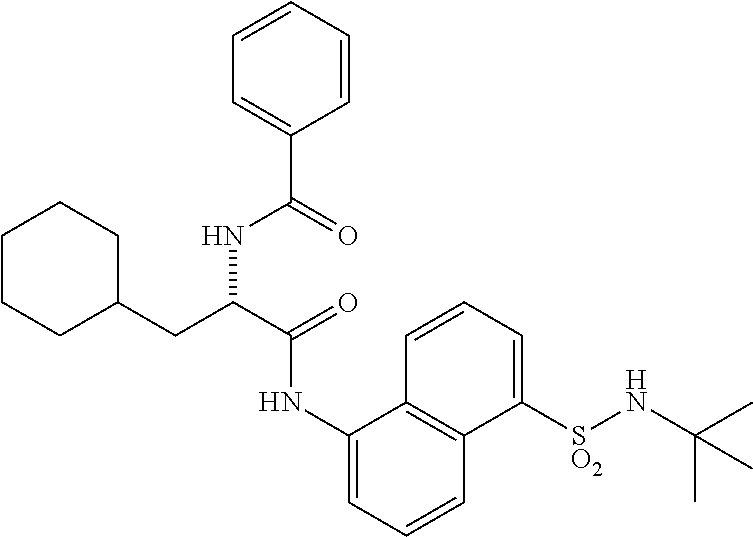 |
(S)-N-(1-((5-(N-(tert- butyl)sulfamoyl)naphthalen-1- yl)amino)-3-cyclohexyl-1- oxopropan-2-yl)benzamide | 666 |
| 7d |
 |
(S)-N-(1-((5-(N-(tert- butyl)sulfamoyl)naphthalen-1- yl)amino)-3-(2-chlorophenyl)-1- oxopropan-2-yl)benzamide | >10,000 |
| 7e |
 |
(S)-N-(1-((5-(N-(tert- butyl)sulfamoyl)naphthalen-1- yl)amino)-3-(4-fluorophenyl)-1- oxopropan-2-yl)benzamide | 153 |
| 7f |
 |
(S)-N-(1-((5-(N-(tert- butyl)sulfamoyl)naphthalen-1- yl)amino)-3-(4-methoxyphenyl)-1- oxopropan-2-yl)benzamide | 89 |
| 7g |
 |
(S)-N-(1-((5-(N-(tert- butyl)sulfamoyl)naphthalen-1- yl)amino)-1-oxo-4-phenylbutan-2- yl)benzamide | 2,270 |
| 7h |
 |
(S)-N-(1-((5-(N-(tert- butyl)sulfamoyl)naphthalen-1- yl)amino)-3-cyclopropyl-1- oxopropan-2-yl)benzamide | 2,200 |
| 7i |
 |
(S)-N-(1-((5-(N-(tert- butyl)sulfamoyl)naphthalen-1- yl)amino)-3-(1H-imidazol-5-yl)-1- oxopropan-2-yl)benzamide | >10,000 |
| 7j |
 |
(S)-N-(1-((5-(N-(tert- butyl)sulfamoyl)naphthalen-1- yl)amino)-3-(4-cyanophenyl)-1- oxopropan-2-yl)benzamide | 273 |
| 7k |
 |
(S)-N-(1-((5-(N-(tert- butyl)sulfamoyl)naphthalen-1- yl)amino)-1-oxo-3-(thiophen-2- yl)propan-2-yl)benzamide | 230 |
| 7l |
 |
(S)-N-(1-((5-(N-(tert- butyl)sulfamoyl)naphthalen-1- yl)amino)-1-oxo-3-(o-tolyl)propan- 2-yl)benzamide | >10,000 |
| 7m |
 |
(S)-N-(1-((5-(N-(tert- butyl)sulfamoyl)naphthalen-1- yl)amino)-1-oxo-3-(p-tolyl)propan- 2-yl)benzamide | >10,000 |
| 7n |
 |
(S)-N-(1-((5-(N-(tert- butyl)sulfamoyl)naphthalen-1- yl)amino)-3-(4-chlorophenyl)-1- oxopropan-2-yl)benzamide | 446 |
| 10a |
 |
(S)-N-(1-((4-(N-(tert- butyl)sulfamoyl)phenyl)amino)-1- oxo-3-phenylpropan-2- yl)benzamide | >10,000 |
| 10b |
 |
(S)-N-(1-((4-(N-(tert- butyl)sulfamoyl)phenyl)amino)-1- oxo-3-phenylpropan-2- yl)cyclohexanecarboxamide | 59 |
| 10c |
 |
(S)-N-(1-((4-(N-(tert- butyl)sulfamoyl)phenyl)amino)-1- oxo-3-phenylpropan-2- yl)cyclopentanecarboxamide | 71 |
| 10d |
 |
(R)-N-(1-((4-(N-(tert- butyl)sulfamoyl)phenyl)amino)-1- oxo-3-phenylpropan-2- yl)cyclohexanecarboxamide | 28 |
| 10e |
 |
(S)-N-(1-((4-(tert- butyl)sulfamoyl)phenyl)amino)-1- oxo-3-phenylpropan-2-yl)-4- fluorobenzamide | 17 |
| 10f |
 |
(S)-4-((1-((4-(N-(tert- butyl)sulfamoyl)phenyl)amino)-1- oxo-3-phenylpropan-2- yl)carbamoyl)benzoic acid | >10,000 |
| 10g |
 |
methyl (S)-4-((1-((4-(N-(tert- butyl)sulfamoyl)phenyl)amino)-1- oxo-3-phenylpropan-2- yl)carbamoyl)benzoate | >10,000 |
| 10h |
 |
(S)-N-(1-((4-(N-(tert- butyl)sulfamoyl)phenyl)amino)-1- oxo-3-phenylpropan-2- yl)picolinamide | 250 |
| 10i |
 |
(S)-N-((S)-1-((4-(N-(tert- butyl)sulfamoyl)phenyl)amino)-1- oxo-3-phenylpropan-2- yl)pyrrolidine-2-carboxamide | >10,000 |
| 10j |
 |
(S)-N-(1-((4-(N-(tert- butyl)sulfamoyl)phenyl)amino)-1- oxo-3-phenylpropan-2- yl)pyridazine-3-carboxamide | 148 |
| 14a |
 |
(S)-N-(1-((4-(N-(tert- butyl)sulfamoyl)phenyl)amino)-3- cyclohexyl-1-oxopropan-2- yl)benzamide | 225 |
| 14b |
 |
(S)-N-(1-((4-(N-(tert- butyl)sulfamoyl)phenyl)amino)-3- cyclohexyl-1-oxopropan-2- yl)cyclohexanecarboxamide | 83 |
| 14c |
 |
(S)-N-(1-((4-(N-(tert- butyl)sulfamoyl)phenyl)amino)-3- cyclohexyl-1-oxopropan-2-yl)-4- fluorobenzamide | 23 |
| 14d |
 |
(S)-N-(1-((4-(N-(tert- butyl)sulfamoyl)phenyl)amino)-3- cyclohexyl-1-oxopropan-2-yl)-4- (trifluoromethyl)benzamide | >10,000 |
| 14e |
 |
(S)-N-(1-((4-(N-(tert- butyl)sulfamoyl)phenyl)amino)-3- cyclohexyl-1-oxopropan-2- yl)cyclopentanecarboxamide | 120 |
| 14f |
 |
(S)-N-(1-((4-(N-(tert- butyl)sulfamoyl)phenyl)amino)-3- cyclohexyl-1-oxopropan-2-yl)-2- fluorobenzamide | 461 |
| 14g |
 |
(S)-N-(1-((4-(N-(tert- butyl)sulfamoyl)phenyl)amino)-3- cyclohexyl-1-oxopropan-2-yl)-3- fluorobenzamide | 57 |
| 14h |
 |
(S)-N-(1-((4-(N-(tert- butyl)sulfamoyl)phenyl)amino)-3- cyclohexyl-1-oxopropan-2-yl)-3,4- difluorobenzamide | 31 |
| 14i |
 |
(S)-N-(1-((4-(N-(tert- butyl)sulfamoyl)phenyl)amino)-3- cyclohexyl-1-oxopropan-2-yl)-3- cyanobenzamide | >10,000 |
| 14j |
 |
(S)-N-(1-((4-(N-(tert- butyl)sulfamoyl)phenyl)amino)-3- cyclohexyl-1-oxopropan-2- yl)picolinamide | 123 |
| 19a |
 |
(S)-N-(1-((4-(N-(tert- butyl)sulfamoyl)phenyl)amino)-1- oxo-3-(thiophen-2-yl)propan-2- yl)cyclohexanecarboxamide | 28 |
| 19b |
 |
(S)-N-(1-((4-(N-(tert- butyl)sulfamoyl)phenyl)amino)-3- (4-fluorophenyl)-1-oxopropan-2- yl)benzamide | 133 |
| 19c |
 |
(S)-N-(1-((4-(N-(tert- butyl)sulfamoyl)phenyl)amino)-3- cyclopropyl-1-oxopropan-2- yl)cyclohexanecarboxamide | 810 |
| 19d |
 |
(S)-N-(1-((4-(N-(tert- butyl)sulfamoyl)-3- methylphenyl)amino)-1-oxo-3- phenylpropan-2- yl)cyclohexanecarboxamide | >10,000 |
| 19e |
 |
(S)-N-(1-((4-(N-(tert- butyl)sulfamoyl)phenyl)amino)-3- (3-chlorophenyl)-1-oxopropan-2- yl)cyclohexanecarboxamide | >10,000 |
| 19f |
 |
(S)-N-(1-((4-(N-(tert- butyl)sulfamoyl)phenyl)amino)-3- (4-methoxyphenyl)-1-oxopropan-2- yl)-4-fluorobenzamide | 22 |
| 19g |
 |
(S)-N-(1-((4-(N-(tert- butyl)sulfamoyl)phenyl)amino)-1- oxo-3-(thiophen-2-yl)propan-2-yl)- 4-fluorobenzamide | 19 |
| 19h |
 |
(S)-N-(1-((4-(N- isopropylsulfamoyl)phenyl)amino)- 1-oxo-3-phenylpropan-2- yl)cyclohexanecarboxamide | 179 |
| 19i |
 |
N-((2S,3R)-1-((4-(N-(tert- butyl)sulfamoyl)phenyl)amino)-3- hydroxy-1-oxobutan-2- yl)cyclohexanecarboxamide | >10,000 |
| 19j |
 |
(S)-N-(1-((4-(N-(tert- butyl)sulfamoyl)phenyl)amino)-3- hydroxy-1-oxopropan-2- yl)cyclohexanecarboxamide | >10,000 |
| 19k |
 |
(S)-N-(1-((4-(N-(tert- butyl)sulfamoyl)phenyl)amino)-3- (4-fluorophenyl)-1-oxopropan-2- yl)-4-fluorobenzamide | 26 |
| 19l |
 |
(S)-N-(3-([1,1′-biphenyl]-4-yl)-1- ((4-(N-(tert- butyl)sulfamoyl)phenyl)amino)-1- oxopropan-2-yl)-4- fluorobenzamide | 169 |
| 19m |
 |
(S)-N-(1-((4-(N-(tert- butyl)sulfamoyl)-3- fluorophenyl)amino)-1-oxo-3- phenylpropan-2- yl)cyclohexanecarboxamide | 275 |
| 19n |
 |
(S)-N-(1-((4-(N-(tert- butyl)sulfamoyl)phenyl)amino)-1- oxo-3-(pyridin-3-yl)propan-2-yl)-4- fluorobenzamide | 16 |
| 19o |
 |
(S)-N-(1-((4-(N-(tert- butyl)sulfamoyl)phenyl)amino)-1- oxo-3-(pyridin-2-yl)propan-2-yl)-4- fluorobenzamide | 48 |
| 19p |
 |
(S)-N-(1-((5-(N-(tert- butyl)sulfamoyl)naphthalen-1- yl)amino)-3-cyclohexyl-1- oxopropan-2- yl)cyclohexanecarboxamide | 195 |
| 19q |
 |
(S)-N-(1-((5-(N-(tert- butyl)sulfamoyl)naphthalen-1- yl)amino)-1-oxo-3-phenylpropan- 2-yl)cinnamamide | >10,000 |
| 19s |
 |
(S)-N-(1-((4-(N-(tert- butyl)sulfamoyl)phenyl)amino)-1- oxo-3-(thiophen-2-yl)propan-2- yl)picolinamide | 200 |
| 19t |
 |
(S)-N-(1-((4-(N-(tert- butyl)sulfamoyl)phenyl)amino)-1- oxo-3-(thiophen-2-yl)propan-2-yl)- 5-methoxypicolinamide | 1,040 |
| 19u |
 |
(S)-N-(1-((4-(N-(tert- butyl)sulfamoyl)phenyl)amino)-3- (4-methoxyphenyl)-1-oxopropan-2- yl)picolinamide | 195 |
| 19v |
 |
(S)-N-(1-((4-(N-(tert- butyl)sulfamoyl)phenyl)amino)-3- (4-methoxyphenyl)-1-oxopropan-2- yl)thiazole-2-carboxamide | >10,000 |
| 19w |
 |
(S)-N-(1-((4-(N-(tert- butyl)sulfamoyl)phenyl)amino)-3- (4-methoxyphenyl)-1-oxopropan-2- yl)thiazole-5-carboxamide | >10,000 |
| 19x |
 |
(S)-N-(1-((4-(N-(tert- butyl)sulfamoyl)phenyl)amino)-3- (4-methoxyphenyl)-1-oxopropan-2- yl)thiazole-4-carboxamide | >10,000 |
| 19y |
 |
(S)-N-(1-((4-(N-(tert- butyl)sulfamoyl)phenyl)amino)-1- oxo-3-(pyridin-4-yl)propan-2-yl)-4- fluorobenzamide | 20 |
| 19z |
 |
(S)-N-(1-((4-(N-(tert- butyl)sulfamoyl)phenyl)amino)-3- (4-methoxyphenyl)-1-oxopropan-2- yl)oxazole-4-carboxamide | >10,000 |
| 19aa |
 |
(S)-N-(1-((4-(N-(tert- butyl)sulfamoyl)phenyl)amino)-3- (4-methoxyphenyl)-1-oxopropan-2- yl)nicotinamide | 208 |
| 19ab |
 |
(S)-N-(1-((4-(N-(tert- butyl)sulfamoyl)phenyl)amino)-3- (4-methoxyphenyl)-1-oxopropan-2- yl)isonicotinamide | 2,400 |
| 19ac |
 |
(S)-N-(1-((4-(N-(tert- butyl)sulfamoyl)phenyl)amino)-1- oxo-3-(tetrahydro-2H-pyran-4- yl)propan-2- yl)cyclohexanecarboxamide | 71 |
| 19ad |
 |
(S)-N-(1-((4-(N-(tert- butyl)sulfamoyl)phenyl)amino)-3- (3-cyanophenyl)-1-oxopropan-2- yl)cyclohexanecarboxamide | 41 |
| 19ae |
 |
(S)-N-(1-((4-(N-(tert- butyl)sulfamoyl)phenyl)amino)-1- oxo-3-(4- (trifluoromethoxy)phenyl)propan- 2-yl)-4-fluorobenzamide | 3,600 |
Claims (20)


Priority Applications (1)
| Application Number | Priority Date | Filing Date | Title |
|---|---|---|---|
| US16/606,817 US10968172B2 (en) | 2017-05-15 | 2018-05-14 | USP30 inhibitors |
Applications Claiming Priority (3)
| Application Number | Priority Date | Filing Date | Title |
|---|---|---|---|
| US201762506216P | 2017-05-15 | 2017-05-15 | |
| PCT/US2018/032486 WO2018213150A1 (en) | 2017-05-15 | 2018-05-14 | Usp30 inhibitors |
| US16/606,817 US10968172B2 (en) | 2017-05-15 | 2018-05-14 | USP30 inhibitors |
Publications (2)
| Publication Number | Publication Date |
|---|---|
| US20200131121A1 US20200131121A1 (en) | 2020-04-30 |
| US10968172B2 true US10968172B2 (en) | 2021-04-06 |
Family
ID=62567761
Family Applications (1)
| Application Number | Title | Priority Date | Filing Date |
|---|---|---|---|
| US16/606,817 Active US10968172B2 (en) | 2017-05-15 | 2018-05-14 | USP30 inhibitors |
Country Status (2)
| Country | Link |
|---|---|
| US (1) | US10968172B2 (en) |
| WO (1) | WO2018213150A1 (en) |
Cited By (1)
| Publication number | Priority date | Publication date | Assignee | Title |
|---|---|---|---|---|
| WO2024086708A3 (en) * | 2022-10-19 | 2024-05-30 | Ohio State Innovation Foundation | Compositions and methods for preventing cardiomyopathy |
Families Citing this family (19)
| Publication number | Priority date | Publication date | Assignee | Title |
|---|---|---|---|---|
| US11439608B2 (en) | 2017-09-25 | 2022-09-13 | Qun Lu | Roles of modulators of intersectin-CDC42 signaling in Alzheimer's disease |
| SG11202001684PA (en) | 2017-10-06 | 2020-03-30 | Forma Therapeutics Inc | Inhibiting ubiquitin specific peptidase 30 |
| ES2988920T3 (en) | 2018-05-17 | 2024-11-22 | Forma Therapeutics Inc | Fused bicyclic compounds useful as inhibitors of ubiquitin-specific peptidase 30 |
| PL3860989T3 (en) | 2018-10-05 | 2023-07-10 | Forma Therapeutics, Inc. | Fused pyrrolines which act as ubiquitin-specific protease 30 (usp30) inhibitors |
| CN109651243B (en) * | 2019-01-18 | 2020-05-22 | 西安交通大学 | A kind of peptoid compound containing serine and its preparation method and application |
| GB201905371D0 (en) | 2019-04-16 | 2019-05-29 | Mission Therapeutics Ltd | Novel compounds |
| GB201905375D0 (en) | 2019-04-16 | 2019-05-29 | Mission Therapeutics Ltd | Novel compounds |
| GB201912674D0 (en) | 2019-09-04 | 2019-10-16 | Mission Therapeutics Ltd | Novel compounds |
| CN115038688A (en) * | 2019-09-11 | 2022-09-09 | 文森雷生物科学股份有限公司 | USP30 inhibitors and uses thereof |
| BR112022020058A2 (en) | 2020-04-08 | 2022-11-22 | Mission Therapeutics Ltd | N-CYANOPYRROLIDINES WITH ACTIVITY AS USP30 INHIBITORS |
| BR112022020644A2 (en) | 2020-05-28 | 2022-12-06 | Mission Therapeutics Ltd | N-(1-CYANO-PYRROLIDIN-3-IL)-5-(3-(TRIFLUOROMETHYL)PHENYL) OXAZOLE-2-CARBOXAMIDE DERIVATIVES AND CORRESPONDING OXADIAZOLE DERIVATIVES AS USP30 INHIBITORS FOR THE TREATMENT OF MITOCHONDRIAL DYSFUNCTION |
| JP7796047B2 (en) | 2020-06-04 | 2026-01-08 | ミッション セラピューティクス リミティド | N-cyanopyrrolidines with activity as USP30 inhibitors |
| DK4161929T3 (en) | 2020-06-08 | 2025-08-18 | Mission Therapeutics Ltd | 1-(5-(2-CYANOPYRIDIN-4-YL)OXAZOLE-2-CARBONYL)-4-METHYLHEXAHYDROPYRROLO[3,4-B]PYRROLE-5(1H)-CARBONITRILE AS A USP30 INHIBITOR FOR USE IN THE TREATMENT OF MITOCHONDRAL DYSFUNCTION, CANCER AND FIBROSIS |
| GB202016800D0 (en) | 2020-10-22 | 2020-12-09 | Mission Therapeutics Ltd | Novel compounds |
| CA3211571A1 (en) * | 2021-03-10 | 2022-09-15 | Donna L. Romero | Usp30 inhibitors and uses thereof |
| CN118834147A (en) | 2021-09-22 | 2024-10-25 | 杭州天玑济世生物科技有限公司 | Small molecular compound with naphthylamine structure and application thereof |
| JP2024544660A (en) | 2021-12-01 | 2024-12-03 | ミッション セラピューティクス リミティド | Substituted N-cyanopyrrolidines with activity as USP30 inhibitors |
| GB202408928D0 (en) | 2024-06-21 | 2024-08-07 | Mission Therapeutics Ltd | Novel compounds |
| GB202411060D0 (en) | 2024-07-29 | 2024-09-11 | Mission Therapeutics Ltd | Novel compounds |
Citations (2)
| Publication number | Priority date | Publication date | Assignee | Title |
|---|---|---|---|---|
| WO2016156816A1 (en) | 2015-03-30 | 2016-10-06 | Mission Therapeutics Limited | 1-cyano-pyrrolidine compounds as usp30 inhibitors |
| WO2017009650A1 (en) | 2015-07-14 | 2017-01-19 | Mission Therapeutics Limited | Cyanopyrrolidines as dub inhibitors for the treatment of cancer |
Family Cites Families (2)
| Publication number | Priority date | Publication date | Assignee | Title |
|---|---|---|---|---|
| GB9322976D0 (en) | 1993-11-08 | 1994-01-05 | Pfizer Ltd | Therapeutic agents |
| BRPI0613423A2 (en) | 2005-07-19 | 2012-12-11 | Daiichi Sankyo Co Ltd | pharmaceutical composition, compound or a pharmaceutically acceptable salt thereof, and use of a compound or a pharmaceutically acceptable salt thereof |
-
2018
- 2018-05-14 US US16/606,817 patent/US10968172B2/en active Active
- 2018-05-14 WO PCT/US2018/032486 patent/WO2018213150A1/en not_active Ceased
Patent Citations (2)
| Publication number | Priority date | Publication date | Assignee | Title |
|---|---|---|---|---|
| WO2016156816A1 (en) | 2015-03-30 | 2016-10-06 | Mission Therapeutics Limited | 1-cyano-pyrrolidine compounds as usp30 inhibitors |
| WO2017009650A1 (en) | 2015-07-14 | 2017-01-19 | Mission Therapeutics Limited | Cyanopyrrolidines as dub inhibitors for the treatment of cancer |
Non-Patent Citations (2)
| Title |
|---|
| International Search Report and Written Opinion for Application No. PCT/US2018/032486, dated Aug. 29, 2018, 15 pages. |
| Kluge et al., Novel highly selective inhibitors of ubiquitin specific protease 30 (USP30) accelerate mitophagy. Bioorg Med Chem Lett. Aug. 15, 2018;28(15):2655-2659. Pre-publication edition. |
Cited By (1)
| Publication number | Priority date | Publication date | Assignee | Title |
|---|---|---|---|---|
| WO2024086708A3 (en) * | 2022-10-19 | 2024-05-30 | Ohio State Innovation Foundation | Compositions and methods for preventing cardiomyopathy |
Also Published As
| Publication number | Publication date |
|---|---|
| WO2018213150A8 (en) | 2020-01-23 |
| WO2018213150A1 (en) | 2018-11-22 |
| US20200131121A1 (en) | 2020-04-30 |
Similar Documents
| Publication | Publication Date | Title |
|---|---|---|
| US20200131121A1 (en) | Usp30 inhibitors | |
| US20230373948A1 (en) | Ppar agonists, compounds, pharmaceutical compositions, and methods of use thereof | |
| US11358954B2 (en) | PPAR agonists, compounds, pharmaceutical compositions, and methods of use thereof | |
| US20230219896A1 (en) | Cannabinoid receptor mediating compounds | |
| JP7469522B2 (en) | Benzothiazole derivatives and their uses | |
| TW200942239A (en) | Phenylacetamide derivatives | |
| US20180273485A1 (en) | Cannabinoid receptor mediating compounds | |
| JP2004518691A (en) | Thiazolyl-, oxazolyl-, pyrrolyl-, and imidazolyl-acid amide derivatives effective as PDE4 isozyme inhibitors | |
| US20210238192A1 (en) | Vascular adhesion protein-1 (vap-1) modulators and therapeutic uses thereof | |
| US20210009564A1 (en) | Calpain modulators and therapeutic uses thereof | |
| CN101821227A (en) | Hormone sensitive lipase modulators and methods of use | |
| US20240383869A1 (en) | Arylacetyl inhibitors of tg2 and uses thereof | |
| US11168080B2 (en) | Dynamin-1-like protein inhibitors | |
| US12410137B2 (en) | Fatty acid amide hydrolase modulators, compositions comprising the same and uses thereof | |
| CA3019014C (en) | Ppar agonists, compounds, pharmaceutical compositions, and methods of use thereof | |
| US20250092030A1 (en) | Enhancers of particulate guanylyl cyclase receptor a | |
| JP2024520758A (en) | TTBK1 inhibitors | |
| US20160185759A1 (en) | Novel indazole compounds and a process for the preparation thereof | |
| EA039771B1 (en) | Ppar agonists, compounds, pharmaceutical compositions and methods of use thereof |
Legal Events
| Date | Code | Title | Description |
|---|---|---|---|
| AS | Assignment |
Owner name: MITOBRIDGE, INC., MASSACHUSETTS Free format text: ASSIGNMENT OF ASSIGNORS INTEREST;ASSIGNORS:KLUGE, ARTHUR;LAGU, BHARAT;MAITI, PRANAB;AND OTHERS;SIGNING DATES FROM 20191011 TO 20191017;REEL/FRAME:050774/0641 |
|
| FEPP | Fee payment procedure |
Free format text: ENTITY STATUS SET TO UNDISCOUNTED (ORIGINAL EVENT CODE: BIG.); ENTITY STATUS OF PATENT OWNER: LARGE ENTITY |
|
| STPP | Information on status: patent application and granting procedure in general |
Free format text: NOTICE OF ALLOWANCE MAILED -- APPLICATION RECEIVED IN OFFICE OF PUBLICATIONS |
|
| STPP | Information on status: patent application and granting procedure in general |
Free format text: PUBLICATIONS -- ISSUE FEE PAYMENT VERIFIED |
|
| STCF | Information on status: patent grant |
Free format text: PATENTED CASE |
|
| CC | Certificate of correction | ||
| AS | Assignment |
Owner name: ASTELLAS ENGINEERED SMALL MOLECULES US, INCORPORATED, MASSACHUSETTS Free format text: CHANGE OF NAME;ASSIGNOR:MITOBRIDGE, INC.;REEL/FRAME:068274/0806 Effective date: 20240401 |
|
| MAFP | Maintenance fee payment |
Free format text: PAYMENT OF MAINTENANCE FEE, 4TH YEAR, LARGE ENTITY (ORIGINAL EVENT CODE: M1551); ENTITY STATUS OF PATENT OWNER: LARGE ENTITY Year of fee payment: 4 |