US10946282B2 - Control object spatial location determining method and apparatus - Google Patents
Control object spatial location determining method and apparatus Download PDFInfo
- Publication number
- US10946282B2 US10946282B2 US15/987,399 US201815987399A US10946282B2 US 10946282 B2 US10946282 B2 US 10946282B2 US 201815987399 A US201815987399 A US 201815987399A US 10946282 B2 US10946282 B2 US 10946282B2
- Authority
- US
- United States
- Prior art keywords
- spatial
- location
- ring
- locations
- candidate locations
- Prior art date
- Legal status (The legal status is an assumption and is not a legal conclusion. Google has not performed a legal analysis and makes no representation as to the accuracy of the status listed.)
- Active, expires
Links
Images




Classifications
-
- A—HUMAN NECESSITIES
- A63—SPORTS; GAMES; AMUSEMENTS
- A63F—CARD, BOARD, OR ROULETTE GAMES; INDOOR GAMES USING SMALL MOVING PLAYING BODIES; VIDEO GAMES; GAMES NOT OTHERWISE PROVIDED FOR
- A63F13/00—Video games, i.e. games using an electronically generated display having two or more dimensions
- A63F13/55—Controlling game characters or game objects based on the game progress
- A63F13/57—Simulating properties, behaviour or motion of objects in the game world, e.g. computing tyre load in a car race game
- A63F13/577—Simulating properties, behaviour or motion of objects in the game world, e.g. computing tyre load in a car race game using determination of contact between game characters or objects, e.g. to avoid collision between virtual racing cars
-
- A—HUMAN NECESSITIES
- A63—SPORTS; GAMES; AMUSEMENTS
- A63F—CARD, BOARD, OR ROULETTE GAMES; INDOOR GAMES USING SMALL MOVING PLAYING BODIES; VIDEO GAMES; GAMES NOT OTHERWISE PROVIDED FOR
- A63F13/00—Video games, i.e. games using an electronically generated display having two or more dimensions
- A63F13/30—Interconnection arrangements between game servers and game devices; Interconnection arrangements between game devices; Interconnection arrangements between game servers
- A63F13/35—Details of game servers
-
- A—HUMAN NECESSITIES
- A63—SPORTS; GAMES; AMUSEMENTS
- A63F—CARD, BOARD, OR ROULETTE GAMES; INDOOR GAMES USING SMALL MOVING PLAYING BODIES; VIDEO GAMES; GAMES NOT OTHERWISE PROVIDED FOR
- A63F13/00—Video games, i.e. games using an electronically generated display having two or more dimensions
- A63F13/55—Controlling game characters or game objects based on the game progress
-
- A—HUMAN NECESSITIES
- A63—SPORTS; GAMES; AMUSEMENTS
- A63F—CARD, BOARD, OR ROULETTE GAMES; INDOOR GAMES USING SMALL MOVING PLAYING BODIES; VIDEO GAMES; GAMES NOT OTHERWISE PROVIDED FOR
- A63F13/00—Video games, i.e. games using an electronically generated display having two or more dimensions
- A63F13/55—Controlling game characters or game objects based on the game progress
- A63F13/56—Computing the motion of game characters with respect to other game characters, game objects or elements of the game scene, e.g. for simulating the behaviour of a group of virtual soldiers or for path finding
-
- A—HUMAN NECESSITIES
- A63—SPORTS; GAMES; AMUSEMENTS
- A63F—CARD, BOARD, OR ROULETTE GAMES; INDOOR GAMES USING SMALL MOVING PLAYING BODIES; VIDEO GAMES; GAMES NOT OTHERWISE PROVIDED FOR
- A63F13/00—Video games, i.e. games using an electronically generated display having two or more dimensions
- A63F13/80—Special adaptations for executing a specific game genre or game mode
- A63F13/822—Strategy games; Role-playing games
-
- A—HUMAN NECESSITIES
- A63—SPORTS; GAMES; AMUSEMENTS
- A63F—CARD, BOARD, OR ROULETTE GAMES; INDOOR GAMES USING SMALL MOVING PLAYING BODIES; VIDEO GAMES; GAMES NOT OTHERWISE PROVIDED FOR
- A63F2300/00—Features of games using an electronically generated display having two or more dimensions, e.g. on a television screen, showing representations related to the game
- A63F2300/60—Methods for processing data by generating or executing the game program
-
- A—HUMAN NECESSITIES
- A63—SPORTS; GAMES; AMUSEMENTS
- A63F—CARD, BOARD, OR ROULETTE GAMES; INDOOR GAMES USING SMALL MOVING PLAYING BODIES; VIDEO GAMES; GAMES NOT OTHERWISE PROVIDED FOR
- A63F2300/00—Features of games using an electronically generated display having two or more dimensions, e.g. on a television screen, showing representations related to the game
- A63F2300/60—Methods for processing data by generating or executing the game program
- A63F2300/64—Methods for processing data by generating or executing the game program for computing dynamical parameters of game objects, e.g. motion determination or computation of frictional forces for a virtual car
Definitions
- This application relates to the field of computer technology and, specifically, to a method for determining control-object spatial location and apparatus thereof.
- NPCs non-player characters
- the NPCs occupy their positions around the target, and the position-occupying mechanism in which the artificial intelligence (AI) of the multiple NPCs attack the same target (e.g., a player character) at the same time in an online game is referred to as an AI encirclement mechanism.
- AI artificial intelligence
- implementations of the AI encirclement mechanism are classified into two types according to whether the game engine applies physical collision:
- Embodiments of this disclosure provide a control-object spatial location determining method and apparatus, so as to resolve at least the technical problem that, in a game engine without physical collision, solutions for making multiple bodies not overlap at a spatial location often have low operational efficiency.
- a control-object spatial location determining method for a game application includes: detecting, by a game engine of the game application, a spatial-location request, wherein the game engine is not applying physical collision, and the spatial-location request is a request for determining, based on a first spatial-location of a first control-object in the game application, a second spatial-location of a second control-object; determining, by the game engine, multiple candidate spatial-locations according to the first spatial-location of the first control-object, wherein the multiple candidate spatial-locations surround the first spatial-location, and any two of the multiple candidate spatial-locations and the first spatial-location do not overlap; and determining, by the game engine, an unoccupied candidate spatial-location among the multiple candidate spatial-locations as the second spatial-location of the second control-object.
- a control-object spatial location determining apparatus for a game application.
- the apparatus includes a processor and a memory, and the memory stores a computer readable instruction, which enables the processor to perform the following operations: detecting a spatial-location request, wherein the game application is not applying physical collision, and the spatial-location request is a request for determining, based on a first spatial-location of a first control-object in the game application, a second spatial-location of a second control-object; determining multiple candidate spatial-locations according to the first spatial-location of the first control-object, wherein the multiple candidate spatial-locations surround the first spatial-location, and any two of the multiple candidate spatial-locations and the first spatial-location do not overlap; and determining an unoccupied candidate spatial-location among the multiple candidate spatial-locations as the second spatial-location of the second control-object.
- a non-transitory computer-readable storage medium contains computer-executable instructions for, when executed by one or more processors, performing a control-object spatial-location determining method for a game application.
- the method includes: detecting a spatial-location request, wherein the game application is not applying physical collision, and the spatial-location request is a request for determining, based on a first spatial-location of a first control-object in the game application, a second spatial-location of a second control-object; determining multiple candidate spatial-locations according to the first spatial-location of the first control-object, wherein the multiple candidate spatial-locations surround the first spatial-location, and any two of the multiple candidate spatial-locations and the first spatial-location do not overlap; and determining an unoccupied candidate spatial-location among the multiple candidate spatial-locations as the second spatial-location of the second control-object.
- FIG. 1 illustrates a schematic diagram of spatial-locations of bodies in an online game
- FIG. 2 illustrates a schematic diagram of a computer network environment according to an embodiment of the present disclosure
- FIG. 3 illustrates a flowchart of a control-object spatial-location determining method according to an embodiment of the present disclosure
- FIG. 5 illustrates a second schematic diagram of distribution of candidate spatial-locations according to an embodiment of the present disclosure
- FIG. 7 illustrates a fourth schematic diagram of distribution of candidate spatial-locations according to an embodiment of the present disclosure
- FIG. 8 illustrates a fifth schematic diagram of distribution of candidate spatial-locations according to an embodiment of the present disclosure
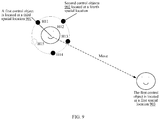
- FIG. 9 illustrates a schematic diagram of a trigger condition for spatial-location request generation according to an embodiment of the present disclosure
- FIG. 10 illustrates a schematic diagram of a game interface generated by using a spatial-location determining method according to an embodiment of the present disclosure
- FIG. 11 illustrates a schematic diagram of a control-object spatial-location determining apparatus according to an embodiment of the present disclosure.
- FIG. 12 illustrates an internal structural block diagram of a server according to an embodiment of the present disclosure.
- control-object spatial-location determining method may be applied to the network environment shown in FIG. 2 .
- the network environment includes a terminal 201 and a server 203 .
- the terminal establishes a connection to the server by using a network, and a processor may be disposed in both the terminal and the server.
- the network includes but not limited to a wide area network, a metropolitan area network or a local area network.
- the network is a local area network;
- the terminal may include a personal computer, or a mobile terminal (such as a mobile phone or a tablet computer).
- FIG. 3 shows a control-object spatial-location determining method according to an embodiment of the present disclosure. As shown in FIG. 3 , the method includes the followings.
- a game engine of a game application detects a spatial-location request, where the spatial-location request is used for requesting a determination of a second spatial-location of a second control-object according to a first spatial-location of a first control-object in the game application, and the game engine is an engine without physical collision, that is, control-objects in the game application are allowed to overlap at a same spatial-location.
- the game engine determines multiple candidate spatial-locations according to the first spatial-location of the first control-object, where the multiple candidate spatial-locations surround the first spatial-location, and any two of the multiple candidate spatial-locations and the first spatial-location do not overlap.
- the game engine determines an unoccupied candidate spatial-location among the multiple candidate spatial-locations as the second spatial-location of the second control-object.
- a notification containing information about the second spatial-location is generated.
- the AI such as an artificial intelligence control unit
- the AI moves the second control-object to the second spatial-location.
- multiple candidate spatial-locations are determined according to a first spatial-location of a first control-object, and an unoccupied candidate spatial-location among the multiple candidate spatial-locations is determined as a second spatial-location of a second control-object.
- the multiple candidate spatial-locations in the foregoing embodiment surround the first spatial-location, and the any two of the multiple candidate spatial-locations and the first spatial-location do not overlap. Therefore, the unoccupied location is selected from the multiple spatial-locations as the second spatial-location of the second control-object. If there are multiple second control-objects, locations of the multiple second control-objects do not overlap.
- spatial-locations that do not overlap may be allocated for multiple second control-objects in a game engine without physical collision, resolving the problem that, in a game engine without physical collision, existing solutions for making multiple bodies not overlap at a spatial location often have low operational efficiency.
- Both the first control-object and the second control-object in the foregoing embodiment may be game characters, or may be static objects in a game.
- the second control-object in the foregoing embodiment may be an object controlled by artificial intelligence, and the spatial-location request may also be generated by the artificial intelligence control unit of the second control-object.
- the foregoing method may be performed by an encirclement manager in a game engine.
- the first control-object may be a game player
- the second control-object may be an NPC
- the game player may be a game character that is controlled by a user by entering an operation instruction when the user uses a game client.
- different spatial-locations can be allocated for multiple NPCs in a game application, and the spatial-locations of the NPCs are different from each other, so that AI can make location-occupying performance of the NPCs more realistic and vivid by using the encirclement mechanism.
- the game application may be an online game application; the user may use a game account number to log on to a game client installed on a terminal, and enter into a game scenario of the game application. After entering the game scenario, the game account number corresponds to one game character (that is, the first control-object in the foregoing embodiment) in the scenario. After receiving a start instruction from the game client of the terminal, the game engine starts a corresponding game in response to the start instruction.
- an NPC appears in the game is detected. If the NPC appears, whether a spatial-location request is detected. If the spatial-location request is detected, multiple candidate spatial-locations that do not overlap each other and that correspond to a first spatial-location of a first control-object are determined, an unoccupied candidate spatial-location is selected from the multiple spatial-locations and determined as a second spatial-location of the NPC, that is, the unoccupied candidate spatial-location is allocated to the NPC, the NPC is notified of the second spatial-location allocated for the NPC, and the NPC moves to the second spatial-location.
- the game engine may alternatively directly move the NPC to the second spatial-location. This is not limiting in the present disclosure.
- a spatial-location that is already locked by one NPC will not be occupied by another NPC; when multiple NPCs encircle a target (i.e., the first control-object), the multiple NPCs do not overlap, and the game is made as realistic as possible, improving user experience.
- FIG. 4 shows distribution of candidate spatial-locations.
- the process of determining, by a game engine, multiple candidate spatial-locations according to a first spatial-location of a first control-object includes: determining multiple candidate spatial-locations in a spatial region with the first spatial-location as the center, where a distance between each of the candidate spatial-locations and the first spatial-location does not exceed a preset threshold.
- a circular spatial region 402 is determined by using the first spatial-location 401 as the center and the preset threshold as the radius. Multiple candidate spatial-locations 403 are randomly disposed in the circular spatial region. A distance between each of the candidate spatial-locations 403 and the first spatial-location 401 does not exceed the preset threshold, and the multiple candidate spatial-locations 403 surround the first spatial-location 401 .
- the second control-object needs to perform an operation (such as encirclement or attacking) on the first control-object. Therefore, an encirclement or attacking function of a game may be implemented better if a distance between a candidate spatial-location and the first spatial-location is determined to be within a range of a preset distance.
- the determining the multiple candidate spatial-locations in a spatial region with the first spatial-location as the center may include: disposing, in the spatial region, the multiple candidate spatial-locations on an encirclement ring with the first spatial-location as the center.
- the disposing the multiple candidate spatial-locations on an encirclement ring with the first spatial-location as the center includes: disposing one group of candidate spatial-locations on each of the N encirclement rings, where an i th group of candidate spatial-locations is disposed on an i th encirclement ring, N is an integer greater than or equal to 1, and i is a positive integer less than or equal to N.
- N encirclement rings may be disposed by using the first spatial-location as the center of a circle.
- the radius of each encirclement ring is different.
- One group of candidate spatial-locations is disposed on each encirclement ring, that is, an i th group of candidate spatial-locations is disposed on an i th encirclement ring. In this way, randomness of disposing the candidate spatial-locations is reduced, and performance of a processor is improved.
- a distance between candidate spatial-locations on each encirclement ring is consistent, and a second spatial-location may be selected for the encirclement rings one after another.
- a candidate spatial-location on a first encirclement ring is selected first, and if there is no proper location on the first encirclement ring, a location on a second encirclement ring is selected; other situations can be handled similarly.
- disposition of candidate spatial-locations complies with a rule, and so does selection of candidate spatial-locations, thereby increasing the processing speed.
- the i th group of candidate spatial-locations is evenly distributed on the i th encirclement ring, and the number of candidate spatial-locations in each group is different from each other.
- a first control-object is located at a first spatial-location 501 , and within a determined spatial region 502 , three encirclement rings 503 (the three encirclement rings are all identified with a label 503 ) may be disposed.
- the radii of the three encirclement rings 503 are respectively r 1 , r 2 , and r 3 .
- the radii of the three encirclement rings 503 are different from each other, one group of candidate spatial-locations 504 is disposed on each encirclement ring 503 , and a quantity of candidate spatial-locations 504 in each group is different from each other.
- candidate spatial-locations 504 there are five candidate spatial-locations 504 in a first group, nine candidate spatial-locations 504 in a second group, and thirteen candidate spatial-locations 504 in a third group, and candidate spatial-locations 504 are evenly distributed on each encirclement ring 503 .
- an encirclement ring is only a virtual concept, candidate spatial-locations may be set according to a radius distance, and the encirclement ring may not be used. That is, N groups of candidate spatial-locations are disposed according to different radius distances by using the first control-object as the center, and distances between candidate spatial-locations and the first control-object may be the same in each group.
- disposing multiple candidate spatial-locations on an encirclement ring with a first spatial-location as the center may include: setting at least one of the following according to attribute information of the first control-object and a second control-object: a distance between an i th encirclement ring and the first control-object, the number of candidate spatial-locations in an i th group, and a distribution manner of the i th group of candidate spatial-locations.
- a number of encirclement rings, a distance between each encirclement ring and the first control-object, a number of candidate spatial-locations in each group, and a distribution manner (such as even distribution or uneven distribution) of candidate spatial-locations may be determined according to attributes of the first control-object and the second control-object.
- a formation is a series of virtual points (that is, candidate spatial-locations) around a target (that is, a first control-object).
- a connection between each of the multiple candidate spatial-locations and a first spatial-location of the target object does not coincide with each other, so that an NPC object located at each candidate spatial-location may directly perform an operation on the target object, that is, each candidate spatial-location is disposed at a location at which an operation may be directly performed on the target object.
- each candidate spatial-location may be disposed according to an angle determined by using any two candidate spatial-locations and the first spatial-location.
- the angle uses the first spatial-location as the vertex, uses a connection line between one candidate spatial-location of the any two candidate spatial-locations and the vertex as one side, and uses a connection line between the other candidate spatial-location of the any two candidate spatial-locations and the vertex as the other side.
- space around the target object e.g., the first control-object 601 shown in FIG. 6
- space 602 shown in FIG. 6 also referred to as the spatial region
- N space around the target object
- encirclement rings for example, three encirclement rings 603 are shown in FIG. 6 , and the three encirclement rings 603 may be three circles whose radii are respectively r 1 , r 2 , and r 3 ) according to a distance from the target object.
- an “encirclement point” that is, a candidate spatial-location 604 ) is allocated at a proper angle on an encirclement ring.
- the proper angle may be self-defined based on a scenario of a game application, or may be set according to attributes of the target object and an NPC object. As shown in FIG. 6 , the angle between H 1 and H 2 , the angle between H 3 and H 4 , and the angle between H 5 and H 6 are respectively a 1 , a 2 , and a 3 . Both a radius r of an encirclement ring and the number n of encirclement rings, the number of encirclement points on each encirclement ring (this variable may be alternatively determined by using an angle ‘a’ between the encirclement points) may be self-defined according to a service requirement. Similarly, a distribution manner of the encirclement points may not necessarily be a manner of an encirclement ring, and the encirclement points may be distributed in any shape.
- a first control-object is located at a first spatial-location 701 , and in a determined spatial region 702 , three encirclement rings 703 (the three encirclement rings are all identified with a number 703 ) may be disposed.
- One group of candidate spatial-locations 704 is disposed on each of the encirclement rings 703 , and some random offsets in distance and angle may be performed on relative locations of encirclement points (that is, the candidate spatial-locations 704 ) on each of the encirclement rings 703 , producing an effect of unevenness. That is, after the adjustment, the distances between the encirclement rings and the first control-object may remain unchanged, and candidate spatial-locations on each encirclement ring are changed. In other words, the candidate spatial-locations are offset by a random amount within a certain range. Changed candidate spatial-locations may be not located on the encirclement ring any longer.
- the second spatial-location may be selected according to a predefined priority selection manner, for example, a selection manner of first selecting the one whose distance is the shortest, or a selection manner of selecting the one whose distance from a neighboring candidate spatial-location is the largest.
- the predefined priority selection manner may be alternatively self-defined according to a service requirement.
- a principle for first selecting the one whose distance is the shortest may be complied with, that is, an encirclement point relatively close to the target object and closest to a current location of an NPC on an encirclement ring is allocated for the NPC (such as a monster).
- determining, by a game engine, an unoccupied candidate spatial-location among the multiple candidate spatial-locations as a second spatial-location of a second control-object may include: determining an unoccupied candidate spatial-location among the multiple candidate spatial-locations and closest to the first spatial-location as the second spatial-location of the second control-object.
- an encirclement ring closest to the first spatial-location is obtained, and an unoccupied candidate spatial-location is selected from the currently obtained encirclement ring. If all candidate spatial-locations on the currently obtained encirclement ring are occupied, a next closest encirclement ring is obtained, and so on, until the occupied encirclement ring is found.
- one of the unoccupied candidate spatial-locations may be randomly selected as the second spatial-location; or a location closest to the current location of the second control-object may be selected from the unoccupied candidate spatial-locations as the second spatial-location; or if the current location of the second control-object is empty (that is, the second control-object does not exist in the game space), random selection may be performed.
- each candidate spatial-location may have a status flag.
- the status flag is used for indicating whether the candidate spatial-location is occupied. That is, whether the corresponding candidate spatial-location is occupied may be determined according to the status flag.
- the status of the determined second spatial-location is changed to the occupied state.
- a status of a spatial-location of the NPC that disappears is changed back to an unoccupied state again, so that when a spatial-location is selected next time, it can be ensured that the spatial-location of the second control-object is correctly determined.
- multiple candidate spatial-locations of a first spatial-location 801 of a first control-object are determined.
- some of the determined candidate spatial-locations are already occupied.
- Black candidate spatial-locations in FIG. 8 indicate occupied candidate spatial-locations.
- H 11 , H 12 , H 13 , and H 14 on a first encirclement ring in FIG. 8 are already occupied, and H 23 on a second encirclement ring is already occupied.
- an unoccupied candidate spatial-location H 15 on the first encirclement ring may be selected, and H 15 is determined as a second spatial-location.
- a game engine generates a notification carrying information about the second spatial-location, and sends the notification to a manual control unit of the second control-object.
- the manual control unit moves the second control-object to the second spatial-location, to perform an operation, such as attaching, on the first control-object.
- the detecting, by a game engine of a game application, a spatial-location request may include: determining that the spatial-location request is detected when receiving, by the game engine, an instruction of an operation performed by the second control-object on the first control-object; or determining that the spatial-location request is detected if it is detected that the first control-object moves to the first spatial-location and a distance between the first spatial-location and a third spatial-location exceeds a preset distance in a case in which the first control-object is located at the third spatial-location and the first control-object is surrounded by multiple second control-objects located at a fourth spatial-location.
- the method further includes: if it is detected that the first control-object moves to the first spatial-location and the distance between the first spatial-location and the third spatial-location does not exceed the preset distance, determining a motion vector of the first control-object based on the first spatial-location and the third spatial-location; and translationally moving the second control-object from the second spatial-location to a fifth spatial-location according to the motion vector. That is, if a movement range of the first control-object is not large, the second control-object is translationally moved based on the movement of the first control-object, without a need to generate a spatial-location request again, so as to save resources.
- the game engine can detect the spatial-location request. In some embodiments, if it is detected that an NPC generates the operation instruction, it is determined that the spatial-location request is detected.
- the first control-object is located at a third spatial-location and the first control-object is surrounded by multiple second control-objects located at a fourth spatial-location; when the first control-object is in the foregoing state, if the game engine detects that a location of the first control-object moves to the first spatial-location and a range of the movement is very large. If a distance by which a third control location moves exceeds a preset distance range, an NPC generates a spatial-location request, to obtain a spatial-location of a PC again.
- one encirclement point (that is, the second spatial-location) is applied for from multiple candidate spatial-locations and used as a location occupying point of the NPC, and a current state is recorded on the encirclement point.
- An encirclement point that is already locked by another NPC cannot be occupied by another NPC, as shown by the black candidate spatial-locations, and the remaining NPCs can be selected only from the remaining unoccupied encirclement points.
- a priority algorithm for selecting an encirclement point may be alternatively self-defined according to a service requirement.
- a principle for first selecting the one whose distance is the shortest is complied with that is, an encirclement point relatively close to the target and closest to a current location of a monster (that is, a second control-object) on an encirclement ring is allocated for the monster.
- the encirclement target is not necessarily static, and when the target continuously moves, an entire “formation” continuously and translationally moves based on the target, that is, absolute coordinates of each encirclement point continuously change. Therefore, after the NPC obtains an encirclement point by means of applying, the AI needs to continuously determine current coordinates of the encirclement point, and if finding that the NPC deviates from the encirclement point by a relatively large margin, the AI initiates movement of the NPC to new coordinates. In addition, if one-off movement of the target causes deviation from original coordinates by a relatively large margin (such as the state shown in FIG. 9 ), resulting in a relatively large change of a relative location of the NPC in the encirclement, all encirclement points may be reset at the same time, so that the NPC initiates the applying process again.
- a relatively large margin such as the state shown in FIG. 9
- the four second control-objects generates an encirclement momentum towards the first control-object.
- spatial-locations of the four NPCs do not overlap.
- an effect of collision may also be simulated for monster encirclement, thereby making monster performance more truthful.
- the method according to the foregoing embodiments may be implemented by using software and a necessary general hardware platform, or certainly may be implemented by using hardware. However, in most cases, the former is a preferred implementation.
- the technical solutions of the present disclosure essentially, or the part contributing to the existing technology may be implemented in a form of a software product.
- the computer software product is stored in a storage medium (such as a ROM/RAM, a magnetic disk, or an optical disc) and includes several instructions for instructing a terminal device (which may be a mobile phone, a computer, a server, a network device, or the like) to perform the methods described in the embodiments of the present disclosure.
- an apparatus used for implementing the foregoing control-object spatial-location determining method is further provided, as shown in FIG. 11 .
- control-object spatial-location determining apparatus may be alternatively applied to the network environment shown in FIG. 2 .
- control-object spatial-location determining apparatus includes the following: a detection unit 111 , a first determining unit 113 , and a second determining unit 115 .
- the detection unit 111 is configured to detect a spatial-location request, where the spatial-location request is used for requesting to determine a second spatial-location of a second control-object according to a first spatial-location of a first control-object in the game application, and the game engine is an engine without physical collision. For example, control-objects in the game application are allowed to overlap at a spatial-location.
- the first determining unit 113 is configured to determine multiple candidate spatial-locations according to the first spatial-location of the first control-object, where the multiple candidate spatial-locations surround the first spatial-location, and any two of the multiple candidate spatial-locations and the first spatial-location do not overlap.
- the second determining unit 115 is configured to determine an unoccupied candidate spatial-location among the multiple candidate spatial-locations as the second spatial-location of the second control-object.
- a notification carrying information about the second spatial-location is generated.
- AI such as an artificial intelligence control unit
- AI of the second control-object moves the second control-object to the second spatial-location.
- the apparatus in the embodiment may be in the game engine of the game application, and the game engine may be located on a server corresponding to the game application.
- multiple candidate spatial-locations are determined according to a first spatial-location of a first control-object, and an unoccupied candidate spatial-location among the multiple candidate spatial-locations is determined as a second spatial-location of a second control-object.
- the multiple candidate spatial-locations in the foregoing embodiment surround the first spatial-location, and the any two of the multiple candidate spatial-locations and the first spatial-location do not overlap. Therefore, the unoccupied location is selected from the multiple spatial-locations as the second spatial-location of the second control-object. If there are multiple second control-objects, locations of the multiple second control-objects do not overlap.
- spatial-locations that do not overlap may be allocated for multiple second control-objects in a game engine without physical collision instead of a game engine with physical collision having high research and development costs and low running efficiency, resolving the problem that, in a game engine without physical collision, existing solutions for making multiple bodies not overlap at a spatial location often have low operational efficiency.
- Both the first control-object and the second control-object may be game characters, or may be static bodies in a game.
- the second control-object may be an object controlled by artificial intelligence, and the spatial-location request is also generated by the artificial intelligence control unit of the second control-object.
- the first control-object may be a game player
- the second control-object may be an NPC
- the game player may be a game character that is controlled by a user by entering an operation instruction when the user uses a game client.
- the first determining unit may include: a determining module, configured to determine multiple candidate spatial-locations in a spatial region with the first spatial-location as the center, where a distance between each of the candidate spatial-locations and the first spatial-location does not exceed a preset threshold.
- a circular spatial region is determined by using the first spatial-location as the center and the preset threshold as the radius and the multiple candidate spatial-locations are randomly disposed in the circular spatial region, a distance between each of the candidate spatial-locations and the first spatial-location does not exceed the preset threshold, and the multiple candidate spatial-locations surround the first spatial-location.
- the second control-object needs to perform an operation (such as encirclement or attacking) on the first control-object. Therefore, an encirclement or attacking function of a game may be implemented better if a distance between a candidate spatial-location and the first spatial-location is determined to be within a range of a preset distance.
- the determining module may include: a disposition sub-module, configured to dispose, in the spatial region, the multiple candidate spatial-locations on an encirclement ring with the first spatial-location as the center.
- the disposition sub-module includes: a first location disposition sub-module, configured to dispose one group of candidate spatial-locations on each of the N encirclement rings, where an i th group of candidate spatial-locations is disposed on an i th encirclement ring, N is an integer greater than or equal to 1, and i is a positive integer less than or equal to N.
- N encirclement rings may be disposed by using the first spatial-location as the center of a circle.
- the radius of each encirclement ring is different.
- One group of candidate spatial-locations is disposed on each encirclement ring, that is, an i th group of candidate spatial-locations is disposed on an i th encirclement ring. In this way, randomness of disposing the candidate spatial-locations is reduced, and performance of a processor is improved.
- a distance between candidate spatial-locations on each encirclement ring is consistent, and a second spatial-location may be selected for the encirclement rings one after another.
- a candidate spatial-location on a first encirclement ring is selected first, and if there is no proper location on the first encirclement ring, a location on a second encirclement ring is selected; and so on.
- disposition of candidate spatial-locations complies with a rule, and so does selection of candidate spatial-locations, thereby increasing the processing speed.
- the i th group of candidate spatial-locations is evenly disposed on the i th encirclement ring, and a number of candidate spatial-locations in each group is different from each other.
- the i th group of candidate spatial-locations may be alternatively unevenly distributed on the i th encirclement ring, and the number of candidate spatial-locations in each group may be the same.
- an encirclement ring is only a virtual concept, candidate spatial-locations may be disposed according to a radius distance, and the encirclement ring may not be disposed. That is, N groups of candidate spatial-locations are disposed according to different radius distances by using the first control-object as the center, and distances between candidate spatial-locations and the first control-object may be the same in each group.
- the disposition sub-module includes: a second location disposition sub-module, configured to set at least one of the following according to attribute information of the first control-object and the second control-object: the distance between the i th encirclement ring and the first control-object, the number of candidate spatial-locations in the i th group, and the distribution manner of the i th group of candidate spatial-locations.
- the number of encirclement rings, the distance between each encirclement ring and the first control-object, the number of candidate spatial-locations in each group, and the distribution manner (such as even distribution or uneven distribution) of candidate spatial-locations may be determined according to attributes of the first control-object and the second control-object.
- each of the multiple candidate spatial-locations and the first spatial-location of the target object does not coincide with each other, so that an NPC object located at each candidate spatial-location may directly perform an operation on the target object, that is, each candidate spatial-location is set to be a location at which an operation may be directly performed on the target object.
- the second spatial-location may be selected according to a predefined priority selection manner.
- a predefined priority selection manner For example, the selection manner of first selecting the one whose distance is the shortest, or the selection manner of selecting the one whose distance from a neighboring candidate spatial-location is the largest.
- the predefined priority selection manner may be alternatively self-defined according to a service requirement.
- a principle of first selecting the one whose distance is the shortest may be complied with, that is, an encirclement point relatively close to the target object and closest to a current location of an NPC on an encirclement ring is allocated for the NPC (such as a monster).
- a location selection module included in the second determining unit is configured to determine an unoccupied candidate spatial-location among the multiple candidate spatial-locations and closest to the first spatial-location as the second spatial-location of the second control-object.
- an encirclement ring closest to the first spatial-location is obtained, and an unoccupied candidate spatial-location is selected from the currently obtained encirclement ring. If all candidate spatial-locations on the currently obtained encirclement ring are occupied, a next closest encirclement ring is obtained, and the rest is deduced by analogy, until the occupied encirclement ring is found.
- each candidate spatial-location may have a status flag.
- the status flag is used for indicating whether the candidate spatial-location is occupied, that is, whether the corresponding candidate spatial-location is occupied may be determined according to the status flag.
- the detection unit includes: a first detection module, configured to: determine that the spatial-location request is detected when receiving an instruction of an operation performed by the second control-object on the first control-object; or a second detection module, configured to: determine that the spatial-location request is detected if it is detected that the first control-object moves to the first spatial-location and a distance between the first spatial-location and a third spatial-location exceeds a preset distance in a case in which the first control-object is located at the third spatial-location and the first control-object is surrounded by multiple second control-objects located at a fourth spatial-location.
- the foregoing are two trigger conditions for triggering generation of a spatial-location request.
- the second detection module is further configured to: determine a motion vector of the first control-object based on the first spatial-location and the third spatial-location if it is detected that the first control-object moves to the first spatial-location and the distance between the first spatial-location and the third spatial-location does not exceed the preset distance; and translationally move the second control-object from the second spatial-location to a fifth spatial-location according to the motion vector.
- the encirclement target is not necessarily static, and when the target continuously moves, an entire “formation” continuously and translationally moves based on the target, that is, absolute coordinates of each encirclement point continuously change. Therefore, after the NPC obtains an encirclement point by means of applying, the AI needs to continuously determine current coordinates of the encirclement point, and if finding that the NPC deviates from the encirclement point by a relatively large margin, the AI initiates movement of the NPC to new coordinates. In addition, if one-off movement of the target causes deviation from original coordinates by a relatively large margin (such as the state shown in FIG. 9 ), resulting in a relatively large change of a relative location of the NPC in the encirclement, all encirclement points may be reset at the same time, so that the NPC initiates applying again.
- a relatively large margin such as the state shown in FIG. 9
- an effect of collision may also be simulated for monster encirclement, thereby making monster performance more truthful.
- the modules provided in the present disclosure may use methods provided in corresponding method embodiments, and application scenarios may also be the same.
- the solution related to the modules may be not limited to the content and scenarios in the disclosed embodiments, and the modules may be run in a computer terminal or a mobile terminal, and may be implemented by using software or hardware.
- a server used for implementing the foregoing control-object spatial-location determining method is further provided.
- the server includes: one or more (only one is shown in the figure) processors 1201 , a memory 1203 , and a transmission apparatus 1205 .
- the terminal may further include an input/output device 1207 .
- the memory 1203 may be configured to store a software program and a module such as a program instruction/module corresponding to the control-object spatial-location determining method and apparatus in the embodiments of the present disclosure, and the processor 1201 runs the software program and the module stored in the memory 1203 , so as to execute various function applications and data processing, that is, to implement the control-object spatial-location determining method.
- the memory 1203 may include a high-speed random-access memory, and may also include a nonvolatile memory such as one or more magnetic storage devices, a flash memory, or another nonvolatile solid-state memory.
- the memory 1203 may further include memories remotely disposed relative to the processor 1201 , and these remote memories may be connected to the terminal through a network. Instances of the network include, but are not limited to, the Internet, an intranet, a local area network, a mobile communications network, and a combination thereof.
- the transmission apparatus 1205 is configured to receive or send data by using a network, and may be further configured to transmit data between a processor and a memory.
- Specific examples of the foregoing network may include a wired network and a wireless network.
- the transmission apparatus 1205 includes a network interface controller (NIC) that may be connected to another network device and a router by using a network cable, thereby communicating with the Internet or a local area network.
- the transmission apparatus 1205 is a radio frequency (RF) module that is configured to communicate with the Internet in a wireless manner.
- RF radio frequency
- the memory 1203 is configured to store an application program.
- the processor 1201 may invoke the application program stored in the memory 1203 , so as to perform the following method.
- a game engine of a game application detects a spatial-location request, where the spatial-location request is used for requesting to determine a second spatial-location of a second control-object according to a first spatial-location of a first control-object in the game application, and the game engine is an engine without physical collision. For example, control-objects in the game application are allowed to overlap at a spatial-location.
- the game engine determines multiple candidate spatial-locations according to the first spatial-location of the first control-object, where the multiple candidate spatial-locations surround the first spatial-location, and any two of the multiple candidate spatial-locations and the first spatial-location do not overlap.
- the game engine determines an unoccupied candidate spatial-location among the multiple candidate spatial-locations as the second spatial-location of the second control-object.
- the processor 1201 may invoke the application program stored in the memory 1203 , so as to perform the followings: determining the multiple candidate spatial-locations in a spatial region with the first spatial-location as the center, where a distance between each of the candidate spatial-locations and the first spatial-location does not exceed a preset threshold.
- multiple candidate spatial-locations are determined according to a first spatial-location of a first control-object, and an unoccupied candidate spatial-location among the multiple candidate spatial-locations is determined as a second spatial-location of a second control-object.
- the multiple candidate spatial-locations in the foregoing embodiment surround the first spatial-location, and the any two of the multiple candidate spatial-locations and the first spatial-location do not overlap. Therefore, the unoccupied location is selected from the multiple spatial-locations as the second spatial-location of the second control-object. If there are multiple second control-objects, locations of the multiple second control-objects do not overlap.
- spatial-locations that do not overlap may be allocated for multiple second control-objects in a game engine without physical collision instead of a game engine with physical collision having high research and development costs and low running efficiency, resolving the problem that, in a game engine without physical collision, existing solutions for making multiple bodies not overlap at a spatial location often have low operational efficiency.
- FIG. 12 is only exemplary for the server, and the structure may also be applied to a terminal device such as a smartphone (such as an Android mobile phone or an iOS mobile phone), a tablet computer, a palmtop computer, and a mobile Internet device (MID), or a PAD.
- a terminal device such as a smartphone (such as an Android mobile phone or an iOS mobile phone), a tablet computer, a palmtop computer, and a mobile Internet device (MID), or a PAD.
- FIG. 12 does not limit the specific structure.
- the server and/or terminal may further include more or less components (such as a network interface and a display apparatus) than those shown in FIG. 12 , or have configuration different from that shown in FIG. 12 .
- the person of ordinary skill in the art may understand that all or some of the steps in the methods of the foregoing embodiments may be implemented by a program instructing related hardware.
- the program may be stored in a computer readable storage medium.
- the storage medium may include: a flash drive, a read-only memory (ROM), a random-access memory (RAM), a magnetic disk, an optical disc, or the like.
- This embodiment of the present disclosure further provides a storage medium.
- the foregoing storage medium may be used for storing program code for performing the control-object spatial-location determining method.
- the foregoing storage medium may be located in at least one of multiple network devices in the network shown in FIG. 2 .
- the storage medium is configured to store program code used by the processor to perform the following method.
- a game engine of a game application detects a spatial-location request, where the spatial-location request is used for requesting to determine a second spatial-location of a second control-object according to a first spatial-location of a first control-object in the game application, and the game engine is an engine without physical collision.
- control-objects in the game application may overlap at a spatial-location.
- the game engine determines multiple candidate spatial-locations according to the first spatial-location of the first control-object, where the multiple candidate spatial-locations surround the first spatial-location, and any two of the multiple candidate spatial-locations and the first spatial-location do not overlap.
- the game engine determines an unoccupied candidate spatial-location among the multiple candidate spatial-locations as the second spatial-location of the second control-object.
- the storage medium is further configured to store program code used by the processor to perform the following: determining the multiple candidate spatial-locations in a spatial region with the first spatial-location as the center, where a distance between each of the candidate spatial-locations and the first spatial-location does not exceed a preset threshold.
- multiple candidate spatial-locations are determined according to a first spatial-location of a first control-object, and an unoccupied candidate spatial-location among the multiple candidate spatial-locations is determined as a second spatial-location of a second control-object.
- the multiple candidate spatial-locations in the foregoing embodiment surround the first spatial-location, and the any two of the multiple candidate spatial-locations and the first spatial-location do not overlap. Therefore, the unoccupied location is selected from the multiple spatial-locations as the second spatial-location of the second control-object. If there are multiple second control-objects, locations of the multiple second control-objects do not overlap.
- spatial-locations that do not overlap may be allocated for multiple second control-objects in a game engine without physical collision instead of a game engine with physical collision having high research and development costs and low running efficiency, resolving the problem that, in a game engine without physical collision, existing solutions for making multiple bodies not overlap at a spatial location often have low operational efficiency.
- the storage medium may include but is not limited to various mediums that can store program code, for example, a USB disk, a ROM, a RAM, a mobile disk, a magnetic disk, and an optical disc.
- Computer software is stored in a storage medium, and includes several instructions used to make one or more computer devices (which may be a personal computer, a server, a network device, or the like) perform all or some steps of the method in the embodiments of the present disclosure.
- the disclosed apparatus may be implemented in other manners.
- the apparatus embodiments described in the foregoing are merely exemplary.
- the unit division is merely logical function division and may be other division in actual implementation.
- a plurality of units or components may be combined or integrated into another system, or some features may be ignored or not performed.
- the displayed or discussed mutual couplings or direct couplings or communication connections may be implemented by using some interfaces.
- the indirect couplings or communication connections between the units or modules may be implemented in electronic or other forms.
Landscapes
- Engineering & Computer Science (AREA)
- Multimedia (AREA)
- Human Computer Interaction (AREA)
- Theoretical Computer Science (AREA)
- Processing Or Creating Images (AREA)
Abstract
Description
Claims (17)
Applications Claiming Priority (3)
| Application Number | Priority Date | Filing Date | Title |
|---|---|---|---|
| CN201610082767.2A CN107042018B (en) | 2016-02-05 | 2016-02-05 | The spatial position of control object determines method and apparatus |
| CN201610082767.2 | 2016-02-05 | ||
| PCT/CN2017/072435 WO2017133584A1 (en) | 2016-02-05 | 2017-01-24 | Method of determining spatial location of controlled object and device |
Related Parent Applications (1)
| Application Number | Title | Priority Date | Filing Date |
|---|---|---|---|
| PCT/CN2017/072435 Continuation WO2017133584A1 (en) | 2016-02-05 | 2017-01-24 | Method of determining spatial location of controlled object and device |
Publications (2)
| Publication Number | Publication Date |
|---|---|
| US20180264364A1 US20180264364A1 (en) | 2018-09-20 |
| US10946282B2 true US10946282B2 (en) | 2021-03-16 |
Family
ID=59500572
Family Applications (1)
| Application Number | Title | Priority Date | Filing Date |
|---|---|---|---|
| US15/987,399 Active 2037-11-24 US10946282B2 (en) | 2016-02-05 | 2018-05-23 | Control object spatial location determining method and apparatus |
Country Status (5)
| Country | Link |
|---|---|
| US (1) | US10946282B2 (en) |
| JP (1) | JP6973753B2 (en) |
| KR (1) | KR102120240B1 (en) |
| CN (1) | CN107042018B (en) |
| WO (1) | WO2017133584A1 (en) |
Cited By (1)
| Publication number | Priority date | Publication date | Assignee | Title |
|---|---|---|---|---|
| US11334214B2 (en) * | 2018-03-30 | 2022-05-17 | Tencent Technology (Shenzhen) Company Limited | Method and apparatus for controlling object in virtual scene |
Families Citing this family (14)
| Publication number | Priority date | Publication date | Assignee | Title |
|---|---|---|---|---|
| CN106814966B (en) * | 2017-01-24 | 2018-12-11 | 腾讯科技(深圳)有限公司 | A kind of method and device of control object |
| US11291919B2 (en) * | 2017-05-07 | 2022-04-05 | Interlake Research, Llc | Development of virtual character in a learning game |
| CN110180182B (en) * | 2019-04-28 | 2021-03-26 | 腾讯科技(深圳)有限公司 | Collision detection method, collision detection device, storage medium, and electronic device |
| CN110090447B (en) * | 2019-05-09 | 2021-09-28 | 腾讯科技(深圳)有限公司 | Collider stacking method, collision body generating device, collision body stacking equipment and storage medium |
| CN110096214B (en) * | 2019-06-05 | 2021-08-06 | 腾讯科技(深圳)有限公司 | Movement control method, device, terminal and storage medium of virtual object |
| US11238663B1 (en) * | 2019-10-02 | 2022-02-01 | Vr Rehab, Inc. | Mini-maps with gaze guidance lines visualization module process and device |
| CN111744195B (en) * | 2020-06-11 | 2024-03-22 | 北京冰封互娱科技有限公司 | Model control method and device, storage medium and electronic device |
| AU2022234397B2 (en) | 2021-03-10 | 2024-10-17 | Bungie, Inc. | Virtual automatic aiming |
| EP4284527A4 (en) * | 2021-03-10 | 2024-10-02 | Bungie, Inc. | MARKING-FREE BAR GRIPPER |
| CN113521742A (en) * | 2021-05-24 | 2021-10-22 | 广州简悦信息科技有限公司 | Virtual object moving method, device and storage medium |
| CN114367109B (en) * | 2022-01-13 | 2026-04-21 | 腾讯科技(深圳)有限公司 | Virtual object control methods, devices, computer equipment, and storage media |
| CN114404987B (en) * | 2022-01-27 | 2026-07-03 | 腾讯科技(深圳)有限公司 | Virtual object control method, device, equipment, medium and program product |
| JP7780705B2 (en) * | 2023-07-12 | 2025-12-05 | 株式会社カプコン | Program, information processing method and information processing system |
| CN121266126A (en) * | 2025-11-28 | 2026-01-06 | 广州库洛数界科技有限公司 | Entity aggregation control method, device, equipment and medium thereof |
Citations (13)
| Publication number | Priority date | Publication date | Assignee | Title |
|---|---|---|---|---|
| US20040248631A1 (en) * | 2003-04-25 | 2004-12-09 | Namco Ltd. | Game executing method, information recording medium, game device, data signal and program |
| JP2005095439A (en) | 2003-09-25 | 2005-04-14 | Konami Computer Entertainment Yokyo Inc | Game device, controlling method and program for game device |
| US20070206003A1 (en) | 2006-03-01 | 2007-09-06 | Kabushiki Kaisha Square Enix (Also Trading As Square Enix Co., Ltd.) | Method, an apparatus and a computer program product for generating an image |
| JP2007233511A (en) | 2006-02-28 | 2007-09-13 | Konami Digital Entertainment:Kk | Object display device, object arrangement method, and program |
| JP2009233098A (en) | 2008-03-27 | 2009-10-15 | Namco Bandai Games Inc | Program, information storage medium, and game machine |
| CN101615301A (en) | 2009-07-29 | 2009-12-30 | 腾讯科技(深圳)有限公司 | Method and system for path control of target in computer virtual environment |
| US20100022301A1 (en) * | 2008-07-22 | 2010-01-28 | Sony Online Entertainment Llc | System and method for progressing character abilities in a simulation |
| CN102136025A (en) | 2010-12-31 | 2011-07-27 | 北京像素软件科技股份有限公司 | Intelligent controlling method of non player characters |
| CN102160081A (en) | 2008-07-22 | 2011-08-17 | 索尼在线娱乐有限公司 | System and method for self-evident multiuser content |
| CN103593546A (en) | 2012-08-17 | 2014-02-19 | 腾讯科技(深圳)有限公司 | Non-dynamic-blocking network game system and processing method thereof |
| CN103957224A (en) | 2014-05-21 | 2014-07-30 | 腾讯科技(深圳)有限公司 | Method and system for moving character in online game |
| CN105848742A (en) | 2013-12-26 | 2016-08-10 | 微软技术许可有限责任公司 | Player avatar movement assistance in a virtual environment |
| US20180122129A1 (en) * | 2014-05-13 | 2018-05-03 | Pcp Vr Inc. | Generation, transmission and rendering of virtual reality multimedia |
-
2016
- 2016-02-05 CN CN201610082767.2A patent/CN107042018B/en active Active
-
2017
- 2017-01-24 WO PCT/CN2017/072435 patent/WO2017133584A1/en not_active Ceased
- 2017-01-24 KR KR1020187017017A patent/KR102120240B1/en active Active
- 2017-01-24 JP JP2018533828A patent/JP6973753B2/en active Active
-
2018
- 2018-05-23 US US15/987,399 patent/US10946282B2/en active Active
Patent Citations (18)
| Publication number | Priority date | Publication date | Assignee | Title |
|---|---|---|---|---|
| US20040248631A1 (en) * | 2003-04-25 | 2004-12-09 | Namco Ltd. | Game executing method, information recording medium, game device, data signal and program |
| JP2005095439A (en) | 2003-09-25 | 2005-04-14 | Konami Computer Entertainment Yokyo Inc | Game device, controlling method and program for game device |
| JP2007233511A (en) | 2006-02-28 | 2007-09-13 | Konami Digital Entertainment:Kk | Object display device, object arrangement method, and program |
| US20090089694A1 (en) * | 2006-02-28 | 2009-04-02 | Shoji Mori | Object Display Device, Object Distribution Method, Information Recording Medium, and Program |
| US20070206003A1 (en) | 2006-03-01 | 2007-09-06 | Kabushiki Kaisha Square Enix (Also Trading As Square Enix Co., Ltd.) | Method, an apparatus and a computer program product for generating an image |
| JP2007229204A (en) | 2006-03-01 | 2007-09-13 | Square Enix Co Ltd | Image generation method, image generation apparatus, and image generation program |
| JP2009233098A (en) | 2008-03-27 | 2009-10-15 | Namco Bandai Games Inc | Program, information storage medium, and game machine |
| US20100022301A1 (en) * | 2008-07-22 | 2010-01-28 | Sony Online Entertainment Llc | System and method for progressing character abilities in a simulation |
| CN102160081A (en) | 2008-07-22 | 2011-08-17 | 索尼在线娱乐有限公司 | System and method for self-evident multiuser content |
| CN101615301A (en) | 2009-07-29 | 2009-12-30 | 腾讯科技(深圳)有限公司 | Method and system for path control of target in computer virtual environment |
| CN102136025A (en) | 2010-12-31 | 2011-07-27 | 北京像素软件科技股份有限公司 | Intelligent controlling method of non player characters |
| CN103593546A (en) | 2012-08-17 | 2014-02-19 | 腾讯科技(深圳)有限公司 | Non-dynamic-blocking network game system and processing method thereof |
| US20140073435A1 (en) * | 2012-08-17 | 2014-03-13 | Tencent Technology (Shenzhen) Company Limited | Network game system without dynamic obstructions and processing method thereof |
| KR20140121901A (en) | 2012-08-17 | 2014-10-16 | 텐센트 테크놀로지(센젠) 컴퍼니 리미티드 | network game system without dynamic obstructions and processing method thereof |
| JP2015515304A (en) | 2012-08-17 | 2015-05-28 | テンセント テクノロジー (シェンツェン) カンパニー リミテッド | Network game system without dynamic obstacles and its processing method |
| CN105848742A (en) | 2013-12-26 | 2016-08-10 | 微软技术许可有限责任公司 | Player avatar movement assistance in a virtual environment |
| US20180122129A1 (en) * | 2014-05-13 | 2018-05-03 | Pcp Vr Inc. | Generation, transmission and rendering of virtual reality multimedia |
| CN103957224A (en) | 2014-05-21 | 2014-07-30 | 腾讯科技(深圳)有限公司 | Method and system for moving character in online game |
Non-Patent Citations (4)
| Title |
|---|
| Korean Intellectual Property Office (KIPO) Office Action 1 for 20187017017 and Translation dated Sep. 17, 2019 10 Pages. |
| The Japan Patent Office (JPO) Notification of Reasons for Refusal for Application No. 2018-533828 and Translation dated Aug. 19, 2019 6 Pages. |
| The State Intellectual Property Office of the People's Republic of China (SIPO) Office Action 1 for 201610082767.2 dated Apr. 13, 2018 9 Pages (including translation). |
| The World Intellectual Property Organization (WIPO) International Search Report for PCT/CN2017/072435 dated May 2, 2017 6 Pages (including translation). |
Cited By (1)
| Publication number | Priority date | Publication date | Assignee | Title |
|---|---|---|---|---|
| US11334214B2 (en) * | 2018-03-30 | 2022-05-17 | Tencent Technology (Shenzhen) Company Limited | Method and apparatus for controlling object in virtual scene |
Also Published As
| Publication number | Publication date |
|---|---|
| KR20180082578A (en) | 2018-07-18 |
| WO2017133584A1 (en) | 2017-08-10 |
| CN107042018A (en) | 2017-08-15 |
| US20180264364A1 (en) | 2018-09-20 |
| JP6973753B2 (en) | 2021-12-01 |
| JP2019505284A (en) | 2019-02-28 |
| KR102120240B1 (en) | 2020-06-08 |
| CN107042018B (en) | 2018-09-18 |
Similar Documents
| Publication | Publication Date | Title |
|---|---|---|
| US20180264364A1 (en) | Control object spatial location determining method and apparatus | |
| EP3273334B1 (en) | Information processing method, terminal and computer storage medium | |
| JP7502012B2 (en) | Information processing method, terminal and computer storage medium | |
| US11090563B2 (en) | Object selection method, terminal and storage medium | |
| US12551794B2 (en) | Virtual item selection interface | |
| US10444871B2 (en) | Information processing method, terminal, and computer storage medium | |
| JP2023158115A (en) | Virtual object control method, apparatus, device and storage medium | |
| JP6859436B2 (en) | Augmented reality software application support | |
| US10796668B2 (en) | Virtual object control method and related device | |
| US10691290B2 (en) | Virtual-reality based control method and apparatus | |
| KR20180013984A (en) | Method for controlling interaction with a virtual target, terminal, and storage medium | |
| KR102744780B1 (en) | Method and apparatus, device, medium, and product for selecting a virtual target interaction mode | |
| PH12014501916B1 (en) | Network game system without dynamic obstructions and processing method thereof | |
| CN113521742A (en) | Virtual object moving method, device and storage medium | |
| US20230015349A1 (en) | Determining a set of access points in response to a geo-location request | |
| CN111760280B (en) | Interface display method, device, terminal and storage medium | |
| CN114307150A (en) | Interaction method, device, equipment, medium and program product between virtual objects | |
| CN115671734B (en) | Virtual object control method and device, electronic equipment and storage medium | |
| KR20230159090A (en) | Method and apparatus for providing virtual input pad on touch screen | |
| CN115129284A (en) | Control method and device of LED display equipment, storage medium and electronic equipment | |
| HK40069970A (en) | Interaction method between virtual objects, device, equipment, medium and program product |
Legal Events
| Date | Code | Title | Description |
|---|---|---|---|
| AS | Assignment |
Owner name: TENCENT TECHNOLOGY (SHENZHEN) COMPANY LIMITED, CHINA Free format text: ASSIGNMENT OF ASSIGNORS INTEREST;ASSIGNOR:ZOU, MING;REEL/FRAME:045884/0699 Effective date: 20180518 Owner name: TENCENT TECHNOLOGY (SHENZHEN) COMPANY LIMITED, CHI Free format text: ASSIGNMENT OF ASSIGNORS INTEREST;ASSIGNOR:ZOU, MING;REEL/FRAME:045884/0699 Effective date: 20180518 |
|
| FEPP | Fee payment procedure |
Free format text: ENTITY STATUS SET TO UNDISCOUNTED (ORIGINAL EVENT CODE: BIG.); ENTITY STATUS OF PATENT OWNER: LARGE ENTITY |
|
| STPP | Information on status: patent application and granting procedure in general |
Free format text: DOCKETED NEW CASE - READY FOR EXAMINATION |
|
| STPP | Information on status: patent application and granting procedure in general |
Free format text: RESPONSE TO NON-FINAL OFFICE ACTION ENTERED AND FORWARDED TO EXAMINER |
|
| STPP | Information on status: patent application and granting procedure in general |
Free format text: NOTICE OF ALLOWANCE MAILED -- APPLICATION RECEIVED IN OFFICE OF PUBLICATIONS |
|
| STPP | Information on status: patent application and granting procedure in general |
Free format text: PUBLICATIONS -- ISSUE FEE PAYMENT VERIFIED |
|
| STCF | Information on status: patent grant |
Free format text: PATENTED CASE |
|
| MAFP | Maintenance fee payment |
Free format text: PAYMENT OF MAINTENANCE FEE, 4TH YEAR, LARGE ENTITY (ORIGINAL EVENT CODE: M1551); ENTITY STATUS OF PATENT OWNER: LARGE ENTITY Year of fee payment: 4 |