US10944139B2 - Air cooling battery module having guide vane - Google Patents
Air cooling battery module having guide vane Download PDFInfo
- Publication number
- US10944139B2 US10944139B2 US15/901,321 US201815901321A US10944139B2 US 10944139 B2 US10944139 B2 US 10944139B2 US 201815901321 A US201815901321 A US 201815901321A US 10944139 B2 US10944139 B2 US 10944139B2
- Authority
- US
- United States
- Prior art keywords
- air
- cell assembly
- battery module
- cooling
- air inlet
- Prior art date
- Legal status (The legal status is an assumption and is not a legal conclusion. Google has not performed a legal analysis and makes no representation as to the accuracy of the status listed.)
- Active, expires
Links
Images



Classifications
-
- H—ELECTRICITY
- H01—ELECTRIC ELEMENTS
- H01M—PROCESSES OR MEANS, e.g. BATTERIES, FOR THE DIRECT CONVERSION OF CHEMICAL ENERGY INTO ELECTRICAL ENERGY
- H01M10/00—Secondary cells; Manufacture thereof
- H01M10/60—Heating or cooling; Temperature control
- H01M10/65—Means for temperature control structurally associated with the cells
- H01M10/656—Means for temperature control structurally associated with the cells characterised by the type of heat-exchange fluid
- H01M10/6561—Gases
- H01M10/6566—Means within the gas flow to guide the flow around one or more cells, e.g. manifolds, baffles or other barriers
-
- H—ELECTRICITY
- H01—ELECTRIC ELEMENTS
- H01M—PROCESSES OR MEANS, e.g. BATTERIES, FOR THE DIRECT CONVERSION OF CHEMICAL ENERGY INTO ELECTRICAL ENERGY
- H01M10/00—Secondary cells; Manufacture thereof
- H01M10/60—Heating or cooling; Temperature control
- H01M10/61—Types of temperature control
- H01M10/613—Cooling or keeping cold
-
- H—ELECTRICITY
- H01—ELECTRIC ELEMENTS
- H01M—PROCESSES OR MEANS, e.g. BATTERIES, FOR THE DIRECT CONVERSION OF CHEMICAL ENERGY INTO ELECTRICAL ENERGY
- H01M10/00—Secondary cells; Manufacture thereof
- H01M10/60—Heating or cooling; Temperature control
- H01M10/62—Heating or cooling; Temperature control specially adapted for specific applications
- H01M10/625—Vehicles
-
- H—ELECTRICITY
- H01—ELECTRIC ELEMENTS
- H01M—PROCESSES OR MEANS, e.g. BATTERIES, FOR THE DIRECT CONVERSION OF CHEMICAL ENERGY INTO ELECTRICAL ENERGY
- H01M10/00—Secondary cells; Manufacture thereof
- H01M10/60—Heating or cooling; Temperature control
- H01M10/62—Heating or cooling; Temperature control specially adapted for specific applications
- H01M10/627—Stationary installations, e.g. power plant buffering or backup power supplies
-
- H—ELECTRICITY
- H01—ELECTRIC ELEMENTS
- H01M—PROCESSES OR MEANS, e.g. BATTERIES, FOR THE DIRECT CONVERSION OF CHEMICAL ENERGY INTO ELECTRICAL ENERGY
- H01M10/00—Secondary cells; Manufacture thereof
- H01M10/60—Heating or cooling; Temperature control
- H01M10/65—Means for temperature control structurally associated with the cells
- H01M10/655—Solid structures for heat exchange or heat conduction
- H01M10/6556—Solid parts with flow channel passages or pipes for heat exchange
- H01M10/6557—Solid parts with flow channel passages or pipes for heat exchange arranged between the cells
-
- H—ELECTRICITY
- H01—ELECTRIC ELEMENTS
- H01M—PROCESSES OR MEANS, e.g. BATTERIES, FOR THE DIRECT CONVERSION OF CHEMICAL ENERGY INTO ELECTRICAL ENERGY
- H01M10/00—Secondary cells; Manufacture thereof
- H01M10/60—Heating or cooling; Temperature control
- H01M10/65—Means for temperature control structurally associated with the cells
- H01M10/656—Means for temperature control structurally associated with the cells characterised by the type of heat-exchange fluid
- H01M10/6561—Gases
- H01M10/6563—Gases with forced flow, e.g. by blowers
-
- H—ELECTRICITY
- H01—ELECTRIC ELEMENTS
- H01M—PROCESSES OR MEANS, e.g. BATTERIES, FOR THE DIRECT CONVERSION OF CHEMICAL ENERGY INTO ELECTRICAL ENERGY
- H01M50/00—Constructional details or processes of manufacture of the non-active parts of electrochemical cells other than fuel cells, e.g. hybrid cells
- H01M50/20—Mountings; Secondary casings or frames; Racks, modules or packs; Suspension devices; Shock absorbers; Transport or carrying devices; Holders
- H01M50/251—Mountings; Secondary casings or frames; Racks, modules or packs; Suspension devices; Shock absorbers; Transport or carrying devices; Holders specially adapted for stationary devices, e.g. power plant buffering or backup power supplies
-
- H—ELECTRICITY
- H01—ELECTRIC ELEMENTS
- H01M—PROCESSES OR MEANS, e.g. BATTERIES, FOR THE DIRECT CONVERSION OF CHEMICAL ENERGY INTO ELECTRICAL ENERGY
- H01M50/00—Constructional details or processes of manufacture of the non-active parts of electrochemical cells other than fuel cells, e.g. hybrid cells
- H01M50/20—Mountings; Secondary casings or frames; Racks, modules or packs; Suspension devices; Shock absorbers; Transport or carrying devices; Holders
- H01M50/258—Modular batteries; Casings provided with means for assembling
-
- H—ELECTRICITY
- H01—ELECTRIC ELEMENTS
- H01M—PROCESSES OR MEANS, e.g. BATTERIES, FOR THE DIRECT CONVERSION OF CHEMICAL ENERGY INTO ELECTRICAL ENERGY
- H01M50/00—Constructional details or processes of manufacture of the non-active parts of electrochemical cells other than fuel cells, e.g. hybrid cells
- H01M50/50—Current conducting connections for cells or batteries
- H01M50/502—Interconnectors for connecting terminals of adjacent batteries; Interconnectors for connecting cells outside a battery casing
- H01M50/507—Interconnectors for connecting terminals of adjacent batteries; Interconnectors for connecting cells outside a battery casing comprising an arrangement of two or more busbars within a container structure, e.g. busbar modules
-
- H—ELECTRICITY
- H01—ELECTRIC ELEMENTS
- H01M—PROCESSES OR MEANS, e.g. BATTERIES, FOR THE DIRECT CONVERSION OF CHEMICAL ENERGY INTO ELECTRICAL ENERGY
- H01M50/00—Constructional details or processes of manufacture of the non-active parts of electrochemical cells other than fuel cells, e.g. hybrid cells
- H01M50/50—Current conducting connections for cells or batteries
- H01M50/572—Means for preventing undesired use or discharge
- H01M50/584—Means for preventing undesired use or discharge for preventing incorrect connections inside or outside the batteries
- H01M50/59—Means for preventing undesired use or discharge for preventing incorrect connections inside or outside the batteries characterised by the protection means
- H01M50/593—Spacers; Insulating plates
-
- H—ELECTRICITY
- H01—ELECTRIC ELEMENTS
- H01M—PROCESSES OR MEANS, e.g. BATTERIES, FOR THE DIRECT CONVERSION OF CHEMICAL ENERGY INTO ELECTRICAL ENERGY
- H01M2220/00—Batteries for particular applications
- H01M2220/10—Batteries in stationary systems, e.g. emergency power source in plant
-
- H—ELECTRICITY
- H01—ELECTRIC ELEMENTS
- H01M—PROCESSES OR MEANS, e.g. BATTERIES, FOR THE DIRECT CONVERSION OF CHEMICAL ENERGY INTO ELECTRICAL ENERGY
- H01M2220/00—Batteries for particular applications
- H01M2220/20—Batteries in motive systems, e.g. vehicle, ship, plane
-
- Y—GENERAL TAGGING OF NEW TECHNOLOGICAL DEVELOPMENTS; GENERAL TAGGING OF CROSS-SECTIONAL TECHNOLOGIES SPANNING OVER SEVERAL SECTIONS OF THE IPC; TECHNICAL SUBJECTS COVERED BY FORMER USPC CROSS-REFERENCE ART COLLECTIONS [XRACs] AND DIGESTS
- Y02—TECHNOLOGIES OR APPLICATIONS FOR MITIGATION OR ADAPTATION AGAINST CLIMATE CHANGE
- Y02E—REDUCTION OF GREENHOUSE GAS [GHG] EMISSIONS, RELATED TO ENERGY GENERATION, TRANSMISSION OR DISTRIBUTION
- Y02E60/00—Enabling technologies; Technologies with a potential or indirect contribution to GHG emissions mitigation
- Y02E60/10—Energy storage using batteries
Definitions
- the present disclosure relates to a battery module, and more particularly, to a cooling technology of a battery module.
- a secondary battery refers to a battery capable of charging and discharging, and the secondary battery is used as a power source not only for small advanced electronic devices such as a mobile phone, a PDA and a notebook computer but also for an energy storage system (ESS), an electric vehicle (EV) and a hybrid electric vehicle (HEV).
- ESS energy storage system
- EV electric vehicle
- HEV hybrid electric vehicle
- a device requiring a large power such as an electric vehicle driven by a motor general uses a large capacity battery module configured by stacking a plurality of high output cells connected in series. For example, in a battery module for an HEV, several to dozens of cells are alternately charged and discharged, and thus it is necessary to control the charging/discharging so that the battery module is maintained in an appropriate operating state.
- adjacent cells are stacked at regular intervals so that the heat generated during charging and discharging is removed.
- the cells may be stacked while spaced apart from each other by a predetermined distance without any member. If the cells have a low mechanical rigidity, one cell or a combination of two or more cells are included in a cartridge, and then a plurality of such cartridges may be stacked to configure a battery module.
- the stacked cells are structured to have a channel of a coolant such as cooling water or cooling air so as to effectively remove accumulated heat.
- a coolant such as cooling water or cooling air
- the conventional direct air-cooling module is typically classified into a U-type module as shown in FIG. 1 and a Z-type module having a basic structure similar to the U-type module but having an air outlet provided at a side opposite to the air outlet 20 of the U-type module, though not shown in the figure (see Korean Unexamined Patent Publication No. 10-2016-0024688).
- the air flow is reduced as the air channel 50 is located farther away from an air inlet 10 of an inlet duct.
- an inclination of the inlet duct may be adjusted.
- inlets of the air channels 50 between the cells 40 intersects with the air flow in the inlet duct, and thus the air flow introduced from the inlet duct into the air channel may not be smooth. Further, when a structure such as the cartridge 30 is used, a protruding portion of the cartridge 30 interferes with the air flow, so there is a limit in reducing the temperature deviation among the unit cells and improving the cooling efficiency.
- the present disclosure is directed to providing an air cooling battery module which ensures uniform air flow and flow distribution for air channels arranged in parallel.
- a battery module which includes a cell assembly having battery cells arranged side by side in one direction and air channels formed at the intervals of the battery cells, and an inlet duct mounted to a front surface of the cell assembly at which the air channels are located to distribute a cooling air to the air channels, wherein the inlet duct includes an air inlet disposed to face air channels, which are located in a central region in the arrangement of the air channels, at a location spaced apart therefrom, a cooling fan being installed at the air inlet to introduce the cooling air; and a guide vane composed of a plurality of plate barriers respectively extending obliquely at a predetermined acute angle toward the air channels based on the air inlet to distribute the flow of air.
- the guide vane may be segmented behind the air inlet to have four plate barriers that are symmetrical in lateral and vertical directions, and a gap is present among the four plate barriers so that the cooling air passes therethrough.
- Each of the four plate barriers may include a main plate barrier located within a region to which the cooling air is perpendicularly introduced through the air inlet; and a sub plate barrier configured to extend outwards from the main plate barrier and having a smaller width in comparison to the main plate barrier.
- a tail portion bent toward an inlet of the air channel may be formed at a terminal of the sub plate barrier.
- the plate barriers may be formed to have a width that gradually decreases from the air inlet so that the gap is gradually expanded.
- the guide vane may be segmented behind the air inlet to have two plate barriers that are symmetrical in a lateral direction, and a gap is present between the two plate barriers so that the cooling air passes therethrough.
- the battery module may further comprise an outlet duct having an air outlet and mounted to a rear surface of the cell assembly at which outlets of the air channels are located, wherein the air inlet, the inlets and outlets of the air channels, and the air outlet are disposed side by side in order so that the cooling air is guided to flow in one direction.
- the inlet duct may include a duct housing provided to be mountable to the front surface of the cell assembly, and the duct housing has an inner cover surface forming an inclined surface from the air inlet to an edge of the cell assembly.
- the cell assembly may further include a plurality of cartridges that form the air channel, support at least one of the battery cells and be configured to be assembled to each other.
- Electrode leads of the battery cells may be electrically connected by a plurality of bus bars and located at the front surface of the cell assembly.
- the battery module may further comprise a plurality of insulation plates made of an insulating material and located between two adjacent bus bars to prevent the bus bars from being electrically shorted.
- an energy storage system that comprises the battery module described above.
- the air cooling battery module ensures high uniformity of flow distribution to air channels since the flow of cooling is effectively distributed behind and air inlet by means of a guide vane.
- the cooling air may enter the air channels quickly and smoothly.
- the air cooling battery module according to the present disclosure has excellent cooling performance and the temperature deviation among battery cells is small.
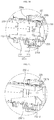
- FIG. 1 is a schematic cross-sectioned view showing a conventional air cooling battery module.
- FIG. 2 is a top view showing an air cooling battery module according to an embodiment of the present disclosure.
- FIG. 3 is a perspective view showing a cell assembly of FIG. 2 .
- FIG. 4 is an enlarged view showing a portion I of FIG. 3 .
- FIG. 5 is a perspective view showing an inlet duct of FIG. 2 .
- FIG. 6 is a perspective view showing the inlet duct of FIG. 5 from which a housing is partially removed.
- FIG. 7 is a top view of FIG. 6 .
- FIG. 8 is a schematic cross-sectioned view showing an air cooling battery module according to an embodiment of the present disclosure.
- FIG. 9 is a partially enlarged view of FIG. 8 for illustrating an air flow by a guide vane.
- FIG. 10 is a diagram showing a modified example of the guide vane of FIG. 4 .
- FIG. 11 is a diagram showing another modified example of the guide vane of FIG. 4 .
- FIG. 12 is a diagram showing a still another modified example of the guide vane of FIG. 4 .
- FIG. 2 is a top view showing an air cooling battery module according to an embodiment of the present disclosure
- FIG. 3 is a perspective view showing a cell assembly of FIG. 2
- FIG. 4 is an enlarged view showing a portion I of FIG. 3 .
- an air cooling battery module includes a cell assembly 100 , an inlet duct 200 and an outlet duct 300 .
- the air cooling battery module may be regarded as an I-type module in which an air inlet 220 , an air channel 130 and an air outlet 310 are arranged side by side in order so that a cooling air is guided to flow in one direction as a whole.
- the cooling air flows in with a smaller incident angle in comparison to a U-type or Z-type module, so the cooling air may smoothly enter the air channel 130 and flow fast to improve the cooling efficiency.
- the cell assembly 100 includes a plurality of battery cells 110 arranged side by side in one direction and air channels 130 provided at the intervals of the battery cells 110 .
- the battery cell 110 may be a lithium ion battery, a lithium polymer battery, a nickel cadmium battery, a nickel hydrogen battery, a nickel zinc battery, or the like, which allow charging and discharging.
- the battery cells 110 may be connected in series and/or in parallel depending on the required output voltage or charge/discharge capacity.
- the cell assembly 100 may further include a plurality of cartridges 120 for supporting the battery cells 110 , a plurality of bus bars 140 for electrically connecting the battery cells 110 to each other, and a support frame 150 for supporting the stack of the cartridges 120 and the bus bars 140 .
- the cartridges 120 are used for stacking the battery cells 110 .
- the cartridges 120 hold the battery cells 110 to prevent the battery cells 110 from moving and are configured to be assembled with each other in a snap-fit manner to guide assembling of the battery cells 110 .
- the cartridge 120 may include a rectangular ring-shaped frame and a pair of cooling plates that cover upper and lower ends of the frame.
- One battery cell 110 may be placed on each of top and bottom portions of the pair of cooling plates.
- the air channel 130 may be provided between the pair of cooling plates.
- the rectangular frame may have a cut portion formed by perforating the frame in a horizontal direction.
- the cut portion may be provided at two opposite sides of the rectangular frame.
- a cooling fluid such as air may enter the air channel 130 through the cut portion at one side of the frame and exit through the cut portion at the other side of the frame.
- the pair of cooling plates may cool the battery cell 110 by maintaining low temperature in contact with the cooling air.
- Such unit cartridges 120 may be coupled in one direction in a snap-fit manner to form a stack of the cartridges 120 .
- electrode leads of the battery cells 110 may extend outward from the inside of the cartridges 120 .
- Terminals of electrode leads of neighboring battery cells 110 may be welded to one bus bar 140 to be electrically connected with each other.
- the plurality of bus bars 140 may be assembled at one board, and the board may be mounted on a front or rear surface of the stack of the cartridges 120 .
- the electrode leads of the battery cells 110 may be welded to the bus bars 140 so that the battery cells 110 may be connected in series and/or in parallel.
- the support frame 150 is a structure that integrally fixes the plurality of cartridges 120 at the front and rear surfaces of the stack of the cartridges 120 .
- the support frame 150 may include a plurality of insulation plates 160 , which are made of an insulating material to prevent a short circuit between the bus bars 140 .
- the insulation plates 160 are configured to protrude more than the bus bars 140 to form a barrier between two bus bars 140 adjacent to each other.
- the cell assembly 100 may also be configured by connecting at least two unit cell assemblies 100 in a lateral direction. For example, as shown in FIG. 3 , two unit cell assemblies 100 may be connected to configure a high capacity cell assembly 100 having about 28 battery cells 110 . According to this configuration, the capacity of the battery module may be easily increased by adding a unit cell assembly 100 to the existing cell assembly 100 .
- the battery module according to the present disclosure is configured such that inlets and outlets of the air channels 130 as well as the electrode leads and the bus bars 140 are respectively located at the front and rear portions of the cell assembly 100 .
- the inlet duct 200 and the outlet duct 300 are mounted to cover the front and rear portions of the cell assembly 100 , respectively.
- the cooling air blown into the front surface of the cell assembly 100 through the inlet duct 200 flows through the air channels 130 to the rear surface of the cell assembly 100 and then is discharged out through the outlet duct 300 .
- the connection region between the electrode lead and the bus bar 140 at which heat is seriously generated during the charging and discharging process is exposed to the flow of the cooling air, and thus it is possible to more effectively suppress heating at the connection region.
- inlet duct 200 will be described in more detail with reference to FIGS. 5 to 7 .
- FIG. 5 is a perspective view showing the inlet duct 200 of FIG. 2
- FIG. 6 is a perspective view showing the inlet duct 200 of FIG. 5 from which a housing 210 is partially removed
- FIG. 7 is a top view of FIG. 6 .
- the air inlet 220 is located at the center of the arrangement of the air channels 130 and the distance between the air channels 130 and the air inlet 220 is relatively short. Thus, the cooling air may not be easily distributed to the air channels 130 arranged in parallel.
- the battery module according to the present disclosure additionally includes a guide vane 230 provided in the inlet duct 200 for the uniform flow rate distribution of the cooling air at the inlets of the air channels 130 .
- the inlet duct 200 includes a duct housing 210 provided to cover the front portion of the cell assembly 100 , an air inlet 220 for introducing a cooling air, and a guide vane 230 provided behind the air inlet 220 at the inside of the duct housing 210 .
- the duct housing 210 is provided to integrally cover the front portion of the cell assembly 100 , namely the air channels 130 .
- the duct housing 210 has an inner cover surface 211 that forms an inclined surface.
- the inner cover surface 211 extends to both edge portions of the cell assembly 100 from the air inlet 220 .
- the inner cover surface 211 guides the flow of cooling air so that the cooling air blown from the air inlet 220 may be diffused toward both sides of the duct housing 210 .
- the air inlet 220 is provided at the center of the duct housing 210 .
- the air inlet 220 is placed to face air channels 130 in the middle region of the arrangement of the air channels 130 with a predetermined interval.
- a cooling fan 221 is provided at the air inlet 220 to provide a cooling air.
- the cooling fan 221 may be controlled to turn on/off by a cooling controller based on temperature information of the battery cells 110 .
- the guide vane 230 may be composed of a plurality of plate barriers extending obliquely at a predetermined acute angle ( 0 ) toward the air channels 130 based on the air inlet 220 .
- the predetermined acute angle ( 0 ) may be determined depending on a total length of the plurality of air channels 130 arranged in parallel with respect to the air inlet 220 or a lateral width of the cell assembly 100 .
- the guide vane 230 serves to diffuse the cooling air at the center of the air inlet 220 in a lateral direction so that the flow rate of the cooling air may be uniformly distributed to the air channels 130 .
- the guide vane 230 of this embodiment is segmented behind the air inlet 220 to have four plate barriers 230 a , 230 b , 230 c , 230 d that are symmetrical in lateral and vertical directions.
- the four plate barriers 230 a , 230 b , 230 c , 230 d of the guide vane 230 have substantially the same shape, and any one plate barrier is symmetrical to another other plate barrier in a vertical or lateral direction. Gaps of a predetermined interval are formed among the four plate barriers 230 a , 230 b , 230 c , 230 d so that the cooling air may pass through the gaps.
- Each of the plate borders 230 a , 230 b , 230 c , 230 d may be configured as a main plate barrier 231 and a sub plate barrier 232 .
- the main plate barrier 231 and the sub plate barrier 232 are conceptually separated elements, and the main plate barrier 231 and the sub plate barrier 232 may be integrally formed.
- the main plate barrier 231 is located in a region where the cooling air is substantially vertically introduced through the air inlet 220 , and the sub plate barrier 232 has a width smaller than the main plate barrier 231 and extends outward from the main plate barrier 231 beyond the air inlet 220 .
- the gap between the first plate barrier 230 a and the third plate barrier 230 c is enlarged from G 2 to G 3 at the boundary between the main plate barrier 231 and the sub plate barrier 232 . Since the guide vane 230 is symmetrical in a lateral direction, the gap between the second plate barrier and the fourth plate barrier also has the same configuration as above.
- the cooling air may flow in the directions a and b through the gaps G 1 , G 2 between the main plate barriers 231 from the air inlet 220 .
- the air flow guided along the inclined surface of the main plate barrier 231 may partially flow in the direction c at the point where the gap expands from G 2 to G 3 , and the remaining air flow may flow along the gap G 3 and the inclined surface of the sub plate barrier 232 in the direction d, namely farther in the lateral direction.
- the main plate barrier 231 and the sub plate barrier 232 may serve to prevent the flow rate from concentrating in the air channel 130 in the middle region of the air channels 130 and also to distribute the air flow in the lateral direction.
- FIG. 8 is a schematic cross-sectioned view showing an air cooling battery module according to an embodiment of the present disclosure
- FIG. 9 is a partially enlarged view of FIG. 8 for illustrating an air flow by a guide vane.
- the air channels 130 are classified into several regions according to their positions based on the air inlet 220 .
- the air channels 130 located in the middle of the arrangement of the air channels 130 and facing the air inlet 220 are defined as being positioned in a first region A
- the air channels 130 located at the right and left sides of the first region A and belonging to a range facing the air inlet 220 are defined as being positioned in a second region B
- the air channels 130 belonging to a range corresponding to the sub plate barrier 232 from the second region B are defined as being positioned in a third region C
- the air channel 130 located in a range from the third region C to an outermost air channel 130 are defined as being positioned in a fourth region D.
- the large flow of the cooling air which may be guided by the guide vane 230 at the rear of the air inlet 220 , may be briefly regarded as four air flows a, b, c, d as described above (see FIG. 6 ).
- the four cooling air flows (see FIG. 9 ) may be directed to the air channels 130 in the first region A to the fourth region D, respectively. That is, the flows a, b of the cooling air may be directly introduced into the air channels 130 in the first region A and the second region B through the gaps G 1 , G 2 between the main plate barriers 231 . Even though the flows a, b of the cooling air pass through the narrow gaps G 1 , G 2 , the flow velocity is fast at the center of the air inlet 220 , so the flow rate is relatively not small compared to other parts.
- the flow c of the cooling air may be guided by the inclined surface of the main plate barrier 231 and introduced into the air channels 130 in the third region C through the gap G 3 .
- the flow c of the cooling air is slightly aside at the air inlet 220 in a lateral direction and thus has a relatively lower flow velocity, compared to the central portion, but since the gap through which the flow c passes is enlarged to G 3 , the flow rate reaching the third region C may be compensated as much.
- the flow d of the cooling air may be guided by the inclined surfaces of the main plate barrier 231 and the sub plate barrier 232 and be introduced into the air channels 130 in the fourth region D through the gap G 3 .
- the flow d of the cooling air may have a lowest flow velocity since it is aside farthest from the air inlet 220 , but the flow rate of the cooling air that may be guided by the plate barriers is greatest.
- the flows a, b, c, d of the cooling air by the guide vane 230 are introduced into the air channels 130 in the first region A to the fourth region D while compensating their air flow and velocity for each other, and thus the flow rate distributed to the air channels 130 may be almost uniform.
- the air cooling battery module according to the present disclosure is an I-type module, and the cooling air enters smoothly at the inlets of the air channels 130 arranged in parallel, compared to a U-type or Z-type module.
- the guide vane 230 according to the present disclosure even though the air inlet 220 is located at the center and the distance to the air channels is short, it is possible to provide the cooling air to all air channels 130 in a uniform flow rate.
- modified examples of the guide vane 230 of this embodiment will be described.
- the modified examples of the present disclosure described below may be regarded as corresponding to FIG. 4 , when being compared to the above modified examples.
- the same reference numerals denote the same components, and the same components will not be described in detail, but different features from the guide vane 230 described above will be described in detail.
- FIG. 10 is a diagram showing a modified example of the guide vane 230 of FIG. 4
- FIG. 11 is a diagram showing another modified example of the guide vane 230 of FIG. 4
- FIG. 12 is a diagram showing a still another modified example of the guide vane 230 of FIG. 4 .
- the guide vane 230 of this modified example further includes a tail portion 233 formed by bending a terminal of the sub plate barrier 232 toward the inlets of the air channels 130 .
- the air channels 130 in the fourth region D are in a broader range.
- the tail portion 233 of the sub plate barrier 232 may further divide the air flow d more minutely so that the air flow may be distributed more uniformity for the air channels 130 in the fourth region D.
- a tail portion similar to the tail portion 233 of the sub plate barrier 232 may also be formed at a terminal of the main plate barrier 231 in a similar manner to divide the flow of the cooling air more minutely.
- the plate barriers 230 ′ a , 230 ′ b , 230 ′ c , 230 ′ d may have a width that is gradually decreasing as the distance from the air inlet 220 increases.
- the gap G 4 between the plate barriers 230 ′ a , 230 ′ b , 230 ′ c , 230 ′ d is gradually enlarged in an outer direction.
- the flow rate of the cooling air passing through the gap G 4 gradually increases in a lateral direction from the central portion based on the air inlet 220 .
- the guide vane 230 may be an effective alternative to the above embodiment when the air inlet 220 has a sufficiently large size or the cell assembly 100 has a relatively small width.
- the guide vane 230 of this modified example may include two plate barriers 230 ′′ segmented into two parts at the rear of the air inlet 220 and symmetrical in a lateral direction.
- a gap G 5 through which the cooling air may pass may be formed between the two plate barriers 230 ′′, similarly to the above embodiment.
- the overall air flow may be defined as three flows by means of the two plate barriers 230 ′′. That is, there may be an air flow passing through the gap G 5 and air flows passing through the space between the two plate barriers 230 ′′ at both sides.
- this modified example could be a good alternative of the second modified example described above, when the inlet duct 200 covers one unit cell assembly 100 of the above embodiment or when the air inlet 220 is sufficiently large or the number of the air channels 130 is relatively small.
- the battery module according to the present disclosure may be applied to configure an energy storage system (ESS) or a battery pack together with various devices for controlling charge and discharge such as a battery management system (BMS), a current sensor, and a fuse.
- ESS energy storage system
- BMS battery management system
- the battery module may also be applied not only to vehicles such as electric vehicles and hybrid electric vehicles but also to other information technology (IT) products.
- Reference Signs 100 cell assembly 110: battery cell 120: cartridge 130: air channel 140: bus bar 150: support frame 160: insulation plate 200: inlet duct 210: duct housing 220: air inlet 230: guide vane 231: main plate barrier 232: sub plate barrier 300: outlet duct
Landscapes
- Chemical & Material Sciences (AREA)
- Chemical Kinetics & Catalysis (AREA)
- Electrochemistry (AREA)
- General Chemical & Material Sciences (AREA)
- Engineering & Computer Science (AREA)
- Manufacturing & Machinery (AREA)
- Secondary Cells (AREA)
- Battery Mounting, Suspending (AREA)
Abstract
Description
| Reference Signs |
| 100: cell assembly | 110: battery cell | ||
| 120: cartridge | 130: air channel | ||
| 140: bus bar | 150: support frame | ||
| 160: insulation plate | 200: inlet duct | ||
| 210: duct housing | 220: air inlet | ||
| 230: guide vane | 231: main plate barrier | ||
| 232: sub plate barrier | 300: outlet duct | ||
Claims (10)
Applications Claiming Priority (2)
| Application Number | Priority Date | Filing Date | Title |
|---|---|---|---|
| KR10-2017-0024650 | 2017-02-24 | ||
| KR1020170024650A KR102142669B1 (en) | 2017-02-24 | 2017-02-24 | Air cooling type Battery Module having Guide vane |
Publications (2)
| Publication Number | Publication Date |
|---|---|
| US20180248239A1 US20180248239A1 (en) | 2018-08-30 |
| US10944139B2 true US10944139B2 (en) | 2021-03-09 |
Family
ID=63247016
Family Applications (1)
| Application Number | Title | Priority Date | Filing Date |
|---|---|---|---|
| US15/901,321 Active 2038-07-01 US10944139B2 (en) | 2017-02-24 | 2018-02-21 | Air cooling battery module having guide vane |
Country Status (2)
| Country | Link |
|---|---|
| US (1) | US10944139B2 (en) |
| KR (1) | KR102142669B1 (en) |
Cited By (1)
| Publication number | Priority date | Publication date | Assignee | Title |
|---|---|---|---|---|
| US12119472B2 (en) | 2021-12-10 | 2024-10-15 | Wing Aviation Llc | Active thermal control of UAV energy storage units |
Families Citing this family (21)
| Publication number | Priority date | Publication date | Assignee | Title |
|---|---|---|---|---|
| CN107710495B (en) * | 2015-07-24 | 2020-12-01 | 松下知识产权经营株式会社 | Thermostat unit, thermostat system, vehicle |
| DE102017209604A1 (en) * | 2017-06-07 | 2018-12-13 | Röchling Automotive SE & Co. KG | Battery module with flow guide formation in the module housing |
| CN109817858B (en) * | 2019-01-25 | 2024-07-12 | 北京海博思创科技股份有限公司 | battery box |
| JP7107247B2 (en) * | 2019-02-22 | 2022-07-27 | 株式会社デンソー | battery module |
| US11267354B2 (en) * | 2019-08-16 | 2022-03-08 | DESIGNWERK TECHNOLOGIES GmbH | Power supply |
| CN110690525B (en) * | 2019-08-27 | 2022-07-01 | 江苏大学 | Chute interactive necking channel liquid cooling plate |
| CN110957547B (en) * | 2019-12-19 | 2024-05-28 | 江苏华强新能源科技有限公司 | Low-pressure-loss main air duct configuration of energy storage container |
| KR102699541B1 (en) | 2020-02-27 | 2024-08-27 | 주식회사 엘지에너지솔루션 | Battery module having a structure that allows the sprinkler to operate quickly and the Energy Storage System comprising the same |
| JP7307010B2 (en) * | 2020-02-28 | 2023-07-11 | トヨタ自動車株式会社 | Cooler |
| CN113471584B (en) * | 2020-03-31 | 2024-05-28 | 东莞新能安科技有限公司 | Battery pack and electric vehicle |
| CN111834697A (en) * | 2020-06-30 | 2020-10-27 | 力神动力电池系统有限公司 | An air-cooled energy storage module based on square iron lithium battery |
| KR102842539B1 (en) * | 2020-07-21 | 2025-08-04 | 주식회사 엘지에너지솔루션 | Battery module and battery pack including the same |
| CN111952507B (en) * | 2020-08-25 | 2022-08-12 | 张玉清 | New energy automobile group battery heat abstractor |
| KR102900267B1 (en) | 2020-10-08 | 2025-12-12 | 주식회사 엘지에너지솔루션 | Battery Module, Battery Rack, and Energy Storage System |
| KR20220076052A (en) | 2020-11-30 | 2022-06-08 | 에이치그린파워 주식회사 | A cooling structure for cylindrical battery cell assembly |
| CN112366391B (en) * | 2020-12-11 | 2022-08-16 | 北京海博思创科技股份有限公司 | Energy storage battery cabinet |
| CN113078399B (en) * | 2021-03-22 | 2023-05-30 | 浙江龙能电力科技股份有限公司 | Energy storage battery box with high reliability |
| CN114628810B (en) * | 2022-01-21 | 2024-06-18 | 中天储能科技有限公司 | Ventilation structure and energy storage equipment |
| CN115395136B (en) * | 2022-09-01 | 2024-06-25 | 厦门海辰储能科技股份有限公司 | Heat dissipation air duct structure and energy storage equipment |
| CN119108749B (en) * | 2024-11-08 | 2025-04-25 | 河南华瑞高新材料有限公司 | A mounting device for lithium battery |
| CN119994354B (en) * | 2025-04-17 | 2025-08-08 | 宁德时代新能源科技股份有限公司 | Battery device and electricity utilization device |
Citations (16)
| Publication number | Priority date | Publication date | Assignee | Title |
|---|---|---|---|---|
| US20060115721A1 (en) * | 2004-11-30 | 2006-06-01 | Gun-Goo Lee | Secondary battery module |
| US20070026301A1 (en) * | 2005-07-29 | 2007-02-01 | Gun-Goo Lee | Battery module having improved cooling efficiency |
| US20070144804A1 (en) * | 2005-10-19 | 2007-06-28 | Railpower Technologies, Corp. | Design of a large low maintenance battery pack for a hybrid locomotive |
| US20080299448A1 (en) * | 2006-11-20 | 2008-12-04 | Derrick Scott Buck | Battery unit with temperature control device |
| EP1202359B1 (en) | 2000-10-31 | 2009-01-14 | Sanyo Electric Co., Ltd. | Cooling arrangement for power supply apparatus |
| US7642006B2 (en) | 2004-11-29 | 2010-01-05 | Samsung Sdi Co., Ltd. | Secondary battery module |
| US20100075206A1 (en) * | 2008-09-24 | 2010-03-25 | Denso Corporation | On-board battery assembly |
| KR20120055156A (en) | 2010-11-23 | 2012-05-31 | 주식회사 엘지화학 | Battery module having novel structure and battery pack employed with the same |
| US20150064540A1 (en) * | 2012-06-07 | 2015-03-05 | Lg Chem, Ltd. | Battery module having structure of improved stability and high cooling efficiency |
| KR20160024688A (en) | 2014-08-26 | 2016-03-07 | 주식회사 엘지화학 | Battery pack of improved cooling efficiency |
| US20160226116A1 (en) * | 2015-01-30 | 2016-08-04 | Samsung Sdi Co., Ltd. | Battery pack |
| JP6064179B2 (en) * | 2014-06-11 | 2017-01-25 | パナソニックIpマネジメント株式会社 | Temperature conditioning unit, temperature conditioning system, and vehicle equipped with temperature conditioning unit |
| US20170187083A1 (en) * | 2014-07-11 | 2017-06-29 | Robert Bosch Gmbh | Housing for accommodation of a plurality of battery cells having a cooling device integrated in the housing |
| US20180083326A1 (en) * | 2015-09-14 | 2018-03-22 | Panasonic Intellectual Property Management Co., Ltd. | Temperature conditioning unit, temperature conditioning system, and vehicle |
| US20180159188A1 (en) * | 2015-07-24 | 2018-06-07 | Panasonic Intellectual Property Management Co., Ltd. | Temperature conditioning unit, temperature conditioning system, and vehicle |
| US20180331402A1 (en) * | 2017-05-10 | 2018-11-15 | Denso Corporation | Control module connected to battery module |
Family Cites Families (2)
| Publication number | Priority date | Publication date | Assignee | Title |
|---|---|---|---|---|
| KR100627394B1 (en) * | 2004-11-30 | 2006-09-21 | 삼성에스디아이 주식회사 | Secondary battery module |
| KR101693290B1 (en) * | 2013-04-18 | 2017-01-05 | 삼성에스디아이 주식회사 | Rechargeable battery module |
-
2017
- 2017-02-24 KR KR1020170024650A patent/KR102142669B1/en active Active
-
2018
- 2018-02-21 US US15/901,321 patent/US10944139B2/en active Active
Patent Citations (17)
| Publication number | Priority date | Publication date | Assignee | Title |
|---|---|---|---|---|
| EP1202359B1 (en) | 2000-10-31 | 2009-01-14 | Sanyo Electric Co., Ltd. | Cooling arrangement for power supply apparatus |
| US7642006B2 (en) | 2004-11-29 | 2010-01-05 | Samsung Sdi Co., Ltd. | Secondary battery module |
| US20060115721A1 (en) * | 2004-11-30 | 2006-06-01 | Gun-Goo Lee | Secondary battery module |
| US20070026301A1 (en) * | 2005-07-29 | 2007-02-01 | Gun-Goo Lee | Battery module having improved cooling efficiency |
| US20070144804A1 (en) * | 2005-10-19 | 2007-06-28 | Railpower Technologies, Corp. | Design of a large low maintenance battery pack for a hybrid locomotive |
| US20080299448A1 (en) * | 2006-11-20 | 2008-12-04 | Derrick Scott Buck | Battery unit with temperature control device |
| US20100075206A1 (en) * | 2008-09-24 | 2010-03-25 | Denso Corporation | On-board battery assembly |
| KR20120055156A (en) | 2010-11-23 | 2012-05-31 | 주식회사 엘지화학 | Battery module having novel structure and battery pack employed with the same |
| US20150064540A1 (en) * | 2012-06-07 | 2015-03-05 | Lg Chem, Ltd. | Battery module having structure of improved stability and high cooling efficiency |
| JP6064179B2 (en) * | 2014-06-11 | 2017-01-25 | パナソニックIpマネジメント株式会社 | Temperature conditioning unit, temperature conditioning system, and vehicle equipped with temperature conditioning unit |
| US20170096079A1 (en) * | 2014-06-11 | 2017-04-06 | Panasonic Intellectua[ Property Management Co., Ltd | Temperature conditioning unit, temperature conditioning system, and vehicle provided with temperature conditioning unit |
| US20170187083A1 (en) * | 2014-07-11 | 2017-06-29 | Robert Bosch Gmbh | Housing for accommodation of a plurality of battery cells having a cooling device integrated in the housing |
| KR20160024688A (en) | 2014-08-26 | 2016-03-07 | 주식회사 엘지화학 | Battery pack of improved cooling efficiency |
| US20160226116A1 (en) * | 2015-01-30 | 2016-08-04 | Samsung Sdi Co., Ltd. | Battery pack |
| US20180159188A1 (en) * | 2015-07-24 | 2018-06-07 | Panasonic Intellectual Property Management Co., Ltd. | Temperature conditioning unit, temperature conditioning system, and vehicle |
| US20180083326A1 (en) * | 2015-09-14 | 2018-03-22 | Panasonic Intellectual Property Management Co., Ltd. | Temperature conditioning unit, temperature conditioning system, and vehicle |
| US20180331402A1 (en) * | 2017-05-10 | 2018-11-15 | Denso Corporation | Control module connected to battery module |
Non-Patent Citations (1)
| Title |
|---|
| Office Action dated Jan. 15, 2020, issued in corresponding Korean Patent Application No. 10-2017-0024650. |
Cited By (1)
| Publication number | Priority date | Publication date | Assignee | Title |
|---|---|---|---|---|
| US12119472B2 (en) | 2021-12-10 | 2024-10-15 | Wing Aviation Llc | Active thermal control of UAV energy storage units |
Also Published As
| Publication number | Publication date |
|---|---|
| KR102142669B1 (en) | 2020-08-07 |
| KR20180097898A (en) | 2018-09-03 |
| US20180248239A1 (en) | 2018-08-30 |
Similar Documents
| Publication | Publication Date | Title |
|---|---|---|
| US10944139B2 (en) | Air cooling battery module having guide vane | |
| JP4659699B2 (en) | Battery module | |
| US8748027B2 (en) | Middle or large-sized battery pack case providing improved distribution uniformity of coolant flux | |
| EP2631985B1 (en) | Battery pack having excellent cooling efficiency | |
| US11444353B2 (en) | Battery pack | |
| CN102106019B (en) | Medium and large battery pack case having excellent cooling efficiency | |
| KR102172846B1 (en) | Battery pack | |
| EP2127001B1 (en) | Middle or large-sized battery pack case providing improved distribution uniformity in coolant flux | |
| US9614206B2 (en) | Middle or large-sized battery pack case providing improved distribution uniformity in coolant flux | |
| KR101709555B1 (en) | Battery Module Assembly Having Coolant Flow Channel | |
| EP3316340B1 (en) | Battery module | |
| EP2642586B1 (en) | Battery pack having improved cooling efficiency | |
| EP1753069B1 (en) | Battery module | |
| US8765287B2 (en) | Battery module | |
| EP2469640A2 (en) | Battery pack having a novel cooling structure | |
| US20130071719A1 (en) | Battery pack case having novel structure | |
| US20230307745A1 (en) | Battery module, battery pack including the same, vehicle including the same | |
| US12512529B2 (en) | Air-cooled battery pack for electric vehicle | |
| KR20130102713A (en) | Battery pack of novel air cooling structure | |
| US20250391950A1 (en) | Battery and electrical apparatus | |
| CN224005942U (en) | Battery module including busbar holes | |
| KR102850649B1 (en) | Cooling apparatus for double-sided type battery module | |
| EP4528888A1 (en) | Battery pack with reduced temperature deviation | |
| US20240405395A1 (en) | Battery module | |
| JP2025109363A (en) | Power storage device |
Legal Events
| Date | Code | Title | Description |
|---|---|---|---|
| AS | Assignment |
Owner name: LG CHEM, LTD., KOREA, REPUBLIC OF Free format text: ASSIGNMENT OF ASSIGNORS INTEREST;ASSIGNORS:NAM, JIN-MOO;SHIN, JIN-KYU;PARK, JUNG-IL;AND OTHERS;SIGNING DATES FROM 20180209 TO 20180212;REEL/FRAME:044989/0650 |
|
| FEPP | Fee payment procedure |
Free format text: ENTITY STATUS SET TO UNDISCOUNTED (ORIGINAL EVENT CODE: BIG.); ENTITY STATUS OF PATENT OWNER: LARGE ENTITY |
|
| STPP | Information on status: patent application and granting procedure in general |
Free format text: DOCKETED NEW CASE - READY FOR EXAMINATION |
|
| STPP | Information on status: patent application and granting procedure in general |
Free format text: NON FINAL ACTION MAILED |
|
| STPP | Information on status: patent application and granting procedure in general |
Free format text: RESPONSE TO NON-FINAL OFFICE ACTION ENTERED AND FORWARDED TO EXAMINER |
|
| STPP | Information on status: patent application and granting procedure in general |
Free format text: NON FINAL ACTION MAILED |
|
| STPP | Information on status: patent application and granting procedure in general |
Free format text: RESPONSE TO NON-FINAL OFFICE ACTION ENTERED AND FORWARDED TO EXAMINER |
|
| STPP | Information on status: patent application and granting procedure in general |
Free format text: FINAL REJECTION MAILED |
|
| STPP | Information on status: patent application and granting procedure in general |
Free format text: DOCKETED NEW CASE - READY FOR EXAMINATION |
|
| STCF | Information on status: patent grant |
Free format text: PATENTED CASE |
|
| AS | Assignment |
Owner name: LG ENERGY SOLUTION, LTD., KOREA, REPUBLIC OF Free format text: ASSIGNMENT OF ASSIGNORS INTEREST;ASSIGNOR:LG CHEM, LTD.;REEL/FRAME:058295/0068 Effective date: 20211027 |
|
| MAFP | Maintenance fee payment |
Free format text: PAYMENT OF MAINTENANCE FEE, 4TH YEAR, LARGE ENTITY (ORIGINAL EVENT CODE: M1551); ENTITY STATUS OF PATENT OWNER: LARGE ENTITY Year of fee payment: 4 |