US10937975B2 - Organometallic compound, organic light-emitting device including organometallic compound, and diagnostic composition including organometallic compound - Google Patents
Organometallic compound, organic light-emitting device including organometallic compound, and diagnostic composition including organometallic compound Download PDFInfo
- Publication number
- US10937975B2 US10937975B2 US16/030,074 US201816030074A US10937975B2 US 10937975 B2 US10937975 B2 US 10937975B2 US 201816030074 A US201816030074 A US 201816030074A US 10937975 B2 US10937975 B2 US 10937975B2
- Authority
- US
- United States
- Prior art keywords
- group
- substituted
- unsubstituted
- formula
- salt
- Prior art date
- Legal status (The legal status is an assumption and is not a legal conclusion. Google has not performed a legal analysis and makes no representation as to the accuracy of the status listed.)
- Active, expires
Links
- 0 *C(C)(C)C.*C(C)C.*C(C)C(C)(C)C.*C(C)C(C)C.*C(C)CC.*C([2H])([2H])C(C([2H])([2H])[2H])(C([2H])([2H])[2H])C([2H])([2H])[2H].*C([2H])([2H])C([2H])(C([2H])([2H])[2H])C([2H])([2H])[2H].*CC.*CC(C([2H])([2H])[2H])(C([2H])([2H])[2H])C([2H])([2H])[2H].*CC(C)(C)C.*CC(C)C.*CC([2H])(C([2H])([2H])[2H])C([2H])([2H])[2H].*CC([2H])([2H])[2H].*CCC.*CCCC.*CCCCC.*CCCCCC Chemical compound *C(C)(C)C.*C(C)C.*C(C)C(C)(C)C.*C(C)C(C)C.*C(C)CC.*C([2H])([2H])C(C([2H])([2H])[2H])(C([2H])([2H])[2H])C([2H])([2H])[2H].*C([2H])([2H])C([2H])(C([2H])([2H])[2H])C([2H])([2H])[2H].*CC.*CC(C([2H])([2H])[2H])(C([2H])([2H])[2H])C([2H])([2H])[2H].*CC(C)(C)C.*CC(C)C.*CC([2H])(C([2H])([2H])[2H])C([2H])([2H])[2H].*CC([2H])([2H])[2H].*CCC.*CCCC.*CCCCC.*CCCCCC 0.000 description 88
- OTMSDBZUPAUEDD-UHFFFAOYSA-N CC Chemical compound CC OTMSDBZUPAUEDD-UHFFFAOYSA-N 0.000 description 4
- FJBLQUNKRRGWJT-ASVLONODSA-N CC.CC.CC.CC.CC.CC.CC.CC.CC(C)CC(C(C)C)(C(C)C)C(C)C.C[3H]C.C[3H]C.C[3H]C.C[Y].[3H][3H].[3H][3H](C)C.[3H][3H][3H].[Y]C([Y])([Y])[Y].[Y]C([Y])[Y].[Y]C[Y] Chemical compound CC.CC.CC.CC.CC.CC.CC.CC.CC(C)CC(C(C)C)(C(C)C)C(C)C.C[3H]C.C[3H]C.C[3H]C.C[Y].[3H][3H].[3H][3H](C)C.[3H][3H][3H].[Y]C([Y])([Y])[Y].[Y]C([Y])[Y].[Y]C[Y] FJBLQUNKRRGWJT-ASVLONODSA-N 0.000 description 4
- LGXOKUGFXZDVTB-UHFFFAOYSA-N CC.CC.CC.CC.CC.CC.CC.CC.CC.CC.CC.CC.CC.CC.CC.CC.CC1=CC=CC=C1C.CC1=CC=CN=C1C.CC1=CC=CN=C1C.CC1=CC=NC=C1C.CC1=CC=NC=C1C.CC1=CN=CN=C1C.CC1=CN=CN=C1C.CC1=NC=CN=C1C Chemical compound CC.CC.CC.CC.CC.CC.CC.CC.CC.CC.CC.CC.CC.CC.CC.CC.CC1=CC=CC=C1C.CC1=CC=CN=C1C.CC1=CC=CN=C1C.CC1=CC=NC=C1C.CC1=CC=NC=C1C.CC1=CN=CN=C1C.CC1=CN=CN=C1C.CC1=NC=CN=C1C LGXOKUGFXZDVTB-UHFFFAOYSA-N 0.000 description 2
- QKADKIIVDBALJN-UHFFFAOYSA-N CC.CC.CC.CC.CC.CC.CC.CC.CC.CC.CC.CC.CC1=C(C)C2=C(C=C1)C1=C(C=CC=C1)C2.CC1=C(C)C2=C(C=C1)CC1=C2C=CC=C1.CC1=CC2=C(C=C1C)C1=C(C=CC=C1)C2.CC1=CC2=C(C=C1C)C1=C(C=CC=C1)C2.CC1=CC=C2C3=C(C=CC=C3)CC2=C1C.CC1=CC=C2CC3=C(C=CC=C3)C2=C1C Chemical compound CC.CC.CC.CC.CC.CC.CC.CC.CC.CC.CC.CC.CC1=C(C)C2=C(C=C1)C1=C(C=CC=C1)C2.CC1=C(C)C2=C(C=C1)CC1=C2C=CC=C1.CC1=CC2=C(C=C1C)C1=C(C=CC=C1)C2.CC1=CC2=C(C=C1C)C1=C(C=CC=C1)C2.CC1=CC=C2C3=C(C=CC=C3)CC2=C1C.CC1=CC=C2CC3=C(C=CC=C3)C2=C1C QKADKIIVDBALJN-UHFFFAOYSA-N 0.000 description 2
- STADHTITFXMQSW-UHFFFAOYSA-M CC1(C)C2=CC=CC3=C2C2=C1C=CC1=N2[Pt]2(O3)C3=C1C=CC=C3N(C1=CC=CC=C1)C1=N2C=CC(N(C2=CC=CC=C2)C2=CC=CC=C2)=C1 Chemical compound CC1(C)C2=CC=CC3=C2C2=C1C=CC1=N2[Pt]2(O3)C3=C1C=CC=C3N(C1=CC=CC=C1)C1=N2C=CC(N(C2=CC=CC=C2)C2=CC=CC=C2)=C1 STADHTITFXMQSW-UHFFFAOYSA-M 0.000 description 2
- GCTSOPIAJLWKAF-UHFFFAOYSA-I CC1(C)C2=CC=CC3=C2C2=C1C=CC1=N2[Pt]2(O3)C3=C1C=CC=C3N(C1=CC=CC=C1)C1=N2C=CC(N(C2=CC=CC=C2)C2=CC=CC=C2)=C1.CN(C)C1=CC2=N(C=C1)[Pt]13OC4=C5C(=CC=C4)C(C)(C)C4=C5N1=C(C=C4)C1=C3C(=CC=C1)N2C1=CC=CC=C1.CN(C1=CC2=N(C=C1)[Pt]13OC4=C5C(=CC=C4)C(C)(C)C4=C5N1=C(C=C4)C1=C3C(=CC=C1)N2C1=CC=CC=C1)C1=NC=CO1.CN(C1=CC=CC=C1)C1=CC2=N(C=C1)[Pt]13OC4=C5C(=CC=C4)C(C)(C)C4=C5N1=C(C=C4)C1=C3C(=CC=C1)N2C1=CC=CC=C1.CN(C1=CC=CN=C1)C1=CC2=N(C=C1)[Pt]13OC4=C5C(=CC=C4)C(C)(C)C4=C5N1=C(C=C4)C1=C3C(=CC=C1)N2C1=CC=CC=C1 Chemical compound CC1(C)C2=CC=CC3=C2C2=C1C=CC1=N2[Pt]2(O3)C3=C1C=CC=C3N(C1=CC=CC=C1)C1=N2C=CC(N(C2=CC=CC=C2)C2=CC=CC=C2)=C1.CN(C)C1=CC2=N(C=C1)[Pt]13OC4=C5C(=CC=C4)C(C)(C)C4=C5N1=C(C=C4)C1=C3C(=CC=C1)N2C1=CC=CC=C1.CN(C1=CC2=N(C=C1)[Pt]13OC4=C5C(=CC=C4)C(C)(C)C4=C5N1=C(C=C4)C1=C3C(=CC=C1)N2C1=CC=CC=C1)C1=NC=CO1.CN(C1=CC=CC=C1)C1=CC2=N(C=C1)[Pt]13OC4=C5C(=CC=C4)C(C)(C)C4=C5N1=C(C=C4)C1=C3C(=CC=C1)N2C1=CC=CC=C1.CN(C1=CC=CN=C1)C1=CC2=N(C=C1)[Pt]13OC4=C5C(=CC=C4)C(C)(C)C4=C5N1=C(C=C4)C1=C3C(=CC=C1)N2C1=CC=CC=C1 GCTSOPIAJLWKAF-UHFFFAOYSA-I 0.000 description 2
- LFDCZVTZLVERSK-UHFFFAOYSA-J CC1(C)C2=CC=CC3=C2C2=C1C=CC1=N2[Pt]2(O3)C3=C1C=CC=C3N(C1=CC=CC=C1)C1=N2C=CC(N2C3=C(C=CC=C3)C3=C2C=CC=C3)=C1.CN(C)C1=CC2=N(C=C1)[Pt]13OC4=C5C(=CC=C4)C(C)(C)C4=C5N1=C(C=C4)C1=C3C(=CC=C1)N2C1=CC=CC=C1C1=CC=CC=C1.CN(C1=CC2=N(C=C1)[Pt]13OC4=C5C(=CC=C4)C(C)(C)C4=C5N1=C(C=C4)C1=C3C(=CC=C1)N2C1=CC=CC=C1)C1=C2C=CC=CC2=CC=C1.CN(C1=CC2=N(C=C1)[Pt]13OC4=C5C(=CC=C4)C(C)(C)C4=C5N1=C(C=C4)C1=C3C(=CC=C1)N2C1=CC=CC=C1)C1=C2C=CC=CC2=CC=N1 Chemical compound CC1(C)C2=CC=CC3=C2C2=C1C=CC1=N2[Pt]2(O3)C3=C1C=CC=C3N(C1=CC=CC=C1)C1=N2C=CC(N2C3=C(C=CC=C3)C3=C2C=CC=C3)=C1.CN(C)C1=CC2=N(C=C1)[Pt]13OC4=C5C(=CC=C4)C(C)(C)C4=C5N1=C(C=C4)C1=C3C(=CC=C1)N2C1=CC=CC=C1C1=CC=CC=C1.CN(C1=CC2=N(C=C1)[Pt]13OC4=C5C(=CC=C4)C(C)(C)C4=C5N1=C(C=C4)C1=C3C(=CC=C1)N2C1=CC=CC=C1)C1=C2C=CC=CC2=CC=C1.CN(C1=CC2=N(C=C1)[Pt]13OC4=C5C(=CC=C4)C(C)(C)C4=C5N1=C(C=C4)C1=C3C(=CC=C1)N2C1=CC=CC=C1)C1=C2C=CC=CC2=CC=N1 LFDCZVTZLVERSK-UHFFFAOYSA-J 0.000 description 2
- KWMCGMMRZMZGAC-UHFFFAOYSA-J CC1(C)C2=CC=CC3=C2C2=C1C=CC1=N2[Pt]2(O3)C3=C1C=CC=C3N(C1=CC=CC=C1C1=CC=CC=C1)C1=N2C=CC(N(C2=CC=CC=C2)C2=CC=CC=C2)=C1.CN(C1=CC2=N(C=C1)[Pt]13OC4=C5C(=CC=C4)C(C)(C)C4=C5N1=C(C=C4)C1=C3C(=CC=C1)N2C1=CC=CC=C1C1=CC=CC=C1)C1=NC=CO1.CN(C1=CC=CC=C1)C1=CC2=N(C=C1)[Pt]13OC4=C5C(=CC=C4)C(C)(C)C4=C5N1=C(C=C4)C1=C3C(=CC=C1)N2C1=CC=CC=C1C1=CC=CC=C1.CN(C1=CC=CN=C1)C1=CC2=N(C=C1)[Pt]13OC4=C5C(=CC=C4)C(C)(C)C4=C5N1=C(C=C4)C1=C3C(=CC=C1)N2C1=CC=CC=C1C1=CC=CC=C1 Chemical compound CC1(C)C2=CC=CC3=C2C2=C1C=CC1=N2[Pt]2(O3)C3=C1C=CC=C3N(C1=CC=CC=C1C1=CC=CC=C1)C1=N2C=CC(N(C2=CC=CC=C2)C2=CC=CC=C2)=C1.CN(C1=CC2=N(C=C1)[Pt]13OC4=C5C(=CC=C4)C(C)(C)C4=C5N1=C(C=C4)C1=C3C(=CC=C1)N2C1=CC=CC=C1C1=CC=CC=C1)C1=NC=CO1.CN(C1=CC=CC=C1)C1=CC2=N(C=C1)[Pt]13OC4=C5C(=CC=C4)C(C)(C)C4=C5N1=C(C=C4)C1=C3C(=CC=C1)N2C1=CC=CC=C1C1=CC=CC=C1.CN(C1=CC=CN=C1)C1=CC2=N(C=C1)[Pt]13OC4=C5C(=CC=C4)C(C)(C)C4=C5N1=C(C=C4)C1=C3C(=CC=C1)N2C1=CC=CC=C1C1=CC=CC=C1 KWMCGMMRZMZGAC-UHFFFAOYSA-J 0.000 description 2
- DRUWMBMZYAWSJL-UHFFFAOYSA-J CC1(C)C2=CC=CC3=C2C2=C1C=CC1=N2[Pt]2(O3)C3=C1C=CC=C3N(C1=CC=CC=C1C1=CC=CC=C1)C1=N2C=CC(N2C3=C(C=CC=C3)C3=C2C=CC=C3)=C1.CN(C)C1=CC2=N(C=C1)[Pt]13OC4=C5C(=CC=C4)C(C)(C)C4=C5N1=C(C=C4)C1=C3C(=CC=C1)O2.CN(C1=CC2=N(C=C1)[Pt]13OC4=C5C(=CC=C4)C(C)(C)C4=C5N1=C(C=C4)C1=C3C(=CC=C1)N2C1=CC=CC=C1C1=CC=CC=C1)C1=C2C=CC=CC2=CC=C1.CN(C1=CC2=N(C=C1)[Pt]13OC4=C5C(=CC=C4)C(C)(C)C4=C5N1=C(C=C4)C1=C3C(=CC=C1)N2C1=CC=CC=C1C1=CC=CC=C1)C1=C2C=CC=CC2=CC=N1 Chemical compound CC1(C)C2=CC=CC3=C2C2=C1C=CC1=N2[Pt]2(O3)C3=C1C=CC=C3N(C1=CC=CC=C1C1=CC=CC=C1)C1=N2C=CC(N2C3=C(C=CC=C3)C3=C2C=CC=C3)=C1.CN(C)C1=CC2=N(C=C1)[Pt]13OC4=C5C(=CC=C4)C(C)(C)C4=C5N1=C(C=C4)C1=C3C(=CC=C1)O2.CN(C1=CC2=N(C=C1)[Pt]13OC4=C5C(=CC=C4)C(C)(C)C4=C5N1=C(C=C4)C1=C3C(=CC=C1)N2C1=CC=CC=C1C1=CC=CC=C1)C1=C2C=CC=CC2=CC=C1.CN(C1=CC2=N(C=C1)[Pt]13OC4=C5C(=CC=C4)C(C)(C)C4=C5N1=C(C=C4)C1=C3C(=CC=C1)N2C1=CC=CC=C1C1=CC=CC=C1)C1=C2C=CC=CC2=CC=N1 DRUWMBMZYAWSJL-UHFFFAOYSA-J 0.000 description 2
- JWCMXXZOFUVURO-UHFFFAOYSA-I CC1(C)C2=CC=CC3=C2C2=C1C=CC1=N2[Pt]2(O3)C3=C1C=CC=C3OC1=N2C=CC(N(C2=CC=CC=C2)C2=CC=CC=C2)=C1.CN(C1=CC2=N(C=C1)[Pt]13OC4=C5C(=CC=C4)C(C)(C)C4=C5N1=C(C=C4)C1=C3C(=CC=C1)O2)C1=C2C=CC=CC2=CC=C1.CN(C1=CC2=N(C=C1)[Pt]13OC4=C5C(=CC=C4)C(C)(C)C4=C5N1=C(C=C4)C1=C3C(=CC=C1)O2)C1=NC=CO1.CN(C1=CC=CC=C1)C1=CC2=N(C=C1)[Pt]13OC4=C5C(=CC=C4)C(C)(C)C4=C5N1=C(C=C4)C1=C3C(=CC=C1)O2.CN(C1=CC=CN=C1)C1=CC2=N(C=C1)[Pt]13OC4=C5C(=CC=C4)C(C)(C)C4=C5N1=C(C=C4)C1=C3C(=CC=C1)O2 Chemical compound CC1(C)C2=CC=CC3=C2C2=C1C=CC1=N2[Pt]2(O3)C3=C1C=CC=C3OC1=N2C=CC(N(C2=CC=CC=C2)C2=CC=CC=C2)=C1.CN(C1=CC2=N(C=C1)[Pt]13OC4=C5C(=CC=C4)C(C)(C)C4=C5N1=C(C=C4)C1=C3C(=CC=C1)O2)C1=C2C=CC=CC2=CC=C1.CN(C1=CC2=N(C=C1)[Pt]13OC4=C5C(=CC=C4)C(C)(C)C4=C5N1=C(C=C4)C1=C3C(=CC=C1)O2)C1=NC=CO1.CN(C1=CC=CC=C1)C1=CC2=N(C=C1)[Pt]13OC4=C5C(=CC=C4)C(C)(C)C4=C5N1=C(C=C4)C1=C3C(=CC=C1)O2.CN(C1=CC=CN=C1)C1=CC2=N(C=C1)[Pt]13OC4=C5C(=CC=C4)C(C)(C)C4=C5N1=C(C=C4)C1=C3C(=CC=C1)O2 JWCMXXZOFUVURO-UHFFFAOYSA-I 0.000 description 2
- FRDWRQLFYHAGMQ-UHFFFAOYSA-J CC1(C)C2=CC=CC3=C2C2=C1C=CC1=N2[Pt]2(O3)C3=C1C=CC=C3OC1=N2C=CC(N2C3=C(C=CC=C3)C3=C2C=CC=C3)=C1.CN(C)C1=CC2=N(C=C1)[Pt]13OC4=C5C(=CC=C4)C(C)(C)C4=C5N1=C(C=C4)C1=C3C(=CC=C1)S2.CN(C1=CC2=N(C=C1)[Pt]13OC4=C5C(=CC=C4)C(C)(C)C4=C5N1=C(C=C4)C1=C3C(=CC=C1)O2)C1=C2C=CC=CC2=CC=N1.CN(C1=CC=CC=C1)C1=CC2=N(C=C1)[Pt]13OC4=C5C(=CC=C4)C(C)(C)C4=C5N1=C(C=C4)C1=C3C(=CC=C1)S2 Chemical compound CC1(C)C2=CC=CC3=C2C2=C1C=CC1=N2[Pt]2(O3)C3=C1C=CC=C3OC1=N2C=CC(N2C3=C(C=CC=C3)C3=C2C=CC=C3)=C1.CN(C)C1=CC2=N(C=C1)[Pt]13OC4=C5C(=CC=C4)C(C)(C)C4=C5N1=C(C=C4)C1=C3C(=CC=C1)S2.CN(C1=CC2=N(C=C1)[Pt]13OC4=C5C(=CC=C4)C(C)(C)C4=C5N1=C(C=C4)C1=C3C(=CC=C1)O2)C1=C2C=CC=CC2=CC=N1.CN(C1=CC=CC=C1)C1=CC2=N(C=C1)[Pt]13OC4=C5C(=CC=C4)C(C)(C)C4=C5N1=C(C=C4)C1=C3C(=CC=C1)S2 FRDWRQLFYHAGMQ-UHFFFAOYSA-J 0.000 description 2
- KOEAPSKXXOWDNC-UHFFFAOYSA-J CC1(C)C2=CC=CC3=C2C2=C1C=CC1=N2[Pt]2(O3)C3=C1C=CC=C3SC1=N2C=CC(N(C2=CC=CC=C2)C2=CC=CC=C2)=C1.CN(C1=CC2=N(C=C1)[Pt]13OC4=C5C(=CC=C4)C(C)(C)C4=C5N1=C(C=C4)C1=C3C(=CC=C1)S2)C1=C2C=CC=CC2=CC=C1.CN(C1=CC2=N(C=C1)[Pt]13OC4=C5C(=CC=C4)C(C)(C)C4=C5N1=C(C=C4)C1=C3C(=CC=C1)S2)C1=NC=CO1.CN(C1=CC=CN=C1)C1=CC2=N(C=C1)[Pt]13OC4=C5C(=CC=C4)C(C)(C)C4=C5N1=C(C=C4)C1=C3C(=CC=C1)S2 Chemical compound CC1(C)C2=CC=CC3=C2C2=C1C=CC1=N2[Pt]2(O3)C3=C1C=CC=C3SC1=N2C=CC(N(C2=CC=CC=C2)C2=CC=CC=C2)=C1.CN(C1=CC2=N(C=C1)[Pt]13OC4=C5C(=CC=C4)C(C)(C)C4=C5N1=C(C=C4)C1=C3C(=CC=C1)S2)C1=C2C=CC=CC2=CC=C1.CN(C1=CC2=N(C=C1)[Pt]13OC4=C5C(=CC=C4)C(C)(C)C4=C5N1=C(C=C4)C1=C3C(=CC=C1)S2)C1=NC=CO1.CN(C1=CC=CN=C1)C1=CC2=N(C=C1)[Pt]13OC4=C5C(=CC=C4)C(C)(C)C4=C5N1=C(C=C4)C1=C3C(=CC=C1)S2 KOEAPSKXXOWDNC-UHFFFAOYSA-J 0.000 description 2
- BDYAASRQTJLYHX-UHFFFAOYSA-J CC1(C)C2=CC=CC3=C2C2=C1C=CC1=N2[Pt]2(O3)C3=C1C=CC=C3SC1=N2C=CC(N2C3=C(C=CC=C3)C3=C2C=CC=C3)=C1.CN(C)C1=CC2=N(C=C1)[Pt]13OC4=C5C(=CC=C4)C(C)(C)C4=C5N1=C(C=C4)C1=C3C(=CC=C1)[Si]2(C)C.CN(C1=CC2=N(C=C1)[Pt]13OC4=C5C(=CC=C4)C(C)(C)C4=C5N1=C(C=C4)C1=C3C(=CC=C1)S2)C1=C2C=CC=CC2=CC=N1.CN(C1=CC=CC=C1)C1=CC2=N(C=C1)[Pt]13OC4=C5C(=CC=C4)C(C)(C)C4=C5N1=C(C=C4)C1=C3C(=CC=C1)[Si]2(C)C Chemical compound CC1(C)C2=CC=CC3=C2C2=C1C=CC1=N2[Pt]2(O3)C3=C1C=CC=C3SC1=N2C=CC(N2C3=C(C=CC=C3)C3=C2C=CC=C3)=C1.CN(C)C1=CC2=N(C=C1)[Pt]13OC4=C5C(=CC=C4)C(C)(C)C4=C5N1=C(C=C4)C1=C3C(=CC=C1)[Si]2(C)C.CN(C1=CC2=N(C=C1)[Pt]13OC4=C5C(=CC=C4)C(C)(C)C4=C5N1=C(C=C4)C1=C3C(=CC=C1)S2)C1=C2C=CC=CC2=CC=N1.CN(C1=CC=CC=C1)C1=CC2=N(C=C1)[Pt]13OC4=C5C(=CC=C4)C(C)(C)C4=C5N1=C(C=C4)C1=C3C(=CC=C1)[Si]2(C)C BDYAASRQTJLYHX-UHFFFAOYSA-J 0.000 description 2
- VZRGZJGHTCEATP-UHFFFAOYSA-J CC1(C)C2=CC=CC3=C2C2=C1C=CC1=N2[Pt]2(O3)C3=C1C=CC=C3[Si](C)(C)C1=N2C=CC(N(C2=CC=CC=C2)C2=CC=CC=C2)=C1.CN(C1=CC2=N(C=C1)[Pt]13OC4=C5C(=CC=C4)C(C)(C)C4=C5N1=C(C=C4)C1=C3C(=CC=C1)[Si]2(C)C)C1=C2C=CC=CC2=CC=C1.CN(C1=CC2=N(C=C1)[Pt]13OC4=C5C(=CC=C4)C(C)(C)C4=C5N1=C(C=C4)C1=C3C(=CC=C1)[Si]2(C)C)C1=NC=CO1.CN(C1=CC=CN=C1)C1=CC2=N(C=C1)[Pt]13OC4=C5C(=CC=C4)C(C)(C)C4=C5N1=C(C=C4)C1=C3C(=CC=C1)[Si]2(C)C Chemical compound CC1(C)C2=CC=CC3=C2C2=C1C=CC1=N2[Pt]2(O3)C3=C1C=CC=C3[Si](C)(C)C1=N2C=CC(N(C2=CC=CC=C2)C2=CC=CC=C2)=C1.CN(C1=CC2=N(C=C1)[Pt]13OC4=C5C(=CC=C4)C(C)(C)C4=C5N1=C(C=C4)C1=C3C(=CC=C1)[Si]2(C)C)C1=C2C=CC=CC2=CC=C1.CN(C1=CC2=N(C=C1)[Pt]13OC4=C5C(=CC=C4)C(C)(C)C4=C5N1=C(C=C4)C1=C3C(=CC=C1)[Si]2(C)C)C1=NC=CO1.CN(C1=CC=CN=C1)C1=CC2=N(C=C1)[Pt]13OC4=C5C(=CC=C4)C(C)(C)C4=C5N1=C(C=C4)C1=C3C(=CC=C1)[Si]2(C)C VZRGZJGHTCEATP-UHFFFAOYSA-J 0.000 description 2
- NZFXNRFDDMIKPS-UHFFFAOYSA-L CC1(C)C2=CC=CC3=C2C2=C1C=CC1=N2[Pt]2(O3)C3=C1C=CC=C3[Si](C)(C)C1=N2C=CC(N2C3=C(C=CC=C3)C3=C2C=CC=C3)=C1.CN(C1=CC2=N(C=C1)[Pt]13OC4=C5C(=CC=C4)C(C)(C)C4=C5N1=C(C=C4)C1=C3C(=CC=C1)[Si]2(C)C)C1=C2C=CC=CC2=CC=N1 Chemical compound CC1(C)C2=CC=CC3=C2C2=C1C=CC1=N2[Pt]2(O3)C3=C1C=CC=C3[Si](C)(C)C1=N2C=CC(N2C3=C(C=CC=C3)C3=C2C=CC=C3)=C1.CN(C1=CC2=N(C=C1)[Pt]13OC4=C5C(=CC=C4)C(C)(C)C4=C5N1=C(C=C4)C1=C3C(=CC=C1)[Si]2(C)C)C1=C2C=CC=CC2=CC=N1 NZFXNRFDDMIKPS-UHFFFAOYSA-L 0.000 description 2
- XKVHIHGUNHCAKV-UHFFFAOYSA-M CN(C)C1=CC2=N(C=C1)[Pt]13OC4=C5C(=CC=C4)C(C)(C)C4=C5N1=C(C=C4)C1=C3C(=CC=C1)N2C1=CC=CC=C1 Chemical compound CN(C)C1=CC2=N(C=C1)[Pt]13OC4=C5C(=CC=C4)C(C)(C)C4=C5N1=C(C=C4)C1=C3C(=CC=C1)N2C1=CC=CC=C1 XKVHIHGUNHCAKV-UHFFFAOYSA-M 0.000 description 2
- VUKDNJJUVCOBED-UHFFFAOYSA-M CN(C)C1=CC2=N(C=C1)[Pt]13OC4=C5C(=CC=C4)C(C)(C)C4=C5N1=C(C=C4)C1=C3C(=CC=C1)N2C1=CC=CC=C1C1=CC=CC=C1 Chemical compound CN(C)C1=CC2=N(C=C1)[Pt]13OC4=C5C(=CC=C4)C(C)(C)C4=C5N1=C(C=C4)C1=C3C(=CC=C1)N2C1=CC=CC=C1C1=CC=CC=C1 VUKDNJJUVCOBED-UHFFFAOYSA-M 0.000 description 2
- FNPPKFKQUCRMSZ-UHFFFAOYSA-M B.CN(C)C1=CC2=N(C=C1)[Pt]13OC4=CC=CC=C4C4=N1C(=CC(C1=CC(C(C)(C)C)=CC(C(C)(C)C)=C1)=C4)C1=C3C(=CC=C1)N2C1=CC=CC=C1 Chemical compound B.CN(C)C1=CC2=N(C=C1)[Pt]13OC4=CC=CC=C4C4=N1C(=CC(C1=CC(C(C)(C)C)=CC(C(C)(C)C)=C1)=C4)C1=C3C(=CC=C1)N2C1=CC=CC=C1 FNPPKFKQUCRMSZ-UHFFFAOYSA-M 0.000 description 1
- VDMYOWBWBTXUJX-UHFFFAOYSA-N BCP.BN=P.C1=CC2=C(C=C1)C(C1=CC=C(C3=CC=C(C4C5=C(C=CC=C5)C5=C4/C=C\C=C/5)C=C3)C=C1)C1=C2C=CC=C1.C1=CC=C(N(C2=CC=C(C3=CC=C(N(C4=CC=CC=C4)C4=C5C=CC=CC5=CC=C4)C=C3)C=C2)C2=CC=CC3=C2C=CC=C3)C=C1.C1=CC=C(N(C2=CC=C(N(C3=CC=C(N(C4=CC=CC=C4)C4=CC=C5C=CC=CC5=C4)C=C3)C3=CC=C(N(C4=CC=CC=C4)C4=CC=C5C=CC=CC5=C4)C=C3)C=C2)C2=CC=C3C=CC=CC3=C2)C=C1.CBP.CC1=NC2=C3N=C(C)C=C(C4=CC=CC=C4)C3=CC=C2C(C2=CC=CC=C2)=C1 Chemical compound BCP.BN=P.C1=CC2=C(C=C1)C(C1=CC=C(C3=CC=C(C4C5=C(C=CC=C5)C5=C4/C=C\C=C/5)C=C3)C=C1)C1=C2C=CC=C1.C1=CC=C(N(C2=CC=C(C3=CC=C(N(C4=CC=CC=C4)C4=C5C=CC=CC5=CC=C4)C=C3)C=C2)C2=CC=CC3=C2C=CC=C3)C=C1.C1=CC=C(N(C2=CC=C(N(C3=CC=C(N(C4=CC=CC=C4)C4=CC=C5C=CC=CC5=C4)C=C3)C3=CC=C(N(C4=CC=CC=C4)C4=CC=C5C=CC=CC5=C4)C=C3)C=C2)C2=CC=C3C=CC=CC3=C2)C=C1.CBP.CC1=NC2=C3N=C(C)C=C(C4=CC=CC=C4)C3=CC=C2C(C2=CC=CC=C2)=C1 VDMYOWBWBTXUJX-UHFFFAOYSA-N 0.000 description 1
- SRUUPZQTLVCALE-DXLKATCSSA-N BN=P.C.C1=CC=C(N(C2=CC3=C(C=C2)C2=C(C=C(N(C4=CC=CC=C4)C4=C5C=CC=CC5=CC=C4)C=C2)C32C3=CC=CC=C3C3=C2C=CC=C3)C2=C3C=CC=CC3=CC=C2)C=C1.C1=CC=C(N(C2=CC=C(C3=CC=C(N(C4=CC=CC=C4)C4=C5C=CC=CC5=CC=C4)C=C3)C=C2)C2=CC=CC3=C2C=CC=C3)C=C1.C1=CC=C(N(C2=CC=C(C3=CC=C(N(C4=CC=CC=C4)C4=CC5=C(C=CC=C5)C=C4)C=C3)C=C2)C2=CC3=C(C=CC=C3)C=C2)C=C1.CC1=CC(N(C2=CC=CC=C2)C2=CC3=C(C=C2)C2=C(C=C(N(C4=CC=CC=C4)C4=CC=CC(C)=C4)C=C2)C32C3=CC=CC=C3C3=C2C=CC=C3)=CC=C1.CC1=CC=CC(N(C2=CC=CC=C2)C2=CC=C(C3=CC=C(N(C4=CC=CC=C4)C4=CC=CC(C)=C4)C=C3)C=C2)=C1.[2H]P[3H] Chemical compound BN=P.C.C1=CC=C(N(C2=CC3=C(C=C2)C2=C(C=C(N(C4=CC=CC=C4)C4=C5C=CC=CC5=CC=C4)C=C2)C32C3=CC=CC=C3C3=C2C=CC=C3)C2=C3C=CC=CC3=CC=C2)C=C1.C1=CC=C(N(C2=CC=C(C3=CC=C(N(C4=CC=CC=C4)C4=C5C=CC=CC5=CC=C4)C=C3)C=C2)C2=CC=CC3=C2C=CC=C3)C=C1.C1=CC=C(N(C2=CC=C(C3=CC=C(N(C4=CC=CC=C4)C4=CC5=C(C=CC=C5)C=C4)C=C3)C=C2)C2=CC3=C(C=CC=C3)C=C2)C=C1.CC1=CC(N(C2=CC=CC=C2)C2=CC3=C(C=C2)C2=C(C=C(N(C4=CC=CC=C4)C4=CC=CC(C)=C4)C=C2)C32C3=CC=CC=C3C3=C2C=CC=C3)=CC=C1.CC1=CC=CC(N(C2=CC=CC=C2)C2=CC=C(C3=CC=C(N(C4=CC=CC=C4)C4=CC=CC(C)=C4)C=C3)C=C2)=C1.[2H]P[3H] SRUUPZQTLVCALE-DXLKATCSSA-N 0.000 description 1
- JLJWXOBVTAAXBQ-ZHGWPBGCSA-N C.C.C.C.C.C.C1CCOC1.CC(=O)C1=CC=CC(Br)=C1.CN(C)C1=CC(Br)=NC=C1.COC(OC)N(C)C.COC1=C2C(=CC=C1)C(C)(C)C1=C2N=C(C2=CC(Br)=CC=C2)C=C1.COC1=C2C(=CC=C1)C(C)(C)C1=C2N=C(C2=CC(NC3=C(C4=CC=CC=C4)C=CC=C3)=CC=C2)C=C1.COC1=C2C(=CC=C1)CC1=C2N=C(C2=CC(Br)=CC=C2)C=C1.COC1=CC=CC2=C1C(=O)/C(=C\N(C)C)C2.COC1=CC=CC2=C1C(=O)CC2.NC1=C(C2=CC=CC=C2)C=CC=C1 Chemical compound C.C.C.C.C.C.C1CCOC1.CC(=O)C1=CC=CC(Br)=C1.CN(C)C1=CC(Br)=NC=C1.COC(OC)N(C)C.COC1=C2C(=CC=C1)C(C)(C)C1=C2N=C(C2=CC(Br)=CC=C2)C=C1.COC1=C2C(=CC=C1)C(C)(C)C1=C2N=C(C2=CC(NC3=C(C4=CC=CC=C4)C=CC=C3)=CC=C2)C=C1.COC1=C2C(=CC=C1)CC1=C2N=C(C2=CC(Br)=CC=C2)C=C1.COC1=CC=CC2=C1C(=O)/C(=C\N(C)C)C2.COC1=CC=CC2=C1C(=O)CC2.NC1=C(C2=CC=CC=C2)C=CC=C1 JLJWXOBVTAAXBQ-ZHGWPBGCSA-N 0.000 description 1
- CTWNDIZTMUWUBR-UHFFFAOYSA-I C.C.C.CC(=O)O.CN(C)C1=CC(N(C2=CC=CC(C3=NC4=C(C=C3)C(C)(C)C3=CC=CC(O)=C34)=C2)C2=CC=CC=C2C2=CC=CC=C2)=NC=C1.CN(C)C1=CC2=N(C=C1)[Pt]13OC4=C5C(=CC=C4)C(C)(C)C4=C5N1=C(C=C4)C1=C3C(=CC=C1)N2C1=CC=CC=C1C1=CC=CC=C1.COC1=C2C(=CC=C1)C(C)(C)C1=C2N=C(C2=CC(N(C3=CC=CC=C3C3=CC=CC=C3)C3=NC=CC(N(C)C)=C3)=CC=C2)C=C1.Cl[Pt](Cl)(Cl)Cl.[Cl-].[H][N+]1=CC=CC=C1.[K][K] Chemical compound C.C.C.CC(=O)O.CN(C)C1=CC(N(C2=CC=CC(C3=NC4=C(C=C3)C(C)(C)C3=CC=CC(O)=C34)=C2)C2=CC=CC=C2C2=CC=CC=C2)=NC=C1.CN(C)C1=CC2=N(C=C1)[Pt]13OC4=C5C(=CC=C4)C(C)(C)C4=C5N1=C(C=C4)C1=C3C(=CC=C1)N2C1=CC=CC=C1C1=CC=CC=C1.COC1=C2C(=CC=C1)C(C)(C)C1=C2N=C(C2=CC(N(C3=CC=CC=C3C3=CC=CC=C3)C3=NC=CC(N(C)C)=C3)=CC=C2)C=C1.Cl[Pt](Cl)(Cl)Cl.[Cl-].[H][N+]1=CC=CC=C1.[K][K] CTWNDIZTMUWUBR-UHFFFAOYSA-I 0.000 description 1
- BGAAOXLBEXWPED-UHFFFAOYSA-N C1=CC2=C(C=C1)C(C1=CC=C(C3=NC(C4=CC5=C(C=CC=C5)C5=C4C=CC=C5)=CC(C4=CC5=C(C=CC=C5)C5=C4C=CC=C5)=N3)C=C1)=NC=C2.C1=CC=C(C2=CC(C3=CC=C(C4=NC=CC=C4)C=C3)=CC(C3=NC(C4=CC(C5=CC=C(C6=CC=CC=N6)C=C5)=CC(C5=CC=CC=C5)=C4)=NC(C4=CC=CC=C4)=N3)=C2)C=C1.C1=CC=C(C2=NC3=C(C=CC4=CC=C(C5=CC(C6=NC7=C(C=C6)C=CC6=C7N=C(C7=CC=CC=C7)C=C6)=CC=C5)N=C43)C=C2)C=C1.CC(C)(C)C1=CC2=C3C(=C1)/C=C\C1=C(C4=CC=C(C5=CC=CC=N5)C=C4)C=C(C4=CC(C5=CC=C6C=CC=CC6=C5)=CC=C4)C(=C13)C=C2 Chemical compound C1=CC2=C(C=C1)C(C1=CC=C(C3=NC(C4=CC5=C(C=CC=C5)C5=C4C=CC=C5)=CC(C4=CC5=C(C=CC=C5)C5=C4C=CC=C5)=N3)C=C1)=NC=C2.C1=CC=C(C2=CC(C3=CC=C(C4=NC=CC=C4)C=C3)=CC(C3=NC(C4=CC(C5=CC=C(C6=CC=CC=N6)C=C5)=CC(C5=CC=CC=C5)=C4)=NC(C4=CC=CC=C4)=N3)=C2)C=C1.C1=CC=C(C2=NC3=C(C=CC4=CC=C(C5=CC(C6=NC7=C(C=C6)C=CC6=C7N=C(C7=CC=CC=C7)C=C6)=CC=C5)N=C43)C=C2)C=C1.CC(C)(C)C1=CC2=C3C(=C1)/C=C\C1=C(C4=CC=C(C5=CC=CC=N5)C=C4)C=C(C4=CC(C5=CC=C6C=CC=CC6=C5)=CC=C4)C(=C13)C=C2 BGAAOXLBEXWPED-UHFFFAOYSA-N 0.000 description 1
- SGSZDNHXOMLQPA-UHFFFAOYSA-N C1=CC2=C(C=C1)C=C(C1=NC(C3=CC=C(C4=CC=CC5=C4N=CC=C5)C=C3)=NC(C3=CC4=C(C=CC=C4)C=C3)=N1)C=C2.C1=CN=C(C2=CC=C(C3=NC(C4=CC5=C(C=CC=C5)C5=C4C=CC=C5)=CC(C4=CC5=C(C=CC=C5)C5=C4C=CC=C5)=N3)C=C2)C=C1.CCC1=NC2=C(C=CC=C2)N1C1=CC=C(C2=C3C=CC=CC3=C(C3=CC=C(C4=CC=CC=C4)C=C3)C3=CC=CC=C32)C=C1 Chemical compound C1=CC2=C(C=C1)C=C(C1=NC(C3=CC=C(C4=CC=CC5=C4N=CC=C5)C=C3)=NC(C3=CC4=C(C=CC=C4)C=C3)=N1)C=C2.C1=CN=C(C2=CC=C(C3=NC(C4=CC5=C(C=CC=C5)C5=C4C=CC=C5)=CC(C4=CC5=C(C=CC=C5)C5=C4C=CC=C5)=N3)C=C2)C=C1.CCC1=NC2=C(C=CC=C2)N1C1=CC=C(C2=C3C=CC=CC3=C(C3=CC=C(C4=CC=CC=C4)C=C3)C3=CC=CC=C32)C=C1 SGSZDNHXOMLQPA-UHFFFAOYSA-N 0.000 description 1
- TVIVIEFSHFOWTE-UHFFFAOYSA-K C1=CC2=C3C(=C1)O[Al]14(OC5=CC=CC6=C5N1=CC=C6)(OC1=CC=CC5=C1N4=CC=C5)N3=CC=C2 Chemical compound C1=CC2=C3C(=C1)O[Al]14(OC5=CC=CC6=C5N1=CC=C6)(OC1=CC=CC5=C1N4=CC=C5)N3=CC=C2 TVIVIEFSHFOWTE-UHFFFAOYSA-K 0.000 description 1
- FRGPQKXWSHJYFK-UHFFFAOYSA-H C1=CC2=C3C(=C1)O[Al]14(OC5=CC=CC6=C5N1=CC=C6)(OC1=CC=CC5=C1N4=CC=C5)N3=CC=C2.C1=CC=C(C2=NN=C(C3=CC=CC=C3)N2C2=CC=CC3=C2C=CC=C3)C=C1.CC(C)(C)C1=CC=C(C2=NN=C(C3=CC=C(C4=CC=CC=C4)C=C3)N2C2=CC=CC=C2)C=C1.CC1=N2C3=C(C=CC=C3O[AlH]23(OC2=CC=C(C4=CC=CC=C4)C=C2)O/C2=C/C=C\C4=C2N3=C(C)C=C4)C=C1 Chemical compound C1=CC2=C3C(=C1)O[Al]14(OC5=CC=CC6=C5N1=CC=C6)(OC1=CC=CC5=C1N4=CC=C5)N3=CC=C2.C1=CC=C(C2=NN=C(C3=CC=CC=C3)N2C2=CC=CC3=C2C=CC=C3)C=C1.CC(C)(C)C1=CC=C(C2=NN=C(C3=CC=C(C4=CC=CC=C4)C=C3)N2C2=CC=CC=C2)C=C1.CC1=N2C3=C(C=CC=C3O[AlH]23(OC2=CC=C(C4=CC=CC=C4)C=C2)O/C2=C/C=C\C4=C2N3=C(C)C=C4)C=C1 FRGPQKXWSHJYFK-UHFFFAOYSA-H 0.000 description 1
- BRLHVQRZIHWWOO-UHFFFAOYSA-N C1=CC2=CC(C3=CC=C(C4=NC(C5=CC6=C(C=CC=C6)C6=C5C=CC=C6)=NC(C5=CC6=C(C=CC=C6)C6=C5C=CC=C6)=N4)C=C3)=CN=C2C=C1.C1=CC2=CC=C(C3=CC=C(C4=NC(C5=CC=C6C=CC=CC6=C5)=NC(C5=CC6=C(C=CC=C6)C=C5)=N4)C=C3)C=C2C=C1.C1=CC2=CC=CC(C3=NC(C4=CC=C(C5=CC=CC6=C5C=CC=C6)C=C4)=NC(C4=CC=CC5=C4C=CC=C5)=N3)=C2C=C1 Chemical compound C1=CC2=CC(C3=CC=C(C4=NC(C5=CC6=C(C=CC=C6)C6=C5C=CC=C6)=NC(C5=CC6=C(C=CC=C6)C6=C5C=CC=C6)=N4)C=C3)=CN=C2C=C1.C1=CC2=CC=C(C3=CC=C(C4=NC(C5=CC=C6C=CC=CC6=C5)=NC(C5=CC6=C(C=CC=C6)C=C5)=N4)C=C3)C=C2C=C1.C1=CC2=CC=CC(C3=NC(C4=CC=C(C5=CC=CC6=C5C=CC=C6)C=C4)=NC(C4=CC=CC5=C4C=CC=C5)=N3)=C2C=C1 BRLHVQRZIHWWOO-UHFFFAOYSA-N 0.000 description 1
- JIUSLJDUPAXGKQ-UHFFFAOYSA-N C1=CC2=CC=C(C3=NC(C4=CC5=C(C=CC=C5)C=C4)=NC(C4=CC=C(C5=C6N=CC=CC6=CC=C5)C=C4)=N3)C=C2C=C1.C1=CC=C(N2C3=C(C=CC=C3)/N=C\2C2=CC=C(C3=CC4=C(C5=CC6=C(C=CC=C6)C=C5)C5=CC=CC=C5C(C5=CC=C6C=CC=CC6=C5)=C4C=C3)C=C2)C=C1.C1=CC=C2C(=C1)C(C1=CC=C3C=CC=CC3=C1)=C1C=CC(C3=CC=C(C4=CC5=C(C=CC=C5)N=C4)N=C3)=CC1=C2C1=CC=C2C=CC=CC2=C1 Chemical compound C1=CC2=CC=C(C3=NC(C4=CC5=C(C=CC=C5)C=C4)=NC(C4=CC=C(C5=C6N=CC=CC6=CC=C5)C=C4)=N3)C=C2C=C1.C1=CC=C(N2C3=C(C=CC=C3)/N=C\2C2=CC=C(C3=CC4=C(C5=CC6=C(C=CC=C6)C=C5)C5=CC=CC=C5C(C5=CC=C6C=CC=CC6=C5)=C4C=C3)C=C2)C=C1.C1=CC=C2C(=C1)C(C1=CC=C3C=CC=CC3=C1)=C1C=CC(C3=CC=C(C4=CC5=C(C=CC=C5)N=C4)N=C3)=CC1=C2C1=CC=C2C=CC=CC2=C1 JIUSLJDUPAXGKQ-UHFFFAOYSA-N 0.000 description 1
- FNBZCYQPWHLAPK-UHFFFAOYSA-N C1=CC=C(C2=C3C=CC=CC3=C(C3=CC4=C(C=C3)C=C(C3=CN=CC(C5=CC=NC=C5)=C3)C=C4)C3=CC=CC=C32)C=C1.CC(C)(C)C1=CC2=C3C(=C1)/C=C\C1=C(C4=CC=C(C5=CC=CC=N5)C=C4)C=C(C4=CC(N5C6=C(C=CC=C6)C6=C5C=CC=C6)=CC=C4)C(=C13)C=C2.CC(C)(C)C1=CC2=C3C(=C1)/C=C\C1=C(C4=CC=C(C5=CC=CC=N5)C=C4)C=C(C4=CC=C(C5=NC=CC=C5)C=C4)C(=C13)C=C2 Chemical compound C1=CC=C(C2=C3C=CC=CC3=C(C3=CC4=C(C=C3)C=C(C3=CN=CC(C5=CC=NC=C5)=C3)C=C4)C3=CC=CC=C32)C=C1.CC(C)(C)C1=CC2=C3C(=C1)/C=C\C1=C(C4=CC=C(C5=CC=CC=N5)C=C4)C=C(C4=CC(N5C6=C(C=CC=C6)C6=C5C=CC=C6)=CC=C4)C(=C13)C=C2.CC(C)(C)C1=CC2=C3C(=C1)/C=C\C1=C(C4=CC=C(C5=CC=CC=N5)C=C4)C=C(C4=CC=C(C5=NC=CC=C5)C=C4)C(=C13)C=C2 FNBZCYQPWHLAPK-UHFFFAOYSA-N 0.000 description 1
- CHJIKNQIDWEZLE-UHFFFAOYSA-N C1=CC=C(C2=CC=C(C3=CC(C4=CC(N5C6=C(C=CC=C6)C6=C5C=CC=C6)=CC(N5C6=C(C=CC=C6)C6=C5C=CC=C6)=C4)=NC(C4=CC=CC=C4)=N3)C=C2)C=C1.C1=CC=C(N2C(C3=CC=C(C4=C5C=CC6=C(C=CC=C6)C5=NC5=C4C=CC4=C5/C=C\C=C/4)C=C3)=NC3=C2C=CC=C3)C=C1.O=P(C1=CC=CC=C1)(C1=CC=CC=C1)C1=CC=C(C2=C3C=CC4=C(C=CC=C4)C3=NC3=C2C=CC2=C3/C=C\C=C/2)C=C1 Chemical compound C1=CC=C(C2=CC=C(C3=CC(C4=CC(N5C6=C(C=CC=C6)C6=C5C=CC=C6)=CC(N5C6=C(C=CC=C6)C6=C5C=CC=C6)=C4)=NC(C4=CC=CC=C4)=N3)C=C2)C=C1.C1=CC=C(N2C(C3=CC=C(C4=C5C=CC6=C(C=CC=C6)C5=NC5=C4C=CC4=C5/C=C\C=C/4)C=C3)=NC3=C2C=CC=C3)C=C1.O=P(C1=CC=CC=C1)(C1=CC=CC=C1)C1=CC=C(C2=C3C=CC4=C(C=CC=C4)C3=NC3=C2C=CC2=C3/C=C\C=C/2)C=C1 CHJIKNQIDWEZLE-UHFFFAOYSA-N 0.000 description 1
- MXXHWAIEFXLUJG-UHFFFAOYSA-N C1=CC=C(C2=CC=C(N(C3=CC=C(C4=CC5=C(C=C4)N(C4=CC=CC=C4)C4=C5/C=C\C=C/4)C=C3)C3=CC=C4C(=C3)C(C3=CC=CC=C3)(C3=CC=CC=C3)C3=C4C=CC=C3)C=C2)C=C1.CC1(C)C2=CC(N(C3=CC=CC=C3)C3=CC=C(C4=CC5=C(C=C4)N(C4=CC=C(C6=CC=CC=C6)C=C4)C4=C5/C=C\C=C/4)C=C3)=CC=C2C2=C1C=CC=C2 Chemical compound C1=CC=C(C2=CC=C(N(C3=CC=C(C4=CC5=C(C=C4)N(C4=CC=CC=C4)C4=C5/C=C\C=C/4)C=C3)C3=CC=C4C(=C3)C(C3=CC=CC=C3)(C3=CC=CC=C3)C3=C4C=CC=C3)C=C2)C=C1.CC1(C)C2=CC(N(C3=CC=CC=C3)C3=CC=C(C4=CC5=C(C=C4)N(C4=CC=C(C6=CC=CC=C6)C=C4)C4=C5/C=C\C=C/4)C=C3)=CC=C2C2=C1C=CC=C2 MXXHWAIEFXLUJG-UHFFFAOYSA-N 0.000 description 1
- CPQWBFISWZJMES-UHFFFAOYSA-N C1=CC=C(C2=CC=C(N(C3=CC=C(C4=CC5=C(C=C4)N(C4=CC=CC=C4)C4=C5/C=C\C=C/4)C=C3)C3=CC=C4C(=C3)C3(C5=C4C=CC=C5)C4=C(C=CC=C4)C4=C3C=CC=C4)C=C2)C=C1.CC1(C)C2=CC(N(C3=CC=C(C4=CC5=C(C=C4)N(C4=CC=CC=C4)C4=C5/C=C\C=C/4)C=C3)C3=CC=C4C(=C3)C(C)(C)C3=C4C=CC=C3)=CC=C2C2=C1C=CC=C2 Chemical compound C1=CC=C(C2=CC=C(N(C3=CC=C(C4=CC5=C(C=C4)N(C4=CC=CC=C4)C4=C5/C=C\C=C/4)C=C3)C3=CC=C4C(=C3)C3(C5=C4C=CC=C5)C4=C(C=CC=C4)C4=C3C=CC=C4)C=C2)C=C1.CC1(C)C2=CC(N(C3=CC=C(C4=CC5=C(C=C4)N(C4=CC=CC=C4)C4=C5/C=C\C=C/4)C=C3)C3=CC=C4C(=C3)C(C)(C)C3=C4C=CC=C3)=CC=C2C2=C1C=CC=C2 CPQWBFISWZJMES-UHFFFAOYSA-N 0.000 description 1
- TTZIJIBBILRMAJ-UHFFFAOYSA-N C1=CC=C(C2=CC=C(N(C3=CC=C(C4=CC=C(N(C5=CC=C(C6=CC=CC=C6)C=C5)C5=CC6=C(C=C5)N(C5=CC=CC=C5)C5=C6C=CC=C5)C=C4)C=C3)C3=CC=C4C(=C3)C3=C(C=CC=C3)N4C3=CC=CC=C3)C=C2)C=C1.C1=CC=C(C2=CC=CC(N(C3=CC=C(C4=CC=C(N(C5=CC=CC(C6=CC=CC=C6)=C5)C5=CC6=C(C=C5)N(C5=CC=CC=C5)C5=C6C=CC=C5)C=C4)C=C3)C3=CC=C4C(=C3)C3=C(C=CC=C3)N4C3=CC=CC=C3)=C2)C=C1.FC1=CC=C(N2C3=CC=C(N(C4=CC=CC=C4)C4=CC=C(C5=CC=C(N(C6=CC=CC=C6)C6=CC7=C(C=C6)N(C6=CC=C(F)C=C6)C6=C7C=CC=C6)C=C5)C=C4)C=C3C3=C2C=CC=C3)C=C1 Chemical compound C1=CC=C(C2=CC=C(N(C3=CC=C(C4=CC=C(N(C5=CC=C(C6=CC=CC=C6)C=C5)C5=CC6=C(C=C5)N(C5=CC=CC=C5)C5=C6C=CC=C5)C=C4)C=C3)C3=CC=C4C(=C3)C3=C(C=CC=C3)N4C3=CC=CC=C3)C=C2)C=C1.C1=CC=C(C2=CC=CC(N(C3=CC=C(C4=CC=C(N(C5=CC=CC(C6=CC=CC=C6)=C5)C5=CC6=C(C=C5)N(C5=CC=CC=C5)C5=C6C=CC=C5)C=C4)C=C3)C3=CC=C4C(=C3)C3=C(C=CC=C3)N4C3=CC=CC=C3)=C2)C=C1.FC1=CC=C(N2C3=CC=C(N(C4=CC=CC=C4)C4=CC=C(C5=CC=C(N(C6=CC=CC=C6)C6=CC7=C(C=C6)N(C6=CC=C(F)C=C6)C6=C7C=CC=C6)C=C5)C=C4)C=C3C3=C2C=CC=C3)C=C1 TTZIJIBBILRMAJ-UHFFFAOYSA-N 0.000 description 1
- QZEZZRAOQVRPFJ-UHFFFAOYSA-N C1=CC=C(C2=CC=NC3=C4N=CC=C(C5=CC=CC=C5)C4=CC=C23)C=C1.CBP.CC1=NC2=C3N=C(C)C=C(C4=CC=CC=C4)C3=CC=C2C(C2=CC=CC=C2)=C1 Chemical compound C1=CC=C(C2=CC=NC3=C4N=CC=C(C5=CC=CC=C5)C4=CC=C23)C=C1.CBP.CC1=NC2=C3N=C(C)C=C(C4=CC=CC=C4)C3=CC=C2C(C2=CC=CC=C2)=C1 QZEZZRAOQVRPFJ-UHFFFAOYSA-N 0.000 description 1
- JDVXETMHNKIMGI-UHFFFAOYSA-N C1=CC=C(C2=NC3=C(C=CC=C3)N2C2=CC=C(C3=C4C=CC=CC4=C(C4=CC5=C(C=CC=C5)C=C4)C4=CC=CC=C43)C=C2)C=C1.C1=CC=C(N2C(C3=CC=C(C4=C5C=CC=CC5=C(C5=CC6=C(C=CC=C6)C=C5)C5=CC=CC=C54)C=C3)=NC3=C2C=CC=C3)C=C1.CC(C)(C)C1=CC2=C3C(=C1)/C=C\C1=C(C4=CC=C(C5=CC=CN=C5)C=C4)C=C(C4=CC(N5C6=C(C=CC=C6)C6=C5C=CC=C6)=CC=C4)C(=C13)C=C2 Chemical compound C1=CC=C(C2=NC3=C(C=CC=C3)N2C2=CC=C(C3=C4C=CC=CC4=C(C4=CC5=C(C=CC=C5)C=C4)C4=CC=CC=C43)C=C2)C=C1.C1=CC=C(N2C(C3=CC=C(C4=C5C=CC=CC5=C(C5=CC6=C(C=CC=C6)C=C5)C5=CC=CC=C54)C=C3)=NC3=C2C=CC=C3)C=C1.CC(C)(C)C1=CC2=C3C(=C1)/C=C\C1=C(C4=CC=C(C5=CC=CN=C5)C=C4)C=C(C4=CC(N5C6=C(C=CC=C6)C6=C5C=CC=C6)=CC=C4)C(=C13)C=C2 JDVXETMHNKIMGI-UHFFFAOYSA-N 0.000 description 1
- YDXLFEPTEMNBKP-UHFFFAOYSA-N C1=CC=C(N(C2=CC=C(C3=CC=C(N(C4=CC=CC=C4)C4=CC5=C(C=C4)N(C4=CC=CC=C4)C4=C5C=CC=C4)C=C3)C=C2)C2=CC=C3C(=C2)C2=C(C=CC=C2)N3C2=CC=CC=C2)C=C1.CC1(C)C2=CC(N(C3=CC=C(C4=CC5=C(C=C4)N(C4=CC=CC=C4)C4=C5/C=C\C=C/4)C=C3)C3=CC=CC(C4=CC=CN=C4)=C3)=CC=C2C2=C1C=CC=C2.CC1(C)C2=CC(N(C3=CC=C(C4=CC5=C(C=C4)N(C4=CC=CC=C4)C4=C5/C=C\C=C/4)C=C3)C3=CC=CC=N3)=CC=C2C2=C1C=CC=C2 Chemical compound C1=CC=C(N(C2=CC=C(C3=CC=C(N(C4=CC=CC=C4)C4=CC5=C(C=C4)N(C4=CC=CC=C4)C4=C5C=CC=C4)C=C3)C=C2)C2=CC=C3C(=C2)C2=C(C=CC=C2)N3C2=CC=CC=C2)C=C1.CC1(C)C2=CC(N(C3=CC=C(C4=CC5=C(C=C4)N(C4=CC=CC=C4)C4=C5/C=C\C=C/4)C=C3)C3=CC=CC(C4=CC=CN=C4)=C3)=CC=C2C2=C1C=CC=C2.CC1(C)C2=CC(N(C3=CC=C(C4=CC5=C(C=C4)N(C4=CC=CC=C4)C4=C5/C=C\C=C/4)C=C3)C3=CC=CC=N3)=CC=C2C2=C1C=CC=C2 YDXLFEPTEMNBKP-UHFFFAOYSA-N 0.000 description 1
- NMILPGMVFZZXPB-UHFFFAOYSA-N C1=CC=C(N2C3=CC=C(N(C4=CC=C(C5=CC=C(N(C6=CC7=C(C=C6)N(C6=CC=CC=C6)C6=C7C=CC=C6)C6=CC=CC7=C6C=CC=C7)C=C5)C=C4)C4=C5C=CC=CC5=CC=C4)C=C3C3=C2C=CC=C3)C=C1.CC1=CC=C(N(C2=CC=C(C3=CC=C(N(C4=CC=C(C)C=C4)C4=CC5=C(C=C4)N(C4=CC=CC=C4)C4=C5C=CC=C4)C=C3)C=C2)C2=CC=C3C(=C2)C2=C(C=CC=C2)N3C2=CC=CC=C2)C=C1.FC1=CC=C(N(C2=CC=C(C3=CC=C(N(C4=CC=C(F)C=C4)C4=CC5=C(C=C4)N(C4=CC=CC=C4)C4=C5C=CC=C4)C=C3)C=C2)C2=CC=C3C(=C2)C2=C(C=CC=C2)N3C2=CC=CC=C2)C=C1.[C-]#[N+]C1=CC=C(N(C2=CC=C(C3=CC=C(N(C4=CC=C(C#N)C=C4)C4=CC5=C(C=C4)N(C4=CC=CC=C4)C4=C5C=CC=C4)C=C3)C=C2)C2=CC=C3C(=C2)C2=C(C=CC=C2)N3C2=CC=CC=C2)C=C1 Chemical compound C1=CC=C(N2C3=CC=C(N(C4=CC=C(C5=CC=C(N(C6=CC7=C(C=C6)N(C6=CC=CC=C6)C6=C7C=CC=C6)C6=CC=CC7=C6C=CC=C7)C=C5)C=C4)C4=C5C=CC=CC5=CC=C4)C=C3C3=C2C=CC=C3)C=C1.CC1=CC=C(N(C2=CC=C(C3=CC=C(N(C4=CC=C(C)C=C4)C4=CC5=C(C=C4)N(C4=CC=CC=C4)C4=C5C=CC=C4)C=C3)C=C2)C2=CC=C3C(=C2)C2=C(C=CC=C2)N3C2=CC=CC=C2)C=C1.FC1=CC=C(N(C2=CC=C(C3=CC=C(N(C4=CC=C(F)C=C4)C4=CC5=C(C=C4)N(C4=CC=CC=C4)C4=C5C=CC=C4)C=C3)C=C2)C2=CC=C3C(=C2)C2=C(C=CC=C2)N3C2=CC=CC=C2)C=C1.[C-]#[N+]C1=CC=C(N(C2=CC=C(C3=CC=C(N(C4=CC=C(C#N)C=C4)C4=CC5=C(C=C4)N(C4=CC=CC=C4)C4=C5C=CC=C4)C=C3)C=C2)C2=CC=C3C(=C2)C2=C(C=CC=C2)N3C2=CC=CC=C2)C=C1 NMILPGMVFZZXPB-UHFFFAOYSA-N 0.000 description 1
- RLCCXJHMNAHMSL-DCKNEAEXSA-N CC(C#N)=C1C(F)=C(F)C(=C(C#N)C#N)C(F)=C1F.N#CC1=NC2=C(N=C1C#N)C1=C(N=C(C#N)C(C#N)=N1)C1=C2N=C(C#N)C(C#N)=N1.[2HH].[HH] Chemical compound CC(C#N)=C1C(F)=C(F)C(=C(C#N)C#N)C(F)=C1F.N#CC1=NC2=C(N=C1C#N)C1=C(N=C(C#N)C(C#N)=N1)C1=C2N=C(C#N)C(C#N)=N1.[2HH].[HH] RLCCXJHMNAHMSL-DCKNEAEXSA-N 0.000 description 1
- YUONZWOKNXDGJR-UHFFFAOYSA-N CC(C)(C)C1=CC2=C3C(=C1)/C=C\C1=C(C4=CC=C(C5=CC=CC=N5)C=C4)C=C(C4=CC=C(C5=CC=C(C6=CC=NC=C6)C=C5)C=C4)C(=C13)C=C2.CC(C)(C)C1=CC2=C3C(=C1)/C=C\C1=C(C4=CC=C(C5=CC=CN=C5)C=C4)C=C(C4=CC5=C(C=C4)N(C4=CC=CC=C4)C4=C5C=CC=C4)C(=C13)C=C2.CC(C)(C)C1=CC2=C3C(=C1)/C=C\C1=C(C4=CC=C(C5=CC=CN=C5)C=C4)C=C(C4=CC=C(C5=C6C=CC=CC6=CC=C5)C=C4)C(=C13)C=C2 Chemical compound CC(C)(C)C1=CC2=C3C(=C1)/C=C\C1=C(C4=CC=C(C5=CC=CC=N5)C=C4)C=C(C4=CC=C(C5=CC=C(C6=CC=NC=C6)C=C5)C=C4)C(=C13)C=C2.CC(C)(C)C1=CC2=C3C(=C1)/C=C\C1=C(C4=CC=C(C5=CC=CN=C5)C=C4)C=C(C4=CC5=C(C=C4)N(C4=CC=CC=C4)C4=C5C=CC=C4)C(=C13)C=C2.CC(C)(C)C1=CC2=C3C(=C1)/C=C\C1=C(C4=CC=C(C5=CC=CN=C5)C=C4)C=C(C4=CC=C(C5=C6C=CC=CC6=CC=C5)C=C4)C(=C13)C=C2 YUONZWOKNXDGJR-UHFFFAOYSA-N 0.000 description 1
- QCDCOEXDGXAKIA-UHFFFAOYSA-N CC.CC.CC.CC(C)(C)C.CC(C)C.C[Y] Chemical compound CC.CC.CC.CC(C)(C)C.CC(C)C.C[Y] QCDCOEXDGXAKIA-UHFFFAOYSA-N 0.000 description 1
- MGGRPWAQKBSPQA-UHFFFAOYSA-N CC.CC.CC.CC.CC(C)(C)C.CC(C)C.[Y]C[Y] Chemical compound CC.CC.CC.CC.CC(C)(C)C.CC(C)C.[Y]C[Y] MGGRPWAQKBSPQA-UHFFFAOYSA-N 0.000 description 1
- NCDOWURSJLUBNR-UHFFFAOYSA-N CC.CC.CC.CC.CC.CC.CC.CC.CC.CC.CC.CC.CC1=C(C)C(C(C)(C)C)=CC=C1.CC1=C(C)C(C(C)(C)C)=CC=N1.CC1=C(C)C(C(C)(C)C)=CN=C1.CC1=C(C)C(C(C)(C)C)=NC=C1.CC1=C(C)C(C(C)(C)C)=NC=N1.CC1=C(C)C2=C(C=CC=C2)C=C1C(C)(C)C Chemical compound CC.CC.CC.CC.CC.CC.CC.CC.CC.CC.CC.CC.CC1=C(C)C(C(C)(C)C)=CC=C1.CC1=C(C)C(C(C)(C)C)=CC=N1.CC1=C(C)C(C(C)(C)C)=CN=C1.CC1=C(C)C(C(C)(C)C)=NC=C1.CC1=C(C)C(C(C)(C)C)=NC=N1.CC1=C(C)C2=C(C=CC=C2)C=C1C(C)(C)C NCDOWURSJLUBNR-UHFFFAOYSA-N 0.000 description 1
- QCCNUFONTVCKPJ-UHFFFAOYSA-N CC.CC.CC.CC.CC.CC.CC.CC.CC1=C(C)C(C(C)(C)C)=C2C(=C1)CC1=C2C=CC=C1.CC1=C(C)C(C(C)(C)C)=C2CC3=C(C=CC=C3)C2=C1.CC1=C(C)C2=C(C=C1C(C)(C)C)C1=C(C=CC=C1)C2.CC1=C(C)C2=C(C=C1C(C)(C)C)CC1=C2C=CC=C1 Chemical compound CC.CC.CC.CC.CC.CC.CC.CC.CC1=C(C)C(C(C)(C)C)=C2C(=C1)CC1=C2C=CC=C1.CC1=C(C)C(C(C)(C)C)=C2CC3=C(C=CC=C3)C2=C1.CC1=C(C)C2=C(C=C1C(C)(C)C)C1=C(C=CC=C1)C2.CC1=C(C)C2=C(C=C1C(C)(C)C)CC1=C2C=CC=C1 QCCNUFONTVCKPJ-UHFFFAOYSA-N 0.000 description 1
- NSICPFOCIGANIL-UHFFFAOYSA-N CC.CC.CC1([Ar])C2=CC3=C([Ar])C4=CC=CC=C4C([Ar])=C3C=C2C2=C1C=CC=C2.[Ar].[Ar].[Ar].[Ar].[Ar].[Ar].[Ar].[Ar].[Ar].[Ar].[Ar].[Ar].[Ar].[Ar].[Ar].[Ar].[Ar].[Ar].[Ar].[Ar].[Ar].[Ar].[Ar].[Ar].[Ar].[Ar].[Ar].[Ar].[Ar].[Ar].[Ar].[Ar].[Ar].[Ar].[Ar].[Ar].[Ar].[Ar].[Ar].[Ar].[Ar].[Ar].[Ar].[Ar].[Ar].[Ar].[Ar].[Ar].[Ar].[Ar].[Ar].[Ar].[Ar].[Ar].[Ar].[Ar].[Ar].[Ar].[Ar].[Ar].[Ar].[Ar].[Ar].[Ar].[Ar].[Ar].[Ar].[Ar].[Ar].[Ar].[Ar].[Ar].[Ar].[Ar].[Ar].[Ar].[Ar].[Ar].[Ar].[Ar].[Ar].[Ar].[Ar].[Ar].[Ar].[Ar].[Ar].[Ar].[Ar].[Ar].[Ar].[Ar].[Ar].[Ar].[Ar].[Ar].[Ar].[Ar].[Ar].[Ar].[Ar].[Ar].[Ar].[Ar].[Ar].[Ar].[Ar].[Ar].[Ar].[Ar].[Ar].[Ar].[Ar].[Ar].[Ar].[Ar].[Ar].[Ar].[Ar].[Ar].[Ar].[Ar].[Ar].[Ar].[Ar].[Ar].[Ar].[Ar].[Ar].[Ar].[Ar].[Ar].[Ar].[Ar].[Ar].[Ar].[Ar].[Ar].[Ar].[Ar].[Ar].[Ar].[Ar].[Ar].[Ar].[Ar].[Ar].[Ar].[Ar].[Ar].[Ar].[Ar].[Ar].[Ar].[Ar].[Ar].[Ar].[Ar].[Ar].[Ar].[Ar].[Ar].[Ar].[Ar].[Ar].[Ar].[Ar].[Ar].[Ar].[Ar].[Ar].[Ar].[Ar].[Ar].[Ar].[Ar].[Ar].[Ar].[Ar].[Ar].[Ar].[Ar].[Ar].[Ar].[Ar].[Ar].[Ar].[Ar].[Ar].[Ar].[Ar].[Ar].[Ar].[Ar].[Ar].[Ar].[Ar].[Ar].[Ar].[Ar].[Ar].[Ar].[Ar].[Ar].[Ar].[Ar].[Ar].[Ar].[Ar].[Ar].[Ar].[Ar].[Ar].[Ar].[Ar].[Ar].[Ar].[Ar].[Ar].[Ar].[Ar].[Ar].[Ar].[Ar].[Ar].[Ar].[Ar].[Ar].[Ar].[Ar].[Ar].[Ar].[Ar].[Ar].[Ar].[Ar].[Ar].[Ar].[Ar].[Ar].[Ar].[Ar].[Ar].[Ar].[Ar].[Ar].[Ar].[Ar].[Ar].[Ar].[Ar].[Ar].[Ar].[Ar].[Ar].[Ar].[Ar].[Ar].[Ar].[Ar].[Ar].[Ar].[Ar].[Ar].[Ar].[Ar].[Ar].[Ar].[Ar].[Ar].[Ar].[Ar].[Ar].[Ar].[Ar].[Ar].[Ar].[Ar].[Ar].[Ar].[Ar].[Ar].[Ar].[Ar].[Ar].[Ar].[Ar].[Ar].[Ar].[Ar].[Ar].[Ar].[Ar].[Ar].[Ar].[Ar].[Ar].[Ar].[Ar].[Ar].[Ar].[Ar].[Ar].[Ar].[Ar].[Ar].[Ar].[Ar].[Ar].[Ar].[Ar].[Ar].[Ar].[Ar].[Ar].[Ar].[Ar].[Ar].[Ar].[Ar].[Ar].[Ar].[Ar].[Ar].[Ar].[Ar].[Ar].[Ar].[Ar].[Ar].[Ar].[Ar].[Ar].[Ar].[Ar].[Ar].[Ar].[Ar].[Ar].[Ar].[Ar].[Ar].[Ar].[Ar].[Ar].[Ar].[Ar].[Ar].[Ar].[Ar].[Ar].[Ar].[Ar].[Ar].[Ar].[Ar].[Ar].[Ar].[Ar].[Ar].[Ar].[Ar].[Ar].[Ar].[Ar].[Ar].[Ar].[Ar].[Ar] Chemical compound CC.CC.CC1([Ar])C2=CC3=C([Ar])C4=CC=CC=C4C([Ar])=C3C=C2C2=C1C=CC=C2.[Ar].[Ar].[Ar].[Ar].[Ar].[Ar].[Ar].[Ar].[Ar].[Ar].[Ar].[Ar].[Ar].[Ar].[Ar].[Ar].[Ar].[Ar].[Ar].[Ar].[Ar].[Ar].[Ar].[Ar].[Ar].[Ar].[Ar].[Ar].[Ar].[Ar].[Ar].[Ar].[Ar].[Ar].[Ar].[Ar].[Ar].[Ar].[Ar].[Ar].[Ar].[Ar].[Ar].[Ar].[Ar].[Ar].[Ar].[Ar].[Ar].[Ar].[Ar].[Ar].[Ar].[Ar].[Ar].[Ar].[Ar].[Ar].[Ar].[Ar].[Ar].[Ar].[Ar].[Ar].[Ar].[Ar].[Ar].[Ar].[Ar].[Ar].[Ar].[Ar].[Ar].[Ar].[Ar].[Ar].[Ar].[Ar].[Ar].[Ar].[Ar].[Ar].[Ar].[Ar].[Ar].[Ar].[Ar].[Ar].[Ar].[Ar].[Ar].[Ar].[Ar].[Ar].[Ar].[Ar].[Ar].[Ar].[Ar].[Ar].[Ar].[Ar].[Ar].[Ar].[Ar].[Ar].[Ar].[Ar].[Ar].[Ar].[Ar].[Ar].[Ar].[Ar].[Ar].[Ar].[Ar].[Ar].[Ar].[Ar].[Ar].[Ar].[Ar].[Ar].[Ar].[Ar].[Ar].[Ar].[Ar].[Ar].[Ar].[Ar].[Ar].[Ar].[Ar].[Ar].[Ar].[Ar].[Ar].[Ar].[Ar].[Ar].[Ar].[Ar].[Ar].[Ar].[Ar].[Ar].[Ar].[Ar].[Ar].[Ar].[Ar].[Ar].[Ar].[Ar].[Ar].[Ar].[Ar].[Ar].[Ar].[Ar].[Ar].[Ar].[Ar].[Ar].[Ar].[Ar].[Ar].[Ar].[Ar].[Ar].[Ar].[Ar].[Ar].[Ar].[Ar].[Ar].[Ar].[Ar].[Ar].[Ar].[Ar].[Ar].[Ar].[Ar].[Ar].[Ar].[Ar].[Ar].[Ar].[Ar].[Ar].[Ar].[Ar].[Ar].[Ar].[Ar].[Ar].[Ar].[Ar].[Ar].[Ar].[Ar].[Ar].[Ar].[Ar].[Ar].[Ar].[Ar].[Ar].[Ar].[Ar].[Ar].[Ar].[Ar].[Ar].[Ar].[Ar].[Ar].[Ar].[Ar].[Ar].[Ar].[Ar].[Ar].[Ar].[Ar].[Ar].[Ar].[Ar].[Ar].[Ar].[Ar].[Ar].[Ar].[Ar].[Ar].[Ar].[Ar].[Ar].[Ar].[Ar].[Ar].[Ar].[Ar].[Ar].[Ar].[Ar].[Ar].[Ar].[Ar].[Ar].[Ar].[Ar].[Ar].[Ar].[Ar].[Ar].[Ar].[Ar].[Ar].[Ar].[Ar].[Ar].[Ar].[Ar].[Ar].[Ar].[Ar].[Ar].[Ar].[Ar].[Ar].[Ar].[Ar].[Ar].[Ar].[Ar].[Ar].[Ar].[Ar].[Ar].[Ar].[Ar].[Ar].[Ar].[Ar].[Ar].[Ar].[Ar].[Ar].[Ar].[Ar].[Ar].[Ar].[Ar].[Ar].[Ar].[Ar].[Ar].[Ar].[Ar].[Ar].[Ar].[Ar].[Ar].[Ar].[Ar].[Ar].[Ar].[Ar].[Ar].[Ar].[Ar].[Ar].[Ar].[Ar].[Ar].[Ar].[Ar].[Ar].[Ar].[Ar].[Ar].[Ar].[Ar].[Ar].[Ar].[Ar].[Ar].[Ar].[Ar].[Ar].[Ar].[Ar].[Ar].[Ar].[Ar].[Ar].[Ar].[Ar].[Ar].[Ar].[Ar].[Ar].[Ar].[Ar].[Ar].[Ar].[Ar].[Ar].[Ar].[Ar].[Ar].[Ar].[Ar].[Ar].[Ar].[Ar].[Ar].[Ar].[Ar].[Ar].[Ar].[Ar].[Ar].[Ar].[Ar] NSICPFOCIGANIL-UHFFFAOYSA-N 0.000 description 1
- CLRVIMPPRIKSJP-UHFFFAOYSA-N CC.CC.CCC1=C2C=CC=CC2=C(CC)C2=C1C=CC=C2 Chemical compound CC.CC.CCC1=C2C=CC=CC2=C(CC)C2=C1C=CC=C2 CLRVIMPPRIKSJP-UHFFFAOYSA-N 0.000 description 1
- AWTZLCWHVLPJCP-UHFFFAOYSA-N CC1(C)C2=CC(N(C3=CC=C(C4=CC5=C(C=C4)N(C4=CC=CC=C4)C4=C5/C=C\C=C/4)C=C3)C3=CC=CC(C4=CC=CC=C4)=C3)=CC=C2C2=C1C=CC=C2.CC1(C)C2=CC(N(C3=CC=C(C4=CC=CC=C4)C=C3)C3=CC=C(C4=CC5=C(C=C4)N(C4=CC=CC=C4)C4=C5/C=C\C=C/4)C=C3)=CC=C2C2=C1C=CC=C2.CC1(C)C2=CC(N(C3=CC=CC=C3)C3=CC=C(C4=CC5=C(C=C4)N(C4=CC=CC=C4)C4=C5/C=C\C=C/4)C=C3)=CC=C2C2=C1C=CC=C2 Chemical compound CC1(C)C2=CC(N(C3=CC=C(C4=CC5=C(C=C4)N(C4=CC=CC=C4)C4=C5/C=C\C=C/4)C=C3)C3=CC=CC(C4=CC=CC=C4)=C3)=CC=C2C2=C1C=CC=C2.CC1(C)C2=CC(N(C3=CC=C(C4=CC=CC=C4)C=C3)C3=CC=C(C4=CC5=C(C=C4)N(C4=CC=CC=C4)C4=C5/C=C\C=C/4)C=C3)=CC=C2C2=C1C=CC=C2.CC1(C)C2=CC(N(C3=CC=CC=C3)C3=CC=C(C4=CC5=C(C=C4)N(C4=CC=CC=C4)C4=C5/C=C\C=C/4)C=C3)=CC=C2C2=C1C=CC=C2 AWTZLCWHVLPJCP-UHFFFAOYSA-N 0.000 description 1
- IPVKUUHCOFFLLQ-UHFFFAOYSA-N CC1(C)C2=CC(N(C3=CC=C(C4=CN=CC=C4)C=C3)C3=CC=C(C4=CC5=C(C=C4)N(C4=CC=CC=C4)C4=C5/C=C\C=C/4)C=C3)=CC=C2C2=C1C=CC=C2.CC1(C)C2=CC(N(C3=CC=C4C(=C3)C(C)(C)C3=C4C=CC=C3)C3=CC4=C(C=C3)N(C3=CC=CC=C3)C3=C4/C=C\C=C/3)=CC=C2C2=C1C=CC=C2.CC1(C)C2=CC(N(C3=CC=CC=C3)C3=CC=C(C4=CC5=C(C=C4)N(C4=CC=CC=C4)C4=C5/C=C\C=C/4)C4=C3C=CC=C4)=CC=C2C2=C1C=CC=C2 Chemical compound CC1(C)C2=CC(N(C3=CC=C(C4=CN=CC=C4)C=C3)C3=CC=C(C4=CC5=C(C=C4)N(C4=CC=CC=C4)C4=C5/C=C\C=C/4)C=C3)=CC=C2C2=C1C=CC=C2.CC1(C)C2=CC(N(C3=CC=C4C(=C3)C(C)(C)C3=C4C=CC=C3)C3=CC4=C(C=C3)N(C3=CC=CC=C3)C3=C4/C=C\C=C/3)=CC=C2C2=C1C=CC=C2.CC1(C)C2=CC(N(C3=CC=CC=C3)C3=CC=C(C4=CC5=C(C=C4)N(C4=CC=CC=C4)C4=C5/C=C\C=C/4)C4=C3C=CC=C4)=CC=C2C2=C1C=CC=C2 IPVKUUHCOFFLLQ-UHFFFAOYSA-N 0.000 description 1
- UAEVUFVDJUQWEM-UHFFFAOYSA-L [Li]1OC2=C(C=CC=C2)C2=N1C1=C(C=CC=C1)S2.[Li]1OC2=CC=CC3=C2/N1=C\C=C/3 Chemical compound [Li]1OC2=C(C=CC=C2)C2=N1C1=C(C=CC=C1)S2.[Li]1OC2=CC=CC3=C2/N1=C\C=C/3 UAEVUFVDJUQWEM-UHFFFAOYSA-L 0.000 description 1
Images


Classifications
-
- H01L51/0087—
-
- C—CHEMISTRY; METALLURGY
- C07—ORGANIC CHEMISTRY
- C07F—ACYCLIC, CARBOCYCLIC OR HETEROCYCLIC COMPOUNDS CONTAINING ELEMENTS OTHER THAN CARBON, HYDROGEN, HALOGEN, OXYGEN, NITROGEN, SULFUR, SELENIUM OR TELLURIUM
- C07F15/00—Compounds containing elements of Groups 8, 9, 10 or 18 of the Periodic Table
- C07F15/0006—Compounds containing elements of Groups 8, 9, 10 or 18 of the Periodic Table compounds of the platinum group
- C07F15/0086—Platinum compounds
-
- C—CHEMISTRY; METALLURGY
- C07—ORGANIC CHEMISTRY
- C07F—ACYCLIC, CARBOCYCLIC OR HETEROCYCLIC COMPOUNDS CONTAINING ELEMENTS OTHER THAN CARBON, HYDROGEN, HALOGEN, OXYGEN, NITROGEN, SULFUR, SELENIUM OR TELLURIUM
- C07F15/00—Compounds containing elements of Groups 8, 9, 10 or 18 of the Periodic Table
- C07F15/0006—Compounds containing elements of Groups 8, 9, 10 or 18 of the Periodic Table compounds of the platinum group
- C07F15/0086—Platinum compounds
- C07F15/0093—Platinum compounds without a metal-carbon linkage
-
- C—CHEMISTRY; METALLURGY
- C09—DYES; PAINTS; POLISHES; NATURAL RESINS; ADHESIVES; COMPOSITIONS NOT OTHERWISE PROVIDED FOR; APPLICATIONS OF MATERIALS NOT OTHERWISE PROVIDED FOR
- C09K—MATERIALS FOR MISCELLANEOUS APPLICATIONS, NOT PROVIDED FOR ELSEWHERE
- C09K11/00—Luminescent materials, e.g. electroluminescent or chemiluminescent
- C09K11/06—Luminescent materials, e.g. electroluminescent or chemiluminescent containing organic luminescent materials
-
- G—PHYSICS
- G01—MEASURING; TESTING
- G01N—INVESTIGATING OR ANALYSING MATERIALS BY DETERMINING THEIR CHEMICAL OR PHYSICAL PROPERTIES
- G01N21/00—Investigating or analysing materials by the use of optical means, i.e. using sub-millimetre waves, infrared, visible or ultraviolet light
- G01N21/62—Systems in which the material investigated is excited whereby it emits light or causes a change in wavelength of the incident light
- G01N21/63—Systems in which the material investigated is excited whereby it emits light or causes a change in wavelength of the incident light optically excited
- G01N21/64—Fluorescence; Phosphorescence
-
- H—ELECTRICITY
- H10—SEMICONDUCTOR DEVICES; ELECTRIC SOLID-STATE DEVICES NOT OTHERWISE PROVIDED FOR
- H10K—ORGANIC ELECTRIC SOLID-STATE DEVICES
- H10K50/00—Organic light-emitting devices
- H10K50/10—OLEDs or polymer light-emitting diodes [PLED]
- H10K50/11—OLEDs or polymer light-emitting diodes [PLED] characterised by the electroluminescent [EL] layers
- H10K50/12—OLEDs or polymer light-emitting diodes [PLED] characterised by the electroluminescent [EL] layers comprising dopants
-
- H—ELECTRICITY
- H10—SEMICONDUCTOR DEVICES; ELECTRIC SOLID-STATE DEVICES NOT OTHERWISE PROVIDED FOR
- H10K—ORGANIC ELECTRIC SOLID-STATE DEVICES
- H10K85/00—Organic materials used in the body or electrodes of devices covered by this subclass
- H10K85/30—Coordination compounds
- H10K85/341—Transition metal complexes, e.g. Ru(II)polypyridine complexes
- H10K85/346—Transition metal complexes, e.g. Ru(II)polypyridine complexes comprising platinum
-
- C—CHEMISTRY; METALLURGY
- C09—DYES; PAINTS; POLISHES; NATURAL RESINS; ADHESIVES; COMPOSITIONS NOT OTHERWISE PROVIDED FOR; APPLICATIONS OF MATERIALS NOT OTHERWISE PROVIDED FOR
- C09K—MATERIALS FOR MISCELLANEOUS APPLICATIONS, NOT PROVIDED FOR ELSEWHERE
- C09K2211/00—Chemical nature of organic luminescent or tenebrescent compounds
- C09K2211/18—Metal complexes
- C09K2211/185—Metal complexes of the platinum group, i.e. Os, Ir, Pt, Ru, Rh or Pd
-
- H01L51/0081—
-
- H01L51/5012—
-
- H01L51/5016—
-
- H01L51/5056—
-
- H01L51/5072—
-
- H01L51/5088—
-
- H01L51/5092—
-
- H01L51/5096—
-
- H—ELECTRICITY
- H10—SEMICONDUCTOR DEVICES; ELECTRIC SOLID-STATE DEVICES NOT OTHERWISE PROVIDED FOR
- H10K—ORGANIC ELECTRIC SOLID-STATE DEVICES
- H10K2101/00—Properties of the organic materials covered by group H10K85/00
- H10K2101/10—Triplet emission
-
- H—ELECTRICITY
- H10—SEMICONDUCTOR DEVICES; ELECTRIC SOLID-STATE DEVICES NOT OTHERWISE PROVIDED FOR
- H10K—ORGANIC ELECTRIC SOLID-STATE DEVICES
- H10K50/00—Organic light-emitting devices
- H10K50/10—OLEDs or polymer light-emitting diodes [PLED]
- H10K50/11—OLEDs or polymer light-emitting diodes [PLED] characterised by the electroluminescent [EL] layers
-
- H—ELECTRICITY
- H10—SEMICONDUCTOR DEVICES; ELECTRIC SOLID-STATE DEVICES NOT OTHERWISE PROVIDED FOR
- H10K—ORGANIC ELECTRIC SOLID-STATE DEVICES
- H10K50/00—Organic light-emitting devices
- H10K50/10—OLEDs or polymer light-emitting diodes [PLED]
- H10K50/14—Carrier transporting layers
- H10K50/15—Hole transporting layers
-
- H—ELECTRICITY
- H10—SEMICONDUCTOR DEVICES; ELECTRIC SOLID-STATE DEVICES NOT OTHERWISE PROVIDED FOR
- H10K—ORGANIC ELECTRIC SOLID-STATE DEVICES
- H10K50/00—Organic light-emitting devices
- H10K50/10—OLEDs or polymer light-emitting diodes [PLED]
- H10K50/14—Carrier transporting layers
- H10K50/16—Electron transporting layers
-
- H—ELECTRICITY
- H10—SEMICONDUCTOR DEVICES; ELECTRIC SOLID-STATE DEVICES NOT OTHERWISE PROVIDED FOR
- H10K—ORGANIC ELECTRIC SOLID-STATE DEVICES
- H10K50/00—Organic light-emitting devices
- H10K50/10—OLEDs or polymer light-emitting diodes [PLED]
- H10K50/17—Carrier injection layers
-
- H—ELECTRICITY
- H10—SEMICONDUCTOR DEVICES; ELECTRIC SOLID-STATE DEVICES NOT OTHERWISE PROVIDED FOR
- H10K—ORGANIC ELECTRIC SOLID-STATE DEVICES
- H10K50/00—Organic light-emitting devices
- H10K50/10—OLEDs or polymer light-emitting diodes [PLED]
- H10K50/17—Carrier injection layers
- H10K50/171—Electron injection layers
-
- H—ELECTRICITY
- H10—SEMICONDUCTOR DEVICES; ELECTRIC SOLID-STATE DEVICES NOT OTHERWISE PROVIDED FOR
- H10K—ORGANIC ELECTRIC SOLID-STATE DEVICES
- H10K50/00—Organic light-emitting devices
- H10K50/10—OLEDs or polymer light-emitting diodes [PLED]
- H10K50/18—Carrier blocking layers
-
- H—ELECTRICITY
- H10—SEMICONDUCTOR DEVICES; ELECTRIC SOLID-STATE DEVICES NOT OTHERWISE PROVIDED FOR
- H10K—ORGANIC ELECTRIC SOLID-STATE DEVICES
- H10K85/00—Organic materials used in the body or electrodes of devices covered by this subclass
- H10K85/30—Coordination compounds
- H10K85/321—Metal complexes comprising a group IIIA element, e.g. Tris (8-hydroxyquinoline) gallium [Gaq3]
- H10K85/324—Metal complexes comprising a group IIIA element, e.g. Tris (8-hydroxyquinoline) gallium [Gaq3] comprising aluminium, e.g. Alq3
Definitions
- the present disclosure relates to an organometallic compound, an organic light-emitting device including the organometallic compound, and a diagnostic composition that includes the organometallic compound.
- OLEDs Organic light-emitting devices
- OLEDs are self-emission devices which produce full-color images.
- OLEDs have wide viewing angles and exhibit excellent driving voltage and response speed characteristics.
- Typical OLEDs include an anode, a cathode, and an organic layer between the anode and the cathode and including an emission layer.
- a hole transport region may be disposed between the anode and the emission layer, and an electron transport region may be between the emission layer and the cathode.
- Holes provided from the anode may move toward the emission layer through the hole transport region, and electrons provided from the cathode may move toward the emission layer through the electron transport region.
- the holes and the electrons recombine in the emission layer to produce excitons. These excitons transit from an excited state to a ground state to thereby generate light.
- light-emitting compounds e.g., phosphorescence-emitting compounds
- an organometallic compound an organic light-emitting device including the organometallic compound, and a diagnostic composition including the organometallic compound.
- an organometallic compound is represented by Formula 1:
- M is selected from beryllium (Be), magnesium (Mg), aluminum (Al), calcium (Ca), titanium (Ti), manganese (Mn), cobalt (Co), copper (Cu), zinc (Zn), gallium (Ga), germanium (Ge), zirconium (Zr), ruthenium (Ru), rhodium (Rh), palladium (Pd), silver, (Ag), rhenium (Re), platinum (Pt), and gold (Au),
- X 1 is carbon (C)
- X 2 to X 4 are each independently selected from C and nitrogen (N),
- X 5 is selected from O, S, B(R′), N(R′), P(R′), C(R′)(R′′), Si(R′)(R′′), Ge(R′)(R′′), C( ⁇ O), B(R′)(R′′), N(R′)(R′′), and P(R′)(R′′),
- rings CY 1 to CY 4 are each independently selected from a C 5 -C 30 carbocyclic group and a C 1 -C 30 heterocyclic group,
- T 1 is selected from a single bond, a double bond, *—N[(L 61 ) a61 -(R 61 )]—*′, *—B(R 61 )—*′, *—P(R 61 )—*′, *—C(R 61 )(R 62 )—*′, *—Si(R 61 )(R 62 )—*′, *—Ge(R 61 )(R 62 )—*′, *—S—*′, *—Se—*′, *—O—*′, *—C( ⁇ O)—*′, *—S( ⁇ O)—*′, *—S( ⁇ O) 2 —*′, *—C(R 61 ) ⁇ *′, * ⁇ C(R 61 )—*′, *—C(R 61 ) ⁇ C(R 62 )—*′, *—C( ⁇ S)—*′, and *—C ⁇ C—*′,
- T 2 is selected from a single bond, a double bond, *—N[(L 63 ) a63 -(R 63 )]—*′, *—B(R 63 )—*′, *—P(R 63 )—*′, *—C(R 63 )(R 64 )—*′, *—Si(R 63 )(R 64 )—*′, *—Ge(R 63 )(R 64 )—*′, *—S—*′, *—Se—*′, *—O—*′, *—C( ⁇ O)—*′, *—S( ⁇ O)—*′, *—S( ⁇ O) 2 —*′, *—C(R 63 ) ⁇ *′, * ⁇ C(R 63 )—*′, *—C(R 63 ) ⁇ C(R 64 )—*′, *—C( ⁇ S)—*′, and *—C ⁇ C—*′,
- T 3 is selected from a single bond, a double bond, *—N[(L 65 ) a65 -(R 65 )]—*′, *—B(R 65 )—*′, *—P(R 65 )—*′, *—C(R 65 )(R 66 )—*′, *—Si(R 65 )(R 66 )—*′, *—Ge(R 65 )(R 66 )—*′, *—S—*′, *—Se—*′, *—O—*′, *—C( ⁇ O)—*′, *—S( ⁇ O)—*′, *—S( ⁇ O) 2 —*′, *—C(R 65 ) ⁇ *′, * ⁇ C(R 65 )—*′, *—C(R 65 ) ⁇ C(R 66 )—*′, *—C( ⁇ S)—*′, and *—C ⁇ C—*′, and
- T 4 is selected from *—N[(L 67 ) a67 -(R 67 )]—*′, *—B(R 67 )—*′, *—P(R 67 )—*′, *—C(R 67 )(R 68 )—*′, *—Si(R 67 )(R 68 )—*′, *—Ge(R 67 )(R 68 )—*′, *—S—*′, *—Se—*′, *—O—*′, *—C( ⁇ O)—*′, *—S( ⁇ O)—*′, *—S( ⁇ O) 2 —*′, *—C(R 67 ) ⁇ *′, * ⁇ C(R 67 )—*′, *—C(R 67 ) ⁇ C(R 68 )—*′, *—C( ⁇ S)—*′, and *—C ⁇ C—*′,
- L 61 , L 63 , L 65 , and L 67 are each independently selected from a single bond, a substituted or unsubstituted C 5 -C 30 carbocyclic group, and a substituted or unsubstituted C 1 -C 30 heterocyclic group,
- a61, a63, a65, and a67 are each independently an integer from 1 to 3; when a61 is 2 or greater, at least two L 61 groups are identical to or different from each other, when a63 is 2 or greater, at least two L 63 groups are identical to or different from each other, when a65 is 2 or greater, at least two L 65 groups are identical to or different from each other, when a67 is 2 or greater, at least two L 67 groups are identical to or different from each other,
- R 61 and R 62 , R 63 and R 64 , R 65 and R 66 , and R 67 and R 68 are optionally linked via a first linking group to form a substituted or unsubstituted C 5 -C 30 carbocyclic group or a substituted or unsubstituted C 1 -C 30 heterocyclic group,
- Z 1 to Z 4 are each a group represented by *—N(R 51 )(R 52 ),
- c1 to c4 are each independently an integer from 0 to 5, provided that a sum of c1 to c4 is 1 or greater,
- R 1 to R 4 , R 51 , R 52 , R 61 to R 68 , R′, and R′′ are each independently selected from hydrogen, deuterium, —F, —Cl, —Br, —I, —SF 5 , a hydroxyl group, a cyano group, a nitro group, an amidino group, a hydrazine group, a hydrazone group, a carboxylic acid group or a salt thereof, a sulfonic acid group or a salt thereof, a phosphoric acid group or a salt thereof, a substituted or unsubstituted C 1 -C 60 alkyl group, a substituted or unsubstituted C 2 -C 60 alkenyl group, a substituted or unsubstituted C 2 -C 60 alkynyl group, a substituted or unsubstituted C 1 -C 60 alkoxy group, a substituted or unsubstituted C 3
- a1 to a4 are each independently an integer from 0 to 20,
- R 1 groups two groups selected from a plurality of R 1 groups are optionally linked to form a substituted or unsubstituted C 5 -C 30 carbocyclic group or a substituted or unsubstituted C 1 -C 30 heterocyclic group,
- two groups selected from a plurality of R 2 groups are optionally linked to form a substituted or unsubstituted C 5 -C 30 carbocyclic group or a substituted or unsubstituted C 1 -C 30 heterocyclic group,
- two groups selected from a plurality of R 3 groups are optionally linked to form a substituted or unsubstituted C 5 -C 30 carbocyclic group or a substituted or unsubstituted C 1 -C 30 heterocyclic group,
- two groups selected from a plurality of R 4 groups are optionally linked to form a substituted or unsubstituted C 5 -C 30 carbocyclic group or a substituted or unsubstituted C 1 -C 30 heterocyclic group,
- R 1 to R 4 are optionally linked to form a substituted or unsubstituted C 5 -C 30 carbocyclic group or a substituted or unsubstituted C 1 -C 30 heterocyclic group,
- R 51 and R 52 are optionally linked to form a substituted or unsubstituted C 5 -C 30 carbocyclic group or a substituted or unsubstituted C 1 -C 30 heterocyclic group,
- * and *′ each indicate a binding site to an adjacent atom
- At least one substituent of the substituted C 5 -C 30 carbocyclic group, substituted C 1 -C 30 heterocyclic group, substituted C 1 -C 60 alkyl group, substituted C 2 -C 60 alkenyl group, substituted C 2 -C 60 alkynyl group, substituted C 1 -C 60 alkoxy group, substituted C 3 -C 10 cycloalkyl group, substituted C 1 -C 10 heterocycloalkyl group, substituted C 3 -C 10 cycloalkenyl group, substituted C 1 -C 10 heterocycloalkenyl group, substituted C 6 -C 60 aryl group, substituted C 6 -C 60 aryloxy group, substituted C 6 -C 60 arylthio group, substituted C 1 -C 60 heteroaryl group, substituted monovalent non-aromatic condensed polycyclic group, and substituted monovalent non-aromatic condensed heteropolycyclic group is selected from:
- deuterium deuterium, —F, —Cl, —Br, —I, —CD 3 , —CD 2 H, —CDH 2 , —CF 3 , —CF 2 H, —CFH 2 , a hydroxyl group, a cyano group, a nitro group, an amidino group, a hydrazine group, a hydrazone group, a carboxylic acid group or a salt thereof, a sulfonic acid group or a salt thereof, a phosphoric acid group or a salt thereof, a C 1 -C 60 alkyl group, a C 2 -C 60 alkenyl group, a C 2 -C 60 alkynyl group, and a C 1 -C 60 alkoxy group;
- Q 1 to Q 9 , Q 11 to Q 19 , Q 21 to Q 29 , and Q 31 to Q 39 are each independently selected from hydrogen, deuterium, —F, —Cl, —Br, —I, a hydroxyl group, a cyano group, a nitro group, an amidino group, a hydrazine group, a hydrazone group, a carboxylic acid group or a salt thereof, a sulfonic acid group or a salt thereof, a phosphoric acid group or a salt thereof, a C 1 -C 60 alkyl group, a C 2 -C 60 alkenyl group, a C 2 -C 60 alkynyl group, a C 1 -C 60 alkoxy group, a C 3 -C 10 cycloalkyl group, a C 1 -C 10 heterocycloalkyl group, a C 3 -C 10 cycloalkenyl group, a C 1 -C 10 hetero
- an organic light-emitting device includes:
- organic layer including an emission layer and at least one organometallic compound described above.
- the organometallic compound serves as a dopant.
- a diagnostic composition includes at least one organometallic compound represented by Formula 1.
- FIGURE is a schematic cross-sectional view of an organic light-emitting device according to an embodiment.
- An organometallic compound may be represented by Formula 1:
- M may be selected from beryllium (Be), magnesium (Mg), aluminum (Al), calcium (Ca), titanium (Ti), manganese (Mn), cobalt (Co), copper (Cu), zinc (Zn), gallium (Ga), germanium (Ge), zirconium (Zr), ruthenium (Ru), rhodium (Rh), palladium (Pd), silver, (Ag), rhenium (Re), platinum (Pt), and gold (Au).
- M in Formula 1 may be Pt, Pd, or Au, but embodiments are not limited thereto.
- X 1 may be C
- X 2 to X 4 may each independently be C or N
- X 5 may be O, S, B(R′), N(R′), P(R′), C(R′)(R′′), Si(R′)(R′′), Ge(R′)(R′′), C( ⁇ O), B(R′)(R′′), N(R′)(R′′), or P(R′)(R′′).
- X 5 may O or S
- X 2 and X 4 may each be N
- X 3 may be C
- X 4 may each be N
- X 2 may be C
- embodiments are not limited thereto.
- two selected from a bond between X 2 and M, a bond between X 3 and M, and a bond between X 4 and M may each be a coordinate bond, while the rest may be a covalent bond, and a bond between X 5 and M may be a covalent bond.
- the organometallic compound represented by Formula 1 may be electrically neutral.
- a bond between X 2 and M and a bond between X 4 and M may each be a coordinate bond, and a bond between X 3 and M may be a covalent bond, or ii) a bond between X 3 and M and a bond between X 4 and M may each be a coordinate bond, and a bond between X 2 and M may be a covalent bond, but embodiments are not limited thereto.
- rings CY 1 to CY 4 may each independently be selected from a C 5 -C 30 carbocyclic group and a C 1 -C 30 heterocyclic group.
- rings CY 1 to CY 4 may each independently be selected from a benzene group, a naphthalene group, an anthracene group, a phenanthrene group, a triphenylene group, a pyrene group, a chrysene group, a cyclopentadiene group, a 1,2,3,4-tetrahydronaphthalene group, a thiophene group, a furan group, an indole group, a benzoborole group, a benzophosphole group, an indene group, a benzosilole group, a benzogermole group, a benzothiophene group, a benzoselenophene group, a benzofuran group, a carbazole group, a dibenzoborole group, a dibenzophosphole group, a fluorene group, a dibenzosilole group, a dibenzogermole group
- At least one of rings CY 1 to CY 4 may be selected from condensed rings in which at least one 5-membered ring may be condensed with at least one 6-membered ring,
- the 5-membered ring may be selected from a cyclopentadiene group, a furan group, a thiophene group, a pyrrole group, a silole group, an oxazole group, an isoxazole group, an oxadiazole group, an isoxadiazole group, an oxatriazole group, a thiazole group, an isothiazole group, a thiadiazole group, an isothiadiazole group, a thiatriazole group, a pyrazole group, an imidazole group, a triazole group, a tetrazole group, an azasilole group, a diazasilole group, and a triazasilole group, and
- the 6-membered ring may be selected from a cyclohexane group, a cyclohexene group, a benzene group, a pyridine group, a pyrimidine group, a pyrazine group, and a pyridazine group.
- T 1 may be selected from a single bond, a double bond, *—N[(L 61 ) a61 -(R 61 )]—*, *—B(R 61 )—*′, *—P(R 61 )—*′, *—C(R 61 )(R 62 )—*′, *—Si(R 61 )(R 62 )—*′, *—Ge(R 61 )(R 62 )—*′, *—S—*′, *—Se—*′, *—O—*′, *—C( ⁇ O)—*′, *—S( ⁇ O)—*′, *—S( ⁇ O) 2 —*′, *—C(R 61 ) ⁇ *′, * ⁇ C(R 61 )—*′, *—C(R 61 ) ⁇ C(R 62 )—*′, C( ⁇ S)—*′, and *—C ⁇ C—*′,
- T 2 may be selected from a single bond, a double bond, *—N[(L 63 ) a63 -(R 63 )]—*, *—B(R 63 )—*′, *—P(R 63 )—*′, *—C(R 63 )(R 64 )—*′, *—Si(R 63 )(R 64 )—*′, *—Ge(R 63 )(R 64 )—*′, *—S—*′, *—Se—*′, *—O—*′, *—C( ⁇ O)—*′, *—S( ⁇ O)—*′, *—S( ⁇ O) 2 —*′, *—C(R 63 ) ⁇ *′, * ⁇ C(R 63 )—*′, *—C(R 63 ) ⁇ C(R 64 )—*′, *—C( ⁇ S)—*′, and *—C ⁇ C—*′,
- T 3 may be selected from a single bond, a double bond, *—N[(L 65 ) a65 -(R 65 )]—*, *—B(R 65 )—*′, *—P(R 65 )—*′, *—C(R 65 )(R 66 )—*′, *—Si(R 65 )(R 66 )—*′, *—Ge(R 65 )(R 66 )—*′, *—S—*′, *—Se—*′, *—O—*′, *—C( ⁇ O)—*′, *—S( ⁇ O)—*′, *—S( ⁇ O) 2 —*′, *—C(R 65 ) ⁇ *′, * ⁇ C(R 65 )—*′, *—C(R 65 ) ⁇ C(R 66 )—*′, *—C( ⁇ S)—*′, and *—C ⁇ C—*′, and
- T 4 may be selected from *—N[(L 67 ) a67 -(R 67 )]—*′, *—B(R 67 )—*′, *—P(R 67 )—*′, *—C(R 67 )(R 68 )—*′, *—Si(R 67 )(R 68 )—*′, *—Ge(R 67 )(R 68 )—*′, *—S—*′, *—Se—*′, *—O—*′, *—C( ⁇ O)—*′, *—S( ⁇ O)—*′, *—S( ⁇ O) 2 —*′, *—C(R 67 ) ⁇ *′, * ⁇ C(R 67 )—*′, *—C(R 67 ) ⁇ C(R 68 )—*′, *—C( ⁇ S)—*′, and *—C ⁇ C—*′.
- R 61 and R 62 , R 63 and R 64 , R 65 and R 66 , and R 67 and R 68 may optionally be linked via a first linking group to form a substituted or unsubstituted C 5 -C 30 carbocyclic group or a substituted or unsubstituted C 1 -C 30 heterocyclic group.
- the first linking group may be selected from a single bond, *—N(R 9 )—*′, *—B(R 9 )—*′, *—P(R 9 )—*′, *—C(R 9 )(R 10 )—*′, *—Si(R 9 )(R 10 )—*′, *—Ge(R 9 )(R 10 )—*′, *—S—*′, *—Se—*′, *—O—*′, *—C( ⁇ O)—*′, *—S( ⁇ O)—*′, *—S( ⁇ O) 2 —*′, *—C(R 9 ) ⁇ *′, * ⁇ C(R 9 )—*′, *—C(R 9 ) ⁇ C(R 10 )—*′, *—C( ⁇ S)—*′, and *—C ⁇ C—*′, provided that descriptions for R 9 and R 10 may each be the same as those for R 1 as described herein, and * and *′ may each
- L 61 , L 63 , L 65 , and L 67 may each independently be selected from a single bond, a substituted or unsubstituted C 5 -C 30 carbocyclic group, and a substituted or unsubstituted C 1 -C 30 heterocyclic group.
- L 61 , L 63 , L 65 , and L 67 may each independently be selected from
- a single bond a benzene group, a naphthalene group, an anthracene group, a phenanthrene group, a triphenylene group, a pyrene group, a chrysene group, a cyclopentadiene group, a furan group, a thiophene group, a silole group, an indene group, a fluorene group, an indole group, a carbazole group, a benzofuran group, a dibenzofuran group, a benzothiophene group, a dibenzothiophene group, a benzosilole group, a dibenzosilole group, an azafluorene group, an azacarbazole group, an azadibenzofuran group, an azadibenzothiophene group, an azadibenzosilole group, a pyridine group, a pyrimidine
- a benzene group a naphthalene group, an anthracene group, a phenanthrene group, a triphenylene group, a pyrene group, a chrysene group, a cyclopentadiene group, a furan group, a thiophene group, a silole group, an indene group, a fluorene group, an indole group, a carbazole group, a benzofuran group, a dibenzofuran group, a benzothiophene group, a dibenzothiophene group, a benzosilole group, a dibenzosilole group, an azafluorene group, an azacarbazole group, an azadibenzofuran group, an azadibenzothiophene group, an azadibenzosilole group, a pyridine group, a pyrimidine group, a
- Q 31 to Q 39 may each independently be selected from
- an n-propyl group an iso-propyl group, an n-butyl group, an iso-butyl group, a sec-butyl group, a tert-butyl group, an n-pentyl group, an iso-pentyl group, a sec-pentyl group, a tert-pentyl group, a phenyl group, and a naphthyl group;
- an n-propyl group an iso-propyl group, an iso-propyl group, an n-butyl group, an iso-butyl group, a sec-butyl group, a tert-butyl group, an n-pentyl group, an iso-pentyl group, a sec-pentyl group, a tert-pentyl group, a phenyl group, and a naphthyl group, each substituted with at least one selected from deuterium, a C 1 -C 10 alkyl group, and a phenyl group.
- a61, a63, a65, and a67 may respectively indicate the number of L 61 groups, L 63 groups, L 65 groups, and L 67 groups.
- a61, a63, a65, and a67 may each independently be an integer from 1 to 3; when a61 is 2 or greater, at least two L 61 groups may be identical to or different from each other, when a63 is 2 or greater, at least two L 63 groups may be identical to or different from each other, when a65 is 2 or greater, at least two L 65 groups may be identical to or different from each other, and when a67 is 2 or greater, at least two L 67 groups may be identical to or different from each other.
- a61, a63, a65, and a67 may each independently be 1 or 2.
- T 1 and T 2 may each be a single bond
- T 3 may be *—N[(L 65 ) a65 -(R 65 )]—*′, *—C(R 65 )(R 66 )—*′, *—Si(R 65 )(R 66 )—*′, *—S—*′, or *—O—*′, but embodiments are not limited thereto.
- T 4 may be *—C(R 67 )(R 68 )—*′, *—Si(R 67 )(R 68 )—*′, or *—Ge(R 67 )(R 68 )—*′, but embodiments are not limited thereto.
- Z 1 to Z 4 may each be a group represented by *—N(R 51 )(R 52 ).
- R 51 and R 52 may be the same as those described herein.
- R 51 and R 52 may optionally be linked to each other via the first linking group to form a substituted or unsubstituted C 5 -C 30 carbocyclic group or a substituted or unsubstituted C 1 -C 30 heterocyclic group (e.g., see Compound 8).
- the first linking group may be the same as described herein.
- R 51 and R 52 may optionally be linked via a single bond, but embodiments are not limited thereto.
- c1 to c4 may respectively indicate the number of Z 1 groups to Z 4 groups.
- c1 to c4 may each independently be 0, 1, 2, 3, 4, or 5.
- c1 is 2 or greater
- at least two Z 1 groups may be identical to or different from each other
- at least two Z 2 groups may be identical to or different from each other
- at least two Z 3 groups may be identical to or different from each other
- at least two Z 4 groups may be identical to or different from each other.
- c1 to c4 may each independently be 0, 1, or 2.
- a sum of c1 to c4 may be 1 or greater.
- Formula 1 may essentially include at least one selected from Z 1 to Z 4 .
- a sum of c1 to c4 may be 1 or 2.
- c4 in Formula 1 may not be 0. In some embodiments, c4 in Formula 1 may be 1 or 2. In some embodiments, c4 in Formula 1 may be 1, but embodiments are not limited thereto.
- R 1 to R 4 , R 51 , R 52 , R 61 to R 68 , R′, and R′′ may each independently be selected from hydrogen, deuterium, —F, —Cl, —Br, —I, —SF 5 , a hydroxyl group, a cyano group, a nitro group, an amidino group, a hydrazine group, a hydrazone group, a carboxylic acid group or a salt thereof, a sulfonic acid group or a salt thereof, a phosphoric acid group or a salt thereof, a substituted or unsubstituted C 1 -C 60 alkyl group, a substituted or unsubstituted C 2 -C 60 alkenyl group, a substituted or unsubstituted C 2 -C 60 alkynyl group, a substituted or unsubstituted C 1 -C 60 alkoxy group, a substituted or unsubstituted C 3
- R 1 to R 4 , R 51 , R 52 , R 61 to R 68 , R′, and R′′ may each independently be selected from
- a C 1 -C 20 alkyl group and a C 1 -C 20 alkoxy group each substituted with at least one selected from deuterium, —F, —Cl, —Br, —I, —CD 3 , —CD 2 H, —CDH 2 , —CF 3 , —CF 2 H, —CFH 2 , a hydroxyl group, a cyano group, a nitro group, an amino group, an amidino group, a hydrazine group, a hydrazone group, a carboxylic acid group or a salt thereof, a sulfonic acid group or a salt thereof, a phosphoric acid group or a salt thereof, a C 1 -C 10 alkyl group, a cyclopentyl group, a cyclohexyl group, a cycloheptyl group, a cyclooctyl group, an adamantanyl group, a norbornanyl
- a cyclopentyl group a cyclohexyl group, a cycloheptyl group, a cyclooctyl group, an adamantanyl group, a norbornanyl group, a norbornenyl group, a cyclopentenyl group, a cyclohexenyl group, a cycloheptenyl group, a phenyl group, a biphenyl group, a C 1 -C 20 alkylphenyl group, a naphthyl group, a fluorenyl group, a phenanthrenyl group, an anthracenyl group, a fluoranthenyl group, a triphenylenyl group, a pyrenyl group, a chrysenyl group, a pyrrolyl group, a thiophenyl group, a furanyl group, an imidazolyl group, a pyrazolyl
- a cyclopentyl group a cyclohexyl group, a cycloheptyl group, a cyclooctyl group, an adamantanyl group, a norbornanyl group, a norbornenyl group, a cyclopentenyl group, a cyclohexenyl group, a cycloheptenyl group, a phenyl group, a biphenyl group, a C 1 -C 20 alkylphenyl group, a naphthyl group, a fluorenyl group, a phenanthrenyl group, an anthracenyl group, a fluoranthenyl group, a triphenylenyl group, a pyrenyl group, a chrysenyl group, a pyrrolyl group, a thiophenyl group, a furanyl group, an imidazolyl group, a pyrazolyl
- Q 1 to Q 9 may each independently be selected from
- an n-propyl group an iso-propyl group, an n-butyl group, an iso-butyl group, a sec-butyl group, a tert-butyl group, an n-pentyl group, an iso-pentyl group, a sec-pentyl group, a tert-pentyl group, a phenyl group, and a naphthyl group;
- an n-propyl group an iso-propyl group, an iso-propyl group, an n-butyl group, an iso-butyl group, a sec-butyl group, a tert-butyl group, an n-pentyl group, an iso-pentyl group, a sec-pentyl group, a tert-pentyl group, a phenyl group, and a naphthyl group, each substituted with at least one selected from deuterium, a C 1 -C 10 alkyl group, and a phenyl group.
- R 1 to R 4 , R 51 , R 52 , R 61 to R 68 , R′, and R′′ may each independently be selected from hydrogen, deuterium, —F, a cyano group, a nitro group, —SF 5 , —CH 3 , —CD 3 , —CD 2 H, —CDH 2 , —CF 3 , —CF 2 H, —CFH 2 , groups represented by Formulae 9-1 to 9-19, and groups represented by Formulae 10-1 to 10-194:
- a1 to a4 respectively indicate the number of R 1 groups to R 4 groups.
- a1 to a4 may each independently be an integer from 0 to 20 (for example, an integer from 0 to 4).
- at least two R 1 groups may be identical to or different from each other
- at least two R 2 groups may be identical to or different from each other
- at least two R 3 groups may be identical to or different from each other
- at least two R 4 groups may be identical to or different from each other.
- two groups selected from a plurality of R 1 groups may optionally be linked to form a substituted or unsubstituted C 5 -C 30 carbocyclic group or a substituted or unsubstituted C 1 -C 30 heterocyclic group
- two groups selected from a plurality of R 2 groups may optionally be linked to form a substituted or unsubstituted C 5 -C 30 carbocyclic group or a substituted or unsubstituted C 1 -C 30 heterocyclic group
- iii) two groups selected from a plurality of R 3 groups may optionally be linked to form a substituted or unsubstituted C 5 -C 30 carbocyclic group or a substituted or unsubstituted C 1 -C 30 heterocyclic group
- two groups selected from a plurality of R 4 groups may optionally be linked to form a substituted or unsubstituted C 5 -C 30 carbocyclic group or a
- R 10a may be the same as R 1 as described herein.
- * indicates a binding site to an adjacent atom.
- Formula 1 may be selected from groups represented by Formulae CY1-1 to CY1-15:
- X 19 may be selected from C(R 18 )(R 19 ), N(R 18 ), O, S, and Si(R 18 )(R 19 ),
- Z 1 and R 1 may be the same as those described herein,
- R 11 to R 19 may each be the same as R 1 as described herein,
- d1 and e1 may each independently be an integer from 0 to 2
- *′ indicates a binding site to M in Formula 1,
- Formula 1 may be selected from groups represented by Formulae CY2-1 to CY2-6:
- Z 2 and R 2 may be the same as those described herein,
- d2 and e2 may each independently be an integer from 0 to 2
- *′ indicates a binding site to M in Formula 1,
- *′′ indicates a binding site to T 2 in Formula 1,
- Formula 1 may be selected from groups represented by Formulae CY3-1 to CY3-12:
- X 39 may be selected from C(R 38 )(R 39 ), N(R 38 ), O, S, and Si(R 38 )(R 39 ),
- Z 3 and R 3 may be the same as those described herein,
- R 38 and R 39 may each be the same as R 3 as described herein,
- d3 and e3 may each independently be an integer from 0 to 2
- *′ indicates a binding site to M in Formula 1,
- *′′ indicates a binding site to T 2 in Formula 1.
- Formula 1 may be selected from groups represented by Formulae CY4-1 to CY4-26:
- X 49 may be selected from C(R 48 )(R 49 ), N(R 48 ), O, S, and Si(R 48 )(R 49 ),
- Z 4 and R 4 may be the same as those described herein,
- R 41 to R 49 may each be the same as R 4 as described herein,
- d4 and e4 may each independently be an integer from 0 to 2
- *′ indicates a binding site to M in Formula 1
- CY1-1 to CY1-15 may be selected from groups represented by Formulae CY1-1 to CY1-15,
- CY3-1 to CY3-12 may be selected from groups represented by Formulae CY3-1 to CY3-12,
- CY4-1 to CY4-26 may be selected from groups represented by Formulae CY4-1 to CY4-26, and
- a sum of e1, e2, e3, and e4 may be 1, 2, or 3 (for example, e4 may be 1).
- Formula 1 may be a group represented by Formula CY4(1):
- Z 4 and R 4 may be the same as those described herein,
- d4 may be an integer from 0 to 2
- *′ indicates a binding site to M in Formula 1
- the organometallic compound represented by Formula 1 may be selected from Compounds 1 to 40, but embodiments are not limited thereto:
- Z 1 to Z 4 may each be a group represented by *—N(R 51 )(R 52 ), and a sum of c1 to c4 may be 1 or greater.
- Formula 1 may include at least one group represented by *—N(R 51 )(R 52 ).
- a radiative decay rate constant may increase, which may result in a decrease in decay time.
- ring CY 1 may be bound to CY 2 via T 4 in Formula 1, rigidity of a luminophore of Formula 1 may increase, which may facilitate control of vibronic progression of the luminophore. Accordingly, a full width at half maximum (FWHM) in an emission spectrum of the organometallic compound represented by Formula 1 may decrease.
- FWHM full width at half maximum
- an organic light-emitting device employing the organometallic compound represented by Formula 1 may have excellent efficiency and low roll-off.
- HOMO highest occupied molecular orbital
- LUMO lowest unoccupied molecular orbital
- DFT density functional theory
- the organometallic compound of Formula 1 was found to have suitable electrical characteristics for use as a dopant in an electronic device, e.g., an organic light-emitting device.
- a method of synthesizing the organometallic compound represented by Formula 1 may be apparent to one of ordinary skill in the art by referring to Synthesis Examples provided herein.
- an organic light-emitting device that may include:
- organic layer includes an emission layer and at least one organometallic compound represented by Formula 1.
- the organic light-emitting device has an organic layer including the organometallic compound represented by Formula 1, the organic light-emitting device may have a low driving voltage, high luminescence efficiency, high power, high quantum luminescence efficiency, long lifespan, low roll-off, and excellent color purity.
- the organometallic compound represented by Formula 1 may be used in a pair of electrodes of an organic light-emitting device.
- the organometallic compound represented by Formula 1 may be included in the emission layer.
- the organometallic compound may serve as a dopant and the emission layer may further include a host (that is, an amount of the organometallic compound represented by Formula 1 may be smaller than that of the host).
- the organic layer) including at least one organometallic compound means that “(the organic layer) including an organometallic compound of Formula 1, or at least two different organometallic compounds of Formula 1”.
- Compound 1 may only be included in the organic layer as an organometallic compound.
- Compound 1 may be included in the emission layer of the organic light-emitting device.
- Compounds 1 and 2 may be included in the organic layer as organometallic compounds.
- Compounds 1 and 2 may both be included in the same layer (for example, both Compounds 1 and 2 may be included in the emission layer).
- the first electrode may be an anode, which is a hole injection electrode
- the second electrode may be a cathode, which is an electron injection electrode
- the first electrode may be a cathode, which is an electron injection electrode
- the second electrode may be an anode, which is a hole injection electrode.
- the first electrode may be an anode
- the second electrode may be a cathode
- the organic layer may further include a hole transport region disposed between the first electrode and the emission layer and an electron transport region disposed between the emission layer and the second electrode, wherein the hole transport region may include a hole injection layer, a hole transport layer, an electron blocking layer, or a combination thereof, and wherein the electron transport region may include a hole blocking layer, an electron transport layer, an electron injection layer, or a combination thereof.
- organic layer refers to a single and/or a plurality of layers disposed between the first electrode and the second electrode in an organic light-emitting device.
- the “organic layer” may include not only organic compounds but also organometallic complexes including metals.
- the FIGURE illustrates a schematic cross-sectional view of an organic light-emitting device 10 according to an embodiment.
- the organic light-emitting device 10 may include a first electrode 11 , an organic layer 15 , and a second electrode 19 , which may be sequentially layered in this stated order.
- a substrate may be additionally disposed under the first electrode 11 or on the second electrode 19 .
- the substrate may be a conventional substrate used in organic light-emitting devices, e.g., a glass substrate or a transparent plastic substrate, each having excellent mechanical strength, thermal stability, transparency, surface smoothness, ease of handling, and water repellency.
- the first electrode 11 may be formed by vacuum-depositing or sputtering, onto the substrate, a material for forming the first electrode 11 .
- the first electrode 11 may be an anode.
- the material for forming the first electrode 11 may be selected from materials with a high work function for easy hole injection.
- the first electrode 11 may be a reflective electrode, a semi-transmissive electrode, or a transmissive electrode.
- the material for forming the first electrode 11 may be selected from indium tin oxide (ITO), indium zinc oxide (IZO), tin oxide (SnO 2 ), and zinc oxide (ZnO).
- the material for forming the first electrode 11 may be a metal, such as magnesium (Mg), aluminum (Al), aluminum-lithium (Al—Li), calcium (Ca), magnesium-indium (Mg—In), or magnesium-silver (Mg—Ag).
- a metal such as magnesium (Mg), aluminum (Al), aluminum-lithium (Al—Li), calcium (Ca), magnesium-indium (Mg—In), or magnesium-silver (Mg—Ag).
- the first electrode 11 may have a single-layered structure or a multi-layered structure including a plurality of layers. In some embodiments, the first electrode 11 may have a triple-layered structure of ITO/Ag/ITO, but embodiments are not limited thereto.
- the organic layer 15 may be on the first electrode 11 .
- the organic layer 15 may include a hole transport region, an emission layer, and an electron transport region.
- the hole transport region may be disposed between the first electrode 11 and the emission layer.
- the hole transport region may include a hole injection layer, a hole transport layer, an electron blocking layer, a buffer layer, or a combination thereof.
- the hole transport region may include a hole injection layer only or a hole transport layer only. In some embodiments, the hole transport region may include a hole injection layer and a hole transport layer which are sequentially stacked on the first electrode 11 . In some embodiments, the hole transport region may include a hole injection layer, a hole transport layer, and an electron blocking layer, which are sequentially stacked on the first electrode 11 .
- the hole injection layer may be formed on the first electrode 11 by using one or more suitable methods, such as vacuum deposition, spin coating, casting, and Langmuir-Blodgett (LB) deposition.
- suitable methods such as vacuum deposition, spin coating, casting, and Langmuir-Blodgett (LB) deposition.
- the vacuum deposition may be performed at a temperature in a range of about 100° C. to about 500° C., at a vacuum degree in a range of about 10 ⁇ 8 torr to about 10 ⁇ 3 torr, and at a rate in a range of about 0.01 Angstroms per second ( ⁇ /sec) to about 100 ⁇ /sec, though the conditions may vary depending on a compound used as a hole injection material and a structure and thermal properties of a desired hole injection layer, but embodiments are not limited thereto.
- the spin coating may be performed at a rate in a range of about 2,000 revolutions per minute (rpm) to about 5,000 rpm and at a temperature in a range of about 80° C. to 200° C. to facilitate removal of a solvent after the spin coating, although the conditions may vary depending on a compound used as a hole injection material and a structure and thermal properties of a desired hole injection layer, but embodiments are not limited thereto.
- the conditions for forming a hole transport layer and an electron blocking layer may be inferred from the conditions for forming the hole injection layer.
- the hole transport region may include at least one selected from m-MTDATA, TDATA, 2-TNATA, NPB, ⁇ -NPB, TPD, spiro-TPD, spiro-NPB, methylated-NPB, TAPC, HMTPD, 4,4′,4′′-tris(N-carbazolyl)triphenylamine (TCTA), polyaniline/dodecylbenzene sulfonic acid (PANI/DBSA), poly(3,4-ethylenedioxythiophene)/poly(4-styrene sulfonate) (PEDOT/PSS), polyaniline/camphor sulfonic acid (PANI/CSA), (polyaniline)/poly(4-styrene sulfonate) (PANI/PSS), a compound represented by Formula 201, and a compound represented by Formula 202:
- Ar 101 and Ar 102 may each independently be selected from
- xa and xb may each independently be an integer from 0 to 5. In some embodiments, xa and xb may each independently be an integer selected from 0, 1, and 2. In some embodiments, xa may be 1, and xb may be 0, but embodiments are not limited thereto.
- R 101 to R 108 , R 111 to R 119 , and R 121 to R 124 may each independently be selected from
- a C 1 -C 10 alkyl group and a C 1 -C 10 alkoxy group each substituted with at least one selected from deuterium, —F, —Cl, —Br, —I, a hydroxyl group, a cyano group, a nitro group, an amino group, an amidino group, a hydrazine group, a hydrazone group, a carboxylic acid group or a salt thereof, a sulfonic acid group or a salt thereof, and a phosphoric acid group or a salt thereof;
- a phenyl group a naphthyl group, an anthracenyl group, a fluorenyl group, and a pyrenyl group;
- a phenyl group, a naphthyl group, an anthracenyl group, a fluorenyl group, and a pyrenyl group each substituted with at least one selected from deuterium, —F, —Cl, —Br, —I, a hydroxyl group, a cyano group, a nitro group, an amino group, an amidino group, a hydrazine group, a hydrazone group, a carboxylic acid group or a salt thereof, a sulfonic acid group or a salt thereof, a phosphoric acid group or a salt thereof, a C 1 -C 10 alkyl group, and a C 1 -C 10 alkoxy group, but embodiments are not limited thereto.
- R 109 may be selected from
- a phenyl group a naphthyl group, an anthracenyl group, and a pyridinyl group
- a phenyl group, a naphthyl group, an anthracenyl group, and a pyridinyl group each substituted with at least one selected from deuterium, —F, —Cl, —Br, —I, a hydroxyl group, a cyano group, a nitro group, an amino group, an amidino group, a hydrazine group, a hydrazone group, a carboxylic acid group or a salt thereof, a sulfonic acid group or a salt thereof, a phosphoric acid group or a salt thereof, a C 1 -C 20 alkyl group, a C 1 -C 20 alkoxy group, a phenyl group, a naphthyl group, an anthracenyl group, and a pyridinyl group.
- the compound represented by Formula 201 may be represented by Formula 201A, but embodiments are not limited thereto:
- R 101 , R 111 , R 112 , and R 109 in Formula 201A may be the same as those described above.
- the compounds represented by Formulae 201 and 202 may include Compounds HT1 to HT20, but embodiments are not limited thereto:
- the thickness of the hole transport region may be in a range of about 100 Angstroms ( ⁇ ) to about 10,000 ⁇ , for example, about 100 ⁇ to about 1,000 ⁇ .
- the thickness of the hole injection layer may be in a range of about 100 ⁇ to about 10,000 ⁇ , for example, about 100 ⁇ to about 1,000 ⁇
- the thickness of the hole transport layer may be in a range of about 50 ⁇ to about 2,000 ⁇ , for example, about 100 ⁇ to about 1,500 ⁇ . While not wishing to be bound by theory, it is understood that when the thicknesses of the hole transport region, the hole injection layer, and the hole transport layer are within any of these ranges, excellent hole transport characteristics may be obtained without a substantial increase in driving voltage.
- the hole transport region may include a charge generating material as well as the aforementioned materials, to improve conductive properties of the hole transport region.
- the charge generating material may be substantially homogeneously or non-homogeneously dispersed in the hole transport region.
- the charge generating material may include, for example, a p-dopant.
- the p-dopant may include one of a quinone derivative, a metal oxide, and a compound containing a cyano group, but embodiments are not limited thereto.
- non-limiting examples of the p-dopant include a quinone derivative, such as tetracyanoquinodimethane (TCNQ) or 2,3,5,6-tetrafluoro-tetracyano-1,4-benzoquinonedimethane (F4-TCNQ); a metal oxide, such as a tungsten oxide or a molybdenum oxide; and a compound containing a cyano group, such as Compound HT-D1, but embodiments are not limited thereto:
- a quinone derivative such as tetracyanoquinodimethane (TCNQ) or 2,3,5,6-tetrafluoro-tetracyano-1,4-benzoquinonedimethane (F4-TCNQ)
- a metal oxide such as a tungsten oxide or a molybdenum oxide
- a compound containing a cyano group such as Compound HT-D1
- the hole transport region may further include a buffer layer.
- the buffer layer may compensate for an optical resonance distance depending on a wavelength of light emitted from the emission layer to improve the efficiency of an organic light-emitting device.
- An emission layer may be formed on the hole transport region by using one or more suitable methods, such as vacuum deposition, spin coating, casting, or LB deposition.
- suitable methods such as vacuum deposition, spin coating, casting, or LB deposition.
- vacuum deposition and coating conditions for forming the emission layer may be generally similar to the those conditions for forming a hole injection layer, though the conditions may vary depending on a compound that is used.
- a material for forming the electron blocking layer may be selected from the materials for forming a hole transport region and host materials described herein, but embodiments are not limited thereto.
- mCP described herein may be used for forming the electron blocking layer.
- the emission layer may include a host and a dopant, and the dopant may include the organometallic compound represented by Formula 1.
- the host may include at least one selected from TPBi, TBADN, ADN (also known as “DNA”), CBP, CDBP, TCP, mCP, and Compounds H50 and H51:
- the host may further include a compound represented by Formula 301:
- Ar 111 and Ar 112 may each independently be selected from
- a phenylene group a naphthylene group, a phenanthrenylene group, and a pyrenylene group
- a phenyl group a phenylene group substituted with at least one selected from a naphthyl group and an anthracenyl group, a naphthylene group, a phenanthrenylene group, and a pyrenylene group.
- Ar 113 to Ar 116 may each independently be selected from
- a C 1 -C 10 alkyl group a phenyl group, a naphthyl group, a phenanthrenyl group, and a pyrenyl group;
- a phenyl group a phenyl group substituted with at least one selected from a naphthyl group and an anthracenyl group, a naphthyl group, a phenanthrenyl group, and a pyrenyl group.
- g, h, i, and j may each independently be an integer from 0 to 4. In some embodiments, g, h, i, and j may each independently be 0, 1, or 2.
- Ar 113 to Ar 116 may each independently be selected from
- a C 1 -C 10 alkyl group substituted with at least one selected from a phenyl group, a naphthyl group, and an anthracenyl group;
- a phenyl group a naphthyl group, an anthracenyl group, a pyrenyl group, a phenanthrenyl group, and a fluorenyl group;
- the host may include a compound represented by Formula 302:
- Ar 122 to Ar 125 may each be the same as Ar 113 as described herein with reference to Formula 301.
- Ar 126 and Ar 127 may each independently be a C 1 -C 10 alkyl group, e.g., a methyl group, an ethyl group, or a propyl group.
- k and l may each independently be an integer from 0 to 4. In some embodiments, k and l may each be 0, 1, or 2.
- the emission layer may be patterned into a red emission layer, a green emission layer, and a blue emission layer.
- the emission layer may have a structure in which the red emission layer, the green emission layer, and/or the blue emission layer are layered to emit white light.
- the structure of the emission layer may vary.
- an amount of the dopant may be selected from a range of about 0.01 parts to about 15 parts by weight based on about 100 parts by weight of the host, but embodiments are not limited thereto.
- the thickness of the emission layer may be in a range of about 100 ⁇ to about 1,000 ⁇ , and in some embodiments, about 200 ⁇ to about 600 ⁇ . While not wishing to be bound by theory, it is understood that when the thickness of the emission layer is within any of these ranges, improved luminous characteristics may be obtained without a substantial increase in driving voltage.
- an electron transport region may be formed on the emission layer.
- the electron transport region may include a hole blocking layer, an electron transport layer, an electron injection layer, or a combination thereof.
- the electron transport region may have a hole blocking layer/an electron transport layer/an electron injection layer structure or an electron transport layer/an electron injection layer structure, but embodiments are not limited thereto.
- the electron transport layer may have a single-layered structure or a multi-layered structure including two or more different materials.
- the conditions for forming a hole blocking layer, an electron transport layer, and an electron injection layer may be inferred based on the conditions for forming the hole injection layer.
- the hole blocking layer may include, for example, at least one selected from BCP, Bphen, and BAlq, but embodiments are not limited thereto:
- the thickness of the hole blocking layer may be in a range of about 20 ⁇ to about 1,000 ⁇ , for example, about 30 ⁇ to about 300 ⁇ . While not wishing to be bound by theory, it is understood that when the thickness of the hole blocking layer is within these ranges, excellent hole blocking characteristics may be obtained without a substantial increase in driving voltage.
- the electron transport layer may further include at least one selected from BCP, BPhen, Alq3, BAlq, TAZ, and NTAZ:
- the electron transport layer may include at least one selected from Compounds ET1 to ET25, but embodiments are not limited thereto:
- the thickness of the electron transport layer may be in a range of about 100 ⁇ to about 1,000 ⁇ , and in some embodiments, about 150 ⁇ to about 500 ⁇ . While not wishing to be bound by theory, it is understood that when the thickness of the electron transport layer is within any of these ranges, excellent electron transport characteristics may be obtained without a substantial increase in driving voltage.
- the electron transport layer may further include a material containing metal, in addition to the materials described above.
- the material containing metal may include a lithium (Li) complex.
- the Li complex may include, e.g., Compound ET-D1 (lithium quinolate, LiQ) or Compound ET-D2:
- the electron transport region may include an electron injection layer that facilitates electron injection from the second electrode 19 .
- the electron injection layer may include at least one selected from LiF, NaCl, CsF, Li 2 O, and BaO.
- the thickness of the electron injection layer may be in a range of about 1 ⁇ to about 100 ⁇ , and in some embodiments, about 3 ⁇ to about 90 ⁇ . While not wishing to be bound by theory, it is understood that when the thickness of the electron injection layer is within any of these ranges, excellent electron injection characteristics may be obtained without a substantial increase in driving voltage.
- the second electrode 19 may be formed on the organic layer 15 .
- the second electrode 19 may be a cathode.
- a material for forming the second electrode 19 may be a material with a relatively low work function, such as a metal, an alloy, an electrically conductive compound, and a mixture thereof. Examples of the material for forming the second electrode 19 may include lithium (Li), magnesium (Mg), aluminum (Al), aluminum-lithium (Al—Li), calcium (Ca), magnesium-indium (Mg—In), and magnesium-silver (Mg—Ag).
- ITO or IZO may be used to form a transmissive second electrode 19 to manufacture a top emission light-emitting device.
- the material for forming the second electrode 19 may vary.
- a diagnostic composition includes at least one organometallic compound represented by Formula 1.
- the diagnostic efficiency of the diagnostic composition that includes the organometallic compound represented by Formula 1 may be excellent.
- the diagnostic composition may be applied in various ways, such as in a diagnostic kit, a diagnostic reagent, a biosensor, or a biomarker.
- C 1 -C 60 alkyl group refers to a linear or branched saturated aliphatic hydrocarbon monovalent group having 1 to 60 carbon atoms. Examples thereof include a methyl group, an ethyl group, a propyl group, an iso-butyl group, a sec-butyl group, a tert-butyl group, a pentyl group, an iso-amyl group, and a hexyl group.
- C 1 -C 60 alkylene group refers to a divalent group having substantially the same structure as the C 1 -C 60 alkyl group.
- C 1 -C 60 alkoxy group refers to a monovalent group represented by —OA 101 (wherein A 101 is a C 1 -C 60 alkyl group). Examples thereof include a methoxy group, an ethoxy group, and an isopropyloxy group.
- C 2 -C 60 alkenyl group refers to a group formed by including at least one carbon-carbon double bond in the middle or at the terminus of the C 2 -C 60 alkyl group. Examples thereof include an ethenyl group, a propenyl group, and a butenyl group.
- C 2 -C 60 alkenylene group refers to a divalent group having substantially the same structure as the C 2 -C 60 alkenyl group.
- C 2 -C 60 alkynyl group refers to a group formed by including at least one carbon-carbon triple bond in the middle or at the terminus of the C 2 -C 60 alkyl group. Examples thereof include an ethenyl group and a propenyl group.
- C 2 -C 60 alkynylene group refers to a divalent group having substantially the same structure as the C 2 -C 60 alkynyl group.
- C 3 -C 10 cycloalkyl group refers to a monovalent monocyclic saturated hydrocarbon group including 3 to 10 carbon atoms. Examples thereof include a cyclopropyl group, a cyclobutyl group, a cyclopentyl group, a cyclohexyl group, and a cycloheptyl group.
- C 3 -C 10 cycloalkylene group refers to a divalent group having substantially the same structure as the C 3 -C 10 cycloalkyl group.
- C 1 -C 10 heterocycloalkyl group refers to a monovalent monocyclic group including at least one heteroatom selected from N, O, P, Si, and S as a ring-forming atom and 1 to 10 carbon atoms. Examples thereof include a tetrahydrofuranyl group and a tetrahydrothiophenyl group.
- C 1 -C 10 heterocycloalkylene group refers to a divalent group having substantially the same structure as the C 1 -C 10 heterocycloalkyl group.
- C 3 -C 10 cycloalkenyl group refers to a monovalent monocyclic group including 3 to 10 carbon atoms and at least one carbon-carbon double bond in its ring, wherein the molecular structure as a whole is non-aromatic. Examples thereof include a cyclopentenyl group, a cyclohexenyl group, and a cycloheptenyl group.
- C 3 -C 10 cycloalkenylene group refers to a divalent group having substantially the same structure as the C 3 -C 10 cycloalkenyl group.
- C 1 -C 10 heterocycloalkenyl group refers to a monovalent monocyclic group including at least one heteroatom selected from N, O, P, Si, and S as a ring-forming atom, 1 to 10 carbon atoms, and at least one double bond in its ring.
- Examples of the C 1 -C 10 heterocycloalkenyl group include a 2,3-dihydrofuranyl group and a 2,3-dihydrothiophenyl group.
- C 1 -C 10 heterocycloalkylene group refers to a divalent group having substantially the same structure as the C 1 -C 10 heterocycloalkyl group.
- C 6 -C 60 aryl group refers to a monovalent group having a carbocyclic aromatic system having 6 to 60 carbon atoms.
- C 6 -C 60 arylene group refers to a divalent group having a carbocyclic aromatic system having 6 to 60 carbon atoms. Examples of the C 6 -C 60 aryl group include a phenyl group, a naphthyl group, an anthracenyl group, a phenanthrenyl group, a pyrenyl group, and a chrysenyl group.
- the C 6 -C 60 aryl group and a C 6 -C 60 arylene group each include at least two rings, the at least two rings may be fused.
- C 1 -C 60 heteroaryl group refers to a monovalent group having a cyclic aromatic system having at least one heteroatom selected from N, O, P, Si, and S as a ring-forming atom and 1 to 60 carbon atoms.
- C 1 -C 60 heteroarylene group refers to a divalent group having a cyclic aromatic system having at least one heteroatom selected from N, O, P, and S as a ring-forming atom and 1 to 60 carbon atoms.
- Examples of the C 1 -C 60 heteroaryl group include a pyridinyl group, a pyrimidinyl group, a pyrazinyl group, a pyridazinyl group, a triazinyl group, a quinolinyl group, and an isoquinolinyl group.
- the C 1 -C 60 heteroaryl group and the C 1 -C 60 heteroarylene group each include at least two rings, the at least two rings may be fused.
- C 6 -C 60 aryloxy group indicates —OA 102 (wherein A 102 is a C 6 -C 60 aryl group).
- C 6 -C 60 arylthio group indicates —SA 103 (wherein A 103 is a C 6 -C 60 aryl group).
- the term “monovalent non-aromatic condensed polycyclic group” as used herein refers to a monovalent group that has two or more condensed rings and only carbon atoms (e.g., the number of carbon atoms may be in a range of 8 to 60) as ring-forming atoms, wherein the molecular structure as a whole is non-aromatic.
- Examples of the monovalent non-aromatic condensed polycyclic group include a fluorenyl group.
- divalent non-aromatic condensed polycyclic group refers to a divalent group having substantially the same structure as the monovalent non-aromatic condensed polycyclic group.
- the term “monovalent non-aromatic condensed heteropolycyclic group” as used herein refers to a monovalent group that has two or more condensed rings and a heteroatom selected from N, O, P, Si, and S and carbon atoms (e.g., the number of carbon atoms may be in a range of 1 to 60) as ring-forming atoms, wherein the molecular structure as a whole is non-aromatic.
- Examples of the monovalent non-aromatic condensed heteropolycyclic group include a carbazolyl group.
- divalent non-aromatic condensed heteropolycyclic group refers to a divalent group having substantially the same structure as the monovalent non-aromatic condensed heteropolycyclic group.
- C 5 -C 30 carbocyclic group refers to a saturated or unsaturated cyclic group including 5 to 30 carbon atoms only as ring-forming atoms.
- the C 5 -C 30 carbocyclic group may be a monocyclic group or a polycyclic group.
- C 1 -C 30 heterocyclic group refers to saturated or unsaturated cyclic group including 1 to 30 carbon atoms and at least one heteroatom selected from N, O, P, Si, and S as ring-forming atoms.
- the C 1 -C 30 heterocyclic group may be a monocyclic group or a polycyclic group.
- At least one substituent of the substituted C 5 -C 30 carbocyclic group, substituted C 2 -C 30 heterocyclic group, substituted C 1 -C 60 alkyl group, substituted C 2 -C 60 alkenyl group, substituted C 2 -C 60 alkynyl group, substituted C 1 -C 60 alkoxy group, substituted C 3 -C 10 cycloalkyl group, substituted C 1 -C 10 heterocycloalkyl group, substituted C 3 -C 10 cycloalkenyl group, substituted C 1 -C 10 heterocycloalkenyl group, substituted C 6 -C 60 aryl group, substituted C 6 -C 60 aryloxy group, substituted C 6 -C 60 arylthio group, substituted C 1 -C 60 heteroaryl group, substituted monovalent non-aromatic condensed polycyclic group and substituted monovalent non-aromatic condensed heteropolycyclic group may be selected from:
- deuterium deuterium, —F, —Cl, —Br, —I, —CD 3 , —CD 2 H, —CDH 2 , —CF 3 , —CF 2 H, —CFH 2 , a hydroxyl group, a cyano group, a nitro group, an amino group, an amidino group, a hydrazine group, a hydrazone group, a carboxylic acid group or a salt thereof, a sulfonic acid group or a salt thereof, a phosphoric acid group or a salt thereof, a C 1 -C 60 alkyl group, a C 2 -C 60 alkenyl group, a C 2 -C 60 alkynyl group, and a C 1 -C 60 alkoxy group;
- Q 1 to Q 9 , Q 11 to Q 19 , Q 21 to Q 29 , and Q 31 to Q 39 may each independently be selected from hydrogen, deuterium, —F, —Cl, —Br, —I, a hydroxyl group, a cyano group, a nitro group, an amino group, an amidino group, a hydrazine group, a hydrazone group, a carboxylic acid group or a salt thereof, a sulfonic acid group or a salt thereof, a phosphoric acid group or a salt thereof, a C 1 -C 60 alkyl group, a C 2 -C 60 alkenyl group, a C 2 -C 60 alkynyl group, a C 1 -C 60 alkoxy group, a C 3 -C 10 cycloalkyl group, a C 1 -C 10 heterocycloalkyl group, a C 3 -C 10 cycloalkenyl group, a C 1
- Compound 1 was prepared in substantially the same manner as in Synthesis Example 1, except that aniline was used instead of 2-phenylaniline in synthesizing Intermediate A3 (yield: 22%).
- Compound 3 was prepared in substantially the same manner as in Synthesis Example 1, except that aniline was used instead of 2-phenylaniline in synthesizing Intermediate A3, and 2-bromo-4-(diphenylamino)pyridine was used instead of 2-bromo-4-(dimethylamino)pyridine in synthesizing Intermediate A2 (yield: 25%).
- a quartz substrate was prepared by washing with chloroform and pure water, and then, the materials that are listed in Table 2 were vacuum co-deposited under a vacuum degree of about 10 ⁇ 7 torr to prepare Films 1, 2, 3, and A each having a thickness of about 50 nanometers (nm).
- PL photoluminescence
- TRPL time-resolved photoluminescence
- FluoTime 300 available from PicoQuant
- Equation 1 The functions used for the fitting are as described in Equation 1, and a decay time T decay having the largest value among values for each of the exponential decay functions used for the fitting was taken as T decay (Ex), i.e., a decay time.
- T decay i.e., a decay time.
- the same measurement was repeated once more in a dark state (i.e., a state where a pumping signal incident on each of the films was blocked), thereby obtaining a baseline or a background signal curve available as a baseline for the fitting.
- 2-TNATA was deposited on the anode to form a hole injection layer having a thickness of 600 ⁇ .
- 4,4′-bis[N-(1-naphthyl)-N-phenylamino]biphenyl (hereinafter, referred as “NPB”) was deposited on the hole injection layer to form a hole transport layer having a thickness of 1,350 ⁇ .
- CBP (as a host) and Compound 1 (as a dopant) were co-deposited on the hole transport layer at a weight ratio of 90:10 to form an emission layer having a thickness of 400 ⁇ .
- BCP was deposited on the emission layer to form a hole blocking layer having a thickness of 50 ⁇ .
- Alq 3 was deposited on the hole blocking layer to form an electron transport layer having a thickness of 350 ⁇ .
- LiF was deposited on the electron transport layer to form an electron injection layer having a thickness of 10 ⁇ .
- the organic light-emitting device thus have a structure of ITO/Ag/ITO/2-TNATA (600 ⁇ )/NPB (1,350 ⁇ )/CBP+Compound 1(10 wt %) (400 ⁇ )/BCP (50 ⁇ )/Alq 3 (350 ⁇ )/LiF (10 ⁇ )/MgAg (120 ⁇ ):
- Organic light-emitting devices were manufactured in substantially the same manner as in Example 1, except that the compounds listed in Table 4 were used instead of Compound 1 as a dopant in the formation of an emission layer.
- the driving voltage, luminescence efficiency, roll-off, FWHM, and lifespan (T 95 ) of the organic light-emitting devices manufactured in Examples 1 to 3 and Comparative Examples A and B were evaluated. The results thereof are shown in Table 4.
- a Keithley 2400 current voltmeter and a luminance meter (Minolta Cs-1000A) were used in the evaluation.
- the lifespan (T 95 ) refers to time required for the initial luminance of 6,000 nit of the organic light-emitting device to reduce by 95%.
- the organic light-emitting device of Examples 1 to 3 were found to have higher luminescence efficiency, lower roll-off, shorter FWHM, and longer lifespan characteristics than those of the organic light-emitting device of Comparative Examples A and B.
- an organic light-emitting device including the organometallic compound may have improved roll-off.
- a diagnostic composition that includes the organometallic compound may have high diagnostic efficiency, because the organometallic compound is excellent in phosphorescent emission characteristics.
Landscapes
- Chemical & Material Sciences (AREA)
- Organic Chemistry (AREA)
- Engineering & Computer Science (AREA)
- Materials Engineering (AREA)
- Crystallography & Structural Chemistry (AREA)
- Inorganic Chemistry (AREA)
- Health & Medical Sciences (AREA)
- Physics & Mathematics (AREA)
- Nuclear Medicine, Radiotherapy & Molecular Imaging (AREA)
- Life Sciences & Earth Sciences (AREA)
- Analytical Chemistry (AREA)
- Biochemistry (AREA)
- General Health & Medical Sciences (AREA)
- General Physics & Mathematics (AREA)
- Immunology (AREA)
- Pathology (AREA)
- Optics & Photonics (AREA)
- Electroluminescent Light Sources (AREA)
Abstract

-
- wherein, in Formula 1, groups and variables are the same as described in the specification.
Description


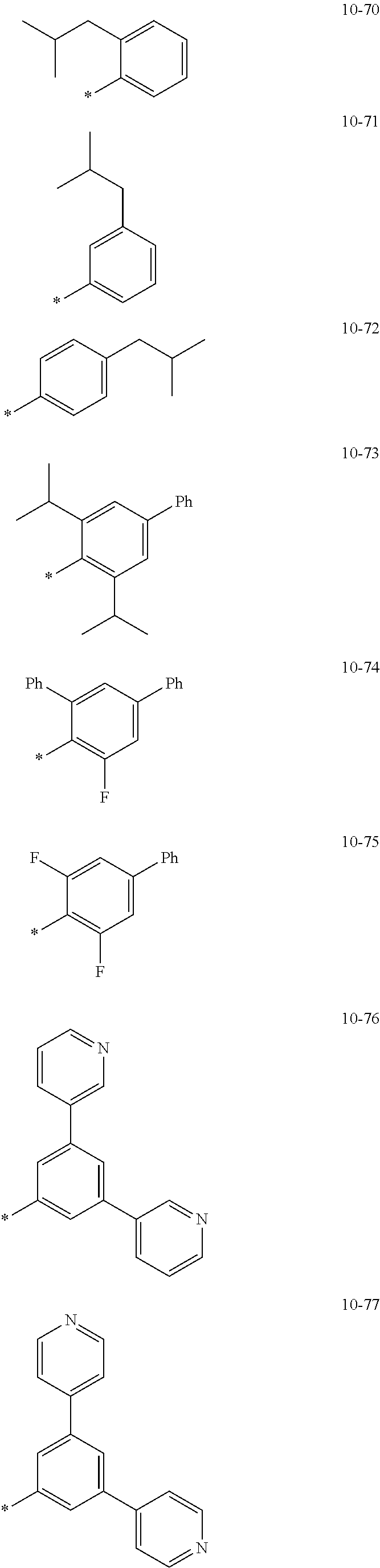


-
- a pentadiene group, a cyclohexane group, a cycloheptane group, an adamantane group, a bicyclo-heptane group, a bicyclo-octane group, a benzene group, a pyridine group, a pyrimidine group, a pyrazine group, a pyridazine group, a naphthalene group, an anthracene group, a tetracene group, a phenanthrene group, a dihydronaphthalene group, a phenalene group, a benzothiophene group, a benzofuran group, an indene group, an indole group, a benzosilole group, an azabenzothiophene group, an azabenzofuran group, an azaindene group, an azaindole group, and an azabenzosilole group; and
- a pentadiene group, a cyclohexane group, a cycloheptane group, an adamantane group, a bicyclo-heptane group, a bicyclo-octane group, a benzene group, a pyridine group, a pyrimidine group, a pyrazine group, a pyridazine group, a naphthalene group, an anthracene group, a tetracene group, a phenanthrene group, a dihydronaphthalene group, a phenalene group, a benzothiophene group, a benzofuran group, an indene group, an indole group, a benzosilole group, an azabenzothiophene group, an azabenzofuran group, an azaindene group, an azaindole group, and an azabenzosilole group, each substituted with at least one R10a, but embodiments are not limited thereto.

in Formula 1 may be selected from groups represented by Formulae CY1-1 to CY1-15:


indicates a binding site to T4 in Formula 1.

in Formula 1 may be selected from groups represented by Formulae CY2-1 to CY2-6:


indicates a binding site to T4 in Formula 1.

in Formula 1 may be selected from groups represented by Formulae CY3-1 to CY3-12:


in Formula 1 may be selected from groups represented by Formulae CY4-1 to CY4-26:


may be selected from groups represented by Formulae CY1-1 to CY1-15,

may be selected from groups represented by Formulae CY2-1 to CY2-6,

may be selected from groups represented by Formulae CY3-1 to CY3-12,

may be selected from groups represented by Formulae CY4-1 to CY4-26, and

Formula 1 may be a group represented by Formula CY4(1):


| TABLE 1 | |||
| Compound | Maximum emission | ||
| No. | HOMO (eV) | LUMO (eV) | wavelength (nm) |
| 1 | −5.22 | −1.43 | 526 |
| 3 | −5.23 | −1.45 | 520 |
| 9 | −5.20 | −1.41 | 526 |


but embodiments are not limited thereto.


| TABLE 2 | |||
| Compounds used in the preparation of the film (each | |||
| Film | ratio described herein indicates the weight ratio) | ||
| Film 1 | CBP:Compound 1 = 9:1 | ||
| Film 2 | CBP:Compound 3 = 9:1 | ||
| Film 3 | CBP:Compound 9 = 9:1 | ||
| Film A | CBP:Compound A = 9:1 | ||
| TABLE 3 | ||
| Decay time | ||
| Film | microseconds (μs) | |
| Film 1 (Compound 1) | 7.3 | |
| Film 2 (Compound 3) | 7.0 | |
| Film 3 (Compound 9) | 7.6 | |
| Film A (Compound A) | 13.0 | |
    |
||


Roll-off={1−(efficiency (at 9,000 nit)/maximum luminous efficiency)}×100% Equation 20
| TABLE 4 | ||||||
| Driv | ||||||
| ing- | Lumin- | Life- | ||||
| volt- | escence | span | ||||
| age | efficiency | Roll-off | FWHM | (T95) | ||
| Dopant | (V) | (cd/A) | (%) | (nm) | (hr)) | |
| Example 1 | Compound | 2.3 | 73.3 | 2.7 | 76 | 65 |
| 1 | ||||||
| Example 2 | Compound | 2.3 | 78.9 | 2.6 | 71 | 85 |
| 3 | ||||||
| Example 3 | Compound | 2.3 | 71.6 | 2.7 | 75 | 55 |
| 9 | ||||||
| Compara- | Compound | 2.2 | 38.0 | 38.5 | 80 | 30 |
| tive | A | |||||
| Example A | ||||||
| Compara- | Compound | 2.5 | 67.7 | 8.4 | 82 | 50 |
| tive | B | |||||
| Example B | ||||||
     |
||||||
Claims (20)


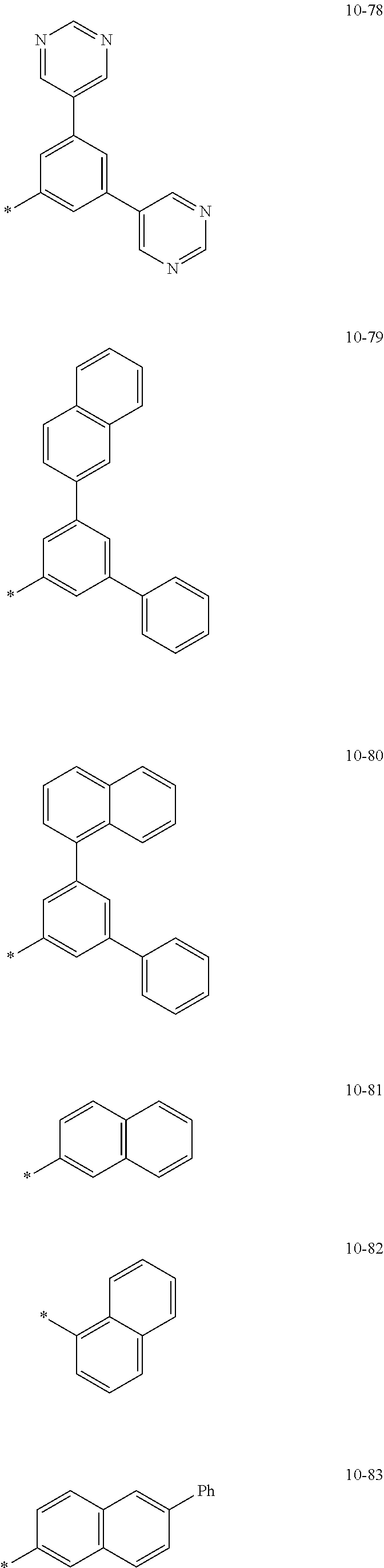


Applications Claiming Priority (2)
| Application Number | Priority Date | Filing Date | Title |
|---|---|---|---|
| KR10-2017-0114705 | 2017-09-07 | ||
| KR1020170114705A KR102486390B1 (en) | 2017-09-07 | 2017-09-07 | Organometallic compound, organic light emitting device including the same and a composition for diagnosing including the same |
Publications (2)
| Publication Number | Publication Date |
|---|---|
| US20190074454A1 US20190074454A1 (en) | 2019-03-07 |
| US10937975B2 true US10937975B2 (en) | 2021-03-02 |
Family
ID=65517047
Family Applications (1)
| Application Number | Title | Priority Date | Filing Date |
|---|---|---|---|
| US16/030,074 Active 2039-06-12 US10937975B2 (en) | 2017-09-07 | 2018-07-09 | Organometallic compound, organic light-emitting device including organometallic compound, and diagnostic composition including organometallic compound |
Country Status (2)
| Country | Link |
|---|---|
| US (1) | US10937975B2 (en) |
| KR (1) | KR102486390B1 (en) |
Cited By (1)
| Publication number | Priority date | Publication date | Assignee | Title |
|---|---|---|---|---|
| US12520714B2 (en) | 2021-03-31 | 2026-01-06 | Samsung Display Co., Ltd. | Organometallic compound and light-emitting device including organometallic compound |
Families Citing this family (6)
| Publication number | Priority date | Publication date | Assignee | Title |
|---|---|---|---|---|
| KR102568783B1 (en) * | 2018-03-22 | 2023-08-22 | 삼성디스플레이 주식회사 | Organometallic compound, organic light emitting device comprising the same and organic emitting apparatus comprising the organic light emitting device |
| CN112940040B (en) * | 2019-12-11 | 2022-06-10 | 广东阿格蕾雅光电材料有限公司 | Preparation and application of a tetradentate platinum (II) complex |
| US12286447B2 (en) | 2020-10-06 | 2025-04-29 | Universal Display Corporation | Organic electroluminescent materials and devices |
| US12247042B2 (en) | 2020-10-26 | 2025-03-11 | Universal Display Corporation | Organic electroluminescent materials and devices |
| US12528833B2 (en) | 2020-11-18 | 2026-01-20 | Universal Display Corporation | Organic electroluminescent materials and devices |
| US12466848B2 (en) | 2020-12-10 | 2025-11-11 | Universal Display Corporation | Organic electroluminescent materials and devices |
Citations (5)
| Publication number | Priority date | Publication date | Assignee | Title |
|---|---|---|---|---|
| US20060134461A1 (en) | 2004-12-17 | 2006-06-22 | Shouquan Huo | Organometallic materials and electroluminescent devices |
| KR20130043459A (en) | 2011-10-20 | 2013-04-30 | 에스에프씨 주식회사 | Organic metal compounds and organic light emitting diodes comprising the same |
| KR20130043460A (en) | 2011-10-20 | 2013-04-30 | 에스에프씨 주식회사 | Organic metal compounds and organic light emitting diodes comprising the same |
| US20130274473A1 (en) | 2012-04-12 | 2013-10-17 | The University Of Hong Kong | Platinum(ii) complexes for oled applications |
| US20150115250A1 (en) | 2013-10-29 | 2015-04-30 | Universal Display Corporation | Organic electroluminescent materials and devices |
-
2017
- 2017-09-07 KR KR1020170114705A patent/KR102486390B1/en active Active
-
2018
- 2018-07-09 US US16/030,074 patent/US10937975B2/en active Active
Patent Citations (6)
| Publication number | Priority date | Publication date | Assignee | Title |
|---|---|---|---|---|
| US20060134461A1 (en) | 2004-12-17 | 2006-06-22 | Shouquan Huo | Organometallic materials and electroluminescent devices |
| KR20130043459A (en) | 2011-10-20 | 2013-04-30 | 에스에프씨 주식회사 | Organic metal compounds and organic light emitting diodes comprising the same |
| KR20130043460A (en) | 2011-10-20 | 2013-04-30 | 에스에프씨 주식회사 | Organic metal compounds and organic light emitting diodes comprising the same |
| US20130274473A1 (en) | 2012-04-12 | 2013-10-17 | The University Of Hong Kong | Platinum(ii) complexes for oled applications |
| US20150115250A1 (en) | 2013-10-29 | 2015-04-30 | Universal Display Corporation | Organic electroluminescent materials and devices |
| KR20150050383A (en) | 2013-10-29 | 2015-05-08 | 유니버셜 디스플레이 코포레이션 | Organic electroluminescent materials and devices |
Cited By (1)
| Publication number | Priority date | Publication date | Assignee | Title |
|---|---|---|---|---|
| US12520714B2 (en) | 2021-03-31 | 2026-01-06 | Samsung Display Co., Ltd. | Organometallic compound and light-emitting device including organometallic compound |
Also Published As
| Publication number | Publication date |
|---|---|
| US20190074454A1 (en) | 2019-03-07 |
| KR20190027658A (en) | 2019-03-15 |
| KR102486390B1 (en) | 2023-01-09 |
Similar Documents
| Publication | Publication Date | Title |
|---|---|---|
| US20230371359A1 (en) | Organometallic compound, organic light-emitting device including the same, and electronic apparatus including the organic light-emitting device | |
| US11352384B2 (en) | Organometallic compound, organic light-emitting device including the same, and diagnostic composition including the same | |
| US12144241B2 (en) | Organometallic compound, organic light-emitting device including the organometallic compound, and diagnostic composition including the organometallic compound | |
| US11731995B2 (en) | Organometallic compound, organic light-emitting device including the same, and diagnostic composition including the same | |
| US11858949B2 (en) | Organometallic compound, organic light-emitting device including the same, and diagnostic composition including the organometallic compound | |
| US10937975B2 (en) | Organometallic compound, organic light-emitting device including organometallic compound, and diagnostic composition including organometallic compound | |
| US12145950B2 (en) | Organometallic compound, organic light-emitting device including the organometallic compound, and diagnostic composition including the organometallic compound | |
| US20180141969A1 (en) | Organometallic compound, organic light-emitting device including the same, and diagnostic composition including the organometallic compound | |
| US12286448B2 (en) | Organometallic compound, organic light-emitting device including oranometallic compound, and diagnostic composition including organometallic compound | |
| US11957044B2 (en) | Organometallic compound, organic light-emitting device including the same, and diagnostic composition including the organometallic compound | |
| US20230322827A1 (en) | Organometallic compound, organic light-emitting device including organometallic compound, and diagnostic composition including organometallic compound | |
| US12291540B2 (en) | Organometallic compound, organic light-emitting device including the same, and electronic apparatus including the organic light-emitting device | |
| US10950807B2 (en) | Organometallic compound, organic light-emitting device including the organometallic compound, and diagnostic composition including the organometallic compound | |
| US20200395558A1 (en) | Organometallic compound, organic light-emitting device including the same, and diagnostic composition including the organometallic compound | |
| US12101995B2 (en) | Organometallic compound, organic light-emitting device including the same, and electronic apparatus including the organic light-emitting device | |
| US11205758B2 (en) | Organometallic compound, organic light-emitting device including the organometallic compound, and diagnostic composition including the organometallic compound | |
| US10797249B2 (en) | Organometallic compound, organic light-emitting device including the organometallic compound, and diagnostic composition including the organometallic compound | |
| US12414459B2 (en) | Organometallic compound, organic light-emitting device including the same, and diagnostic composition including the organometallic compound | |
| US11889749B2 (en) | Organometallic compound, organic light-emitting device including organometallic compound, and diagnostic composition including organometallic compound | |
| US11889750B2 (en) | Organometallic compound, organic light-emitting device including the organometallic compound, and diagnostic composition including the organometallic compound | |
| US20210122774A1 (en) | Organometallic compound, organic light-emitting device including the same, and diagnostic composition including the organometallic compound | |
| US20190315760A1 (en) | Condensed cyclic compound and organic light-emnitting device including the same | |
| US12415826B2 (en) | Organometallic compound, organic light-emitting device including the same, and diagnostic composition for including the organometallic compound | |
| US20240244858A1 (en) | Organometallic compound, organic light-emitting device including the same, and electronic apparatus including the organic light-emitting device | |
| US20220220142A1 (en) | Organometallic compound, organic light-emitting device including the same, and electronic apparatus including the organic light-emitting device |
Legal Events
| Date | Code | Title | Description |
|---|---|---|---|
| FEPP | Fee payment procedure |
Free format text: ENTITY STATUS SET TO UNDISCOUNTED (ORIGINAL EVENT CODE: BIG.); ENTITY STATUS OF PATENT OWNER: LARGE ENTITY |
|
| STPP | Information on status: patent application and granting procedure in general |
Free format text: DOCKETED NEW CASE - READY FOR EXAMINATION |
|
| STPP | Information on status: patent application and granting procedure in general |
Free format text: NON FINAL ACTION MAILED |
|
| AS | Assignment |
Owner name: VERSITECH LIMITED, CHINA Free format text: ASSIGNMENT OF ASSIGNORS INTEREST;ASSIGNORS:KWAK, YOONHYUN;CHE, CHI MING;CHOI, WHAIL;AND OTHERS;SIGNING DATES FROM 20180309 TO 20180315;REEL/FRAME:053615/0878 Owner name: SAMSUNG ELECTRONICS CO., LTD., KOREA, REPUBLIC OF Free format text: ASSIGNMENT OF ASSIGNORS INTEREST;ASSIGNORS:KWAK, YOONHYUN;CHE, CHI MING;CHOI, WHAIL;AND OTHERS;SIGNING DATES FROM 20180309 TO 20180315;REEL/FRAME:053615/0878 |
|
| STPP | Information on status: patent application and granting procedure in general |
Free format text: RESPONSE TO NON-FINAL OFFICE ACTION ENTERED AND FORWARDED TO EXAMINER |
|
| STCF | Information on status: patent grant |
Free format text: PATENTED CASE |
|
| MAFP | Maintenance fee payment |
Free format text: PAYMENT OF MAINTENANCE FEE, 4TH YEAR, LARGE ENTITY (ORIGINAL EVENT CODE: M1551); ENTITY STATUS OF PATENT OWNER: LARGE ENTITY Year of fee payment: 4 |