US10930858B2 - Nitrogen-containing compound and organic electroluminescence device including the same - Google Patents

Nitrogen-containing compound and organic electroluminescence device including the same Download PDF

Info

Publication number
US10930858B2
US10930858B2 US15/980,270 US201815980270A US10930858B2 US 10930858 B2 US10930858 B2 US 10930858B2 US 201815980270 A US201815980270 A US 201815980270A US 10930858 B2 US10930858 B2 US 10930858B2
Authority
US
United States
Prior art keywords
formula
nitrogen
group
containing compound
ring
Prior art date
Legal status (The legal status is an assumption and is not a legal conclusion. Google has not performed a legal analysis and makes no representation as to the accuracy of the status listed.)
Active, expires
Application number
US15/980,270
Other versions
US20190131534A1 (en
Inventor
Yuuki Miyazaki
Current Assignee (The listed assignees may be inaccurate. Google has not performed a legal analysis and makes no representation or warranty as to the accuracy of the list.)
Samsung Display Co Ltd
Original Assignee
Samsung Display Co Ltd
Priority date (The priority date is an assumption and is not a legal conclusion. Google has not performed a legal analysis and makes no representation as to the accuracy of the date listed.)
Filing date
Publication date
Application filed by Samsung Display Co Ltd filed Critical Samsung Display Co Ltd
Assigned to SAMSUNG DISPLAY CO., LTD. reassignment SAMSUNG DISPLAY CO., LTD. ASSIGNMENT OF ASSIGNORS INTEREST (SEE DOCUMENT FOR DETAILS). Assignors: MIYAZAKI, YUUKI
Publication of US20190131534A1 publication Critical patent/US20190131534A1/en
Application granted granted Critical
Publication of US10930858B2 publication Critical patent/US10930858B2/en
Active legal-status Critical Current
Adjusted expiration legal-status Critical

Links

Images

Classifications

    • H01L51/0072
    • CCHEMISTRY; METALLURGY
    • C07ORGANIC CHEMISTRY
    • C07DHETEROCYCLIC COMPOUNDS
    • C07D487/00Heterocyclic compounds containing nitrogen atoms as the only ring hetero atoms in the condensed system, not provided for by groups C07D451/00 - C07D477/00
    • C07D487/02Heterocyclic compounds containing nitrogen atoms as the only ring hetero atoms in the condensed system, not provided for by groups C07D451/00 - C07D477/00 in which the condensed system contains two hetero rings
    • C07D487/04Ortho-condensed systems
    • CCHEMISTRY; METALLURGY
    • C07ORGANIC CHEMISTRY
    • C07DHETEROCYCLIC COMPOUNDS
    • C07D487/00Heterocyclic compounds containing nitrogen atoms as the only ring hetero atoms in the condensed system, not provided for by groups C07D451/00 - C07D477/00
    • C07D487/02Heterocyclic compounds containing nitrogen atoms as the only ring hetero atoms in the condensed system, not provided for by groups C07D451/00 - C07D477/00 in which the condensed system contains two hetero rings
    • C07D487/08Bridged systems
    • CCHEMISTRY; METALLURGY
    • C07ORGANIC CHEMISTRY
    • C07DHETEROCYCLIC COMPOUNDS
    • C07D487/00Heterocyclic compounds containing nitrogen atoms as the only ring hetero atoms in the condensed system, not provided for by groups C07D451/00 - C07D477/00
    • C07D487/12Heterocyclic compounds containing nitrogen atoms as the only ring hetero atoms in the condensed system, not provided for by groups C07D451/00 - C07D477/00 in which the condensed system contains three hetero rings
    • C07D487/14Ortho-condensed systems
    • CCHEMISTRY; METALLURGY
    • C07ORGANIC CHEMISTRY
    • C07DHETEROCYCLIC COMPOUNDS
    • C07D491/00Heterocyclic compounds containing in the condensed ring system both one or more rings having oxygen atoms as the only ring hetero atoms and one or more rings having nitrogen atoms as the only ring hetero atoms, not provided for by groups C07D451/00 - C07D459/00, C07D463/00, C07D477/00 or C07D489/00
    • C07D491/12Heterocyclic compounds containing in the condensed ring system both one or more rings having oxygen atoms as the only ring hetero atoms and one or more rings having nitrogen atoms as the only ring hetero atoms, not provided for by groups C07D451/00 - C07D459/00, C07D463/00, C07D477/00 or C07D489/00 in which the condensed system contains three hetero rings
    • C07D491/14Ortho-condensed systems
    • C07D491/147Ortho-condensed systems the condensed system containing one ring with oxygen as ring hetero atom and two rings with nitrogen as ring hetero atom
    • CCHEMISTRY; METALLURGY
    • C07ORGANIC CHEMISTRY
    • C07FACYCLIC, CARBOCYCLIC OR HETEROCYCLIC COMPOUNDS CONTAINING ELEMENTS OTHER THAN CARBON, HYDROGEN, HALOGEN, OXYGEN, NITROGEN, SULFUR, SELENIUM OR TELLURIUM
    • C07F7/00Compounds containing elements of Groups 4 or 14 of the Periodic Table
    • C07F7/02Silicon compounds
    • C07F7/08Compounds having one or more C—Si linkages
    • C07F7/0803Compounds with Si-C or Si-Si linkages
    • C07F7/081Compounds with Si-C or Si-Si linkages comprising at least one atom selected from the elements N, O, halogen, S, Se or Te
    • C07F7/0812Compounds with Si-C or Si-Si linkages comprising at least one atom selected from the elements N, O, halogen, S, Se or Te comprising a heterocyclic ring
    • C07F7/0816Compounds with Si-C or Si-Si linkages comprising at least one atom selected from the elements N, O, halogen, S, Se or Te comprising a heterocyclic ring said ring comprising Si as a ring atom
    • CCHEMISTRY; METALLURGY
    • C09DYES; PAINTS; POLISHES; NATURAL RESINS; ADHESIVES; COMPOSITIONS NOT OTHERWISE PROVIDED FOR; APPLICATIONS OF MATERIALS NOT OTHERWISE PROVIDED FOR
    • C09KMATERIALS FOR MISCELLANEOUS APPLICATIONS, NOT PROVIDED FOR ELSEWHERE
    • C09K11/00Luminescent, e.g. electroluminescent, chemiluminescent materials
    • C09K11/06Luminescent, e.g. electroluminescent, chemiluminescent materials containing organic luminescent materials
    • H01L51/0062
    • H01L51/0071
    • HELECTRICITY
    • H10SEMICONDUCTOR DEVICES; ELECTRIC SOLID-STATE DEVICES NOT OTHERWISE PROVIDED FOR
    • H10KORGANIC ELECTRIC SOLID-STATE DEVICES
    • H10K50/00Organic light-emitting devices
    • H10K50/10OLEDs or polymer light-emitting diodes [PLED]
    • H10K50/11OLEDs or polymer light-emitting diodes [PLED] characterised by the electroluminescent [EL] layers
    • HELECTRICITY
    • H10SEMICONDUCTOR DEVICES; ELECTRIC SOLID-STATE DEVICES NOT OTHERWISE PROVIDED FOR
    • H10KORGANIC ELECTRIC SOLID-STATE DEVICES
    • H10K50/00Organic light-emitting devices
    • H10K50/10OLEDs or polymer light-emitting diodes [PLED]
    • H10K50/11OLEDs or polymer light-emitting diodes [PLED] characterised by the electroluminescent [EL] layers
    • H10K50/12OLEDs or polymer light-emitting diodes [PLED] characterised by the electroluminescent [EL] layers comprising dopants
    • HELECTRICITY
    • H10SEMICONDUCTOR DEVICES; ELECTRIC SOLID-STATE DEVICES NOT OTHERWISE PROVIDED FOR
    • H10KORGANIC ELECTRIC SOLID-STATE DEVICES
    • H10K50/00Organic light-emitting devices
    • H10K50/10OLEDs or polymer light-emitting diodes [PLED]
    • H10K50/14Carrier transporting layers
    • HELECTRICITY
    • H10SEMICONDUCTOR DEVICES; ELECTRIC SOLID-STATE DEVICES NOT OTHERWISE PROVIDED FOR
    • H10KORGANIC ELECTRIC SOLID-STATE DEVICES
    • H10K85/00Organic materials used in the body or electrodes of devices covered by this subclass
    • H10K85/60Organic compounds having low molecular weight
    • H10K85/649Aromatic compounds comprising a hetero atom
    • HELECTRICITY
    • H10SEMICONDUCTOR DEVICES; ELECTRIC SOLID-STATE DEVICES NOT OTHERWISE PROVIDED FOR
    • H10KORGANIC ELECTRIC SOLID-STATE DEVICES
    • H10K85/00Organic materials used in the body or electrodes of devices covered by this subclass
    • H10K85/60Organic compounds having low molecular weight
    • H10K85/649Aromatic compounds comprising a hetero atom
    • H10K85/657Polycyclic condensed heteroaromatic hydrocarbons
    • HELECTRICITY
    • H10SEMICONDUCTOR DEVICES; ELECTRIC SOLID-STATE DEVICES NOT OTHERWISE PROVIDED FOR
    • H10KORGANIC ELECTRIC SOLID-STATE DEVICES
    • H10K85/00Organic materials used in the body or electrodes of devices covered by this subclass
    • H10K85/60Organic compounds having low molecular weight
    • H10K85/649Aromatic compounds comprising a hetero atom
    • H10K85/657Polycyclic condensed heteroaromatic hydrocarbons
    • H10K85/6572Polycyclic condensed heteroaromatic hydrocarbons comprising only nitrogen in the heteroaromatic polycondensed ring system, e.g. phenanthroline or carbazole
    • HELECTRICITY
    • H10SEMICONDUCTOR DEVICES; ELECTRIC SOLID-STATE DEVICES NOT OTHERWISE PROVIDED FOR
    • H10KORGANIC ELECTRIC SOLID-STATE DEVICES
    • H10K85/00Organic materials used in the body or electrodes of devices covered by this subclass
    • H10K85/60Organic compounds having low molecular weight
    • H10K85/649Aromatic compounds comprising a hetero atom
    • H10K85/657Polycyclic condensed heteroaromatic hydrocarbons
    • H10K85/6574Polycyclic condensed heteroaromatic hydrocarbons comprising only oxygen in the heteroaromatic polycondensed ring system, e.g. cumarine dyes
    • HELECTRICITY
    • H10SEMICONDUCTOR DEVICES; ELECTRIC SOLID-STATE DEVICES NOT OTHERWISE PROVIDED FOR
    • H10KORGANIC ELECTRIC SOLID-STATE DEVICES
    • H10K85/00Organic materials used in the body or electrodes of devices covered by this subclass
    • H10K85/60Organic compounds having low molecular weight
    • H10K85/649Aromatic compounds comprising a hetero atom
    • H10K85/657Polycyclic condensed heteroaromatic hydrocarbons
    • H10K85/6576Polycyclic condensed heteroaromatic hydrocarbons comprising only sulfur in the heteroaromatic polycondensed ring system, e.g. benzothiophene
    • H01L51/5012
    • H01L51/5056
    • H01L51/5072
    • H01L51/5088
    • H01L51/5092
    • H01L51/5096
    • HELECTRICITY
    • H10SEMICONDUCTOR DEVICES; ELECTRIC SOLID-STATE DEVICES NOT OTHERWISE PROVIDED FOR
    • H10KORGANIC ELECTRIC SOLID-STATE DEVICES
    • H10K50/00Organic light-emitting devices
    • H10K50/10OLEDs or polymer light-emitting diodes [PLED]
    • H10K50/14Carrier transporting layers
    • H10K50/15Hole transporting layers
    • HELECTRICITY
    • H10SEMICONDUCTOR DEVICES; ELECTRIC SOLID-STATE DEVICES NOT OTHERWISE PROVIDED FOR
    • H10KORGANIC ELECTRIC SOLID-STATE DEVICES
    • H10K50/00Organic light-emitting devices
    • H10K50/10OLEDs or polymer light-emitting diodes [PLED]
    • H10K50/14Carrier transporting layers
    • H10K50/16Electron transporting layers
    • HELECTRICITY
    • H10SEMICONDUCTOR DEVICES; ELECTRIC SOLID-STATE DEVICES NOT OTHERWISE PROVIDED FOR
    • H10KORGANIC ELECTRIC SOLID-STATE DEVICES
    • H10K50/00Organic light-emitting devices
    • H10K50/10OLEDs or polymer light-emitting diodes [PLED]
    • H10K50/17Carrier injection layers
    • HELECTRICITY
    • H10SEMICONDUCTOR DEVICES; ELECTRIC SOLID-STATE DEVICES NOT OTHERWISE PROVIDED FOR
    • H10KORGANIC ELECTRIC SOLID-STATE DEVICES
    • H10K50/00Organic light-emitting devices
    • H10K50/10OLEDs or polymer light-emitting diodes [PLED]
    • H10K50/17Carrier injection layers
    • H10K50/171Electron injection layers
    • HELECTRICITY
    • H10SEMICONDUCTOR DEVICES; ELECTRIC SOLID-STATE DEVICES NOT OTHERWISE PROVIDED FOR
    • H10KORGANIC ELECTRIC SOLID-STATE DEVICES
    • H10K50/00Organic light-emitting devices
    • H10K50/10OLEDs or polymer light-emitting diodes [PLED]
    • H10K50/18Carrier blocking layers
    • HELECTRICITY
    • H10SEMICONDUCTOR DEVICES; ELECTRIC SOLID-STATE DEVICES NOT OTHERWISE PROVIDED FOR
    • H10KORGANIC ELECTRIC SOLID-STATE DEVICES
    • H10K50/00Organic light-emitting devices
    • H10K50/10OLEDs or polymer light-emitting diodes [PLED]
    • H10K50/18Carrier blocking layers
    • H10K50/181Electron blocking layers

Definitions

  • the present disclosure relates to a nitrogen-containing compound and an organic electroluminescence device including the same, and for example, to a nitrogen-containing compound utilized as a delayed fluorescence emission material and an organic electroluminescence device including the same.
  • Organic electroluminescence display devices differ from liquid crystal display devices in that they are so-called self-luminescent display devices.
  • self-luminescent display devices holes and electrons injected from a first electrode and a second electrode, respectively, recombine in an emission layer, and a light emission material including an organic compound in the emission layer emits light upon the hole-electron recombination to thereby display an image.
  • TTA triplet-triplet annihilation
  • One or more aspects of embodiments of the present disclosure provide a nitrogen-containing compound that is a luminescence (e.g., luminescent) material for an organic electroluminescence device and that is capable of improving emission efficiency.
  • a luminescence e.g., luminescent
  • the present disclosure also provides an organic electroluminescence device having improved emission efficiency by including the nitrogen-containing compound.
  • One or more embodiments of the present disclosure provide a nitrogen-containing compound represented by Formula 1:
  • X 1 , X 2 , and X 3 may be N, and the remainder thereof may be CR 15 ;
  • Y and Z may each independently be a hydrogen atom, a deuterium atom, OR 16 , SR 17 , CR 18 R 19 R 20 , or SiR 21 R 22 R 23 , or may be combined with (e.g., linked to) each other to form a ring;
  • R 1 to R 14 may each independently be a hydrogen atom, a deuterium atom, OR 24 , SR 25 , (C ⁇ O)R 26 , NR 27 R 28 , CR 29 R 30 R 31 , SiR 32 R 33 R 34 , a substituted or unsubstituted alkyl group having 1 to 20 carbon atoms, a substituted or unsubstituted aryl group having 6 to 30 carbon atoms for forming a ring, or a substituted or unsubstituted heteroaryl group having 2 to 30 carbon atoms for
  • X 1 may be N, and at least one of X 2 or X 3 may be N.
  • n and m may be 1.
  • n may be 1 or 2.
  • R 12 may be a substituted or unsubstituted phenyl group or a substituted or unsubstituted dibenzofuran group.
  • Formula 1 may be a nitrogen-containing compound represented by Formula 1-1 or Formula 1-2:
  • Y, Z, n, m, R 1 to R 34 , q, and r may each independently be the same as defined in Formula 1.
  • Formula 1 may be a nitrogen-containing compound represented by Formula 1-3 or Formula 1-4:
  • q1, q2, r1, and r2 may each independently be an integer of 0 to 4; and in Formula 1-3 and Formula 1-4, X 1 to X 3 , Y, Z, R 1 to R 34 , q, and r may each independently be the same as defined in Formula 1.
  • Formula 1 may be a nitrogen-containing compound represented by Formula 1-5 or Formula 1-6:
  • X 1 to X 3 , Y, Z, R 1 to R 6 , R 8 , R 9 , R 10 and R 12 may each independently be the same as defined in Formula 1.
  • the nitrogen-containing compound represented by Formula 1 may have a difference between the lowest excitation singlet energy level (S1) and the lowest excitation triplet energy level (T1) of about 0.2 eV or less.
  • the nitrogen-containing compound represented by Formula 1 may be a thermally activated delayed fluorescence emission material.
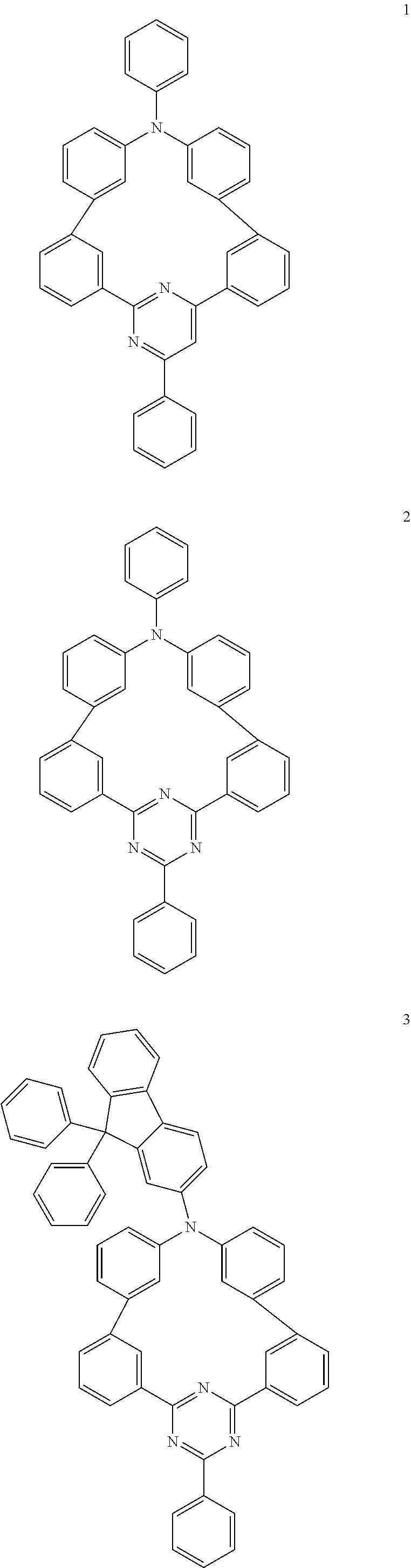
  • the nitrogen-containing compound represented by Formula 1 may be a compound represented in Compound Group 1:
  • an organic electroluminescence device includes a first electrode, a hole transport region on the first electrode, an emission layer on the hole transport region and including the nitrogen-containing compound according to an embodiment of the present disclosure, an electron transport region on the emission layer, and a second electrode on the electron transport region.
  • the first electrode and the second electrode may each independently include at least one selected from Ag, Mg, Cu, Al, Pt, Pd, Au, Ni, Nd, Ir, Cr, Li, Ca, LiF/Ca, LiF/AI, Mo, Ti, In, Sn, and Zn, a compound of two or more thereof, a mixture of two or more thereof, and an oxide thereof.
  • the emission layer may be to emit delayed fluorescence.
  • the emission layer may be an emission layer of a thermally activated delayed fluorescence, which may be to emit blue light.
  • the emission layer may include a host and a dopant, and the dopant may be the nitrogen-containing compound represented by Formula 1.
  • the host may include at least one of bis[2-(diphenylphosphino)phenyl] ether oxide (DPEPO), 4,4′-bis(carbazol-9-yl)biphenyl (CBP), 1,3-bis(carbazol-9-yl)benzene (mCP), 2,8-bis(diphenylphosphoryl)dibenzo[b,d]furan (PPF), 4,4′,4′′-tris(carbazol-9-yl)-triphenylamine (TcTa), 1,3,5-tris(N-phenylbenzimidazole-2-yl)benzene (TPBi), 3,3′-di(9H-carbazol-9-yl)-1,1′-biphenyl (mCBP), or (2,4,6-tris(biphenyl-3-yl)-1,3,5-triazine (T2T).
  • DPEPO bis[2-(diphenylphosphino)phenyl] ether oxide
  • the emission layer may include at least one nitrogen-containing compound represented in Compound Group 1:
  • FIG. 1 is a cross-sectional view schematically illustrating an organic electroluminescence device according to an embodiment of the present disclosure
  • FIG. 2 is a cross-sectional view schematically illustrating an organic electroluminescence device according to an embodiment of the present disclosure.
  • FIG. 3 is a cross-sectional view schematically illustrating an organic electroluminescence device according to an embodiment of the present disclosure.
  • -* refers to a connecting position
  • substituted or unsubstituted refers to the options of being unsubstituted, or substituted with at least one substituent selected from the group consisting of a deuterium atom, a halogen atom, a cyano group, a nitro group, an amino group, a silyl group, a boron group, a phosphine oxide group, a phosphine sulfide group, an alkyl group, an alkenyl group, an aryl group, and a heterocyclic group.
  • each of the substituents may themselves be substituted or unsubstituted.
  • a biphenyl group may be interpreted as an aryl group, or may be alternatively referred to as a phenyl group substituted with a phenyl group.
  • references to a halogen atom may include a fluorine atom, a chlorine atom, a bromine atom, and an iodine atom.
  • an alkyl group may be a linear, branched or cyclic type or kind of alkyl group.
  • the carbon number of the alkyl e.g., the number of carbon atoms included in the alkyl group
  • Non-limiting examples of the alkyl group may include methyl, ethyl, n-propyl, isopropyl, n-butyl, s-butyl, t-butyl, i-butyl, 2-ethylbutyl, 3,3-dimethylbutyl, n-pentyl, i-pentyl, neopentyl, t-pentyl, cyclopentyl, 1-methylpentyl, 3-methylpentyl, 2-ethylpentyl, 4-methyl-2-pentyl, n-hexyl, 1-methylhexyl, 2-ethylhexyl, 2-butylhexyl, cyclohexyl, 4-methylcyclohexyl, 4-t-butylcyclohexyl, n-heptyl, 1-methylheptyl, 2,2-dimethylheptyl, 2-ethylheptyl, 2-but
  • an aryl group may be a functional group or substituent derived from or including an aromatic hydrocarbon ring.
  • the aryl group may be a monocyclic aryl group or a polycyclic aryl group.
  • the carbon number for forming a ring in the aryl group (e.g., the number of carbons included in the aryl group ring) may be 6 to 30, 6 to 20, or 6 to 15.
  • Non-limiting examples of the aryl group may include phenyl, naphthyl, fluorenyl, anthracenyl, phenanthryl, biphenyl, terphenyl, quaterphenyl, quinqphenyl, sexiphenyl, triphenylene, pyrenyl, benzofluoranthenyl, chrysenyl, etc.
  • the fluorenyl group may be substituted (e.g., at the 9 carbon position), and the two substituents may be combined with each other to form a spiro structure.
  • the heteroaryl group may be a heteroaromatic group including at least one of O, N, P, Si, or S as a heteroatom.
  • the carbon number for forming a ring of the heteroaryl group (e.g., the number of carbons included in the heteroaryl group ring) may be 2 to 30, or 2 to 20.
  • the heteroaryl group may be a monocyclic heteroaryl group or a polycyclic heteroaryl group.
  • the polycyclic heteroaryl group may have a bicyclic structure or a tricyclic structure.
  • Non-limiting examples of the heteroaryl group may include thiophene, furan, pyrrole, imidazole, thiazole, oxazole, oxadiazole, triazole, pyridine, bipyridine, pyrimidine, triazine, acridine, pyridazine, pyrazine, quinoline, quinazoline, quinoxaline, phenoxazine, phthalazine, pyrido pyrimidine, pyrido pyrazine, pyrazino pyrazine, isoquinoline, indole, carbazole, N-arylcarbazole, N-heteroarylcarbazole, N-alkylcarbazole, benzoxazole, benzimidazole, benzothiazole, benzocarbazole, benzothiophene, dibenzothiophene, thienothiophene, benzofuran, phenan
  • a silyl group may be an alkylsilyl group or an arylsilyl group.
  • Non-limiting examples of the silyl group may include a trimethyl silyl group, a triethylsilyl group, a t-butyldimethylsilyl group, a vinyldimethylsilyl group, a propyldimethylsilyl group, a triphenylsilyl group, a diphenylsilyl group, a phenylsilyl group, etc.
  • a boron group may be an alkyl boron group or an aryl boron group.
  • Non-limiting examples of the boron group may include a trimethyl boron group, a triethylboron group, a t-butyldimethylboron group, a triphenylboron group, a diphenylboron group, a phenylboron group, etc.
  • an alkenyl group may be linear or branched.
  • the carbon number of the alkenyl group is not specifically limited, and may be 2 to 30, 2 to 20, or 2 to 10.
  • Non-limiting examples of the alkenyl group may include vinyl, 1-butenyl, 1-pentenyl, 1,3-butadienyl aryl, styrenyl, styrylvinyl, etc.
  • the nitrogen-containing compound according to an embodiment of the present disclosure may be represented by Formula 1:
  • X 1 , X 2 or X 3 may be N, and the remainder thereof may be CR 15 .
  • Y and Z may each independently be a hydrogen atom, a deuterium atom, OR 16 , SR 17 , CR 18 R 19 R 20 , or SiR 21 R 22 R 23 , or may be combined with (e.g., linked to) each other to form a ring.
  • R 1 to R 14 may each independently be a hydrogen atom, a deuterium atom, OR 24 , SR 25 , (C ⁇ O)R 26 , NR 27 R 28 , CR 29 R 30 R 31 , SiR 32 R 33 R 34 , a substituted or unsubstituted alkyl group having 1 to 20 carbon atoms, a substituted or unsubstituted aryl group having 6 to 30 carbon atoms for forming a ring, or a substituted or unsubstituted heteroaryl group having 2 to 30 carbon atoms for forming a ring, or may be combined with (e.g., linked to) an adjacent group to form a ring.
  • R 15 to R 34 may each independently be a hydrogen atom, a deuterium atom, a halogen atom, a cyano group, a substituted or unsubstituted silyl group, a substituted or unsubstituted alkyl group having 1 to 20 carbon atoms, a substituted or unsubstituted aryl group having 6 to 30 carbon atoms for forming a ring, or a substituted or unsubstituted heteroaryl group having 2 to 30 carbon atoms for forming a ring, or may be combined with (e.g., linked to) an adjacent group to form a ring.
  • n and m may each independently be 1 or 2
  • q and r may each independently be an integer of 0 to 4.
  • the nitrogen-containing compound according to an embodiment of the present disclosure may have a cyclic molecular structure including a nitrogen atom in a ring.
  • the nitrogen-containing compound according to an embodiment of the present disclosure may be a compound having a cyclic molecular structure including an aryl amine group and an azine group including two or three nitrogen atoms in its aromatic ring.
  • a plurality of substituted or unsubstituted arylene groups may be positioned between the aryl amine group nitrogen atom and the azine group.
  • the substituted or unsubstituted arylene group(s) may be (a) linker(s) connecting the aryl amine group nitrogen atom and the azine group.
  • aryl amine group may be or act as an electron donor, and the moiety
  • corresponding to the azine group may be or act as an electron acceptor.
  • embodiments of the present disclosure are not limited thereto.
  • Y and Z may each independently be a hydrogen atom, a deuterium atom, OR 16 , SR 17 , CR 18 R 19 R 20 , or SiR 21 R 22 R 23 . In some embodiments, for example, Y and Z may both (e.g., simultaneously) be a hydrogen atom.
  • R 16 to R 23 may each independently be a substituted or unsubstituted phenyl group.
  • Y and Z are each independently CR 18 R 19 R 20 or SiR 21 R 22 R 23
  • two neighboring substituents among R 18 , R 19 , and R 20 may be combined with (e.g., linked to) each other to form a ring
  • two neighboring substituents among R 21 , R 22 , and R 23 may be combined with (e.g., linked to) each other to form a ring
  • Y and Z may be combined with (e.g., linked to) each other to form a ring.
  • the neighboring substituents of Y and Z may be combined with each other to form a heterocycle.
  • R 1 to R 14 of Formula 1 may each independently be a hydrogen atom, a deuterium atom, OR 24 , SR 25 , (C ⁇ O)R 26 , NR 27 R 28 , CR 29 R 30 R 31 , SiR 32 R 33 R 34 , a substituted or unsubstituted alkyl group having 1 to 20 carbon atoms, a substituted or unsubstituted aryl group having 6 to 30 carbon atoms for forming a ring, or a substituted or unsubstituted heteroaryl group having 2 to 30 carbon atoms for forming a ring.
  • R 1 to R 14 may be each independently a hydrogen atom, OR 24 , SR 25 , (C ⁇ O)R 26 , NR 27 R 28 , CR 29 R 30 R 31 , SiR 32 R 33 R 34 , or a substituted or unsubstituted phenyl group.
  • R 24 to R 34 may be combined with neighboring substituents to form a ring.
  • R 24 to R 34 may each independently be a hydrogen atom, a substituted or unsubstituted alkyl group having 1 to 20 carbon atoms, or a substituted or unsubstituted aryl group having 6 to 30 carbon atoms for forming a ring.
  • R 24 to R 34 may each independently be a hydrogen atom, a methyl group, or a phenyl group.
  • adjacent substituents may be combined with (e.g., linked to) each other to form a ring.
  • adjacent substituents may be combined with (e.g., linked to) each other to form a substituted or unsubstituted fluorene, a substituted or unsubstituted dibenzothiophene, a substituted or unsubstituted dibenzofuran, or a substituted or unsubstituted carbazole.
  • R 12 may be a substituted or unsubstituted phenyl group. In some embodiments, for example, R 12 may be an unsubstituted phenyl group. In some embodiments, R 12 may be a substituted or unsubstituted dibenzofuran group, for example, R 12 may be an unsubstituted dibenzofuran group.
  • q and r may each independently an integer of 0 to 4.
  • q and r are each an integer of 2 or more, a plurality of R 13 and a plurality of R 14 may each independently be the same or different.
  • At least two of X 1 to X 3 may be N.
  • X 1 may be N, and at least one of X 2 or X 3 may be N.
  • X 1 and X 2 may be N, and X 3 may be CR 15 ;
  • X 1 and X 3 may be N and X 2 may be CR 15 ; or all X 1 to X 3 may be N.
  • the heterocycle including X 1 to X 3 may be pyrimidine or triazine.
  • R 15 may be a hydrogen atom, a deuterium atom, OR 24 , SR 25 , CR 26 R 27 R 28 , SiR 29 R 30 R 31 , a substituted or unsubstituted alkyl group having 1 to 20 carbon atoms, a substituted or unsubstituted aryl group having 6 to 30 carbon atoms for forming a ring, or a substituted or unsubstituted heteroaryl group having 2 to 30 carbon atoms for forming a ring.
  • R 15 may be a hydrogen atom.
  • the nitrogen-containing compound represented by Formula 1 may be further represented by Formula 1-1 or Formula 1-2.
  • Formula 1-1 corresponds to a case where X 1 and X 2 are N
  • Formula 1-2 corresponds to a case where all of X 1 to X 3 are N:
  • Y, Z, n, m, R 1 to R 34 , q9, and r may each independently be the same as defined in Formula 1.
  • n and m may each independently be 1 to 2.
  • both n and m may be 1 (e.g., simultaneously), or one of n and m may be 1 and the remainder thereof may be 2, or both n and m may be 2.
  • the nitrogen-containing compound according to an embodiment of the present disclosure may be a cyclic compound including five connected rings.
  • the nitrogen-containing compound according to an embodiment of the present disclosure may be acyclic compound including six connected rings, and when both n and m are 2, the nitrogen-containing compound according to an embodiment of the present disclosure may be a cyclic compound including seven connected rings.
  • the nitrogen-containing compound represented by Formula 1 may be further represented by Formula 1-3 or Formula 1-4.
  • Formula 1-3 corresponds to a case where both n and m are 1
  • Formula 1-4 represents a case where both n and m are 2:
  • q1, q2, r1, and r2 may each independently be an integer of 0 to 4.
  • X 1 to X 3 , Y, Z, R 1 to R 34 , q, and r may each independently be the same as defined in Formula 1.
  • the nitrogen-containing compound represented by Formula 1 may be further represented by Formula 1-5 or Formula 1-6.
  • Formula 1-5 corresponds to a case where both n and m are 1 (e.g., simultaneously), and Formula 1-6 corresponds to the case where both n and m are 2.
  • Formula 1-5 corresponds to a case where q and r are both 0, and Formula 1-6 corresponds to a case where all of q1, q2, r1, and r2 are 0.
  • Formula 1-5 and Formula 1-6 correspond to a case where both R 7 and R 11 are hydrogen atoms.
  • X 1 to X 3 , Y, Z, R 1 to R 6 , R 8 , R 9 , R 10 , and R 12 may each independently be the same as defined in Formula 1.
  • the nitrogen-containing compound according to an embodiment of the present disclosure may be one of the compounds represented in Compound Group 1:
  • the nitrogen-containing compound according to an embodiment of the present disclosure may have a cyclic molecular structure, in which a plurality of aromatic rings are connected with each other, and the compound may have excellent heat resistance and/or chemical resistance.
  • the nitrogen-containing compound according to an embodiment of the present disclosure may include an aryl amine group that acts as an electron donating group and an azine group that acts as an electron accepting group in the cyclic molecular structure, and as such, a light-emitting material having a small energy difference between the lowest excitation singlet energy level (S1) and the lowest excitation triplet energy level (T1) may be attained.
  • the nitrogen-containing compound according to an embodiment of the present disclosure may have a single-triplet energy difference ( ⁇ E ST ) between the lowest excitation singlet energy level (S1) and the lowest excitation triplet energy level (T1) of about 0.2 eV or less.
  • ⁇ E ST single-triplet energy difference
  • the nitrogen-containing compound according to an embodiment of the present disclosure may be utilized as a material for emitting delayed fluorescence.
  • the nitrogen-containing compound may have a small ⁇ E ST value, and may be utilized as a material for thermally activated delayed fluorescence (TADF).
  • the nitrogen-containing compound according to an embodiment of the present disclosure may be utilized in an organic electroluminescence device, and may thereby improve the emission efficiency of the organic electroluminescence device.
  • the nitrogen-containing compound according to an embodiment of the present disclosure may be utilized as a material in an emission layer that is positioned between opposite electrodes of an organic electroluminescence device.
  • the nitrogen-containing compound according to an embodiment of the present disclosure may be included in an emission layer as a thermally activated delayed fluorescence dopant to further improve the emission efficiency of an organic electroluminescence device, for example, in an emission layer to emit blue light to further improve emission efficiency.
  • FIGS. 1 to 3 are cross-sectional views schematically illustrating organic electroluminescence devices according to one or more example embodiments of the present disclosure.
  • an organic electroluminescence device 10 may include a first electrode EL 1 , a hole transport region HTR, an emission layer EML, an electron transport region ETR, and a second electrode EL 2 , which may be laminated one by one (e.g., stacked in the stated order).
  • the first electrode EL 1 and the second electrode EL 2 may be oppositely positioned from each other (e.g., may be on opposite ends of the layer stack along a thickness direction in the device 10 ), and a plurality of organic layers may be positioned between the first electrode EL 1 and the second electrode EL 2 .
  • the plurality of the organic layers may include the hole transport region HTR, the emission layer EML, and the electron transport region ETR.
  • the organic electroluminescence device 10 according to an embodiment of the present disclosure may include the nitrogen-containing compound according to an embodiment of the present disclosure in the emission layer EML.
  • FIG. 2 shows a cross-sectional view of an organic electroluminescence device according to an embodiment of the present disclosure, wherein the hole transport region HTR includes a hole injection layer HIL and a hole transport layer HTL, and the electron transport region ETR includes an electron injection layer EIL and an electron transport layer ETL.
  • FIG. 3 shows a cross-sectional view of an organic electroluminescence device 10 according to an embodiment of the present disclosure, wherein the hole transport region HTR includes a hole injection layer HIL, a hole transport layer HTL, and an electron blocking layer EBL, and the electron transport region ETR includes an electron injection layer EIL, an electron transport layer ETL, and a hole blocking layer HBL.
  • the first electrode EL 1 may have conductivity (e.g., may be conductive).
  • the first electrode EL 1 may be formed using a metal alloy and/or a conductive compound.
  • the first electrode EL 1 may be an anode.
  • the first electrode EL 1 may be a transmissive electrode, a transflective electrode, or a reflective electrode.
  • the first electrode EL 1 may be formed using a transparent metal oxide, for example, indium tin oxide (ITO), indium zinc oxide (IZO), zinc oxide (ZnO), indium tin zinc oxide (ITZO), etc.
  • the first electrode EL 1 may include silver (Ag), magnesium (Mg), copper (Cu), aluminum (AI), platinum (Pt), palladium (Pd), gold (Au), nickel (Ni), neodymium (Nd), iridium (Ir), chromium (Cr), lithium (Li), calcium (Ca), LiF/Ca, LiF/AI, molybdenum (Mo), titanium (Ti), a compound thereof, or a mixture thereof (for example, a mixture of Ag and Mg).
  • the first electrode EL 1 may have a structure of a plurality of layers including a reflective layer or a transflective layer formed using the above materials, and/or a transmissive conductive layer formed using ITO, IZO, ZnO, ITZO, etc. In some embodiments, the first electrode EL 1 may include a plurality of layers of ITO/Ag/ITO.
  • the hole transport region HTR may be on the first electrode EL 1 .
  • the hole transport region HTR may include at least one of a hole injection layer HIL, a hole transport layer HTL, a hole buffer layer, and/or an electron blocking layer.
  • the hole transport region HTR may have a single layer structure formed using a single material, a single layer structure formed using a plurality of different materials, or a multilayer structure including a plurality of layers formed using a plurality of different materials.
  • the hole transport region HTR may have a single layer structure including, for example, a hole injection layer HIL or a hole transport layer HTL, and the single layer may be formed using a hole injection material and a hole transport material.
  • the hole transport region HTR may have a single layer structure formed using a plurality of different materials, or a multi-layer laminated structure including a first electrode EL 1 under one of: hole injection layer HIL/hole transport layer HTL, hole injection layer HIL/hole transport layer HTL/hole buffer layer, hole injection layer HIL/hole buffer layer, hole transport layer HTL/hole buffer layer, or hole injection layer HIL/hole transport layer HTL/electron blocking layer EBL, without limitation.
  • the hole transport region HTR may be formed using one or more suitable methods, such as a vacuum deposition method, a spin coating method, a cast method, a Langmuir-Blodgett (LB) method, an inkjet printing method, a laser printing method, and/or a laser induced thermal imaging (LITI) method.
  • suitable methods such as a vacuum deposition method, a spin coating method, a cast method, a Langmuir-Blodgett (LB) method, an inkjet printing method, a laser printing method, and/or a laser induced thermal imaging (LITI) method.
  • the hole injection layer HIL of the organic electroluminescence device 10 may include any suitable hole injection material.
  • the hole injection layer HIL may include triphenylamine-containing polyetherketone (TPAPEK), 4-isopropyl-4′-methyldiphenyliodoniumtetrakis(pentafluorophenyl)borate (PPBL), N,N′-diphenyl-N,N′-bis-[4-(phenyl-m-tolyl-amino)-phenyl]-phenyl-4,4′-diamine (DNTPD), a phthalocyanine compound (such as copper phthalocyanine), 4,4′,4′′-tris(3-methylphenylphenylamino)triphenylamine (m-MTDATA), N,N′-di(1-naphthyl)-N,N′-diphenylbenzidine (NPB), N,N′-bis(1-
  • TPAPEK triphenylamine-containing
  • the hole transport layer HTL of the organic electroluminescence device 10 may include any suitable hole transport material.
  • the hole transport layer HTL may include 1,1-bis[(di-4-tolylamino)phenyl]cyclohexane (TAPC), a carbazole derivative (such as N-phenyl carbazole and/or polyvinyl carbazole), N,N′-bis(3-methylphenyl)-N,N′-diphenyl-[1,1-biphenyl]-4,4′-diamine (TPD), 4,4′,4′′-tris(N-carbazolyl)triphenylamine (TCTA), N,N′-di(1-naphthyl)-N,N′-diphenylbenzidine (NPB), N,N′-bis(1-naphthyl)-N,N′-diphenyl-4,4′-diamine ( ⁇ -NPD), etc.
  • TAPC 1,1-bis[(d
  • the electron blocking layer EBL may include any suitable material available in the art.
  • the electron blocking layer EBL may include, for example, a carbazole-based derivative (such as N-phenylcarbazole), a fluorene-based derivative, N,N′-bis(3-methylphenyl)-N,N′-diphenyl-[1,1-biphenyl]-4,4′-diamine (TPD), a triphenylamine-based derivative (such as 4,4′,4′′-tris(N-carbazolyl)triphenylamine (TCTA)), N,N′-di(naphthalene-1-yl)-N,N′-diphenyl-benzidine (NPD), 4,4′-cyclohexylidene bis[N,N-bis(4-methylphenyl)benzeneamine] (TAPC), 4,4′-bis[N,N-(3-tolyl)amino]-3,3′-dimethylbiphenyl
  • the thickness of the hole transport region HTR may be about 100 ⁇ to about 10,000 ⁇ , for example, about 100 ⁇ to about 5,000 ⁇ . In some embodiments, the thickness of the hole injection layer HIL may be, for example, about 30 ⁇ to about 1,000 ⁇ , and the thickness of the hole transport layer HTL may be about 30 ⁇ to about 1,000 ⁇ . In some embodiments, for example, the thickness of the electron blocking layer EBL may be about 10 ⁇ to about 1,000 ⁇ . When the thicknesses of the hole transport region HTR, the hole injection layer HIL, the hole transport layer HTL, and the electron blocking layer EBL satisfy the above-described ranges, satisfactory hole transport properties may be achieved without a substantial increase in driving voltage.
  • the hole transport region HTR may further include a charge generating material in addition to the above-described materials in order to increase conductivity.
  • the charge generating material may be dispersed substantially uniformly or non-uniformly in the hole transport region HTR.
  • the charge generating material may be, for example, a p-dopant.
  • the p-dopant may be a quinone derivative, a metal oxide, or a cyano group-containing compound, without limitation.
  • Non-limiting examples of the p-dopant may include quinone derivatives (such as tetracyanoquinodimethane (TCNQ) and/or 2,3,5,6-tetrafluoro-7,7,8,8-tetracyanoquinodimethane (F4-TCNQ)), metal oxides (such as tungsten oxide and/or molybdenum oxide), etc.
  • quinone derivatives such as tetracyanoquinodimethane (TCNQ) and/or 2,3,5,6-tetrafluoro-7,7,8,8-tetracyanoquinodimethane (F4-TCNQ)
  • metal oxides such as tungsten oxide and/or molybdenum oxide
  • the hole transport region HTR may further include at least one of a hole buffer layer or an electron blocking layer EBL in addition to the hole injection layer HIL and the hole transport layer HTL.
  • the hole buffer layer may compensate for an optical resonance distance according to the wavelength of light emitted from the emission layer EML, and may thereby increase the light emission efficiency.
  • the materials included in the hole transport region HTR may be utilized as materials in the hole buffer layer.
  • the hole transport region HTR may further include an electron blocking layer EBL, and the electron blocking layer EBL may be between the hole transport layer HTL and the emission layer EML.
  • the electron blocking layer EBL is a layer that may play the role of blocking electron injection from the electron transport region ETR to the hole transport region HTR.
  • the emission layer EML may be on the hole transport region HTR.
  • the thickness of the emission layer EML may be, for example, about 100 ⁇ to about 300 ⁇ .
  • the emission layer EML may have a single layer structure formed using a single material, a single layer structure formed using a plurality of different materials, or a multilayer structure having a plurality of layers formed using a plurality of different materials.
  • the emission layer EML may be to emit red, green, blue, white, yellow, and/or cyan light.
  • the emission layer EML may include a fluorescence emitting material and/or a phosphorescence emitting material.
  • the emission layer EML in the organic electroluminescence device 10 may be a fluorescence emission layer.
  • the emission layer EML in the organic electroluminescence device 10 according to an embodiment of the present disclosure may be a fluorescence emission layer to emit blue light. For example, a portion of light that may be emitted from the emission layer EML may be due to thermally activated delayed fluorescence.
  • the emission layer EML of the organic electroluminescence device 10 according to an embodiment of the present disclosure may include a light-emitting component to emit thermally activated delayed fluorescence, and the emission layer EML of the organic electroluminescence device 10 according to an embodiment of the present disclosure may be a blue emission layer to emit thermally activated delayed fluorescence
  • the emission layer EML may include a host and a dopant.
  • the dopant may include the nitrogen-containing compound according to an embodiment of the present disclosure.
  • the emission layer EML may have a thickness of about 100 ⁇ to about 600 ⁇ .
  • the emission layer EML may include the nitrogen-containing compound according to an embodiment of the present disclosure.
  • the organic electroluminescence device according to an embodiment of the present disclosure may include the nitrogen-containing compound represented by Formula 1 in the emission layer EML, which may be to emit fluorescence:
  • X 1 , X 2 or X 3 may be N, and the remainder thereof may be CR 15 .
  • Y and Z may each independently be a hydrogen atom, a deuterium atom, OR 16 , SR 17 , CR 18 R 19 R 20 , or SiR 21 R 22 R 23 , or may be combined with (e.g., linked to) each other to form a ring.
  • R 1 to R 14 may each independently be a hydrogen atom, a deuterium atom, OR 24 , SR 25 , (C ⁇ O)R 26 , NR 27 R 28 , CR 29 R 30 R 31 , SiR 32 R 33 R 34 , a substituted or unsubstituted alkyl group having 1 to 20 carbon atoms, a substituted or unsubstituted aryl group having 6 to 30 carbon atoms for forming a ring, or a substituted or unsubstituted heteroaryl group having 2 to 30 carbon atoms for forming a ring, or may be combined with (e.g., linked to) an adjacent group to form a ring.
  • R 15 to R 34 may each independently be a hydrogen atom, a deuterium atom, a halogen atom, a cyano group, a substituted or unsubstituted silyl group, a substituted or unsubstituted alkyl group having 1 to 20 carbon atoms, a substituted or unsubstituted aryl group having 6 to 30 carbon atoms for forming a ring, or a substituted or unsubstituted heteroaryl group having 2 to 30 carbon atoms for forming a ring, or may be combined with (e.g., linked to) an adjacent group to form a ring.
  • n and m may each independently be 1 or 2
  • q and r may each independently be an integer of 0 to 4.
  • X 1 to X 3 , Y, Z, R 1 to R 34 , n, m, q, and r may each independently be the same as described above.
  • an emission layer EML may include a nitrogen-containing compound represented by Formula 1-1 or Formula 1-2:
  • Y, Z, n, m, R 1 to R 34 , q, and r may each independently be the same as defined in Formula 1.
  • an emission layer EML may include a nitrogen-containing compound represented by one of Formula 1-3 to Formula 1-6:
  • q1, q2, r1, and r2 may each independently be an integer of 0 to 4.
  • X 1 to X 3 , Y, Z, R 1 to R 34 , q, and r may each independently be the same as described in connection with Formula 1.
  • the organic electroluminescence device 10 may include the nitrogen-containing compound represented by Formula 1 in an emission layer EML, and may be to emit delayed fluorescence.
  • the organic electroluminescence device 10 according to an embodiment of the present disclosure may include the nitrogen-containing compound according to an embodiment of the present disclosure, as represented by Formula 1, in an emission layer EML, and may be to emit thermally activated delayed fluorescence.
  • the emission layer EML of the organic electroluminescence device 10 according to an embodiment of the present disclosure may include the nitrogen-containing compound represented by Formula 1 as a dopant material for emitting thermally activated delayed fluorescence.
  • the organic electroluminescence device 10 may include at least one compound represented in Compound Group 1 in an emission layer EML.
  • the organic electroluminescence device 10 according to an embodiment of the present disclosure may include at least one compound represented in Compound Group 1 in an emission layer EML as a dopant material.
  • At least one nitrogen-containing compound selected from the compounds represented in Compound Group 1 may be included in the emission layer EML of the organic electroluminescence device 10 according to an embodiment of the present disclosure as a dopant material for thermally activated delayed fluorescence:
  • an emission layer EML in the organic electroluminescence device may include the nitrogen-containing compound according to an embodiment of the present disclosure as a dopant for thermally activated delayed fluorescence, and may further include a host material for thermally activated delayed fluorescence.
  • the emission layer EML may include as a host material at least one of bis[2-(diphenylphosphino)phenyl] ether oxide (DPEPO), 4,4′-bis(carbazol-9-yl)biphenyl (CBP), 1,3-bis(carbazol-9-yl)benzene (mCP), 2,8-bis(diphenylphosphoryl)dibenzo[b,d]furan (PPF), 4,4′,4′′-tris(carbazol-9-yl)-triphenylamine (TcTa), 1,3,5-tris(N-phenylbenzimidazole-2-yl)benzene (TPBi), 3,3′-bis(N-carbazolyl)-1,1′-biphenyl (mCBP), and/or 2,4,6-tris(biphenyl-3-yl)-1,3,5-triazine (T2T).
  • DPEPO bis[2-(diphenylphosphino)pheny
  • the emission layer EML in the organic electroluminescence device may further include any suitable host material, for example, tris(8-hydroxyquinolino)aluminum (Alq 3 ), poly(n-vinylcarbazole) (PVK), 9,10-di(naphthalene-2-yl)anthracene (ADN), 3-tert-butyl-9,10-di(naphth-2-yl)anthracene (TBADN), distyrylarylene (DSA), 4,4′-bis(9-carbazolyl)-2,2′′-dimethyl-biphenyl (CDBP), 2-methyl-9,10-bis(naphthalen-2-yl)anthracene (MADN), hexaphenyl cyclotriphosphazene (CP1), 1,4-bis(triphenylsilyl)benzene (UGH2), hexaphenylcyclotrisi
  • CP1 hexaphenyl
  • the emission layer EML may further include any suitable dopant for emitting delayed fluorescence in addition to the nitrogen-containing compound according to an embodiment of the present disclosure.
  • the emission layer EML of the organic electroluminescence device 10 according to an embodiment of the present disclosure may further include as a dopant, at least one of 10-phenyl-10H,10′H-spiro[acridine-9,9′′-anthracene]-10′-one (ACRSA), 3,4,5,6-tetra-9H-carbazol-9-yl-1,2-benzenedicarbonitrile (4CzPN), 2,4,5,6-tetra-9H-carbazol-9-yl-isophthalonitrile (4CzIPN), bis[4-9,9-dimethyl-9,10-dihydroacridine)phenyl]sulfone (DMAC-DPS), and 2-phenoxazine-4,6-diphenyl-1,3,5-triazine (PSZ-TRZ).
  • ACRSA 10-phenyl
  • the emission layer EML may further include any suitable dopant material, for example, a styryl derivative (such as 1,4-bis[2-(3-N-ethylcarbazolyl)vinyl]benzene (BCzVB), 4-(di-p-tolylamino)-4′-[(di-p-tolylamino)styryl]stilbene (DPAVB), and/or N-(4-((E)-2-(6-((E)-4-(diphenylamino)styryl)naphthalen-2-yl)vinyl)phenyl)-N-phenylbenzenamine (N-BDAVBi)), perylene and derivatives thereof (such as 2,5,8,11-tetra-t-butylperylene (TBP)), pyrene and derivatives thereof (such as 1,1-dipyrene, 1,4-dipyrenylbenzene, and/or 1,4-bis(N,N-dipant material, for
  • the emission layer EML of the organic electroluminescence device 10 may be to emit blue light.
  • the emission layer EML may be to emit light having a wavelength of about 450 nm to about 490 nm.
  • the electron transport region ETR may be on the emission layer EML.
  • the electron transport region ETR may include at least one of a hole blocking layer HBL, an electron transport layer ETL, and/or an electron injection layer EIL.
  • embodiments of the present disclosure are not limited thereto.
  • the electron transport region ETR may have a single layer structure formed using a single material, a single layer structure formed using a plurality of different materials, or a multilayer structure having a plurality of layers formed using a plurality of different materials.
  • the electron transport region ETR may have a single layer structure including an electron injection layer EIL or an electron transport layer ETL, and the single layer structure may be formed using an electron injection material and an electron transport material.
  • the electron transport region ETR may have a single layer structure including a plurality of different materials, or a laminated multilayer structure on the emission layer EML including an electron transport layer ETL/electron injection layer EIL, or hole blocking layer/electron transport layer ETL/electron injection layer EIL, without limitation.
  • the thickness of the electron transport region ETR may be, for example, about 100 ⁇ to about 1,500 ⁇ .
  • the electron transport region ETR may be formed using one or more suitable methods (such as a vacuum deposition method, a spin coating method, a cast method, a Langmuir-Blodgett (LB) method, an inkjet printing method, a laser printing method, and/or a laser induced thermal imaging (LITI) method).
  • suitable methods such as a vacuum deposition method, a spin coating method, a cast method, a Langmuir-Blodgett (LB) method, an inkjet printing method, a laser printing method, and/or a laser induced thermal imaging (LITI) method).
  • the electron transport region ETR may include, for example, tris(8-hydroxyquinolinato)aluminum (Alq3), 1,3,5-tri[(3-pyridyl)-phen-3-yl]benzene, 2,4,6-tris(3′-(pyridin-3-yl)biphenyl-3-yl)-1,3,5-triazine, 2-(4-(N-phenylbenzoimidazolyl-1-ylphenyl)-9,10-dinaphthylanthracene, 1,3,5-tri(1-phenyl-1H-benzo[d]imidazol-2-yl)benzene (TPBi), 2,9-dimethyl-4,7-diphenyl-1, 10-phenanthroline (BCP), 4,7-diphenyl-1,10-phenanthroline (Bphen), 3-(4-biphenylyl)-4-phenyl-5-tert-but
  • the thickness of the electron transport layer ETL may be about 100 ⁇ to about 1,000 ⁇ , for example, about 150 ⁇ to about 500 ⁇ .
  • the thickness of the electron transport layer ETL satisfies the above-described range, satisfactory electron transport properties may be obtained without a substantial increase in driving voltage.
  • the electron transport region ETR may include, for example, LiF, lithium quinolate (LiQ), Li 2 O, BaO, NaCl, CsF, a lanthanide metal (such as Yb), or a metal halide (such as RbCl, RbI and/or KI).
  • the electron injection layer EIL may be formed using a mixture of an electron transport material and an insulating organometallic salt.
  • the organometallic salt may be a material having an energy band gap of about 4 eV or more.
  • the organometallic salt may include, for example, a metal acetate, a metal benzoate, a metal acetoacetate, a metal acetylacetonate, and/or a metal stearate.
  • the thickness of the electron injection layer EIL may be about 1 ⁇ to about 100 ⁇ , and about 3 ⁇ to about 90 ⁇ .
  • the thickness of the electron injection layer EIL satisfies the above described range, satisfactory electron injection properties may be obtained without inducing a substantial increase in driving voltage.
  • the electron transport region ETR may include a hole blocking layer as described above.
  • the hole blocking layer may include, for example, at least one of 2,9-dimethyl-4,7-diphenyl-1,10-phenanthroline (BCP) or 4,7-diphenyl-1,10-phenanthroline (Bphen).
  • BCP 2,9-dimethyl-4,7-diphenyl-1,10-phenanthroline
  • Bphen 4,7-diphenyl-1,10-phenanthroline
  • embodiments of the present disclosure are not limited thereto.
  • the second electrode EL 2 may be on the electron transport region ETR.
  • the second electrode EL 2 may have conductivity (e.g., may be conductive).
  • the second electrode EL 2 may be formed using a metal alloy and/or a conductive compound.
  • the second electrode EL 2 may be a cathode.
  • the second electrode EL 2 may be a transmissive electrode, a transflective electrode, or a reflective electrode.
  • the second electrode EL 2 may include a transparent metal oxide, for example, ITO, IZO, ZnO, ITZO, etc.
  • the second electrode EL 2 When the second electrode EL 2 is a transflective electrode or a reflective electrode, the second electrode EL 2 may include Ag, Mg, Cu, Al, Pt, Pd, Au, Ni, Nd, Ir, Cr, Li, Ca, LiF/Ca, LiF/AI, Mo, Ti, a compound thereof, or a mixture thereof (for example, a mixture of Ag and Mg).
  • the second electrode EL 2 may have a multilayered structure including a reflective layer or a transfective layer formed using the above-described materials and a transparent conductive layer formed using ITO, IZO, ZnO, ITZO, etc.
  • the second electrode EL 2 may be connected with an auxiliary electrode.
  • the resistance of the second electrode EL 2 may decrease.
  • the organic electroluminescence device 10 when a voltage is applied to each of the first electrode EL 1 and second electrode EL 2 , holes injected from the first electrode EL 1 may move via the hole transport region HTR into the emission layer EML, and electrons injected from the second electrode EL 2 may move via the electron transport region ETR into the emission layer EML.
  • the electrons and the holes may be recombined in the emission layer EML to produce excitons, and the excitons may emit light (e.g., cause light to be emitted) upon transitioning from an excited state to a ground state.
  • the first electrode EL 1 When the organic electroluminescence device 10 is atop emission type (e.g., top emission OLED), the first electrode EL 1 may be a reflective electrode and the second electrode EL 2 may be a transmissive electrode or a transflective electrode.
  • the organic electroluminescence device 10 When the organic electroluminescence device 10 is a bottom emission type (e.g., bottom emission OLED), the first electrode EL 1 may be a transmissive electrode or a transflective electrode and the second electrode EL 2 may be a reflective electrode.
  • the organic electroluminescence device may include the nitrogen-containing compound according to an embodiment of the present disclosure in an emission layer, and may have improved emission efficiency.
  • the organic electroluminescence device according to an embodiment of the present disclosure may include the nitrogen-containing compound according to an embodiment of the present disclosure as a dopant material in the emission layer so that the emission layer may be to emit light via a thermally activated delayed fluorescence component, thereby showing improved emission efficiency.
  • Compound 1 including nitrogen may be synthesized by performing, for example, the steps of Reaction 1-1 to Reaction 1-3:
  • Compound C was synthesized by the process of Reaction 1-1.
  • Reaction 1-1 6.3 g of Compound A, 1.1 g of Compound B, 0.27 g of Pd(dba) 2 , 0.14 g of PH(tBu) 3 /BF 4 , and 2.3 g of NaOt-Bu were added to a 500 mL three neck flask under an argon atmosphere, followed by heating and refluxing in 200 mL of toluene for about 15 hours. After cooling in the air, water was added, an organic layer was separated, and solvents were removed.
  • the crude product thus obtained was separated by silica gel chromatography (using a mixed solvent of toluene/hexane), and recrystallized using hexane to obtain 4.6 g (yield 83%) of the target product as a white solid.
  • the molecular weight of the target product as measured by FAB-MS was 466. From the results, the target product was identified as Compound C.
  • Compound D was synthesized from Compound C by the process of Reaction 1-2. 3.0 g of Compound C, 5.0 g of bis(pinacolato)diboron, 0.15 g of Pd(OAc) 2 , 0.32 g of XPhos, and 2.6 g of KOAc were added to a 300 mL three neck flask under an argon atmosphere, followed by heating and refluxing in 60 mL of a DMSO solvent for about 15 hours. After cooling in the air, water was added, an organic layer was separated, and solvents were removed.
  • the crude product thus obtained was separated by silica gel chromatography (using toluene), and recrystallized using hexane to obtain 4.0 g (yield 87%) of the target product as a white solid.
  • the molecular weight of the target product as measured by FAB-MS was 689. From the results, the target product was identified as Compound D.
  • Compound 1 was synthesized by the process of Reaction 1-3. 1.4 g of Compound D, 0.5 g of Compound E, 0.26 g of Pd(PPh 3 ) 4 , and 0.92 g of K 2 CO 3 were added to a 300 mL three neck flask under an argon atmosphere, followed by heating and refluxing in a mixed solvent of 100 mL toluene, 5 mL ethanol and 10 mL distilled water for about 15 hours. After cooling in the air, water was added, an organic layer was separated, and solvents were removed.
  • the crude product thus obtained was separated by silica gel chromatography (using a mixed solvent of toluene/hexane), and recrystallized using hexane to obtain 0.61 g (yield 50%) of a target product as a white solid.
  • the molecular weight of the target product measured by FAB-MS was 550. From the results, the target product was identified as Compound 1.
  • Compound 2 including nitrogen according to an embodiment of the present disclosure may be synthesized by, for example, by the process of Reaction 2.
  • the same method as the synthetic method of Compound 1 was performed except for using Compound F instead of Compound E to obtain 0.63 g (yield 73%) of the target product, Compound 2.
  • the molecular weight of the target product as measured by FAB-MS was 551. From the results, the target product was identified as Compound 2.
  • Compound 3 including nitrogen according to an embodiment of the present disclosure may be synthesized by, for example, performing the steps of Reaction 3-1 to Reaction 3-3:
  • Compound H was synthesized by the process of Reaction 3-1.
  • the same method as the synthetic method of Compound C of Reaction 1-1 was performed except for using Compound G instead of Compound B to obtain 6.4 g (yield 78%) of the target product Compound H.
  • the molecular weight of Compound H as measured by FAB-MS was 707.
  • Compound I was synthesized from Compound H by the process of Reaction 3-2.
  • the same method as the synthetic method of Compound D of Reaction 1-2 was performed except for using Compound H instead of Compound C to obtain 3.4 g (yield 91%) of the target product Compound I.
  • the molecular weight of Compound I as measured by FAB-MS was 890, and from the results, the target product was identified as Compound I.
  • Compound 3 was synthesized by the process of Reaction 3-3.
  • the same method as the synthetic method of Compound I of Reaction 1-3 was performed except for using Compound I instead of Compound D and Compound F instead of Compound E to obtain 0.74 g (yield 43%) of the target product Compound 3.
  • the molecular weight of Compound 3 as measured by FAB-MS was 778, and from the results, the target product was identified as Compound 3.
  • Compound 4 including nitrogen according to an embodiment of the present disclosure may be synthesized by, for example, performing the steps of Reaction 4-1 to Reaction 4-3:
  • Compound K was synthesized by the process of Reaction 4-1.
  • the same method as the synthetic method of Compound C of Reaction 1-1 was performed except for using Compound J instead of Compound B to obtain 6.2 g (yield 95%) of the target product Compound K.
  • the molecular weight of Compound K as measured by FAB-MS was 557.
  • Compound L was synthesized from Compound K by the process of Reaction 4-2.
  • the same method as the synthetic method of Compound D of Reaction 1-2 was performed except for using Compound K instead of Compound C to obtain 3.7 g (yield 93%) of the target product Compound L.
  • the molecular weight of Compound L as measured by FAB-MS was 740, and from the results, the target product was identified as Compound L.
  • Compound 4 was synthesized by the process of Reaction 4-3.
  • the same method as the synthetic method of Compound 1 of Reaction 1-3 was performed except for using Compound L instead of Compound D and using Compound F instead of Compound E to obtain 0.51 g (yield 36%) of the target product Compound 4.
  • the molecular weight of Compound 4 as measured by FAB-MS was 641, and from the results, the target product was identified as Compound 4.
  • Compound 11 including nitrogen according to an embodiment of the present disclosure may be synthesized, for example, by Reaction 5.
  • the same method as the synthetic method of Compound 1 of Reaction 1-3 was performed except for using Compound M instead of Compound E to obtain 0.42 g (yield 41%) of the target product Compound 11.
  • the molecular weight of the target product as measured by FAB-MS was 641, and from the results, the target product was identified as Compound 11.
  • the lowest excitation singlet energy levels (S1 energy level) and the lowest excitation triplet energy levels (T1 energy level) of each of the nitrogen-containing compounds of the example embodiments and the comparative compounds were calculated using a non-empirical molecular orbital method.
  • Table 1 shows the example compounds and comparative compounds used for the calculation of energy levels
  • Table 2 shows the S1 energy level, T1 energy level, and ⁇ E ST (difference between S1 energy level and T1 energy level, S1-T1) of each of the compounds shown in Table 1 (units are in eV).
  • the energy levels shown in Table 2 were calculated using a B3LYP functional and 6-31G(d) basis set using Gaussian 09 (Gaussian Inc., Wallingford, Conn.).
  • Example Compound 1 Example Compound 2 2 Example Compound 3 3 Example Compound 4 4 Example Compound 5 5 Comparative Compound X-1 X-1 Comparative Compound X-2 X-2 Comparative Compound X-3 X-3 Comparative Compound X-4 X-4 Example Compound 6 6 Example Compound 7 7 Example Compound 8 8 Example Compound 9 9 Example Compound 10 10 Example Compound 11 11 Example Compound 12 12 Example Compound 13 13
  • each of the example compounds were found to have smaller ⁇ E ST values than all of the comparative compounds.
  • Example Compounds 1 to 13 were found to have ⁇ E ST values of about 0.2 eV or less.
  • Comparative Compounds X-1 to X-4 were found to have ⁇ E ST values greater than about 0.2 eV, which is different from (e.g., larger than) the example compounds.
  • the example compounds have a cyclic structure different from the comparative compounds (e.g., the amine group that may act as an electron donor is cyclically linked through two or more rings with the azine group that may act as an electron acceptor), and also have effectively separated HOMO and LUMO levels (e.g., have a high degree of HOMO and LUMO spatial separation, and/or a lower degree of HOMO and LUMO orbital overlap) when compared to the comparative examples, resulting in small ⁇ E ST values.
  • the comparative compounds e.g., the amine group that may act as an electron donor is cyclically linked through two or more rings with the azine group that may act as an electron acceptor
  • effectively separated HOMO and LUMO levels e.g., have a high degree of HOMO and LUMO spatial separation, and/or a lower degree of HOMO and LUMO orbital overlap
  • An organic electroluminescence device in which a nitrogen-containing compound according to an embodiment of the present disclosure and a delayed fluorescence emitting component are included in an emission layer was manufactured by the method described below.
  • Organic electroluminescence devices according to Examples 1 to 5 were manufactured using the nitrogen-containing compounds of Compound 1, Compound 2, Compound 3, Compound 4, and Compound 11, respectively, as emission layer materials; and organic electroluminescence devices according to Comparative Examples 1 to 4 were manufactured using Comparative Compound X-1 to X-4, respectively, as emission layer materials.
  • ITO On a glass substrate, ITO was patterned to a thickness of about 1,500 ⁇ and washed with ultra-pure water, and a UV ozone treatment was conducted for about 10 minutes. Then, HAT-CN was deposited to a thickness of about 100 ⁇ , ⁇ -NPD was deposited to a thickness of about 800 ⁇ , and mCP was deposited to a thickness of about 50 ⁇ to form a hole transport region.
  • the nitrogen-containing compound according to an embodiment of the present disclosure or the comparative compound was co-deposited with DPEPO in a ratio of 18:82 during formation of an emission layer to a thickness of about 200 ⁇ .
  • the emission layer formed by the co-deposition was obtained by depositing a mixture of each of Compound 1, Compound 2, Compound 3, Compound 4, or Compound 11 with DPEPO in Example 1 to Example 5, respectively, or by depositing a mixture of each of Comparative Compounds X-1, X-2, X-3, or X-4 with DPEPO in Comparative Example 1 to Comparative Example 4, respectively.
  • a layer was formed using DPEPO to a thickness of about 100 ⁇ . Then, a layer was formed using TPBi to a thickness of about 300 ⁇ , and an electron transport region layer was formed using LiF to a thickness of about 5 ⁇ . Then, a second electrode was formed using aluminum (AI) to a thickness of about 1000 ⁇ .
  • a hole transport region, an emission layer, an electron transport region, and a second electrode were formed using a vacuum deposition apparatus.
  • the materials utilized for the manufacture of the organic electroluminescence devices may be represented by the following formulae:
  • ⁇ max represents the maximum emission wavelength of light emitted from an organic electroluminescence device
  • ⁇ ext represents external quantum efficiency.
  • the emission properties of the organic electroluminescence devices according to the Examples and the Comparative Examples were measured using a C9920-12 brightness light distribution characteristics measurement system (HAMAMATSU Photonics Co., Ltd., Hamamatsu, Japan).
  • the examples of the organic electroluminescence devices using the nitrogen-containing compound according to an embodiment of the present disclosure as a material in the emission layer showed high external quantum efficiencies in the blue emission region.
  • the organic electroluminescence devices according to Examples 1 to 5 were found to have maximum emission wavelengths of about 450 nm to about 490 nm, and the organic electroluminescence devices according to Examples 1 to 5 were found to emit blue light.
  • the organic electroluminescence devices according to Example 1 to Example 5 showed higher external quantum efficiency than the organic electroluminescence devices according to Comparative Example 1 to Comparative Example 4.
  • a small ⁇ E ST value may be obtained, and from the results, it may be found that an organic electroluminescence device according to an embodiment of the present disclosure, including a nitrogen-containing compound according to an embodiment of the present disclosure in the emission layer may exhibit thermally activated delayed fluorescence emission and show improved external quantum efficiency.
  • the comparative compounds utilized in the emission layer did not have a small ⁇ E ST values (which is connected to exhibiting thermally delayed fluorescence), the external quantum efficiency was low.
  • the emission efficiency of an organic electroluminescence device may be improved by using the nitrogen-containing compound according to an embodiment of the present disclosure in the emission layer.
  • a nitrogen-containing compound according to an embodiment of the present disclosure has a cyclic molecular structure including a nitrogen atom, and exhibits thermally and/or chemically stable properties.
  • the nitrogen-containing compound according to an embodiment of the present disclosure has an aryl amine moiety and an azine moiety (e.g., triazine or pyrimidine) in the cyclic molecular structure, the HOMO and LUMO of a molecule may be effectively separated (e.g., spatially separated), resulting in a small ⁇ E ST value, and the nitrogen-containing compound may be utilized as a material for emitting delayed fluorescence.
  • the organic electroluminescence device includes a nitrogen-containing compound according to an embodiment of the present disclosure in an emission layer, and may exhibit thermally activated delayed fluorescence emission, thereby enabling improved emission efficiency.
  • the nitrogen-containing compound according to an embodiment of the present disclosure may improve the emission efficiency of an organic electroluminescence device.
  • the organic electroluminescence device may include the nitrogen-containing compound according to an embodiment of the present disclosure in an emission layer, and may achieve high efficiency.
  • any numerical range recited herein is intended to include all subranges of the same numerical precision subsumed within the recited range.
  • a range of “1.0 to 10.0” is intended to include all subranges between (and including) the recited minimum value of 1.0 and the recited maximum value of 10.0, that is, having a minimum value equal to or greater than 1.0 and a maximum value equal to or less than 10.0, such as, for example, 2.4 to 7.6.
  • Any maximum numerical limitation recited herein is intended to include all lower numerical limitations subsumed therein and any minimum numerical limitation recited in this specification is intended to include all higher numerical limitations subsumed therein. Accordingly, Applicant reserves the right to amend this specification, including the claims, to expressly recite any sub-range subsumed within the ranges expressly recited herein.

Landscapes

  • Chemical & Material Sciences (AREA)
  • Organic Chemistry (AREA)
  • Physics & Mathematics (AREA)
  • Engineering & Computer Science (AREA)
  • Materials Engineering (AREA)
  • Spectroscopy & Molecular Physics (AREA)
  • Optics & Photonics (AREA)
  • Electroluminescent Light Sources (AREA)
  • Nitrogen Condensed Heterocyclic Rings (AREA)
  • Nitrogen And Oxygen Or Sulfur-Condensed Heterocyclic Ring Systems (AREA)
  • Plural Heterocyclic Compounds (AREA)

Abstract

A nitrogen-containing compound which improves emission efficiency, and an organic electroluminescence device including the same are provided. The nitrogen-containing compound according to the present disclosure is represented by Formula 1:
Figure US10930858-20210223-C00001

When the nitrogen-containing compound has an appropriate or suitable cyclic molecular structure, a small ΔEST value may be obtained, and an organic electroluminescence device including the nitrogen-containing compound in the emission layer may exhibit thermally activated delayed fluorescence emission and have improved external quantum efficiency.

Description

CROSS-REFERENCE TO RELATED APPLICATION
This patent application claims priority to and the benefit of Korean Patent Application No. 10-2017-0144162, filed on Oct. 31, 2017, the entire content of which is hereby incorporated by reference.
BACKGROUND
The present disclosure relates to a nitrogen-containing compound and an organic electroluminescence device including the same, and for example, to a nitrogen-containing compound utilized as a delayed fluorescence emission material and an organic electroluminescence device including the same.
Recently, the development of organic electroluminescence display devices as image display devices is being actively conducted. Organic electroluminescence display devices differ from liquid crystal display devices in that they are so-called self-luminescent display devices. In self-luminescent display devices, holes and electrons injected from a first electrode and a second electrode, respectively, recombine in an emission layer, and a light emission material including an organic compound in the emission layer emits light upon the hole-electron recombination to thereby display an image.
In the application of an organic electroluminescence device to a display device, a decrease in driving voltage and an increase in emission efficiency and lifetime of the organic electroluminescence device are desired. The continuous development of materials for an organic electroluminescence device that can stably attain such features is also desired.
Recently, in order to achieve organic electroluminescence devices having high efficiency, strategies relying on phosphorescence emission using triplet state energy or delayed fluorescence emission using the phenomenon of producing singlet excitons by the collision of triplet excitons (triplet-triplet annihilation, TTA) is being developed. Further, a strategy utilizing delayed fluorescence phenomenon via a thermally activated delayed fluorescence (TADF) material is also being developed.
SUMMARY
One or more aspects of embodiments of the present disclosure provide a nitrogen-containing compound that is a luminescence (e.g., luminescent) material for an organic electroluminescence device and that is capable of improving emission efficiency.
The present disclosure also provides an organic electroluminescence device having improved emission efficiency by including the nitrogen-containing compound.
One or more embodiments of the present disclosure provide a nitrogen-containing compound represented by Formula 1:
Figure US10930858-20210223-C00002
In Formula 1, at least two of X1, X2, and X3 may be N, and the remainder thereof may be CR15; Y and Z may each independently be a hydrogen atom, a deuterium atom, OR16, SR17, CR18R19R20, or SiR21R22R23, or may be combined with (e.g., linked to) each other to form a ring; R1 to R14 may each independently be a hydrogen atom, a deuterium atom, OR24, SR25, (C═O)R26, NR27R28, CR29R30R31, SiR32R33R34, a substituted or unsubstituted alkyl group having 1 to 20 carbon atoms, a substituted or unsubstituted aryl group having 6 to 30 carbon atoms for forming a ring, or a substituted or unsubstituted heteroaryl group having 2 to 30 carbon atoms for forming a ring, or may be combined with (e.g., linked to) an adjacent group to form a ring; R15 to R34 may each independently be a hydrogen atom, a deuterium atom, a halogen atom, a cyano group, a substituted or unsubstituted silyl group, a substituted or unsubstituted alkyl group having 1 to 20 carbon atoms, a substituted or unsubstituted aryl group having 6 to 30 carbon atoms for forming a ring, or a substituted or unsubstituted heteroaryl group having 2 to 30 carbon atoms for forming a ring, or may be combined with (e.g., linked to) an adjacent group to form a ring; n and m may each independently be 1 or 2; and q and r may each independently be an integer of 0 to 4.
In some embodiments, X1 may be N, and at least one of X2 or X3 may be N.
In some embodiments, n and m may be 1.
In some embodiments, m may be 1, and n may be 1 or 2.
In some embodiments, R12 may be a substituted or unsubstituted phenyl group or a substituted or unsubstituted dibenzofuran group.
In some embodiments, Formula 1 may be a nitrogen-containing compound represented by Formula 1-1 or Formula 1-2:
Figure US10930858-20210223-C00003
In Formula 1-1 and Formula 1-2, Y, Z, n, m, R1 to R34, q, and r may each independently be the same as defined in Formula 1.
In some embodiments, Formula 1 may be a nitrogen-containing compound represented by Formula 1-3 or Formula 1-4:
Figure US10930858-20210223-C00004
In Formula 1-4, q1, q2, r1, and r2 may each independently be an integer of 0 to 4; and in Formula 1-3 and Formula 1-4, X1 to X3, Y, Z, R1 to R34, q, and r may each independently be the same as defined in Formula 1.
In some embodiments, Formula 1 may be a nitrogen-containing compound represented by Formula 1-5 or Formula 1-6:
Figure US10930858-20210223-C00005
In Formula 1-5 and Formula 1-6, X1 to X3, Y, Z, R1 to R6, R8, R9, R10 and R12 may each independently be the same as defined in Formula 1.
In some embodiments, the nitrogen-containing compound represented by Formula 1 may have a difference between the lowest excitation singlet energy level (S1) and the lowest excitation triplet energy level (T1) of about 0.2 eV or less.
In some embodiments, the nitrogen-containing compound represented by Formula 1 may be a thermally activated delayed fluorescence emission material.
In some embodiments, the nitrogen-containing compound represented by Formula 1 may be a compound represented in Compound Group 1:
Compound Group 1
Figure US10930858-20210223-C00006
Figure US10930858-20210223-C00007
Figure US10930858-20210223-C00008
Figure US10930858-20210223-C00009
Figure US10930858-20210223-C00010
Figure US10930858-20210223-C00011
Figure US10930858-20210223-C00012
Figure US10930858-20210223-C00013
Figure US10930858-20210223-C00014
Figure US10930858-20210223-C00015
Figure US10930858-20210223-C00016
Figure US10930858-20210223-C00017
Figure US10930858-20210223-C00018
Figure US10930858-20210223-C00019
Figure US10930858-20210223-C00020
Figure US10930858-20210223-C00021
Figure US10930858-20210223-C00022
Figure US10930858-20210223-C00023
In some embodiments of the present disclosure, an organic electroluminescence device includes a first electrode, a hole transport region on the first electrode, an emission layer on the hole transport region and including the nitrogen-containing compound according to an embodiment of the present disclosure, an electron transport region on the emission layer, and a second electrode on the electron transport region. The first electrode and the second electrode may each independently include at least one selected from Ag, Mg, Cu, Al, Pt, Pd, Au, Ni, Nd, Ir, Cr, Li, Ca, LiF/Ca, LiF/AI, Mo, Ti, In, Sn, and Zn, a compound of two or more thereof, a mixture of two or more thereof, and an oxide thereof.
In some embodiments, the emission layer may be to emit delayed fluorescence.
In some embodiments, the emission layer may be an emission layer of a thermally activated delayed fluorescence, which may be to emit blue light.
In some embodiments, the emission layer may include a host and a dopant, and the dopant may be the nitrogen-containing compound represented by Formula 1.
In some embodiments, the host may include at least one of bis[2-(diphenylphosphino)phenyl] ether oxide (DPEPO), 4,4′-bis(carbazol-9-yl)biphenyl (CBP), 1,3-bis(carbazol-9-yl)benzene (mCP), 2,8-bis(diphenylphosphoryl)dibenzo[b,d]furan (PPF), 4,4′,4″-tris(carbazol-9-yl)-triphenylamine (TcTa), 1,3,5-tris(N-phenylbenzimidazole-2-yl)benzene (TPBi), 3,3′-di(9H-carbazol-9-yl)-1,1′-biphenyl (mCBP), or (2,4,6-tris(biphenyl-3-yl)-1,3,5-triazine (T2T).
In some embodiments, the emission layer may include at least one nitrogen-containing compound represented in Compound Group 1:
Compound Group 1
Figure US10930858-20210223-C00024
Figure US10930858-20210223-C00025
Figure US10930858-20210223-C00026
Figure US10930858-20210223-C00027
Figure US10930858-20210223-C00028
Figure US10930858-20210223-C00029
Figure US10930858-20210223-C00030
Figure US10930858-20210223-C00031
Figure US10930858-20210223-C00032
Figure US10930858-20210223-C00033
Figure US10930858-20210223-C00034
Figure US10930858-20210223-C00035
Figure US10930858-20210223-C00036
Figure US10930858-20210223-C00037
Figure US10930858-20210223-C00038
Figure US10930858-20210223-C00039
Figure US10930858-20210223-C00040
Figure US10930858-20210223-C00041
BRIEF DESCRIPTION OF THE DRAWINGS
The accompanying drawings are included to enable a further understanding of the present disclosure, and are incorporated in and constitute a part of this specification. The drawings illustrate example embodiments of the present disclosure and, together with the description, serve to explain principles of the present disclosure. In the drawings:
FIG. 1 is a cross-sectional view schematically illustrating an organic electroluminescence device according to an embodiment of the present disclosure;
FIG. 2 is a cross-sectional view schematically illustrating an organic electroluminescence device according to an embodiment of the present disclosure; and
FIG. 3 is a cross-sectional view schematically illustrating an organic electroluminescence device according to an embodiment of the present disclosure.
DETAILED DESCRIPTION
Aspects of the present disclosure may have various modifications and may be embodied in different forms, and example embodiments will be explained in detail with reference to the accompany drawings. The present disclosure may, however, be embodied in different forms and should not be construed as being limited to the embodiments set forth herein. Rather, all modifications, equivalents, and substituents which are included in the spirit and technical scope of the present disclosure are understood to be included in the present disclosure.
Like reference numerals refer to like elements throughout, and duplicative descriptions thereof may not be provided. In the drawings, the dimensions of structures, layers, films, panels, regions, etc., may be exaggerated for clarity of illustration. It will be understood that, although the terms first, second, etc. may be used herein to describe various elements, these elements should not be limited by these terms. These terms are only used to distinguish one element from another element. Thus, a first element could be alternatively termed a second element without departing from the teachings of the present disclosure. Similarly, a second element could be alternatively termed a first element. As used herein, the singular forms are intended to include the plural forms as well, unless the context clearly indicates otherwise.
It will be further understood that the terms “comprises” and/or “comprising,” when used in this specification, specify the presence of stated features, numerals, steps, operations, elements, parts, or the combination thereof, but do not preclude the presence or addition of one or more other features, numerals, steps, operations, elements, parts, or the combination thereof. It will also be understood that when a layer, a film, a region, a plate, etc. is referred to as being ‘on’ another part, it can be “directly on” the other part, or intervening layers may also be present. In contrast, when an element is referred to as being “directly on” another element, no intervening elements are present.
Expressions such as “at least one of”, “one of”, “selected from”, “at least one selected from”, and “one selected from”, when preceding a list of elements, modify the entire list of elements and do not modify the individual elements of the list.
In the description, -* refers to a connecting position.
In the description, the term “substituted or unsubstituted” refers to the options of being unsubstituted, or substituted with at least one substituent selected from the group consisting of a deuterium atom, a halogen atom, a cyano group, a nitro group, an amino group, a silyl group, a boron group, a phosphine oxide group, a phosphine sulfide group, an alkyl group, an alkenyl group, an aryl group, and a heterocyclic group. In addition, each of the substituents may themselves be substituted or unsubstituted. For example, a biphenyl group may be interpreted as an aryl group, or may be alternatively referred to as a phenyl group substituted with a phenyl group.
In the description, references to a halogen atom may include a fluorine atom, a chlorine atom, a bromine atom, and an iodine atom.
In the description, an alkyl group may be a linear, branched or cyclic type or kind of alkyl group. The carbon number of the alkyl (e.g., the number of carbon atoms included in the alkyl group) may be 1 to 50, 1 to 30, 1 to 20, 1 to 10, or 1 to 6. Non-limiting examples of the alkyl group may include methyl, ethyl, n-propyl, isopropyl, n-butyl, s-butyl, t-butyl, i-butyl, 2-ethylbutyl, 3,3-dimethylbutyl, n-pentyl, i-pentyl, neopentyl, t-pentyl, cyclopentyl, 1-methylpentyl, 3-methylpentyl, 2-ethylpentyl, 4-methyl-2-pentyl, n-hexyl, 1-methylhexyl, 2-ethylhexyl, 2-butylhexyl, cyclohexyl, 4-methylcyclohexyl, 4-t-butylcyclohexyl, n-heptyl, 1-methylheptyl, 2,2-dimethylheptyl, 2-ethylheptyl, 2-butylheptyl, n-octyl, t-octyl, 2-ethyloctyl, 2-butyloctyl, 2-hexyloctyl, 3,7-dimethyloctyl, cyclooctyl, n-nonyl, n-decyl, adamantyl, 2-ethyldecyl, 2-butyldecyl, 2-hexyldecyl, 2-octyldecyl, n-undecyl, n-dodecyl, 2-ethyldodecyl, 2-butyldodecyl, 2-hexyldocecyl, 2-octyldodecyl, n-tridecyl, n-tetradecyl, c-pentadecyl, n-hexadecyl, 2-ethylhexadecyl, 2-butylhexadecyl, 2-hexylhexadecyl, 2-octylhexadecyl, n-heptadecyl, n-octadecyl, n-nonadecyl, n-eicosyl, 2-ethyleicosyl, 2-butyleicosyl, 2-hexyleicosyl, 2-octyleicosyl, n-henicosyl, n-docosyl, n-tricosyl, n-tetracosyl, n-pentacosyl, n-hexacosyl, n-heptacosyl, n-octacosyl, n-nonacosyl, n-triacontyl, etc.
In the description, an aryl group may be a functional group or substituent derived from or including an aromatic hydrocarbon ring. The aryl group may be a monocyclic aryl group or a polycyclic aryl group. The carbon number for forming a ring in the aryl group (e.g., the number of carbons included in the aryl group ring) may be 6 to 30, 6 to 20, or 6 to 15. Non-limiting examples of the aryl group may include phenyl, naphthyl, fluorenyl, anthracenyl, phenanthryl, biphenyl, terphenyl, quaterphenyl, quinqphenyl, sexiphenyl, triphenylene, pyrenyl, benzofluoranthenyl, chrysenyl, etc.
In the description, the fluorenyl group may be substituted (e.g., at the 9 carbon position), and the two substituents may be combined with each other to form a spiro structure.
In the description, the heteroaryl group may be a heteroaromatic group including at least one of O, N, P, Si, or S as a heteroatom. The carbon number for forming a ring of the heteroaryl group (e.g., the number of carbons included in the heteroaryl group ring) may be 2 to 30, or 2 to 20. The heteroaryl group may be a monocyclic heteroaryl group or a polycyclic heteroaryl group. For example, the polycyclic heteroaryl group may have a bicyclic structure or a tricyclic structure. Non-limiting examples of the heteroaryl group may include thiophene, furan, pyrrole, imidazole, thiazole, oxazole, oxadiazole, triazole, pyridine, bipyridine, pyrimidine, triazine, acridine, pyridazine, pyrazine, quinoline, quinazoline, quinoxaline, phenoxazine, phthalazine, pyrido pyrimidine, pyrido pyrazine, pyrazino pyrazine, isoquinoline, indole, carbazole, N-arylcarbazole, N-heteroarylcarbazole, N-alkylcarbazole, benzoxazole, benzimidazole, benzothiazole, benzocarbazole, benzothiophene, dibenzothiophene, thienothiophene, benzofuran, phenanthroline, thiazole, isooxazole, oxadiazole, thiadiazole, phenothiazine, dibenzosilole, dibenzofuran, etc.
In the description, a silyl group may be an alkylsilyl group or an arylsilyl group. Non-limiting examples of the silyl group may include a trimethyl silyl group, a triethylsilyl group, a t-butyldimethylsilyl group, a vinyldimethylsilyl group, a propyldimethylsilyl group, a triphenylsilyl group, a diphenylsilyl group, a phenylsilyl group, etc.
In the description, a boron group may be an alkyl boron group or an aryl boron group. Non-limiting examples of the boron group may include a trimethyl boron group, a triethylboron group, a t-butyldimethylboron group, a triphenylboron group, a diphenylboron group, a phenylboron group, etc.
In the description, an alkenyl group may be linear or branched. The carbon number of the alkenyl group is not specifically limited, and may be 2 to 30, 2 to 20, or 2 to 10. Non-limiting examples of the alkenyl group may include vinyl, 1-butenyl, 1-pentenyl, 1,3-butadienyl aryl, styrenyl, styrylvinyl, etc.
Hereinafter, the nitrogen-containing compound according to an embodiment of the present disclosure will be explained.
The nitrogen-containing compound according to an embodiment of the present disclosure may be represented by Formula 1:
Figure US10930858-20210223-C00042
In Formula 1, at least two of X1, X2 or X3 may be N, and the remainder thereof may be CR15. Y and Z may each independently be a hydrogen atom, a deuterium atom, OR16, SR17, CR18R19R20, or SiR21R22R23, or may be combined with (e.g., linked to) each other to form a ring. In Formula 1, R1 to R14 may each independently be a hydrogen atom, a deuterium atom, OR24, SR25, (C═O)R26, NR27R28, CR29R30R31, SiR32R33R34, a substituted or unsubstituted alkyl group having 1 to 20 carbon atoms, a substituted or unsubstituted aryl group having 6 to 30 carbon atoms for forming a ring, or a substituted or unsubstituted heteroaryl group having 2 to 30 carbon atoms for forming a ring, or may be combined with (e.g., linked to) an adjacent group to form a ring. In addition, R15 to R34 may each independently be a hydrogen atom, a deuterium atom, a halogen atom, a cyano group, a substituted or unsubstituted silyl group, a substituted or unsubstituted alkyl group having 1 to 20 carbon atoms, a substituted or unsubstituted aryl group having 6 to 30 carbon atoms for forming a ring, or a substituted or unsubstituted heteroaryl group having 2 to 30 carbon atoms for forming a ring, or may be combined with (e.g., linked to) an adjacent group to form a ring.
In Formula 1, n and m may each independently be 1 or 2, and q and r may each independently be an integer of 0 to 4.
The nitrogen-containing compound according to an embodiment of the present disclosure, as represented by Formula 1 may have a cyclic molecular structure including a nitrogen atom in a ring. The nitrogen-containing compound according to an embodiment of the present disclosure may be a compound having a cyclic molecular structure including an aryl amine group and an azine group including two or three nitrogen atoms in its aromatic ring. In the cyclic nitrogen-containing compound according to an embodiment of the present disclosure, a plurality of substituted or unsubstituted arylene groups may be positioned between the aryl amine group nitrogen atom and the azine group. The substituted or unsubstituted arylene group(s) may be (a) linker(s) connecting the aryl amine group nitrogen atom and the azine group.
In the nitrogen-containing compound according to an embodiment of the present disclosure, as represented by Formula 1, the moiety
Figure US10930858-20210223-C00043

corresponding to the aryl amine group, may be or act as an electron donor, and the moiety
Figure US10930858-20210223-C00044

corresponding to the azine group, may be or act as an electron acceptor. However, embodiments of the present disclosure are not limited thereto.
In Formula 1, Y and Z may each independently be a hydrogen atom, a deuterium atom, OR16, SR17, CR18R19R20, or SiR21R22R23. In some embodiments, for example, Y and Z may both (e.g., simultaneously) be a hydrogen atom. In addition, R16 to R23 may each independently be a substituted or unsubstituted phenyl group.
In some embodiments, when Y and Z are each independently CR18R19R20 or SiR21R22R23, two neighboring substituents among R18, R19, and R20 may be combined with (e.g., linked to) each other to form a ring, or two neighboring substituents among R21, R22, and R23 may be combined with (e.g., linked to) each other to form a ring. In addition, Y and Z may be combined with (e.g., linked to) each other to form a ring. For example, the neighboring substituents of Y and Z may be combined with each other to form a heterocycle.
R1 to R14 of Formula 1 may each independently be a hydrogen atom, a deuterium atom, OR24, SR25, (C═O)R26, NR27R28, CR29R30R31, SiR32R33R34, a substituted or unsubstituted alkyl group having 1 to 20 carbon atoms, a substituted or unsubstituted aryl group having 6 to 30 carbon atoms for forming a ring, or a substituted or unsubstituted heteroaryl group having 2 to 30 carbon atoms for forming a ring. For example, R1 to R14 may be each independently a hydrogen atom, OR24, SR25, (C═O)R26, NR27R28, CR29R30R31, SiR32R33R34, or a substituted or unsubstituted phenyl group.
In some embodiments, R24 to R34 may be combined with neighboring substituents to form a ring. In some embodiments, for example, R24 to R34 may each independently be a hydrogen atom, a substituted or unsubstituted alkyl group having 1 to 20 carbon atoms, or a substituted or unsubstituted aryl group having 6 to 30 carbon atoms for forming a ring. For example, R24 to R34 may each independently be a hydrogen atom, a methyl group, or a phenyl group.
In some embodiments, in R1 to R14 in Formula 1, adjacent substituents may be combined with (e.g., linked to) each other to form a ring. For example, in R1 to R14, adjacent substituents may be combined with (e.g., linked to) each other to form a substituted or unsubstituted fluorene, a substituted or unsubstituted dibenzothiophene, a substituted or unsubstituted dibenzofuran, or a substituted or unsubstituted carbazole.
In Formula 1, R12 may be a substituted or unsubstituted phenyl group. In some embodiments, for example, R12 may be an unsubstituted phenyl group. In some embodiments, R12 may be a substituted or unsubstituted dibenzofuran group, for example, R12 may be an unsubstituted dibenzofuran group.
In some embodiments, in Formula 1, q and r may each independently an integer of 0 to 4. When q and r are each an integer of 2 or more, a plurality of R13 and a plurality of R14 may each independently be the same or different.
In Formula 1, at least two of X1 to X3 may be N. In some embodiments, for example, X1 may be N, and at least one of X2 or X3 may be N. In some embodiments, X1 and X2 may be N, and X3 may be CR15; X1 and X3 may be N and X2 may be CR15; or all X1 to X3 may be N. For example, in Formula 1, the heterocycle including X1 to X3 may be pyrimidine or triazine.
In Formula 1, when two of X1 to X3 are N, and the remainder is CR15, R15 may be a hydrogen atom, a deuterium atom, OR24, SR25, CR26R27R28, SiR29R30R31, a substituted or unsubstituted alkyl group having 1 to 20 carbon atoms, a substituted or unsubstituted aryl group having 6 to 30 carbon atoms for forming a ring, or a substituted or unsubstituted heteroaryl group having 2 to 30 carbon atoms for forming a ring. In some embodiments, R15 may be a hydrogen atom.
In some embodiments, the nitrogen-containing compound represented by Formula 1 may be further represented by Formula 1-1 or Formula 1-2. Formula 1-1 corresponds to a case where X1 and X2 are N, and Formula 1-2 corresponds to a case where all of X1 to X3 are N:
Figure US10930858-20210223-C00045
In Formula 1-1 and Formula 1-2, Y, Z, n, m, R1 to R34, q9, and r may each independently be the same as defined in Formula 1.
In the nitrogen-containing compound according to an embodiment of the present disclosure, as represented by Formula 1, n and m may each independently be 1 to 2. In some embodiments, for example, both n and m may be 1 (e.g., simultaneously), or one of n and m may be 1 and the remainder thereof may be 2, or both n and m may be 2.
In Formula 1, when both n and mare 1, the nitrogen-containing compound according to an embodiment of the present disclosure may be a cyclic compound including five connected rings. In addition, when one of n and m is 1 and the other is 2, the nitrogen-containing compound according to an embodiment of the present disclosure may be acyclic compound including six connected rings, and when both n and m are 2, the nitrogen-containing compound according to an embodiment of the present disclosure may be a cyclic compound including seven connected rings.
In some embodiments, the nitrogen-containing compound represented by Formula 1 may be further represented by Formula 1-3 or Formula 1-4. Formula 1-3 corresponds to a case where both n and m are 1, and Formula 1-4 represents a case where both n and m are 2:
Figure US10930858-20210223-C00046
Figure US10930858-20210223-C00047
In Formula 1-3 and Formula 1-4, q1, q2, r1, and r2 may each independently be an integer of 0 to 4. In addition, in Formula 1-3 and Formula 1-4, X1 to X3, Y, Z, R1 to R34, q, and r may each independently be the same as defined in Formula 1.
In Formula 1-3 and Formula 1-4, when q1, q2, r1, and r2 are each independently an integer of 2 or more, the plurality of R13 and the plurality of R14 may each independently be the same or different.
In some embodiments, the nitrogen-containing compound represented by Formula 1 may be further represented by Formula 1-5 or Formula 1-6. Formula 1-5 corresponds to a case where both n and m are 1 (e.g., simultaneously), and Formula 1-6 corresponds to the case where both n and m are 2. Formula 1-5 corresponds to a case where q and r are both 0, and Formula 1-6 corresponds to a case where all of q1, q2, r1, and r2 are 0. In addition, Formula 1-5 and Formula 1-6 correspond to a case where both R7 and R11 are hydrogen atoms.
Figure US10930858-20210223-C00048
In Formula 1-5 and Formula 1-6, X1 to X3, Y, Z, R1 to R6, R8, R9, R10, and R12 may each independently be the same as defined in Formula 1.
The nitrogen-containing compound according to an embodiment of the present disclosure, as represented by Formula 1, may be one of the compounds represented in Compound Group 1:
Compound Group 1
Figure US10930858-20210223-C00049
Figure US10930858-20210223-C00050
Figure US10930858-20210223-C00051
Figure US10930858-20210223-C00052
Figure US10930858-20210223-C00053
Figure US10930858-20210223-C00054
Figure US10930858-20210223-C00055
Figure US10930858-20210223-C00056
Figure US10930858-20210223-C00057
Figure US10930858-20210223-C00058
Figure US10930858-20210223-C00059
Figure US10930858-20210223-C00060
Figure US10930858-20210223-C00061
Figure US10930858-20210223-C00062
Figure US10930858-20210223-C00063
Figure US10930858-20210223-C00064
Figure US10930858-20210223-C00065
The nitrogen-containing compound according to an embodiment of the present disclosure may have a cyclic molecular structure, in which a plurality of aromatic rings are connected with each other, and the compound may have excellent heat resistance and/or chemical resistance. In addition, the nitrogen-containing compound according to an embodiment of the present disclosure may include an aryl amine group that acts as an electron donating group and an azine group that acts as an electron accepting group in the cyclic molecular structure, and as such, a light-emitting material having a small energy difference between the lowest excitation singlet energy level (S1) and the lowest excitation triplet energy level (T1) may be attained.
The nitrogen-containing compound according to an embodiment of the present disclosure may have a single-triplet energy difference (ΔEST) between the lowest excitation singlet energy level (S1) and the lowest excitation triplet energy level (T1) of about 0.2 eV or less. The nitrogen-containing compound according to an embodiment of the present disclosure may be utilized as a material for emitting delayed fluorescence. In some embodiments, the nitrogen-containing compound may have a small ΔEST value, and may be utilized as a material for thermally activated delayed fluorescence (TADF).
The nitrogen-containing compound according to an embodiment of the present disclosure may be utilized in an organic electroluminescence device, and may thereby improve the emission efficiency of the organic electroluminescence device. The nitrogen-containing compound according to an embodiment of the present disclosure may be utilized as a material in an emission layer that is positioned between opposite electrodes of an organic electroluminescence device. In some embodiments, the nitrogen-containing compound according to an embodiment of the present disclosure may be included in an emission layer as a thermally activated delayed fluorescence dopant to further improve the emission efficiency of an organic electroluminescence device, for example, in an emission layer to emit blue light to further improve emission efficiency.
Hereinafter, an organic electroluminescence device according to an embodiment of the present disclosure will be explained in further detail. References to the above-described nitrogen-containing compound according to an embodiment of the present disclosure will be understood in the context of the above description of the nitrogen-containing compound according to an embodiment of the present disclosure.
FIGS. 1 to 3 are cross-sectional views schematically illustrating organic electroluminescence devices according to one or more example embodiments of the present disclosure. Referring to FIGS. 1 to 3, an organic electroluminescence device 10 according to an embodiment of the present disclosure may include a first electrode EL1, a hole transport region HTR, an emission layer EML, an electron transport region ETR, and a second electrode EL2, which may be laminated one by one (e.g., stacked in the stated order).
The first electrode EL1 and the second electrode EL2 may be oppositely positioned from each other (e.g., may be on opposite ends of the layer stack along a thickness direction in the device 10), and a plurality of organic layers may be positioned between the first electrode EL1 and the second electrode EL2. The plurality of the organic layers may include the hole transport region HTR, the emission layer EML, and the electron transport region ETR. The organic electroluminescence device 10 according to an embodiment of the present disclosure may include the nitrogen-containing compound according to an embodiment of the present disclosure in the emission layer EML.
FIG. 2 shows a cross-sectional view of an organic electroluminescence device according to an embodiment of the present disclosure, wherein the hole transport region HTR includes a hole injection layer HIL and a hole transport layer HTL, and the electron transport region ETR includes an electron injection layer EIL and an electron transport layer ETL. FIG. 3 shows a cross-sectional view of an organic electroluminescence device 10 according to an embodiment of the present disclosure, wherein the hole transport region HTR includes a hole injection layer HIL, a hole transport layer HTL, and an electron blocking layer EBL, and the electron transport region ETR includes an electron injection layer EIL, an electron transport layer ETL, and a hole blocking layer HBL.
The first electrode EL1 may have conductivity (e.g., may be conductive). The first electrode EL1 may be formed using a metal alloy and/or a conductive compound. In some embodiments, the first electrode EL1 may be an anode.
The first electrode EL1 may be a transmissive electrode, a transflective electrode, or a reflective electrode. When the first electrode EL1 is a transmissive electrode, the first electrode EL1 may be formed using a transparent metal oxide, for example, indium tin oxide (ITO), indium zinc oxide (IZO), zinc oxide (ZnO), indium tin zinc oxide (ITZO), etc. When the first electrode EL1 is a transflective electrode or a reflective electrode, the first electrode EL1 may include silver (Ag), magnesium (Mg), copper (Cu), aluminum (AI), platinum (Pt), palladium (Pd), gold (Au), nickel (Ni), neodymium (Nd), iridium (Ir), chromium (Cr), lithium (Li), calcium (Ca), LiF/Ca, LiF/AI, molybdenum (Mo), titanium (Ti), a compound thereof, or a mixture thereof (for example, a mixture of Ag and Mg). In some embodiments, the first electrode EL1 may have a structure of a plurality of layers including a reflective layer or a transflective layer formed using the above materials, and/or a transmissive conductive layer formed using ITO, IZO, ZnO, ITZO, etc. In some embodiments, the first electrode EL1 may include a plurality of layers of ITO/Ag/ITO.
The hole transport region HTR may be on the first electrode EL1. The hole transport region HTR may include at least one of a hole injection layer HIL, a hole transport layer HTL, a hole buffer layer, and/or an electron blocking layer.
The hole transport region HTR may have a single layer structure formed using a single material, a single layer structure formed using a plurality of different materials, or a multilayer structure including a plurality of layers formed using a plurality of different materials.
In some embodiments, for example, the hole transport region HTR may have a single layer structure including, for example, a hole injection layer HIL or a hole transport layer HTL, and the single layer may be formed using a hole injection material and a hole transport material. In some embodiments, the hole transport region HTR may have a single layer structure formed using a plurality of different materials, or a multi-layer laminated structure including a first electrode EL1 under one of: hole injection layer HIL/hole transport layer HTL, hole injection layer HIL/hole transport layer HTL/hole buffer layer, hole injection layer HIL/hole buffer layer, hole transport layer HTL/hole buffer layer, or hole injection layer HIL/hole transport layer HTL/electron blocking layer EBL, without limitation.
The hole transport region HTR may be formed using one or more suitable methods, such as a vacuum deposition method, a spin coating method, a cast method, a Langmuir-Blodgett (LB) method, an inkjet printing method, a laser printing method, and/or a laser induced thermal imaging (LITI) method.
The hole injection layer HIL of the organic electroluminescence device 10 according to an embodiment of the present disclosure may include any suitable hole injection material. In some embodiments, for example, the hole injection layer HIL may include triphenylamine-containing polyetherketone (TPAPEK), 4-isopropyl-4′-methyldiphenyliodoniumtetrakis(pentafluorophenyl)borate (PPBL), N,N′-diphenyl-N,N′-bis-[4-(phenyl-m-tolyl-amino)-phenyl]-phenyl-4,4′-diamine (DNTPD), a phthalocyanine compound (such as copper phthalocyanine), 4,4′,4″-tris(3-methylphenylphenylamino)triphenylamine (m-MTDATA), N,N′-di(1-naphthyl)-N,N′-diphenylbenzidine (NPB), N,N′-bis(1-naphthyl)-N,N′-diphenyl-4,4′-diamine (α-NPD), 4,4′,4″-tris(N,N-diphenylamino)triphenylamine (TDATA), 4,4′,4″-tris(N,N-2-naphthylphenylamino)triphenylamine (2-TNATA), polyaniline/dodecylbenzenesulfonic acid (PANI/DBSA), poly(3,4-ethylenedioxythiophene)/poly(4-styrenesulfonate) (PEDOT/PSS), polyaniline/camphor sulfonic acid (PANI/CSA), polyaniline/poly(4-styrenesulfonate) (PANI/PSS), dipyrazino[2,3-f: 2′,3′-h] quinoxaline-2,3,6,7,10,11-hexacarbonitrile (HAT-CN), etc. However, embodiments of the present disclosure are not limited thereto.
The hole transport layer HTL of the organic electroluminescence device 10 according to an embodiment of the present disclosure may include any suitable hole transport material. For example, the hole transport layer HTL may include 1,1-bis[(di-4-tolylamino)phenyl]cyclohexane (TAPC), a carbazole derivative (such as N-phenyl carbazole and/or polyvinyl carbazole), N,N′-bis(3-methylphenyl)-N,N′-diphenyl-[1,1-biphenyl]-4,4′-diamine (TPD), 4,4′,4″-tris(N-carbazolyl)triphenylamine (TCTA), N,N′-di(1-naphthyl)-N,N′-diphenylbenzidine (NPB), N,N′-bis(1-naphthyl)-N,N′-diphenyl-4,4′-diamine (α-NPD), etc. However, embodiments of the present disclosure are not limited thereto.
The electron blocking layer EBL may include any suitable material available in the art. The electron blocking layer EBL may include, for example, a carbazole-based derivative (such as N-phenylcarbazole), a fluorene-based derivative, N,N′-bis(3-methylphenyl)-N,N′-diphenyl-[1,1-biphenyl]-4,4′-diamine (TPD), a triphenylamine-based derivative (such as 4,4′,4″-tris(N-carbazolyl)triphenylamine (TCTA)), N,N′-di(naphthalene-1-yl)-N,N′-diphenyl-benzidine (NPD), 4,4′-cyclohexylidene bis[N,N-bis(4-methylphenyl)benzeneamine] (TAPC), 4,4′-bis[N,N-(3-tolyl)amino]-3,3′-dimethylbiphenyl (HMTPD), mCP, etc. In addition, as described above, the electron blocking layer EBL may include the nitrogen-containing compound according to an embodiment of the present disclosure.
In some embodiments, the thickness of the hole transport region HTR may be about 100 Å to about 10,000 Å, for example, about 100 Å to about 5,000 Å. In some embodiments, the thickness of the hole injection layer HIL may be, for example, about 30 Å to about 1,000 Å, and the thickness of the hole transport layer HTL may be about 30 Å to about 1,000 Å. In some embodiments, for example, the thickness of the electron blocking layer EBL may be about 10 Å to about 1,000 Å. When the thicknesses of the hole transport region HTR, the hole injection layer HIL, the hole transport layer HTL, and the electron blocking layer EBL satisfy the above-described ranges, satisfactory hole transport properties may be achieved without a substantial increase in driving voltage.
In some embodiments, the hole transport region HTR may further include a charge generating material in addition to the above-described materials in order to increase conductivity. The charge generating material may be dispersed substantially uniformly or non-uniformly in the hole transport region HTR. In some embodiments, the charge generating material may be, for example, a p-dopant. The p-dopant may be a quinone derivative, a metal oxide, or a cyano group-containing compound, without limitation. Non-limiting examples of the p-dopant may include quinone derivatives (such as tetracyanoquinodimethane (TCNQ) and/or 2,3,5,6-tetrafluoro-7,7,8,8-tetracyanoquinodimethane (F4-TCNQ)), metal oxides (such as tungsten oxide and/or molybdenum oxide), etc.
As described above, the hole transport region HTR may further include at least one of a hole buffer layer or an electron blocking layer EBL in addition to the hole injection layer HIL and the hole transport layer HTL. The hole buffer layer may compensate for an optical resonance distance according to the wavelength of light emitted from the emission layer EML, and may thereby increase the light emission efficiency. The materials included in the hole transport region HTR may be utilized as materials in the hole buffer layer.
In some embodiments, the hole transport region HTR may further include an electron blocking layer EBL, and the electron blocking layer EBL may be between the hole transport layer HTL and the emission layer EML. The electron blocking layer EBL is a layer that may play the role of blocking electron injection from the electron transport region ETR to the hole transport region HTR.
The emission layer EML may be on the hole transport region HTR. The thickness of the emission layer EML may be, for example, about 100 Å to about 300 Å. The emission layer EML may have a single layer structure formed using a single material, a single layer structure formed using a plurality of different materials, or a multilayer structure having a plurality of layers formed using a plurality of different materials.
The emission layer EML may be to emit red, green, blue, white, yellow, and/or cyan light. The emission layer EML may include a fluorescence emitting material and/or a phosphorescence emitting material.
The emission layer EML in the organic electroluminescence device 10 according to an embodiment of the present disclosure may be a fluorescence emission layer. The emission layer EML in the organic electroluminescence device 10 according to an embodiment of the present disclosure may be a fluorescence emission layer to emit blue light. For example, a portion of light that may be emitted from the emission layer EML may be due to thermally activated delayed fluorescence. In some embodiments, the emission layer EML of the organic electroluminescence device 10 according to an embodiment of the present disclosure may include a light-emitting component to emit thermally activated delayed fluorescence, and the emission layer EML of the organic electroluminescence device 10 according to an embodiment of the present disclosure may be a blue emission layer to emit thermally activated delayed fluorescence
In some embodiments, in the organic electroluminescence device 10 according to an embodiment of the present disclosure, the emission layer EML may include a host and a dopant. The dopant may include the nitrogen-containing compound according to an embodiment of the present disclosure. In this case, the emission layer EML may have a thickness of about 100 Å to about 600 Å.
In the organic electroluminescence device 10 according to an embodiment of the present disclosure, the emission layer EML may include the nitrogen-containing compound according to an embodiment of the present disclosure. The organic electroluminescence device according to an embodiment of the present disclosure may include the nitrogen-containing compound represented by Formula 1 in the emission layer EML, which may be to emit fluorescence:
Figure US10930858-20210223-C00066
In Formula 1, at least two of X1, X2 or X3 may be N, and the remainder thereof may be CR15. Y and Z may each independently be a hydrogen atom, a deuterium atom, OR16, SR17, CR18R19R20, or SiR21R22R23, or may be combined with (e.g., linked to) each other to form a ring. In Formula 1, R1 to R14 may each independently be a hydrogen atom, a deuterium atom, OR24, SR25, (C═O)R26, NR27R28, CR29R30R31, SiR32R33R34, a substituted or unsubstituted alkyl group having 1 to 20 carbon atoms, a substituted or unsubstituted aryl group having 6 to 30 carbon atoms for forming a ring, or a substituted or unsubstituted heteroaryl group having 2 to 30 carbon atoms for forming a ring, or may be combined with (e.g., linked to) an adjacent group to form a ring. In addition, R15 to R34 may each independently be a hydrogen atom, a deuterium atom, a halogen atom, a cyano group, a substituted or unsubstituted silyl group, a substituted or unsubstituted alkyl group having 1 to 20 carbon atoms, a substituted or unsubstituted aryl group having 6 to 30 carbon atoms for forming a ring, or a substituted or unsubstituted heteroaryl group having 2 to 30 carbon atoms for forming a ring, or may be combined with (e.g., linked to) an adjacent group to form a ring.
In Formula 1, n and m may each independently be 1 or 2, and q and r may each independently be an integer of 0 to 4.
In the description of the nitrogen-containing compound represented by Formula 1, which is utilized in the organic electroluminescence device 10 according to an embodiment of the present disclosure, X1 to X3, Y, Z, R1 to R34, n, m, q, and r may each independently be the same as described above.
In some embodiments, in the organic electroluminescence device 10 according to an embodiment of the present disclosure, an emission layer EML may include a nitrogen-containing compound represented by Formula 1-1 or Formula 1-2:
Figure US10930858-20210223-C00067
In Formula 1-1 and Formula 1-2, Y, Z, n, m, R1 to R34, q, and r may each independently be the same as defined in Formula 1.
In some embodiments, in the organic electroluminescence device 10 according to an embodiment of the present disclosure, an emission layer EML may include a nitrogen-containing compound represented by one of Formula 1-3 to Formula 1-6:
Figure US10930858-20210223-C00068
Figure US10930858-20210223-C00069
In Formula 1-3 and Formula 1-4, q1, q2, r1, and r2 may each independently be an integer of 0 to 4. In addition, in Formula 1-3 to Formula 1-6, X1 to X3, Y, Z, R1 to R34, q, and r may each independently be the same as described in connection with Formula 1.
The organic electroluminescence device 10 according to an embodiment of the present disclosure may include the nitrogen-containing compound represented by Formula 1 in an emission layer EML, and may be to emit delayed fluorescence. For example, the organic electroluminescence device 10 according to an embodiment of the present disclosure may include the nitrogen-containing compound according to an embodiment of the present disclosure, as represented by Formula 1, in an emission layer EML, and may be to emit thermally activated delayed fluorescence. The emission layer EML of the organic electroluminescence device 10 according to an embodiment of the present disclosure may include the nitrogen-containing compound represented by Formula 1 as a dopant material for emitting thermally activated delayed fluorescence.
The organic electroluminescence device 10 according to an embodiment of the present disclosure may include at least one compound represented in Compound Group 1 in an emission layer EML. For example, the organic electroluminescence device 10 according to an embodiment of the present disclosure may include at least one compound represented in Compound Group 1 in an emission layer EML as a dopant material. At least one nitrogen-containing compound selected from the compounds represented in Compound Group 1 may be included in the emission layer EML of the organic electroluminescence device 10 according to an embodiment of the present disclosure as a dopant material for thermally activated delayed fluorescence:
Compound Group 1
Figure US10930858-20210223-C00070
Figure US10930858-20210223-C00071
Figure US10930858-20210223-C00072
Figure US10930858-20210223-C00073
Figure US10930858-20210223-C00074
Figure US10930858-20210223-C00075
Figure US10930858-20210223-C00076
Figure US10930858-20210223-C00077
Figure US10930858-20210223-C00078
Figure US10930858-20210223-C00079
Figure US10930858-20210223-C00080
Figure US10930858-20210223-C00081
Figure US10930858-20210223-C00082
Figure US10930858-20210223-C00083
Figure US10930858-20210223-C00084
Figure US10930858-20210223-C00085
Figure US10930858-20210223-C00086
In some embodiments, an emission layer EML in the organic electroluminescence device according to an embodiment of the present disclosure may include the nitrogen-containing compound according to an embodiment of the present disclosure as a dopant for thermally activated delayed fluorescence, and may further include a host material for thermally activated delayed fluorescence. In some embodiments, for example, the emission layer EML according to an embodiment of the present disclosure may include as a host material at least one of bis[2-(diphenylphosphino)phenyl] ether oxide (DPEPO), 4,4′-bis(carbazol-9-yl)biphenyl (CBP), 1,3-bis(carbazol-9-yl)benzene (mCP), 2,8-bis(diphenylphosphoryl)dibenzo[b,d]furan (PPF), 4,4′,4″-tris(carbazol-9-yl)-triphenylamine (TcTa), 1,3,5-tris(N-phenylbenzimidazole-2-yl)benzene (TPBi), 3,3′-bis(N-carbazolyl)-1,1′-biphenyl (mCBP), and/or 2,4,6-tris(biphenyl-3-yl)-1,3,5-triazine (T2T). In some embodiments, the emission layer EML in the organic electroluminescence device according to an embodiment of the present disclosure may further include any suitable host material, for example, tris(8-hydroxyquinolino)aluminum (Alq3), poly(n-vinylcarbazole) (PVK), 9,10-di(naphthalene-2-yl)anthracene (ADN), 3-tert-butyl-9,10-di(naphth-2-yl)anthracene (TBADN), distyrylarylene (DSA), 4,4′-bis(9-carbazolyl)-2,2″-dimethyl-biphenyl (CDBP), 2-methyl-9,10-bis(naphthalen-2-yl)anthracene (MADN), hexaphenyl cyclotriphosphazene (CP1), 1,4-bis(triphenylsilyl)benzene (UGH2), hexaphenylcyclotrisiloxane (DPSiO3), and/or octaphenylcyclotetrasiloxane (DPSiO4).
In some embodiments, the emission layer EML may further include any suitable dopant for emitting delayed fluorescence in addition to the nitrogen-containing compound according to an embodiment of the present disclosure. For example, the emission layer EML of the organic electroluminescence device 10 according to an embodiment of the present disclosure may further include as a dopant, at least one of 10-phenyl-10H,10′H-spiro[acridine-9,9″-anthracene]-10′-one (ACRSA), 3,4,5,6-tetra-9H-carbazol-9-yl-1,2-benzenedicarbonitrile (4CzPN), 2,4,5,6-tetra-9H-carbazol-9-yl-isophthalonitrile (4CzIPN), bis[4-9,9-dimethyl-9,10-dihydroacridine)phenyl]sulfone (DMAC-DPS), and 2-phenoxazine-4,6-diphenyl-1,3,5-triazine (PSZ-TRZ). In some embodiments, the emission layer EML may further include any suitable dopant material, for example, a styryl derivative (such as 1,4-bis[2-(3-N-ethylcarbazolyl)vinyl]benzene (BCzVB), 4-(di-p-tolylamino)-4′-[(di-p-tolylamino)styryl]stilbene (DPAVB), and/or N-(4-((E)-2-(6-((E)-4-(diphenylamino)styryl)naphthalen-2-yl)vinyl)phenyl)-N-phenylbenzenamine (N-BDAVBi)), perylene and derivatives thereof (such as 2,5,8,11-tetra-t-butylperylene (TBP)), pyrene and derivatives thereof (such as 1,1-dipyrene, 1,4-dipyrenylbenzene, and/or 1,4-bis(N,N-diphenylamino)pyrene), etc.
In some embodiments, the emission layer EML of the organic electroluminescence device 10 according to an embodiment of the present disclosure may be to emit blue light. The emission layer EML may be to emit light having a wavelength of about 450 nm to about 490 nm.
In the organic electroluminescence device 10 according to an embodiment of the present disclosure, the electron transport region ETR may be on the emission layer EML. The electron transport region ETR may include at least one of a hole blocking layer HBL, an electron transport layer ETL, and/or an electron injection layer EIL. However, embodiments of the present disclosure are not limited thereto.
The electron transport region ETR may have a single layer structure formed using a single material, a single layer structure formed using a plurality of different materials, or a multilayer structure having a plurality of layers formed using a plurality of different materials.
In some embodiments, for example, the electron transport region ETR may have a single layer structure including an electron injection layer EIL or an electron transport layer ETL, and the single layer structure may be formed using an electron injection material and an electron transport material. In some embodiments, the electron transport region ETR may have a single layer structure including a plurality of different materials, or a laminated multilayer structure on the emission layer EML including an electron transport layer ETL/electron injection layer EIL, or hole blocking layer/electron transport layer ETL/electron injection layer EIL, without limitation. In some embodiments, the thickness of the electron transport region ETR may be, for example, about 100 Å to about 1,500 Å.
The electron transport region ETR may be formed using one or more suitable methods (such as a vacuum deposition method, a spin coating method, a cast method, a Langmuir-Blodgett (LB) method, an inkjet printing method, a laser printing method, and/or a laser induced thermal imaging (LITI) method).
When the electron transport region ETR includes an electron transport layer ETL, the electron transport region ETR may include, for example, tris(8-hydroxyquinolinato)aluminum (Alq3), 1,3,5-tri[(3-pyridyl)-phen-3-yl]benzene, 2,4,6-tris(3′-(pyridin-3-yl)biphenyl-3-yl)-1,3,5-triazine, 2-(4-(N-phenylbenzoimidazolyl-1-ylphenyl)-9,10-dinaphthylanthracene, 1,3,5-tri(1-phenyl-1H-benzo[d]imidazol-2-yl)benzene (TPBi), 2,9-dimethyl-4,7-diphenyl-1, 10-phenanthroline (BCP), 4,7-diphenyl-1,10-phenanthroline (Bphen), 3-(4-biphenylyl)-4-phenyl-5-tert-butylphenyl-1,2,4-triazole (TAZ), 4-(naphthalen-1-yl)-3,5-diphenyl-4H-1,2,4-triazole (NTAZ), 2-(4-biphenylyl)-5-(4-tert-butylphenyl)-1,3,4-oxadiazole (tBu-PBD), bis(2-methyl-8-quinolinolato-N1,08)-(1,1′-biphenyl-4-olato)aluminum (BAlq), beryllium bis(benzoquinolin-10-olate (Bebq2), 9,10-di(naphthalene-2-yl)anthracene (ADN), or a mixture thereof, without limitation.
When the electron transport region ETR includes an electron transport layer ETL, the thickness of the electron transport layer ETL may be about 100 Å to about 1,000 Å, for example, about 150 Å to about 500 Å. When the thickness of the electron transport layer ETL satisfies the above-described range, satisfactory electron transport properties may be obtained without a substantial increase in driving voltage.
When the electron transport region ETR includes the electron injection layer EIL, the electron transport region ETR may include, for example, LiF, lithium quinolate (LiQ), Li2O, BaO, NaCl, CsF, a lanthanide metal (such as Yb), or a metal halide (such as RbCl, RbI and/or KI). However, embodiments of the present disclosure are not limited thereto. In some embodiments, the electron injection layer EIL may be formed using a mixture of an electron transport material and an insulating organometallic salt. The organometallic salt may be a material having an energy band gap of about 4 eV or more. In some embodiments, the organometallic salt may include, for example, a metal acetate, a metal benzoate, a metal acetoacetate, a metal acetylacetonate, and/or a metal stearate.
When the electron transport region ETR includes an electron injection layer EIL, the thickness of the electron injection layer EIL may be about 1 Å to about 100 Å, and about 3 Å to about 90 Å. When the thickness of the electron injection layer EIL satisfies the above described range, satisfactory electron injection properties may be obtained without inducing a substantial increase in driving voltage.
The electron transport region ETR may include a hole blocking layer as described above. The hole blocking layer may include, for example, at least one of 2,9-dimethyl-4,7-diphenyl-1,10-phenanthroline (BCP) or 4,7-diphenyl-1,10-phenanthroline (Bphen). However, embodiments of the present disclosure are not limited thereto.
The second electrode EL2 may be on the electron transport region ETR. The second electrode EL2 may have conductivity (e.g., may be conductive). The second electrode EL2 may be formed using a metal alloy and/or a conductive compound. The second electrode EL2 may be a cathode. The second electrode EL2 may be a transmissive electrode, a transflective electrode, or a reflective electrode. When the second electrode EL2 is a transmissive electrode, the second electrode EL2 may include a transparent metal oxide, for example, ITO, IZO, ZnO, ITZO, etc.
When the second electrode EL2 is a transflective electrode or a reflective electrode, the second electrode EL2 may include Ag, Mg, Cu, Al, Pt, Pd, Au, Ni, Nd, Ir, Cr, Li, Ca, LiF/Ca, LiF/AI, Mo, Ti, a compound thereof, or a mixture thereof (for example, a mixture of Ag and Mg). In some embodiments, the second electrode EL2 may have a multilayered structure including a reflective layer or a transfective layer formed using the above-described materials and a transparent conductive layer formed using ITO, IZO, ZnO, ITZO, etc.
In some embodiments, the second electrode EL2 may be connected with an auxiliary electrode. When the second electrode EL2 is connected with the auxiliary electrode, the resistance of the second electrode EL2 may decrease.
In the organic electroluminescence device 10, when a voltage is applied to each of the first electrode EL1 and second electrode EL2, holes injected from the first electrode EL1 may move via the hole transport region HTR into the emission layer EML, and electrons injected from the second electrode EL2 may move via the electron transport region ETR into the emission layer EML. The electrons and the holes may be recombined in the emission layer EML to produce excitons, and the excitons may emit light (e.g., cause light to be emitted) upon transitioning from an excited state to a ground state.
When the organic electroluminescence device 10 is atop emission type (e.g., top emission OLED), the first electrode EL1 may be a reflective electrode and the second electrode EL2 may be a transmissive electrode or a transflective electrode. When the organic electroluminescence device 10 is a bottom emission type (e.g., bottom emission OLED), the first electrode EL1 may be a transmissive electrode or a transflective electrode and the second electrode EL2 may be a reflective electrode.
The organic electroluminescence device according to an embodiment of the present disclosure may include the nitrogen-containing compound according to an embodiment of the present disclosure in an emission layer, and may have improved emission efficiency. For example, the organic electroluminescence device according to an embodiment of the present disclosure may include the nitrogen-containing compound according to an embodiment of the present disclosure as a dopant material in the emission layer so that the emission layer may be to emit light via a thermally activated delayed fluorescence component, thereby showing improved emission efficiency.
Hereinafter, a nitrogen-containing compound according to an embodiment of the present disclosure and an organic electroluminescence device including the nitrogen-containing compound will be explained in more detail with reference to embodiments and comparative embodiments. The following embodiments are illustrations to assist the understanding of the present disclosure, and do not limit the scope of the present disclosure.
EXAMPLES
1. Synthesis of Nitrogen-Containing Compounds
First, the synthetic method of the nitrogen-containing compound according to an embodiment of the present disclosure will be explained by referring to the synthetic methods of Compound 1, Compound 2, Compound 3, Compound 4, and Compound 11. The synthetic methods of the nitrogen-containing compound presented herein are only example embodiments, and synthetic methods for producing nitrogen-containing compounds according to embodiments of the present disclosure are not limited thereto.
Synthesis of Compound 1
Compound 1 including nitrogen according to an embodiment of the present disclosure may be synthesized by performing, for example, the steps of Reaction 1-1 to Reaction 1-3:
Figure US10930858-20210223-C00087
Compound C was synthesized by the process of Reaction 1-1. In Reaction 1-1, 6.3 g of Compound A, 1.1 g of Compound B, 0.27 g of Pd(dba)2, 0.14 g of PH(tBu)3/BF4, and 2.3 g of NaOt-Bu were added to a 500 mL three neck flask under an argon atmosphere, followed by heating and refluxing in 200 mL of toluene for about 15 hours. After cooling in the air, water was added, an organic layer was separated, and solvents were removed. The crude product thus obtained was separated by silica gel chromatography (using a mixed solvent of toluene/hexane), and recrystallized using hexane to obtain 4.6 g (yield 83%) of the target product as a white solid. The molecular weight of the target product as measured by FAB-MS was 466. From the results, the target product was identified as Compound C.
Figure US10930858-20210223-C00088
Then, Compound D was synthesized from Compound C by the process of Reaction 1-2. 3.0 g of Compound C, 5.0 g of bis(pinacolato)diboron, 0.15 g of Pd(OAc)2, 0.32 g of XPhos, and 2.6 g of KOAc were added to a 300 mL three neck flask under an argon atmosphere, followed by heating and refluxing in 60 mL of a DMSO solvent for about 15 hours. After cooling in the air, water was added, an organic layer was separated, and solvents were removed. The crude product thus obtained was separated by silica gel chromatography (using toluene), and recrystallized using hexane to obtain 4.0 g (yield 87%) of the target product as a white solid. The molecular weight of the target product as measured by FAB-MS was 689. From the results, the target product was identified as Compound D.
Figure US10930858-20210223-C00089
Compound 1 was synthesized by the process of Reaction 1-3. 1.4 g of Compound D, 0.5 g of Compound E, 0.26 g of Pd(PPh3)4, and 0.92 g of K2CO3 were added to a 300 mL three neck flask under an argon atmosphere, followed by heating and refluxing in a mixed solvent of 100 mL toluene, 5 mL ethanol and 10 mL distilled water for about 15 hours. After cooling in the air, water was added, an organic layer was separated, and solvents were removed. The crude product thus obtained was separated by silica gel chromatography (using a mixed solvent of toluene/hexane), and recrystallized using hexane to obtain 0.61 g (yield 50%) of a target product as a white solid. The molecular weight of the target product measured by FAB-MS was 550. From the results, the target product was identified as Compound 1.
Synthesis of Compound 2
Figure US10930858-20210223-C00090
Compound 2 including nitrogen according to an embodiment of the present disclosure may be synthesized by, for example, by the process of Reaction 2. In the synthetic method of Compound 2, the same method as the synthetic method of Compound 1 was performed except for using Compound F instead of Compound E to obtain 0.63 g (yield 73%) of the target product, Compound 2. The molecular weight of the target product as measured by FAB-MS was 551. From the results, the target product was identified as Compound 2.
Synthesis of Compound 3
Compound 3 including nitrogen according to an embodiment of the present disclosure may be synthesized by, for example, performing the steps of Reaction 3-1 to Reaction 3-3:
Figure US10930858-20210223-C00091
Compound H was synthesized by the process of Reaction 3-1. In the synthesis of Compound H, the same method as the synthetic method of Compound C of Reaction 1-1 was performed except for using Compound G instead of Compound B to obtain 6.4 g (yield 78%) of the target product Compound H. The molecular weight of Compound H as measured by FAB-MS was 707.
Figure US10930858-20210223-C00092
Then, Compound I was synthesized from Compound H by the process of Reaction 3-2. In the synthesis of Compound I, the same method as the synthetic method of Compound D of Reaction 1-2 was performed except for using Compound H instead of Compound C to obtain 3.4 g (yield 91%) of the target product Compound I. The molecular weight of Compound I as measured by FAB-MS was 890, and from the results, the target product was identified as Compound I.
Figure US10930858-20210223-C00093
Then, Compound 3 was synthesized by the process of Reaction 3-3. In the synthesis of Compound 3, the same method as the synthetic method of Compound I of Reaction 1-3 was performed except for using Compound I instead of Compound D and Compound F instead of Compound E to obtain 0.74 g (yield 43%) of the target product Compound 3. The molecular weight of Compound 3 as measured by FAB-MS was 778, and from the results, the target product was identified as Compound 3.
Synthesis of Compound 4
Compound 4 including nitrogen according to an embodiment of the present disclosure may be synthesized by, for example, performing the steps of Reaction 4-1 to Reaction 4-3:
Figure US10930858-20210223-C00094
Compound K was synthesized by the process of Reaction 4-1. In the synthesis of Compound K, the same method as the synthetic method of Compound C of Reaction 1-1 was performed except for using Compound J instead of Compound B to obtain 6.2 g (yield 95%) of the target product Compound K. The molecular weight of Compound K as measured by FAB-MS was 557.
Figure US10930858-20210223-C00095
Then, Compound L was synthesized from Compound K by the process of Reaction 4-2. In the synthesis of Compound L, the same method as the synthetic method of Compound D of Reaction 1-2 was performed except for using Compound K instead of Compound C to obtain 3.7 g (yield 93%) of the target product Compound L. The molecular weight of Compound L as measured by FAB-MS was 740, and from the results, the target product was identified as Compound L.
Figure US10930858-20210223-C00096
Then, Compound 4 was synthesized by the process of Reaction 4-3. In the synthesis of Compound 4, the same method as the synthetic method of Compound 1 of Reaction 1-3 was performed except for using Compound L instead of Compound D and using Compound F instead of Compound E to obtain 0.51 g (yield 36%) of the target product Compound 4. The molecular weight of Compound 4 as measured by FAB-MS was 641, and from the results, the target product was identified as Compound 4.
Synthesis of Compound 11
Figure US10930858-20210223-C00097
Compound 11 including nitrogen according to an embodiment of the present disclosure may be synthesized, for example, by Reaction 5. In the synthesis of Compound 11, the same method as the synthetic method of Compound 1 of Reaction 1-3 was performed except for using Compound M instead of Compound E to obtain 0.42 g (yield 41%) of the target product Compound 11. The molecular weight of the target product as measured by FAB-MS was 641, and from the results, the target product was identified as Compound 11.
2. Calculation of Energy Level of Nitrogen-Containing Compounds
The lowest excitation singlet energy levels (S1 energy level) and the lowest excitation triplet energy levels (T1 energy level) of each of the nitrogen-containing compounds of the example embodiments and the comparative compounds were calculated using a non-empirical molecular orbital method.
Table 1 shows the example compounds and comparative compounds used for the calculation of energy levels, and Table 2 shows the S1 energy level, T1 energy level, and ΔEST (difference between S1 energy level and T1 energy level, S1-T1) of each of the compounds shown in Table 1 (units are in eV). The energy levels shown in Table 2 were calculated using a B3LYP functional and 6-31G(d) basis set using Gaussian 09 (Gaussian Inc., Wallingford, Conn.).
TABLE 1
Example Compound 1
Figure US10930858-20210223-C00098
  1
Example Compound 2
Figure US10930858-20210223-C00099
  2
Example Compound 3
Figure US10930858-20210223-C00100
  3
Example Compound 4
Figure US10930858-20210223-C00101
  4
Example Compound 5
Figure US10930858-20210223-C00102
  5
Comparative Compound X-1
Figure US10930858-20210223-C00103
  X-1
Comparative Compound X-2
Figure US10930858-20210223-C00104
  X-2
Comparative Compound X-3
Figure US10930858-20210223-C00105
  X-3
Comparative Compound X-4
Figure US10930858-20210223-C00106
  X-4
Example Compound 6
Figure US10930858-20210223-C00107
  6
Example Compound 7
Figure US10930858-20210223-C00108
  7
Example Compound 8
Figure US10930858-20210223-C00109
  8
Example Compound 9
Figure US10930858-20210223-C00110
  9
Example Compound 10
Figure US10930858-20210223-C00111
  10
Example Compound 11
Figure US10930858-20210223-C00112
  11
Example Compound 12
Figure US10930858-20210223-C00113
  12
Example Compound 13
Figure US10930858-20210223-C00114
  13
TABLE 2
S1 energy T1 energy
Compound level level ΔEST
Example Compound 1 2.96 2.90 0.06
Example Compound 2 2.86 2.79 0.07
Example Compound 3 2.81 2.75 0.06
Example Compound 4 2.86 2.79 0.07
Example Compound 5 2.85 2.78 0.07
Example Compound 6 2.78 2.63 0.15
Example Compound 7 2.84 2.78 0.06
Example Compound 8 2.85 2.78 0.07
Example Compound 9 2.76 2.70 0.06
Example Compound 10 2.83 2.75 0.06
Example Compound 11 2.85 2.78 0.07
Example Compound 12 2.52 2.50 0.02
Example Compound 13 2.98 2.98 0.00
Comparative Compound X-1 3.06 2.76 0.30
Comparative Compound X-2 3.18 2.78 0.40
Comparative Compound X-3 3.88 2.97 0.91
Comparative Compound X-4 2.71 2.16 0.55
Referring to Table 2, each of the example compounds were found to have smaller ΔEST values than all of the comparative compounds. Example Compounds 1 to 13 were found to have ΔEST values of about 0.2 eV or less. In comparison, Comparative Compounds X-1 to X-4 were found to have ΔEST values greater than about 0.2 eV, which is different from (e.g., larger than) the example compounds.
Accordingly, the example compounds have a cyclic structure different from the comparative compounds (e.g., the amine group that may act as an electron donor is cyclically linked through two or more rings with the azine group that may act as an electron acceptor), and also have effectively separated HOMO and LUMO levels (e.g., have a high degree of HOMO and LUMO spatial separation, and/or a lower degree of HOMO and LUMO orbital overlap) when compared to the comparative examples, resulting in small ΔEST values.
3. Manufacture and Evaluation of Organic Electroluminescence Devices Including a Nitrogen-Containing Compounds
Manufacture of Organic Electroluminescence Device
An organic electroluminescence device according to an embodiment of the present disclosure, in which a nitrogen-containing compound according to an embodiment of the present disclosure and a delayed fluorescence emitting component are included in an emission layer was manufactured by the method described below. A case in which an emission layer of an organic electroluminescence device according to an embodiment of the present disclosure includes a nitrogen-containing compound as a fluorescence dopant, will be explained as illustration.
Organic electroluminescence devices according to Examples 1 to 5 were manufactured using the nitrogen-containing compounds of Compound 1, Compound 2, Compound 3, Compound 4, and Compound 11, respectively, as emission layer materials; and organic electroluminescence devices according to Comparative Examples 1 to 4 were manufactured using Comparative Compound X-1 to X-4, respectively, as emission layer materials.
On a glass substrate, ITO was patterned to a thickness of about 1,500 Å and washed with ultra-pure water, and a UV ozone treatment was conducted for about 10 minutes. Then, HAT-CN was deposited to a thickness of about 100 Å, α-NPD was deposited to a thickness of about 800 Å, and mCP was deposited to a thickness of about 50 Å to form a hole transport region.
Then, the nitrogen-containing compound according to an embodiment of the present disclosure or the comparative compound was co-deposited with DPEPO in a ratio of 18:82 during formation of an emission layer to a thickness of about 200 Å. For example, the emission layer formed by the co-deposition was obtained by depositing a mixture of each of Compound 1, Compound 2, Compound 3, Compound 4, or Compound 11 with DPEPO in Example 1 to Example 5, respectively, or by depositing a mixture of each of Comparative Compounds X-1, X-2, X-3, or X-4 with DPEPO in Comparative Example 1 to Comparative Example 4, respectively.
After forming the emission layer, a layer was formed using DPEPO to a thickness of about 100 Å. Then, a layer was formed using TPBi to a thickness of about 300 Å, and an electron transport region layer was formed using LiF to a thickness of about 5 Å. Then, a second electrode was formed using aluminum (AI) to a thickness of about 1000 Å.
In an embodiment of the present disclosure, a hole transport region, an emission layer, an electron transport region, and a second electrode were formed using a vacuum deposition apparatus.
The materials utilized for the manufacture of the organic electroluminescence devices may be represented by the following formulae:
Figure US10930858-20210223-C00115

Evaluation of Properties of Organic Electroluminescence Device
In Table 3, the evaluation results of the organic electroluminescence devices of Examples 1 to 5 and Comparative Examples 1 to 4 are shown. In Table 3, λmax represents the maximum emission wavelength of light emitted from an organic electroluminescence device, and ηext represents external quantum efficiency. The emission properties of the organic electroluminescence devices according to the Examples and the Comparative Examples were measured using a C9920-12 brightness light distribution characteristics measurement system (HAMAMATSU Photonics Co., Ltd., Hamamatsu, Japan).
TABLE 3
Device manufacturing λmax ηext
example Dopant material (nm) (%)
Example 1 Compound 1 456 8.3
Example 2 Compound 2 479 10.6
Example 3 Compound 3 483 11.5
Example 4 Compound 4 482 12.6
Example 5 Compound 11 468 10.3
Comparative Example 1 Comparative Compound X-1 482 2.5
Comparative Example 2 Comparative Compound X-2 476 2.2
Comparative Example 3 Comparative Compound X-3 412 1.6
Comparative Example 4 Comparative Compound X-4 435 3.7
Referring to the results of Table 3, it was found that the examples of the organic electroluminescence devices using the nitrogen-containing compound according to an embodiment of the present disclosure as a material in the emission layer, showed high external quantum efficiencies in the blue emission region. For example, the organic electroluminescence devices according to Examples 1 to 5 were found to have maximum emission wavelengths of about 450 nm to about 490 nm, and the organic electroluminescence devices according to Examples 1 to 5 were found to emit blue light.
In addition, it was found that the organic electroluminescence devices according to Example 1 to Example 5 showed higher external quantum efficiency than the organic electroluminescence devices according to Comparative Example 1 to Comparative Example 4. As in the evaluation results of Table 2, when the nitrogen-containing compound according to an embodiment of the present disclosure has an appropriate or suitable cyclic molecular structure, a small ΔEST value may be obtained, and from the results, it may be found that an organic electroluminescence device according to an embodiment of the present disclosure, including a nitrogen-containing compound according to an embodiment of the present disclosure in the emission layer may exhibit thermally activated delayed fluorescence emission and show improved external quantum efficiency. In comparison, in the Comparative Examples, since the comparative compounds utilized in the emission layer did not have a small ΔEST values (which is connected to exhibiting thermally delayed fluorescence), the external quantum efficiency was low.
For example, the emission efficiency of an organic electroluminescence device may be improved by using the nitrogen-containing compound according to an embodiment of the present disclosure in the emission layer.
A nitrogen-containing compound according to an embodiment of the present disclosure has a cyclic molecular structure including a nitrogen atom, and exhibits thermally and/or chemically stable properties. In addition, when the nitrogen-containing compound according to an embodiment of the present disclosure has an aryl amine moiety and an azine moiety (e.g., triazine or pyrimidine) in the cyclic molecular structure, the HOMO and LUMO of a molecule may be effectively separated (e.g., spatially separated), resulting in a small ΔEST value, and the nitrogen-containing compound may be utilized as a material for emitting delayed fluorescence.
The organic electroluminescence device according to an embodiment of the present disclosure includes a nitrogen-containing compound according to an embodiment of the present disclosure in an emission layer, and may exhibit thermally activated delayed fluorescence emission, thereby enabling improved emission efficiency.
The nitrogen-containing compound according to an embodiment of the present disclosure may improve the emission efficiency of an organic electroluminescence device.
The organic electroluminescence device according to an embodiment of the present disclosure may include the nitrogen-containing compound according to an embodiment of the present disclosure in an emission layer, and may achieve high efficiency.
As used herein, expressions such as “at least one of”, “one of”, and “selected from”, when preceding a list of elements, modify the entire list of elements and do not modify the individual elements of the list. Further, the use of “may” when describing embodiments of the present disclosure refers to “one or more embodiments of the present disclosure”.
In addition, as used herein, the terms “use”, “using”, and “used” may be considered synonymous with the terms “utilize”, “utilizing”, and “utilized”, respectively.
As used herein, the terms “substantially”, “about”, and similar terms are used as terms of approximation and not as terms of degree, and are intended to account for the inherent deviations in measured or calculated values that would be recognized by those of ordinary skill in the art.
Also, any numerical range recited herein is intended to include all subranges of the same numerical precision subsumed within the recited range. For example, a range of “1.0 to 10.0” is intended to include all subranges between (and including) the recited minimum value of 1.0 and the recited maximum value of 10.0, that is, having a minimum value equal to or greater than 1.0 and a maximum value equal to or less than 10.0, such as, for example, 2.4 to 7.6. Any maximum numerical limitation recited herein is intended to include all lower numerical limitations subsumed therein and any minimum numerical limitation recited in this specification is intended to include all higher numerical limitations subsumed therein. Accordingly, Applicant reserves the right to amend this specification, including the claims, to expressly recite any sub-range subsumed within the ranges expressly recited herein.
Although the example embodiments of the present disclosure have been described, it is understood that the present disclosure should not be limited to these example embodiments but various changes and modifications can be made by one ordinary skilled in the art within the spirit and scope of the present disclosure as defined by the following claims and equivalents thereof.

Claims (20)

The invention claimed is:
1. A nitrogen-containing compound represented by Formula 1:
Figure US10930858-20210223-C00116
wherein in Formula 1,
at least two of X1, X2 or X3 are N, and the remainder thereof is CR15,
Y and Z are each independently a hydrogen atom, a deuterium atom, OR16, SR17, CR18R19R20, or SiR21R22R23, or combined with each other to form a ring,
R1 to R14 are each independently a hydrogen atom, a deuterium atom, OR24, SR25, (C═O)R26, NR27R28, CR29R30R31, SiR32R33R34, a substituted or unsubstituted alkyl group having 1 to 20 carbon atoms, a substituted or unsubstituted aryl group having 6 to 30 carbon atoms for forming a ring, or a substituted or unsubstituted heteroaryl group having 2 to 30 carbon atoms for forming a ring,
wherein adjacent ones of R1 to R4 are optionally combined to form a ring, R5 and R6 are optionally combined to form a ring, adjacent ones of R8 to R10 are optionally combined to form a ring, adjacent ones of R13 are optionally combined to form a ring, and adjacent ones of R14 are optionally combined to form a ring, and
R15 to R34 are each independently a hydrogen atom, a deuterium atom, a halogen atom, a cyano group, a substituted or unsubstituted silyl group, a substituted or unsubstituted alkyl group having 1 to 20 carbon atoms, a substituted or unsubstituted aryl group having 6 to 30 carbon atoms for forming a ring, or a substituted or unsubstituted heteroaryl group having 2 to 30 carbon atoms for forming a ring, or combined with an adjacent group to form a ring,
n and m are each independently 1 or 2, and
q and r are each independently an integer of 0 to 4.
2. The nitrogen-containing compound of claim 1, wherein X1 is N, and at least one of X2 or X3 is N.
3. The nitrogen-containing compound of claim 1, wherein n and m are 1.
4. The nitrogen-containing compound of claim 1, wherein m is 1, and n is 1 or 2.
5. The nitrogen-containing compound of claim 1, wherein R12 is a substituted or unsubstituted phenyl group, or a substituted or unsubstituted dibenzofuran group.
6. The nitrogen-containing compound of claim 1, wherein Formula 1 is represented by Formula 1-1 or Formula 1-2:
Figure US10930858-20210223-C00117
wherein in Formula 1-1 and Formula 1-2, Y, Z, n, m, R1 to R34, q9, and rare each independently the same as defined in Formula 1.
7. The nitrogen-containing compound of claim 1, wherein Formula 1 is represented by Formula 1-3 or Formula 1-4:
Figure US10930858-20210223-C00118
wherein in Formula 1-4, q1, q2, r1, and r2 are each independently an integer of 0 to 4, and
in Formula 1-3 and Formula 1-4, X1 to X3, Y, Z, R1 to R34, q, and r are each independently the same as defined in Formula 1.
8. The nitrogen-containing compound of claim 1, wherein Formula 1 is represented by Formula 1-5 or Formula 1-6:
Figure US10930858-20210223-C00119
wherein in Formula 1-5 and Formula 1-6, X1 to X3, Y, Z, R1 to R6, R8, R9, R10 and R12 are each independently the same as defined in Formula 1.
9. The nitrogen-containing compound of claim 1, wherein the nitrogen-containing compound represented by Formula 1 has a difference between the lowest excitation singlet energy level (S1) and the lowest excitation triplet energy level (T1) of about 0.2 eV or less.
10. The nitrogen-containing compound of claim 1, wherein the nitrogen-containing compound represented by Formula 1 is a thermally activated delayed fluorescence emission material.
11. The nitrogen-containing compound of claim 1, wherein the nitrogen-containing compound represented by Formula 1 is a compound represented in Compound Group 1:
Compound Group 1
Figure US10930858-20210223-C00120
Figure US10930858-20210223-C00121
Figure US10930858-20210223-C00122
Figure US10930858-20210223-C00123
Figure US10930858-20210223-C00124
Figure US10930858-20210223-C00125
Figure US10930858-20210223-C00126
Figure US10930858-20210223-C00127
Figure US10930858-20210223-C00128
Figure US10930858-20210223-C00129
Figure US10930858-20210223-C00130
Figure US10930858-20210223-C00131
Figure US10930858-20210223-C00132
Figure US10930858-20210223-C00133
Figure US10930858-20210223-C00134
Figure US10930858-20210223-C00135
Figure US10930858-20210223-C00136
12. An organic electroluminescence device, comprising:
a first electrode;
a hole transport region on the first electrode;
an emission layer on the hole transport region and comprising a nitrogen-containing compound represented by Formula 1;
an electron transport region on the emission layer; and
a second electrode on the electron transport region,
wherein the first electrode and the second electrode each independently comprise at least one selected from Ag, Mg, Cu, Al, Pt, Pd, Au, Ni, Nd, Ir, Cr, Li, Ca, LiF/Ca, LiF/AI, Mo, Ti, In, Sn, and Zn, a compound of two or more thereof, a mixture of two or more thereof, and an oxide thereof:
Figure US10930858-20210223-C00137
wherein in Formula 1,
at least two of X1, X2 or X3 are N, and the remainder thereof is CR15,
Y and Z are each independently a hydrogen atom, a deuterium atom, OR16, SR17, CR18R19R20, or SiR21R22R23, or combined with each other to form a ring,
R1 to R14 are each independently a hydrogen atom, a deuterium atom, OR24, SR25, (C═O)R26, NR27R28, CR29R30R31, SiR32R33R34, a substituted or unsubstituted alkyl group having 1 to 20 carbon atoms, a substituted or unsubstituted aryl group having 6 to 30 carbon atoms for forming a ring, or a substituted or unsubstituted heteroaryl group having 2 to 30 carbon atoms for forming a ring,
wherein adjacent ones of R1 to R4 are optionally combined to form a ring, R5 and R6 are optionally combined to form a ring, adjacent ones of R8 to R10 are optionally combined to form a ring, adjacent ones of R13 are optionally combined to form a ring, and adjacent ones R14 are optionally combined to form a ring,
R15 to R34 are each independently a hydrogen atom, a deuterium atom, a halogen atom, a cyano group, a substituted or unsubstituted silyl group, a substituted or unsubstituted alkyl group having 1 to 20 carbon atoms, a substituted or unsubstituted aryl group having 6 to 30 carbon atoms for forming a ring, or a substituted or unsubstituted heteroaryl group having 2 to 30 carbon atoms for forming a ring, or combined with an adjacent group to form a ring,
n and m are each independently 1 or 2, and
q and r are each independently an integer of 0 to 4.
13. The organic electroluminescence device of claim 12, wherein the nitrogen-containing compound represented by Formula 1 is represented by Formula 1-1 or Formula 1-2:
Figure US10930858-20210223-C00138
wherein in Formula 1-1 and Formula 1-2, Y, Z, n, m, R1 to R34, q, and r are each independently the same as defined in Formula 1.
14. The organic electroluminescence device of claim 12, wherein Formula 1 is represented by Formula 1-3 or Formula 1-4:
Figure US10930858-20210223-C00139
wherein in Formula 1-4, q1, q2, r1, and r2 are each independently an integer of 0 to 4, and
in Formula 1-3 and Formula 1-4, X1 to X3, Y, Z, R1 to R34, q, and r are each independently the same as defined in Formula 1.
15. The organic electroluminescence device of claim 12, wherein Formula 1 is represented by Formula 1-5 or Formula 1-6:
Figure US10930858-20210223-C00140
wherein in Formula 1-5 and Formula 1-6, X1 to X3, Y, Z, R1 to R6, R8, R9, R10 and R12 are each independently the same as defined in Formula 1.
16. The organic electroluminescence device of claim 12, wherein the emission layer is to emit delayed fluorescence.
17. The organic electroluminescence device of claim 12, wherein the emission layer is an emission layer of a thermally activated delayed fluorescence, the emission layer being to emit blue light.
18. The organic electroluminescence device of claim 12, wherein the emission layer comprises a host and a dopant, and
the dopant is the nitrogen-containing compound represented by Formula 1.
19. The organic electroluminescence device of claim 18, wherein the host comprises at least one of bis[2-(diphenylphosphino)phenyl] ether oxide (DPEPO), 4,4′-bis(carbazol-9-yl)biphenyl (CBP), 1,3-bis(carbazol-9-yl)benzene (mCP), 2,8-bis(diphenylphosphoryl)dibenzo[b,d]furan (PPF), 4,4′,4″-tris(carbazol-9-yl)-triphenylamine (TcTa), 1,3,5-tris(N-phenylbenzimidazole-2-yl)benzene (TPBi), 3,3′-di(9H-carbazol-9-yl)-1,1′-biphenyl (mCBP), and (2,4,6-tris(biphenyl-3-yl)-1,3,5-triazine (T2T).
20. The organic electroluminescence device of claim 12, wherein the emission layer comprises at least one nitrogen-containing compound represented in Compound Group 1:
Compound Group 1
Figure US10930858-20210223-C00141
Figure US10930858-20210223-C00142
Figure US10930858-20210223-C00143
Figure US10930858-20210223-C00144
Figure US10930858-20210223-C00145
Figure US10930858-20210223-C00146
Figure US10930858-20210223-C00147
Figure US10930858-20210223-C00148
Figure US10930858-20210223-C00149
Figure US10930858-20210223-C00150
Figure US10930858-20210223-C00151
Figure US10930858-20210223-C00152
Figure US10930858-20210223-C00153
Figure US10930858-20210223-C00154
Figure US10930858-20210223-C00155
Figure US10930858-20210223-C00156
Figure US10930858-20210223-C00157
US15/980,270 2017-10-31 2018-05-15 Nitrogen-containing compound and organic electroluminescence device including the same Active 2039-03-29 US10930858B2 (en)

Applications Claiming Priority (2)

Application Number Priority Date Filing Date Title
KR10-2017-0144162 2017-10-31
KR1020170144162A KR102405134B1 (en) 2017-10-31 2017-10-31 Nitrogen contaiing compound and organic electroluminescence device including the same

Publications (2)

Publication Number Publication Date
US20190131534A1 US20190131534A1 (en) 2019-05-02
US10930858B2 true US10930858B2 (en) 2021-02-23

Family

ID=63557382

Family Applications (1)

Application Number Title Priority Date Filing Date
US15/980,270 Active 2039-03-29 US10930858B2 (en) 2017-10-31 2018-05-15 Nitrogen-containing compound and organic electroluminescence device including the same

Country Status (5)

Country Link
US (1) US10930858B2 (en)
EP (1) EP3476847B1 (en)
JP (2) JP7642301B2 (en)
KR (1) KR102405134B1 (en)
CN (1) CN109721606B (en)

Cited By (1)

* Cited by examiner, † Cited by third party
Publication number Priority date Publication date Assignee Title
US12279527B2 (en) 2018-09-07 2025-04-15 Samsung Display Co., Ltd. Organic electroluminescence device and fused polycyclic compound for organic electroluminescence device

Families Citing this family (2)

* Cited by examiner, † Cited by third party
Publication number Priority date Publication date Assignee Title
KR102717210B1 (en) * 2018-12-21 2024-10-15 삼성디스플레이 주식회사 Organic electroluminescence device and polycyclic compound for organic electroluminescence device
JP2021141315A (en) * 2020-03-02 2021-09-16 ローム・アンド・ハース・エレクトロニック・マテリアルズ・コリア・リミテッド Organic electroluminescent compound, organic electroluminescent material comprising that compound, and organic electroluminescent device

Citations (18)

* Cited by examiner, † Cited by third party
Publication number Priority date Publication date Assignee Title
JPS5183629A (en) 1975-01-18 1976-07-22 Vnii Sint Volokon TORIISOINDOORUBENZENMAKUROSAIKURUNOCHOSEIHO
FR2300762A1 (en) 1975-02-13 1976-09-10 Inst Sint Volokon Tri-iso-indolo-benzene macrocycle prodn - from phthalic di-nitrile and meta-phenylene-di-amine, for pigments and dyes
JPS5617645B2 (en) 1977-01-17 1981-04-23
JPS5851929B2 (en) 1980-02-08 1983-11-19 ライオン株式会社 poultice
US6761981B2 (en) * 2000-09-28 2004-07-13 Chisso Corporation Cyclic tertiary amine compound and organic electroluminescent device containing the compound
JP3890276B2 (en) 2002-08-30 2007-03-07 キヤノン株式会社 Electrophotographic photosensitive member, process cartridge, and electrophotographic apparatus
JP2007194506A (en) 2006-01-20 2007-08-02 Fujifilm Corp Organic electroluminescence device
KR20120088644A (en) * 2012-07-20 2012-08-08 주식회사 두산 Organic light-emitting compound and organic electroluminescent device using the same
KR20130042368A (en) 2011-10-18 2013-04-26 삼성디스플레이 주식회사 Novel heterocyclic compound and organic light emitting device containing same
WO2013147431A1 (en) 2012-03-28 2013-10-03 주식회사 두산 Novel compound and organic electroluminescent element comprising same
WO2014104600A1 (en) 2012-12-31 2014-07-03 제일모직 주식회사 Compound for organic optoelectronic device, organic light-emitting device containing same, and display apparatus including said organic light-emitting device
KR101434724B1 (en) 2012-03-28 2014-08-27 주식회사 두산 Novel compounds and organic electro luminescence device using the same
JP5617645B2 (en) 2011-01-12 2014-11-05 コニカミノルタ株式会社 ORGANIC ELECTROLUMINESCENT ELEMENT MATERIAL, ORGANIC ELECTROLUMINESCENT ELEMENT, DISPLAY DEVICE AND LIGHTING DEVICE USING THE SAME
KR20150000967A (en) 2013-06-26 2015-01-06 최돈수 Light-emitting material for organic electroluminescent device, organic electroluminescent device using same, and material for organic electroluminescent device
KR101554386B1 (en) 2013-07-16 2015-09-18 최돈수 Light-emitting material for organic electroluminescent device, organic electroluminescent device using same, and material for organic electroluminescent device
US20150287931A1 (en) 2012-06-29 2015-10-08 Idemitsu Kosan Co., Ltd. Aromatic amine derivative and organic electroluminescent element
US20160285009A1 (en) 2015-03-24 2016-09-29 Universal Display Corporation Organic Electroluminescent Materials and Devices
US20180138419A1 (en) * 2016-11-17 2018-05-17 Universal Display Corporation Organic electroluminescent materials and devices

Family Cites Families (6)

* Cited by examiner, † Cited by third party
Publication number Priority date Publication date Assignee Title
US9530969B2 (en) * 2011-12-05 2016-12-27 Idemitsu Kosan Co., Ltd. Material for organic electroluminescence device and organic electroluminescence device
TWI642662B (en) * 2013-04-18 2018-12-01 日商東楚股份有限公司 Heterocyclic compound for organic electric field light-emitting element and use thereof
WO2016046034A1 (en) * 2014-09-22 2016-03-31 Basf Se Fluorescent organic light emitting elements having high efficiency
US10957861B2 (en) * 2015-12-29 2021-03-23 Universal Display Corporation Organic electroluminescent materials and devices
KR101918386B1 (en) * 2016-02-02 2018-11-13 주식회사 엘지화학 Compound and organic light emitting device comprising the same
CN106467522A (en) * 2016-07-25 2017-03-01 江苏三月光电科技有限公司 A kind of organic electroluminescence device containing compound in triazine class and its application

Patent Citations (21)

* Cited by examiner, † Cited by third party
Publication number Priority date Publication date Assignee Title
JPS5183629A (en) 1975-01-18 1976-07-22 Vnii Sint Volokon TORIISOINDOORUBENZENMAKUROSAIKURUNOCHOSEIHO
FR2300762A1 (en) 1975-02-13 1976-09-10 Inst Sint Volokon Tri-iso-indolo-benzene macrocycle prodn - from phthalic di-nitrile and meta-phenylene-di-amine, for pigments and dyes
JPS5617645B2 (en) 1977-01-17 1981-04-23
JPS5851929B2 (en) 1980-02-08 1983-11-19 ライオン株式会社 poultice
US6761981B2 (en) * 2000-09-28 2004-07-13 Chisso Corporation Cyclic tertiary amine compound and organic electroluminescent device containing the compound
JP3890276B2 (en) 2002-08-30 2007-03-07 キヤノン株式会社 Electrophotographic photosensitive member, process cartridge, and electrophotographic apparatus
JP2007194506A (en) 2006-01-20 2007-08-02 Fujifilm Corp Organic electroluminescence device
JP5617645B2 (en) 2011-01-12 2014-11-05 コニカミノルタ株式会社 ORGANIC ELECTROLUMINESCENT ELEMENT MATERIAL, ORGANIC ELECTROLUMINESCENT ELEMENT, DISPLAY DEVICE AND LIGHTING DEVICE USING THE SAME
US9054321B2 (en) 2011-10-18 2015-06-09 Samsung Display Co., Ltd. Heterocyclic compound and organic light-emitting device containing the same
KR20130042368A (en) 2011-10-18 2013-04-26 삼성디스플레이 주식회사 Novel heterocyclic compound and organic light emitting device containing same
JP5851929B2 (en) 2011-10-18 2016-02-03 三星ディスプレイ株式會社Samsung Display Co.,Ltd. Novel heterocyclic compound and organic light-emitting device containing the same
WO2013147431A1 (en) 2012-03-28 2013-10-03 주식회사 두산 Novel compound and organic electroluminescent element comprising same
KR101434724B1 (en) 2012-03-28 2014-08-27 주식회사 두산 Novel compounds and organic electro luminescence device using the same
US20150287931A1 (en) 2012-06-29 2015-10-08 Idemitsu Kosan Co., Ltd. Aromatic amine derivative and organic electroluminescent element
KR101452577B1 (en) 2012-07-20 2014-10-21 주식회사 두산 Organic light-emitting compound and organic electroluminescent device using the same
KR20120088644A (en) * 2012-07-20 2012-08-08 주식회사 두산 Organic light-emitting compound and organic electroluminescent device using the same
WO2014104600A1 (en) 2012-12-31 2014-07-03 제일모직 주식회사 Compound for organic optoelectronic device, organic light-emitting device containing same, and display apparatus including said organic light-emitting device
KR20150000967A (en) 2013-06-26 2015-01-06 최돈수 Light-emitting material for organic electroluminescent device, organic electroluminescent device using same, and material for organic electroluminescent device
KR101554386B1 (en) 2013-07-16 2015-09-18 최돈수 Light-emitting material for organic electroluminescent device, organic electroluminescent device using same, and material for organic electroluminescent device
US20160285009A1 (en) 2015-03-24 2016-09-29 Universal Display Corporation Organic Electroluminescent Materials and Devices
US20180138419A1 (en) * 2016-11-17 2018-05-17 Universal Display Corporation Organic electroluminescent materials and devices

Non-Patent Citations (5)

* Cited by examiner, † Cited by third party
Title
EPO Extended Search Report dated Jan. 31, 2019, for corresponding European Patent Application 18193890.3 (6 pages).
Hatakeyama, et al., "Ultrapure Blue Thermally Activated Delayed Fluorescence Molecules: Efficient HOMO-LUMO Separation by the Multiple Resonance Effect," Advanced Materials, vol. 28, 2016, pp. 2777-2781.
Im, et al., "Molecular Design Strategy of Organic Thermally Activated Delayed Fluorescence Emitters," Chemistry of Materials, vol. 29, 2017, pp. 1946-1963.
Kim, et al., "Hole Transporting Properties of Cyclic Pentamer of 4-Butyltriphenylamine," Chemistry Letters, 2017, 4 Pages.
Shizu, et al., "Theoretical design of a hole-transporting molecule: hexaaza[16] parabiphenylophane," Journal of Materials Chemistry, vol. 21, 2011, pp. 6375-6382.

Cited By (1)

* Cited by examiner, † Cited by third party
Publication number Priority date Publication date Assignee Title
US12279527B2 (en) 2018-09-07 2025-04-15 Samsung Display Co., Ltd. Organic electroluminescence device and fused polycyclic compound for organic electroluminescence device

Also Published As

Publication number Publication date
EP3476847B1 (en) 2020-07-29
CN109721606A (en) 2019-05-07
US20190131534A1 (en) 2019-05-02
JP2019081749A (en) 2019-05-30
EP3476847A1 (en) 2019-05-01
JP2023123511A (en) 2023-09-05
KR102405134B1 (en) 2022-06-08
KR20190049984A (en) 2019-05-10
CN109721606B (en) 2023-09-05
JP7642301B2 (en) 2025-03-10

Similar Documents

Publication Publication Date Title
US12359119B2 (en) Organic electroluminescence device and polycyclic compound for organic electroluminescence device
US11489124B2 (en) Organic electroluminescence device and fused polycyclic compound for organic electroluminescence device
US12133454B2 (en) Organic electroluminescence device and polycyclic compound for organic electroluminescence device
US11653561B2 (en) Organic electroluminescence device and fused polycyclic compound for organic electroluminescence device
US12391668B2 (en) Organic electroluminescence device and polycyclic compound for organic electroluminescence device
US20190312210A1 (en) Organic electroluminescence device and polycyclic compound for organic electroluminescence device
US11856848B2 (en) Organic Electroluminescence device and polycyclic compound for organic electroluminescence device
US11871651B2 (en) Organic electroluminescence device and polycyclic compound for organic electroluminescence device
US20210175431A1 (en) Organic electroluminescence device and condensed polycyclic compound for organic electroluminescence device
US20200013962A1 (en) Organic electroluminescence device and polycyclic compound for organic electroluminescence device
US11276836B2 (en) Organic electroluminescence device and polycyclic compound for organic electroluminescence device
US20250160196A1 (en) Organic electroluminescence device and fused polycyclic compound for organic electroluminescence device
US10673000B2 (en) Heterocyclic compound and organic electroluminescence device including the same
US11812659B2 (en) Organic electroluminescence device and polycyclic compound for organic electroluminescence device
US11785837B2 (en) Organic electroluminescence device and polycyclic compound for organic electroluminescence device
US11165026B2 (en) Heterocyclic compound and organic electroluminescence device including the same
US11737355B2 (en) Organic electroluminescence device and amine compound for organic electroluminescence device
US10804482B2 (en) Silicon-containing compound and organic electroluminescence device including the same
US11832506B2 (en) Organic electroluminescence device and fused polycyclic compound for organic electroluminescence device
US10930858B2 (en) Nitrogen-containing compound and organic electroluminescence device including the same
US20200161562A1 (en) Organic electroluminescence device and compound for organic electroluminescence device
US11800786B2 (en) Organic electroluminescence device and polycyclic compound for organic electroluminescence device
US12022733B2 (en) Organic electroluminescence device and monoamine compound for organic electroluminescence device
US12501824B2 (en) Organic electroluminescence device and polycyclic compound for organic electroluminescence device
US12279527B2 (en) Organic electroluminescence device and fused polycyclic compound for organic electroluminescence device

Legal Events

Date Code Title Description
FEPP Fee payment procedure

Free format text: ENTITY STATUS SET TO UNDISCOUNTED (ORIGINAL EVENT CODE: BIG.); ENTITY STATUS OF PATENT OWNER: LARGE ENTITY

AS Assignment

Owner name: SAMSUNG DISPLAY CO., LTD., KOREA, REPUBLIC OF

Free format text: ASSIGNMENT OF ASSIGNORS INTEREST;ASSIGNOR:MIYAZAKI, YUUKI;REEL/FRAME:045830/0795

Effective date: 20180402

STPP Information on status: patent application and granting procedure in general

Free format text: DOCKETED NEW CASE - READY FOR EXAMINATION

STPP Information on status: patent application and granting procedure in general

Free format text: NOTICE OF ALLOWANCE MAILED -- APPLICATION RECEIVED IN OFFICE OF PUBLICATIONS

STCF Information on status: patent grant

Free format text: PATENTED CASE

MAFP Maintenance fee payment

Free format text: PAYMENT OF MAINTENANCE FEE, 4TH YEAR, LARGE ENTITY (ORIGINAL EVENT CODE: M1551); ENTITY STATUS OF PATENT OWNER: LARGE ENTITY

Year of fee payment: 4