US10928502B2 - Methods and apparatus for detecting presence of an object in an environment - Google Patents
Methods and apparatus for detecting presence of an object in an environment Download PDFInfo
- Publication number
- US10928502B2 US10928502B2 US15/993,574 US201815993574A US10928502B2 US 10928502 B2 US10928502 B2 US 10928502B2 US 201815993574 A US201815993574 A US 201815993574A US 10928502 B2 US10928502 B2 US 10928502B2
- Authority
- US
- United States
- Prior art keywords
- motion
- energy
- signal
- detected
- accordance
- Prior art date
- Legal status (The legal status is an assumption and is not a legal conclusion. Google has not performed a legal analysis and makes no representation as to the accuracy of the status listed.)
- Active, expires
Links
- 238000000034 method Methods 0.000 title claims abstract description 67
- 238000001914 filtration Methods 0.000 claims abstract description 8
- 241001465754 Metazoa Species 0.000 claims description 9
- 230000007613 environmental effect Effects 0.000 description 95
- 238000001514 detection method Methods 0.000 description 23
- 238000005070 sampling Methods 0.000 description 8
- 241000282326 Felis catus Species 0.000 description 7
- 230000004044 response Effects 0.000 description 5
- 238000004891 communication Methods 0.000 description 4
- 230000001131 transforming effect Effects 0.000 description 4
- 238000010586 diagram Methods 0.000 description 3
- 230000003287 optical effect Effects 0.000 description 2
- 239000004065 semiconductor Substances 0.000 description 2
- 230000010267 cellular communication Effects 0.000 description 1
- 239000004020 conductor Substances 0.000 description 1
- 238000010276 construction Methods 0.000 description 1
- 230000005021 gait Effects 0.000 description 1
- 230000007774 longterm Effects 0.000 description 1
- 238000010295 mobile communication Methods 0.000 description 1
- 238000012986 modification Methods 0.000 description 1
- 230000004048 modification Effects 0.000 description 1
- 238000012545 processing Methods 0.000 description 1
- 230000003068 static effect Effects 0.000 description 1
- 238000012546 transfer Methods 0.000 description 1
Images



Classifications
-
- G—PHYSICS
- G01—MEASURING; TESTING
- G01S—RADIO DIRECTION-FINDING; RADIO NAVIGATION; DETERMINING DISTANCE OR VELOCITY BY USE OF RADIO WAVES; LOCATING OR PRESENCE-DETECTING BY USE OF THE REFLECTION OR RERADIATION OF RADIO WAVES; ANALOGOUS ARRANGEMENTS USING OTHER WAVES
- G01S13/00—Systems using the reflection or reradiation of radio waves, e.g. radar systems; Analogous systems using reflection or reradiation of waves whose nature or wavelength is irrelevant or unspecified
- G01S13/02—Systems using reflection of radio waves, e.g. primary radar systems; Analogous systems
- G01S13/50—Systems of measurement based on relative movement of target
- G01S13/52—Discriminating between fixed and moving objects or between objects moving at different speeds
- G01S13/56—Discriminating between fixed and moving objects or between objects moving at different speeds for presence detection
-
- G—PHYSICS
- G01—MEASURING; TESTING
- G01V—GEOPHYSICS; GRAVITATIONAL MEASUREMENTS; DETECTING MASSES OR OBJECTS; TAGS
- G01V9/00—Prospecting or detecting by methods not provided for in groups G01V1/00 - G01V8/00
-
- G—PHYSICS
- G08—SIGNALLING
- G08B—SIGNALLING OR CALLING SYSTEMS; ORDER TELEGRAPHS; ALARM SYSTEMS
- G08B13/00—Burglar, theft or intruder alarms
- G08B13/22—Electrical actuation
Definitions
- the present disclosure relates to detecting presence of an object, and more particularly, to methods and apparatus for detecting presence of an object in an environment.
- Motion sensors and proximity sensors can be used to detect the presence of the object.
- PIR passive infrared
- motion sensors and proximity sensors may not be able to provide accurate and/or prompt presence detection of a variety of objects, such as an inanimate object, a human, or an animal.
- motion sensors and proximity sensors may not be applicable to a variety of environments, such as a large room, an open space office, a public space, or an outdoor environment.
- Embodiments of the present application provide improved methods and apparatus for detecting presence of an object in an environment.
- These embodiments include a method for detecting presence of an object in an environment.
- the method includes receiving a Doppler signal during a frame; filtering the Doppler signal in a frequency band; determining a signal energy of the filtered Doppler signal in time domain; determining whether motion of the object is detected in accordance with the Doppler signal and a baseline energy; responsive to a determination that motion of the object is detected in accordance with the signal energy and the baseline energy, setting a flag of object presence; and responsive to a determination that motion of the object is not detected in accordance with the Doppler signal, updating the baseline energy in accordance with the signal energy.
- inventions also include an apparatus for detecting presence of an object in an environment.
- the apparatus includes a memory storing instructions and a processor configured to execute the instructions to cause the apparatus to: receive a Doppler signal during a frame; filter the Doppler signal in a frequency band; determine a signal energy of the filtered Doppler signal in time domain; determine whether motion of the object is detected in accordance with the Doppler signal and a baseline energy; responsive to a determination that motion of the object is detected in accordance with the signal energy and the baseline energy, set a flag of object presence; and responsive to a determination that motion of the object is not detected in accordance with the Doppler signal, update the baseline energy in accordance with the signal energy.
- inventions further include a non-transitory processor-readable medium storing instructions that are executable by one or more processors of an apparatus to perform a method for detecting presence of an object in an environment.
- the method includes receiving a Doppler signal during a frame; filtering the Doppler signal in a frequency band; determining a signal energy of the filtered Doppler signal in time domain; determining whether motion of the object is detected in accordance with the Doppler signal and a baseline energy; responsive to a determination that motion of the object is detected in accordance with the signal energy and the baseline energy, setting a flag of object presence; and responsive to a determination that motion of the object is not detected in accordance with the Doppler signal, updating the baseline energy in accordance with the signal energy.
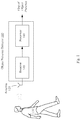
- FIG. 1 illustrates an exemplary scenario of detecting presence of an object, according to some embodiments of the present disclosure.
- FIG. 2 illustrates an exemplary method for detecting presence of an object in time domain, according to some embodiments of the present disclosure.
- FIG. 3 illustrates an exemplary method for detecting presence of an object in frequency domain, according to some embodiments of the present disclosure.
- FIG. 4 illustrates an exemplary method for detecting presence of an object in time and frequency domains, according to some embodiments of the present disclosure.
- FIG. 5 is a flowchart of an exemplary method for detecting presence of an object in the time domain, according to some embodiments of the present disclosure.
- FIG. 6 is a flowchart of an exemplary method for detecting presence of an object in the frequency domain, according to some embodiments of the present disclosure.
- FIG. 7 is a flowchart of an exemplary method for detecting presence of an object in the time and frequency domains, according to some embodiments of the present disclosure.
- FIG. 8 is a schematic diagram of an exemplary apparatus for detecting presence of an object, according to some embodiments of the present disclosure.
- FIG. 1 illustrates an exemplary scenario of detecting presence of an object, according to some embodiments of the present disclosure.
- an object presence detector 100 detects presence of a person 110 in an environment.
- Object presence detector 100 includes an antenna 120 , a receiver 140 , and a processor 160 .
- Antenna 120 is configured to receive electromagnetic waves or signals in the environment.
- Receiver 140 is configured to process the received waves or signals from antenna 120 for presence detection of an object.
- receiver 140 samples the received waves or signals from antenna 120 in accordance with a sampling rate, converts sampled signals to baseband signals, and feeds the baseband signals to processor 160 .
- Processor 160 is configured to perform methods for detecting presence of an object.
- processor 160 performs time-domain and/or frequency-domain methods for detecting presence of an object in accordance with the baseband signals from receiver 140 .
- External motion of person 110 may cause waves or signals reflected from moving person 110 to experience a frequency shift that is related to a radial component of velocity of person 110 .
- External motion of person 110 is defined as any change in a pose or position of person 110 's body center of mass (BCOM). This includes all external motion due to walking.
- BCOM body center of mass
- antenna 120 can receive signals reflected from person 110 that experience a Doppler frequency shift because of the motion, e.g., gait, of person 110 .
- Receiver 140 can then sample the received signals at a sampling rate, convert sampled signals to baseband Doppler signals, and feed the converted signals to processor 160 .
- Processor 160 can perform a time-domain and/or frequency-domain method for detecting the presence of person 110 in accordance with the received Doppler signals in the environment.
- object presence detector 100 can detect presence of an inanimate object or an animal, such as a moving vehicle or a cat walking in a room, by receiving signals, reflected from the vehicle or the cat, that experience a Doppler frequency shift because of the vehicle moving or cat walking. The received signals from the moving vehicle or the walking cat may be different from that from person 110 . Object presence detector 100 can adjust to different sampling rates to detect presence of different objects.
- FIG. 2 illustrates an exemplary system 200 for detecting presence of an object in the time domain, according to some embodiments of the present disclosure.
- System 200 is configured to filter a Doppler signal through a band-pass filter 220 , estimate environmental noise in the time domain through an environmental noise estimator 240 and store the estimated environmental noise in a baseline-noise database 250 , detect motion of an object by means of a motion detector 260 , and determine whether the presence of an object is detected.
- System 200 may also be configured to send a flag of object motion to environmental noise estimator 240 to update an environmental noise.
- System 200 may be implemented in object presence detector 100 or apparatus for detecting object presence.
- system 200 can be implemented by antenna 120 , receiver 140 , and processor 160 of object presence detector 100 to detect presence of person 110 .
- Receiver 140 includes, for example, an analog-to-digital converter (ADC), a band-pass filter, and a signal processing circuit that are respectively configured to sample a Doppler signal, filter the sampled Doppler signal, and estimate environmental noise in the time domain and store estimated environmental noise in memory.
- ADC analog-to-digital converter
- Processor 160 is configured to detect motion of an object, and determine whether presence of an object is detected.
- Processor 160 may also be configured to send a flag of object motion to receiver 140 to update an environmental noise.
- processor 160 can also be configured to estimate environmental noise in the time domain and store estimated environmental noise in memory.
- system 200 may be implemented by one or more application-specific integrated circuits (ASICs).
- ASICs application-specific integrated circuits
- all or a part of band-pass filter 220 , environmental noise estimator 240 , baseline-noise database 250 , and motion detector 260 can be implemented by one or more integrated circuits, registers, and/or a memory circuit.
- Other part of system 200 can be implemented by programs executed by one or more processors including, e.g., processor 160 , interacting with the one or more ASICs.
- system 200 when person 110 walks in an environment, system 200 receives a Doppler signal, x k (t), reflected from person 110 , where k is an index of frames.
- the Doppler signal is defined as a signal that experiences a Doppler frequency shift due to movement of person 110 .
- the received Doppler signal x k (t) can be analog or digital.
- system 200 can sample the received Doppler signal at an appropriate sampling rate f s before filtering the Doppler signal x k (t) through band-pass filter 220 .
- System 200 is configured to check each frame to detect for the presence of an object.
- Each frame includes, for example, 200 samples of the received Doppler signal.
- the sampling rate can be at least, for example, a double rate of the Doppler signal's frequency.
- the sampling rate, f s is at least 400, 500, or 600 samples per second, respectively.
- System 200 may adjust the sampling rate to detect Doppler signals at different frequencies in accordance with a target to be detected.
- band-pass filter 220 is configured to receive and filter the Doppler signal, x k (t), in a frequency band.
- band-pass filter 220 is configured to filter the received Doppler signal in a frequency band from 0 to 200 Hz, from 50 to 250 Hz, or from 0 to 300 Hz.
- Band-pass filter 220 can be, for example, a band-pass filter, a baseband filter, a root-raised-cosine filter, or a low-pass filter combined with a high-pass filter to pass the Doppler signal within the intended frequency band.
- band-pass filter 220 includes an analog filter configured to filter the received Doppler signal in a frequency band as illustrated above and system 200 can sample a filtered Doppler signal to obtain the Doppler signal x k (n).
- Environmental noise estimator 240 is configured to estimate environmental noise in the time domain in the environment. Before system 200 detects motion of an object, system 200 is configured to obtain an environmental noise in the environment. For example, environmental noise estimator 240 is configured to accumulate signal energies of x k (n) over current and previous twenty frames and average out an environmental noise energy. The environmental noise energy is defined as a baseline energy N k in the environment and is used to detect the presence of an object at the k+1 th frame.
- a received signal energy that is considered an environmental noise energy
- system 200 is configured to detect the presence of an object in the k+1 th frame in accordance with the updated baseline energy N k .
- system 200 when system 200 does not detect the presence of an object in a frame, system 200 is configured to maintain a baseline energy at a value equal to that in a previous frame. In other words, system 200 is configured not to update the baseline energy.
- system 200 After environmental noise estimator 240 estimates a baseline energy, system 200 is configured to store the estimated baseline energy in baseline-noise database 250 . For example, after environmental noise estimator 240 accumulates signal energies of x k (n) over twenty frames and averages out a baseline energy N k , system 200 is configured to store the baseline energy N k in baseline-noise database 250 . As another example, when system 200 does not detect the presence of an object in a frame, environmental noise estimator 240 updates the baseline energy as described above and system 200 is configured to store the updated baseline energy in baseline-noise database 250 .
- motion detector 260 determines whether motion of the object is detected and accordingly, sets or does not set the flag of object motion MF k TD .
- system 200 when system 200 does not detect motion of an object in accordance with the Doppler signal energy and the baseline energy in the time domain, system 200 is also configured to determine whether motion of the object is detected in accordance with a Doppler signal and a baseline energy in the frequency domain.
- system 200 determines that motion of the object is not detected in accordance with the Doppler signal and the baseline energy in the frequency domain, system 200 determines that motion of the object is not detected in accordance with the Doppler signal and updates the baseline energy in accordance with the signal energy in the time domain.
- FIG. 3 illustrates an exemplary system 300 for detecting presence of an object in the frequency domain, according to some embodiments of the present disclosure.
- System 300 is configured to transform a Doppler signal to the frequency domain through a Fourier transformer 310 , estimate environmental noise in the frequency domain through an environmental noise estimator 340 and store estimated environmental noise in a baseline-noise database 350 , decompose the Doppler signal into sub-band signals through sub-band decomposer 320 , detect motion of an object in sub-bands through a sub-band motion detector 360 , and determine whether presence of an object is detected through object motion detector 380 .
- System 300 may also be configured to send a flag of object presence to environmental noise estimator 340 to update an environmental noise.
- system 300 may be implemented in object presence detector 100 or apparatus for detecting object presence, as illustrated above for system 200 .
- System 300 can also be partly or fully implemented by one or more ASICs and/or programs, as illustrated and described above for system 200 .
- Fourier transformer 310 includes a short-time Fourier transform (STFT) or a filter bank.
- STFT short-time Fourier transform
- system 300 transforms the Doppler signal in the time domain to the Doppler signal in the frequency domain using the STFT or the filter bank. Accordingly, system 300 receives the Doppler signal X k (f) during a frame in the frequency domain.
- Environmental noise estimator 340 is configured to estimate environmental noise in the frequency domain in the environment. Before system 300 detects motion of an object, system 300 is configured to obtain an environmental noise in the environment. For example, environmental noise estimator 340 is configured to accumulate signal energies of X k (f) over current and previous twenty frames and average out an environmental noise energy in the frequency domain. The environmental noise energy in the k th frame in the frequency domain is defined as a baseline energy N k FD in the frequency domain in the environment and is used to detect the presence of an object in the k+1 th frame.
- a received signal energy that is considered as an environmental noise energy
- system 300 is configured to detect presence of an object in the k+1 th frame in accordance with the updated baseline energy N k FD .
- system 300 when system 300 does not detect the presence of an object in a frame, system 300 is configured to maintain a baseline energy at a value equal to that in a previous frame. In other words, system 300 is configured not to update the baseline energy.
- system 300 After environmental noise estimator 340 estimates a baseline energy, system 300 is configured to store the estimated baseline energy in baseline-noise database 350 . For example, after environmental noise estimator 340 accumulates signal energies of X k (f) over twenty frames and averages out a baseline energy N k FD in the frequency domain, system 300 is configured to store the baseline energy N k FD in baseline-noise database 350 . As another example, when system 300 does not detect the presence of an object in a frame, environmental noise estimator 340 updates the baseline energy as described above and system 300 is configured to store the updated baseline energy in baseline-noise database 350 .
- environmental noise estimator 340 is configured to estimate environmental noises in respective sub-bands in the environment.
- sub-band decomposer 320 also sends sub-band signals X k,m (f) to environmental noise estimator 340 .
- system 300 is configured to obtain environmental sub-band baseline energies in the environment.
- environmental noise estimator 340 is configured to accumulate sub-band signal energies of X k,m (f) in five sub-bands over current and previous twenty frames and average out environmental sub-band noise energies.
- the environmental sub-band noise energies in the k th frame are defined as sub-band baseline energies N k,m FD for the m sub-bands in the environment and are used to detect the presence of an object at the k+1 th frame.
- system 300 is configured to detect the presence of an object in the k+1 th frame in accordance with the updated sub-band baseline energies N k,m FD .
- system 300 when system 300 does not detect the presence of an object in a frame, system 300 is configured to maintain sub-band baseline energies at values equal to those in a previous frame. In other words, system 300 is configured not to update the sub-band baseline energies.
- system 300 After environmental noise estimator 340 estimates a baseline energy, system 300 is configured to store the estimated sub-band baseline energies in baseline-noise database 350 . For example, after environmental noise estimator 340 accumulates sub-band signal energies of X k,m (f) over twenty frames and averages out sub-band baseline energy N k,m FD , system 300 is configured to store the sub-band baseline energies N k,m FD , in baseline-noise database 350 . As another example, when system 300 does not detect presence of an object in a frame, environmental noise estimator 340 updates the sub-band baseline energies as described above and system 300 is configured to store the updated sub-band baseline energies in baseline-noise database 350 .
- Each component of system 300 can read baseline energy and/or sub-band baseline energies from baseline-noise database 350 whenever the component of system 300 needs the baseline energy and/or sub-band baseline energies. For example, when sub-band motion detector 360 determines motion of an object in sub-bands, sub-band motion detector 360 reads sub-band baseline energies from baseline-noise database 350 .
- the baseline energy includes a plurality of sub-band baseline energies corresponding to the plurality of sub-band signals.
- Sub-band motion detector 360 is configured to detect motion of an object in sub-bands in a frame in accordance with respective sub-band baseline energies.
- object motion detector 380 determines that motion of the object is not detected and does not set MF k FD .
- sub-band motion detector 380 determines whether motion of the object is detected in accordance with both thresholds 2 ⁇ N k-1 FD and ⁇ N k-1 FD or 2 ⁇ N k-1,m FD and ⁇ N k-1,m FD and criteria thereof as illustrated above in sub-band motion detector 360 .
- object motion detector 380 determines whether motion of the object is detected and accordingly, sets or does not set the flag of object motion MF k FD
- FIG. 4 illustrates an exemplary system 400 for detecting presence of an object in the time and frequency domains, according to some embodiments of the present application.
- System 400 is configured to detect motion of an object in the time domain through a time-domain object motion detector 420 , detect motion of the object in the frequency domain through a frequency-domain object motion detector 430 , and detect presence of the object in accordance with flags of object motion in the time and frequency domains through an object presence detector 440 .
- system 400 may be implemented in object presence detector 100 or apparatus for detecting object presence, as illustrated above for system 200 .
- System 400 can also be partly or fully implemented by one or more ASICs and/or programs, as illustrated above for system 200 .
- Frequency-domain object motion detector 430 is configured to detect motion of the object in the frequency domain.
- Frequency-domain object motion detector 430 can be configured to perform operations of system 300 described above with respect to the methods shown in FIG. 3 .
- Object presence detector 440 is configured to detect presence of the object in accordance with flags of object motion in the time and frequency domains. For example, as show in FIG. 4 , object presence detector 440 detects presence of the object and sets a flag of object presence OF k , based on the time-domain flag of object motion MF k TD , and the frequency-domain flag of object motion MF k FD .
- frequency-domain object motion detector 430 is configured to detect motion of the object in the frequency domain when a criterion is met. For example, frequency-domain object motion detector 430 transforms the Doppler signal x k (n) in the time domain to a Doppler signal X k (f) in the frequency domain and proceeds with frequency-domain object motion detection when one of the following criteria is met:
- frequency-domain object motion detector 430 transforms the Doppler signal x k (n) in the time domain to a Doppler signal X k (f) in frequency domain and proceeds with frequency-domain object motion detection when time-domain object motion detector 420 does not detect motion of the object in the time domain.
- frequency-domain object motion detector 430 transforms the Doppler signal x k (n) in the time domain to a Doppler signal X k (f) in the frequency domain and proceeds with frequency-domain object motion detection when time-domain object motion detector 420 detects motion of the object in the time domain.
- frequency-domain object motion detector 430 detects motion of the object only when time-domain object motion detector 420 detects motion of the object.
- time-domain object motion detector 420 and frequency-domain object motion detector 430 both detect motion of the object and send time-domain and frequency-domain flags of object motion to object presence detector 440 .
- frequency-domain object motion detector 430 transforms the Doppler signal x k (n) in the time domain to a Doppler signal X k (f) in the frequency domain and proceeds with frequency-domain object motion detection when time-domain object motion detector 420 detects motion of the object in the time domain, but the signal energy s k of the Doppler signal in the time domain is less than a threshold, e.g., s k ⁇ 1.2 ⁇ N k-1 .
- a threshold e.g., s k ⁇ 1.2 ⁇ N k-1 .
- FIG. 5 is a flowchart of an exemplary method for detecting presence of an object in the time domain, according to some embodiments of the present disclosure.
- Method 500 may be practiced by object presence detector 100 and systems 200 , 300 , and 400 .
- Method 500 includes receiving a Doppler signal during a frame (step 510 ), filtering the Doppler signal in a frequency band (step 520 ), determining a signal energy of the filtered Doppler signal in the time domain (step 530 ), determining whether motion of the object is detected in accordance with the Doppler signal and a baseline energy (step 540 ), responsive to a determination that motion of the object is detected in accordance with the signal energy and the baseline energy, setting a flag of object presence (step 550 ), and responsive to a determination that motion of the object is not detected in accordance with the Doppler signal, updating the baseline energy in accordance with the signal energy (step 560 ).
- Step 510 includes receiving a Doppler signal during a frame.
- system 200 receives a Doppler signal, x k (t) in the k th frame.
- Each frame includes, for example, 200 samples of the received Doppler signal.
- Step 520 includes filtering the Doppler signal in a frequency band.
- band-pass filter 220 filters the received Doppler signal x k (t) in a frequency band from 0 to 200 Hz, from 50 to 250 Hz, or from 0 to 300 Hz.
- Step 530 includes determining a signal energy of the filtered Doppler signal in the time domain.
- Step 540 includes determining whether motion of the object is detected in accordance with the Doppler signal and a baseline energy.
- Step 550 includes, responsive to a determination that motion of the object is detected in accordance with the signal energy and the baseline energy, setting a flag of object presence.
- the threshold in step 540 is determined based on a baseline energy and another threshold.
- the threshold in step 540 e.g., ⁇ N k-1
- the threshold in step 540 is determined based on a baseline energy (e.g., a baseline energy N k-1 ) and another threshold (e.g., SNRthr).
- step 560 can include, responsive to a determination that motion of the object is not detected in accordance with the Doppler signal, updating the baseline energy in accordance with a weighted average of the signal energy and the baseline energy. For example, as illustrated by system 200 in FIG.
- step 560 can include, responsive to a determination that motion of the object is not detected in accordance with the Doppler signal, updating the baseline energy in accordance with the signal energy in the frame and another signal energy in a previous frame. For example, as illustrated by system 200 in FIG.
- the k ⁇ i ⁇ 1 th frame is a previous frame for the k th frame.
- the baseline energy in the k ⁇ i ⁇ 1 th frame, N k-i-1 may include signal energy in a previous frame.
- the baseline energy N k is determined based on the weighted moving average of the signal energies at least in the k ⁇ 1 th
- the baseline energy in step 540 is a first baseline energy and method 500 further includes, responsive to a determination that motion of the object is not detected, determining whether motion of the object is detected in accordance with the signal energy and a second baseline energy, and responsive to a determination that motion of the object is detected in accordance with the signal energy and the second baseline energy, setting the flag of object presence.
- the baseline energy N k-1 can be a first baseline energy.
- motion detector 260 can be configured to determine whether motion of the object is detected in accordance with the signal energy s k and another threshold, e.g., ⁇ N k-1 st , which is obtained based on a second baseline energy N k-1 st .
- method 500 when the Doppler signal energy S k is less than the threshold ⁇ N k-1 but equal to or larger than 0.7 ⁇ N k-1 , method 500 further includes operations described above in accordance with the second baseline energy N k-1 st .
- the second baseline energy is determined based on a weighted moving average of a plurality of signal energies when motion of the object is not present, wherein the plurality of signal energies are energies of a plurality of Doppler signals received over a longer period than that of the first baseline energy.
- the k ⁇ i ⁇ 1 th frame is a previous frame for the k th frame.
- the second baseline energy N k-i-1 st of environmental noise in the k ⁇ i ⁇ 1 th frame may include signal energy in a previous frame.
- the second baseline energy N k st is determined based on the weight
- the second baseline energy N k st is determined based on a plurality of Doppler signals received over a longer period than that of the first baseline energy N k .
- the second baseline energy N k st can be determined based on a plurality of Doppler signals received over forty frames (those are considered as environmental noise energies), and the first baseline energy N k is averaged out over twenty frames.
- the second baseline energy N k st can be a stationary baseline energy that is average out over all of those frames in which motion detector 260 does not detect motion of person 110 .
- the first baseline energy N k is a non-stationary baseline energy that is averaged out over the latest twenty of those frames in which motion detector 260 does not detect motion of person 110 .
- step 510 includes receiving a Doppler signal from motion of an inanimate object, a human, or an animal during a frame, such as a moving vehicle, working person 110 , or a cat walking in a room.
- FIG. 6 is a flowchart of an exemplary method 600 for detecting presence of an object in the frequency domain, according to some embodiments of the present disclosure.
- Method 600 may be practiced by object presence detector 100 and systems 300 and 400 .
- Method 600 includes receiving a Doppler signal during a frame in the frequency domain (step 610 ), separating the Doppler signal in the frequency domain into a plurality of sub-band signals (step 620 ), determining a plurality of sub-band signal energies corresponding to the plurality of sub-band signals (step 630 ), determining whether motion of the object is detected in accordance with one of the plurality of sub-band signal energies and a baseline energy (step 640 ), and responsive to a determination that motion of the object is detected, setting a flag of object presence (step 650 ).
- Step 610 includes receiving a Doppler signal during a frame in the frequency domain.
- Step 620 includes separating the Doppler signal in the frequency domain into a plurality of sub-band signals.
- the five sub-band signals are 0-50 Hz, 50-100 Hz, 100-150 Hz, 150-200, and 200-250 Hz.
- Sub-band decomposer 320 then sends the five sub-band signals X k,m (f) to sub-band motion detector 360 .
- Step 630 includes determining a plurality of sub-band signal energies corresponding to the plurality of sub-band signals.
- Step 640 includes determining whether motion of the object is detected in accordance with one of the plurality of sub-band signal energies and a baseline energy.
- object motion detector 380 determines whether motion of the object is detected and accordingly, sets or does not set the flag of object motion MF k FD .
- step 640 includes determining that motion of the object is detected when at least two of the plurality of sub-band signal energies are equal to or greater than a threshold, and determining that motion of the object is not detected when less than two of the plurality of sub-band signal energies is equal to or greater than the threshold, wherein the threshold is determined based on the baseline energy.
- object motion detector 380 determines that motion of the object is not detected and does not set MF k FD .
- step 610 includes receiving a Doppler signal in the time domain and transforming the Doppler signal in the time domain to the Doppler signal in the frequency domain using a short-time Fourier transform (STFT) or a filter bank.
- STFT short-time Fourier transform
- Fourier transformer 310 receives a Doppler signal x k (n) in the time domain and transforms the Doppler signal x k (n) in the time domain to a Doppler signal in frequency domain X k (f).
- Fourier transformer 310 can include a short-time Fourier transform (STFT) or a filter bank. Accordingly, Fourier transformer 310 transforms the Doppler signal in the time domain to the Doppler signal in the frequency domain using the STFT or the filter bank.
- the baseline energy of environmental noise includes a plurality of sub-band baseline energies corresponding to the plurality of sub-band signals
- step 640 includes determining whether motion of the object is detected in accordance with the plurality of sub-band signal energies and the plurality of sub-band baseline energies.
- method 600 further includes updating the baseline energy in accordance with the one of the plurality of sub-band signal energies. For example, when system 300 does not detect presence of an object in a frame, system 300 is configured to update sub-band baseline energies in accordance with received sub-band signal energies (that are considered as environmental sub-band noise energies) in this frame and the sub-band baseline energies.
- step 610 includes receiving a Doppler signal in the frequency domain that is from motion of an inanimate object, a human, or an animal during a frame, such as a moving vehicle, walking person 110 , or a cat walking in a room.
- FIG. 7 is a schematic diagram of an exemplary method 700 for detecting presence of an object in the time and frequency domains, according to some embodiments of the present disclosure.
- Method 700 may be practiced by object presence detector 100 and systems 200 , 300 and 400 .
- Method 700 includes receiving a Doppler signal in the time domain (step 710 ), determining whether motion of the object is detected in accordance with the Doppler signal in the time domain and a first baseline energy (step 720 ), responsive to a determination that motion of the object is detected in accordance with the Doppler signal in the time domain and the first baseline energy, setting a first flag of object motion (step 730 ), transforming the Doppler signal in the time domain to a Doppler signal in the frequency domain (step 740 ), determining whether motion of the object is detected in accordance with the Doppler signal in the frequency domain and a second baseline energy (step 750 ), responsive to a determination that motion of the object is detected in accordance with the Doppler signal in the frequency domain and the second baseline
- Step 710 includes receiving a Doppler signal in time domain.
- time-domain object motion detector 420 receives the Doppler signal x k (n) in the time domain, similar to operations of system 200 described above with respect to the methods shown in FIG. 2 .
- Step 720 includes determining whether motion of the object is detected in accordance with the Doppler signal in the time domain and a first baseline energy. For example, as system 400 illustrated in FIG. 4 , time-domain object motion detector 420 determines whether motion of the object is detected in accordance with the Doppler signal x k (n) in the time domain and a baseline energy N k-1 , similar to operations of system 200 described above with respect to the methods shown in FIG. 2 .
- Step 730 includes, responsive to a determination that motion of the object is detected in accordance with the Doppler signal in the time domain and the first baseline energy, setting a first flag of object motion.
- Step 740 includes transforming the Doppler signal in the time domain to a Doppler signal in the frequency domain.
- frequency-domain object motion detector 430 transforms the Doppler signal x k (n) in the time domain to a Doppler signal X k (f) in the frequency domain, similar to operations of system 300 described above with respect to the methods shown in FIG. 3 .
- Step 750 includes determining whether motion of the object is detected in accordance with the Doppler signal in the frequency domain and a second baseline energy.
- frequency-domain object motion detector 430 determines whether motion of the object is detected in accordance with the Doppler signal X k (f) in the frequency domain and a baseline energy N k-1 FD or a sub-band baseline energy K k-1,m FD similar to operations of system 300 described above with respect to the methods shown in FIG. 3 .
- Step 760 includes, responsive to a determination that motion of the object is detected in accordance with the Doppler signal in the frequency domain and the second baseline energy, setting a second flag of object motion.
- Step 770 includes setting a flag of object presence based on the first flag of object motion and the second flag of object motion.
- object presence detector 440 detects presence of the object and sets a flag of object presence, OF k , based on the time-domain flag of object motion MF k TD and the frequency-domain flag of object motion MF k FD .
- step 740 includes transforming the Doppler signal in the time domain to a Doppler signal in the frequency domain when a criterion is met.
- frequency-domain object motion detector 430 transforms the Doppler signal x k (n) in the time domain to a Doppler signal X k (f) in the frequency domain and proceeds with frequency-domain object motion detection when one of the following criteria is met:
- frequency-domain object motion detector 430 transforms the Doppler signal x k (n) in the time domain to a Doppler signal X k (f) in the frequency domain and proceeds with frequency-domain object motion detection when time-domain object motion detector 420 does not detect motion of the object in time domain.
- frequency-domain object motion detector 430 transforms the Doppler signal x k (n) in the time domain to a Doppler signal X k (f) in the frequency domain and proceeds with frequency-domain object motion detection when time-domain object motion detector 420 detects motion of the object in the time domain.
- frequency-domain object motion detector 430 detects motion of the object only when time-domain object motion detector 420 detects motion of the object.
- time-domain object motion detector 420 and frequency-domain object motion detector 430 both detect motion of the object and send time-domain and frequency-domain flags of object motion to object presence detector 440 .
- frequency-domain object motion detector 430 transforms the Doppler signal x k (n) in the time domain to a Doppler signal X k (f) in frequency domain and proceeds with frequency-domain object motion detection when time-domain object motion detector 420 detects motion of the object in the time domain, but the signal energy s k of the Doppler signal in the time domain is less than a threshold, e.g., s k ⁇ 1.2 ⁇ N k-1 .
- a threshold e.g., s k ⁇ 1.2 ⁇ N k-1 .
- step 710 includes receiving a Doppler signal from motion of an inanimate object, a human, or an animal during a frame, such as a moving vehicle, walking person 110 , or a cat walking in a room.
- FIG. 8 is a schematic diagram of an exemplary apparatus 800 for detecting presence of an object, according to some embodiments of the present disclosure.
- Object presence detector 100 as shown in FIG. 1 can be configured as apparatus 800 .
- Apparatus 800 includes an antenna 820 , a receiver 840 , a communication unit 850 , a processor 860 , an I/O interface 870 , and a memory 880 .
- One or more of these elements of apparatus 800 may be included for detecting presence of an object in an environment. These elements may be configured to transfer data and send or receive instructions between or among each other.
- Antenna 120 , receiver 140 , and processor 160 as shown in FIG. 1 can be configured as antenna 820 , receiver 840 , and processor 860 , respectively.
- Processor 860 includes any appropriate type of general-purpose or special-purpose microprocessor, digital signal processor, or microcontroller. Processor 860 can be representative of one or more processors in object presence detector 100 .
- Memory 880 may include any appropriate type of mass storage provided to store any type of information that processor 860 may need to operate.
- Memory 880 may be a volatile or non-volatile, magnetic, semiconductor, tape, optical, removable, non-removable, or other type of storage device or tangible (i.e., non-transitory) computer-readable medium including, but not limited to, a read-only memory (ROM), a flash memory, a dynamic random-access memory (RAM), and a static RAM.
- Memory 610 may be configured to store one or more programs for execution by processor 860 for detecting presence of an object in an environment, as disclosed herein.
- Memory 880 may be further configured to store information and data used by processor 860 .
- memory 880 may be configured to store received baseline energies of environmental noise therein for apparatus 800 .
- I/O interface 870 may be configured to facilitate communication between apparatus 800 and other apparatuses. For example, I/O interface 870 may receive a signal from another apparatus (e.g., a computer) including system configuration information for apparatus 800 . I/O interface 870 may also output data of presence detection results to other apparatuses.
- another apparatus e.g., a computer
- I/O interface 870 may also output data of presence detection results to other apparatuses.
- Communication unit 850 may include one or more cellular communication modules, including, for example, a 5G radio access system, a Long-Term Evolution (LTE), a High Speed Packet Access (HSPA), a Wideband Code-Division Multiple Access (WCDMA), a Global System for Mobile communication (GSM), a Bluetooth, and/or an Institute of Electrical and Electronics Engineers (IEEE) 802.11 or Wi-Fi communication module.
- LTE Long-Term Evolution
- HSPA High Speed Packet Access
- WCDMA Wideband Code-Division Multiple Access
- GSM Global System for Mobile communication
- Bluetooth and/or an Institute of Electrical and Electronics Engineers (IEEE) 802.11 or Wi-Fi communication module.
- IEEE Institute of Electrical and Electronics Engineers 802.11 or Wi-Fi communication module.
- Antenna 820 may include one or more conductors (elements), electrically connected to receiver 840 . During reception, oscillating electric and magnetic fields of an incoming radio wave exert force on the electrons in the antenna elements, causing them to move back and forth, creating oscillating currents in the antenna. Accordingly, antenna 820 can be configured to receive waves or signals in an environment.
- Receiver 840 is configured to process the received waves or signals from antenna 820 for presence detection of an object.
- receiver 840 can include an ADC to sample the received waves or signals from antenna 820 in accordance with a sampling rate, convert sampled signals to baseband signals, and feed results to processor 860 .
- receiver 840 can be further configured to perform operations of band-pass filter 220 shown in FIG. 2 .
- Processor 860 can be configured by one or more programs stored in memory 880 to perform operations of apparatus 800 described above with respect to the methods shown in FIGS. 1-7 .
- the signal energies and/or the baseline energies in the methods shown in FIGS. 1-7 can be alternatively determined in terms of signal power and environmental noise power or in terms of another form of signal energy and environmental noise energy.
- an alternative implementation of one of the methods shown in FIGS. 1-7 includes comparing signal power, baseline energy power, and one or more thresholds as operations described above with respect to those signal energies, baseline energies, and one or more thresholds of the methods shown in FIGS. 1-7 .
- the processor-readable medium may include volatile or non-volatile, magnetic, semiconductor, tape, optical, removable, non-removable, or other types of processor-readable medium or processor-readable storage devices.
- the processor-readable medium may be the storage device or the memory module having the processor instructions stored thereon, as disclosed.
- the processor-readable medium may be a disc or a flash drive having the processor instructions stored thereon.
Landscapes
- Engineering & Computer Science (AREA)
- Radar, Positioning & Navigation (AREA)
- Remote Sensing (AREA)
- Physics & Mathematics (AREA)
- General Physics & Mathematics (AREA)
- Computer Networks & Wireless Communication (AREA)
- Life Sciences & Earth Sciences (AREA)
- General Life Sciences & Earth Sciences (AREA)
- Geophysics (AREA)
- Radar Systems Or Details Thereof (AREA)
- Geophysics And Detection Of Objects (AREA)
Abstract
Description
MF k TD=1 if s k >βN k-1, and
MF k TD=0 if s k <βN k-1,
-
- where MFk TD is a flag of object motion in the time domain in the kth frame, βNk-1 is a threshold of object motion detection, and β=c×SNRthr, where c is a constant and SNRthr is an signal-to-noise ratio threshold.
MF k,m FD=1 if S k,m≥2βN k-1 FD, and
MF k,m FD=0 if S k,m<2βN k-1 FD,
-
- where MFk,m FD is a flag of sub-band object motion in the mth sub-band in the kth frame, 2βNk-1 FD is a threshold of object motion detection and β=c×SNRthr, where c is a constant and SNRthr is a signal-to-noise ratio threshold.
MF k,m FD=1 if S k,m ≥βN k-1 FD, and
MF k,m FD=0 if S k,m <βN k-1 FD,
-
- where MFk,m FD is a flag of sub-band object motion in the mth sub-band in the kth frame, βNk-1 FD is a threshold of object motion detection, and β=c×SNRthr, where c is a constant and SNRthr is a signal to noise ratio threshold.
MF k,m FD=1 if S k,m≥2βN k-1,m FD, and
MF k,m FD=0 if S k,m<2βN k-1,m FD,
-
- where MFk,m FD is a flag of sub-band object motion in the mth sub-band in the kth frame, 2βNk-1,m FD is a threshold of object motion detection, and β=c×SNRthr, where c is a constant and SNRthr is a signal to noise ratio threshold.
MF k,m FD=1 if S k,m≥2βN k-1,m FD, and
MF k,m FD=0 if S k,m<2βN k-1,m FD,
-
- where MFk,m FD is a flag of sub-band object motion in the mth sub-band in the kth frame, βNk-1,m FD, is a threshold of object motion detection, and β=c×SNRthr, where c is a constant and SNRthr is a signal to noise ratio threshold.
MF k FD=1 if S k,m≥2βN k-1,m FD ,m=0,1,2,3, or 4,
MF k FD=1 if S k,i >βN k-1,i FD and S k,j >βN k-1,j FD ,i=0,1,2,3, or 4,j=0,1,2,3, or 4,i≠j, and
MF k FD=0 otherwise,
-
- where MFk FD is a flag of object motion in the kth frame, and 2βNk-1,m FD, and βNk-1,m FD, are thresholds of object motion detection in sub-bands.
-
- (a) The time-domain flag MFk TD, is not set, e.g, MFk TD=0;
- (b) The time-domain flag MFk TD, is set, e.g, MFk TD=1; or
- (c) The time-domain flag MFk TD, is set, e.g, MFk TD=1, and a signal energy sk, of the Doppler signal in the time domain is less than a threshold.
MF k TD=1 if s k ≥βN k-1, and
MF k TD=0 if s k <βN k-1,
-
- where MFk TD is a flag of object motion in time domain in the kth frame, βNk-1 is a threshold of object motion detection, and β=c×SNRthr, where c is a constant and SNRthr is an signal to noise ratio threshold.
MF k TD=1 if s k ≥βN k-1 st, and
MF k TD=0 if s k <βN k-1 st,
-
- where MFk TD is a flag of object motion in the time domain in the kth frame, αNk-1 st is a threshold of object motion detection, and α=cst×SNRthrst, where cst is a constant and SNRthrst is a signal to noise ratio threshold.
MF k,m FD=1 if S k,m≥2βN k-1 FD, and
MF k,m FD=0 if S k,m<2βN k-1 FD,
-
- where MFk,m FD is a flag of sub-band object motion in the mth sub-band in the kth frame, 2βNk-1 FD is a threshold of object motion detection, and β=c×SNRthr, where c is a constant and SNRthr is an signal to noise ratio threshold.
MF k,m FD=1 if S k,m ≥βN k-1 FD, and
MF k,m FD=0 if S k,m <βN k-1 FD,
-
- where MFk,m FD is a flag of sub-band object motion in the mth sub-band in the kth frame, βNk-1 FD is a threshold of object motion detection, and β=c×SNRthr, where c is a constant and SNRthr is a signal to noise ratio threshold.
MF k,m FD=1 if S k,m≥2βN k-1,m FD, and
MF k,m FD=0 if S k,m<2βN k-1,m FD,
-
- where MFk,m FD is a flag of sub-band object motion in the mth sub-band in the kth frame, 2βNk-1,m FD, is a threshold of object motion detection, and β=c×SNRthr, where c is a constant and SNRthr is a signal to noise ratio threshold.
-
- (a) The time-domain flag MFk TD is not set, e.g, MFk TD=0;
- (b) The time-domain flag MFk TD is set, e.g, MFk TD=1; or
- (c) The time-domain flag MFk TD is set, e.g, MFk TD=1, and a signal energy sk of the Doppler signal in the time domain is less than a threshold.
Claims (20)
Priority Applications (3)
| Application Number | Priority Date | Filing Date | Title |
|---|---|---|---|
| US15/993,574 US10928502B2 (en) | 2018-05-30 | 2018-05-30 | Methods and apparatus for detecting presence of an object in an environment |
| TW107143585A TWI677697B (en) | 2018-05-30 | 2018-12-05 | Method, apparatus and processor readable media for detecting presence of an object in an environment |
| CN201910102731.XA CN110555965B (en) | 2018-05-30 | 2019-02-01 | Method, apparatus and processor readable medium for detecting the presence of an object in an environment |
Applications Claiming Priority (1)
| Application Number | Priority Date | Filing Date | Title |
|---|---|---|---|
| US15/993,574 US10928502B2 (en) | 2018-05-30 | 2018-05-30 | Methods and apparatus for detecting presence of an object in an environment |
Publications (2)
| Publication Number | Publication Date |
|---|---|
| US20190369224A1 US20190369224A1 (en) | 2019-12-05 |
| US10928502B2 true US10928502B2 (en) | 2021-02-23 |
Family
ID=68694673
Family Applications (1)
| Application Number | Title | Priority Date | Filing Date |
|---|---|---|---|
| US15/993,574 Active 2039-02-26 US10928502B2 (en) | 2018-05-30 | 2018-05-30 | Methods and apparatus for detecting presence of an object in an environment |
Country Status (3)
| Country | Link |
|---|---|
| US (1) | US10928502B2 (en) |
| CN (1) | CN110555965B (en) |
| TW (1) | TWI677697B (en) |
Families Citing this family (1)
| Publication number | Priority date | Publication date | Assignee | Title |
|---|---|---|---|---|
| US20240345220A1 (en) * | 2023-04-13 | 2024-10-17 | Charter Communications Operating, Llc | Wireless connectivity and motion/gesture monitoring in a network environment |
Citations (23)
| Publication number | Priority date | Publication date | Assignee | Title |
|---|---|---|---|---|
| US3932870A (en) | 1974-05-31 | 1976-01-13 | American District Telegraph Company | On-line test circuit for intrusion alarm systems |
| US4187501A (en) | 1977-10-07 | 1980-02-05 | The United States Of America As Represented By The Secretary Of The Army | Electronic intruder detection system |
| EP0945854A2 (en) | 1998-03-24 | 1999-09-29 | Matsushita Electric Industrial Co., Ltd. | Speech detection system for noisy conditions |
| US20050078029A1 (en) | 2003-09-12 | 2005-04-14 | Omron Corporation | Two-frequency Doppler distance measuring apparatus and detection system having the apparatus |
| CN101414005A (en) | 2007-10-19 | 2009-04-22 | 福特全球技术公司 | Method and system for presence detection |
| US20090154726A1 (en) * | 2007-08-22 | 2009-06-18 | Step Labs Inc. | System and Method for Noise Activity Detection |
| TW201042961A (en) | 2009-05-26 | 2010-12-01 | Sunplus Mmobile Inc | Apparatus and method for estimating a doppler frequency of a moving object |
| CN102007428A (en) | 2008-04-16 | 2011-04-06 | 皇家飞利浦电子股份有限公司 | Passive radar for presence and motion detection |
| US8018371B1 (en) * | 2008-12-12 | 2011-09-13 | Ball Aerospace & Technologies Corp. | Passive proximity sensor method and apparatus |
| US20110267222A1 (en) * | 2010-04-30 | 2011-11-03 | Murray Craig | Location detection methods and systems |
| US20130041856A1 (en) | 2011-08-08 | 2013-02-14 | Robert Bosch Gmbh | Method for detection of movement of a specific type of object or animal based on radar signals |
| CN103109201A (en) | 2010-09-13 | 2013-05-15 | 法国电信公司 | Object detection method, device and system |
| US20130307562A1 (en) * | 2012-05-16 | 2013-11-21 | Shanghai Kohler Electronics, Ltd. | Systems and methods for fft-based microwave distance sensing for a plumbing fixture |
| US20140070983A1 (en) | 2012-09-13 | 2014-03-13 | Raytheon Company | Extracting spectral features from a signal in a multiplicative and additive noise environment |
| US20150301167A1 (en) | 2009-12-18 | 2015-10-22 | Christopher Gary Sentelle | Detection of movable objects |
| EP2940486A1 (en) | 2012-12-28 | 2015-11-04 | Panasonic Intellectual Property Management Co., Ltd. | Signal processing device |
| US9229102B1 (en) | 2009-12-18 | 2016-01-05 | L-3 Communications Security And Detection Systems, Inc. | Detection of movable objects |
| US20160124084A1 (en) | 2014-10-31 | 2016-05-05 | Mando Corporation | Method and radar apparatus for detecting target object |
| US20160307418A1 (en) | 2013-12-13 | 2016-10-20 | Utc Fire & Security Americas Corporation, Inc. | Selective intrusion detection systems |
| TW201711502A (en) | 2015-09-08 | 2017-03-16 | 高通公司 | Improved E911 positioning via background signal tracking |
| US20170123058A1 (en) | 2015-11-04 | 2017-05-04 | University Of Hawaii | Systems and methods for detection of occupancy using radio waves |
| US20190317191A1 (en) | 2018-04-11 | 2019-10-17 | Infineon Technologies Ag | Human Detection and Identification in a Setting Using Millimiter-Wave Radar |
| US20200003864A1 (en) | 2018-06-28 | 2020-01-02 | Richwave Technology Corp. | Doppler signal processing device and method thereof for interference spectrum tracking and suppression |
Family Cites Families (18)
| Publication number | Priority date | Publication date | Assignee | Title |
|---|---|---|---|---|
| US3336478A (en) * | 1964-08-20 | 1967-08-15 | American Tobacco Co | Apparatus for measuring the quality of a cigarette manufacturing process |
| US3801977A (en) * | 1971-12-07 | 1974-04-02 | Gulf & Western Mfg Co | Ultrasonic alarm circuit |
| US3838408A (en) * | 1973-02-09 | 1974-09-24 | Detection Syst Inc | Environmental test switch for intruder detection systems |
| US4107659A (en) * | 1976-05-05 | 1978-08-15 | Fred M. Dellorfano, Jr. | Intrusion alarm system with improved air turbulence compensation |
| US4254483A (en) * | 1978-01-30 | 1981-03-03 | Atronic Corporation | Ultrasonic intrusion alarm system |
| US5414729A (en) * | 1992-01-24 | 1995-05-09 | Novatel Communications Ltd. | Pseudorandom noise ranging receiver which compensates for multipath distortion by making use of multiple correlator time delay spacing |
| US6809681B1 (en) * | 1992-08-25 | 2004-10-26 | Raytheon Company | Random-modulation radar signal-induced interference cancellation method and apparatus |
| US5581237A (en) * | 1994-10-26 | 1996-12-03 | Detection Systems, Inc. | Microwave intrusion detector with threshold adjustment in response to periodic signals |
| US6381570B2 (en) * | 1999-02-12 | 2002-04-30 | Telogy Networks, Inc. | Adaptive two-threshold method for discriminating noise from speech in a communication signal |
| FR2825826B1 (en) * | 2001-06-11 | 2003-09-12 | Cit Alcatel | METHOD FOR DETECTING VOICE ACTIVITY IN A SIGNAL, AND ENCODER OF VOICE SIGNAL INCLUDING A DEVICE FOR IMPLEMENTING THIS PROCESS |
| CN1264294C (en) * | 2001-12-19 | 2006-07-12 | 中兴通讯股份有限公司 | Full-adaptive-weigh module intelligent antenna receiving method and device |
| US7450005B2 (en) * | 2006-01-18 | 2008-11-11 | International Business Machines Corporation | System and method of dynamically weighted analysis for intrusion decision-making |
| CN102136148B (en) * | 2011-03-24 | 2012-11-21 | 福州大学 | Adaptive background reconfiguration method based on pixel sequential morphology |
| JP2013004062A (en) * | 2011-06-22 | 2013-01-07 | Nec Engineering Ltd | Safety confirmation system |
| CN103067312A (en) * | 2012-07-23 | 2013-04-24 | 东南大学 | Long-term evolution system self-adaptation frequency deviation precorrection method under environment of high-speed rail |
| CN103383451B (en) * | 2013-06-07 | 2015-05-06 | 杭州电子科技大学 | Method for optimizing radar weak target detection based on constant side length gradient weighting graph cut |
| CN105182312B (en) * | 2015-09-29 | 2017-09-12 | 大连楼兰科技股份有限公司 | Constant False Alarm Detection Method Adaptive to Environmental Changes |
| CN105978640B (en) * | 2016-04-12 | 2019-04-16 | 重庆金美通信有限责任公司 | Modulation coding threshold value dynamic decision method in microwave transmission network |
-
2018
- 2018-05-30 US US15/993,574 patent/US10928502B2/en active Active
- 2018-12-05 TW TW107143585A patent/TWI677697B/en active
-
2019
- 2019-02-01 CN CN201910102731.XA patent/CN110555965B/en active Active
Patent Citations (24)
| Publication number | Priority date | Publication date | Assignee | Title |
|---|---|---|---|---|
| US3932870A (en) | 1974-05-31 | 1976-01-13 | American District Telegraph Company | On-line test circuit for intrusion alarm systems |
| US4187501A (en) | 1977-10-07 | 1980-02-05 | The United States Of America As Represented By The Secretary Of The Army | Electronic intruder detection system |
| EP0945854A2 (en) | 1998-03-24 | 1999-09-29 | Matsushita Electric Industrial Co., Ltd. | Speech detection system for noisy conditions |
| US20050078029A1 (en) | 2003-09-12 | 2005-04-14 | Omron Corporation | Two-frequency Doppler distance measuring apparatus and detection system having the apparatus |
| US20090154726A1 (en) * | 2007-08-22 | 2009-06-18 | Step Labs Inc. | System and Method for Noise Activity Detection |
| CN101414005A (en) | 2007-10-19 | 2009-04-22 | 福特全球技术公司 | Method and system for presence detection |
| US20110148689A1 (en) * | 2008-04-16 | 2011-06-23 | Koninklijke Philips Electronics N.V. | Passive radar for presence and motion detection |
| CN102007428A (en) | 2008-04-16 | 2011-04-06 | 皇家飞利浦电子股份有限公司 | Passive radar for presence and motion detection |
| US8018371B1 (en) * | 2008-12-12 | 2011-09-13 | Ball Aerospace & Technologies Corp. | Passive proximity sensor method and apparatus |
| TW201042961A (en) | 2009-05-26 | 2010-12-01 | Sunplus Mmobile Inc | Apparatus and method for estimating a doppler frequency of a moving object |
| US20150301167A1 (en) | 2009-12-18 | 2015-10-22 | Christopher Gary Sentelle | Detection of movable objects |
| US9229102B1 (en) | 2009-12-18 | 2016-01-05 | L-3 Communications Security And Detection Systems, Inc. | Detection of movable objects |
| US20110267222A1 (en) * | 2010-04-30 | 2011-11-03 | Murray Craig | Location detection methods and systems |
| CN103109201A (en) | 2010-09-13 | 2013-05-15 | 法国电信公司 | Object detection method, device and system |
| US20130041856A1 (en) | 2011-08-08 | 2013-02-14 | Robert Bosch Gmbh | Method for detection of movement of a specific type of object or animal based on radar signals |
| US20130307562A1 (en) * | 2012-05-16 | 2013-11-21 | Shanghai Kohler Electronics, Ltd. | Systems and methods for fft-based microwave distance sensing for a plumbing fixture |
| US20140070983A1 (en) | 2012-09-13 | 2014-03-13 | Raytheon Company | Extracting spectral features from a signal in a multiplicative and additive noise environment |
| EP2940486A1 (en) | 2012-12-28 | 2015-11-04 | Panasonic Intellectual Property Management Co., Ltd. | Signal processing device |
| US20160307418A1 (en) | 2013-12-13 | 2016-10-20 | Utc Fire & Security Americas Corporation, Inc. | Selective intrusion detection systems |
| US20160124084A1 (en) | 2014-10-31 | 2016-05-05 | Mando Corporation | Method and radar apparatus for detecting target object |
| TW201711502A (en) | 2015-09-08 | 2017-03-16 | 高通公司 | Improved E911 positioning via background signal tracking |
| US20170123058A1 (en) | 2015-11-04 | 2017-05-04 | University Of Hawaii | Systems and methods for detection of occupancy using radio waves |
| US20190317191A1 (en) | 2018-04-11 | 2019-10-17 | Infineon Technologies Ag | Human Detection and Identification in a Setting Using Millimiter-Wave Radar |
| US20200003864A1 (en) | 2018-06-28 | 2020-01-02 | Richwave Technology Corp. | Doppler signal processing device and method thereof for interference spectrum tracking and suppression |
Non-Patent Citations (2)
| Title |
|---|
| European Patent Office, European Search Report of Application No. EP19177157, dated Oct. 17, 2019. |
| Office Action issued by the USPTO dated Aug. 5, 2020, for U.S. Appl. No. 15/993,585. |
Also Published As
| Publication number | Publication date |
|---|---|
| TW202004214A (en) | 2020-01-16 |
| CN110555965A (en) | 2019-12-10 |
| TWI677697B (en) | 2019-11-21 |
| CN110555965B (en) | 2022-01-11 |
| US20190369224A1 (en) | 2019-12-05 |
Similar Documents
| Publication | Publication Date | Title |
|---|---|---|
| US10948581B2 (en) | Methods and apparatus for detecting presence of an object in an environment | |
| US9041592B2 (en) | Radar sensor and method of detecting object using the same | |
| CN108700652B (en) | Method, apparatus and system for wireless event detection and monitoring | |
| CA2714906C (en) | Method and apparatus for detecting presence of signal in wireless communication system based on cr technology | |
| US20180284223A1 (en) | Activity recognition system and activity recognition method | |
| WO2020103411A1 (en) | Fall detection method, device, and system | |
| CN106604394A (en) | CSI-based indoor human body motion speed judgment model | |
| Chen et al. | Signs of life detection using wireless passive radar | |
| CN109698724A (en) | Intrusion detection method, device, equipment and storage medium | |
| US20190374126A1 (en) | Method and device for measuring biometric signal by using radar | |
| US10928502B2 (en) | Methods and apparatus for detecting presence of an object in an environment | |
| EP4409238A1 (en) | Isolation of electronic environment for improved channel estimation | |
| KR20250005117A (en) | RF sensing-based human identification using combined gait and shape recognition | |
| US9608905B1 (en) | Packet preamble and symbol boundary detection | |
| JP2015184149A (en) | Monitoring device, monitoring system, monitoring method and monitoring program | |
| KR102425441B1 (en) | Apparatus and method for estimating human posture | |
| KR101755240B1 (en) | Signal detection apparatus using compressive sensing and method thereof | |
| Bhatti et al. | Spectrum sensing using feature vectors | |
| KR101912446B1 (en) | Method and apparatus for detecting intruder | |
| Isshiki et al. | A Study Real-Time WLAN Sensing System Using Channel State Information | |
| JP5631674B2 (en) | Radio wave receiver and signal analysis method | |
| Fernandes et al. | Wi-Fi intruder detection | |
| JP2015040774A (en) | Monitoring device and monitoring program | |
| Liu et al. | An Improved Time-Domain Autocorrelation Spectrum Detection Algorithm | |
| JP2013191920A (en) | Array antenna device and its broadcast reception control method |
Legal Events
| Date | Code | Title | Description |
|---|---|---|---|
| AS | Assignment |
Owner name: RICHWAVE TECHNOLOGY CORP., TAIWAN Free format text: ASSIGNMENT OF ASSIGNORS INTEREST;ASSIGNOR:KUO, SHENG CHUNG;REEL/FRAME:045941/0676 Effective date: 20180528 |
|
| FEPP | Fee payment procedure |
Free format text: ENTITY STATUS SET TO UNDISCOUNTED (ORIGINAL EVENT CODE: BIG.); ENTITY STATUS OF PATENT OWNER: SMALL ENTITY |
|
| FEPP | Fee payment procedure |
Free format text: ENTITY STATUS SET TO SMALL (ORIGINAL EVENT CODE: SMAL); ENTITY STATUS OF PATENT OWNER: SMALL ENTITY |
|
| STPP | Information on status: patent application and granting procedure in general |
Free format text: NON FINAL ACTION MAILED |
|
| STPP | Information on status: patent application and granting procedure in general |
Free format text: RESPONSE TO NON-FINAL OFFICE ACTION ENTERED AND FORWARDED TO EXAMINER |
|
| STPP | Information on status: patent application and granting procedure in general |
Free format text: RESPONSE AFTER FINAL ACTION FORWARDED TO EXAMINER |
|
| STPP | Information on status: patent application and granting procedure in general |
Free format text: NOTICE OF ALLOWANCE MAILED -- APPLICATION RECEIVED IN OFFICE OF PUBLICATIONS |
|
| STCF | Information on status: patent grant |
Free format text: PATENTED CASE |
|
| MAFP | Maintenance fee payment |
Free format text: PAYMENT OF MAINTENANCE FEE, 4TH YR, SMALL ENTITY (ORIGINAL EVENT CODE: M2551); ENTITY STATUS OF PATENT OWNER: SMALL ENTITY Year of fee payment: 4 |