US10913823B2 - POSS-based polyurethane modified poly(propylene carbonate) and preparation method thereof - Google Patents
POSS-based polyurethane modified poly(propylene carbonate) and preparation method thereof Download PDFInfo
- Publication number
- US10913823B2 US10913823B2 US16/312,737 US201816312737A US10913823B2 US 10913823 B2 US10913823 B2 US 10913823B2 US 201816312737 A US201816312737 A US 201816312737A US 10913823 B2 US10913823 B2 US 10913823B2
- Authority
- US
- United States
- Prior art keywords
- poss
- propylene carbonate
- oxygen anion
- based non
- formula
- Prior art date
- Legal status (The legal status is an assumption and is not a legal conclusion. Google has not performed a legal analysis and makes no representation as to the accuracy of the status listed.)
- Active, expires
Links
- 0 [3*][Si]12O[Si]3([3*])O[Si]4([3*])O[Si]([3*])(O1)O[Si]1([3*])O[Si]([3*])(O2)O[Si]([3*])(O3)O[Si](CCCOCC(CO)OC(=O)C[4*])(O4)O1.[3*][Si]12O[Si]3([3*])O[Si]4([3*])O[Si]([3*])(O1)O[Si]1([3*])O[Si]([3*])(O2)O[Si]([3*])(O3)O[Si](CCCOCC(O)COC(=O)N[4*])(O4)O1 Chemical compound [3*][Si]12O[Si]3([3*])O[Si]4([3*])O[Si]([3*])(O1)O[Si]1([3*])O[Si]([3*])(O2)O[Si]([3*])(O3)O[Si](CCCOCC(CO)OC(=O)C[4*])(O4)O1.[3*][Si]12O[Si]3([3*])O[Si]4([3*])O[Si]([3*])(O1)O[Si]1([3*])O[Si]([3*])(O2)O[Si]([3*])(O3)O[Si](CCCOCC(O)COC(=O)N[4*])(O4)O1 0.000 description 9
- QDRZQRRBARJJTN-UHFFFAOYSA-N C1=CC=C([P+](C2=CC=CC=C2)(C2=CC=CC=C2)C2=CC=CC=C2)C=C1.CC[N+](CC)(CC)CC.[Y-].[Y-] Chemical compound C1=CC=C([P+](C2=CC=CC=C2)(C2=CC=CC=C2)C2=CC=CC=C2)C=C1.CC[N+](CC)(CC)CC.[Y-].[Y-] QDRZQRRBARJJTN-UHFFFAOYSA-N 0.000 description 3
Images


Classifications
-
- C—CHEMISTRY; METALLURGY
- C08—ORGANIC MACROMOLECULAR COMPOUNDS; THEIR PREPARATION OR CHEMICAL WORKING-UP; COMPOSITIONS BASED THEREON
- C08G—MACROMOLECULAR COMPOUNDS OBTAINED OTHERWISE THAN BY REACTIONS ONLY INVOLVING UNSATURATED CARBON-TO-CARBON BONDS
- C08G77/00—Macromolecular compounds obtained by reactions forming a linkage containing silicon with or without sulfur, nitrogen, oxygen or carbon in the main chain of the macromolecule
- C08G77/42—Block-or graft-polymers containing polysiloxane sequences
- C08G77/448—Block-or graft-polymers containing polysiloxane sequences containing polycarbonate sequences
-
- C—CHEMISTRY; METALLURGY
- C08—ORGANIC MACROMOLECULAR COMPOUNDS; THEIR PREPARATION OR CHEMICAL WORKING-UP; COMPOSITIONS BASED THEREON
- C08G—MACROMOLECULAR COMPOUNDS OBTAINED OTHERWISE THAN BY REACTIONS ONLY INVOLVING UNSATURATED CARBON-TO-CARBON BONDS
- C08G77/00—Macromolecular compounds obtained by reactions forming a linkage containing silicon with or without sulfur, nitrogen, oxygen or carbon in the main chain of the macromolecule
- C08G77/04—Polysiloxanes
- C08G77/045—Polysiloxanes containing less than 25 silicon atoms
-
- C—CHEMISTRY; METALLURGY
- C08—ORGANIC MACROMOLECULAR COMPOUNDS; THEIR PREPARATION OR CHEMICAL WORKING-UP; COMPOSITIONS BASED THEREON
- C08G—MACROMOLECULAR COMPOUNDS OBTAINED OTHERWISE THAN BY REACTIONS ONLY INVOLVING UNSATURATED CARBON-TO-CARBON BONDS
- C08G77/00—Macromolecular compounds obtained by reactions forming a linkage containing silicon with or without sulfur, nitrogen, oxygen or carbon in the main chain of the macromolecule
- C08G77/04—Polysiloxanes
- C08G77/38—Polysiloxanes modified by chemical after-treatment
- C08G77/382—Polysiloxanes modified by chemical after-treatment containing atoms other than carbon, hydrogen, oxygen or silicon
- C08G77/388—Polysiloxanes modified by chemical after-treatment containing atoms other than carbon, hydrogen, oxygen or silicon containing nitrogen
-
- C—CHEMISTRY; METALLURGY
- C08—ORGANIC MACROMOLECULAR COMPOUNDS; THEIR PREPARATION OR CHEMICAL WORKING-UP; COMPOSITIONS BASED THEREON
- C08G—MACROMOLECULAR COMPOUNDS OBTAINED OTHERWISE THAN BY REACTIONS ONLY INVOLVING UNSATURATED CARBON-TO-CARBON BONDS
- C08G77/00—Macromolecular compounds obtained by reactions forming a linkage containing silicon with or without sulfur, nitrogen, oxygen or carbon in the main chain of the macromolecule
- C08G77/42—Block-or graft-polymers containing polysiloxane sequences
- C08G77/452—Block-or graft-polymers containing polysiloxane sequences containing nitrogen-containing sequences
- C08G77/458—Block-or graft-polymers containing polysiloxane sequences containing nitrogen-containing sequences containing polyurethane sequences
-
- C—CHEMISTRY; METALLURGY
- C08—ORGANIC MACROMOLECULAR COMPOUNDS; THEIR PREPARATION OR CHEMICAL WORKING-UP; COMPOSITIONS BASED THEREON
- C08L—COMPOSITIONS OF MACROMOLECULAR COMPOUNDS
- C08L69/00—Compositions of polycarbonates; Compositions of derivatives of polycarbonates
-
- C—CHEMISTRY; METALLURGY
- C08—ORGANIC MACROMOLECULAR COMPOUNDS; THEIR PREPARATION OR CHEMICAL WORKING-UP; COMPOSITIONS BASED THEREON
- C08L—COMPOSITIONS OF MACROMOLECULAR COMPOUNDS
- C08L83/00—Compositions of macromolecular compounds obtained by reactions forming in the main chain of the macromolecule a linkage containing silicon with or without sulfur, nitrogen, oxygen or carbon only; Compositions of derivatives of such polymers
- C08L83/04—Polysiloxanes
- C08L83/08—Polysiloxanes containing silicon bound to organic groups containing atoms other than carbon, hydrogen and oxygen
-
- C—CHEMISTRY; METALLURGY
- C08—ORGANIC MACROMOLECULAR COMPOUNDS; THEIR PREPARATION OR CHEMICAL WORKING-UP; COMPOSITIONS BASED THEREON
- C08L—COMPOSITIONS OF MACROMOLECULAR COMPOUNDS
- C08L2201/00—Properties
- C08L2201/08—Stabilised against heat, light or radiation or oxydation
Definitions
- the present invention belongs to the field of polymer materials, and more particularly relates to modified poly(propylene carbonate) and a preparation method thereof.
- Poly(propylene carbonate) also known as polypropylene carbonate
- PPC Poly(propylene carbonate)
- the chain structure of PPC has a carbon dioxide content of 31% to 50%, and can be completely degraded under the action of microorganisms, thereby being capable of effectively reducing the carbon emission and coping with the problem of climate warming.
- carbon dioxide based polycarbonate can fundamentally solve the problem of white pollution.
- PPC has many advantages such as high barrier properties and transparency, and has broad application prospects in the fields of thin film biomedical materials, packaging materials and the like.
- the molecular chain of PPC has weak intermolecular interactions as well as poor mechanical properties and thermal stability, and its glass transition temperature is only about 35° C., which leads to limited development of PPC applications.
- PPC modification by physical blending is a widely used method, mainly including blending PPC with other kinds of polymers and blending PPC with inorganic particles.
- the present invention provides POSS (polyhedral oligomeric silsesquioxane)-based polyurethane modified poly(propylene carbonate) and a preparation method thereof, in which POSS-based non-isocyanate polyurethane is prepared and then blended with poly(propylene carbonate) to obtain the modified poly(propylene carbonate).
- POSS polyhedral oligomeric silsesquioxane
- the blend according to the present invention has good interfacial compatibility and high elongation at break as well as significantly improved tensile strength, Young's modulus, and the like, thereby solving the technical problem that the composite material in the prior art has poor performance and stability due to poor compatibility of the poly(propylene carbonate) with other polymers or inorganic materials, which does not meet the practical application requirements.
- POSS-based non-isocyanate polyurethane characterized in that the POSS-based non-isocyanate polyurethane has a structure shown by a formula (I) or a formula (II):
- R 3 represents
- R 4 is selected from the group consisting of C1-C20 alkyl, C1-C20 halogen-substituted alkyl, C1-C20 fatty acid or C1-C20 fatty alcohol.
- R 4 is butyl, 4-carboxybutyl, hydroxyethyl, hydroxypropyl or n-hexyl.
- a method for preparing POSS-based non-isocyanate polyurethane characterized by comprising:
- the catalyst is a porphyrin aluminum complex.
- the catalyst further includes a cocatalyst, and the cocatalyst is a quaternary ammonium salt or a quaternary phosphonium salt.
- a molar ratio of the catalyst, the cocatalyst and the POSS-based epoxy compound is 1:(1 to 100):(5000 to 50000).
- a reaction solvent for the cycloaddition reaction includes one or more selected from the group consisting of dichloromethane, trichloromethane and toluene; the reaction temperature is 20 to 150° C.; and the reaction pressure is 1 to 5 MPa.
- the catalyst has a structure shown by a formula (III):
- R 5 , R 6 , R 7 , R 8 and R 9 are each independently selected from the group consisting of hydrogen, halogen, substituted aliphatic group, substituted heteroaliphatic group, substituted aryl and substituted heteroaryl; and X is one selected from the group consisting of halo, —NO 3 , CH 3 COO—, CCl 3 COO—, CF 3 COO—, ClO 4 —, BF 4 —, BPh 4 -, —CN, —N 3 , p-methylbenzoate, p-toluenesulfonate, o-nitrophenol oxygen anion, p-nitrophenol oxygen anion, m-nitrophenol oxygen anion, 2,4-dinitrophenol oxygen anion, 3-5 dinitrophenol oxygen anion, 2,4,6-trinitrophenol oxygen anion, 3,5-dichlorophenol oxygen anion, 3,5-difluorophenol oxygen anion, 3,5-di(trifluoromethyl)phenol oxygen anion or pen
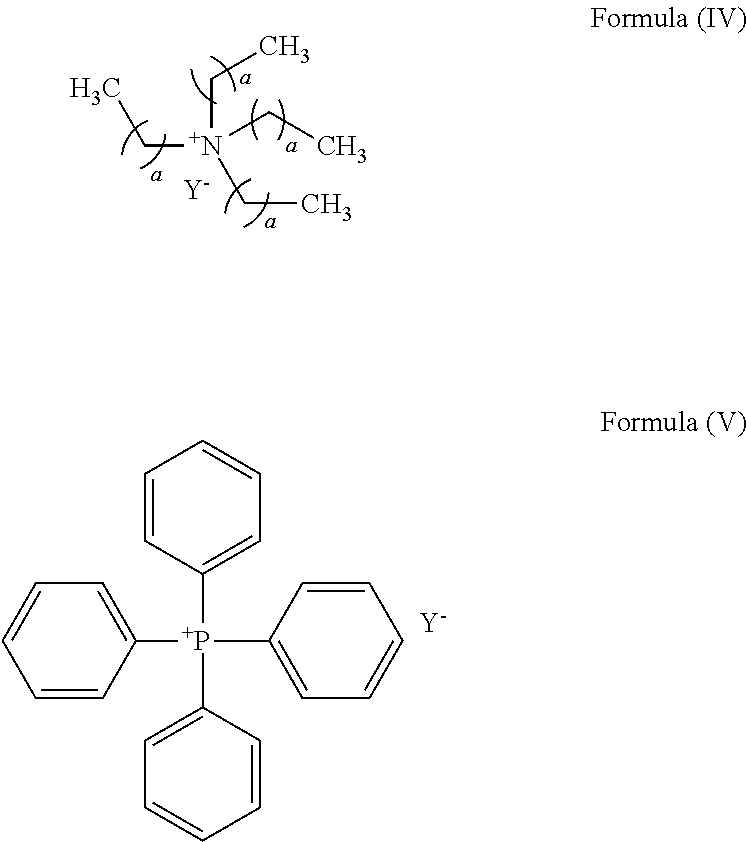
- the cocatalyst when the cocatalyst is a quaternary ammonium salt, it has a structure shown by a formula (IV), and when the cocatalyst is a quaternary phosphonium salt, it has a structure shown by a formula (V):
- a in the formula (IV) is an integer of 1 to 6; and Y— in the formula (IV) and the formula (V) is one of halide anion, NO 3 ⁇ , CH 3 COO ⁇ , CCl 3 COO ⁇ , CF 3 COO ⁇ , ClO 4 ⁇ , BF 4 ⁇ , p-methylbenzoate, p-toluenesulfonate, o-nitrophenol oxygen anion, p-nitrophenol oxygen anion, m-nitrophenol oxygen anion, 2,4-dinitrophenol oxygen anion, 3-5 dinitrophenol oxygen anion, 2,4,6-trinitrophenol oxygen anion, 3,5-dichlorophenol oxygen anion, 3,5-difluorophenol oxygen anion, 3,5-di(trifluoromethyl)phenol oxygen anion or pentafluorophenol oxygen anion.
- reaction conditions of the ring-opening reaction in the step (2) are: the solvent is one or more selected from the group consisting of dichloromethane, DMF, DMSO, tetrahydrofuran, toluene and acetone; the temperature is 20 to 150° C.; and the reaction temperature is 2 to 10 h.
- the modification of the poly(propylene carbonate) comprises increasing the tensile strength, Young's modulus and elongation at break of the poly(propylene carbonate).
- POSS-based polyurethane modified poly(propylene carbonate) which comprises 1 to 20 wt % of the above POSS-based non-isocyanate polyurethane and the balance of poly(propylene carbonate).
- the poly(propylene carbonate) has a number average molecular weight of 50,000 to 300,000 daltons; and the poly(propylene carbonate) has a molecular weight fraction index of 1.3 to 4.4.
- a method for preparing modified poly(propylene carbonate) comprising: mixing POSS-based non-isocyanate polyurethane with poly(propylene carbonate) to obtain a modified poly(propylene carbonate) precursor; and melt-blending the modified poly(propylene carbonate) precursor to obtain modified poly(propylene carbonate).
- the stirring speed is 200 to 1500 rpm, and the mixing time is 2 to 20 min; and in the melt blending process, the temperature is 100 to 180° C.; and the melt blending time is 2 to 20 min.
- the present invention has the following beneficial effects:
- POSS-based non-isocyanate polyurethane and poly(propylene carbonate) are blended to prepare modified poly(propylene carbonate).
- polyhedral oligomeric silsesquioxane (POSS) not only has low density, high thermal stability and flexibility of organic silicon materials, but also has many advantages such as high strength, high temperature resistance and oxidation resistance of inorganic silicon materials.
- the modified poly(propylene carbonate) according to the present invention has good interfacial compatibility and high elongation at break as well as significantly improved tensile strength, Young's modulus, thermal stability and the like.
- blending POSS with polymer materials can significantly improve the mechanical properties and thermal stability of the material.
- POSS has high functionality, and the compatibility of POSS with the polymer substrate can be enhanced by chemical modification.
- the test results showed that the modified poly(propylene carbonate) has an elongation at break of 9.11% to 24.12%, a tensile strength of 47.11 to 63.87 MPa, and a Young's modulus of 991 to 1822 MPa.
- the preparation method of the POSS-based polyurethane according to the present invention is a non-isocyanate method for synthesizing polyurethane, which has the advantages of simple process, low cost, environmental protection and high efficiency, and is suitable for large-scale production.
- the POSS-based non-isocyanate polyurethane and the poly(propylene carbonate) are processed by a melting method, and this method is simple and controllable.
- FIG. 1 is a synthetic route diagram of POSS-based non-isocyanate polyurethane according to the present invention
- FIG. 2 shows a nuclear magnetic hydrogen spectrum of the POSS-based cyclic carbonate prepared in Embodiment 1;
- FIG. 3 shows a nuclear magnetic hydrogen spectrum of the POSS-based non-isocyanate polyurethane prepared in Embodiment 5.
- the present invention provides POSS-based non-isocyanate polyurethane with a structure shown by a formula (I) or a formula (II):
- R 3 represents
- R 4 is selected from the group consisting of C1-C20 alkyl, C1-C20 halogen-substituted alkyl, C1-C20 fatty acid or C1-C20 fatty alcohol.
- a preparation method of the POSS-based non-isocyanate polyurethane is carried out in accordance with the synthetic route shown in FIG. 1 , comprising the following steps:
- the catalyst is a porphyrin aluminum complex
- the POSS-based epoxy compound is subjected to cycloaddition reaction with CO 2 under the action of the porphyrin aluminum complex to prepare POSS-based cyclic carbonate
- the temperature of the cycloaddition reaction is 20 to 150° C., preferably 80 to 150° C.
- the time of the cycloaddition reaction is 2 to 10 h, preferably 2 to 8 h.
- the catalyst further includes a cocatalyst, and the cocatalyst is a quaternary ammonium salt or a quaternary phosphonium salt.
- a molar ratio of the catalyst, the cocatalyst and the POSS-based epoxy compound is 1:(1 to 100):(5000 to 50000), preferably 1:(50 to 100):(5000 to 10000);
- the reaction solvent is one of dichloromethane, trichloromethane and toluene; and the reaction pressure, that is, the carbon dioxide pressure is 1 to 5 MPa, preferably 2.0 to 5.0 MPa.
- the catalyst has a structure shown in formula (III):
- R 5 , R 6 , R 7 , R 8 and R 9 are each independently selected from the group consisting of hydrogen, halogen, substituted aliphatic group, substituted heteroaliphatic group, substituted aryl and substituted heteroaryl; and X is one selected from the group consisting of halo, —NO 3 , CH 3 COO—, CCl 3 COO—, CF 3 COO—, ClO 4 —, BF 4 —, BPh 4 -, —CN, —N 3 , p-methylbenzoate, p-toluenesulfonate, o-nitrophenol oxygen anion, p-nitrophenol oxygen anion, m-nitrophenol oxygen anion, 2,4-dinitrophenol oxygen anion, 3-5 dinitrophenol oxygen anion, 2,4,6-trinitrophenol oxygen anion, 3,5-dichlorophenol oxygen anion, 3,5-difluorophenol oxygen anion, 3,5-di(trifluoromethyl)phenol oxygen anion or pen
- the cocatalyst When the cocatalyst is a quaternary ammonium salt, it has a structure shown by a formula (IV), and when the cocatalyst is a quaternary phosphonium salt, it has a structure shown by a formula (V):
- a in the formula (IV) is an integer of 1 to 6; and Y— in the formula (IV) and the formula (V) is one of halide anion, NO 3 ⁇ , CH 3 COO ⁇ , CCl 3 COO ⁇ , CF 3 COO ⁇ , ClO 4 ⁇ , BF 4 ⁇ , p-methylbenzoate, p-toluenesulfonate, o-nitrophenol oxygen anion, p-nitrophenol oxygen anion, m-nitrophenol oxygen anion, 2,4-dinitrophenol oxygen anion, 3-5 dinitrophenol oxygen anion, 2,4,6-trinitrophenol oxygen anion, 3,5-dichlorophenol oxygen anion, 3,5-difluorophenol oxygen anion, 3,5-di(trifluoromethyl)phenol oxygen anion or pentafluorophenol oxygen anion.
- the monoamino compound is one selected from C1-C20 alkylamine, C1-C20 amino acid and C1-C20 fatty alcohol amine; and preferably, the monoamino compound is one selected from n-butylamine, n-hexylamine, ethanolamine, propanolamine and butyrate.
- the molar ratio of the monoamine compound (that is, the monoamino compound) to the POSS-based cyclic carbonate is preferably (10 to 25):1.
- the POSS-based cyclic carbonate prepared in the step (1) is first purified, and then subjected to ring-opening reaction with the monoamine compound to obtain non-isocyanate polyurethane.
- the method of purifying the POSS-based cyclic carbonate in the present invention is different from the methods well known to those skilled in the art.
- the POSS-based cyclic carbonate is first dissolved in a good solvent and then precipitated in a poor solvent.
- the good solvent for the POSS-based cyclic carbonate is dichloromethane and toluene, and the poor solvent is acetone and diethyl ether.
- the ring-opening reaction in the step (2) is carried out in a nitrogen atmosphere, and the ring-opening reaction in the step (2) is preferably carried out under mechanical stirring; and the stirring rate is 80 to 100 rpm, more preferably 90 to 100 rpm.
- reaction conditions of the step (2) are: the solvent is one selected from the group consisting of dichloromethane, DMF, DMSO, tetrahydrofuran, toluene and acetone; the reaction temperature is 20 to 150° C., preferably 20 to 80° C.; and the reaction time is 2 to 10 h, preferably 4 to 10 h.
- the reaction product of the ring-opening reaction is purified.
- a preferred purification method is: diluting the reaction product with dichloromethane, placing it in a low temperature environment for standing, and then filtering it to obtain a precipitate, that is, a final product.
- the reaction product is diluted with dichloromethane to a molar concentration of 10 to 30 mmol/L, more preferably 10 to 25 mmol/L.
- the low temperature environment has a temperature of ⁇ 10 to 5° C., more preferably from ⁇ 5 to 5° C.; and the standing time is preferably 1 to 8 h, more preferably 4 to 8 h.
- the purified product is preferably dried to obtain POSS-based non-isocyanate polyurethane.
- the drying method is not particularly limited, and a drying method well known to those skilled in the art can be employed.
- the drying method is stoving, and the stoving temperature is preferably 30 to 50° C.
- an oven used for the stoving process is a blower oven, an electric oven or an infrared heating oven well known to those skilled in the art.
- the POSS-based non-isocyanurate polyurethane synthesized according to the above synthetic route includes two molecules having the structures shown by the formula (I) and the formula (II), and its yield is obtained by calculating the total yield of the two molecules in the embodiments of the present invention.
- the above POSS-based non-isocyanate polyurethane modified poly(propylene carbonate) is applied to the modification of poly(propylene carbonate) so as to improve the tensile strength, Young's modulus and elongation at break of the poly(propylene carbonate), achieving a very good result.
- the present invention also provides POSS-based polyurethane modified poly(propylene carbonate), comprising poly(propylene carbonate) and 1 to 20 wt % of POSS-based non-isocyanate polyurethane, in which the number average molecular weight of the poly(propylene carbonate) is 50,000 to 300,000 daltons; and the molecular weight fraction index of the poly(propylene carbonate) is 1.3 to 4.4.
- the present invention provides modified poly(propylene carbonate), comprising 1 to 20 wt % of the above POSS-based non-isocyanate polyurethane and the balance of polypropylene carbonate.
- the number average molecular weight of the poly(propylene carbonate) is preferably 50,000 to 300,000 daltons, more preferably 100,000 to 180,000 daltons; and the molecular weight fraction index of the poly(propylene carbonate) is preferably 1.3 to 4.4, more preferably 2.3 to 4.1.
- the source of poly(propylene carbonate) is not particularly limited, and poly(propylene carbonate) well known to those skilled in the art may be used.
- the present invention provides a method for preparing modified poly(propylene carbonate) by applying the above technical solution, comprising the following steps:
- the POSS-based non-isocyanate polyurethane is mixed with the poly(propylene carbonate) in the high-speed stirrer to obtain the modified poly(propylene carbonate) precursor.
- the mixing order of the POSS-based non-isocyanate polyurethane and the poly(propylene carbonate) is not particularly limited in the present invention, and preferably, the POSS-based non-isocyanate polyurethane is added to the poly(propylene carbonate).
- the POSS-based non-isocyanate polyurethane and the poly(propylene carbonate) may be separately dried and then mixed; or the POSS-based non-isocyanate polyurethane and the poly(propylene carbonate) may be mixed together and then dried.
- the drying temperature is preferably 35 to 45° C., more preferably 38 to 40° C.; and the drying time is 20 to 30 h, more preferably 25 to 28 h.
- the dried POSS-based non-isocyanurate polyurethane and poly(propylene carbonate) are mixed to obtain a modified poly(propylene carbonate) precursor.
- the stirring speed during the mixing is preferably 200 to 1500 rpm, more preferably 500 to 1400 rpm; and the mixing time is preferably 2 to 20 min, more preferably 5 to 15 min.
- the mixing device is not particularly limited in the present invention, and a high-speed mixer, a static mixer, a ribbon mixer or a kneading mixer well known to those skilled in the art may be used.
- the mixing device is a high-speed mixer.
- the modified poly(propylene carbonate) precursor is melt-processed to obtain modified poly(propylene carbonate).
- the processing equipment is not particularly limited, and may be a melt-processing equipment well known to those skilled in the art. In the embodiments of the present invention, the processing equipment may be a Hacker torque rheometer.
- the processing temperature is preferably 100 to 180° C., more preferably from 110 to 160° C.
- the melt-blending time is 2 to 20 min, preferably 5 to 10 min, more preferably 5 to 7 min
- the rotational speed of the melt processing is preferably 30 to 80 rpm, more preferably 50 to 70 rpm.
- POSS As a novel environmentally friendly silicon material, POSS not only has low density, high thermal stability and flexibility of organic silicon materials, but also has many advantages such as high strength, high temperature resistance and oxidation resistance of inorganic silicon materials.
- a large amount of polyurethane bonds and hydroxyl in the POSS-based non-isocyanate polyurethane can serve as proton donors to form high-density hydrogen bonding with carbonate units in the chain structure of the poly(propylene carbonate), and this hydrogen bonding can enhance the compatibility of POSS-based non-isocyanate polyurethane with the poly(propylene carbonate).
- the modified poly(propylene carbonate) according to the present invention has good interfacial compatibility and high elongation at break as well as significantly improved tensile strength, Young's modulus, thermal stability and the like.
- mechanical properties of the obtained modified poly(propylene carbonate) were tested according to GB1040-2006. The test results showed that the POSS-based polyurethane modified poly(propylene carbonate) according to the present invention has an elongation at break of 9.11% to 24.12%, a tensile strength of 47.11 to 63.87 MPa, and a Young's modulus of 991 to 1822 MPa.
- the preparation method of the POSS-based polyurethane according to the present invention is a non-isocyanate method for synthesizing polyurethane, which has the advantages of simple process, low cost, environmental protection and high efficiency, and is suitable for large-scale production.
- the POSS-based non-isocyanate polyurethane and the poly(propylene carbonate) are processed by a melting method, and this method is simple and controllable.
- Embodiments 1 to 4 describes preparation processes of the POSS-based cyclic carbonate in which POSS-based epoxy compound is subjected to cycloaddition reaction with carbon dioxide under the action of a catalyst;
- Embodiments 5 to 10 describes preparation processes of the POSS-based non-isocyanate polyurethane in which the POSS-based cyclic carbonate prepared in Embodiments 1 to 4 is subjected to ring-opening reaction with monoamine compound;
- Embodiments 11 to 20 describes preparation processes of the POSS-based amino modified poly(propylene carbonate) according to the present invention in which the poly(propylene carbonate) and the POSS-based non-isocyanate polyurethane prepared in Embodiment 5 are mixed and then melt-processed.
- FIG. 2 is a nuclear magnetic hydrogen spectrum of the POSS-based cyclic carbonate prepared in the present embodiment, and the spectrum confirms that it is POSS-based cyclic carbonate.
- the autoclave was placed in a constant temperature oil bath at 150° C., the pressure was raised to 1.0 MPa, and the reaction was carried out for 1 hours. After the reaction was finished, the autoclave was cooled to room temperature, carbon dioxide was slowly removed, and the crude product was taken out and characterized.
- the 1 H-NMR analysis result showed that the conversion rate of the POSS-based epoxy compound was higher than 99%.
- the remaining product was diluted with a small amount of dichloromethane, and precipitated after addition of acetone.
- the solid obtained by filtration that is, POSS-based cyclic carbonate, was dried in a vacuum oven at 35° C. to a constant weight with a yield of 98%.
- the autoclave was placed in a constant temperature oil bath at 150° C., the pressure was raised to 2.0 MPa, and the reaction was carried out for 2 hours. After the reaction was finished, the autoclave was cooled to room temperature, carbon dioxide was slowly removed, and the crude product was taken out and characterized.
- the 1 H-NMR analysis result showed that the conversion rate of the POSS-based epoxy compound was higher than 99%.
- the remaining product was diluted with a small amount of dichloromethane, and precipitated after addition of acetone.
- the solid obtained by filtration that is, POSS-based cyclic carbonate, was dried in a vacuum oven at 40° C. to a constant weight with a yield of 96%.
- the autoclave was placed in a constant temperature oil bath at 20° C., the pressure was raised to 5.0 MPa, and the reaction was carried out for 10 hours. After the reaction was finished, the autoclave was cooled to room temperature, carbon dioxide was slowly removed, and the crude product was taken out and characterized.
- the 1 H-NMR analysis result showed that the conversion rate of the POSS-based epoxy compound was higher than 99%.
- the remaining product was diluted with a small amount of dichloromethane, and precipitated after addition of acetone.
- the solid obtained by filtration that is, POSS-based cyclic carbonate, was dried in a vacuum oven at 40° C. to a constant weight with a yield of 98%.
- a dried 500 mL round-bottom flask was filled with high purity nitrogen, and then 0.8 mol of diethanolamine, 0.05 mol of POSS-based cyclic carbonate and 150 mL of dry dichloromethane were added to the round-bottom flask.
- the round-bottom flask was placed in a water bath, the temperature is controlled to be 20° C., and stirring is performed at a rate of 100 rpm for 10 h.
- the obtained POSS-based polyurethane was diluted by 250 mL of dichloromethane to a concentration of 10 mmol/L, placed in a refrigerator at ⁇ 5° C. for 4 h, and then filtered. The resulting precipitate was dried in a vacuum oven at 40° C.
- FIG. 3 shows a nuclear magnetic hydrogen spectrum of the POSS-based non-isocyanate polyurethane prepared in the present embodiment, and the spectrum confirms that it is a mixture of POSS-based non-isocyanurate polyurethane shown by the formula (I) and the formula (II), in which R 4 is ethoxyl.
- a dried 500 mL round-bottom flask was filled with high purity nitrogen, and then 0.8 mol of n-butylamine, 0.05 mol of POSS-based cyclic carbonate and 150 mL of dry dichloromethane were added to the round-bottom flask.
- the round-bottom flask was placed in a water bath, the temperature is controlled to be 80° C., and stirring is performed at a rate of 100 rpm for 4 h.
- the obtained POSS-based polyurethane was diluted by 50 mL of dichloromethane to a concentration of 25 mmol/L, placed in a refrigerator at 0° C. for 4 h, and then filtered.
- the resulting precipitate was dried in a vacuum oven at 40° C. to a constant weight, and then characterized.
- the 1 H-NMR analysis result showed that the precipitate was POSS-based non-isocyanurate polyurethane shown in the formula (I) and formula (II), in which R 4 is butyl, and the yield of the POSS-based non-isocyanurate polyurethane is 92%.
- a dried 500 mL round-bottom flask was filled with high purity nitrogen, and then 0.8 mol of butyrate, 0.05 mol of POSS-based cyclic carbonate and 150 mL of dry toluene were added to the round-bottom flask.
- the round-bottom flask was placed in a water bath, the temperature is controlled to be 100° C., and stirring is performed at a rate of 100 rpm for 8 h.
- the obtained POSS-based polyurethane was diluted by 50 mL of toluene to a concentration of 30 mmol/L, placed in a refrigerator at ⁇ 10° C. for 8 h, and then filtered. The resulting precipitate was dried in a vacuum oven at 50° C.
- a dried 500 mL round-bottom flask was filled with high purity nitrogen, and then 0.8 mol of n-hexylamine, 0.05 mol of POSS-based cyclic carbonate and 150 mL of dry dichloromethane were added to the round-bottom flask.
- the round-bottom flask was placed in a water bath, the temperature is controlled to be 150° C., and stirring is performed at a rate of 100 rpm for 4 h.
- the obtained POSS-based polyurethane was diluted by 250 mL of DMF to a concentration of 12.5 mmol/L, placed in a refrigerator at 5° C. for 1 h, and then filtered.
- the resulting precipitate was dried in a vacuum oven at 35° C. to a constant weight, and then characterized.
- the 1 H-NMR analysis result showed that the precipitate was POSS-based non-isocyanurate polyurethane shown in the formula (I) and formula (II), in which R 4 is n-hexyl, and the yield of the POSS-based non-isocyanurate polyurethane is 62%.
- a dried 500 mL round-bottom flask was filled with high purity nitrogen, and then 0.8 mol of diethanolamine, 0.05 mol of POSS-based cyclic carbonate and 150 mL of dry toluene were added to the round-bottom flask.
- the round-bottom flask was placed in a water bath, the temperature is controlled to be 60° C., and stirring is performed at a rate of 100 rpm for 4 h.
- the obtained POSS-based polyurethane was diluted by 50 mL of trichloromethane to a concentration of 25 mmol/L, placed in a refrigerator at 3° C. for 4 h, and then filtered. The resulting precipitate was dried in a vacuum oven at 40° C.
- a dried 500 mL round-bottom flask was filled with high purity nitrogen, and then 0.8 mol of triethanolamine, 0.05 mol of POSS-based cyclic carbonate and 150 mL of dry dichloromethane were added to the round-bottom flask.
- the round-bottom flask was placed in a water bath, the temperature is controlled to be 35° C., and stirring is performed at a rate of 100 rpm for 5 h.
- the obtained POSS-based polyurethane was diluted by 100 mL of dichloromethane to a concentration of 20 mmol/L, placed in a refrigerator at 2° C. for 4 h, and then filtered. The resulting precipitate was dried in a vacuum oven at 40° C.
- the uniformly mixed modified poly(propylene carbonate) precursor was melt processed in a Hacker torque rheometer with a melt processing time of 5 min, a rotational speed of 60 rpm and a temperature of 140° C. to obtain modified poly(propylene carbonate).
- the obtained modified poly(propylene carbonate) was tableted at 140° C. for 3 min, and cold pressed for 1 min, and its mechanical properties were tested according to GB 1040-2006.
- the uniformly mixed modified poly(propylene carbonate) precursor was melt processed in a Hacker torque rheometer with a melt processing time of 5 min, a rotational speed of 60 rpm and a temperature of 140° C. to obtain modified poly(propylene carbonate).
- the obtained modified poly(propylene carbonate) was tableted at 140° C. for 3 min, and cold pressed for 1 min, and its mechanical properties were tested according to GB 1040-2006.
- the uniformly mixed modified poly(propylene carbonate) precursor was melt processed in a Hacker torque rheometer with a melt processing time of 5 min, a rotational speed of 60 rpm and a temperature of 140° C. to obtain modified poly(propylene carbonate).
- the obtained modified poly(propylene carbonate) was tableted at 140° C. for 3 min, and cold pressed for 1 min, and its mechanical properties were tested according to GB 1040-2006.
- the uniformly mixed modified poly(propylene carbonate) precursor was melt processed in a Hacker torque rheometer with a melt processing time of 5 min, a rotational speed of 60 rpm and a temperature of 140° C. to obtain modified poly(propylene carbonate).
- the obtained modified poly(propylene carbonate) was tableted at 140° C. for 3 min, and cold pressed for 1 min, and its mechanical properties were tested according to GB 1040-2006.
- the uniformly mixed modified poly(propylene carbonate) precursor was melt processed in a Hacker torque rheometer with a melt processing time of 5 min, a rotational speed of 60 rpm and a temperature of 140° C. to obtain modified poly(propylene carbonate).
- the obtained modified poly(propylene carbonate) was tableted at 140° C. for 3 min, and cold pressed for 1 min, and its mechanical properties were tested according to GB 1040-2006.
- the uniformly mixed modified poly(propylene carbonate) precursor was melt processed in a Hacker torque rheometer with a melt processing time of 5 min, a rotational speed of 60 rpm and a temperature of 140° C. to obtain modified poly(propylene carbonate).
- the obtained modified poly(propylene carbonate) was tableted at 140° C. for 3 min, and cold pressed for 1 min, and its mechanical properties were tested according to GB 1040-2006.
- the uniformly mixed modified poly(propylene carbonate) precursor was melt processed in a Hacker torque rheometer with a melt processing time of 5 min, a rotational speed of 60 rpm and a temperature of 140° C. to obtain modified poly(propylene carbonate).
- the obtained modified poly(propylene carbonate) was tableted at 140° C. for 3 min, and cold pressed for 1 min, and its mechanical properties were tested according to GB 1040-2006.
- the uniformly mixed modified poly(propylene carbonate) precursor was melt processed in a Hacker torque rheometer with a melt processing time of 5 min, a rotational speed of 60 rpm and a temperature of 140° C. to obtain modified poly(propylene carbonate).
- the obtained modified poly(propylene carbonate) was tableted at 140° C. for 3 min, and cold pressed for 1 min, and its mechanical properties were tested according to GB 1040-2006.
- the uniformly mixed modified poly(propylene carbonate) precursor was melt processed in a Hacker torque rheometer with a melt processing time of 5 min, a rotational speed of 60 rpm and a temperature of 140° C. to obtain modified poly(propylene carbonate).
- the obtained modified poly(propylene carbonate) was tableted at 140° C. for 3 min, and cold pressed for 1 min, and its mechanical properties were tested according to GB 1040-2006.
- the uniformly mixed modified poly(propylene carbonate) precursor was melt processed in a Hacker torque rheometer with a melt processing time of 5 min, a rotational speed of 60 rpm and a temperature of 140° C. to obtain modified poly(propylene carbonate).
- the obtained modified poly(propylene carbonate) was tableted at 140° C. for 3 min, and cold pressed for 1 min, and its mechanical properties were tested according to GB 1040-2006.
- the initial poly(propylene carbonate) used in Embodiments 11 to 20 has an elongation at break of 14.71%.
- the elongations at break of the POSS-based non-isocyanurate polyurethane modified poly(propylene carbonate) prepared in the present invention are improved to different degrees. Therefore, the POSS-based non-isocyanurate polyurethane having the structure shown by the formula (I) according to the present invention has a toughening effect.
- the test results show that the modified poly(propylene carbonate) has an elongation at break of 9.11% to 24.12%, a tensile strength of 47.11 to 63.87 MPa and a Young's modulus of 991 to 1822 MPa.
- the preparation method of the POSS-based polyurethane according to the present invention is a non-isocyanate method for synthesizing polyurethane, which has the advantages of simple process, low cost, environmental protection and high efficiency, and is suitable for large-scale production.
- the POSS-based non-isocyanate polyurethane and the poly(propylene carbonate) are processed by a melting method, and this method is simple and controllable.
Landscapes
- Chemical & Material Sciences (AREA)
- Health & Medical Sciences (AREA)
- Chemical Kinetics & Catalysis (AREA)
- Medicinal Chemistry (AREA)
- Polymers & Plastics (AREA)
- Organic Chemistry (AREA)
- General Chemical & Material Sciences (AREA)
- Polyurethanes Or Polyureas (AREA)
Abstract
Description


and R4 is selected from the group consisting of C1-C20 alkyl, C1-C20 halogen-substituted alkyl, C1-C20 fatty acid or C1-C20 fatty alcohol.


and R4 is selected from the group consisting of C1-C20 alkyl, C1-C20 halogen-substituted alkyl, C1-C20 fatty acid or C1-C20 fatty alcohol.


| TABLE 1 | ||||
| Content of | ||||
| POSS-based | ||||
| non-isocyanurate | Tensile | Young's | Elongation | |
| polyurethane | strength | modulus | at break | |
| Embodiment | (wt %) | (MPa) | (MPa) | (%) |
| Embodiment 11 | 1 | 54.13 | 991 | 16.79 |
| Embodiment 12 | 2 | 56.19 | 1124 | 15.82 |
| Embodiment 13 | 3 | 59.14 | 1095 | 16.98 |
| Embodiment 14 | 7.5 | 63.87 | 1322 | 19.24 |
| Embodiment 15 | 10 | 61.22 | 1398 | 23.56 |
| Embodiment 16 | 12.5 | 60.32 | 1521 | 24.12 |
| Embodiment 17 | 15 | 57.14 | 1601 | 21.55 |
| Embodiment 18 | 16 | 49.27 | 1523 | 18.24 |
| Embodiment 19 | 18 | 47.11 | 1822 | 16.79 |
| Embodiment 20 | 20 | 51.28 | 1716 | 15.11 |
Claims (8)


Applications Claiming Priority (4)
| Application Number | Priority Date | Filing Date | Title |
|---|---|---|---|
| CN201710270855 | 2017-04-24 | ||
| CN201710270855.XA CN107082885B (en) | 2017-04-24 | 2017-04-24 | A kind of POSS-based amino-modified polypropylene carbonate and preparation method thereof |
| CN201710270855X | 2017-04-24 | ||
| PCT/CN2018/080760 WO2018196536A1 (en) | 2017-04-24 | 2018-03-28 | Poss-based amino-modified polypropylene carbonate and preparation method therefor |
Publications (2)
| Publication Number | Publication Date |
|---|---|
| US20190322811A1 US20190322811A1 (en) | 2019-10-24 |
| US10913823B2 true US10913823B2 (en) | 2021-02-09 |
Family
ID=59613087
Family Applications (1)
| Application Number | Title | Priority Date | Filing Date |
|---|---|---|---|
| US16/312,737 Active 2038-07-01 US10913823B2 (en) | 2017-04-24 | 2018-03-28 | POSS-based polyurethane modified poly(propylene carbonate) and preparation method thereof |
Country Status (3)
| Country | Link |
|---|---|
| US (1) | US10913823B2 (en) |
| CN (1) | CN107082885B (en) |
| WO (1) | WO2018196536A1 (en) |
Families Citing this family (8)
| Publication number | Priority date | Publication date | Assignee | Title |
|---|---|---|---|---|
| CN107082885B (en) * | 2017-04-24 | 2019-09-27 | 华中科技大学 | A kind of POSS-based amino-modified polypropylene carbonate and preparation method thereof |
| KR102242545B1 (en) * | 2017-09-27 | 2021-04-19 | 주식회사 엘지화학 | Antibacterial polymer coating composition and antibacterial polymer film |
| CN111995734B (en) * | 2020-09-03 | 2022-07-26 | 合肥工业大学 | A kind of cage-type polysilsesquioxane-based star-shaped hybrid helical polyisonitrile and its preparation method and application |
| CN114716754B (en) * | 2022-05-13 | 2023-07-21 | 安徽康采恩包装材料有限公司 | Antibacterial packaging material and preparation method thereof |
| CN115490864B (en) * | 2022-09-29 | 2023-08-15 | 长兴化学(天津)有限公司 | POSS hybridized waterborne polyurethane emulsion and preparation method and application thereof |
| CN117247550B (en) * | 2023-11-20 | 2024-02-23 | 华南理工大学 | Modified POSS molecule, block copolymer and preparation method and application thereof |
| CN117986821A (en) * | 2023-12-19 | 2024-05-07 | 安徽丰原发酵技术工程研究有限公司 | Polymer composition, packaging material and application |
| CN118994530B (en) * | 2024-08-13 | 2025-05-16 | 湖南三昌科技有限公司 | Functionalized modified polyurethane foam adsorption material and preparation process thereof |
Citations (7)
| Publication number | Priority date | Publication date | Assignee | Title |
|---|---|---|---|---|
| US20050154150A1 (en) | 2004-01-13 | 2005-07-14 | National Chiao Tung University | Covalently bonded polyhedral oligomeric silsesquioxane/polyimide nanocomposites and process for synthesizing the same |
| CN102186861A (en) | 2008-10-15 | 2011-09-14 | 关西涂料株式会社 | Silsesquioxane compound having polymerizable functional group |
| CN103492464A (en) | 2011-04-20 | 2014-01-01 | 中央硝子株式会社 | Siloxane compound and cured product thereof |
| JP2015206030A (en) | 2014-04-07 | 2015-11-19 | 株式会社日本触媒 | Polysiloxane compound, method for producing the same, and conductive carbon material-containing composition comprising polysiloxane compound and conductive carbon material |
| CN106543423A (en) * | 2016-11-25 | 2017-03-29 | 河南大学 | Fatty poly-ester carbonate composite and preparation method thereof |
| CN106573943A (en) | 2014-05-30 | 2017-04-19 | 联邦科学和工业研究组织 | Ice adhesion reducing prepolymers and polymers |
| CN107082885A (en) | 2017-04-24 | 2017-08-22 | 华中科技大学 | A kind of amino modified polypropylene carbonate of POSS bases and preparation method thereof |
Family Cites Families (4)
| Publication number | Priority date | Publication date | Assignee | Title |
|---|---|---|---|---|
| CN102964801B (en) * | 2012-12-21 | 2015-05-20 | 中国科学院长春应用化学研究所 | Modified poly (propylene carbonate) and preparation method thereof |
| CN103951960B (en) * | 2014-05-23 | 2016-04-20 | 中国科学院长春应用化学研究所 | A kind of modification polypropylene carbonate and preparation method thereof |
| CN105504272A (en) * | 2016-01-22 | 2016-04-20 | 中国林业科学研究院林产化学工业研究所 | POSS modified rosin nonisocyanate polyurethane and preparation method of nonisocyanate polyurethane |
| CN106543424B (en) * | 2016-11-25 | 2018-11-30 | 河南大学 | A kind of poly (propylene carbonate)/POSS hybrid material and preparation method thereof |
-
2017
- 2017-04-24 CN CN201710270855.XA patent/CN107082885B/en active Active
-
2018
- 2018-03-28 WO PCT/CN2018/080760 patent/WO2018196536A1/en not_active Ceased
- 2018-03-28 US US16/312,737 patent/US10913823B2/en active Active
Patent Citations (7)
| Publication number | Priority date | Publication date | Assignee | Title |
|---|---|---|---|---|
| US20050154150A1 (en) | 2004-01-13 | 2005-07-14 | National Chiao Tung University | Covalently bonded polyhedral oligomeric silsesquioxane/polyimide nanocomposites and process for synthesizing the same |
| CN102186861A (en) | 2008-10-15 | 2011-09-14 | 关西涂料株式会社 | Silsesquioxane compound having polymerizable functional group |
| CN103492464A (en) | 2011-04-20 | 2014-01-01 | 中央硝子株式会社 | Siloxane compound and cured product thereof |
| JP2015206030A (en) | 2014-04-07 | 2015-11-19 | 株式会社日本触媒 | Polysiloxane compound, method for producing the same, and conductive carbon material-containing composition comprising polysiloxane compound and conductive carbon material |
| CN106573943A (en) | 2014-05-30 | 2017-04-19 | 联邦科学和工业研究组织 | Ice adhesion reducing prepolymers and polymers |
| CN106543423A (en) * | 2016-11-25 | 2017-03-29 | 河南大学 | Fatty poly-ester carbonate composite and preparation method thereof |
| CN107082885A (en) | 2017-04-24 | 2017-08-22 | 华中科技大学 | A kind of amino modified polypropylene carbonate of POSS bases and preparation method thereof |
Non-Patent Citations (3)
| Title |
|---|
| Blattmann, Multifunctional POSS Cyclic Carbonates and Non-Isocyanate Polyhydroxyurethane Hybrid Materials; Macromolecules 49 (2016) pp. 742-751. (Year: 2016). * |
| Li et al., "Fabrication and Properties of Poly(propylene carbonate)/Calcium Carbonate Composites", Journal of Polymer Science: Part B: Polymer Physics, vol. 41, pp. 1806-1813 (2003). |
| Ma et al., "Compatibility Characterization of Poly(lactic acid)/Poly(propylene carbonate) Blends", Journal of Polymer Science: Part B: Polymer Physics, vol. 44, pp. 94-101 (2006). |
Also Published As
| Publication number | Publication date |
|---|---|
| WO2018196536A1 (en) | 2018-11-01 |
| US20190322811A1 (en) | 2019-10-24 |
| CN107082885A (en) | 2017-08-22 |
| CN107082885B (en) | 2019-09-27 |
Similar Documents
| Publication | Publication Date | Title |
|---|---|---|
| US10913823B2 (en) | POSS-based polyurethane modified poly(propylene carbonate) and preparation method thereof | |
| CN110305621A (en) | A kind of dealcoholized cold curing organosilicon sealant and preparation method thereof | |
| CN104559213A (en) | Method for improving hydrophily and flexibility of polypeptide membrane by poly(trimethylene carbonate) and polyethylene glycol | |
| CN103497311A (en) | Expoxy resin polyamine curing agent and waterborne epoxy curing agent emulsion | |
| CN105504322B (en) | A kind of method being improved with PTMC and PPDO to polyvinyl alcohol film water resistance and compliance | |
| CN106635061A (en) | Liquid crystal aligning agent, liquid crystal alignment film, and liquid crystal display element | |
| CN103502309B (en) | Poly-hydroxy carbamate particulate and manufacture method thereof | |
| CN103497312B (en) | Emulsifier and preparation method thereof, and water-based epoxy hardener emulsion | |
| CN113801457A (en) | Efficient antibacterial polycarbonate composite material and preparation method thereof | |
| CN111471420A (en) | Packaging adhesive and preparation method and application thereof | |
| US8951330B2 (en) | Method for preparing silver nanoparticles by employing ethanolamine and poly(styrene-co-maleic anhydride) copolymers | |
| CN1807485A (en) | Biodegradable linear random copolyester and its preparation method and uses | |
| CN109851821B (en) | A kind of deep eutectic solvent capable of effectively dissolving hyperbranched polyester and its dissolving method | |
| CN1701086A (en) | Diamine compound containing triazine group, polyamic acid synthesized from the diamine compound, and liquid crystal alignment film prepared from the polyamic acid | |
| CN116376249B (en) | Super-tough PLA/SiR blend and preparation method thereof | |
| CN104559214B (en) | Method for improving hydrophily and flexibility of polypeptide membrane by polypropylene glycol and polyacrylic acid | |
| CN110452657B (en) | Solvent-free polyurethane composite adhesive | |
| CN104559210A (en) | Method for improving hydrophily and flexibility of polypeptide film by polypropylene glycol and polyethylene glycol | |
| CN102070893B (en) | Blend of carbon dioxide-propylene oxide copolymers and preparation method thereof | |
| CN107779170B (en) | Preparation method of environment-friendly adhesive sealant | |
| CN105462258A (en) | Silicone rubber compound dedicated modified nano calcium carbonate and preparation method thereof | |
| CN1690164A (en) | Vertical alignment type liquid crystal alignment agent and liquid crystal display element | |
| CN106543423A (en) | Fatty poly-ester carbonate composite and preparation method thereof | |
| CN116478620B (en) | Organosilicon waterproofing agent and preparation method thereof | |
| CN106317683A (en) | Organic complex zinc environment-friendly compound stabilizer for PVC (polyvinyl chloride) and method for preparing organic complex zinc environment-friendly compound stabilizer |
Legal Events
| Date | Code | Title | Description |
|---|---|---|---|
| AS | Assignment |
Owner name: HUAZHONG UNIVERSITY OF SCIENCE AND TECHNOLOGY, CHI Free format text: ASSIGNMENT OF ASSIGNORS INTEREST;ASSIGNORS:XIE, XIAOLIN;WANG, YONG;ZHOU, XINGPING;AND OTHERS;REEL/FRAME:047845/0766 Effective date: 20181214 Owner name: HUAZHONG UNIVERSITY OF SCIENCE AND TECHNOLOGY, CHINA Free format text: ASSIGNMENT OF ASSIGNORS INTEREST;ASSIGNORS:XIE, XIAOLIN;WANG, YONG;ZHOU, XINGPING;AND OTHERS;REEL/FRAME:047845/0766 Effective date: 20181214 |
|
| FEPP | Fee payment procedure |
Free format text: ENTITY STATUS SET TO UNDISCOUNTED (ORIGINAL EVENT CODE: BIG.); ENTITY STATUS OF PATENT OWNER: SMALL ENTITY |
|
| FEPP | Fee payment procedure |
Free format text: ENTITY STATUS SET TO SMALL (ORIGINAL EVENT CODE: SMAL); ENTITY STATUS OF PATENT OWNER: SMALL ENTITY |
|
| STPP | Information on status: patent application and granting procedure in general |
Free format text: RESPONSE TO NON-FINAL OFFICE ACTION ENTERED AND FORWARDED TO EXAMINER |
|
| STPP | Information on status: patent application and granting procedure in general |
Free format text: NOTICE OF ALLOWANCE MAILED -- APPLICATION RECEIVED IN OFFICE OF PUBLICATIONS |
|
| STPP | Information on status: patent application and granting procedure in general |
Free format text: PUBLICATIONS -- ISSUE FEE PAYMENT VERIFIED |
|
| STCF | Information on status: patent grant |
Free format text: PATENTED CASE |
|
| MAFP | Maintenance fee payment |
Free format text: PAYMENT OF MAINTENANCE FEE, 4TH YR, SMALL ENTITY (ORIGINAL EVENT CODE: M2551); ENTITY STATUS OF PATENT OWNER: SMALL ENTITY Year of fee payment: 4 |