US10910634B2 - Electroactive ionic liquids and surface-modified substrates containing them - Google Patents
Electroactive ionic liquids and surface-modified substrates containing them Download PDFInfo
- Publication number
- US10910634B2 US10910634B2 US16/099,068 US201716099068A US10910634B2 US 10910634 B2 US10910634 B2 US 10910634B2 US 201716099068 A US201716099068 A US 201716099068A US 10910634 B2 US10910634 B2 US 10910634B2
- Authority
- US
- United States
- Prior art keywords
- group
- imidazolium
- ionic liquid
- formula
- alkyl
- Prior art date
- Legal status (The legal status is an assumption and is not a legal conclusion. Google has not performed a legal analysis and makes no representation as to the accuracy of the status listed.)
- Active, expires
Links
- 0 [1*]N1([2*])CCCC1.[1*][N+]([2*])([4*])[4*].[1*][N+]1=C([2*])N([3*])C=C1.[1*][N+]1=CC([4*])=C([3*])C([2*])=C1.[1*][P+]([2*])([4*])[4*].[1*][S+]([2*])[3*] Chemical compound [1*]N1([2*])CCCC1.[1*][N+]([2*])([4*])[4*].[1*][N+]1=C([2*])N([3*])C=C1.[1*][N+]1=CC([4*])=C([3*])C([2*])=C1.[1*][P+]([2*])([4*])[4*].[1*][S+]([2*])[3*] 0.000 description 72
- OGAKWIAONPUJEM-UHFFFAOYSA-N CC(C)(C)C.CC1=CC=CC=C1 Chemical compound CC(C)(C)C.CC1=CC=CC=C1 OGAKWIAONPUJEM-UHFFFAOYSA-N 0.000 description 4
- FJDXVRSRCARKHN-UHFFFAOYSA-N CC(C)(C)[N+](C)(C)C(C)(C)C Chemical compound CC(C)(C)[N+](C)(C)C(C)(C)C FJDXVRSRCARKHN-UHFFFAOYSA-N 0.000 description 4
- WDTJIKVBJBRRFK-UHFFFAOYSA-N C[N+]1=CC=C(C2=CC=[N+](C(C)(C)C)C=C2)C=C1.[CH3-] Chemical compound C[N+]1=CC=C(C2=CC=[N+](C(C)(C)C)C=C2)C=C1.[CH3-] WDTJIKVBJBRRFK-UHFFFAOYSA-N 0.000 description 3
- CYFWBVPNFSTJMR-UHFFFAOYSA-N C.C[N+]1=CC=C(C2=CC=[N+](C(C)(C)C)C=C2)C=C1.[CH3-] Chemical compound C.C[N+]1=CC=C(C2=CC=[N+](C(C)(C)C)C=C2)C=C1.[CH3-] CYFWBVPNFSTJMR-UHFFFAOYSA-N 0.000 description 2
- TZVAUXBUYWDMIG-UHFFFAOYSA-N *.B.C.CC.CCC.CCC Chemical compound *.B.C.CC.CCC.CCC TZVAUXBUYWDMIG-UHFFFAOYSA-N 0.000 description 1
- QMHOXRRFFICRMW-UHFFFAOYSA-N C=CC[N+]1=CC=C(C2=CC=NC=C2)C=C1.[*-] Chemical compound C=CC[N+]1=CC=C(C2=CC=NC=C2)C=C1.[*-] QMHOXRRFFICRMW-UHFFFAOYSA-N 0.000 description 1
- PQGYUTQBISHMAN-UHFFFAOYSA-N C=CC[N+]1=CC=C(C2=CC=[N+](C(=O)CCl)C=C2)C=C1.[*-] Chemical compound C=CC[N+]1=CC=C(C2=CC=[N+](C(=O)CCl)C=C2)C=C1.[*-] PQGYUTQBISHMAN-UHFFFAOYSA-N 0.000 description 1
- SGUYIJQNGGZCPC-UHFFFAOYSA-N C=CC[N+]1=CC=C(C2=CC=[N+](C(=O)CN3CCN(C=C)C3)C=C2)C=C1.[*-].[*-].[*-] Chemical compound C=CC[N+]1=CC=C(C2=CC=[N+](C(=O)CN3CCN(C=C)C3)C=C2)C=C1.[*-].[*-].[*-] SGUYIJQNGGZCPC-UHFFFAOYSA-N 0.000 description 1
- YOWRJOCNELJLPN-UHFFFAOYSA-N C=CN1CCN(CC(=O)[N+]2=CC=C(C3=CC=[N+](CCCCCCC)C=C3)C=C2)C1.[*-].[*-].[*-] Chemical compound C=CN1CCN(CC(=O)[N+]2=CC=C(C3=CC=[N+](CCCCCCC)C=C3)C=C2)C1.[*-].[*-].[*-] YOWRJOCNELJLPN-UHFFFAOYSA-N 0.000 description 1
- LXFFBKZNLUIBNG-WEUOFKALSA-N CC(C)NCCC(C)(C)CC(CCN1C=CN(C[C@H]2C(C3C(c(cc4)cc(C(c5ccccc55)=O)c4C5=O)=CC=C3)=CC=C2)C1)C(C)(C)CBr Chemical compound CC(C)NCCC(C)(C)CC(CCN1C=CN(C[C@H]2C(C3C(c(cc4)cc(C(c5ccccc55)=O)c4C5=O)=CC=C3)=CC=C2)C1)C(C)(C)CBr LXFFBKZNLUIBNG-WEUOFKALSA-N 0.000 description 1
- IZFSAZNHGQEVJE-UHFFFAOYSA-N CC.O=C1C2=CC=CC=C2C(=O)C2C=CC=CC12 Chemical compound CC.O=C1C2=CC=CC=C2C(=O)C2C=CC=CC12 IZFSAZNHGQEVJE-UHFFFAOYSA-N 0.000 description 1
- LFXJEHKMLXUQER-UHFFFAOYSA-N CCCCCCC[N+]1=CC=C(C2=CC=[N+](C(=O)CCl)C=C2)C=C1.[*-].[*-].[*-] Chemical compound CCCCCCC[N+]1=CC=C(C2=CC=[N+](C(=O)CCl)C=C2)C=C1.[*-].[*-].[*-] LFXJEHKMLXUQER-UHFFFAOYSA-N 0.000 description 1
- VPUAYOJTHRDUTK-UHFFFAOYSA-N CCN1C=CC=C1 Chemical compound CCN1C=CC=C1 VPUAYOJTHRDUTK-UHFFFAOYSA-N 0.000 description 1
- OKBAXAWSPNURGL-UHFFFAOYSA-N CN1C=CN(CC(Nc(cc2C(c3ccccc33)=O)ccc2C3=O)=O)C1 Chemical compound CN1C=CN(CC(Nc(cc2C(c3ccccc33)=O)ccc2C3=O)=O)C1 OKBAXAWSPNURGL-UHFFFAOYSA-N 0.000 description 1
- OORHDAOXHKHOID-UHFFFAOYSA-N O=C(CCl)CC1=CC2=C(C=C1)C(=O)C1=C(C=CC=C1)C2=O Chemical compound O=C(CCl)CC1=CC2=C(C=C1)C(=O)C1=C(C=CC=C1)C2=O OORHDAOXHKHOID-UHFFFAOYSA-N 0.000 description 1
- OXHNLMTVIGZXSG-MICDWDOJSA-N [2H]CN1C=CC=C1 Chemical compound [2H]CN1C=CC=C1 OXHNLMTVIGZXSG-MICDWDOJSA-N 0.000 description 1
Images


Classifications
-
- H—ELECTRICITY
- H01—ELECTRIC ELEMENTS
- H01M—PROCESSES OR MEANS, e.g. BATTERIES, FOR THE DIRECT CONVERSION OF CHEMICAL ENERGY INTO ELECTRICAL ENERGY
- H01M4/00—Electrodes
- H01M4/02—Electrodes composed of, or comprising, active material
- H01M4/13—Electrodes for accumulators with non-aqueous electrolyte, e.g. for lithium-accumulators; Processes of manufacture thereof
- H01M4/137—Electrodes based on electro-active polymers
-
- C—CHEMISTRY; METALLURGY
- C08—ORGANIC MACROMOLECULAR COMPOUNDS; THEIR PREPARATION OR CHEMICAL WORKING-UP; COMPOSITIONS BASED THEREON
- C08L—COMPOSITIONS OF MACROMOLECULAR COMPOUNDS
- C08L85/00—Compositions of macromolecular compounds obtained by reactions forming a linkage in the main chain of the macromolecule containing atoms other than silicon, sulfur, nitrogen, oxygen and carbon; Compositions of derivatives of such polymers
-
- H—ELECTRICITY
- H01—ELECTRIC ELEMENTS
- H01B—CABLES; CONDUCTORS; INSULATORS; SELECTION OF MATERIALS FOR THEIR CONDUCTIVE, INSULATING OR DIELECTRIC PROPERTIES
- H01B1/00—Conductors or conductive bodies characterised by the conductive materials; Selection of materials as conductors
- H01B1/06—Conductors or conductive bodies characterised by the conductive materials; Selection of materials as conductors mainly consisting of other non-metallic substances
- H01B1/12—Conductors or conductive bodies characterised by the conductive materials; Selection of materials as conductors mainly consisting of other non-metallic substances organic substances
- H01B1/122—Ionic conductors
-
- H—ELECTRICITY
- H01—ELECTRIC ELEMENTS
- H01G—CAPACITORS; CAPACITORS, RECTIFIERS, DETECTORS, SWITCHING DEVICES, LIGHT-SENSITIVE OR TEMPERATURE-SENSITIVE DEVICES OF THE ELECTROLYTIC TYPE
- H01G11/00—Hybrid capacitors, i.e. capacitors having different positive and negative electrodes; Electric double-layer [EDL] capacitors; Processes for the manufacture thereof or of parts thereof
- H01G11/22—Electrodes
- H01G11/30—Electrodes characterised by their material
- H01G11/48—Conductive polymers
-
- H—ELECTRICITY
- H01—ELECTRIC ELEMENTS
- H01M—PROCESSES OR MEANS, e.g. BATTERIES, FOR THE DIRECT CONVERSION OF CHEMICAL ENERGY INTO ELECTRICAL ENERGY
- H01M4/00—Electrodes
- H01M4/02—Electrodes composed of, or comprising, active material
- H01M4/13—Electrodes for accumulators with non-aqueous electrolyte, e.g. for lithium-accumulators; Processes of manufacture thereof
- H01M4/139—Processes of manufacture
- H01M4/1399—Processes of manufacture of electrodes based on electro-active polymers
-
- H—ELECTRICITY
- H01—ELECTRIC ELEMENTS
- H01M—PROCESSES OR MEANS, e.g. BATTERIES, FOR THE DIRECT CONVERSION OF CHEMICAL ENERGY INTO ELECTRICAL ENERGY
- H01M4/00—Electrodes
- H01M4/02—Electrodes composed of, or comprising, active material
- H01M4/36—Selection of substances as active materials, active masses, active liquids
- H01M4/60—Selection of substances as active materials, active masses, active liquids of organic compounds
-
- H—ELECTRICITY
- H01—ELECTRIC ELEMENTS
- H01M—PROCESSES OR MEANS, e.g. BATTERIES, FOR THE DIRECT CONVERSION OF CHEMICAL ENERGY INTO ELECTRICAL ENERGY
- H01M4/00—Electrodes
- H01M4/02—Electrodes composed of, or comprising, active material
- H01M4/36—Selection of substances as active materials, active masses, active liquids
- H01M4/60—Selection of substances as active materials, active masses, active liquids of organic compounds
- H01M4/602—Polymers
- H01M4/606—Polymers containing aromatic main chain polymers
- H01M4/608—Polymers containing aromatic main chain polymers containing heterocyclic rings
-
- C—CHEMISTRY; METALLURGY
- C08—ORGANIC MACROMOLECULAR COMPOUNDS; THEIR PREPARATION OR CHEMICAL WORKING-UP; COMPOSITIONS BASED THEREON
- C08L—COMPOSITIONS OF MACROMOLECULAR COMPOUNDS
- C08L2203/00—Applications
- C08L2203/20—Applications use in electrical or conductive gadgets
-
- H—ELECTRICITY
- H01—ELECTRIC ELEMENTS
- H01G—CAPACITORS; CAPACITORS, RECTIFIERS, DETECTORS, SWITCHING DEVICES, LIGHT-SENSITIVE OR TEMPERATURE-SENSITIVE DEVICES OF THE ELECTROLYTIC TYPE
- H01G11/00—Hybrid capacitors, i.e. capacitors having different positive and negative electrodes; Electric double-layer [EDL] capacitors; Processes for the manufacture thereof or of parts thereof
- H01G11/02—Hybrid capacitors, i.e. capacitors having different positive and negative electrodes; Electric double-layer [EDL] capacitors; Processes for the manufacture thereof or of parts thereof using combined reduction-oxidation reactions, e.g. redox arrangement or solion
-
- H—ELECTRICITY
- H01—ELECTRIC ELEMENTS
- H01G—CAPACITORS; CAPACITORS, RECTIFIERS, DETECTORS, SWITCHING DEVICES, LIGHT-SENSITIVE OR TEMPERATURE-SENSITIVE DEVICES OF THE ELECTROLYTIC TYPE
- H01G11/00—Hybrid capacitors, i.e. capacitors having different positive and negative electrodes; Electric double-layer [EDL] capacitors; Processes for the manufacture thereof or of parts thereof
- H01G11/54—Electrolytes
- H01G11/58—Liquid electrolytes
-
- H—ELECTRICITY
- H01—ELECTRIC ELEMENTS
- H01G—CAPACITORS; CAPACITORS, RECTIFIERS, DETECTORS, SWITCHING DEVICES, LIGHT-SENSITIVE OR TEMPERATURE-SENSITIVE DEVICES OF THE ELECTROLYTIC TYPE
- H01G11/00—Hybrid capacitors, i.e. capacitors having different positive and negative electrodes; Electric double-layer [EDL] capacitors; Processes for the manufacture thereof or of parts thereof
- H01G11/54—Electrolytes
- H01G11/58—Liquid electrolytes
- H01G11/62—Liquid electrolytes characterised by the solute, e.g. salts, anions or cations therein
-
- Y—GENERAL TAGGING OF NEW TECHNOLOGICAL DEVELOPMENTS; GENERAL TAGGING OF CROSS-SECTIONAL TECHNOLOGIES SPANNING OVER SEVERAL SECTIONS OF THE IPC; TECHNICAL SUBJECTS COVERED BY FORMER USPC CROSS-REFERENCE ART COLLECTIONS [XRACs] AND DIGESTS
- Y02—TECHNOLOGIES OR APPLICATIONS FOR MITIGATION OR ADAPTATION AGAINST CLIMATE CHANGE
- Y02E—REDUCTION OF GREENHOUSE GAS [GHG] EMISSIONS, RELATED TO ENERGY GENERATION, TRANSMISSION OR DISTRIBUTION
- Y02E60/00—Enabling technologies; Technologies with a potential or indirect contribution to GHG emissions mitigation
- Y02E60/10—Energy storage using batteries
-
- Y—GENERAL TAGGING OF NEW TECHNOLOGICAL DEVELOPMENTS; GENERAL TAGGING OF CROSS-SECTIONAL TECHNOLOGIES SPANNING OVER SEVERAL SECTIONS OF THE IPC; TECHNICAL SUBJECTS COVERED BY FORMER USPC CROSS-REFERENCE ART COLLECTIONS [XRACs] AND DIGESTS
- Y02—TECHNOLOGIES OR APPLICATIONS FOR MITIGATION OR ADAPTATION AGAINST CLIMATE CHANGE
- Y02E—REDUCTION OF GREENHOUSE GAS [GHG] EMISSIONS, RELATED TO ENERGY GENERATION, TRANSMISSION OR DISTRIBUTION
- Y02E60/00—Enabling technologies; Technologies with a potential or indirect contribution to GHG emissions mitigation
- Y02E60/13—Energy storage using capacitors
Definitions
- the present invention relates to electroactive ionic liquids and uses thereof, in particular for modifying the surface of a substrate, such as the current collector of an electrode, and use of said surface-modified substrates.
- Ionic liquids constitute a class of materials with many promising applications in diverse fields.
- Ionic liquids have several physico-chemical properties that make them extensively investigated including very low vapor pressure, large electrochemical window and high electrical conductivity.
- ILs have been proposed in several electrochemical applications including lithium ion batteries, fuel cells, and solar batteries.
- the ionic liquid properties can be tailored by modifying the ions in their composition leading to the emergence of a large variety of ionic liquids.
- the introduction of the functional group forms: “functionalized or task-specific ionic liquids” allows tuning their properties for a particular application.
- the research on ionic liquid-modified electrodes became intensively developing area.
- new family of functional polymer labeled polymeric ionic liquids or poly(ionic liquids), poly(ILs) have been developed.
- a number of reviews were devoted to the use of ionic liquids derivatives as electrolytes for chemical and electrochemical polymerizations, templates for porous materials and as components of polymeric or inorganic matrices.
- Polymers bearing electroactive units were found to be interesting materials for a broad variety of applications such as molecular electronics, (bio)analytical sensors, energy transduction materials, electrochemical actuator, smart surfaces, as well as batteries.
- Polymers containing ferrocene (Fc) redox units have been immobilized by plasma polymerization, electrochemically or through dip coating.
- surface-initiated ATRP has been employed to generate polymer films containing Fc units, either by direct polymerization of a Fc functionalized monomer or by post-functionalization based on “click” chemistry.
- ionic liquids containing an imidazolium/quaternary ammonium based cation and a negatively charged counter-ion comprising at least: one imidazolium/quaternary ammonium moiety, one reducible group and optionally one metallocene oxidizable group, display electro-active properties, opening a whole alley of applications.
- the imidazolium/quaternary ammonium moiety enhances the electrochemical capacities of the ionic liquid of the invention, while the metallocene oxidizable group (electron-donating group) and/or one reducible group (electron accepting group) provide the system with the properties of an organic battery, i.e. the ionic liquids of the invention are able to exchange electrons with an electrode and simultaneously to accept or release ions so as to ensure electrical neutrality. As such, the ionic liquids of the invention qualify as electro-active.
- they may be used for providing multifunctional devices with applications in the optoelectronic field (In particular as smart windows), as well as in the electrochemical energy storage, acting as hybrid materials combining the properties of supercapacitors and organic batteries.
- electroactive ionic liquids of the invention display electrochromic properties, thus rendering them suitable for applications in optoelectronic in particular.
- the invention concerns an electro-active ionic liquid including imidazolium/quaternary ammonium-based molecules, each of said imidazolium/quaternary ammonium-based molecule comprising at least:
- the invention concerns processes for preparing the electroactive ionic liquids of the invention.
- the invention relates to a surface-modified substrate grafted with an electro-active ionic liquid of the invention, i.e. including imidazolium/quaternary ammonium-based molecules, each of said imidazolium/quaternary ammonium-based molecule comprising at least:
- the present invention relates to an energy storage device comprising at least two surface-modified electrodes of the invention.
- the present invention relates to a process for grafting the surface of a substrate with an electro-active ionic liquid of the invention, i.e. including imidazolium/quaternary ammonium-based molecules, each of said imidazolium/quaternary ammonium-based molecule comprising at least:
- the invention is an electro-active ionic liquid comprising molecules, comprising at least:
- the present invention further relates to an electro-active polymeric ionic liquid comprising imidazolium-based repeated units, each of said imidazolium-based repeated units comprising at least:
- the present invention further relates to an electro-active polymeric ionic liquid comprising quaternary ammonium-based repeated units, each of said quaternary ammonium-based repeated units comprising at least:
- an ionic liquid is a salt in the liquid state, preferably at a temperature of below 50° C., more preferably below 30° C., even more preferably below 10° C., typically at a temperature of around 0° C. to around 5° C.
- the ionic liquids of the present invention comprise an organic cation (more precisely an imidazolium based cation) and a negatively-charged counter-ion.
- the “negatively-charged counter-ion” has a negative charge that compensates the positive charge of the imidazolium-based cation, so that they may form a neutral salt.
- the negatively-charged counter-ion preferably compensates only the positive charges resulting from the imidazolium moieties.
- the negatively-charged counter-ion may be only one anion or a plurality of anions. Therefore, the negatively-charged counter-ion comprises at least one organic or inorganic anion. Preferably, the negatively-charged counter-ion is one or a plurality of organic anions.
- the negatively-charged counter-ion is a fluorinated anion, in particular PF 6 ⁇ , BF 4 ⁇ , Cl ⁇ , Br ⁇ or bis(trifluoromethanesulfonyl)imidate CF 3 SO 2 NSO 2 CF 3 ⁇ , preferably PF 6 ⁇ , BF 4 ⁇ and bis(trifluoromethanesulfonyl)imidate CF 3 SO 2 NSO 2 CF 3 ⁇ , even more preferably bis(trifluoromethanesulfonyl)imidate CF 3 SO 2 NSO 2 CF 3 ⁇ .
- TFSI stands for bis(trifluoromethanesulfonyl)imidate (CF 3 SO 2 NSO 2 CF 3 ⁇ ).
- a “salt” a salt is understood as a cation-anion pair, and is electrically neutral.
- the cation is preferably a single positively charged molecule, while the anion may be may be only one anion or a plurality of anions, and is as defined above or below.
- a “reducible group” is selected from:
- R 1 is a hydrogen atom
- R 2 and R 3 are identical
- X and X′ are identical preferably selected from Cl ⁇ , Br ⁇ or I ⁇ .
- the viologen group is of formula (V) as defined above, and R′ 2 is preferably a C 1 -C 8 alkyl group or a C 1 -C 6 alkenyl group, in particular a linear C 1 -C 8 alkyl group or a linear C 1 -C 6 alkenyl group, such as a linear C 7 alkyl group or an allyl group (—CH 2 CH ⁇ CH 2 ).
- the reducible group is selected from:
- the reducible group is an anthraquinone derivative of formula (IV):
- R 1 representing a hydrogen atom or a C 1 -C 6 -alkyl group, preferably a hydrogen atom.
- the imidazolium moiety of the present invention is preferably an imidazolium cation of formula:
- the quaternary ammonium moiety of the present invention is preferably a quaternary ammonium cation of formula:
- R a and R b are identical or different and are each independently represents a (C 1 -C 6 )alkyl, advantageously a (C 1 -C 4 -)alkyl, the alkyl being preferably linear.
- R a and R b are each independently an ethyl or methyl group.
- R a and R b are both a methyl group.
- the quaternary ammonium moiety is most preferably
- (C 1 -C 6 )alkyl refers to a straight or branched monovalent saturated hydrocarbon chain containing from 1 to 6 carbon atoms including, but not limited to, methyl, ethyl, n-propyl, iso-propyl, n-butyl, iso-butyl, sec-butyl, t-butyl, n-pentyl, n-hexyl, and the like.
- (C 1 -C 6 )alkylene refers to a straight or branched divalent saturated hydrocarbon chain containing from 1 to 6 carbon atoms including, but not limited to, methyl, ethyl, n-propyl, iso-propyl, n-butyl, iso-butyl, sec-butyl, t-butyl, n-pentyl, n-hexyl, and the like.
- aryl refers to an aromatic group comprising preferably 5 to 10 carbon atoms.
- the aryl group of the invention may be monocyclic or comprise fused rings. Examples of aryl groups are phenyl or naphtyl groups. Advantageously, it will be a phenyl group.
- a vinyl group is a (C 2 -C 6 )alkenyl comprising a terminal double bond.
- the vinyl group of the invention comprises only one double bond.
- the vinyl group is of the formula CH 2 ⁇ CH—(C 1 -C 4 )alkyl, or CH 2 ⁇ C(CH 3 )—(C 1 -C 4 )alkyl.
- Examples of vinyl groups as understood in the present invention are CH 2 ⁇ CH—CH 2 —, and CH 2 ⁇ CH—CH 2 —CH 2 — groups.
- (C 1 -C 6 )alkenyl refers to a straight or branched monovalent unsaturated hydrocarbon chain containing from 2 to 6 carbon atoms and comprising at least one double bond including, but not limited to, ethenyl, propenyl, butenyl, pentenyl, hexenyl and the like.
- an acrylic group is a CH 2 ⁇ C(R)C(O)OR′ group, wherein R and R′ are indentical or different and independently represent a C 1-6 alkyl group.
- Preferred examples of acrylic groups are CH 2 ⁇ CH—C(O)O—CH 2 CH 2 — and are CH 2 ⁇ C(CH 3 )—C(O)O—CH 2 CH 2 —.
- a “leaving group” is understood as a chemical group which can be easily replaced with a nucleophile during a nucleophile substitution reaction, the nucleophile being in the present case imidazole or a mono-substituted imidazole.
- Such a leaving group can be in particular a halogen atom (in particular Cl, Br or I, more preferably Br or i), a sulfonate (in particular a group —OSO 2 —R′′ with R′′ representing a (C 1 -C 6 )alkyl, aryl, aryl-(C 1 -C 6 )-alkyl or (C 1 -C 6 )-alkyl-aryl group, such as mesylate (CH 3 —S(O 2 )O—), a triflate (CF 3 —S(O) 2 O—) or a tosylate (p-Me-C 6 H 4 —S(O) 2 O—)) or an ammonium group.
- a halogen atom in particular Cl, Br or I, more preferably Br or i
- a sulfonate in particular a group —OSO 2 —R′′ with R′′ representing a (C 1 -C 6 )alkyl
- an “ammonium group” is an ammonium group of formula —N + R 10 R 11 R 12 T ⁇ , with R 10 , R 11 and R 12 different or identical and independently representing a C 1 -C 6 alkyl group, and T representing a halogen atom such as Cl ⁇ , Br ⁇ or I ⁇ .
- R 10 , R 11 and R 12 are identical, and advantageously represent a CH 3 group.
- an electrochromic material refers to a material which reversibly changes colour by using bursts of charge to cause electrochemical redox reactions in electrochromic materials.
- surface initiated atom-transfer radical polymerization is a grafting method involving forming a reactive radical on a surface, which will then initiate an atom-transfer radical polymerization, for instance with vinylic or acrylic monomers.
- SEEP surface electro-initiated emulsion polymerization
- a “graft-fast” reaction is understood as a process based on a simple redox activation of aryl diazonium salts with a reducing agent such as iron powder, hydrophosphorous or L-ascorbic acid with or without the presence of a vinylic or methacrylate monomer.
- a reducing agent such as iron powder, hydrophosphorous or L-ascorbic acid
- an aryl diazonium salt is activated through a redox reaction in the presence of a reducing agent such as iron powder, hydrophosphorous or L-ascorbic acid to provide the corresponding aryl radical, which is then grafted on the substrate.
- a polymerization reaction occurs concomitantly with the grafting step.
- Electrografting is understood as an electropolymerization technique dedicated to the chemisorption of molecules or polymers onto conductive surfaces. Electrografting also encompasses reactions involving an electron transfer between the substrate to be modified and the reagent, but also to examples where a reducing or oxidizing reagent is added to produce the reactive species, under conditions well-known to the one of skill in the art.
- the present invention relates to an electro-active ionic liquid including at least or consisting of imidazolium/quaternary ammonium-based molecules, each of said imidazolium/quaternary ammonium-based molecule comprising at least:
- the imidazolium/quaternary ammonium-based molecule comprises at least, or consists of:
- the imidazolium/quaternary ammonium-based molecule comprises at least, or consists of:
- the imidazolium/quaternary ammonium-based molecule comprises at least or consists of one imidazolium/quaternary ammonium moiety associated with one negatively-charged, one metallocene oxidizable group and one reducible group.
- the imidazolium/quaternary ammonium-based molecule comprises or consists of a single positively charged imidazolium/quaternary ammonium-based ion (also referred to as “single imidazolium/quaternary ammonium-based cation”), be it part of a “small cation” or a polymeric cation, and one or a plurality of counter-ions, so as to obtain a neutral salt.
- a “small imidazolium/quaternary ammonium-based cation” is an organic cation comprising an imidazolium/quaternary ammonium moiety, a metallocene oxidizable group and/or a reducible group as defined above or below, comprising not more than 3 positive net charges, typically one positive charge.
- the imidazolium/quaternary ammonium-based cation comprises only one imidazolium/quaternary ammonium moiety.
- the charges stemming from the metallocene group and/or the viologen group are compensented by other ions and are not taken into account in the net charge of the imidazolium/quaternary ammonium-based cation.
- the metallocene oxidizable group is preferably a ferrocene, a nickellocene, a cobaltocene or a titanocene group, more preferably a ferrocene, a nickellocene or a cobaltocene group, even more preferably a ferrocene group.
- the metallocene oxidizable group is of formula of formula (III)
- M being a transition metal ion such as iron, nickel, titanium or cobalt ion, preferably iron, nickel or cobalt ion, even more preferably iron ion.
- the metallocene oxidizable group is a ferrocene group
- the reducible group is preferably selected from a nitrophenyl
- the metallocene oxidizable group is a ferrocene group
- the reducible group is preferably selected from a viologen group of formula (V) as defined above, or an anthraquinone derivative of formula (IV) as defined above.
- the metallocene oxidizable group is a ferrocene group
- the reducible group is an anthraquinone derivative of formula (IV) as defined above.
- R 1 preferably represents a hydrogen atom.
- the reducible group is a reducible metallocene group, in particular of formula (III′)
- M′ being a transition metal ion such as iron, nickel, titanium or cobalt ion, preferably iron, nickel or cobalt ion, even more preferably cobalt ion
- Z is PF 6 ⁇ , BF 4 ⁇ , Cl ⁇ , Br ⁇ or bis(trifluoromethanesulfonyl)imidate CF 3 SO 2 NSO 2 CF 3 ⁇ , preferably it is bis(trifluoromethanesulfonyl)imidate CF 3 SO 2 NSO 2 CF 3 ⁇ (TFSI).
- the imidazolium/quaternary ammonium-based molecule contains only one imidazolium/quaternary ammonium moiety.
- the imidazolium/quaternary ammonium-based molecule may comprise a carbon-carbon unsaturated bond suitable for polymerization, in particular bulk polymerization and surface polymerization, such as a vinyl group or an acrylic group.
- the ionic liquid of the invention is of formula (Ib) as defined below.
- the electro-active ionic liquid of the invention is preferably of formula (I):
- the ionic liquid of the invention thus consists of a “small molecule” comprising a “small” imidazolium/quaternary ammonium-based cation associated with a negatively charged counter-ion.
- Z represents an organic anion, typically a fluorinated anion.
- Z is PF 6 ⁇ , BF 4 ⁇ , Cl ⁇ , Br ⁇ or bis(trifluoromethanesulfonyl)imidate CF 3 SO 2 NSO 2 CF 3 ⁇ , preferably it is bis(trifluoromethanesulfonyl)imidate CF 3 SO 2 NS 2 CF 3 ⁇ (TFSI).
- the imidazolium/quaternary ammonium is an imidazolium group of formula (IIa).
- the imidazolium/quaternary ammonium is a quaternary ammonium group of formula (IIb) as defined above.
- Ra and Rb are identical or different and are preferably linear alkyl groups, such as C 1 -C 4 linear alkyl groups.
- R a and R b are each independently an ethyl or methyl group. Most preferably, R a and R b are both a methyl group.
- L 1 is selected from: a bond, a C 1 -C 6 alkyl group where one or two carbon atoms are optionally replaced by an oxygen atom, a CONH—(C 1 -C 6 )alkyl group, a (C 1 -C 6 )alkyl-CONH— group, a COO—(C 1 -C 6 )alkyl group, and a (C 1 -C 6 )alkyl-COO— group.
- L 1 represents a C 1 -C 6 alkyl group, a CONH—(C 1 -C 6 )alkyl group, a (C 1 -C 6 )alkyl-CONH— group, a COO—(C 1 -C 6 )alkyl group, or a (C 1 -C 6 )alkyl-COO— group (In particular when neither A nor B is a viologen group).
- L 1 represents a C 1 -C 2 alkyl group, a CO—(C 1 -C 2 )alkyl group, a (C 1 -C 2 )alkyl-CO— group, a CONH—(C 1 -C 2 )alkyl group, a (C 1 -C 2 )alkyl-CONH— group, a COO—(C 1 -C 2 )alkyl group, or a (C 1 -C 2 )alkyl-COO— group.
- L 2 is selected from a bond, a C 1 -C 6 alkyl group, a CONH—(C 1 -C 6 )alkyl group, a (C 1 -C 6 )alkyl-CONH— group, a COO—(C 1 -C 6 )alkyl group, and a (C 1 -C 6 )alkyl-COO— group, wherein one or two carbon atoms in the (C 1 -C 6 )-alkyl group are optionally replaced by an oxygen atom.
- L 2 represents a C 1 -C 6 alkyl group, a CONH—(C 1 -C 6 )alkyl group, a (C 1 -C 6 )alkyl-CONH— group, a COO—(C 1 -C 6 )alkyl group, or a (C 1 -C 6 )alkyl-COO— group (in particular when neither B nor C is a viologen group).
- L 2 represents a C 1 -C 2 alkyl group, a CO—(C 1 -C 2 )alkyl group, a (C 1 -C 2 )alkyl-CO— group, a CONH—(C 1 -C 2 )alkyl group, a (C 1 -C 2 )alkyl-CONH— group, a COO—(C 1 -C 2 )alkyl group, or a (C 1 -C 2 )alkyl-COO— group.
- neither A, B nor C represents a viologen group.
- R represents H or CH 3 , preferably H.
- L 3 is a C 1 -C 6 alkyl group, a COO—(C 1 -C 6 )alkyl group or a (C 1 -C 6 )alkyl-COO group.
- L 3 is a C 1 -C 2 alkyl group, a COO—(C 1 -C 2 )alkyl group or a (C 1 -C 2 )alkyl-COO group.
- R is a hydrogen atom and L is a C 1 -C 6 alkyl group, a COO—(C 1 -C 6 )alkyl group or a (C 1 -C 6 )alkyl-COO group, preferably a C 1 -C 2 alkyl group, a COO—(C 1 -C 2 )alkyl group or a (C 1 -C 2 )alkyl-COO group.
- the metallocene oxidizable group is a ferrocene group, that is, the metallocene oxidizable group is of formula (III) as defined above with M representing iron.
- the reducible group is a reducible metallocene group, in particular of formula (III′)
- M′ being a transition metal ion such as Iron, nickel, titanium or cobalt ion, preferably iron, nickel or cobalt ion, even more preferably cobalt ion, and Z 1 ⁇ a negatively charged counter ion such as an organic anion, typically a fluorinated anion.
- transition metal ion such as Iron, nickel, titanium or cobalt ion, preferably iron, nickel or cobalt ion, even more preferably cobalt ion, and Z 1 ⁇ a negatively charged counter ion such as an organic anion, typically a fluorinated anion.
- Z is PF 6 ⁇ , BF 4 ⁇ , Cl ⁇ , Br ⁇ or bis(trifluoromethanesulfonyl)imidate CF 3 SO 2 NSO 2 CF 3 ⁇ , preferably it is bis(trifluoromethanesulfonyl)imidate CF 3 SO 2 NSO 2 CF 3 ⁇ (TFSI).
- the reducible group is a viologen group of formula (V) as defined above.
- the viologen reducible group is preferably a group of formula (V), with and R′ 2 representing a C 1 -C 8 alkyl group or a C 2 -C 6 alkenyl group, preferably a linear C 1 -C 8 alkyl group or a linear C 2 -C 6 alkenyl group, such as a linear C 7 alkyl group or an allyl group (—CH 2 CH ⁇ CH 2 ), and X and X′ identical or different and each independently representing a halogen group, preferably Cl ⁇ , Br ⁇ or I ⁇ .
- the reducible group is an anthraquinone derivative of formula (IV) as defined above with R 1 preferably representing a hydrogen atom
- the metallocene oxidizable group is a ferrocene group that is the metallocene oxidizable group is of formula (III) as defined above with M representing iron.
- n 1
- the ionic liquid of the invention is of formula (Ia):
- m is 1.
- the ionic liquid of the invention is of formula (Ib):
- A is preferably an imidazolium group of formula (II) or a quaternary ammonium group of formula (IIb), as defined above.
- n 0.
- the ionic liquid of the invention is of formula (Ic):
- A is an imidazolium/quaternary ammonium moiety and B is a reducible group.
- m is 1.
- m is 0.
- the ionic liquid of the invention is of formula (Id):
- A, B, C, L 1 , L 2 , L 3 and n are as defined above in the case when m 0.
- A is an imidazolium/quaternary ammonium moiety and B is a reducible group.
- n is 1.
- n 1 and m is 1.
- the ionic liquid of the invention is of formula (Ie):
- A is preferably an imidazolium group of formula (IIa) or a quaternary ammonium group of formula (IIb) as defined above.
- the metallocene oxidizable group is preferably a ferrocene group, and the reducible group is preferably selected from a nitrophenyl
- the reducible group is an anthraquinone derivative of formula (IV) as defined above.
- R 1 preferably represents a hydrogen atom.
- the metallocene oxidizable group is preferably a ferrocene group, and the reducible group is advantageously selected from a viologen group of formula (V), or an anthraquinone derivative of formula (IV) as defined above. Even more preferably, the reducible group is an anthraquinone derivative of formula (IV) as defined above, with R 1 preferably represents a hydrogen atom.
- a and B are different and are selected from:
- Z ⁇ being a negatively charged counter ion
- R a and R b being identical or different and being each independently represents a (C 1 -C 6 )alkyl, advantageously a (C 1 -C 4 )alkyl, and
- A is an imidazolium/quaternary ammonium group of formula (IIa/IIb) as defined above or below, and B is a reducible group as defined above or below.
- the ionic liquid of the invention is of formula (Ib), or it is a compound of formula (I) wherein m is 0, La is H and A is a viologen group of formula (V), with R′2 representing a C 1 -C 6 alkenyl group, preferably an allyl group.
- the ionic liquid of the invention thus comprises a polymerizable double bond (in particular under radical polymerization conditions).
- the imidazolium/quaternary ammonium-based molecule of the invention can be:
- the electroactive ionic liquid of the invention is a polymer comprising imidazolium/quaternary ammonium-based repeated units.
- Each of said imidazolium/quaternary ammonium-based units is an imidazolium/quaternary ammonium-based molecule as defined above, i.e. comprises at least:
- the negatively-charged counter-ions, the imidazolium/quaternary ammonium moiety, the metallocene oxidizable and the reducible group are as defined above.
- the polymeric electroactive ionic liquid is preferably the product of the radical polymerization of imidazolium/quaternary ammonium-based monomers.
- Each of said imidazolium/quaternary ammonium-based monomer units is an imidazolium/quaternary ammonium-based molecule as defined above, preferably further comprising a carbon-carbon unsaturated bond suitable for polymerization, such as a vinyl group or an acrylic group.
- the imidazolium/quaternary ammonium-based monomer comprises at least:
- the polymeric ionic liquid is preferably the product of the radical polymerization of monomeric ionic liquids of formula (Ib) as defined above.
- the imidazolium/quaternary ammonium-based polymeric ionic liquid of the invention may be:
- the polymeric ionic liquid of the invention may be immobilized, in particular grafted, on a surface, or be a “free” molecule (i.e. not immobilized).
- ionic liquids of the invention are readily obtained by the one of skill in the art, through conventional reactions in the art.
- imidazolium-based molecules of the invention are prepared thanks to a process comprising at least:
- the imidazolium-based molecules of the invention are prepared thanks to a process comprising at least:
- imidazolium-based molecules of the invention comprising one imidazolium moiety, one negatively-charged, one metallocene oxidizable group and one reducible group may also be prepared thanks to a process comprising the following successive steps:
- Electroactive Ionic Liquids or Polymeric Ionic Liquids of the Invention Uses of the Electroactive Ionic Liquids or Polymeric Ionic Liquids of the Invention
- electroactive ionic liquids or polymeric ionic liquids of the invention may be used in a variety of technical fields.
- electroactive ionic liquids or polymeric ionic liquids may be used as lubricants.
- the electroactive ionic liquids or polymeric ionic liquids of the invention may also be used for functionalizing substrates, in particular through covalent grafting of the electroactive ionic liquids or polymeric ionic liquids of the invention on the surface of said substrate, thus providing multifunctional materials with a controlled architecture.
- electroactive ionic liquids or polymeric ionic liquids of the invention may be used:
- the electroactive ionic liquids or polymeric ionic liquids are electrochromic.
- the substrate is preferably transparent. This gives rise to what is usually referred to as “smart materials”, and allows providing integrated systems combining electrochromic properties with charge storage abilities.
- glass grafted with the electroactive ionic liquids of the invention thus qualify as “smart glass”, which may darken when light exceeds a predetermined value of brightness (through programmed electrical impulse associated with a brightness detector), or allow displaying information, or be used as mirrors.
- the substrate is a current collector of an electrode
- using transparent electrodes enables monitoring the state of charge of the organic battery.
- the present invention further relates to a surface-modified substrate, modified with an electroactive ionic liquid of the invention, i.e. including imidazolium/quaternary ammonium-based molecules, each of said imidazolium/quaternary ammonium-based molecules comprising at least:
- the electro-active ionic liquid is covalently grafted on the surface of the substrate.
- the surface-modified substrate is grafted with ionic liquids of the invention, such that its surface comprises imidazolium/quaternary ammonium moieties (with a negatively charged counter-ion), metallocene oxidizable groups and reducible groups as defined above.
- the metallocene oxidizable groups and the reducible groups may be found either in the same imidazolium/quaternary ammonium-based molecule or in different imidazolium/quaternary ammonium-based molecules.
- the surface-modified substrate is grafted with either:
- the substrate is preferably a current collector.
- the surface-modified substrate of the invention is either grafted with a monolayer of the ionic liquids of the invention (when it includes a “small imidazolium/quaternary ammonium-based molecule”), or with a polymeric ionic liquid of the invention.
- the surface-modified substrate is modified with an imidazolium/quaternary ammonium-based polymeric ionic liquid comprising imidazolium/quaternary ammonium-based repeated units as defined above.
- an imidazolium/quaternary ammonium-based polymeric ionic liquid comprising imidazolium/quaternary ammonium-based repeated units as defined above.
- Each of said imidazolium/quaternary ammonium-based units is an imidazolium/quaternary ammonium-based molecule as defined above, i.e. comprises at least:
- each of said imidazolium/quaternary ammonium-based units comprises at least one imidazolium/quaternary ammonium moiety associated with one negatively charged counter-ion, one metallocene oxidizable group and one reducible group.
- the polymeric electroactive ionic liquid is preferably the product of the radical polymerization of imidazolium/quaternary ammonium-based monomers as defined above.
- Each of said imidazolium/quaternary ammonium-based monomer is an imidazolium/quaternary ammonium-based molecule as defined above preferably further comprising a carbon-carbon unsaturated bond suitable for polymerization, such as a vinyl group or an acrylic group, i.e. comprises at least:
- the polymeric ionic liquid is preferably the product of the radical polymerization of monomeric ionic liquids, each monomeric ionic liquids comprising at least one imidazolium/quaternary ammonium moiety associated with one negatively charged counter-ion, one metallocene oxidizable group and one reducible group, and a carbon-carbon unsaturated bond suitable for polymerization, such as a vinyl group or an acrylic group.
- each monomeric ionic liquids comprising at least one imidazolium/quaternary ammonium moiety associated with one negatively charged counter-ion, one metallocene oxidizable group and one reducible group, and a carbon-carbon unsaturated bond suitable for polymerization, such as a vinyl group or an acrylic group.
- it is the product of the radical polymerization of monomeric ionic liquids of formula (Ib) as defined above.
- the imidazolium/quaternary ammonium-based polymeric ionic liquid may be:
- the imidazolium/quaternary ammonium-based polymeric ionic liquid is a homopolymer of imidazolium/quaternary ammonium-based repeated units, each of said imidazolium/quaternary ammonium-based repeated units comprising: an imidazolium/quaternary ammonium moiety associated with a negatively charged counter ion, a metallocene oxidizable group (preferably ferrocene group) and a reducible group (preferably an anthraquinone derivative of formula (IV) as defined above, with R 1 advantageously representing a hydrogen atom).
- the polymeric ionic liquids of the invention display a controlled architecture, which can be described as “brush-shaped”. This particular structure results in particular from the regularly interspaced imidazolium/quaternary ammonium moieties of the repeated units.
- Stimuli-responsive polymers brushes are also particularly interesting materials that have been used for several applications including electrochemical devices, sensors, microfluidic devices and surface wettability.
- the surface-modified substrate of the invention is grafted with a homopolymer of imidazolium/quaternary ammonium-based repeated units, each of said imidazolium/quaternary ammonium-based repeated units comprising a TFSI ion and an imidazolium/quaternary ammonium based cation, said cation comprising an imidazolium moiety, a ferrocene group and an anthraquinone derivative of formula (IV) with R 1 representing a hydrogen atom.
- This surface-modified substrate with a polymeric ionic liquid containing imidazolium-based repeated units may be represented as follows:
- the substrate of the invention may be for instance a glass substrate, or a current collector, such as a current collector of an electrode.
- a current collector such as a current collector of an electrode.
- the substrate is an electrode, it is preferably a carbon electrode, more preferably a flexible carbon electrode, advantageously transparent, such as a graphene electrode.
- the substrate can be planar or have a 3D structure such as nickel foam, graphene foam or CNT-graphene composites.
- the substrate can be modified via different methods enabling to immobilize the polymeric ionic liquid at its surface such as the covalent grafting or the deposition of the polymer.
- the present invention further concerns an energy storage device comprising at least two surface-modified electrodes of the invention, which are as described above in connection with the surface-modified substrates of the invention.
- the surface-modified electrodes are identical or different.
- the electrodes are different.
- the first electrode comprises imidazolium/quaternary ammonium-based molecules with at least:
- the electrodes are identical.
- the first and second electrode comprise imidazolium/quaternary ammonium-based molecules with at least:
- the surface-modified substrate of the invention is either grafted with a monolayer of the ionic liquids of the invention (when it includes a “small imidazolium/quaternary ammonium-based molecule”), or with a polymeric ionic liquid of the invention.
- the ionic liquid preferably comprises imidazolium/quaternary ammonium-based molecules not comprising polymerizable C ⁇ C double bonds.
- the ionic liquid preferably comprises imidazolium/quaternary ammonium-based molecules comprising polymerizable C ⁇ C double bonds.
- a polymeric ionic liquid it is preferably a homopolymer of imidazolium/quaternary ammonium-based repeated units, each of said imidazolium/quaternary ammonium-based repeated units comprising: an imidazolium/quaternary ammonium moiety, a negatively charged counter ion, a metallocene oxidizable group (preferably ferrocene group) and a reducible group (preferably an anthraquinone derivative of formula (IV) as defined above, with R 1 advantageously representing a hydrogen atom).
- the energy-storage device of the invention comprises a surface-modified electrode grafted with a homopolymer of imidazolium/quaternary ammonium-based repeated units comprising a TFSI ion and an imidazolium/quaternary ammonium based cation, said cation comprising an imidazolium/quaternary ammonium moiety, a ferrocene group and an anthraquinone derivative of formula (IV) with R 1 representing a hydrogen atom.
- This surface-modified electrode with a polymeric ionic liquid containing imidazolium-based repeated units may be represented as follows:
- the electrodes may be planar, interdigitated and/or membraneless.
- the electrodes are preferably carbon electrodes, more preferably a flexible carbon electrodes, advantageously transparent, such as graphene electrodes.
- the energy storage device of the invention may be used as a supercapacitor or as a linear actuator.
- the energy-storage device of the invention may advantageously be used with an electrolyte free of lithium ions. And yet, in this embodiment, the energy storage device of the invention is as efficient as a conventional lithium-ion battery.
- the present invention further concerns a process for grafting the surface of a substrate, in particular a current collector of an electrode, with an electro-active ionic liquid of the invention, i.e. including imidazolium/quaternary ammonium-based molecules, each of said imidazolium/quaternary ammonium-based molecule comprising at least:
- the grafting process of the invention comprises:
- Step b) may enable to graft a single layer of ionic liquids of the invention, or may be a polymerization step.
- the imidazolium/quaternary ammonium-based molecule of step b) is an imidazolium/quaternary ammonium-based monomer as defined above, and the ionic liquid grafted on the surface of the electrode is polymeric.
- step b) includes polymerizing imidazolium/quaternary ammonium-based monomers as described above, i.e. comprising at least:
- the obtained polymer is either a copolymer (preferably a block-copolymer) or a homopolymer.
- the grafting process of the invention further comprises a step c) of washing the surface of the surface-modified obtained in step b).
- the process yields a grafted polymeric ionic liquid.
- the ionic liquid of step b) is an imidazolium/quaternary ammonium-based monomer selected from:
- the ionic liquids of step b) are:
- the radical precursor of step a) is an aryl diazonium salt derivative, preferably an alkylaryldiazonium salt
- the radical reaction of step b) is electrografting, and step a) and b) occur concommitantly.
- CV Cyclic voltammetry
- GC glassy carbon
- Fc ferrocene
- AQ anthraquinone
- FIG. 1 XPS high resolution spectra for C(1s), N(1s), Fe(2p) and F(1s) of poly(FcIL) deposited on ITO surface in example 1. Inset XPS survey scan.
- FIG. 2 (a) AFM topography image of Au modified with the initiator layer (b) SEM image of the poly(FcIL) growth on Au. Scale bare 1 ⁇ m (c) AFM topography and 3D AFM image representation of poly(FcIL) onto Au substrate, image size 4 ⁇ 4 ⁇ m 2 . (d) AFM topography and 3D AFM image representation performed in the same area as (c) using scan angle of 45°. (e) Cross section after scratch AFM experiment. (f) Evolution of poly(FcIL) film thickness as function of polymerization time for the SI-ATRP.
- FIG. 3 CV characterization of modified electrode in acetonitrile solution containing 0.1 M Bu 4 NBF 4 at scan rate 0.1 V ⁇ s ⁇ 1 .
- the black curve represents the 1 st cycle while the gray curve corresponds to the 20 th cycle.
- FIG. 4 a) Dependency of peak current on reaction time at different reaction temperature ( ⁇ ) 30 ( ⁇ ) 40 ( ⁇ ) 50 (x) 60 ( ⁇ ) 70° C. b) Plot of peak current variation as function of reaction temperature for 30 min SI-ATRP reaction time.
- FIG. 5 CV characterization of poly(FcIL)modified electrode in acetonitrile containing Bu 4 NBF 4 0.1M, a) Scan rate 0.1, 0.2, 0.4, 0.6, 0.8 and 1 V ⁇ s ⁇ 1 . b) Scan rate 2, 5, 10, 30, 60 and 100V ⁇ s ⁇ 1 . c) Variation of anodic and cathodic peak current with the scan rate. d) Variation of the peaks potential with the scan rate (log plot).
- FIG. 6 a) CV characterization of modified electrode in 1-ethyl-2,3-dimethyl imidazolium TFSI, scan rate 0.1 V ⁇ s ⁇ 1 . b) Dependency of peak potential on scan rate.
- FIG. 7 CV response of poly(FcIL) deposited onto GC electrode in THF containing 0.1 M Bu 4 NBF 4 .
- FIG. 8 CV characterization of poly(FcIL) modified GC electrode in ACN without supporting electrolyte.
- FIG. 9 (A) Contact angles obtained for poly(FcIL) deposited onto Au substrate before and after electrochemical oxidation. (B) (a) Cyclic voltammogram of poly(FcIL) modified GC in PBS solution, (b) CV of bare GC in PBS solution containing 10 ⁇ 4 M of tyrosine, (c) CV of poly(FcIL) modified GC in PBS solution containing 10 M of tyrosine. Scan rate 0.1 V ⁇ s ⁇ 1 .
- FIG. 11 Cyclic voltammetry response of carbon electrodes in aqueous solution containing 0.1 M of HTFSI. Bare electrode (dash line), modified electrode (solid line)—experiment corresponding to the 7th line of table 1 of example 2.
- FIG. 12 UV-Visible spectrum of the aqueous solution containing 1 mM of N-Ferrocenylmethyl-N-ethyleneamidoanthraquinoneimidazolium TFSI and 0.1 M of HTFSI before (dash line) and after (solid line) electrolysis.
- FIG. 13 Cyclic voltammetry response of carbon electrodes in 0.1 M of EMITFSI in MeCN. Absence (dash line) and presence (solid line) of electroactive molecule (1 mM de N-Ferrocenylmethyl-N-ethyleneamidoanthraquinoneimidazolium). Experiment corresponding to the 2nd line of table 1 of example 2.
- FIG. 14 Planar membraneless interdigitated electrodes for energy storage (supercapacitor or organic battery).
- FIG. 15 Cyclic voltammetry response of oxidative grafting of N-2-aminoethyl)-N-(4-nitrophenylethylimidazolium) bromide onto glassy carbon electrode, scan rate 0.1 V/s (example 4).
- FIG. 16 Cyclic voltammetry response of carbon modified electrode in 0.1 M H 2 SO 4 . Scan rate 0.1 V ⁇ s ⁇ 1 (example 4).
- FIG. 17 CV of 1 mM of N-cobaltoceniumacetyl-N′-vinylimidazolium in MeCN containing 0.1 M of LiClO 4 -imidazolium based molecule in solution using a GC electrode (example 6.1).
- FIG. 18 CV of Poly(N-cobaltoceniumacetyl-N′-vinylimidazolium) modified GC electrode in MeCN containing 0.1 M LiClO 4 (example 6.2).
- FIG. 19 CV of Poly(1-allyl-1′-(2-(1-ferrocenylmethyl-H-imidazol-3-ium-3-yl)acetyl)-[4,4′-bipyridine]-1,1′-diium) modified GC electrode in MeCN containing 0.1 M LiClO 4 (example 6.3).
- FIG. 20 (a) Cyclic voltammetry recorded at glassy carbon (GC) electrode of Fc quaternary ammonium at 1 mM in acetonitrile electrolytic solution, scan rate 0.1 V/s. (b) CV's at different scan rates from 0.02 to 0.1 V/s. (c) Plots of the peaks current as function of v 1/2 . (d) CV's of undiluted redox monomer ionic liquid and diluted in acetonitrile, scan rate 0.1 V/s (example 8.1).
- FIG. 21 (a) Cyclic voltammetry response of the attached polymer, Poly(FcIL) onto GC electrode in acetonitrile solution containing 0.1 M Bu 4 NPF 6 , 0.1 V/s. (b) CV's of the GC polymer electrode recorded at different scan rate from 1 to 50 V/s (the inset represents the CV's recorded between 0.1 and 1 V/s). (c) CV responses of the polymer In acetonitrile free of electrolyte. (d) Fe(2p) XPS high resolution spectrum recorded on the polymer (example 8.2).
- FIG. 22 Contact angles obtained for Poly(N-allyl-N,N-dimethyl-N-ferrocenylommonium) deposited onto ITO (indium tin oxide) substrate before and after electrochemical oxidation and anions exchanges (example 8.2).
- FIG. 23 Cyclic voltammetry response of 1 mM of 1-allyl-1′-((N,N-dimethyl-N-ferrocenylmethylammonium)-acetyl)-[4,4′-bipyridine]-1,1′-diium in MeCN containing 0.1 M of LiClO 4 -GC electrode-quaternary ammonium based molecule in solution (example 8.3).
- Cyclic voltammetry Is an electrochemical technique which is used to study the redox properties of chemical electro-active compounds at the interface of electrode in a solution. This technique is based on sweeping a linear and controlled potential at a given scan rate for a stationary or rotating electrodes. The obtained signal with this technique is the faradic current, i.e. the current due to the oxydo-reduction of electro-active species in solution or immobilized at the surface of electrode.
- a three electrodes system is necessary for using this technique, a reference electrode, a working electrode and an auxiliary electrode. Supporting electrolyte is always added into the solution to keep a sufficient conductivity. The potential is measured with the working electrode and the reference electrode while the current is measured with the working electrode and the auxiliary electrode. The data at each instant are reported in order to plot the dependence between the measured current and the applied potential (see FIG. 10 ).
- Example 1 Imidazolium-Based Ionic Liquids and Polymeric Ionic Liquid of the Invention Containing a Ferrocene Group as the Oxidizable Group
- Pentamethyl-diethylenetriamine (PMDETA), CuCl, CuCl 2 , LiTFSI, 2-bromoethyl methacrylate, imidazol, ferrocenylmethyl-trimethylammonium iodide, bromoethane, 4-methoxyphenol, tetrabutylammonium tetrafluoroborate from Aldrich were used as received.
- Solvent such as N,N-dimethylformamide, acetonitrile, dichloromethane were purchased from Aldrich.
- Ultrapure water (Millipore, resistivity 18.2 M ⁇ cm) was obtained in the laboratory.
- 2-Bromoethyl methacrylate (0.01 M) was mixed with N-(ferrocenylmethyl) imidazole (0.02 M) in the presence of inhibitor 4-methoxyphenol in 20 ml acetonitrile.
- the mixture was stirred at 40° C. for 24 h under N 2 atmosphere, following that the mixture is diluted in CH 2 Cl 2 and re-precipitated in diethyl ether in an ice bath and then filtered through a silica gel column, leading to the generation of ionic liquid based monomer.
- anion exchange reaction was performed by adding to the 3-(2-methacryloyloxy ethyl)-1-(N-(ferrocenylmethyl) imidazolium bromide (0.01 M) lithium bis(trifluoromethylsulfonyl)imide LiTFSI (0.012 M) in deionized water.
- the ionic liquid monomer was washed with water then mixed with dichloromethane and charcoal. This solution was purified through aluminium oxide layer, and then dried over MgSO 4 .
- Bromide-terminated substrates were generated from the electrochemical oxidative grafting of 2-bromoethylamine onto glassy carbon (GC), Indium Tin Oxide (ITO), or on Au electrodes.
- the grafting was performed by chronoamperometry at potential 1.2 V vs SCE during 200 s. After the electrochemical modification the substrates were rinsed and sonication in water during 10 min.
- the polymers were supported on indium tin oxide (ITO) substrate, and the electrodes are systematically rinsed and then sonicated during 10 min to remove the weakly adsorbed molecules.
- the morphology and the thickness of the poly(FcIL) were investigated using AFM experiments in tapping mode were recorded at room temperature with a Molecular Imaging PicoPlus.
- the thickness of the generated polymer layers onto Au substrate was determined by ellipsometry on a SENTECH SE 400adv ellipsometer.
- Electrode cell Three-electrode cell was used for the electrochemical measurements. Platinum wire and saturated calomel electrode, SCE, were used as auxiliary electrode and reference electrode, respectively. The electrochemical measurements were recorded using a CHI 660C potentiostat (CH Instruments, made in TX, USA).
- the SI-ATRP process for the elaboration of polymer brushes onto electrode surface is based on the immobilization of thin initiator layer.
- the first step is to carry out an electrochemical oxidation of 2-bromoethylamine onto electrode surface. This process yielded a bromide terminated layer strongly attached onto the electrode. Following that, the attached initiator layer was immersed in ionic liquid, [EMIm][TFSI], containing the redox ionic liquid monomer, [MAEImMFc][TFSI], and all the necessary reagent for the SI-ATRP as presented in the experimental section.
- the first SI-ATRP experiment was performed onto ITO substrate at 50° C. using 30 min polymerization time.
- chemical surface composition was analyzed by X-ray photoelectron spectroscopy (XPS), and the obtained results are summarized in FIG. 1 .
- the inset in FIG. 1 displays the survey spectrum of the polymer modified ITO electrode which shows mainly the contribution of C 1s and O 1s , as well as N 1s signals, in agreement with the element composition of the redox polymer ionic liquid. Small signals corresponding to In 3d and Sn 3d are also visible. The intensity attenuation of the In 3d (at 445 eV) and Sn 3d (at 487 eV) XPS signals, compared to unmodified ITO, is an indication of the covering of ITO by the polymer. Deep analysis of the XPS measurements through the investigation of high-resolution element scans of C 1s , N 1s , Fe 2p , and F 1s signals reveal several features.
- the C(1s) high resolution spectrum shows the presence of two peaks components at 287 and 285 eV attributable to amide bands and aromatic carbon, respectively.
- the peak observed at 289.4 eV is related to the contribution of C ⁇ O component.
- the N(1s) spectrum displays two defined components at 400 and 402.4 eV respectively attributed to nitrogen bonded to sulfonyl groups and to imine group in the imidazolic ring. Additional peak at 690 eV is observed and attributed to F(1s).
- the presence of two peaks at 708.6 and 721.1 eV is a signature of the presence of Fe element in the form of ferrocene.
- the analysis of the FTIR spectrum shows peaks at 1740 and 1260 cm ⁇ 1 ascribed to C ⁇ O and C—O stretching vibrations modes In the ester group.
- the peak around 1148 cm ⁇ 1 was assigned to the C—N stretching of the imidazolium side chain, while the peaks at 1646 and around 1456 cm ⁇ 1 are attributed to the ring vibration of imidazolium.
- the small peaks located at 1410, 1103 and the sharp peak at 1066 cm ⁇ 1 are characteristic for the ferrocene group.
- FIG. 2 a shows the topography image of the attached initiator layer onto gold surface. This image reveals homogeneous morphology, the average roughness is around 0.5 nm and the thickness is around 1.5 nm. The same morphology was observed on different area of the sample indicating the homogeneity of the layer.
- the surface was characterized by SEM and AFM images. The SEM image clearly shows two distinct zone, the bright area which represents the unmodified Au and dark area corresponding to the attached poly(FcIL).
- FIGS. 2 c and d illustrate a typical 2D and 3D AFM topographic scan of the polymer. The 2D image shows a morphological change when compared to unmodified substrate.
- FIG. 2 c exhibits a grainy structure with an alignment of the grain on 1D direction (blue line) demonstrating a self-reorganization of the polymer based ionic liquid.
- the same area was scanned using 45° scan angle as shown in FIG. 2 d .
- the alignment of the grain is still visible (red line) but twisted by 45° compared to the initial image.
- This experiment confirms that the observed alignment is due to the self-organization of the deposited polymer and not to the tip imaging artefacts.
- the polymer units on the surface exhibit a brush-like structure as illustrated in the 3D representation ( FIGS. 2 c and 2 d ).
- the SI-ATRP was performed onto Au substrate using the same condition as described above but with different polymerization time reaction 15, 30, 60, 90 and 120 min.
- the thickness of the film was measured for each reaction time by ellipsometry and the obtained results are presented in FIG. 2 f .
- the curve shows an initial increase of the polymer thickness as function of the polymerization time. After, 1 h polymerization time reaction the thickness reach a maximum value around 20 nm and cease to growth suggesting the limited access of monomer to surface. Similar tendency has been reported in the literature.
- the measured thicknesses by AFM were in perfect agreement with ellipsometry measurements.
- the polymerization rate in ionic liquid is higher than that observed in the classical solvents. This effect has been already reported and was attributed to the polarity of ILs. Despite this effect, the measured thickness of the poly(FcIL) Is in the same range as that reported for other poly(IL).
- FIG. 3 displays the electrochemical response of the poly(FcIL) deposited onto GC electrode In acetonitrile electrolytic solution.
- the CV shows oxidation and reduction waves with standard potential at 0.57 V vs SCE, this redox signal is attributed to the electrochemical response of the Fc + /Fc redox couple.
- the peak-to-peak potential is almost 0 V confirming the attachment of the Fc species onto the electrode surface.
- the average value of the surface coverage was found to be around 4 ⁇ 10 ⁇ 9 mol ⁇ cm ⁇ 2 .
- FIG. 4 a illustrates the evolution of the oxidation peak current of the attached Fc as function of the reaction time and the temperature.
- FIG. 4 b displays the variation of oxidation peak current of ferrocene as function of temperature for fixed reaction time (30 min).
- the curve shows increases of the peak current with the temperature and reaches a maximum at 50° C., then for higher temperature the peak current decreases.
- the electrochemical investigations were complemented by recording the CV of the modified electrode at different scan rate as illustrated in FIG. 5 .
- FIGS. 5 a and b shows series of cyclic voltammograms of Poly(FcIL) brushes deposited onto GC electrode performed at different scan rates.
- the Fc + /Fc redox signal is clearly visible with a peak potential separation close to 0 V.
- the full-width at half maximum (fwhm) is around 100 mV, this value is slightly higher than 90 mV predicted theoretically (Bard, A. J.; Faulkner, L. R. Electrochemical methods. Fundamentals and Applications ; Wiley; New York, N.Y., 1980; p. 522), suggesting the occurrence of weak lateral interaction of ferrocene moieties within the polymer structure.
- FIG. 5 c linear variation of the peak current versus the scan rate is observed ( FIG. 5 c ), suggesting the presence of non-diffusive process demonstrating that the Fc species are attached onto the GC electrode.
- FIG. 5 d shows that the peak potential remains unchanged for lower scan rate.
- further increase of the scan rate induces variation of the peaks potentials in positive and negative direction suggesting the limitation of the redox process by the rate of electron transfer of attached Fc in the polymer film.
- the charge transfer coefficient (a) was determined from the respective slopes of the linear portion of the Ep vs Log(v) plot, at high scan rates, and a value of 0.6 and 0.4 were obtained for the anodic and cathodic coefficient transfer, respectively.
- the measured average of the apparent rate constants is 160 s ⁇ 1 .
- This value has to be compared to that measured for neutral Fc units covalently attached onto electrode material which are ranged from 0.1 to 200 s ⁇ 1 (Fabre et al. J. Phys. Chem. B. 2006, 110, 6848-6855).
- the disparity of the reported electron transfer rate value is mainly related to the organization of the Fc units onto the surface, to the surface density and to the selected method for the grafting.
- the value of the reported apparent electron transfer rate could be considered as very fast which could be explained by several features.
- the measured rate is a contribution of electron tunneling, through the thin initiator layer acting as insulating barrier (for attached ferrocene located at distance less than 5 nm from the electrode), and also electron hopping between the ferrocene units located beyond the tunneling distance.
- Other parameters could enhance the electron transfer including the organization of Fc units within the polymer brushes like structure, the short distance of the initiator and the chemical composition of the polymer which includes a positive and negative charge of the ionic liquid based structure.
- the electron transport mechanism process through the initiator and brush layers containing Fc units has been described in the literature.
- the electron transport may occur across the initiator layer through diffusion of polymer bound ferrocene and/or pinholes or defects within the polymer brushes or by tunneling.
- the electron transfer process is mainly governed by hopping mechanisms or electron exchange within the polymer structure. Indeed, we believe that the presence of positive and negative charges within the film may enhance the electron hopping process and consequently the electron transfer rate.
- FIG. 6 a displays the recorded CV of poly(FcIL) supported GC electrode in ionic liquid
- FIG. 6 b represent the dependency of the peak potential as function of the scan rate.
- the characterization in ionic liquid of the modified electrode exhibits similar behavior as that observed in acetonitrile solution (see FIG. 3 ). Indeed, a reversible redox system corresponding to Fc + /Fc redox couple is observed at 0.57 V. The difference between the anodic and cathodic peak potential is almost 0 V indicating the presence of immobilized system. However, when compared to the response in ACN solution the peak current is 3 times lower in ionic liquid. As consequence, it appears that the surface concentration of immobilized Fc in ionic liquid is lower than that obtained in ACN for the same electrode; however, one has to consider the effect of the ionic liquid viscosity and direct comparison could not be conducted.
- Such difference could be linked to the ionic liquid viscosity, to the solvation of attached layer in ionic liquid media compared to acetonitrile, and to the electrostatic interaction between attached imidazolium and the imidazolium based ionic liquid.
- FIG. 6 b shows the dependency of the oxidation peak potential variation with the scan rate.
- no variation of the peak potential is observed for low scan rate.
- the increase of the scan rate induces a positive deviation of peak potential suggesting control of the redox process by the rate of electron transfer.
- the apparent rate constant measured in ionic liquid was found to be similar to that measured in ACN media.
- the apparent electron transfer constant is lower by 1 to 2 orders of magnitude compared to classical solvent; however, in our case and for attached species this constant appears to be not affected by the used solvent and less sensitive to the solvation.
- Such behavior could be linked to the presence of positive (imidazolium ring) and negative (TFSI) charge within the film, which could be considered as self-solvation or self-double layer of the poly(FcIL) modified electrode.
- the CV shows clear reversible redox process related to the Fc + /Fc redox couple with a peak potential separation almost close to 0 V.
- This behavior has to be compared with the electrochemical response of neutral redox polymer modified electrode, poly-ferrocene methacrylate (PFcMA), in THF electrolytic solution.
- PFcMA poly-ferrocene methacrylate
- the electrochemical response of neutral poly(Fc) polymer brushes film exhibits large peak potential separation suggesting that the redox process is restricted by rate of counter-ion migration into/out of the polymer.
- the electrochemical response of poly(FcIL) in THF is similar to that recorded in ACN without a visible change in the peak to peak potential separation.
- the curve shows anodic and cathodic peaks of Fc + /Fc redox couple.
- the peak current is lowered and the peak potentials are shifted to more positive potential.
- the decrease in the peak current is expected since no ions are present in the solution and could be related to the presence of silent Fc groups that are not detected during the electrochemical measurement.
- the positive peak potential shift has already been reported when investigating the influence of supporting electrolyte concentration on the response of neutral redox polymer. It was found that it is more difficult to oxidize neutral redox polymer film in the presence of low supporting electrolyte concentration. However, in the present example there is no supporting electrolyte In the solution and the electrochemical signal is still visible.
- Stimuli-responsive polymers brushes are particularly interesting materials that have been used for several applications including electrochemical devices, sensors, microfluidic devices and surface wettability.
- the generated poly(FcIL) has been investigated for potential use in their capability of reversible electrochemical-switch of the surface wettability and for bio-catalytic activity.
- FIG. 9A shows the contact angle for the poly(FcIL) attached onto Au substrate before and after electrochemical oxidation. Oxidation of the ferrocene based polymer was achieved electrochemically by applying a potential of about 0.7 V during 10 seconds in ACN solution containing 0.1 M LiTFSI as supporting electrolyte. Contact angle (CA) measurements were performed for four different samples and the poly(FcIL) interface shows an average contact angle of about 90° indicating the hydrophobic character of the surface. This result is in accordance with previously reported results on poly(IL).
- the CA decreases to 60° suggesting the presence of hydrophilic surface.
- This AA of about 30° suggests the possibility to perform electro-switchable wettability, and this switching appears to be reversible upon several oxidation reduction processes.
- the poly(FcIL) could be used as stimuli responsive polymer with a reversible electrochemical switchable wettability. This property could be coupled with the possibility to perform counterions (anions) exchanges within the polymer based ionic liquid films, which may lead to further drive the transition between hydrophobicity and hydrophilicity of the surfaces.
- poly(IL) and redox polymer have been used in several applications including sensor.
- the electrochemical response of L-tyrosine on poly(FcIL) modified GC electrode was investigated.
- Tyrosine was chosen as test molecules since it is an important component of proteins, and is indispensable in human nutrition.
- electrochemistry has been proposed as method for its detection in different media. Nevertheless, the low electroactivity, the slow electron transfer rate combined with the high oxidation over potential of tyrosine provide ill-defined electrochemical system.
- the use of modified electrodes as electrochemical sensor has been proposed to improve the electrochemical detection of tyrosine.
- FIG. 9Ba shows the electrochemical response of poly(FcIL) modified GC in PBS solution.
- the curve displays a redox electrochemical signal corresponding to Fc redox couple of the poly(FcIL).
- the shape of the CV recorded in PBS solution is similar to that observed in acetonitrile electrolytic solution.
- FIG. 9Bb displays the response of bare GC electrode in in PBS solution containing 10 ⁇ 4 M tyrosine. As expected, the curve shows clearly that the oxidation peak (around 0.8 V/SCE) of tyrosine is ill-defined.
- the electrochemical signal of tyrosine onto poly(FcIL) modified GC electrode FIG.
- this work presents the first example of redox active poly(ionic liquid) directly grafted onto electrode surface using surface-initiated ATRP.
- Surface investigations of the generated material clearly confirm the immobilization of poly(FcIL) and the presence of the TFSI anion within the attached polymer, while AFM images reveal the formation of a well-defined polymer brushes like structure.
- the electrochemical characterizations of poly(ferrocenyl ionic liquid) modified electrode in electrolytic acetonitrile solution show the presence of a reversible redox signal. Besides that, the electrochemical analyses reveal that the redox behavior is characteristic of surface-confined electroactive layers.
- the oxidation/reduction of the Fc units is not restricted by the rate of counter-on migration into/out of the polymer. This finding is supported by the observation of the ferrocene electrochemical signal when using solvent free electrolyte.
- the poly(FcIL) modified electrodes have been successfully used as reversible redox responsive materials as attested by the reversible electrochemical switchable wettability of the polymer.
- the generated polymer based redox ionic liquid exhibits excellent electrocatalytic activity and voltammetric response towards tyrosine. These properties would promote the potential useful of poly(redox ionic liquid) in electrochemical sensor and microfluidic applications.
- chloroethyleneamidoanthraquinone (0.33 mmol) was mixed with 0.094 g of N-ferrocenylmethylimidazole (0.35 mmol) and a catalytic amount of sodium iodide in 20 ml of acetone/dichloromethane (50:50 v/v).
- the reaction was performed under vigorous stirring at room temperature for 60 hrs. Then the product was recovered by filtration and washed with distilled water. The brown powder was obtain and dried under vacuum for 1 day.
- This compound was synthesized using the protocol of N-ethyleneamidoanthraquinone-N-methylimidazolium iodide.
- a solution of 1-vinylimidazole (0.094 g, 0.9 mmol) and a catalytic amount of sodium iodide (0.14 g, 1 mmol) in 20 ml Acetone/dichloromethane (50:50) chloroethyleneamidoanthraquinone 10 (0.27 g, 0.9 mmol) was added and the mixture was stirred for 24 hr at room temperature. After reaction, the precipitate was filtered and then washed 5 times with distilled water.
- This compound was synthesized using the protocol of N-ethyleneamidoanthraquinone-N-methylimidazolium bis(trifluoromethylsulfonyl)imide. The ion exchange was occurred in aqueous media. Solution of LiTFSI (0.17 g, 0.6 mmol) in 5 ml distilled water was added drop-wise to the N-ethyleneamidoanthraquinone-N-vinylimidazolium iodide (0.179 g, 0.5 mmol) in 0.1 ml CH 2 Cl 2 . The mixture was stirred for 24 hrs at 70° C. After that, the solid product was filtered and washed with distilled water (4 ⁇ 20 ml) affording brown powder.
- 1-Heptyl-4-(4-pyridyl)pyridinium bromide (3.36 g, 10 mmol) was dissolved in 100 ml of distilled dichloromethane under vigorous stirring at 0° C.
- Solution of chloroacetylchloride (1.5 ml, 20 mmol) in 40 ml of dichloromethane was then added drop wise. After stirring 1 h, the solution was filtered yielded light yellow solid. The solid was then washed with dichloromethane and dried under vacuum.
- 1-heptyl-1′-chloroacetyl-[4,4′-bipyridine]-1,1′-diium (0.45 g, 1 mmol) was mixed with N-ferrocenylmethylimidazole (0.32 g, 1.2 mmol) in 100 ml of distilled dichloromethane. The mixture was then heat for 24 hrs at 50° C. Then the solvent was distilled off under reduced pressure yielded highly viscous brown oil. The crude product was washed in n-hexane:dichloromethane (10:1, 3 times).
- 1-ally-4-(4-pyridyl)pyridinium bromide (2.77 g, 10 mmol) was dissolved in 100 ml of distilled dichloromethane under vigorous stirring at 0° C.
- Solution of chloroacetylchloride (1.5 ml, 20 mmol) in 40 ml of dichloromethane was then added drop wise. After stirring 1 h, the solution was filtered yielded light yellow solid. The solid was then washed with dichloromethane and dried under vacuum.
- 1-allyl-1′-chloroacetyl-[4,4′-bipyridine]-1,1′-diium (1.12 g, 3 mmol) was added into a dichloromethane solution (100 ml) containing N-ferrocenylmethylimidazole (0.96 g, 3.6 mmol). The mixture was then refluxed overnight. Black solid was filtered and the solvent was evaporated under reduced pressure. The residue was washed in hexane resulting viscous brown oil.
- 1-allyl-1′-chloroacetyl-[4,4′-bipyridine]-1,1′-diium (1.12 g, 3 mmol) was added into a dichloromethane solution (100 ml) containing N,N-dimethyl-N-ferrocenylmethylammonium (0.87 g, 3.6 mmol). The mixture was then refluxed overnight. Black solid was filtered and the solvent was evaporated under reduced pressure. The residue was washed in hexane resulting yellow solid.
- the N,N-dimethyl-N-ferrocenylmethylprop-2-en-1-ammonium bromide was produced using the following procedure. First, the (dimethylaminomethyl)ferrocene (2.43 g, 10 mmol) and allyl bromide (2.42 g, 20 mmol) were dissolved in CH 2 Cl 2 and the mixture was heated overnight at 55° C. Then the mixture was cooled down to room temperature and the solvent with unreacted allyl bromide were evaporated under reduced pressure. Finally, the residue was recrystallized using CH 2 Cl 2 /hexane (1:20 v/v) resulting orange powder. The purified product was filtered and dried under vacuum 1 day before use.
- a solution of cobaltocene (1.89 g, 10 mmol) is distilled CH 2 Cl 2 (40 ml) was added into a CH 2 Cl 2 (80 ml) solution containing chloroacetyl chloride (1.36 g, 12 mmol) and aluminium (III) chloride (1.6 g, 12 mmol) at 0° C. under rigorous stirring. After 2 hrs of reaction, the mixture was then poured into water (100 ml). The aqueous phase was washed with CH 2 Cl 2 (100 ml). Then LiTFSI (3.44 g, 12 mmol) was added into the aqueous layer. The solution was slightly heated (50° C.) under vigorous stirring for 2 hrs.
- Example 5 Functionalization of Glassy Carbon Electrode by Using SI-ATRP: Surface-Initiated Atom Transfer Radical Polymerization
- Electrografting was performed by sweeping the potential from 0.5 V to 1.6 V versus saturated calomel electrode (SCE) at 0.1 V/s (cyclic voltammetry) in an aqueous solution containing 5 mM of 2-bromoethylamine and 0.1M LiClO 4 .
- SCE saturated calomel electrode
- electro-grafting is crucial for a covalent attachment of initiator layer onto the electrode surface.
- a various types of electrodes can be used, such as nano-carbon (carbon nanotubes or graphene), nickel, gold, platinum, etc.
- the electrodes were extracted from the reaction medium and thoroughly rinsed and sonicated in MeCN for 10 minutes. Then the modified electrodes were suffered 10 cycles of cyclic voltammetry in 0.1 M of tetrabutylammonium perchlorate (from 0 V to 0.8 V vs SCE) in order to eliminate the monomer weakly adsorbed at the surface.
- the first layer was performed by using SI-ATRP with Poly(FcILs) or Poly(VAQILs) followed by a second SI-ATRP using Poly(VAQILs) or Poly(FcILs) under the same conditions described in the previous part.
- the electrodes were extracted from the reaction medium and thoroughly rinsed and sonicated in MeCN for 10 minutes. Then the modified electrodes were suffered 10 cycles of cyclic voltammetry in 0.1 M of tetrabutylammonium perchlorate (from ⁇ 1.2 V to 0.8 V vs SCE) in order to eliminate the monomer weakly adsorbed at the surface.
- the above ionic liquid containing a cobaltocene moiety was polymerized using SI-ATRP on a glassy carbon electrode. CV measurements are shown in FIG. 17 .
- a glassy carbon electrode was modified by immobilizing a polymeric ionic liquid on its surface using SI-ATRP with the monomeric cobaltocene-containing ionic liquid depicted below.
- a glassy carbon electrode was modified by immobilizing a polymeric ionic liquid on its surface using SI-ATRP with the monomeric viologen-containing ionic liquid depicted below.
- Example 7 Influence of the Medium on the Electrochemical Properties of an Imidazolium Based Molecule and Imidazolium Based Polymeric Ionic Liquid of the Invention
- FIG. 12 shows the UV-Visible spectrum of the solution containing 1 mM of N-Ferrocenylmethyl-N-ethyleneamidoanthraquinone-imidazolium TFSI and 0.1 M of HTFSI in distilled water before (dash line) and after (solid line) electrolysis.
- Interdigitated electrodes can be fabricated with classical technologies as serigraphy, lithography and the printing could be performed on rigid or flexible substrates.
- Various electrode materials can be used (carbon, nickel, gold, . . . ) depending on the application and the chosen elaboration technique.
- active materials electroactive ionic liquid polymer
- positive electrode and negative electrode the grafting on both electrodes can be performed simultaneously.
- these 2 electrodes can be directly connected in order to get a unique working electrode for the electrografting of initiator layer (c.f 5.1). Then SI-ATRP can be performed.
- a material which can insure the ionic conduction between positive electrode and negative electrode can be physically deposited on both electrodes.
- electrolytic solution solvent+ions
- ionic gels Ionic liquids
- ionic liquids polymers ionic liquids polymers
- FIG. 20 exhibits a reversible signal at 0.22 V vs Fc + /Fc corresponding to ferrocenyl ammonium redox couple. Besides that, the investigation of the evolution of the redox signal as function of the scan rate shows linear relation between the peak current and v 1/2 , suggesting that the system is under diffusion control. This linearity leads to determine the diffusion coefficient of the redox molecule using the Randles-Sev ⁇ ik equation and a value of 7.65 ⁇ 10 ⁇ 6 cm 2 /s was determined.
- the SI-ATRP process is based on the immobilization of thin initiator layer, which could be performed using the oxidative grafting of primary amine yielding to a bromide terminated layer. Following that, the modified electrode with the initiator layer was immersed in solution containing the redox ionic liquid monomer and all the necessary reagents, for the SI-ATRP, were added.
- FIG. 21 displays the electrochemical response of the poly(ferrocenyl) based quaternary ammonium, Poly(FcIL), deposited onto GC electrode in acetonitrile electrolytic solution.
- the curve shows the presence of a well-defined reversible redox system at 0.45 V vs SCE attributed to the redox couple Fc + /Fc within the polymer backbone.
- This electrochemical signal confirms the success of the SI-ATRP polymerization using Fc quaternary ammonium monomer.
- the electrochemical responses of the polymer was performed at different scan rates.
- Poly(ionic liquids) refer to a subclass of polyelectrolytes that contain an ionic liquid (IL) species in each monomer repeating unit, connected through a polymeric backbone to form a macromolecular structure. They are considered as interesting materials for electrochemical applications (batteries, supercapacitor, and solid electrolyte) thanks to the presence of ionic species inside the structure. Having these characteristics, the electrochemical responses of the generated polymer was performed in acetonitrile solution in the absence of supporting electrolyte ( FIG. 21 c ). The curve shows clearly the presence of oxidation and reduction waves corresponding to the Fc + /Fc redox couple despite the absence of supporting electrolyte. Compared to the CV in FIG.
- the peaks currents are slightly lowered and the peaks potentials are shifted to more positive potential.
- the generated polymer brushes act as self-supporting electrolyte thanks to the presence of cation and the anion within the film and that the oxidation/reduction of the Fc units is not limited by the rate of counter-ion migration into/out of the polymer.
- ITO indium tin oxide
- the CA decreases suggesting the presence of hydrophilic surface.
- the electrochemical modulation of the CA the latter could be also tuned by anion exchange. Both processes for contact angle variation are fully reversible.
- the combination of the electrochemical and anion exchange leads to drive the transition between hydrophobicity and hydrophilicity of the surfaces.
- the imidazolium derivative (1 equiv., 50 mmol) and the inorganic salt source of the cationic species (1.2 equiv., 60 mmol) dissolved in 20 ml of deionized water were mixed together in a round-bottom flask. Then, the reaction was stirred overnight at the indicated temperature. After return to room temperature, the two phases were separated. The ionic liquid is in the organic phase which was washed with water thrice, then mixed with dichloromethane and charcoal. This suspension was purified through aluminium oxide layer (3 cm thickness), then dried over magnesium sulphate. The solvent was removed by rotavapor and trace of water was taken off by vacuum pump overnight.
- Tetrabutylammonium tetrafluoroborate (Bu 4 NBF 4 ) and tetrabutylammonium bromide purchased from Aldrich (electrochemical analysis grade ⁇ 99%) were used as supporting electrolyte at a concentration 0.1 M for each.
- Dry acetonitrile (ACN) was purchased from Fulka and stored over molecular sieves.
- 2-(4-aminophenyl)acetic acid, perchloric acid (HClO 4 ), sodium nitrite (NaNO 2 ), ferrocene and dopamine redox probes were purchased from Sigma-Aldrich.
- the electroactive ionic liquid, 1-ferrocenylethyl-3-methylimidazolium bis(trifluoromethylsulfonyl)imide ([FcEMIM][TFSI]), and N-(2-aminoethyl)-N-(4-nitrophenylethylimidazolium) bromide were synthesized following the process described in example 3.
- the immobilization of the nitrophenyl containing ionic liquid of the invention onto the carbon electrode was obtained by the electrochemical grafting through the oxidation of the primary amine based on an ionic liquid derivative (see Scheme 4.1.).
- the electrode was rinsed and sonicated in acetonitrile solution and transferred to acidic solution.
- the CV recorded on modified carbon electrode in the de-aerated electrolytic solution is shown in FIG. 16 .
- the analysis of the electrochemical signal on FIG. 16 could provide estimation of the amount of the attached NP groups.
- ⁇ NP Q (NO2 ⁇ NH2) /6 FA+Q (NO2 ⁇ NHOH) /4 FA
- the average surface concentration of attached NP groups was found to be around 1.2 ⁇ 10 ⁇ 10 mol ⁇ cm ⁇ 2 . This value appears to be very close to the value reported in the literature, (from 1.4 to 6.4 ⁇ 10 ⁇ 1 mol ⁇ cm ⁇ 2 ) or (5 ⁇ 10 ⁇ 10 mol ⁇ cm ⁇ 2 ) that suggests the formation of a dense monolayer onto the electrode surface.
Landscapes
- Chemical & Material Sciences (AREA)
- Engineering & Computer Science (AREA)
- Chemical Kinetics & Catalysis (AREA)
- Electrochemistry (AREA)
- General Chemical & Material Sciences (AREA)
- Materials Engineering (AREA)
- Power Engineering (AREA)
- Microelectronics & Electronic Packaging (AREA)
- Manufacturing & Machinery (AREA)
- Physics & Mathematics (AREA)
- Spectroscopy & Molecular Physics (AREA)
- Organic Chemistry (AREA)
- Polymers & Plastics (AREA)
- Medicinal Chemistry (AREA)
- Health & Medical Sciences (AREA)
- Hybrid Cells (AREA)
- Secondary Cells (AREA)
Abstract
Description
-
- one imidazolium/quaternary ammonium moiety associated with a negatively-charged counter-ion,
- one reducible group,
- optionally one metallocene oxidizable group.
-
- one imidazolium/quaternary ammonium moiety associated with a negatively-charged counter-ion, and
- one metallocene oxidizable group and/or one reducible group.
-
- one imidazolium/quaternary ammonium moiety associated with a negatively-charged counter-ion, and
- one metallocene oxidizable group and/or one reducible group.
-
- an ionic liquid center, associated with a negatively charged counter-ion, and selected from:

-
- a metallocene oxidizable group and/or a reducible group as defined in
claim 1.
- a metallocene oxidizable group and/or a reducible group as defined in
-
- an imidazolium moiety associated with a negatively charged counter-ion,
- a metallocene oxidizable group and/or a reducible group,
the reducible group being selected from: - an anthraquinone derivative of formula (IV):

-
- with R1 representing a hydrogen atom or a C1-C6-alkyl group,
- a viologen group, in particular of formula (V):

-
- with R′2 representing a hydrogen atom, a C1-C8 alkyl group or a C2-C6 alkenyl group, and X and X′identical or different, and each independently representing a halogen group, preferably Cl—, Br— or I—, or
- a metallocene reducible group.
-
- a quaternary ammonium moiety associated with a negatively charged counter-ion,
- a metallocene oxidizable group and/or a reducible group,
the reducible group being selected from: - an anthraquinone derivative of formula (IV):

-
- with R1 representing a hydrogen atom or a C1-C6-alkyl group, or
- a viologen group, in particular of formula (V):

-
- with R′2 representing a C1-C8 alkyl group or a C1-C6 alkenyl group, and X and X′ identical or different, and each independently representing a halogen group, preferably Cl—, Br— or I—,
- a metallocene reducible group such as cobaltocene.
-
- a nitrophenyl

-
- an anthraquinone derivative of formula (IV):

-
- with R1 representing a hydrogen atom or a C1-C6-alkyl group, or
- a viologen group, in particular of formula (V):

-
- with R′2 representing a hydrogen atom, a C1-C8 alkyl group or a C2-C6 alkenyl group, and X and X′ identical or different, and each independently representing preferably a halogen group, such as Cl−, Br− or I−, or
- a reducible metallocene group, such as cobaltocene.
-
- a nitrophenyl

-
- an anthraquinone derivative of formula (IV):

-
- with R1 representing a hydrogen atom or a C1-C6-alkyl group, preferably a hydrogen atom.

with R1 representing a hydrogen atom or a C1-C6-alkyl group, preferably a hydrogen atom.


wherein Ra and Rb are identical or different and are each independently represents a (C1-C6)alkyl, advantageously a (C1-C4-)alkyl, the alkyl being preferably linear. For instance, Ra and Rb are each independently an ethyl or methyl group. Most preferably, Ra and Rb are both a methyl group. In other words, the quaternary ammonium moiety is most preferably

-
- one imidazolium/quaternary ammonium moiety associated with a negatively-charged counter-ion, and
- one metallocene oxidizable group and/or one reducible group.
-
- one imidazolium/quaternary ammonium moiety, one negatively-charged counter-on and one metallocene oxidizable group, or
- one imidazolium/quaternary ammonium moiety associated with one negatively-charged counter-ion, and one reducible group, or
- one imidazolium/quaternary ammonium moiety associated with one negatively-charged counter-ion, one metallocene oxidizable group and one reducible group.
-
- one imidazolium/quaternary ammonium moiety associated with one negatively-charged counter-ion,
- one reducible group, and
- optionally one metallocene oxidizable group.

M being a transition metal ion such as iron, nickel, titanium or cobalt ion, preferably iron, nickel or cobalt ion, even more preferably iron ion.

or an anthraquinone derivative of formula (IV) as defined above.

R1 preferably represents a hydrogen atom.

with M′ being a transition metal ion such as iron, nickel, titanium or cobalt ion, preferably iron, nickel or cobalt ion, even more preferably cobalt ion, and Z1 − a negatively charged counter ion such as an organic anion, typically a fluorinated anion. In particular, Z is PF6−, BF4−, Cl−, Br− or bis(trifluoromethanesulfonyl)imidate CF3SO2NSO2CF3 −, preferably it is bis(trifluoromethanesulfonyl)imidate CF3SO2NSO2CF3 − (TFSI).

wherein
-
- m and n are independently 0 or 1;
- L1 is selected from: a bond, a C1-C6 alkyl group where one or two carbon atoms are optionally replaced by an oxygen atom, a CO—(C1-C6)alkyl group, a (C1-C6)alkyl-CO— group, a CONH—(C1-C6)alkyl group, a (C1-C6)alkyl-CONH— group, a COO—(C1-C6)alkyl group, and a (C1-C6)alkyl-COO— group;
- A and B are different and are selected from:
- an imidazolium group of formula (IIa):

-
- or a quaternary ammonium group of formula (IIb):

-
- Z− being a negatively charged counter ion as defined above, and Ra and Rb being identical or different and being each independently represents a (C1-C6)alkyl, advantageously a (C1-C4)alkyl, and
- a metallocene oxidizable group of formula (III)

-
- M being a transition metal ion such as iron, nickel, titanium or cobalt ion, or
- a reducible group,
provided that at least A or B is an imidazolium/quaternary ammonium group of formula (IIa) or (IIb), - when m is 1, then
- A or B is an imidazolium/quaternary ammonium group of formula (IIa) or (IIb),
- L3 is selected from a bond, a C1-C6 alkyl group, a CONH—(C1-C6)alkyl group, a (C1-C6)alkyl-CONH— group, a COO—(C1-C6)alkyl group, and a (C1-C6)alkyl-COO— group,
- wherein one or two carbon atoms In the (C1-C6)-alkyl group are optionally replaced by an oxygen atom, and
- R is a hydrogen atom, a C1-C6 alkyl group or a C5-C10-aryl group.
- when m is 0, then
- L3 is a hydrogen atom if A is metallocene oxidizable group of formula (III) or a reducible group,
- L3 is a C1-C6 alkyl group if A is an imidazolium/quaternary ammonium group of formula (IIa) or (IIIb),
- when n is 1, then
- C is selected from:
- a metallocene oxidizable group of formula (III) as defined above, or
- a reducible group as defined above,
provided that A, B and C are different;
- L2 is selected from a bond, a C—C alkyl group, a CO—(C1-C6)alkyl group, a (C1-C6)alkyl-CO— group, a CONH—(C1-C6)alkyl group, a (C1-C6)alkyl-CONH— group, a COO—(C1-C6)alkyl group, and a (C1-C6)alkyl-COO— group, wherein one or two carbon atoms in the (C1-C6)-alkyl group are optionally replaced by an oxygen atom;
- when n is 0, then
- L2 is a hydrogen atom if B is metallocene oxidizable group of formula (III) or a reducible group,
- L2 is a C1-C6 alkyl group if B is an imidazolium/quaternary ammonium group of formula (IIa) or (IIb).

with M′ being a transition metal ion such as Iron, nickel, titanium or cobalt ion, preferably iron, nickel or cobalt ion, even more preferably cobalt ion, and Z1 − a negatively charged counter ion such as an organic anion, typically a fluorinated anion.

wherein A, B, C, L1, L2, L3, m and R are as defined above in the case when n=1.

wherein A, B, C, L1, L2, L3, n and R are as defined above in the case when m=1. In this embodiment, A is preferably an imidazolium group of formula (II) or a quaternary ammonium group of formula (IIb), as defined above.

wherein A, B, L1, L2, L3, m and R are as defined above in the case when n=0. Preferably In this embodiment, when m is 0, A is an imidazolium/quaternary ammonium moiety and B is a reducible group. Alternatively, in one embodiment, m is 1.

wherein A, B, C, L1, L2, L3 and n are as defined above in the case when

wherein A, B, L1, L2, L3 and R are as defined above in the case when n=1 and m=1. In this embodiment, A is preferably an imidazolium group of formula (IIa) or a quaternary ammonium group of formula (IIb) as defined above.

or an anthraquinone derivative of formula (IV) as defined above. Even more preferably, the reducible group is an anthraquinone derivative of formula (IV) as defined above.

R1 preferably represents a hydrogen atom.
-
- an imidazolium group of formula (IIa):

or quaternary ammonium group of formula (IIb)

Z− being a negatively charged counter ion, and Ra and Rb being identical or different and being each independently represents a (C1-C6)alkyl, advantageously a (C1-C4)alkyl, and
-
- a reducible group as defined above or below.

with Z−, Z1 −, X− and X′− as defined above, preferably representing a TFSI ion.
-
- one imidazolium/quaternary ammonium moiety associated with one negatively-charged counter-ion, and
- one metallocene oxidizable group and/or one reducible group.
-
- one imidazolium/quaternary ammonium moiety associated with one negatively-charged counter-ion, and
- one metallocene oxidizable group and/or one reducible group, and
- preferably a carbon-carbon unsaturated bond suitable for polymerization, such as a vinyl group or an acrylic group. The particular embodiments of the “small imidazolium/quaternary ammonium-based molecule” equally apply to the imidazolium/quaternary ammonium-based monomer.
-
- a copolymer, in particular a block-copolymer but not in a limited way, of:
- 1) imidazolium/quaternary ammonium-based repeated units, each of said imidazolium/quaternary ammonium-based repeated units comprising imidazolium/quaternary ammonium-based molecules with: an imidazolium/quaternary ammonium moiety associated with a negatively charged counter ion and a metallocene oxidizable group (preferably ferrocene group) and
- 2) imidazolium/quaternary ammonium-based repeated units, each of said imidazolium/quaternary ammonium-based repeated units comprising imidazolium/quaternary ammonium-based molecules with: an imidazolium/quaternary ammonium moiety associated with a negatively charged counter ion and a reducible group, preferably an anthraquinone derivative of formula (IV) as defined above, with R1 advantageously representing a hydrogen atom;
or
- a homopolymer of imidazolium/quaternary ammonium-based repeated units, each of said imidazolium/quaternary ammonium-based repeated units comprising imidazolium/quaternary ammonium-based molecules with: an imidazolium/quaternary ammonium moiety associated with a negatively charged counter ion, a metallocene oxidizable group (preferably ferrocene group) and a reducible group (preferably an anthraquinone derivative of formula (IV) as defined above, with R1 advantageously representing a hydrogen atom).
- a copolymer, in particular a block-copolymer but not in a limited way, of:
-
- a) a first nucleophilic substitution of a compound of formula D-L4-Y and imidazole, with
- D representing a metallocene oxidizable group or one reducible group,
- L4 representing a C1-C6 alkyl group, a CONH—(C1-C6)alkyl group, a (C1-C6)alkyl-CONH— group, a COO—(C1-C6)alkyl group, or a (C1-C6)alkyl-COO— group (preferably, L1 represents a C1-C2 alkyl group, a CONH—(C1-C2)alkyl group, a (C1-C2)alkyl-CONH— group, a COO—(C1-C2)alkyl group, or a (C1-C2)alkyl-COO— group), and
- Y representing a leaving group, preferably a halogen group (such as Cl, Br or I, preferably I) or a ammonium group
thus yielding a monosubstituted imidazole group of formula (VI)
- a) a first nucleophilic substitution of a compound of formula D-L4-Y and imidazole, with

with L4 and D as defined above;
-
- b) a second nucleophilic substitution of the monosubstituted imidazole group of formula (VI), with a compound of formula R4—Y′, with
- Y′ being a leaving group, preferably a halogen group such as C, Br or I, preferably I, and
- R4 representing a C1-C6 alkyl group or a group of formula CH2═C(R)-L3 with R and L3 as defined in formula (I), or a L5-E, with
- E representing a metallocene oxidizable group or one reducible group, provided that D and E are different,
- L5 is selected from a bond, a C1-C6 alkyl group, a CONH—(C1-C6)alkyl group, a (C1-C6)alkyl-CONH— group, a COO—(C1-C6)alkyl group, and a (C1-C6)alkyl-COO— group, wherein one or two carbon atoms in the (C1-C6)-alkyl group are optionally replaced by an oxygen atom;
thus yielding an imidazolium-based ionic liquid of formula (VII)
- b) a second nucleophilic substitution of the monosubstituted imidazole group of formula (VI), with a compound of formula R4—Y′, with

and
-
- c) optionally an ion exchange reaction in order to exchange the Y− anion of the ionic liquid for a Z-anion as defined in formula (I), preferably a TFSI anion.
-
- a) a first nucleophilic substitution of imidazole with a compound of formula R4—Y′, with
- Y′ being a leaving group, preferably a halogen group (such as C, Br or I, preferably I) or a ammonium group, and
- R4 representing a C1-C6 alkyl group or a group of formula CH2═C(R)-L3 with R and L3 as defined in formula (I), or a L5-E, with
- E representing a metallocene oxidizable group or one reducible group, provided that D and E are different,
- L5 is selected from a bond, a C1-C6 alkyl group, a CONH—(C1-C6)alkyl group, a (C1-C6)alkyl-CONH— group, a COO—(C1-C6)alkyl group, and a (C1-C6)alkyl-COO— group, wherein one or two carbon atoms in the (C1-C6)-alkyl group are optionally replaced by an oxygen atom;
thus yielding a monosubstituted imidazole group of formula (VIII)
- a) a first nucleophilic substitution of imidazole with a compound of formula R4—Y′, with

with R4 as defined above;
-
- b) a second nucleophilic substitution of the monosubstituted imidazole group of formula (VIII) with a compound of formula D-L4-Y, with
- D representing a metallocene oxidizable group or one reducible group, provided that if R4 comprises a metallocene oxidizable group or one reducible group, D and E are different,
- L4 representing a C1-C6 alkyl group, a CONH—(C1-C6)alkyl group, a (C1-C6)alkyl-CONH— group, a COO—(C1-C6)alkyl group, or a (C1-C6)alkyl-COO— group (preferably, L1 represents a C1-C2 alkyl group, a CONH—(C1-C2)alkyl group, a (C1-C2)alkyl-CONH— group, a COO—(C1-C2)alkyl group, or a (C1-C2)alkyl-COO— group), and
- Y representing a leaving group, preferably a halogen group, such as Cl, Br or I, preferably 1,
- thus yielding an imidazolium-based ionic liquid of formula (VII) as defined above, and
- c) optionally an ion exchange reaction in order to exchange the Y− anion of the ionic liquid for a Z− anion as defined in formula (I), preferably a TFSI anion.
- b) a second nucleophilic substitution of the monosubstituted imidazole group of formula (VIII) with a compound of formula D-L4-Y, with
-
- a) a first nucleophilic substitution of a compound of formula D-L4-Y and imidazole, with
- D′ representing a metallocene oxidizable group,
- L4 representing a C1-C6 alkyl group, a CONH—(C1-C6)alkyl group, a (C1-C6)alkyl-CONH— group, a COO—(C1-C6)alkyl group, or a (C1-C6)alkyl-COO— group (preferably, L1 represents a C1-C2 alkyl group, a CONH—(C1-C2)alkyl group, a (C1-C2)alkyl-CONH— group, a COO—(C1-C2)alkyl group, or a (C1-C2)alkyl-COO— group), and
- Y representing a leaving group, preferably a halogen group (such as Cl, Br or I, preferably I) or an ammonium group,
thus yielding a monosubstituted imidazole group of formula (IX)
- a) a first nucleophilic substitution of a compound of formula D-L4-Y and imidazole, with

with L4 and D′ as defined above;
-
- b) a second nucleophilic substitution of the monosubstituted imidazole group of formula (VI), with a compound of formula R5—Y′, with
- Y′ being a leaving group, preferably a halogen group such as Cl, Br or I, preferably I or Br, and
- R5 representing a C1-C6 alkyl group or a group of formula CH2═C(R)-L3 with R and L3 as defined in formula (I),
thus yielding an intermediate of formula (X)
- b) a second nucleophilic substitution of the monosubstituted imidazole group of formula (VI), with a compound of formula R5—Y′, with

D′, L4 and R5 as defined above,
-
- c) subjecting the intermediate of formula (X) to a diazonium aryl coupling, in particular with a diazonium anthraquinone of formula (XI)

-
- with Y″ representing a halogen anion, in particular Cl−, Br− or I−, preferably Br−,
- to yield an imidazolium based molecule, and
- d) optionally an ion exchange reaction in order to exchange the anion of the ionic liquid for a Z− anion as defined in formula (I), preferably a TFSI anion.
-
- a) a first nucleophilic substitution of imidazole with a compound of formula R5—Y′, with
- Y′ being a leaving group, preferably a halogen group (such as Cl, Br or I, preferably I or Br) or a ammonium group, and
- R5 representing a C1-C6 alkyl group or a group of formula CH2═C(R)-L3 with R and L3 as defined in formula (I),
thus yielding a monosubstituted imidazole group of formula (XII)
- a) a first nucleophilic substitution of imidazole with a compound of formula R5—Y′, with

with R5 as defined above;
-
- b) a second nucleophilic substitution of the monosubstituted imidazole group of formula (VII) with a compound of formula D-L4-Y, with
- D representing a metallocene oxidizable group,
- L4 representing a C1-C6 alkyl group, a CONH—(C1-C6)alkyl group, a (C1-C6)alkyl-CONH— group, a COO—(C1-C6)alkyl group, or a (C1-C6)alkyl-COO— group (preferably, L1 represents a C1-C2 alkyl group, a CONH—(C1-C2)alkyl group, a (C1-C2)alkyl-CONH— group, a COO—(C1-C2)alkyl group, or a (C1-C2)alkyl-COO— group), and
- Y representing a leaving group, preferably a halogen group, such as Cl, Br or I, preferably I,
- thus yielding an intermediate of formula (X) as defined above, and
- c) subjecting the intermediate of formula (X) to a diazonium aryl coupling, in particular with a diazonium anthraquinone of formula (XI) as defined above,
- to yield an imidazolium based molecule, and
- d) optionally an ion exchange reaction in order to exchange the anion of the ionic liquid for a Z− anion as defined in formula (I), preferably a TFSI anion.
- b) a second nucleophilic substitution of the monosubstituted imidazole group of formula (VII) with a compound of formula D-L4-Y, with
-
- in energy storage, in particular in mobile devices (mobile phones, laptops, smart textiles;
- supercapacitors/organic batteries hybrid systems.
-
- one imidazolium/quaternary ammonium moiety associated with one negatively-charged counter ion, and
- one metallocene oxidizable group and/or one reducible group;
wherein the negatively-charged counter-ion, the imidazolium/quaternary ammonium moiety, the metallocene oxidizable group, the reducible group, and the imidazolium/quaternary ammonium based molecule are as defined above.
-
- a combination of:
- 1) an electro-active ionic liquid comprising imidazolium/quaternary ammonium-based molecules, each of said imidazolium/quaternary ammonium-based molecule comprising at least:
- one imidazolium/quaternary ammonium moiety associated with one negatively-charged counter ion, and one metallocene oxidizable group, and
- 2) an electro-active ionic liquid comprising imidazolium/quaternary ammonium-based molecules, each of said imidazolium/quaternary ammonium-based molecule comprising at least:
- one imidazolium/quaternary ammonium moiety associated with one negatively-charged counter ion, and one reducible group,
or
- one imidazolium/quaternary ammonium moiety associated with one negatively-charged counter ion, and one reducible group,
- an electro-active ionic liquid comprising imidazolium/quaternary ammonium-based molecules, each of said imidazolium/quaternary ammonium-based molecule comprising at least: 1) one imidazolium/quaternary ammonium moiety associated with one negatively-charged counter ion, 2) one metallocene oxidizable group and 3) one reducible group.
-
- one imidazolium/quaternary ammonium moiety associated with one negatively charged counter-ion, and
- one metallocene oxidizable group and/or one reducible group.
-
- one imidazolium/quaternary ammonium moiety associated with one negatively-charged counter-ion, and
- one metallocene oxidizable group and/or one reducible group, and
- preferably a carbon-carbon unsaturated bond suitable for polymerization, such as a vinyl group or an acrylic group.
-
- a copolymer, in particular a block-copolymer of:
- 1) imidazolium/quaternary ammonium-based repeated units, each of said imidazolium/quaternary ammonium-based repeated units comprising: an imidazolium/quaternary ammonium moiety associated with a negatively charged counter ion and a metallocene oxidizable group (preferably ferrocene group) and
- 2) imidazolium/quaternary ammonium-based repeated units, each of said imidazolium/quaternary ammonium-based repeated units comprising: an imidazolium/quaternary ammonium moiety associated with a negatively charged counter ion and a reducible group, preferably an anthraquinone derivative of formula (IV) as defined above, with R1 advantageously representing a hydrogen atom;
or
- a homopolymer of imidazolium/quaternary ammonium-based repeated units, each of said imidazolium/quaternary ammonium-based repeated units comprising: an imidazolium/quaternary ammonium moiety associated with a negatively charged counter ion, a metallocene oxidizable group (preferably ferrocene group) and a reducible group (preferably an anthraquinone derivative of formula (IV) as defined above, with R1 advantageously representing a hydrogen atom).
- a copolymer, in particular a block-copolymer of:


-
- The covalent grafting can be achieved through electrochemically assisted polymerization, SI-ATRP, graft-fast method or SEEP.
- The deposition can be achieved through electrospinning, coating, screen printing, electrospray deposition.
-
- one imidazolium/quaternary ammonium moiety associated with one negatively charged counter-ion, and
- one metallocene oxidizable group, preferably a ferrocene group;
- and the second electrode comprises imidazolium/quaternary ammonium-based molecules with at least:
- one imidazolium/quaternary ammonium moiety associated with one negatively charged counter-ion, and
- one reducible group, preferably an anthraquinone derivative of formula (IV) as defined above, with R1 advantageously representing a hydrogen atom.
-
- one imidazolium/quaternary ammonium moiety associated with one negatively charged counter-ion,
- one metallocene oxidizable group, preferably a ferrocene group, and
- one reducible group, preferably an anthraquinone derivative of formula (IV) as defined above, with R1 advantageously representing a hydrogen atom.


-
- one imidazolium/quaternary ammonium moiety associated with one negatively-charged counter ion, and
- one metallocene oxidizable group and/or one reducible group;
wherein the negatively-charged counter-ion, the imidazolium/quaternary ammonium moiety, the metallocene oxidizable and the reducible group are as defined above.
-
- a) grafting an organic radical precursor on the surface of the electrode, such as a primary alkyl bromide or an aryl diazonium salt derivative,
- b) functionalizing the organic radical precursor through a radical reaction to covalently bond an electro-active ionic liquid including an imidazolium/quaternary ammonium based molecule as defined above,
thus leading to the surface-modified electrode of the invention.
-
- one imidazolium/quaternary ammonium moiety associated with one negatively-charged counter-ion, and
- one metallocene oxidizable group and/or one reducible group, and
- preferably a carbon-carbon unsaturated bond suitable for polymerization, such as a vinyl group or an acrylic group,
using radical polymerization, such as surface-induced atom-transfer radical polymerization (SI-ATRP),
thus leading to a surface-modified electrode grafted with an imidazolium/quaternary ammonium-based polymeric ionic liquid. In this embodiment, the negatively-charged counter-ion, the imidazolium/quaternary ammonium moiety, the metallocene oxidizable and the reducible group are as defined above. The specific embodiments of the monomers described above In connection with surface-modified substrates grafted with polymeric ionic liquids equally apply here.
-
- the radical precursor of step a) is an aminoalkyl bromide, such as 2-aminoethyl bromide, and the radical reaction of step b) is a surface-induced atom-transfer radical polymerization (SI-ATRP), or
- the radical precursor of step a) is an aryl diazonium salt derivative, preferably an alkylaryldiazonium salt, and the radical reaction of step b) is preferably a surface electro-Initiated emulsion polymerization (SEEP).

with Z−, X− and X′− as defined above, preferably representing a TFSI ion.

with Z−, X− and X′− as defined above, preferably representing a TFSI ion;
the radical precursor of step a) is an aryl diazonium salt derivative, preferably an alkylaryldiazonium salt,
the radical reaction of step b) is electrografting, and
step a) and b) occur concommitantly.


k a app=(1−αa)nFv a /RT; k c app=αc nFv c /RT


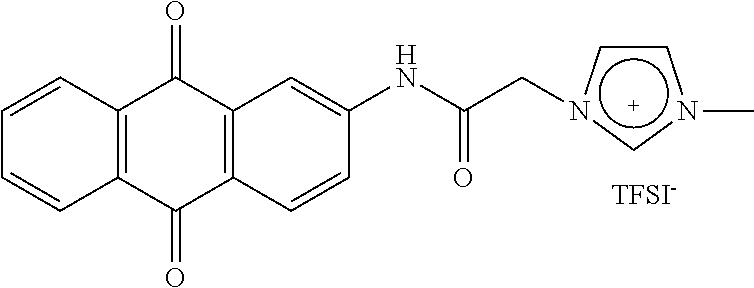


-
- Structure of ionic liquid used for the electrochemical tests (First 5 lines of Table 1). The concentration of electro-active ionic liquid is fixed at 1 mM for the entire test.

-
- Structure of the modified electrode with polymer brushes (last six lines of Table 1).

| TABLE 1 |
| Comparison of electrochemical properties of electro-active ionic liquid in different |
| medium (GCE = glassy carbon electrode). |
| Exper- | Relative | ||||||
| iment | E°(Fc)- | Capaci- | |||||
| number | E°(Fc) | E°(AQ) | Ia(Fc)/ | E°(AQ) | tance | ||
| # | Medium | (V) | (V) | Ia(AQ) | (V) | Cmod/Cnue | |
| Electroactive | 1 | EMITFSI | 0.457 | −0.434 | 2.1 | 0.891 | — |
| Ionic | 2 | 0.1M | 0.559 | −0.735 | 1.2 | 1.294 | — |
| liquid in | EMITFSI/ | ||||||
| solution | |||||||
| 3 | 0.1M | 0.463 | 0.120 | 1.3 | 0.344 | — | |
| HTFSI/ |
|||||||
| 4 | 0.1M | 0.422 | −0.583 | 0.6 | 1.005 | — | |
| ElmHTFSI/H2O | |||||||
| 5 | 0.1M | 0.469 | −0.750 | 1.04 | 1.219 | — | |
| LiClO4/ | |||||||
| Grafted | |||||||
| 6 | EMITFSI | 0.473 | −0.590 | 2 | 1.064 | 9.6 | |
| Electroactive | 7 | 0.1M | 0.318 | −0.204 | 1.0 | 0.521 | 30.9 |
| Ionic | HTFSI/H2O | ||||||
| liquid | 8 | 0.1M | 0.437 | −0.036 | 1.7 | 0.401 | 15.8 |
| Polymer on | HTFSI/ACN | ||||||
| GCE | 9 | 0.1M | 0.485 | −0.587 | 0.7 | 1.071 | 9 |
| surface | ElmHTFSI/H2O | ||||||
| 10 | 0.1M | 0.485 | −0.586 | 1.4 | 1.063 | 14.1 | |
| EMITFSI/ACN | |||||||
| 11 | 0.1M | 0.442 | −0.910 | 1.2 | 1.352 | 12.1 | |
| LiClO4/ACN | |||||||
-
- From the anodic current Ia, the ratio Ia(Fc)/Ia(AQ) (see
column 6 of Table 1) gives the information on the electrochemical response of ferrocene (Fc) and anthraquinone (AQ) of polymer brushes. The variation of this value may be due to the presence of imidazolium ring. A low value of this ration indicates that the electrochemical response of ferrocene is hindered. Otherwise, a high value indicates that the presence of imidazolium ring and ferrocene group modifies the solvation of anthraquinone part, following by a decrease of anthraquinone signal. In conclusion, from this ratio, we can obtain some information about the kinetic of the charge transfer and the influence of the chemical environment nearby the molecule for each solvent. - The gap between the formal potential of ferrocene and anthraquinone Eo (Fc)-Eo (AQ) (see column 7 of Table 1) indicates the influence of chemical environment (solvent) on the thermodynamical properties of the studied systems. For the immobilized electro active ionic liquid polymers containing together ferrocene and anthraquinone, this gap gives a magnitude of the voltage obtained for an organic batteries based on these active materials.
- Relative capacitance is a measurement of capacity for immobilized ionic liquids polymers to stock energy via electrochemical double layer (properties of super capacitors). This relative capacitance (see
column 8 of Table 1), measured in the potential window in which no redox process can be occurred (potential range in between Eo (Fc) and Eo (AQ)), is equal to the ratio between the capacitive current (non-faradic) in presence of immobilized ionic liquid polymers and the capacitive current in absence of immobilized ionic liquid polymers (Bare electrode). (Last 6 lines of Table 1).
- From the anodic current Ia, the ratio Ia(Fc)/Ia(AQ) (see


ΓNP =Q (NO2→NH2)/6FA+Q (NO2→NHOH)/4FA

Claims (16)


Applications Claiming Priority (4)
| Application Number | Priority Date | Filing Date | Title |
|---|---|---|---|
| PCT/IB2016/000750 WO2017191481A1 (en) | 2016-05-06 | 2016-05-06 | Electroactive ionic liquids and surface-modified substrates containing them |
| IBPCT/IB2016/000750 | 2016-05-06 | ||
| WOPCT/IB2016/000750 | 2016-05-06 | ||
| PCT/EP2017/060829 WO2017191317A1 (en) | 2016-05-06 | 2017-05-05 | Electroactive ionic liquids and surface-modified substrates containing them |
Publications (2)
| Publication Number | Publication Date |
|---|---|
| US20190173078A1 US20190173078A1 (en) | 2019-06-06 |
| US10910634B2 true US10910634B2 (en) | 2021-02-02 |
Family
ID=56134394
Family Applications (1)
| Application Number | Title | Priority Date | Filing Date |
|---|---|---|---|
| US16/099,068 Active 2037-07-31 US10910634B2 (en) | 2016-05-06 | 2017-05-05 | Electroactive ionic liquids and surface-modified substrates containing them |
Country Status (3)
| Country | Link |
|---|---|
| US (1) | US10910634B2 (en) |
| EP (1) | EP3453038B1 (en) |
| WO (2) | WO2017191481A1 (en) |
Families Citing this family (10)
| Publication number | Priority date | Publication date | Assignee | Title |
|---|---|---|---|---|
| EP3588634B1 (en) * | 2018-06-27 | 2023-11-22 | InnovationLab GmbH | Improved organic electrode material |
| FR3090187B1 (en) * | 2018-12-14 | 2021-06-25 | Univ Rennes | Functionalized porous material and use as a pseudo-supercapacitor electrode |
| CN109776979B (en) * | 2019-01-21 | 2021-04-20 | 华碳研发(深圳)有限公司 | Carbon nanotube-doped ionic liquid modified butyl rubber elastomer and preparation method thereof |
| CN111019030B (en) * | 2019-12-10 | 2021-09-28 | 安徽师范大学 | Preparation method of fluorescent polymer nano-microspheres and MnO detection4-Application of |
| US11437641B2 (en) * | 2020-12-16 | 2022-09-06 | Phillips 66 Company | Energy dense materials for redox flow batteries |
| US11335910B1 (en) * | 2020-12-16 | 2022-05-17 | Phillips 66 Company | Energy dense materials for redox flow batteries |
| CN114702530B (en) * | 2021-01-01 | 2024-03-05 | 中国石油化工股份有限公司 | Imidazole bridged metallocene, catalyst, preparation and application thereof |
| US20220216321A1 (en) * | 2021-01-04 | 2022-07-07 | Uchicago Argonne, Llc | Redox Gating Materials and Methods of Making and Using the Same |
| DE102022102453A1 (en) | 2022-02-02 | 2023-08-03 | Rheinische Friedrich-Wilhelms-Universität Bonn, Körperschaft des öffentlichen Rechts | pyridinium compound |
| FR3163938A1 (en) | 2024-06-28 | 2026-01-02 | Universite Paris Cite | MAGNETIC ELECTROACTIVE ANION |
Citations (3)
| Publication number | Priority date | Publication date | Assignee | Title |
|---|---|---|---|---|
| US20020009635A1 (en) * | 1997-12-01 | 2002-01-24 | Christophe Michot | Novel materials for use as electrolytic solutes |
| US20040021928A1 (en) * | 2002-06-21 | 2004-02-05 | Warner Benjamin P. | Electrolytes for electrooptic devices comprising ionic liquids |
| CN101698660A (en) | 2009-10-28 | 2010-04-28 | 北京师范大学 | Imidazole-type ionic liquid containing disubstituted phenyl, and preparation method thereof |
-
2016
- 2016-05-06 WO PCT/IB2016/000750 patent/WO2017191481A1/en not_active Ceased
-
2017
- 2017-05-05 EP EP17720529.1A patent/EP3453038B1/en active Active
- 2017-05-05 US US16/099,068 patent/US10910634B2/en active Active
- 2017-05-05 WO PCT/EP2017/060829 patent/WO2017191317A1/en not_active Ceased
Patent Citations (3)
| Publication number | Priority date | Publication date | Assignee | Title |
|---|---|---|---|---|
| US20020009635A1 (en) * | 1997-12-01 | 2002-01-24 | Christophe Michot | Novel materials for use as electrolytic solutes |
| US20040021928A1 (en) * | 2002-06-21 | 2004-02-05 | Warner Benjamin P. | Electrolytes for electrooptic devices comprising ionic liquids |
| CN101698660A (en) | 2009-10-28 | 2010-04-28 | 北京师范大学 | Imidazole-type ionic liquid containing disubstituted phenyl, and preparation method thereof |
Non-Patent Citations (13)
Also Published As
| Publication number | Publication date |
|---|---|
| US20190173078A1 (en) | 2019-06-06 |
| WO2017191481A1 (en) | 2017-11-09 |
| WO2017191317A1 (en) | 2017-11-09 |
| EP3453038A1 (en) | 2019-03-13 |
| EP3453038B1 (en) | 2020-12-16 |
Similar Documents
| Publication | Publication Date | Title |
|---|---|---|
| US10910634B2 (en) | Electroactive ionic liquids and surface-modified substrates containing them | |
| Bui-Thi-Tuyet et al. | Surface and electrochemical properties of polymer brush-based redox poly (ionic liquid) | |
| Zhou et al. | Electropolymerization of pyrrole and electrochemical study of polypyrrole. 5. Controlled electrochemical synthesis and solid-state transition of well-defined polypyrrole variants | |
| Belanger et al. | Electrografting: a powerful method for surface modification | |
| KR100877368B1 (en) | Process for grafting and growing a conductive organic film on a surface | |
| Scavetta et al. | Dopamine amperometric detection at a ferrocene clicked PEDOT: PSS coated electrode | |
| Choi et al. | Electrochemical characteristics of polyelectrolyte brushes with electroactive counterions | |
| Fenoy et al. | Reversible modulation of the redox activity in conducting polymer nanofilms induced by hydrophobic collapse of a surface-grafted polyelectrolyte | |
| Gadgil et al. | Electrosynthesis and characterization of viologen cross linked thiophene copolymer | |
| JP5236503B2 (en) | Method of forming an organic film on a conductive or semiconductive surface from an aqueous solution | |
| Hernandez-Burgos et al. | Finding harmony between ions and electrons: New tools and concepts for emerging energy storage materials | |
| Braglia et al. | Electrochemical synthesis of thin, dense, and conformal anion exchange membranes with quaternary ammonium groups | |
| Vacca et al. | Coating of gold substrates with polyaniline through electrografting of aryl diazonium salts | |
| Teixeira et al. | Molecular engineering of a π-conjugated polymer film of the azo dye Bismarck Brown Y | |
| Yu et al. | Synthesis and properties of polymer brushes bearing ionic liquid moieties | |
| Mondal et al. | Permselectivity and thickness-dependent ion transport properties of overoxidized polyaniline: a mechanistic investigation | |
| Truong et al. | Redox monomer ionic liquid based on quaternary ammonium: from electrochemistry to polymer brushes | |
| Dziewoński et al. | Impact of the electrochemical porosity and chemical composition on the lithium ion exchange behavior of polypyrroles (ClO4−, TOS−, TFSI−) prepared electrochemically in propylene carbonate. Comparative EQCM, EIS and CV studies | |
| Chen et al. | A study on the electrochromic properties of polyaniline/silica composite films with an enhanced optical contrast | |
| Peng et al. | Formation of a Self-Assembled Monolayer of 2-Mercapto-3-n-octylthiophene on Gold | |
| Pham-Truong et al. | Electrochemistry of bi-redox ionic liquid from solution to bi-functional carbon surface | |
| Tokue et al. | Electrochemical current rectification with cross reaction at a TEMPO/viologen-substituted polymer thin-layer heterojunction | |
| Zhang et al. | Electrochemical polymerization of imidazolum‐ionic liquids bearing a pyrrole moiety | |
| Bouden et al. | Electrochemical immobilization of redox active molecule based ionic liquid | |
| Huner et al. | Solvent dielectric effect on electrochemical properties of 3, 4-propylenedioxythiophene |
Legal Events
| Date | Code | Title | Description |
|---|---|---|---|
| FEPP | Fee payment procedure |
Free format text: ENTITY STATUS SET TO UNDISCOUNTED (ORIGINAL EVENT CODE: BIG.); ENTITY STATUS OF PATENT OWNER: LARGE ENTITY |
|
| STPP | Information on status: patent application and granting procedure in general |
Free format text: APPLICATION DISPATCHED FROM PREEXAM, NOT YET DOCKETED |
|
| STPP | Information on status: patent application and granting procedure in general |
Free format text: DOCKETED NEW CASE - READY FOR EXAMINATION |
|
| STPP | Information on status: patent application and granting procedure in general |
Free format text: PUBLICATIONS -- ISSUE FEE PAYMENT VERIFIED |
|
| AS | Assignment |
Owner name: UNIVERSITE PARIS DIDEROT PARIS 7, FRANCE Free format text: ASSIGNMENT OF ASSIGNORS INTEREST;ASSIGNORS:JALAL, GHILANE;ALLARD, GAELLE TRIPPE;TUYET, VAN BUI THI;AND OTHERS;SIGNING DATES FROM 20190509 TO 20190513;REEL/FRAME:053813/0595 Owner name: CENTRE NATIONAL DE LA RECHERCHE SCIENTIFIQUE (CNRS), FRANCE Free format text: ASSIGNMENT OF ASSIGNORS INTEREST;ASSIGNORS:JALAL, GHILANE;ALLARD, GAELLE TRIPPE;TUYET, VAN BUI THI;AND OTHERS;SIGNING DATES FROM 20190509 TO 20190513;REEL/FRAME:053813/0595 |
|
| STPP | Information on status: patent application and granting procedure in general |
Free format text: AWAITING TC RESP, ISSUE FEE PAYMENT VERIFIED |
|
| STCF | Information on status: patent grant |
Free format text: PATENTED CASE |
|
| AS | Assignment |
Owner name: UNIVERSITE DE PARIS, FRANCE Free format text: MERGER AND CHANGE OF NAME;ASSIGNORS:UNIVERSITE PARIS DESCARTES;UNIVERSITE PARIS DIDEROT - PARIS 7;UNIVERSITE DE PARIS;REEL/FRAME:060541/0336 Effective date: 20200101 Owner name: UNIVERSITE PARIS CITE, FRANCE Free format text: CHANGE OF NAME;ASSIGNOR:UNIVERSITE DE PARIS;REEL/FRAME:060390/0122 Effective date: 20220304 |
|
| AS | Assignment |
Owner name: UNIVERSITE PARIS CITE, FRANCE Free format text: CORRECTIVE ASSIGNMENT TO CORRECT THE PROPERTY NUMBER 16930208 PREVIOUSLY RECORDED AT REEL: 060390 FRAME: 0122. ASSIGNOR(S) HEREBY CONFIRMS THE CHANGE OF NAME;ASSIGNOR:UNIVERSITE DE PARIS;REEL/FRAME:062387/0489 Effective date: 20220304 Owner name: UNIVERSITE DE PARIS, FRANCE Free format text: CORRECTIVE ASSIGNMENT TO CORRECT THE PROPERTY NUMBER 16930208 PREVIOUSLY RECORDED AT REEL: 060541 FRAME: 0336. ASSIGNOR(S) HEREBY CONFIRMS THE MERGER AND CHANGE OF NAME;ASSIGNORS:UNIVERSITE PARIS DESCARTES;UNIVERSITE PARIS DIDEROT - PARIS 7;REEL/FRAME:062387/0346 Effective date: 20200101 Owner name: UNIVERSITE PARIS CITE, FRANCE Free format text: CORRECTIVE ASSIGNMENT TO CORRECT THE PROPERTY NUMBERS PREVIOUSLY RECORDED AT REEL: 060390 FRAME: 0122. ASSIGNOR(S) HEREBY CONFIRMS THE CHANGE OF NAME;ASSIGNOR:UNIVERSITE DE PARIS;REEL/FRAME:062387/0489 Effective date: 20220304 Owner name: UNIVERSITE DE PARIS, FRANCE Free format text: CORRECTIVE ASSIGNMENT TO CORRECT THE PROPERTY NUMBERS PREVIOUSLY RECORDED AT REEL: 060541 FRAME: 0336. ASSIGNOR(S) HEREBY CONFIRMS THE MERGER AND CHANGE OF NAME;ASSIGNORS:UNIVERSITE PARIS DESCARTES;UNIVERSITE PARIS DIDEROT - PARIS 7;REEL/FRAME:062387/0346 Effective date: 20200101 |
|
| MAFP | Maintenance fee payment |
Free format text: PAYMENT OF MAINTENANCE FEE, 4TH YEAR, LARGE ENTITY (ORIGINAL EVENT CODE: M1551); ENTITY STATUS OF PATENT OWNER: LARGE ENTITY Year of fee payment: 4 |