US10906894B2 - Compounds containing benzo[d][1,3]oxathiole, benzo[d][1,3]oxathiole 3-oxide or benzo[d][1,3]oxathiole 3,3-dioxide and methods/uses thereof as agonists of g protein-coupled receptor 119 - Google Patents
Compounds containing benzo[d][1,3]oxathiole, benzo[d][1,3]oxathiole 3-oxide or benzo[d][1,3]oxathiole 3,3-dioxide and methods/uses thereof as agonists of g protein-coupled receptor 119 Download PDFInfo
- Publication number
- US10906894B2 US10906894B2 US16/307,914 US201716307914A US10906894B2 US 10906894 B2 US10906894 B2 US 10906894B2 US 201716307914 A US201716307914 A US 201716307914A US 10906894 B2 US10906894 B2 US 10906894B2
- Authority
- US
- United States
- Prior art keywords
- formula
- benzo
- oxathiole
- group
- alkyl
- Prior art date
- Legal status (The legal status is an assumption and is not a legal conclusion. Google has not performed a legal analysis and makes no representation as to the accuracy of the status listed.)
- Active
Links
- 0 *N1CCC(COC2=C([4*])C([3*])=C(C3=CC4=C(C=C3)S(=O)(=O)CO4)C([1*])=C2[2*])CC1 Chemical compound *N1CCC(COC2=C([4*])C([3*])=C(C3=CC4=C(C=C3)S(=O)(=O)CO4)C([1*])=C2[2*])CC1 0.000 description 262
- OEHSWPXRADJEMY-UHFFFAOYSA-N CCC1=CN=C(C(C)(C)C)N=C1 Chemical compound CCC1=CN=C(C(C)(C)C)N=C1 OEHSWPXRADJEMY-UHFFFAOYSA-N 0.000 description 29
- IIALOTNSDILSKK-UHFFFAOYSA-N CC(C)C1=NOC(C(C)(C)C)=N1 Chemical compound CC(C)C1=NOC(C(C)(C)C)=N1 IIALOTNSDILSKK-UHFFFAOYSA-N 0.000 description 14
- OSEOUUXZEQHQBX-UHFFFAOYSA-N CC(C)(C)C1=NC=C(Cl)C=N1 Chemical compound CC(C)(C)C1=NC=C(Cl)C=N1 OSEOUUXZEQHQBX-UHFFFAOYSA-N 0.000 description 8
- RVOBIBYQEHHTAV-UHFFFAOYSA-N CC(C)(C)C1=NC(C2CC2)=NO1 Chemical compound CC(C)(C)C1=NC(C2CC2)=NO1 RVOBIBYQEHHTAV-UHFFFAOYSA-N 0.000 description 5
- CEGBHOGACQWBOE-UHFFFAOYSA-N CC(C)(C)C1=NC(C2CCC2)=NO1 Chemical compound CC(C)(C)C1=NC(C2CCC2)=NO1 CEGBHOGACQWBOE-UHFFFAOYSA-N 0.000 description 5
- LWMVBXJSLCSZKP-UHFFFAOYSA-N CC(C)(C)C1=NC(C2CCCC2)=NO1 Chemical compound CC(C)(C)C1=NC(C2CCCC2)=NO1 LWMVBXJSLCSZKP-UHFFFAOYSA-N 0.000 description 5
- ZZTITMPEKMXKGJ-UHFFFAOYSA-N CC(C)C1=CN=C(C(C)(C)C)N=C1 Chemical compound CC(C)C1=CN=C(C(C)(C)C)N=C1 ZZTITMPEKMXKGJ-UHFFFAOYSA-N 0.000 description 5
- BQRYHDRDUCLPGD-UHFFFAOYSA-N CC(C)CC1=NOC(C(C)(C)C)=N1 Chemical compound CC(C)CC1=NOC(C(C)(C)C)=N1 BQRYHDRDUCLPGD-UHFFFAOYSA-N 0.000 description 4
- AZJPFROMYQTKEH-UHFFFAOYSA-N O=S1(=O)COC2=C1C=CC(C1=CC=C(OCC3CCN(C4=NC(Cl)=NC=N4)CC3)C(F)=C1)=C2 Chemical compound O=S1(=O)COC2=C1C=CC(C1=CC=C(OCC3CCN(C4=NC(Cl)=NC=N4)CC3)C(F)=C1)=C2 AZJPFROMYQTKEH-UHFFFAOYSA-N 0.000 description 4
- MXYDCMXWFAOCBG-JGCGQSQUSA-N O=[S@@]1COC2=C1C=CC(C1=CC=C(OCC3CCN(C4=NC=C(Cl)C=N4)CC3)C(F)=C1)=C2 Chemical compound O=[S@@]1COC2=C1C=CC(C1=CC=C(OCC3CCN(C4=NC=C(Cl)C=N4)CC3)C(F)=C1)=C2 MXYDCMXWFAOCBG-JGCGQSQUSA-N 0.000 description 4
- OQEHEZQFDMBBDW-UHFFFAOYSA-N CC(C)(C)OC(=O)N1CCC(COC2=C(F)C=C(B3OC(C)(C)C(C)(C)O3)C=C2)CC1 Chemical compound CC(C)(C)OC(=O)N1CCC(COC2=C(F)C=C(B3OC(C)(C)C(C)(C)O3)C=C2)CC1 OQEHEZQFDMBBDW-UHFFFAOYSA-N 0.000 description 3
- XFRHYGNZDGDQST-VIFPVBQESA-N CC(C)(C)OC(=O)N1CC[C@H](COS(C)(=O)=O)C1 Chemical compound CC(C)(C)OC(=O)N1CC[C@H](COS(C)(=O)=O)C1 XFRHYGNZDGDQST-VIFPVBQESA-N 0.000 description 3
- SJQARBSEIRXUCY-QHCPKHFHSA-N CC(C)[C@H](N)C(=O)N1CCC(COC2=CC=C(C3=CC4=C(C=C3)S(=O)(=O)CO4)C=C2F)CC1 Chemical compound CC(C)[C@H](N)C(=O)N1CCC(COC2=CC=C(C3=CC4=C(C=C3)S(=O)(=O)CO4)C=C2F)CC1 SJQARBSEIRXUCY-QHCPKHFHSA-N 0.000 description 3
- YMDHUJYZLVZGBV-UHFFFAOYSA-N CC1(C)OB(C2=CC(F)=C(OCC3CCN(C4=NC=C(Cl)C=N4)CC3)C=C2)OC1(C)C Chemical compound CC1(C)OB(C2=CC(F)=C(OCC3CCN(C4=NC=C(Cl)C=N4)CC3)C=C2)OC1(C)C YMDHUJYZLVZGBV-UHFFFAOYSA-N 0.000 description 3
- GCGZKKOVJQNCCQ-UHFFFAOYSA-N CCC1=CN=C(N2CCC(COC3=CC=C(C4=CC5=C(C=C4)S(=O)CO5)C=C3F)CC2)N=C1 Chemical compound CCC1=CN=C(N2CCC(COC3=CC=C(C4=CC5=C(C=C4)S(=O)CO5)C=C3F)CC2)N=C1 GCGZKKOVJQNCCQ-UHFFFAOYSA-N 0.000 description 3
- IAVNHUZJFMKHGK-KRWDZBQOSA-N CCC1=CN=C(N2CC[C@H](COC3=C(F)C=C(B4OC(C)(C)C(C)(C)O4)C=C3)C2)N=C1 Chemical compound CCC1=CN=C(N2CC[C@H](COC3=C(F)C=C(B4OC(C)(C)C(C)(C)O4)C=C3)C2)N=C1 IAVNHUZJFMKHGK-KRWDZBQOSA-N 0.000 description 3
- AHBBETUEIHNODU-UHFFFAOYSA-N CCC1=NC(N2CCC(COC3=CC=C(C4=CC5=C(C=C4)S(=O)CO5)C=C3F)CC2)=NC=C1 Chemical compound CCC1=NC(N2CCC(COC3=CC=C(C4=CC5=C(C=C4)S(=O)CO5)C=C3F)CC2)=NC=C1 AHBBETUEIHNODU-UHFFFAOYSA-N 0.000 description 3
- MTMHQQLHDQBJFF-UHFFFAOYSA-N CCC1=NC(N2CCC(COC3=CC=C(C4=CC5=C(C=C4)SCO5)C=C3F)CC2)=NC=C1 Chemical compound CCC1=NC(N2CCC(COC3=CC=C(C4=CC5=C(C=C4)SCO5)C=C3F)CC2)=NC=C1 MTMHQQLHDQBJFF-UHFFFAOYSA-N 0.000 description 3
- NUMQCACRALPSHD-UHFFFAOYSA-N CCOC(C)(C)C Chemical compound CCOC(C)(C)C NUMQCACRALPSHD-UHFFFAOYSA-N 0.000 description 3
- PGJSRLUKCDQEKT-JTQLQIEISA-N FC1=C(OC[C@H]2CCN(C3=NC=C(Cl)C=N3)C2)C=CC(Br)=C1 Chemical compound FC1=C(OC[C@H]2CCN(C3=NC=C(Cl)C=N3)C2)C=CC(Br)=C1 PGJSRLUKCDQEKT-JTQLQIEISA-N 0.000 description 3
- LKKWVYZZOHLQCN-UHFFFAOYSA-N O=S1(=O)COC2=C1C=C(C1=CC(F)=C(OCC3CCN(C4=NC=C(Cl)C=N4)CC3)C=C1)C=C2 Chemical compound O=S1(=O)COC2=C1C=C(C1=CC(F)=C(OCC3CCN(C4=NC=C(Cl)C=N4)CC3)C=C1)C=C2 LKKWVYZZOHLQCN-UHFFFAOYSA-N 0.000 description 3
- MOLLFTLEICPWBZ-UHFFFAOYSA-N O=S1(=O)COC2=C1C=CC(C1=CC(F)=C(OCC3=CN=C(C4CCNCC4)S3)C=C1)=C2 Chemical compound O=S1(=O)COC2=C1C=CC(C1=CC(F)=C(OCC3=CN=C(C4CCNCC4)S3)C=C1)=C2 MOLLFTLEICPWBZ-UHFFFAOYSA-N 0.000 description 3
- YVNOBPMPIWLENE-UHFFFAOYSA-N O=S1COC2=C1C=CC(C1=CC=C(OCC3CCNCC3)C(F)=C1)=C2 Chemical compound O=S1COC2=C1C=CC(C1=CC=C(OCC3CCNCC3)C(F)=C1)=C2 YVNOBPMPIWLENE-UHFFFAOYSA-N 0.000 description 3
- MXYDCMXWFAOCBG-YTTGMZPUSA-N O=[S@]1COC2=C1C=CC(C1=CC=C(OCC3CCN(C4=NC=C(Cl)C=N4)CC3)C(F)=C1)=C2 Chemical compound O=[S@]1COC2=C1C=CC(C1=CC=C(OCC3CCN(C4=NC=C(Cl)C=N4)CC3)C(F)=C1)=C2 MXYDCMXWFAOCBG-YTTGMZPUSA-N 0.000 description 3
- SMDBOSOGYVIVKG-UHFFFAOYSA-N CC(C)(C)C(=O)N1CCC(COC2=CC=C(C3=CC4=C(C=C3)S(=O)(=O)CO4)C=C2F)CC1 Chemical compound CC(C)(C)C(=O)N1CCC(COC2=CC=C(C3=CC4=C(C=C3)S(=O)(=O)CO4)C=C2F)CC1 SMDBOSOGYVIVKG-UHFFFAOYSA-N 0.000 description 2
- SCNGZMFAUPIYSJ-UHFFFAOYSA-N CC(C)(C)C1=CN=C(C(C)(C)C)N=C1 Chemical compound CC(C)(C)C1=CN=C(C(C)(C)C)N=C1 SCNGZMFAUPIYSJ-UHFFFAOYSA-N 0.000 description 2
- SPNAUURQVBIITF-UHFFFAOYSA-N CC(C)(C)C1=NOC(C(C)(C)C)=N1 Chemical compound CC(C)(C)C1=NOC(C(C)(C)C)=N1 SPNAUURQVBIITF-UHFFFAOYSA-N 0.000 description 2
- YGIZJXXHVNUELB-UHFFFAOYSA-N CC(C)(C)CC1=CN=C(C(C)(C)C)N=C1 Chemical compound CC(C)(C)CC1=CN=C(C(C)(C)C)N=C1 YGIZJXXHVNUELB-UHFFFAOYSA-N 0.000 description 2
- MHNFMMNJJWQGFM-UHFFFAOYSA-N CC(C)(C)N1CCC(COC2=CC=C(C3=CC4=C(C=C3)S(=O)(=O)CO4)C=C2F)CC1 Chemical compound CC(C)(C)N1CCC(COC2=CC=C(C3=CC4=C(C=C3)S(=O)(=O)CO4)C=C2F)CC1 MHNFMMNJJWQGFM-UHFFFAOYSA-N 0.000 description 2
- OGIXCAOVPXLPMC-UHFFFAOYSA-N CC(C)(C)OC(=O)N1CC(COC2=C(F)C=C(B3OC(C)(C)C(C)(C)O3)C=C2)C1 Chemical compound CC(C)(C)OC(=O)N1CC(COC2=C(F)C=C(B3OC(C)(C)C(C)(C)O3)C=C2)C1 OGIXCAOVPXLPMC-UHFFFAOYSA-N 0.000 description 2
- OPPDMGXWVRQZNV-UHFFFAOYSA-N CC(C)(C)OC(=O)N1CC(COC2=C(F)C=C(C3=CC4=C(C=C3)S(=O)(=O)CO4)C=C2)C1 Chemical compound CC(C)(C)OC(=O)N1CC(COC2=C(F)C=C(C3=CC4=C(C=C3)S(=O)(=O)CO4)C=C2)C1 OPPDMGXWVRQZNV-UHFFFAOYSA-N 0.000 description 2
- SCDDSCCDUOLSNC-UHFFFAOYSA-N CC(C)(C)OC(=O)N1CCC(C2=NC=C(COC3=C(F)C=C(C4=CC5=C(C=C4)S(=O)(=O)CO5)C=C3)S2)CC1 Chemical compound CC(C)(C)OC(=O)N1CCC(C2=NC=C(COC3=C(F)C=C(C4=CC5=C(C=C4)S(=O)(=O)CO5)C=C3)S2)CC1 SCDDSCCDUOLSNC-UHFFFAOYSA-N 0.000 description 2
- SVUVXYYRSOFJFX-UHFFFAOYSA-N CC(C)(C)OC(=O)N1CCC(COC2=C(F)C=C(Br)C=C2)CC1 Chemical compound CC(C)(C)OC(=O)N1CCC(COC2=C(F)C=C(Br)C=C2)CC1 SVUVXYYRSOFJFX-UHFFFAOYSA-N 0.000 description 2
- MANQRHVVYSPYFL-UHFFFAOYSA-N CC(C)(C)OC(=O)N1CCC(COC2=CC=C(C3=CC4=C(C=C3)S(=O)(=O)CO4)C=C2F)CC1 Chemical compound CC(C)(C)OC(=O)N1CCC(COC2=CC=C(C3=CC4=C(C=C3)S(=O)(=O)CO4)C=C2F)CC1 MANQRHVVYSPYFL-UHFFFAOYSA-N 0.000 description 2
- MCWYYZMODOYKEQ-UHFFFAOYSA-N CC(C)(C)OC(=O)N1CCC(COC2=CC=C(C3=CC4=C(C=C3)S(=O)CO4)C=C2F)CC1 Chemical compound CC(C)(C)OC(=O)N1CCC(COC2=CC=C(C3=CC4=C(C=C3)S(=O)CO4)C=C2F)CC1 MCWYYZMODOYKEQ-UHFFFAOYSA-N 0.000 description 2
- QXVYGQNWICKFIX-UHFFFAOYSA-N CC(C)(C)OC(=O)N1CCC(COC2=NC=C(B3OC(C)(C)C(C)(C)O3)C=N2)CC1 Chemical compound CC(C)(C)OC(=O)N1CCC(COC2=NC=C(B3OC(C)(C)C(C)(C)O3)C=N2)CC1 QXVYGQNWICKFIX-UHFFFAOYSA-N 0.000 description 2
- CYASAKWBJBTOKS-UHFFFAOYSA-N CC(C)(C)OC(=O)N1CCC(COC2=NC=C(Br)C=N2)CC1 Chemical compound CC(C)(C)OC(=O)N1CCC(COC2=NC=C(Br)C=N2)CC1 CYASAKWBJBTOKS-UHFFFAOYSA-N 0.000 description 2
- QHIRJZRAEUHBNF-UHFFFAOYSA-N CC(C)(C)OC(=O)N1CCC(COC2=NC=C(C3=CC=C4C(=C3)OCS4(=O)=O)C=N2)CC1 Chemical compound CC(C)(C)OC(=O)N1CCC(COC2=NC=C(C3=CC=C4C(=C3)OCS4(=O)=O)C=N2)CC1 QHIRJZRAEUHBNF-UHFFFAOYSA-N 0.000 description 2
- FKFHWLJFKJGSHD-UHFFFAOYSA-N CC(C)(C)OC(=O)N1CCN(C2=CC=C(C3=CC4=C(C=C3)S(=O)(=O)CO4)C=C2F)CC1 Chemical compound CC(C)(C)OC(=O)N1CCN(C2=CC=C(C3=CC4=C(C=C3)S(=O)(=O)CO4)C=C2F)CC1 FKFHWLJFKJGSHD-UHFFFAOYSA-N 0.000 description 2
- IKULQPPAMSHBQV-NSHDSACASA-N CC(C)(C)OC(=O)N1CC[C@H](COC2=C(F)C=C(Br)C=C2)C1 Chemical compound CC(C)(C)OC(=O)N1CC[C@H](COC2=C(F)C=C(Br)C=C2)C1 IKULQPPAMSHBQV-NSHDSACASA-N 0.000 description 2
- RMYVQEHLELAJCP-UHFFFAOYSA-N CC(C)(C)OC(=O)NCC(=O)N1CCC(COC2=CC=C(C3=CC4=C(C=C3)S(=O)(=O)CO4)C=C2F)CC1 Chemical compound CC(C)(C)OC(=O)NCC(=O)N1CCC(COC2=CC=C(C3=CC4=C(C=C3)S(=O)(=O)CO4)C=C2F)CC1 RMYVQEHLELAJCP-UHFFFAOYSA-N 0.000 description 2
- QVVVUQZIOGOWSW-UHFFFAOYSA-N CC(C)(C)OC1=CC2=C(C=C1)SCO2 Chemical compound CC(C)(C)OC1=CC2=C(C=C1)SCO2 QVVVUQZIOGOWSW-UHFFFAOYSA-N 0.000 description 2
- LKKITXWKUAKGIX-UHFFFAOYSA-N CC(C)C(=O)N1CCC(COC2=CC=C(C3=CC4=C(C=C3)S(=O)(=O)CO4)C=C2F)CC1 Chemical compound CC(C)C(=O)N1CCC(COC2=CC=C(C3=CC4=C(C=C3)S(=O)(=O)CO4)C=C2F)CC1 LKKITXWKUAKGIX-UHFFFAOYSA-N 0.000 description 2
- ITJDMYWADOQQFE-UHFFFAOYSA-N CC(C)C1=CN=C(N2CCC(COC3=CC=C(C4=CC5=C(C=C4)S(=O)CO5)C=C3F)CC2)N=C1 Chemical compound CC(C)C1=CN=C(N2CCC(COC3=CC=C(C4=CC5=C(C=C4)S(=O)CO5)C=C3F)CC2)N=C1 ITJDMYWADOQQFE-UHFFFAOYSA-N 0.000 description 2
- ITJDMYWADOQQFE-UMSFTDKQSA-N CC(C)C1=CN=C(N2CCC(COC3=CC=C(C4=CC=C5C(=C4)OC[S@@]5=O)C=C3F)CC2)N=C1 Chemical compound CC(C)C1=CN=C(N2CCC(COC3=CC=C(C4=CC=C5C(=C4)OC[S@@]5=O)C=C3F)CC2)N=C1 ITJDMYWADOQQFE-UMSFTDKQSA-N 0.000 description 2
- FBIASHIOEXPRSD-UHFFFAOYSA-N CC(C)C1=NOC(Cl)=N1 Chemical compound CC(C)C1=NOC(Cl)=N1 FBIASHIOEXPRSD-UHFFFAOYSA-N 0.000 description 2
- IYXPYFHQLSWFDP-UHFFFAOYSA-N CC(C)C1=NOC(N2CC(COC3=C(F)C=C(C4=CC5=C(C=C4)S(=O)(=O)CO5)C=C3)C2)=N1 Chemical compound CC(C)C1=NOC(N2CC(COC3=C(F)C=C(C4=CC5=C(C=C4)S(=O)(=O)CO5)C=C3)C2)=N1 IYXPYFHQLSWFDP-UHFFFAOYSA-N 0.000 description 2
- MPUKAGFSFNICRH-UHFFFAOYSA-N CC(C)C1=NOC(N2CCC(COC3=CC=C(C4=CC5=C(C=C4)S(=O)(=O)CO5)C=C3F)CC2)=N1 Chemical compound CC(C)C1=NOC(N2CCC(COC3=CC=C(C4=CC5=C(C=C4)S(=O)(=O)CO5)C=C3F)CC2)=N1 MPUKAGFSFNICRH-UHFFFAOYSA-N 0.000 description 2
- XYHIXFCBXIBPNL-UHFFFAOYSA-N CC(C)CC(=O)N1CCC(COC2=CC=C(C3=CC4=C(C=C3)S(=O)CO4)C=C2F)CC1 Chemical compound CC(C)CC(=O)N1CCC(COC2=CC=C(C3=CC4=C(C=C3)S(=O)CO4)C=C2F)CC1 XYHIXFCBXIBPNL-UHFFFAOYSA-N 0.000 description 2
- PLFUHXLIDOCRNW-UHFFFAOYSA-N CC(C)N1CCC(COC2=CC=C(C3=CC4=C(C=C3)S(=O)(=O)CO4)C=C2F)CC1 Chemical compound CC(C)N1CCC(COC2=CC=C(C3=CC4=C(C=C3)S(=O)(=O)CO4)C=C2F)CC1 PLFUHXLIDOCRNW-UHFFFAOYSA-N 0.000 description 2
- BFPQAWZQWXRNRX-SANMLTNESA-N CC(C)[C@H](NC(=O)OC(C)(C)C)C(=O)N1CCC(COC2=CC=C(C3=CC4=C(C=C3)S(=O)(=O)CO4)C=C2F)CC1 Chemical compound CC(C)[C@H](NC(=O)OC(C)(C)C)C(=O)N1CCC(COC2=CC=C(C3=CC4=C(C=C3)S(=O)(=O)CO4)C=C2F)CC1 BFPQAWZQWXRNRX-SANMLTNESA-N 0.000 description 2
- BVSBEYLNPOBPEK-AWEZNQCLSA-N CC1(C)OB(C2=CC(F)=C(OC[C@H]3CCN(C4=NC=C(Cl)C=N4)C3)C=C2)OC1(C)C Chemical compound CC1(C)OB(C2=CC(F)=C(OC[C@H]3CCN(C4=NC=C(Cl)C=N4)C3)C=C2)OC1(C)C BVSBEYLNPOBPEK-AWEZNQCLSA-N 0.000 description 2
- LMLXGCAZONOZKO-UHFFFAOYSA-N CC1(C)OB(C2=CC=C(O)C(F)=C2)OC1(C)C Chemical compound CC1(C)OB(C2=CC=C(O)C(F)=C2)OC1(C)C LMLXGCAZONOZKO-UHFFFAOYSA-N 0.000 description 2
- VXCIAFJDUUXOJT-UHFFFAOYSA-N CCC(C)C1=NOC(C(C)(C)C)=N1 Chemical compound CCC(C)C1=NOC(C(C)(C)C)=N1 VXCIAFJDUUXOJT-UHFFFAOYSA-N 0.000 description 2
- QHYSDFBQDBJCBD-UHFFFAOYSA-N CCC1=CN=C(N2CCC(COC3=CC=C(C4=CC5=C(C=C4)S(=O)(=O)CO5)C=C3F)CC2)N=C1 Chemical compound CCC1=CN=C(N2CCC(COC3=CC=C(C4=CC5=C(C=C4)S(=O)(=O)CO5)C=C3F)CC2)N=C1 QHYSDFBQDBJCBD-UHFFFAOYSA-N 0.000 description 2
- GCGZKKOVJQNCCQ-XIFFEERXSA-N CCC1=CN=C(N2CCC(COC3=CC=C(C4=CC=C5C(=C4)OC[S@@]5=O)C=C3F)CC2)N=C1 Chemical compound CCC1=CN=C(N2CCC(COC3=CC=C(C4=CC=C5C(=C4)OC[S@@]5=O)C=C3F)CC2)N=C1 GCGZKKOVJQNCCQ-XIFFEERXSA-N 0.000 description 2
- GCGZKKOVJQNCCQ-MGBGTMOVSA-N CCC1=CN=C(N2CCC(COC3=CC=C(C4=CC=C5C(=C4)OC[S@]5=O)C=C3F)CC2)N=C1 Chemical compound CCC1=CN=C(N2CCC(COC3=CC=C(C4=CC=C5C(=C4)OC[S@]5=O)C=C3F)CC2)N=C1 GCGZKKOVJQNCCQ-MGBGTMOVSA-N 0.000 description 2
- AWUUFRPWVSIKLM-ZDUSSCGKSA-N CCC1=CN=C(N2CC[C@H](COC3=C(F)C=C(Br)C=C3)C2)N=C1 Chemical compound CCC1=CN=C(N2CC[C@H](COC3=C(F)C=C(Br)C=C3)C2)N=C1 AWUUFRPWVSIKLM-ZDUSSCGKSA-N 0.000 description 2
- LVWZTQZGIKXNHR-INIZCTEOSA-N CCC1=NC(N2CC[C@H](COC3=C(F)C=C(B4OC(C)(C)C(C)(C)O4)C=C3)C2)=NC=C1 Chemical compound CCC1=NC(N2CC[C@H](COC3=C(F)C=C(B4OC(C)(C)C(C)(C)O4)C=C3)C2)=NC=C1 LVWZTQZGIKXNHR-INIZCTEOSA-N 0.000 description 2
- IRSWWDXWPMEEFF-LBPRGKRZSA-N CCC1=NC(N2CC[C@H](COC3=C(F)C=C(Br)C=C3)C2)=NC=C1 Chemical compound CCC1=NC(N2CC[C@H](COC3=C(F)C=C(Br)C=C3)C2)=NC=C1 IRSWWDXWPMEEFF-LBPRGKRZSA-N 0.000 description 2
- KWERXZPLQOPULY-INIZCTEOSA-N CCC1=NC(N2CC[C@H](COC3=C(F)C=C(C4=CC5=C(C=C4)S(=O)(=O)CO5)C=C3)C2)=NC=C1 Chemical compound CCC1=NC(N2CC[C@H](COC3=C(F)C=C(C4=CC5=C(C=C4)S(=O)(=O)CO5)C=C3)C2)=NC=C1 KWERXZPLQOPULY-INIZCTEOSA-N 0.000 description 2
- CZRJXSZTCQGVTC-UHFFFAOYSA-N CCC1=NOC(C(C)(C)C)=N1 Chemical compound CCC1=NOC(C(C)(C)C)=N1 CZRJXSZTCQGVTC-UHFFFAOYSA-N 0.000 description 2
- HXMKZYBKYUWVDR-UHFFFAOYSA-N CCC1CCN(C(C)(C)C)C1 Chemical compound CCC1CCN(C(C)(C)C)C1 HXMKZYBKYUWVDR-UHFFFAOYSA-N 0.000 description 2
- KBMGMIVCKOVQFY-UHFFFAOYSA-N CCOC1=CN=C(N2CCC(COC3=CC=C(C4=CC5=C(C=C4)S(=O)CO5)C=C3F)CC2)N=C1 Chemical compound CCOC1=CN=C(N2CCC(COC3=CC=C(C4=CC5=C(C=C4)S(=O)CO5)C=C3F)CC2)N=C1 KBMGMIVCKOVQFY-UHFFFAOYSA-N 0.000 description 2
- MTLVCZCTTNTNHX-UHFFFAOYSA-N CCc1cnc(C)nc1 Chemical compound CCc1cnc(C)nc1 MTLVCZCTTNTNHX-UHFFFAOYSA-N 0.000 description 2
- DWOKFXXPHGPLHL-IQVDJAOASA-N CCc1cnc(N2C[C@@H](COc(ccc(-c(cc3)cc(OC4)c3[S@]4=O)c3)c3F)CC2)nc1 Chemical compound CCc1cnc(N2C[C@@H](COc(ccc(-c(cc3)cc(OC4)c3[S@]4=O)c3)c3F)CC2)nc1 DWOKFXXPHGPLHL-IQVDJAOASA-N 0.000 description 2
- PTMSTZYXLPSOAS-UHFFFAOYSA-N CN(C)C(=O)N1CCC(COC2=CC=C(C3=CC4=C(C=C3)S(=O)(=O)CO4)C=C2F)CC1 Chemical compound CN(C)C(=O)N1CCC(COC2=CC=C(C3=CC4=C(C=C3)S(=O)(=O)CO4)C=C2F)CC1 PTMSTZYXLPSOAS-UHFFFAOYSA-N 0.000 description 2
- MORWBYYEHCPRQE-UHFFFAOYSA-N COC1=CN=C(N2CCC(COC3=CC=C(B4OC(C)(C)C(C)(C)O4)C=C3F)CC2)N=C1 Chemical compound COC1=CN=C(N2CCC(COC3=CC=C(B4OC(C)(C)C(C)(C)O4)C=C3F)CC2)N=C1 MORWBYYEHCPRQE-UHFFFAOYSA-N 0.000 description 2
- OFUSJUKBNKEPAK-UHFFFAOYSA-N COC1=CN=C(N2CCC(COC3=CC=C(Br)C=C3F)CC2)N=C1 Chemical compound COC1=CN=C(N2CCC(COC3=CC=C(Br)C=C3F)CC2)N=C1 OFUSJUKBNKEPAK-UHFFFAOYSA-N 0.000 description 2
- RLTOGNSXMRFKPY-UHFFFAOYSA-N COC1=CN=C(N2CCC(COC3=CC=C(C4=CC5=C(C=C4)S(=O)CO5)C=C3F)CC2)N=C1 Chemical compound COC1=CN=C(N2CCC(COC3=CC=C(C4=CC5=C(C=C4)S(=O)CO5)C=C3F)CC2)N=C1 RLTOGNSXMRFKPY-UHFFFAOYSA-N 0.000 description 2
- SFZOJHBNGYUXIJ-UHFFFAOYSA-N CS(=O)(=O)OCC1CCN(C2=NC=C(Cl)C=N2)CC1 Chemical compound CS(=O)(=O)OCC1CCN(C2=NC=C(Cl)C=N2)CC1 SFZOJHBNGYUXIJ-UHFFFAOYSA-N 0.000 description 2
- YWECWWDNFQQRMB-JKSUJKDBSA-N C[C@H]1C[C@H](COC2=CC=C(C3=CC4=C(C=C3)S(=O)(=O)CO4)C=C2F)CCN1C1=NC=C(Cl)C=N1 Chemical compound C[C@H]1C[C@H](COC2=CC=C(C3=CC4=C(C=C3)S(=O)(=O)CO4)C=C2F)CCN1C1=NC=C(Cl)C=N1 YWECWWDNFQQRMB-JKSUJKDBSA-N 0.000 description 2
- YXMJUKLEAKUFET-QMMMGPOBSA-N Cl.FC1=C(OC[C@H]2CCNC2)C=CC(Br)=C1 Chemical compound Cl.FC1=C(OC[C@H]2CCNC2)C=CC(Br)=C1 YXMJUKLEAKUFET-QMMMGPOBSA-N 0.000 description 2
- DCVXBCRPLYBSGG-UHFFFAOYSA-N Cl.O=S1(=O)COC2=C1C=CC(C1=CC(F)=C(OCC3CNC3)C=C1)=C2 Chemical compound Cl.O=S1(=O)COC2=C1C=CC(C1=CC(F)=C(OCC3CNC3)C=C1)=C2 DCVXBCRPLYBSGG-UHFFFAOYSA-N 0.000 description 2
- SUGKTEJUGFHVIW-UHFFFAOYSA-N FC1=C(OCC2CCN(C3=NC=C(Cl)C=N3)CC2)C=CC(Br)=C1 Chemical compound FC1=C(OCC2CCN(C3=NC=C(Cl)C=N3)CC2)C=CC(Br)=C1 SUGKTEJUGFHVIW-UHFFFAOYSA-N 0.000 description 2
- HKCQFOQTPZBYNT-UHFFFAOYSA-N NC(=O)N1CCC(COC2=CC=C(C3=CC4=C(C=C3)S(=O)(=O)CO4)C=C2F)CC1 Chemical compound NC(=O)N1CCC(COC2=CC=C(C3=CC4=C(C=C3)S(=O)(=O)CO4)C=C2F)CC1 HKCQFOQTPZBYNT-UHFFFAOYSA-N 0.000 description 2
- LYSHHWCFPJPPFC-UHFFFAOYSA-N NCC(=O)N1CCC(COC2=CC=C(C3=CC4=C(C=C3)S(=O)(=O)CO4)C=C2F)CC1 Chemical compound NCC(=O)N1CCC(COC2=CC=C(C3=CC4=C(C=C3)S(=O)(=O)CO4)C=C2F)CC1 LYSHHWCFPJPPFC-UHFFFAOYSA-N 0.000 description 2
- YNOXMRSNQMOQEB-UHFFFAOYSA-N O=C(O)CN1CCC(COC2=CC=C(C3=CC4=C(C=C3)S(=O)(=O)CO4)C=C2F)CC1 Chemical compound O=C(O)CN1CCC(COC2=CC=C(C3=CC4=C(C=C3)S(=O)(=O)CO4)C=C2F)CC1 YNOXMRSNQMOQEB-UHFFFAOYSA-N 0.000 description 2
- CKNBEYBTHNJIGQ-UHFFFAOYSA-N O=S1(=O)COC2=C1C=CC(C1=CC(F)=C(OCC3=CN=C(C4CCN(C5=NC=C(Cl)C=N5)CC4)S3)C=C1)=C2 Chemical compound O=S1(=O)COC2=C1C=CC(C1=CC(F)=C(OCC3=CN=C(C4CCN(C5=NC=C(Cl)C=N5)CC4)S3)C=C1)=C2 CKNBEYBTHNJIGQ-UHFFFAOYSA-N 0.000 description 2
- NRUIZQWFYNYCJK-UHFFFAOYSA-N O=S1(=O)COC2=C1C=CC(C1=CC(F)=C(OCC3CN(C4=NC=C(Cl)C=N4)C3)C=C1)=C2 Chemical compound O=S1(=O)COC2=C1C=CC(C1=CC(F)=C(OCC3CN(C4=NC=C(Cl)C=N4)C3)C=C1)=C2 NRUIZQWFYNYCJK-UHFFFAOYSA-N 0.000 description 2
- MKMMWBPKCHIEGW-UHFFFAOYSA-N O=S1(=O)COC2=C1C=CC(C1=CC=C(N3CCN(C4=NC=C(Cl)C=N4)CC3)C(F)=C1)=C2 Chemical compound O=S1(=O)COC2=C1C=CC(C1=CC=C(N3CCN(C4=NC=C(Cl)C=N4)CC3)C(F)=C1)=C2 MKMMWBPKCHIEGW-UHFFFAOYSA-N 0.000 description 2
- ORVHVIYUKJZOQA-UHFFFAOYSA-N O=S1(=O)COC2=C1C=CC(C1=CC=C(N3CCNCC3)C(F)=C1)=C2 Chemical compound O=S1(=O)COC2=C1C=CC(C1=CC=C(N3CCNCC3)C(F)=C1)=C2 ORVHVIYUKJZOQA-UHFFFAOYSA-N 0.000 description 2
- HMNURPLIEYJZRS-UHFFFAOYSA-N O=S1(=O)COC2=C1C=CC(C1=CC=C(OCC3CCN(C4=NC=NC=N4)CC3)C(F)=C1)=C2 Chemical compound O=S1(=O)COC2=C1C=CC(C1=CC=C(OCC3CCN(C4=NC=NC=N4)CC3)C(F)=C1)=C2 HMNURPLIEYJZRS-UHFFFAOYSA-N 0.000 description 2
- QGTHKKDLVFMIFW-UHFFFAOYSA-N O=S1(=O)COC2=CC(C3=CN=C(OCC4CCN(C5=NC=C(Cl)C=N5)CC4)N=C3)=CC=C21 Chemical compound O=S1(=O)COC2=CC(C3=CN=C(OCC4CCN(C5=NC=C(Cl)C=N5)CC4)N=C3)=CC=C21 QGTHKKDLVFMIFW-UHFFFAOYSA-N 0.000 description 2
- YVIIDLMTHZDKAB-UHFFFAOYSA-N O=S1(=O)COC2=CC(C3=CN=C(OCC4CCNCC4)N=C3)=CC=C21 Chemical compound O=S1(=O)COC2=CC(C3=CN=C(OCC4CCNCC4)N=C3)=CC=C21 YVIIDLMTHZDKAB-UHFFFAOYSA-N 0.000 description 2
- BBVPEJSUMYUBKS-UHFFFAOYSA-N O=S1(=O)COC2=CC(O)=CC=C21 Chemical compound O=S1(=O)COC2=CC(O)=CC=C21 BBVPEJSUMYUBKS-UHFFFAOYSA-N 0.000 description 2
- LLGDFXKCFWFVGQ-UHFFFAOYSA-N O=S1COC2=C1C=CC(C1=CC=C(OCC3CCN(C4=CC=C(C(F)(F)F)C=N4)CC3)C(F)=C1)=C2 Chemical compound O=S1COC2=C1C=CC(C1=CC=C(OCC3CCN(C4=CC=C(C(F)(F)F)C=N4)CC3)C(F)=C1)=C2 LLGDFXKCFWFVGQ-UHFFFAOYSA-N 0.000 description 2
- MXYDCMXWFAOCBG-UHFFFAOYSA-N O=S1COC2=C1C=CC(C1=CC=C(OCC3CCN(C4=NC=C(Cl)C=N4)CC3)C(F)=C1)=C2 Chemical compound O=S1COC2=C1C=CC(C1=CC=C(OCC3CCN(C4=NC=C(Cl)C=N4)CC3)C(F)=C1)=C2 MXYDCMXWFAOCBG-UHFFFAOYSA-N 0.000 description 2
- CWTDSPKUWCIMMC-DEOSSOPVSA-N O=[S@]1COC2=CC(C3=CN=C(OCC4CCNCC4)N=C3)=CC=C21 Chemical compound O=[S@]1COC2=CC(C3=CN=C(OCC4CCNCC4)N=C3)=CC=C21 CWTDSPKUWCIMMC-DEOSSOPVSA-N 0.000 description 2
- FOXRQPJWFWNMJR-UHFFFAOYSA-N [H]N1CCC(COC2=CC=C(C3=CC4=C(C=C3)S(=O)(=O)CO4)C=C2F)CC1 Chemical compound [H]N1CCC(COC2=CC=C(C3=CC4=C(C=C3)S(=O)(=O)CO4)C=C2F)CC1 FOXRQPJWFWNMJR-UHFFFAOYSA-N 0.000 description 2
- HZJPLZWWJAMAMH-VIFPVBQESA-N BrC1=CC=C(OC[C@H]2CCNC2)C=C1.Cl Chemical compound BrC1=CC=C(OC[C@H]2CCNC2)C=C1.Cl HZJPLZWWJAMAMH-VIFPVBQESA-N 0.000 description 1
- JOWKMAPKDRFPFT-UHFFFAOYSA-N C.C.CC(C)(C)OC1=CC2=C(C=C1)CCC2.COC1=CC2=C(C=C1)CCC2.OC1=CC2=C(C=C1)CCC2.[BH9-6] Chemical compound C.C.CC(C)(C)OC1=CC2=C(C=C1)CCC2.COC1=CC2=C(C=C1)CCC2.OC1=CC2=C(C=C1)CCC2.[BH9-6] JOWKMAPKDRFPFT-UHFFFAOYSA-N 0.000 description 1
- QLEOMWQLTIYAJV-UHFFFAOYSA-N C.C1=CN=C(N2CC(COC3=NC=C(C4=CC5=C(C=C4)CCC5)C=N3)C2)N=C1.CC(C)(C)OC(=O)N1CC(CO)C1.CC(C)(C)OC(=O)N1CC(COC2=NC=C(B3OC(C)(C)C(C)(C)O3)C=N2)C1.CC(C)(C)OC(=O)N1CC(COC2=NC=C(Br)C=N2)C1.CC(C)(C)OC(=O)N1CC(COC2=NC=C(C3=CC4=C(C=C3)CCC4)C=N2)C1.CC1(C)OB(B2OC(C)(C)C(C)(C)O2)OC1(C)C.ClC1=NC=C(Br)C=N1.ClC1=NC=CC=N1.O=S(=O)(OC1=CC2=C(C=C1)CCC2)C(F)(F)F.[C-11].[C-32].[C-33].[C-34].[C-35].[C-36].[C-37].[C-38] Chemical compound C.C1=CN=C(N2CC(COC3=NC=C(C4=CC5=C(C=C4)CCC5)C=N3)C2)N=C1.CC(C)(C)OC(=O)N1CC(CO)C1.CC(C)(C)OC(=O)N1CC(COC2=NC=C(B3OC(C)(C)C(C)(C)O3)C=N2)C1.CC(C)(C)OC(=O)N1CC(COC2=NC=C(Br)C=N2)C1.CC(C)(C)OC(=O)N1CC(COC2=NC=C(C3=CC4=C(C=C3)CCC4)C=N2)C1.CC1(C)OB(B2OC(C)(C)C(C)(C)O2)OC1(C)C.ClC1=NC=C(Br)C=N1.ClC1=NC=CC=N1.O=S(=O)(OC1=CC2=C(C=C1)CCC2)C(F)(F)F.[C-11].[C-32].[C-33].[C-34].[C-35].[C-36].[C-37].[C-38] QLEOMWQLTIYAJV-UHFFFAOYSA-N 0.000 description 1
- JLWJBDZZSURLBE-UHFFFAOYSA-N C.CC1(C)OB(B2OC(C)(C)C(C)(C)O2)OC1(C)C.CC1(C)OB(C2=CC=C(OCC3CN(C4=NC=C(Cl)C=N4)C3)C=C2)OC1(C)C.CCC1CN(C2=NC=C(Cl)C=N2)C1.CS(=O)(=O)Cl.ClC1=CC=C(Br)C=C1.ClC1=CN=C(Cl)N=C1.ClC1=CN=C(N2CC(COC3=CC=C(Br)C=C3)C2)N=C1.ClC1=CN=C(N2CC(COC3=CC=C(C4=CC5=C(C=C4)CCC5)C=C3)C2)N=C1.O=S(=O)(OC1=CC2=C(C=C1)CCC2)C(F)(F)F.OCC1CN(C2=NC=C(Cl)C=N2)C1.OCC1CNC1.[C-11].[C-39].[C-41].[C-42].[C-43].[C-44].[C-45].[C-46] Chemical compound C.CC1(C)OB(B2OC(C)(C)C(C)(C)O2)OC1(C)C.CC1(C)OB(C2=CC=C(OCC3CN(C4=NC=C(Cl)C=N4)C3)C=C2)OC1(C)C.CCC1CN(C2=NC=C(Cl)C=N2)C1.CS(=O)(=O)Cl.ClC1=CC=C(Br)C=C1.ClC1=CN=C(Cl)N=C1.ClC1=CN=C(N2CC(COC3=CC=C(Br)C=C3)C2)N=C1.ClC1=CN=C(N2CC(COC3=CC=C(C4=CC5=C(C=C4)CCC5)C=C3)C2)N=C1.O=S(=O)(OC1=CC2=C(C=C1)CCC2)C(F)(F)F.OCC1CN(C2=NC=C(Cl)C=N2)C1.OCC1CNC1.[C-11].[C-39].[C-41].[C-42].[C-43].[C-44].[C-45].[C-46] JLWJBDZZSURLBE-UHFFFAOYSA-N 0.000 description 1
- LAAGZJUEUMUESV-UHFFFAOYSA-N C1=CC(C2=CC3=C(C=C2)CCC3)=CC=C1OCC1CNC1.CC(C)(C)OC(=O)N1CC(COC2=CC=C(C3=CC4=C(C=C3)CCC4)C=C2)C1.[BH46-43].[BH47-44] Chemical compound C1=CC(C2=CC3=C(C=C2)CCC3)=CC=C1OCC1CNC1.CC(C)(C)OC(=O)N1CC(COC2=CC=C(C3=CC4=C(C=C3)CCC4)C=C2)C1.[BH46-43].[BH47-44] LAAGZJUEUMUESV-UHFFFAOYSA-N 0.000 description 1
- WWCYLRYOAMXEQT-UHFFFAOYSA-N C1=CC(C2=CC3=C(C=C2)CCC3)=CC=C1OCC1CNC1.CC(C)(C)OC(=O)N1CC(COC2=CC=C(C3=CC4=C(C=C3)CCC4)C=C2)C1.[C-12].[C-13] Chemical compound C1=CC(C2=CC3=C(C=C2)CCC3)=CC=C1OCC1CNC1.CC(C)(C)OC(=O)N1CC(COC2=CC=C(C3=CC4=C(C=C3)CCC4)C=C2)C1.[C-12].[C-13] WWCYLRYOAMXEQT-UHFFFAOYSA-N 0.000 description 1
- WYSHZJKPQBRXDS-UHFFFAOYSA-N C1=CC(C2=CC3=C(C=C2)CCC3)=CC=C1OCC1CNC1.CCOC(=O)CN1CC(COC2=CC=C(C3=CC4=C(C=C3)CCC4)C=C2)C1.O=C(O)CN1CC(COC2=CC=C(C3=CC4=C(C=C3)CCC4)C=C2)C1.[C-13].[C-23].[C-24].[C-25].[H]C(=O)C(=O)OCC Chemical compound C1=CC(C2=CC3=C(C=C2)CCC3)=CC=C1OCC1CNC1.CCOC(=O)CN1CC(COC2=CC=C(C3=CC4=C(C=C3)CCC4)C=C2)C1.O=C(O)CN1CC(COC2=CC=C(C3=CC4=C(C=C3)CCC4)C=C2)C1.[C-13].[C-23].[C-24].[C-25].[H]C(=O)C(=O)OCC WYSHZJKPQBRXDS-UHFFFAOYSA-N 0.000 description 1
- VCQSEBQHHJBJMG-UHFFFAOYSA-N C1=CC(C2=CC3=C(C=C2)CCC3)=CC=C1OCC1CNC1.NC(=O)N1CC(COC2=CC=C(C3=CC4=C(C=C3)CCC4)C=C2)C1.[BH47-44].[BH53-50].[BH54-51].[C-]#[N+]C Chemical compound C1=CC(C2=CC3=C(C=C2)CCC3)=CC=C1OCC1CNC1.NC(=O)N1CC(COC2=CC=C(C3=CC4=C(C=C3)CCC4)C=C2)C1.[BH47-44].[BH53-50].[BH54-51].[C-]#[N+]C VCQSEBQHHJBJMG-UHFFFAOYSA-N 0.000 description 1
- CLRIXJRZEGUOQZ-UHFFFAOYSA-N C1=CC(C2=CC3=C(C=C2)CCC3)=CC=C1OCC1CNC1.NC(=O)N1CC(COC2=CC=C(C3=CC4=C(C=C3)CCC4)C=C2)C1.[C-13].[C-18].[C-]#[N+]C Chemical compound C1=CC(C2=CC3=C(C=C2)CCC3)=CC=C1OCC1CNC1.NC(=O)N1CC(COC2=CC=C(C3=CC4=C(C=C3)CCC4)C=C2)C1.[C-13].[C-18].[C-]#[N+]C CLRIXJRZEGUOQZ-UHFFFAOYSA-N 0.000 description 1
- AUMCGZUWKHOGFG-UHFFFAOYSA-N C1=CC=C(COC2=CC3=C(C=C2)CCC3)C=C1.O=C1CC2=C(C=C(O)C=C2)C1.O=C1CC2=C(C=C(OCC3=CC=CC=C3)C=C2)C1.O=S(=O)(OC1=CC2=C(C=C1)CCC2)C(F)(F)F.OC1=CC2=C(C=C1)CCC2.[C-4].[C-5].[CH-3].[CH2-2].[CH3-] Chemical compound C1=CC=C(COC2=CC3=C(C=C2)CCC3)C=C1.O=C1CC2=C(C=C(O)C=C2)C1.O=C1CC2=C(C=C(OCC3=CC=CC=C3)C=C2)C1.O=S(=O)(OC1=CC2=C(C=C1)CCC2)C(F)(F)F.OC1=CC2=C(C=C1)CCC2.[C-4].[C-5].[CH-3].[CH2-2].[CH3-] AUMCGZUWKHOGFG-UHFFFAOYSA-N 0.000 description 1
- XIXABNWLQXBJLU-UHFFFAOYSA-N C1=CC=C(COC2=CC=C3OCSC3=C2)C=C1 Chemical compound C1=CC=C(COC2=CC=C3OCSC3=C2)C=C1 XIXABNWLQXBJLU-UHFFFAOYSA-N 0.000 description 1
- RGKFMCNSGMOSAY-UHFFFAOYSA-N C1=CC=C(COC2=CC=C3SCOC3=C2)C=C1 Chemical compound C1=CC=C(COC2=CC=C3SCOC3=C2)C=C1 RGKFMCNSGMOSAY-UHFFFAOYSA-N 0.000 description 1
- LBUJPTNKIBCYBY-UHFFFAOYSA-N C1=CC=C2NCCCC2=C1 Chemical compound C1=CC=C2NCCCC2=C1 LBUJPTNKIBCYBY-UHFFFAOYSA-N 0.000 description 1
- JUNVQVNCLRMLRF-UHFFFAOYSA-N C1=CN=C(N2CC(COC3=NC=C(C4=CC5=C(C=C4)CCC5)C=N3)C2)N=C1.CC(C)(C)OC(=O)N1CC(CO)C1.CC(C)(C)OC(=O)N1CC(COC2=NC=C(B3OC(C)(C)C(C)(C)O3)C=N2)C1.CC(C)(C)OC(=O)N1CC(COC2=NC=C(Br)C=N2)C1.CC(C)(C)OC(=O)N1CC(COC2=NC=C(C3=CC4=C(C=C3)CCC4)C=N2)C1.CC1(C)OB(B2OC(C)(C)C(C)(C)O2)OC1(C)C.ClC1=NC=C(Br)C=N1.ClC1=NC=CC=N1.O=S(=O)(OC1=CC2=C(C=C1)CCC2)C(F)(F)F.[BH66-63].[BH67-64].[BH68-65].[BH69-66].[BH70-67].[BH71-68].[BH72-69].[BH73-70] Chemical compound C1=CN=C(N2CC(COC3=NC=C(C4=CC5=C(C=C4)CCC5)C=N3)C2)N=C1.CC(C)(C)OC(=O)N1CC(CO)C1.CC(C)(C)OC(=O)N1CC(COC2=NC=C(B3OC(C)(C)C(C)(C)O3)C=N2)C1.CC(C)(C)OC(=O)N1CC(COC2=NC=C(Br)C=N2)C1.CC(C)(C)OC(=O)N1CC(COC2=NC=C(C3=CC4=C(C=C3)CCC4)C=N2)C1.CC1(C)OB(B2OC(C)(C)C(C)(C)O2)OC1(C)C.ClC1=NC=C(Br)C=N1.ClC1=NC=CC=N1.O=S(=O)(OC1=CC2=C(C=C1)CCC2)C(F)(F)F.[BH66-63].[BH67-64].[BH68-65].[BH69-66].[BH70-67].[BH71-68].[BH72-69].[BH73-70] JUNVQVNCLRMLRF-UHFFFAOYSA-N 0.000 description 1
- YQDGQEKUTLYWJU-UHFFFAOYSA-N C1=CN=C2CCCCC2=C1 Chemical compound C1=CN=C2CCCCC2=C1 YQDGQEKUTLYWJU-UHFFFAOYSA-N 0.000 description 1
- BJUPTJXRJDXLHF-UHFFFAOYSA-N C1=NC=C2CCCC2=N1 Chemical compound C1=NC=C2CCCC2=N1 BJUPTJXRJDXLHF-UHFFFAOYSA-N 0.000 description 1
- ZCCRHMJJUAMSND-UHFFFAOYSA-N CC(C)(C)N1CCC(CO)CC1 Chemical compound CC(C)(C)N1CCC(CO)CC1 ZCCRHMJJUAMSND-UHFFFAOYSA-N 0.000 description 1
- CQXDYHPBXDZWBA-UHFFFAOYSA-N CC(C)(C)OC(=N)C(Cl)(Cl)Cl Chemical compound CC(C)(C)OC(=N)C(Cl)(Cl)Cl CQXDYHPBXDZWBA-UHFFFAOYSA-N 0.000 description 1
- RSVLNQCBQCBHDN-UHFFFAOYSA-N CC(C)(C)OC(=N)C(Cl)(Cl)Cl.CC(C)(C)OC1=CC2=C(C=C1)CC(=O)C2.CC(C)(C)OC1=CC2=C(C=C1)CCC2.O=C1CC2=C(C=C(O)C=C2)C1.[BH6-3].[BH7-4].[BH8-5].[BH9-6] Chemical compound CC(C)(C)OC(=N)C(Cl)(Cl)Cl.CC(C)(C)OC1=CC2=C(C=C1)CC(=O)C2.CC(C)(C)OC1=CC2=C(C=C1)CCC2.O=C1CC2=C(C=C(O)C=C2)C1.[BH6-3].[BH7-4].[BH8-5].[BH9-6] RSVLNQCBQCBHDN-UHFFFAOYSA-N 0.000 description 1
- GQVMADSMOJTNKC-UHFFFAOYSA-N CC(C)(C)OC(=N)C(Cl)(Cl)Cl.N#CC(Cl)(Cl)Cl.[BH4-].[BH6-3] Chemical compound CC(C)(C)OC(=N)C(Cl)(Cl)Cl.N#CC(Cl)(Cl)Cl.[BH4-].[BH6-3] GQVMADSMOJTNKC-UHFFFAOYSA-N 0.000 description 1
- JIRDMRHRZXXXNI-UHFFFAOYSA-N CC(C)(C)OC(=O)N1CC(CO)C1.CC(C)(C)OC(=O)N1CC(COC2=CC=C(B3OC(C)(C)C(C)(C)O3)C=C2)C1.CC(C)(C)OC(=O)N1CC(COC2=CC=C(Br)C=C2)C1.CC1(C)OB(B2OC(C)(C)C(C)(C)O2)OC1(C)C.CCC1CN(C(=O)OC(C)(C)C)C1.OC1=CC=C(Br)C=C1.[BH40-37].[BH41-38].[BH42-39].[BH43-40].[BH44-41] Chemical compound CC(C)(C)OC(=O)N1CC(CO)C1.CC(C)(C)OC(=O)N1CC(COC2=CC=C(B3OC(C)(C)C(C)(C)O3)C=C2)C1.CC(C)(C)OC(=O)N1CC(COC2=CC=C(Br)C=C2)C1.CC1(C)OB(B2OC(C)(C)C(C)(C)O2)OC1(C)C.CCC1CN(C(=O)OC(C)(C)C)C1.OC1=CC=C(Br)C=C1.[BH40-37].[BH41-38].[BH42-39].[BH43-40].[BH44-41] JIRDMRHRZXXXNI-UHFFFAOYSA-N 0.000 description 1
- QREGWEPLNSDERN-UHFFFAOYSA-N CC(C)(C)OC(=O)N1CC(CO)C1.CC(C)(C)OC(=O)N1CC(COC2=CC=C(B3OC(C)(C)C(C)(C)O3)C=C2)C1.CC(C)(C)OC(=O)N1CC(COC2=CC=C(Br)C=C2)C1.CC1(C)OB(B2OC(C)(C)C(C)(C)O2)OC1(C)C.CCC1CN(C(=O)OC(C)(C)C)C1.OC1=CC=C(Br)C=C1.[C-10].[C-6].[C-7].[C-8].[C-9] Chemical compound CC(C)(C)OC(=O)N1CC(CO)C1.CC(C)(C)OC(=O)N1CC(COC2=CC=C(B3OC(C)(C)C(C)(C)O3)C=C2)C1.CC(C)(C)OC(=O)N1CC(COC2=CC=C(Br)C=C2)C1.CC1(C)OB(B2OC(C)(C)C(C)(C)O2)OC1(C)C.CCC1CN(C(=O)OC(C)(C)C)C1.OC1=CC=C(Br)C=C1.[C-10].[C-6].[C-7].[C-8].[C-9] QREGWEPLNSDERN-UHFFFAOYSA-N 0.000 description 1
- BHFHNAVWCTZSMN-UHFFFAOYSA-N CC(C)(C)OC(=O)N1CC(COC2=C(F)C=C(Br)C=C2)C1 Chemical compound CC(C)(C)OC(=O)N1CC(COC2=C(F)C=C(Br)C=C2)C1 BHFHNAVWCTZSMN-UHFFFAOYSA-N 0.000 description 1
- DYVCSISLNUGUEY-UHFFFAOYSA-N CC(C)(C)OC(=O)N1CC(COC2=CC=C(B3OC(C)(C)C(C)(C)O3)C=C2)C1.CC(C)(C)OC(=O)N1CC(COC2=CC=C(C3=CC4=C(C=C3)CCC4)C=C2)C1.O=S(=O)(OC1=CC2=C(C=C1)CCC2)C(F)(F)F.[BH44-41].[BH45-42].[BH46-43] Chemical compound CC(C)(C)OC(=O)N1CC(COC2=CC=C(B3OC(C)(C)C(C)(C)O3)C=C2)C1.CC(C)(C)OC(=O)N1CC(COC2=CC=C(C3=CC4=C(C=C3)CCC4)C=C2)C1.O=S(=O)(OC1=CC2=C(C=C1)CCC2)C(F)(F)F.[BH44-41].[BH45-42].[BH46-43] DYVCSISLNUGUEY-UHFFFAOYSA-N 0.000 description 1
- GLYFETCSXWHFJP-UHFFFAOYSA-N CC(C)(C)OC(=O)N1CC(COC2=CC=C(B3OC(C)(C)C(C)(C)O3)C=C2)C1.CC(C)(C)OC(=O)N1CC(COC2=CC=C(C3=CC4=C(C=C3)CCC4)C=C2)C1.O=S(=O)(OC1=CC2=C(C=C1)CCC2)C(F)(F)F.[C-10].[C-11].[C-12] Chemical compound CC(C)(C)OC(=O)N1CC(COC2=CC=C(B3OC(C)(C)C(C)(C)O3)C=C2)C1.CC(C)(C)OC(=O)N1CC(COC2=CC=C(C3=CC4=C(C=C3)CCC4)C=C2)C1.O=S(=O)(OC1=CC2=C(C=C1)CCC2)C(F)(F)F.[C-10].[C-11].[C-12] GLYFETCSXWHFJP-UHFFFAOYSA-N 0.000 description 1
- LVYVGVJPTGKRSM-UHFFFAOYSA-N CC(C)(C)OC(=O)N1CC(COS(C)(=O)=O)C1 Chemical compound CC(C)(C)OC(=O)N1CC(COS(C)(=O)=O)C1 LVYVGVJPTGKRSM-UHFFFAOYSA-N 0.000 description 1
- BQPZCECJSWBFEO-UHFFFAOYSA-N CC(C)(C)OC(=O)N1CCC(C2=NC=C(CO)S2)CC1 Chemical compound CC(C)(C)OC(=O)N1CCC(C2=NC=C(CO)S2)CC1 BQPZCECJSWBFEO-UHFFFAOYSA-N 0.000 description 1
- MCWYYZMODOYKEQ-YTTGMZPUSA-N CC(C)(C)OC(=O)N1CCC(COC2=CC=C(C3=CC=C4C(=C3)OC[S@@]4=O)C=C2F)CC1 Chemical compound CC(C)(C)OC(=O)N1CCC(COC2=CC=C(C3=CC=C4C(=C3)OC[S@@]4=O)C=C2F)CC1 MCWYYZMODOYKEQ-YTTGMZPUSA-N 0.000 description 1
- MCWYYZMODOYKEQ-JGCGQSQUSA-N CC(C)(C)OC(=O)N1CCC(COC2=CC=C(C3=CC=C4C(=C3)OC[S@]4=O)C=C2F)CC1 Chemical compound CC(C)(C)OC(=O)N1CCC(COC2=CC=C(C3=CC=C4C(=C3)OC[S@]4=O)C=C2F)CC1 MCWYYZMODOYKEQ-JGCGQSQUSA-N 0.000 description 1
- BDGVZQPOUMOOPO-UHFFFAOYSA-N CC(C)(C)OC(=O)N1CCC(COC2=CN=C(C3=CC4=C(C=C3)S(=O)(=O)CO4)N=C2)CC1 Chemical compound CC(C)(C)OC(=O)N1CCC(COC2=CN=C(C3=CC4=C(C=C3)S(=O)(=O)CO4)N=C2)CC1 BDGVZQPOUMOOPO-UHFFFAOYSA-N 0.000 description 1
- VZWHWTGPQVLTSW-UHFFFAOYSA-N CC(C)(C)OC(=O)N1CCC(COC2=CN=C(Cl)N=C2)CC1 Chemical compound CC(C)(C)OC(=O)N1CCC(COC2=CN=C(Cl)N=C2)CC1 VZWHWTGPQVLTSW-UHFFFAOYSA-N 0.000 description 1
- CVEASJJMKAEDLZ-WJOKGBTCSA-N CC(C)(C)OC(=O)N1CCC(COC2=NC=C(C3=CC=C4C(=C3)OC[S@]4=O)C=N2)CC1 Chemical compound CC(C)(C)OC(=O)N1CCC(COC2=NC=C(C3=CC=C4C(=C3)OC[S@]4=O)C=N2)CC1 CVEASJJMKAEDLZ-WJOKGBTCSA-N 0.000 description 1
- RXNQBVRCZIYUJK-UHFFFAOYSA-N CC(C)(C)OC(=O)N1CCC(COS(C)(=O)=O)CC1 Chemical compound CC(C)(C)OC(=O)N1CCC(COS(C)(=O)=O)CC1 RXNQBVRCZIYUJK-UHFFFAOYSA-N 0.000 description 1
- MRCQFJMAVUQYQG-ABLSDCBGSA-N CC(C)(C)OC(=O)N1CC[C@@H](COC2=C(F)C=C(C3=CC=C4C(=C3)OCS4=O)C=C2)C1 Chemical compound CC(C)(C)OC(=O)N1CC[C@@H](COC2=C(F)C=C(C3=CC=C4C(=C3)OCS4=O)C=C2)C1 MRCQFJMAVUQYQG-ABLSDCBGSA-N 0.000 description 1
- XFRHYGNZDGDQST-SECBINFHSA-N CC(C)(C)OC(=O)N1CC[C@@H](COS(C)(=O)=O)C1 Chemical compound CC(C)(C)OC(=O)N1CC[C@@H](COS(C)(=O)=O)C1 XFRHYGNZDGDQST-SECBINFHSA-N 0.000 description 1
- INARVAZLKCVFQF-LBPRGKRZSA-N CC(C)(C)OC(=O)N1CC[C@H](COC2=CC=C(Br)C=C2)C1 Chemical compound CC(C)(C)OC(=O)N1CC[C@H](COC2=CC=C(Br)C=C2)C1 INARVAZLKCVFQF-LBPRGKRZSA-N 0.000 description 1
- CVEASJJMKAEDLZ-HKBQPEDESA-N CC(C)(C)OC(N1CCC(COc(nc2)ncc2-c(cc2)cc(OC3)c2[S@]3=O)CC1)=O Chemical compound CC(C)(C)OC(N1CCC(COc(nc2)ncc2-c(cc2)cc(OC3)c2[S@]3=O)CC1)=O CVEASJJMKAEDLZ-HKBQPEDESA-N 0.000 description 1
- AWYFYXCXXZEIFG-UHFFFAOYSA-N CC(C)(C)OC1=CC2=C(C=C1)CCC2.CC(C)(C)OC1=CC2=C(C=C1)CCC2.CS(=O)(=O)OC1=CC2=C(C=C1)CCC2.OC1=CC2=C(C=C1)CCC2.[BH10-7].[BH11-8].[BH12-9].[BH9-6] Chemical compound CC(C)(C)OC1=CC2=C(C=C1)CCC2.CC(C)(C)OC1=CC2=C(C=C1)CCC2.CS(=O)(=O)OC1=CC2=C(C=C1)CCC2.OC1=CC2=C(C=C1)CCC2.[BH10-7].[BH11-8].[BH12-9].[BH9-6] AWYFYXCXXZEIFG-UHFFFAOYSA-N 0.000 description 1
- NJTYJEOJYWPPQU-UHFFFAOYSA-N CC(C)(C)OC1=CC2=C(C=C1)S(=O)CO2 Chemical compound CC(C)(C)OC1=CC2=C(C=C1)S(=O)CO2 NJTYJEOJYWPPQU-UHFFFAOYSA-N 0.000 description 1
- GGNWKUBUNRJFCZ-UHFFFAOYSA-N CC(C)(C)OC1=CC2=C(C=C1)SC(=O)O2 Chemical compound CC(C)(C)OC1=CC2=C(C=C1)SC(=O)O2 GGNWKUBUNRJFCZ-UHFFFAOYSA-N 0.000 description 1
- RHXLLSRWRDBDMY-UHFFFAOYSA-N CC(C)(C)OCN Chemical compound CC(C)(C)OCN RHXLLSRWRDBDMY-UHFFFAOYSA-N 0.000 description 1
- CSQIOINFCGTTKE-UHFFFAOYSA-N CC(C)C1=CN=C(N2CCC(COC3=CC=C(C4=CC5=C(C=C4)S(=O)(=O)CO5)C=C3F)CC2)N=C1 Chemical compound CC(C)C1=CN=C(N2CCC(COC3=CC=C(C4=CC5=C(C=C4)S(=O)(=O)CO5)C=C3F)CC2)N=C1 CSQIOINFCGTTKE-UHFFFAOYSA-N 0.000 description 1
- FXHSULKXWSJNEX-UHFFFAOYSA-N CC(C)C1=CN=C(N2CCC(COC3=CC=C(C4=CC5=C(C=C4)SCO5)C=C3F)CC2)N=C1 Chemical compound CC(C)C1=CN=C(N2CCC(COC3=CC=C(C4=CC5=C(C=C4)SCO5)C=C3F)CC2)N=C1 FXHSULKXWSJNEX-UHFFFAOYSA-N 0.000 description 1
- ITJDMYWADOQQFE-UUWRZZSWSA-N CC(C)C1=CN=C(N2CCC(COC3=CC=C(C4=CC=C5C(=C4)OC[S@]5=O)C=C3F)CC2)N=C1 Chemical compound CC(C)C1=CN=C(N2CCC(COC3=CC=C(C4=CC=C5C(=C4)OC[S@]5=O)C=C3F)CC2)N=C1 ITJDMYWADOQQFE-UUWRZZSWSA-N 0.000 description 1
- MSHWTKGAZGNGGH-UHFFFAOYSA-N CC(C)C1=NOC(=O)N1 Chemical compound CC(C)C1=NOC(=O)N1 MSHWTKGAZGNGGH-UHFFFAOYSA-N 0.000 description 1
- NLZBSAZGBAZSOS-UHFFFAOYSA-N CC(C)C1=NOC(C(Cl)(Cl)Cl)=N1 Chemical compound CC(C)C1=NOC(C(Cl)(Cl)Cl)=N1 NLZBSAZGBAZSOS-UHFFFAOYSA-N 0.000 description 1
- OILFTNFWACMNEC-UHFFFAOYSA-N CC(C)C1=NOC(N2CCC(COC3=CC=C(C4=CC=C(S(C)(=O)=O)C=C4)N=C3)CC2)=N1.CS(=O)(=O)C1=CC=C(N2C=C(Cl)C(OC3CCN(C4=NC=C(Cl)C=N4)CC3)=CC2=O)C(F)=C1 Chemical compound CC(C)C1=NOC(N2CCC(COC3=CC=C(C4=CC=C(S(C)(=O)=O)C=C4)N=C3)CC2)=N1.CS(=O)(=O)C1=CC=C(N2C=C(Cl)C(OC3CCN(C4=NC=C(Cl)C=N4)CC3)=CC2=O)C(F)=C1 OILFTNFWACMNEC-UHFFFAOYSA-N 0.000 description 1
- JAPZKPWLWRERFQ-UHFFFAOYSA-N CC(C)CC(=O)N1CCC(COC2=CC=C(C3=CC4=C(C=C3)SCO4)C=C2F)CC1 Chemical compound CC(C)CC(=O)N1CCC(COC2=CC=C(C3=CC4=C(C=C3)SCO4)C=C2F)CC1 JAPZKPWLWRERFQ-UHFFFAOYSA-N 0.000 description 1
- MLSUZWUGDMQIFA-UHFFFAOYSA-N CC(C)OC(=O)N1CCC(O/C2=N/C=N\C3=C2C=NN3C2=CC=C(S(C)(=O)=O)C=C2F)CC1.COC1=C(CC2=C(C)N=C(S(C)(=O)=O)C=C2)N=CN=C1CC1CCN(C(=O)OC(C)C)CC1 Chemical compound CC(C)OC(=O)N1CCC(O/C2=N/C=N\C3=C2C=NN3C2=CC=C(S(C)(=O)=O)C=C2F)CC1.COC1=C(CC2=C(C)N=C(S(C)(=O)=O)C=C2)N=CN=C1CC1CCN(C(=O)OC(C)C)CC1 MLSUZWUGDMQIFA-UHFFFAOYSA-N 0.000 description 1
- WSNSBPXKOKQCMX-UHFFFAOYSA-N CC(C)c1n[o]c(N2CCC(COc(cc3)cnc3-c(cc3)ccc3S(C)=O)CC2)n1 Chemical compound CC(C)c1n[o]c(N2CCC(COc(cc3)cnc3-c(cc3)ccc3S(C)=O)CC2)n1 WSNSBPXKOKQCMX-UHFFFAOYSA-N 0.000 description 1
- HJSSODXKMBHLIY-UHFFFAOYSA-N CC1(C)OB(B2OC(C)(C)C(C)(C)O2)OC1(C)C.CC1(C)OB(C2=CC=C(OCC3CN(C4=NC=C(Cl)C=N4)C3)C=C2)OC1(C)C.CCC1CN(C2=NC=C(Cl)C=N2)C1.ClC1=CN=C(Cl)N=C1.ClC1=CN=C(N2CC(COC3=CC=C(Br)C=C3)C2)N=C1.ClC1=CN=C(N2CC(COC3=CC=C(C4=CC5=C(C=C4)CCC5)C=C3)C2)N=C1.O=S(=O)(OC1=CC2=C(C=C1)CCC2)C(F)(F)F.OC1=CC=C(Br)C=C1.OCC1CN(C2=NC=C(Cl)C=N2)C1.OCC1CNC1.[BH74-71].[BH75-72].[BH76-73].[BH77-74].[BH78-75].[BH79-76].[BH80-77].[BH81-78].[BH82-79] Chemical compound CC1(C)OB(B2OC(C)(C)C(C)(C)O2)OC1(C)C.CC1(C)OB(C2=CC=C(OCC3CN(C4=NC=C(Cl)C=N4)C3)C=C2)OC1(C)C.CCC1CN(C2=NC=C(Cl)C=N2)C1.ClC1=CN=C(Cl)N=C1.ClC1=CN=C(N2CC(COC3=CC=C(Br)C=C3)C2)N=C1.ClC1=CN=C(N2CC(COC3=CC=C(C4=CC5=C(C=C4)CCC5)C=C3)C2)N=C1.O=S(=O)(OC1=CC2=C(C=C1)CCC2)C(F)(F)F.OC1=CC=C(Br)C=C1.OCC1CN(C2=NC=C(Cl)C=N2)C1.OCC1CNC1.[BH74-71].[BH75-72].[BH76-73].[BH77-74].[BH78-75].[BH79-76].[BH80-77].[BH81-78].[BH82-79] HJSSODXKMBHLIY-UHFFFAOYSA-N 0.000 description 1
- PAMJOTGKOMOQFC-UHFFFAOYSA-N CC1(C)OB(C2=CC3=C(C=C2)S(=O)(=O)CO3)OC1(C)C Chemical compound CC1(C)OB(C2=CC3=C(C=C2)S(=O)(=O)CO3)OC1(C)C PAMJOTGKOMOQFC-UHFFFAOYSA-N 0.000 description 1
- AUFHIKQPIDKIGB-UHFFFAOYSA-N CC1=CC(C)=NC(C(C)(C)C)=N1 Chemical compound CC1=CC(C)=NC(C(C)(C)C)=N1 AUFHIKQPIDKIGB-UHFFFAOYSA-N 0.000 description 1
- MVPXJVKKNFNIQH-UHFFFAOYSA-N CC1=CC=C(C(C)(C)C)N=C1 Chemical compound CC1=CC=C(C(C)(C)C)N=C1 MVPXJVKKNFNIQH-UHFFFAOYSA-N 0.000 description 1
- VBRXKKPJOVSOAW-UHFFFAOYSA-N CC1=CN=C(C(C)(C)C)N=C1C Chemical compound CC1=CN=C(C(C)(C)C)N=C1C VBRXKKPJOVSOAW-UHFFFAOYSA-N 0.000 description 1
- QMCIVMUZDVLWAU-YTTGMZPUSA-N CC1=CN=C(N2CCC(COC3=CC=C(C4=CC5=C(C=C4)[S@@](=O)CO5)C=C3F)CC2)N=C1 Chemical compound CC1=CN=C(N2CCC(COC3=CC=C(C4=CC5=C(C=C4)[S@@](=O)CO5)C=C3F)CC2)N=C1 QMCIVMUZDVLWAU-YTTGMZPUSA-N 0.000 description 1
- QMCIVMUZDVLWAU-JGCGQSQUSA-N CC1=CN=C(N2CCC(COC3=CC=C(C4=CC5=C(C=C4)[S@](=O)CO5)C=C3F)CC2)N=C1 Chemical compound CC1=CN=C(N2CCC(COC3=CC=C(C4=CC5=C(C=C4)[S@](=O)CO5)C=C3F)CC2)N=C1 QMCIVMUZDVLWAU-JGCGQSQUSA-N 0.000 description 1
- DWOXUHSBASJGPI-UHFFFAOYSA-N CC1=NC(C(C)(C)C)=NC=C1C(C)C Chemical compound CC1=NC(C(C)(C)C)=NC=C1C(C)C DWOXUHSBASJGPI-UHFFFAOYSA-N 0.000 description 1
- YWECWWDNFQQRMB-UHFFFAOYSA-N CC1CC(COC2=CC=C(C3=CC4=C(C=C3)S(=O)(=O)CO4)C=C2F)CCN1C1=NC=C(Cl)C=N1 Chemical compound CC1CC(COC2=CC=C(C3=CC4=C(C=C3)S(=O)(=O)CO4)C=C2F)CCN1C1=NC=C(Cl)C=N1 YWECWWDNFQQRMB-UHFFFAOYSA-N 0.000 description 1
- JQIQGPJFJGUVEM-UHFFFAOYSA-N CCC1=CN=C(C(C)(C)C)N=C1C Chemical compound CCC1=CN=C(C(C)(C)C)N=C1C JQIQGPJFJGUVEM-UHFFFAOYSA-N 0.000 description 1
- XYGHPMJTWRLQRP-UHFFFAOYSA-N CCC1=CN=C(C(C)(C)C)N=C1CC Chemical compound CCC1=CN=C(C(C)(C)C)N=C1CC XYGHPMJTWRLQRP-UHFFFAOYSA-N 0.000 description 1
- KHETUNSBORWKSS-UHFFFAOYSA-N CCC1=CN=C(N2CCC(C3=NC=C(COC4=CC=C(N5C=NN=N5)C=C4)S3)CC2)N=C1 Chemical compound CCC1=CN=C(N2CCC(C3=NC=C(COC4=CC=C(N5C=NN=N5)C=C4)S3)CC2)N=C1 KHETUNSBORWKSS-UHFFFAOYSA-N 0.000 description 1
- ZZOXQXDANXFCBX-UHFFFAOYSA-N CCC1=CN=C(N2CCC(COC3=CC=C(C4=CC5=C(C=C4)SCO5)C=C3F)CC2)N=C1 Chemical compound CCC1=CN=C(N2CCC(COC3=CC=C(C4=CC5=C(C=C4)SCO5)C=C3F)CC2)N=C1 ZZOXQXDANXFCBX-UHFFFAOYSA-N 0.000 description 1
- LIYNHHRCHFPACE-UHFFFAOYSA-N CCC1=CN=C(N2CCC(COC3=CN=C(C4=CC5=C(C=C4)S(=O)(=O)CO5)N=C3)CC2)N=C1 Chemical compound CCC1=CN=C(N2CCC(COC3=CN=C(C4=CC5=C(C=C4)S(=O)(=O)CO5)N=C3)CC2)N=C1 LIYNHHRCHFPACE-UHFFFAOYSA-N 0.000 description 1
- WOBNXPOEXIHWOA-SNVBAGLBSA-N CCC1=CN=C(N2CCC[C@@H]2CO)N=C1 Chemical compound CCC1=CN=C(N2CCC[C@@H]2CO)N=C1 WOBNXPOEXIHWOA-SNVBAGLBSA-N 0.000 description 1
- VSZQUKOSDWCZAH-GOSISDBHSA-N CCC1=CN=C(N2CCC[C@@H]2COC2=C(F)C=C(B3OC(C)(C)C(C)(C)O3)C=C2)N=C1 Chemical compound CCC1=CN=C(N2CCC[C@@H]2COC2=C(F)C=C(B3OC(C)(C)C(C)(C)O3)C=C2)N=C1 VSZQUKOSDWCZAH-GOSISDBHSA-N 0.000 description 1
- ACGLJPRWPXZJCZ-CQSZACIVSA-N CCC1=CN=C(N2CCC[C@@H]2COC2=C(F)C=C(Br)C=C2)N=C1 Chemical compound CCC1=CN=C(N2CCC[C@@H]2COC2=C(F)C=C(Br)C=C2)N=C1 ACGLJPRWPXZJCZ-CQSZACIVSA-N 0.000 description 1
- UCQZUWPAUYOYOC-LJQANCHMSA-N CCC1=CN=C(N2CCC[C@@H]2COC2=C(F)C=C(C3=CC4=C(C=C3)S(=O)(=O)CO4)C=C2)N=C1 Chemical compound CCC1=CN=C(N2CCC[C@@H]2COC2=C(F)C=C(C3=CC4=C(C=C3)S(=O)(=O)CO4)C=C2)N=C1 UCQZUWPAUYOYOC-LJQANCHMSA-N 0.000 description 1
- WOBNXPOEXIHWOA-JTQLQIEISA-N CCC1=CN=C(N2CCC[C@H]2CO)N=C1 Chemical compound CCC1=CN=C(N2CCC[C@H]2CO)N=C1 WOBNXPOEXIHWOA-JTQLQIEISA-N 0.000 description 1
- VSZQUKOSDWCZAH-SFHVURJKSA-N CCC1=CN=C(N2CCC[C@H]2COC2=C(F)C=C(B3OC(C)(C)C(C)(C)O3)C=C2)N=C1 Chemical compound CCC1=CN=C(N2CCC[C@H]2COC2=C(F)C=C(B3OC(C)(C)C(C)(C)O3)C=C2)N=C1 VSZQUKOSDWCZAH-SFHVURJKSA-N 0.000 description 1
- ACGLJPRWPXZJCZ-AWEZNQCLSA-N CCC1=CN=C(N2CCC[C@H]2COC2=C(F)C=C(Br)C=C2)N=C1 Chemical compound CCC1=CN=C(N2CCC[C@H]2COC2=C(F)C=C(Br)C=C2)N=C1 ACGLJPRWPXZJCZ-AWEZNQCLSA-N 0.000 description 1
- UCQZUWPAUYOYOC-IBGZPJMESA-N CCC1=CN=C(N2CCC[C@H]2COC2=C(F)C=C(C3=CC4=C(C=C3)S(=O)(=O)CO4)C=C2)N=C1 Chemical compound CCC1=CN=C(N2CCC[C@H]2COC2=C(F)C=C(C3=CC4=C(C=C3)S(=O)(=O)CO4)C=C2)N=C1 UCQZUWPAUYOYOC-IBGZPJMESA-N 0.000 description 1
- DWOKFXXPHGPLHL-QLFDOMQSSA-N CCC1=CN=C(N2CC[C@@H](COC3=C(F)C=C(C4=CC=C5C(=C4)OCS5=O)C=C3)C2)N=C1 Chemical compound CCC1=CN=C(N2CC[C@@H](COC3=C(F)C=C(C4=CC=C5C(=C4)OCS5=O)C=C3)C2)N=C1 DWOKFXXPHGPLHL-QLFDOMQSSA-N 0.000 description 1
- UWPOATXTASHZNW-QGZVFWFLSA-N CCC1=CN=C(N2CC[C@@H](COC3=CC=C(C4=CC5=C(C=C4)SCO5)C=C3F)C2)N=C1 Chemical compound CCC1=CN=C(N2CC[C@@H](COC3=CC=C(C4=CC5=C(C=C4)SCO5)C=C3F)C2)N=C1 UWPOATXTASHZNW-QGZVFWFLSA-N 0.000 description 1
- DWOKFXXPHGPLHL-IAQAZVPISA-N CCC1=CN=C(N2CC[C@@H](COC3=CC=C(C4=CC5=C(C=C4)[S@@](=O)CO5)C=C3F)C2)N=C1 Chemical compound CCC1=CN=C(N2CC[C@@H](COC3=CC=C(C4=CC5=C(C=C4)[S@@](=O)CO5)C=C3F)C2)N=C1 DWOKFXXPHGPLHL-IAQAZVPISA-N 0.000 description 1
- DWOKFXXPHGPLHL-HYJWCJBQSA-N CCC1=CN=C(N2CC[C@@H](COC3=CC=C(C4=CC5=C(C=C4)[S@](=O)CO5)C=C3F)C2)N=C1 Chemical compound CCC1=CN=C(N2CC[C@@H](COC3=CC=C(C4=CC5=C(C=C4)[S@](=O)CO5)C=C3F)C2)N=C1 DWOKFXXPHGPLHL-HYJWCJBQSA-N 0.000 description 1
- CHRZWCGGNUZAHG-KRWDZBQOSA-N CCC1=CN=C(N2CC[C@H](COC3=C(F)C=C(C4=CC=C5C(=C4)OCS5(=O)=O)C=C3)C2)N=C1 Chemical compound CCC1=CN=C(N2CC[C@H](COC3=C(F)C=C(C4=CC=C5C(=C4)OCS5(=O)=O)C=C3)C2)N=C1 CHRZWCGGNUZAHG-KRWDZBQOSA-N 0.000 description 1
- VCROMELNRXWGCL-SFHVURJKSA-N CCC1=CN=C(N2CC[C@H](COC3=CC=C(B4OC(C)(C)C(C)(C)O4)C=C3)C2)N=C1 Chemical compound CCC1=CN=C(N2CC[C@H](COC3=CC=C(B4OC(C)(C)C(C)(C)O4)C=C3)C2)N=C1 VCROMELNRXWGCL-SFHVURJKSA-N 0.000 description 1
- PZIASDNHGUFFCK-AWEZNQCLSA-N CCC1=CN=C(N2CC[C@H](COC3=CC=C(Br)C=C3)C2)N=C1 Chemical compound CCC1=CN=C(N2CC[C@H](COC3=CC=C(Br)C=C3)C2)N=C1 PZIASDNHGUFFCK-AWEZNQCLSA-N 0.000 description 1
- DWOKFXXPHGPLHL-UJQZNKFNSA-N CCC1=CN=C(N2CC[C@H](COC3=CC=C(C4=CC5=C(C=C4)[S@](=O)CO5)C=C3F)C2)N=C1 Chemical compound CCC1=CN=C(N2CC[C@H](COC3=CC=C(C4=CC5=C(C=C4)[S@](=O)CO5)C=C3F)C2)N=C1 DWOKFXXPHGPLHL-UJQZNKFNSA-N 0.000 description 1
- RUAJQMBDBCTLNW-FZEVHQGJSA-N CCC1=CN=C(N2CC[C@H](COC3=CC=C(C4=CC=C5C(=C4)OC[S@]5=O)C=C3)C2)N=C1 Chemical compound CCC1=CN=C(N2CC[C@H](COC3=CC=C(C4=CC=C5C(=C4)OC[S@]5=O)C=C3)C2)N=C1 RUAJQMBDBCTLNW-FZEVHQGJSA-N 0.000 description 1
- RCVYOAAVFFGKBW-KNTRGWTASA-N CCC1=NC(N2CC[C@H](COC3=C(F)C=C(C4=CC=C5C(=C4)OC[S@@]5=O)C=C3)C2)=NC=C1 Chemical compound CCC1=NC(N2CC[C@H](COC3=C(F)C=C(C4=CC=C5C(=C4)OC[S@@]5=O)C=C3)C2)=NC=C1 RCVYOAAVFFGKBW-KNTRGWTASA-N 0.000 description 1
- RCVYOAAVFFGKBW-MWOWJKGTSA-N CCC1=NC(N2CC[C@H](COC3=C(F)C=C(C4=CC=C5C(=C4)OC[S@]5=O)C=C3)C2)=NC=C1 Chemical compound CCC1=NC(N2CC[C@H](COC3=C(F)C=C(C4=CC=C5C(=C4)OC[S@]5=O)C=C3)C2)=NC=C1 RCVYOAAVFFGKBW-MWOWJKGTSA-N 0.000 description 1
- UIWYVHDHAXUNAX-UHFFFAOYSA-N CCOC(=O)C1=CN=C(C2CCN(C(=O)OC(C)(C)C)CC2)S1 Chemical compound CCOC(=O)C1=CN=C(C2CCN(C(=O)OC(C)(C)C)CC2)S1 UIWYVHDHAXUNAX-UHFFFAOYSA-N 0.000 description 1
- LQGIVDGIHHXUQX-UHFFFAOYSA-N CCOC(=O)CN1CCC(COC2=CC=C(C3=CC4=C(C=C3)S(=O)(=O)CO4)C=C2F)CC1 Chemical compound CCOC(=O)CN1CCC(COC2=CC=C(C3=CC4=C(C=C3)S(=O)(=O)CO4)C=C2F)CC1 LQGIVDGIHHXUQX-UHFFFAOYSA-N 0.000 description 1
- CVHBSOVASZBJLO-UHFFFAOYSA-N CCc1cnc(C(C)(C)S)nc1 Chemical compound CCc1cnc(C(C)(C)S)nc1 CVHBSOVASZBJLO-UHFFFAOYSA-N 0.000 description 1
- HWOBGSYIFJSKPJ-UHFFFAOYSA-N COC1=CC=C2C(=C1)OCS2(=O)=O Chemical compound COC1=CC=C2C(=C1)OCS2(=O)=O HWOBGSYIFJSKPJ-UHFFFAOYSA-N 0.000 description 1
- PPKOJMPWJZJMRP-UHFFFAOYSA-N COC1=CN=C(N2CCC(COC3=CC=C(C4=CC5=C(C=C4)S(=O)(=O)CO5)C=C3F)CC2)N=C1 Chemical compound COC1=CN=C(N2CCC(COC3=CC=C(C4=CC5=C(C=C4)S(=O)(=O)CO5)C=C3F)CC2)N=C1 PPKOJMPWJZJMRP-UHFFFAOYSA-N 0.000 description 1
- INPVFMPIRLGJBG-UHFFFAOYSA-N COC1=CN=C(N2CCC(COC3=CC=C(C4=CC5=C(C=C4)SCO5)C=C3F)CC2)N=C1 Chemical compound COC1=CN=C(N2CCC(COC3=CC=C(C4=CC5=C(C=C4)SCO5)C=C3F)CC2)N=C1 INPVFMPIRLGJBG-UHFFFAOYSA-N 0.000 description 1
- RLTOGNSXMRFKPY-XIFFEERXSA-N COC1=CN=C(N2CCC(COC3=CC=C(C4=CC=C5C(=C4)OC[S@@]5=O)C=C3F)CC2)N=C1 Chemical compound COC1=CN=C(N2CCC(COC3=CC=C(C4=CC=C5C(=C4)OC[S@@]5=O)C=C3F)CC2)N=C1 RLTOGNSXMRFKPY-XIFFEERXSA-N 0.000 description 1
- RLTOGNSXMRFKPY-MGBGTMOVSA-N COC1=CN=C(N2CCC(COC3=CC=C(C4=CC=C5C(=C4)OC[S@]5=O)C=C3F)CC2)N=C1 Chemical compound COC1=CN=C(N2CCC(COC3=CC=C(C4=CC=C5C(=C4)OC[S@]5=O)C=C3F)CC2)N=C1 RLTOGNSXMRFKPY-MGBGTMOVSA-N 0.000 description 1
- FOPPNAMYVCPYHM-UHFFFAOYSA-N CS(=O)(=O)OC1=CC=C2OCS(=O)(=O)C2=C1 Chemical compound CS(=O)(=O)OC1=CC=C2OCS(=O)(=O)C2=C1 FOPPNAMYVCPYHM-UHFFFAOYSA-N 0.000 description 1
- OGIAVRWXUPYGGC-UHFFFAOYSA-N CS(c(cc1)cc(F)c1N(C=C(C(OC(CC1)CCN1c(nc1)ncc1Cl)=C1)Cl)C1=O)(=O)=O Chemical compound CS(c(cc1)cc(F)c1N(C=C(C(OC(CC1)CCN1c(nc1)ncc1Cl)=C1)Cl)C1=O)(=O)=O OGIAVRWXUPYGGC-UHFFFAOYSA-N 0.000 description 1
- YWECWWDNFQQRMB-CVEARBPZSA-N C[C@@H]1C[C@@H](COC2=CC=C(C3=CC4=C(C=C3)S(=O)(=O)CO4)C=C2F)CCN1C1=NC=C(Cl)C=N1 Chemical compound C[C@@H]1C[C@@H](COC2=CC=C(C3=CC4=C(C=C3)S(=O)(=O)CO4)C=C2F)CCN1C1=NC=C(Cl)C=N1 YWECWWDNFQQRMB-CVEARBPZSA-N 0.000 description 1
- YWECWWDNFQQRMB-HZPDHXFCSA-N C[C@@H]1C[C@H](COC2=CC=C(C3=CC4=C(C=C3)S(=O)(=O)CO4)C=C2F)CCN1C1=NC=C(Cl)C=N1 Chemical compound C[C@@H]1C[C@H](COC2=CC=C(C3=CC4=C(C=C3)S(=O)(=O)CO4)C=C2F)CCN1C1=NC=C(Cl)C=N1 YWECWWDNFQQRMB-HZPDHXFCSA-N 0.000 description 1
- YWECWWDNFQQRMB-HOTGVXAUSA-N C[C@H]1C[C@@H](COC2=CC=C(C3=CC4=C(C=C3)S(=O)(=O)CO4)C=C2F)CCN1C1=NC=C(Cl)C=N1 Chemical compound C[C@H]1C[C@@H](COC2=CC=C(C3=CC4=C(C=C3)S(=O)(=O)CO4)C=C2F)CCN1C1=NC=C(Cl)C=N1 YWECWWDNFQQRMB-HOTGVXAUSA-N 0.000 description 1
- BNVFVLKYGOOBGM-UHFFFAOYSA-N Cl.FC1=CC(Br)=CC=C1OCC1CCNCC1 Chemical compound Cl.FC1=CC(Br)=CC=C1OCC1CCNCC1 BNVFVLKYGOOBGM-UHFFFAOYSA-N 0.000 description 1
- LHEQOKVENWXNDI-UHFFFAOYSA-N Cl.[H]N1CCC(COC2=CN=C(C3=CC4=C(C=C3)S(=O)(=O)CO4)N=C2)CC1 Chemical compound Cl.[H]N1CCC(COC2=CN=C(C3=CC4=C(C=C3)S(=O)(=O)CO4)N=C2)CC1 LHEQOKVENWXNDI-UHFFFAOYSA-N 0.000 description 1
- JDBNVSGDWLWWBW-UHFFFAOYSA-N FC1=CC(C2=CC3=C(C=C2)SCO3)=CC=C1OCC1CCN(C2=NC=C(Cl)C=N2)CC1 Chemical compound FC1=CC(C2=CC3=C(C=C2)SCO3)=CC=C1OCC1CCN(C2=NC=C(Cl)C=N2)CC1 JDBNVSGDWLWWBW-UHFFFAOYSA-N 0.000 description 1
- YTJGFLLHNVAWJS-UHFFFAOYSA-N FC1=CC(C2=CC3=C(C=C2)SCO3)=CC=C1OCC1CCNCC1 Chemical compound FC1=CC(C2=CC3=C(C=C2)SCO3)=CC=C1OCC1CCNCC1 YTJGFLLHNVAWJS-UHFFFAOYSA-N 0.000 description 1
- BJMRAUROYFHCTQ-GFCCVEGCSA-N FC1=CC(C2=CC3=C(C=C2)SCO3)=CC=C1OC[C@@H]1CCNC1 Chemical compound FC1=CC(C2=CC3=C(C=C2)SCO3)=CC=C1OC[C@@H]1CCNC1 BJMRAUROYFHCTQ-GFCCVEGCSA-N 0.000 description 1
- RTSIULYYBALAKG-UHFFFAOYSA-N O=C1CC2=C(C=C(O)C=C2)C1.O=C1CC2=C(C=C(OS(=O)(=O)C(F)(F)F)C=C2)C1.O=S(=O)(OC1=CC2=C(C=C1)CCC2)C(F)(F)F.O=S(=O)(OC1=CC2=C(C=C1)CCC2)C(F)(F)F.[BH36-33].[BH37-34].[BH38-35].[BH39-36] Chemical compound O=C1CC2=C(C=C(O)C=C2)C1.O=C1CC2=C(C=C(OS(=O)(=O)C(F)(F)F)C=C2)C1.O=S(=O)(OC1=CC2=C(C=C1)CCC2)C(F)(F)F.O=S(=O)(OC1=CC2=C(C=C1)CCC2)C(F)(F)F.[BH36-33].[BH37-34].[BH38-35].[BH39-36] RTSIULYYBALAKG-UHFFFAOYSA-N 0.000 description 1
- IKFUHQIZJGDLFV-UHFFFAOYSA-N O=C1OC2=C(C=C(OS(=O)(=O)C(F)(F)F)C=C2)S1 Chemical compound O=C1OC2=C(C=C(OS(=O)(=O)C(F)(F)F)C=C2)S1 IKFUHQIZJGDLFV-UHFFFAOYSA-N 0.000 description 1
- BIRJEQFYQXARRR-UHFFFAOYSA-N O=C1OC2=CC(OCC3=CC=CC=C3)=CC=C2S1 Chemical compound O=C1OC2=CC(OCC3=CC=CC=C3)=CC=C2S1 BIRJEQFYQXARRR-UHFFFAOYSA-N 0.000 description 1
- HDSYJLOFQVPBJM-UHFFFAOYSA-N O=C1OC2=CC=C(O)C=C2S1 Chemical compound O=C1OC2=CC=C(O)C=C2S1 HDSYJLOFQVPBJM-UHFFFAOYSA-N 0.000 description 1
- RPYNKQRLNAXLOI-UHFFFAOYSA-N O=C1OC2=CC=C(OCC3=CC=CC=C3)C=C2S1 Chemical compound O=C1OC2=CC=C(OCC3=CC=CC=C3)C=C2S1 RPYNKQRLNAXLOI-UHFFFAOYSA-N 0.000 description 1
- YEJOGOIWENYMBU-UHFFFAOYSA-N O=NOc(cc1)cc2c1NCO2 Chemical compound O=NOc(cc1)cc2c1NCO2 YEJOGOIWENYMBU-UHFFFAOYSA-N 0.000 description 1
- JWCYREZAAHDKJW-UHFFFAOYSA-N O=S(=O)(OC1=CC2=C(C=C1)OCS2)C(F)(F)F Chemical compound O=S(=O)(OC1=CC2=C(C=C1)OCS2)C(F)(F)F JWCYREZAAHDKJW-UHFFFAOYSA-N 0.000 description 1
- RBNHXSBNLAXKBB-UHFFFAOYSA-N O=S(=O)(OC1=CC2=C(C=C1)SCO2)C(F)(F)F Chemical compound O=S(=O)(OC1=CC2=C(C=C1)SCO2)C(F)(F)F RBNHXSBNLAXKBB-UHFFFAOYSA-N 0.000 description 1
- HNHIJSGXZQZISE-AWEZNQCLSA-N O=S1(=O)COC2=C1C=CC(C1=CC(F)=C(OC[C@H]3CCN(C4=NC=C(Cl)C=N4)C3)C=C1)=C2 Chemical compound O=S1(=O)COC2=C1C=CC(C1=CC(F)=C(OC[C@H]3CCN(C4=NC=C(Cl)C=N4)C3)C=C1)=C2 HNHIJSGXZQZISE-AWEZNQCLSA-N 0.000 description 1
- HDURCYKGZOWJHQ-UHFFFAOYSA-N O=S1(=O)COC2=C1C=CC(C1=CC=C(O)C(F)=C1)=C2 Chemical compound O=S1(=O)COC2=C1C=CC(C1=CC=C(O)C(F)=C1)=C2 HDURCYKGZOWJHQ-UHFFFAOYSA-N 0.000 description 1
- GAARJLDAKQMOTK-UHFFFAOYSA-N O=S1(=O)COC2=C1C=CC(C1=CC=C(OCC3CCN(C4=NC=C(Cl)C=N4)CC3)C(F)=C1)=C2 Chemical compound O=S1(=O)COC2=C1C=CC(C1=CC=C(OCC3CCN(C4=NC=C(Cl)C=N4)CC3)C(F)=C1)=C2 GAARJLDAKQMOTK-UHFFFAOYSA-N 0.000 description 1
- UTQGJJBXJBVJFC-UHFFFAOYSA-N O=S1(=O)COC2=C1C=CC(C1=CC=C(OS(=O)(=O)C(F)(F)F)C(F)=C1)=C2 Chemical compound O=S1(=O)COC2=C1C=CC(C1=CC=C(OS(=O)(=O)C(F)(F)F)C(F)=C1)=C2 UTQGJJBXJBVJFC-UHFFFAOYSA-N 0.000 description 1
- WKIAMBDERHSQQF-UHFFFAOYSA-N O=S1(=O)COC2=CC(OCC3=CC=CC=C3)=CC=C21 Chemical compound O=S1(=O)COC2=CC(OCC3=CC=CC=C3)=CC=C21 WKIAMBDERHSQQF-UHFFFAOYSA-N 0.000 description 1
- SSRGTYQCURDHIT-UHFFFAOYSA-N O=S1(=O)COC2=CC=C(O)C=C21 Chemical compound O=S1(=O)COC2=CC=C(O)C=C21 SSRGTYQCURDHIT-UHFFFAOYSA-N 0.000 description 1
- JKYCBEFEGRTFRS-UHFFFAOYSA-N O=S1(=O)COC2=CC=C(OCC3=CC=CC=C3)C=C21 Chemical compound O=S1(=O)COC2=CC=C(OCC3=CC=CC=C3)C=C21 JKYCBEFEGRTFRS-UHFFFAOYSA-N 0.000 description 1
- ZOWRGCAGBPIAFA-UHFFFAOYSA-N O=S1COC2=C1C=C(OS(=O)(=O)C(F)(F)F)C=C2 Chemical compound O=S1COC2=C1C=C(OS(=O)(=O)C(F)(F)F)C=C2 ZOWRGCAGBPIAFA-UHFFFAOYSA-N 0.000 description 1
- DSCSKQFSPKHFND-UHFFFAOYSA-N O=S1COC2=C1C=CC(C1=CC=C(O)C(F)=C1)=C2 Chemical compound O=S1COC2=C1C=CC(C1=CC=C(O)C(F)=C1)=C2 DSCSKQFSPKHFND-UHFFFAOYSA-N 0.000 description 1
- GNIRJNRWXWAHJT-UHFFFAOYSA-N O=S1COC2=C1C=CC(O)=C2 Chemical compound O=S1COC2=C1C=CC(O)=C2 GNIRJNRWXWAHJT-UHFFFAOYSA-N 0.000 description 1
- DNLGCNSSTZXCEH-SJNRJLCUSA-N O=S1COC2=C1C=CC(O)=C2.O=[S@@]1COC2=C1C=CC(O)=C2.O=[S@]1COC2=C1C=CC(O)=C2 Chemical compound O=S1COC2=C1C=CC(O)=C2.O=[S@@]1COC2=C1C=CC(O)=C2.O=[S@]1COC2=C1C=CC(O)=C2 DNLGCNSSTZXCEH-SJNRJLCUSA-N 0.000 description 1
- VPEFKWYNPODZDL-UHFFFAOYSA-N O=S1COC2=C1C=CC(OS(=O)(=O)C(F)(F)F)=C2 Chemical compound O=S1COC2=C1C=CC(OS(=O)(=O)C(F)(F)F)=C2 VPEFKWYNPODZDL-UHFFFAOYSA-N 0.000 description 1
- VMWPTCZXDQLLPX-CRWJYURKSA-N O=S1COC2=CC(C3=CC(F)=C(OC[C@@H]4CCNC4)C=C3)=CC=C21 Chemical compound O=S1COC2=CC(C3=CC(F)=C(OC[C@@H]4CCNC4)C=C3)=CC=C21 VMWPTCZXDQLLPX-CRWJYURKSA-N 0.000 description 1
- VPEFKWYNPODZDL-QGZVFWFLSA-N O=[S@@]1COC2=C1C=CC(OS(=O)(=O)C(F)(F)F)=C2 Chemical compound O=[S@@]1COC2=C1C=CC(OS(=O)(=O)C(F)(F)F)=C2 VPEFKWYNPODZDL-QGZVFWFLSA-N 0.000 description 1
- XTCMSRRXWATIKU-AOYOOGHLSA-N O=[S@@]1COC2=CC(C3=CC(F)=C(OC[C@H]4CCN(C5=NC=C(Cl)C=N5)C4)C=C3)=CC=C21 Chemical compound O=[S@@]1COC2=CC(C3=CC(F)=C(OC[C@H]4CCN(C5=NC=C(Cl)C=N5)C4)C=C3)=CC=C21 XTCMSRRXWATIKU-AOYOOGHLSA-N 0.000 description 1
- YVNOBPMPIWLENE-RUZDIDTESA-N O=[S@@]1COC2=CC(C3=CC=C(OCC4CCNCC4)C(F)=C3)=CC=C21 Chemical compound O=[S@@]1COC2=CC(C3=CC=C(OCC4CCNCC4)C(F)=C3)=CC=C21 YVNOBPMPIWLENE-RUZDIDTESA-N 0.000 description 1
- SKPIZYNLZMUPAA-WJOKGBTCSA-N O=[S@@]1COC2=CC(C3=CN=C(OCC4CCN(C5=NC=C(Cl)C=N5)CC4)N=C3)=CC=C21 Chemical compound O=[S@@]1COC2=CC(C3=CN=C(OCC4CCN(C5=NC=C(Cl)C=N5)CC4)N=C3)=CC=C21 SKPIZYNLZMUPAA-WJOKGBTCSA-N 0.000 description 1
- CWTDSPKUWCIMMC-XMMPIXPASA-N O=[S@@]1COC2=CC(C3=CN=C(OCC4CCNCC4)N=C3)=CC=C21 Chemical compound O=[S@@]1COC2=CC(C3=CN=C(OCC4CCNCC4)N=C3)=CC=C21 CWTDSPKUWCIMMC-XMMPIXPASA-N 0.000 description 1
- VPEFKWYNPODZDL-KRWDZBQOSA-N O=[S@]1COC2=C1C=CC(OS(=O)(=O)C(F)(F)F)=C2 Chemical compound O=[S@]1COC2=C1C=CC(OS(=O)(=O)C(F)(F)F)=C2 VPEFKWYNPODZDL-KRWDZBQOSA-N 0.000 description 1
- XTCMSRRXWATIKU-PSKUBERUSA-N O=[S@]1COC2=CC(C3=CC(F)=C(OC[C@H]4CCN(C5=NC=C(Cl)C=N5)C4)C=C3)=CC=C21 Chemical compound O=[S@]1COC2=CC(C3=CC(F)=C(OC[C@H]4CCN(C5=NC=C(Cl)C=N5)C4)C=C3)=CC=C21 XTCMSRRXWATIKU-PSKUBERUSA-N 0.000 description 1
- YVNOBPMPIWLENE-VWLOTQADSA-N O=[S@]1COC2=CC(C3=CC=C(OCC4CCNCC4)C(F)=C3)=CC=C21 Chemical compound O=[S@]1COC2=CC(C3=CC=C(OCC4CCNCC4)C(F)=C3)=CC=C21 YVNOBPMPIWLENE-VWLOTQADSA-N 0.000 description 1
- SKPIZYNLZMUPAA-HKBQPEDESA-N O=[S@]1COC2=CC(C3=CN=C(OCC4CCN(C5=NC=C(Cl)C=N5)CC4)N=C3)=CC=C21 Chemical compound O=[S@]1COC2=CC(C3=CN=C(OCC4CCN(C5=NC=C(Cl)C=N5)CC4)N=C3)=CC=C21 SKPIZYNLZMUPAA-HKBQPEDESA-N 0.000 description 1
- XSZDSBFDWHMAMR-UHFFFAOYSA-N OC1=CC2=C(C=C1)SCO2 Chemical compound OC1=CC2=C(C=C1)SCO2 XSZDSBFDWHMAMR-UHFFFAOYSA-N 0.000 description 1
- QDYIVJDKBSKZMX-UHFFFAOYSA-N OCC1CCN(C2=NC=C(Cl)C=N2)CC1 Chemical compound OCC1CCN(C2=NC=C(Cl)C=N2)CC1 QDYIVJDKBSKZMX-UHFFFAOYSA-N 0.000 description 1
- DWXKSCKBUSAOKS-UHFFFAOYSA-N [H]C(=O)C(Cl)C(=O)OCC Chemical compound [H]C(=O)C(Cl)C(=O)OCC DWXKSCKBUSAOKS-UHFFFAOYSA-N 0.000 description 1
- LSTZVLJJVBFSFU-UHFFFAOYSA-N [H]C(=O)C1CCN(C(C)(C)C)CC1 Chemical compound [H]C(=O)C1CCN(C(C)(C)C)CC1 LSTZVLJJVBFSFU-UHFFFAOYSA-N 0.000 description 1
Classifications
-
- C—CHEMISTRY; METALLURGY
- C07—ORGANIC CHEMISTRY
- C07D—HETEROCYCLIC COMPOUNDS
- C07D417/00—Heterocyclic compounds containing two or more hetero rings, at least one ring having nitrogen and sulfur atoms as the only ring hetero atoms, not provided for by group C07D415/00
- C07D417/14—Heterocyclic compounds containing two or more hetero rings, at least one ring having nitrogen and sulfur atoms as the only ring hetero atoms, not provided for by group C07D415/00 containing three or more hetero rings
-
- C—CHEMISTRY; METALLURGY
- C07—ORGANIC CHEMISTRY
- C07D—HETEROCYCLIC COMPOUNDS
- C07D411/00—Heterocyclic compounds containing two or more hetero rings, at least one ring having oxygen and sulfur atoms as the only ring hetero atoms
- C07D411/02—Heterocyclic compounds containing two or more hetero rings, at least one ring having oxygen and sulfur atoms as the only ring hetero atoms containing two hetero rings
- C07D411/12—Heterocyclic compounds containing two or more hetero rings, at least one ring having oxygen and sulfur atoms as the only ring hetero atoms containing two hetero rings linked by a chain containing hetero atoms as chain links
-
- A—HUMAN NECESSITIES
- A61—MEDICAL OR VETERINARY SCIENCE; HYGIENE
- A61K—PREPARATIONS FOR MEDICAL, DENTAL OR TOILETRY PURPOSES
- A61K31/00—Medicinal preparations containing organic active ingredients
- A61K31/33—Heterocyclic compounds
- A61K31/395—Heterocyclic compounds having nitrogen as a ring hetero atom, e.g. guanethidine or rifamycins
- A61K31/435—Heterocyclic compounds having nitrogen as a ring hetero atom, e.g. guanethidine or rifamycins having six-membered rings with one nitrogen as the only ring hetero atom
- A61K31/44—Non condensed pyridines; Hydrogenated derivatives thereof
- A61K31/445—Non condensed piperidines, e.g. piperocaine
- A61K31/4523—Non condensed piperidines, e.g. piperocaine containing further heterocyclic ring systems
- A61K31/454—Non condensed piperidines, e.g. piperocaine containing further heterocyclic ring systems containing a five-membered ring with nitrogen as a ring hetero atom, e.g. pimozide, domperidone
-
- A—HUMAN NECESSITIES
- A61—MEDICAL OR VETERINARY SCIENCE; HYGIENE
- A61K—PREPARATIONS FOR MEDICAL, DENTAL OR TOILETRY PURPOSES
- A61K31/00—Medicinal preparations containing organic active ingredients
- A61K31/33—Heterocyclic compounds
- A61K31/395—Heterocyclic compounds having nitrogen as a ring hetero atom, e.g. guanethidine or rifamycins
- A61K31/495—Heterocyclic compounds having nitrogen as a ring hetero atom, e.g. guanethidine or rifamycins having six-membered rings with two or more nitrogen atoms as the only ring heteroatoms, e.g. piperazine or tetrazines
- A61K31/505—Pyrimidines; Hydrogenated pyrimidines, e.g. trimethoprim
- A61K31/506—Pyrimidines; Hydrogenated pyrimidines, e.g. trimethoprim not condensed and containing further heterocyclic rings
-
- A—HUMAN NECESSITIES
- A61—MEDICAL OR VETERINARY SCIENCE; HYGIENE
- A61K—PREPARATIONS FOR MEDICAL, DENTAL OR TOILETRY PURPOSES
- A61K31/00—Medicinal preparations containing organic active ingredients
- A61K31/33—Heterocyclic compounds
- A61K31/395—Heterocyclic compounds having nitrogen as a ring hetero atom, e.g. guanethidine or rifamycins
- A61K31/495—Heterocyclic compounds having nitrogen as a ring hetero atom, e.g. guanethidine or rifamycins having six-membered rings with two or more nitrogen atoms as the only ring heteroatoms, e.g. piperazine or tetrazines
- A61K31/505—Pyrimidines; Hydrogenated pyrimidines, e.g. trimethoprim
- A61K31/513—Pyrimidines; Hydrogenated pyrimidines, e.g. trimethoprim having oxo groups directly attached to the heterocyclic ring, e.g. cytosine
-
- A—HUMAN NECESSITIES
- A61—MEDICAL OR VETERINARY SCIENCE; HYGIENE
- A61K—PREPARATIONS FOR MEDICAL, DENTAL OR TOILETRY PURPOSES
- A61K31/00—Medicinal preparations containing organic active ingredients
- A61K31/33—Heterocyclic compounds
- A61K31/395—Heterocyclic compounds having nitrogen as a ring hetero atom, e.g. guanethidine or rifamycins
- A61K31/53—Heterocyclic compounds having nitrogen as a ring hetero atom, e.g. guanethidine or rifamycins having six-membered rings with three nitrogens as the only ring hetero atoms, e.g. chlorazanil, melamine
-
- A—HUMAN NECESSITIES
- A61—MEDICAL OR VETERINARY SCIENCE; HYGIENE
- A61P—SPECIFIC THERAPEUTIC ACTIVITY OF CHEMICAL COMPOUNDS OR MEDICINAL PREPARATIONS
- A61P3/00—Drugs for disorders of the metabolism
- A61P3/08—Drugs for disorders of the metabolism for glucose homeostasis
- A61P3/10—Drugs for disorders of the metabolism for glucose homeostasis for hyperglycaemia, e.g. antidiabetics
-
- A—HUMAN NECESSITIES
- A61—MEDICAL OR VETERINARY SCIENCE; HYGIENE
- A61P—SPECIFIC THERAPEUTIC ACTIVITY OF CHEMICAL COMPOUNDS OR MEDICINAL PREPARATIONS
- A61P43/00—Drugs for specific purposes, not provided for in groups A61P1/00-A61P41/00
-
- C—CHEMISTRY; METALLURGY
- C07—ORGANIC CHEMISTRY
- C07D—HETEROCYCLIC COMPOUNDS
- C07D411/00—Heterocyclic compounds containing two or more hetero rings, at least one ring having oxygen and sulfur atoms as the only ring hetero atoms
- C07D411/14—Heterocyclic compounds containing two or more hetero rings, at least one ring having oxygen and sulfur atoms as the only ring hetero atoms containing three or more hetero rings
-
- C—CHEMISTRY; METALLURGY
- C07—ORGANIC CHEMISTRY
- C07D—HETEROCYCLIC COMPOUNDS
- C07D413/00—Heterocyclic compounds containing two or more hetero rings, at least one ring having nitrogen and oxygen atoms as the only ring hetero atoms
- C07D413/02—Heterocyclic compounds containing two or more hetero rings, at least one ring having nitrogen and oxygen atoms as the only ring hetero atoms containing two hetero rings
- C07D413/12—Heterocyclic compounds containing two or more hetero rings, at least one ring having nitrogen and oxygen atoms as the only ring hetero atoms containing two hetero rings linked by a chain containing hetero atoms as chain links
-
- C—CHEMISTRY; METALLURGY
- C07—ORGANIC CHEMISTRY
- C07D—HETEROCYCLIC COMPOUNDS
- C07D413/00—Heterocyclic compounds containing two or more hetero rings, at least one ring having nitrogen and oxygen atoms as the only ring hetero atoms
- C07D413/14—Heterocyclic compounds containing two or more hetero rings, at least one ring having nitrogen and oxygen atoms as the only ring hetero atoms containing three or more hetero rings
-
- C—CHEMISTRY; METALLURGY
- C07—ORGANIC CHEMISTRY
- C07D—HETEROCYCLIC COMPOUNDS
- C07D417/00—Heterocyclic compounds containing two or more hetero rings, at least one ring having nitrogen and sulfur atoms as the only ring hetero atoms, not provided for by group C07D415/00
- C07D417/02—Heterocyclic compounds containing two or more hetero rings, at least one ring having nitrogen and sulfur atoms as the only ring hetero atoms, not provided for by group C07D415/00 containing two hetero rings
- C07D417/12—Heterocyclic compounds containing two or more hetero rings, at least one ring having nitrogen and sulfur atoms as the only ring hetero atoms, not provided for by group C07D415/00 containing two hetero rings linked by a chain containing hetero atoms as chain links
Definitions
- the present invention(s) relates to benzo[d][1,3]oxathioles, benzo[d][1,3]oxathiole 3-oxides, benzo[d][1,3]oxathiole 3,3-dioxides, and related compounds and pharmaceutical compositions comprising the compounds, as well as uses and methods related thereto.
- Insulin is a hormone that regulates blood sugar produced by the pancreas. Diabetes is a chronic disease that occurs either when the pancreas does not produce enough insulin or when the body cannot effectively use the insulin it produces. Hyperglycemia, or raised blood sugar, is a common effect of uncontrolled diabetes and over time leads to serious damage to many of the body's systems, especially the nerves and blood vessels. The global prevalence of diabetes is estimated to be over 9% of adults aged 18+ years, corresponding to about 2-fold increase in the last ten years. There are three types of diabetes: Type 1 also known as insulin-dependent or juvenile requires daily administration of insulin. Type 2 diabetes (T2DM) also known as non-insulin dependent diabetes mellitus results from the body's ineffective use or ability to regulate insulin.
- Gestational diabetes is a condition where the blood glucose values are above normal but below those characteristic of diabetes occurring during pregnancy. Diabetes increases the risk of heart failure, stroke, neuropathy in the feet, retinopathy which is an important cause of blindness and kidney failure.
- therapies for T2DM have been used in patients and include: 1) glucose-lowering effectors, such as metformin which reduces glucose production from the liver; 2) insulin or insulin secretagogues, such as sulphonylureas, which increase insulin production from pancreatic ⁇ -cells; 3) activators of the peroxisome proliferator-activated receptor- ⁇ (PPAR- ⁇ ), such as the thiazolidinediones, which enhance insulin action; 4) ⁇ -glucosidase inhibitors which interfere with gut glucose production; 5) Glucagon-like peptide 1 (GLP-1) analogs, 6) sodium glucose transporter 2 inhibitors (SGLT2) and 7) dipeptidyl peptidase 4 (DPP-IV) inhibitors (DeFronzo, R.
- glucose-lowering effectors such as metformin which reduces glucose production from the liver
- insulin or insulin secretagogues such as sulphonylureas, which increase insulin production from pancreatic ⁇ -cells
- glucagon receptor antagonists include glucokinase activators, fructose-1,6-bisphosphatase inhibitors, acetyl-CoA carboxylase inhibitors, bile acids sequestrates, activators of bile acid farnesoid X receptor and AMPK activators (Vangaveti, V. et al. Ther. Adv. Endocrin. Metabol. 2010, 1, 165-175), G-protein coupled receptors 139 and 142 and somatostatin receptor 3 antagonists.
- the G protein-coupled receptor 119 is a class A (rhodopsin-type) orphan GPCR without close primary sequence relative in the human genome (Shah, U. et al. Vitam. Horm., 2010, 84, 415-448). It is expressed on L- and K-cells in intestine and on ⁇ cells in the pancreas and foetal liver. GPR119 homologs have been identified in several vertebrate species, including rodents (rat, mice, and hamster), chimpanzee, rhesus monkey, cattle and dog (Davey, J. Exp. Opin. Ther. Targ. 2004, 8, 165-170).
- GPR119 stimulates the release of several key molecules: 1) GIP, a major insulinotropic hormone of the gut, produced primarily in the duodenal K cells, 2) GLP-1 and 3) at least one other L-cell peptide, peptide YY (3-36) (PYY) (Chu, Z. L. et al. Endocrin. 2008, 149, 2038-2047).
- Sulphone containing agonists include GSK-1292263 (Zhu et al. Eur. J. Med. Chem. 2011, 46, 2901-2907) and BMS-903452 (Wacker, D. A. et al. J. Med. Chem. 2014, 57, 7499-7508),
- MBX-2982 is a tetrazole containing GPR agonist lacking the sulphone functional group (Jones, R. M. et al. Expert Opin. Ther. Pat. 2009, 19, 1339-1359).
- Russian patent application RU2576037C1 discloses substituted 1,3-benzoxathioles as GPR119 receptor agonists where R is H, C 1 -C 5 alkyl, halogen-substituted C 1 -C 5 alkyl, acyl selected from the group C 1 -C 5 alkyl(C ⁇ O) and phenyl(C ⁇ O), substituted heteroaryl representing an aromatic monocyclic group with two nitrogen atoms which is substituted by a halogen atom or (C 1 -C 5 ) alkyl, (C 1 -C 3 ) alkylsulphonyl, phenylsulphonyl; R 1 , R 2 , R 3 , R 4 represent hydrogen or one or two substitutents simultaneously selected from a halogen, (C 1 -C 3 )alkyl, halogen-substituted (C 1 -C 3 )alkylsulphonyl and a cyano group.
- X 1 is selected from the group consisting of O, and SO 2 ;
- X 2 is selected from the group consisting of O, and SO 2 ; when X 1 is O, X 2 is not O; when X 2 is O, X 1 is not O; when X 1 is SO 2 , X 2 is not SO 2 ; when X 2 is SO 2 , X 1 is not SO 2 ;
- X 3 is selected from the group consisting of CH, CF and N;
- X 4 is at each occurrence is independently selected from the group consisting of CH and N;
- A is selected from the group consisting of
- R is selected from the group consisting of
- R 1 is selected from the group consisting of hydrogen, C(O)O-tert-butyl,
- R 2a is selected from the group consisting of hydrogen and C 1-6 alkyl
- R 2b is selected from the group consisting of hydrogen and C 1-6 alkyl
- R 3 is selected from the group consisting of hydrogen, C 1-6 alkyl, C 1-6 haloalkyl, C(O)R 9 , C(O)OR 10 , C(O)NR 10a R 10b , CH 2 C(O)OR 10a ,
- R 4 is selected from the group consisting of hydrogen, C 1-6 alkyl, C 1-6 haloalkyl, C(O)R 9 , C(O)OR 10 , C(O)NR 10a R 10b ,
- R 5 is selected from the group consisting of hydrogen, C 1-6 alkyl, C 1-6 haloalkyl, C(O)R 9 , C(O)OR 10 , C(O)NR 10a R 10b ,
- R 6 is selected from the group consisting of
- R 7a is selected from the group consisting of hydrogen, halogen, C 1-6 alkyl, C 3-7 branched alkyl, C 1-6 haloalkyl, and C 1-6 alkoxy
- R 7b is selected from the group consisting of hydrogen, halogen, C 1-6 alkyl, C 3-7 branched alkyl, C 1-6 haloalkyl, and C 1-6 alkoxy
- R 7c is selected from the group consisting of hydrogen, halogen, C 1-6 alkyl, C 3-7 branched alkyl, C 1-6 haloalkyl, and C 1-6 alkoxy
- R 8 is selected from the group consisting of hydrogen, halogen, C 1-6 alkyl, C 3-7 branched alkyl, and C 3-7 cycloalkyl
- R 9 is selected from the group consisting of C 1-6 alkyl, C 3-7 branched alkyl, and
- R 10 is selected from the group consisting of C 1-6 alkyl and C 3-7 branched alkyl;
- R 10a is selected from the group consisting of hydrogen, C 1-6 alkyl, and C 3-7 branched alkyl;
- R 10b is selected from the group consisting of hydrogen, C 1-6 alkyl, and C 3-7 branched alkyl;
- R 11 is selected from the group consisting of
- R 12 is selected from the group consisting of
- R 13a is at each occurrence independently selected from the group consisting of hydrogen, C 1-6 alkyl, and C 3-7 branched alkyl
- R 13b is at each occurrence independently selected from the group consisting of hydrogen, C 1-6 alkyl, and C 3-7 branched alkyl
- R 14a is at each occurrence independently selected from the group consisting of hydrogen, C 1-6 alkyl, C 3-7 branched alkyl, and C(O)O-tert-butyl
- R 14b is at each occurrence independently selected from the group consisting of hydrogen, C 1-6 alkyl, and C 3-7 branched alkyl
- X 5 is selected from the group consisting of N and CR 7b ; n 1 is 1 or 2; n 2 is 1 or 2; and m is 1, 2, 3, 4, 5, 6, or 7; optionally with the proviso that the compound excludes any compound having formula (A-1a)
- X 3 is selected from the group consisting of CF and N.
- the compounds of the present invention include compounds having formula (A-II):
- the compounds of the present invention include compounds having formula (A-III):
- the compounds of the present invention include compounds having formula (A-IV):
- the compounds of the present invention include compounds having formula (A-V):
- the compounds of the present invention include compounds having formula (A-VI):
- the compounds of the present invention include compounds having formula (A-VII):
- the compounds of the present invention include compounds having formula (A-VIII):
- the compounds of the present invention include compounds having formula (A-IX):
- the compounds of the present invention include compounds having formula (A-X):
- the compounds of the present invention include compounds having formula (A-XI):
- the compounds of the present invention include compounds having formula (A-XII):
- the compounds of the present invention include compounds having formula (A-XIII):
- the compounds of the present invention include compounds having formula (A-XIV):
- the compounds of the present invention include compounds having formula (A-XV):
- the compounds of the present invention include compounds having formula (A-XVI):
- the compounds of the present invention include compounds having formula (A-XVII):
- the compounds of the present invention include compounds having formula (A-XVIII):
- the compounds of the present invention include compounds having formula (A-XIX):
- the compounds of the present invention include compounds having formula (A-XX):
- the compounds of the present invention include compounds having formula (A-XXI):
- the compounds of the present invention include compounds having formula (A-XXII):
- the compounds of the present invention include compounds having formula (A-XXIII):
- compositions comprising: an effective amount of one or more compounds defined herein and an excipient.
- Various embodiments of the present invention relate to an effective amount of one or more compounds defined herein and an anti-diabetic agent.
- Various embodiments of the present invention relate to an effective amount of one or more compounds defined herein, an anti-diabetic agent, and an excipient.
- Various embodiments of the present invention relate to an effective amount of one or more compounds defined herein and a treatment for a tyrosine kinases-mediated disease or condition.
- Various embodiments of the present invention relate to an effective amount of one or more compounds defined herein, a treatment for a tyrosine kinases-mediated disease or condition, and an excipient.
- Various embodiments of the present invention relate to a method for treating or preventing diabetes-mediated diseases or conditions, such as Type 2 diabetes mellitus as well as other diseases and related metabolic disorders and conditions associated with GPR119 dysregulation, said method comprising administering to a subject an effective amount of certain compound(s) or composition(s) defined herein.
- Various embodiments of the present invention relate to use of certain compound(s) defined herein in in vitro assays for modulating GPR119 receptor activity (e.g. as an agonist, whether as a full agonist or as a partial agonist).
- Various embodiments of the present invention relate to use of certain compound(s) defined herein in vivo assays for modulating GPR119 receptor activity (e.g. as an agonist, whether as a full agonist or as a partial agonist).
- X 1 is selected from the group consisting of O, S and SO
- X 2 is selected from the group consisting of O, S and SO; when X 1 is O, X 2 is not O; when X 2 is O, X 1 is not O; when X 1 is S, X 2 is not S; when X 2 is S, X 1 is not S; when X 1 is SO, X 2 is not SO; when X 2 is SO, X 1 is not SO
- X 3 is selected from the group consisting of CH, CF and N
- X 4 at each occurrence is independently selected from the group consisting of CH and N:
- A is selected from the group consisting of
- R is selected from the group consisting of
- R 1 is selected from the group consisting of hydrogen, C(O)O-tert-butyl, and
- R 2a is selected from the group consisting of hydrogen and C 1-6 alkyl
- R 2b is selected from the group consisting of hydrogen and C 1-6 alkyl
- R 3 is selected from the group consisting of hydrogen, C 1-6 alkyl, C 1-6 haloalkyl, C(O)R 9 , C(O)OR 10 , C(O)NR 10a R 10b , CH 2 C(O)OR 10a ,
- R 4 is selected from the group consisting of hydrogen, C 1-6 alkyl, C 1-6 haloalkyl, C(O)R 9 , C(O)OR 10 , C(O)NR 10a R 10b ,
- R 5 is selected from the group consisting of hydrogen, C 1-6 alkyl, C 1-6 haloalkyl, C(O)R 9 , C(O)OR 10 , C(O)NR 10a R 10b ,
- R 6 is selected from the group consisting of
- R 7a is selected from the group consisting of hydrogen, halogen, C 1-6 alkyl, C 3-7 branched alkyl, C 1-6 haloalkyl, and C 1-6 alkoxy
- R 7b is selected from the group consisting of hydrogen, halogen, C 1-6 alkyl, C 3-7 branched alkyl, C 1-6 haloalkyl, and C 1-6 alkoxy
- R 7c is selected from the group consisting of hydrogen, halogen, C 1-6 alkyl, C 3-7 branched alkyl, C 1-6 haloalkyl, and C 1-6 alkoxy
- R 8 is selected from the group consisting of hydrogen, halogen, C 1-6 alkyl, C 3-7 branched alkyl, and C 3-7 cycloalkyl
- R 8 is selected from the group consisting of hydrogen, halogen, C 1-6 alkyl, C 3-7 branched alkyl, and C 3-7 cycloalkyl
- R 9 is selected from the group consisting of C 1-6 alkyl, C 3-7 branched alkyl, and
- R 10 is selected from the group consisting of C 1-6 alkyl and C 3-7 branched alkyl;
- R 10a is selected from the group consisting of hydrogen, C 1-6 alkyl, and C 3-7 branched alkyl;
- R 10b is selected from the group consisting of hydrogen, C 1-6 alkyl, and C 3-7 branched alkyl;
- R 11 is selected from the group consisting of
- R 12 is selected from the group consisting of
- R 13a is at each occurrence independently selected from the group consisting of hydrogen, C 1-6 alkyl, and C 3-7 branched alkyl
- R 13b is at each occurrence independently selected from the group consisting of hydrogen, C 1-6 alkyl, and C 3-7 branched alkyl
- R 14a is at each occurrence independently selected from the group consisting of hydrogen, C 1-6 alkyl, C 3-7 branched alkyl, and C(O)O-tert-butyl
- R 14b is at each occurrence independently selected from the group consisting of hydrogen, C 1-6 alkyl, and C 3-7 branched alkyl
- X 5 is selected from the group consisting of N and CR 7b ; n 1 is 1 or 2; n 2 is 1 or 2; and m is 1, 2, 3, 4, 5, 6, or 7.
- X 3 is selected from the group consisting of CF and N.
- the compounds of the present invention include compounds having formula (B-II):
- the compounds of the present invention include compounds having formula (B-III):
- the compounds of the present invention include compounds having formula (B-IV):
- the compounds of the present invention include compounds having formula (B-V):
- the compounds of the present invention include compounds having formula (B-VI):
- the compounds of the present invention include compounds having formula (B-VII):
- the compounds of the present invention include compounds having formula (B-VIII):
- the compounds of the present invention include compounds having formula (B-IX):
- the compounds of the present invention include compounds having formula (B-X):
- the compounds of the present invention include compounds having formula (B-XI):
- the compounds of the present invention include compounds having formula (B-XII):
- the compounds of the present invention include compounds having formula (B-XIII):
- the compounds of the present invention include compounds having formula (B-XIV):
- the compounds of the present invention include compounds having formula (B-XV):
- the compounds of the present invention include compounds having formula (B-XVI):
- the compounds of the present invention include compounds having formula (B-XVII):
- the compounds of the present invention include compounds having formula (B-XVIII):
- the compounds of the present invention include compounds having formula (B-XIX):
- the compounds of the present invention include compounds having formula (B-XX):
- the compounds of the present invention include compounds having formula (B-XXI):
- the compounds of the present invention include compounds having formula (B-XXII):
- the compounds of the present invention include compounds having formula (B-XXIII):
- compositions comprising: an effective amount of one or more compounds defined herein and an excipient.
- Various embodiments of the present invention relate to an effective amount of one or more compounds defined herein and an anti-diabetic agent.
- Various embodiments of the present invention relate to an effective amount of one or more compounds defined herein, an anti-diabetic agent, and an excipient.
- Various embodiments of the present invention relate to an effective amount of one or more compounds defined herein and a treatment for a tyrosine kinases-mediated disease or condition.
- Various embodiments of the present invention relate to an effective amount of one or more compounds defined herein, a treatment for a tyrosine kinases-mediated disease or condition, and an excipient.
- Various embodiments of the present invention relate to a method for treating or preventing diseases and conditions caused by dysregulation of GPR119 activity such as Type 2 diabetes mellitus, diabetes-mediated diseases or conditions, and metabolic disorders, said method comprising administering to a subject an effective amount of certain compound(s) or composition(s) defined herein.
- Various embodiments of the present invention relate to a method for treating or preventing diseases and conditions caused by dysregulation of GPR119 activity such as Type 2 diabetes mellitus, diabetes-mediated diseases or conditions, and metabolic disorders, said method comprising administering to a subject an effective amount of certain compound(s) or composition(s) defined herein and an excipient.
- Various embodiments of the present invention relate to a method for treating or preventing diseases and conditions associated with dysregulation of GPR119 activity, said method comprising administering to a subject an effective amount of a compound(s) or composition(s) defined herein.
- Various embodiments of the present invention relate to a method for treating or preventing diseases and conditions associated with dysregulation of GPR119 activity, said method comprising administering to a subject an effective amount of a compound(s) or composition(s) defined herein and an excipient.
- Various embodiments of the present invention relate to use of certain compound(s) defined herein in in vitro assays for modulating GPR119 receptor activity (e.g. as an agonist, whether as a full agonist or as a partial agonist).
- Various embodiments of the present invention relate to use of certain compound(s) defined herein in vivo assays for modulating GPR119 receptor activity (e.g. as an agonist, whether as a full agonist or as a partial agonist).
- Certain novel benzo[d][1,3]oxathioles, benzo[d][1,3]oxathiole 3-oxides, benzo[d][1,3]oxathiole 3,3-dioxides and related compounds of the present invention are agonists of the GPR119 receptor (whether as full or partial agonists). Accordingly, certain of these compounds are capable of treating and/or preventing diseases associated with GPR119 dysregulation, for example Type 2 diabetes mellitus as well as other diseases and related metabolic disorders and conditions associated with GPR119 dysregulation.
- Certain GPR119 activity modulators (partial or full agonists) of the present invention are capable of treating and preventing diseases associated with dysregulation of GPR119 activity, for example Type 2 diabetes mellitus, diabetes-mediated diseases or conditions, and metabolic disorders.
- diseases associated with dysregulation of GPR119 activity for example Type 2 diabetes mellitus, diabetes-mediated diseases or conditions, and metabolic disorders.
- certain compounds of the disclosure can ameliorate, abate, otherwise cause to be controlled, diseases or conditions caused by GPR119 dysregulation.
- compositions are described as having, including, or comprising specific components, or where processes are described as having, including, or comprising specific process steps, it is contemplated that compositions of the present teachings also consist essentially of, or consist of, the recited components, and that the processes of the present teachings also consist essentially of, or consist of, the recited processing steps.
- an element or component is said to be included in and/or selected from a list of recited elements or components, it should be understood that the element or component can be any one of the recited elements or components and can be selected from a group consisting of two or more of the recited elements or components.
- halogen shall mean chlorine, bromine, fluorine and iodine.
- alkyl and/or “aliphatic” whether used alone or as part of a substituent group refers to straight and branched carbon chains having 1 to 20 carbon atoms or any number within this range, for example 1 to 6 carbon atoms or 1 to 4 carbon atoms. Designated numbers of carbon atoms (e.g. C 1 -6) shall refer independently to the number of carbon atoms in an alkyl moiety or to the alkyl portion of a larger alkyl-containing substituent.
- Non-limiting examples of alkyl groups include methyl, ethyl, n-propyl, iso-propyl, n-butyl, sec-butyl, iso-butyl, tert-butyl, and the like.
- Alkyl groups can be optionally substituted.
- Non-limiting examples of substituted alkyl groups include hydroxymethyl, chloromethyl, trifluoromethyl, aminomethyl, 1-chloroethyl, 2-hydroxyethyl, 1,2-difluoroethyl, 3-carboxypropyl, and the like.
- substituent groups with multiple alkyl groups such as (C 1 -6alkyl) 2 amino, the alkyl groups may be the same or different.
- alkenyl and alkynyl groups refer to straight and branched carbon chains having 2 or more carbon atoms, preferably 2 to 20, wherein an alkenyl chain has at least one double bond in the chain and an alkynyl chain has at least one triple bond in the chain.
- Alkenyl and alkynyl groups can be optionally substituted.
- Nonlimiting examples of alkenyl groups include ethenyl, 3-propenyl, 1-propenyl (also 2-methylethenyl), isopropenyl (also 2-methylethen-2-yl), buten-4-yl, and the like.
- Nonlimiting examples of substituted alkenyl groups include 2-chloroethenyl (also 2-chlorovinyl), 4-hydroxybuten-1-yl, 7-hydroxy-7-methyloct-4-en-2-yl, 7-hydroxy-7-methyloct-3,5-dien-2-yl, and the like.
- Nonlimiting examples of alkynyl groups include ethynyl, prop-2-ynyl (also propargyl), propyn-1-yl, and 2-methyl-hex-4-yn-1-yl.
- substituted alkynyl groups include, 5-hydroxy-5-methylhex-3-ynyl, 6-hydroxy-6-methylhept-3-yn-2-yl, 5-hydroxy-5-ethylhept-3-ynyl, and the like.
- cycloalkyl refers to a non-aromatic carbon-containing ring including cyclized alkyl, alkenyl, and alkynyl groups, e.g., having from 3 to 14 ring carbon atoms, preferably from 3 to 7 or 3 to 6 ring carbon atoms, or even 3 to 4 ring carbon atoms, and optionally containing one or more (e.g., 1, 2, or 3) double or triple bond.
- Cycloalkyl groups can be monocyclic (e.g., cyclohexyl) or polycyclic (e.g., containing fused, bridged, and/or spiro ring systems), wherein the carbon atoms are located inside or outside of the ring system. Any suitable ring position of the cycloalkyl group can be covalently linked to the defined chemical structure. Cycloalkyl rings can be optionally substituted.
- Nonlimiting examples of cycloalkyl groups include: cyclopropyl, 2-methyl-cyclopropyl, cyclopropenyl, cyclobutyl, 2,3-dihydroxycyclobutyl, cyclobutenyl, cyclopentyl, cyclopentenyl, cyclopentadienyl, cyclohexyl, cyclohexenyl, cycloheptyl, cyclooctanyl, decalinyl, 2,5-dimethylcyclopentyl, 3,5-dichlorocyclohexyl, 4-hydroxycyclohexyl, 3,3,5-trimethylcyclohex-1-yl, octahydropentalenyl, octahydro-1H-indenyl, 3a,4,5,6,7,7a-hexahydro-3H-inden-4-yl, decahydroazulenyl; bicyclo[6.2.0]decanyl,
- cycloalkyl also includes carbocyclic rings which are bicyclic hydrocarbon rings, non-limiting examples of which include, bicyclo-[2.1.1]hexanyl, bicyclo[2.2.1]heptanyl, bicyclo[3.1.1]heptanyl, 1,3-dimethyl[2.2.1]heptan-2-yl, bicyclo[2.2.2]octanyl, and bicyclo[3.3.3]undecanyl.
- Haloalkyl is intended to include both branched and straight-chain saturated aliphatic hydrocarbon groups having the specified number of carbon atoms, substituted with 1 or more halogen.
- Haloalkyl groups include perhaloalkyl groups, wherein all hydrogens of an alkyl group have been replaced with halogens (e.g., —CF 3 , —CF 2 CF 3 ).
- Haloalkyl groups can optionally be substituted with one or more substituents in addition to halogen.
- haloalkyl groups include, but are not limited to, fluoromethyl, dichloroethyl, trifluoromethyl, trichloromethyl, pentafluoroethyl, and pentachloroethyl groups.
- alkoxy refers to the group —O-alkyl, wherein the alkyl group is as defined above. Alkoxy groups optionally may be substituted.
- C 3 -C 6 cyclic alkoxy refers to a ring containing 3 to 6 carbon atoms and at least one oxygen atom (e.g., tetrahydrofuran, tetrahydro-2H-pyran). C 3 -C 6 cyclic alkoxy groups optionally may be substituted.
- aryl wherein used alone or as part of another group, is defined herein as a an unsaturated, aromatic monocyclic ring of 6 carbon members or to an unsaturated, aromatic polycyclic ring of from 10 to 14 carbon members.
- Aryl rings can be, for example, phenyl or naphthyl ring each optionally substituted with one or more moieties capable of replacing one or more hydrogen atoms.
- Non-limiting examples of aryl groups include: phenyl, naphthylen-1-yl, naphthylen-2-yl, 4-fluorophenyl, 2-hydroxyphenyl, 3-methylphenyl, 2-amino-4-fluorophenyl, 2-(N,N-diethylamino)phenyl, 2-cyanophenyl, 2,6-di-tert-butylphenyl, 3-methoxyphenyl, 8-hydroxynaphthylen-2-yl 4,5-dimethoxynaphthylen-1-yl, and 6-cyano-naphthylen-1-yl.
- Aryl groups also include, for example, phenyl or naphthyl rings fused with one or more saturated or partially saturated carbon rings (e.g., bicyclo[4.2.0]octa-1,3,5-trienyl, indanyl), which can be substituted at one or more carbon atoms of the aromatic and/or saturated or partially saturated rings.
- phenyl or naphthyl rings fused with one or more saturated or partially saturated carbon rings (e.g., bicyclo[4.2.0]octa-1,3,5-trienyl, indanyl), which can be substituted at one or more carbon atoms of the aromatic and/or saturated or partially saturated rings.
- arylalkyl refers to the group -alkyl-aryl, where the alkyl and aryl groups are as defined herein.
- Aralkyl groups of the present invention are optionally substituted. Examples of arylalkyl groups include, for example, benzyl, 1-phenylethyl, 2-phenylethyl, 3-phenylpropyl, 2-phenylpropyl, fluorenylmethyl and the like.
- heterocyclic and/or “heterocycle” and/or “heterocylyl,” whether used alone or as part of another group, are defined herein as one or more ring having from 3 to 20 atoms wherein at least one atom in at least one ring is a heteroatom selected from nitrogen (N), oxygen (O), or sulfur (S), and wherein further the ring that includes the heteroatom is non-aromatic.
- the non-heteroatom bearing ring may be aryl (e.g., indolinyl, tetrahydroquinolinyl, chromanyl).
- heterocycle groups have from 3 to 14 ring atoms of which from 1 to 5 are heteroatoms independently selected from nitrogen (N), oxygen (O), or sulfur (S).
- N nitrogen
- O oxygen
- S sulfur
- One or more N or S atoms in a heterocycle group can be oxidized.
- Heterocycle groups can be optionally substituted.
- Non-limiting examples of heterocyclic units having a single ring include: diazirinyl, aziridinyl, urazolyl, azetidinyl, pyrazolidinyl, imidazolidinyl, oxazolidinyl, isoxazolinyl, isoxazolyl, thiazolidinyl, isothiazolyl, isothiazolinyl oxathiazolidinonyl, oxazolidinonyl, hydantoinyl, tetrahydrofuranyl, pyrrolidinyl, morpholinyl, piperazinyl, piperidinyl, dihydropyranyl, tetrahydropyranyl, piperidin-2-onyl (valerolactam), 2,3,4,5-tetrahydro-1H-azepinyl, 2,3-dihydro-1H-indole, and 1,2,3,4-tetrahydroquino
- Non-limiting examples of heterocyclic units having 2 or more rings include: hexahydro-1H-pyrrolizinyl, 3a,4,5,6,7,7a-hexahydro-1H-benzo[d]imidazolyl, 3a,4,5,6,7,7a-hexahydro-1H-indolyl, 1,2,3,4-tetrahydroquinolinyl, chromanyl, isochromanyl, indolinyl, isoindolinyl, and decahydro-1H-cycloocta[b]pyrrolyl.
- heteroaryl is defined herein as one or more rings having from 5 to 20 atoms wherein at least one atom in at least one ring is a heteroatom chosen from nitrogen (N), oxygen (O), or sulfur (S), and wherein further at least one of the rings that includes a heteroatom is aromatic.
- the non-heteroatom bearing ring may be a carbocycle (e.g., 6,7-Dihydro-5H-cyclopentapyrimidine) or aryl (e.g., benzofuranyl, benzothiophenyl, indolyl).
- heteroaryl groups have from 5 to 14 ring atoms and contain from 1 to 5 ring heteroatoms independently selected from nitrogen (N), oxygen (O), or sulfur (S). One or more N or S atoms in a heteroaryl group can be oxidized. Heteroaryl groups can be substituted.
- heteroaryl rings containing a single ring include: 1,2,3,4-tetrazolyl, [1,2,3]triazolyl, [1,2,4]triazolyl, triazinyl, thiazolyl, 1H-imidazolyl, oxazolyl, furanyl, thiopheneyl, pyrimidinyl, 2-phenylpyrimidinyl, pyridinyl, 3-methylpyridinyl, and 4-dimethylaminopyridinyl.
- heteroaryl rings containing 2 or more fused rings include: benzofuranyl, benzothiophenyl, benzoxazolyl, benzthiazolyl, benztriazolyl, cinnolinyl, naphthyridinyl, phenanthridinyl, 7H-purinyl, 9H-purinyl, 6-amino-9H-purinyl, 5H-pyrrolo[3,2-d]pyrimidinyl, 7H-pyrrolo[2,3-d]pyrimidinyl, pyrido[2,3-d]pyrimidinyl, 2-phenylbenzo[d]thiazolyl, 1H-indolyl, 4,5,6,7-tetrahydro-1-H-indolyl, quinoxalinyl, 5-methylquinoxalinyl, quinazolinyl, quinolinyl, 8-hydroxy-quinolinyl, and isoquinolinyl.
- heteroaryl group as described above is C 1 -C 5 heteroaryl, which has 1 to 5 carbon ring atoms and at least one additional ring atom that is a heteroatom (preferably 1 to 4 additional ring atoms that are heteroatoms) independently selected from nitrogen (N), oxygen (O), or sulfur (S).
- N nitrogen
- O oxygen
- S sulfur
- C 1 -C 5 heteroaryl examples include, but are not limited to, triazinyl, thiazol-2-yl, thiazol-4-yl, imidazol-1-yl, 1H-imidazol-2-yl, 1H-imidazol-4-yl, isoxazolin-5-yl, furan-2-yl, furan-3-yl, thiophen-2-yl, thiophen-4-yl, pyrimidin-2-yl, pyrimidin-4-yl, pyrimidin-5-yl, pyridin-2-yl, pyridin-3-yl, and pyridin-4-yl.
- the ring when two substituents are taken together to form a ring having a specified number of ring atoms (e.g., R 2 and R 3 taken together with the nitrogen (N) to which they are attached to form a ring having from 3 to 7 ring members), the ring can have carbon atoms and optionally one or more (e.g., 1 to 3) additional heteroatoms independently selected from nitrogen (N), oxygen (O), or sulfur (S).
- the ring can be saturated or partially saturated and can be optionally substituted.
- fused ring units as well as spirocyclic rings, bicyclic rings and the like, which comprise a single heteroatom will be considered to belong to the cyclic family corresponding to the heteroatom containing ring.
- 1,2,3,4-tetrahydroquinoline having the formula:
- aryl ring When a fused ring unit contains heteroatoms in both a saturated and an aryl ring, the aryl ring will predominate and determine the type of category to which the ring is assigned. For example, 1,2,3,4-tetrahydro-[1,8]naphthyridine having the formula:
- substituted is used throughout the specification.
- substituted is defined herein as a moiety, whether acyclic or cyclic, which has one or more hydrogen atoms replaced by a substituent or several (e.g., 1 to 10) substituents as defined herein below.
- the substituents are capable of replacing one or two hydrogen atoms of a single moiety at a time.
- these substituents can replace two hydrogen atoms on two adjacent carbons to form said substituent, new moiety or unit.
- a substituted unit that requires a single hydrogen atom replacement includes halogen, hydroxyl, and the like.
- a two hydrogen atom replacement includes carbonyl, oximino, and the like.
- a two hydrogen atom replacement from adjacent carbon atoms includes epoxy, and the like.
- substituted is used throughout the present specification to indicate that a moiety can have one or more of the hydrogen atoms replaced by a substituent. When a moiety is described as “substituted” any number of the hydrogen atoms may be replaced.
- difluoromethyl is a substituted C 1 alkyl
- trifluoromethyl is a substituted C 1 alkyl
- 4-hydroxyphenyl is a substituted aromatic ring
- (N,N-dimethyl-5-amino)octanyl is a substituted C 8 alkyl
- 3-guanidinopropyl is a substituted C 3 alkyl
- 2-carboxypyridinyl is a substituted heteroaryl.
- variable groups defined herein e.g., alkyl, alkenyl, alkynyl, cycloalkyl, alkoxy, aryloxy, aryl, heterocycle and heteroaryl groups defined herein, whether used alone or as part of another group, can be optionally substituted. Optionally substituted groups will be so indicated.
- substituents which can substitute for hydrogen atoms on a moiety: halogen (chlorine (C 1 ), bromine (Br), fluorine (F) and iodine (A-I)), —CN, —NO 2 , oxo ( ⁇ O), —OR 5 , —SR 15 , —N(R 15 ) 2 , —NR 15 C(O)R 5 , —SO 2 R 15 , —SO 2 OR 15 , —SO 2 N(R 15 ) 2 , —C(O)R 15 , —C(O)OR 15 , —C(O)N(R 15 ) 2 , C 1-6 alkyl, C 1-6 haloalkyl, C 1-6 alkoxy, C 2-8 alkenyl, C 2-8 alkynyl, C 3-14 cycloalkyl, aryl, heterocycle, or heteroaryl, wherein each of the alkyl, haloalkyl,
- the substituents are selected from:
- C 1-6 alkyl is specifically intended to individually disclose C 1 , C 2 , C 3 , C 4 , C 5 , C 6 , C 1 -C 6 , C 1 -C 5 , C 1 -C 4 , C 1 -C 3 , C 1 -C 2 , C 2 -C 6 , C 2 -C 5 , C 2 -C 4 , C 2 -C 3 , C 3 -C 6 , C 3 -C 5 , C 3 -C 4 , C 4 -C 6 , C 4 -C 5 , and C 5 -C 6 , alkyl.
- composition of matter stand equally well for the compounds of the disclosure described herein, including all enantiomeric forms, diastereomeric forms, salts, and the like, and the terms “compound,” “analog,” and “composition of matter” are used interchangeably throughout the present specification.
- asymmetric atom also referred as a chiral center
- some of the compounds can contain one or more asymmetric atoms or centers, which can thus give rise to optical isomers (enantiomers) and diastereomers.
- the present teachings and compounds disclosed herein include such enantiomers and diastereomers, as well as the racemic and resolved, enantiomerically pure R and S stereoisomers, as well as other mixtures of the R and S stereoisomers and pharmaceutically acceptable salts thereof.
- Optical isomers can be obtained in pure form by standard procedures known to those skilled in the art, which include, but are not limited to, diastereomeric salt formation, kinetic resolution, and asymmetric synthesis.
- the present teachings also encompass cis and trans isomers of compounds containing alkenyl moieties (e.g., alkenes and imines). It is also understood that the present teachings encompass all possible regioisomers, and mixtures thereof, which can be obtained in pure form by standard separation procedures known to those skilled in the art, and include, but are not limited to, column chromatography, thin-layer chromatography, and high-performance liquid chromatography.
- salts of compounds of the present teachings can be formed using organic and inorganic bases. Both mono and polyanionic salts are contemplated, depending on the number of acidic hydrogens available for deprotonation.
- Suitable salts formed with bases include metal salts, such as alkali metal or alkaline earth metal salts, for example sodium, potassium, or magnesium salts; ammonia salts and organic amine salts, such as those formed with morpholine, thiomorpholine, piperidine, pyrrolidine, a mono-, di- or tri-lower alkylamine (e.g., ethyl-tert-butyl-, diethyl-, diisopropyl-, triethyl-, tributyl- or dimethylpropylamine), or a mono-, di-, or trihydroxy lower alkylamine (e.g., mono-, di- or triethanolamine).
- metal salts such as alkali metal or alkaline earth metal salts, for example
- inorganic bases include NaHCO 3 , Na 2 CO 3 , KHCO 3 , K 2 CO 3 , Cs 2 CO 3 , LiOH, NaOH, KOH, NaH 2 PO 4 , Na 2 HPO 4 , and Na 3 PO 4 .
- Internal salts also can be formed.
- salts can be formed using organic and inorganic acids.
- salts can be formed from the following acids: acetic, propionic, lactic, benzenesulfonic, benzoic, camphorsulfonic, citric, tartaric, succinic, dichloroacetic, ethenesulfonic, formic, fumaric, gluconic, glutamic, hippuric, hydrobromic, hydrochloric, isethionic, lactic, maleic, malic, malonic, mandelic, methanesulfonic, mucic, napthalenesulfonic, nitric, oxalic, pamoic, pantothenic, phosphoric, phthalic, propionic, succinic, sulfuric, tartaric, toluenesulfonic, and camphorsulfonic as well as other known pharmaceutically acceptable acids.
- treat and “treating” and “treatment” as used herein, refer to partially or completely alleviating, ameliorating and/or relieving a condition from which a patient is suspected to suffer.
- terapéuticaally effective and “effective dose” refer to a substance or an amount that elicits a desirable biological activity or effect.
- the terms “subject” or “patient” are used interchangeably and refer to mammals such as human patients and non-human primates, as well as experimental animals such as rabbits, rats, and mice, and other animals. Accordingly, the term “subject” or “patient” as used herein means any mammalian patient or subject to which the compounds of the invention can be administered.
- accepted screening methods are employed to determine risk factors associated with a targeted or suspected disease or condition or to determine the status of an existing disease or condition in a subject. These screening methods include, for example, conventional work-ups to determine risk factors that may be associated with the targeted or suspected disease or condition. These and other routine methods allow the clinician to select patients in need of therapy using the methods and compounds of the present invention.
- X 1 is selected from the group consisting of O, and SO 2 ;
- X 2 is selected from the group consisting of O, and SO 2 ;
- X 3 is selected from the group consisting of CH, CF and N;
- X 4 is at each occurrence is independently selected from the group consisting of CH and N;
- A is selected from the group consisting of
- R is selected from the group consisting of
- R 1 is selected from the group consisting of hydrogen, C(O)O-tert-butyl,
- R 2a is selected from the group consisting of hydrogen and C 1-6 alkyl
- R 2b is selected from the group consisting of hydrogen and C 1-6 alkyl
- R 3 is selected from the group consisting of hydrogen, C 1-6 alkyl, C 1-6 haloalkyl, C(O)R 9 , C(O)OR 10 , C(O)NR 10a R 10b CH 2 C(O)OR 10a ,
- R 4 is selected from the group consisting of hydrogen, C 1-6 alkyl, C 1-6 haloalkyl, C(O)R 9 , C(O)OR 10 , C(O)NR 10a R 10b ,
- R 5 is selected from the group consisting of hydrogen, C 1-6 alkyl, C 1-6 haloalkyl, C(O)R 9 , C(O)OR 10 , C(O)NR 10a R 10b ,
- R 6 is selected from the group consisting of
- R 7a is selected from the group consisting of hydrogen, halogen, C 1-6 alkyl, C 3-7 branched alkyl, C 1-6 haloalkyl, and C 1-6 alkoxy
- R 7b is selected from the group consisting of hydrogen, halogen, C 1-6 alkyl, C 3-7 branched alkyl, C 1-6 haloalkyl, and C 1-6 alkoxy
- R 7c is selected from the group consisting of hydrogen, halogen, C 1-6 alkyl, C 3-7 branched alkyl, C 1-6 haloalkyl, and C 1-6 alkoxy
- R 8 is selected from the group consisting of hydrogen, halogen, C 1-6 alkyl, C 3-7 branched alkyl, and C 3-7 cycloalkyl
- R 9 is selected from the group consisting of C 1-6 alkyl, C 3-7 branched alkyl, and
- R 10 is selected from the group consisting of C 1-6 alkyl and C 3-7 branched alkyl;
- R 10a is selected from the group consisting of hydrogen, C 1-6 alkyl, and C 3-7 branched alkyl;
- R 10b is selected from the group consisting of hydrogen, C 1-6 alkyl, and C 3-7 branched alkyl;
- R 11 is selected from the group consisting of
- R 12 is selected from the group consisting of
- R 13a is at each occurrence independently selected from the group consisting of hydrogen, C 1-6 alkyl, and C 3-7 branched alkyl
- R 13b is at each occurrence independently selected from the group consisting of hydrogen, C 1-6 alkyl, and C 3-7 branched alkyl
- R 14a is at each occurrence independently selected from the group consisting of hydrogen, C 1-6 alkyl, C 3-7 branched alkyl and C(O)O-tert-butyl
- R 14b is at each occurrence independently selected from the group consisting of hydrogen, C 1-6 alkyl, and C 3-7 branched alkyl
- X 5 is selected from the group consisting of N and CR 7b ; n 1 is 1 or 2; n 2 is 1 or 2; and m is 1, 2, 3, 4, 5, 6, or 7; optionally with the proviso that the compound excludes any compound having formula (A-1a)
- the compounds of the present invention include compounds having formula (A-II):
- the compounds of the present invention include compounds having formula (A-III):
- the compounds of the present invention include compounds having formula (A-IV):
- the compounds of the present invention include compounds having formula (A-V):
- the compounds of the present invention include compounds having formula (A-VI):
- the compounds of the present invention include compounds having formula (A-VII):
- the compounds of the present invention include compounds having formula (A-VIII):
- the compounds of the present invention include compounds having formula (A-IX):
- the compounds of the present invention include compounds having formula (A-X):
- the compounds of the present invention include compounds having formula (A-XI):
- the compounds of the present invention include compounds having formula (A-XII):
- the compounds of the present invention include compounds having formula (A-XIII):
- the compounds of the present invention include compounds having formula (A-XIV):
- the compounds of the present invention include compounds having formula (A-XV):
- the compounds of the present invention include compounds having formula (A-XVI):
- the compounds of the present invention include compounds having formula (A-XVII):
- the compounds of the present invention include compounds having formula (A-XVIII):
- the compounds of the present invention include compounds having formula (A-XIX):
- the compounds of the present invention include compounds having formula (A-XX):
- the compounds of the present invention include compounds having formula (A-XXII):
- the compounds of the present invention include compounds having formula (A-XXIII):
- X 1 is O.
- X 1 is SO 2 .
- X 2 is O.
- X 2 is SO 2 .
- X 3 is CH.
- X 3 is CF or N.
- X 3 is CF.
- X 3 is N.
- X 4 is CH.
- R 1 is
- R 1 is hydrogen
- R 1 is C(O)O-tert-butyl.
- R 2a is hydrogen
- R 2a is C 1-6 alkyl.
- R 2b is hydrogen
- R 2b is C 1-6 alkyl.
- R 3 is hydrogen
- R 3 is C 1-6 alkyl.
- R 3 is C 1-6 haloalkyl.
- R 3 is C(O)R 9 .
- R 3 is C(O)OR 10 .
- R 3 is C(O)NR 10a R 10b .
- R 3 is CH 2 C(O)OR 10a .
- R 3 is
- R 3 is
- R 4 is hydrogen
- R 4 is C 1-6 alkyl.
- R 4 is C 1-6 haloalkyl.
- R 4 is C(O)R 9 .
- R 4 is C(O)OR 10 .
- R 4 is C(O)NR 10a R 10b .
- R 4 is, R 14b
- R 4 is
- R 4 is
- R 5 is hydrogen
- R 5 is C 1-6 alkyl.
- R 5 is C 1-6 haloalkyl.
- R 5 is C(O)R 9 .
- R 5 is C(O)OR 10 .
- R 5 is C(O)NR 10a R 10b .
- R 5 is
- R 5 is
- R 5 is
- R 6 is
- R 6 is NHR 11 .
- R 6 is CH 2 NHR 12 .
- R 7a is hydrogen
- R 7a is halogen
- R 7a is C 1-6 alkyl.
- R 7a is C 3-7 branched alkyl.
- R 7a is C 1-6 haloalkyl.
- R 7a is C 1-6 alkoxy.
- R 7b is hydrogen
- R 7b is halogen
- R 7b is C 1-6 alkyl.
- R 7b is C 3-7 branched alkyl.
- R 7b is C 1-6 haloalkyl.
- R 7b is C 1-6 alkoxy.
- R 7c is hydrogen
- R 7c is halogen
- R 7c is C 1-6 alkyl.
- R 7c is C 3-7 branched alkyl.
- R 7c is C 1-6 haloalkyl.
- R 7′ is C 1-6 alkoxy.
- R 8 is hydrogen
- R 8 is halogen
- R 8 is C 1-6 alkyl.
- R 8 is C 3-7 branched alkyl.
- R 8 is C 3-7 cycloalkyl.
- R 9 is C 1-6 alkyl.
- R 9 is C 3-7 branched alkyl.
- R 9 is
- R 10 is C 1-6 alkyl.
- R 10 is C 3-7 branched alkyl.
- R 10a is hydrogen
- R 10a is C 1-6 alkyl.
- R 10a is C 3-7 branched alkyl.
- R 10b is hydrogen
- R 10b is C 1-6 alkyl.
- R 10b is C 3-7 branched alkyl.
- R 11 is
- R 11 is
- R 12 is
- R 12 is
- R 13a is hydrogen
- R 13a is C 1-6 alkyl.
- R 13a is C 3-7 branched alkyl.
- R 13b is hydrogen
- R 13b is C 1-6 alkyl.
- R 13b is C 3-7 branched alkyl.
- R 14a is hydrogen
- R 14a is C 1-6 alkyl.
- R 14a is C 3-7 branched alkyl.
- R 14a is C(O)O-tert-butyl.
- R 14b is hydrogen
- R 14b is C 1-6 alkyl.
- R 14b is C 3-7 branched alkyl.
- X 5 is N.
- X 5 is and CR 7b .
- n 1 is 1.
- n 1 is 2.
- n 2 is 1.
- n 2 is 2.
- n 1
- n 2 + (0.05 * (1 + (0.05 * (1 + (0.05 * (1 + (0.05 * (1 + (0.05 * (1 + (0.05 * (1 + (0.05 * (1 + (0.05 * (1 + (0.05 * (1 + (0.05 * (1 + (0.05 * (1 + (0.05 * (1 + (0.05 * (1 + (0.05 * (1 + (0.05 * (1 + (0.05 * (1 + (0.05 * (1 + (0.05 * (1 + (0.05 * (1 + (0.05 * (1 + (0.05 * (1 + (0.05 * (1 + (0.05 * (1 + (0.05 * (1 + (0.05 * (1 + (0.05 * (1 + (0.05 * (1 + (0.05 * (1 + (0.05 * (1 + (0.05 * (1 + (0.05 * (1 + (0.05 * (1 + (0.05 * (1 + (0.05 * (1 + (0.05 * (1 + (0.05 * (1 + (0.05 * (1 + (0.05 * (1 + (0.05 * (1 + (0.05 * (1 + (0.05 * (1 + (0.05 * (1 + (0.05 * (1 + (0.05 * (1 + (0.05 * (1 + (0.05 * (1 + (0.05 * (1 + (0.05 * (1 + (0.05 * (1 + (0.05 * (1 +
- m is 3.
- m is 4.
- m is 5.
- m is 6.
- m 7.
- Exemplary embodiments include compounds having the formula (A-XXIV) or an enantiomer, diastereomer, hydrate, solvate, prodrug, complex, or pharmaceutically acceptable salt form thereof:
- prodrugs may be administered to a mammal and thereafter metabolized in the body to form compounds of the invention which are pharmacologically active. Such derivatives may therefore be described as “prodrugs”. All prodrugs of compounds of formula (A-I) are included within the scope of this invention.
- starting materials may be obtained from sources such as Sigma Aldrich, TCI and the like, or synthesized according to sources known to those of skill in the art (see Smith, M. B. and J. March, Advanced Organic Chemistry: Reactions, Mechanisms and Structure, 5 th edition (Wiley, December 2000).
- a compound of the disclosure may be combined with one or more additional compounds of the disclosure for the treatment of tyrosine kinases-mediated disease and conditions.
- the compound of the disclosure may be administered simultaneously, sequentially or separately with the one or more additional compounds of the disclosure for the treatment of tyrosine kinases-mediated disease and conditions.
- a compound of the disclosure may be combined with one or more additional compounds of the disclosure and an excipient for the treatment of tyrosine kinases-mediated disease and conditions.
- a compound of the disclosure may be combined with an anti-diabetic agent for the treatment of type 2 diabetes mellitus-mediated disease and conditions.
- Said agents include but not limited to metformin, sulfonylureas such as glimepiride, glyburide and glipizide.
- Glitazones such as pioglitazone and rosiglitazone and glucagon-like peptide-1 (GLP-1) analogues and receptor agonists such as liraglutide, albiglutide, exenatide, exenatide-LAR, CJC 1134, AVE 0010, R-51077, taspoglutide.
- DPP-4 inhibitors such as sitagliptin, vildagliptin, linagliptin, saxagliptin, alogliptin, BI 1356 BS, melogliptin, AMG 222, MP 513, PHX 1149, PSN 9301, R 1579, SYR 472, TA 6666, denagliptin GPR agonists such as TAK-875, AMG 837 and related FFAR1 agonists.
- Combination therapy also includes GPR119 agonists such as APD668, APD597, BMS-903452, HD047703, GSK1292263 and MBX-2982.
- the compounds of the disclosure may be administered simultaneously, sequentially or separately with for the treatment of tyrosine-mediated disease and conditions.
- the present invention further relates to a process for preparing the compounds of the disclosure.
- Compounds of the present teachings can be prepared in accordance with the procedures outlined herein, from commercially available starting materials, compounds known in the literature, or readily prepared intermediates, by employing standard synthetic methods and procedures known to those skilled in the art. Standard synthetic methods and procedures for the preparation of organic molecules and functional group transformations and manipulations can be readily obtained from the relevant scientific literature or from standard textbooks in the field. It will be appreciated that where typical or preferred process conditions (i.e., reaction temperatures, times, mole ratios of reactants, solvents, pressures, etc.) are given, other process conditions can also be used unless otherwise stated.
- Optimum reaction conditions can vary with the particular reactants or solvent used, but such conditions can be determined by one skilled in the art by routine optimization procedures. Those skilled in the art of organic synthesis will recognize that the nature and order of the synthetic steps presented can be varied for the purpose of optimizing the formation of the compounds described herein.
- spectroscopic means such as nuclear magnetic resonance spectroscopy (e.g., 1 H or 13 C), infrared spectroscopy, spectrophotometry (e.g., UV-visible), mass spectrometry, or by chromatography such as high pressure liquid chromatograpy (HPLC), gas chromatography (GC), gel-permeation chromatography (GPC), or thin layer chromatography (TLC).
- HPLC high pressure liquid chromatograpy
- GC gas chromatography
- GPC gel-permeation chromatography
- TLC thin layer chromatography
- Preparation of the compounds can involve protection and deprotection of various chemical groups.
- the need for protection and deprotection and the selection of appropriate protecting groups can be readily determined by one skilled in the art.
- the chemistry of protecting groups can be found, for example, in Greene et al., Protective Groups in Organic Synthesis, 2d. Ed. (Wiley & Sons, 1991), the entire disclosure of which is
- Suitable solvents typically are substantially nonreactive with the reactants, intermediates, and/or products at the temperatures at which the reactions are carried out, i.e., temperatures that can range from the solvent's freezing temperature to the solvent's boiling temperature.
- a given reaction can be carried out in one solvent or a mixture of more than one solvent.
- suitable solvents for a particular reaction step can be selected.
- reagents used in the preparation of the compounds of this invention can be either commercially obtained or can be prepared by standard procedures described in the literature.
- compounds in the genus may be produced by one of the following reaction schemes.
- a compound of the formula (A-1), a known compound or compound prepared by known methods, is reacted with benzyl bromide in the presence of a base such as potassium carbonate, cesium carbonate, trimethylamine, pyridine, 2,6-lutidine, and the like, in a solvent such as acetonitrile, tetrafydrofuran, 1,4-dioxane, methylene chloride, N,N-dimethylformamide and the like, optionally with heating, optionally with microwave irradiation to provide a compound of the formula (A-2).
- a base such as potassium carbonate, cesium carbonate, trimethylamine, pyridine, 2,6-lutidine, and the like
- a solvent such as acetonitrile, tetrafydrofuran, 1,4-dioxane, methylene chloride, N,N-dimethylformamide and the like, optionally with heating, optionally with microwave irradiation to provide a
- a compound of formula (A-2) is reacted with methylene bromide in the presence of a base such as potassium carbonate, cesium carbonate, trimethylamine, pyridine, 2,6-lutidine, and the like, in a solvent such as acetonitrile, tetrafydrofuran, 1,4-dioxane, methylene chloride, N,N-dimethylformamide, and the like, optionally in the presence of a crown ether such as 18-crown-6, 12-crown-4, and the like optionally with heating, optionally with microwave irradiation to provide a compound of the formula (A-3).
- a base such as potassium carbonate, cesium carbonate, trimethylamine, pyridine, 2,6-lutidine, and the like
- a solvent such as acetonitrile, tetrafydrofuran, 1,4-dioxane, methylene chloride, N,N-dimethylformamide, and the like,
- a compound of formula (A-3) is oxidized with an oxidizing agent such as hydrogen peroxide in an acid such as acetic acid, formic acid, trifluoroacetic acid, and the like, optionally in the presence of a solvent such as methanol, ethanol, tetrahydrofuran, 1,4-dioxane, N,N-dimethylformamide, and the like, optionally with heating, optionally with microwave.
- an oxidizing agent such as hydrogen peroxide in an acid such as acetic acid, formic acid, trifluoroacetic acid, and the like, optionally in the presence of a solvent such as methanol, ethanol, tetrahydrofuran, 1,4-dioxane, N,N-dimethylformamide, and the like, optionally with heating, optionally with microwave.
- the resulting material is reacted with hydrogen on a catalyst such as palladium on charcoal, palladium on carbon, tris(dibenzylideneacetone)dipalladium, palladium, tetrakis(triphenylphosphine), palladium acetate, palladium chloride, (tridibenzylideneacetone) dipalladium(0), raney nickel, and the like, in a solvent such as tetrahydrofuran, 1,4-dioxane, t-butyl methyl ether, methanol, ethanol, and the like optionally with heating, optionally with microwave irradiation to provide a compound of the formula (A-4).
- a catalyst such as palladium on charcoal, palladium on carbon, tris(dibenzylideneacetone)dipalladium, palladium, tetrakis(triphenylphosphine), palladium acetate, palladium chloride, (tridibenzy
- a compound of the formula (A-4) is reacted with trifluoromethanesulfonic anhydride in the presence of a base such as pyridine, 2,6-lutidine, 2-picoline, 3-picoline, 4-picoline, N,N-dimethylaminopyridine, diisopropylethyl amine, trimethylamine and the like in a solvent such as methylene chloride, 1,2-dichloroethane, chloroform, tetrahydrofuran, ether, 1,4-dioxane, acetone, acetonitrile, N,N-dimethylformamide and the like optionally with heating, optionally with microwave irradiation to provide compounds of the formula (A-5).
- a base such as pyridine, 2,6-lutidine, 2-picoline, 3-picoline, 4-picoline, N,N-dimethylaminopyridine, diisopropylethyl amine, trimethylamine and the like in
- a compound of the formula (A-6), a known compound or compound prepared by known methods, is reacted with a sulfonyl chloride such as methylsulfonyl chloride, toluene sulfonyl chloride, p-nitrophenyl sulfonyl chloride in the presence of a base such as sodium carbonate, cesium carbonate, lithium carbonate, potassium carbonate, potassium hydroxide, sodium hydroxide, lithium hydroxide, triethylamine, diisopropylethylamine and the like, in a solvent such as acetone, acetonitrile, tetrahydrofuran, 1,4-dioxane, methylene chloride, 1,2-dichloroethane, and the like, optionally with heating, optionally with microwave irradiation to provide a compound of the formula (A-7) wherein G1 is selected from the group consisting of methyl, tolyl and p-nitrophenyl.
- a compound of the formula (A-7), is reacted with a compound of the formula (A-8), a known compound prepared by known methods in the presence of a base such as sodium carbonate, cesium carbonate, lithium carbonate, potassium carbonate, potassium hydroxide, sodium hydroxide, lithium hydroxide, triethylamine, diisopropylethylamine and the like, in a solvent such as dimethylsulfoxide, N,N-dimethylformamide, acetone, acetonitrile, tetrahydrofuran, 1,4-dioxane, methylene chloride, 1,2-dichloroethane, and the like, optionally with heating, optionally with microwave irradiation to provide a compound of the formula (A-9).
- a base such as sodium carbonate, cesium carbonate, lithium carbonate, potassium carbonate, potassium hydroxide, sodium hydroxide, lithium hydroxide, triethylamine, diisopropylethylamine and the like
- a compound of the formula (A-9), is reacted with a 4,4,4′,4′,5,5,5′,5′-octamethyl-2,2′-bi-1,3,2-dioxoborolane, a known compound prepared by known methods, in the presence of a base such as potassium acetate, sodium carbonate, cesium carbonate, lithium carbonate, potassium carbonate, potassium hydroxide, sodium hydroxide, lithium hydroxide, and the like in the presence of a palladium catalyst such as palladium acetate, tetrakis(triphenylphosphine)pallaium(0), bis(triphenylphosphine)palladium(II) dichloride, (1,1′-bis(diphenylphosphino)ferrocene)palladium(II) dichloride and the like a solvent such as acetonitrile, acetone, tetrahydrofuran, 1,4-dioxane, methylene chloride, 1,2-d
- a compound of the formula (A-10), is reacted with a compound of the formula (A-11), a known compound prepared by known methods in the presence of a base such as potassium acetate, sodium carbonate, cesium carbonate, lithium carbonate, potassium carbonate, potassium hydroxide, sodium hydroxide, lithium hydroxide, and the like in the presence of a palladium catalyst such as palladium acetate, tetrakis(triphenylphosphine)pallaium(0), bis(triphenylphosphine)palladium(II) dichloride, (1,1′-bis(diphenylphosphino)ferrocene)palladium(II) dichloride and the like a solvent such as acetonitrile, acetone, tetrahydrofuran, 1,4-dioxane, methylene chloride, 1,2-dichloroethane, and the like, optionally with heating, optionally with microwave irradiation to provide a compound of the formula
- a compound of the formula (A-12) is reacted with an acid such as formic acid, trifluoroacetic acid, trichloroacetic acid, hydrochloric acid, sulfuric acid and the like, in the presence of a solvent such as 1,4-dioxane, tetrahydrofuran, methylene chloride, N,N-dimethylformamide, acetonitrile, and the like, optionally with heating, optionally with microwave irradiation to provide a compound of the formula (A-13).
- an acid such as formic acid, trifluoroacetic acid, trichloroacetic acid, hydrochloric acid, sulfuric acid and the like
- a solvent such as 1,4-dioxane, tetrahydrofuran, methylene chloride, N,N-dimethylformamide, acetonitrile, and the like, optionally with heating, optionally with microwave irradiation to provide a compound of the formula (A-13).
- a compound of the formula (A-13) is reacted with an aldehyde in the presence of a reducing agent such as sodium triacetoxyborohydride, lithium triacetoxyborohydride, sodium borohydride, lithium borohydride, and the like, optionally in the presence of an acid such as acetic acid, trifluoroacetic acid, hydrochloric acid, and the like, in the presence of a solvent such as 1,4-dioxane, tetrahydrofuran, N,N-dimethylformamide, and the like, optionally with heating, optionally with microwave irradiation to provide a compound of the formula (A-14).
- a reducing agent such as sodium triacetoxyborohydride, lithium triacetoxyborohydride, sodium borohydride, lithium borohydride, and the like
- an acid such as acetic acid, trifluoroacetic acid, hydrochloric acid, and the like
- a solvent such as 1,4-dioxane,
- a compound of the formula (A-13) is reacted with a ketone in the presence of a reducing agent such as sodium triacetoxyborohydride, lithium triacetoxyborohydride, sodium borohydride, lithium borohydride, and the like, optionally in the presence of an acid such as acetic acid, trifluoroacetic acid, hydrochloric acid, and the like, in the presence of a solvent such as 1,4-dioxane, tetrahydrofuran, N,N-dimethylformamide, and the like, optionally with heating, optionally with microwave irradiation to provide a compound of the formula (A-14).
- a reducing agent such as sodium triacetoxyborohydride, lithium triacetoxyborohydride, sodium borohydride, lithium borohydride, and the like
- an acid such as acetic acid, trifluoroacetic acid, hydrochloric acid, and the like
- a solvent such as 1,4-dioxane,
- a compound of the formula (A-13) is reacted with a compound of the formula (A-15), a known compound or a compound prepared by known methods, in the presence of a coupling agent such as O-(benzotriazol-1-yl)-N,N,N′,N′-tetramethyluronium hexafluorophosphate, N,N-dicyclohexyl carbodiimide, 1-ethyl-3-(3-dimethylaminopropyl) carbodiimide, 1-[bis(dimethylamino) methylene]-1H-1,2,3-triazolo[4,5-b]pyridinium 3-oxid hexafluorophosphate, 1-hydroxy-7-azabenzotriazole N-[(1H-1,2,3-benzotriazol-1-yloxy)(dimethylamino)methylene]-N-methyl methanaminium hexafluorophosphate, 1-ethyl-3-(3-d
- a compound of formula (A-13) is reacted with a compound of the formula (A-17), a known compound or a compound prepared by known methods, in the presence of a base such as trimethylamine, pyridine, 2,6-lutidine and the like, in a solvent such as acetonitrile, N,N-dimethylformamide, 1,4-dioxane, tetrahydrofuran, and the like, optionally with heating, optionally with microwave irradiation to provide a compound of the formula (A-16).
- a base such as trimethylamine, pyridine, 2,6-lutidine and the like
- a solvent such as acetonitrile, N,N-dimethylformamide, 1,4-dioxane, tetrahydrofuran, and the like, optionally with heating, optionally with microwave irradiation to provide a compound of the formula (A-16).
- a compound of the formula (A-13) is reacted with isocyanotrimethylsilane in the presence of a base such as trimethylamine, pyridine, 2,6-lutidine and the like, in a solvent such as acetonitrile, N,N-dimethylformamide, 1,4-dioxane, tetrahydrofuran, and the like, optionally with heating, optionally, with microwave irradiation to provide a compound of the formula (A-18).
- a base such as trimethylamine, pyridine, 2,6-lutidine and the like
- a solvent such as acetonitrile, N,N-dimethylformamide, 1,4-dioxane, tetrahydrofuran, and the like, optionally with heating, optionally, with microwave irradiation to provide a compound of the formula (A-18).
- a compound of the formula (A-13), is reacted with a compound of the formula (A-21) in the presence of a base such as trimethylamine, pyridine, 2,6-lutidine and the like in a solvent such as acetonitrile, N,N-dimethylformamide, 1,4-dioxane, tetrahydrofuran, and the like optionally with heating, optionally with microwave irradiation to provide a compound of the formula (A-22).
- a base such as trimethylamine, pyridine, 2,6-lutidine and the like
- a solvent such as acetonitrile, N,N-dimethylformamide, 1,4-dioxane, tetrahydrofuran, and the like optionally with heating, optionally with microwave irradiation to provide a compound of the formula (A-22).
- a compound of the formula (A-13) is reacted with a compound of the formula (A-23), a known compound or a compound prepared by known methods, in the presence of sodium triacetoxyborohydride in the presence of a solvent such as dichloromethane, dioxane, tetrahydrofuran, and the like, optionally with heating, optionally with microwave irradiation to provide a compound of the formula (A-24).
- a compound of formula (A-24) is hydrolyzed in the presence of a base such as potassium hydroxide, sodium hydroxide, potassium carbonate, cesium carbonate, lithium carbonate optionally with heating, optionally with microwave irradiation to provide a compound of the formula (A-25).
- a compound of formula (A-26) is reacted with trimethylsilyldiazomethane in hexanes in the presence of a base such as lithium diisopropylamide, sodium diisopropylamide, potassium diisopropylamide, lithium hexamethyldisilazide, sodium hexamethyldisilazide, potassium hexamethyldisilazide, and the like, in the presence of a solvent such as 1,4-dioxane, tetrahydrofuran, methylene chloride, 1,2-dichloroethane, and the like, optionally with cooling to ⁇ 78° C. to provide a compound of formula (A-27).
- a base such as lithium diisopropylamide, sodium diisopropylamide, potassium diisopropylamide, lithium hexamethyldisilazide, sodium hexamethyldisilazide, potassium hexamethyldisilazide,
- a compound of formula (A-27) is reacted with a reducing hydride reagent such as sodium borohydride, lithium borohydride, lithium aluminum hydide, and the like, in a solvent such as methanol, ethanol, 1,4-dioxane, tetrahydrofuran, and the like, optionally with heating, optionally with microwave irradiation to provide a compound of the formula (A-28).
- a reducing hydride reagent such as sodium borohydride, lithium borohydride, lithium aluminum hydide, and the like
- a solvent such as methanol, ethanol, 1,4-dioxane, tetrahydrofuran, and the like
- a compound of formula (A-28) is reacted with a compound of formula (A-13) a known compound or compound prepared by known methods, in the presence of a phosphine such as triphenylphosphine, tri(o-tolyl)phosphine, resin-bound triphenylphosphine, and the like, in the presence of an azodicarboxylate such as diethyl azodicarboxylate, diisopropyl azodicarboxylate, di-t-butylazodicarboxylate, di-(4-chlorobenzyl)azodicarboxylate, and the like, in the presence of a solvent such as tetrahydrofuran, diethyl ether, 1,4-dioxane, methylene chloride, and the like, optionally with heating, optionally with microwave irradiation to provide a compound of the formula (A-29).
- a phosphine such as triphenylphosphine,
- a base such as potassium acetate, sodium carbonate, cesium carbonate, lithium carbonate, potassium carbonate, potassium hydroxide, sodium hydroxide, lithium hydroxide
- a solvent such as acetonitrile, dimethylformamide, dioxane, tetrahydrofuran and the like, optionally with heating, optionally with microwave irradiation to provide a compound of the formula (A-31).
- a compound of the formula (A-32), a known compound or compound prepared by known methods, is reacted with a compound of formula (A-33), in the presence of a base such as sodium hydride, carbonate, cesium carbonate, lithium carbonate, potassium carbonate, triethylamine, diisopropylethylamine and the like, in a solvent such as tetrahydrofuran, ethyl ether, acetonitrile acetonitrile, tetrahydrofuran, 1,4-dioxane, and the like, optionally with heating, optionally with microwave irradiation to provide a compound of the formula (A-34).
- a base such as sodium hydride, carbonate, cesium carbonate, lithium carbonate, potassium carbonate, triethylamine, diisopropylethylamine and the like
- a solvent such as tetrahydrofuran, ethyl ether, acetonitrile acet
- a compound of the formula (A-34), is reacted with a 4,4,4′,4′,5,5,5′,5′-octamethyl-2,2′-bi-1,3,2-dioxoborolane, in the presence of a base such as potassium acetate, sodium carbonate, cesium carbonate, lithium carbonate, potassium carbonate, potassium hydroxide, sodium hydroxide, lithium hydroxide, and the like, in the presence of a palladium catalyst such as palladium acetate, tetrakis(triphenylphosphine)pallaium(0), bis(triphenylphosphine)palladium(II) dichloride, (1,1′-bis(diphenylphosphino)ferrocene)palladium(II) dichloride and the like, in a solvent such as acetonitrile, acetone, tetrahydrofuran, 1,4-dioxane, methylene chloride, 1,2-dichloroethan
- a compound of the formula (A-35), is reacted with a compound of the formula (A-11), a known compound or a compound prepared by known methods, in the presence of a base such as potassium acetate, sodium carbonate, cesium carbonate, lithium carbonate, potassium carbonate, potassium hydroxide, sodium hydroxide, lithium hydroxide, and the like, in the presence of a palladium catalyst such as palladium acetate, tetrakis(triphenylphosphine)pallaium(0), bis(triphenylphosphine)palladium(II) dichloride, (1,1′-bis(diphenylphosphino)ferrocene)palladium(II) dichloride and the like a solvent such as acetonitrile, acetone, tetrahydrofuran, 1,4-dioxane, methylene chloride, 1,2-dichloroethane, and the like, optionally with heating, optionally with microwave irradiation to
- a compound of the formula (A-36) is reacted with an acid such as formic acid, trifluoroacetic acid, trichloroacetic acid, hydrochloric acid, sulfuric acid and the like in the presence of a solvent such as 1,4-dioxane, tetrahydrofuran, methylene chloride, methanol, ethanol, and the like, optionally with heating, optionally with microwave irradiation.
- an acid such as formic acid, trifluoroacetic acid, trichloroacetic acid, hydrochloric acid, sulfuric acid and the like
- a solvent such as 1,4-dioxane, tetrahydrofuran, methylene chloride, methanol, ethanol, and the like, optionally with heating, optionally with microwave irradiation.
- the resulting material is reacted with a compound of the formula (A-37), a known compound or a compound prepared by known methods, in the presence of a base such as trimethylamine, pyridine, diisopropylethyl amine and the like, in a solvent such as acetonitrile, acetone, tetrahydrofuran, 1,4-dioxane, methylene chloride, 1,2-dichloroethane, and the like, optionally with heating, optionally with microwave irradiation to provide a compound of the formula (A-38).
- a base such as trimethylamine, pyridine, diisopropylethyl amine and the like
- a solvent such as acetonitrile, acetone, tetrahydrofuran, 1,4-dioxane, methylene chloride, 1,2-dichloroethane, and the like, optionally with heating, optionally with microwave irradiation to provide a compound of
- a compound of the formula (A-39), a known compound or compound prepared by known methods, is reacted with a compound of formula (A-40), in the presence of a base such as sodium hydride, carbonate, cesium carbonate, lithium carbonate, potassium carbonate, triethylamine, diisopropylethylamine and the like, in a solvent such as tetrahydrofuran, ethyl ether, acetonitrile acetonitrile, tetrahydrofuran, 1,4-dioxane, and the like, optionally with heating, optionally with microwave irradiation to provide a compound of the formula (A-41).
- a base such as sodium hydride, carbonate, cesium carbonate, lithium carbonate, potassium carbonate, triethylamine, diisopropylethylamine and the like
- a solvent such as tetrahydrofuran, ethyl ether, acetonitrile acetonit
- a compound of the formula (A-41) is reacted with a sulfonyl chloride such as methylsulfonyl chloride, toluene sulfonyl chloride, p-nitrophenyl sulfonyl chloride, and the like, in the presence of a base such as sodium carbonate, cesium carbonate, lithium carbonate, potassium carbonate, potassium hydroxide, sodium hydroxide, lithium hydroxide, triethylamine, diisopropylethylamine and the like in a solvent such as acetone, acetonitrile, tetrahydrofuran, 1,4-dioxane, methylene chloride, 1,2-dichloroethane, and the like, optionally with heating, optionally with microwave irradiation to provide a compound of the formula (A-42) wherein G 1 is selected from the group consisting of methyl, tolyl and p-nitrophenyl.
- a base such as sodium carbon
- a compound of the formula (A-42), is reacted with a compound of the formula (A-43), a known compound or a compound prepared by known methods, in the presence of a base such as sodium carbonate, cesium carbonate, lithium carbonate, potassium carbonate, potassium hydroxide, sodium hydroxide, lithium hydroxide, triethylamine, diisopropylethylamine and the like, in a solvent such as acetone, acetonitrile, tetrahydrofuran, 1,4-dioxane, methylene chloride, 1,2-dichloroethane, and the like, optionally with heating, optionally with microwave irradiation to provide a compound of the formula (A-44).
- a base such as sodium carbonate, cesium carbonate, lithium carbonate, potassium carbonate, potassium hydroxide, sodium hydroxide, lithium hydroxide, triethylamine, diisopropylethylamine and the like
- a solvent such as acetone,
- a compound of the formula (A-44), is reacted with a 4,4,4′,4′,5,5,5′,5′-octamethyl-2,2′-bi-1,3,2-dioxoborolanein the presence of a base such as potassium acetate, sodium carbonate, cesium carbonate, lithium carbonate, potassium carbonate, potassium hydroxide, sodium hydroxide, lithium hydroxide, and the like, in the presence of a palladium catalyst such as palladium acetate, tetrakis(triphenylphosphine)pallaium(0), bis(triphenylphosphine)palladium(II) dichloride, (1,1′-bis(diphenylphosphino)ferrocene)palladium(II) dichloride and the like a solvent such as acetonitrile, acetone, tetrahydrofuran, 1,4-dioxane, methylene chloride, 1,2-dichloroethane, and
- a compound of the formula (A-45), is reacted with a compound of the formula (A-11) in the presence of a base such as potassium acetate, sodium carbonate, cesium carbonate, lithium carbonate, potassium carbonate, potassium hydroxide, sodium hydroxide, lithium hydroxide, and the like, in the presence of a palladium catalyst such as palladium acetate, tetrakis(triphenylphosphine)pallaium(0), bis(triphenylphosphine)palladium(II) dichloride, (1,1′-bis(diphenylphosphino)ferrocene)palladium(II) dichloride and the like, in the presence of a solvent such as acetonitrile, acetone, tetrahydrofuran, 1,4-dioxane, methylene chloride, 1,2-dichloroethane, and the like, optionally with heating, optionally with microwave irradiation to provide a compound of the formula (
- a compound of formula (A-47), a known compound or a compound prepared by known, methods is reacted with a base such potassium hydroxide, lithium hydroxide, sodium hydroxide and the like, in the presence of a solvent such as ethanol, methanol, isopropanol and the like, optionally with heating, optionally with microwave irradiation to provide a compound of the formula (A-48).
- a base such potassium hydroxide, lithium hydroxide, sodium hydroxide and the like
- a solvent such as ethanol, methanol, isopropanol and the like
- microwave irradiation optionally with microwave irradiation to provide a compound of the formula (A-48).
- a compound of formula (A-48), a known compound or a compound prepared by known methods is reacted with phosphoyl chloride in a base such pyridine, trimethylamine, 2,6-lutidine, picoline and the like, optionally with heating, optionally with microwave irradiation to
- a compound of formula (A-13) is reacted with a compound of the formula (A-49) in the presence of a base such as trimethylamine, pyridine, diisopropylethyl amine and the like, in a solvent such as acetonitrile, acetone, tetrahydrofuran, 1,4-dioxane, methylene chloride, 1,2-dichloroethane, and the like, optionally with heating, optionally with microwave irradiation to provide a compound of the formula (A-50).
- a base such as trimethylamine, pyridine, diisopropylethyl amine and the like
- a solvent such as acetonitrile, acetone, tetrahydrofuran, 1,4-dioxane, methylene chloride, 1,2-dichloroethane, and the like, optionally with heating, optionally with microwave irradiation to provide a compound of the formula (A-50).
- a compound of formula (A-51), a known compound or a compound prepared by known methods, is reacted with a compound of formula (A-52) in the presence of a base such as trimethylamine, pyridine, diisopropylethylamine and the like, in a solvent such as toluene, benzene, and the like to provide a compound of formula (A-53).
- a compound of formula (A-53) is reacted with a reducing agent such as lithium aluminum hydride, diisobutyl aluminum hydride, and the like, in a solvent such as tetrahydrofuran, ethyl ether, 1,4-dioxane and the like, to provide a compound of formula (A-54).
- a compound of formula (A-54) is reacted with a compound of formula (A-55), a known compound or a compound prepared by known methods, in the presence of a phosphine such as triphenylphosphine, tri(o-tolyl)phosphine, resin-bound triphenylphosphine, and the like, in the presence of an azodicarboxylate such as diethyl azodicarboxylate, diisopropyl azodicarboxylate or di-t-butylazodicarboxylate, di-(4-chlorobenzyl)azodicarboxylate, and the like, in the presence of a solvent such as tetrahydrofuran, diethyl ether, 1,4-dioxane and the like, optionally with heating, optionally with microwave irradiation to provide a compound of the formula (A-56).
- a phosphine such as triphenylphosphine, tri(o-to
- a compound of the formula (A-56) is reacted with an acid such as formic acid, trifluoroacetic acid, trichloroacetic acid, hydrochloric acid, sulfuric acid and the like, in the presence of a solvent such as 1,4-dioxane, tetrahydrofuran, methanol, ethanol, methylene chloride, and the like, optionally with heating, optionally with microwave irradiation to provide a compound of formula (A-57).
- an acid such as formic acid, trifluoroacetic acid, trichloroacetic acid, hydrochloric acid, sulfuric acid and the like
- a solvent such as 1,4-dioxane, tetrahydrofuran, methanol, ethanol, methylene chloride, and the like, optionally with heating, optionally with microwave irradiation to provide a compound of formula (A-57).
- a compound of formula (A-57) is reacted with a compound of the formula (A-58), a known compound or a compound prepared by known methods, in the presence of a base such as trimethylamine, pyridine, diisopropylethyl amine and the like, in a solvent such as acetonitrile, acetone, tetrahydrofuran, 1,4-dioxane, methylene chloride, 1,2-dichloroethane, and the like, optionally with heating, optionally with microwave irradiation to provide a compound of the formula (A-59).
- a base such as trimethylamine, pyridine, diisopropylethyl amine and the like
- a solvent such as acetonitrile, acetone, tetrahydrofuran, 1,4-dioxane, methylene chloride, 1,2-dichloroethane, and the like, optionally with heating, optionally with microwave irradiation to
- a compound of the formula (A-5), is reacted with a compound of the formula (A-60), a known compound prepared by known methods in the presence of a base such as potassium acetate, sodium carbonate, cesium carbonate, lithium carbonate, potassium carbonate, potassium hydroxide, sodium hydroxide, lithium hydroxide, and the like in the presence of a palladium catalyst such as palladium acetate, tetrakis(triphenylphosphine)pallaium(0), bis(triphenylphosphine)palladium(II) dichloride, (1,1′-bis(diphenylphosphino)ferrocene)palladium(II) dichloride and the like a solvent such as acetonitrile, acetone, tetrahydrofuran, 1,4-dioxane, methylene chloride, 1,2-dichloroethane, and the like, optionally with heating, optionally with microwave irradiation to provide a compound of the formula
- a compound of the formula (A-61) is reacted with trifluoromethanesulfonic anhydride in the presence of a base such as pyridine, 2,6-lutidine, 2-picoline, 3-picoline, 4-picoline, N,N-dimethylaminopyridine, diisopropylethyl amine, trimethylamine and the like in a solvent such as methylene chloride, 1,2-dichloroethane, chloroform, tetrahydrofuran, ether, 1,4-dioxane, acetone, acetonitrile, N,N-dimethylformamide and the like, optionally with heating, optionally with microwave irradiation to provide compounds of the formula (A-62).
- a base such as pyridine, 2,6-lutidine, 2-picoline, 3-picoline, 4-picoline, N,N-dimethylaminopyridine, diisopropylethyl amine, trimethylamine and the like in
- a compound of formula (A-62) is reacted with a compound of formula (A-63), a known compound or a compound prepared by known methods, in the presence of an organophosphorus ligand such as 2,2′-bis(diphenylphosphino)-1,1′-binaphthyl, (R)-(+)-5,5′-bis(diphenylphosphino)-4,4′-bi-1,3-benzodioxole, [4(R)-(4,4′-bi-1,3-benzodioxole)-5,5′-diyl]bis[diphenylphosphine], (S)-(+)-5,5′-Bis(diphenylphosphino)-4,4′-bi-1,3-benzodioxole, [4(S)-(4,4′-bi-1,3-benzodioxole)-5,5′-diyl]bis[diphenyl
- a compound of the formula (A-64) is reacted with an acid such as formic acid, trifluoroacetic acid, trichloroacetic acid, hydrochloric acid, sulfuric acid and the like in the presence of a solvent such as 1,4-dioxane, tetrahydrofuran, methanol, ethanol, methylene chloride, and the like, optionally with heating, optionally with microwave irradiation to provide a compound of formula (A-65).
- an acid such as formic acid, trifluoroacetic acid, trichloroacetic acid, hydrochloric acid, sulfuric acid and the like
- a solvent such as 1,4-dioxane, tetrahydrofuran, methanol, ethanol, methylene chloride, and the like, optionally with heating, optionally with microwave irradiation to provide a compound of formula (A-65).
- a compound of formula (A-65) is reacted with a compound of the formula (A-66) a known compound or a compound prepared by known methods, in the presence of a base such as trimethylamine, pyridine, diisopropylethyl amine and the like, in a solvent such as acetonitrile, acetone, tetrahydrofuran, 1,4-dioxane, methylene chloride, 1,2-dichloroethane, and the like, optionally with heating, optionally with microwave irradiation to provide a compound of the formula (A-67).
- a base such as trimethylamine, pyridine, diisopropylethyl amine and the like
- a solvent such as acetonitrile, acetone, tetrahydrofuran, 1,4-dioxane, methylene chloride, 1,2-dichloroethane, and the like, optionally with heating, optionally with microwave irradiation to
- a compound of the formula (A-5), a known compound or a compound prepared by known methods, is reacted with a compound of the formula (A-68), a know compound or a compound prepared by known methods, in the presence of a base such as potassium carbonate, sodium carbonate, potassium hydroxide, sodium hydroxide, and the like, in the presence of a palladium catalyst such as 1,1′ (bisdiphenylphosphino)ferrocene dichloropalladium (II), tris(dibenzylideneacetone)dipalladium, palladium, tetrakis(triphenylphosphine), palladium acetate, palladium chloride, (tridibenzylideneacetone) dipalladium(0), and the like, in the presence of a solvent such as tetrahydrofuran, 1,4-dioxane, methylene chloride, acetonitrile, and the like, optionally in the presence of water, optionally with heating, optional
- a compound of the formula (A-5), a known compound or a compound prepared by known methods, is reacted with a compound of the formula (A-70), a know compound or a compound prepared by known methods, in the presence of a base such as potassium carbonate, sodium carbonate, potassium hydroxide, sodium hydroxide, and the like, in the presence of a palladium catalyst such as 1,1′ (bisdiphenylphosphino)ferrocene dichloropalladium (II), tris(dibenzylideneacetone)dipalladium, palladium, tetrakis(triphenylphosphine), palladium acetate, palladium chloride, (tridibenzylideneacetone) dipalladium(0), and the like, in the presence of a solvent such as tetrahydrofuran, 1,4-dioxane, methylene chloride, acetonitrile, and the like, optionally in the presence of water, optionally with heating, optional
- a compound of the formula (A-72), a known compound or a compound prepared by known methods, is reacted with a compound of the formula (A-73), a known compound or a compounds prepared by known methods, in the presence of a base such as potassium carbonate, sodium carbonate, potassium hydroxide, sodium hydroxide, and the like, in a solvent such as tetrahydrofuran, 1,4-dioxane, N,N-dimethyl formamide, dimethyl sulfoxide, methanol, ethanol, and the like, optionally with heating, optionally with microwave irradiation to provide a compound of the formula (A-74).
- a base such as potassium carbonate, sodium carbonate, potassium hydroxide, sodium hydroxide, and the like
- a solvent such as tetrahydrofuran, 1,4-dioxane, N,N-dimethyl formamide, dimethyl sulfoxide, methanol, ethanol, and the like, optionally with heating, optionally
- a compound of the formula (A-74) is reacted with a compound of the formula (A-75) in the presence of a palladium catalyst such as a 1,1′ (bisdiphenylphosphino)ferrocene dichloropalladium (II), tris(dibenzylideneacetone) dipalladium, palladium tetrakis(triphenylphosphine), palladium acetate, palladium chloride, (tridibenzylideneacetone) dipalladium(0), and the like, in the presence of potassium acetate, in the presence of a solvent such as acetonitrile, tetrahydrofuran, 1,4-dioxane, N, N-dimethyl formamide, and the like, optionally with heating, optionally with microwave irradiation to provide a compound of the formula (A-76).
- a palladium catalyst such as a 1,1′ (bisdiphenylphosphino)ferrocene
- a compound of the formula (A-76) is reacted with a compound of the formula (A-5), known compound or a compound prepared by known methods, in the presence of a base such as potassium carbonate, sodium carbonate, potassium hydroxide, sodium hydroxide, and the like, in the presence of a palladium catalyst such as 1,1′ (bisdiphenylphosphino)ferrocene dichloropalladium (II), tris(dibenzylideneacetone)dipalladium, palladium tetrakis(triphenylphosphine), palladium acetate, palladium chloride, (tridibenzylideneacetone) dipalladium(0), and the like, in the presence of a solvent such as tetrahydrofuran, 1,4-dioxane, methylene chloride, acetonitrile, and the like, optionally in the presence of water, optionally with heating, optionally with microwave irradiation to provide a compound of the formula
- a compound of the formula (A-77) is then reacted with an acid such as hydrochloric acid, hydrobromic acid, trifluoroacetic acid, acetic acid, formic acid, and the like, optionally with heating, optionally with microwave irradiation to provide a compound of the formula (A-78).
- an acid such as hydrochloric acid, hydrobromic acid, trifluoroacetic acid, acetic acid, formic acid, and the like, optionally with heating, optionally with microwave irradiation to provide a compound of the formula (A-78).
- a compound of the formula (A-78) is reacted with an aldehyde in the presence of a reducing agent such as sodium triacetoxy borohydride, sodium borohydride, and the like, optionally in the presence of an acid such as acetic acid, formic acid, hydrochloric acid, and the like, in a solvent such as tetrahydrofuran, 1,4-dioxane, methylene chloride, methanol, ethanol, and the like, optionally with heating, optionally with microwave irradiation to provide a compound of the formula (A-79).
- a reducing agent such as sodium triacetoxy borohydride, sodium borohydride, and the like
- an acid such as acetic acid, formic acid, hydrochloric acid, and the like
- a solvent such as tetrahydrofuran, 1,4-dioxane, methylene chloride, methanol, ethanol, and the like, optionally with heating, optionally with microwave
- a compound of the formula (A-78) is reacted with a ketone in the presence of a reducing agent such as sodium triacetoxy borohydride, sodium borohydride, and the like, optionally in the presence of an acid such as acetic acid, formic acid, hydrochloric acid, and the like, in a solvent such as tetrahydrofuran, 1,4-dioxane, methylene chloride, methanol, ethanol, and the like, optionally with heating, optionally with microwave irradiation to provide a compound of the formula (A-79).
- a reducing agent such as sodium triacetoxy borohydride, sodium borohydride, and the like
- an acid such as acetic acid, formic acid, hydrochloric acid, and the like
- a solvent such as tetrahydrofuran, 1,4-dioxane, methylene chloride, methanol, ethanol, and the like, optionally with heating, optionally with microwave
- a compound of the formula (A-80), a known compound or a compound prepared by known methods, is reacted with a compound of the formula (A-81), a known compound or a compounds prepared by known methods, in the presence of a base such as potassium carbonate, sodium carbonate, potassium hydroxide, sodium hydroxide, and the like, in a solvent such as tetrahydrofuran, 1,4-dioxane, N,N-dimethyl formamide, dimethyl sulfoxide, methanol, ethanol, and the like, optionally with heating, optionally with microwave irradiation to provide a compound of the formula (A-82).
- a base such as potassium carbonate, sodium carbonate, potassium hydroxide, sodium hydroxide, and the like
- a solvent such as tetrahydrofuran, 1,4-dioxane, N,N-dimethyl formamide, dimethyl sulfoxide, methanol, ethanol, and the like, optionally with heating, optionally with
- a compound of the formula (A-82) is reacted with a compound of the formula (A-83) in the presence of a palladium catalyst such as a 1,1′ (bisdiphenylphosphino)ferrocene dichloropalladium (II), tris(dibenzylideneacetone) dipalladium, palladium tetrakis(triphenylphosphine), palladium acetate, palladium chloride, (tridibenzylideneacetone) dipalladium(0), and the like, in the presence of potassium acetate, in the presence of a solvent such as acetonitrile, tetrahydrofuran, 1,4-dioxane, N, N-dimethyl formamide, and the like, optionally with heating, optionally with microwave irradiation to provide a compound of the formula (A-84).
- a palladium catalyst such as a 1,1′ (bisdiphenylphosphino)ferrocene dich
- a compound of the formula (A-84) is reacted with a compound of the formula (A-85), known compound or a compound prepared by known methods, in the presence of a base such as potassium carbonate, sodium carbonate, potassium hydroxide, sodium hydroxide, and the like, in the presence of a palladium catalyst such as 1,1′ (bisdiphenylphosphino)ferrocene dichloropalladium (II), tris(dibenzylideneacetone)dipalladium, palladium tetrakis(triphenylphosphine), palladium acetate, palladium chloride, (tridibenzylideneacetone) dipalladium(0), and the like, in the presence of a solvent such as tetrahydrofuran, 1,4-dioxane, methylene chloride, acetonitrile, and the like, optionally in the presence of water, optionally with heating, optionally with microwave irradiation to provide a compound of the formula
- a compound of the formula (A-87), a known compound or a compound prepared by known methods, is reacted with a compound of the formula (A-88), a known compound or a compounds prepared by known methods, in the presence of a base such as potassium carbonate, sodium carbonate, potassium hydroxide, sodium hydroxide, and the like, in a solvent such as tetrahydrofuran, 1,4-dioxane, N, N-dimethyl formamide, dimethyl sulfoxide, methanol, ethanol, and the like, optionally with heating, optionally with microwave irradiation to provide a compound of the formula (A-89).
- a base such as potassium carbonate, sodium carbonate, potassium hydroxide, sodium hydroxide, and the like
- a solvent such as tetrahydrofuran, 1,4-dioxane, N, N-dimethyl formamide, dimethyl sulfoxide, methanol, ethanol, and the like, optionally with heating, optionally
- a compound of the formula (A-89) is reacted with a compound of the formula (A-90) in the presence of a palladium catalyst such as a 1,1′ (bisdiphenylphosphino)ferrocene dichloropalladium (II), tris(dibenzylideneacetone) dipalladium, palladium tetrakis(triphenylphosphine), palladium acetate, palladium chloride, (tridibenzylideneacetone) dipalladium(0), and the like, in the presence of potassium acetate, in the presence of a solvent such as acetonitrile, tetrahydrofuran, 1,4-dioxane, N, N-dimethyl formamide, and the like, optionally with heating, optionally with microwave irradiation to provide a compound of the formula (A-91).
- a palladium catalyst such as a 1,1′ (bisdiphenylphosphino)ferrocene
- a compound of the formula (A-91) is reacted with a compound of the formula (A-92), known compound or a compound prepared by known methods, in the presence of a base such as potassium carbonate, sodium carbonate, potassium hydroxide, sodium hydroxide, and the like, in the presence of a palladium catalyst such as 1,1′ (bisdiphenylphosphino)ferrocene dichloropalladium (II), tris(dibenzylideneacetone)dipalladium, palladium tetrakis(triphenylphosphine), palladium acetate, palladium chloride, (tridibenzylideneacetone) dipalladium(0), and the like, in the presence of a solvent such as tetrahydrofuran, 1,4-dioxane, methylene chloride, acetonitrile, and the like, optionally in the presence of water, optionally with heating, optionally with microwave irradiation to provide a compound of the formula
- a compound of the formula (A-94), a known compound or a compound prepared by known methods, is reacted with a compound of the formula (A-95), a known compound or a compounds prepared by known methods, in the presence of a base such as potassium carbonate, sodium carbonate, potassium hydroxide, sodium hydroxide, and the like, in a solvent such as tetrahydrofuran, 1,4-dioxane, N,N-dimethyl formamide, dimethyl sulfoxide, methanol, ethanol, and the like, optionally with heating, optionally with microwave irradiation to provide a compound of the formula (A-96).
- a base such as potassium carbonate, sodium carbonate, potassium hydroxide, sodium hydroxide, and the like
- a solvent such as tetrahydrofuran, 1,4-dioxane, N,N-dimethyl formamide, dimethyl sulfoxide, methanol, ethanol, and the like, optionally with heating, optionally
- a compound of the formula (A-96) is reacted with a compound of the formula (A-97) in the presence of a palladium catalyst such as a 1,1′ (bisdiphenylphosphino)ferrocene dichloropalladium (II), tris(dibenzylideneacetone) dipalladium, palladium tetrakis(triphenylphosphine), palladium acetate, palladium chloride, (tridibenzylideneacetone) dipalladium(0), and the like, in the presence of potassium acetate, in the presence of a solvent such as acetonitrile, tetrahydrofuran, 1,4-dioxane, N,N-dimethyl formamide, and the like, optionally with heating, optionally with microwave irradiation to provide a compound of the formula (A-98).
- a palladium catalyst such as a 1,1′ (bisdiphenylphosphino)ferrocen
- a compound of the formula (A-98) is reacted with a compound of the formula (A-99), known compound or a compound prepared by known methods, in the presence of a base such as potassium carbonate, sodium carbonate, potassium hydroxide, sodium hydroxide, and the like, in the presence of a palladium catalyst such as 1,1′ (bisdiphenylphosphino)ferrocene dichloropalladium (II), tris(dibenzylideneacetone)dipalladium, palladium tetrakis(triphenylphosphine), palladium acetate, palladium chloride, (tridibenzylideneacetone) dipalladium(0), and the like, in the presence of a solvent such as tetrahydrofuran, 1,4-dioxane, methylene chloride, acetonitrile, and the like, optionally in the presence of water, optionally with heating, optionally with microwave irradiation to provide a compound of the
- a compound of the formula (A-101), a known compound or a compound prepared by known methods, is reacted with a compound of the formula (A-102), a known compound or a compounds prepared by known methods, in the presence of a base such as potassium carbonate, sodium carbonate, potassium hydroxide, sodium hydroxide, and the like, in a solvent such as tetrahydrofuran, 1,4-dioxane, N, N-dimethyl formamide, dimethyl sulfoxide, methanol, ethanol, and the like, optionally with heating, optionally with microwave irradiation to provide a compound of the formula (A-103).
- a base such as potassium carbonate, sodium carbonate, potassium hydroxide, sodium hydroxide, and the like
- a solvent such as tetrahydrofuran, 1,4-dioxane, N, N-dimethyl formamide, dimethyl sulfoxide, methanol, ethanol, and the like, optionally with heating, optionally
- a compound of the formula (A-103) is reacted with a compound of the formula (A-104) in the presence of a palladium catalyst such as a 1,1′ (bisdiphenylphosphino)ferrocene dichloropalladium (II), tris(dibenzylideneacetone) dipalladium, palladium tetrakis(triphenylphosphine), palladium acetate, palladium chloride, (tridibenzylideneacetone) dipalladium(0), and the like, in the presence of potassium acetate, in the presence of a solvent such as acetonitrile, tetrahydrofuran, 1,4-dioxane, N, N-dimethyl formamide, and the like, optionally with heating, optionally with microwave irradiation to provide a compound of the formula (A-105).
- a palladium catalyst such as a 1,1′ (bisdiphenylphosphino)ferrocene dich
- a compound of the formula (A-105) is reacted with a compound of the formula (A-106), known compound or a compound prepared by known methods, in the presence of a base such as potassium carbonate, sodium carbonate, potassium hydroxide, sodium hydroxide, and the like, in the presence of a palladium catalyst such as 1,1′ (bisdiphenylphosphino)ferrocene dichloropalladium (II), tris(dibenzylideneacetone)dipalladium, palladium tetrakis(triphenylphosphine), palladium acetate, palladium chloride, (tridibenzylideneacetone) dipalladium(0), and the like, in the presence of a solvent such as tetrahydrofuran, 1,4-dioxane, methylene chloride, acetonitrile, and the like, optionally in the presence of water, optionally with heating, optionally with microwave irradiation to provide a compound of the formula
- a compound of the formula (A-108) is reacted with a compound of the formula (A-109), a known compound or a compounds prepared by known methods, in the presence of a base such as triethylamine, diisopropylethyl amine, pyridine, 2,6-lutidine, and the like, in the presence of a solvent such as acetonitrile, tetrahydrofuran, 1,4-dioxane, N,N-dimethylformamide, and the like, optionally with heating, optionally with microwave irradiation to provide a compound of the formula (A-110).
- a base such as triethylamine, diisopropylethyl amine, pyridine, 2,6-lutidine, and the like
- a solvent such as acetonitrile, tetrahydrofuran, 1,4-dioxane, N,N-dimethylformamide, and the like, optionally with heating, optionally with microwave
- a compound of the formula (A-111) is reacted with hydrogen in the presence of a palladium catalyst such as palladium on carbon, tris(dibenzylideneacetone)dipalladium, palladium, tetrakis(triphenylphosphine), palladium acetate, palladium chloride, (tridibenzylideneacetone) dipalladium(0), and the like, in the presence of a solvent such as tetrahydrofuran, 1,4-dioxane, methanol, ethanol, and the like, optionally with heating, optionally with microwave irradiation to provide a compound of the formula (A-112).
- a palladium catalyst such as palladium on carbon, tris(dibenzylideneacetone)dipalladium, palladium, tetrakis(triphenylphosphine), palladium acetate, palladium chloride, (tridibenzylideneacetone) dipalladium
- a compound of the formula (A-113) is reacted with a compound of the formula (A-114), a known compound or a compounds prepared by known methods, in the presence of a base such as triethylamine, diisopropylethyl amine, pyridine, 2,6-lutidine, and the like, in the presence of a solvent such as acetonitrile, tetrahydrofuran, 1,4-dioxane, N,N-dimethylformamide, and the like, optionally with heating, optionally with microwave irradiation to provide a compound of the formula (A-115).
- a base such as triethylamine, diisopropylethyl amine, pyridine, 2,6-lutidine, and the like
- a solvent such as acetonitrile, tetrahydrofuran, 1,4-dioxane, N,N-dimethylformamide, and the like, optionally with heating, optionally with microwave
- a compound of the formula (A-116) is reacted with hydrogen in the presence of a palladium catalyst such as palladium on carbon, tris(dibenzylideneacetone)dipalladium, palladium, tetrakis(triphenylphosphine), palladium acetate, palladium chloride, (tridibenzylideneacetone) dipalladium(0), and the like, in the presence of a solvent such as tetrahydrofuran, 1,4-dioxane, methanol, ethanol, and the like, optionally with heating, optionally with microwave irradiation to provide a compound of the formula (A-117).
- a palladium catalyst such as palladium on carbon, tris(dibenzylideneacetone)dipalladium, palladium, tetrakis(triphenylphosphine), palladium acetate, palladium chloride, (tridibenzylideneacetone) dipalla
- a compound of formula (A-118) is reacted with trimethylsilyldiazomethane in hexanes in the presence of a base such as lithium diisopropylamide, sodium diisopropylamide, potassium diisopropylamide, lithium hexamethyldisilazide, sodium hexamethyldisilazide, potassium hexamethyldisilazide, and the like, in the presence of a solvent such as 1,4-dioxane, tetrahydrofuran, methylene chloride, 1,2-dichloroethane, and the like, optionally with cooling to ⁇ 78° C. to provide a compound of formula (A-119).
- a base such as lithium diisopropylamide, sodium diisopropylamide, potassium diisopropylamide, lithium hexamethyldisilazide, sodium hexamethyldisilazide, potassium hexamethyldisilazide, and
- a compound of formula (A-119) is reacted with a reducing hydride reagent such as sodium borohydride, lithium borohydride, lithium aluminum hydride, and the like, in a solvent such as methanol, ethanol, 1,4-dioxane, tetrahydrofuran, and the like, optionally with heating, optionally with microwave irradiation to provide a compound of the formula (A-120).
- a reducing hydride reagent such as sodium borohydride, lithium borohydride, lithium aluminum hydride, and the like
- a solvent such as methanol, ethanol, 1,4-dioxane, tetrahydrofuran, and the like
- a compound of formula (A-120) is reacted with a compound of formula (A-121) a known compound or compound prepared by known methods, in the presence of a phosphine such as triphenylphosphine, tri(o-tolyl)phosphine, resin-bound triphenylphosphine, and the like, in the presence of an azodicarboxylate such as diethyl azodicarboxylate, diisopropyl azodicarboxylate, di-t-butylazodicarboxylate, di-(4-chlorobenzyl)azodicarboxylate, and the like, in the presence of a solvent such as tetrahydrofuran, diethyl ether, 1,4-dioxane, methylene chloride, and the like, optionally with heating, optionally with microwave irradiation to provide a compound of the formula (A-122).
- a phosphine such as triphenylphosphine, tri
- Example A-7 tert-Butyl-4-((2-fluoro-4-(4,4,5,5-tetramethyl-1,3,2-dioxoborolan-2-yl) phenoxy)methyl)piperidine-1-carboxylate
- Example A-8 tert-Butyl-4-((4-(3,3-dioxido-2H-benzo[d][1,3]oxathiol-6-yl)-2-fluorophenoxy) methyl)piperidine-1-carboxylate
- a formed precipitate was filtered, dried and purified by column chromatography, eluting with a gradient CH 2 Cl 2 :MeOH:25% aq.NH 4 OH mixture (600:10:1-400:10:1-30:10:1-200:10:1) to afford the title compound as a white powder.
- Example A-13 6-((3-Fluoro-4-((1-tert-butylpiperidin-4-ylmethoxy)phenyl)-2H-benzo[d][1,3]oxathiole 3,3-dioxide
- Example A-14 4-((4-3,3-Dioxido-2H-benzo[d][1,3]oxathiol-6-yl)-2-fluorophenyoxy)methyl)-N,N-dimethylpiperidine-1-carboxamide
- reaction mixture was diluted with ethyl acetate (50 mL) and washed with 0.1N aq solution of hydrochloric acid (20 mL) and brine (20 mL). The organic layer was dried over sodium sulfate and concentrated in vacuo to afford the title compound (0.23 g, 85.5%) as a white solid.
- Example A-15 1-4-((4-3,3-Dioxido-2H-benzo[d][1,3]oxathiol-6-yl)-2-fluorophenyoxy) methyl)-piperidin-1-yl)-2,2-dimethylpropan-1-one
- Example A-16 tert-Butyl (2-(4-((4-(3,3-dioxido-2H-benzo[d][1,3]oxathiol-6-yl)-2-fluorophenoxy)methyl)piperidin-1-yl)-2-oxoethyl)carbamate
- Example A-17 (2-(4-((4-(3,3-dioxido-2H-benzo[d][1,3]oxathiol-6-yl)-2-fluorophenoxy) methyl)piperidin-1-yl)ethan-1-one
- Example A-18 tert-Butyl (S)-(1-(4-((4-(3,3-dioxido-2H-benzo[d][1,3]oxathiol-6-yl)-2-fluorophenoxy)methyl)piperidin-1-yl)-3-methyl-1-oxobutan-2-yl)carbamate
- Example A-21 1-4-((4-3,3-Dioxido-2H-benzo[d][1,3]oxathiol-6-yl)-2-fluorophenyoxy) methyl)-piperidin-1-yl)-2-methylpropan-1-one
- Example A-22 Ethyl-2-(4-((-(3,3-dioxido-2H-benzo[d][1,3]oxathiol-6-yl)-2-fluoropheny-oxy)methyl)-piperidin-1-yl)acetate
- Example A-23 2-(4-((4-(3,3-Dioxido-2H-benzo[d][1,3]oxathiol-6-yl)-2-fluorophenyoxy) methyl)-piperidin-1-yl)acetic acid
- Example A-26 tert-Butyl 4-(((5-(4,4,5,5-tetramethyl-1,3,2-dioxaborolan-2-yl)pyrimidin-2-yl)oxy)methyl)piperidine-1-carboxylate
- the solid was purified by column chromatography on silica gel eluting with dichloromethane to afford the crude product. This material was dissolved in dioxane (30 mL) and stirred with the Lewatit® MonoPlus SP-112 resin (0.5 g) for 2 hours and then filtered. The solvent was distilled off to afford the title compound (1.66 g, 73.4%) as a white powder.
- Example A-38 2-(4-((4-Bromo-2-fluorophenoxy)methyl]piperidin-1-yl)-5-chloro pyrimidine
- the reaction mixture was cooled to room temperature and diluted with ethyl acetate (2.0 L) and washed with brine (1.0 L). The organic phase was separated, dried over magnesium sulfate, filtered and the filtrate was evaporated under reduced pressure. The residue was purified by column chromatography eluting with hexanes-ethyl acetate mixture 10:1 by volume to afford the title product (234.8 g, 85.4%) as a white powder.
- Example A-42 6-(4-((1-(1,3,5-Triazin-2-yl)piperidin-4-yl)methoxy)-3-fluorophenyl)-2H-benzo[d][1,3]oxathiole 3,3-dioxide
- Example A-45 tert-Butyl 3-((2-fluoro-4-(4,4,5,5-tetramethyl-1,3,2-dioxaborolan-2-yl) phenoxy)methyl)azetidine-1-carboxylate
- Example A-46 tert-butyl 3-((4-(3,3-dioxido-2H-benzo[d][1,3]oxathiol-6-yl)-2-fluorophenoxy)methyl)azetidine-1-carboxylate
- Example A-48 6-(4-((1-(5-Chloropyrimidin-2-yl)azetidin-3-yl)methoxy)-3-fluorophenyl)-2H-benzo[d][1,3]oxathiole 3,3-dioxide
- Example A-52 6-(3-Fluoro-4-((1-(3-isopropyl-1,2,4-oxadiazol-5-yl)azetidin-3-yl)methoxy) phenyl)-2H-benzo[d][1,3]oxathiole 3,3-dioxide
- Example A-56 tert-Butyl 4-(5-((4-(3,3-dioxido-2H-benzo[d][1,3]oxathiol-6-yl)-2-fluoro phenoxy)methyl)thiazol-2-yl)piperidine-1-carboxylate
- Example A-59 6-(3-Fluoro-4-((1-(3-isopropyl-1,2,4-oxadiazol-5-yl)piperidin-4-yl) methoxy) phenyl)-2H-benzo[d][1,3]oxathiole 3,3-dioxide
- Example A-60 2-Fluoro-4-(4,4,5,5-tetramethyl-1,3,2-dioxaborolan-2-yl)phenol
- Example A-62 4-(3,3-Dioxido-2H-benzo[d][1,3]oxathiol-6-yl)-2-fluorophenyl trifluoro methanesulfonate
- Example A-63 tert-Butyl 4-[4-(3,3-dioxido-2H-benzo[d][1,3]oxathiol-6-yl)-2-fluorophenyl) piperazine-1-carboxylate
- Example A-66 6-(3-Fluoro-4-(1-(5-isopropylpyrimidin-2-yl)piperidin-4-yl)methoxy)phenyl-2H-benzo[d][1,3]oxathiole 3,3-dioxide
- the resulting mixture was to 85° C. for 2 hours and then stirred at ambient temperature overnight.
- Water (70 mL) was added to the solution with stirring followed by the addition of ethyl acetate (50 mL) and then the solution was filtered through a pad of celite.
- the organic solution was collected and washed with water, brine, dried over Na 2 SO 4 , filtered and evaporated in vacuo.
- the residual oil was purified by column chromatography on silica gel eluting with hexanes:ethyl acetate mixture.
- the crude product obtained was triturated with ether (20 mL) filtered and dried on standing to give the title compound as a white solid (280 mg, 54%).
- Example A-75 6-(5-(Piperidin-4-ylmethoxy)pyrimidin-2-yl)-2H-benzo[d][1,3]oxathiole 3,3-dioxide hydrochloride
- the resulting mixture was to 85° C. for 2 hours and then stirred at ambient temperature overnight.
- Water (35 mL) was added to the solution with stirring followed by the addition of ethyl acetate (50 mL) and then the solution was filtered through a pad of celite.
- the organic solution was collected and washed with water, brine, dried over Na 2 SO 4 , filtered and evaporated in vacuo.
- the residual oil was purified by column chromatography on silica gel eluting with hexanes:ethyl acetate mixture.
- the crude product obtained was triturated with ether (10 mL) filtered and dried on standing to give the title compound as a white solid (92 mg, 42%).
- Method A A solution of tert-butyl-(S)-3-((methylsulfonyl)oxy)methyl)pyrrolidine-1-carboxylate (2.2 g, 7.9 mmol), 4-bromo-2-fluorophenol (1.8 g, 9.5 mmol) and potassium carbonate (2.2 g, 15.8 mmol) in dimethylformamide (100 mL) was stirred at 100° C. overnight. After cooling to ambient temperature, the solvent was removed under reduced pressure. The residue was treated with acetonitrile (100 mL) and the resultant suspension was filtered through a pad of celite. The filtrate was evaporated to dryness and the residue was treated with water (50 mL).
- the present invention also relates to compositions or formulations which comprise the riluzole prodrug agents according to the present invention.
- the compositions of the present invention comprise an effective amount of one or more riluzole prodrug agents and salts thereof according to the present invention which are effective and one or more excipients.
- excipient and “carrier” are used interchangeably throughout the description of the present invention and said terms are defined herein as, “ingredients which are used in the practice of formulating a safe and effective pharmaceutical composition.”
- excipients are used primarily to serve in delivering a safe, stable, and functional pharmaceutical, serving not only as part of the overall vehicle for delivery but also as a means for achieving effective absorption by the recipient of the active ingredient.
- An excipient may fill a role as simple and direct as being an inert filler, or an excipient as used herein may be part of a pH stabilizing system or coating to insure delivery of the ingredients safely to the stomach.
- the formulator can also take advantage of the fact the compounds of the present invention have improved cellular potency, pharmacokinetic properties, as well as improved oral bioavailability.
- compositions that include at least one compound described herein and one or more pharmaceutically acceptable carriers, excipients, or diluents.
- pharmaceutically acceptable carriers are well known to those skilled in the art and can be prepared in accordance with acceptable pharmaceutical procedures, such as, for example, those described in Remington's Pharmaceutical Sciences, 17th edition, ed. Alfonoso R. Gennaro, Mack Publishing Company, Easton, Pa. (1985), the entire disclosure of which is incorporated by reference herein for all purposes.
- pharmaceutically acceptable refers to a substance that is acceptable for use in pharmaceutical applications from a toxicological perspective and does not adversely interact with the active ingredient.
- pharmaceutically acceptable carriers are those that are compatible with the other ingredients in the formulation and are biologically acceptable. Supplementary active ingredients can also be incorporated into the pharmaceutical compositions.
- Compounds of the present teachings can be administered orally or parenterally, neat or in combination with conventional pharmaceutical carriers.
- Applicable solid carriers can include one or more substances which can also act as flavoring agents, lubricants, solubilizers, suspending agents, fillers, glidants, compression aids, binders or tablet-disintegrating agents, or encapsulating materials.
- the compounds can be formulated in conventional manner, for example, in a manner similar to that used for known riluzole prodrug agents.
- Oral formulations containing a compound disclosed herein can comprise any conventionally used oral form, including tablets, capsules, buccal forms, troches, lozenges and oral liquids, suspensions or solutions.
- the carrier in powders, can be a finely divided solid, which is an admixture with a finely divided compound.
- a compound disclosed herein in tablets, can be mixed with a carrier having the necessary compression properties in suitable proportions and compacted in the shape and size desired.
- the powders and tablets can contain up to 99% of the compound.
- Capsules can contain mixtures of one or more compound(s) disclosed herein with inert filler(s) and/or diluent(s) such as pharmaceutically acceptable starches (e.g., corn, potato or tapioca starch), sugars, artificial sweetening agents, powdered celluloses (e.g., crystalline and microcrystalline celluloses), flours, gelatins, gums, and the like.
- inert filler(s) and/or diluent(s) such as pharmaceutically acceptable starches (e.g., corn, potato or tapioca starch), sugars, artificial sweetening agents, powdered celluloses (e.g., crystalline and microcrystalline celluloses), flours, gelatins, gums, and the like.
- Useful tablet formulations can be made by conventional compression, wet granulation or dry granulation methods and utilize pharmaceutically acceptable diluents, binding agents, lubricants, disintegrants, surface modifying agents (including surfactants), suspending or stabilizing agents, including, but not limited to, magnesium stearate, stearic acid, sodium lauryl sulfate, talc, sugars, lactose, dextrin, starch, gelatin, cellulose, methyl cellulose, microcrystalline cellulose, sodium carboxymethyl cellulose, carboxymethylcellulose calcium, polyvinylpyrrolidine, alginic acid, acacia gum, xanthan gum, sodium citrate, complex silicates, calcium carbonate, glycine, sucrose, sorbitol, dicalcium phosphate, calcium sulfate, lactose, kaolin, mannitol, sodium chloride, low melting waxes, and ion exchange resins.
- pharmaceutically acceptable diluents including
- Surface modifying agents include nonionic and anionic surface modifying agents.
- Representative examples of surface modifying agents include, but are not limited to, poloxamer 188, benzalkonium chloride, calcium stearate, cetostearl alcohol, cetomacrogol emulsifying wax, sorbitan esters, colloidal silicon dioxide, phosphates, sodium dodecylsulfate, magnesium aluminum silicate, and triethanolamine.
- Oral formulations herein can utilize standard delay or time-release formulations to alter the absorption of the compound(s).
- the oral formulation can also consist of administering a compound disclosed herein in water or fruit juice, containing appropriate solubilizers or emulsifiers as needed.
- Liquid carriers can be used in preparing solutions, suspensions, emulsions, syrups, elixirs, and for inhaled delivery.
- a compound of the present teachings can be dissolved or suspended in a pharmaceutically acceptable liquid carrier such as water, an organic solvent, or a mixture of both, or a pharmaceutically acceptable oils or fats.
- the liquid carrier can contain other suitable pharmaceutical additives such as solubilizers, emulsifiers, buffers, preservatives, sweeteners, flavoring agents, suspending agents, thickening agents, colors, viscosity regulators, stabilizers, and osmo-regulators.
- liquid carriers for oral and parenteral administration include, but are not limited to, water (particularly containing additives as described herein, e.g., cellulose derivatives such as a sodium carboxymethyl cellulose solution), alcohols (including monohydric alcohols and polyhydric alcohols, e.g., glycols) and their derivatives, and oils (e.g., fractionated coconut oil and arachis oil).
- the carrier can be an oily ester such as ethyl oleate and isopropyl myristate.
- Sterile liquid carriers are used in sterile liquid form compositions for parenteral administration.
- the liquid carrier for pressurized compositions can be halogenated hydrocarbon or other pharmaceutically acceptable propellants.
- Liquid pharmaceutical compositions which are sterile solutions or suspensions, can be utilized by, for example, intramuscular, intraperitoneal or subcutaneous injection. Sterile solutions can also be administered intravenously.
- Compositions for oral administration can be in either liquid or solid form.
- the pharmaceutical composition is in unit dosage form, for example, as tablets, capsules, powders, solutions, suspensions, emulsions, granules, or suppositories.
- the pharmaceutical composition can be sub-divided in unit dose(s) containing appropriate quantities of the compound.
- the unit dosage forms can be packaged compositions, for example, packeted powders, vials, ampoules, prefilled syringes or sachets containing liquids.
- the unit dosage form can be a capsule or tablet itself, or it can be the appropriate number of any such compositions in package form.
- Such unit dosage form can contain from about 1 mg/kg of compound to about 500 mg/kg of compound, and can be given in a single dose or in two or more doses.
- Such doses can be administered in any manner useful in directing the compound(s) to the recipient's bloodstream, including orally, via implants, parenterally (including intravenous, intraperitoneal and subcutaneous injections), rectally, vaginally, and transdermally.
- an effective dosage can vary depending upon the particular compound utilized, the mode of administration, and severity of the condition being treated, as well as the various physical factors related to the individual being treated.
- a compound of the present teachings can be provided to a patient already suffering from a disease in an amount sufficient to cure or at least partially ameliorate the symptoms of the disease and its complications.
- the dosage to be used in the treatment of a specific individual typically must be subjectively determined by the attending physician.
- the variables involved include the specific condition and its state as well as the size, age and response pattern of the patient.
- the compounds of the present teachings can be formulated into a liquid composition, a solid composition, or an aerosol composition.
- the liquid composition can include, by way of illustration, one or more compounds of the present teachings dissolved, partially dissolved, or suspended in one or more pharmaceutically acceptable solvents and can be administered by, for example, a pump or a squeeze-actuated nebulized spray dispenser.
- the solvents can be, for example, isotonic saline or bacteriostatic water.
- the solid composition can be, by way of illustration, a powder preparation including one or more compounds of the present teachings intermixed with lactose or other inert powders that are acceptable for intrabronchial use, and can be administered by, for example, an aerosol dispenser or a device that breaks or punctures a capsule encasing the solid composition and delivers the solid composition for inhalation.
- the aerosol composition can include, by way of illustration, one or more compounds of the present teachings, propellants, surfactants, and co-solvents, and can be administered by, for example, a metered device.
- the propellants can be a chlorofluorocarbon (CFC), a hydrofluoroalkane (HFA), or other propellants that are physiologically and environmentally acceptable.
- compositions described herein can be administered parenterally or intraperitoneally.
- Solutions or suspensions of these compounds or a pharmaceutically acceptable salts, hydrates, or esters thereof can be prepared in water suitably mixed with a surfactant such as hydroxyl-propylcellulose.
- Dispersions can also be prepared in glycerol, liquid polyethylene glycols, and mixtures thereof in oils. Under ordinary conditions of storage and use, these preparations typically contain a preservative to inhibit the growth of microorganisms.
- the pharmaceutical forms suitable for injection can include sterile aqueous solutions or dispersions and sterile powders for the extemporaneous preparation of sterile injectable solutions or dispersions.
- the form can sterile and its viscosity permits it to flow through a syringe.
- the form preferably is stable under the conditions of manufacture and storage and can be preserved against the contaminating action of microorganisms such as bacteria and fungi.
- the carrier can be a solvent or dispersion medium containing, for example, water, ethanol, polyol (e.g., glycerol, propylene glycol and liquid polyethylene glycol), suitable mixtures thereof, and vegetable oils.
- Compounds described herein can be administered transdermally, i.e., administered across the surface of the body and the inner linings of bodily passages including epithelial and mucosal tissues. Such administration can be carried out using the compounds of the present teachings including pharmaceutically acceptable salts, hydrates, or esters thereof, in lotions, creams, foams, patches, suspensions, solutions, and suppositories (rectal and vaginal).
- Transdermal administration can be accomplished through the use of a transdermal patch containing a compound, such as a compound disclosed herein, and a carrier that can be inert to the compound, can be non-toxic to the skin, and can allow delivery of the compound for systemic absorption into the blood stream via the skin.
- the carrier can take any number of forms such as creams and ointments, pastes, gels, and occlusive devices.
- the creams and ointments can be viscous liquid or semisolid emulsions of either the oil-in-water or water-in-oil type. Pastes comprised of absorptive powders dispersed in petroleum or hydrophilic petroleum containing the compound can also be suitable.
- occlusive devices can be used to release the compound into the blood stream, such as a semi-permeable membrane covering a reservoir containing the compound with or without a carrier, or a matrix containing the compound.
- Other occlusive devices are known in the literature.
- Suppository formulations can be made from traditional materials, including cocoa butter, with or without the addition of waxes to alter the suppository's melting point, and glycerin.
- Water-soluble suppository bases such as polyethylene glycols of various molecular weights, can also be used.
- Lipid formulations or nanocapsules can be used to introduce compounds of the present teachings into host cells either in vitro or in vivo.
- Lipid formulations and nanocapsules can be prepared by methods known in the art.
- a compound can be combined with other agents effective in the treatment of the target disease.
- other active compounds i.e., other active ingredients or agents
- the other agents can be administered at the same time or at different times than the compounds disclosed herein.
- Compounds of the present teachings can be useful for the treatment or inhibition of a pathological condition or disorder in a mammal, for example, a human subject.
- the present teachings accordingly provide methods of treating or inhibiting a pathological condition or disorder by providing to a mammal a compound of the present teachings including its pharmaceutically acceptable salt) or a pharmaceutical composition that includes one or more compounds of the present teachings in combination or association with pharmaceutically acceptable carriers.
- Compounds of the present teachings can be administered alone or in combination with other therapeutically effective compounds or therapies for the treatment or inhibition of the pathological condition or disorder.
- compositions according to the present invention include from about 0.001 mg to about 1000 mg of one or more riluzole prodrug according to the present invention and one or more excipients; from about 0.01 mg to about 100 mg of one or more riluzole prodrug according to the present invention and one or more excipients; and from about 0.1 mg to about 10 mg of one or more riluzole prodrug according to the present invention; and one or more excipients.
Landscapes
- Chemical & Material Sciences (AREA)
- Organic Chemistry (AREA)
- Health & Medical Sciences (AREA)
- General Health & Medical Sciences (AREA)
- Veterinary Medicine (AREA)
- Medicinal Chemistry (AREA)
- Public Health (AREA)
- Pharmacology & Pharmacy (AREA)
- Life Sciences & Earth Sciences (AREA)
- Animal Behavior & Ethology (AREA)
- Diabetes (AREA)
- Epidemiology (AREA)
- General Chemical & Material Sciences (AREA)
- Nuclear Medicine, Radiotherapy & Molecular Imaging (AREA)
- Chemical Kinetics & Catalysis (AREA)
- Bioinformatics & Cheminformatics (AREA)
- Engineering & Computer Science (AREA)
- Emergency Medicine (AREA)
- Endocrinology (AREA)
- Hematology (AREA)
- Obesity (AREA)
- Pharmaceuticals Containing Other Organic And Inorganic Compounds (AREA)
- Plural Heterocyclic Compounds (AREA)
- Heterocyclic Compounds Containing Sulfur Atoms (AREA)
- Medicines That Contain Protein Lipid Enzymes And Other Medicines (AREA)
Abstract
Description


including enantiomers, diastereomers, hydrates, solvates, pharmaceutically acceptable salts, prodrugs and complexes thereof, wherein:
X1 is selected from the group consisting of O, and SO2;
X2 is selected from the group consisting of O, and SO2;
when X1 is O, X2 is not O;
when X2 is O, X1 is not O;
when X1 is SO2, X2 is not SO2;
when X2 is SO2, X1 is not SO2;
X3 is selected from the group consisting of CH, CF and N;
X4 is at each occurrence is independently selected from the group consisting of CH and N;
A is selected from the group consisting of

R is selected from the group consisting of

R1 is selected from the group consisting of hydrogen, C(O)O-tert-butyl,

R2a is selected from the group consisting of hydrogen and C1-6 alkyl;
R2b is selected from the group consisting of hydrogen and C1-6 alkyl;
R3 is selected from the group consisting of hydrogen, C1-6 alkyl, C1-6 haloalkyl, C(O)R9, C(O)OR10, C(O)NR10aR10b, CH2C(O)OR10a,

R4 is selected from the group consisting of hydrogen, C1-6 alkyl, C1-6 haloalkyl, C(O)R9, C(O)OR10, C(O)NR10aR10b,

R5 is selected from the group consisting of hydrogen, C1-6 alkyl, C1-6 haloalkyl, C(O)R9, C(O)OR10, C(O)NR10aR10b,

R6 is selected from the group consisting of

NHR11, and CH2NHR12;
R7a is selected from the group consisting of hydrogen, halogen, C1-6 alkyl, C3-7 branched alkyl, C1-6 haloalkyl, and C1-6 alkoxy;
R7b is selected from the group consisting of hydrogen, halogen, C1-6 alkyl, C3-7 branched alkyl, C1-6 haloalkyl, and C1-6 alkoxy;
R7c is selected from the group consisting of hydrogen, halogen, C1-6 alkyl, C3-7 branched alkyl, C1-6 haloalkyl, and C1-6 alkoxy;
R8 is selected from the group consisting of hydrogen, halogen, C1-6 alkyl, C3-7 branched alkyl, and C3-7 cycloalkyl;
R9 is selected from the group consisting of C1-6 alkyl, C3-7 branched alkyl, and

R10 is selected from the group consisting of C1-6 alkyl and C3-7 branched alkyl;
R10a is selected from the group consisting of hydrogen, C1-6 alkyl, and C3-7 branched alkyl;
R10b is selected from the group consisting of hydrogen, C1-6 alkyl, and C3-7 branched alkyl;
R11 is selected from the group consisting of

R12 is selected from the group consisting of

R13a is at each occurrence independently selected from the group consisting of hydrogen, C1-6 alkyl, and C3-7 branched alkyl;
R13b is at each occurrence independently selected from the group consisting of hydrogen, C1-6 alkyl, and C3-7 branched alkyl;
R14a is at each occurrence independently selected from the group consisting of hydrogen, C1-6 alkyl, C3-7 branched alkyl, and C(O)O-tert-butyl;
R14b is at each occurrence independently selected from the group consisting of hydrogen, C1-6 alkyl, and C3-7 branched alkyl;
X5 is selected from the group consisting of N and CR7b;
n1 is 1 or 2;
n2 is 1 or 2;
and m is 1, 2, 3, 4, 5, 6, or 7;
optionally with the proviso that the compound excludes any compound having formula (A-1a)

wherein:
-
- R15 is: hydrogen; C1-C5 alkyl; halogen-substituted C1-C5 alkyl; acyl selected from the group C1-C5 alkyl(C═O) and phenyl(C═O); substituted heteroaryl representing a monocyclic aromatic group with two nitrogen atoms which is substituted by a halogen or (C1-C5) alkyl; (C1-C3) alkylsulphonyl; or phenylsulphonyl; and
- R16a, R16b, R16c and R16d are hydrogen or one or two substitutents simultaneously selected from halogen, (C1-C3) alkyl, halogen-substituted (C1-C3)alkyl, (C1-C3)alkylsulphonyl or cyano.

including hydrates, solvates, pharmaceutically acceptable salts, and complexes thereof.

including hydrates, solvates, pharmaceutically acceptable salts, and complexes thereof.

including hydrates, solvates, pharmaceutically acceptable salts, and complexes thereof.

including hydrates, solvates, pharmaceutically acceptable salts, and complexes thereof.

including hydrates, solvates, pharmaceutically acceptable salts, and complexes thereof.

including hydrates, solvates, pharmaceutically acceptable salts, and complexes thereof.

including hydrates, solvates, pharmaceutically acceptable salts, and complexes thereof.

including hydrates, solvates, pharmaceutically acceptable salts, and complexes thereof.

including hydrates, solvates, pharmaceutically acceptable salts, and complexes thereof.

including hydrates, solvates, pharmaceutically acceptable salts, and complexes thereof.

including hydrates, solvates, pharmaceutically acceptable salts, and complexes thereof.

including hydrates, solvates, pharmaceutically acceptable salts, and complexes thereof.

including hydrates, solvates, pharmaceutically acceptable salts, and complexes thereof.

including hydrates, solvates, pharmaceutically acceptable salts, and complexes thereof.

including hydrates, solvates, pharmaceutically acceptable salts, and complexes thereof.

including hydrates, solvates, pharmaceutically acceptable salts, and complexes thereof.

including hydrates, solvates, pharmaceutically acceptable salts, and complexes thereof.

including hydrates, solvates, pharmaceutically acceptable salts, and complexes thereof.

including hydrates, solvates, pharmaceutically acceptable salts, and complexes thereof.

including hydrates, solvates, pharmaceutically acceptable salts, and complexes thereof.

including hydrates, solvates, pharmaceutically acceptable salts, and complexes thereof.

including hydrates, solvates, pharmaceutically acceptable salts, and complexes thereof.

including enantiomers, diastereomers, hydrates, solvates, pharmaceutically acceptable salts, prodrugs and complexes thereof, wherein:
X1 is selected from the group consisting of O, S and SO;
X2 is selected from the group consisting of O, S and SO;
when X1 is O, X2 is not O;
when X2 is O, X1 is not O;
when X1 is S, X2 is not S;
when X2 is S, X1 is not S;
when X1 is SO, X2 is not SO;
when X2 is SO, X1 is not SO;
X3 is selected from the group consisting of CH, CF and N;
X4 at each occurrence is independently selected from the group consisting of CH and N:
A is selected from the group consisting of

R is selected from the group consisting of

R1 is selected from the group consisting of hydrogen, C(O)O-tert-butyl, and

R2a is selected from the group consisting of hydrogen and C1-6 alkyl;
R2b is selected from the group consisting of hydrogen and C1-6 alkyl;
R3 is selected from the group consisting of hydrogen, C1-6 alkyl, C1-6 haloalkyl, C(O)R9, C(O)OR10, C(O)NR10aR10b, CH2C(O)OR10a,


R5 is selected from the group consisting of hydrogen, C1-6 alkyl, C1-6 haloalkyl, C(O)R9, C(O)OR10, C(O)NR10aR10b,

R6 is selected from the group consisting of

NHR11, and CH2NHR12;
R7a is selected from the group consisting of hydrogen, halogen, C1-6 alkyl, C3-7 branched alkyl, C1-6 haloalkyl, and C1-6 alkoxy;
R7b is selected from the group consisting of hydrogen, halogen, C1-6 alkyl, C3-7 branched alkyl, C1-6 haloalkyl, and C1-6 alkoxy;
R7c is selected from the group consisting of hydrogen, halogen, C1-6 alkyl, C3-7 branched alkyl, C1-6 haloalkyl, and C1-6 alkoxy;
R8 is selected from the group consisting of hydrogen, halogen, C1-6 alkyl, C3-7 branched alkyl, and C3-7 cycloalkyl;

R10 is selected from the group consisting of C1-6 alkyl and C3-7 branched alkyl;
R10a is selected from the group consisting of hydrogen, C1-6 alkyl, and C3-7 branched alkyl;
R10b is selected from the group consisting of hydrogen, C1-6 alkyl, and C3-7 branched alkyl;
R11 is selected from the group consisting of

R12 is selected from the group consisting of

R13a is at each occurrence independently selected from the group consisting of hydrogen, C1-6 alkyl, and C3-7 branched alkyl;
R13b is at each occurrence independently selected from the group consisting of hydrogen, C1-6 alkyl, and C3-7 branched alkyl;
R14a is at each occurrence independently selected from the group consisting of hydrogen, C1-6 alkyl, C3-7 branched alkyl, and C(O)O-tert-butyl;
R14b is at each occurrence independently selected from the group consisting of hydrogen, C1-6 alkyl, and C3-7 branched alkyl;
X5 is selected from the group consisting of N and CR7b;
n1 is 1 or 2;
n2 is 1 or 2;
and m is 1, 2, 3, 4, 5, 6, or 7.

including hydrates, solvates, pharmaceutically acceptable salts, and complexes thereof.

including hydrates, solvates, pharmaceutically acceptable salts, and complexes thereof.

including hydrates, solvates, pharmaceutically acceptable salts, and complexes thereof.

including hydrates, solvates, pharmaceutically acceptable salts, and complexes thereof.

including hydrates, solvates, pharmaceutically acceptable salts, and complexes thereof.

including hydrates, solvates, pharmaceutically acceptable salts, and complexes thereof.

including hydrates, solvates, pharmaceutically acceptable salts, and complexes thereof.

including hydrates, solvates, pharmaceutically acceptable salts, and complexes thereof.

including hydrates, solvates, pharmaceutically acceptable salts, and complexes thereof.

including hydrates, solvates, pharmaceutically acceptable salts, and complexes thereof.

including hydrates, solvates, pharmaceutically acceptable salts, and complexes thereof.

including hydrates, solvates, pharmaceutically acceptable salts, and complexes thereof.

including hydrates, solvates, pharmaceutically acceptable salts, and complexes thereof.

including hydrates, solvates, pharmaceutically acceptable salts, and complexes thereof.

including hydrates, solvates, pharmaceutically acceptable salts, and complexes thereof.

including hydrates, solvates, pharmaceutically acceptable salts, and complexes thereof.

including hydrates, solvates, pharmaceutically acceptable salts, and complexes thereof.

including hydrates, solvates, pharmaceutically acceptable salts, and complexes thereof.

including hydrates, solvates, pharmaceutically acceptable salts, and complexes thereof.

including hydrates, solvates, pharmaceutically acceptable salts, and complexes thereof.

including hydrates, solvates, pharmaceutically acceptable salts, and complexes thereof.

including hydrates, solvates, pharmaceutically acceptable salts, and complexes thereof.

is, for the purposes of the present invention, considered a heterocyclic unit. 6,7-Dihydro-5H-cyclopentapyrimidine having the formula:

is, for the purposes of the present invention, considered a heteroaryl unit. When a fused ring unit contains heteroatoms in both a saturated and an aryl ring, the aryl ring will predominate and determine the type of category to which the ring is assigned. For example, 1,2,3,4-tetrahydro-[1,8]naphthyridine having the formula:

is, for the purposes of the present invention, considered a heteroaryl unit.
-
- i) —OR17; for example, —OH, —OCH3, —OCH2CH3, —OCH2CH2CH3;
- ii) —C(O)R7; for example, —COCH3, —COCH2CH3, —COCH2CH2CH3;
- iii) —C(O)OR7; for example, —CO2CH3, —CO2CH2CH3, —CO2CH2CH2CH3;
- iv) —C(O)N(R17)2; for example, —CONH2, —CONHCH3, —CON(CH3)2;
- v) —N(R17)2; for example, —NH2, —NHCH3, —N(CH3)2, —NH(CH2CH3);
- vi) halogen: —F, —Cl, —Br, and —I;
- vii) —CHeXg; wherein X is halogen, m is from 0 to 2, e+g=3; for example, —CH2F, —CHF2, —CF3, —CCl3, or —CBr3;
- viii) —SO2R17; for example, —SO2H; —SO2CH3; —SO2C6H5;
- ix) C1-C6 linear, branched, or cyclic alkyl;
- x) Cyano
- xi) Nitro;
- xii) N(R17)C(O)R17;
- xiii) Oxo (═O);
- xiv) Heterocycle; and
- xv) Heteroaryl.
wherein each R17 is independently hydrogen, optionally substituted C1-C6 linear or branched alkyl (e.g., optionally substituted C1-C4 linear or branched alkyl), or optionally substituted C3-C6 cycloalkyl (e.g optionally substituted C3-C4 cycloalkyl); or two R17 units can be taken together to form a ring comprising 3-7 ring atoms. In certain aspects, each R17 is independently hydrogen, C1-C6 linear or branched alkyl optionally substituted with halogen or C3-C6 cycloalkyl or C3-C6 cycloalkyl.


R is selected from the group consisting of

R1 is selected from the group consisting of hydrogen, C(O)O-tert-butyl,

R2a is selected from the group consisting of hydrogen and C1-6 alkyl;
R2b is selected from the group consisting of hydrogen and C1-6 alkyl;
R3 is selected from the group consisting of hydrogen, C1-6 alkyl, C1-6 haloalkyl, C(O)R9, C(O)OR10, C(O)NR10aR10b CH2C(O)OR10a,

R4 is selected from the group consisting of hydrogen, C1-6 alkyl, C1-6 haloalkyl, C(O)R9, C(O)OR10, C(O)NR10aR10b,

R5 is selected from the group consisting of hydrogen, C1-6 alkyl, C1-6 haloalkyl, C(O)R9, C(O)OR10, C(O)NR10aR10b,

R6 is selected from the group consisting of

NHR11, and CH2NHR12;
R7a is selected from the group consisting of hydrogen, halogen, C1-6 alkyl, C3-7 branched alkyl, C1-6 haloalkyl, and C1-6 alkoxy;
R7b is selected from the group consisting of hydrogen, halogen, C1-6 alkyl, C3-7 branched alkyl, C1-6 haloalkyl, and C1-6 alkoxy;
R7c is selected from the group consisting of hydrogen, halogen, C1-6 alkyl, C3-7 branched alkyl, C1-6 haloalkyl, and C1-6 alkoxy;
R8 is selected from the group consisting of hydrogen, halogen, C1-6 alkyl, C3-7 branched alkyl, and C3-7 cycloalkyl;
R9 is selected from the group consisting of C1-6 alkyl, C3-7 branched alkyl, and

R10 is selected from the group consisting of C1-6 alkyl and C3-7 branched alkyl;
R10a is selected from the group consisting of hydrogen, C1-6 alkyl, and C3-7 branched alkyl;
R10b is selected from the group consisting of hydrogen, C1-6 alkyl, and C3-7 branched alkyl;
R11 is selected from the group consisting of

R12 is selected from the group consisting of

R13a is at each occurrence independently selected from the group consisting of hydrogen, C1-6 alkyl, and C3-7 branched alkyl;
R13b is at each occurrence independently selected from the group consisting of hydrogen, C1-6 alkyl, and C3-7 branched alkyl;
R14a is at each occurrence independently selected from the group consisting of hydrogen, C1-6 alkyl, C3-7 branched alkyl and C(O)O-tert-butyl;
R14b is at each occurrence independently selected from the group consisting of hydrogen, C1-6 alkyl, and C3-7 branched alkyl;
X5 is selected from the group consisting of N and CR7b;
n1 is 1 or 2;
n2 is 1 or 2;
and m is 1, 2, 3, 4, 5, 6, or 7;
optionally with the proviso that the compound excludes any compound having formula (A-1a)

wherein:
-
- R15 is: hydrogen; C1-C5 alkyl; halogen-substituted C1-C5 alkyl; acyl selected from the group C1-C5 alkyl(C═O) and phenyl(C═O); substituted heteroaryl representing a monocyclic aromatic group with two nitrogen atoms which is substituted by a halogen or (C1—C) alkyl; (C1-C3) alkylsulphonyl; or phenylsulphonyl; and
- R16a, R16b, R16c and R16d are hydrogen or one or two substitutents simultaneously selected from halogen, (C1-C3) alkyl, halogen-substituted (C1-C3)alkyl, (C1-C3)alkylsulphonyl or cyano.

including hydrates, solvates, pharmaceutically acceptable salts, and complexes thereof.

including hydrates, solvates, pharmaceutically acceptable salts, and complexes thereof.

including hydrates, solvates, pharmaceutically acceptable salts, and complexes thereof.
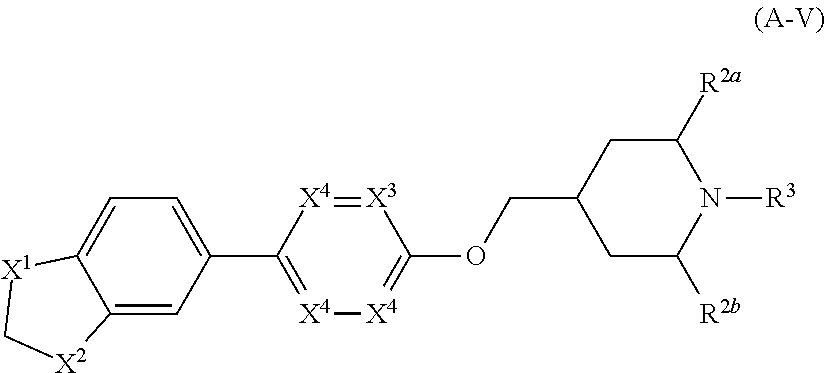
including hydrates, solvates, pharmaceutically acceptable salts, and complexes thereof.

including hydrates, solvates, pharmaceutically acceptable salts, and complexes thereof.

including hydrates, solvates, pharmaceutically acceptable salts, and complexes thereof.

including hydrates, solvates, pharmaceutically acceptable salts, and complexes thereof.

including hydrates, solvates, pharmaceutically acceptable salts, and complexes thereof.

including hydrates, solvates, pharmaceutically acceptable salts, and complexes thereof.

including hydrates, solvates, pharmaceutically acceptable salts, and complexes thereof.

including hydrates, solvates, pharmaceutically acceptable salts, and complexes thereof.

including hydrates, solvates, pharmaceutically acceptable salts, and complexes thereof.

including hydrates, solvates, pharmaceutically acceptable salts, and complexes thereof.

including hydrates, solvates, pharmaceutically acceptable salts, and complexes thereof.

including hydrates, solvates, pharmaceutically acceptable salts, and complexes thereof.

including hydrates, solvates, pharmaceutically acceptable salts, and complexes thereof.

including hydrates, solvates, pharmaceutically acceptable salts, and complexes thereof.

including hydrates, solvates, pharmaceutically acceptable salts, and complexes thereof.

including hydrates, solvates, pharmaceutically acceptable salts, and complexes thereof.

including hydrates, solvates, pharmaceutically acceptable salts, and complexes thereof.

including hydrates, solvates, pharmaceutically acceptable salts, and complexes thereof.


wherein non-limiting examples of X1, X2, X3, X4, R2a, R2b and R3 are defined herein below in Table A-1.
| TABLE A-1 |
| Exemplary compounds of the formula (A-XXIV) |
| Entry | X1 | X2 | X3 | X4 | R2a, | R2b | R3 |
| 1 | SO2 | O | N | N | H | H |
 |
| 2 | SO2 | O | N | N | CH3 | H |
 |
| 3 | SO2 | O | N | N | CH3 | CH3 |
 |
| 4 | O | SO2 | N | N | CH3 | CH3 |
 |
| 5 | O | SO2 | N | N | H | H |
 |
| 6 | O | SO2 | N | N | CH3 | H |
 |
| 7 | SO2 | O | CF | N | H | H |
 |
| 8 | SO2 | O | CF | N | H | CH3 |
 |
| 9 | SO2 | O | CF | N | CH3 | CH3 |
 |
| 10 | O | SO2 | CF | N | H | H |
 |
| 11 | O | SO2 | CF | CH | H | CH3 |
 |
| 12 | O | SO2 | CF | CH | CH3 | CH3 |
 |
| 13 | SO2 | O | N | N | H | H |
 |
| 14 | SO2 | O | N | N | CH3 | H |
 |
| 15 | SO2 | O | N | N | CH3 | CH3 |
 |
| 16 | SO2 | O | CF | N | CH3 | CH3 |
 |
| 17 | SO2 | O | CF | N | H | H |
 |
| 18 | SO2 | O | CF | N | H | CH3 |
 |
| 19 | SO2 | O | CF | H | H | H |
 |
| 20 | SO2 | O | CF | N | H | H |
 |
| 21 | SO2 | O | N | N | CH3 | H |
 |
| 22 | SO2 | O | CF | CH | CH3 | CH3 |
 |
| 23 | SO2 | O | CF | CH | H | H |
 |
| 24 | SO2 | O | CF | CH | H | H |
 |
| 25 | SO2 | O | CF | CH | H | H |
 |
| 26 | SO2 | O | CF | CH | H | H |
 |
| 27 | SO2 | O | CF | H | H | H |
 |
| 28 | SO2 | O | CF | N | H | H |
 |
| 29 | SO2 | O | CF | CH | CH3 | CH3 |
 |
| 30 | SO2 | O | N | N | H | H |
 |
| 31 | SO2 | O | CF | CH | CH3 | H |
 |
| 32 | SO2 | O | CF | CH | CH3 | CH3 |
 |
| 33 | O | SO2 | CF | CH | H | H |
 |
| 34 | O | SO2 | CF | CH | CH3 | H |
 |
| 35 | SO2 | O | CF | CH | H | H |
 |
| 36 | O | SO2 | CF | CH | H | H |
 |
| 37 | O | SO2 | N | N | H | H |
 |
| 38 | O | SO2 | CF | CH | CH3 | CH3 |
 |
| 39 | O | SO2 | CF | CH | H | H |
 |
| 40 | SO2 | O | CF | CH | CH3 | H |
 |

has the chemical name 6-((3-fluoro-4-piperidin-4-ylmethoxy)phenyl)-2H-benzo[d][1,3]oxathiole 3,3-dioxide.

has the chemical name 6-((3-fluoro-4-((1-isopropylpiperidin-4-ylmethoxy)phenyl)-2H-benzo[1,3]oxathiole 3,3-dioxide.

has the chemical name 6-((3-fluoro-4-((1-tert-butylpiperidin-4-ylmethoxy)phenyl)-2H-benzo[1,3]oxathiole 3,3-dioxide.

has the chemical name 4-((4-3,3-dioxido-2H-benzo[d][1,3]oxathiol-6-yl)-2-fluorophenyoxy)methyl)-N,N-dimethylpiperidine-1-carboxamide.

has the chemical name tert-butyl (2-(4-((4-(3,3-dioxido-2H-benzo[d][1,3]oxathiol-6-yl)-2-fluorophenoxy)methyl)piperidin-1-yl)-2-oxoethyl)carbamate.

has the chemical name (2-(4-((4-(3,3-dioxido-2H-benzo[d][1,3]oxathiol-6-yl)-2-fluorophenoxy)methyl)piperidin-1-yl)ethan-1-one.

has the chemical name tert-butyl (S)-(1-(4-((4-(3,3-dioxido-2H-benzo[d][1,3]oxathiol-6-yl)-2-fluorophenoxy)methyl)piperidin-1-yl)-3-methyl-1-oxobutan-2-yl)carbamate.

has the chemical name ((S)-2-amino-1-(4-((4-(3,3-dioxido-2H-benzo[d][1,3]oxathiol-6-yl)-2-fluorophenoxy)methyl)piperidin-1-yl)-)-3-methylbutan-1-one.

has the chemical name 4-((4-3,3-dioxido-2H-benzo[1,3]oxathiol-6-yl)-2-fluorophenyoxy)methyl)-piperidine-1-carboxamide.

has the chemical name 1-4-((4-3,3-dioxido-2H-benzo[1,3]oxathiol-6-yl)-2-fluorophenyoxy)methyl)-piperidin-1-yl)-2-methylpropan-1-one.

has the chemical name ethyl-2-(4-{[4-(3,3-dioxido-2H-benzo[d][1,3]oxathiol-6-yl)-2-fluorophenyoxy)methyl)-piperidin-1-yl)acetic acid.

has the chemical name 6-(4-((1-(5-ethylpyrimidin-2-yl)piperidin-4-yl)methoxy-3-fluorophenyl)-2H-benzo[d][1,3]oxathiole 3,3-dioxide.

has the chemical name tert-butyl 4-(((5-(3,3-dioxido-2H-benzo[d][1,3]oxathiol-6-yl)pyrimidin-2-yl)oxy)methyl)piperidine-1-carboxylate.

has the chemical name 6-(2-(piperidin-4-ylmethoxy)pyrimidin-5-yl)-2H-benzo[d][1,3]oxathiole 3,3-dioxide.

has the chemical name 6-(2-((1-(5-chloropyrimidin-2-yl)piperidin-4-yl)methoxy)pyrimidin-5-yl)-2H-benzo[d][1,3]oxathiole 3,3-dioxide.

has the chemical name 5-(4-((1-5-chloropyrimidin-2-yl)piperidin-4-yl)methoxy)-3-fluorophenyl)-2H-benzo[d][1,3]oxathiole 3,3-dioxide.

has the chemical name 6-(4-((1-(4-chloro-1,3,5-triazin-2-yl)piperidin-4-yl)methoxy)-3-3-fluorophenyl)-2H-benzo[d][1,3]oxathiole 3,3-dioxide.


has the chemical name 6-(4-((1-(1,3,5-triazin-2-yl)piperidin-4-yl)methoxy)-3-3-fluorophenyl)-2H-benzo[d][1,3]oxathiole 3,3-dioxide.

has the chemical name tert-butyl 3-((4-(3,3-dioxido-2H-benzo[d][1,3]oxathiol-6-yl)-2-fluorophenoxy)methyl)azetidine-1-carboxylate.

has the chemical name 6-(4-(azetidin-3-ylmethoxy)-3-fluorophenyl)-2H-benzo[d][1,3]oxathiole 3,3-dioxide hydrochloride.

has the chemical name 6-(4-((1-(5-chloropyrimidin-2-yl)azetidin-3-yl)methoxy)-3-fluorophenyl)-2H-benzo[d][1,3]oxathiole 3,3-dioxide.

has the chemical name 6-(3-fluoro-4-((-(3-isopropyl-1,2,4-oxadiazol-1-yl)azetidin-3-yl)methoxy)phenyl)-2H-benzo[d][1,3]oxathiole 3,3-dioxide.

has the chemical name tert-butyl 4-(5-((4-(3,3-dioxido-2H-benzo[d][1,3]oxathiol-6-yl)-2-fluorophenoxy)methyl)thiazol-2-yl)piperidine-1-carboxylate.

has the chemical name 6-(3-fluoro-4-((2-(piperidin-4-yl)thiazol-5-yl)methoxy)phenyl)-2H-benzo[d][1,3]oxathiole 3,3-dioxide.

has the chemical name 6-(4-((2-(1-(5-chloropyrimidin-2-yl)piperidin-4-yl)thiazol-5-yl)methoxy)-3-fluorophenyl)-2H-benzo[d][1,3]oxathiole-3,3-dioxide.

has the chemical name 6-(3-fluoro-4-((1-(3-isopropyl-1,2,4-oxadiazol-5-yl)piperidin-4-yl)methoxy)phenyl)-2H-benzo[d][1,3]oxathiole 3,3-dioxide.

has the chemical name tert-butyl 4-(4-(3,3-dioxido-2H-benzo[d][1,3]oxathiol-6-yl)-2-fluorophenyl]piperazine-1-carboxylate.

has the chemical name 6-(3-fluoro-4-(piperazine-1-yl)phenyl)-2H-benzo[d][1,3]oxathiole 3,3-dioxide.

has the chemical name 6-(4-(5-chloropyrimidin-2-yl)piperazin-1-yl)-3-fluorophenyl-2H-benzo[d][1,3]oxathiole 3,3-dioxide.

has the chemical name 6-(4-((1-(5-chloropyrimidin-2-yl)piperidin-4-yl)methoxy)-3-fluophenyl)-2H-benzo[d][1,3]oxathiole 3,3-dioxide.

has the chemical name 5-(4-((1-(5-chloropyrimidin-2-yl)piperidin-4-yl)methoxy)-3-fluorophenyl-2H-benzo[d][1,3]oxathiole3,3-dioxide.

will stand equally well for either of the four stereoisomers having the formula:

or the formula:

or the formula

or the formula

or mixtures thereof, or in the case where a second chiral center is present, all diastereomers.


| TABLE A-2 |
| Biological data representing compounds of the disclosure |
| EC50 nM | |||
| (% cAMP | |||
| Ex- | Max. | ||
| En- | am- | relative to | |
| try | ple | Name | forscolin) |
| 1 | A-13 | 6-((3-fluoro-4-((1-t-butylpiperidin-4- | 833 (75) |
| ylmethoxy)phenyl)-2H- | |||
| benzo[d][1,3]oxathiole 3,3- | |||
| dioxide | |||
| 2 | A-14 | 4-((4-3,3-dioxido-2H- | 86.4 (77) |
| benzo[d][1,3]oxathiol-6-yl)-2- | |||
| fluorophenyoxy)methyl)-N,N- | |||
| dimethylpiperidine-1- | |||
| carboxamide | |||
| 3 | A-15 | 1-4-((4-3,3-dioxido-2H- | 61.7 (80) |
| benzo[d][1,3]oxathiol-6-yl)- | |||
| 2-fluorophenyoxy)methyl)- | |||
| piperidin-1-yl)-2,2- | |||
| dimethylpropan-1-one | |||
| 4 | A-17 | (2-(4-((4-(3,3-dioxido-2H- | 10000 (67) |
| benzo[d][1,3]oxathiol-6- | |||
| yl)-2-fluorophenoxy)methyl)piperidin-1- | |||
| yl)ethan-1-one | |||
| 5 | A-19 | ((S)-2-amino-1-(4-((4-(3,3-dioxido--2H- | 4083 (65) |
| benzo[d][1,3]oxathiol-6-yl)-2- | |||
| fluorophenoxy)methyl)piperidin-1-yl)-3- | |||
| methylbutan-1-one | |||
| 6 | A-20 | 4-((4-3,3,-dioxido-2H- | 10000 (70) |
| benzo[d][1,3]oxathiol-6-yl)- | |||
| 2-fluorophenyoxy)methyl)-piperidine- | |||
| 1-carboxamide | |||
| 7 | A-21 | 1-4-((4-3,3,-dioxido-2H- | 37 (77) |
| benzo[d][1,3]oxathiol-6-yl)- | |||
| 2-fluorophenyoxy)methyl)-piperidin- | |||
| 1-yl)-2-methylpropan-1-one | |||
| 8 | A-23 | ethyl-2-(4-((4-(3,3-dioxido-2H- | 7037 (66) |
| benzo[d][1,3]oxathiol-6-yl)-2- | |||
| fluorophenyoxy)methyl)-piperidin- | |||
| 1-yl)acetic acid | |||
| 9 | A-24 | 6-(4-((1-(5-ethylpyrimidin- | 2.5 (77) |
| 2-yl)piperidin-4- | |||
| yl)methoxy-3-fluorophenyl)-2H- | |||
| benzo[d][1,3]oxathiole 3,3-dioxide | |||
| 10 | A-29 | 6-(2-((1-(5-chloropyrimidin-2-yl)piperidin-4- | 33.1 (80) |
| yl)methoxy)pyrimidin-5-yl)-2H- | |||
| benzo[d][1,3]oxathiole 3,3-dioxide | |||
| 11 | A-40 | 5-(4-((1-5-chloropyrimidin-2-yl)piperidin-4- | 369 (65) |
| yl)methoxy)-3-fluorophenyl)-2H- | |||
| benzo[d][1,3]oxathiole 3,3-dioxide | |||
| 12 | A-42 | 6-(4-((1-(1,3,5-triazin-2- | 102 (75) |
| yl)piperidin-4-yl)methoxy)- | |||
| 3-fluorophenyl)-2H-benzo[1,3]oxathiole | |||
| 3,3-dioxide | |||
| 13 | A-48 | 6-(4-((1-(5-chloropyrimidin-2-yl)azetidin-3- | 67 (80) |
| yl)methoxy)-3-fluorophenyl)-2H- | |||
| benzo[d][1,3]oxathiole 3,3-dioxide | |||
| 14 | A-52 | 6-(3-fluoro-4-((1-(3-isopropyl- | 24 (81) |
| 1,2,4-oxadiazol-5- | |||
| yl)azetidin-3-yl)methoxy)phenyl)-2H- | |||
| benzo[d][1,3]oxathiole 3,3-dioxide | |||
| 15 | A-58 | 6-(4-((2-(1-(5-chloropyrimidin- | 96 (73) |
| 2-yl)piperidin-4- | |||
| yl)thiazol-5-yl)methoxy)- | |||
| 3-fluorophenyl)-2H- | |||
| benzo[d][1,3]oxathiole-3,3-dioxide | |||
| 16 | A-59 | 6-(3-fluoro-4-((1-(3-isopropyl- | 5.4 (77) |
| 1,2,4-oxadiazol-5- | |||
| yl)piperidin-4-yl)methoxy)phenyl)-2H- | |||
| benzo[d][1,3]oxathiole 3,3-dioxide | |||
| 17 | A-65 | 6-(4-(5-chloropyrimidin-2- | 112.4 (84) |
| yl)piperazin-1-yl)-3- | |||
| fluorophenyl-2H-benzo[d][1,3]oxathiole | |||
| 3,3-dioxide | |||
| 18 | A-66 | 6-(3-fluoro-4-(1-(5-isopropylpyrimidin-2- | |
| yl)piperidin-4-yl)methoxy)phenyl-2H-benzo[d] | 19.1 (80) | ||
| [1,3]oxathiole 3,3-dioxide | |||
| 19 | A-67 | 6-(3-fluoro-4-(1-(5-methoxypyrimidin-2- | 21.4 (72) |
| yl)piperidin-4-yl)methoxy)phenyl-2H-benzo[d] | |||
| [1,3]oxathiole 3,3-dioxide | |||
| 20 | A-71 | (R)-6-(4-((1-(5-ethylpyrimidin- | 1690 (51) |
| 2-yl)pyrrolidin-2- | |||
| yl)methoxy)-3-fluorophenyl-2H- | |||
| benzo[d]oxathiole 3,3-dioxide | |||
| 21 | A-76 | 6-(5-((1-(5-ethylpyrimidin-2-yl)piperidin-4- | 8.2 (87) |
| yl)methoxy)pyrimidin-2-yl)-2H- | |||
| benzo[d][1,3]oxathiole 3,3-dioxide | |||
| 22 | A-80 | (S)-6-(4-((1-(5-ethylpyrimidin- | 1312 (25) |
| 2-yl)pyrrolidin-2- | |||
| yl)methoxy)-3-fluorophenyl-2H- | |||
| benzo[d]oxathiole 3,3-dioxide | |||
| 23 | A-86 | (S)-6-(4-((1-(5-ethylpyrimidin- | 166 (96) |
| 2-yl)pyrrolidin-3- | |||
| yl)methoxy)-3-fluorophenyl)-2H- | |||
| benzo[d][1,3]oxathiole 3,3-dioxide | |||
| 24 | A-89 | (S)-6-(4-((1-(5-chloropyrimidin- | 46 (93) |
| 2-yl)pyrrolidin-3- | |||
| yl)methoxy)-3-fluorophenyl)-2H- | |||
| benzo[d][1,3]oxathiole 3,3-dioxide | |||
| 25 | A-92 | (S)-6-(4-((1-(4-ethylpyrimidin- | 58 (90) |
| 2-yl)pyrrolidin-3- | |||
| yl)methoxy)-3-fluorophenyl)-2H- | |||
| benzo[d][1,3]oxathiole 3,3-dioxide | |||

including enantiomers, diastereomers, hydrates, solvates, pharmaceutically acceptable salts, prodrugs and complexes thereof, wherein:
X1 is selected from the group consisting of O, S and SO;
X2 is selected from the group consisting of O, S and SO;
when X1 is O, X2 is not O;
when X2 is O, X1 is not O;
when X1 is S, X2 is not S;
when X2 is S, X1 is not S;
when X1 is SO, X2 is not SO;
when X2 is SO, X1 is not SO;
X3 is selected from the group consisting of CH, CF and N;
X4 at each occurrence is independently selected from the group consisting of CH and N;
A is selected from the group consisting of

R is selected from the group consisting of

R1 is selected from the group consisting of hydrogen, C(O)O-tert-butyl, and

R2a is selected from the group consisting of hydrogen and C1-6 alkyl;
R2b is selected from the group consisting of hydrogen and C1-6 alkyl;
R3 is selected from the group consisting of hydrogen, C1-6 alkyl, C1-6 haloalkyl, C(O)R9, C(O)OR10, C(O)NR10aR10b, CH2C(O)OR10a,

R4 is selected from the group consisting of hydrogen, C1-6 alkyl, C1-6 haloalkyl, C(O)R9, C(O)OR10, C(O)NR10aR10b, and

R5 is selected from the group consisting of hydrogen, C1-6 alkyl, C1-6 haloalkyl, C(O)R9, C(O)OR10, C(O)NR10aR10b,

R6 is selected from the group consisting of

NHR11, and CH2NHR12;
R7a is selected from the group consisting of hydrogen, halogen, C1-6 alkyl, C3-7 branched alkyl, C1-6 haloalkyl and C1-6 alkoxy;
R7b is selected from the group consisting of hydrogen, halogen, C1-6 alkyl, C3-7 branched alkyl; C1-6 haloalkyl and C1-6 alkoxy;
R7c is selected from the group consisting of hydrogen, halogen, C1-6 alkyl, C3-7 branched alkyl C1-6 haloalkyl and C1-6 alkoxy;
R8 is selected from the group consisting of hydrogen, halogen, C1-6 alkyl, C3-7 branched alkyl, and C3-7 cycloalkyl;
R9 is selected from the group consisting of C1-6 alkyl and C3-7 branched alkyl, and


R12 is selected from the group consisting of

R13a is at each occurrence independently selected from the group consisting of hydrogen, C1-6 alkyl, and C3-7 branched alkyl;
R13b is at each occurrence independently selected from the group consisting of hydrogen, C1-6 alkyl, and C3-7 branched alkyl;
R14a is at each occurrence independently selected from the group consisting of hydrogen, C1-6 alkyl, C3-7 branched alkyl, and C(O)O-tert-butyl;
R14b is at each occurrence independently selected from the group consisting of hydrogen, C1-6 alkyl, and C3-7 branched alkyl;
X5 is selected from the group consisting of N and CR7b;
n1 is 1 or 2;
n2 is 1 or 2;
and m is 1, 2, 3, 4, 5, 6, or 7.

including hydrates, solvates, pharmaceutically acceptable salts, and complexes thereof.

including hydrates, solvates, pharmaceutically acceptable salts, and complexes thereof.

including hydrates, solvates, pharmaceutically acceptable salts, and complexes thereof.
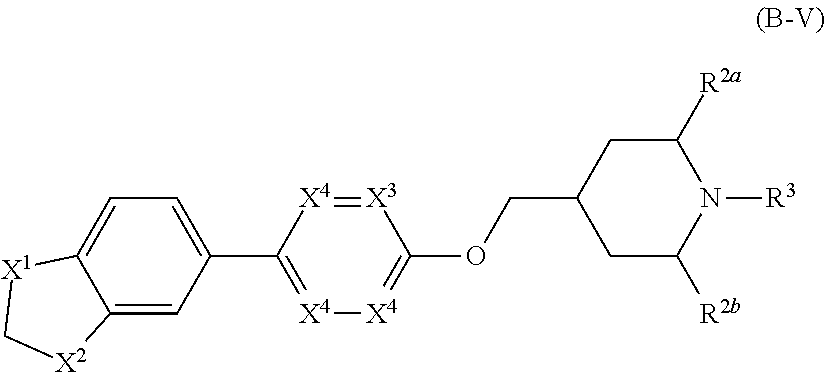
including hydrates, solvates, pharmaceutically acceptable salts, and complexes thereof.

including hydrates, solvates, pharmaceutically acceptable salts, and complexes thereof.

including hydrates, solvates, pharmaceutically acceptable salts, and complexes thereof.

including hydrates, solvates, pharmaceutically acceptable salts, and complexes thereof.

including hydrates, solvates, pharmaceutically acceptable salts, and complexes thereof.

including hydrates, solvates, pharmaceutically acceptable salts, and complexes thereof.

including hydrates, solvates, pharmaceutically acceptable salts, and complexes thereof.

including hydrates, solvates, pharmaceutically acceptable salts, and complexes thereof.

including hydrates, solvates, pharmaceutically acceptable salts, and complexes thereof.

including hydrates, solvates, pharmaceutically acceptable salts, and complexes thereof.

including hydrates, solvates, pharmaceutically acceptable salts, and complexes thereof.

including hydrates, solvates, pharmaceutically acceptable salts, and complexes thereof.

including hydrates, solvates, pharmaceutically acceptable salts, and complexes thereof.

including hydrates, solvates, pharmaceutically acceptable salts, and complexes thereof.

including hydrates, solvates, pharmaceutically acceptable salts, and complexes thereof.

including hydrates, solvates, pharmaceutically acceptable salts, and complexes thereof.

including hydrates, solvates, pharmaceutically acceptable salts, and complexes thereof.

including hydrates, solvates, pharmaceutically acceptable salts, and complexes thereof.

including hydrates, solvates, pharmaceutically acceptable salts, and complexes thereof.


wherein non-limiting examples of X1, X2, X3, X4, R2a, R2b and R3 are defined herein below in Table B-1.
| TABLE B-1 |
| Exemplary compounds of the formula (B-XXIV) |
| Entry | X1 | X2 | X3 | X4 | R2a, | R2b | R3 |
| 1 | S | O | N | CH | H | H |
 |
| 2 | S | O | CF | CH | CH3 | H |
 |
| 3 | S | O | CF | CH | H | CH2CH3 |
 |
| 4 | S | O | CF | CH | CH3 | CH3 |
 |
| 5 | O | S | N | CH | H | H |
 |
| 6 | O | S | CF | CH | CH3 | H |
 |
| 7 | O | S | CF | CH | H | CH2CH3 |
 |
| 8 | O | S | CF | CH | CH3 | CH3 |
 |
| 9 | SO | O | N | CH | H | H |
 |
| 10 | SO | O | CF | CH | CH3 | H |
 |
| 11 | SO | O | CF | CH | H | CH2CH3 |
 |
| 12 | SO | O | CF | CH | CH3 | CH3 |
 |
| 13 | O | SO | N | CH | H | H |
 |
| 14 | O | SO | CF | CH | CH3 | H |
 |
| 15 | O | SO | CF | CH | H | CH2CH3 |
 |
| 16 | O | SO | CF | CH | CH3 | CH3 |
 |
| 17 | S | O | N | N | H | H |
 |
| 18 | SO | O | N | N | H | H |
 |
| 19 | O | S | N | N | H | H |
 |
| 20 | O | SO | N | N | H | H |
 |
| 21 | SO | O | CF | CH | H | H |
 |
| 22 | SO | O | CF | CH | H | H |
 |
| 23 | SO | O | N | CH | H | H |
 |
| 24 | SO | O | CF | CH | H | H |
 |
| 25 | SO | O | CF | CH | H | H |
 |
| 26 | SO | O | CF | CH | H | H |
 |
| 27 | SO | O | CF | CH | H | H |
 |
| 28 | SO | O | N | CH | H | H |
 |
| 29 | SO | O | CF | CH | H | H |
 |
| 30 | SO | O | N | N | H | H |
 |
| 31 | SO | O | CF | CH | CH3 | H |
 |
| 32 | SO | O | CF | CH | H | CH2CH3 |
 |
| 33 | SO | O | CF | CH | CH3 | CH3 |
 |
| 34 | O | SO | CF | CH | CH3 | CH3 |
 |
| 35 | SO | O | CF | CH | H | H |
 |
| 36 | SO | O | CF | CH | H | H |
 |
| 37 | SO | O | CF | CH | H | H |
 |
| 38 | SO | O | CF | CH | H | H |
 |
| 39 | SO | O | CF | CH | H | H |
 |
| 40 | SO | O | CF | CH | H | H |
 |

has the chemical name 6-(4-((1-(5-chloropyrimidin-2-yl)piperidin-4-yl)methoxy)-3-fluorophenyl)-2H-benzo[d][1,3]oxathiole 3-oxide.

has the chemical name 6-(4-((1-(5-ethylpyrimidin-2-yl)methoxy)-3-fluorophenyl)-2H-benzo[d][1,3]oxathiole-3-oxide.

has the chemical name 1-(4-((2-fluoro-4-(3-oxido-2H-benzo[d][1,3]oxathiol-6-yl)phenoxy)methyl)-piperidin-1-yl)-3-methylbutane-1-one.

has the chemical name 6-(3-fluoro-4-((1-(5-methoxypyrimidin-2-yl)piperidin-4-yl)methoxy)phenyl)-2H-benzo[d][1,3]oxathiole 3-oxide.

has the chemical name 6-(4-((1-(4-ethylpyrimidin-2-yl)piperidin-4-yl)methoxy)-3-(fluorophenyl)-2H-benzo[d][1,3]oxathiole 3-oxide.

has the chemical name 2-(4-((4-benzo[d][1,3]oxathiol-6-yl)-2-fluorophenoxy)methyl)piperidin-1-yl)-4-ethylpyrimidine.

has the chemical name 6-(4-((1-(5-ethoxypyrimidin-2-yl)piperidin-4-yl)methoxy)-3-fluorophenyl)-2H-benzo[d][1,3]oxathiole 3-oxide.

has the chemical name 6-(3-fluoro-4-((1-(5-isopropylpyrimidin-2-yl)piperidin-4-yl)methoxy)phenyl)-2H-benzo[d][1,3]oxathiole 3-oxide.

has the chemical name 6-(3-fluoro-4-((1-(5-(trifluoromethyl)pyridin-2-yl)piperidin-4-yl)methoxy)phenyl)-2H-benzo[d][1,3]oxathiole 3-oxide.

has the chemical name 6-(3-fluoro-4-(piperidin-4-yl)methoxy)phenyl)-2H-benzo[d][1,3]oxathiole 3-oxide.

has the chemical name tert-butyl 4-((2-fluoro-4-(3-oxido-2H-benzo[d][1,3]oxathiol-6-yl)phenoxy)methyl) piperidine-1-carboxylate.

has the chemical name (S)-6-(4-((1-(5-chloropyrimidin-2-yl)piperidin-4-yl)methoxy)-3-fluorophenyl)-2H-benzo[d][1,3]oxathiole 3-oxide.

has the chemical name (R)-6-(4-((1-(5-chloropyrimidin-2-yl)piperidin-4-yl)methoxy)-3-fluorophenyl)-2H-benzo[d][1,3]oxathiole 3-oxide.

will stand equally well for either of the two enantiomers having the formula:

-
- or the formula:

Or mixtures thereof, or in the case where a second chiral center is present, all diastereomers.


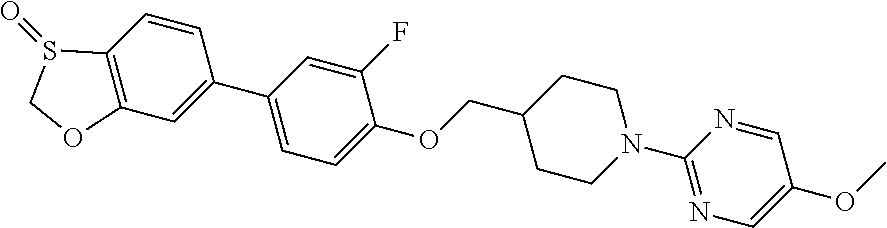


| TABLE B-2 |
| Biological data of representative compounds of the disclosure |
| EC50 | |||
| Ex- | nM; ( % | ||
| En- | am- | cAMP | |
| try | ple | Name | Max.) |
| 1 | B-12 | 2-(4-((4-benzo[d][1,3]oxathiol-6-yl)-2- | 280 |
| fluorophenoxy]methyppiperidin-1-yl)-5- | |||
| chloropyrimidine | |||
| 2 | B-16 | 6-(4-((1-(5-chloropyrimidin-2-yl)piperidin-4- | 2.3 |
| yl)methoxy)-3-fluorophenyl)-2H- | |||
| benzo[d][1,3]oxathiole 3-oxide | |||
| 3 | B-19 | 6-(4-((1-(5-ethylpyrimidin-2-yl)methoxy)-3- | 4.8 |
| fluorophenyl)-2H-benzo[d][1,3]oxathiole- | |||
| 3-oxide | |||
| 4 | B-23 | 1-(4-((2-fluoro-4-(3-oxido-2H- | 46.2 |
| benzo[d][1,3]oxathiol- | |||
| 6-yl)phenoxy)methyl)-piperidin- | |||
| 1-yl)-3-methylbutane-1-one | |||
| 5 | B-24 | 6-(3-fluoro-4-((1-(5- | 2.3 |
| methoxypyrimidin-2-yl)piperidin- | |||
| 4-yl)methoxy)phenyl)-2H- | |||
| benzo[d][1,3]oxathiole | |||
| 3-oxide | |||
| 6 | B-25 | 6-(4-((1-(4-ethylpyrimidin-2-yl)piperidin-4- | 31.8 |
| yl)methoxy)-3-(fluorophenyl)-2H- | |||
| benzo[d][1,3]oxathiole 3-oxide. | |||
| 7 | B-26 | 2-(4-((4-benzo[d][1,3]oxathiol-6-yl)-2- | >500 |
| fluorophenoxy)methyl)piperidin- | |||
| 1-yl)-4-ethylpyrimidine. | |||
| 8 | B-27 | 6-(4-((1-(5-ethoxypyrimidin-2-yl)piperidin-4- | 4.7 |
| yl)methoxy)-3-fluorophenyl)-2H- | |||
| benzo[d][1,3]oxathiole 3-oxide | |||
| 9 | B-28 | 6-(3-fluoro-4-((1-(5-isopropylpyrimidin-2- | 3.0 |
| yl)piperidin-4-yl)methoxy)phenyl)-2H- | |||
| benzo[d][1,3]oxathiole 3-oxide. | |||
| 10 | B-29 | 6-(3-fluoro-4-((1-(5-(trifluoromethyl)pyridin- | 52 |
| 2-yl)piperidin-4-yl)methoxy)phenyl)-2H- | |||
| benzo[d][1,3]oxathiole 3-oxide. | |||
| 11 | B-32 | (S)-6-(4-((1-(5-chloropyrimidin-2-yl)piperidin-4- | 1.2 |
| yl)methoxy)-3-fluorophenyl)-2H- | |||
| benzo[d][1,3]oxathiole 3-oxide | |||
| 12 | B-34 | (R)-6-(4-((1-(5-chloropyrimidin-2-yl)piperidin-4- | 0.9 |
| yl)methoxy)-3-fluorophenyl)-2H- | |||
| benzo[d][1,3]oxathiole 3-oxide | |||
| 13 | B-18 | 6-(3-fluoro-4-(piperidin-4- | >500 |
| yl)methoxy)phenyl)-2H- | |||
| benzo[d][1,3]oxathiole 3-oxide | |||
| 14 | B-17 | tert-butyl 4-((2-fluoro-4-(3-oxido-2H- | >100 |
| benzo[d][1,3]oxathiol-6-yl)phenoxy)methyl) | |||
| piperidine-1-carboxylate | |||
| 15 | B-35 | 6-(4-((1-(4-ethylpyrimidin-2-yl)piperidin-4- | 27.3 (61) |
| yl)methoxy)-3-fluorophenyl)-2H- | |||
| benzo[d][1,3]oxathiole 3-oxide. | |||
| 16 | B-37 | 2-(4-((4-(benzo[d][1,3]oxathiol-6-yl)-2- | 365 (79) |
| fluorophenoxy)methyl)piperidin-1-yl)-5- | |||
| ethylpyrimidine | |||
| 17 | B-38 | 2-(4-((4-(benzo[d][1,3]oxathiol-6-yl)-2- | 10.5 (78) |
| fluorophenoxy)methyl)piperidin-1-yl)-5- | |||
| isopropylpyrimidine | |||
| 18 | B-39 | 2-(4-((4-(benzo[d][1,3]oxathiol-6-yl)-2- | 2900 (64) |
| fluorophenoxy)methyl)piperidin-1-yl)-5- | |||
| methoxpyrimidine | |||
| 19 | B-40 | 1-(4-((4-(benzo[d][1,3]oxathiol-6-yl)-2- | 2000 (50) |
| fluorophenoxy)methyl)piperidin-1-yl)-3- | |||
| methylbutan-1-one | |||
| 20 | B-45 | (S)-6-(4-((1-(5-ethylpyrimidin- | 2.3 (68) |
| 2-yl)piperidin-4- | |||
| yl)methoxy)-3-fluorophenyl)-2H- | |||
| benzo[d][1,3]oxathiole 3-oxide | |||
| 21 | B-46 | (S)-6-(3-fluroro-4-((1-5-isopropylpyrimidin-2- | 10.1 (82) |
| yl)piperidin-4-yl)methoxy)phenyl)-2H- | |||
| benzo[d][1,3]oxathiole 3-oxide | |||
| 22 | B-50 | (S)-6-(3-fluoro-4-((1-5-methoxypyrimidin-2- | 3.7 (66) |
| yl)piperidin-4-yl)methoxy)phenyl)-2H- | |||
| benzo[d][1,3]oxathiole 3-oxide | |||
| 23 | B-51 | (R)-6-(3-fluoro-4-((1-(5-methoxypyrimidin-2- | 40.6 (70) |
| yl)piperidin-4-yl)methoxy)phenyl)-2H- | |||
| benzo[d][1,3]oxathiole 3-oxide | |||
| 24 | B-52 | (R)-6-(4-((1-(5-ethylpyrimidin-2-yl)piperidin-4- | 19.5(73) |
| yl)methoxy)phenyl)-3-fluorophenyl)-2H- | |||
| benzo[d][1,3]oxathiole 3-oxide | |||
| 25 | B-53 | (R)-6-(3-fluoro-4-((1-(5-isopropylpyrimidin-2- | 41(74) |
| yl)piperidin-4-yl)methoxy)phenyl)-2H- | |||
| benzo[d][1,3]oxathiole 3-oxide | |||
| 26 | B-58 | (R)-6-(2-((1-(5-chloropyridin-2-yl)piperidin-4- | 107(66) |
| yl)methoxy)pyrimidin-5-yl)-2H- | |||
| benzo[d][1,3]oxathiole | |||
| 3-oxide | |||
| 27 | B-59 | (S)-6-(4-((1-(5-chloropyrimidin-2-yl)piperidin-4- | 1.7(70) |
| yl)methoxy)-3-fluorophenyl)-2H- | |||
| benzo[d][1,3]oxathiole 3-oxide | |||
| 28 | B-62 | (S)-6-(2-((1-(5-chloropyrimidin-2-yl)piperidin-4- | 43.5(66) |
| yl)methoxy)pyrimidin-5-yl)- | |||
| 2H-benzo[d][1,3]oxathiole | |||
| 3-oxide | |||
| 29 | B-67 | 6-(4-(((R)-1-(5-ethylpyrimidin-2-yl)pyrrolidin-3- | 54(74) |
| yl)methoxy)-3-fluorophenyl)-2H- | |||
| benzo[d][1,3]oxathiole 3-oxide | |||
| 30 | B-69 | (R)-2-(3-((4-benzo[d][1,3]oxathiol-6-yl)-2- | >10,000 |
| fluorophenoxy)methyl)pyrrolidin-1-yl)-5- | |||
| ethylpyrimidine | |||
| 31 | B-75 | (S)-6-(4-(((S)-1-(5-ethylpyrimidin- | 17.7(88) |
| 2-yl)pyrrolidin-3- | |||
| yl)methoxy)-3-flurophenyl)-2H-benzo | |||
| [d][1,3]oxathiole 3-oxide | |||
| 32 | B-76 | (R)-6-(4-(((S)-1-(5-ethylpyrimidin- | 20.5(80) |
| 2-yl)pyrrolidin-3- | |||
| yl)methoxy-3-flurophenyl)- | |||
| 2H-benzo[d][1,3]oxathiole | |||
| 3-oxide | |||
| 33 | B-77 | (S)-6-(4-(((R)-1-(5-ethylpyrimidin- | 32.5(81) |
| 2-yl)pyrrolidin-3- | |||
| yl)methoxy-3-flurophenyl)- | |||
| 2H-benzo [d][1,3]oxathiole | |||
| 3-oxide | |||
| 34 | B-78 | (R)-6-(4-(((R)-1-(5-ethylpyrimidin- | 115(72) |
| 2-yl)pyrrolidin-3- | |||
| yl)methoxy-3-flurophenyl)- | |||
| 2H-benzo [d][1,3]oxathiole | |||
| 3-oxide | |||
| 35 | B-81 | (S)-6-(-4-(((S)-1-(5-chloropyrimidin- | 30(95) |
| 2-yl)pyrrolidin-3- | |||
| yl)methoxy)-3-fluorophenyl)-2H- | |||
| benzo[d][1,3]oxathiole 3-oxide | |||
| 36 | B-84 | (S)-6-(4-(((S)-1-(4-ethylpyrimidin- | 31.5(92) |
| 2-yl)pyrrolidine-3- | |||
| yl)methoxy)-3-fluorophenyl)-2H- | |||
| benzo[d][1,3]oxathiole 3-oxide | |||
| 37 | B-85 | (R)-6-(4-(((S)-1-(4-ethylpyrimidin- | 13(64) |
| 2-yl)pyrrolidine-3- | |||
| yl)methoxy)-3-fluorophenyl)-2H- | |||
| benzo[d][1,3]oxathiole 3-oxide | |||
| 38 | B-86 | (R)-6-(4-(((S)-1-(5-chloropyrimidin- | 4.6(93) |
| 2-yl)pyrrolidine-3- | |||
| yl)methoxy)-3-fluorophenyl)-2H- | |||
| benzo[d][1,3]oxathiole 3-oxide | |||
| 39 | B-91 | (S)-6-(4-(((S)-1-(5-ethylpyrimidin- | 10.3(93) |
| 2-yl)pyrrolidine-3- | |||
| yl)methoxy)phenyl)-2H- | |||
| benzo[d][1,3]oxathiole 3-oxide | |||
| TABLE B-3 | |||
| EC50 nM; | |||
| En- | Exam- | ( % cAMP | |
| try | ple | Name | Max.) |
| 1 | B-34 | (R)-6-(4-((1-(5-chloropyrimidin- | 35.7(172) |
| 2-yl)piperidin-4- | |||
| yl)methoxy)-3-fluorophenyl)-2H- | |||
| benzo[d][1,3]oxathiole 3-oxide | |||
| 2 | B-46 | (S)-6-(3-fluroro-4-((1-5-isopropylpyrimidin-2- | 7.9 (164) |
| yl)piperidin-4-yl)methoxy)phenyl)-2H- | |||
| benzo[d][1,3]oxathiole 3-oxide | |||
| 3 | B-50 | (S)-6-(3-fluoro-4-((1-5-methoxypyrimidin-2- | 16.4 (169) |
| yl)piperidin-4-yl)methoxy)phenyl)-2H- | |||
| benzo[d][1,3]oxathiole 3-oxide | |||
| 4 | B-59 | (S)-6-(4-((1-(5-chloropyrimidin-2-yl)piperidin- | 6.7 (175) |
| 4-yl)methoxy)-3-fluorophenyl)-2H- | |||
| benzo[d][1,3]oxathiole 3-oxide | |||
| 5 | B-75 | (S)-6-(4-(((S)-1-(5-ethylpyrimidin- | 60 (190) |
| 2-yl)pyrrolidin-3- | |||
| yl)methoxy)-3-flurophenyl)-2H-benzo | |||
| [d][1,3]oxathiole 3-oxide | |||
| 6 | B-84 | (S)-6-(4-(((S)-1-(4-ethylpyrimidin- | 567(117) |
| 2-yl)pyrrolidine- | |||
| 3-yl)methoxy)-3-fluorophenyl)-2H- | |||
| benzo[d][1,3]oxathiole 3-oxide | |||
| 7 | B-85 | (R)-6-(4-(((S)-1-(4-ethylpyrimidin- | 657 (73) |
| 2-yl)pyrrolidine- | |||
| 3-yl)methoxy-3-fluorophenyl)-2H- | |||
| benzo[d][1,3]oxathiole 3-oxide | |||
| 8 | B-86 | (R)-6-(4-(((S)-1-(5-chloropyrimidin-2- | 108(133) |
| yl)pyrrolidine-3-yl)methoxy)- | |||
| 3-fluorophenyl)-2H- | |||
| benzo[d][1,3]oxathiole 3-oxide | |||
| 9 | B-91 | (S)-6-(4-(((S)-1-(5-ethylpyrimidin- | 222(155) |
| 2-yl)pyrrolidine- | |||
| 3-yl)methoxy)phenyl)-2H- | |||
| benzo[d][1,3]oxathiole 3-oxide | |||
Claims (23)


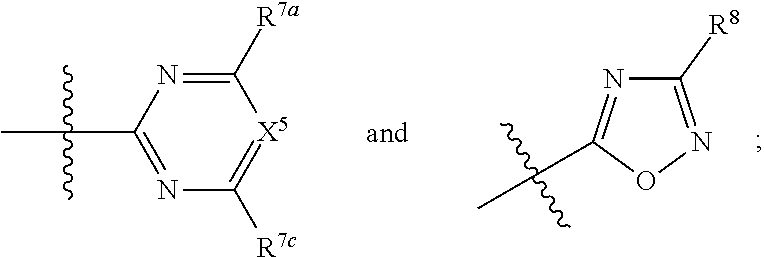


Priority Applications (1)
| Application Number | Priority Date | Filing Date | Title |
|---|---|---|---|
| US16/307,914 US10906894B2 (en) | 2016-06-09 | 2017-06-08 | Compounds containing benzo[d][1,3]oxathiole, benzo[d][1,3]oxathiole 3-oxide or benzo[d][1,3]oxathiole 3,3-dioxide and methods/uses thereof as agonists of g protein-coupled receptor 119 |
Applications Claiming Priority (4)
| Application Number | Priority Date | Filing Date | Title |
|---|---|---|---|
| US201662348122P | 2016-06-09 | 2016-06-09 | |
| US201662348120P | 2016-06-09 | 2016-06-09 | |
| PCT/CA2017/050703 WO2017210794A1 (en) | 2016-06-09 | 2017-06-08 | Compounds containing benzo[d][1,3]oxathiole, benzo[d][1,3]oxathiole 3-oxide or benzo[d][1,3]oxathiole 3,3-dioxide and methods/uses thereof as agonists of g protein-coupled receptor 119 |
| US16/307,914 US10906894B2 (en) | 2016-06-09 | 2017-06-08 | Compounds containing benzo[d][1,3]oxathiole, benzo[d][1,3]oxathiole 3-oxide or benzo[d][1,3]oxathiole 3,3-dioxide and methods/uses thereof as agonists of g protein-coupled receptor 119 |
Related Parent Applications (1)
| Application Number | Title | Priority Date | Filing Date |
|---|---|---|---|
| PCT/CA2017/050703 A-371-Of-International WO2017210794A1 (en) | 2016-06-09 | 2017-06-08 | Compounds containing benzo[d][1,3]oxathiole, benzo[d][1,3]oxathiole 3-oxide or benzo[d][1,3]oxathiole 3,3-dioxide and methods/uses thereof as agonists of g protein-coupled receptor 119 |
Related Child Applications (1)
| Application Number | Title | Priority Date | Filing Date |
|---|---|---|---|
| US17/104,712 Continuation US12037328B2 (en) | 2016-06-09 | 2020-11-25 | Compounds containing benzo[d][1,3]oxathiole, benzo[d][1,3]oxathiole 3-oxide or benzo[d][1,3]oxathiole 3,3-dioxide and methods/uses thereof as agonists of G protein-coupled receptor 119 |
Publications (2)
| Publication Number | Publication Date |
|---|---|
| US20190292173A1 US20190292173A1 (en) | 2019-09-26 |
| US10906894B2 true US10906894B2 (en) | 2021-02-02 |
Family
ID=60578338
Family Applications (2)
| Application Number | Title | Priority Date | Filing Date |
|---|---|---|---|
| US16/307,914 Active US10906894B2 (en) | 2016-06-09 | 2017-06-08 | Compounds containing benzo[d][1,3]oxathiole, benzo[d][1,3]oxathiole 3-oxide or benzo[d][1,3]oxathiole 3,3-dioxide and methods/uses thereof as agonists of g protein-coupled receptor 119 |
| US17/104,712 Active 2038-10-01 US12037328B2 (en) | 2016-06-09 | 2020-11-25 | Compounds containing benzo[d][1,3]oxathiole, benzo[d][1,3]oxathiole 3-oxide or benzo[d][1,3]oxathiole 3,3-dioxide and methods/uses thereof as agonists of G protein-coupled receptor 119 |
Family Applications After (1)
| Application Number | Title | Priority Date | Filing Date |
|---|---|---|---|
| US17/104,712 Active 2038-10-01 US12037328B2 (en) | 2016-06-09 | 2020-11-25 | Compounds containing benzo[d][1,3]oxathiole, benzo[d][1,3]oxathiole 3-oxide or benzo[d][1,3]oxathiole 3,3-dioxide and methods/uses thereof as agonists of G protein-coupled receptor 119 |
Country Status (10)
| Country | Link |
|---|---|
| US (2) | US10906894B2 (en) |
| EP (1) | EP3468967B1 (en) |
| JP (3) | JP2019517563A (en) |
| KR (2) | KR20190015535A (en) |
| CN (1) | CN109890814B (en) |
| AU (1) | AU2017276837B2 (en) |
| CA (1) | CA3026903C (en) |
| ES (1) | ES2963181T3 (en) |
| FI (1) | FI3468967T3 (en) |
| WO (1) | WO2017210794A1 (en) |
Cited By (2)
| Publication number | Priority date | Publication date | Assignee | Title |
|---|---|---|---|---|
| US20210300907A1 (en) * | 2016-06-09 | 2021-09-30 | Pramana Pharmaceuticals Inc. | Compounds containing benzo[d][1,3]oxathiole, benzo[d][1,3]oxathiole 3-oxide or benzo[d][1,3]oxathiole 3,3-dioxide and methods/uses thereof as agonists of g protein-coupled receptor 119 |
| US12023817B1 (en) * | 2023-11-14 | 2024-07-02 | Pramana, Inc. | System and method for a slide marking technique for target tissue extraction and downstream application |
Families Citing this family (2)
| Publication number | Priority date | Publication date | Assignee | Title |
|---|---|---|---|---|
| US11358956B2 (en) | 2017-11-30 | 2022-06-14 | Pramana Pharmaceuticals Inc. | Compounds containing polysubstituted benzo[d][1,3]oxathiole, benzo[d][1,3]oxathiole 3-oxide or benzo[d][1,3]oxathiole 3,3-dioxide and methods/uses thereof as agonists of G protein-coupled receptor 119 |
| WO2024030121A1 (en) * | 2022-08-02 | 2024-02-08 | The Scripps Research Institute | Small-molecule activators of mycobacterium tuberculosis adenylyl cyclase |
Citations (7)
| Publication number | Priority date | Publication date | Assignee | Title |
|---|---|---|---|---|
| CA1117944A (en) | 1977-11-09 | 1982-02-09 | Gilbert Regnier | Processes for preparing new disubstituted piperazines |
| EP0157603A2 (en) | 1984-03-28 | 1985-10-09 | Sankyo Company Limited | 1, 3-Benzoxathiole derivatives, their use and their preparation |
| WO2005121121A2 (en) | 2004-06-04 | 2005-12-22 | Arena Pharmaceuticals, Inc. | Substituted aryl and heteroaryl derivatives as modulators of metabolism and the prophylaxis and treatment of disorders related thereto |
| US20080103141A1 (en) | 2006-08-30 | 2008-05-01 | Biovitrum | New compounds |
| WO2009050522A1 (en) | 2007-10-18 | 2009-04-23 | Prosidion Limited | Azetidinyl g-protein coupled receptor agonists |
| US20140274701A1 (en) | 2013-03-15 | 2014-09-18 | Dow Agrosciences Llc | 4-amino-6-(heterocyclic)picolinates and 6-amino-2-(heterocyclic)pyrimidine-4-carboxylates and their use as herbicides |
| RU2576037C1 (en) | 2014-11-28 | 2016-02-27 | Закрытое акционерное общество "Исследовательский институт Химического разнообразия" ЗАО "ИИХР" | Substituted 4-{[4-(3,3-dioxido-1,3-benzoxathiol-6-yl)aryloxy]methyl}piperidines as gpr119 receptor agonists, pharmaceutical composition, methods for producing and using them |
Family Cites Families (8)
| Publication number | Priority date | Publication date | Assignee | Title |
|---|---|---|---|---|
| US7638541B2 (en) * | 2006-12-28 | 2009-12-29 | Metabolex Inc. | 5-ethyl-2-{4-[4-(4-tetrazol-1-yl-phenoxymethyl)-thiazol-2-yl]-piperidin-1-yl}-pyrimidine |
| KR20100134659A (en) | 2008-03-31 | 2010-12-23 | 메타볼렉스, 인코포레이티드 | Oxymethylene Aryl Compounds and Uses thereof |
| WO2012064569A1 (en) * | 2010-11-08 | 2012-05-18 | Merck Sharp & Dohme Corp. | Imidazole derivatives |
| CA2818050A1 (en) * | 2010-11-26 | 2012-05-31 | Lupin Limited | Bicyclic gpr119 modulators |
| KR101535954B1 (en) | 2012-06-12 | 2015-07-10 | 주식회사 종근당 | Piperidine Derivatives for GPR119 agonist |
| KR101524208B1 (en) * | 2013-04-26 | 2015-05-29 | 한국화학연구원 | Benzoin oxazole derivatives, preparation method thereof and pharmaceutical compositions that contain them |
| US10906894B2 (en) * | 2016-06-09 | 2021-02-02 | Pramana Pharmaceuticals Inc. | Compounds containing benzo[d][1,3]oxathiole, benzo[d][1,3]oxathiole 3-oxide or benzo[d][1,3]oxathiole 3,3-dioxide and methods/uses thereof as agonists of g protein-coupled receptor 119 |
| US11358956B2 (en) * | 2017-11-30 | 2022-06-14 | Pramana Pharmaceuticals Inc. | Compounds containing polysubstituted benzo[d][1,3]oxathiole, benzo[d][1,3]oxathiole 3-oxide or benzo[d][1,3]oxathiole 3,3-dioxide and methods/uses thereof as agonists of G protein-coupled receptor 119 |
-
2017
- 2017-06-08 US US16/307,914 patent/US10906894B2/en active Active
- 2017-06-08 WO PCT/CA2017/050703 patent/WO2017210794A1/en not_active Ceased
- 2017-06-08 CA CA3026903A patent/CA3026903C/en active Active
- 2017-06-08 EP EP17809507.1A patent/EP3468967B1/en active Active
- 2017-06-08 ES ES17809507T patent/ES2963181T3/en active Active
- 2017-06-08 KR KR1020197000379A patent/KR20190015535A/en not_active Ceased
- 2017-06-08 FI FIEP17809507.1T patent/FI3468967T3/en active
- 2017-06-08 AU AU2017276837A patent/AU2017276837B2/en active Active
- 2017-06-08 JP JP2018564731A patent/JP2019517563A/en active Pending
- 2017-06-08 KR KR1020237023082A patent/KR102723119B1/en active Active
- 2017-06-08 CN CN201780045576.1A patent/CN109890814B/en active Active
-
2020
- 2020-11-25 US US17/104,712 patent/US12037328B2/en active Active
-
2021
- 2021-11-08 JP JP2021181920A patent/JP2022022216A/en active Pending
-
2023
- 2023-12-28 JP JP2023222653A patent/JP2024028354A/en active Pending
Patent Citations (7)
| Publication number | Priority date | Publication date | Assignee | Title |
|---|---|---|---|---|
| CA1117944A (en) | 1977-11-09 | 1982-02-09 | Gilbert Regnier | Processes for preparing new disubstituted piperazines |
| EP0157603A2 (en) | 1984-03-28 | 1985-10-09 | Sankyo Company Limited | 1, 3-Benzoxathiole derivatives, their use and their preparation |
| WO2005121121A2 (en) | 2004-06-04 | 2005-12-22 | Arena Pharmaceuticals, Inc. | Substituted aryl and heteroaryl derivatives as modulators of metabolism and the prophylaxis and treatment of disorders related thereto |
| US20080103141A1 (en) | 2006-08-30 | 2008-05-01 | Biovitrum | New compounds |
| WO2009050522A1 (en) | 2007-10-18 | 2009-04-23 | Prosidion Limited | Azetidinyl g-protein coupled receptor agonists |
| US20140274701A1 (en) | 2013-03-15 | 2014-09-18 | Dow Agrosciences Llc | 4-amino-6-(heterocyclic)picolinates and 6-amino-2-(heterocyclic)pyrimidine-4-carboxylates and their use as herbicides |
| RU2576037C1 (en) | 2014-11-28 | 2016-02-27 | Закрытое акционерное общество "Исследовательский институт Химического разнообразия" ЗАО "ИИХР" | Substituted 4-{[4-(3,3-dioxido-1,3-benzoxathiol-6-yl)aryloxy]methyl}piperidines as gpr119 receptor agonists, pharmaceutical composition, methods for producing and using them |
Non-Patent Citations (20)
Cited By (3)
| Publication number | Priority date | Publication date | Assignee | Title |
|---|---|---|---|---|
| US20210300907A1 (en) * | 2016-06-09 | 2021-09-30 | Pramana Pharmaceuticals Inc. | Compounds containing benzo[d][1,3]oxathiole, benzo[d][1,3]oxathiole 3-oxide or benzo[d][1,3]oxathiole 3,3-dioxide and methods/uses thereof as agonists of g protein-coupled receptor 119 |
| US12037328B2 (en) * | 2016-06-09 | 2024-07-16 | Pramana Pharmaceuticals Inc. | Compounds containing benzo[d][1,3]oxathiole, benzo[d][1,3]oxathiole 3-oxide or benzo[d][1,3]oxathiole 3,3-dioxide and methods/uses thereof as agonists of G protein-coupled receptor 119 |
| US12023817B1 (en) * | 2023-11-14 | 2024-07-02 | Pramana, Inc. | System and method for a slide marking technique for target tissue extraction and downstream application |
Also Published As
| Publication number | Publication date |
|---|---|
| KR20230110650A (en) | 2023-07-24 |
| FI3468967T3 (en) | 2023-10-26 |
| ES2963181T3 (en) | 2024-03-25 |
| US20210300907A1 (en) | 2021-09-30 |
| CA3026903C (en) | 2024-05-28 |
| EP3468967A4 (en) | 2020-04-08 |
| EP3468967A1 (en) | 2019-04-17 |
| KR102723119B1 (en) | 2024-10-28 |
| CA3026903A1 (en) | 2017-12-14 |
| EP3468967B1 (en) | 2023-07-26 |
| RU2018145689A3 (en) | 2020-07-13 |
| KR20190015535A (en) | 2019-02-13 |
| CN109890814B (en) | 2023-04-18 |
| AU2017276837B2 (en) | 2021-09-16 |
| RU2018145689A (en) | 2020-07-13 |
| BR112018075484A2 (en) | 2019-03-19 |
| AU2017276837A1 (en) | 2018-12-13 |
| JP2019517563A (en) | 2019-06-24 |
| US12037328B2 (en) | 2024-07-16 |
| CN109890814A (en) | 2019-06-14 |
| WO2017210794A1 (en) | 2017-12-14 |
| US20190292173A1 (en) | 2019-09-26 |
| JP2022022216A (en) | 2022-02-03 |
| JP2024028354A (en) | 2024-03-04 |
Similar Documents
| Publication | Publication Date | Title |
|---|---|---|
| US12037328B2 (en) | Compounds containing benzo[d][1,3]oxathiole, benzo[d][1,3]oxathiole 3-oxide or benzo[d][1,3]oxathiole 3,3-dioxide and methods/uses thereof as agonists of G protein-coupled receptor 119 | |
| US12187741B2 (en) | Glycosidase inhibitors | |
| US11612599B2 (en) | Glycosidase inhibitors | |
| US11213525B2 (en) | Linear glycosidase inhibitors | |
| US10995090B2 (en) | Substituted dihydrobenzofuran glycosidase inhibitors | |
| US12016852B2 (en) | Pyrrolidine glycosidase inhibitors | |
| US20220177470A1 (en) | Sulfoximine glycosidase inhibitors | |
| US20220143042A1 (en) | Fused glycosidase inhibitors | |
| US11358956B2 (en) | Compounds containing polysubstituted benzo[d][1,3]oxathiole, benzo[d][1,3]oxathiole 3-oxide or benzo[d][1,3]oxathiole 3,3-dioxide and methods/uses thereof as agonists of G protein-coupled receptor 119 | |
| RU2794480C2 (en) | Compounds containing benzo[d][1,3]oxatiol, benzo[d][1,3]oxatiol-3-oxide or benzo[d][1,3]oxatiol-3,3-dioxide, and methods/their use as agonists of g-protein coupled receptor 119 | |
| HK40007528B (en) | Compounds containing benzo[d][1,3]oxathiole, benzo[d][1,3]oxathiole 3-oxide or benzo[d][1,3]oxathiole 3,3-dioxide and methods/uses thereof as agonists of g protein-coupled receptor 119 | |
| HK40007528A (en) | Compounds containing benzo[d][1,3]oxathiole, benzo[d][1,3]oxathiole 3-oxide or benzo[d][1,3]oxathiole 3,3-dioxide and methods/uses thereof as agonists of g protein-coupled receptor 119 | |
| BR112018075484B1 (en) | COMPOUNDS CONTAINING BENZO[D][1,3]OXATHYOL, BENZO[D][1,3]OXATHYOL 3-OXIDE OR BENZO[D][1,3]OXATHYOL 3,3-DIOXIDE AND METHODS/USES THEREOF AS G-PROTEIN-COUPLED RECEPTOR 119 AGONISTS |
Legal Events
| Date | Code | Title | Description |
|---|---|---|---|
| FEPP | Fee payment procedure |
Free format text: ENTITY STATUS SET TO UNDISCOUNTED (ORIGINAL EVENT CODE: BIG.); ENTITY STATUS OF PATENT OWNER: SMALL ENTITY |
|
| FEPP | Fee payment procedure |
Free format text: ENTITY STATUS SET TO SMALL (ORIGINAL EVENT CODE: SMAL); ENTITY STATUS OF PATENT OWNER: SMALL ENTITY |
|
| AS | Assignment |
Owner name: PRAMANA PHARMACEUTICALS INC., CANADA Free format text: ASSIGNMENT OF ASSIGNORS INTEREST;ASSIGNORS:MANSOUR, TAREK SUHAYL;CHAFEEV, MIKHAIL;YUDIN, MIKHAIL;AND OTHERS;SIGNING DATES FROM 20190122 TO 20190129;REEL/FRAME:048522/0972 |
|
| STPP | Information on status: patent application and granting procedure in general |
Free format text: NON FINAL ACTION MAILED |
|
| STPP | Information on status: patent application and granting procedure in general |
Free format text: RESPONSE TO NON-FINAL OFFICE ACTION ENTERED AND FORWARDED TO EXAMINER |
|
| STPP | Information on status: patent application and granting procedure in general |
Free format text: RESPONSE TO NON-FINAL OFFICE ACTION ENTERED AND FORWARDED TO EXAMINER |
|
| STPP | Information on status: patent application and granting procedure in general |
Free format text: AWAITING TC RESP., ISSUE FEE NOT PAID |
|
| STCF | Information on status: patent grant |
Free format text: PATENTED CASE |
|
| MAFP | Maintenance fee payment |
Free format text: PAYMENT OF MAINTENANCE FEE, 4TH YR, SMALL ENTITY (ORIGINAL EVENT CODE: M2551); ENTITY STATUS OF PATENT OWNER: SMALL ENTITY Year of fee payment: 4 |