US10906341B2 - Thermosensitive recording material - Google Patents

Thermosensitive recording material Download PDF

Info

Publication number
US10906341B2
US10906341B2 US16/060,935 US201616060935A US10906341B2 US 10906341 B2 US10906341 B2 US 10906341B2 US 201616060935 A US201616060935 A US 201616060935A US 10906341 B2 US10906341 B2 US 10906341B2
Authority
US
United States
Prior art keywords
thermosensitive recording
methyl
recording material
developer
compound
Prior art date
Legal status (The legal status is an assumption and is not a legal conclusion. Google has not performed a legal analysis and makes no representation as to the accuracy of the status listed.)
Active, expires
Application number
US16/060,935
Other versions
US20180361770A1 (en
Inventor
Kyu-Cheol PAIK
Jung-Ok AN
Current Assignee (The listed assignees may be inaccurate. Google has not performed a legal analysis and makes no representation or warranty as to the accuracy of the list.)
Hansol Paper Co Ltd
Original Assignee
Hansol Paper Co Ltd
Priority date (The priority date is an assumption and is not a legal conclusion. Google has not performed a legal analysis and makes no representation as to the accuracy of the date listed.)
Filing date
Publication date
Application filed by Hansol Paper Co Ltd filed Critical Hansol Paper Co Ltd
Assigned to HANSOL PAPER CO., LTD., PAIK, Kyu-Cheol, AN, Jung-Ok reassignment HANSOL PAPER CO., LTD. ASSIGNMENT OF ASSIGNORS INTEREST (SEE DOCUMENT FOR DETAILS). Assignors: AN, Jung-Ok, PAIK, Kyu-Cheol
Publication of US20180361770A1 publication Critical patent/US20180361770A1/en
Application granted granted Critical
Publication of US10906341B2 publication Critical patent/US10906341B2/en
Active legal-status Critical Current
Adjusted expiration legal-status Critical

Links

Classifications

    • BPERFORMING OPERATIONS; TRANSPORTING
    • B41PRINTING; LINING MACHINES; TYPEWRITERS; STAMPS
    • B41MPRINTING, DUPLICATING, MARKING, OR COPYING PROCESSES; COLOUR PRINTING
    • B41M5/00Duplicating or marking methods; Sheet materials for use therein
    • B41M5/26Thermography ; Marking by high energetic means, e.g. laser otherwise than by burning, and characterised by the material used
    • B41M5/30Thermography ; Marking by high energetic means, e.g. laser otherwise than by burning, and characterised by the material used using chemical colour formers
    • B41M5/333Colour developing components therefor, e.g. acidic compounds
    • B41M5/3333Non-macromolecular compounds
    • BPERFORMING OPERATIONS; TRANSPORTING
    • B41PRINTING; LINING MACHINES; TYPEWRITERS; STAMPS
    • B41MPRINTING, DUPLICATING, MARKING, OR COPYING PROCESSES; COLOUR PRINTING
    • B41M5/00Duplicating or marking methods; Sheet materials for use therein
    • B41M5/26Thermography ; Marking by high energetic means, e.g. laser otherwise than by burning, and characterised by the material used
    • B41M5/30Thermography ; Marking by high energetic means, e.g. laser otherwise than by burning, and characterised by the material used using chemical colour formers
    • B41M5/323Organic colour formers, e.g. leuco dyes
    • BPERFORMING OPERATIONS; TRANSPORTING
    • B41PRINTING; LINING MACHINES; TYPEWRITERS; STAMPS
    • B41MPRINTING, DUPLICATING, MARKING, OR COPYING PROCESSES; COLOUR PRINTING
    • B41M5/00Duplicating or marking methods; Sheet materials for use therein
    • B41M5/26Thermography ; Marking by high energetic means, e.g. laser otherwise than by burning, and characterised by the material used
    • B41M5/30Thermography ; Marking by high energetic means, e.g. laser otherwise than by burning, and characterised by the material used using chemical colour formers
    • B41M5/337Additives; Binders
    • B41M5/3375Non-macromolecular compounds
    • BPERFORMING OPERATIONS; TRANSPORTING
    • B41PRINTING; LINING MACHINES; TYPEWRITERS; STAMPS
    • B41MPRINTING, DUPLICATING, MARKING, OR COPYING PROCESSES; COLOUR PRINTING
    • B41M2205/00Printing methods or features related to printing methods; Location or type of the layers
    • B41M2205/04Direct thermal recording [DTR]
    • BPERFORMING OPERATIONS; TRANSPORTING
    • B41PRINTING; LINING MACHINES; TYPEWRITERS; STAMPS
    • B41MPRINTING, DUPLICATING, MARKING, OR COPYING PROCESSES; COLOUR PRINTING
    • B41M5/00Duplicating or marking methods; Sheet materials for use therein
    • B41M5/26Thermography ; Marking by high energetic means, e.g. laser otherwise than by burning, and characterised by the material used
    • B41M5/30Thermography ; Marking by high energetic means, e.g. laser otherwise than by burning, and characterised by the material used using chemical colour formers
    • B41M5/323Organic colour formers, e.g. leuco dyes
    • B41M5/327Organic colour formers, e.g. leuco dyes with a lactone or lactam ring
    • B41M5/3275Fluoran compounds

Definitions

  • the present invention relates to a recording material produced using a non-phenolic developer having a sulfonyl urea group in a molecular structure thereof.
  • thermosensitive recording sheet using the above phenolic developer has been developed.
  • a thermal printer equipped with a thermal head is used.
  • Such thermosensitive recording process involves advantages such as no occurrence of noise during recording, no requirement for development and fixation, easy and convenient maintenance, etc. Further, an instrument used for this process is relatively cheap, has a small size and achieves clear color development. Therefore, thermosensitive recording is broadly used in the fields of facsimiles and computers, various measuring instruments, label blanks, receipt sheets, etc. As the recording instruments become more various and have higher performance, the thermosensitive recording sheet requires higher quality.
  • thermosensitive recording materials with relatively high color development sensitivity even at a lower energy and excellent image retention ability without background fog (undesired color development of the background caused by heating and the like during preservation).
  • Factors seriously affecting color development sensitivity may include dyes and developers used to form a recording layer of the thermosensitive recording sheet.
  • bisphenol A (4,4′-isopropylidene diphenol) has been most commonly used until now due to low production cost thereof.
  • color development sensitivity is insufficient and image retention ability such as plasticizer resistance and heat resistance is also unsatisfactory.
  • bisphenol S (4,4′-dihydroxydiphenylsulfone) is sometimes used as a developer.
  • bisphenol S has drawbacks such as higher melting point and relatively low color development sensitivity.
  • bisphenol S is also a phenolic developer which can hardly overcome a problem of harmful effects on the environment and human health.
  • JP-A-8-2111 and JP-A-8-2112 disclose thermosensitive recording materials obtained using non-phenolic developers, respectively, wherein a development layer containing a colorless or light colored dye precursor and an urea compound is included.
  • a thermosensitive recording material as described above has a low development concentration and insufficient stability for preservation.
  • thermosensitive recording materials With a decrease in size of an instrument, a developer for thermosensitive recording materials, which is able to have good color development sensitivity even at a low energy, is required.
  • existing developers having high color development sensitivity entail problems of background fog and poor image retention.
  • the developer When intending to improve such background fog and image retention of a developer, the developer entails another problem such as increase in molecular weight and reduction in color development sensitivity at low energy.
  • an object of the present invention is to provide a thermosensitive recording material with excellent color development sensitivity at low energy, and high image retention ability while improving background fogging so as to achieve excellent balance between both of these characteristics.
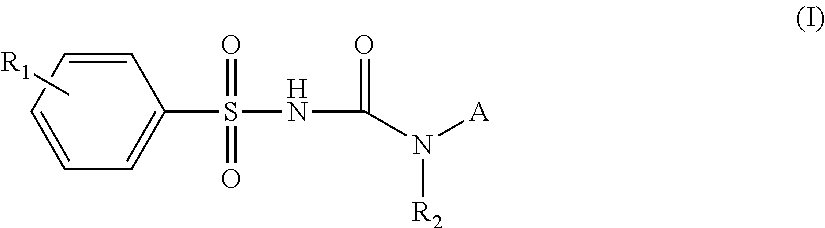
  • thermosensitive recording material which includes: a leuco dye; a developer containing a compound represented by Formula (I); and a sensitizer containing at least one selected from groups represented by Formulae (II-1), (II-2) and (II-3).
  • R 1 is a hydrogen atom or methyl
  • R 2 is a hydrogen atom, methyl or ethyl
  • A is a C1-C8 alkyl, cycloalkyl or aromatic group, or an aromatic group substituted by methyl or a halogen atom
  • R 3 is a hydrogen atom or methyl
  • R 4 is a hydrogen atom, methoxy or diallyloxy
  • thermosensitive recording material of the present invention improves blurring of uncolored portions (background, original surface of the recording material), compared to any conventional recording material including bisphenol A as a developer. Further, the thermosensitive recording material of the present invention has advantages including excellent water resistance, oil resistance, plasticizer resistance, etc., as well as excellent color development sensitivity. That is, the thermosensitive recording material of the present invention has advantages including excellent color development sensitivity even at a low energy, no background fog and excellent image retention, thereby achieving good balance between the above characteristics.
  • thermosensitive recording material may achieve excellent color development sensitivity even at low energy, no background fog and excellent image retention, thereby completing the present invention.
  • thermosensitive recording material of the present invention may include a colorless or light-colored leuco dye to express a color by reaction.
  • fluoran leuco dyes may be selected from, for example: 3-diethyl amino-6-methyl-7-anilinofluoran, 3-dibutylamino-6-methyl-7-anilinofluoran, 3-(N-methyl-N-cyclohexylamino)-6-methyl-7-anilinofluoran, 3-(N-ethyl-N-isopentylamino)-6-methyl-7-anilinofluoran, 3-isobutylethylamino-6-methyl-7-anilinofluoran, 3-[N-ethyl-N-(3-ethoxypropyl)amino]-6-methyl-7-anilinofluoran, 3-(N-ethyl-N-hexylamino)-6-methyl-7-anilinofluoran, 3-dipentylamino-6-methyl
  • thermosensitive recording material of the present invention may include a compound represented by Formula (I) below as a developer to develop the leuco dye and form text characters or images.
  • R 1 is a hydrogen atom or methyl
  • R 2 is a hydrogen atom, methyl or ethyl
  • A is a C1-C8 alkyl, cycloalkyl or aromatic group, or an aromatic group substituted by methyl or a halogen atom
  • the aromatic group is preferably a phenyl group.
  • the inventive developer represented by Formula (I) may be used alone and, even when used alone, may have advantages of expressing desired color development sensitivity and stability.
  • the present invention may also use the compound of Formula (I) as a developer in combination with other known developer.
  • the developer of Formula (I) is preferably included in an amount of 80 to 100% by weight (‘wt. %’).
  • the amount of the developer preferably ranges from 0.5 to 3 parts by weight (‘wt. part’) to 1 wt. part of leuco dye in view of color development sensitivity.
  • thermosensitive recording material of the present invention may have advantages of preventing background fog, and improving water resistance, oil resistance and plasticizer resistance as well as, especially, providing excellent color development sensitivity.
  • R 3 is a hydrogen atom or methyl.
  • R 4 is a hydrogen atom, methoxy or diallyloxy.
  • the sensitizer preferably includes at least one selected from 1,2-di-(3-methylphenoxy)ethane, 1,2-di-phenoxyethane, diphenylsulfone, 4,4′-diallyloxydiphenylsulfone and -benzyloxynaphthalene.
  • the sensitizer is preferably included in an amount of 0.5 to 3 wt. parts to 1 wt. part of leuco dye.
  • thermosensitive recording material of the present invention may further include a binder, a pigment and other additives in addition to the dye, developer and sensitizer described above.
  • thermosensitive recoding material of the present invention may include any binder known in the field of conventional pressure-sensitive or thermosensitive recording sheets.
  • binder known in the field of conventional pressure-sensitive or thermosensitive recording sheets.
  • fully saponified polyvinyl alcohol partially saponified polyvinyl alcohol, acetoacetylated polyvinyl alcohol, carboxy modified polyvinyl alcohol, amide modified polyvinyl alcohol, sulfonic acid modified polyvinyl alcohol, butyral modified polyvinyl alcohol, olefin modified polyvinyl alcohol, nitrile modified polyvinyl alcohol, pyrrolidone modified polyvinyl alcohol, silicone modified polyvinyl alcohol, other modified polyvinyl alcohols, hydroxyethyl cellulose, methyl cellulose, ethyl cellulose, carboxymethyl cellulose, polystyrene, styrene copolymers such as styrene-maleic acid anhydride copolymer, styrene-butadiene
  • thermosensitive recording material of the present invention may further include pigment.
  • pigments including, for example, silica (except for colloidal silica), calcium carbonate, kaolin, calcined kaolin, diatomite, talc, titanium oxide, aluminum hydroxide, etc. may be used.
  • an amount of the pigment may range from 0.1 to 20 wt. parts, preferably, 0.5 to 10 wt. parts to 1 wt. part of leuco dye.
  • thermosensitive recording material of the present invention may optionally include a lubricant, for example, fatty acid metal salts such as zinc stearate, calcium stearate, etc., wax, silicone resins, and the like.
  • a lubricant for example, fatty acid metal salts such as zinc stearate, calcium stearate, etc., wax, silicone resins, and the like.
  • an amount of the lubricant may range from 0.01 to 10 wt. parts to 1 wt. part of alkaline leuco dye.
  • additives for example, dispersants, defoamers, fluorescent dyes, etc. may be further included.
  • an amount of the same may range from 0.01 to 10 wt. parts to 1 wt. part of leuco dye.
  • thermosensitive recording material of the present invention may be carried on a support.
  • Shapes, structures, sizes or raw materials of the support used for the thermosensitive recording material of the present invention are not particularly limited but may be desirably selected in view of purposes thereof.
  • the shape of the support may include, for example, a sheet, roll or planar shape.
  • the support may have a monolayer structure or a laminate structure of multiple layers.
  • the size of the support may be desirably selected in view of use of the thermosensitive recording material.
  • the raw material for the support may include, for example, a plastic film, synthetic paper, high quality paper, regenerated pulp, regenerated paper, glossy paper, oil-proof paper, coated paper, art paper, cast-coated paper, uncoated paper, resin laminate paper, release paper, and the like. Otherwise, a combined sheet formed of the above papers may also be used.
  • a thickness of the support is not particularly limited but may be desirably selected. Preferably, the thickness ranges from 30 to 2,000 ⁇ m and, more preferably, 50 to 1,000 ⁇ m.
  • thermosensitive recording material of the present invention may be prepared by applying a coating solution including an alkaline leuco dye, a compound of Formula (I) as a developer, at least one selected from compounds of Formulae (II-1), (II-2) and (II-3) as a sensitizer to at least one face of a support then drying the same to form a thermosensitive recording layer.
  • a coating means is not particularly limited but may include, for example, an off-machine coating device or on-machine coating device equipped with a variety of coaters such as an air-knife coater, a load blade coater, a bent blade coater, a bevel blade coater, a roll coater, a curtain coater, etc.
  • the coating solution for forming a thermosensitive recording layer may be formed by grinding the leuco dye, developer and sensitizer into microfine particles having a particle size of several micrometers by means of a grinder, for example, a ball mill, an attrition device, a sand glider, etc. or any suitable emulsifying device, and then, adding a binder to the particles.
  • a solvent used for the coating solution may be water or alcohols.
  • Solid contents in the coating solution generally range from 20 to 40 wt %.
  • a coating amount of the thermosensitive layer may be desirably selected in view of composition of the layer and/or use of the thermosensitive recording material. Typically, in terms of dry weight, the coating amount may range from 1 to 20 g/m 2 , preferably, 2 to 12 g/m 2 .
  • a protective layer, an under-layer, a background layer and/or an intermediate layer may be further applied. Further, this thermosensitive recording layer may be subjected to smoothing treatment using a supercalender. For smoothing treatment, any conventional process known in the art may be used.
  • the average particle size refers to an average diameter in volume-based distribution, and is determined by a laser diffraction/scattering device for measuring particle size distribution.
  • “parts” means “parts by weight (wt. parts)”.
  • thermosensitive recording layer Mixing the above solutions in the following mixing ratios resulted in a coating solution for a thermosensitive recording layer.
  • the coating solution was applied to a substrate sheet having a standard weight of 50 g/m 2 by means of a bar coater No. 10. A coating amount of the solution was 5 g/m 2 in dry weight. After drying, supercalendering was conducted to produce a thermosensitive recording material.
  • Example 1 The same procedures as described in Example 1 were executed except that compound I-1 was replaced by N-(p-toluenesulfonyl)-N′-(3-p-toluenesulfonyloxyphenyl)urea.
  • thermosensitive printer of OHKURA Electric Co.
  • a gradation pattern was dot-printed.
  • Image concentrations and background concentrations at applied energy 0.26 mJ/dot and 0.35 mJ/dot, respectively, were measured by a Macbeth densitometer (using Invar filter). Measurement results are shown in Table 6.
  • thermosensitive recording material was dot-printed at applied energy of 0.35 mJ/dot, and then, left at 60° C. for 24 hours.
  • the background concentration was measured by a Macbeth densitometer and results thereof are shown in Table 7.
  • thermosensitive recording material was dot-printed at applied energy of 0.35 mJ/dot, and then, left at 60° C. for 24 hours.
  • thermosensitive recording material As image retention rate increases, dot-printability and stability of the thermosensitive recording material are improved.
  • thermosensitive recording material was dot-printed at applied energy of 0.35 mJ/dot, followed by bringing a vinyl chloride wrap into contact with the surface of the material and leaving the same at 23° C. for 2 hours.
  • the image concentration and background concentration were measured by a Macbeth densitometer and Table 8 shows the image retention rate.
  • thermosensitive recording material was dot-printed at applied energy of 0.35 mJ/dot, followed by applying diesel oil to the surface of the material and keeping the same in a hot blower at 60° C. for 3 hours.
  • the image concentration was measured by a Macbeth densitometer and Table 8 shows the image retention rate.
  • thermosensitive recording material was dot-printed at applied energy of 0.35 mJ/dot, and then, left at 40° C. under 90% humidity for 24 hours.
  • the image concentration was measured by a Macbeth densitometer and Table 8 shows the image retention rate.
  • thermosensitive recording material was dot-printed at applied energy of 0.35 mJ/dot, and then immersed in tap water at 20° C. and left for 24 hours.
  • the image concentration was measured by a Macbeth densitometer. Table 8 shows the image retention rate.
  • Example 1 0.06 1.38 0.12
  • Example 2 0.06 1.39 0.12
  • Example 3 0.06 1.34 0.13
  • Example 4 0.06 1.30 0.12
  • Example 5 0.06 1.34 0.11
  • Example 6 0.06 1.36 0.15
  • Example 7 0.07 1.43 0.15
  • Example 8 0.06 1.40 0.14
  • Example 9 0.06 1.39 0.15 Comparative 0.07 1.36 0.24
  • Example 1 Comparative 0.06 1.28 0.13
  • Example 2 The lower the background concentrations before and after test, the better the background fogging phenomenon.
  • Example 6 it could be seen that the color development sensitivity in Example 1 to Example 9, respectively, was much higher than that in a case where N-(p-toluenesulfonyl)-N′-(3-p-toluenesulfonyloxylphenyl)urea is used as in Comparative Example 2. Further, compared to results obtained using bisphenol A in Comparative Example 1, superior or substantially equal results were demonstrated.
  • Example 1 to Example 9 of the present invention were superior to the results obtained using bisphenol A in Comparative Example 1 in terms of background fog and, especially, plasticizer resistance and water resistance. Further, compared to Comparative Example 2, substantially equal results were achieved.
  • thermosensitive recoding compositions prepared in Example 1 to Example 9 of the present invention have greatly improved background fog and reduction in stability of recorded image caused by bisphenol A as a conventional developer.
  • a drawback of N-(p-toluenesulfonyl)-N′-(3-p-toluenesulfonyloxyphenyl) that is, poor color development sensitivity, may also be improved.
  • thermosensitive recording material of the present invention may be used in a thermosensitive recording method, which is often adopted in the fields of facsimiles and computers, various measuring instruments, label blanks, receipt sheets, etc.

Landscapes

  • Chemical & Material Sciences (AREA)
  • Chemical Kinetics & Catalysis (AREA)
  • General Chemical & Material Sciences (AREA)
  • Physics & Mathematics (AREA)
  • Optics & Photonics (AREA)
  • Heat Sensitive Colour Forming Recording (AREA)

Abstract

The present invention relates to a thermosensitive recording material and, specifically, to a thermosensitive recording material comprising: a colorless or light-colored leuco dye; a compound of chemical formula (1) containing a non-phenolic sulfonyl urea group as a developer; at least one of general formulas II-1, II-2, and II-3 as a sensitizer; a binder; and other fillers. The thermosensitive recording material of the present invention improves the background blurring of a color-developed image by using a non-phenolic developer and exhibits excellent effects in view of color development sensitivity, water resistance, oil resistance, plasticizer resistance, and the like.

Description

TECHNICAL FIELD
The present invention relates to a recording material produced using a non-phenolic developer having a sulfonyl urea group in a molecular structure thereof.
BACKGROUND ART
Since the 1970s, when a phenolic developer exhibiting black through reaction with a colorless thermosensitive colorant having a lactone ring was developed, a thermosensitive recording sheet using the above phenolic developer has been developed. In order to perform recording on the thermosensitive recording sheet coated with the thermosensitive colorant and the developer, a thermal printer equipped with a thermal head is used. Such thermosensitive recording process involves advantages such as no occurrence of noise during recording, no requirement for development and fixation, easy and convenient maintenance, etc. Further, an instrument used for this process is relatively cheap, has a small size and achieves clear color development. Therefore, thermosensitive recording is broadly used in the fields of facsimiles and computers, various measuring instruments, label blanks, receipt sheets, etc. As the recording instruments become more various and have higher performance, the thermosensitive recording sheet requires higher quality.
In recent years, there is a requirement for thermosensitive recording materials with relatively high color development sensitivity even at a lower energy and excellent image retention ability without background fog (undesired color development of the background caused by heating and the like during preservation). Factors seriously affecting color development sensitivity may include dyes and developers used to form a recording layer of the thermosensitive recording sheet.
As the developer, bisphenol A (4,4′-isopropylidene diphenol) has been most commonly used until now due to low production cost thereof. However, color development sensitivity is insufficient and image retention ability such as plasticizer resistance and heat resistance is also unsatisfactory. Further, there is an increasing tendency toward prohibition of using bisphenol A around the world since bisphenol A is a xenohormone. Actually, some countries have prohibited thermosensitive recording materials using bisphenol A.
In order to solve the above problem, bisphenol S (4,4′-dihydroxydiphenylsulfone) is sometimes used as a developer. However, bisphenol S has drawbacks such as higher melting point and relatively low color development sensitivity. Further, bisphenol S is also a phenolic developer which can hardly overcome a problem of harmful effects on the environment and human health.
JP-A-8-2111 and JP-A-8-2112 disclose thermosensitive recording materials obtained using non-phenolic developers, respectively, wherein a development layer containing a colorless or light colored dye precursor and an urea compound is included. However, such a thermosensitive recording material as described above has a low development concentration and insufficient stability for preservation.
DISCLOSURE Technical Problem
With a decrease in size of an instrument, a developer for thermosensitive recording materials, which is able to have good color development sensitivity even at a low energy, is required. However, existing developers having high color development sensitivity entail problems of background fog and poor image retention. When intending to improve such background fog and image retention of a developer, the developer entails another problem such as increase in molecular weight and reduction in color development sensitivity at low energy.
Accordingly, the present invention has been developed to solve the problems mentioned above and an object of the present invention is to provide a thermosensitive recording material with excellent color development sensitivity at low energy, and high image retention ability while improving background fogging so as to achieve excellent balance between both of these characteristics.
Technical Solution
The present invention provides a thermosensitive recording material, which includes: a leuco dye; a developer containing a compound represented by Formula (I); and a sensitizer containing at least one selected from groups represented by Formulae (II-1), (II-2) and (II-3).
Figure US10906341-20210202-C00001
wherein R1 is a hydrogen atom or methyl; R2 is a hydrogen atom, methyl or ethyl; A is a C1-C8 alkyl, cycloalkyl or aromatic group, or an aromatic group substituted by methyl or a halogen atom;
Figure US10906341-20210202-C00002
wherein R3 is a hydrogen atom or methyl,
Figure US10906341-20210202-C00003
wherein R4 is a hydrogen atom, methoxy or diallyloxy,
Figure US10906341-20210202-C00004
Advantageous Effects
The thermosensitive recording material of the present invention improves blurring of uncolored portions (background, original surface of the recording material), compared to any conventional recording material including bisphenol A as a developer. Further, the thermosensitive recording material of the present invention has advantages including excellent water resistance, oil resistance, plasticizer resistance, etc., as well as excellent color development sensitivity. That is, the thermosensitive recording material of the present invention has advantages including excellent color development sensitivity even at a low energy, no background fog and excellent image retention, thereby achieving good balance between the above characteristics.
Best Mode
The present inventors have found that using specific developers and sensitizers as a thermosensitive recording material may achieve excellent color development sensitivity even at low energy, no background fog and excellent image retention, thereby completing the present invention.
Hereinafter, the present invention will be described in more detail.
<Alkaline Leuco Dye>
The thermosensitive recording material of the present invention may include a colorless or light-colored leuco dye to express a color by reaction.
As a leuco dye, the present invention may use any material known in the field of conventional pressure-sensitive or thermosensitive recording sheets. Preferably, fluoran leuco dyes may be selected from, for example: 3-diethyl amino-6-methyl-7-anilinofluoran, 3-dibutylamino-6-methyl-7-anilinofluoran, 3-(N-methyl-N-cyclohexylamino)-6-methyl-7-anilinofluoran, 3-(N-ethyl-N-isopentylamino)-6-methyl-7-anilinofluoran, 3-isobutylethylamino-6-methyl-7-anilinofluoran, 3-[N-ethyl-N-(3-ethoxypropyl)amino]-6-methyl-7-anilinofluoran, 3-(N-ethyl-N-hexylamino)-6-methyl-7-anilinofluoran, 3-dipentylamino-6-methyl-7-anilinofluoran, 3-(N-methyl-N-propylamino)-6-methyl-7-anilinofluoran, 3-(N-ethyl-N-tetrahydrofurylamino)-6-methyl-7-anilinofluoran, 3-diethylamino-6-methyl-7-(p-chloroanilino)fluoran, 3-diethylamino-6-methyl-7-(o-chloroanilino)fluoran, 3-(p-toluidinoethylamino)-6-methyl-7-anilinofluoran, 3-diethylamino-6-methyl-7-(p-toluidino)fluoran, 3-diethylamino-7-(o-chloroanilino)fluoran, 3-dibutylamino-7-(o-chloroanilino)fluoran, 3-diethylamino-7-(o-fluoroanilino)fluoran, 3-dibutylamio-7-(o-fluoroanilino)fluoran, 3-diethylamino-7-(3,4-dichloroanilino)fluoran, 3-pyrrolidino-6-methyl-7-anilinofluoran, 3-diethylamino-6-chloro-7-ethoxyethylaminofluoran, 3-diethylamino-6-chloro-7-anilinofluoran, 3-diethylamino-7-chlorofluoran, 3-diethylamino-6-chloro-7-methylfluoran, 3-diethylamino-7-methylfluoran, 3-diethylamino-7-octylaminofluoran, 3-diethylamino-7-phenylfluoran and 3-(p-toluidinoethylamino)-6-methyl-7-phenetylfluoran. More preferably, at least one selected from 3-diethylamino-6-methyl-7-anilinofluoran, 3-dibutylamino-6-methyl-7-anilinofluoran, 3-(N-ethyl-N-isopentylamino)-6-methyl-7-anilinofluoran, 3-(N-methyl-N-propylamino)-6-methyl-7-anilinofluoran, 3-diethylamino-6-methyl-7-(p-chloroanilino)fluoran and 3-diethylamino-6-methyl-7-(o-chloroanilino)fluoran is used.
<Developer>
The thermosensitive recording material of the present invention may include a compound represented by Formula (I) below as a developer to develop the leuco dye and form text characters or images.
Figure US10906341-20210202-C00005
wherein R1 is a hydrogen atom or methyl; R2 is a hydrogen atom, methyl or ethyl; A is a C1-C8 alkyl, cycloalkyl or aromatic group, or an aromatic group substituted by methyl or a halogen atom;
The aromatic group is preferably a phenyl group.
Among the compounds represented by Formula (I) above, compounds represented by the following Formulae are more preferably used.
Figure US10906341-20210202-C00006
The inventive developer represented by Formula (I) may be used alone and, even when used alone, may have advantages of expressing desired color development sensitivity and stability. The present invention may also use the compound of Formula (I) as a developer in combination with other known developer. In this case, the developer of Formula (I) is preferably included in an amount of 80 to 100% by weight (‘wt. %’). The amount of the developer preferably ranges from 0.5 to 3 parts by weight (‘wt. part’) to 1 wt. part of leuco dye in view of color development sensitivity.
<Sensitizer>
If using a sensitizer containing at least one selected from the following Formulae (II-1), (II-2) and (II-3) as well as the above developer, the thermosensitive recording material of the present invention may have advantages of preventing background fog, and improving water resistance, oil resistance and plasticizer resistance as well as, especially, providing excellent color development sensitivity.
Figure US10906341-20210202-C00007
wherein R3 is a hydrogen atom or methyl.
Figure US10906341-20210202-C00008
wherein R4 is a hydrogen atom, methoxy or diallyloxy.
Figure US10906341-20210202-C00009
The sensitizer preferably includes at least one selected from 1,2-di-(3-methylphenoxy)ethane, 1,2-di-phenoxyethane, diphenylsulfone, 4,4′-diallyloxydiphenylsulfone and -benzyloxynaphthalene. The sensitizer is preferably included in an amount of 0.5 to 3 wt. parts to 1 wt. part of leuco dye.
The thermosensitive recording material of the present invention may further include a binder, a pigment and other additives in addition to the dye, developer and sensitizer described above.
<Binder>
The thermosensitive recoding material of the present invention may include any binder known in the field of conventional pressure-sensitive or thermosensitive recording sheets. Preferably, fully saponified polyvinyl alcohol, partially saponified polyvinyl alcohol, acetoacetylated polyvinyl alcohol, carboxy modified polyvinyl alcohol, amide modified polyvinyl alcohol, sulfonic acid modified polyvinyl alcohol, butyral modified polyvinyl alcohol, olefin modified polyvinyl alcohol, nitrile modified polyvinyl alcohol, pyrrolidone modified polyvinyl alcohol, silicone modified polyvinyl alcohol, other modified polyvinyl alcohols, hydroxyethyl cellulose, methyl cellulose, ethyl cellulose, carboxymethyl cellulose, polystyrene, styrene copolymers such as styrene-maleic acid anhydride copolymer, styrene-butadiene copolymer, etc., cellulose derivatives such as ethyl cellulose and acetyl cellulose, casein, gum arabic, oxidized starch, etherification starch, dialdehyde starch, esterification starch, polyvinyl chloride, polyvinyl acetate, polyacrylamide, polyacrylic acid ester, polyvinyl butyral, polyamide resin, silicone resin, petroleum resin, terpene resin, ketone resin, coumarone resin, and the like, may be used. An amount of the binder may range from 5 to 25 wt. % to solid contents in a thermosensitive layer formed on a support of the thermosensitive recording material.
<Pigment>
The thermosensitive recording material of the present invention may further include pigment. Preferably, inorganic or organic pigments including, for example, silica (except for colloidal silica), calcium carbonate, kaolin, calcined kaolin, diatomite, talc, titanium oxide, aluminum hydroxide, etc. may be used. In case of using the pigment, an amount of the pigment may range from 0.1 to 20 wt. parts, preferably, 0.5 to 10 wt. parts to 1 wt. part of leuco dye.
<Other Additives>
The thermosensitive recording material of the present invention may optionally include a lubricant, for example, fatty acid metal salts such as zinc stearate, calcium stearate, etc., wax, silicone resins, and the like. In case of using the lubricant, an amount of the lubricant may range from 0.01 to 10 wt. parts to 1 wt. part of alkaline leuco dye.
Other additives, for example, dispersants, defoamers, fluorescent dyes, etc. may be further included. When the present invention uses such additives, an amount of the same may range from 0.01 to 10 wt. parts to 1 wt. part of leuco dye.
The thermosensitive recording material of the present invention may be carried on a support.
<Support>
Shapes, structures, sizes or raw materials of the support used for the thermosensitive recording material of the present invention are not particularly limited but may be desirably selected in view of purposes thereof. The shape of the support may include, for example, a sheet, roll or planar shape. The support may have a monolayer structure or a laminate structure of multiple layers. The size of the support may be desirably selected in view of use of the thermosensitive recording material. The raw material for the support may include, for example, a plastic film, synthetic paper, high quality paper, regenerated pulp, regenerated paper, glossy paper, oil-proof paper, coated paper, art paper, cast-coated paper, uncoated paper, resin laminate paper, release paper, and the like. Otherwise, a combined sheet formed of the above papers may also be used. A thickness of the support is not particularly limited but may be desirably selected. Preferably, the thickness ranges from 30 to 2,000 μm and, more preferably, 50 to 1,000 μm.
<Process of Preparing Thermosensitive Recording Material>
The thermosensitive recording material of the present invention may be prepared by applying a coating solution including an alkaline leuco dye, a compound of Formula (I) as a developer, at least one selected from compounds of Formulae (II-1), (II-2) and (II-3) as a sensitizer to at least one face of a support then drying the same to form a thermosensitive recording layer. A coating means is not particularly limited but may include, for example, an off-machine coating device or on-machine coating device equipped with a variety of coaters such as an air-knife coater, a load blade coater, a bent blade coater, a bevel blade coater, a roll coater, a curtain coater, etc.
The coating solution for forming a thermosensitive recording layer may be formed by grinding the leuco dye, developer and sensitizer into microfine particles having a particle size of several micrometers by means of a grinder, for example, a ball mill, an attrition device, a sand glider, etc. or any suitable emulsifying device, and then, adding a binder to the particles. A solvent used for the coating solution may be water or alcohols.
Solid contents in the coating solution generally range from 20 to 40 wt %. A coating amount of the thermosensitive layer may be desirably selected in view of composition of the layer and/or use of the thermosensitive recording material. Typically, in terms of dry weight, the coating amount may range from 1 to 20 g/m2, preferably, 2 to 12 g/m2. Optionally, a protective layer, an under-layer, a background layer and/or an intermediate layer may be further applied. Further, this thermosensitive recording layer may be subjected to smoothing treatment using a supercalender. For smoothing treatment, any conventional process known in the art may be used.
PREFERRED EMBODIMENT FOR EMBODYING THE INVENTION
Hereinafter, the present invention will be concretely described by means of embodiments. However, the scope of the present invention is duly not limited thereto.
<Synthesis Example 1> Synthesis of Compound I-1
To a 200 ml three-neck flask equipped with a condenser and a dropping funnel, 10.7 g of p-toluidine and 100 ml of toluene were introduced and fully dissolved. Next, 19.7 g of p-toluene sulfonyl isocyanate was placed in the dropping funnel. The p-toluene sulfonyl isocyanate in the dropping funnel was gently dropped into the flask at room temperature while preventing an internal temperature from exceeding 60° C. After completing dropping, the solution was agitated for 1 hour and then the reaction was terminated. The reacted solution was cooled to room temperature, followed by filtering and drying the separated crystals. After drying, 27.2 g of 99.1% purity (HPLC) compound I-1 was obtained. A structure of the product was determined by NMR.
1H-NMR spectrum (300 MHz, DMSO-d6)
10.5 ppm (1H, s), 8.5 ppm (1H, s), 7.80 ppm (2H, d), 7.30 ppm (2H, d), 7.14 ppm (2H, d),
6.95 ppm (2H, d), 2.37 ppm (3H, s), 2.18 ppm (3H, s)
<Synthesis Example 2> Synthesis of Compound I-2
The same procedures as described in Synthesis Example 1 were executed except that 10.6 g of N-methyl aniline was used as a raw material instead of p-toluidine. 25.7 g of 98.6% purity (HPLC) compound I-2 was obtained.
1H-NMR spectrum (300 MHz, DMSO-d6)
10.5 ppm (1H, s), 7.79 ppm (2H, d), 7.34 ppm (2H, d), 7.13 ppm (2H, d),
7.05 ppm (2H, d), 6.8 ppm (1H, t), 2.71 ppm (3H, s), 2.37 ppm (3H, s)
<Synthesis Example 3> Synthesis of Compound I-3
The same procedures as described in Synthesis Example 1 were executed except that 10.0 g of cyclohexylamine was used as a raw material instead of p-toluidine. 26.7 g of 99.2% purity (HPLC) compound I-3 was obtained.
1H-NMR spectrum (300 MHz, DMSO-d6)
10.5 ppm (1H, s), 5.8 ppm (1H, s), 7.80 ppm (2H, d), 7.14 ppm (2H, d),
3.40 ppm (1H, m), 1.53-1.76 ppm (4H, m), 1.40-1.49 ppm (6H, m)
<Example 1> Preparation of Thermosensitive Recording Material
The following A to D solutions were wet-ground by means of a sand grinder until each of the components had an average particle size of 0.5 μm. Herein, the average particle size refers to an average diameter in volume-based distribution, and is determined by a laser diffraction/scattering device for measuring particle size distribution. Herein, “parts” means “parts by weight (wt. parts)”.
TABLE 1
Preparation of A solution
Compound I-1  5.0 parts
Polyvinyl alcohol (10% aqueous 18.8 parts
solution)
Water 12.2 parts
TABLE 2
Preparation of B solution
3-dibutylamino-6-methyl-7- 1.3 parts
anilinofluoran
Polyvinyl alcohol (10% aqueous 4.6 parts
solution)
Water 3.1 parts
TABLE 3
Preparation of C solution
Compound II-1-1 (R3 is methyl)  5.0 parts
Polyvinyl alcohol (10% aqueous 18.8 parts
solution)
Water 12.2 parts
TABLE 4
Preparation of D solution
Compound I-1  4.5 parts
Compound I-3  0.5 part
Polyvinyl alcohol 18.8 parts
(10% aqueous solution)
Water 12.2 parts
Preparation of Coating Solution for Thermosensitive Recording Layer
Mixing the above solutions in the following mixing ratios resulted in a coating solution for a thermosensitive recording layer.
TABLE 5
A solution 36 parts
B solution 18 parts
C solution 36 parts
Silica (Mitsusawa, P537 25% 60 parts
water dispersion)
Polyvinyl alcohol (10% aqueous 25 parts
solution)
The coating solution was applied to a substrate sheet having a standard weight of 50 g/m2 by means of a bar coater No. 10. A coating amount of the solution was 5 g/m2 in dry weight. After drying, supercalendering was conducted to produce a thermosensitive recording material.
Example 2
The same procedures as described in Example 1 were executed except that compound II-1-1 was replaced by compound II-2-1 (R4 is hydrogen).
Example 3
The same procedures as described in Example 1 were executed except that compound II-1-1 was replaced by compound II-3.
Example 4
The same procedures as described in Example 1 were executed except that compound I-1 was replaced by compound I-2.
Example 5
The same procedures as described in Example 4 were executed except that compound II-1-1 was replaced by compound II-2-1 (R4 is hydrogen).
Example 6
The same procedures as described in Example 4 were executed except that compound II-1-1 was replaced by compound II-3.
Example 7
The same procedures as described in Example 1 were executed except that A solution was replaced by D solution.
Example 8
The same procedures as described in Example 7 were executed except that compound II-1-1 was replaced by compound II-2-1 (R4 is hydrogen).
Example 9
The same procedures as described in Example 7 were executed except that compound II-1-1 was replaced by compound II-3.
Comparative Example 1
The same procedures as described in Example 1 were executed except that compound I-1 was replaced by BPA (bisphenol A).
Comparative Example 2
The same procedures as described in Example 1 were executed except that compound I-1 was replaced by N-(p-toluenesulfonyl)-N′-(3-p-toluenesulfonyloxyphenyl)urea.
<Color Development Sensitivity>
Using a thermosensitive printer (TH-PMD) of OHKURA Electric Co., a gradation pattern was dot-printed. Image concentrations and background concentrations at applied energy of 0.26 mJ/dot and 0.35 mJ/dot, respectively, were measured by a Macbeth densitometer (using Invar filter). Measurement results are shown in Table 6.
<Background Fog>
The thermosensitive recording material was dot-printed at applied energy of 0.35 mJ/dot, and then, left at 60° C. for 24 hours. The background concentration was measured by a Macbeth densitometer and results thereof are shown in Table 7.
<Heat Resistance>
The thermosensitive recording material was dot-printed at applied energy of 0.35 mJ/dot, and then, left at 60° C. for 24 hours. The image concentration was measured by a Macbeth densitometer and Table 8 shows the image concentration and the image retention rate calculated by the following equation.
Image retention rate (%)=100×(image concentration after test/image concentration before test)
As image retention rate increases, dot-printability and stability of the thermosensitive recording material are improved.
<Plasticizer Resistance>
The thermosensitive recording material was dot-printed at applied energy of 0.35 mJ/dot, followed by bringing a vinyl chloride wrap into contact with the surface of the material and leaving the same at 23° C. for 2 hours. The image concentration and background concentration were measured by a Macbeth densitometer and Table 8 shows the image retention rate.
<Oil Resistance>
The thermosensitive recording material was dot-printed at applied energy of 0.35 mJ/dot, followed by applying diesel oil to the surface of the material and keeping the same in a hot blower at 60° C. for 3 hours. The image concentration was measured by a Macbeth densitometer and Table 8 shows the image retention rate.
<Moisture Resistance>
The thermosensitive recording material was dot-printed at applied energy of 0.35 mJ/dot, and then, left at 40° C. under 90% humidity for 24 hours. The image concentration was measured by a Macbeth densitometer and Table 8 shows the image retention rate.
<Water Resistance>
The thermosensitive recording material was dot-printed at applied energy of 0.35 mJ/dot, and then immersed in tap water at 20° C. and left for 24 hours. The image concentration was measured by a Macbeth densitometer. Table 8 shows the image retention rate.
TABLE 6
Background Image concentration
concentration 0.26 mJ/dot 0.35 mJ/dot
Example 1 0.06 1.26 1.38
Example 2 0.06 1.24 1.39
Example 3 0.06 1.27 1.34
Example 4 0.06 1.21 1.30
Example 5 0.06 1.24 1.34
Example 6 0.06 1.20 1.36
Example 7 0.07 1.29 1.43
Example 8 0.06 1.30 1.40
Example 9 0.06 1.31 1.39
Comparative 0.07 1.24 1.36
Example 1
Comparative 0.06 1.07 1.28
Example 2
* The numerical value of the measured image concentration is proportional to color development sensitivity.
TABLE 7
Before test After test
Background Image Background
concentration concentration concentration
Example 1 0.06 1.38 0.12
Example 2 0.06 1.39 0.12
Example 3 0.06 1.34 0.13
Example 4 0.06 1.30 0.12
Example 5 0.06 1.34 0.11
Example 6 0.06 1.36 0.15
Example 7 0.07 1.43 0.15
Example 8 0.06 1.40 0.14
Example 9 0.06 1.39 0.15
Comparative 0.07 1.36 0.24
Example 1
Comparative 0.06 1.28 0.13
Example 2
* The lower the background concentrations before and after test, the better the background fogging phenomenon.
TABLE 8
Before test Image retention rate (%)
Background Image Heat Plasticizer Oil Moisture Water
concentration concentration resistance resistance resistance resistance resistance
Example 1 0.06 1.38 98 90 92 93 76
Example 2 0.06 1.39 96 92 93 91 75
Example 3 0.06 1.34 95 89 93 91 79
Example 4 0.06 1.30 93 89 91 91 81
Example 5 0.06 1.34 90 91 92 92 84
Example 6 0.06 1.36 94 87 90 89 79
Example 7 0.07 1.43 102 90 93 93 82
Example 8 0.06 1.40 98 91 94 92 78
Example 9 0.06 1.39 100 88 92 93 83
Comparative 0.07 1.36 85 74 82 81 16
Example 1
Comparative 0.06 1.28 95 87 93 92 78
Example 2
* Image retention rate is proportional to stability of the recorded image.
Referring to Table 6, it could be seen that the color development sensitivity in Example 1 to Example 9, respectively, was much higher than that in a case where N-(p-toluenesulfonyl)-N′-(3-p-toluenesulfonyloxylphenyl)urea is used as in Comparative Example 2. Further, compared to results obtained using bisphenol A in Comparative Example 1, superior or substantially equal results were demonstrated.
From results of a performance test with regard to the background fog in Table 7 and results of the image retention rate with regard to different physical properties in Table 8, it could be seen that the results in Example 1 to Example 9 of the present invention were superior to the results obtained using bisphenol A in Comparative Example 1 in terms of background fog and, especially, plasticizer resistance and water resistance. Further, compared to Comparative Example 2, substantially equal results were achieved.
Consequently, the results in the above tables show that the thermosensitive recoding compositions prepared in Example 1 to Example 9 of the present invention have greatly improved background fog and reduction in stability of recorded image caused by bisphenol A as a conventional developer. Simultaneously, it could be understood that a drawback of N-(p-toluenesulfonyl)-N′-(3-p-toluenesulfonyloxyphenyl), that is, poor color development sensitivity, may also be improved.
INDUSTRIAL APPLICABILITY
The thermosensitive recording material of the present invention may be used in a thermosensitive recording method, which is often adopted in the fields of facsimiles and computers, various measuring instruments, label blanks, receipt sheets, etc.

Claims (6)

The invention claimed is:
1. A thermosensitive recording material, comprising:
a leuco dye;
a developer consisting of a compound represented by Formula (I-1) and a compound represented by Formula (I-3); and
a sensitizer containing a compound of Formulae (II-2):
Figure US10906341-20210202-C00010
wherein:
R4 is a hydrogen atom, methoxy or allyloxy,
the developer is included in an amount of 0.5 to 3 parts by weight (‘wt. parts’) to 1 wt. part of leuco dye, and
the sensitizer is included in an amount of 0.5 to 3 wt. parts to 1 wt. part of leuco dye.
2. The material according to claim 1, wherein, as the sensitizer, at least one selected from diphenylsulfone, 4,4′-diallyloxydiphenylsulfone is included.
3. The material according to claim 1, wherein the leuco dye is at least one selected from 3-diethylamino-6-methyl-7-anilinofluoran, 3-dibutylamino-6-methyl-7-anilinofluoran, 3-(N-ethyl-N-isopentylamino)-6-methyl-7-anilinofgluoran, 3-(N-methyl-N-propylamino)-6-methyl-7-anilinofluoran, 3-diethylamino-6-methyl-7-(p-chloroanilino)fluoran and 3-diethylamino-6-methyl-7-(o-chloroanilino)fluoran.
4. The material according to claim 1, further including at least one selected from binders, pigments, lubricants and additives.
5. The material according to claim 4, wherein, as the additives, at least one selected from dispersants, defoamers and fluorescent dyes is included in an amount of 0.01 to 10 wt. parts to 1 wt. part of leuco dye.
6. The material according to claim 1, wherein the thermosensitive recoding material is formed to be carried on a support.
US16/060,935 2015-12-10 2016-12-09 Thermosensitive recording material Active 2037-06-07 US10906341B2 (en)

Applications Claiming Priority (3)

Application Number Priority Date Filing Date Title
KR1020150175881A KR20170069335A (en) 2015-12-10 2015-12-10 Thermal recording materials
KR10-2015-0175881 2015-12-10
PCT/KR2016/014465 WO2017099529A1 (en) 2015-12-10 2016-12-09 Thermosensitive recording material

Publications (2)

Publication Number Publication Date
US20180361770A1 US20180361770A1 (en) 2018-12-20
US10906341B2 true US10906341B2 (en) 2021-02-02

Family

ID=59012746

Family Applications (1)

Application Number Title Priority Date Filing Date
US16/060,935 Active 2037-06-07 US10906341B2 (en) 2015-12-10 2016-12-09 Thermosensitive recording material

Country Status (6)

Country Link
US (1) US10906341B2 (en)
EP (1) EP3388249A4 (en)
JP (1) JP6646760B2 (en)
KR (2) KR20170069335A (en)
CN (1) CN108367582A (en)
WO (1) WO2017099529A1 (en)

Families Citing this family (3)

* Cited by examiner, † Cited by third party
Publication number Priority date Publication date Assignee Title
WO2022255254A1 (en) * 2021-05-31 2022-12-08 三菱ケミカル株式会社 Reversible thermochromic composition, and writing instrument and toy using said reversible thermochromic composition
AU2023335870B2 (en) * 2022-08-29 2025-07-10 Osaka Sealing Printing Co., Ltd. Heat-sensitive recording medium
CN120775437B (en) * 2025-09-09 2025-11-11 康爱特(山东)化学有限公司 A thermal coating composition and its application in thermal color developing paper

Citations (14)

* Cited by examiner, † Cited by third party
Publication number Priority date Publication date Assignee Title
KR930000287A (en) 1991-06-07 1993-01-15 김인호 Thermal recording paper
KR930007684A (en) 1991-10-28 1993-05-20 김인호 Thermal recording material
KR930012363A (en) 1991-12-06 1993-07-20 우석형 Thermal recording paper
US5246906A (en) 1991-08-02 1993-09-21 Oji Paper Co., Ltd. Thermosensitive recording material
JPH0664334A (en) 1992-08-17 1994-03-08 New Oji Paper Co Ltd Heat-sensitive recording medium
JPH0747772A (en) 1993-08-05 1995-02-21 New Oji Paper Co Ltd Thermal recording
JPH082111A (en) 1994-06-27 1996-01-09 Nippon Paper Ind Co Ltd Thermal recording material
JPH082112A (en) 1994-06-27 1996-01-09 Nippon Paper Ind Co Ltd Thermal recording material
US5661100A (en) * 1994-08-31 1997-08-26 Nippon Paper Industries Co., Ltd. Urea (thiourea) derivative and thermal recording sheet using the same
JPH11216956A (en) 1998-02-02 1999-08-10 Oji Paper Co Ltd Thermal recording medium
JP2001246856A (en) 2000-03-03 2001-09-11 Asahi Kasei Corp Thermal recording sheet
JP2001246858A (en) 2000-03-03 2001-09-11 Asahi Kasei Corp Thermal magnetic recording material
JP2003054137A (en) 2001-08-13 2003-02-26 Oji Paper Co Ltd Thermal recording medium
US20050148467A1 (en) 2001-10-12 2005-07-07 Jouko Makitalo Heat-sensitive recording material

Family Cites Families (10)

* Cited by examiner, † Cited by third party
Publication number Priority date Publication date Assignee Title
US4656622A (en) * 1984-09-26 1987-04-07 American Telephone And Telegraph Company Multiple paths in a self-routing packet and circuit switching network
KR930000287B1 (en) * 1990-10-11 1993-01-15 김경신 All Weather Back Miller
CN1606507A (en) * 2001-12-20 2005-04-13 富士胶片株式会社 Heat-sensitive recording material
WO2003053710A1 (en) * 2001-12-20 2003-07-03 Fuji Photo Film Co., Ltd. Heat-sensitive recording material
CN100548706C (en) * 2005-01-28 2009-10-14 王子制纸株式会社 thermal recording material
DE602006000282T2 (en) * 2005-03-14 2008-11-06 Ricoh Co., Ltd. Thermosensitive recording material
JP4942224B2 (en) * 2007-08-21 2012-05-30 日本製紙株式会社 Thermal recording material
CN101984753A (en) * 2008-03-27 2011-03-09 日本制纸株式会社 Heat-sensitive recording medium
JP5814248B2 (en) * 2010-09-16 2015-11-17 三菱化学株式会社 Novel phenol sulfonic acid aryl ester derivative and thermosensitive recording material using the same
BR112014010513B1 (en) * 2011-10-31 2020-02-04 Mitsubishi Chem Corp compound, developer for thermal recording material and thermal recording material

Patent Citations (15)

* Cited by examiner, † Cited by third party
Publication number Priority date Publication date Assignee Title
KR930000287A (en) 1991-06-07 1993-01-15 김인호 Thermal recording paper
EP0526072B1 (en) 1991-08-02 1995-09-13 New Oji Paper Co., Ltd. Thermosensitive recording material
US5246906A (en) 1991-08-02 1993-09-21 Oji Paper Co., Ltd. Thermosensitive recording material
KR930007684A (en) 1991-10-28 1993-05-20 김인호 Thermal recording material
KR930012363A (en) 1991-12-06 1993-07-20 우석형 Thermal recording paper
JPH0664334A (en) 1992-08-17 1994-03-08 New Oji Paper Co Ltd Heat-sensitive recording medium
JPH0747772A (en) 1993-08-05 1995-02-21 New Oji Paper Co Ltd Thermal recording
JPH082112A (en) 1994-06-27 1996-01-09 Nippon Paper Ind Co Ltd Thermal recording material
JPH082111A (en) 1994-06-27 1996-01-09 Nippon Paper Ind Co Ltd Thermal recording material
US5661100A (en) * 1994-08-31 1997-08-26 Nippon Paper Industries Co., Ltd. Urea (thiourea) derivative and thermal recording sheet using the same
JPH11216956A (en) 1998-02-02 1999-08-10 Oji Paper Co Ltd Thermal recording medium
JP2001246856A (en) 2000-03-03 2001-09-11 Asahi Kasei Corp Thermal recording sheet
JP2001246858A (en) 2000-03-03 2001-09-11 Asahi Kasei Corp Thermal magnetic recording material
JP2003054137A (en) 2001-08-13 2003-02-26 Oji Paper Co Ltd Thermal recording medium
US20050148467A1 (en) 2001-10-12 2005-07-07 Jouko Makitalo Heat-sensitive recording material

Also Published As

Publication number Publication date
KR102136227B1 (en) 2020-07-22
EP3388249A4 (en) 2019-08-07
WO2017099529A1 (en) 2017-06-15
CN108367582A (en) 2018-08-03
KR20180094881A (en) 2018-08-24
KR20170069335A (en) 2017-06-21
JP6646760B2 (en) 2020-02-14
EP3388249A1 (en) 2018-10-17
JP2019502578A (en) 2019-01-31
US20180361770A1 (en) 2018-12-20

Similar Documents

Publication Publication Date Title
US10160245B2 (en) Heat-sensitive recording material
US10265985B2 (en) Heat-sensitive recording material
JP3830939B2 (en) Developer for thermal recording material and thermal recording material
US10850546B2 (en) Heat-sensitive recording material
KR101548182B1 (en) Novel phenolsulfonic acid aryl ester derivative, and heat-sensitive recording material using same
JP6845479B2 (en) Thermal recording body with an intermediate layer containing hollow particles
US10882348B2 (en) Heat-sensitive recording material
WO2008038645A1 (en) Heat-sensitive recording material
KR20180121996A (en) Self-adhesive, heat-sensitive recording material
US10906341B2 (en) Thermosensitive recording material
US11407935B2 (en) Heat-sensitive recording material
JP2006264255A (en) Thermal recording material
CN101896361B (en) Thermal recording material containing tris(2-methyl-4-hydroxy-5-t-butylphenyl)butane
JP2567125B2 (en) Thermal recording
US11673859B2 (en) Polymorphic forms of N-(4-((4-(3-phenylureido)phenyl)sulfonyl)phenyl)benzolsulfonamide
JP3543830B2 (en) Salicylic acid derivative, method for producing the derivative, and thermosensitive recording material using the derivative
JP2898049B2 (en) Thermal recording medium
JPH04122676A (en) heat sensitive recording material
JPH04122681A (en) Thermal recording material
JPH06345720A (en) New 4,4&#39;-bis(o-toluenesulfonylaminocarbonylamino) diphenyl compound
JPS63104947A (en) phenolic compounds
JPH04122682A (en) Thermal recording material
JPH04122677A (en) heat sensitive recording material
JPS62170385A (en) heat sensitive recording material
JPS6292888A (en) Thermal recording material

Legal Events

Date Code Title Description
FEPP Fee payment procedure

Free format text: ENTITY STATUS SET TO UNDISCOUNTED (ORIGINAL EVENT CODE: BIG.); ENTITY STATUS OF PATENT OWNER: LARGE ENTITY

AS Assignment

Owner name: HANSOL PAPER CO., LTD., KOREA, REPUBLIC OF

Free format text: ASSIGNMENT OF ASSIGNORS INTEREST;ASSIGNORS:PAIK, KYU-CHEOL;AN, JUNG-OK;REEL/FRAME:046350/0286

Effective date: 20180611

Owner name: PAIK, KYU-CHEOL, KOREA, REPUBLIC OF

Free format text: ASSIGNMENT OF ASSIGNORS INTEREST;ASSIGNORS:PAIK, KYU-CHEOL;AN, JUNG-OK;REEL/FRAME:046350/0286

Effective date: 20180611

Owner name: AN, JUNG-OK, KOREA, REPUBLIC OF

Free format text: ASSIGNMENT OF ASSIGNORS INTEREST;ASSIGNORS:PAIK, KYU-CHEOL;AN, JUNG-OK;REEL/FRAME:046350/0286

Effective date: 20180611

STPP Information on status: patent application and granting procedure in general

Free format text: DOCKETED NEW CASE - READY FOR EXAMINATION

STPP Information on status: patent application and granting procedure in general

Free format text: NOTICE OF ALLOWANCE MAILED -- APPLICATION RECEIVED IN OFFICE OF PUBLICATIONS

STPP Information on status: patent application and granting procedure in general

Free format text: DOCKETED NEW CASE - READY FOR EXAMINATION

STPP Information on status: patent application and granting procedure in general

Free format text: PUBLICATIONS -- ISSUE FEE PAYMENT VERIFIED

STCF Information on status: patent grant

Free format text: PATENTED CASE

CC Certificate of correction