US10892525B2 - Rechargeable batteries including high-voltage cathode and redox shuttle conferring overcharge protection - Google Patents
Rechargeable batteries including high-voltage cathode and redox shuttle conferring overcharge protection Download PDFInfo
- Publication number
- US10892525B2 US10892525B2 US15/637,971 US201715637971A US10892525B2 US 10892525 B2 US10892525 B2 US 10892525B2 US 201715637971 A US201715637971 A US 201715637971A US 10892525 B2 US10892525 B2 US 10892525B2
- Authority
- US
- United States
- Prior art keywords
- battery
- compound
- electrolyte
- redox
- overcharge
- Prior art date
- Legal status (The legal status is an assumption and is not a legal conclusion. Google has not performed a legal analysis and makes no representation as to the accuracy of the status listed.)
- Active
Links
- 0 *N1C2=C(F)C(F)=C(F)C(F)=C2SC2=C1C(F)=C(F)C(F)=C2F Chemical compound *N1C2=C(F)C(F)=C(F)C(F)=C2SC2=C1C(F)=C(F)C(F)=C2F 0.000 description 4
- ZXTIQFJGEXOBNW-UHFFFAOYSA-N CCN1C2=C(F)C(F)=C(F)C(F)=C2SC2=C1C(F)=C(F)C(F)=C2F Chemical compound CCN1C2=C(F)C(F)=C(F)C(F)=C2SC2=C1C(F)=C(F)C(F)=C2F ZXTIQFJGEXOBNW-UHFFFAOYSA-N 0.000 description 3
- HDYBUYCFGGPRRG-UHFFFAOYSA-N CCN1C2=CC=C([N+](=O)[O-])C=C2SC2=C1C=CC([N+](=O)[O-])=C2 Chemical compound CCN1C2=CC=C([N+](=O)[O-])C=C2SC2=C1C=CC([N+](=O)[O-])=C2 HDYBUYCFGGPRRG-UHFFFAOYSA-N 0.000 description 2
- IQZBMUCMEBSKSS-UHFFFAOYSA-N CCN1C2=CC=CC=C2SC2=C1C=CC=C2 Chemical compound CCN1C2=CC=CC=C2SC2=C1C=CC=C2 IQZBMUCMEBSKSS-UHFFFAOYSA-N 0.000 description 2
- NGAVUIOYEYPYHR-UHFFFAOYSA-M C1=CC=C2SC3=C(C=CC=C3)CC2=C1.CCN1C2=C(F)C(F)=C(F)C(F)=C2SC2=C1C(F)=C(F)C(F)=C2F.CCN1C2=CC=C(Br)C=C2SC2=C1C=CC(Br)=C2.CCN1C2=CC=C(C)C=C2SC2=C1C=CC(C#C(F)(F)(F)(F)F)=C2.CCN1C2=CC=C([N+](=O)[O-])C=C2SC2=C1C=CC([N+](=O)[O-])=C2.CCN1C2=CC=CC=C2SC2=C1C=CC=C2.FC1=C(F)C(F)=C(S)C(F)=C1F.FC1=C(F)C(F)=C(S[Cu])C(F)=C1F.FC1=C(F)C(F)=C2SC3=C(CC2=C1F)C(F)=C(F)C(F)=C3F.NC1=C(F)C(F)=C(F)C(F)=C1.NC1=C(F)C(F)=C(F)C(F)=C1Br.NC1=C(F)C(F)=C(F)C(F)=C1SC1=C(F)C(F)=C(F)C(F)=C1F.O=[N+]([O-])C1=CC=C2CC3=C(C=C([N+](=O)[O-])C=C3)SC2=C1 Chemical compound C1=CC=C2SC3=C(C=CC=C3)CC2=C1.CCN1C2=C(F)C(F)=C(F)C(F)=C2SC2=C1C(F)=C(F)C(F)=C2F.CCN1C2=CC=C(Br)C=C2SC2=C1C=CC(Br)=C2.CCN1C2=CC=C(C)C=C2SC2=C1C=CC(C#C(F)(F)(F)(F)F)=C2.CCN1C2=CC=C([N+](=O)[O-])C=C2SC2=C1C=CC([N+](=O)[O-])=C2.CCN1C2=CC=CC=C2SC2=C1C=CC=C2.FC1=C(F)C(F)=C(S)C(F)=C1F.FC1=C(F)C(F)=C(S[Cu])C(F)=C1F.FC1=C(F)C(F)=C2SC3=C(CC2=C1F)C(F)=C(F)C(F)=C3F.NC1=C(F)C(F)=C(F)C(F)=C1.NC1=C(F)C(F)=C(F)C(F)=C1Br.NC1=C(F)C(F)=C(F)C(F)=C1SC1=C(F)C(F)=C(F)C(F)=C1F.O=[N+]([O-])C1=CC=C2CC3=C(C=C([N+](=O)[O-])C=C3)SC2=C1 NGAVUIOYEYPYHR-UHFFFAOYSA-M 0.000 description 1
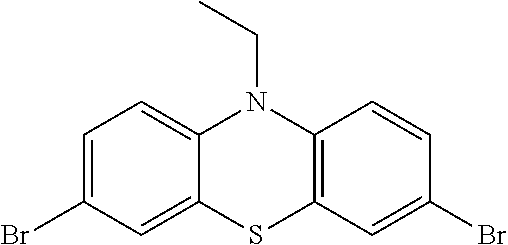
- SQFLAMVBNVMUHC-UHFFFAOYSA-N CCN1C2=CC=C(Br)C=C2SC2=C1C=CC(Br)=C2 Chemical compound CCN1C2=CC=C(Br)C=C2SC2=C1C=CC(Br)=C2 SQFLAMVBNVMUHC-UHFFFAOYSA-N 0.000 description 1
- RQZXMIPPSCTVIK-UHFFFAOYSA-N CCN1C2=CC=C(C)C=C2SC2=C1C=CC(C(F)(F)C(F)(F)F)=C2 Chemical compound CCN1C2=CC=C(C)C=C2SC2=C1C=CC(C(F)(F)C(F)(F)F)=C2 RQZXMIPPSCTVIK-UHFFFAOYSA-N 0.000 description 1
- IITDLIATLZTNTC-UHFFFAOYSA-L FC1=C(F)C(F)=C(S[Cu]SC2=C(F)C(F)=C(F)C(F)=C2F)C(F)=C1F Chemical compound FC1=C(F)C(F)=C(S[Cu]SC2=C(F)C(F)=C(F)C(F)=C2F)C(F)=C1F IITDLIATLZTNTC-UHFFFAOYSA-L 0.000 description 1
- YPQAADXEEWFUBU-UHFFFAOYSA-N FC1=C(F)C(F)=C2SC3=C(CC2=C1F)C(F)=C(F)C(F)=C3F Chemical compound FC1=C(F)C(F)=C2SC3=C(CC2=C1F)C(F)=C(F)C(F)=C3F YPQAADXEEWFUBU-UHFFFAOYSA-N 0.000 description 1
- FZHXUWZWOLOMJW-UHFFFAOYSA-N NC1=C(F)C(F)=C(F)C(F)=C1Br Chemical compound NC1=C(F)C(F)=C(F)C(F)=C1Br FZHXUWZWOLOMJW-UHFFFAOYSA-N 0.000 description 1
- XMPDXALNNWRZRZ-UHFFFAOYSA-N NC1=C(F)C(F)=C(F)C(F)=C1SC1=C(F)C(F)=C(F)C(F)=C1F Chemical compound NC1=C(F)C(F)=C(F)C(F)=C1SC1=C(F)C(F)=C(F)C(F)=C1F XMPDXALNNWRZRZ-UHFFFAOYSA-N 0.000 description 1
- DKWSSONZXICRKZ-UHFFFAOYSA-N O=[N+]([O-])C1=CC=C2CC3=C(C=C([N+](=O)[O-])C=C3)SC2=C1 Chemical compound O=[N+]([O-])C1=CC=C2CC3=C(C=C([N+](=O)[O-])C=C3)SC2=C1 DKWSSONZXICRKZ-UHFFFAOYSA-N 0.000 description 1
Images


Classifications
-
- H—ELECTRICITY
- H01—ELECTRIC ELEMENTS
- H01M—PROCESSES OR MEANS, e.g. BATTERIES, FOR THE DIRECT CONVERSION OF CHEMICAL ENERGY INTO ELECTRICAL ENERGY
- H01M10/00—Secondary cells; Manufacture thereof
- H01M10/42—Methods or arrangements for servicing or maintenance of secondary cells or secondary half-cells
- H01M10/4235—Safety or regulating additives or arrangements in electrodes, separators or electrolyte
-
- C—CHEMISTRY; METALLURGY
- C07—ORGANIC CHEMISTRY
- C07D—HETEROCYCLIC COMPOUNDS
- C07D241/00—Heterocyclic compounds containing 1,4-diazine or hydrogenated 1,4-diazine rings
- C07D241/36—Heterocyclic compounds containing 1,4-diazine or hydrogenated 1,4-diazine rings condensed with carbocyclic rings or ring systems
- C07D241/38—Heterocyclic compounds containing 1,4-diazine or hydrogenated 1,4-diazine rings condensed with carbocyclic rings or ring systems with only hydrogen or carbon atoms directly attached to the ring nitrogen atoms
- C07D241/46—Phenazines
-
- H—ELECTRICITY
- H01—ELECTRIC ELEMENTS
- H01M—PROCESSES OR MEANS, e.g. BATTERIES, FOR THE DIRECT CONVERSION OF CHEMICAL ENERGY INTO ELECTRICAL ENERGY
- H01M10/00—Secondary cells; Manufacture thereof
- H01M10/05—Accumulators with non-aqueous electrolyte
- H01M10/052—Li-accumulators
- H01M10/0525—Rocking-chair batteries, i.e. batteries with lithium insertion or intercalation in both electrodes; Lithium-ion batteries
-
- H—ELECTRICITY
- H01—ELECTRIC ELEMENTS
- H01M—PROCESSES OR MEANS, e.g. BATTERIES, FOR THE DIRECT CONVERSION OF CHEMICAL ENERGY INTO ELECTRICAL ENERGY
- H01M10/00—Secondary cells; Manufacture thereof
- H01M10/05—Accumulators with non-aqueous electrolyte
- H01M10/056—Accumulators with non-aqueous electrolyte characterised by the materials used as electrolytes, e.g. mixed inorganic/organic electrolytes
- H01M10/0564—Accumulators with non-aqueous electrolyte characterised by the materials used as electrolytes, e.g. mixed inorganic/organic electrolytes the electrolyte being constituted of organic materials only
- H01M10/0566—Liquid materials
- H01M10/0567—Liquid materials characterised by the additives
-
- H—ELECTRICITY
- H01—ELECTRIC ELEMENTS
- H01M—PROCESSES OR MEANS, e.g. BATTERIES, FOR THE DIRECT CONVERSION OF CHEMICAL ENERGY INTO ELECTRICAL ENERGY
- H01M4/00—Electrodes
- H01M4/02—Electrodes composed of, or comprising, active material
- H01M4/13—Electrodes for accumulators with non-aqueous electrolyte, e.g. for lithium-accumulators; Processes of manufacture thereof
- H01M4/136—Electrodes based on inorganic compounds other than oxides or hydroxides, e.g. sulfides, selenides, tellurides, halogenides or LiCoFy
-
- H—ELECTRICITY
- H01—ELECTRIC ELEMENTS
- H01M—PROCESSES OR MEANS, e.g. BATTERIES, FOR THE DIRECT CONVERSION OF CHEMICAL ENERGY INTO ELECTRICAL ENERGY
- H01M4/00—Electrodes
- H01M4/02—Electrodes composed of, or comprising, active material
- H01M4/36—Selection of substances as active materials, active masses, active liquids
- H01M4/58—Selection of substances as active materials, active masses, active liquids of inorganic compounds other than oxides or hydroxides, e.g. sulfides, selenides, tellurides, halogenides or LiCoFy; of polyanionic structures, e.g. phosphates, silicates or borates
- H01M4/5825—Oxygenated metallic salts or polyanionic structures, e.g. borates, phosphates, silicates, olivines
-
- H—ELECTRICITY
- H01—ELECTRIC ELEMENTS
- H01M—PROCESSES OR MEANS, e.g. BATTERIES, FOR THE DIRECT CONVERSION OF CHEMICAL ENERGY INTO ELECTRICAL ENERGY
- H01M8/00—Fuel cells; Manufacture thereof
- H01M8/18—Regenerative fuel cells, e.g. redox flow batteries or secondary fuel cells
-
- H—ELECTRICITY
- H01—ELECTRIC ELEMENTS
- H01M—PROCESSES OR MEANS, e.g. BATTERIES, FOR THE DIRECT CONVERSION OF CHEMICAL ENERGY INTO ELECTRICAL ENERGY
- H01M8/00—Fuel cells; Manufacture thereof
- H01M8/18—Regenerative fuel cells, e.g. redox flow batteries or secondary fuel cells
- H01M8/184—Regeneration by electrochemical means
- H01M8/188—Regeneration by electrochemical means by recharging of redox couples containing fluids; Redox flow type batteries
-
- H—ELECTRICITY
- H01—ELECTRIC ELEMENTS
- H01M—PROCESSES OR MEANS, e.g. BATTERIES, FOR THE DIRECT CONVERSION OF CHEMICAL ENERGY INTO ELECTRICAL ENERGY
- H01M2220/00—Batteries for particular applications
- H01M2220/30—Batteries in portable systems, e.g. mobile phone, laptop
-
- H—ELECTRICITY
- H01—ELECTRIC ELEMENTS
- H01M—PROCESSES OR MEANS, e.g. BATTERIES, FOR THE DIRECT CONVERSION OF CHEMICAL ENERGY INTO ELECTRICAL ENERGY
- H01M4/00—Electrodes
- H01M4/02—Electrodes composed of, or comprising, active material
- H01M4/36—Selection of substances as active materials, active masses, active liquids
- H01M4/58—Selection of substances as active materials, active masses, active liquids of inorganic compounds other than oxides or hydroxides, e.g. sulfides, selenides, tellurides, halogenides or LiCoFy; of polyanionic structures, e.g. phosphates, silicates or borates
- H01M4/583—Carbonaceous material, e.g. graphite-intercalation compounds or CFx
- H01M4/587—Carbonaceous material, e.g. graphite-intercalation compounds or CFx for inserting or intercalating light metals
-
- Y—GENERAL TAGGING OF NEW TECHNOLOGICAL DEVELOPMENTS; GENERAL TAGGING OF CROSS-SECTIONAL TECHNOLOGIES SPANNING OVER SEVERAL SECTIONS OF THE IPC; TECHNICAL SUBJECTS COVERED BY FORMER USPC CROSS-REFERENCE ART COLLECTIONS [XRACs] AND DIGESTS
- Y02—TECHNOLOGIES OR APPLICATIONS FOR MITIGATION OR ADAPTATION AGAINST CLIMATE CHANGE
- Y02E—REDUCTION OF GREENHOUSE GAS [GHG] EMISSIONS, RELATED TO ENERGY GENERATION, TRANSMISSION OR DISTRIBUTION
- Y02E60/00—Enabling technologies; Technologies with a potential or indirect contribution to GHG emissions mitigation
- Y02E60/10—Energy storage using batteries
-
- Y—GENERAL TAGGING OF NEW TECHNOLOGICAL DEVELOPMENTS; GENERAL TAGGING OF CROSS-SECTIONAL TECHNOLOGIES SPANNING OVER SEVERAL SECTIONS OF THE IPC; TECHNICAL SUBJECTS COVERED BY FORMER USPC CROSS-REFERENCE ART COLLECTIONS [XRACs] AND DIGESTS
- Y02—TECHNOLOGIES OR APPLICATIONS FOR MITIGATION OR ADAPTATION AGAINST CLIMATE CHANGE
- Y02E—REDUCTION OF GREENHOUSE GAS [GHG] EMISSIONS, RELATED TO ENERGY GENERATION, TRANSMISSION OR DISTRIBUTION
- Y02E60/00—Enabling technologies; Technologies with a potential or indirect contribution to GHG emissions mitigation
- Y02E60/30—Hydrogen technology
- Y02E60/50—Fuel cells
Definitions
- the presently-disclosed subject matter generally relates to rechargeable batteries and compounds for use in conferring overcharge protection in such batteries.
- certain embodiments of the presently-disclosed subject matter relate to batteries having a high-voltage cathode, and compounds for use in conferring overcharge protection in such batteries, such as lithium-ion batteries having a high-voltage cathode.
- overcharge a condition in which a cell's potential rises above the end-of-charge potential of its cathode, is important for achieving long lifetimes and averting catastrophic failure in lithium-ion batteries (LIBs).
- LIBs lithium-ion batteries
- 1, 2 Batteries connected in series may be especially vulnerable to overcharge when mismatches in capacity occur.
- the condition may be forestalled by introducing additional external circuitry to monitor individual cell potentials in a battery pack, or by integrating internal safeguards to prevent undesirably high potentials from being reached.
- additives into the battery electrolyte to mitigate excess applied current by shuttling charge between electrodes.
- 3 These additives, called redox shuttles, oxidize at the cathode/electrolyte interface when the cell potential reaches the oxidation potential of the additive; then, after diffusing to the anode/electrolyte interface, they reduce back to the neutral form. Each cycle sees an electron transported from the anode to the cathode without shorting the cell.
- Redox shuttles were first demonstrated as a protective mechanism in LIBs by Dahn and coworkers in 2005; the most successful early shuttles included derivatives of phenothiazine, 5 dialkoxybenzene, 3, 6, 7 2,2,6,6-tetramethylpiperinyl oxide (TEMPO), 8 and triphenylamine. 9 In the decade since Dahn's initial reports, redox shuttles have enabled protection against overcharge for time periods equivalent to 300 or more charging cycles and at charging rates as high as 1C. 7, 10, 11
- Dahn, Amine, and Zhang have reported redox shuttle candidates with oxidation potentials ranging from 4.0 to 4.8 V vs. Li +/0 , including 1,4-di-tert-butyl-2,5-bis(2,2,2-trifluoroethoxy)benzene, 17, 18 octafluoronaphthalene, 18 2-methoxyhexafluoronaphthalene, 18 tetraethyl-1,4-di-tert-butyl-2,5-phenylene diphosphate, 19 and 1,4-bis(di-iso-propyl)phosphinyl)-2,5-dimethoxybenzene.
- all five compounds protect high-voltage cathodes from overcharge, when paired with graphitic anodes, even the most robust shuttle is limited to a few dozen cycles of protection against 100% overcharge in LFP/graphite cells.
- the presently-disclosed subject matter includes compounds that can be used as redox shuttles conferring overcharge protection.
- the presently-disclosed subject matter further includes rechargeable batteries, including rechargeable batteries having a high-voltage cathode, which include a redox shuttle, providing overcharge protection.
- a compound which has the structure of formula I.
- R is selected from the group consisting of alkyl, aryl, alkylaryl, alkoxyaryl, alkylcarboxyl, aryl carbonyl, haloalkyl, perfluoroalkyl, glycols, haloaryl, a negative electrolyte, and a polymer.
- the compound has the structure of formula II.
- the compounds disclosed herein are included in a rechargeable battery comprising a negative electrode and a positive electrode.
- the battery includes a high-voltage cathode and an anode.
- the high-voltage cathode can in some embodiments have an end-of-charge potential of about 4.0 V or greater.
- Exemplary high-voltage cathodes include LiFePO 4 (LFP), LiMn 2 O 4 (LMO), LiCoO 2 (LCO), LiNi 1/3 Mn 1/3 Co 1/3 O 2 (NMC), or LiNi 0.8 Co 0.15 Al 0.05 O 2 (NCA).
- the anode is graphitic.
- the battery can include an electrolyte comprising a charge-carrying medium and a lithium salt.
- the compounds disclosed herein are included in a battery at a concentration of about 0.05-0.1M. In some embodiments, the compound has a solubility of about 0.5M or greater. In some embodiments, the compound oxidizes at a potential of about 4.0 V to about 4.8V as compared to Li/Li+, at a potential of about 4.2V to about 4.5V, or at a potential of about 4.2V to about 4.3V.
- the battery comprises a positive electrode, a negative electrode, and an electrolyte.
- the positive electrode is immersed in the electrolyte.
- a battery comprising a passivating electrolyte additive, wherein the passivating electrolyte additive comprises the compound.
- the battery can be selected from a lithium-ion battery and a sodium-ion battery.
- the battery can comprise a photopolymerization initiator or photoredox catalyst, that includes the compounds disclosed herein.
- electrode material includes the compounds disclosed herein.
- the electrode material is included in a battery.
- the battery is a non-aqueous redox flow battery. Articles including a battery as provided herein are also disclosed. Arrays comprising two or more batteries, including batteries connected in series are also disclosed.
- FIG. 1 provides chemical structures of N-ethylphenothiazine (EPT) and derivatives N-ethyl-3,7-bis(trifluoromethyl)phenothiazine (BCF3EPT), N-ethyl-3,7-bis(pentafluoroethyl)phenothiazine (BC2F5EPT), 3,7-dicyano-N-ethylphenothiazine (DCNEPT), N-ethyl-3,7-dinitrophenothiazine (DNO2EPT), and N-ethyl-1,2,3,4,6,7,8,9-octafluorophenothiazine (OFEPT).
- EPT N-ethylphenothiazine
- BCF3EPT N-ethyl-3,7-bis(pentafluoroethyl)phenothiazine
- BC2F5EPT N-ethyl-3,7-bis(p
- FIG. 2 depicts how an exemplary fluorinated phenothiazine derivative mitigates excess current in an overcharging lithium-ion cell containing a high-voltage cathode by shuttling it through the electrolyte in redox reactions as the electrode/electrolyte interfaces.
- FIG. 3 includes cyclic voltammograms of BC2F5EPT, DNO2EPT, and OFEPT at ca. 0.3 mM in 1.2 M LiPF 6 in EC/EMC (3:7 wt. ratio) at a scan rate of 100 mV/s with a glassy carbon working electrode, Pt wire counter electrode, and Li foil reference electrode.
- FIG. 4 includes a plot of half-wave oxidation potentials for the first oxidation event for redox shuttle candidates EPT, BCF3EPT, BC2F5EPT, DCNEPT, and DNO2EPT in 1.2 M LiPF 6 in EC/EMC (3:7 wt. ratio) recorded at a scan rate of 100 mV/sec vs. the adiabatic IPs calculated at the B3LYP/6-311G(d,p) level of theory.
- FIG. 5 includes a plot of half-wave oxidation potentials for the first oxidation event for redox shuttle candidates EPT, BCF3EPT, BC2F5EPT, DCNEPT, DNO2EPT, and OFEPT in 1.2 M LiPF 6 in EC/EMC (3:7 wt. ratio) recorded at a scan rate of 100 mV/sec vs. the adiabatic IPs calculated at the B3LYP/6-311G(d,p) level of theory.
- FIGS. 6 a -6 f include cyclic voltammograms of DNO2EPT (a,d), BC2F5EPT (b,e), and OFEPT (c,f) at 0.3 mM in 1.2 M LiPF 6 in EC/EMC (3:7 wt. ratio) recorded at a scan rate of 100 mV/sec showing irreversible second oxidations in some cases (a, b, and c) and irreversible reductions in others (d, e, and f).
- FIG. 7 includes plots of Potential vs. time (top) and capacity vs. cycle number (bottom) for 100% overcharge cycling of BC2FEPT in LFP/graphite coin cells.
- BC2FEPT was incorporated into 1.2 M LiPF 6 in EC/EMC (3:7 wt. ratio) at 0.08 M; 100% overcharge cycling was performed at a rate of C/10.
- FIG. 8 includes plots of Potential vs. time (top) for 100% overcharge cycling of OFEPT in NCA/graphite coin cells.
- OFEPT was incorporated into 1.2 M LiPF 6 in EC/EMC (3:7 wt. ratio) at 0.08 M; 100% overcharge cycling was performed at a rate of C/10; and charge and discharge capacities vs. cycle number (bottom) for the same cell.
- FIG. 9 provides thermal ellipsoid plots for the OFPT (a) and OFEPT (b) obtained by single crystal X-ray diffraction.
- FIG. 10 includes cyclic voltammogram of 1.2 M LiPF 6 in EC/EMC (3:7 wt. ratio) recorded at a scan rate of 100 mV/sec.
- the presently-disclosed subject matter includes compounds that can be used as redox shuttles conferring overcharge protection.
- the presently-disclosed subject matter further includes rechargeable batteries, including rechargeable batteries having a high-voltage cathode, which include a redox shuttle, providing overcharge protection.
- a compound which has the structure of formula I.
- R is selected from the group consisting of alkyl, aryl, alkylaryl, alkoxyaryl, alkylcarboxyl, aryl carbonyl, haloalkyl, perfluoroalkyl, glycols, haloaryl, a negative electrolyte, and a polymer.
- the compound has the structure of formula II.
- the compound can be used as a redox shuttle.
- the compound can be used as a passivating electrolyte additives for lithium-ion, sodium-ion, and other batteries.
- the compound can be used as a photopolymerization initiator or photoredox catalyst.
- the compound can be used as an electrode material in a battery including non-aqueous redox flow batteries.
- redox shuttle refers to an electrochemically reversible compound that can become oxidized at a positive electrode of a battery, migrate to a negative electrode of the battery, become reduced at the negative electrode to reform the unoxidized/less-oxidated shuttle species, and migrate back to the positive electrode.
- a redox shuttle can be an electroactive compound, which can be heterocyclic. A redox shuttle can protect against overcharging.
- the presently-disclosed subject matter includes a rechargeable battery.
- the rechargeable battery includes a negative electrode, a positive electrode, and an electrolyte that includes a compound as disclosed herein, e.g., OFEPT.
- the positive electrode is immersed in the electrolyte.
- the electrolyte further comprises a charge-carrying medium and a lithium salt.
- the rechargeable battery is a rechargeable lithium-ion battery, which includes a high-voltage cathode, a negative electrode, an electrolyte comprising a charge-carrying medium and a lithium salt, and a redox shuttle comprising a compound as disclosed herein.
- electrolyte is well understood to those of ordinary skill in the art and provides a charge-carrying pathway between the negative electrode and the positive electrode.
- the electrolyte can include a charge-carrying medium and a lithium salt.
- the electrolyte can also include a redox shuttle.
- the battery makes use of a compound/redox shuttle at a concentration of about 0.05-0.1M. In some embodiments, the battery makes use of a compound/redox shuttle having a solubility of about 0.5M or greater.
- negative electrode is well understood to those of ordinary skill in the art and refers to one of a pair of electrodes that, under normal circumstances and when the battery/cell is fully charged, has the lowest potential.
- the negative electrode that can be used in connection with the presently-disclosed subject matter is not particularly limited and can be generally selected from those known in the art, for example, a graphitic anode.
- positive electrode is well understood to those of ordinary skill in the art and refers to one of a pair of electrodes that, under typical circumstances, and when the battery/cell is fully charged, will have the highest potential that it can achieve under normal operation.
- the presently-disclosed subject matter includes rechargeable batteries in which the positive electrode is a high-voltage cathode.
- high-voltage cathodes include, but are not limited to LiFePO 4 (LFP), LiMn 2 O 4 (LMO), LiCoO 2 (LCO), LiNi 1/3 Mn 1/3 Co 1/3 O 2 (NMC), and LiNi 0.8 Co 0.15 Al 0.05 O 2 (NCA).
- LFP LiFePO 4
- LMO LiMn 2 O 4
- LCO LiCoO 2
- NMC LiNi 1/3 Mn 1/3 Co 1/3 O 2
- NCA LiNi 0.8 Co 0.15 Al 0.05 O 2
- a high-voltage cathode is one that can be said to have an end-of-charge potential of about 4.0 V or greater.
- Such high-voltage cathodes benefit from redox shuttles that oxidize at potentials of at least about 4.0, 4.1, 4.2, 4.3, 4.4, 4.5, 4.6, or 4.7 to about 4.8 V as compared to Li/Li + .
- the battery makes use of a compound that oxidizes at a potential of about 4.0 V to about 4.8V as compared to Li/Li + .
- the compound oxidizes at a potential of about 4.2V to about 4.5V.
- the compound oxidizes at a potential of about 4.2V to about 4.3V.
- the presently-disclosed subject matter is further inclusive of an article that includes a battery as disclosed herein.
- Batteries connected in series can be particularly vulnerable to overcharge.
- the presently-disclosed subject matter is inclusive of an array that includes two or more batteries as disclosed herein.
- the array includes two or more batteries connected in a series.
- Alkyl refers to a saturated or unsaturated, branched, straight-chain or cyclic monovalent hydrocarbon radical derived by the removal of one hydrogen atom from a single carbon atom of a parent alkane, alkene or alkyne.
- Typical alkyl groups include, but are not limited to, methyl; ethyls such as ethanyl, ethenyl, ethynyl; propyls such as propan-1-yl, propan-2-yl, cyclopropan-1-yl, prop-1-en-1-yl, prop-1-en-2-yl, prop-2-en-1-yl (allyl), cycloprop-1-en-1-yl; cycloprop-2-en-1-yl, prop-1-yn-1-yl, prop-2-yn-1-yl, etc.; butyl s such as butan-1-yl, butan-2-yl, 2-methyl-propan-1-yl, 2-methyl-propan-2-yl, cyclobutan-1-yl, but-1-en-1-yl, but-1-en-2-yl, 2-methyl-prop-1-en-1-yl, but-2-en-2-yl, buta-1
- an alkyl group comprises from 1 to 20 carbon atoms, more preferably, from 1 to 10 carbon atoms. While alkyl is generally used to refer to both unsubstituted alkyl groups and substituted alkyl groups; however, substituted alkyl groups are also specifically referred to herein by identifying the specific substituent(s) on the alkyl group.
- the alkyl group can be substituted with one or more groups including, but not limited to, optionally substituted alkyl, cycloalkyl, alkoxy, amino, ether, halide, hydroxy, nitro, silyl, sulfo-oxo, or thiol, as described herein.
- a lower alkyl group is an alkyl group containing from one to six (e.g., from one to four) carbon atoms.
- Aryl refers to a monovalent aromatic hydrocarbon radical derived by the removal of one hydrogen atom from a single carbon atom of a parent aromatic ring system.
- Typical aryl groups include, but are not limited to, groups derived from aceanthrylene, acenaphthylene, acephenanthrylene, anthracene, azulene, benzene, chrysene, coronene, fluoranthene, fluorene, hexacene, hexaphene, hexalene, as-indacene, s-indacene, indane, indene, naphthalene, octacene, octaphene, octalene, ovalene, penta-2,4-diene, pentacene, pentalene, pentaphene, perylene, phenalene, phenanthrene, picene, pleiadene,
- an aryl group comprises from 6 to 20 carbon atoms, more preferably, between 6 to 12 carbon atoms.
- the term aryl also includes heteroaryl, which is defined as a group that contains an aromatic group that has at least one heteroatom incorporated within the ring of the aromatic group. Examples of heteroatoms include, but are not limited to, nitrogen, oxygen, sulfur, and phosphorus.
- the term non-heteroaryl defines a group that contains an aromatic group that does not contain a heteroatom. The aryl group can be substituted or unsubstituted.
- the aryl group can be substituted with one or more groups including, but not limited to, optionally substituted alkyl, cycloalkyl, alkoxy, alkenyl, cycloalkenyl, alkynyl, cycloalkynyl, aryl, heteroaryl, aldehyde, amino, carboxylic acid, ester, ether, halide, hydroxy, ketone, azide, nitro, silyl, sulfo-oxo, or thiol as described herein.
- biasing is a specific type of aryl group and is included in the definition of “aryl.”
- Biaryl refers to two aryl groups that are bound together via a fused ring structure, as in naphthalene, or are attached via one or more carbon-carbon bonds, as in biphenyl.
- Alkylaryl refers to an acyclic alkyl in which one of the hydrogen atoms bonded to a carbon atom, is replaced with an aryl group.
- Typical arylalkyl groups include, but are not limited to, benzyl, 2-phenylethan-1-yl, 2-phenylethen-1-yl, naphthylmethyl, 2-naphthylethan-1-yl, 2-naphthylethen-1-yl, naphthobenzyl, 2-naphthophenylethan-1-yl and the like.
- an arylalkyl group is (C 6 -C 30 ) arylalkyl, e.g., the alkanyl, alkenyl or alkynyl moiety of the arylalkyl group is (C 1 -C 10 ) and the aryl moiety is (C 6 -C 20 ), more preferably, an arylalkyl group is (C 6 -C 20 ) arylalkyl, e.g., the alkanyl, alkenyl or alkynyl moiety of the arylalkyl group is (C 1 -C 8 ) and the aryl moiety is (C 6 -C 12 ).
- Alkoxyaryl refers to an —O-arylalkyl where arylalkyl is as defined herein.
- Alkylcarboxyl means a —C(O)R group where R is alkyl, as defined herein.
- Arylcarbonyl refers to a —C(O)-aryl where aryl is as defined herein.
- Halogen refers to the halogens fluorine, chlorine, bromine and iodine.
- a haloalkyl refers to an alkyl group substituted with one or more halogens.
- a halo aryl refers to an aryl group substituted with one or more halogens.
- Perfluoroalkyl refers to alkyl groups in which essentially all of the carbon-bonded hydrogen has been replaced by fluorine.
- Glycols include alcohols in which at least two hydroxyl groups are attached to different carbon atoms in an organic compound, including alkylene glycols such as ethylene glycol and propylene glycol.
- a polymer consists of a large number of repeating units bonded together.
- polymer refers to linear polymers as well as other arrangements, including for example, dendrimer, star, and hyper branched polymers.
- the polymer can include phenothiazine as the sole monomer in a repeating polymer. In some embodiments, the polymer can include phenothiazine as part of a polymer that contains more than one repeat unit, e.g., alternating copolymer or block copolymer.
- a redox shuttle is a compound that mitigates excess charge by shuttling electronic charge between electrodes in a battery.
- the redox shuttle oxidizes at the cathode/electrolyte interface when the cell potential reaches the oxidation potential of the additive; then, after diffusing to the anode/electrolyte interface, they reduce back to the neutral form.
- a charge-carrying medium is any composition, material, or particle that carries electric charges.
- a passivating electrolyte additive is a composition added that can stabilize the surface of an anode, typically by forming a passivation film.
- a photopolymerization initiator is a chemical species that upon exposure to light (for example, ultraviolet or visible spectrum) produces a reactive species that can react with a composition, and changes the composition in one or more properties.
- An exemplary photopolymerization initiator can, for example, upon exposure to light, react with a polymerizable composition to generate a cross-linked polymer.
- a photoredox catalyst uses light to facilitate a chemical reaction by mediating a transfer of electrons between chemical compounds.
- the photoinduction of electron transfer of the catalysts allows for the activation of substrates that do not readily absorb the energy of light by themselves.
- the term “about,” when referring to a value or to an amount of mass, weight, time, volume, concentration or percentage is meant to encompass variations of in some embodiments ⁇ 20%, in some embodiments ⁇ 10%, in some embodiments ⁇ 5%, in some embodiments ⁇ 1%, in some embodiments ⁇ 0.5%, and in some embodiments ⁇ 0.1% from the specified amount, as such variations are appropriate to perform the disclosed method.
- ranges can be expressed as from “about” one particular value, and/or to “about” another particular value. It is also understood that there are a number of values disclosed herein, and that each value is also herein disclosed as “about” that particular value in addition to the value itself. For example, if the value “10” is disclosed, then “about 10” is also disclosed. It is also understood that each unit between two particular units are also disclosed. For example, if 10 and 15 are disclosed, then 11, 12, 13, and 14 are also disclosed.
- an optionally variant portion means that the portion is variant or non-variant.
- the presently-disclosed subject matter is further illustrated by the following specific but non-limiting examples.
- the following examples may include compilations of data that are representative of data gathered at various times during the course of development and experimentation related to the present invention.
- N-ethyl-3,7-bis(pentafluoroethyl)phenothiazine BC2F5EPT
- N-ethyl-3,7-dinitrophenothiazine DNO2EPT
- OFEPT N-ethyl-1,2,3,4,6,7,8,9-octafluorophenothiazine
- the structures of the new derivatives were inspired by the results of density functional theory (DFT) calculations, which were used to compute adiabatic ionization potentials (IPs).
- DFT density functional theory
- IPs adiabatic ionization potentials
- a good correlation was found between calculated adiabatic IPs and oxidation potentials for previously-reported phenothiazine derivatives, and use has since been made of the hybrid B3LYP density functional in conjunction with the 6-311G(d,p) basis set to predict these values prior to synthesis. 25
- the results of calculations for new candidates are summarized in Table 1, along with adiabatic IPs for previously reported EPT, BCF3EPT, and DCNEPT at the same level of theory.
- DNO2EPT and BC2F5EPT were synthesized from phenothiazine in two and three steps respectively, as shown in Scheme 1.
- phenothiazine was doubly nitrated with sodium nitrate in acetic acid following a procedure previously reported in Chem. Heterocycl. Compd., 32:365-70 (1996); deprotonation of the product and treatment with bromoethane afforded the desired redox shuttle candidate.
- phenothiazine was deprotonated with sodium hydride and added bromoethane to alkylate the N position, yielding EPT; dibromination of the product was performed using N-bromosuccinimide as previously reported in Chem. Comm. 50: 5339-5341 (2014). The dibrominated product was then treated with sodium pentafluoropropionate under conditions similar to those employed in our previous synthesis of BCF3EPT to afford BC2F5EPT.
- OFEPT was prepared in a convergent, multi-step synthesis in which the phenothiazine core was built from fluorinated benzene derivatives, as shown in Scheme 1.
- 2,3,4,5-Tetrafluoroaniline was brominated, and the product was combined with bis(2,3,4,5,6-pentafluorothiophenolate) copper(II), the latter of which was prepared from 2,3,4,5,6-pentafluorophenylthiol via treatment with Cu 2 O.
- the resulting copper complex and aryl bromide reacted to form a thioether bridging two fluorinated phenyl rings, one of which contained a primary amine at the position ortho to S.
- Electrochemical potentials were measured and analyzed the reversibility of redox events using cyclic voltammetry (CV) in 1.2 M LiPF 6 in ethylene carbonate/ethylmethyl carbonate (EC/EMC, 3:7 wt. ratio).
- CV experiments of redox shuttle candidates BC2F5EPT, DNO2EPT, and OFEPT revealed reversible first oxidation events at 3.86, 3.97, and 4.30 V, respectively, vs. Li +/0 ( FIG. 3 ).
- the correlation between calculated adiabatic IPs and first oxidation potentials was generally good for EPT and the 3,7-disubstituted derivatives shown in FIG. 1 , affording an R 2 value of 0.947 for the line of best fit ( FIG. 4 ).
- the oxidation potential of OFEPT was higher than expected from the trend exhibited by the 3,7-disubstituted derivatives, and a lower R 2 value (0.906) results when OFEPT is included ( FIG.
- OFEPT was the only viable redox shuttle candidate; both BC2F5EPT and DNO2EPT are too easily oxidized.
- overcharge tests were performed instead with LFP/graphite cells, though DNO2EPT's performance could not be studied due to its limited solubility.
- BC2F5EPT is highly soluble, dissolving at 1 M (30 wt. %) in carbonate-based electrolytes.
- BC2F5EPT's performance was unremarkable for an LFP shuttle, surviving a mere 17 cycles of 100% overcharge cycling before reaching 5 V ( FIG. 7 ). Perhaps a different shuttle concentration or electrolyte environment could lead to more extensive cycling.
- Bromoethane, copper(I) oxide, bromine, anhydrous N,N-dimethylformamide (DMF), N-methyl-2-pyrrolidone (NMP), charcoal, and 1,4-dioxane were purchased from Sigma Aldrich.
- Phenothiazine and copper iodide were obtained from Acros Organics.
- Sodium hydride, sodium acetate, and acetic acid were purchased from Alfa Aesar.
- Pentafluorothiophenol and sodium pentafluoropropionate were purchased from Oakwood Chemical, iron powder from Mallinckrodt Pharmaceuticals, 2,3,4,5-tetrafluoroaniline from AK Scientific, potassium hydroxide and celite from Fisher Scientific, and ethanol from Decon Labs. All reagents were used without further purification.
- Glacial acetic acid (2 mL) was added to a suspension of phenothiazine (2.00 g, 10.1 mmol) in chloroform (10 mL) in a 100 mL round-bottomed flask containing a stir bar.
- Sodium nitrite (2.80 g, 40.6 mmol) was added to the reaction mixture in multiple portions over 20 min, after which more glacial acetic acid (4 mL) was added in order to maintain vigorous stirring.
- the reaction mixture was filtered to isolate the product as a red solid, which was washed with chloroform and air-dried.
- the isolated red solid (1.33 g) was largely insoluble in most organic solvents.
- This compound was prepared from phenothiazine as previously described. 11
- reaction flask Upon completion, the reaction flask was removed from the oil bath and allowed to cool to rt. The reaction mixture was poured into a mixture of hexane and celite and then filtered to remove solids. The filtrate was then washed with brine, dried over MgSO 4 , and filtered again to remove solids. The crude product concentrated by rotary evaporation and was purified by column chromatography with silica gel using 100% hexanes, which afforded 0.205 g (45%) of the desired product as a yellow oil.
- N-ethyl-1,2,3,4,6,7,8,9-Octafluorophenothiazine was then synthesized by N-ethylation of octafluorophenothiazine following a previously reported procedure.
- 2,3,4,5-tetrafluoroaniline (2.50 g, 15.1 mmol) and acetic acid (10 mL) were added under N 2 to a 100 mL round-bottomed flask containing a stir bar and fitted with a rubber septum. After dissolution of 2,3,4,5-tetrafluoroaniline, Fe powder (0.085 g, 1.5 mmol) and sodium acetate (1.37 g, 16.7 mmol) were added, and the reaction flask was immersed in an oil bath set at 50° C.
- Pentafluorothiophenol (2.0 mL, 3.0 g, 15 mmol) was added to a stirred suspension of Cu 2 O (1.07 g, 7.50 mmol) in ethanol (22 mL) in a 50 mL round-bottomed flask containing a stir bar and equipped with a reflux condenser. The suspension was immersed in a heated oil bath and was stirred at reflux for 5 h. After removal of the reaction flask from the oil bath and cooling to rt, the reaction mixture was filtered and dried to obtain the product as an off-white solid (4.5 g, 65%). 19 F NMR (400 MHz, CDCl 3 ) ⁇ ⁇ 134.4 (m, 4F), ⁇ 150.8 (m, 4F), ⁇ 162.5 (m, 2F).
- X-ray diffraction data was collected at 90K on a Bruker-Nonius X8 Proteum diffractometer. Crystal indexing and data processing were performed with Bruker APEX2 software. With reference to FIG. 9 , the structures were solved with shelxt and refined with shelx1-2014.
- Cyclic voltammetry (CV) experiments were performed in an argon-filled glovebox using a three-electrode system with a CH Instruments 650E potentiostat. Glassy carbon was used as the working electrode, platinum wire as the counter electrode, and lithium metal as the reference electrode. With reference to FIG. 6 and FIG. 10 , voltammograms were recorded in 1.2 M LiPF 6 in EC/EMC (3:7 wt. ratio) containing ca. 3.0 ⁇ 10 ⁇ 4 M analyte at a scan rate of 100 mV/s.
- Overcharge tests were conducted by assembling 2032 coin cells in an argon-filled glovebox using LiFePO 4 (LFP, Piotrek or MTI) or LiNi 0.8 Co 0.15 Al 0.05 O 2 (NCA, Argonne National Laboratory's CAMP Facility) as the cathode and synthetic graphite (Gen-2 (MAG-10) or Gen-3 (MCMB), Argonne National Laboratory's CAMP Facility) as the anode ( FIG. 7 ).
- the electrodes were punched into 14 mm diameter circles and sandwiched around a 15 mm diameter microporous 2325 PP/PE/PP trilayer separator from Celgard.
- the electrolyte used was 1.2 M LiPF 6 in EC/EMC (3:7 wt. ratio), and ca.
Landscapes
- Chemical & Material Sciences (AREA)
- Engineering & Computer Science (AREA)
- Chemical Kinetics & Catalysis (AREA)
- Electrochemistry (AREA)
- General Chemical & Material Sciences (AREA)
- Manufacturing & Machinery (AREA)
- Inorganic Chemistry (AREA)
- Materials Engineering (AREA)
- Organic Chemistry (AREA)
- Life Sciences & Earth Sciences (AREA)
- Sustainable Development (AREA)
- Sustainable Energy (AREA)
- Crystallography & Structural Chemistry (AREA)
- Physics & Mathematics (AREA)
- Condensed Matter Physics & Semiconductors (AREA)
- General Physics & Mathematics (AREA)
- Secondary Cells (AREA)
- Battery Electrode And Active Subsutance (AREA)
Abstract

wherein R is selected from the group consisting of alkyl, aryl, alkylaryl, alkoxyaryl, alkylcarboxyl, aryl carbonyl, haloalkyl, perfluoroalkyl, glycols, haloaryl, a negative electrolyte, and a polymer.
Description

wherein R is selected from the group consisting of alkyl, aryl, alkylaryl, alkoxyaryl, alkylcarboxyl, aryl carbonyl, haloalkyl, perfluoroalkyl, glycols, haloaryl, a negative electrolyte, and a polymer.


wherein R is selected from the group consisting of alkyl, aryl, alkylaryl, alkoxyaryl, alkylcarboxyl, aryl carbonyl, haloalkyl, perfluoroalkyl, glycols, haloaryl, a negative electrolyte, and a polymer.

| TABLE 1 |
| Calculated adiabatic IPs, and half-wave oxidation |
| (E1/2 +/0) and peak values of the potential of the forward wave |
| of first reduction events (Ep 0/−) for EPT, 3,7-disubstituted |
| EPT derivatives, and OFEPT vs. Li+/0 at 0 V. |
| Calculated | E1/2 +/0 vs. Li+/0 | Ep 0/− vs. Li+/0 | |
| Compound | adiabatic IP (eV) a | (V) b | (V) b |
| EPT | 6.48 | 3.51 | N/A |
| BCF3EPT | 6.91 | 3.83 | N/A |
| BC2F5EPT | 7.06 | 3.86 | N/A |
| DCNEPT | 7.30 | 3.90 | 0.76 c |
| DNO2EPT | 7.50 | 3.97 | 2.39 c |
| OFEPT | 7.55 | 4.30 | 0.52 c |
| a adiabatic IPs calculated at the B3LYP/6-311G(d,p) level of theory, | |||
| b potentials of redox events obtained from cyclic voltammograms recorded in 1.2M LiPF6 in EC/EMC (3:7 wt. ratio) at 100 mv/s. | |||
| c denotes that the event was irreversible. | |||




- 1. P. Arora, R. E. White and M. Doyle, J. Electrochem. Soc., 1998, 145, 3647-3667.
- 2. P. G. Balakrishnan, R. Ramesh and T. Prem Kumar, J. Power Sources, 2006, 155, 401-414.
- 3. J. Chen, C. Buhrmester and J. R. Dahn, Electrochem. Solid-State Lett., 2005, 8, A59-A62.
- 4. Z. Chen, Y. Qin and K. Amine, Electrochim. Acta, 2009, 54, 5605-5613.
- 5. C. Buhrmester, L. Moshurchak, R. L. Wang and J. R. Dahn, J. Electrochem. Soc., 2006, 153, A288-A294.
- 6. C. Buhrmester, J. Chen, L. Moshurchak, J. Jiang, R. L. Wang and J. R. Dahn, J. Electrochem. Soc., 2005, 152, A2390-A2399.
- 7. J. R. Dahn, J. Jiang, L. M. Moshurchak, M. D. Fleischauer, C. Buhrmester and L. J. Krause, J. Electrochem. Soc., 2005, 152, A1283-A1289.
- 8. C. Buhrmester, L. M. Moshurchak, R. L. Wang and J. R. Dahn, J. Electrochem. Soc., 2006, 153, A1800-A1804.
- 9. L. M. Moshurchak, C. Buhrmester and J. R. Dahn, J. Electrochem. Soc., 2008, 155, A129-A131.
- 10. A. P. Kaur, S. Ergun, C. F. Elliott and S. A. Odom, J. Mater. Chem. A, 2014, 2, 18190-18193.
- 11. A. P. Kaur, C. F. Elliott, S. Ergun and S. A. Odom, J. Electrochem. Soc., 2015, 163, A1-A7.
- 12. L. Zhang, Z. Zhang, P. C. Redfern, L. A. Curtiss and K. Amine, Energy Environ. Sci., 2012, 5, 8204-8207.
- 13. J. C. Forgie, S. El Khakani, D. D. MacNeil and D. Rochefort, Phys. Chem. Chem. Phys., 2013, 15, 7713-7721.
- 14. S.-L. Khakani, J. C. Forgie, D. D. MacNeil and D. Rochefort, J. Electrochem. Soc., 2015, 162, A1432-A1438.
- 15. S. Ergun, C. F. Elliott, A. P. Kaur, S. R. Parkin and S. A. Odom, Chem. Commun., 2014, 50, 5339-5341.
- 16. M. Hu, X. Pang and Z. Zhou, J. Power Sources, 2013, 237, 229-242.
- 17. L. M. Moshurchak, W. M. Lamanna, M. Bulinski, R. L. Wang, R. R. Garsuch, J. Jiang, D. Magnuson, M. Triemert and J. R. Dahn, J. Electrochem. Soc., 2009, 156, A309-A312.
- 18. W. M. Lamanna, M. J. Bulinski, J. R. Dahn, J. Jiang, L. Moshurchak, P. T. Pham, R. L. Wang, US20090286162 A1: 2009.
- 19. L. Zhang, Z. Zhang, H. Wu and K. Amine, Energy Environ. Sci., 2011, 4, 2858-2862.
- 20. J. Huang, N. Azimi, L. Cheng, I. A. Shkrob, Z. Xue, J. Zhang, N. L. Dietz Rago, L. A. Curtiss, K. Amine, Z. Zhang and L. Zhang, J. Mater. Chem. A, 2015, 3, 10710-10714.
- 21. M. D. Casselman, A. P. Kaur, K. A. Narayana, C. F. Elliott, C. Risko and S. A. Odom, Phys. Chem. Chem. Phys., 2015, 17, 6905-6912.
- 22. K. A. Narayana, M. D. Casselman, C. F. Elliott, S. Ergun, S. R. Parkin, C. Risko and S. A. Odom, ChemPhysChem, 2015, 16, 1179-1189.
- 23. S. Ergun, C. F. Elliott, A. P. Kaur, S. R. Parkin and S. A. Odom, J. Phys. Chem. C, 2014, 118, 14824-14832.
- 24. S. A. Odom, S. Ergun, P. P. Poudel and S. R. Parkin, Energy Environ. Sci., 2014, 7, 760-767.
- 25. M. J. Frisch, G. W. Trucks, H. B. Schlegel, G. E. Scuseria, M. A. Robb, J. R. Cheeseman, G. Scalmani, V. Barone, B. Mennucci, G. A. Petersson, H. Nakatsuji, M. Caricato, X. Li, H. P. Hratchian, A. F. Izmaylov, J. Bloino, G. Zheng, J. L. Sonnenberg, M. Hada, M. Ehara, K. Toyota, R. Fukuda, J. Hasegawa, M. Ishida, T. Nakajima, Y. Honda, O. Kitao, H. Nakai, T. Vreven, J. A. Montgomery, Jr., J. E. Peralta, F. Ogliaro, M. Bearpark, J. J. Heyd, E. Brothers, K. N. Kudin, V. N. Staroverov, R. Kobayashi, J. Normand, K. Raghavachari, A. Rendell, J. C. Burant, S. S. Iyengar, J. Tomasi, M. Cossi, N. Rega, J. M. Millam, M. Klene, J. E. Knox, J. B. Cross, V. Bakken, C. Adamo, J. Jaramillo, R. Gomperts, R. E. Stratmann, O. Yazyev, A. J. Austin, R. Cammi, C. Pomelli, J. W. Ochterski, R. L. Martin, K. Morokuma, V. G. Zakrzewski, G. A. Voth, P. Salvador, J. J. Dannenberg, S. Dapprich, A. D. Daniels, Ö. Farkas, J. B. Foresman, J. V. Ortiz, J. Cioslowski, and D. J. Fox, Gaussian, Inc., Wallingford Conn., 2009.
- 26. F. R. Brushett, J. T. Vaughey and A. N. Jansen, Adv. Energy Mater., 2012, 2, 1390-1396.
- 27. J. Huang, L. Cheng, R. S. Assary, P. Wang, Z. Xue, A. K. Burrell, L. A. Curtiss and L. Zhang, Adv. Energy Mater., 2015, 5, DOI:10.1002/aenm.201401782.
- 28. A. P. Kaur, N. E. Holubowitch, S. Ergun, C. F. Elliott and S. A. Odom, Energy Tech., 2015, 3, 476-480.
- 29. X. Wei, W. Xu, M. Vijayakumar, L. Cosimbescu, T. Liu, V. Sprenkle and W. Wang, Adv. Mater., 2014, 26, 7649-7653.
- 30. M. J. Lacey, J. T. Frith and J. R. Owen, Electrochem. Commun., 2013, 26, 74-76.
- 31. N. J. Treat, H. Sprafke, J. W. Kramer, P. G. Clark, B. E. Barton, J. Read de Alaniz, B. P. Fors and C. J. Hawker, J. Am. Chem. Soc., 2014, 136, 16096-16101.
- 32. X. Pan, M. Lamson, J. Yan and K. Matyjaszewski, ACS Macro Letters, 2015, 4, 192-196.
- 33. O. B. Tomilin, E. P. Konovalova, V. N. Yuzhalkin, L. V. Ryabkina and E. P. Sanaeva, Chem. Heterocycl. Compd., 1996, 32, 365-370.
- 34. G. G. F. Yakobson, L. S. Kobrina and N. N. Vorozhtsov, Jr., Zhurnal Obshchei Khimii 1967, 37, 1289-1293.
- 35. L. J. B. Belf and D. E. M. Wotton, Chem. Industry, 1966, 6, 238-239.
- 36. G. Sheldrick, Acta Crystallog. Sect. A, 2015, 71, 3-8.
- 37. G. Sheldrick, Acta Crystallog. Sect. C, 2015, 71, 3-8.
- 38. G. W. T. M. J. Frisch, H. B. Schlegel, G. E. Scuseria, M. A. Robb, J. R. Cheeseman, G. Scalmani, V. Barone, B. Mennucci, G. A. Petersson, H. Nakatsuji, M. Caricato, X. Li, H. P. Hratchian, A. F. Izmaylov, J. Bloino, G. Zheng, J. L. Sonnenberg, M. Hada, M. Ehara, K. Toyota, R. Fukuda, J. Hasegawa, M. Ishida, T. Nakajima, Y. Honda, O. Kitao, H. Nakai, T. Vreven, J. A. Montgomery Jr., J. E. Peralta, F. Ogliaro, M. J. Bearpark, J. Heyd, E. N. Brothers, K. N. Kudin, V. N. Staroverov, R. Kobayashi, J. Normand, K. Raghavachari, A. P. Rendell, J. C. Burant, S. S. Iyengar, J. Tomasi, M. Cossi, N. Rega, N. J. Millam, M. Klene, J. E. Knox, J. B. Cross, V. Bakken, C. Adamo, J. Jaramillo, R. Gomperts, R. E. Stratmann, O. Yazyev, A. J. Austin, R. Cammi, C. Pomelli, J. W. Ochterski, R. L. Martin, K. Morokuma, V. G. Zakrzewski, G. A. Voth, P. Salvador, J. J. Dannenberg, S. Dapprich, A. D. Daniels, Ö. Farkas, J. B. Foresman, J. V. Ortiz, J. Cioslowski and D. J. Fox, 2009, Gaussian, Inc., Wallingford, Conn., USA.
- 39. A. D. Becke, J. Chem. Phys., 1993, 98, 5648-5652.
- 40. C. Lang, W. Yang and R. G. Parr, Phys. Rev. B, 1988, 37, 785-789.
- 41. A. D. McLean and G. S. Chandler, J. Chem. Phys., 1980, 72, 5639-5648.
- 42. R. Krishnan, J. S. Binkley, R. Seeger and J. A. Pople, J. Chem. Phys., 1980, 72, 650-654.
- 43. Z. Chen and K. Amine, Electrochem. Commun., 2007, 9, 703-707.
- 44. A. P. Kaur, M. D. Casselman, C. F. Elliott, S. R. Parkin, C. Risko, and S. A. Odom, J. of Materials Chemistry A, 2016, 4, 5410-5414.
- 45. U.S. Patent Application Publication No. 2011/0294017
- 46. U.S. Patent Application Publication No. 2011/0294018
- 47. U.S. Pat. No. 8,101,302
Claims (20)

Priority Applications (1)
| Application Number | Priority Date | Filing Date | Title |
|---|---|---|---|
| US15/637,971 US10892525B2 (en) | 2016-06-29 | 2017-06-29 | Rechargeable batteries including high-voltage cathode and redox shuttle conferring overcharge protection |
Applications Claiming Priority (2)
| Application Number | Priority Date | Filing Date | Title |
|---|---|---|---|
| US201662356388P | 2016-06-29 | 2016-06-29 | |
| US15/637,971 US10892525B2 (en) | 2016-06-29 | 2017-06-29 | Rechargeable batteries including high-voltage cathode and redox shuttle conferring overcharge protection |
Publications (2)
| Publication Number | Publication Date |
|---|---|
| US20180006336A1 US20180006336A1 (en) | 2018-01-04 |
| US10892525B2 true US10892525B2 (en) | 2021-01-12 |
Family
ID=60807879
Family Applications (1)
| Application Number | Title | Priority Date | Filing Date |
|---|---|---|---|
| US15/637,971 Active US10892525B2 (en) | 2016-06-29 | 2017-06-29 | Rechargeable batteries including high-voltage cathode and redox shuttle conferring overcharge protection |
Country Status (1)
| Country | Link |
|---|---|
| US (1) | US10892525B2 (en) |
Families Citing this family (9)
| Publication number | Priority date | Publication date | Assignee | Title |
|---|---|---|---|---|
| US10103402B2 (en) * | 2015-12-01 | 2018-10-16 | University Of Kentucky Research Foundation | Liquid phenothiazine catholytes for non-aqueous redox flow batteries |
| US11289700B2 (en) | 2016-06-28 | 2022-03-29 | The Research Foundation For The State University Of New York | KVOPO4 cathode for sodium ion batteries |
| EP3780208A4 (en) * | 2018-04-06 | 2021-06-16 | Panasonic Intellectual Property Management Co., Ltd. | Flow battery |
| WO2020035138A1 (en) * | 2018-08-14 | 2020-02-20 | Cmblu Projekt Ag | Redox-active compounds and uses thereof |
| JP7249847B2 (en) * | 2019-03-28 | 2023-03-31 | 三菱重工業株式会社 | redox flow battery |
| AU2020404319B2 (en) | 2019-12-19 | 2026-01-15 | Jacobio Pharmaceuticals Co., Ltd. | KRAS mutant protein inhibitors |
| CN113512033B (en) * | 2021-05-19 | 2023-06-16 | 南京工业大学 | Phenoxazine and phenothiazine covalent triazine framework material, and preparation method and application thereof |
| CN115441055B (en) * | 2022-09-15 | 2025-04-29 | 华南师范大学 | Sodium ion battery electrolyte and sodium ion battery |
| WO2024238435A1 (en) * | 2023-05-17 | 2024-11-21 | Research Triangle Institute | N,s-doped acenes, method of synthesis, electrochemical screening, and use of same for battery fabrication |
Citations (9)
| Publication number | Priority date | Publication date | Assignee | Title |
|---|---|---|---|---|
| US20080244296A1 (en) * | 2007-03-26 | 2008-10-02 | International Business Machines Corporation | Computer system fault detection |
| US20080296169A1 (en) * | 2007-05-30 | 2008-12-04 | Kuzo Holding Inc. | Multi-cell single voltage electrolysis apparatus and method of using same |
| US20090286162A1 (en) | 2008-02-12 | 2009-11-19 | 3M Innovative Properties Company | Redox shuttles for high voltage cathodes |
| US20110294017A1 (en) | 2010-05-25 | 2011-12-01 | Wei Weng | Redox shuttles for lithium ion batteries |
| US20110294018A1 (en) | 2010-05-25 | 2011-12-01 | Lu Zhang | Redox shuttles for high voltage cathodes |
| US20160208030A1 (en) * | 2015-01-16 | 2016-07-21 | The Board Of Trustees Of The University Of Illinois | Redox active polymers and colloidal particles for flow batteries |
| US20170062842A1 (en) * | 2015-08-31 | 2017-03-02 | Uchicago Argonne, Llc | Two-electron redox active molecules with high capacity and energy density for energy storage applications |
| US20170244132A1 (en) * | 2014-11-03 | 2017-08-24 | Bayerische Motoren Werke Aktiengesellschaft | Electrolyte for Lithium Based Energy Accumulators |
| US20180154086A1 (en) * | 2015-06-09 | 2018-06-07 | Sanofi-Aventis Deutschland Gmbh | Data collection apparatus for attachment to an injection device |
-
2017
- 2017-06-29 US US15/637,971 patent/US10892525B2/en active Active
Patent Citations (10)
| Publication number | Priority date | Publication date | Assignee | Title |
|---|---|---|---|---|
| US20080244296A1 (en) * | 2007-03-26 | 2008-10-02 | International Business Machines Corporation | Computer system fault detection |
| US20080296169A1 (en) * | 2007-05-30 | 2008-12-04 | Kuzo Holding Inc. | Multi-cell single voltage electrolysis apparatus and method of using same |
| US20090286162A1 (en) | 2008-02-12 | 2009-11-19 | 3M Innovative Properties Company | Redox shuttles for high voltage cathodes |
| US8101302B2 (en) | 2008-02-12 | 2012-01-24 | 3M Innovative Properties Company | Redox shuttles for high voltage cathodes |
| US20110294017A1 (en) | 2010-05-25 | 2011-12-01 | Wei Weng | Redox shuttles for lithium ion batteries |
| US20110294018A1 (en) | 2010-05-25 | 2011-12-01 | Lu Zhang | Redox shuttles for high voltage cathodes |
| US20170244132A1 (en) * | 2014-11-03 | 2017-08-24 | Bayerische Motoren Werke Aktiengesellschaft | Electrolyte for Lithium Based Energy Accumulators |
| US20160208030A1 (en) * | 2015-01-16 | 2016-07-21 | The Board Of Trustees Of The University Of Illinois | Redox active polymers and colloidal particles for flow batteries |
| US20180154086A1 (en) * | 2015-06-09 | 2018-06-07 | Sanofi-Aventis Deutschland Gmbh | Data collection apparatus for attachment to an injection device |
| US20170062842A1 (en) * | 2015-08-31 | 2017-03-02 | Uchicago Argonne, Llc | Two-electron redox active molecules with high capacity and energy density for energy storage applications |
Non-Patent Citations (45)
| Title |
|---|
| Arora, et al., Capacity Fade Mechanisms and Side Reactions in Lithium-Ion Batteries, Electrochem. Soc., 1998, 145, 3647-3667. |
| Balakrishnan, et al., Safety mechanisms in lithium-ion batteries, Power Sources, 2006, 155, 401-414. |
| Becke, A. D., Density-functional thermochemistry. III. The role of exact exchange, J. Chem. Phys., 1993, 98, 5648-5652. |
| Belf, et al., Octafluorophenothiazine, Chem. Industry, 1966, 6, 238-239. |
| Brushett, et al., An All-Organic Non-aqueous Lithium-Ion Redox Flow Battery, Adv. Energy Mater., 2012, 2, 1390-1396. |
| Buhrmester, et al., Possible Redox Shuttle Additives for Chemical Overcharge and Overdischarge Protection for Lithium-Ion Batteries, J. Electrochem. Soc., 2006, 153, A288-A294. |
| Buhrmester, et al., Studies of Aromatic Redox Shuttle Additives for LiFePO4-Based Li-Ion Cells, J. Electrochem. Soc., 2005, 152, A2390-A2399. |
| Buhrmester, et al., The Use of 2,2,6,6-Tetramethylpiperinyl-Oxides and Derivatives for Redox Shuttle Additives in Li-Ion Cells, J. Electrochem. Soc., 2006, 153, A1800-A1804. |
| Casselman, et al., The fate of phenothiazine-based redox shuttles in lithium-ion batteries, Phys. Chem. Chem. Phys., 2015, 17, 6905-6912. |
| Chen, et al., Bifunctional electrolyte additive for lithium-ion batteries, Electrochem. Commun., 2007, 9, 703-707. |
| Chen, et al., Chemical Overcharge and Overdischarge Protection for Lithium-Ion Batteries, Electrochem. Solid-State Lett., 2005, 8, A59-A62. |
| Chen, et al., Redox shuttles for safer lithium-ion batteries, Electrochim. Acta, 2009, 54, 5605-5613. |
| Dahn, et al., High-Rate Overcharge Protection of LiFePO4-Based Li-Ion Cells Using the Redox Shuttle Additive 2,5-Ditertbutyl-1,4-dimethoxybenzene, J. Electrochem. Soc., 2005, 152, A1283-A1289. |
| Ergun, et al., Controlling Oxidation Potentials in Redox Shuttle Candidates for Lithium-Ion Batteries, J. Phys. Chem. C, 2014, 118, 14824-14832. |
| Ergun, et al., Overcharge performance of 3,7-disubstituted N-ethylphenothiazine derivatives in lithium-ion batteries, Chem. Commun., 2014, 50, 5339-5341. |
| Forgie, et al., Electrochemical characterisation of a lithium-ion battery electrolyte based on mixtures of carbonates with a ferrocene-functionalised imidazolium electroactive ionic liquid, Phys. Chem. Chem. Phys., 2013, 15, 7713-7721. |
| Hu, et al., Recent progress in high-voltage lithium ion batteries, J. Power Sources, 2013, 237, 229-242. |
| Huang, et al., An organophosphine oxide redox shuttle additive that delivers long-term overcharge protection for 4 V lithium-ion batteries, J. Mater. Chem. A, 2015, 3, 10710-10714. |
| Huang, et al., Liquid Catholyte Molecules for Nonaqueous Redox Flow Batteries, Adv. Energy Mater., 2015, 5, 1401782-1401788. |
| Kaur et al ("Overcharge protection of lithium-ion batteries above 4 V with a perfluorinated phenothiazine derivative", Journal of Materials Chemistry A, vol. 4 (15), p. 5410-5414 (2016)). (Year: 2016). * |
| Kaur, et al., 3,7-Bis(trifluoromethyl)-N-ethylphenothiazine: a redox shuttle with extensive overcharge protection in lithium-ion batteries, J. Mater. Chem. A, 2014, 2, 18190-18193. |
| Kaur, et al., A Highly Soluble Organic Catholyte for Non-Aqueous Redox Flow Batteries, Energy Tech., 2015, 3, 476-480. |
| Kaur, et al., Overcharge Performance of 3,7-Bis(trifluoromethyl)-Nethylphenothiazine at High Concentration in Lithium-Ion Batteries, J. Electrochem. Soc., 2015, 163, A1-A7. |
| Kaur, et al., Overcharge protection of lithium-ion batteries above 4 V with a perfluorinated phenothiazine derivative J. of Materials Chemistry A, 2016, 4, 5410-5414. |
| Khakani, et al., Redox Shuttles for Lithium-Ion Batteries at Concentrations up to 1 M Using an Electroactive Ionic Liquid Based on 2,5,di-tert-butyl-1,4-dimethoxybenzene, J. Electrochem. Soc., 2015, 162, A1432-A1438. |
| Krishnan, et al , Self-consistent molecular orbital methods. XX. A basis set for correlated wave functions, J. Chem. Phys., 1980, 72, 650-654. |
| Lacey, et al., A redox shuttle to facilitate oxygen reduction in the lithium air battery, Electrochem. Commun., 2013, 26, 74-76. |
| Lee,et al. Parr, Development of the Colic-Salvetti correlation-energy formula into a functional of the electron density, Physical Review B, vol. 37 (2), 1988, pp. 785-789. |
| McLean, et al., Contracted Gaussian basis sets for molecular calculations. I. Second row atoms, Z=11-18, J. Chem. Phys., 1980, 72, 5639-5648. |
| Moshurchak, et al., High-Potential Redox Shuttle for Use in Lithium-Ion Batteries, J. Electrochem. Soc., 2009, 156, A309-A312. |
| Moshurchak, et al., Triphenylamines as a Class of Redox Shuttle Molecules for the Overcharge Protection of Lithium-Ion Cells, J. Electrochem. Soc., 2008, 155, A129-A131. |
| Narayana, et al., N-Substituted Phenothiazine Derivatives: How the Stability of the Neutral and Radical Cation Forms Affects Overcharge Performance in Lithium-Ion Batteries, ChemPhysChem, 2015, 16, 1179-1189. |
| Odom, et al., A fast, inexpensive method for predicting overcharge performance in lithium-ion batteries, Energy Environ. Sci., 2014, 7, 760-767. |
| Orlova et al (Chemical Abstract (accession No. 1982:20048; document No. 96:20048)-English abstract for "Some reactions of 10-phenyloctafluorophenothiazine and its oxide", Izvestiya Sibirskogo Otdeleniya Akademii Nauk SSSR, Seriya Khimicheskikh Nauk (1981), (Year: 1981). * |
| Orlova et al (Chemical Abstract (accession No. 1982:20048; document No. 96:20048)—English abstract for "Some reactions of 10-phenyloctafluorophenothiazine and its oxide", Izvestiya Sibirskogo Otdeleniya Akademii Nauk SSSR, Seriya Khimicheskikh Nauk (1981), (Year: 1981). * |
| Pan, et al., Photoinduced Metal-Free Atom Transfer Radical Polymerization of Acrylonitrile, ACS Macro Letters, 2015, 4, 192-196. |
| Sheldrick, G., Crystal structure refinement with SHELXL, Acta Crystallog. Sect. C, 2015, 71, 3-8. |
| Sheldrick, G., SHELXT-Integrated space-group and crystalstructure determination, Acta Crystallog. Sect. A, 2015, 71, 3-8. |
| Sheldrick, G., SHELXT—Integrated space-group and crystalstructure determination, Acta Crystallog. Sect. A, 2015, 71, 3-8. |
| Tomilin, et al., Cation Radicals of N-Substituted Phenothiazines, Chem. Heterocycl. Compd., 1996, 32, 365-370. |
| Treat, et al., Metal-Free Atom Transfer Radical Polymerization, J. Am. Chem. Soc., 2014, 136, 16096-16101. |
| Wei,et al., TEMPO-Based Catholyte for High-Energy Density Nonaqueous Redox Flow Batteries, Adv. Mater., 2014, 26, 7649-7653. |
| Yakobson, et al., Aromatic nucleophilic substitution, Zhurnal Obshchei Khimii 1967, 37, 1289-1293. |
| Zang, et al., Molecular engineering towards safer lithium-ion batteries: a highly stable and compatible redox shuttle for overcharge protection, Energy Environ. Sci., 2012, 5, 8204-8207. |
| Zhang, et al., Novel redox shuttle additive for high-voltage cathode materials, Energy Environ. Sci., 2011, 4, 2858-2862. |
Also Published As
| Publication number | Publication date |
|---|---|
| US20180006336A1 (en) | 2018-01-04 |
Similar Documents
| Publication | Publication Date | Title |
|---|---|---|
| US20180006336A1 (en) | Rechargeable batteries including high-voltage cathode and redox shuttle conferring overcharge protection | |
| Su et al. | Oxidatively stable fluorinated sulfone electrolytes for high voltage high energy lithium-ion batteries | |
| He et al. | Fluorinated electrolytes for 5-V Li-ion chemistry: probing voltage stability of electrolytes with electrochemical floating test | |
| EP2561573B1 (en) | Soluble oxygen evolving catalysts for rechargeable metal-air batteries | |
| Kaur et al. | Overcharge protection of lithium-ion batteries above 4 V with a perfluorinated phenothiazine derivative | |
| Kato et al. | A pentakis-fused tetrathiafulvalene system extended by cyclohexene-1, 4-diylidenes: a new positive electrode material for rechargeable batteries utilizing ten electron redox | |
| CN1264237C (en) | Electrochemical element and electrode active substance fr electrochemical element | |
| Li et al. | An improved method for synthesis of lithium difluoro (oxalato) borate and effects of sulfolane on the electrochemical performances of lithium-ion batteries | |
| US11177513B2 (en) | Rechargeable lithium-ion cell | |
| Casselman et al. | The fate of phenothiazine-based redox shuttles in lithium-ion batteries | |
| Zhang et al. | Understanding the redox shuttle stability of 3, 5-di-tert-butyl-1, 2-dimethoxybenzene for overcharge protection of lithium-ion batteries | |
| EP2250700A1 (en) | Redox shuttles for high voltage cathodes | |
| Huang et al. | 1, 4-Bis (trimethylsilyl)-2, 5-dimethoxybenzene: a novel redox shuttle additive for overcharge protection in lithium-ion batteries that doubles as a mechanistic chemical probe | |
| Lu et al. | Hexamethylene diisocyanate (HDI)-functionalized electrolyte matching LiNi0· 6Co0· 2Mn0· 2O2/graphite batteries with enhanced performances | |
| Vogl et al. | Investigation of N-ethyl-2-pyrrolidone (NEP) as electrolyte additive in regard to overcharge protecting characteristics | |
| US10854911B2 (en) | 1,9,10-substituted phenothiazine derivatives with strained radical cations and use thereof | |
| EP2815450A1 (en) | Electrochemical magnesium cell and method of making same | |
| Demeaux et al. | New insights into a high potential spinel and alkylcarbonate-based electrolytes | |
| TWI304803B (en) | Additives for non-aqueous electrolytes and electrochemical device using the same | |
| Moshuchak et al. | Direct comparison of 2, 5-di-tert-butyl-1, 4-dimethoybenzene and 4-tert-butyl-1, 2-dimethoxybenzene as redox shuttles in LiFePO4-based Li-ion cells | |
| Chen et al. | Understanding the stability of aromatic redox shuttles for overcharge protection of lithium-ion cells | |
| Weng et al. | Asymmetric form of redox shuttle based on 1, 4-Di-tert-butyl-2, 5-dimethoxybenzene | |
| Weng et al. | Fused ring and linking groups effect on overcharge protection for lithium-ion batteries | |
| Alkhayri et al. | Evaluation of two-electron bispyridinylidene anolytes and a TEMPO catholyte for non-aqueous redox flow batteries | |
| KR20230024363A (en) | Electrolyte additives for electrochemical cells |
Legal Events
| Date | Code | Title | Description |
|---|---|---|---|
| AS | Assignment |
Owner name: UNIVERSITY OF KENTUCKY RESEARCH FOUNDATION, KENTUCKY Free format text: ASSIGNMENT OF ASSIGNORS INTEREST;ASSIGNORS:ODOM, SUSAN A;KAUR, AMAN PREET;ELLIOTT, CORRINE F;SIGNING DATES FROM 20160706 TO 20160720;REEL/FRAME:042869/0576 Owner name: UNIVERSITY OF KENTUCKY RESEARCH FOUNDATION, KENTUC Free format text: ASSIGNMENT OF ASSIGNORS INTEREST;ASSIGNORS:ODOM, SUSAN A;KAUR, AMAN PREET;ELLIOTT, CORRINE F;SIGNING DATES FROM 20160706 TO 20160720;REEL/FRAME:042869/0576 |
|
| STPP | Information on status: patent application and granting procedure in general |
Free format text: FINAL REJECTION MAILED |
|
| STPP | Information on status: patent application and granting procedure in general |
Free format text: DOCKETED NEW CASE - READY FOR EXAMINATION |
|
| STPP | Information on status: patent application and granting procedure in general |
Free format text: NON FINAL ACTION MAILED |
|
| STPP | Information on status: patent application and granting procedure in general |
Free format text: RESPONSE TO NON-FINAL OFFICE ACTION ENTERED AND FORWARDED TO EXAMINER |
|
| STPP | Information on status: patent application and granting procedure in general |
Free format text: FINAL REJECTION MAILED |
|
| STPP | Information on status: patent application and granting procedure in general |
Free format text: ADVISORY ACTION MAILED |
|
| STPP | Information on status: patent application and granting procedure in general |
Free format text: NOTICE OF ALLOWANCE MAILED -- APPLICATION RECEIVED IN OFFICE OF PUBLICATIONS |
|
| STPP | Information on status: patent application and granting procedure in general |
Free format text: NOTICE OF ALLOWANCE MAILED -- APPLICATION RECEIVED IN OFFICE OF PUBLICATIONS |
|
| STPP | Information on status: patent application and granting procedure in general |
Free format text: PUBLICATIONS -- ISSUE FEE PAYMENT VERIFIED |
|
| STCF | Information on status: patent grant |
Free format text: PATENTED CASE |
|
| MAFP | Maintenance fee payment |
Free format text: PAYMENT OF MAINTENANCE FEE, 4TH YR, SMALL ENTITY (ORIGINAL EVENT CODE: M2551); ENTITY STATUS OF PATENT OWNER: SMALL ENTITY Year of fee payment: 4 |