US10885139B2 - System and method for automated address verification - Google Patents
System and method for automated address verification Download PDFInfo
- Publication number
- US10885139B2 US10885139B2 US16/705,909 US201916705909A US10885139B2 US 10885139 B2 US10885139 B2 US 10885139B2 US 201916705909 A US201916705909 A US 201916705909A US 10885139 B2 US10885139 B2 US 10885139B2
- Authority
- US
- United States
- Prior art keywords
- address data
- extracted
- modifiers
- primary
- address
- Prior art date
- Legal status (The legal status is an assumption and is not a legal conclusion. Google has not performed a legal analysis and makes no representation as to the accuracy of the status listed.)
- Active
Links
Images



Classifications
-
- G—PHYSICS
- G06—COMPUTING OR CALCULATING; COUNTING
- G06F—ELECTRIC DIGITAL DATA PROCESSING
- G06F16/00—Information retrieval; Database structures therefor; File system structures therefor
- G06F16/20—Information retrieval; Database structures therefor; File system structures therefor of structured data, e.g. relational data
- G06F16/21—Design, administration or maintenance of databases
- G06F16/215—Improving data quality; Data cleansing, e.g. de-duplication, removing invalid entries or correcting typographical errors
-
- G—PHYSICS
- G06—COMPUTING OR CALCULATING; COUNTING
- G06F—ELECTRIC DIGITAL DATA PROCESSING
- G06F16/00—Information retrieval; Database structures therefor; File system structures therefor
- G06F16/20—Information retrieval; Database structures therefor; File system structures therefor of structured data, e.g. relational data
- G06F16/24—Querying
- G06F16/245—Query processing
- G06F16/2458—Special types of queries, e.g. statistical queries, fuzzy queries or distributed queries
- G06F16/2468—Fuzzy queries
-
- G—PHYSICS
- G06—COMPUTING OR CALCULATING; COUNTING
- G06F—ELECTRIC DIGITAL DATA PROCESSING
- G06F16/00—Information retrieval; Database structures therefor; File system structures therefor
- G06F16/90—Details of database functions independent of the retrieved data types
- G06F16/903—Querying
- G06F16/9038—Presentation of query results
-
- G—PHYSICS
- G06—COMPUTING OR CALCULATING; COUNTING
- G06F—ELECTRIC DIGITAL DATA PROCESSING
- G06F16/00—Information retrieval; Database structures therefor; File system structures therefor
- G06F16/90—Details of database functions independent of the retrieved data types
- G06F16/95—Retrieval from the web
- G06F16/953—Querying, e.g. by the use of web search engines
- G06F16/9535—Search customisation based on user profiles and personalisation
-
- G06Q40/025—
-
- G—PHYSICS
- G06—COMPUTING OR CALCULATING; COUNTING
- G06Q—INFORMATION AND COMMUNICATION TECHNOLOGY [ICT] SPECIALLY ADAPTED FOR ADMINISTRATIVE, COMMERCIAL, FINANCIAL, MANAGERIAL OR SUPERVISORY PURPOSES; SYSTEMS OR METHODS SPECIALLY ADAPTED FOR ADMINISTRATIVE, COMMERCIAL, FINANCIAL, MANAGERIAL OR SUPERVISORY PURPOSES, NOT OTHERWISE PROVIDED FOR
- G06Q40/00—Finance; Insurance; Tax strategies; Processing of corporate or income taxes
- G06Q40/03—Credit; Loans; Processing thereof
Definitions
- This invention relates to a system and method for address matching. More particularly, various embodiments of the present disclosure provide a system and method for address matching by extracting certain strings or tokens from the address, storing the extracted properties and associated modifiers into address property containers and comparing the properties in a layered approach based on the information constructed in the address property containers.
- the consumer lending industry bases its decisions to grant credit or make loans, or to give consumers preferred credit or loan terms, on the general principle of risk, i.e., risk of foreclosure.
- Credit and lending institutions typically avoid granting credit or loans to high risk consumers, or may grant credit or loans to such consumers at higher interest rates or on other terms less favorable than those typically granted to consumers with low risk.
- Consumer data including consumer credit information, is collected and used by credit bureaus, financial institutions, and other entities for assessing creditworthiness and aspects of a consumer's financial and credit history.
- the available consumer data may be of a lower quality as compared to consumer data available in developed markets.
- records of consumer data may not include a unique identification number, formats of addresses may vary, dates of birth may be unreliable or non-existent, name conventions may vary, and particular names and surnames may be very popular and duplicated among a large number of people.
- Traditional consumer data search algorithms that are often used in developed markets do not always perform well on consumer data in emerging markets. Such traditional algorithms rely on consistent formatting of consumer data, more complete information, and information that is in discrete fields, such as house number, street name, telephone, postal code, and identification number.
- searches on consumer data may be performed relatively quickly by using a well-indexed relational database key that uses a single field, e.g., identification number or telephone, or a composite key, e.g., date of birth and name, name and house number, etc.
- a well-indexed relational database key that uses a single field, e.g., identification number or telephone, or a composite key, e.g., date of birth and name, name and house number, etc.
- matching addresses in consumer data may be useful in many situations, such as determining whether database records should be merged, de-duplication of addresses for a particular consumer, verifying an address match during a dispute process, or other situations.
- Using traditional algorithms to match addresses that are contained in a single field may result in overmatching, i.e., false positives, for addresses with similar alphabetic and/or numerical values that are not actually matches; and/or undermatching, i.e., false negatives, for addresses that are actually matches but are not detected as matches.
- the usefulness of search results that are further filtered based on matching of addresses may be reduced if false positives are included and/or false negatives are not included.
- merging records based on false positives and/or false negatives of matched addresses may also contribute to incorrect database records.
- the invention is intended to solve the above-noted problems by providing systems and methods for matching addresses.
- the addresses are typically stored using several database columns such as state, province, city, street address lines, etc. While the content for state, province and city are usually well-defined, the street address lines are often in free format text. When a query or comparison on an address record is performed, the matching of street address lines poses the biggest challenge to match algorithms.
- Various embodiments of the present disclosure include a system and method for determining whether two or more addresses match by causing a processor to extract certain strings or tokens from the addresses into address property containers and comparing the extracted properties and associated modifiers in a layered approach based on the information constructed in the address property containers. More specifically, in various embodiments, after verifying the content for state, province and city are a match, the address matching system and method of the present disclosure compares the street address portion of the address to determine whether the two or more addresses are a match.
- the street addresses are treated as alphanumeric free format text with certain strings or tokens defined as primary properties and the strings or tokens surrounding each primary property defined as the associated modifiers.
- the primary properties of an address are the numbers in free format text from the street address.
- the text strings on either side of each primary property are referred to as modifiers associated with the primary properties.
- the address matching system and method of the present disclosure includes extracting the primary properties and their associated modifiers from the street address, storing the primary properties and associated modifiers into address property containers, and comparing the addresses in a layered approach based on the information constructed in the address property containers.
- the first stage, or layer, of matching includes comparing the primary properties of the addresses for a mismatch determination.
- a mismatch determination results if there is at least one primary property of the target address in conflict with the primary properties of the base address, and vice versa.
- a mismatch determination can be made immediately without consideration of any other part of the address. If the primary property comparison results in a mismatch determination, the processor rejects the addresses as unmatched. If there is no primary property of the first address in conflict with the primary properties of the second address, and vice versa, the second stage or layer of matching is initiated.
- the second layer of matching includes comparing the modifiers associated with each primary property.
- the modifiers associated with a first primary property of a first address are compared to the modifiers associated with the selected primary properties of a second address.
- the modifiers themselves are analyzed and fed back into the main algorithm to extract primary properties from within themselves based on the nature and complexity of the address data. If it is determined that there is no further need to extract primary properties from the modifiers, the second layer also becomes the last layer in the overall address match process.
- the threshold of the comparison on modifiers varies based on the characteristics of addresses including primary property matching result as well as external factors such as the market and the source of addresses. For example, when comparing modifiers of addresses with strong primary property match i.e. higher number of matching primary properties, the threshold is different than when comparing modifiers of addresses with weak primary property match i.e. lower number of matching primary properties. The likelihood of two addresses being the same with high number of primary properties matching exactly is higher than two addresses with weaker primary property match.
- FIG. 1 is a block diagram illustrating a system including an address matching engine.
- FIG. 2 is a block diagram illustrating an address matching engine for matching of addresses based on the primary properties and associated modifiers of the address and a layered matching analysis the addresses.
- FIG. 3 is a block diagram of one form of a computer or server of FIGS. 1 and 2 , having a memory element with a computer readable medium for implementing the system including an address matching engine.
- FIG. 4 is a flowchart illustrating operations for one embodiment of performing the layered address matching analysis of the present disclosure.
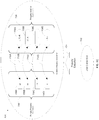
- FIGS. 5A-5C are diagrams illustrating operations for one embodiment of performing the layered address matching analysis of the present disclosure
- FIG. 6 is a diagram illustrating operations for the example embodiment of performing the layered address matching analysis of the present disclosure as described in FIGS. 5B-5C .
- Various embodiments of the present disclosure include a system and method for determining whether two or more addresses match by causing a processor to extract certain strings or tokens from the addresses into address property containers and comparing the extracted properties and associated modifiers in a layered approach based on the information constructed in the address property containers. More specifically, in various embodiments, after verifying the content for state, province and city are a match, the address matching system and method of the present disclosure compares the street address portion of the address to determine whether the two or more addresses are a match.
- the street addresses are treated as alphanumeric free format text with certain strings or tokens defined as primary properties and the strings or tokens surrounding each primary property defined as the associated modifiers.
- the primary properties of an address are the numbers in free format text from the street address.
- the text strings on either side of each primary property are referred to as modifiers associated with the primary properties.
- the address matching system and method of the present disclosure includes extracting the primary properties and their associated modifiers from the street address, storing the primary properties and associated modifiers into address property containers, and comparing the addresses in a layered approach based on the information constructed in the address property containers.
- the first stage, or layer, of matching includes comparing the primary properties of the addresses for a mismatch determination.
- a mismatch determination results if no primary properties from the target address match the primary properties of the base address.
- a mismatch determination can be made immediately without consideration of any other part of the address. If the primary property comparison results in a mismatch determination, the processor rejects the addresses as unmatched. If there is no primary property of the first address in conflict with the primary properties of the second address, and vice versa, the second stage or layer of matching is initiated.
- the second layer of matching includes comparing the modifiers associated with each primary property.
- the modifiers associated with a first primary property of a first address are compared to the modifiers associated with the selected primary property of a second address.
- the modifiers themselves are analyzed and fed back into the main algorithm to extract primary properties from within themselves based on the nature and complexity of the address data. If it is determined that there is no further need to extract primary properties from the modifiers, the second layer also becomes the last layer in the overall address match process.
- FIG. 1 is a block diagram of a search system including a matching engine according to one embodiment of the present disclosure.
- FIG. 1 illustrates a search system 100 for the retrieval and matching of database records, including an embodiment of matching of addresses in search queries and/or database records, in accordance with one or more principles of the invention.
- the system 100 may utilize information derived from a free format data source 104 loaded into the system 100 and/or information from a search query transmitted to the system 100 to return a set of records as a search result set.
- the system 100 may be part of a larger system, such as the International Credit Reporting System (iCRS) from TransUnion.
- iCRS International Credit Reporting System
- the system 100 can perform refined matching on a set of initially retrieved database records.
- the set of initially retrieved records may be found by a search engine 106 from a database 108 , and a matching engine 110 that includes an address matching engine 112 may further process the initially retrieved records to find a more accurate set of results, based on the initial search query.
- the address matching engine 112 may perform comparisons on a set of database records, based on the addresses in each of the records.
- a socket server (not shown) may be included in the system 100 to manage connections with client applications. Multiple requests may be sent through the socket server when a socket connection is maintained, or a new socket connection may be required for each request.
- An application 102 may generate and initiate a search query to retrieve one or more results from the database 108 that is derived from the data in the free format data source 104 .
- the search query may be intended to retrieve the record of a particular subject consumer.
- the application 102 may be a software application, for example, that is executing at a credit bureau and/or at a member of the credit bureau, including financial institutions, insurance companies, utility companies, etc. that wish to retrieve data related to a consumer, such as credit information, for a permissible purpose.
- a search query may be initiated by a bank when a consumer applies for a loan so that the bank can examine the consumer's credit report to assess the creditworthiness of the consumer.
- the bank can input the consumer's personal identifying information in the search query in order to retrieve the credit report.
- the application 102 may transmit a message that contains the search query to the system 100 , and in particular, the search engine 106 .
- the message may be in a defined JSON (JavaScript Object Notation) format, Extensible Markup Language (XML), or other format.
- Search results from the search engine 106 may be further refined by the matching engine 110 and the address matching engine 112 .
- the refined results of the search initiated by the search query may be returned to the application 102 by the matching engine 110 .
- a free format data source 104 may include raw consumer data that is not consistently formatted and/or is unstructured. Consumer data may include identifying information about a consumer as well as financial-related data, such as the status of debt repayment, on-time payment records, etc. Consumer data in the free format data source 104 may originate from a variety of sources, such as from public records, e.g., deeds, bankruptcy records, etc.; and members of credit bureaus, including financial institutions, insurance companies, utility companies, etc. The free format data source 104 may include minimal and/or incomplete identifying information in each record corresponding to a customer. Names and addresses in the free format data source 104 may be arbitrary, vague, and/or non-specific.
- addresses in the free format data source 104 may include “near the railway station, Guntur”, “the red house south of Joggers park”, or “over by the water tank 30 steps from the village square”. Such addresses may be valid and can receive mail but are non-specific as compared to the address formats used in developed markets. Each of the addresses may be contained in an inconsistent number of fields and/or may be arbitrarily divided into a single field or multiple fields. Other data in the free format data source 104 may be duplicative and therefore not unique enough to positively identify a particular consumer by itself. For example, the same account number may be used for loan accounts corresponding to different consumers at different branches of the same bank. In this case, further identifying information must be used to uniquely identify a particular consumer.
- Raw data from the free format data source 104 may be processed by the search engine 106 and placed in the database 108 .
- the raw data may be normalized by the search engine 106 and placed in the database 108 .
- Search queries to the search engine 106 may be used to retrieve an initial set of records from the database 108 .
- the search queries may be normalized and/or transformed by the search engine 106 prior to being executed. Normalization of the raw data and search queries into a condensed normalized format may allow for fuzzier matching of data. A portion or all of the raw data and search queries, such as names, addresses, dates of birth, etc., may be normalized. Normalization can include using exact and pattern substitutions using regular expressions to standardize the data so that fields in a search query may match the corresponding data in the database 108 since both the fields and the data have been normalized.
- Transformation of the search queries can include applying alterations to the search queries to allow the queries to be more expansive and inclusive than as specified in the original search queries.
- Transformed search queries may be sent with or without the original normalized search queries. Transformation rules may be customized for the particular market related to the free format data source.
- Embodiments of a search engine 106 are disclosed in a commonly-assigned non-provisional application, titled “System and Method for Subject Identification From Free Format Data Sources” (U.S. patent application Ser. No. 13/539,053), which is hereby incorporated by reference in its entirety. Search engines utilizing any type of searching algorithm may also be implemented in the search engine 106 .
- the matching engine 110 and the address matching engine 112 may process the search query and/or the initial set of records retrieved by the search engine 106 from the database 108 .
- a refined set of search results that more accurately match the search query may be returned to the application 102 by the matching engine 110 .
- Embodiments of a matching engine 110 are disclosed in a commonly-assigned non-provisional application, titled “System and Method for Matching of Database Records Based on Similarities to Search Queries” (U.S. patent application Ser. No. 13/538,926), which is hereby incorporated by reference in its entirety.
- FIG. 2 illustrates the address matching engine 112 that may match addresses to one another for evaluating the similarities between addresses.
- the address matching engine 112 may be used as part of a matching engine 110 that receives addresses in database records from a search engine 106 , as described above.
- the address matching engine 112 may be used by itself or in conjunction with other systems in order to match addresses from any source, such as a data file or other media.
- the address matching engine 112 may be utilized to de-duplicate multiple addresses for a particular consumer or verify an address match during a dispute process.
- the address matching engine 112 includes a property extraction engine 150 , a primary property matching engine 152 and a property modifier matching engine 154 . To perform an analysis of the free format address, the address matching engine 112 receives two or more addresses in free format text. The matching engine 112 may receive the addresses from a source, such as a database, search query, file, or other media. The number of addresses received may vary, depending on the desired usage of the address matching engine 112 . For example, an input address and one or more candidate addresses may be transmitted to the address matching engine 112 so that the input address may be compared to the candidate addresses. As another example, multiple input addresses and multiple candidate addresses may be transmitted to the address matching engine 112 so that each of the input addresses may be compared to the multiple candidate addresses.
- certain strings and tokens of each of the addresses are extracted and stored into address property containers 156 at the property extraction engine 150 . More specifically, the property extraction engine 150 may deterministically evaluate strings in the addresses and deconstruct the addresses to extract the primary properties of the address and their associated modifiers.
- the primary properties of the addresses are any numbers within the addresses.
- the modifiers are the strings or tokens (i.e., characters, letters, symbols, spaces) on either side of each primary property.
- the extracted primary properties and associated modifiers of an input address are stored into an address property container 156 . Each primary property is linked with its corresponding modifiers in the address property container 156 .
- the first layer of the address matching system and method includes comparing the primary properties of the addresses at the primary property matching engine 152 . More specifically, in this first stage, or layer, of matching, the primary properties are compared for a mismatch determination. A mismatch determination results if there is at least one primary property of the target address in conflict with the primary properties of the base address, and vice versa. A mismatch determination can be made immediately without consideration of any other part of the address. If the primary property comparison results in a mismatch determination, the processor rejects the addresses as unmatched.
- the second stage or layer of matching is initiated at the property modifier matching engine 154 . More specifically, the associated modifiers for a first primary property in a first address is compared to the associated modifiers for the selected primary properties in the second address.
- the first layer of the comparison bears little weight. More specifically, if a first address and a second address do not include any primary properties (i.e., numbers), the primary property comparison does not result in a match or a mismatch. In such an embodiment, the strings and number of tokens are analyzed in the modifier matching engine 154 to determine whether there is a match.
- the comparison may include direct matching of data, matching characters from strings, matching and/or expanding initials or acronyms, configurable phonetic matching, awareness of and/or ignoring noise words (e.g., “and”, “to”, “site”), configurable known replacement strings, fuzzy string algorithms, word concatenation algorithms, pluralization algorithms, numerical versus non-numerical token analysis, and/or other techniques.
- the second layer of comparison is given more weight than the first layer of comparison.
- the modifiers of primary properties contain a different layer of properties that can be extracted in modifier comparison. In such embodiments, the modifiers are fed back into property extraction engine 150 to drive the address matching recursively as illustrated in FIG. 2 .
- FIG. 3 is a block diagram of a computing device 200 housing executable software used to facilitate the search system 100 and/or the address matching engine 112 .
- One or more instances of the computing device 200 may be utilized to implement any, some, or all of the components in the system 100 , including the search engine 106 , the matching engine 110 , and the address matching engine 112 .
- Computing device 200 includes a memory element 204 .
- Memory element 204 may include a computer readable medium for implementing the system 100 , and for implementing particular system transactions. Memory element 204 may also be utilized to implement the database 108 .
- Computing device 200 also contains executable software, some of which may or may not be unique to the system 100 .
- system 100 is implemented in software, as an executable program, and is executed by one or more special or general purpose digital computer(s), such as a mainframe computer, a commodity server, a personal computer (desktop, laptop or otherwise), personal digital assistant, or other handheld computing device. Therefore, computing device 200 may be representative of any computer in which the system 100 resides or partially resides.
- special or general purpose digital computer(s) such as a mainframe computer, a commodity server, a personal computer (desktop, laptop or otherwise), personal digital assistant, or other handheld computing device. Therefore, computing device 200 may be representative of any computer in which the system 100 resides or partially resides.
- computing device 200 includes a processor 202 , a memory 204 , and one or more input and/or output (I/O) devices 206 (or peripherals) that are communicatively coupled via a local interface 208 .
- Local interface 208 may be one or more buses or other wired or wireless connections, as is known in the art.
- Local interface 208 may have additional elements, which are omitted for simplicity, such as controllers, buffers (caches), drivers, transmitters, and receivers to facilitate external communications with other like or dissimilar computing devices.
- local interface 208 may include address, control, and/or data connections to enable internal communications among the other computer components.
- Processor 202 is a hardware device for executing software, particularly software stored in memory 204 .
- Processor 202 can be any custom made or commercially available processor, such as, for example, a Core series or vPro processor made by Intel Corporation, or a Phenom, Athlon or Sempron processor made by Advanced Micro Devices, Inc.
- the processor may be, for example, a Xeon or Itanium processor from Intel, or an Opteron-series processor from Advanced Micro Devices, Inc.
- Processor 202 may also represent multiple parallel or distributed processors working in unison.
- Memory 204 can include any one or a combination of volatile memory elements (e.g., random access memory (RAM, such as DRAM, SRAM, SDRAM, etc.)) and nonvolatile memory elements (e.g., ROM, hard drive, flash drive, CDROM, etc.). It may incorporate electronic, magnetic, optical, and/or other types of storage media. Memory 204 can have a distributed architecture where various components are situated remote from one another, but are still accessed by processor 202 . These other components may reside on devices located elsewhere on a network or in a cloud arrangement.
- RAM random access memory
- SRAM static random access memory
- SDRAM Secure Digital Read Only Memory
- 204 can have a distributed architecture where various components are situated remote from one another, but are still accessed by processor 202 . These other components may reside on devices located elsewhere on a network or in a cloud arrangement.
- the software in memory 204 may include one or more separate programs.
- the separate programs comprise ordered listings of executable instructions for implementing logical functions.
- the software in memory 204 may include the system 100 in accordance with the invention, and a suitable operating system (O/S) 212 .
- suitable commercially available operating systems 212 are Windows operating systems available from Microsoft Corporation, Mac OS X available from Apple Computer, Inc., a Unix operating system from AT&T, or a Unix-derivative such as BSD or Linux.
- the operating system O/S 212 will depend on the type of computing device 200 .
- the operating system 212 may be iOS for operating certain devices from Apple Computer, Inc., PalmOS for devices from Palm Computing, Inc., Windows Phone 8 from Microsoft Corporation, Android from Google, Inc., or Symbian from Nokia Corporation.
- Operating system 212 essentially controls the execution of other computer programs, such as the system 100 , and provides scheduling, input-output control, file and data management, memory management, and communication control and related services.
- the software in memory 204 may further include a basic input output system (BIOS).
- BIOS is a set of essential software routines that initialize and test hardware at startup, start operating system 212 , and support the transfer of data among the hardware devices.
- the BIOS is stored in ROM so that the BIOS can be executed when computing device 200 is activated.
- Steps and/or elements, and/or portions thereof of the invention may be implemented using a source program, executable program (object code), script, or any other entity comprising a set of instructions to be performed.
- the software embodying the invention can be written as (a) an object oriented programming language, which has classes of data and methods, or (b) a procedural programming language, which has routines, subroutines, and/or functions, for example but not limited to, C, C++, C#, Pascal, Basic, Fortran, Cobol, Perl, Java, Ada, and Lua.
- Components of the system 100 may also be written in a proprietary language developed to interact with these known languages.
- I/O device 206 may include input devices such as a keyboard, a mouse, a scanner, a microphone, a touch screen, a bar code reader, or an infra-red reader. It may also include output devices such as a printer, a video display, an audio speaker or headphone port or a projector. I/O device 206 may also comprise devices that communicate with inputs or outputs, such as a short-range transceiver (RFID, Bluetooth, etc.), a telephonic interface, a cellular communication port, a router, or other types of network communication equipment. I/O device 206 may be internal to computing device 200 , or may be external and connected wirelessly or via connection cable, such as through a universal serial bus port.
- RFID short-range transceiver
- Bluetooth Bluetooth
- I/O device 206 may be internal to computing device 200 , or may be external and connected wirelessly or via connection cable, such as through a universal serial bus port.
- processor 202 When computing device 200 is in operation, processor 202 is configured to execute software stored within memory 204 , to communicate data to and from memory 204 , and to generally control operations of computing device 200 pursuant to the software.
- the system 100 and operating system 212 in whole or in part, may be read by processor 202 , buffered within processor 202 , and then executed.
- a “computer-readable medium” may be any means that can store, communicate, propagate, or transport data objects for use by or in connection with the system 100 .
- the computer readable medium may be for example, an electronic, magnetic, optical, electromagnetic, infrared, or semiconductor system, apparatus, device, propagation medium, or any other device with similar functionality.
- the computer-readable medium would include the following: an electrical connection (electronic) having one or more wires, a random access memory (RAM) (electronic), a read-only memory (ROM) (electronic), an erasable programmable read-only memory (EPROM, EEPROM, or Flash memory) (electronic), an optical fiber (optical), and a portable compact disc read-only memory (CDROM) (optical).
- an electrical connection having one or more wires
- RAM random access memory
- ROM read-only memory
- EPROM erasable programmable read-only memory
- Flash memory erasable programmable read-only memory
- CDROM portable compact disc read-only memory
- the computer-readable medium could even be paper or another suitable medium upon which the program is printed, as the program can be electronically captured, via, for instance, optical scanning of the paper or other medium, then compiled, interpreted or otherwise processed in a suitable manner if necessary, and stored in a computer memory.
- the system 100 can be embodied in any type of computer-readable medium for use by or in connection with an instruction execution system or apparatus, such as a computer.
- computing device 200 is equipped with network communication equipment and circuitry.
- the network communication equipment includes a network card such as an Ethernet card, or a wireless connection card.
- each of the plurality of computing devices 200 on the network is configured to use the Internet protocol suite (TCP/IP) to communicate with one another.
- TCP/IP Internet protocol suite
- network protocols could also be employed, such as IEEE 802.11 Wi-Fi, address resolution protocol ARP, spanning-tree protocol STP, or fiber-distributed data interface FDDI.
- each computing device 200 may have a broadband or wireless connection to the Internet (such as DSL, Cable, Wireless, T-1, T-3, OC3 or satellite, etc.), the principles of the invention are also practicable with a dialup connection through a standard modem or other connection means.
- Wireless network connections are also contemplated, such as wireless Ethernet, satellite, infrared, radio frequency, Bluetooth, near field communication, and cellular networks.
- FIG. 4 illustrates a flowchart of one embodiment of a process 400 for operating the address matching system and method of the present disclosure.
- this process 400 is embodied in one or more software programs stored in one or more memories and executed by one or more processors or servers.
- this process 400 is described with reference to the flowchart illustrated in FIG. 4 , it should be appreciated that many other methods of performing the acts associated with these processes may be used. For example, the order of certain steps described may be changed, or certain steps described may be optional.
- the process 400 can result in the determination that an input address and a candidate address are a match.
- the address match determination may assist in the refinement of a set of search results from a search engine 106 through merging of matching database records.
- the address matching engine 112 may perform all or part of the process 400 .
- addresses may be received at the address matching engine 112 .
- the addresses may be received from any source and the number of addresses that are received at the engine 112 may vary.
- the addresses may be from a set of retrieved search records of a search query that were received from a search engine 106 and/or an application 102 .
- the records may have been retrieved from the database 108 by the search engine 106 based on a search query received from the application 102 .
- the addresses may be from a source or application that wishes to compare one or more input addresses to one or more candidate addresses to determine their similarities.
- primary properties and the associated modifiers are extracted from the addresses by the property extraction engine 150 . More specifically, the property extraction engine 150 may deterministically evaluate strings in the addresses and deconstruct the addresses to extract the primary properties of the address and their associated modifiers.
- the primary properties of an address are the numbers within the address and the associated modifiers are the strings on either side of each primary property. For example, in terms of address lines, numbers contained in a street address are considered the primary properties and the characters (or lack thereof) on either side of each number are the modifiers associated with each primary property.
- the extracted primary properties and associated modifiers of an input address are stored into an address property container.
- Each primary property is linked with its corresponding modifiers in the address property container.
- the primary properties of the two or more addresses are compared at the primary property matching engine 152 .
- the primary properties of a first address are compared to the primary properties of a second address to determine whether the two addresses have no primary property (i.e., number) in conflict with each other.
- the process 400 includes determining whether the primary property comparison renders a mismatch. If there is at least one primary property in conflict between the two or more addresses, the result is a mismatch and the process 400 includes rejecting the address as unmatched as indicated by block 412 .
- the process 400 continues to the second layer of the address matching analysis at step 414 , which includes comparing the associated modifiers at the property modifier matching engine 154 . More specifically, the associated modifiers for a primary property in one address is compared to the associated modifiers for the selected primary properties in the second address.
- the process 400 includes determining whether the modifiers render a match. In one embodiment, if at least one modifier associated with each primary property of a first address matches with at least one modifier associated with the corresponding primary property of a second address, the process 400 determines that the addresses are a match.
- the process 400 includes rejecting the address as unmatched, as indicated by block 418 . If on the other hand, the modifiers sufficiently match, the process 400 includes returning the address as matched, as indicated by block 420 .
- the threshold of comparison on modifiers varies based on the characteristics of addresses including primary property matching result as well as external factors such as the market and the source of addresses. For example, when comparing modifiers of addresses with strong primary property match i.e. higher number of matching primary properties, the threshold is different than when comparing modifiers of addresses with weak primary property match i.e. lower number of matching primary properties. The likelihood of two addresses being the same with high number of primary properties matching exactly is higher than two addresses with weaker primary property match. As such, in certain alternative embodiments, the threshold of comparison may require less matching between the modifiers.
- two addresses may be deemed a match so long as at least one modifier associated with at least one common primary property of a first address matches at least one modifier associated with the corresponding common primary property of the second address.
- the threshold of comparison may require more matching between the modifiers.
- FIG. 5A illustrates a diagram of the process 500 of extracting and storing primary properties and associated modifiers at the property extraction engine 150 .
- an address 502 in free format text is received at a processor.
- the primary properties and associated modifiers are extracted from the address as indicated by arrow 504 .
- the primary properties of the address are extracted and stored into a primary property container 506 .
- the modifiers associated with each primary property are extracted and stored into property modifier containers 508 that are linked to the respective primary properties, as indicated by the arrows 510 .
- FIGS. 5B and 5C illustrate a diagram of one example embodiment of the process 500 depicted in FIG. 5A .
- FIG. 5B illustrates the process 500 with respect to a first address 602
- FIG. 5C illustrates the process 500 with respect to a second address 702 .
- FIG. 5B which illustrates the first address 602 is received by a processor in free format text.
- the first address 602 is “MZ #15-54 JOROBA C84 LT 4.”
- Arrow 604 represents the extraction and storing of primary properties and the associated modifiers from the address into the address property container.
- the primary properties i.e., numbers in the address
- the primary properties are extracted and stored into a primary property container 606 which contains property elements 606 A, 606 B, 606 C, and 606 D. Accordingly, the extracted primary properties are: (a) “84” in property element 606 A, (b) “54” in property element 606 B, (c) “15” in property element 606 C, and (d) “4” in property element 606 D.
- the modifiers associated with each primary property are the strings or tokens on either side of each primary property.
- the modifiers associated with each primary property are extracted and stored into a property modifier container that is linked to the corresponding primary property. Accordingly, for primary property “84,” the associated modifiers (i.e., the characters on either side of the number) are [“JOROBA, “C”] and “LT,” which are stored into property modifier container 608 A.
- Primary property element 606 A is linked to property modifier container 608 A as indicated by linking arrow 610 .
- the associated modifiers “-” (for the hyphen) and [“JOROBA”, “C”] are stored into property modifier container 608 B, which is linked to the primary property element 606 B by linking arrow 610 B.
- FIG. 5C illustrates the process 500 in operation for the second address 702 . More specifically, as illustrated in FIG. 5C , the second address 702 is received by a processor in free format text. In this example, the second address 702 is “J 84 C #54-15-4.” Arrow 704 represents the extraction and storing of primary properties and the associated modifiers from the address into the address property container.
- the primary properties i.e., numbers in the address
- the primary properties are extracted and stored into a primary property container 706 which contains property elements 706 A, 706 B, 706 C, and 706 D. Accordingly, the extracted primary properties are: (a) “84” in property element 706 A, (b) “54” in property element 706 B, (c) “15” in property element 706 C, and (d) “4” in property element 706 D.
- the modifiers associated with each primary property are extracted and stored into the following property modifier containers: (a) for primary property “84,” the associated modifiers “J,” [“C”, “#”] are stored into property modifier container 708 A, which is linked to the primary property element 706 A; (b) for primary property “54,” the associated modifiers [“C”, “#”] and “-” (for the hyphen), are stored into property modifier container 708 B, which is linked to the primary property element 706 B by linking arrow 710 B; (c) for primary property “15,” the associated modifiers “-” and “-” (for the hyphens), are stored into property modifier container 708 C, which is linked to the primary property element 706 C by linking arrow 710 C; and (d) for primary property “4,” the associated modifiers “-” (for the hyphens) and “Null”, are stored into property modifier container 708 D, which is linked to the primary property element 706 D by linking arrow 710 D.
- the address matching system and method includes comparing the primary properties at the primary property matching engine 152 .
- the primary properties of the two or more addresses are compared to determine whether there is a mismatch.
- the primary properties of the first address 602 all match the primary properties of the second address 702 , therefore there is no mismatch.
- the comparison of primary properties renders a fine resolution on different levels of similarity between the primary properties of the addresses. For example, the comparison of primary properties of two or more addresses could render an exact match (i.e., 1, 2, 3 vs 1, 2, 3) or different levels of “subset of” relationship (i.e., (1, 2, 3 vs 1, 2) and (1, 2, 3 vs 3)).
- FIG. 6 illustrates a diagram for the address comparison from FIGS. 5B and 5C .
- the primary property elements 606 A, 606 B, 606 C, 606 D of the first address 602 are compared to the primary property elements 706 A, 706 B, 706 C, 706 D of the second address 702 .
- the modifiers associated with each primary property are compared at the property modifier matching engine 154 in the second layer of matching.
- the modifiers associated with a first primary property element 606 A of the first address 602 are compared to the modifiers associated with the corresponding primary property element 706 A (if any) of the second address 702 . More specifically, for the first address 602 , for primary property element “84” 606 A, the associated modifiers are [“JOROBA”, “C”] and “LT” as indicated by modifier address property container 608 A and by linking arrow 610 A in FIG. 5B . For the corresponding primary property element “84” 706 A of the second address 702 , the associated modifiers are “J” and [“C”, “#”] as indicated by modifier address property container 708 A and linking arrow 710 A in FIG. 5C . The modifiers associated with “84” of the first address 602 are compared to the modifiers associated with “84” of the second address 702 .
- both addresses 602 , 702 include a common modifier “C.” and a partial string match between “JOROBA” and “J.” As such, this first comparison results in a match.
- both addresses 602 , 702 include common modifiers “-” and “C.”
- both addresses 602 , 702 include common modifier “-.”
- both addresses include common modifier “Null.” In this embodiment, because the associated modifiers for each of the primary properties results in at least one match, the two addresses are deemed to be a match.
- the threshold of comparison on modifiers varies based on the characteristics of addresses including the primary property matching result as well as external factors such as the market and the source of addresses.
- at least one modifier associated with the primary property from the first address matches with at least one modifier associated with the corresponding primary property from the second address.
- the threshold of comparison may require less matches between the modifiers.
- two addresses may be deemed a match so long as at least one modifier associated with at least one common primary property of a first address matches at least one modifier associated with the corresponding common primary property of the second address.
- the threshold of comparison may require more matches between the modifiers.
- the weighting factor is applied to the different layers of the comparison approach.
- Other address matching approaches include assigning different weight based on a predetermined order of importance of different components of the address.
- One problem with this approach is that in different locales, different countries and regions place importance on different components of an address.
- the first layer comes in for the primary property comparison and naturally receives the highest weight.
- the subsequent layers have their weighting factor correspondingly.
- the modifier comparison adjusts the upper layer, i.e., the primary property comparison. For example, if the addresses being compared do not include numbers, the first layer (comparison of the primary properties) is given less weight.
- the second layer of comparison i.e., the comparison of the modifiers is given more weight than in embodiments where there are many primary properties that match.
- the weight given to the primary properties may also vary comparison to comparison. For example, when comparing two addresses that have many numbers in the address, the primary property extraction and comparison is going to be more decisive than if comparing two addresses with fewer numbers.
- any process descriptions or blocks in figures should be understood as representing modules, segments, or portions of code which include one or more executable instructions for implementing specific logical functions or steps in the process, and alternate implementations are included within the scope of the embodiments of the invention in which functions may be executed out of order from that shown or discussed, including substantially concurrently or in reverse order, depending on the functionality involved, as would be understood by those having ordinary skill in the art.
Landscapes
- Engineering & Computer Science (AREA)
- Databases & Information Systems (AREA)
- Theoretical Computer Science (AREA)
- Physics & Mathematics (AREA)
- Data Mining & Analysis (AREA)
- General Engineering & Computer Science (AREA)
- General Physics & Mathematics (AREA)
- Quality & Reliability (AREA)
- Computational Linguistics (AREA)
- Fuzzy Systems (AREA)
- Mathematical Physics (AREA)
- Software Systems (AREA)
- Automation & Control Theory (AREA)
- Probability & Statistics with Applications (AREA)
- Information Retrieval, Db Structures And Fs Structures Therefor (AREA)
- Character Discrimination (AREA)
- Investigating Or Analysing Biological Materials (AREA)
Abstract
Description
Claims (24)
Priority Applications (1)
| Application Number | Priority Date | Filing Date | Title |
|---|---|---|---|
| US16/705,909 US10885139B2 (en) | 2015-11-24 | 2019-12-06 | System and method for automated address verification |
Applications Claiming Priority (3)
| Application Number | Priority Date | Filing Date | Title |
|---|---|---|---|
| US201562259507P | 2015-11-24 | 2015-11-24 | |
| US15/358,413 US10503798B2 (en) | 2015-11-24 | 2016-11-22 | System and method for automated address verification |
| US16/705,909 US10885139B2 (en) | 2015-11-24 | 2019-12-06 | System and method for automated address verification |
Related Parent Applications (1)
| Application Number | Title | Priority Date | Filing Date |
|---|---|---|---|
| US15/358,413 Continuation US10503798B2 (en) | 2015-11-24 | 2016-11-22 | System and method for automated address verification |
Publications (2)
| Publication Number | Publication Date |
|---|---|
| US20200285679A1 US20200285679A1 (en) | 2020-09-10 |
| US10885139B2 true US10885139B2 (en) | 2021-01-05 |
Family
ID=58720798
Family Applications (2)
| Application Number | Title | Priority Date | Filing Date |
|---|---|---|---|
| US15/358,413 Active 2037-01-29 US10503798B2 (en) | 2015-11-24 | 2016-11-22 | System and method for automated address verification |
| US16/705,909 Active US10885139B2 (en) | 2015-11-24 | 2019-12-06 | System and method for automated address verification |
Family Applications Before (1)
| Application Number | Title | Priority Date | Filing Date |
|---|---|---|---|
| US15/358,413 Active 2037-01-29 US10503798B2 (en) | 2015-11-24 | 2016-11-22 | System and method for automated address verification |
Country Status (9)
| Country | Link |
|---|---|
| US (2) | US10503798B2 (en) |
| EP (1) | EP3380928A4 (en) |
| CN (1) | CN108292204B (en) |
| CA (1) | CA3004599C (en) |
| CO (1) | CO2018005318A2 (en) |
| MX (1) | MX389247B (en) |
| PH (1) | PH12018500973A1 (en) |
| WO (1) | WO2017091545A1 (en) |
| ZA (1) | ZA201803014B (en) |
Cited By (6)
| Publication number | Priority date | Publication date | Assignee | Title |
|---|---|---|---|---|
| US11681733B2 (en) | 2017-01-31 | 2023-06-20 | Experian Information Solutions, Inc. | Massive scale heterogeneous data ingestion and user resolution |
| US11734234B1 (en) | 2018-09-07 | 2023-08-22 | Experian Information Solutions, Inc. | Data architecture for supporting multiple search models |
| US11769112B2 (en) | 2008-06-26 | 2023-09-26 | Experian Marketing Solutions, Llc | Systems and methods for providing an integrated identifier |
| US11847693B1 (en) | 2014-02-14 | 2023-12-19 | Experian Information Solutions, Inc. | Automatic generation of code for attributes |
| US11880377B1 (en) | 2021-03-26 | 2024-01-23 | Experian Information Solutions, Inc. | Systems and methods for entity resolution |
| US11941065B1 (en) | 2019-09-13 | 2024-03-26 | Experian Information Solutions, Inc. | Single identifier platform for storing entity data |
Families Citing this family (7)
| Publication number | Priority date | Publication date | Assignee | Title |
|---|---|---|---|---|
| US8285656B1 (en) | 2007-03-30 | 2012-10-09 | Consumerinfo.Com, Inc. | Systems and methods for data verification |
| CA3004599C (en) | 2015-11-24 | 2022-06-21 | Trans Union Llc | System and method for automated address verification |
| CN107707745A (en) * | 2017-09-25 | 2018-02-16 | 百度在线网络技术(北京)有限公司 | Method and apparatus for extracting information |
| CN109583933B (en) * | 2018-10-09 | 2022-07-08 | 顺丰科技有限公司 | Address information judging method, device, equipment and storage medium thereof |
| EP3985526A1 (en) | 2020-10-13 | 2022-04-20 | Tata Consultancy Services Limited | System and method for auto-mapping source and target data attributes based on metadata information |
| CN116126752B (en) * | 2022-10-20 | 2025-11-25 | 马上消费金融股份有限公司 | Data processing methods and apparatus, storage media and electronic devices |
| US12253986B1 (en) * | 2023-06-27 | 2025-03-18 | Surescripts, Llc | Database schema to simplify processing and reduce false positive matches in ambiguous data |
Citations (15)
| Publication number | Priority date | Publication date | Assignee | Title |
|---|---|---|---|---|
| US3702010A (en) | 1970-10-12 | 1972-10-31 | Bell Telephone Labor Inc | Information retrieval strategy |
| US20030182018A1 (en) * | 2002-03-06 | 2003-09-25 | Snapp Robert F. | Method for correcting a mailing address |
| US20040015493A1 (en) * | 2000-11-17 | 2004-01-22 | Garner Michael C. | Address matching |
| US6985926B1 (en) * | 2001-08-29 | 2006-01-10 | I-Behavior, Inc. | Method and system for matching and consolidating addresses in a database |
| US20060069717A1 (en) | 2003-08-27 | 2006-03-30 | Ascential Software Corporation | Security service for a services oriented architecture in a data integration platform |
| US7743043B2 (en) * | 1999-10-19 | 2010-06-22 | Stamps.Com | Address matching system and method |
| US20110087839A1 (en) | 2009-10-09 | 2011-04-14 | Verizon Patent And Licensing Inc. | Apparatuses, methods and systems for a smart address parser |
| US20110307359A1 (en) | 2010-06-10 | 2011-12-15 | Verizon Patent And Licensing, Inc. | Systems and methods for managing address and tax inventory data |
| US20130097134A1 (en) | 2011-10-14 | 2013-04-18 | Trans Union Llc. | System and method for subject identification from free format data sources |
| US20130097157A1 (en) | 2011-10-14 | 2013-04-18 | Trans Union Llc. | System and method for matching of database records based on similarities to search queries |
| US20130185317A1 (en) | 2012-01-18 | 2013-07-18 | Nathan J. Welton | Pdf address extractor for mail |
| US20130311448A1 (en) | 2012-05-16 | 2013-11-21 | Trans Union Llc. | System and method for contextual and free format matching of addresses |
| US8996523B1 (en) * | 2011-05-24 | 2015-03-31 | Google Inc. | Forming quality street addresses from multiple providers |
| US10007739B1 (en) | 2007-07-03 | 2018-06-26 | Valassis Direct Mail, Inc. | Address database reconciliation |
| US10503798B2 (en) | 2015-11-24 | 2019-12-10 | Trans Union Llc | System and method for automated address verification |
Family Cites Families (1)
| Publication number | Priority date | Publication date | Assignee | Title |
|---|---|---|---|---|
| CN101840406B (en) * | 2009-03-20 | 2015-10-14 | 富士通株式会社 | Place name searching device and system |
-
2016
- 2016-11-22 CA CA3004599A patent/CA3004599C/en active Active
- 2016-11-22 MX MX2018006403A patent/MX389247B/en unknown
- 2016-11-22 US US15/358,413 patent/US10503798B2/en active Active
- 2016-11-22 CN CN201680068348.1A patent/CN108292204B/en active Active
- 2016-11-22 WO PCT/US2016/063256 patent/WO2017091545A1/en not_active Ceased
- 2016-11-22 EP EP16869155.8A patent/EP3380928A4/en not_active Withdrawn
-
2018
- 2018-05-04 PH PH12018500973A patent/PH12018500973A1/en unknown
- 2018-05-08 ZA ZA2018/03014A patent/ZA201803014B/en unknown
- 2018-05-21 CO CONC2018/0005318A patent/CO2018005318A2/en unknown
-
2019
- 2019-12-06 US US16/705,909 patent/US10885139B2/en active Active
Patent Citations (16)
| Publication number | Priority date | Publication date | Assignee | Title |
|---|---|---|---|---|
| US3702010A (en) | 1970-10-12 | 1972-10-31 | Bell Telephone Labor Inc | Information retrieval strategy |
| US7743043B2 (en) * | 1999-10-19 | 2010-06-22 | Stamps.Com | Address matching system and method |
| US20040015493A1 (en) * | 2000-11-17 | 2004-01-22 | Garner Michael C. | Address matching |
| US6985926B1 (en) * | 2001-08-29 | 2006-01-10 | I-Behavior, Inc. | Method and system for matching and consolidating addresses in a database |
| US20030182018A1 (en) * | 2002-03-06 | 2003-09-25 | Snapp Robert F. | Method for correcting a mailing address |
| US20060069717A1 (en) | 2003-08-27 | 2006-03-30 | Ascential Software Corporation | Security service for a services oriented architecture in a data integration platform |
| US10007739B1 (en) | 2007-07-03 | 2018-06-26 | Valassis Direct Mail, Inc. | Address database reconciliation |
| US20110087839A1 (en) | 2009-10-09 | 2011-04-14 | Verizon Patent And Licensing Inc. | Apparatuses, methods and systems for a smart address parser |
| US20110307359A1 (en) | 2010-06-10 | 2011-12-15 | Verizon Patent And Licensing, Inc. | Systems and methods for managing address and tax inventory data |
| US8996523B1 (en) * | 2011-05-24 | 2015-03-31 | Google Inc. | Forming quality street addresses from multiple providers |
| US20130097134A1 (en) | 2011-10-14 | 2013-04-18 | Trans Union Llc. | System and method for subject identification from free format data sources |
| US20130097157A1 (en) | 2011-10-14 | 2013-04-18 | Trans Union Llc. | System and method for matching of database records based on similarities to search queries |
| US20130185317A1 (en) | 2012-01-18 | 2013-07-18 | Nathan J. Welton | Pdf address extractor for mail |
| US20130311448A1 (en) | 2012-05-16 | 2013-11-21 | Trans Union Llc. | System and method for contextual and free format matching of addresses |
| US20140379687A1 (en) | 2012-05-16 | 2014-12-25 | Trans Union Llc | System and method for contextual and free format matching of addresses |
| US10503798B2 (en) | 2015-11-24 | 2019-12-10 | Trans Union Llc | System and method for automated address verification |
Non-Patent Citations (3)
| Title |
|---|
| The United States Patent and Trademark Office, International Search Report in International Application No. PCT/US16/63256 (dated Feb. 7, 2017). |
| The United States Patent and Trademark Office, Written Opinion of the International Searching Authority in International Application No. PCT/US16/63256 (dated Feb. 7, 2017). |
| U.S. Appl. No. 15/358,413, filed Nov. 22, 2016. |
Cited By (11)
| Publication number | Priority date | Publication date | Assignee | Title |
|---|---|---|---|---|
| US11769112B2 (en) | 2008-06-26 | 2023-09-26 | Experian Marketing Solutions, Llc | Systems and methods for providing an integrated identifier |
| US12205076B2 (en) | 2008-06-26 | 2025-01-21 | Experian Marketing Solutions, Llc | Systems and methods for providing an integrated identifier |
| US11847693B1 (en) | 2014-02-14 | 2023-12-19 | Experian Information Solutions, Inc. | Automatic generation of code for attributes |
| US11681733B2 (en) | 2017-01-31 | 2023-06-20 | Experian Information Solutions, Inc. | Massive scale heterogeneous data ingestion and user resolution |
| US12386875B2 (en) | 2017-01-31 | 2025-08-12 | Experian Information Solutions, Inc. | Massive scale heterogeneous data ingestion and user resolution |
| US11734234B1 (en) | 2018-09-07 | 2023-08-22 | Experian Information Solutions, Inc. | Data architecture for supporting multiple search models |
| US12066990B1 (en) | 2018-09-07 | 2024-08-20 | Experian Information Solutions, Inc. | Data architecture for supporting multiple search models |
| US12511270B1 (en) | 2018-09-07 | 2025-12-30 | Experian Information Solutions, Inc. | Data architecture for supporting multiple search models |
| US11941065B1 (en) | 2019-09-13 | 2024-03-26 | Experian Information Solutions, Inc. | Single identifier platform for storing entity data |
| US12353482B1 (en) | 2019-09-13 | 2025-07-08 | Experian Information Solutions, Inc. | Single identifier platform for storing entity data |
| US11880377B1 (en) | 2021-03-26 | 2024-01-23 | Experian Information Solutions, Inc. | Systems and methods for entity resolution |
Also Published As
| Publication number | Publication date |
|---|---|
| EP3380928A1 (en) | 2018-10-03 |
| MX389247B (en) | 2025-03-20 |
| WO2017091545A1 (en) | 2017-06-01 |
| CN108292204A (en) | 2018-07-17 |
| HK1251672A1 (en) | 2019-02-01 |
| US20170147698A1 (en) | 2017-05-25 |
| US10503798B2 (en) | 2019-12-10 |
| CO2018005318A2 (en) | 2018-05-31 |
| CA3004599A1 (en) | 2017-06-01 |
| PH12018500973A1 (en) | 2018-12-17 |
| CN108292204B (en) | 2023-05-23 |
| MX2018006403A (en) | 2018-09-24 |
| EP3380928A4 (en) | 2019-04-10 |
| ZA201803014B (en) | 2024-12-18 |
| CA3004599C (en) | 2022-06-21 |
| US20200285679A1 (en) | 2020-09-10 |
Similar Documents
| Publication | Publication Date | Title |
|---|---|---|
| US10885139B2 (en) | System and method for automated address verification | |
| US9292581B2 (en) | System and method for contextual and free format matching of addresses | |
| US12277130B2 (en) | System and method for matching of database records based on similarities to search queries | |
| CN110929125B (en) | Search recall method, device, equipment and storage medium thereof | |
| US20130097134A1 (en) | System and method for subject identification from free format data sources | |
| WO2021196935A1 (en) | Data checking method and apparatus, electronic device, and storage medium | |
| CA2852948C (en) | System and method for optimizing the loading of data submissions | |
| US20250265263A1 (en) | Electronic data analysis system and method | |
| CN112508720A (en) | Insurance client identity attribute screening method and screening device and electronic equipment | |
| TW202123026A (en) | Data archiving method, device, computer device and storage medium | |
| US11687574B2 (en) | Record matching in a database system | |
| CN112241458B (en) | Method, apparatus, device and readable storage medium for knowledge structure processing of text | |
| CN116861873A (en) | Contract data processing method and device | |
| HK1251672B (en) | System and method for automated address verification | |
| US20190340713A1 (en) | System and method for generating a document based on retrieved data | |
| HK40021105B (en) | Search recll method and device, apparatus and storage medium thereof | |
| CN119557398A (en) | Data processing method and system | |
| CN121301570A (en) | Methods, devices, electronic equipment, and storage media for responding to government affairs inquiries | |
| HK40021105A (en) | Search recll method and device, apparatus and storage medium thereof |
Legal Events
| Date | Code | Title | Description |
|---|---|---|---|
| FEPP | Fee payment procedure |
Free format text: ENTITY STATUS SET TO UNDISCOUNTED (ORIGINAL EVENT CODE: BIG.); ENTITY STATUS OF PATENT OWNER: LARGE ENTITY |
|
| STCF | Information on status: patent grant |
Free format text: PATENTED CASE |
|
| AS | Assignment |
Owner name: JPMORGAN CHASE BANK, N.A, NEW YORK Free format text: GRANT OF SECURITY INTEREST IN UNITED STATES PATENTS;ASSIGNORS:EBUREAU, LLC;IOVATION, INC.;SIGNAL DIGITAL, INC.;AND OTHERS;REEL/FRAME:058294/0161 Effective date: 20211201 |
|
| AS | Assignment |
Owner name: SONTIQ, INC., MARYLAND Free format text: TERMINATION AND RELEASE OF SECURITY INTEREST IN PATENTS RECORDED AT REEL 058294, FRAME 0161;ASSIGNOR:JPMORGAN CHASE BANK, N.A.;REEL/FRAME:058593/0852 Effective date: 20211223 Owner name: MARKETSHARE PARTNERS, LLC, VIRGINIA Free format text: TERMINATION AND RELEASE OF SECURITY INTEREST IN PATENTS RECORDED AT REEL 058294, FRAME 0161;ASSIGNOR:JPMORGAN CHASE BANK, N.A.;REEL/FRAME:058593/0852 Effective date: 20211223 Owner name: NEUSTAR IP INTELLIGENCE, INC., VIRGINIA Free format text: TERMINATION AND RELEASE OF SECURITY INTEREST IN PATENTS RECORDED AT REEL 058294, FRAME 0161;ASSIGNOR:JPMORGAN CHASE BANK, N.A.;REEL/FRAME:058593/0852 Effective date: 20211223 Owner name: NEUSTAR, INC., VIRGINIA Free format text: TERMINATION AND RELEASE OF SECURITY INTEREST IN PATENTS RECORDED AT REEL 058294, FRAME 0161;ASSIGNOR:JPMORGAN CHASE BANK, N.A.;REEL/FRAME:058593/0852 Effective date: 20211223 Owner name: TRUSTID, INC., VIRGINIA Free format text: TERMINATION AND RELEASE OF SECURITY INTEREST IN PATENTS RECORDED AT REEL 058294, FRAME 0161;ASSIGNOR:JPMORGAN CHASE BANK, N.A.;REEL/FRAME:058593/0852 Effective date: 20211223 Owner name: NEUSTAR INFORMATION SERVICES, INC., VIRGINIA Free format text: TERMINATION AND RELEASE OF SECURITY INTEREST IN PATENTS RECORDED AT REEL 058294, FRAME 0161;ASSIGNOR:JPMORGAN CHASE BANK, N.A.;REEL/FRAME:058593/0852 Effective date: 20211223 Owner name: TRU OPTIK DATA CORP., ILLINOIS Free format text: TERMINATION AND RELEASE OF SECURITY INTEREST IN PATENTS RECORDED AT REEL 058294, FRAME 0161;ASSIGNOR:JPMORGAN CHASE BANK, N.A.;REEL/FRAME:058593/0852 Effective date: 20211223 Owner name: AGGREGATE KNOWLEDGE, LLC, VIRGINIA Free format text: TERMINATION AND RELEASE OF SECURITY INTEREST IN PATENTS RECORDED AT REEL 058294, FRAME 0161;ASSIGNOR:JPMORGAN CHASE BANK, N.A.;REEL/FRAME:058593/0852 Effective date: 20211223 Owner name: TRANSUNION TELEDATA LLC, ILLINOIS Free format text: TERMINATION AND RELEASE OF SECURITY INTEREST IN PATENTS RECORDED AT REEL 058294, FRAME 0161;ASSIGNOR:JPMORGAN CHASE BANK, N.A.;REEL/FRAME:058593/0852 Effective date: 20211223 Owner name: TRANSUNION RENTAL SCREENING SOLUTIONS, INC., ILLINOIS Free format text: TERMINATION AND RELEASE OF SECURITY INTEREST IN PATENTS RECORDED AT REEL 058294, FRAME 0161;ASSIGNOR:JPMORGAN CHASE BANK, N.A.;REEL/FRAME:058593/0852 Effective date: 20211223 Owner name: TRANSUNION INTERACTIVE, INC., ILLINOIS Free format text: TERMINATION AND RELEASE OF SECURITY INTEREST IN PATENTS RECORDED AT REEL 058294, FRAME 0161;ASSIGNOR:JPMORGAN CHASE BANK, N.A.;REEL/FRAME:058593/0852 Effective date: 20211223 Owner name: TRANS UNION LLC, ILLINOIS Free format text: TERMINATION AND RELEASE OF SECURITY INTEREST IN PATENTS RECORDED AT REEL 058294, FRAME 0161;ASSIGNOR:JPMORGAN CHASE BANK, N.A.;REEL/FRAME:058593/0852 Effective date: 20211223 Owner name: SIGNAL DIGITAL, INC., ILLINOIS Free format text: TERMINATION AND RELEASE OF SECURITY INTEREST IN PATENTS RECORDED AT REEL 058294, FRAME 0161;ASSIGNOR:JPMORGAN CHASE BANK, N.A.;REEL/FRAME:058593/0852 Effective date: 20211223 Owner name: IOVATION, INC., ILLINOIS Free format text: TERMINATION AND RELEASE OF SECURITY INTEREST IN PATENTS RECORDED AT REEL 058294, FRAME 0161;ASSIGNOR:JPMORGAN CHASE BANK, N.A.;REEL/FRAME:058593/0852 Effective date: 20211223 Owner name: EBUREAU, LLC, ILLINOIS Free format text: TERMINATION AND RELEASE OF SECURITY INTEREST IN PATENTS RECORDED AT REEL 058294, FRAME 0161;ASSIGNOR:JPMORGAN CHASE BANK, N.A.;REEL/FRAME:058593/0852 Effective date: 20211223 |