US10884942B2 - Reducing memory access latency in scatter/gather operations - Google Patents
Reducing memory access latency in scatter/gather operations Download PDFInfo
- Publication number
- US10884942B2 US10884942B2 US15/159,368 US201615159368A US10884942B2 US 10884942 B2 US10884942 B2 US 10884942B2 US 201615159368 A US201615159368 A US 201615159368A US 10884942 B2 US10884942 B2 US 10884942B2
- Authority
- US
- United States
- Prior art keywords
- operations
- subset
- memory
- queue
- program
- Prior art date
- Legal status (The legal status is an assumption and is not a legal conclusion. Google has not performed a legal analysis and makes no representation as to the accuracy of the status listed.)
- Expired - Fee Related, expires
Links
Images



Classifications
-
- G—PHYSICS
- G06—COMPUTING OR CALCULATING; COUNTING
- G06F—ELECTRIC DIGITAL DATA PROCESSING
- G06F12/00—Accessing, addressing or allocating within memory systems or architectures
- G06F12/02—Addressing or allocation; Relocation
- G06F12/08—Addressing or allocation; Relocation in hierarchically structured memory systems, e.g. virtual memory systems
- G06F12/0802—Addressing of a memory level in which the access to the desired data or data block requires associative addressing means, e.g. caches
- G06F12/0893—Caches characterised by their organisation or structure
- G06F12/0897—Caches characterised by their organisation or structure with two or more cache hierarchy levels
-
- G—PHYSICS
- G06—COMPUTING OR CALCULATING; COUNTING
- G06F—ELECTRIC DIGITAL DATA PROCESSING
- G06F12/00—Accessing, addressing or allocating within memory systems or architectures
- G06F12/02—Addressing or allocation; Relocation
- G06F12/08—Addressing or allocation; Relocation in hierarchically structured memory systems, e.g. virtual memory systems
- G06F12/0802—Addressing of a memory level in which the access to the desired data or data block requires associative addressing means, e.g. caches
- G06F12/0862—Addressing of a memory level in which the access to the desired data or data block requires associative addressing means, e.g. caches with prefetch
-
- G—PHYSICS
- G06—COMPUTING OR CALCULATING; COUNTING
- G06F—ELECTRIC DIGITAL DATA PROCESSING
- G06F2212/00—Indexing scheme relating to accessing, addressing or allocation within memory systems or architectures
- G06F2212/10—Providing a specific technical effect
- G06F2212/1016—Performance improvement
- G06F2212/1024—Latency reduction
-
- G—PHYSICS
- G06—COMPUTING OR CALCULATING; COUNTING
- G06F—ELECTRIC DIGITAL DATA PROCESSING
- G06F2212/00—Indexing scheme relating to accessing, addressing or allocation within memory systems or architectures
- G06F2212/60—Details of cache memory
- G06F2212/6026—Prefetching based on access pattern detection, e.g. stride based prefetch
Definitions
- the present disclosure generally relates to data processing within computing environments, and more particularly relates to reducing memory access latency in scatter/gather operations.
- Unstructured data such as large scale graph data is generally problematic for conventional caching and prefetching mechanism.
- the connectivity of large scale graphs is highly irregular, i.e., accesses to large subsets of graph nodes or edges induce memory access patterns with very poor spatial or temporal locality in memory addresses. These memory access patterns generally cannot be performed efficiently in modern processor architectures. The consequence of these irregular accesses to memory is excessive cache misses and address translation misses that result in poor performance of the computing system.
- a method for executing a program with improved cache efficiency data comprises performing a first subset of operations of a program on a plurality of objects stored in one or more data structures.
- the first subset of operations has a regular memory access pattern. After each operation in the first subset of operations has been performed, results of the operation are stored in one of the plurality of queues. Each queue in the plurality of queues is associated with a different cacheable region of a memory.
- a second subset of operations in the program is performed utilizing at least one queue in the plurality of queues.
- the second subset of operations utilizes results of the operations in the first subset of operations stored in the queue.
- the second subset of operations has an irregular memory access pattern that is regularized by localizing memory locations accessed by the second subset of operations to the cacheable region of memory associated with the at least one queue. Results of each operation performed in the second subset of operations are stored in memory.
- an information processing system for executing a program with improved cache efficiency data.
- the information processing system comprises memory and a processor that is operably coupled to the memory.
- the processor is configured to perform a method.
- the method comprises performing a first subset of operations of a program on a plurality of objects stored in one or more data structures.
- the first subset of operations has a regular memory access pattern. After each operation in the first subset of operations has been performed, results of the operation are stored in one of the plurality of queues.
- Each queue in the plurality of queues is associated with a different cacheable region of a memory.
- a second subset of operations in the program is performed utilizing at least one queue in the plurality of queues.
- the second subset of operations utilizes results of the operations in the first subset of operations stored in the queue.
- the second subset of operations has an irregular memory access pattern that is regularized by localizing memory locations accessed by the second subset of operations to the cacheable region of memory associated with the at least one queue. Results of each operation performed in the second subset of operations are stored in memory.
- a computer program product for executing a program with improved cache efficiency data.
- the computer program product comprises a storage medium readable by a processing circuit and storing instructions for execution by the processing circuit for performing a method.
- the method comprises performing a first subset of operations of a program on a plurality of objects stored in one or more data structures.
- the first subset of operations has a regular memory access pattern. After each operation in the first subset of operations has been performed, results of the operation are stored in one of the plurality of queues.
- Each queue in the plurality of queues is associated with a different cacheable region of a memory.
- a second subset of operations in the program is performed utilizing at least one queue in the plurality of queues.
- the second subset of operations utilizes results of the operations in the first subset of operations stored in the queue.
- the second subset of operations has an irregular memory access pattern that is regularized by localizing memory locations accessed by the second subset of operations to the cacheable region of memory associated with the at least one queue. Results of each operation performed in the second subset of operations are stored in memory.
- a method of performing identical operations independently on a collection of objects comprises restructuring the computation into two parts, the first part comprising of all regular accesses and partial computations that can be competed with those regular accesses, and the second part comprising of the indirection vector based accesses and the remaining computations that can be completed with these indirect accesses and the results of the first part of computation. Queues are provided to hold the results of first part, and a hashing algorithm to select one of such queues for a given object.
- the first part of the computation is performed for all nodes in the natural order and queuing the results of the computation for the second part in the aforementioned queue selected by the hashing algorithm.
- the second part of the computation is performed for all entries in the queue when the queue becomes full, or when the first part of the computation for all nodes has been completed
- a method of performing identical operations independently on a collection of objects comprises restructuring the computation into multiple parts, the first part comprising of all regular accesses and partial computations that can be competed with those regular accesses, and the subsequent parts comprising of the next level indirection vector based accesses and the remaining computations that can be completed with these indirect accesses and the results of their prior part's computation. Queues are provided to hold the results of each prior part, and a hashing algorithm to select one of such queues for a given object.
- the hashing algorithm can be different for all each part, or shared between the partitions.
- the first part of the computation is performed for all nodes in the natural order and queuing the results of the computation for the subsequent parts in the aforementioned first stage queue selected by the hashing algorithm.
- the subsequent parts of the computation are performed, one at a time, for all entries in the queue when the queue becomes full, or when the first part of the computation for all nodes has been completed.
- FIG. 1 is a block diagram illustrating one example of an operating environment according to one embodiment of the present disclosure
- FIG. 2 is a graphical representation of memory access latency associated with processing sparse graph data
- FIG. 3 is a graphical illustration transforming application kernels to improve cache efficacy according to one embodiment of the present disclosure
- FIG. 4 shows a directed acyclic graph of a computational kernel before being transformed according to one embodiment of the present disclosure
- FIG. 5 shows a directed acyclic graph of the computation kernel after being transformed according to one embodiment of the present disclosure
- FIG. 6 shows one example of a source code fragment for an un-optimized sparse matrix-vector multiply kernel according to one embodiment of the present disclosure
- FIG. 7 shows one example of a Compressed Row Storage representation of a matrix being operated on by the program of FIG. 6 according to one embodiment of the present disclosure
- FIG. 8 shows the source code fragment of FIG. 6 after it has been transformed efficient memory access according to one embodiment of the present disclosure
- FIG. 9 illustrates double indirection for a matrix transpose operation according to one embodiment of the present disclosure
- FIG. 10 shows one example of a source code fragment for an optimized matrix transpose kernel according to one embodiment of the present disclosure
- FIG. 11 shows a multi-threaded version of the source code fragment of FIG. 8 according to one embodiment of the present disclosure
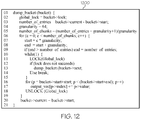
- FIG. 12 shows a version of the multi-threaded source code fragment of FIG. 11 optimized to handle lock contention according to one embodiment of the present disclosure
- FIG. 13 is an operational flow diagram illustrating one process for executing a program with improved cache efficiency.
- one example of data processing environment 100 is illustrated that includes a data processing system 102 that is configured, according to one or more embodiments of the present disclosure, to localize memory accesses through program transformation and execute the program with improved cache efficiency.
- programs such as user applications can be partitioned by, for example, a compiler 101 of the data processing system, so that latency of memory access operations in each partition can be minimized more effectively by reordering the operations of that partition independent of the order of operations in other partitions.
- embodiments of the present disclosure are not limited to a compiler 101 partitioning the user program at compile time, as the source code of the program can be partitioned prior to the program being compiled.
- the processor 104 can be programmed to performing the partitioning.
- the data processing system 102 may take various forms, such as workstations, laptop computer systems, notebook computer systems, desktop computer systems or servers and/or clusters thereof.
- the data processing system 102 includes one or more processors 104 (which may be chip multiprocessors (CMPs) that include one or more processor cores for executing program code, with each processor core having an associated hierarchy of caches L1-LL 105 ) coupled to a data storage subsystem 106 , optionally a display 108 , one or more input devices 110 , and a network adapter 112 .
- processors 104 which may be chip multiprocessors (CMPs) that include one or more processor cores for executing program code, with each processor core having an associated hierarchy of caches L1-LL 105 ) coupled to a data storage subsystem 106 , optionally a display 108 , one or more input devices 110 , and a network adapter 112 .
- CMPs chip multiprocessors
- the data storage subsystem 106 may include, for example, application appropriate amounts of various memories (e.g., dynamic random access memory (DRAM), static RAM (SRAM), and read-only memory (ROM)), and/or one or more mass storage devices, such as magnetic or optical disk drives.
- various memories e.g., dynamic random access memory (DRAM), static RAM (SRAM), and read-only memory (ROM)
- mass storage devices such as magnetic or optical disk drives.
- mass storage devices such as magnetic or optical disk drives.
- mass storage devices such as magnetic or optical disk drives.
- data storage subsystem 106 may include L2 and L3 cache and main memory.
- the data storage subsystem 106 includes one or more operating systems (OSs) 114 for the data processing system 102 .
- the data storage subsystem 106 also includes application programs, such as a browser 116 (which may optionally include customized plug-ins to support various client applications), a hypervisor (or virtual machine monitor (VMM)) 118 for managing one or more virtual machines (VMs) as instantiated by different OS images, and other applications (e.g., a word processing application, a presentation application, and an email application) 120 .
- OSs operating systems
- the data storage subsystem 106 also includes application programs, such as a browser 116 (which may optionally include customized plug-ins to support various client applications), a hypervisor (or virtual machine monitor (VMM)) 118 for managing one or more virtual machines (VMs) as instantiated by different OS images, and other applications (e.g., a word processing application, a presentation application, and an email application) 120 .
- a browser 116 which may optionally include customized plug-in
- the display 108 may be, for example, a cathode ray tube (CRT) or a liquid crystal display (LCD).
- the input device(s) 108 of the data processing system 102 may include, for example, a mouse, a keyboard, haptic devices, and/or a touch screen.
- the network adapter 112 supports communication of the data processing system 102 with one or more wired and/or wireless networks utilizing one or more communication protocols, such as 802.x, HTTP, simple mail transfer protocol (SMTP), etc.
- the data processing system 112 is shown coupled via one or more wired or wireless networks, such as the Internet 122 , to various file servers 124 and various web page servers 126 that provide information of interest to the user of the data processing system 102 .
- the data processing environment 100 also includes one or more data processing systems 128 that are configured in a similar manner as the data processing system 102 .
- the data processing systems 128 represent data processing systems that are remote to the data processing system 102 and that may execute OS images that may be linked to one or more OS images executing on the data processing system 102 .
- FIG. 1 may vary.
- the illustrative components within the data processing system 102 are not intended to be exhaustive, but rather are representative to highlight components that may be utilized to implement the present invention.
- other devices/components may be used in addition to or in place of the hardware depicted.
- the depicted example is not meant to imply architectural or other limitations with respect to the presently described embodiments.
- the data processing system 102 comprises various levels of cache memory.
- Cache memory is utilized by a processor to reduce the latency of memory operations. Allocation of space in caches is handled by the processor(s). Data is transferred from main memory to cache in blocks of fixed size referred to as cache lines. The number of cache lines that the cache can hold is limited by the size of the cache.
- a cache line is copied from memory into the cache a cache entry is created, which comprises the copied data and the requested memory location referred to as a tag.
- Caches generally operate according to data locality, which dictates that once data is accessed it will usually be accessed soon again.
- Data locality can be divided into various types of locality such as temporal and spatial.
- Temporal locality indicates that the program reuses data that it recently used and, therefore, the data is likely to be in cache.
- Spatial locality indicates that the program is likely to utilize data in memory locations close to recently accessed memory locations. Since the processor loads a chunk of memory around an accessed location into the cache, data from memory locations close to recently accessed location are also likely to be in the cache.
- the processor When the processor needs to read from or write to a location in the main memory the processor first checks the cache for a corresponding entry. For example, given a memory address of the operation, the cache lines are checked to determine if any of the lines comprise the data at that the memory location. A determination is made, using a set index, as to which cache set (a “row” in the cache) the address should reside in. Then, for each cache line in the identified cache set, the tag associated with the line is compared to the tag from the address. If a match is found the valid bit is checked to determine if the data is in the cache. If the data is found in one of the cache lines, a cache hit occurs.
- Prefetching is an operation performed by the processor in which data blocks are requested from the main memory and stored in cache prior the data being needed.
- prefetching There are various types of prefetching such as software and hardware prefetching.
- Software prefetching involves the compiler or programmer inserting prefetch instructions into the program.
- Hardware prefetching involves the processor monitoring memory access patterns of the program to predict the data that the program will access next. The processor then obtains this data from the main memory and stores it in the cache.
- Unstructured data i.e., data that does not have a pre-defined data model or that is not organized in a pre-defined manner.
- Unstructured data can be intuitively represented as graphs, whose vertices can be labeled with user names or events, and edges with the relationships between them. These graphs can include large amounts of data approaching the Terabyte range. Analytics of these large scale-free graphs plays an important role in many different fields such as social network analytics, homeland security, financial fraud prevention, targeted marketing, etc.
- Modern many-core processors can execute few instructions per cycle per core. It takes many cycles (at least a few hundred cycles) to get data from main memory, the memory beyond the last level cache and off-chip. Furthermore, in a typical application it takes only a few instructions to traverse an edge of a graph and update few fields in a node at one end of it, before moving on to process another edge/node.
- the number of instructions executed per edge traversed in BFS (Breadth First Search), a typical graph algorithm kernel varies between 12 and 20 instructions depending on the version of the compiler and data structure used to represent the graph. Thus, unless the data touched in processing a node (and/or the data adjacent to it in the same cache line) is reused from the cache repeatedly, the processor will stall for most its cycles as it waits for data from main memory to arrive at the cache.
- FIG. 2 quantifies the above problem for the betweenness centrality algorithm by Brandies, which is shortest path counting of unweighted edges based on BFS, followed by a reversal traversal of the discovered shortest paths to update the centrality measure.
- the measurements are for single core, single threaded execution.
- ‘LSU other’ category is primarily missed in the TLB cache entries, a problem mitigated by using large pages.
- the y-axis of Graph A is CPI (cycles per instruction).
- the sp bar indicates that even with use of large pages for most of the cycles the processor is idle as the next instruction to complete awaits input data to appear in cache.
- the graph analyzed is an rMat graph of 4 million nodes and on average eight edges per node.
- Graph B 204 illustrates that most of the level 1 cache misses are being satisfied from main memory. The problem becomes worse as the graph size increases.
- the height of the bars in Graph B is 1.
- One or more embodiments overcome the problems discussed above by transforming applications with irregular memory accesses such as large graph analytics applications to improve the operation of the processor executing the applications.
- the applications are transformed so that memory access latency for unstructured data such as graph-oriented data is minimized.
- an application is transformed by partitioning the application into multiple partitions and reordering the operations in each partition independently.
- Embodiments improve cache efficacy by improving localization of access in memory (spatial locality). This is achieved, in one embodiment, by data (addresses/indices) dependent reordering of the accesses in the application kernel.
- the localization of accesses also alleviates bandwidth constraints that can arise in extremely high load-store/compute ratio kernels.
- the applications to be transformed comprise one or more characteristics such as they proceed in phases (fronts or waves), where each phase is computation on a subset of nodes that can be performed in parallel.
- Breadth first search is one such example, where nodes at the same distance from the root of the search tree constitute a phase.
- Another characteristic is that nodes can be processed in any order within a phase. The results computed within a phase are not consumed in the same phase.
- the processor 104 takes as part of its input unstructured data such as a graph.
- a graph is stored and represented within the memory of a computing system as an adjacency matrix, albeit highly sparse for large graph analytics applications.
- Most graph algorithms can be expressed succinctly in a linear algebra framework involving these matrices.
- the matrix-vector or vector-vector operations in the linear algebra framework constitute the aforementioned phases in a natural way.
- Embodiments of the present disclosure are discussed with respect to two kernels, sparse matrix-vector multiply and matrix transpose. However, other kernels are applicable as well.
- the former is a computation performed by the processor to determine the reachability of new nodes from a given set of nodes.
- the latter used to implement some operations more efficiently.
- the performance of an un-optimized kernel measured as cycles per instruction (CPI) can be several tens of times slower than that on well-behaved scientific engineering applications. Therefore, these applications benefit from the embodiments of the present disclosure.
- the graph analytics library is one example of a library that can take advantage of the transformations performed by one or more embodiments.
- Various embodiments take advantage of the fact that most graph-based applications processes nodes of the graph in several phases, with each phases processing a new subset of unprocessed nodes reachable from already processed nodes. Furthermore, the order in which the subset nodes of the graph are processed intra-phase does not affect the results of the computation. Embodiments take advantage of this flexibility in intra-phase ordering of the computations on the nodes to improve reuse of data in the cache. This is accomplished, in one embodiment, by adapting the principles of lazy evaluation. For example, the transformation of an application program a processor to initialize and maintain a collection of fixed capacity bins/queues to defer irregular access. Each bin captures accesses to a limited region of memory that can be included in cache. The processor partitions application memory space across these bins.
- FIG. 3 illustrates a general principle for transforming application kernels to improve cache efficacy according to one or more embodiments.
- the left hand side 301 of FIG. 3 illustrates an un-optimized way of performing an intra-phase computation in a graph analytics kernel.
- An example application would be BFS or equivalently vector matrix multiply discussed above.
- a phase in the computation corresponds to a processor identifying all nodes at distance d+1 from the root, given all nodes of lesser distance. All non-zero elements of the input vector or nodes in the current frontier of the graph are iterated over by the processor and multiplied with each non-zero element of the corresponding matrix row. The result is added to the output vector at a location indexed by the column of the matrix element.
- the matrix is adjacency matrix of the graph and the output vector is the next frontier.
- the computational kernel can be reduced to a directed acyclic graph (DAG) in which all inner loops have been reduced to a single node, leaving one outer loop (this computation DAG should not be confused with the application graph).
- DAG directed acyclic graph
- This reduced DAG or R_DAG labeled as ‘Compute’, can be partitioned into two non-overlapping parts, a Compute_ 1 partition 304 and Compute_ 2 partition 306 , as illustrated on the right side 303 of FIG. 3 .
- the first partition 304 labeled Compute_ 1
- the second partition 306 labeled Compute_ 2
- the computational kernel can be reduced to a directed acyclic graph (DAG) in which all inner loops have been reduced to a single node, leaving one outer loop (this computation DAG should not be confused with the application graph).
- This reduced DAG or R_DAG labeled as ‘Compute’, can be partitioned into two non-overlapping parts, a Compute_ 1 partition 304
- Both partitions also include non-load/store operations dependent on the data accessed in the respective part.
- Each part can have load/store operations with access patterns different from its dominant common pattern. In some embodiments, these additional access patterns either exhibit good cache behavior, or are an insignificant part of the total computation for the node.
- the R_DAG nodes in Compute_ 1 partition 304 can be assumed to have regular accesses; otherwise the order of processing graph nodes in the Compute_ 1 partition 304 can be changed to make the accesses mostly regular, i.e., access patterns where the addresses of the consecutive elements of an array being accessed are consecutive numbers or sequences predictable in hardware with small gap between successive accesses, where the small gap is relative to cache line size. Consequently, computations of the Compute_ 2 partition 306 will become mostly irregular. Irregular accesses arise from indirect accesses where the consecutive accesses to elements of a data structure have no regular pattern and may be at arbitrary distance from each other.
- the Compute_ 1 partition 304 comprises of all regular accesses and the partial evaluation of the DAG that can be performed with these regular accesses.
- the Compute_ 2 partition 306 comprises 1.) accesses that were originally irregular, but have been partially regularized by binning; 2.) results of accesses that were originally on regular stride and partial computation results on those accesses performed in Compute_ 1 partition 304 , but now are stored along with queue entries to avoid irregular access to them in Compute_ 2 partition 306 ; and 3.) Calculations based on above accesses that could not be completed on Compute_ 1 partition 304 are now performed in Compute_ 2 partition 306 .
- Compute phase 302 in FIG. 3 can be partitioned to multiple sequentially executable partitions, one partition for each access pattern. Furthermore, multiple sets of queues are kept, one at each partition boundary. This is not a limitation as the queues are accessed sequentially, and thus even a large number of them will have only their active cache line cached.
- the bins 308 In between the two compute partitions 304 , 306 are the bins 308 to manage lazy completion of the Compute_ 2 partition 306 , triggered by the bin being full or the completion of a phase.
- the completion of a phase is indicated in FIG. 3 by the dashed arrows from ‘next-element’ to all the bins, indicating control to flush the bins (perform stores on all existing entries) upon termination of the loop.
- FIG. 4 shows the R_DAG 402 for the un-optimized Compute phase 302 of FIG. 3
- FIG. 5 shows the R_DAG 502 for the optimized Compute_ 1 and Compute_ 2 partitions 304 , 306 of FIG. 3 .
- the patterned nodes 402 to 414 correspond to load or store operations, while the unfilled nodes 416 , 418 are arithmetic/logic operations.
- the nodes 402 , 404 , 406 , with diagonal lines indicate that load/store data is known to have good cache locality of prefecthable access pattern (stride), while nodes 408 , 410 , 412 , 414 with a crosshatched pattern indicate load/store data with irregular access patterns that either do not have good cache locality or cannot effectively be prefetched by either software/hardware.
- FIG. 5 shows that the (partial) results of the computations of the Compute_ 1 partition 304 are stored within bins 508 along with the queue entries.
- FIG. 5 further shows that that computations of performed during the Compute_ 2 partition 306 utilize the data stored within a corresponding bin and their memory accesses are therefore localized to the given region of memory associated with the bin.
- FIGS. 6-8 show one example of how an actual program can be transformed according to the above principles.
- one type kernel application to embodiments of the present disclosure is a sparse matrix-vector multiply kernel.
- FIG. 6 shows code 600 for multiplying an input_vec with a matrix sparse matrix M to produce an output vector output_vec.
- the matrix M has number_of_rows rows and is assumed to be in CSR (Compressed Row Storage) format.
- FIG. 7 shows an illustrated example of a CSR format 700 for matrix M.
- the CSR format 700 uses three arrays: numEdges 702 , endV 704 , and weight 706 .
- the array numEdges 702 is an array of size equal to the number of rows of the matrix plus 1 , and it comprises offsets into arrays endV 704 and weight 706 .
- the array endV 404 is the index of non-zero column entries for each row and the array weight 706 is the actual non-zero entries.
- line 03 within the double nested for-loop.
- the accesses to the input vector and the three arrays of the matrix are regular.
- the addresses of the consecutive elements of each array being accesses are consecutive numbers or arithmetic sequences with small a gap between successive accesses, where the small gap is relative to cache line size. Therefore, many processor architectures can deliver good streaming performance in accessing those arrays.
- the access patterns for the output_vec are irregular since a gather operation is required for read followed by a scatter for write-back.
- the consecutive elements of the output_vec data structure have no regular pattern and may be an arbitrary distance from each other. This results in caches data prefetch mechanisms of modern computing systems becoming ineffective.
- one or more embodiments transform the program shown in FIG. 6 by partitioning the application into multiple partitions and reordering the operations in each partition independently.
- the program is transformed to initialize and maintain a collection of fixed capacity bins/queues (each being an array of tuples) to defer irregular access.
- Each bin captures accesses to a limited region of memory that can be included in cache.
- the application memory space is partitioned across these bins.
- the application is transformed such that when the processor 104 performs an intra-phase computation the most irregular access pattern is identified and the per node computation is partitioned into a first part that has regular accesses and calculations dependent on them, and a second part that has irregular accesses and the computations dependent on them.
- the processor 104 first completes computation of the first part for each node.
- the processor 104 defers computation of the second part to a future time by queuing the results of the first part computations into a bin.
- Each bin represents a cacheable region of memory, which is the size of one of the processor cache levels.
- the bin fits in the closest cache (L1 or L2) for reduced access latency, but in general, should not exceed the size of the processor last level cache.
- the processor 104 accomplishes this, for example, by hashing the address modulo of the number of queues maintained. When a bin becomes full the processor 104 processes all of its entries, i.e., the deferred accesses and the computation(s) that depend on them. When all intra-phase candidate nodes have been examined, the processor 104 processes the remaining queued up entries for all queues. When queuing a node for later evaluation, array data or indices used to access the array data needed to complete the processing for that node are included in the queue entry.
- FIG. 8 shows code 800 for the program of FIG. 6 after being transformed according to one or more embodiments.
- the transformed code 800 shown in FIG. 8 eliminates the memory access latency for scatter/gather on the output vector.
- lines 4 - 22 of the program are an expansion of line 03 in FIG. 6 .
- the code in statements 04 - 06 programs the processor 104 to compute a bin and the location in the bin where the partial result, i.e., the product term of statement 08 and the index of statement 07 , are stored for use later to complete the computations of the node.
- the bin number is computed by picking up high order bits of the index into output_vec. This is equivalent to division by an integer power of two, implying that bin sizes are an integer power of two. It should be noted that the bins are initialize prior to starting computation on the transformed kernel, where storage is allocated for the queues and a pointer to the queues is initialized.
- a bin includes the following pointers: start, the first entry in the bin, limit, the maximum entry in the bin, and current, the current entry in the bin. Each entry in the bin includes the pair ⁇ index,value ⁇ .
- the processor 104 obtains the pointer to the current entry.
- the processor 104 inserts the information ⁇ index,value ⁇ is into that entry.
- the processor 104 increments the current pointer by one.
- the processor 104 performs a check to determine if the bin has become full, and if so, in lines 11 - 13 , the processor 104 completes the remaining part of the per node computation for the entries in the bin.
- the processor 104 performs a batch of stores into the output vector localized to a cacheable region of memory. The bin is then reinitialized to its empty state. Finally, in lines 17 - 22 the processor 104 completes a batch of store into the output vector localized to a cacheable region of memory for all bins that include partial information at completion of the phase.
- P 0 computations are performed by the processor 104 first and they access sequential or localized data. Computations for P i , i>0, are performed by the processor 104 after the i th indirection. After computation in each partition P i , i ⁇ n, accesses for the next stage indirections and partial results needed for the computations in the next and future stage partitions are queued in new stage of queues. Thus, there are as many stages of queues as the levels of indirection, which is one less than the number of partitions.
- Example code 1000 for programming the processor 104 to handle double or multiple indirections this is shown FIG. 10 .
- the first indirection is for endV[j] in line 04 .
- the processor 104 queues the access in a first stage of buckets.
- the processor 104 performs the endV[j] access in a localized region of memory (with better cache hits) in the loop beginning in line 14 the processor 104 obtains the second indirection for numEdges in line 19 .
- the processor 104 once again queues this access up to localize the access to the numEdges array.
- the code to flush the queues upon termination of the double for loop is not shown.
- Embodiments of the present disclosure can also be extended to multi-threaded programming models by providing each thread its independent copy of the single threaded programming model queues and restricting accesses to a region of memory by only one thread by maintaining a lock for each region of memory.
- the processor 104 assigns each thread its private copy of buckets (or queues) to store the information generated by that thread and to be passed from one phase of the computation to the next. Synchronization is not required while updating the buckets with results of the Compute_ 1 partition.
- FIG. 11 shows one example of code 1100 for a multithreaded implementation of the operations represented in FIG. 8 .
- each thread has been given its own private copy of b buckets labeled B 0 , B 1 , . . . , B b-1 .
- B Locks labeled L 0 , L 1 , . . . , L b-1 .
- the program obtains a pointer into the lock L i protecting updates from the bucket B i .
- the number of entries stored in the bucket is computed.
- the update granularity is defined; the granularity is 64 updates per bucket.
- the number of update chunks is computed from the number of entries and the granularity.
- Statement 06 loops over the number of update chunks.
- Statements 07 - 09 compute the start and end indices of the bucket entries to dump.
- the global lock is acquired in statement 10 , protecting updates to the output vector in the range defined by the bucket.
- Statements 11 - 12 update the output vector, and finally statement 13 releases the lock.
- FIG. 12 shows an improved example of how to handle lock contention for the second case.
- the code 1200 is shown as a recursive subroutine call. The example is similar to the previous example shown in FIG. 11 , except for the addition of lines 25 - 30 . Line 26 attempts to grab the global lock. If lock does not succeed (because it is grabbed by another thread), then an attempt is performed to dump another bucket owned by the thread, using a recursive call. The field next contains a pointer to the next bucket in the list of buckets owned by a thread.
- FIG. 13 is an operational flow illustrating one example of a process for executing a program with improved cache efficiency.
- the operational flow diagram of FIG. 13 begins at step 1302 and flows directly to step 1304 .
- the processor 104 determines if any elements in a plurality of objects remain to be processed by a first set of operations for a program. If the result of this determination is positive, the processor 104 performs the first subset of operations of a program on a plurality of objects stored in one or more data structures at step 1306 .
- the first subset of operations has a regular memory access pattern.
- the processor 104 stores, after each operation in the first subset of operations has been performed, results of the operation in one of the plurality of queues, where each queue in the plurality of queues is associated with a different cacheable region of a memory.
- the processor 104 determines if the current queue is full. If the result of this determination is negative, the control flow returns to step 1304 . If the result of this determination is positive, the processor 104 performs, for elements of the full queue, a second subset of operations of the program at step 1312 .
- the second subset of operations utilizes results of the operations in the first subset of operations stored in the queue.
- the second subset of operations has an irregular memory access pattern that is regularized by localizing memory locations accessed by the second subset of operations to the cacheable region of memory associated with the at least one queue.
- the processor 104 at step 1314 , stores results of each operation performed in the second subset of operations in memory. For example, the results are stored in an output vector.
- the control flow returns to step 1304 .
- the processor 104 sets the queue to the first queue in the plurality of queues at step 1316 .
- the processor 104 performs the second subset of operations of the program on the elements of the queue.
- the processor 104 stores results of each operation performed in the second subset of operations in memory. For example, the results are stored in an output vector.
- the processor 104 determines if the current queue was the last queue. If the result of this determination is negative, the control flow returns to step 1318 . If the result of this determination is positive, the control flow exits for the current intra-phase computation at step 1326 .
- aspects of the present disclosure may be embodied as a system, method, or computer program product. Accordingly, aspects of the present disclosure may take the form of an entirely hardware embodiment, an entirely software embodiment (including firmware, resident software, micro-code, etc.) or an embodiment combining software and hardware aspects that may all generally be referred to herein as a “circuit”,” “module”, or “system.”
- the present disclosure may be a system, a method, and/or a computer program product.
- the computer program product may include a computer readable storage medium (or media) having computer readable program instructions thereon for causing a processor to carry out aspects of the present disclosure.
- the computer readable storage medium can be a tangible device that can retain and store instructions for use by an instruction execution device.
- the computer readable storage medium may be, for example, but is not limited to, an electronic storage device, a magnetic storage device, an optical storage device, an electromagnetic storage device, a semiconductor storage device, or any suitable combination of the foregoing.
- a non-exhaustive list of more specific examples of the computer readable storage medium includes the following: a portable computer diskette, a hard disk, a random access memory (RAM), a read-only memory (ROM), an erasable programmable read-only memory (EPROM or Flash memory), a static random access memory (SRAM), a portable compact disc read-only memory (CD-ROM), a digital versatile disk (DVD), a memory stick, a floppy disk, a mechanically encoded device such as punch-cards or raised structures in a groove having instructions recorded thereon, and any suitable combination of the foregoing.
- RAM random access memory
- ROM read-only memory
- EPROM or Flash memory erasable programmable read-only memory
- SRAM static random access memory
- CD-ROM compact disc read-only memory
- DVD digital versatile disk
- memory stick a floppy disk
- a mechanically encoded device such as punch-cards or raised structures in a groove having instructions recorded thereon
- a computer readable storage medium is not to be construed as being transitory signals per se, such as radio waves or other freely propagating electromagnetic waves, electromagnetic waves propagating through a waveguide or other transmission media (e.g., light pulses passing through a fiber-optic cable), or electrical signals transmitted through a wire.
- Computer readable program instructions described herein can be downloaded to respective computing/processing devices from a computer readable storage medium or to an external computer or external storage device via a network, for example, the Internet, a local area network, a wide area network and/or a wireless network.
- the network may comprise copper transmission cables, optical transmission fibers, wireless transmission, routers, firewalls, switches, gateway computers, and/or edge servers.
- a network adapter card or network interface in each computing/processing device receives computer readable program instructions from the network and forwards the computer readable program instructions for storage in a computer readable storage medium within the respective computing/processing device.
- Computer readable program instructions for carrying out operations of the present disclosure may be assembler instructions, instruction-set-architecture (ISA) instructions, machine instructions, machine dependent instructions, microcode, firmware instructions, state-setting data, or either source code or object code written in any combination of one or more programming languages, including an object oriented programming language such as Smalltalk, C++ or the like, and conventional procedural programming languages, such as the “C” programming language or similar programming languages.
- the computer readable program instructions may execute entirely on the user's computer, partly on the user's computer, as a stand-alone software package, partly on the user's computer and partly on a remote computer or entirely on the remote computer or server.
- the remote computer maybe connected to the user's computer through any type of network, including a local area network (LAN) or a wide area network (WAN), or the connection may be made to an external computer (for example, through the Internet using an Internet Service Provider).
- electronic circuitry including, for example, programmable logic circuitry, field-programmable gate arrays (FPGA), or programmable logic arrays (PLA) may execute the computer readable program instructions by utilizing state information of the computer readable program instructions to personalize the electronic circuitry, in order to perform aspects of the present disclosure.
- These computer readable program instructions may be provided to a processor of a general purpose computer, special purpose computer, or other programmable data processing apparatus to produce a machine, such that the instructions, which execute via the processor of the computer or other programmable data processing apparatus, create means for implementing the functions/acts specified in the flowchart and/or block diagram block or blocks.
- These computer readable program instructions may also be stored in a computer readable storage medium that can direct a computer, a programmable data processing apparatus, and/or other devices to function in a particular manner, such that the computer readable storage medium having instructions stored therein comprises an article of manufacture including instructions which implement aspects of the function/act specified in the flowchart and/or block diagram block or blocks.
- the computer readable program instructions may also be loaded onto a computer, other programmable data processing apparatus, or other device to cause a series of operational steps to be performed on the computer, other programmable apparatus or other device to produce a computer implemented process, such that the instructions which execute on the computer, other programmable apparatus, or other device implement the functions/acts specified in the flowchart and/or block diagram block or blocks.
- each block in the flowchart or block diagrams may represent a module, segment, or portion of instructions, which comprises one or more executable instructions for implementing the specified logical function(s).
- the functions noted in the block may occur out of the order noted in the figures.
- two blocks shown in succession may, in fact, be executed substantially concurrently, or the blocks may sometimes be executed in the reverse order, depending upon the functionality involved.
Landscapes
- Engineering & Computer Science (AREA)
- Theoretical Computer Science (AREA)
- Physics & Mathematics (AREA)
- General Engineering & Computer Science (AREA)
- General Physics & Mathematics (AREA)
- Human Computer Interaction (AREA)
- Memory System Of A Hierarchy Structure (AREA)
Abstract
Description
Claims (20)
Priority Applications (1)
| Application Number | Priority Date | Filing Date | Title |
|---|---|---|---|
| US15/159,368 US10884942B2 (en) | 2016-05-19 | 2016-05-19 | Reducing memory access latency in scatter/gather operations |
Applications Claiming Priority (1)
| Application Number | Priority Date | Filing Date | Title |
|---|---|---|---|
| US15/159,368 US10884942B2 (en) | 2016-05-19 | 2016-05-19 | Reducing memory access latency in scatter/gather operations |
Publications (2)
| Publication Number | Publication Date |
|---|---|
| US20170336971A1 US20170336971A1 (en) | 2017-11-23 |
| US10884942B2 true US10884942B2 (en) | 2021-01-05 |
Family
ID=60330870
Family Applications (1)
| Application Number | Title | Priority Date | Filing Date |
|---|---|---|---|
| US15/159,368 Expired - Fee Related US10884942B2 (en) | 2016-05-19 | 2016-05-19 | Reducing memory access latency in scatter/gather operations |
Country Status (1)
| Country | Link |
|---|---|
| US (1) | US10884942B2 (en) |
Families Citing this family (4)
| Publication number | Priority date | Publication date | Assignee | Title |
|---|---|---|---|---|
| US11036644B2 (en) * | 2017-02-02 | 2021-06-15 | Arm Limited | Data processing systems |
| US10540398B2 (en) * | 2017-04-24 | 2020-01-21 | Oracle International Corporation | Multi-source breadth-first search (MS-BFS) technique and graph processing system that applies it |
| US20220365783A1 (en) * | 2021-05-13 | 2022-11-17 | Nvidia Corporation | Matrix multiplication and accumulation operations on compressed matrices |
| CN116151338A (en) * | 2021-11-19 | 2023-05-23 | 平头哥(上海)半导体技术有限公司 | Cache access method and correlative graph neural network system |
Citations (9)
| Publication number | Priority date | Publication date | Assignee | Title |
|---|---|---|---|---|
| US6055622A (en) | 1997-02-03 | 2000-04-25 | Intel Corporation | Global stride prefetching apparatus and method for a high-performance processor |
| US6105119A (en) * | 1997-04-04 | 2000-08-15 | Texas Instruments Incorporated | Data transfer circuitry, DSP wrapper circuitry and improved processor devices, methods and systems |
| US20040123041A1 (en) | 2002-12-18 | 2004-06-24 | Intel Corporation | Adaptive prefetch for irregular access patterns |
| US20070186036A1 (en) * | 2005-06-01 | 2007-08-09 | Microsoft Corporation | Random Access Memory (RAM) Based Content Addressable Memory (CAM) Management |
| US20070294682A1 (en) * | 2006-06-20 | 2007-12-20 | Demetriou Christopher G | Systems and methods for caching compute kernels for an application running on a parallel-processing computer system |
| US20080043750A1 (en) * | 2006-01-19 | 2008-02-21 | Neteffect, Inc. | Apparatus and method for in-line insertion and removal of markers |
| US7769974B2 (en) | 2004-09-10 | 2010-08-03 | Microsoft Corporation | Increasing data locality of recently accessed resources |
| US20120167069A1 (en) * | 2010-12-24 | 2012-06-28 | Jin Lin | Loop parallelization based on loop splitting or index array |
| US8250093B2 (en) | 2003-08-25 | 2012-08-21 | International Business Machines Corporation | Method and system for utilizing a cache for path-level access control to structured documents stored in a database |
-
2016
- 2016-05-19 US US15/159,368 patent/US10884942B2/en not_active Expired - Fee Related
Patent Citations (9)
| Publication number | Priority date | Publication date | Assignee | Title |
|---|---|---|---|---|
| US6055622A (en) | 1997-02-03 | 2000-04-25 | Intel Corporation | Global stride prefetching apparatus and method for a high-performance processor |
| US6105119A (en) * | 1997-04-04 | 2000-08-15 | Texas Instruments Incorporated | Data transfer circuitry, DSP wrapper circuitry and improved processor devices, methods and systems |
| US20040123041A1 (en) | 2002-12-18 | 2004-06-24 | Intel Corporation | Adaptive prefetch for irregular access patterns |
| US8250093B2 (en) | 2003-08-25 | 2012-08-21 | International Business Machines Corporation | Method and system for utilizing a cache for path-level access control to structured documents stored in a database |
| US7769974B2 (en) | 2004-09-10 | 2010-08-03 | Microsoft Corporation | Increasing data locality of recently accessed resources |
| US20070186036A1 (en) * | 2005-06-01 | 2007-08-09 | Microsoft Corporation | Random Access Memory (RAM) Based Content Addressable Memory (CAM) Management |
| US20080043750A1 (en) * | 2006-01-19 | 2008-02-21 | Neteffect, Inc. | Apparatus and method for in-line insertion and removal of markers |
| US20070294682A1 (en) * | 2006-06-20 | 2007-12-20 | Demetriou Christopher G | Systems and methods for caching compute kernels for an application running on a parallel-processing computer system |
| US20120167069A1 (en) * | 2010-12-24 | 2012-06-28 | Jin Lin | Loop parallelization based on loop splitting or index array |
Non-Patent Citations (14)
| Title |
|---|
| Bader, D., et al., "The Graph BLAS effort and its implications for Exascale", SIAM Workshop on Exascale Applied Mathematics Challenges and Opportunities, Jul. 6-7, 2014, pp. 1-3. |
| Brandes, U., "A Faster Algorithm for Betweenness Centrality", Journal of Mathematical Sociology, 2001, pp. 1-15, vol. 25, No. 2. |
| Buono, D., et al., "Optimizing Sparse Linear Algebra for Large-Scale Graph Analytics", Computer, Aug. 2015, pp. 1-9. |
| Buono, D., et al., "Optimizing Sparse Matrix-Vector Multiplication for Large-Scale Data Analytics", International Conference on Supercomputing, Jun. 1-3, 2016, pp. 1-12. |
| Ekanadham, K., et al., "Graph Programming Interface: Rationale and Specification", IBM Research Report RC25508, Nov. 19, 2014, pp. 1-33. |
| Inagaki, T., et al., "Stride Prefetching by Dynamically Inspecting Objects", ACM SIGPLAN Notices, Jun. 9-11, 2003, pp. 1-9. |
| OpenMP, "OpenMP Application Program Interface", Version 4.0, Jul. 2013, pp. 1-320. |
| Seo, S., et al., "Design and Implementation of Software-Managed Caches for Multicores with Local Memory", 15th International Conference on High-Performance Computer Architecture, Feb. 14-18, 2009, pp. 1-12. |
| Shuf, Y., et al., "Creating and Preserving Locality of Java Applications at Allocation and Garbage Collection Times", 17th Annual ACM Conference on Object-Oriented Programming, Systems, Languages, and Applications, Nov. 4-8, 2002, pp. 1-13. |
| Siegwart, D., et al., "Improving Locality with Parallel Hierarchical Copying GC", Proceedings of the 5th International Symposium on Memory Management, ACM, Jun. 10-11, 2006, pp. 1-12. |
| Sura, Z., et al., "Using Multiple Threads to Accelerate Single Thread Performance", Proceedings of the 2014 IEEE 28th International Parallel & Distributed Processing Symposium, May 19-23, 2014, pp. 1-10. |
| University of Tennesee, "Basic Linear Algebra Subprograms Technical (BLAST) Forum Standard", Basic Linear Algebra Subprograms Technical (BLAST) Forum, Aug. 21, 2001, pp. 1-315. |
| Veldema, R., et al., "Object Combining: A new aggressive optimization for Object Intensive Programs", Proceedings of the 2002 joint ACM-ISCOPE conference on Java Grande, Nov. 3-5, 2005, pp. 1-10. |
| Zhou, J. et al., "Memory Management for Many-Core Processors with Software Configurable Locality Policies", Proceedings of the International Symposium on Memory Management, Jun. 15-16, 2012, pp. 1-12. |
Also Published As
| Publication number | Publication date |
|---|---|
| US20170336971A1 (en) | 2017-11-23 |
Similar Documents
| Publication | Publication Date | Title |
|---|---|---|
| US11163828B2 (en) | Building and querying hash tables on processors | |
| US10452744B2 (en) | Memory management for sparse matrix multiplication | |
| US8825982B2 (en) | Storage unsharing | |
| US8214816B2 (en) | Compiler implemented software cache in which non-aliased explicitly fetched data are excluded | |
| US7681015B2 (en) | Generating and comparing memory access ranges for speculative throughput computing | |
| KR101344538B1 (en) | Cache and/or socket sensitive multi-processor cores breadth-first traversal | |
| US8370575B2 (en) | Optimized software cache lookup for SIMD architectures | |
| US20080235488A1 (en) | Splash Tables: An Efficient Hash Scheme for Processors | |
| Nai et al. | Instruction offloading with hmc 2.0 standard: A case study for graph traversals | |
| US20170336971A1 (en) | Reducing memory access latency in scatter/gather operations | |
| Loffeld et al. | Considerations on the implementation and use of Anderson acceleration on distributed memory and GPU-based parallel computers | |
| US20160110194A1 (en) | Dynamically updating hardware prefetch trait to exclusive or shared at program detection | |
| Kaufmann et al. | Parallel Array-Based Single-and Multi-Source Breadth First Searches on Large Dense Graphs. | |
| US10572254B2 (en) | Instruction to query cache residency | |
| Faria et al. | Impact of data structure layout on performance | |
| US10534575B1 (en) | Buffering of associative operations on random memory addresses | |
| US20240028389A1 (en) | Memory aware context switching | |
| Kumar et al. | Efficient implementation of scatter-gather operations for large scale graph analytics | |
| Balaji et al. | Improving Locality of Irregular Updates with Hardware Assisted Propagation Blocking. | |
| US10747515B2 (en) | Fields hotness based object splitting | |
| US8484423B2 (en) | Method and apparatus for controlling cache using transaction flags | |
| Rehman | Exploring irregular memory access applications on the GPU | |
| Eilers | Multireduce and multiscan on modern GPUs | |
| Chen et al. | Efficient SpMV for Graph Matrices Through Vectoring and Caching | |
| CN108369500A (en) | Extended field is specialized |
Legal Events
| Date | Code | Title | Description |
|---|---|---|---|
| AS | Assignment |
Owner name: INTERNATIONAL BUSINESS MACHINES CORPORATION, NEW YORK Free format text: ASSIGNMENT OF ASSIGNORS INTEREST;ASSIGNORS:HORN, WILLIAM PETTIT;JANN, JOEFON;KUMAR, MANOJ;AND OTHERS;SIGNING DATES FROM 20160509 TO 20160519;REEL/FRAME:038724/0936 Owner name: INTERNATIONAL BUSINESS MACHINES CORPORATION, NEW Y Free format text: ASSIGNMENT OF ASSIGNORS INTEREST;ASSIGNORS:HORN, WILLIAM PETTIT;JANN, JOEFON;KUMAR, MANOJ;AND OTHERS;SIGNING DATES FROM 20160509 TO 20160519;REEL/FRAME:038724/0936 |
|
| STPP | Information on status: patent application and granting procedure in general |
Free format text: RESPONSE TO NON-FINAL OFFICE ACTION ENTERED AND FORWARDED TO EXAMINER |
|
| STPP | Information on status: patent application and granting procedure in general |
Free format text: FINAL REJECTION MAILED |
|
| STPP | Information on status: patent application and granting procedure in general |
Free format text: DOCKETED NEW CASE - READY FOR EXAMINATION |
|
| STPP | Information on status: patent application and granting procedure in general |
Free format text: NON FINAL ACTION MAILED |
|
| STPP | Information on status: patent application and granting procedure in general |
Free format text: RESPONSE TO NON-FINAL OFFICE ACTION ENTERED AND FORWARDED TO EXAMINER |
|
| STPP | Information on status: patent application and granting procedure in general |
Free format text: FINAL REJECTION MAILED |
|
| STPP | Information on status: patent application and granting procedure in general |
Free format text: RESPONSE AFTER FINAL ACTION FORWARDED TO EXAMINER |
|
| STCF | Information on status: patent grant |
Free format text: PATENTED CASE |
|
| FEPP | Fee payment procedure |
Free format text: MAINTENANCE FEE REMINDER MAILED (ORIGINAL EVENT CODE: REM.); ENTITY STATUS OF PATENT OWNER: LARGE ENTITY |
|
| LAPS | Lapse for failure to pay maintenance fees |
Free format text: PATENT EXPIRED FOR FAILURE TO PAY MAINTENANCE FEES (ORIGINAL EVENT CODE: EXP.); ENTITY STATUS OF PATENT OWNER: LARGE ENTITY |
|
| STCH | Information on status: patent discontinuation |
Free format text: PATENT EXPIRED DUE TO NONPAYMENT OF MAINTENANCE FEES UNDER 37 CFR 1.362 |
|
| FP | Lapsed due to failure to pay maintenance fee |
Effective date: 20250105 |