US10875876B2 - Cyclized sulfamoylarylamide derivatives and the use thereof as medicaments for the treatment of hepatitis B - Google Patents
Cyclized sulfamoylarylamide derivatives and the use thereof as medicaments for the treatment of hepatitis B Download PDFInfo
- Publication number
- US10875876B2 US10875876B2 US15/195,809 US201615195809A US10875876B2 US 10875876 B2 US10875876 B2 US 10875876B2 US 201615195809 A US201615195809 A US 201615195809A US 10875876 B2 US10875876 B2 US 10875876B2
- Authority
- US
- United States
- Prior art keywords
- methyl
- compound
- alkyl
- mmol
- fluoro
- Prior art date
- Legal status (The legal status is an assumption and is not a legal conclusion. Google has not performed a legal analysis and makes no representation as to the accuracy of the status listed.)
- Expired - Fee Related
Links
- 0 *.B.C.CC.CC.CC.CC.[1*]N1C[Y]C/C(=C\C(=O)NC)CS1(=O)=O Chemical compound *.B.C.CC.CC.CC.CC.[1*]N1C[Y]C/C(=C\C(=O)NC)CS1(=O)=O 0.000 description 29
- RCLPHCJMHYUGSX-UHFFFAOYSA-N B.CC Chemical compound B.CC RCLPHCJMHYUGSX-UHFFFAOYSA-N 0.000 description 18
- BEQGRRJLJLVQAQ-UHFFFAOYSA-N *.CC=C(C)CC Chemical compound *.CC=C(C)CC BEQGRRJLJLVQAQ-UHFFFAOYSA-N 0.000 description 12
- RUVSRFOEQKFBCH-HNNXBMFYSA-N *.CC(C)[C@@H]1COC2=C(C(=O)NC3=CC=C(F)C(C#N)=C3)C(F)=CC=C2S(=O)(=O)N1 Chemical compound *.CC(C)[C@@H]1COC2=C(C(=O)NC3=CC=C(F)C(C#N)=C3)C(F)=CC=C2S(=O)(=O)N1 RUVSRFOEQKFBCH-HNNXBMFYSA-N 0.000 description 2
- ZKZWWMRPPAPZMQ-CQSZACIVSA-N *.CC1=C(F)C=CC(NC(=O)/C2=C3\OC[C@H](C(C)(C)O)NS(=O)(=O)\C3=C\N2C)=C1 Chemical compound *.CC1=C(F)C=CC(NC(=O)/C2=C3\OC[C@H](C(C)(C)O)NS(=O)(=O)\C3=C\N2C)=C1 ZKZWWMRPPAPZMQ-CQSZACIVSA-N 0.000 description 2
- WSJRWAGEMSPKOE-PZORYLMUSA-N *.CCC(O)[C@H]1COC2=C(\C(=O)NC3=CC=C(F)C(F)=C3)N(C)/C=C\2S(=O)(=O)N1 Chemical compound *.CCC(O)[C@H]1COC2=C(\C(=O)NC3=CC=C(F)C(F)=C3)N(C)/C=C\2S(=O)(=O)N1 WSJRWAGEMSPKOE-PZORYLMUSA-N 0.000 description 2
- NXXNPJVQXNMXSN-CYBMUJFWSA-N *.CN1/C=C2C(=C/1C(=O)NC1=CC(Cl)=C(F)C=C1)\OC[C@H](C(C)(C)O)NS\2(=O)=O Chemical compound *.CN1/C=C2C(=C/1C(=O)NC1=CC(Cl)=C(F)C=C1)\OC[C@H](C(C)(C)O)NS\2(=O)=O NXXNPJVQXNMXSN-CYBMUJFWSA-N 0.000 description 2
- WJLLTHFCUDKESN-JBZHPUCOSA-N *.CN1C=C2C(=C1C(=O)NC1=CC=C(F)C(Cl)=C1)OC[C@H](C(O)C1CC1)NS2(=O)=O Chemical compound *.CN1C=C2C(=C1C(=O)NC1=CC=C(F)C(Cl)=C1)OC[C@H](C(O)C1CC1)NS2(=O)=O WJLLTHFCUDKESN-JBZHPUCOSA-N 0.000 description 2
- JQHPKKYOADNBMG-LLVKDONJSA-N *.CN1C=C2C(=C1C(=O)NC1=CC=NC(Cl)=C1)OC[C@H](C(C)(C)O)NS2(=O)=O Chemical compound *.CN1C=C2C(=C1C(=O)NC1=CC=NC(Cl)=C1)OC[C@H](C(C)(C)O)NS2(=O)=O JQHPKKYOADNBMG-LLVKDONJSA-N 0.000 description 2
- SSVJZRNSCVQODS-USEMIUTHSA-N *.C[C@@H](N1CC/C=C\C2=C(/C(=O)NC3=CC(F)=C(F)C=C3)N(C)/C=C2/S1(=O)=O)C(F)(F)F Chemical compound *.C[C@@H](N1CC/C=C\C2=C(/C(=O)NC3=CC(F)=C(F)C=C3)N(C)/C=C2/S1(=O)=O)C(F)(F)F SSVJZRNSCVQODS-USEMIUTHSA-N 0.000 description 2
- CLWUYKLRAZHEOU-UHFFFAOYSA-N CC(C)C(O)C1COC2=C(C(=O)NC3=CC(C#N)=C(F)C=C3)N(C)C=C2S(=O)(=O)N1 Chemical compound CC(C)C(O)C1COC2=C(C(=O)NC3=CC(C#N)=C(F)C=C3)N(C)C=C2S(=O)(=O)N1 CLWUYKLRAZHEOU-UHFFFAOYSA-N 0.000 description 2
- FWHRMLDIHYSOKN-UHFFFAOYSA-N CC1C=CC2=C(C(=O)NC3=CC(F)=C(F)C=C3)N(C)C=C2S(=O)(=O)N1 Chemical compound CC1C=CC2=C(C(=O)NC3=CC(F)=C(F)C=C3)N(C)C=C2S(=O)(=O)N1 FWHRMLDIHYSOKN-UHFFFAOYSA-N 0.000 description 2
- OYVBCIPPHVIVGC-UHFFFAOYSA-N CC1C=CC2=C(C(=O)NC3=CC(F)=C(F)C=C3)N(C)N=C2S(=O)(=O)N1 Chemical compound CC1C=CC2=C(C(=O)NC3=CC(F)=C(F)C=C3)N(C)N=C2S(=O)(=O)N1 OYVBCIPPHVIVGC-UHFFFAOYSA-N 0.000 description 2
- XPEBURWWXNTAOV-UHFFFAOYSA-N CN1/C=C2C(=C/1C(=O)NC1=CC(C(F)(F)F)=NC=C1)\C=CC(C(F)(F)F)NS\2(=O)=O Chemical compound CN1/C=C2C(=C/1C(=O)NC1=CC(C(F)(F)F)=NC=C1)\C=CC(C(F)(F)F)NS\2(=O)=O XPEBURWWXNTAOV-UHFFFAOYSA-N 0.000 description 2
- IHNPECWWXOVCNH-UHFFFAOYSA-N CN1/C=C2C(=C/1C(=O)NC1=CC(Cl)=C(F)C=C1)\OCC(C)(CC1=CC=C(Cl)N=C1)NS\2(=O)=O Chemical compound CN1/C=C2C(=C/1C(=O)NC1=CC(Cl)=C(F)C=C1)\OCC(C)(CC1=CC=C(Cl)N=C1)NS\2(=O)=O IHNPECWWXOVCNH-UHFFFAOYSA-N 0.000 description 2
- XHUYSENSQZYKGH-UHFFFAOYSA-N CN1C=C2C(=C1C(=O)NC1=CC(F)=C(F)C=C1)C=CCNS2(=O)=O Chemical compound CN1C=C2C(=C1C(=O)NC1=CC(F)=C(F)C=C1)C=CCNS2(=O)=O XHUYSENSQZYKGH-UHFFFAOYSA-N 0.000 description 2
- IXWQSVBEBAUEOE-UHFFFAOYSA-N CN1C=C2C(=C1C(=O)NC1=CC=C(F)C(F)=C1)CCNS2(=O)=O Chemical compound CN1C=C2C(=C1C(=O)NC1=CC=C(F)C(F)=C1)CCNS2(=O)=O IXWQSVBEBAUEOE-UHFFFAOYSA-N 0.000 description 2
- ALIBSLPWRARXRX-UHFFFAOYSA-N CN1C=C2C(=C1C(=O)NC1=CC=C(F)C(F)=C1)OCC1(CC1)NS2(=O)=O Chemical compound CN1C=C2C(=C1C(=O)NC1=CC=C(F)C(F)=C1)OCC1(CC1)NS2(=O)=O ALIBSLPWRARXRX-UHFFFAOYSA-N 0.000 description 2
- BLSUYVPUQPEXEC-UHFFFAOYSA-N CN1C=CC(CC2(C)COC3=C(C(=O)NC4=CC(C(F)F)=NC=C4)N(C)C=C3S(=O)(=O)N2)=N1 Chemical compound CN1C=CC(CC2(C)COC3=C(C(=O)NC4=CC(C(F)F)=NC=C4)N(C)C=C3S(=O)(=O)N2)=N1 BLSUYVPUQPEXEC-UHFFFAOYSA-N 0.000 description 2
- NRXWEOXXXMRENM-RSMBRRKXSA-N *.*.*.*.*.*.C#CC1=C(F)C=CC(NC(=O)/C2=C3\C=C[C@H](C)NS(=O)(=O)\C3=C\N2C)=C1.CC1=C(C)C=C(NC(=O)/C2=C3\C=C[C@H](C)NS(=O)(=O)\C3=C\N2C)C=C1.CC1=CC(NC(=O)/C2=C3\C=C[C@H](C)NS(=O)(=O)\C3=C\N2C)=CC(F)=C1F.CC1=CC(NC(=O)/C2=C3\OC(C)C(C)NS(=O)(=O)\C3=C\N2C)=CC=C1F.CC1=CC(NC(=O)/C2=C3\OC[C@@H]([C@@H](C)O)NS(=O)(=O)\C3=C\N2C)=CC=C1F.CC1=CC(NC(=O)/C2=C3\OC[C@H]([C@@H](C)O)NS(=O)(=O)\C3=C\N2C)=CC=C1F.CC1=CC(NC(=O)/C2=C3\OC[C@H]([C@H](C)O)NS(=O)(=O)\C3=C\N2C)=CC=C1F.CC1=CC(NC(=O)/C2=C3\OC[C@H]([C@H](O)C4=CC=CC=C4)NS(=O)(=O)\C3=C\N2C)=CC=C1F.C[C@H]1C=CC2=C(\C(=O)NC3=CC=C(F)C(C(C)(F)F)=C3)N(C)/C=C\2S(=O)(=O)N1.S.S Chemical compound *.*.*.*.*.*.C#CC1=C(F)C=CC(NC(=O)/C2=C3\C=C[C@H](C)NS(=O)(=O)\C3=C\N2C)=C1.CC1=C(C)C=C(NC(=O)/C2=C3\C=C[C@H](C)NS(=O)(=O)\C3=C\N2C)C=C1.CC1=CC(NC(=O)/C2=C3\C=C[C@H](C)NS(=O)(=O)\C3=C\N2C)=CC(F)=C1F.CC1=CC(NC(=O)/C2=C3\OC(C)C(C)NS(=O)(=O)\C3=C\N2C)=CC=C1F.CC1=CC(NC(=O)/C2=C3\OC[C@@H]([C@@H](C)O)NS(=O)(=O)\C3=C\N2C)=CC=C1F.CC1=CC(NC(=O)/C2=C3\OC[C@H]([C@@H](C)O)NS(=O)(=O)\C3=C\N2C)=CC=C1F.CC1=CC(NC(=O)/C2=C3\OC[C@H]([C@H](C)O)NS(=O)(=O)\C3=C\N2C)=CC=C1F.CC1=CC(NC(=O)/C2=C3\OC[C@H]([C@H](O)C4=CC=CC=C4)NS(=O)(=O)\C3=C\N2C)=CC=C1F.C[C@H]1C=CC2=C(\C(=O)NC3=CC=C(F)C(C(C)(F)F)=C3)N(C)/C=C\2S(=O)(=O)N1.S.S NRXWEOXXXMRENM-RSMBRRKXSA-N 0.000 description 1
- UABQCAGZBCNPFO-URPGHMTCSA-N *.*.*.*.*.*.CC(F)C1=C(F)C=CC(NC(=O)/C2=C3\OC[C@@H](C(C)(C)O)NS(=O)(=O)\C3=C\N2C)=C1.CC(F)C1=C(F)C=CC(NC(=O)/C2=C3\OC[C@H](C(C)(C)O)NS(=O)(=O)\C3=C\N2C)=C1.CC1=C(F)C=CC(NC(=O)/C2=C3\OCC(C(O)C4=CC=CN=C4)NS(=O)(=O)\C3=C\N2C)=C1.CC1=C(F)C=CC(NC(=O)/C2=C3\OC[C@@H](C(C)(C)O)NS(=O)(=O)\C3=C\N2C)=C1.S.S.S.S.S.S.S.[H][C@]1([C@H](C)O)C=CC2=C(\C(=O)NC3=CC(C(C)F)=C(F)C=C3)N(C)/C=C\2S(=O)(=O)N1.[H][C@]1([C@H](C)O)C=CC2=C(\C(=O)NC3=CC(C)=C(C)C=C3)N(C)/C=C\2S(=O)(=O)N1.[H][C@]1([C@H](C)O)C=CC2=C(\C(=O)NC3=CC(C)=C(F)C(F)=C3)N(C)/C=C\2S(=O)(=O)N1.[H][C@]1([C@H](C)O)C=CC2=C(\C(=O)NC3=CC(C)=NC=C3)N(C)/C=C\2S(=O)(=O)N1.[H][C@]1([C@H](C)O)CCC2=C(\C(=O)NC3=CC(C)=C(F)C(F)=C3)N(C)/C=C\2S(=O)(=O)N1 Chemical compound *.*.*.*.*.*.CC(F)C1=C(F)C=CC(NC(=O)/C2=C3\OC[C@@H](C(C)(C)O)NS(=O)(=O)\C3=C\N2C)=C1.CC(F)C1=C(F)C=CC(NC(=O)/C2=C3\OC[C@H](C(C)(C)O)NS(=O)(=O)\C3=C\N2C)=C1.CC1=C(F)C=CC(NC(=O)/C2=C3\OCC(C(O)C4=CC=CN=C4)NS(=O)(=O)\C3=C\N2C)=C1.CC1=C(F)C=CC(NC(=O)/C2=C3\OC[C@@H](C(C)(C)O)NS(=O)(=O)\C3=C\N2C)=C1.S.S.S.S.S.S.S.[H][C@]1([C@H](C)O)C=CC2=C(\C(=O)NC3=CC(C(C)F)=C(F)C=C3)N(C)/C=C\2S(=O)(=O)N1.[H][C@]1([C@H](C)O)C=CC2=C(\C(=O)NC3=CC(C)=C(C)C=C3)N(C)/C=C\2S(=O)(=O)N1.[H][C@]1([C@H](C)O)C=CC2=C(\C(=O)NC3=CC(C)=C(F)C(F)=C3)N(C)/C=C\2S(=O)(=O)N1.[H][C@]1([C@H](C)O)C=CC2=C(\C(=O)NC3=CC(C)=NC=C3)N(C)/C=C\2S(=O)(=O)N1.[H][C@]1([C@H](C)O)CCC2=C(\C(=O)NC3=CC(C)=C(F)C(F)=C3)N(C)/C=C\2S(=O)(=O)N1 UABQCAGZBCNPFO-URPGHMTCSA-N 0.000 description 1
- IODDJCUHZFCBDY-WZQSFDQCSA-N *.*.*.*.*.C#CC1=C(F)C=CC(NC(=O)/C2=C3\OC[C@@H](C(C)(C)O)NS(=O)(=O)\C3=C\N2C)=C1.C#CC1=C(F)C=CC(NC(=O)/C2=C3\OC[C@H](C(C)(C)O)NS(=O)(=O)\C3=C\N2C)=C1.C#CC1=CC(NC(=O)/C2=C3\CCC(C(C)(C)O)NS(=O)(=O)\C3=C\N2C)=CC=C1F.CC(F)C1=C(F)C=CC(NC(=O)/C2=C3\OC[C@H](C(O)C4CC4)NS(=O)(=O)\C3=C\N2C)=C1.CC(F)C1=NC=CC(NC(=O)/C2=C3\CCC(C(C)C)NS(=O)(=O)\C3=C\N2C)=C1.CC1=C(C)C=C(NC(=O)/C2=C3\CCC(C(C)C)NS(=O)(=O)\C3=C\N2C)C=C1.CC1=CC(NC(=O)/C2=C3\CC[C@H](C(C)(C)O)NS(=O)(=O)\C3=C\N2C)=CC=C1F.CC1=CC=C(NC(=O)/C2=C3\OC[C@H](C(O)C4CC4)NS(=O)(=O)\C3=C\N2C)C=C1F.S.S.[H][C@]1([C@H](C)O)CCC2=C(\C(=O)NC3=CC(C(C)F)=C(F)C=C3)N(C)/C=C\2S(=O)(=O)N1 Chemical compound *.*.*.*.*.C#CC1=C(F)C=CC(NC(=O)/C2=C3\OC[C@@H](C(C)(C)O)NS(=O)(=O)\C3=C\N2C)=C1.C#CC1=C(F)C=CC(NC(=O)/C2=C3\OC[C@H](C(C)(C)O)NS(=O)(=O)\C3=C\N2C)=C1.C#CC1=CC(NC(=O)/C2=C3\CCC(C(C)(C)O)NS(=O)(=O)\C3=C\N2C)=CC=C1F.CC(F)C1=C(F)C=CC(NC(=O)/C2=C3\OC[C@H](C(O)C4CC4)NS(=O)(=O)\C3=C\N2C)=C1.CC(F)C1=NC=CC(NC(=O)/C2=C3\CCC(C(C)C)NS(=O)(=O)\C3=C\N2C)=C1.CC1=C(C)C=C(NC(=O)/C2=C3\CCC(C(C)C)NS(=O)(=O)\C3=C\N2C)C=C1.CC1=CC(NC(=O)/C2=C3\CC[C@H](C(C)(C)O)NS(=O)(=O)\C3=C\N2C)=CC=C1F.CC1=CC=C(NC(=O)/C2=C3\OC[C@H](C(O)C4CC4)NS(=O)(=O)\C3=C\N2C)C=C1F.S.S.[H][C@]1([C@H](C)O)CCC2=C(\C(=O)NC3=CC(C(C)F)=C(F)C=C3)N(C)/C=C\2S(=O)(=O)N1 IODDJCUHZFCBDY-WZQSFDQCSA-N 0.000 description 1
- DOSIDUOFXWOIHL-ZFAVAVDCSA-N *.*.*.*.*.C#CC1=C(F)C=CC(NC(=O)/C2=C3\OC[C@H]([C@H](C)O)NS(=O)(=O)\C3=C\N2C)=C1.CC(F)C1=C(F)C=CC(NC(=O)/C2=C3\OC[C@H]([C@H](C)O)NS(=O)(=O)\C3=C\N2C)=C1.CC1=CC(NC(=O)/C2=C3\CC(O)CNS(=O)(=O)\C3=C\N2C)=CC=C1F.CC1=CC(NC(=O)/C2=C3\OC[C@@H](C(F)(F)F)NS(=O)(=O)\C3=C\N2C)=CC=C1F.CC1=CC(NC(=O)/C2=C3\OC[C@@H]([C@@H](O)C4=CC=CC=C4)NS(=O)(=O)\C3=C\N2C)=CC=C1F.CC1=CC=C(NC(=O)/C2=C3\NCC(C)NS(=O)(=O)\C3=C\N2C)C=C1F.CC1=NC=CC(NC(=O)/C2=C3\OC[C@H]([C@H](C)O)NS(=O)(=O)\C3=C\N2C)=C1.CO[C@H](C)[C@H]1COC2=C(\C(=O)NC3=CC(C)=C(F)C=C3)N(C)/C=C\2S(=O)(=O)N1.S.S.S.S.S.S Chemical compound *.*.*.*.*.C#CC1=C(F)C=CC(NC(=O)/C2=C3\OC[C@H]([C@H](C)O)NS(=O)(=O)\C3=C\N2C)=C1.CC(F)C1=C(F)C=CC(NC(=O)/C2=C3\OC[C@H]([C@H](C)O)NS(=O)(=O)\C3=C\N2C)=C1.CC1=CC(NC(=O)/C2=C3\CC(O)CNS(=O)(=O)\C3=C\N2C)=CC=C1F.CC1=CC(NC(=O)/C2=C3\OC[C@@H](C(F)(F)F)NS(=O)(=O)\C3=C\N2C)=CC=C1F.CC1=CC(NC(=O)/C2=C3\OC[C@@H]([C@@H](O)C4=CC=CC=C4)NS(=O)(=O)\C3=C\N2C)=CC=C1F.CC1=CC=C(NC(=O)/C2=C3\NCC(C)NS(=O)(=O)\C3=C\N2C)C=C1F.CC1=NC=CC(NC(=O)/C2=C3\OC[C@H]([C@H](C)O)NS(=O)(=O)\C3=C\N2C)=C1.CO[C@H](C)[C@H]1COC2=C(\C(=O)NC3=CC(C)=C(F)C=C3)N(C)/C=C\2S(=O)(=O)N1.S.S.S.S.S.S DOSIDUOFXWOIHL-ZFAVAVDCSA-N 0.000 description 1
- PALVRVMNPCADOR-FRIHJPIOSA-N *.*.*.*.C#CC1=C(F)C=CC(NC(=O)/C2=C3\CCC(C(C)(C)O)NS(=O)(=O)\C3=C\N2C)=C1F.CC1=C(C)C=C(NC(=O)/C2=C3\OC[C@H](C(C)(C)O)NS(=O)(=O)\C3=C\N2C)C=C1.CC1=C(F)C=C(NC(=O)/C2=C3\CCC(CO)(CO)NS(=O)(=O)\C3=C\N2C)C=C1.CC1=CC=C(NC(=O)/C2=C3\CC[C@H]([C@H](C)O)NS(=O)(=O)\C3=C\N2C)C=C1C.CC1=CC=C(NC(=O)/C2=C3\OCC(C)(C4=NN(C)C=C4)NS(=O)(=O)\C3=C\N2C)C=C1F.COCC1(CO)CCC2=C(\C(=O)NC3=CC(F)=C(C)C=C3)N(C)/C=C\2S(=O)(=O)N1.S.S.S.[H][C@]1([C@H](C)O)C=CC2=C(\C(=O)NC3=CC=C(F)C(C)=C3)N(C)/C=C\2S(=O)(=O)N1.[H][C@]1([C@H](C)O)CCC2=C(\C(=O)NC3=CC=C(F)C(C)=C3)N(C)/C=C\2S(=O)(=O)N1 Chemical compound *.*.*.*.C#CC1=C(F)C=CC(NC(=O)/C2=C3\CCC(C(C)(C)O)NS(=O)(=O)\C3=C\N2C)=C1F.CC1=C(C)C=C(NC(=O)/C2=C3\OC[C@H](C(C)(C)O)NS(=O)(=O)\C3=C\N2C)C=C1.CC1=C(F)C=C(NC(=O)/C2=C3\CCC(CO)(CO)NS(=O)(=O)\C3=C\N2C)C=C1.CC1=CC=C(NC(=O)/C2=C3\CC[C@H]([C@H](C)O)NS(=O)(=O)\C3=C\N2C)C=C1C.CC1=CC=C(NC(=O)/C2=C3\OCC(C)(C4=NN(C)C=C4)NS(=O)(=O)\C3=C\N2C)C=C1F.COCC1(CO)CCC2=C(\C(=O)NC3=CC(F)=C(C)C=C3)N(C)/C=C\2S(=O)(=O)N1.S.S.S.[H][C@]1([C@H](C)O)C=CC2=C(\C(=O)NC3=CC=C(F)C(C)=C3)N(C)/C=C\2S(=O)(=O)N1.[H][C@]1([C@H](C)O)CCC2=C(\C(=O)NC3=CC=C(F)C(C)=C3)N(C)/C=C\2S(=O)(=O)N1 PALVRVMNPCADOR-FRIHJPIOSA-N 0.000 description 1
- PGEXHWQESVGWHL-DXAPJVAWSA-N *.*.*.*.C#CC1=C(F)C=CC(NC(=O)/C2=C3\CCC(C(C)C)NS(=O)(=O)\C3=C\N2C)=C1.C#CC1=C(F)C=CC(NC(=O)/C2=C3\OCCNS(=O)(=O)\C3=C\N2C)=C1.CC(F)C1=C(F)C=CC(NC(=O)/C2=C3\CCC(C(C)C)NS(=O)(=O)\C3=C\N2C)=C1.CC1=C(F)C=CC(NC(=O)/C2=C3\OCC(C4CCOCC4)NS(=O)(=O)\C3=C\N2C)=C1.CC1=C(F)C=CC(NC(=O)/C2=C3\OC[C@@H](C(O)C4CC4)NS(=O)(=O)\C3=C\N2C)=C1.CC1=C(F)C=CC(NC(=O)/C2=C3\OC[C@H](C(C)(C)O)NS(=O)(=O)\C3=C\N2C)=C1.S.S.S.S.[H][C@]1([C@H](C)O)C=CC2=C(\C(=O)NC3=CC=C(F)C(C#C)=C3)N(C)/C=C\2S(=O)(=O)N1.[H][C@]1([C@H](C)O)CCC2=C(\C(=O)NC3=CC=C(F)C(C#C)=C3)N(C)/C=C\2S(=O)(=O)N1.[H][C@]1([C@H](C)O)CCC2=C(\C(=O)NC3=CC=C(F)C(C)=C3)N(C)/C=C\2S(=O)(=O)N1 Chemical compound *.*.*.*.C#CC1=C(F)C=CC(NC(=O)/C2=C3\CCC(C(C)C)NS(=O)(=O)\C3=C\N2C)=C1.C#CC1=C(F)C=CC(NC(=O)/C2=C3\OCCNS(=O)(=O)\C3=C\N2C)=C1.CC(F)C1=C(F)C=CC(NC(=O)/C2=C3\CCC(C(C)C)NS(=O)(=O)\C3=C\N2C)=C1.CC1=C(F)C=CC(NC(=O)/C2=C3\OCC(C4CCOCC4)NS(=O)(=O)\C3=C\N2C)=C1.CC1=C(F)C=CC(NC(=O)/C2=C3\OC[C@@H](C(O)C4CC4)NS(=O)(=O)\C3=C\N2C)=C1.CC1=C(F)C=CC(NC(=O)/C2=C3\OC[C@H](C(C)(C)O)NS(=O)(=O)\C3=C\N2C)=C1.S.S.S.S.[H][C@]1([C@H](C)O)C=CC2=C(\C(=O)NC3=CC=C(F)C(C#C)=C3)N(C)/C=C\2S(=O)(=O)N1.[H][C@]1([C@H](C)O)CCC2=C(\C(=O)NC3=CC=C(F)C(C#C)=C3)N(C)/C=C\2S(=O)(=O)N1.[H][C@]1([C@H](C)O)CCC2=C(\C(=O)NC3=CC=C(F)C(C)=C3)N(C)/C=C\2S(=O)(=O)N1 PGEXHWQESVGWHL-DXAPJVAWSA-N 0.000 description 1
- LIAJDAZTGYCFGC-BDAGREMZSA-N *.*.*.*.C#CC1=CC(NC(=O)/C2=C3\OC[C@H](CC4=CC=CN=C4)NS(=O)(=O)\C3=C\N2C)=CC=C1F.CC(F)C1=CC(NC(=O)/C2=C3\OC[C@H](CC4=CC=CN=C4)NS(=O)(=O)\C3=C\N2C)=CC=C1F.CC1=CC(NC(=O)/C2=C3\C=C[C@H]([C@@H](C)O)NS(=O)(=O)\C3=C\N2C)=CC=C1F.CC1=CC(NC(=O)/C2=C3\C=C[C@H]([C@@H](C)O)NS(=O)(=O)\C3=C\N2C)=CC=C1F.CC1=CC=C(NC(=O)/C2=C3\OCC(C4CCN(C(=O)OC(C)(C)C)CC4)NS(=O)(=O)\C3=C\N2C)C=C1F.CC1=CC=C(NC(=O)/C2=C3\OCC(C4CCN(C)CC4)NS(=O)(=O)\C3=C\N2C)C=C1F.CC1=CC=C(NC(=O)/C2=C3\OCC(C4CCNCC4)NS(=O)(=O)\C3=C\N2C)C=C1F.CC1=CC=C(NC(=O)/C2=C3\OC[C@H](CC4=CC=CN=C4)NS(=O)(=O)\C3=C\N2C)C=C1C.S.S.S Chemical compound *.*.*.*.C#CC1=CC(NC(=O)/C2=C3\OC[C@H](CC4=CC=CN=C4)NS(=O)(=O)\C3=C\N2C)=CC=C1F.CC(F)C1=CC(NC(=O)/C2=C3\OC[C@H](CC4=CC=CN=C4)NS(=O)(=O)\C3=C\N2C)=CC=C1F.CC1=CC(NC(=O)/C2=C3\C=C[C@H]([C@@H](C)O)NS(=O)(=O)\C3=C\N2C)=CC=C1F.CC1=CC(NC(=O)/C2=C3\C=C[C@H]([C@@H](C)O)NS(=O)(=O)\C3=C\N2C)=CC=C1F.CC1=CC=C(NC(=O)/C2=C3\OCC(C4CCN(C(=O)OC(C)(C)C)CC4)NS(=O)(=O)\C3=C\N2C)C=C1F.CC1=CC=C(NC(=O)/C2=C3\OCC(C4CCN(C)CC4)NS(=O)(=O)\C3=C\N2C)C=C1F.CC1=CC=C(NC(=O)/C2=C3\OCC(C4CCNCC4)NS(=O)(=O)\C3=C\N2C)C=C1F.CC1=CC=C(NC(=O)/C2=C3\OC[C@H](CC4=CC=CN=C4)NS(=O)(=O)\C3=C\N2C)C=C1C.S.S.S LIAJDAZTGYCFGC-BDAGREMZSA-N 0.000 description 1
- WNTANCGFMXEZSS-OXDRUUONSA-N *.*.*.*.C.C.C.C.C.C.C#CC1=C(F)C=CC(NC(=O)/C2=C3\O[C@@H](C)[C@@H](CO)NS(=O)(=O)\C3=C\N2C)=C1.CC(F)C1=C(F)C=CC(NC(=O)/C2=C3\O[C@@H](C)[C@@H](CO)NS(=O)(=O)\C3=C\N2C)=C1.CC(F)C1=NC=CC(NC(=O)/C2=C3\O[C@@H](C)[C@@H](CO)NS(=O)(=O)\C3=C\N2C)=C1.CC1=CC(NC(=O)/C2=C3\O[C@@H](C)[C@@H](C)NS(=O)(=O)\C3=C\N2C)=CC=C1F.CC1=CC(NC(=O)/C2=C3\O[C@@H](C)[C@H](C)NS(=O)(=O)\C3=C\N2C)=CC=C1F.CC1=CC(NC(=O)/C2=C3\O[C@H](C)[C@@H](C)NS(=O)(=O)\C3=C\N2C)=CC=C1F.CC1=CC=C(NC(=O)C2=C3OC[C@H](C(C)C)NS(=O)(=O)C3=CC=C2F)C=C1F.CC1=NC=CC(NC(=O)/C2=C3\O[C@@H](C)[C@@H](CO)NS(=O)(=O)\C3=C\N2C)=C1.S.S.S.S.S Chemical compound *.*.*.*.C.C.C.C.C.C.C#CC1=C(F)C=CC(NC(=O)/C2=C3\O[C@@H](C)[C@@H](CO)NS(=O)(=O)\C3=C\N2C)=C1.CC(F)C1=C(F)C=CC(NC(=O)/C2=C3\O[C@@H](C)[C@@H](CO)NS(=O)(=O)\C3=C\N2C)=C1.CC(F)C1=NC=CC(NC(=O)/C2=C3\O[C@@H](C)[C@@H](CO)NS(=O)(=O)\C3=C\N2C)=C1.CC1=CC(NC(=O)/C2=C3\O[C@@H](C)[C@@H](C)NS(=O)(=O)\C3=C\N2C)=CC=C1F.CC1=CC(NC(=O)/C2=C3\O[C@@H](C)[C@H](C)NS(=O)(=O)\C3=C\N2C)=CC=C1F.CC1=CC(NC(=O)/C2=C3\O[C@H](C)[C@@H](C)NS(=O)(=O)\C3=C\N2C)=CC=C1F.CC1=CC=C(NC(=O)C2=C3OC[C@H](C(C)C)NS(=O)(=O)C3=CC=C2F)C=C1F.CC1=NC=CC(NC(=O)/C2=C3\O[C@@H](C)[C@@H](CO)NS(=O)(=O)\C3=C\N2C)=C1.S.S.S.S.S WNTANCGFMXEZSS-OXDRUUONSA-N 0.000 description 1
- IKQNFEYMEUAOIK-UHLSKQSKSA-N *.*.*.*.C=C1C2=C(C(=O)NC3=CC=C(F)C(C(F)F)=C3)N(C)C=C2S(=O)(=O)NC1C(C)C.C=C1C2=C(C(=O)NC3=CC=C(F)C(F)=C3)N(C)C=C2S(=O)(=O)NC1C(C)C.C[C@@H]1OC2=C(C(=O)NC3=CC(Br)=NC=C3)N(C)C=C2S(=O)(=O)N[C@@H]1CO.C[C@@H]1OC2=C(C(=O)NC3=CC(C#N)=C(F)C=C3)N(C)C=C2S(=O)(=O)N[C@@H]1CO.C[C@@H]1OC2=C(C(=O)NC3=CC(C(F)F)=C(F)C=C3)N(C)C=C2S(=O)(=O)N[C@@H]1CO.C[C@@H]1OC2=C(C(=O)NC3=CC(C(F)F)=NC=C3)N(C)C=C2S(=O)(=O)N[C@@H]1CO.S.S.S.S Chemical compound *.*.*.*.C=C1C2=C(C(=O)NC3=CC=C(F)C(C(F)F)=C3)N(C)C=C2S(=O)(=O)NC1C(C)C.C=C1C2=C(C(=O)NC3=CC=C(F)C(F)=C3)N(C)C=C2S(=O)(=O)NC1C(C)C.C[C@@H]1OC2=C(C(=O)NC3=CC(Br)=NC=C3)N(C)C=C2S(=O)(=O)N[C@@H]1CO.C[C@@H]1OC2=C(C(=O)NC3=CC(C#N)=C(F)C=C3)N(C)C=C2S(=O)(=O)N[C@@H]1CO.C[C@@H]1OC2=C(C(=O)NC3=CC(C(F)F)=C(F)C=C3)N(C)C=C2S(=O)(=O)N[C@@H]1CO.C[C@@H]1OC2=C(C(=O)NC3=CC(C(F)F)=NC=C3)N(C)C=C2S(=O)(=O)N[C@@H]1CO.S.S.S.S IKQNFEYMEUAOIK-UHLSKQSKSA-N 0.000 description 1
- HDZYJEBCXFCDNC-KHNBMNHMSA-N *.*.*.C#CC1=C(F)C=CC(NC(=O)/C2=C3\OCC(C(O)C(C)C)NS(=O)(=O)\C3=C\N2C)=C1.C#CC1=C(F)C=CC(NC(=O)/C2=C3\OC[C@H](C(O)C4CC4)NS(=O)(=O)\C3=C\N2C)=C1.C#CC1=CC(NC(=O)/C2=C3\CCC(C(C)(F)F)NS(=O)(=O)\C3=C\N2C)=CC=C1F.C#CC1=CC(NC(=O)/C2=C3\CCC(C(C)(O)C(F)(F)F)NS(=O)(=O)\C3=C\N2C)=CC=C1F.CC1=C(F)C=CC(NC(=O)/C2=C3\OCC(C(O)C(C)C)NS(=O)(=O)\C3=C\N2C)=C1.CC1=C(F)C=CC(NC(=O)/C2=C3\OCC(CN(C)C)NS(=O)(=O)\C3=C\N2C)=C1.CC1=CC(NC(=O)/C2=C3\CC[C@@H](C(C)(C)O)NS(=O)(=O)\C3=C\N2C)=CC=C1F.S.S.S.[H][C@]1([C@H](C)O)COC2=C(\C(=O)NC3=CC=C(C)C(C)=C3)N(C)/C=C\2S(=O)(=O)N1.[H][C@]1([C@H](C)O)COC2=C(\C(=O)NC3=CC=NC(C)=C3)N(C)/C=C\2S(=O)(=O)N1 Chemical compound *.*.*.C#CC1=C(F)C=CC(NC(=O)/C2=C3\OCC(C(O)C(C)C)NS(=O)(=O)\C3=C\N2C)=C1.C#CC1=C(F)C=CC(NC(=O)/C2=C3\OC[C@H](C(O)C4CC4)NS(=O)(=O)\C3=C\N2C)=C1.C#CC1=CC(NC(=O)/C2=C3\CCC(C(C)(F)F)NS(=O)(=O)\C3=C\N2C)=CC=C1F.C#CC1=CC(NC(=O)/C2=C3\CCC(C(C)(O)C(F)(F)F)NS(=O)(=O)\C3=C\N2C)=CC=C1F.CC1=C(F)C=CC(NC(=O)/C2=C3\OCC(C(O)C(C)C)NS(=O)(=O)\C3=C\N2C)=C1.CC1=C(F)C=CC(NC(=O)/C2=C3\OCC(CN(C)C)NS(=O)(=O)\C3=C\N2C)=C1.CC1=CC(NC(=O)/C2=C3\CC[C@@H](C(C)(C)O)NS(=O)(=O)\C3=C\N2C)=CC=C1F.S.S.S.[H][C@]1([C@H](C)O)COC2=C(\C(=O)NC3=CC=C(C)C(C)=C3)N(C)/C=C\2S(=O)(=O)N1.[H][C@]1([C@H](C)O)COC2=C(\C(=O)NC3=CC=NC(C)=C3)N(C)/C=C\2S(=O)(=O)N1 HDZYJEBCXFCDNC-KHNBMNHMSA-N 0.000 description 1
- XZSQICHSSHJTDH-JPTRFTKLSA-N *.*.*.C#CC1=C(F)C=CC(NC(=O)/C2=C3\OC[C@H](C(O)CC)NS(=O)(=O)\C3=C\N2C)=C1.CC1=C(F)C=CC(NC(=O)/C2=C3\OC[C@@H](C(C)(C)F)NS(=O)(=O)\C3=C\N2C)=C1.CC1=C(F)C=CC(NC(=O)/C2=C3\OC[C@@H](C(O)C(F)(F)F)NS(=O)(=O)\C3=C\N2C)=C1.CC1=CC(NC(=O)/C2=C3\CCC4(COC4)NS(=O)(=O)\C3=C\N2C)=CC=C1F.CC1=CC(NC(=O)/C2=C3\OCC(C)(C4=CC=CC=C4)NS(=O)(=O)\C3=C\N2C)=CC=C1F.CCC(O)[C@H]1COC2=C(\C(=O)NC3=CC(C(C)F)=C(F)C=C3)N(C)/C=C\2S(=O)(=O)N1.CCC(O)[C@H]1COC2=C(\C(=O)NC3=CC=C(C)C(F)=C3)N(C)/C=C\2S(=O)(=O)N1.COCOC(C1=CC=CC=N1)C1COC2=C(\C(=O)NC3=CC=C(C)C(F)=C3)N(C)/C=C\2S(=O)(=O)N1.S.S Chemical compound *.*.*.C#CC1=C(F)C=CC(NC(=O)/C2=C3\OC[C@H](C(O)CC)NS(=O)(=O)\C3=C\N2C)=C1.CC1=C(F)C=CC(NC(=O)/C2=C3\OC[C@@H](C(C)(C)F)NS(=O)(=O)\C3=C\N2C)=C1.CC1=C(F)C=CC(NC(=O)/C2=C3\OC[C@@H](C(O)C(F)(F)F)NS(=O)(=O)\C3=C\N2C)=C1.CC1=CC(NC(=O)/C2=C3\CCC4(COC4)NS(=O)(=O)\C3=C\N2C)=CC=C1F.CC1=CC(NC(=O)/C2=C3\OCC(C)(C4=CC=CC=C4)NS(=O)(=O)\C3=C\N2C)=CC=C1F.CCC(O)[C@H]1COC2=C(\C(=O)NC3=CC(C(C)F)=C(F)C=C3)N(C)/C=C\2S(=O)(=O)N1.CCC(O)[C@H]1COC2=C(\C(=O)NC3=CC=C(C)C(F)=C3)N(C)/C=C\2S(=O)(=O)N1.COCOC(C1=CC=CC=N1)C1COC2=C(\C(=O)NC3=CC=C(C)C(F)=C3)N(C)/C=C\2S(=O)(=O)N1.S.S XZSQICHSSHJTDH-JPTRFTKLSA-N 0.000 description 1
- TXBFLRYXLANXFG-KERPEDSYSA-N *.*.*.C#CC1=CC(NC(=O)/C2=C3\C=CC(C(F)F)NS(=O)(=O)\C3=C\N2C)=CC=C1F.CC(F)C1=C(F)C=CC(NC(=O)/C2=C3\CC[C@H](CO)NS(=O)(=O)\C3=C\N2C)=C1.CC(F)C1=C(F)C=CC(NC(=O)/C2=C3\OCC(C)(CC4=CC=CN4C)NS(=O)(=O)\C3=C\N2C)=C1.CC(F)C1=C(F)C=CC(NC(=O)/C2=C3\OC[C@H](C(C)(C)O)NS(=O)(=O)\C3=C\N2C)=C1F.CC1=C(F)C=CC(NC(=O)/C2=C3\OCC(C(O)C4=CC=NC=C4)NS(=O)(=O)\C3=C\N2C)=C1.CC1=C(F)C=CC(NC(=O)/C2=C3\OCC(C)(CC4=CC(Cl)=NC=C4)NS(=O)(=O)\C3=C\N2C)=C1.CC1=C(F)C=CC(NC(=O)/C2=C3\OCC(C)(CC4=CC=NC=C4)NS(=O)(=O)\C3=C\N2C)=C1.CC1=CC(C2(C)COC3=C(\C(=O)NC4=CC=C(F)C(C(C)F)=C4)N(C)/C=C\3S(=O)(=O)N2)=NO1.S.[H][C@]1([C@H](C)O)COC2=C(\C(=O)NC3=CC=C(F)C(C(C)F)=C3F)N(C)/C=C\2S(=O)(=O)N1 Chemical compound *.*.*.C#CC1=CC(NC(=O)/C2=C3\C=CC(C(F)F)NS(=O)(=O)\C3=C\N2C)=CC=C1F.CC(F)C1=C(F)C=CC(NC(=O)/C2=C3\CC[C@H](CO)NS(=O)(=O)\C3=C\N2C)=C1.CC(F)C1=C(F)C=CC(NC(=O)/C2=C3\OCC(C)(CC4=CC=CN4C)NS(=O)(=O)\C3=C\N2C)=C1.CC(F)C1=C(F)C=CC(NC(=O)/C2=C3\OC[C@H](C(C)(C)O)NS(=O)(=O)\C3=C\N2C)=C1F.CC1=C(F)C=CC(NC(=O)/C2=C3\OCC(C(O)C4=CC=NC=C4)NS(=O)(=O)\C3=C\N2C)=C1.CC1=C(F)C=CC(NC(=O)/C2=C3\OCC(C)(CC4=CC(Cl)=NC=C4)NS(=O)(=O)\C3=C\N2C)=C1.CC1=C(F)C=CC(NC(=O)/C2=C3\OCC(C)(CC4=CC=NC=C4)NS(=O)(=O)\C3=C\N2C)=C1.CC1=CC(C2(C)COC3=C(\C(=O)NC4=CC=C(F)C(C(C)F)=C4)N(C)/C=C\3S(=O)(=O)N2)=NO1.S.[H][C@]1([C@H](C)O)COC2=C(\C(=O)NC3=CC=C(F)C(C(C)F)=C3F)N(C)/C=C\2S(=O)(=O)N1 TXBFLRYXLANXFG-KERPEDSYSA-N 0.000 description 1
- YLMZTAWGERNIIR-AMSRUUTCSA-N *.*.*.CC(F)C1=C(F)C=CC(NC(=O)/C2=C3\OC[C@](C)(C4=CC=CC=N4)NS(=O)(=O)\C3=C\N2C)=C1.CC1=C(F)C=CC(NC(=O)/C2=C3\CCC(C(C)(C)O)NS(=O)(=O)\C3=C\N2C)=C1F.CC1=C(F)C=CC(NC(=O)/C2=C3\CC[C@H](C(C)(C)O)NS(=O)(=O)\C3=C\N2C)=C1.CC1=CC(CC2(C)COC3=C(\C(=O)NC4=CC(C)=C(F)C(F)=C4)N(C)/C=C\3S(=O)(=O)N2)=NO1.CC1=NC(C2(C)COC3=C(\C(=O)NC4=CC=C(F)C(C(C)F)=C4)N(C)/C=C\3S(=O)(=O)N2)=CC=C1.CC1=NN(C)C(CC2(C)COC3=C(\C(=O)NC4=CC(C(C)F)=C(F)C=C4)N(C)/C=C\3S(=O)(=O)N2)=C1.S.S.S.[H][C@]1([C@H](C)O)C=CC2=C(\C(=O)NC3=CC=C(F)C(C#C)=C3F)N(C)/C=C\2S(=O)(=O)N1.[H][C@]1([C@H](C)O)C=CC2=C(\C(=O)NC3=CC=C(F)C(C(C)F)=C3F)N(C)/C=C\2S(=O)(=O)N1 Chemical compound *.*.*.CC(F)C1=C(F)C=CC(NC(=O)/C2=C3\OC[C@](C)(C4=CC=CC=N4)NS(=O)(=O)\C3=C\N2C)=C1.CC1=C(F)C=CC(NC(=O)/C2=C3\CCC(C(C)(C)O)NS(=O)(=O)\C3=C\N2C)=C1F.CC1=C(F)C=CC(NC(=O)/C2=C3\CC[C@H](C(C)(C)O)NS(=O)(=O)\C3=C\N2C)=C1.CC1=CC(CC2(C)COC3=C(\C(=O)NC4=CC(C)=C(F)C(F)=C4)N(C)/C=C\3S(=O)(=O)N2)=NO1.CC1=NC(C2(C)COC3=C(\C(=O)NC4=CC=C(F)C(C(C)F)=C4)N(C)/C=C\3S(=O)(=O)N2)=CC=C1.CC1=NN(C)C(CC2(C)COC3=C(\C(=O)NC4=CC(C(C)F)=C(F)C=C4)N(C)/C=C\3S(=O)(=O)N2)=C1.S.S.S.[H][C@]1([C@H](C)O)C=CC2=C(\C(=O)NC3=CC=C(F)C(C#C)=C3F)N(C)/C=C\2S(=O)(=O)N1.[H][C@]1([C@H](C)O)C=CC2=C(\C(=O)NC3=CC=C(F)C(C(C)F)=C3F)N(C)/C=C\2S(=O)(=O)N1 YLMZTAWGERNIIR-AMSRUUTCSA-N 0.000 description 1
- LPUXXJMRWNLNMZ-DIIXXRRISA-N *.*.*.CC1=C(F)C=CC(NC(=O)/C2=C3\C=CC(C(F)(F)F)NS(=O)(=O)\C3=C\N2C)=C1.CC1=C(F)C=CC(NC(=O)/C2=C3\C=CC(C)NS(=O)(=O)\C3=C\N2C)=C1.CC1=C(F)C=CC(NC(=O)/C2=C3\C=CCN([C@H](C)C(F)(F)F)S(=O)(=O)\C3=C\N2C)=C1.CC1=C(F)C=CC(NC(=O)C2=C3/C=C\CCN([C@H](C)C(F)(F)F)S(=O)(=O)C3=CN2C)=C1.CC1=C(F)C=CC(NC(=O)C2=C3C/C=C/CCCCC(C)NS(=O)(=O)C3=CN2C)=C1.CC1=C(F)C=CC(NC(=O)C2=C3C/C=C\C(C)NS(=O)(=O)C3=CN2C)=C1.CC1=C(F)C=CC(NC(=O)C2=C3C/C=C\CCCC(C)NS(=O)(=O)C3=CN2C)=C1.CC1=C(F)C=CC(NC(=O)C2=C3CCCCN([C@H](C)C(F)(F)F)S(=O)(=O)C3=CN2C)=C1.CC1CCC/C=C/CC2=C(C(=O)NC3=CC(F)=C(F)C=C3)N(C)C=C2S(=O)(=O)N1 Chemical compound *.*.*.CC1=C(F)C=CC(NC(=O)/C2=C3\C=CC(C(F)(F)F)NS(=O)(=O)\C3=C\N2C)=C1.CC1=C(F)C=CC(NC(=O)/C2=C3\C=CC(C)NS(=O)(=O)\C3=C\N2C)=C1.CC1=C(F)C=CC(NC(=O)/C2=C3\C=CCN([C@H](C)C(F)(F)F)S(=O)(=O)\C3=C\N2C)=C1.CC1=C(F)C=CC(NC(=O)C2=C3/C=C\CCN([C@H](C)C(F)(F)F)S(=O)(=O)C3=CN2C)=C1.CC1=C(F)C=CC(NC(=O)C2=C3C/C=C/CCCCC(C)NS(=O)(=O)C3=CN2C)=C1.CC1=C(F)C=CC(NC(=O)C2=C3C/C=C\C(C)NS(=O)(=O)C3=CN2C)=C1.CC1=C(F)C=CC(NC(=O)C2=C3C/C=C\CCCC(C)NS(=O)(=O)C3=CN2C)=C1.CC1=C(F)C=CC(NC(=O)C2=C3CCCCN([C@H](C)C(F)(F)F)S(=O)(=O)C3=CN2C)=C1.CC1CCC/C=C/CC2=C(C(=O)NC3=CC(F)=C(F)C=C3)N(C)C=C2S(=O)(=O)N1 LPUXXJMRWNLNMZ-DIIXXRRISA-N 0.000 description 1
- GOMPBJQCWMPYEQ-UULWSERXSA-N *.*.*.CC1=CC(NC(=O)/C2=C3\OCC4(COC4)NS(=O)(=O)\C3=C\N2C)=CC=C1F.CC1=CC(NC(=O)/C2=C3\OC[C@@H](C(C)C)NS(=O)(=O)\C3=C\N2C)=CC=C1F.CC1=CC(NC(=O)/C2=C3\OC[C@@H](C4=CC=CC=C4)NS(=O)(=O)\C3=C\N2C)=CC=C1F.CC1=CC(NC(=O)/C2=C3\OC[C@H](C(C)C)NS(=O)(=O)\C3=C\N2C)=CC=C1F.CC1=CC(NC(=O)/C2=C3\OC[C@H](C4=CC=CC=C4)NS(=O)(=O)\C3=C\N2C)=CC=C1F.CC1=CC(NC(=O)C2=C3OCCC(C)NS(=O)(=O)C3=CN2C)=CC=C1F.CC[C@@H]1COC2=C(\C(=O)NC3=CC=C(F)C(C)=C3)N(C)/C=C\2S(=O)(=O)N1.CC[C@H](C)[C@H]1COC2=C(\C(=O)NC3=CC=C(F)C(C)=C3)N(C)/C=C\2S(=O)(=O)N1.S.S.S.S Chemical compound *.*.*.CC1=CC(NC(=O)/C2=C3\OCC4(COC4)NS(=O)(=O)\C3=C\N2C)=CC=C1F.CC1=CC(NC(=O)/C2=C3\OC[C@@H](C(C)C)NS(=O)(=O)\C3=C\N2C)=CC=C1F.CC1=CC(NC(=O)/C2=C3\OC[C@@H](C4=CC=CC=C4)NS(=O)(=O)\C3=C\N2C)=CC=C1F.CC1=CC(NC(=O)/C2=C3\OC[C@H](C(C)C)NS(=O)(=O)\C3=C\N2C)=CC=C1F.CC1=CC(NC(=O)/C2=C3\OC[C@H](C4=CC=CC=C4)NS(=O)(=O)\C3=C\N2C)=CC=C1F.CC1=CC(NC(=O)C2=C3OCCC(C)NS(=O)(=O)C3=CN2C)=CC=C1F.CC[C@@H]1COC2=C(\C(=O)NC3=CC=C(F)C(C)=C3)N(C)/C=C\2S(=O)(=O)N1.CC[C@H](C)[C@H]1COC2=C(\C(=O)NC3=CC=C(F)C(C)=C3)N(C)/C=C\2S(=O)(=O)N1.S.S.S.S GOMPBJQCWMPYEQ-UULWSERXSA-N 0.000 description 1
- QTVQOEMVXVUCAY-DBWYPJTRSA-N *.*.C#CC1=C(F)C=CC(NC(=O)/C2=C3\CC[C@H](C)NS(=O)(=O)\C3=C\N2C)=C1F.CC(F)C1=C(F)C=CC(NC(=O)/C2=C3\CCC(C(C)(C)O)NS(=O)(=O)\C3=C\N2C)=C1.CC(F)C1=NC=CC(NC(=O)/C2=C3\OCC(C)(C)NS(=O)(=O)\C3=C\N2C)=C1.CC(F)C1=NC=CC(NC(=O)/C2=C3\OC[C@H](C(C)(C)O)NS(=O)(=O)\C3=C\N2C)=C1.CC1=C(F)C=C(NC(=O)/C2=C3\CCC(C(C)(C)O)NS(=O)(=O)\C3=C\N2C)C=C1F.CC1=C(F)C=CC(NC(=O)/C2=C3\CC[C@H](C)NS(=O)(=O)\C3=C(/C)N2C)=C1.CC1=CC(NC(=O)/C2=C3\CC(F)(F)CNS(=O)(=O)\C3=C\N2C)=CC=C1F.CCC(O)[C@@H]1COC2=C(\C(=O)NC3=CC=C(C)C(F)=C3)N(C)/C=C\2S(=O)(=O)N1.S.S.S.S.[H][C@]1([C@H](C)O)CCC2=C(\C(=O)NC3=C(F)C(C#C)=C(F)C=C3)N(C)/C=C\2S(=O)(=O)N1 Chemical compound *.*.C#CC1=C(F)C=CC(NC(=O)/C2=C3\CC[C@H](C)NS(=O)(=O)\C3=C\N2C)=C1F.CC(F)C1=C(F)C=CC(NC(=O)/C2=C3\CCC(C(C)(C)O)NS(=O)(=O)\C3=C\N2C)=C1.CC(F)C1=NC=CC(NC(=O)/C2=C3\OCC(C)(C)NS(=O)(=O)\C3=C\N2C)=C1.CC(F)C1=NC=CC(NC(=O)/C2=C3\OC[C@H](C(C)(C)O)NS(=O)(=O)\C3=C\N2C)=C1.CC1=C(F)C=C(NC(=O)/C2=C3\CCC(C(C)(C)O)NS(=O)(=O)\C3=C\N2C)C=C1F.CC1=C(F)C=CC(NC(=O)/C2=C3\CC[C@H](C)NS(=O)(=O)\C3=C(/C)N2C)=C1.CC1=CC(NC(=O)/C2=C3\CC(F)(F)CNS(=O)(=O)\C3=C\N2C)=CC=C1F.CCC(O)[C@@H]1COC2=C(\C(=O)NC3=CC=C(C)C(F)=C3)N(C)/C=C\2S(=O)(=O)N1.S.S.S.S.[H][C@]1([C@H](C)O)CCC2=C(\C(=O)NC3=C(F)C(C#C)=C(F)C=C3)N(C)/C=C\2S(=O)(=O)N1 QTVQOEMVXVUCAY-DBWYPJTRSA-N 0.000 description 1
- BWMVKKQZWYGMOS-LWKCWEBHSA-N *.*.C#CC1=CC(NC(=O)/C2=C3\C=CC4(COC4)NS(=O)(=O)\C3=C\N2C)=CC=C1F.C#CC1=CC(NC(=O)/C2=C3\CCC4(COC4)NS(=O)(=O)\C3=C\N2C)=CC=C1F.CC(F)C1=CC(NC(=O)/C2=C3\C=CC4(COC4)NS(=O)(=O)\C3=C\N2C)=CC=C1F.CC(F)C1=CC(NC(=O)/C2=C3\CCC4(COC4)NS(=O)(=O)\C3=C\N2C)=CC=C1F.CC1=C(F)C=C(NC(=O)/C2=C3\OC[C@H](C(C)(C)O)NS(=O)(=O)\C3=C\N2C)C=C1F.CC1=CC(NC(=O)/C2=C3\OCC(C)(C4=NC=CN=C4)NS(=O)(=O)\C3=C\N2C)=CC=C1F.CC1=CC=C(NC(=O)/C2=C3\OCC(C(O)C4=CC=CC=N4)NS(=O)(=O)\C3=C\N2C)C=C1F.CCC(O)[C@@H]1COC2=C(\C(=O)NC3=CC(C(C)F)=C(F)C=C3)N(C)/C=C\2S(=O)(=O)N1.CN1/C=C2C(=C/1C(=O)NC1=CC=CC(Cl)=C1)\OC[C@H](C(C)(C)O)NS\2(=O)=O.S Chemical compound *.*.C#CC1=CC(NC(=O)/C2=C3\C=CC4(COC4)NS(=O)(=O)\C3=C\N2C)=CC=C1F.C#CC1=CC(NC(=O)/C2=C3\CCC4(COC4)NS(=O)(=O)\C3=C\N2C)=CC=C1F.CC(F)C1=CC(NC(=O)/C2=C3\C=CC4(COC4)NS(=O)(=O)\C3=C\N2C)=CC=C1F.CC(F)C1=CC(NC(=O)/C2=C3\CCC4(COC4)NS(=O)(=O)\C3=C\N2C)=CC=C1F.CC1=C(F)C=C(NC(=O)/C2=C3\OC[C@H](C(C)(C)O)NS(=O)(=O)\C3=C\N2C)C=C1F.CC1=CC(NC(=O)/C2=C3\OCC(C)(C4=NC=CN=C4)NS(=O)(=O)\C3=C\N2C)=CC=C1F.CC1=CC=C(NC(=O)/C2=C3\OCC(C(O)C4=CC=CC=N4)NS(=O)(=O)\C3=C\N2C)C=C1F.CCC(O)[C@@H]1COC2=C(\C(=O)NC3=CC(C(C)F)=C(F)C=C3)N(C)/C=C\2S(=O)(=O)N1.CN1/C=C2C(=C/1C(=O)NC1=CC=CC(Cl)=C1)\OC[C@H](C(C)(C)O)NS\2(=O)=O.S BWMVKKQZWYGMOS-LWKCWEBHSA-N 0.000 description 1
- RXHNXFHRKMNQSH-VYZSUTCUSA-N *.*.CC#CCC1COC2=C(\C(=O)NC3=CC(C)=C(F)C=C3)N(C)/C=C\2S(=O)(=O)N1.CC1=C(F)C=CC(NC(=O)/C2=C3\OCC(C)(CC4=CC=C(Cl)N=C4)NS(=O)(=O)\C3=C\N2C)=C1.CC1=C(F)C=CC(NC(=O)/C2=C3\OCC(C)(CC4=CC=C(Cl)N=C4)NS(=O)(=O)\C3=C\N2C)=C1.CC1=C(F)C=CC(NC(=O)/C2=C3\OCC(C)(CC4=CC=CN=C4)NS(=O)(=O)\C3=C\N2C)=C1.CC1=C(F)C=CC(NC(=O)/C2=C3\OCC(C)(CO)NS(=O)(=O)\C3=C\N2C)=C1.CC1=C(F)C=CC(NC(=O)/C2=C3\OC[C@@H](C4(O)CC4)NS(=O)(=O)\C3=C\N2C)=C1.CC1=CC=C(NC(=O)/C2=C3\OC[C@H](C(O)C4CC4)NS(=O)(=O)\C3=C\N2C)C=C1C.CC1=CC=C(NC(=O)/C2=C3\OC[C@H](C(O)C4CC4)NS(=O)(=O)\C3=C\N2C)C=C1Cl.CC1=NC=CC(NC(=O)/C2=C3\OCC(C)(CO)NS(=O)(=O)\C3=C\N2C)=C1.S Chemical compound *.*.CC#CCC1COC2=C(\C(=O)NC3=CC(C)=C(F)C=C3)N(C)/C=C\2S(=O)(=O)N1.CC1=C(F)C=CC(NC(=O)/C2=C3\OCC(C)(CC4=CC=C(Cl)N=C4)NS(=O)(=O)\C3=C\N2C)=C1.CC1=C(F)C=CC(NC(=O)/C2=C3\OCC(C)(CC4=CC=C(Cl)N=C4)NS(=O)(=O)\C3=C\N2C)=C1.CC1=C(F)C=CC(NC(=O)/C2=C3\OCC(C)(CC4=CC=CN=C4)NS(=O)(=O)\C3=C\N2C)=C1.CC1=C(F)C=CC(NC(=O)/C2=C3\OCC(C)(CO)NS(=O)(=O)\C3=C\N2C)=C1.CC1=C(F)C=CC(NC(=O)/C2=C3\OC[C@@H](C4(O)CC4)NS(=O)(=O)\C3=C\N2C)=C1.CC1=CC=C(NC(=O)/C2=C3\OC[C@H](C(O)C4CC4)NS(=O)(=O)\C3=C\N2C)C=C1C.CC1=CC=C(NC(=O)/C2=C3\OC[C@H](C(O)C4CC4)NS(=O)(=O)\C3=C\N2C)C=C1Cl.CC1=NC=CC(NC(=O)/C2=C3\OCC(C)(CO)NS(=O)(=O)\C3=C\N2C)=C1.S RXHNXFHRKMNQSH-VYZSUTCUSA-N 0.000 description 1
- JSIILFMIEHRCAF-SMYBCVPDSA-N *.*.CC(F)C1=C(F)C=CC(NC(=O)/C2=C3\C=CC(C(C)C)NS(=O)(=O)\C3=C\N2C)=C1.CC(F)C1=NC=CC(NC(=O)/C2=C3\OC[C@H]([C@H](C)O)NS(=O)(=O)\C3=C\N2C)=C1.CC1=C(F)C=C(NC(=O)/C2=C3\CCC(C(C)C)NS(=O)(=O)\C3=C\N2C)C=C1.CC1=C(F)C=CC(NC(=O)/C2=C3\OCC(C4CCN(CC(F)(F)F)CC4)NS(=O)(=O)\C3=C\N2C)=C1.CC1=C(F)C=CC(NC(=O)/C2=C3\OCC(CO)NS(=O)(=O)\C3=C\N2C)=C1.CC1=CC=C(NC(=O)/C2=C3\C=CC(C(C)C)NS(=O)(=O)\C3=C\N2C)C=C1F.COC(C)(C)C1COC2=C(\C(=O)NC3=CC(F)=C(C)C=C3)N(C)/C=C\2S(=O)(=O)N1.S.S.[H][C@]1([C@H](C)O)C=CC2=C(\C(=O)NC3=CC=C(F)C(C)=C3)N(C)/C=C\2S(=O)(=O)N1 Chemical compound *.*.CC(F)C1=C(F)C=CC(NC(=O)/C2=C3\C=CC(C(C)C)NS(=O)(=O)\C3=C\N2C)=C1.CC(F)C1=NC=CC(NC(=O)/C2=C3\OC[C@H]([C@H](C)O)NS(=O)(=O)\C3=C\N2C)=C1.CC1=C(F)C=C(NC(=O)/C2=C3\CCC(C(C)C)NS(=O)(=O)\C3=C\N2C)C=C1.CC1=C(F)C=CC(NC(=O)/C2=C3\OCC(C4CCN(CC(F)(F)F)CC4)NS(=O)(=O)\C3=C\N2C)=C1.CC1=C(F)C=CC(NC(=O)/C2=C3\OCC(CO)NS(=O)(=O)\C3=C\N2C)=C1.CC1=CC=C(NC(=O)/C2=C3\C=CC(C(C)C)NS(=O)(=O)\C3=C\N2C)C=C1F.COC(C)(C)C1COC2=C(\C(=O)NC3=CC(F)=C(C)C=C3)N(C)/C=C\2S(=O)(=O)N1.S.S.[H][C@]1([C@H](C)O)C=CC2=C(\C(=O)NC3=CC=C(F)C(C)=C3)N(C)/C=C\2S(=O)(=O)N1 JSIILFMIEHRCAF-SMYBCVPDSA-N 0.000 description 1
- SHSXYVRLJGSMMB-ATUBTUFWSA-N *.*.CC(F)C1=NC=CC(NC(=O)/C2=C3\C=CC(C(F)F)NS(=O)(=O)\C3=C\N2C)=C1.CC1=C(F)C=CC(NC(=O)/C2=C3\CCC(C)NS(=O)(=O)\C3=N\N2C)=C1.CC1=CC(NC(=O)/C2=C3\CCC(CO)(CO)NS(=O)(=O)\C3=C\N2C)=CC(F)=C1F.CC1=CC(NC(=O)/C2=N/C(Br)=C3\N2CCC(C)NS3(=O)=O)=CC=C1F.S.S.[H][C@]1([C@H](C)O)C=CC2=C(\C(=O)NC3=C(F)C=C(F)C(C(C)F)=C3)N(C)/C=C\2S(=O)(=O)N1.[H][C@]1([C@H](C)O)C=CC2=C(\C(=O)NC3=CC(C(C)F)=C(F)C(F)=C3)N(C)/C=C\2S(=O)(=O)N1 Chemical compound *.*.CC(F)C1=NC=CC(NC(=O)/C2=C3\C=CC(C(F)F)NS(=O)(=O)\C3=C\N2C)=C1.CC1=C(F)C=CC(NC(=O)/C2=C3\CCC(C)NS(=O)(=O)\C3=N\N2C)=C1.CC1=CC(NC(=O)/C2=C3\CCC(CO)(CO)NS(=O)(=O)\C3=C\N2C)=CC(F)=C1F.CC1=CC(NC(=O)/C2=N/C(Br)=C3\N2CCC(C)NS3(=O)=O)=CC=C1F.S.S.[H][C@]1([C@H](C)O)C=CC2=C(\C(=O)NC3=C(F)C=C(F)C(C(C)F)=C3)N(C)/C=C\2S(=O)(=O)N1.[H][C@]1([C@H](C)O)C=CC2=C(\C(=O)NC3=CC(C(C)F)=C(F)C(F)=C3)N(C)/C=C\2S(=O)(=O)N1 SHSXYVRLJGSMMB-ATUBTUFWSA-N 0.000 description 1
- ILDCLPOUEDOQLZ-DAUKCGQCSA-N *.*.CC1CCC2=C(C(=O)NC3=CC(F)=C(F)C=C3)N(C)N=C2S(=O)(=O)N1.CC1CCN2C(C(=O)NC3=CC=C(F)C(F)=C3)=NC(Br)=C2S(=O)(=O)N1.CN1C=C2C(=C1C(=O)NC1=CC(C(F)F)=NC=C1)C=CC(C(F)F)NS2(=O)=O.CN1C=C2C(=C1C(=O)NC1=CC(F)=C(F)C(F)=C1)CCC(CO)(CO)NS2(=O)=O.CN1C=C2C(=C1C(=O)NC1=CC=C(F)C(F)=C1)O[C@@H](C(F)(F)F)[C@H](CO)NS2(=O)=O.S.S.S.[H][C@]1([C@H](C)O)C=CC2=C(C(=O)NC3=C(F)C=C(F)C(C(F)F)=C3)N(C)C=C2S(=O)(=O)N1.[H][C@]1([C@H](C)O)C=CC2=C(C(=O)NC3=CC(C(F)F)=C(F)C(F)=C3)N(C)C=C2S(=O)(=O)N1 Chemical compound *.*.CC1CCC2=C(C(=O)NC3=CC(F)=C(F)C=C3)N(C)N=C2S(=O)(=O)N1.CC1CCN2C(C(=O)NC3=CC=C(F)C(F)=C3)=NC(Br)=C2S(=O)(=O)N1.CN1C=C2C(=C1C(=O)NC1=CC(C(F)F)=NC=C1)C=CC(C(F)F)NS2(=O)=O.CN1C=C2C(=C1C(=O)NC1=CC(F)=C(F)C(F)=C1)CCC(CO)(CO)NS2(=O)=O.CN1C=C2C(=C1C(=O)NC1=CC=C(F)C(F)=C1)O[C@@H](C(F)(F)F)[C@H](CO)NS2(=O)=O.S.S.S.[H][C@]1([C@H](C)O)C=CC2=C(C(=O)NC3=C(F)C=C(F)C(C(F)F)=C3)N(C)C=C2S(=O)(=O)N1.[H][C@]1([C@H](C)O)C=CC2=C(C(=O)NC3=CC(C(F)F)=C(F)C(F)=C3)N(C)C=C2S(=O)(=O)N1 ILDCLPOUEDOQLZ-DAUKCGQCSA-N 0.000 description 1
- FCNSGWRPXWXEBZ-VQIMIIECSA-N *.*.CN1/C=C2C(=C/1C(=O)NC1=CC=C(F)C(F)=C1)\OC[C@H]([C@H](O)C1=CC=CC=C1)NS\2(=O)=O Chemical compound *.*.CN1/C=C2C(=C/1C(=O)NC1=CC=C(F)C(F)=C1)\OC[C@H]([C@H](O)C1=CC=CC=C1)NS\2(=O)=O FCNSGWRPXWXEBZ-VQIMIIECSA-N 0.000 description 1
- OAGPSFWSSJNDNC-NOZJJQNGSA-N *.*.CO[C@H](C)[C@H]1COC2=C(\C(=O)NC3=CC(F)=C(F)C=C3)N(C)/C=C\2S(=O)(=O)N1 Chemical compound *.*.CO[C@H](C)[C@H]1COC2=C(\C(=O)NC3=CC(F)=C(F)C=C3)N(C)/C=C\2S(=O)(=O)N1 OAGPSFWSSJNDNC-NOZJJQNGSA-N 0.000 description 1
- RINFQRYUWUARFR-YMTOWFKASA-N *.*.C[C@@H](O)[C@H]1C=CC2=C(\C(=O)NC3=CC=C(F)C(F)=C3)N(C)/C=C\2S(=O)(=O)N1 Chemical compound *.*.C[C@@H](O)[C@H]1C=CC2=C(\C(=O)NC3=CC=C(F)C(F)=C3)N(C)/C=C\2S(=O)(=O)N1 RINFQRYUWUARFR-YMTOWFKASA-N 0.000 description 1
- WLHOPCGBTUSYOC-YMTOWFKASA-N *.*.C[C@@H](O)[C@H]1CCC2=C(\C(=O)NC3=CC=C(F)C(F)=C3)N(C)/C=C\2S(=O)(=O)N1 Chemical compound *.*.C[C@@H](O)[C@H]1CCC2=C(\C(=O)NC3=CC=C(F)C(F)=C3)N(C)/C=C\2S(=O)(=O)N1 WLHOPCGBTUSYOC-YMTOWFKASA-N 0.000 description 1
- CWTNYDKHYMBFPR-PRHODGIISA-N *.*.C[C@@H](O)[C@H]1COC2=C(\C(=O)NC3=CC=C(F)C(F)=C3)N(C)/C=C\2S(=O)(=O)N1 Chemical compound *.*.C[C@@H](O)[C@H]1COC2=C(\C(=O)NC3=CC=C(F)C(F)=C3)N(C)/C=C\2S(=O)(=O)N1 CWTNYDKHYMBFPR-PRHODGIISA-N 0.000 description 1
- KASQOWXHDGYWDQ-BWKQGJSXSA-N *.C#CC1=C(F)C=CC(NC(=O)/C2=C3\OCC(C(C)NCC(F)(F)F)NS(=O)(=O)\C3=C\N2C)=C1.C#CC1=C(F)C=CC(NC(=O)/C2=C3\OC[C@@H](C(O)CC)NS(=O)(=O)\C3=C\N2C)=C1.C#CC1=C(F)C=CC(NC(=O)/C2=C3\OC[C@](C)(CC4=CC=CC=C4)NS(=O)(=O)\C3=C\N2C)=C1.CC1=C(F)C=CC(NC(=O)/C2=C3\OC[C@@](C)(CC4=CC=CC=C4)NS(=O)(=O)\C3=C\N2C)=C1.CC1=C(F)C=CC(NC(=O)/C2=C3\OC[C@](C)(CC4=CC=CC=C4)NS(=O)(=O)\C3=C\N2C)=C1.CC1=CC(CC2(C)COC3=C(\C(=O)NC4=CC(C)=C(F)C=C4)N(C)/C=C\3S(=O)(=O)N2)=NO1.CC1=CC(NC(=O)/C2=C3\OCC(C)(C4=NC=CC=N4)NS(=O)(=O)\C3=C\N2C)=CC=C1F.CC1=CC(NC(=O)/C2=C3\OCC(C)(C4=NC=CO4)NS(=O)(=O)\C3=C\N2C)=CC=C1F.S.S.S Chemical compound *.C#CC1=C(F)C=CC(NC(=O)/C2=C3\OCC(C(C)NCC(F)(F)F)NS(=O)(=O)\C3=C\N2C)=C1.C#CC1=C(F)C=CC(NC(=O)/C2=C3\OC[C@@H](C(O)CC)NS(=O)(=O)\C3=C\N2C)=C1.C#CC1=C(F)C=CC(NC(=O)/C2=C3\OC[C@](C)(CC4=CC=CC=C4)NS(=O)(=O)\C3=C\N2C)=C1.CC1=C(F)C=CC(NC(=O)/C2=C3\OC[C@@](C)(CC4=CC=CC=C4)NS(=O)(=O)\C3=C\N2C)=C1.CC1=C(F)C=CC(NC(=O)/C2=C3\OC[C@](C)(CC4=CC=CC=C4)NS(=O)(=O)\C3=C\N2C)=C1.CC1=CC(CC2(C)COC3=C(\C(=O)NC4=CC(C)=C(F)C=C4)N(C)/C=C\3S(=O)(=O)N2)=NO1.CC1=CC(NC(=O)/C2=C3\OCC(C)(C4=NC=CC=N4)NS(=O)(=O)\C3=C\N2C)=CC=C1F.CC1=CC(NC(=O)/C2=C3\OCC(C)(C4=NC=CO4)NS(=O)(=O)\C3=C\N2C)=CC=C1F.S.S.S KASQOWXHDGYWDQ-BWKQGJSXSA-N 0.000 description 1
- LLTYZDMKICMQKZ-ITDWFESJSA-N *.C#CC1=C(F)C=CC(NC(=O)/C2=C3\OCC(C)(C)NS(=O)(=O)\C3=C\N2C)=C1.C#CC1=CC(NC(=O)C2=C3OC[C@](C)(C4=CC=CC=N4)NS(=O)(=O)C3=CN2C)=CC=C1F.CC1=C(F)C=CC(NC(=O)/C2=C3\OCC(C)(C)NS(=O)(=O)\C3=C\N2C)=C1.CC1=CC(NC(=O)/C2=C3\C=CC4(COC4)NS(=O)(=O)\C3=C\N2C)=CC(F)=C1F.CC1=CC(NC(=O)/C2=C3\C=CC4(COC4)NS(=O)(=O)\C3=C\N2C)=CC=C1F.CC1=CC(NC(=O)/C2=C3\CCC4(COC4)NS(=O)(=O)\C3=C\N2C)=CC(F)=C1F.CC1=CC=C(NC(=O)C2=C3OC[C@@](C)(C4=CC=CC=N4)NS(=O)(=O)C3=CN2C)C=C1F.CC1=CC=C(NC(=O)C2=C3OC[C@](C)(C4=CC=CC=N4)NS(=O)(=O)C3=CN2C)C=C1F.CCC1(C)COC2=C(\C(=O)NC3=CC(C)=C(F)C=C3)N(C)/C=C\2S(=O)(=O)N1.S.S Chemical compound *.C#CC1=C(F)C=CC(NC(=O)/C2=C3\OCC(C)(C)NS(=O)(=O)\C3=C\N2C)=C1.C#CC1=CC(NC(=O)C2=C3OC[C@](C)(C4=CC=CC=N4)NS(=O)(=O)C3=CN2C)=CC=C1F.CC1=C(F)C=CC(NC(=O)/C2=C3\OCC(C)(C)NS(=O)(=O)\C3=C\N2C)=C1.CC1=CC(NC(=O)/C2=C3\C=CC4(COC4)NS(=O)(=O)\C3=C\N2C)=CC(F)=C1F.CC1=CC(NC(=O)/C2=C3\C=CC4(COC4)NS(=O)(=O)\C3=C\N2C)=CC=C1F.CC1=CC(NC(=O)/C2=C3\CCC4(COC4)NS(=O)(=O)\C3=C\N2C)=CC(F)=C1F.CC1=CC=C(NC(=O)C2=C3OC[C@@](C)(C4=CC=CC=N4)NS(=O)(=O)C3=CN2C)C=C1F.CC1=CC=C(NC(=O)C2=C3OC[C@](C)(C4=CC=CC=N4)NS(=O)(=O)C3=CN2C)C=C1F.CCC1(C)COC2=C(\C(=O)NC3=CC(C)=C(F)C=C3)N(C)/C=C\2S(=O)(=O)N1.S.S LLTYZDMKICMQKZ-ITDWFESJSA-N 0.000 description 1
- UIVFVFHPZAZHOF-GMBHNZLKSA-N *.C#CC1=C(F)C=CC(NC(=O)/C2=C3\OCC(C)(CC4=NOC(C)=C4)NS(=O)(=O)\C3=C\N2C)=C1.CC1=C(F)C(F)=CC(NC(=O)/C2=C3\C=CC(C(F)F)NS(=O)(=O)\C3=C\N2C)=C1.CC1=C(F)C=CC(NC(=O)/C2=C3\C=CC(C)(CC4=CC=C(Cl)N=C4)NS(=O)(=O)\C3=C\N2C)=C1.CC1=C(F)C=CC(NC(=O)/C2=C3\C=CC(C)(CC4=CC=NC(Cl)=C4)NS(=O)(=O)\C3=C\N2C)=C1.CC1=C(F)C=CC(NC(=O)/C2=C3\CCC(C)(CC4=CC=CN=C4)NS(=O)(=O)\C3=C\N2C)=C1.CC1=C(F)C=CC(NC(=O)/C2=C3\OCC4(CCOC4)NS(=O)(=O)\C3=C\N2C)=C1.CC1=CC(CC2(C)COC3=C(\C(=O)NC4=CC(C)=NC=C4)N(C)/C=C\3S(=O)(=O)N2)=NO1.CC1=CC(NC(=O)/C2=C3\O[C@H](C)[C@H](C)NS(=O)(=O)\C3=C\N2C)=CC=C1F.[H][C@]1(C(C)N)CCC2=C(\C(=O)NC3=CC(C)=C(F)C(F)=C3)N(C)/C=C\2S(=O)(=O)N1 Chemical compound *.C#CC1=C(F)C=CC(NC(=O)/C2=C3\OCC(C)(CC4=NOC(C)=C4)NS(=O)(=O)\C3=C\N2C)=C1.CC1=C(F)C(F)=CC(NC(=O)/C2=C3\C=CC(C(F)F)NS(=O)(=O)\C3=C\N2C)=C1.CC1=C(F)C=CC(NC(=O)/C2=C3\C=CC(C)(CC4=CC=C(Cl)N=C4)NS(=O)(=O)\C3=C\N2C)=C1.CC1=C(F)C=CC(NC(=O)/C2=C3\C=CC(C)(CC4=CC=NC(Cl)=C4)NS(=O)(=O)\C3=C\N2C)=C1.CC1=C(F)C=CC(NC(=O)/C2=C3\CCC(C)(CC4=CC=CN=C4)NS(=O)(=O)\C3=C\N2C)=C1.CC1=C(F)C=CC(NC(=O)/C2=C3\OCC4(CCOC4)NS(=O)(=O)\C3=C\N2C)=C1.CC1=CC(CC2(C)COC3=C(\C(=O)NC4=CC(C)=NC=C4)N(C)/C=C\3S(=O)(=O)N2)=NO1.CC1=CC(NC(=O)/C2=C3\O[C@H](C)[C@H](C)NS(=O)(=O)\C3=C\N2C)=CC=C1F.[H][C@]1(C(C)N)CCC2=C(\C(=O)NC3=CC(C)=C(F)C(F)=C3)N(C)/C=C\2S(=O)(=O)N1 UIVFVFHPZAZHOF-GMBHNZLKSA-N 0.000 description 1
- FAFRTIHBKGPSFK-HCXZMIBDSA-N *.C#CC1=C(F)C=CC(NC(=O)/C2=C3\OCC(C)(CO)NS(=O)(=O)\C3=C\N2C)=C1.CC(F)C1=NC=CC(NC(=O)/C2=C3\OCC(C)(CC4=NN(C)C=C4)NS(=O)(=O)\C3=C\N2C)=C1.CC(F)C1=NC=CC(NC(=O)/C2=C3\OCC(C)(CO)NS(=O)(=O)\C3=C\N2C)=C1.CC1=C(F)C(F)=CC(NC(=O)/C2=C3\CCC(C(C)CCC(F)(F)F)NS(=O)(=O)\C3=C\N2C)=C1.CC1=C(F)C(F)=CC(NC(=O)/C2=C3\OCC(C)(CO)NS(=O)(=O)\C3=C\N2C)=C1.CC1=C(F)C(F)=CC(NC(=O)/C2=C3\OC[C@H](C(O)C4CC4)NS(=O)(=O)\C3=C\N2C)=C1.CC1=C(F)C=CC(NC(=O)/C2=C3\OCC(C)(CC4=CC=CN=C4)NS(=O)(=O)\C3=C\N2C)=C1.CC1=C(F)C=CC(NC(=O)/C2=C3\OCC4(CCN(CC5=CC=CC=C5)C4)NS(=O)(=O)\C3=C\N2C)=C1.CC1=CC(CC2(C)COC3=C(\C(=O)NC4=CC(C(C)F)=NC=C4)N(C)/C=C\3S(=O)(=O)N2)=NO1 Chemical compound *.C#CC1=C(F)C=CC(NC(=O)/C2=C3\OCC(C)(CO)NS(=O)(=O)\C3=C\N2C)=C1.CC(F)C1=NC=CC(NC(=O)/C2=C3\OCC(C)(CC4=NN(C)C=C4)NS(=O)(=O)\C3=C\N2C)=C1.CC(F)C1=NC=CC(NC(=O)/C2=C3\OCC(C)(CO)NS(=O)(=O)\C3=C\N2C)=C1.CC1=C(F)C(F)=CC(NC(=O)/C2=C3\CCC(C(C)CCC(F)(F)F)NS(=O)(=O)\C3=C\N2C)=C1.CC1=C(F)C(F)=CC(NC(=O)/C2=C3\OCC(C)(CO)NS(=O)(=O)\C3=C\N2C)=C1.CC1=C(F)C(F)=CC(NC(=O)/C2=C3\OC[C@H](C(O)C4CC4)NS(=O)(=O)\C3=C\N2C)=C1.CC1=C(F)C=CC(NC(=O)/C2=C3\OCC(C)(CC4=CC=CN=C4)NS(=O)(=O)\C3=C\N2C)=C1.CC1=C(F)C=CC(NC(=O)/C2=C3\OCC4(CCN(CC5=CC=CC=C5)C4)NS(=O)(=O)\C3=C\N2C)=C1.CC1=CC(CC2(C)COC3=C(\C(=O)NC4=CC(C(C)F)=NC=C4)N(C)/C=C\3S(=O)(=O)N2)=NO1 FAFRTIHBKGPSFK-HCXZMIBDSA-N 0.000 description 1
- HFCOXCNEFBPVGG-AWEZNQCLSA-N *.CC(C)[C@@H]1COC2=C(C(=O)NC3=CC=C(F)C(F)=C3)C(F)=CC=C2S(=O)(=O)N1 Chemical compound *.CC(C)[C@@H]1COC2=C(C(=O)NC3=CC=C(F)C(F)=C3)C(F)=CC=C2S(=O)(=O)N1 HFCOXCNEFBPVGG-AWEZNQCLSA-N 0.000 description 1
- PNSXZUVWHKOADI-ZDUSSCGKSA-N *.CC(C)[C@@H]1COC2=C(\C(=O)NC3=CC=C(F)C(F)=C3)N(C)/C=C\2S(=O)(=O)N1 Chemical compound *.CC(C)[C@@H]1COC2=C(\C(=O)NC3=CC=C(F)C(F)=C3)N(C)/C=C\2S(=O)(=O)N1 PNSXZUVWHKOADI-ZDUSSCGKSA-N 0.000 description 1
- QJXHTVNUKBBDIV-UHFFFAOYSA-N *.CC.CC.CC Chemical compound *.CC.CC.CC QJXHTVNUKBBDIV-UHFFFAOYSA-N 0.000 description 1
- SMNPRKSCWCSAMW-SMDQHNSPSA-N *.CC1=CC(NC(=O)/C2=C3\OC[C@H]([C@H](C)O)NS(=O)(=O)\C3=C\N2C)=CC=C1F.S Chemical compound *.CC1=CC(NC(=O)/C2=C3\OC[C@H]([C@H](C)O)NS(=O)(=O)\C3=C\N2C)=CC=C1F.S SMNPRKSCWCSAMW-SMDQHNSPSA-N 0.000 description 1
- ISNALSZDPNGXES-XPCCGILXSA-N *.CC1=CC(NC(=O)C2=C3OC[C@H](C(O)C4CC4)NS(=O)(=O)C3=CN2C)=CC=C1F Chemical compound *.CC1=CC(NC(=O)C2=C3OC[C@H](C(O)C4CC4)NS(=O)(=O)C3=CN2C)=CC=C1F ISNALSZDPNGXES-XPCCGILXSA-N 0.000 description 1
- POFKQNKXEZNSSN-HNNXBMFYSA-N *.CC1=CC=C(NC(=O)C2=C3OC[C@@H](C(C)C)NS(=O)(=O)C3=CC=C2F)C=C1F Chemical compound *.CC1=CC=C(NC(=O)C2=C3OC[C@@H](C(C)C)NS(=O)(=O)C3=CC=C2F)C=C1F POFKQNKXEZNSSN-HNNXBMFYSA-N 0.000 description 1
- ODNFHUCSESCGPX-KWCCSABGSA-N *.CCC(O)[C@H]1COC2=C(C(=O)NC3=CC(C#N)=C(F)C=C3)N(C)C=C2S(=O)(=O)N1 Chemical compound *.CCC(O)[C@H]1COC2=C(C(=O)NC3=CC(C#N)=C(F)C=C3)N(C)C=C2S(=O)(=O)N1 ODNFHUCSESCGPX-KWCCSABGSA-N 0.000 description 1
- JSPZXGAXBUZXCY-PZORYLMUSA-N *.CCC(O)[C@H]1COC2=C(C(=O)NC3=CC(C(F)F)=C(F)C=C3)N(C)C=C2S(=O)(=O)N1 Chemical compound *.CCC(O)[C@H]1COC2=C(C(=O)NC3=CC(C(F)F)=C(F)C=C3)N(C)C=C2S(=O)(=O)N1 JSPZXGAXBUZXCY-PZORYLMUSA-N 0.000 description 1
- DXQBAPKLTIECSC-SECBINFHSA-N *.CC[C@@H]1COC2=C(C(=O)NC3=CC=C(F)C(F)=C3)N(C)C=C2S(=O)(=O)N1 Chemical compound *.CC[C@@H]1COC2=C(C(=O)NC3=CC=C(F)C(F)=C3)N(C)C=C2S(=O)(=O)N1 DXQBAPKLTIECSC-SECBINFHSA-N 0.000 description 1
- SCAVYLUXWFWOKA-LLVKDONJSA-N *.CN1/C=C2C(=C/1C(=O)NC1=C(F)C(C(F)F)=C(F)C=C1)\OC[C@H](C(C)(C)O)NS\2(=O)=O Chemical compound *.CN1/C=C2C(=C/1C(=O)NC1=C(F)C(C(F)F)=C(F)C=C1)\OC[C@H](C(C)(C)O)NS\2(=O)=O SCAVYLUXWFWOKA-LLVKDONJSA-N 0.000 description 1
- VPBALSVCGPLOQF-SNVBAGLBSA-N *.CN1/C=C2C(=C/1C(=O)NC1=CC(C(F)F)=C(F)C=C1)\CC[C@H](CO)NS\2(=O)=O Chemical compound *.CN1/C=C2C(=C/1C(=O)NC1=CC(C(F)F)=C(F)C=C1)\CC[C@H](CO)NS\2(=O)=O VPBALSVCGPLOQF-SNVBAGLBSA-N 0.000 description 1
- OXBLHXYVKAKGSS-INIZCTEOSA-N *.CN1/C=C2C(=C/1C(=O)NC1=CC=C(F)C(F)=C1)\OC[C@@H](C1=CC=CC=C1)NS\2(=O)=O Chemical compound *.CN1/C=C2C(=C/1C(=O)NC1=CC=C(F)C(F)=C1)\OC[C@@H](C1=CC=CC=C1)NS\2(=O)=O OXBLHXYVKAKGSS-INIZCTEOSA-N 0.000 description 1
- DDWLDAMLHKBIKH-CQSZACIVSA-N *.CN1C=C2C(=C1C(=O)NC1=CC(C#N)=C(F)C=C1)OC[C@H](C(C)(C)O)NS2(=O)=O Chemical compound *.CN1C=C2C(=C1C(=O)NC1=CC(C#N)=C(F)C=C1)OC[C@H](C(C)(C)O)NS2(=O)=O DDWLDAMLHKBIKH-CQSZACIVSA-N 0.000 description 1
- DIRMPMSTSFLJRT-XPCCGILXSA-N *.CN1C=C2C(=C1C(=O)NC1=CC(C#N)=C(F)C=C1)OC[C@H](C(O)C1CC1)NS2(=O)=O Chemical compound *.CN1C=C2C(=C1C(=O)NC1=CC(C#N)=C(F)C=C1)OC[C@H](C(O)C1CC1)NS2(=O)=O DIRMPMSTSFLJRT-XPCCGILXSA-N 0.000 description 1
- QBANAECRSPSQSZ-CYBMUJFWSA-N *.CN1C=C2C(=C1C(=O)NC1=CC(C(F)F)=C(F)C=C1)OC[C@H](C(C)(C)O)NS2(=O)=O Chemical compound *.CN1C=C2C(=C1C(=O)NC1=CC(C(F)F)=C(F)C=C1)OC[C@H](C(C)(C)O)NS2(=O)=O QBANAECRSPSQSZ-CYBMUJFWSA-N 0.000 description 1
- YGMKKTPJNSQJPU-JBZHPUCOSA-N *.CN1C=C2C(=C1C(=O)NC1=CC(C(F)F)=C(F)C=C1)OC[C@H](C(O)C1CC1)NS2(=O)=O Chemical compound *.CN1C=C2C(=C1C(=O)NC1=CC(C(F)F)=C(F)C=C1)OC[C@H](C(O)C1CC1)NS2(=O)=O YGMKKTPJNSQJPU-JBZHPUCOSA-N 0.000 description 1
- OYHWTMLTZQRCGU-GFCCVEGCSA-N *.CN1C=C2C(=C1C(=O)NC1=CC(C(F)F)=NC=C1)OC[C@H](C(C)(C)O)NS2(=O)=O Chemical compound *.CN1C=C2C(=C1C(=O)NC1=CC(C(F)F)=NC=C1)OC[C@H](C(C)(C)O)NS2(=O)=O OYHWTMLTZQRCGU-GFCCVEGCSA-N 0.000 description 1
- FQXJZTJVJMSQDK-GFCCVEGCSA-N *.CN1C=C2C(=C1C(=O)NC1=CC(F)=C(F)C(F)=C1)OC[C@H](C(C)(C)O)NS2(=O)=O Chemical compound *.CN1C=C2C(=C1C(=O)NC1=CC(F)=C(F)C(F)=C1)OC[C@H](C(C)(C)O)NS2(=O)=O FQXJZTJVJMSQDK-GFCCVEGCSA-N 0.000 description 1
- PWZYCUMICGCNQJ-ZGTOLYCTSA-N *.CN1C=C2C(=C1C(=O)NC1=CC(F)=C(F)C(F)=C1)OC[C@H](C(O)C1CC1)NS2(=O)=O Chemical compound *.CN1C=C2C(=C1C(=O)NC1=CC(F)=C(F)C(F)=C1)OC[C@H](C(O)C1CC1)NS2(=O)=O PWZYCUMICGCNQJ-ZGTOLYCTSA-N 0.000 description 1
- DHXBSLJXNGEYAI-JOCHJYFZSA-N *.CN1C=C2C(=C1C(=O)NC1=CC(F)=C(F)C=C1)OC[C@@](C)(CC1=CC=CC=C1)NS2(=O)=O Chemical compound *.CN1C=C2C(=C1C(=O)NC1=CC(F)=C(F)C=C1)OC[C@@](C)(CC1=CC=CC=C1)NS2(=O)=O DHXBSLJXNGEYAI-JOCHJYFZSA-N 0.000 description 1
- FOLDDIWWGMIAMY-CYBMUJFWSA-N *.CN1C=C2C(=C1C(=O)NC1=CC(F)=C(F)C=C1)OC[C@H](C(C)(C)O)NS2(=O)=O Chemical compound *.CN1C=C2C(=C1C(=O)NC1=CC(F)=C(F)C=C1)OC[C@H](C(C)(C)O)NS2(=O)=O FOLDDIWWGMIAMY-CYBMUJFWSA-N 0.000 description 1
- BVGVWEBLTCIFRU-OAHLLOKOSA-N *.CN1C=C2C(=C1C(=O)NC1=CC=C(F)C(F)=C1)CC[C@H](C(C)(C)O)NS2(=O)=O Chemical compound *.CN1C=C2C(=C1C(=O)NC1=CC=C(F)C(F)=C1)CC[C@H](C(C)(C)O)NS2(=O)=O BVGVWEBLTCIFRU-OAHLLOKOSA-N 0.000 description 1
- BSGXFYCTXAMDAF-FQEVSTJZSA-N *.CN1C=C2C(=C1C(=O)NC1=CC=C(F)C(F)=C1)OC[C@@](C)(C1=CC=CC=N1)NS2(=O)=O Chemical compound *.CN1C=C2C(=C1C(=O)NC1=CC=C(F)C(F)=C1)OC[C@@](C)(C1=CC=CC=N1)NS2(=O)=O BSGXFYCTXAMDAF-FQEVSTJZSA-N 0.000 description 1
- LTMRGFZLAMSZTF-JBZHPUCOSA-N *.CN1C=C2C(=C1C(=O)NC1=CC=C(F)C(F)=C1)OC[C@H](C(O)C1CC1)NS2(=O)=O Chemical compound *.CN1C=C2C(=C1C(=O)NC1=CC=C(F)C(F)=C1)OC[C@H](C(O)C1CC1)NS2(=O)=O LTMRGFZLAMSZTF-JBZHPUCOSA-N 0.000 description 1
- WYLDOUMLLQSDLJ-MYHCZTBNSA-N *.C[C@@H](C1CC=CC2=C(C(=O)NC3=CC(F)=C(F)C=C3)N(C)C=C2S1(=O)=O)C(F)(F)F Chemical compound *.C[C@@H](C1CC=CC2=C(C(=O)NC3=CC(F)=C(F)C=C3)N(C)C=C2S1(=O)=O)C(F)(F)F WYLDOUMLLQSDLJ-MYHCZTBNSA-N 0.000 description 1
- FXCMPTCKIXRJII-YFUGSSCLSA-N *.C[C@@H](O)[C@@H]1COC2=C(\C(=O)NC3=CC=C(F)C(F)=C3)N(C)/C=C\2S(=O)(=O)N1.S Chemical compound *.C[C@@H](O)[C@@H]1COC2=C(\C(=O)NC3=CC=C(F)C(F)=C3)N(C)/C=C\2S(=O)(=O)N1.S FXCMPTCKIXRJII-YFUGSSCLSA-N 0.000 description 1
- HMXITKRKDXBDAS-KXNXZCPBSA-N *.C[C@H](O)[C@H]1COC2=C(\C(=O)NC3=CC(Br)=NC=C3)N(C)/C=C\2S(=O)(=O)N1.S Chemical compound *.C[C@H](O)[C@H]1COC2=C(\C(=O)NC3=CC(Br)=NC=C3)N(C)/C=C\2S(=O)(=O)N1.S HMXITKRKDXBDAS-KXNXZCPBSA-N 0.000 description 1
- MBBQFCITTXRQEO-BTJVGWIPSA-N *.C[C@H](O)[C@H]1COC2=C(\C(=O)NC3=CC(C#N)=C(F)C=C3)N(C)/C=C\2S(=O)(=O)N1.S Chemical compound *.C[C@H](O)[C@H]1COC2=C(\C(=O)NC3=CC(C#N)=C(F)C=C3)N(C)/C=C\2S(=O)(=O)N1.S MBBQFCITTXRQEO-BTJVGWIPSA-N 0.000 description 1
- BPIHWNZVFUXSJH-JIHQIIETSA-N *.C[C@H](O)[C@H]1COC2=C(\C(=O)NC3=CC(C(F)F)=C(F)C=C3)N(C)/C=C\2S(=O)(=O)N1.S Chemical compound *.C[C@H](O)[C@H]1COC2=C(\C(=O)NC3=CC(C(F)F)=C(F)C=C3)N(C)/C=C\2S(=O)(=O)N1.S BPIHWNZVFUXSJH-JIHQIIETSA-N 0.000 description 1
- PNVSTCCICOSOFO-IBYXRORRSA-N *.C[C@H](O)[C@H]1COC2=C(\C(=O)NC3=CC(C(F)F)=NC=C3)N(C)/C=C\2S(=O)(=O)N1.S Chemical compound *.C[C@H](O)[C@H]1COC2=C(\C(=O)NC3=CC(C(F)F)=NC=C3)N(C)/C=C\2S(=O)(=O)N1.S PNVSTCCICOSOFO-IBYXRORRSA-N 0.000 description 1
- FXCMPTCKIXRJII-JIHQIIETSA-N *.C[C@H](O)[C@H]1COC2=C(\C(=O)NC3=CC=C(F)C(F)=C3)N(C)/C=C\2S(=O)(=O)N1.S Chemical compound *.C[C@H](O)[C@H]1COC2=C(\C(=O)NC3=CC=C(F)C(F)=C3)N(C)/C=C\2S(=O)(=O)N1.S FXCMPTCKIXRJII-JIHQIIETSA-N 0.000 description 1
- WRKQLCKWTSZNMK-PKKHVXKMSA-N *.S.[H][C@]1([C@H](C)O)C=CC2=C(C(=O)NC3=CC(Br)=NC=C3)N(C)C=C2S(=O)(=O)N1 Chemical compound *.S.[H][C@]1([C@H](C)O)C=CC2=C(C(=O)NC3=CC(Br)=NC=C3)N(C)C=C2S(=O)(=O)N1 WRKQLCKWTSZNMK-PKKHVXKMSA-N 0.000 description 1
- YEIFCHUGAIKJOF-KIUAEZIZSA-N *.S.[H][C@]1([C@H](C)O)C=CC2=C(C(=O)NC3=CC(C(F)F)=C(F)C=C3)N(C)C=C2S(=O)(=O)N1 Chemical compound *.S.[H][C@]1([C@H](C)O)C=CC2=C(C(=O)NC3=CC(C(F)F)=C(F)C=C3)N(C)C=C2S(=O)(=O)N1 YEIFCHUGAIKJOF-KIUAEZIZSA-N 0.000 description 1
- WLQQZAYPOYZKLC-OTKFKWBMSA-N *.S.[H][C@]1([C@H](C)O)C=CC2=C(C(=O)NC3=CC(C)=C(F)C=C3)N(C)C=C2S(=O)(=O)N1 Chemical compound *.S.[H][C@]1([C@H](C)O)C=CC2=C(C(=O)NC3=CC(C)=C(F)C=C3)N(C)C=C2S(=O)(=O)N1 WLQQZAYPOYZKLC-OTKFKWBMSA-N 0.000 description 1
- FXHMMGKSYFDYGM-CPBFHQHQSA-N *.S.[H][C@]1([C@H](C)O)C=CC2=C(C(=O)NC3=CC(F)=C(F)C(F)=C3)N(C)C=C2S(=O)(=O)N1 Chemical compound *.S.[H][C@]1([C@H](C)O)C=CC2=C(C(=O)NC3=CC(F)=C(F)C(F)=C3)N(C)C=C2S(=O)(=O)N1 FXHMMGKSYFDYGM-CPBFHQHQSA-N 0.000 description 1
- YJQSPFSMJDFGBT-OEQYQXMYSA-N *.S.[H][C@]1([C@H](C)O)C=CC2=C(C(=O)NC3=CC=C(F)C(C#N)=C3)N(C)C=C2S(=O)(=O)N1 Chemical compound *.S.[H][C@]1([C@H](C)O)C=CC2=C(C(=O)NC3=CC=C(F)C(C#N)=C3)N(C)C=C2S(=O)(=O)N1 YJQSPFSMJDFGBT-OEQYQXMYSA-N 0.000 description 1
- FORABZSOKFRUOE-KIUAEZIZSA-N *.S.[H][C@]1([C@H](C)O)C=CC2=C(C(=O)NC3=CC=C(F)C(F)=C3)N(C)C=C2S(=O)(=O)N1 Chemical compound *.S.[H][C@]1([C@H](C)O)C=CC2=C(C(=O)NC3=CC=C(F)C(F)=C3)N(C)C=C2S(=O)(=O)N1 FORABZSOKFRUOE-KIUAEZIZSA-N 0.000 description 1
- RQWUDGZCZAZNEE-BTJVGWIPSA-N *.S.[H][C@]1([C@H](C)O)C=CC2=C(\C(=O)NC3=CC=C(F)C(C#N)=C3F)N(C)/C=C\2S(=O)(=O)N1 Chemical compound *.S.[H][C@]1([C@H](C)O)C=CC2=C(\C(=O)NC3=CC=C(F)C(C#N)=C3F)N(C)/C=C\2S(=O)(=O)N1 RQWUDGZCZAZNEE-BTJVGWIPSA-N 0.000 description 1
- ZBJJHIGYXTWSAC-IBYXRORRSA-N *.S.[H][C@]1([C@H](C)O)C=CC2=C(\C(=O)NC3=CC=C(F)C(C(F)F)=C3F)N(C)/C=C\2S(=O)(=O)N1 Chemical compound *.S.[H][C@]1([C@H](C)O)C=CC2=C(\C(=O)NC3=CC=C(F)C(C(F)F)=C3F)N(C)/C=C\2S(=O)(=O)N1 ZBJJHIGYXTWSAC-IBYXRORRSA-N 0.000 description 1
- FMUXYNWMERXNRF-KIUAEZIZSA-N *.S.[H][C@]1([C@H](C)O)C=CC2=C(\C(=O)NC3=CC=C(F)C(Cl)=C3)N(C)/C=C\2S(=O)(=O)N1 Chemical compound *.S.[H][C@]1([C@H](C)O)C=CC2=C(\C(=O)NC3=CC=C(F)C(Cl)=C3)N(C)/C=C\2S(=O)(=O)N1 FMUXYNWMERXNRF-KIUAEZIZSA-N 0.000 description 1
- RARVHTQEDNJCFD-KIUAEZIZSA-N *.S.[H][C@]1([C@H](C)O)CCC2=C(C(=O)NC3=CC(C(F)F)=C(F)C=C3)N(C)C=C2S(=O)(=O)N1 Chemical compound *.S.[H][C@]1([C@H](C)O)CCC2=C(C(=O)NC3=CC(C(F)F)=C(F)C=C3)N(C)C=C2S(=O)(=O)N1 RARVHTQEDNJCFD-KIUAEZIZSA-N 0.000 description 1
- WBPSZXZSNCLGMN-CPBFHQHQSA-N *.S.[H][C@]1([C@H](C)O)CCC2=C(C(=O)NC3=CC(F)=C(F)C(F)=C3)N(C)C=C2S(=O)(=O)N1 Chemical compound *.S.[H][C@]1([C@H](C)O)CCC2=C(C(=O)NC3=CC(F)=C(F)C(F)=C3)N(C)C=C2S(=O)(=O)N1 WBPSZXZSNCLGMN-CPBFHQHQSA-N 0.000 description 1
- DLMGOLMOZONLPK-OEQYQXMYSA-N *.S.[H][C@]1([C@H](C)O)CCC2=C(C(=O)NC3=CC=C(F)C(C#N)=C3)N(C)C=C2S(=O)(=O)N1 Chemical compound *.S.[H][C@]1([C@H](C)O)CCC2=C(C(=O)NC3=CC=C(F)C(C#N)=C3)N(C)C=C2S(=O)(=O)N1 DLMGOLMOZONLPK-OEQYQXMYSA-N 0.000 description 1
- LRIZANXCJDQXKK-OTKFKWBMSA-N *.S.[H][C@]1([C@H](C)O)CCC2=C(C(=O)NC3=CC=C(F)C(C)=C3)N(C)C=C2S(=O)(=O)N1 Chemical compound *.S.[H][C@]1([C@H](C)O)CCC2=C(C(=O)NC3=CC=C(F)C(C)=C3)N(C)C=C2S(=O)(=O)N1 LRIZANXCJDQXKK-OTKFKWBMSA-N 0.000 description 1
- FRAFXCKADHGORO-KIUAEZIZSA-N *.S.[H][C@]1([C@H](C)O)CCC2=C(C(=O)NC3=CC=C(F)C(F)=C3)N(C)C=C2S(=O)(=O)N1 Chemical compound *.S.[H][C@]1([C@H](C)O)CCC2=C(C(=O)NC3=CC=C(F)C(F)=C3)N(C)C=C2S(=O)(=O)N1 FRAFXCKADHGORO-KIUAEZIZSA-N 0.000 description 1
- ARQSHPFGJARIER-PKKHVXKMSA-N *.S.[H][C@]1([C@H](C)O)CCC2=C(C(=O)NC3=CC=NC(Br)=C3)N(C)C=C2S(=O)(=O)N1 Chemical compound *.S.[H][C@]1([C@H](C)O)CCC2=C(C(=O)NC3=CC=NC(Br)=C3)N(C)C=C2S(=O)(=O)N1 ARQSHPFGJARIER-PKKHVXKMSA-N 0.000 description 1
- SIGUNEFGLWIRRR-BTJVGWIPSA-N *.S.[H][C@]1([C@H](C)O)CCC2=C(\C(=O)NC3=CC=C(F)C(C#N)=C3F)N(C)/C=C\2S(=O)(=O)N1 Chemical compound *.S.[H][C@]1([C@H](C)O)CCC2=C(\C(=O)NC3=CC=C(F)C(C#N)=C3F)N(C)/C=C\2S(=O)(=O)N1 SIGUNEFGLWIRRR-BTJVGWIPSA-N 0.000 description 1
- DMWUSYDPVXCUHX-IBYXRORRSA-N *.S.[H][C@]1([C@H](C)O)CCC2=C(\C(=O)NC3=CC=C(F)C(C(F)F)=C3F)N(C)/C=C\2S(=O)(=O)N1 Chemical compound *.S.[H][C@]1([C@H](C)O)CCC2=C(\C(=O)NC3=CC=C(F)C(C(F)F)=C3F)N(C)/C=C\2S(=O)(=O)N1 DMWUSYDPVXCUHX-IBYXRORRSA-N 0.000 description 1
- GTNYCMVCOMYZQX-KIUAEZIZSA-N *.S.[H][C@]1([C@H](C)O)CCC2=C(\C(=O)NC3=CC=C(F)C(Cl)=C3)N(C)/C=C\2S(=O)(=O)N1 Chemical compound *.S.[H][C@]1([C@H](C)O)CCC2=C(\C(=O)NC3=CC=C(F)C(Cl)=C3)N(C)/C=C\2S(=O)(=O)N1 GTNYCMVCOMYZQX-KIUAEZIZSA-N 0.000 description 1
- ALGGJPXAYSXRBF-AZMWARKLSA-N *.[H][C@]1(C(C)N)CCC2=C(C(=O)NC3=CC(F)=C(F)C(F)=C3)N(C)C=C2S(=O)(=O)N1 Chemical compound *.[H][C@]1(C(C)N)CCC2=C(C(=O)NC3=CC(F)=C(F)C(F)=C3)N(C)C=C2S(=O)(=O)N1 ALGGJPXAYSXRBF-AZMWARKLSA-N 0.000 description 1
- GTIGDPHPTUYSHD-UHFFFAOYSA-H B.C#CCCC(NC)C(=O)OC(C)(C)C.CC.CC.CC.CC.CCCC(C)I.CCCCC.CCCCCI.CCCC[V].CCCC[V](I)(I)I.CCCC[V](I)I.CCCC[V]I.CCOC(=O)/C1=C2\CCC(C(C)(C)O)NS(=O)(=O)\C2=C\N1C.CCOC(=O)/C1=C2\CCC(C(C)=O)NS(=O)(=O)\C2=C\N1C.CCOC(=O)C1=C(CCC(CC)C(=O)OC(C)(C)C)C=CN1.CCOC(=O)C1=C(CCC(CC)C(=O)OC)C=CN1.CNC(=O)/C1=C2\CCC(C(C)(C)O)NS(=O)(=O)\C2=C\N1C.[C-]#[N+]CC(=O)OCC Chemical compound B.C#CCCC(NC)C(=O)OC(C)(C)C.CC.CC.CC.CC.CCCC(C)I.CCCCC.CCCCCI.CCCC[V].CCCC[V](I)(I)I.CCCC[V](I)I.CCCC[V]I.CCOC(=O)/C1=C2\CCC(C(C)(C)O)NS(=O)(=O)\C2=C\N1C.CCOC(=O)/C1=C2\CCC(C(C)=O)NS(=O)(=O)\C2=C\N1C.CCOC(=O)C1=C(CCC(CC)C(=O)OC(C)(C)C)C=CN1.CCOC(=O)C1=C(CCC(CC)C(=O)OC)C=CN1.CNC(=O)/C1=C2\CCC(C(C)(C)O)NS(=O)(=O)\C2=C\N1C.[C-]#[N+]CC(=O)OCC GTIGDPHPTUYSHD-UHFFFAOYSA-H 0.000 description 1
- IHGIKGNNRPFKRX-BNMYVPBDSA-N C#CC1=C(F)C=CC(NC(=O)/C2=C3\CCC(C(F)(F)F)NS(=O)(=O)\C3=C\N2C)=C1.C#CC1=CC(NC(=O)/C2=C3\CC[C@H](C)NS(=O)(=O)\C3=C\N2C)=CC=C1F.CC(F)C1=CC(NC(=O)/C2=C3\C=C[C@H](C)NS(=O)(=O)\C3=C\N2C)=CC=C1F.CC(F)C1=CC(NC(=O)/C2=C3\CC[C@H](C)NS(=O)(=O)\C3=C\N2C)=CC=C1F.CC1=C(F)C(NC(=O)/C2=C3\C=C[C@H](C)NS(=O)(=O)\C3=C\N2C)=CC=C1F.CC1=C(F)C(NC(=O)/C2=C3\CC[C@H](C)NS(=O)(=O)\C3=C\N2C)=CC=C1F.CC1=CC(NC(=O)/C2=C3\CC[C@H](C)NS(=O)(=O)\C3=C\N2C)=CC=N1.CN1/C=C2C(=C/1C(=O)NC1=CC(C(C)(F)F)=NC=C1)\C=CC(C(F)(F)F)NS\2(=O)=O.CN1/C=C2C(=C/1C(=O)NC1=CC(C(C)(F)F)=NC=C1)\CCC(C(F)(F)F)NS\2(=O)=O.C[C@H]1CCC2=C(\C(=O)NC3=CC(C(C)(F)F)=NC=C3)N(C)/C=C\2S(=O)(=O)N1 Chemical compound C#CC1=C(F)C=CC(NC(=O)/C2=C3\CCC(C(F)(F)F)NS(=O)(=O)\C3=C\N2C)=C1.C#CC1=CC(NC(=O)/C2=C3\CC[C@H](C)NS(=O)(=O)\C3=C\N2C)=CC=C1F.CC(F)C1=CC(NC(=O)/C2=C3\C=C[C@H](C)NS(=O)(=O)\C3=C\N2C)=CC=C1F.CC(F)C1=CC(NC(=O)/C2=C3\CC[C@H](C)NS(=O)(=O)\C3=C\N2C)=CC=C1F.CC1=C(F)C(NC(=O)/C2=C3\C=C[C@H](C)NS(=O)(=O)\C3=C\N2C)=CC=C1F.CC1=C(F)C(NC(=O)/C2=C3\CC[C@H](C)NS(=O)(=O)\C3=C\N2C)=CC=C1F.CC1=CC(NC(=O)/C2=C3\CC[C@H](C)NS(=O)(=O)\C3=C\N2C)=CC=N1.CN1/C=C2C(=C/1C(=O)NC1=CC(C(C)(F)F)=NC=C1)\C=CC(C(F)(F)F)NS\2(=O)=O.CN1/C=C2C(=C/1C(=O)NC1=CC(C(C)(F)F)=NC=C1)\CCC(C(F)(F)F)NS\2(=O)=O.C[C@H]1CCC2=C(\C(=O)NC3=CC(C(C)(F)F)=NC=C3)N(C)/C=C\2S(=O)(=O)N1 IHGIKGNNRPFKRX-BNMYVPBDSA-N 0.000 description 1
- RHQWQGCKAGLURR-JDCMKFDMSA-N C.C.C.C.C.C.CC(C)[C@@H]1OC2=C(C(=O)NC3=CC=C(F)C(F)=C3)N(C)C=C2S(=O)(=O)N[C@H]1CO.CC(C)[C@H]1OC2=C(C(=O)NC3=CC=C(F)C(C#N)=C3)N(C)C=C2S(=O)(=O)N[C@@H]1CO.CC(C)[C@H]1OC2=C(C(=O)NC3=CC=C(F)C(F)=C3)N(C)C=C2S(=O)(=O)N[C@@H]1CO.CN1C=C2C(=C1C(=O)NC1=CC(F)=C(F)C=C1)OCC(C(=O)O)NS2(=O)=O.COC(=O)C1COC2=C(C(=O)NC3=CC(F)=C(F)C=C3)N(C)C=C2S(=O)(=O)N1 Chemical compound C.C.C.C.C.C.CC(C)[C@@H]1OC2=C(C(=O)NC3=CC=C(F)C(F)=C3)N(C)C=C2S(=O)(=O)N[C@H]1CO.CC(C)[C@H]1OC2=C(C(=O)NC3=CC=C(F)C(C#N)=C3)N(C)C=C2S(=O)(=O)N[C@@H]1CO.CC(C)[C@H]1OC2=C(C(=O)NC3=CC=C(F)C(F)=C3)N(C)C=C2S(=O)(=O)N[C@@H]1CO.CN1C=C2C(=C1C(=O)NC1=CC(F)=C(F)C=C1)OCC(C(=O)O)NS2(=O)=O.COC(=O)C1COC2=C(C(=O)NC3=CC(F)=C(F)C=C3)N(C)C=C2S(=O)(=O)N1 RHQWQGCKAGLURR-JDCMKFDMSA-N 0.000 description 1
- JEROHMHKLQCKLX-ODWZSXATSA-N C.C.C.C.C.CC1=CC(NC(=O)/C2=C3\OCC(C4=CN(C)N=C4)NS(=O)(=O)\C3=C\N2C)=CC=C1F.CC1=CC(NC(=O)/C2=C3\OC[C@@H]([C@H](C)O)NS(=O)(=O)\C3=C\N2C)=CC=C1F.CC1=CC(NC(=O)/C2=C3\OC[C@H](C)NS(=O)(=O)\C3=C\N2C)=CC(F)=C1F.CC1=CC(NC(=O)/C2=C3\OC[C@H](CC4=CC=CN=C4)NS(=O)(=O)\C3=C\N2C)=CC=C1F.CC1=CC=C(NC(=O)/C2=C3\CCC(C(F)(F)F)NS(=O)(=O)\C3=C\N2C)C=C1F.CC1=CC=C(NC(=O)/C2=C3\CC[C@H](C)NS(=O)(=O)\C3=C\N2C)C=C1C.CC1=NC=CC(NC(=O)/C2=C3\C=C[C@H](C)NS(=O)(=O)\C3=C\N2C)=C1.C[C@H]1C=CC2=C(\C(=O)NC3=CC(C(C)(F)F)=NC=C3)N(C)/C=C\2S(=O)(=O)N1.C[C@H]1COC2=C(\C(=O)NC3=CC=C(F)C(C(C)(F)F)=C3)N(C)/C=C\2S(=O)(=O)N1.S.S.S Chemical compound C.C.C.C.C.CC1=CC(NC(=O)/C2=C3\OCC(C4=CN(C)N=C4)NS(=O)(=O)\C3=C\N2C)=CC=C1F.CC1=CC(NC(=O)/C2=C3\OC[C@@H]([C@H](C)O)NS(=O)(=O)\C3=C\N2C)=CC=C1F.CC1=CC(NC(=O)/C2=C3\OC[C@H](C)NS(=O)(=O)\C3=C\N2C)=CC(F)=C1F.CC1=CC(NC(=O)/C2=C3\OC[C@H](CC4=CC=CN=C4)NS(=O)(=O)\C3=C\N2C)=CC=C1F.CC1=CC=C(NC(=O)/C2=C3\CCC(C(F)(F)F)NS(=O)(=O)\C3=C\N2C)C=C1F.CC1=CC=C(NC(=O)/C2=C3\CC[C@H](C)NS(=O)(=O)\C3=C\N2C)C=C1C.CC1=NC=CC(NC(=O)/C2=C3\C=C[C@H](C)NS(=O)(=O)\C3=C\N2C)=C1.C[C@H]1C=CC2=C(\C(=O)NC3=CC(C(C)(F)F)=NC=C3)N(C)/C=C\2S(=O)(=O)N1.C[C@H]1COC2=C(\C(=O)NC3=CC=C(F)C(C(C)(F)F)=C3)N(C)/C=C\2S(=O)(=O)N1.S.S.S JEROHMHKLQCKLX-ODWZSXATSA-N 0.000 description 1
- DWOUEFCCSKUPBN-MERQFXBCSA-N C.CC1=CC(NC(=O)/C2=C3\CC[C@H](C)NS(=O)(=O)\C3=C\N2C)=CC=C1F Chemical compound C.CC1=CC(NC(=O)/C2=C3\CC[C@H](C)NS(=O)(=O)\C3=C\N2C)=CC=C1F DWOUEFCCSKUPBN-MERQFXBCSA-N 0.000 description 1
- KDCPECOWIRKLOV-FVGYRXGTSA-N C.C[C@H]1C=CC2=C(\C(=O)NC3=CC(Br)=NC=C3)N(C)/C=C\2S(=O)(=O)N1 Chemical compound C.C[C@H]1C=CC2=C(\C(=O)NC3=CC(Br)=NC=C3)N(C)/C=C\2S(=O)(=O)N1 KDCPECOWIRKLOV-FVGYRXGTSA-N 0.000 description 1
- ULRGOHARPGSMGR-FVGYRXGTSA-N C.C[C@H]1C=CC2=C(\C(=O)NC3=CC(C(F)(F)F)=NC=C3)N(C)/C=C\2S(=O)(=O)N1 Chemical compound C.C[C@H]1C=CC2=C(\C(=O)NC3=CC(C(F)(F)F)=NC=C3)N(C)/C=C\2S(=O)(=O)N1 ULRGOHARPGSMGR-FVGYRXGTSA-N 0.000 description 1
- UASWMXUKSGPEAO-FVGYRXGTSA-N C.C[C@H]1C=CC2=C(\C(=O)NC3=CC=C(F)C(C(F)F)=C3)N(C)/C=C\2S(=O)(=O)N1 Chemical compound C.C[C@H]1C=CC2=C(\C(=O)NC3=CC=C(F)C(C(F)F)=C3)N(C)/C=C\2S(=O)(=O)N1 UASWMXUKSGPEAO-FVGYRXGTSA-N 0.000 description 1
- VADBOAYLJUEQKN-QRPNPIFTSA-N C.C[C@H]1CCC2=C(\C(=O)NC3=CC(F)=C(F)C(F)=C3)N(C)/C=C\2S(=O)(=O)N1 Chemical compound C.C[C@H]1CCC2=C(\C(=O)NC3=CC(F)=C(F)C(F)=C3)N(C)/C=C\2S(=O)(=O)N1 VADBOAYLJUEQKN-QRPNPIFTSA-N 0.000 description 1
- GOQMOGIIKVXZHH-FVGYRXGTSA-N C.C[C@H]1CCC2=C(\C(=O)NC3=CC=C(F)C(C(F)(F)F)=C3)N(C)/C=C\2S(=O)(=O)N1 Chemical compound C.C[C@H]1CCC2=C(\C(=O)NC3=CC=C(F)C(C(F)(F)F)=C3)N(C)/C=C\2S(=O)(=O)N1 GOQMOGIIKVXZHH-FVGYRXGTSA-N 0.000 description 1
- LODVBVCXTLGBJE-NODNQXBDSA-N C=C1C2=C(C(=O)NC3=CC=C(C)C(C(F)F)=C3)N(C)C=C2S(=O)(=O)NC1C(C)C.C=C1C2=C(C(=O)NC3=CC=C(C)C(F)=C3)N(C)C=C2S(=O)(=O)NC1C(C)C.CC1=C(F)C=C(NC(=O)/C2=C3\OCC(C(=O)O)NS(=O)(=O)\C3=C\N2C)C=C1.CC1=CC=C(NC(=O)/C2=C3\O[C@@H](C(C)C)[C@H](CO)NS(=O)(=O)\C3=C\N2C)C=C1F.CC1=CC=C(NC(=O)/C2=C3\O[C@H](C(C)C)[C@@H](CO)NS(=O)(=O)\C3=C\N2C)C=C1C#N.CC1=CC=C(NC(=O)/C2=C3\O[C@H](C(C)C)[C@@H](CO)NS(=O)(=O)\C3=C\N2C)C=C1F.CC1=CC=C(NC(=O)C2=C3O[C@@H](C(F)(F)F)[C@H](CO)NS(=O)(=O)C3=CN2C)C=C1F.COC(=O)C1COC2=C(\C(=O)NC3=CC(F)=C(C)C=C3)N(C)/C=C\2S(=O)(=O)N1.S Chemical compound C=C1C2=C(C(=O)NC3=CC=C(C)C(C(F)F)=C3)N(C)C=C2S(=O)(=O)NC1C(C)C.C=C1C2=C(C(=O)NC3=CC=C(C)C(F)=C3)N(C)C=C2S(=O)(=O)NC1C(C)C.CC1=C(F)C=C(NC(=O)/C2=C3\OCC(C(=O)O)NS(=O)(=O)\C3=C\N2C)C=C1.CC1=CC=C(NC(=O)/C2=C3\O[C@@H](C(C)C)[C@H](CO)NS(=O)(=O)\C3=C\N2C)C=C1F.CC1=CC=C(NC(=O)/C2=C3\O[C@H](C(C)C)[C@@H](CO)NS(=O)(=O)\C3=C\N2C)C=C1C#N.CC1=CC=C(NC(=O)/C2=C3\O[C@H](C(C)C)[C@@H](CO)NS(=O)(=O)\C3=C\N2C)C=C1F.CC1=CC=C(NC(=O)C2=C3O[C@@H](C(F)(F)F)[C@H](CO)NS(=O)(=O)C3=CN2C)C=C1F.COC(=O)C1COC2=C(\C(=O)NC3=CC(F)=C(C)C=C3)N(C)/C=C\2S(=O)(=O)N1.S LODVBVCXTLGBJE-NODNQXBDSA-N 0.000 description 1
- HHBUOJDMKKSRIF-UHFFFAOYSA-N CC#CCC1COC2=C(C(=O)NC3=CC(F)=C(F)C=C3)N(C)C=C2S(=O)(=O)N1 Chemical compound CC#CCC1COC2=C(C(=O)NC3=CC(F)=C(F)C=C3)N(C)C=C2S(=O)(=O)N1 HHBUOJDMKKSRIF-UHFFFAOYSA-N 0.000 description 1
- CEWLPKMTMCUGMB-UHFFFAOYSA-N CC(C)(C)F.CC(C)(C)O.CC(C)(O)C(F)(F)F.CC(C)C(C)O.CC(C)O.CC(F)F.CC(O)C(F)(F)F.CC(O)C1CC1.CC1(O)CC1.CCC(C)C.CCC(C)O.CCN(C)C.CCNC(C)C.CO.COC.COC(C)(C)C.COC(C)C.FC(F)F.FCF Chemical compound CC(C)(C)F.CC(C)(C)O.CC(C)(O)C(F)(F)F.CC(C)C(C)O.CC(C)O.CC(F)F.CC(O)C(F)(F)F.CC(O)C1CC1.CC1(O)CC1.CCC(C)C.CCC(C)O.CCN(C)C.CCNC(C)C.CO.COC.COC(C)(C)C.COC(C)C.FC(F)F.FCF CEWLPKMTMCUGMB-UHFFFAOYSA-N 0.000 description 1
- QDIBQQCVUBWALH-UHFFFAOYSA-N CC(C)(C)F.CC(C)(C)O.CC(C)(O)C(F)(F)F.CC(C)C(C)O.CC(C)O.CC(F)F.CC(O)C(F)(F)F.CC(O)C1CC1.CCC(C)C.CCC(C)O.CO.COC(C)(C)C.COC(C)C.FC(F)F Chemical compound CC(C)(C)F.CC(C)(C)O.CC(C)(O)C(F)(F)F.CC(C)C(C)O.CC(C)O.CC(F)F.CC(O)C(F)(F)F.CC(O)C1CC1.CCC(C)C.CCC(C)O.CO.COC(C)(C)C.COC(C)C.FC(F)F QDIBQQCVUBWALH-UHFFFAOYSA-N 0.000 description 1
- LOFBJHVMQNLTIP-UHFFFAOYSA-N CC(C)C(O)C1COC2=C(C(=O)NC3=CC(F)=C(F)C=C3)N(C)C=C2S(=O)(=O)N1 Chemical compound CC(C)C(O)C1COC2=C(C(=O)NC3=CC(F)=C(F)C=C3)N(C)C=C2S(=O)(=O)N1 LOFBJHVMQNLTIP-UHFFFAOYSA-N 0.000 description 1
- OZEAIYAWEUFYNI-UHFFFAOYSA-N CC(C)C1C=CC2=C(C(=O)NC3=CC(C(F)F)=C(F)C=C3)N(C)C=C2S(=O)(=O)N1 Chemical compound CC(C)C1C=CC2=C(C(=O)NC3=CC(C(F)F)=C(F)C=C3)N(C)C=C2S(=O)(=O)N1 OZEAIYAWEUFYNI-UHFFFAOYSA-N 0.000 description 1
- CPDVJTLWOHUILU-UHFFFAOYSA-N CC(C)C1C=CC2=C(\C(=O)NC3=CC=C(F)C(F)=C3)N(C)/C=C\2S(=O)(=O)N1 Chemical compound CC(C)C1C=CC2=C(\C(=O)NC3=CC=C(F)C(F)=C3)N(C)/C=C\2S(=O)(=O)N1 CPDVJTLWOHUILU-UHFFFAOYSA-N 0.000 description 1
- AQZLEFOAEOSLFX-UHFFFAOYSA-N CC(C)C1CCC2=C(C(=O)NC3=CC(C#N)=C(F)C=C3)N(C)C=C2S(=O)(=O)N1 Chemical compound CC(C)C1CCC2=C(C(=O)NC3=CC(C#N)=C(F)C=C3)N(C)C=C2S(=O)(=O)N1 AQZLEFOAEOSLFX-UHFFFAOYSA-N 0.000 description 1
- APJVTDCLXMRELI-UHFFFAOYSA-N CC(C)C1CCC2=C(C(=O)NC3=CC(C(F)F)=C(F)C=C3)N(C)C=C2S(=O)(=O)N1 Chemical compound CC(C)C1CCC2=C(C(=O)NC3=CC(C(F)F)=C(F)C=C3)N(C)C=C2S(=O)(=O)N1 APJVTDCLXMRELI-UHFFFAOYSA-N 0.000 description 1
- XWFFDCPIEKUOLY-UHFFFAOYSA-N CC(C)C1CCC2=C(C(=O)NC3=CC(C(F)F)=NC=C3)N(C)C=C2S(=O)(=O)N1 Chemical compound CC(C)C1CCC2=C(C(=O)NC3=CC(C(F)F)=NC=C3)N(C)C=C2S(=O)(=O)N1 XWFFDCPIEKUOLY-UHFFFAOYSA-N 0.000 description 1
- CGXYNQYAQDZGSN-UHFFFAOYSA-N CC(C)C1CCC2=C(\C(=O)NC3=CC(F)=C(F)C=C3)N(C)/C=C\2S(=O)(=O)N1 Chemical compound CC(C)C1CCC2=C(\C(=O)NC3=CC(F)=C(F)C=C3)N(C)/C=C\2S(=O)(=O)N1 CGXYNQYAQDZGSN-UHFFFAOYSA-N 0.000 description 1
- HNAJFHKRUQIHFO-UHFFFAOYSA-N CC(C)N1CCC2=C(C(=O)NC3=CC=C(F)C(F)=C3)N(C)C=C2S1(=O)=O Chemical compound CC(C)N1CCC2=C(C(=O)NC3=CC=C(F)C(F)=C3)N(C)C=C2S1(=O)=O HNAJFHKRUQIHFO-UHFFFAOYSA-N 0.000 description 1
- JCXQMQNRNLJEJA-XFULWGLBSA-N CC(C)[C@H]1COC2=C(C(=O)NC3=CC=C(F)C(C#N)=C3)C(F)=CC=C2S(=O)(=O)N1.S Chemical compound CC(C)[C@H]1COC2=C(C(=O)NC3=CC=C(F)C(C#N)=C3)C(F)=CC=C2S(=O)(=O)N1.S JCXQMQNRNLJEJA-XFULWGLBSA-N 0.000 description 1
- KTAQXWCSOCQFMD-PFEQFJNWSA-N CC(C)[C@H]1COC2=C(C(=O)NC3=CC=C(F)C(F)=C3)C(F)=CC=C2S(=O)(=O)N1.S Chemical compound CC(C)[C@H]1COC2=C(C(=O)NC3=CC=C(F)C(F)=C3)C(F)=CC=C2S(=O)(=O)N1.S KTAQXWCSOCQFMD-PFEQFJNWSA-N 0.000 description 1
- PLQONFIVSDRNRV-BTQNPOSSSA-N CC(C)[C@H]1COC2=C(\C(=O)NC3=CC=C(F)C(F)=C3)N(C)/C=C\2S(=O)(=O)N1.S Chemical compound CC(C)[C@H]1COC2=C(\C(=O)NC3=CC=C(F)C(F)=C3)N(C)/C=C\2S(=O)(=O)N1.S PLQONFIVSDRNRV-BTQNPOSSSA-N 0.000 description 1
- DATCAAOJZZIBBE-FGBCJMERSA-N CC(F)C1=C(F)C=CC(NC(=O)/C2=C3\CC[C@H](C)NS(=O)(=O)\C3=C\N2C)=C1F.CC(F)C1=NC=CC(NC(=O)/C2=C3\CC[C@H](C)NS(=O)(=O)\C3=C\N2C)=C1.CC1=C(F)C=CC(NC(=O)/C2=C3\OCC(C)(CC4=CN=C(Br)C=C4)NS(=O)(=O)\C3=C\N2C)=C1.CC1=C(F)C=CC(NC(=O)/C2=C3\OCC(C)(CC4=CN=CN4C)NS(=O)(=O)\C3=C\N2C)=C1.CC1=C(F)C=CC(NC(=O)/C2=C3\OCC(C)(CC4=NC=CN4C)NS(=O)(=O)\C3=C\N2C)=C1.CC1=C(F)C=CC(NC(=O)/C2=C3\OCC(C)(CC4=NN(C)C=C4)NS(=O)(=O)\C3=C\N2C)=C1.CC1=CC(NC(=O)/C2=C3\OCC(C)(C4=CC=CC(C)=N4)NS(=O)(=O)\C3=C\N2C)=CC=C1F.CC1=CC=CC(CC2(C)COC3=C(\C(=O)NC4=CC(C)=C(F)C=C4)N(C)/C=C\3S(=O)(=O)N2)=N1.CC1=NC=CC(NC(=O)/C2=C3\CC[C@H](C)NS(=O)(=O)\C3=C\N2C)=C1.CC1=NN(C)C(CC2(C)COC3=C(\C(=O)NC4=CC(C)=C(F)C=C4)N(C)/C=C\3S(=O)(=O)N2)=C1.S.S.S Chemical compound CC(F)C1=C(F)C=CC(NC(=O)/C2=C3\CC[C@H](C)NS(=O)(=O)\C3=C\N2C)=C1F.CC(F)C1=NC=CC(NC(=O)/C2=C3\CC[C@H](C)NS(=O)(=O)\C3=C\N2C)=C1.CC1=C(F)C=CC(NC(=O)/C2=C3\OCC(C)(CC4=CN=C(Br)C=C4)NS(=O)(=O)\C3=C\N2C)=C1.CC1=C(F)C=CC(NC(=O)/C2=C3\OCC(C)(CC4=CN=CN4C)NS(=O)(=O)\C3=C\N2C)=C1.CC1=C(F)C=CC(NC(=O)/C2=C3\OCC(C)(CC4=NC=CN4C)NS(=O)(=O)\C3=C\N2C)=C1.CC1=C(F)C=CC(NC(=O)/C2=C3\OCC(C)(CC4=NN(C)C=C4)NS(=O)(=O)\C3=C\N2C)=C1.CC1=CC(NC(=O)/C2=C3\OCC(C)(C4=CC=CC(C)=N4)NS(=O)(=O)\C3=C\N2C)=CC=C1F.CC1=CC=CC(CC2(C)COC3=C(\C(=O)NC4=CC(C)=C(F)C=C4)N(C)/C=C\3S(=O)(=O)N2)=N1.CC1=NC=CC(NC(=O)/C2=C3\CC[C@H](C)NS(=O)(=O)\C3=C\N2C)=C1.CC1=NN(C)C(CC2(C)COC3=C(\C(=O)NC4=CC(C)=C(F)C=C4)N(C)/C=C\3S(=O)(=O)N2)=C1.S.S.S DATCAAOJZZIBBE-FGBCJMERSA-N 0.000 description 1
- AMBQUSYFBGIHMC-UHFFFAOYSA-N CC(NCC(F)(F)F)C1CCC2=C(C(=O)NC3=CC(F)=C(F)C(F)=C3)N(C)C=C2S(=O)(=O)N1 Chemical compound CC(NCC(F)(F)F)C1CCC2=C(C(=O)NC3=CC(F)=C(F)C(F)=C3)N(C)C=C2S(=O)(=O)N1 AMBQUSYFBGIHMC-UHFFFAOYSA-N 0.000 description 1
- IQGWPDMGZFWRDE-UHFFFAOYSA-N CC(NCC(F)(F)F)C1COC2=C(\C(=O)NC3=CC(C#N)=C(F)C=C3)N(C)/C=C\2S(=O)(=O)N1 Chemical compound CC(NCC(F)(F)F)C1COC2=C(\C(=O)NC3=CC(C#N)=C(F)C=C3)N(C)/C=C\2S(=O)(=O)N1 IQGWPDMGZFWRDE-UHFFFAOYSA-N 0.000 description 1
- ARZGIFKHUPQBTF-ARJAWSKDSA-N CC1/C=C\CC2=C(\C(=O)NC3=CC(F)=C(F)C=C3)N(C)/C=C\2S(=O)(=O)N1 Chemical compound CC1/C=C\CC2=C(\C(=O)NC3=CC(F)=C(F)C=C3)N(C)/C=C\2S(=O)(=O)N1 ARZGIFKHUPQBTF-ARJAWSKDSA-N 0.000 description 1
- CWOSCHVCISLYPF-UHFFFAOYSA-N CC1=C(C(=O)NC2=CC=C(F)C(F)=C2)C2=C(S1)S(=O)(=O)NC(C)CO2 Chemical compound CC1=C(C(=O)NC2=CC=C(F)C(F)=C2)C2=C(S1)S(=O)(=O)NC(C)CO2 CWOSCHVCISLYPF-UHFFFAOYSA-N 0.000 description 1
- HDGOKXYTLIDTPX-ANNCHVKJSA-N CC1=C(F)C=CC(NC(=O)/C2=C3\C=CC(C)N(C)S(=O)(=O)\C3=C\N2C)=C1.CC1=C(F)C=CC(NC(=O)/C2=C3\C=CCNS(=O)(=O)\C3=C\N2C)=C1.CC1=C(F)C=CC(NC(=O)/C2=C3\CCC(C)NS(=O)(=O)\C3=C\N2C)=C1.CC1=C(F)C=CC(NC(=O)/C2=C3\OCC(C)NS(=O)(=O)\C3=C\N2C)=C1.CC1=C(F)C=CC(NC(=O)C2=C3/C=C\CC(C)NS(=O)(=O)C3=CN2C)=C1.CC1=CC(NC(=O)/C2=C3\OCC4(CC4)NS(=O)(=O)\C3=C\N2C)=CC=C1F.CC1=CC(NC(=O)C2=C3CC(C)NS(=O)(=O)C3=CN2C)=CC=C1F.CC1=CC(NC(=O)C2=C3CCN(C(C)C)S(=O)(=O)C3=CN2C)=CC=C1F.CC1=CC(NC(=O)C2=C3CCNS(=O)(=O)C3=CN2C)=CC=C1F.CCC1CC2=C(C(=O)NC3=CC=C(F)C(C)=C3)N(C)C=C2S(=O)(=O)N1 Chemical compound CC1=C(F)C=CC(NC(=O)/C2=C3\C=CC(C)N(C)S(=O)(=O)\C3=C\N2C)=C1.CC1=C(F)C=CC(NC(=O)/C2=C3\C=CCNS(=O)(=O)\C3=C\N2C)=C1.CC1=C(F)C=CC(NC(=O)/C2=C3\CCC(C)NS(=O)(=O)\C3=C\N2C)=C1.CC1=C(F)C=CC(NC(=O)/C2=C3\OCC(C)NS(=O)(=O)\C3=C\N2C)=C1.CC1=C(F)C=CC(NC(=O)C2=C3/C=C\CC(C)NS(=O)(=O)C3=CN2C)=C1.CC1=CC(NC(=O)/C2=C3\OCC4(CC4)NS(=O)(=O)\C3=C\N2C)=CC=C1F.CC1=CC(NC(=O)C2=C3CC(C)NS(=O)(=O)C3=CN2C)=CC=C1F.CC1=CC(NC(=O)C2=C3CCN(C(C)C)S(=O)(=O)C3=CN2C)=CC=C1F.CC1=CC(NC(=O)C2=C3CCNS(=O)(=O)C3=CN2C)=CC=C1F.CCC1CC2=C(C(=O)NC3=CC=C(F)C(C)=C3)N(C)C=C2S(=O)(=O)N1 HDGOKXYTLIDTPX-ANNCHVKJSA-N 0.000 description 1
- BFXFDISBXPRKEV-NSHDSACASA-N CC1=C(F)C=CC(NC(=O)/C2=C3\C=C[C@H](C)NS(=O)(=O)\C3=C\N2C)=C1 Chemical compound CC1=C(F)C=CC(NC(=O)/C2=C3\C=C[C@H](C)NS(=O)(=O)\C3=C\N2C)=C1 BFXFDISBXPRKEV-NSHDSACASA-N 0.000 description 1
- JLCIUIOQUAZKPH-UHFFFAOYSA-N CC1=C(F)C=CC(NC(=O)C2=C3CCC(C(C)C)NS(=O)(=O)C3=CN2C)=C1 Chemical compound CC1=C(F)C=CC(NC(=O)C2=C3CCC(C(C)C)NS(=O)(=O)C3=CN2C)=C1 JLCIUIOQUAZKPH-UHFFFAOYSA-N 0.000 description 1
- CROLKQYTAPVQBI-FVGYRXGTSA-N CC1=C2C(=C(C(=O)NC3=CC(F)=C(F)C=C3)N1C)CC[C@H](C)NS2(=O)=O.S Chemical compound CC1=C2C(=C(C(=O)NC3=CC(F)=C(F)C=C3)N1C)CC[C@H](C)NS2(=O)=O.S CROLKQYTAPVQBI-FVGYRXGTSA-N 0.000 description 1
- MHLRQQKFKPLVOX-UHFFFAOYSA-N CC1=CC(C2(C)COC3=C(\C(=O)NC4=CC=C(F)C(C(F)F)=C4)N(C)/C=C\3S(=O)(=O)N2)=NO1 Chemical compound CC1=CC(C2(C)COC3=C(\C(=O)NC4=CC=C(F)C(C(F)F)=C4)N(C)/C=C\3S(=O)(=O)N2)=NO1 MHLRQQKFKPLVOX-UHFFFAOYSA-N 0.000 description 1
- ZZZNAGJTNSHMLM-UHFFFAOYSA-N CC1=CC(CC2(C)COC3=C(C(=O)NC4=CC(C#N)=C(F)C=C4)N(C)C=C3S(=O)(=O)N2)=NO1 Chemical compound CC1=CC(CC2(C)COC3=C(C(=O)NC4=CC(C#N)=C(F)C=C4)N(C)C=C3S(=O)(=O)N2)=NO1 ZZZNAGJTNSHMLM-UHFFFAOYSA-N 0.000 description 1
- YIRZOOXWJOEXTA-UHFFFAOYSA-N CC1=CC(CC2(C)COC3=C(C(=O)NC4=CC(C(F)F)=NC=C4)N(C)C=C3S(=O)(=O)N2)=NO1 Chemical compound CC1=CC(CC2(C)COC3=C(C(=O)NC4=CC(C(F)F)=NC=C4)N(C)C=C3S(=O)(=O)N2)=NO1 YIRZOOXWJOEXTA-UHFFFAOYSA-N 0.000 description 1
- RKHYTYJWPBSPPD-UHFFFAOYSA-N CC1=CC(CC2(C)COC3=C(C(=O)NC4=CC(Cl)=NC=C4)N(C)C=C3S(=O)(=O)N2)=NO1 Chemical compound CC1=CC(CC2(C)COC3=C(C(=O)NC4=CC(Cl)=NC=C4)N(C)C=C3S(=O)(=O)N2)=NO1 RKHYTYJWPBSPPD-UHFFFAOYSA-N 0.000 description 1
- XDDKHHLYWSWUHN-UHFFFAOYSA-N CC1=CC(CC2(C)COC3=C(\C(=O)NC4=CC(F)=C(F)C(F)=C4)N(C)/C=C\3S(=O)(=O)N2)=NO1 Chemical compound CC1=CC(CC2(C)COC3=C(\C(=O)NC4=CC(F)=C(F)C(F)=C4)N(C)/C=C\3S(=O)(=O)N2)=NO1 XDDKHHLYWSWUHN-UHFFFAOYSA-N 0.000 description 1
- VSCWJQIQTFTNKK-UHFFFAOYSA-N CC1=CC(CC2(C)COC3=C(\C(=O)NC4=CC(F)=C(F)C=C4)N(C)/C=C\3S(=O)(=O)N2)=NO1 Chemical compound CC1=CC(CC2(C)COC3=C(\C(=O)NC4=CC(F)=C(F)C=C4)N(C)/C=C\3S(=O)(=O)N2)=NO1 VSCWJQIQTFTNKK-UHFFFAOYSA-N 0.000 description 1
- WVFHGAHKDUTCBW-NTISSMGPSA-N CC1=CC(NC(=O)/C2=C3\OC[C@H](CC4=CC=CN=C4)NS(=O)(=O)\C3=C\N2C)=CC=C1F.S Chemical compound CC1=CC(NC(=O)/C2=C3\OC[C@H](CC4=CC=CN=C4)NS(=O)(=O)\C3=C\N2C)=CC=C1F.S WVFHGAHKDUTCBW-NTISSMGPSA-N 0.000 description 1
- RKMHMIHBOVEOTD-PCUDSDEOSA-N CC1=CC=C(NC(=O)C2=C3OC[C@H](C(C)C)NS(=O)(=O)C3=CC=C2F)C=C1F.CN1C=C2C(=C1C(=O)NC1=CC(F)=C(F)C(F)=C1)C=CC(C(F)F)NS2(=O)=O.C[C@@H]1NS(=O)(=O)C2=CN(C)C(C(=O)NC3=CC=C(F)C(F)=C3)=C2O[C@@H]1C.C[C@@H]1NS(=O)(=O)C2=CN(C)C(C(=O)NC3=CC=C(F)C(F)=C3)=C2O[C@H]1C.C[C@@H]1OC2=C(C(=O)NC3=CC=C(F)C(F)=C3)N(C)C=C2S(=O)(=O)N[C@@H]1C.C[C@H]1NS(=O)(=O)C2=CN(C)C(C(=O)NC3=CC=C(F)C(F)=C3)=C2O[C@@H]1C.S Chemical compound CC1=CC=C(NC(=O)C2=C3OC[C@H](C(C)C)NS(=O)(=O)C3=CC=C2F)C=C1F.CN1C=C2C(=C1C(=O)NC1=CC(F)=C(F)C(F)=C1)C=CC(C(F)F)NS2(=O)=O.C[C@@H]1NS(=O)(=O)C2=CN(C)C(C(=O)NC3=CC=C(F)C(F)=C3)=C2O[C@@H]1C.C[C@@H]1NS(=O)(=O)C2=CN(C)C(C(=O)NC3=CC=C(F)C(F)=C3)=C2O[C@H]1C.C[C@@H]1OC2=C(C(=O)NC3=CC=C(F)C(F)=C3)N(C)C=C2S(=O)(=O)N[C@@H]1C.C[C@H]1NS(=O)(=O)C2=CN(C)C(C(=O)NC3=CC=C(F)C(F)=C3)=C2O[C@@H]1C.S RKMHMIHBOVEOTD-PCUDSDEOSA-N 0.000 description 1
- HMCVJIUYNMKTMI-UHFFFAOYSA-N CC1=CC=CC(CC2(C)COC3=C(\C(=O)NC4=CC(F)=C(F)C=C4)N(C)/C=C\3S(=O)(=O)N2)=N1 Chemical compound CC1=CC=CC(CC2(C)COC3=C(\C(=O)NC4=CC(F)=C(F)C=C4)N(C)/C=C\3S(=O)(=O)N2)=N1 HMCVJIUYNMKTMI-UHFFFAOYSA-N 0.000 description 1
- ITIWIGNPPIGCHE-UHFFFAOYSA-N CC1=NC(C2(C)COC3=C(\C(=O)NC4=CC=C(F)C(C(F)F)=C4)N(C)/C=C\3S(=O)(=O)N2)=CC=C1 Chemical compound CC1=NC(C2(C)COC3=C(\C(=O)NC4=CC=C(F)C(C(F)F)=C4)N(C)/C=C\3S(=O)(=O)N2)=CC=C1 ITIWIGNPPIGCHE-UHFFFAOYSA-N 0.000 description 1
- KYRMXALKSYSWEH-UHFFFAOYSA-N CC1=NC(C2(C)COC3=C(\C(=O)NC4=CC=C(F)C(F)=C4)N(C)/C=C\3S(=O)(=O)N2)=CC=C1 Chemical compound CC1=NC(C2(C)COC3=C(\C(=O)NC4=CC=C(F)C(F)=C4)N(C)/C=C\3S(=O)(=O)N2)=CC=C1 KYRMXALKSYSWEH-UHFFFAOYSA-N 0.000 description 1
- QNFHALQWKVBURS-UHFFFAOYSA-N CC1=NN(C)C(CC2(C)COC3=C(\C(=O)NC4=CC(C(F)F)=C(F)C=C4)N(C)/C=C\3S(=O)(=O)N2)=C1 Chemical compound CC1=NN(C)C(CC2(C)COC3=C(\C(=O)NC4=CC(C(F)F)=C(F)C=C4)N(C)/C=C\3S(=O)(=O)N2)=C1 QNFHALQWKVBURS-UHFFFAOYSA-N 0.000 description 1
- KPIAMVMLQKQRGV-UHFFFAOYSA-N CC1=NN(C)C(CC2(C)COC3=C(\C(=O)NC4=CC(F)=C(F)C=C4)N(C)/C=C\3S(=O)(=O)N2)=C1 Chemical compound CC1=NN(C)C(CC2(C)COC3=C(\C(=O)NC4=CC(F)=C(F)C=C4)N(C)/C=C\3S(=O)(=O)N2)=C1 KPIAMVMLQKQRGV-UHFFFAOYSA-N 0.000 description 1
- QYLPRPLFVRDNKV-HYXAFXHYSA-N CC1C/C=C\C2=C(C(=O)NC3=CC(F)=C(F)C=C3)N(C)C=C2S(=O)(=O)N1 Chemical compound CC1C/C=C\C2=C(C(=O)NC3=CC(F)=C(F)C=C3)N(C)C=C2S(=O)(=O)N1 QYLPRPLFVRDNKV-HYXAFXHYSA-N 0.000 description 1
- FZAAYYRNAAEMTJ-UHFFFAOYSA-N CC1C=CC2=C(C(=O)NC3=CC(F)=C(F)C=C3)N(C)C=C2S(=O)(=O)N1C Chemical compound CC1C=CC2=C(C(=O)NC3=CC(F)=C(F)C=C3)N(C)C=C2S(=O)(=O)N1C FZAAYYRNAAEMTJ-UHFFFAOYSA-N 0.000 description 1
- XKFTUXQJSKXGRL-UHFFFAOYSA-N CC1C=CC2=C(C(=O)NC3=CC=C(F)C(F)=C3)SC=C2S(=O)(=O)N1 Chemical compound CC1C=CC2=C(C(=O)NC3=CC=C(F)C(F)=C3)SC=C2S(=O)(=O)N1 XKFTUXQJSKXGRL-UHFFFAOYSA-N 0.000 description 1
- DGQDQILVCWRGFD-UHFFFAOYSA-N CC1CC2=C(C(=O)NC3=CC=C(F)C(F)=C3)N(C)C=C2S(=O)(=O)N1 Chemical compound CC1CC2=C(C(=O)NC3=CC=C(F)C(F)=C3)N(C)C=C2S(=O)(=O)N1 DGQDQILVCWRGFD-UHFFFAOYSA-N 0.000 description 1
- LISXPNSTDOJORR-VGVOGQKGSA-N CC1CCC/C=C/CC2=C(\C(=O)NC3=CC(F)=C(F)C=C3)N(C)/C=C\2S(=O)(=O)N1.CC1CCC/C=C\CC2=C(\C(=O)NC3=CC(F)=C(F)C=C3)N(C)/C=C\2S(=O)(=O)N1 Chemical compound CC1CCC/C=C/CC2=C(\C(=O)NC3=CC(F)=C(F)C=C3)N(C)/C=C\2S(=O)(=O)N1.CC1CCC/C=C\CC2=C(\C(=O)NC3=CC(F)=C(F)C=C3)N(C)/C=C\2S(=O)(=O)N1 LISXPNSTDOJORR-VGVOGQKGSA-N 0.000 description 1
- ZSAHMEKRONSOOL-UHFFFAOYSA-N CC1CCC2=C(C(=O)NC3=CC(F)=C(F)C=C3)N(C)C=C2S(=O)(=O)N1 Chemical compound CC1CCC2=C(C(=O)NC3=CC(F)=C(F)C=C3)N(C)C=C2S(=O)(=O)N1 ZSAHMEKRONSOOL-UHFFFAOYSA-N 0.000 description 1
- UVEYFDWBOHNQKA-FNORWQNLSA-N CC1CCCC/C=C/CC2=C(\C(=O)NC3=CC(F)=C(F)C=C3)N(C)/C=C\2S(=O)(=O)N1 Chemical compound CC1CCCC/C=C/CC2=C(\C(=O)NC3=CC(F)=C(F)C=C3)N(C)/C=C\2S(=O)(=O)N1 UVEYFDWBOHNQKA-FNORWQNLSA-N 0.000 description 1
- POLRAHBLWSQOBR-UHFFFAOYSA-N CC1CCOC2=C(C(=O)NC3=CC=C(F)C(F)=C3)N(C)C=C2S(=O)(=O)N1 Chemical compound CC1CCOC2=C(C(=O)NC3=CC=C(F)C(F)=C3)N(C)C=C2S(=O)(=O)N1 POLRAHBLWSQOBR-UHFFFAOYSA-N 0.000 description 1
- WLPQAGVASVDGEA-UHFFFAOYSA-N CC1CNC2=C(\C(=O)NC3=CC=C(F)C(F)=C3)N(C)/C=C\2S(=O)(=O)N1 Chemical compound CC1CNC2=C(\C(=O)NC3=CC=C(F)C(F)=C3)N(C)/C=C\2S(=O)(=O)N1 WLPQAGVASVDGEA-UHFFFAOYSA-N 0.000 description 1
- ZXPHZJSIWFGDBR-UHFFFAOYSA-N CC1COC2=C(C(=O)NC3=CC(F)=C(F)C=C3)N(C)C=C2S(=O)(=O)N1 Chemical compound CC1COC2=C(C(=O)NC3=CC(F)=C(F)C=C3)N(C)C=C2S(=O)(=O)N1 ZXPHZJSIWFGDBR-UHFFFAOYSA-N 0.000 description 1
- JSBGWYZRNFYAAX-UHFFFAOYSA-N CC1COC2=C(C=CC(F)=C2C(=O)CC2=CC=C(F)C(F)=C2)S(=O)(=O)C1 Chemical compound CC1COC2=C(C=CC(F)=C2C(=O)CC2=CC=C(F)C(F)=C2)S(=O)(=O)C1 JSBGWYZRNFYAAX-UHFFFAOYSA-N 0.000 description 1
- WMICKHGVYMOHBG-UHFFFAOYSA-N CC1NS(=O)(=O)C2=C/N(C)/C(C(=O)NC3=CC=C(F)C(F)=C3)=C\2OC1C Chemical compound CC1NS(=O)(=O)C2=C/N(C)/C(C(=O)NC3=CC=C(F)C(F)=C3)=C\2OC1C WMICKHGVYMOHBG-UHFFFAOYSA-N 0.000 description 1
- KVWZUHPSZFQOGC-NQJMHYHOSA-N CCC(O)[C@@H]1COC2=C(C(=O)NC3=CC(C(F)F)=C(F)C=C3)N(C)C=C2S(=O)(=O)N1.S Chemical compound CCC(O)[C@@H]1COC2=C(C(=O)NC3=CC(C(F)F)=C(F)C=C3)N(C)C=C2S(=O)(=O)N1.S KVWZUHPSZFQOGC-NQJMHYHOSA-N 0.000 description 1
- WZMDEUPPLTWYGG-NQJMHYHOSA-N CCC(O)[C@@H]1COC2=C(C(=O)NC3=CC=C(F)C(F)=C3)N(C)C=C2S(=O)(=O)N1.S Chemical compound CCC(O)[C@@H]1COC2=C(C(=O)NC3=CC=C(F)C(F)=C3)N(C)C=C2S(=O)(=O)N1.S WZMDEUPPLTWYGG-NQJMHYHOSA-N 0.000 description 1
- OHSPTOKEATVVDI-GPFYXIAXSA-N CCC(O)[C@@H]1COC2=C(\C(=O)NC3=CC(C#N)=C(F)C=C3)N(C)/C=C\2S(=O)(=O)N1.S Chemical compound CCC(O)[C@@H]1COC2=C(\C(=O)NC3=CC(C#N)=C(F)C=C3)N(C)/C=C\2S(=O)(=O)N1.S OHSPTOKEATVVDI-GPFYXIAXSA-N 0.000 description 1
- ABYOJHBLDVGIMK-UHFFFAOYSA-N CCC1(C)COC2=C(\C(=O)NC3=CC(F)=C(F)C=C3)N(C)/C=C\2S(=O)(=O)N1 Chemical compound CCC1(C)COC2=C(\C(=O)NC3=CC(F)=C(F)C=C3)N(C)/C=C\2S(=O)(=O)N1 ABYOJHBLDVGIMK-UHFFFAOYSA-N 0.000 description 1
- RJTYMXOSHOYKBB-UHFFFAOYSA-N CCC1CC2=C(C(=O)NC3=CC=C(F)C(F)=C3)N(C)C=C2S(=O)(=O)N1 Chemical compound CCC1CC2=C(C(=O)NC3=CC=C(F)C(F)=C3)N(C)C=C2S(=O)(=O)N1 RJTYMXOSHOYKBB-UHFFFAOYSA-N 0.000 description 1
- XATILSQXBUGCML-GALVKRIVSA-N CC[C@H](C)[C@H]1COC2=C(\C(=O)NC3=CC=C(F)C(F)=C3)N(C)/C=C\2S(=O)(=O)N1.S.S Chemical compound CC[C@H](C)[C@H]1COC2=C(\C(=O)NC3=CC=C(F)C(F)=C3)N(C)/C=C\2S(=O)(=O)N1.S.S XATILSQXBUGCML-GALVKRIVSA-N 0.000 description 1
- DJWSBEYWJBPZMB-UHFFFAOYSA-N CN(C)CC1COC2=C(C(=O)NC3=CC(Br)=C(F)C=C3)N(C)C=C2S(=O)(=O)N1 Chemical compound CN(C)CC1COC2=C(C(=O)NC3=CC(Br)=C(F)C=C3)N(C)C=C2S(=O)(=O)N1 DJWSBEYWJBPZMB-UHFFFAOYSA-N 0.000 description 1
- XRALQFFDOUJMMX-UHFFFAOYSA-N CN1/C=C2C(=C/1C(=O)NC1=C(F)C(Br)=C(F)C=C1)\CCC(C(C)(C)O)NS\2(=O)=O Chemical compound CN1/C=C2C(=C/1C(=O)NC1=C(F)C(Br)=C(F)C=C1)\CCC(C(C)(C)O)NS\2(=O)=O XRALQFFDOUJMMX-UHFFFAOYSA-N 0.000 description 1
- LFDRBQYJIQPOFO-UHFFFAOYSA-N CN1/C=C2C(=C/1C(=O)NC1=CC(C#N)=C(F)C=C1)\CCC(C(F)(F)F)NS\2(=O)=O Chemical compound CN1/C=C2C(=C/1C(=O)NC1=CC(C#N)=C(F)C=C1)\CCC(C(F)(F)F)NS\2(=O)=O LFDRBQYJIQPOFO-UHFFFAOYSA-N 0.000 description 1
- CWCZSIYNOHXWDZ-UHFFFAOYSA-N CN1/C=C2C(=C/1C(=O)NC1=CC(C#N)=C(F)C=C1)\OCC(C)(C)NS\2(=O)=O Chemical compound CN1/C=C2C(=C/1C(=O)NC1=CC(C#N)=C(F)C=C1)\OCC(C)(C)NS\2(=O)=O CWCZSIYNOHXWDZ-UHFFFAOYSA-N 0.000 description 1
- VHYPGIOLEGICPM-UHFFFAOYSA-N CN1/C=C2C(=C/1C(=O)NC1=CC(C(F)(F)F)=NC=C1)\CCC(C(F)(F)F)NS\2(=O)=O Chemical compound CN1/C=C2C(=C/1C(=O)NC1=CC(C(F)(F)F)=NC=C1)\CCC(C(F)(F)F)NS\2(=O)=O VHYPGIOLEGICPM-UHFFFAOYSA-N 0.000 description 1
- SNUYSDIHTPQQNW-UHFFFAOYSA-N CN1/C=C2C(=C/1C(=O)NC1=CC(C(F)F)=NC=C1)\OCC(C)(C)NS\2(=O)=O Chemical compound CN1/C=C2C(=C/1C(=O)NC1=CC(C(F)F)=NC=C1)\OCC(C)(C)NS\2(=O)=O SNUYSDIHTPQQNW-UHFFFAOYSA-N 0.000 description 1
- GUVUMLSRYRJJDI-UHFFFAOYSA-N CN1/C=C2C(=C/1C(=O)NC1=CC(F)=C(F)C(F)=C1)\CCC1(COC1)NS\2(=O)=O Chemical compound CN1/C=C2C(=C/1C(=O)NC1=CC(F)=C(F)C(F)=C1)\CCC1(COC1)NS\2(=O)=O GUVUMLSRYRJJDI-UHFFFAOYSA-N 0.000 description 1
- CJYGXLFBCVGHCI-UHFFFAOYSA-N CN1/C=C2C(=C/1C(=O)NC1=CC(F)=C(F)C=C1)\CCC(CO)(CO)NS\2(=O)=O Chemical compound CN1/C=C2C(=C/1C(=O)NC1=CC(F)=C(F)C=C1)\CCC(CO)(CO)NS\2(=O)=O CJYGXLFBCVGHCI-UHFFFAOYSA-N 0.000 description 1
- CTDRMUXCHITKOK-UHFFFAOYSA-N CN1/C=C2C(=C/1C(=O)NC1=CC(F)=C(F)C=C1)\OCC(C(O)C1=CC=NC=C1)NS\2(=O)=O Chemical compound CN1/C=C2C(=C/1C(=O)NC1=CC(F)=C(F)C=C1)\OCC(C(O)C1=CC=NC=C1)NS\2(=O)=O CTDRMUXCHITKOK-UHFFFAOYSA-N 0.000 description 1
- JBBWGNRAJHEMAO-UHFFFAOYSA-N CN1/C=C2C(=C/1C(=O)NC1=CC(F)=C(F)C=C1)\OCC(C)(C)NS\2(=O)=O Chemical compound CN1/C=C2C(=C/1C(=O)NC1=CC(F)=C(F)C=C1)\OCC(C)(C)NS\2(=O)=O JBBWGNRAJHEMAO-UHFFFAOYSA-N 0.000 description 1
- JLKNYMUHGASDOR-UHFFFAOYSA-N CN1/C=C2C(=C/1C(=O)NC1=CC(F)=C(F)C=C1)\OCC(C)(CC1=CC(Cl)=NC=C1)NS\2(=O)=O Chemical compound CN1/C=C2C(=C/1C(=O)NC1=CC(F)=C(F)C=C1)\OCC(C)(CC1=CC(Cl)=NC=C1)NS\2(=O)=O JLKNYMUHGASDOR-UHFFFAOYSA-N 0.000 description 1
- KKTDERCTQBJNPB-UHFFFAOYSA-N CN1/C=C2C(=C/1C(=O)NC1=CC(F)=C(F)C=C1)\OCC(C)(CC1=CC=C(Cl)N=C1)NS\2(=O)=O Chemical compound CN1/C=C2C(=C/1C(=O)NC1=CC(F)=C(F)C=C1)\OCC(C)(CC1=CC=C(Cl)N=C1)NS\2(=O)=O KKTDERCTQBJNPB-UHFFFAOYSA-N 0.000 description 1
- GZMLTOILFJLXLD-UHFFFAOYSA-N CN1/C=C2C(=C/1C(=O)NC1=CC(F)=C(F)C=C1)\OCC(C)(CC1=CC=CN=C1)NS\2(=O)=O Chemical compound CN1/C=C2C(=C/1C(=O)NC1=CC(F)=C(F)C=C1)\OCC(C)(CC1=CC=CN=C1)NS\2(=O)=O GZMLTOILFJLXLD-UHFFFAOYSA-N 0.000 description 1
- HTFQFOQZYPMLMS-UHFFFAOYSA-N CN1/C=C2C(=C/1C(=O)NC1=CC(F)=C(F)C=C1)\OCC(C)(CC1=CC=NC=C1)NS\2(=O)=O Chemical compound CN1/C=C2C(=C/1C(=O)NC1=CC(F)=C(F)C=C1)\OCC(C)(CC1=CC=NC=C1)NS\2(=O)=O HTFQFOQZYPMLMS-UHFFFAOYSA-N 0.000 description 1
- OCXAHDVCNXYYFV-UHFFFAOYSA-N CN1/C=C2C(=C/1C(=O)NC1=CC(F)=C(F)C=C1)\OCC(C)(CC1=CN=C(Br)C=C1)NS\2(=O)=O Chemical compound CN1/C=C2C(=C/1C(=O)NC1=CC(F)=C(F)C=C1)\OCC(C)(CC1=CN=C(Br)C=C1)NS\2(=O)=O OCXAHDVCNXYYFV-UHFFFAOYSA-N 0.000 description 1
- BZSBFHKLHUVSER-UHFFFAOYSA-N CN1/C=C2C(=C/1C(=O)NC1=CC(F)=C(F)C=C1)\OCC(C1CCN(CC(F)(F)F)CC1)NS\2(=O)=O Chemical compound CN1/C=C2C(=C/1C(=O)NC1=CC(F)=C(F)C=C1)\OCC(C1CCN(CC(F)(F)F)CC1)NS\2(=O)=O BZSBFHKLHUVSER-UHFFFAOYSA-N 0.000 description 1
- NWIZFMAEKGRPKG-ZOWNYOTGSA-N CN1/C=C2C(=C/1C(=O)NC1=CC(F)=C(F)C=C1)\OC[C@@H](C1(O)CC1)NS\2(=O)=O.S Chemical compound CN1/C=C2C(=C/1C(=O)NC1=CC(F)=C(F)C=C1)\OC[C@@H](C1(O)CC1)NS\2(=O)=O.S NWIZFMAEKGRPKG-ZOWNYOTGSA-N 0.000 description 1
- CZHVOCDCQAGWOQ-UHFFFAOYSA-N CN1/C=C2C(=C/1C(=O)NC1=CC=C(F)C(C#N)=C1)\C=CC(C(F)F)NS\2(=O)=O Chemical compound CN1/C=C2C(=C/1C(=O)NC1=CC=C(F)C(C#N)=C1)\C=CC(C(F)F)NS\2(=O)=O CZHVOCDCQAGWOQ-UHFFFAOYSA-N 0.000 description 1
- SLPBOVIUBDKWPY-UHFFFAOYSA-N CN1/C=C2C(=C/1C(=O)NC1=CC=C(F)C(C#N)=C1)\C=CC1(COC1)NS\2(=O)=O Chemical compound CN1/C=C2C(=C/1C(=O)NC1=CC=C(F)C(C#N)=C1)\C=CC1(COC1)NS\2(=O)=O SLPBOVIUBDKWPY-UHFFFAOYSA-N 0.000 description 1
- ZBZCGXSQQYIQPU-UHFFFAOYSA-N CN1/C=C2C(=C/1C(=O)NC1=CC=C(F)C(C#N)=C1)\CCC1(COC1)NS\2(=O)=O Chemical compound CN1/C=C2C(=C/1C(=O)NC1=CC=C(F)C(C#N)=C1)\CCC1(COC1)NS\2(=O)=O ZBZCGXSQQYIQPU-UHFFFAOYSA-N 0.000 description 1
- ASPYHTGJKUGAJA-NTISSMGPSA-N CN1/C=C2C(=C/1C(=O)NC1=CC=C(F)C(C#N)=C1)\OC[C@H](CC1=CC=CN=C1)NS\2(=O)=O.S Chemical compound CN1/C=C2C(=C/1C(=O)NC1=CC=C(F)C(C#N)=C1)\OC[C@H](CC1=CC=CN=C1)NS\2(=O)=O.S ASPYHTGJKUGAJA-NTISSMGPSA-N 0.000 description 1
- DCQRJXFJOZLRJX-UHFFFAOYSA-N CN1/C=C2C(=C/1C(=O)NC1=CC=C(F)C(C#N)=C1F)\CCC(C(C)(C)O)NS\2(=O)=O Chemical compound CN1/C=C2C(=C/1C(=O)NC1=CC=C(F)C(C#N)=C1F)\CCC(C(C)(C)O)NS\2(=O)=O DCQRJXFJOZLRJX-UHFFFAOYSA-N 0.000 description 1
- QBAJLRGGAGSIGM-UHFFFAOYSA-N CN1/C=C2C(=C/1C(=O)NC1=CC=C(F)C(C(F)F)=C1)\C=CC1(COC1)NS\2(=O)=O Chemical compound CN1/C=C2C(=C/1C(=O)NC1=CC=C(F)C(C(F)F)=C1)\C=CC1(COC1)NS\2(=O)=O QBAJLRGGAGSIGM-UHFFFAOYSA-N 0.000 description 1
- GUCTZRQALBEFHG-UHFFFAOYSA-N CN1/C=C2C(=C/1C(=O)NC1=CC=C(F)C(C(F)F)=C1)\CCC1(COC1)NS\2(=O)=O Chemical compound CN1/C=C2C(=C/1C(=O)NC1=CC=C(F)C(C(F)F)=C1)\CCC1(COC1)NS\2(=O)=O GUCTZRQALBEFHG-UHFFFAOYSA-N 0.000 description 1
- PFURCSWTIGNMGD-UQKRIMTDSA-N CN1/C=C2C(=C/1C(=O)NC1=CC=C(F)C(C(F)F)=C1)\OC[C@H](CC1=CC=CN=C1)NS\2(=O)=O.S Chemical compound CN1/C=C2C(=C/1C(=O)NC1=CC=C(F)C(C(F)F)=C1)\OC[C@H](CC1=CC=CN=C1)NS\2(=O)=O.S PFURCSWTIGNMGD-UQKRIMTDSA-N 0.000 description 1
- KQXJCRNKMDLPFZ-ZMBIFBSDSA-N CN1/C=C2C(=C/1C(=O)NC1=CC=C(F)C(C(F)F)=C1)\OC[C@](C)(C1=CC=CC=N1)NS\2(=O)=O.S Chemical compound CN1/C=C2C(=C/1C(=O)NC1=CC=C(F)C(C(F)F)=C1)\OC[C@](C)(C1=CC=CC=N1)NS\2(=O)=O.S KQXJCRNKMDLPFZ-ZMBIFBSDSA-N 0.000 description 1
- GYJCRLUJVIZTAC-UHFFFAOYSA-N CN1/C=C2C(=C/1C(=O)NC1=CC=C(F)C(F)=C1)\C=CC1(COC1)NS\2(=O)=O Chemical compound CN1/C=C2C(=C/1C(=O)NC1=CC=C(F)C(F)=C1)\C=CC1(COC1)NS\2(=O)=O GYJCRLUJVIZTAC-UHFFFAOYSA-N 0.000 description 1
- QGVUMCHQOMQAJO-UHFFFAOYSA-N CN1/C=C2C(=C/1C(=O)NC1=CC=C(F)C(F)=C1)\CC(O)CNS\2(=O)=O Chemical compound CN1/C=C2C(=C/1C(=O)NC1=CC=C(F)C(F)=C1)\CC(O)CNS\2(=O)=O QGVUMCHQOMQAJO-UHFFFAOYSA-N 0.000 description 1
- CSHBOVMDVIXTCJ-UHFFFAOYSA-N CN1/C=C2C(=C/1C(=O)NC1=CC=C(F)C(F)=C1)\CCC(C(F)(F)F)NS\2(=O)=O Chemical compound CN1/C=C2C(=C/1C(=O)NC1=CC=C(F)C(F)=C1)\CCC(C(F)(F)F)NS\2(=O)=O CSHBOVMDVIXTCJ-UHFFFAOYSA-N 0.000 description 1
- XVJDBLMXLHIXER-UHFFFAOYSA-N CN1/C=C2C(=C/1C(=O)NC1=CC=C(F)C(F)=C1)\CCC1(COC1)NS\2(=O)=O Chemical compound CN1/C=C2C(=C/1C(=O)NC1=CC=C(F)C(F)=C1)\CCC1(COC1)NS\2(=O)=O XVJDBLMXLHIXER-UHFFFAOYSA-N 0.000 description 1
- GDDUYDGRROMEDH-UHFFFAOYSA-N CN1/C=C2C(=C/1C(=O)NC1=CC=C(F)C(F)=C1)\OCC(C(O)C1=CC=CC=N1)NS\2(=O)=O Chemical compound CN1/C=C2C(=C/1C(=O)NC1=CC=C(F)C(F)=C1)\OCC(C(O)C1=CC=CC=N1)NS\2(=O)=O GDDUYDGRROMEDH-UHFFFAOYSA-N 0.000 description 1
- OYQGQCWRHPDBHY-UHFFFAOYSA-N CN1/C=C2C(=C/1C(=O)NC1=CC=C(F)C(F)=C1)\OCC(C)(C1=NC=CO1)NS\2(=O)=O Chemical compound CN1/C=C2C(=C/1C(=O)NC1=CC=C(F)C(F)=C1)\OCC(C)(C1=NC=CO1)NS\2(=O)=O OYQGQCWRHPDBHY-UHFFFAOYSA-N 0.000 description 1
- SIGQTFMBQJBWSX-UHFFFAOYSA-N CN1/C=C2C(=C/1C(=O)NC1=CC=C(F)C(F)=C1)\OCC(C1CCN(C(=O)OC(C)(C)C)CC1)NS\2(=O)=O Chemical compound CN1/C=C2C(=C/1C(=O)NC1=CC=C(F)C(F)=C1)\OCC(C1CCN(C(=O)OC(C)(C)C)CC1)NS\2(=O)=O SIGQTFMBQJBWSX-UHFFFAOYSA-N 0.000 description 1
- CORLNAWINLGCAB-UHFFFAOYSA-N CN1/C=C2C(=C/1C(=O)NC1=CC=C(F)C(F)=C1)\OCC(C1CCNCC1)NS\2(=O)=O Chemical compound CN1/C=C2C(=C/1C(=O)NC1=CC=C(F)C(F)=C1)\OCC(C1CCNCC1)NS\2(=O)=O CORLNAWINLGCAB-UHFFFAOYSA-N 0.000 description 1
- LLQCKQSMTRMDCT-UHFFFAOYSA-N CN1/C=C2C(=C/1C(=O)NC1=CC=C(F)C(F)=C1)\OCC1(COC1)NS\2(=O)=O Chemical compound CN1/C=C2C(=C/1C(=O)NC1=CC=C(F)C(F)=C1)\OCC1(COC1)NS\2(=O)=O LLQCKQSMTRMDCT-UHFFFAOYSA-N 0.000 description 1
- XCXQFDUVQPLQSS-MERQFXBCSA-N CN1/C=C2C(=C/1C(=O)NC1=CC=C(F)C(F)=C1)\OC[C@@H](C(F)(F)F)NS\2(=O)=O.S Chemical compound CN1/C=C2C(=C/1C(=O)NC1=CC=C(F)C(F)=C1)\OC[C@@H](C(F)(F)F)NS\2(=O)=O.S XCXQFDUVQPLQSS-MERQFXBCSA-N 0.000 description 1
- SKPQKERBERBGKA-VBKBRSQCSA-N CN1/C=C2C(=C/1C(=O)NC1=CC=C(F)C(F)=C1)\OC[C@@H]([C@@H](O)C1=CC=CC=C1)NS\2(=O)=O.S.S Chemical compound CN1/C=C2C(=C/1C(=O)NC1=CC=C(F)C(F)=C1)\OC[C@@H]([C@@H](O)C1=CC=CC=C1)NS\2(=O)=O.S.S SKPQKERBERBGKA-VBKBRSQCSA-N 0.000 description 1
- QKHPTZZFIDYZLD-PKLMIRHRSA-N CN1/C=C2C(=C/1C(=O)NC1=CC=C(F)C(F)=C1)\OC[C@H](C1=CC=CC=C1)NS\2(=O)=O.S Chemical compound CN1/C=C2C(=C/1C(=O)NC1=CC=C(F)C(F)=C1)\OC[C@H](C1=CC=CC=C1)NS\2(=O)=O.S QKHPTZZFIDYZLD-PKLMIRHRSA-N 0.000 description 1
- BLANKVQWXZDNCY-UQKRIMTDSA-N CN1/C=C2C(=C/1C(=O)NC1=CC=C(F)C(F)=C1)\OC[C@H](CC1=CC=CN=C1)NS\2(=O)=O.S Chemical compound CN1/C=C2C(=C/1C(=O)NC1=CC=C(F)C(F)=C1)\OC[C@H](CC1=CC=CN=C1)NS\2(=O)=O.S BLANKVQWXZDNCY-UQKRIMTDSA-N 0.000 description 1
- SEBUEOHHAAVRQQ-UHFFFAOYSA-N CN1C=C(C2COC3=C(\C(=O)NC4=CC=C(F)C(F)=C4)N(C)/C=C\3S(=O)(=O)N2)C=N1 Chemical compound CN1C=C(C2COC3=C(\C(=O)NC4=CC=C(F)C(F)=C4)N(C)/C=C\3S(=O)(=O)N2)C=N1 SEBUEOHHAAVRQQ-UHFFFAOYSA-N 0.000 description 1
- DDBCEDHPOSQFIN-UHFFFAOYSA-N CN1C=C2C(=C1C(=O)NC1=CC(C#N)=C(F)C=C1)OCC(C)(CO)NS2(=O)=O Chemical compound CN1C=C2C(=C1C(=O)NC1=CC(C#N)=C(F)C=C1)OCC(C)(CO)NS2(=O)=O DDBCEDHPOSQFIN-UHFFFAOYSA-N 0.000 description 1
- RCUCDPIHJKKGDF-UHFFFAOYSA-N CN1C=C2C(=C1C(=O)NC1=CC(C#N)=C(F)C=C1)OCCNS2(=O)=O Chemical compound CN1C=C2C(=C1C(=O)NC1=CC(C#N)=C(F)C=C1)OCCNS2(=O)=O RCUCDPIHJKKGDF-UHFFFAOYSA-N 0.000 description 1
- FNYKAJDNZICMHJ-UQKRIMTDSA-N CN1C=C2C(=C1C(=O)NC1=CC(C#N)=C(F)C=C1)OC[C@@H](C(C)(C)O)NS2(=O)=O.S Chemical compound CN1C=C2C(=C1C(=O)NC1=CC(C#N)=C(F)C=C1)OC[C@@H](C(C)(C)O)NS2(=O)=O.S FNYKAJDNZICMHJ-UQKRIMTDSA-N 0.000 description 1
- SCNROUGGUVZATL-BQAIUKQQSA-N CN1C=C2C(=C1C(=O)NC1=CC(C#N)=C(F)C=C1)OC[C@](C)(CC1=CC=CC=C1)NS2(=O)=O.S Chemical compound CN1C=C2C(=C1C(=O)NC1=CC(C#N)=C(F)C=C1)OC[C@](C)(CC1=CC=CC=C1)NS2(=O)=O.S SCNROUGGUVZATL-BQAIUKQQSA-N 0.000 description 1
- GCKJIKDQAFLLGZ-UHFFFAOYSA-N CN1C=C2C(=C1C(=O)NC1=CC(C(F)F)=C(F)C=C1)CCC(C(C)(C)O)NS2(=O)=O Chemical compound CN1C=C2C(=C1C(=O)NC1=CC(C(F)F)=C(F)C=C1)CCC(C(C)(C)O)NS2(=O)=O GCKJIKDQAFLLGZ-UHFFFAOYSA-N 0.000 description 1
- CDICHAFHZJYJCN-ZOWNYOTGSA-N CN1C=C2C(=C1C(=O)NC1=CC(C(F)F)=C(F)C=C1)OC[C@@H](C(C)(C)O)NS2(=O)=O.S Chemical compound CN1C=C2C(=C1C(=O)NC1=CC(C(F)F)=C(F)C=C1)OC[C@@H](C(C)(C)O)NS2(=O)=O.S CDICHAFHZJYJCN-ZOWNYOTGSA-N 0.000 description 1
- YFDADFSFZXEEFQ-UHFFFAOYSA-N CN1C=C2C(=C1C(=O)NC1=CC(C(F)F)=NC=C1)OCC(C)(CO)NS2(=O)=O Chemical compound CN1C=C2C(=C1C(=O)NC1=CC(C(F)F)=NC=C1)OCC(C)(CO)NS2(=O)=O YFDADFSFZXEEFQ-UHFFFAOYSA-N 0.000 description 1
- FYUOGDDLTQQBAG-UHFFFAOYSA-N CN1C=C2C(=C1C(=O)NC1=CC(Cl)=C(F)C=C1)OCC(C)(CC1=CC=CN=C1)NS2(=O)=O Chemical compound CN1C=C2C(=C1C(=O)NC1=CC(Cl)=C(F)C=C1)OCC(C)(CC1=CC=CN=C1)NS2(=O)=O FYUOGDDLTQQBAG-UHFFFAOYSA-N 0.000 description 1
- HWFCIVOQHKDLJU-UHFFFAOYSA-N CN1C=C2C(=C1C(=O)NC1=CC(Cl)=C(F)C=C1)OCC1(CCOC1)NS2(=O)=O Chemical compound CN1C=C2C(=C1C(=O)NC1=CC(Cl)=C(F)C=C1)OCC1(CCOC1)NS2(=O)=O HWFCIVOQHKDLJU-UHFFFAOYSA-N 0.000 description 1
- ASHTYJKGHPWXGZ-UHFFFAOYSA-N CN1C=C2C(=C1C(=O)NC1=CC(Cl)=NC=C1)OCC(C)(CO)NS2(=O)=O Chemical compound CN1C=C2C(=C1C(=O)NC1=CC(Cl)=NC=C1)OCC(C)(CO)NS2(=O)=O ASHTYJKGHPWXGZ-UHFFFAOYSA-N 0.000 description 1
- GLNIVNNPBZCVLL-UHFFFAOYSA-N CN1C=C2C(=C1C(=O)NC1=CC(F)=C(F)C(F)=C1)C=CC1(COC1)NS2(=O)=O Chemical compound CN1C=C2C(=C1C(=O)NC1=CC(F)=C(F)C(F)=C1)C=CC1(COC1)NS2(=O)=O GLNIVNNPBZCVLL-UHFFFAOYSA-N 0.000 description 1
- BUCCINJZVKDZFO-UHFFFAOYSA-N CN1C=C2C(=C1C(=O)NC1=CC(F)=C(F)C(F)=C1)CCC(C(C)(C)O)NS2(=O)=O Chemical compound CN1C=C2C(=C1C(=O)NC1=CC(F)=C(F)C(F)=C1)CCC(C(C)(C)O)NS2(=O)=O BUCCINJZVKDZFO-UHFFFAOYSA-N 0.000 description 1
- LAQWLBZABUTCRO-UHFFFAOYSA-N CN1C=C2C(=C1C(=O)NC1=CC(F)=C(F)C(F)=C1)OCC(C)(CO)NS2(=O)=O Chemical compound CN1C=C2C(=C1C(=O)NC1=CC(F)=C(F)C(F)=C1)OCC(C)(CO)NS2(=O)=O LAQWLBZABUTCRO-UHFFFAOYSA-N 0.000 description 1
- MZRLMBFGAWUIKW-UHFFFAOYSA-N CN1C=C2C(=C1C(=O)NC1=CC(F)=C(F)C=C1)C=CC(C(F)(F)F)NS2(=O)=O Chemical compound CN1C=C2C(=C1C(=O)NC1=CC(F)=C(F)C=C1)C=CC(C(F)(F)F)NS2(=O)=O MZRLMBFGAWUIKW-UHFFFAOYSA-N 0.000 description 1
- PXDVHVGIQCXCGR-UHFFFAOYSA-N CN1C=C2C(=C1C(=O)NC1=CC(F)=C(F)C=C1)C=CC(C)(CC1=CC=C(Cl)N=C1)NS2(=O)=O Chemical compound CN1C=C2C(=C1C(=O)NC1=CC(F)=C(F)C=C1)C=CC(C)(CC1=CC=C(Cl)N=C1)NS2(=O)=O PXDVHVGIQCXCGR-UHFFFAOYSA-N 0.000 description 1
- PDHAZZYRLMQMHF-UHFFFAOYSA-N CN1C=C2C(=C1C(=O)NC1=CC(F)=C(F)C=C1)C=CC(C)(CC1=CC=NC(Cl)=C1)NS2(=O)=O Chemical compound CN1C=C2C(=C1C(=O)NC1=CC(F)=C(F)C=C1)C=CC(C)(CC1=CC=NC(Cl)=C1)NS2(=O)=O PDHAZZYRLMQMHF-UHFFFAOYSA-N 0.000 description 1
- NDBMCOBTGGMJNN-UHFFFAOYSA-N CN1C=C2C(=C1C(=O)NC1=CC(F)=C(F)C=C1)CCC(C)(CC1=CC=CN=C1)NS2(=O)=O Chemical compound CN1C=C2C(=C1C(=O)NC1=CC(F)=C(F)C=C1)CCC(C)(CC1=CC=CN=C1)NS2(=O)=O NDBMCOBTGGMJNN-UHFFFAOYSA-N 0.000 description 1
- QBUUIFPTXXEGNA-UHFFFAOYSA-N CN1C=C2C(=C1C(=O)NC1=CC(F)=C(F)C=C1)OCC(C(O)C1=CC=CN=C1)NS2(=O)=O Chemical compound CN1C=C2C(=C1C(=O)NC1=CC(F)=C(F)C=C1)OCC(C(O)C1=CC=CN=C1)NS2(=O)=O QBUUIFPTXXEGNA-UHFFFAOYSA-N 0.000 description 1
- LRCBBWRMVNXYRA-UHFFFAOYSA-N CN1C=C2C(=C1C(=O)NC1=CC(F)=C(F)C=C1)OCC(C)(CO)NS2(=O)=O Chemical compound CN1C=C2C(=C1C(=O)NC1=CC(F)=C(F)C=C1)OCC(C)(CO)NS2(=O)=O LRCBBWRMVNXYRA-UHFFFAOYSA-N 0.000 description 1
- VBBWIAPQKXMGET-UHFFFAOYSA-N CN1C=C2C(=C1C(=O)NC1=CC(F)=C(F)C=C1)OCC(C1CCOCC1)NS2(=O)=O Chemical compound CN1C=C2C(=C1C(=O)NC1=CC(F)=C(F)C=C1)OCC(C1CCOCC1)NS2(=O)=O VBBWIAPQKXMGET-UHFFFAOYSA-N 0.000 description 1
- NSOSBBJUEJZZDF-UHFFFAOYSA-N CN1C=C2C(=C1C(=O)NC1=CC(F)=C(F)C=C1)OCC(CO)NS2(=O)=O Chemical compound CN1C=C2C(=C1C(=O)NC1=CC(F)=C(F)C=C1)OCC(CO)NS2(=O)=O NSOSBBJUEJZZDF-UHFFFAOYSA-N 0.000 description 1
- NIPHYWWSNCAVHW-UHFFFAOYSA-N CN1C=C2C(=C1C(=O)NC1=CC(F)=C(F)C=C1)OCC1(CCN(CC3=CC=CC=C3)C1)NS2(=O)=O Chemical compound CN1C=C2C(=C1C(=O)NC1=CC(F)=C(F)C=C1)OCC1(CCN(CC3=CC=CC=C3)C1)NS2(=O)=O NIPHYWWSNCAVHW-UHFFFAOYSA-N 0.000 description 1
- PNAKKPYSQFMGMZ-ZOWNYOTGSA-N CN1C=C2C(=C1C(=O)NC1=CC(F)=C(F)C=C1)OC[C@@H](C(C)(C)F)NS2(=O)=O.S Chemical compound CN1C=C2C(=C1C(=O)NC1=CC(F)=C(F)C=C1)OC[C@@H](C(C)(C)F)NS2(=O)=O.S PNAKKPYSQFMGMZ-ZOWNYOTGSA-N 0.000 description 1
- IRQJPJNJKUGRPB-ZOWNYOTGSA-N CN1C=C2C(=C1C(=O)NC1=CC(F)=C(F)C=C1)OC[C@@H](C(C)(C)O)NS2(=O)=O.S Chemical compound CN1C=C2C(=C1C(=O)NC1=CC(F)=C(F)C=C1)OC[C@@H](C(C)(C)O)NS2(=O)=O.S IRQJPJNJKUGRPB-ZOWNYOTGSA-N 0.000 description 1
- CRZOSBZFJMHYTH-LTLOVSHISA-N CN1C=C2C(=C1C(=O)NC1=CC(F)=C(F)C=C1)OC[C@@H](C(O)C(F)(F)F)NS2(=O)=O.S Chemical compound CN1C=C2C(=C1C(=O)NC1=CC(F)=C(F)C=C1)OC[C@@H](C(O)C(F)(F)F)NS2(=O)=O.S CRZOSBZFJMHYTH-LTLOVSHISA-N 0.000 description 1
- HKVKHRPCOSPJQI-MRTSDAHRSA-N CN1C=C2C(=C1C(=O)NC1=CC(F)=C(F)C=C1)OC[C@@H](C(O)C1CC1)NS2(=O)=O.S Chemical compound CN1C=C2C(=C1C(=O)NC1=CC(F)=C(F)C=C1)OC[C@@H](C(O)C1CC1)NS2(=O)=O.S HKVKHRPCOSPJQI-MRTSDAHRSA-N 0.000 description 1
- YZFHOVIUFAPVSL-FTBISJDPSA-N CN1C=C2C(=C1C(=O)NC1=CC(F)=C(F)C=C1)OC[C@](C)(CC1=CC=CC=C1)NS2(=O)=O.S Chemical compound CN1C=C2C(=C1C(=O)NC1=CC(F)=C(F)C=C1)OC[C@](C)(CC1=CC=CC=C1)NS2(=O)=O.S YZFHOVIUFAPVSL-FTBISJDPSA-N 0.000 description 1
- IPIDXNDJDSCSDA-UHFFFAOYSA-N CN1C=C2C(=C1C(=O)NC1=CC=C(F)C(C#N)=C1)CCC(C(C)(C)O)NS2(=O)=O Chemical compound CN1C=C2C(=C1C(=O)NC1=CC=C(F)C(C#N)=C1)CCC(C(C)(C)O)NS2(=O)=O IPIDXNDJDSCSDA-UHFFFAOYSA-N 0.000 description 1
- JSKZVLAAIVAROX-UHFFFAOYSA-N CN1C=C2C(=C1C(=O)NC1=CC=C(F)C(C#N)=C1)CCC(C(C)(F)F)NS2(=O)=O Chemical compound CN1C=C2C(=C1C(=O)NC1=CC=C(F)C(C#N)=C1)CCC(C(C)(F)F)NS2(=O)=O JSKZVLAAIVAROX-UHFFFAOYSA-N 0.000 description 1
- JCURSYKBCQQNGC-UHFFFAOYSA-N CN1C=C2C(=C1C(=O)NC1=CC=C(F)C(C#N)=C1)CCC(C(C)(O)C(F)(F)F)NS2(=O)=O Chemical compound CN1C=C2C(=C1C(=O)NC1=CC=C(F)C(C#N)=C1)CCC(C(C)(O)C(F)(F)F)NS2(=O)=O JCURSYKBCQQNGC-UHFFFAOYSA-N 0.000 description 1
- RVTVXJDMVDXQBX-ZMBIFBSDSA-N CN1C=C2C(=C1C(=O)NC1=CC=C(F)C(C#N)=C1)OC[C@](C)(C1=CC=CC=N1)NS2(=O)=O.S Chemical compound CN1C=C2C(=C1C(=O)NC1=CC=C(F)C(C#N)=C1)OC[C@](C)(C1=CC=CC=N1)NS2(=O)=O.S RVTVXJDMVDXQBX-ZMBIFBSDSA-N 0.000 description 1
- OHYFVYYZOKLHGN-RSAXXLAASA-N CN1C=C2C(=C1C(=O)NC1=CC=C(F)C(F)=C1)CC[C@@H](C(C)(C)O)NS2(=O)=O.S Chemical compound CN1C=C2C(=C1C(=O)NC1=CC=C(F)C(F)=C1)CC[C@@H](C(C)(C)O)NS2(=O)=O.S OHYFVYYZOKLHGN-RSAXXLAASA-N 0.000 description 1
- BUCVVXXLRUNHOP-UHFFFAOYSA-N CN1C=C2C(=C1C(=O)NC1=CC=C(F)C(F)=C1)OC(F)(F)CNS2(=O)=O Chemical compound CN1C=C2C(=C1C(=O)NC1=CC=C(F)C(F)=C1)OC(F)(F)CNS2(=O)=O BUCVVXXLRUNHOP-UHFFFAOYSA-N 0.000 description 1
- JEGBUOQTIDVIML-UHFFFAOYSA-N CN1C=C2C(=C1C(=O)NC1=CC=C(F)C(F)=C1)OCC(C)(C1=CC=CC=C1)NS2(=O)=O Chemical compound CN1C=C2C(=C1C(=O)NC1=CC=C(F)C(F)=C1)OCC(C)(C1=CC=CC=C1)NS2(=O)=O JEGBUOQTIDVIML-UHFFFAOYSA-N 0.000 description 1
- UMHOPVCUUNFBPX-UHFFFAOYSA-N CN1C=C2C(=C1C(=O)NC1=CC=C(F)C(F)=C1)OCC(C)(C1=NC=CC=N1)NS2(=O)=O Chemical compound CN1C=C2C(=C1C(=O)NC1=CC=C(F)C(F)=C1)OCC(C)(C1=NC=CC=N1)NS2(=O)=O UMHOPVCUUNFBPX-UHFFFAOYSA-N 0.000 description 1
- XDTWCMDXYBKXMC-UHFFFAOYSA-N CN1C=C2C(=C1C(=O)NC1=CC=C(F)C(F)=C1)OCC(C)(C1=NC=CN=C1)NS2(=O)=O Chemical compound CN1C=C2C(=C1C(=O)NC1=CC=C(F)C(F)=C1)OCC(C)(C1=NC=CN=C1)NS2(=O)=O XDTWCMDXYBKXMC-UHFFFAOYSA-N 0.000 description 1
- LQICOYJGGYLPIM-VEIFNGETSA-N CN1C=C2C(=C1C(=O)NC1=CC=C(F)C(F)=C1)OC[C@](C)(C1=CC=CC=N1)NS2(=O)=O.S Chemical compound CN1C=C2C(=C1C(=O)NC1=CC=C(F)C(F)=C1)OC[C@](C)(C1=CC=CC=N1)NS2(=O)=O.S LQICOYJGGYLPIM-VEIFNGETSA-N 0.000 description 1
- FBSUKBSQQYSHRO-UHFFFAOYSA-N CN1C=CC(C2(C)COC3=C(\C(=O)NC4=CC(F)=C(F)C=C4)N(C)/C=C\3S(=O)(=O)N2)=N1 Chemical compound CN1C=CC(C2(C)COC3=C(\C(=O)NC4=CC(F)=C(F)C=C4)N(C)/C=C\3S(=O)(=O)N2)=N1 FBSUKBSQQYSHRO-UHFFFAOYSA-N 0.000 description 1
- SVZWWKZWRHBEIN-UHFFFAOYSA-N CN1C=CC(CC2(C)COC3=C(\C(=O)NC4=CC(F)=C(F)C=C4)N(C)/C=C\3S(=O)(=O)N2)=N1 Chemical compound CN1C=CC(CC2(C)COC3=C(\C(=O)NC4=CC(F)=C(F)C=C4)N(C)/C=C\3S(=O)(=O)N2)=N1 SVZWWKZWRHBEIN-UHFFFAOYSA-N 0.000 description 1
- GYQOFSAOVXQOKF-UHFFFAOYSA-N CN1C=CN=C1CC1(C)COC2=C(\C(=O)NC3=CC(C(F)F)=C(F)C=C3)N(C)/C=C\2S(=O)(=O)N1 Chemical compound CN1C=CN=C1CC1(C)COC2=C(\C(=O)NC3=CC(C(F)F)=C(F)C=C3)N(C)/C=C\2S(=O)(=O)N1 GYQOFSAOVXQOKF-UHFFFAOYSA-N 0.000 description 1
- ZNDWQLGFRYWTEX-UHFFFAOYSA-N CN1C=CN=C1CC1(C)COC2=C(\C(=O)NC3=CC(F)=C(F)C=C3)N(C)/C=C\2S(=O)(=O)N1 Chemical compound CN1C=CN=C1CC1(C)COC2=C(\C(=O)NC3=CC(F)=C(F)C=C3)N(C)/C=C\2S(=O)(=O)N1 ZNDWQLGFRYWTEX-UHFFFAOYSA-N 0.000 description 1
- IYURXUXKNLWRPG-UHFFFAOYSA-N CN1C=NC=C1CC1(C)COC2=C(\C(=O)NC3=CC(F)=C(F)C=C3)N(C)/C=C\2S(=O)(=O)N1 Chemical compound CN1C=NC=C1CC1(C)COC2=C(\C(=O)NC3=CC(F)=C(F)C=C3)N(C)/C=C\2S(=O)(=O)N1 IYURXUXKNLWRPG-UHFFFAOYSA-N 0.000 description 1
- ONDXCNRIBGCLOP-UHFFFAOYSA-N CN1CCC(C2COC3=C(\C(=O)NC4=CC=C(F)C(F)=C4)N(C)/C=C\3S(=O)(=O)N2)CC1 Chemical compound CN1CCC(C2COC3=C(\C(=O)NC4=CC=C(F)C(F)=C4)N(C)/C=C\3S(=O)(=O)N2)CC1 ONDXCNRIBGCLOP-UHFFFAOYSA-N 0.000 description 1
- URSAFJGYZBKHSJ-UHFFFAOYSA-N COC(C)(C)C1COC2=C(\C(=O)NC3=CC(F)=C(F)C=C3)N(C)/C=C\2S(=O)(=O)N1 Chemical compound COC(C)(C)C1COC2=C(\C(=O)NC3=CC(F)=C(F)C=C3)N(C)/C=C\2S(=O)(=O)N1 URSAFJGYZBKHSJ-UHFFFAOYSA-N 0.000 description 1
- ZZVNEWBDUOKCDX-UHFFFAOYSA-N COCC1(CO)CCC2=C(C(=O)NC3=CC(F)=C(F)C=C3)N(C)C=C2S(=O)(=O)N1 Chemical compound COCC1(CO)CCC2=C(C(=O)NC3=CC(F)=C(F)C=C3)N(C)C=C2S(=O)(=O)N1 ZZVNEWBDUOKCDX-UHFFFAOYSA-N 0.000 description 1
- AOGHZLJBURYKLV-UHFFFAOYSA-N COCOC(C1=CC=CC=N1)C1COC2=C(\C(=O)NC3=CC=C(F)C(F)=C3)N(C)/C=C\2S(=O)(=O)N1 Chemical compound COCOC(C1=CC=CC=N1)C1COC2=C(\C(=O)NC3=CC=C(F)C(F)=C3)N(C)/C=C\2S(=O)(=O)N1 AOGHZLJBURYKLV-UHFFFAOYSA-N 0.000 description 1
- UWNLOIYKZHYBDO-VIFPVBQESA-N C[C@@H](C=Cc1c(C(Nc(cc2)cc(C(F)F)c2F)=O)[n](C)cc11)NS1(=O)=O Chemical compound C[C@@H](C=Cc1c(C(Nc(cc2)cc(C(F)F)c2F)=O)[n](C)cc11)NS1(=O)=O UWNLOIYKZHYBDO-VIFPVBQESA-N 0.000 description 1
- GSXOHBLSMJBALO-VIFPVBQESA-N C[C@@H](CCc1c(C(Nc2cc(C(F)F)ncc2)=O)[n](C)cc11)NS1(=O)=O Chemical compound C[C@@H](CCc1c(C(Nc2cc(C(F)F)ncc2)=O)[n](C)cc11)NS1(=O)=O GSXOHBLSMJBALO-VIFPVBQESA-N 0.000 description 1
- SZUDTIDQVLWMHU-JOYOIKCWSA-N C[C@@H]([C@@H](C=Cc1c(C(Nc2ccnc(Br)c2)=O)[n](C)cc11)NS1(=O)=O)O Chemical compound C[C@@H]([C@@H](C=Cc1c(C(Nc2ccnc(Br)c2)=O)[n](C)cc11)NS1(=O)=O)O SZUDTIDQVLWMHU-JOYOIKCWSA-N 0.000 description 1
- CNTNRXYSZOXZAP-LKFCYVNXSA-N C[C@@H]([C@@H](CCc1c(C(Nc(cc2)cc(C(F)F)c2F)=O)[n](C)cc11)NS1(=O)=O)O Chemical compound C[C@@H]([C@@H](CCc1c(C(Nc(cc2)cc(C(F)F)c2F)=O)[n](C)cc11)NS1(=O)=O)O CNTNRXYSZOXZAP-LKFCYVNXSA-N 0.000 description 1
- VWVQWFAFLUPBDF-LKFCYVNXSA-N C[C@@H]([C@@H](CCc1c(C(Nc(cc2Cl)ccc2F)=O)[n](C)cc11)NS1(=O)=O)O Chemical compound C[C@@H]([C@@H](CCc1c(C(Nc(cc2Cl)ccc2F)=O)[n](C)cc11)NS1(=O)=O)O VWVQWFAFLUPBDF-LKFCYVNXSA-N 0.000 description 1
- IFZXGHQIYGMEHR-GZMMTYOYSA-N C[C@@H]([C@@H](CCc1c(C(Nc(ccc(F)c2C(F)F)c2F)=O)[n](C)cc11)NS1(=O)=O)O Chemical compound C[C@@H]([C@@H](CCc1c(C(Nc(ccc(F)c2C(F)F)c2F)=O)[n](C)cc11)NS1(=O)=O)O IFZXGHQIYGMEHR-GZMMTYOYSA-N 0.000 description 1
- PHPFRMYVKSSXON-OAQYLSRUSA-N C[C@@](COc1c(C(Nc(cc2)cc(C#N)c2F)=O)[n](C)cc11)(c2ncccc2)NS1(=O)=O Chemical compound C[C@@](COc1c(C(Nc(cc2)cc(C#N)c2F)=O)[n](C)cc11)(c2ncccc2)NS1(=O)=O PHPFRMYVKSSXON-OAQYLSRUSA-N 0.000 description 1
- ZXPHZJSIWFGDBR-MRVPVSSYSA-N C[C@H](COc1c(C(Nc(cc2F)ccc2F)=O)[n](C)cc11)NS1(=O)=O Chemical compound C[C@H](COc1c(C(Nc(cc2F)ccc2F)=O)[n](C)cc11)NS1(=O)=O ZXPHZJSIWFGDBR-MRVPVSSYSA-N 0.000 description 1
- GSFWRPSKUOTADQ-FBHGUTGXSA-N C[C@H](O)[C@@H]1COC2=C(\C(=O)NC3=CC=C(F)C(F)=C3)N(C)/C=C\2S(=O)(=O)N1.S.S Chemical compound C[C@H](O)[C@@H]1COC2=C(\C(=O)NC3=CC=C(F)C(F)=C3)N(C)/C=C\2S(=O)(=O)N1.S.S GSFWRPSKUOTADQ-FBHGUTGXSA-N 0.000 description 1
- ODNCZQNRWIEQJQ-JTQLQIEISA-N C[C@H]1C=CC2=C(\C(=O)NC3=CC(C#N)=C(F)C=C3)N(C)/C=C\2S(=O)(=O)N1 Chemical compound C[C@H]1C=CC2=C(\C(=O)NC3=CC(C#N)=C(F)C=C3)N(C)/C=C\2S(=O)(=O)N1 ODNCZQNRWIEQJQ-JTQLQIEISA-N 0.000 description 1
- BVIKNBBEJYUWFG-QMMMGPOBSA-N C[C@H]1C=CC2=C(\C(=O)NC3=CC(F)=C(F)C(F)=C3)N(C)/C=C\2S(=O)(=O)N1 Chemical compound C[C@H]1C=CC2=C(\C(=O)NC3=CC(F)=C(F)C(F)=C3)N(C)/C=C\2S(=O)(=O)N1 BVIKNBBEJYUWFG-QMMMGPOBSA-N 0.000 description 1
- AMLATFLMOVTUHT-VIFPVBQESA-N C[C@H]1C=CC2=C(\C(=O)NC3=CC=C(F)C(C(F)(F)F)=C3)N(C)/C=C\2S(=O)(=O)N1 Chemical compound C[C@H]1C=CC2=C(\C(=O)NC3=CC=C(F)C(C(F)(F)F)=C3)N(C)/C=C\2S(=O)(=O)N1 AMLATFLMOVTUHT-VIFPVBQESA-N 0.000 description 1
- WQUMLNGTLXOHOW-QMMMGPOBSA-N C[C@H]1C=CC2=C(\C(=O)NC3=CC=C(F)C(Cl)=C3F)N(C)/C=C\2S(=O)(=O)N1 Chemical compound C[C@H]1C=CC2=C(\C(=O)NC3=CC=C(F)C(Cl)=C3F)N(C)/C=C\2S(=O)(=O)N1 WQUMLNGTLXOHOW-QMMMGPOBSA-N 0.000 description 1
- DIVIQORPUAPDGW-FVGYRXGTSA-N C[C@H]1CCC2=C(\C(=O)NC3=C(F)C(C#N)=C(F)C=C3)N(C)/C=C\2S(=O)(=O)N1.S Chemical compound C[C@H]1CCC2=C(\C(=O)NC3=C(F)C(C#N)=C(F)C=C3)N(C)/C=C\2S(=O)(=O)N1.S DIVIQORPUAPDGW-FVGYRXGTSA-N 0.000 description 1
- BKJPEAXEVLRTDE-QRPNPIFTSA-N C[C@H]1CCC2=C(\C(=O)NC3=C(F)C(C(F)F)=C(F)C=C3)N(C)/C=C\2S(=O)(=O)N1.S Chemical compound C[C@H]1CCC2=C(\C(=O)NC3=C(F)C(C(F)F)=C(F)C=C3)N(C)/C=C\2S(=O)(=O)N1.S BKJPEAXEVLRTDE-QRPNPIFTSA-N 0.000 description 1
- ASLILWOWMNRNSI-VIFPVBQESA-N C[C@H]1CCC2=C(\C(=O)NC3=CC(C(F)(F)F)=NC=C3)N(C)/C=C\2S(=O)(=O)N1 Chemical compound C[C@H]1CCC2=C(\C(=O)NC3=CC(C(F)(F)F)=NC=C3)N(C)/C=C\2S(=O)(=O)N1 ASLILWOWMNRNSI-VIFPVBQESA-N 0.000 description 1
- XHMAZDCRVQOOPD-FVGYRXGTSA-N C[C@H]1CCC2=C(\C(=O)NC3=CC(C(F)F)=NC=C3)N(C)/C=C\2S(=O)(=O)N1.S Chemical compound C[C@H]1CCC2=C(\C(=O)NC3=CC(C(F)F)=NC=C3)N(C)/C=C\2S(=O)(=O)N1.S XHMAZDCRVQOOPD-FVGYRXGTSA-N 0.000 description 1
- BBODJHDSWCDLBC-FVGYRXGTSA-N C[C@H]1CCC2=C(\C(=O)NC3=CC(Cl)=NC=C3)N(C)/C=C\2S(=O)(=O)N1.S Chemical compound C[C@H]1CCC2=C(\C(=O)NC3=CC(Cl)=NC=C3)N(C)/C=C\2S(=O)(=O)N1.S BBODJHDSWCDLBC-FVGYRXGTSA-N 0.000 description 1
- IQITWXNBCPTDCI-JTQLQIEISA-N C[C@H]1CCC2=C(\C(=O)NC3=CC=C(F)C(C#N)=C3)N(C)/C=C\2S(=O)(=O)N1 Chemical compound C[C@H]1CCC2=C(\C(=O)NC3=CC=C(F)C(C#N)=C3)N(C)/C=C\2S(=O)(=O)N1 IQITWXNBCPTDCI-JTQLQIEISA-N 0.000 description 1
- GVDAJOLBWDSAGU-VIFPVBQESA-N C[C@H]1CCC2=C(\C(=O)NC3=CC=C(F)C(C(F)F)=C3)N(C)/C=C\2S(=O)(=O)N1 Chemical compound C[C@H]1CCC2=C(\C(=O)NC3=CC=C(F)C(C(F)F)=C3)N(C)/C=C\2S(=O)(=O)N1 GVDAJOLBWDSAGU-VIFPVBQESA-N 0.000 description 1
- ARXVVBAUJXFXSR-QMMMGPOBSA-N C[C@H]1CCC2=C(\C(=O)NC3=CC=C(F)C(Cl)=C3F)N(C)/C=C\2S(=O)(=O)N1 Chemical compound C[C@H]1CCC2=C(\C(=O)NC3=CC=C(F)C(Cl)=C3F)N(C)/C=C\2S(=O)(=O)N1 ARXVVBAUJXFXSR-QMMMGPOBSA-N 0.000 description 1
- QQWIAFLUJUNZIO-VIFPVBQESA-N C[C@H]1CCC2=C(\C(=O)NC3=CC=NC(Br)=C3)N(C)/C=C\2S(=O)(=O)N1 Chemical compound C[C@H]1CCC2=C(\C(=O)NC3=CC=NC(Br)=C3)N(C)/C=C\2S(=O)(=O)N1 QQWIAFLUJUNZIO-VIFPVBQESA-N 0.000 description 1
- UHVDATHFQWGHMK-NSHDSACASA-N C[n](cc12)c(C(Nc(cc3F)ccc3F)=O)c1OC[C@@H](C(F)(F)F)NS2(=O)=O Chemical compound C[n](cc12)c(C(Nc(cc3F)ccc3F)=O)c1OC[C@@H](C(F)(F)F)NS2(=O)=O UHVDATHFQWGHMK-NSHDSACASA-N 0.000 description 1
Classifications
-
- C—CHEMISTRY; METALLURGY
- C07—ORGANIC CHEMISTRY
- C07D—HETEROCYCLIC COMPOUNDS
- C07D513/00—Heterocyclic compounds containing in the condensed system at least one hetero ring having nitrogen and sulfur atoms as the only ring hetero atoms, not provided for in groups C07D463/00, C07D477/00 or C07D499/00 - C07D507/00
- C07D513/02—Heterocyclic compounds containing in the condensed system at least one hetero ring having nitrogen and sulfur atoms as the only ring hetero atoms, not provided for in groups C07D463/00, C07D477/00 or C07D499/00 - C07D507/00 in which the condensed system contains two hetero rings
- C07D513/04—Ortho-condensed systems
-
- A—HUMAN NECESSITIES
- A61—MEDICAL OR VETERINARY SCIENCE; HYGIENE
- A61K—PREPARATIONS FOR MEDICAL, DENTAL OR TOILETRY PURPOSES
- A61K31/00—Medicinal preparations containing organic active ingredients
- A61K31/33—Heterocyclic compounds
- A61K31/395—Heterocyclic compounds having nitrogen as a ring hetero atom, e.g. guanethidine or rifamycins
- A61K31/40—Heterocyclic compounds having nitrogen as a ring hetero atom, e.g. guanethidine or rifamycins having five-membered rings with one nitrogen as the only ring hetero atom, e.g. sulpiride, succinimide, tolmetin, buflomedil
- A61K31/407—Heterocyclic compounds having nitrogen as a ring hetero atom, e.g. guanethidine or rifamycins having five-membered rings with one nitrogen as the only ring hetero atom, e.g. sulpiride, succinimide, tolmetin, buflomedil condensed with other heterocyclic ring systems, e.g. ketorolac, physostigmine
-
- A—HUMAN NECESSITIES
- A61—MEDICAL OR VETERINARY SCIENCE; HYGIENE
- A61K—PREPARATIONS FOR MEDICAL, DENTAL OR TOILETRY PURPOSES
- A61K31/00—Medicinal preparations containing organic active ingredients
- A61K31/33—Heterocyclic compounds
- A61K31/395—Heterocyclic compounds having nitrogen as a ring hetero atom, e.g. guanethidine or rifamycins
- A61K31/54—Heterocyclic compounds having nitrogen as a ring hetero atom, e.g. guanethidine or rifamycins having six-membered rings with at least one nitrogen and one sulfur as the ring hetero atoms, e.g. sulthiame
- A61K31/542—Heterocyclic compounds having nitrogen as a ring hetero atom, e.g. guanethidine or rifamycins having six-membered rings with at least one nitrogen and one sulfur as the ring hetero atoms, e.g. sulthiame ortho- or peri-condensed with heterocyclic ring systems
-
- A—HUMAN NECESSITIES
- A61—MEDICAL OR VETERINARY SCIENCE; HYGIENE
- A61K—PREPARATIONS FOR MEDICAL, DENTAL OR TOILETRY PURPOSES
- A61K31/00—Medicinal preparations containing organic active ingredients
- A61K31/33—Heterocyclic compounds
- A61K31/395—Heterocyclic compounds having nitrogen as a ring hetero atom, e.g. guanethidine or rifamycins
- A61K31/55—Heterocyclic compounds having nitrogen as a ring hetero atom, e.g. guanethidine or rifamycins having seven-membered rings, e.g. azelastine, pentylenetetrazole
- A61K31/554—Heterocyclic compounds having nitrogen as a ring hetero atom, e.g. guanethidine or rifamycins having seven-membered rings, e.g. azelastine, pentylenetetrazole having at least one nitrogen and one sulfur as ring hetero atoms, e.g. clothiapine, diltiazem
-
- A—HUMAN NECESSITIES
- A61—MEDICAL OR VETERINARY SCIENCE; HYGIENE
- A61K—PREPARATIONS FOR MEDICAL, DENTAL OR TOILETRY PURPOSES
- A61K45/00—Medicinal preparations containing active ingredients not provided for in groups A61K31/00 - A61K41/00
- A61K45/06—Mixtures of active ingredients without chemical characterisation, e.g. antiphlogistics and cardiaca
-
- A—HUMAN NECESSITIES
- A61—MEDICAL OR VETERINARY SCIENCE; HYGIENE
- A61P—SPECIFIC THERAPEUTIC ACTIVITY OF CHEMICAL COMPOUNDS OR MEDICINAL PREPARATIONS
- A61P31/00—Antiinfectives, i.e. antibiotics, antiseptics, chemotherapeutics
- A61P31/12—Antivirals
- A61P31/20—Antivirals for DNA viruses
-
- C—CHEMISTRY; METALLURGY
- C07—ORGANIC CHEMISTRY
- C07D—HETEROCYCLIC COMPOUNDS
- C07D291/00—Heterocyclic compounds containing rings having nitrogen, oxygen and sulfur atoms as the only ring hetero atoms
- C07D291/08—Heterocyclic compounds containing rings having nitrogen, oxygen and sulfur atoms as the only ring hetero atoms condensed with carbocyclic rings or ring systems
-
- C—CHEMISTRY; METALLURGY
- C07—ORGANIC CHEMISTRY
- C07D—HETEROCYCLIC COMPOUNDS
- C07D513/00—Heterocyclic compounds containing in the condensed system at least one hetero ring having nitrogen and sulfur atoms as the only ring hetero atoms, not provided for in groups C07D463/00, C07D477/00 or C07D499/00 - C07D507/00
- C07D513/12—Heterocyclic compounds containing in the condensed system at least one hetero ring having nitrogen and sulfur atoms as the only ring hetero atoms, not provided for in groups C07D463/00, C07D477/00 or C07D499/00 - C07D507/00 in which the condensed system contains three hetero rings
- C07D513/20—Spiro-condensed systems
-
- C—CHEMISTRY; METALLURGY
- C07—ORGANIC CHEMISTRY
- C07D—HETEROCYCLIC COMPOUNDS
- C07D515/00—Heterocyclic compounds containing in the condensed system at least one hetero ring having nitrogen, oxygen, and sulfur atoms as the only ring hetero atoms, not provided for in groups C07D463/00, C07D477/00 or C07D499/00 - C07D507/00
- C07D515/02—Heterocyclic compounds containing in the condensed system at least one hetero ring having nitrogen, oxygen, and sulfur atoms as the only ring hetero atoms, not provided for in groups C07D463/00, C07D477/00 or C07D499/00 - C07D507/00 in which the condensed system contains two hetero rings
- C07D515/04—Ortho-condensed systems
-
- C—CHEMISTRY; METALLURGY
- C07—ORGANIC CHEMISTRY
- C07D—HETEROCYCLIC COMPOUNDS
- C07D515/00—Heterocyclic compounds containing in the condensed system at least one hetero ring having nitrogen, oxygen, and sulfur atoms as the only ring hetero atoms, not provided for in groups C07D463/00, C07D477/00 or C07D499/00 - C07D507/00
- C07D515/02—Heterocyclic compounds containing in the condensed system at least one hetero ring having nitrogen, oxygen, and sulfur atoms as the only ring hetero atoms, not provided for in groups C07D463/00, C07D477/00 or C07D499/00 - C07D507/00 in which the condensed system contains two hetero rings
- C07D515/10—Spiro-condensed systems
-
- C—CHEMISTRY; METALLURGY
- C07—ORGANIC CHEMISTRY
- C07D—HETEROCYCLIC COMPOUNDS
- C07D515/00—Heterocyclic compounds containing in the condensed system at least one hetero ring having nitrogen, oxygen, and sulfur atoms as the only ring hetero atoms, not provided for in groups C07D463/00, C07D477/00 or C07D499/00 - C07D507/00
- C07D515/12—Heterocyclic compounds containing in the condensed system at least one hetero ring having nitrogen, oxygen, and sulfur atoms as the only ring hetero atoms, not provided for in groups C07D463/00, C07D477/00 or C07D499/00 - C07D507/00 in which the condensed system contains three hetero rings
- C07D515/20—Spiro-condensed systems
-
- A—HUMAN NECESSITIES
- A61—MEDICAL OR VETERINARY SCIENCE; HYGIENE
- A61K—PREPARATIONS FOR MEDICAL, DENTAL OR TOILETRY PURPOSES
- A61K2300/00—Mixtures or combinations of active ingredients, wherein at least one active ingredient is fully defined in groups A61K31/00 - A61K41/00
Definitions
- the present invention relates to inhibitors of HBV replication.
- the invention also relates to processes for preparing said compounds, pharmaceutical compositions containing them and their use, alone or in combination with other HBV inhibitors, in HBV therapy.
- the Hepatitis B virus is an enveloped, partially double-stranded DNA (dsDNA) virus of the Hepadnavirus family (Hepadnaviridae). Its genome contains 4 overlapping reading frames: the precore/core gene; the polymerase gene; the L, M, and S genes, which encode for the 3 envelope proteins; and the X gene.
- the partially double-stranded DNA genome (the relaxed circular DNA; rcDNA) is converted to a covalently closed circular DNA (cccDNA) in the nucleus of the host cell and the viral mRNAs are transcribed.
- the pregenomic RNA (pgRNA), which also codes for core protein and Pol, serves as the template for reverse transcription, which regenerates the partially dsDNA genome (rcDNA) in the nucleocapsid.
- HBV has caused epidemics in parts of Asia and Africa, and it is endemic in China. HBV has infected approximately 2 billion people worldwide of which approximately 350 million people have developed chronic infections. The virus causes the disease hepatitis B and chronic infection is correlated with a strongly increased risk for the development cirrhosis and hepatocellular carcinoma. Additionally, HBV acts as a helper virus to hepatitis delta virus (HDV), and it is estimated that more than 15 million people may be HBV/HDV co-infected worldwide, with an increased risk of rapid progression to cirrhosis and increased hepatic decompensation, than patients suffering from HBV alone (Hughes, S. A. et al. Lancet 2011, 378, 73-85).
- HDV hepatitis delta virus
- Transmission of hepatitis B virus results from exposure to infectious blood or body fluids, while viral DNA has been detected in the saliva, tears, and urine of chronic carriers with high titer DNA in serum.
- heteroaryldihydropyrimidines were identified as a class of HBV inhibitors in tissue culture and animal models (Weber et al., Antiviral Res. 54: 69-78).
- WO2013/006394 published on Jan. 10, 2013, relates to a subclass of sulfamoyl-arylamides active against HBV.
- WO2013/096744 published on Jun. 26, 2013 relates to compounds active against HBV.
- HBV direct antivirals may encounter are toxicity, mutagenicity, lack of selectivity, poor efficacy, poor bioavailability, low solubility and difficulty of synthesis.
- HBV inhibitors that may overcome at least one of these disadvantages or that have additional advantages such as increased potency or an increased safety window.
- the present invention relates to a compound of Formula (I-A)
- aryl represents a monocyclic 5 or 6 membered aryl optionally containing one or two heteroatoms, such aryl optionally being substituted with one or more substituents each independently selected from the group consisting of C 1 -C 3 alkyl, in particular methyl, C 3 -C 4 cycloalkyl, —CN and halogen;
- the invention further relates to a pharmaceutical composition
- a pharmaceutical composition comprising a compound of Formula (I-A), and a pharmaceutically acceptable carrier.
- the invention also relates to the compounds of Formula (I-A) for use as a medicament, preferably for use in the prevention or treatment of an HBV infection in a mammal.
- the invention relates to a combination of a compound of Formula (I-A), and another HBV inhibitor.
- the present invention relates to a compound of Formula (I-A) as defined hereinbefore.
- the present invention relates to a compound of Formula (I-A)
- aryl represents a monocyclic 5 or 6 membered aryl optionally containing one or two heteroatoms, such aryl optionally being substituted with one or more substituents each independently selected from the group consisting of C 1 -C 3 alkyl, in particular methyl, C 3 -C 4 cycloalkyl, —CN and halogen;
- the invention relates to a compound of Formula (I-A)
- aryl represents a monocyclic 5 or 6 membered aryl optionally containing one or two heteroatoms, such aryl optionally being substituted with one or more substituents each independently selected from the group consisting of C 1 -C 3 alkyl, in particular methyl, C 3 -C 4 cycloalkyl, —CN and halogen;
- the invention relates to a compound of Formula (I-A) as defined herein, or a stereoisomer or tautomeric form thereof, wherein:
- aryl represents a monocyclic 5 or 6 membered aryl optionally containing one or two heteroatoms, such aryl optionally being substituted with one or more substituents each independently selected from the group consisting of C 1 -C 3 alkyl, in particular methyl, C 3 -C 4 cycloalkyl, —CN and halogen;
- the invention relates to a compound of Formula (I-A) as defined herein, or a stereoisomer or tautomeric form thereof, wherein:
- R 4 is hydrogen, —C 1 -C 3 alkyl or C 3 -C 4 cycloalkyl; in particular methyl;
- R 5 is hydrogen or halogen; in particular fluoro;
- R 6 is selected from hydrogen, methyl, —CN and halogen; in particular, hydrogen or methyl; in particular, hydrogen or fluoro, in particular hydrogen; and all other variables are as defined in Formula (I-A); or a pharmaceutically acceptable salt or a solvate thereof.
- the present invention further relates in particular to a compound of Formula (A)
- aryl represents a monocyclic 5 or 6 membered aryl optionally containing one or two heteroatoms, such aryl optionally substituted with one or more methyl, —CN or halogen;
- the invention further relates to a pharmaceutical composition
- a pharmaceutical composition comprising a compound of Formula (A), and a pharmaceutically acceptable carrier.
- the invention also relates to the compounds of Formula (A) for use as a medicament, preferably for use in the prevention or treatment of an HBV infection in a mammal.
- the invention relates to a combination of a compound of Formula (A), and another HBV inhibitor.
- the present compounds or similar term is meant to include all compounds of general Formula (I-A), (A), (A*), (B), or (C), salts, stereoisomeric forms and racemic mixtures or any subgroups thereof.
- the present invention relates in particular to compounds of Formula (A)
- aryl represents a monocyclic 5 or 6 membered aryl optionally containing one or two heteroatoms, such aryl optionally substituted with one or more methyl, —CN or halogen;
- the present invention relates to compounds of Formula (A)
- aryl represents a monocyclic 5 or 6 membered aryl optionally containing one or two heteroatoms, such aryl optionally substituted with one or more methyl, —CN or halogen;
- the invention relates to compounds of Formula (B)
- the invention relates to compounds of Formula (I-A), (A), (A*), (B) or (C) as described herein, wherein R 1 is Hydrogen or C 1 -C 6 alkyl optionally substituted with one or more substituents, in particular 1-3 substituents, each independently selected from the group consisting of —OH, and Fluoro.
- An additional embodiment of the present invention relates to compounds of Formula (I-A) having, in particular, Formula (I-AA1) or Formula (I-AA2)
- Ring B represents phenyl or 4-pyridyl; wherein in Formula (I-AA2) represents a single or a double bond;
- R 2 is selected from the group consisting of hydrogen, C 1 -C 6 alkyl, C 1 -C 3 alkyl-R 7 , a 3-7 membered saturated ring optionally containing one or more heteroatoms each independently selected from the group consisting of O, S and N, and monocyclic aryl optionally containing one or two heteroatoms, such C 1 -C 6 alkyl, C 1 -C 3 alkyl-R 7 , 3-7 membered saturated ring or monocyclic aryl optionally being substituted with one or more R 8 ;
- R 3 is hydrogen or C 1 -C 6 alkyl, in particular hydrogen or methyl;
- R 4 is C 1 -C 3 alkyl, in particular methyl;
- R 6 is hydrogen or methyl;
- R 7 is selected from the group consisting of a monocyclic aryl optionally
- a further embodiment the present invention relates to compounds of Formula (I-A) having, in particular, Formula (I-A1) or Formula (I-A2)
- Ring B represents phenyl or 4-pyridyl; wherein in Formula (I-A2) represents a single or a double bond;
- R 2 is selected from the group consisting of hydrogen, C 1 -C 6 alkyl, C 1 -C 3 alkyl-R 7 , a 3-7 membered saturated ring optionally containing one or more heteroatoms each independently selected from the group consisting of O, S and N, and monocyclic aryl optionally containing one or two heteroatoms, such C 1 -C 6 alkyl, C 1 -C 3 alkyl-R 7 , 3-7 membered saturated ring or monocyclic aryl optionally being substituted with one or more R 8 ;
- R 4 is C 1 -C 3 alkyl, in particular methyl;
- R 6 is hydrogen or methyl;
- R 7 is selected from the group consisting of a monocyclic aryl optionally containing one or two heteroatoms; a 3-7 membered saturated ring optionally containing one
- the present invention relates to compounds of Formula (I-A) having, in particular, Formula (I-A1′) or Formula (I-A2′)
- Ring B represents phenyl or 4-pyridyl; wherein in Formula (I-A2) represents a single or a double bond;
- R 2 is selected from the group consisting of C 1 -C 6 alkyl, C 1 -C 3 alkyl-R 7 , a 3-7 membered saturated ring optionally containing one or more heteroatoms each independently selected from the group consisting of O, S and N, and monocyclic aryl optionally containing one or two heteroatoms, such C 1 -C 6 alkyl, C 1 -C 3 alkyl-R 7 , 3-7 membered saturated ring or monocyclic aryl optionally being substituted with one or more R 8 ;
- R 4 is C 1 -C 3 alkyl, in particular methyl;
- R 6 is hydrogen or methyl;
- R 7 is selected from the group consisting of a monocyclic aryl optionally containing one or two heteroatoms; a 3-7 membered saturated ring optionally containing one or more
- the present invention relates to compounds of Formula (I-A) having, in particular, Formula (I-A1′) or Formula (I-A2′), as defined herein wherein R 2 is C 1 -C 6 alkyl optionally substituted with 1-4 substituents each independently selected from the group consisting of —OH, fluoro, and methoxy, in particular —OH and fluoro; Ring B represents phenyl; R a is selected from hydrogen and halogen;
- R b is hydrogen or a halogen, in particular a halogen
- R c is selected from halogen, CH 3 , CHF 2 , CF 3 , and CN; and the rest of the variables are as defined herein.
- Another embodiment of the present invention relates to those compounds of Formula (I-A), Formula (I-AA1), Formula (I-AA2), Formula (I-A1), Formula (I-A2), Formula (I-A1′), Formula (I-A2′), Formula (A), Formula (B), or Formula (C) or any subgroup thereof as mentioned in any of the other embodiments wherein one or more of the following restrictions apply:
- R a , R b , R c and R d are each independently selected from the group consisting of hydrogen, halogen, —CHF 2 , —CF 2 -methyl, —CF 3 , —OCF 3 , —CN, C 3 -C 4 cycloalkyl and —C 1 -C 4 alkyl.
- R a is selected from hydrogen and halogen
- R b is hydrogen or a halogen, in particular a halogen
- R c is selected from halogen, CH 3 , CHF 2 , CF 3 , and —CN
- R d is selected from hydrogen and halogen, in particular hydrogen.
- R a is selected from hydrogen and halogen
- R b is hydrogen or a halogen, in particular a halogen
- R c is selected from halogen, CH 3 , CF 3 , and —CN
- R d is selected from hydrogen and halogen, in particular hydrogen.
- the present invention relates to a compound of Formula (I-A) as defined herein, or a stereoisomer or tautomeric form thereof, wherein
- aryl or heteroaryl selected from the group consisting of pyrrolyl, thiophenyl, pyrazolyl, phenyl, and pyridyl, each optionally substituted with one or two substituents each independently selected from the group consisting of C 1 -C 3 alkyl, in particular methyl, C 3 -C 4 cycloalkyl, —CN and halogen;
- the present invention relates to a compound of Formula (I-A) as defined herein, or a stereoisomer or tautomeric form thereof, wherein
- the invention relates to compounds of Formula (I-A), (A) or (A*), as defined herein, wherein
- pyrrolyl is selected from the group consisting of pyrrolyl, thienyl and pyrazolyl, each optionally substituted with one or two substituents each independently selected from the group consisting of C 1 -C 3 alkyl, in particular methyl, —CN and halo.
- the invention relates to compounds of the invention, as defined herein, wherein
- the invention relates to compounds of the invention, as defined herein, wherein
- Preferred compounds according to the invention are compound or a stereoisomer or tautomeric form thereof with a Formula as represented in the synthesis of compounds section and of which the activity is displayed in Table 1.
- aryl means a monocyclic or polycyclic aromatic ring comprising carbon atoms, and hydrogen atoms. If indicated, such aromatic ring may include one or more heteroatoms (then also referred to as heteroaryl), preferably, 1 to 3 heteroatoms, independently selected from nitrogen, oxygen, and sulfur, preferably nitrogen. As is well known to those skilled in the art, heteroaryl rings have less aromatic character than their all-carbon counter parts. Thus, for the purposes of the present invention, a heteroaryl group need only have some degree of aromatic character. Illustrative examples of aryl groups are optionally substituted phenyl. Illustrative examples of heteroaryl groups according to the invention include optionally substituted pyrrole, pyridine, and imidazole.
- monocyclic aryl optionally containing one or more heteroatoms refers for example, to a 5- or 6-membered aryl or heteroaryl group such as, but not limited to, phenyl, pyridyl, pyrimidinyl, pyrazinyl, pyridazinyl, pyrrolyl, thienyl, pyrazolyl, imidazolyl and oxazolyl.
- C 1-x alkyl and C 1 -C x alkyl can be used interchangeably.
- C 1-10 alkyl refers to a hydrocarbyl radical of Formula C n H 2n+1 wherein n is a number ranging from 1 to 10, from 1 to 6, or from 1 to 3.
- n is a number ranging from 1 to 10, from 1 to 6, or from 1 to 3.
- C 1-3 alkyl is coupled to a further radical, it refers to a Formula C n H 2n .
- C 1-3 alkyl groups comprise from 1 to 3 carbon atoms, more preferably 1 to 2 carbon atoms.
- C 1-3 alkyl includes all linear, or branched alkyl groups with between 1 and 3 carbon atoms, and thus includes such as for example methyl, ethyl, n-propyl, and i-propyl.
- C 1-4 alkyl as a group or part of a group defines straight or branched chain saturated hydrocarbon radical having from 1 to 4 carbon atoms such as the group defined for C 1-3 alkyl and butyl and the like.
- C 1-6 alkyl and C 2-6 alkyl as a group or part of a group defines straight or branched chain saturated hydrocarbon radicals having from 1 to 6 carbon atoms, or from 2 to 6 carbon atoms such as the groups defined for C 1-4 alkyl and pentyl, hexyl, 2-methylbutyl and the like.
- C 1-7 alkanediyl as a group or part of a group defines bivalent straight or branched chained saturated hydrocarbon radicals having from 1 to 7 carbon atoms such as, for example, methanediyl, ethanediyl, propanediyl, butanediyl, pentanediyl, hexanediyl and heptanediyl.
- C 2-7 alkenediyl as a group or part of a group defines straight or branched chain bivalent hydrocarbon radicals having from 2 to 7 carbon atoms and having at least one double bond, preferably one double bond, such as ethenediyl, propenediyl, butenediyl, pentenediyl, hexenediyl and heptenediyl and the like.
- C 3 -C 4 cycloalkyl is generic to cyclopropyl and cyclobutyl.
- 3-7 membered saturated ring means saturated cyclic hydrocarbon (cycloalkyl) with 3, 4, 5, 6 or 7 carbon atoms and is generic to cyclopropyl, cyclobutyl, cyclopentyl, cyclohexyl and cycloheptyl.
- Such saturated ring optionally contains one or more heteroatoms (also referred to as heterocyclyl), such that at least one carbon atom is replaced by a heteroatom selected from N, O and S, in particular from N and O.
- heteroatoms also referred to as heterocyclyl
- Examples include oxetanyl, tetrahydro-2H-pyranyl, piperidinyl, tetrahydrofuranyl, morpholinyl, thiolane 1,1-dioxide and pyrrolidinyl.
- Preferred are saturated cyclic hydrocarbons with 3 or 4 carbon atoms and 1 oxygen atom. Examples include oxetanyl, and tetrahydrofuranyl.
- pyrrolyl may be 1H-pyrrolyl or 2H-pyrrolyl.
- halo and halogen are generic to Fluoro, Chloro, Bromo or Iodo. Preferred halogens are Bromo, Fluoro and Chloro.
- heteroatom refers to an atom other than carbon or hydrogen in a ring structure or a saturated backbone as defined herein. Typical heteroatoms include N(H), O, S.
- *R and *S depicted in a structural formula indicate that a racemic mixture of the compound is separated into its 2 enantiomers.
- the first eluting enantiomer is indicated with *R and the second eluting enantiomer is indicated with *S. Both *R and *S therefore indicate a specific separated enantiomer, but the stereocenter conformation is not established.
- radical positions on any molecular moiety used in the definitions may be anywhere on such moiety as long as it is chemically stable.
- pyridyl includes 2-pyridyl, 3-pyridyl and 4-pyridyl
- pentyl includes 1-pentyl, 2-pentyl and 3-pentyl.
- Ring B represents a 6 membered aryl optionally containing one nitrogen atom. Ring B can therefore be referred to as phenyl or pyridyl.
- aryl represents a monocyclic 5 or 6 membered aryl optionally containing one or two heteroatoms, such aryl optionally being substituted with one or more substituents each independently selected from the group consisting of C 1 -C 3 alkyl, in particular methyl, C 3 -C 4 cycloalkyl, —CN and halogen.
- Such monocyclic 5 or 6 membered aryl or heteroaryl groups include, but are not limited to phenyl, pyridyl, pyrimidinyl, pyrazinyl, pyridazinyl, pyrrolyl, thienyl, pyrazolyl, imidazolyl and oxazolyl.
- Ring A can alternatively be depicted bearing the optional substituents C 1 -C 3 alkyl, C 3 -C 4 cycloalkyl, —CN and halogen at particular positions, as defined herein, by referring to such substituents as R 4 , R 5 and R 6 , as applicable.
- Positions indicated on ring B are indicated relative to the bond connecting aryl B to the main structure.
- An example with regard to the position of meta R a , location is indicated relative to the nitrogen (*) connected to the main structure as shown in Formula (A*).
- substituents refers in particular to 1, 2, 3, 4, or more substituents, in particular to 1, 2, 3, or 4 substituents, more in particular, to 1, 2, or 3 substituents.
- salts of the compounds of Formula (I-A), (A), (B), (C), are those wherein the counter ion is pharmaceutically or physiologically acceptable.
- salts having a pharmaceutically unacceptable counter ion may also find use, for example, in the preparation or purification of a pharmaceutically acceptable compound of Formula (I-A), (A), (B), (C). All salts, whether pharmaceutically acceptable or not are included within the ambit of the present invention.
- the pharmaceutically acceptable or physiologically tolerable addition salt forms which the compounds of the present invention are able to form can conveniently be prepared using the appropriate acids, such as, for example, inorganic acids such as hydrohalic acids, e.g. hydrochloric or hydrobromic acid, sulfuric, hemisulphuric, nitric, phosphoric and the like acids; or organic acids such as, for example, acetic, aspartic, dodecyl-sulphuric, heptanoic, hexanoic, nicotinic, propanoic, hydroxyacetic, lactic, pyruvic, oxalic, malonic, succinic, maleic, fumaric, malic, tartaric, citric, methane-sulfonic, ethanesulfonic, benzenesulfonic, p-toluenesulfonic, cyclamic, salicylic, p-aminosalicylic, pamoic and the like acids.
- solvate comprises the solvent addition forms as well as the salts thereof, which the compounds of the present invention are able to form.
- solvent addition forms are, e.g. hydrates, alcoholates and the like.
- the present compounds may also exist in their tautomeric forms.
- tautomeric forms of amide (—C( ⁇ O)—NH—) groups are iminoalcohols (—C(OH) ⁇ N—).
- Tautomeric forms although not explicitly indicated in the structural formulae represented herein, are intended to be included within the scope of the present invention.
- stereochemically isomeric forms of compounds of the present invention defines all possible compounds made up of the same atoms bonded by the same sequence of bonds but having different three-dimensional structures which are not interchangeable, which the compounds of the present invention may possess.
- chemical designation of a compound encompasses the mixture of all possible stereochemically isomeric forms which said compound may possess. Said mixture may contain all diastereomers and/or enantiomers of the basic molecular structure of said compound.
- All stereochemically isomeric forms of the compounds of the present invention both in pure form or in a mixture with each other are intended to be embraced within the scope of the present invention.
- stereoisomerically pure concerns compounds or intermediates having a stereoisomeric excess of at least 80% (i. e. minimum 90% of one isomer and maximum 10% of the other possible isomers) up to a stereoisomeric excess of 100% (i.e.
- Pure stereoisomeric forms of the compounds and intermediates of this invention may be obtained by the application of art-known procedures.
- enantiomers may be separated from each other by the selective crystallization of their diastereomeric salts with optically active acids or bases. Examples thereof are tartaric acid, dibenzoyltartaric acid, ditoluoyltartaric acid and camphosulfonic acid.
- enantiomers may be separated by chromatographic techniques using chiral stationary phases.
- Said pure stereochemically isomeric forms may also be derived from the corresponding pure stereochemically isomeric forms of the appropriate starting materials, provided that the reaction occurs stereospecifically.
- said compound will be synthesized by stereospecific methods of preparation. These methods will advantageously employ enantiomerically pure starting materials.
- stereometric forms of compounds of Formula (I-A), (A), (B), or (C), can be obtained separately by conventional methods.
- Appropriate physical separation methods that may advantageously be employed are, for example, selective crystallization and chromatography, e.g. column chromatography.
- the present invention is also intended to include all isotopes of atoms occurring on the present compounds.
- Isotopes include those atoms having the same atomic number but different mass numbers.
- Hydrogen includes the tritium and deuterium isotopes.
- Carbon includes the C-13 and C-14 isotopes.
- the present invention concerns a pharmaceutical composition
- a pharmaceutical composition comprising a therapeutically or prophylactically effective amount of a compound of Formula (I-A), or of Formula (A), (B) or (C) as specified herein, and a pharmaceutically acceptable carrier.
- a prophylactically effective amount in this context is an amount sufficient to prevent HBV infection in subjects being at risk of being infected.
- a therapeutically effective amount in this context is an amount sufficient to stabilize HBV infection, to reduce HBV infection, or to eradicate HBV infection, in infected subjects.
- this invention relates to a process of preparing a pharmaceutical composition as specified herein, which comprises intimately mixing a pharmaceutically acceptable carrier with a therapeutically or prophylactically effective amount of a compound of Formula (I-A), (A) (B) or (C), as specified herein.
- compositions of the present invention may be formulated into various pharmaceutical forms for administration purposes.
- compositions there may be cited all compositions usually employed for systemically administering drugs.
- an effective amount of the particular compound, optionally in addition salt form or solvate form, as the active ingredient is combined in intimate admixture with a pharmaceutically acceptable carrier, which carrier may take a wide variety of forms depending on the form of preparation desired for administration.
- a pharmaceutically acceptable carrier which carrier may take a wide variety of forms depending on the form of preparation desired for administration.
- These pharmaceutical compositions are desirable in unitary dosage form suitable, particularly, for administration orally, rectally, percutaneously, or by parenteral injection.
- any of the usual pharmaceutical media may be employed such as, for example, water, glycols, oils, alcohols and the like in the case of oral liquid preparations such as suspensions, syrups, elixirs, emulsions and solutions; or solid carriers such as starches, sugars, kaolin, lubricants, binders, disintegrating agents and the like in the case of powders, pills, capsules, and tablets.
- solid pharmaceutical carriers are employed.
- the carrier will usually comprise sterile water, at least in large part, though other ingredients, for example, to aid solubility, may be included.
- Injectable solutions may be prepared in which the carrier comprises saline solution, glucose solution or a mixture of saline and glucose solution.
- Injectable suspensions may also be prepared in which case appropriate liquid carriers, suspending agents and the like may be employed. Also included are solid form preparations intended to be converted, shortly before use, to liquid form preparations.
- the carrier optionally comprises a penetration enhancing agent and/or a suitable wetting agent, optionally combined with suitable additives of any nature in minor proportions, which additives do not introduce a significant deleterious effect on the skin.
- the compounds of the present invention may also be administered via oral inhalation or insufflation in the form of a solution, a suspension or a dry powder using any art-known delivery system.
- Unit dosage form refers to physically discrete units suitable as unitary dosages, each unit containing a predetermined quantity of active ingredient calculated to produce the desired therapeutic effect in association with the required pharmaceutical carrier.
- unit dosage forms are tablets (including scored or coated tablets), capsules, pills, suppositories, powder packets, wafers, injectable solutions or suspensions and the like, and segregated multiples thereof.
- the compounds of Formula (I-A), (A), (B), or (C) are active as inhibitors of the HBV replication cycle and can be used in the treatment and prophylaxis of HBV infection or diseases associated with HBV.
- HBV infection or diseases associated with HBV include progressive liver fibrosis, inflammation and necrosis leading to cirrhosis, end-stage liver disease, and hepatocellular carcinoma.
- HBV acts as a helper virus to HDV, which infects only subjects suffering from HBV infection. Therefore, in a particular embodiment, said compounds of Formula (I-A), (A), (B), or (C) can be used in the treatment and/or prophylaxis of HBV/HDV co-infection, or diseases associated with HBV/HDV co-infection.
- the compounds of Formula (I-A), (A), (B), or (C), or any subgroup thereof are useful in the inhibition of the HBV replication cycle, in particular in the treatment of warm-blooded animals, in particular humans, infected with HBV, and for the prophylaxis of HBV infections.
- the present invention furthermore relates to a method of treating a warm-blooded animal, in particular a human, infected by HBV, or being at risk of infection by HBV, said method comprising the administration of a therapeutically effective amount of a compound of Formula (I-A), (A), (B), or (C).
- the warm-blooded animal, in particular the human may be HBV/HDV co-infected, or be at risk of HBV/HDV co-infection.
- the compounds of Formula (I-A), (A), (B), or (C), as specified herein, may therefore be used as a medicine, in particular as medicine to treat or prevent HBV infection.
- Said use as a medicine or method of treatment comprises the systemic administration to HBV infected subjects or to subjects susceptible to HBV infection of an amount effective to combat the conditions associated with HBV infection or an amount effective to prevent HBV infection.
- said HBV infection is in particular HBV/HDV co-infection.
- the present invention also relates to the use of the present compounds in the manufacture of a medicament.
- the present invention also relates to the use of the present compounds in the manufacture of a medicament for the treatment or the prevention of HBV infection.
- the invention relates to the use of the present compounds in the manufacture of a medicament for the treatment or the prevention of HBV/HDV co-infection.
- an antiviral effective daily amount would be from about 0.01 to about 50 mg/kg, or about 0.01 to about 30 mg/kg body weight. It may be appropriate to administer the required dose as two, three, four or more sub-doses at appropriate intervals throughout the day. Said sub-doses may be formulated as unit dosage forms, for example, containing about 1 to about 500 mg, or about 1 to about 300 mg, or about 1 to about 100 mg, or about 2 to about 50 mg of active ingredient per unit dosage form.
- the present invention also concerns combinations of a compound of Formula (I-A), (A), (B), or (C), or any subgroup thereof, as specified herein with other anti-HBV agents.
- the term “combination” may relate to a product or kit containing (a) a compound of Formula (I-A), (A), (B), or (C), as specified above, and (b) at least one other compound/agent capable of treating HBV infection (herein designated as anti-HBV agent), as a combined preparation for simultaneous, separate or sequential use in treatment of HBV infections.
- the invention concerns a combination of a compound of Formula (I-A), (A), (B), or (C), or any subgroup thereof with at least one anti-HBV agent.
- the invention concerns a combination of a compound of Formula (I-A), (A), (B), or (C), or any subgroup thereof with at least two anti-HBV agents.
- the invention concerns a combination of a compound of Formula (I-A), (A), (B), or (C), or any subgroup thereof with at least three anti-HBV agents.
- the invention concerns a combination of a compound of Formula (I-A), (A), (B), or (C), or any subgroup thereof with at least four anti-HBV agents.
- anti-HBV agent also includes compounds that are therapeutic nucleic acids, antibodies or proteins either in their natural form or chemically modified and/or stabilized.
- therapeutic nucleic acid includes but is not limited to nucleotides and nucleosides, oligonucleotides, polynucleotides, of which non limiting examples are antisense oligonucleotides, miRNA, siRNA, shRNA, therapeutic vectors and DNA/RNA editing components.
- anti-HBV agent also includes compounds capable of treating HBV infection via immunomodulation.
- immunomodulators are interferon- ⁇ (IFN- ⁇ ), pegylated interferon- ⁇ or stimulants of the innate immune system such as Toll-like receptor 7 and/or 8 agonists and therapeutic or prophylactic vaccines.
- IFN- ⁇ interferon- ⁇
- pegylated interferon- ⁇ or stimulants of the innate immune system such as Toll-like receptor 7 and/or 8 agonists and therapeutic or prophylactic vaccines.
- One embodiment of the present invention relates to combinations of a compound of Formula (I-A), (A), (B), or (C), or any subgroup thereof, as specified herein, with an immunomodulating compound, more specifically a Toll-like receptor 7 and/or 8 agonist.
- the additional HBV antiviral(s) can be selected for example, from therapeutic vaccines; RNA interference therapeutic/antisense oligonucleotides (siRNA, ddRNA, shRNA); immunomodulators (TLR agonists (TLR7, TLR8 or TLR9 agonists); STING agonists; RIG-I modulators; NKT modulators; IL agonists; Interleukin or other immune active proteins, therapeutic and prophylactic vaccines and immune checkpoint modulators); HBV entry inhibitors; cccDNA modulators; capsid assembly inhibitors/modulators; core or X protein targeting agents; nucleotide analogues; nucleoside analogues; interferons or modified interferons; HBV antivirals of distinct or unknown mechanism; cyclophilin inhibitors; and sAg release inhibitors.
- therapeutic vaccines RNA interference therapeutic/antisense oligonucleotides
- immunomodulators TLR agonists (TLR7, TLR8 or TLR
- anti-HBV agents such as interferon- ⁇ (IFN- ⁇ ), pegylated interferon- ⁇ , 3TC, tenofovir, lamivudine, entecavir, telbivudine, and adefovir or a combination thereof, and, a compound of Formula (I-A), (A), (B), or (C), or any subgroup thereof can be used as a medicine in a combination therapy.
- IFN- ⁇ interferon- ⁇
- pegylated interferon- ⁇ 3TC
- tenofovir tenofovir
- lamivudine lamivudine
- entecavir entecavir
- telbivudine adefovir or a combination thereof
- a compound of Formula (I-A), (A), (B), or (C), or any subgroup thereof can be used as a medicine in a combination therapy.
- HBV antiviral(s) include, but are not limited to:
- the additional HBV antiviral compound is selected from the compounds disclosed in WO2013102655, WO2013174962, WO2014033167, WO2014033170, WO2014033176, WO2014131847, WO2014161888, WO2014184350, WO2014184365, WO2015011281, WO2015059212, WO2015118057, WO2013/096744, WO2014/165128, WO2015/073774, WO2015/109130.
- the additional HBV antiviral compound is selected from the compounds based on the HAP scaffold, in particular those disclosed in Roche US20160083383, in particular compounds 19, 21, 22, 25, 27, 30, 34, 36; 38, 42, 43, 54, 55, 59, 62, 73, 76, 82B, 86B, 87B, 88B and 91B WO2014184328, WO2014037480, US20150252057, WO2015132276(A1), WO 2013144129.
- R a,b,c,d or R 1 in this general synthesis section are meant to include any substituent or reactive species that is suitable for transformation into any R a,b,c,d or R 1 substituent according to the present invention without undue burden for the person skilled in the art.
- Compound of general formula (II) can be reacted with an amine of general formula (III), wherein X has the meaning as defined in the claims, for example a C 1 -C 6 alkanediyl optionally being substituted with one or more substituents each independently selected from the group consisting of —OH, Fluoro, and oxo, for example in an organic solvent like acetonitrile or DCM possibly in the presence of an organic base like for example triethylamine or DIPEA, or an inorganic base like for example sodium bicarbonate.
- the formed compound of general formula (IV) can be ring closed under Heck conditions with a ligand like bis(tri-tert-butylphosphine)palladium(0) to a compound of general formula (V).
- Compound of general formula (IV) can also be reacted with potassium allyltrifluoroborate under Suzuki conditions with a ligand like bis(tri-tert-butylphosphine)palladium(0) in the presence of an inorganic base like Cs 2 CO 3 to give a mixture of compound of general formula (VII) and compound of general formula (VIII).
- Compound of general formula (VII) or compound of general formula (VIII) can be ring closed under metathesis conditions with a catalyst like Grubbs catalyst 2 nd generation, resulting in the formation of a compound of general formula (V).
- the compound of general formula (V) can be reacted with an amine of general formula (VI) in the presence of a base like for example lithium bis(trimethylsilyl)amide, in a solvent like for example THF, resulting in the formation of a compound of general formula (Ia), wherein Y* represents an alkenediyl and Z a single bond. Hydrogenation of the double bond forms a compound of general formula (Ib), wherein Y** represents an alkanediyl and Z a single bond.
- the amide can be formed via the classical routes known by the person skilled in the art like—without any limitations—via the acid and a coupling reagent like HATU or via activation to the acid chloride and reaction with an amine of general formula (VI).
- Compound of general formula (IV) can also be reacted with an amine of general formula (VI) in the presence of a base like for example lithium bis(trimethylsilyl)amide, in a solvent like for example THF, resulting in the formation of a compound of general formula (XXXIV).
- the formed compound of general formula (XXXIV) can be ring closed under Heck conditions with a ligand like bis(tri-tert-butylphosphine)palladium(0) to a compound of general formula (Ia), wherein Y* represents an alkenediyl and Z a single bond.
- Compound of general formula (II) can be reacted with an aminoalcohol of general formula (XXXI), wherein X has the meaning as defined in the claims, for example a C 1 -C 6 alkanediyl optionally being substituted with one or more substituents each independently selected from the group consisting of —OH, Fluoro, and oxo, for example in an organic solvent like acetonitrile or DCM possibly in the presence of an organic base like for example triethylamine or DIPEA, or an inorganic base like for example sodium bicarbonate.
- X has the meaning as defined in the claims, for example a C 1 -C 6 alkanediyl optionally being substituted with one or more substituents each independently selected from the group consisting of —OH, Fluoro, and oxo, for example in an organic solvent like acetonitrile or DCM possibly in the presence of an organic base like for example triethylamine or DIPEA, or an inorganic
- the formed compound of general formula (XXXII) can be oxidized in a solvent like THF with an oxidant like 2-iodoxybenzoic acid resulting in a compound of general formula (XXXIII).
- Compound of general formula (XXXIII) can be reacted under Wittig conditions to a compound of general formula (IV).
- a compound of formula (II) can be reacted with an amine of general formula (IX), for example in an organic solvent like acetonitrile or DCM possibly in the presence of an organic base like for example triethylamine or DIPEA, or an inorganic base like for example sodium bicarbonate.
- the formed compound of general formula (X) can be reacted with potassium allyltrifluoroborate under Suzuki conditions with a ligand like bis(tri-tert-butylphosphine)palladium(0) in the presence of an inorganic base like Cs 2 CO 3 to give a mixture of compound of general formula (XI) and compound of general formula (XII).
- a compound of general formula (XI) or a compound of general formula (XII) can be reacted with an amine of general formula (VI) in the presence of a base like for example lithium bis(trimethylsilyl)amide, in a solvent like for example THF, results in the formation of a compound of general formula (XIII) or general formula (XV).
- a base like for example lithium bis(trimethylsilyl)amide
- a compound of general formula (XIII) or a compound of general formula (XV) can be reacted under Mitsonobu conditions with an alcohol of general formula (XVII), wherein X has the meaning as defined in the claims, for example a C 1 -C 6 alkanediyl optionally being substituted with one or more substituents each independently selected from the group consisting of —OH, Fluoro, and oxo, and results in a compound of general formula (XIV) or a compound of general formula (XVI).
- a compound of general formula (XIV) or a compound of general formula (XVI) can be ring closed under metathesis conditions with a catalyst like Grubbs catalyst 2 nd generation, resulting in the formation of a compound of general Formula (Ia), wherein Y* represents an alkenediyl and Z a single bond. Hydrogenation of the double bond forms a compound of general formula (Ib), wherein Y** represents an alkanediyl and Z a single bond.
- a compound of formula (XVIII) can be reacted with an alcohol of general formula (XIX), for example in an organic solvent like THF or DCM possibly in the presence of an organic base like for example triethylamine or DIPEA, or an inorganic base like for example sodium bicarbonate.
- the formed compound of general formula (XX) can be coupled with an amine of general formula (VI) in the presence of a base like for example lithium bis(trimethylsilyl)amide, in a solvent like for example THF.
- the formed compound of general formula (XXI) can be ring closed in the presence of a base like CsF, resulting in a compound of general formula (Ic) wherein Z is oxygen.
- a compound of formula (XXII) can be reacted with an alcohol of general formula (XIX), for example in a mixture of an organic solvent like THF or DCM with water, possibly in the presence of an organic base like for example triethylamine or DIPEA, or an inorganic base like for example sodium carbonate.
- the formed compound of general formula (XXIII) can be coupled with an amine of general formula (VI) in the presence of an activating reagent like for example HATU and an organic base like triethylamine or DIPEA, resulting in a compound of general formula (XXI).
- a compound of formula (II) can be treated with ammonia in a solvent like dioxane, resulting in a compound of general formula (XXIV).
- the formed compound (XXIV) can either be coupled with a 1-3-diketoalkane like pentane-2,4-dione or heptane-3,5-dione resulting in a compound of general formula (XXV) wherein Ry is a C 1 -C 4 alkyl or under Stille conditions with a stannane like (Z)-1-ethoxy-2-(tributylstannyl)ethene resulting in a compound of general formula (XXIX).
- Compounds of general formula's (XXV) can be ring closed under acidic conditions using an acid like TFA to a compound of general formula (XXVI) wherein Rz is a C 1 -C 4 alkyl.
- Compounds of general formula's (XXIX) can be ring closed under acidic conditions using an acid like TFA to a compound of general formula (XXVI) where Rz is hydrogen.
- the formed compound of general formula (XXVI) can either be hydrogenated to form a compound of general formula (XXVII) or coupled with and amine of general formula (VI) in the presence of a base like for example lithium bis(trimethylsilyl)amide, in a solvent like for example THF, resulting in a compound of general formula (XXX).
- the compound of general formula (XXVII) can be alkylated for example with an alkylbromide, followed by a coupling with and amine of general formula (VI) in the presence of a base like for example lithium bis(trimethylsilyl)-amide, in a solvent like for example THF, resulting in a compound of general formula (Ib), wherein Y** represents an alkanediyl and Z a single bond.
- Compound of general formula (XXX) can be hydrogenated to a compound of general formula (Id), wherein Y** represents an alkanediyl and Z a single bond.
- a compound of general formula (XXVII) can be coupled with an amine of general formula (VI) in the presence of a base like for example lithium bis(trimethylsilyl)amide, in a solvent like for example THF, resulting in a compound of general formula (Id), wherein Y** represents an alkanediyl and Z a single bond.
- a base like for example lithium bis(trimethylsilyl)amide
- a solvent like for example THF
- a compound of formula (XXXV) can be reacted with a compound of general formula (XXXVI), wherein X has the meaning as defined in the claims, for example a C 1 -C 6 alkanediyl optionally being substituted with one or more substituents each independently selected from the group consisting of —OH, Fluoro, and oxo, for example in a solvent like DMF under Suzuki conditions with a ligand like bis(tri-tert-butylphosphine)palladium(0) in the presence of an organic base like Hunigs' base.
- the formed compound of general formula (XXXVII) can be reduced under catalytic conditions using palladium on carbon under a hydrogen gas atmosphere.
- the formed compound of general formula (XXXVIII) can be deprotected with a reagent like ethylenediamine in a solvent like n-butanol to form a compound of general formula (XXXIX).
- a compound of general formula (XXXIX) can be chlorosulfonated in the presence of chlorosulfonic acid and thionyl chloride and then ring closed via quenching in a saturated aqueous solution of an inorganic base like NaHCO 3 or Na 2 CO 3 to a compound of general formula (XXXX) wherein Y** represents an alkanediyl and Z a single bond.
- a compound of formula (XXXXI) can be reacted with a compound of general formula (XXXXII), wherein X has the meaning as defined in the claims, for example a C 1 -C 6 alkanediyl optionally being substituted with one or more substituents each independently selected from the group consisting of —OH, Fluoro, and oxo, for example in a solvent like ACN in the presence of an organic base like Hunigs' base.
- the formed compound of general formula (XXXXIII) can be ring closed via Mitsunobu conditions.
- a compound of formula (XXXXV) can be reacted with a compound of general formula (XXXXVI), for example in a solvent like dioxane in the presence of silver carbonate.
- the tert-butyl ester of the formed compound of general formula (XXXXVII) can be cleaved using TFA in a solvent like DCM. Consecutive esterification in a solvent like DMF with methyliodide in the presence of an inorganic base like Cs 2 CO 3 can result in a compound of general formula (XXXXVIII).
- a compound of general formula (XXXXVIII) can be chlorosulfonated in the presence of chlorosulfonic acid and thionyl chloride and then ring closed via quenching in a saturated aqueous solution of an inorganic base like NaHCO 3 or Na 2 CO 3 .
- the resulting compound of formula (XXXXIX) can be reacted with a Grignard reagent like methylmagnesium bromide in a solvent like THF to form a compound of general formula (XXXXX)
- a Grignard reagent like methylmagnesium bromide in a solvent like THF
- the formed compound of general formula) (XXXXX) can be reacted with an amine of general formula (VI) in the presence of a base like for example lithium bis(trimethylsilyl)amide, in a solvent like for example THF, resulting in the formation of a compound of general formula (XXXXI).
- HPLC High Performance Liquid Chromatography
- MS Mass Spectrometer
- tune parameters e.g. scanning range, dwell time . . .
- ions allowing the identification of the compound's nominal monoisotopic molecular weight (MW).
- Data acquisition was performed with appropriate software.
- Compounds are described by their experimental retention times (R t ) and ions. If not specified differently in the table of data, the reported molecular ion corresponds to the [M+H] + (protonated molecule) and/or [M ⁇ H] ⁇ (deprotonated molecule).
- SQL Single Quadrupole Detector
- MSD Mass Selective Detector
- RT room temperature
- BEH bridged ethylsiloxane/silica hybrid
- DAD Diode Array Detector
- HSS High Strength silica
- Q-Tof Quadrupole Time-of-flight mass spectrometers
- CLND ChemiLuminescent Nitrogen Detector
- ELSD Evaporative Light Scanning Detector
- the SFC measurement was performed using an Analytical Supercritical fluid chromatography (SFC) system composed by a binary pump for delivering carbon dioxide (CO2) and modifier, an autosampler, a column oven, a diode array detector equipped with a high-pressure flow cell standing up to 400 bars. If configured with a Mass Spectrometer (MS) the flow from the column was brought to the (MS). It is within the knowledge of the skilled person to set the tune parameters (e.g. scanning range, dwell time . . . ) in order to obtain ions allowing the identification of the compound's nominal monoisotopic molecular weight (MW). Data acquisition was performed with appropriate software.
- SFC Analytical Supercritical fluid chromatography
- Methyl 3-bromo-4-chlorosulfonyl-1-methyl-pyrrole-2-carboxylate 500 mg, 1.58 mmol
- oct-7-en-2-amine 221 mg, 1.74 mmol
- Hunig's base 0.82 mL, 0.75 g/mL, 4.74 mmol
- Methyl 3-bromo-1-methyl-4-(1-methylhept-6-enylsulfamoyl)pyrrole-2-carboxylate 100 mg, 0.25 mmol
- potassium allyltrifluoroborate 109 mg, 0.74 mmol
- bis(tri-tert-butylphosphine)palladium(0) 12.6 mg, 0.025 mmol
- Cs 2 CO 3 240 mg, 0.74 mmol
- Methyl 3-allyl-1-methyl-4-(1-methylhept-6-enylsulfamoyl)pyrrole-2-carboxylate (62 mg, 0.17 mmol) was dissolved in DCE (50 mL) and heated to 80° C. while bubbling N 2 through the reaction mixture.
- Grubbs catalyst 2 nd generation (14.3 mg, 0.017 mmol) was added and heating was continued for 2 hours.
- Methyl 3-bromo-1-methyl-4-(1-methylhept-6-enylsulfamoyl)pyrrole-2-carboxylate (420 mg, 1.03 mmol), potassium allyltrifluoroborate (458 mg, 3.09 mmol), bis(tri-tert-butylphosphine)palladium(0) (52.7 mg, 0.1 mmol) and Cs 2 CO 3 (1008 mg, 3.09 mmol) were dissolved in a mixture of DME (5 mL) and water (1 mL) and heated in the microwave oven at 120° C. for 30 minutes.
- Methyl 3-allyl-1-methyl-4-[[(E)-1-methylhept-5-enyl]sulfamoyl]pyrrole-2-carboxylate (258 mg, 0.7 mmol) was dissolved in DCE (50 mL) and N 2 was bubbled through the reaction mixture.
- Grubbs catalyst 2 nd generation 38.7 mg, 0.046 mmol was added and the reaction mixture was heated for 5 hours.
- reaction mixture was quenched with NH4Cl (aq., sat., 5 mL).
- the organic layer was removed and the aqueous layer extracted with DCM (2 ⁇ 5 mL).
- the combined organic layers were evaporated to dryness and the residue purified on silica using a heptane to EtOAc gradient.
- Methyl 3-bromo-4-chlorosulfonyl-1-methyl-pyrrole-2-carboxylate (5 g, 15.79 mmol), (R)-1,1,1-trifluoro-2-propylamine (2.68 g, 23.7 mmol), NaHCO 3 (3.98 g, 47.4 mmol) and molecular sieves (10 g) were dispensed in ACN (75 mL) in a 150 mL pressure vessel. This suspension was stirred overnight at 80° C. The reaction mixture was filtered and the volatiles were removed under reduced pressure. The residue was purified on silica using a heptane to EtOAc gradient.
- 3-buten-1-ol (31.6 mg, 0.44 mmol), triphenylphosphine (157 mg, 0.6 mmol) and DIAD (0.12 mL, 1.04 g/mL, 0.6 mmol) were added and the reaction mixture was stirred for 1 hour.
- Methyl 3-bromo-1-methyl-4-(1-methylallylsulfamoyl)pyrrole-2-carboxylate 200 mg, 0.57 mmol
- potassium allyltrifluoroborate (253 mg, 1.71 mmol)
- bis(tri-tert-butyl-phosphine)palladium(0) 29 mg, 0.057 mmol
- Cs 2 CO 3 557 mg, 1.71 mmol
- Methyl 3-allyl-1-methyl-4-(1-methylallylsulfamoyl)pyrrole-2-carboxylate (47 mg, 0.15 mmol) was dissolved in DCE (100 mL) and N 2 was bubbled through the reaction mixture.
- Grubbs catalyst 2 nd generation (26 mg, 0.03 mmol) was added and the reaction mixture was heated at 80° C. overnight. The volatiles were removed under reduced pressure and the residue was purified on silica using a heptane to EtOAc gradient yielding methyl (4Z)-3,8-dimethyl-1,1-dioxo-3,6-dihydro-2H-pyrrolo[3,4-g]thiazocine-7-carboxylate (31 mg).
- Methyl 3-bromo-4-chlorosulfonyl-1-methyl-pyrrole-2-carboxylate 1000 mg, 3.16 mmol
- 1,1,1-trifluorobut-3-en-2-ylamine 612 mg, 3.79 mmol
- NaHCO 3 1062 mg, 12.64 mmol
- molecular sieves 2 g
- Methyl 3-bromo-1-methyl-4-[1-(trifluoromethyl)allylsulfamoyl]pyrrole-2-carboxylate (837 mg, 2.07 mmol), bis(tri-tert-butylphosphine)palladium(0) (211 mg, 0.41 mmol) and TEA (286 ⁇ L, 0.73 g/mL, 2.07 mmol) were dissolved in DMF (5 mL). The reaction mixture was heated in the microwave oven for 30 minutes at 120° C.
- Methyl 4-(allylsulfamoyl)-3-bromo-1-methyl-pyrrole-2-carboxylate (430 mg, 1.28 mmol), bis(tri-tert-butylphosphine)palladium(0) (130 mg, 0.26 mmol) and TEA (177 ⁇ L, 0.73 g/mL, 1.28 mmol) were dissolved in DMF (5 mL) and heated in the microwave for 30 minutes at 140° C.
- reaction mixture was directly purified via Prep HPLC (Stationary phase: RP XBridge Prep C18 OBD-10 ⁇ m, 30 ⁇ 150 mm, Mobile phase: 0.25% NH 4 HCO 3 solution in water, ACN) yielding methyl 7-methyl-1,1-dioxo-2,3-dihydropyrrolo[3,4-f]thiazepine-6-carboxylate (75 mg).
- N-(3,4-difluorophenyl)-3,6-dimethyl-1,1-dioxo-2H-pyrrolo[3,4-e]thiazine-5-carboxamide (33 mg, 0.093 mmol) was dissolved in THF (40 mL) and under a nitrogen atmosphere Pd/C (10%) (56 mg, 0.053 mmol) was added.
- the reaction mixture was hydrogenated for 1 hour.
- the reaction mixture was filtered over decalite. The filter was washed with THF (3 ⁇ 50 mL).
- the filtrate was evaporated to dryness and the residue was purified using silica gel column chromatography (EtOAc in heptane from 0 to 100%) to afford compound 11 (18 mg) as a white powder.
- N-(3,4-difluorophenyl)-2,6-difluoro-3-[(2-hydroxy-1-methyl-ethyl)sulfamoyl]-benzamide (887 mg, 2.18 mmol) in DMF (8 mL) was treated with NaH (437 mg, 60% dispersion in mineral oil, 10.9 mmol) at room temperature and this was stirred for 2 minutes. Then it was heated under microwave irradiation to 110° C. for 40 minutes. The reaction mixture was poured into ice water (100 mL) and this was extracted using EtOAc (3 ⁇ 100 mL). The combined extracts were washed with brine (100 mL), dried (Na 2 SO 4 ), filtered and concentrated in vacuo.
- Methyl 6-methyl-1,1-dioxo-2H-pyrrolo[3,4-e]thiazine-5-carboxylate (70 mg, 0.29 mmol) was dissolved in THF (20 mL) and under a nitrogen atmosphere Pd/C (10%) (26.4 mg, 0.025 mmol) was added. The reaction mixture was hydrogenated for 18 hours. The reaction mixture was filtered over decalite. The filter was washed with THF (3 ⁇ 20 mL). The combined filtrates were evaporated to dryness.
- Ethyl 4-chlorosulfonyl-3-fluoro-1-methyl-pyrrole-2-carboxylate 500 mg, 1.85 mmol
- DL-alaninol 209 mg, 2.78 mmol
- Hunig's base 0.96 mL, 0.75 g/mL, 5.56 mmol
- Methyl 3-bromo-1-methyl-4-(1-methylbut-3-enylsulfamoyl)pyrrole-2-carboxylate (97 mg, 0.28 mmol), bis(tri-tert-butylphosphine)palladium(0) (13.6 mg, 0.027 mmol) and TEA (36.8 ⁇ L, 0.73 g/mL, 0.27 mmol) were dissolved in DMF (5 mL) and heated in the microwave oven at 150° C. for 30 minutes.
- reaction mixture was purified via Prep HPLC (Stationary phase: RP XBridge Prep C18 OBD-10 ⁇ m, 30 ⁇ 150 mm, Mobile phase: 0.25% NH 4 HCO 3 solution in water, ACN) yielding methyl (5Z)-3,8-dimethyl-1,1-dioxo-3,4-dihydro-2H-pyrrolo[3,4-g]thiazocine-7-carboxylate (41 mg).
- Methyl 6-methyl-1,1-dioxo-3,4-dihydro-2H-pyrrolo[3,4-e]thiazine-5-carboxylate (40 mg, 0.11 mmol) was dissolved in DMF (1 mL) and 2-bromopropane (17.2 ⁇ L, 2.28 g/mL, 0.32 mmol) was added. The reaction mixture was stirred at room temperature for 66 hours. The reaction mixture was diluted with water and extracted with EtOAc (3 ⁇ 10 mL). The combined organic layers were dried and concentrated to dryness.
- Methyl 3-ethyl-6-methyl-1,1-dioxo-2H-pyrrolo[3,4-e]thiazine-5-carboxylate was prepared similarly as described for methyl 3,6-dimethyl-1,1-dioxo-2H-pyrrolo[3,4-e]-thiazine-5-carboxylate, using heptane-3,5-dione instead of pentane-2,4-dione.
- Methyl 3-ethyl-6-methyl-1,1-dioxo-2H-pyrrolo[3,4-e]thiazine-5-carboxylate (128 mg, 0.18 mmol) was dissolved in MeOH (10 mL) and under a nitrogen atmosphere Pd/C (10%) (20 mg, 0.018 mmol) was added. The reaction mixture was hydrogenated for 18 hours. Pd/C (10%) (20 mg, 0.018 mmol) was added under nitrogen atmosphere. The reaction mixture was hydrogenated for 18 hours at 50° C. The reaction mixture was filtered over decalite. The filter cake was washed with MeOH (3 ⁇ 20 mL).
- Trimethylsulfoxonium iodide (123 mg, 0.56 mmol) and potassium tert-butoxide (58 mg, 0.52 mmol) were dissolved in DMSO (5 mL) at 50° C.
- Compound 7 100 mg, 0.27 mmol dissolved in DMSO (5 mL) was added dropwise and the reaction mixture was stirred overnight at 50° C.
- Trimethylsulfoxonium iodide (123 mg, 0.56 mmol) and potassium tert-butoxide (58 mg, 0.52 mmol) were dissolved in DMSO (5 mL) and this was added to the reaction mixture which was stirred for another hour.
- reaction mixture was purified via prep HPLC (Stationary phase: RP)(Bridge Prep C18 OBD-10 ⁇ m, 30 ⁇ 150 mm, Mobile phase: 0.25% NH 4 HCO 3 solution in water, MeOH) yielding compound 18 (23.7 mg).
- 1,1,1-trifluorobut-3-en-2-ylamine (306 mg, 1.90 mmol) was dissolved in pyridine (5 mL).
- Methyl 3-bromo-4-chlorosulfonyl-1-methyl-pyrrole-2-carboxylate 500 mg, 1.58 mmol was added and the mixture stirred at room temperature for 16 hours.
- the reaction mixture was filtered and the filtrate was evaporated to dryness. The residue was purified by column chromatography using a gradient from 0 till 50% EtOAc in heptane over 15 column volumes.
- Methyl 7-methyl-1,1-dioxo-3-(trifluoromethyl)-2,3-dihydropyrrolo[3,4-f]thiazepine-6-carboxylate 152 mg
- Pd/C (10%) 50 mg, 0.047 mmol
- the reaction mixture was set under a hydrogen atmosphere and stirred for 2 hours.
- the reaction mixture was filtered and the volatiles were removed under reduced pressure yielding methyl 7-methyl-1,1-dioxo-3-(trifluoromethyl)-2,3,4,5-tetrahydropyrrolo[3,4-f]thiazepine-6-carboxylate (153 mg) as a white powder.
- Ethyl 4-chlorosulfonyl-3-fluoro-1-methyl-pyrrole-2-carboxylate 250 mg
- (2S)-2-amino-3,3,3-trifluoropropan-1-ol hydrochloride 153 mg, 0.93 mmol
- pyridine 2 mL
- the volatiles were removed under reduced pressure and the residue was purified on silica using a heptane to EtOAc gradient yielding ethyl 3-fluoro-1-methyl-4-[[(1S)-2,2,2-trifluoro-1-(hydroxymethyl)ethyl]sulfamoyl]pyrrole-2-carboxylate (254 mg).
- reaction mixture was directly loaded on a silica cartridge and a gradient from heptane to EtOAc:EtOH:AcOH 3:1:0.1 was applied yielding (2S,3R)-2-[(5-ethoxycarbonyl-4-fluoro-1-methyl-pyrrol-3-yl)sulfonylamino]-3-methoxy-butanoic acid as an off-white powder (310 mg).
- N-(3,4-difluorophenyl)-3-fluoro-4-[[(1R,2R)-1-(hydroxymethyl)-2-methoxy-propyl]-sulfamoyl]-1-methyl-pyrrole-2-carboxamide 50 mg was dissolved in DMF (5 mL). Cesium fluoride (70 mg, 0.46 mmol) was added and the reaction mixture was heated overnight at 100° C. The reaction mixture was directly loaded on a silica cartridge and a gradient from heptane to EtOAc was applied yielding compound 62 (23.9 mg) as an off-white powder.
- reaction mixture was diluted with 2-MeTHF and the organic layer was separated, dried (MgSO 4 ), filtered and concentrated in vacuum. The residue was triturated in DIPE, filtered off and dried under vacuum to yield 4-[(2-amino-1-methyl-ethyl)sulfamoyl]-N-(3,4-difluorophenyl)-3-fluoro-1-methyl-pyrrole-2-carboxamide (500 mg) as a pale brown solid.
- a microwave vial was charged with 4-[(2-amino-1-methyl-ethyl)sulfamoyl]-N-(3,4-difluorophenyl)-3-fluoro-1-methyl-pyrrole-2-carboxamide (200 mg), water (15 mL) and 1,4-dioxane (3 mL). The vial was capped and the mixture was irradiated at 150° C. for 6 hours. The mixture was neutralized with HCl (aq., 1M). The mixture was extracted with DCM and the organic phase was separated, dried (MgSO4), filtered and concentrated in vacuo. The residue was purified via prep.
- Lithium bis(trimethylsilyl)amide (1.4 mL, 1 M in THF, 1.4 mmol) was added to a solution of ethyl 4-hydroxy-7-methyl-1,1-dioxo-2,3,4,5-tetrahydropyrrolo-[3,4-f]thiazepine-6-carboxylate (51 mg) and 3,4-difluoroaniline (40 mg, 0.31 mmol) in THF (10 mL) and stirred for 1 hour. The reaction mixture was quenched with NH 4 Cl (sat., aq., 25 mL) and extracted with EtOAc (50 mL). The organic layer was dried (Na 2 SO 4 ), filtered and concentrated.
- the reaction mixture was cooled to room temperature, diluted with H 2 O (50 mL), then aqueous HCl (aq., 1 M, 150 mL), and the layers were separated. The aqueous residue was extracted with EtOAc (4 ⁇ 100 mL). The combined organic layers were washed with brine (1 ⁇ 250 mL), dried (Na 2 SO 4 ), filtered, and concentrated under reduced pressure.
- Compound 70 (3R)—N-(3,4-difluorophenyl)-3-[(1R)-1-hydroxyethyl]-7-methyl-1,1-dioxo-2,3,4,5-tetrahydropyrrolo[3,4-f]thiazepine-6-carboxamide
- Compound 72 (127 mg) was prepared similarly as described for compound 14, using tert-butyl 4-(1-amino-2-hydroxy-ethyl)piperidine-1-carboxylate instead of DL-alaninol and heating 6 hours at 110° C. instead of 2 hours at 140° C.
- Methyl 3-bromo-4-chlorosulfonyl-1-methyl-pyrrole-2-carboxylate (2 g, 6.32 mmol) was dissolved in DCM (100 mL). To this was added Hunig's base (4.36 mL, 25.3 mmol). To this was added 4-methyl-1-penten-3-amine (1.71 g, 12.6 mmol) in DCM (100 mL).
- Methyl 3-bromo-4-(1-isopropylallylsulfamoyl)-1-methyl-pyrrole-2-carboxylate (1.70 g, 4.48 mmol) and TEA (0.62 mL, 0.73 g/mL, 4.48 mmol) in DMF (10 mL) was stirred and purged with nitrogen for 5 minutes. Then bis(tri-tert-butylphosphine)palladium(0) (458 mg, 0.90 mmol) was added and stirring and purging was continued for 5 more minutes. The mixture was heated under microwave irradiation to 100° C. for 75 minutes.
- reaction mixture was cooled to room temperature and filtered through a pad of dicalite and rinsed with 150 mL of EtOAc. Then the filtrate was concentrated in vacuo and purified using silica gel column chromatography (gradient elution: EtOAc:heptane 0:100 to 100:0) yielding a mixture of 2 isomers.
- Ethyl 4-chlorosulfonyl-3-fluoro-1-methyl-pyrrole-2-carboxylate 250 mg, 0.89 mmol
- 2-amino-3-methoxy-3-methylbutanoic acid 131 mg, 0.89 mmol
- Hunig's base 0.46 mL, 0.75 g/mL, 2.68 mmol
- reaction mixture was directly loaded on a silica cartridge and a gradient from heptane to EtOAc:EtOH:AcOH 3:1:0.02 was applied yielding 2-[(5-ethoxycarbonyl-4-fluoro-1-methyl-pyrrol-3-yl)sulfonylamino]-3-methoxy-3-methyl-butanoic acid (143 mg).
- reaction mixture was purified via preparative HPLC (Stationary phase: RP XBridge Prep C18 OBD-10 ⁇ m, 50 ⁇ 150 mm, Mobile phase: 0.25% NH 4 HCO 3 solution in water, ACN) yielding methyl (3R)-3-[(1S)-1-hydroxyethyl]-7-methyl-1,1-dioxo-2,3-dihydropyrrolo[3,4-f]thiazepine-6-carboxylate (380 mg).
- the aqueous layer was extracted with DCM (2 ⁇ 4 mL) and the combined organic layers were dried (Na 2 SO 4 ) and evaporated to dryness.
- the residue was purified via preparative HPLC (Stationary phase: RP XBridge Prep C18 OBD-10 ⁇ m, 50 ⁇ 150 mm, Mobile phase: 0.25% NH 4 HCO 3 solution in water, ACN).
- the obtained product was purified using silica gel column chromatography (ethyl acetate in heptane from 0 to 100%) yielding compound 88 (35 mg).
- Ethyl 4-chlorosulfonyl-3-fluoro-1-methyl-pyrrole-2-carboxylate (667 mg, 2.47 mmol) was added to a solution of (2S)-2-amino-1-cyclopropyl-propane-1,3-diol hydrochloride (308.26 mg, 2.35 mmol) and Hunig's base (2.56 mL, 0.75 g/mL, 14.8 mmol) in DCM (15 mL) at room temperature under nitrogen atmosphere. The reaction mixture was stirred at room temperature overnight.
- Lithium bis(trimethylsilyl)amide (5.5 mL, 1 M in THF, 5.5 mmol) was added dropwise to a solution of ethyl 4-[[(1S)-2-cyclopropyl-2-hydroxy-1-(hydroxymethyl)ethyl]sulfamoyl]-3-fluoro-1-methyl-pyrrole-2-carboxylate (400 mg, 1.1 mmol) and 3,4-difluoroaniline (0.13 mL, 1.29 g/mL, 1.32 mmol) in THF (15 mL). The reaction mixture was stirred at room temperature for 30 min. The reaction mixture was quenched by adding water and diluted in ethyl acetate.
- Methyl 2-amino-3-hydroxy-3-(3-pyridyl)propanoate (8.76 g, 32.5 mmol), BOC-anhydride (7.32 g, 32.5 mmol) and Et 3 N (22.6 mL, 0.73 g/mL, 163 mmol) were dissolved in THF (150 mL) and stirred 3 hours at room temperature. The volatiles were removed under reduced pressure and the residue was separated between water and 2-MeTHF. The organic layer was removed and concentrated under reduced pressure.
- tert-butyl N-[2-hydroxy-1-(hydroxymethyl)-2-(3-pyridyl)ethyl]carbamate 350 mg, 1.3 mmol was dissolved in DCM (10 mL). TFA (300 ⁇ L, 1.49 g/mL, 3.91 mmol) was added and the reaction mixture was stirred overnight. TFA (300 ⁇ L, 1.49 g/mL, 3.91 mmol) was added and the reaction mixture was stirred for 2 days at 40° C. Hunig's base (2.25 mL, 0.75 g/mL, 13.04 mmol) was added and this reaction mixture was used as such in the further synthesis.
- Methylmagnesium chloride (0.12 mL, 3 M, 0.35 mmol) was added to O6-ethyl O3-methyl (3R)-7-methyl-1,1-dioxo-2,3,4,5-tetrahydropyrrolo[3,4-f]thiazepine-3,6-dicarboxylate (58.8 mg, 0.168 mmol) in THF (10 mL) at ⁇ 78° C. The reaction mixture was allowed immediately to reach room temperature. Another equal amount methylmagnesium chloride (0.12 mL, 3 M, 0.35 mmol) was added at ⁇ 78° C. and the reaction mixture allowed to reach room temperature.
- Methylmagnesium chloride (0.04 mL, 3 M, 0.12 mmol) was added at 20° C. and the reaction mixture was stirred for 15 minutes. The reaction mixture was quenched with HCl (aq., 1M, 30 mL) diluted with brine (50 mL) and extracted with EtOAc (3 ⁇ 50 mL). The combined organic layers were dried over MgSO 4 , filtered and concentrated.
- Lithium bis(trimethylsilyl)amide (0.32 mL, 1 M in THF, 0.32 mmol) was added to a solution of ethyl (3R)-3-(1-hydroxy-1-methyl-ethyl)-7-methyl-1,1-dioxo-2,3,4,5-tetrahydropyrrolo[3,4-f]thiazepine-6-carboxylate (26 mg, 0.0787 mmol) and 3,4-difluoro-aniline (21 mg, 0.16 mmol) in THF (2 mL) and stirred for 30 minutes.
- methylmagnesium bromide (2.55 mL, 3 M in diethyl ether, 7.66 mmol) was added to the reaction mixture and the reaction was quenched with NH 4 Cl (sat., aq., 4 mL) and allowed to reach room temperature. The reaction mixture was filtered and the solids were washed with THF (3 ⁇ 100 mL). The filtrate was washed with brine and dried (Na 2 SO 4 ), and concentrated to afford a white foam.
- the aqueous layer was extracted with 2-MeTHF (2 ⁇ 4 mL) and the combined organic layers were evaporated to dryness.
- the residue was purified using preparative HPLC (Stationary phase: RP XBridge Prep C18 OBD-10 ⁇ m, 50 ⁇ 150 mm, Mobile phase: 0.25% NH 4 HCO 3 solution in water, ACN).
- N-(3,4-difluorophenyl)-3-fluoro-4-[[2-hydroxy-1-(hydroxymethyl)-3-methyl-butyl]-sulfamoyl]-1-methyl-pyrrole-2-carboxamide (253 mg, 0.55 mmol) and cesium fluoride (335 mg, 2.21 mmol) were dissolved in dry DMF and heated overnight at 110° C. The reaction mixture was added slowly into an ice/water mixture. When the suspension had reached room temperature, the formed yellow solid was filtered off. The water layer was extracted with ether.
- Lithium bis(trimethylsilyl)amide (7.8 mL, 1 M in THF, 7.8 mmol) was added dropwise to a solution of ethyl 3-fluoro-1-methyl-4-[[3,3,3-trifluoro-2-hydroxy-1-(hydroxyl-methyl)propyl]sulfamoyl]pyrrole-2-carboxylate (610 mg, 1.55 mmol) and 3,4-difluoroaniline (0.19 mL, 1.29 g/mL, 1.9 mmol) in THF (20 mL). The reaction mixture was stirred overnight at room temperature.
- Lithium bis(trimethylsilyl)amide (4.7 mL, 1 M in THF, 4.7 mmol) was added and the reaction mixture was stirred for 30 additional minutes. The reaction mixture was quenched with NH 4 Cl (sat., aq.), and diluted with EtOAc. The two layers were separated and the aqueous layer was extracted with EtOAc twice. The combined organic layers were dried over Na 2 SO 4 , filtered and concentrated under reduced pressure.
- N-(3,4-difluorophenyl)-3-fluoro-4-[[1-(hydroxymethyl)-2-(methoxymethoxy)-2-(2-pyridyl)ethyl]sulfamoyl]-1-methyl-pyrrole-2-carboxamide (128 mg, 0.24 mmol) and cesium fluoride (216 mg, 1.42 mmol) were dissolved in dry DMF (3 mL) and heated at 110° C. instantly. The mixture was stirred at 110° C. for 7 hours. The reaction mixture was quenched with water (3 mL) and the product was extracted with EtOAc (3 ⁇ 3 mL).
- the combined org layers were evaporated and the residue was purified on silica using a DCM to EtOAc gradient.
- the crude was purified via Prep HPLC (Stationary phase: RP XBridge Prep C18 OBD-10 ⁇ m, 30 ⁇ 150 mm, Mobile phase: 0.25% NH 4 HCO 3 solution in water, ACN) yielding crude compound 129 and crude compound 141.
- the obtained crude compound 129 was purified on silica using a DCM to EtOAc gradient to obtain compound 129 (14 mg) as a beige solid.
- this compound can be synthesized as described in compound 129 using 6-bromopyridine-2-carbaldehyde instead of 2-pyridinecarboxaldehyde.
- diastereomers were separated in the final step using preparative HPLC (Stationary phase: RP XBridge Prep C18 OBD-10 ⁇ m, 30 ⁇ 150 mm, Mobile phase: 0.25% NH 4 HCO 3 solution in water, MeOH) yielding compound 141a (5 mg);
- 2-amino-2-pyrazin-2-yl-propanenitrile (1.9 g, 12.8 mmol) was dissolved in acetic acid (6.3 mL). Hydrobromic acid in acetic acid (30 mL) was added carefully and the mixture was stirred at 80° C. for 1 hour. The mixture was cooled and poured out in EtOAc (400 mL). The precipitate was filtered off and washed with EtOAc and ACN and dried under vacuum to yield 2-amino-2-pyrazin-2-yl-propanamide trihydrobromide (5.2 g) as a yellow solid.
- Methyl 2-amino-2-pyrazin-2-yl-propanoate (371 mg, 2.05 mmol) was dissolved in MeOH (10 mL) under N 2 atmosphere. Sodium borohydride (155 mg, 4.10 mmol) was added and the mixture was stirred at room temperature for 16 hours. The mixture was concentrated in vacuo. The residue was dissolved in Me-THF, dried (MgSO 4 ), filtered and concentrated in vacuo yielding 2-amino-2-pyrazin-2-yl-propan-1-ol (285 mg).
- Diethylaminosulfur trifluoride (3.35 g, 20.8 mmol) was added to a solution of ethyl 3-[3-(benzyloxycarbonylamino)-2-oxo-propyl]-1-methyl-pyrrole-2-carboxylate (1.49 g, 4.16 mmol) in DCM (100 mL) and stirred overnight at room temperature. The reaction mixture was quenched by pouring in NaHCO 3 (aq., sat., 300 mL). The organic layer was dried over sodium sulfate, filtered and concentrated.
- Lithium bis(trimethylsilyl)amide (0.33 mL, 1 M in THF, 0.33 mmol) was added to a solution of ethyl 4,4-difluoro-7-methyl-1,1-dioxo-3,5-dihydro-2H-pyrrolo[3,4-f]thiazepine-6-carboxylate (17 mg, 0.055 mmol) and 3,4-difluoroaniline (22 mg, 0.17 mmol) in THF (3 mL) and stirred for 30 minutes. The reaction mixture was quenched with NH 4 Cl solution (aq., sat., 10 mL) and extracted with EtOAc (50 mL).
- Compound 150 N-[3-(difluoromethyl)-4-fluoro-phenyl]-3-(1-hydroxy-1-methyl-ethyl)-7-methyl-1,1-dioxo-2,3,4,5-tetrahydropyrrolo[3,4-f]thiazepine-6-carboxamide
Landscapes
- Chemical & Material Sciences (AREA)
- Organic Chemistry (AREA)
- Health & Medical Sciences (AREA)
- Life Sciences & Earth Sciences (AREA)
- Medicinal Chemistry (AREA)
- Pharmacology & Pharmacy (AREA)
- Animal Behavior & Ethology (AREA)
- General Health & Medical Sciences (AREA)
- Public Health (AREA)
- Veterinary Medicine (AREA)
- Epidemiology (AREA)
- Virology (AREA)
- General Chemical & Material Sciences (AREA)
- Nuclear Medicine, Radiotherapy & Molecular Imaging (AREA)
- Chemical Kinetics & Catalysis (AREA)
- Communicable Diseases (AREA)
- Oncology (AREA)
- Biotechnology (AREA)
- Engineering & Computer Science (AREA)
- Molecular Biology (AREA)
- Pharmaceuticals Containing Other Organic And Inorganic Compounds (AREA)
- Medicines That Contain Protein Lipid Enzymes And Other Medicines (AREA)
- Pyrrole Compounds (AREA)
- Acyclic And Carbocyclic Compounds In Medicinal Compositions (AREA)
- Nitrogen And Oxygen Or Sulfur-Condensed Heterocyclic Ring Systems (AREA)
- Hydrogenated Pyridines (AREA)
Abstract

including stereochemically isomeric forms, and salts, hydrates, solvates thereof, wherein Ra to Rd, and R1 to R8 have the meaning as defined herein.
Description

or a stereoisomer or tautomeric form thereof, wherein

represents a monocyclic 5 or 6 membered aryl optionally containing one or two heteroatoms, such aryl optionally being substituted with one or more substituents each independently selected from the group consisting of C1-C3alkyl, in particular methyl, C3-C4cycloalkyl, —CN and halogen;

represents a 6 membered aryl optionally containing one nitrogen atom;
-
- X represents —CR2R3—;
- Y represents C1-C7alkanediyl or C2-C7alkenediyl, each optionally substituted with one or more substituents each independently selected from the group consisting of C1-C4alkyl, fluoro, and —OH;
- Z represents a heteroatom, preferably NH or oxygen and more preferably oxygen, or a single bond;
- Ra, Rb, Rc and Rd are each independently selected from the group consisting of hydrogen, halogen, —CHF2, —CF2-methyl, —CH2F, —CF3, —OCF3, —CN, C3-C4cycloalkyl and —C1-C4alkyl;
- R1 is hydrogen or C1-C10alkyl optionally substituted with one or more substituents each independently selected from the group consisting of —OH, fluoro, and oxo;
- R2 is selected from the group consisting of hydrogen; C1-C10alkyl optionally substituted with one or more substituents each independently selected from the group consisting of —OH, fluoro, methoxy, oxo, and —C(═O)OC1-C4alkyl; C1-C3alkyl-R7; C2-C4alkynyl; a 3-7 membered saturated ring optionally containing one or more heteroatoms each independently selected from the group consisting of O, S and N; and monocyclic aryl optionally containing one or two heteroatoms; wherein the C1-C3alkyl-R7, 3-7 membered saturated ring or the monocyclic aryl are each optionally substituted with one or more R8 substituents;
- R3 is hydrogen or C1-6alkyl optionally substituted with —OH; in particular, hydrogen or methyl;
- or R2 and R3 taken together with the carbon atom to which they are attached form a 3-7 membered saturated ring optionally containing one or more heteroatoms each independently selected from the group consisting of O, S and N, and optionally being substituted with one or more substituents each independently selected from the group consisting of —OH, fluoro, methoxy, oxo, —C(═O)OC1-C4alkyl, benzyl, and C1-C4alkyl optionally substituted with one or more substituents each independently selected from fluoro and/or —OH;
- R7 represents a monocyclic aryl optionally containing one or two heteroatoms, and optionally being substituted with one or two substituents each independently selected from the group consisting of halo and C1-3alkyl; a 3-7 membered saturated ring optionally containing one or more heteroatoms each independently selected from the group consisting of O, S and N; or —NR9R10;
- wherein R9 and R10 are each independently selected from hydrogen and C1-C3alkyl optionally substituted with one or more fluoro substituents;
- each R8 is independently selected from the group consisting of —OH, fluoro, methoxy, oxo, —C(═O)OC1-C4alkyl, C1-C4alkyloxyC1-C4alkyloxy, and C1-C4alkyl optionally substituted with one or more substituents each independently selected from fluoro and/or —OH;
- or a pharmaceutically acceptable salt or a solvate thereof.

or a stereoisomer or tautomeric form thereof, wherein

represents a monocyclic 5 or 6 membered aryl optionally containing one or two heteroatoms, such aryl optionally being substituted with one or more substituents each independently selected from the group consisting of C1-C3alkyl, in particular methyl, C3-C4cycloalkyl, —CN and halogen;

represents a 6 membered aryl optionally containing one nitrogen atom;
-
- X represents —CR2R3—;
- Y represents C1-C7alkanediyl or C2-C7alkenediyl each optionally being substituted with one or more substituents each independently selected from C1-C4alkyl and —OH;
- Z represents a heteroatom, preferably oxygen, or a single bond;
- Ra, Rb, Rc and Rd are each independently selected from the group consisting of Hydrogen, halogen, —CHF2, —CF2-methyl, —CH2F, —CF3, —OCF3, —CN, C3-C4cycloalkyl and —C1-C4alkyl;
- R1 is Hydrogen or C1-C6alkyl, such C1-C6alkyl optionally being substituted with one or more substituents each independently selected from the group consisting of —OH, Fluoro, oxo, and C1-C4alkyl optionally substituted with one or more Fluoro and/or —OH;
- R2 is selected from the group consisting of hydrogen, C1-C6alkyl, C1-C3alkyl-R7, a 3-7 membered saturated ring optionally containing one or more heteroatoms each independently selected from the group consisting of O, S and N, and monocyclic aryl optionally containing one or two heteroatoms, such C1-C6alkyl, C1-C3alkyl-R7, 3-7 membered saturated ring or monocyclic aryl optionally being substituted with one or more R8;
- R3 is hydrogen or C1-6alkyl; in particular, hydrogen or methyl;
- or R2 and R3 taken together form together with the carbon atom to which they are attached a 3-7 membered saturated ring optionally containing one or more heteroatoms each independently selected from the group consisting of O, S and N, such 3-7 membered saturated ring optionally being substituted with one or more R8;
- R7 represents a monocyclic aryl optionally containing one or two heteroatoms; a 3-7 membered saturated ring optionally containing one or more heteroatoms each independently selected from the group consisting of O, S and N; or —NR9R10;
- wherein R9 and R10 are each independently selected from Hydrogen and C1-C3alkyl;
- each R8 independently is selected from the group consisting of —OH, Fluoro, methoxy, oxo, —C(═O)OC1-C4alkyl and C1-C4alkyl optionally substituted with one or more substituents each independently selected from Fluoro and/or —OH;
- or a pharmaceutically acceptable salt or a solvate thereof.

or a stereoisomer or tautomeric form thereof, wherein:

represents a monocyclic 5 or 6 membered aryl optionally containing one or two heteroatoms, such aryl optionally being substituted with one or more substituents each independently selected from the group consisting of C1-C3alkyl, in particular methyl, C3-C4cycloalkyl, —CN and halogen;

represents a 6 membered aryl optionally containing one nitrogen atom;
-
- X represents —CR2R3—;
- Y represents C1-C7alkanediyl or C2-C7alkenediyl each optionally being substituted with one or more substituents each independently selected from C1-C4alkyl and —OH;
- Z represents a heteroatom, preferably oxygen, or a single bond;
- Ra, Rb, Rc and Rd are each independently selected from the group consisting of hydrogen, halogen, —CHF2, —CF2-methyl, —CH2F, —CF3, —OCF3, —CN, C3-C4cycloalkyl and —C1-C4alkyl;
- R1 is hydrogen or C1-C6alkyl, such C1-C6alkyl optionally being substituted with one or more substituents each independently selected from the group consisting of —OH, Fluoro, oxo, and C1-C4alkyl optionally substituted with one or more Fluoro and/or —OH;
- R2 is selected from the group consisting of hydrogen, C1-C6alkyl, C1-C3alkyl-R7, a 3-7 membered saturated ring optionally containing one or more heteroatoms each independently selected from the group consisting of O, S and N, and monocyclic aryl optionally containing one or two heteroatoms, such C1-C6alkyl, C1-C3alkyl-R7, 3-7 membered saturated ring or monocyclic aryl optionally being substituted with one or more R8;
- R3 is hydrogen;
- or R2 and R3 taken together form together with the carbon atom to which they are attached a 3-7 membered saturated ring optionally containing one or more heteroatoms each independently selected from the group consisting of O, S and N, such 3-7 membered saturated ring optionally being substituted with one or more R8;
- R7 represents a monocyclic aryl optionally containing one or two heteroatoms; a 3-7 membered saturated ring optionally containing one or more heteroatoms each independently selected from the group consisting of O, S and N; or —NR9R10;
- wherein R9 and R10 are each independently selected from hydrogen and C1-C3alkyl;
- each R8 independently is selected from the group consisting of —OH, Fluoro, methoxy, oxo, —C(═O)OC1-C4alkyl and C1-C4alkyl optionally substituted with one or more substituents each independently selected from Fluoro and/or —OH;
- or a pharmaceutically acceptable salt or a solvate thereof.

represents a monocyclic 5 or 6 membered aryl optionally containing one or two heteroatoms, such aryl optionally being substituted with one or more substituents each independently selected from the group consisting of C1-C3alkyl, in particular methyl, C3-C4cycloalkyl, —CN and halogen;

represents a 6 membered aryl optionally containing one nitrogen atom;
-
- X represents —CR2R3—;
- Y represents a C1-C7alkanediyl or C2-C7alkenediyl each optionally substituted with one or more C1-C4alkyl or —OH;
- Z represents a heteroatom, preferably oxygen, or a single bond;
- Ra, Rb, Rc and Rd are independently selected from the group consisting of Hydrogen, halogen, —CHF2, —CF2-methyl, —CH2F, —CF3, —OCF3, —CN, C3-C4cycloalkyl and —C1-C4alkyl;
- R1 is Hydrogen or C1-C6alkyl, such C1-C6alkyl optionally being substituted with one or more substituents each independently selected from the group consisting of —OH, Fluoro, oxo, and C1-C4alkyl optionally substituted with one or more Fluoro and/or —OH;
- R2 is selected from the group consisting of hydrogen, C1-C6alkyl, C1-C3alkyl-R7, a 3-7 membered saturated ring optionally containing one or more heteroatoms each independently selected from the group consisting of O, S and N, and monocyclic aryl optionally containing one or two heteroatoms, such C1-C6alkyl, C1-C3alkyl-R7, 3-7 membered saturated ring or monocyclic aryl optionally being substituted with one or more R8;
- R3 is hydrogen;
- or R2 and R3 taken together form together with the carbon atom to which they are attached a 3-7 membered saturated ring optionally containing one or more heteroatoms each independently selected from the group consisting of O, S and N, such 3-7 membered saturated ring optionally substituted with one or more R8;
- R7 represents a monocyclic aryl optionally containing one or two heteroatoms;
- each R8 independently is selected from the group consisting of —OH, Fluoro, methoxy, oxo, —C(═O)OC1-C4alkyl and C1-C4alkyl optionally substituted with one or more Fluoro and/or —OH;
- or a pharmaceutically acceptable salt or a solvate thereof.

represents

wherein
R4 is hydrogen, —C1-C3alkyl or C3-C4cycloalkyl; in particular methyl;
R5 is hydrogen or halogen; in particular fluoro;
and wherein R6 is selected from hydrogen, methyl, —CN and halogen; in particular, hydrogen or methyl; in particular, hydrogen or fluoro, in particular hydrogen;
and all other variables are as defined in Formula (I-A);
or a pharmaceutically acceptable salt or a solvate thereof.

-
- or a stereoisomer or tautomeric form thereof, wherein:

represents a monocyclic 5 or 6 membered aryl optionally containing one or two heteroatoms, such aryl optionally substituted with one or more methyl, —CN or halogen;

represents a 6 membered aryl optionally containing one nitrogen atom;
-
- X represents —CR2R3—;
- Y represents a C1-C7alkanediyl or C2-C7alkenediyl each optionally substituted with one or more C1-C4alkyl or —OH;
- Z represents a heteroatom, preferably oxygen, or a single bond;
- Ra, Rb, Rc and Rd are independently selected from the group consisting of Hydrogen, halogen, —CHF2, —CF2-methyl, —CH2F, —CF3, —OCF3, —CN, C3-C4cycloalkyl and —C1-C4alkyl;
- R1 is Hydrogen or C1-C6alkyl, such C1-C6alkyl optionally being substituted with one or more substituents each independently selected from the group consisting of —OH, Fluoro, oxo, and C1-C4alkyl optionally substituted with one or more Fluoro and/or —OH;
- R2 is selected from the group consisting of hydrogen, C1-C6alkyl, C1-C3alkyl-R7, a 3-7 membered saturated ring optionally containing one or more heteroatoms each independently selected from the group consisting of O, S and N, and monocyclic aryl optionally containing one or two heteroatoms, such C1-C6alkyl, C1-C3alkyl-R7, 3-7 membered saturated ring or monocyclic aryl optionally being substituted with one or more R8;
- R3 is hydrogen;
- or R2 and R3 taken together form together with the carbon atom to which they are attached a 3-7 membered saturated ring optionally containing one or more heteroatoms each independently selected from the group consisting of O, S and N, such 3-7 membered saturated ring optionally substituted with one or more R8;
- R7 represents a monocyclic aryl optionally containing one or two heteroatoms;
- Each R8 independently is selected from the group consisting of —OH, Fluoro, methoxy, oxo, —C(═O)OC1-C4alkyl and C1-C4alkyl optionally substituted with one or more Fluoro and/or —OH;
- or a pharmaceutically acceptable salt or a solvate thereof.

or “the present compounds” or similar term is meant to include all compounds of general Formula (I-A), (A), (A*), (B), or (C), salts, stereoisomeric forms and racemic mixtures or any subgroups thereof.

-
- or a stereoisomer or tautomeric form thereof, wherein:

represents a monocyclic 5 or 6 membered aryl optionally containing one or two heteroatoms, such aryl optionally substituted with one or more methyl, —CN or halogen;

represents a 6 membered aryl optionally containing one nitrogen atom;
-
- X represents —CR2R3—;
- Y represents a C1-C7alkanediyl or C2-C7alkenediyl each optionally substituted with one or more C1-C4alkyl or —OH;
- Z represents a heteroatom, preferably oxygen, or a single bond;
- Ra, Rb, Rc and Rd are independently selected from the group consisting of Hydrogen, halogen, —CHF2, —CF2-methyl, —CH2F, —CF3, —OCF3, —CN, C3-C4cycloalkyl and —C1-C4alkyl;
- R1 is Hydrogen or C1-C6alkyl, such C1-C6alkyl optionally being substituted with one or more substituents each independently selected from the group consisting of —OH, Fluoro, oxo, and C1-C4alkyl optionally substituted with one or more Fluoro and/or —OH;
- R2 is selected from the group consisting of hydrogen, C1-C6alkyl, C1-C3alkyl-R7, a 3-7 membered saturated ring optionally containing one or more heteroatoms each independently selected from the group consisting of O, S and N, and monocyclic aryl optionally containing one or two heteroatoms, such C1-C6alkyl, C1-C3alkyl-R7, 3-7 membered saturated ring or monocyclic aryl optionally being substituted with one or more R8;
- R3 is hydrogen;
- or R2 and R3 taken together form together with the carbon atom to which they are attached a 3-7 membered saturated ring optionally containing one or more heteroatoms each independently selected from the group consisting of O, S and N, such 3-7 membered saturated ring optionally substituted with one or more R8;
- R7 represents a monocyclic aryl optionally containing one or two heteroatoms;
- Each R8 independently is selected from the group consisting of —OH, Fluoro, methoxy, oxo, —C(═O)OC1-C4alkyl and C1-C4alkyl optionally substituted with one or more Fluoro and/or —OH;
- or a pharmaceutically acceptable salt or a solvate thereof.

-
- or a stereoisomer or tautomeric form thereof, wherein:

represents a monocyclic 5 or 6 membered aryl optionally containing one or two heteroatoms, such aryl optionally substituted with one or more methyl, —CN or halogen;

represents a 6 membered aryl optionally containing one nitrogen atom;
-
- X represents —CR2R3—;
- Y represents a C1-C7alkanediyl or C2-C7alkenediyl each optionally substituted with one or more C1-C4alkyl;
- Z represents a heteroatom, preferably oxygen, or a single bond;
- Ra, Rb, Rc and Rd are independently selected from the group consisting of Hydrogen, halogen, —CHF2, —CF2-methyl, —CH2F, —CF3, —OCF3, —CN, C3-C4cycloalkyl and —C1-C4alkyl;
- R1 is Hydrogen or C1-C6alkyl, such C1-C6alkyl optionally being substituted with one or more substituents each independently selected from the group consisting of —OH, Fluoro, oxo, and C1-C4alkyl optionally substituted with one or more Fluoro and/or —OH;
- R2 is selected from the group consisting of hydrogen, C1-C6alkyl, C1-C3alkyl-R7 and monocyclic aryl optionally containing one or two heteroatoms, such C1-C6alkyl, C1-C3alkyl-R7 or monocyclic aryl optionally being substituted with one or more R8;
- R3 is hydrogen;
- or R2 and R3 taken together form together with the carbon atom to which they are attached a 3-7 membered saturated ring optionally containing one or more heteroatoms each independently selected from the group consisting of O, S and N, such 3-7 membered saturated ring optionally substituted with one or more Fluoro and/or —OH, or C1-C4alkyl optionally substituted with one or more Fluoro and/or —OH;
- R7 represents a monocyclic aryl optionally containing one or two heteroatoms;
- Each R8 independently is selected from the group consisting of —OH, Fluoro, methoxy, oxo, and C1-C4alkyl optionally substituted with one or more Fluoro and/or —OH;
- or a pharmaceutically acceptable salt or a solvate thereof.

-
- or Formula (C)

-
- wherein Ra, Rb, Rc and Rd are independently selected from the group consisting of Hydrogen, halogen, —CHF2, —CF2-methyl, —CH2F, —CF3, —OCF3, —CN, C3-C4cycloalkyl and —C1-C4alkyl;
- R1 is Hydrogen or C1-C6alkyl, such C1-C6alkyl optionally being substituted with one or more substituents each independently selected from the group consisting of —OH, Fluoro, oxo, and C1-C4alkyl optionally substituted with one or more Fluoro and/or —OH;
- R2 is selected from the group consisting of hydrogen, C1-C6alkyl, C1-C3alkyl-R7 and monocyclic aryl optionally containing one or two heteroatoms, such C1-C6alkyl, C1-C3alkyl-R7 or monocyclic aryl optionally being substituted with one or more R8;
- R3 is hydrogen;
- or R2 and R3 taken together form together with the carbon atom to which they are attached a 3-7 membered saturated ring optionally containing one or more heteroatoms each independently selected from the group consisting of O, S and N, such 3-7 membered saturated ring optionally substituted with one or more Fluoro and/or —OH, or C1-C4alkyl optionally substituted with one or more Fluoro and/or —OH;
- R4 is Hydrogen, —C1-C3alkyl or C3-C4cycloalkyl, preferably methyl;
- R5 is Hydrogen or Halogen, preferably Fluoro;
- R6 is selected from hydrogen, methyl, —CN and halogen;
- R7 represents a monocyclic aryl optionally containing one or two heteroatoms;
- And each R8 independently is selected from the group consisting of —OH, Fluoro, methoxy, oxo, and C1-C4alkyl optionally substituted with one or more Fluoro and/or —OH;
- or a pharmaceutically acceptable salt or a solvate thereof.

wherein
Ring B represents phenyl or 4-pyridyl;
wherein in Formula (I-AA2) represents a single or a double bond;
R2 is selected from the group consisting of hydrogen, C1-C6alkyl, C1-C3alkyl-R7, a 3-7 membered saturated ring optionally containing one or more heteroatoms each independently selected from the group consisting of O, S and N, and monocyclic aryl optionally containing one or two heteroatoms, such C1-C6alkyl, C1-C3alkyl-R7, 3-7 membered saturated ring or monocyclic aryl optionally being substituted with one or more R8;
R3 is hydrogen or C1-C6alkyl, in particular hydrogen or methyl;
R4 is C1-C3alkyl, in particular methyl;
R6 is hydrogen or methyl;
R7 is selected from the group consisting of a monocyclic aryl optionally containing one or two heteroatoms; a 3-7 membered saturated ring optionally containing one or more heteroatoms each independently selected from the group consisting of O, S and N; or —NR9R10;
wherein R9 and R10 are each independently selected from hydrogen and C1-C3alkyl; each R8 independently is selected from the group consisting of —OH, fluoro, methoxy, oxo, —C(═O)OC1-C4alkyl and C1-C4alkyl optionally substituted with one or more substituents each independently selected from fluoro and/or —OH;
Ra is selected from hydrogen and halogen, in particular hydrogen;
Rb is absent when ring B is pyridyl or is hydrogen or a halogen, in particular a halogen, when ring B is phenyl;
Rc is selected from halogen, CH3, CHF2, CF3, and —CN;
Rd is selected from hydrogen and halogen, in particular hydrogen;
or a pharmaceutically acceptable salt or a solvate thereof.

wherein
Ring B represents phenyl or 4-pyridyl;
wherein in Formula (I-A2) represents a single or a double bond;
R2 is selected from the group consisting of hydrogen, C1-C6alkyl, C1-C3alkyl-R7, a 3-7 membered saturated ring optionally containing one or more heteroatoms each independently selected from the group consisting of O, S and N, and monocyclic aryl optionally containing one or two heteroatoms, such C1-C6alkyl, C1-C3alkyl-R7, 3-7 membered saturated ring or monocyclic aryl optionally being substituted with one or more R8;
R4 is C1-C3alkyl, in particular methyl;
R6 is hydrogen or methyl;
R7 is selected from the group consisting of a monocyclic aryl optionally containing one or two heteroatoms; a 3-7 membered saturated ring optionally containing one or more heteroatoms each independently selected from the group consisting of O, S and N; or —NR9R10;
wherein R9 and R10 are each independently selected from hydrogen and C1-C3alkyl;
each R8 independently is selected from the group consisting of —OH, fluoro, methoxy, oxo, —C(═O)OC1-C4alkyl and C1-C4alkyl optionally substituted with one or more substituents each independently selected from fluoro and/or —OH;
Ra is selected from hydrogen and halogen, in particular hydrogen;
Rb is absent when ring B is pyridyl or is hydrogen or a halogen, in particular a halogen, when ring B is phenyl;
Rc is selected from halogen, CH3, CHF2, CF3, and —CN;
Rd is selected from hydrogen and halogen, in particular hydrogen;
or a pharmaceutically acceptable salt or a solvate thereof.

wherein
Ring B represents phenyl or 4-pyridyl;
wherein in Formula (I-A2) represents a single or a double bond;
R2 is selected from the group consisting of C1-C6alkyl, C1-C3alkyl-R7, a 3-7 membered saturated ring optionally containing one or more heteroatoms each independently selected from the group consisting of O, S and N, and monocyclic aryl optionally containing one or two heteroatoms, such C1-C6alkyl, C1-C3alkyl-R7, 3-7 membered saturated ring or monocyclic aryl optionally being substituted with one or more R8;
R4 is C1-C3alkyl, in particular methyl;
R6 is hydrogen or methyl;
R7 is selected from the group consisting of a monocyclic aryl optionally containing one or two heteroatoms; a 3-7 membered saturated ring optionally containing one or more heteroatoms each independently selected from the group consisting of O, S and N; or —NR9R10;
wherein R9 and R10 are each independently selected from hydrogen and C1-C3alkyl;
each R8 independently is selected from the group consisting of —OH, fluoro, methoxy, oxo, —C(═O)OC1-C4alkyl and C1-C4alkyl optionally substituted with one or more substituents each independently selected from fluoro and/or —OH;
Ra is selected from hydrogen and halogen, in particular hydrogen;
Rb is absent when ring B is pyridyl or is hydrogen or a halogen, in particular a halogen, when ring B is phenyl;
Rc is selected from halogen, CH3, CHF2, CF3, and —CN;
Rd is selected from hydrogen and halogen, in particular hydrogen;
or a pharmaceutically acceptable salt or a solvate thereof.
-
- (a) Ring C consists of 6 to 8 atoms, preferably 7 atoms.
- (b) Y represents linear C1-C7alkanediyl or C2-C7alkenediyl, each optionally substituted with 1-3 substituents each independently selected from the group consisting of fluoro and —OH.
- (c) Y represents linear C1-C7alkanediyl or C2-C7alkenediyl, each optionally substituted with —OH.
- (d) R2 is C1-C6alkyl optionally substituted with one or more Fluoro and/or —OH substituents, each independently selected. Preferably, R2 is a branched C1-C6alkyl substituted with one or more Fluoro substituents.
- (e) R2 is C1-C6alkyl optionally substituted with one or more —OH substituents. In particular, R2 is C1-6alkyl substituted with one —OH.
- (f) R2 is C1-C4alkyl optionally substituted with one or more fluoro substituents.
- (g) R2 is C3-C6alkyl optionally substituted with one or more fluoro substituents.
- (h) R3 is C1-C4alkyl, in particular methyl.
- (i) R3 is C1-C4alkyl, in particular methyl; and R2 is selected from the group consisting of C1-C6alkyl, and monocyclic aryl optionally containing one or two heteroatoms, such C1-C6alkyl or monocyclic aryl optionally being substituted with one or more R8, wherein R8 is as defined herein.
- (j) R4 is C1-C3alkyl, preferably methyl.
- (k) Rb is Hydrogen or Fluoro.
- (l) Rb and Rc are independently selected from hydrogen, fluoro and CN.
- (m) Rb and Rc are independently selected from Hydrogen or Fluoro.
- (n) Rb and Rc are independently selected from fluoro and CN.
- (o) Ra and/or Rd is Hydrogen
- (p) Rb and Rd are both Hydrogen.
- (q) Rb and/or Rc are Fluoro.
- (r) R1 is hydrogen or C1-C6alkyl optionally substituted with one or more substituents, in particular 1-4 substituents, each independently selected from the group consisting of —OH and fluoro.
- (s) R1 is hydrogen.

represents phenyl.

represents phenyl substituted with one or more halogen substituents.

represents phenyl substituted with at least one Halogen, more preferably at least one Fluoro, even more preferably 2 Fluoro.
-
- (w) R7 is a 3-7 membered saturated ring, in particular cyclopropyl.
- (x) R2 is selected from the group consisting of methyl, ethyl, isopropyl,

-
- (y) R2 is selected from the group consisting of methyl, ethyl, isopropyl,


represents phenyl, and Ra, Rb, Rc and Rd are each independently selected from the group consisting of hydrogen, halogen, —CHF2, —CF2-methyl, —CF3, —OCF3, —CN, C3-C4cycloalkyl and —C1-C4alkyl.

represents phenyl, and Ra is selected from hydrogen and halogen; Rb is hydrogen or a halogen, in particular a halogen; Rc is selected from halogen, CH3, CHF2, CF3, and —CN; and Rd is selected from hydrogen and halogen, in particular hydrogen.

represents phenyl, and Ra is selected from hydrogen and halogen; Rb is hydrogen or a halogen, in particular a halogen; Rc is selected from halogen, CH3, CF3, and —CN; and Rd is selected from hydrogen and halogen, in particular hydrogen.

represents a monocyclic 5 or 6 membered aryl or heteroaryl selected from the group consisting of pyrrolyl, thiophenyl, pyrazolyl, phenyl, and pyridyl, each optionally substituted with one or two substituents each independently selected from the group consisting of C1-C3alkyl, in particular methyl, C3-C4cycloalkyl, —CN and halogen;

represents phenyl or pyridyl;
-
- X represents —CR2R3—;
- Y represents linear C1-C7alkanediyl or C2-C7alkenediyl, each optionally substituted with one, two or three substituents each independently selected from the group consisting of fluoro and —OH;
- Z represents oxygen, or a single bond;
- Ra, Rb, Rc and Rd are each independently selected from the group consisting of hydrogen, halogen, —CHF2, —CF2-methyl, —CH2F, —CF3, —OCF3, —CN, C3-C4cycloalkyl and —C1-C4alkyl;
- R1 is hydrogen or C1-C6alkyl optionally substituted with one, two, three or four substituents each independently selected from the group consisting of —OH and fluoro;
- R2 is selected from the group consisting of hydrogen; C1-C6alkyl optionally substituted with 1-4 substituents each independently selected from the group consisting of —OH, fluoro, methoxy, oxo, and —C(═O)OC1-C4alkyl; C1-C3alkyl-R7; C2-C4alkynyl; a 3-7 membered saturated ring optionally containing one or two heteroatoms each independently selected from the group consisting of O, S and N; and monocyclic aryl optionally containing one or two heteroatoms; wherein the C1-C3alkyl-R7, 3-7 membered saturated ring or the monocyclic aryl are each optionally substituted with one or more R8 substituents;
- R3 is hydrogen or C1-6alkyl optionally substituted with —OH; in particular, hydrogen or methyl;
- or R2 and R3 taken together with the carbon atom to which they are attached form a 3-7 membered saturated ring optionally containing one or more heteroatoms each independently selected from the group consisting of O, S and N, and optionally being substituted with one or more substituents each independently selected from the group consisting of —OH, fluoro, methoxy, oxo, benzyl, and C1-C4alkyl;
- R7 represents a monocyclic aryl optionally containing one or two heteroatoms, and optionally being substituted with one or two substituents each independently selected from the group consisting of halo and C1-3alkyl; a 3-7 membered saturated ring optionally containing one or more heteroatoms each independently selected from the group consisting of O, S and N; or —NR9R10;
- wherein R9 and R10 are each independently selected from hydrogen and C1-C3alkyl optionally substituted with one or more fluoro substituents;
- each R8 is independently selected from the group consisting of —OH, fluoro, methoxy, oxo, —C(═O)OC1-C4alkyl, C1-C4alkyloxyC1-C4alkyloxy, and C1-C4alkyl optionally substituted with one or more substituents each independently selected from fluoro and/or —OH;
- or a pharmaceutically acceptable salt or a solvate thereof.

represents a monocyclic 5 membered heteroaryl selected from the group consisting of pyrrolyl, thiophenyl and pyrazolyl, each optionally substituted with one or two substituents each independently selected from the group consisting of C1-C3alkyl, in particular methyl;

represents phenyl or pyridyl;
-
- X represents —CR2R3—;
- Y represents linear C1-C7alkanediyl or C2-C7alkenediyl, each optionally substituted with one or two substituents each independently selected from the group consisting of fluoro and —OH;
- Z represents oxygen, or a single bond;
- Ra, Rb, Rc and Rd are each independently selected from the group consisting of hydrogen, halogen, —CHF2, —CF2-methyl, —CH2F, —CF3, —OCF3, —CN, C3-C4cycloalkyl and —C1-C4alkyl;
- R1 is hydrogen or C1-C3alkyl optionally substituted with one, two or three substituents each independently selected from the group consisting of —OH and fluoro; more in particular, hydrogen;
- R2 is selected from the group consisting of hydrogen; C1-C6alkyl optionally substituted with one, two, three or four substituents each independently selected from the group consisting of
- —OH, fluoro, and methoxy; C1-C3alkyl-R7; C2-C4alkynyl; 3-7 membered saturated ring optionally containing one or two heteroatoms each independently selected from the group consisting of O, S and N selected from the group consisting of cyclopropyl, tetrahydropyranyl and piperidinyl; and monocyclic aryl optionally containing one or two heteroatoms selected from the group consisting of phenyl, pyridyl, pyrimidinyl, pyrazinyl, pyrazolyl, imidazolyl, and oxazolyl; wherein the C1-C3alkyl-R7, 3-7 membered saturated ring or the monocyclic aryl are each optionally substituted with one or more R8 substituents;
- R3 is hydrogen or C1-3alkyl optionally substituted with —OH; in particular, hydrogen or methyl;
- or R2 and R3 taken together with the carbon atom to which they are attached form a cyclopropyl, oxetanyl, tetrahydrofuranyl, tetrahydropyranyl, pyrrolidinyl or piperidinyl ring, each optionally being substituted with benzyl;
- R7 is selected from the group consisting of phenyl, pyridyl, pyrazolyl, imidazolyl, and oxazolyl, each optionally substituted with one or two substituents each independently selected from the group consisting of halo and C1-3alkyl; cyclopropyl; and —NR9R10;
- wherein R9 and R10 are each independently selected from hydrogen and C1-C3alkyl optionally substituted with one or more fluoro substituents;
- each R8 is independently selected from the group consisting of —OH, fluoro, methoxy, oxo, —C(═O)OC1-C4alkyl, C1-C4alkyloxyC1-C4alkyloxy, and C1-C4alkyl optionally substituted with one or more substituents each independently selected from fluoro and/or —OH;
- or a pharmaceutically acceptable salt or a solvate thereof.

is selected from the group consisting of pyrrolyl, thienyl and pyrazolyl, each optionally substituted with one or two substituents each independently selected from the group consisting of C1-C3alkyl, in particular methyl, —CN and halo.
-
- R2 is selected from the group consisting of hydrogen, C1-C6alkyl optionally substituted with 1-4 substituents each independently selected from the group consisting of —OH, fluoro and methoxy; C1-C3alkyl-R7 optionally substituted with —OH; a heterocyclyl selected from piperidinyl and tetrahydropyranyl, each optionally substituted with C1-C4alkyl, which may be optionally substituted with 1-3 fluoro substituents; and aryl or heteroaryl selected from the group consisting of phenyl, pyridyl, pyrazinyl, pyrimidinyl, and oxazolyl, each optionally substituted with methyl; wherein R7 is selected from the group consisting of cyclopropyl, phenyl, pyridyl, oxazolyl, pyrazolyl and imidazolyl, each optionally substituted with 1-3 substituents each independently selected from halo and methyl; and —NR9R10, wherein R9 and R10 are each independently selected from hydrogen, C1-C3alkyl and C1-C3alkyl substituted with 1-3 fluoro substituents;
- R3 is hydrogen or C1-6alkyl optionally substituted with —OH; in particular, hydrogen or methyl;
- or R2 and R3 taken together with the carbon atom to which they are attached form a cyclopropyl, an oxetanyl, a tetrahydrofuranyl or a pyrrolidinyl ring optionally substituted with benzyl, in particular an oxetanyl or a tetrahydrofuranyl ring.
-
- R2 is selected from the group consisting of C1-C6alkyl optionally substituted with 1-4 substituents each independently selected from the group consisting of —OH and fluoro; C1-C3alkyl-R7; optionally substituted with —OH;
- piperidinyl or tetrahydropyranyl, each of which may be optionally substituted with C1-C4alkyl, which may be optionally substituted with 1-3 fluoro substituents;
- phenyl, pyridyl, pyrazinyl, pyrimidinyl, oxazolyl, each of which optionally being substituted with methyl;
- wherein R7 is selected from cyclopropyl, phenyl, pyridyl, oxazolyl, pyrazolyl and imidazolyl, each of which optionally being substituted with 1-3 substituents each independently selected from halo and methyl; and —NR9R10, wherein R9 and R10 are each independently selected from hydrogen and C1-C3alkyl;
- R3 is hydrogen or C1-6alkyl; in particular, hydrogen or methyl;
- or R2 and R3 taken together with the carbon atom to which they are attached form a cyclopropyl, an oxetanyl or a tetrahydrofuranyl, in particular an oxetanyl or a tetrahydrofuranyl ring.

or ring B represents a 6 membered aryl optionally containing one nitrogen atom. Ring B can therefore be referred to as phenyl or pyridyl.

represents a monocyclic 5 or 6 membered aryl optionally containing one or two heteroatoms, such aryl optionally being substituted with one or more substituents each independently selected from the group consisting of C1-C3alkyl, in particular methyl, C3-C4cycloalkyl, —CN and halogen. Such monocyclic 5 or 6 membered aryl or heteroaryl groups, as defined herein, include, but are not limited to phenyl, pyridyl, pyrimidinyl, pyrazinyl, pyridazinyl, pyrrolyl, thienyl, pyrazolyl, imidazolyl and oxazolyl. Ring A can alternatively be depicted bearing the optional substituents C1-C3alkyl, C3-C4cycloalkyl, —CN and halogen at particular positions, as defined herein, by referring to such substituents as R4, R5 and R6, as applicable.

-
- RNA interference (RNAi) therapeutics: TKM-HBV (also known as ARB-1467), ARB-1740, ARC-520, ARC-521, BB-HB-331, REP-2139, ALN-HBV, ALN-PDL, LUNAR-HBV, GS3228836, and GS3389404;
- HBV entry inhibitors: Myrcludex B, IVIG-Tonrol, GC-1102;
- HBV capsid inhibitor/modulators, core or X targeting agents, direct cccDNA inhibitors, cccDNA formation inhibitors or cccDNA epigenetic modifiers: BAY 41-4109, NVR 3-778, GLS-4, NZ-4 (also known as W28F), Y101, ARB-423, ARB-199, ARB-596, JNJ-56136379, ASMB-101 (also known as AB-V102), ASMB-103, CHR-101, CC-31326; AT-130
- HBV polymerase inhibitors: entecavir (Baraclude, Entavir), lamivudine (3TC, Zeffix, Heptovir, Epivir, and Epivir-HBV), telbivudine (Tyzeka, Sebivo), clevudine, besifovir, adefovir (hepsera), tenofovir (in particular tenofovir disoproxil fumarate (Viread), tenofovir alafenamide fumarate (TAF)), tenofovir disoproxil orotate (also known as DA-2802), tenofovir disopropxil aspartate (also known as CKD-390), AGX-1009, and CMX157);
- Zidovudine, Didanosine, Zalcitabine, Stavudine, and Abacavir;
- cyclophilin inhibitors: OCB-030 (also known as NVP-018), SCY-635, SCY-575, and CPI-431-32;
- dinucleotides: SB9200;
- compounds of distinct or unknown mechanism, such as but not limited to AT-61 ((E)-N-(1-chloro-3-oxo-1-phenyl-3-(piperidin-1-yl)prop-1-en-2-yl)benzamide), ((E)-N-(1-bromo-1-(2-methoxyphenyl)-3-oxo-3-(piperidin-1-yl)prop-1-3n-2-yl)-4-nitrobenzamide), and similar analogs; REP-9AC (also known as REP-2055), REP-9AC′ (also known as REP-2139), REP-2165 and HBV-0259;
- TLR agonists (TLR7, 8 and/or 9): RG7795 (also known as RO-6864018), GS-9620, SM360320 (9-benzyl-8-hydroxy-2-(2-methoxy-ethoxy)adenine) and AZD 8848 (methyl [3-({[3-(6-amino-2-butoxy-8-oxo-7,8-dihydro-9H-pyrin-9-yl)propyl][3-(4-morpholinyl)propyl]amino}methyl)phenyl]acetate); ARB-1598;
- RIG-I modulators: SB-9200;
- SMAC inhibitor: Birinapant
- Check Point inhibitors: BMS-936558 (Opdivo (nivolumab)), KEYTRUDA® (pembrolizumab);
- therapeutic vaccines: HBsAG-HBIG, HB-Vac, ABX203, NASVAC, GS-4774, GX-110 (also known as HB-110E), CVI-HBV-002, RG7944 (also known as INO-1800), TG-1050, FP-02 (Hepsyn-B), AIC649, VGX-6200, KW-2, TomegaVax-HBV, ISA-204, NU-500, INX-102-00557 HBV MVA, PepTcell;
- IL agonists and immune acting proteins: INO-9112; recombinant IL12;
- interferons: interferon alpha (IFN-α), interferon alpha-2a, recombinant interferon alpha-2a, peginterferon alpha-2a (Pegasys), interferon alpha-2b (Intron A), recombinant interferon alpha-2b, interferon alpha-2b XL, peginterferon alpha-2b, glycosylated interferon alpha-2b, interferon alpha-2c, recombinant interferon alpha-2c, interferon beta, interferon beta-1a, peginterferon beta-1a, interferon delta, interferon lambda (IFN-λ), peginterferon lambda-1, interferon omega, interferon tau, interferon gamma (IFN-γ), interferon alfacon-1, interferon alpha-n1, interferon alpha-n3, albinterferon alpha-2b, BLX-883, DA-3021, P1101 (also known as AOP2014), PEG-infergen, Belerofon, INTEFEN-IFN, albumin/interferon alpha 2a fusion protein, rHSA-IFN alpha 2a, rHSA-IFN alpha 2b, PEG-IFN-SA, interferon alpha biobetter; in particular, peginterferon alpha-2a, peginterferon alpha-2b, glycosylated interferon alpha-2b, peginterferon beta-1a, and peginterferon lambda-1; more in particular, peginterferon alpha-2a;
- HDV targeting agent: Lonafamib.


General Procedure LCMS Methods
| Method | Flow | Run | ||||
| code | Instrument | Column | Mobile phase | Gradient | | time |
| A | Waters: | Waters: | A: 10 mM | From 100% A | 0.8 | 3.5 |
| Acquity ® | HSS T3 | CH3COONH4 | to 5% A in | 55 | ||
| UPLC ® - | (1.8 μm, | in 95% H2O + | 2.10 min, to 0% | |||
| DAD and | 2.1*100 mm) | 5% CH3CN | A in 0.90 min, | |||
| SQD | B: CH3CN | to 5% A in | ||||
| 0.5 min | ||||||
| B | Waters: | Waters: | A: 10 mM | From 95% A | 0.8 | 2 |
| Acquity ® | BEH | CH3COONH4 | to 5% A in 1.3 | 55 | ||
| UPLC ® - | C18 | in 95% H2O + | min, held for | |||
| DAD and | (1.7 μm, | 5% CH3CN | 0.7 min. | |||
| SQD | 2.1*50 mm) | B: CH3CN | ||||
| C | Waters: | Waters: | A: 10 mM | From 95% A | 0.8 | 3 |
| Acquity ® | HSS T3 | CH3COONH4 | to 0% A in | 55 | ||
| UPLC ® - | (1.8 μm, | in 95% H2O + | 2.5 min, to 5% | |||
| DAD and | 2.1*100 mm) | 5% CH3CN | A in 0.5 min | |||
| SQD | B: CH3CN | |||||
| D | Waters: | Waters: | A: 10 mM | From 100% A | 0.7 | 3.5 |
| Acquity ® | HSS T3 | CH3COONH4 | to 5% A in | 55 | ||
| UPLC ® - | (1.8 μm, | in 95% H2O + | 2.10 min, to 0% | |||
| DAD and | 2.1*100 mm) | 5% CH3CN | A in 0.90 min, | |||
| SQD | B: CH3CN | to 5% A in | ||||
| 0.5 min | ||||||
| Z | Waters: | Atlantis | A: 70% | 100% B to 5% | 1.5 | 13.5 |
| Alliance ®- | T3 | CH3OH, 30% | B in 9 min, | 45 | ||
| DAD - | column | H2O | hold 3.0 min to | |||
| ZMD | (5 μm, | B: 0.1 formic | 100% B in 1 | |||
| and CLND | 4.6 × | acid | min and hold | |||
| 8060 Antek | 100 mm) | in H2O/ | 0.5 min | |||
| CH3OH 95/5 | ||||||
General Procedure for SFC-MS Methods
| Flow | Run time | ||||
| Method code | column | mobile phase | gradient | Col T | BPR |
| E | Daicel Chiralpak ® | A: CO2 | 25% B hold 4 min, | 5 | 7 |
| AD-H column (5.0 μm, | B: EtOH + 0.2% | to 50% |
|
|
|
| 250 × 4.6 mm) | iPrNH2 | in 1 min | |||
| hold 2 min | |||||
| F | Daicel Chiralpak ® | A: CO2 | 30% B hold 4 min, | 5 | 7 |
| AD-H column (5.0 μm, | B: EtOH + 0.2% | to 50% |
|
|
|
| 250 × 4.6 mm) | iPrNH2 | in 1 min | |||
| hold 2 min | |||||
| G | Whelk ®-O-(R,R) | A: CO2 | 35% B hold 4 min, | 5 | 7 |
| column (5.0 μm, | B: | to 50% |
|
|
|
| 250 × 4.6 mm) | MeOH + 0.2% | in 1 min | |||
| iPrNH2 | hold 2 min | ||||
| H | Daicel Chiralpak ® | A: CO2 | 10% B hold 4 min, | 5 | 7 |
| AD-H column (5.0 μm, | B: EtOH + 0.2% | to 50% |
|
|
|
| 250 × 4.6 mm) | iPrNH2 | in 1 min | |||
| hold 2 min | |||||
| I | Daicel Chiralpak ® | A: CO2 | 20% B hold 4 min, | 5 | 7 |
| AD-H column (5.0 μm, | B: EtOH + 0.2% | to 50% |
|
|
|
| 250 × 4.6 mm) | iPrNH2 | in 1 min | |||
| hold 2 min | |||||
| J | Daicel Chiralpak ® | A: CO2 | 45% B hold 4 min, | 5 | 7 |
| AD-H column (5.0 μm, | B: EtOH + 0.2% | to 50% |
|
|
|
| 250 × 4.6 mm) | iPrNH2 | in 1 min | |||
| hold 2 min | |||||
| K | Daicel Chiralpak ® | A: CO2 | 40% B hold 4 min, | 5 | 7 |
| AD-H column (5.0 μm, | B: EtOH + 0.2% | to 50% |
|
|
|
| 250 × 4.6 mm) | iPrNH2 | in 1 min | |||
| hold 2 min | |||||
| L | Whelk ®-O-(R,R) | A: CO2 | 40% B hold 4 min, | 5 | 7 |
| column (5.0 μm, | B: EtOH + 0.2% | to 50% |
|
|
|
| 250 × 4.6 mm) | iPrNH2 | in 1 min | |||
| hold 2 min | |||||
| M | Whelk ®-O-(R,R) | A: CO2 | 40% B hold 4 min, | 5 | 7 |
| column (5.0 μm, | B: iPrOH + 0.2% | to 50% |
|
|
|
| 250 × 4.6 mm) | iPrNH2 | in 1 min | |||
| hold 2 min | |||||
| N | Daicel Chiralpak ® | A: CO2 | 35% B hold 4 min, | 5 | 7 |
| AD-H column (5.0 μm, | B: EtOH + 0.2% | to 50% |
|
|
|
| 250 × 4.6 mm) | iPrNH2 | in 1 min | |||
| hold 2 min | |||||
| O | Daicel Chiralpak ® | A: CO2 | 35% B hold 4 min, | 5 | 7 |
| ID-H column (5.0 μm, | B: EtOH + 0.2% | to 50% |
|
|
|
| 250 × 4.6 mm) | iPrNH2 | in 1 min | |||
| hold 2 min | |||||
| P | Daicel Chiralpak ® | A: CO2 | 35% B hold 4 min, | 5 | 7 |
| AD-H column (5.0 μm, | B: EtOH- | to 50% |
|
|
|
| 250 × 4.6 mm) | iPrOH + 0.2% | in 1 min | |||
| iPrNH2 | hold 2 min | ||||
| Q | Daicel Chiralpak ® | A: CO2 | 5% B hold 4 min, | 5 | 7 |
| AD-H column (5.0 μm, | B: EtOH + 0.2% | to 50% |
|
|
|
| 250 × 4.6 mm) | iPrNH2 | in 1 min | |||
| hold 2 min | |||||
| R | Daicel Chiralpak ® | A: CO2 | 10%-50% B | 2.5 | 9.5 |
| AD3 column (3.0 μm, | B: EtOH + 0.2% | in 6 min, | 40 |
|
|
| 150 × 4.6 mm) | iPrNH2 | hold 3.5 min | |||
| S | Whelk ®-O-(R,R) | A: CO2 | 35% B hold 4 min, | 5 | 7 |
| column (5.0 μm, | B: EtOH- | to 50% |
|
|
|
| 250 × 4.6 mm) | iPrOH + 0.2% | in 1 min | |||
| iPrNH2 | hold 2 min | ||||
| T | Daicel Chiralpak ® | A: CO2 | 10%-50% B | 2.5 | 9.5 |
| AS3 column (3.0 μm, | B: EtOH + 0.2% | in 6 min, | 40 |
|
|
| 150 × 4.6 mm) | iPrNH2 + 3% H2O | hold 3.5 min | |||
| U | Daicel Chiralpak ® | A: CO2 | 10%-50% B | 2.5 | 9.5 |
| ID-H column (3.0 μm, | B: EtOH + 0.2% | in 6 min, | 40 |
|
|
| 150 × 4.6 mm) | iPrNH2 + 3% H2O | hold 3.5 min | |||
| V | Daicel Chiralpak ® | A: CO2 | 10%-50% B | 2.5 | 9.5 |
| AD-H column (3.0 μm, | B: MeOH + 0.2% | in 6 min, | 40 |
|
|
| 150 × 4.6 mm) | iPrNH2 + 3% H2O | hold 3.5 min | |||
| W | Daicel Chiralpak ® | A: CO2 | 10%-50% B | 2.5 | 9.5 |
| AD-H column (3.0 μm, | B: iPrOH + 0.2% | in 6 min, | 40 |
|
|
| 150 × 4.6 mm) | iPrNH2 + 3% H2O | hold 3.5 min | |||
| X | Whelk ®-O- | A: CO2 | 10%-50% B | 2.5 | 9.5 |
| (R,R) column (5.0 μm, | B: EtOH + 0.2% | in 6 min, | 40 |
|
|
| 250 × 4.6 mm) | iPrNH2 | hold 3.5 min | |||
| Y | Daicel Chiralpak ® | A: CO2 | 10%-50% B | 2.5 | 9.5 |
| OD-H column (3.0 μm, | B: EtOH + 0.2% | in 6 min, | 40 |
|
|
| 150 × 4.6 mm) | iPrNH2 + 3% H2O | hold 3.5 min | |||
| AA | Daicel Chiralpak ® | A: CO2 | 10%-50% B | 2.5 | 9.5 |
| IC-H column (3.0 μm, | B: EtOH + 0.2% | in 6 min, | 40 |
|
|
| 150 × 4.6 mm) | iPrNH2 + 3% H2O | hold 3.5 min | |||
| AB | Daicel Chiralpak ® | A: CO2 | 10%-50% B | 2.5 | 9.5 |
| AS3 column (3.0 μm, | B: | in 6 min, | 40 |
|
|
| 150 × 4.6 mm) | MeOH + 0.2% | hold 3.5 min | |||
| iPrNH2 | |||||
| AC | Daicel Chiralpak ® | A: CO2 | 10%-50% B | 2.5 | 9.5 |
| AS3 column (3.0 μm, | B: iPrOH + 0.2% | in 6 min, | 40 |
|
|
| 150 × 4.6 mm) | iPrNH2 | hold 3.5 min | |||
| AD | Daicel Chiralpak ® | A: CO2 | 10%-50% B | 2.5 | 9.5 |
| AD-H column (3.0 μm, | B: EtOH- | in 6 min, | 40 |
|
|
| 150 × 4.6 mm) | iPrOH + 0.2% | hold 3.5 min | |||
| iPrNH2 | |||||


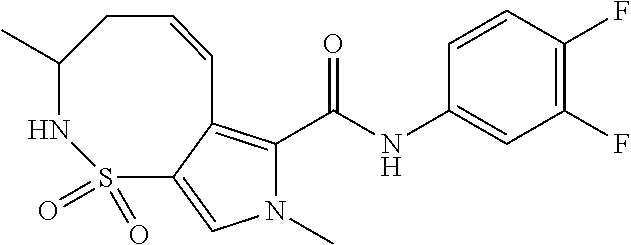


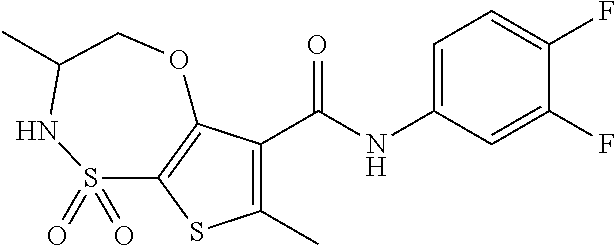


| TABLE 1 |
| anti HBV activity and cytotoxicity |
| HBV-AVE- | TOX-HepG2- | |||
| HepG2.117 | 4 d | |||
| Compound # | EC50 (μM) | CC50 (μM) | ||
| 1 | 2.74 | >25 | ||
| 2a | 0.28 | >25 | ||
| 2b | 0.49 | >25 | ||
| 3 | >0.5 | >25 | ||
| 4 | 1.09 | >25 | ||
| 5 | 0.18 | >25 | ||
| 6 | 3.98 | >25 | ||
| 7a | 0.13 | >25 | ||
| 7b | 0.007 | >25 | ||
| 8 | 0.047 | >25 | ||
| 9 | 0.036 | >25 | ||
| 10a | 0.22 | >25 | ||
| 10b | 0.006 | >25 | ||
| 11 | 0.077 | >25 | ||
| 12 | 0.35 | >25 | ||
| 13 | 0.11 | >25 | ||
| 14a | 0.25 | >25 | ||
| 14b | 0.078 | >25 | ||
| 15a | 0.078 | >25 | ||
| 15b | >0.5 | >25 | ||
| 16 | 0.23 | >25 | ||
| 17 | <0.098 | >25 | ||
| 18 | 0.71 | >25 | ||
| 19 | 0.19 | >25 | ||
| 20 | 0.058 | >25 | ||
| 21 | 0.15 | >25 | ||
| 22 | 0.009 | >25 | ||
| 23 | 0.005 | 10.62 | ||
| 24 | 0.068 | >25 | ||
| 25 | 0.022 | >25 | ||
| 26 | 0.027 | >25 | ||
| 27 | 0.11 | >25 | ||
| 28 | 0.89 | >25 | ||
| 29 | 0.005 | >25 | ||
| 30 | 0.013 | >25 | ||
| 31 | 0.009 | >25 | ||
| 32 | 0.003 | >25 | ||
| 33 | 0.053 | >25 | ||
| 34 | 0.056 | >25 | ||
| 35 | 0.012 | >25 | ||
| 36 | 0.005 | >25 | ||
| 37 | 0.20 | >25 | ||
| 38 | 0.005 | >25 | ||
| 39 | 0.003 | >25 | ||
| 40 | 0.022 | >25 | ||
| 41 | 0.008 | >25 | ||
| 42 | 0.081 | >25 | ||
| 43 | 0.056 | >25 | ||
| 44 | 0.17 | >25 | ||
| 45 | 0.23 | >25 | ||
| 46 | 0.33 | >25 | ||
| 47 | 0.017 | >25 | ||
| 48 | 0.084 | >25 | ||
| 49 | 0.31 | >25 | ||
| 50 | 0.002 | >25 | ||
| 51 | <0.002 | >25 | ||
| 52 | 0.056 | >25 | ||
| 53 | 0.19 | >25 | ||
| 54 | 0.004 | >25 | ||
| 55 | 0.003 | >25 | ||
| 56 | 0.010 | >25 | ||
| 57 | 0.013 | >25 | ||
| 58 | 0.29 | >25 | ||
| 59 | 0.24 | >25 | ||
| 59a | >0.5 | >25 | ||
| 59b | 0.14 | >25 | ||
| 60 | 0.013 | >25 | ||
| 60a | 0.055 | >25 | ||
| 60b | 0.005 | >25 | ||
| 61 | 0.074 | >25 | ||
| 62 | 0.009 | >25 | ||
| 63 | 0.24 | >25 | ||
| 64 | 0.008 | >25 | ||
| 65 | 0.007 | >25 | ||
| 66 | 0.047 | >25 | ||
| 67 | 0.069 | >25 | ||
| 68 | 0.23 | >25 | ||
| 69 | 0.033 | >25 | ||
| 70 | 0.014 | >25 | ||
| 71 | 0.003 | >25 | ||
| 72 | 0.050 | >25 | ||
| 73 | 0.48 | >25 | ||
| 74 | 0.052 | >25 | ||
| 75 | 0.007 | >25 | ||
| 76 | 0.22 | >25 | ||
| 77 | 0.23 | >25 | ||
| 78 | 0.056 | >25 | ||
| 79a | 0.043 | >25 | ||
| 79b | 0.002 | >25 | ||
| 80 | 0.018 | >25 | ||
| 81 | 0.002 | >25 | ||
| 82 | 0.004 | >25 | ||
| 83 | 0.058 | >25 | ||
| 84 | 0.010 | >25 | ||
| 85 | 0.007 | >25 | ||
| 86 | 0.005 | >25 | ||
| 87 | 0.018 | >25 | ||
| 88 | 0.011 | >25 | ||
| 89a | 0.19 | >25 | ||
| 89b | 0.017 | >25 | ||
| 90 | 0.019 | >25 | ||
| 91 | 0.13 | >25 | ||
| 92a | 0.031 | >24 | ||
| 92b | 0.17 | >25 | ||
| 93 | 0.012 | >25 | ||
| 94 | 0.080 | >25 | ||
| 95 | 0.022 | >25 | ||
| 96 | 0.005 | >25 | ||
| 97 | 0.055 | >25 | ||
| 98 | 0.008 | >25 | ||
| 99 | 0.004 | >25 | ||
| 100 | 0.003 | >25 | ||
| 101 | 0.014 | >25 | ||
| 102 | 0.009 | >25 | ||
| 103 | 0.006 | >25 | ||
| 104 | 0.007 | >25 | ||
| 105a | 0.007 | >25 | ||
| 105b | 0.011 | >25 | ||
| 106 | 0.008 | >25 | ||
| 107 | 0.080 | >25 | ||
| 108 | 0.016 | >25 | ||
| 109 | 0.003 | >25 | ||
| 110 | 0.20 | >25 | ||
| 111 | 0.089 | >25 | ||
| 112 | 0.003 | >25 | ||
| 113 | 0.12 | >25 | ||
| 114a | 0.022 | >25 | ||
| 114b | 0.008 | >25 | ||
| 115a | 0.008 | >25 | ||
| 115b | 0.007 | >25 | ||
| 116a | 0.022 | >25 | ||
| 116b | >0.35 | >25 | ||
| 117 | 0.010 | >25 | ||
| 118 | 0.013 | >25 | ||
| 119a | 0.011 | >25 | ||
| 119b | 0.006 | >25 | ||
| 120a | 0.007 | >25 | ||
| 120b | 0.011 | >25 | ||
| 121 | 0.029 | >25 | ||
| 122a | 0.012 | >25 | ||
| 122b | 0.009 | >25 | ||
| 123 | 0.019 | >25 | ||
| 124a | 0.005 | >25 | ||
| 124b | 0.004 | >25 | ||
| 125 | 0.007 | >25 | ||
| 126 | 0.062 | >25 | ||
| 127 | 0.013 | >25 | ||
| 128 | 0.024 | >25 | ||
| 129 | 0.012 | >25 | ||
| 130a | 0.018 | >25 | ||
| 130b | 0.012 | >25 | ||
| 131 | 0.023 | >25 | ||
| 132 | 0.019 | >25 | ||
| 133 | 0.011 | >25 | ||
| 134a | 0.008 | >25 | ||
| 134b | 0.007 | >25 | ||
| 135 | 0.005 | >25 | ||
| 136 | 0.016 | >25 | ||
| 137 | 0.006 | >25 | ||
| 138 | 0.029 | >25 | ||
| 139 | 0.016 | >25 | ||
| 140 | 0.062 | >25 | ||
| 141a | 0.030 | >25 | ||
| 141b | NA | >25 | ||
| 142a | 0.065 | >25 | ||
| 142b | >0.125 | >25 | ||
| 143 | 0.024 | >25 | ||
| 144a | 0.019 | >25 | ||
| 144b | 0.063 | >25 | ||
| 145 | 0.037 | >25 | ||
| 145a | 0.014 | >25 | ||
| 145b | 0.06 | >25 | ||
| 146 | 0.055 | >25 | ||
| 147 | 0.013 | >25 | ||
| 148 | 0.077 | >25 | ||
| 149a | >0.125 | >25 | ||
| 149b | 0.010 | >25 | ||
| 150a | >0.125 | >25 | ||
| 150b | 0.005 | >25 | ||
| 151 | 0.076 | >25 | ||
| 152 | 0.014 | >25 | ||
| 153 | 0.068 | >25 | ||
| 153a | >0.125 | >25 | ||
| 153b | 0.060 | >25 | ||
| 154 | 0.008 | >25 | ||
| 155 | 0.025 | >25 | ||
| 156 | 0.009 | >25 | ||
| 157 | 0.017 | >25 | ||
| 158 | 0.031 | >25 | ||
| 159 | 0.014 | >25 | ||
| 160 | 0.0145 | >25 | ||
| 160a | 0.077 | >25 | ||
| 160b | 0.021 | >25 | ||
| 161a | 0.049 | >25 | ||
| 161b | >0.125 | >25 | ||
| 161c | 0.011 | >25 | ||
| 161d | 0.011 | >25 | ||
| 162 | 0.003 | >25 | ||
| 162a | 0.033 | >25 | ||
| 162b | 0.011 | >25 | ||
| 163 | >0.125 | >25 | ||
| 164 | 0.012 | >25 | ||
| 165 | 0.068 | >25 | ||
| 166 | 0.056 | >25 | ||
| 167 | 0.041 | >25 | ||
| 168 | 0.025 | >25 | ||
| 168a | >0.125 | >25 | ||
| 168b | 0.015 | >25 | ||
| 169 | 0.017 | >25 | ||
| 170a | NA | >25 | ||
| 170b | 0.007 | >25 | ||
| 171 | 0.008 | >25 | ||
| 172 | 0.074 | >25 | ||
| 172a | 0.072 | >25 | ||
| 172b | 0.064 | >25 | ||
| 173 | 0.017 | >25 | ||
| 174 | 0.007 | >25 | ||
| 175 | 0.004 | >25 | ||
| 175a | 0.021 | >22.9 | ||
| 175b | 0.003 | >25 | ||
| 176 | 0.004 | >25 | ||
| 176a | 0.012 | >25 | ||
| 176b | NA | >25 | ||
| 177 | 0.008 | >25 | ||
| 177a | NA | >25 | ||
| 177b | 0.004 | >25 | ||
| 178 | 0.016 | >25 | ||
| 179 | 0.021 | >25 | ||
| 180 | 0.005 | >25 | ||
| 181 | 0.008 | >25 | ||
| 181a | 0.035 | >25 | ||
| 181b | 0.006 | >25 | ||
| 182 | 0.010 | >25 | ||
| 183 | 0.002 | >25 | ||
| 184 | 0.020 | >25 | ||
| 185 | 0.041 | >25 | ||
| 186 | 0.011 | >25 | ||
| 187 | 0.003 | >25 | ||
| 188 | 0.011 | >25 | ||
| 189 | 0.11 | >25 | ||
| 190 | 0.006 | >25 | ||
| 191 | 0.010 | >25 | ||
| 192 | 0.056 | >25 | ||
| 192a | 0.036 | >25 | ||
| 192b | 0.024 | >25 | ||
| 193 | 0.006 | >25 | ||
| 194 | 0.006 | >25 | ||
| 195 | 0.007 | >25 | ||
| 196 | 0.065 | >25 | ||
| 197 | 0.011 | >25 | ||
| 198 | 0.011 | >25 | ||
| 199 | 0.015 | >25 | ||
| 199a | 0.030 | >25 | ||
| 199b | 0.008 | >25 | ||
| 200 | 0.084 | >25 | ||
| 201 | 0.11 | >25 | ||
| 202 | 0.025 | >25 | ||
| 203a | 0.094 | >25 | ||
| 203b | 0.059 | >25 | ||
| 204a | >0.125 | >25 | ||
| 204b | >0.125 | >25 | ||
| 205 | 0.050 | >25 | ||
| 206a | 0.013 | >25 | ||
| 206b | 0.012 | >25 | ||
| 207a | 0.008 | >25 | ||
| 207b | 0.005 | >25 | ||
| 208a | 0.008 | >25 | ||
| 208b | 0.011 | >25 | ||
| 209a | 0.060 | >25 | ||
| 209b | 0.018 | >25 | ||
| 210a | 0.037 | >25 | ||
| 210b | 0.034 | >25 | ||
| 211 | 0.007 | >25 | ||
| 212 | 0.007 | >25 | ||
| 213a | 0.048 | >25 | ||
| 213b | 0.016 | >25 | ||
| 214a | 0.12 | >25 | ||
| 214b | 0.022 | >25 | ||
| 215a | 0.062 | >25 | ||
| 215b | >0.125 | >25 | ||
| 216 | 0.034 | >25 | ||
| 217a | 0.025 | >25 | ||
| 217b | 0.10 | >25 | ||
| 218a | >0.125 | >25 | ||
| 218b | 0.079 | >25 | ||
| 218c | 0.006 | >25 | ||
| 218d | 0.021 | >25 | ||
| 219 | NA | >25 | ||
| 220a | 0.007 | >25 | ||
| 220b | 0.034 | >25 | ||
| 228 | >0.5 | >25 | ||
| 229 | >0.5 | >25 | ||
| 230 | >0.5 | >25 | ||
| 231 | >0.5 | >25 | ||
| 232 | >0.5 | >25 | ||
| 233 | >0.5 | >25 | ||
| 234 | >0.5 | >25 | ||
| 235 | >0.5 | >25 | ||
| 236 | 0.34 | >25 | ||
| 237 | >0.5 | >25 | ||
| 238 | 0.077 | >25 | ||
| 239 | >0.5 | >25 | ||
| 240 | >0.25 | >25 | ||
| 241 | >0.25 | >25 | ||
| 242 | >0.13 | >25 | ||
| 243 | >0.5 | >25 | ||
| 244 | >0.5 | >25 | ||
| 245 | >25 | >25 | ||
| 246 | >0.13 | >25 | ||
| 247 | >0.13 | >25 | ||
Claims (18)


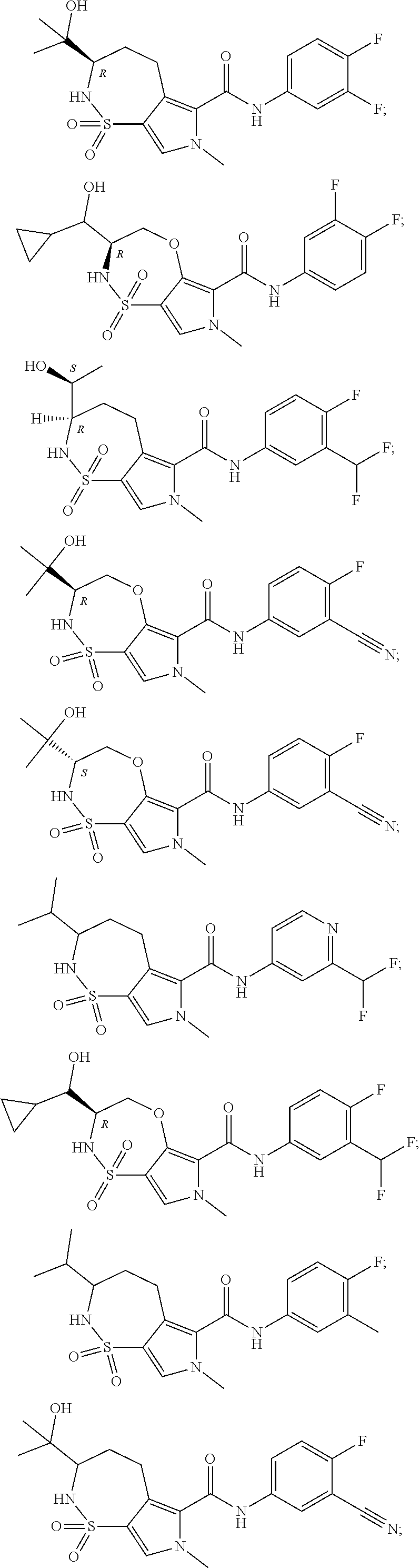


Priority Applications (1)
| Application Number | Priority Date | Filing Date | Title |
|---|---|---|---|
| US17/127,966 US20210179635A1 (en) | 2015-07-02 | 2020-12-18 | Cyclized sulfamoylarylamide derivatives and the use thereof as medicaments for the treatment of hepatitis b |
Applications Claiming Priority (12)
| Application Number | Priority Date | Filing Date | Title |
|---|---|---|---|
| EP15175021 | 2015-07-02 | ||
| EP15175021 | 2015-07-02 | ||
| EP15175021.3 | 2015-07-02 | ||
| EP15189903 | 2015-10-15 | ||
| EP15189903.6 | 2015-10-15 | ||
| EP15189903 | 2015-10-15 | ||
| EP15201332 | 2015-12-18 | ||
| EP15201332.2 | 2015-12-18 | ||
| EP15201332 | 2015-12-18 | ||
| EP16157726 | 2016-02-26 | ||
| EP16157726 | 2016-02-26 | ||
| EP16157726.7 | 2016-02-26 |
Related Child Applications (1)
| Application Number | Title | Priority Date | Filing Date |
|---|---|---|---|
| US17/127,966 Continuation US20210179635A1 (en) | 2015-07-02 | 2020-12-18 | Cyclized sulfamoylarylamide derivatives and the use thereof as medicaments for the treatment of hepatitis b |
Publications (2)
| Publication Number | Publication Date |
|---|---|
| US20170002025A1 US20170002025A1 (en) | 2017-01-05 |
| US10875876B2 true US10875876B2 (en) | 2020-12-29 |
Family
ID=56289521
Family Applications (2)
| Application Number | Title | Priority Date | Filing Date |
|---|---|---|---|
| US15/195,809 Expired - Fee Related US10875876B2 (en) | 2015-07-02 | 2016-06-28 | Cyclized sulfamoylarylamide derivatives and the use thereof as medicaments for the treatment of hepatitis B |
| US17/127,966 Abandoned US20210179635A1 (en) | 2015-07-02 | 2020-12-18 | Cyclized sulfamoylarylamide derivatives and the use thereof as medicaments for the treatment of hepatitis b |
Family Applications After (1)
| Application Number | Title | Priority Date | Filing Date |
|---|---|---|---|
| US17/127,966 Abandoned US20210179635A1 (en) | 2015-07-02 | 2020-12-18 | Cyclized sulfamoylarylamide derivatives and the use thereof as medicaments for the treatment of hepatitis b |
Country Status (37)
| Country | Link |
|---|---|
| US (2) | US10875876B2 (en) |
| EP (2) | EP3317286B1 (en) |
| JP (1) | JP6914201B2 (en) |
| KR (1) | KR20180022818A (en) |
| CN (1) | CN107735400B (en) |
| AU (1) | AU2016287472B2 (en) |
| BR (1) | BR112017028504A2 (en) |
| CA (1) | CA2986344A1 (en) |
| CL (1) | CL2017003459A1 (en) |
| CO (1) | CO2017012268A2 (en) |
| CR (1) | CR20180069A (en) |
| CY (1) | CY1122688T1 (en) |
| DK (1) | DK3317286T3 (en) |
| EA (1) | EA036629B1 (en) |
| ES (1) | ES2759775T3 (en) |
| GE (2) | GEP20207117B (en) |
| HK (1) | HK1253337B (en) |
| HR (1) | HRP20191901T1 (en) |
| HU (1) | HUE046283T2 (en) |
| IL (2) | IL256392A (en) |
| MA (2) | MA42292B1 (en) |
| MD (1) | MD3317286T2 (en) |
| MX (2) | MX376433B (en) |
| NI (1) | NI201700169A (en) |
| PE (1) | PE20180410A1 (en) |
| PH (1) | PH12017502316A1 (en) |
| PL (1) | PL3317286T3 (en) |
| PT (1) | PT3317286T (en) |
| RS (1) | RS59609B1 (en) |
| SG (1) | SG10202002302UA (en) |
| SI (1) | SI3317286T1 (en) |
| SM (1) | SMT201900672T1 (en) |
| TN (1) | TN2017000535A1 (en) |
| TW (1) | TWI705058B (en) |
| UA (1) | UA124054C2 (en) |
| UY (1) | UY36766A (en) |
| WO (1) | WO2017001655A1 (en) |
Cited By (1)
| Publication number | Priority date | Publication date | Assignee | Title |
|---|---|---|---|---|
| US11129834B2 (en) | 2016-04-15 | 2021-09-28 | Novira Therapeutics, Inc. | Combinations and methods comprising a capsid assembly inhibitor |
Families Citing this family (103)
| Publication number | Priority date | Publication date | Assignee | Title |
|---|---|---|---|---|
| KR101939710B1 (en) | 2011-12-21 | 2019-01-17 | 노비라 테라퓨틱스, 인코포레이티드 | Hepatitis b antiviral agents |
| UY34993A (en) | 2012-08-28 | 2014-02-28 | Janssen R & D Ireland | SULFAMOILARILAMIDAS AND ITS USE AS MEDICINES FOR THE TREATMENT OF HEPATITIS B |
| WO2014131847A1 (en) | 2013-02-28 | 2014-09-04 | Janssen R&D Ireland | Sulfamoyl-arylamides and the use thereof as medicaments for the treatment of hepatitis b |
| JP6419155B2 (en) | 2013-04-03 | 2018-11-07 | ヤンセン・サイエンシズ・アイルランド・ユーシー | N-phenyl-carboxamide derivatives and their use as pharmaceuticals for treating hepatitis B |
| HRP20181863T1 (en) | 2013-05-17 | 2018-12-28 | Janssen Sciences Ireland Uc | Sulphamoylthiophenamide derivatives and the use thereof as medicaments for the treatment of hepatitis b |
| JO3583B1 (en) | 2013-05-17 | 2020-07-05 | Janssen Sciences Ireland Uc | Sulphamoylpyrrolamide derivatives and the use thereof as medicaments for the treatment of hepatitis b |
| NO3024819T3 (en) | 2013-07-25 | 2018-07-21 | ||
| MX368158B (en) | 2013-10-23 | 2019-09-20 | Janssen Sciences Ireland Uc | Carboxamide derivatives and the use thereof as medicaments for the treatment of hepatitis b. |
| US10392349B2 (en) | 2014-01-16 | 2019-08-27 | Novira Therapeutics, Inc. | Azepane derivatives and methods of treating hepatitis B infections |
| WO2015120178A1 (en) | 2014-02-05 | 2015-08-13 | Novira Therapeutics, Inc. | Combination therapy for treatment of hbv infections |
| DK3102572T3 (en) | 2014-02-06 | 2019-02-04 | Janssen Sciences Ireland Uc | SULFAMOYLPYRROLAMIDE DERIVATIVES AND THEIR USE AS MEDICINES TO TREAT HEPATITIS B |
| ES2874579T3 (en) | 2014-06-11 | 2021-11-05 | Venatorx Pharmaceuticals Inc | Beta-lactamase inhibitors |
| TWI788830B (en) | 2015-07-02 | 2023-01-01 | 瑞士商赫孚孟拉羅股份公司 | Bicyclic lactams and methods of use thereof |
| US10875876B2 (en) | 2015-07-02 | 2020-12-29 | Janssen Sciences Ireland Uc | Cyclized sulfamoylarylamide derivatives and the use thereof as medicaments for the treatment of hepatitis B |
| JOP20190024A1 (en) | 2016-08-26 | 2019-02-19 | Gilead Sciences Inc | Substituted pyrrolizine compounds and uses thereof |
| FI3526323T3 (en) | 2016-10-14 | 2023-06-06 | Prec Biosciences Inc | Engineered meganucleases specific for recognition sequences in the hepatitis b virus genome |
| EP3526219B1 (en) | 2016-10-17 | 2021-12-15 | F. Hoffmann-La Roche AG | Bicyclic pyridone lactams and methods of use thereof |
| US11072607B2 (en) | 2016-12-16 | 2021-07-27 | Genentech, Inc. | Inhibitors of RIP1 kinase and methods of use thereof |
| CN108264520B (en) * | 2017-01-03 | 2021-12-07 | 上海长森药业有限公司 | Compound for treating hepatitis B and application thereof |
| WO2018153326A1 (en) * | 2017-02-22 | 2018-08-30 | 上海长森药业有限公司 | Sulfonyl hydrazine compound and use thereof |
| EP3630782A4 (en) | 2017-05-26 | 2021-03-03 | Venatorx Pharmaceuticals, Inc. | PENICILLIN BINDING PROTEIN INHIBITORS |
| US11267826B2 (en) | 2017-05-26 | 2022-03-08 | VenatoRx Pharmaceuticals, Inc. | Penicillin-binding protein inhibitors |
| CN109251212A (en) * | 2017-07-14 | 2019-01-22 | 上海长森药业有限公司 | Inner ring sulfide amide-arylamides and its purposes for treating hepatitis B |
| BR112020008765A2 (en) | 2017-11-02 | 2020-10-20 | Aicuris Gmbh & Co. Kg | indole-2-carboxamides pyrazolo-piperidine substituted highly active innovative active against the hepatitis b virus (hbv) |
| GEAP202115351A (en) | 2017-11-02 | 2021-12-10 | Aicuris Gmbh & Co Kg | Novel, highly active amino-thiazole substituted indole-2-carboxamides active against the hepatitis b virus (hbv) |
| US20210079015A1 (en) | 2017-11-17 | 2021-03-18 | Novartis Ag | Novel dihydroisoxazole compounds and their use for the treatment of hepatitis b |
| US10701542B2 (en) | 2017-12-05 | 2020-06-30 | Rapidsos, Inc. | Social media content for emergency management |
| WO2019118358A1 (en) | 2017-12-11 | 2019-06-20 | VenatoRx Pharmaceuticals, Inc. | Hepatitis b capsid assembly modulators |
| KR102492187B1 (en) | 2017-12-20 | 2023-01-27 | 인스티튜트 오브 오가닉 케미스트리 앤드 바이오케미스트리 에이에스 씨알 브이.브이.아이. | 3'3' cyclic dinucleotides with phosphonate linkages that activate STING adapter proteins |
| JP7098748B2 (en) | 2017-12-20 | 2022-07-11 | インスティチュート オブ オーガニック ケミストリー アンド バイオケミストリー エーエスシーアール,ヴイ.ヴイ.アイ. | 2'3'cyclic dinucleotide with phosphonate binding that activates the STING adapter protein |
| KR102526964B1 (en) | 2018-02-26 | 2023-04-28 | 길리애드 사이언시즈, 인코포레이티드 | Substituted pyrrolizine compounds as HBV replication inhibitors |
| EP3759110A1 (en) | 2018-02-28 | 2021-01-06 | Novartis AG | Indole-2-carbonyl compounds and their use for the treatment of hepatitis b |
| JP2021515769A (en) | 2018-03-14 | 2021-06-24 | ヤンセン・サイエンシズ・アイルランド・アンリミテッド・カンパニー | Capsid aggregation regulator dosing regimen |
| US10870691B2 (en) | 2018-04-05 | 2020-12-22 | Gilead Sciences, Inc. | Antibodies and fragments thereof that bind hepatitis B virus protein X |
| TWI833744B (en) | 2018-04-06 | 2024-03-01 | 捷克科學院有機化學與生物化學研究所 | 3'3'-cyclic dinucleotides |
| TW202005654A (en) | 2018-04-06 | 2020-02-01 | 捷克科學院有機化學與生物化學研究所 | 2'2'-cyclic dinucleotides |
| TWI818007B (en) | 2018-04-06 | 2023-10-11 | 捷克科學院有機化學與生物化學研究所 | 2'3'-cyclic dinucleotides |
| TW201945388A (en) | 2018-04-12 | 2019-12-01 | 美商精密生物科學公司 | Optimized engineered meganucleases having specificity for a recognition sequence in the hepatitis B virus genome |
| JP7398391B2 (en) | 2018-04-20 | 2023-12-14 | エフ. ホフマン-ラ ロシュ アーゲー | N-[4-oxo-2,3-dihydro-1,5-benzoxazepin-3-yl]-5,6-dihydro-4H-pyrrolo[1,2-b]pyrazole-2-carboxamide derivative and Related compounds as RIP1 kinase inhibitors, for example to treat irritable bowel syndrome (IBS) |
| US20190359645A1 (en) | 2018-05-03 | 2019-11-28 | Institute Of Organic Chemistry And Biochemistry Ascr, V.V.I. | 2'3'-cyclic dinucleotides comprising carbocyclic nucleotide |
| CN110437232B (en) * | 2018-05-04 | 2022-04-12 | 上海长森药业有限公司 | Bicyclourea nucleocapsid inhibitor and pharmaceutical use thereof |
| KR20210019489A (en) | 2018-06-11 | 2021-02-22 | 베나토알엑스 파마슈티컬스, 인크. | Hepatitis B capsid assembly regulator |
| EP3597653A1 (en) | 2018-07-19 | 2020-01-22 | Irbm S.P.A. | Cyclic inhibitors of hepatitis b virus |
| EP3597637A1 (en) | 2018-07-19 | 2020-01-22 | Irbm S.P.A. | Inhibitors of hepatitis b virus |
| TWI826492B (en) * | 2018-07-27 | 2023-12-21 | 加拿大商愛彼特生物製藥公司 | Substituted tetrahydrocyclopenta[c]pyrroles, substituted dihydropyrrolizines, analogues thereof, and methods using same |
| WO2020028097A1 (en) | 2018-08-01 | 2020-02-06 | Gilead Sciences, Inc. | Solid forms of (r)-11-(methoxymethyl)-12-(3-methoxypropoxy)-3,3-dimethyl-8-0x0-2,3,8,13b-tetrahydro-1h-pyrido[2,1-a]pyrrolo[1,2-c] phthalazine-7-c arboxylic acid |
| EP3608326A1 (en) | 2018-08-10 | 2020-02-12 | Irbm S.P.A. | Tricyclic inhibitors of hepatitis b virus |
| US11066404B2 (en) | 2018-10-11 | 2021-07-20 | Incyte Corporation | Dihydropyrido[2,3-d]pyrimidinone compounds as CDK2 inhibitors |
| US10977927B2 (en) | 2018-10-24 | 2021-04-13 | Rapidsos, Inc. | Emergency communication flow management and notification system |
| WO2020092528A1 (en) | 2018-10-31 | 2020-05-07 | Gilead Sciences, Inc. | Substituted 6-azabenzimidazole compounds having hpk1 inhibitory activity |
| PE20211655A1 (en) | 2018-10-31 | 2021-08-24 | Gilead Sciences Inc | 6-AZABENZIMIDAZOLE COMPOUNDS SUBSTITUTED AS HPK1 INHIBITORS |
| PY1991606A (en) | 2018-11-02 | 2022-02-10 | Aicuris Gmbh & Co Kg | NEW UREA 6,7-DIHYDRO-4H-PYRAZOLE [4,3-C] PYRIDINES ACTIVE AGAINST HEPATITIS B VIRUS (HBV) |
| PY1991611A (en) | 2018-11-02 | 2022-03-14 | Aicuris Gmbh & Co Kg | NEW UREA 6,7-DIHYDRO-4H-PYRAZOLE [1,5-A] PYRAZINES ACTIVE AGAINST HEPATITIS B VIRUS (HBV) |
| PY1991601A (en) | 2018-11-02 | 2020-11-02 | Aicuris Gmbh & Co Kg | NEW 6,7-DIHYDRO-4H-PYRAZOLE [1,5-A]PYRAZINE INDOLE-2-CARBOXAMIDES ACTIVE AGAINST HEPATITIS B VIRUS (HBV) |
| PY1991608A (en) | 2018-11-02 | 2022-02-10 | Aicuris Gmbh & Co Kg | NEW UREA 6,7-DIHYDRO-4H-PYRAZOLO [1,5-A] PYRAZINE ACTIVE AGAINST HEPATITIS B VIRUS (HBV) |
| TW202031666A (en) | 2018-11-02 | 2020-09-01 | 德商艾庫瑞斯公司 | Novel urea 6,7-dihydro-4h-thiazolo[5,4-c]pyridines active against the hepatitis b virus (hbv) |
| UY38436A (en) | 2018-11-02 | 2020-05-29 | Aicuris Gmbh & Co Kg | NEW 6,7-DIHYDRO-4H-PYRAZOLE [1,5-A] PYRAZININDOL-2-CARBOXAMIDES ACTIVE AGAINST THE HEPATITIS B VIRUS (HBV) |
| CN111434665B (en) * | 2019-01-11 | 2023-03-10 | 上海长森药业有限公司 | Ensultamidenamide-arylamide compounds and their use for treating hepatitis B |
| MX2021009717A (en) | 2019-02-14 | 2021-09-14 | Aligos Therapeutics Inc | Bicyclic sulfonamides. |
| US11096931B2 (en) | 2019-02-22 | 2021-08-24 | Janssen Sciences Ireland Unlimited Company | Amide derivatives useful in the treatment of HBV infection or HBV-induced diseases |
| WO2020178768A1 (en) | 2019-03-07 | 2020-09-10 | Institute Of Organic Chemistry And Biochemistry Ascr, V.V.I. | 3'3'-cyclic dinucleotide analogue comprising a cyclopentanyl modified nucleotide as sting modulator |
| CN113543851B (en) | 2019-03-07 | 2025-03-18 | 捷克共和国有机化学与生物化学研究所 | 2'3'-Cyclic dinucleotides and prodrugs thereof |
| WO2020178770A1 (en) | 2019-03-07 | 2020-09-10 | Institute Of Organic Chemistry And Biochemistry Ascr, V.V.I. | 3'3'-cyclic dinucleotides and prodrugs thereof |
| WO2020205560A1 (en) | 2019-03-29 | 2020-10-08 | Incyte Corporation | Sulfonylamide compounds as cdk2 inhibitors |
| TW202210480A (en) | 2019-04-17 | 2022-03-16 | 美商基利科學股份有限公司 | Solid forms of a toll-like receptor modulator |
| TW202212339A (en) | 2019-04-17 | 2022-04-01 | 美商基利科學股份有限公司 | Solid forms of a toll-like receptor modulator |
| EP3962912A1 (en) | 2019-04-30 | 2022-03-09 | AiCuris GmbH & Co. KG | Novel phenyl and pyridyl ureas active against the hepatitis b virus (hbv) |
| CU20210090A7 (en) | 2019-04-30 | 2022-06-06 | Aicuris Gmbh & Co Kg | COMPOUNDS DERIVED FROM OXALIL PIPERAZINES ACTIVE AGAINST HEPATITIS B VIRUS (HBV) |
| CN113748113A (en) | 2019-04-30 | 2021-12-03 | 艾库里斯有限及两合公司 | Novel indolizine-2-carboxamides having activity against Hepatitis B Virus (HBV) |
| WO2020221826A1 (en) | 2019-04-30 | 2020-11-05 | Aicuris Gmbh & Co. Kg | Novel indole-2-carboxamides active against the hepatitis b virus (hbv) |
| US11491148B2 (en) | 2019-05-06 | 2022-11-08 | Janssen Sciences Ireland Unlimited Company | Amide derivatives useful in the treatment of HBV infection or HBV-induced diseases |
| EP3741762A1 (en) | 2019-05-23 | 2020-11-25 | Irbm S.P.A. | Oxalamido-substituted tricyclic inhibitors of hepatitis b virus |
| UY38705A (en) * | 2019-05-23 | 2020-12-31 | Irbm S P A | TRICYCLIC INHIBITORS SUBSTITUTED WITH HEPATITIS B VIRUS OXALAMIDE |
| EP3825318A1 (en) | 2019-11-25 | 2021-05-26 | Promidis S.r.l. | Oxalamido-substituted tricyclic inhibitors of hepatitis b virus |
| TWI826690B (en) | 2019-05-23 | 2023-12-21 | 美商基利科學股份有限公司 | Substituted eneoxindoles and uses thereof |
| JP2022534961A (en) * | 2019-05-28 | 2022-08-04 | ヤンセン・サイエンシズ・アイルランド・アンリミテッド・カンパニー | Azepine as a HBV Capsid Assembly Modulator |
| US20220305116A1 (en) | 2019-06-18 | 2022-09-29 | Janssen Sciences lreland Unlimited Company | Combination of hepatitis b virus (hbv) vaccines and capsid assembly modulators being sulfonamide derivatives |
| AU2020301161B2 (en) | 2019-06-25 | 2023-10-26 | Gilead Sciences, Inc. | FLT3L-Fc fusion proteins and methods of use |
| CN116348458A (en) | 2019-08-14 | 2023-06-27 | 因赛特公司 | Imidazolylpyrimidinylamine compounds as CDK2 inhibitors |
| WO2021034804A1 (en) | 2019-08-19 | 2021-02-25 | Gilead Sciences, Inc. | Pharmaceutical formulations of tenofovir alafenamide |
| EP4458975A3 (en) | 2019-09-30 | 2025-02-12 | Gilead Sciences, Inc. | Hbv vaccines and methods treating hbv |
| CN119930611A (en) | 2019-10-11 | 2025-05-06 | 因赛特公司 | Dicyclomine as a CDK2 inhibitor |
| ES3022990T3 (en) | 2019-12-06 | 2025-05-29 | Prec Biosciences Inc | Optimized engineered meganucleases having specificity for a recognition sequence in the hepatitis b virus genome |
| CA3167114A1 (en) * | 2020-02-11 | 2021-08-19 | Romano Di Fabio | Spirocyclic inhibitors of hepatitis b virus |
| EP3985010A1 (en) | 2020-10-14 | 2022-04-20 | Promidis S.r.l. | Spirocyclic inhibitors of hepatitis b virus |
| EP3865489A1 (en) | 2020-02-11 | 2021-08-18 | Promidis S.r.l. | Spirocyclic inhibitors of hepatitis b virus |
| CA3169348A1 (en) | 2020-03-20 | 2021-09-23 | Gilead Sciences, Inc. | Prodrugs of 4'-c-substituted-2-halo-2'-deoxyadenosine nucleosides and methods of making and using the same |
| ES3054072T3 (en) | 2020-08-07 | 2026-01-29 | Gilead Sciences Inc | Prodrugs of phosphonamide nucleotide analogues and their pharmaceutical use |
| TW202406932A (en) | 2020-10-22 | 2024-02-16 | 美商基利科學股份有限公司 | Interleukin-2-fc fusion proteins and methods of use |
| CN115160344A (en) * | 2021-04-06 | 2022-10-11 | 上海长森药业有限公司 | Inhibition of CD4 by oral administration + Medicaments and methods for Treg cells |
| AU2022274607A1 (en) | 2021-05-13 | 2023-11-16 | Gilead Sciences, Inc. | COMBINATION OF A TLR8 MODULATING COMPOUND AND ANTI-HBV siRNA THERAPEUTICS |
| US11981671B2 (en) | 2021-06-21 | 2024-05-14 | Incyte Corporation | Bicyclic pyrazolyl amines as CDK2 inhibitors |
| US11932634B2 (en) | 2021-06-23 | 2024-03-19 | Gilead Sciences, Inc. | Diacylglycerol kinase modulating compounds |
| WO2022271650A1 (en) | 2021-06-23 | 2022-12-29 | Gilead Sciences, Inc. | Diacylglyercol kinase modulating compounds |
| EP4359415A1 (en) | 2021-06-23 | 2024-05-01 | Gilead Sciences, Inc. | Diacylglyercol kinase modulating compounds |
| WO2022271659A1 (en) | 2021-06-23 | 2022-12-29 | Gilead Sciences, Inc. | Diacylglyercol kinase modulating compounds |
| US11976073B2 (en) | 2021-12-10 | 2024-05-07 | Incyte Corporation | Bicyclic amines as CDK2 inhibitors |
| CN117777047B (en) * | 2024-02-26 | 2024-04-30 | 四川大学 | N-substituted azaspirodecanone compounds and preparation methods and applications thereof |
| WO2025240243A1 (en) | 2024-05-13 | 2025-11-20 | Gilead Sciences, Inc. | Combination therapies with bulevirtide and an inhibitory nucleic acid targeting hepatitis b virus |
| WO2025240242A1 (en) | 2024-05-13 | 2025-11-20 | Gilead Sciences, Inc. | Combination therapies with ribavirin |
| WO2025240246A1 (en) | 2024-05-13 | 2025-11-20 | Gilead Sciences, Inc. | Combination therapies with ribavirin |
| WO2025240244A1 (en) | 2024-05-13 | 2025-11-20 | Gilead Sciences, Inc. | Combination therapies comprising bulevirtide and lonafarnib for use in the treatment of hepatitis d virus infection |
| WO2025255505A1 (en) * | 2024-06-06 | 2025-12-11 | Baruch S. Blumberg Institute | Pregenomic rna encapsidation inhibitors and their method of use |
Citations (218)
| Publication number | Priority date | Publication date | Assignee | Title |
|---|---|---|---|---|
| US3843662A (en) | 1971-12-09 | 1974-10-22 | Pfizer | 2-halo-5-(substituted piperidino sulfonyl)benzoic acids |
| WO1984003281A1 (en) | 1983-02-19 | 1984-08-30 | Beecham Group Plc | Azabicycloalkyl benzamide and anilide derivatives |
| US4569940A (en) | 1982-06-04 | 1986-02-11 | Beecham Group P.L.C. | Certain 5-N-mono- or disubstituted sulfamoyl benzamides having use in treatment of emesis, impaired gastro-intestinal motility disorders and central nervous system disorders |
| JPS62142164A (en) | 1985-12-13 | 1987-06-25 | Ishihara Sangyo Kaisha Ltd | 4,5-dichloroimidazole based compound and pest controlling agent containing said compound |
| EP0232067A2 (en) | 1986-01-30 | 1987-08-12 | Ishihara Sangyo Kaisha Ltd. | Substituted pyridinesulfonamide compounds, herbicidal composition containing them, and method of preparing these compounds |
| US4962101A (en) | 1989-08-21 | 1990-10-09 | Merck & Co., Inc. | 2-(Heterocyclylalkyl)phenyl carbapenem antibacterial agents |
| US4995898A (en) | 1987-03-13 | 1991-02-26 | Ishihara Sangyo Kaisha, Ltd. | Imidazole compounds and biocidal composition comprising the same for controlling harmful organisms |
| WO1992007835A1 (en) | 1990-10-24 | 1992-05-14 | Schering Agrochemicals Limited | Imidazole fungicides |
| US5272167A (en) | 1986-12-10 | 1993-12-21 | Schering Corporation | Pharmaceutically active compounds |
| US5308826A (en) | 1993-04-22 | 1994-05-03 | Zeneca Limited | Herbicidal 4-substituted pyridyl-3-carbinols |
| US5314880A (en) | 1989-02-23 | 1994-05-24 | British Bio-Technology Limited | Benzimidazole derivatives |
| US5571821A (en) | 1993-05-20 | 1996-11-05 | Texas Biotechnology Corporation | Sulfonamides and derivatives thereof that modulate the activity of endothelin |
| EP0742200A1 (en) | 1995-05-12 | 1996-11-13 | Konica Corporation | Manufacturing method of sulphides |
| US5607929A (en) | 1991-05-02 | 1997-03-04 | Glaxo Wellcome Inc. | Antiviral dibenzothiazepinone derivatives |
| US5708034A (en) | 1995-11-03 | 1998-01-13 | Hoechst Aktiengesellschaft | Substituted sulfonimidamides, processes for their preparation, their use as a medicament or diagnostic, and medicament comprising them |
| US5723411A (en) | 1995-10-31 | 1998-03-03 | E. I. Du Pont De Nemours And Company | Herbicidal pyridazinones |
| US5756524A (en) | 1994-03-18 | 1998-05-26 | Agrevo Uk Limited | Anilide derivatives as fungicides |
| WO1998023285A1 (en) | 1996-11-29 | 1998-06-04 | Smithkline Beecham Plc | Use of a combination of penciclovir and alpha-interferon in the manufacture of a medicament for the treatment of hepatitis b |
| US5795907A (en) | 1994-05-27 | 1998-08-18 | James Black Foundation Limited | Gastin and CCK receptor ligands |
| WO1999009022A1 (en) | 1997-08-18 | 1999-02-25 | Centaur Pharmaceuticals, Inc. | Furansulfonic acid derivatives and pharmaceutical compositions containing the same |
| US5912260A (en) | 1994-05-27 | 1999-06-15 | James Black Foundation Limited | Gastrin and CCK antagonists |
| US5919970A (en) | 1997-04-24 | 1999-07-06 | Allergan Sales, Inc. | Substituted diaryl or diheteroaryl methanes, ethers and amines having retinoid agonist, antagonist or inverse agonist type biological activity |
| WO1999038845A1 (en) | 1998-01-29 | 1999-08-05 | Tularik Inc. | Ppar-gamma modulators |
| US5939423A (en) | 1997-04-16 | 1999-08-17 | Sciclone Pharmaceuticals, Inc. | Treatment of hepatitis B infection with thymosin alpha 1 and famciclovir |
| WO1999048492A1 (en) | 1998-03-26 | 1999-09-30 | Japan Tobacco Inc. | Amide derivatives and nociceptin antagonists |
| WO1999065906A1 (en) | 1998-06-15 | 1999-12-23 | Allelix Biopharmaceuticals Inc. | Bicyclic piperidine and piperazine compounds having 5-ht6 receptor affinity |
| US6025367A (en) | 1996-06-25 | 2000-02-15 | Smithkline Beecham Plc | Sulfonamide derivatives as 5HT7 receptor antagonists |
| WO2001005390A2 (en) | 1999-07-16 | 2001-01-25 | Warner-Lambert Company | Method for treating chronic pain using mek inhibitors |
| WO2001019788A2 (en) | 1999-09-17 | 2001-03-22 | Cor Therapeutics, Inc. | BENZAMIDES AND RELATED INHIBITORS OF FACTOR Xa |
| WO2001025200A1 (en) | 1999-10-01 | 2001-04-12 | Takeda Chemical Industries, Ltd. | Cyclic amine compounds as ccr5 antagonists |
| WO2001051487A1 (en) | 1999-12-28 | 2001-07-19 | Pfizer Products Inc. | Non-peptidyl inhibitors of vla-4 dependent cell binding useful in treating inflammatory, autoimmune, and respiratory diseases |
| US6265408B1 (en) | 1996-06-20 | 2001-07-24 | Smithkline Beecham Plc | Sulphonamide derivatives and their use in the treatment of CNS disorders |
| WO2001055121A1 (en) | 2000-01-28 | 2001-08-02 | Kaken Pharmaceutical Co., Ltd. | Azepine derivatives |
| WO2001085694A2 (en) | 2000-05-05 | 2001-11-15 | Ortho-Mcneil Pharmaceutical, Inc. | Substituted diamide derivatives useful as motilin antagonists |
| WO2002051410A2 (en) | 2000-12-22 | 2002-07-04 | Akzo Nobel N.V. | Phenylthiazole and thiazoline derivatives and their use as antiparasitics |
| WO2002064618A2 (en) | 2001-02-09 | 2002-08-22 | Massachusetts Institute Of Technology | Methods of identifying agents that mediate polypeptide aggregation |
| US6476025B1 (en) | 1999-01-15 | 2002-11-05 | Altana Pharma Ag | Phenylphennanthridines with PDE-IV inhibiting activity |
| WO2003002518A1 (en) | 2001-06-28 | 2003-01-09 | Dong Hwa Pharm. Ind. Co., Ltd. | Novel 2,4-difluorobenzamide derivatives as antiviral agents |
| WO2003007955A2 (en) | 2001-07-20 | 2003-01-30 | Cancer Research Technology Limited | Biphenyl apurinic/apyrimidinic site endonuclease inhibitors to treat cancer |
| WO2003044016A1 (en) | 2001-11-20 | 2003-05-30 | Eli Lilly And Company | 3-SUBSTITUTED OXINDOLE β3 AGONISTS |
| US6650463B2 (en) | 2001-03-13 | 2003-11-18 | Seiko Epson Corporation | Electrophoretic display device |
| WO2003101961A1 (en) | 2002-05-30 | 2003-12-11 | Astrazeneca Ab | Novel substituted indoles |
| WO2004010943A2 (en) | 2002-07-31 | 2004-02-05 | Smithkline Beecham Corporation | Substituted benzanilides as modulators of the ccr5 receptor |
| WO2004011427A2 (en) | 2002-07-31 | 2004-02-05 | Smithkline Beecham Corporation | Substituted benzanilides as modulators of the ccr5 receptor |
| US20040039009A1 (en) | 2001-08-31 | 2004-02-26 | Prakash Jagtap | Isoquinoline derivatives and methods of use thereof |
| WO2004022060A2 (en) | 2002-09-06 | 2004-03-18 | Janssen Pharmaceutica, N.V. | (1h-benzoimidazol-2-yl)-(piperazinyl)-methanone derivatives and related compounds as histamine h4-receptor antagonists for the treatment of inflammatory and allergic disorders |
| US20040110802A1 (en) | 2002-08-23 | 2004-06-10 | Atli Thorarensen | Antibacterial benzoic acid derivatives |
| WO2004058709A1 (en) | 2002-12-23 | 2004-07-15 | Millennium Pharmaceuticals, Inc. | Ccr8 inhibitors |
| US6780389B2 (en) | 2001-07-25 | 2004-08-24 | Degussa Ag | Process for the production of modified carbon black |
| WO2004086865A1 (en) | 2003-03-27 | 2004-10-14 | Cytokinetics, Inc. | Compounds, compositions and methods |
| WO2004099192A2 (en) | 2003-04-30 | 2004-11-18 | The Institutes Of Pharmaceutical Discovery, Llc | Heterocycle substituted carboxylic acids as inhibitors of protein tyrosine phosphatase-1b |
| WO2004100947A2 (en) | 2003-05-06 | 2004-11-25 | Smithkline Beecham Corporation | Novel chemical compounds |
| WO2005000231A2 (en) | 2003-06-06 | 2005-01-06 | Smithkline Beecham Corporation | Il-8 receptor antagonists |
| US20050009871A1 (en) | 2003-05-30 | 2005-01-13 | Rigel Pharmaceuticals, Inc. | Ubiquitin ligase inhibitors |
| WO2005016922A1 (en) | 2003-08-14 | 2005-02-24 | Glaxo Group Limited | Carbazole-2-carboxamide derivatives having vanilloid receptor antagonist activity |
| US20050054850A1 (en) | 2003-02-28 | 2005-03-10 | Chengde Wu | Pyridine, pyrimidine, quinoline, quinazoline, and naphthalene urotensin-II receptor antagonists |
| WO2005044797A1 (en) | 2003-11-06 | 2005-05-19 | Addex Pharmaceuticals Sa | Allosteric modulators of metabotropic glutamate receptors |
| US20050129833A1 (en) | 2003-12-15 | 2005-06-16 | Kraft Foods Holdings, Inc. | Edible spread composition and packaged product |
| US20050148632A1 (en) | 2002-08-09 | 2005-07-07 | Munetaka Tokumasu | Therapeutic agent for intestinal diseases and visceral pain |
| WO2005087217A1 (en) | 2004-03-05 | 2005-09-22 | The General Hospital Corporation | Compositions and methods for modulating interaction between polypeptides |
| WO2005105785A2 (en) | 2004-05-04 | 2005-11-10 | Novo Nordisk A/S | Indole derivatives for treatment of obesity |
| WO2005115374A1 (en) | 2004-05-29 | 2005-12-08 | 7Tm Pharma A/S | Crth2 receptor ligands for therapeutic use |
| WO2006002133A1 (en) | 2004-06-22 | 2006-01-05 | Schering Corporation | Cannabinoid receptor ligands |
| WO2006012642A2 (en) | 2004-07-30 | 2006-02-02 | Exelixis, Inc. | Pyrrole derivatives as pharmaceutical agents |
| US20060040984A1 (en) | 2002-09-24 | 2006-02-23 | Christopher Luckhurst | Novel piperidine derivatives for use in the treatment of chemokine medicated disease states |
| WO2006024834A1 (en) | 2004-08-31 | 2006-03-09 | Astrazeneca Ab | Quinazolinone derivatives and their use as b-raf inhibitors |
| US20060100257A1 (en) | 2002-06-05 | 2006-05-11 | Susumu Muto | Inhibitors against the activation of ap-1 and nfat |
| WO2006053109A1 (en) | 2004-11-10 | 2006-05-18 | Synta Pharmaceuticals Corp. | Heteroaryl compounds |
| US20060122236A1 (en) | 2004-12-06 | 2006-06-08 | Wood Michael R | Substituted biaryl-carboxylate derivatives |
| WO2006067446A1 (en) | 2004-12-22 | 2006-06-29 | Astrazeneca Ab | Pyridine carboxamide derivatives for use as anticancer agents |
| WO2006067445A2 (en) | 2004-12-22 | 2006-06-29 | Astrazeneca Ab | Csf-1r kinase inhibitors |
| US7115595B2 (en) | 2000-12-27 | 2006-10-03 | Dainippon Sumitomo Pharma Co., Ltd. | Carbapenem compounds |
| WO2006123257A2 (en) | 2005-05-18 | 2006-11-23 | Addex Pharma Sa | Phenyl-3-{(3-(1h-pyrrol-2-yl)-[1, 2 , 4]0xadiaz0l-5-yl]piperidin-1-yl}-methanone derivatives and related compounds as positive allosteric modulators of metabotropic glutamate receptors |
| WO2006128172A2 (en) | 2005-05-26 | 2006-11-30 | Synta Pharmaceuticals Corp. | Method for treating b cell regulated autoimmune disorders |
| WO2006128129A2 (en) | 2005-05-26 | 2006-11-30 | Synta Pharmaceuticals Corp. | Method for treating cancer |
| US7186735B2 (en) | 2002-08-07 | 2007-03-06 | Sanofi-Aventis Deutschland Gmbh | Acylated arylcycloalkylamines and their use as pharmaceuticals |
| WO2007031791A1 (en) | 2005-09-16 | 2007-03-22 | Arrow Therapeutics Limited | Biphenyl derivatives and their use in treating hepatitis c |
| WO2007070556A2 (en) | 2005-12-12 | 2007-06-21 | Genelabs Technologies, Inc. | N-(6-membered aromatic ring)-amido anti-viral compounds |
| US20070142440A1 (en) | 2004-02-26 | 2007-06-21 | Lars Burgdorf | Pyridinamide derivatives as kinase inhibitors |
| US20070161578A1 (en) | 2005-12-21 | 2007-07-12 | Hwa Joyce J | Treatment of nonalcoholic fatty liver disease using cholesterol lowering agents and/or H3 receptor antagonist/inverse agonist |
| CN101039919A (en) | 2004-10-13 | 2007-09-19 | 惠氏公司 | N-benzenesulfonyl substituted anilino-pyrimidine analogs |
| WO2008011476A2 (en) | 2006-07-18 | 2008-01-24 | The General Hospital Corporation | Compositions and methods for modulating sirtuin activity |
| WO2008022171A1 (en) | 2006-08-17 | 2008-02-21 | Boehringer Ingelheim International Gmbh | Methods of using aryl sulfonyl compounds effective as soluble epoxide hydrolase inhibitors |
| US7338956B2 (en) | 2002-08-07 | 2008-03-04 | Sanofi-Aventis Deutschland Gmbh | Acylamino-substituted heteroaromatic compounds and their use as pharmaceuticals |
| US7368457B2 (en) | 2003-05-13 | 2008-05-06 | Schering Corporation | Bridged N-arylsulfonylpiperidines as gamma-secretase inhibitors |
| WO2008054605A2 (en) | 2006-10-06 | 2008-05-08 | Merck & Co., Inc. | Non-nucleoside reverse transcriptase inhibitors |
| US7384967B2 (en) | 2002-06-27 | 2008-06-10 | Novo Nordisk A/S | Aryl carbonyl derivatives as therapeutic agents |
| WO2008093614A1 (en) | 2007-01-29 | 2008-08-07 | Japan Health Sciences Foundation | Novel hepatitis c virus inhibitor |
| JP2008179621A (en) | 2006-12-28 | 2008-08-07 | Taisho Pharmaceutical Co Ltd | Nitrogen-containing saturated heterocyclic compounds |
| WO2008137794A1 (en) | 2007-05-04 | 2008-11-13 | Irm Llc | Compounds and compositions as c-kit and pdgfr kinase inhibitors |
| WO2008154819A1 (en) | 2007-06-18 | 2008-12-24 | Zhang, Zhongneng | Carbethoxy-substituted thiazolyl dihydropyrimidines |
| US20090018118A1 (en) | 2005-12-29 | 2009-01-15 | Uros Urleb | Heterocyclic compounds |
| WO2009018219A2 (en) | 2007-07-28 | 2009-02-05 | University Of Chicago | Methods and compositions for modulating rad51 and homologous recombination |
| WO2009016088A1 (en) | 2007-08-02 | 2009-02-05 | F. Hoffmann-La Roche Ag | The use of benzamide derivatives for the treatment of cns disorders |
| WO2009062402A1 (en) | 2007-11-07 | 2009-05-22 | Topharman Shanghai Co., Ltd. | Quinazolinone derivatives, the preparation methods and uses thereof |
| US7541373B2 (en) | 2002-06-27 | 2009-06-02 | Novo Nordisk A/S | Aryl carbonyl derivatives as therapeutic agents |
| US7544700B2 (en) | 2000-09-27 | 2009-06-09 | Laboratoires Serono Sa | Pharmaceutically active sulfonamide derivatives bearing both lipophilic and ionisable moieties as inhibitors of protein JunKinases |
| US20090163545A1 (en) | 2007-12-21 | 2009-06-25 | University Of Rochester | Method For Altering The Lifespan Of Eukaryotic Organisms |
| US7576688B2 (en) | 2005-02-21 | 2009-08-18 | Eigenor Oy | Method and arrangement for detecting moving objects with a radar |
| US20090259044A1 (en) | 2006-07-18 | 2009-10-15 | The General Hospital Corporation | Compositions and methods for modulating sirtuin activity |
| US7608723B2 (en) | 2004-10-19 | 2009-10-27 | Novartis Vaccines And Diagnostics, Inc. | Indole and benzimidazole derivatives |
| WO2009131065A1 (en) | 2008-04-24 | 2009-10-29 | 萬有製薬株式会社 | Long-chain fatty acid elongation enzyme inhibitor comprising arylsulfonyl derivative as active ingredient |
| WO2009146013A1 (en) | 2008-03-31 | 2009-12-03 | Georgetown University | Myosin light chain phosphatase inhibitors |
| US20090325959A1 (en) | 2008-06-26 | 2009-12-31 | Vittitow Jason L | Method for treating ophthalmic diseases using rho kinase inhibitor compounds |
| US20090325960A1 (en) | 2008-06-26 | 2009-12-31 | Fulcher Emilee H | Method for treating inflammatory diseases using rho kinase inhibitor compounds |
| US20100008968A1 (en) | 2008-06-26 | 2010-01-14 | Lampe John W | Method for treating cardiovascular diseases using rho kinase inhibitor compounds |
| US20100022517A1 (en) | 2006-12-18 | 2010-01-28 | Richards Lori A | Ophthalmic formulation of rho kinase inhibitor compound |
| WO2010018113A2 (en) | 2008-08-15 | 2010-02-18 | F. Hoffmann-La Roche Ag | Bi-aryl aminotetralines |
| US20100087415A1 (en) | 2008-10-03 | 2010-04-08 | Calcimedica, Inc. | Inhibitors of store operated calcium release |
| WO2010043592A1 (en) | 2008-10-15 | 2010-04-22 | Revotar Biopharmaceuticals Ag | Lipase inhibitors for use for the treatment of obesity |
| WO2010059658A1 (en) | 2008-11-20 | 2010-05-27 | Glaxosmithkline Llc | Chemical compounds |
| WO2010088000A2 (en) | 2009-02-02 | 2010-08-05 | Angion Biomedica Corp. | Antifibrotic compounds and uses thereof |
| US20100204210A1 (en) | 2008-12-04 | 2010-08-12 | Scott Sorensen | Method for treating pulmonary diseases using rho kinase inhibitor compounds |
| US7786104B2 (en) | 2006-07-31 | 2010-08-31 | Sanofi-Aventis | N-(aminoheteroaryl)-1H-indole-2-carboxamide derivatives, and preparation and therapeutic application thereof |
| US7790726B2 (en) | 2005-08-16 | 2010-09-07 | Chemocentryx, Inc. | Monocyclic and bicyclic compounds and methods of use |
| WO2010123139A1 (en) | 2009-04-24 | 2010-10-28 | 持田製薬株式会社 | Arylcarboxamide derivative having sulfamoyl group |
| US7838525B2 (en) | 2003-07-11 | 2010-11-23 | Arena Pharmaceuticals, Inc. | Trisubstituted aryl and heteroaryl derivatives as modulators of metabolism and the prophylaxis and treatment of disorders related thereto |
| WO2010138758A1 (en) | 2009-05-27 | 2010-12-02 | Ptc Therapeutics, Inc. | Methods for treating cancer and non-neoplastic conditions |
| WO2011002635A1 (en) | 2009-06-30 | 2011-01-06 | Siga Technologies, Inc. | Treatment and prevention of dengue virus infections |
| US20110065686A1 (en) | 2008-02-29 | 2011-03-17 | Yuliet Mazola Reyes | Chemical compounds having antiviral activity against dengue virus and other flaviviruses |
| US20110064696A1 (en) | 2009-09-11 | 2011-03-17 | Yat Sun Or | Hepatitis c virus inhibitors |
| US20110064695A1 (en) | 2009-09-11 | 2011-03-17 | Yao-Ling Qiu | Hepatitis c virus inhibitors |
| WO2011035143A2 (en) | 2009-09-17 | 2011-03-24 | The Regents Of The University Of Michigan | Methods and compositions for inhibiting rho-mediated diseases and conditions |
| CN102093320A (en) | 2009-12-09 | 2011-06-15 | 扬子江药业集团上海海尼药业有限公司 | Soluble epoxide hydrolase inhibitor |
| WO2011088015A1 (en) | 2010-01-15 | 2011-07-21 | Boehringer Ingelheim International Gmbh | Compounds which modulate the cb2 receptor |
| WO2011088561A1 (en) | 2010-01-20 | 2011-07-28 | University Of Manitoba | Anti-viral compounds and compositions |
| US20110184019A1 (en) | 1999-08-10 | 2011-07-28 | Thomas Jefferson University | Long chain N-Alkyl compounds and oxa-derivatives thereof |
| US20110189771A1 (en) | 2008-09-02 | 2011-08-04 | Institute For Hepatitis And Virus Research | Novel Imino Sugar Derivatives Demonstrate Potent Antiviral Activity and Reducted Toxicity |
| US7994168B2 (en) | 2004-08-31 | 2011-08-09 | Sanofi-Aventis Deutschland Gmbh | Hexahydro-pyrazino[1,2-A]pyrimidine-4,7-dione derivatives substituted with amino acids |
| WO2011109237A2 (en) | 2010-03-02 | 2011-09-09 | Emory University | Uses of noscapine and derivatives in subjects diagnosed with fap |
| WO2011112191A1 (en) | 2010-03-11 | 2011-09-15 | Bristol-Myers Squibb Company | Compounds for the treatment of hepatitis c |
| CN102206172A (en) | 2010-03-30 | 2011-10-05 | 中国医学科学院医药生物技术研究所 | Substituted diaryl compound and preparation method and antiviral application thereof |
| WO2011123609A1 (en) | 2010-03-31 | 2011-10-06 | Glaxo Group Limited | Imidazolyl-imidazoles as kinase inhibitors |
| US20110275630A1 (en) | 2003-06-02 | 2011-11-10 | Abbott Laboratories | Isoindolinone kinase inhibitors |
| WO2011140324A1 (en) | 2010-05-07 | 2011-11-10 | Glaxosmithkline Llc | Indoles |
| US8071779B2 (en) | 2006-12-18 | 2011-12-06 | Inspire Pharmaceuticals, Inc. | Cytoskeletal active rho kinase inhibitor compounds, composition and use |
| WO2011155898A1 (en) | 2010-06-11 | 2011-12-15 | Wadell Goeran | New antiviral compounds |
| US8084457B2 (en) | 2003-09-15 | 2011-12-27 | Lead Discovery Center Gmbh | Pharmaceutically active 4,6-disubstituted aminopyrimidine derivatives as modulators of protein kinases |
| US8097728B2 (en) | 2007-04-30 | 2012-01-17 | Philadelphia Health & Education Corporation | Iminosugar compounds with antiflavirus activity |
| WO2012016133A2 (en) | 2010-07-29 | 2012-02-02 | President And Fellows Of Harvard College | Ros1 kinase inhibitors for the treatment of glioblastoma and other p53-deficient cancers |
| WO2012018635A2 (en) | 2010-07-26 | 2012-02-09 | Neurotherapeutics Pharma, Inc. | Arylsulfonamide derivatives, compositions, and methods of use |
| WO2012033956A1 (en) | 2010-09-08 | 2012-03-15 | Mithridion, Inc. | Cognition enhancing compounds and compositions, methods of making, and methods of treating |
| US8153650B2 (en) | 2006-12-26 | 2012-04-10 | Sanofi-Aventis | N-(amino-heteroaryl)-1H-pyrrolopyridine-2-carboxamides derivatives preparation thereof and their use in therapy |
| WO2012049277A1 (en) | 2010-10-14 | 2012-04-19 | Proximagen Ltd | Cxcr4 receptor antagonists |
| WO2012075235A1 (en) | 2010-12-02 | 2012-06-07 | Bristol-Myers Squibb Company | Alkyl amides as hiv attachment inhibitors |
| WO2012080050A1 (en) | 2010-12-14 | 2012-06-21 | F. Hoffmann-La Roche Ag | Solid forms of a phenoxybenzenesulfonyl compound |
| US8207195B2 (en) | 2008-06-26 | 2012-06-26 | Inspire Pharmaceuticals, Inc. | Method for treating neurological and neuropathic diseases using rho kinase inhibitor compounds |
| US8227489B2 (en) | 2006-07-24 | 2012-07-24 | Sanofi-Aventis | N-(aminoheteroaryl)-1H-indole-2-carboxamide derivatives, preparation thereof and therapeutic use thereof |
| WO2012117216A1 (en) | 2011-02-28 | 2012-09-07 | The University Court Of The University Of Aberdeen | N- (arylalkyl) - 1h- indole- 2 - sulfonic acid amide compounds and their therapeutic use as cannabinoid allosteric modulators |
| US8273754B2 (en) | 2008-12-30 | 2012-09-25 | Arqule, Inc. | Substituted 1H-pyrazolo[3,4-D]pyrimidine-6-amine compounds |
| WO2012136834A1 (en) | 2011-04-08 | 2012-10-11 | Janssen R&D Ireland | Pyrimidine derivatives for the treatment of viral infections |
| US8299114B2 (en) | 2008-01-22 | 2012-10-30 | Sanofi | Bicyclic derivatives of azabicyclic carboxamides, preparation thereof and therapeutic use thereof |
| US8299096B2 (en) | 2008-06-26 | 2012-10-30 | Inspire Pharmaceuticals, Inc. | Method for treating pulmonary diseases using rho kinase inhibitor compounds |
| WO2013006394A1 (en) | 2011-07-01 | 2013-01-10 | Institute For Hepatitis And Virus Research | Sulfamoylbenzamide derivatives as antiviral agents against hbv infection |
| US8354425B2 (en) | 2008-01-22 | 2013-01-15 | Sanofi | Azabicyclic carboxamide derivatives, preparation thereof and therapeutic use thereof |
| US8394820B2 (en) | 2008-01-22 | 2013-03-12 | Sanofi | N-azabicyclic carboxamide derivatives, preparation thereof and therapeutic use thereof |
| US8399491B2 (en) | 2008-01-23 | 2013-03-19 | Sanofi | Derivatives of indole-2-carboxamides and of azaindole-2-carboxamides substituted with a silanyl group, preparation thereof and therapeutic use thereof |
| US8410141B2 (en) | 2009-05-19 | 2013-04-02 | Bayer Cropscience Ag | Insecticidal arylpyrrolines |
| US8410147B2 (en) | 2008-06-26 | 2013-04-02 | Inspire Pharmaceuticals, Inc. | Method for treating diseases associated with alterations in cellular integrity using Rho kinase inhibitor compounds |
| US20130131059A1 (en) | 2010-07-27 | 2013-05-23 | Inspire Pharmaceuticals, Inc. | Method for treating ophthalmic diseases using kinase inhibitor compounds in prodrug forms |
| US20130131106A1 (en) | 2010-07-19 | 2013-05-23 | Inspire Pharmaceuticals, Inc. | Bifunctional rho kinase inhibitor compounds, composition and use |
| US20130142827A1 (en) | 2010-06-25 | 2013-06-06 | Philadelphia Health & Education Corporation D/B/A | Induction of immune response |
| WO2013096744A1 (en) | 2011-12-21 | 2013-06-27 | Novira Therapeutics, Inc. | Hepatitis b antiviral agents |
| WO2013102655A1 (en) | 2012-01-06 | 2013-07-11 | Janssen R&D Ireland | 4,4-disubstituted-1,4-dihydropyrimidines and the use thereof as medicaments for the treatment of hepatitis b |
| WO2013130703A2 (en) | 2012-02-29 | 2013-09-06 | Institute For Hepatitis And Virus Research | Binhibitors of hepatitis b virus convalently closed circular dna formation and their method of use |
| US8536168B2 (en) | 2007-03-15 | 2013-09-17 | Novartis Ag | Benzyl and pyridinyl derivatives as modulators of the hedgehog signaling pathway |
| WO2013144129A1 (en) | 2012-03-31 | 2013-10-03 | F. Hoffmann-La Roche Ag | Novel 4-methyl-dihydropyrimidines for the treatment and prophylaxis of hepatitis b virus infection |
| US20130267517A1 (en) | 2012-03-31 | 2013-10-10 | Hoffmann-La Roche Inc. | Novel 4-methyl-dihydropyrimidines for the treatment and prophylaxis of hepatitis b virus infection |
| US20130303552A1 (en) | 2010-10-04 | 2013-11-14 | Institute For Hepalitis And Virus Research | Novel inhibitors of secretion of hepatitis b virus antigens |
| WO2013174962A1 (en) | 2012-05-25 | 2013-11-28 | Janssen R&D Ireland | Uracyl spirooxetane nucleosides |
| WO2013181584A2 (en) | 2012-06-01 | 2013-12-05 | Guo, Ju-Tao | Modulation of hepatitis b virus cccdna transcription |
| WO2013184757A1 (en) | 2012-06-06 | 2013-12-12 | Irm Llc | Compounds and compositions for modulating egfr activity |
| US8609668B2 (en) | 2006-05-04 | 2013-12-17 | Philadelphia Health & Education Corporation | Substituted triazolo[1,5-A]pyrimidines as antiviral agents |
| WO2014033170A1 (en) | 2012-08-28 | 2014-03-06 | Janssen R&D Ireland | Sulfamoyl-arylamides and the use thereof as medicaments for the treatment of hepatitis b |
| WO2014033167A1 (en) | 2012-08-28 | 2014-03-06 | Janssen R&D Ireland | Fused bicyclic sulfamoyl derivatives and the use thereof as medicaments for the treatment of hepatitis b |
| WO2014037480A1 (en) | 2012-09-10 | 2014-03-13 | F. Hoffmann-La Roche Ag | 6-amino acid heteroaryldihydropyrimidines for the treatment and prophylaxis of hepatitis b virus infection |
| WO2014106019A2 (en) | 2012-12-27 | 2014-07-03 | Philadelphia Health & Education Corporation, D/B/A Drexel | Novel antiviral agents against hbv infection |
| US8808702B2 (en) | 2006-12-13 | 2014-08-19 | Temple University-Of The Commonwealth System Of Higher Education | Sulfide, sulfoxide and sulfone chalcone analogues, derivatives thereof and therapeutic uses thereof |
| WO2014131847A1 (en) | 2013-02-28 | 2014-09-04 | Janssen R&D Ireland | Sulfamoyl-arylamides and the use thereof as medicaments for the treatment of hepatitis b |
| US20140275167A1 (en) | 2013-03-12 | 2014-09-18 | Novira Therapeutics, Inc. | Hepatitis b antiviral agents |
| WO2014151958A1 (en) | 2013-03-14 | 2014-09-25 | VenatoRx Pharmaceuticals, Inc. | Beta-lactamase inhibitors |
| WO2014161888A1 (en) | 2013-04-03 | 2014-10-09 | Janssen R&D Ireland | N-phenyl-carboxamide derivatives and the use thereof as medicaments for the treatment of hepatitis b |
| US8889716B2 (en) | 2011-05-10 | 2014-11-18 | Chdi Foundation, Inc. | Transglutaminase TG2 inhibitors, pharmaceutical compositions, and methods of use thereof |
| WO2014184350A1 (en) | 2013-05-17 | 2014-11-20 | Janssen R&D Ireland | Sulphamoylpyrrolamide derivatives and the use thereof as medicaments for the treatment of hepatitis b |
| WO2014184365A1 (en) | 2013-05-17 | 2014-11-20 | Janssen R&D Ireland | Sulphamoylthiophenamide derivatives and the use thereof as medicaments for the treatment of hepatitis b |
| WO2014184328A1 (en) | 2013-05-17 | 2014-11-20 | F. Hoffmann-La Roche Ag | 6-bridged heteroaryldihydropyrimidines for the treatment and prophylaxis of hepatitis b virus infection |
| WO2014191301A1 (en) | 2013-05-28 | 2014-12-04 | Bayer Cropscience Ag | Heterocyclic compounds as pest control agents |
| WO2014191726A1 (en) | 2013-05-28 | 2014-12-04 | Astrazeneca Ab | Chemical compounds |
| WO2014198880A1 (en) | 2013-06-14 | 2014-12-18 | Ferrer Internacional, S.A. | 2-(2-aminophenoxy)-3-chloronaphthalene-1,4-dione compounds having orexin 2 receptor agonist activity |
| WO2015011281A1 (en) | 2013-07-25 | 2015-01-29 | Janssen R&D Ireland | Glyoxamide substituted pyrrolamide derivatives and the use thereof as medicaments for the treatment of hepatitis b |
| WO2015055764A1 (en) | 2013-10-18 | 2015-04-23 | Syngenta Participations Ag | 3-methanimidamid-pyridine derivatives as fungicides |
| WO2015057945A1 (en) | 2013-10-18 | 2015-04-23 | Indiana University Research And Technology Corporation | Hepatitis b viral assembly effectors |
| WO2015059212A1 (en) | 2013-10-23 | 2015-04-30 | Janssen R&D Ireland | Carboxamide derivatives and the use thereof as medicaments for the treatment of hepatitis b |
| WO2015073774A1 (en) | 2013-11-14 | 2015-05-21 | Novira Therapeutics, Inc. | Azepane derivatives and methods of treating hepatitis b infections |
| US9051296B2 (en) | 2009-11-16 | 2015-06-09 | Raqualia Pharma Inc. | Aryl carboxamide derivatives as TTX-S blockers |
| US20150175602A1 (en) | 2013-12-20 | 2015-06-25 | Takeda Pharmaceutical Company Limited | Tetrahydropyridopyrazines modulators of gpr6 |
| US20150197533A1 (en) | 2014-01-16 | 2015-07-16 | Novira Therapeutics, Inc. | Azepane derivatives and methods of treating hepatitis b infections |
| US20150197493A1 (en) | 2014-01-16 | 2015-07-16 | Novira Therapeutics, Inc. | Azepane derivatives and methods of treating hepatitis b infections |
| US20150216938A1 (en) | 2014-02-05 | 2015-08-06 | Novira Therapeutics Inc. | Combination therapy for treatment of hbv infections |
| WO2015116923A1 (en) | 2014-01-31 | 2015-08-06 | Cognition Therapeutics, Inc. | Isoindoline compositions and methods for treating neurodegenerative disease |
| WO2015118057A1 (en) | 2014-02-06 | 2015-08-13 | Janssen Sciences Ireland Uc | Sulphamoylpyrrolamide derivatives and the use thereof as medicaments for the treatment of hepatitis b |
| US9115101B2 (en) | 2012-07-11 | 2015-08-25 | Genentech, Inc. | Aryl sultam derivatives as RORc modulators |
| US20150252057A1 (en) | 2014-03-07 | 2015-09-10 | Hoffmann-La Roche Inc. | Novel 6-fused heteroaryldihydropyrimidines for the treatment and prophylaxis of hepatitis B virus infection |
| WO2015138895A1 (en) | 2014-03-13 | 2015-09-17 | Indiana University Research And Technology Corporation | Hepatitis b core protein allosteric modulators |
| US20150274652A1 (en) | 2014-03-27 | 2015-10-01 | Novira Therapeutics, Inc. | Piperidine derivatives and methods of treating hepatitis b infections |
| WO2015144093A1 (en) | 2014-03-28 | 2015-10-01 | Sunshine Lake Pharma Co., Ltd. | Dihydropyrimidine compounds and their application in pharmaceuticals |
| CA2950807A1 (en) | 2014-05-30 | 2015-12-03 | Medshine Discovery Inc. | Dihydropyrimido fused ring derivative as hbv inhibitor |
| WO2016089990A1 (en) | 2014-12-02 | 2016-06-09 | Novira Therapeutics, Inc. | Sulfide alkyl and pyridyl reverse sulfonamide compounds for hbv treatment |
| WO2016109689A2 (en) | 2014-12-30 | 2016-07-07 | Novira Therapeutics, Inc. | Derivatives and methods of treating hepatitis b infections |
| WO2016113273A1 (en) | 2015-01-16 | 2016-07-21 | F. Hoffmann-La Roche Ag | Pyrazine compounds for the treatment of infectious diseases |
| WO2016149581A1 (en) | 2015-03-19 | 2016-09-22 | Novira Therapeutics, Inc. | Azocane and azonane derivatives and methods of treating hepatitis b infections |
| US9458176B2 (en) | 2013-02-28 | 2016-10-04 | Eisai R&D Management Co., Ltd. | Tetrahydroimidazo(1,5-D)[1,4]oxazepine derivative |
| WO2016161268A1 (en) | 2015-04-01 | 2016-10-06 | Enanta Pharmaceuticals, Inc. | Hepatitis b antviral agents |
| WO2016168619A1 (en) | 2015-04-17 | 2016-10-20 | Indiana University Research And Technology Corporation | Hepatitis b viral assembly effectors |
| WO2016183266A1 (en) | 2015-05-13 | 2016-11-17 | Enanta Pharmaceuticals, Inc. | Ehpatitis b antiviral agents |
| US20170002025A1 (en) | 2015-07-02 | 2017-01-05 | Janssen Sciences Ireland Uc | Cyclized sulfamoylarylamide derivatives and the use thereof as medicaments for the treatment of hepatitis b |
| US20170114018A1 (en) | 2015-09-29 | 2017-04-27 | Novira Therapeutics, Inc | Crystalline forms of a hepatitis b antiviral agent |
| WO2019011323A1 (en) | 2017-07-14 | 2019-01-17 | 上海长森药业有限公司 | Endocyclic thiamidinoamide-arylamide compound and use thereof for treating hepatitis b |
-
2016
- 2016-06-28 US US15/195,809 patent/US10875876B2/en not_active Expired - Fee Related
- 2016-06-30 TW TW105120671A patent/TWI705058B/en not_active IP Right Cessation
- 2016-07-01 CA CA2986344A patent/CA2986344A1/en not_active Abandoned
- 2016-07-01 CN CN201680038835.3A patent/CN107735400B/en not_active Expired - Fee Related
- 2016-07-01 RS RS20191509A patent/RS59609B1/en unknown
- 2016-07-01 MD MDE20180475T patent/MD3317286T2/en not_active IP Right Cessation
- 2016-07-01 ES ES16733102T patent/ES2759775T3/en active Active
- 2016-07-01 MX MX2017016781A patent/MX376433B/en active IP Right Grant
- 2016-07-01 HR HRP20191901TT patent/HRP20191901T1/en unknown
- 2016-07-01 BR BR112017028504A patent/BR112017028504A2/en not_active IP Right Cessation
- 2016-07-01 MA MA42292A patent/MA42292B1/en unknown
- 2016-07-01 GE GEAP201614690A patent/GEP20207117B/en unknown
- 2016-07-01 PL PL16733102T patent/PL3317286T3/en unknown
- 2016-07-01 SI SI201630448T patent/SI3317286T1/en unknown
- 2016-07-01 DK DK16733102T patent/DK3317286T3/en active
- 2016-07-01 KR KR1020187001757A patent/KR20180022818A/en not_active Ceased
- 2016-07-01 EP EP16733102.4A patent/EP3317286B1/en active Active
- 2016-07-01 SM SM20190672T patent/SMT201900672T1/en unknown
- 2016-07-01 UY UY0001036766A patent/UY36766A/en unknown
- 2016-07-01 JP JP2017567064A patent/JP6914201B2/en not_active Expired - Fee Related
- 2016-07-01 HK HK18112631.0A patent/HK1253337B/en not_active IP Right Cessation
- 2016-07-01 WO PCT/EP2016/065488 patent/WO2017001655A1/en not_active Ceased
- 2016-07-01 MA MA050482A patent/MA50482A/en unknown
- 2016-07-01 TN TNP/2017/000535A patent/TN2017000535A1/en unknown
- 2016-07-01 CR CR20180069A patent/CR20180069A/en unknown
- 2016-07-01 AU AU2016287472A patent/AU2016287472B2/en not_active Ceased
- 2016-07-01 HU HUE16733102A patent/HUE046283T2/en unknown
- 2016-07-01 UA UAA201800908A patent/UA124054C2/en unknown
- 2016-07-01 EP EP19186044.4A patent/EP3590943A1/en not_active Withdrawn
- 2016-07-01 PT PT167331024T patent/PT3317286T/en unknown
- 2016-07-01 PE PE2017002525A patent/PE20180410A1/en unknown
- 2016-07-01 SG SG10202002302UA patent/SG10202002302UA/en unknown
- 2016-07-01 EA EA201890200A patent/EA036629B1/en not_active IP Right Cessation
-
2017
- 2017-11-29 CO CONC2017/0012268A patent/CO2017012268A2/en unknown
- 2017-12-14 PH PH12017502316A patent/PH12017502316A1/en unknown
- 2017-12-18 IL IL256392A patent/IL256392A/en unknown
- 2017-12-19 MX MX2020010737A patent/MX2020010737A/en unknown
- 2017-12-20 NI NI201700169A patent/NI201700169A/en unknown
- 2017-12-28 CL CL2017003459A patent/CL2017003459A1/en unknown
-
2019
- 2019-07-01 GE GEAP202014690A patent/GEAP202014690A/en unknown
- 2019-11-26 CY CY20191101240T patent/CY1122688T1/en unknown
-
2020
- 2020-07-28 IL IL276333A patent/IL276333B/en unknown
- 2020-12-18 US US17/127,966 patent/US20210179635A1/en not_active Abandoned
Patent Citations (293)
| Publication number | Priority date | Publication date | Assignee | Title |
|---|---|---|---|---|
| US3843662A (en) | 1971-12-09 | 1974-10-22 | Pfizer | 2-halo-5-(substituted piperidino sulfonyl)benzoic acids |
| US4569940A (en) | 1982-06-04 | 1986-02-11 | Beecham Group P.L.C. | Certain 5-N-mono- or disubstituted sulfamoyl benzamides having use in treatment of emesis, impaired gastro-intestinal motility disorders and central nervous system disorders |
| WO1984003281A1 (en) | 1983-02-19 | 1984-08-30 | Beecham Group Plc | Azabicycloalkyl benzamide and anilide derivatives |
| JPS62142164A (en) | 1985-12-13 | 1987-06-25 | Ishihara Sangyo Kaisha Ltd | 4,5-dichloroimidazole based compound and pest controlling agent containing said compound |
| EP0232067A2 (en) | 1986-01-30 | 1987-08-12 | Ishihara Sangyo Kaisha Ltd. | Substituted pyridinesulfonamide compounds, herbicidal composition containing them, and method of preparing these compounds |
| US5272167A (en) | 1986-12-10 | 1993-12-21 | Schering Corporation | Pharmaceutically active compounds |
| US4995898A (en) | 1987-03-13 | 1991-02-26 | Ishihara Sangyo Kaisha, Ltd. | Imidazole compounds and biocidal composition comprising the same for controlling harmful organisms |
| US5314880A (en) | 1989-02-23 | 1994-05-24 | British Bio-Technology Limited | Benzimidazole derivatives |
| US4962101A (en) | 1989-08-21 | 1990-10-09 | Merck & Co., Inc. | 2-(Heterocyclylalkyl)phenyl carbapenem antibacterial agents |
| WO1992007835A1 (en) | 1990-10-24 | 1992-05-14 | Schering Agrochemicals Limited | Imidazole fungicides |
| US5607929A (en) | 1991-05-02 | 1997-03-04 | Glaxo Wellcome Inc. | Antiviral dibenzothiazepinone derivatives |
| US5585327A (en) | 1993-04-22 | 1996-12-17 | Zeneca Limited | 4-substituted pyridyl-3-carbinol compositions and a co-herbicide |
| US5308826A (en) | 1993-04-22 | 1994-05-03 | Zeneca Limited | Herbicidal 4-substituted pyridyl-3-carbinols |
| US5571821A (en) | 1993-05-20 | 1996-11-05 | Texas Biotechnology Corporation | Sulfonamides and derivatives thereof that modulate the activity of endothelin |
| US5756524A (en) | 1994-03-18 | 1998-05-26 | Agrevo Uk Limited | Anilide derivatives as fungicides |
| US5795907A (en) | 1994-05-27 | 1998-08-18 | James Black Foundation Limited | Gastin and CCK receptor ligands |
| US5912260A (en) | 1994-05-27 | 1999-06-15 | James Black Foundation Limited | Gastrin and CCK antagonists |
| EP0742200A1 (en) | 1995-05-12 | 1996-11-13 | Konica Corporation | Manufacturing method of sulphides |
| US5723411A (en) | 1995-10-31 | 1998-03-03 | E. I. Du Pont De Nemours And Company | Herbicidal pyridazinones |
| US5708034A (en) | 1995-11-03 | 1998-01-13 | Hoechst Aktiengesellschaft | Substituted sulfonimidamides, processes for their preparation, their use as a medicament or diagnostic, and medicament comprising them |
| US6265408B1 (en) | 1996-06-20 | 2001-07-24 | Smithkline Beecham Plc | Sulphonamide derivatives and their use in the treatment of CNS disorders |
| US6025367A (en) | 1996-06-25 | 2000-02-15 | Smithkline Beecham Plc | Sulfonamide derivatives as 5HT7 receptor antagonists |
| WO1998023285A1 (en) | 1996-11-29 | 1998-06-04 | Smithkline Beecham Plc | Use of a combination of penciclovir and alpha-interferon in the manufacture of a medicament for the treatment of hepatitis b |
| US5939423A (en) | 1997-04-16 | 1999-08-17 | Sciclone Pharmaceuticals, Inc. | Treatment of hepatitis B infection with thymosin alpha 1 and famciclovir |
| US5919970A (en) | 1997-04-24 | 1999-07-06 | Allergan Sales, Inc. | Substituted diaryl or diheteroaryl methanes, ethers and amines having retinoid agonist, antagonist or inverse agonist type biological activity |
| WO1999009022A1 (en) | 1997-08-18 | 1999-02-25 | Centaur Pharmaceuticals, Inc. | Furansulfonic acid derivatives and pharmaceutical compositions containing the same |
| WO1999038845A1 (en) | 1998-01-29 | 1999-08-05 | Tularik Inc. | Ppar-gamma modulators |
| WO1999048492A1 (en) | 1998-03-26 | 1999-09-30 | Japan Tobacco Inc. | Amide derivatives and nociceptin antagonists |
| WO1999065906A1 (en) | 1998-06-15 | 1999-12-23 | Allelix Biopharmaceuticals Inc. | Bicyclic piperidine and piperazine compounds having 5-ht6 receptor affinity |
| US6476025B1 (en) | 1999-01-15 | 2002-11-05 | Altana Pharma Ag | Phenylphennanthridines with PDE-IV inhibiting activity |
| WO2001005390A2 (en) | 1999-07-16 | 2001-01-25 | Warner-Lambert Company | Method for treating chronic pain using mek inhibitors |
| US20110184019A1 (en) | 1999-08-10 | 2011-07-28 | Thomas Jefferson University | Long chain N-Alkyl compounds and oxa-derivatives thereof |
| WO2001019788A2 (en) | 1999-09-17 | 2001-03-22 | Cor Therapeutics, Inc. | BENZAMIDES AND RELATED INHIBITORS OF FACTOR Xa |
| WO2001025200A1 (en) | 1999-10-01 | 2001-04-12 | Takeda Chemical Industries, Ltd. | Cyclic amine compounds as ccr5 antagonists |
| US20030114443A1 (en) | 1999-10-01 | 2003-06-19 | Shinichi Imamura | Cyclic amine compounds as CCR5 antagonists |
| CN1390201A (en) | 1999-10-01 | 2003-01-08 | 武田药品工业株式会社 | Cyclic amine compounds as CCR5-antagonists |
| US6668527B2 (en) | 1999-12-28 | 2003-12-30 | Pfizer Inc. | Non-peptidyl inhibitors of VLA-4 dependent cell binding useful in treating inflammatory, autoimmune, and respiratory diseases |
| US20020049236A1 (en) | 1999-12-28 | 2002-04-25 | Duplantier Allen J. | Non-peptidyl inhibitors of VLA-4 dependent cell binding useful in treating inflammatory, autoimmune, and respiratory diseases |
| WO2001051487A1 (en) | 1999-12-28 | 2001-07-19 | Pfizer Products Inc. | Non-peptidyl inhibitors of vla-4 dependent cell binding useful in treating inflammatory, autoimmune, and respiratory diseases |
| WO2001055121A1 (en) | 2000-01-28 | 2001-08-02 | Kaken Pharmaceutical Co., Ltd. | Azepine derivatives |
| WO2001085694A2 (en) | 2000-05-05 | 2001-11-15 | Ortho-Mcneil Pharmaceutical, Inc. | Substituted diamide derivatives useful as motilin antagonists |
| US7544700B2 (en) | 2000-09-27 | 2009-06-09 | Laboratoires Serono Sa | Pharmaceutically active sulfonamide derivatives bearing both lipophilic and ionisable moieties as inhibitors of protein JunKinases |
| WO2002051410A2 (en) | 2000-12-22 | 2002-07-04 | Akzo Nobel N.V. | Phenylthiazole and thiazoline derivatives and their use as antiparasitics |
| US7115595B2 (en) | 2000-12-27 | 2006-10-03 | Dainippon Sumitomo Pharma Co., Ltd. | Carbapenem compounds |
| WO2002064618A2 (en) | 2001-02-09 | 2002-08-22 | Massachusetts Institute Of Technology | Methods of identifying agents that mediate polypeptide aggregation |
| US20050221272A1 (en) | 2001-02-09 | 2005-10-06 | Housman David E | Methods of identifying agents that mediate polypeptide aggregation |
| US6650463B2 (en) | 2001-03-13 | 2003-11-18 | Seiko Epson Corporation | Electrophoretic display device |
| WO2003002518A1 (en) | 2001-06-28 | 2003-01-09 | Dong Hwa Pharm. Ind. Co., Ltd. | Novel 2,4-difluorobenzamide derivatives as antiviral agents |
| WO2003007955A2 (en) | 2001-07-20 | 2003-01-30 | Cancer Research Technology Limited | Biphenyl apurinic/apyrimidinic site endonuclease inhibitors to treat cancer |
| US6780389B2 (en) | 2001-07-25 | 2004-08-24 | Degussa Ag | Process for the production of modified carbon black |
| US20040039009A1 (en) | 2001-08-31 | 2004-02-26 | Prakash Jagtap | Isoquinoline derivatives and methods of use thereof |
| WO2003044016A1 (en) | 2001-11-20 | 2003-05-30 | Eli Lilly And Company | 3-SUBSTITUTED OXINDOLE β3 AGONISTS |
| WO2003101961A1 (en) | 2002-05-30 | 2003-12-11 | Astrazeneca Ab | Novel substituted indoles |
| US20060100257A1 (en) | 2002-06-05 | 2006-05-11 | Susumu Muto | Inhibitors against the activation of ap-1 and nfat |
| US7384967B2 (en) | 2002-06-27 | 2008-06-10 | Novo Nordisk A/S | Aryl carbonyl derivatives as therapeutic agents |
| USRE45670E1 (en) | 2002-06-27 | 2015-09-15 | Novo Nordisk A/S | Aryl carbonyl derivatives as therapeutic agents |
| US20110301158A1 (en) | 2002-06-27 | 2011-12-08 | Novo Nordisk A/S | Aryl carbonyl derivatives as therapeutic agents |
| US7541373B2 (en) | 2002-06-27 | 2009-06-02 | Novo Nordisk A/S | Aryl carbonyl derivatives as therapeutic agents |
| WO2004010943A2 (en) | 2002-07-31 | 2004-02-05 | Smithkline Beecham Corporation | Substituted benzanilides as modulators of the ccr5 receptor |
| WO2004011427A2 (en) | 2002-07-31 | 2004-02-05 | Smithkline Beecham Corporation | Substituted benzanilides as modulators of the ccr5 receptor |
| US7338956B2 (en) | 2002-08-07 | 2008-03-04 | Sanofi-Aventis Deutschland Gmbh | Acylamino-substituted heteroaromatic compounds and their use as pharmaceuticals |
| US7186735B2 (en) | 2002-08-07 | 2007-03-06 | Sanofi-Aventis Deutschland Gmbh | Acylated arylcycloalkylamines and their use as pharmaceuticals |
| US20050148632A1 (en) | 2002-08-09 | 2005-07-07 | Munetaka Tokumasu | Therapeutic agent for intestinal diseases and visceral pain |
| US20040110802A1 (en) | 2002-08-23 | 2004-06-10 | Atli Thorarensen | Antibacterial benzoic acid derivatives |
| WO2004022060A2 (en) | 2002-09-06 | 2004-03-18 | Janssen Pharmaceutica, N.V. | (1h-benzoimidazol-2-yl)-(piperazinyl)-methanone derivatives and related compounds as histamine h4-receptor antagonists for the treatment of inflammatory and allergic disorders |
| US20060040984A1 (en) | 2002-09-24 | 2006-02-23 | Christopher Luckhurst | Novel piperidine derivatives for use in the treatment of chemokine medicated disease states |
| WO2004058709A1 (en) | 2002-12-23 | 2004-07-15 | Millennium Pharmaceuticals, Inc. | Ccr8 inhibitors |
| US20050054850A1 (en) | 2003-02-28 | 2005-03-10 | Chengde Wu | Pyridine, pyrimidine, quinoline, quinazoline, and naphthalene urotensin-II receptor antagonists |
| US8101620B2 (en) | 2003-03-27 | 2012-01-24 | Cytokinetics, Inc. | Heterocyclic sulfonamides |
| US7888373B2 (en) | 2003-03-27 | 2011-02-15 | Cytokinetics, Inc. | Heterocyclic sulfonamides as modulators of cardiac sarcomeres |
| US7595322B2 (en) | 2003-03-27 | 2009-09-29 | Cytokinetics, Inc. | Heterocyclic sulfonamides as modulators of cardiac sarcomeres |
| WO2004086865A1 (en) | 2003-03-27 | 2004-10-14 | Cytokinetics, Inc. | Compounds, compositions and methods |
| WO2004099192A2 (en) | 2003-04-30 | 2004-11-18 | The Institutes Of Pharmaceutical Discovery, Llc | Heterocycle substituted carboxylic acids as inhibitors of protein tyrosine phosphatase-1b |
| WO2004100947A2 (en) | 2003-05-06 | 2004-11-25 | Smithkline Beecham Corporation | Novel chemical compounds |
| US7368457B2 (en) | 2003-05-13 | 2008-05-06 | Schering Corporation | Bridged N-arylsulfonylpiperidines as gamma-secretase inhibitors |
| US20050009871A1 (en) | 2003-05-30 | 2005-01-13 | Rigel Pharmaceuticals, Inc. | Ubiquitin ligase inhibitors |
| US20110275630A1 (en) | 2003-06-02 | 2011-11-10 | Abbott Laboratories | Isoindolinone kinase inhibitors |
| WO2005000231A2 (en) | 2003-06-06 | 2005-01-06 | Smithkline Beecham Corporation | Il-8 receptor antagonists |
| WO2005000231A3 (en) | 2003-06-06 | 2005-05-12 | Smithkline Beecham Corp | Il-8 receptor antagonists |
| US7838525B2 (en) | 2003-07-11 | 2010-11-23 | Arena Pharmaceuticals, Inc. | Trisubstituted aryl and heteroaryl derivatives as modulators of metabolism and the prophylaxis and treatment of disorders related thereto |
| WO2005016922A1 (en) | 2003-08-14 | 2005-02-24 | Glaxo Group Limited | Carbazole-2-carboxamide derivatives having vanilloid receptor antagonist activity |
| US8084457B2 (en) | 2003-09-15 | 2011-12-27 | Lead Discovery Center Gmbh | Pharmaceutically active 4,6-disubstituted aminopyrimidine derivatives as modulators of protein kinases |
| WO2005044797A1 (en) | 2003-11-06 | 2005-05-19 | Addex Pharmaceuticals Sa | Allosteric modulators of metabotropic glutamate receptors |
| US20050129833A1 (en) | 2003-12-15 | 2005-06-16 | Kraft Foods Holdings, Inc. | Edible spread composition and packaged product |
| US20070142440A1 (en) | 2004-02-26 | 2007-06-21 | Lars Burgdorf | Pyridinamide derivatives as kinase inhibitors |
| US8404747B2 (en) | 2004-03-05 | 2013-03-26 | The General Hospital Corporation | Compositions and methods for modulating interaction between polypeptides |
| US20050239833A1 (en) | 2004-03-05 | 2005-10-27 | Kazantsev Aleksey G | Compositions and methods for modulating interaction between polypeptides |
| WO2005087217A1 (en) | 2004-03-05 | 2005-09-22 | The General Hospital Corporation | Compositions and methods for modulating interaction between polypeptides |
| US20130203733A1 (en) | 2004-03-05 | 2013-08-08 | Massachusetts Institute Of Technology | Compositions and methods for modulating interaction between polypeptides |
| WO2005105785A2 (en) | 2004-05-04 | 2005-11-10 | Novo Nordisk A/S | Indole derivatives for treatment of obesity |
| WO2005115374A1 (en) | 2004-05-29 | 2005-12-08 | 7Tm Pharma A/S | Crth2 receptor ligands for therapeutic use |
| US20090105218A1 (en) | 2004-05-29 | 2009-04-23 | 7Tm Pharma A/S | CRTH2 Receptor Ligands For Therapeutic Use |
| US7750158B2 (en) | 2004-06-22 | 2010-07-06 | Schering Corporation | Cannabinoid receptor ligands |
| US20060100228A1 (en) | 2004-06-22 | 2006-05-11 | Schering Corporation | Cannabinoid receptor ligands |
| WO2006002133A1 (en) | 2004-06-22 | 2006-01-05 | Schering Corporation | Cannabinoid receptor ligands |
| WO2006012642A2 (en) | 2004-07-30 | 2006-02-02 | Exelixis, Inc. | Pyrrole derivatives as pharmaceutical agents |
| US7994168B2 (en) | 2004-08-31 | 2011-08-09 | Sanofi-Aventis Deutschland Gmbh | Hexahydro-pyrazino[1,2-A]pyrimidine-4,7-dione derivatives substituted with amino acids |
| WO2006024834A1 (en) | 2004-08-31 | 2006-03-09 | Astrazeneca Ab | Quinazolinone derivatives and their use as b-raf inhibitors |
| CN101039919A (en) | 2004-10-13 | 2007-09-19 | 惠氏公司 | N-benzenesulfonyl substituted anilino-pyrimidine analogs |
| US7608723B2 (en) | 2004-10-19 | 2009-10-27 | Novartis Vaccines And Diagnostics, Inc. | Indole and benzimidazole derivatives |
| WO2006053109A1 (en) | 2004-11-10 | 2006-05-18 | Synta Pharmaceuticals Corp. | Heteroaryl compounds |
| US20060122236A1 (en) | 2004-12-06 | 2006-06-08 | Wood Michael R | Substituted biaryl-carboxylate derivatives |
| JP2008525406A (en) | 2004-12-22 | 2008-07-17 | アストラゼネカ アクチボラグ | Pyridine carboxamide derivatives for use as anticancer agents |
| WO2006067445A2 (en) | 2004-12-22 | 2006-06-29 | Astrazeneca Ab | Csf-1r kinase inhibitors |
| WO2006067446A1 (en) | 2004-12-22 | 2006-06-29 | Astrazeneca Ab | Pyridine carboxamide derivatives for use as anticancer agents |
| US7576688B2 (en) | 2005-02-21 | 2009-08-18 | Eigenor Oy | Method and arrangement for detecting moving objects with a radar |
| WO2006123257A2 (en) | 2005-05-18 | 2006-11-23 | Addex Pharma Sa | Phenyl-3-{(3-(1h-pyrrol-2-yl)-[1, 2 , 4]0xadiaz0l-5-yl]piperidin-1-yl}-methanone derivatives and related compounds as positive allosteric modulators of metabotropic glutamate receptors |
| WO2006128129A2 (en) | 2005-05-26 | 2006-11-30 | Synta Pharmaceuticals Corp. | Method for treating cancer |
| WO2006128172A2 (en) | 2005-05-26 | 2006-11-30 | Synta Pharmaceuticals Corp. | Method for treating b cell regulated autoimmune disorders |
| US7790726B2 (en) | 2005-08-16 | 2010-09-07 | Chemocentryx, Inc. | Monocyclic and bicyclic compounds and methods of use |
| WO2007031791A1 (en) | 2005-09-16 | 2007-03-22 | Arrow Therapeutics Limited | Biphenyl derivatives and their use in treating hepatitis c |
| WO2007070556A2 (en) | 2005-12-12 | 2007-06-21 | Genelabs Technologies, Inc. | N-(6-membered aromatic ring)-amido anti-viral compounds |
| US20070161578A1 (en) | 2005-12-21 | 2007-07-12 | Hwa Joyce J | Treatment of nonalcoholic fatty liver disease using cholesterol lowering agents and/or H3 receptor antagonist/inverse agonist |
| US20090018118A1 (en) | 2005-12-29 | 2009-01-15 | Uros Urleb | Heterocyclic compounds |
| US8609668B2 (en) | 2006-05-04 | 2013-12-17 | Philadelphia Health & Education Corporation | Substituted triazolo[1,5-A]pyrimidines as antiviral agents |
| US8153803B2 (en) | 2006-07-18 | 2012-04-10 | The General Hospital Corporation | Compositions and methods for modulating sirtuin activity |
| WO2008011476A2 (en) | 2006-07-18 | 2008-01-24 | The General Hospital Corporation | Compositions and methods for modulating sirtuin activity |
| US20090259044A1 (en) | 2006-07-18 | 2009-10-15 | The General Hospital Corporation | Compositions and methods for modulating sirtuin activity |
| US8227489B2 (en) | 2006-07-24 | 2012-07-24 | Sanofi-Aventis | N-(aminoheteroaryl)-1H-indole-2-carboxamide derivatives, preparation thereof and therapeutic use thereof |
| US7786104B2 (en) | 2006-07-31 | 2010-08-31 | Sanofi-Aventis | N-(aminoheteroaryl)-1H-indole-2-carboxamide derivatives, and preparation and therapeutic application thereof |
| WO2008022171A1 (en) | 2006-08-17 | 2008-02-21 | Boehringer Ingelheim International Gmbh | Methods of using aryl sulfonyl compounds effective as soluble epoxide hydrolase inhibitors |
| US20100016310A1 (en) | 2006-08-17 | 2010-01-21 | Boehringer Ingelheim International Gmbh | Methods of using aryl sulfonyl compounds effective as soluble epoxide hydrolase inhibitors |
| US20100113421A1 (en) | 2006-10-06 | 2010-05-06 | Williams Theresa M | Non-nucleoside reverse transcriptase inhibitors |
| WO2008054605A2 (en) | 2006-10-06 | 2008-05-08 | Merck & Co., Inc. | Non-nucleoside reverse transcriptase inhibitors |
| US8808702B2 (en) | 2006-12-13 | 2014-08-19 | Temple University-Of The Commonwealth System Of Higher Education | Sulfide, sulfoxide and sulfone chalcone analogues, derivatives thereof and therapeutic uses thereof |
| US20100022517A1 (en) | 2006-12-18 | 2010-01-28 | Richards Lori A | Ophthalmic formulation of rho kinase inhibitor compound |
| US8071779B2 (en) | 2006-12-18 | 2011-12-06 | Inspire Pharmaceuticals, Inc. | Cytoskeletal active rho kinase inhibitor compounds, composition and use |
| US8153650B2 (en) | 2006-12-26 | 2012-04-10 | Sanofi-Aventis | N-(amino-heteroaryl)-1H-pyrrolopyridine-2-carboxamides derivatives preparation thereof and their use in therapy |
| JP2008179621A (en) | 2006-12-28 | 2008-08-07 | Taisho Pharmaceutical Co Ltd | Nitrogen-containing saturated heterocyclic compounds |
| WO2008093614A1 (en) | 2007-01-29 | 2008-08-07 | Japan Health Sciences Foundation | Novel hepatitis c virus inhibitor |
| US8536168B2 (en) | 2007-03-15 | 2013-09-17 | Novartis Ag | Benzyl and pyridinyl derivatives as modulators of the hedgehog signaling pathway |
| US8097728B2 (en) | 2007-04-30 | 2012-01-17 | Philadelphia Health & Education Corporation | Iminosugar compounds with antiflavirus activity |
| WO2008137794A1 (en) | 2007-05-04 | 2008-11-13 | Irm Llc | Compounds and compositions as c-kit and pdgfr kinase inhibitors |
| WO2008154819A1 (en) | 2007-06-18 | 2008-12-24 | Zhang, Zhongneng | Carbethoxy-substituted thiazolyl dihydropyrimidines |
| WO2009018219A2 (en) | 2007-07-28 | 2009-02-05 | University Of Chicago | Methods and compositions for modulating rad51 and homologous recombination |
| US20090036420A1 (en) | 2007-08-02 | 2009-02-05 | Guido Galley | Benzamide derivatives and their use for treating cns disorders |
| JP2010535172A (en) | 2007-08-02 | 2010-11-18 | エフ.ホフマン−ラ ロシュ アーゲー | Use of benzamide derivatives for the treatment of CNS disorders |
| WO2009016088A1 (en) | 2007-08-02 | 2009-02-05 | F. Hoffmann-La Roche Ag | The use of benzamide derivatives for the treatment of cns disorders |
| WO2009062402A1 (en) | 2007-11-07 | 2009-05-22 | Topharman Shanghai Co., Ltd. | Quinazolinone derivatives, the preparation methods and uses thereof |
| US20090163545A1 (en) | 2007-12-21 | 2009-06-25 | University Of Rochester | Method For Altering The Lifespan Of Eukaryotic Organisms |
| WO2009086303A2 (en) | 2007-12-21 | 2009-07-09 | University Of Rochester | Method for altering the lifespan of eukaryotic organisms |
| US8299114B2 (en) | 2008-01-22 | 2012-10-30 | Sanofi | Bicyclic derivatives of azabicyclic carboxamides, preparation thereof and therapeutic use thereof |
| US8354425B2 (en) | 2008-01-22 | 2013-01-15 | Sanofi | Azabicyclic carboxamide derivatives, preparation thereof and therapeutic use thereof |
| US8394820B2 (en) | 2008-01-22 | 2013-03-12 | Sanofi | N-azabicyclic carboxamide derivatives, preparation thereof and therapeutic use thereof |
| US8399491B2 (en) | 2008-01-23 | 2013-03-19 | Sanofi | Derivatives of indole-2-carboxamides and of azaindole-2-carboxamides substituted with a silanyl group, preparation thereof and therapeutic use thereof |
| US8722742B2 (en) | 2008-02-29 | 2014-05-13 | Centro De Ingenieria Genetica Y Biotecnologia | Chemical compounds having antiviral activity against Dengue virus and other Flaviviruses |
| US20110065686A1 (en) | 2008-02-29 | 2011-03-17 | Yuliet Mazola Reyes | Chemical compounds having antiviral activity against dengue virus and other flaviviruses |
| WO2009146013A1 (en) | 2008-03-31 | 2009-12-03 | Georgetown University | Myosin light chain phosphatase inhibitors |
| EP2280001A1 (en) | 2008-04-24 | 2011-02-02 | Banyu Pharmaceutical Co., Ltd. | Long-chain fatty acid elongation enzyme inhibitor comprising arylsulfonyl derivative as active ingredient |
| EP2280001A4 (en) | 2008-04-24 | 2012-01-18 | Msd Kk | LONG-CHAIN FATTY ACID ELONGATE ENZYME INHIBITOR INCLUDING ARYLSULFONYLATED DERIVATIVE AS ACTIVE INGREDIENT |
| WO2009131065A1 (en) | 2008-04-24 | 2009-10-29 | 萬有製薬株式会社 | Long-chain fatty acid elongation enzyme inhibitor comprising arylsulfonyl derivative as active ingredient |
| US20110009622A1 (en) | 2008-04-24 | 2011-01-13 | Makoto Jitsuoka | Long-chain fatty acyl elongase inhibitor comprising arylsulfonyl derivative as active ingredient |
| US20090325960A1 (en) | 2008-06-26 | 2009-12-31 | Fulcher Emilee H | Method for treating inflammatory diseases using rho kinase inhibitor compounds |
| US8410147B2 (en) | 2008-06-26 | 2013-04-02 | Inspire Pharmaceuticals, Inc. | Method for treating diseases associated with alterations in cellular integrity using Rho kinase inhibitor compounds |
| US20130005756A1 (en) | 2008-06-26 | 2013-01-03 | Tomas Navratil | Method for treating pulmonary diseases using rho kinase inhibitor compounds |
| US8207195B2 (en) | 2008-06-26 | 2012-06-26 | Inspire Pharmaceuticals, Inc. | Method for treating neurological and neuropathic diseases using rho kinase inhibitor compounds |
| US20090325959A1 (en) | 2008-06-26 | 2009-12-31 | Vittitow Jason L | Method for treating ophthalmic diseases using rho kinase inhibitor compounds |
| US8299096B2 (en) | 2008-06-26 | 2012-10-30 | Inspire Pharmaceuticals, Inc. | Method for treating pulmonary diseases using rho kinase inhibitor compounds |
| US20100008968A1 (en) | 2008-06-26 | 2010-01-14 | Lampe John W | Method for treating cardiovascular diseases using rho kinase inhibitor compounds |
| WO2010018113A2 (en) | 2008-08-15 | 2010-02-18 | F. Hoffmann-La Roche Ag | Bi-aryl aminotetralines |
| US20110189771A1 (en) | 2008-09-02 | 2011-08-04 | Institute For Hepatitis And Virus Research | Novel Imino Sugar Derivatives Demonstrate Potent Antiviral Activity and Reducted Toxicity |
| US20100087415A1 (en) | 2008-10-03 | 2010-04-08 | Calcimedica, Inc. | Inhibitors of store operated calcium release |
| WO2010043592A1 (en) | 2008-10-15 | 2010-04-22 | Revotar Biopharmaceuticals Ag | Lipase inhibitors for use for the treatment of obesity |
| WO2010059658A1 (en) | 2008-11-20 | 2010-05-27 | Glaxosmithkline Llc | Chemical compounds |
| US20100204210A1 (en) | 2008-12-04 | 2010-08-12 | Scott Sorensen | Method for treating pulmonary diseases using rho kinase inhibitor compounds |
| US8273754B2 (en) | 2008-12-30 | 2012-09-25 | Arqule, Inc. | Substituted 1H-pyrazolo[3,4-D]pyrimidine-6-amine compounds |
| WO2010088000A2 (en) | 2009-02-02 | 2010-08-05 | Angion Biomedica Corp. | Antifibrotic compounds and uses thereof |
| WO2010123139A1 (en) | 2009-04-24 | 2010-10-28 | 持田製薬株式会社 | Arylcarboxamide derivative having sulfamoyl group |
| US8410141B2 (en) | 2009-05-19 | 2013-04-02 | Bayer Cropscience Ag | Insecticidal arylpyrrolines |
| WO2010138758A1 (en) | 2009-05-27 | 2010-12-02 | Ptc Therapeutics, Inc. | Methods for treating cancer and non-neoplastic conditions |
| WO2011002635A1 (en) | 2009-06-30 | 2011-01-06 | Siga Technologies, Inc. | Treatment and prevention of dengue virus infections |
| US20110064696A1 (en) | 2009-09-11 | 2011-03-17 | Yat Sun Or | Hepatitis c virus inhibitors |
| US20110064695A1 (en) | 2009-09-11 | 2011-03-17 | Yao-Ling Qiu | Hepatitis c virus inhibitors |
| WO2011035143A2 (en) | 2009-09-17 | 2011-03-24 | The Regents Of The University Of Michigan | Methods and compositions for inhibiting rho-mediated diseases and conditions |
| US9051296B2 (en) | 2009-11-16 | 2015-06-09 | Raqualia Pharma Inc. | Aryl carboxamide derivatives as TTX-S blockers |
| CN102093320A (en) | 2009-12-09 | 2011-06-15 | 扬子江药业集团上海海尼药业有限公司 | Soluble epoxide hydrolase inhibitor |
| WO2011088015A1 (en) | 2010-01-15 | 2011-07-21 | Boehringer Ingelheim International Gmbh | Compounds which modulate the cb2 receptor |
| WO2011088561A1 (en) | 2010-01-20 | 2011-07-28 | University Of Manitoba | Anti-viral compounds and compositions |
| WO2011109237A2 (en) | 2010-03-02 | 2011-09-09 | Emory University | Uses of noscapine and derivatives in subjects diagnosed with fap |
| WO2011112191A1 (en) | 2010-03-11 | 2011-09-15 | Bristol-Myers Squibb Company | Compounds for the treatment of hepatitis c |
| CN102206172A (en) | 2010-03-30 | 2011-10-05 | 中国医学科学院医药生物技术研究所 | Substituted diaryl compound and preparation method and antiviral application thereof |
| WO2011123609A1 (en) | 2010-03-31 | 2011-10-06 | Glaxo Group Limited | Imidazolyl-imidazoles as kinase inhibitors |
| WO2011140324A1 (en) | 2010-05-07 | 2011-11-10 | Glaxosmithkline Llc | Indoles |
| WO2011155898A1 (en) | 2010-06-11 | 2011-12-15 | Wadell Goeran | New antiviral compounds |
| US20130142827A1 (en) | 2010-06-25 | 2013-06-06 | Philadelphia Health & Education Corporation D/B/A | Induction of immune response |
| US20130131106A1 (en) | 2010-07-19 | 2013-05-23 | Inspire Pharmaceuticals, Inc. | Bifunctional rho kinase inhibitor compounds, composition and use |
| WO2012018635A2 (en) | 2010-07-26 | 2012-02-09 | Neurotherapeutics Pharma, Inc. | Arylsulfonamide derivatives, compositions, and methods of use |
| US20130131059A1 (en) | 2010-07-27 | 2013-05-23 | Inspire Pharmaceuticals, Inc. | Method for treating ophthalmic diseases using kinase inhibitor compounds in prodrug forms |
| WO2012016133A2 (en) | 2010-07-29 | 2012-02-02 | President And Fellows Of Harvard College | Ros1 kinase inhibitors for the treatment of glioblastoma and other p53-deficient cancers |
| WO2012033956A1 (en) | 2010-09-08 | 2012-03-15 | Mithridion, Inc. | Cognition enhancing compounds and compositions, methods of making, and methods of treating |
| US20130303552A1 (en) | 2010-10-04 | 2013-11-14 | Institute For Hepalitis And Virus Research | Novel inhibitors of secretion of hepatitis b virus antigens |
| WO2012049277A1 (en) | 2010-10-14 | 2012-04-19 | Proximagen Ltd | Cxcr4 receptor antagonists |
| WO2012075235A1 (en) | 2010-12-02 | 2012-06-07 | Bristol-Myers Squibb Company | Alkyl amides as hiv attachment inhibitors |
| WO2012080050A1 (en) | 2010-12-14 | 2012-06-21 | F. Hoffmann-La Roche Ag | Solid forms of a phenoxybenzenesulfonyl compound |
| WO2012117216A1 (en) | 2011-02-28 | 2012-09-07 | The University Court Of The University Of Aberdeen | N- (arylalkyl) - 1h- indole- 2 - sulfonic acid amide compounds and their therapeutic use as cannabinoid allosteric modulators |
| WO2012136834A1 (en) | 2011-04-08 | 2012-10-11 | Janssen R&D Ireland | Pyrimidine derivatives for the treatment of viral infections |
| US8889716B2 (en) | 2011-05-10 | 2014-11-18 | Chdi Foundation, Inc. | Transglutaminase TG2 inhibitors, pharmaceutical compositions, and methods of use thereof |
| WO2013006394A1 (en) | 2011-07-01 | 2013-01-10 | Institute For Hepatitis And Virus Research | Sulfamoylbenzamide derivatives as antiviral agents against hbv infection |
| US20140179665A1 (en) | 2011-12-21 | 2014-06-26 | Novira Therapeutics, Inc. | Hepatitis b antiviral agents |
| US20150152073A1 (en) | 2011-12-21 | 2015-06-04 | Novira Therapeutics, Inc. | Hepatitis B Antiviral Agents |
| US20170334882A1 (en) | 2011-12-21 | 2017-11-23 | Novira Therapeutics, Inc. | Hepatitis b antiviral agents |
| US9676747B2 (en) | 2011-12-21 | 2017-06-13 | Novira Therapeutics, Inc. | Hepatitis B antiviral agents |
| US8629274B2 (en) | 2011-12-21 | 2014-01-14 | Novira Therapeutics, Inc. | Hepatitis B antiviral agents |
| WO2013096744A1 (en) | 2011-12-21 | 2013-06-27 | Novira Therapeutics, Inc. | Hepatitis b antiviral agents |
| US20150259324A1 (en) | 2011-12-21 | 2015-09-17 | Novira Therapeutics, Inc. | Hepatitis b antiviral agents |
| US9066932B2 (en) | 2011-12-21 | 2015-06-30 | Novira Therapeutics, Inc. | Hepatitis B antiviral agents |
| US9061008B2 (en) | 2011-12-21 | 2015-06-23 | Novira Therapeutics, Inc. | Hepatitis B antiviral agents |
| US20130251673A1 (en) | 2011-12-21 | 2013-09-26 | Novira Therapeutics, Inc. | Hepatitis b antiviral agents |
| US20140178337A1 (en) | 2011-12-21 | 2014-06-26 | Novira Therapeutics, Inc. | Hepatitis b antiviral agents |
| WO2013102655A1 (en) | 2012-01-06 | 2013-07-11 | Janssen R&D Ireland | 4,4-disubstituted-1,4-dihydropyrimidines and the use thereof as medicaments for the treatment of hepatitis b |
| WO2013130703A2 (en) | 2012-02-29 | 2013-09-06 | Institute For Hepatitis And Virus Research | Binhibitors of hepatitis b virus convalently closed circular dna formation and their method of use |
| US20130267517A1 (en) | 2012-03-31 | 2013-10-10 | Hoffmann-La Roche Inc. | Novel 4-methyl-dihydropyrimidines for the treatment and prophylaxis of hepatitis b virus infection |
| WO2013144129A1 (en) | 2012-03-31 | 2013-10-03 | F. Hoffmann-La Roche Ag | Novel 4-methyl-dihydropyrimidines for the treatment and prophylaxis of hepatitis b virus infection |
| WO2013174962A1 (en) | 2012-05-25 | 2013-11-28 | Janssen R&D Ireland | Uracyl spirooxetane nucleosides |
| WO2013181584A2 (en) | 2012-06-01 | 2013-12-05 | Guo, Ju-Tao | Modulation of hepatitis b virus cccdna transcription |
| WO2013184757A1 (en) | 2012-06-06 | 2013-12-12 | Irm Llc | Compounds and compositions for modulating egfr activity |
| US9115101B2 (en) | 2012-07-11 | 2015-08-25 | Genentech, Inc. | Aryl sultam derivatives as RORc modulators |
| US9156839B2 (en) | 2012-08-28 | 2015-10-13 | Janssen Sciences Ireland Uc | Fused bicyclic sulfamoyl derivatives and the use thereof as medicaments for the treatment of hepatitis B |
| WO2014033170A1 (en) | 2012-08-28 | 2014-03-06 | Janssen R&D Ireland | Sulfamoyl-arylamides and the use thereof as medicaments for the treatment of hepatitis b |
| WO2014033167A1 (en) | 2012-08-28 | 2014-03-06 | Janssen R&D Ireland | Fused bicyclic sulfamoyl derivatives and the use thereof as medicaments for the treatment of hepatitis b |
| WO2014033176A1 (en) | 2012-08-28 | 2014-03-06 | Janssen R&D Ireland | Sulfamoyl-arylamides and the use thereof as medicaments for the treatment of hepatitis b |
| US20150266890A1 (en) | 2012-08-28 | 2015-09-24 | Janssen Sciences Ireland Uc | Sulfamoyl-arylamides and the use thereof as medicaments for the treatment of hepatitis b |
| US20150274653A1 (en) | 2012-08-28 | 2015-10-01 | Janssen Sciences Ireland Uc | Sulfamoyl-arylamides and the use thereof as medicaments for the treatment of hepatitis b |
| WO2014037480A1 (en) | 2012-09-10 | 2014-03-13 | F. Hoffmann-La Roche Ag | 6-amino acid heteroaryldihydropyrimidines for the treatment and prophylaxis of hepatitis b virus infection |
| WO2014106019A2 (en) | 2012-12-27 | 2014-07-03 | Philadelphia Health & Education Corporation, D/B/A Drexel | Novel antiviral agents against hbv infection |
| US9458176B2 (en) | 2013-02-28 | 2016-10-04 | Eisai R&D Management Co., Ltd. | Tetrahydroimidazo(1,5-D)[1,4]oxazepine derivative |
| WO2014131847A1 (en) | 2013-02-28 | 2014-09-04 | Janssen R&D Ireland | Sulfamoyl-arylamides and the use thereof as medicaments for the treatment of hepatitis b |
| US20160002155A1 (en) | 2013-02-28 | 2016-01-07 | Janssen Sciences Ireland Uc | Sulfamoyl-arylamides and the use thereof as medicaments for the treatment of hepatitis b |
| US20160158214A1 (en) | 2013-03-12 | 2016-06-09 | Novira Therapeutics, Inc. | Hepatitis b antiviral agents |
| US9205079B2 (en) | 2013-03-12 | 2015-12-08 | Novira Therapeutics, Inc. | Hepatitis B antiviral agents |
| US8993771B2 (en) | 2013-03-12 | 2015-03-31 | Novira Therapeutics, Inc. | Hepatitis B antiviral agents |
| US20140275167A1 (en) | 2013-03-12 | 2014-09-18 | Novira Therapeutics, Inc. | Hepatitis b antiviral agents |
| US20150174115A1 (en) | 2013-03-12 | 2015-06-25 | Novira Therapeutics, Inc. | Hepatitis b antiviral agents |
| US9579313B2 (en) | 2013-03-12 | 2017-02-28 | Novira Therapeutics, Inc. | Hepatitis B antiviral agents |
| WO2014165128A2 (en) | 2013-03-12 | 2014-10-09 | Novira Therapeutics, Inc. | Hepatitis b antiviral agents |
| WO2014151958A1 (en) | 2013-03-14 | 2014-09-25 | VenatoRx Pharmaceuticals, Inc. | Beta-lactamase inhibitors |
| US20160051512A1 (en) | 2013-04-03 | 2016-02-25 | Janssen Sciences Ireland Uc | N-phenyl-carboxamide derivatives and the use thereof as medicaments for the treatment of hepatitis b |
| WO2014161888A1 (en) | 2013-04-03 | 2014-10-09 | Janssen R&D Ireland | N-phenyl-carboxamide derivatives and the use thereof as medicaments for the treatment of hepatitis b |
| US20160115149A1 (en) | 2013-05-17 | 2016-04-28 | Janssen Sciences Ireland Uc | Sulphamoylthiophenamide derivatives and the use thereof as medicaments for the treatment of hepatitis b |
| US20160115125A1 (en) | 2013-05-17 | 2016-04-28 | Janssen Sciences Ireland Uc | Sulphamoylpyrrolamide derivatives and the use thereof as medicaments for the treatment of hepatitis b |
| WO2014184350A1 (en) | 2013-05-17 | 2014-11-20 | Janssen R&D Ireland | Sulphamoylpyrrolamide derivatives and the use thereof as medicaments for the treatment of hepatitis b |
| WO2014184365A1 (en) | 2013-05-17 | 2014-11-20 | Janssen R&D Ireland | Sulphamoylthiophenamide derivatives and the use thereof as medicaments for the treatment of hepatitis b |
| WO2014184328A1 (en) | 2013-05-17 | 2014-11-20 | F. Hoffmann-La Roche Ag | 6-bridged heteroaryldihydropyrimidines for the treatment and prophylaxis of hepatitis b virus infection |
| WO2014191301A1 (en) | 2013-05-28 | 2014-12-04 | Bayer Cropscience Ag | Heterocyclic compounds as pest control agents |
| WO2014191726A1 (en) | 2013-05-28 | 2014-12-04 | Astrazeneca Ab | Chemical compounds |
| WO2014198880A1 (en) | 2013-06-14 | 2014-12-18 | Ferrer Internacional, S.A. | 2-(2-aminophenoxy)-3-chloronaphthalene-1,4-dione compounds having orexin 2 receptor agonist activity |
| US20160176817A1 (en) | 2013-07-25 | 2016-06-23 | Janssen Sciences Ireland Uc | Glyoxamide substituted pyrrolamide derivatives and the use thereof as medicaments for the treatment of hepatitis b |
| WO2015011281A1 (en) | 2013-07-25 | 2015-01-29 | Janssen R&D Ireland | Glyoxamide substituted pyrrolamide derivatives and the use thereof as medicaments for the treatment of hepatitis b |
| WO2015057945A1 (en) | 2013-10-18 | 2015-04-23 | Indiana University Research And Technology Corporation | Hepatitis b viral assembly effectors |
| WO2015055764A1 (en) | 2013-10-18 | 2015-04-23 | Syngenta Participations Ag | 3-methanimidamid-pyridine derivatives as fungicides |
| US9567299B2 (en) | 2013-10-23 | 2017-02-14 | Janssen Sciences Ireland Uc | Carboxamide derivatives and the use thereof as medicaments for the treatment of hepatitis B |
| US20170158634A1 (en) | 2013-10-23 | 2017-06-08 | Janssen Sciences Ireland Uc | Carboxamide derivatives and the use thereof as medicaments for the treatment of hepatitis b |
| US10071961B2 (en) | 2013-10-23 | 2018-09-11 | Janssen Sciences Ireland Uc | Carboxamide derivatives and the use thereof as medicaments for the treatment of hepatitis B |
| WO2015059212A1 (en) | 2013-10-23 | 2015-04-30 | Janssen R&D Ireland | Carboxamide derivatives and the use thereof as medicaments for the treatment of hepatitis b |
| WO2015073774A1 (en) | 2013-11-14 | 2015-05-21 | Novira Therapeutics, Inc. | Azepane derivatives and methods of treating hepatitis b infections |
| US20150175602A1 (en) | 2013-12-20 | 2015-06-25 | Takeda Pharmaceutical Company Limited | Tetrahydropyridopyrazines modulators of gpr6 |
| US9339510B2 (en) | 2014-01-16 | 2016-05-17 | Novira Therapeutics, Inc. | Azepane derivatives and methods of treating hepatitis B infections |
| US20170015629A1 (en) | 2014-01-16 | 2017-01-19 | Novira Therapeutics, Inc. | Azepane derivatives and methods of treating hepatitis b infections |
| US9181288B2 (en) | 2014-01-16 | 2015-11-10 | Novira Therapeutics, Inc. | Azepane derivatives and methods of treating hepatitis B infections |
| US20160000812A1 (en) | 2014-01-16 | 2016-01-07 | Novira Therapeutics, Inc. | Azepane derivatives and methods of treating hepatitis b infections |
| US9169212B2 (en) | 2014-01-16 | 2015-10-27 | Novira Therapeutics, Inc. | Azepane derivatives and methods of treating hepatitis B infections |
| US20150197493A1 (en) | 2014-01-16 | 2015-07-16 | Novira Therapeutics, Inc. | Azepane derivatives and methods of treating hepatitis b infections |
| WO2015109130A1 (en) | 2014-01-16 | 2015-07-23 | Novira Therapeutics, Inc. | Azepane derivatives and methods of treating hepatitis b infections |
| US9505722B2 (en) | 2014-01-16 | 2016-11-29 | Novira Therapeutics, Inc. | Azepane derivatives and methods of treating hepatitis B infections |
| US20150197533A1 (en) | 2014-01-16 | 2015-07-16 | Novira Therapeutics, Inc. | Azepane derivatives and methods of treating hepatitis b infections |
| US20150225355A1 (en) | 2014-01-16 | 2015-08-13 | Novira Therapeutics, Inc. | Azepane derivatives and methods of treating hepatitis b infections |
| WO2015116923A1 (en) | 2014-01-31 | 2015-08-06 | Cognition Therapeutics, Inc. | Isoindoline compositions and methods for treating neurodegenerative disease |
| US20150216938A1 (en) | 2014-02-05 | 2015-08-06 | Novira Therapeutics Inc. | Combination therapy for treatment of hbv infections |
| US20170182021A1 (en) | 2014-02-05 | 2017-06-29 | Novira Therapeutics Inc. | Combination therapy for treatment of hbv infections |
| WO2015118057A1 (en) | 2014-02-06 | 2015-08-13 | Janssen Sciences Ireland Uc | Sulphamoylpyrrolamide derivatives and the use thereof as medicaments for the treatment of hepatitis b |
| US20160347741A1 (en) | 2014-02-06 | 2016-12-01 | Janssen Sciences Ireland Uc | Sulphamoylpyrrolamide derivatives and the use thereof as medicaments for the treatment of hepatitis b |
| US20150252057A1 (en) | 2014-03-07 | 2015-09-10 | Hoffmann-La Roche Inc. | Novel 6-fused heteroaryldihydropyrimidines for the treatment and prophylaxis of hepatitis B virus infection |
| US20160083383A1 (en) | 2014-03-07 | 2016-03-24 | Hoffmann-La Roche Inc. | Novel 6-fused heteroaryldihydropyrimidines for the treatment and prophylaxis of hepatitis B virus infection |
| WO2015132276A1 (en) | 2014-03-07 | 2015-09-11 | F. Hoffmann-La Roche Ag | Novel 6-fused heteroaryldihydropyrimidines for the treatment and prophylaxis of hepatitis b virus infection |
| WO2015138895A1 (en) | 2014-03-13 | 2015-09-17 | Indiana University Research And Technology Corporation | Hepatitis b core protein allosteric modulators |
| US20150274652A1 (en) | 2014-03-27 | 2015-10-01 | Novira Therapeutics, Inc. | Piperidine derivatives and methods of treating hepatitis b infections |
| US9400280B2 (en) | 2014-03-27 | 2016-07-26 | Novira Therapeutics, Inc. | Piperidine derivatives and methods of treating hepatitis B infections |
| WO2015144093A1 (en) | 2014-03-28 | 2015-10-01 | Sunshine Lake Pharma Co., Ltd. | Dihydropyrimidine compounds and their application in pharmaceuticals |
| WO2015180631A1 (en) | 2014-05-30 | 2015-12-03 | 南京明德新药研发股份有限公司 | Dihydropyrimido loop derivative as hbv inhibitor |
| CA2950807A1 (en) | 2014-05-30 | 2015-12-03 | Medshine Discovery Inc. | Dihydropyrimido fused ring derivative as hbv inhibitor |
| WO2016089990A1 (en) | 2014-12-02 | 2016-06-09 | Novira Therapeutics, Inc. | Sulfide alkyl and pyridyl reverse sulfonamide compounds for hbv treatment |
| WO2016109663A2 (en) | 2014-12-30 | 2016-07-07 | Novira Therapeutics, Inc. | Derivatives and methods of treating hepatitis b infections |
| WO2016109684A2 (en) | 2014-12-30 | 2016-07-07 | Novira Therapeutics, Inc. | Derivatives and methods of treating hepatitis b infections |
| WO2016109689A2 (en) | 2014-12-30 | 2016-07-07 | Novira Therapeutics, Inc. | Derivatives and methods of treating hepatitis b infections |
| WO2016113273A1 (en) | 2015-01-16 | 2016-07-21 | F. Hoffmann-La Roche Ag | Pyrazine compounds for the treatment of infectious diseases |
| US20160272599A1 (en) | 2015-03-19 | 2016-09-22 | Novira Therapeutics, Inc. | Azocane and azonane derivatives and methods of treating hepatitis b infections |
| WO2016149581A1 (en) | 2015-03-19 | 2016-09-22 | Novira Therapeutics, Inc. | Azocane and azonane derivatives and methods of treating hepatitis b infections |
| WO2016161268A1 (en) | 2015-04-01 | 2016-10-06 | Enanta Pharmaceuticals, Inc. | Hepatitis b antviral agents |
| WO2016168619A1 (en) | 2015-04-17 | 2016-10-20 | Indiana University Research And Technology Corporation | Hepatitis b viral assembly effectors |
| WO2016183266A1 (en) | 2015-05-13 | 2016-11-17 | Enanta Pharmaceuticals, Inc. | Ehpatitis b antiviral agents |
| US20170002025A1 (en) | 2015-07-02 | 2017-01-05 | Janssen Sciences Ireland Uc | Cyclized sulfamoylarylamide derivatives and the use thereof as medicaments for the treatment of hepatitis b |
| US20170114018A1 (en) | 2015-09-29 | 2017-04-27 | Novira Therapeutics, Inc | Crystalline forms of a hepatitis b antiviral agent |
| WO2019011323A1 (en) | 2017-07-14 | 2019-01-17 | 上海长森药业有限公司 | Endocyclic thiamidinoamide-arylamide compound and use thereof for treating hepatitis b |
Non-Patent Citations (136)
| Title |
|---|
| Basarab et al., Design of Helicobacter pylon glutamate racemase inhibitors as selective antibacterial agents : a novel pro-drug approach to increase exposure, Bioorg. Med. Chem. Lett., vol. 18; pp. 4716-4722 (Aug. 15, 2008). |
| Bennes, et al., "Recognition-induced control and acceleration of a pyroole Diels-Alder reaction", Tetrahedron Letters, vol. 42 : pp. 2377-2380 (2001). |
| Berke, et al, "Capsid Assembly Modulator JNJ-56136379 Prevents de Novo Infection of Primary Human Hepatocytes with Hepatitis B Virus", Hepatology, Oct. 2016, pp. 124A, 234. |
| Brahmania, et al., "New Therapeutic Agents for Chronic Hepatitis B", Lancet Infec Dis, vol. 16: pp. e10-21 (Feb. 2016). |
| Brezillon, et al., "Antiviral Activity of Bay 41-4109 on Hepatitis B Virus in Humanized Alb-uPA/SCID Mice", PLos One, vol. 6 (12): pp. e25096 (1-6) (Dec. 2011). |
| Cai, et al, "Identification of disubstituted sulfonamide compounds as specific inhibitors of hepatitis B virus covalently dosed circular DNA formuation, Antimicrobial agents and chemotherapy" , pp. vol. 56(8): pp. 4277-4288 (May 29, 2012). |
| Campagna et al., "Sulfamoylbenzamide Derivatives Inhibit the Assembly of Hepatitis B Virus Nucleocapsids", Journal of Virology, ),vol. 87 (12): pp. 6931-6942 (Jun. 2013). |
| Campagna, "Sulfamoylbenzamide Derivatives are a Novel Class of Hepatities B Virus Inhibitors Targeting PGRNA Encapsidation", 2011 International Meeting on Molecular Biology of Hepatitis B Viruses, Poster Presentation, (Oct. 9-12, 2011). |
| Carver, et al, Polyfunctionalisation of Imidazole via Sequential Imidazolyl Anion Formation, Tetrahedron, 1997, pp. 14481-14496, vol. 53 Issue 42. |
| Chang, et al., "NMR-spectroscopy-based Metabonomic Approach to the Analysis of Bay41-4109, a novel anti-HBV Compound, induced Hepatotoxicity in Rats", Toxicology Letters, vol. 173: pp. 161-167 (2007). |
| Cho, et al, "2-Amino-N-(2,6-dichloropyridin-3-yl)acetamide derivatives as a novel class of HBV capsid assembly inhibitor", Journal of Viral Hepatitis, vol. 21: pp. 843-852 (2014). |
| Cowie, et al., "Mortality due to viral hepatitis in the Global Burden of Disease Study 2010: new evidence of an urgent global public health priority demanding action", Antiviral Therapy,vol. 18: pp. 953-954 (2013). |
| Delaney, et al., "Phenylpropenamide Derivatives AT-61 and AT-130 Inhibit Replication of Wild-Tpe and Lamivudine-Resistant Strains of Hepatitis B Virus in Vitro", Antimicrobial Agents and Chemotherapy, vol. 46(9): pp. 3057-3060 (Sep. 2002). |
| Deres, et al., "Inhibition of Hepatitis B Virus Replication by Drug-Induced Depletion of Nucleocpsids", Science, vol. 299: pp. 893-896 (Feb. 7, 2003). |
| Duan, et al., 2-Phenylquinazolin-4(3H)-one, a class of potent PDE5 Inhibitors with High Selectivity Versus PDE6, Bioorganic & Medicinal Chemistry Letter, vol. 19: pp. 2777-2779 (2009). |
| EL-SAYED R. A.: "A COMPARATIVE STUDY OF THE REACTIONS OF THIOPHENE-2-CARBOXANILIDES AND RELATED COMPOUNDS.", CHEMISTRY OF HETEROCYCLIC COMPOUNDS, SPRINGER US, NEW YORK, vol. 34., no. 07., 1 January 1998 (1998-01-01), New York, pages 796 - 801., XP000881506, ISSN: 0009-3122, DOI: 10.1007/BF02251685 |
| El-Sayed, et al, "A Comparative Study of the 1-9 Reactions of Thiophene-2-Carboxanilides and related Compounds", Chemistry of Heterocyclic Compounds, vol. 34 (7): pp. 796-801 (Jan. 1, 1998).(XP000881506). |
| El-Sharief, et al., "Synthesis of Different Types of Chlorinated Sulphonamides with Expected Insecticidal and Bactericidal Activities", Proceedings of the Indian National Science Academy, vol. 53(1): pp. 179-188 (1987). |
| Ermann, et al, "Arylsulfonamide CB2 Receptor Agonists: SAR and Optimization of CB2 Selectivity", Bioorganic & Medicinal Chemistry Letters, vol. 18: pp. 1725-1729 (2008). |
| Extended European Search Report for EP Application No. 15175021.3 dated Sep. 9, 2015. |
| Foley, "An Effecient Synthesis of 2-Chloro-3-carboethoxy or 2-Chloro-3-cyano-4,5-disubstituted and 5-substituted Pyrroles", Tetrahedron Letters, vol. 35(33): pp. 5989-5992, (1994). |
| Gane, et al., "Phase 1a Safety and Pharmacokinetics of NVR3-778, a Potential First-in-class HBV Core Inhibitor", The Abstract of the Liver Meeting 2014 (AASLD), Abstract LB-19, Boston, MA (2014). |
| Gang Liu et al, discovery of Highly Potent and Selective Pan-Aurora Kinase Inhibitors with Enhanced in Vivo Antitumor Therapeutic Index, Journal of Medicinal chemistry, Mar. 1, 2012, pp. 3250-3260, vol. 55. |
| Geies, et al, Synthesis of some Thiazolo-[3,2-a]Pyrimidines, Phosphorus, Sulfur and Silicon, vol. 56: pp. 87-93 (1991). |
| Geng et al, "Small-Molecule Inhibitors for the Treatment of Hepatitis B Virus Documented in Patents", Mini-Reviews in Medicinal Chemistry, Apr. 1, 2013, pp. 749-776 (XP055105561-XP009176654), vol. 13. |
| Goodman, et al, "Discovery of potent, selective sulfonylfuran urea endothelial lipase inhibitors", Bioorganic & Medicinal Chemistry Letters, vol. 19:pp. 27-30 (2009). |
| Guo et al., "HBc binds to the CpG island of HBV cccDNA and promotes an epigenetic permissive state", Epigenetics, vol. 6 (6): pp. 720-26 (Jun. 2011). |
| Hogan, et al, "Aqueous Process Chemistry: The Preparation of Aryl Sulfonyl Chlorides", Organic Process Research & Development, vol. 13: pp. 875-879 (2009). |
| Horig, et al., from bemnch to Clinic and back: Perspective on the 1st IQPC translational Research conference, Journal of translational medicine, Dec. 20, 2004, pp. 1-8, vol. 2 Issue 44. |
| Huang, et al., "Blockage of HBV Virus Replication and Inhibition of cccDNA Establishment by Core Protein Allosteric Modifiers (CpAMs)", Hepatology, vol. 64 (1 Suppl): pp. 937A-938A, (Oct. 2016). |
| Hughes et al. "Hepatitis Delta Virus" Lancet 2011 vol. 378 pp. 73-85. |
| International Search Report and Written Opinion for International Application No. PCT/EP2016/065488 dated Aug. 10, 2016. |
| Jayathilaka, et al, "A chemical compound that stimulated the human homologous recombination protein RAD51", Proceedings of the National Academy of Sciences on the United States of America, vol. 105 (41): pp. 15848-15853 (Oct. 14, 2008). |
| Katen, et al, "Assembly-Directed Antivirals Differentially Bind Quasiequivalend Pockets to Modify Hepatitis B Virus Capsid Tertiary and Quaternary Structure", Structure, vol. 21: pp. 1406-1416 (Aug. 6, 2013). |
| Kim, et al, "Discovery of novel HCV polymerase inhibitors using pharmacophore-based virtual screening", Bioorganic & Medicinal Chemistry Letters, vol. 21 (11): pp. 3329-3334 (Apr. 4, 2011).(XP028211474). |
| Klumpp, et al., "High Antiviral Activity of the HBV Core Inhibitor NVR 3-778 in the Humanized UPA/SCID Mouse Model", Journal of Hepatology, vol. 62:p. S235 (2015). |
| Klumpp, et al., "High-resolution crystal structure of a hepatitis B virus replication inhibitor bound to the viral core protein", PNAS, vol. 112(49): pp. 15196-15201 (Dec. 8, 2015). |
| Lam, et al., "HBV Corre Assembly Modulators Block Antigen Prouction When Present During Infection, but not during Persistent Infection", The Abstracts of the Liver Meeting 2016 (AASLD), vol. 64 (1 Suppl.), Boston, MA (Oct. 2016). |
| Lam, et al., "Inhibition of Hepatitis B Virus Replication by the HBV Core Inhibitors NVR3-778", The Abstract of the Liver Meeting 2015 (AASLD), Abstract 33: p. 223A, San Francisco, CA (Oct. 2015). |
| Lam, et al., "Serum HBV RNA as a Pharmacodynamic (PD) Marker of HBV Treatment Response to Core Assembly Modulator NVR 3-778 and Pegylate-Interferon Alpha", Poster Presented in the AASLD/EASL—HBV Treatment Endpoints Workshop, Poster No. 3774, Alexandria, VA (Sep. 9, 2016). |
| Lambeng, et al, "Arylsulfonamides as a new class of cannabinoid CB1 receptor ligands:identification of a lead and initial SAR studies", Bioorganic & Medicinal Chemistry Letters, vol. 17(1) pp. 272-277 (Dec. 22, 2006). |
| Lau, et al., "Peginterferon Alfa-2a, Lamivudine, and the Combination for HBeAg-Positive Chronic Hepatitis B", New England Journal of Medicine, vol. 352(26): pp. 2682-2695 (Jun. 30, 2005). |
| Li Bing, et al., Progress in anti Hepatitus B Virus non-nucleosidic drugs, J. Liaoning Medical University, vol. 30(1): pp. 88-91 (Dec. 31, 2009. |
| Liaw, et al., "Hepatitis B Virus Infection", Lancet, vol. 373: pp. 582-592 (Feb. 14, 2009). |
| LI-PENG QIU, LIANG CHEN, KE-PING CHEN: "Antihepatitis B therapy: a review of current medications and novel small molecule inhibitors", FUNDAMENTAL & CLINICAL PHARMACOLOGY, BLACKWELL SCIENCE, 1 November 2013 (2013-11-01), pages n/a - n/a, XP055105340, ISSN: 07673981, DOI: 10.1111/fcp.12053 |
| Lucifora, et al., "Specific and Nonhepatotoxic Degradation of Nuclear Hepatitis B Virus cccDNA", Science, vol. 343: pp. 1221-1228 (Mar. 14, 2014). |
| Mabrouk, "Discovering best candidates for Hepatocellular Carcinoma (HCC) by in-silico techniques and tools", Int. J. Bioinformatics Research and Applications, vol. 8 (1/2): pp. 141-152 (Jan. 1, 2012). |
| Manzoor, et al., "Hepatitis B Virus Therapy: What's the future holding for us?", World Journal of Gastroenterology, vol. 21(44): pp. 12558-12575 (Nov. 28, 2015). |
| Marcellin, et al, "Peginterferon Alfa-2a Alone, Lamivudine Alone, and the Two in Combination in Patients with HBeAg-Negative Chronic Hepatitis B", The New England Journal of Medicine, vol. 351(12): pp. 1206-1217 (Sep. 16, 2014). |
| Mohamed, et al, "Synthesis of Different Types of Chlorinated Sulphonamides with Expected Insecticidal and Antimicrobial Activities", Acta Pharmaceutica Jugoslavica, vol. 36 (3): pp. 301-310, (1986). |
| Mohebbi, et al., An Overview of Hepatitis B Virus Surface Antigen Secreation Inhibitors, Frontier in Microbiology, Apr. 5, 2018, pp. 1-9, vol. 9. |
| Moranta et al., "Synthesis and properties of 1-alkyl-2-methyl-3-sulfonylpyrroles and 1-alkyl-2-methyl-3-sulfonylpyrrole-5-carboxylic acid derivates", J. Chem. Soc. Perkin Trans., vol. 19: pp. 3285-3292 (1998). |
| NAM DOO KIM; HAARIN CHUN; SANG JIN PARK; JAE WON YANG; JONG WOO KIM; SOON KIL AHN;: "Discovery of novel HCV polymerase inhibitors using pharmacophore-based virtual screening", BIORGANIC & MEDICINAL CHEMISTRY LETTERS, ELSEVIER, AMSTERDAM , NL, vol. 21, no. 11, 4 April 2011 (2011-04-04), Amsterdam , NL, pages 3329 - 3334, XP028211474, ISSN: 0960-894X, DOI: 10.1016/j.bmcl.2011.04.010 |
| Nijampatnam et al., "Recent advances in the development of HBV capsid assembly modulators", Current Opinion in Chemical Biology, vol. 50; pp. 73-79 (2019). |
| Online Registr Via STN, Dec. 28, 2008, RN 1090750-88-1. |
| Online Registry Via STN 2010, RN 1253220-91-5. |
| Online Registry Via STN Aug. 12, 2012, RN 1389686-79-6. |
| Online Registry Via STN Aug. 13, 2012, RN 1390500-09-0. |
| Online Registry Via STN Aug. 24, 2019, RN 1275589-30-4. |
| Online Registry Via STN Aug. 24, 2019, RN 311800-19-8. |
| Online Registry Via STN Aug. 24, 2019, RN 312756-74-4. |
| Online Registry Via STN Aug. 24, 2019, RN 312756-75-5. |
| Online Registry Via STN Aug. 24, 2019, RN 313225_30_8. |
| Online Registry Via STN Aug. 24, 2019, RN 313254-27-2. |
| Online Registry Via STN Aug. 30, 2011, RN 1325664-90-1. |
| Online Registry Via STN Aug. 6, 2012. RN 1386725-02-5. |
| Online Registry Via STN Dec. 11, 2007, RN 957487-45-5. |
| Online Registry Via STN Dec. 11, 2007, RN 957487-49-9. |
| Online Registry Via STN Dec. 22, 2008, RN 1088200-12-7. |
| Online Registry Via STN Dec. 8, 2012, RN 1389720-57-3. |
| Online Registry Via STN Feb. 2, 2007, RN 919040-39-4. |
| Online Registry Via STN Feb. 2, 2007, RN 919040-53-2. |
| Online Registry Via STn Feb. 2, 2007, RN 919040-55-4. |
| Online Registry Via STN Feb. 3, 2012, RN 1359583-56-4. |
| Online Registry Via STN Feb. 3, 2012, RN 1359596-55-6. |
| Online Registry Via STN Jan. 16, 2001, RN 314043-17-9. |
| Online Registry Via STN Jun. 7, 2012, RN 1375909-37-7. |
| Online Registry Via STN Mar. 17, 2013, RN 1424462-66-7. |
| Online Registry via STN Mar. 18, 2010, RN 1211415-65-4. |
| Online Registry Via STN Oct. 10, 2001, RN 361373-90-2. |
| Online Registry Via STN Sep. 18, 2012, RN 1394742-82-5. |
| Online Registry Via STN, Apr. 24, 2002, RN 406926-60-1. |
| Online Registry Via STN, Apr. 28, 2011, RN 1286906-97-5. |
| Online Registry Via STN, Aug. 13, 2012, RN 1390589-54-4. |
| Online Registry Via STN, Aug. 15, 2011, RN 1317923-24-2. |
| Online Registry Via STN, Aug. 15, 2011, RN 1318022-74-0. |
| Online Registry Via STN, Feb. 15, 2007, RN 921179-95-5. |
| Online Registry Via STN, Feb. 2, 2007, RN 9019040-48-5. |
| Online Registry Via STN, Feb. 2, 2007, RN 919040-37-2. |
| Online Registry Via STN, Jan. 24, 2008, RN 296790-26-6. |
| Online Registry Via STN, Jan. 9, 2001, RN 313253-89-3. |
| Online Registry Via STN, Mar. 10, 2010, RN 1208400-27-4. |
| Online Registry Via STN, Mar. 17, 2003, RN 499189-09-2. |
| Online Registry Via STN, Mar. 2, 2007, RN 924514-21-6. |
| Online Registry Via STN, May 18, 2011, RN 1296380-95-4. |
| Online Registry Via STN, May 6, 2011, RN 1291044-81-9. |
| Online Registry Via STN, Oct. 18, 2000, RN 296894-70-7. |
| Online Registry Via STN, Oct. 7, 2008, RN 1057788-44-9. |
| Online Registry Via STN, Oct. 7, 2008, RN 1057871-39-2. |
| Online Registry Via STN, Sep. 2, 2003, RN 577752-12-6. |
| Online Registry Via STN, Sep. 20, 2013, RN 1452780-00-5. |
| Online Registry Via STN, Sep. 6, 2011, RN 1328738-57-3. |
| Online Registry Via STN. Apr. 19, 2008, RN 930914-71-9. |
| Patani, et al., "Bioisoterism: A rational Approach in Drug Design", Chem. Rev., vol. 96: pp. 3147-3176 (1996). |
| Patel, et al., "Synthesis N-Ethylpiperazinyl Sulfonyl Group Incorporated Benzamides", Indian Journal of Heterocyclic Chemistry, vol. 15: pp. 201-202 (Oct.-Dec. 2005). |
| Qidong You et al, Pharmaceutical Chemistry, Chemical Industry Press, Jan. 31, 2014, pp. 32-33, /. |
| Qiu, et al, "Antihepatitis B therapy: a review of current medications and novel small molecule inhibitors", Fudamental & Clinical Pharmacology, pp. 1-18 (XP055105340) (Nov. 1, 2013). |
| Qiu, et al., "Design and Synthesis of Orally Bioavailable 4-Methyl Heteroaryldihydropyrimidine Based Hepatitis B Virus (HBV) Capsid Inhibitors", Journal of Medicinal Chemistry, vol. 59: pp. 7651-7666, (2016). |
| Schafer, et al., Failure Is option: learning from unsuccessful proof-ofconcepts trails, Drug Discovery Today, 2008, pp. 913-916, vol. 13 Issue 21/22. |
| Schroder, et al., "Arzneimittelchemie Passage", Arzneimittelchemei Grundlagen Nerven Musklen und Gewebe, vol. XX (XX): pp. 30-33 (Jan. 1, 1976). |
| Shi, et al., "NMR-spectroscopy-based metanonomic approach to the analysis of Bay41-4109, a novel anti-HBV compound, induced hepatotoxcity in rats", Toxicology Letters, vol. 173: pp. 161-167 (2007). |
| Stalder, et al, "Selective antagonists of mouse trace amine-associated receptor 1 (mTAAR1): Discovery of EPPTB (RO5212773)", Bioorganic & Medicinal Chemistry Letters, vol. 21: pp. 1227-1231 (Dec. 21, 2010). |
| Stray, et al., "A Heteroaryldihydropyrimidine Activates and Can Misdirect Hepatitis B Virus Capsid Assembly", PNAS, vol. 102(23): pp. 8138-8143 (Jun. 7, 2005). |
| Stray, et al., "Bay 41-4109 has multiple effects on Hepatitis B virus capsid assembly", Journal of Molecular Recognition,vol. 19: pp. 542-548 (2006). |
| Tan, et al., Genetically Altering the Thermodynamics and Kinetics of Hepatitis B Virus Capsid Assembly has Profound Effects on Virus Replication in Cell Culture, Journal of Virology, vol. 87(6): pp. 3208-3216 (Mar. 2013). |
| Taylor, et al., "A Brain-Permeable Small Molecule Reduces Neuronal Cholesterol by Inhibiting Activity of Sirtuin 2 Deacetylase", ASC Chemical Biology, vol. 6: pp. 540-546 (2011). |
| The Merk Index "Infliximab", An Encyclopedia of Chemicals, Drugs and Biologicals, 14th Ed., p. 924 (2013). |
| The Merk Index, "Zidovudine", An Encyclopedia of Chemicals, Drugs and Biologicals, 14th Ed., p. 1885 (2013). |
| Thompson et al., "Toll-like receptors, RIG-I-like RNA Helicases and the Antiviral Innate Immune Response", Immunology and Cell Biology, vol. 85: pp. 435-445 (2007). |
| Wang, et al., "In vitro inhibition of HBV replication by a novel compound, GLS4, and its efficacy against adefovir-dipovoxil-resistant HBV mutations", Antiviral Therapy, vol. 17:pp. 793-803 (2012). |
| Wang, et al., "Serum hepatitis B virus RNS is encapsidated pregenome RNA that may be associated with persistence of viral infection and rebound", Journal of Hepatology, vol. 65: pp. 700-710(2016). |
| Wang, et al., "Synthesis and Evaluation of Benzothiazole-Based Analogues as Novel, Potent, and Selective Fatty Acid Amide Hydrolase Inhibitors", J. Med. Chem., vol. 52: pp. 170-180 (2009). |
| Watanabe, et al, "Ortho lithiation of N,N-dimethylbenzenesulfunamide by n-butyllithium. Condensation with electrophilic compounds", Candian Journal of Chemistry, vol. 47: pp. 1543-1546 (Oct. 30, 1968). |
| Weber et al. "Inhibition of Human Hepatitis B Virus (HBV) by a Novel Non-Nucleosidic Compound in a Transgenic Mouse Model" Antiviral Research 2002 vol. 43 pp. 69-78. |
| Weber et al., "Inhibition of Human Hepatitis B Virus (HBV) by a Novel Non-Nucleosidic Compound in a Transgenic Mouse Model", Antiviral Research, vol. 54: pp. 69-78 (2002). |
| West, "Chapter 10 Solid Solutions", Solid State Chemistry and Its Applications, John Wiley & Sons, pp. 33-36 (1984). |
| Wu, et al., "Preclinical Characterization of GLS4, an Inhibitor of Hepatitis B Virus Core Particle Assembly", Antimicrobial Agents and Chemotherapy, vol. 57(11): pp. 5344-5354 (Nov. 2013). |
| Yang, et al., "Effects of a Hepatitis B Virus Inhibitor, NZ-4, on Capsid Formation", Antiviral Research, vol. 125: pp. 25-33 (2016). |
| Yang, et al., "Isothiafludine, a novel non-nucleoside compound inhibits hepatitis B virus replication through blocking pregenomic RNA encapsidation", Acta Pharmacologica Sinica, vol. 35: pp. 410-418 (2014). |
| Yarmolchuk et al., "Synthesis of beta-fluoro-beta-proline", Tetrahedron Letters, vol. 52: pp. 1300-1302, (2011). |
| Yogaratnam, et al., "Safety, Tolerability and Pharmacokentics of JNJ 56136379, a Novel HBV Capsid Assembly Modulator in Healthy Subjects", the Abstracts of the Liver Meeting 2016 (AASLD), Abstract 1881: pp. 930A-931A, Boston, MA (Oct. 2016). |
| Yuen, et al., "ARC-520 Produces Deep and Durable Knockdown of Viral Antigen and DNA in Phase II Study in Patients with Chronic Hepatitis B", The Abstracts of the Liver Meeting 2015, Abstract LB-10, pp. 1385A-1386A, San Francisco, CA (Oct. 2015). |
| Yuen, et al., "NVR 3-778, a first-in-class HBV core inhibitor, alone and in combination with PEG-Interferon (PEGIFN), in treatment-naive HBEAG-positive patients: early reductions in HBV DNA and HBEAG", The Abstracts of the International Liver Congress (EASL), Abstract LB-06: pp. S210-S211 (Oct. 2016). |
| Zhang, et al., "A Potent Small Molecule Inhibits Polyglutamine Aggregation in Huntington's Disease Neurons and Suppresses Neurodegeneration in Vivo", PNAS, vol. 102 (3): pp. 892-897 (2005). |
| Zlotnick, et al., "Core Protein: A pleiotropic Keystone in the HBV Lifecycle", Antiviral Research, vol. 121: pp. 32-93 (2015). |
| Zoulim, et al., "Current Treatments for Chronic Hepatitis B Virus Infections", Current Opinion in Virology, vol. 18: pp. 109-116 (2016). |
Cited By (1)
| Publication number | Priority date | Publication date | Assignee | Title |
|---|---|---|---|---|
| US11129834B2 (en) | 2016-04-15 | 2021-09-28 | Novira Therapeutics, Inc. | Combinations and methods comprising a capsid assembly inhibitor |
Also Published As
Similar Documents
| Publication | Publication Date | Title |
|---|---|---|
| US20210179635A1 (en) | Cyclized sulfamoylarylamide derivatives and the use thereof as medicaments for the treatment of hepatitis b | |
| US11814376B2 (en) | Hepatitis b core protein modulators | |
| US10398677B2 (en) | N-phenyl-carboxamide derivatives and the use thereof as medicaments for the treatment of hepatitis B | |
| US11078193B2 (en) | Sulphamoylpyrrolamide derivatives and the use thereof as medicaments for the treatment of hepatitis B | |
| US10160743B2 (en) | Sulphamoylthiophenamide derivatives and the use thereof as medicaments for the treatment of hepatitis B | |
| US9884818B2 (en) | Sulphamoylpyrrolamide derivatives and the use thereof as medicaments for the treatment of hepatitis B | |
| US10450270B2 (en) | Glyoxamide substituted pyrrolamide derivatives and the use thereof as medicaments for the treatment of hepatitis B | |
| US20230013823A1 (en) | Inhibitors of human immunodeficiency virus replication | |
| US20230076319A1 (en) | Inhibitors of hepatitis b virus | |
| CN111801333A (en) | 10-(Di(phenyl)methyl)-4-hydroxy-8,9,9a,10-tetrahydro-7H-pyrrolo[1',2' as an inhibitor of orthomyxovirus replication for the treatment of influenza: 4,5]pyrazino[1,2-b]pyridazine-3,5-dione derivatives and related compounds | |
| OA19579A (en) | Cyclized sulfamoylarylamide derivatives and the use thereof as medicaments for the treatment of hepatitis B | |
| US20230061417A1 (en) | Thienopyrimidine derivatives as lpa receptor 2 inhibitors | |
| HK1250031B (en) | Cyclized sulfamoylarylamide derivatives and the use thereof as medicaments for the treatment of hepatitis b | |
| HK40066700A (en) | Fused heterocyclic derivatives | |
| AU2020278909A1 (en) | Oxalamido-substituted tricyclic inhibitors of hepatitis B virus | |
| HK1217330B (en) | N-phenyl-carboxamide derivatives and the use thereof as medicaments for the treatment of hepatitis b |
Legal Events
| Date | Code | Title | Description |
|---|---|---|---|
| STPP | Information on status: patent application and granting procedure in general |
Free format text: NOTICE OF ALLOWANCE MAILED -- APPLICATION RECEIVED IN OFFICE OF PUBLICATIONS |
|
| STPP | Information on status: patent application and granting procedure in general |
Free format text: DOCKETED NEW CASE - READY FOR EXAMINATION |
|
| STPP | Information on status: patent application and granting procedure in general |
Free format text: NOTICE OF ALLOWANCE MAILED -- APPLICATION RECEIVED IN OFFICE OF PUBLICATIONS |
|
| AS | Assignment |
Owner name: JANSSEN PHARMACEUTICA NV, BELGIUM Free format text: ASSIGNMENT OF ASSIGNORS INTEREST;ASSIGNORS:ROMBOUTS, GEERT;PIETERS, SERGE MARIA ALOYSIUS;REEL/FRAME:050447/0154 Effective date: 20150702 Owner name: JANSSEN INFECTIOUS DISEASES BVBA, BELGIUM Free format text: ASSIGNMENT OF ASSIGNORS INTEREST;ASSIGNORS:VENDEVILLE, SANDRINE MARIE HELENE;LAST, STEFAAN JULIEN;DEMIN, SAMUEL DOMINIQUE;AND OTHERS;REEL/FRAME:050446/0742 Effective date: 20150702 Owner name: JANSSEN SCIENCES IRELAND UC, IRELAND Free format text: ASSIGNMENT OF ASSIGNORS INTEREST;ASSIGNOR:JANSSEN PHARMACEUTICA NV;REEL/FRAME:050447/0677 Effective date: 20150702 Owner name: JANSSEN SCIENCES IRELAND UC, IRELAND Free format text: ASSIGNMENT OF ASSIGNORS INTEREST;ASSIGNOR:JANSSEN INFECTIOUS DISEASES BVBA;REEL/FRAME:050447/0521 Effective date: 20150702 Owner name: JANSSEN PHARMACEUTICA NV, BELGIUM Free format text: ASSIGNMENT OF ASSIGNORS INTEREST;ASSIGNORS:VENDEVILLE, SANDRINE MARIE HELENE;LAST, STEFAAN JULIEN;DEMIN, SAMUEL DOMINIQUE;AND OTHERS;REEL/FRAME:050448/0919 Effective date: 20160226 Owner name: JANSSEN SCIENCES IRELAND UC, IRELAND Free format text: ASSIGNMENT OF ASSIGNORS INTEREST;ASSIGNOR:JANSSEN PHARMACEUTICA NV;REEL/FRAME:050449/0111 Effective date: 20160226 |
|
| STPP | Information on status: patent application and granting procedure in general |
Free format text: DOCKETED NEW CASE - READY FOR EXAMINATION |
|
| STPP | Information on status: patent application and granting procedure in general |
Free format text: NOTICE OF ALLOWANCE MAILED -- APPLICATION RECEIVED IN OFFICE OF PUBLICATIONS |
|
| STPP | Information on status: patent application and granting procedure in general |
Free format text: NOTICE OF ALLOWANCE MAILED -- APPLICATION RECEIVED IN OFFICE OF PUBLICATIONS |
|
| STPP | Information on status: patent application and granting procedure in general |
Free format text: NOTICE OF ALLOWANCE MAILED -- APPLICATION RECEIVED IN OFFICE OF PUBLICATIONS |
|
| STPP | Information on status: patent application and granting procedure in general |
Free format text: PUBLICATIONS -- ISSUE FEE PAYMENT VERIFIED |
|
| STCF | Information on status: patent grant |
Free format text: PATENTED CASE |
|
| FEPP | Fee payment procedure |
Free format text: MAINTENANCE FEE REMINDER MAILED (ORIGINAL EVENT CODE: REM.); ENTITY STATUS OF PATENT OWNER: LARGE ENTITY |
|
| LAPS | Lapse for failure to pay maintenance fees |
Free format text: PATENT EXPIRED FOR FAILURE TO PAY MAINTENANCE FEES (ORIGINAL EVENT CODE: EXP.); ENTITY STATUS OF PATENT OWNER: LARGE ENTITY |
|
| STCH | Information on status: patent discontinuation |
Free format text: PATENT EXPIRED DUE TO NONPAYMENT OF MAINTENANCE FEES UNDER 37 CFR 1.362 |
|
| FP | Lapsed due to failure to pay maintenance fee |
Effective date: 20241229 |