US10868353B2 - Electronic device and manufacturing method thereof - Google Patents

Electronic device and manufacturing method thereof Download PDF

Info

Publication number
US10868353B2
US10868353B2 US16/387,547 US201916387547A US10868353B2 US 10868353 B2 US10868353 B2 US 10868353B2 US 201916387547 A US201916387547 A US 201916387547A US 10868353 B2 US10868353 B2 US 10868353B2
Authority
US
United States
Prior art keywords
antenna pattern
layer
electronic device
insulating
insulating layer
Prior art date
Legal status (The legal status is an assumption and is not a legal conclusion. Google has not performed a legal analysis and makes no representation as to the accuracy of the status listed.)
Active, expires
Application number
US16/387,547
Other versions
US20200106156A1 (en
Inventor
Chun-Lin Lu
Hsiu-Jen Lin
Hsuan-Ting Kuo
Kai-Chiang Wu
Ming-Che Ho
Wei-Yu Chen
Yu-Peng Tsai
Chia-Lun Chang
Chia-Shen Cheng
Chih-Chiang Tsao
Tzu-Chun Tang
Ching-Hua Hsieh
Tuan-Yu Hung
Cheng-Shiuan Wong
Current Assignee (The listed assignees may be inaccurate. Google has not performed a legal analysis and makes no representation or warranty as to the accuracy of the list.)
Taiwan Semiconductor Manufacturing Co TSMC Ltd
Original Assignee
Taiwan Semiconductor Manufacturing Co TSMC Ltd
Priority date (The priority date is an assumption and is not a legal conclusion. Google has not performed a legal analysis and makes no representation as to the accuracy of the date listed.)
Filing date
Publication date
Application filed by Taiwan Semiconductor Manufacturing Co TSMC Ltd filed Critical Taiwan Semiconductor Manufacturing Co TSMC Ltd
Priority to US16/387,547 priority Critical patent/US10868353B2/en
Priority to TW108125179A priority patent/TW202013630A/en
Priority to CN201910922374.1A priority patent/CN110957305A/en
Publication of US20200106156A1 publication Critical patent/US20200106156A1/en
Assigned to TAIWAN SEMICONDUCTOR MANUFACTURING COMPANY, LTD. reassignment TAIWAN SEMICONDUCTOR MANUFACTURING COMPANY, LTD. ASSIGNMENT OF ASSIGNORS INTEREST (SEE DOCUMENT FOR DETAILS). Assignors: TSAI, YU-PENG, HO, MING-CHE, HUNG, TUAN-YU, Cheng, Chia-Shen, HSIEH, CHING-HUA, TSAO, CHIH-CHIANG, CHANG, CHIA-LUN, CHEN, WEI-YU, KUO, HSUAN-TING, LIN, HSIU-JEN, WONG, CHENG-SHIUAN, LU, CHUN-LIN, TANG, TZU-CHUN, WU, KAI-CHIANG
Application granted granted Critical
Publication of US10868353B2 publication Critical patent/US10868353B2/en
Active legal-status Critical Current
Adjusted expiration legal-status Critical

Links

Images

Classifications

    • H10P72/74
    • HELECTRICITY
    • H01ELECTRIC ELEMENTS
    • H01LSEMICONDUCTOR DEVICES NOT COVERED BY CLASS H10
    • H01L21/00Processes or apparatus adapted for the manufacture or treatment of semiconductor or solid state devices or of parts thereof
    • H01L21/02Manufacture or treatment of semiconductor devices or of parts thereof
    • H01L21/04Manufacture or treatment of semiconductor devices or of parts thereof the devices having potential barriers, e.g. a PN junction, depletion layer or carrier concentration layer
    • H01L21/50Assembly of semiconductor devices using processes or apparatus not provided for in a single one of the groups H01L21/18 - H01L21/326 or H10D48/04 - H10D48/07 e.g. sealing of a cap to a base of a container
    • H01L21/56Encapsulations, e.g. encapsulation layers, coatings
    • H01L21/568Temporary substrate used as encapsulation process aid
    • HELECTRICITY
    • H01ELECTRIC ELEMENTS
    • H01LSEMICONDUCTOR DEVICES NOT COVERED BY CLASS H10
    • H01L23/00Details of semiconductor or other solid state devices
    • H01L23/58Structural electrical arrangements for semiconductor devices not otherwise provided for, e.g. in combination with batteries
    • H01L23/64Impedance arrangements
    • H01L23/66High-frequency adaptations
    • HELECTRICITY
    • H01ELECTRIC ELEMENTS
    • H01LSEMICONDUCTOR DEVICES NOT COVERED BY CLASS H10
    • H01L24/00Arrangements for connecting or disconnecting semiconductor or solid-state bodies; Methods or apparatus related thereto
    • H01L24/01Means for bonding being attached to, or being formed on, the surface to be connected, e.g. chip-to-package, die-attach, "first-level" interconnects; Manufacturing methods related thereto
    • H01L24/02Bonding areas ; Manufacturing methods related thereto
    • H01L24/04Structure, shape, material or disposition of the bonding areas prior to the connecting process
    • H01L24/05Structure, shape, material or disposition of the bonding areas prior to the connecting process of an individual bonding area
    • HELECTRICITY
    • H01ELECTRIC ELEMENTS
    • H01LSEMICONDUCTOR DEVICES NOT COVERED BY CLASS H10
    • H01L24/00Arrangements for connecting or disconnecting semiconductor or solid-state bodies; Methods or apparatus related thereto
    • H01L24/01Means for bonding being attached to, or being formed on, the surface to be connected, e.g. chip-to-package, die-attach, "first-level" interconnects; Manufacturing methods related thereto
    • H01L24/10Bump connectors ; Manufacturing methods related thereto
    • H01L24/12Structure, shape, material or disposition of the bump connectors prior to the connecting process
    • H01L24/13Structure, shape, material or disposition of the bump connectors prior to the connecting process of an individual bump connector
    • HELECTRICITY
    • H01ELECTRIC ELEMENTS
    • H01LSEMICONDUCTOR DEVICES NOT COVERED BY CLASS H10
    • H01L24/00Arrangements for connecting or disconnecting semiconductor or solid-state bodies; Methods or apparatus related thereto
    • H01L24/01Means for bonding being attached to, or being formed on, the surface to be connected, e.g. chip-to-package, die-attach, "first-level" interconnects; Manufacturing methods related thereto
    • H01L24/18High density interconnect [HDI] connectors; Manufacturing methods related thereto
    • H01L24/23Structure, shape, material or disposition of the high density interconnect connectors after the connecting process
    • H01L24/24Structure, shape, material or disposition of the high density interconnect connectors after the connecting process of an individual high density interconnect connector
    • HELECTRICITY
    • H01ELECTRIC ELEMENTS
    • H01QANTENNAS, i.e. RADIO AERIALS
    • H01Q1/00Details of, or arrangements associated with, antennas
    • H01Q1/12Supports; Mounting means
    • H01Q1/22Supports; Mounting means by structural association with other equipment or articles
    • H01Q1/2283Supports; Mounting means by structural association with other equipment or articles mounted in or on the surface of a semiconductor substrate as a chip-type antenna or integrated with other components into an IC package
    • HELECTRICITY
    • H01ELECTRIC ELEMENTS
    • H01QANTENNAS, i.e. RADIO AERIALS
    • H01Q1/00Details of, or arrangements associated with, antennas
    • H01Q1/36Structural form of radiating elements, e.g. cone, spiral, umbrella; Particular materials used therewith
    • H01Q1/38Structural form of radiating elements, e.g. cone, spiral, umbrella; Particular materials used therewith formed by a conductive layer on an insulating support
    • H10W44/20
    • H10W70/09
    • H10W70/60
    • H10W74/019
    • HELECTRICITY
    • H01ELECTRIC ELEMENTS
    • H01LSEMICONDUCTOR DEVICES NOT COVERED BY CLASS H10
    • H01L2223/00Details relating to semiconductor or other solid state devices covered by the group H01L23/00
    • H01L2223/58Structural electrical arrangements for semiconductor devices not otherwise provided for
    • H01L2223/64Impedance arrangements
    • H01L2223/66High-frequency adaptations
    • H01L2223/6661High-frequency adaptations for passive devices
    • H01L2223/6677High-frequency adaptations for passive devices for antenna, e.g. antenna included within housing of semiconductor device
    • HELECTRICITY
    • H01ELECTRIC ELEMENTS
    • H01LSEMICONDUCTOR DEVICES NOT COVERED BY CLASS H10
    • H01L2224/00Indexing scheme for arrangements for connecting or disconnecting semiconductor or solid-state bodies and methods related thereto as covered by H01L24/00
    • H01L2224/01Means for bonding being attached to, or being formed on, the surface to be connected, e.g. chip-to-package, die-attach, "first-level" interconnects; Manufacturing methods related thereto
    • H01L2224/02Bonding areas; Manufacturing methods related thereto
    • H01L2224/023Redistribution layers [RDL] for bonding areas
    • H01L2224/0237Disposition of the redistribution layers
    • H01L2224/02379Fan-out arrangement
    • HELECTRICITY
    • H01ELECTRIC ELEMENTS
    • H01LSEMICONDUCTOR DEVICES NOT COVERED BY CLASS H10
    • H01L2224/00Indexing scheme for arrangements for connecting or disconnecting semiconductor or solid-state bodies and methods related thereto as covered by H01L24/00
    • H01L2224/01Means for bonding being attached to, or being formed on, the surface to be connected, e.g. chip-to-package, die-attach, "first-level" interconnects; Manufacturing methods related thereto
    • H01L2224/02Bonding areas; Manufacturing methods related thereto
    • H01L2224/023Redistribution layers [RDL] for bonding areas
    • H01L2224/0237Disposition of the redistribution layers
    • H01L2224/02381Side view
    • HELECTRICITY
    • H01ELECTRIC ELEMENTS
    • H01LSEMICONDUCTOR DEVICES NOT COVERED BY CLASS H10
    • H01L2224/00Indexing scheme for arrangements for connecting or disconnecting semiconductor or solid-state bodies and methods related thereto as covered by H01L24/00
    • H01L2224/01Means for bonding being attached to, or being formed on, the surface to be connected, e.g. chip-to-package, die-attach, "first-level" interconnects; Manufacturing methods related thereto
    • H01L2224/02Bonding areas; Manufacturing methods related thereto
    • H01L2224/04Structure, shape, material or disposition of the bonding areas prior to the connecting process
    • H01L2224/05Structure, shape, material or disposition of the bonding areas prior to the connecting process of an individual bonding area
    • H01L2224/0554External layer
    • H01L2224/0556Disposition
    • H01L2224/05569Disposition the external layer being disposed on a redistribution layer on the semiconductor or solid-state body
    • HELECTRICITY
    • H01ELECTRIC ELEMENTS
    • H01LSEMICONDUCTOR DEVICES NOT COVERED BY CLASS H10
    • H01L2224/00Indexing scheme for arrangements for connecting or disconnecting semiconductor or solid-state bodies and methods related thereto as covered by H01L24/00
    • H01L2224/01Means for bonding being attached to, or being formed on, the surface to be connected, e.g. chip-to-package, die-attach, "first-level" interconnects; Manufacturing methods related thereto
    • H01L2224/10Bump connectors; Manufacturing methods related thereto
    • H01L2224/12Structure, shape, material or disposition of the bump connectors prior to the connecting process
    • H01L2224/13Structure, shape, material or disposition of the bump connectors prior to the connecting process of an individual bump connector
    • H01L2224/13001Core members of the bump connector
    • H01L2224/1302Disposition
    • H01L2224/13024Disposition the bump connector being disposed on a redistribution layer on the semiconductor or solid-state body
    • HELECTRICITY
    • H01ELECTRIC ELEMENTS
    • H01LSEMICONDUCTOR DEVICES NOT COVERED BY CLASS H10
    • H01L2224/00Indexing scheme for arrangements for connecting or disconnecting semiconductor or solid-state bodies and methods related thereto as covered by H01L24/00
    • H01L2224/01Means for bonding being attached to, or being formed on, the surface to be connected, e.g. chip-to-package, die-attach, "first-level" interconnects; Manufacturing methods related thereto
    • H01L2224/18High density interconnect [HDI] connectors; Manufacturing methods related thereto
    • H01L2224/23Structure, shape, material or disposition of the high density interconnect connectors after the connecting process
    • H01L2224/24Structure, shape, material or disposition of the high density interconnect connectors after the connecting process of an individual high density interconnect connector
    • H01L2224/241Disposition
    • H01L2224/24135Connecting between different semiconductor or solid-state bodies, i.e. chip-to-chip
    • H01L2224/24137Connecting between different semiconductor or solid-state bodies, i.e. chip-to-chip the bodies being arranged next to each other, e.g. on a common substrate
    • HELECTRICITY
    • H01ELECTRIC ELEMENTS
    • H01QANTENNAS, i.e. RADIO AERIALS
    • H01Q21/00Antenna arrays or systems
    • H01Q21/06Arrays of individually energised antenna units similarly polarised and spaced apart
    • H01Q21/061Two dimensional planar arrays
    • H01Q21/062Two dimensional planar arrays using dipole aerials
    • HELECTRICITY
    • H01ELECTRIC ELEMENTS
    • H01QANTENNAS, i.e. RADIO AERIALS
    • H01Q21/00Antenna arrays or systems
    • H01Q21/06Arrays of individually energised antenna units similarly polarised and spaced apart
    • H01Q21/061Two dimensional planar arrays
    • H01Q21/065Patch antenna array
    • H10P72/743
    • H10P72/7436
    • H10W44/248
    • H10W70/093
    • H10W70/099
    • H10W70/652
    • H10W70/655
    • H10W72/072
    • H10W72/244
    • H10W72/874
    • H10W72/942
    • H10W74/117
    • H10W90/00
    • H10W90/10
    • H10W90/734

Definitions

  • FIG. 1A to FIG. 1H are schematic cross-sectional views of various stages in a manufacturing method of an electronic device in accordance with some embodiments of the disclosure.
  • FIG. 3 is a schematic top view of FIG. 1H in accordance with some embodiments of the disclosure.
  • FIG. 4 is a schematic cross-sectional view of an electronic device in accordance with some embodiments of the disclosure.
  • FIG. 5 is an enlarged, schematic cross-sectional view of the dashed box C depicted in FIG. 4 according to some exemplary embodiments of the disclosure.
  • FIG. 7 is schematic cross-sectional view of an electronic device in accordance with some embodiments of the disclosure.
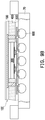
  • FIG. 8 is schematic cross-sectional view of an electronic device in accordance with some embodiments of the disclosure.
  • FIG. 9A and FIG. 9B are schematic cross-sectional views of various stages in a manufacturing method of a chip package in accordance with some embodiments of the disclosure.
  • FIG. 10A to FIG. 10D are schematic cross-sectional views of various stages in a manufacturing method of an antenna pattern and an insulating layer in accordance with some embodiments of the disclosure.
  • FIG. 11 is a schematic cross-sectional view of an electronic device in accordance with some embodiments of the disclosure.
  • first and second features are formed in direct contact
  • additional features may be formed between the first and second features, such that the first and second features may not be in direct contact
  • disclosure may repeat reference numerals and/or letters in the various examples. This repetition is for the purpose of simplicity and clarity and does not in itself dictate a relationship between the various embodiments and/or configurations discussed.
  • spatially relative terms such as “beneath,” “below,” “lower,” “above,” “upper” and the like, may be used herein for ease of description to describe one element or feature's relationship to another element(s) or feature(s) as illustrated in the figures.
  • the spatially relative terms are intended to encompass different orientations of the device in use or operation in addition to the orientation depicted in the figures.
  • the apparatus may be otherwise oriented (rotated 90 degrees or at other orientations) and the spatially relative descriptors used herein may likewise be interpreted accordingly.
  • testing structures may be included to aid in the verification testing of the 3D packaging or 3DIC devices.
  • the testing structures may include, for example, test pads formed in a redistribution layer or on a substrate that allows the testing of the 3D packaging or 3DIC, the use of probes and/or probe cards, and the like.
  • the verification testing may be performed on intermediate structures as well as the final structure.
  • the structures and methods disclosed herein may be used in conjunction with testing methodologies that incorporate intermediate verification of known good dies to increase the yield and decrease costs.
  • FIG. 1A to FIG. 1H are schematic cross-sectional views of various stages in a manufacturing method of an electronic device in accordance with some embodiments of the disclosure.
  • a first redistribution structure 100 is formed over a temporary carrier 50 .
  • a de-bonding layer (not shown) may be provided on the temporary carrier 50 , and the first redistribution structure 100 may be formed on the de-bonding layer.
  • the de-bonding layer is a light-to-heat conversion (LTHC) release layer which can aid the removal of the temporary carrier 50 in the subsequent processes.
  • the temporary carrier 50 may include any suitable material that can provide structural support during semiconductor processing.
  • a material of the temporary carrier 50 includes metal, glass, ceramic, silicon, combinations thereof, multi-layers thereof, or the like.
  • the first redistribution structure 100 has a first surface 100 a and a second surface 100 b opposite to the first surface 100 a .
  • the first surface 100 a faces upwardly for processing, and the second surface 100 b is attached to the temporary carrier 50 .
  • the first redistribution structure 100 includes a dielectric layer 112 a , a first patterned conductive layer 114 , and a dielectric layer 112 b sequentially formed on the temporary carrier 50 .
  • the dielectric layers 112 a and 112 b are made of the same material, so the dielectric layers 112 a and 112 b can be collectively referred to as the first dielectric layer 112 .
  • the first dielectric layer 112 may be a polymer layer made of polybenzoxazole (PBO), polyimide (PI), benzocyclobutene (BCB), a combination thereof, or the like.
  • the first patterned conductive layer 114 formed on the dielectric layer 112 a may include feed lines and a ground plane (not shown).
  • the feed lines of the first patterned conductive layer 114 may be electrically connected to other subsequently formed conductive elements for signal transmission, and the ground plane of the first patterned conductive layer 114 may be electrically connected to a ground.
  • a material of the first patterned conductive layer 114 may include copper, nickel, titanium, a combination thereof, or the like.
  • the numbers of the dielectric layers and/or the patterned conductive layer(s) are not limited by the illustration presented in FIG. 1A . In some embodiments, more dielectric layers and/or more patterned conductive layers may be formed and stacked alternately to form the first redistribution structure.
  • first through interlayer vias (TIVs) 202 and one or more second TIVs 204 may be formed over the first redistribution structure 100 to electrically couple to the first patterned conductive layer 114 .
  • TIVs through interlayer vias
  • the numbers of the first TIVs 202 and the second TIVs 204 are not limited by the illustration presented in FIG. 1A .
  • the method of forming the first TIV 202 includes the following steps.
  • a seed material (not shown) may be formed over the patterned dielectric layer 112 b and over the first patterned conductive layer 114 exposed by the openings of the patterned dielectric layer 112 b .
  • the seed material includes a titanium/copper composite layer, and is formed by, for example, a sputtering process, or other suitable methods.
  • a photoresist layer (not shown) with openings is formed on the seed material, and the openings of the photoresist layer expose the intended locations for the subsequently formed TIVs.
  • a plating process may be performed to form a metallic layer (e.g., a copper layer) on the seed material exposed by the openings of the photoresist layer.
  • the photoresist layer and the underlying seed material are then removed to form the first TIVs 202 .
  • the second TIVs 204 may be formed by the foregoing steps along with the first TIVs 202 to electrically couple to the first redistribution structure 100 .
  • the second TIVs 204 may be formed by pick and place pre-fabricated TIVs onto the first patterned dielectric layer 112 .
  • the second TIVs 204 are arranged to form a plurality of dipole antennas.
  • each dipole antenna includes dipole arms which may be bilaterally symmetrical conductive elements.
  • each of the dipole antennas has two L-shaped dipole arms in a top view. As illustrated in FIG. 1A , the second TIVs 204 have a dimension (e.g.
  • the semiconductor die 300 includes a semiconductor substrate 310 , a plurality of conductive pads 320 , and a passivation layer 330 .
  • the conductive pads 320 are disposed on an active surface of the semiconductor substrate 310 .
  • the passivation layer 330 is formed over the semiconductor substrate 310 and includes contact openings 330 a that partially expose the conductive pads 320 .
  • the semiconductor substrate 310 may be a silicon substrate including active components (e.g., transistors, or the like) and passive components (e.g., resistors, capacitors, inductors, or the like) formed therein.
  • the conductive pads 320 may be aluminum pads, copper pads, or other suitable metallic pads.
  • the passivation layer 330 may include stacked multi-sublayers, including a silicon oxide layer, a silicon nitride layer, a PI layer, a PBO layer, or a dielectric layer formed by other suitable polymers.
  • the semiconductor die 300 may be provided with a die attach film 60 adhered to a rear surface of the semiconductor die 300 that is opposite to the active surface. After disposing the semiconductor die 300 , the semiconductor die 300 is attached to the first surface 100 a of the first redistribution structure 100 through the die attach film 60 .
  • an insulating encapsulation 400 is formed over the first surface 100 a of the first redistribution structure 100 to wrap around the semiconductor die 300 , the first TIVs 202 , and the second TIVs 204 .
  • the semiconductor die 300 , the first TIVs 202 , and the second TIVs 204 are over-molded and embedded in the insulating encapsulation 400 , and an etching process or a polishing process is performed to partially remove the insulating encapsulation 400 to accessibly expose at least the conductive pads 320 of the semiconductor die 300 , the top surfaces of the first TIVs 202 , and the top surfaces second TIVs 204 for further electrical connection.
  • the insulating encapsulation 400 may include a molding compound, a molding underfill, an epoxy resin, or the like, and may be formed by a molding process.
  • a second redistribution structure 500 is formed on the semiconductor die 300 , the first TIVs 202 , the second TIVs 204 , and the insulating encapsulation 400 .
  • the second redistribution structure 500 includes a second dielectric layer 512 , a second patterned conductive layer 514 .
  • the second dielectric layer 512 may include more than one patterned dielectric layers (e.g., 512 a and 512 b ).
  • the second patterned conductive layer 514 may include more than one patterned conductive layers (e.g., 514 a and 514 b ).
  • a material of the second dielectric layer 512 and a material of the second patterned conductive layer 514 may be similar to that of the first dielectric layer 112 and that of the first patterned conductive layer 114 , respectively, so the detailed description thereof is omitted herein.
  • the second redistribution structure 500 may be formed using at least the following steps. For example, first, the patterned dielectric layer 512 a having a plurality of openings is formed over the semiconductor die 300 , the first TIVs 202 , the second TIVs 204 , and the insulating encapsulation 400 , and the patterned dielectric layer 512 a includes openings exposing portions of the semiconductor die 300 , the first TIVs 202 and the second TIVs 204 .
  • the patterned conductive layer 514 a is formed on the patterned dielectric layer 512 a and in the openings of the patterned dielectric layer 512 a to be in physical contact with the conductive pads 320 of the semiconductor die 300 , the first TIVs 202 , and the second TIVs 204 .
  • the patterned dielectric layer 512 b is formed over the patterned dielectric layer 512 a to cover the patterned conductive layer 514 a , and the patterned dielectric layer 512 b may have a plurality of openings exposing at least a portion of patterned conductive layer 514 a .
  • the patterned conductive layer 514 b is formed on the patterned dielectric layer 512 b and in the openings of the patterned dielectric layer 512 b to be in physical contact with the patterned conductive layer 514 a exposed through the patterned dielectric layer 512 b .
  • a portion of the patterned conductive layer 514 b may be referred to as under-ball metallurgy (UBM) pattern for the subsequent ball-mounting process.
  • the patterned conductive layer 514 b may include connection pads (not shown) for bonding electronic components (e.g., capacitors, resistors, inductors, etc.).
  • the first redistribution structure 100 may be referred to as a backside redistribution structure and the second redistribution structure 500 may be referred to as a front side redistribution structure.
  • the first redistribution structure 100 and the second redistribution structure 500 may be referred to as fan-out redistribution structures.
  • the signal output from the semiconductor die 300 may be transmitted through portions of the second patterned conductive layer 514 , the first TIVs 202 , and the first patterned conductive layer 114 in sequential order, and the portions of the second patterned conductive layer 514 , the first TIVs 202 , and the first patterned conductive layer 114 may be collectively referred to as a feed line.
  • the second TIVs 204 electrically connected to the second patterned conductive layer 514 of the second redistribution structure 500 may be not in physical contact with the first patterned conductive layer 114 of the first redistribution structure 100 .
  • one or more conductive terminals 600 may be formed on patterned conductive layer 514 b exposed by the patterned dielectric layer 512 b to electrically connect the semiconductor die 300 through the second redistribution structure 500 .
  • the conductive terminals 600 are made of a conductive material with low resistivity, such as Sn, Pb, Ag, Cu, Ni, Bi, or an alloy thereof.
  • the conductive terminal 600 may be solder balls, ball grid array (BGA) balls, or other suitable conductive materials formed in other shapes.
  • the conductive terminal 600 may be disposed on the UBM pattern of the patterned conductive layer 514 b by a ball placement process and/or a reflow process. It should be noted that the number of the conductive terminal 600 is not limited by the illustration presented in FIG. 1E .
  • the temporary carrier 50 may be separated from the second surface 100 b of the first redistribution structure 100 and then removed.
  • the temporary carrier 50 is de-bonded from the first patterned dielectric layer 112 of the first redistribution structure 100 by irradiating the de-bonding layer disposed between the temporary carrier 50 and the first redistribution structure 100 with UV or laser.
  • the manufacture of a chip package 10 A is completed.
  • the chip package 10 A may be referred to as an integrated fan-out (InFO) package.
  • the chip package 10 A can be overturned (e.g., flipped upside down) and disposed on a tape 70 for further processing as illustrated in FIG. 1F .
  • an insulating layer 700 is provided.
  • the insulating layer 700 is laminated onto the second surface 100 b of the first redistribution structure 100 of the chip package 10 A.
  • the insulating layer 700 is made of one or more low dissipation factor (Df) and/or low permittivity (Dk) materials.
  • the insulating layer 700 includes a polymer layer.
  • the insulating layer 700 includes a photo-sensitive material, such as PBO, PI, BCB, a combination thereof, or the like.
  • the insulating layer 700 may be formed by a suitable fabrication technique such as spin-coating, lamination, deposition, or the like.
  • the insulating layer 700 includes epoxy resins, or any suitable type of molding materials. Depending on the frequency range of high-speed applications, suitable materials of the insulating layer 700 may be selected based on the required electrical properties of the electronic device.
  • FIG. 2A and FIG. 2B are enlarged, schematic cross-sectional views of the dashed box A and the dashed box B respectively depicted in FIG. 1H according to some exemplary embodiments of the disclosure
  • FIG. 3 is a schematic top view of FIG. 1H in accordance with some embodiments of the disclosure.
  • an antenna pattern 800 is formed on the insulating layer 700 to electrically couple to the chip package 10 A.
  • the antenna pattern 800 are arranged in the form of arrays on the insulating layer 700 within the intended location of the semiconductor die 300 , such as the N ⁇ N array or N ⁇ M arrays (N, M>0, N may or may not be equal to M).
  • the size of the array for the antenna pattern 800 can be designated and selected based on the demand, and is not limited to the disclosure.
  • the antenna pattern 800 may include conductive blocks arranged in arrays, and in a top view (e.g., FIG. 3 ), the shapes of the conductive blocks of the antenna pattern 800 may be round, elliptical, oval, square, rectangular, tetragonal, hexagonal, octagonal, or any suitable polygonal shape.
  • the conductive blocks of the antenna pattern 800 may have rounded corners RC, and the shapes of the conductive blocks of the antenna pattern 800 in top views may be rounded polygonal shapes.
  • the antenna pattern 800 may be made from a conductive paste.
  • the conductive paste is directly applied on a top surface of the insulating layer 700 opposite to the chip package 10 A and then cured so as to form the antenna pattern 800 .
  • the conductive paste is applied as a series of dots at predetermined locations to form an intended pattern through a dispensing process, a coating process or a spraying process.
  • the antenna pattern 800 can be formed on the insulating layer 700 through a printing process, such as a screen printing process or a stencil printing process.
  • a printing process such as a screen printing process or a stencil printing process.
  • a patterned mask having apertures e.g., stencil or screen; not shown
  • the conductive paste is applied onto the insulating layer 700 through the apertures of the patterned mask.
  • a curing process is performed to cure the applied conductive paste to form the antenna pattern 800 .
  • Other suitable techniques may be utilized to form the antenna pattern 800 on the insulating layer 700 .
  • a material for forming the antenna pattern 800 includes an adhesive 810 and a conductive powder 820 mixed with the adhesive 810 .
  • the conductive powder 820 may include particles with good electrical conductivity, for example, pure metal (e.g., copper, silver, gold, etc.) particles, metal alloy (e.g., copper-silver alloy) particles, or the mixture thereof.
  • the particles of the conductive powder 820 include metallic particles.
  • the particles of the conductive powder 820 may be coated with conductive materials to exhibit improved conduction or transmission.
  • the conductive powder 820 may include silver-coated copper particles.
  • the adhesive 810 for dispersing the conductive powder 820 may include epoxy resins, phenolic resins, or the like.
  • the material for forming the antenna pattern 800 further includes a small portion of volatile solvent mixed with the adhesive 810 and the conductive powder 820 to adjust the fluidity or viscosity of the conductive paste.
  • a curing process may be performed to solidify the conductive paste.
  • the particles of the conductive powder 820 may be fused and aggregated or amalgamated to form fused particles with larger sizes.
  • the volatile solvent in the conductive paste may be removed or dispelled.
  • conditions for curing the antenna pattern material include subjecting the antenna pattern material to a temperature of about 130° C. ⁇ 10° C. for about 30 minutes. The curing conditions may be adjusted depending on the design requirements, which is not limited thereto.
  • the conductive powder 820 contained in the antenna pattern material takes about 80% by weight to about 95% by weight. In some embodiments, the conductive powder 820 contained in the material of the antenna pattern 820 may have a weight percentage in a range of approximately 85% to 95%.
  • the adhesive 810 in the conductive paste may have a weight percentage in a range of 5% to 15% approximately. The weight percentages of the conductive powder 820 and the adhesive 810 measured before or after the curing process may vary slightly due to the loss of the solvent.
  • the shape of the antenna pattern material may change after the curing process due to the changes of the antenna pattern material or owing to the thermal stress applied in the curing process.
  • the formed antenna pattern 800 after the curing process may have a trapezoid profile with the bottom portions larger than the upper portions.
  • the formed antenna pattern 800 may have slant sidewalls and/or rounded corners.
  • the antenna pattern 800 includes a first surface (i.e. the bottom surface) 800 a contacting the insulating layer 700 and a second surface (i.e. the top surface) 800 b opposite to the first surface 800 a , and a surface area of the first surface 800 a is greater than a surface area of the second surface 800 b as shown in FIG. FIG. 2A and FIG. 3 .
  • the antenna pattern 800 further includes at least one sloping sidewall 800 c connected to the first surface 800 a and the second surface 800 b .
  • the sloping sidewall 800 c and the second surface 800 b forms a rounded corner 800 d at the periphery of the antenna pattern 800 indicated in the dashed box A.
  • the radius of the rounded corner 800 d may be in the range between about 0.02 ⁇ m and about 20 ⁇ m.
  • the first surface 800 a and the sloping sidewall 800 c forms a sidewall interior angle ⁇ .
  • the sidewall interior angle ⁇ of the intersection with the sloping sidewall 800 c and the first surface 800 a may be an acute angle. With different conditions used in the forming processes of the antenna pattern 800 , the sidewall interior angle ⁇ may range from about 30 degrees to about 90 degrees.
  • the dashed box B adjacent to the dashed box A may be indicated as the central portion of the antenna pattern 800 .
  • a surface roughness of the second surface 800 b is greater than a surface roughness of the first surface 800 a .
  • a surface roughness of the second surface 800 b of the antenna pattern 800 formed by printing is greater than a surface roughness of the patterned conductive layer of the second redistribution structure 500 formed by plating or a surface roughness of the first patterned conductive layer of the first redistribution structure 100 formed by plating.
  • the second surface 800 b of the antenna pattern 800 may be rough and may not be perfectly smooth.
  • surface roughness is used to provide a measure of the surface texture (unevenness of the surface height).
  • the roughness value of the second surface 800 b of the antenna pattern 800 is in the range of about 1 ⁇ m to about 5 ⁇ m.
  • the surface roughness of the second surface 800 b of the antenna pattern 800 formed by the printing process, the dispensing process, the spraying process, or the like may be at least ten times or a hundred times greater than a surface roughness of antenna pattern formed by a plating process. It should be appreciated that the illustration of FIG. 2A and FIG. 2B are schematic and not in scale.
  • the tape 70 is removed, and a singulation process may be performed to form a plurality of electronic device ED 1 illustrated in FIG. 1H .
  • the electronic device ED 1 may be further mounted with an additional chip package, package substrate, or other electronic devices to form a package-on-package (PoP) structure through the conductive terminals 600 and/or other additional conductive connectors based on the demand.
  • PoP package-on-package
  • the signal transmitted in the first redistribution structure 100 of the chip package 10 A may be electrically coupled to the antenna pattern 800 .
  • the antenna pattern 800 may be referred to as patch antennas.
  • the insulating layer 700 disposed between the chip package 10 A and the antenna pattern 800 and having material properties of low Dk and low Df may be able to provide low loss transmission path, thereby allowing higher gain of the antenna.
  • the electronic device ED 1 may operate in the millimeter wave range, but is not limited thereto.
  • the antenna pattern 800 including the adhesive 810 mixing with the conductive powder 820 may be in direct contact with the insulating layer 700 . Since the adhesive 810 can adhere to the insulating layer 700 , an additional bonding layer between the antenna pattern 800 and the insulating layer 700 can be omitted, thereby reducing processing steps and manufacturing cost of the electronic device ED 1 .
  • FIG. 4 is a schematic cross-sectional view of an electronic device in accordance with some embodiments of the disclosure
  • FIG. 5 is an enlarged, schematic cross-sectional view of the dashed box C depicted in FIG. 4 according to some exemplary embodiments of the disclosure
  • FIG. 6 is a schematic top view of FIG. 4 in accordance with some embodiments of the disclosure.
  • the electronic device ED 2 shown in FIG. 4 is similar to the electronic device ED 1 illustrated in FIG. 1A .
  • the identical or similar numbers refer to the identical or similar elements throughout the drawings, and detail thereof is not repeated.
  • the electronic device ED 2 further includes a protective layer 900 encapsulating the antenna pattern 800 and covering at least a portion of the insulating layer 700 .
  • the protective layer 900 is deposited on the insulating layer 700 to cover the antenna pattern 800 using a sputtering/etching process, a printing process, or other suitable techniques.
  • the material of protective layer 900 may be printed on the insulating layer 700 , and the size of apertures of a patterned mask (not shown) utilized for forming the protective layer 900 may be larger than that of the patterned mask utilizing for forming the antenna pattern 800 . Therefore, after printing the protective layer 900 , the sloping sidewall and the second surface of the antenna pattern 800 are covered by the protective layer 900 .
  • the protective layer 900 may have a surface profile substantially conformal to a surface profile of the antenna pattern 800 .
  • the protective layer 900 may have a bottom surface, a top surface, and a slanted sidewall connected to the top surface and the bottom surface as shown in FIGS. 5 and 6 .
  • the protective layer 900 may include a rounded corner connected to the slanted sidewall and the top surface.
  • an outer surface of the protective layer 900 is flatter than an outer surface (covered by the protective layer 900 ) of the antenna pattern 800 .
  • a surface roughness of the outer surface of the antenna pattern 800 may be greater than that of the outer surface of the protective layer 900 .
  • the protective layer 900 includes conductive materials having a surface oxidation rate lower than that of the material of the antenna pattern 800 .
  • the protective layer 900 may be a single layer or may include a plurality of sublayers stacked one another.
  • the protective layer 900 includes a first sublayer connected to the second surface 800 b of the antenna pattern 800 , and a second sublayer stacked on the first sublayer.
  • the first sublayer sandwiched between the antenna pattern 800 and the second sublayer may have material properties with a better wettability and a better electrical conductivity than the second sublayer.
  • the sublayers of the protective layer 900 may include a stainless steel sublayer, a titanium sublayer (or a titanium/copper composite sublayer), or other suitable composite sublayers.
  • the first sublayer of the protective layer 900 may be made of titanium (or titanium/copper), and the second sublayer of the protective layer 900 may be made of stainless steel.
  • the protective layer 900 may include more than two sublayers. For example, a first stainless steel sublayer may be first formed on the antenna pattern 800 , and then a titanium sublayer (or a titanium/copper composite sublayer), and a second stainless steel sublayer may be sequentially stacked on the first stainless steel sublayer. The outermost stainless steel sublayer may serve as a barrier to prevent oxidation.
  • the titanium sublayer may aid a better electrical conductivity of antenna pattern 800 and a good wettability for better adhesion between layers, thereby achieving the enhanced performance of antenna.
  • a thickness of the protective layer 900 may be adjusted depending on antenna applications at different operating frequency. For example, the antenna for 60 GHz applications, the thickness of the protective layer 900 may be in a range of about 5 ⁇ m to about 20 ⁇ m, which depends on the material being applied. In some alternative embodiments, the antenna for applications at other operating frequencies (e.g., greater than 60 GHz), the thickness of the protective layer 900 may be less than 20 ⁇ m.
  • FIG. 7 is schematic cross-sectional view of an electronic device in accordance with some embodiments of the disclosure.
  • an electronic device ED 3 includes a chip package 10 B, an antenna pattern 800 electrically coupled to the chip package 10 B, an insulating layer 700 A disposed between the chip package 10 B and the antenna pattern 800 , and the protective layer 900 ′ encapsulating the antenna pattern 800 .
  • the chip package 10 B includes more than one semiconductor die 300 .
  • the semiconductor dies 300 may include the same or different types of dies selected from digital dies, analog dies or mixed signal dies, application-specific integrated circuit (ASIC) dies, sensor dies, memory dies, or logic dies, or other suitable dies.
  • the semiconductor dies 300 may include at least one wireless and RF die.
  • the insulating layer 700 A may include a first insulating sublayer 720 connected to the chip package 10 B, and a second insulating pattern 740 stacked on the first insulating sublayer 720 .
  • a first insulating sublayer 720 connected to the chip package 10 B
  • a second insulating pattern 740 stacked on the first insulating sublayer 720 .
  • portions of the first insulating sublayer 720 are exposed by the second insulating pattern 740 .
  • the antenna pattern 800 may overlap and may be attached onto the second insulating pattern 740 .
  • Materials of the first insulating sublayer 720 and the second insulating pattern 740 may be the same, and may be similar to the material of insulating layer 700 shown in FIG. 1G .
  • suitable materials of the protective layer 900 ′ may be printed on the antenna pattern 800 using to form the protective layer 900 ′ encapsulating the antenna pattern 800 .
  • the size of apertures of a patterned mask (not shown) utilizing for forming the protective layer 900 ′ may be larger than that of the size of the second insulating pattern 740 . Therefore, after forming the protective layer 900 ′, the top surface of the second insulating pattern 740 and the sidewall of the second insulating pattern 740 may be wrapped by the protective layer 900 ′.
  • suitable materials of the protective layer 900 ′ may be sputtered over the insulating layer 700 A and the antenna pattern 800 , and then etched portions of the materials of the protective layer 900 ′ to form the protective layer 900 ′. Therefore, the first surface of the antenna pattern 800 is connected to the second insulating pattern 740 , and the sloping sidewall and the second surface of the antenna pattern 800 are covered by the protective layer 900 ′.
  • portions of the materials of the protective layer 900 ′ deposited on the sidewall of the second insulating pattern 740 may be removed during the etching step, and thus the sidewall of the second insulating pattern 740 is exposed by the protective layer 900 ′.
  • the sidewall and at least a portion of the top surface of the second insulating pattern 740 may be exposed by the protective layer 900 ′.
  • FIG. 8 is schematic cross-sectional view of an electronic device in accordance with some embodiments of the disclosure.
  • an electronic device ED 4 is similar to the electronic device ED 3 illustrated in FIG. 7 .
  • the difference lies in that an insulating layer 700 B of the electronic device ED 4 includes a first insulating sublayer 720 connected to the chip package 10 B and a second insulating sublayer 740 ′ stacked on the first insulating sublayer 720 .
  • the sizes of the first insulating sublayer 720 and the second insulating sublayer 740 ′ may be substantially equal.
  • the second insulating sublayer 740 ′ may serve as a planarization layer, and the antenna pattern 800 is disposed on the second insulating sublayer 740 ′.
  • the protective layer 900 disposed on the second insulating sublayer 740 ′ encapsulates the antenna pattern 800 .
  • the coverage area of the protective layer 900 on the top surface of the second insulating material 740 ′ may depend on the forming process and the thickness of the protective layer 900 .
  • FIG. 9A and FIG. 9B are schematic cross-sectional views of various stages in a manufacturing method of a chip package in accordance with some embodiments of the disclosure, which are similar to the manufacturing method illustrated in FIG. 1A to FIG. 1F .
  • the identical or similar numbers refer to the identical or similar elements throughout the drawings, and detail thereof is not repeated.
  • the first redistribution structure 100 is formed on the temporary carrier 50 .
  • the first TIVs 202 are formed on the first redistribution structure 100 .
  • a semiconductor die 300 ′ is provided and attached onto the first redistribution structure 100 through the die attach film 60 .
  • the semiconductor die 300 ′ may further include the conductive vias 340 formed in the contact openings 330 a of the passivation layer 330 to be in physical contact with the conductive pads 320 , and a protection layer 350 formed on the passivation layer 330 to cover the conductive vias 340 .
  • the insulating encapsulation 400 may be formed using at least the following steps. First, an encapsulation material (not shown) is over-molded on the first redistribution structure 100 so that the conductive vias 340 and the protection layer 350 of the semiconductor die 300 ′, and the first TIVs 202 are encapsulated by the encapsulation material. In other words, the conductive vias 340 and the protection layer 350 are not revealed and are well protected by the encapsulation material. Thereafter, the encapsulation material is grinded until top surfaces of the conductive vias 340 and top surfaces of the first TIVs 202 are exposed, so as to form the insulating encapsulation 400 .
  • the encapsulant material is grinded by a mechanical grinding process and/or a chemical mechanical polishing (CMP) process.
  • CMP chemical mechanical polishing
  • the protection layer 350 is grinded to reveal the conductive vias 340 .
  • the semiconductor die 300 ′ has an active surface, and the portion of the conductive vias 340 accessibly revealed at the active surface of the semiconductor die 300 ′.
  • the second redistribution structure 500 and the conductive terminals 600 are subsequent formed on the insulating encapsulation 400 sequentially to form the chip package 10 C.
  • the chip package 10 C can be overturned and disposed on the tape 70 , and the temporary carrier 50 may be removed to expose the first redistribution structure 100 for further processing as illustrated in FIG. 1D to FIG. 1F .
  • the detailed descriptions are omitted for brevity.
  • FIG. 10A to FIG. 10D are schematic cross-sectional views of various stages in a manufacturing method of an antenna pattern and a dielectric layer in accordance with some embodiments of the disclosure.
  • the steps illustrated in FIG. 10A to FIG. 10D may be simultaneously conducted.
  • a temporary carrier 50 ′ with a de-bonding layer 52 formed thereon is provided, and then an antenna pattern 800 ′ is formed on the de-bonding layer 52 (in FIG. 10B ).
  • the temporary carrier 50 ′ may be similar to the temporary carrier 50 mentioned above, and the detailed descriptions are not repeated.
  • the de-bonding layer 52 may include a dielectric sublayer 52 a and a release sublayer 52 b .
  • the release sublayer 52 b may be in physical contact with the temporary carrier 50 ′, and the dielectric sublayer 52 a may be stacked on the release sublayer 52 b .
  • the dielectric sublayer 52 a may be made of a dielectric material including any suitable polymer-based dielectric material (e.g., BCB, PBO, or the like).
  • the release sublayer 52 b may be made of an epoxy-based thermal-release material, which loses its adhesive property when heated, such as a light-to-heat-conversion (LTHC) release coating film.
  • the de-bonding layer 52 may include a dielectric material layer made of ultra-violet (UV) glue, which loses its adhesive property when exposed to UV lights.
  • UV ultra-violet
  • the antenna pattern 800 ′ including the adhesive 810 mixing with the conductive powder 820 may be formed and adhered on the dielectric sublayer 52 a of the de-bonding layer 52 using a printing process, a dispensing process, or the like.
  • a patterned mask having apertures e.g., stencil or screen; not shown
  • the conductive paste is applied onto the de-bonding layer 52 through the apertures of the patterned mask.
  • a curing process is performed to cure the applied conductive paste to form the antenna pattern 800 ′.
  • the antenna pattern 800 ′ includes the first surface (i.e.
  • the antenna pattern 800 ′ may be formed through a plating process, sputtering and etching process, or other suitable methods depending on which kind of the material is used to form the antenna pattern 800 ′.
  • the antenna pattern 800 ′ is arranged in an array form on the de-bonding layer 52 . The size of the array for the antenna pattern 800 ′ can be designated and selected based on the demand, and is not limited to the disclosure.
  • the antenna pattern 800 ′ may be referred to as patch antennas.
  • an insulating layer 700 C is formed over the de-bonding layer 52 to encapsulate the insulating layer 700 C.
  • the sloping sidewall 800 c ′ and the second surface 800 b ′ of the antenna pattern 800 ′ are wrapped by the insulating layer 700 C.
  • a material of the insulating layer 700 C has low dielectric constant and low loss tangent properties.
  • the insulating layer 700 C is formed by a molding process. Other suitable techniques (e.g., lamination, deposition, etc.) may be utilized to form the insulating layer 700 C depending on the design requirements.
  • an adhesive layer 80 may formed over the insulating layer 700 C opposite to the de-bonding layer 52 as shown in FIG. 10D .
  • FIG. 11 is a schematic cross-sectional view of an electronic device in accordance with some embodiments of the disclosure.
  • the electronic device ED 5 includes the chip package 10 C and an antenna package 10 D stacked thereon.
  • the structure shown in FIG. 10D can be overturned so that the antenna pattern 800 ′ embedded in the insulating layer 700 C may be attached onto the first redistribution structure 100 through the adhesive layer 80 as shown in FIG. 9B .
  • the temporary carrier 50 ′ may be removed through de-bonding the release sublayer 52 b , and the structure remained on the chip package 10 C may be collectively viewed as the antenna package 10 D.
  • the antenna pattern 800 ′ may have the surface area of the first surface 800 a ′ exposed by the insulating layer 700 C greater than that of the second surface 800 b ′ connected to the insulating layer 700 C.
  • the dielectric sublayer 52 a may be remained on the insulating layer 700 C to cover the first surface 800 a ′ of the antenna pattern 800 ′ for preventing oxidation of the antenna pattern 800 ′ or being damaged.
  • the dielectric sublayer 52 a may be removed to expose the first surface 800 a ′ of the antenna pattern 800 ′.
  • the tape 70 is removed and a singulation process may be performed to form a plurality of the electronic device ED 5 .
  • a sidewall of the antenna package 10 D may be substantially aligned with a sidewall of the chip package 10 C on the stacking direction of the antenna package 10 D and the chip package 10 C.
  • the electronic device includes a chip package, an antenna pattern, and an insulating layer.
  • the chip package includes a semiconductor die and an insulating encapsulation enclosing the semiconductor die.
  • the antenna pattern is electrically coupled to the chip package, where a material of the antenna pattern comprises a conductive powder having fused metal particles.
  • the insulating layer disposed between the chip package and the antenna pattern, where the antenna pattern includes a first surface in contact with the insulating layer, and a second surface opposite to the first surface, and a surface roughness of the second surface is greater than a surface roughness of the first surface
  • a method of manufacturing an electronic device includes at least the following steps.
  • An insulating layer is formed on a chip package.
  • An antenna pattern is printed on the insulating layer to electrically couple to the chip package, wherein the antenna pattern includes a first surface in contact with the insulating layer, and a second surface opposite to the first surface, and a surface area of the first surface is greater than a surface area of the second surface.
  • a method of manufacturing an electronic device includes at least the following steps.
  • An antenna pattern is encapsulated by an insulating layer to form an antenna package, where the antenna pattern includes a first surface and a second surface opposite to the first surface, a surface area of the first surface exposed by the insulating layer is greater than a surface area of the second surface in contact with the insulating layer.
  • the antenna package is attached to a chip package, where the insulating layer is located between the chip package and the antenna pattern.

Landscapes

  • Engineering & Computer Science (AREA)
  • Microelectronics & Electronic Packaging (AREA)
  • Computer Hardware Design (AREA)
  • Power Engineering (AREA)
  • Physics & Mathematics (AREA)
  • Condensed Matter Physics & Semiconductors (AREA)
  • General Physics & Mathematics (AREA)
  • Details Of Aerials (AREA)
  • Manufacturing & Machinery (AREA)

Abstract

An electronic device and a manufacturing method thereof are provided. The electronic device includes a chip package, an antenna pattern, and an insulating layer. The chip package includes a semiconductor die and an insulating encapsulation enclosing the semiconductor die. The antenna pattern is electrically coupled to the chip package, where a material of the antenna pattern comprises a conductive powder having fused metal particles. The insulating layer disposed between the chip package and the antenna pattern, where the antenna pattern includes a first surface in contact with the insulating layer, and a second surface opposite to the first surface, and a surface roughness of the second surface is greater than a surface roughness of the first surface.

Description

CROSS-REFERENCE TO RELATED APPLICATION
This application claims the priority benefit of U.S. provisional application Ser. No. 62/737,888, filed on Sep. 27, 2018. The entirety of the above-mentioned patent application is hereby incorporated by reference herein and made a part of this specification.
BACKGROUND
Semiconductor devices and integrated circuits are used in a variety of electronic applications, such as personal computers, cell phones, digital cameras, and other electronic devices. As the demand for shrinking electronic devices has grown, a need for smaller and more creative packaging techniques of semiconductor devices has emerged. Thus, packages such as wafer-level packaging (WLP) have begun to be developed. For example, the dies of the wafer may be processed and packaged with other semiconductor devices (e.g. antenna) at the wafer-level. In addition, since the demand of modern communication for more bandwidth, high performance package designs with integrated antenna are desired.
BRIEF DESCRIPTION OF THE DRAWINGS
Aspects of the disclosure are best understood from the following detailed description when read with the accompanying figures. It is noted that, in accordance with the standard practice in the industry, various features are not drawn to scale. In fact, the dimensions of the various features may be arbitrarily increased or reduced for clarity of discussion.
FIG. 1A to FIG. 1H are schematic cross-sectional views of various stages in a manufacturing method of an electronic device in accordance with some embodiments of the disclosure.
FIG. 2A and FIG. 2B are enlarged, schematic cross-sectional views of the dashed box A and the dashed box B respectively depicted in FIG. 1H according to some exemplary embodiments of the disclosure.
FIG. 3 is a schematic top view of FIG. 1H in accordance with some embodiments of the disclosure.
FIG. 4 is a schematic cross-sectional view of an electronic device in accordance with some embodiments of the disclosure.
FIG. 5 is an enlarged, schematic cross-sectional view of the dashed box C depicted in FIG. 4 according to some exemplary embodiments of the disclosure.
FIG. 6 is a schematic top view of FIG. 4 in accordance with some embodiments of the disclosure.
FIG. 7 is schematic cross-sectional view of an electronic device in accordance with some embodiments of the disclosure.
FIG. 8 is schematic cross-sectional view of an electronic device in accordance with some embodiments of the disclosure.
FIG. 9A and FIG. 9B are schematic cross-sectional views of various stages in a manufacturing method of a chip package in accordance with some embodiments of the disclosure.
FIG. 10A to FIG. 10D are schematic cross-sectional views of various stages in a manufacturing method of an antenna pattern and an insulating layer in accordance with some embodiments of the disclosure.
FIG. 11 is a schematic cross-sectional view of an electronic device in accordance with some embodiments of the disclosure.
DETAILED DESCRIPTION
The following disclosure provides many different embodiments, or examples, for implementing different features of the provided subject matter. Specific examples of components, values, operations, materials, arrangements, or the like, are described below to simplify the disclosure. These are, of course, merely examples and are not intended to be limiting. Other components, values, operations, materials, arrangements, or the like, are contemplated. For example, the formation of a first feature over or on a second feature in the description that follows may include embodiments in which the first and second features are formed in direct contact, and may also include embodiments in which additional features may be formed between the first and second features, such that the first and second features may not be in direct contact. In addition, the disclosure may repeat reference numerals and/or letters in the various examples. This repetition is for the purpose of simplicity and clarity and does not in itself dictate a relationship between the various embodiments and/or configurations discussed.
Further, spatially relative terms, such as “beneath,” “below,” “lower,” “above,” “upper” and the like, may be used herein for ease of description to describe one element or feature's relationship to another element(s) or feature(s) as illustrated in the figures. The spatially relative terms are intended to encompass different orientations of the device in use or operation in addition to the orientation depicted in the figures. The apparatus may be otherwise oriented (rotated 90 degrees or at other orientations) and the spatially relative descriptors used herein may likewise be interpreted accordingly.
In addition, terms, such as “first,” “second,” “third,” “fourth,” and the like, may be used herein for ease of description to describe similar or different element(s) or feature(s) as illustrated in the figures, and may be used interchangeably depending on the order of the presence or the contexts of the description.
Other features and processes may also be included. For example, testing structures may be included to aid in the verification testing of the 3D packaging or 3DIC devices. The testing structures may include, for example, test pads formed in a redistribution layer or on a substrate that allows the testing of the 3D packaging or 3DIC, the use of probes and/or probe cards, and the like. The verification testing may be performed on intermediate structures as well as the final structure. Additionally, the structures and methods disclosed herein may be used in conjunction with testing methodologies that incorporate intermediate verification of known good dies to increase the yield and decrease costs.
FIG. 1A to FIG. 1H are schematic cross-sectional views of various stages in a manufacturing method of an electronic device in accordance with some embodiments of the disclosure. Referring to FIG. 1A, in some embodiments, a first redistribution structure 100 is formed over a temporary carrier 50. In some embodiments, a de-bonding layer (not shown) may be provided on the temporary carrier 50, and the first redistribution structure 100 may be formed on the de-bonding layer. For example, the de-bonding layer is a light-to-heat conversion (LTHC) release layer which can aid the removal of the temporary carrier 50 in the subsequent processes. The temporary carrier 50 may include any suitable material that can provide structural support during semiconductor processing. For example, a material of the temporary carrier 50 includes metal, glass, ceramic, silicon, combinations thereof, multi-layers thereof, or the like.
In some embodiments, the first redistribution structure 100 has a first surface 100 a and a second surface 100 b opposite to the first surface 100 a. At this stage, the first surface 100 a faces upwardly for processing, and the second surface 100 b is attached to the temporary carrier 50. For example, the first redistribution structure 100 includes a dielectric layer 112 a, a first patterned conductive layer 114, and a dielectric layer 112 b sequentially formed on the temporary carrier 50. In some embodiments, the dielectric layers 112 a and 112 b are made of the same material, so the dielectric layers 112 a and 112 b can be collectively referred to as the first dielectric layer 112. In some embodiments, the first dielectric layer 112 may be a polymer layer made of polybenzoxazole (PBO), polyimide (PI), benzocyclobutene (BCB), a combination thereof, or the like. In some embodiments, the first patterned conductive layer 114 formed on the dielectric layer 112 a may include feed lines and a ground plane (not shown). For example, the feed lines of the first patterned conductive layer 114 may be electrically connected to other subsequently formed conductive elements for signal transmission, and the ground plane of the first patterned conductive layer 114 may be electrically connected to a ground. A material of the first patterned conductive layer 114 may include copper, nickel, titanium, a combination thereof, or the like. It should be noted that the numbers of the dielectric layers and/or the patterned conductive layer(s) are not limited by the illustration presented in FIG. 1A. In some embodiments, more dielectric layers and/or more patterned conductive layers may be formed and stacked alternately to form the first redistribution structure.
Continue to FIG. 1A, one or more first through interlayer vias (TIVs) 202 and one or more second TIVs 204 may be formed over the first redistribution structure 100 to electrically couple to the first patterned conductive layer 114. It should be noted that the numbers of the first TIVs 202 and the second TIVs 204 are not limited by the illustration presented in FIG. 1A. In some embodiments, the method of forming the first TIV 202 includes the following steps. After forming the dielectric layer 112 b with a plurality of openings exposing at least a portion of the first patterned conductive layer 114, a seed material (not shown) may be formed over the patterned dielectric layer 112 b and over the first patterned conductive layer 114 exposed by the openings of the patterned dielectric layer 112 b. The seed material includes a titanium/copper composite layer, and is formed by, for example, a sputtering process, or other suitable methods. Thereafter, a photoresist layer (not shown) with openings is formed on the seed material, and the openings of the photoresist layer expose the intended locations for the subsequently formed TIVs. Afterwards, a plating process may be performed to form a metallic layer (e.g., a copper layer) on the seed material exposed by the openings of the photoresist layer. The photoresist layer and the underlying seed material are then removed to form the first TIVs 202.
In some embodiments, the second TIVs 204 may be formed by the foregoing steps along with the first TIVs 202 to electrically couple to the first redistribution structure 100. In some alternative embodiments, the second TIVs 204 may be formed by pick and place pre-fabricated TIVs onto the first patterned dielectric layer 112. In some embodiments, the second TIVs 204 are arranged to form a plurality of dipole antennas. For example, each dipole antenna includes dipole arms which may be bilaterally symmetrical conductive elements. In some embodiments, each of the dipole antennas has two L-shaped dipole arms in a top view. As illustrated in FIG. 1A, the second TIVs 204 have a dimension (e.g. width) greater than that of the first TIVs 202. In some alternative embodiments, the second TIVs 204 may have a dimension (e.g. width) substantially equal to or less than that of the first TIVs 202. The first TIVs 202 may be cylindrical in form or pillars having different polygonal cross-sectional shape. However, the shapes of the first TIVs 202 and the second TIVs 204 construe no limitation in the disclosure. The first TIVs 202 may be disposed between the second TIVs 204 and the subsequently-disposed semiconductor die (as shown in FIG. 1C). In some alternative embodiments, the second TIVs 204 can be omitted. The formation of the second TIVs 204 may be optional depending on the product requirements.
Referring to FIG. 1B, a semiconductor die 300 (or integrated circuit components) may be picked and placed onto the first surface 100 a of the first redistribution structure 100. In some embodiments, one or more semiconductor die(s) 300 may be disposed on the first redistribution structure 100 after the formation of the first TIVs 202 and/or the second TIVs 204. In some alternative embodiments, one or more semiconductor die(s) 300 may be picked and placed onto the first patterned dielectric layer 112 before the formation of the first TIVs 202 and/or the second TIVs 204. The semiconductor die 300 may further include additional die/chip(s) of the same type or different types. For example, the semiconductor die 300 includes at least one wireless and radio frequency (RF) die.
In some embodiments, the semiconductor die 300 includes a semiconductor substrate 310, a plurality of conductive pads 320, and a passivation layer 330. In some embodiments, the conductive pads 320 are disposed on an active surface of the semiconductor substrate 310. The passivation layer 330 is formed over the semiconductor substrate 310 and includes contact openings 330 a that partially expose the conductive pads 320. The semiconductor substrate 310 may be a silicon substrate including active components (e.g., transistors, or the like) and passive components (e.g., resistors, capacitors, inductors, or the like) formed therein. The conductive pads 320 may be aluminum pads, copper pads, or other suitable metallic pads. The passivation layer 330 may include stacked multi-sublayers, including a silicon oxide layer, a silicon nitride layer, a PI layer, a PBO layer, or a dielectric layer formed by other suitable polymers. In some embodiments, the semiconductor die 300 may be provided with a die attach film 60 adhered to a rear surface of the semiconductor die 300 that is opposite to the active surface. After disposing the semiconductor die 300, the semiconductor die 300 is attached to the first surface 100 a of the first redistribution structure 100 through the die attach film 60.
Referring to FIG. 1C, an insulating encapsulation 400 is formed over the first surface 100 a of the first redistribution structure 100 to wrap around the semiconductor die 300, the first TIVs 202, and the second TIVs 204. In some embodiments, the semiconductor die 300, the first TIVs 202, and the second TIVs 204 are over-molded and embedded in the insulating encapsulation 400, and an etching process or a polishing process is performed to partially remove the insulating encapsulation 400 to accessibly expose at least the conductive pads 320 of the semiconductor die 300, the top surfaces of the first TIVs 202, and the top surfaces second TIVs 204 for further electrical connection. The insulating encapsulation 400 may include a molding compound, a molding underfill, an epoxy resin, or the like, and may be formed by a molding process.
Referring to FIG. 1D, a second redistribution structure 500 is formed on the semiconductor die 300, the first TIVs 202, the second TIVs 204, and the insulating encapsulation 400. In some embodiments, the second redistribution structure 500 includes a second dielectric layer 512, a second patterned conductive layer 514. In some embodiments, the second dielectric layer 512 may include more than one patterned dielectric layers (e.g., 512 a and 512 b). In some embodiments, the second patterned conductive layer 514 may include more than one patterned conductive layers (e.g., 514 a and 514 b). A material of the second dielectric layer 512 and a material of the second patterned conductive layer 514 may be similar to that of the first dielectric layer 112 and that of the first patterned conductive layer 114, respectively, so the detailed description thereof is omitted herein.
In some embodiments, the second redistribution structure 500 may be formed using at least the following steps. For example, first, the patterned dielectric layer 512 a having a plurality of openings is formed over the semiconductor die 300, the first TIVs 202, the second TIVs 204, and the insulating encapsulation 400, and the patterned dielectric layer 512 a includes openings exposing portions of the semiconductor die 300, the first TIVs 202 and the second TIVs 204. Next, the patterned conductive layer 514 a is formed on the patterned dielectric layer 512 a and in the openings of the patterned dielectric layer 512 a to be in physical contact with the conductive pads 320 of the semiconductor die 300, the first TIVs 202, and the second TIVs 204. Next, the patterned dielectric layer 512 b is formed over the patterned dielectric layer 512 a to cover the patterned conductive layer 514 a, and the patterned dielectric layer 512 b may have a plurality of openings exposing at least a portion of patterned conductive layer 514 a. Subsequently, the patterned conductive layer 514 b is formed on the patterned dielectric layer 512 b and in the openings of the patterned dielectric layer 512 b to be in physical contact with the patterned conductive layer 514 a exposed through the patterned dielectric layer 512 b. In some embodiments, a portion of the patterned conductive layer 514 b may be referred to as under-ball metallurgy (UBM) pattern for the subsequent ball-mounting process. In some alternative embodiments, the patterned conductive layer 514 b may include connection pads (not shown) for bonding electronic components (e.g., capacitors, resistors, inductors, etc.).
Continue to FIG. 1D, given the placements in the structure, the first redistribution structure 100 may be referred to as a backside redistribution structure and the second redistribution structure 500 may be referred to as a front side redistribution structure. In some embodiments, since the first redistribution structure 100 and the second redistribution structure 500 reroute the electrical signal of the semiconductor die 300 and reroute outside the span of the semiconductor die 300, the first redistribution structure 100 and the second redistribution structure 500 may be referred to as fan-out redistribution structures. In some embodiments, the signal output from the semiconductor die 300 may be transmitted through portions of the second patterned conductive layer 514, the first TIVs 202, and the first patterned conductive layer 114 in sequential order, and the portions of the second patterned conductive layer 514, the first TIVs 202, and the first patterned conductive layer 114 may be collectively referred to as a feed line. In some embodiments, the second TIVs 204 electrically connected to the second patterned conductive layer 514 of the second redistribution structure 500 may be not in physical contact with the first patterned conductive layer 114 of the first redistribution structure 100.
Referring to FIG. 1E, one or more conductive terminals 600 may be formed on patterned conductive layer 514 b exposed by the patterned dielectric layer 512 b to electrically connect the semiconductor die 300 through the second redistribution structure 500. In some embodiments, the conductive terminals 600 are made of a conductive material with low resistivity, such as Sn, Pb, Ag, Cu, Ni, Bi, or an alloy thereof. The conductive terminal 600 may be solder balls, ball grid array (BGA) balls, or other suitable conductive materials formed in other shapes. For example, the conductive terminal 600 may be disposed on the UBM pattern of the patterned conductive layer 514 b by a ball placement process and/or a reflow process. It should be noted that the number of the conductive terminal 600 is not limited by the illustration presented in FIG. 1E.
Referring to FIG. 1F, after the conductive terminals 600 are formed, the temporary carrier 50 may be separated from the second surface 100 b of the first redistribution structure 100 and then removed. In some embodiments, the temporary carrier 50 is de-bonded from the first patterned dielectric layer 112 of the first redistribution structure 100 by irradiating the de-bonding layer disposed between the temporary carrier 50 and the first redistribution structure 100 with UV or laser. Up to here, the manufacture of a chip package 10A is completed. In some embodiments, the chip package 10A may be referred to as an integrated fan-out (InFO) package. In some embodiments, the chip package 10A can be overturned (e.g., flipped upside down) and disposed on a tape 70 for further processing as illustrated in FIG. 1F.
Referring to FIG. 1G, after forming the chip package 10A, an insulating layer 700 is provided. In some embodiments, the insulating layer 700 is laminated onto the second surface 100 b of the first redistribution structure 100 of the chip package 10A. In some embodiments, the insulating layer 700 is made of one or more low dissipation factor (Df) and/or low permittivity (Dk) materials. In some embodiments, the insulating layer 700 includes a polymer layer. For example, the insulating layer 700 includes a photo-sensitive material, such as PBO, PI, BCB, a combination thereof, or the like. In some embodiments, the insulating layer 700 may be formed by a suitable fabrication technique such as spin-coating, lamination, deposition, or the like. In some embodiments, the insulating layer 700 includes epoxy resins, or any suitable type of molding materials. Depending on the frequency range of high-speed applications, suitable materials of the insulating layer 700 may be selected based on the required electrical properties of the electronic device.
FIG. 2A and FIG. 2B are enlarged, schematic cross-sectional views of the dashed box A and the dashed box B respectively depicted in FIG. 1H according to some exemplary embodiments of the disclosure, and FIG. 3 is a schematic top view of FIG. 1H in accordance with some embodiments of the disclosure. Referring to FIG. 1H, FIG. 2A, FIG. 2B, and FIG. 3, an antenna pattern 800 is formed on the insulating layer 700 to electrically couple to the chip package 10A. In some embodiments, the antenna pattern 800 are arranged in the form of arrays on the insulating layer 700 within the intended location of the semiconductor die 300, such as the N×N array or N×M arrays (N, M>0, N may or may not be equal to M). The size of the array for the antenna pattern 800 can be designated and selected based on the demand, and is not limited to the disclosure. In certain embodiments, the antenna pattern 800 may include conductive blocks arranged in arrays, and in a top view (e.g., FIG. 3), the shapes of the conductive blocks of the antenna pattern 800 may be round, elliptical, oval, square, rectangular, tetragonal, hexagonal, octagonal, or any suitable polygonal shape. In some embodiments, the conductive blocks of the antenna pattern 800 may have rounded corners RC, and the shapes of the conductive blocks of the antenna pattern 800 in top views may be rounded polygonal shapes. In some embodiments, the antenna pattern 800 may be made from a conductive paste. For example, the conductive paste is directly applied on a top surface of the insulating layer 700 opposite to the chip package 10A and then cured so as to form the antenna pattern 800. In some embodiments, the conductive paste is applied as a series of dots at predetermined locations to form an intended pattern through a dispensing process, a coating process or a spraying process. In some embodiments, the antenna pattern 800 can be formed on the insulating layer 700 through a printing process, such as a screen printing process or a stencil printing process. For example, a patterned mask having apertures (e.g., stencil or screen; not shown) is placed over the insulating layer 700, and then the conductive paste is applied onto the insulating layer 700 through the apertures of the patterned mask. In some embodiments, a curing process is performed to cure the applied conductive paste to form the antenna pattern 800. Other suitable techniques may be utilized to form the antenna pattern 800 on the insulating layer 700.
In some embodiments, a material for forming the antenna pattern 800 includes an adhesive 810 and a conductive powder 820 mixed with the adhesive 810. The conductive powder 820 may include particles with good electrical conductivity, for example, pure metal (e.g., copper, silver, gold, etc.) particles, metal alloy (e.g., copper-silver alloy) particles, or the mixture thereof. In some embodiments, the particles of the conductive powder 820 include metallic particles. In some embodiments, the particles of the conductive powder 820 may be coated with conductive materials to exhibit improved conduction or transmission. For example, the conductive powder 820 may include silver-coated copper particles. The adhesive 810 for dispersing the conductive powder 820 may include epoxy resins, phenolic resins, or the like. In some embodiments, the material for forming the antenna pattern 800 (the antenna pattern material) further includes a small portion of volatile solvent mixed with the adhesive 810 and the conductive powder 820 to adjust the fluidity or viscosity of the conductive paste. For example, after applying the antenna pattern material (e.g., conductive paste) as a semi-fluid onto the insulating layer 700, a curing process may be performed to solidify the conductive paste. In some embodiments, during the curing process, the particles of the conductive powder 820 may be fused and aggregated or amalgamated to form fused particles with larger sizes. During the curing process, the volatile solvent in the conductive paste may be removed or dispelled. In some embodiments, conditions for curing the antenna pattern material include subjecting the antenna pattern material to a temperature of about 130° C.±10° C. for about 30 minutes. The curing conditions may be adjusted depending on the design requirements, which is not limited thereto.
In some embodiments, the conductive powder 820 contained in the antenna pattern material takes about 80% by weight to about 95% by weight. In some embodiments, the conductive powder 820 contained in the material of the antenna pattern 820 may have a weight percentage in a range of approximately 85% to 95%. The adhesive 810 in the conductive paste may have a weight percentage in a range of 5% to 15% approximately. The weight percentages of the conductive powder 820 and the adhesive 810 measured before or after the curing process may vary slightly due to the loss of the solvent. In some embodiments, the shape of the antenna pattern material may change after the curing process due to the changes of the antenna pattern material or owing to the thermal stress applied in the curing process. In some embodiments, the formed antenna pattern 800 after the curing process may have a trapezoid profile with the bottom portions larger than the upper portions. In some embodiments, the formed antenna pattern 800 may have slant sidewalls and/or rounded corners. In one embodiment, the antenna pattern 800 includes a first surface (i.e. the bottom surface) 800 a contacting the insulating layer 700 and a second surface (i.e. the top surface) 800 b opposite to the first surface 800 a, and a surface area of the first surface 800 a is greater than a surface area of the second surface 800 b as shown in FIG. FIG. 2A and FIG. 3.
Continue to FIG. 1H and FIG. 2A, in some embodiments, the antenna pattern 800 further includes at least one sloping sidewall 800 c connected to the first surface 800 a and the second surface 800 b. In some embodiments, the sloping sidewall 800 c and the second surface 800 b forms a rounded corner 800 d at the periphery of the antenna pattern 800 indicated in the dashed box A. The radius of the rounded corner 800 d may be in the range between about 0.02 μm and about 20 μm. In some embodiments, the first surface 800 a and the sloping sidewall 800 c forms a sidewall interior angle θ. The sidewall interior angle θ of the intersection with the sloping sidewall 800 c and the first surface 800 a may be an acute angle. With different conditions used in the forming processes of the antenna pattern 800, the sidewall interior angle θ may range from about 30 degrees to about 90 degrees. The dashed box B adjacent to the dashed box A may be indicated as the central portion of the antenna pattern 800. Continue to FIG. 2A and FIG. 2B, a surface roughness of the second surface 800 b is greater than a surface roughness of the first surface 800 a. In some embodiments, a surface roughness of the second surface 800 b of the antenna pattern 800 formed by printing is greater than a surface roughness of the patterned conductive layer of the second redistribution structure 500 formed by plating or a surface roughness of the first patterned conductive layer of the first redistribution structure 100 formed by plating. The second surface 800 b of the antenna pattern 800 may be rough and may not be perfectly smooth. Herein surface roughness is used to provide a measure of the surface texture (unevenness of the surface height). For example, the roughness value of the second surface 800 b of the antenna pattern 800 is in the range of about 1 μm to about 5 μm. The surface roughness of the second surface 800 b of the antenna pattern 800 formed by the printing process, the dispensing process, the spraying process, or the like, may be at least ten times or a hundred times greater than a surface roughness of antenna pattern formed by a plating process. It should be appreciated that the illustration of FIG. 2A and FIG. 2B are schematic and not in scale.
After forming the antenna pattern 800, the tape 70 is removed, and a singulation process may be performed to form a plurality of electronic device ED1 illustrated in FIG. 1H. In some embodiments, the electronic device ED1 may be further mounted with an additional chip package, package substrate, or other electronic devices to form a package-on-package (PoP) structure through the conductive terminals 600 and/or other additional conductive connectors based on the demand.
As mentioned above, the signal transmitted in the first redistribution structure 100 of the chip package 10A may be electrically coupled to the antenna pattern 800. The antenna pattern 800 may be referred to as patch antennas. The insulating layer 700 disposed between the chip package 10A and the antenna pattern 800 and having material properties of low Dk and low Df may be able to provide low loss transmission path, thereby allowing higher gain of the antenna. In some embodiments, the electronic device ED1 may operate in the millimeter wave range, but is not limited thereto. The antenna pattern 800 including the adhesive 810 mixing with the conductive powder 820 may be in direct contact with the insulating layer 700. Since the adhesive 810 can adhere to the insulating layer 700, an additional bonding layer between the antenna pattern 800 and the insulating layer 700 can be omitted, thereby reducing processing steps and manufacturing cost of the electronic device ED1.
FIG. 4 is a schematic cross-sectional view of an electronic device in accordance with some embodiments of the disclosure, FIG. 5 is an enlarged, schematic cross-sectional view of the dashed box C depicted in FIG. 4 according to some exemplary embodiments of the disclosure, and FIG. 6 is a schematic top view of FIG. 4 in accordance with some embodiments of the disclosure. The electronic device ED2 shown in FIG. 4 is similar to the electronic device ED1 illustrated in FIG. 1A. The identical or similar numbers refer to the identical or similar elements throughout the drawings, and detail thereof is not repeated. Referring to FIG. 4 to FIG. 6, the electronic device ED2 further includes a protective layer 900 encapsulating the antenna pattern 800 and covering at least a portion of the insulating layer 700. For example, after forming the antenna pattern 800, the protective layer 900 is deposited on the insulating layer 700 to cover the antenna pattern 800 using a sputtering/etching process, a printing process, or other suitable techniques. For example, the material of protective layer 900 may be printed on the insulating layer 700, and the size of apertures of a patterned mask (not shown) utilized for forming the protective layer 900 may be larger than that of the patterned mask utilizing for forming the antenna pattern 800. Therefore, after printing the protective layer 900, the sloping sidewall and the second surface of the antenna pattern 800 are covered by the protective layer 900. In some embodiments, the protective layer 900 may have a surface profile substantially conformal to a surface profile of the antenna pattern 800. In other words, the protective layer 900 may have a bottom surface, a top surface, and a slanted sidewall connected to the top surface and the bottom surface as shown in FIGS. 5 and 6. In some embodiments, the protective layer 900 may include a rounded corner connected to the slanted sidewall and the top surface. In some embodiments, an outer surface of the protective layer 900 is flatter than an outer surface (covered by the protective layer 900) of the antenna pattern 800. A surface roughness of the outer surface of the antenna pattern 800 may be greater than that of the outer surface of the protective layer 900.
For example, the protective layer 900 includes conductive materials having a surface oxidation rate lower than that of the material of the antenna pattern 800. The protective layer 900 may be a single layer or may include a plurality of sublayers stacked one another. For example, the protective layer 900 includes a first sublayer connected to the second surface 800 b of the antenna pattern 800, and a second sublayer stacked on the first sublayer. The first sublayer sandwiched between the antenna pattern 800 and the second sublayer may have material properties with a better wettability and a better electrical conductivity than the second sublayer. The sublayers of the protective layer 900 may include a stainless steel sublayer, a titanium sublayer (or a titanium/copper composite sublayer), or other suitable composite sublayers. In some embodiments, the first sublayer of the protective layer 900 may be made of titanium (or titanium/copper), and the second sublayer of the protective layer 900 may be made of stainless steel. In some other embodiments, the protective layer 900 may include more than two sublayers. For example, a first stainless steel sublayer may be first formed on the antenna pattern 800, and then a titanium sublayer (or a titanium/copper composite sublayer), and a second stainless steel sublayer may be sequentially stacked on the first stainless steel sublayer. The outermost stainless steel sublayer may serve as a barrier to prevent oxidation. The titanium sublayer (or titanium/copper composite sublayer) may aid a better electrical conductivity of antenna pattern 800 and a good wettability for better adhesion between layers, thereby achieving the enhanced performance of antenna. A thickness of the protective layer 900 may be adjusted depending on antenna applications at different operating frequency. For example, the antenna for 60 GHz applications, the thickness of the protective layer 900 may be in a range of about 5 μm to about 20 μm, which depends on the material being applied. In some alternative embodiments, the antenna for applications at other operating frequencies (e.g., greater than 60 GHz), the thickness of the protective layer 900 may be less than 20 μm.
FIG. 7 is schematic cross-sectional view of an electronic device in accordance with some embodiments of the disclosure. Referring to FIG. 7, an electronic device ED3 includes a chip package 10B, an antenna pattern 800 electrically coupled to the chip package 10B, an insulating layer 700A disposed between the chip package 10B and the antenna pattern 800, and the protective layer 900′ encapsulating the antenna pattern 800. For example, the chip package 10B includes more than one semiconductor die 300. The semiconductor dies 300 may include the same or different types of dies selected from digital dies, analog dies or mixed signal dies, application-specific integrated circuit (ASIC) dies, sensor dies, memory dies, or logic dies, or other suitable dies. For example, the semiconductor dies 300 may include at least one wireless and RF die.
The insulating layer 700A may include a first insulating sublayer 720 connected to the chip package 10B, and a second insulating pattern 740 stacked on the first insulating sublayer 720. For example, after forming the second insulating pattern 740 on the first insulating sublayer 720, portions of the first insulating sublayer 720 are exposed by the second insulating pattern 740. The antenna pattern 800 may overlap and may be attached onto the second insulating pattern 740. Materials of the first insulating sublayer 720 and the second insulating pattern 740 may be the same, and may be similar to the material of insulating layer 700 shown in FIG. 1G. In some embodiments, the second insulating pattern 740 may have a different material composition than the first insulating sublayer 720. For example, a material having lower Df and/or lower Dk may be utilized to form the second insulating pattern 740 or the first insulating sublayer 720. After forming the insulating layer 700A, the antenna pattern 800 may be formed on the second insulating pattern 740, and then the protective layer 900′ is formed on the second insulating pattern 740 of the insulating layer 700A to encapsulate the antenna pattern 800.
In some embodiments, suitable materials of the protective layer 900′ may be printed on the antenna pattern 800 using to form the protective layer 900′ encapsulating the antenna pattern 800. For example, the size of apertures of a patterned mask (not shown) utilizing for forming the protective layer 900′ may be larger than that of the size of the second insulating pattern 740. Therefore, after forming the protective layer 900′, the top surface of the second insulating pattern 740 and the sidewall of the second insulating pattern 740 may be wrapped by the protective layer 900′. In some alternative embodiments, suitable materials of the protective layer 900′ may be sputtered over the insulating layer 700A and the antenna pattern 800, and then etched portions of the materials of the protective layer 900′ to form the protective layer 900′. Therefore, the first surface of the antenna pattern 800 is connected to the second insulating pattern 740, and the sloping sidewall and the second surface of the antenna pattern 800 are covered by the protective layer 900′. In some embodiments, portions of the materials of the protective layer 900′ deposited on the sidewall of the second insulating pattern 740 may be removed during the etching step, and thus the sidewall of the second insulating pattern 740 is exposed by the protective layer 900′. In some alternative embodiments, the sidewall and at least a portion of the top surface of the second insulating pattern 740 may be exposed by the protective layer 900′.
FIG. 8 is schematic cross-sectional view of an electronic device in accordance with some embodiments of the disclosure. Referring to FIG. 8, an electronic device ED4 is similar to the electronic device ED3 illustrated in FIG. 7. The difference lies in that an insulating layer 700B of the electronic device ED4 includes a first insulating sublayer 720 connected to the chip package 10B and a second insulating sublayer 740′ stacked on the first insulating sublayer 720. The sizes of the first insulating sublayer 720 and the second insulating sublayer 740′ may be substantially equal. In some embodiments, the second insulating sublayer 740′ may serve as a planarization layer, and the antenna pattern 800 is disposed on the second insulating sublayer 740′. The protective layer 900 disposed on the second insulating sublayer 740′ encapsulates the antenna pattern 800. The coverage area of the protective layer 900 on the top surface of the second insulating material 740′ may depend on the forming process and the thickness of the protective layer 900.
FIG. 9A and FIG. 9B are schematic cross-sectional views of various stages in a manufacturing method of a chip package in accordance with some embodiments of the disclosure, which are similar to the manufacturing method illustrated in FIG. 1A to FIG. 1F. The identical or similar numbers refer to the identical or similar elements throughout the drawings, and detail thereof is not repeated. Referring to FIG. 9A, the first redistribution structure 100 is formed on the temporary carrier 50. The first TIVs 202 are formed on the first redistribution structure 100. A semiconductor die 300′ is provided and attached onto the first redistribution structure 100 through the die attach film 60. In some embodiments, the semiconductor die 300′ may further include the conductive vias 340 formed in the contact openings 330 a of the passivation layer 330 to be in physical contact with the conductive pads 320, and a protection layer 350 formed on the passivation layer 330 to cover the conductive vias 340.
In some embodiments, the insulating encapsulation 400 may be formed using at least the following steps. First, an encapsulation material (not shown) is over-molded on the first redistribution structure 100 so that the conductive vias 340 and the protection layer 350 of the semiconductor die 300′, and the first TIVs 202 are encapsulated by the encapsulation material. In other words, the conductive vias 340 and the protection layer 350 are not revealed and are well protected by the encapsulation material. Thereafter, the encapsulation material is grinded until top surfaces of the conductive vias 340 and top surfaces of the first TIVs 202 are exposed, so as to form the insulating encapsulation 400. For example, the encapsulant material is grinded by a mechanical grinding process and/or a chemical mechanical polishing (CMP) process. In some embodiments, during the grinding process of the encapsulant material, the protection layer 350 is grinded to reveal the conductive vias 340. After grinding, the semiconductor die 300′ has an active surface, and the portion of the conductive vias 340 accessibly revealed at the active surface of the semiconductor die 300′.
Referring to FIG. 9B, the second redistribution structure 500 and the conductive terminals 600 are subsequent formed on the insulating encapsulation 400 sequentially to form the chip package 10C. The chip package 10C can be overturned and disposed on the tape 70, and the temporary carrier 50 may be removed to expose the first redistribution structure 100 for further processing as illustrated in FIG. 1D to FIG. 1F. The detailed descriptions are omitted for brevity.
FIG. 10A to FIG. 10D are schematic cross-sectional views of various stages in a manufacturing method of an antenna pattern and a dielectric layer in accordance with some embodiments of the disclosure. In some embodiments, when performing the steps illustrated in FIG. 9A to FIG. 9B, the steps illustrated in FIG. 10A to FIG. 10D may be simultaneously conducted. Referring to FIG. 10A, a temporary carrier 50′ with a de-bonding layer 52 formed thereon is provided, and then an antenna pattern 800′ is formed on the de-bonding layer 52 (in FIG. 10B). The temporary carrier 50′ may be similar to the temporary carrier 50 mentioned above, and the detailed descriptions are not repeated. In some embodiments, the de-bonding layer 52 may include a dielectric sublayer 52 a and a release sublayer 52 b. The release sublayer 52 b may be in physical contact with the temporary carrier 50′, and the dielectric sublayer 52 a may be stacked on the release sublayer 52 b. For example, the dielectric sublayer 52 a may be made of a dielectric material including any suitable polymer-based dielectric material (e.g., BCB, PBO, or the like). The release sublayer 52 b may be made of an epoxy-based thermal-release material, which loses its adhesive property when heated, such as a light-to-heat-conversion (LTHC) release coating film. In some alternative embodiments, the de-bonding layer 52 may include a dielectric material layer made of ultra-violet (UV) glue, which loses its adhesive property when exposed to UV lights.
Referring to FIG. 10B, the antenna pattern 800′ including the adhesive 810 mixing with the conductive powder 820 may be formed and adhered on the dielectric sublayer 52 a of the de-bonding layer 52 using a printing process, a dispensing process, or the like. For example, a patterned mask having apertures (e.g., stencil or screen; not shown) is placed over the de-bonding layer 52, and then the conductive paste is applied onto the de-bonding layer 52 through the apertures of the patterned mask. In some embodiments, a curing process is performed to cure the applied conductive paste to form the antenna pattern 800′. For example, the antenna pattern 800′ includes the first surface (i.e. the bottom surface) 800 a′ connected to the de-bonding layer 52, the second surface (i.e. the top surface) 800 b′ opposite to the first surface 800 a′, and the sloping sidewall 800 c′ connected to the first surface 800 a′ and the second surface 800 b′. In some alternative embodiments, the antenna pattern 800′ may be formed through a plating process, sputtering and etching process, or other suitable methods depending on which kind of the material is used to form the antenna pattern 800′. In some embodiments, the antenna pattern 800′ is arranged in an array form on the de-bonding layer 52. The size of the array for the antenna pattern 800′ can be designated and selected based on the demand, and is not limited to the disclosure. In some embodiments, the antenna pattern 800′ may be referred to as patch antennas.
Referring to FIG. 10C and FIG. 10D, after forming the antenna pattern 800′, an insulating layer 700C is formed over the de-bonding layer 52 to encapsulate the insulating layer 700C. In other words, the sloping sidewall 800 c′ and the second surface 800 b′ of the antenna pattern 800′ are wrapped by the insulating layer 700C. A material of the insulating layer 700C has low dielectric constant and low loss tangent properties. In some embodiments, the insulating layer 700C is formed by a molding process. Other suitable techniques (e.g., lamination, deposition, etc.) may be utilized to form the insulating layer 700C depending on the design requirements. After forming the insulating layer 700C, an adhesive layer 80 may formed over the insulating layer 700C opposite to the de-bonding layer 52 as shown in FIG. 10D.
FIG. 11 is a schematic cross-sectional view of an electronic device in accordance with some embodiments of the disclosure. Referring to FIG. 9B, FIG. 10D and FIG. 11, the electronic device ED5 includes the chip package 10C and an antenna package 10D stacked thereon. For example, after forming the adhesive layer 80, the structure shown in FIG. 10D can be overturned so that the antenna pattern 800′ embedded in the insulating layer 700C may be attached onto the first redistribution structure 100 through the adhesive layer 80 as shown in FIG. 9B. The temporary carrier 50′ may be removed through de-bonding the release sublayer 52 b, and the structure remained on the chip package 10C may be collectively viewed as the antenna package 10D. The antenna pattern 800′ may have the surface area of the first surface 800 a′ exposed by the insulating layer 700C greater than that of the second surface 800 b′ connected to the insulating layer 700C. In some embodiments, the dielectric sublayer 52 a may be remained on the insulating layer 700C to cover the first surface 800 a′ of the antenna pattern 800′ for preventing oxidation of the antenna pattern 800′ or being damaged. In some alternative embodiments in which the antenna pattern 800′ including a mixing proportion of anti-oxidative materials, the dielectric sublayer 52 a may be removed to expose the first surface 800 a′ of the antenna pattern 800′. After attaching the chip package 10C and the antenna package 10D, the tape 70 is removed and a singulation process may be performed to form a plurality of the electronic device ED5. After the singulation process, a sidewall of the antenna package 10D may be substantially aligned with a sidewall of the chip package 10C on the stacking direction of the antenna package 10D and the chip package 10C.
In accordance with some embodiments, the electronic device includes a chip package, an antenna pattern, and an insulating layer. The chip package includes a semiconductor die and an insulating encapsulation enclosing the semiconductor die. The antenna pattern is electrically coupled to the chip package, where a material of the antenna pattern comprises a conductive powder having fused metal particles. The insulating layer disposed between the chip package and the antenna pattern, where the antenna pattern includes a first surface in contact with the insulating layer, and a second surface opposite to the first surface, and a surface roughness of the second surface is greater than a surface roughness of the first surface
In accordance with some embodiments, a method of manufacturing an electronic device includes at least the following steps. An insulating layer is formed on a chip package. An antenna pattern is printed on the insulating layer to electrically couple to the chip package, wherein the antenna pattern includes a first surface in contact with the insulating layer, and a second surface opposite to the first surface, and a surface area of the first surface is greater than a surface area of the second surface.
In accordance with some embodiments, a method of manufacturing an electronic device includes at least the following steps. An antenna pattern is encapsulated by an insulating layer to form an antenna package, where the antenna pattern includes a first surface and a second surface opposite to the first surface, a surface area of the first surface exposed by the insulating layer is greater than a surface area of the second surface in contact with the insulating layer. The antenna package is attached to a chip package, where the insulating layer is located between the chip package and the antenna pattern.
The foregoing outlines features of several embodiments so that those skilled in the art may better understand the aspects of the disclosure. Those skilled in the art should appreciate that they may readily use the disclosure as a basis for designing or modifying other processes and structures for carrying out the same purposes and/or achieving the same advantages of the embodiments introduced herein. Those skilled in the art should also realize that such equivalent constructions do not depart from the spirit and scope of the disclosure, and that they may make various changes, substitutions, and alterations herein without departing from the spirit and scope of the disclosure.

Claims (9)

What is claimed is:
1. An electronic device, comprising:
a chip package comprising a semiconductor die and an insulating encapsulation enclosing the semiconductor die;
an antenna pattern electrically coupled to the chip package, wherein a material of the antenna pattern comprises a conductive powder having fused metal particles; and
an insulating layer disposed between the chip package and the antenna pattern, wherein the antenna pattern comprises a first surface in contact with the insulating layer, and a second surface opposite to the first surface, and a surface roughness of the second surface is greater than a surface roughness of the first surface.
2. The electronic device of claim 1, wherein the antenna pattern comprises a sidewall connected to the first surface and the second surface, and a sidewall interior angle being an intersection with the sidewall and the first surface, and the sidewall interior angle is an acute angle.
3. The electronic device of claim 1, wherein an area of the first surface of the antenna pattern is greater than an area of the second surface.
4. The electronic device of claim 1, further comprising:
a protective layer encapsulating the antenna pattern and covering at least a portion of the insulating layer.
5. The electronic device of claim 4, wherein the protective layer comprises a conductive material having a surface oxidation rate lower than that of a material of the antenna pattern.
6. The electronic device of claim 4, wherein the protective layer comprises a surface profile substantially conformal to a surface profile of the antenna pattern.
7. The electronic device of claim 4, wherein the insulating layer comprises an insulating pattern, the antenna pattern is disposed on a top surface of the insulating pattern, and the protective layer covers the top surface and a sidewall of the insulating layer.
8. The electronic device of claim 1, wherein the antenna pattern is embedded in the insulating layer, and the first surface of the antenna pattern is exposed by the insulating layer.
9. The electronic device of claim 1, wherein the antenna pattern comprises a plurality of conductive blocks arranged in an array, and each of the conductive blocks of the antenna pattern comprises a rounded corner.
US16/387,547 2018-09-27 2019-04-18 Electronic device and manufacturing method thereof Active 2039-05-10 US10868353B2 (en)

Priority Applications (3)

Application Number Priority Date Filing Date Title
US16/387,547 US10868353B2 (en) 2018-09-27 2019-04-18 Electronic device and manufacturing method thereof
TW108125179A TW202013630A (en) 2018-09-27 2019-07-17 Electronic device and manufacturing method thereof
CN201910922374.1A CN110957305A (en) 2018-09-27 2019-09-27 Electronic device and method of manufacturing the same

Applications Claiming Priority (2)

Application Number Priority Date Filing Date Title
US201862737888P 2018-09-27 2018-09-27
US16/387,547 US10868353B2 (en) 2018-09-27 2019-04-18 Electronic device and manufacturing method thereof

Publications (2)

Publication Number Publication Date
US20200106156A1 US20200106156A1 (en) 2020-04-02
US10868353B2 true US10868353B2 (en) 2020-12-15

Family

ID=69946900

Family Applications (1)

Application Number Title Priority Date Filing Date
US16/387,547 Active 2039-05-10 US10868353B2 (en) 2018-09-27 2019-04-18 Electronic device and manufacturing method thereof

Country Status (3)

Country Link
US (1) US10868353B2 (en)
CN (1) CN110957305A (en)
TW (1) TW202013630A (en)

Cited By (4)

* Cited by examiner, † Cited by third party
Publication number Priority date Publication date Assignee Title
US11043730B2 (en) * 2018-05-14 2021-06-22 Mediatek Inc. Fan-out package structure with integrated antenna
US11081453B2 (en) * 2018-07-03 2021-08-03 Mediatek Inc. Semiconductor package structure with antenna
US20220238328A1 (en) * 2021-01-26 2022-07-28 Tokyo Electron Limited Localized stress regions for three-dimension chiplet formation
US11652273B2 (en) 2018-05-14 2023-05-16 Mediatek Inc. Innovative air gap for antenna fan out package

Families Citing this family (13)

* Cited by examiner, † Cited by third party
Publication number Priority date Publication date Assignee Title
US10325853B2 (en) 2014-12-03 2019-06-18 Taiwan Semiconductor Manufacturing Company, Ltd. Method of forming semiconductor packages having through package vias
US10204893B2 (en) 2016-05-19 2019-02-12 Invensas Bonding Technologies, Inc. Stacked dies and methods for forming bonded structures
US10879212B2 (en) 2017-05-11 2020-12-29 Invensas Bonding Technologies, Inc. Processed stacked dies
US11276676B2 (en) 2018-05-15 2022-03-15 Invensas Bonding Technologies, Inc. Stacked devices and methods of fabrication
WO2020010136A1 (en) 2018-07-06 2020-01-09 Invensas Bonding Technologies, Inc. Molded direct bonded and interconnected stack
WO2020010265A1 (en) 2018-07-06 2020-01-09 Invensas Bonding Technologies, Inc. Microelectronic assemblies
US11476213B2 (en) 2019-01-14 2022-10-18 Invensas Bonding Technologies, Inc. Bonded structures without intervening adhesive
US11296053B2 (en) 2019-06-26 2022-04-05 Invensas Bonding Technologies, Inc. Direct bonded stack structures for increased reliability and improved yield in microelectronics
US12080672B2 (en) * 2019-09-26 2024-09-03 Adeia Semiconductor Bonding Technologies Inc. Direct gang bonding methods including directly bonding first element to second element to form bonded structure without adhesive
CN111642060B (en) * 2020-05-28 2022-11-22 青岛歌尔微电子研究院有限公司 Communication module and manufacturing method thereof
US11631647B2 (en) 2020-06-30 2023-04-18 Adeia Semiconductor Bonding Technologies Inc. Integrated device packages with integrated device die and dummy element
US11362009B2 (en) * 2020-11-13 2022-06-14 Taiwan Semiconductor Manufacturing Company, Ltd. Package structure and method of fabricating the same
US11842935B2 (en) * 2021-02-18 2023-12-12 Taiwan Semiconductor Manufacturing Co., Ltd. Method for forming a reconstructed package substrate comprising substrates blocks

Citations (11)

* Cited by examiner, † Cited by third party
Publication number Priority date Publication date Assignee Title
US20060092079A1 (en) * 2004-10-01 2006-05-04 De Rochemont L P Ceramic antenna module and methods of manufacture thereof
US9000584B2 (en) 2011-12-28 2015-04-07 Taiwan Semiconductor Manufacturing Company, Ltd. Packaged semiconductor device with a molding compound and a method of forming the same
US9048233B2 (en) 2010-05-26 2015-06-02 Taiwan Semiconductor Manufacturing Company, Ltd. Package systems having interposers
US9048222B2 (en) 2013-03-06 2015-06-02 Taiwan Semiconductor Manufacturing Company, Ltd. Method of fabricating interconnect structure for package-on-package devices
US9064879B2 (en) 2010-10-14 2015-06-23 Taiwan Semiconductor Manufacturing Company, Ltd. Packaging methods and structures using a die attach film
US9111949B2 (en) 2012-04-09 2015-08-18 Taiwan Semiconductor Manufacturing Company, Ltd. Methods and apparatus of wafer level package for heterogeneous integration technology
US9263511B2 (en) 2013-02-11 2016-02-16 Taiwan Semiconductor Manufacturing Co., Ltd. Package with metal-insulator-metal capacitor and method of manufacturing the same
US9281254B2 (en) 2014-02-13 2016-03-08 Taiwan Semiconductor Manufacturing Company, Ltd. Methods of forming integrated circuit package
US9368460B2 (en) 2013-03-15 2016-06-14 Taiwan Semiconductor Manufacturing Company, Ltd. Fan-out interconnect structure and method for forming same
US9372206B2 (en) 2011-02-11 2016-06-21 Taiwan Semiconductor Manufacturing Co., Ltd. Testing of semiconductor chips with microbumps
US9496189B2 (en) 2014-06-13 2016-11-15 Taiwan Semiconductor Manufacturing Company, Ltd. Stacked semiconductor devices and methods of forming same

Patent Citations (11)

* Cited by examiner, † Cited by third party
Publication number Priority date Publication date Assignee Title
US20060092079A1 (en) * 2004-10-01 2006-05-04 De Rochemont L P Ceramic antenna module and methods of manufacture thereof
US9048233B2 (en) 2010-05-26 2015-06-02 Taiwan Semiconductor Manufacturing Company, Ltd. Package systems having interposers
US9064879B2 (en) 2010-10-14 2015-06-23 Taiwan Semiconductor Manufacturing Company, Ltd. Packaging methods and structures using a die attach film
US9372206B2 (en) 2011-02-11 2016-06-21 Taiwan Semiconductor Manufacturing Co., Ltd. Testing of semiconductor chips with microbumps
US9000584B2 (en) 2011-12-28 2015-04-07 Taiwan Semiconductor Manufacturing Company, Ltd. Packaged semiconductor device with a molding compound and a method of forming the same
US9111949B2 (en) 2012-04-09 2015-08-18 Taiwan Semiconductor Manufacturing Company, Ltd. Methods and apparatus of wafer level package for heterogeneous integration technology
US9263511B2 (en) 2013-02-11 2016-02-16 Taiwan Semiconductor Manufacturing Co., Ltd. Package with metal-insulator-metal capacitor and method of manufacturing the same
US9048222B2 (en) 2013-03-06 2015-06-02 Taiwan Semiconductor Manufacturing Company, Ltd. Method of fabricating interconnect structure for package-on-package devices
US9368460B2 (en) 2013-03-15 2016-06-14 Taiwan Semiconductor Manufacturing Company, Ltd. Fan-out interconnect structure and method for forming same
US9281254B2 (en) 2014-02-13 2016-03-08 Taiwan Semiconductor Manufacturing Company, Ltd. Methods of forming integrated circuit package
US9496189B2 (en) 2014-06-13 2016-11-15 Taiwan Semiconductor Manufacturing Company, Ltd. Stacked semiconductor devices and methods of forming same

Cited By (7)

* Cited by examiner, † Cited by third party
Publication number Priority date Publication date Assignee Title
US11043730B2 (en) * 2018-05-14 2021-06-22 Mediatek Inc. Fan-out package structure with integrated antenna
US11652273B2 (en) 2018-05-14 2023-05-16 Mediatek Inc. Innovative air gap for antenna fan out package
US11742564B2 (en) 2018-05-14 2023-08-29 Mediatek Inc. Fan-out package structure with integrated antenna
US11081453B2 (en) * 2018-07-03 2021-08-03 Mediatek Inc. Semiconductor package structure with antenna
US11574881B2 (en) 2018-07-03 2023-02-07 Mediatek Inc. Semiconductor package structure with antenna
US20220238328A1 (en) * 2021-01-26 2022-07-28 Tokyo Electron Limited Localized stress regions for three-dimension chiplet formation
US11721551B2 (en) * 2021-01-26 2023-08-08 Tokyo Electron Limited Localized stress regions for three-dimension chiplet formation

Also Published As

Publication number Publication date
CN110957305A (en) 2020-04-03
US20200106156A1 (en) 2020-04-02
TW202013630A (en) 2020-04-01

Similar Documents

Publication Publication Date Title
US10868353B2 (en) Electronic device and manufacturing method thereof
US11973038B2 (en) Package structure with improved antenna patterns performance
US10872842B2 (en) Semiconductor device and manufacturing method thereof
US11145595B2 (en) Integrated fan-out package with antenna components and manufacturing method thereof
US10381309B2 (en) Package structure having connecting module
US12062832B2 (en) Electronic device and manufacturing method thereof
US10748861B2 (en) Package structure and manufacturing method thereof
US11289418B2 (en) Package structure and manufacturing method thereof
US11282810B2 (en) Integrated fan-out package and manufacturing method thereof
US12057415B2 (en) Semiconductor device having antenna and manufacturing method thereof
US11742219B2 (en) Integrated fan-out package and manufacturing method thereof
US11004796B2 (en) Integrated fan-out package
US10867793B2 (en) Semiconductor package and method of fabricating the same

Legal Events

Date Code Title Description
FEPP Fee payment procedure

Free format text: ENTITY STATUS SET TO UNDISCOUNTED (ORIGINAL EVENT CODE: BIG.); ENTITY STATUS OF PATENT OWNER: LARGE ENTITY

STPP Information on status: patent application and granting procedure in general

Free format text: NOTICE OF ALLOWANCE MAILED -- APPLICATION RECEIVED IN OFFICE OF PUBLICATIONS

AS Assignment

Owner name: TAIWAN SEMICONDUCTOR MANUFACTURING COMPANY, LTD., TAIWAN

Free format text: ASSIGNMENT OF ASSIGNORS INTEREST;ASSIGNORS:LU, CHUN-LIN;LIN, HSIU-JEN;KUO, HSUAN-TING;AND OTHERS;SIGNING DATES FROM 20190220 TO 20200908;REEL/FRAME:053795/0180

STPP Information on status: patent application and granting procedure in general

Free format text: PUBLICATIONS -- ISSUE FEE PAYMENT VERIFIED

STCF Information on status: patent grant

Free format text: PATENTED CASE

MAFP Maintenance fee payment

Free format text: PAYMENT OF MAINTENANCE FEE, 4TH YEAR, LARGE ENTITY (ORIGINAL EVENT CODE: M1551); ENTITY STATUS OF PATENT OWNER: LARGE ENTITY

Year of fee payment: 4