US10868257B2 - Dithioalkylpyrrolopyrroles and the use thereof as dyes - Google Patents
Dithioalkylpyrrolopyrroles and the use thereof as dyes Download PDFInfo
- Publication number
- US10868257B2 US10868257B2 US15/742,918 US201615742918A US10868257B2 US 10868257 B2 US10868257 B2 US 10868257B2 US 201615742918 A US201615742918 A US 201615742918A US 10868257 B2 US10868257 B2 US 10868257B2
- Authority
- US
- United States
- Prior art keywords
- dithiopyrrolopyrrole
- compound
- independently
- another
- formula
- Prior art date
- Legal status (The legal status is an assumption and is not a legal conclusion. Google has not performed a legal analysis and makes no representation as to the accuracy of the status listed.)
- Active, expires
Links
- 239000000975 dye Substances 0.000 title description 44
- 150000001875 compounds Chemical class 0.000 claims description 78
- 239000000203 mixture Substances 0.000 claims description 65
- 238000002360 preparation method Methods 0.000 claims description 20
- 125000004432 carbon atom Chemical group C* 0.000 claims description 15
- 125000003118 aryl group Chemical group 0.000 claims description 13
- 230000001105 regulatory effect Effects 0.000 claims description 11
- 125000000217 alkyl group Chemical group 0.000 claims description 8
- 238000000034 method Methods 0.000 claims description 8
- 229920000642 polymer Polymers 0.000 claims description 8
- 239000002019 doping agent Substances 0.000 claims description 7
- 229910052736 halogen Inorganic materials 0.000 claims description 7
- 150000002367 halogens Chemical class 0.000 claims description 7
- 239000000758 substrate Substances 0.000 claims description 7
- JUJWROOIHBZHMG-UHFFFAOYSA-N Pyridine Chemical compound C1=CC=NC=C1 JUJWROOIHBZHMG-UHFFFAOYSA-N 0.000 claims description 6
- YTPLMLYBLZKORZ-UHFFFAOYSA-N Thiophene Chemical compound C=1C=CSC=1 YTPLMLYBLZKORZ-UHFFFAOYSA-N 0.000 claims description 6
- 230000008569 process Effects 0.000 claims description 5
- 239000004065 semiconductor Substances 0.000 claims description 5
- 239000003381 stabilizer Substances 0.000 claims description 5
- 125000005739 1,1,2,2-tetrafluoroethanediyl group Chemical group FC(F)([*:1])C(F)(F)[*:2] 0.000 claims description 4
- CZPWVGJYEJSRLH-UHFFFAOYSA-N Pyrimidine Chemical compound C1=CN=CN=C1 CZPWVGJYEJSRLH-UHFFFAOYSA-N 0.000 claims description 3
- FZWLAAWBMGSTSO-UHFFFAOYSA-N Thiazole Chemical compound C1=CSC=N1 FZWLAAWBMGSTSO-UHFFFAOYSA-N 0.000 claims description 3
- 125000000816 ethylene group Chemical group [H]C([H])([*:1])C([H])([H])[*:2] 0.000 claims description 3
- 150000004820 halides Chemical group 0.000 claims description 3
- 125000004957 naphthylene group Chemical group 0.000 claims description 3
- 125000000843 phenylene group Chemical group C1(=C(C=CC=C1)*)* 0.000 claims description 3
- PBMFSQRYOILNGV-UHFFFAOYSA-N pyridazine Chemical compound C1=CC=NN=C1 PBMFSQRYOILNGV-UHFFFAOYSA-N 0.000 claims description 3
- UMJSCPRVCHMLSP-UHFFFAOYSA-N pyridine Natural products COC1=CC=CN=C1 UMJSCPRVCHMLSP-UHFFFAOYSA-N 0.000 claims description 3
- MABNMNVCOAICNO-UHFFFAOYSA-N selenophene Chemical compound C=1C=C[se]C=1 MABNMNVCOAICNO-UHFFFAOYSA-N 0.000 claims description 3
- 231100000489 sensitizer Toxicity 0.000 claims description 3
- 229930192474 thiophene Natural products 0.000 claims description 3
- 229910052723 transition metal Inorganic materials 0.000 claims description 3
- 150000003624 transition metals Chemical class 0.000 claims description 3
- 230000003197 catalytic effect Effects 0.000 claims description 2
- 238000004040 coloring Methods 0.000 claims description 2
- 150000002222 fluorine compounds Chemical group 0.000 claims description 2
- OKKJLVBELUTLKV-UHFFFAOYSA-N Methanol Chemical compound OC OKKJLVBELUTLKV-UHFFFAOYSA-N 0.000 description 21
- YMWUJEATGCHHMB-UHFFFAOYSA-N Dichloromethane Chemical compound ClCCl YMWUJEATGCHHMB-UHFFFAOYSA-N 0.000 description 18
- IMNFDUFMRHMDMM-UHFFFAOYSA-N N-Heptane Chemical compound CCCCCCC IMNFDUFMRHMDMM-UHFFFAOYSA-N 0.000 description 18
- 238000006243 chemical reaction Methods 0.000 description 14
- 239000000243 solution Substances 0.000 description 14
- 0 *.*SC1=NC(C2=CC=C(Br)S2)=C2C(*S)=NC(C3=CC=C(Br)S3)=C12.*SC1=NC(C2=CC=C(C3=CC4=CC=C(C)C=C4C=C3)S2)=C2C(*S)=NC(C3=CC=C(C4=CC=C5C=C(OCC)C=CC5=C4)S3)=C12.*SC1=NC(C2=CC=CS2)=C2C(*S)=NC(C3=CC=CS3)=C12.C.C.C.CCOC1=CC2=CC=C(B(O)O)C=C2C=C1.[H]N1C(=O)C2=C(C3=CC=CS3)N([H])C(=O)C2=C1C1=CC=CS1 Chemical compound *.*SC1=NC(C2=CC=C(Br)S2)=C2C(*S)=NC(C3=CC=C(Br)S3)=C12.*SC1=NC(C2=CC=C(C3=CC4=CC=C(C)C=C4C=C3)S2)=C2C(*S)=NC(C3=CC=C(C4=CC=C5C=C(OCC)C=CC5=C4)S3)=C12.*SC1=NC(C2=CC=CS2)=C2C(*S)=NC(C3=CC=CS3)=C12.C.C.C.CCOC1=CC2=CC=C(B(O)O)C=C2C=C1.[H]N1C(=O)C2=C(C3=CC=CS3)N([H])C(=O)C2=C1C1=CC=CS1 0.000 description 12
- IJGRMHOSHXDMSA-UHFFFAOYSA-N Atomic nitrogen Chemical compound N#N IJGRMHOSHXDMSA-UHFFFAOYSA-N 0.000 description 10
- 239000002243 precursor Substances 0.000 description 10
- 239000000126 substance Substances 0.000 description 10
- 239000011521 glass Substances 0.000 description 9
- CSCPPACGZOOCGX-UHFFFAOYSA-N Acetone Chemical compound CC(C)=O CSCPPACGZOOCGX-UHFFFAOYSA-N 0.000 description 8
- HEDRZPFGACZZDS-MICDWDOJSA-N Trichloro(2H)methane Chemical compound [2H]C(Cl)(Cl)Cl HEDRZPFGACZZDS-MICDWDOJSA-N 0.000 description 8
- -1 s-pentyl Chemical group 0.000 description 8
- 238000010521 absorption reaction Methods 0.000 description 7
- 239000007787 solid Substances 0.000 description 7
- MSXVEPNJUHWQHW-UHFFFAOYSA-N 2-methylbutan-2-ol Chemical compound CCC(C)(C)O MSXVEPNJUHWQHW-UHFFFAOYSA-N 0.000 description 6
- 239000010408 film Substances 0.000 description 6
- 238000010992 reflux Methods 0.000 description 6
- 239000004642 Polyimide Substances 0.000 description 5
- 230000005540 biological transmission Effects 0.000 description 5
- 238000011156 evaluation Methods 0.000 description 5
- 238000004128 high performance liquid chromatography Methods 0.000 description 5
- 229910052757 nitrogen Inorganic materials 0.000 description 5
- 230000003287 optical effect Effects 0.000 description 5
- 229920001721 polyimide Polymers 0.000 description 5
- CUPOOAWTRIURFT-UHFFFAOYSA-N thiophene-2-carbonitrile Chemical compound N#CC1=CC=CS1 CUPOOAWTRIURFT-UHFFFAOYSA-N 0.000 description 5
- PCLIMKBDDGJMGD-UHFFFAOYSA-N N-bromosuccinimide Chemical compound BrN1C(=O)CCC1=O PCLIMKBDDGJMGD-UHFFFAOYSA-N 0.000 description 4
- KDLHZDBZIXYQEI-UHFFFAOYSA-N Palladium Chemical compound [Pd] KDLHZDBZIXYQEI-UHFFFAOYSA-N 0.000 description 4
- VYPSYNLAJGMNEJ-UHFFFAOYSA-N Silicium dioxide Chemical compound O=[Si]=O VYPSYNLAJGMNEJ-UHFFFAOYSA-N 0.000 description 4
- 230000008859 change Effects 0.000 description 4
- 239000000470 constituent Substances 0.000 description 4
- 239000012065 filter cake Substances 0.000 description 4
- 239000002904 solvent Substances 0.000 description 4
- FNQJDLTXOVEEFB-UHFFFAOYSA-N 1,2,3-benzothiadiazole Chemical compound C1=CC=C2SN=NC2=C1 FNQJDLTXOVEEFB-UHFFFAOYSA-N 0.000 description 3
- 238000005160 1H NMR spectroscopy Methods 0.000 description 3
- WEVYAHXRMPXWCK-UHFFFAOYSA-N Acetonitrile Chemical compound CC#N WEVYAHXRMPXWCK-UHFFFAOYSA-N 0.000 description 3
- HSJINJAMWILBIW-UHFFFAOYSA-N C(C)C(CCC1=CC(=C(C=C1)C1=CC=C(S1)C1=NC(=C2C1=C(N=C2C=1SC(=CC=1)C1=C(C=C(C=C1)CCC(CCCC)CC)F)SCC(CCCC)CC)SCC(CCCC)CC)F)CCCC Chemical compound C(C)C(CCC1=CC(=C(C=C1)C1=CC=C(S1)C1=NC(=C2C1=C(N=C2C=1SC(=CC=1)C1=C(C=C(C=C1)CCC(CCCC)CC)F)SCC(CCCC)CC)SCC(CCCC)CC)F)CCCC HSJINJAMWILBIW-UHFFFAOYSA-N 0.000 description 3
- YEJCHVFCLNKZPU-UHFFFAOYSA-N CC1CCC(C)OC1 Chemical compound CC1CCC(C)OC1 YEJCHVFCLNKZPU-UHFFFAOYSA-N 0.000 description 3
- YXFVVABEGXRONW-UHFFFAOYSA-N Toluene Chemical compound CC1=CC=CC=C1 YXFVVABEGXRONW-UHFFFAOYSA-N 0.000 description 3
- 238000004737 colorimetric analysis Methods 0.000 description 3
- 239000002178 crystalline material Substances 0.000 description 3
- 238000001035 drying Methods 0.000 description 3
- 239000000706 filtrate Substances 0.000 description 3
- CFHGBZLNZZVTAY-UHFFFAOYSA-N lawesson's reagent Chemical compound C1=CC(OC)=CC=C1P1(=S)SP(=S)(C=2C=CC(OC)=CC=2)S1 CFHGBZLNZZVTAY-UHFFFAOYSA-N 0.000 description 3
- VNWKTOKETHGBQD-UHFFFAOYSA-N methane Natural products C VNWKTOKETHGBQD-UHFFFAOYSA-N 0.000 description 3
- 125000002080 perylenyl group Chemical group C1(=CC=C2C=CC=C3C4=CC=CC5=CC=CC(C1=C23)=C45)* 0.000 description 3
- 239000000047 product Substances 0.000 description 3
- FYNROBRQIVCIQF-UHFFFAOYSA-N pyrrolo[3,2-b]pyrrole-5,6-dione Chemical class C1=CN=C2C(=O)C(=O)N=C21 FYNROBRQIVCIQF-UHFFFAOYSA-N 0.000 description 3
- 125000004955 1,4-cyclohexylene group Chemical group [H]C1([H])C([H])([H])C([H])([*:1])C([H])([H])C([H])([H])C1([H])[*:2] 0.000 description 2
- 125000001140 1,4-phenylene group Chemical group [H]C1=C([H])C([*:2])=C([H])C([H])=C1[*:1] 0.000 description 2
- QTBSBXVTEAMEQO-UHFFFAOYSA-N Acetic acid Chemical compound CC(O)=O QTBSBXVTEAMEQO-UHFFFAOYSA-N 0.000 description 2
- CDTBOSNTNDFAGJ-UHFFFAOYSA-N C.CC(C)CCC(=O)OC(C)C.N#CC1=CC=CS1.O=C1CC(C2=CC=CS2)=C2C(=O)NC(C3=CC=CS3)=C12.O=C=O.[NaH] Chemical compound C.CC(C)CCC(=O)OC(C)C.N#CC1=CC=CS1.O=C1CC(C2=CC=CS2)=C2C(=O)NC(C3=CC=CS3)=C12.O=C=O.[NaH] CDTBOSNTNDFAGJ-UHFFFAOYSA-N 0.000 description 2
- AZJOWKHEVIMZAR-UHFFFAOYSA-N CC1=C(F)C(Cl)=C(C)C=C1 Chemical compound CC1=C(F)C(Cl)=C(C)C=C1 AZJOWKHEVIMZAR-UHFFFAOYSA-N 0.000 description 2
- WNQQYDVWIURCMA-UHFFFAOYSA-N CC1=C(F)C(F)=C2C(=C1)C=CC(C)=C2F Chemical compound CC1=C(F)C(F)=C2C(=C1)C=CC(C)=C2F WNQQYDVWIURCMA-UHFFFAOYSA-N 0.000 description 2
- FIJHVABMDQDNEH-UHFFFAOYSA-N CC1=C(F)C2=C(C=C1)CC(C)C2(F)F Chemical compound CC1=C(F)C2=C(C=C1)CC(C)C2(F)F FIJHVABMDQDNEH-UHFFFAOYSA-N 0.000 description 2
- CROKKJCBPVRHHF-UHFFFAOYSA-N CC1=C(F)CC(C)CC1 Chemical compound CC1=C(F)CC(C)CC1 CROKKJCBPVRHHF-UHFFFAOYSA-N 0.000 description 2
- HBXFIXSFKULBOG-UHFFFAOYSA-N CC1=CC(F)=C(C)C(F)=C1 Chemical compound CC1=CC(F)=C(C)C(F)=C1 HBXFIXSFKULBOG-UHFFFAOYSA-N 0.000 description 2
- WJAVYWPXOXAOBS-UHFFFAOYSA-N CC1=CC(F)=C(C)C=C1 Chemical compound CC1=CC(F)=C(C)C=C1 WJAVYWPXOXAOBS-UHFFFAOYSA-N 0.000 description 2
- DXRBFZCGSZKZTL-UHFFFAOYSA-N CC1=CC2=C(C=C1)CC(C)CC2 Chemical compound CC1=CC2=C(C=C1)CC(C)CC2 DXRBFZCGSZKZTL-UHFFFAOYSA-N 0.000 description 2
- CUJZEZUKSJKTOB-UHFFFAOYSA-N CC1=CC2=C(CC(C)CC2)C(F)=C1F Chemical compound CC1=CC2=C(CC(C)CC2)C(F)=C1F CUJZEZUKSJKTOB-UHFFFAOYSA-N 0.000 description 2
- KTXCXLFKBRIBBT-UHFFFAOYSA-N CC1=CC2=C(OC(C)CC2)C(F)=C1F Chemical compound CC1=CC2=C(OC(C)CC2)C(F)=C1F KTXCXLFKBRIBBT-UHFFFAOYSA-N 0.000 description 2
- LIXXGOMAGHXIMP-UHFFFAOYSA-N CC1=CC=C(B(O)O)C(F)=C1 Chemical compound CC1=CC=C(B(O)O)C(F)=C1 LIXXGOMAGHXIMP-UHFFFAOYSA-N 0.000 description 2
- KMGDYKOGDOVDCW-UHFFFAOYSA-N CC1=CCC(C)CC1 Chemical compound CC1=CCC(C)CC1 KMGDYKOGDOVDCW-UHFFFAOYSA-N 0.000 description 2
- XWKFPIODWVPXLX-UHFFFAOYSA-N CC1=CN=C(C)C=C1 Chemical compound CC1=CN=C(C)C=C1 XWKFPIODWVPXLX-UHFFFAOYSA-N 0.000 description 2
- RHOOLJLEYYXKTK-UHFFFAOYSA-N CC1=CN=C(C)N=C1 Chemical compound CC1=CN=C(C)N=C1 RHOOLJLEYYXKTK-UHFFFAOYSA-N 0.000 description 2
- RPMUDXVQHUECRE-UHFFFAOYSA-N CC1COC(C)OC1 Chemical compound CC1COC(C)OC1 RPMUDXVQHUECRE-UHFFFAOYSA-N 0.000 description 2
- HEDRZPFGACZZDS-UHFFFAOYSA-N Chloroform Chemical compound ClC(Cl)Cl HEDRZPFGACZZDS-UHFFFAOYSA-N 0.000 description 2
- 229930192627 Naphthoquinone Natural products 0.000 description 2
- KEAYESYHFKHZAL-UHFFFAOYSA-N Sodium Chemical compound [Na] KEAYESYHFKHZAL-UHFFFAOYSA-N 0.000 description 2
- CDBYLPFSWZWCQE-UHFFFAOYSA-L Sodium Carbonate Chemical compound [Na+].[Na+].[O-]C([O-])=O CDBYLPFSWZWCQE-UHFFFAOYSA-L 0.000 description 2
- 239000000987 azo dye Substances 0.000 description 2
- 230000015572 biosynthetic process Effects 0.000 description 2
- MVPPADPHJFYWMZ-UHFFFAOYSA-N chlorobenzene Chemical compound ClC1=CC=CC=C1 MVPPADPHJFYWMZ-UHFFFAOYSA-N 0.000 description 2
- 239000012141 concentrate Substances 0.000 description 2
- 239000013078 crystal Substances 0.000 description 2
- YPLYFEUBZLLLIY-UHFFFAOYSA-N dipropan-2-yl butanedioate Chemical compound CC(C)OC(=O)CCC(=O)OC(C)C YPLYFEUBZLLLIY-UHFFFAOYSA-N 0.000 description 2
- 238000000921 elemental analysis Methods 0.000 description 2
- 125000002534 ethynyl group Chemical group [H]C#C* 0.000 description 2
- 239000004973 liquid crystal related substance Substances 0.000 description 2
- 239000000463 material Substances 0.000 description 2
- 230000003340 mental effect Effects 0.000 description 2
- 125000001434 methanylylidene group Chemical group [H]C#[*] 0.000 description 2
- HPEUEJRPDGMIMY-IFQPEPLCSA-N molybdopterin Chemical compound O([C@H]1N2)[C@H](COP(O)(O)=O)C(S)=C(S)[C@@H]1NC1=C2N=C(N)NC1=O HPEUEJRPDGMIMY-IFQPEPLCSA-N 0.000 description 2
- 150000002791 naphthoquinones Chemical class 0.000 description 2
- 230000007935 neutral effect Effects 0.000 description 2
- 229910052763 palladium Inorganic materials 0.000 description 2
- 239000012071 phase Substances 0.000 description 2
- BASFCYQUMIYNBI-UHFFFAOYSA-N platinum Chemical compound [Pt] BASFCYQUMIYNBI-UHFFFAOYSA-N 0.000 description 2
- BWHMMNNQKKPAPP-UHFFFAOYSA-L potassium carbonate Chemical compound [K+].[K+].[O-]C([O-])=O BWHMMNNQKKPAPP-UHFFFAOYSA-L 0.000 description 2
- 239000000843 powder Substances 0.000 description 2
- 239000000741 silica gel Substances 0.000 description 2
- 229910002027 silica gel Inorganic materials 0.000 description 2
- 239000012312 sodium hydride Substances 0.000 description 2
- 229910000104 sodium hydride Inorganic materials 0.000 description 2
- 238000001228 spectrum Methods 0.000 description 2
- 239000000725 suspension Substances 0.000 description 2
- 238000003786 synthesis reaction Methods 0.000 description 2
- 125000002023 trifluoromethyl group Chemical group FC(F)(F)* 0.000 description 2
- COIOYMYWGDAQPM-UHFFFAOYSA-N tris(2-methylphenyl)phosphane Chemical compound CC1=CC=CC=C1P(C=1C(=CC=CC=1)C)C1=CC=CC=C1C COIOYMYWGDAQPM-UHFFFAOYSA-N 0.000 description 2
- 125000000391 vinyl group Chemical group [H]C([*])=C([H])[H] 0.000 description 2
- XLYOFNOQVPJJNP-UHFFFAOYSA-N water Substances O XLYOFNOQVPJJNP-UHFFFAOYSA-N 0.000 description 2
- YIUHGBNJJRTMIE-UHFFFAOYSA-N 1,4-dithiophen-2-yl-2,5-dihydropyrrolo[3,4-c]pyrrole-3,6-dione Chemical compound C=12C(=O)NC(C=3SC=CC=3)=C2C(=O)NC=1C1=CC=CS1 YIUHGBNJJRTMIE-UHFFFAOYSA-N 0.000 description 1
- 125000004206 2,2,2-trifluoroethyl group Chemical group [H]C([H])(*)C(F)(F)F 0.000 description 1
- ZWEHNKRNPOVVGH-UHFFFAOYSA-N 2-Butanone Chemical compound CCC(C)=O ZWEHNKRNPOVVGH-UHFFFAOYSA-N 0.000 description 1
- 125000004493 2-methylbut-1-yl group Chemical group CC(C*)CC 0.000 description 1
- NZWIYPLSXWYKLH-UHFFFAOYSA-N 3-(bromomethyl)heptane Chemical compound CCCCC(CC)CBr NZWIYPLSXWYKLH-UHFFFAOYSA-N 0.000 description 1
- 239000005964 Acibenzolar-S-methyl Substances 0.000 description 1
- JRFQCGBAAJQASA-UHFFFAOYSA-N B.CCCCC(CC)CSC1=NC(C2=CC=C(C)S2)=C2C(SCC(CC)CCCC)=NC(C3=CC=C(C)S3)=C12.O=C1CC(C2=CC=CS2)=C2C(=O)NC(C3=CC=CS3)=C12.S=C1CC(C2=CC=CS2)=C2C(=S)NC(C3=CC=CS3)=C12 Chemical compound B.CCCCC(CC)CSC1=NC(C2=CC=C(C)S2)=C2C(SCC(CC)CCCC)=NC(C3=CC=C(C)S3)=C12.O=C1CC(C2=CC=CS2)=C2C(=O)NC(C3=CC=CS3)=C12.S=C1CC(C2=CC=CS2)=C2C(=S)NC(C3=CC=CS3)=C12 JRFQCGBAAJQASA-UHFFFAOYSA-N 0.000 description 1
- CPELXLSAUQHCOX-UHFFFAOYSA-M Bromide Chemical compound [Br-] CPELXLSAUQHCOX-UHFFFAOYSA-M 0.000 description 1
- SSPKKKVREIYGTR-UHFFFAOYSA-N C(C)C(CCC1=CC(=C(C=C1)OB(O)O)F)CCCC Chemical compound C(C)C(CCC1=CC(=C(C=C1)OB(O)O)F)CCCC SSPKKKVREIYGTR-UHFFFAOYSA-N 0.000 description 1
- MJHGQLOEBVPGMC-UHFFFAOYSA-N C.CCCCCCCCC1(CCCCCCCC)C2=C(C=CC(C)=C2)C2=C1/C=C(C1=CC=C(C3=C4C(=O)N(CC(CC)CCCC)C(C5=CC=C(C)S5)=C4C(=O)N3CC(CC)CCCC)S1)\C=C/2.CCCCCCCCC1(CCCCCCCC)C2=C(C=CC(C)=C2)C2=C1/C=C(C1=CC=C(C3=C4C(SCC(CC)CCCC)=NC(C5=CC=C(C)S5)=C4C(SCC(CC)CCCC)=N3)S1)\C=C/2.CCCCCCCCCCCCN1C(C2=CC=C(C)S2)=CC=C1C1=CC=C(C2=CC=C(C3=C4C(=O)N(CC(CC)CCCC)C(C5=CC=C(C)S5)=C4C(=O)N3CC(CC)CCCC)S2)S1.CCCCCCCCCCCCN1C(C2=CC=C(C)S2)=CC=C1C1=CC=C(C2=CC=C(C3=C4C(SCC(CC)CCCC)=NC(C5=CC=C(C)S5)=C4C(SCC(CC)CCCC)=N3)S2)S1 Chemical compound C.CCCCCCCCC1(CCCCCCCC)C2=C(C=CC(C)=C2)C2=C1/C=C(C1=CC=C(C3=C4C(=O)N(CC(CC)CCCC)C(C5=CC=C(C)S5)=C4C(=O)N3CC(CC)CCCC)S1)\C=C/2.CCCCCCCCC1(CCCCCCCC)C2=C(C=CC(C)=C2)C2=C1/C=C(C1=CC=C(C3=C4C(SCC(CC)CCCC)=NC(C5=CC=C(C)S5)=C4C(SCC(CC)CCCC)=N3)S1)\C=C/2.CCCCCCCCCCCCN1C(C2=CC=C(C)S2)=CC=C1C1=CC=C(C2=CC=C(C3=C4C(=O)N(CC(CC)CCCC)C(C5=CC=C(C)S5)=C4C(=O)N3CC(CC)CCCC)S2)S1.CCCCCCCCCCCCN1C(C2=CC=C(C)S2)=CC=C1C1=CC=C(C2=CC=C(C3=C4C(SCC(CC)CCCC)=NC(C5=CC=C(C)S5)=C4C(SCC(CC)CCCC)=N3)S2)S1 MJHGQLOEBVPGMC-UHFFFAOYSA-N 0.000 description 1
- ZLUALUZDSOJDJZ-UHFFFAOYSA-N C=C=C=CC(C=C)CCC1=CC=C(C2=CC=C(C3=C4C(SCC(C=C)CCCC)=NC(C5=CC=C(C6=CC=C(CCC(CC)CCCC)C=C6F)S5)=C4C(SCC(C=C)CCCC)=N3)S2)C(F)=C1.[HH].[HH].[HH].[HH].[HH].[HH].[HH].[HH].[HH].[HH] Chemical compound C=C=C=CC(C=C)CCC1=CC=C(C2=CC=C(C3=C4C(SCC(C=C)CCCC)=NC(C5=CC=C(C6=CC=C(CCC(CC)CCCC)C=C6F)S5)=C4C(SCC(C=C)CCCC)=N3)S2)C(F)=C1.[HH].[HH].[HH].[HH].[HH].[HH].[HH].[HH].[HH].[HH] ZLUALUZDSOJDJZ-UHFFFAOYSA-N 0.000 description 1
- JNMFYCFLIGSQQE-UHFFFAOYSA-N C=CC(CCCC)CCC1=CC=C(C2=CC=C(C3=C4C(SCC(C=C)CCCC)=NC(C5=CC=C(C6=CC=C(CCC(C=C)CCCC)C=C6F)S5)=C4C(SCC(C=C)CCCC)=N3)S2)C(F)=C1.C=CC(CCCC)CSC1=NC(C2=CC=C(Br)S2)=C2C(SCC(C=C)CCCC)=NC(C3=CC=C(Br)S3)=C12.[HH].[HH].[HH].[HH].[HH].[HH].[HH].[HH].[HH].[HH].[HH].[HH] Chemical compound C=CC(CCCC)CCC1=CC=C(C2=CC=C(C3=C4C(SCC(C=C)CCCC)=NC(C5=CC=C(C6=CC=C(CCC(C=C)CCCC)C=C6F)S5)=C4C(SCC(C=C)CCCC)=N3)S2)C(F)=C1.C=CC(CCCC)CSC1=NC(C2=CC=C(Br)S2)=C2C(SCC(C=C)CCCC)=NC(C3=CC=C(Br)S3)=C12.[HH].[HH].[HH].[HH].[HH].[HH].[HH].[HH].[HH].[HH].[HH].[HH] JNMFYCFLIGSQQE-UHFFFAOYSA-N 0.000 description 1
- NOMSAILRFFTSKJ-UHFFFAOYSA-M CBr.CCCCC(CC)CSC1=NC(C2=CC=CS2)=C2C(SCC(CC)CCCC)=NC(C3=CC=CS3)=C12.I[IH]I.O=COO[K].S=C1CC(C2=CC=CS2)=C2C(=S)NC(C3=CC=CS3)=C12.[KH] Chemical compound CBr.CCCCC(CC)CSC1=NC(C2=CC=CS2)=C2C(SCC(CC)CCCC)=NC(C3=CC=CS3)=C12.I[IH]I.O=COO[K].S=C1CC(C2=CC=CS2)=C2C(=S)NC(C3=CC=CS3)=C12.[KH] NOMSAILRFFTSKJ-UHFFFAOYSA-M 0.000 description 1
- JCTRGNUTRAFLCT-UHFFFAOYSA-M CBr.CCCCC(CC)CSC1=NC(C2=CC=CS2)=C2C(SCC(CC)CCCC)=NC(C3=CC=CS3)=C12.O=COO[K].S=C1CC(C2=CC=CS2)=C2C(=S)NC(C3=CC=CS3)=C12.[KH] Chemical compound CBr.CCCCC(CC)CSC1=NC(C2=CC=CS2)=C2C(SCC(CC)CCCC)=NC(C3=CC=CS3)=C12.O=COO[K].S=C1CC(C2=CC=CS2)=C2C(=S)NC(C3=CC=CS3)=C12.[KH] JCTRGNUTRAFLCT-UHFFFAOYSA-M 0.000 description 1
- DYSJQUQJVBYIOT-UHFFFAOYSA-N CC1=C(F)C(F)=C(C)C=C1 Chemical compound CC1=C(F)C(F)=C(C)C=C1 DYSJQUQJVBYIOT-UHFFFAOYSA-N 0.000 description 1
- URLKBWYHVLBVBO-UHFFFAOYSA-N CC1=CC=C(C)C=C1 Chemical compound CC1=CC=C(C)C=C1 URLKBWYHVLBVBO-UHFFFAOYSA-N 0.000 description 1
- YGYNBBAUIYTWBF-UHFFFAOYSA-N CC1=CC=C2C=C(C)C=CC2=C1 Chemical compound CC1=CC=C2C=C(C)C=CC2=C1 YGYNBBAUIYTWBF-UHFFFAOYSA-N 0.000 description 1
- XNOHNIPVHGINQP-UHFFFAOYSA-N CC1CCC2CC(C)CCC2C1 Chemical compound CC1CCC2CC(C)CCC2C1 XNOHNIPVHGINQP-UHFFFAOYSA-N 0.000 description 1
- FQSSBYMKWLMMIO-UHFFFAOYSA-N CCCCC(CC)CCC1=CC(F)=C(B(O)O)C=C1.CCCCC(CC)CCC1=CC=C(C2=CC=C(C3=C4C(SCC(CC)CCCC)=NC(C5=CC=C(C6=CC=C(CCC(CC)CCCC)C=C6F)S5)=C4C(SCC(CC)CCCC)=N3)S2)C(F)=C1.CCCCC(CC)CSC1=NC(C2=CC=C(Br)S2)=C2C(SCC(CC)CCCC)=NC(C3=CC=C(Br)S3)=C12 Chemical compound CCCCC(CC)CCC1=CC(F)=C(B(O)O)C=C1.CCCCC(CC)CCC1=CC=C(C2=CC=C(C3=C4C(SCC(CC)CCCC)=NC(C5=CC=C(C6=CC=C(CCC(CC)CCCC)C=C6F)S5)=C4C(SCC(CC)CCCC)=N3)S2)C(F)=C1.CCCCC(CC)CSC1=NC(C2=CC=C(Br)S2)=C2C(SCC(CC)CCCC)=NC(C3=CC=C(Br)S3)=C12 FQSSBYMKWLMMIO-UHFFFAOYSA-N 0.000 description 1
- GKZVMLZJMOPTEN-UHFFFAOYSA-N CCCCC(CC)CCC1=CC(F)=C(B(O)O)C=C1.CCCCC(CC)CCC1=CC=C(C2=CC=C(C3=C4C(SCC(CC)CCCC)=NC(C5=CC=C(C6=CC=C(CCC(CC)CCCC)C=C6F)S5)=C4C(SCC(CC)CCCC)=N3)S2)C(F)=C1.CCCCC(CC)CSC1=NC(C2=CC=C(Br)S2)=C2C(SCC(CC)CCCC)=NC(C3=CC=C(Br)S3)=C12.[V] Chemical compound CCCCC(CC)CCC1=CC(F)=C(B(O)O)C=C1.CCCCC(CC)CCC1=CC=C(C2=CC=C(C3=C4C(SCC(CC)CCCC)=NC(C5=CC=C(C6=CC=C(CCC(CC)CCCC)C=C6F)S5)=C4C(SCC(CC)CCCC)=N3)S2)C(F)=C1.CCCCC(CC)CSC1=NC(C2=CC=C(Br)S2)=C2C(SCC(CC)CCCC)=NC(C3=CC=C(Br)S3)=C12.[V] GKZVMLZJMOPTEN-UHFFFAOYSA-N 0.000 description 1
- SQKBXPZUEULOAO-KTTJZPQESA-N CCCCC(CC)CCC1=CC=C(C2=CC=C(C3=C4C(SCC(CC)CCCC)=NC(C5=CC=C(C6=CC=C(CCC(CC)CCCC)C=C6F)S5)=C4C(SCC(CC)CCCC)=N3)S2)C(F)=C1.CCCCC(CC)CSC1=NC(C2=CC=C(Br)S2)=C2C(SCC(CC)CCCC)=NC(C3=CC=C(Br)S3)=C12.CCCCC(CC)CSC1=NC(C2=CC=CS2)=C2C(SCC(CC)CCCC)=NC(C3=CC=CS3)=C12.N#CC1=CC=CS1.O=C1CC(C2=CC=CS2)=C2C(=O)NC(C3=CC=CS3)=C12.S=C1CC(C2=CC=CS2)=C2C(=S)NC(C3=CC=CS3)=C12.[2HH] Chemical compound CCCCC(CC)CCC1=CC=C(C2=CC=C(C3=C4C(SCC(CC)CCCC)=NC(C5=CC=C(C6=CC=C(CCC(CC)CCCC)C=C6F)S5)=C4C(SCC(CC)CCCC)=N3)S2)C(F)=C1.CCCCC(CC)CSC1=NC(C2=CC=C(Br)S2)=C2C(SCC(CC)CCCC)=NC(C3=CC=C(Br)S3)=C12.CCCCC(CC)CSC1=NC(C2=CC=CS2)=C2C(SCC(CC)CCCC)=NC(C3=CC=CS3)=C12.N#CC1=CC=CS1.O=C1CC(C2=CC=CS2)=C2C(=O)NC(C3=CC=CS3)=C12.S=C1CC(C2=CC=CS2)=C2C(=S)NC(C3=CC=CS3)=C12.[2HH] SQKBXPZUEULOAO-KTTJZPQESA-N 0.000 description 1
- AXVRMJYTRVFPSW-UHFFFAOYSA-N CCCCC(CC)CSC1=NC(C2=CC=C(Br)S2)=C2C(SCC(CC)CCCC)=NC(C3=CC=C(Br)S3)=C12.CCCCC(CC)CSC1=NC(C2=CC=CS2)=C2C(SCC(CC)CCCC)=NC(C3=CC=CS3)=C12 Chemical compound CCCCC(CC)CSC1=NC(C2=CC=C(Br)S2)=C2C(SCC(CC)CCCC)=NC(C3=CC=C(Br)S3)=C12.CCCCC(CC)CSC1=NC(C2=CC=CS2)=C2C(SCC(CC)CCCC)=NC(C3=CC=CS3)=C12 AXVRMJYTRVFPSW-UHFFFAOYSA-N 0.000 description 1
- RNXINRQBUCHFIM-UHFFFAOYSA-M CCCCC(CC)CSC1=NC(C2=CC=C(Br)S2)=C2C(SCC(CC)CCCC)=NC(C3=CC=C(Br)S3)=C12.CCCCC(CC)CSC1=NC(C2=CC=CS2)=C2C(SCC(CC)CCCC)=NC(C3=CC=CS3)=C12.[V]I Chemical compound CCCCC(CC)CSC1=NC(C2=CC=C(Br)S2)=C2C(SCC(CC)CCCC)=NC(C3=CC=C(Br)S3)=C12.CCCCC(CC)CSC1=NC(C2=CC=CS2)=C2C(SCC(CC)CCCC)=NC(C3=CC=CS3)=C12.[V]I RNXINRQBUCHFIM-UHFFFAOYSA-M 0.000 description 1
- TZLUGOWYTHDMPK-UHFFFAOYSA-N CCCCCC1=CC=C(C2=CC=C(C3=CC=C(C4=CC=C(C5=C(F)C=C(CCCCC)C=C5)S4)C4=NSN=C34)S2)C(F)=C1.CCCCOC1=CC=C(C2=CC=C(C3=CC=C(C4=CC=C(C5=C(F)C=C(OCCCC)C=C5)S4)C4=NSN=C34)C(F)=C2)C=C1.CCN(CC)C1=CC=C(C2=CC=C(C3=CC=C(C4=CC=C(C5=CC=C(N(CC)CC)C=C5)S4)C4=NSN=C34)S2)C=C1 Chemical compound CCCCCC1=CC=C(C2=CC=C(C3=CC=C(C4=CC=C(C5=C(F)C=C(CCCCC)C=C5)S4)C4=NSN=C34)S2)C(F)=C1.CCCCOC1=CC=C(C2=CC=C(C3=CC=C(C4=CC=C(C5=C(F)C=C(OCCCC)C=C5)S4)C4=NSN=C34)C(F)=C2)C=C1.CCN(CC)C1=CC=C(C2=CC=C(C3=CC=C(C4=CC=C(C5=CC=C(N(CC)CC)C=C5)S4)C4=NSN=C34)S2)C=C1 TZLUGOWYTHDMPK-UHFFFAOYSA-N 0.000 description 1
- MUXOBHXGJLMRAB-UHFFFAOYSA-N Dimethyl succinate Chemical compound COC(=O)CCC(=O)OC MUXOBHXGJLMRAB-UHFFFAOYSA-N 0.000 description 1
- KCSQPRSVPORJJH-UHFFFAOYSA-N II.O=C1CC(C2=CC=CS2)=C2C(=O)NC(C3=CC=CS3)=C12.S=C1CC(C2=CC=CS2)=C2C(=S)NC(C3=CC=CS3)=C12 Chemical compound II.O=C1CC(C2=CC=CS2)=C2C(=O)NC(C3=CC=CS3)=C12.S=C1CC(C2=CC=CS2)=C2C(=S)NC(C3=CC=CS3)=C12 KCSQPRSVPORJJH-UHFFFAOYSA-N 0.000 description 1
- IZIXOCLOIXLUNG-UHFFFAOYSA-N O=C1CC(C2=CC=CS2)=C2C(=O)NC(C3=CC=CS3)=C12.S=C1CC(C2=CC=CS2)=C2C(=S)NC(C3=CC=CS3)=C12 Chemical compound O=C1CC(C2=CC=CS2)=C2C(=O)NC(C3=CC=CS3)=C12.S=C1CC(C2=CC=CS2)=C2C(=S)NC(C3=CC=CS3)=C12 IZIXOCLOIXLUNG-UHFFFAOYSA-N 0.000 description 1
- JNBDVGXUMTZIIA-UHFFFAOYSA-N S1C(=CC=C1)C=1NC(C2=C(NC(C2=1)=S)C=1SC=CC=1)=S Chemical compound S1C(=CC=C1)C=1NC(C2=C(NC(C2=1)=S)C=1SC=CC=1)=S JNBDVGXUMTZIIA-UHFFFAOYSA-N 0.000 description 1
- PMZURENOXWZQFD-UHFFFAOYSA-L Sodium Sulfate Chemical compound [Na+].[Na+].[O-]S([O-])(=O)=O PMZURENOXWZQFD-UHFFFAOYSA-L 0.000 description 1
- 238000006069 Suzuki reaction reaction Methods 0.000 description 1
- 239000007983 Tris buffer Substances 0.000 description 1
- QRMPKOFEUHIBNM-UHFFFAOYSA-N [H]C1(C)CCC(C)CC1 Chemical compound [H]C1(C)CCC(C)CC1 QRMPKOFEUHIBNM-UHFFFAOYSA-N 0.000 description 1
- 238000000862 absorption spectrum Methods 0.000 description 1
- 229960000583 acetic acid Drugs 0.000 description 1
- 125000003545 alkoxy group Chemical group 0.000 description 1
- 150000001347 alkyl bromides Chemical class 0.000 description 1
- 125000005672 alkyl ethenyl alkyl group Chemical group 0.000 description 1
- 239000002168 alkylating agent Substances 0.000 description 1
- 229940100198 alkylating agent Drugs 0.000 description 1
- 238000005804 alkylation reaction Methods 0.000 description 1
- HSFWRNGVRCDJHI-UHFFFAOYSA-N alpha-acetylene Natural products C#C HSFWRNGVRCDJHI-UHFFFAOYSA-N 0.000 description 1
- 239000005030 aluminium foil Substances 0.000 description 1
- 239000001000 anthraquinone dye Substances 0.000 description 1
- 150000004056 anthraquinones Chemical class 0.000 description 1
- 239000008346 aqueous phase Substances 0.000 description 1
- 125000004429 atom Chemical group 0.000 description 1
- 125000000751 azo group Chemical group [*]N=N[*] 0.000 description 1
- 230000008033 biological extinction Effects 0.000 description 1
- 239000001045 blue dye Substances 0.000 description 1
- KGBXLFKZBHKPEV-UHFFFAOYSA-N boric acid Chemical class OB(O)O KGBXLFKZBHKPEV-UHFFFAOYSA-N 0.000 description 1
- 239000004327 boric acid Substances 0.000 description 1
- 230000031709 bromination Effects 0.000 description 1
- 238000005893 bromination reaction Methods 0.000 description 1
- 125000004369 butenyl group Chemical group C(=CCC)* 0.000 description 1
- 125000000480 butynyl group Chemical group [*]C#CC([H])([H])C([H])([H])[H] 0.000 description 1
- 239000003054 catalyst Substances 0.000 description 1
- 239000007795 chemical reaction product Substances 0.000 description 1
- 239000003795 chemical substances by application Substances 0.000 description 1
- 229910052801 chlorine Inorganic materials 0.000 description 1
- 230000000295 complement effect Effects 0.000 description 1
- 238000001816 cooling Methods 0.000 description 1
- 125000001162 cycloheptenyl group Chemical group C1(=CCCCCC1)* 0.000 description 1
- 125000000582 cycloheptyl group Chemical group [H]C1([H])C([H])([H])C([H])([H])C([H])([H])C([H])(*)C([H])([H])C1([H])[H] 0.000 description 1
- 125000000596 cyclohexenyl group Chemical group C1(=CCCCC1)* 0.000 description 1
- 125000000113 cyclohexyl group Chemical group [H]C1([H])C([H])([H])C([H])([H])C([H])(*)C([H])([H])C1([H])[H] 0.000 description 1
- 125000000522 cyclooctenyl group Chemical group C1(=CCCCCCC1)* 0.000 description 1
- 125000000640 cyclooctyl group Chemical group [H]C1([H])C([H])([H])C([H])([H])C([H])([H])C([H])(*)C([H])([H])C([H])([H])C1([H])[H] 0.000 description 1
- PZAYJNNTMOGLPX-UHFFFAOYSA-N cyclopenta[c]pyrazole Chemical compound N1=NC2=CC=CC2=C1 PZAYJNNTMOGLPX-UHFFFAOYSA-N 0.000 description 1
- 125000002433 cyclopentenyl group Chemical group C1(=CCCC1)* 0.000 description 1
- 125000001511 cyclopentyl group Chemical group [H]C1([H])C([H])([H])C([H])([H])C([H])(*)C1([H])[H] 0.000 description 1
- 238000001212 derivatisation Methods 0.000 description 1
- 125000004786 difluoromethoxy group Chemical group [H]C(F)(F)O* 0.000 description 1
- 125000001028 difluoromethyl group Chemical group [H]C(F)(F)* 0.000 description 1
- 239000006185 dispersion Substances 0.000 description 1
- 230000009977 dual effect Effects 0.000 description 1
- 239000003480 eluent Substances 0.000 description 1
- 125000005670 ethenylalkyl group Chemical group 0.000 description 1
- 125000001495 ethyl group Chemical group [H]C([H])([H])C([H])([H])* 0.000 description 1
- 238000001914 filtration Methods 0.000 description 1
- 239000007850 fluorescent dye Substances 0.000 description 1
- 229910052731 fluorine Inorganic materials 0.000 description 1
- 125000004785 fluoromethoxy group Chemical group [H]C([H])(F)O* 0.000 description 1
- 125000004216 fluoromethyl group Chemical group [H]C([H])(F)* 0.000 description 1
- 239000006260 foam Substances 0.000 description 1
- 239000012362 glacial acetic acid Substances 0.000 description 1
- 239000001046 green dye Substances 0.000 description 1
- 238000010438 heat treatment Methods 0.000 description 1
- 125000006038 hexenyl group Chemical group 0.000 description 1
- 125000005980 hexynyl group Chemical group 0.000 description 1
- 238000005286 illumination Methods 0.000 description 1
- 230000006872 improvement Effects 0.000 description 1
- 239000011261 inert gas Substances 0.000 description 1
- 239000000543 intermediate Substances 0.000 description 1
- 229910052740 iodine Inorganic materials 0.000 description 1
- 125000000959 isobutyl group Chemical group [H]C([H])([H])C([H])(C([H])([H])[H])C([H])([H])* 0.000 description 1
- 125000001449 isopropyl group Chemical group [H]C([H])([H])C([H])(*)C([H])([H])[H] 0.000 description 1
- 239000003446 ligand Substances 0.000 description 1
- 125000005647 linker group Chemical group 0.000 description 1
- 239000007788 liquid Substances 0.000 description 1
- 230000007774 longterm Effects 0.000 description 1
- 230000002535 lyotropic effect Effects 0.000 description 1
- 238000004519 manufacturing process Methods 0.000 description 1
- DZVCFNFOPIZQKX-LTHRDKTGSA-M merocyanine Chemical class [Na+].O=C1N(CCCC)C(=O)N(CCCC)C(=O)C1=C\C=C\C=C/1N(CCCS([O-])(=O)=O)C2=CC=CC=C2O\1 DZVCFNFOPIZQKX-LTHRDKTGSA-M 0.000 description 1
- 229910052751 metal Inorganic materials 0.000 description 1
- 239000002184 metal Substances 0.000 description 1
- 229910044991 metal oxide Inorganic materials 0.000 description 1
- 150000004706 metal oxides Chemical class 0.000 description 1
- 239000013081 microcrystal Substances 0.000 description 1
- 125000004108 n-butyl group Chemical group [H]C([H])([H])C([H])([H])C([H])([H])C([H])([H])* 0.000 description 1
- 125000003136 n-heptyl group Chemical group [H]C([H])([H])C([H])([H])C([H])([H])C([H])([H])C([H])([H])C([H])([H])C([H])([H])* 0.000 description 1
- 125000001280 n-hexyl group Chemical group C(CCCCC)* 0.000 description 1
- 125000000740 n-pentyl group Chemical group [H]C([H])([H])C([H])([H])C([H])([H])C([H])([H])C([H])([H])* 0.000 description 1
- 125000004123 n-propyl group Chemical group [H]C([H])([H])C([H])([H])C([H])([H])* 0.000 description 1
- 125000005244 neohexyl group Chemical group [H]C([H])([H])C(C([H])([H])[H])(C([H])([H])[H])C([H])([H])C([H])([H])* 0.000 description 1
- 125000001971 neopentyl group Chemical group [H]C([*])([H])C(C([H])([H])[H])(C([H])([H])[H])C([H])([H])[H] 0.000 description 1
- 125000002560 nitrile group Chemical group 0.000 description 1
- 125000004365 octenyl group Chemical group C(=CCCCCCC)* 0.000 description 1
- 125000005069 octynyl group Chemical group [H]C([H])([H])C([H])([H])C([H])([H])C([H])([H])C([H])([H])C([H])([H])C#C* 0.000 description 1
- 239000012788 optical film Substances 0.000 description 1
- 239000012074 organic phase Substances 0.000 description 1
- 239000003973 paint Substances 0.000 description 1
- 125000006340 pentafluoro ethyl group Chemical group FC(F)(F)C(F)(F)* 0.000 description 1
- 125000002255 pentenyl group Chemical group C(=CCCC)* 0.000 description 1
- 125000005981 pentynyl group Chemical group 0.000 description 1
- KJOLVZJFMDVPGB-UHFFFAOYSA-N perylenediimide Chemical class C=12C3=CC=C(C(NC4=O)=O)C2=C4C=CC=1C1=CC=C2C(=O)NC(=O)C4=CC=C3C1=C42 KJOLVZJFMDVPGB-UHFFFAOYSA-N 0.000 description 1
- CSHWQDPOILHKBI-UHFFFAOYSA-N peryrene Natural products C1=CC(C2=CC=CC=3C2=C2C=CC=3)=C3C2=CC=CC3=C1 CSHWQDPOILHKBI-UHFFFAOYSA-N 0.000 description 1
- 150000003003 phosphines Chemical class 0.000 description 1
- AQSJGOWTSHOLKH-UHFFFAOYSA-N phosphite(3-) Chemical class [O-]P([O-])[O-] AQSJGOWTSHOLKH-UHFFFAOYSA-N 0.000 description 1
- 229910052697 platinum Inorganic materials 0.000 description 1
- 229920006254 polymer film Polymers 0.000 description 1
- 229910000027 potassium carbonate Inorganic materials 0.000 description 1
- 125000004368 propenyl group Chemical group C(=CC)* 0.000 description 1
- 125000002568 propynyl group Chemical group [*]C#CC([H])([H])[H] 0.000 description 1
- 230000001681 protective effect Effects 0.000 description 1
- 239000013557 residual solvent Substances 0.000 description 1
- 150000003839 salts Chemical class 0.000 description 1
- 125000002914 sec-butyl group Chemical group [H]C([H])([H])C([H])([H])C([H])(*)C([H])([H])[H] 0.000 description 1
- 239000000377 silicon dioxide Substances 0.000 description 1
- 229910052709 silver Inorganic materials 0.000 description 1
- 239000004332 silver Substances 0.000 description 1
- 229910000029 sodium carbonate Inorganic materials 0.000 description 1
- 229910052938 sodium sulfate Inorganic materials 0.000 description 1
- 235000011152 sodium sulphate Nutrition 0.000 description 1
- 239000011343 solid material Substances 0.000 description 1
- 238000003860 storage Methods 0.000 description 1
- 125000001424 substituent group Chemical group 0.000 description 1
- BIGSSBUECAXJBO-UHFFFAOYSA-N terrylene Chemical group C12=C3C4=CC=C2C(C=25)=CC=CC5=CC=CC=2C1=CC=C3C1=CC=CC2=CC=CC4=C21 BIGSSBUECAXJBO-UHFFFAOYSA-N 0.000 description 1
- 125000000999 tert-butyl group Chemical group [H]C([H])([H])C(*)(C([H])([H])[H])C([H])([H])[H] 0.000 description 1
- 150000004905 tetrazines Chemical class 0.000 description 1
- 239000004753 textile Substances 0.000 description 1
- 238000007280 thionation reaction Methods 0.000 description 1
- XOLBLPGZBRYERU-UHFFFAOYSA-N tin dioxide Chemical compound O=[Sn]=O XOLBLPGZBRYERU-UHFFFAOYSA-N 0.000 description 1
- 229910001887 tin oxide Inorganic materials 0.000 description 1
- 230000009466 transformation Effects 0.000 description 1
- 230000007704 transition Effects 0.000 description 1
- 230000032258 transport Effects 0.000 description 1
- 125000000876 trifluoromethoxy group Chemical group FC(F)(F)O* 0.000 description 1
- 238000001429 visible spectrum Methods 0.000 description 1
Classifications
-
- H01L51/0072—
-
- H—ELECTRICITY
- H10—SEMICONDUCTOR DEVICES; ELECTRIC SOLID-STATE DEVICES NOT OTHERWISE PROVIDED FOR
- H10K—ORGANIC ELECTRIC SOLID-STATE DEVICES
- H10K85/00—Organic materials used in the body or electrodes of devices covered by this subclass
- H10K85/60—Organic compounds having low molecular weight
- H10K85/649—Aromatic compounds comprising a hetero atom
- H10K85/657—Polycyclic condensed heteroaromatic hydrocarbons
- H10K85/6572—Polycyclic condensed heteroaromatic hydrocarbons comprising only nitrogen in the heteroaromatic polycondensed ring system, e.g. phenanthroline or carbazole
-
- C—CHEMISTRY; METALLURGY
- C07—ORGANIC CHEMISTRY
- C07D—HETEROCYCLIC COMPOUNDS
- C07D487/00—Heterocyclic compounds containing nitrogen atoms as the only ring hetero atoms in the condensed system, not provided for by groups C07D451/00 - C07D477/00
- C07D487/02—Heterocyclic compounds containing nitrogen atoms as the only ring hetero atoms in the condensed system, not provided for by groups C07D451/00 - C07D477/00 in which the condensed system contains two hetero rings
- C07D487/04—Ortho-condensed systems
-
- C—CHEMISTRY; METALLURGY
- C07—ORGANIC CHEMISTRY
- C07D—HETEROCYCLIC COMPOUNDS
- C07D487/00—Heterocyclic compounds containing nitrogen atoms as the only ring hetero atoms in the condensed system, not provided for by groups C07D451/00 - C07D477/00
- C07D487/22—Heterocyclic compounds containing nitrogen atoms as the only ring hetero atoms in the condensed system, not provided for by groups C07D451/00 - C07D477/00 in which the condensed system contains four or more hetero rings
-
- C—CHEMISTRY; METALLURGY
- C09—DYES; PAINTS; POLISHES; NATURAL RESINS; ADHESIVES; COMPOSITIONS NOT OTHERWISE PROVIDED FOR; APPLICATIONS OF MATERIALS NOT OTHERWISE PROVIDED FOR
- C09K—MATERIALS FOR MISCELLANEOUS APPLICATIONS, NOT PROVIDED FOR ELSEWHERE
- C09K19/00—Liquid crystal materials
- C09K19/04—Liquid crystal materials characterised by the chemical structure of the liquid crystal components, e.g. by a specific unit
- C09K19/06—Non-steroidal liquid crystal compounds
- C09K19/34—Non-steroidal liquid crystal compounds containing at least one heterocyclic ring
- C09K19/3441—Non-steroidal liquid crystal compounds containing at least one heterocyclic ring having nitrogen as hetero atom
- C09K19/3477—Non-steroidal liquid crystal compounds containing at least one heterocyclic ring having nitrogen as hetero atom the heterocyclic ring being a five-membered aromatic ring containing at least one nitrogen atom
-
- C—CHEMISTRY; METALLURGY
- C09—DYES; PAINTS; POLISHES; NATURAL RESINS; ADHESIVES; COMPOSITIONS NOT OTHERWISE PROVIDED FOR; APPLICATIONS OF MATERIALS NOT OTHERWISE PROVIDED FOR
- C09K—MATERIALS FOR MISCELLANEOUS APPLICATIONS, NOT PROVIDED FOR ELSEWHERE
- C09K19/00—Liquid crystal materials
- C09K19/04—Liquid crystal materials characterised by the chemical structure of the liquid crystal components, e.g. by a specific unit
- C09K19/06—Non-steroidal liquid crystal compounds
- C09K19/34—Non-steroidal liquid crystal compounds containing at least one heterocyclic ring
- C09K19/3441—Non-steroidal liquid crystal compounds containing at least one heterocyclic ring having nitrogen as hetero atom
- C09K19/3488—Non-steroidal liquid crystal compounds containing at least one heterocyclic ring having nitrogen as hetero atom the heterocyclic ring having more than 6 members, e.g. macrocycles, phthalocyanines
-
- C—CHEMISTRY; METALLURGY
- C09—DYES; PAINTS; POLISHES; NATURAL RESINS; ADHESIVES; COMPOSITIONS NOT OTHERWISE PROVIDED FOR; APPLICATIONS OF MATERIALS NOT OTHERWISE PROVIDED FOR
- C09K—MATERIALS FOR MISCELLANEOUS APPLICATIONS, NOT PROVIDED FOR ELSEWHERE
- C09K19/00—Liquid crystal materials
- C09K19/52—Liquid crystal materials characterised by components which are not liquid crystals, e.g. additives with special physical aspect: solvents, solid particles
- C09K19/60—Pleochroic dyes
-
- G—PHYSICS
- G02—OPTICS
- G02B—OPTICAL ELEMENTS, SYSTEMS OR APPARATUS
- G02B5/00—Optical elements other than lenses
- G02B5/20—Filters
- G02B5/22—Absorbing filters
- G02B5/223—Absorbing filters containing organic substances, e.g. dyes, inks or pigments
-
- H01L51/0068—
-
- H01L51/504—
-
- H—ELECTRICITY
- H10—SEMICONDUCTOR DEVICES; ELECTRIC SOLID-STATE DEVICES NOT OTHERWISE PROVIDED FOR
- H10K—ORGANIC ELECTRIC SOLID-STATE DEVICES
- H10K50/00—Organic light-emitting devices
- H10K50/10—OLEDs or polymer light-emitting diodes [PLED]
- H10K50/11—OLEDs or polymer light-emitting diodes [PLED] characterised by the electroluminescent [EL] layers
- H10K50/125—OLEDs or polymer light-emitting diodes [PLED] characterised by the electroluminescent [EL] layers specially adapted for multicolour light emission, e.g. for emitting white light
- H10K50/13—OLEDs or polymer light-emitting diodes [PLED] characterised by the electroluminescent [EL] layers specially adapted for multicolour light emission, e.g. for emitting white light comprising stacked EL layers within one EL unit
-
- H—ELECTRICITY
- H10—SEMICONDUCTOR DEVICES; ELECTRIC SOLID-STATE DEVICES NOT OTHERWISE PROVIDED FOR
- H10K—ORGANIC ELECTRIC SOLID-STATE DEVICES
- H10K85/00—Organic materials used in the body or electrodes of devices covered by this subclass
- H10K85/60—Organic compounds having low molecular weight
- H10K85/649—Aromatic compounds comprising a hetero atom
- H10K85/655—Aromatic compounds comprising a hetero atom comprising only sulfur as heteroatom
-
- Y—GENERAL TAGGING OF NEW TECHNOLOGICAL DEVELOPMENTS; GENERAL TAGGING OF CROSS-SECTIONAL TECHNOLOGIES SPANNING OVER SEVERAL SECTIONS OF THE IPC; TECHNICAL SUBJECTS COVERED BY FORMER USPC CROSS-REFERENCE ART COLLECTIONS [XRACs] AND DIGESTS
- Y02—TECHNOLOGIES OR APPLICATIONS FOR MITIGATION OR ADAPTATION AGAINST CLIMATE CHANGE
- Y02E—REDUCTION OF GREENHOUSE GAS [GHG] EMISSIONS, RELATED TO ENERGY GENERATION, TRANSMISSION OR DISTRIBUTION
- Y02E10/00—Energy generation through renewable energy sources
- Y02E10/50—Photovoltaic [PV] energy
- Y02E10/549—Organic PV cells
Definitions
- the invention is in the field of organic dye chemistry and relates to novel dichroic dyes based on dithioalkylpyrrolopyrroles, to a process for the preparation thereof, and to the use thereof.
- An advantageous approach for these devices is the use of switching layers comprising a mixture of at least one liquid-crystalline compound in combination with at least one dichroic dye.
- a voltage By application of a voltage, a change in the spatial alignment of the dye molecules can be achieved in these switching layers, effecting a change in their absorption and thus the transmission through the switching layer.
- a corresponding device is described, for example, in WO 2009/141295.
- So-called rylene dyes specifically perylene and terrylene derivatives, have already been described for use in the said devices, for example in WO 2009 141295 A1 and WO 2013 004677 A1 (UNIV EINDHOVEN), but their stability does not meet the extreme demands for use in windows.
- Benzothiadiazole and diketopyrrolopyrrole derivatives are also known as building blocks for such dyes. However, these compounds are more suitable for covering the red and yellow colour space. Blue and green dyes having adequate photostability and strong dichroism are generally based on rylene structures, which are problematic with respect to their solubility in liquid-crystal mixtures.
- thermochromic dyes which come into consideration, for example for a very wide variety of uses, from paints and textiles to light filters and biosensors.
- the substances are prepared starting from dithiophenepyrrolopyrrolediones, which are treated firstly with Lawes son's reagent and then with a brominating agent.
- the dithiopyrrolopyrroledithiones obtained can then be derivatised using a boric acid derivative in the presence of a palladium complex. The reaction is explained in Scheme A below:
- substance M2 The only substance disclosed specifically here is substance M2, in the case of which the derivatisation is carried out by introduction of an ethoxy-substituted naphthyl radical.
- substance M2 The same substances are also described by the same authors in Chem. Mater. 24, pp. 2364-2372 (2012).
- dichroic dyes for use in devices for regulating the entry of light into rooms, in particular with respect to light stability, long-term stability of the solution and high degree of anisotropy of the absorption.
- the object of the present invention was therefore to provide novel dyes having dichroic properties which are superior to the prior-art substances and are distinguished, in particular, by improved photostability and high solubility.
- the invention relates firstly to dithiopyrrolopyrrole derivatives of the formula (1)
- the substances of the formula (1) satisfy the requirement profile in its entirety.
- the substances in solution in a liquid-crystalline host exhibit extreme photostability, which is clearly superior, in particular, to that of rylene derivatives in general and perylenediimide derivatives in particular. At the same time, they exhibit high dichroism and very good solubility.
- an alkyl group having 1 to 20 C atoms is preferably taken to mean the radicals methyl, ethyl, n-propyl, i-propyl, n-butyl, i-butyl, s-butyl, t-butyl, 2-methylbutyl, n-pentyl, s-pentyl, cyclopentyl, neopentyl, n-hexyl, cyclohexyl, neohexyl, n-heptyl, cycloheptyl, n-octyl, cyclooctyl, 2-ethylhexyl, trifluoromethyl, pentafluoroethyl, 2,2,2-trifluoroethyl, ethenyl, propenyl, butenyl, pentenyl, cyclopentenyl, hexenyl, cyclo
- radicals R have the meaning indicated above.
- the first step of the synthesis sequence can be carried out by reaction of 2-thiophenecarbonitrile with dimethyl succinate in the presence of sodium hydride and tert-amyl alcohol as solvent.
- branched substrate such as, for example, diisopropyl succinate, is preferably employed, since higher yields can be achieved therewith.
- the second step represents the thionation
- Lawesson's reagent which is known from the prior art, is employed.
- reaction product can be freed from excess alkylating agent with the aid of silica gel, for example, and then recrystallised from heptane.
- the final process step is a Suzuki coupling
- Suitable catalysts are transition-metal complexes, preferably based on palladium or platinum, which contain phosphines or phosphites as ligands.
- the invention furthermore relates to a process for the preparation of the dithiopyrrolopyrrole derivatives of the formula (7),
- R and R′ stand, independently of one another, for linear or branched, optionally halogen-substituted alkyl groups having 1 to 20 carbon atoms or halogen, in the presence of a catalytic amount of a homogeneous transition-metal complex.
- both groups denote branched alkyl groups having 6 to 12 carbon atoms and in particular 2-ethylhexyl or 2-ethylheptyl.
- the dithiopyrrolopyrrole derivatives according to the invention may also be a constituent of mixtures.
- the mixtures according to the invention comprise, in particular, liquid-crystalline compounds. They preferably comprise 3 to 25 different liquid-crystalline compounds, preferably 8 to 18, particularly preferably 12 to 16 different liquid-crystalline compounds.
- the liquid-crystalline compounds preferably represent the principal components of the mixture. They are particularly preferably present in the mixture, taken together, in a proportion of 90 to 99.99% by weight, particularly preferably 93 to 99.9% by weight and very particularly preferably 95 to 99.8% by weight.
- the compounds of the formula (1) are preferably present in solution in the mixtures according to the invention. They are preferably influenced in their alignment by the alignment of the liquid-crystalline compounds.
- the mixtures according to the invention are preferably liquid-crystalline materials.
- the mixtures are furthermore preferably thermotropic liquid-crystalline materials, but not lyotropic liquid-crystalline materials.
- the mixtures according to the invention preferably have a clearing point, particularly preferably a phase transition from a nematic liquid-crystalline state to an isotropic state, in the temperature range from 70° C. to 170° C., preferably from 90° C. to 160° C., particularly preferably from 95° C. to 150° C. and very particularly preferably from 105° C. to 140° C.
- the dielectric anisotropy of the mixtures according to the invention is preferably greater than 3, particularly preferably greater than 7.
- the dielectric anisotropy of the mixtures according to the invention may also be negative. In this case, they preferably have a value of ⁇ 0.5 to ⁇ 10, particularly preferably of ⁇ 1 to ⁇ 8 and very particularly preferably of ⁇ 2 to ⁇ 6.
- the mixtures according to the invention furthermore preferably have an optical anisotropy ( ⁇ n) of 0.01 to 0.3, particularly preferably of 0.04 to 0.27.
- Liquid-crystalline compounds which can be used as constituents of the mixture according to the invention can be selected as desired in accordance with the general expert knowledge of the person skilled in the art.
- the mixtures according to the invention preferably comprise, as liquid-crystalline compounds, one or more compounds which contain a nitrile group. It is furthermore preferred for the mixtures according to the invention to comprise, as liquid-crystalline compounds, at least one compound which contains structural elements based on 1,4-phenylenes and 1,4-cyclohexylenes.
- the mixtures according to the invention particularly preferably comprise, as liquid-crystalline compound, at least one compound which contains 2, 3 or 4, particularly preferably 3 or 4, structural elements based on 1,4-phenylenes and 1,4-cyclohexylenes.
- the mixtures according to the invention furthermore preferably comprise one or more chiral dopants.
- Chiral dopants are preferably used in the mixtures according to the invention in a total concentration of 0.01 to 3% by weight, particularly preferably of 0.05 to 1% by weight.
- the total concentration of the chiral dopants may also be selected higher than 3% by weight, preferably up to a maximum of 10% by weight.
- the mixture according to the invention comprises no chiral dopants.
- the mixtures according to the invention furthermore preferably comprise one or more stabilisers.
- the total concentration of the stabilisers is preferably between 0.00001 and 10% by weight, particularly preferably between 0.0001 and 1% by weight of the mixture.
- the mixtures according to the invention preferably comprise one or more dye compounds having a different structure to formula (1). They particularly preferably comprise one, two, three or four dye compounds having a different structure to formula (1), very particularly preferably two or three dye compounds having a different structure to formula (1). These dye compounds are preferably dichroic dye compounds. They are furthermore preferably fluorescent dye compounds.
- the preferred properties described for the compound of the formula (1) are also regarded as preferred for the optional further dye compounds having a different structure to formula (1).
- the absorption spectra of the dye compounds of the mixtures according to the invention preferably complement one another in such a way that the impression of a black colour arises for the eye.
- the dye compounds of the mixture according to the invention preferably cover a large part of the visible spectrum.
- the precise way in which a mixture of dye compounds which appears black or grey to the eye can be prepared is known to the person skilled in the art and is described, for example, in Manfred Richter, Consum in die Farbmetrik [Introduction to Colorimetry], 2nd Edition, 1981, ISBN 3-11-008209-8, Verlag Walter de Gruyter & Co.
- the setting of the colour location of a mixture of dye compounds is described in the context of colorimetry.
- the spectra of the individual dyes are calculated taking into account the Lambert-Beer law to give an overall spectrum and converted into the corresponding colour locations and brightness values in accordance with the rules of colorimetry under the associated illumination, for example illuminant D65 for daylight.
- the position of the white point is determined by the respective illuminant, for example D65, and listed in tables (for example the above reference).
- Different colour locations can be set by changing the proportions of the various dye compounds.
- the proportion of all dye compounds in the mixtures according to the invention, including the at least one compound of the formula (1), is preferably in total 0.01 to 10% by weight, particularly preferably 0.1 to 7% by weight and very particularly preferably 0.2 to 5% by weight.
- the dye compounds having a different structure to formula (1) are preferably selected from the dye classes indicated in B. Bahadur, Liquid Crystals—Applications and Uses, Vol. 3, 1992, World Scientific Publishing, Section 11.2.1, and particularly preferably from the explicit compounds listed in the table present therein.
- the dye compounds having a different structure to formula (I) are preferably selected from azo compounds, anthraquinones, methine compounds, azomethine compounds, merocyanine compounds, naphthoquinones, tetrazines, perylenes, terrylenes, quaterrylenes, higher rylenes, benzothiadiazoles and pyrromethenes. Of these, particular preference is given to perylenes, terrylenes, benzothiadiazoles and azo dyes.
- the said dyes belong to the classes of dichroic dyes known to the person skilled in the art, which have been described many times in the literature.
- anthraquinone dyes are described in EP 34832, EP 44893, EP 48583, EP 54217, EP 56492, EP 59036, GB 2065158, GB 2065695, GB 2081736, GB 2082196, GB 2094822, GB 2094825, JP-A 55-123673, DE 3017877, DE 3040102, DE 3115147, DE 3115762, DE 3150803 and DE 3201120
- naphthoquinone dyes are described in DE 3126108 and DE 3202761
- azo dyes are described in EP 43904, DE 3123519, WO 82/2054, GB 2079770, JP-A 56-57850, JP-A 56-104984, U.S.
- the present invention furthermore relates to the susceptibility of industrial application of the dyes according to the invention, as described below:
- the invention encompasses the use of the dithiopyrrolopyrrole derivatives of the formula (1) in a device for regulating the entry of light into a room.
- a second embodiment is directed in the same mental association to a device which comprises the dithiopyrrolopyrrole derivatives of the formula (1) for regulating the entry of light into a room.
- the device according to the invention is preferably suitable for regulating the entry of light in the form of light emitted by the sun from the environment into a room.
- the light entry to be regulated takes place here from the environment (the outside space) into a room.
- the room here can be any desired room which is substantially sealed off from the environment, for example a building, a vehicle or a container.
- the device can generally be used for any desired rooms, particularly if they have only limited exchange of air with the environment and have light-transmitting delimiting areas through which the input of energy from the outside in the form of light energy can take place.
- the use of the device is particularly relevant for rooms which are exposed to strong insolation through light-transmitting areas, for example through window areas.
- the device is employed for regulating the incidence of light on the eyes, for example in protective goggles, visors or sunglasses, where the device keeps the incidence of light on the eyes low in one switching state and reduces the incidence of light to a lesser extent in another switching state.
- the device according to the invention is preferably arranged in an opening of a relatively large two-dimensional structure, where the two-dimensional structure itself does not allow the entry of light or only does so to a slight extent, and where the opening transmits light to a greater extent in relative terms.
- the two-dimensional structure is preferably a wall or another delimitation of a room from the outside.
- the two-dimensional structure covers an at least equally large area, particularly preferably an at least twice as large area as the opening in it in which the device according to the invention is arranged.
- the device according to the invention is preferably characterised in that it has an area of at least 0.05 m 2 , preferably at least 0.1 m 2 , particularly preferably at least 0.5 m 2 and very particularly preferably at least 0.8 m 2 .
- the device according to the invention is switchable. Switching here is taken to mean a change in the passage of light through the device.
- the device according to the invention is preferably electrically switchable.
- the device preferably comprises two or more electrodes, which are installed on both sides of the switching layer comprising the mixture according to the invention.
- the electrodes preferably consist of ITO or a thin, preferably transparent metal and/or metal-oxide layer, for example silver or FTO (fluorine-doped tin oxide) or an alternative material known to the person skilled in the art for this use.
- the electrodes are preferably provided with electrical connections.
- the voltage is preferably provided by a battery, a rechargeable battery or an external power supply.
- the switching operation takes place through alignment of the molecules of the mixture according to the invention by the application of voltage.
- the device is converted from a state having high absorption, i.e. low light transmissivity, which is present without voltage, into a state having lower absorption, i.e. higher light transmissivity, by application of a voltage.
- the mixture according to the invention in the layer in the device is preferably nematic in both states.
- the voltage-free state is preferably characterised in that the molecules of the mixture, and thus the molecules of the compound of the formula (1), are aligned parallel to the plane of the switching layer. This is preferably achieved by a correspondingly selected alignment layer.
- the state under voltage is preferably characterised in that the molecules of the mixture, and thus the molecules of the compound of the formula (1), are perpendicular to the plane of the switching layer.
- the device is converted from a state having low absorption, i.e. high light transmissivity, which is present without voltage, into a state having higher absorption, i.e. lower light transmissivity, by application of a voltage.
- the mixture according to the invention in the layer in the device is preferably nematic in both states.
- the voltage-free state is preferably characterised in that the molecules of the mixture, and thus the molecules of the compound of the formula (1), are aligned perpendicular to the plane of the switching layer. This is preferably achieved by a correspondingly selected alignment layer.
- the state under voltage is preferably characterised in that the molecules of the mixture, and thus the molecules of the compound of the formula (1), are parallel to the plane of the switching layer.
- the device can be operated without an external power supply by providing the energy required by means of a solar cell or another device for conversion of light and/or heat energy into electrical energy which is connected to the device.
- the provision of the energy by means of the solar cell can take place directly or indirectly, i.e. via a battery or rechargeable battery or other unit for the storage of energy connected in-between.
- the solar cell is preferably mounted on the outside of the device or is an internal component of the device, as disclosed, for example, in WO 2009/141295 A1. Preference is given here, in particular, to solar cells which are particularly efficient in the case of diffuse light, and transparent solar cells.
- a device of this type may be distinguished by having the following layer sequence, where further layers may additionally be present:
- the device according to the invention preferably comprises one or more, particularly preferably two, alignment layers.
- the alignment layers are preferably directly adjacent to both sides of the layer comprising the mixture according to the invention.
- the alignment layers used in the device according to the invention can be any desired layers known to the person skilled in the art for this purpose. Preference is given to polyimide layers, particularly preferably layers comprising rubbed polyimide. Polyimide rubbed in a certain manner known to the person skilled in the art results in alignment of the molecules of the liquid-crystalline medium in the rubbing direction if the molecules are parallel to the alignment layer (planar alignment). It is preferred here for the molecules of the liquid-crystalline medium not to be completely planar on the alignment layer, but instead to have a slight pretilt angle.
- polyimide treated in a certain manner is preferably employed as material for the alignment layer (polyimide for very high pretilt angles).
- polymers obtained by an exposure process to polarised light can be used as alignment layer in order to achieve alignment of the compounds of the liquid-crystalline medium in accordance with an alignment axis (photoalignment).
- the layer comprising the mixture according to the invention is furthermore preferably arranged between two substrate layers or enclosed thereby.
- the substrate layers can consist, for example, of glass or a polymer, preferably a light-transmitting polymer.
- the device is preferably characterised in that it does not comprise a polymer-based polariser, particularly preferably does not comprise a polariser in the solid material phase and very particularly preferably comprises no polariser at all.
- the device may also comprise one or more polarisers.
- the polarisers in this case are preferably linear polarisers.
- its absorption direction is preferably perpendicular to the orientation axis of the compounds of the liquid-crystalline medium of the device according to the invention on the side of the switching layer on which the polariser is located.
- both absorptive and also reflective polarisers can be employed. Preference is given to the use of polarisers which are in the form of thin optical films.
- Examples of reflective polarisers which can be used in the device according to the invention are DRPF (diffusive reflective polariser film, 3M), DBEF (dual brightness enhanced film, 3M), DBR (layered-polymer distributed Bragg reflectors, as described in U.S. Pat. Nos. 7,038,745 and 6,099,758) and APF films (advanced polariser film, 3M, cf. Technical Digest SID 2006, 45.1, US 2011/0043732 and U.S. Pat. No. 7,023,602).
- polarisers based on wire grids (WGPs, wire-grid polarisers) which reflect infrared light.
- WGPs wire grids
- absorptive polarisers which can be employed in the devices according to the invention are the Itos XP38 polariser film and the Nitto Denko GU-1220DUN polariser film.
- An example of a circular polariser which can be used in accordance with the invention is the APNCP37-035-STD polariser (American Polarizers).
- a further example is the CP42 polariser (ITOS).
- the device according to the invention furthermore preferably comprises an optical waveguide system which transports the light to a solar cell or another device for the conversion of light and/or heat energy into electrical energy, preferably as described in WO 2009/141295.
- the optical waveguide system collects and concentrates light hitting the device. It preferably collects and concentrates light emitted by fluorescent dichroic dyes in the switching layer.
- the optical waveguide system is in contact with a device for the conversion of light energy into electrical energy, preferably a solar cell, so that the collected light hits the latter in concentrated form.
- the device for the conversion of light energy into electrical energy is mounted at the edge of the device, integrated into the latter and electrically connected to means for the electrical switching of the device according to the invention.
- the device according to the invention is a constituent of a window, particularly preferably a window comprising at least one glass surface, very particularly preferably a window which comprises multipane insulating glass.
- Window here is taken to mean, in particular, a structure in a building which comprises a frame and at least one glass pane surrounded by this frame. It preferably comprises a heat-insulating frame and two or more glass panes (multipane insulating glass).
- the device according to the invention is applied directly to a glass surface of a window, particularly preferably in the interspace between two glass panes of multipane insulating glass.
- the present invention furthermore relates to the use of dithiopyrrolopyrrole derivatives of the formula (1)
- n and m are each integers and the three dots “ . . . ” are place holders for other abbreviations from this table.
- Precursor (2) is prepared in accordance with the following reaction scheme (I):
- the resultant violet solution is then kept under reflux for a further 14 hours and then cooled to room temperature.
- the reaction batch is subsequently stirred slowly into 3 l of methanol, and 160 ml of glacial acetic acid are added, the mixture is stirred for a further 2 hours, and the precipitated solid is filtered off.
- the filter cake is washed with 3 l of water until the filtrate is colourless and rinsed once again with 1 l of O.P. IMS.
- the filter cake is subsequently dried overnight at 80° C. in a high vacuum, giving 52 g of DKPP (2), corresponding to a yield of 71% of theory.
- the product can be classified as analytically pure.
- Precursor (3) is prepared in accordance with the following reaction scheme (II):
- the filter cake is washed firstly with 1 l of methanol and then with 1 l of acetone and dried overnight in a desiccator, giving 55.0 g of DTPP (3) in the form of a black powder, which corresponds to a yield of 97% of theory.
- the solution which remains is transferred onto a silica gel bed (40-63 ⁇ , 1 kg, 19 cm ⁇ ) which has been moistened with heptane.
- the bed is eluted with a 3:1 mixture of heptane and dichloromethane, giving 5 ⁇ 3 fractions; the operation is terminated when the eluate begins to discolour.
- the purest fractions 2 and 3 are combined and evaporated to dryness, giving 48.3 g of a black residue, corresponding to 54% of theory.
- the residue is resuspended in 100 ml of dichloromethane, and a further 500 ml of heptane are added at 40° C.
- the dichloromethane is subsequently separated off again at 70° C.
- the flask is provided with a reflux condenser, and the mixture is kept under reflux under nitrogen over a period of 6 hours, before being cooled overnight. After filtration, the solution is transferred into a separating funnel, and the lower aqueous phase is separated off and discarded. The organic phase is dried using sodium sulfate and then evaporated to dryness, giving a green-black oily, semi-solid mass. This residue is taken up in a minimal amount of a 50:50 mixture of dichloromethane/heptane and passed through a silica column (40-63 ⁇ , 200 g, 5 cm ⁇ ) packed with the same solvent.
- the column is eluted with the eluent, and 50 ml fractions are taken off until the eluate begins to change colour to green.
- the product-rich fractions 2 to 4 are combined and freed from solvent, giving 2.1 g of a black solid, corresponding to 79% of theory.
- the solid is recrystallised from 50 ml of 2-butanone, the residue is filtered off and washed with HPLC-pure acetone on the filter before being freed from residual solvent in a drying cabinet at 40° C., giving dye (6) according to the invention as bronze-coloured microcrystals in an amount of 1.56 g, corresponding to 59% of theory.
- HPLC evaluation 99.0% (280 nm); 99.5% (370 nm); 99.4% (470 nm), 99.5% (600 nm), 99.4% (650 nm)
- ⁇ n denotes the optical anisotropy measured at 20° C. and 589 nm
- n e denotes the extraordinary refractive index measured at 20° C. and 589 nm
- n o denotes the ordinary refractive index measured at 20° C. and 589 nm
- ⁇ denotes the dielectric anisotropy at 20° C. and 1 kHz
- cl.p. T(N,I) denotes the clearing point [° C.].
- the dye exhibits a degree of anisotropy of 0.64 at 664 nm.
- the mixture exhibits a degree of light transmission in accordance with EN410 in the dark state of 40% and a degree of light transmission in accordance with EN410 in the bright state of 71.5%.
- the mixture exhibits a degree of light transmission in accordance with EN410 in the dark state of 30% and a degree of light transmission in accordance with EN410 in the bright state of 73%.
Landscapes
- Chemical & Material Sciences (AREA)
- Organic Chemistry (AREA)
- Materials Engineering (AREA)
- Engineering & Computer Science (AREA)
- Crystallography & Structural Chemistry (AREA)
- Physics & Mathematics (AREA)
- Optics & Photonics (AREA)
- General Physics & Mathematics (AREA)
- Spectroscopy & Molecular Physics (AREA)
- Plural Heterocyclic Compounds (AREA)
- Liquid Crystal (AREA)
- Nitrogen Condensed Heterocyclic Rings (AREA)
- Heterocyclic Carbon Compounds Containing A Hetero Ring Having Oxygen Or Sulfur (AREA)
Abstract
Description


- R1, R2, R3 and R4, independently of one another, stand for linear or branched, optionally halogen-substituted alkyl groups having 1 to 20 carbon atoms or halogen;
- Q1 and Q2 each denote single bonds or stand, independently of one another, for O, OCF2, CF2, CF2CF2 or CO;
- A1, A2, A3, A4, A5 and A6 each denote single bonds or stand, independently of one another, for a group formed by phenylene, pyridine, pyrimidine, pyridazine, naphthylene, thiophene, selenophene and thiazole, with the proviso that
- (i) at least A3 and A4 represent aromatic ring structures and
- (ii) the aromatic ring structures are optionally substituted by halide; and
- Z1, Z2, Z3, Z4, Z5 and Z6 each denote single bonds or stand, independently of one another, for a radical selected from the group formed by C≡C, CH═CH, CF═CF, CF═CH, CH2CH2, CF2—CF2 and CF2O, with the proviso that
- (iii) at least Z3 and Z4 represent either single bonds or a π-conjugated group.
- (i) R1, R2, R3 and R4 stand, independently of one another, for branched alkyl radicals having 6 to 12 carbon atoms; and/or
- (ii) 3, 4 or 5 aromatic ring structures are present; and/or
- (iii) the aromatic ring structures are substituted by fluoride.


-
- substrate layer;
- electrically conductive transparent layer;
- alignment layer;
- switching layer comprising the dithiopyrrolopyrrole derivatives;
- alignment layer;
- electrically conductive transparent layer;
- substrate layer.
- (i) as semiconductor or sensitiser in electronic components, where these are preferably selected from the group formed by solar cells, diodes and transistors. Specific mention may be made here of LEDs, OLEDs, LETs and OLETs, and
- (ii) for the colouring of polymers, for example polymer films, which can be employed, in particular, in vehicle manufacture,
- (iii) in “guest-host” LCD applications.
| TABLE A |
| Ring elements |
| C |
 |
||
| D |
 |
DI |
 |
| A |
 |
AI |
 |
| P |
 |
||
| G |
 |
GI |
 |
| U |
 |
UI |
 |
| Y |
 |
||
| P(F,Cl) |
 |
P(Cl,F) |
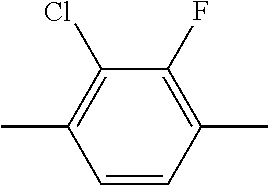 |
| N |
 |
NI |
 |
| M |
 |
MI |
 |
| np |
 |
||
| n3f |
 |
n3fI |
 |
| th |
 |
thI |
 |
| tH2f |
 |
tH2fI |
 |
| o2f |
 |
o2fI |
 |
| dh |
 |
||
| K |
 |
KI |
 |
| L |
 |
LI |
 |
| F |
 |
FI |
 |
| TABLE B |
| Bridging elements |
| E | —CH2—CH2— | ||||
| V | —CH═CH— | ||||
| T | —C≡C— | ||||
| W | —CF2—CF2— | ||||
| B | —CF═CF— | ||||
| Z | —CO—O— | ZI | —O—CO— | ||
| X | —CF═CH— | XI | —CH═CF— | ||
| O | —CH2—O— | OI | —O—CH2— | ||
| Q | —CF2—O— | QI | —O—CF2— | ||
| TABLE C |
| End groups |
| On the left, standing alone or in | On the right, standing alone or in |
| combination | combination |
| -n- | CnH2n+1— | -n | —CnH2n+1 |
| -nO- | CnH2n+1—O— | -nO | —O—CnH2n+1 |
| -V- | CH2═CH— | -V | —CH═CH2 |
| -nV- | CnH2n+1—CH═CH— | -nV | —CnH2n—CH═CH2 |
| -Vn- | CH2═CH—CnH2n— | -Vn | —CH2═CH—CnH2n+1 |
| -nVm- | CnH2n+1—CH═CH—CmH2m— | -nVm | —CnH2n—CH═CH—CmH2m+1 |
| -N- | N≡C— | -N | —C≡N |
| -S- | S═C═N— | -S | —N═C═S |
| -F- | F— | -F | —F |
| -CL- | Cl— | -CL | —Cl |
| -M- | CFH2— | -M | —CFH2 |
| -D- | CF2H— | -D | —CF2H |
| -T- | CF3— | -T | —CF3 |
| -MO- | CFH2O— | -OM | —OCFH2 |
| -DO- | CF2HO— | -OD | —OCF2H |
| -TO- | CF3O— | -OT | —OCF3 |
| -A- | H—C≡C— | -A | —C≡C—H |
| -nA- | CnH2n+1—C≡CH— | -An | —C≡C—CnH2n+1 |
| -NA- | N≡C—C≡C— | -AN | —C≡C—C≡N |
| On the left only in combination | On the right only in combination | ||||
| - . . . n . . . - | —CnH2n— | - . . . n . . . | —CnH2n— | ||
| - . . . M . . . - | —CFH— | - . . . M . . . | —CFH— | ||
| - . . . D . . . - | —CF2— | - . . . D . . . | —CF2— | ||
| - . . . V . . . - | —CH═CH— | - . . . V . . . | —CH═CH— | ||
| - . . . Z . . . - | —CO—O— | - . . . Z . . . | —CO—O— | ||
| - . . . ZI . . . - | —O—CO— | - . . . ZI . . . | —O—CO— | ||
| - . . . K . . . - | —CO— | - . . . K . . . | —CO— | ||
| - . . . W . . . - | —CF═CF— | - . . . W . . . | —CF═CF— | ||


Base Mixture
Above and below,
Δn denotes the optical anisotropy measured at 20° C. and 589 nm,
ne denotes the extraordinary refractive index measured at 20° C. and 589 nm,
no denotes the ordinary refractive index measured at 20° C. and 589 nm,
Δε denotes the dielectric anisotropy at 20° C. and 1 kHz,
cl.p., T(N,I) denotes the clearing point [° C.].
| Phys. properties | Substance | Percent by weight % | ||
| cl.p.: 114.5° C. | CPG-3-F | 5 | ||
| CPG-5-F | 5 | |||
| Δn: 0.1349 | CPU-3-F | 15 | ||
| ne: 1.6303 | CPU-5-F | 15 | ||
| no: 1.4954 | CP-3-N | 16 | ||
| CP-5-N | 16 | |||
| Δε: 11.3 | CCGU-3-F | 7 | ||
| CGPC-3-3 | 4 | |||
| CGPC-5-3 | 4 | |||
| CGPC-5-5 | 4 | |||
| CCZPC-3-3 | 3 | |||
| CCZPC-3-4 | 3 | |||
| CCZPC-3-5 | 3 | |||
| Wavelength | 1/[% * cm] | |
| 664 nm | ε_parallel | 1527 |
| 664 nm | ε_perpendicular | 238 |
| 479 nm | ε_parallel | 500 |
| 479 nm | ε_perpendicular | 254 |

Claims (23)


Applications Claiming Priority (4)
| Application Number | Priority Date | Filing Date | Title |
|---|---|---|---|
| EP15002069 | 2015-07-10 | ||
| EP15002069.1 | 2015-07-10 | ||
| EP15002069 | 2015-07-10 | ||
| PCT/EP2016/001048 WO2017008880A1 (en) | 2015-07-10 | 2016-06-20 | Dithio-alkyl-pyrrolo-pyrroles and use thereof as dyes |
Publications (2)
| Publication Number | Publication Date |
|---|---|
| US20180375030A1 US20180375030A1 (en) | 2018-12-27 |
| US10868257B2 true US10868257B2 (en) | 2020-12-15 |
Family
ID=53783008
Family Applications (1)
| Application Number | Title | Priority Date | Filing Date |
|---|---|---|---|
| US15/742,918 Active 2036-09-21 US10868257B2 (en) | 2015-07-10 | 2016-06-20 | Dithioalkylpyrrolopyrroles and the use thereof as dyes |
Country Status (7)
| Country | Link |
|---|---|
| US (1) | US10868257B2 (en) |
| EP (1) | EP3319964B1 (en) |
| JP (1) | JP6884748B2 (en) |
| KR (1) | KR102602326B1 (en) |
| CN (1) | CN107849048B (en) |
| TW (1) | TWI717368B (en) |
| WO (1) | WO2017008880A1 (en) |
Families Citing this family (2)
| Publication number | Priority date | Publication date | Assignee | Title |
|---|---|---|---|---|
| EP3319964B1 (en) * | 2015-07-10 | 2020-07-22 | Merck Patent GmbH | Dithio-alkyl-pyrrolo-pyrroles and use thereof as dyes |
| JP7160536B2 (en) * | 2018-01-24 | 2022-10-25 | スタンレー電気株式会社 | lighting equipment |
Citations (2)
| Publication number | Priority date | Publication date | Assignee | Title |
|---|---|---|---|---|
| WO2015090497A1 (en) | 2013-12-19 | 2015-06-25 | Merck Patent Gmbh | Dye compounds |
| US20180375030A1 (en) * | 2015-07-10 | 2018-12-27 | Merck Patent Gmbh | Dithioalkylpyrrolopyrroles and the use thereof as dyes |
Family Cites Families (52)
| Publication number | Priority date | Publication date | Assignee | Title |
|---|---|---|---|---|
| JPS55123673A (en) | 1979-03-16 | 1980-09-24 | Mitsui Toatsu Chem Inc | Liquid crystal color display device |
| JPS55152875A (en) | 1979-05-14 | 1980-11-28 | Mitsubishi Chem Ind | Anthraquinone dyestuff for cellulose containing fibers |
| JPS5652440U (en) | 1979-09-29 | 1981-05-09 | ||
| GB2065695B (en) | 1979-10-12 | 1984-07-25 | Hitachi Ltd | Guest-host type liquid crystal composition and liquid crystal display device using the same |
| JPS5657850A (en) | 1979-10-18 | 1981-05-20 | Nippon Kanko Shikiso Kenkyusho:Kk | Azo compound and dichromatic dye for liquid crystal consisting of the same |
| GB2065158A (en) | 1979-12-13 | 1981-06-24 | Standard Telephones Cables Ltd | Anthraquinone Dichroic Dyes |
| JPS56104984A (en) | 1980-01-24 | 1981-08-21 | Nippon Kanko Shikiso Kenkyusho:Kk | Bichromic pigment for yellow liquid crystal |
| DE3007198A1 (en) | 1980-02-26 | 1981-09-03 | Siemens AG, 1000 Berlin und 8000 München | PLEOCHROITIC ANTHRACHINONE DYE, METHOD FOR THE PRODUCTION THEREOF AND USE OF THE DYE |
| US4350603A (en) | 1980-06-30 | 1982-09-21 | General Electric Company | Novel tris-azo dyes and liquid crystal compositions made therewith |
| EP0043904A3 (en) | 1980-07-10 | 1982-03-31 | F. HOFFMANN-LA ROCHE & CO. Aktiengesellschaft | Mixtures containing a dyestuff, dyestuffs and their use in liquid crystal mixtures |
| GB2082196B (en) | 1980-07-29 | 1985-01-23 | Secr Defence | Liquid crystal materials containing anthraquinone pleochroic dyes |
| EP0044893B1 (en) | 1980-07-29 | 1984-09-19 | Imperial Chemical Industries Plc | Anthraquinone compounds and process for their preparation |
| GB2081736B (en) | 1980-07-29 | 1985-02-20 | Secr Defence | Liquid crystal materials containing diamino-dihydroxy anthraquinone pleochroic dyes |
| US4308161A (en) | 1980-08-04 | 1981-12-29 | General Electric Company | Novel yellow azo dyes and dichroic liquid crystal compositions made therewith |
| EP0047027A1 (en) | 1980-08-22 | 1982-03-10 | BBC Aktiengesellschaft Brown, Boveri & Cie. | Liquid crystals mixture |
| JPS5755984A (en) | 1980-09-22 | 1982-04-03 | Hitachi Ltd | Liquid crystal composition |
| JPS5763377A (en) | 1980-10-03 | 1982-04-16 | Mitsui Toatsu Chem Inc | Liquid crystal composition for color display |
| DE3040102A1 (en) | 1980-10-24 | 1982-06-03 | Merck Patent Gmbh, 6100 Darmstadt | DICHROITIC ANTHRACHINONE DYES, THIS CONTAINING LIQUID CRYSTALINE DIELECTRICS AND ELECTRO-OPTICAL DISPLAY ELEMENT |
| US4308162A (en) | 1980-12-08 | 1981-12-29 | General Electric Company | Novel yellow azo dyes and dichroic liquid crystal compositions made therewith |
| DE3046904A1 (en) | 1980-12-12 | 1982-07-15 | Bayer Ag, 5090 Leverkusen | ANTHRACHINONE DYES, METHOD FOR THE PRODUCTION THEREOF, AND THE USE OF LIQUID CRYSTAL MATERIALS CONTAINING ANTHRACHINONE DYES |
| DE3115147A1 (en) | 1981-04-15 | 1982-11-04 | Basf Ag, 6700 Ludwigshafen | Dyes for liquid-crystal mixtures |
| EP0056492B1 (en) | 1981-01-10 | 1984-12-12 | BASF Aktiengesellschaft | Dyes for liquid crystal mixtures |
| JPS57126879A (en) | 1981-01-12 | 1982-08-06 | Sumitomo Chem Co Ltd | Liquid crystal display element |
| DE3201120A1 (en) | 1981-01-17 | 1982-10-21 | Hitachi, Ltd., Tokyo | LIQUID CRYSTAL COMPOSITION |
| EP0142617B1 (en) | 1981-02-25 | 1987-07-22 | Imperial Chemical Industries Plc | Pleochroic anthraquinone dyes |
| GB2094822B (en) | 1981-02-25 | 1986-03-05 | Ici Plc | Anthraquinone dyes |
| DE3110960A1 (en) | 1981-03-20 | 1982-09-30 | Basf Ag, 6700 Ludwigshafen | ELECTROPHOTOGRAPHIC RECORDING MATERIAL |
| DE3115762A1 (en) | 1981-04-18 | 1982-11-11 | Merck Patent Gmbh, 6100 Darmstadt | "DICHROITIC ANTHRACHINONE DYES, THIS CONTAINING LIQUID CRYSTAL DIELECTRICS AND ELECTROOPRIC DISPLAY ELEMENT" |
| DE3123519A1 (en) | 1981-06-13 | 1982-12-30 | Bayer Ag, 5090 Leverkusen | LIQUID CRYSTAL MATERIAL CONTAINING AZO COLORS |
| JPS581775A (en) | 1981-06-26 | 1983-01-07 | Mitsubishi Chem Ind Ltd | Liquid crystal composition |
| DE3126108A1 (en) | 1981-07-02 | 1983-01-20 | Merck Patent Gmbh, 6100 Darmstadt | "LIQUID CRYSTAL DIELECTRIC, NEW DICHROITIC NAPHTHOQUINONE DYES AND ELECTRO-OPTICAL DISPLAY ELEMENT" |
| DE3202761A1 (en) | 1982-01-28 | 1983-08-04 | Merck Patent Gmbh, 6100 Darmstadt | LIQUID CRYSTAL DIELECTRIC, NEW COLORS, METHOD FOR THEIR PRODUCTION AND ELECTRO-OPTICAL DISPLAY ELEMENT |
| DE3366011D1 (en) | 1982-05-17 | 1986-10-16 | Ciba Geigy Ag | Preparation of pyrrolo-(3,4-c) pyrroles |
| US6025897A (en) | 1993-12-21 | 2000-02-15 | 3M Innovative Properties Co. | Display with reflective polarizer and randomizing cavity |
| EP0698649A1 (en) | 1994-08-26 | 1996-02-28 | Basf Aktiengesellschaft | Use of thermoplastically processible long time stable electroluminescent materials |
| US6099758A (en) | 1997-09-17 | 2000-08-08 | Merck Patent Gesellschaft Mit Beschrankter Haftung | Broadband reflective polarizer |
| US7023602B2 (en) | 1999-05-17 | 2006-04-04 | 3M Innovative Properties Company | Reflective LCD projection system using wide-angle Cartesian polarizing beam splitter and color separation and recombination prisms |
| DE10028104A1 (en) * | 2000-06-07 | 2001-12-13 | Clariant Gmbh | Process for the preparation of diketopyrrologyrrole pigments |
| KR101130094B1 (en) * | 2003-04-10 | 2012-03-28 | 시바 홀딩 인크 | Fluorescent diketopyrrolopyrroles |
| CN100593033C (en) * | 2003-05-27 | 2010-03-03 | 默克专利股份有限公司 | Liquid crystal compounds containing tetrahydropyran rings |
| EP1843407A1 (en) | 2006-04-07 | 2007-10-10 | Basf Aktiengesellschaft | Liquid crystalline rylenetetracarboxylic acid derivatives and their use |
| US7826009B2 (en) | 2006-12-21 | 2010-11-02 | 3M Innovative Properties Company | Hybrid polarizer |
| DE102008039745A1 (en) * | 2007-09-07 | 2009-03-12 | Merck Patent Gmbh | Process for the preparation of a homogeneous liquid mixture |
| CN102037565B (en) * | 2008-05-21 | 2014-10-29 | 皮尔普拉斯有限公司 | Optical device with anisotropic luminescent material |
| EP2166040A1 (en) | 2008-09-22 | 2010-03-24 | Radiant Color N.V. | Novel lipophilic fluorescent dyes and a process for their production |
| US9249356B2 (en) * | 2011-07-05 | 2016-02-02 | Peer+ B.V. | Liquid crystal dye mixture |
| CN103890643B (en) * | 2011-10-24 | 2018-01-26 | 默克专利股份有限公司 | Switching elements containing liquid crystal media |
| PL397479A1 (en) * | 2011-12-21 | 2013-06-24 | Instytut Chemii Organicznej Polskiej Akademii Nauk | New, fluorescent heterocyclic dyes and a process for their manufacturing |
| EP2703468A1 (en) * | 2012-09-03 | 2014-03-05 | Ecole Polytechnique Fédérale de Lausanne (EPFL) | Diketopyrrolopyrole (DPP)-based sensitizers for electrochemical or optoelectronic devices |
| KR102234246B1 (en) * | 2013-05-24 | 2021-04-01 | 메르크 파텐트 게엠베하 | Device for controlling the passage of energy, containing a dichroic dye compound |
| JP2016536634A (en) * | 2013-10-17 | 2016-11-24 | メルク パテント ゲゼルシャフト ミット ベシュレンクテル ハフツングMerck Patent Gesellschaft mit beschraenkter Haftung | Device for controlling the entrance of light |
| KR102254011B1 (en) * | 2013-12-19 | 2021-05-20 | 메르크 파텐트 게엠베하 | Device for regulating the passage of light |
-
2016
- 2016-06-20 EP EP16733295.6A patent/EP3319964B1/en active Active
- 2016-06-20 KR KR1020187003760A patent/KR102602326B1/en active Active
- 2016-06-20 US US15/742,918 patent/US10868257B2/en active Active
- 2016-06-20 WO PCT/EP2016/001048 patent/WO2017008880A1/en not_active Ceased
- 2016-06-20 CN CN201680040828.7A patent/CN107849048B/en active Active
- 2016-06-20 JP JP2018500740A patent/JP6884748B2/en active Active
- 2016-07-07 TW TW105121641A patent/TWI717368B/en active
Patent Citations (3)
| Publication number | Priority date | Publication date | Assignee | Title |
|---|---|---|---|---|
| WO2015090497A1 (en) | 2013-12-19 | 2015-06-25 | Merck Patent Gmbh | Dye compounds |
| US10202508B2 (en) | 2013-12-19 | 2019-02-12 | Merck Patent Gmbh | Dye compounds |
| US20180375030A1 (en) * | 2015-07-10 | 2018-12-27 | Merck Patent Gmbh | Dithioalkylpyrrolopyrroles and the use thereof as dyes |
Non-Patent Citations (10)
| Title |
|---|
| "Near-Infrared Thermochromic Diazapentalene Dyes and Polymers", Advanced Material (Weinheim, Germany) vol. 24, Issue 1, pp. 1582-1588. * |
| "Near-Infrared Thermochromic Diazapentalene Dyes and Polymers", Advanced Material (Weinheim, Germany), 2012, vol. 24, Issue 1, pp. 1582-1588 (Year: 2012). * |
| Gang Qian et al: "Family of Diazapentalene Chromophores and Narrow-Band-Gap Polymers: Synthesis, Halochromism, Halofluorism, and Visible-Near Infrared Photodetectivity", Chemistry of Materials, vol. 24, No. 12, Jun. 26, 2012 (Jun. 26, 2012), US, pp. 2364-2372, XP055295267, ISSN: 0897-4756. |
| Gang Qian et al: "Near-Infrared Thermochromic Diazapentalene Dyes", Advanced Materials, vol. 24, No. 12, Feb. 20, 2012 (Feb. 20, 2012), DE, pp. 1582-1588, XP055295270, ISSN: 0935-9648. |
| Gang Qian et al: "Synthesis and study of low-bandgap polymers containing the diazapentalene and diketopyrrolopyrrole chromophores for potential use in solar cells and near-infrared photodetectors", Journal of Materials Chemistry, vol. 22, No. 25, Jan. 1, 2012 (Jan. 1, 2012), GB, pp. 12867, XP055295265, ISSN: 0959-9428. |
| GANG QIAN, JI QI, JAMES A. DAVEY, JAMES S. WRIGHT, ZHI YUAN WANG: "Family of Diazapentalene Chromophores and Narrow-Band-Gap Polymers: Synthesis, Halochromism, Halofluorism, and Visible–Near Infrared Photodetectivity", CHEMISTRY OF MATERIALS, AMERICAN CHEMICAL SOCIETY, vol. 24, no. 12, 26 June 2012 (2012-06-26), pages 2364 - 2372, XP055295267, ISSN: 0897-4756, DOI: 10.1021/cm300938s |
| GANG QIAN, JI QI, ZHI YUAN WANG: "Synthesis and study of low-bandgap polymers containing the diazapentalene and diketopyrrolopyrrole chromophores for potential use in solar cells and near-infrared photodetectors", JOURNAL OF MATERIALS CHEMISTRY, ROYAL SOCIETY OF CHEMISTRY, GB, vol. 22, no. 25, 1 January 2012 (2012-01-01), GB, pages 12867, XP055295265, ISSN: 0959-9428, DOI: 10.1039/c2jm30868a |
| GANG QIAN, ZHI YUAN WANG: "Near-Infrared Thermochromic Diazapentalene Dyes", ADVANCED MATERIALS, VCH PUBLISHERS, vol. 24, no. 12, 22 March 2012 (2012-03-22), pages 1582 - 1588, XP055295270, ISSN: 0935-9648, DOI: 10.1002/adma.201104711 |
| International Search Report PCT/EP2016/001048 dated Aug. 29, 2016. |
| Notice for Reasons for Rejection in corresponding JP application 2018-500740 dated May 20, 2020 (English—pp. 1-4). |
Also Published As
| Publication number | Publication date |
|---|---|
| KR102602326B1 (en) | 2023-11-16 |
| CN107849048B (en) | 2021-05-25 |
| TW201710262A (en) | 2017-03-16 |
| TWI717368B (en) | 2021-02-01 |
| JP6884748B2 (en) | 2021-06-09 |
| EP3319964A1 (en) | 2018-05-16 |
| EP3319964B1 (en) | 2020-07-22 |
| WO2017008880A1 (en) | 2017-01-19 |
| JP2018528932A (en) | 2018-10-04 |
| KR20180027569A (en) | 2018-03-14 |
| CN107849048A (en) | 2018-03-27 |
| US20180375030A1 (en) | 2018-12-27 |
Similar Documents
| Publication | Publication Date | Title |
|---|---|---|
| EP3004251B1 (en) | Device for controlling the passage of energy, containing a dichroic dye compound | |
| TWI698441B (en) | Thiadiazoloquinoxaline derivatives | |
| TWI685548B (en) | Dye compounds | |
| TWI680133B (en) | Device for regulating the passage of energy | |
| CN112313311B (en) | Liquid-crystalline medium | |
| CN112262200B (en) | Liquid-crystalline medium | |
| US10868257B2 (en) | Dithioalkylpyrrolopyrroles and the use thereof as dyes | |
| KR102430093B1 (en) | Device for controlling the passage of energy | |
| CN121311566A (en) | Liquid crystal media |
Legal Events
| Date | Code | Title | Description |
|---|---|---|---|
| FEPP | Fee payment procedure |
Free format text: ENTITY STATUS SET TO UNDISCOUNTED (ORIGINAL EVENT CODE: BIG.); ENTITY STATUS OF PATENT OWNER: LARGE ENTITY |
|
| AS | Assignment |
Owner name: MERCK PATENT GMBH, GERMANY Free format text: ASSIGNMENT OF ASSIGNORS INTEREST;ASSIGNORS:KIRSCH, PEER;GUNST, SUSANN;JUNGE, MICHAEL;AND OTHERS;SIGNING DATES FROM 20171013 TO 20180113;REEL/FRAME:044725/0652 |
|
| STPP | Information on status: patent application and granting procedure in general |
Free format text: DOCKETED NEW CASE - READY FOR EXAMINATION |
|
| STPP | Information on status: patent application and granting procedure in general |
Free format text: NON FINAL ACTION MAILED |
|
| STPP | Information on status: patent application and granting procedure in general |
Free format text: RESPONSE TO NON-FINAL OFFICE ACTION ENTERED AND FORWARDED TO EXAMINER |
|
| STPP | Information on status: patent application and granting procedure in general |
Free format text: NON FINAL ACTION MAILED |
|
| STPP | Information on status: patent application and granting procedure in general |
Free format text: RESPONSE TO NON-FINAL OFFICE ACTION ENTERED AND FORWARDED TO EXAMINER |
|
| STPP | Information on status: patent application and granting procedure in general |
Free format text: FINAL REJECTION MAILED |
|
| STPP | Information on status: patent application and granting procedure in general |
Free format text: RESPONSE AFTER FINAL ACTION FORWARDED TO EXAMINER |
|
| STPP | Information on status: patent application and granting procedure in general |
Free format text: AWAITING TC RESP., ISSUE FEE NOT PAID |
|
| STPP | Information on status: patent application and granting procedure in general |
Free format text: PUBLICATIONS -- ISSUE FEE PAYMENT VERIFIED |
|
| STCF | Information on status: patent grant |
Free format text: PATENTED CASE |
|
| MAFP | Maintenance fee payment |
Free format text: PAYMENT OF MAINTENANCE FEE, 4TH YEAR, LARGE ENTITY (ORIGINAL EVENT CODE: M1551); ENTITY STATUS OF PATENT OWNER: LARGE ENTITY Year of fee payment: 4 |