US10867505B2 - Surrounding intelligent motion sensor - Google Patents
Surrounding intelligent motion sensor Download PDFInfo
- Publication number
- US10867505B2 US10867505B2 US16/553,258 US201916553258A US10867505B2 US 10867505 B2 US10867505 B2 US 10867505B2 US 201916553258 A US201916553258 A US 201916553258A US 10867505 B2 US10867505 B2 US 10867505B2
- Authority
- US
- United States
- Prior art keywords
- threat
- board
- warning
- motherboard
- housing
- Prior art date
- Legal status (The legal status is an assumption and is not a legal conclusion. Google has not performed a legal analysis and makes no representation as to the accuracy of the status listed.)
- Active
Links
Images




Classifications
-
- G—PHYSICS
- G08—SIGNALLING
- G08B—SIGNALLING SYSTEMS, e.g. PERSONAL CALLING SYSTEMS; ORDER TELEGRAPHS; ALARM SYSTEMS
- G08B25/00—Alarm systems in which the location of the alarm condition is signalled to a central station, e.g. fire or police telegraphic systems
- G08B25/01—Alarm systems in which the location of the alarm condition is signalled to a central station, e.g. fire or police telegraphic systems characterised by the transmission medium
- G08B25/016—Personal emergency signalling and security systems
-
- G—PHYSICS
- G01—MEASURING; TESTING
- G01P—MEASURING LINEAR OR ANGULAR SPEED, ACCELERATION, DECELERATION, OR SHOCK; INDICATING PRESENCE, ABSENCE, OR DIRECTION, OF MOVEMENT
- G01P13/00—Indicating or recording presence, absence, or direction, of movement
-
- G—PHYSICS
- G01—MEASURING; TESTING
- G01S—RADIO DIRECTION-FINDING; RADIO NAVIGATION; DETERMINING DISTANCE OR VELOCITY BY USE OF RADIO WAVES; LOCATING OR PRESENCE-DETECTING BY USE OF THE REFLECTION OR RERADIATION OF RADIO WAVES; ANALOGOUS ARRANGEMENTS USING OTHER WAVES
- G01S19/00—Satellite radio beacon positioning systems; Determining position, velocity or attitude using signals transmitted by such systems
- G01S19/01—Satellite radio beacon positioning systems transmitting time-stamped messages, e.g. GPS [Global Positioning System], GLONASS [Global Orbiting Navigation Satellite System] or GALILEO
- G01S19/13—Receivers
-
- G—PHYSICS
- G01—MEASURING; TESTING
- G01V—GEOPHYSICS; GRAVITATIONAL MEASUREMENTS; DETECTING MASSES OR OBJECTS; TAGS
- G01V8/00—Prospecting or detecting by optical means
- G01V8/005—Prospecting or detecting by optical means operating with millimetre waves, e.g. measuring the black losey radiation
-
- G—PHYSICS
- G01—MEASURING; TESTING
- G01V—GEOPHYSICS; GRAVITATIONAL MEASUREMENTS; DETECTING MASSES OR OBJECTS; TAGS
- G01V8/00—Prospecting or detecting by optical means
- G01V8/10—Detecting, e.g. by using light barriers
-
- G—PHYSICS
- G08—SIGNALLING
- G08B—SIGNALLING SYSTEMS, e.g. PERSONAL CALLING SYSTEMS; ORDER TELEGRAPHS; ALARM SYSTEMS
- G08B13/00—Burglar, theft or intruder alarms
- G08B13/18—Actuation by interference with heat, light, or radiation of shorter wavelength; Actuation by intruding sources of heat, light, or radiation of shorter wavelength
- G08B13/189—Actuation by interference with heat, light, or radiation of shorter wavelength; Actuation by intruding sources of heat, light, or radiation of shorter wavelength using passive radiation detection systems
- G08B13/194—Actuation by interference with heat, light, or radiation of shorter wavelength; Actuation by intruding sources of heat, light, or radiation of shorter wavelength using passive radiation detection systems using image scanning and comparing systems
- G08B13/196—Actuation by interference with heat, light, or radiation of shorter wavelength; Actuation by intruding sources of heat, light, or radiation of shorter wavelength using passive radiation detection systems using image scanning and comparing systems using television cameras
- G08B13/19602—Image analysis to detect motion of the intruder, e.g. by frame subtraction
- G08B13/19613—Recognition of a predetermined image pattern or behaviour pattern indicating theft or intrusion
-
- G—PHYSICS
- G08—SIGNALLING
- G08B—SIGNALLING SYSTEMS, e.g. PERSONAL CALLING SYSTEMS; ORDER TELEGRAPHS; ALARM SYSTEMS
- G08B13/00—Burglar, theft or intruder alarms
- G08B13/18—Actuation by interference with heat, light, or radiation of shorter wavelength; Actuation by intruding sources of heat, light, or radiation of shorter wavelength
- G08B13/189—Actuation by interference with heat, light, or radiation of shorter wavelength; Actuation by intruding sources of heat, light, or radiation of shorter wavelength using passive radiation detection systems
- G08B13/194—Actuation by interference with heat, light, or radiation of shorter wavelength; Actuation by intruding sources of heat, light, or radiation of shorter wavelength using passive radiation detection systems using image scanning and comparing systems
- G08B13/196—Actuation by interference with heat, light, or radiation of shorter wavelength; Actuation by intruding sources of heat, light, or radiation of shorter wavelength using passive radiation detection systems using image scanning and comparing systems using television cameras
- G08B13/19617—Surveillance camera constructional details
- G08B13/19619—Details of casing
-
- G—PHYSICS
- G08—SIGNALLING
- G08B—SIGNALLING SYSTEMS, e.g. PERSONAL CALLING SYSTEMS; ORDER TELEGRAPHS; ALARM SYSTEMS
- G08B13/00—Burglar, theft or intruder alarms
- G08B13/18—Actuation by interference with heat, light, or radiation of shorter wavelength; Actuation by intruding sources of heat, light, or radiation of shorter wavelength
- G08B13/189—Actuation by interference with heat, light, or radiation of shorter wavelength; Actuation by intruding sources of heat, light, or radiation of shorter wavelength using passive radiation detection systems
- G08B13/194—Actuation by interference with heat, light, or radiation of shorter wavelength; Actuation by intruding sources of heat, light, or radiation of shorter wavelength using passive radiation detection systems using image scanning and comparing systems
- G08B13/196—Actuation by interference with heat, light, or radiation of shorter wavelength; Actuation by intruding sources of heat, light, or radiation of shorter wavelength using passive radiation detection systems using image scanning and comparing systems using television cameras
- G08B13/19617—Surveillance camera constructional details
- G08B13/19621—Portable camera
-
- G—PHYSICS
- G08—SIGNALLING
- G08B—SIGNALLING SYSTEMS, e.g. PERSONAL CALLING SYSTEMS; ORDER TELEGRAPHS; ALARM SYSTEMS
- G08B25/00—Alarm systems in which the location of the alarm condition is signalled to a central station, e.g. fire or police telegraphic systems
- G08B25/01—Alarm systems in which the location of the alarm condition is signalled to a central station, e.g. fire or police telegraphic systems characterised by the transmission medium
- G08B25/10—Alarm systems in which the location of the alarm condition is signalled to a central station, e.g. fire or police telegraphic systems characterised by the transmission medium using wireless transmission systems
-
- H—ELECTRICITY
- H04—ELECTRIC COMMUNICATION TECHNIQUE
- H04W—WIRELESS COMMUNICATION NETWORKS
- H04W4/00—Services specially adapted for wireless communication networks; Facilities therefor
- H04W4/12—Messaging; Mailboxes; Announcements
- H04W4/14—Short messaging services, e.g. short message services [SMS] or unstructured supplementary service data [USSD]
-
- H—ELECTRICITY
- H04—ELECTRIC COMMUNICATION TECHNIQUE
- H04W—WIRELESS COMMUNICATION NETWORKS
- H04W4/00—Services specially adapted for wireless communication networks; Facilities therefor
- H04W4/80—Services using short range communication, e.g. near-field communication [NFC], radio-frequency identification [RFID] or low energy communication
Definitions
- the present invention relates to the field of proximity detection devices, and more specifically to a wearable proximity detection device and a novel method of providing situational awareness and warning to the user of approaching threats from behind the user.
- a wearable proximity detection device There are currently over 500,000 correctional officers in the US with over 13,000 assaults per year.
- correctional officers there are many other user groups who could benefit from a device to warn of a threat approaching from behind such as police officers, military personnel, and even civilian users such as joggers and runners for example.
- U.S. Pat. Appl. Pub. No. 2015/0172545 published in June 2015 by Szabo et al entitled “Situational Awareness by Compressed Display of Panoramic Views” discloses a device that stitches video images from a camera to provide a 360 panoramic view of the surroundings to provide situational awareness.
- the Szabo device is a head mounted device intended for military and firefighters to wear on duty. Although the Szabo device could be used effectively for military and firefighting applications, it would be much too expensive for the average civilian to afford due to the complex array of imaging sensors and image processing hardware required.
- U.S. Pat. Appl. Pub. No, 2017/0263107 published in September 2017 by Doyle et al entitled “Approaching Proximity Warning System, Apparatus and Method” discloses a wearable device that alerts the user of threats approaching from behind.
- the Doyle device uses short range radar to transmit and receive electromagnetic waves that bounce off of objects and processes the radar information using an algorithm to determine if there is an approaching threat from behind.
- the Doyle device is meant to be worn on the back of the user and will warn the user by various means such as by an audible signal or a mechanical signal such as by vibration of the device.
- the first flaw inherent design flaw in the Doyle device is that it uses short range radar technology which has typically a maximum effective range of only 100 meters (328 feet).
- the patent pending device of Doyle and Cleghorn is disclosed on the internet by a New Mexico company known as DefendSix (www.defendsix.com).
- the DefendSix website product specification lists the detection range as approximately 25 meters (82 feet). With such as short detection range, there is a very high risk that the user of a DefendSix device may not have enough warning time to take evasive action if a threat such as a running person is approaching from behind.
- the Doyle device would first alert a static user when the person was 82 feet behind him. This would give the user only 3.7 seconds to take evasive action before the person contacts him if the user was standing still. Although a running user would have a few more seconds based on their speed differential, the point to be made is that the very limited range of the Doyle device leaves a very short time to take evasive action before the threat has reached the user.
- the second inherent design flaw in the Doyle device is that because it uses radar it cannot discriminate a real threat from a false positive threat. For example, a bird flying towards the user will generate a warning to the user just like a person with a knife running from behind would. Although the radar would likely always warn the user once the 82 foot detection range is reached, the user over time would likely receive so many false positive warnings that he would start becoming disappointed with its effectiveness and basic lack of intelligence of the device.
- the probability of detecting a target is based on a property of an object known as its radar cross section.
- the radar cross section of an object depends on many variables such as the object's size, surface area, shape and material. While some objects such as a large jogger running straight at a person from behind may have a large enough radar cross section for the device to warn the user, a small object such as a thrown baseball or a bicyclist might have too small of a radar cross section to reach the detection threshold depending on its distance from the radar.
- the Doyle device uses low power short range radar, the variable nature of radar cross sections will likely result in either some threats not being picked up the device or being picked up approaching too close to the user to safely take evasive action. Indeed, there is a great unfilled need to supply corrections officers, police officers, military personnel and security concerned civilians with a proximity warning device that can reliably pick up targets several hundred feet away.
- the present invention provides a wearable proximity warning device and novel threat detection method that resolves the aforementioned problems in the prior art by using a high frame rate digital camera with advanced image processing algorithms to detect threats from several hundred feet away and track them in real time and immediately warn the user if any threats are approaching him from behind.
- the present invention shall be referred to throughout the remainder of this specification as SIMS—Surrounding Intelligent Motion Sensor.
- SIMS It is a first object of SIMS to provide a compact, lightweight proximity warning device that can detect threats approaching from behind at a maximum distance of 500 feet. This is well beyond the typical range of non-optical methods such as short range radar (max. detection range is—330 feet).
- FIG. 1 is a front view of the SIMS device.
- FIG. 2 is a rear view of the SIMS device.
- FIG. 3 shows a female user wearing the SIMS device using the chest belt option.
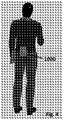
- FIG. 4 shows a male user wearing the SIMS device using the belt clip option.
- FIG. 5 is a component diagram of the SIMS device.
- FIG. 6 is a functional block diagram showing the functional relationships of the various components of the SIMS device.
- FIG. 7 is a flowchart showing how an approaching threat determination is made in the SIMS device.
- FIG. 8 is a flowchart showing the various warning methods that the SIMS device will use if an approaching threat from behind has been detected.
- FIGS. 9( a )-9( c ) show a sequence of time elapsed images of running joggers to demonstrate the capability of SIMS to detect humans using a human recognition detection algorithm.
- FIGS. 10( a )-10( c ) show the capability of a human to pixel count conversion algorithm to count pixels of the detected humans from previous FIGS. 9( a )-9( c ) .
- FIG. 11 is a table showing the results of the threat detection algorithm to detect an approaching threat by an increasing pixel count of detected human T1.
- the SIMS device has a front housing 10 that is preferably made from a strong plastic such as ABS or nylon.
- a digital camera lens 70 is located in the center of the housing and has the typical features of modern digital cameras including a focusing capability and an adjustable aperture to adjust the brightness of the image.
- a USB port 97 is located at the bottom end of the SIMS device and provides a means for the recharging of an internal rechargeable battery 99 (not shown).
- a power on/off button 40 is shown located at the upper left hand corner of the SIMS device and provides a means to turn SIMS on or off.
- a Bluetooth activation button 20 is located below the power button 40 and when this button is pressed it will enable the SIMS device to use Bluetooth cellular phone warning options that shall be explained later in the specification.
- the SIMS device can provide either an audible tone warning or a vibration warning depending on which position the warning mode selector switch 30 is in. For example, in FIG.
- the mode selector switch 30 is shown in the audible tone warning position.
- an internal speaker 85 (not shown) will produce sound that will be emanated from speaker holes 87 shown in the top center section of the SIMS device.
- FIG. 2 the back side of the SIMS device 1000 is shown.
- a belt clip 50 is shown centered on the rear housing 15 of the SIMS device.
- the belt clip 50 provides an additional means of wearing the SIMS device on the body.
- FIGS. 3 and 4 The two methods of wearing the SIMS device 1000 on the body are shown in FIGS. 3 and 4 .
- FIG. 3 shows a woman wearing the SIMS device using a chest strap that wraps around her chest and is secured to the SIMS device using the body strap attachment points 55 shown previously in FIGS. 1 and 2 . While the user wears the SIMS device and when it is powered on, it will provide continuous monitoring for any threats approaching the user from behind.
- the SIMS device 1000 may also be worn on the body by using the belt clip 50 located on the backside of the SIMS device to secure to a belt as demonstrated by the man wearing the SIMS device as shown in FIG. 4 . It is recommended to only wear the SIMS device at waist height or higher in order to maximize the field of view that the camera will have when in use.
- FIGS. 5 and 6 the functional relationships of the various components that make the SIMS device 1000 shall next be explained.
- the motherboard 96 is the central control board that manages all of the operations of the SIMS device.
- the motherboard receives input from the audio/vibrate mode switch 30 and based on the input received will either warn the user of an approaching threat by either activating the audio board 95 or the vibration device 90 .
- the motherboard is powered by a rechargeable battery 99 and also regulates the DC power inputs to all of the separate modules under its control.
- the power on button 40 When the power on button 40 is pressed it allows DC power to flow from the rechargeable battery to the motherboard.
- the Bluetooth activation button 20 When the Bluetooth activation button 20 is pressed it sends a signal to the motherboard to activate the smartphone communications board 80 .
- the motherboard activates the camera control board 65 .
- a GPS receiver 82 continuously sends the device's location (latitude and longitude coordinates) to the motherboard while the SIMS device is operating.
- This GPS location data can later be used as part of the text of an SMS text detected threat warning message or included as part of an MMS text message that includes a picture showing the detected threat.
- the GPS location data could be embedded as part of the picture sent so linked smartphone users can access the location of the SIMS user for assistance.
- the camera control board 65 controls the operation of the auto focus camera with variable aperture 70 . Based on the lighting conditions during use, the camera control board will regulate the aperture size to allow more or less light into the camera in order to obtain a sufficient contrast to process the images. Images are taken at a specified frame rate (images per second) and are focused onto the image sensor 72 which is preferably a charge-coupled device (CCD).
- the image sensor is composed of thousands or pixels (picture elements). The light from each picture image captured is converted to a digital signal representation by the image sensor and sent to the image processing board 75 .
- the image processing board 75 is the component of the SIMS device that performs the highly complex tasks of threat detection and monitoring.
- a human recognition detection algorithm is used to identify humans from the images. Once a human is identified, the human recognition detection (HRD) algorithm 500 will continuously track the identified human until it leaves the field of view of the camera. While humans are being tracked by HRD 500 , a separate human to pixel count (HPC) image conversion algorithm 600 is used to count the total number of pixels that each detected human represents in each image processed. The pixel counts vary over time based on how far away the detected humans are from the SIMS device. Humans approaching the SIMS device will have increasing pixel counts over time and humans that move further away from the SIMS device will have decreasing pixel counts over time.
- HRD human recognition detection
- HPC human to pixel count
- the human pixel counts from the image processing board 75 are continuously tabulated and sent to the motherboard 96 . These human pixel counts are then supplied as inputs to a threat determination (TD) algorithm 700 that is embedded firmware and is used by the motherboard 96 . This novel method of detection of an approaching threat shall be explained in detail later in the specification.
- TD threat determination
- the smartphone communications board 80 provides the capability of sending a warning message of a detected approaching threat to smartphones that have the SIMS device app installed.
- the smartphone user simply enables the SIMS device app by going into the smartphone settings and enabling the app. Once enabled, the smartphone app will use Bluetooth to connect the SIMS device to the user's smartphone.
- the smartphone communications board 80 performs three independent functions.
- the first function is to send a Multimedia Messaging Service (MMS) picture and text message 200 showing the first image frame that is considered as a detected approaching threat by SIMS plus a short warning message.
- MMS text message 200 An example of a MMS text message 200 would be a text message such as “WARNING: SIMS DEVICE HAS DETECTED APPROACHING THREAT” followed by a picture showing the actual detected approaching threats.
- the second function is to send a Short Message Service (SMS) text message 300 which is only a text warning message without any pictures.
- SMS Short Message Service
- a final function is the capability of sending stored video images from the memory of the motherboard 96 to the cloud.
- the SIMS user would enable these three functions as options that would displayed in the SIMS device app.
- Hardware to support the smartphone communications board includes an RF antenna 81 to transmit the data wirelessly to the selected SIMS enabled smartphones and also optionally to the cloud for secure video storage.
- Another option in the SIMS device app is to allow the user to select a specific audio warning tone to use when the audio warning mode is enabled.
- the selected warning tone is then stored as an audio file in the motherboard and sent to the audio board 95 whenever a threat is detected.
- the audio board then sends the tone signal to the speaker 85 to play the sound.
- Yet another option in the SIMS device app is to allow the user to select the duration time and intensity of the vibration warning to use when the vibrate mode is enabled.
- the selected vibration time and intensity is then stored as a file in the motherboard's memory and is used to produce the desired vibration warning via the vibration device 90 .
- the USB port 97 is used for the recharging of the SIMS device whenever the rechargeable battery 99 level is low.
- the USB port interfaces with a battery recharging board 98 which is essentially a step down transformer that converts the DC voltage from the USB power to a lower voltage to charge the battery. Once the battery 99 has been fully charged, the battery recharging board 98 will switch off automatically to prevent overcharging.
- the SIMS device uses a novel method of threat detection that is far superior to prior art methods due to its ability to first recognize humans from digital camera images.
- a human recognition detection (HRD) algorithm 500 scans the camera image file and identifies any humans. The details of how the HRD algorithm works are beyond the scope of this specification but would be known to one skilled in the art of artificial intelligence software code development.
- HRD human recognition detection
- a second algorithm defines a boundary around each detected human in the image and calculates the number of pixels inside each detected human boundary. This second algorithm is defined in this specification as a human to pixel count conversion (HPC) algorithm 600 .
- HPC human to pixel count conversion
- the HPC algorithm 600 then sends the pixel count outputs of each detected human as inputs to a third threat detection (TD) algorithm 700 that is part of the embedded firmware in the motherboard 96 .
- This TD algorithm 700 is continuously fed pixel counts for each detected human as each image is processed by the image processing board 75 .
- the TD algorithm 700 is always run whenever humans are detected by the SIMS device using the HRD algorithm 500 .
- Pixel counts at a first time (T1) are then compared to pixel counts at a second later time (T2) and stored frame by frame in the motherboard's memory.
- the elapsed time (T2 ⁇ T1) between image frames is determined by the frame rate of the camera 70 .
- the SIMS device would preferably use a high frame rate camera (for example 1000 frames per second or 1000 fps) in order to achieve a fast detection time of an approaching threat.
- the TD algorithm compares the pixel counts for each detected human over a short time interval (say 1 to 3 seconds for an outdoor exercise scenario) and determines if the pixel counts are increasing or decreasing.
- the SIMS device will take immediate action to warn the user.
- the first method is audio alert which plays a user selected audio warning tone from the speaker 85 driven by an audio board 95 .
- the second method is vibration alert which vibrates the SIMS device using an internal vibration device 90 based on a user selected vibration file stored in the motherboard's memory. Enabling the Bluetooth mode on the SIMS device allows two additional alert methods that send either a Short Message Service (SMS) standard text only warning text message 300 or a Multimedia Messaging Service (MIMS) combined picture and text message that displays the same warning text message as SMS but adds a picture taken from the digital camera at the moment of first threat detection.
- SMS Short Message Service
- MIMS Multimedia Messaging Service
- FIGS. 9( a ), 9( b ) and 9( c ) shows three separate images taken at three second intervals of three joggers that are running behind a user wearing an activated SIMS device. Initially, all three joggers are running together ( FIG. 9( a ) ) but by the final image ( FIG. 9( c ) ) they have all been separated from each other.
- the HRD algorithm 500 has detected three humans in the images and for reference these detected humans are referred to as T1, T2 and T3.
- FIGS. 9( a ), 9( b ) and 9( c ) shows three separate images taken at three second intervals of three joggers that are running behind a user wearing an activated SIMS device. Initially, all three joggers are running together ( FIG. 9( a ) ) but by the final image ( FIG. 9( c ) ) they have all been separated from each other.
- the HRD algorithm 500 has detected three humans in the images and for reference these
- 10( a ), 10( b ) and 10( c ) show the same time elapsed images that show the detected human image areas of T1, T2 and T3 that will be converted to pixel counts.
- the results of the HPC algorithm 600 are shown in FIG. 11 . Note that the pixel counts only show one detected human (T1) to be an approaching threat as only the pixel counts of the detected human T1 were shown to be increasing over time. Based on this result the SIMS device would have alerted the user of an approaching threat.
- the SIMS device 1000 provides a robust threat detection capability using a series of two image processing algorithms and a threat detection algorithm to provide a reliable and fast detection time as compared with prior art examples cited.
- the example shown was for a daytime scenario, other embodiments of the SIMS device would allow the SIMS device to be used for nighttime military patrol applications. In such nighttime applications for a military version of the SIMS device, the main difference in hardware would be the inclusion of a second infrared camera that could be deployed for nighttime approaching threat detection.
Landscapes
- Physics & Mathematics (AREA)
- General Physics & Mathematics (AREA)
- Engineering & Computer Science (AREA)
- Computer Networks & Wireless Communication (AREA)
- Life Sciences & Earth Sciences (AREA)
- General Life Sciences & Earth Sciences (AREA)
- Geophysics (AREA)
- Radar, Positioning & Navigation (AREA)
- Business, Economics & Management (AREA)
- Emergency Management (AREA)
- Remote Sensing (AREA)
- Computer Security & Cryptography (AREA)
- Signal Processing (AREA)
- Computer Vision & Pattern Recognition (AREA)
- Studio Devices (AREA)
- Alarm Systems (AREA)
- Telephone Function (AREA)
Abstract
Description
-
- Motherboard—96
- Camera Control Board—65
- Camera Lens and Variable Aperture—70
- Image Sensor—72
- Image Processing Board—75
- Power On Button—40
- Rechargeable Battery—99
- Battery Recharging Board—98
- USB Port—97
- Audio Board—95
- Speaker—85
- Vibration Device—90
- Smartphone Communications Board—80
- Antenna—81
- GPS Receiver—82
- Audio/Vibrate Warning Mode Selector Switch—30
- Bluetooth Activation Button—20
Claims (19)
Priority Applications (2)
| Application Number | Priority Date | Filing Date | Title |
|---|---|---|---|
| US16/553,258 US10867505B2 (en) | 2018-03-16 | 2019-08-28 | Surrounding intelligent motion sensor |
| US16/567,021 US10867506B2 (en) | 2018-03-16 | 2019-09-11 | Surrounding intelligent motion sensor with adaptive recognition |
Applications Claiming Priority (2)
| Application Number | Priority Date | Filing Date | Title |
|---|---|---|---|
| US15/924,075 US10438477B1 (en) | 2018-03-16 | 2018-03-16 | Surrounding intelligent motion sensor |
| US16/553,258 US10867505B2 (en) | 2018-03-16 | 2019-08-28 | Surrounding intelligent motion sensor |
Related Parent Applications (1)
| Application Number | Title | Priority Date | Filing Date |
|---|---|---|---|
| US15/924,075 Continuation US10438477B1 (en) | 2018-03-16 | 2018-03-16 | Surrounding intelligent motion sensor |
Related Child Applications (1)
| Application Number | Title | Priority Date | Filing Date |
|---|---|---|---|
| US16/567,021 Continuation-In-Part US10867506B2 (en) | 2018-03-16 | 2019-09-11 | Surrounding intelligent motion sensor with adaptive recognition |
Publications (2)
| Publication Number | Publication Date |
|---|---|
| US20190392701A1 US20190392701A1 (en) | 2019-12-26 |
| US10867505B2 true US10867505B2 (en) | 2020-12-15 |
Family
ID=67905879
Family Applications (2)
| Application Number | Title | Priority Date | Filing Date |
|---|---|---|---|
| US15/924,075 Active US10438477B1 (en) | 2018-03-16 | 2018-03-16 | Surrounding intelligent motion sensor |
| US16/553,258 Active US10867505B2 (en) | 2018-03-16 | 2019-08-28 | Surrounding intelligent motion sensor |
Family Applications Before (1)
| Application Number | Title | Priority Date | Filing Date |
|---|---|---|---|
| US15/924,075 Active US10438477B1 (en) | 2018-03-16 | 2018-03-16 | Surrounding intelligent motion sensor |
Country Status (1)
| Country | Link |
|---|---|
| US (2) | US10438477B1 (en) |
Families Citing this family (6)
| Publication number | Priority date | Publication date | Assignee | Title |
|---|---|---|---|---|
| US10438477B1 (en) * | 2018-03-16 | 2019-10-08 | Sean Michael Siembab | Surrounding intelligent motion sensor |
| EP3576002B1 (en) * | 2018-05-31 | 2021-06-02 | Tata Consultancy Services Limited | Method and system for providing security features in a smart phone |
| US12304089B2 (en) * | 2019-10-03 | 2025-05-20 | Sony Group Corporation | Data processing device, data processing method, and robot |
| US11450190B2 (en) * | 2020-04-20 | 2022-09-20 | The Boeing Company | Proximity detection to avoid nearby subjects |
| USD1006657S1 (en) * | 2022-09-17 | 2023-12-05 | Smart2Move AG | Kinetic measuring instrument for human motion analysis |
| US20240249609A1 (en) * | 2023-01-25 | 2024-07-25 | Michael P. Chamberlain | Proximity sensor threat warning personal security system and method |
Citations (21)
| Publication number | Priority date | Publication date | Assignee | Title |
|---|---|---|---|---|
| US20070109433A1 (en) * | 2005-11-16 | 2007-05-17 | Matsushita Electric Industrial Co., Ltd. | Solid-state imaging device for high-speed photography |
| US20120262553A1 (en) * | 2011-04-14 | 2012-10-18 | Industrial Technology Research Institute | Depth image acquiring device, system and method |
| US8531526B1 (en) * | 2009-08-25 | 2013-09-10 | Clinton A. Spence | Wearable video recorder and monitor system and associated method |
| US20130258162A1 (en) | 2010-12-07 | 2013-10-03 | Fujifilm Corporation | Zoom lens and imaging apparatus |
| US20150172545A1 (en) | 2013-10-03 | 2015-06-18 | Flir Systems, Inc. | Situational awareness by compressed display of panoramic views |
| US20160182468A1 (en) * | 2009-03-17 | 2016-06-23 | At&T Mobility Ii Llc | System and method for secure transmission of media content |
| US20160187022A1 (en) * | 2013-08-28 | 2016-06-30 | Mitsubishi Electric Corporation | Thermal image sensor and air conditioner |
| US20160202678A1 (en) * | 2013-11-11 | 2016-07-14 | Osram Sylvania Inc. | Human presence detection commissioning techniques |
| US9443415B2 (en) * | 2013-02-06 | 2016-09-13 | Michael Nepo | Disseminating information to facilitate user safety |
| US20160292997A1 (en) | 2013-10-03 | 2016-10-06 | Alexander Paul Milne | Traffic Hazard Warning System and Device |
| US20170032646A1 (en) | 2015-07-31 | 2017-02-02 | Motorola Mobility Llc | Eyewear with Proximity Sensors to Detect Outside Line of Sight Presence and Corresponding Methods |
| US20170108878A1 (en) | 2014-01-27 | 2017-04-20 | Roadwarez Inc. | System and method for providing mobile personal security platform |
| US20170168134A1 (en) * | 2015-12-10 | 2017-06-15 | Qualcomm Incorporated | Object Detection |
| US9697721B1 (en) * | 2016-07-08 | 2017-07-04 | Samuel Akuoku | Systems, methods, components, and software for detection and/or display of rear security threats |
| US20170263107A1 (en) * | 2016-03-10 | 2017-09-14 | Derek Thomas Doyle | Approaching Proximity Warning System, Apparatus and Method |
| US20180293892A1 (en) * | 2017-04-10 | 2018-10-11 | Advanced Semiconductor Engineering, Inc. | Device and method for identifying relative position between objects |
| US20190104246A1 (en) * | 2016-03-10 | 2019-04-04 | Osram Opto Semiconductors Gmbh | Optoelectronic lighting device, method of illuminating a scene, camera and mobile terminal |
| US20190129134A1 (en) * | 2017-10-31 | 2019-05-02 | Canon Kabushiki Kaisha | Lens control apparatus, imaging apparatus including lens control apparatus, and lens control method |
| US20190287382A1 (en) * | 2018-03-16 | 2019-09-19 | Sean Michael Siembab | Surrounding intelligent motion sensor |
| US20200045242A1 (en) * | 2018-07-31 | 2020-02-06 | Canon Kabushiki Kaisha | Display control device, display control method, and program |
| US10614291B2 (en) * | 2015-06-08 | 2020-04-07 | Beijing Kuangshi Technology Co., Ltd. | Living body detection method, living body detection system and computer program product |
-
2018
- 2018-03-16 US US15/924,075 patent/US10438477B1/en active Active
-
2019
- 2019-08-28 US US16/553,258 patent/US10867505B2/en active Active
Patent Citations (21)
| Publication number | Priority date | Publication date | Assignee | Title |
|---|---|---|---|---|
| US20070109433A1 (en) * | 2005-11-16 | 2007-05-17 | Matsushita Electric Industrial Co., Ltd. | Solid-state imaging device for high-speed photography |
| US20160182468A1 (en) * | 2009-03-17 | 2016-06-23 | At&T Mobility Ii Llc | System and method for secure transmission of media content |
| US8531526B1 (en) * | 2009-08-25 | 2013-09-10 | Clinton A. Spence | Wearable video recorder and monitor system and associated method |
| US20130258162A1 (en) | 2010-12-07 | 2013-10-03 | Fujifilm Corporation | Zoom lens and imaging apparatus |
| US20120262553A1 (en) * | 2011-04-14 | 2012-10-18 | Industrial Technology Research Institute | Depth image acquiring device, system and method |
| US9443415B2 (en) * | 2013-02-06 | 2016-09-13 | Michael Nepo | Disseminating information to facilitate user safety |
| US20160187022A1 (en) * | 2013-08-28 | 2016-06-30 | Mitsubishi Electric Corporation | Thermal image sensor and air conditioner |
| US20150172545A1 (en) | 2013-10-03 | 2015-06-18 | Flir Systems, Inc. | Situational awareness by compressed display of panoramic views |
| US20160292997A1 (en) | 2013-10-03 | 2016-10-06 | Alexander Paul Milne | Traffic Hazard Warning System and Device |
| US20160202678A1 (en) * | 2013-11-11 | 2016-07-14 | Osram Sylvania Inc. | Human presence detection commissioning techniques |
| US20170108878A1 (en) | 2014-01-27 | 2017-04-20 | Roadwarez Inc. | System and method for providing mobile personal security platform |
| US10614291B2 (en) * | 2015-06-08 | 2020-04-07 | Beijing Kuangshi Technology Co., Ltd. | Living body detection method, living body detection system and computer program product |
| US20170032646A1 (en) | 2015-07-31 | 2017-02-02 | Motorola Mobility Llc | Eyewear with Proximity Sensors to Detect Outside Line of Sight Presence and Corresponding Methods |
| US20170168134A1 (en) * | 2015-12-10 | 2017-06-15 | Qualcomm Incorporated | Object Detection |
| US20170263107A1 (en) * | 2016-03-10 | 2017-09-14 | Derek Thomas Doyle | Approaching Proximity Warning System, Apparatus and Method |
| US20190104246A1 (en) * | 2016-03-10 | 2019-04-04 | Osram Opto Semiconductors Gmbh | Optoelectronic lighting device, method of illuminating a scene, camera and mobile terminal |
| US9697721B1 (en) * | 2016-07-08 | 2017-07-04 | Samuel Akuoku | Systems, methods, components, and software for detection and/or display of rear security threats |
| US20180293892A1 (en) * | 2017-04-10 | 2018-10-11 | Advanced Semiconductor Engineering, Inc. | Device and method for identifying relative position between objects |
| US20190129134A1 (en) * | 2017-10-31 | 2019-05-02 | Canon Kabushiki Kaisha | Lens control apparatus, imaging apparatus including lens control apparatus, and lens control method |
| US20190287382A1 (en) * | 2018-03-16 | 2019-09-19 | Sean Michael Siembab | Surrounding intelligent motion sensor |
| US20200045242A1 (en) * | 2018-07-31 | 2020-02-06 | Canon Kabushiki Kaisha | Display control device, display control method, and program |
Also Published As
| Publication number | Publication date |
|---|---|
| US10438477B1 (en) | 2019-10-08 |
| US20190392701A1 (en) | 2019-12-26 |
| US20190287382A1 (en) | 2019-09-19 |
Similar Documents
| Publication | Publication Date | Title |
|---|---|---|
| US10867505B2 (en) | Surrounding intelligent motion sensor | |
| US12332027B2 (en) | Systems and methods for cooperation between cameras and conducted electrical weapons | |
| US11029127B2 (en) | Public safety smart belt | |
| US9615235B2 (en) | Wireless personal safety device | |
| US10076111B2 (en) | Game alert system | |
| US20180020193A1 (en) | Wearable band | |
| US9715805B1 (en) | Wireless personal safety device | |
| US20120314083A1 (en) | Handheld imaging and defense system | |
| KR101481051B1 (en) | Private black box apparatus and driviing method thereof | |
| US20150248772A1 (en) | Imaging systems and methods for monitoring user surroundings | |
| CN107067617A (en) | A kind of method for safety monitoring and safety monitoring system based on unmanned plane | |
| US10342217B2 (en) | Multipurpose canine camera (MPCC) | |
| KR101844382B1 (en) | Wearable communication device | |
| US20250216949A1 (en) | Data transfer method and electronic device | |
| US10867506B2 (en) | Surrounding intelligent motion sensor with adaptive recognition | |
| KR20200071560A (en) | Farm Experience Safety Management System | |
| CN210666198U (en) | Intelligent glasses | |
| US10619961B2 (en) | Apparatus and method for assisting law enforcement in managing crisis situations | |
| JP2015118667A (en) | Approach notification device | |
| CN210803867U (en) | Intelligent glasses capable of projecting | |
| US11102968B2 (en) | Angling system | |
| US12075144B2 (en) | Method and system for a trail camera with modular Fresnel lenses | |
| US20210039592A1 (en) | Perimeter alert defense system | |
| TWI773141B (en) | Hazard Prediction and Response Device and System | |
| KR20160106298A (en) | Wearable rear watching and warning device |
Legal Events
| Date | Code | Title | Description |
|---|---|---|---|
| FEPP | Fee payment procedure |
Free format text: ENTITY STATUS SET TO UNDISCOUNTED (ORIGINAL EVENT CODE: BIG.); ENTITY STATUS OF PATENT OWNER: SMALL ENTITY |
|
| FEPP | Fee payment procedure |
Free format text: ENTITY STATUS SET TO SMALL (ORIGINAL EVENT CODE: SMAL); ENTITY STATUS OF PATENT OWNER: SMALL ENTITY |
|
| STPP | Information on status: patent application and granting procedure in general |
Free format text: DOCKETED NEW CASE - READY FOR EXAMINATION |
|
| STPP | Information on status: patent application and granting procedure in general |
Free format text: NON FINAL ACTION MAILED |
|
| STPP | Information on status: patent application and granting procedure in general |
Free format text: RESPONSE TO NON-FINAL OFFICE ACTION ENTERED AND FORWARDED TO EXAMINER |
|
| STPP | Information on status: patent application and granting procedure in general |
Free format text: NOTICE OF ALLOWANCE MAILED -- APPLICATION RECEIVED IN OFFICE OF PUBLICATIONS |
|
| STPP | Information on status: patent application and granting procedure in general |
Free format text: PUBLICATIONS -- ISSUE FEE PAYMENT VERIFIED |
|
| STCF | Information on status: patent grant |
Free format text: PATENTED CASE |
|
| MAFP | Maintenance fee payment |
Free format text: PAYMENT OF MAINTENANCE FEE, 4TH YR, SMALL ENTITY (ORIGINAL EVENT CODE: M2551); ENTITY STATUS OF PATENT OWNER: SMALL ENTITY Year of fee payment: 4 |
|
| CC | Certificate of correction | ||
| AS | Assignment |
Owner name: NEVES, CALEB, RHODE ISLAND Free format text: ASSIGNMENT OF ASSIGNORS INTEREST;ASSIGNOR:GAGNON, ROGER HENRY;REEL/FRAME:070335/0478 Effective date: 20221012 Owner name: SIEMBAB, SEAN MICHAEL, RHODE ISLAND Free format text: ASSIGNMENT OF ASSIGNORS INTEREST;ASSIGNOR:GAGNON, ROGER HENRY;REEL/FRAME:070335/0478 Effective date: 20221012 |
|
| AS | Assignment |
Owner name: SIMS TECHNOLOGY LLC, RHODE ISLAND Free format text: ASSIGNMENT OF ASSIGNORS INTEREST;ASSIGNORS:SIEMBAB, SEAN MICHAEL;NEVES, CALEB;REEL/FRAME:070723/0243 Effective date: 20250318 |