US10867008B2 - Hierarchical Jacobi methods and systems implementing a dense symmetric eigenvalue solver - Google Patents
Hierarchical Jacobi methods and systems implementing a dense symmetric eigenvalue solver Download PDFInfo
- Publication number
- US10867008B2 US10867008B2 US16/124,807 US201816124807A US10867008B2 US 10867008 B2 US10867008 B2 US 10867008B2 US 201816124807 A US201816124807 A US 201816124807A US 10867008 B2 US10867008 B2 US 10867008B2
- Authority
- US
- United States
- Prior art keywords
- jacobi
- kernel
- variant
- subproblem
- syevj
- Prior art date
- Legal status (The legal status is an assumption and is not a legal conclusion. Google has not performed a legal analysis and makes no representation as to the accuracy of the status listed.)
- Active, expires
Links
Images




Classifications
-
- G—PHYSICS
- G06—COMPUTING OR CALCULATING; COUNTING
- G06F—ELECTRIC DIGITAL DATA PROCESSING
- G06F17/00—Digital computing or data processing equipment or methods, specially adapted for specific functions
- G06F17/10—Complex mathematical operations
- G06F17/16—Matrix or vector computation, e.g. matrix-matrix or matrix-vector multiplication, matrix factorization
Definitions
- Embodiments of the present invention generally relate to the field of computer-implemented systems and methods involving computational solvers. More specifically, embodiments of the present invention relate to computer-implemented eigenvalue solvers that are useful for solving problems expressed as dense symmetric matrices.
- the present disclosure describes a technique for computing linear transformations using functions configured to target different problem sizes, where one function calls another function to compute linear transformations on a subproblem depending on the problem size.
- a symmetric eigenvalue solver is provided to harness the parallelism of modern processors (e.g., graphics processing units) to compute large-scale linear transformations for dense symmetric matrices.
- processors e.g., graphics processing units
- methods for performing multiple coordinated Jacobi methods to implement a symmetric eigenvalue solver are disclosed herein. Different Jacobi method variations are used for different problem sizes, the results are passed up the layers, and the methods may be iteratively performed until a convergence condition is reached.
- embodiments of the present invention are drawn to computer-implemented methods and systems used for accelerating a dense symmetric eigenvalue solver.
- a hierarchical, multi-layer Jacobi method for implementing a dense symmetric eigenvalue solver using multi-core processors is disclosed.
- Each layer of the hierarchical method is configured to process problems of different sizes, and the division between the layers is defined according to the configuration of the underlying computer system, such as memory capacity and processing power, etc., as well as the communication overhead between the computing device and the host.
- the higher-level Jacobi kernel methods call the lower level Jacobi kernel methods, and the results are passed up the hierarchy.
- Embodiments of the hierarchical Jacobi method disclosed herein offer several advantages, including: performing a Schur decomposition that can be adjusted to improve the speed or accuracy of the method; robust tolerance for passing data throughout the hierarchy; and significant cost reduction on row update functions compared to existing methods.
- embodiments of the present invention obtain robust scaling performance using multi-GPU Jacobi methods.
- the multi-GPU solutions can process large matrices that are accommodated in a single node, while other solutions are not able to achieve this advantage.
- the performance of the Jacobi method is proportional to the performance of GEMM (General Matrix Multiplication) used for linear algebra computations (e.g., matrix operations); therefore, if the performance of the GEMM is doubled, then the performance of the Jacobi method is also doubled. This advantage creates an opportunity for using GPUs for solving large eigenvalue problems.
- GEMM General Matrix Multiplication
- a method for computing eigenvectors for a symmetric matrix includes: executing a first kernel method (e.g., syevj_multiGPU) to decompose the symmetric matrix into a plurality of subproblems; executing a second kernel method (e.g., syevj_large) on a first processor to perform a second Jacobi method variant on a first subproblem of the plurality of subproblems, where the second Jacobi method variant is called by the first kernel method, and passing the results of the second Jacobi method variant back to the first kernel method and performing a first Jacobi method variant on the symmetric matrix using the first kernel method and the results of the second Jacobi method variant, where the above steps are iteratively repeated until the symmetric matrix converges to form the resultant eigenvector.
- a first kernel method e.g., syevj_multiGPU
- a second kernel method e.g., syevj_large
- the method is performed by a system for calculating eigenvectors for a symmetric matrix.
- the system includes a memory configured to store the symmetric matrix and the eigenvectors, and a first processor coupled to the memory and configured to execute the kernel methods.
- second Jacobi method variant calls a third Jacobi method variant executed by a third kernel method (e.g., syevj_medium)
- the method includes executing the third kernel method on the first processor to perform the third Jacobi method variant on a second subproblem, and passing the results of the third Jacobi method variant to the second kernel method, where the second subproblem is a subproblem of the first subproblem, executing a fourth kernel method (e.g., syevj_batch) on the first processor to perform the fourth Jacobi method variant on a third subproblem, and passing the results of the fourth Jacobi method variant to the third kernel method, wherein the third subproblem is a subproblem of the second subproblem.
- a third kernel method e.g., syevj_medium
- a computer-implemented method for solving for eigenvectors associated with a symmetric matrix includes: a) decomposing the symmetric matrix into a plurality of sub-matrices, and for each sub-matrix, performing the following: determining a size of an input sub-matrix; generating an updated sub-matrix by performing a batched parallel order Jacobi method on the input sub-matrix provided a size of the input sub-matrix is less than or equal to a first threshold of rows; generating the updated sub-matrix by performing a parallel order block Jacobi method on the input sub-matrix when the size of the input sub-matrix is greater than said first threshold of rows and less than or equal to a second threshold of rows; generating the updated sub-matrix by performing a classical block Jacobi method on the input sub-matrix when the size of the input sub-matrix is greater than the second threshold of rows and less than or equal to a third threshold of rows; and
- FIG. 1 is a block diagram of an exemplary computer system platform that can be used for executing a computer-implemented eigenvalue solver according to embodiments of the present invention.
- FIG. 2A depicts an exemplary sequence of computer-implemented steps and data flow diagram for computing eigenvectors of a symmetric matrix depicted according to embodiments of the present invention.
- FIG. 2B is a flow-chart depicting an exemplary sequence of computer-implemented steps for performing a multi-GPU hierarchical Jacobi method according to embodiments of the present invention and also illustrates a hierarchical architecture of the novel solver.
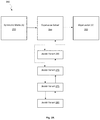
- FIG. 3 depicts an exemplary sequence of computer implemented steps for executing a Batch Eigenvalue Solver according to embodiments of the present invention.
- FIG. 4 depicts an exemplary sequence of computer implemented steps for executing a Parallel Order Block Jacobi method according to embodiments of the present invention.
- FIG. 5 depicts an exemplary sequence of computer implemented steps for executing a Classical Block Jacobi method according to embodiments of the present invention.
- FIG. 6 depicts an exemplary sequence of computer implemented steps for executing a multi-GPU Classical Block Jacobi according to embodiments of the present invention.
- FIG. 7 depicts an exemplary project schedule for an exemplary symmetric matrix A stored in tiles according to embodiments of the present invention.
- FIG. 8 illustrates an exemplary update sequence using the symmetry property according to embodiments of the present invention.
- FIG. 9 depicts an exemplary 4-by-4 block according to embodiments of the present invention.
- Embodiments of the present invention are drawn to computer systems for performing Eigen decompositions, matrix diagonalization, or other matrix operations on dense symmetric matrices for calculating eigenvectors.
- the following discussion describes one such exemplary computer system platform.
- a communication or network interface 108 allows the computer system 112 to communicate with other computer systems, networks, or devices via an electronic communications network, including wired and/or wireless communication and including an Intranet or the Internet.
- the display device 110 is optional and may be any device capable of displaying visual information in response to a signal from the computer system 112 and may include a flat panel touch sensitive display, for example.
- the components of the computer system 112 including the CPU 101 , memory 102 / 103 , data storage 104 , user input devices 106 , and graphics subsystem 105 may be coupled via one or more data buses 100 .
- a graphics sub-system 105 may be coupled with the data bus and the components of the computer system 112 .
- the data bus may be used to communicate data (e.g., matrices) between the host computer system and a device, such as a graphics processing unit (GPU), for processing by the GPU.
- the graphics sub-system 105 may comprise a physical GPU and graphics/video memory. Graphics sub-system 105 can output display data to display device 110 .
- the GPU may contain one or many individual cores, therefore, the GPU may be multi-core and there may be more than one physical GPU included in graphics sub-system 105 .
- the graphics sub-system 105 may include multiple physical GPUs, and a multi-GPU kernel method (e.g., syevj_multiGPU) that distributes work among the multiple physical GPUs.
- a multi-GPU kernel method e.g., syevj_multiGPU
- each physical GPU may be configured to compute a Schur decomposition (e.g., an Eigenvalue solver).
- the multiple physical GPUs may perform the work in parallel with one another and return the results of the work to the multi-GPU kernel method or the host memory 102 .
- a plurality of graphics processing units is available for performing the transformations.
- the first Jacobi method variant 265 performs a variant of Classical Block Jacobi to tile symmetric matrix 250 and eigenvector 260 into N-by-N blocks (e.g., 1024-by-1024 blocks), and is also configured to perform Schur decomposition and column and row updates of the symmetric matrix 250 .
- the tiled blocks e.g., submatrices or subproblems
- the second Jacobi method variant 270 if the second Jacobi method variant 270 is configured to perform a Classical Block Jacobi method variant, the second Jacobi method variant 270 calls the third Jacobi method variant 275 configured to perform the Parallel Order Block Jacobi method variant, and the Parallel Order Block Jacobi method variant calls a fourth Jacobi method variant 280 configured to perform a batch eigenvalue solver using a Parallel Order Jacobi method variant.
- the fourth Jacobi method variant 280 passes the results of the batch eigenvalue solver back to the third Jacobi method variant 275 , and the third Jacobi method variant 275 performs the Parallel Order Block Jacobi method variant.
- the results of the Parallel Order Block Jacobi method variant are passed to the second Jacobi method variant 270 , which performs a Classical Block Jacobi method variant on a subproblem.
- These results are provided to the first Jacobi method variant 265 , which performs the Schur decomposition and column and row updates of the symmetric matrix 250 , and the above steps may be repeated iteratively until a convergence condition is reached.
- the first Jacobi method variant 265 is skipped, and the method 290 includes performing the Jacobi method variants 270 , 275 and 280 .
- FIG. 2B an exemplary sequence of computer-implemented steps for performing a multi-GPU hierarchical Jacobi method 200 for leveraging memory hierarchy and parallel processing of a multi-core processor (e.g., a GPU) is depicted according to embodiments of the present invention.
- the hierarchical Jacobi method 200 (or hierarchical architecture) in accordance with embodiments of the present invention combines several different variations of the Jacobi method, including Block Jacobi, Classical Jacobi and Parallel Order Jacobi, into a hierarchical model that reduces overall computation costs.
- embodiments of the hierarchical Jacobi methods disclosed herein offer controllability of Schur decomposition, robust tolerance for passing data throughout the hierarchy, and significant cost reduction on row updates compared to existing methods. These functionalities will be discussed further below in detail.
- embodiments of the hierarchical method 200 leverage memory hierarchy and parallel processing to implement four levels of hierarchy, where different levels are utilized based on the problem (or subproblem) size.
- four different Jacobi kernel methods syevj_batch, syevj_medium, syevj_large, and syevj_multiGPU are used to form the hierarchy 200 , and to target different pre-defined problem sizes which are defined by a set of thresholds.
- the higher level Jacobi kernel methods e.g., syevj_large
- the lower level Jacobi kernel methods e.g., syevj_medium
- the threshold sizes shown in Table 1 are merely exemplary.
- Kernel method syevj_multiGPU is based on the Classical Block Jacobi, which calls syevj_medium or syevj_large depending on the size of the subproblem, and is positioned at the top of the hierarchical Jacobi method 200 .
- Kernel method syevj_multiGPU is a multi-GPU solution which overlaps communication and computation to achieve strong scaling.
- the boundary (e.g., problem size or “threshold”) of the levels of the hierarchical method 200 are determined based on the memory capacity and processing power of the associated many-core processor, as well as the communication overhead between the device and the host.
- kernel method syevj_multiGPU is called to perform a variant of Classical Block Jacobi for a matrix A and eigenvectors V using a block size of 1024 (matrix size).
- syevj_multiGPU is configured to call syevj_large of GPU 0 at step 210 A for subproblem sizes between 4096 and 8192, or syevj_medium of GPU 0 at step 215 A for subproblem sizes between 32 and 4096. Moving down the hierarchy of FIG.
- Kernel method syevj_large calls syevj_medium of GPU 0 at step 215 A
- syevj_medium calls syevj_batch of GPU 0 at step 220 A.
- Each kernel method is configured to process a subproblem (e.g., a Schur decomposition of a submatrix in one example) and return the result to the calling kernel method. In this way, the results are iteratively passed up the hierarchical method 200 until a convergence condition is reached in accordance with the solver.
- the work performed within the hierarchical architecture 200 may be performed by multiple GPUs in parallel.
- Other available multi-core GPUs may be called to perform calculations of the hierarchical Jacobi method 200 in parallel with other processors.
- syevj_multiGPU may gather all work to be performed in parallel and assign a first set of work to be performed by GPU 0 , a second set of work to be performed by GPU 1 , and so on, for each GPU of the k GPUs.
- syevj_multiGPU is configured to call syevj_large of GPU 1 at step 210 B for subproblem sizes between 4096 and 8192, or syevj_medium of GPU 1 at step 215 B for subproblem sizes between 32 and 4096.
- Kernel method syevj_large calls syevj_medium of GPU 1 at step 215 B
- syevj_medium calls syevj_batch GPU 1 at step 220 B.
- Additional GPUs may be configured in the same way.
- the kernel method syevj_batch performs Parallel Order Jacobi on matrices of a first threshold size, e.g., size 32-by-32 (for instance) or less.
- this kernel method can be implemented using 512 threads within a thread block to form 16 concurrent vectors, each vector having 32 threads.
- Kernel method Syevj_batch may be configured to execute Algorithm 1 shown below in pseudocode form.
- Syevj_batch ( 220 A, 220 B of FIG. 2B ) is a generally basic routine for performing Schur decomposition for syevj_medium, which executes Parallel Order Block Jacobi with the block size set to 16.
- the Schur decomposition performs:
- Each pair of blocks (p, q) from syevj_medium is unique to a specific iteration, where subsequent iterations use different (p, q) block pairs, and the Schur decompositions are performed in parallel. Accordingly, parameters (pseq, qseq) are determined to compute which Schur decomposition to solve.
- the Parallel Order Block Jacobi uses a round-robin ordering.
- the round-robin ordering used by Parallel Order Block Jacobi may be set in advance or computed in-flight, and the results are stored into parameters top or bot, which are 16-by-31 arrays. Accordingly, line 7 and line 24 of syevj_batch used for generating the ordering (e.g., permutations) may be skipped to improve performance because these computations are sequential. Instead, a pre-computed table of data may be used to store the permutations, and line 7 and line 24 do not need to be performed in-flight. If performed inflight, line 7 and line 24 may require stalling all threads, resulting in a relatively large latency penalty.
- a parameter maxite is included to control the number of iterations performed.
- the caller of syevj_batch can select the number of iterations desired using maxite, so instead of diagonalization of
- 16 vectors e.g., 16 warps
- the occupancy of GPU can be at least 50%.
- the row and column updates use 32 rows or 32 columns to match the warp size.
- the kernel method syevj_batch computes
- eps Apq eps 32 ⁇ ( 32 - 1 ) to decide if a pq is numerical zero or not.
- the value of eps Apq is a termination condition of syevj_batch which guarantees progress of the algorithm.
- the parameters maxite (maximum number of iterations) and eps (tolerance) are included to provide a perfectly recursive structure with robust, adjustable tolerance for passing results layer-by-layer.
- Exemplary steps of a computer implemented method 300 for executing a Batch Eigenvalue Solver are depicted in FIG. 3 according to embodiments of the present invention.
- a round-robin ordering for performing Parallel Order Block Jacobi on a symmetric matrix, and the ordering is stored into an array.
- the Batch Eigenvalue Solver performs at least one Schur decomposition on a subproblem, where the parameter maxite is used to control the number of iterations performed.
- a thread block is formed using 16 vectors and is used to update the symmetric matrix and the eigenvector.
- a tolerance value is provided to the Batch Eigenvalue Solver and used to evaluate a termination condition of the Batch Eigenvalue Solver.
- the tolerance value may be provided by the calling function.
- the number of iterations performed is output to the calling function.
- the number of iterations performed by syevj_batch indicates if the subproblem is nearly diagonal. When the number of iterations output is zero, the subproblem is nearly diagonal and the caller does not need to update the corresponding portion of the matrix and the eigenvectors.
- the above computer implemented steps may be repeated iteratively until a convergence condition is reached.
- Hierarchical Jacobi method 200 relies on its basic building blocks, and in one implementation requires a fast Jacobi method executed using multiple cores to solve a small matrix.
- Classical Jacobi alone may not be a good choice because it is sequential.
- Kernel method syevj_batch only works for very small matrices (e.g., 32-by-32), and is not efficient for a medium sized matrix (e.g., hundreds or thousands of rows) because the requirements of transferring data back and forth from global memory is far too expensive.
- modern “many-core” processors are often vector machines with fast on-chip memory, and therefore it is advantageous to apply Block Jacobi in order to harness fast on-chip memory, where all vectors can cooperate to solve a small block.
- eps Apq eps N ⁇ ( N - 1 ) is computed and used as a termination condition in syevj_batch to guarantee the progress of the algorithm.
- the tolerance values provide a perfect recursive structure with robust adjustable tolerance for passing results between layers.
- the first batched Schur decomposition syevj_batch is executed, and for each pair (p, q), syevj_batch returns a number of steps. If the number of steps is zero, then no Schur decomposition operation is performed for this (p, q) pair, and accordingly, no row or column update is performed for this pair.
- the batched column updates column_rotate_batch and the batched row updates row_rotate_batch_phase1/row_rotate_batch_phase2 are performed using a custom GEMM.
- the symmetric property of matrix A may be used advantageously in row_rotate_batch_phase2 to reduce the cost of row update to roughly 1 ⁇ 6 th of the cost of performing column update in a multi-GPU Jacobi method.
- Syevj_batch returns steps, which indicates the number of iterations performed. If the value of steps is zero, then
- a and V do not require updates.
- a and V may be updated using zero padding, for example.
- a tolerance value for calling syevj_batch to transform subproblems of symmetric matrix is computed.
- the tolerance value may be computed using the equation
- eps Apq eps N ⁇ ( N - 1 ) , where the value of eps Apq used as a termination condition for syevj_batch.
- syevj_batch is called and performs transformations on subproblems of the symmetric matrix using a number of iterations.
- the number of iterations performed by syevj_batch is received.
- the symmetric matrix and eigenvectors are updated when the number of iterations is nonzero. The above computer-implemented steps may be repeated iteratively until a convergence condition is reached.
- syevj_medium uses a custom GEMM to perform row and column updates, this approach generally does not exceed the performance level of the highest performing GEMM. For example, the inner dimension of GEMM in syevj_medium is only 32, which is too small to achieve maximum performance.
- the GEMM of syevj_medium is bounded by the available memory bandwidth; the GEMM of syevj_medium not bounded by the computing power of floating point operations.
- the inner dimension should be at least 512.
- one large block in Block Jacobi can saturate a typical GPU. Therefore, Classical Jacobi is sufficient, and there is no need to perform Parallel Order Jacobi, as Parallel Order Jacobi uses more iterations than Classical Jacobi.
- syevj_large ( 210 A, 210 B) provides a processing layer based on Classical Block Jacobi with block size 1024 as depicted in Exemplary Algorithm 3 shown in pseudocode below.
- Syevj_large executes syevj_medium to perform a 2048-by-2048 (for instance) sized Schur decomposition.
- the kernel method syevj_medium may be executed multiple times, and each time a single iteration is performed. After the Schur decomposition, the updated A sub is copied back to
- off(A ij ) is updated, where off(A ij ) is a square sum of diagonal elements represents a value used to determine convergence of a Jacobi algorithm.
- One drawback of Classical Jacobi is that searching for the largest off-diagonal entry is relatively expensive.
- searching for the largest off-diagonal entry advantageously requires only O(N 2 ), and only includes updating off(A ij ) in two row blocks, further increasing performance.
- the parameter steps is returned by kernel method syevj_medium to determine if A and V require updates, which avoids performing unnecessary computations.
- off(A ij ) may be defined as:
- the convergence rate differs from case to case. For example, 14 or 15 iterations may be performed for 14 digits accuracy.
- Exemplary steps of a computer implemented method 500 for executing a Classical Block Jacobi method are depicted in FIG. 5 according to embodiments of the present invention.
- the kernel method syevj_medium is called to perform a Schur decomposition on a subproblem of a symmetric matrix.
- the number of Schur decomposition iterations performed is returned by syevj_medium.
- the largest off-diagonal entry off(A ij ) of the subproblem is computed.
- the symmetric matrix A and eigenvectors V are updated when the number of Schur decomposition iterations performed is nonzero; otherwise, the above computer implemented steps may be repeated iteratively until a convergence condition is reached.
- Kernel method syevj_multiGPU ( 205 ) is positioned at the top of the hierarchical method 200 ( FIG. 2B ) and may be used when multiple GPUs are available for performing work in parallel. Kernel method syevj_multiGPU employs Classical Block Jacobi to harness the natural parallelism of the Jacobi method. Several (p, q) values are selected within each iteration, and each available GPU computes one Schur decomposition. As set forth in Algorithm 4 below, for a matrix A and eigenvectors V residing on a host, the matrices A and V are tiled into an N-by-N block, where each block is 1024-by-1024, for example, to reduce communication overhead.
- the selected block size is a tradeoff between communication cost and computation performance. It is often preferable to overlap communication with computation by selecting a block size w such that the cost of data transfer is approximately equal to the cost of GEMM. Accordingly, when the bandwidth of PCI transfers increases, w increases, and when the performance of GEMM increases, w decreases. Therefore, any time the performance of GEMM or the bandwidth of data transfer is measured, the block size w may be adjusted accordingly.
- kernel method syevj_multiGPU in Algorithm 4 takes arguments (n, A, maxite, eps, V, steps), where the values of eps and maxite may be provided by the caller.
- syevj_medium the value of eps represents the threshold for convergence (e.g., tolerance)
- the value of maxite represents the maximum number of iterations to be performed
- the value of steps represents the number of sweeps performed.
- the kernel method syvej_multiGPU may use the following exemplary pseudocode implementation of Algorithm 4, where ⁇ GPUs are available, and ⁇ N/2:
- this computation can be performed using a flag array, for example. It is appreciated that the cost to search (p k , q k ) has been observed to be nearly zero.
- FIG. 7 depicts an exemplary Gantt Chart 700 showing results of kernel method syevj_multiGPU executed on an 8192-by-8192 sized matrix (for instance) using a single exemplary GPU according to embodiments of the present invention.
- Operation GEMM 1 of stream 14 overlaps with PCI transfer PCI 1
- operation GEMM 2 of Stream 13 overlaps with PCI transfer PCI 2
- syevj_medium or syevj_large is called depending on the problem size.
- Row update phase 1 performs:
- Row update phase 1 only writes ⁇ pj back to A pj if p ⁇ j, and only writes ⁇ qj back to A qj if q ⁇ j. In other words, only the upper triangle of matrix A is updated.
- Row update phase 1 also updates off (A ij ), and row update phase 2 updates the lower triangular part of A by the symmetry property. Computation of row update using the symmetry property in this way has roughly 1 ⁇ 6 the cost of column update using syevj_multiGPU.
- Exemplary steps of a computer implemented method 600 for executing a multi-GPU Classical Block Jacobi method are depicted in FIG. 6 according to embodiments of the present invention.
- a symmetric matrix A and eigenvectors V are tiled into N-by-N blocks (e.g., 1024-by-1024 blocks), which mitigates communication overhead for transferring data between the host and a GPU.
- mutually exclusive (p, q) values of the symmetric matrix are computed using a flag array, for example.
- a Schur decomposition is performed using one thread per available GPU, for example, using the function OpenMP.
- the Schur decomposition may be performed such that the communication (e.g., PCI data transfers) and GEMM computations overlap because the symmetric matrix is already divided into tiles.
- the upper triangle portion of the symmetric matrix and off(A ij ) are updated.
- the lower triangle portion of the symmetric matrix is updated using the symmetry property of the symmetric matrix, for example, by transposing the upper triangle portion that has already been updated.
- Embodiments of the hierarchical Jacobi methods described herein provide several advantages and improvements over existing techniques for implementing the Jacobi method and variants thereof. These aspects of the invention have been described above with respect to specific algorithms and are described herein in greater detail.
- the computational complexity of row update is reduced by the symmetry property of symmetric matrices, where the cost of a row update is roughly 1 ⁇ 6 th that of column update in syevj_multiGPU.
- this symmetry property may be used to reduce the computations of row updates, including the row updates of syevj_medium, syevj_large and syevj_multiGPU.
- each iteration only selects one pair (p, q) with max ⁇ off(A ij ):i ⁇ j ⁇ . As depicted in FIG. 8 , so only row p, q and column p, q are touched.
- FIG. 8 illustrates an exemplary update sequence using the symmetry property, where after Schur decomposition, syevj_large scatters A sub back to
- each iteration only selects one pair (p, q) with max ⁇ off(A ij ):i ⁇ j ⁇ , so only row (p, q) and column (p, q) are modified.
- ⁇ A ij :i,j ⁇ p,q ⁇ is unchanged, and there is no need to compute off(A ij ) again. Therefore, only off(A pj ) and off(A qj ) are computed.
- only the upper triangular portion is updated because A is symmetric.
- the complexity of updating off(A ij ) is bounded by O(2nw), and is substantially smaller than GEMM in column update, which is O(4nw 2 ). As such, the cost of off(A ij ) is negligible.
- syevj_medium, syevj_large and syevj_multiGPU include a parameter steps which is an output of a Schur decomposition. If the value of steps is zero, then the Schur decomposition does nothing. For example, if
- a pp A pq A qp A qq is nearly diagonal, A and V do not need to be updated. This is most likely to occur near convergence, and may also occur when the dimension n is not a multiple of block size w, as depicted in FIG. 9 . For the case of n ⁇ wN, zero padding is performed. The worst case scenario occurs when
- the approaches include: symmetric QR algorithm, spectrum method, and Jacobi method.
- the foundational Jacobi method and variants thereof are described according to alternative embodiments of the present invention.
- J ⁇ J ⁇ ( p , q , ⁇ ) ( 1 ⁇ 0 ⁇ 0 ⁇ 0 ⁇ ⁇ ⁇ ⁇ ⁇ 0 ⁇ c ⁇ s ⁇ 0 ⁇ ⁇ ⁇ ⁇ ⁇ 0 ⁇ - s ⁇ c ⁇ 0 ⁇ ⁇ ⁇ ⁇ ⁇ 0 ⁇ 0 ⁇ 1 )
- Jacobi method only column p, q and row p, q are updated, and cosine and sine are calculated to eliminate the off-diagonal term b pq :
- off ⁇ ( B ) 2 off ⁇ ( A ) 2 - 2 ⁇ a pq 2 ⁇ ( 1 - 1 s ) ⁇ off ⁇ ( A ) 2 .
- the cost of searching for the largest off-diagonal entry is one drawback of Classical Jacobi. For example, searching for the largest diagonal entry in line 3 of Algorithm 6 is O(n 2 ).
- Jacobi method As discussed above, several variants of the Jacobi method are disclosed herein, including Classical Jacobi, Parallel Order Jacobi, and Block Jacobi. Each variant of the Jacobi method is described with reference to an exemplary pseudocode algorithm for executing the Jacobi method variant using a processor, such as a many-core GPU.
- Algorithm 6 represents another exemplary implementation of the Classical Jacobi method according to alternative embodiments of the present invention. Given a symmetric A ⁇ R n ⁇ n and a tolerance tol>0, Algorithm 6 overwrites A with V T AV, where V is orthogonal and off(V T AV) ⁇ tol ⁇ A ⁇ F
- Parallel Order Jacobi uses round-robin static ordering to cover these 1 ⁇ 2n(n ⁇ 1) combinations in (n ⁇ 1) iterations, where each iteration has 1 ⁇ 2n parallel jobs.
- Algorithm 7 represents a pseudocode implementation of Parallel Order Jacobi according to alternative embodiments of the present invention.
- Algorithm 7 Given a symmetric matrix A ⁇ R n ⁇ n and a tolerance tol>0, Algorithm 7 overwrites A with V T AV, where V is orthogonal and off(V T AV) ⁇ tol ⁇ A ⁇ F . Algorithm 7 assumes that n is even, and line 5 through line 11 in Algorithm 7 may be performed in parallel.
- Parallel Order Jacobi does not require searching for largest off-diagonal entry, which is an advantage over Classical Jacobi. While Parallel Order Jacobi is suitable for a many-core processor, it requires more sweeps than Classical Jacobi because it does not pick up a maximum off-diagonal entry at each iteration.
- A ( A 11 ⁇ A 1 ⁇ N ⁇ ⁇ ⁇ A N ⁇ ⁇ 1 ⁇ A NN )
- Algorithms 8 and 9 are general extensions of Algorithm 6 and Algorithm 7 modified in the manner described above.
- Algorithm 8 represents a pseudocode implementation of Classical Block Jacobi, which is a version of Block Jacobi modified to include a Classical Jacobi basis. Given a symmetric A ⁇ R n ⁇ n and a tolerance tol>0, this algorithm overwrites A with V T AV, where V is orthogonal and off(V T AV) ⁇ tol ⁇ A ⁇ F .
- steps 5 through 13 of Algorithm 9 use batched operations to compute Schur decomposition, column update of A and V, and row update of A.
- the tile size w is set to 16 so that the subproblem may fit in the on-chip shared memory, and therefore one Schur decomposition can be computed per thread block.
- Embodiments of the present invention harnesses the parallelism of modern processors (e.g., graphics processing units) to solve large eigenvalue problems for dense symmetric matrices.
- the disclosed eigenvalue solvers can be adjusted to improve the speed or accuracy of the eigenvalue solver, includes robust tolerance for passing data throughout a hierarchy of Jacobi methods, and offers significant cost reduction on row update compared to existing methods.
Landscapes
- Engineering & Computer Science (AREA)
- Physics & Mathematics (AREA)
- General Physics & Mathematics (AREA)
- Mathematical Physics (AREA)
- Pure & Applied Mathematics (AREA)
- Mathematical Analysis (AREA)
- Mathematical Optimization (AREA)
- Computational Mathematics (AREA)
- Data Mining & Analysis (AREA)
- Theoretical Computer Science (AREA)
- Computing Systems (AREA)
- Algebra (AREA)
- Databases & Information Systems (AREA)
- Software Systems (AREA)
- General Engineering & Computer Science (AREA)
- Complex Calculations (AREA)
Abstract
Description
| TABLE I | ||
| Region of Interest or | ||
| Threshold | Routine | Description |
| 8192 < n ≤ 65536 | syevj_multiGPU | A variant of Classical Block Jacobi which calls |
| (265) | syevj_medium or syevj_large. This is a Multi-GPU | |
| solution which overlaps communication and | ||
| computation to achieve strong scaling | ||
| performance. | ||
| 4096 < n ≤ 8192 | syevj_large | Classical Block Jacobi which calls syevj_medium. |
| (270) | Searching for largest off-diagonal is not an issue | |
| due to large tile size. | ||
| 32 < n ≤ 4096 | syevj_medium | Parallel Order Block Jacobi of |
| (275) | calls syevj_batch to perform Schur decomposition, | |
| and uses modified GEMM for row and column | ||
| update on matrix A and V. | ||
| n ≤ 32 | syevj_batch | A batched Parallel Order Jacobi performed on a |
| (280) | 32-by-32 matrices. | |
| Utilizes on-chip shared memory to make the | ||
| problem computational intensive and is able to | ||
| fully utilize the GPU. | ||
| Exemplary Algorithm 1: syevj_batch(pseq, qseq, top, bot, A, maxite, eps, |
| Vb, steps) |
(1)  |
|
|
| (3) p = pseq(cta_id); q = qseq(cta_id) |
|
|
| (5) Load top, bot to shared memory |
| (6) Vs = eye(n) is on shared memory. |
 |
| (8) for ite =0:maxite-1 |
| (9) If off (A) ≤ eps, break |
| (10) for set = 1:31 |
| (11) // each k-th vector performs the following operations |
| (12) p = min(top(set, k), bot(set, k)) |
| (13) q = min(top(set, k), bot(set, k)) |
| (14) If (apq >>epsApq) |
| (15) (c, s) = sym.schur2(As, p, q) // compute J(p, q, θ) |
| (16) Column update As(:, [p, q]) = As(:, [p, q]) · J(p, q, θ) |
| (17) Column update Vs(:, [p, q]) = Vs(:, [p, q]) · J(p, q, θ) |
| (18) end // app > eps |
| (19) synchronization |
| (20) If (apq > eps) |
| (21) Row update As([p, q], :) = J(p, q, θ)T · As([p, q], :) |
| (22) end // apq > eps |
| (23) synchronization |
  |
| (25) end // set = 1:31 |
| (26) end // off(A) > eps |
| (27) Vb(0: 31, 0: 31, cta_id) := Vs |
| (28) steps(cta_id) = ite |
where App, Apq, Aqp, Aqq, Vpp, Vpq, Vqp and Vqq are 16-by-16 sub-matrices.
syevj_batch performs:
to decide if apq is numerical zero or not. The value of epsApq is a termination condition of syevj_batch which guarantees progress of the algorithm. The parameters maxite (maximum number of iterations) and eps (tolerance) are included to provide a perfectly recursive structure with robust, adjustable tolerance for passing results layer-by-layer.
| Exemplary Algorithm 2: syevj_medium(n, A, maxite, eps, V, steps) |
 |
| (2) V = eye(n) |
| (3) w = 16, and N = ┌n/w┐ |
|
|
| (5) form parallel ordering set (top32, bot32) for syevj_batch |
| (6) top = 1: 2: N; bot = 2: 2: N |
| (7) for ite =0:maxite-1 |
| (8) If off(A) ≤ eps, break |
| (9) for set = 1:N-1 |
| (10) syevj_batch(top, bot, top32, bot32, A, 1, epsApq, Vb, steps) |
| (11) column_rotate_batch(top, bot, A, V, Vb, steps) |
| (12) row_rotate_batch_phase1(top, bot, A, Vb, steps) |
| (13) row_rotate_batch_phase2(top, bot, A, Vb, steps) |
| (14) [top, bot] = music(top, bot, N) |
| (15) end // set = 1:N-1 |
| (16) end // off(A) > eps |
| (17) steps = ite |
is computed and used as a termination condition in syevj_batch to guarantee the progress of the algorithm. Specifically, for any two layers in the hierarchical Jacobi method, the tolerance values provide a perfect recursive structure with robust adjustable tolerance for passing results between layers.
is nearly diagonal because off(A)≤eps, so the caller can determine and select this property and avoid unnecessary computations where the Schur decomposition would not progress the algorithm. Therefore, in this case, A and V do not require updates. In other cases, such as when n≠wN, or when nearing convergence, A and V may be updated using zero padding, for example.
where the value of epsApq used as a termination condition for syevj_batch. At
| Exemplary Algorithm 3: syevj_large(n, A, maxite, eps, V, steps) |
 |
| (2) V =eye(n) |
| (3) w = 1024, and N = ┌n/w┐ |
|
|
| (5) for ite =0:maxite-1 |
| (6) If off(A) ≤ eps, break |
| (7) Choose (p, q) so off(Apq) = maxi≠j{off(Aij)} |
|
|
| (9) syevj_medium(2*w, Asub, 1, epsApq, Vsub, steps) |
|
|
| (11) If (0 != steps) |
| (12) row_column_rotate(p, q, A, V, Vsub) |
| (13) end |
| (14) Update off(Aij) |
| (15) end // off(A) > eps |
| (16) steps = ite |
Therefore, these four blocks do not need to be computed again during the row/column update of A. The row and column updates are combined together, and a transpose operation is performed to take advantage of the symmetry of Asub, instead of performing GEMM for the row update.
The value of off(A)=0 indicates that matrix A is diagonal, and contains the eigenvalues of A. For example, for a matrix A, the Jacobi method iteratively transforms matrix A into a diagonal matrix A(=A0)→A1→A2→A3→ . . . →Ak. According to the monotone property of the Jacobi algorithm, off(A)>off(A1)>off(A2)>off(A3)> . . . >off(Ak); however, the convergence rate differs from case to case. For example, 14 or 15 iterations may be performed for 14 digits accuracy.
| Exemplary Algorithm 4: syevj_multiGPU(n, A, maxite, eps, V, steps) |
| (1) eps = tol · ∥A∥F |
| (2) w = 1024, and N = ┌n/w┐ |
| (3) V = eye(n) in N − by − N blocks |
| (4) tile A to N − by − N blocks |
|
|
| (6) for ite =0:maxite-1 |
| (7) If off(A) ≤ eps, break |
| (8) Algorithm : choose a sequence {(pk, qk): k = 1, 2, . . . , η, and |
| pi ≠ qj} such that off(A(pk, qk)) ≥ off(A(pk+1, qk+1)) |
| (9) #pragma omp parallel for |
| (10) for k = 1: η |
|
|
| (12) syevj_medium(2*w, Asub, 1, epsApq, Vsub, steps) |
|
|
| (14) Compute off(Ap |
| (15) end |
| (16) #pragma omp parallel for |
| (17) for k =1: η |
| (18) If(0 != steps) column_update (pk, qk, A, Asub, Vsub) |
| (19) end |
| (20) #pragma omp parallel for |
| (21) for k = 1: η |
| (22) If (0 != steps) row_update_phase1(pk, qk, A, Vsub, off(A)) |
| (23) end |
| (24) #pragma omp parallel for |
| (25) for k = 1: η |
| (26) If (0 != steps) row_update_phase2(pk, qk, A, Vsub) |
| (27) end |
| (28) end // off(A) > eps |
| (29) steps = ite |
| Algorithm 5: find mutual exclusive (pk, qk) |
| (1) | flag := zeros(N,1) |
| (2) | f(Apq) = maxi≠j{off(Aij)}, (p1,q1) = (p,q) |
| (3) | flag(p1) = 1, and flag(q1) = 1 // remove (p1,q1) |
| (4) | for k=2: η |
| (5) | off(Apq) = maxi≠j{off(Aij): flag(i) = 0, and flag(j) = 0}, (pk,qk) = |
| (p,q) |
| (6) | flag(pk) = 1, and flag(qk) = 1 // remove (pk,qk) |
| (7) | end |
Robust Tolerance for Passing Down Subproblems
which is a termination condition in syevj_batch. This condition guarantees progress of the algorithm. With regard to
such that is
is passed to syevj_batch. Therefore, the condition off(A)≤eps in syevj_batch is actually
For at least one subproblem that does not satisfy the condition
the subproblem can be progressed, and therefore off(A) must decrease. This holds for any two layers of the hierarchical Jacobi method, and provides a perfectly recursive structure with robust adjustable tolerance for passing down subproblems. The tolerance can be adjusted using two parameters maxite (maximum number of iterations) and eps (tolerance) in syevj_medium and syevj_batch.
Symmetry Property for Row Update
For column update, in column block p and q,
is nearly diagonal, A and V do not need to be updated. This is most likely to occur near convergence, and may also occur when the dimension n is not a multiple of block size w, as depicted in
is odd.
In the Jacobi method, only column p, q and row p, q are updated, and cosine and sine are calculated to eliminate the off-diagonal term bpq:
This simple rotation will reduce the “norm” of the off-diagonal elements. For example, if the “norm” of the off-diagonal elements is defined by
f(A)=∥A−diag(A)∥F=√{square root over (Σi=1 nΣj=1,j≠i n a ij 2)}, then: off(B)2=off(A)2−2a pq 2.
The cost of searching for the largest off-diagonal entry is one drawback of Classical Jacobi. For example, searching for the largest diagonal entry in
| Algorithm 6 - Classical Jacobi |
| (1) | V = eye(n); eps = tol · ∥A∥F | |
| (2) | while off(A) > eps |
| (3) | choose (p, q) so |apq| = maxi≠j|aij| |
| (4) | (c, s) = sym.schur2(A, p, q) // compute J(p, q, θ) | ||
| (5) | A = J(p,q,θ)T · A · J(p,q,θ) | ||
| (6) | V = V · J(p, q, θ) | ||
| (7) | end // off(A) > eps | ||
| Algorithm 7 - Parallel Order Jacobi |
| (1) | V = eye(n); eps = tol · ||A∥F |
| (2) | top = 1:2:n; bot = 2:2:n |
| (3) | while off (A) > eps |
| (4) | for set = 1:n−1 |
| (5) | for k = 1:n/2 // all parallel |
| (6) | p = min(top(k), bot(k)) |
| (7) | q = min(top(k), bot(k)) |
| (8) | (c, s) = sym.schur2(A, p, q) // compute J(p, q, θ) |
| (9) | A = J(p, q, θ)T · A · J(p, q, θ) |
| (10) | V = V · J(p, q, θ) |
| (11) | end // k = 1:n/2 |
| (12) | [top, bot] = music(top, bot, n) |
| (13) | end // set = 1:n−1 |
| (14) | end // off(A) > eps |
where
can be computed by calling the Jacobi method again.
and replacing A=J(p,q,θ)T·A·J(p,q,θ) using a column update:
followed by a row update:
where all operations are performed in a block sense.
| Algorithm 8 - Classical Block Jacobi |
| (1) V = eye(n); eps = tol · ∥A∥F |
| (2) while off(A) > eps |
| (3) Choose (p, q) so off(Apq) = maxi≠j{off(Aij)} |
|
|
|
|
|
|
|
|
|
|
| (9) Update off(Aij), i ≠ j |
| (10)end // off(A) > eps |
| Algorithm 9 - Parallel Order Block Jacobi |
| (1) V = eye(n); eps = tol · ∥A∥F |
| (2) top = 1: 2: N; bot = 2: 2: N |
| (3) while off(A) > eps |
| (4) for set = 1:N-1 |
| (5) for k =1:N/2 // all parallel |
| (6) p = min(top(k), bot(k)) |
| (7) q = min(top(k), bot(k)) |
|
|
|
|
|
|
|
|
|
|
| (13) end // k = 1:N/2 |
| (14) [top, bot] = music(top, bot, N) |
| (15) end // set = 1:N-1 |
| (16) end // off(A) > eps |
Claims (14)
Priority Applications (1)
| Application Number | Priority Date | Filing Date | Title |
|---|---|---|---|
| US16/124,807 US10867008B2 (en) | 2017-09-08 | 2018-09-07 | Hierarchical Jacobi methods and systems implementing a dense symmetric eigenvalue solver |
Applications Claiming Priority (2)
| Application Number | Priority Date | Filing Date | Title |
|---|---|---|---|
| US201762556229P | 2017-09-08 | 2017-09-08 | |
| US16/124,807 US10867008B2 (en) | 2017-09-08 | 2018-09-07 | Hierarchical Jacobi methods and systems implementing a dense symmetric eigenvalue solver |
Publications (2)
| Publication Number | Publication Date |
|---|---|
| US20190138568A1 US20190138568A1 (en) | 2019-05-09 |
| US10867008B2 true US10867008B2 (en) | 2020-12-15 |
Family
ID=66328552
Family Applications (1)
| Application Number | Title | Priority Date | Filing Date |
|---|---|---|---|
| US16/124,807 Active 2038-11-19 US10867008B2 (en) | 2017-09-08 | 2018-09-07 | Hierarchical Jacobi methods and systems implementing a dense symmetric eigenvalue solver |
Country Status (1)
| Country | Link |
|---|---|
| US (1) | US10867008B2 (en) |
Families Citing this family (7)
| Publication number | Priority date | Publication date | Assignee | Title |
|---|---|---|---|---|
| US11113168B2 (en) * | 2018-03-09 | 2021-09-07 | Toyota Motor Engineering & Manufacturing North America, Inc. | Distributed architecture for fault monitoring |
| US11136115B2 (en) | 2018-06-20 | 2021-10-05 | Textron Innovations Inc. | Tilted propellers for enhanced distributed propulsion control authority |
| US11221848B2 (en) * | 2019-09-25 | 2022-01-11 | Intel Corporation | Sharing register file usage between fused processing resources |
| US11734384B2 (en) * | 2020-09-28 | 2023-08-22 | International Business Machines Corporation | Determination and use of spectral embeddings of large-scale systems by substructuring |
| CN115905790A (en) * | 2022-11-07 | 2023-04-04 | 天津津航计算技术研究所 | A high-speed and high-precision implementation method of matrix decomposition based on multi-core DSP |
| CN115952391B (en) * | 2022-12-12 | 2024-07-26 | 海光信息技术股份有限公司 | Data processing method and device, electronic device and storage medium |
| CN116451001B (en) * | 2023-03-17 | 2023-09-29 | 国家电网有限公司大数据中心 | Multi-grid carbon emission distributed collaborative privacy calculation method and system |
Citations (7)
| Publication number | Priority date | Publication date | Assignee | Title |
|---|---|---|---|---|
| US6182270B1 (en) * | 1996-12-04 | 2001-01-30 | Lucent Technologies Inc. | Low-displacement rank preconditioners for simplified non-linear analysis of circuits and other devices |
| US20030187898A1 (en) | 2002-03-29 | 2003-10-02 | Fujitsu Limited | Parallel processing method of an eigenvalue problem for a shared-memory type scalar parallel computer |
| US20060106902A1 (en) * | 2004-11-15 | 2006-05-18 | Howard Steven J | Efficient computation for eigenvalue decomposition and singular value decomposition of matrices |
| US20060287596A1 (en) * | 1996-08-29 | 2006-12-21 | Techniscan, Inc. | Apparatus and method for imaging objects with wavefields |
| US20070157135A1 (en) * | 2005-12-19 | 2007-07-05 | Baolin Yang | Parallel multi-rate circuit simulation |
| US20100082142A1 (en) * | 2005-11-22 | 2010-04-01 | Usadi Adam K | Simulation System and Method |
| US20100185716A1 (en) | 2006-08-08 | 2010-07-22 | Yoshimasa Nakamura | Eigenvalue decomposition apparatus and eigenvalue decomposition method |
-
2018
- 2018-09-07 US US16/124,807 patent/US10867008B2/en active Active
Patent Citations (8)
| Publication number | Priority date | Publication date | Assignee | Title |
|---|---|---|---|---|
| US20060287596A1 (en) * | 1996-08-29 | 2006-12-21 | Techniscan, Inc. | Apparatus and method for imaging objects with wavefields |
| US6182270B1 (en) * | 1996-12-04 | 2001-01-30 | Lucent Technologies Inc. | Low-displacement rank preconditioners for simplified non-linear analysis of circuits and other devices |
| US20030187898A1 (en) | 2002-03-29 | 2003-10-02 | Fujitsu Limited | Parallel processing method of an eigenvalue problem for a shared-memory type scalar parallel computer |
| US20060106902A1 (en) * | 2004-11-15 | 2006-05-18 | Howard Steven J | Efficient computation for eigenvalue decomposition and singular value decomposition of matrices |
| US7711762B2 (en) | 2004-11-15 | 2010-05-04 | Qualcomm Incorporated | Efficient computation for eigenvalue decomposition and singular value decomposition of matrices |
| US20100082142A1 (en) * | 2005-11-22 | 2010-04-01 | Usadi Adam K | Simulation System and Method |
| US20070157135A1 (en) * | 2005-12-19 | 2007-07-05 | Baolin Yang | Parallel multi-rate circuit simulation |
| US20100185716A1 (en) | 2006-08-08 | 2010-07-22 | Yoshimasa Nakamura | Eigenvalue decomposition apparatus and eigenvalue decomposition method |
Non-Patent Citations (9)
| Title |
|---|
| B. Ram, Computer fundamentals: Architecture & organization, New Age International ltd, p. 8.25-8.27, 2007 (Year: 2007). * |
| Blackford, Susan. Symmetric Eigenproblems (SEP). (1999). LAPACK Users' Guide Third Edition. Retrieved on Mar. 6, 2020 from URL: http://www.netlib.org/lapack/lug/node30.html. |
| Blackford, Susan. Symmetric Eigenproblems. (1999). LAPACK Users' Guide Third Edition. Retrieved on Mar. 6, 2020 from URL: http://www.netlib.org/lapack/lug/node48.html (3 pages). |
| Golub, G. H., & Van Loan, C. F. (2012). Matrix computations (vol. 3). JHU press. (9 pages). |
| J. Hennessy et al., Computer architecture: a quantitative approach, Elsevier, p. 542-545, 2014 (Year: 2014). * |
| Nakatsukasa, Y., & Higham, N. J. (2013). Stable and efficient spectral divide and conquer algorithms for the symmetric eigenvalue decomposition and the SVD. SIAM Journal on Scientific Computing, 35(3), A1325-A1349. (25 pages). |
| Patterson et al, Computer Organization and Design, the hardware/software interface, Elsevier, p. A-10-11, A-17-19, 2012 (Year: 2012). * |
| Sachdev, et al.; Takagi Factorization on GPU Using CUDA; School of Computing, University of Utah, UT, 84102; 2010. |
| Wolfram Mathworld, https://mathworld.wolfram.com/JacobiMethod.html, accessed 2015 (Year: 2015). * |
Also Published As
| Publication number | Publication date |
|---|---|
| US20190138568A1 (en) | 2019-05-09 |
Similar Documents
| Publication | Publication Date | Title |
|---|---|---|
| US20190138568A1 (en) | Hierarchical jacobi methods and systems implementing a dense symmetric eigenvalue solver | |
| CN114503125B (en) | Structured pruning method, system and computer-readable medium | |
| Akbudak et al. | Tile low rank Cholesky factorization for climate/weather modeling applications on manycore architectures | |
| US8713576B2 (en) | Load balancing for parallel tasks | |
| Peng et al. | GLU3. 0: Fast GPU-based parallel sparse LU factorization for circuit simulation | |
| US10762425B2 (en) | Learning affinity via a spatial propagation neural network | |
| Pereira et al. | PSkel: A stencil programming framework for CPU‐GPU systems | |
| US10235182B2 (en) | System and method for hybrid task management across CPU and GPU for efficient data mining | |
| JP7502269B2 (en) | Information processing device, information processing system, information processing method, storage medium, and program | |
| CN114579929B (en) | Accelerator execution method and electronic equipment | |
| EP2688037B1 (en) | Method and apparatus for data processing using graphic processing unit | |
| WO2020196872A1 (en) | Information processing device, information processing system, information processing method, storage medium and program | |
| US20250342071A1 (en) | Method of determining split scheme, determining device, and computing system | |
| JP7474242B2 (en) | Information processing device, information processing system, information processing method, storage medium, and program | |
| Liu et al. | High-performance tensor learning primitives using GPU tensor cores | |
| CN109753682B (en) | Finite element stiffness matrix simulation method based on GPU (graphics processing Unit) end | |
| US20090326880A1 (en) | Parallel physics solver | |
| Gnanavignesh et al. | Parallel sparse LU factorization of power flow Jacobian using GPU | |
| Kang | Scalable implementation of the parallel multigrid method on massively parallel computers | |
| US9600446B2 (en) | Parallel multicolor incomplete LU factorization preconditioning processor and method of use thereof | |
| JP2017167581A (en) | Parallel computer, FFT operation program, and FFT operation method | |
| JP2018206078A (en) | Parallel processing device, parallel computing method, and parallel computing program | |
| WO2025128155A1 (en) | Parallel integrated collective communication and matrix multiplication operations | |
| CN115346099B (en) | Image convolution method, chip, device and medium based on accelerator chip | |
| Jung et al. | Accelerating implicit integration in multi-body dynamics using GPU computing |
Legal Events
| Date | Code | Title | Description |
|---|---|---|---|
| AS | Assignment |
Owner name: NVIDIA CORPORATION, CALIFORNIA Free format text: ASSIGNMENT OF ASSIGNORS INTEREST;ASSIGNOR:CHIEN, LUNG-SHENG;REEL/FRAME:046814/0865 Effective date: 20180907 |
|
| FEPP | Fee payment procedure |
Free format text: ENTITY STATUS SET TO UNDISCOUNTED (ORIGINAL EVENT CODE: BIG.); ENTITY STATUS OF PATENT OWNER: LARGE ENTITY |
|
| STPP | Information on status: patent application and granting procedure in general |
Free format text: DOCKETED NEW CASE - READY FOR EXAMINATION |
|
| STPP | Information on status: patent application and granting procedure in general |
Free format text: NON FINAL ACTION MAILED |
|
| STPP | Information on status: patent application and granting procedure in general |
Free format text: NON FINAL ACTION MAILED |
|
| STPP | Information on status: patent application and granting procedure in general |
Free format text: RESPONSE TO NON-FINAL OFFICE ACTION ENTERED AND FORWARDED TO EXAMINER |
|
| STPP | Information on status: patent application and granting procedure in general |
Free format text: NOTICE OF ALLOWANCE MAILED -- APPLICATION RECEIVED IN OFFICE OF PUBLICATIONS |
|
| STPP | Information on status: patent application and granting procedure in general |
Free format text: PUBLICATIONS -- ISSUE FEE PAYMENT RECEIVED |
|
| STPP | Information on status: patent application and granting procedure in general |
Free format text: PUBLICATIONS -- ISSUE FEE PAYMENT VERIFIED |
|
| STCF | Information on status: patent grant |
Free format text: PATENTED CASE |
|
| MAFP | Maintenance fee payment |
Free format text: PAYMENT OF MAINTENANCE FEE, 4TH YEAR, LARGE ENTITY (ORIGINAL EVENT CODE: M1551); ENTITY STATUS OF PATENT OWNER: LARGE ENTITY Year of fee payment: 4 |