US10865181B2 - Small molecule inhibitors of the mitochondrial permeability transition pore (mtPTP) - Google Patents
Small molecule inhibitors of the mitochondrial permeability transition pore (mtPTP) Download PDFInfo
- Publication number
- US10865181B2 US10865181B2 US15/524,595 US201515524595A US10865181B2 US 10865181 B2 US10865181 B2 US 10865181B2 US 201515524595 A US201515524595 A US 201515524595A US 10865181 B2 US10865181 B2 US 10865181B2
- Authority
- US
- United States
- Prior art keywords
- compound
- isoxazole
- mmol
- assay
- dmso
- Prior art date
- Legal status (The legal status is an assumption and is not a legal conclusion. Google has not performed a legal analysis and makes no representation as to the accuracy of the status listed.)
- Active
Links
- 0 [1*]c1ccc(CN([3*])C2=CC=CC([5*])=C2[4*])c1[2*] Chemical compound [1*]c1ccc(CN([3*])C2=CC=CC([5*])=C2[4*])c1[2*] 0.000 description 16
- UVEQLLMIYSFCQB-UHFFFAOYSA-N CC1=C(NC(=O)C2=NOC(C3=CC(O)=C(F)C=C3)=C2)C=CC=C1Cl Chemical compound CC1=C(NC(=O)C2=NOC(C3=CC(O)=C(F)C=C3)=C2)C=CC=C1Cl UVEQLLMIYSFCQB-UHFFFAOYSA-N 0.000 description 4
- FKGXMPRSFZQWEZ-UHFFFAOYSA-N CC1=CC=C(Cl)C=C1NC(=O)C1=CC=C(C2=CC(O)=CC=C2)C=C1 Chemical compound CC1=CC=C(Cl)C=C1NC(=O)C1=CC=C(C2=CC(O)=CC=C2)C=C1 FKGXMPRSFZQWEZ-UHFFFAOYSA-N 0.000 description 4
- JBLICWUIAZPYRX-UHFFFAOYSA-N CC1=NC=C(Cl)C=C1NC(=O)C1=NOC(C2=CC(O)=CC=C2)=C1 Chemical compound CC1=NC=C(Cl)C=C1NC(=O)C1=NOC(C2=CC(O)=CC=C2)=C1 JBLICWUIAZPYRX-UHFFFAOYSA-N 0.000 description 4
- LBROUWARGYMKSJ-UHFFFAOYSA-N COC1=CC=C(Cl)C=C1NC(=O)C1=NOC(C2=CC(O)=C(OC)C=C2)=C1 Chemical compound COC1=CC=C(Cl)C=C1NC(=O)C1=NOC(C2=CC(O)=C(OC)C=C2)=C1 LBROUWARGYMKSJ-UHFFFAOYSA-N 0.000 description 4
- NMZQXSXGSVVMJS-UHFFFAOYSA-N O=C(NC1=CC(Cl)=CC=C1)C1=NOC(C2=CC(O)=CC=C2)=C1 Chemical compound O=C(NC1=CC(Cl)=CC=C1)C1=NOC(C2=CC(O)=CC=C2)=C1 NMZQXSXGSVVMJS-UHFFFAOYSA-N 0.000 description 4
- BQTRWTVSKJEBST-UHFFFAOYSA-N CC1=C(Cl)C=C(NC(=O)C2=NOC(C3=CC(O)=CC=C3)=C2)C=C1 Chemical compound CC1=C(Cl)C=C(NC(=O)C2=NOC(C3=CC(O)=CC=C3)=C2)C=C1 BQTRWTVSKJEBST-UHFFFAOYSA-N 0.000 description 3
- OIXKDQCJUBGBAU-UHFFFAOYSA-N CC1=CC=C(Cl)C=C1NC(=O)C1=NOC(C2=C(O)C=CC=C2)=C1 Chemical compound CC1=CC=C(Cl)C=C1NC(=O)C1=NOC(C2=C(O)C=CC=C2)=C1 OIXKDQCJUBGBAU-UHFFFAOYSA-N 0.000 description 3
- UBNJOSSBOHRSMZ-SOFGYWHQSA-N COC1=C(O)C=C(/C=C/C(=O)NC2=CC=CC(Cl)=C2)C=C1 Chemical compound COC1=C(O)C=C(/C=C/C(=O)NC2=CC=CC(Cl)=C2)C=C1 UBNJOSSBOHRSMZ-SOFGYWHQSA-N 0.000 description 3
- LOJKYLXMLZYMKC-UHFFFAOYSA-N COC1=C(O)C=C(C2=CC(C(=O)NC3=C(Cl)C(Cl)=CC=C3)=NO2)C=C1 Chemical compound COC1=C(O)C=C(C2=CC(C(=O)NC3=C(Cl)C(Cl)=CC=C3)=NO2)C=C1 LOJKYLXMLZYMKC-UHFFFAOYSA-N 0.000 description 3
- IHVZOGKFDNPBAL-UHFFFAOYSA-N COC1=C(O)C=C(C2=CC(C(=O)NC3=CC(Cl)=CC(Cl)=C3)=NO2)C=C1 Chemical compound COC1=C(O)C=C(C2=CC(C(=O)NC3=CC(Cl)=CC(Cl)=C3)=NO2)C=C1 IHVZOGKFDNPBAL-UHFFFAOYSA-N 0.000 description 3
- WXISBVGWENUDFZ-UHFFFAOYSA-N COC1=C(O)C=C(C2=CC(C(=O)NC3=CC(Cl)=CC=C3F)=NO2)C=C1 Chemical compound COC1=C(O)C=C(C2=CC(C(=O)NC3=CC(Cl)=CC=C3F)=NO2)C=C1 WXISBVGWENUDFZ-UHFFFAOYSA-N 0.000 description 3
- VDKWDUNMJWDIGU-UHFFFAOYSA-N COC1=C(O)C=C(C2=CC(C(=O)NC3=CC(Cl)=CN=C3C)=NO2)C=C1 Chemical compound COC1=C(O)C=C(C2=CC(C(=O)NC3=CC(Cl)=CN=C3C)=NO2)C=C1 VDKWDUNMJWDIGU-UHFFFAOYSA-N 0.000 description 3
- VUGATIVQNUPLKH-UHFFFAOYSA-N COC1=C(O)C=C(C2=CC(C(=O)NC3=CC(Cl)=NC=C3C)=NO2)C=C1 Chemical compound COC1=C(O)C=C(C2=CC(C(=O)NC3=CC(Cl)=NC=C3C)=NO2)C=C1 VUGATIVQNUPLKH-UHFFFAOYSA-N 0.000 description 3
- OIODPCNZQBPCPI-UHFFFAOYSA-N COC1=CC=C(Cl)C=C1C(=O)NC1=CC=C(CN2CCNCC2)C=C1 Chemical compound COC1=CC=C(Cl)C=C1C(=O)NC1=CC=C(CN2CCNCC2)C=C1 OIODPCNZQBPCPI-UHFFFAOYSA-N 0.000 description 3
- SZEMTHXYNTZMHT-UHFFFAOYSA-N N#CC1=CC=C(Cl)C=C1NC(=O)C1=NOC(C2=CC(O)=CC=C2)=C1 Chemical compound N#CC1=CC=C(Cl)C=C1NC(=O)C1=NOC(C2=CC(O)=CC=C2)=C1 SZEMTHXYNTZMHT-UHFFFAOYSA-N 0.000 description 3
- DBXRQGXYNVQGJB-UHFFFAOYSA-N O=C(NC1=C(Cl)C(Cl)=CC=C1)C1=NOC(C2=CC(O)=C(F)C=C2)=C1 Chemical compound O=C(NC1=C(Cl)C(Cl)=CC=C1)C1=NOC(C2=CC(O)=C(F)C=C2)=C1 DBXRQGXYNVQGJB-UHFFFAOYSA-N 0.000 description 3
- CWIKCJQATIPIBM-UHFFFAOYSA-N O=C(NC1=CC(Cl)=CC(Cl)=C1)C1=NOC(C2=CC(O)=C(F)C=C2)=C1 Chemical compound O=C(NC1=CC(Cl)=CC(Cl)=C1)C1=NOC(C2=CC(O)=C(F)C=C2)=C1 CWIKCJQATIPIBM-UHFFFAOYSA-N 0.000 description 3
- FOBXHNIYDWUHQZ-UHFFFAOYSA-N O=C(NC1=CC(Cl)=CC(Cl)=C1)C1=NOC(C2=CC(O)=CC=C2)=C1 Chemical compound O=C(NC1=CC(Cl)=CC(Cl)=C1)C1=NOC(C2=CC(O)=CC=C2)=C1 FOBXHNIYDWUHQZ-UHFFFAOYSA-N 0.000 description 3
- FLICOSBNXFXBGV-UHFFFAOYSA-N O=C(NC1=CC(Cl)=CC=C1Cl)C1=NOC(C2=CC(O)=C(F)C=C2)=C1 Chemical compound O=C(NC1=CC(Cl)=CC=C1Cl)C1=NOC(C2=CC(O)=C(F)C=C2)=C1 FLICOSBNXFXBGV-UHFFFAOYSA-N 0.000 description 3
- MBWDCRYHOZNMEA-UHFFFAOYSA-N CC1=CC(NC(=O)C2=NOC(C3=CC(O)=C(F)C=C3)=C2)=CC(Cl)=C1 Chemical compound CC1=CC(NC(=O)C2=NOC(C3=CC(O)=C(F)C=C3)=C2)=CC(Cl)=C1 MBWDCRYHOZNMEA-UHFFFAOYSA-N 0.000 description 2
- OSHITZCYFCBELG-UHFFFAOYSA-N CC1=CC(NC(=O)C2=NOC(C3=CC(O)=CC=C3)=C2)=CC(Cl)=C1 Chemical compound CC1=CC(NC(=O)C2=NOC(C3=CC(O)=CC=C3)=C2)=CC(Cl)=C1 OSHITZCYFCBELG-UHFFFAOYSA-N 0.000 description 2
- FDJLUDAAOCJERP-UHFFFAOYSA-N CC1=CC=C(Cl)C=C1NC(=O)C1=NOC(C2=CC(O)=C(F)C=C2)=C1 Chemical compound CC1=CC=C(Cl)C=C1NC(=O)C1=NOC(C2=CC(O)=C(F)C=C2)=C1 FDJLUDAAOCJERP-UHFFFAOYSA-N 0.000 description 2
- IGFGYIMMNXHPFY-UHFFFAOYSA-N CC1=CC=C(Cl)C=C1NC(=O)C1=NOC(C2=CC(O)=CC=C2)=C1 Chemical compound CC1=CC=C(Cl)C=C1NC(=O)C1=NOC(C2=CC(O)=CC=C2)=C1 IGFGYIMMNXHPFY-UHFFFAOYSA-N 0.000 description 2
- PMOVMNONMMKGOP-UHFFFAOYSA-N CC1=CC=CC(C)=C1NC(=O)C1=NOC(C2=CC(O)=CC=C2)=C1 Chemical compound CC1=CC=CC(C)=C1NC(=O)C1=NOC(C2=CC(O)=CC=C2)=C1 PMOVMNONMMKGOP-UHFFFAOYSA-N 0.000 description 2
- RRCUTUYRPMROKP-UHFFFAOYSA-N CC1=CC=CC=C1NC(=O)C1=NOC(C2=CC(O)=CC=C2)=C1 Chemical compound CC1=CC=CC=C1NC(=O)C1=NOC(C2=CC(O)=CC=C2)=C1 RRCUTUYRPMROKP-UHFFFAOYSA-N 0.000 description 2
- SDEDWCWMPGTWMN-UHFFFAOYSA-N CC1=CC=CC=C1NC(=O)C1=NOC(C2=CC=C(O)C=C2)=C1 Chemical compound CC1=CC=CC=C1NC(=O)C1=NOC(C2=CC=C(O)C=C2)=C1 SDEDWCWMPGTWMN-UHFFFAOYSA-N 0.000 description 2
- CIBCBKYSCORUHL-UHFFFAOYSA-N CC1=CN=C(Cl)C=C1NC(=O)C1=NOC(C2=CC(O)=C(F)C=C2)=C1 Chemical compound CC1=CN=C(Cl)C=C1NC(=O)C1=NOC(C2=CC(O)=C(F)C=C2)=C1 CIBCBKYSCORUHL-UHFFFAOYSA-N 0.000 description 2
- REVHMXCGZOKKNW-UHFFFAOYSA-N CC1=CN=C(Cl)C=C1NC(=O)C1=NOC(C2=CC(O)=CC=C2)=C1 Chemical compound CC1=CN=C(Cl)C=C1NC(=O)C1=NOC(C2=CC(O)=CC=C2)=C1 REVHMXCGZOKKNW-UHFFFAOYSA-N 0.000 description 2
- CHHHNQPBEASPDP-UHFFFAOYSA-N CC1=NC=C(Cl)C=C1NC(=O)C1=NOC(C2=CC(O)=C(F)C=C2)=C1 Chemical compound CC1=NC=C(Cl)C=C1NC(=O)C1=NOC(C2=CC(O)=C(F)C=C2)=C1 CHHHNQPBEASPDP-UHFFFAOYSA-N 0.000 description 2
- LIWAQLJGPBVORC-UHFFFAOYSA-N CCNC Chemical compound CCNC LIWAQLJGPBVORC-UHFFFAOYSA-N 0.000 description 2
- ADUMTHVHEXLLGE-UHFFFAOYSA-N CN(C)C1=CC=C(Cl)C=C1NC(=O)C1=NOC(C2=CC(O)=CC=C2)=C1 Chemical compound CN(C)C1=CC=C(Cl)C=C1NC(=O)C1=NOC(C2=CC(O)=CC=C2)=C1 ADUMTHVHEXLLGE-UHFFFAOYSA-N 0.000 description 2
- FCOWVUZTUXKRAV-UHFFFAOYSA-N COC1=C(NC(=O)C2=NOC(C3=CC(O)=CC=C3)=C2)C=CC=C1Cl Chemical compound COC1=C(NC(=O)C2=NOC(C3=CC(O)=CC=C3)=C2)C=CC=C1Cl FCOWVUZTUXKRAV-UHFFFAOYSA-N 0.000 description 2
- ORWRVNSLRFVNLF-UHFFFAOYSA-N COC1=C(O)C=C(C2=CC(C(=O)NC3=C(C)C(Cl)=CC=C3)=NO2)C=C1 Chemical compound COC1=C(O)C=C(C2=CC(C(=O)NC3=C(C)C(Cl)=CC=C3)=NO2)C=C1 ORWRVNSLRFVNLF-UHFFFAOYSA-N 0.000 description 2
- JKFHLTKBXYQSFB-UHFFFAOYSA-N COC1=C(O)C=C(C2=CC(C(=O)NC3=CC(Cl)=CC=C3)=NO2)C=C1 Chemical compound COC1=C(O)C=C(C2=CC(C(=O)NC3=CC(Cl)=CC=C3)=NO2)C=C1 JKFHLTKBXYQSFB-UHFFFAOYSA-N 0.000 description 2
- NHTZOOLPUYQPES-UHFFFAOYSA-N COC1=C(O)C=C(C2=CC(C(=O)NC3=CC(Cl)=CC=C3C)=NO2)C=C1 Chemical compound COC1=C(O)C=C(C2=CC(C(=O)NC3=CC(Cl)=CC=C3C)=NO2)C=C1 NHTZOOLPUYQPES-UHFFFAOYSA-N 0.000 description 2
- MUMSIZOIHKVALC-UHFFFAOYSA-N COC1=C(O)C=C(C2=CC(C(=O)NC3=CC(Cl)=CC=C3Cl)=NO2)C=C1 Chemical compound COC1=C(O)C=C(C2=CC(C(=O)NC3=CC(Cl)=CC=C3Cl)=NO2)C=C1 MUMSIZOIHKVALC-UHFFFAOYSA-N 0.000 description 2
- ZWJSKSIXHWSAPQ-UHFFFAOYSA-N COC1=CC=C(Cl)C=C1C(=O)NC1=CC=C(CCN2CCNCC2)C=C1 Chemical compound COC1=CC=C(Cl)C=C1C(=O)NC1=CC=C(CCN2CCNCC2)C=C1 ZWJSKSIXHWSAPQ-UHFFFAOYSA-N 0.000 description 2
- DMBAVRZGVYMCCE-UHFFFAOYSA-N COC1=CC=C(Cl)C=C1C(=O)NC1=CC=C(CN2CCCCC2)C=C1 Chemical compound COC1=CC=C(Cl)C=C1C(=O)NC1=CC=C(CN2CCCCC2)C=C1 DMBAVRZGVYMCCE-UHFFFAOYSA-N 0.000 description 2
- VGBDKAUPOPBBRJ-UHFFFAOYSA-N COC1=CC=C(Cl)C=C1NC(=O)C1=NOC(C2=CC(O)=CC=C2)=C1 Chemical compound COC1=CC=C(Cl)C=C1NC(=O)C1=NOC(C2=CC(O)=CC=C2)=C1 VGBDKAUPOPBBRJ-UHFFFAOYSA-N 0.000 description 2
- HABFCKBBFAHFER-UHFFFAOYSA-N O=C(CC1=CC=C(CN2CCCCC2)C=C1)C1=CC=CC(OCC2=CC=CC=C2)=C1 Chemical compound O=C(CC1=CC=C(CN2CCCCC2)C=C1)C1=CC=CC(OCC2=CC=CC=C2)=C1 HABFCKBBFAHFER-UHFFFAOYSA-N 0.000 description 2
- YYTSWJLHSHWSKN-UHFFFAOYSA-N O=C(NC1=C(Cl)C(Cl)=CC=C1)C1=NOC(C2=CC(O)=CC=C2)=C1 Chemical compound O=C(NC1=C(Cl)C(Cl)=CC=C1)C1=NOC(C2=CC(O)=CC=C2)=C1 YYTSWJLHSHWSKN-UHFFFAOYSA-N 0.000 description 2
- WURAHKBXWNROKH-UHFFFAOYSA-N O=C(NC1=C(Cl)C=CC(Cl)=C1)C1=NOC(C2=CC(O)=CC=C2)=C1 Chemical compound O=C(NC1=C(Cl)C=CC(Cl)=C1)C1=NOC(C2=CC(O)=CC=C2)=C1 WURAHKBXWNROKH-UHFFFAOYSA-N 0.000 description 2
- CAXVXYRATOIHOM-UHFFFAOYSA-N O=C(NC1=CC(Cl)=CC=C1)C1=NOC(C2=CC(O)=C(F)C=C2)=C1 Chemical compound O=C(NC1=CC(Cl)=CC=C1)C1=NOC(C2=CC(O)=C(F)C=C2)=C1 CAXVXYRATOIHOM-UHFFFAOYSA-N 0.000 description 2
- MLRCKGONPSJMPN-UHFFFAOYSA-N O=C(NC1=CC(Cl)=CC=C1)C1=NOC(C2=CC=C(O)C=C2)=C1 Chemical compound O=C(NC1=CC(Cl)=CC=C1)C1=NOC(C2=CC=C(O)C=C2)=C1 MLRCKGONPSJMPN-UHFFFAOYSA-N 0.000 description 2
- DQTJLCUHZRWDNK-UHFFFAOYSA-N O=C(NC1=CC(Cl)=CC=C1F)C1=NOC(C2=CC(O)=CC=C2)=C1 Chemical compound O=C(NC1=CC(Cl)=CC=C1F)C1=NOC(C2=CC(O)=CC=C2)=C1 DQTJLCUHZRWDNK-UHFFFAOYSA-N 0.000 description 2
- POWFUPDGERSIOE-UHFFFAOYSA-N O=C(NC1=CC(Cl)=CC=C1OCC1=CC=CC=C1)C1=NOC(C2=CC(O)=CC=C2)=C1 Chemical compound O=C(NC1=CC(Cl)=CC=C1OCC1=CC=CC=C1)C1=NOC(C2=CC(O)=CC=C2)=C1 POWFUPDGERSIOE-UHFFFAOYSA-N 0.000 description 2
- WXGKVDUPMHNVSO-UHFFFAOYSA-N O=C(NC1=CC=C(Cl)C=C1)C1=NOC(C2=CC=CC=C2)=C1 Chemical compound O=C(NC1=CC=C(Cl)C=C1)C1=NOC(C2=CC=CC=C2)=C1 WXGKVDUPMHNVSO-UHFFFAOYSA-N 0.000 description 2
- PZBAAQURDCIQRR-UHFFFAOYSA-N C=C1NC2=C(C=C(C3=CC(C(=O)NC4=CC(Cl)=CC=C4C)=NO3)C=C2)N1.CC1=CC=C(Cl)C=C1NC(=O)C1=CC(C2=C3C=CCC3=CC=C2)=CO1.CC1=CC=C(Cl)C=C1NC(=O)C1=NOC(C2=C3C=NCC3=CC=C2)=C1.CC1=CC=C(Cl)C=C1NC(=O)C1=NOC(C2=CC3=C(C=C2)N=CN3)=C1.CC1=CC=CC(C2=COC(C(=O)NC3=CC(Cl)=CN=C3C)=C2)=C1.CC1=NC=C(Cl)C=C1NC(=O)C1=NOC(C2=C3C=CCC3=CC=C2)=C1.CC1=NC=C(Cl)C=C1NC(=O)C1=NOC(C2=C3C=NCC3=CC=C2)=C1 Chemical compound C=C1NC2=C(C=C(C3=CC(C(=O)NC4=CC(Cl)=CC=C4C)=NO3)C=C2)N1.CC1=CC=C(Cl)C=C1NC(=O)C1=CC(C2=C3C=CCC3=CC=C2)=CO1.CC1=CC=C(Cl)C=C1NC(=O)C1=NOC(C2=C3C=NCC3=CC=C2)=C1.CC1=CC=C(Cl)C=C1NC(=O)C1=NOC(C2=CC3=C(C=C2)N=CN3)=C1.CC1=CC=CC(C2=COC(C(=O)NC3=CC(Cl)=CN=C3C)=C2)=C1.CC1=NC=C(Cl)C=C1NC(=O)C1=NOC(C2=C3C=CCC3=CC=C2)=C1.CC1=NC=C(Cl)C=C1NC(=O)C1=NOC(C2=C3C=NCC3=CC=C2)=C1 PZBAAQURDCIQRR-UHFFFAOYSA-N 0.000 description 1
- OVBHTESNASVKJP-UHFFFAOYSA-N CC(C)C1=CC(C(=O)CC2=CC=C(F)C=C2F)=NO1 Chemical compound CC(C)C1=CC(C(=O)CC2=CC=C(F)C=C2F)=NO1 OVBHTESNASVKJP-UHFFFAOYSA-N 0.000 description 1
- QHHVNOCICZEEMT-UHFFFAOYSA-N CC(C)C1CCN(CCCC(=O)C2=CC=C(Br)C=C2)CC1 Chemical compound CC(C)C1CCN(CCCC(=O)C2=CC=C(Br)C=C2)CC1 QHHVNOCICZEEMT-UHFFFAOYSA-N 0.000 description 1
- HWZAPQMQISVKFV-UHFFFAOYSA-N CC1(C)CCN(CCCC(=O)C2=CC=C(Br)C=C2)CC1 Chemical compound CC1(C)CCN(CCCC(=O)C2=CC=C(Br)C=C2)CC1 HWZAPQMQISVKFV-UHFFFAOYSA-N 0.000 description 1
- KCBPYWAXHGFVEM-UHFFFAOYSA-N CC1=C(COC2=CC(C(=O)N(C)C3=CC=C(CN4CCCCC4)C=C3)=CC(Cl)=C2)C=CC=C1.CC1=CC=C(COC2=NC(C(=O)N(C)C3=CC=C(CN4CCCCC4)C=C3)=CC(Cl)=C2)C=N1.CC1=CC=C(COC2=NC(C(=O)N(C)C3=CC=C(CN4CCCCC4)C=C3)=CC=C2Cl)C=N1.CC1=CC=C(Cl)C=C1NC(=O)C1=NOC(C2=CC(O)=C(C)C=C2)=C1.CC1=NC=C(Cl)C=C1NC(=O)C1=NOC(C2=CC(O)=C(C)C=C2)=C1.CN(C(=O)C1=CC(Cl)=CC(OCC2=CC=CN=C2)=C1)C1=CC=C(CN2CCCCC2)C=C1 Chemical compound CC1=C(COC2=CC(C(=O)N(C)C3=CC=C(CN4CCCCC4)C=C3)=CC(Cl)=C2)C=CC=C1.CC1=CC=C(COC2=NC(C(=O)N(C)C3=CC=C(CN4CCCCC4)C=C3)=CC(Cl)=C2)C=N1.CC1=CC=C(COC2=NC(C(=O)N(C)C3=CC=C(CN4CCCCC4)C=C3)=CC=C2Cl)C=N1.CC1=CC=C(Cl)C=C1NC(=O)C1=NOC(C2=CC(O)=C(C)C=C2)=C1.CC1=NC=C(Cl)C=C1NC(=O)C1=NOC(C2=CC(O)=C(C)C=C2)=C1.CN(C(=O)C1=CC(Cl)=CC(OCC2=CC=CN=C2)=C1)C1=CC=C(CN2CCCCC2)C=C1 KCBPYWAXHGFVEM-UHFFFAOYSA-N 0.000 description 1
- GQRWPCAEFLJLMB-UHFFFAOYSA-N CC1=C(Cl)C=C(NC(=O)C2=NOC(C3=CC=C(Cl)C=C3)=C2)C=C1 Chemical compound CC1=C(Cl)C=C(NC(=O)C2=NOC(C3=CC=C(Cl)C=C3)=C2)C=C1 GQRWPCAEFLJLMB-UHFFFAOYSA-N 0.000 description 1
- DIOINYNFPLHZKW-UHFFFAOYSA-N CC1=C(Cl)C=CC(C(=O)NC2=CC(CN3CCCCC3)=CC=C2)=C1.CC1=C(Cl)C=CC(C(=O)NC2=CC=C(CN3CCCCC3)C=C2)=C1.CC1=C(Cl)C=CC(C(=O)NC2=CC=C(CN3CCCCC3)C=C2)=C1.CC1=C(Cl)C=CC(C(=O)NC2=CC=C(CN3CCCCC3)C=C2)=C1.CC1=CC=CC(C2=CC(C(=O)NC3=CC(Cl)=CC=C3F)=NO2)=C1.O=C(NC1=CC=C(CN2CCCCC2)C=C1)C1=CC(F)=CC(OCC2=CC=CC=C2)=C1.O=C(NC1=CC=C(CN2CCCCC2)C=C1)C1=CC(OCC2=CC=CC=C2)=C(Cl)C=C1.O=C(NC1=CC=C(CN2CCCCC2)C=C1)C1=CC(OCC2=CC=CC=C2)=CC(Cl)=C1 Chemical compound CC1=C(Cl)C=CC(C(=O)NC2=CC(CN3CCCCC3)=CC=C2)=C1.CC1=C(Cl)C=CC(C(=O)NC2=CC=C(CN3CCCCC3)C=C2)=C1.CC1=C(Cl)C=CC(C(=O)NC2=CC=C(CN3CCCCC3)C=C2)=C1.CC1=C(Cl)C=CC(C(=O)NC2=CC=C(CN3CCCCC3)C=C2)=C1.CC1=CC=CC(C2=CC(C(=O)NC3=CC(Cl)=CC=C3F)=NO2)=C1.O=C(NC1=CC=C(CN2CCCCC2)C=C1)C1=CC(F)=CC(OCC2=CC=CC=C2)=C1.O=C(NC1=CC=C(CN2CCCCC2)C=C1)C1=CC(OCC2=CC=CC=C2)=C(Cl)C=C1.O=C(NC1=CC=C(CN2CCCCC2)C=C1)C1=CC(OCC2=CC=CC=C2)=CC(Cl)=C1 DIOINYNFPLHZKW-UHFFFAOYSA-N 0.000 description 1
- OPBUQUBQQXYVCL-UHFFFAOYSA-N CC1=C(Cl)C=CC(C(=O)NC2=CC=C(CN3CCCCC3)C=C2)=C1 Chemical compound CC1=C(Cl)C=CC(C(=O)NC2=CC=C(CN3CCCCC3)C=C2)=C1 OPBUQUBQQXYVCL-UHFFFAOYSA-N 0.000 description 1
- MRUKIIWRMSYKML-UHFFFAOYSA-N CC1=C(Cl)C=CC(C(=O)O)=C1 Chemical compound CC1=C(Cl)C=CC(C(=O)O)=C1 MRUKIIWRMSYKML-UHFFFAOYSA-N 0.000 description 1
- SRINWFQTJPDNAL-UHFFFAOYSA-N CC1=C(Cl)C=CC=C1CC(=O)C1=NOC(C2=CC(O)=C(F)C=C2)=C1 Chemical compound CC1=C(Cl)C=CC=C1CC(=O)C1=NOC(C2=CC(O)=C(F)C=C2)=C1 SRINWFQTJPDNAL-UHFFFAOYSA-N 0.000 description 1
- XJQZBBQAWBWPGJ-UHFFFAOYSA-N CC1=C(NC(=O)C2=NOC(C3=CC(NS(C)(=O)=O)=CC=C3)=C2)C=CC=C1Cl Chemical compound CC1=C(NC(=O)C2=NOC(C3=CC(NS(C)(=O)=O)=CC=C3)=C2)C=CC=C1Cl XJQZBBQAWBWPGJ-UHFFFAOYSA-N 0.000 description 1
- OUIXLKJIDUHCBP-UHFFFAOYSA-N CC1=C(NC(=O)C2=NOC(C3=CC(NS(C)(=O)=O)=CC=C3)=C2)C=CC=C1Cl.CC1=CC(NC(=O)C2=NOC(C3=CC(NS(C)(=O)=O)=CC=C3)=C2)=CC(Cl)=C1.CC1=NC=C(Cl)C=C1NC(=O)C1=NOC(C2=CC(NS(C)(=O)=O)=CC=C2)=C1.COC1=CC=C(Cl)C(C(=O)NC2=CC=C(CN3CCOCC3)C=C2)=C1.CS(=O)(=O)NC1=CC=CC(C2=CC(C(=O)NC3=CC(Cl)=CC(Cl)=C3)=NO2)=C1.CS(=O)(=O)NC1=CC=CC(C2=CC(C(=O)NC3=CC(Cl)=CC=C3Cl)=NO2)=C1 Chemical compound CC1=C(NC(=O)C2=NOC(C3=CC(NS(C)(=O)=O)=CC=C3)=C2)C=CC=C1Cl.CC1=CC(NC(=O)C2=NOC(C3=CC(NS(C)(=O)=O)=CC=C3)=C2)=CC(Cl)=C1.CC1=NC=C(Cl)C=C1NC(=O)C1=NOC(C2=CC(NS(C)(=O)=O)=CC=C2)=C1.COC1=CC=C(Cl)C(C(=O)NC2=CC=C(CN3CCOCC3)C=C2)=C1.CS(=O)(=O)NC1=CC=CC(C2=CC(C(=O)NC3=CC(Cl)=CC(Cl)=C3)=NO2)=C1.CS(=O)(=O)NC1=CC=CC(C2=CC(C(=O)NC3=CC(Cl)=CC=C3Cl)=NO2)=C1 OUIXLKJIDUHCBP-UHFFFAOYSA-N 0.000 description 1
- IAJWFSGKLPLUTD-UHFFFAOYSA-N CC1=C(NC(=O)C2=NOC(C3=CC(NS(C)(=O)=O)=CC=C3)=C2)C=CC=C1Cl.CCN(CC)C1=CC=C(NC(=O)C2=CC=C(OC)C(Cl)=C2)C=C1.COC1=CC=C(Cl)C=C1C(=O)NC1=CC(CN2CCN(C(=O)OC(C)(C)C)CC2)=CC=C1.COC1=CC=C(Cl)C=C1C(=O)NC1=CC=C(N2CCCCC2)C=C1.CS(=O)(=O)NC1=CC=CC(C2=CC(C(=O)NC3=CC(Cl)=CN=C3Cl)=NO2)=C1.O=C(CC1=CC=C(N2CCCCC2)C=C1)C1=CC=CC(OCC2=CC=CC=C2)=C1.O=C(NC1=CC=C(Cl)C=C1)C1=NOC(C2=CC=CC=C2)=C1 Chemical compound CC1=C(NC(=O)C2=NOC(C3=CC(NS(C)(=O)=O)=CC=C3)=C2)C=CC=C1Cl.CCN(CC)C1=CC=C(NC(=O)C2=CC=C(OC)C(Cl)=C2)C=C1.COC1=CC=C(Cl)C=C1C(=O)NC1=CC(CN2CCN(C(=O)OC(C)(C)C)CC2)=CC=C1.COC1=CC=C(Cl)C=C1C(=O)NC1=CC=C(N2CCCCC2)C=C1.CS(=O)(=O)NC1=CC=CC(C2=CC(C(=O)NC3=CC(Cl)=CN=C3Cl)=NO2)=C1.O=C(CC1=CC=C(N2CCCCC2)C=C1)C1=CC=CC(OCC2=CC=CC=C2)=C1.O=C(NC1=CC=C(Cl)C=C1)C1=NOC(C2=CC=CC=C2)=C1 IAJWFSGKLPLUTD-UHFFFAOYSA-N 0.000 description 1
- ZQQUSGUYEGSRSX-UHFFFAOYSA-N CC1=C(NC(=O)C2=NOC(C3=CC(O)=C(Cl)C=C3)=C2)C=CC=C1Cl Chemical compound CC1=C(NC(=O)C2=NOC(C3=CC(O)=C(Cl)C=C3)=C2)C=CC=C1Cl ZQQUSGUYEGSRSX-UHFFFAOYSA-N 0.000 description 1
- RLWXACXIXAKOTI-UHFFFAOYSA-N CC1=C(NC(=O)C2=NOC(C3=CC(O)=CC=C3)=C2)C=CC=C1Cl Chemical compound CC1=C(NC(=O)C2=NOC(C3=CC(O)=CC=C3)=C2)C=CC=C1Cl RLWXACXIXAKOTI-UHFFFAOYSA-N 0.000 description 1
- BYYNVRMAOAANPV-UHFFFAOYSA-N CC1=C(NC(=O)C2=NOC(C3=CC=CC=C3)=C2)C=CC=C1 Chemical compound CC1=C(NC(=O)C2=NOC(C3=CC=CC=C3)=C2)C=CC=C1 BYYNVRMAOAANPV-UHFFFAOYSA-N 0.000 description 1
- JYOYEMWMCVCHMN-UHFFFAOYSA-N CC1=C(O)C=C(C2=CC(C(=O)NC3=C(C)C(Cl)=CC=C3)=NO2)C=C1.CC1=C(O)C=C(C2=CC(C(=O)NC3=C(C)C(Cl)=CC=C3)=NO2)C=C1.CC1=C(O)C=C(C2=CC(C(=O)NC3=CC(Cl)=CC=C3)=NO2)C=C1.CC1=CC=C(Cl)C=C1NC(=O)C1=NOC(C2=CC(O)=C(C)C=C2)=C1.CC1=CC=CC(C2=CC(C(=O)NC3=CC(Cl)=CC(C)=C3)=NO2)=C1.CC1=CC=CC(C2=CC(C(=O)NC3=CC(Cl)=CN=C3C)=NO2)=C1.CC1=NC=C(Cl)C=C1NC(=O)C1=NOC(C2=CC(O)=C(C)C=C2)=C1.CC1=NC=C(Cl)C=C1NC(=O)C1=NOC(C2=CC(O)=C(C)C=C2)=C1.COC1=CC=C(Cl)C=C1NC(=O)C1=NOC(C2=CC(C)=CC=C2)=C1 Chemical compound CC1=C(O)C=C(C2=CC(C(=O)NC3=C(C)C(Cl)=CC=C3)=NO2)C=C1.CC1=C(O)C=C(C2=CC(C(=O)NC3=C(C)C(Cl)=CC=C3)=NO2)C=C1.CC1=C(O)C=C(C2=CC(C(=O)NC3=CC(Cl)=CC=C3)=NO2)C=C1.CC1=CC=C(Cl)C=C1NC(=O)C1=NOC(C2=CC(O)=C(C)C=C2)=C1.CC1=CC=CC(C2=CC(C(=O)NC3=CC(Cl)=CC(C)=C3)=NO2)=C1.CC1=CC=CC(C2=CC(C(=O)NC3=CC(Cl)=CN=C3C)=NO2)=C1.CC1=NC=C(Cl)C=C1NC(=O)C1=NOC(C2=CC(O)=C(C)C=C2)=C1.CC1=NC=C(Cl)C=C1NC(=O)C1=NOC(C2=CC(O)=C(C)C=C2)=C1.COC1=CC=C(Cl)C=C1NC(=O)C1=NOC(C2=CC(C)=CC=C2)=C1 JYOYEMWMCVCHMN-UHFFFAOYSA-N 0.000 description 1
- XAXCAAZTHRPPCR-UHFFFAOYSA-N CC1=C(O)C=C(C2=CC(C(=O)NC3=C(C)C(Cl)=CC=C3)=NO2)C=C1.CC1=CC=C(Cl)C=C1NC(=O)C1=NNC(C2=CC(O)=C(C)C=C2)=C1.CC1=CC=CC(C2=CC(C(=O)NC3=C(C)C=CC=C3C)=NO2)=C1.CC1=CC=CC=C1NC(=O)C1=NOC(C2=CC(O)=C(C)C=C2)=C1.COC1=C(O)C=C(C2=CC(C(=O)NC3=CC(Cl)=CC=C3C)=N(C)N2)C=C1.COC1=C(O)C=C(C2=CC(C(=O)NC3=CC(Cl)=CC=C3C)=NN2C)C=C1.COC1=C(O)C=C(C2=CC(C(=O)NC3=CC(Cl)=CN=C3C)=N(C)N2)C=C1.COC1=C(O)C=C(C2=CC(C(=O)NC3=CC(Cl)=CN=C3C)=NN2C)C=C1 Chemical compound CC1=C(O)C=C(C2=CC(C(=O)NC3=C(C)C(Cl)=CC=C3)=NO2)C=C1.CC1=CC=C(Cl)C=C1NC(=O)C1=NNC(C2=CC(O)=C(C)C=C2)=C1.CC1=CC=CC(C2=CC(C(=O)NC3=C(C)C=CC=C3C)=NO2)=C1.CC1=CC=CC=C1NC(=O)C1=NOC(C2=CC(O)=C(C)C=C2)=C1.COC1=C(O)C=C(C2=CC(C(=O)NC3=CC(Cl)=CC=C3C)=N(C)N2)C=C1.COC1=C(O)C=C(C2=CC(C(=O)NC3=CC(Cl)=CC=C3C)=NN2C)C=C1.COC1=C(O)C=C(C2=CC(C(=O)NC3=CC(Cl)=CN=C3C)=N(C)N2)C=C1.COC1=C(O)C=C(C2=CC(C(=O)NC3=CC(Cl)=CN=C3C)=NN2C)C=C1 XAXCAAZTHRPPCR-UHFFFAOYSA-N 0.000 description 1
- PNMUIOKWQAQCEK-UHFFFAOYSA-N CC1=C(O)C=C(C2=CC(C(=O)NC3=C(Cl)C(Cl)=CC=C3)=NO2)C=C1.CC1=C(O)C=C(C2=CC(C(=O)NC3=CC(Cl)=CC(Cl)=C3)=NO2)C=C1.CC1=C(O)C=C(C2=CC(C(=O)NC3=CC(Cl)=CC=C3Cl)=NO2)C=C1.CC1=CC=C(Cl)C=C1NC(=O)C1=NOC(C2=CC(O)=C(C)C=C2)=C1.CC1=CC=CC(C2=CC(C(=O)NC3=CC(Cl)=CC(Cl)=C3)=NO2)=C1.CC1=CC=CC(C2=CC(C(=O)NC3=CC(Cl)=CC=C3C#N)=NO2)=C1.CC1=CC=CC(C2=CC(C(=O)NC3=CC(Cl)=CC=C3C)=NO2)=C1.CC1=CC=CC(C2=CC(C(=O)NC3=CC=CC=C3C)=NO2)=C1.COC1=CC=C(Cl)C=C1NC(=O)C1=NOC(C2=CC(O)=C(C)C=C2)=C1 Chemical compound CC1=C(O)C=C(C2=CC(C(=O)NC3=C(Cl)C(Cl)=CC=C3)=NO2)C=C1.CC1=C(O)C=C(C2=CC(C(=O)NC3=CC(Cl)=CC(Cl)=C3)=NO2)C=C1.CC1=C(O)C=C(C2=CC(C(=O)NC3=CC(Cl)=CC=C3Cl)=NO2)C=C1.CC1=CC=C(Cl)C=C1NC(=O)C1=NOC(C2=CC(O)=C(C)C=C2)=C1.CC1=CC=CC(C2=CC(C(=O)NC3=CC(Cl)=CC(Cl)=C3)=NO2)=C1.CC1=CC=CC(C2=CC(C(=O)NC3=CC(Cl)=CC=C3C#N)=NO2)=C1.CC1=CC=CC(C2=CC(C(=O)NC3=CC(Cl)=CC=C3C)=NO2)=C1.CC1=CC=CC(C2=CC(C(=O)NC3=CC=CC=C3C)=NO2)=C1.COC1=CC=C(Cl)C=C1NC(=O)C1=NOC(C2=CC(O)=C(C)C=C2)=C1 PNMUIOKWQAQCEK-UHFFFAOYSA-N 0.000 description 1
- SWOPVYYMHCBFSL-UHFFFAOYSA-N CC1=CC(COC2=CC(C(=O)N(C)C3=CC=C(CN4CCCCC4)C=C3)=CC(Cl)=C2)=CC=C1.CC1=CC=C(COC2=CC(C(=O)N(C)C3=CC=C(CN4CCCCC4)C=C3)=CC(Cl)=C2)C=C1.CN(C(=O)C1=CC(Cl)=CC(OCC2=CC=CC=C2)=C1)C1=CC=C(CN2CCCCC2)C=C1.CN(C(=O)C1=CC=C(Cl)C(OCC2=CC=CC=C2)=C1)C1=CC=C(CN2CCCCC2)C=C1.O=C(NC1=CC=C(CN2CCCCC2)C=C1)C1=CC=C(F)C(OCC2=CC=CC=C2)=C1 Chemical compound CC1=CC(COC2=CC(C(=O)N(C)C3=CC=C(CN4CCCCC4)C=C3)=CC(Cl)=C2)=CC=C1.CC1=CC=C(COC2=CC(C(=O)N(C)C3=CC=C(CN4CCCCC4)C=C3)=CC(Cl)=C2)C=C1.CN(C(=O)C1=CC(Cl)=CC(OCC2=CC=CC=C2)=C1)C1=CC=C(CN2CCCCC2)C=C1.CN(C(=O)C1=CC=C(Cl)C(OCC2=CC=CC=C2)=C1)C1=CC=C(CN2CCCCC2)C=C1.O=C(NC1=CC=C(CN2CCCCC2)C=C1)C1=CC=C(F)C(OCC2=CC=CC=C2)=C1 SWOPVYYMHCBFSL-UHFFFAOYSA-N 0.000 description 1
- MZUIOLZHUUHESU-UHFFFAOYSA-N CC1=CC(Cl)=CC(C(=O)O)=C1 Chemical compound CC1=CC(Cl)=CC(C(=O)O)=C1 MZUIOLZHUUHESU-UHFFFAOYSA-N 0.000 description 1
- IRKIVUUDGWVUML-UHFFFAOYSA-N CC1=CC(F)=CC(C2=CSC(C(=O)NC3=CC(Cl)=CC=C3C)=C2)=C1.CC1=CC(F)=CC(C2=CSC(C(=O)NC3=CC(Cl)=CN=C3C)=C2)=C1.CC1=CC=C(Cl)C=C1NC(=O)C1=NOC(C2=CC3=C(C=CN3)C=C2)=C1.CC1=CC=CC(C2=NC3=C(C=C(C)C=C3)C(C(=O)NC3=CC(Cl)=CC=C3C)=C2)=C1.CC1=CC=CC(C2=NC3=C(C=C(C)C=C3)C(C(=O)NC3=CC(Cl)=CN=C3C)=C2)=C1.CC1=CC=CC(N2CC(C(=O)NC3=CC(Cl)=CC=C3C)CC2=O)=C1.CC1=CC=CC(N2CC(C(=O)NC3=CC(Cl)=CN=C3C)CC2=O)=C1 Chemical compound CC1=CC(F)=CC(C2=CSC(C(=O)NC3=CC(Cl)=CC=C3C)=C2)=C1.CC1=CC(F)=CC(C2=CSC(C(=O)NC3=CC(Cl)=CN=C3C)=C2)=C1.CC1=CC=C(Cl)C=C1NC(=O)C1=NOC(C2=CC3=C(C=CN3)C=C2)=C1.CC1=CC=CC(C2=NC3=C(C=C(C)C=C3)C(C(=O)NC3=CC(Cl)=CC=C3C)=C2)=C1.CC1=CC=CC(C2=NC3=C(C=C(C)C=C3)C(C(=O)NC3=CC(Cl)=CN=C3C)=C2)=C1.CC1=CC=CC(N2CC(C(=O)NC3=CC(Cl)=CC=C3C)CC2=O)=C1.CC1=CC=CC(N2CC(C(=O)NC3=CC(Cl)=CN=C3C)CC2=O)=C1 IRKIVUUDGWVUML-UHFFFAOYSA-N 0.000 description 1
- ZCOSKFBOYOEPDX-UHFFFAOYSA-N CC1=CC(NC(=O)C2=CC=C(N3C=NN=C3)C=C2)=NO1.CC1=CC(NC(=O)C2=NOC(C3=CC=C(F)C=C3)=C2)=NO1.CC1=CC=C(Cl)C=C1NC(=O)C1=NOC(C2=CC(NS(C)(=O)=O)=CC=C2)=C1.CC1=NC=C(Cl)C=C1NC(=O)C1=NOC(C2=CC3=C(C=C2)N=CN3)=C1.COC1=CC=C(Cl)C(C(=O)NC2=CC=C(CCN3CCOCC3)C=C2)=C1.COC1=CC=C(Cl)C=C1C(=O)NC1=CC=C(N2CCNCC2)C=C1.CS(=O)(=O)NC1=CC=CC(C2=CC(C(=O)NC3=CC(Cl)=CC=C3)=NO2)=C1 Chemical compound CC1=CC(NC(=O)C2=CC=C(N3C=NN=C3)C=C2)=NO1.CC1=CC(NC(=O)C2=NOC(C3=CC=C(F)C=C3)=C2)=NO1.CC1=CC=C(Cl)C=C1NC(=O)C1=NOC(C2=CC(NS(C)(=O)=O)=CC=C2)=C1.CC1=NC=C(Cl)C=C1NC(=O)C1=NOC(C2=CC3=C(C=C2)N=CN3)=C1.COC1=CC=C(Cl)C(C(=O)NC2=CC=C(CCN3CCOCC3)C=C2)=C1.COC1=CC=C(Cl)C=C1C(=O)NC1=CC=C(N2CCNCC2)C=C1.CS(=O)(=O)NC1=CC=CC(C2=CC(C(=O)NC3=CC(Cl)=CC=C3)=NO2)=C1 ZCOSKFBOYOEPDX-UHFFFAOYSA-N 0.000 description 1
- OMPKOKMENAREPJ-UHFFFAOYSA-N CC1=CC(NC(=O)C2=NOC(C3=CC(NS(C)(=O)=O)=CC=C3)=C2)=CC(Cl)=C1 Chemical compound CC1=CC(NC(=O)C2=NOC(C3=CC(NS(C)(=O)=O)=CC=C3)=C2)=CC(Cl)=C1 OMPKOKMENAREPJ-UHFFFAOYSA-N 0.000 description 1
- CTJNWFMJFAEZOV-UHFFFAOYSA-N CC1=CC(NC(=O)C2=NOC(C3=CC(NS(C)(=O)=O)=CC=C3)=C2)=CC(Cl)=C1.CCC1=CC=CC=C1CC(=O)C1=NOC(C2=CC=CC=C2)=C1.CN1CCN(C2=CC=C(CC(=O)C3=CC=C(OCC4=CC=CC=C4)C=C3)C=C2)CC1.COC1=C(C(=O)NC2=CC=C(C(=O)N3CCCCC3)C=C2)C=CC=C1.COC1=CC=C(Cl)C(C(=O)NC2=CC=C(CCN3CCNCC3)C=C2)=C1.CS(=O)(=O)NC1=CC=CC(C2=CC(C(=O)NC3=CC(Cl)=CC(Cl)=C3)=NO2)=C1 Chemical compound CC1=CC(NC(=O)C2=NOC(C3=CC(NS(C)(=O)=O)=CC=C3)=C2)=CC(Cl)=C1.CCC1=CC=CC=C1CC(=O)C1=NOC(C2=CC=CC=C2)=C1.CN1CCN(C2=CC=C(CC(=O)C3=CC=C(OCC4=CC=CC=C4)C=C3)C=C2)CC1.COC1=C(C(=O)NC2=CC=C(C(=O)N3CCCCC3)C=C2)C=CC=C1.COC1=CC=C(Cl)C(C(=O)NC2=CC=C(CCN3CCNCC3)C=C2)=C1.CS(=O)(=O)NC1=CC=CC(C2=CC(C(=O)NC3=CC(Cl)=CC(Cl)=C3)=NO2)=C1 CTJNWFMJFAEZOV-UHFFFAOYSA-N 0.000 description 1
- VOUVYMDWHRXKES-UHFFFAOYSA-N CC1=CC(NC(=O)C2=NOC(C3=CC=C(F)C=C3)=C2)=NO1 Chemical compound CC1=CC(NC(=O)C2=NOC(C3=CC=C(F)C=C3)=C2)=NO1 VOUVYMDWHRXKES-UHFFFAOYSA-N 0.000 description 1
- MTLSFMFDVSKBIL-BQHOKZGASA-N CC1=CC2=C(N=C(N(CCCN(C)C)C(=O)C3=CC=C(S(=O)(=O)N4CCCCCC4)C=C3)S2)C(C)=C1.CCN(CC)CCCN/C=C1/C(=O)N(Cc2ccccc2)C(=O)c2ccccc21.CCN(CC)c1ccc(NC(=O)c2cc(Cl)ccc2OC)cc1.COc1cc(NC(=O)c2cc(-c3cccc(O)c3)on2)cc(OC)c1OC.COc1ccc(Cl)cc1C(=O)Nc1ccc(CN2CCCCC2)cc1.Cl.Cl.N=C1SC=CN1CC(=O)Nc1cccc(Oc2ccccc2)c1.O=C(Cc1c(F)cc(F)cc1Br)c1cc(C2CC2)on1 Chemical compound CC1=CC2=C(N=C(N(CCCN(C)C)C(=O)C3=CC=C(S(=O)(=O)N4CCCCCC4)C=C3)S2)C(C)=C1.CCN(CC)CCCN/C=C1/C(=O)N(Cc2ccccc2)C(=O)c2ccccc21.CCN(CC)c1ccc(NC(=O)c2cc(Cl)ccc2OC)cc1.COc1cc(NC(=O)c2cc(-c3cccc(O)c3)on2)cc(OC)c1OC.COc1ccc(Cl)cc1C(=O)Nc1ccc(CN2CCCCC2)cc1.Cl.Cl.N=C1SC=CN1CC(=O)Nc1cccc(Oc2ccccc2)c1.O=C(Cc1c(F)cc(F)cc1Br)c1cc(C2CC2)on1 MTLSFMFDVSKBIL-BQHOKZGASA-N 0.000 description 1
- WLJHGUDNFWHVAR-UHFFFAOYSA-N CC1=CC=C(C2=CC(C(=O)NC3=CC(Cl)=CC=C3)=NO2)C=C1 Chemical compound CC1=CC=C(C2=CC(C(=O)NC3=CC(Cl)=CC=C3)=NO2)C=C1 WLJHGUDNFWHVAR-UHFFFAOYSA-N 0.000 description 1
- LKKXTZGENCBARW-UHFFFAOYSA-N CC1=CC=C(C2=CC(C(=O)NC3=CC(Cl)=CC=C3)=NO2)C=C1.CC1CCN(CCCC(=O)C2=CC=C(Cl)C=C2)CC1.CN1CCN(C2=CC=C(NS(=O)(=O)C3=CC(Cl)=C(F)C=C3)C=C2)CC1.COC1=CC=C(Cl)C=C1S(=O)(=O)NC1=CC=C(N2CCN(C)CC2)C=C1.O=C(NC1=C(OCC2=CC=CC=C2)C=CC=C1)C1=NOC(C2=CC(O)=CC=C2)=C1.O=C(NC1=CC(Cl)=C(CCC2=CC=CC=C2)C=C1)C1=NOC(C2=CC(O)=CC=C2)=C1.O=S(=O)(NC1=CC=C(CN2CCCCC2)C=C1)C1=CC(Cl)=CC=C1 Chemical compound CC1=CC=C(C2=CC(C(=O)NC3=CC(Cl)=CC=C3)=NO2)C=C1.CC1CCN(CCCC(=O)C2=CC=C(Cl)C=C2)CC1.CN1CCN(C2=CC=C(NS(=O)(=O)C3=CC(Cl)=C(F)C=C3)C=C2)CC1.COC1=CC=C(Cl)C=C1S(=O)(=O)NC1=CC=C(N2CCN(C)CC2)C=C1.O=C(NC1=C(OCC2=CC=CC=C2)C=CC=C1)C1=NOC(C2=CC(O)=CC=C2)=C1.O=C(NC1=CC(Cl)=C(CCC2=CC=CC=C2)C=C1)C1=NOC(C2=CC(O)=CC=C2)=C1.O=S(=O)(NC1=CC=C(CN2CCCCC2)C=C1)C1=CC(Cl)=CC=C1 LKKXTZGENCBARW-UHFFFAOYSA-N 0.000 description 1
- IQUXSKZMCXMNBB-UHFFFAOYSA-N CC1=CC=C(C2=CC(C(=O)O)=NO2)C=C1O Chemical compound CC1=CC=C(C2=CC(C(=O)O)=NO2)C=C1O IQUXSKZMCXMNBB-UHFFFAOYSA-N 0.000 description 1
- LEBWXJZAWTVKFL-UHFFFAOYSA-N CC1=CC=C(Cl)C(C(=O)O)=C1 Chemical compound CC1=CC=C(Cl)C(C(=O)O)=C1 LEBWXJZAWTVKFL-UHFFFAOYSA-N 0.000 description 1
- JLHRDQBOIQIEJS-UHFFFAOYSA-N CC1=CC=C(Cl)C=C1NC(=O)C1=NNC(C2=CC(O)=C(F)C=C2)=C1 Chemical compound CC1=CC=C(Cl)C=C1NC(=O)C1=NNC(C2=CC(O)=C(F)C=C2)=C1 JLHRDQBOIQIEJS-UHFFFAOYSA-N 0.000 description 1
- BOUACJHHJQBNMP-UHFFFAOYSA-N CC1=CC=C(Cl)C=C1NC(=O)C1=NOC(C2=C3N=CCC3=CC=C2)=C1.CC1=CC=C(Cl)C=C1NC(=O)C1=NOC(C2=C3N=NCC3=CC=C2)=C1.CC1=CC=CC(C2=CC(C(=O)NC3=CON=C3C)=NO2)=C1.CC1=CC=CC(C2=COC(C(=O)NC3=CC(Cl)=CC=C3C)=C2)=C1.CC1=NC=C(Cl)C=C1NC(=O)C1=NOC(C2=C3N=NCC3=CC=C2)=C1.CC1=NC=C(Cl)C=C1NC(=O)C1=NOC(C2=CC3=C(C=C2)NC(=O)N3)=C1.CC1=NC=C(Cl)C=C1NC(=O)C1=NOC(C2=CC3=C(C=CN3)C=C2)=C1 Chemical compound CC1=CC=C(Cl)C=C1NC(=O)C1=NOC(C2=C3N=CCC3=CC=C2)=C1.CC1=CC=C(Cl)C=C1NC(=O)C1=NOC(C2=C3N=NCC3=CC=C2)=C1.CC1=CC=CC(C2=CC(C(=O)NC3=CON=C3C)=NO2)=C1.CC1=CC=CC(C2=COC(C(=O)NC3=CC(Cl)=CC=C3C)=C2)=C1.CC1=NC=C(Cl)C=C1NC(=O)C1=NOC(C2=C3N=NCC3=CC=C2)=C1.CC1=NC=C(Cl)C=C1NC(=O)C1=NOC(C2=CC3=C(C=C2)NC(=O)N3)=C1.CC1=NC=C(Cl)C=C1NC(=O)C1=NOC(C2=CC3=C(C=CN3)C=C2)=C1 BOUACJHHJQBNMP-UHFFFAOYSA-N 0.000 description 1
- VTVFFXLSQIBMBQ-UHFFFAOYSA-N CC1=CC=C(Cl)C=C1NC(=O)C1=NOC(C2=C3NC(=O)CC3=CC=C2)=C1.CC1=CC=C(Cl)C=C1NC(=O)C1=NOC(C2=CC3=C(C=C2)N=CN3)=C1.CC1=CC=C(Cl)C=C1NC(=O)C1=NOC(C2=CC3=C(C=CN3)C=C2)=C1.CC1=NC=C(Cl)C=C1NC(=O)C1=NOC(C2=C3N=CCC3=CC=C2)=C1.CC1=NC=C(Cl)C=C1NC(=O)C1=NOC(C2=C3NC(=O)CC3=CC=C2)=C1.CC1=NC=C(Cl)C=C1NC(=O)C1=NOC(C2=CC3=C(C=C2)N=CN3)=C1.CC1=NC=C(Cl)C=C1NC(=O)C1=NOC(C2=CC3=C(C=CN3)C=C2)=C1 Chemical compound CC1=CC=C(Cl)C=C1NC(=O)C1=NOC(C2=C3NC(=O)CC3=CC=C2)=C1.CC1=CC=C(Cl)C=C1NC(=O)C1=NOC(C2=CC3=C(C=C2)N=CN3)=C1.CC1=CC=C(Cl)C=C1NC(=O)C1=NOC(C2=CC3=C(C=CN3)C=C2)=C1.CC1=NC=C(Cl)C=C1NC(=O)C1=NOC(C2=C3N=CCC3=CC=C2)=C1.CC1=NC=C(Cl)C=C1NC(=O)C1=NOC(C2=C3NC(=O)CC3=CC=C2)=C1.CC1=NC=C(Cl)C=C1NC(=O)C1=NOC(C2=CC3=C(C=C2)N=CN3)=C1.CC1=NC=C(Cl)C=C1NC(=O)C1=NOC(C2=CC3=C(C=CN3)C=C2)=C1 VTVFFXLSQIBMBQ-UHFFFAOYSA-N 0.000 description 1
- RVWIAPUMNHITJX-UHFFFAOYSA-N CC1=CC=C(Cl)C=C1NC(=O)C1=NOC(C2=CC(NS(C)(=O)=O)=CC=C2)=C1 Chemical compound CC1=CC=C(Cl)C=C1NC(=O)C1=NOC(C2=CC(NS(C)(=O)=O)=CC=C2)=C1 RVWIAPUMNHITJX-UHFFFAOYSA-N 0.000 description 1
- BOZZZKDPXWNOIC-UHFFFAOYSA-N CC1=CC=C(Cl)C=C1NC(=O)C1=NOC(C2=CC(NS(C)(=O)=O)=CC=C2)=C1.CN1CCN(CC2=CC=C(NS(=O)(=O)C3=CC(Cl)=C(F)C=C3)C=C2)CC1.COC1=C(Cl)C=C(NC(=O)C2=NOC(C3=CC=C(Cl)C=C3)=C2)C=C1.CS(=O)(=O)NC1=CC=CC(C2=CC(C(=O)NC3=CC(Cl)=CC=C3)=NO2)=C1.CS(=O)(=O)NC1=CC=CC(C2=CC(C(=O)NC3=CC(Cl)=CC=C3F)=NO2)=C1.O=C(NC1=CC(Cl)=CC=C1)C1=NOC(C2=C(O)C=CC=C2)=C1 Chemical compound CC1=CC=C(Cl)C=C1NC(=O)C1=NOC(C2=CC(NS(C)(=O)=O)=CC=C2)=C1.CN1CCN(CC2=CC=C(NS(=O)(=O)C3=CC(Cl)=C(F)C=C3)C=C2)CC1.COC1=C(Cl)C=C(NC(=O)C2=NOC(C3=CC=C(Cl)C=C3)=C2)C=C1.CS(=O)(=O)NC1=CC=CC(C2=CC(C(=O)NC3=CC(Cl)=CC=C3)=NO2)=C1.CS(=O)(=O)NC1=CC=CC(C2=CC(C(=O)NC3=CC(Cl)=CC=C3F)=NO2)=C1.O=C(NC1=CC(Cl)=CC=C1)C1=NOC(C2=C(O)C=CC=C2)=C1 BOZZZKDPXWNOIC-UHFFFAOYSA-N 0.000 description 1
- MFPYLLVCBCQNPJ-UHFFFAOYSA-N CC1=CC=C(Cl)C=C1NC(=O)C1=NOC(C2=CC(O)=C(Cl)C=C2)=C1 Chemical compound CC1=CC=C(Cl)C=C1NC(=O)C1=NOC(C2=CC(O)=C(Cl)C=C2)=C1 MFPYLLVCBCQNPJ-UHFFFAOYSA-N 0.000 description 1
- PRMVAXGYKHVEQA-UHFFFAOYSA-N CC1=CC=C(Cl)C=C1NC(=O)C1=NOC(C2=CC=C(O)C=C2)=C1 Chemical compound CC1=CC=C(Cl)C=C1NC(=O)C1=NOC(C2=CC=C(O)C=C2)=C1 PRMVAXGYKHVEQA-UHFFFAOYSA-N 0.000 description 1
- YQMITYZUPGORJM-UHFFFAOYSA-N CC1=CC=C(Cl)C=C1NC(=O)C1=NOC(C2=CC=C(O)C=C2)=C1.CC1=CC=CC=C1NC(=O)C1=NOC(C2=C(O)C=CC=C2)=C1.CN1CCN(CC2=CC=C(NS(=O)(=O)C3=CC(Cl)=CC=C3)C=C2)CC1.COC1=CC=C(Cl)C(C(=O)NC2=CC=C(CN3CCCCC3)C=C2)=C1.COC1=CC=C(Cl)C(C(=O)NC2=CC=C(CN3CCNCC3)C=C2)=C1.COC1=CC=CC(C2=CC(C(=O)NC3=CC(Cl)=CC=C3C)=NO2)=C1.O=S(=O)(NC1=CC=C(CCN2CCNCC2)C=C1)C1=CC(Cl)=CC=C1 Chemical compound CC1=CC=C(Cl)C=C1NC(=O)C1=NOC(C2=CC=C(O)C=C2)=C1.CC1=CC=CC=C1NC(=O)C1=NOC(C2=C(O)C=CC=C2)=C1.CN1CCN(CC2=CC=C(NS(=O)(=O)C3=CC(Cl)=CC=C3)C=C2)CC1.COC1=CC=C(Cl)C(C(=O)NC2=CC=C(CN3CCCCC3)C=C2)=C1.COC1=CC=C(Cl)C(C(=O)NC2=CC=C(CN3CCNCC3)C=C2)=C1.COC1=CC=CC(C2=CC(C(=O)NC3=CC(Cl)=CC=C3C)=NO2)=C1.O=S(=O)(NC1=CC=C(CCN2CCNCC2)C=C1)C1=CC(Cl)=CC=C1 YQMITYZUPGORJM-UHFFFAOYSA-N 0.000 description 1
- CQPAHIZRPNEXDK-MPMAQEBPSA-N CC1=CC=CC(/C=C/C(=O)NC2=C(N3CCN(C)CC3)C=CC(Cl)=C2)=C1.COC1=CC=C(Cl)C=C1C(=O)NC1=CC=C(CN2CCCCC2)C=C1.COC1=CC=C(Cl)C=C1C(=O)NC1=CC=C(N(C)C)C=C1.COC1=CC=C(Cl)C=C1C(=O)NC1=CC=CC=C1.COC1=CC=C(NC(=O)C2=CC(Cl)=CC(Cl)=C2OC)C=C1 Chemical compound CC1=CC=CC(/C=C/C(=O)NC2=C(N3CCN(C)CC3)C=CC(Cl)=C2)=C1.COC1=CC=C(Cl)C=C1C(=O)NC1=CC=C(CN2CCCCC2)C=C1.COC1=CC=C(Cl)C=C1C(=O)NC1=CC=C(N(C)C)C=C1.COC1=CC=C(Cl)C=C1C(=O)NC1=CC=CC=C1.COC1=CC=C(NC(=O)C2=CC(Cl)=CC(Cl)=C2OC)C=C1 CQPAHIZRPNEXDK-MPMAQEBPSA-N 0.000 description 1
- DPBUCGPGNUMHEN-UHFFFAOYSA-N CC1=CC=CC=C1NC(=O)C1=NOC(C2=C(O)C=CC=C2)=C1 Chemical compound CC1=CC=CC=C1NC(=O)C1=NOC(C2=C(O)C=CC=C2)=C1 DPBUCGPGNUMHEN-UHFFFAOYSA-N 0.000 description 1
- BNRJDCMRXZMNLR-UHFFFAOYSA-N CC1=NC=C(Cl)C=C1NC(=O)C1=NOC(C2=CC(NS(C)(=O)=O)=CC=C2)=C1 Chemical compound CC1=NC=C(Cl)C=C1NC(=O)C1=NOC(C2=CC(NS(C)(=O)=O)=CC=C2)=C1 BNRJDCMRXZMNLR-UHFFFAOYSA-N 0.000 description 1
- DMUSMQFFFGBXCZ-UHFFFAOYSA-N CC1=NC=C(Cl)C=C1NC(=O)C1=NOC(C2=CC(O)=C(Cl)C=C2)=C1 Chemical compound CC1=NC=C(Cl)C=C1NC(=O)C1=NOC(C2=CC(O)=C(Cl)C=C2)=C1 DMUSMQFFFGBXCZ-UHFFFAOYSA-N 0.000 description 1
- RXHMNYZAIKMIJI-UHFFFAOYSA-N CCC1=CC=CC=C1NC(=O)C1=NOC(C2=CC=CC=C2)=C1 Chemical compound CCC1=CC=CC=C1NC(=O)C1=NOC(C2=CC=CC=C2)=C1 RXHMNYZAIKMIJI-UHFFFAOYSA-N 0.000 description 1
- KNWJXZRKEXZOBH-UHFFFAOYSA-N CCCC1=CC(C(=O)CC2=C(Br)C=C(F)C=C2F)=NO1 Chemical compound CCCC1=CC(C(=O)CC2=C(Br)C=C(F)C=C2F)=NO1 KNWJXZRKEXZOBH-UHFFFAOYSA-N 0.000 description 1
- IUVXVEGYRMSOID-UHFFFAOYSA-N CCCC1=CC(C(=O)CC2=CC=C(Br)C=C2)=NO1 Chemical compound CCCC1=CC(C(=O)CC2=CC=C(Br)C=C2)=NO1 IUVXVEGYRMSOID-UHFFFAOYSA-N 0.000 description 1
- LNDSIJZDKLVWSU-VOYWKMIQSA-N CCCNc1nc(-c2ccco2)c2c(c1C#N)CCCC2.CN1CCN(C2=C(NC(=O)C3=CC=C(OCC4=CC=CC=C4)C=C3)C=CC=C2)CC1.CN1CCN(C2=CC=C(NC(=O)C3=CC(OCC4=CC=CC=C4)=CC=C3)C=C2)CC1.COC(=O)c1c(NC(=O)C2CCCCC2)sc2c1CC(C)(C)NC2(C)C.COC1=CC=C(/C=C/C(=O)NC2=CC(C)=CC=C2)C=C1O.Cc1ccc(NC(=O)CC2NCCc3ccccc32)cc1 Chemical compound CCCNc1nc(-c2ccco2)c2c(c1C#N)CCCC2.CN1CCN(C2=C(NC(=O)C3=CC=C(OCC4=CC=CC=C4)C=C3)C=CC=C2)CC1.CN1CCN(C2=CC=C(NC(=O)C3=CC(OCC4=CC=CC=C4)=CC=C3)C=C2)CC1.COC(=O)c1c(NC(=O)C2CCCCC2)sc2c1CC(C)(C)NC2(C)C.COC1=CC=C(/C=C/C(=O)NC2=CC(C)=CC=C2)C=C1O.Cc1ccc(NC(=O)CC2NCCc3ccccc32)cc1 LNDSIJZDKLVWSU-VOYWKMIQSA-N 0.000 description 1
- INCVBPURXMLPCP-UHFFFAOYSA-N CN1CCN(C2=CC=C(NS(=O)(=O)C3=CC(Cl)=CC(Cl)=C3)C=C2)CC1 Chemical compound CN1CCN(C2=CC=C(NS(=O)(=O)C3=CC(Cl)=CC(Cl)=C3)C=C2)CC1 INCVBPURXMLPCP-UHFFFAOYSA-N 0.000 description 1
- YWSUZVMALOFWBT-UHFFFAOYSA-N CN1CCN(C2=CC=C(NS(=O)(=O)C3=CC(Cl)=CC=C3)C=C2)CC1 Chemical compound CN1CCN(C2=CC=C(NS(=O)(=O)C3=CC(Cl)=CC=C3)C=C2)CC1 YWSUZVMALOFWBT-UHFFFAOYSA-N 0.000 description 1
- WSLUMZWTEJOIDQ-UHFFFAOYSA-N CN1CCN(CC2=CC=C(NC(=O)C3=CC(OCC4=CC=CC=C4)=C(Cl)C=C3)C=C2)CC1 Chemical compound CN1CCN(CC2=CC=C(NC(=O)C3=CC(OCC4=CC=CC=C4)=C(Cl)C=C3)C=C2)CC1 WSLUMZWTEJOIDQ-UHFFFAOYSA-N 0.000 description 1
- UHVLZIRKNKWLJU-UHFFFAOYSA-N CN1CCN(CC2=CC=C(NS(=O)(=O)C3=CC(Cl)=CC(Cl)=C3)C=C2)CC1 Chemical compound CN1CCN(CC2=CC=C(NS(=O)(=O)C3=CC(Cl)=CC(Cl)=C3)C=C2)CC1 UHVLZIRKNKWLJU-UHFFFAOYSA-N 0.000 description 1
- IPQQKXFSXOUQKU-HFVFTABDSA-N COC(=O)C(=O)/C=C(\O)C1=CC=C(C)C(O)=C1.COC(=O)C(=O)CC(=O)C1=CC=C(C)C(O)=C1 Chemical compound COC(=O)C(=O)/C=C(\O)C1=CC=C(C)C(O)=C1.COC(=O)C(=O)CC(=O)C1=CC=C(C)C(O)=C1 IPQQKXFSXOUQKU-HFVFTABDSA-N 0.000 description 1
- NFQHXLBGVHXATF-MCPXWYRLSA-N COC(=O)C(=O)/C=C(\O)C1=CC=C(F)C(O)=C1.COC(=O)C(=O)CC(=O)C1=CC=C(F)C(O)=C1 Chemical compound COC(=O)C(=O)/C=C(\O)C1=CC=C(F)C(O)=C1.COC(=O)C(=O)CC(=O)C1=CC=C(F)C(O)=C1 NFQHXLBGVHXATF-MCPXWYRLSA-N 0.000 description 1
- KDRFFDYLMJVTSY-QYCSVTBISA-N COC(=O)C(=O)/C=C(\O)C1=CC=CC(NS(C)(=O)=O)=C1.COC(=O)C(=O)CC(=O)C1=CC=CC(NS(C)(=O)=O)=C1 Chemical compound COC(=O)C(=O)/C=C(\O)C1=CC=CC(NS(C)(=O)=O)=C1.COC(=O)C(=O)CC(=O)C1=CC=CC(NS(C)(=O)=O)=C1 KDRFFDYLMJVTSY-QYCSVTBISA-N 0.000 description 1
- BXPXQYIICHPSIE-UHFFFAOYSA-N COC(=O)C1=NOC(C2=CC=C(C)C(O)=C2)=C1 Chemical compound COC(=O)C1=NOC(C2=CC=C(C)C(O)=C2)=C1 BXPXQYIICHPSIE-UHFFFAOYSA-N 0.000 description 1
- DAFWFNJORWPZIZ-UHFFFAOYSA-N COC(=O)C1=NOC(C2=CC=C(F)C(O)=C2)=C1 Chemical compound COC(=O)C1=NOC(C2=CC=C(F)C(O)=C2)=C1 DAFWFNJORWPZIZ-UHFFFAOYSA-N 0.000 description 1
- DEJXJWVNMPVKRF-UHFFFAOYSA-N COC(=O)C1=NOC(C2=CC=CC(NS(C)(=O)=O)=C2)=C1 Chemical compound COC(=O)C1=NOC(C2=CC=CC(NS(C)(=O)=O)=C2)=C1 DEJXJWVNMPVKRF-UHFFFAOYSA-N 0.000 description 1
- KGHPRSCZWTTYPI-VURMDHGXSA-N COC(C(/C=C(/c(cc1)cc(O)c1OC)\O)=O)=O Chemical compound COC(C(/C=C(/c(cc1)cc(O)c1OC)\O)=O)=O KGHPRSCZWTTYPI-VURMDHGXSA-N 0.000 description 1
- OWUQTVCRDKCWFX-UHFFFAOYSA-N COC(C(CC(c(cc1O)ccc1OC)=O)=O)=O Chemical compound COC(C(CC(c(cc1O)ccc1OC)=O)=O)=O OWUQTVCRDKCWFX-UHFFFAOYSA-N 0.000 description 1
- DRNXEUCYECKFSH-UHFFFAOYSA-N COC1=C(Cl)C=C(NC(=O)C2=NOC(C3=CC(O)=CC=C3)=C2)C=C1 Chemical compound COC1=C(Cl)C=C(NC(=O)C2=NOC(C3=CC(O)=CC=C3)=C2)C=C1 DRNXEUCYECKFSH-UHFFFAOYSA-N 0.000 description 1
- PSKSDXVMMSWUBI-UKTHLTGXSA-N COC1=C(O)C=C(/C=C/C(=O)NC2=C(OCC3=CC=C(C4(C(F)(F)F)N=N4)C=C3)C=CC=C2)C=C1 Chemical compound COC1=C(O)C=C(/C=C/C(=O)NC2=C(OCC3=CC=C(C4(C(F)(F)F)N=N4)C=C3)C=CC=C2)C=C1 PSKSDXVMMSWUBI-UKTHLTGXSA-N 0.000 description 1
- GAABNJZIEUBMPM-UHFFFAOYSA-N COC1=C(O)C=C(C2=CC(C(=O)NC3=CC(Cl)=CC=C3C)=NN2)C=C1 Chemical compound COC1=C(O)C=C(C2=CC(C(=O)NC3=CC(Cl)=CC=C3C)=NN2)C=C1 GAABNJZIEUBMPM-UHFFFAOYSA-N 0.000 description 1
- KLWUUAZXELUZHI-UHFFFAOYSA-N COC1=C(OC)C=C(C2=CC(C(=O)NC3=CC(Cl)=CC=C3)=NO2)C=C1 Chemical compound COC1=C(OC)C=C(C2=CC(C(=O)NC3=CC(Cl)=CC=C3)=NO2)C=C1 KLWUUAZXELUZHI-UHFFFAOYSA-N 0.000 description 1
- CCIFUDZOZNPGEB-UHFFFAOYSA-N COC1=C(OC)C=C(C2=CC(C(=O)NC3=CC(Cl)=CC=C3)=NO2)C=C1.COC1=CC=C(Cl)C(C(=O)NC2=CC(CN3CCN(C(=O)OC(C)(C)C)CC3)=CC=C2)=C1.COC1=CC=C(Cl)C=C1NC(=O)C1=NOC(C2=CC=CC=C2O)=C1.O=C(NC1=CC(Cl)=CC=C1)C1=NOC(C2=CC=C(Cl)C=C2)=C1.O=S(=O)(NC1=CC=C(CN2CCCCC2)C=C1)C1=CC(Cl)=C(F)C=C1.O=S(=O)(NC1=CC=C(CN2CCCCC2)C=C1)C1=CC(Cl)=CC(Cl)=C1 Chemical compound COC1=C(OC)C=C(C2=CC(C(=O)NC3=CC(Cl)=CC=C3)=NO2)C=C1.COC1=CC=C(Cl)C(C(=O)NC2=CC(CN3CCN(C(=O)OC(C)(C)C)CC3)=CC=C2)=C1.COC1=CC=C(Cl)C=C1NC(=O)C1=NOC(C2=CC=CC=C2O)=C1.O=C(NC1=CC(Cl)=CC=C1)C1=NOC(C2=CC=C(Cl)C=C2)=C1.O=S(=O)(NC1=CC=C(CN2CCCCC2)C=C1)C1=CC(Cl)=C(F)C=C1.O=S(=O)(NC1=CC=C(CN2CCCCC2)C=C1)C1=CC(Cl)=CC(Cl)=C1 CCIFUDZOZNPGEB-UHFFFAOYSA-N 0.000 description 1
- NKMYDOJZULOATF-UHFFFAOYSA-N COC1=C(OC)C=C(C2=CC(C(=O)NC3=CC(Cl)=CC=C3C)=NO2)C=C1 Chemical compound COC1=C(OC)C=C(C2=CC(C(=O)NC3=CC(Cl)=CC=C3C)=NO2)C=C1 NKMYDOJZULOATF-UHFFFAOYSA-N 0.000 description 1
- VGONZYDMRDSFAC-UHFFFAOYSA-N COC1=CC=C(Cl)C(C(=O)NC2=CC=C(CCN3CCCCC3)C=C2)=C1.COC1=CC=C(Cl)C(C(=O)NC2=CC=C(CCN3CCN(C(=O)OC(C)(C)C)CC3)C=C2)=C1.CS(=O)(=O)NC1=CC=CC(C2=CC(C(=O)NC3=CC(Cl)=CC=C3Cl)=NO2)=C1.CS(=O)(=O)NC1=CC=CC(C2=CC(C(=O)NC3=CC(Cl)=CC=C3F)=NO2)=C1.O=C(NC1=C(C(F)(F)F)C=CC=C1)C1=NOC(C2=CC=CC=C2)=C1.O=C(NC1=CC=C(F)C=C1F)C1=NOC(C2=CC=CC=C2)=C1 Chemical compound COC1=CC=C(Cl)C(C(=O)NC2=CC=C(CCN3CCCCC3)C=C2)=C1.COC1=CC=C(Cl)C(C(=O)NC2=CC=C(CCN3CCN(C(=O)OC(C)(C)C)CC3)C=C2)=C1.CS(=O)(=O)NC1=CC=CC(C2=CC(C(=O)NC3=CC(Cl)=CC=C3Cl)=NO2)=C1.CS(=O)(=O)NC1=CC=CC(C2=CC(C(=O)NC3=CC(Cl)=CC=C3F)=NO2)=C1.O=C(NC1=C(C(F)(F)F)C=CC=C1)C1=NOC(C2=CC=CC=C2)=C1.O=C(NC1=CC=C(F)C=C1F)C1=NOC(C2=CC=CC=C2)=C1 VGONZYDMRDSFAC-UHFFFAOYSA-N 0.000 description 1
- VJWOLSSJJWQDAS-UHFFFAOYSA-N COC1=CC=C(Cl)C=C1C(=O)NC1=CC(CN2CCNCC2)=CC=C1 Chemical compound COC1=CC=C(Cl)C=C1C(=O)NC1=CC(CN2CCNCC2)=CC=C1 VJWOLSSJJWQDAS-UHFFFAOYSA-N 0.000 description 1
- YBFTVUPIEZYGAL-UHFFFAOYSA-N COC1=CC=C(Cl)C=C1C(=O)NC1=CC=C(CCN2CCCCC2)C=C1 Chemical compound COC1=CC=C(Cl)C=C1C(=O)NC1=CC=C(CCN2CCCCC2)C=C1 YBFTVUPIEZYGAL-UHFFFAOYSA-N 0.000 description 1
- GKEPTOCNUULIOP-UHFFFAOYSA-N COC1=CC=C(Cl)C=C1C(=O)NC1=CC=C(CCN2CCCCC2)C=C1.COC1=CC=C(Cl)C=C1C(=O)NC1=CC=C(N2CCOCC2)C=C1.COC1=CC=C(Cl)C=C1S(=O)(=O)NC1=CC=C(CCN2CCNCC2)C=C1.COC1=CC=C(Cl)C=C1S(=O)(=O)NC1=CC=C(CN2CCCCC2)C=C1.O=C(NC1=CC(Cl)=CC=C1)C1=NOC(C2=CC=CC=C2)=C1.O=S(=O)(NC1=CC=C(CCN2CCNCC2)C=C1)C1=CC(Cl)=C(F)C=C1 Chemical compound COC1=CC=C(Cl)C=C1C(=O)NC1=CC=C(CCN2CCCCC2)C=C1.COC1=CC=C(Cl)C=C1C(=O)NC1=CC=C(N2CCOCC2)C=C1.COC1=CC=C(Cl)C=C1S(=O)(=O)NC1=CC=C(CCN2CCNCC2)C=C1.COC1=CC=C(Cl)C=C1S(=O)(=O)NC1=CC=C(CN2CCCCC2)C=C1.O=C(NC1=CC(Cl)=CC=C1)C1=NOC(C2=CC=CC=C2)=C1.O=S(=O)(NC1=CC=C(CCN2CCNCC2)C=C1)C1=CC(Cl)=C(F)C=C1 GKEPTOCNUULIOP-UHFFFAOYSA-N 0.000 description 1
- UWOLPJDBZBTGKS-UHFFFAOYSA-N COC1=CC=C(Cl)C=C1C(=O)NC1=CC=C(CCN2CCN(C(=O)OC(C)(C)C)CC2)C=C1 Chemical compound COC1=CC=C(Cl)C=C1C(=O)NC1=CC=C(CCN2CCN(C(=O)OC(C)(C)C)CC2)C=C1 UWOLPJDBZBTGKS-UHFFFAOYSA-N 0.000 description 1
- ZNIQFDLWWPIGAH-UHFFFAOYSA-N COC1=CC=C(Cl)C=C1C(=O)NC1=CC=C(CCN2CCOCC2)C=C1 Chemical compound COC1=CC=C(Cl)C=C1C(=O)NC1=CC=C(CCN2CCOCC2)C=C1 ZNIQFDLWWPIGAH-UHFFFAOYSA-N 0.000 description 1
- BKNKURNUKVWDPJ-UHFFFAOYSA-N COC1=CC=C(Cl)C=C1C(=O)NC1=CC=C(CN2CCN(C(=O)OC(C)(C)C)CC2)C=C1 Chemical compound COC1=CC=C(Cl)C=C1C(=O)NC1=CC=C(CN2CCN(C(=O)OC(C)(C)C)CC2)C=C1 BKNKURNUKVWDPJ-UHFFFAOYSA-N 0.000 description 1
- QPJXZHGPGPRCRA-UHFFFAOYSA-N COC1=CC=C(Cl)C=C1C(=O)NC1=CC=C(CN2CCOCC2)C=C1 Chemical compound COC1=CC=C(Cl)C=C1C(=O)NC1=CC=C(CN2CCOCC2)C=C1 QPJXZHGPGPRCRA-UHFFFAOYSA-N 0.000 description 1
- AONMDKNSLPGMIK-UHFFFAOYSA-N COC1=CC=C(Cl)C=C1NC(=O)C1=NOC(C2=CC=CC=C2O)=C1 Chemical compound COC1=CC=C(Cl)C=C1NC(=O)C1=NOC(C2=CC=CC=C2O)=C1 AONMDKNSLPGMIK-UHFFFAOYSA-N 0.000 description 1
- STBKMCHHSLHDHW-UHFFFAOYSA-N COC1=CC=CC(C2=CC(C(=O)NC3=CC(Cl)=CC=C3C)=NO2)=C1 Chemical compound COC1=CC=CC(C2=CC(C(=O)NC3=CC(Cl)=CC=C3C)=NO2)=C1 STBKMCHHSLHDHW-UHFFFAOYSA-N 0.000 description 1
- UJLGYHZIRZDARN-UHFFFAOYSA-N COc(c(Cl)c1)ccc1NC(c1n[o]c(-c(cc2)ccc2Cl)c1)=O Chemical compound COc(c(Cl)c1)ccc1NC(c1n[o]c(-c(cc2)ccc2Cl)c1)=O UJLGYHZIRZDARN-UHFFFAOYSA-N 0.000 description 1
- AWTIHMIPLPHTIC-UHFFFAOYSA-N CS(=O)(=O)NC1=CC(C2=CC(C(=O)O)=NO2)=CC=C1 Chemical compound CS(=O)(=O)NC1=CC(C2=CC(C(=O)O)=NO2)=CC=C1 AWTIHMIPLPHTIC-UHFFFAOYSA-N 0.000 description 1
- ZHHWEXLNNSRJJC-UHFFFAOYSA-N CS(=O)(=O)NC1=CC=CC(C2=CC(C(=O)NC3=CC(Cl)=CC(Cl)=C3)=NO2)=C1 Chemical compound CS(=O)(=O)NC1=CC=CC(C2=CC(C(=O)NC3=CC(Cl)=CC(Cl)=C3)=NO2)=C1 ZHHWEXLNNSRJJC-UHFFFAOYSA-N 0.000 description 1
- QPWJHKSUNSBNLM-UHFFFAOYSA-N CS(=O)(=O)NC1=CC=CC(C2=CC(C(=O)NC3=CC(Cl)=CC=C3)=NO2)=C1 Chemical compound CS(=O)(=O)NC1=CC=CC(C2=CC(C(=O)NC3=CC(Cl)=CC=C3)=NO2)=C1 QPWJHKSUNSBNLM-UHFFFAOYSA-N 0.000 description 1
- YUPXNYQDCDPWMW-UHFFFAOYSA-N CS(=O)(=O)NC1=CC=CC(C2=CC(C(=O)NC3=CC(Cl)=CC=C3Cl)=NO2)=C1 Chemical compound CS(=O)(=O)NC1=CC=CC(C2=CC(C(=O)NC3=CC(Cl)=CC=C3Cl)=NO2)=C1 YUPXNYQDCDPWMW-UHFFFAOYSA-N 0.000 description 1
- BSVHHSQEGXILKP-UHFFFAOYSA-N CS(=O)(=O)NC1=CC=CC(C2=CC(C(=O)NC3=CC(Cl)=CC=C3F)=NO2)=C1 Chemical compound CS(=O)(=O)NC1=CC=CC(C2=CC(C(=O)NC3=CC(Cl)=CC=C3F)=NO2)=C1 BSVHHSQEGXILKP-UHFFFAOYSA-N 0.000 description 1
- HZSQREVPFRQPFV-OKILXGFUSA-N C[C@H]1CCC[C@@H](C)N1CCCC(=O)C1=CC=C(Br)C=C1 Chemical compound C[C@H]1CCC[C@@H](C)N1CCCC(=O)C1=CC=C(Br)C=C1 HZSQREVPFRQPFV-OKILXGFUSA-N 0.000 description 1
- JYDJXNIJXSNPAP-UHFFFAOYSA-N O=C(CC1=CC=C(Br)C=C1)C1=NOC(C2CC2)=C1 Chemical compound O=C(CC1=CC=C(Br)C=C1)C1=NOC(C2CC2)=C1 JYDJXNIJXSNPAP-UHFFFAOYSA-N 0.000 description 1
- WAVKADFNEDOTNP-UHFFFAOYSA-N O=C(NC1=C(OCC2=CC=CC=C2)C=CC=C1)C1=NOC(C2=CC(O)=CC=C2)=C1 Chemical compound O=C(NC1=C(OCC2=CC=CC=C2)C=CC=C1)C1=NOC(C2=CC(O)=CC=C2)=C1 WAVKADFNEDOTNP-UHFFFAOYSA-N 0.000 description 1
- PIFYQCZGEPXXNQ-UHFFFAOYSA-N O=C(NC1=CC(CN2CCNCC2)=CC=C1)C1=CC(OCC2=CC=CC=C2)=C(Cl)C=C1 Chemical compound O=C(NC1=CC(CN2CCNCC2)=CC=C1)C1=CC(OCC2=CC=CC=C2)=C(Cl)C=C1 PIFYQCZGEPXXNQ-UHFFFAOYSA-N 0.000 description 1
- SGVJWZNCKSATCR-UHFFFAOYSA-N O=C(NC1=CC(Cl)=CC=C1)C1=NOC(C2=C(O)C=CC=C2)=C1 Chemical compound O=C(NC1=CC(Cl)=CC=C1)C1=NOC(C2=C(O)C=CC=C2)=C1 SGVJWZNCKSATCR-UHFFFAOYSA-N 0.000 description 1
- UBMXSVKTIKWTNJ-UHFFFAOYSA-N O=C(NC1=CC(Cl)=CC=C1)C1=NOC(C2=CC=C(Cl)C=C2)=C1 Chemical compound O=C(NC1=CC(Cl)=CC=C1)C1=NOC(C2=CC=C(Cl)C=C2)=C1 UBMXSVKTIKWTNJ-UHFFFAOYSA-N 0.000 description 1
- OVZVBBBOPAUJBF-UHFFFAOYSA-N O=C(NC1=CC(Cl)=CC=C1)C1=NOC(C2=CC=CC=C2)=C1 Chemical compound O=C(NC1=CC(Cl)=CC=C1)C1=NOC(C2=CC=CC=C2)=C1 OVZVBBBOPAUJBF-UHFFFAOYSA-N 0.000 description 1
- USSDSFHXDHQEED-UHFFFAOYSA-N O=C(NC1=CC(Cl)=CC=C1F)C1=NOC(C2=CC(O)=C(F)C=C2)=C1 Chemical compound O=C(NC1=CC(Cl)=CC=C1F)C1=NOC(C2=CC(O)=C(F)C=C2)=C1 USSDSFHXDHQEED-UHFFFAOYSA-N 0.000 description 1
- USSDSFHXDHQEED-UHFFFAOYSA-O O=C(NC1=CC(Cl)=CC=C1F)C1=NOC(C2=CC(O)=C(F)C=C2)=C1.[H+] Chemical compound O=C(NC1=CC(Cl)=CC=C1F)C1=NOC(C2=CC(O)=C(F)C=C2)=C1.[H+] USSDSFHXDHQEED-UHFFFAOYSA-O 0.000 description 1
- VDZNXNHNTVRWSZ-UHFFFAOYSA-N O=C(NC1=CC(F)=CC=C1)C1=NOC(C2=CC(O)=CC=C2)=C1 Chemical compound O=C(NC1=CC(F)=CC=C1)C1=NOC(C2=CC(O)=CC=C2)=C1 VDZNXNHNTVRWSZ-UHFFFAOYSA-N 0.000 description 1
- FZQQABGXARQAFM-UHFFFAOYSA-N O=C(NC1=CC=C(CN2CCCCC2)C=C1)C1=CC(OCC2=CC=C(Cl)C=C2)=C(Cl)C=C1 Chemical compound O=C(NC1=CC=C(CN2CCCCC2)C=C1)C1=CC(OCC2=CC=C(Cl)C=C2)=C(Cl)C=C1 FZQQABGXARQAFM-UHFFFAOYSA-N 0.000 description 1
- JUSLPLUPFYTTEA-UHFFFAOYSA-N O=C(NC1=CC=C(CN2CCCCC2)C=C1)C1=CC(OCC2=CC=C(F)C=C2)=C(Cl)C=C1 Chemical compound O=C(NC1=CC=C(CN2CCCCC2)C=C1)C1=CC(OCC2=CC=C(F)C=C2)=C(Cl)C=C1 JUSLPLUPFYTTEA-UHFFFAOYSA-N 0.000 description 1
- NQLWDAZEIYPPQO-UHFFFAOYSA-N O=C(NC1=CC=C(CN2CCCCC2)C=C1)C1=CC(OCC2=CC=CC(Cl)=C2)=C(Cl)C=C1 Chemical compound O=C(NC1=CC=C(CN2CCCCC2)C=C1)C1=CC(OCC2=CC=CC(Cl)=C2)=C(Cl)C=C1 NQLWDAZEIYPPQO-UHFFFAOYSA-N 0.000 description 1
- FWTFWNIVRTVOMG-UHFFFAOYSA-N O=C(NC1=CC=C(CN2CCCCC2)C=C1)C1=CC(OCC2=CC=CC=C2)=C(F)C=C1 Chemical compound O=C(NC1=CC=C(CN2CCCCC2)C=C1)C1=CC(OCC2=CC=CC=C2)=C(F)C=C1 FWTFWNIVRTVOMG-UHFFFAOYSA-N 0.000 description 1
- LMSMZVUFUSNMKX-UHFFFAOYSA-N O=C(NC1=CC=C(CN2CCCCC2)C=C1)C1=CC(OCC2=CC=CC=C2)=CC(F)=C1 Chemical compound O=C(NC1=CC=C(CN2CCCCC2)C=C1)C1=CC(OCC2=CC=CC=C2)=CC(F)=C1 LMSMZVUFUSNMKX-UHFFFAOYSA-N 0.000 description 1
- ZPHUOHPAOKZJAU-UHFFFAOYSA-N O=C(NC1=CC=C(CN2CCCCC2)C=C1)C1=CC(OCC2=CC=CC=C2)=CC=C1Cl Chemical compound O=C(NC1=CC=C(CN2CCCCC2)C=C1)C1=CC(OCC2=CC=CC=C2)=CC=C1Cl ZPHUOHPAOKZJAU-UHFFFAOYSA-N 0.000 description 1
- AFKUANIILKCQNY-UHFFFAOYSA-N O=C(NC1=CC=C(CN2CCCCC2)C=C1)C1=CC(OCC2=CC=CC=C2Cl)=C(Cl)C=C1 Chemical compound O=C(NC1=CC=C(CN2CCCCC2)C=C1)C1=CC(OCC2=CC=CC=C2Cl)=C(Cl)C=C1 AFKUANIILKCQNY-UHFFFAOYSA-N 0.000 description 1
- OLDNRRYWMPNLMC-UHFFFAOYSA-N O=C(NC1=CC=C(CN2CCCCC2)C=C1)C1=CC(OCC2=CC=CC=C2F)=C(Cl)C=C1 Chemical compound O=C(NC1=CC=C(CN2CCCCC2)C=C1)C1=CC(OCC2=CC=CC=C2F)=C(Cl)C=C1 OLDNRRYWMPNLMC-UHFFFAOYSA-N 0.000 description 1
- UUPKCTRRHUYUKK-UHFFFAOYSA-N O=C(NC1=CC=C(CN2CCCCC2)C=C1)C1=CC=CC(Cl)=C1 Chemical compound O=C(NC1=CC=C(CN2CCCCC2)C=C1)C1=CC=CC(Cl)=C1 UUPKCTRRHUYUKK-UHFFFAOYSA-N 0.000 description 1
- YKIVMOVRLKVBAW-UHFFFAOYSA-N O=C(NC1=CC=C(CN2CCNCC2)C=C1)C1=CC(OCC2=CC=CC=C2)=C(Cl)C=C1 Chemical compound O=C(NC1=CC=C(CN2CCNCC2)C=C1)C1=CC(OCC2=CC=CC=C2)=C(Cl)C=C1 YKIVMOVRLKVBAW-UHFFFAOYSA-N 0.000 description 1
- SSIHOAGWXZLOPD-UHFFFAOYSA-N O=C(NC1=CC=C(CN2CCOCC2)C=C1)C1=CC(OCC2=CC=CC=C2)=C(Cl)C=C1 Chemical compound O=C(NC1=CC=C(CN2CCOCC2)C=C1)C1=CC(OCC2=CC=CC=C2)=C(Cl)C=C1 SSIHOAGWXZLOPD-UHFFFAOYSA-N 0.000 description 1
- NUTABFFJSOFIGF-UHFFFAOYSA-N O=C(NC1=CC=C(Cl)C=C1)C1=NOC(C2=CC(O)=CC=C2)=C1 Chemical compound O=C(NC1=CC=C(Cl)C=C1)C1=NOC(C2=CC(O)=CC=C2)=C1 NUTABFFJSOFIGF-UHFFFAOYSA-N 0.000 description 1
- FITDMPCRAXRXQF-UHFFFAOYSA-N O=C(NC1=CC=C(F)C=C1F)C1=NOC(C2=CC=CC=C2)=C1 Chemical compound O=C(NC1=CC=C(F)C=C1F)C1=NOC(C2=CC=CC=C2)=C1 FITDMPCRAXRXQF-UHFFFAOYSA-N 0.000 description 1
- HVTJCIFRQLKGFW-UHFFFAOYSA-N O=C(O)C1=NOC(C2=CC=C(F)C(O)=C2)=C1 Chemical compound O=C(O)C1=NOC(C2=CC=C(F)C(O)=C2)=C1 HVTJCIFRQLKGFW-UHFFFAOYSA-N 0.000 description 1
- YSXXNKDCUHOKJD-UHFFFAOYSA-N O=S(=O)(NC1=CC=C(CCN2CCCCC2)C=C1)C1=CC(Cl)=C(F)C=C1 Chemical compound O=S(=O)(NC1=CC=C(CCN2CCCCC2)C=C1)C1=CC(Cl)=C(F)C=C1 YSXXNKDCUHOKJD-UHFFFAOYSA-N 0.000 description 1
- FHMDRYRAXQKQJU-UHFFFAOYSA-N O=S(=O)(NC1=CC=C(CCN2CCCCC2)C=C1)C1=CC(Cl)=CC(Cl)=C1 Chemical compound O=S(=O)(NC1=CC=C(CCN2CCCCC2)C=C1)C1=CC(Cl)=CC(Cl)=C1 FHMDRYRAXQKQJU-UHFFFAOYSA-N 0.000 description 1
- VWJYATPZBLSDFZ-UHFFFAOYSA-N O=S(=O)(NC1=CC=C(CCN2CCCCC2)C=C1)C1=CC(Cl)=CC=C1 Chemical compound O=S(=O)(NC1=CC=C(CCN2CCCCC2)C=C1)C1=CC(Cl)=CC=C1 VWJYATPZBLSDFZ-UHFFFAOYSA-N 0.000 description 1
- XAPAVCMMFZEJBR-UHFFFAOYSA-N O=S(=O)(NC1=CC=C(CCN2CCNCC2)C=C1)C1=CC(Cl)=CC(Cl)=C1 Chemical compound O=S(=O)(NC1=CC=C(CCN2CCNCC2)C=C1)C1=CC(Cl)=CC(Cl)=C1 XAPAVCMMFZEJBR-UHFFFAOYSA-N 0.000 description 1
Images


Classifications
-
- C—CHEMISTRY; METALLURGY
- C07—ORGANIC CHEMISTRY
- C07C—ACYCLIC OR CARBOCYCLIC COMPOUNDS
- C07C235/00—Carboxylic acid amides, the carbon skeleton of the acid part being further substituted by oxygen atoms
- C07C235/42—Carboxylic acid amides, the carbon skeleton of the acid part being further substituted by oxygen atoms having carbon atoms of carboxamide groups bound to carbon atoms of six-membered aromatic rings and singly-bound oxygen atoms bound to the same carbon skeleton
-
- A—HUMAN NECESSITIES
- A61—MEDICAL OR VETERINARY SCIENCE; HYGIENE
- A61K—PREPARATIONS FOR MEDICAL, DENTAL OR TOILETRY PURPOSES
- A61K31/00—Medicinal preparations containing organic active ingredients
- A61K31/33—Heterocyclic compounds
- A61K31/395—Heterocyclic compounds having nitrogen as a ring hetero atom, e.g. guanethidine or rifamycins
- A61K31/41—Heterocyclic compounds having nitrogen as a ring hetero atom, e.g. guanethidine or rifamycins having five-membered rings with two or more ring hetero atoms, at least one of which being nitrogen, e.g. tetrazole
- A61K31/415—1,2-Diazoles
-
- A—HUMAN NECESSITIES
- A61—MEDICAL OR VETERINARY SCIENCE; HYGIENE
- A61K—PREPARATIONS FOR MEDICAL, DENTAL OR TOILETRY PURPOSES
- A61K31/00—Medicinal preparations containing organic active ingredients
- A61K31/33—Heterocyclic compounds
- A61K31/395—Heterocyclic compounds having nitrogen as a ring hetero atom, e.g. guanethidine or rifamycins
- A61K31/41—Heterocyclic compounds having nitrogen as a ring hetero atom, e.g. guanethidine or rifamycins having five-membered rings with two or more ring hetero atoms, at least one of which being nitrogen, e.g. tetrazole
- A61K31/42—Oxazoles
-
- A—HUMAN NECESSITIES
- A61—MEDICAL OR VETERINARY SCIENCE; HYGIENE
- A61P—SPECIFIC THERAPEUTIC ACTIVITY OF CHEMICAL COMPOUNDS OR MEDICINAL PREPARATIONS
- A61P21/00—Drugs for disorders of the muscular or neuromuscular system
-
- A—HUMAN NECESSITIES
- A61—MEDICAL OR VETERINARY SCIENCE; HYGIENE
- A61P—SPECIFIC THERAPEUTIC ACTIVITY OF CHEMICAL COMPOUNDS OR MEDICINAL PREPARATIONS
- A61P25/00—Drugs for disorders of the nervous system
-
- C—CHEMISTRY; METALLURGY
- C07—ORGANIC CHEMISTRY
- C07C—ACYCLIC OR CARBOCYCLIC COMPOUNDS
- C07C235/00—Carboxylic acid amides, the carbon skeleton of the acid part being further substituted by oxygen atoms
- C07C235/02—Carboxylic acid amides, the carbon skeleton of the acid part being further substituted by oxygen atoms having carbon atoms of carboxamide groups bound to acyclic carbon atoms and singly-bound oxygen atoms bound to the same carbon skeleton
- C07C235/32—Carboxylic acid amides, the carbon skeleton of the acid part being further substituted by oxygen atoms having carbon atoms of carboxamide groups bound to acyclic carbon atoms and singly-bound oxygen atoms bound to the same carbon skeleton the carbon skeleton containing six-membered aromatic rings
- C07C235/38—Carboxylic acid amides, the carbon skeleton of the acid part being further substituted by oxygen atoms having carbon atoms of carboxamide groups bound to acyclic carbon atoms and singly-bound oxygen atoms bound to the same carbon skeleton the carbon skeleton containing six-membered aromatic rings having the nitrogen atom of at least one of the carboxamide groups bound to a carbon atom of a six-membered aromatic ring
-
- C—CHEMISTRY; METALLURGY
- C07—ORGANIC CHEMISTRY
- C07C—ACYCLIC OR CARBOCYCLIC COMPOUNDS
- C07C235/00—Carboxylic acid amides, the carbon skeleton of the acid part being further substituted by oxygen atoms
- C07C235/42—Carboxylic acid amides, the carbon skeleton of the acid part being further substituted by oxygen atoms having carbon atoms of carboxamide groups bound to carbon atoms of six-membered aromatic rings and singly-bound oxygen atoms bound to the same carbon skeleton
- C07C235/44—Carboxylic acid amides, the carbon skeleton of the acid part being further substituted by oxygen atoms having carbon atoms of carboxamide groups bound to carbon atoms of six-membered aromatic rings and singly-bound oxygen atoms bound to the same carbon skeleton with carbon atoms of carboxamide groups and singly-bound oxygen atoms bound to carbon atoms of the same non-condensed six-membered aromatic ring
- C07C235/56—Carboxylic acid amides, the carbon skeleton of the acid part being further substituted by oxygen atoms having carbon atoms of carboxamide groups bound to carbon atoms of six-membered aromatic rings and singly-bound oxygen atoms bound to the same carbon skeleton with carbon atoms of carboxamide groups and singly-bound oxygen atoms bound to carbon atoms of the same non-condensed six-membered aromatic ring having the nitrogen atom of at least one of the carboxamide groups bound to a carbon atom of a six-membered aromatic ring
-
- C—CHEMISTRY; METALLURGY
- C07—ORGANIC CHEMISTRY
- C07D—HETEROCYCLIC COMPOUNDS
- C07D203/00—Heterocyclic compounds containing three-membered rings with one nitrogen atom as the only ring hetero atom
- C07D203/04—Heterocyclic compounds containing three-membered rings with one nitrogen atom as the only ring hetero atom not condensed with other rings
-
- C—CHEMISTRY; METALLURGY
- C07—ORGANIC CHEMISTRY
- C07D—HETEROCYCLIC COMPOUNDS
- C07D211/00—Heterocyclic compounds containing hydrogenated pyridine rings, not condensed with other rings
- C07D211/04—Heterocyclic compounds containing hydrogenated pyridine rings, not condensed with other rings with only hydrogen or carbon atoms directly attached to the ring nitrogen atom
- C07D211/06—Heterocyclic compounds containing hydrogenated pyridine rings, not condensed with other rings with only hydrogen or carbon atoms directly attached to the ring nitrogen atom having no double bonds between ring members or between ring members and non-ring members
- C07D211/08—Heterocyclic compounds containing hydrogenated pyridine rings, not condensed with other rings with only hydrogen or carbon atoms directly attached to the ring nitrogen atom having no double bonds between ring members or between ring members and non-ring members with hydrocarbon or substituted hydrocarbon radicals directly attached to ring carbon atoms
- C07D211/10—Heterocyclic compounds containing hydrogenated pyridine rings, not condensed with other rings with only hydrogen or carbon atoms directly attached to the ring nitrogen atom having no double bonds between ring members or between ring members and non-ring members with hydrocarbon or substituted hydrocarbon radicals directly attached to ring carbon atoms with radicals containing only carbon and hydrogen atoms attached to ring carbon atoms
- C07D211/14—Heterocyclic compounds containing hydrogenated pyridine rings, not condensed with other rings with only hydrogen or carbon atoms directly attached to the ring nitrogen atom having no double bonds between ring members or between ring members and non-ring members with hydrocarbon or substituted hydrocarbon radicals directly attached to ring carbon atoms with radicals containing only carbon and hydrogen atoms attached to ring carbon atoms with hydrocarbon or substituted hydrocarbon radicals attached to the ring nitrogen atom
-
- C—CHEMISTRY; METALLURGY
- C07—ORGANIC CHEMISTRY
- C07D—HETEROCYCLIC COMPOUNDS
- C07D231/00—Heterocyclic compounds containing 1,2-diazole or hydrogenated 1,2-diazole rings
- C07D231/02—Heterocyclic compounds containing 1,2-diazole or hydrogenated 1,2-diazole rings not condensed with other rings
- C07D231/10—Heterocyclic compounds containing 1,2-diazole or hydrogenated 1,2-diazole rings not condensed with other rings having two or three double bonds between ring members or between ring members and non-ring members
- C07D231/14—Heterocyclic compounds containing 1,2-diazole or hydrogenated 1,2-diazole rings not condensed with other rings having two or three double bonds between ring members or between ring members and non-ring members with hetero atoms or with carbon atoms having three bonds to hetero atoms with at the most one bond to halogen, e.g. ester or nitrile radicals, directly attached to ring carbon atoms
-
- C—CHEMISTRY; METALLURGY
- C07—ORGANIC CHEMISTRY
- C07D—HETEROCYCLIC COMPOUNDS
- C07D261/00—Heterocyclic compounds containing 1,2-oxazole or hydrogenated 1,2-oxazole rings
- C07D261/02—Heterocyclic compounds containing 1,2-oxazole or hydrogenated 1,2-oxazole rings not condensed with other rings
- C07D261/06—Heterocyclic compounds containing 1,2-oxazole or hydrogenated 1,2-oxazole rings not condensed with other rings having two or more double bonds between ring members or between ring members and non-ring members
- C07D261/10—Heterocyclic compounds containing 1,2-oxazole or hydrogenated 1,2-oxazole rings not condensed with other rings having two or more double bonds between ring members or between ring members and non-ring members with hetero atoms or with carbon atoms having three bonds to hetero atoms with at the most one bond to halogen, e.g. ester or nitrile radicals, directly attached to ring carbon atoms
- C07D261/18—Carbon atoms having three bonds to hetero atoms, with at the most one bond to halogen
-
- C—CHEMISTRY; METALLURGY
- C07—ORGANIC CHEMISTRY
- C07D—HETEROCYCLIC COMPOUNDS
- C07D295/00—Heterocyclic compounds containing polymethylene-imine rings with at least five ring members, 3-azabicyclo [3.2.2] nonane, piperazine, morpholine or thiomorpholine rings, having only hydrogen atoms directly attached to the ring carbon atoms
- C07D295/04—Heterocyclic compounds containing polymethylene-imine rings with at least five ring members, 3-azabicyclo [3.2.2] nonane, piperazine, morpholine or thiomorpholine rings, having only hydrogen atoms directly attached to the ring carbon atoms with substituted hydrocarbon radicals attached to ring nitrogen atoms
- C07D295/12—Heterocyclic compounds containing polymethylene-imine rings with at least five ring members, 3-azabicyclo [3.2.2] nonane, piperazine, morpholine or thiomorpholine rings, having only hydrogen atoms directly attached to the ring carbon atoms with substituted hydrocarbon radicals attached to ring nitrogen atoms substituted by singly or doubly bound nitrogen atoms
- C07D295/135—Heterocyclic compounds containing polymethylene-imine rings with at least five ring members, 3-azabicyclo [3.2.2] nonane, piperazine, morpholine or thiomorpholine rings, having only hydrogen atoms directly attached to the ring carbon atoms with substituted hydrocarbon radicals attached to ring nitrogen atoms substituted by singly or doubly bound nitrogen atoms with the ring nitrogen atoms and the substituent nitrogen atoms separated by carbocyclic rings or by carbon chains interrupted by carbocyclic rings
-
- C—CHEMISTRY; METALLURGY
- C07—ORGANIC CHEMISTRY
- C07D—HETEROCYCLIC COMPOUNDS
- C07D295/00—Heterocyclic compounds containing polymethylene-imine rings with at least five ring members, 3-azabicyclo [3.2.2] nonane, piperazine, morpholine or thiomorpholine rings, having only hydrogen atoms directly attached to the ring carbon atoms
- C07D295/16—Heterocyclic compounds containing polymethylene-imine rings with at least five ring members, 3-azabicyclo [3.2.2] nonane, piperazine, morpholine or thiomorpholine rings, having only hydrogen atoms directly attached to the ring carbon atoms acylated on ring nitrogen atoms
- C07D295/18—Heterocyclic compounds containing polymethylene-imine rings with at least five ring members, 3-azabicyclo [3.2.2] nonane, piperazine, morpholine or thiomorpholine rings, having only hydrogen atoms directly attached to the ring carbon atoms acylated on ring nitrogen atoms by radicals derived from carboxylic acids, or sulfur or nitrogen analogues thereof
- C07D295/182—Radicals derived from carboxylic acids
- C07D295/185—Radicals derived from carboxylic acids from aliphatic carboxylic acids
-
- C—CHEMISTRY; METALLURGY
- C07—ORGANIC CHEMISTRY
- C07D—HETEROCYCLIC COMPOUNDS
- C07D413/00—Heterocyclic compounds containing two or more hetero rings, at least one ring having nitrogen and oxygen atoms as the only ring hetero atoms
- C07D413/02—Heterocyclic compounds containing two or more hetero rings, at least one ring having nitrogen and oxygen atoms as the only ring hetero atoms containing two hetero rings
- C07D413/12—Heterocyclic compounds containing two or more hetero rings, at least one ring having nitrogen and oxygen atoms as the only ring hetero atoms containing two hetero rings linked by a chain containing hetero atoms as chain links
Definitions
- the present technology relates to compounds useful as mitochondrial permeability transition pore (mtPTP) inhibitors.
- the present technology provides treatments of various diseases involving mtPTP, such as the treatment of multiple sclerosis, amyotropic lateral sclerosis, Alzheimer's disease, Huntington's disease, Parkinson's disease, insulin-induced hypoglycemia, cerebral ischemia, brain damage from epilepsy or experimental trauma, Bethlem myopathy, pancreatitis, hepatitis, diabetic retinopathy, muscular dystrophy, heart infarction, and stroke.
- the present technology is also generally applicable toward the treatment of disorders governed at least in part by an over-accumulation of reactive oxygen species and/or [Ca 2+ ] dysregulation.
- Mitochondrial permeability transition pore (mtPTP) channel plays a significant role in a variety of human diseases states where common pathology is based upon mitochondrial dysfunction.
- Mitochondrial permeability transition pore (mtPTP) is a high-conductance channel of the inner mitochondrial membrane (IMM) mediating Ca 2+ release and affected by voltage, pH and, cyclosporin A (CsA), and activated by an accumulation of mitochondrial Ca 2+ and oxidative stress.
- IMM inner mitochondrial membrane
- CsA cyclosporin A
- small molecule inhibitors of mtPTP activation are “fit-for-purpose” and are useful for therapeutically challenging human diseases, such as, multiple sclerosis, amyotropic lateral sclerosis, Alzheimer's disease, muscular dystrophies, pancreatitis, type II diabetes, heart infarction, and stroke.
- the mitochondrial permeability transition pore is a voltage-dependent, high-conductance channel of the inner mitochondrial membrane activated by mitochondrial accumulation of Ca 2+ .
- Normal activity of the mtPTP is defined by transient opening of the channel while persistent opening caused by sustained overloads in both mitochondrial and cellular Ca 2+ ultimately resulting in cell death and numerous conditions of disease.
- Effectively generating successful therapies for mtPTP-based pathologies has been fairly limited. Early pharmacological agents targeting the mtPTP have been restricted to agents which affect the regulatory component, cyclophilin D.
- the inventors contemplate inhibitors of the Ca 2+ -dependent F-ATP synthase “mtPTP” dimer induce an inhibition of pore opening.
- the compounds disclosed herein also treat cellular damage precipitated by [Ca 2+ ] dysregulation and/or the reactive oxygen species associated with oxidative stress-related disorders.
- Y 1 and W 1 are each independently are O, N, NH, NR 6 , S, CH, or CR 7 , or Y 1 and W 1 are each independently CR 8 or NR 8 where R 8 joins Y 1 and W 1 to form an aryl, heteroaryl, or heterocylyl ring;
- Z 1 , Z 2 , and Z 3 are each independently CH, C—R 9 , or N;
- m is 1 or 2;
- G 1 is C ⁇ O, C ⁇ S, SO, or SO 2 ;
- R 1 , R 2 , R 4 , R 5 , R 6 , R 7 , and R 9 are independently at each occurrence hydrogen, halogen, hydroxyl, alkyl, cycloalkyl, alkenyl, alkoxy, alkynyl, amino, aminosulfinyl, aminosulfonyl, sulfinyl, sulfonyl, sulfonyloxy, aminos
- Y 2 is O, NH, NR 25 , or S
- W 2 is N, CH, or CR 26
- R 25 and R 26 may optionally join Y 2 and W 2 to form an aryl, heteroaryl, or heterocylyl ring
- Z 4 , Z 5 , and Z 6 are each independently CH, C—R 27 , or N
- R 22 , R 23 , R 24 , R 25 , R 26 , and R 27 are independently at each occurrence hydrogen, halogen, hydroxyl, alkyl, cycloalkyl, alkenyl, alkoxy, alkynyl, amino, aminosulfinyl, aminosulfonyl, sulfinyl, sulfonyl, sulfonyloxy, aminosulfonyloxy, aminosulfinyloxy, aminosulfonylamino,
- the compound of the present technology is a compound of Formula V:
- G 3 is C ⁇ O, C ⁇ S, or SO 2 ; and A 1 and B 1 are each independently alkyl, cycloalkyl, aryl, or heteroaryl.
- compositions include one or more compounds of Formula I, II, IIa, III, IV, and/or V described herein and a pharmaceutically acceptable excipient.
- the pharmaceutical composition may include one or more mitochondrial targeting molecules, including but not limited to any one or more of the mitochondrial targeting molecules described in Wipf et. al. “Targeting Mitochondria” Acc. Chem. Res. 2008, 41, 87-97 and references cited therein, each of which is incorporated by reference in their entireties for any and all purposes.
- a method for treating a disease mediated at least in part by [Ca 2+ ] dysregulation and/or an accumulation of by a reactive oxygen species, where the method involves administering to a patient an effective amount of one or more compounds of Formula I, II, IIa, III, IV, and/or V, or a pharmaceutical composition comprising a pharmaceutically acceptable excipient and an effective amount of one or more compounds of Formula I, II, IIa, III, IV, and/or V described herein.
- Diseases mediated at least in part by [Ca 2+ ] dysregulation and/or the accumulation of by a reactive oxygen species include those selected from the group consisting of Huntington's disease and other polyglutamine disorders, ischemic reperfusion injury, multiple sclerosis, amyotropic lateral sclerosis, Alzheimer's disease, Huntington's disease, Parkinson's disease, insulin-induced hypoglycaemia, cerebral ischemia, brain damage from epilepsy or experimental trauma, Bethlem myopathy, pancreatitis, hepatitis, diabetic retinopathy, muscular dystrophy, traumatic brain injury, type II diabetes, heart infarction, stroke, general central nervous system (CNS) infections such as viral, bacterial or parasites, for example, poliomyelitis, Lyme disease ( Borrelia burgdorferi infection) and malaria, cancers with cerebral localization, Tourette's syndrome, hepatic encephalopathy, systemic lupus, analgesia and opiate withdrawal symptoms, feeding behaviour, schizophrenia,
- an article of manufacture for use in inhibiting mtPTP and treating a disease mediated at least in part by [Ca 2+ ] dysregulation and/or a reactive oxygen species, where the article includes a composition that includes a compound of Formula I, II, IIa, III, IV, and/or V as provided herein.
- the article of manufacture may further include a label with instructions for using the composition to treat the disease.
- FIG. 1 presents coiling events in control (CRL_MO) zebrafish embryos and exon 9 col6a1 morphant (Ex9_MO) zebrafish embryos, where exon 9 col6a1 morphant (Ex9_MO) zebrafish embryos were further tested with the indicated concentrations of a compound of the present technology.
- FIG. 2 provides the results of response evoked by touching control (CRL_MO) zebrafish embryos and exon 9 col6a1 morphant (Ex9_MO) zebrafish embryos with a pipette tip, where the exon 9 col6a1 morphant (Ex9_MO) zebrafish embryos were further tested with the indicated concentrations of a compound of the present technology.
- FIG. 3 discloses birefringence classes of control (CRL_MO) zebrafish embryos, exon 9 col6a1 morphant (Ex9_MO) zebrafish embryos, and exon 9 col6a1 morphant zebrafish embryos treated with the indicated concentrations of a compound of the present technology showing normal birefringence, mild myopathic phenotype, and strong myopathic phenotype, as indicated. All are shown at 48 hpf, where in the treated embryos treatment with the compound of the present technology occurred at 21 hpf.
- references to a certain element such as hydrogen or H, is meant to include all isotopes of that element.
- an R group is defined to include hydrogen or H, it also includes deuterium and tritium.
- Compounds comprising radioisotopes such as tritium, C 14 , P 32 and S 35 are thus within the scope of the present technology. Procedures for inserting such labels into the compounds of the present technology will be readily apparent to those skilled in the art based on the disclosure herein.
- substituted refers to an alkyl, cycloalkyl, alkenyl, alkynyl, heterocyclyl, aryl, heteroaryl, or ether group, as defined below (e.g., an alkyl group) in which one or more bonds to a hydrogen atom contained therein are replaced by a bond to non-hydrogen or non-carbon atoms.
- Substituted groups also include groups in which one or more bonds to a carbon(s) or hydrogen(s) atom are replaced by one or more bonds, including double or triple bonds, to a heteroatom.
- a substituted group will be substituted with one or more substituents, unless otherwise specified.
- a substituted group is substituted with 1, 2, 3, 4, 5, or 6 substituents.
- substituent groups include: halogens (i.e., F, Cl, Br, and I); hydroxyls; alkyl, aryl, hetercyclyl, heteroaryl, alkoxy, alkenoxy, alkynoxy, aryloxy, aralkyloxy, heterocyclyloxy, and heterocyclylalkoxy groups; carbonyls (oxo); carboxyls; esters; urethanes; oximes; hydroxylamines; alkoxyamines; aralkoxyamines; thiols; sulfides; sulfoxides; sulfones; sulfonyls; sulfonamides; amines; N-oxides; hydrazines; hydrazides; hydrazones; azides; amides; ureas; amidines; guanidines;
- C m -C n such as C 1 -C 12 , C 1 -C 8 , or C 1 -C 6 when used before a group refers to that group containing m to n carbon atoms.
- Alkyl refers to monovalent saturated aliphatic hydrocarbyl groups having from 1 to 10 carbon atoms and preferably 1 to 6 carbon atoms. Alkyl groups may be unsubstituted or unsubstituted as well as linear or branched.
- This term includes, by way of example, linear and branched hydrocarbyl groups such as methyl (CH 3 —), ethyl (CH 3 CH 2 —), n-propyl (CH 3 CH 2 CH 2 —), isopropyl ((CH 3 ) 2 CH—), n-butyl (CH 3 CH 2 CH 2 CH 2 —), isobutyl ((CH 3 ) 2 CHCH 2 —), sec-butyl ((CH 3 )(CH 3 CH 2 )CH—), t-butyl ((CH 3 ) 3 C—), n-pentyl (CH 3 CH 2 CH 2 CH 2 CH 2 —), and neopentyl ((CH 3 ) 3 CCH 2 —).
- Preferred substituted alkyl groups include halogenated alkyl groups and particularly halogenated methyl groups such as trifluoromethyl, difluromethyl, fluoromethyl and the like.
- Alkenyl refers to straight or branched hydrocarbyl groups having from 2 to 6 carbon atoms and preferably 2 to 4 carbon atoms and having at least 1 and preferably from 1 to 2 sites of unsaturation. Alkenyl groups may be unsubstituted or substituted. Such groups are exemplified, for example, by vinyl, allyl, and but-3-en-1-yl. Included within this term are the cis and trans isomers or mixtures of these isomers.
- Alkynyl refers to straight or branched monovalent hydrocarbyl groups having from 2 to 6 carbon atoms and preferably 2 to 3 carbon atoms and having at least 1 and preferably from 1 to 2 sites of acetylenic (—C ⁇ C—) unsaturation. Examples of such alkynyl groups include acetylenyl (—C ⁇ CH), and propargyl (—CH 2 C ⁇ CH). Alkynyl groups may be unsubstituted or substituted.
- Alkoxy refers to the group —O-alkyl wherein alkyl is defined herein. Alkoxy groups may be unsubstituted or substituted. Alkoxy includes, by way of example, methoxy, ethoxy, n-propoxy, isopropoxy, n-butoxy, t-butoxy, sec-butoxy, and n-pentoxy. Preferred substituted alkoxy groups (—O-(substituted alkyl)) include halogenated alkyl groups and particularly halogenated methyl groups such as trifluoromethyl, difluromethyl, fluoromethyl, and the like.
- Acyl refers to the groups H—C(O)—, alkyl-C(O)—, alkenyl-C(O)—, alkynyl-C(O)—, cycloalkyl-C(O)—, aryl-C(O)—, heteroaryl-C(O)—, and heterocyclyl-C(O)—.
- “Acylamino” refers to the groups —NR 130 C(O)alkyl, —NR 130 C(O)cycloalkyl, —NR 130 C(O)alkenyl, —NR 130 C(O)alkynyl, —NR 130 C(O)aryl, —NR 130 C(O)heteroaryl, and —NR 30 C(O)heterocyclyl, wherein R 130 is independently at each occurrence hydrogen or alkyl.
- “Acyloxy” refers to the groups alkyl-C(O)O—, substituted alkyl-C(O)O—, alkenyl-C(O)O—, substituted alkenyl-C(O)O—, alkynyl-C(O)O—, substituted alkynyl-C(O)O—, aryl-C(O)O—, substituted aryl-C(O)O—, cycloalkyl-C(O)O—, substituted cycloalkyl-C(O)O—, heteroaryl-C(O)O—, substituted heteroaryl-C(O)O—, heterocyclic-C(O)O—, and substituted heterocyclic-C(O)O—.
- “Amino” refers to —NR 131 R 132 where R 131 and R 132 are each independently hydrogen, alkyl, alkenyl, alkoxy, alkynyl, aryl, cycloalkyl, heteroaryl, heterocyclyl, or sulfonyl.
- R 131 is hydrogen and R 132 is alkyl
- the substituted amino group is sometimes referred to herein as alkylamino.
- R 131 and R 132 are alkyl
- the substituted amino group is sometimes referred to herein as dialkylamino.
- a monosubstituted amino it is meant that either R 131 or R 132 is hydrogen but not both.
- a disubstituted amino it is meant that neither R 131 nor R 132 are hydrogen.
- Aminocarbonyl refers to the group —C(O)NR 133 R 134 where R 133 and R 134 are each independently hydrogen, alkyl, alkenyl, alkoxy, alkynyl, aryl, cycloalkyl, heteroaryl, or heterocyclyl, where R 133 and R 134 are optionally joined together with the nitrogen bound thereto to form a heterocyclic group.
- Aminothiocarbonyl refers to the group —C(S)NR 135 R 136 where R 135 and R 136 are independently selected from the group consisting of hydrogen, alkyl, alkenyl, alkoxy, alkynyl, aryl, cycloalkyl, heteroaryl, and heterocyclyl, where R 135 and R 136 are optionally joined together with the nitrogen bound thereto to form a heterocyclic or substituted heterocyclic group.
- Aminocarbonylamino refers to the group —NR 137 C(O)NR 138 R 139 where R 137 is hydrogen or alkyl and R 138 and R 139 are independently selected from the group consisting of hydrogen, alkyl, alkenyl, alkoxy, alkynyl, aryl, cycloalkyl, heteroaryl, and heterocyclyl, where R 138 and R 139 are optionally joined together with the nitrogen bound thereto to form a heterocyclic group.
- Aminothiocarbonylamino refers to the group —NR 140 C(S)NR 141 R 142 where R 140 is hydrogen or alkyl and R 141 and R 142 are independently selected from the group consisting of hydrogen, alkyl, alkenyl, alkoxy, alkynyl, aryl, cycloalkyl, heteroaryl, and heterocyclyl, where R 141 and R 142 are optionally joined together with the nitrogen bound thereto to form a heterocyclic group.
- Aminocarbonyloxy refers to the group —O—C(O)NR 143 R 144 where R 143 and R 144 are independently selected from the group consisting of hydrogen, alkyl, alkenyl, alkoxy, alkynyl, aryl, cycloalkyl, heteroaryl, and heterocyclyl, where R 143 and R 144 are optionally joined together with the nitrogen bound thereto to form a heterocyclic group.
- Aminosulfonyl refers to the group —SO 2 NR 145 R 146 where R 145 and R 146 are independently selected from the group consisting of hydrogen, alkyl, alkenyl, alkoxy, alkynyl, aryl, cycloalkyl, heteroaryl, and heterocyclyl, where R 145 and R 146 are optionally joined together with the nitrogen bound thereto to form a heterocyclic group.
- Aminosulfonyloxy refers to the group —O—SO 2 NR 147 R 148 where R 147 and R 148 are each independently selected from the group consisting of hydrogen, alkyl, alkenyl, alkoxy, alkynyl, aryl, cycloalkyl, heteroaryl, and heterocyclyl, where R 147 and R 148 are optionally joined together with the nitrogen bound thereto to form a heterocyclic group.
- Aminosulfonylamino refers to the group —NR 149 —SO 2 NR 150 R 151 where R 149 is hydrogen or alkyl and R 150 and R 151 are independently selected from the group consisting of hydrogen, alkyl, alkenyl, alkoxy, alkynyl, aryl, cycloalkyl, heteroaryl, and heterocyclyl, where R 150 and R 151 are optionally joined together with the nitrogen bound thereto to form a heterocyclic group.
- “Amidino” refers to the group —C( ⁇ NR 152 )NR 153 R 154 where R 152 , R 153 , and R 154 are independently selected from the group consisting of hydrogen, alkyl, alkenyl, alkoxy, alkynyl, aryl, cycloalkyl, heteroaryl, and heterocyclyl, where R 153 and R 154 are optionally joined together with the nitrogen bound thereto to form a heterocyclic group.
- Aryl or “Ar” refers to a monovalent aromatic carbocyclic group of from 6 to 14 carbon atoms having a single ring (e.g., phenyl (Ph)) or multiple condensed rings (e.g., naphthyl or anthryl) which condensed rings may or may not be aromatic (e.g., 2-benzoxazolinone, 2H-1,4-benzoxazin-3(4H)-one-7-yl, and the like) provided that the point of attachment is at an aromatic carbon atom.
- Aryl groups may be unsubstituted or substituted.
- Preferred aryl groups include phenyl and naphthyl.
- Substituted aryl includes aryl groups which are substituted with 1 to 5, preferably 1 to 3, or more preferably 1 to 2 substituents.
- Aryloxy refers to the group —O-aryl, where aryl is as defined herein, that includes, by way of example, phenoxy and naphthoxy.
- Arylthio refers to the group —S-aryl, where aryl is as defined herein.
- Carbonyl refers to the divalent group —C(O)— which is equivalent to —C( ⁇ O)—.
- Carboxy or “carboxyl” refers to —COOH or salts thereof.
- Carboxyl ester or “carboxy ester” refers to the groups —C(O)O-alkyl, —C(O)O-alkenyl, —C(O)O-alkynyl, —C(O)O-aryl, —C(O)O-cycloalkyl, —C(O)O-heteroaryl, and —C(O)O-heterocyclyl.
- (Carboxyl ester)amino refers to the groups —NR 155 —C(O)O-alkyl, —NR 155 —C(O)O-alkenyl, —NR 155 —C(O)O-alkynyl, —NR 155 —C(O)O-aryl, —NR 155 —C(O)O-cycloalkyl, —NR 155 —C(O)O-heteroaryl, and —NR 155 —C(O)O-heterocyclyl, wherein R 155 is independently at each occurrence alkyl or hydrogen.
- (Carboxyl ester)oxy refers to the groups —O—C(O)O-alkyl, —O—C(O)O-alkenyl, —O—C(O)O-alkynyl, —O—C(O)O-aryl, —O—C(O)O-cycloalkyl, —O—C(O)O-heteroaryl, and —O—C(O)O-heterocyclyl.
- Cyano refers to the group —C ⁇ N.
- Cycloalkyl refers to a saturated or unsaturated but nonaromatic cyclic alkyl groups of from 3 to 10 ringcarbon atoms having single or multiple cyclic rings including fused, bridged, and Spiro ring systems. Cycloalkyl groups may be unsubstituted or substituted. “C x cycloalkyl” refers to a cycloalkyl group having x number of ring carbon atoms. Examples of suitable cycloalkyl groups include, for instance, adamantyl, cyclopropyl, cyclobutyl, cyclopentyl, and cyclooctyl.
- Cycloalkyloxy refers to —O-cycloalkyl.
- Cycloalkylthio refers to —S-cycloalkyl.
- “Guanidino” refers to —NR 156 C( ⁇ NR 157 )N(R 158 ) 2 where R 156 and R 157 are each independently hydrogen, alkyl, aryl, heteroaryl, and heterocyclyl, and R 158 is independently at each occurrence hydrogen, alkyl, aryl, heteroaryl, and heterocyclyl and two R 158 groups are optionally joined together with the nitrogen bound thereto to form a heterocyclyl group.
- Halo or “halogen” refers to fluoro, chloro, bromo and iodo and preferably is fluoro or chloro.
- “Hydroxy” or “hydroxyl” refers to the group —OH.
- Heteroaryl refers to an aromatic group of from 1 to 10 carbon atoms and 1 to 4 heteroatoms selected from the group consisting of oxygen, nitrogen and sulfur within the ring.
- Such heteroaryl groups can have a single ring (e.g., pyridinyl or furyl) or multiple condensed rings (e.g., indolizinyl or benzothienyl) wherein the condensed rings may or may not be aromatic and/or contain a heteroatom provided that the point of attachment is through an atom of the aromatic heteroaryl group.
- Heteroaryl groups may be unsubstituted or substituted.
- the nitrogen and/or the sulfur ring atom(s) of the heteroaryl group may optionally be oxidized to provide for the N-oxide (N ⁇ O), sulfinyl, or sulfonyl moieties.
- Preferred heteroaryls include 5 or 6 membered heteroaryls such as pyridinyl, pyrrolyl, indolyl, thiophenyl, and furanyl.
- Heteroaryloxy refers to —O-heteroaryl.
- Heteroarylthio refers to the group —S-heteroaryl.
- Heterocycle or “heterocyclic” or “heterocycloalkyl” or “heterocyclyl” refers to a saturated or partially saturated, but not aromatic, group having from 1 to 10 ring carbon atoms and from 1 to 4 ring heteroatoms selected from the group consisting of nitrogen, sulfur, or oxygen. Heterocyclyl groups may be unsubstituted or substituted. “C x heterocyclyl” refers to a heterocycloalkyl group having x number of ring atoms including the ring heteroatoms. Heterocycle encompasses single ring or multiple condensed rings, including fused bridged and Spiro ring systems.
- one or more the rings can be cycloalkyl, aryl or heteroaryl provided that the point of attachment is through the non-aromatic ring.
- the nitrogen and/or sulfur atom(s) of the heterocyclic group may optionally be oxidized to provide for the N-oxide, sulfinyl, sulfonyl moieties.
- Heterocyclyloxy refers to the group —O-heterocycyl.
- Heterocyclylthio refers to the group —S-heterocycyl.
- heterocyclyl and heteroaryl include, but are not limited to, azetidine, pyrrole, imidazole, pyrazole, pyridine, pyrazine, pyrimidine, pyridazine, indolizine, isoindole, indole, dihydroindole, indazole, purine, quinolizine, isoquinoline, quinoline, phthalazine, naphthylpyridine, quinoxaline, quinazoline, cinnoline, pteridine, carbazole, carboline, phenanthridine, acridine, phenanthroline, isothiazole, phenazine, isoxazole, phenoxazine, phenothiazine, imidazolidine, imidazoline, piperidine, piperazine, indoline, phthalimide, 1,2,3,4-tetrahydroisoquinoline, 4,5,6,
- Niro refers to the group —NO 2 .
- Oxo refers to ( ⁇ O) or (O ⁇ ).
- “Spiro ring systems” refers to bicyclic ring systems that have a single ring carbon atom common to both rings.
- “Sulfinyl” refers to the divalent group —SO—.
- “Sulfonyl” refers to the divalent group —S(O) 2 — where a “substituted sulfonyl” is —SO 2 -alkyl, —SO 2 —OH, —SO 2 -alkenyl, —SO 2 -cycloalkyl, —SO 2 -aryl, —SO 2 -heteroaryl, and —SO 2 -heterocyclyl. Sulfonyl groups may be unsubstituted or substituted. Substituted sulfonyl includes groups such as methyl-SO 2 —, phenyl-SO 2 —, and 4-methylphenyl-SO 2 —. Preferred substituted alkyl groups on the substituted alkyl-SO 2 — include halogenated alkyl groups and particularly halogenated methyl groups such as trifluoromethyl, difluromethyl, fluoromethyl and the like.
- “Sulfonyloxy” refers to —OSO 2 -alkyl, —OSO 2 —OH, —OSO 2 -alkenyl, —OSO 2 -cycloalkyl, —OSO 2 -aryl, —OSO 2 -heteroaryl, and —OSO 2 -heterocyclyl.
- Thioacyl refers to H—C(S)—, alkyl-C(S)—, alkenyl-C(S)—, alkynyl-C(S)—, cycloalkyl-C(S)—, aryl-C(S)—, heteroaryl-C(S)—, and heterocyclyl-C(S)—.
- Forml refers to the group —C(O)H.
- Thiocarbonyl refers to the divalent group —C(S)— which is equivalent to —C( ⁇ S)—.
- Alkylthio refers to the group —S-alkyl.
- Stereoisomers of compounds include all chiral, diastereomeric, and racemic forms of a structure, unless the specific stereochemistry is expressly indicated.
- compounds used in the present technology include enriched or resolved optical isomers at any or all asymmetric atoms as are apparent from the depictions.
- racemic and diastereomeric mixtures, as well as the individual optical isomers can be isolated or synthesized so as to be substantially free of their enantiomeric or diastereomeric partners, and these stereoisomers are all within the scope of the present technology.
- the compounds of the present technology may exist as solvates, especially hydrates. Hydrates may form during manufacture of the compounds or compositions comprising the compounds, or hydrates may form over time due to the hygroscopic nature of the compounds.
- Compounds of the present technology may exist as organic solvates as well, including DMF, ether, and alcohol solvates among others. The identification and preparation of any particular solvate is within the skill of the ordinary artisan of synthetic organic or medicinal chemistry.
- Tautomers refer to alternate forms of a compound that differ in the position of a proton, such as enol-keto and imine-enamine tautomers, or the tautomeric forms of heteroaryl groups containing a ring atom attached to both a ring —NH— moiety and a ring ⁇ N— moiety such as pyrazoles, imidazoles, benzimidazoles, triazoles, and tetrazoles.
- Treating” or “treatment” of a disease in a patient refers to 1) preventing the disease from occurring in a patient that is predisposed or does not yet display symptoms of the disease; 2) inhibiting the disease or arresting its development; or 3) ameliorating or causing regression of the disease.
- alkoxycarbonylalkyl refers to the group (alkoxy)-C(O)-(alkyl)-.
- impermissible substitution patterns e.g., methyl substituted with 5 fluoro groups.
- impermissible substitution patterns are well known to the skilled artisan.
- Pharmaceutically acceptable salts of compounds described herein are within the scope of the present technology and include acid or base addition salts which retain the desired pharmacological activity and is not biologically undesirable (e.g., the salt is not unduly toxic, allergenic, or irritating, and is bioavailable).
- pharmaceutically acceptable salts can be formed with inorganic acids (such as hydrochloric acid, hydroboric acid, nitric acid, sulfuric acid, and phosphoric acid), organic acids (e.g.
- alginate formic acid, acetic acid, benzoic acid, gluconic acid, fumaric acid, oxalic acid, tartaric acid, lactic acid, maleic acid, citric acid, succinic acid, malic acid, methanesulfonic acid, benzenesulfonic acid, naphthalene sulfonic acid, and p-toluenesulfonic acid) or acidic amino acids (such as aspartic acid and glutamic acid).
- an acidic group such as for example, a carboxylic acid group
- it can form salts with metals, such as alkali and earth alkali metals (e.g.
- salts can be prepared in situ during isolation and purification of the compounds or by separately reacting the purified compound in its free base or free acid form with a suitable acid or base, respectively, and isolating the salt thus formed.
- the present technology is directed to compounds, compositions, and methods of using said compounds as inhibiting the mtPTP.
- the compounds of the present technology are useful in treating a variety of disorders, such as those mediated at least in part by [Ca 2+ ] dysregulation and/or the accumulation of by a reactive oxygen species.
- Y 1 and W 1 are each independently are O, N, NH, NR 6 , S, CH, or CR 7 , or Y 1 and W 1 are each independently CR 8 or NR 8 where R 8 joins Y 1 and W 1 to form an aryl, heteroaryl, or heterocylyl ring;
- Z 1 , Z 2 , and Z 3 are each independently CH, C—R 9 , or N;
- m is 1 or 2;
- G 1 is C ⁇ O, C ⁇ S, SO, or SO 2 ;
- R 1 , R 2 , R 4 , R 5 , R 6 , R 7 , and R 9 are independently at each occurrence hydrogen, halogen, hydroxyl, alkyl, cycloalkyl, alkenyl, alkoxy, alkynyl, amino, aminosulfinyl, aminosulfonyl, sulfinyl, sulfonyl, sulfonyloxy, aminos
- the compound of Formula I may be a compound of Formula II or III:
- Y 1 is O, NH, NR 6 , or S
- W 1 is N, CH, or CR 7
- Z 1 , Z 2 , Z 3 , R 4 and R 5 are as defined above
- G 2 is C ⁇ O, C ⁇ S, SO, or SO 2
- R 10 , R 11 , R 12 , R 13 , R 14 , R 15 , R 16 , R 17 , R 18 , and R 19 are independently at each occurrence hydrogen, halogen, hydroxyl, alkyl, cycloalkyl, alkenyl, alkoxy, alkynyl, amino, aminosulfinyl, aminosulfonyl, sulfinyl, sulfonyl, sulfonyloxy, aminosulfonyloxy, aminosulfinyloxy, aminosulfonylamino, acylamino, aminocarbonyloxy, aminocarbonylamino, aminothio
- R 1 , R 2 , R 4 , R 5 , R 6 , R 7 , R 9 , R 10 , R 11 , R 12 , R 13 , R 14 , R 15 , R 16 , R 17 , R 18 , and/or R 19 may independently at each occurrence be hydrogen, C 1 -C 8 alkyl, C 3 -C 8 cycloalkyl, C 1 -C 8 alkenyl, C 2 -C 8 alkynyl, aryl, cyano, carboxyl, carboxyl ester, acyl, formyl, C 3 -C 7 heteroaryl, or C 3 -C 7 heterocyclyl, or two adjacent R 1 , R 2 , R 4 , R 5 , R 6 , R 7 , R 9 , R 10 , R 11 , R 12 , R 13 , R 14 , R 15 , R 16 , R 17 , R 18 , and/or R 19 together form an ary
- the compound of Formula II may be a compound of formula IIa:
- R 21 is H, F, Cl, or alkoxy.
- R 21 may be H, F, Cl, or methoxy.
- Z 1 may be CH.
- Y 1 is O and W 1 is N or Y 1 is NH and W 1 is N.
- Y 2 is O, NH, NR 25 , or S
- W 2 is N, CH, or CR 26
- R 25 and R 26 may optionally join Y 2 and W 2 to form an aryl, heteroaryl, or heterocylyl ring
- Z 4 , Z 5 , and Z 6 are each independently CH, C—R 27 , or N
- R 22 , R 23 , R 24 , R 25 , R 26 , and R 27 are independently at each occurrence hydrogen, halogen, hydroxyl, alkyl, cycloalkyl, alkenyl, alkoxy, alkynyl, amino, aminosulfinyl, aminosulfonyl, sulfinyl, sulfonyl, sulfonyloxy, aminosulfonyloxy, aminosulfinyloxy, aminosulfonylamino,
- the compound of the present technology is a compound of Formula V:
- G 3 is C ⁇ O, C ⁇ S, or SO 2 ; and A 1 and B 1 are each independently alkyl, cycloalkyl, aryl, or heteroaryl.
- a compound according for Formula V includes compounds of Formulas VI and VII:
- Z 7 , Z 8 , Z 9 , Z 10 , Z 11 , and Z 12 are each independently CH, C—R 38 , or N; and R 30 , R 32 , R 33 , R 34 , R 36 , and R 37 are independently at each occurrence hydrogen, halogen, hydroxyl, alkyl, cycloalkyl, alkenyl, alkoxy, alkynyl, amino, aminosulfinyl, aminosulfonyl, sulfonyl, sulfonyl, sulfonyl, sulfonyloxy, aminosulfonyloxy, aminosulfinyloxy, aminosulfonylamino, acylamino, aminocarbonyloxy, aminocarbonylamino, aminothiocarbonylamino, aminocarbonyl, acyloxy, aryl, heteroaryl, cyano, nitro, carboxyl, carboxyl ester, (carboxyl ester,
- the compound of Formula I, II, IIa, III, IV, and/or V may be any one of the compounds shown below and in Tables 1 & 2 herein, as well as pharmaceutically acceptable salts thereof.
- the present technology is a pharmaceutical composition comprising one or more compounds disclosed herein and a pharmaceutically acceptable excipient.
- the pharmaceutical compositions of any embodiment herein may be formulated for oral, parenteral, nasal, or topical administration.
- the pharmaceutical composition may include an effective amount of a compound of any embodiment of the present technology.
- the compound of the present technology may be present in an amount effective for the treatment of multiple sclerosis, amyotropic lateral sclerosis, ischemic reperfusion injury, Alzheimer's disease, Huntington's disease, Parkinson's disease, insulin-induced hypoglycemia, cerebral ischemia, brain damage from epilepsy or experimental trauma, Bethlem myopathy, pancreatitis, hepatitis (type A, and/or B, and/or C), type II diabetes, diabetic retinopathy, muscular dystrophy, traumatic brain injury, heart infarction, and/or stroke.
- multiple sclerosis amyotropic lateral sclerosis
- ischemic reperfusion injury Alzheimer's disease, Huntington's disease, Parkinson's disease, insulin-induced hypoglycemia, cerebral ischemia, brain damage from epilepsy or experimental trauma, Bethlem myopathy, pancreatitis, hepatitis (type A, and/or B, and/or C), type II diabetes, diabetic retinopathy, muscular dystrophy,
- Treating within the context of the instant technology, means alleviation, in whole or in part, of symptoms associated with a disorder or disease, or slowing, inhibition or halting of further progression or worsening of those symptoms, or prevention or prophylaxis of the disease or disorder in a subject at risk for developing the disease or disorder.
- an “effective amount” of a compound of the present technology refers to an amount of the compound that alleviates, in whole or in part, symptoms associated with a disorder or disease, or slows or halts of further progression or worsening of those symptoms, or prevents or provides prophylaxis for the disease or disorder in a subject at risk for developing the disease or disorder.
- an effective amount For example, one way of assessing an effective amount for a particular disease state is by simply administering a compound of the present technology to a patient in increasing amounts until progression of the disease state is decreased or stopped.
- compositions can be formulated for various routes of administration, for example, by oral, parenteral, topical, injection, rectal, nasal, or via implanted reservoir.
- Parenteral or systemic administration includes, but is not limited to, subcutaneous, intravenous, intraperitoneally, intramuscular, intrathecal, intracranial, and intracerebroventricular injections.
- the following dosage forms are given by way of example and should not be construed as limiting the instant technology.
- powders, suspensions, granules, tablets, pills, capsules, gelcaps, and caplets are acceptable as solid dosage forms. These can be prepared, for example, by mixing one or more compounds disclosed herein, or pharmaceutically acceptable salts or stereoisomers thereof, with at least one additive such as a starch or other additive.
- Suitable additives are sucrose, lactose, cellulose sugar, mannitol, maltitol, dextran, starch, agar, alginates, chitins, chitosans, pectins, tragacanth gum, gum arabic, gelatins, collagens, casein, albumin, synthetic or semi-synthetic polymers or glycerides.
- oral dosage forms can contain other ingredients to aid in administration, such as an inactive diluent, or lubricants such as magnesium stearate, or preservatives such as paraben or sorbic acid, or anti-oxidants such as ascorbic acid, tocopherol or cysteine, a disintegrating agent, binders, thickeners, buffers, sweeteners, flavoring agents or perfuming agents. Tablets and pills may be further treated with suitable coating materials known in the art.
- suitable coating materials known in the art.
- Liquid dosage forms for oral administration may be in the form of pharmaceutically acceptable emulsions, syrups, elixirs, suspensions, and solutions, which may contain an inactive diluent, such as water.
- Pharmaceutical formulations and medicaments may be prepared as liquid suspensions or solutions using a sterile liquid, such as, but not limited to, an oil, water, an alcohol, and combinations of these.
- Pharmaceutically suitable surfactants, suspending agents, emulsifying agents may be added for oral or parenteral administration.
- suspensions may include oils.
- oils include, but are not limited to, peanut oil, sesame oil, cottonseed oil, corn oil and olive oil.
- Suspension preparation may also contain esters of fatty acids such as ethyl oleate, isopropyl myristate, fatty acid glycerides and acetylated fatty acid glycerides.
- Suspension formulations may include alcohols, such as, but not limited to, ethanol, isopropyl alcohol, hexadecyl alcohol, glycerol and propylene glycol.
- Ethers such as but not limited to, poly(ethyleneglycol), petroleum hydrocarbons such as mineral oil and petrolatum; and water may also be used in suspension formulations.
- Injectable dosage forms generally include aqueous suspensions or oil suspensions, which may be prepared using a suitable dispersant or wetting agent and a suspending agent. Injectable forms may be in solution phase or in the form of a suspension, which is prepared with a solvent or diluent. Acceptable solvents or vehicles include sterilized water, Ringer's solution, or an isotonic aqueous saline solution. Alternatively, sterile oils may be employed as solvents or suspending agents. Typically, the oil or fatty acid is non-volatile, including natural or synthetic oils, fatty acids, mono-, di- or tri-glycerides.
- the pharmaceutical formulation and/or medicament may be a powder suitable for reconstitution with an appropriate solution as described above.
- these include, but are not limited to, freeze dried, rotary dried or spray dried powders, amorphous powders, granules, precipitates, or particulates.
- the formulations may optionally contain stabilizers, pH modifiers, surfactants, bioavailability modifiers and combinations of these.
- Dosage units for rectal administration may be prepared in the form of suppositories which may contain the composition of matter in a mixture with a neutral fat base, or they may be prepared in the form of gelatin-rectal capsules which contain the active substance in a mixture with a vegetable oil or paraffin oil.
- Compounds of the present technology may be administered to the lungs by inhalation through the nose or mouth.
- suitable pharmaceutical formulations for inhalation include solutions, sprays, dry powders, or aerosols containing any appropriate solvents and optionally other compounds such as, but not limited to, stabilizers, antimicrobial agents, antioxidants, pH modifiers, surfactants, bioavailability modifiers and combinations of these.
- Formulations for inhalation administration contain as excipients, for example, lactose, polyoxyethylene-9-lauryl ether, glycocholate and deoxycholate.
- Aqueous and nonaqueous aerosols are typically used for delivery of inventive compounds by inhalation.
- an aqueous aerosol is made by formulating an aqueous solution or suspension of the compound together with conventional pharmaceutically acceptable carriers and stabilizers.
- the carriers and stabilizers vary with the requirements of the particular compound, but typically include nonionic surfactants (Tweens, Pluronics, or polyethylene glycol), innocuous proteins such as serum albumin, sorbitan esters, oleic acid, lecithin, amino acids such as glycine, buffers, salts, sugars or sugar alcohols.
- Aerosols generally are prepared from isotonic solutions.
- a nonaqueous suspension e.g., in a fluorocarbon propellant
- Aerosols containing compounds for use according to the present technology are conveniently delivered using an inhaler, atomizer, pressurized pack or a nebulizer and a suitable propellant, e.g., without limitation, pressurized dichlorodifluoromethane, trichlorofluoromethane, dichlorotetrafluoroethane, nitrogen, air, or carbon dioxide.
- a pressurized aerosol the dosage unit may be controlled by providing a valve to deliver a metered amount.
- Capsules and cartridges of, for example, gelatin for use in an inhaler or insufflator may be formulated containing a powder mix of the compound and a suitable powder base such as lactose or starch. Delivery of aerosols of the present technology using sonic nebulizers is advantageous because nebulizers minimize exposure of the agent to shear, which can result in degradation of the compound.
- the pharmaceutical formulations and medicaments may be a spray, nasal drops or aerosol containing an appropriate solvent(s) and optionally other compounds such as, but not limited to, stabilizers, antimicrobial agents, antioxidants, pH modifiers, surfactants, bioavailability modifiers and combinations of these.
- the compounds may be formulated in oily solutions or as a gel.
- any suitable propellant may be used including compressed air, nitrogen, carbon dioxide, or a hydrocarbon based low boiling solvent.
- excipients and carriers are generally known to those skilled in the art and are thus included in the instant present technology. Such excipients and carriers are described, for example, in “Remingtons Pharmaceutical Sciences” Mack Pub. Co., New Jersey (1991), which is incorporated herein by reference.
- the formulations of the present technology may be designed to be short-acting, fast-releasing, long-acting, and sustained-releasing as described below.
- the pharmaceutical formulations may also be formulated for controlled release or for slow release.
- compositions may also comprise, for example, micelles or liposomes, or some other encapsulated form, or may be administered in an extended release form to provide a prolonged storage and/or delivery effect. Therefore, the pharmaceutical formulations and medicaments may be compressed into pellets or cylinders and implanted intramuscularly or subcutaneously as depot injections or as implants such as stents. Such implants may employ known inert materials such as silicones and biodegradable polymers.
- Specific dosages may be adjusted depending on conditions of disease, the age, body weight, general health conditions, sex, and diet of the subject, dose intervals, administration routes, excretion rate, and combinations of drugs. Any of the above dosage forms containing effective amounts are well within the bounds of routine experimentation and therefore, well within the scope of the instant technology.
- a therapeutically effective amount of a compound of the present technology may vary depending upon the route of administration and dosage form. Effective amounts of such compounds typically fall in the range of about 0.01 up to about 100 mg/kg/day, or about 0.05 to about 50 mg/kg/day, and more typically in the range of about 0.1 up to 5 mg/kg/day.
- the compound or compounds of the instant technology are selected to provide a formulation that exhibits a high therapeutic index.
- the therapeutic index is the dose ratio between toxic and therapeutic effects and can be expressed as the ratio between LD 50 and ED 50 .
- the LD 50 is the dose lethal to 50% of the population and the ED 50 is the dose therapeutically effective in 50% of the population.
- the LD 50 and ED 50 are determined by standard pharmaceutical procedures in animal cell cultures or experimental animals.
- method for inhibiting mtPTP opening includes contacting cells with an effective amount of one or more compounds disclosed herein.
- the present technology is a method for treating a condition mediated at least in part by [Ca 2+ ] dysregulation and/or a reactive oxygen species which method comprises administering to a patient an effective amount of one or more compounds disclosed herein.
- the present technology is a method for treating a condition selected from the group consisting of ischemic reperfusion injury, multiple sclerosis, amyotropic lateral sclerosis, Alzheimer's disease, Huntington's disease, Parkinson's disease, insulin-induced hypoglycemia, cerebral ischemia, brain damage from epilepsy or experimental trauma, Bethlem myopathy, pancreatitis, hepatitis (type A, and/or B, and/or C), diabetic retinopathy, muscular dystrophy, traumatic brain injury, type II diabetes, heart infarction, and stroke, wherein which method comprises administering to a patient an effective amount of one or more compounds disclosed herein.
- ischemic reperfusion injury multiple sclerosis, amyotropic lateral sclerosis, Alzheimer's disease, Huntington's disease, Parkinson's disease, insulin-induced hypoglycemia, cerebral ischemia, brain damage from epilepsy or experimental trauma, Bethlem myopathy, pancreatitis, hepatitis (type A, and/or B
- the compounds represented by Formula I, II, IIa, III, IV, and/or V or their tautomers and/or pharmaceutically acceptable salts thereof may effectively inhibit mtPTP and treat conditions mediated at least in part by [Ca 2+ ] dysregulation and/or a reactive oxygen species.
- the present technology provides pharmaceutical compositions comprising one or more compounds of Formula I, II, IIa, III, IV, and/or V and a pharmaceutically acceptable excipient.
- the present technology provides a method for inhibiting mtPTP and/or a method for treating a disease mediated at least in part by accumulating by [Ca 2+ ] dysregulation and/or a reactive oxygen species with an effective amount of one or more compound of Formula I, II, IIa, III, IV, and/or V as provided herein.
- the compounds of the present technology are useful in inhibiting mtPTP and treating disorders related to [Ca 2+ ] dysregulation and/or oxidative stress.
- the present technology is directed to a method for inhibiting mtPTP which method comprises contacting cells (including neurons/microglia/invading macrophages) with an effective amount of one or more compound of Formula I, II, IIa, III, IV, and/or V as described herein.
- the present technology is directed to a method for treating a disease mediated at least in part by [Ca 2+ ] dysregulation and/or a reactive oxygen species, which method comprises administering to a patient an effective amount of one or more compounds of Formula I, II, IIa, III, IV, and/or V or a pharmaceutical composition comprising a pharmaceutically acceptable excipient and one or more compound of Formula I, II, IIa, III, IV, and/or V as described herein.
- Diseases mediated at least in part by [Ca 2+ ] dysregulation and/or a reactive oxygen species include those selected from the group consisting of Huntington's disease and other polyglutamine disorders, Alzheimer's disease, Huntington's disease, Parkinson's disease, insulin-induced hypoglycemia, cerebral ischemia, brain damage from epilepsy or experimental trauma, Bethlem myopathy, pancreatitis, hepatitis, diabetic retinopathy, ischemic reperfusion injury, multiple sclerosis, amyotropic lateral sclerosis, muscular dystrophy, traumatic brain injury, type II diabetes, heart infarction, stroke, epilepsy, consequences of stroke, cerebral ischemia, hypoxia, multi-infarct dementia, consequences of cerebral trauma or damage, damage to the spinal cord, AIDS-dementia complex, viral or bacterial meningitis, general central nervous system (CNS) infections such as viral, bacterial or parasites, for example, poliomyelitis, Lyme disease ( Borrelia burgdorferi
- the compounds of the present technology are useful in the diagnosis and treatment of a variety of human diseases including neurodegenerative and neurological disorders, consequences of stroke and/or cerebral ischemia, hypoxia, multi-infarct dementia, consequences of trauma and damages to the cerebrum or spinal cord, autoimmune disease, and psychiatric illness.
- the compounds of the present technology are particularly useful in treating neurodegenerative disorders such as Huntington's disease and other polyglutamine disorders, ischemic reperfusion injury, multiple sclerosis, amyotropic lateral sclerosis, Alzheimer's disease, Huntington's disease, Parkinson's disease, insulin-induced hypoglycemia, cerebral ischemia, brain damage from epilepsy or experimental trauma, Bethlem myopathy, pancreatitis, hepatitis, diabetic retinopathy, muscular dystrophy, traumatic brain injury, type II diabetes, heart infarction, stroke, high-pressure neurological syndrome, dystonia, olivopontocerebellar atrophy, frontotemporal dementia, amyotrophic lateral sclerosis, multiple sclerosis, epilepsy, consequences of stroke, cerebral ischemia, hypoxia, multi-infarct dementia, consequences of cerebral trauma or damage, damage to the spinal cord, AIDS-dementia complex, viral or bacterial meningitis, general central nervous system (CNS) infections such as viral,
- Compounds of the present technology are shown or contemplated to have improved safety and potency, such as the potency of inhibiting mtPTP at low nanomolar concentrations. In some embodiments, the compounds have little or no neuroleptic activity.
- the amount of active compound administered will vary depending upon the disease treated, the mammalian species, and the particular mode of administration, etc.
- Suitable doses for the compounds of the present technology can be, for example, between 0.1 mg to about 1000 mg, between 1 mg to about 500 mg, between 1 mg to about 300 mg, or between 1 mg to about 100 mg per day.
- Such doses can be administered once a day or more than once a day, for example 2, 3, 4, 5 or 6 times a day, but preferably 1 or 2 times per day.
- the total dosage for a 70 kg adult is in the range of 0.001 to about 15 mg per kg weight of subject per administration or 0.01 to about 1.5 mg per kg weight of subject per administration, and such therapy can extend for a number of days, a number of weeks or months, and in some cases, years.
- the specific dose level for any particular patient will depend on a variety of factors including the activity of the specific compound employed; the age, body weight, general health, sex and diet of the individual being treated; the time and route of administration; the rate of excretion; other drugs that have previously been administered; and the severity of the particular disease undergoing therapy, as is well understood by those of skill in the area.
- the compounds of the present technology may be prepared from readily available starting materials using the following general methods and procedures. It will be appreciated that where typical or preferred process conditions (i.e., reaction temperatures, times, mole ratios of reactants, solvents, pressures, etc.) are given, other process conditions can also be used unless otherwise stated. Optimum reaction conditions may vary with the particular reactants or solvent used, but such conditions can be determined by one skilled in the art by routine optimization procedures.
- protecting groups may be necessary to prevent certain functional groups from undergoing undesired reactions.
- Suitable protecting groups for various functional groups as well as suitable conditions for protecting and deprotecting particular functional groups are well known in the art. For example, numerous protecting groups are described in T. W. Greene and P. G. M. Wuts, Protecting Groups in Organic Synthesis , Third Edition, Wiley, New York, 1999, and references cited therein.
- stereoisomers i.e., as individual enantiomers or diastereomers, or as stereoisomer-enriched mixtures. All such stereoisomers (and enriched mixtures) are included within the scope of the present technology, unless otherwise indicated. Pure stereoisomers (or enriched mixtures) may be prepared using, for example, optically active starting materials or stereoselective reagents well-known in the art. Alternatively, racemic mixtures of such compounds can be separated using, for example, chiral column chromatography, chiral resolving agents and the like.
- the starting materials for the following reactions are generally known compounds or can be prepared by known procedures or obvious modifications thereof.
- many of the starting materials are available from commercial suppliers such as Aldrich Chemical Co. (Milwaukee, Wis., USA), Bachem (Torrance, Calif., USA), Emka-Chemce or Sigma (St. Louis, Mo., USA).
- the method involves reacting an appropriate aniline starting material with an electrophilic partner such as a carboxylic acid or the corresponding acyl halide in order to make a benzamide or benzene sulfonamide.
- an electrophilic partner such as a carboxylic acid or the corresponding acyl halide
- the nucleophilic component of the aniline preferentially adds to the carbonyl of the electrophilic component.
- isoxazoline compounds are made by cyclization after condensing an appropriate diketo-compound with hydroxyl amine. The isolated adduct can then be further functionalized.
- the method involves reacting an appropriately functionalized aniline or diketo-compound, as synthesized from above, with a partner. It is further appreciated that the partner selectively reacts at one functional group of the aniline or diketo-compound. Thus, the partner should not be added under any reaction conditions that might react with any other functionality.
- the present technology provides compounds possessing mtPTP inhibitory activity and, accordingly, are useful in treating disorders mediated by (or at least in part by) [Ca 2+ ] dysregulation and/or the accumulation of by a reactive oxygen species.
- diseases include, for example, Huntington's disease and other polyglutamine disorders, ischemic reperfusion injury, multiple sclerosis, amyotropic lateral sclerosis, Alzheimer's disease, Huntington's disease, Parkinson's disease, insulin-induced hypoglycaemia, cerebral ischemia, brain damage from epilepsy or experimental trauma, Bethlem myopathy, pancreatitis, hepatitis, diabetic retinopathy, muscular dystrophy, traumatic brain injury, type II diabetes, heart infarction, stroke, high-pressure neurological syndrome, dystonia, olivopontocerebellar atrophy, frontotemporal dementia, amyotrophic lateral sclerosis, multiple sclerosis, epilepsy, consequences of stroke, cerebral ischemia, hypoxia, multi-infarct dementia
- the compounds of the present technology will be administered in a therapeutically effective amount by any of the accepted modes of administration for agents that serve similar utilities.
- the actual amount of the compound of the present technology, i.e., the active ingredient will depend upon numerous factors such as the severity of the disease to be treated, the age and relative health of the subject, the potency of the compound used, the route and form of administration, and other factors well known to the skilled artisan.
- the drug can be administered at least once a day, preferably once or twice a day.
- a therapeutically effective dose can be estimated initially using a variety of techniques well-known in the art. Initial doses used in animal studies may be based on effective concentrations established in cell culture assays. Dosage ranges appropriate for human subjects can be determined, for example, using data obtained from animal studies and cell culture assays.
- an effective amount or a therapeutically effective amount or dose of an agent refers to that amount of the agent or compound that results in amelioration of symptoms or a prolongation of survival in a subject.
- Toxicity and therapeutic efficacy of such molecules can be determined by standard pharmaceutical procedures in cell cultures or experimental animals, e.g., by determining the LD50 (the dose lethal to 50% of the population) and the ED50 (the dose therapeutically effective in 50% of the population).
- the dose ratio of toxic to therapeutic effects is therapeutic index, which can be expressed as the ratio LD50/ED50. Agents that exhibit high therapeutic indices are preferred.
- the effective amount or therapeutically effective amount is the amount of the compound or pharmaceutical composition that will elicit the biological or medical response of a tissue, system, animal or human that is being sought by the researcher, veterinarian, medical doctor or other clinician. Dosages particularly fall within a range of circulating concentrations that includes the ED50 with little or no toxicity. Dosages may vary within this range depending upon the dosage form employed and/or the route of administration utilized. The exact formulation, route of administration, dosage, and dosage interval should be chosen according to methods known in the art, in view of the specifics of a subject's condition.
- Dosage amount and interval may be adjusted individually to provide plasma levels of the active moiety that are sufficient to achieve the desired effects; i.e., the minimal effective concentration (MEC).
- MEC minimal effective concentration
- the MEC will vary for each compound but can be estimated from, for example, in vitro data and animal experiments. Dosages necessary to achieve the MEC will depend on individual characteristics and route of administration. In cases of local administration or selective uptake, the effective local concentration of the drug may not be related to plasma concentration.
- the amount of agent or composition administered may be dependent on a variety of factors, including the sex, age, and weight of the subject being treated, the severity of the affliction, the manner of administration, and the judgment of the prescribing physician.
- compositions are not limited to any particular composition or pharmaceutical carrier, as such may vary.
- compounds of the present technology will be administered as pharmaceutical compositions by any one of the following routes: oral, systemic (e.g., transdermal, intranasal or by suppository), or parenteral (e.g., intramuscular, intravenous or subcutaneous) administration.
- routes e.g., oral, systemic (e.g., transdermal, intranasal or by suppository), or parenteral (e.g., intramuscular, intravenous or subcutaneous) administration.
- the preferred manner of administration is oral using a convenient daily dosage regimen that can be adjusted according to the degree of affliction.
- Compositions can take the form of tablets, pills, capsules, semisolids, powders, sustained release formulations, solutions, suspensions, elixirs, aerosols, or any other appropriate compositions.
- Another preferred manner for administering compounds of the present technology is inhalation.
- the choice of formulation depends on various factors such as the mode of drug administration and bioavailability of the drug substance.
- the compound can be formulated as liquid solution, suspensions, aerosol propellants or dry powder and loaded into a suitable dispenser for administration.
- suitable dispenser for administration There are several types of pharmaceutical inhalation devices-nebulizer inhalers, metered dose inhalers (MDI), and dry powder inhalers (DPI).
- MDI metered dose inhalers
- DPI dry powder inhalers
- Nebulizer devices produce a stream of high velocity air that causes therapeutic agents (which are formulated in a liquid form) to spray as a mist that is carried into the patient's respiratory tract.
- MDI's typically are formulation packaged with a compressed gas.
- the device Upon actuation, the device discharges a measured amount of therapeutic agent by compressed gas, thus affording a reliable method of administering a set amount of agent.
- DPI dispenses therapeutic agents in the form of a free flowing powder that can be dispersed in the patient's inspiratory air-stream during breathing by the device.
- therapeutic agent is formulated with an excipient such as lactose.
- a measured amount of therapeutic agent is stored in a capsule form and is dispensed with each actuation.
- compositions of the present technology can include one or more physiologically acceptable inactive ingredients that facilitate processing of active molecules into preparations for pharmaceutical use.
- compositions have been developed especially for drugs that show poor bioavailability based upon the principle that bioavailability can be increased by increasing the surface area i.e., decreasing particle size.
- U.S. Pat. No. 4,107,288 describes a pharmaceutical formulation having particles in the size range from 10 to 1,000 nm in which the active material is supported on a crosslinked matrix of macromolecules.
- U.S. Pat. No. 5,145,684 describes the production of a pharmaceutical formulation in which the drug substance is pulverized to nanoparticles (average particle size of 400 nm) in the presence of a surface modifier and then dispersed in a liquid medium to give a pharmaceutical formulation that exhibits remarkably high bioavailability.
- compositions are comprised of, in general, a compound of the present technology in combination with at least one pharmaceutically acceptable excipient.
- Acceptable excipients are non-toxic, aid administration, and do not adversely affect therapeutic benefit of the claimed compounds.
- excipient may be any solid, liquid, semi-solid or, in the case of an aerosol composition, gaseous excipient that is generally available to one of skill in the art.
- Solid pharmaceutical excipients include starch, cellulose, talc, glucose, lactose, sucrose, gelatin, malt, rice, flour, chalk, silica gel, magnesium stearate, sodium stearate, glycerol monostearate, sodium chloride, dried skim milk and the like.
- Liquid and semisolid excipients may be selected from glycerol, propylene glycol, water, ethanol and various oils, including those of petroleum, animal, vegetable or synthetic origin, e.g., peanut oil, soybean oil, mineral oil, sesame oil, etc.
- Preferred liquid carriers, particularly for injectable solutions include water, saline, aqueous dextrose, and glycols.
- Compressed gases may be used to disperse a compound of the present technology in aerosol form.
- Gases suitable for this purpose are nitrogen, carbon dioxide, etc.
- Other suitable pharmaceutical excipients and their formulations are described in Remington's Pharmaceutical Sciences, edited by E. W. Martin (Mack Publishing Company, 18th ed., 1990).
- compositions may, if desired, be presented in a pack or dispenser device containing one or more unit dosage forms containing the active ingredient.
- a pack or device may, for example, comprise metal or plastic foil, such as a blister pack, or glass, and rubber stoppers such as in vials.
- the pack or dispenser device may be accompanied by instructions for administration.
- Compositions comprising a compound of the present technology formulated in a compatible pharmaceutical carrier may also be prepared, placed in an appropriate container, and labeled for treatment of an indicated condition.
- the amount of the compound in a formulation can vary within the full range employed by those skilled in the art.
- the formulation will contain, on a weight percent (wt %) basis, from about 0.01-99.99 wt % of a compound of the present technology based on the total formulation, with the balance being one or more suitable pharmaceutical excipients.
- the compound is present at a level of about 1-80 wt %. Representative pharmaceutical formulations are described below.
- compositions including a compound of Formula I, II, IIa, III, IV, and/or V.
- the following ingredients are mixed to form a suspension for oral administration.
- Ingredient Amount compound of the present technology 1.0 g fumaric acid 0.5 g sodium chloride 2.0 g methyl paraben 0.15 g propyl paraben 0.05 g granulated sugar 25.0 g sorbitol (70% solution) 13.00 g Veegum K (Vanderbilt Co.) 1.0 g flavoring 0.035 mL colorings 0.5 mg distilled water q.s. to 100 mL
- the following ingredients are mixed to form an injectable formulation.
- Ingredient Amount compound of the present technology 0.2 mg-20 mg sodium acetate buffer solution, 0.4M 2.0 mL HCl (1N) or NaOH (1N) q.s. to suitable pH water (distilled, sterile) q.s. to 20 mL
- a suppository of total weight 2.5 g is prepared by mixing the compound of the present technology with Witepsol® H-15 (triglycerides of saturated vegetable fatty acid; Riches-Nelson, Inc., New York), and has the following composition:
- HPLC/MS analysis was carried out with gradient elution (5% CH 3 CN to 100% CH 3 CN) on an Agilent 1200 RRLC with a photodiode array UV detector and an Agilent 6224 TOF mass spectrometer (also used to produce high resolution mass spectra).
- Automated preparative RP HPLC purification was carried out by Mass Directed Fractionation with gradient elution (a narrow CH 3 CN gradient was chosen based on the retention time of the target from LCMS analysis of the crude sample) on an Agilent 1200 instrument with photodiode array detector, an Agilent 6120 quadrupole mass spectrometer, and a HTPAL LEAP autosampler.
- MLC Medium pressure liquid chromatography
- Methyl 5-(3-hydroxy-4-methoxyphenyl)isoxazole-3-carboxylate (KSC-392-147): To a stirred solution of (7)-methyl 4-hydroxy-4-(3-(methylsulfonamido)phenyl)-2-oxobut-3-enoate (0.400 g, 1.336 mmol) in MeOH (4.86 mL, 0.2 M) was added hydroxylamine hydrochloride (0.203 g, 2.91 mmol) at room temperature. The resulting mixture was then heated to reflux for 24 h. Upon completion, the reaction mixture was concentrated under reduced pressure.
- Methyl 4-(3-hydroxy-4-methoxyphenyl)-2,4-dioxobutanoate KSC-392-122: To a solution of 1-(3-hydroxy-4-methoxyphenyl)ethanone (0.533 g, 1.901 mmol) in Et 2 O (7.60 ml, 0.25M) was added sodium methoxide (0.652 ml, 2.85 mmol), followed by dimethyl oxalate (0.224 g, 1.901 mmol) and the mixture was stirred for 24 h at room temperature. Upon completion, the mixture was quenched with 1N HCl and extracted with EtOAc ( ⁇ 3).
- Methyl 4-(4-fluoro-3-hydroxyphenyl)-2,4-dioxobutanoate KSC-392-097: To a solution of 1-(4-fluoro-3-hydroxyphenyl)ethanone (0.120 g, 0.779 mmol) in Et 2 O (3 ml, 0.25M) was added sodium methoxide (0.267 ml, 1.168 mmol), followed by dimethyl oxalate (0.092 g, 0.779 mmol) and the mixture was stirred for 24 h at room temperature. Upon completion, the mixture was quenched with 1N HCl and extracted with EtOAc ( ⁇ 3).
- This compound was prepared following the General Procedure (isoxazole amide) 2 using 5-(3-hydroxyphenyl)isoxazole-3-carboxylic acid (10 mg, 0.049 mmol) and 2-(benzyloxy)aniline (10 mg, 0.049 mmol). Yield: 5 mg (25%); 100% purity.
- N-(3-Chloro-4-methoxyphenyl)-5-(3-hydroxyphenyl)isoxazole-3-carboxamide (KSC-338-075): This compound was prepared following the General Procedure (isoxazole amide) 2 using 5-(3-hydroxyphenyl)isoxazole-3-carboxylic acid (10 mg, 0.049 mmol) and 3-chloro-4-methoxyaniline (8 mg, 0.049 mmol). Yield: 3 mg (16%); 100% purity.
- N-(4-Chlorophenyl)-5-(3-hydroxyphenyl)isoxazole-3-carboxamide (KSC-338-094): This compound was prepared following the General Procedure (isoxazole amide) 2 using 5-(3-hydroxyphenyl)isoxazole-3-carboxylic acid (20 mg, 0.097 mmol) and 4-chloroaniline (12 mg, 0.097 mmol). Yield: 9 mg (28%); 100% purity.
- N-(3-Fluorophenyl)-5-(3-hydroxyphenyl)isoxazole-3-carboxamide (KSC-338-095): This compound was prepared following the General Procedure (isoxazole amide) 2 using 5-(3-hydroxyphenyl)isoxazole-3-carboxylic acid (20 mg, 0.097 mmol) and 3-fluoroaniline (11 mg, 0.097 mmol). Yield: 7 mg (23%); 100% purity.
- N-(3-Chloro-4-methylphenyl)-5-(3-hydroxyphenyl)isoxazole-3-carboxamide (KSC-338-100): This compound was prepared following the General Procedure (isoxazole amide) 2 using 5-(3-hydroxyphenyl)isoxazole-3-carboxylic acid (20 mg, 0.097 mmol) and 3-chloro-4-methylaniline (14 mg, 0.097 mmol). Yield: 14 mg (45%); 100% purity.
- N-(3-Chlorophenyl)-5-(4-chlorophenyl)isoxazole-3-carboxamide (KSC-392-008): This compound was prepared following the General Procedure (isoxazole amide) 2 using 5-(4-chlorophenyl)isoxazole-3-carboxylic acid (30 mg, 0.134 mmol) and 3-chloroaniline (17 mg, 0.134 mmol). Yield: 28 mg (62%); 100% purity.
- N-(3-Chloro-4-methoxyphenyl)-5-(4-chlorophenyl)isoxazole-3-carboxamide (KSC-392-009): This compound was prepared following the General Procedure (isoxazole amide) 2 using 5-(4-chlorophenyl)isoxazole-3-carboxylic acid (30 mg, 0.134 mmol) and 3-chloro-4-methoxyaniline (21 mg, 0.134 mmol). Yield: 8 mg (15%); 98.9% purity.
- N-(3-Chlorophenyl)-5-phenylisoxazole-3-carboxamide (KSC-392-010): This compound was prepared following the General Procedure (isoxazole amide) 2 using 55-phenylisoxazole-3-carboxylic acid (30 mg, 0.159 mmol) and 3-chloroaniline (20 mg, 0.159 mmol). Yield: 30 mg (63%); 100% purity.
- N-(3-Chlorophenyl)-5-(p-tolyl)isoxazole-3-carboxamide (KSC-392-011): This compound was prepared following the General Procedure (isoxazole amide) 2 using 5-(p-tolyl)isoxazole-3-carboxylic acid (30 mg, 0.148 mmol) and 3-chloroaniline (19 mg, 0.148 mmol). Yield: 15 mg (35%); 100% purity.
- N-(2,5-Dichlorophenyl)-5-(3-hydroxyphenyl)isoxazole-3-carboxamide (KSC-392-032): This compound was prepared following the General Procedure (isoxazole amide) 2 using 5-(3-hydroxyphenyl)isoxazole-3-carboxylic acid (20 mg, 0.097 mmol) and 2,5-dichloroaniline (16 mg, 0.097 mmol). Yield: 2 mg (6%); 100% purity; HRMS (ESI-TOF) m/z: [M ⁇ H] ⁇ Calcd for C 16 H 9 Cl 2 N 2 O 3 346.9995; Found 347.0006.
- N-(3-Chloro-2-methoxyphenyl)-5-(3-hydroxyphenyl)isoxazole-3-carboxamide (KSC-392-033): This compound was prepared following the General Procedure (isoxazole amide) 2 using 5-(3-hydroxyphenyl)isoxazole-3-carboxylic acid (20 mg, 0.097 mmol) and 3-chloro-2-methoxyaniline (15 mg, 0.097 mmol). Yield: 4 mg (13%); 100% purity.
- N-(5-Chloro-2-methylphenyl)-5-(3-methoxyphenyl)isoxazole-3-carboxamide (KSC-392-038): This compound was prepared following the General Procedure (isoxazole amide) 2 using 5-(3-methoxyphenyl)isoxazole-3-carboxylic acid (20 mg, 0.091 mmol) and 5-chloro-2-methylaniline (13 mg, 0.091 mmol). Yield: 15 mg (47%); 100% purity.
- N-(3-Chlorophenyl)-5-(2-hydroxyphenyl)isoxazole-3-carboxamide (KSC-392-041): This compound was prepared following the General Procedure (isoxazole amide) 2 using 5-(2-hydroxyphenyl)isoxazole-3-carboxylic acid (30 mg, 0.146 mmol) and 3-chloroaniline (19 mg, 0.146 mmol). Yield: 7 mg (16%); 99.6% purity.
- N-(5-Chloro-2-methylphenyl)-5-(2-hydroxyphenyl)isoxazole-3-carboxamide (KSC-392-042): This compound was prepared following the General Procedure (isoxazole amide) 2 using 5-(2-hydroxyphenyl)isoxazole-3-carboxylic acid (30 mg, 0.146 mmol) and 5-chloro-2-methylaniline (21 mg, 0.146 mmol). Yield: 7 mg (15%); 99% purity.
- N-(5-Chloro-2-methylphenyl)-5-(2-hydroxyphenyl)isoxazole-3-carboxamide (KSC-392-048): This compound was prepared following the General Procedure (isoxazole amide) 2 using 5-(2-hydroxyphenyl)isoxazole-3-carboxylic acid (30 mg, 0.146 mmol) and 5-chloro-2-methylaniline (21 mg, 0.146 mmol). Yield: 7 mg (15%); 100% purity.
- N-(5-Chloro-2-methylphenyl)-5-(3,4-dimethoxyphenyl)isoxazole-3-carboxamide (KSC-392-049): This compound was prepared following the General Procedure (isoxazole amide) 2 using 5-(3,4-dimethoxyphenyl)isoxazole-3-carboxylic acid (30 mg, 0.120 mmol) and 5-chloro-2-methylaniline (17 mg, 0.120 mmol). Yield: 9 mg (20%); 100% purity.
- N-(5-chloro-2-methylphenyl)-5-(3-hydroxyphenyl)isoxazole-3-carboxamide (KSC-392-065): This compound was prepared following the General Procedure (isoxazole amide) 1 using 5-(3-hydroxyphenyl)isoxazole-3-carboxylic acid (80 mg, 0.390 mmol) and 5-chloro-2-methylaniline (55 mg, 0.390 mmol). Yield: 55 mg (43%); 99% purity.
- N-(3-Chlorophenyl)-5-(3-hydroxyphenyl)isoxazole-3-carboxamide (KSC-392-066): This compound was prepared following the General Procedure (isoxazole amide) 1 using 5-(3-hydroxyphenyl)isoxazole-3-carboxylic acid (80 mg, 0.390 mmol) and 3-chloroaniline (50 mg, 0.390 mmol). Yield: 26 mg (21%); 95% purity.
- N-(3,5-Dichlorophenyl)-5-(3-hydroxyphenyl)isoxazole-3-carboxamide (KSC-392-067): This compound was prepared following the General Procedure (isoxazole amide) 1 using 5-(3-hydroxyphenyl)isoxazole-3-carboxylic acid (100 mg, 0.487 mmol) and 3,5-dichloroaniline (79 mg, 0.487 mmol). Yield: 48 mg (28%); 96.2% purity.
- N-(5-Chloro-2-fluorophenyl)-5-(3-hydroxyphenyl)isoxazole-3-carboxamide (KSC-392-068): This compound was prepared following the General Procedure (isoxazole amide) 1 using 5-(3-hydroxyphenyl)isoxazole-3-carboxylic acid (100 mg, 0.487 mmol) and 5-chloro-2-fluoroaniline (71 mg, 0.487 mmol). Yield: 40 mg (24%); 98.5% purity.
- N-(3-chloro-2-methylphenyl)-5-(3-hydroxyphenyl)isoxazole-3-carboxamide (KSC-392-069): This compound was prepared following the General Procedure (isoxazole amide) 1 using 5-(3-hydroxyphenyl)isoxazole-3-carboxylic acid (100 mg, 0.487 mmol) and 3-chloro-2-methylaniline (69 mg, 0.487 mmol). Yield: 35 mg (22%); 100% purity.
- N-(2,3-Dichlorophenyl)-5-(3-hydroxyphenyl)isoxazole-3-carboxamide (KSC-392-072): This compound was prepared following the General Procedure (isoxazole amide) 1 using 5-(3-hydroxyphenyl)isoxazole-3-carboxylic acid (80 mg, 0.390 mmol) and 2,3-dichloroaniline (63 mg, 0.487 mmol). Yield: 33 mg (24%); 100% purity.
- N-(4-Chlorophenyl)-5-phenylisoxazole-3-carboxamide (KSC-392-073): This compound was prepared following the General Procedure (isoxazole amide) 1 using 5-phenylisoxazole-3-carboxylic acid (80 mg, 0.423 mmol) and 4-chloroaniline (54 mg, 0.423 mmol). Yield: 72 mg (57%); 99.3% purity.
- N-(3-Chlorophenyl)-5-(4-hydroxyphenyl)isoxazole-3-carboxamide (KSC-392-074): This compound was prepared following the General Procedure (isoxazole amide) 1 using 5-(4-hydroxyphenyl)isoxazole-3-carboxylic acid (80 mg, 0.390 mmol) and 3-chloroaniline (50 mg, 0.390 mmol). Yield: 67 mg (59%); 98.9% purity.
- N-(5-Chloro-2-methylphenyl)-5-(4-hydroxyphenyl)isoxazole-3-carboxamide (KSC-392-075): This compound was prepared following the General Procedure (isoxazole amide) 1 using 5-(4-hydroxyphenyl)isoxazole-3-carboxylic acid (80 mg, 0.390 mmol) and 5-chloro-2-methylaniline (55 mg, 0.390 mmol). Yield: 48 mg (38%); 93.5% purity.
- N-(5-Chloro-2-cyanophenyl)-5-(3-hydroxyphenyl)isoxazole-3-carboxamide (KSC-392-077): This compound was prepared following the General Procedure (isoxazole amide) 1 using 5-(3-hydroxyphenyl)isoxazole-3-carboxylic acid (80 mg, 0.390 mmol) and 2-amino-4-chlorobenzonitrile (59 mg, 0.390 mmol). Yield: 10 mg (7%); 96.7% purity.
- N-(2-Chloro-5-methylpyridin-4-yl)-5-(3-hydroxyphenyl)isoxazole-3-carboxamide (KSC-392-141): This compound was prepared following the General Procedure (isoxazole amide) 1 using 5-(3-hydroxyphenyl)isoxazole-3-carboxylic acid (25 mg, 0.122 mmol) and 2-chloro-5-methylpyridin-4-amine (17 mg, 0.122 mmol). Yield: 3 mg (7%); 96.2% purity.
- N-(5-Chloro-2-methylpyridin-3-yl)-5-(3-hydroxyphenyl)isoxazole-3-carboxamide (KSC-392-125): This compound was prepared following the General Procedure (isoxazole amide) 1 using 5-(3-hydroxyphenyl)isoxazole-3-carboxylic acid (28 mg, 0.136 mmol) and 2 5-chloro-2-methylpyridin-3-amine (19 mg, 0.136 mmol). Yield: 16 mg (34%); 96.2% purity.
- N-(3-Chloro-5-methylphenyl)-5-(3-hydroxyphenyl)isoxazole-3-carboxamide (KSC-392-143): This compound was prepared following the General Procedure (isoxazole amide) 1 using 5-(3-hydroxyphenyl)isoxazole-3-carboxylic acid (25 mg, 0.122 mmol) and 3-chloro-5-methylaniline (17 mg, 0.122 mmol). Yield: 9 mg (24%); 100% purity.
- N-(5-Chloro-2-methylphenyl)-5-(3-hydroxy-4-methoxyphenyl)isoxazole-3-carboxamide (KSC-392-086): This compound was prepared following the General Procedure (isoxazole amide) 1 using 5-(3-hydroxy-4-methoxyphenyl)isoxazole-3-carboxylic acid (11 mg, 0.047 mmol) and 5-chloro-2-methylaniline (7 mg, 0.047 mmol). Yield: 8 mg (47%); 99.8% purity.
- N-(3-Chlorophenyl)-5-(3-hydroxy-4-methoxyphenyl)isoxazole-3-carboxamide (KSC-392-087): This compound was prepared following the General Procedure (isoxazole amide) 1 using 5-(3-hydroxy-4-methoxyphenyl)isoxazole-3-carboxylic acid (10 mg, 0.043 mmol) and 3-chloroaniline (5 mg, 0.043 mmol). Yield: 3 mg (23%); 99.2% purity.
- N-(3,5-Dichlorophenyl)-5-(3-hydroxy-4-methoxyphenyl)isoxazole-3-carboxamide (KSC-392-099): This compound was prepared following the General Procedure (isoxazole amide) 1 using 5-(3-hydroxy-4-methoxyphenyl)isoxazole-3-carboxylic acid (25 mg, 0.106 mmol) and 3,5-dichloroaniline (17 mg, 0.106 mmol). Yield: 2 mg (6%); 93.9% purity.
- N-(2,3-Dichlorophenyl)-5-(3-hydroxy-4-methoxyphenyl)isoxazole-3-carboxamide (KSC-392-101): This compound was prepared following the General Procedure (isoxazole amide) 1 using 5-(3-hydroxy-4-methoxyphenyl)isoxazole-3-carboxylic acid (25 mg, 0.106 mmol) and 2,3-dichloroaniline (17 mg, 0.106 mmol). Yield: 7 mg (18%); 100% purity.
- N-(2,5-Dichlorophenyl)-5-(3-hydroxy-4-methoxyphenyl)isoxazole-3-carboxamide (KSC-392-120-P1): This compound was prepared following the General Procedure (isoxazole amide) 1 using 5-(3-hydroxy-4-methoxyphenyl)isoxazole-3-carboxylic acid (25 mg, 0.106 mmol) and 2,5-dichloroaniline (17 mg, 0.106 mmol). Yield: 11 mg (26%); 98% purity.
- N-(2-Chloro-5-methylpyridin-4-yl)-5-(3-hydroxy-4-methoxyphenyl)isoxazole-3-carboxamide (KSC-392-140): This compound was prepared following the General Procedure (isoxazole amide) 1 using 5-(3-hydroxy-4-methoxyphenyl)isoxazole-3-carboxylic acid (25 mg, 0.106 mmol) and 2-chloro-5-methylpyridin-4-amine (15 mg, 0.106 mmol). Yield: 2 mg (4%); 100% purity.
- N-(5-Chloro-2-methylpyridin-3-yl)-5-(3-hydroxy-4-methoxyphenyl)isoxazole-3-carboxamide (KSC-392-142): This compound was prepared following the General Procedure (isoxazole amide) 1 using 5-(3-hydroxy-4-methoxyphenyl)isoxazole-3-carboxylic acid (25 mg, 0.106 mmol) and 5-chloro-2-methylpyridin-3-amine (15 mg, 0.106 mmol). Yield: 9 mg (23%); 98.3% purity.
- N-(5-Chloro-2-fluorophenyl)-5-(3-hydroxy-4-methoxyphenyl)isoxazole-3-carboxamide (KSC-392-121-P1): This compound was prepared following the General Procedure (isoxazole amide) 1 using 5-(3-hydroxy-4-methoxyphenyl)isoxazole-3-carboxylic acid (25 mg, 0.106 mmol) and 5-chloro-2-fluoroaniline (15 mg, 0.106 mmol). Yield: 8 mg (20%); 96% purity.
- N-(5-Chloro-2-methoxyphenyl)-5-(3-hydroxy-4-methoxyphenyl)isoxazole-3-carboxamide (KSC-392-106): This compound was prepared following the General Procedure (isoxazole amide) 1 using 5-(3-hydroxy-4-methoxyphenyl)isoxazole-3-carboxylic acid (25 mg, 0.106 mmol) and 5-chloro-2-methoxyaniline (17 mg, 0.106 mmol). Yield: 13 mg (32%); 99.7% purity.
- N-(2,3-Dichlorophenyl)-5-(4-fluoro-3-hydroxyphenyl)isoxazole-3-carboxamide (KSC-392-104): This compound was prepared following the General Procedure (isoxazole amide) 1 using 5-(4-fluoro-3-hydroxyphenyl)isoxazole-3-carboxylic acid (12 mg, 0.024 mmol) and 2,3-dichloroaniline (8.7 mg, 0.024 mmol). Yield: 2 mg (7%); 98.3% purity.
- N-(3,5-Dichlorophenyl)-5-(4-fluoro-3-hydroxyphenyl)isoxazole-3-carboxamide (KSC-392-158): This compound was prepared following the General Procedure (isoxazole amide) 1 using 5-(4-fluoro-3-hydroxyphenyl)isoxazole-3-carboxylic acid (25 mg, 0.112 mmol) and 3,5-dichloroaniline (18 mg, 0.112 mmol). Yield: 8 mg (20%); 100% purity.
- N-(2,5-Dichlorophenyl)-5-(4-fluoro-3-hydroxyphenyl)isoxazole-3-carboxamide (KSC-392-105): This compound was prepared following the General Procedure (isoxazole amide) 1 using 5-(4-fluoro-3-hydroxyphenyl)isoxazole-3-carboxylic acid (17 mg, 0.076 mmol) and 2,5-dichloroaniline (12 mg, 0.076 mmol). Yield: 6 mg (19%); 94.7% purity.
- N-(3-Chloro-2-methylphenyl)-5-(4-fluoro-3-hydroxyphenyl)isoxazole-3-carboxamide (KSC-392-116): This compound was prepared following the General Procedure (isoxazole amide) 1 using 5-(4-fluoro-3-hydroxyphenyl)isoxazole-3-carboxylic acid (29 mg, 0.130 mmol) and 3-chloro-2-methylaniline (18 mg, 0.130 mmol). Yield: 14 mg (30%); 97.9% purity.
- N-(3-Chlorophenyl)-5-(4-fluoro-3-hydroxyphenyl)isoxazole-3-carboxamide (KSC-392-149): This compound was prepared following the General Procedure (isoxazole amide) 1 using 5-(4-fluoro-3-hydroxyphenyl)isoxazole-3-carboxylic acid (25 mg, 0.112 mmol) and 3-chloroaniline (14 mg, 0.112 mmol). Yield: 10 mg (20%); 100% purity.
- N-(5-Chloro-2-methylphenyl)-5-(4-fluoro-3-hydroxyphenyl)isoxazole-3-carboxamide (KSC-392-150): This compound was prepared following the General Procedure (isoxazole amide) 1 using 5-(4-fluoro-3-hydroxyphenyl)isoxazole-3-carboxylic acid (25 mg, 0.112 mmol) and 5-chloro-2-methylaniline (16 mg, 0.112 mmol). Yield: 7 mg (18%); 100% purity.
- N-(3-Chloro-5-methylphenyl)-5-(4-fluoro-3-hydroxyphenyl)isoxazole-3-carboxamide (KSC-392-155): This compound was prepared following the General Procedure (isoxazole amide) 1 using 5-(4-fluoro-3-hydroxyphenyl)isoxazole-3-carboxylic acid (25 mg, 0.112 mmol) and 3-chloro-5-methylaniline (16 mg, 0.112 mmol). Yield: 10 mg (25%); 99.4% purity.
- N-(5-Chloro-2-methylpyridin-3-yl)-5-(4-fluoro-3-hydroxyphenyl)isoxazole-3-carboxamide (KSC-392-156): This compound was prepared following the General Procedure (isoxazole amide) 1 using 5-(4-fluoro-3-hydroxyphenyl)isoxazole-3-carboxylic acid (25 mg, 0.112 mmol) and 5-chloro-2-methylpyridin-3-amine (16 mg, 0.112 mmol). Yield: 5 mg (12%); 100% purity.
- N-(2-Chloro-5-methylpyridin-4-yl)-5-(4-fluoro-3-hydroxyphenyl)isoxazole-3-carboxamide (KSC-392-157): This compound was prepared following the General Procedure (isoxazole amide) 1 using 5-(4-fluoro-3-hydroxyphenyl)isoxazole-3-carboxylic acid (25 mg, 0.112 mmol) and 2-chloro-5-methylpyridin-4-amine (16 mg, 0.112 mmol). Yield: 3 mg (6%); 91.2% purity.
- N-(5-Chloro-2-fluorophenyl)-5-(4-fluoro-3-hydroxyphenyl)isoxazole-3-carboxamide (KSC-392-151): This compound was prepared following the General Procedure (isoxazole amide) 1 using 5-(4-fluoro-3-hydroxyphenyl)isoxazole-3-carboxylic acid (25 mg, 0.112 mmol) and 5-chloro-2-fluoroaniline (16 mg, 0.112 mmol). Yield: 3 mg (7%); 94.2% purity.
- N-(5-Chloro-2-methoxyphenyl)-5-(3-hydroxyphenyl)isoxazole-3-carboxamide (KSC-392-107): This compound was prepared following the General Procedure (isoxazole amide) 1 using 5-(3-hydroxyphenyl)isoxazole-3-carboxylic acid (25 mg, 0.122 mmol) and 5-chloro-2-methoxyaniline (19 mg, 0.122 mmol). Yield: 13 mg (32%); 100% purity.
- N-(5-Chloro-2-(dimethylamino)phenyl)-5-(3-hydroxyphenyl)isoxazole-3-carboxamide (KSC-392-109): This compound was prepared following the General Procedure (isoxazole amide) 1 using 5-(3-hydroxyphenyl)isoxazole-3-carboxylic acid (25 mg, 0.122 mmol) and 4-chloro-N1,N1-dimethylbenzene-1,2-diamine (22 mg, 0.122 mmol). Yield: 13 mg (29%); 98.2% purity.
- N-(5-Chloro-2-methylpyridin-3-yl)-5-(3-hydroxyphenyl)isoxazole-3-carboxamide (KSC-392-125): This compound was prepared following the General Procedure (isoxazole amide) 1 using 5-(3-hydroxyphenyl)isoxazole-3-carboxylic acid (28 mg, 0.136 mmol) and 5-chloro-2-methylpyridin-3-amine (19 mg, 0.136 mmol). Yield: 16 mg (34%); 100% purity.
- N-(5-Chloro-2-(dimethylamino)phenyl)-5-(3-hydroxyphenyl)isoxazole-3-carboxamide (KSC-392-108): This compound was prepared following the General Procedure (isoxazole amide) 1 using 5-(2-hydroxyphenyl)isoxazole-3-carboxylic acid (25 mg, 0.122 mmol) and 5-chloro-2-methoxyaniline (19 mg, 0.122 mmol). Yield: 3 mg (7%); 97.8% purity.
- N-(5-Chloro-2-methylphenyl)-3′-hydroxy-[1,1′-biphenyl]-4-carboxamide (KSC-392-125): This compound was prepared following the General Procedure (isoxazole amide) 1 using 3′-hydroxy-[1,1′-biphenyl]-4-carboxylic acid (30 mg, 0.140 mmol) and 5-chloro-2-methylaniline (20 mg, 0.140 mmol). Yield: 10 mg (20%); 95% purity.
- N-(5-Chloro-2-methylphenyl)-3′-hydroxy-[1,1′-biphenyl]-4-carboxamide (KSC-392-125): This compound was prepared following the General Procedure (isoxazole amide) 1 using 3′-hydroxy-[1,1′-biphenyl]-4-carboxylic acid (30 mg, 0.140 mmol) and 5-chloro-2-methylaniline (20 mg, 0.140 mmol). Yield: 10 mg (20%); 95% purity.
- N-(3-Chlorophenyl)-5-(3-(methylsulfonamido)phenyl)isoxazole-3-carboxamide (KSC-392-162): This compound was prepared following the General Procedure (isoxazole amide) 1 using 5-(3-(methylsulfonamido)phenyl)isoxazole-3-carboxylic acid (25 mg, 0.089 mmol) and 3-chloroaniline (11 mg, 0.089 mmol). Yield: 8 mg (23%); 100% purity.
- N-(5-Chloro-2-methylphenyl)-5-(3-(methylsulfonamido)phenyl)isoxazole-3-carboxamide (KSC-392-163): This compound was prepared following the General Procedure (isoxazole amide) 1 using 5-(3-(methylsulfonamido)phenyl)isoxazole-3-carboxylic acid (25 mg, 0.089 mmol) and 5-chloro-2-methylaniline (113 mg, 0.089 mmol). Yield: 6 mg (16%); 98.9% purity.
- N-(5-Chloro-2-fluorophenyl)-5-(3-(methylsulfonamido)phenyl)isoxazole-3-carboxamide (KSC-392-164): This compound was prepared following the General Procedure (isoxazole amide) 1 using 5-(3-(methylsulfonamido)phenyl)isoxazole-3-carboxylic acid (25 mg, 0.089 mmol) and 5-chloro-2-fluoroaniline (13 mg, 0.089 mmol). Yield: 3 mg (7%); 97% purity.
- N-(2,5-Dichlorophenyl)-5-(3-(methylsulfonamido)phenyl)isoxazole-3-carboxamide (KSC-392-165): This compound was prepared following the General Procedure (isoxazole amide) 1 using 5-(3-(methylsulfonamido)phenyl)isoxazole-3-carboxylic acid (25 mg, 0.089 mmol) and 2,5-dichloroaniline (14 mg, 0.089 mmol). Yield: 8 mg (21%); 95.7% purity.
- N-(3,5-Dichlorophenyl)-5-(3-(methylsulfonamido)phenyl)isoxazole-3-carboxamide (KSC-392-166): This compound was prepared following the General Procedure (isoxazole amide) 1 using 5-(3-(methylsulfonamido)phenyl)isoxazole-3-carboxylic acid (25 mg, 0.089 mmol) and 3,5-dichloroaniline (14 mg, 0.089 mmol). Yield: 6 mg (15%); 92.9% purity.
- N-(3-Chloro-5-methylphenyl)-5-(3-(methylsulfonamido)phenyl)isoxazole-3-carboxamide (KSC-392-167): This compound was prepared following the General Procedure (isoxazole amide) 1 using 5-(3-(methylsulfonamido)phenyl)isoxazole-3-carboxylic acid (25 mg, 0.089 mmol) and 3-chloro-5-methylaniline (13 mg, 0.089 mmol). Yield: 8 mg (22%); 98.3% purity.
- N-(3-Chloro-2-methylphenyl)-5-(3-(methylsulfonamido)phenyl)isoxazole-3-carboxamide (KSC-392-170): This compound was prepared following the General Procedure (isoxazole amide) 1 using 5-(3-(methylsulfonamido)phenyl)isoxazole-3-carboxylic acid (25 mg, 0.089 mmol) and 3-chloro-2-methylaniline (13 mg, 0.089 mmol). Yield: 8 mg (22%); 98.3% purity.
- N-(5-Chloro-2-methylpyridin-3-yl)-5-(3-(methylsulfonamido)phenyl)isoxazole-3-carboxamide (KSC-392-168): This compound was prepared following the General Procedure (isoxazole amide) 1 using 5-(3-(methylsulfonamido)phenyl)isoxazole-3-carboxylic acid (25 mg, 0.089 mmol) and 5-chloro-2-methylpyridin-3-amine (13 mg, 0.089 mmol). Yield: 2 mg (6%); 100% purity.
- Assay Buffer 250 mM sucrose, 10 mM MOPS-Tris, 0.01 mM EGTA-Tris, 1.0 mM phosphoric acid, pH 7.4
- Assay plate is immediately spun at 1000 rpm for ⁇ 60 seconds.
- the experimental values were normalized by the difference between values from neutral and stimulator control wells in each plate. Then normalized data was corrected to remove systematic plate patterns due to artifacts such as dispensing tip issues etc. Further information about data correction is available at http://www.genedata.com/products/screener.html.
- This scoring system helps track the stage of the testing of a particular SID. For the primary hits which are available for confirmation, their scores will be greater than 20. For those which are not further confirmed, their score will stay under 21.
- Assay Buffer 250 mM sucrose, 10 mM MOPS-Tris, 0.01 mM EGTA-Tris, 1.0 mM phosphoric acid-Tris, pH 7.4.
- Compounds are pre-spotted into assay plates the morning of or the night before the assay. Via a LabCyte Echo, 40 nL of 5 mM compound is transferred to a Greiner, 384-well, black assay plates (Greiner 781076) to achieve 10 ⁇ M in 20 ⁇ l final assay volume. To the positive control wells, 40 nL of 0.2 mM carbonyl cyanide 4-(trifluoromethoxy)phenylhydrazone (FCCP) is transferred. To the negative control wells, 40 nL of DMSO is transferred.
- FCCP carbonyl cyanide 4-(trifluoromethoxy)phenylhydrazone
- Assay plate is immediately spun at 1000 rpm for ⁇ 60 seconds.
- Plate is kept at room temperature for 5 minutes and then read on the BMG Pherastar utilizing a fluorescence intensity optical module that allows for excitation at 480 nm and a read at an emission wavelength of 520 nm.
- This scoring system helps track the stage of the testing of a particular SID. For the primary hits which are available for confirmation, their scores will be greater than 20. For those which are not further confirmed, their score will stay under 21.
- Assay Buffer 250 mM sucrose, 10 mM MOPS-Tris, 0.01 mM EGTA-Tris, 1.0 mM phosphoric acid-Tris, pH 7.4
- Assay plate is immediately spun at 1000 rpm for ⁇ 60 seconds.
- Assay Buffer 250 mM sucrose, 10 mM MOPS-Tris, 0.01 mM EGTA-Tris, 1.0 mM phosphoric acid-Tris, pH 7.4.
- Assay plate is immediately spun at 1000 rpm for ⁇ 60 seconds.
- Plate is kept at room temperature for 5 minutes and then read on the BMG Pherastar utilizing a fluorescence intensity optical module that allows for excitation at 480 nm and a read at an emission wavelength of 520 nm.
- pIC 50 is a negative log(10) of the IC 50 value expressed in mole/L concentration units. This equation results in the Score values above 50 for compounds that demonstrate high potency and predictable behavior. Compounds that are inactive in the assay or whose concentration-dependent behavior are likely to be an artifact of that assay will generally have lower Score values.
- Assay buffer 250 mM sucrose, 10 mM MOPS-Tris, 0.01 mM EGTA-Tris, 1.0 mM phosphoric acid-Tris, pH 7.4
- Assay buffer 250 mM sucrose, 10 mM MOPS-Tris, 0.01 mM EGTA-Tris, 1.0 mM phosphoric acid-Tris, pH 7.4
- Assay buffer 250 mM sucrose, 10 mM MOPS-Tris, 0.01 mM EGTA-Tris, 1.0 mM phosphoric acid-Tris, pH 7.4.
- Assay buffer 250 mM sucrose, 10 mM MOPS-Tris, 0.01 mM EGTA-Tris, 1.0 mM phosphoric acid, pH 7.4
- Assay buffer 250 mM sucrose, 10 mM MOPS-Tris, 0.01 mM EGTA-Tris, 1.0 mM phosphoric acid-Tris, pH 7.4
- Assay buffer 250 mM sucrose, 10 mM MOPS-Tris, 0.01 mM EGTA-Tris, 1.0 mM phosphoric acid-Tris, pH 7.4.
- HeLa and MEF cells were cultured in Dulbecco's Modified Eagle Medium (Gibco) in the presence of 10% Fetal Bovine Serum and 1% penicillin-streptomycin for 48 hours to reach a 70-80% confluency.
- cells were harvest, suspended in 130 mM KCl, 10 MOPS-Tris, 1 mM phosphoric acid-Tris, 1 mM EGTA-Tris, pH 7.4 to 20 million/mL, and treated with 100 ⁇ M digitonin (Calbiochem) for 10 min on ice to permeabilize the plasma membrane. Cells were then washed twice and resuspended in the above buffer except that 100 ⁇ M EGTA-Tris was used.
- Assay Buffer 130 mM KCl, 10 MOPS-Tris, 1 mM phosphoric acid-Tris, 10 ⁇ M EGTA-Tris, pH 7.4
- HeLa cells were plated in a 96-well plate at 1800 cells/well and treated with a compound for 72 hours over a 9 point 2-fold dilution series, ranging from 0.78 ⁇ M to 200 ⁇ M. Following 72 hours of treatment, relative viable cell number was determined using CellTiter 96® AQueous One Solution Cell Proliferation Assay from Promega. Each compound treatment was performed in 8—while DMSO treatment in 16—replicates, the latter ones serving as positive controls.
- Aqueous Solubility Solubility analysis was performed using a direct UV kinetic solubility method in a 96-well format. All liquid dispense and transfer steps were performed with the Freedom Evo automated liquid handler (Tecan US). Solubility measurements were performed in an aqueous buffer solution (System Solution, pION Inc, P/N 110151) at pH 5.0, 6.2 and 7.4, in duplicate. Samples were incubated at room temperature for a minimum of 18 hrs to achieve equilibrium, then filtered (filter plate, pION Inc, P/N 110322) to remove any precipitate formed.
- System Solution System Solution, pION Inc, P/N 110151
- the concentration of the compounds was measured by UV absorbance (250-498 nm) using the Infinite M200 (Tecan US) and compared to the spectra of the precipitation-free reference solutions. Spectroscopically pure 1-Propanol (Sigma P/N 256404) was used as a cosolvent to suppress precipitation in the reference solutions. The solubility of each compound was determined using ⁇ SOL Evolution Plus software v3.2 (pION Inc) and is expressed as the concentration ( ⁇ g/mL) of a solute in a saturated solution.
- Aqueous and Thiol Stability Compound was dissolved at 10 ⁇ M in 1:1 ACN:PBS and incubated at room temperature with either no thiol source as a negative control, 50 ⁇ M glutathione (GSH), or 50 ⁇ M dithiothreitol (DTT). The mixtures were sampled every hour for eight hours or every 8 hours for 88 hours and analyzed by RP HPLC/UV/HRMS.
- the analytical RP HPLCUV/HRMS system utilized for the analysis was a Waters Acquity system with UV-detection and mass-detection (Waters SQD).
- the analytical method conditions included a Waters Acquity HSS Atlantis C18 column (2.1 ⁇ 50 mm, 1.8 um) and elution with a linear gradient of 99% water to 100% CH 3 CN at 0.6 mL/min flow rate. Peaks on the 214 nm chromatographs were integrated using the Waters OpenLynx software. Absolute areas under the curve were compared at each time point to determine relative percent compound remaining. The masses of potential adducts were searched for in the final samples to determine if any detectable adduct formed. All samples were prepared in duplicate and the average plotted. Ethacrynic acid, a known Michael acceptor, was used as a positive control.
- Plasma Stability Stability of the compound in human plasma (BioChemed Services, P/N 752PR-EK3-PMG) was determined. All liquid dispense and transfer steps were performed with the Freedom Evo automated liquid handler (Tecan US). Plasma was allowed to thaw at room temperature prior to preparing the assay solution of plasma:1 ⁇ PBS (1:1). The assay solution was warmed up at 37° C. prior of adding the compound. Immediately after compounds were added, time 0 min aliquots were promptly collected and mixed with cold acetonitrile (spiked with an internal standard). The remainder of the reaction volume was incubated at 37° C. with shaking.
- Hepatic Microsome Stability Metabolic stability was assessed in the presence of human liver microsomes (XenoTech, P/N H0630) and mouse liver microsomes (XenoTech, P/N M1000). All liquid dispense and transfer steps were performed with the Freedom Evo automated liquid handler (Tecan US). NADPH, a required cofactor for CYP450 metabolism, was provided by the NADPH Regenerating System, Solutions A (BD Biosciences, P/N 451220) and B (BD Biosciences, P/N 451200). Compound stock solutions were initially prepared in 100% DMSO and subsequently diluted in acetonitrile for the assay.
- the pH of the reactions was kept at ⁇ 7.4 with potassium phosphate buffer (BD Biosciences, P/N 451201). The reactions were started after adding NADPH to the reaction plate containing microsomes and compounds and time 0 min aliquots were promptly collected and mixed with ice cold acetonitrile (spiked with internal standards) to quench the reactions. The remainder of the reaction volume was incubated at 37° C. with shaking. Additional aliquots were collected 60 min after the start of the reaction and promptly quenched with ice cold acetonitrile (spiked with an internal standard). Samples were centrifuged at 3000 rpm for 10 min. The amount of compound in the supernatant was determined by LC/MS/MS (Applied Biosystems, Sciex API4000 Q-Trap) and the percent of parent compound remaining after 60 min was calculated by the following formula:
- Permeability was assessed using the Parallel Artificial Membrane Permeability Assay, PAMPA in a 96-well format. All liquid dispense and transfer steps were performed with the Freedom Evo automated liquid handler (Tecan US). Measurements were performed in 20% ACN and aqueous buffer solution (System Solution, pION Inc, P/N 110151) at pH 5.0, 6.2, and 7.4, in duplicate. A “sandwich” plate (pION Inc, P/N 110212) consisting of a donor bottom plate and an acceptor filter plate was used. The donor wells contained the compounds in 180 ⁇ l system solution, and magnetic stir bars.
- the filter on the bottom of each acceptor well was coated with GIT-0 lipid (pION Inc, P/N 110669) and filled with 200 ⁇ l of Acceptor Sink Buffer, pH 7.4 (pION Inc, P/N 110139) containing a surfactant to mimic the function of serum proteins.
- the permeation time was 30 min and moderate stirring (equivalent to 40 ⁇ m Aqueous Boundary Layer thickness) was applied using the Gut-BoxTM (pION, Inc, P/N 110205).
- the sandwich was disassembled and the amount of compound present in both the donor and acceptor wells was measured by UV absorbance (250-498 nm) using the Infinite M200 (Tecan US) and compared to spectra obtained from reference standards. Mass balance was used to determine the amount of material embedded in the membrane filter.
- the effective permeability, Pe was calculated using the software PAMPA Evolution Plus, version 3.2 (pION Inc).
- Membrane Permeability through the blood-brain barrier Permeability was assessed using an in vitro model for the passive transport through the blood-brain barrier, BBB-PAMPA. For this, the Parallel Artificial Membrane Permeability Assay (PAMPA) in a 96-well format was used. All liquid dispense and transfer steps were performed with the Freedom Evo automated liquid handler (Tecan US). Measurements were performed in an aqueous buffer solution (System Solution, pION Inc, P/N 110151) at pH 7.4, in quadruplicate. A “sandwich” plate (pION Inc, P/N 110212) consisting of a donor bottom plate and an acceptor filter plate was used. The donor wells contain the compounds in 180 ⁇ l system solution, and magnetic stir bars.
- PAMPA Parallel Artificial Membrane Permeability Assay
- each acceptor well is coated with BBB-1 lipid solution (pION Inc, P/N 110672) and filled with 200 ⁇ l of Brain Sink Buffer, pH 7.4 (pION Inc, P/N 110674) also containing a surfactant.
- the permeation time is 60 min.
- Moderate stirring (equivalent to 40 ⁇ M Aqueous Boundary Layer thickness) is applied using the Gut-BoxTM (pION, Inc, P/N 110205).
- the sandwich is disassembled and the amount of compound present in both the donor and acceptor wells is measured by UV absorbance (250-498 nm) using the Infinite M200 (Tecan US) and compared to spectra obtained from reference standards.
- Mass balance is used to determine the amount of material embedded in the membrane filter.
- the effective permeability, P e is calculated using the software PAMPA Evolution Plus, version 3.2 (pION Inc).
- the calculated effective permeability, P e is expressed as a kinetic parameter (centimeter per second). A larger number indicates greater speed and thus greater permeability.
- Log P e is often used to report permeability, and is inversely proportional to P e ; thus the smaller Log P e value indicates greater permeability.
- Plasma Protein Binding Teflon® Base Plate wells were rinsed with 20% ethanol for 10 minutes. Ethanol was then removed and wells were rinsed with ultrapure water and allowed to dry. RED Inserts from Thermo Scientific (Pierce) were placed (open end up) into the wells of the base plate. All liquid dispense and transfer steps were performed with the Freedom Evo automated liquid handler (Tecan US).
- the sample chambers (red ring) contained 300 ⁇ l of a mixture of plasma and compound. And 500 ⁇ l of dialysis buffer (1 ⁇ PBS, pH7.4) were added to the buffer chambers of the inserts. Duplicate inserts were made for each concentration tested.
- the base plate was covered with sealing tape and incubated at 37° C.
- Cytotoxicity Immortalized human hepatocytes, Fa2N-4 cells (XenoTech) were seeded at ⁇ 56,000 cells/well, and incubated with a range of concentrations (0.01-50 ⁇ M) of the test compound, in duplicate, for 24 hrs at 37° C., 5% CO 2 . Cell viability was determined by cellular ATP levels using the Luminescence ATP Detection Assay System (ATPlite 1 step, Perkin Elmer, #6016731) and the Infinite M200 plate reader (Tecan).
- zebrafish and embryo maintenance Adult zebrafish were maintained in the facility of the University of Padova containing aerated, 28.5° C.-conditioned saline water according to standard protocols. Fish were kept under a 14 h light-10 h dark cycle. For mating, males and females were separated in the late afternoon, and were freed to start courtship the next morning, which ended with egg deposition and fecundation. Eggs were collected, washed with fish water (0.5 mM NaH 2 PO 4 , 0.5 mM NaHPO 4 , 0.2 mg/L methylene blue, 3 mg/L instant ocean) and embryos were maintained at 28.5° C. All protocols and manipulations with zebrafish were performed as described in C. B. Kimmel, W. W. Ballard, S. R. Kimmel, B. Ullmann, T. F. Schilling, Dev. Dyn. 1995, 203, 253-310.
- Morphant embryos were dechorionated at 20 hpf and then treated with compound 60 (referred to as KSC-392-116 above) at 21 hpf, where compound 60 is illustrated below.
- Untreated morphants and wild-type embryos were used as controls.
- Compound 60 was used at 5 and 10 ⁇ M and dissolved in fish water with 1% DMSO.
- Vehicle control treatment consisted of fish water with 1% DMSO.
- Analyses of compound effects on embryos were performed as described at 24 and 48 hpf.
- Muscle birefringence assay Muscle birefringence was measured at 48 hpf on tricaine-anesthetized embryos by taking advantage of muscle fiber anisotropy. It was measured using two polarizing filters on a Leica M165FC stereomicroscope. Briefly, anesthetized embryos were placed on a glass slide, and muscle light refraction was analyzed by using two polarizing filters. The first filter produces the polarized light to illuminate the sample, and the second polarizing filter, called the analyzer, calculates the angle of light refracted from muscle fibers. In particular, the top polarizing filter was twisted at a 90° angle until the light refracting through the muscle was visible through a stereomicroscope.
- Integrated area of birefringence was calculated by using ImageJ software, as disclosed in J. Berger, T. Sztal, P. D. Currie, Biochem. Biophys. Res. Commun. 2012, 423, 785-788.
- Birefringence values ⁇ 2 ⁇ 10 6 (typical of wild-type individuals) were rated as normal, values between 1.9 ⁇ 10 6 and 0.6 ⁇ 10 6 were considered as an indication of mild disease, and values ⁇ 0.6 ⁇ 10 6 were rated as an indication of severe myopathy.
- Statistical analysis was performed on the mean birefringence values at each experimental condition.
- muscle birefringence was evaluated at 48 hpf. This technique evaluates muscle structural defects in zebrafish models of muscular dystrophy. Muscle birefringence was analyzed by taking advantage of muscle fiber anisotropy. As can be seen in FIG. 3 , exon9 morphants exhibited severe muscle defects relative to controls, and these defects were largely ameliorated following treatment with compound 60. Indeed, total birefringence scores demonstrated that treatment with compound 60 generated significant recovery of muscle defects (ANOVA, p ⁇ 0.05).
- Anchoring and adhesion complexes at the surface of cells link the cytoskeleton to the surrounding extracellular matrix, thus maintaining cell integrity and cell signal transduction.
- These anchoring structures have a critical role in tissues undergoing extensive mechanical stress, like the skeletal muscle.
- genetic defects in these anchoring complexes cause certain human muscular dystrophies.
- collagen VI ColVI
- UCMD Ullrich congenital muscular dystrophy
- BM Bethlem myopathy
- UCMD is a severe muscular dystrophy and segregates as a recessive disorder 1,3 .
- BM is a milder myopathy and, in contrast, is usually linked to a dominant mutation that generates pathology through dominant-negative mechanisms 4,5 .
- Mice generated by knock-out of the murine Col6a1 gene 6 are known models of UCMD 7 . Homozygous recessive animals display phenotypes that closely mimic defects observed in UCMD patients 7,8 . For example, in both humans and mice, muscle fibers have swollen/dilated mitochondria that lose their normal proton gradient following stimuli, something that does not affect mitochondria in normal fibers. These mitochondrial dysfunctions are indicative of defects originating from inappropriate mtPTP activation 7,9 .
- mice will receive two daily doses of inhibitor or vehicle for up to 5 days.
- strips (width 1-2 mm) will be prepared, and mounted between a force transducer and a micromanipulator-controlled shaft in oxygenated Krebs solution at 25° C. The length of the strips will then be increased until force development during tetanus is maximal. The responses to a single stimulus (twitch) or to trains of stimuli at a variety of rates producing unfused or fused tetani will then be recorded. Cross-sectional area will be calculated from the weight.
- the threshold for mtPTP opening in ColVI-null liver and muscle mitochondria treated with compounds of the present technology will be increased relative to control, vehicle-injected, ColVI-null animals 11 .
- the mitochondrial transmembrane potential ( ⁇ m) will be determined in situ based on the mitochondrial fluorescence of tetramethylrhodamine methyl ester (TMRM), a probe that accumulates in polarized mitochondria and is released when the transmembrane potential decreases.
- oligomycin an inhibitor of F-ATP synthase
- FDB fibers from ColVI-null animals results in a dramatic decrease of TMRM mitochondrial fluorescence while, in contrast, fibers prepared from WT animals should show no immediate change in TMRM fluorescence.
- the mitochondrial dysfunction unmasked by oligomycin in ColVI-null muscle fibers has its basis in inappropriate activation of the mtPTP 7 .
- This anomalous depolarizing response in ColVI-null fibers has been shown to be due to F-ATP synthase operating in reverse and, as expected for a mtPTP-based phenotype, be corrected by treatment with CsA or CsA derivatives 7,810,11 .
- FDB myofibers will be plated on glass coverslips, cultured as described in the art, mitochondria loaded by incubation with 20 nM TMRM and the response of control WT and ColVI-null fibers to application of oligomycin (6 ⁇ M) in the presence of vehicle or inhibitor recorded.
- the percentage of fibers (from at least 6 mice) depolarizing on the addition of oligomycin will be pooled and statistical significance determined. It is expected that treatment with compounds of the present technology will normalize the depolarization on application of oligomycin in the vast majority of ColVI-null fibers.
- Ultrathin sections will be prepared, stained with uranyl acetate and lead citrate, and observed by electron microscopy. It is expected that the percentage of fibers with altered mitochondrial structure (swollen mitochondria with disorganized cristae; average from at least three mice and 300 individual sections) will be significantly attenuated in ColVI-null animals treated with compounds of the present technology. Similarly, the number of apoptotic nuclei will be determined by TUNEL assay in 7 uM thick sections prepared from the diaphragm of vehicle-treated WT, ColVI-null and ColVI-null mice treated with compounds of the present technology.
- the total number of TUNEL-positive nuclei will be determined by commercially available kits (e.g., ApoTag) in randomly selected fibers and the number of total nuclei will be determined following staining with Hoechst staining by light-level microscopy.
- ApoTag e.g., ApoTag
- the Langendorff rodent heart model is widely employed in studies of myocardial function and responses to injury (e.g. ischaemia).
- e.g. ischaemia e.g. ischaemia
- male Sprague-Dawley rats 7-9 weeks old will be injected with pentobarbital (35 m/kg, ip injection) and hearts excised with midline thoracotomy.
- the aortas will be secured around a cannula of a modified Langendorff apparatus and retrogradely perfused (perfusion pressure of 75 mm Hg) with a modified Krebs-Henseleit buffer containing (in mM): 118 NaCl, 24 NaHCO 3 , 4.75 KCl, 1.2 KH 2 PO 4 , 1.2 MgSO 4 , 2.0 CaCl 2 , and 10 glucose (gassed with 95/5% O 2 /CO 2 ).
- Hearts will be bathed in a buffer-filled perfusion chamber maintained at 37° C. for the duration of the experiments. Following the initiation of perfusion, hearts will be instrumented for the simultaneous observation of mechanical and electrical function.
- a buffer-filled latex balloon (size 5, Harvard Apparatus, Holliston, Mass., USA), calibrated at the beginning of each day using a digital manometer, will be inserted into the left ventricle (via the mitral valve) for the measurement of left ventricular developed pressure (LVDP), with balloon volume adjusted to establish a diastolic pressure of 5-8 mm Hg.
- Three electrodes will be placed into the buffer filled perfusion chamber for the measurement of the volume-conducted electrocardiogram (ECG).
- Coronary flow rates will be monitored constantly with a flow probe (Transconic Systems, Ithaca, N.Y., USA) connected in series with the perfusion line, and normalized to heart wet weight (in grams) at the end of each experiment.
- Heart rate will be calculated using the LVDP trace
- maximal rates of contraction and relaxation ⁇ dP/dt
- ischemia/reperfusion will be initiated. Hearts will be exposed to global no-flow ischemia by stopping perfusion for 20 min. At the end of the index ischemia, static buffer from the perfusion lines will be washed out (via an accessory port proximal to the aortic cannula), and reperfusion will be ensued for 2 h either with Krebs buffer alone (control) or Krebs buffer containing a predetermined concentration of the compound of the present technology.
- the left ventricle will be dissected, sliced into 5 mm-thick slices, incubated in 1% triphenyltetrazolium chloride (TTC) for 10 min (37° C.) and digitally photographed for subsequent infarct size analysis.
- Infarct size will be expressed as a percentage of the left ventricle (% area at risk (AAR))(calculated using ImageJ software, NIH, Bethesda, Md., USA).
- results are expected to show that treatment with a compound of the present technology significantly decrease infarct size and LVDP, and/or increases the maximal rates of contraction and relaxation ( ⁇ dP/dt).
- results are expected to show that compounds of the present technology are useful to prevent or treat ischemia/reperfusion injury of the heart in a subject in need thereof.
Landscapes
- Chemical & Material Sciences (AREA)
- Organic Chemistry (AREA)
- Health & Medical Sciences (AREA)
- Animal Behavior & Ethology (AREA)
- Medicinal Chemistry (AREA)
- Life Sciences & Earth Sciences (AREA)
- Pharmacology & Pharmacy (AREA)
- General Health & Medical Sciences (AREA)
- Public Health (AREA)
- Veterinary Medicine (AREA)
- Engineering & Computer Science (AREA)
- Bioinformatics & Cheminformatics (AREA)
- Neurology (AREA)
- Nuclear Medicine, Radiotherapy & Molecular Imaging (AREA)
- Chemical Kinetics & Catalysis (AREA)
- General Chemical & Material Sciences (AREA)
- Epidemiology (AREA)
- Orthopedic Medicine & Surgery (AREA)
- Physical Education & Sports Medicine (AREA)
- Neurosurgery (AREA)
- Biomedical Technology (AREA)
- Pharmaceuticals Containing Other Organic And Inorganic Compounds (AREA)
- Heterocyclic Carbon Compounds Containing A Hetero Ring Having Nitrogen And Oxygen As The Only Ring Hetero Atoms (AREA)
- Plural Heterocyclic Compounds (AREA)
- Acyclic And Carbocyclic Compounds In Medicinal Compositions (AREA)
- Organic Low-Molecular-Weight Compounds And Preparation Thereof (AREA)
Abstract
Description

or a pharmaceutically acceptable salt thereof, where:
Y1 and W1 are each independently are O, N, NH, NR6, S, CH, or CR7, or Y1 and W1 are each independently CR8 or NR8 where R8 joins Y1 and W1 to form an aryl, heteroaryl, or heterocylyl ring; Z1, Z2, and Z3 are each independently CH, C—R9, or N; m is 1 or 2; G1 is C═O, C═S, SO, or SO2; R1, R2, R4, R5, R6, R7, and R9 are independently at each occurrence hydrogen, halogen, hydroxyl, alkyl, cycloalkyl, alkenyl, alkoxy, alkynyl, amino, aminosulfinyl, aminosulfonyl, sulfinyl, sulfonyl, sulfonyloxy, aminosulfonyloxy, aminosulfinyloxy, aminosulfonylamino, acylamino, aminocarbonyloxy, aminocarbonylamino, aminothiocarbonylamino, aminocarbonyl, acyloxy, aryl, heteroaryl, cyano, nitro, carboxyl, carboxyl ester, (carboxyl ester)amino, (carboxyl ester)oxy, acyl, or formyl; or two adjacent R1, R2, R4, R5, R6, R7, and R9 together form an aryl, heteroaryl, or heterocyclyl ring; and R3 is hydrogen, alkyl, cycloalkyl, alkenyl, or alkynyl.

or a pharmaceutically acceptable salt thereof, where:
Y2 is O, NH, NR25, or S;
W2 is N, CH, or CR26; where when Y2 is NR25 and W2 is CR26 then R25 and R26 may optionally join Y2 and W2 to form an aryl, heteroaryl, or heterocylyl ring; Z4, Z5, and Z6 are each independently CH, C—R27, or N; and
R22, R23, R24, R25, R26, and R27 are independently at each occurrence hydrogen, halogen, hydroxyl, alkyl, cycloalkyl, alkenyl, alkoxy, alkynyl, amino, aminosulfinyl, aminosulfonyl, sulfinyl, sulfonyl, sulfonyloxy, aminosulfonyloxy, aminosulfinyloxy, aminosulfonylamino, acylamino, aminocarbonyloxy, aminocarbonylamino, aminothiocarbonylamino, aminocarbonyl, acyloxy, aryl, heteroaryl, cyano, nitro, carboxyl, carboxyl ester, (carboxyl ester)amino, (carboxyl ester)oxy, acyl, or formyl; or two R22, R23, R24, R25, R26 , and R 27 together form an aryl, heteroaryl, or heterocyclyl ring.

or a pharmaceutically acceptable salt thereof, where G3 is C═O, C═S, or SO2; and A1 and B1 are each independently alkyl, cycloalkyl, aryl, or heteroaryl.

or a pharmaceutically acceptable salt thereof, where:
Y1 and W1 are each independently are O, N, NH, NR6, S, CH, or CR7, or Y1 and W1 are each independently CR8 or NR8 where R8 joins Y1 and W1 to form an aryl, heteroaryl, or heterocylyl ring; Z1, Z2, and Z3 are each independently CH, C—R9, or N; m is 1 or 2; G1 is C═O, C═S, SO, or SO2; R1, R2, R4, R5, R6, R7, and R9 are independently at each occurrence hydrogen, halogen, hydroxyl, alkyl, cycloalkyl, alkenyl, alkoxy, alkynyl, amino, aminosulfinyl, aminosulfonyl, sulfinyl, sulfonyl, sulfonyloxy, aminosulfonyloxy, aminosulfinyloxy, aminosulfonylamino, acylamino, aminocarbonyloxy, aminocarbonylamino, aminothiocarbonylamino, aminocarbonyl, acyloxy, aryl, heterocyclyl, heteroaryl, cyano, nitro, carboxyl, carboxyl ester, (carboxyl ester)amino, (carboxyl ester)oxy, acyl, or formyl; or two adjacent R1, R2, R4, R5, R6, R7, and R9 together form an aryl, heteroaryl, or heterocyclyl ring; and R3 is hydrogen, alkyl, cycloalkyl, alkenyl, or alkynyl.

or a pharmaceutically acceptable salt thereof, where:
Y1 is O, NH, NR6, or S;
W1 is N, CH, or CR7;
Z1, Z2, Z3, R4 and R5 are as defined above;
G2 is C═O, C═S, SO, or SO2;
R10, R11, R12, R13, R14, R15, R16, R17, R18, and R19 are independently at each occurrence hydrogen, halogen, hydroxyl, alkyl, cycloalkyl, alkenyl, alkoxy, alkynyl, amino, aminosulfinyl, aminosulfonyl, sulfinyl, sulfonyl, sulfonyloxy, aminosulfonyloxy, aminosulfinyloxy, aminosulfonylamino, acylamino, aminocarbonyloxy, aminocarbonylamino, aminothiocarbonylamino, aminocarbonyl, acyloxy, aryl, heterocyclyl, heteroaryl, cyano, nitro, carboxyl, carboxyl ester, (carboxyl ester)amino, (carboxyl ester)oxy, acyl, or formyl; or two adjacent R10, R11, R12, R13, R14, R15, R16, R17, R18, and R19 together form an aryl, heteroaryl, or heterocyclyl ring; and
R20 is hydrogen, alkyl, cycloalkyl, alkenyl, or alkynyl.

where R21 is H, F, Cl, or alkoxy. In any embodiment herein, R21 may be H, F, Cl, or methoxy. In any embodiment herein, Z1 may be CH. In any embodiment herein, it may be that Y1 is O and W1 is N or Y1 is NH and W1 is N.

or a pharmaceutically acceptable salt thereof, where:
Y2 is O, NH, NR25, or S;
W2 is N, CH, or CR26; where when Y2 is NR25 and W2 is CR26 then R25 and R26 may optionally join Y2 and W2 to form an aryl, heteroaryl, or heterocylyl ring;
Z4, Z5, and Z6 are each independently CH, C—R27, or N; and
R22, R23, R24, R25, R26, and R27 are independently at each occurrence hydrogen, halogen, hydroxyl, alkyl, cycloalkyl, alkenyl, alkoxy, alkynyl, amino, aminosulfinyl, aminosulfonyl, sulfinyl, sulfonyl, sulfonyloxy, aminosulfonyloxy, aminosulfinyloxy, aminosulfonylamino, acylamino, aminocarbonyloxy, aminocarbonylamino, aminothiocarbonylamino, aminocarbonyl, acyloxy, aryl, heteroaryl, cyano, nitro, carboxyl, carboxyl ester, (carboxyl ester)amino, (carboxyl ester)oxy, acyl, or formyl; or two R22, R23, R24, R25, R26, and R27 together form an aryl, heteroaryl, or heterocyclyl ring.

or a pharmaceutically acceptable salt thereof, where G3 is C═O, C═S, or SO2; and A1 and B1 are each independently alkyl, cycloalkyl, aryl, or heteroaryl.

or a pharmaceutically acceptable salt thereof, where:
Z7, Z8, Z9, Z10, Z11, and Z12 are each independently CH, C—R38, or N; and
R30, R32, R33, R34, R36, and R37 are independently at each occurrence hydrogen, halogen, hydroxyl, alkyl, cycloalkyl, alkenyl, alkoxy, alkynyl, amino, aminosulfinyl, aminosulfonyl, sulfonyl, sulfonyl, sulfonyloxy, aminosulfonyloxy, aminosulfinyloxy, aminosulfonylamino, acylamino, aminocarbonyloxy, aminocarbonylamino, aminothiocarbonylamino, aminocarbonyl, acyloxy, aryl, heteroaryl, cyano, nitro, carboxyl, carboxyl ester, (carboxyl ester)amino, (carboxyl ester)oxy, acyl, or formyl; or two adjacent R32, R33, R36, and R37 together form an aryl, heteroaryl, or heterocyclyl ring; and
R31 and R35 are each independently hydrogen, alkyl, cycloalkyl, alkenyl, alkynyl, aryl, or heteroaryl.


Amino, keto, thio, hydroxyl, and any other necessary protecting groups and their methods of deprotection are known in the art, such as those described in T. W. Greene and P. G. M. Wuts, Protecting Groups in Organic Synthesis, Third Edition, Wiley, New York, 1999. When Prt is hydrogen, the deprotection step can be omitted.
| Quantity per | |||
| Ingredient | tablet, mg | ||
| compound of the present technology | 400 | ||
| |
50 | ||
| croscarmellose sodium | 25 | ||
| lactose | 120 | ||
| |
5 | ||
| Quantity per | |||
| Ingredient | capsule, mg | ||
| compound of the present technology | 200 | ||
| lactose, spray-dried | 148 | ||
| magnesium stearate | 2 | ||
| Ingredient | Amount | ||
| compound of the present technology | 1.0 | g | ||
| fumaric acid | 0.5 | g | ||
| sodium chloride | 2.0 | g | ||
| methyl paraben | 0.15 | g | ||
| propyl paraben | 0.05 | g | ||
| granulated sugar | 25.0 | g | ||
| sorbitol (70% solution) | 13.00 | g | ||
| Veegum K (Vanderbilt Co.) | 1.0 | g | ||
| flavoring | 0.035 | mL | ||
| colorings | 0.5 | mg | ||
| distilled water | q.s. to 100 | mL | ||
| Ingredient | Amount | ||
| compound of the present technology | 0.2 mg-20 mg | ||
| sodium acetate buffer solution, 0.4M | 2.0 mL | ||
| HCl (1N) or NaOH (1N) | q.s. to suitable pH | ||
| water (distilled, sterile) | q.s. to 20 mL | ||
| Ingredient | Amount | ||
| Compound of the present technology | 500 mg | ||
| Witepsol ® H-15 | balance | ||
-
- aq.=aqueous
- CaCl2=calcium chloride
- LC-MS=liquid chromatography-mass spectrometry
- MS=mass spectrometry
- THF=tetrahydrofuran
- NaHCO3=sodium bicarbonate
- DIPEA=diisopropylethylamine
- MS=mass spectrometry
- NaH=sodium hydride
- o/n=overnight
- HATU=1-[Bis(dimethylamino)methylene]-1H-1,2,3-triazolo[4,5-b]pyridinium 3-oxid hexafluorophosphate
- r.t.=room temperature
- LAH=lithium aluminum hydride
- DCM=dichloromethane
- DMF=dimethylformamide
- DMSO=dimethyl sulfoxide
- equiv.=equivalent
- EtOAc=ethyl acetate
- EtOH=ethanol
- g=gram
- h=hours
- HCl=hydrochloric acid
- HCHO=formaldehyde
- HPLC=high-performance liquid chromatography
- HOAc=acetic acid
- M=molar
- m-CPBA=m-chloroperoxybenzoic acid
- MeOH=methanol
- mg=milligrams
- mL=milliliters
- mmol=millimols
- mp=melting point
- m/z=mass to charge ratio
- NaCl=sodium chloride
- Na2CO3=sodium carbonate
- NMR=nuclear magnetic resonance
- NaOH=sodium hydroxide
- Na2SO4=sodium sulfate
- TLC=thin layer chromatography
- UV=ultraviolet
- wt %=weight percent
- μM=micromolar


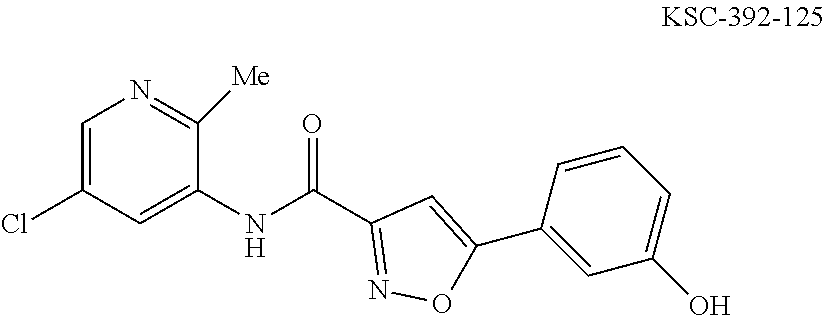


-
- Solution 1: 0.5 mg/mL mitochondria in Assay Buffer
- Solution 2: 2.0 mM EGTA-Tris, pH 7.4 in Solution 3
- Solution 3: 80-200 μM CaCl2 depending on mitochondrial activity, 5.0 mM glutamate, 2.5 mM malate in Assay Buffer. Note: Concentration of calcium in the assay is dependent upon the activity of the isolated mitochondria which is determined via a calcium titration just before each high-throughput screening batch. A calcium concentration is used that allows for the arrival at a 2:1 window at the 30 minute time period.
-
- 1) First tier (0-40 range) is reserved for primary screening data. The score is correlated with % activity in the assay:
- a. If outcome of the primary screen is inactive, then the assigned score is 0
- b. If outcome of the primary screen is inconclusive, then the assigned score is 10
- c. If outcome of the primary screen is active, then the assigned score is 20
- Scoring for Single concentration confirmation screening is not applicable to this assay.
- d. If outcome of the single-concentration confirmation screen is inactive, then the assigned score is 21
- e. If outcome of the single-concentration confirmation screen is inconclusive, then the assigned score is 25
- f. If outcome of the single-concentration confirmation screen is active, then the assigned score is 30
- 1) First tier (0-40 range) is reserved for primary screening data. The score is correlated with % activity in the assay:
-
- 2) Second tier (41-80 range) is reserved for dose-response confirmation data and is not applicable in this assay
- 3) Third tier (81-100 range) is reserved for resynthesized true positives and their analogues and is not applicable in this assay
-
- Solution 1: 0.5 mg/mL mitochondria in Assay Buffer.
- Solution 2: 0.8 μM Rh123, 5.0 mM glutamate and 2.5 mM malate in Assay Buffer.
-
- 1) First tier (0-40 range) is reserved for primary screening data. The score is correlated with % activity in the assay. Scoring for the primary screening is not applicable to this assay.
- a. If outcome of the primary screen is inactive, then the assigned score is 0
- b. If outcome of the primary screen is inconclusive, then the assigned score is 10
- c. If outcome of the primary screen is active, then the assigned score is 20
- Scoring for Single concentration confirmation screening is applicable to this assay.
- d. If outcome of the single-concentration confirmation screen is inactive, then the assigned score is 21
- e. If outcome of the single-concentration confirmation screen is inconclusive, then the assigned score is 25
- f. If outcome of the single-concentration confirmation screen is active, then the assigned score is 30
- 1) First tier (0-40 range) is reserved for primary screening data. The score is correlated with % activity in the assay. Scoring for the primary screening is not applicable to this assay.
-
- 2) Second tier (41-80 range) is reserved for dose-response confirmation data and is not applicable in this assay.
- 3) Third tier (81-100 range) is reserved for resynthesized true positives and their analogues and is not applicable in this assay.
-
- Solution 1: 0.5 mg/mL mitochondria in Assay Buffer
- Solution 2: 2.0 mM EGTA-Tris, pH 7.4 in Solution 3
- Solution 3: 80-200 μM CaCl2) depending on mitochondrial activity, 5.0 mM glutamate, 2.5 mM malate in Assay Buffer. Note: Concentration of calcium in the assay is dependent upon the activity of the isolated mitochondria which is determined via a calcium titration just before each high-throughput screening batch. A calcium concentration is used that allows for the arrival at a 2:1 window at the 30 minute time period.
-
- 1) First tier (0-40 range) is reserved for primary screening data. The score is correlated with % activity in the assay. Scoring for the primary screening is not applicable to this assay.
- 2) Second tier (41-80 range) is reserved for dose-response confirmation data
- a. Inactive compounds of the confirmatory stage are assigned a score value equal 41.
- b. The score is linearly correlated with a compound's potency and, in addition, provides a measure of the likelihood that the compound is not an artifact based on the available information.
- c. The Hill coefficient is taken as a measure of compound behavior in the assay via an additional scaling factor QC:
QC=2.6*[exp(−0.5*nH∧2)−exp(−1.5*nH∧2)]
- This empirical factor prorates the likelihood of target- or pathway-specific compound effect vs. its non-specific behavior in the assay. This factor is based on expectation that a compound with a single mode of action that achieved equilibrium in the assay demonstrates the Hill coefficient value of 1. Compounds deviating from that behavior are penalized proportionally to the degree of their deviation.
- d. Summary equation that takes into account all the items discussed above is
Score=44+6*(pIC50−3)*QC,
- d. Summary equation that takes into account all the items discussed above is
- Where pIC50 is a negative log(10) of the IC50 value expressed in mole/L concentration units. This equation results in the Score values above 50 for compounds that demonstrate high potency and predictable behavior. Compounds that are inactive in the assay or whose concentration-dependent behavior are likely to be an artifact of that assay will generally have lower Score values.
- 3) Third tier (81-100 range) is reserved for resynthesized true positives and their analogues and is not applicable in this assay.
-
- Solution 1: 0.5 mg/mL mitochondria in Assay Buffer.
- Solution 2: 0.8 μM Rh123, 5.0 mM glutamate and 2.5 mM malate in Assay Buffer.
-
- 1) First tier (0-40 range) is reserved for primary screening data and is not applicable in this assay.
- 2) Second tier (41-80 range) is reserved for dose-response confirmation data
- a. Inactive compounds of the confirmatory stage are assigned a score value equal 41.
- b. The score is linearly correlated with a compound's potency and, in addition, provides a measure of the likelihood that the compound is not an artifact based on the available information.
- c. The Hill coefficient is taken as a measure of compound behavior in the assay via an additional scaling factor QC:
QC=2.6*[exp(−0.5*nH∧2)−exp(−1.5*nH∧2)]
- This empirical factor prorates the likelihood of target- or pathway-specific compound effect vs. its non-specific behavior in the assay. This factor is based on expectation that a compound with a single mode of action that achieved equilibrium in the assay demonstrates the Hill coefficient value of 1. Compounds deviating from that behavior are penalized proportionally to the degree of their deviation.
- d. Summary equation that takes into account all the items discussed above is
Score=44+6*(pIC50−3)*QC,
- d. Summary equation that takes into account all the items discussed above is
-
- 3) Third tier (81-100 range) is reserved for resynthesized true positives and their analogues and is not applicable in this assay.
-
- Solution 1. 5.0 mM glutamate and 2.5 mM malate in Assay buffer.
- Solution 2. 80-120 μM CaCl2) depending on mitochondrial activity in Solution 1. Note: Concentration of Ca2+ in the assay is dependent upon the activity of the isolated mitochondria which is determined via a calcium titration just before each screening batch. A Ca2+ concentration is used that allows for the arrival at a 2:1 window at the 20 minute time period.
- Solution 3. 1% DMSO in Solution 2.
-
Solution 4. 2.0 mM EGTA-Tris, pH 7.4 in Solution 3. -
Solution 5. 0.5 mg/mL mitochondria in Assay Buffer.
-
- 1) First tier (0-40 range) is reserved for primary screening data and is not applicable in this assay.
- 2) Second tier (41-80 range) is reserved for dose-response confirmation data and is not applicable in this assay.
- 3) Third tier (81-100 range) is reserved for resynthesized true positives and their analogues.
- a. Compounds that failed to reproduce from dry powder or have IC50>20 M are assigned inactive and a score value of 81.
- b. The score is linearly correlated with a compound's potency and, in addition, provides a measure of the likelihood that the compound is not an artifact based on the available information. The Hill coefficient is taken as a measure of compound behavior in the assay via an additional scaling factor QC:
QC=2.6*[exp(−0.5*nH;2)−exp(−1.5*nH;2)]
- This empirical factor prorates the likelihood of a target- or a pathway-specific compound effect vs. its non-specific behavior in the assay. This factor is based on the expectation that a compound with a single mode of action that achieved an equilibrium in the assay would demonstrate the Hill coefficient value of 1. Compounds deviating from that behavior are penalized proportionally to the degree of their divergence.
- c. The score is calculated using the following equation:
Score=82+3*(pIC50−3)*QC,
- c. The score is calculated using the following equation:
- where pIC50 is a negative log(10) of the IC50 value expressed in mole/L concentration units, and QC is calculated using Hill coefficient as above. This equation results in the Score values above 85 for compounds that demonstrate high potency and predictable behavior in the assays.
-
- Solution 1. 5.0 mM glutamate and 2.5 mM malate in Assay Buffer.
- Solution 2. 1% DMSO in Solution 1.
- Solution 3. 0.8 μM FCCP (the
stock 40 μM in DMSO) in Solution 1. -
Solution 4. 0.5 mg/mL mitochondria and 0.8 μM Rh123 in Assay Buffer.
-
- 1) First tier (0-40 range) is reserved for primary screening data and is not applicable in this assay.
- 2) Second tier (41-80 range) is reserved for dose-response confirmation data and is not applicable in this assay.
- 3) Third tier (81-100 range) is reserved for resynthesized true positives and their analogues.
- a. Compounds that failed to reproduce from dry powder or have IC50>100 M are assigned inactive and a score value of 81.
- b. The score is linearly correlated with a compound's potency and, in addition, provides a measure of the likelihood that the compound is not an artifact based on the available information. The Hill coefficient is taken as a measure of compound behavior in the assay via an additional scaling factor QC:
QC=2.6*[exp(−0.5*nH;2)−exp(−1.5*nH;2)]
- This empirical factor prorates the likelihood of a target- or a pathway-specific compound effect vs. its non-specific behavior in the assay. This factor is based on the expectation that a compound with a single mode of action that achieved an equilibrium in the assay would demonstrate the Hill coefficient value of 1. Compounds deviating from that behavior are penalized proportionally to the degree of their divergence.
- c. The score is calculated using the following equation:
Score=82+3*(pIC50−3)*QC,
- c. The score is calculated using the following equation:
- where pIC50 is a negative log(10) of the IC50 value expressed in mole/L concentration units, and QC is calculated using Hill coefficient as above. This equation results in the Score values above 85 for compounds that demonstrate high potency and predictable behavior in the assays.
-
- Solution 1. 10 mM glutamate and 5 mM malate in Assay buffer.
- Solution 2. 1% DMSO in Solution 2.
- Solution 3. 0.5 mg/mL mitochondria and 1.0 μM Calcium Green-5N in Assay Buffer.
-
Solution 4. 0.25 mM CaCl2.
-
- Solution 1. 5.0 mM glutamate and 2.5 mM malate in Assay Buffer.
- Solution 2. 100-120 μM CaCl2) depending on mitochondrial activity in Solution 1. Note: Concentration of Ca2+ in the assay is dependent upon the activity of the isolated mitochondria which is determined via a calcium titration just before each screening batch. A Ca2+ concentration is used that allows for the arrival at a 2:1 window at the 20 minute time period.
- Solution 3. 1% DMSO in Solution 2.
-
Solution 4. 2.0 mM EGTA-Tris, pH 7.4 in Solution 3. -
Solution 5. 0.5 mg/mL mitochondria in Assay Buffer.
-
- 1) First tier (0-40 range) is reserved for primary screening data and is not applicable in this assay.
- 2) Second tier (41-80 range) is reserved for dose-response confirmation data and is not applicable in this assay.
- 3) Third tier (81-100 range) is reserved for resynthesized true positives and their analogues.
- a. Compounds that failed to reproduce from dry powder or have IC50>20 M are assigned inactive and a score value of 81.
- b. The score is linearly correlated with a compound's potency and, in addition, provides a measure of the likelihood that the compound is not an artifact based on the available information. The Hill coefficient is taken as a measure of compound behavior in the assay via an additional scaling factor QC:
QC=2.6*[exp(−0.5*nH;2)−exp(−1.5*nH;2)]
- This empirical factor prorates the likelihood of a target- or a pathway-specific compound effect vs. its non-specific behavior in the assay. This factor is based on the expectation that a compound with a single mode of action that achieved an equilibrium in the assay would demonstrate the Hill coefficient value of 1. Compounds deviating from that behavior are penalized proportionally to the degree of their divergence.
- c. The score is calculated using the following equation:
Score=82+3*(pIC50−3)*QC,
- c. The score is calculated using the following equation:
- where pIC50 is a negative log(10) of the IC50 value expressed in mole/L concentration units, and QC is calculated using Hill coefficient as above. This equation results in the Score values above 85 for compounds that demonstrate high potency and predictable behavior in the assays.
-
- Solution 1. 5.0 glutamate and 2.5 mM malate in Assay Buffer.
- Solution 2. 1% DMSO in Solution 1.
- Solution 3. 0.8 μM FCCP (the
stock 40 μM in DMSO) in Solution 1. -
Solution 4. 0.5 mg/mL mitochondria and 0.8 μM Rh123 in Assay Buffer.
-
- 1) First tier (0-40 range) is reserved for primary screening data and is not applicable in this assay
- 2) Second tier (41-80 range) is reserved for dose-response confirmation data and is not applicable in this assay.
- 3) Third tier (81-100 range) is reserved for resynthesized true positives and their analogues.
- a. Compounds that failed to reproduce from dry powder or have EC50>100 M are assigned inactive and a score value of 81.
- b. The score is linearly correlated with a compound's potency and, in addition, provides a measure of the likelihood that the compound is not an artifact based on the available information. The Hill coefficient is taken as a measure of compound behavior in the assay via an additional scaling factor QC:
QC=2.6*[exp(−0.5*nH;2)−exp(−1.5*nH;2)]
- This empirical factor prorates the likelihood of a target- or a pathway-specific compound effect vs. its non-specific behavior in the assay. This factor is based on the expectation that a compound with a single mode of action that achieved an equilibrium in the assay would demonstrate the Hill coefficient value of 1. Compounds deviating from that behavior are penalized proportionally to the degree of their divergence.
- c. The score is calculated using the following equation:
Score=82+3*(pIC50−3)*QC,
- c. The score is calculated using the following equation:
- where pIC50 is a negative log(10) of the IC50 value expressed in mole/L concentration units, and QC is calculated using Hill coefficient as above. This equation results in the Score values above 85 for compounds that demonstrate high potency and predictable behavior in the assays.
-
- Solution 1. 10 mM glutamate and 5 mM malate in Assay buffer.
- Solution 2. 1% DMSO in Solution 2.
- Solution 3. 0.5 mg/mL mitochondria and 1.0 μM Calcium Green-5N in Assay Buffer.
-
Solution 4. 0.25 mM CaCl2.
-
- Solution 1. 10 mM glutamate and 5 mM malate in Assay Buffer.
- Solution 2. 1% DMSO in Solution 2.
- Solution 3. 8 million/mL cells and 1.0 μM Calcium Green-5N in Assay Buffer.
-
Solution 4. 0.5 mM CaCl2.
-
- Diclofenac Na and Dipyridamole were used as standards. Diclofenac Na is highly soluble. Dipyridamole is poorly to moderately soluble.
- Standards and test compound stocks were made in 100% DMSO
- Assay concentration of standards: 500 μM and test compound: 300 μM
- Cosolvent used in the reference solution to suppress precipitation: 1-Propanol
- Assay DMSO final concentration: 1%
Results reported are the mean of each reaction duplicate, normalized to the internal standard, and expressed as a percent of compound remaining after the incubation time.
-
- Human Plasma in K3 EDTA
- Procaine and Procainamide were used as standards. Procaine is highly unstable in human plasma, Procainamide is highly stable in human plasma.
- Assay concentrations of standards and test compound: 1 μM
- Incubation Time: 3 hrs
- Reaction pH: 7.4
- Assay DMSO final concentration: 2.5%
All reactions were run in triplicate, except negative controls (no NADPH) which were performed as single reactions. Results reported are the mean of each reaction triplicate, normalized to the internal standard, and expressed as a percent compound remaining after the incubation time.
-
- Human and Mouse Liver Microsomes: 0.5 mg/mL protein concentration
- NADPH Regenerating System: 1.55 mM NADP+, 1.33 mM glucose-6-phosphate, 1.33 mM Magnesium chloride, and 0.4 U/mL glucose-6 phosphate dehydrogenase
- Incubation Temperature: 37° C.
- Incubation Time: 60 min
- Standards: Verapamil-HCl and Testosterone, at 20 μM and 50 μM, respectively
- Test compound at 1 μM
- Assay DMSO final concentration: ≤0.5%
- Assay ACN final concentration: ≤1.2%
-
- Verapamil HCl, Metoprolol, and Ranitidine were used as reference standards
- Verapamil HCl is considered highly permeable
- Metoprolol is considered moderately permeable
- Ranitidine is considered poorly permeable
- Permeation time: 30 min
- Moderate stirring (equivalent to 40 μm ABL, aqueous boundary layer, also known as the unstirred water layer)
- Donor buffer pH: 5.0, 6.2 and 7.4
- Double-Sink: pH gradients between donor and acceptor compartments; acceptor buffer contains chemical sink
- Assay DMSO final concentration: 0.5%
-
- Verapamil-HCl, Corticosterone, and Theophylline are used as reference standards: Verapamil-HCl is considered highly permeable, Corticosterone is considered moderately permeable, and Theophylline is considered poorly permeable.
- Permeation time: 60 min
- Moderate stirring (equivalent to 40 μm ABL, aqueous boundary layer, also known as the unstirred water layer)
- Donor buffer pH: 7.4; Acceptor buffer pH: 7.4
- Assay DMSO assay concentration: 0.5%
Results reported are the mean of each reaction duplicate, normalized to the internal standard, and expressed as a percent compound bound after the incubation time.
-
- Human Plasma in K3 EDTA
- Propanolol and Metoprolol were used as standards. Propanolol is highly bound, Metoprolol is poorly bound
- Assay concentrations of standards and test compounds: 1 μM and 10 μM
- Incubation Time: 4 hrs
- Reaction pH: 7.4
- Assay DMSO final concentration: 1%
-
- Cells used: Fa2N-4, immortalized human hepatocytes
- Media used for Fa2N-4 cells: MFE Plating and MFE Support (with 1% Penicillin, Streptomycin, and Amphotercin mixture)
- Assay DMSO final concentration=0.5%
- Treatment time: 24 hrs
- Camptothecin and Terfenadine were used as standards. Camptothecin is highly toxic and Terfenadine is highly non toxic.
| TABLE 1 |
| Isoxazole and Benzamide Calcium Retention Capacity; Mitochondrial Swelling; and |
| Rhodamine 123 (Rh123) uptake |
| Calcium | |||
| Retention | |||
| Capacity | Mitochondrial | Rh123 | |
| (CRC/CRC0 | swelling | uptake | |
| Structure | at 12.5 μM) | (EC50) | (EC50) |
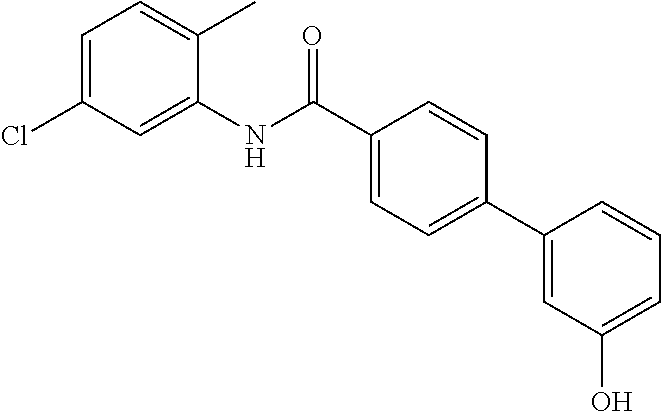 |
2.59 ± 0.22 | 4.710 ± 0.3490 μM | >100 μM |
 |
1.17 ± 0.11 (at 1.56 μM) | 0.277 ± 0.001 μM | >100 μM |
 |
5.21 ± 0.50 (at 1.56 μM) | 0.108 ± 0.01 μM | >100 μM |
 |
13.44 ± 0.93 (9.59 ± 0.85 at 1.56 μM) | 0.0000283 ± 0.0000048 μM | >100 μM |
 |
4.27 ± 0.40 | 0.366 ± 0.0475 μM | >100 μM |
 |
5.51 ± 0.99 | 0.100 ± 0.0096 μM | >100 μM |
 |
13.47 ± 1.32 (10.10 ± 1.14 at 1.56 μM) | 0.011 ± 0.0011 μM | >100 μM |
 |
9.34 ± 1.04 | 0.078 ± 0.0050 μM | >100 μM |
 |
10.17 ± 0.69 | 0.013 ± 0.0020 μM | >100 μM |
 |
19.28 ± 1.59 (15.21 ± 1.26 at 1.56 μM) | 0.000134 ± 0.000016 μM | >100 μM |
 |
10.07 ± 0.69 | 0.009 ± 0.0014 μM | >100 μM |
 |
9.37 ± 0.65 | 0.0554 ± 0.0041 μM | >100 μM |
 |
6.08 ± 0.52 | 0.819 ± 0.0589 μM | >100 μM |
 |
10.69 ± 1.00 (9.12 ± 0.88 at 1.56 μM) | 0.016 ± 0.0019 μM | >100 μM |
 |
3.48 ± 0.51 | 2.192 ± 0.1501 μM | >100 μM |
 |
7.14 ± 0.69 | 0.0756 ± 0.0092 μM | >100 μM |
 |
12.14 ± 0.55 (at 1.56 μM) | 0.000890 ± 0.000141 μM | >100 μM |
 |
10.09 ± 0.91 (6.62 ± 0.89 at 1.56 μM) | 0.024 ± 0.0022 | >100 μM |
 |
11.05 ± 1.35 | 0.125 ± 0.0071 μM | >100 μM |
 |
14.99 ± 1.20 (9.63 ± 0.29 at 1.56 μM) | 0.0035 ± 0.0007 μM | >100 μM |
 |
1.37 ± 0.02 | 5.849 ± 0.3435 μM | >100 μM |
 |
1.23 ± 0.02 | 9.003 ± 0.4036 μM | >100 μM |
 |
1.51 ± 0.01 | 2.684 ± 0.1661 μM | >100 μM |
 |
1.37 ± 0.02 | 7.614 ± 0.8388 | >100 μM |
 |
1.33 ± 0.06 | 9.239 ± 0.8596 μM | >100 μM |
 |
1.20 ± 0.00 | 8.117 ± 0.3877 μM | >100 μM |
 |
1.24 ± 0.04 | 6.866 ± 0.4230 | >100 μM |
 |
1.80 ± 0.00 | 1.541 ± 0.1006 μM | >100 μM |
 |
1.65 ± 0.06 | 2.148 ± 0.10 μM | >100 μM |
 |
1.31 ± 0.03 | 7.252 ± 0.5262 μM | >100 μM |
 |
1.52 ± 0.06 | 3.273 ± 0.1498 μM | >100 μM |
 |
3.54 ± 0.28 | 0.885 ± 0.1157 μM | 51.22 μM |
 |
1.16 ± 0.02 | 15.986 ± 1.5816 μM | >100 μM |
 |
1.12 ± 0.02 | 38.723 ± 3.6723 μM | >100 μM |
 |
1.05 ± 0.03 | 37.473 ± 3.6327 μM | >100 μM |
 |
1.10 ± 0.02 | 29.207 ± 2.1016 μM | >100 μM |
 |
1.17 ± 0.04 | 25.555 ± 1.8028 μM | >100 μM |
 |
1.09 ± 0.05 | 21.387 ± 0.9832 μM | >100 μM |
 |
1.11 ± 0.03 | 21.663 ± 1.0810 μM | >100 μM |
 |
1.07 ± 0.03 | 29.058 ± 2.9172 μM | >100 μM |
 |
3.26 ± 0.32 | 0.189 ± 0.028 μM | >100 μM |
 |
5.47 ± 0.57 | 0.0788 ± 0.0058 μM | >100 μM |
 |
1.10 ± 0.05 | 18.023 ± 1.3275 μM | >100 μM |
 |
1.16 ± 0.05 | 9.999 ± 7.7771 μM | 64.75 ± 4.19 μM |
 |
1.01 ± 0.02 | 45.996 ± 1.3574 μM | >100 μM |
 |
4.00 ± 0.42 | 12.488 ± 0.6675 μM | >100 μM |
 |
4.67 ± 0.31 | 1.520 ± 0.0512 μM | 38.47 ± 3.98 μM |
 |
1.83 ± 0.17 | 42.728 ± 2.5933 μM | >100 μM |
 |
12.08 ± 1.92 (5.72 ± 0.25 at 1.56 μM) | 0.190 ± 0.017 μM | >100 μM |
 |
1.90 ± 0.11 | ND | ND |
 |
14.02 ± 1.63 | ND | ND |
 |
3.50 ± 0.57 | 2.210 ± 0.1738 μM | >100 μM |
 |
13.99 ± 1.50 (7.69 ± 0.61 at 1.56 μM) | 0.030 ± 0.0026 μM | >100 μM |
 |
1.59 ± 0.33 | 17.576 ± 2.2110 μM | >100 μM |
 |
8.16 ± 0.92 | 0.030 ± 0.0022 μM | >100 μM |
 |
2.94 ± 0.46 | 2.446 ± 0.1480 μM | >100 μM |
 |
14.44 ± 0.58 (10.02 ± 0.34 at 1.56 μM) | 0.00000756 ± 0.00000122 μM | >100 μM |
 |
4.13 ± 0.17 (at 1.56 μM) | 0.0788 ± 0.0058 μM | >100 μM |
 |
3.77 ± 0.17 (at 1.56 μM) | 0.172 ± 0.014 μM | >100 μM |
 |
8.22 ± 0.58 (at 1.56 μM) | 0.000180 ± 0.000042 μM | >100 μM |
 |
6.91 ± 0.47 (at 1.56 μM) | 0.00134 ± 0.00026 μM | >100 μM |
 |
6.21 ± 0.66 (at 1.56 μM) | 0.00216 ± 0.00045 μM | >100 μM |
 |
10.92 ± 0.74 (at 1.56 μM) | 0.0014 ± 0.0002 μM | 30.4 ± 5.5 μM |
 |
7.51 ± 0.47 (at 1.56 μM) | 0.0024 ± 0.0004 μM | >100 μM |
 |
8.12 ± 0.59 (at 1.56 μM) | 0.0121 ± 0.0014 μM | >100 μM |
 |
7.18 ± 0.87 | 0.035 ± 0.0042 μM | >100 μM |
 |
11.22 ± 1.22 | 0.076 ± 0.0092 μM | >100 μM |
 |
3.52 ± 0.44 | 0.277 ± 0.0010 μM | >100 μM |
 |
11.21 ± 1.38 | 0.071 ± 0.0011 μM | >100 μM |
 |
12.15 ± 1.36 (6.50 ± 0.77 at 1.56 μM) | 0.066 ± 0.0032 μM | >100 μM |
 |
9.89 ± 1.31 (6.62 ± 0.84 at 1.56 μM) | 0.097 ± 0.0034 μM | >100 μM |
 |
10.89 ± 1.34 (6.95 ± 1.15 at 1.56 μM) | 0.060 ± 0.0076 μM | >100 μM |
 |
2.22 ± 0.38 | 1.612 ± 0.8658 μM | >100 μM |
 |
9.59 ± 1.29 (4.34 ± 0.53 at 1.56 μM) | 0.146 ± 0.0115 μM | >100 μM |
 |
5.37 ± 0.58 | 0.217 ± 0.0518 μM | >100 μM |
 |
2.10 ± 0.26 | 6.057 ± 0.7477 μM | >100 μM |
 |
2.59 ± 0.22 | 4.710 ± 0.3490 μM | >100 μM |
 |
4.27 ± 0.40 | 0.366 ± 0.0475 μM | >100 μM |
| Cyclosporin A | 5.13 ± 0.43 | 0.095 ± 0.0029 μM | >100 μM |
| TABLE 2 |
| Calcium Retention Capacity; Mitochondrial Swelling; & Rhodamine 123 |
| (Rh123) uptake for Additional Examples |
| Calcium Retention | ||||
| Capacity | Mitochondrial | |||
| CRC/CRC0 | swelling | Rh123 Assay | ||
| Entry | Structure | at 12.5 μM | EC50 (μM) | EC50 (μM) |
| 1 |
 |
10.8 ± 0.6 | 0.521 ± 0.046 | 58.6 ± 2.9 |
| 2 |
 |
13.3 ± 1.0 | 0.372 ± 0.028 | >100.00 |
| 3 |
 |
2.26 ± 0.11 | 3.60 ± 0.17 | 75.7 ± 1.8 |
| 4 |
 |
8.81 ± 0.39 | 0.403 ± 0.031 | >100 |
| 5 |
 |
14.1 ± 1.1 | 0.423 ± 0.028 | 49.6 ± 4.3 |
| 6 |
 |
16.1 ± 1.5 | 0.286 ± 0.027 | 42.6 ± 3.1 |
| 7 |
 |
18.3 ± 1.3 | 0.206 ± 0.021 | 46.4 ± 3.2 |
| 8 |
 |
6.50 ± 1.20 | 1.19 ± 0.33 | 23.2 ± 1.3 |
| 9 |
 |
2.37 ± 0.41 | 4.00 ± 0.66 | >100 |
| 10 |
 |
5.91 ± 0.38 | 1.24 ± 0.39 | 24.7 ± 1.5 |
| 11 |
 |
2.59 ± 0.54 | 1.39 ± 0.17 | >100 |
| 12 |
 |
10.1 ± 0.8 | 0.49 ± 0.08 | 28.6 ± 1.1 |
| 13 |
 |
7.67 ± 0.35 | 0.073 ± 0.007 | >100 |
| Note: | ||||
| Data are an average of >3 experiments ± SEM | ||||

Untreated morphants and wild-type embryos were used as controls.
- 1. Pepe, G.; Bertini, E.; Bonaldo, P.; Bushby, K.; Giusti, B.; de Visser, M.; Guicheney, P.; Lattanzi, G.; Merlini, L.; Muntoni, F.; Nishino, I.; Nonaka, I.; Yaou, R. B.; Sabatelli, P.; Sewry, C.; Topaloglu, H.; van der Kooi, A., Bethlem myopathy (BETHLEM) and Ullrich scleroatonic muscular dystrophy: 100th ENMC international workshop, 23-24 Nov. 2001, Naarden, The Netherlands. Neuromuscul Disord 2002, 12, (10), 984-93.
- 2. Lampe, A. K.; Bushby, K. M., Collagen VI related muscle disorders. J Med Genet 2005, 42, (9), 673-85.
- 3. Camacho Vanegas, O.; Bertini, E.; Zhang, R. Z.; Petrini, S.; Minosse, C.; Sabatelli, P.; Giusti, B.; Chu, M. L.; Pepe, G., Ullrich scleroatonic muscular dystrophy is caused by recessive mutations in collagen type VI. Proc Natl Acad Sci USA 2001, 98, (13), 7516-21.
- 4. Jobsis, G. J.; Boers, J. M.; Barth, P. G.; de Visser, M., Bethlem myopathy: a slowly progressive congenital muscular dystrophy with contractures. Brain 1999, 122 (Pt 4), 649-55.
- 5. Pepe, G.; Lucarini, L.; Zhang, R. Z.; Pan, T. C.; Giusti, B.; Quijano-Roy, S.; Gartioux, C.; Bushby, K. M.; Guicheney, P.; Chu, M. L., COL6A1 genomic deletions in Bethlem myopathy and Ullrich muscular dystrophy. Ann Neurol 2006, 59, (1), 190-5.
- 6. Bonaldo, P.; Braghetta, P.; Zanetti, M.; Piccolo, S.; Volpin, D.; Bressan, G. M., Collagen VI deficiency induces early onset myopathy in the mouse: an animal model for Bethlem myopathy. Hum Mol Genet 1998, 7, (13), 2135-40.
- 7. Irwin, W. A.; Bergamin, N.; Sabatelli, P.; Reggiani, C.; Megighian, A.; Merlini, L.; Braghetta, P.; Columbaro, M.; Volpin, D.; Bressan, G. M.; Bernardi, P.; Bonaldo, P., Mitochondrial dysfunction and apoptosis in myopathic mice with collagen VI deficiency. Nat Genet 2003, 35, (4), 367-71.
- 8. Maraldi, N. M.; Sabatelli, P.; Columbaro, M.; Zamparelli, A.; Manzoli, F. A.; Bernardi, P.; Bonaldo, P.; Merlini, L., Collagen VI myopathies: from the animal model to the clinical trial. Adv Enzyme Regul 2009, 49, (1), 197-211.
- 9. Angelin, A.; Tiepolo, T.; Sabatelli, P.; Grumati, P.; Bergamin, N.; Golfieri, C.; Mattioli, E.; Gualandi, F.; Ferlini, A.; Merlini, L.; Maraldi, N. M.; Bonaldo, P.; Bernardi, P., Mitochondrial dysfunction in the pathogenesis of Ullrich congenital muscular dystrophy and prospective therapy with cyclosporins. Proc Natl Acad Sci USA 2007, 104, (3), 991-6.
- 10. Zulian, A.; Rizzo, E.; Schiavone, M.; Palma, E.; Tagliavini, F.; Blaauw, B.; Merlini, L.; Maraldi, N. M.; Sabatelli, P.; Braghetta, P.; Bonaldo, P.; Argenton, F.; Bernardi, P., NIM811, a cyclophilin inhibitor without immunosuppressive activity, is beneficial in collagen VI congenital muscular dystrophy models.
Hum Mol Genet 2014, 23, (20), 5353-63. - 11. Tiepolo, T.; Angelin, A.; Palma, E.; Sabatelli, P.; Merlini, L.; Nicolosi, L.; Finetti, F.; Braghetta, P.; Vuagniaux, G.; Dumont, J. M.; Baldari, C. T.; Bonaldo, P.; Bernardi, P., The cyclophilin inhibitor Debio 025 normalizes mitochondrial function, muscle apoptosis and ultrastructural defects in Col6a1−/− myopathic mice. Br J Pharmacol 2009, 157, (6), 1045-52.
- 12. Merlini, L.; Sabatelli, P.; Armaroli, A.; Gnudi, S.; Angelin, A.; Grumati, P.; Michelini, M. E.; Franchella, A.; Gualandi, F.; Bertini, E.; Maraldi, N. M.; Ferlini, A.; Bonaldo, P.; Bernardi, P., Cyclosporine A in Ullrich congenital muscular dystrophy: long-term results. Oxid Med Cell Longev 2011, 2011, 139194.
- 13. Merlini, L.; Angelin, A.; Tiepolo, T.; Braghetta, P.; Sabatelli, P.; Zamparelli, A.; Ferlini, A.; Maraldi, N. M.; Bonaldo, P.; Bernardi, P., Cyclosporin A corrects mitochondrial dysfunction and muscle apoptosis in patients with collagen VI myopathies. Proc Natl Acad Sci USA 2008, 105, (13), 5225-9.
- 14. Palma, E.; Tiepolo, T.; Angelin, A.; Sabatelli, P.; Maraldi, N. M.; Basso, E.; Forte, M. A.; Bernardi, P.; Bonaldo, P., Genetic ablation of cyclophilin D rescues mitochondrial defects and prevents muscle apoptosis in collagen VI myopathic mice. Hum Mol Genet 2009, 18, (11), 2024-31.
- 15. Shah, V. P.; Midha, K. K.; Dighe, S.; McGilveray, I. J.; Skelly, J. P.; Yacobi, A.; Layloff, T.; Viswanathan, C. T.; Cook, C. E.; McDowall, R. D.; et al., Analytical methods validation: bioavailability, bioequivalence and pharmacokinetic studies. Conference report. Eur J Drug Metab Pharmacokinet 1991, 16, (4), 249-55.
- 16. Xu, X.; Zhou, Q.; Korfmacher, W. A., Development of a low volume plasma sample precipitation procedure for liquid chromatography/tandem mass spectrometry assays used for drug discovery applications. Rapid Commun Mass Spectrom 2005, 19, (15), 2131-6.
- 17. International Patent Pub. “Acrylamino derivative useful as inhibitors of the mitochondrial permeability transition.” WO 2010/049768 A1.
- 18. Di Lisa, F.; Carpi, A.; Giorgio, V.; Bernardi, P., The mitochondrial permeability transition pore and cyclophilin D in cardioprotection. Biochim Biophys Acta 2011, 1813, (7), 1316-22.
- 19. Di Lisa, F.; Menabo, R.; Canton, M.; Barile, M.; Bernardi, P., Opening of the mitochondrial permeability transition pore causes depletion of mitochondrial and cytosolic NAD+ and is a causative event in the death of myocytes in postischemic reperfusion of the heart. J Biol Chem 2001, 276, (4), 2571-5.
- 20. Di Lisa, F.; Bernardi, P., Mitochondria and ischemia-reperfusion injury of the heart: fixing a hole. Cardiovasc Res 2006, 70, (2), 191-9.
- 21. Su, K. G.; Savino, C.; Marracci, G.; Chaudhary, P.; Yu, X.; Morris, B.; Galipeau, D.; Giorgio, M.; Forte, M.; Bourdette, D., Genetic inactivation of the p66 isoform of ShcA is neuroprotective in a murine model of multiple sclerosis. Eur J Neurosci 2012, 35, (4), 562-71.
- 22. Forte, M.; Gold, B. G.; Marracci, G.; Chaudhary, P.; Basso, E.; Johnsen, D.; Yu, X.; Fowlkes, J.; Rander, M.; Stem, K.; Bernardi, P.; Bourdette, D., Cyclophilin D inactivation protects axons in experimental autoimmune encephalomyelitis, an animal model of multiple sclerosis. Proc Natl Acad Sci USA 2007, 104, (18), 7558-63.
- 23. Wang, X.; Carlsson, Y.; Basso, E.; Zhu, C.; Rousset, C. I.; Rasola, A.; Johansson, B. R.; Blomgren, K.; Mallard, C.; Bernardi, P.; Forte, M. A.; Hagberg, H., Developmental shift of cyclophilin D contribution to hypoxic-ischemic brain injury. J Neurosci 2009, 29, (8), 2588-96.
Claims (13)


Priority Applications (1)
| Application Number | Priority Date | Filing Date | Title |
|---|---|---|---|
| US15/524,595 US10865181B2 (en) | 2014-11-05 | 2015-11-04 | Small molecule inhibitors of the mitochondrial permeability transition pore (mtPTP) |
Applications Claiming Priority (3)
| Application Number | Priority Date | Filing Date | Title |
|---|---|---|---|
| US201462075643P | 2014-11-05 | 2014-11-05 | |
| PCT/US2015/059078 WO2016073633A1 (en) | 2014-11-05 | 2015-11-04 | SMALL MOLECULE INHIBITORS OF THE MITOCHONDRIAL PERMEABILITY TRANSITION PORE (mtPTP) |
| US15/524,595 US10865181B2 (en) | 2014-11-05 | 2015-11-04 | Small molecule inhibitors of the mitochondrial permeability transition pore (mtPTP) |
Related Parent Applications (1)
| Application Number | Title | Priority Date | Filing Date |
|---|---|---|---|
| PCT/US2015/059078 A-371-Of-International WO2016073633A1 (en) | 2014-11-05 | 2015-11-04 | SMALL MOLECULE INHIBITORS OF THE MITOCHONDRIAL PERMEABILITY TRANSITION PORE (mtPTP) |
Related Child Applications (1)
| Application Number | Title | Priority Date | Filing Date |
|---|---|---|---|
| US17/120,607 Continuation US20220396547A1 (en) | 2014-11-05 | 2020-12-14 | SMALL MOLECULE INHIBITORS OF THE MITOCHONDRIAL PERMEABILITY TRANSITION PORE (mtPTP) |
Publications (2)
| Publication Number | Publication Date |
|---|---|
| US20180282264A1 US20180282264A1 (en) | 2018-10-04 |
| US10865181B2 true US10865181B2 (en) | 2020-12-15 |
Family
ID=55909765
Family Applications (3)
| Application Number | Title | Priority Date | Filing Date |
|---|---|---|---|
| US15/524,595 Active US10865181B2 (en) | 2014-11-05 | 2015-11-04 | Small molecule inhibitors of the mitochondrial permeability transition pore (mtPTP) |
| US17/120,607 Abandoned US20220396547A1 (en) | 2014-11-05 | 2020-12-14 | SMALL MOLECULE INHIBITORS OF THE MITOCHONDRIAL PERMEABILITY TRANSITION PORE (mtPTP) |
| US18/122,605 Pending US20240067600A1 (en) | 2014-11-05 | 2023-03-16 | SMALL MOLECULE INHIBITORS OF THE MITOCHONDRIAL PERMEABILITY TRANSITION PORE (mtPTP) |
Family Applications After (2)
| Application Number | Title | Priority Date | Filing Date |
|---|---|---|---|
| US17/120,607 Abandoned US20220396547A1 (en) | 2014-11-05 | 2020-12-14 | SMALL MOLECULE INHIBITORS OF THE MITOCHONDRIAL PERMEABILITY TRANSITION PORE (mtPTP) |
| US18/122,605 Pending US20240067600A1 (en) | 2014-11-05 | 2023-03-16 | SMALL MOLECULE INHIBITORS OF THE MITOCHONDRIAL PERMEABILITY TRANSITION PORE (mtPTP) |
Country Status (4)
| Country | Link |
|---|---|
| US (3) | US10865181B2 (en) |
| EP (1) | EP3215152A4 (en) |
| JP (1) | JP2017538676A (en) |
| WO (1) | WO2016073633A1 (en) |
Families Citing this family (17)
| Publication number | Priority date | Publication date | Assignee | Title |
|---|---|---|---|---|
| WO2017015660A1 (en) * | 2015-07-23 | 2017-01-26 | Salk Institute For Biological Studies | Prevention and treatment of aging and neurodegenerative diseases |
| KR101947976B1 (en) | 2015-12-15 | 2019-02-13 | 아스트라제네카 아베 | Isoindole compound |
| CN116570594A (en) | 2016-06-23 | 2023-08-11 | 马里兰大学巴尔的摩分校 | Selective p38α-specific MAPK inhibitor |
| WO2018005713A1 (en) * | 2016-06-29 | 2018-01-04 | Congxin Liang | Piperazine derivatives as trpml modulators |
| EP3638661A1 (en) | 2017-06-14 | 2020-04-22 | Astrazeneca AB | 2,3-dihydroisoindole-1-carboxamides useful as ror-gamma modulators |
| EP3700935A4 (en) | 2017-10-25 | 2021-08-04 | University Of South Florida | DRUG-INDUCED ACTIVATION OF THE REELIN SIGNALING SYSTEM |
| WO2019121529A1 (en) | 2017-12-18 | 2019-06-27 | Unilever N.V. | A topical composition |
| JP7594787B2 (en) | 2018-12-07 | 2024-12-05 | ユニバーシティ オブ メリーランド、ボルチモア | Non-ATP/catalytic site p38 mitogen-activated protein kinase inhibitors |
| WO2021016594A1 (en) | 2019-07-24 | 2021-01-28 | Oregon Health & Science University | Second generation inhibitors of mitochondrial permeability transition pore with improved plasma stability |
| PH12022551379A1 (en) | 2019-12-06 | 2023-05-03 | Vertex Pharma | Substituted tetrahydrofurans as modulators of sodium channels |
| CN116406355B (en) | 2020-05-18 | 2026-05-15 | Gen1E生命科学公司 | P38α mitogen-activated protein kinase inhibitors |
| GB202013728D0 (en) | 2020-09-01 | 2020-10-14 | Nrg Therapeutics Ltd | Novel compounds |
| GB202013731D0 (en) | 2020-09-01 | 2020-10-14 | Nrg Therapeutics Ltd | Novel cmpounds |
| AU2021370893B2 (en) | 2020-10-29 | 2024-03-07 | Gen1E Lifesciences Inc. | Crystalline 5-(dimethylamino) -n- (4-(morpholinomethyl)phenyl) naphthalene-1-sulfonamide di-hydrochloride di-hydrate |
| NZ804686A (en) | 2021-03-23 | 2026-03-27 | Gen1E Lifesciences Inc | Substituted naphthyl p38alpha mitogen-activated protein kinase inhibitors |
| SI4347031T1 (en) | 2021-06-04 | 2026-01-30 | Vertex Pharmaceuticals Incorporated | N-(hydroxyalkyl (hetero)aryl) tetrahydrofuran carboxamides as modulators of sodium channels |
| HRP20251564T1 (en) | 2022-05-19 | 2026-01-30 | Astrazeneca Ab | AMIDE HETEROAROMATIC COMPOUNDS USEFUL IN THE TREATMENT OF LIVER DISEASES |
Citations (11)
| Publication number | Priority date | Publication date | Assignee | Title |
|---|---|---|---|---|
| US3752819A (en) | 1969-12-23 | 1973-08-14 | Ferlux | 5-phenyl-isoxazole-3-carboxylic acids and their derivatives |
| EP0061882A1 (en) | 1981-03-27 | 1982-10-06 | Eli Lilly And Company | Process for preparing isoxazol-3-ylcarboxamides |
| US20040110802A1 (en) | 2002-08-23 | 2004-06-10 | Atli Thorarensen | Antibacterial benzoic acid derivatives |
| US6946462B2 (en) | 2001-08-07 | 2005-09-20 | Hoffmann-La Roche Inc. | N-monoacylated derivatives of o-phenylenediamines, their analogs and their use as pharmaceutical agents |
| US20060035944A1 (en) | 2002-06-11 | 2006-02-16 | Susumu Muto | Remedies for neurodegenerative diseases |
| WO2008022286A2 (en) | 2006-08-16 | 2008-02-21 | The J. David Gladstone Institutes, A Testamentary Trust Established Under The Will Of J. David Gladstone | Small molecule inhibitors of kynurenine-3-monooxygenase |
| US20090069288A1 (en) * | 2007-07-16 | 2009-03-12 | Breinlinger Eric C | Novel therapeutic compounds |
| US20090099233A1 (en) | 2007-10-11 | 2009-04-16 | Pramod Joshi | Heteroaryl amides useful as inhibitors of voltage-gated sodium channels |
| US20120071481A1 (en) | 2009-02-04 | 2012-03-22 | Ronald Palin | Isoxazole-5-carboxamide derivatives |
| US8211927B2 (en) | 2007-08-02 | 2012-07-03 | MSD, Oss B.V. | 5-phenyl-isoxazole-3-carboxamide derivatives as TRPV1 modulators |
| US8563580B2 (en) | 2008-09-23 | 2013-10-22 | Georgetown University | Flavivirus inhibitors and methods for their use |
-
2015
- 2015-11-04 JP JP2017524405A patent/JP2017538676A/en active Pending
- 2015-11-04 US US15/524,595 patent/US10865181B2/en active Active
- 2015-11-04 EP EP15857472.3A patent/EP3215152A4/en not_active Withdrawn
- 2015-11-04 WO PCT/US2015/059078 patent/WO2016073633A1/en not_active Ceased
-
2020
- 2020-12-14 US US17/120,607 patent/US20220396547A1/en not_active Abandoned
-
2023
- 2023-03-16 US US18/122,605 patent/US20240067600A1/en active Pending
Patent Citations (11)
| Publication number | Priority date | Publication date | Assignee | Title |
|---|---|---|---|---|
| US3752819A (en) | 1969-12-23 | 1973-08-14 | Ferlux | 5-phenyl-isoxazole-3-carboxylic acids and their derivatives |
| EP0061882A1 (en) | 1981-03-27 | 1982-10-06 | Eli Lilly And Company | Process for preparing isoxazol-3-ylcarboxamides |
| US6946462B2 (en) | 2001-08-07 | 2005-09-20 | Hoffmann-La Roche Inc. | N-monoacylated derivatives of o-phenylenediamines, their analogs and their use as pharmaceutical agents |
| US20060035944A1 (en) | 2002-06-11 | 2006-02-16 | Susumu Muto | Remedies for neurodegenerative diseases |
| US20040110802A1 (en) | 2002-08-23 | 2004-06-10 | Atli Thorarensen | Antibacterial benzoic acid derivatives |
| WO2008022286A2 (en) | 2006-08-16 | 2008-02-21 | The J. David Gladstone Institutes, A Testamentary Trust Established Under The Will Of J. David Gladstone | Small molecule inhibitors of kynurenine-3-monooxygenase |
| US20090069288A1 (en) * | 2007-07-16 | 2009-03-12 | Breinlinger Eric C | Novel therapeutic compounds |
| US8211927B2 (en) | 2007-08-02 | 2012-07-03 | MSD, Oss B.V. | 5-phenyl-isoxazole-3-carboxamide derivatives as TRPV1 modulators |
| US20090099233A1 (en) | 2007-10-11 | 2009-04-16 | Pramod Joshi | Heteroaryl amides useful as inhibitors of voltage-gated sodium channels |
| US8563580B2 (en) | 2008-09-23 | 2013-10-22 | Georgetown University | Flavivirus inhibitors and methods for their use |
| US20120071481A1 (en) | 2009-02-04 | 2012-03-22 | Ronald Palin | Isoxazole-5-carboxamide derivatives |
Non-Patent Citations (22)
| Title |
|---|
| "Homology (chemistry)"; Wikipedia; (https://en.wikipedia.org/wiki/Homology_(chemistry); accessed Dec. 20, 2019); 2 pages. |
| Chemical Abstract Service STN Database, Registry No. 19925-74-7 [Entered STN: Nov. 16, 1984]. (Year: 1984). * |
| Chemical Abstract Service STN Registry Database [online] Registry No. 912761-39-8 [Entered STN: Nov. 9, 2006]. (Year: 2006). * |
| Chemical Abstract Service STN Registry Database [online] Registry No. 912787-79-2 [Entered STN: Nov. 9, 2006]. (Year: 2006). * |
| Extended European search report in EP 15857472.3 dated May 15, 2018. |
| Fancelli et al., Cinnamic Anilides as New Mitochondrial Permeability Transition Pore Inhibitors Endowed with Ischemia-Reperfusion Injury Protective Effect in Vivo, J Med Chem, 2014, 57, 5333-5347 (Abstract Only). |
| Goel et al., Structure-activity study of antiepileptic N-Arylisoxazolecarboxamides/N-isoxazolylbenzamide analogs using Wiener's topological index, Structural Chemistry, vol. 8, Issue 2, 1997, pp. 155-159 (Abstract Only). |
| International Search Report and Written Opinion in PCT/US15/59078, dated Mar. 2, 2016 (10 pages). |
| Lepage et al., New N-aryl isoxazolecarboxamides and N-isoxazolylbenzamides as anticonvulsant agents, Eur J Med Chem (1992), 27, pp. 581-593 (Abstract Only). |
| Li et al., Preparation of novel antibacterial agents. Replacement of the central aromatic ring with heterocycles, Bioorganic & Medicinal Chemistry Letters, vol. 17, Issue 8, 2007, pp. 2347-2350 (Abstract Only). |
| PubChem BioAssay AID 565 [Deposit: Dec. 20, 2006][Retrieved online from < https://pubchem.ncbi.nlm.nih.gov/bioassay/565>]. (Year: 2006). * |
| PubChem CID 3242624 [Create Date: Aug. 16, 2005][Retrieved online from < https://pubchem.ncbi.nlm.nih.gov/compound/3242624>]. (Year: 2005). * |
| Pubchem Database [online] BioAssay AID 504832 [deposit date: Jun. 22, 2011]. (Year: 2011). * |
| PubChem Database [online] CID 3244882 [created Aug. 16, 2005]. (Year: 2005). * |
| Roy S et al.; Discovery, Synthesis, and Optimization of Diarylisoxazele-3-carboxamides as Potent Inhibitors of the Mitochondrial Permeability Transition Pore; ChemMedChem 10(10),pp. 1-18 (pp. 1655-1671); Oct. 2015. |
| Schurer et al., Ligand-Binding Pocket Shape Differences between Sphingosine 1-Phosphate (S1P) Receptors S1P1 and S1P3 Determine Efficiency of Chemical Probe Identification by Ultrahigh-Throughput Screening, ACS Chemical Biology, vol. 3, No. 8, 2008, pp. 486-498. |
| Shimzu et al., Synthesis of Isoxazoline-3-carboxamides and Isoxazole-3-carboxanilides by Thermolysis of a-Methoxycarbonyl-a-nitroacetanilides in the Presence of Dipolarophiles, Synthesis, 1986, Issue 6, pp. 488-490-(Abstract Only). |
| Shimzu et al., Synthesis of Isoxazoline-3-carboxamides and Isoxazole-3-carboxanilides by Thermolysis of a-Methoxycarbonyl-a-nitroacetanilides in the Presence of Dipolarophiles, Synthesis, 1986, Issue 6, pp. 488-490—(Abstract Only). |
| Tourteau et al., 3-Carboxamido-5-aryl-isoxazoles as new CB2 agonists for the treatment of colitis, Bioorganic & Medicinal Chemistry 21 (2013) 5383-5394. |
| Veeraswamy et al., "Synthesis of novel 5-substituted isoxazole-3-carboxamide derivatives and cytotoxicity studies on lung cancer cell line," Indian Journal of Chemistry, vol. 51B, Sep. 2012, pp. 1369-1375 (7 pages). |
| Yarovenko et al., Synthesis of carbamoylformhydroxymoyl chlorides and study of their reactivities, Russian Chemical Bulletin, International Edition, vol. 51, No. 8, pp. 1504-1509, Aug. 2002. |
| Zhao et al., Design and synthesis of phenylisoxazole derivatives as novel human acrosin inhibitors, Bioorganic & Medicinal Chemistry Letters 24 (2014) 2802-2806 (Abstract Only). |
Also Published As
| Publication number | Publication date |
|---|---|
| US20220396547A1 (en) | 2022-12-15 |
| EP3215152A1 (en) | 2017-09-13 |
| JP2017538676A (en) | 2017-12-28 |
| US20240067600A1 (en) | 2024-02-29 |
| US20180282264A1 (en) | 2018-10-04 |
| EP3215152A4 (en) | 2018-06-13 |
| WO2016073633A1 (en) | 2016-05-12 |
Similar Documents
| Publication | Publication Date | Title |
|---|---|---|
| US20240067600A1 (en) | SMALL MOLECULE INHIBITORS OF THE MITOCHONDRIAL PERMEABILITY TRANSITION PORE (mtPTP) | |
| KR101959194B1 (en) | Novel piperidino-dihydrothienopyrimidine sulfoxides and their use for treating copd and asthma | |
| US7709518B2 (en) | Compounds for inflammation and immune-related uses | |
| US8236838B2 (en) | Compounds, compositions and methods comprising isoxazole derivatives | |
| US20070043014A1 (en) | 3,5-Aryl, heteroaryl or cycloalkyl substituted-1,2,4-oxadiazoles as s1p receptor agonists | |
| US9856246B2 (en) | TRPM8 antagonists | |
| US9371299B2 (en) | Thiadiazolidinediones as GSK-3 inhibitors | |
| EP1625123A2 (en) | 3-(2-amino-1-azacyclyl)-5-aryl-1,2,4-oxadiazoles as s1p receptor agonists | |
| Yar et al. | Synthesis and anti tuberculostatic activity of novel 1, 3, 4‐oxadiazole derivatives | |
| JP5897566B2 (en) | Cyclic N, N'-diarylthiourea and N, N'-diarylurea-androgen receptor antagonists, anticancer agents, methods for their preparation and uses | |
| US20090264471A1 (en) | Compounds, Compositions and Methods Comprising Triazole Derivatives | |
| US11497738B2 (en) | Di-substituted pyrazole compounds for the treatment of diseases | |
| CA3021608A1 (en) | Fluorinated cyclopropylamine compound, preparation method therefor, pharmaceutical composition thereof, and uses thereof | |
| AU2018205275A1 (en) | Methods for the treatment of neurological disorders | |
| CA2938187C (en) | Solid forms of 2-(tert-butylamino)-4-((1r,3r,4r)-3-hydroxy-4-methylcyclohexylamino)-pyrimidine-5-carboxamide, compositions thereof and methods of their use | |
| US20180312482A1 (en) | Heterocyclicalkyl derivative compounds as selective histone deacetylase inhibitors and pharmaceutical compositions comprising the same | |
| US20180072754A1 (en) | Novel piperidino-dihydrothienopyrimidine sulfoxides and their use for treating copd and asthma | |
| CN112105601A (en) | 3- (benzylamino) -4- (cyclohexylamino) -N- (2-piperazin-1-yl) ethyl) benzenesulfonamide derivatives and related FERROSTATIN-1 analogs as cell death inhibitors for the treatment of, for example, stroke | |
| TW200826927A (en) | Diaryl, dipyridinyl and aryl-pyridinyl derivatives and uses thereof | |
| US8563742B2 (en) | Substituted aminothiazole derivatives, pharmaceutical compositions, and methods of use | |
| US20110288103A1 (en) | Compounds, compositions, and methods comprising 1,3,4-oxadiazole derivatives | |
| KR101800140B1 (en) | Benzothiazolone compound | |
| JP2012503005A (en) | Compounds, compositions and methods comprising imidazole derivatives and triazole derivatives. | |
| US12398110B2 (en) | Second generation inhibitors of mitochondrial permeability transition pore with improved plasma stability | |
| WO2007071840A2 (en) | Compounds based on four aromatic rings, preparation and uses thereof |
Legal Events
| Date | Code | Title | Description |
|---|---|---|---|
| AS | Assignment |
Owner name: UNIVERSITY OF KANSAS, KANSAS Free format text: ASSIGNMENT OF ASSIGNORS INTEREST;ASSIGNORS:ROY, SUDESHNA;SCHOENEN, FRANK;BERNARDI, PAOLO;AND OTHERS;REEL/FRAME:042593/0745 Effective date: 20141216 Owner name: OREGON HEALTH & SCIENCE UNIVERSITY, OREGON Free format text: ASSIGNMENT OF ASSIGNORS INTEREST;ASSIGNOR:FORTE, MICHAEL;REEL/FRAME:042687/0384 Effective date: 20150116 |
|
| FEPP | Fee payment procedure |
Free format text: ENTITY STATUS SET TO SMALL (ORIGINAL EVENT CODE: SMAL); ENTITY STATUS OF PATENT OWNER: SMALL ENTITY |
|
| STPP | Information on status: patent application and granting procedure in general |
Free format text: NON FINAL ACTION MAILED |
|
| STPP | Information on status: patent application and granting procedure in general |
Free format text: RESPONSE TO NON-FINAL OFFICE ACTION ENTERED AND FORWARDED TO EXAMINER |
|
| STPP | Information on status: patent application and granting procedure in general |
Free format text: FINAL REJECTION MAILED |
|
| STPP | Information on status: patent application and granting procedure in general |
Free format text: DOCKETED NEW CASE - READY FOR EXAMINATION |
|
| STPP | Information on status: patent application and granting procedure in general |
Free format text: RESPONSE AFTER FINAL ACTION FORWARDED TO EXAMINER |
|
| STPP | Information on status: patent application and granting procedure in general |
Free format text: NOTICE OF ALLOWANCE MAILED -- APPLICATION RECEIVED IN OFFICE OF PUBLICATIONS |
|
| STPP | Information on status: patent application and granting procedure in general |
Free format text: PUBLICATIONS -- ISSUE FEE PAYMENT VERIFIED |
|
| STCF | Information on status: patent grant |
Free format text: PATENTED CASE |
|
| MAFP | Maintenance fee payment |
Free format text: PAYMENT OF MAINTENANCE FEE, 4TH YR, SMALL ENTITY (ORIGINAL EVENT CODE: M2551); ENTITY STATUS OF PATENT OWNER: SMALL ENTITY Year of fee payment: 4 |