US10862632B2 - Systems and methods for reducing redundant jitter cleaners in wireless distribution systems - Google Patents
Systems and methods for reducing redundant jitter cleaners in wireless distribution systems Download PDFInfo
- Publication number
- US10862632B2 US10862632B2 US16/264,240 US201916264240A US10862632B2 US 10862632 B2 US10862632 B2 US 10862632B2 US 201916264240 A US201916264240 A US 201916264240A US 10862632 B2 US10862632 B2 US 10862632B2
- Authority
- US
- United States
- Prior art keywords
- inputs
- clock signals
- central unit
- signals
- subset
- Prior art date
- Legal status (The legal status is an assumption and is not a legal conclusion. Google has not performed a legal analysis and makes no representation as to the accuracy of the status listed.)
- Active
Links
Images




Classifications
-
- H—ELECTRICITY
- H04—ELECTRIC COMMUNICATION TECHNIQUE
- H04L—TRANSMISSION OF DIGITAL INFORMATION, e.g. TELEGRAPHIC COMMUNICATION
- H04L1/00—Arrangements for detecting or preventing errors in the information received
- H04L1/20—Arrangements for detecting or preventing errors in the information received using signal quality detector
- H04L1/205—Arrangements for detecting or preventing errors in the information received using signal quality detector jitter monitoring
-
- H—ELECTRICITY
- H04—ELECTRIC COMMUNICATION TECHNIQUE
- H04J—MULTIPLEX COMMUNICATION
- H04J3/00—Time-division multiplex systems
- H04J3/02—Details
- H04J3/06—Synchronising arrangements
- H04J3/0635—Clock or time synchronisation in a network
-
- H—ELECTRICITY
- H04—ELECTRIC COMMUNICATION TECHNIQUE
- H04J—MULTIPLEX COMMUNICATION
- H04J3/00—Time-division multiplex systems
- H04J3/02—Details
- H04J3/06—Synchronising arrangements
- H04J3/0635—Clock or time synchronisation in a network
- H04J3/0685—Clock or time synchronisation in a node; Intranode synchronisation
- H04J3/0691—Synchronisation in a TDM node
-
- H—ELECTRICITY
- H04—ELECTRIC COMMUNICATION TECHNIQUE
- H04L—TRANSMISSION OF DIGITAL INFORMATION, e.g. TELEGRAPHIC COMMUNICATION
- H04L25/00—Baseband systems
- H04L25/02—Details ; arrangements for supplying electrical power along data transmission lines
-
- H—ELECTRICITY
- H04—ELECTRIC COMMUNICATION TECHNIQUE
- H04L—TRANSMISSION OF DIGITAL INFORMATION, e.g. TELEGRAPHIC COMMUNICATION
- H04L25/00—Baseband systems
- H04L25/02—Details ; arrangements for supplying electrical power along data transmission lines
- H04L25/14—Channel dividing arrangements, i.e. in which a single bit stream is divided between several baseband channels and reassembled at the receiver
Definitions
- the disclosure relates generally to communication systems and, more particularly, to communication systems that provide wireless service to user equipment for multiple service operators and still more particularly to managing clock signals from the multiple service operators.
- WDSs wireless distribution systems
- DASs distributed antenna systems
- RRH remote radio head
- femotcells systems small radio cell systems
- FIG. 1 illustrates distribution of communication services to remote coverage areas 100 ( 1 )- 100 (N) of a WDS 102 , wherein ‘N’ is the number of remote coverage areas.
- These communication services can include cellular services, wireless services, such as RF identification (RFID) tracking, Wi-Fi, local area network (LAN), and wireless LAN (WLAN), wireless solutions (Bluetooth, Wi-Fi Global Positioning System (GPS) signal-based, and others) for location-based services, and combinations thereof, as examples.
- RFID RF identification
- LAN local area network
- WLAN wireless LAN
- wireless solutions Bluetooth, Wi-Fi Global Positioning System (GPS) signal-based, and others
- PLL phase-locked loop
- the remote coverage areas 100 ( 1 )- 100 (N) may be remotely located.
- the remote coverage areas 100 ( 1 )- 100 (N) are created by and centered on remote units 104 ( 1 )- 104 (N) connected to a central unit 106 (e.g., a digital routing unit (DRU) a head-end controller, a head-end unit (HEU), or the like).
- a central unit 106 e.g., a digital routing unit (DRU) a head-end controller, a head-end unit (HEU), or the like.
- Each such remote unit 104 ( 1 )- 104 (N) may include one or more PLLs.
- the central unit 106 may be communicatively coupled to a signal source 108 , for example, a base transceiver station (BTS) or a baseband unit (BBU).
- BTS base transceiver station
- BBU baseband unit
- the signal source 108 may communicate with the central unit 106 , which may be a DRU, using digital communication protocols such as the common public radio interface (CPRI).
- the central unit 106 receives downlink communication signals 110 D from the signal source 108 to be distributed to the remote units 104 ( 1 )- 104 (N).
- the remote units 104 ( 1 )- 104 (N) are configured to receive the downlink communication signals 110 D from the central unit 106 over a communication medium 112 to be distributed to the respective remote coverage areas 100 ( 1 )- 100 (N) of the remote units 104 ( 1 )- 104 (N).
- the communication medium 112 may be a wired communication medium, a wireless communication medium, or an optical fiber-based communication medium.
- Each of the remote units 104 ( 1 )- 104 (N) may include an RF transmitter/receiver (not shown) and a respective antenna 114 ( 1 )- 114 (N) operably connected to the RF transmitter/receiver to wirelessly distribute the communication services to client devices 116 within the respective remote coverage areas 100 ( 1 )- 100 (N).
- the remote units 104 ( 1 )- 104 (N) are also configured to receive uplink communication signals 110 U from the client devices 116 in the respective remote coverage areas 100 ( 1 )- 100 (N) to be distributed to the signal source 108 .
- each of the remote coverage areas 100 ( 1 )- 100 (N) is determined by an amount of RF power transmitted by the respective remote units 104 ( 1 )- 104 (N), receiver sensitivity, antenna gain, and RF environment, as well as by RF transmitter/receiver sensitivity of the client devices 116 .
- the client devices 116 usually have a fixed maximum RF receiver sensitivity, so that the above-mentioned properties of the remote units 104 ( 1 )- 104 (N) mainly determine the size of the respective remote coverage areas 100 ( 1 )- 100 (N).
- the central unit 106 includes electronic processing devices, for example a field-programmable gate array (FPGA), a digital signal processor (DSP), and/or a central processing unit (CPU), for processing the downlink communication signals 110 D and the uplink communication signals 110 U.
- FPGA field-programmable gate array
- DSP digital signal processor
- CPU central processing unit
- each of the remote units 104 ( 1 )- 104 (N) also employs electronic processing devices for processing the downlink communication signals 110 D and the uplink communication signals 110 U.
- the communication medium 112 is only able to carry the downlink communication signals 110 D and the uplink communication signals 110 U up to a maximum bandwidth.
- the processing capabilities of the electronic processing devices in the central unit 106 provide the system resources available in the WDS 102 .
- the central unit 106 may include multiple inputs (e.g., 36 ), each of which may be coupled to a signal source 108 . It should be further appreciated that multiple signal sources 108 , each corresponding to a different network operator (e.g., AT&T, SPRINT, VERIZON, etc.), may be coupled to the central unit 106 using different ones of the multiple inputs.
- a network operator e.g., AT&T, SPRINT, VERIZON, etc.
- a central unit in a wireless distribution system includes a plurality of inputs including a first subset of inputs configured to be coupled to a first signal source using a common public radio interface (CPRI) protocol.
- the central unit also includes a first multiplexer coupled to the plurality of inputs.
- the first multiplexer is configured to receive first jittery clock signals from each of the first subset of inputs.
- the first multiplexer is also configured to select a first one of the first jittery clock signals.
- the first multiplexer is also configured to output the first one of the first jittery clock signals.
- the central unit also includes a first jitter cleaner circuit coupled to the first multiplexer.
- the first jitter cleaner circuit is configured to receive the first one of the first jittery clock signals.
- the first jitter cleaner circuit is also configured to produce a first cleaned clock signal.
- the WDS includes a plurality of remote units.
- the WDS also includes a central unit.
- the central unit is coupled to the plurality of remote units via a plurality of communication media, respectively.
- the central unit includes a plurality of inputs including a first subset of inputs configured to be coupled to a first signal source using a CPRI protocol.
- the central unit also includes a first multiplexer coupled to the plurality of inputs.
- the first multiplexer is configured to receive first jittery clock signals from each of the first subset of inputs.
- the first multiplexer is also configured to select a first one of the first jittery clock signals.
- the first multiplexer is also configured to output the first one of the first jittery clock signals.
- the central unit also includes a first jitter cleaner circuit coupled to the first multiplexer.
- the first jitter cleaner circuit is configured to receive the first one of the first jittery clock signals.
- the first jitter cleaner circuit is also configured to produce a first cleaned clock signal.
- the central unit is configured to distribute a plurality of downlink communication signals to the plurality of remote units via the plurality of communication media, respectively.
- the central unit is also configured to receive a plurality of uplink communication signals from the plurality of remote units via the plurality of communication media, respectively.
- the central unit is also configured to generate a plurality of communication signals based on the plurality of uplink communication signals.
- Each of the plurality of communication signals corresponds to a signal channel and a remote unit among the plurality of remote units communicating on the signal channel.
- the WDS also includes a signal processing circuit including a signal input communicatively coupled to a plurality of signal sources, respectively.
- An additional embodiment relates to a method for managing clock signals in a central unit.
- the method includes receiving a plurality of CPRI protocol signals at a first subset of inputs among a plurality of inputs at the central unit.
- the method also includes passing jittery clock signals from the first subset of inputs to a first multiplexer.
- the method also includes selecting one of the jittery clock signals at the first multiplexer.
- the method also includes cleaning the selected one of the jittery clock signals with a jitter cleaner circuit to produce a cleaned clock signal.
- FIG. 1 illustrates distribution of communication services to remote coverage areas of a wireless distribution system (WDS);
- WDS wireless distribution system
- FIG. 2 illustrates a WDS having multiple signal sources coupled to a central unit
- FIG. 3 illustrates a simplified block diagram of a conventional central unit which may be a digital routing unit (DRU) coupled to multiple signal sources;
- DRU digital routing unit
- FIG. 4 illustrates a conventional clock cleaning circuit that may be used in the DRU of FIG. 3 ;
- FIG. 5 illustrates a simplified block diagram of a central unit with consolidated jitter cleaners to provide clock signals according to exemplary aspects of the present disclosure
- FIG. 6 illustrates a flowchart for the operation of the DRU of FIG. 5 ;
- FIG. 7 is a schematic diagram of an exemplary WDS provided in the form of an optical fiber-based WDS that can include a central unit having consolidated jitter cleaners such as the central unit of FIG. 5 ;
- FIG. 8 is a partial schematic cut-away diagram of an exemplary building infrastructure in which a WDS, such as the WDS of FIG. 7 , can include a central unit having consolidated jitter cleaners such as the central unit of FIG. 5 ; and
- FIG. 9 is a schematic diagram representation of additional detail illustrating an exemplary computer system that could be employed in a controller, such as a central unit having consolidated jitter cleaners.
- Exemplary aspects of the present disclosure allow a central unit such as a digital routing unit (DRU) within a wireless distribution system (WDS) to couple to multiple signal sources (e.g., base band units (BBUs)) through common public radio interface (CPRI) links in such a fashion that clock reconditioning circuitry within the DRU is consolidated. That is, instead of each receiver circuit at each input at the DRU having its own clock reconditioning circuit, signals from the same network operator may be multiplexed so as to select a single signal and, from that single signal, recover a cleaned clock signal for use by all the receivers that receive signals from that network operator.
- a brief overview of a WDS having multiple signal sources is provided with reference to FIG. 2 . Further, the conventional approach to recovering clocks is discussed below with respect to FIGS. 3 and 4 . Discussion of the consolidated approach of the present disclosure begins below with reference to FIG. 5 .
- FIG. 2 illustrates distribution of communication services to remote coverage areas 100 ( 1 )- 100 (N) of a WDS 202 , wherein ‘N’ is the number of remote coverage areas.
- the WDS 202 is substantially similar to the WDS 102 of FIG. 1 , and the following discussion parallels the discussion of the WDS 102 noting the changes at a central unit 206 and the plural signal sources 208 A- 208 C.
- the communication services distributed by the WDS 202 can include cellular services, wireless services, such as radio frequency (RF) identification (RFID) tracking, Wireless Fidelity (Wi-Fi), local area network (LAN), and wireless LAN (WLAN), wireless solutions (Bluetooth, Wi-Fi Global Positioning System (GPS) signal-based, and others) for location-based services, and combinations thereof, as examples.
- RF radio frequency
- RFID radio frequency
- Wi-Fi Wireless Fidelity
- LAN local area network
- WLAN wireless LAN
- wireless solutions Bluetooth, Wi-Fi Global Positioning System (GPS) signal-based, and others
- PLL phase-locked loop
- the remote coverage areas 100 ( 1 )- 100 (N) may be remotely located.
- the remote coverage areas 100 ( 1 )- 100 (N) are created by and centered on remote units 104 ( 1 )- 104 (N) connected to a central unit 206 (e.g., a DRU a head-end controller, a head-end unit (HEU), or the like).
- the central unit 206 may be communicatively coupled to a plurality of signal sources 208 A- 208 C, each of which may be, for example, a base transceiver station (BTS) or a BBU.
- the signal sources 208 A- 208 C may communicate with the central unit 206 , which may be a DRU, using digital communication protocols such as the CPRI.
- the central unit 206 receives downlink communication signals from the signal sources 208 A- 208 C to be distributed to the remote units 104 ( 1 )- 104 (N).
- the remote units 104 ( 1 )- 104 (N) are configured to receive downlink communication signals 110 D from the central unit 206 over a communication medium 112 to be distributed to the respective remote coverage areas 100 ( 1 )- 100 (N) of the remote units 104 ( 1 )- 104 (N).
- the communication medium 112 may be a wired communication medium, a wireless communication medium, or an optical fiber-based communication medium.
- Each of the remote units 104 ( 1 )- 104 (N) may include an RF transmitter/receiver (not shown) and a respective antenna 114 ( 1 )- 114 (N) operably connected to the RF transmitter/receiver to wirelessly distribute the communication services to client devices 116 within the respective remote coverage areas 100 ( 1 )- 100 (N).
- the remote units 104 ( 1 )- 104 (N) are also configured to receive uplink communication signals 110 U from the client devices 116 in the respective remote coverage areas 100 ( 1 )- 100 (N) to be distributed to the signal sources 208 A- 208 C.
- each of the remote coverage areas 100 ( 1 )- 100 (N) is determined by an amount of RF power transmitted by the respective remote units 104 ( 1 )- 104 (N), receiver sensitivity, antenna gain, and RF environment, as well as by RF transmitter/receiver sensitivity of the client devices 116 .
- the client devices 116 usually have a fixed maximum RF receiver sensitivity, so that the above-mentioned properties of the remote units 104 ( 1 )- 104 (N) mainly determine the size of the respective remote coverage areas 100 ( 1 )- 100 (N).
- the central unit 206 includes electronic processing devices, for example a field-programmable gate array (FPGA), a digital signal processor (DSP), and/or a central processing unit (CPU), for processing the downlink communication signals 110 D and the uplink communication signals 110 U.
- FPGA field-programmable gate array
- DSP digital signal processor
- CPU central processing unit
- each of the remote units 104 ( 1 )- 104 (N) also employs electronic processing devices for processing the downlink communication signals 110 D and the uplink communication signals 110 U.
- the communication medium 112 is only able to carry the downlink communication signals 110 D and the uplink communication signals 110 U up to a maximum bandwidth.
- the processing capabilities of the electronic processing devices in the central unit 206 provide the system resources available in the WDS 202 .
- each incoming CPRI signal to the central unit 106 may have a clock signal.
- these clock signals may be duplicative. Nevertheless, the clock signals are passed through the central unit 106 to the remote units 104 ( 1 )- 104 (N).
- FIG. 3 illustrates details of the conventional central unit 106 coupled to multiple signal sources 108 .
- the central unit 106 which may be a DRU, has M inputs 300 ( 1 )- 300 (M). While generically referred to as inputs, it should be appreciated that in an exemplary aspect, these inputs are CPRI ports, each having a respective CPRI in line 302 ( 1 )- 302 (M) and a respective CPRI out line 304 ( 1 )- 304 (M).
- Each input 300 ( 1 )- 300 (M) has a respective transceiver 306 ( 1 )- 306 (M), having a respective transmitter (TXCR) 308 ( 1 )- 308 (M) and a respective receiver (RXCR) 310 ( 1 )- 310 (M).
- a control circuit 312 may control a multiplexer 314 and perform other control functions within the central unit 106 .
- the transceivers 306 ( 1 )- 306 (M) send and receive signals through the multiplexer 314 to a transceiver 316 that is coupled to the communication medium 112 .
- the signals from the transceivers 306 ( 1 )- 306 (M) may include respective clock signals CLK 1 -CLKM that are extracted from the incoming signal on the respective CPRI in line 302 ( 1 )- 302 (M).
- the incoming signal is jittery, and the extracted clock signal may be refreshed through an associated jitter cleaner to provide cleaned clock signals CC 1 -CCM back to the transceivers 306 ( 1 )- 306 (M).
- FIG. 4 illustrates a conventional generic input 300 with associated CPRI in line 302 , CPRI out line 304 , and transceiver 306 with a transmitter 308 and a receiver 310 .
- the receiver 310 outputs a noisy clock signal 402 to a jitter cleaner circuit 400 , which may be a PLL.
- the jitter cleaner circuit 400 provides a cleaned clock signal 404 back to the transceiver 306 .
- the jitter cleaner circuit 400 may also output a cleaned clock signal 406 (CLK (also labeled CC 1 -CCM in FIG. 3 )) that may be used by the transceiver 306 or sent to a remote unit(s).
- CLK also labeled CC 1 -CCM in FIG. 3
- each transceiver 306 ( 1 )- 306 (M) has its own respective jitter cleaner circuit 400 , the cost of the central unit 106 is increased. Given that, in many cases, the clock signal is the same because it originates from a single signal provider, such cost is unnecessary.
- Exemplary aspects of the present disclosure multiplex clock signals from the same source and only clean one of the duplicative clock signals.
- the number of jitter cleaners may be reduced to the number of network operators.
- the cleaned clock signals may be replicated and sent back to all the relevant transceivers and the communication medium 112 .
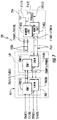
- FIG. 5 illustrates a jitter cleaner consolidation circuit 500 .
- the jitter cleaner consolidation circuit 500 includes multiplexers 502 ( 1 )- 502 (N) (generically multiplexer 502 ), where N corresponds to a number of expected network service providers (e.g., AT&T, T-MOBILE, SPRINT, VERIZON, etc.).
- Each multiplexer 502 ( 1 )- 502 (N) receives jittery clock signals (labeled JC 1 -JCM) such as from each of the transceivers 306 ( 1 )- 306 (M) of FIG. 3 .
- JC 1 -JCM jittery clock signals
- Each multiplexer 502 ( 1 )- 502 (N) is coupled to a respective jitter cleaner circuit 504 ( 1 )- 504 (N) that may be structurally the same as the jitter cleaner circuit 400 of FIG. 4 .
- the jitter cleaner circuits 504 ( 1 )- 504 (N) output cleaned clock signals (CC 1 -CC N ) to respective routers 506 ( 1 )- 506 (N).
- Each of the routers 506 ( 1 )- 506 (N) duplicates the respective cleaned clock signals CC 1 -CC N and outputs duplicative cleaned clock signals CC 1 1 -CCM 1 through CC 1 N -CCM N , respectively.
- a jitter cleaner configurator circuit 508 which may be a circuit in the control circuit 312 of FIG. 3 , may cause an individual multiplexer 502 of the multiplexers 502 ( 1 )- 502 (N) to select one of the jittery clock signals JC 1 -JCM to be passed to its respective jitter cleaner circuit 504 ( 1 )- 504 (N).
- the jitter cleaner configurator circuit 508 may control the routers 506 ( 1 )- 506 (N) to control to which transceivers 306 ( 1 )- 306 (M) specific cleaned clock signals are routed.
- the cleaned clock signal CC 1 may be duplicated into certain ones of the cleaned clock signals CC 1 1 -CCM 1 and assigned to any first set of outputs of the router 506 ( 1 ).
- the cleaned clock signal CC 2 may be duplicated into certain ones of the cleaned clock signals CC 1 2 -CCM 2 and assigned to a second set of outputs. It should be appreciated that the intersection of the first set and the second set is empty (or null) so that there is no contention between two signals being sent to a single receiver (e.g., there would not be both CC 1 1 and CC 1 2 going to the first transceiver).
- the jitter cleaner configurator circuit 508 may operate to prevent such duplicative or overlapping signal assignments.
- the jitter cleaner configurator circuit 508 also receives information about the configuration of the central unit 106 and specifically receives information indicating which of the inputs 300 ( 1 )- 300 (M) are connected to which network service providers. This information is used to control the clock inputs to the transceivers 306 ( 1 )- 306 (M).
- the jittery clock signals JC 1 -JCM may be provided to each multiplexer 502 ( 1 )- 502 ( 3 ). It should be appreciated that the plurality of inputs 300 ( 1 )- 300 (M) may be split into different subsets depending on how many signal sources are coupled to the central unit and to which inputs each signal source is coupled.
- the first multiplexer 502 ( 1 ) selects only one of the jittery clock signals JC 1 -JC 5 and JC 11 to be passed to the jitter cleaner circuit 504 ( 1 ); the second multiplexer 502 ( 2 ) selects only one of the jittery clock signals JC 6 -JC 10 and JC 12 -JC 15 to be passed to the jitter cleaner circuit 504 ( 2 ); and the third multiplexer 502 ( 3 ) selects only one of the jittery clock signals JC 16 -JC 36 to be passed to the jitter cleaner circuit 504 ( 3 ).
- the jitter cleaner circuits 504 ( 1 )- 504 ( 3 ) output respective cleaned clock signals which are then duplicated by respective routers 506 ( 1 )- 506 ( 3 ). However, the routers 506 ( 1 )- 506 ( 3 ) only output cleaned clock signals on the appropriate lines. Thus, the first router 506 ( 1 ) outputs cleaned clock signals CC 1 1 -CC 5 1 and CC 11 1 ; the second router 506 ( 2 ) outputs cleaned clock signals CC 6 2 -CC 10 2 and CC 12 2 -CC 15 2 ; and the third router 506 ( 3 ) outputs cleaned clock signals CC 16 3 -CC 36 3 .
- the cleaned clock signals are then provided to the respective transceivers 306 ( 1 )- 306 (M).
- M the number of jitter cleaners
- N the number of jitter cleaners
- M and N different savings may be realized.
- the jitter cleaner configurator circuit 508 may have the configuration manually programmed at installation and manually updated as changes are made, or this information may be collected in an automated fashion, where the control circuit queries through each input to the connected signal source to determine which signal source is connected to which input. Still other techniques of providing this information to the jitter cleaner configurator circuit 508 may be implemented without departing from the scope of the present disclosure.
- a process 600 for implementing exemplary aspects of the present disclosure begins by connecting inputs (e.g., 300 ( 1 )- 300 (M) or a subset thereof) to signal source(s) (block 602 ).
- the control circuit 312 determines which inputs are connected to a first signal source (block 604 ).
- the control circuit 312 determines which inputs are connected to the next signal source (block 606 ). This information may be mapped through a look-up table or the like in the jitter cleaner configurator circuit 508 or other element in the control circuit 312 .
- the control circuit 312 determines if that was the last signal source (block 608 ).
- the control circuit 312 iterates through the signal sources until the last signal source is mapped to inputs. Once all the inputs are mapped to signal sources (i.e., the answer to block 608 is yes), then the process 600 passes clock signals from inputs associated with a single signal source to a multiplexer (block 610 ). For each multiplexer, the control circuit 312 selects a single clock signal (block 612 ). The respective jitter cleaner cleans each selected clock signal (block 614 ). The cleaned clock signals are passed to respective routers which duplicate each cleaned clock signal (block 616 ).
- the cleaned clock signals are returned to the transceivers based on the signal source (block 618 ) and as indicated by the jitter cleaner configurator circuit 508 .
- the jitter cleaner configurator circuit 508 instructs the routers 506 ( 1 )- 506 (N) onto which outputs cleaned clock signals are duplicated.
- the process 600 of FIG. 6 is a non-limiting example and additional steps may occur without departing from the present disclosure.
- the jitter cleaner configurator circuit 508 may cause a second clock to be selected and multiplexed appropriately.
- appropriate circuitry may be added to sense the presence of the clock signal and cause the jitter cleaner configurator circuit 508 to select the clock source dynamically as needed.
- the assignment of a given router 506 ( 1 )- 506 (N) may be changed to source its clock from a different JC 1 -JCM.
- FIG. 7 is a schematic diagram of an exemplary WDS 700 provided in the form of an optical fiber-based WDS that can include a control system having the consolidated jitter cleaners of FIG. 5 .
- the WDS 700 includes an optical fiber for distributing communication services for multiple frequency bands.
- the WDS 700 in this example is comprised of three (3) main components.
- a plurality of radio interfaces provided in the form of radio interface modules (RIMs) 702 ( 1 )- 702 (M) are provided in a central unit 704 , which may be configured to include the consolidated jitter cleaners. Further, the central unit 704 may receive and process a plurality of downlink communication signals 706 D( 1 )- 706 D(R) prior to optical conversion into downlink optical fiber-based communication signals.
- RIMs radio interface modules
- the downlink communication signals 706 D( 1 )- 706 D(R) may be received from a base station as an example.
- the RIMs 702 ( 1 )- 702 (M) provide both downlink and uplink interfaces for signal processing.
- the notations “ 1 -R” and “ 1 -M” indicate that any number of the referenced component, 1 -R and 1 -M, respectively, may be provided.
- the central unit 704 is configured to accept the RIMs 702 ( 1 )- 702 (M) as modular components that can easily be installed and removed or replaced in the central unit 704 .
- the central unit 704 is configured to support up to twelve (12) RIMs 702 ( 1 )- 702 ( 12 ).
- Each of the RIMs 702 ( 1 )- 702 (M) can be designed to support a particular type of radio source or range of radio sources (i.e., frequencies) to provide flexibility in configuring the central unit 704 and the WDS 700 to support the desired radio sources.
- one RIM 702 may be configured to support the Personalized Communications System (PCS) radio band.
- Another RIM 702 may be configured to support the 800 megahertz (MHz) radio band.
- the central unit 704 could be configured to support and distribute communication signals on both PCS and Long-Term Evolution (LTE) 700 radio bands, as an example.
- PCS Personalized Communications System
- LTE Long-Term Evolution
- the RIMs 702 ( 1 )- 702 (M) may be provided in the central unit 704 that support any frequency bands desired, including, but not limited to, the US Cellular band, PCS band, Advanced Wireless Service (AWS) band, 700 MHz band, Global System for Mobile communications (GSM) 900 , GSM 1800 , and Universal Mobile Telecommunications System (UMTS).
- GSM Global System for Mobile communications
- UMTS Universal Mobile Telecommunications System
- the RIMs 702 ( 1 )- 702 (M) may also be provided in the central unit 704 that support any wireless technologies desired, including, but not limited to, Code Division Multiple Access (CDMA), CDMA200, 1 ⁇ RTT, Evolution-Data Only (EV-DO), UMTS, High-speed Packet Access (HSPA), GSM, General Packet Radio Services (GPRS), Enhanced Data GSM Environment (EDGE), Time Division Multiple Access (TDMA), LTE, iDEN, and Cellular Digital Packet Data (CDPD).
- CDMA Code Division Multiple Access
- CDMA200 Code Division Multiple Access
- 1 ⁇ RTT Evolution-Data Only
- UMTS Universal Mobile communications Service
- GSM Global System for Mobile communications
- GPRS General Packet Radio Services
- EDGE Enhanced Data GSM Environment
- TDMA Time Division Multiple Access
- LTE Long Term Evolution-Data Only
- iDEN Time Division Multiple Access
- CDPD Cellular Digital Packet Data
- the RIMs 702 ( 1 )- 702 (M) may be provided in the central unit 704 that support any frequencies desired, including, but not limited to, US FCC and Industry Canada frequencies (824-849 MHz on uplink and 869-894 MHz on downlink), US FCC and Industry Canada frequencies (1850-1915 MHz on uplink and 1930-1995 MHz on downlink), US FCC and Industry Canada frequencies (1710-1755 MHz on uplink and 2110-2155 MHz on downlink), US FCC frequencies (698-716 MHz and 776-787 MHz on uplink and 728-746 MHz on downlink), EU R & TTE frequencies (880-915 MHz on uplink and 925-960 MHz on downlink), EU R & TTE frequencies (1710-1785 MHz on uplink and 1805-1880 MHz on downlink), EU R & TTE frequencies (1920-1980 MHz on uplink and 2110-2170 MHz on downlink), US FCC frequencies (806-824 MHz on uplink and 851-869 MHz on downlink),
- the downlink communication signals 706 D( 1 )- 706 D(R) are provided to a plurality of optical interfaces provided in the form of optical interface modules (OIMs) 708 ( 1 )- 708 (N) in this embodiment to convert the downlink communication signals 706 D( 1 )- 706 D(R) into a plurality of downlink optical fiber-based communication signals 710 D( 1 )- 710 D(R).
- OIMs optical interface modules
- the OIMs 708 ( 1 )- 708 (N) may be configured to provide a plurality of optical interface components (OICs) that contain optical-to-electrical (O/E) and E/O converters, as will be described in more detail below.
- the OIMs 708 ( 1 )- 708 (N) support the radio bands that can be provided by the RIMs 702 ( 1 )- 702 (M), including the examples previously described above.
- the OIMs 708 ( 1 )- 708 (N) each include E/O converters to convert the downlink communication signals 706 D( 1 )- 706 D(R) into the downlink optical fiber-based communication signals 710 D( 1 )- 710 D(R).
- the downlink optical fiber-based communication signals 710 D( 1 )- 710 D(R) are communicated over a downlink optical fiber-based communication medium 712 D to a plurality of remote units 714 ( 1 )- 714 (S).
- the notation “ 1 -S” indicates that any number of the referenced component 1 -S may be provided.
- Remote unit O/E converters provided in the remote units 714 ( 1 )- 714 (S) convert the downlink optical fiber-based communication signals 710 D( 1 )- 710 D(R) back into the downlink communication signals 706 D( 1 )- 706 D(R), which are then converted into a plurality of downlink RF communication signals and provided to antennas 716 ( 1 )- 716 (S) in the remote units 714 ( 1 )- 714 (S) to client devices in the reception range of the antennas 716 ( 1 )- 716 (S).
- the remote units 714 ( 1 )- 714 (S) receive a plurality of uplink RF communication signals from the client devices through the antennas 716 ( 1 )- 716 (S).
- the remote units 714 ( 1 )- 714 (S) convert the uplink RF communication signals into a plurality of uplink communication signals 718 U( 1 )- 718 U(S).
- Remote unit E/O converters are also provided in the remote units 714 ( 1 )- 714 (S) to convert the uplink communication signals 718 U( 1 )- 718 U(S) into a plurality of uplink optical fiber-based communication signals 710 U( 1 )- 710 U(S).
- the remote units 714 ( 1 )- 714 (S) communicate the uplink optical fiber-based communication signals 710 U( 1 )- 710 U(S) over an uplink optical fiber-based communication medium 712 U to the OIMs 708 ( 1 )- 708 (N) in the central unit 704 .
- the OIMs 708 ( 1 )- 708 (N) include 0/E converters that convert the received uplink optical fiber-based communication signals 710 U( 1 )- 710 U(S) into a plurality of uplink communication signals 720 U( 1 )- 720 U(S), which are processed by the RIMs 702 ( 1 )- 702 (M) and provided as the uplink communication signals 720 U( 1 )- 720 U(S).
- the central unit 704 may provide the uplink communication signals 720 U( 1 )- 720 U(S) to a base station or other communication system.
- the downlink optical fiber-based communication medium 712 D and the uplink optical fiber-based communication medium 712 U connected to each of the remote units 714 ( 1 )- 714 (S) may be a common optical fiber-based communication medium, wherein for example, wave division multiplexing (WDM) is employed to provide the downlink optical fiber-based communication signals 710 D( 1 )- 710 D(R) and the uplink optical fiber-based communication signals 710 U( 1 )- 710 U(S) on the same optical fiber-based communication medium.
- WDM wave division multiplexing
- FIG. 8 is a partial schematic cut-away diagram of an exemplary building infrastructure 800 in which a WDS, such as the WDS 700 of FIG. 7 , can include consolidated jitter cleaners according to exemplary aspects of the present disclosure.
- the building infrastructure 800 in this embodiment includes a first (ground) floor 802 ( 1 ), a second floor 802 ( 2 ), and a third floor 802 ( 3 ).
- the floors 802 ( 1 )- 802 ( 3 ) are serviced by a central unit 804 to provide antenna coverage cells 806 in the building infrastructure 800 .
- the central unit 804 is communicatively coupled to a base station 808 to receive downlink communication signals 810 D from the base station 808 .
- the central unit 804 is communicatively coupled to a plurality of remote units 812 to distribute the downlink communication signals 810 D to the remote units 812 and to receive uplink communication signals 810 U from the remote units 812 , as previously discussed above.
- the downlink communication signals 810 D and the uplink communication signals 810 U communicated between the central unit 804 and the remote units 812 are carried over a riser cable 814 .
- the riser cable 814 may be routed through interconnect units (ICUs) 816 ( 1 )- 816 ( 3 ) dedicated to each of the floors 802 ( 1 )- 802 ( 3 ) that route the downlink communication signals 810 D and the uplink communication signals 810 U to the remote units 812 and also provide power to the remote units 812 via array cables 818 .
- ICUs interconnect units
- FIG. 9 is a schematic diagram representation of additional detail illustrating an exemplary computer system 900 that could be employed in a controller that controls operation of the multiplexers and routers used with the consolidated jitter cleaners.
- the computer system 900 is adapted to execute instructions from an exemplary computer-readable medium to perform these and/or any of the functions or processing described herein.
- the computer system 900 in FIG. 9 may include a set of instructions that may be executed to predict frequency interference to avoid or reduce interference in a multi-frequency distributed antenna system (DAS).
- the computer system 900 may be connected (e.g., networked) to other machines in a LAN, an intranet, an extranet, or the Internet. While only a single device is illustrated, the term “device” shall also be taken to include any collection of devices that individually or jointly execute a set (or multiple sets) of instructions to perform any one or more of the methodologies discussed herein.
- the computer system 900 may be a circuit or circuits included in an electronic board card, such as a printed circuit board (PCB), a server, a personal computer, a desktop computer, a laptop computer, a personal digital assistant (PDA), a computing pad, a mobile device, or any other device, and may represent, for example, a server or a user's computer.
- PCB printed circuit board
- PDA personal digital assistant
- the exemplary computer system 900 in this embodiment includes a processing circuit or processor 902 , a main memory 904 (e.g., read-only memory (ROM), flash memory, dynamic random access memory (DRAM), such as synchronous DRAM (SDRAM), etc.), and a static memory 906 (e.g., flash memory, static random access memory (SRAM), etc.), which may communicate with each other via a data bus 908 .
- the processor 902 may be connected to the main memory 904 and/or the static memory 906 directly or via some other connectivity means.
- the processor 902 may be a controller, and the main memory 904 or the static memory 906 may be any type of memory.
- the processor 902 represents one or more general-purpose processing devices, such as a microprocessor, CPU, or the like. More particularly, the processor 902 may be a complex instruction set computing (CISC) microprocessor, a reduced instruction set computing (RISC) microprocessor, a very long instruction word (VLIW) microprocessor, a processor implementing other instruction sets, or other processors implementing a combination of instruction sets.
- the processor 902 is configured to execute processing logic in instructions for performing the operations and steps discussed herein.
- the processor 902 can be configured to function as the control circuit 312 of FIG. 3 or the jitter cleaner configurator circuit 508 of FIG. 5 .
- the computer system 900 may further include a network interface device 910 .
- the computer system 900 also may or may not include an input 912 , configured to receive input and selections to be communicated to the computer system 900 when executing instructions.
- the computer system 900 also may or may not include an output 914 , including, but not limited to, a display, a video display unit (e.g., a liquid crystal display (LCD) or a cathode ray tube (CRT)), an alphanumeric input device (e.g., a keyboard), and/or a cursor control device (e.g., a mouse).
- a display e.g., a liquid crystal display (LCD) or a cathode ray tube (CRT)
- an alphanumeric input device e.g., a keyboard
- a cursor control device e.g., a mouse
- the computer system 900 may or may not include a data storage device that includes instructions 916 stored in a computer-readable medium 918 .
- the instructions 916 may also reside, completely or at least partially, within the main memory 904 and/or within the processor 902 during execution thereof by the computer system 900 , the main memory 904 and the processor 902 also constituting a computer-readable medium.
- the instructions 916 may further be transmitted or received over a network 920 via the network interface device 910 .
- While the computer-readable medium 918 is shown in an exemplary embodiment to be a single medium, the term “computer-readable medium” should be taken to include a single medium or multiple media (e.g., a centralized or distributed database, and/or associated caches and servers) that store the one or more sets of instructions.
- the term “computer-readable medium” shall also be taken to include any medium that is capable of storing, encoding, or carrying a set of instructions for execution by the processing device that cause the processing device to perform any one or more of the methodologies of the embodiments disclosed herein.
- the term “computer-readable medium” shall accordingly be taken to include, but not be limited to, solid-state memories, optical media, and magnetic media.
- the embodiments disclosed herein include various steps.
- the steps of the embodiments disclosed herein may be formed by hardware components or may be embodied in machine-executable instructions, which may be used to cause a general-purpose or special-purpose processor programmed with the instructions to perform the steps.
- the steps may be performed by a combination of hardware and software.
- the embodiments disclosed herein may be provided as a computer program product, or software, that may include a machine-readable medium (or computer-readable medium) having stored thereon instructions, which may be used to program a computer system (or other electronic devices) to perform a process according to the embodiments disclosed herein.
- a machine-readable medium includes any mechanism for storing or transmitting information in a form readable by a machine (e.g., a computer).
- a machine-readable medium includes: a machine-readable storage medium (e.g., read only memory (ROM), random access memory (RAM), a magnetic disk storage medium, an optical storage medium, flash memory devices, etc.), and the like.
Landscapes
- Engineering & Computer Science (AREA)
- Computer Networks & Wireless Communication (AREA)
- Signal Processing (AREA)
- Power Engineering (AREA)
- Quality & Reliability (AREA)
- Mobile Radio Communication Systems (AREA)
Abstract
Description
Claims (14)
Priority Applications (1)
| Application Number | Priority Date | Filing Date | Title |
|---|---|---|---|
| US16/264,240 US10862632B2 (en) | 2018-10-01 | 2019-01-31 | Systems and methods for reducing redundant jitter cleaners in wireless distribution systems |
Applications Claiming Priority (2)
| Application Number | Priority Date | Filing Date | Title |
|---|---|---|---|
| US201862739407P | 2018-10-01 | 2018-10-01 | |
| US16/264,240 US10862632B2 (en) | 2018-10-01 | 2019-01-31 | Systems and methods for reducing redundant jitter cleaners in wireless distribution systems |
Publications (2)
| Publication Number | Publication Date |
|---|---|
| US20200106570A1 US20200106570A1 (en) | 2020-04-02 |
| US10862632B2 true US10862632B2 (en) | 2020-12-08 |
Family
ID=69946646
Family Applications (1)
| Application Number | Title | Priority Date | Filing Date |
|---|---|---|---|
| US16/264,240 Active US10862632B2 (en) | 2018-10-01 | 2019-01-31 | Systems and methods for reducing redundant jitter cleaners in wireless distribution systems |
Country Status (1)
| Country | Link |
|---|---|
| US (1) | US10862632B2 (en) |
Families Citing this family (1)
| Publication number | Priority date | Publication date | Assignee | Title |
|---|---|---|---|---|
| US20250358081A1 (en) * | 2022-12-27 | 2025-11-20 | Rakuten Symphony, Inc. | Managing multiple carriers of radio discovered by ngdu in o-ran |
Citations (6)
| Publication number | Priority date | Publication date | Assignee | Title |
|---|---|---|---|---|
| US20040203703A1 (en) * | 2002-03-11 | 2004-10-14 | Fischer Larry G. | Distribution of wireless telephony and data signals in a substantially closed environment |
| US20070057697A1 (en) * | 2005-09-15 | 2007-03-15 | Boerstler David W | Apparatus and method for verifying glitch-free operation of a multiplexer |
| US20110299641A1 (en) * | 2007-03-20 | 2011-12-08 | Ozdal Barkan | Synchronous Network Device |
| US20170026857A1 (en) * | 2012-02-02 | 2017-01-26 | Commscope Technologies Llc | Optimized telecommunications distribution system |
| US9742549B1 (en) * | 2016-09-29 | 2017-08-22 | Analog Devices Global | Apparatus and methods for asynchronous clock mapping |
| US20190319736A1 (en) * | 2018-04-13 | 2019-10-17 | Commscope Technologies Llc | Configurable wide area distributed antenna system |
-
2019
- 2019-01-31 US US16/264,240 patent/US10862632B2/en active Active
Patent Citations (6)
| Publication number | Priority date | Publication date | Assignee | Title |
|---|---|---|---|---|
| US20040203703A1 (en) * | 2002-03-11 | 2004-10-14 | Fischer Larry G. | Distribution of wireless telephony and data signals in a substantially closed environment |
| US20070057697A1 (en) * | 2005-09-15 | 2007-03-15 | Boerstler David W | Apparatus and method for verifying glitch-free operation of a multiplexer |
| US20110299641A1 (en) * | 2007-03-20 | 2011-12-08 | Ozdal Barkan | Synchronous Network Device |
| US20170026857A1 (en) * | 2012-02-02 | 2017-01-26 | Commscope Technologies Llc | Optimized telecommunications distribution system |
| US9742549B1 (en) * | 2016-09-29 | 2017-08-22 | Analog Devices Global | Apparatus and methods for asynchronous clock mapping |
| US20190319736A1 (en) * | 2018-04-13 | 2019-10-17 | Commscope Technologies Llc | Configurable wide area distributed antenna system |
Also Published As
| Publication number | Publication date |
|---|---|
| US20200106570A1 (en) | 2020-04-02 |
Similar Documents
| Publication | Publication Date | Title |
|---|---|---|
| US9780841B2 (en) | Distributed antenna systems (DAS) supporting expanded, programmable communications services distribution to programmable remote communications service sector areas | |
| US10187150B2 (en) | Direct communicative coupling of a radio source to a remote unit for exchanging communications services with a distributed communications system (DCS) | |
| US11811630B2 (en) | Managing a communications system based on software defined networking (SDN) architecture | |
| US9807558B2 (en) | Identifying remote units in a wireless distribution system (WDS) based on assigned unique temporal delay patterns | |
| US10602393B2 (en) | Front-haul communications system for enabling communication service continuity in a wireless distribution system (WDS) network | |
| US11736961B2 (en) | Multi-band remote unit in a wireless communications system (WCS) | |
| US10181906B1 (en) | Gain level control circuit supporting dynamic gain control in a wireless communications system (WCS) | |
| US10164675B2 (en) | Wideband digital distributed communications system(s) (DCS) employing programmable digital signal processing circuit for scaling supported communications services | |
| US10819477B2 (en) | Digital wireless distributed communications system (WDCS) employing a centralized spectrum chunk construction of communications channels for distribution to remote units to reduce transmission data rates | |
| US10862632B2 (en) | Systems and methods for reducing redundant jitter cleaners in wireless distribution systems | |
| US10833635B2 (en) | Optimizing power efficiency of a power amplifier circuit to reduce power consumption in a remote unit in a wireless distribution system (WDS) | |
| US11296752B2 (en) | Remote unit supporting radio frequency (RF) spectrum-based coverage area optimization in a wireless distribution system (WDS) | |
| US10601534B2 (en) | Automatic configuration of cell assignment of non-inter-cell interference coordination (non-ICIC)-engaged remote units in a wireless distributed communications system (WDCS) to non-ICIC-engaged WDCS cells to avoid or reduce dividing radio resources |
Legal Events
| Date | Code | Title | Description |
|---|---|---|---|
| FEPP | Fee payment procedure |
Free format text: ENTITY STATUS SET TO UNDISCOUNTED (ORIGINAL EVENT CODE: BIG.); ENTITY STATUS OF PATENT OWNER: LARGE ENTITY |
|
| AS | Assignment |
Owner name: CORNING OPTICAL COMMUNICATIONS LLC, NORTH CAROLINA Free format text: ASSIGNMENT OF ASSIGNORS INTEREST;ASSIGNORS:KULIK, SHLOMI;LUPESCU, GUY;REEL/FRAME:048217/0197 Effective date: 20190130 |
|
| AS | Assignment |
Owner name: CORNING OPTICAL COMMUNICATIONS LLC, NORTH CAROLINA Free format text: ASSIGNMENT OF ASSIGNORS INTEREST;ASSIGNOR:CORNING OPTICAL COMMUNICATIONS WIRELESS LTD;REEL/FRAME:048411/0787 Effective date: 20190101 |
|
| STPP | Information on status: patent application and granting procedure in general |
Free format text: RESPONSE TO NON-FINAL OFFICE ACTION ENTERED AND FORWARDED TO EXAMINER |
|
| STCF | Information on status: patent grant |
Free format text: PATENTED CASE |
|
| MAFP | Maintenance fee payment |
Free format text: PAYMENT OF MAINTENANCE FEE, 4TH YEAR, LARGE ENTITY (ORIGINAL EVENT CODE: M1551); ENTITY STATUS OF PATENT OWNER: LARGE ENTITY Year of fee payment: 4 |
|
| AS | Assignment |
Owner name: ANI ACQUISITION SUB, LLC, FLORIDA Free format text: ASSIGNMENT OF ASSIGNORS INTEREST;ASSIGNOR:CORNING OPTICAL COMMUNICATIONS LLC;REEL/FRAME:071270/0328 Effective date: 20250331 Owner name: ANI ACQUISITION SUB, LLC, FLORIDA Free format text: ASSIGNMENT OF ASSIGNOR'S INTEREST;ASSIGNOR:CORNING OPTICAL COMMUNICATIONS LLC;REEL/FRAME:071270/0328 Effective date: 20250331 |