US10862319B2 - Battery module with abnormality detection function and power storage apparatus and method of operating the same - Google Patents

Battery module with abnormality detection function and power storage apparatus and method of operating the same Download PDF

Info

Publication number
US10862319B2
US10862319B2 US16/020,336 US201816020336A US10862319B2 US 10862319 B2 US10862319 B2 US 10862319B2 US 201816020336 A US201816020336 A US 201816020336A US 10862319 B2 US10862319 B2 US 10862319B2
Authority
US
United States
Prior art keywords
protection unit
battery
indication element
power storage
storage apparatus
Prior art date
Legal status (The legal status is an assumption and is not a legal conclusion. Google has not performed a legal analysis and makes no representation as to the accuracy of the status listed.)
Active, expires
Application number
US16/020,336
Other versions
US20190157880A1 (en
Inventor
Yuan-Fang Lai
Ying-Sung Chang
Current Assignee (The listed assignees may be inaccurate. Google has not performed a legal analysis and makes no representation or warranty as to the accuracy of the list.)
Delta Electronics Inc
Original Assignee
Delta Electronics Inc
Priority date (The priority date is an assumption and is not a legal conclusion. Google has not performed a legal analysis and makes no representation as to the accuracy of the date listed.)
Filing date
Publication date
Application filed by Delta Electronics Inc filed Critical Delta Electronics Inc
Assigned to DELTA ELECTRONICS, INC. reassignment DELTA ELECTRONICS, INC. ASSIGNMENT OF ASSIGNORS INTEREST (SEE DOCUMENT FOR DETAILS). Assignors: LAI, YUAN-FANG, CHANG, YING-SUNG
Publication of US20190157880A1 publication Critical patent/US20190157880A1/en
Application granted granted Critical
Publication of US10862319B2 publication Critical patent/US10862319B2/en
Active legal-status Critical Current
Adjusted expiration legal-status Critical

Links

Images

Classifications

    • H02J7/0026
    • HELECTRICITY
    • H01ELECTRIC ELEMENTS
    • H01MPROCESSES OR MEANS, e.g. BATTERIES, FOR THE DIRECT CONVERSION OF CHEMICAL ENERGY INTO ELECTRICAL ENERGY
    • H01M10/00Secondary cells; Manufacture thereof
    • H01M10/42Methods or arrangements for servicing or maintenance of secondary cells or secondary half-cells
    • H01M10/48Accumulators combined with arrangements for measuring, testing or indicating the condition of cells, e.g. the level or density of the electrolyte
    • HELECTRICITY
    • H01ELECTRIC ELEMENTS
    • H01MPROCESSES OR MEANS, e.g. BATTERIES, FOR THE DIRECT CONVERSION OF CHEMICAL ENERGY INTO ELECTRICAL ENERGY
    • H01M10/00Secondary cells; Manufacture thereof
    • H01M10/42Methods or arrangements for servicing or maintenance of secondary cells or secondary half-cells
    • H01M10/46Accumulators structurally combined with charging apparatus
    • HELECTRICITY
    • H01ELECTRIC ELEMENTS
    • H01MPROCESSES OR MEANS, e.g. BATTERIES, FOR THE DIRECT CONVERSION OF CHEMICAL ENERGY INTO ELECTRICAL ENERGY
    • H01M10/00Secondary cells; Manufacture thereof
    • H01M10/42Methods or arrangements for servicing or maintenance of secondary cells or secondary half-cells
    • H01M10/48Accumulators combined with arrangements for measuring, testing or indicating the condition of cells, e.g. the level or density of the electrolyte
    • H01M10/482Accumulators combined with arrangements for measuring, testing or indicating the condition of cells, e.g. the level or density of the electrolyte for several batteries or cells simultaneously or sequentially
    • HELECTRICITY
    • H01ELECTRIC ELEMENTS
    • H01MPROCESSES OR MEANS, e.g. BATTERIES, FOR THE DIRECT CONVERSION OF CHEMICAL ENERGY INTO ELECTRICAL ENERGY
    • H01M50/00Constructional details or processes of manufacture of the non-active parts of electrochemical cells other than fuel cells, e.g. hybrid cells
    • H01M50/50Current conducting connections for cells or batteries
    • H01M50/569Constructional details of current conducting connections for detecting conditions inside cells or batteries, e.g. details of voltage sensing terminals
    • H02J7/0021
    • H02J7/50
    • H02J7/62
    • H02J7/82
    • HELECTRICITY
    • H02GENERATION; CONVERSION OR DISTRIBUTION OF ELECTRIC POWER
    • H02JCIRCUIT ARRANGEMENTS OR SYSTEMS FOR SUPPLYING OR DISTRIBUTING ELECTRIC POWER; SYSTEMS FOR STORING ELECTRIC ENERGY
    • H02J7/00Circuit arrangements for charging or depolarising batteries or for supplying loads from batteries
    • H02J7/0068Battery or charger load switching, e.g. concurrent charging and load supply
    • H02J7/865
    • YGENERAL TAGGING OF NEW TECHNOLOGICAL DEVELOPMENTS; GENERAL TAGGING OF CROSS-SECTIONAL TECHNOLOGIES SPANNING OVER SEVERAL SECTIONS OF THE IPC; TECHNICAL SUBJECTS COVERED BY FORMER USPC CROSS-REFERENCE ART COLLECTIONS [XRACs] AND DIGESTS
    • Y02TECHNOLOGIES OR APPLICATIONS FOR MITIGATION OR ADAPTATION AGAINST CLIMATE CHANGE
    • Y02EREDUCTION OF GREENHOUSE GAS [GHG] EMISSIONS, RELATED TO ENERGY GENERATION, TRANSMISSION OR DISTRIBUTION
    • Y02E60/00Enabling technologies; Technologies with a potential or indirect contribution to GHG emissions mitigation
    • Y02E60/10Energy storage using batteries

Definitions

  • the present invention relates to a battery module and a power storage apparatus and a method of operating the same, and more particularly to a battery module with an abnormality detection function and a power storage apparatus and a method of operating the same.
  • UPS uninterruptible power supply
  • the UPS uninterruptedly supplies the required power to the critical commercial devices, such as the server and switch or precision devices to prevent the loss of important data stored in the critical commercial devices or the precision devices from the interrupted power supply.
  • the used power storage device inside the UPS is commonly the rechargeable battery.
  • the fuse is cooperated with the rechargeable battery to protect the rechargeable battery by the failure isolation.
  • the fuses are usually used to protect a plurality of battery modules as a whole according a total current of the battery modules as a whole.
  • the existing protection fails to individually provide protection and detect abnormal operation for single battery module. Once any one of the battery modules is abnormal, however, it fails to accurately and quickly determine which battery module is abnormal, thereby affecting the efficiency of excluding the abnormal condition.
  • An objective of the present invention is to provide a battery module with an abnormality detection function to solve the above-mentioned problems of failing to individually provide protection and detect abnormal operation for single battery module.
  • the battery module with the abnormality detection function includes a body, a battery assembly, a protection unit, and a detection unit.
  • the battery assembly is disposed inside the body, and the battery assembly has a plurality of battery units electrically connected to each other.
  • the protection unit is disposed inside the body and connected in series to the battery assembly, and the protection unit has a first end and a second end.
  • the detection unit is disposed inside the body and connected in parallel between the first end and the second end of the protection unit.
  • the detection unit includes an indication element. The indication element is to be enabled by a voltage difference value between the first end and the second end when the voltage difference value is greater than a voltage setting value.
  • the detection unit further includes a current-limiting resistor and a diode.
  • the current-limiting resistor is connected in series to the indication element.
  • the diode is forward connected in series to the current-limiting resistor or the indication element.
  • the detection unit further includes a voltage-limiting resistor.
  • the voltage-limiting resistor is connected in parallel to the indication element.
  • a resistance value of the voltage-limiting resistor is greater than a resistance value of the current-limiting resistor.
  • the protection unit is a fuse.
  • the indication element is a light indication element or a sound indication element.
  • the first end and the second end of the protection unit are coupled to the body to form at least two dry contacts, and the at least two dry contacts are connected to an external monitoring apparatus; concerned information of the voltage difference value is transmitted to the external monitoring apparatus so that the external monitoring apparatus is configured to monitor an operation status of the battery module according to the concerned information of the voltage difference value.
  • the battery module with the abnormality detection function further includes a connection interface.
  • the connection interface is disposed inside the body and connected to two ends of a serial-connected structure formed by the battery module and the protection unit, and the connection interface provides a positive terminal and a negative terminal.
  • the battery module with the abnormality detection function is implemented to individually provide protection and detect abnormal operation for single battery module by using simple circuit components installed in each battery module.
  • Another objective of the present invention is to provide a power storage apparatus to solve the above-mentioned problems of failing to individually provide protection and detect abnormal operation for single battery module.
  • the power storage apparatus includes at least one battery module with an abnormality detection function and a charging module.
  • Each battery module includes a body, a battery assembly, a protection unit, and a detection unit.
  • the battery assembly is disposed inside the body, and the battery assembly has a plurality of battery units electrically connected to each other.
  • the protection unit is disposed inside the body and connected in series to the battery assembly, and the protection unit has a first end and a second end.
  • the detection unit is disposed inside the body and connected in parallel between the first end and the second end of the protection unit, and the detection unit includes an indication element.
  • the indication element is to be enabled by a voltage difference value between the first end and the second end when the voltage difference value is greater than a voltage setting value.
  • the charging module is connected in parallel to the at least one battery module and charges the at least one battery assembly of the at least one battery module.
  • the number of the battery module is one, and the one battery module is connected in parallel to the charging module.
  • the indication element is not enabled if the protection unit is not disconnected when the charging module charges the battery assembly; the indication element is enabled if the protection unit is disconnected so that the voltage difference value of the protection unit is greater than the voltage setting value when the charging module charges the battery assembly.
  • the number of the battery module is two or more than two, and a serial-connected branch formed by the two or more than two battery modules is connected in parallel to the charging module.
  • the indication elements are not enabled if the two or more than two protection units are not disconnected when the charging module charges the two or more than two battery assemblies on the serial-connected branch; the indication element of at least one disconnected protection unit is enabled if the at least one protection unit is disconnected so that the voltage difference value of the at least one disconnected protection unit is greater than the voltage difference value when the charging module charges the two or more than two battery assemblies on the serial-connected branch.
  • the number of the battery module is four or more than four, and at least two serial-connected branches formed by the four or more than four battery modules are connected in parallel to the charging module.
  • the indication elements are not enabled if the four or more than four protection units are not disconnected when the charging module charges the four or more than four battery assemblies on the at least two serial-connected branches; the indication element of at least one disconnected protection unit is enabled if the at least one protection unit is disconnected so that the voltage difference value of the at least one disconnected protection unit is greater than the voltage difference value when the charging module charges the four or more than four battery assemblies on the at least two serial-connected branches; the indication element of at least one disconnected protection unit is not enabled if the at least one protection unit is disconnected so that the voltage difference value of the at least one disconnected protection unit is less than or equal to the voltage difference value after the charging module completes charging the four or more than four battery assemblies on the at least two serial-connected branches; the indication element of at least one disconnected protection unit is enabled if the at least one protection unit is disconnected so that the voltage difference value of the at least
  • the charging module is an AC-to-DC converter.
  • the power storage apparatus is implemented to individually provide protection and detect abnormal operation for single battery module by using simple circuit components installed in each battery module.
  • Another further objective of the present invention is to provide a method of operating a battery module with an abnormality detection function to solve the above-mentioned problems of failing to individually provide protection and detect abnormal operation for single battery module.
  • the method of operating the battery module with an abnormality detection function includes steps of: (a) providing a battery module, wherein the battery module comprises a battery assembly, a protection unit, and a detection unit; (b) providing a first current path and a second current path; wherein the protection unit and the battery assembly are located on the first current path, and the detection unit and the battery assembly are located on the second current path; and (c) flowing an operation current through the second current path when the protection unit is disconnected; flowing the operation current through the first current path when the protection is not disconnected.
  • the operation current flows through the second current path when a voltage value across two ends of the protection unit is greater than a voltage setting value.
  • the detection unit includes an indication element.
  • the indication element is enabled by the operation current when the voltage value across two ends of the protection unit is greater than the voltage setting value.
  • the detection unit further includes a current-limiting resistor and a diode.
  • the current-limiting resistor is connected in series to the indication element.
  • the diode is forward connected in series to the current-limiting resistor or the indication element.
  • the detection unit further includes a voltage-limiting resistor.
  • the voltage-limiting resistor is connected in parallel to the indication element.
  • the protection unit is a fuse.
  • the indication element is a light indication element or a sound indication element.
  • the method of operating a battery module with an abnormality detection function is implemented to individually provide protection and detect abnormal operation for single battery module by using simple circuit components installed in each battery module on different current paths.
  • FIG. 1A is a perspective view of a battery module with an abnormality detection function according to the present invention.
  • FIG. 1B is a perspective assembled view of the battery modules in FIG. 1A .
  • FIG. 2 is a circuit diagram of the battery module according to a first embodiment of the present invention.
  • FIG. 3 is a circuit diagram of the battery module according to a second embodiment of the present invention.
  • FIG. 4 is a circuit diagram of the battery module according to a third embodiment of the present invention.
  • FIG. 5 is a circuit block diagram of a power storage apparatus according to a first embodiment of the present invention.
  • FIG. 6 is a schematic view of applying an UPS cabinet to an external monitoring apparatus according to the present invention.
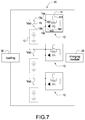
  • FIG. 7 is a circuit block diagram of the power storage apparatus according to a second embodiment of the present invention.
  • FIG. 8 is a circuit block diagram of the power storage apparatus according to a third embodiment of the present invention.
  • FIG. 9 is a flowchart of a method of operating a battery module with an abnormality detection function according to the present invention.
  • FIG. 1A and FIG. 1B show a perspective view of a battery module with an abnormality detection function and a perspective assembled view of the battery modules according to the present invention, respectively.
  • the battery module with the abnormality detection function (hereinafter referred to as “battery module 10 ”) includes a body 11 , and the body 11 is used to contain electrical elements of the battery module 10 .
  • the details of the battery module 10 will be described as follows.
  • FIG. 2 shows a circuit diagram of the battery module according to a first embodiment of the present invention.
  • the battery module 10 further includes a battery assembly 12 , a protection unit 13 , and a detection unit 14 .
  • the battery assembly 12 is disposed inside the body 11 , and the battery assembly 12 has a plurality of battery units electrically connected to each other.
  • the battery assembly 12 includes, for example but not limited to, seven rechargeable batteries which are connected in series to each other and disposed inside the body 11 . Also, each rechargeable battery may individually provide 12-volt DC voltage and therefore the battery assembly 12 may provide 84-volt DC voltage as an uninterruptible power source.
  • the protection unit 13 is disposed inside the body 11 and connected in series to the battery assembly 12 . As shown in FIG. 2 , the protection unit 13 has a first end 13 a and a second end 13 b , and the second end 13 b is connected in series to a positive side of the battery assembly 12 to form a serial-connected structure. In another embodiment, the first end 13 a may be connected in series to a negative side of the battery assembly 12 to also form another serial-connected structure. In this embodiment, the protection unit 13 is a fuse. When a current flowing through the serial-connected structure formed by the battery assembly 12 and the protection unit 13 is excessive, the fuse blows due to the heat generated by the excessive current, and therefore the serial-connected structure is disconnected to protect the battery module 10 from damage. In another embodiment, however, the protection unit 13 is not limited to the fuse, namely other electrical components capable of providing over-current and/or over-voltage protections can be used as the protection unit 13 .
  • the detection unit 14 is disposed inside the body 11 and connected in parallel to the protection unit 13 . As shown in FIG. 2 , the detection unit 14 has a first connection end 14 a and a second connection end 14 b , and the first connection end 14 a is connected to the first end 13 a of the protection unit 13 and the second connection end 14 b is connected to the second end 13 b of the protection unit 13 . In one example, the detection unit 14 has only an indication element 141 , namely two ends of the indication element 141 are respectively the first connection end 14 a and the second connection end 14 b , and the two ends of the indication element 141 are directly connected in parallel to the first end 13 a and the second end 13 b of the protection unit 13 , respectively.
  • the indication element 141 may be a light indication element or a sound indication element.
  • the light indication element may be, but not limited to, a light-emitting diode (LED), a seven-segment display, or a liquid crystal display (LCD);
  • the sound indication element may be, but not limited to, a buzzer or a speaker.
  • the indication element 141 is not limited to the above-mentioned devices, namely other electrical devices capable of indicating or rendering the operation status of the battery module 10 can be used as the indication element 141 .
  • the detection unit 14 shown in FIG. 2 further has a current-limiting resistor 142 and a diode 143 besides the indication element 141 .
  • the current-limiting resistor 142 is connected in series to the indication element 141 for limiting a current flowing through the indication element 141 , thereby protecting the indication element 141 from the excessive current.
  • a Zener diode is provided to connect in parallel to a serial-connected branch formed by the current-limiting resistor 142 and the indication element 141 , and therefore to further limit the brightness of the indication element 141 .
  • the diode 143 is forward connected in series to the current-limiting resistor 142 or the indication element 141 for protecting the detection unit 14 from a reverse voltage, namely an opposite-polarity voltage applied to the detection unit 14 .
  • the absence of the diode 143 in the detection unit 14 makes the detection unit 14 be able to provide the abnormality detection function when the battery assembly 12 discharges.
  • the voltage difference value Vab When a voltage difference value Vab produced between the first end 13 a and the second end 13 b of the protection unit 13 is greater than a voltage setting value, the voltage difference value Vab is sufficient to enable the indication element 141 .
  • the voltage setting value is, but not limited to, 5 volts.
  • the voltage difference value Vab is zero volt so that the voltage difference value Vab is less than the voltage setting value (5 volts) and insufficient to enable the indication element 141 .
  • the voltage difference value Vab is insufficient to enable the LED to light up.
  • the LED does not light up when the current flowing through the fuse is normal. Accordingly, when a system operator or a system maintainer sees that the LEDs are extinguished, he or she can realize that the operation status of the battery module 10 is normal.
  • the detection unit 14 when the operation status of the battery module 10 is normal, the detection unit 14 is idle. At this condition, there is almost no power consumption generated from the indication element 141 , the current-limiting resistor 142 , and the diode 143 , and thereby achieving the low power consumption.
  • the indication element 14 may be the light-emitting diode (LED), the seven-segment display, the liquid crystal display (LCD), the buzzer, or the speaker as long as the voltage setting values Vset are appropriately predetermined for the above-mentioned components and devices to make them indicate or render the operation status of the battery module 10 in the light manner or sound manner.
  • the indication element 141 may be partially or completely exposed outside the body 11 so that the system operator or the system maintainer easily realizes the abnormal operation status of the system through the light indication or the sound indication of the indication element 141 .
  • the fuse blows.
  • the voltage difference value Vab is up to six volts so that the voltage difference value Vab is greater than the voltage setting value and sufficient to enable the indication element 141 .
  • the voltage difference value Vab is sufficient to enable the LED to light up.
  • the LED lights up when the current flowing through the fuse is excessive. Accordingly, when the system operator or the system maintainer sees that the LEDs light or blink, he or she can realize that the operation status of the battery module 10 is abnormal, and therefore the battery module 10 shall be replaced or repaired.
  • FIG. 3 is a circuit diagram of the battery module according to a second embodiment of the present invention.
  • the detection unit 14 of the battery module 10 shown in FIG. 14 further includes a voltage-limiting resistor 144 .
  • the voltage-limiting resistor 144 is connected in parallel to the indication element 141 .
  • a resistance value of the voltage-limiting resistor 144 is greater than a resistance value of the current-limiting resistor 142 .
  • the resistance value of the voltage-limiting resistor 144 is designed to be much greater than the resistance value of the current-limiting resistor 142 .
  • the resistance value of the current-limiting resistor 142 may be designed to be, but not limited to, 10 3 ohms and the resistance value of the voltage-limiting resistor 144 may be designed to be, but not limited to, 10 6 ohms, but not limited.
  • the resistance value of the voltage-limiting resistor 144 may be designed to be more than a thousand times the resistance value of the current-limiting resistor 142 .
  • the voltage difference value Vab is minus.
  • the diode 143 and the LED, namely the indication element 141 are in reverse biased, and therefore the voltage-limiting resistor 144 is used to significantly reduce a voltage value across the indication element 141 , thereby protecting the indication element 141 from the reverse-biased voltage.
  • the indication element 141 is connected in parallel to the voltage-limiting resistor 144 with a high impedance, the indication element 141 can still normally operate at a normal current without being affected by the voltage-limiting resistor 144 when the indication element 141 is in forward biased.
  • FIG. 4 is a circuit diagram of the battery module according to a third embodiment of the present invention.
  • the concerned information of the voltage difference value Vab of the protection unit 13 acquired by the battery module 10 may be transmitted to an external monitoring apparatus in a remote location. Therefore, the system operator or the system maintainer can realize the operation status of the battery module 10 according to the monitored or recorded information of the voltage difference value Vab and/or perform the required replacement or repair.
  • two ends of the protection unit 13 are electrically connected or optically coupled to the body 11 of the battery module 10 to form dry contacts or the like of it.
  • the concerned information of the voltage difference value Vab of the protection unit 13 acquired by the battery modules 10 may be transmitted to an external monitoring apparatus, such as an UPS (uninterruptible power supply) or an EMS (environmental management system) through the dry contacts. Accordingly, the system operator or the system maintainer can monitor or record in a remote location to increase the efficiency of managing the uninterruptible power supply.
  • UPS uninterruptible power supply
  • EMS environmental management system
  • the battery module 10 further includes a connection interface 17 .
  • the connection interface 17 is inside the body 11 or on one side of the body 11 , and the connection interface 17 provides a positive terminal T+ and a negative terminal T ⁇ for connecting to two ends of a serial-connected structure formed by the battery assembly 12 and the protection unit 13 . More specifically, the connection interface 17 has two electrical interfaces, wherein one is a positive electrical interface providing the positive terminal T+ and the other is a negative electrical interface providing the negative terminal T ⁇ . The two electrical interfaces are used for connections of multiple battery modules in serial and/or parallel manners.
  • the battery modules 10 are connected in parallel to each other.
  • the positive terminal T+ of one connection interface is correspondingly connected to the negative terminal T ⁇ of another connection interface, the battery modules 10 are connected in series.
  • the battery module with the abnormality detection function is applied to an uninterruptible power supply (UPS).
  • UPS uninterruptible power supply
  • the power storage apparatus 40 is installed inside the UPS cabinet 100 to uninterruptedly supply power. When the main power source interrupts or fails, the power storage apparatus 40 can immediately supply the required power to the load, such the computer device to work in a normal condition.
  • FIG. 5 is a circuit block diagram of a power storage apparatus according to a first embodiment of the present invention.
  • the power storage apparatus 40 includes at least one battery module with an abnormality detection function (hereinafter referred to as “battery module 10 ”) and a charging module 20 , and the power storage apparatus 40 uninterruptedly supplies power to a loading 30 , for example but not limited to, a DC-to-AC inverter or a DC-to-DC converter.
  • a loading 30 for example but not limited to, a DC-to-AC inverter or a DC-to-DC converter.
  • each of the battery modules 10 has a body 11 , and further includes a battery assembly 12 , a protection unit 13 , and a detection unit 14 .
  • the detection unit 14 includes an indication element 141 , and the indication element 14 is used to indicate or render an operation status, and particularly to an abnormal status of the battery module 10 . Since the battery module 10 has disclosed above, the detail descriptions of the units of the battery module 10 are omitted here for conciseness.
  • the charging module 20 is connected in parallel to the at least one battery module 10 and the loading 30 for charging the at least one battery module 10 . Also, the electricity power stored in the at least one battery module 10 is provided for supplying the loading 30 when the main power source interrupts or fails.
  • the number of the at least one battery module 10 is one, and the one battery module 10 is connected in parallel to the charging module 20 .
  • the indication element 141 of the battery module 10 is not enabled if the protection unit 13 of the battery module 10 is not disconnected, namely the protection unit 13 is normally conductive.
  • the protection unit 13 disconnects, for example make the fuse blow, and the voltage difference value Vab between the first end 13 a and the second end 13 b is zero which is less than the voltage setting value Vset (5 volts), and therefore the voltage difference value Vab is insufficient to drive the indication element 141 (such as the LED) to light up. Accordingly, when the system operator or the system maintainer sees that the LEDs are extinguished, he or she can realize that the operation status of the battery module 10 is normal.
  • the indication element 141 of the battery module 10 is enabled if the protection unit 13 of the battery module 10 is disconnected.
  • the voltage difference value Vab between the first end 13 a and the second end 13 b is greater than the voltage setting value Vset, and therefore the voltage difference value Vab is sufficient to enable the LED to light up. Accordingly, when the system operator or the system maintainer sees that the LEDs light or blink, he or she can realize that the operation status of the battery module 10 is abnormal, and therefore the battery module 10 shall be replaced or repaired.
  • FIG. 6 is a schematic view of applying an UPS cabinet to an external monitoring apparatus according to the present invention.
  • the power storage apparatus 40 is installed inside the uninterruptible power supply (UPS) cabinet 100 .
  • the power storage apparatus 40 may be connected to an external monitoring apparatus 50 in a wired manner. More specifically, the power storage apparatus 40 may provide the concerned information of the voltage difference values Vab of the protection units 13 acquired by the battery modules 10 to the external monitoring apparatus 50 through the dry contacts and the physical wires. Therefore, the concerned information of the voltage difference value Vab of the protection unit 13 acquired by the battery modules 10 may be transmitted to the external monitoring apparatus 50 through a wired manner and the concerned information of the voltage difference value Vab is rendered on the external monitoring apparatus 50 . Accordingly, the system operator or the system maintainer can realize the operation statuses of the battery module 10 according to the concerned information of the voltage difference value Vab rendered on the external monitoring apparatus 50 and/or performs the required replacement or repair.
  • the system operator or the system maintainer can realize the operation statuses of the battery module 10 according
  • FIG. 7 is a circuit block diagram of the power storage apparatus according to a second embodiment of the present invention.
  • the major difference between the second embodiment shown in FIG. 7 and the first embodiment shown in FIG. 5 is that the number of the at least one battery module 10 of the former is two or more than two.
  • the more than two battery modules 10 are connected to form a serial-connected branch, and the serial-connected branch is connected in parallel to the charging module 20 .
  • the charging module 20 charges the more than two battery assemblies 12 on the serial-connected branch, the more than two indication elements 141 of the battery modules 10 are not enabled if the more than two protection units 13 of the battery modules 10 are not disconnected (normally conductive).
  • the voltage difference value Vab of each protection unit 13 is zero volt, and the voltage difference value Vab is less than the voltage setting value (5 volts) and insufficient to enable the indication element 141 . Accordingly, when the system operator or the system maintainer sees that the LEDs are extinguished, he or she can realize that the operation status of the battery module 10 is normal.
  • the indication element 141 corresponding to the disconnected protection unit 13 is driven by the voltage difference value Vab if any one of the more than two protection units 13 of the battery modules 10 is disconnected and the voltage difference value Vab of the disconnected protection unit 13 is greater than the voltage setting value Vset. Accordingly, when the system operator or the system maintainer sees that the LEDs light or blink, he or she can realize that the operation status of the battery module 10 is abnormal, and therefore the battery module 10 shall be replaced or repaired.
  • each voltage difference value Vab of each protection unit 13 is still greater than the voltage setting value Vset, and therefore each indication element 141 can be driven to light up by the voltage difference value Vab.
  • the voltage setting value Vset may be reduced to correspondingly reduce the charging voltage besides providing the sufficient charging voltage of the charging module 20 as above-mentioned 85 volts.
  • the voltage difference value across the two ends of the serial-connected branch is sufficient to drive the corresponding number of the indication elements 141 to light or blink, thereby accurately indicating or rendering the operation status, and particularly to the abnormal status of the battery module 10 for the system operator or the system maintainer.
  • FIG. 8 is a circuit block diagram of the power storage apparatus according to a third embodiment of the present invention.
  • the major difference between the third embodiment shown in FIG. 8 and the second embodiment shown in FIG. 7 is that the number of the serial-connected branch of the former is two or more than two.
  • the two or more than two serial-connected branches are connected in parallel to the charging module 20 .
  • the charging module 20 charges the more than four battery assemblies 12 on the serial-connected branches, the more than four indication elements 141 of the battery modules 10 are not enabled if the more than four protection units 13 of the battery modules 10 are not disconnected (normally conductive). At this condition, no excessive abnormal charging current is produced to make any one of the more than four protection units 13 blow during charging.
  • the voltage difference value Vab of each protection unit 13 is zero volt, and the voltage difference value Vab is less than the voltage setting value (5 volts) and insufficient to enable the indication element 141 .
  • the voltage difference value Vab across the first end 13 a and the second end 13 b of each protection unit 13 is zero volt so that the voltage difference value Vab is less than the voltage setting value (5 volts) and insufficient to enable the indication element 141 .
  • the voltage difference value Vab is insufficient to enable the LED to light up. Accordingly, when the system operator or the system maintainer sees that the LEDs are extinguished, he or she can realize that the operation statuses of the four or more than four battery modules 10 are normal.
  • the indication element 141 corresponding to the disconnected protection unit 13 is driven by the voltage difference value Vab if any one of the more than four protection units 13 of the battery modules 10 is disconnected and the voltage difference value Vab of the disconnected protection unit 13 is greater than the voltage setting value Vset. Accordingly, when the system operator or the system maintainer sees that the LEDs light or blink, he or she can realize that the operation status of the battery module 10 is abnormal, and therefore the battery module 10 shall be replaced or repaired.
  • the worst case scenario for the disconnection of all protection units 13 is considered in the third embodiment shown in FIG. 8 .
  • the voltage difference value across the two ends of each serial-connected branch is sufficient to drive the corresponding number of the indication elements 141 to light or blink, thereby accurately indicating or rendering the operation status, and particularly to the abnormal status of the battery module 10 for the system operator or the system maintainer.
  • the indication element 141 corresponding to the disconnected protection unit 13 is not enabled by the voltage difference value Vab if any one of the more than four protection units 13 of the battery modules 10 is disconnected and the voltage difference value Vab of the disconnected protection unit 13 is less than the voltage setting value Vset. In other words, the voltage difference value Vab is insufficient to drive the LED to light up.
  • the indication element 141 corresponding to the disconnected protection unit 13 is driven by the voltage difference value Vab if any one of the more than four protection units 13 of the battery modules 10 is disconnected and the voltage difference value Vab of the disconnected protection unit 13 is greater than the voltage setting value Vset.
  • the charging module 20 fails to effectively charge the battery assemblies 12 on the serial-connected branch but only other non-disconnected serial-connected branches can be charged. After the charging module 20 completes charging the battery assemblies 12 , the voltage value across the disconnected serial-connected branch is gradually reduced if the serial-connected branch cannot be charged by the charging module 20 , and therefore the voltage value across the disconnected serial-connected branch is less than that of any one non-disconnected serial-connected branch.
  • a voltage difference value between a voltage across the non-disconnected serial-connected branch and a voltage across the disconnected serial-connected branch is greater than the voltage setting value Vset, it means that at least one indication element 141 can be driven to light or blink.
  • the voltage difference value between the voltage across the non-disconnected serial-connected branch and the voltage across the disconnected serial-connected branch is greater than N times the voltage setting value Vset, it means that at least N indication elements 141 can be driven to light or blink, thereby accurately indicating or rendering the operation status, and particularly to the abnormal status of the battery module 10 for the system operator or the system maintainer in the worst case scenario for the disconnection of all protection units 13 .
  • FIG. 9 is a flowchart of a method of operating a battery module with an abnormality detection function according to the present invention, and the method includes following steps.
  • a battery module is provided, and the battery module includes a battery assembly, a protection unit, and a detection unit (S 11 ).
  • the protection unit may be a fuse, and the detection unit may provide the function of a light indication or a sound indication.
  • a first current path and a second current path are provided.
  • the protection unit and the battery assembly are located on the first current path; the detection unit and the battery assembly are located on the second current path (S 12 ).
  • an operation current flows through the second current path; when the protection is not disconnected, the operation current flows through the first current path (S 13 ).
  • the protection unit is disconnected and the operation current flows through the second current path, and therefore the operation current makes the detection unit indicate out the abnormal operation by performing the light indication or the sound indication.
  • the battery module normally operates, the protection unit is not disconnected and the operation current flows through the first current path, and therefore the operation current fails to make the detection unit work. In other words, the operation current flows through the current path which has the smallest path impedance.
  • Simple circuit components installed in each battery module are used to individually protect the battery module and detect an abnormal operation of the battery module.
  • the simple protection unit such as the fuse is cooperated with the indication element, such as the LED to provide the detection function, and the indication element is idle and there is almost no power consumption generated from the indication element under the normal operation status of the battery module.
  • the concerned information of the voltage difference value of the protection unit acquired by the battery modules can be transmitted to the external monitoring apparatus through the wired manner so that the system operator or the system maintainer can accurately and promptly replace or repair the abnormal battery module after realizing that any one of the battery modules is abnormal.

Landscapes

  • Chemical & Material Sciences (AREA)
  • Chemical Kinetics & Catalysis (AREA)
  • Electrochemistry (AREA)
  • General Chemical & Material Sciences (AREA)
  • Engineering & Computer Science (AREA)
  • Manufacturing & Machinery (AREA)
  • Charge And Discharge Circuits For Batteries Or The Like (AREA)
  • Secondary Cells (AREA)

Abstract

A power storage apparatus includes at least one battery module and a charging module. Each battery module includes a battery assembly, a protection unit, and a detection unit. The protection unit is connected in series to the battery assembly. The detection unit is connected in parallel to the protection unit, and the detection unit has an indication element. The charging module is connected in parallel to the at least one battery module to charge the battery assembly. When a voltage difference value of the protection unit is greater than a voltage setting value, the voltage difference value enables the indication element. Accordingly, simple circuit components installed in each battery module are used to individually protect the battery module and detect an abnormal operation of the battery module.

Description

BACKGROUND Technical Field
The present invention relates to a battery module and a power storage apparatus and a method of operating the same, and more particularly to a battery module with an abnormality detection function and a power storage apparatus and a method of operating the same.
Description of Related Art
An uninterruptible power supply (UPS) is used to uninterruptedly supply the required power to maintain an electrical device, such as a computer device working in a normal condition. For example, the UPS uninterruptedly supplies the required power to the critical commercial devices, such as the server and switch or precision devices to prevent the loss of important data stored in the critical commercial devices or the precision devices from the interrupted power supply.
The used power storage device inside the UPS is commonly the rechargeable battery. Also, the fuse is cooperated with the rechargeable battery to protect the rechargeable battery by the failure isolation. In the prior art, the fuses are usually used to protect a plurality of battery modules as a whole according a total current of the battery modules as a whole. However, the existing protection fails to individually provide protection and detect abnormal operation for single battery module. Once any one of the battery modules is abnormal, however, it fails to accurately and quickly determine which battery module is abnormal, thereby affecting the efficiency of excluding the abnormal condition. Moreover, it would increase circuit design complexity and circuit costs as well as the possibility of the battery leakage if additional detection circuits and/or protection circuits are installed for individual and single detection and protection.
SUMMARY
An objective of the present invention is to provide a battery module with an abnormality detection function to solve the above-mentioned problems of failing to individually provide protection and detect abnormal operation for single battery module.
In order to achieve the above-mentioned objective, the battery module with the abnormality detection function includes a body, a battery assembly, a protection unit, and a detection unit. The battery assembly is disposed inside the body, and the battery assembly has a plurality of battery units electrically connected to each other. The protection unit is disposed inside the body and connected in series to the battery assembly, and the protection unit has a first end and a second end. The detection unit is disposed inside the body and connected in parallel between the first end and the second end of the protection unit. The detection unit includes an indication element. The indication element is to be enabled by a voltage difference value between the first end and the second end when the voltage difference value is greater than a voltage setting value.
In one embodiment, the detection unit further includes a current-limiting resistor and a diode. The current-limiting resistor is connected in series to the indication element. The diode is forward connected in series to the current-limiting resistor or the indication element.
In one embodiment, the detection unit further includes a voltage-limiting resistor. The voltage-limiting resistor is connected in parallel to the indication element.
In one embodiment, a resistance value of the voltage-limiting resistor is greater than a resistance value of the current-limiting resistor.
In one embodiment, the protection unit is a fuse.
In one embodiment, the indication element is a light indication element or a sound indication element.
In one embodiment, the first end and the second end of the protection unit are coupled to the body to form at least two dry contacts, and the at least two dry contacts are connected to an external monitoring apparatus; concerned information of the voltage difference value is transmitted to the external monitoring apparatus so that the external monitoring apparatus is configured to monitor an operation status of the battery module according to the concerned information of the voltage difference value.
In one embodiment, the battery module with the abnormality detection function further includes a connection interface. The connection interface is disposed inside the body and connected to two ends of a serial-connected structure formed by the battery module and the protection unit, and the connection interface provides a positive terminal and a negative terminal.
Accordingly, the battery module with the abnormality detection function is implemented to individually provide protection and detect abnormal operation for single battery module by using simple circuit components installed in each battery module.
Another objective of the present invention is to provide a power storage apparatus to solve the above-mentioned problems of failing to individually provide protection and detect abnormal operation for single battery module.
In order to achieve the above-mentioned objective, the power storage apparatus includes at least one battery module with an abnormality detection function and a charging module. Each battery module includes a body, a battery assembly, a protection unit, and a detection unit. The battery assembly is disposed inside the body, and the battery assembly has a plurality of battery units electrically connected to each other. The protection unit is disposed inside the body and connected in series to the battery assembly, and the protection unit has a first end and a second end. The detection unit is disposed inside the body and connected in parallel between the first end and the second end of the protection unit, and the detection unit includes an indication element. The indication element is to be enabled by a voltage difference value between the first end and the second end when the voltage difference value is greater than a voltage setting value. The charging module is connected in parallel to the at least one battery module and charges the at least one battery assembly of the at least one battery module.
In one embodiment, the number of the battery module is one, and the one battery module is connected in parallel to the charging module. The indication element is not enabled if the protection unit is not disconnected when the charging module charges the battery assembly; the indication element is enabled if the protection unit is disconnected so that the voltage difference value of the protection unit is greater than the voltage setting value when the charging module charges the battery assembly.
In one embodiment, the number of the battery module is two or more than two, and a serial-connected branch formed by the two or more than two battery modules is connected in parallel to the charging module. The indication elements are not enabled if the two or more than two protection units are not disconnected when the charging module charges the two or more than two battery assemblies on the serial-connected branch; the indication element of at least one disconnected protection unit is enabled if the at least one protection unit is disconnected so that the voltage difference value of the at least one disconnected protection unit is greater than the voltage difference value when the charging module charges the two or more than two battery assemblies on the serial-connected branch.
In one embodiment, the number of the battery module is four or more than four, and at least two serial-connected branches formed by the four or more than four battery modules are connected in parallel to the charging module. The indication elements are not enabled if the four or more than four protection units are not disconnected when the charging module charges the four or more than four battery assemblies on the at least two serial-connected branches; the indication element of at least one disconnected protection unit is enabled if the at least one protection unit is disconnected so that the voltage difference value of the at least one disconnected protection unit is greater than the voltage difference value when the charging module charges the four or more than four battery assemblies on the at least two serial-connected branches; the indication element of at least one disconnected protection unit is not enabled if the at least one protection unit is disconnected so that the voltage difference value of the at least one disconnected protection unit is less than or equal to the voltage difference value after the charging module completes charging the four or more than four battery assemblies on the at least two serial-connected branches; the indication element of at least one disconnected protection unit is enabled if the at least one protection unit is disconnected so that the voltage difference value of the at least one disconnected protection unit is greater than the voltage difference value after the charging module completes charging the four or more than four battery assemblies on the at least two serial-connected branches.
In one embodiment, the charging module is an AC-to-DC converter.
Accordingly, the power storage apparatus is implemented to individually provide protection and detect abnormal operation for single battery module by using simple circuit components installed in each battery module.
Another further objective of the present invention is to provide a method of operating a battery module with an abnormality detection function to solve the above-mentioned problems of failing to individually provide protection and detect abnormal operation for single battery module.
In order to achieve the above-mentioned objective, the method of operating the battery module with an abnormality detection function includes steps of: (a) providing a battery module, wherein the battery module comprises a battery assembly, a protection unit, and a detection unit; (b) providing a first current path and a second current path; wherein the protection unit and the battery assembly are located on the first current path, and the detection unit and the battery assembly are located on the second current path; and (c) flowing an operation current through the second current path when the protection unit is disconnected; flowing the operation current through the first current path when the protection is not disconnected.
In one embodiment, the operation current flows through the second current path when a voltage value across two ends of the protection unit is greater than a voltage setting value.
In one embodiment, the detection unit includes an indication element. The indication element is enabled by the operation current when the voltage value across two ends of the protection unit is greater than the voltage setting value.
In one embodiment, the detection unit further includes a current-limiting resistor and a diode. The current-limiting resistor is connected in series to the indication element. The diode is forward connected in series to the current-limiting resistor or the indication element.
In one embodiment, the detection unit further includes a voltage-limiting resistor. The voltage-limiting resistor is connected in parallel to the indication element.
In one embodiment, the protection unit is a fuse.
In one embodiment, the indication element is a light indication element or a sound indication element.
Accordingly, the method of operating a battery module with an abnormality detection function is implemented to individually provide protection and detect abnormal operation for single battery module by using simple circuit components installed in each battery module on different current paths.
It is to be understood that both the foregoing general description and the following detailed description are exemplary, and are intended to provide further explanation of the present invention as claimed. Other advantages and features of the present invention will be apparent from the following description, drawings and claims.
BRIEF DESCRIPTION OF DRAWING
The present invention can be more fully understood by reading the following detailed description of the embodiment, with reference made to the accompanying drawings as follows:
FIG. 1A is a perspective view of a battery module with an abnormality detection function according to the present invention.
FIG. 1B is a perspective assembled view of the battery modules in FIG. 1A.
FIG. 2 is a circuit diagram of the battery module according to a first embodiment of the present invention.
FIG. 3 is a circuit diagram of the battery module according to a second embodiment of the present invention.
FIG. 4 is a circuit diagram of the battery module according to a third embodiment of the present invention.
FIG. 5 is a circuit block diagram of a power storage apparatus according to a first embodiment of the present invention.
FIG. 6 is a schematic view of applying an UPS cabinet to an external monitoring apparatus according to the present invention.
FIG. 7 is a circuit block diagram of the power storage apparatus according to a second embodiment of the present invention.
FIG. 8 is a circuit block diagram of the power storage apparatus according to a third embodiment of the present invention.
FIG. 9 is a flowchart of a method of operating a battery module with an abnormality detection function according to the present invention.
DETAILED DESCRIPTION
Reference will now be made to the drawing figures to describe the present invention in detail. It will be understood that the drawing figures and exemplified embodiments of present invention are not limited to the details thereof.
Please refer to FIG. 1A and FIG. 1B, which show a perspective view of a battery module with an abnormality detection function and a perspective assembled view of the battery modules according to the present invention, respectively. The battery module with the abnormality detection function (hereinafter referred to as “battery module 10”) includes a body 11, and the body 11 is used to contain electrical elements of the battery module 10. The details of the battery module 10 will be described as follows.
Please refer to FIG. 2, which shows a circuit diagram of the battery module according to a first embodiment of the present invention. Also refer to FIG. 1A, the battery module 10 further includes a battery assembly 12, a protection unit 13, and a detection unit 14. The battery assembly 12 is disposed inside the body 11, and the battery assembly 12 has a plurality of battery units electrically connected to each other. The battery assembly 12 includes, for example but not limited to, seven rechargeable batteries which are connected in series to each other and disposed inside the body 11. Also, each rechargeable battery may individually provide 12-volt DC voltage and therefore the battery assembly 12 may provide 84-volt DC voltage as an uninterruptible power source.
The protection unit 13 is disposed inside the body 11 and connected in series to the battery assembly 12. As shown in FIG. 2, the protection unit 13 has a first end 13 a and a second end 13 b, and the second end 13 b is connected in series to a positive side of the battery assembly 12 to form a serial-connected structure. In another embodiment, the first end 13 a may be connected in series to a negative side of the battery assembly 12 to also form another serial-connected structure. In this embodiment, the protection unit 13 is a fuse. When a current flowing through the serial-connected structure formed by the battery assembly 12 and the protection unit 13 is excessive, the fuse blows due to the heat generated by the excessive current, and therefore the serial-connected structure is disconnected to protect the battery module 10 from damage. In another embodiment, however, the protection unit 13 is not limited to the fuse, namely other electrical components capable of providing over-current and/or over-voltage protections can be used as the protection unit 13.
The detection unit 14 is disposed inside the body 11 and connected in parallel to the protection unit 13. As shown in FIG. 2, the detection unit 14 has a first connection end 14 a and a second connection end 14 b, and the first connection end 14 a is connected to the first end 13 a of the protection unit 13 and the second connection end 14 b is connected to the second end 13 b of the protection unit 13. In one example, the detection unit 14 has only an indication element 141, namely two ends of the indication element 141 are respectively the first connection end 14 a and the second connection end 14 b, and the two ends of the indication element 141 are directly connected in parallel to the first end 13 a and the second end 13 b of the protection unit 13, respectively. In one embodiment, the indication element 141 may be a light indication element or a sound indication element. For example, the light indication element may be, but not limited to, a light-emitting diode (LED), a seven-segment display, or a liquid crystal display (LCD); the sound indication element may be, but not limited to, a buzzer or a speaker. In another embodiment, however, the indication element 141 is not limited to the above-mentioned devices, namely other electrical devices capable of indicating or rendering the operation status of the battery module 10 can be used as the indication element 141.
In one example, the detection unit 14 shown in FIG. 2 further has a current-limiting resistor 142 and a diode 143 besides the indication element 141. The current-limiting resistor 142 is connected in series to the indication element 141 for limiting a current flowing through the indication element 141, thereby protecting the indication element 141 from the excessive current. In another embodiment, a Zener diode is provided to connect in parallel to a serial-connected branch formed by the current-limiting resistor 142 and the indication element 141, and therefore to further limit the brightness of the indication element 141. The diode 143 is forward connected in series to the current-limiting resistor 142 or the indication element 141 for protecting the detection unit 14 from a reverse voltage, namely an opposite-polarity voltage applied to the detection unit 14. In another example, the absence of the diode 143 in the detection unit 14 makes the detection unit 14 be able to provide the abnormality detection function when the battery assembly 12 discharges.
When a voltage difference value Vab produced between the first end 13 a and the second end 13 b of the protection unit 13 is greater than a voltage setting value, the voltage difference value Vab is sufficient to enable the indication element 141. For example, it is assumed that the voltage setting value is, but not limited to, 5 volts. When a current flowing through the protection unit 13 (namely the fuse) is normal, namely the current flowing through the protection unit 13 is less than a current which is capable of blowing the fuse, the fuse does not blow. At this condition, the voltage difference value Vab is zero volt so that the voltage difference value Vab is less than the voltage setting value (5 volts) and insufficient to enable the indication element 141. Take the LED for example, the voltage difference value Vab is insufficient to enable the LED to light up. In other words, the LED does not light up when the current flowing through the fuse is normal. Accordingly, when a system operator or a system maintainer sees that the LEDs are extinguished, he or she can realize that the operation status of the battery module 10 is normal.
In particular, when the operation status of the battery module 10 is normal, the detection unit 14 is idle. At this condition, there is almost no power consumption generated from the indication element 141, the current-limiting resistor 142, and the diode 143, and thereby achieving the low power consumption. As mentioned above, the indication element 14 may be the light-emitting diode (LED), the seven-segment display, the liquid crystal display (LCD), the buzzer, or the speaker as long as the voltage setting values Vset are appropriately predetermined for the above-mentioned components and devices to make them indicate or render the operation status of the battery module 10 in the light manner or sound manner. In addition, the indication element 141 may be partially or completely exposed outside the body 11 so that the system operator or the system maintainer easily realizes the abnormal operation status of the system through the light indication or the sound indication of the indication element 141.
On the contrary, when the current flowing through the fuse is excessive, namely the current flowing through the protection unit 13 is greater than a current which is capable of blowing the fuse, the fuse blows. At this condition, the voltage difference value Vab is up to six volts so that the voltage difference value Vab is greater than the voltage setting value and sufficient to enable the indication element 141. Take the LED for example, the voltage difference value Vab is sufficient to enable the LED to light up. In other words, the LED lights up when the current flowing through the fuse is excessive. Accordingly, when the system operator or the system maintainer sees that the LEDs light or blink, he or she can realize that the operation status of the battery module 10 is abnormal, and therefore the battery module 10 shall be replaced or repaired.
Please refer to FIG. 3, which is a circuit diagram of the battery module according to a second embodiment of the present invention. In comparison with the first embodiment shown in FIG. 2, the detection unit 14 of the battery module 10 shown in FIG. 14 further includes a voltage-limiting resistor 144. The voltage-limiting resistor 144 is connected in parallel to the indication element 141. In one embodiment, a resistance value of the voltage-limiting resistor 144 is greater than a resistance value of the current-limiting resistor 142. In practical application, the resistance value of the voltage-limiting resistor 144 is designed to be much greater than the resistance value of the current-limiting resistor 142. For example, the resistance value of the current-limiting resistor 142 may be designed to be, but not limited to, 103 ohms and the resistance value of the voltage-limiting resistor 144 may be designed to be, but not limited to, 106 ohms, but not limited. In other words, the resistance value of the voltage-limiting resistor 144 may be designed to be more than a thousand times the resistance value of the current-limiting resistor 142.
When the protection unit 13 is disconnected and a voltage value at the second end 13 b is greater than a voltage value at the first end 13 a, the voltage difference value Vab is minus. At this condition, the diode 143 and the LED, namely the indication element 141 are in reverse biased, and therefore the voltage-limiting resistor 144 is used to significantly reduce a voltage value across the indication element 141, thereby protecting the indication element 141 from the reverse-biased voltage. Also, since the indication element 141 is connected in parallel to the voltage-limiting resistor 144 with a high impedance, the indication element 141 can still normally operate at a normal current without being affected by the voltage-limiting resistor 144 when the indication element 141 is in forward biased.
Please refer to FIG. 4, which is a circuit diagram of the battery module according to a third embodiment of the present invention. Besides the light indication manner or the sound indication manner, the concerned information of the voltage difference value Vab of the protection unit 13 acquired by the battery module 10 may be transmitted to an external monitoring apparatus in a remote location. Therefore, the system operator or the system maintainer can realize the operation status of the battery module 10 according to the monitored or recorded information of the voltage difference value Vab and/or perform the required replacement or repair.
Specifically, as shown in FIG. 4, two ends of the protection unit 13, namely the first end 13 a and the second end 13 b, are electrically connected or optically coupled to the body 11 of the battery module 10 to form dry contacts or the like of it. Also, the concerned information of the voltage difference value Vab of the protection unit 13 acquired by the battery modules 10 may be transmitted to an external monitoring apparatus, such as an UPS (uninterruptible power supply) or an EMS (environmental management system) through the dry contacts. Accordingly, the system operator or the system maintainer can monitor or record in a remote location to increase the efficiency of managing the uninterruptible power supply.
Also refer to FIG. 1A, the battery module 10 further includes a connection interface 17. The connection interface 17 is inside the body 11 or on one side of the body 11, and the connection interface 17 provides a positive terminal T+ and a negative terminal T− for connecting to two ends of a serial-connected structure formed by the battery assembly 12 and the protection unit 13. More specifically, the connection interface 17 has two electrical interfaces, wherein one is a positive electrical interface providing the positive terminal T+ and the other is a negative electrical interface providing the negative terminal T−. The two electrical interfaces are used for connections of multiple battery modules in serial and/or parallel manners. When the positive terminals T+ of the connection interfaces 17 are connected to each other and the negative terminals T− of the negative terminal T− of the connection interfaces 17 are connected to each other, the battery modules 10 are connected in parallel to each other. Alternatively, when the positive terminal T+ of one connection interface is correspondingly connected to the negative terminal T− of another connection interface, the battery modules 10 are connected in series.
The battery module with the abnormality detection function is applied to an uninterruptible power supply (UPS). The power storage apparatus 40 is installed inside the UPS cabinet 100 to uninterruptedly supply power. When the main power source interrupts or fails, the power storage apparatus 40 can immediately supply the required power to the load, such the computer device to work in a normal condition.
Please refer to FIG. 5, which is a circuit block diagram of a power storage apparatus according to a first embodiment of the present invention. The power storage apparatus 40 includes at least one battery module with an abnormality detection function (hereinafter referred to as “battery module 10”) and a charging module 20, and the power storage apparatus 40 uninterruptedly supplies power to a loading 30, for example but not limited to, a DC-to-AC inverter or a DC-to-DC converter.
As mentioned above, each of the battery modules 10 has a body 11, and further includes a battery assembly 12, a protection unit 13, and a detection unit 14. The detection unit 14 includes an indication element 141, and the indication element 14 is used to indicate or render an operation status, and particularly to an abnormal status of the battery module 10. Since the battery module 10 has disclosed above, the detail descriptions of the units of the battery module 10 are omitted here for conciseness.
The charging module 20 is connected in parallel to the at least one battery module 10 and the loading 30 for charging the at least one battery module 10. Also, the electricity power stored in the at least one battery module 10 is provided for supplying the loading 30 when the main power source interrupts or fails.
In one embodiment, the number of the at least one battery module 10 is one, and the one battery module 10 is connected in parallel to the charging module 20. When the charging module 20 charges the battery assembly 12 of the battery module 10, the indication element 141 of the battery module 10 is not enabled if the protection unit 13 of the battery module 10 is not disconnected, namely the protection unit 13 is normally conductive. At this condition, it means that no excessive abnormal charging current is produced to make the protection unit 13 disconnect, for example make the fuse blow, and the voltage difference value Vab between the first end 13 a and the second end 13 b is zero which is less than the voltage setting value Vset (5 volts), and therefore the voltage difference value Vab is insufficient to drive the indication element 141 (such as the LED) to light up. Accordingly, when the system operator or the system maintainer sees that the LEDs are extinguished, he or she can realize that the operation status of the battery module 10 is normal.
On the contrary, when the charging module 20 charges the battery assembly 12 of the battery module 10, the indication element 141 of the battery module 10 is enabled if the protection unit 13 of the battery module 10 is disconnected. At this condition, the voltage difference value Vab between the first end 13 a and the second end 13 b is greater than the voltage setting value Vset, and therefore the voltage difference value Vab is sufficient to enable the LED to light up. Accordingly, when the system operator or the system maintainer sees that the LEDs light or blink, he or she can realize that the operation status of the battery module 10 is abnormal, and therefore the battery module 10 shall be replaced or repaired.
Please refer to FIG. 6, which is a schematic view of applying an UPS cabinet to an external monitoring apparatus according to the present invention. As mentioned above, the power storage apparatus 40 is installed inside the uninterruptible power supply (UPS) cabinet 100. The power storage apparatus 40 may be connected to an external monitoring apparatus 50 in a wired manner. More specifically, the power storage apparatus 40 may provide the concerned information of the voltage difference values Vab of the protection units 13 acquired by the battery modules 10 to the external monitoring apparatus 50 through the dry contacts and the physical wires. Therefore, the concerned information of the voltage difference value Vab of the protection unit 13 acquired by the battery modules 10 may be transmitted to the external monitoring apparatus 50 through a wired manner and the concerned information of the voltage difference value Vab is rendered on the external monitoring apparatus 50. Accordingly, the system operator or the system maintainer can realize the operation statuses of the battery module 10 according to the concerned information of the voltage difference value Vab rendered on the external monitoring apparatus 50 and/or performs the required replacement or repair.
Please refer to FIG. 7, which is a circuit block diagram of the power storage apparatus according to a second embodiment of the present invention. The major difference between the second embodiment shown in FIG. 7 and the first embodiment shown in FIG. 5 is that the number of the at least one battery module 10 of the former is two or more than two. For example, as shown in FIG. 7, the more than two battery modules 10 are connected to form a serial-connected branch, and the serial-connected branch is connected in parallel to the charging module 20. When the charging module 20 charges the more than two battery assemblies 12 on the serial-connected branch, the more than two indication elements 141 of the battery modules 10 are not enabled if the more than two protection units 13 of the battery modules 10 are not disconnected (normally conductive). At this condition, no excessive abnormal charging current is produced to make any one of the more than two protection units 13 blow during charging. Therefore, the voltage difference value Vab of each protection unit 13 is zero volt, and the voltage difference value Vab is less than the voltage setting value (5 volts) and insufficient to enable the indication element 141. Accordingly, when the system operator or the system maintainer sees that the LEDs are extinguished, he or she can realize that the operation status of the battery module 10 is normal.
On the contrary, when the charging module 20 charges the more than two battery assemblies 12 on the serial-connected branch, the indication element 141 corresponding to the disconnected protection unit 13 is driven by the voltage difference value Vab if any one of the more than two protection units 13 of the battery modules 10 is disconnected and the voltage difference value Vab of the disconnected protection unit 13 is greater than the voltage setting value Vset. Accordingly, when the system operator or the system maintainer sees that the LEDs light or blink, he or she can realize that the operation status of the battery module 10 is abnormal, and therefore the battery module 10 shall be replaced or repaired.
In the present invention, the worst case scenario for the disconnection of all protection units 13 is considered. In other words, even though all protection units 13 of the more than two battery modules 10 are disconnected, each voltage difference value Vab of each protection unit 13 is still greater than the voltage setting value Vset, and therefore each indication element 141 can be driven to light up by the voltage difference value Vab.
For example, it is assumed that five battery modules 10 are connected on the serial-connected branch with no impedance, and a total voltage of each battery assembly 12 is 12 volts and the voltage setting value Vset is 5 volts. In response to the normal detection function of the power storage apparatus 40 under the consideration of the worst case scenario, a charging voltage provided by the charging module 20 shall be greater than or equal to 85 volts, which is equal to a sum of a total battery voltage (60 volts=12 volts×5) and a voltage (25 volts=5 volts×5) capable of lighting up all indication elements 141. Alternatively, the voltage setting value Vset may be reduced to correspondingly reduce the charging voltage besides providing the sufficient charging voltage of the charging module 20 as above-mentioned 85 volts. For example, if the voltage setting value Vset is reduced from 5 volts to 4 volts, the charging voltage may be designed to reduce from 85 volts to 80 volts, which is equal to a sum of a total battery voltage (60 volts=12 volts×5) and a voltage (20 volts=4 volts×5) capable of lighting up all indication elements 141. Accordingly, the voltage difference value across the two ends of the serial-connected branch is sufficient to drive the corresponding number of the indication elements 141 to light or blink, thereby accurately indicating or rendering the operation status, and particularly to the abnormal status of the battery module 10 for the system operator or the system maintainer. The above-mentioned examples are only for the description of the present invention and it will be understood that the present invention is not limited to the details thereof.
Please refer to FIG. 8, which is a circuit block diagram of the power storage apparatus according to a third embodiment of the present invention. The major difference between the third embodiment shown in FIG. 8 and the second embodiment shown in FIG. 7 is that the number of the serial-connected branch of the former is two or more than two. As shown in FIG. 8, the two or more than two serial-connected branches are connected in parallel to the charging module 20. When the charging module 20 charges the more than four battery assemblies 12 on the serial-connected branches, the more than four indication elements 141 of the battery modules 10 are not enabled if the more than four protection units 13 of the battery modules 10 are not disconnected (normally conductive). At this condition, no excessive abnormal charging current is produced to make any one of the more than four protection units 13 blow during charging. Therefore, the voltage difference value Vab of each protection unit 13 is zero volt, and the voltage difference value Vab is less than the voltage setting value (5 volts) and insufficient to enable the indication element 141. At this condition, the voltage difference value Vab across the first end 13 a and the second end 13 b of each protection unit 13 is zero volt so that the voltage difference value Vab is less than the voltage setting value (5 volts) and insufficient to enable the indication element 141. Take the LED for example, the voltage difference value Vab is insufficient to enable the LED to light up. Accordingly, when the system operator or the system maintainer sees that the LEDs are extinguished, he or she can realize that the operation statuses of the four or more than four battery modules 10 are normal.
On the contrary, when the charging module 20 charges the more than four battery assemblies 12 on the serial-connected branches, the indication element 141 corresponding to the disconnected protection unit 13 is driven by the voltage difference value Vab if any one of the more than four protection units 13 of the battery modules 10 is disconnected and the voltage difference value Vab of the disconnected protection unit 13 is greater than the voltage setting value Vset. Accordingly, when the system operator or the system maintainer sees that the LEDs light or blink, he or she can realize that the operation status of the battery module 10 is abnormal, and therefore the battery module 10 shall be replaced or repaired.
Similarly, the worst case scenario for the disconnection of all protection units 13 is considered in the third embodiment shown in FIG. 8. By designs of the charging voltage provided by the charging module 20 and the voltage setting value Vset, the voltage difference value across the two ends of each serial-connected branch is sufficient to drive the corresponding number of the indication elements 141 to light or blink, thereby accurately indicating or rendering the operation status, and particularly to the abnormal status of the battery module 10 for the system operator or the system maintainer.
Moreover, after the charging module 20 completes charging the more than four battery assemblies 12 on the serial-connected branches, the indication element 141 corresponding to the disconnected protection unit 13 is not enabled by the voltage difference value Vab if any one of the more than four protection units 13 of the battery modules 10 is disconnected and the voltage difference value Vab of the disconnected protection unit 13 is less than the voltage setting value Vset. In other words, the voltage difference value Vab is insufficient to drive the LED to light up.
Moreover, after the charging module 20 completes charging the more than four battery assemblies 12 on the serial-connected branches, the indication element 141 corresponding to the disconnected protection unit 13 is driven by the voltage difference value Vab if any one of the more than four protection units 13 of the battery modules 10 is disconnected and the voltage difference value Vab of the disconnected protection unit 13 is greater than the voltage setting value Vset.
For example, it is assumed that a protection unit 13 on one of the at least two serial-connected branches is disconnected. Since the serial-connected branch is disconnected due to the disconnection of the protection unit 13, the charging module 20 fails to effectively charge the battery assemblies 12 on the serial-connected branch but only other non-disconnected serial-connected branches can be charged. After the charging module 20 completes charging the battery assemblies 12, the voltage value across the disconnected serial-connected branch is gradually reduced if the serial-connected branch cannot be charged by the charging module 20, and therefore the voltage value across the disconnected serial-connected branch is less than that of any one non-disconnected serial-connected branch. At this condition, if a voltage difference value between a voltage across the non-disconnected serial-connected branch and a voltage across the disconnected serial-connected branch is greater than the voltage setting value Vset, it means that at least one indication element 141 can be driven to light or blink. Similarly, if the voltage difference value between the voltage across the non-disconnected serial-connected branch and the voltage across the disconnected serial-connected branch is greater than N times the voltage setting value Vset, it means that at least N indication elements 141 can be driven to light or blink, thereby accurately indicating or rendering the operation status, and particularly to the abnormal status of the battery module 10 for the system operator or the system maintainer in the worst case scenario for the disconnection of all protection units 13.
Please refer to FIG. 9, which is a flowchart of a method of operating a battery module with an abnormality detection function according to the present invention, and the method includes following steps. First, a battery module is provided, and the battery module includes a battery assembly, a protection unit, and a detection unit (S11). In particular, the protection unit may be a fuse, and the detection unit may provide the function of a light indication or a sound indication.
Afterward, a first current path and a second current path are provided. In particular, the protection unit and the battery assembly are located on the first current path; the detection unit and the battery assembly are located on the second current path (S12). Finally, when the protection unit is disconnected, an operation current flows through the second current path; when the protection is not disconnected, the operation current flows through the first current path (S13). More specifically, when an abnormal operation of the battery module occurs, the protection unit is disconnected and the operation current flows through the second current path, and therefore the operation current makes the detection unit indicate out the abnormal operation by performing the light indication or the sound indication. On the contrary, when the battery module normally operates, the protection unit is not disconnected and the operation current flows through the first current path, and therefore the operation current fails to make the detection unit work. In other words, the operation current flows through the current path which has the smallest path impedance.
In conclusion, the present invention has following features and advantages:
1. Simple circuit components installed in each battery module are used to individually protect the battery module and detect an abnormal operation of the battery module.
2. The simple protection unit, such as the fuse is cooperated with the indication element, such as the LED to provide the detection function, and the indication element is idle and there is almost no power consumption generated from the indication element under the normal operation status of the battery module.
3. The concerned information of the voltage difference value of the protection unit acquired by the battery modules can be transmitted to the external monitoring apparatus through the wired manner so that the system operator or the system maintainer can accurately and promptly replace or repair the abnormal battery module after realizing that any one of the battery modules is abnormal.
Although the present invention has been described with reference to the preferred embodiment thereof, it will be understood that the present invention is not limited to the details thereof. Various substitutions and modifications have been suggested in the foregoing description, and others will occur to those of ordinary skill in the art. Therefore, all such substitutions and modifications are intended to be embraced within the scope of the present invention as defined in the appended claims.

Claims (18)

What is claimed is:
1. A power storage apparatus installed inside an uninterruptible power supply cabinet and uninterruptedly supplying power, the power storage apparatus comprising:
at least two battery modules with an abnormality detection function, and a serial-connected branch formed by the at least two battery modules, and each battery module comprising:
a body;
a battery assembly disposed inside the body, and the battery assembly having a plurality of battery units electrically connected to each other;
a protection unit disposed inside the body and connected in series to the battery assembly, and the protection unit having a first end and a second end; and
a detection unit disposed inside the body and connected in parallel between the first end and the second end of the protection unit, and the detection unit comprising:
an indication element having two ends respectively coupled to the first end and the second end of the protection unit, and the indication element configured to be enabled by a voltage difference value between the first end and the second end when the voltage difference value is greater than a voltage setting value; and
a charging module connected in parallel to the serial-connected branch and configured to charge the at least two battery assemblies of the at least two battery modules;
wherein,
the indication elements are not enabled if the at least two protection units are not disconnected when the charging module charges the at least two battery assemblies on the serial-connected branch;
the indication element of at least one disconnected protection unit is enabled if the at least one protection unit is disconnected so that the voltage difference value of the at least one disconnected protection unit is greater than the voltage difference value when the charging module charges the at least two battery assemblies on the serial-connected branch.
2. The power storage apparatus in claim 1, wherein the detection unit further comprises:
a current-limiting resistor connected in series to the indication element; and
a diode forward connected in series to the current-limiting resistor or the indication element.
3. The power storage apparatus in claim 1, wherein the detection unit further comprises:
a voltage-limiting resistor connected in parallel to the indication element.
4. The power storage apparatus in claim 3, wherein a resistance value of the voltage-limiting resistor is greater than a resistance value of the current-limiting resistor.
5. The power storage apparatus in claim 1, wherein the protection unit is a fuse.
6. The power storage apparatus in claim 1, wherein the indication element is a light indication element or a sound indication element.
7. The power storage apparatus in claim 1, wherein the first end and the second end of the protection unit are coupled to the body to form at least two dry contacts, and the at least two dry contacts are connected to an external monitoring apparatus; concerned information of the voltage difference value is transmitted to the external monitoring apparatus so that the external monitoring apparatus is configured to monitor an operation status of the battery module according to the concerned information of the voltage difference value.
8. The power storage apparatus in claim 1, further comprising:
a connection interface disposed inside the body and connected to two ends of a serial-connected structure formed by the battery module and the protection unit, and providing a positive terminal and a negative terminal.
9. The power storage apparatus in claim 1, wherein the charging module is an AC-to-DC converter.
10. A power storage apparatus installed inside an uninterruptible power supply cabinet and uninterruptedly supplying power, the power storage apparatus comprising:
at least four battery modules with an abnormality detection function, and at least two serial-connected branches formed by the at least four battery modules, and each battery module comprising:
a body;
a battery assembly disposed inside the body, and the battery assembly having a plurality of battery units electrically connected to each other;
a protection unit disposed inside the body and connected in series to the battery assembly, and the protection unit having a first end and a second end; and
a detection unit disposed inside the body and connected in parallel between the first end and the second end of the protection unit, and the detection unit comprising:
an indication element having two ends respectively coupled to the first end and the second end of the protection unit, and the indication element configured to be enabled by a voltage difference value between the first end and the second end when the voltage difference value is greater than a voltage setting value; and
a charging module connected in parallel to the at least two serial-connected branches and configured to charge the at least four battery assemblies of the at least four battery modules;
wherein,
the indication elements are not enabled if the at least four protection units are not disconnected when the charging module charges the at least four battery assemblies on the at least two serial-connected branches;
the indication element of at least one disconnected protection unit is enabled if the at least one protection unit is disconnected so that the voltage difference value of the at least one disconnected protection unit is greater than the voltage difference value when the charging module charges the at least four battery assemblies on the at least two serial-connected branches;
the indication element of at least one disconnected protection unit is not enabled if the at least one protection unit is disconnected so that the voltage difference value of the at least one disconnected protection unit is less than or equal to the voltage difference value after the charging module completes charging the at least four battery assemblies on the at least two serial-connected branches;
the indication element of at least one disconnected protection unit is enabled if the at least one protection unit is disconnected so that the voltage difference value of the at least one disconnected protection unit is greater than the voltage difference value after the charging module completes charging the at least four battery assemblies on the at least two serial-connected branches.
11. The power storage apparatus in claim 10, wherein the detection unit further comprises:
a current-limiting resistor connected in series to the indication element; and
a diode forward connected in series to the current-limiting resistor or the indication element.
12. The power storage apparatus in claim 10, wherein the detection unit further comprises:
a voltage-limiting resistor connected in parallel to the indication element.
13. The power storage apparatus in claim 12, wherein a resistance value of the voltage-limiting resistor is greater than a resistance value of the current-limiting resistor.
14. The power storage apparatus in claim 10, wherein the protection unit is a fuse.
15. The power storage apparatus in claim 10, wherein the indication element is a light indication element or a sound indication element.
16. The power storage apparatus in claim 10, wherein the first end and the second end of the protection unit are coupled to the body to form at least two dry contacts, and the at least two dry contacts are connected to an external monitoring apparatus; concerned information of the voltage difference value is transmitted to the external monitoring apparatus so that the external monitoring apparatus is configured to monitor an operation status of the battery module according to the concerned information of the voltage difference value.
17. The power storage apparatus in claim 10, further comprising:
a connection interface disposed inside the body and connected to two ends of a serial-connected structure formed by the battery module and the protection unit, and providing a positive terminal and a negative terminal.
18. The power storage apparatus in claim 10, wherein the charging module is an AC-to-DC converter.
US16/020,336 2017-11-23 2018-06-27 Battery module with abnormality detection function and power storage apparatus and method of operating the same Active 2038-08-21 US10862319B2 (en)

Applications Claiming Priority (3)

Application Number Priority Date Filing Date Title
CN201711181314 2017-11-23
CN201711181314.6A CN109830764B (en) 2017-11-23 2017-11-23 Battery module and power storage device with abnormality detection function and operation method thereof
CN201711181314.6 2017-11-23

Publications (2)

Publication Number Publication Date
US20190157880A1 US20190157880A1 (en) 2019-05-23
US10862319B2 true US10862319B2 (en) 2020-12-08

Family

ID=66533336

Family Applications (1)

Application Number Title Priority Date Filing Date
US16/020,336 Active 2038-08-21 US10862319B2 (en) 2017-11-23 2018-06-27 Battery module with abnormality detection function and power storage apparatus and method of operating the same

Country Status (2)

Country Link
US (1) US10862319B2 (en)
CN (1) CN109830764B (en)

Families Citing this family (6)

* Cited by examiner, † Cited by third party
Publication number Priority date Publication date Assignee Title
CN111880105A (en) * 2020-07-23 2020-11-03 国网天津市电力公司 Detection isolation system for direct-current storage battery pack of transformer substation and isolation method thereof
EP4307507A4 (en) * 2021-03-10 2024-11-20 Honda Motor Co., Ltd. ELECTRICAL POWER DEVICE AND CONTROL METHOD THEREFOR
CN114200347B (en) * 2021-11-30 2023-07-18 杭州煦达新能源科技有限公司 Method for detecting abnormal connection of battery cell voltage sampling line in energy storage system
JP2024539905A (en) * 2022-06-17 2024-10-31 香港時代新能源科技有限公司 SAFETY CONTROL MECHANISM, METHOD, BATTERY SYSTEM AND POWER CONSUMPTION DEVICE
CA3243153A1 (en) * 2022-06-17 2025-03-17 Contemporary Amperex Technology (Hong Kong) Limited Safety regulation mechanism and method, battery system and electrical apparatus
CN115848148B (en) * 2022-11-30 2024-07-19 东风商用车有限公司 Battery system assembly inspection and balance adjustment device and detection method thereof

Citations (11)

* Cited by examiner, † Cited by third party
Publication number Priority date Publication date Assignee Title
US4041451A (en) * 1975-05-02 1977-08-09 Konstantin Zarkadas Circuit for monitoring the operativeness of current-consuming electrical devices
US5963019A (en) * 1996-09-17 1999-10-05 Samsung Electronics Co., Ltd. Battery pack with battery protection circuit
US6331763B1 (en) * 1998-04-15 2001-12-18 Tyco Electronics Corporation Devices and methods for protection of rechargeable elements
US20040257191A1 (en) * 2001-08-31 2004-12-23 Rudiger Muller Fuse component comprising an optical indicator
US20060017540A1 (en) * 2004-07-26 2006-01-26 Smith Jerry L Fuse blow-out dual LED indicator
US20090112496A1 (en) * 2007-10-30 2009-04-30 Sony Corporation Battery pack, method of charging secondary battery and battery charger
US20100072950A1 (en) * 2008-09-25 2010-03-25 Yoshinao Tatebayashi Assembled battery system
US20110175699A1 (en) * 2007-01-05 2011-07-21 Roy Allen Huss Fuse box system and method
US20140293666A1 (en) * 2011-12-19 2014-10-02 Sma Solar Technology Ag Circuit arrangement for suppressing an arc occurring over a contact gap of a switching member
US8890483B2 (en) * 2009-07-31 2014-11-18 Panasonic Corporation Protection circuit, battery pack and charging system
US20150035356A1 (en) * 2012-03-23 2015-02-05 Sanyo Electric Co., Ltd. Vehicle power source device and vehicle equipped with the power source device

Family Cites Families (6)

* Cited by examiner, † Cited by third party
Publication number Priority date Publication date Assignee Title
JP3291011B2 (en) * 1990-11-30 2002-06-10 ナルデック株式会社 Protection device for vehicle electronic devices with solar cells
JP4687743B2 (en) * 2008-05-02 2011-05-25 ソニー株式会社 Battery pack and control method
CN102412564A (en) * 2010-09-21 2012-04-11 日隆电子股份有限公司 Battery pack and protection circuit and method thereof
US9248746B2 (en) * 2011-11-07 2016-02-02 Aleees Eco Ark Co., Ltd. Abnormal battery detecting system and abnormal battery detecting method for battery module
JP2013207876A (en) * 2012-03-28 2013-10-07 Hitachi Ltd Battery system
CN105759166A (en) * 2016-04-25 2016-07-13 天津雅迪实业有限公司 Electric vehicle fuse state detection circuit

Patent Citations (11)

* Cited by examiner, † Cited by third party
Publication number Priority date Publication date Assignee Title
US4041451A (en) * 1975-05-02 1977-08-09 Konstantin Zarkadas Circuit for monitoring the operativeness of current-consuming electrical devices
US5963019A (en) * 1996-09-17 1999-10-05 Samsung Electronics Co., Ltd. Battery pack with battery protection circuit
US6331763B1 (en) * 1998-04-15 2001-12-18 Tyco Electronics Corporation Devices and methods for protection of rechargeable elements
US20040257191A1 (en) * 2001-08-31 2004-12-23 Rudiger Muller Fuse component comprising an optical indicator
US20060017540A1 (en) * 2004-07-26 2006-01-26 Smith Jerry L Fuse blow-out dual LED indicator
US20110175699A1 (en) * 2007-01-05 2011-07-21 Roy Allen Huss Fuse box system and method
US20090112496A1 (en) * 2007-10-30 2009-04-30 Sony Corporation Battery pack, method of charging secondary battery and battery charger
US20100072950A1 (en) * 2008-09-25 2010-03-25 Yoshinao Tatebayashi Assembled battery system
US8890483B2 (en) * 2009-07-31 2014-11-18 Panasonic Corporation Protection circuit, battery pack and charging system
US20140293666A1 (en) * 2011-12-19 2014-10-02 Sma Solar Technology Ag Circuit arrangement for suppressing an arc occurring over a contact gap of a switching member
US20150035356A1 (en) * 2012-03-23 2015-02-05 Sanyo Electric Co., Ltd. Vehicle power source device and vehicle equipped with the power source device

Also Published As

Publication number Publication date
CN109830764A (en) 2019-05-31
CN109830764B (en) 2021-08-06
US20190157880A1 (en) 2019-05-23

Similar Documents

Publication Publication Date Title
US10862319B2 (en) Battery module with abnormality detection function and power storage apparatus and method of operating the same
US20100187908A1 (en) Maintenance Bypass Device
KR102044598B1 (en) Apparatus and method for detect malfunction of battery pack
CN103515933A (en) Circuit protector
US20160301232A1 (en) Battery unit, overcurrent control method, and computer program for the same
US7112896B2 (en) Power system with load matrix
CN203798939U (en) Line sequence detection circuit
US8953291B2 (en) Reversal connection protecting circuit
KR102554673B1 (en) Battery pack
EP3648277B1 (en) Electronic circuit for redundant supply of an electric load
JPH05137278A (en) Electric power supply system
CN111123168B (en) Fault detection circuit for battery pack connection line
US20210223843A1 (en) Device, cabinet, and method for preventing power outage of entire cabinet
CN107407707B (en) Abnormality detection device
US10412826B2 (en) Circuit board and method for manufacturing the same, terminal test device
TW201743529A (en) Power supply relay unit
CN112630648B (en) High Bian Binglian contactor adhesion detection circuit of battery system
JP2012079513A (en) Abnormality history retention device
CN105591438B (en) Micro-power battery pack and micro photovoltaic inverter device with safety control
CN113193646B (en) Power supply device, method and system
TWI632387B (en) Battery module with abnormality detection function and power storage apparatus and method of controlling the same
US6420850B1 (en) Telecommunication power distribution systems and apparatuses and methods of supplying power to a telecommunication device
KR102207418B1 (en) Light emitting diode apparatus fault diagnosis rpoviding easy maintenance
CN220855624U (en) Input combining module, server power supply and server
CN221328611U (en) Protection circuit, power supply equipment and power supply system

Legal Events

Date Code Title Description
FEPP Fee payment procedure

Free format text: ENTITY STATUS SET TO UNDISCOUNTED (ORIGINAL EVENT CODE: BIG.); ENTITY STATUS OF PATENT OWNER: LARGE ENTITY

AS Assignment

Owner name: DELTA ELECTRONICS, INC., TAIWAN

Free format text: ASSIGNMENT OF ASSIGNORS INTEREST;ASSIGNORS:LAI, YUAN-FANG;CHANG, YING-SUNG;SIGNING DATES FROM 20180619 TO 20180620;REEL/FRAME:046269/0171

STPP Information on status: patent application and granting procedure in general

Free format text: DOCKETED NEW CASE - READY FOR EXAMINATION

STPP Information on status: patent application and granting procedure in general

Free format text: NON FINAL ACTION MAILED

STPP Information on status: patent application and granting procedure in general

Free format text: RESPONSE TO NON-FINAL OFFICE ACTION ENTERED AND FORWARDED TO EXAMINER

STPP Information on status: patent application and granting procedure in general

Free format text: FINAL REJECTION MAILED

STPP Information on status: patent application and granting procedure in general

Free format text: RESPONSE AFTER FINAL ACTION FORWARDED TO EXAMINER

STCF Information on status: patent grant

Free format text: PATENTED CASE

MAFP Maintenance fee payment

Free format text: PAYMENT OF MAINTENANCE FEE, 4TH YEAR, LARGE ENTITY (ORIGINAL EVENT CODE: M1551); ENTITY STATUS OF PATENT OWNER: LARGE ENTITY

Year of fee payment: 4