US10861585B2 - Information processing apparatus and method of collecting genome data - Google Patents

Information processing apparatus and method of collecting genome data Download PDF

Info

Publication number
US10861585B2
US10861585B2 US15/700,802 US201715700802A US10861585B2 US 10861585 B2 US10861585 B2 US 10861585B2 US 201715700802 A US201715700802 A US 201715700802A US 10861585 B2 US10861585 B2 US 10861585B2
Authority
US
United States
Prior art keywords
data
addend
count
bits
mutation
Prior art date
Legal status (The legal status is an assumption and is not a legal conclusion. Google has not performed a legal analysis and makes no representation as to the accuracy of the status listed.)
Expired - Fee Related, expires
Application number
US15/700,802
Other versions
US20180082013A1 (en
Inventor
Yoshifumi Ujibashi
Minoru Nakamura
Current Assignee (The listed assignees may be inaccurate. Google has not performed a legal analysis and makes no representation or warranty as to the accuracy of the list.)
Fujitsu Ltd
Original Assignee
Fujitsu Ltd
Priority date (The priority date is an assumption and is not a legal conclusion. Google has not performed a legal analysis and makes no representation as to the accuracy of the date listed.)
Filing date
Publication date
Application filed by Fujitsu Ltd filed Critical Fujitsu Ltd
Assigned to FUJITSU LIMITED reassignment FUJITSU LIMITED ASSIGNMENT OF ASSIGNORS INTEREST (SEE DOCUMENT FOR DETAILS). Assignors: UJIBASHI, YOSHIFUMI, NAKAMURA, MINORU
Publication of US20180082013A1 publication Critical patent/US20180082013A1/en
Application granted granted Critical
Publication of US10861585B2 publication Critical patent/US10861585B2/en
Expired - Fee Related legal-status Critical Current
Adjusted expiration legal-status Critical

Links

Images

Classifications

    • GPHYSICS
    • G16INFORMATION AND COMMUNICATION TECHNOLOGY [ICT] SPECIALLY ADAPTED FOR SPECIFIC APPLICATION FIELDS
    • G16BBIOINFORMATICS, i.e. INFORMATION AND COMMUNICATION TECHNOLOGY [ICT] SPECIALLY ADAPTED FOR GENETIC OR PROTEIN-RELATED DATA PROCESSING IN COMPUTATIONAL MOLECULAR BIOLOGY
    • G16B20/00ICT specially adapted for functional genomics or proteomics, e.g. genotype-phenotype associations
    • GPHYSICS
    • G16INFORMATION AND COMMUNICATION TECHNOLOGY [ICT] SPECIALLY ADAPTED FOR SPECIFIC APPLICATION FIELDS
    • G16BBIOINFORMATICS, i.e. INFORMATION AND COMMUNICATION TECHNOLOGY [ICT] SPECIALLY ADAPTED FOR GENETIC OR PROTEIN-RELATED DATA PROCESSING IN COMPUTATIONAL MOLECULAR BIOLOGY
    • G16B20/00ICT specially adapted for functional genomics or proteomics, e.g. genotype-phenotype associations
    • G16B20/20Allele or variant detection, e.g. single nucleotide polymorphism [SNP] detection
    • GPHYSICS
    • G16INFORMATION AND COMMUNICATION TECHNOLOGY [ICT] SPECIALLY ADAPTED FOR SPECIFIC APPLICATION FIELDS
    • G16BBIOINFORMATICS, i.e. INFORMATION AND COMMUNICATION TECHNOLOGY [ICT] SPECIALLY ADAPTED FOR GENETIC OR PROTEIN-RELATED DATA PROCESSING IN COMPUTATIONAL MOLECULAR BIOLOGY
    • G16B30/00ICT specially adapted for sequence analysis involving nucleotides or amino acids

Definitions

  • the disclosures herein relate to an information processing apparatus, a program for collecting genome data, and a method of collecting genome data.
  • the DNA sequence of a single human includes tens of millions of positions at which gene mutation patterns may occur. Collecting the numbers of occurrences of gene mutation patterns is thus time consuming.
  • Patent Document 1 Japanese National Publication of International Patent Application No. 2002-509316
  • an information processing apparatus includes a memory and a processor coupled to the memory and configured to extract data having x times y bits from genome data in which a mutation pattern at each gene mutation position is represented as x bits, such that the extracted data is constituted by y data pieces each having x bits at y respective mutation positions, x and y being integers greater than or equal to 1, respectively, to refer to an addend table that stores a plurality of addend data associated with respective x-times-y-bit data to identify addend data corresponding to the extracted data, and to use an SIMD instruction to add the identified addend data to count data at positions corresponding to the y mutation positions in the genome data, the count data indicating counts of occurrences of mutation patterns in the genome data.
  • FIG. 1 is a drawing illustrating an example of the entire configuration of a data collecting apparatus according to an embodiment
  • FIG. 2 is a drawing illustrating the outline of the data collection process according to the embodiment
  • FIG. 3 is a drawing illustrating an example of the hardware configuration of the data collecting apparatus according to the embodiment.
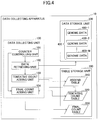
  • FIG. 4 is a drawing illustrating an example of the functional configuration of a data collecting unit of the data collecting apparatus according to the embodiment
  • FIG. 5 is a drawing illustrating an example of an addend table
  • FIG. 6 is a drawing illustrating an example of a tentative count table
  • FIG. 7 is a drawing illustrating an example of a final count table
  • FIG. 8 is a flowchart illustrating an example of a data collection process according to the embodiment.
  • FIG. 9 is a flowchart illustrating an example of the process of updating a final count table according to the embodiment.
  • FIG. 10 is a drawing illustrating an example of identifying possible disease-related positions by use of the data collection process according to the embodiment.
  • FIG. 1 is a drawing illustrating an example of the entire configuration of the data collecting apparatus 10 according to the present embodiment.
  • the data collecting apparatus 10 illustrated in FIG. 1 which is an information processing apparatus such as a personal computer, includes a data collecting unit 100 , a data storage unit 200 , and a table storage unit 300 .
  • the data storage unit 200 stores genome data 400 for a plurality of people. Namely, the data storage unit 200 stores genome data 400 - 1 for a first person, genome data 400 - 2 for a second person, . . . , and genome data 400 -M for an M-th person.
  • genome data 400 is used when the genome data 400 - 1 , the genome data 400 - 2 , . . . , and the genome data 400 -M are not discriminated from each other.
  • the genome data 400 used in the present embodiment represents mutation patterns as a bit sequence having two bits with respect to each position at which an SNP (single nucleotide polymorphism) occurs in the DNA sequence of humans or the like.
  • the SNP patterns at a specific position (which is herein referred to as “POSITION0”) in the DNA sequence of humans or the like may be “A/A”, “A/C”, and “C/C”.
  • the mutation patterns at the “POSITION0” in the genome data 400 may be represented as “00”, “01”, and “10”, which are a bit sequence constituted by two bits.
  • the SNP patterns at another specific position (which is herein referred to as “POSITION1”) in the DNA sequence of humans or the like may be “C/C”, “C/G”, and “G/G” as illustrated in FIG. 1 .
  • the mutation patterns at the “POSITION1” in the genome data 400 may be represented as “00”, “01”, and “10”, which are a bit sequence constituted by two bits.
  • the genome data 400 represents mutation patterns as a bit sequence having two bits at each of the N positions at which SNPs occur in the DNA sequence of humans or the like.
  • the genome data 400 is a series of arranged bit sequences each having two bits for representing mutation patterns at the position of an SNP.
  • the genome data 400 is not limited to such a configuration.
  • the genome data 400 may alternatively represent the number of copies of CNVs (i.e., copy number variations) as a bit sequence having a predetermined number of bits with respect to each range within which CNVs occur, for example.
  • the genome data 400 may alternatively represent the number of repeats such as VNTRs (i.e., variable number of tandem repeats) or STRPs (i.e., short tandem repeat polymorphisms) as a bit sequence having a predetermined number of bits with respect to each range within which such repeats occur.
  • VNTRs i.e., variable number of tandem repeats
  • STRPs i.e., short tandem repeat polymorphisms
  • the data collecting unit 100 performs a data collection process for the genome data 400 stored in the data storage unit 200 . Namely, the data collecting unit 100 counts the number of occurrences of mutation patterns at each position with respect to the genome data 400 stored in the data storage unit 200 .
  • the table storage unit 300 stores various types of tables for use by the data collecting unit 100 in collecting the genome data 400 .
  • the table storage unit 300 stores an addend table 310 , a tentative count table 320 , and a final count table 330 .
  • the addend table 310 is a look-up table in which addend data to be added to the counts of occurrences of mutation patterns are stored.
  • the tentative count table 320 stores tentative count data indicative of tentative counts with respect to the numbers of occurrences of mutation patterns.
  • the final count table 330 stores final count data indicative of final counts with respect to the numbers of occurrences of mutation patterns.
  • FIG. 2 is a drawing illustrating the outline of the data collection process according to the present embodiment.
  • the data collecting unit 100 extracts a bet sequence having 8 bits from POSITION0 to POSITION3 of the genome data 400 - 1 . Namely, the data collecting unit 100 extracts the bit sequence “00011010” from POSITION0 through POSITION3.
  • the data collecting unit 100 refers to the addend table 310 to identify the addend data corresponding to the same index as the extracted bit sequence, and uses an SIMD (single instruction multiple data) instruction to add the identified data to the tentative count data in the tentative count table 320 .
  • SIMD single instruction multiple data
  • the data collecting unit 100 uses an SIMD instruction to add the addend data “1000010001000010” corresponding to the index “00011010” in the addend table 310 to the tentative count data at POSITION0 through POSITION3 in the tentative count table 320 .
  • the data size of each digit of “1000010001000010” is 16 bits.
  • the data size of the addend data is thus equal to 16 bits times 16 , which is 256 bits.
  • “1” is added to the tentative count data corresponding to the bit sequence “00” at POSITION0 in the tentative count table 320 .
  • the data collecting unit 100 further performs the processes of steps S 1 - 1 and S 1 - 2 noted above with respect to POSITION4 through POSITION7, POSITION8 through POSITION11, . . . , and POSITION(N ⁇ 4) through POSITION(N ⁇ 1) (i.e., the N ⁇ 4-th position through the N ⁇ 1-th position) of the genome data 400 - 1 .
  • the data collecting unit 100 performs the processes of steps S 1 - 1 and S 1 - 2 noted above with respect to POSITION0 through POSITION3, . . . , and POSITION(N ⁇ 4) through POSITION(N ⁇ 1) of each of the genome data 400 - 2 through the genome data 400 -M.
  • the number “N” of positions included in the genome data 400 is an integer multiple of 4. In the case of the number of positions in the genome data being not an integer multiple of 4, as many positions having the bit sequence “00” as appropriate may be added to the genome data 400 , thereby making the number of positions in the genome data 400 equal to an integer multiple of 4.
  • the data collecting unit 100 updates the final count table 330 based on the tentative count table 320 after a predetermined number of genome data 400 are tallied in the tentative count table 320 . Namely, the data collecting unit 100 adds the tentative count data in the tentative count table 320 to the final count data in the final count table 330 .
  • the data collecting apparatus 10 of the present embodiment counts the numbers of occurrences of mutation patterns at each position with respect to a plurality of genome data 400 .
  • the data collecting apparatus 10 of the present embodiment refers to the addend table 310 to identify the addend data corresponding to the index, and, then, utilizes an SIMD instruction to add the identified addend data to the tentative count data in the tentative count table 320 .
  • the data collecting apparatus 10 of the present embodiment utilizes a single instruction (i.e., SIMD instruction) with respect to every four positions to count the numbers of occurrences of mutation patterns at these four positions as described above.
  • the data collecting apparatus 10 of the present embodiment is thus able to perform addition with respect to tentative count data without performing either a shift operation or a masking operation, thereby enabling high-speed counting of occurrences of mutation patterns.
  • the data collecting apparatus 10 of the present embodiment will be described as extracting one bit sequence from every four positions in the genome data 400 , such that the mutation pattern at each of these positions is represented by two corresponding bits in the bits sequence. This is, however, not a limiting example.
  • the data collecting apparatus 10 of the present embodiment may extract one bit sequence from every y positions in the genome data 400 , such that the mutation pattern at each of these positions is represented by x corresponding bits in the bit sequence where x is an integer greater than or equal to 1, and y is an integer greater than or equal to 1.
  • the data collecting apparatus 10 of the present embodiment is able to perform addition simultaneously at a plurality of positions with respect to the numbers of occurrences of mutation patterns. This arrangement thus enables faster counting of occurrences of mutation patterns. Because of this, y is preferably an integer that is two or greater.
  • FIG. 3 is a drawing illustrating an example of the hardware configuration of the data collecting apparatus 10 according to the present embodiment.
  • the data collecting apparatus 10 of the present embodiment includes an input device 11 , a display device 12 , an external I/F 13 , and a communication I/F 14 .
  • the data collecting apparatus 10 of the present embodiment further includes a ROM (read only memory) 15 , a RAM (random access memory) 16 , a CPU (central processing unit) 17 , and an HDD (hard disk drive) 18 . These hardware units are coupled to each other through a bus B.
  • the input device 11 includes a keyboard, a mouse, a touch panel, and the like for use by a user in performing various operations.
  • the display device 12 displays process results obtained by the data collecting apparatus 10 . At least one of the input device 11 and the display device 12 may be configured to be coupled to the bus B only when such a need arises.
  • the communication I/F 14 is an interface for connecting the data collecting apparatus 10 to a network.
  • the data collecting apparatus 10 performs data communication through the communication I/F 14 .
  • the HDD 18 is a nonvolatile storage device that stores programs and data.
  • the HDD 18 stores an OS (operating system) that is basic software for controlling the entirety of the data collecting apparatus 10 , and also stores application software for providing various functions on the OS.
  • the HDD 18 stores programs for implementing the data collecting unit 100 and the genome data 400 .
  • the HDD 18 uses a file system or database to manage the programs and data stored therein.
  • the data collecting apparatus 10 may include a drive device utilizing flash memories as a memory medium (e.g., solid-state drive SSD).
  • a drive device utilizing flash memories as a memory medium e.g., solid-state drive SSD.
  • the external I/F 13 is an interface for external apparatus.
  • the external apparatus may include a recording medium 13 a .
  • the data collecting apparatus 10 performs read and write operations with respect to the recording medium 13 a through the external I/F 13 .
  • the recording medium 13 a may be a CD, a DVD, an SD-memory card, a USB memory stick, or the like.
  • the ROM 15 is a nonvolatile semiconductor memory (storage device) that can retain programs and data even when the power is switched off.
  • the ROM 15 stores programs and data for OS settings, network settings, and the like as well as BIOS (basic input/output system) and the like that are executed at the time of activation of the data collecting apparatus 10 .
  • the RAM 16 is a volatile semiconductor memory that temporarily stores programs and data.
  • the CPU 17 loads programs and data into the RAM 16 from the memory devices such as the ROM 15 and the HDD 18 , and performs processes based on these programs and data, thereby implementing the overall control and other functions of the data collecting apparatus 10 .
  • the CPU 17 of the data collecting apparatus 10 of the present embodiment is capable of processing 256-bit data in response to a SIMD instruction.
  • the data collecting apparatus 10 of the present embodiment has the hardware configuration illustrated in FIG. 3 to implement various processes as will be described later.
  • FIG. 4 is a drawing illustrating an example of the functional configuration of the data collecting unit 100 of the data collecting apparatus 10 according to the present embodiment.
  • the data collecting unit 100 of the present embodiment includes a counter controlling unit 101 , a data retrieving unit 102 , a tentative count adding unit 103 , and a final count adding unit 104 .
  • the data collecting unit 100 is implemented as one or more processes that are performed by the CPU 17 under the control of one or more programs installed in the data collecting apparatus 10 .
  • the counter controlling unit 101 controls various types of counters used in the data collection process. For example, the counter controlling unit 101 controls a counter m for indicating an m-th genome data 400 - m stored in the data storage unit 200 . Further, the counter controlling unit 101 controls a counter n for identifying POSITION(N) in the genome data 400 .
  • the counter controlling unit 101 checks which one of the count of a given counter and a predetermined threshold is greater than the other. For example, the counter controlling unit 101 checks whether the count of the counter m is smaller than M+1. Further, the counter controlling unit 101 checks whether the count of the counter n is smaller than N.
  • the data retrieving unit 102 retrieves the genome data 400 - m indicated by the counter m among the genome data 400 stored in the data storage unit 200 .
  • the tentative count adding unit 103 extracts a bit sequence of POSITION(n) through POSITION(n+3) indicated by the counter n from the genome data 400 - m retrieved by the data retrieving unit 102 .
  • the tentative count adding unit 103 refers to the addend table 310 to identify the addend data having the same index as the extracted bit sequence, and uses an SIMD instruction to add the identified addend data to the tentative count data of POSITION(n) through POSITION(n+3) in the tentative count table 320 .
  • FIG. 5 is a drawing illustrating an example of the addend table 310 .
  • the addend table 310 of the present embodiment stores addend data associated with respective indexes each being an 8-bit sequence, for use in adding up the numbers of occurrences of mutation patterns.
  • the addend table 310 of the present embodiment has the indexes ranging from “00000000” to “11111111”, which indicate that there are 256 entries of addend data.
  • Each of the addend data stored in the addend table 310 of the present embodiment includes 16 addends, each of which has 16 bits.
  • the addend table 310 of the present embodiment may thus be implemented as sum table[256] which is an array of elements each having 256 bits.
  • the array indexes “0” through “255” for indicating the respective elements are expressed in 8 bits as the indexes of the addend table 310 .
  • Each addend contained in given addend data has a value assigned thereto in correspondence with the index of the given addend data.
  • the index may be expressed as “A 00 A 01 A 10 A 11 A 20 A 21 A 30 A 31 ”.
  • the addend may be expressed as “X 00 X 01 X 02 X 03 X 10 X 11 X 12 X 13 X 20 X 21 X 22 X 23 X 30 X 31 X 32 X 33 ”.
  • an SIMD instruction is able to perform addition with respect to the tentative count data stored in the tentative count table 320 .
  • FIG. 6 is a drawing illustrating an example of the tentative count table 320 .
  • the tentative count table 320 of the present embodiment stores tentative count data indicative of the tentative counts of occurrences of mutation patterns such that the tentative count data are associated with positions in the genome data 400 and with bit sequences representing mutation patterns.
  • each tentative count data is represented as 16 bits.
  • the tentative count table 320 of the present embodiment may thus be implemented as tmp_table[N/4] which is an array of elements each having 256 bits.
  • the array element “tmp_table[0]” stores the tentative count data of POSITION0 through POSITION3.
  • the array element “tmp_table[1]” stores the tentative count data of POSITION4 through POSITION7.
  • the array element “tmp_table[(N/4) ⁇ 1]” stores the tentative count data of POSITION(N ⁇ 4) through POSITION(N ⁇ 1).
  • each addend data in the addend table 310 includes 16 addends each of which is represented as 16 bits. Further, each of the 16 tentative count data at POSITION(n) through POSITION(n+3) in the tentative count table 320 is represented as 16 bits. With this arrangement, the tentative count adding unit 103 is able to use an SIMD instruction to add the addend data in the addend table 310 to the tentative count data at POSITION(n) through POSITION(n+3) in the tentative count table 320 .
  • the final count adding unit 104 updates the final count table 330 based on the tentative count table 320 when the count of the counter m exceeds a predetermined value. Namely, the final count adding unit 104 adds the tentative count data in the tentative count table 320 to the final count data in the final count table 330 .
  • the data size of the tentative count data in the tentative count table 320 of the present embodiment is 16 bits. With this arrangement, the tentative count data in the tentative count table 320 suffices to count the occurrences of mutation patterns within a range of 0 to 65535 (i.e., the range that can be expressed by use of 16 bits).
  • the data collecting apparatus 10 of the present embodiment thus adds the tentative count data in the tentative count table 320 to the final count data in the final count table 330 when the count of the counter m becomes greater than or equal to 65536.
  • a value of 65535 is an example of the largest value that can be expressed by the data size of the count data.
  • FIG. 7 is a drawing illustrating an example of the final count table 330 .
  • the final count table 330 of the present embodiment stores final count data indicative of the final counts of occurrences of mutation patterns such that the final count data are associated with positions in the genome data 400 and with bit sequences representing mutation patterns.
  • each final count data is represented by a larger data size (e.g., 24 bits, 32 bits, or the like) than 16 bits. Namely, the data size of final count data is larger than the data size of tentative count data (which is 16 bits).
  • the final count table 330 of the present embodiment may thus be implemented as result_table[N][3] which is a two-dimensional array of elements each having a larger data size than 16 bits.
  • the array elements “result_table[0][0]” through “result_table[0][2]” store the final count data for the bit sequences “00” through “10” at POSITION0.
  • the array elements “result_table[1][0]” through “result_table[1][2]” store the final count data for the bit sequences “00” through “10” at POSITION1.
  • the array elements “result_table[N ⁇ 1][0]” through “result_table[N ⁇ 1][2]” store the final count data for the bit sequences “00” through “10” at POSITION(N ⁇ 1).
  • the final count table 330 stores final count data indicative of the numbers of occurrences of mutation patterns at each position in the genome data 400 .
  • the final count table 330 has no final count data for the bit sequence “11”. This is because the SNP patterns are fully represented as the bit sequences “00”, “01”, and “10”. Alternatively, the SNP patterns may be represented as “A/A”, “A/C”, “C/A”, and “C/C” by discriminating between the paternal line and the maternal line. In such a case, the SNP patterns are represented as the bits sequences “00”, “01”, “10”, and “11”. When this is the case, the final count table 330 may store final count data for the bit sequence “11”.
  • FIG. 8 is a flowchart illustrating an example of the data collection process according to the present embodiment.
  • the counter controlling unit 101 sets an initial value of “1” to the counter m that indicates an m-th genome data 400 - m stored in the data storage unit 200 .
  • the counter controlling unit 101 sets an initial value of “0” to the counter n that indicates POSITION(n) in the genome data 400 .
  • the data retrieving unit 102 retrieves the genome data 400 - m among the genome data 400 stored in the data storage unit 200 , and stores the retrieved data in p[N/4] which is an array of elements each having 8 bits.
  • the data retrieving unit 102 retrieves the genome data 400 - m from the data storage unit 200 , and stores in the array element “p[0]” the bit sequence of POSITION0 through POSITION3 in the retrieved genome data 400 - m .
  • the data retrieving unit 102 further stores in the array element “p[1]” the bit sequence of POSITION4 through POSITION7 in the genome data 400 - m .
  • the data retrieving unit 102 further stores in the array element “p[(N/4) ⁇ 1]” the bit sequence of POSITION(N ⁇ 4) through POSITION(N ⁇ 1) in the genome data 400 - m.
  • the tentative count adding unit 103 extracts the bit sequence stored in the array element “p[n/4]”.
  • the tentative count adding unit 103 refers to the addend table 310 to identify the addend data having the same index as the extracted bit sequence, and uses an SIMD instruction to add the identified addend data to the tentative count data of POSITION(n) through POSITION(n+3) in the tentative count table 320 .
  • the tentative count adding unit 103 adds the addend data stored in the array element “sum table[p[n/4]] to the array element “tmp_table[n/4]” by use of an SIMD instruction.
  • the tentative count adding unit 103 adds the addend data at the same index as the bit sequence of POSITION(n) through POSITION(n+3) in the genome data 400 - m to the tentative count data at POSITION(n) through POSITION(n+3) in the tentative count table 320 . It should be further noted that the tentative count adding unit 103 is able to add the addend data corresponding to the bit sequence for 4 positions in the genome data 400 - m to the tentative count data for 4 positions.
  • step S 805 the counter controlling unit 101 adds “4” to the counter n. Namely, the counter controlling unit 101 sets n equal to n+4.
  • step S 806 the counter controlling unit 101 checks whether the count of the counter n is smaller than N.
  • step S 806 When the counter controlling unit 101 determines at step S 806 that the count of the counter n is smaller than N, the data collecting unit 100 returns to step S 804 to perform the process thereof. Namely, the tentative count adding unit 103 performs the process of step S 804 with respect to each value of n, i.e., 0, 4, 8, . . . , and N ⁇ 4.
  • step S 806 When it is determined at step S 806 that the count of the counter n is not smaller than N, the counter controlling unit 101 adds “1” to the counter m (step S 807 ). Namely, the counter controlling unit 101 sets m equal to m+1.
  • the counter controlling unit 101 checks whether the count of the counter m is smaller than 65536.
  • step S 808 This check at step S 808 as to whether the count of the counter m is smaller than 65536 is made in order to ensure that no data loss occurs in the tentative count data.
  • the counter controlling unit 101 may alternatively check whether at least one of the tentative count data in the tentative count table 320 has reached 65535 .
  • the data collecting unit 100 uses the final count adding unit 104 at step S 809 to update the final count table 330 based on the tentative count table 320 .
  • the detail of the process at this step for updating the final count table will be described later.
  • step S 808 determines at step S 808 that the count of the counter m is smaller than 65536, or immediately after step S 809 , the counter controlling unit 101 checks at step S 810 whether the count of the counter m is smaller than M+1.
  • step S 810 When the counter controlling unit 101 determines at step S 810 that the count of the counter m is smaller than M+1, the data collecting unit 100 returns to step S 802 to perform the process thereof. Namely, the data collecting unit 100 performs the processes of steps S 802 through S 809 with respect to each value of m, i.e., 1, 2, . . . , and M.
  • the data collecting unit 100 brings the data collection process to an end. In this manner, the data collecting unit 100 counts the numbers of occurrences of mutation patterns at each position in the genome data 400 .
  • FIG. 9 is a flowchart illustrating an example of the process of updating a final count table according to the present embodiment.
  • the counter controlling unit 101 sets an initial value of “0” to the counter n that indicates POSITION(n) in the genome data 400 .
  • the final count adding unit 104 stores, in tmp_agg[4] which is an array of elements each having 64 bits, the tentative count data of POSITION(n) through POSITION(n+3) in the tentative count table 320 .
  • the final count adding unit 104 stores in the array element “tmp_agg[0]” the tentative count data of POSITION(n) in the tentative count table 320 .
  • the final count adding unit 104 further stores in the array element “tmp_agg[1]” the tentative count data of POSITION(n+1) in the tentative count table 320 .
  • the final count adding unit 104 further stores in the array elements “tmp_agg[2]” and “tmp_agg[3]” the tentative count data of POSITION(n+2) and POSITION(n+3) in the tentative count table 320 , respectively.
  • the counter controlling unit 101 sets an initial value of “0” to a counter k indicating a bit sequence.
  • the counter k which has 2 bits, indicates a bit sequence representing a mutation pattern.
  • the bit sequence indicated by the counter k is denoted as the bit sequence k.
  • the final count adding unit 104 adds the tentative count data of the bit sequence k at POSITION(n) in the tentative count table 320 to the final count data of the bit sequence k at POSITION(n) in the final count table 330 .
  • the final count adding unit 104 performs a 16 k-bit right shift with respect to the array element “tmp_agg[0]”, and masks the resultant data with “0x00000000000000ff”, followed by adding the masked data to the array element “result_table[n][k]”.
  • the final count adding unit 104 adds the tentative count data of the bit sequence k at POSITION(n+1) in the tentative count table 320 to the final count data of the bit sequence k at POSITION(n+1) in the final count table 330 .
  • the final count adding unit 104 performs a 16 k-bit right shift with respect to the array element “tmp_agg[1]”, and masks the resultant data with “0x00000000000000ff”, followed by adding the masked data to the array element “result_table[n+1][k]”.
  • the final count adding unit 104 adds the tentative count data of the bit sequence k at POSITION(n+2) in the tentative count table 320 to the final count data of the bit sequence k at POSITION(n+2) in the final count table 330 .
  • the final count adding unit 104 performs a 16 k-bit right shift with respect to the array element “tmp_agg[2]”, and masks the resultant data with “0x00000000000000ff”, followed by adding the masked data to the array element “result_table[n+2][k]”.
  • the final count adding unit 104 adds the tentative count data of the bit sequence k at POSITION(n+3) in the tentative count table 320 to the final count data of the bit sequence k at POSITION(n+3) in the final count table 330 .
  • the final count adding unit 104 performs a 16 k-bit right shift with respect to the array element “tmp_agg[3]”, and masks the resultant data with “0x00000000000000ff”, followed by adding the masked data to the array element “result_table[n+3][k]”.
  • step S 908 the counter controlling unit 101 adds “1” to the counter k. Namely, the counter controlling unit 101 sets k equal to k+1.
  • step S 909 the counter controlling unit 101 checks whether the count of the counter k is smaller than 3.
  • the SNP patterns may be represented as “A/A”, “A/C”, “C/A”, and “C/C”, for example, by discriminating between the paternal line and the maternal line.
  • addition is performed with respect to the final count data of the bit sequence k at POSITION(n+4) before step S 908 is performed.
  • the counter controlling unit 101 checks at above-noted step S 909 whether the count of the counter k is smaller than 4.
  • step S 909 When the counter controlling unit 101 determines at step S 909 that the count of the counter k is smaller than 3, the data collecting unit 100 returns to step S 904 to perform the process thereof. Namely, the data collecting unit 100 performs the processes of steps S 904 through S 909 with respect to each value of k, i.e., 0, 1, and 2.
  • the counter controlling unit 101 determines that the count of the counter k is not smaller than 3, the counter controlling unit 101 adds “4” to the counter n at step S 910 . Namely, the counter controlling unit 101 sets n equal to n+4.
  • step S 911 the counter controlling unit 101 checks whether the count of the counter n is smaller than N.
  • step S 911 When the counter controlling unit 101 determines at step S 911 that the count of the counter n is smaller than N, the data collecting unit 100 returns to step S 902 to perform the process thereof. Namely, the data collecting unit 100 performs the processes of steps S 902 through S 910 with respect to each value of n, i.e., 0, 4, 8, . . . , and N ⁇ 4.
  • the final count adding unit 104 initializes the tentative count data to “0” in the tentative count table 320 at step S 912 . Namely, the final count adding unit 104 sets an initial value of “0” to the array elements “tmp_table[0]” through “tmp_table[(N/4) ⁇ 1]”.
  • the data collecting apparatus 10 of the present embodiment counts the numbers of occurrences of mutation patterns at each position with respect to a plurality of genome data 400 . In so doing, the data collecting apparatus 10 of the present embodiment identifies addend data by use of an 8-bit sequence corresponding to 4 positions in the genome data 400 , and utilizes an SIMD instruction to add the identified addend data to the tentative count table 320 .
  • the data collecting apparatus 10 of the present embodiment does not need to use either a shift operation or a masking operation when counting in the tentative count table 320 the numbers of occurrences of mutation patterns at each position in the genome data 400 .
  • the data collecting apparatus 10 of the present embodiment thus enables high-speed counting of occurrences of mutation patterns at each position in the genome data 400 .
  • the data collecting apparatus 10 of the present embodiment has been described as having the CPU 17 that is capable of processing 256-bit data in response to an SIMD instruction. This is not a limiting example, and the CPU 17 may alternatively be capable of processing 512-bit data in response to an SIMD instruction. In such a case, the data collecting apparatus 10 of the present embodiment may identify 512-bit addend data by use of a 16-bit sequence corresponding to 8 positions in the genome data 400 , and may utilize an SIMD instruction to add the identified addend data to the tentative count table 320 .
  • the data collecting apparatus 10 of the present embodiment may use an appropriate number of bits for a bit sequence extracted from the genome data 400 and for indexes and addend data in the addend table 310 as such an appropriate number is determined in response to the number of bits of an SIMD instruction processable by the CPU 17 .
  • FIG. 10 is a drawing illustrating an example of identifying possible disease-related positions by use of the data collection process according to the present embodiment.
  • the genome data 400 stored in the data storage unit 200 includes genome data 410 belonging to people of normal health free from a disease of interest and genome data 420 belonging to people having such a disease.
  • the data collecting apparatus 10 of the present embodiment counts the numbers of occurrences of mutation patterns at each position in the genome data 410 to generate a final count table 330 - 1 belonging to the people having no such disease. Similarly, the data collecting apparatus 10 of the present embodiment counts the numbers of occurrences of mutation patterns at each position in the genome data 420 to generate a final count table 330 - 2 belonging to the people having the disease.
  • Position-specific distributions of counted occurrences of mutation patterns are created based on the final count table 330 - 1 . Also, position-specific distributions of counted occurrences of mutation patterns (for the people having the disease) are created based on the final count table 330 - 2 .
  • possible disease-related positions may be identified by determining whether there are significant differences between the distributions of people having no such disease and the distributions of people having the disease.
  • the data collecting apparatus 10 of the present embodiment may be used in the data collection process for identifying possible disease-related positions among the positions at which SNP patterns occur in the DNA sequence.
  • the data collecting apparatus 10 of the present embodiment may equally be applicable to a data collection process for counting the numbers of occurrences of patterns when such patterns in data are represented as a bit sequence having a predetermined number of bits.
  • the time needed to collect genome data is shortened.

Landscapes

  • Life Sciences & Earth Sciences (AREA)
  • Physics & Mathematics (AREA)
  • Health & Medical Sciences (AREA)
  • Bioinformatics & Cheminformatics (AREA)
  • Engineering & Computer Science (AREA)
  • Biotechnology (AREA)
  • General Health & Medical Sciences (AREA)
  • Biophysics (AREA)
  • Analytical Chemistry (AREA)
  • Bioinformatics & Computational Biology (AREA)
  • Chemical & Material Sciences (AREA)
  • Evolutionary Biology (AREA)
  • Proteomics, Peptides & Aminoacids (AREA)
  • Medical Informatics (AREA)
  • Spectroscopy & Molecular Physics (AREA)
  • Theoretical Computer Science (AREA)
  • Genetics & Genomics (AREA)
  • Molecular Biology (AREA)
  • Medical Treatment And Welfare Office Work (AREA)
  • Management, Administration, Business Operations System, And Electronic Commerce (AREA)
  • Apparatus Associated With Microorganisms And Enzymes (AREA)

Abstract

An information processing apparatus includes a memory and a processor coupled to the memory and configured to extract data having x times y bits from genome data in which a mutation pattern at each gene mutation position is represented as x bits, such that the extracted data is constituted by y data pieces each having x bits at y respective mutation positions, x and y being integers greater than or equal to 1, respectively, to refer to an addend table that stores a plurality of addend data associated with respective x-times-y-bit data to identify addend data corresponding to the extracted data, and to use an SIMD instruction to add the identified addend data to count data at positions corresponding to the y mutation positions in the genome data, the count data indicating counts of occurrences of mutation patterns in the genome data.

Description

CROSS-REFERENCE TO RELATED APPLICATIONS
The present application is based upon and claims the benefit of priority from the prior Japanese Patent Application No. 2016-181677 filed on Sep. 16, 2016, with the Japanese Patent Office, the entire contents of which are incorporated herein by reference.
FIELD
The disclosures herein relate to an information processing apparatus, a program for collecting genome data, and a method of collecting genome data.
BACKGROUND
In recent years, attempts have been made to analyze the DNA sequence of humans or the like to identify diseases-related genes. For example, the numbers of occurrences of mutation patterns at the positions of mutation occurring in genes are collected based on big data of the DNA sequence of humans or the like. A difference in the mutation-pattern distribution is analyzed by comparing a group of people having a specific disease with a group of people having no such disease, thereby identifying the disease-related genes.
The DNA sequence of a single human includes tens of millions of positions at which gene mutation patterns may occur. Collecting the numbers of occurrences of gene mutation patterns is thus time consuming.
RELATED-ART DOCUMENTS Patent Document
[Patent Document 1] Japanese National Publication of International Patent Application No. 2002-509316
SUMMARY
According to an aspect of the embodiment, an information processing apparatus includes a memory and a processor coupled to the memory and configured to extract data having x times y bits from genome data in which a mutation pattern at each gene mutation position is represented as x bits, such that the extracted data is constituted by y data pieces each having x bits at y respective mutation positions, x and y being integers greater than or equal to 1, respectively, to refer to an addend table that stores a plurality of addend data associated with respective x-times-y-bit data to identify addend data corresponding to the extracted data, and to use an SIMD instruction to add the identified addend data to count data at positions corresponding to the y mutation positions in the genome data, the count data indicating counts of occurrences of mutation patterns in the genome data.
The object and advantages of the embodiment will be realized and attained by means of the elements and combinations particularly pointed out in the claims. It is to be understood that both the foregoing general description and the following detailed description are exemplary and explanatory and are not restrictive of the invention, as claimed.
BRIEF DESCRIPTION OF DRAWINGS
FIG. 1 is a drawing illustrating an example of the entire configuration of a data collecting apparatus according to an embodiment;
FIG. 2 is a drawing illustrating the outline of the data collection process according to the embodiment;
FIG. 3 is a drawing illustrating an example of the hardware configuration of the data collecting apparatus according to the embodiment;
FIG. 4 is a drawing illustrating an example of the functional configuration of a data collecting unit of the data collecting apparatus according to the embodiment;
FIG. 5 is a drawing illustrating an example of an addend table;
FIG. 6 is a drawing illustrating an example of a tentative count table;
FIG. 7 is a drawing illustrating an example of a final count table;
FIG. 8 is a flowchart illustrating an example of a data collection process according to the embodiment;
FIG. 9 is a flowchart illustrating an example of the process of updating a final count table according to the embodiment; and
FIG. 10 is a drawing illustrating an example of identifying possible disease-related positions by use of the data collection process according to the embodiment.
DESCRIPTION OF EMBODIMENTS
In the following, embodiments of the present invention will be described with reference to the accompanying drawings.
A data collecting apparatus 10 of the present embodiment will be described by referring to FIG. 1. FIG. 1 is a drawing illustrating an example of the entire configuration of the data collecting apparatus 10 according to the present embodiment.
The data collecting apparatus 10 illustrated in FIG. 1, which is an information processing apparatus such as a personal computer, includes a data collecting unit 100, a data storage unit 200, and a table storage unit 300.
The data storage unit 200 stores genome data 400 for a plurality of people. Namely, the data storage unit 200 stores genome data 400-1 for a first person, genome data 400-2 for a second person, . . . , and genome data 400-M for an M-th person. In the following, the term “genome data 400” is used when the genome data 400-1, the genome data 400-2, . . . , and the genome data 400-M are not discriminated from each other.
The genome data 400 used in the present embodiment represents mutation patterns as a bit sequence having two bits with respect to each position at which an SNP (single nucleotide polymorphism) occurs in the DNA sequence of humans or the like.
As illustrated in FIG. 1, the SNP patterns at a specific position (which is herein referred to as “POSITION0”) in the DNA sequence of humans or the like may be “A/A”, “A/C”, and “C/C”. In this case, the mutation patterns at the “POSITION0” in the genome data 400 may be represented as “00”, “01”, and “10”, which are a bit sequence constituted by two bits.
Similarly, the SNP patterns at another specific position (which is herein referred to as “POSITION1”) in the DNA sequence of humans or the like may be “C/C”, “C/G”, and “G/G” as illustrated in FIG. 1. In this case, similarly, the mutation patterns at the “POSITION1” in the genome data 400 may be represented as “00”, “01”, and “10”, which are a bit sequence constituted by two bits.
The genome data 400 represents mutation patterns as a bit sequence having two bits at each of the N positions at which SNPs occur in the DNA sequence of humans or the like. In other words, the genome data 400 is a series of arranged bit sequences each having two bits for representing mutation patterns at the position of an SNP.
It may be noted that the genome data 400 is not limited to such a configuration. The genome data 400 may alternatively represent the number of copies of CNVs (i.e., copy number variations) as a bit sequence having a predetermined number of bits with respect to each range within which CNVs occur, for example. The genome data 400 may alternatively represent the number of repeats such as VNTRs (i.e., variable number of tandem repeats) or STRPs (i.e., short tandem repeat polymorphisms) as a bit sequence having a predetermined number of bits with respect to each range within which such repeats occur.
The data collecting unit 100 performs a data collection process for the genome data 400 stored in the data storage unit 200. Namely, the data collecting unit 100 counts the number of occurrences of mutation patterns at each position with respect to the genome data 400 stored in the data storage unit 200.
The table storage unit 300 stores various types of tables for use by the data collecting unit 100 in collecting the genome data 400. The table storage unit 300 stores an addend table 310, a tentative count table 320, and a final count table 330.
The addend table 310 is a look-up table in which addend data to be added to the counts of occurrences of mutation patterns are stored. The tentative count table 320 stores tentative count data indicative of tentative counts with respect to the numbers of occurrences of mutation patterns. The final count table 330 stores final count data indicative of final counts with respect to the numbers of occurrences of mutation patterns.
In the following, a description will be given of the outline of the data collection process performed by the data collecting apparatus 10 according to the present embodiment. FIG. 2 is a drawing illustrating the outline of the data collection process according to the present embodiment.
At step S1-1, the data collecting unit 100 extracts a bet sequence having 8 bits from POSITION0 to POSITION3 of the genome data 400-1. Namely, the data collecting unit 100 extracts the bit sequence “00011010” from POSITION0 through POSITION3.
At step S1-2, the data collecting unit 100 refers to the addend table 310 to identify the addend data corresponding to the same index as the extracted bit sequence, and uses an SIMD (single instruction multiple data) instruction to add the identified data to the tentative count data in the tentative count table 320.
Namely, the data collecting unit 100 uses an SIMD instruction to add the addend data “1000010001000010” corresponding to the index “00011010” in the addend table 310 to the tentative count data at POSITION0 through POSITION3 in the tentative count table 320. The data size of each digit of “1000010001000010” is 16 bits. The data size of the addend data is thus equal to 16 bits times 16, which is 256 bits. Through the above-noted addition operation, “1” is added to the tentative count data corresponding to the bit sequence “00” at POSITION0 in the tentative count table 320. Similarly, “1” is added to the tentative count data corresponding to the bit sequence “01” at POSITION1 in the tentative count table 320, to the tentative count data corresponding to the bit sequence “10” at POSITION2, and to the tentative count data corresponding to the bit sequence “10” at POSITION3.
The data collecting unit 100 further performs the processes of steps S1-1 and S1-2 noted above with respect to POSITION4 through POSITION7, POSITION8 through POSITION11, . . . , and POSITION(N−4) through POSITION(N−1) (i.e., the N−4-th position through the N−1-th position) of the genome data 400-1. Similarly, the data collecting unit 100 performs the processes of steps S1-1 and S1-2 noted above with respect to POSITION0 through POSITION3, . . . , and POSITION(N−4) through POSITION(N−1) of each of the genome data 400-2 through the genome data 400-M.
It may be noted that the number “N” of positions included in the genome data 400 is an integer multiple of 4. In the case of the number of positions in the genome data being not an integer multiple of 4, as many positions having the bit sequence “00” as appropriate may be added to the genome data 400, thereby making the number of positions in the genome data 400 equal to an integer multiple of 4.
At step S2, the data collecting unit 100 updates the final count table 330 based on the tentative count table 320 after a predetermined number of genome data 400 are tallied in the tentative count table 320. Namely, the data collecting unit 100 adds the tentative count data in the tentative count table 320 to the final count data in the final count table 330.
In this manner, the data collecting apparatus 10 of the present embodiment counts the numbers of occurrences of mutation patterns at each position with respect to a plurality of genome data 400. In so doing, as described in connection with the process of step S1-2, the data collecting apparatus 10 of the present embodiment refers to the addend table 310 to identify the addend data corresponding to the index, and, then, utilizes an SIMD instruction to add the identified addend data to the tentative count data in the tentative count table 320.
If an SIMD instruction was not used to count the numbers of occurrences of mutation patterns at POSITION0, for example, there would be a need to perform a 6-bit right circular shift with respect to the bit sequence at POSITION0 through POSITION3, followed by adding “1” to the tentative count data corresponding to the bit sequence obtained by masking the 6 most significant bits. Similarly, if an SIMD instruction was not used to count the numbers of occurrences of mutation patterns at POSITION1, for example, there would be a need to perform a 4-bit right circular shift with respect to the bit sequence at POSITION0 through POSITION3, followed by adding “1” to the tentative count data corresponding to the bit sequence obtained by masking the 6 most significant bits.
In this manner, counting the numbers of occurrences of mutation patterns at each position without utilizing a SIMD instruction involves the use of two instructions, i.e., one for a shift operation and the other for a masking operation. In contrast, the data collecting apparatus 10 of the present embodiment utilizes a single instruction (i.e., SIMD instruction) with respect to every four positions to count the numbers of occurrences of mutation patterns at these four positions as described above.
The data collecting apparatus 10 of the present embodiment is thus able to perform addition with respect to tentative count data without performing either a shift operation or a masking operation, thereby enabling high-speed counting of occurrences of mutation patterns.
As was in the above-noted example, the data collecting apparatus 10 of the present embodiment will be described as extracting one bit sequence from every four positions in the genome data 400, such that the mutation pattern at each of these positions is represented by two corresponding bits in the bits sequence. This is, however, not a limiting example. The data collecting apparatus 10 of the present embodiment may extract one bit sequence from every y positions in the genome data 400, such that the mutation pattern at each of these positions is represented by x corresponding bits in the bit sequence where x is an integer greater than or equal to 1, and y is an integer greater than or equal to 1.
In the case of y being an integer greater than or equal to 2, the data collecting apparatus 10 of the present embodiment is able to perform addition simultaneously at a plurality of positions with respect to the numbers of occurrences of mutation patterns. This arrangement thus enables faster counting of occurrences of mutation patterns. Because of this, y is preferably an integer that is two or greater.
In the following, a description will be given of the hardware configuration of the data collecting apparatus 10 according to the present embodiment by referring to FIG. 3. FIG. 3 is a drawing illustrating an example of the hardware configuration of the data collecting apparatus 10 according to the present embodiment.
As illustrated in FIG. 3, the data collecting apparatus 10 of the present embodiment includes an input device 11, a display device 12, an external I/F 13, and a communication I/F 14. The data collecting apparatus 10 of the present embodiment further includes a ROM (read only memory) 15, a RAM (random access memory) 16, a CPU (central processing unit) 17, and an HDD (hard disk drive) 18. These hardware units are coupled to each other through a bus B.
The input device 11 includes a keyboard, a mouse, a touch panel, and the like for use by a user in performing various operations. The display device 12 displays process results obtained by the data collecting apparatus 10. At least one of the input device 11 and the display device 12 may be configured to be coupled to the bus B only when such a need arises.
The communication I/F 14 is an interface for connecting the data collecting apparatus 10 to a network. The data collecting apparatus 10 performs data communication through the communication I/F 14.
The HDD 18 is a nonvolatile storage device that stores programs and data. The HDD 18 stores an OS (operating system) that is basic software for controlling the entirety of the data collecting apparatus 10, and also stores application software for providing various functions on the OS. The HDD 18 stores programs for implementing the data collecting unit 100 and the genome data 400.
The HDD 18 uses a file system or database to manage the programs and data stored therein.
The data collecting apparatus 10 may include a drive device utilizing flash memories as a memory medium (e.g., solid-state drive SSD).
The external I/F 13 is an interface for external apparatus. The external apparatus may include a recording medium 13 a. The data collecting apparatus 10 performs read and write operations with respect to the recording medium 13 a through the external I/F 13. The recording medium 13 a may be a CD, a DVD, an SD-memory card, a USB memory stick, or the like.
The ROM 15 is a nonvolatile semiconductor memory (storage device) that can retain programs and data even when the power is switched off. The ROM 15 stores programs and data for OS settings, network settings, and the like as well as BIOS (basic input/output system) and the like that are executed at the time of activation of the data collecting apparatus 10. The RAM 16 is a volatile semiconductor memory that temporarily stores programs and data.
The CPU 17 loads programs and data into the RAM 16 from the memory devices such as the ROM 15 and the HDD 18, and performs processes based on these programs and data, thereby implementing the overall control and other functions of the data collecting apparatus 10. The CPU 17 of the data collecting apparatus 10 of the present embodiment is capable of processing 256-bit data in response to a SIMD instruction.
The data collecting apparatus 10 of the present embodiment has the hardware configuration illustrated in FIG. 3 to implement various processes as will be described later.
In the following, a description will be given of the functional configuration of the data collecting unit 100 of the data collecting apparatus 10 according to the present embodiment by referring to FIG. 4. FIG. 4 is a drawing illustrating an example of the functional configuration of the data collecting unit 100 of the data collecting apparatus 10 according to the present embodiment.
As illustrated in FIG. 4, the data collecting unit 100 of the present embodiment includes a counter controlling unit 101, a data retrieving unit 102, a tentative count adding unit 103, and a final count adding unit 104. The data collecting unit 100 is implemented as one or more processes that are performed by the CPU 17 under the control of one or more programs installed in the data collecting apparatus 10.
The counter controlling unit 101 controls various types of counters used in the data collection process. For example, the counter controlling unit 101 controls a counter m for indicating an m-th genome data 400-m stored in the data storage unit 200. Further, the counter controlling unit 101 controls a counter n for identifying POSITION(N) in the genome data 400.
The counter controlling unit 101 checks which one of the count of a given counter and a predetermined threshold is greater than the other. For example, the counter controlling unit 101 checks whether the count of the counter m is smaller than M+1. Further, the counter controlling unit 101 checks whether the count of the counter n is smaller than N.
The data retrieving unit 102 retrieves the genome data 400-m indicated by the counter m among the genome data 400 stored in the data storage unit 200.
The tentative count adding unit 103 extracts a bit sequence of POSITION(n) through POSITION(n+3) indicated by the counter n from the genome data 400-m retrieved by the data retrieving unit 102. The tentative count adding unit 103 refers to the addend table 310 to identify the addend data having the same index as the extracted bit sequence, and uses an SIMD instruction to add the identified addend data to the tentative count data of POSITION(n) through POSITION(n+3) in the tentative count table 320.
The addend table 310 stored in the table storage unit 300 will be described by referring to FIG. 5. FIG. 5 is a drawing illustrating an example of the addend table 310.
As illustrated in FIG. 5, the addend table 310 of the present embodiment stores addend data associated with respective indexes each being an 8-bit sequence, for use in adding up the numbers of occurrences of mutation patterns.
The addend table 310 of the present embodiment has the indexes ranging from “00000000” to “11111111”, which indicate that there are 256 entries of addend data. Each of the addend data stored in the addend table 310 of the present embodiment includes 16 addends, each of which has 16 bits.
The addend table 310 of the present embodiment may thus be implemented as sum table[256] which is an array of elements each having 256 bits. The array indexes “0” through “255” for indicating the respective elements are expressed in 8 bits as the indexes of the addend table 310.
Each addend contained in given addend data has a value assigned thereto in correspondence with the index of the given addend data.
The index may be expressed as “A00A01A10A11A20A21A30A31”. The addend may be expressed as “X00X01X02X03X10X11X12X13X20X21X22X23X30X31X32X33”. Here, each Aij (i=0, 1, 2, 3; j=0, 1) is 1-bit long, and each Xkl (k=0, 1, 2, 3; l=0, 1, 2, 3) is 16-bit long.
When “Ai0Ai1”=“00” for a give value of i, “Xi0Xi1Xi2Xi3” is set to “1000”.
When “Ai0Ai1”=“01” for a give value of i, “Xi1Xi1Xi2Xi3” is set to “0100”. When “Ai0Ai1”=“10” for a give value of i, “Xi0Xi1Xi2Xi3” is set to “0010”. When “Ai0Ai1”=“11” for a give value of i, “Xi0Xi1Xi2Xi3” is set to “0001”.
With the setting of each addend contained in each addend data as described above, an SIMD instruction is able to perform addition with respect to the tentative count data stored in the tentative count table 320.
The tentative count table 320 stored in the table storage unit 300 will be described by referring to FIG. 6. FIG. 6 is a drawing illustrating an example of the tentative count table 320.
As illustrated in FIG. 6, the tentative count table 320 of the present embodiment stores tentative count data indicative of the tentative counts of occurrences of mutation patterns such that the tentative count data are associated with positions in the genome data 400 and with bit sequences representing mutation patterns.
In the tentative count table 320 of the present embodiment, each tentative count data is represented as 16 bits. The tentative count table 320 of the present embodiment may thus be implemented as tmp_table[N/4] which is an array of elements each having 256 bits.
In this case, the array element “tmp_table[0]” stores the tentative count data of POSITION0 through POSITION3. The array element “tmp_table[1]” stores the tentative count data of POSITION4 through POSITION7. Similarly, the array element “tmp_table[(N/4)−1]” stores the tentative count data of POSITION(N−4) through POSITION(N−1).
As was previously described, each addend data in the addend table 310 includes 16 addends each of which is represented as 16 bits. Further, each of the 16 tentative count data at POSITION(n) through POSITION(n+3) in the tentative count table 320 is represented as 16 bits. With this arrangement, the tentative count adding unit 103 is able to use an SIMD instruction to add the addend data in the addend table 310 to the tentative count data at POSITION(n) through POSITION(n+3) in the tentative count table 320.
The final count adding unit 104 updates the final count table 330 based on the tentative count table 320 when the count of the counter m exceeds a predetermined value. Namely, the final count adding unit 104 adds the tentative count data in the tentative count table 320 to the final count data in the final count table 330.
The data size of the tentative count data in the tentative count table 320 of the present embodiment is 16 bits. With this arrangement, the tentative count data in the tentative count table 320 suffices to count the occurrences of mutation patterns within a range of 0 to 65535 (i.e., the range that can be expressed by use of 16 bits). The data collecting apparatus 10 of the present embodiment thus adds the tentative count data in the tentative count table 320 to the final count data in the final count table 330 when the count of the counter m becomes greater than or equal to 65536. A value of 65535 is an example of the largest value that can be expressed by the data size of the count data.
The final count table 330 stored in the table storage unit 300 will be described by referring to FIG. 7. FIG. 7 is a drawing illustrating an example of the final count table 330.
As illustrated in FIG. 7, the final count table 330 of the present embodiment stores final count data indicative of the final counts of occurrences of mutation patterns such that the final count data are associated with positions in the genome data 400 and with bit sequences representing mutation patterns.
In the final count table 330 of the present embodiment, each final count data is represented by a larger data size (e.g., 24 bits, 32 bits, or the like) than 16 bits. Namely, the data size of final count data is larger than the data size of tentative count data (which is 16 bits).
The final count table 330 of the present embodiment may thus be implemented as result_table[N][3] which is a two-dimensional array of elements each having a larger data size than 16 bits.
The array elements “result_table[0][0]” through “result_table[0][2]” store the final count data for the bit sequences “00” through “10” at POSITION0. The array elements “result_table[1][0]” through “result_table[1][2]” store the final count data for the bit sequences “00” through “10” at POSITION1. Similarly, the array elements “result_table[N−1][0]” through “result_table[N−1][2]” store the final count data for the bit sequences “00” through “10” at POSITION(N−1).
In the manner described above, the final count table 330 stores final count data indicative of the numbers of occurrences of mutation patterns at each position in the genome data 400.
The final count table 330 has no final count data for the bit sequence “11”. This is because the SNP patterns are fully represented as the bit sequences “00”, “01”, and “10”. Alternatively, the SNP patterns may be represented as “A/A”, “A/C”, “C/A”, and “C/C” by discriminating between the paternal line and the maternal line. In such a case, the SNP patterns are represented as the bits sequences “00”, “01”, “10”, and “11”. When this is the case, the final count table 330 may store final count data for the bit sequence “11”.
In the following, the data collection process performed by the data collecting apparatus 10 according to the present embodiment will be described by referring to FIG. 8. FIG. 8 is a flowchart illustrating an example of the data collection process according to the present embodiment.
At step S801, the counter controlling unit 101 sets an initial value of “1” to the counter m that indicates an m-th genome data 400-m stored in the data storage unit 200.
At step S802, the counter controlling unit 101 sets an initial value of “0” to the counter n that indicates POSITION(n) in the genome data 400.
At step S803. the data retrieving unit 102 retrieves the genome data 400-m among the genome data 400 stored in the data storage unit 200, and stores the retrieved data in p[N/4] which is an array of elements each having 8 bits.
Namely, the data retrieving unit 102 retrieves the genome data 400-m from the data storage unit 200, and stores in the array element “p[0]” the bit sequence of POSITION0 through POSITION3 in the retrieved genome data 400-m. The data retrieving unit 102 further stores in the array element “p[1]” the bit sequence of POSITION4 through POSITION7 in the genome data 400-m. Similarly, the data retrieving unit 102 further stores in the array element “p[(N/4)−1]” the bit sequence of POSITION(N−4) through POSITION(N−1) in the genome data 400-m.
As a result, the array element “p[i/4]” (i=0, 4, 8, . . . , N−4) has stored therein the bit sequence of POSITION(i) through POSITION(i+3) in the genome data 400-m.
Subsequently, the tentative count adding unit 103 extracts the bit sequence stored in the array element “p[n/4]”. At step S804, the tentative count adding unit 103 refers to the addend table 310 to identify the addend data having the same index as the extracted bit sequence, and uses an SIMD instruction to add the identified addend data to the tentative count data of POSITION(n) through POSITION(n+3) in the tentative count table 320.
Namely, the tentative count adding unit 103 adds the addend data stored in the array element “sum table[p[n/4]] to the array element “tmp_table[n/4]” by use of an SIMD instruction.
In this manner, the tentative count adding unit 103 adds the addend data at the same index as the bit sequence of POSITION(n) through POSITION(n+3) in the genome data 400-m to the tentative count data at POSITION(n) through POSITION(n+3) in the tentative count table 320. It should be further noted that the tentative count adding unit 103 is able to add the addend data corresponding to the bit sequence for 4 positions in the genome data 400-m to the tentative count data for 4 positions.
At step S805, the counter controlling unit 101 adds “4” to the counter n. Namely, the counter controlling unit 101 sets n equal to n+4.
At step S806, the counter controlling unit 101 checks whether the count of the counter n is smaller than N.
When the counter controlling unit 101 determines at step S806 that the count of the counter n is smaller than N, the data collecting unit 100 returns to step S804 to perform the process thereof. Namely, the tentative count adding unit 103 performs the process of step S804 with respect to each value of n, i.e., 0, 4, 8, . . . , and N−4.
When it is determined at step S806 that the count of the counter n is not smaller than N, the counter controlling unit 101 adds “1” to the counter m (step S807). Namely, the counter controlling unit 101 sets m equal to m+1.
At step S808, the counter controlling unit 101 checks whether the count of the counter m is smaller than 65536.
This check at step S808 as to whether the count of the counter m is smaller than 65536 is made in order to ensure that no data loss occurs in the tentative count data. In consideration of this, the counter controlling unit 101 may alternatively check whether at least one of the tentative count data in the tentative count table 320 has reached 65535.
When the counter controlling unit 101 determines at step S808 that the count of the counter m is not smaller than 65536, the data collecting unit 100 uses the final count adding unit 104 at step S809 to update the final count table 330 based on the tentative count table 320. The detail of the process at this step for updating the final count table will be described later.
When the counter controlling unit 101 determines at step S808 that the count of the counter m is smaller than 65536, or immediately after step S809, the counter controlling unit 101 checks at step S810 whether the count of the counter m is smaller than M+1.
When the counter controlling unit 101 determines at step S810 that the count of the counter m is smaller than M+1, the data collecting unit 100 returns to step S802 to perform the process thereof. Namely, the data collecting unit 100 performs the processes of steps S802 through S809 with respect to each value of m, i.e., 1, 2, . . . , and M.
When the counter controlling unit 101 determines at step S810 that the count of the counter m is not smaller than M+1, the data collecting unit 100 brings the data collection process to an end. In this manner, the data collecting unit 100 counts the numbers of occurrences of mutation patterns at each position in the genome data 400.
In the following, the process of step S809 in the data collection process (i.e., the process of updating a final count table) will be described in detail by referring to FIG. 9. FIG. 9 is a flowchart illustrating an example of the process of updating a final count table according to the present embodiment.
At step S901, the counter controlling unit 101 sets an initial value of “0” to the counter n that indicates POSITION(n) in the genome data 400.
At step S902, the final count adding unit 104 stores, in tmp_agg[4] which is an array of elements each having 64 bits, the tentative count data of POSITION(n) through POSITION(n+3) in the tentative count table 320.
Namely, the final count adding unit 104 stores in the array element “tmp_agg[0]” the tentative count data of POSITION(n) in the tentative count table 320. The final count adding unit 104 further stores in the array element “tmp_agg[1]” the tentative count data of POSITION(n+1) in the tentative count table 320. Similarly, the final count adding unit 104 further stores in the array elements “tmp_agg[2]” and “tmp_agg[3]” the tentative count data of POSITION(n+2) and POSITION(n+3) in the tentative count table 320, respectively.
At step S903, the counter controlling unit 101 sets an initial value of “0” to a counter k indicating a bit sequence. The counter k, which has 2 bits, indicates a bit sequence representing a mutation pattern. In the following, the bit sequence indicated by the counter k is denoted as the bit sequence k.
At step S904, the final count adding unit 104 adds the tentative count data of the bit sequence k at POSITION(n) in the tentative count table 320 to the final count data of the bit sequence k at POSITION(n) in the final count table 330.
Namely, the final count adding unit 104 performs a 16 k-bit right shift with respect to the array element “tmp_agg[0]”, and masks the resultant data with “0x00000000000000ff”, followed by adding the masked data to the array element “result_table[n][k]”.
At step S905, the final count adding unit 104 adds the tentative count data of the bit sequence k at POSITION(n+1) in the tentative count table 320 to the final count data of the bit sequence k at POSITION(n+1) in the final count table 330.
Namely, the final count adding unit 104 performs a 16 k-bit right shift with respect to the array element “tmp_agg[1]”, and masks the resultant data with “0x00000000000000ff”, followed by adding the masked data to the array element “result_table[n+1][k]”.
At step S906, the final count adding unit 104 adds the tentative count data of the bit sequence k at POSITION(n+2) in the tentative count table 320 to the final count data of the bit sequence k at POSITION(n+2) in the final count table 330.
Namely, the final count adding unit 104 performs a 16 k-bit right shift with respect to the array element “tmp_agg[2]”, and masks the resultant data with “0x00000000000000ff”, followed by adding the masked data to the array element “result_table[n+2][k]”.
At step S907, the final count adding unit 104 adds the tentative count data of the bit sequence k at POSITION(n+3) in the tentative count table 320 to the final count data of the bit sequence k at POSITION(n+3) in the final count table 330.
Namely, the final count adding unit 104 performs a 16 k-bit right shift with respect to the array element “tmp_agg[3]”, and masks the resultant data with “0x00000000000000ff”, followed by adding the masked data to the array element “result_table[n+3][k]”.
At step S908, the counter controlling unit 101 adds “1” to the counter k. Namely, the counter controlling unit 101 sets k equal to k+1.
At step S909, the counter controlling unit 101 checks whether the count of the counter k is smaller than 3.
The SNP patterns may be represented as “A/A”, “A/C”, “C/A”, and “C/C”, for example, by discriminating between the paternal line and the maternal line. In such a case, addition is performed with respect to the final count data of the bit sequence k at POSITION(n+4) before step S908 is performed. In this case, further, the counter controlling unit 101 checks at above-noted step S909 whether the count of the counter k is smaller than 4.
When the counter controlling unit 101 determines at step S909 that the count of the counter k is smaller than 3, the data collecting unit 100 returns to step S904 to perform the process thereof. Namely, the data collecting unit 100 performs the processes of steps S904 through S909 with respect to each value of k, i.e., 0, 1, and 2.
When the counter controlling unit 101 determines that the count of the counter k is not smaller than 3, the counter controlling unit 101 adds “4” to the counter n at step S910. Namely, the counter controlling unit 101 sets n equal to n+4.
At step S911, the counter controlling unit 101 checks whether the count of the counter n is smaller than N.
When the counter controlling unit 101 determines at step S911 that the count of the counter n is smaller than N, the data collecting unit 100 returns to step S902 to perform the process thereof. Namely, the data collecting unit 100 performs the processes of steps S902 through S910 with respect to each value of n, i.e., 0, 4, 8, . . . , and N−4.
When the counter controlling unit 101 determines at step S911 that the count of the counter n is not smaller than N, the final count adding unit 104 initializes the tentative count data to “0” in the tentative count table 320 at step S912. Namely, the final count adding unit 104 sets an initial value of “0” to the array elements “tmp_table[0]” through “tmp_table[(N/4)−1]”.
In this manner, the data collecting apparatus 10 of the present embodiment counts the numbers of occurrences of mutation patterns at each position with respect to a plurality of genome data 400. In so doing, the data collecting apparatus 10 of the present embodiment identifies addend data by use of an 8-bit sequence corresponding to 4 positions in the genome data 400, and utilizes an SIMD instruction to add the identified addend data to the tentative count table 320.
With this arrangement, the data collecting apparatus 10 of the present embodiment does not need to use either a shift operation or a masking operation when counting in the tentative count table 320 the numbers of occurrences of mutation patterns at each position in the genome data 400. The data collecting apparatus 10 of the present embodiment thus enables high-speed counting of occurrences of mutation patterns at each position in the genome data 400.
The data collecting apparatus 10 of the present embodiment has been described as having the CPU 17 that is capable of processing 256-bit data in response to an SIMD instruction. This is not a limiting example, and the CPU 17 may alternatively be capable of processing 512-bit data in response to an SIMD instruction. In such a case, the data collecting apparatus 10 of the present embodiment may identify 512-bit addend data by use of a 16-bit sequence corresponding to 8 positions in the genome data 400, and may utilize an SIMD instruction to add the identified addend data to the tentative count table 320.
In this manner, the data collecting apparatus 10 of the present embodiment may use an appropriate number of bits for a bit sequence extracted from the genome data 400 and for indexes and addend data in the addend table 310 as such an appropriate number is determined in response to the number of bits of an SIMD instruction processable by the CPU 17.
In the following, identifying possible disease-related positions will be described by referring to FIG. 10 as an example of the application of the data collection process according to the present embodiment. FIG. 10 is a drawing illustrating an example of identifying possible disease-related positions by use of the data collection process according to the present embodiment.
In FIG. 10, the genome data 400 stored in the data storage unit 200 includes genome data 410 belonging to people of normal health free from a disease of interest and genome data 420 belonging to people having such a disease.
The data collecting apparatus 10 of the present embodiment counts the numbers of occurrences of mutation patterns at each position in the genome data 410 to generate a final count table 330-1 belonging to the people having no such disease. Similarly, the data collecting apparatus 10 of the present embodiment counts the numbers of occurrences of mutation patterns at each position in the genome data 420 to generate a final count table 330-2 belonging to the people having the disease.
Position-specific distributions of counted occurrences of mutation patterns (for the people having no such disease) are created based on the final count table 330-1. Also, position-specific distributions of counted occurrences of mutation patterns (for the people having the disease) are created based on the final count table 330-2.
With this arrangement, possible disease-related positions may be identified by determining whether there are significant differences between the distributions of people having no such disease and the distributions of people having the disease.
In this manner, the data collecting apparatus 10 of the present embodiment may be used in the data collection process for identifying possible disease-related positions among the positions at which SNP patterns occur in the DNA sequence. However, this is not a limiting example. The data collecting apparatus 10 of the present embodiment may equally be applicable to a data collection process for counting the numbers of occurrences of patterns when such patterns in data are represented as a bit sequence having a predetermined number of bits.
According to at least one embodiment, the time needed to collect genome data is shortened.
All examples and conditional language recited herein are intended for pedagogical purposes to aid the reader in understanding the invention and the concepts contributed by the inventor to furthering the art, and are to be construed as being without limitation to such specifically recited examples and conditions, nor does the organization of such examples in the specification relate to a showing of the superiority and inferiority of the invention. Although the embodiment(s) of the present inventions have been described in detail, it should be understood that the various changes, substitutions, and alterations could be made hereto without departing from the spirit and scope of the invention.

Claims (5)

What is claimed is:
1. An information processing apparatus, comprising:
a memory; and
a processor coupled to the memory and configured to:
extract data having x times y bits, to produce extracted x-times-y-bit data, from genome data in which a mutation pattern at each gene mutation position is represented as x bits, such that the extracted data is constituted by y data pieces each having x bits at y respective mutation positions, x and y being integers greater than or equal to 1, respectively;
refer to an addend table by using the extracted x-times-y-bit data as an index, the addend table storing a plurality of addend data associated with respective indexes, thereby identifying addend data associated with an index identical to the extracted x-times-y-bit data to output identified addend data, the identified addend data having bit “1” at a position of a mutation pattern represented by the x bits for each one of the y mutation positions; and
determine count data indicating counts of occurrences of mutations patterns in the genome data by adding by a SIMD (single instruction multiple data) instruction the identified addend data to the count data so that the bit “1” at the position of the mutation pattern represented by the x bits is added by the SIMD instruction to the count data each of the y mutation positions in the genome data.
2. The information processing apparatus as claimed in claim 1, wherein the count data is added to final count data upon the addend data being added to the count data a number of times equal to a data size of the count data, the final count data having a larger data size than the count data.
3. The information processing apparatus as claimed in claim 1, wherein the addend data and the count data have a data size equal to 16 bits.
4. A non-transitory recording medium having a program stored therein for causing a computer to perform:
extracting data having x times y bits, to produce extracted x-times-y-bit data, from genome data in which a mutation pattern at each gene mutation position is represented as x bits, such that the extracted data is constituted by y data pieces each having x bits at y respective mutation positions, x and y being integers greater than or equal to 1, respectively; and
referring to an addend table by using the extracted x-times-y-bit data as an index, the addend table storing a plurality of addend data associated with respective indexes, thereby identifying addend data associated with an index identical to the extracted x-times-y-bit data to output identified addend data, the identified addend data having bit “1” at a position of a mutation pattern represented by the x bits for each one of the y mutation positions, and determining count data indicating counts of occurrences of mutation patterns in the genome data by adding by a SIMD (single instruction multiple data) instruction the identified addend data to the count data so that the bit “1” at the position of the mutation pattern represented by the x bits is added by the SIMD instruction to the count data in each of the y mutation positions in the genome data.
5. A method of collecting genome data, comprising as processes performed by a computer:
extracting data having x times y bits, to produce extracted x-times-y-bit data, from genome data in which a mutation pattern at each gene mutation position is represented as x bits, such that the extracted data is constituted by y data pieces each having x bits at y respective mutation positions, x and y being integers greater than or equal to 1, respectively; and
referring to an addend table by using the extracted x-times-y-bit data as an index, the addend table storing a plurality of addend data associated with respective indexes, thereby identifying addend data associated with an index identical to the extracted x-times-y-bit data to output identified addend data, the identified addend data having bit “1” at a position of a mutation pattern represented by the x bits for each one of the y mutation positions, and determining count data indicating counts of occurrences of mutation patterns in the genome data by adding by a SIMD (single instruction multiple data) instruction the identified addend data to the count data so that the bit “1” at the position of the mutation pattern represented by the x bits is added by the SIMD instruction to the count data in each of the y mutation positions in the genome data.
US15/700,802 2016-09-16 2017-09-11 Information processing apparatus and method of collecting genome data Expired - Fee Related US10861585B2 (en)

Applications Claiming Priority (2)

Application Number Priority Date Filing Date Title
JP2016-181677 2016-09-16
JP2016181677A JP6756209B2 (en) 2016-09-16 2016-09-16 Information processing device, genome data aggregation program, and genome data aggregation method

Publications (2)

Publication Number Publication Date
US20180082013A1 US20180082013A1 (en) 2018-03-22
US10861585B2 true US10861585B2 (en) 2020-12-08

Family

ID=61621170

Family Applications (1)

Application Number Title Priority Date Filing Date
US15/700,802 Expired - Fee Related US10861585B2 (en) 2016-09-16 2017-09-11 Information processing apparatus and method of collecting genome data

Country Status (2)

Country Link
US (1) US10861585B2 (en)
JP (1) JP6756209B2 (en)

Citations (5)

* Cited by examiner, † Cited by third party
Publication number Priority date Publication date Assignee Title
US20010028741A1 (en) 1997-12-30 2001-10-11 Christer Fahraeus Method and a device for matching images
JP2002509316A (en) 1997-12-30 2002-03-26 シー テクノロジーズ アクチボラゲット Image matching method and apparatus
US20080086274A1 (en) * 2006-08-10 2008-04-10 Chamberlain Roger D Method and Apparatus for Protein Sequence Alignment Using FPGA Devices
US7917302B2 (en) * 2000-09-28 2011-03-29 Torbjorn Rognes Determination of optimal local sequence alignment similarity score
US9165253B2 (en) * 2012-08-31 2015-10-20 Real Time Genomics Limited Method of evaluating genomic sequences

Patent Citations (5)

* Cited by examiner, † Cited by third party
Publication number Priority date Publication date Assignee Title
US20010028741A1 (en) 1997-12-30 2001-10-11 Christer Fahraeus Method and a device for matching images
JP2002509316A (en) 1997-12-30 2002-03-26 シー テクノロジーズ アクチボラゲット Image matching method and apparatus
US7917302B2 (en) * 2000-09-28 2011-03-29 Torbjorn Rognes Determination of optimal local sequence alignment similarity score
US20080086274A1 (en) * 2006-08-10 2008-04-10 Chamberlain Roger D Method and Apparatus for Protein Sequence Alignment Using FPGA Devices
US9165253B2 (en) * 2012-08-31 2015-10-20 Real Time Genomics Limited Method of evaluating genomic sequences

Non-Patent Citations (2)

* Cited by examiner, † Cited by third party
Title
World Intellectual Property Organization English abstract for International Publication No. WO 99/36879 published Jul. 22, 1999 corresponding to Japanese Publication No. 2002-509316.
Zhou, Jingren, and Kenneth A. Ross. "Implementing database operations using SIMD instructions." Proceedings of the 2002 ACM SIGMOD international conference on Management of data. 2002. *

Also Published As

Publication number Publication date
JP2018045586A (en) 2018-03-22
US20180082013A1 (en) 2018-03-22
JP6756209B2 (en) 2020-09-16

Similar Documents

Publication Publication Date Title
US10204208B2 (en) Systems and methods for genomic variant annotation
Rau et al. Co-expression analysis of high-throughput transcriptome sequencing data with Poisson mixture models
US8751166B2 (en) Parallelization of surprisal data reduction and genome construction from genetic data for transmission, storage, and analysis
EP3136284B1 (en) Personal information anonymization method, personal information anonymization program, and information processing apparatus
US20210104298A1 (en) Secure communication of nucleic acid sequence information through a network
CN108717461B (en) Mass data structuring method and device, computer equipment and storage medium
CN113761185B (en) Primary key extraction method, device and storage medium
US20160048633A1 (en) Systems and methods for genomic variant annotation
CN112885412A (en) Genome annotation method, apparatus, visualization platform and storage medium
CN113688629A (en) Method, device and storage medium for text deduplication
WO2013140313A1 (en) Surprisal data reduction of genetic data for transmission, storage, and analysis
Meher et al. A statistical approach for 5′ splice site prediction using short sequence motifs and without encoding sequence data
CN110532425B (en) Video data distributed storage method and device, computer equipment and storage medium
WO2019084236A1 (en) Method and system for generating and comparing genotypes
Kouchaki et al. A signal processing method for alignment-free metagenomic binning: multi-resolution genomic binary patterns
US10861585B2 (en) Information processing apparatus and method of collecting genome data
Chen et al. Novel and efficient tag SNPs selection algorithms
Orozco-Arias et al. Automatic curation of LTR retrotransposon libraries from plant genomes through machine learning
US20140200920A1 (en) Method and apparatus for associating patient identifiers utilizing principal component analysis
Vu et al. Massive fungal biodiversity data re-annotation with multi-level clustering
US20180239866A1 (en) Prediction of genetic trait expression using data analytics
Alipanahi et al. Disentangled long-read de Bruijn graphs via optical maps
Ibrahim et al. A MATLAB tool for pathway enrichment using a topology-based pathway regulation score
Li et al. FastPval: a fast and memory efficient program to calculate very low P-values from empirical distribution
Elhaik et al. Pair Matcher (PaM): fast model-based optimization of treatment/case-control matches

Legal Events

Date Code Title Description
FEPP Fee payment procedure

Free format text: ENTITY STATUS SET TO UNDISCOUNTED (ORIGINAL EVENT CODE: BIG.); ENTITY STATUS OF PATENT OWNER: LARGE ENTITY

AS Assignment

Owner name: FUJITSU LIMITED, JAPAN

Free format text: ASSIGNMENT OF ASSIGNORS INTEREST;ASSIGNORS:UJIBASHI, YOSHIFUMI;NAKAMURA, MINORU;SIGNING DATES FROM 20170828 TO 20170831;REEL/FRAME:043823/0223

STPP Information on status: patent application and granting procedure in general

Free format text: DOCKETED NEW CASE - READY FOR EXAMINATION

STPP Information on status: patent application and granting procedure in general

Free format text: NON FINAL ACTION MAILED

STPP Information on status: patent application and granting procedure in general

Free format text: RESPONSE TO NON-FINAL OFFICE ACTION ENTERED AND FORWARDED TO EXAMINER

STPP Information on status: patent application and granting procedure in general

Free format text: NOTICE OF ALLOWANCE MAILED -- APPLICATION RECEIVED IN OFFICE OF PUBLICATIONS

STPP Information on status: patent application and granting procedure in general

Free format text: PUBLICATIONS -- ISSUE FEE PAYMENT VERIFIED

STCF Information on status: patent grant

Free format text: PATENTED CASE

FEPP Fee payment procedure

Free format text: MAINTENANCE FEE REMINDER MAILED (ORIGINAL EVENT CODE: REM.); ENTITY STATUS OF PATENT OWNER: LARGE ENTITY

LAPS Lapse for failure to pay maintenance fees

Free format text: PATENT EXPIRED FOR FAILURE TO PAY MAINTENANCE FEES (ORIGINAL EVENT CODE: EXP.); ENTITY STATUS OF PATENT OWNER: LARGE ENTITY

STCH Information on status: patent discontinuation

Free format text: PATENT EXPIRED DUE TO NONPAYMENT OF MAINTENANCE FEES UNDER 37 CFR 1.362

FP Lapsed due to failure to pay maintenance fee

Effective date: 20241208