US10858354B2 - HPTP-Beta inhibitors - Google Patents
HPTP-Beta inhibitors Download PDFInfo
- Publication number
- US10858354B2 US10858354B2 US15/972,863 US201815972863A US10858354B2 US 10858354 B2 US10858354 B2 US 10858354B2 US 201815972863 A US201815972863 A US 201815972863A US 10858354 B2 US10858354 B2 US 10858354B2
- Authority
- US
- United States
- Prior art keywords
- compound
- substituted
- unsubstituted
- group
- aryl
- Prior art date
- Legal status (The legal status is an assumption and is not a legal conclusion. Google has not performed a legal analysis and makes no representation as to the accuracy of the status listed.)
- Active
Links
- 0 C*N(C)C(C)C(=O)N(C)C(C)(C)C Chemical compound C*N(C)C(C)C(=O)N(C)C(C)(C)C 0.000 description 23
- ANYMEUYQUSMDBN-UHFFFAOYSA-N CC1=NC(C(C)(C)C)=C(C)S1 Chemical compound CC1=NC(C(C)(C)C)=C(C)S1 ANYMEUYQUSMDBN-UHFFFAOYSA-N 0.000 description 4
- KWJDHELCGJFUHW-RTWAWAEBSA-N [H]N(C(=O)OC)[C@@H](CC1=CC=CC=C1)C(=O)N([H])[C@H](CC1=CC=C(N([H])S(=O)(=O)O)C=C1)C1=CSC(C2=CC=CS2)=N1 Chemical compound [H]N(C(=O)OC)[C@@H](CC1=CC=CC=C1)C(=O)N([H])[C@H](CC1=CC=C(N([H])S(=O)(=O)O)C=C1)C1=CSC(C2=CC=CS2)=N1 KWJDHELCGJFUHW-RTWAWAEBSA-N 0.000 description 3
- KWJDHELCGJFUHW-LEWJYISDSA-N [H]N(C(=O)[C@@H](CC1=CC=CC=C1)N([H])C(=O)OC)[C@@H](CC1=CC=C(N([H])S(=O)(=O)O)C=C1)C1=CSC(C2=CC=CS2)=N1 Chemical compound [H]N(C(=O)[C@@H](CC1=CC=CC=C1)N([H])C(=O)OC)[C@@H](CC1=CC=C(N([H])S(=O)(=O)O)C=C1)C1=CSC(C2=CC=CS2)=N1 KWJDHELCGJFUHW-LEWJYISDSA-N 0.000 description 3
- BJRLGZLUQQREGO-UHFFFAOYSA-N CC[C@H](C)[Y] Chemical compound CC[C@H](C)[Y] BJRLGZLUQQREGO-UHFFFAOYSA-N 0.000 description 2
- ASFINUJZIIJHAX-QGHKALKUSA-M COC(=O)N[C@@H](CC1=CC=CC=C1)C(=O)N[C@H](CC1=CC=C(NS(=O)(=O)O)C=C1)C1=CSC(C2=CC=CS2)=N1.COC(=O)N[C@@H](CC1=CC=CC=C1)C(=O)N[C@H](CC1=CC=C(NS(=O)(=O)[Na]O)C=C1)C1=CSC(C2=CC=CS2)=N1 Chemical compound COC(=O)N[C@@H](CC1=CC=CC=C1)C(=O)N[C@H](CC1=CC=C(NS(=O)(=O)O)C=C1)C1=CSC(C2=CC=CS2)=N1.COC(=O)N[C@@H](CC1=CC=CC=C1)C(=O)N[C@H](CC1=CC=C(NS(=O)(=O)[Na]O)C=C1)C1=CSC(C2=CC=CS2)=N1 ASFINUJZIIJHAX-QGHKALKUSA-M 0.000 description 2
- MQFSLXCSSQKOMU-UHFFFAOYSA-N Br.C.C1CCOC1.CC#N.CC(C)(C)OC(=O)NC(CC1=CC=C([N+](=O)[O-])C=C1)C(=O)CBr.COC(=O)NC(CC1=CC=CC=C1)C(=O)NC(CC1=CC=C(N)C=C1)C1=CSC(C2=CC=CS2)=N1.COC(=O)NC(CC1=CC=CC=C1)C(=O)NC(CC1=CC=C([N+](=O)[O-])C=C1)C1=CSC(C2=CC=CS2)=N1.COC(=O)NC(CC1=CC=CC=C1)C(=O)O.CS(=O)(=O)O.NC(=S)C1=CC=CS1.NC(CC1=CC=C([N+](=O)[O-])C=C1)C1=CSC(C2=CC=CS2)=N1.NC(CC1=CC=CC=C1)C(=O)O.S.S=S.S=S=S Chemical compound Br.C.C1CCOC1.CC#N.CC(C)(C)OC(=O)NC(CC1=CC=C([N+](=O)[O-])C=C1)C(=O)CBr.COC(=O)NC(CC1=CC=CC=C1)C(=O)NC(CC1=CC=C(N)C=C1)C1=CSC(C2=CC=CS2)=N1.COC(=O)NC(CC1=CC=CC=C1)C(=O)NC(CC1=CC=C([N+](=O)[O-])C=C1)C1=CSC(C2=CC=CS2)=N1.COC(=O)NC(CC1=CC=CC=C1)C(=O)O.CS(=O)(=O)O.NC(=S)C1=CC=CS1.NC(CC1=CC=C([N+](=O)[O-])C=C1)C1=CSC(C2=CC=CS2)=N1.NC(CC1=CC=CC=C1)C(=O)O.S.S=S.S=S=S MQFSLXCSSQKOMU-UHFFFAOYSA-N 0.000 description 1
- GKXQQHADGNAZHY-UXRPZXRCSA-N Br.C.CC#N.CC(C)(C)OC(=O)N[C@H](CC1=CC=C([N+](=O)[O-])C=C1)C(=O)CBr.CO.COC(=O)N[C@@H](CC1=CC=CC=C1)C(=O)N[C@H](CC1=CC=C(N)C=C1)C1=CSC(C2=CC=CS2)=N1.COC(=O)N[C@@H](CC1=CC=CC=C1)C(=O)N[C@H](CC1=CC=C([N+](=O)[O-])C=C1)C1=CSC(C2=CC=CS2)=N1.COC(=O)N[C@@H](CC1=CC=CC=C1)C(=O)O.NC(=S)C1=CC=CS1.N[C@@H](CC1=CC=CC=C1)C(=O)O.N[C@H](CC1=CC=C([N+](=O)[O-])C=C1)C1=CSC(C2=CC=CS2)=N1.S.S=S.S=S=S Chemical compound Br.C.CC#N.CC(C)(C)OC(=O)N[C@H](CC1=CC=C([N+](=O)[O-])C=C1)C(=O)CBr.CO.COC(=O)N[C@@H](CC1=CC=CC=C1)C(=O)N[C@H](CC1=CC=C(N)C=C1)C1=CSC(C2=CC=CS2)=N1.COC(=O)N[C@@H](CC1=CC=CC=C1)C(=O)N[C@H](CC1=CC=C([N+](=O)[O-])C=C1)C1=CSC(C2=CC=CS2)=N1.COC(=O)N[C@@H](CC1=CC=CC=C1)C(=O)O.NC(=S)C1=CC=CS1.N[C@@H](CC1=CC=CC=C1)C(=O)O.N[C@H](CC1=CC=C([N+](=O)[O-])C=C1)C1=CSC(C2=CC=CS2)=N1.S.S=S.S=S=S GKXQQHADGNAZHY-UXRPZXRCSA-N 0.000 description 1
- MTISNQRRBHEGAO-OOKUWIJYSA-N Br.C.COC(=O)N[C@H](CC1=CC=CC=C1)C(=O)N[C@@H](CC1=CC=C([N+](=O)[O-])C=C1)C1=CSC(C2=CC=CS2)=N1.COC(=O)N[C@H](CC1=CC=CC=C1)C(=O)O.N[C@@H](CC1=CC=C([N+](=O)[O-])C=C1)C1=CSC(C2=CC=CS2)=N1 Chemical compound Br.C.COC(=O)N[C@H](CC1=CC=CC=C1)C(=O)N[C@@H](CC1=CC=C([N+](=O)[O-])C=C1)C1=CSC(C2=CC=CS2)=N1.COC(=O)N[C@H](CC1=CC=CC=C1)C(=O)O.N[C@@H](CC1=CC=C([N+](=O)[O-])C=C1)C1=CSC(C2=CC=CS2)=N1 MTISNQRRBHEGAO-OOKUWIJYSA-N 0.000 description 1
- CBWLBWQEZVWNEV-FAEDIOMFSA-N Br.CC#N.CC(C)(C)OC(=O)N[C@@H](CC1=CC=C([N+](=O)[O-])C=C1)C(=O)CBr.NC(=S)C1=CC=CS1.N[C@@H](CC1=CC=C([N+](=O)[O-])C=C1)C1=CSC(C2=CC=CS2)=N1.S.S=S Chemical compound Br.CC#N.CC(C)(C)OC(=O)N[C@@H](CC1=CC=C([N+](=O)[O-])C=C1)C(=O)CBr.NC(=S)C1=CC=CS1.N[C@@H](CC1=CC=C([N+](=O)[O-])C=C1)C1=CSC(C2=CC=CS2)=N1.S.S=S CBWLBWQEZVWNEV-FAEDIOMFSA-N 0.000 description 1
- CBWLBWQEZVWNEV-FHAVMWBISA-N Br.CC#N.CC(C)(C)OC(=O)N[C@H](CC1=CC=C([N+](=O)[O-])C=C1)C(=O)CBr.NC(=S)C1=CC=CS1.N[C@H](CC1=CC=C([N+](=O)[O-])C=C1)C1=CSC(C2=CC=CS2)=N1.S.S=S Chemical compound Br.CC#N.CC(C)(C)OC(=O)N[C@H](CC1=CC=C([N+](=O)[O-])C=C1)C(=O)CBr.NC(=S)C1=CC=CS1.N[C@H](CC1=CC=C([N+](=O)[O-])C=C1)C1=CSC(C2=CC=CS2)=N1.S.S=S CBWLBWQEZVWNEV-FHAVMWBISA-N 0.000 description 1
- CITCTYSQHYKKHD-OWJRNBRGSA-N Br.COC(=O)N[C@@H](CC1=CC=CC=C1)C(=O)N[C@H](CC1=CC=C([N+](=O)[O-])C=C1)C1=CSC(C2=CC=CS2)=N1.COC(=O)N[C@@H](CC1=CC=CC=C1)C(=O)O.N[C@H](CC1=CC=C([N+](=O)[O-])C=C1)C1=CSC(C2=CC=CS2)=N1 Chemical compound Br.COC(=O)N[C@@H](CC1=CC=CC=C1)C(=O)N[C@H](CC1=CC=C([N+](=O)[O-])C=C1)C1=CSC(C2=CC=CS2)=N1.COC(=O)N[C@@H](CC1=CC=CC=C1)C(=O)O.N[C@H](CC1=CC=C([N+](=O)[O-])C=C1)C1=CSC(C2=CC=CS2)=N1 CITCTYSQHYKKHD-OWJRNBRGSA-N 0.000 description 1
- CITCTYSQHYKKHD-TWEDFVPZSA-N Br.COC(=O)N[C@H](CC1=CC=CC=C1)C(=O)N[C@H](CC1=CC=C([N+](=O)[O-])C=C1)C1=CSC(C2=CC=CS2)=N1.COC(=O)N[C@H](CC1=CC=CC=C1)C(=O)O.N[C@H](CC1=CC=C([N+](=O)[O-])C=C1)C1=CSC(C2=CC=CS2)=N1 Chemical compound Br.COC(=O)N[C@H](CC1=CC=CC=C1)C(=O)N[C@H](CC1=CC=C([N+](=O)[O-])C=C1)C1=CSC(C2=CC=CS2)=N1.COC(=O)N[C@H](CC1=CC=CC=C1)C(=O)O.N[C@H](CC1=CC=C([N+](=O)[O-])C=C1)C1=CSC(C2=CC=CS2)=N1 CITCTYSQHYKKHD-TWEDFVPZSA-N 0.000 description 1
- DKGDFCQCMMXGHI-OOKUDACKSA-N C.CC1=CC=C(C[C@H](N)C2=CSC(C3=CC=CS3)=N2)C=C1.CC[C@@H](C)NC.N[C@@H](CC1=CC=C([N+](=O)[O-])C=C1)C1=CSC(C2=CC=CS2)=N1 Chemical compound C.CC1=CC=C(C[C@H](N)C2=CSC(C3=CC=CS3)=N2)C=C1.CC[C@@H](C)NC.N[C@@H](CC1=CC=C([N+](=O)[O-])C=C1)C1=CSC(C2=CC=CS2)=N1 DKGDFCQCMMXGHI-OOKUDACKSA-N 0.000 description 1
- VFIGPGXXQUZODN-LZAOINMNSA-N C.COC(=O)N[C@H](CC1=CC=CC=C1)C(=O)O.N[C@H](CC1=CC=CC=C1)C(=O)O.S=S=S Chemical compound C.COC(=O)N[C@H](CC1=CC=CC=C1)C(=O)O.N[C@H](CC1=CC=CC=C1)C(=O)O.S=S=S VFIGPGXXQUZODN-LZAOINMNSA-N 0.000 description 1
- UEUCKGUCZVJIDK-ORWXHEJUSA-N C1CCOC1.COC(=O)N[C@@H](CC1=CC=CC=C1)C(=O)N[C@H](CC1=CC=C(N)C=C1)C1=CSC(C2=CC=CS2)=N1.COC(=O)N[C@@H](CC1=CC=CC=C1)C(=O)N[C@H](CC1=CC=C(NS(=O)(=O)O)C=C1)C1=CSC(C2=CC=CS2)=N1.CS(=O)(=O)O Chemical compound C1CCOC1.COC(=O)N[C@@H](CC1=CC=CC=C1)C(=O)N[C@H](CC1=CC=C(N)C=C1)C1=CSC(C2=CC=CS2)=N1.COC(=O)N[C@@H](CC1=CC=CC=C1)C(=O)N[C@H](CC1=CC=C(NS(=O)(=O)O)C=C1)C1=CSC(C2=CC=CS2)=N1.CS(=O)(=O)O UEUCKGUCZVJIDK-ORWXHEJUSA-N 0.000 description 1
- UEUCKGUCZVJIDK-LQMAPGKCSA-N C1CCOC1.COC(=O)N[C@H](CC1=CC=CC=C1)C(=O)N[C@@H](CC1=CC=C(N)C=C1)C1=CSC(C2=CC=CS2)=N1.COC(=O)N[C@H](CC1=CC=CC=C1)C(=O)N[C@@H](CC1=CC=C(NS(=O)(=O)O)C=C1)C1=CSC(C2=CC=CS2)=N1.CS(=O)(=O)O Chemical compound C1CCOC1.COC(=O)N[C@H](CC1=CC=CC=C1)C(=O)N[C@@H](CC1=CC=C(N)C=C1)C1=CSC(C2=CC=CS2)=N1.COC(=O)N[C@H](CC1=CC=CC=C1)C(=O)N[C@@H](CC1=CC=C(NS(=O)(=O)O)C=C1)C1=CSC(C2=CC=CS2)=N1.CS(=O)(=O)O UEUCKGUCZVJIDK-LQMAPGKCSA-N 0.000 description 1
- UEUCKGUCZVJIDK-ITSFSVSHSA-N C1CCOC1.COC(=O)N[C@H](CC1=CC=CC=C1)C(=O)N[C@H](CC1=CC=C(N)C=C1)C1=CSC(C2=CC=CS2)=N1.COC(=O)N[C@H](CC1=CC=CC=C1)C(=O)N[C@H](CC1=CC=C(NS(=O)(=O)O)C=C1)C1=CSC(C2=CC=CS2)=N1.CS(=O)(=O)O Chemical compound C1CCOC1.COC(=O)N[C@H](CC1=CC=CC=C1)C(=O)N[C@H](CC1=CC=C(N)C=C1)C1=CSC(C2=CC=CS2)=N1.COC(=O)N[C@H](CC1=CC=CC=C1)C(=O)N[C@H](CC1=CC=C(NS(=O)(=O)O)C=C1)C1=CSC(C2=CC=CS2)=N1.CS(=O)(=O)O UEUCKGUCZVJIDK-ITSFSVSHSA-N 0.000 description 1
- DNZIGQVIAPYFSP-OFZNNQPNSA-J CC(=O)N[C@@H](CC1=CC=CC=C1)C(=O)N[C@@H](CC1=CC=C(NS(=O)(=O)[Na]O)C=C1)C1=CSC(C2=CC=CS2)=N1.CC(=O)N[C@@H](CC1=CC=CC=C1)C(=O)N[C@H](CC1=CC=C(NS(=O)(=O)[Na]O)C=C1)C1=CSC(C2=CC=CS2)=N1.CC(=O)N[C@H](CC1=CC=CC=C1)C(=O)N[C@@H](CC1=CC=C(NS(=O)(=O)[Na]O)C=C1)C1=CSC(C2=CC=CS2)=N1.CC(=O)N[C@H](CC1=CC=CC=C1)C(=O)N[C@H](CC1=CC=C(NS(=O)(=O)[Na]O)C=C1)C1=CSC(C2=CC=CS2)=N1 Chemical compound CC(=O)N[C@@H](CC1=CC=CC=C1)C(=O)N[C@@H](CC1=CC=C(NS(=O)(=O)[Na]O)C=C1)C1=CSC(C2=CC=CS2)=N1.CC(=O)N[C@@H](CC1=CC=CC=C1)C(=O)N[C@H](CC1=CC=C(NS(=O)(=O)[Na]O)C=C1)C1=CSC(C2=CC=CS2)=N1.CC(=O)N[C@H](CC1=CC=CC=C1)C(=O)N[C@@H](CC1=CC=C(NS(=O)(=O)[Na]O)C=C1)C1=CSC(C2=CC=CS2)=N1.CC(=O)N[C@H](CC1=CC=CC=C1)C(=O)N[C@H](CC1=CC=C(NS(=O)(=O)[Na]O)C=C1)C1=CSC(C2=CC=CS2)=N1 DNZIGQVIAPYFSP-OFZNNQPNSA-J 0.000 description 1
- FXVWMFZUIPHSMC-QZBTVZEESA-N CC(C)(C)OC(=O)N[C@H](CC1=CC=C([N+](=O)[O-])C=C1)C(=O)O.CC(C)COC(=O)Cl.CC(C)COC(=O)OC(=O)[C@@H](CC1=CC=C([N+](=O)[O-])C=C1)NC(=O)OC(C)(C)C.CCC(=O)[C@@H](CC1=CC=C([N+](=O)[O-])C=C1)NC(=O)OC(C)(C)C.S Chemical compound CC(C)(C)OC(=O)N[C@H](CC1=CC=C([N+](=O)[O-])C=C1)C(=O)O.CC(C)COC(=O)Cl.CC(C)COC(=O)OC(=O)[C@@H](CC1=CC=C([N+](=O)[O-])C=C1)NC(=O)OC(C)(C)C.CCC(=O)[C@@H](CC1=CC=C([N+](=O)[O-])C=C1)NC(=O)OC(C)(C)C.S FXVWMFZUIPHSMC-QZBTVZEESA-N 0.000 description 1
- WGZWEEHVPCGJOR-UHFFFAOYSA-N CC1=C(C)C(C)=C(C(C)(C)C)C(C)=C1C Chemical compound CC1=C(C)C(C)=C(C(C)(C)C)C(C)=C1C WGZWEEHVPCGJOR-UHFFFAOYSA-N 0.000 description 1
- XVROYCYZSUKGSR-UHFFFAOYSA-N CC1=C(C)SC(C(C)(C)C)=N1 Chemical compound CC1=C(C)SC(C(C)(C)C)=N1 XVROYCYZSUKGSR-UHFFFAOYSA-N 0.000 description 1
- ZLYYQRDBDVZNPY-ZDUSSCGKSA-N CC1=CC=C(C[C@H](N)C2=CSC(C3=CC=CS3)=N2)C=C1 Chemical compound CC1=CC=C(C[C@H](N)C2=CSC(C3=CC=CS3)=N2)C=C1 ZLYYQRDBDVZNPY-ZDUSSCGKSA-N 0.000 description 1
- HSEMRVAKNGLRRJ-UHFFFAOYSA-N CCC(C)[Y].CC[C@@H](C)[Y].CC[C@H](C)[Y] Chemical compound CCC(C)[Y].CC[C@@H](C)[Y].CC[C@H](C)[Y] HSEMRVAKNGLRRJ-UHFFFAOYSA-N 0.000 description 1
- YTDLGMXUVFFVJH-FJVUAJPISA-N CCO.CO.COC(=O)N[C@H](CC1=CC=CC=C1)C(=O)N[C@@H](CC1=CC=C(N)C=C1)C1=CSC(C2=CC=CS2)=N1.COC(=O)N[C@H](CC1=CC=CC=C1)C(=O)N[C@@H](CC1=CC=C([N+](=O)[O-])C=C1)C1=CSC(C2=CC=CS2)=N1 Chemical compound CCO.CO.COC(=O)N[C@H](CC1=CC=CC=C1)C(=O)N[C@@H](CC1=CC=C(N)C=C1)C1=CSC(C2=CC=CS2)=N1.COC(=O)N[C@H](CC1=CC=CC=C1)C(=O)N[C@@H](CC1=CC=C([N+](=O)[O-])C=C1)C1=CSC(C2=CC=CS2)=N1 YTDLGMXUVFFVJH-FJVUAJPISA-N 0.000 description 1
- YTDLGMXUVFFVJH-GVVBCNCXSA-N CCO.CO.COC(=O)N[C@H](CC1=CC=CC=C1)C(=O)N[C@H](CC1=CC=C(N)C=C1)C1=CSC(C2=CC=CS2)=N1.COC(=O)N[C@H](CC1=CC=CC=C1)C(=O)N[C@H](CC1=CC=C([N+](=O)[O-])C=C1)C1=CSC(C2=CC=CS2)=N1 Chemical compound CCO.CO.COC(=O)N[C@H](CC1=CC=CC=C1)C(=O)N[C@H](CC1=CC=C(N)C=C1)C1=CSC(C2=CC=CS2)=N1.COC(=O)N[C@H](CC1=CC=CC=C1)C(=O)N[C@H](CC1=CC=C([N+](=O)[O-])C=C1)C1=CSC(C2=CC=CS2)=N1 YTDLGMXUVFFVJH-GVVBCNCXSA-N 0.000 description 1
- PYFSCIWXNSXGNS-RXMQYKEDSA-N CC[C@@H](C)NC Chemical compound CC[C@@H](C)NC PYFSCIWXNSXGNS-RXMQYKEDSA-N 0.000 description 1
- OHYKDTPPRMZEDB-ORWXHEJUSA-N CO.COC(=O)N[C@@H](CC1=CC=CC=C1)C(=O)N[C@H](CC1=CC=C(N)C=C1)C1=CSC(C2=CC=CS2)=N1.COC(=O)N[C@@H](CC1=CC=CC=C1)C(=O)N[C@H](CC1=CC=C([N+](=O)[O-])C=C1)C1=CSC(C2=CC=CS2)=N1 Chemical compound CO.COC(=O)N[C@@H](CC1=CC=CC=C1)C(=O)N[C@H](CC1=CC=C(N)C=C1)C1=CSC(C2=CC=CS2)=N1.COC(=O)N[C@@H](CC1=CC=CC=C1)C(=O)N[C@H](CC1=CC=C([N+](=O)[O-])C=C1)C1=CSC(C2=CC=CS2)=N1 OHYKDTPPRMZEDB-ORWXHEJUSA-N 0.000 description 1
- ASFINUJZIIJHAX-UHFFFAOYSA-M COC(=O)NC(CC1=CC=CC=C1)C(=O)NC(CC1=CC=C(NS(=O)(=O)O)C=C1)C1=CSC(C2=CC=CS2)=N1.COC(=O)NC(CC1=CC=CC=C1)C(=O)NC(CC1=CC=C(NS(=O)(=O)[Na]O)C=C1)C1=CSC(C2=CC=CS2)=N1 Chemical compound COC(=O)NC(CC1=CC=CC=C1)C(=O)NC(CC1=CC=C(NS(=O)(=O)O)C=C1)C1=CSC(C2=CC=CS2)=N1.COC(=O)NC(CC1=CC=CC=C1)C(=O)NC(CC1=CC=C(NS(=O)(=O)[Na]O)C=C1)C1=CSC(C2=CC=CS2)=N1 ASFINUJZIIJHAX-UHFFFAOYSA-M 0.000 description 1
- ASFINUJZIIJHAX-FJVUAJPISA-M COC(=O)N[C@H](CC1=CC=CC=C1)C(=O)N[C@@H](CC1=CC=C(NS(=O)(=O)O)C=C1)C1=CSC(C2=CC=CS2)=N1.COC(=O)N[C@H](CC1=CC=CC=C1)C(=O)N[C@@H](CC1=CC=C(NS(=O)(=O)[Na]O)C=C1)C1=CSC(C2=CC=CS2)=N1 Chemical compound COC(=O)N[C@H](CC1=CC=CC=C1)C(=O)N[C@@H](CC1=CC=C(NS(=O)(=O)O)C=C1)C1=CSC(C2=CC=CS2)=N1.COC(=O)N[C@H](CC1=CC=CC=C1)C(=O)N[C@@H](CC1=CC=C(NS(=O)(=O)[Na]O)C=C1)C1=CSC(C2=CC=CS2)=N1 ASFINUJZIIJHAX-FJVUAJPISA-M 0.000 description 1
- ASFINUJZIIJHAX-GVVBCNCXSA-M COC(=O)N[C@H](CC1=CC=CC=C1)C(=O)N[C@H](CC1=CC=C(NS(=O)(=O)O)C=C1)C1=CSC(C2=CC=CS2)=N1.COC(=O)N[C@H](CC1=CC=CC=C1)C(=O)N[C@H](CC1=CC=C(NS(=O)(=O)[Na]O)C=C1)C1=CSC(C2=CC=CS2)=N1 Chemical compound COC(=O)N[C@H](CC1=CC=CC=C1)C(=O)N[C@H](CC1=CC=C(NS(=O)(=O)O)C=C1)C1=CSC(C2=CC=CS2)=N1.COC(=O)N[C@H](CC1=CC=CC=C1)C(=O)N[C@H](CC1=CC=C(NS(=O)(=O)[Na]O)C=C1)C1=CSC(C2=CC=CS2)=N1 ASFINUJZIIJHAX-GVVBCNCXSA-M 0.000 description 1
- KWJDHELCGJFUHW-UHFFFAOYSA-N COC(NC(Cc1ccccc1)C(NC(Cc(cc1)ccc1NS(O)(=O)=O)c1c[s]c(-c2ccc[s]2)n1)=O)=O Chemical compound COC(NC(Cc1ccccc1)C(NC(Cc(cc1)ccc1NS(O)(=O)=O)c1c[s]c(-c2ccc[s]2)n1)=O)=O KWJDHELCGJFUHW-UHFFFAOYSA-N 0.000 description 1
- MULYKOHEJSAFMR-LBPRGKRZSA-N N[C@@H](CC1=CC=C([N+](=O)[O-])C=C1)C1=CSC(C2=CC=CS2)=N1 Chemical compound N[C@@H](CC1=CC=C([N+](=O)[O-])C=C1)C1=CSC(C2=CC=CS2)=N1 MULYKOHEJSAFMR-LBPRGKRZSA-N 0.000 description 1
- ZFPGARUNNKGOBB-UHFFFAOYSA-N [H]CC([H])N1CCCC1=O Chemical compound [H]CC([H])N1CCCC1=O ZFPGARUNNKGOBB-UHFFFAOYSA-N 0.000 description 1
- CDAIFHLUNRODFG-DOFKNYHPSA-N [H]N(C(=O)OC)C(CC1=CC=CC=C1)C(=O)N([H])C(CC1=CC=C(N([H])S(=O)(=O)O)C=C1)C1=CSC(C2=CC=CS2)=N1.[H]N(C(=O)OC)C(CC1=CC=CC=C1)C(=O)N([H])[C@@H](CC1=CC=C(N([H])S(=O)(=O)O)C=C1)C1=CSC(C2=CC=CS2)=N1.[H]N(C(=O)[C@@H](CC1=CC=CC=C1)N([H])C(=O)OC)C(CC1=CC=C(N([H])S(=O)(=O)O)C=C1)C1=CSC(C2=CC=CS2)=N1.[H]N(C(=O)[C@H](CC1=CC=CC=C1)N([H])C(=O)OC)C(CC1=CC=C(N([H])S(=O)(=O)O)C=C1)C1=CSC(C2=CC=CS2)=N1 Chemical compound [H]N(C(=O)OC)C(CC1=CC=CC=C1)C(=O)N([H])C(CC1=CC=C(N([H])S(=O)(=O)O)C=C1)C1=CSC(C2=CC=CS2)=N1.[H]N(C(=O)OC)C(CC1=CC=CC=C1)C(=O)N([H])[C@@H](CC1=CC=C(N([H])S(=O)(=O)O)C=C1)C1=CSC(C2=CC=CS2)=N1.[H]N(C(=O)[C@@H](CC1=CC=CC=C1)N([H])C(=O)OC)C(CC1=CC=C(N([H])S(=O)(=O)O)C=C1)C1=CSC(C2=CC=CS2)=N1.[H]N(C(=O)[C@H](CC1=CC=CC=C1)N([H])C(=O)OC)C(CC1=CC=C(N([H])S(=O)(=O)O)C=C1)C1=CSC(C2=CC=CS2)=N1 CDAIFHLUNRODFG-DOFKNYHPSA-N 0.000 description 1
- CDAIFHLUNRODFG-NBYBSKNSSA-N [H]N(C(=O)OC)C(CC1=CC=CC=C1)C(=O)N([H])[C@H](CC1=CC=C(N([H])S(=O)(=O)O)C=C1)C1=CSC(C2=CC=CS2)=N1.[H]N(C(=O)OC)[C@@H](CC1=CC=CC=C1)C(=O)N([H])[C@@H](CC1=CC=C(N([H])S(=O)(=O)O)C=C1)C1=CSC(C2=CC=CS2)=N1.[H]N(C(=O)OC)[C@H](CC1=CC=CC=C1)C(=O)N([H])[C@H](CC1=CC=C(N([H])S(=O)(=O)O)C=C1)C1=CSC(C2=CC=CS2)=N1.[H]N(C(=O)[C@@H](CC1=CC=CC=C1)N([H])C(=O)OC)[C@@H](CC1=CC=C(N([H])S(=O)(=O)O)C=C1)C1=CSC(C2=CC=CS2)=N1 Chemical compound [H]N(C(=O)OC)C(CC1=CC=CC=C1)C(=O)N([H])[C@H](CC1=CC=C(N([H])S(=O)(=O)O)C=C1)C1=CSC(C2=CC=CS2)=N1.[H]N(C(=O)OC)[C@@H](CC1=CC=CC=C1)C(=O)N([H])[C@@H](CC1=CC=C(N([H])S(=O)(=O)O)C=C1)C1=CSC(C2=CC=CS2)=N1.[H]N(C(=O)OC)[C@H](CC1=CC=CC=C1)C(=O)N([H])[C@H](CC1=CC=C(N([H])S(=O)(=O)O)C=C1)C1=CSC(C2=CC=CS2)=N1.[H]N(C(=O)[C@@H](CC1=CC=CC=C1)N([H])C(=O)OC)[C@@H](CC1=CC=C(N([H])S(=O)(=O)O)C=C1)C1=CSC(C2=CC=CS2)=N1 CDAIFHLUNRODFG-NBYBSKNSSA-N 0.000 description 1
- KWJDHELCGJFUHW-SFTDATJTSA-N [H]N(C(=O)OC)[C@@H](CC1=CC=CC=C1)C(=O)N([H])[C@@H](CC1=CC=C(N([H])S(=O)(=O)O)C=C1)C1=CSC(C2=CC=CS2)=N1 Chemical compound [H]N(C(=O)OC)[C@@H](CC1=CC=CC=C1)C(=O)N([H])[C@@H](CC1=CC=C(N([H])S(=O)(=O)O)C=C1)C1=CSC(C2=CC=CS2)=N1 KWJDHELCGJFUHW-SFTDATJTSA-N 0.000 description 1
- QGICDLYPUUZBIV-VIFPVBQESA-N [H]N(C(=O)OC)[C@@H](CC1=CC=CC=C1)C(=O)O Chemical compound [H]N(C(=O)OC)[C@@H](CC1=CC=CC=C1)C(=O)O QGICDLYPUUZBIV-VIFPVBQESA-N 0.000 description 1
- KWJDHELCGJFUHW-NHCUHLMSSA-N [H]N(C(=O)OC)[C@H](CC1=CC=CC=C1)C(=O)N([H])[C@H](CC1=CC=C(N([H])S(=O)(=O)O)C=C1)C1=CSC(C2=CC=CS2)=N1 Chemical compound [H]N(C(=O)OC)[C@H](CC1=CC=CC=C1)C(=O)N([H])[C@H](CC1=CC=C(N([H])S(=O)(=O)O)C=C1)C1=CSC(C2=CC=CS2)=N1 KWJDHELCGJFUHW-NHCUHLMSSA-N 0.000 description 1
- KIDATXFEQTWJRY-LEWJYISDSA-N [H]N(C(=O)[C@@H](CC1=CC=CC=C1)N([H])C(=O)OC)[C@@H](CC1=CC=C([N+](=O)[O-])C=C1)C1=CSC(C2=CC=CS2)=N1 Chemical compound [H]N(C(=O)[C@@H](CC1=CC=CC=C1)N([H])C(=O)OC)[C@@H](CC1=CC=C([N+](=O)[O-])C=C1)C1=CSC(C2=CC=CS2)=N1 KIDATXFEQTWJRY-LEWJYISDSA-N 0.000 description 1
Images


Classifications
-
- C—CHEMISTRY; METALLURGY
- C07—ORGANIC CHEMISTRY
- C07D—HETEROCYCLIC COMPOUNDS
- C07D417/00—Heterocyclic compounds containing two or more hetero rings, at least one ring having nitrogen and sulfur atoms as the only ring hetero atoms, not provided for by group C07D415/00
- C07D417/02—Heterocyclic compounds containing two or more hetero rings, at least one ring having nitrogen and sulfur atoms as the only ring hetero atoms, not provided for by group C07D415/00 containing two hetero rings
- C07D417/04—Heterocyclic compounds containing two or more hetero rings, at least one ring having nitrogen and sulfur atoms as the only ring hetero atoms, not provided for by group C07D415/00 containing two hetero rings directly linked by a ring-member-to-ring-member bond
-
- A—HUMAN NECESSITIES
- A61—MEDICAL OR VETERINARY SCIENCE; HYGIENE
- A61P—SPECIFIC THERAPEUTIC ACTIVITY OF CHEMICAL COMPOUNDS OR MEDICINAL PREPARATIONS
- A61P27/00—Drugs for disorders of the senses
- A61P27/02—Ophthalmic agents
-
- A—HUMAN NECESSITIES
- A61—MEDICAL OR VETERINARY SCIENCE; HYGIENE
- A61P—SPECIFIC THERAPEUTIC ACTIVITY OF CHEMICAL COMPOUNDS OR MEDICINAL PREPARATIONS
- A61P29/00—Non-central analgesic, antipyretic or antiinflammatory agents, e.g. antirheumatic agents; Non-steroidal antiinflammatory drugs [NSAID]
-
- A—HUMAN NECESSITIES
- A61—MEDICAL OR VETERINARY SCIENCE; HYGIENE
- A61P—SPECIFIC THERAPEUTIC ACTIVITY OF CHEMICAL COMPOUNDS OR MEDICINAL PREPARATIONS
- A61P43/00—Drugs for specific purposes, not provided for in groups A61P1/00-A61P41/00
-
- A—HUMAN NECESSITIES
- A61—MEDICAL OR VETERINARY SCIENCE; HYGIENE
- A61P—SPECIFIC THERAPEUTIC ACTIVITY OF CHEMICAL COMPOUNDS OR MEDICINAL PREPARATIONS
- A61P9/00—Drugs for disorders of the cardiovascular system
-
- A—HUMAN NECESSITIES
- A61—MEDICAL OR VETERINARY SCIENCE; HYGIENE
- A61P—SPECIFIC THERAPEUTIC ACTIVITY OF CHEMICAL COMPOUNDS OR MEDICINAL PREPARATIONS
- A61P9/00—Drugs for disorders of the cardiovascular system
- A61P9/10—Drugs for disorders of the cardiovascular system for treating ischaemic or atherosclerotic diseases, e.g. antianginal drugs, coronary vasodilators, drugs for myocardial infarction, retinopathy, cerebrovascula insufficiency, renal arteriosclerosis
Definitions
- the eye comprises several structurally and functionally distinct vascular beds, which supply ocular components critical to the maintenance of vision. These include the retinal and choroidal vasculatures, which supply the inner and outer portions of the retina, respectively, and the limbal vasculature located at the periphery of the cornea. Injuries and diseases that impair the normal structure or function of these vascular beds are among the leading causes of visual impairment and blindness. For example, diabetic retinopathy is a common disease affecting the retinal vasculature, and is a leading cause of vision loss among the working age population in the United States. Vascularization of the cornea secondary to injury or disease is yet another category of ocular vascular disease that can lead to severe impairment of vision.
- FIG. 1 displays the NMR data for the final product of step 1 of the synthesis of compound A.
- FIG. 2 displays the HPLC data for the final product of step 1 of the synthesis of compound A.
- FIG. 3 displays the LCMS data for the final product of step 1 of the synthesis of compound A.
- FIG. 4 displays the NMR data for the final product of step 3 of the synthesis of compound A.
- FIG. 5 displays the HPLC data for the final product of step 3 of the synthesis of compound A.
- FIG. 6 displays the LCMS data for the final product of step 3 of the synthesis of compound A.
- FIG. 7 displays the HPLC data for the final product of step 4 of the synthesis of compound A.
- FIG. 8 displays the LCMS data for the final product of step 4 of the synthesis of compound A.
- FIG. 9 displays the NMR data for the final product of step 4 of the synthesis of compound A.
- FIG. 10 displays the HPLC data for the final product of step 5 of the synthesis of compound A.
- FIG. 11 displays the LCMS data for the final product of step 5 of the synthesis of compound A
- FIG. 12 displays the NMR data for the final product of step 5 of the synthesis of compound A.
- FIG. 13 displays the HPLC data for compound A.
- FIG. 14 displays the LCMS data for compound A.
- FIG. 15 displays the NMR data for compound A.
- FIG. 16 displays the NMR data for the starting material for the synthesis of compound C.
- FIG. 17 displays the HPLC data for the starting material for the synthesis of compound C.
- FIG. 18 displays the HPLC data for the final product of step 1 of the synthesis of compound C.
- FIG. 19 displays the NMR data for the final product of step 1 of the synthesis of compound C.
- FIG. 20 displays the HPLC data for the final product of step 3 of the synthesis of compound C.
- FIG. 21 displays the LCMS data for the final product of step 3 of the synthesis of compound C.
- FIG. 22 displays the NMR data for the final product of step 3 of the synthesis of compound C.
- FIG. 23 displays the HPLC data for the final product of step 4 of the synthesis of compound C.
- FIG. 24 displays the LCMS data for the final product of step 4 of the synthesis of compound C.
- FIG. 25 displays the NMR data for the final product of step 4 of the synthesis of compound C.
- FIG. 26 displays the HPLC data for the final product of step 5 of the synthesis of compound C.
- FIG. 27 displays the LCMS data for the final product of step 5 of the synthesis of compound C.
- FIG. 28 displays the NMR data for the final product of step 5 of the synthesis of compound C.
- FIG. 29 displays the HPLC data for compound C.
- FIG. 30 displays the LCMS data for compound C.
- FIG. 31 displays the NMR data for compound C.
- FIG. 32 displays the HPLC data for the final product of step 3 of the synthesis of compound B.
- FIG. 33 displays the LCMS data for the final product of step 3 of the synthesis of compound B.
- FIG. 34 displays the NMR data for the final product of step 3 of the synthesis of compound B.
- FIG. 36 displays the LCMS data for the final product of step 4 of the synthesis of compound B.
- FIG. 37 displays the NMR data for the final product of step 4 of the synthesis of compound B.
- FIG. 38 displays the HPLC data for the final product of step 5 of the synthesis of compound B.
- FIG. 39 displays the LCMS data for the final product of step 5 of the synthesis of compound B.
- FIG. 40 displays the NMR data for the final product of step 5 of the synthesis of compound B.
- FIG. 41 displays the HPLC data for compound B.
- FIG. 42 displays the LCMS data for compound B.
- FIG. 43 displays the NMR data for compound B.
- FIG. 44 is a western blot representing Tie2 phosphorylation.
- FIG. 45 represents ELISA data for Akt phosphorylation.
- FIG. 46 depicts the results of two Phase III studies to determine the effect of intravitreal injections of ranibizumab in patients with diabetic macular edema.
- FIG. 47 depicts the results of a study wherein 4 patients received 5 mg of Compound A subcutaneously twice daily for 28 days and subsequently were treated in one or both eyes (7 eyes total) with either ranibizumab (0.3 or 0.5 mg) or aflibercept (2 mg) by intravitreal injection at the discretion of the study investigator.
- FIG. 48 depicts the results of Phase III studies to determine the effect of intravitreal injections of ranibizumab in patients with diabetic macular edema.
- FIG. 49 depicts the increased visual acuity of a study wherein 4 patients received 5 mg of a compound disclosed herein subcutaneously twice daily for 28 days and subsequently were treated with either ranibizumab (0.3 or 0.5 mg) or aflibercept (2 mg) by intravitreal injection.
- FIG. 50 graphs changes in central foveal thickness over time in an eye treated with a drug/antibody combination.
- FIG. 51 graphs changes in central foveal thickness over time in an eye treated with a drug/antibody combination.
- FIG. 52 is a graphic representation of in vivo experiments performed in 6 week old C57BL/6 mice.
- FIG. 53A illustrates the extent of choroidal neovascularization evident in a control sample stained with FITC-labeled Griffonia simplicifolia (GSA) of the experiment of FIG. 52 .
- FIG. 53B represents the extent of neovascularization in the choroidal tissue of animals treated with aflibercept, stained with FITC-labeled Griffonia simplicifolia (GSA).
- FIG. 53C represents the extent of neovascularization in tissue treated with a Tie-2 signaling enhancer, which was stained with FITC-labeled Griffonia simplicifolia (GSA).
- FIG. 53D represents the extent of neovascularization present in tissue receiving a combined therapy of aflibercept and a compound disclosed herein, stained with FITC-labeled Griffonia simplicifolia (GSA).
- the invention provides a compound of formula:
- Aryl 1 is an aryl group which is substituted or unsubstituted
- Aryl 2 is an aryl group which is substituted or unsubstituted
- X is alkylene, alkenylene, alkynylene, an ether linkage, an amine linkage, an amide linkage, an ester linkage, a thioether linkage, a carbamate linkage, a carbonate linkage, a ureido linkage, a sulfone linkage, any of which is substituted or unsubstituted, or a chemical bond
- Y is H, aryl, heteroaryl, NH(aryl), NH(heteroaryl), NHSO 2 R g , or NHCOR g , any of which is substituted or unsubstituted, or
- L is alkylene, alkenylene, or alkynylene, any of which is substituted or unsubstituted, or together with the nitrogen atom to which L is bound forms an amide linkage, a carbamate linkage, a ureido linkage, or a sulfonamide linkage, or a chemical bond, or together with any of R a , R b , R c , and R d forms a ring that is substituted or unsubstituted;
- R a is H, alkyl, alkenyl, alkynyl, aryl, arylalkyl, heterocyclyl, heterocyclylalkyl, heteroaryl, or heteroarylalkyl, any of which is substituted or unsubstituted, or together with any of L, R b , R c , and R d forms a ring that is substituted or unsubstituted;
- R b is H, alkyl, alkeny
- the invention provides a compound of formula:
- Aryl 1 is an aryl group which is substituted or unsubstituted
- Aryl 2 is an aryl group which is substituted or unsubstituted
- X is alkylene, alkenylene, alkynylene, an ether linkage, an amine linkage, an amide linkage, an ester linkage, a thioether linkage, a carbamate linkage, a carbonate linkage, a ureido linkage, a sulfone linkage, any of which is substituted or unsubstituted, or a chemical bond
- L is alkylene, alkenylene, or alkynylene, any of which is substituted or unsubstituted, or together with the nitrogen atom to which L is bound forms an amide linkage, a carbamate linkage, a ureido linkage, or a sulfonamide linkage, or a chemical bond, or together with any of R a , R b , R
- the invention provides a pharmaceutical composition comprising two Tie-2 activators, wherein the two Tie-2 activators are stereoisomers of one another, wherein the pharmaceutical composition is in a unit dosage form.
- the invention provides a pharmaceutical composition comprising a Tie-2 activator and a stereoisomer of the Tie-2 activator, wherein the stereoisomer activates Tie-2 with a potency that is from about 0.001% to about 100% the potency of the Tie-2 activator.
- the invention provides a method comprising contacting with a reaction mixture a compound of formula:
- Aryl 1 is an aryl group which is substituted or unsubstituted
- Aryl 2 is an aryl group which is substituted or unsubstituted
- X is alkylene, alkenylene, alkynylene, an ether linkage, an amine linkage, an amide linkage, an ester linkage, a thioether linkage, a carbamate linkage, a carbonate linkage, a ureido linkage, a sulfone linkage, any of which is substituted or unsubstituted, or a chemical bond
- L is alkylene, alkenylene, or alkynylene, any of which is substituted or unsubstituted, or together with the nitrogen atom to which L is bound forms an amide linkage, a carbamate linkage, a ureido linkage, or a sulfonamide linkage, or a chemical bond, or together with any of R a , R b , R
- HPTP- ⁇ is a member of the receptor-like family of the protein tyrosine phosphatases (PTPases).
- HPTP- ⁇ is a transmembrane protein found primarily in endothelial cells that displays structural and functional similarity to cell adhesion molecules (CAMs).
- CAMs cell adhesion molecules
- HPTP- ⁇ is unique among receptor-like PTPases in that it contains a single catalytic domain.
- One of the main functions of HPTP- ⁇ is to regulate Tie-2 negatively.
- Tie-2 is a receptor tyrosine kinase found almost exclusively in endothelial cells.
- the principle regulators of Tie-2 phosphorylation are Angiopoietin-1 (Ang-1) and Angiopoietin-2 (Ang-2).
- Ang-1 Angiopoietin-1
- Ang-2 Angiopoietin-2
- Ang-2 receptor phosphorylation increases.
- HPTP- ⁇ which cleaves off the phosphate.
- Tie-2 receptor phosphorylation helps maintain endothelial cell proximity; therefore, the duration of Tie-2 receptor phosphorylation is an important determinant of endothelial cell proximity.
- the capillary endothelial cells separate, allowing proteins to enter the interstitial space. Separation of the capillary endothelial cells, and subsequent leak of proteins in the interstitial space, is known as vascular leak, and can lead to dangerous hypotension, edema, hemoconcentration, and hypoalbuminemia.
- the present disclosure relates to compositions and methods for treating conditions, such as ocular diseases, wherein neovasculatization and vascular leakage can be present. These diseases can display an elevated angiogenic response in ocular vessels.
- the present disclosure describes HPTP- ⁇ inhibitors that can provide vascular stabilization.
- HPTP- ⁇ Human Protein Tyrosine Phosphatase-Beta
- Compounds disclosed herein can be effective as Tie-2 activators.
- the compounds can effect that activity, for example, by binding to or inhibiting HPTP- ⁇ .
- Such compounds can bind to HPTP- ⁇ , for example, by mimicking the binding mechanism of a native substrate, such as a phosphorylated compound.
- a compound can be a phosphate mimetic or bioisostere, for example, a sulfamic acid.
- the compound could also be derived from an amino acid building block or comprise an amino acid backbone for efficiency and economy of synthesis.
- a compound of the invention is a compound of the formula:
- Aryl 1 is an aryl group which is substituted or unsubstituted
- Aryl 2 is an aryl group which is substituted or unsubstituted
- X is alkylene, alkenylene, alkynylene, an ether linkage, an amine linkage, an amide linkage, an ester linkage, a thioether linkage, a carbamate linkage, a carbonate linkage, a ureido linkage, a sulfone linkage, any of which is substituted or unsubstituted, or a chemical bond
- Y is H, aryl, heteroaryl, NH(aryl), NH(heteroaryl), NHSO 2 R g , or NHCOR g , any of which is substituted or unsubstituted, or
- L is alkylene, alkenylene, or alkynylene, any of which is substituted or unsubstituted, or together with the nitrogen atom to which L is bound forms an amide linkage, a carbamate linkage, a ureido linkage, or a sulfonamide linkage, or a chemical bond, or together with any of R a , R b , R c , and R d forms a ring that is substituted or unsubstituted;
- R a is H, alkyl, alkenyl, alkynyl, aryl, arylalkyl, heterocyclyl, heterocyclylalkyl, heteroaryl, or heteroarylalkyl, any of which is substituted or unsubstituted, or together with any of L, R b , R c , and R d forms a ring that is substituted or unsubstituted;
- R b is H, alkyl, alkeny
- aryl 1 is substituted or unsubstituted phenyl
- aryl 2 is substituted or unsubstituted heteroaryl
- X is alkylene.
- aryl 1 is substituted phenyl
- aryl 2 is substituted heteroaryl
- X is methylene.
- a compound is of the formula:
- aryl 1 is para-substituted phenyl, aryl 2 is substituted heteroaryl;
- X is methylene;
- L is alkylene, alkenylene, or alkynylene, any of which is substituted or unsubstituted, or together with the nitrogen atom to which L is bound forms an amide linkage, a carbamate linkage, a ureido linkage, or a sulfonamide linkage, or a chemical bond;
- R a is H, alkyl, alkenyl, alkynyl, aryl, arylalkyl, heterocyclyl, heterocyclylalkyl, heteroaryl, or heteroarylalkyl, any of which is substituted or unsubstituted;
- R b is H, alkyl, alkenyl, alkynyl, aryl, arylalkyl, heterocyclyl, heterocyclylalkyl, heteroaryl, or heteroaryl
- aryl 1 is para-substituted phenyl; aryl 2 is a substituted thiazole moiety; X is methylene; L together with the nitrogen atom to which L is bound forms a carbamate linkage; R a is alkyl, which is substituted or unsubstituted; R b is arylalkyl, which is substituted or unsubstituted; R c is H; and R d is H.
- Aryl 2 is:
- R e is H, OH, F, Cl, Br, I, CN, alkyl, alkenyl, alkynyl, an alkoxy group, an ether group, a carboxylic acid group, a carboxaldehyde group, an ester group, an amine group, an amide group, a carbonate group, a carbamate group, a ureido group, a thioether group, a thioester group, a thioacid group, aryl, arylalkyl, heterocyclyl, heterocyclylalkyl, heteroaryl, or heteroarylalkyl, any of which is substituted or unsubstituted; and R f is H, OH, F, Cl, Br, I, CN, alkyl, alkenyl, alkynyl, an alkoxy group, an ether group, a carboxylic acid group, a carboxaldehyde group, an ester group, an amine group
- R e is H, OH, F, Cl, Br, I, alkyl, an alkoxy group, aryl, arylalkyl, heterocyclyl, heterocyclylalkyl, heteroaryl, or heteroarylalkyl, any of which is substituted or unsubstituted
- R f is H, OH, F, Cl, Br, I, alkyl, an alkoxy group, aryl, arylalkyl, heterocyclyl, heterocyclylalkyl, heteroaryl, or heteroarylalkyl, any of which is substituted or unsubstituted.
- R e is H, OH, F, Cl, Br, I, alkyl, or an alkoxy group, any of which is substituted or unsubstituted and R f is alkyl, aryl, heterocyclyl, or heteroaryl, any of which is substituted or unsubstituted.
- aryl 1 is 4-phenylsulfamic acid; R a is alkyl, which is substituted or unsubstituted; R b is arylalkyl, which is substituted or unsubstituted; R e is H; and R f is heteroaryl.
- aryl 1 is 4-phenylsulfamic acid; R a is alkyl; which is substituted or unsubstituted; R b is arylalkyl, which is substituted or unsubstituted; R e is H; and R f is alkyl
- Aryl 2 is:
- R e is H, OH, F, Cl, Br, I, CN, alkyl, alkenyl, alkynyl, an alkoxy group, an ether group, a carboxylic acid group, a carboxaldehyde group, an ester group, an amine group, an amide group, a carbonate group, a carbamate group, a ureido group, a thioether group, a thioester group, a thioacid group, aryl, arylalkyl, heterocyclyl, heterocyclylalkyl, heteroaryl, or heteroarylalkyl, any of which is substituted or unsubstituted, R f is H, OH, F, Cl, Br, I, CN, alkyl, alkenyl, alkynyl, an alkoxy group, an ether group, a carboxylic acid group, a carboxaldehyde group, an ester group, an amine group,
- R e is H, OH, F, Cl, Br, I, alkyl, an alkoxy group, aryl, arylalkyl, heterocyclyl, heterocyclylalkyl, heteroaryl, or heteroarylalkyl, any of which is substituted or unsubstituted
- R f is H, OH, F, Cl, Br, I, alkyl, an alkoxy group, aryl, arylalkyl, heterocyclyl, heterocyclylalkyl, heteroaryl, or heteroarylalkyl, any of which is substituted or unsubstituted.
- R e is H, OH, F, Cl, Br, I, alkyl, or an alkoxy group, any of which is substituted or unsubstituted; and R f is alkyl, aryl, heterocyclyl, or heteroaryl, any of which is substituted or unsubstituted.
- aryl 1 is 4-phenylsulfamic acid; R a is alkyl, which is substituted or unsubstituted; R b is arylalkyl, which is substituted or unsubstituted; R e is H; and R f is heteroaryl.
- a substituted phenyl group is:
- each of R ph1 , R ph2 , R ph3 , R ph4 , and R ph5 is independently H, OH, F, Cl, Br, I, CN, sulfamic acid, tosylate, mesylate, triflate, besylate, alkyl, alkenyl, alkynyl, an alkoxy group, a sulfhydryl group, a nitro group, a nitroso group, an azido group, a sulfoxide group, a sulfone group, a sulfonamide group, an ether group, a carboxylic acid group, a carboxaldehyde group, an ester group, an amine group, an amide group, a carbonate group, a carbamate group, a ureido group, a thioether group, a thioester group, a thioacid group, aryl,
- Illustrative compounds include the following:
- Non-limiting examples of optional substituents include hydroxyl groups, sulfhydryl groups, halogens, amino groups, nitro groups, nitroso groups, cyano groups, azido groups, sulfoxide groups, sulfone groups, sulfonamide groups, carboxyl groups, carboxaldehyde groups, imine groups, alkyl groups, halo-alkyl groups, alkenyl groups, halo-alkenyl groups, alkynyl groups, halo-alkynyl groups, alkoxy groups, aryl groups, aryloxy groups, aralkyl groups, arylalkoxy groups, heterocyclyl groups, acyl groups, acyloxy groups, carbamate groups, amide groups, ureido groups, and ester groups.
- Non-limiting examples of alkyl and alkylene groups include straight, branched, and cyclic alkyl and alkylene groups.
- An alkyl group can be, for example, a C 1 , C 2 , C 3 , C 4 , C 5 , C 6 , C 7 , C 8 , C 9 , C 10 , C 11 , C 12 , C 13 , C 14 , C 15 , C 16 , C 17 , C 18 , C 19 , C 20 , C 21 , C 22 , C 23 , C 24 , C 25 , C 26 , C 27 , C 28 , C 29 , C 30 , C 31 , C 32 , C 33 , C 34 , C 35 , C 36 , C 37 , C 38 , C 39 , C 40 , C 41 , C 42 , C 43 , C 44 , C 45 , C 46 , C 47 , C 48 , C 49 , or C 50 group that is substituted or un
- Non-limiting examples of straight alkyl groups include methyl, ethyl, propyl, butyl, pentyl, hexyl, heptyl, octyl, nonyl, and decyl.
- Branched alkyl groups include any straight alkyl group substituted with any number of alkyl groups.
- Non-limiting examples of branched alkyl groups include isopropyl, isobutyl, sec-butyl, and t-butyl.
- Non-limiting examples of cyclic alkyl groups include cyclopropyl, cyclobutyl, cyclopentyl, cyclohexyl, cycloheptlyl, and cyclooctyl groups. Cyclic alkyl groups also include fused-, bridged-, and spiro-bicycles and higher fused-, bridged-, and spiro-systems. A cyclic alkyl group can be substituted with any number of straight, branched, or cyclic alkyl groups.
- Non-limiting examples of alkenyl and alkenylene groups include straight, branched, and cyclic alkenyl groups.
- the olefin or olefins of an alkenyl group can be, for example, E, Z, cis, trans, terminal, or exo-methylene.
- An alkenyl or alkenylene group can be, for example, a C 2 , C 3 , C 4 , C 5 , C 6 , C 7 , C 8 , C 9 , C 10 , C 11 , C 12 , C 13 , C 14 , C 15 , C 16 , C 17 , C 18 , C 19 , C 20 , C 21 , C 22 , C 23 , C 24 , C 25 , C 26 , C 27 , C 28 , C 29 , C 30 , C 31 , C 32 , C 33 , C 34 , C 35 , C 36 , C 37 , C 38 , C 39 , C 40 , C 41 , C 42 , C 43 , C 44 , C 45 , C 46 , C 47 , C 48 , C 49 , or C 50 group that is substituted or unsubstituted.
- Non-limiting examples of alkynyl or alkynylene groups include straight, branched, and cyclic alkynyl groups.
- the triple bond of an alkylnyl or alkynylene group can be internal or terminal.
- An alkylnyl or alkynylene group can be, for example, a C 2 , C 3 , C 4 , C 5 , C 6 , C 7 , C 8 , C 9 , C 10 , C 11 , C 12 , C 13 , C 14 , C 15 , C 16 , C 17 , C 18 , C 19 , C 20 , C 21 , C 22 , C 23 , C 24 , C 25 , C 26 , C 27 , C 28 , C 29 , C 30 , C 31 , C 32 , C 33 , C 34 , C 35 , C 36 , C 37 , C 38 , C 39 , C 40 , C 41 , C 42 , C 43 , C
- a halo-alkyl group can be any alkyl group substituted with any number of halogen atoms, for example, fluorine, chlorine, bromine, and iodine atoms.
- a halo-alkenyl group can be any alkenyl group substituted with any number of halogen atoms.
- a halo-alkynyl group can be any alkynyl group substituted with any number of halogen atoms.
- An alkoxy group can be, for example, an oxygen atom substituted with any alkyl, alkenyl, or alkynyl group.
- An ether or an ether group comprises an alkoxy group.
- alkoxy groups include methoxy, ethoxy, propoxy, isopropoxy, and isobutoxy.
- An aryl group can be heterocyclic or non-heterocyclic.
- An aryl group can be monocyclic or polycyclic.
- An aryl group can be substituted with any number of substituents described herein, for example, hydrocarbyl groups, alkyl groups, alkoxy groups, and halogen atoms.
- Non-limiting examples of aryl groups include phenyl, toluyl, naphthyl, pyrrolyl, pyridyl, imidazolyl, thiophenyl, and furyl.
- An aryloxy group can be, for example, an oxygen atom substituted with any aryl group, such as phenoxy.
- An aralkyl group can be, for example, any alkyl group substituted with any aryl group, such as benzyl.
- An arylalkoxy group can be, for example, an oxygen atom substituted with any aralkyl group, such as benzyloxy.
- a heterocycle can be any ring containing a ring atom that is not carbon, for example, N, O, S, P, Si, B, or any other heteroatom.
- a heterocycle can be substituted with any number of substituents, for example, alkyl groups and halogen atoms.
- a heterocycle can be aromatic (heteroaryl) or non-aromatic.
- Non-limiting examples of heterocycles include pyrrole, pyrrolidine, pyridine, piperidine, succinamide, maleimide, morpholine, imidazole, thiophene, furan, tetrahydrofuran, pyran, and tetrahydropyran.
- acyl group can be, for example, a carbonyl group substituted with hydrocarbyl, alkyl, hydrocarbyloxy, alkoxy, aryl, aryloxy, aralkyl, arylalkoxy, or a heterocycle.
- Non-limiting examples of acyl include acetyl, benzoyl, benzyloxycarbonyl, phenoxycarbonyl, methoxycarbonyl, and ethoxycarbonyl.
- An acyloxy group can be an oxygen atom substituted with an acyl group.
- An ester or an ester group comprises an acyloxy group.
- a non-limiting example of an acyloxy group, or an ester group, is acetate.
- a carbamate group can be an oxygen atom substituted with a carbamoyl group, wherein the nitrogen atom of the carbamoyl group is unsubstituted, monosubstituted, or disubstituted with one or more of hydrocarbyl, alkyl, aryl, heterocyclyl, or aralkyl.
- the nitrogen atom is disubstituted, the two substituents together with the nitrogen atom can form a heterocycle.
- a compound described herein can be at least 1% pure, at least 2% pure, at least 3% pure, at least 4% pure, at least 5% pure, at least 6% pure, at least 7% pure, at least 8% pure, at least 9% pure, at least 10% pure, at least 11% pure, at least 12% pure, at least 13% pure, at least 14% pure, at least 15% pure, at least 16% pure, at least 17% pure, at least 18% pure, at least 19% pure, at least 20% pure, at least 21% pure, at least 22% pure, at least 23% pure, at least 24% pure, at least 25% pure, at least 26% pure, at least 27% pure, at least 28% pure, at least 29% pure, at least 30% pure, at least 31% pure, at least 32% pure, at least 33% pure, at least 34% pure, at least 35% pure, at least 36% pure, at least 37% pure, at least 38% pure, at least 39% pure, at least 40% pure, at least 41% pure, at least 42% pure, at
- compositions include, for example, acid-addition salts and base-addition salts.
- the acid that is added to the compound to form an acid-addition salt can be an organic acid or an inorganic acid.
- a base that is added to the compound to form a base-addition salt can be an organic base or an inorganic base.
- a pharmaceutically-acceptable salt is a metal salt.
- a pharmaceutically-acceptable salt is an ammonium salt.
- Metal salts can arise from the addition of an inorganic base to a compound of the invention.
- the inorganic base consists of a metal cation paired with a basic counterion, such as, for example, hydroxide, carbonate, bicarbonate, or phosphate.
- the metal can be an alkali metal, alkaline earth metal, transition metal, or main group metal.
- the metal is lithium, sodium, potassium, cesium, cerium, magnesium, manganese, iron, calcium, strontium, cobalt, titanium, aluminum, copper, cadmium, or zinc.
- a metal salt is a lithium salt, a sodium salt, a potassium salt, a cesium salt, a cerium salt, a magnesium salt, a manganese salt, an iron salt, a calcium salt, a strontium salt, a cobalt salt, a titanium salt, an aluminum salt, a copper salt, a cadmium salt, or a zinc salt.
- Ammonium salts can arise from the addition of ammonia or an organic amine to a compound of the invention.
- the organic amine is triethyl amine, diisopropyl amine, ethanol amine, diethanol amine, triethanol amine, morpholine, N-methylmorpholine, piperidine, N-methylpiperidine, N-ethylpiperidine, dibenzylamine, piperazine, pyridine, pyrrazole, pipyrrazole, imidazole, pyrazine, or pipyrazine.
- an ammonium salt is a triethyl amine salt, a diisopropyl amine salt, an ethanol amine salt, a diethanol amine salt, a triethanol amine salt, a morpholine salt, an N-methylmorpholine salt, a piperidine salt, an N-methylpiperidine salt, an N-ethylpiperidine salt, a dibenzylamine salt, a piperazine salt, a pyridine salt, a pyrrazole salt, a pipyrrazole salt, an imidazole salt, a pyrazine salt, or a pipyrazine salt.
- Acid addition salts can arise from the addition of an acid to a compound of the invention.
- the acid is organic.
- the acid is inorganic.
- the acid is hydrochloric acid, hydrobromic acid, hydroiodic acid, nitric acid, nitrous acid, sulfuric acid, sulfurous acid, a phosphoric acid, isonicotinic acid, lactic acid, salicylic acid, tartaric acid, ascorbic acid, gentisinic acid, gluconic acid, glucaronic acid, saccaric acid, formic acid, benzoic acid, glutamic acid, pantothenic acid, acetic acid, propionic acid, butyric acid, fumaric acid, succinic acid, methanesulfonic acid, ethanesulfonic acid, benzenesulfonic acid, p-toluenesulfonic acid, citric acid, oxalic acid, or maleic acid.
- the salt is a hydrochloride salt, a hydrobromide salt, a hydroiodide salt, a nitrate salt, a nitrite salt, a sulfate salt, a sulfite salt, a phosphate salt, isonicotinate salt, a lactate salt, a salicylate salt, a tartrate salt, an ascorbate salt, a gentisinate salt, a gluconate salt, a glucaronate salt, a saccarate salt, a formate salt, a benzoate salt, a glutamate salt, a pantothenate salt, an acetate salt, a propionate salt, a butyrate salt, a fumarate salt, a succinate salt, a methanesulfonate salt, an ethanesulfonate salt, a benzenesulfonate salt, a p-toluenesulfonate salt,
- Optical activity is the ability of a chiral molecule to rotate a plane of polarized light.
- Molecules that can rotate a beam of light are optically active. Those that rotate light clockwise are dextrorotatory, and those that rotate light counterclockwise are levorotatory. If only one enantiomer is present in a sample, the sample is optically pure. When both enatiomers are present in equal amounts, the effects of optical rotation sum to zero. If a mixture of enantiomers is present, but one enatiomer is in excess, the sample is optically active.
- Optical activity can be measured using a polarimeter, which determines the specific rotation of a substance based upon the temperature, wavelength of light used, and concentration of the substance, expressed as the angle to which the material causes polarized light to rotate.
- a polarimeter holds a sample tube, through which light is passed via a polarizing filter. The analyzing lens is rotated such that the light is visible to the user; the amount (expressed in degrees) that the lens must be rotated to make the light visible is known as the observed rotation, and is used to calculate the specific rotation of the sample being tested.
- the specific rotation of a sample can be about +1, about ⁇ 1, about +2°, about ⁇ 2°, about +3°, about ⁇ 3°, about +4°, about ⁇ 4°, about +5°, about ⁇ 5°, about +6°, about ⁇ 60, about +7°, about ⁇ 7°, about +8°, about ⁇ 8°, about +9°, about ⁇ 9°, about +10°, about ⁇ 10°, about +11°, about ⁇ 11°, about +12°, about ⁇ 12°, about +13°, about ⁇ 13°, about +14°, about 14°, about +15°, about ⁇ 15°, about +16°, about ⁇ 16°, about +17°, about ⁇ 17°, about +18°, about ⁇ 18°, about +19°, about ⁇ 19°, about +20°, about ⁇ 20°, about +21°, about ⁇ 21°, about +22°, about ⁇ 22°, about +23°, about ⁇ 23
- Circular dichroism is the difference in absorption of left-handed circularly polarised light (L-CPL) and right-handed circularly polarised light (R-CPL), and occurs when a molecule contains one or more chiral light-absorbing groups.
- Optically active chiral molecules preferentially absorb one direction of the polarized light, causing differently polarized light beams to travel through an optically active medium with different velocites.
- the pharmaceutical composition disclosed herein contains a mixture of stereoisomers.
- a stereoisomer can be present as a percentage of the total mixture of about 0.0001%, about 0.0005%, about 0.001%, about 0.005%, about 0.01%, about 0.05%, about 0.1%, about 0.5%, about 1%, about 2%, about 3%, about 4%, about 5%, about 6%, about 7%, about 8%, about 9%, about 10%, about 15%, about 20%, about 25%, about 30%, about 35%, about 40%, about 45%, or about 50%.
- Optical activity of a sample can change, for example, through the racemization, epimerization, or inversion of stereocenters of compounds in the same. For example, if a compound of the following formula:
- a stereocenter of the compound can change, for example, to provide a compound of any of the following formulae, or a mixture thereof:
- a compound having a stereocenter and a starting material having a stereocenter can be coupled together under suitable reaction conditions or in the presence of a suitable reagent or catalyst, and undergo inversion of one or more stereocenters during the reaction.
- N group is a functional group that contains a nitrogen atom, to provide a product of formula:
- Nonlimiting examples of suitable reagents and catalysts include acids, bases, coupling agents, and additives.
- acids include hydrochloric acid, hydrobromic acid, hydroiodic acid, nitric acid, nitrous acid, sulfuric acid, sulfurous acid, a phosphoric acid, tartaric acid, acetic acid, succinic acid, methanesulfonic acid, ethanesulfonic acid, benzenesulfonic acid, p-toluenesulfonic acid, citric acid, and triflic acid.
- Non-limiting examples of bases include lithium hydroxide, sodium hydroxide, potassium hydroxide, lithium alkoxide, sodium alkoxide, potassium alkoxide, lithium methoxide, sodium methoxide, potassium methoxide, lithium ethoxide, sodium ethoxide, potassium ethoxide, lithium isopropoxide, sodium isopropoxide, potassium isopropoxide, lithium carbonate, sodium carbonate, potassium carbonate, lithium bicarbonate, sodium bicarbonate, potassium bicarbonate, lithium phosphate, sodium phosphate, potassium phosphate, dilithium phosphate, disodium phosphate, dipotassium phosphate, trilithium phosphate, trisodium phosphate, tripotassium phosphate, ammonia, a trialkyl amine, ammonium hydroxide, trimethyl amine, triethyl amine, tribenzyl amine, diisopropylethyl amine, DBU, DBN, pyridine, imidazole,
- Non-limiting examples of additives include silica, alumina, magnesium oxide, titanium oxide, zeolite, active carbon, montmorillonite, HOBt, and HOAt.
- Compounds of the invention can be co-formulated or co-administered with antibodies, for example, anti-VEGF agents.
- antibodies for example, anti-VEGF agents.
- Non-limiting examples of such antibodies include ranibizumab, bevacizumab, and aflibercept.
- An antibody can comprise a heavy chain and a light chain.
- the heavy chain comprises SEQ ID NO: 1:
- the heavy chain is SEQ ID NO: 1.
- the light chain comprises SEQ ID NO:2:
- the light chain is SEQ ID NO:2.
- An antibody used herein can comprise one or both of SEQ ID NOs: 1 and 2.
- An antibody used herein can consist of one or both of SEQ ID NOs: 1 and 2.
- the disclosed solubilizing systems can comprise one or more pharmaceutically acceptable agents, which alone or in combination solubilize a compound herein or a pharmaceutically acceptable salt thereof.
- a non-limiting example of a solubilizing agent includes an organic solvent.
- organic solvents include alcohols, for example, C 1 -C 4 linear alkyl, C 3 -C 4 branched alkyl, ethanol, ethylene glycol, glycerin, 2-hydroxypropanol, propylene glycol, maltitol, sorbitol, xylitol; substituted or unsubstituted aryl, and benzyl alcohol.
- Non-limiting examples of cyclodextrins include ⁇ -cyclodextrin, methyl ⁇ -cyclodextrin, 2-hydroxypropyl- ⁇ -cyclodextrin, sulfobutyl ether- ⁇ -cyclodextrin sodium salt, and 2-hydroxypropyl- ⁇ -cyclodextrin.
- a cyclodextrin can possess a large cyclic structure with a channel passing through the center of the structure.
- the interior of the cyclodextrin can be hydrophobic, and interact favorably with hydrophobic molecules.
- the exterior of the cyclodextrin can be highly hydrophilic owing to the several hydroxyl groups exposed to bulk solvent.
- Capture of a hydrophobic molecule, such as a compound disclosed herein, in the channel of the cyclodextrin can result in the formation of a complex stabilized by non-covalent hydrophobic interactions.
- the complex can be soluble in water, and carry the captured hydrophobic molecule into the bulk solvent.
- the disclosed solubilizing systems comprise 2-hydroxypropyl-beta-cyclodextrin (HP ⁇ -CD).
- 2-Hydroxypropyl- ⁇ -cyclodextrin [CAS No. 128446-35-5] is commercially available as CavitronTM.
- 2-Hydroxypropyl- ⁇ -cyclodextrin also described known as hydroxypropyl- ⁇ -cyclodextrin, 2-hydroxypropyl-beta-cyclodextrin, hydroxypropyl-beta-cyclodextrin or HP ⁇ CD, can be represented by either of the following formulae:
- the average molecular weight of CavitronTM is approximately 1396 Da, wherein the average degree of substitution is from about 0.5 to about 1.3 units of 2-hydroxypropyl per ring glucose unit.
- a formulation disclosed herein can comprise a ratio of about 20 parts of a compound herein or a pharmaceutically acceptable salt thereof to about 1 part solubilizing system (about 20:about 1), to about 1 part of the compound herein or a pharmaceutically acceptable salt thereof to about 20 parts solubilizing system (about 1:about 20).
- a formulation containing about 100 mg of a compound herein or a pharmaceutically acceptable salt thereof can contain from about 5 mg to about 2000 mg of a solubilizing agent, such as a cyclodextrin.
- the ratio can be based on number, or moles, or compound compared to number, or moles, of the solubilizing system.
- ratios of a compound herein and a solubilizing agent such as a cyclodextrin.
- a solubilizing agent such as a cyclodextrin
- a compound herein The following are non-limiting examples of ratios of a compound herein and a solubilizing agent, such as a cyclodextrin.
- the following examples alternatively describe the ratio of a solubilizing agent, such as a cyclodextrin, and a compound herein.
- the ratio can be: about 20:about 1; about 19.9:about 1; about 19.8:about 1; about 19.7:about 1; about 19.6:about 1; about 19.5:about 1; about 19.4:about 1; about 19.3:about 1; about 19.2:about 1; about 19.1:about 1; about 19:about 1; about 18.9:about 1; about 18.8:about 1; about 18.7:about 1; about 18.6:about 1; about 18.5:about 1; about 18.4:about 1; about 18.3:about 1; about 18.2:about 1; about 18.1:about 1; about 18:about 1; about 17.9:about 1; about 17.8:about 1; about 17.7:about 1; about 17.6:about 1; about 17.5:about 1; about 17.4:about 1; about 17.3:about 1; about 17.2:about 1; about 17.1:about 1; about 17:about 1; about 16.9:about 1; about 16.8:about 1; about 16.7:about 1; about 16.6:about 1; about 16.5:about 1; about
- PVP polyvinylpyrrolidone
- PVP's can have an average molecular weight from about 5500 to about 28,000 g/mol.
- PVP-10 having an average molecular weight of approximately 10,000 g/mol.
- solubilizing agents includes polyalkyleneoxides, and polymers of alcohols or polyols.
- Polymers can be mixed, or contain a single monomeric repeat subunit.
- polyethylene glycols having an average molecular weight of from about 200 to about 20,000, for example, PEG 200, PEG 400, PEG 600, PEG 1000, PEG 1450, PEG 1500, PEG 4000, PEG 4600, and PEG 8000.
- a composition comprises one or more polyethylene glycols chosen from PEG 400, PEG 1000, PEG 1450, PEG 4600 and PEG 8000.
- polyalkyleneoxides are polypropylene glycols having the formula: HO[CH(CH 3 )CH 2 O] x H wherein the index x represents the average number of propyleneoxy units in the polymer.
- the index x can be represented by a whole number or a fraction.
- a polypropylene glycol having an average molecular weight of 8,000 g/mole (PEG 8000) can be represented by the formulae: HO[CH(CH 3 )CH 2 O] 138 H or HO[CH(CH 3 )CH 2 O] 137.6 H or the polypropylene glycol can be represented by the common, short hand notation: PEG 8000.
- polypropylene glycols can have an average molecular weight from about 1200 g/mol to about 20,000 g/mol, i.e., a polypropylene glycol having an average molecular weight of about 8,000 g/mol, for example, PEG 8000.
- Polysorbate 80 (TweenTM 80), which is an oleate ester of sorbitol and its anhydrides copolymerized with approximately 20 moles of ethylene oxide for each mole of sorbitol and sorbitol anhydrides.
- Polysorbate 80 is made up of sorbitan mono-9-octadecanoate poly(oxy-1,2-ethandiyl) derivatives.
- Solubilizing agents also include poloxamers having the formula: HO(CH 2 CH 2 ) y1 (CH 2 CH 2 CH 2 O) y2 (CH 2 CH 2 O) y3 OH which are nonionic block copolymers composed of a polypropyleneoxy unit flanked by two polyethyleneoxy units.
- the indices y 1 , y 2 , and y 3 have values such that the poloxamer has an average molecular weight of from about 1000 g/mol to about 20,000 g/mol.
- a compound or pharmaceutically-acceptable salt thereof is present in a formulation in an amount of about 0.1 mg/mL to about 100 mg/mL, about 0.1 mg/mL to about 1 mg/mL, about 0.1 mg/mL to about 5 mg/mL, about 5 mg/mL to about 10 mg/mL, about 10 mg/mL to about 15 mg/mL, about 15 mg/mL to about 20 mg/mL, about 20 mg/mL to about 25 mg/mL, about 25 mg/mL to about 30 mg/mL, about 30 mg/mL to about 35 mg/mL, about 35 mg/mL to about 40 mg/mL, about 40 mg/mL to about 45 mg/mL, about 45 mg/mL to about 50 mg/mL, about 50 mg/mL to about 55 mg/mL, about 55 mg/mL to about 60 mg/mL, about 60 mg/mL to about 65 mg/mL, about 65 mg/mL to about 70 mg/mL, about 70
- a compound or pharmaceutically-acceptable salt thereof is present in a formulation in an amount of about 1 mg/mL, about 2 mg/mL, about 3 mg/mL, about 4 mg/mL, about 5 mg/mL, about 6 mg/mL, about 7 mg/mL, about 8 mg/mL, about 9 mg/mL, about 10 mg/mL, about 11 mg/mL about 12 mg/mL, about 13 mg/mL, about 14 mg/mL, about 15 mg/mL, about 16 mg/mL, about 17 mg/mL, about 18 mg/mL, about 19 mg/mL, about 20 mg/mL, about 21 mg/mL about 22 mg/mL, about 23 mg/mL, about 24 mg/mL, about 25 mg/mL, about 26 mg/mL, about 27 mg/mL, about 28 mg/mL, about 29 mg/mL, about 30 mg/mL, about 31 mg/mL about 32 mg/mL, about 33 mg/mL, about
- a formulation that is disclosed herein can be made more soluble by the addition of an additive or agent.
- the improvement of solubility of the formulation can increase by about 5%, about 10%, about 15%, about 20%, about 25%, about 30%, about 35%, 0%, a 40%, about 45%, about 50%, about 55%, about 60%, about 65%, about 70%, about 75% about 80%, about 85%, about 90%, about 95%, about 100%, about 110%, about 120%, about 130%, about 140%, about 150%, about 160%, about 170%, about 180%, about 190%, about 200%, about 225%, about 250%, about 275%, about 300%, about 325%, about 350%, about 375%, about 400%, about 450%, or about 500%.
- a formulation disclosed herein can be stable for about 1 day, about 2 days, about 3 days, about 4 days, about 5 days, about 6 days, about 7 days, about 8 days, about 9 days, about 10 days, about 2 weeks, about 4 weeks, about 6 weeks, about 8 weeks, about 10 weeks, about 12 weeks, about 3 months, about 4 months, about 5 months, about 6 months, about 7 months, about 8 months, about 9 months, about 10 months, about 11 months, or about one year.
- a formulation disclosed herein can be stable, for example, at about 0° C., about 5° C., about 10° C., about 15° C., about 20° C., about 25° C., about 30° C., about 35° C., about 40° C., about 45° C., about 50° C., about 60° C., about 70° C., or about 80° C.
- a pharmaceutical composition of the invention can be a combination of any pharmaceutical compounds described herein with other chemical components, such as carriers, stabilizers, diluents, dispersing agents, suspending agents, thickening agents, and/or excipients.
- the pharmaceutical composition facilitates administration of the compound to an organism.
- Pharmaceutical compositions can be administered in therapeutically-effective amounts as pharmaceutical compositions by various forms and routes including, for example, intravenous, subcutaneous, intramuscular, oral, rectal, aerosol, parenteral, ophthalmic, pulmonary, transdermal, vaginal, otic, nasal, and topical administration.
- a pharmaceutical composition can be administered in a local or systemic manner, for example, via injection of the compound directly into an organ, optionally in a depot or sustained release formulation.
- Pharmaceutical compositions can be provided in the form of a rapid release formulation, in the form of an extended release formulation, or in the form of an intermediate release formulation.
- a rapid release form can provide an immediate release.
- An extended release formulation can provide a controlled release or a sustained delayed release.
- compositions can be formulated readily by combining the active compounds with pharmaceutically-acceptable carriers or excipients.
- Such carriers can be used to formulate tablets, powders, pills, dragees, capsules, liquids, gels, syrups, elixirs, slurries, suspensions and the like, for oral ingestion by a subject.
- compositions for oral use can be obtained by mixing one or more solid excipient with one or more of the compounds described herein, optionally grinding the resulting mixture, and processing the mixture of granules, after adding suitable auxiliaries, if desired, to obtain tablets or dragee cores.
- Cores can be provided with suitable coatings.
- concentrated sugar solutions can be used, which can contain an excipient such as gum arabic, talc, polyvinylpyrrolidone, carbopol gel, polyethylene glycol, and/or titanium dioxide, lacquer solutions, and suitable organic solvents or solvent mixtures.
- Dyestuffs or pigments can be added to the tablets or dragee coatings, for example, for identification or to characterize different combinations of active compound doses.
- compositions which can be used orally include push-fit capsules made of gelatin, as well as soft, sealed capsules made of gelatin and a plasticizer, such as glycerol or sorbitol.
- the capsule comprises a hard gelatin capsule comprising one or more of pharmaceutical, bovine, and plant gelatins.
- a gelatin can be alkaline-processed.
- the push-fit capsules can contain the active ingredients in admixture with filler such as lactose, binders such as starches, and/or lubricants such as talc or magnesium stearate and, stabilizers.
- the active compounds can be dissolved or suspended in suitable liquids, such as fatty oils, liquid paraffin, or liquid polyethylene glycols. Stabilizers can be added. All formulations for oral administration are provided in dosages suitable for such administration.
- compositions can be tablets, lozenges, or gels.
- Parenteral injections can be formulated for bolus injection or continuous infusion.
- the pharmaceutical compositions can be in a form suitable for parenteral injection as a sterile suspension, solution or emulsion in oily or aqueous vehicles, and can contain formulatory agents such as suspending, stabilizing and/or dispersing agents.
- Pharmaceutical formulations for parenteral administration include aqueous solutions of the active compounds in water-soluble form. Suspensions of the active compounds can be prepared as oily injection suspensions. Suitable lipophilic solvents or vehicles include fatty oils such as sesame oil, or synthetic fatty acid esters, such as ethyl oleate or triglycerides, or liposomes.
- Aqueous injection suspensions can contain substances which increase the viscosity of the suspension, such as sodium carboxymethyl cellulose, sorbitol, or dextran.
- the suspension can also contain suitable stabilizers or agents which increase the solubility of the compounds to allow for the preparation of highly concentrated solutions.
- the active ingredient can be in powder form for constitution with a suitable vehicle, e.g., sterile pyrogen-free water, before use.
- the active compounds can be administered topically and can be formulated into a variety of topically administrable compositions, such as solutions, suspensions, lotions, gels, pastes, medicated sticks, balms, creams, and ointments.
- Such pharmaceutical compositions can contain solubilizers, stabilizers, tonicity enhancing agents, buffers and preservatives.
- Formulations suitable for transdermal administration of the active compounds can employ transdermal delivery devices and transdermal delivery patches, and can be lipophilic emulsions or buffered aqueous solutions, dissolved and/or dispersed in a polymer or an adhesive. Such patches can be constructed for continuous, pulsatile, or on demand delivery of pharmaceutical compounds. Transdermal delivery can be accomplished by means of iontophoretic patches. Additionally, transdermal patches can provide controlled delivery. The rate of absorption can be slowed by using rate-controlling membranes or by trapping the compound within a polymer matrix or gel. Conversely, absorption enhancers can be used to increase absorption.
- An absorption enhancer or carrier can include absorbable pharmaceutically acceptable solvents to assist passage through the skin.
- transdermal devices can be in the form of a bandage comprising a backing member, a reservoir containing compounds and carriers, a rate controlling barrier to deliver the compounds to the skin of the subject at a controlled and predetermined rate over a prolonged period of time, and adhesives to secure the device to the skin or the eye.
- the active compounds can be in a form as an aerosol, a mist, or a powder.
- Pharmaceutical compositions are conveniently delivered in the form of an aerosol spray presentation from pressurized packs or a nebuliser, with the use of a suitable propellant, for example, dichlorodifluoromethane, trichlorofluoromethane, dichlorotetrafluoroethane, carbon dioxide or other suitable gas.
- a suitable propellant for example, dichlorodifluoromethane, trichlorofluoromethane, dichlorotetrafluoroethane, carbon dioxide or other suitable gas.
- the dosage unit can be determined by providing a valve to deliver a metered amount.
- Capsules and cartridges of, for example, gelatin for use in an inhaler or insufflator can be formulated containing a powder mix of the compounds and a suitable powder base such as lactose or starch.
- the compounds can also be formulated in rectal compositions such as enemas, rectal gels, rectal foams, rectal aerosols, suppositories, jelly suppositories, or retention enemas, containing conventional suppository bases such as cocoa butter or other glycerides, as well as synthetic polymers such as polyvinylpyrrolidone and PEG.
- rectal compositions such as enemas, rectal gels, rectal foams, rectal aerosols, suppositories, jelly suppositories, or retention enemas
- conventional suppository bases such as cocoa butter or other glycerides
- synthetic polymers such as polyvinylpyrrolidone and PEG.
- a low-melting wax such as a mixture of fatty acid glycerides or cocoa butter can be used.
- therapeutically-effective amounts of the compounds described herein are administered in pharmaceutical compositions to a subject having a disease or condition to be treated.
- the subject is a mammal such as a human.
- a therapeutically-effective amount can vary widely depending on the severity of the disease, the age and relative health of the subject, the potency of the compounds used, and other factors.
- the compounds can be used singly or in combination with one or more therapeutic agents as components of mixtures.
- compositions can be formulated using one or more physiologically-acceptable carriers comprising excipients and auxiliaries, which facilitate processing of the active compounds into preparations that can be used pharmaceutically. Formulation can be modified depending upon the route of administration chosen.
- Pharmaceutical compositions comprising a compounds described herein can be manufactured, for example, by mixing, dissolving, granulating, dragee-making, levigating, emulsifying, encapsulating, entrapping, or compression processes.
- the pharmaceutical compositions can include at least one pharmaceutically acceptable carrier, diluent, or excipient and compounds described herein as free-base or pharmaceutically-acceptable salt form.
- the methods and pharmaceutical compositions described herein include the use crystalline forms (also known as polymorphs), and active metabolites of these compounds having the same type of activity.
- compositions comprising the compounds described herein include formulating the compounds with one or more inert, pharmaceutically-acceptable excipients or carriers to form a solid, semi-solid, or liquid composition.
- Solid compositions include, for example, powders, tablets, dispersible granules, capsules, cachets, and suppositories.
- Liquid compositions include, for example, solutions in which a compound is dissolved, emulsions comprising a compound, or a solution containing liposomes, micelles, or nanoparticles comprising a compound as disclosed herein.
- Semi-solid compositions include, for example, gels, suspensions and creams.
- compositions can be in liquid solutions or suspensions, solid forms suitable for solution or suspension in a liquid prior to use, or as emulsions. These compositions can also contain minor amounts of nontoxic, auxiliary substances, such as wetting or emulsifying agents, pH buffering agents, and other pharmaceutically-acceptable additives.
- Non-limiting examples of dosage forms suitable for use in the invention include feed, food, pellet, lozenge, liquid, elixir, aerosol, inhalant, spray, powder, tablet, pill, capsule, gel, geltab, nanosuspension, nanoparticle, microgel, suppository troches, aqueous or oily suspensions, ointment, patch, lotion, dentifrice, emulsion, creams, drops, dispersible powders or granules, emulsion in hard or soft gel capsules, syrups, phytoceuticals, nutraceuticals, and any combination thereof.
- Non-limiting examples of pharmaceutically-acceptable excipients suitable for use in the invention include granulating agents, binding agents, lubricating agents, disintegrating agents, sweetening agents, glidants, anti-adherents, anti-static agents, surfactants, anti-oxidants, gums, coating agents, coloring agents, flavouring agents, coating agents, plasticizers, preservatives, suspending agents, emulsifying agents, anti-microbial agents, plant cellulosic material and spheronization agents, and any combination thereof.
- a composition of the invention can be, for example, an immediate release form or a controlled release formulation.
- An immediate release formulation can be formulated to allow the compounds to act rapidly.
- Non-limiting examples of immediate release formulations include readily dissolvable formulations.
- a controlled release formulation can be a pharmaceutical formulation that has been adapted such that drug release rates and drug release profiles can be matched to physiological and chronotherapeutic requirements or, alternatively, has been formulated to effect release of a drug at a programmed rate.
- Non-limiting examples of controlled release formulations include granules, delayed release granules, hydrogels (e.g., of synthetic or natural origin), other gelling agents (e.g., gel-forming dietary fibers), matrix-based formulations (e.g., formulations comprising a polymeric material having at least one active ingredient dispersed through), granules within a matrix, polymeric mixtures, and granular masses.
- hydrogels e.g., of synthetic or natural origin
- other gelling agents e.g., gel-forming dietary fibers
- matrix-based formulations e.g., formulations comprising a polymeric material having at least one active ingredient dispersed through
- compositions can optionally comprise from about 0.001% to about 0.005% weight by volume pharmaceutically acceptable preservatives.
- a suitable preservative is benzyl alcohol.
- a controlled release formulation is a delayed release form.
- a delayed release form can be formulated to delay a compound's action for an extended period of time.
- a delayed release form can be formulated to delay the release of an effective dose of one or more compounds, for example, for about 4, about 8, about 12, about 16, or about 24 hours.
- a controlled release formulation can be a sustained release form.
- a sustained release form can be formulated to sustain, for example, the compound's action over an extended period of time.
- a sustained release form can be formulated to provide an effective dose of any compound described herein (e.g., provide a physiologically-effective blood profile) over about 4, about 8, about 12, about 16 or about 24 hours.
- Non-limiting examples of pharmaceutically-acceptable excipients can be found, for example, in Remington: The Science and Practice of Pharmacy , Nineteenth Ed (Easton, Pa.: Mack Publishing Company, 1995); Hoover, John E., Remington's Pharmaceutical Sciences , Mack Publishing Co., Easton, Pa. 1975; Liberman, H. A. and Lachman, L., Eds., Pharmaceutical Dosage Forms , Marcel Decker, New York, N.Y., 1980; and Pharmaceutical Dosage Forms and Drug Delivery Systems, Seventh Ed. (Lippincott Williams & Wilkins 1999), each of which is incorporated by reference in its entirety.
- the disclosed methods include administration of a HPTP- ⁇ inhibitor, or a pharmaceutically acceptable salt thereof, in combination with a pharmaceutically acceptable carrier.
- the carrier can be selected to minimize any degradation of the active ingredient and to minimize any adverse side effects in the subject.
- the HPTP- ⁇ inhibitor or a pharmaceutically acceptable salt thereof can be used prophylactically, i.e., as a preventative agent after treatment with an anti-VEGF agent has stopped.
- the HPTP- ⁇ inhibitor or a pharmaceutically acceptable salt thereof herein can be conveniently formulated into pharmaceutical compositions composed of one or more pharmaceutically acceptable carriers. See e.g., Remington's Pharmaceutical Sciences , latest edition, by E. W. Martin Mack Pub. Co., Easton, Pa., which discloses typical carriers and conventional methods of preparing pharmaceutical compositions that can be used in conjunction with the preparation of formulations of the compound described herein and which is incorporated by reference herein.
- compositions can be standard carriers for administration of compositions to humans and non-humans, including solutions such as sterile water, saline, and buffered solutions at physiological pH.
- solutions such as sterile water, saline, and buffered solutions at physiological pH.
- Other compositions can be administered according to standard procedures.
- pharmaceutical compositions can also include one or more additional active ingredients such as antimicrobial agents, anti-inflammatory agents, and anesthetics.
- Non-limiting examples of pharmaceutically-acceptable carriers include, but are not limited to, saline, Ringer's solution and dextrose solution.
- the pH of the solution can be from about 5 to about 8, and can be from about 7 to about 7.5.
- Further carriers include sustained release preparations such as semipermeable matrices of solid hydrophobic polymers containing the HPTP- ⁇ inhibitor or a pharmaceutically-acceptable salt thereof, where the matrices are in the form of shaped articles, e.g., films, liposomes, microparticles, or microcapsules.
- compositions of the invention can comprise a liquid comprising an active agent in solution, in suspension, or both.
- Liquid compositions can include gels.
- the liquid composition is aqueous.
- the composition can take form of an ointment.
- the composition is an in situ gellable aqueous composition.
- the composition is an in situ gellable aqueous solution.
- Such a composition can comprise a gelling agent in a concentration effective to promote gelling upon contact with the eye or lacrimal fluid in the exterior of the eye.
- Aqueous compositions of the invention have ophthalmically compatible pH and osmolality.
- the composition can comprise an ophthalmic depot formulation comprising an active agent for subconjunctival administration.
- the microparticles comprising the active agent can be embedded in a biocompatible pharmaceutically acceptable polymer or a lipid encapsulating agent.
- the depot formulations may be adapted to release all or substantially all the active material over an extended period of time.
- the polymer or lipid matrix if present, may be adapted to degrade sufficiently to be transported from the site of administration after release of all or substantially all of the active agent.
- the depot formulation can be a liquid formulation, comprising a pharmaceutically-acceptable polymer and a dissolved or dispersed active agent.
- the polymer Upon injection, the polymer forms a depot at the injections site, e.g. by gelifying or precipitating.
- the composition can comprise a solid article that can be inserted in a suitable location in the eye, such as between the eye and eyelid or in the conjuctival sac, where the article releases the active agent.
- Solid articles suitable for implantation in the eye can comprise polymers and can be bioerodible or non-bioerodible.
- compositions can include additional carriers, as well as thickeners, diluents, buffers, preservatives, and surface active agents in addition to the compounds disclosed herein.
- Pharmaceutical formulations can also include one or more additional active ingredients such as antimicrobial agents, anti-inflammatory agents, anesthetics, and the like.
- excipient can fill a role as simple and direct as being an inert filler, or an excipient as used herein may be part of a pH stabilizing system or coating to insure delivery of the ingredients safely to the stomach.
- HPTP- ⁇ inhibitor or a pharmaceutically-acceptable salt thereof can also be present in liquids, emulsions, or suspensions for delivery of active therapeutic agents in aerosol form to cavities of the body such as the nose, throat, or bronchial passages.
- the ratio of HPTP- ⁇ inhibitor or a pharmaceutically-acceptable salt thereof to the other compounding agents in these preparations can vary as the dosage form requires.
- compositions administered as part of the disclosed methods can be in the form of solid, semi-solid or liquid dosage forms, such as, for example, tablets, suppositories, pills, capsules, powders, liquids, suspensions, lotions, creams, gels, or the like, for example, in unit dosage form suitable for single administration of a precise dosage.
- the compositions can contain, as noted above, an effective amount of the HPTP- ⁇ inhibitor or a pharmaceutically-acceptable salt thereof in combination with a pharmaceutically-acceptable carrier and, in addition, can include other medicinal agents, pharmaceutical agents, carriers, adjuvants, diluents, etc.
- nontoxic solid carriers include, for example, pharmaceutical grades of mannitol, lactose, starch, magnesium stearate, sodium saccharin, talc, cellulose, glucose, sucrose, and magnesium carbonate.
- a composition comprising the HPTP- ⁇ inhibitor or a pharmaceutically acceptable salt thereof in an amount of approximately 5 mg per 0.1 mL liquid is prepared.
- the liquid phase comprises sterile water and an appropriate amount of a saccharide or polysaccharide.
- compositions containing the compounds described herein can be administered for prophylactic and/or therapeutic treatments.
- the compositions can be administered to a subject already suffering from a disease or condition, in an amount sufficient to cure or at least partially arrest the symptoms of the disease or condition, or to cure, heal, improve, or ameliorate the condition.
- Compounds can also be administered to lessen a likelihood of developing, contracting, or worsening a condition. Amounts effective for this use can vary based on the severity and course of the disease or condition, previous therapy, the subject's health status, weight, response to the drugs, and the judgment of the treating physician.
- Multiple therapeutic agents can be administered in any order or simultaneously. If simultaneously, the multiple therapeutic agents can be provided in a single, unified form, or in multiple forms, for example, as multiple separate pills.
- the compounds can be packed together or separately, in a single package or in a plurality of packages.
- One or all of the therapeutic agents can be given in multiple doses. If not simultaneous, the timing between the multiple doses may vary.
- kits comprising a compound disclosed herein, or a pharmaceutically-acceptable salt thereof, and written instructions on use of the kit in the treatment of a condition described herein.
- the invention provides a kit comprising a compound disclosed herein, or a pharmaceutically-acceptable salt thereof, an antibody, and written instructions on use of the kit in the treatment of a condition described herein.
- the compounds described herein can be administered before, during, or after the occurrence of a disease or condition, and the timing of administering the composition containing a compound can vary.
- the compounds can be used as a prophylactic and can be administered continuously to subjects with a propensity to conditions or diseases in order to lessen a likelihood of the occurrence of the disease or condition.
- the compounds and compositions can be administered to a subject during or as soon as possible after the onset of the symptoms.
- the administration of the compounds can be initiated within the first 48 hours of the onset of the symptoms, within the first 24 hours of the onset of the symptoms, within the first 6 hours of the onset of the symptoms, or within 3 hours of the onset of the symptoms.
- the initial administration can be via any route practical, such as by any route described herein using any formulation described herein.
- a compound can be administered as soon as is practical after the onset of a disease or condition is detected or suspected, and for a length of time necessary for the treatment of the disease, such as, for example, from about 1 month to about 3 months.
- the length of treatment can vary for each subject.
- compositions described herein can be in unit dosage forms suitable for single administration of precise dosages.
- the formulation is divided into unit doses containing appropriate quantities of one or more compounds.
- the unit dosage can be in the form of a package containing discrete quantities of the formulation.
- Non-limiting examples are packaged injectables, vials, or ampoules.
- Aqueous suspension compositions can be packaged in single-dose non-reclosable containers. Multiple-dose reclosable containers can be used, for example, in combination with or without a preservative.
- Formulations for parenteral injection can be presented in unit dosage form, for example, in ampoules, or in multi-dose containers with a preservative.
- a compound described herein can be present in a composition in a range of from about 1 mg to about 2000 mg; from about 5 mg to about 1000 mg, from about 10 mg to about 25 mg to 500 mg, from about 50 mg to about 250 mg, from about 100 mg to about 200 mg, from about 1 mg to about 50 mg, from about 50 mg to about 100 mg, from about 100 mg to about 150 mg, from about 150 mg to about 200 mg, from about 200 mg to about 250 mg, from about 250 mg to about 300 mg, from about 300 mg to about 350 mg, from about 350 mg to about 400 mg, from about 400 mg to about 450 mg, from about 450 mg to about 500 mg, from about 500 mg to about 550 mg, from about 550 mg to about 600 mg, from about 600 mg to about 650 mg, from about 650 mg to about 700 mg, from about 700 mg to about 750 mg, from about 750 mg to about 800 mg, from about 800 mg to about 850 mg, from about 850 mg to about 900 mg, from about 900 mg to about 950 mg, or from about 950
- a compound described herein can be present in a composition in an amount of about 1 mg, about 2 mg, about 3 mg, about 4 mg, about 5 mg, about 10 mg, about 15 mg, about 20 mg, about 25 mg, about 30 mg, about 35 mg, about 40 mg, about 45 mg, about 50 mg, about 55 mg, about 60 mg, about 65 mg, about 70 mg, about 75 mg, about 80 mg, about 85 mg, about 90 mg, about 95 mg, about 100 mg, about 125 mg, about 150 mg, about 175 mg, about 200 mg, about 250 mg, about 300 mg, about 350 mg, about 400 mg, about 450 mg, about 500 mg, about 550 mg, about 600 mg, about 650 mg, about 700 mg, about 750 mg, about 800 mg, about 850 mg, about 900 mg, about 950 mg, about 1000 mg, about 1050 mg, about 1100 mg, about 1150 mg, about 1200 mg, about 1250 mg, about 1300 mg, about 1350 mg, about 1400 mg, about 1450 mg, about 1500 mg, about 1550 mg
- vascular endothelial Growth Factor VEGF
- the disclosed methods relate to the administration of the HPTP- ⁇ inhibitor or a pharmaceutically acceptable salt thereof, as well as compositions comprising the HPTP- ⁇ inhibitor or a pharmaceutically-acceptable salt thereof.
- the methods of the disclosure are drawn towards co-administration of a HPTP- ⁇ inhibitor or a pharmaceutically-acceptable salt thereof which stabilizes the vasculature against leakage, and one or more anti-VEGF agents.
- the methods of the disclosure are drawn towards co-administration of a HPTP- ⁇ inhibitor or a pharmaceutically-acceptable salt thereof which stabilizes the vasculature against neovascularization, and one or more anti-VEGF agents.
- the inhibitor stabilizes the vasculature against leakage and neovascularization.
- a human subject with at least one visually impaired eye is treated with an HPTP- ⁇ inhibitor or a pharmaceutically acceptable salt thereof via subcutaneous or intravitreal injection.
- Improvement of clinical symptoms can be monitored via, for example, indirect ophthalmoscopy, fundus photography, fluorescein angiopathy, electroretinography, external eye examination, slit lamp biomicroscopy, applanation tonometry, pachymetry, optical coherence tomography and autorefaction.
- the dosing can occur at any frequency determined by the administrator.
- subsequent doses can be administered weekly or monthly, e.g., with a frequency of 2-8 weeks or 1-12 months apart depending upon the response.
- One aspect of the disclosed methods relates to diseases that are a direct or indirect result of diabetes, inter alia, diabetic macular edema and diabetic retinopathy.
- the ocular vasculature of the diabetic becomes unstable over time leading to conditions such as non-proliferative retinopathy, macular edema, and proliferative retinopathy.
- non-proliferative retinopathy As fluid leaks into the center of the macula, the part of the eye where sharp, straight-ahead vision occurs, the buildup of fluid and the associated protein begin to deposit on or under the macula. This results in swelling that causes the subject's central vision to become distorted. This condition is referred to as “macular edema.”
- Another condition that can occur is non-proliferative retinopathy in which vascular changes, such as microaneurysms, outside the macular region of the eye can be observed.
- diabetic proliferative retinopathy which is characterized by increased neovascularization.
- These new blood vessels are fragile and are susceptible to bleeding. The result is scarring of the retina, as well as occlusion or total blockage of the light pathway through the eye due to the over formation of new blood vessels.
- Diabetic macular edema can begin during either the proliferative or non-proliferative stage of diabetic retinopathy.
- Diabetic retinopathy is a common cause of vision loss in working-aged Americans. Severe vision loss can occur due to tractional retinal detachments that complicate retinal neovascularization (NV), and moderate vision loss can be caused by diabetic macular edema (DME).
- DME diabetic macular edema
- the pathogenesis of DME can involve hypoxia.
- VEGF is a hypoxia-regulated gene, and VEGF levels are increased in hypoxic or ischemic retina. Injection of VEGF into mouse eyes causes breakdown of the inner blood-retinal barrier and sustained release of VEGF in the eyes of monkeys causes macular edema.
- Tie2 receptors which are selectively expressed on vascular endothelial cells and are required for embryonic vascular development.
- Angiopoietin 1 binds Tie2 with high affinity and initiates phosphorylation and downstream signaling.
- Angiopoietin 2 binds Tie2 with high affinity, but does not stimulate phosphorylation in cultured endothelial cells.
- Ang2 acts as a competitive inhibitor of Ang1 and transgenic mice overexpressing Ang2 have a phenotype similar to Ang1-deficient mice, and Ang2 is a developmentally- and hypoxia-regulated permissive factor for VEGF-induced neovascularization in the retina.
- Ang2 reduces stabilizing signals from the matrix making endothelial cells dependent upon VEGF and other soluble stimulators; when VEGF is high, neovascularization is stimulated and when VEGF is low, neovascularization regresses.
- Ang1 increases stabilizing signals from the matrix and makes the vasculature unresponsive to soluble stimulators like VEGF.
- Angiopoietin 2 binds Tie2, but does not stimulate phosphorylation and therefore acts as an antagonist under most circumstances.
- Ang2 is upregulated at sites of neovascularization and acts as a permissive factor for VEGF.
- Increased expression of VEGF in the retina does not stimulate sprouting of neovascularization from the superficial or intermediate capillary beds of the retina or the choriocapillaris, but does stimulate sprouting from the deep capillary bed.
- Co-expression of VEGF and Ang2 at the surface of the retina causes sprouting of neovascularization from the superficial retinal capillaries.
- Macular degeneration is a condition characterized by a gradual loss or impairment of eyesight due to cell and tissue degeneration of the yellow macular region in the center of the retina.
- Macular degeneration is often characterized as one of two types, non-exudative (dry form) or exudative (wet form). Although both types are bilateral and progressive, each type can reflect different pathological processes.
- the wet form of age-related macular degeneration (AMD) is the most common form of choroidal neovascularization and a leading cause of blindness in the elderly. AMD affects millions of Americans over the age of 60, and is a leading cause of new blindness among the elderly.
- Choroidal neovascular membrane is a problem that is related to a wide variety of retinal diseases, and is commonly linked to AMD.
- CNVM Choroidal neovascular membrane
- Diabetes diabetes is a metabolic disease caused by the inability of the pancreas to produce insulin or to use the insulin that is produced.
- the most common types of diabetes are type 1 diabetes (often referred to as Juvenile Onset Diabetes Mellitus) and type 2 diabetes (often referred to as Adult Onset Diabetes Mellitus).
- Type 1 diabetes results from the body's failure to produce insulin due to loss of insulin producing cells, and presently requires the person to inject insulin.
- Type 2 diabetes generally results from insulin resistance, a condition in which cells fail to use insulin properly.
- Diabetes can be correlated to a large number of other conditions, including conditions or diseases of the eye including diabetic retinopathy (DR) and diabetic macular edema (DME), which are leading causes of vision loss and blindness in most developed countries.
- DR diabetic retinopathy
- DME diabetic macular edema
- DR is a complication of diabetes that results from damage to the blood vessels of the light-sensitive tissue at the back of the eye (retina). In early stages, DR frequently causes no symptoms or only mild vision problems. Eventually, DR can result in blindness. DR can develop in anyone who has type 1 diabetes or type 2 diabetes.
- non-proliferative retinopathy microaneurysms occur in the retina's tiny blood vessels. As the disease progresses, more of these blood vessels become damaged or blocked and these areas of the retina send signals into the regional tissue to grow new blood vessels for nourishment. This stage is called proliferative retinopathy.
- the new blood vessels grow along the retina and along the surface of the clear, vitreous gel that fills the inside of the eye. By themselves, these blood vessels do not cause symptoms or vision loss. However, without timely treatment, these new blood vessels can leak blood (whole blood or some constituents thereof), resulting in severe vision loss and even blindness. Also, fluid can leak into the center of the macula, the part of the eye where sharp, straight-ahead vision occurs.
- the fluid and the associated proteins begin to deposit on or under the macula, which causesthe patient's central vision to become distorted.
- This condition is called macular edema, and can occur at any stage of diabetic retinopathy, but is more likely to occur as the disease progresses. About half of the people with proliferative retinopathy also have macular edema.
- Uveitis is a condition in which the uvea becomes inflamed.
- the eye is shaped much like a tennis ball, hollow on the inside with three different layers of tissue surrounding a central cavity.
- the outermost is the sclera (white coat of the eye) and the innermost is the retina.
- the middle layer between the sclera and the retina is called the uvea.
- the uvea contains many of the blood vessels that nourish the eye. Complications of uveitis include glaucoma, cataracts or new blood vessel formation (neovascularization).
- Ocular trauma is any sort of physical or chemical injury to the eye. Symptoms include redness or pain in the affected eye.
- CME Cystoid macular edema
- Ocular ischemic syndrome encompasses the signs and symptoms that result from chronic vascular insufficiency. This condition is caused by ocular hypoperfusion due to occlusion or stenosis of the common or internal carotid arteries. OIS generally affects those between the ages of 50-80, who can also have systemic diseases such as hypertension or diabetes. Symptoms of OIS include orbital pain, vision loss, changes of the visual field, asymmetric cataract, and sluggish reaction to light.
- Retinal vein occlusion is the most common retinal vascular disease after diabetic retinopathy. Depending on the area of retinal venous drainage effectively occluded, the condition can be classified as central retinal vein occlusion (CRVO), hemispheric retinal vein occlusion (HRVO), or branch retinal vein occlusion (BRVO). Each type has two subtypes. Presentation of RVO is with variable painless visual loss with any combination of fundal findings consisting of retinal vascular tortuosity, retinal hemorrhages (blot and flame shaped), cotton wool spots, optic disc swelling, and macular edema.
- retinal hemorrhages can be found in all four quadrants of the fundus, whereas these are restricted to either the superior or inferior fundal hemisphere in a HRVO.
- hemorrhages are largely localized to the area drained by the occluded branch retinal vein. Vision loss occurs secondary to macular edema or ischemia.
- Angiogenesis the process of creating new blood vessels from pre-existing vessels, is essential to a wide range of physiological and pathological events including embryological development, menstruation, wound healing, and tumor growth. Most tumors require angiogenesis to grow and proliferate.
- VEGF is a major factor in angiogenesis, which can increase vessel permeability and capillary number.
- VEGF Vascular endothelial growth factor
- retinopathies are associated with increased levels of VEGF. Ischemia in the eye leads to an induction of VEGF production due to lack of oxygen. This increase in VEGF can cause hyperproliferation of blood vessels in the retina, eventually leading to blindness.
- the disclosed HPTP- ⁇ inhibitors act to stabilize ocular vasculature and, in some embodiments, a compound of the invention can counteract the stimulation caused by VEGF and other inflammatory agents that can be present in the diseased retina.
- the compounds can be administered in any order convenient to the user or to the subject receiving treatment.
- a compound herein or a pharmaceutically acceptable salt thereof is administered first followed by administration of ranibizumab.
- ranibizumab is administered first followed by administration of the compound herein or a pharmaceutically acceptable salt thereof.
- the time period between dosing or administration of the first component of treatment can be any time period convenient to the formulator or subject receiving treatment.
- the compound herein or a pharmaceutically acceptable salt thereof can be administered minutes, hours, days or weeks prior to the administration of ranibizumab or more than one dosage of the compound herein or a pharmaceutically acceptable salt thereof can be given to establish a therapeutic amount in the subject being treated.
- the compound herein or a pharmaceutically-acceptable salt thereof are administered daily in one or more doses and the ramibizumab is administered according to a separate schedule.
- ranibizumab can be administered once a month, once every 2 months, once every 3 months, once every 4 months, once every 6 months, etc.
- the dosage for an antibody described herein can be in any amount necessary.
- the antibody is administered in an amount from about 0.05 mg to about 1.5 mg, from about 0.1 mg to about 1.5 mg, from about 0.1 to about 5 mg, from about 0.1 mg to about 3 mg, from about 0.5 mg to about 3 mg, or from about 0.5 mg to about 2 mg.
- the antibody is administered in an amount of 1.2 mg.
- the amount of an antibodyadministered per treatment can be in any amount, for example, about 0.05 mg, about 0.06 mg, about 0.07 mg, about 0.08 mg, about 0.09 mg, about 0.1 mg, about 0.11 mg, about 0.12 mg, about 0.13 mg, about 0.14 mg, about 0.15 mg, about 0.16 mg, about 0.17, mg, about 0.18 mg, about 0.19 mg, about 0.2 mg, about 0.21 mg, about 0.22 mg, about 0.23 mg, about 0.24 mg, about 0.25 mg, about 0.26 mg, about 0.27, mg, about 0.28 mg, about 0.29 mg, about 0.3 mg, about 0.31 mg, about 0.32 mg, about 0.33 mg, about 0.34 mg, about 0.35 mg, about 0.36 mg, about 0.37, mg, about 0.38 mg, about 0.39 mg, about 0.4 mg, about 0.41 mg, about 0.42 mg, about 0.43 mg, about 0.44 mg, about 0.45 mg, about 0.46 mg, about 0.47, mg, about 0.48 mg, about 0.49 mg, about 0.5 mg
- the time between administration of the compound and the antibody can range, for example, from about 1 minute, about 2 minutes, about 3 minutes, about 4 minutes, about 5 minutes, about 10 minutes, about 15 minutes, about 20 minutes, about 25 minutes, about 30 minutes, about 40 minutes, about 50 minutes, about 60 minutes, about 2 hours, about 3 hours, about 4 hours, about 5 hours, about 10 hours, about 20 hours, about 1 day, about 2 days, about 3 days, about 4 days, about 5 days, about 6 days, about 1 week, about 2 weeks, about 3 weeks, to about 4 weeks.
- the HPTP- ⁇ inhibitors or a pharmaceutically-acceptable salt thereof can be administered at any interval desired.
- the compound can be administered once a week, 2 times a week, 3 times a week, 4 times a week, 5 times a week, 6 times a week, 7 times a week, 8 times a week, 9 times a week, or 10 times a week.
- the interval between daily dosing can be any hourly interval, for example, every hour, every 2 hours, every 3 hours, every 4 hours, every 5 hours, every 6 hours, every 7 hours, every 8 hours, every 9 hours, every 10 hours, every 11 hours, or every 12 hours.
- anti-VEGF agents include dexamethasone, fluocinolone and triamcinolone.
- the disclosed methods can include implants that deliver an anti-VEGF agent.
- HPTP- ⁇ inhibitors or a pharmaceutically-acceptable salt thereof can be co-administered before, during, or after an implant is provided to a subject suffering from a disease or condition described herein.
- OzurdexTM is an intraviteal implant that provides a supply of dexamethasone to a subject
- RetisertTM and IluvienTM are intravitreal implants that provide a supply of fluocinolone.
- a subject's Central Foveal Thickness is decreased from about 50 m to about 1000 m, from about 50 m to about 750 m, from about 200 m to about 1000 m, from about 150 m to about 500 m, from about 50 m to about 500 m, from about 250 m to about 650 m, from about 200 m to about 500 m, or from about 400 m to about 700 m.
- VA Visual acuity
- VA is acuteness or clearness of vision, which is dependent on the sharpness of the retinal focus within the eye and the sensitivity of the interpretative faculty of the brain.
- Visual acuity is a measure of the spatial resolution of the visual processing system.
- VA is tested by requiring the person whose vision is being tested to identify characters, typically numbers or letters, on a chart from a set distance. Chart characters are represented as black symbols against a white background. The distance between the person's eyes and the testing chart is set at a sufficient distance to approximate infinity in the way the lens attempts to focus. Twenty feet, or six meters, is essentially infinity from an optical perspective.
- Compound A is the S,R configuration
- Compound B is the R,S configuration
- Compound C is the R,R configuration
- Compound D is the S, S configuration.
- Step 1 of the pathway to synthesize compound A is detailed in the reaction scheme below:
- Synthesis of compound 1 was performed using a solution of compound S1 (10 g, 25.8 mmol 1.0 eq) and compound S2 (3.88 g, 27.0 mmol, 1.05 eq) in CH 3 CN (200 mL) at reflux for 3 h. TLC analysis indicated that compound S1 was consumed. The reaction mixture was then cooled to room temperature. The solid was collected by filtration and dried under high vacuum. 10.2 g of 1 was obtained as a white solid. The yield was 96%.
- Step 2 of the scheme is detailed below.
- Step 3 of the scheme is detailed below.
- Synthesis for compound 3 was done by adding 1-(3-dimethylaminopropyl)-3-ethylcarbodiimide (EDC) (4.8 g, 27.2 mmol, 1.1 eq), followed by DIPEA (8.7 g, 4.28 g, 3 eq) to a solution of compound 1 (10.2 g, 24.7 mmol, 1.0 eq), compound 2 (5.53 g, 24.8 mmol, 1 eq), and 1-hydroxybenzotriazole (HOBt) (5.0 g, 41.6 mmol, 1.7 eq) in a mixture of DMF (70 mL) and MTBE (25 mL) at 0° C. The resulting mixture was stirred at 0° C.
- EDC 1-(3-dimethylaminopropyl)-3-ethylcarbodiimide
- DIPEA 8.7 g, 4.28 g, 3 eq
- Step 4 of the scheme is detailed below.
- Synthesis for compound 4 was done by adding FeCl 3 (0.6 g, 3.7 mmol, 0.2 eq) and charcoal (4.0 g) to a solution of compound 3 (10 g, 18.7 mmol, 1.0 eq) in EtOH (400 mL). The mixture was heated to reflux and hydrazine hydrate (30.0 g, 600 mmol, 32.0 eq) was added. The reaction mixture was heated at reflux until compound 3 was completely consumed as indicated by TLC ( ⁇ 2 h). The charcoal and the inorganic salts were filtered off through a pad of Celite, and the Celite was washed with EtOH. The filtrate was concentrated to give 9.3 g of a crude product of compound 4 (yield 98.9%) as a white solid, which was directly used for the next step without further purification.
- Step 5 of the scheme is detailed below.
- Step 6 of the scheme is detailed below.
- Step 1 of the pathway to synthesize compound C is detailed in the reaction scheme below:
- Step 3 of the scheme is detailed below.
- Compound 3 was synthesized using the same procedure for step 3 for the synthesis of compound A.
- Step 4 of the scheme is detailed below.
- Compound 4 was synthesized using the same procedure for step 4 for the synthesis of compound A.
- Step 5 of the scheme is detailed below.
- Compound 5 was synthesized using the same procedure for step 5 for the synthesis of compound A.
- Step 6 of the scheme is detailed below.
- Compound C was synthesized using the same procedure as described for compound A.
- Step 3 of the reaction used to create compound B is detailed in the reaction scheme shown below.
- Compound 3 was synthesized using the same procedure for step 3 for the synthesis of compound A.
- Step 4 of the reaction used to create compound B is detailed in the reaction scheme below.
- Compound 4 was synthesized using the same procedure for step 4 for the synthesis of compound A.
- Step 5 of the reaction used to create compound B is detailed in the reaction scheme below.
- Compound 5 was synthesized using the same procedure for step 5 for the synthesis of compound A.
- Step 6 of the pathway used to synthesize compound B is detailed in the reaction scheme below.
- Compound B was synthesized using the same procedure as described for compound A.
- a cell-based assay of compounds A-D is described herein.
- Human umbilical vein endothelial cells were isolated freshly from human placenta, grown in endothelial growth medium, and used before passage 6. To evaluate the effects of the compounds on phosphorylation of Tie2 and downstream signaling molecules, cells were serum-starved in endothelial basal medium without added growth factors for 3 hours before stimulation. Cells were treated for 10 minutes with vehicle (DMSO), or compounds A, B, C, or D in DMSO.
- vehicle DMSO
- FIG. 44 is a western blot of Tie2 immunoprecipitated from endothelial cells treated with DMSO control or the indicated compounds (D, C, B, or A), and then sequentially probed with an anti-Tie2 antibody to detect total Tie2 (lower blot) and an anti-phosphotyrosine antibody to detect phosphorylated Tie2 (upper blot).
- the blot shows that Tie2 was immunoprecipitated at relatively equal amounts, whereas Tie2 phosphorylation differed between the treatment conditions.
- Treatment with compound D resulted in a substantial increase in Tie2 phosphorylation compared to the DMSO control.
- An increase inTie2 phosphorylation compared to the DMSO control was not detected for compounds A, B, and C.
- Compounds B and C had similar effects on Akt phosphorylation, moderately increasing Akt phosphorylation (OD 450 around 0.2) most significantly when used at 10 ⁇ g/mL.
- compositions of any of compounds A, B, C, and D are prepared by diluting about 100 mg of a sterile powder of a compound in 100 mL water to form a first composition. To the first composition is added 250 mg of hydroxypropyl beta cyclodextrin (HP ⁇ CD). Example compositions are shown in TABLE I.
- solutions comprising 15% HP ⁇ CD/1.5% dextrose and 17.5% HP ⁇ CD/1.5% dextrose were prepared. These stock solutions were used for the following experiments.
- compositions comprising 15% HP ⁇ CD/1.5% dextrose and 687 mg and 825 mg of compound D were also prepared. Likewise, compositions comprising 17.5% HP ⁇ CD/1.5% dextrose and 825 mg and 962.5 mg of the sodium salt of compound D were also prepared.
- Example 5 Preparation of Compositions for Subcutaneous Delivery Via 0.75 mL Single Use Syringes
- Example 7 Preparation of Compositions for Subcutaneous Delivery Via 0.75 mL Single Use Syringes
- Example 8 Step-Wise Manufacturing Process: 20 mg of Compound D Per mL Solution
- Described herein is a study of four human subjects with visual acuity loss due to diabetic macular edema (central retinal thickness [CRT] of more than 325 microns and best corrected visual acuity less than 70 letters) that were treated with subcutaneous injections of 5 mg of 4- ⁇ (S)-2-[(S)-2-methoxycarbonyl-amino]-3-phenylpropanamido]-2-[2-(thiophen-2-yl)thiazol-4-yl]ethyl ⁇ phenylsulfamic acid twice a day for 28 days. Improvement of visual acuity in these subjects was observed for a period of two months (days 28 through 84).
- an anti-VEGF agent for example, ranibizumab, bevacizumab, and/or aflibercept
- Retinal thickness as measured by ocular coherence tomography and best-corrected visual acuity as measured by a standard vision test (ETDRS) were assessed at regular intervals during the 28 day active treatment phase and through the 2 month post-treatment observation phase, (Screening, Day 1 [baseline], Day 7, Day 14, Day 21, Day 28, Day 42, Day 56 and Day 84).
- the main efficacy outcomes for the study were change in CRT and visual acuity over time with treatment.
- FIG. 46 depicts the results of two phase three studies to determine the effect of intravitreal injections of ranibizumab in patients with diabetic macular edema.
- patients received intravitreal injections with either 0.3 mg ( ⁇ ) or 0.5 mg ( ⁇ ) ranibizumab monthly, whereas the control group ( ⁇ ) received placebo.
- the reduction in Central Foveal Thickness (CFT) for both the 0.3 mg and 0.5 mg cohorts were essentially identical.
- the two groups receiving ranibizumab had a reduction in Central Foveal Thickness of approximately 120 to 160 ⁇ m from day 7 to 1 month after the first injection of ranibizumab.
- FIG. 47 depicts the results of a study wherein 4 patients received 5 mg of 4- ⁇ (S)-2-[(S)-2-methoxycarbonylamino]-3-phenylpropanamido]-2-[2-(thiophen-2-yl)thiazol-4-yl]ethyl ⁇ phenylsulfamic acid subcutaneously twice daily for 28 days and subsequently were treated in one or both eyes (7 eyes total) with either ranibizumab (0.3 or 0.5 mg) or aflibercept (2 mg) by intravitreal injection at the discretion of the study investigator.
- FIG. 47 is read as follows. At 14-28 days post ranibizumab or aflibercept, 1 patient eye had a Central Foveal Reduction of between 50-100 ⁇ m. 1 patient eye had a Central Foveal Reduction of between 150-200 ⁇ m. 1 patient eye had a Central Foveal Reduction of between 200-250 ⁇ m. 1 patient eye had a Central Foveal Reduction of between 300-350 ⁇ m. 2 patient eyes had a Central Foveal Reduction of between 350-400 ⁇ m. 1 patient eye had a Central Foveal Reduction of between 450-500 ⁇ m. The mean change in Central Foveal Thickness was ⁇ 289 ⁇ m, approximately double the reduction seen after ranibizumab injection in the study in FIG. 46 .
- FIG. 48 depicts the results of two phase three studies performed to determine the effect of intravitreal injections of ranibizumab in patients with diabetic macular edema. Results of these studies were used to determine the effectiveness of the disclosed methods for treating ocular diseases.
- the control group is represented by ( ⁇ ).
- Patients receiving 0.5 mg of ranibizumab monthly via ocular injection are represented by ( ⁇ ).
- the group receiving ranibizumab had an increase in visual acuity of approximately 4 to 6 letters from day 7 to 1 month after the first injection of ranibizumab.
- FIG. 49 depicts the increased visual acuity of a study wherein 4 patients received 5 mg of 4- ⁇ (S)-2-[(S)-2-methoxycarbonylamino]-3-phenylpropanamido]-2-[2-(thiophen-2-yl)thiazol-4-yl]ethyl ⁇ phenylsulfamic acid subcutaneously twice daily for 28 days, and subsequently were treated with either ranibizumab (0.3 or 0.5 mg) or aflibercept (2 mg) by intravitreal injection at the discretion of the study investigator.
- FIG. 49 is read as follows. At 14-28 days post ranibizumab or aflibercept, 1 patient eye had an increase of from 16 to 18 letters improvement.
- FIG. 50 represents the results of a single patient.
- the eye having the greater Central Foveal Thickness (CFT) was chosen as the study eye.
- CFT Central Foveal Thickness
- the patient was given 5 mg of 4- ⁇ (S)-2-[(S)-2-methoxycarbonylamino]-3-phenylpropanamido]-2-[2-(thiophen-2-yl)thiazol-4-yl]ethyl ⁇ phenylsulfamic acid subcutaneously twice daily.
- the fellow eye was treated with 0.5 mg of ranibizumab by injection.
- the study eye was treated with 0.5 mg of ranibizumab.
- FIG. 51 represents the results of a single patient.
- the eye having the greater CFT was chosen as the Study Eye.
- the patient from day one was given 5 mg of 4- ⁇ (S)-2-[(S)-2-methoxycarbonylamino]-3-phenylpropanamido]-2-[2-(thiophen-2-yl)thiazol-4-yl]ethyl ⁇ phenylsulfamic acid subcutaneously twice daily.
- week 4 28 days, indicated by arrow
- the fellow eye was rescued with 2 mg of aflibercept.
- the fellow eye had a CFT reduction of approximately 400 ⁇ m.
- the study eye was rescued with 2 mg of aflibercept.
- the study eye After rescue, the study eye had a CFT reduction of approximately 300 ⁇ m. Unlike the results depicted for the ranibizumab protocol, no effects of the systemically-delivered aflibercept were observed in the fellow eye. From onset of the study, a reduction was observed of CFT in the study eye and the fellow eye of approximately 300 ⁇ m and 280 ⁇ m, respectively.
- FIG. 52 graphically represents the results of a choroidal neovascularization murine test involving an active control, aflibercept (EyleaTM), 4- ⁇ (S)-2-[(S)-2-methoxycarbonylamino]-3-phenylpropanamido]-2-[2-(thiophen-2-yl)thiazol-4-yl]ethyl ⁇ phenylsulfamic acid, and a combination of aflibercept and 4- ⁇ (S)-2-[(S)-2-methoxycarbonylamino]-3-phenylpropanamido]-2-[2-(thiophen-2-yl)thiazol-4-yl]ethyl ⁇ phenylsulfamic acid.
- aflibercept EyleaTM
- mice This protocol yielded four groups of mice: a negative control group treated with intraocular and subcutaneous PBS, a monotherapy group treated with intraocular aflibercept and subcutaneous PBS; a monotherapy group treated with intraocular PBS and subcutaneous injections of 4- ⁇ (S)-2-[(S)-2-methoxycarbonylamino]-3-phenylpropanamido]-2-[2-(thiophen-2-yl)thiazol-4-yl]ethyl ⁇ phenylsulfamic acid; and a combination therapy group receiving one intraocular injection of 40 ⁇ g of the drug on the day of laser treatment and 20 mg/kg subcutaneous injections twice daily.
- FIGS. 53A-D depict the flat mounts of excised choroidal tissue stained with FITC-labeled Griffonia simplicifolia (GSA). The extent of choroidal neovasculature is evident in the control sample, FIG. 53A .
- FIG. 53B represents the extent of neovascularization in the choroidal tissue of animals treated with aflibercept.
- FIG. 53C represents animals treated with 4- ⁇ (S)-2-[(S)-2-methoxycarbonylamino]-3-phenylpropanamido]-2-[2-(thiophen-2-yl)thiazol-4-yl]ethyl ⁇ phenylsulfamic acid.
- FIG. 53A-D depict the flat mounts of excised choroidal tissue stained with FITC-labeled Griffonia simplicifolia (GSA). The extent of choroidal neovasculature is evident in the control sample, FIG. 53A .
- FIG. 53B represents the extent of
- 53D represents the extent of neovascularization present in animals having a combined therapy of aflibercept and 4- ⁇ (S)-2-[(S)-2-methoxycarbonylamino]-3-phenylpropanamido]-2-[2-(thiophen-2-yl)thiazol-4-yl]ethyl ⁇ phenylsulfamic acid.
- solubility (mg/mL) of the test compound in mixtures of H ⁇ CD and PEG400 is illustrated in TABLE IV.
- TABLE V contains aqueous solution formulations of the test compound above with the denoted solvents that have been prepared and shown to be chemically stable through 1 month at 50° C., and physically stable at 5° C., at ambient temperature at 50° C.
- the formulations are more stable at pH values above pH 4.
- the target pH range for the formulations is pH 7+/ ⁇ 0.5 pH units.
- Aryl 1 is an aryl group which is substituted or unsubstituted
- Aryl 2 is an aryl group which is substituted or unsubstituted
- X is alkylene, alkenylene, alkynylene, an ether linkage, an amine linkage, an amide linkage, an ester linkage, a thioether linkage, a carbamate linkage, a carbonate linkage, a ureido linkage, a sulfone linkage, any of which is substituted or unsubstituted, or a chemical bond
- Y is H, aryl, heteroaryl, NH(aryl), NH(heteroaryl), NHSO 2 R g , or NHCOR g , any of which is substituted or unsubstituted, or
- L is alkylene, alkenylene, or alkynylene, any of which is substituted or unsubstituted, or together with the nitrogen atom to which L is bound forms an amide linkage, a carbamate linkage, a ureido linkage, or a sulfonamide linkage, or a chemical bond, or together with any of R a , R b , R c , and R d forms a ring that is substituted or unsubstituted;
- R a is H, alkyl, alkenyl, alkynyl, aryl, arylalkyl, heterocyclyl, heterocyclylalkyl, heteroaryl, or heteroarylalkyl, any of which is substituted or unsubstituted, or together with any of L, R b , R c , and R d forms a ring that is substituted or unsubstituted;
- R b is H, alkyl, alkeny
- Aryl 1 is substituted or unsubstituted phenyl
- Aryl 2 is substituted or unsubstituted heteroaryl
- X is alkylene
- Aryl 1 is substituted phenyl
- Aryl 2 is substituted heteroaryl
- X is methylene
- R a is H, alkyl, alkenyl, alkynyl, aryl, arylalkyl, heterocyclyl, heterocyclylalkyl, heteroaryl, or heteroarylalkyl, any of which is substituted or unsubstituted;
- R b is H, alkyl, alkenyl, alkynyl, aryl, arylalkyl, heterocyclyl, heterocyclylalkyl, heteroaryl, or heteroarylalkyl
- Aryl 1 is para-substituted phenyl; Aryl 2 is a substituted thiazole moiety; X is methylene; L together with the nitrogen atom to which L is bound forms a carbamate linkage; R a is alkyl, which is substituted or unsubstituted; R b is arylalkyl, which is substituted or unsubstituted; R c is H; and R d is H.
- R e is H, OH, F, Cl, Br, I, CN, alkyl, alkenyl, alkynyl, an alkoxy group, an ether group, a carboxylic acid group, a carboxaldehyde group, an ester group, an amine group, an amide group, a carbonate group, a carbamate group, a ureido group, a thioether group, a thioester group, a thioacid group, aryl, arylalkyl, heterocyclyl, heterocyclylalkyl, heteroaryl, or heteroarylalkyl, any of which is substituted or unsubstituted; and R f is H, OH, F, Cl, Br, I, CN, alkyl, alkenyl, alkynyl, an alkoxy group, an ether group, a carboxylic acid group, a carboxaldehyde group, an ester group, an amine
- R e is H, OH, F, Cl, Br, I, alkyl, an alkoxy group, aryl, arylalkyl, heterocyclyl, heterocyclylalkyl, heteroaryl, or heteroarylalkyl, any of which is substituted or unsubstituted
- R f is H, OH, F, Cl, Br, I, alkyl, an alkoxy group, aryl, arylalkyl, heterocyclyl, heterocyclylalkyl, heteroaryl, or heteroarylalkyl, any of which is substituted or unsubstituted.
- R e is H, OH, F, Cl, Br, I, alkyl, or an alkoxy group, any of which is substituted or unsubstituted
- R f is alkyl, aryl, heterocyclyl, or heteroaryl, any of which is substituted or unsubstituted.
- Aryl 1 is 4-phenylsulfamic acid; R a is alkyl, which is substituted or unsubstituted; R b is arylalkyl, which is substituted or unsubstituted; R e is H; and R f is heteroaryl.
- Aryl 1 is an aryl group which is substituted or unsubstituted
- Aryl 2 is an aryl group which is substituted or unsubstituted
- X is alkylene, alkenylene, alkynylene, an ether linkage, an amine linkage, an amide linkage, an ester linkage, a thioether linkage, a carbamate linkage, a carbonate linkage, a ureido linkage, a sulfone linkage, any of which is substituted or unsubstituted, or a chemical bond
- L is alkylene, alkenylene, or alkynylene, any of which is substituted or unsubstituted, or together with the nitrogen atom to which L is bound forms an amide linkage, a carbamate linkage, a ureido linkage, or a sulfonamide linkage, or a chemical bond, or together with any of R a , R b , R
- Aryl 1 is substituted or unsubstituted phenyl
- Aryl 2 is substituted or unsubstituted heteroaryl
- X is alkylene
- Aryl 1 is substituted phenyl
- Aryl 2 is substituted heteroaryl
- X is methylene
- R a is H, alkyl, alkenyl, alkynyl, aryl, arylalkyl, heterocyclyl, heterocyclylalkyl, heteroaryl, or heteroarylalkyl, any of which is substituted or unsubstituted;
- R b is H, alkyl, alkenyl, alkynyl, aryl, arylalkyl, heterocyclyl, heterocyclylalkyl, heteroaryl, or
- Aryl 1 is para-substituted phenyl
- Aryl 2 is a substituted thiazole moiety
- X is methylene
- L together with the nitrogen atom to which L is bound forms a carbamate linkage
- R a is alkyl, which is substituted or unsubstituted
- R b is arylalkyl, which is substituted or unsubstituted
- R c is H
- R d is H.
- R e is H, OH, F, Cl, Br, I, alkyl, an alkoxy group, aryl, arylalkyl, heterocyclyl, heterocyclylalkyl, heteroaryl, or heteroarylalkyl, any of which is substituted or unsubstituted
- R f is H, OH, F, Cl, Br, I, alkyl, an alkoxy group, aryl, arylalkyl, heterocyclyl, heterocyclylalkyl, heteroaryl, or heteroarylalkyl, any of which is substituted or unsubstituted.
- R e is H, OH, F, Cl, Br, I, alkyl, or an alkoxy group, any of which is substituted or unsubstituted
- R f is alkyl, aryl, heterocyclyl, or heteroaryl, any of which is substituted or unsubstituted.
- Aryl 1 is 4-phenylsulfamic acid; R a is alkyl, which is substituted or unsubstituted; R b is arylalkyl, which is substituted or unsubstituted; R e is H; and R f is heteroaryl.
- a pharmaceutical composition comprising two Tie-2 activators, wherein the two Tie-2 activators are stereoisomers of one another, wherein the pharmaceutical composition is in a unit dosage form.
- composition of any one of embodiments 24-27, wherein the two Tie-2 activators inhibit HPTP-beta wherein the two Tie-2 activators inhibit HPTP-beta.
- a pharmaceutical composition comprising a Tie-2 activator and a stereoisomer of the Tie-2 activator, wherein the stereoisomer activates Tie-2 with a potency that is from about 0.001% to about 100% the potency of the Tie-2 activator.
- composition of embodiment 31, wherein the stereoisomer of the Tie-2 activator is an enantiomer of the Tie-2 activator.
- composition of embodiment 31, wherein the stereoisomer of the Tie-2 activator is a diastereomer of the Tie-2 activator.
- a method comprising contacting with a reaction mixture a compound of formula:
- Aryl 1 is an aryl group which is substituted or unsubstituted
- Aryl 2 is an aryl group which is substituted or unsubstituted
- X is alkylene, alkenylene, alkynylene, an ether linkage, an amine linkage, an amide linkage, an ester linkage, a thioether linkage, a carbamate linkage, a carbonate linkage, a ureido linkage, a sulfone linkage, any of which is substituted or unsubstituted, or a chemical bond
- L is alkylene, alkenylene, or alkynylene, any of which is substituted or unsubstituted, or together with the nitrogen atom to which L is bound forms an amide linkage, a carbamate linkage, a ureido linkage, or a sulfonamide linkage, or a chemical bond, or together with any of R a , R b , R
- a method comprising mixing with a reaction mixture a compound of formula:
- Aryl 1 is an aryl group which is substituted or unsubstituted
- Aryl 2 is an aryl group which is substituted or unsubstituted
- X is alkylene, alkenylene, alkynylene, an ether linkage, an amine linkage, an amide linkage, an ester linkage, a thioether linkage, a carbamate linkage, a carbonate linkage, a ureido linkage, a sulfone linkage, any of which is substituted or unsubstituted, or a chemical bond
- L is alkylene, alkenylene, or alkynylene, any of which is substituted or unsubstituted, or together with the nitrogen atom to which L is bound forms an amide linkage, a carbamate linkage, a ureido linkage, or a sulfonamide linkage, or a chemical bond
- Ngroup is a functional group that contains a nitrogen atom.
Landscapes
- Health & Medical Sciences (AREA)
- Chemical & Material Sciences (AREA)
- Organic Chemistry (AREA)
- Life Sciences & Earth Sciences (AREA)
- General Health & Medical Sciences (AREA)
- Veterinary Medicine (AREA)
- Chemical Kinetics & Catalysis (AREA)
- General Chemical & Material Sciences (AREA)
- Medicinal Chemistry (AREA)
- Nuclear Medicine, Radiotherapy & Molecular Imaging (AREA)
- Bioinformatics & Cheminformatics (AREA)
- Pharmacology & Pharmacy (AREA)
- Engineering & Computer Science (AREA)
- Animal Behavior & Ethology (AREA)
- Public Health (AREA)
- Heart & Thoracic Surgery (AREA)
- Cardiology (AREA)
- Urology & Nephrology (AREA)
- Vascular Medicine (AREA)
- Ophthalmology & Optometry (AREA)
- Pain & Pain Management (AREA)
- Rheumatology (AREA)
- Pharmaceuticals Containing Other Organic And Inorganic Compounds (AREA)
- Plural Heterocyclic Compounds (AREA)
- Peptides Or Proteins (AREA)
- Medicines That Contain Protein Lipid Enzymes And Other Medicines (AREA)
Abstract
Description

wherein: Aryl1 is an aryl group which is substituted or unsubstituted; Aryl2 is an aryl group which is substituted or unsubstituted; X is alkylene, alkenylene, alkynylene, an ether linkage, an amine linkage, an amide linkage, an ester linkage, a thioether linkage, a carbamate linkage, a carbonate linkage, a ureido linkage, a sulfone linkage, any of which is substituted or unsubstituted, or a chemical bond; and Y is H, aryl, heteroaryl, NH(aryl), NH(heteroaryl), NHSO2Rg, or NHCORg, any of which is substituted or unsubstituted, or

wherein: L is alkylene, alkenylene, or alkynylene, any of which is substituted or unsubstituted, or together with the nitrogen atom to which L is bound forms an amide linkage, a carbamate linkage, a ureido linkage, or a sulfonamide linkage, or a chemical bond, or together with any of Ra, Rb, Rc, and Rd forms a ring that is substituted or unsubstituted; Ra is H, alkyl, alkenyl, alkynyl, aryl, arylalkyl, heterocyclyl, heterocyclylalkyl, heteroaryl, or heteroarylalkyl, any of which is substituted or unsubstituted, or together with any of L, Rb, Rc, and Rd forms a ring that is substituted or unsubstituted; Rb is H, alkyl, alkenyl, alkynyl, aryl, arylalkyl, heterocyclyl, heterocyclylalkyl, heteroaryl, or heteroarylalkyl, any of which is substituted or unsubstituted, or together with any of L, Ra, Rc, and Rd forms a ring that is substituted or unsubstituted; Rc is H or alkyl which is substituted or unsubstituted, or together with any of L, Ra, Rb, and Rd forms a ring that is substituted or unsubstituted; Rd is H or alkyl which is substituted or unsubstituted, or together with any of L, Ra, Rb, and Rc forms a ring that is substituted or unsubstituted; and Rg is H, alkyl, alkenyl, alkynyl, aryl, arylalkyl, heterocyclyl, heterocyclylalkyl, heteroaryl, or heteroarylalkyl, any of which is substituted or unsubstituted, or a pharmaceutically-acceptable salt, tautomer, or zwitterion thereof.

wherein:
Aryl1 is an aryl group which is substituted or unsubstituted; Aryl2 is an aryl group which is substituted or unsubstituted; X is alkylene, alkenylene, alkynylene, an ether linkage, an amine linkage, an amide linkage, an ester linkage, a thioether linkage, a carbamate linkage, a carbonate linkage, a ureido linkage, a sulfone linkage, any of which is substituted or unsubstituted, or a chemical bond; L is alkylene, alkenylene, or alkynylene, any of which is substituted or unsubstituted, or together with the nitrogen atom to which L is bound forms an amide linkage, a carbamate linkage, a ureido linkage, or a sulfonamide linkage, or a chemical bond, or together with any of Ra, Rb, Rc, and Rd forms a ring that is substituted or unsubstituted; Ra is H, alkyl, alkenyl, alkynyl, aryl, arylalkyl, heterocyclyl, heterocyclylalkyl, heteroaryl, or heteroarylalkyl, any of which is substituted or unsubstituted, or together with any of L, Rb, Rc, and Rd forms a ring that is substituted or unsubstituted; Rb is H, alkyl, alkenyl, alkynyl, aryl, arylalkyl, heterocyclyl, heterocyclylalkyl, heteroaryl, or heteroarylalkyl, any of which is substituted or unsubstituted, or together with any of L, Ra, Rc, and Rd forms a ring that is substituted or unsubstituted; Rc is H or alkyl which is substituted or unsubstituted, or together with any of L, Ra, Rb, and Rd forms a ring that is substituted or unsubstituted; Rd is H or alkyl which is substituted or unsubstituted, or together with any of L, Ra, Rb, and Rc forms a ring that is substituted or unsubstituted; and Rg is H, alkyl, alkenyl, alkynyl, aryl, arylalkyl, heterocyclyl, heterocyclylalkyl, heteroaryl, or heteroarylalkyl, any of which is substituted or unsubstituted, or a pharmaceutically-acceptable salt, tautomer, or zwitterion thereof.

wherein:
Aryl1 is an aryl group which is substituted or unsubstituted; Aryl2 is an aryl group which is substituted or unsubstituted; X is alkylene, alkenylene, alkynylene, an ether linkage, an amine linkage, an amide linkage, an ester linkage, a thioether linkage, a carbamate linkage, a carbonate linkage, a ureido linkage, a sulfone linkage, any of which is substituted or unsubstituted, or a chemical bond; L is alkylene, alkenylene, or alkynylene, any of which is substituted or unsubstituted, or together with the nitrogen atom to which L is bound forms an amide linkage, a carbamate linkage, a ureido linkage, or a sulfonamide linkage, or a chemical bond, or together with any of Ra, Rb, Rc, and Rd forms a ring that is substituted or unsubstituted; Ra is H, alkyl, alkenyl, alkynyl, aryl, arylalkyl, heterocyclyl, heterocyclylalkyl, heteroaryl, or heteroarylalkyl, any of which is substituted or unsubstituted, or together with any of L, Rb, Rc, and Rd forms a ring that is substituted or unsubstituted; Rb is H, alkyl, alkenyl, alkynyl, aryl, arylalkyl, heterocyclyl, heterocyclylalkyl, heteroaryl, or heteroarylalkyl, any of which is substituted or unsubstituted, or together with any of L, Ra, Rc, and Rd forms a ring that is substituted or unsubstituted; Rc is H or alkyl which is substituted or unsubstituted, or together with any of L, Ra, Rb, and Rd forms a ring that is substituted or unsubstituted; Rd is H or alkyl which is substituted or unsubstituted, or together with any of L, Ra, Rb, and Rc forms a ring that is substituted or unsubstituted; and Rg is H, alkyl, alkenyl, alkynyl, aryl, arylalkyl, heterocyclyl, heterocyclylalkyl, heteroaryl, or heteroarylalkyl, any of which is substituted or unsubstituted, or a salt, tautomer, or zwitterion thereof, wherein a stereocenter of the compound or salt thereof inverts, thereby providing a stereoisomer of the compound or a salt, tautomer, or zwitterion of the stereoisomer.

wherein:
Aryl1 is an aryl group which is substituted or unsubstituted; Aryl2 is an aryl group which is substituted or unsubstituted; X is alkylene, alkenylene, alkynylene, an ether linkage, an amine linkage, an amide linkage, an ester linkage, a thioether linkage, a carbamate linkage, a carbonate linkage, a ureido linkage, a sulfone linkage, any of which is substituted or unsubstituted, or a chemical bond; and Y is H, aryl, heteroaryl, NH(aryl), NH(heteroaryl), NHSO2Rg, or NHCORg, any of which is substituted or unsubstituted, or

wherein:
L is alkylene, alkenylene, or alkynylene, any of which is substituted or unsubstituted, or together with the nitrogen atom to which L is bound forms an amide linkage, a carbamate linkage, a ureido linkage, or a sulfonamide linkage, or a chemical bond, or together with any of Ra, Rb, Rc, and Rd forms a ring that is substituted or unsubstituted; Ra is H, alkyl, alkenyl, alkynyl, aryl, arylalkyl, heterocyclyl, heterocyclylalkyl, heteroaryl, or heteroarylalkyl, any of which is substituted or unsubstituted, or together with any of L, Rb, Rc, and Rd forms a ring that is substituted or unsubstituted; Rb is H, alkyl, alkenyl, alkynyl, aryl, arylalkyl, heterocyclyl, heterocyclylalkyl, heteroaryl, or heteroarylalkyl, any of which is substituted or unsubstituted, or together with any of L, Ra, Rc, and Rd forms a ring that is substituted or unsubstituted; Rc is H or alkyl which is substituted or unsubstituted, or together with any of L, Ra, Rb, and Rd forms a ring that is substituted or unsubstituted; Rd is H or alkyl which is substituted or unsubstituted, or together with any of L, Ra, Rb, and Rc forms a ring that is substituted or unsubstituted; and Rg is H, alkyl, alkenyl, alkynyl, aryl, arylalkyl, heterocyclyl, heterocyclylalkyl, heteroaryl, or heteroarylalkyl, any of which is substituted or unsubstituted, or a pharmaceutically-acceptable salt, tautomer, or zwitterion thereof.


wherein aryl1 is para-substituted phenyl, aryl2 is substituted heteroaryl; X is methylene; L is alkylene, alkenylene, or alkynylene, any of which is substituted or unsubstituted, or together with the nitrogen atom to which L is bound forms an amide linkage, a carbamate linkage, a ureido linkage, or a sulfonamide linkage, or a chemical bond; Ra is H, alkyl, alkenyl, alkynyl, aryl, arylalkyl, heterocyclyl, heterocyclylalkyl, heteroaryl, or heteroarylalkyl, any of which is substituted or unsubstituted; Rb is H, alkyl, alkenyl, alkynyl, aryl, arylalkyl, heterocyclyl, heterocyclylalkyl, heteroaryl, or heteroarylalkyl, any of which is substituted or unsubstituted; Rc is H or alkyl which is substituted or unsubstituted; and Rd is H or alkyl which is substituted or unsubstituted.

wherein Re is H, OH, F, Cl, Br, I, CN, alkyl, alkenyl, alkynyl, an alkoxy group, an ether group, a carboxylic acid group, a carboxaldehyde group, an ester group, an amine group, an amide group, a carbonate group, a carbamate group, a ureido group, a thioether group, a thioester group, a thioacid group, aryl, arylalkyl, heterocyclyl, heterocyclylalkyl, heteroaryl, or heteroarylalkyl, any of which is substituted or unsubstituted; and Rf is H, OH, F, Cl, Br, I, CN, alkyl, alkenyl, alkynyl, an alkoxy group, an ether group, a carboxylic acid group, a carboxaldehyde group, an ester group, an amine group, an amide group, a carbonate group, a carbamate group, a ureido group, a thioether group, a thioester group, a thioacid group, aryl, arylalkyl, heterocyclyl, heterocyclylalkyl, heteroaryl, or heteroarylalkyl, any of which is substituted or unsubstituted.
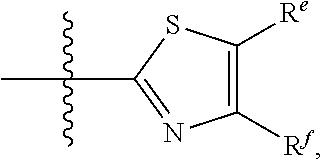
wherein Re is H, OH, F, Cl, Br, I, CN, alkyl, alkenyl, alkynyl, an alkoxy group, an ether group, a carboxylic acid group, a carboxaldehyde group, an ester group, an amine group, an amide group, a carbonate group, a carbamate group, a ureido group, a thioether group, a thioester group, a thioacid group, aryl, arylalkyl, heterocyclyl, heterocyclylalkyl, heteroaryl, or heteroarylalkyl, any of which is substituted or unsubstituted, Rf is H, OH, F, Cl, Br, I, CN, alkyl, alkenyl, alkynyl, an alkoxy group, an ether group, a carboxylic acid group, a carboxaldehyde group, an ester group, an amine group, an amide group, a carbonate group, a carbamate group, a ureido group, a thioether group, a thioester group, a thioacid group, aryl, arylalkyl, heterocyclyl, heterocyclylalkyl, heteroaryl, or heteroarylalkyl, any of which is substituted or unsubstituted. In some embodiments, Re is H, OH, F, Cl, Br, I, alkyl, an alkoxy group, aryl, arylalkyl, heterocyclyl, heterocyclylalkyl, heteroaryl, or heteroarylalkyl, any of which is substituted or unsubstituted; and Rf is H, OH, F, Cl, Br, I, alkyl, an alkoxy group, aryl, arylalkyl, heterocyclyl, heterocyclylalkyl, heteroaryl, or heteroarylalkyl, any of which is substituted or unsubstituted. In some embodiments, Re is H, OH, F, Cl, Br, I, alkyl, or an alkoxy group, any of which is substituted or unsubstituted; and Rf is alkyl, aryl, heterocyclyl, or heteroaryl, any of which is substituted or unsubstituted. In some embodiments, aryl1 is 4-phenylsulfamic acid; Ra is alkyl, which is substituted or unsubstituted; Rb is arylalkyl, which is substituted or unsubstituted; Re is H; and Rf is heteroaryl.

wherein:
each of Rph1, Rph2, Rph3, Rph4, and Rph5 is independently H, OH, F, Cl, Br, I, CN, sulfamic acid, tosylate, mesylate, triflate, besylate, alkyl, alkenyl, alkynyl, an alkoxy group, a sulfhydryl group, a nitro group, a nitroso group, an azido group, a sulfoxide group, a sulfone group, a sulfonamide group, an ether group, a carboxylic acid group, a carboxaldehyde group, an ester group, an amine group, an amide group, a carbonate group, a carbamate group, a ureido group, a thioether group, a thioester group, a thioacid group, aryl, arylalkyl, heterocyclyl, heterocyclylalkyl, heteroaryl, or heteroarylalkyl.


Optional Substituents for Chemical Groups.

is subjected to suitable reaction conditions or contacted with a suitable reagent or catalyst, then a stereocenter of the compound can change, for example, to provide a compound of any of the following formulae, or a mixture thereof:

or a stereoisomer, tautomer, or salt thereof.

can be coupled to a starting material of formula:

wherein N group is a functional group that contains a nitrogen atom, to provide a product of formula:

or a stereoisomer, tautomer, or salt thereof.
| GluValGlnLeuValGluSerGlyGlyGlyLeuValGlnProGlyGly |
| SerLeuArgLeuSerCysAlaAlaSerGlyTyrAspPheThrHisTyr |
| GlyMetAsnTrpValArgGlnAlaProGlyLysGlyLeuGluTrpVal |
| GlyTrpIleAsnThrTyrThrGlyGluProThrTyrAlaAlaAspPhe |
| LysArgArgPheThrPheSerLeuAspThrSerLysSerThrAlaTyr |
| LeuGlnMetAsnSerLeuArgAlaGluAspThrAlaValTyrTyrCys |
| AlaLysTyrProTyrTyrTyrGlyThrSerHisTrpTyrPheAspVal |
| TrpGlyGlnGlyThrLeuValThrValSerSerAlaSerThrLysGly |
| ProSerValPheProLeuAlaProSerSerLysSerThrSerGlyGly |
| ThrAlaAlaLeuGlyCysLeuValLysAspTyrPheProGluProVal |
| ThrValSerTrpAsnSerGlyAlaLeuThrSerGlyValHisThrPhe |
| ProAlaValLeuGlnSerSerGlyLeuTyrSerLeuSerSerValVal |
| ThrValProSerSerSerLeuGlyThrGlnThrTyrIleCysAsnVal |
| AsnHisLysProSerAsnThrLysValAspLysLysValGluProLys |
| SerCysAspLysThrHisLeu. |
| AspIleGlnLeuThrGlnSerProSerSerLeuSerAlaSerValGly |
| AspArgValThrIleThrCysSerAlaSerGlnAspIleSerAsnTyr |
| LeuAsnTrpTyrGlnGlnLysProGlyLysAlaProLysValLeuIle |
| TyrPheThrSerSerLeuHisSerGlyValProSerArgPheSerGly |
| SerGlySerGlyThrAspPheThrLeuThrIleSerSerLeuGlnPro |
| GluAspPheAlaThrTyrTyrCysGlnGlnTyrSerThrValProTrp |
| ThrPheGlyGlnGlyThrLysValGluIleLysArgThrValAlaAla |
| ProSerValPheIlePheProProSerAspGluGlnLeuLysSerGly |
| ThrAlaSerValValCysLeuLeuAsnAsnPheTyrProArgGluAla |
| LysValGlnTrpLysValAspAsnAlaLeuGlnSerGlyAsnSerGln |
| GluSerValThrGluGlnAspSerLysAspSerThrTyrSerLeuSer |
| SerThrLeuThrGlnSerSerGlyLeuTyrSerLeuSerSerValVal |
| ThrValProSerSerSerLeuGlyThrGlnThrTyrIleCysAsnVal |
| AsnHisLysProSerAsnThrLysValAspLysLysValGluProLys |
| SerCysAspLysThrHisLeu. |


wherein the index n is from about 40 to about 200. PVP's can have an average molecular weight from about 5500 to about 28,000 g/mol. One non-limiting example is PVP-10, having an average molecular weight of approximately 10,000 g/mol.
Polyakyleneoxides and Ethers Thereof.
HO[CH(CH3)CH2O]xH
wherein the index x represents the average number of propyleneoxy units in the polymer. The index x can be represented by a whole number or a fraction. For example, a polypropylene glycol having an average molecular weight of 8,000 g/mole (PEG 8000) can be represented by the formulae:
HO[CH(CH3)CH2O]138H or HO[CH(CH3)CH2O]137.6H
or the polypropylene glycol can be represented by the common, short hand notation: PEG 8000.
HO(CH2CH2)y1(CH2CH2CH2O)y2(CH2CH2O)y3OH
which are nonionic block copolymers composed of a polypropyleneoxy unit flanked by two polyethyleneoxy units. The indices y1, y2, and y3 have values such that the poloxamer has an average molecular weight of from about 1000 g/mol to about 20,000 g/mol.


| TABLE I | ||
| Compound (mg) | HPβCD (mg) | Water (mL) |
| 50 | 250 | 25 |
| 50 | 250 | 50 |
| 50 | 250 | 75 |
| 50 | 250 | 100 |
| 100 | 250 | 25 |
| 100 | 250 | 50 |
| 100 | 250 | 75 |
| 100 | 250 | 100 |
| 50 | 250 | 200 |
| 50 | 250 | 300 |
| 50 | 250 | 400 |
| 50 | 250 | 500 |
| 100 | 250 | 200 |
| 100 | 250 | 300 |
| 100 | 250 | 400 |
| 100 | 250 | 500 |
| TABLE | ||
| Stock Solution | ||
| 10% HPβCD/ | 15% HPβCD/ | 17.5% HPβCD/ | ||
| 1.5% dex. | 1.5% dex. | 1.5% dex. | ||
| Comp D-Na (mg) | 550 | 687 | 687 | 825 | 825 | 962.5 |
| Comp D mg/ |
20 | 25 | 25 | 30 | 30 | 35 |
| TABLE III | ||
| | ||
| % HPβCD |
| 0 | 27 | |
| 10 | 45 | |
| 20 | 57 | |
| 30 | 72 | |
| % SBE-β- |
||
| 15 | 44 | |
| % Poloxamer 407 | ||
| 20 | 44 | |
| TABLE IV | ||
| % HPβCD | % PEG400 | Solubility (mg/mL) |
| 0 | 15 | 30 |
| 0 | 30 | 68 |
| 15 | 0 | 59 |
| 15 | 5 | 57 |
| 15 | 10 | 34 |
| 15 | 15 | 6 |
| TABLE V | |||
| Formulation | Concentration of test compound | ||
| 10 |
15 | mg/ |
||
| 25 |
50 | mg/ |
||
| 30 |
50 | mg/ |
||
| 15% HPβCD/0.25 |
40 | mg/mLa | ||
| 4.5 |
5 | mg/mLb | ||
| aEvaluated for short-term physical stability at 5° C. and ambient temperature. | ||||
| bPhysically and chemically stable through one week at room temperature and one week at 50° C. | ||||

wherein: Aryl1 is an aryl group which is substituted or unsubstituted; Aryl2 is an aryl group which is substituted or unsubstituted; X is alkylene, alkenylene, alkynylene, an ether linkage, an amine linkage, an amide linkage, an ester linkage, a thioether linkage, a carbamate linkage, a carbonate linkage, a ureido linkage, a sulfone linkage, any of which is substituted or unsubstituted, or a chemical bond; and Y is H, aryl, heteroaryl, NH(aryl), NH(heteroaryl), NHSO2Rg, or NHCORg, any of which is substituted or unsubstituted, or

wherein: L is alkylene, alkenylene, or alkynylene, any of which is substituted or unsubstituted, or together with the nitrogen atom to which L is bound forms an amide linkage, a carbamate linkage, a ureido linkage, or a sulfonamide linkage, or a chemical bond, or together with any of Ra, Rb, Rc, and Rd forms a ring that is substituted or unsubstituted; Ra is H, alkyl, alkenyl, alkynyl, aryl, arylalkyl, heterocyclyl, heterocyclylalkyl, heteroaryl, or heteroarylalkyl, any of which is substituted or unsubstituted, or together with any of L, Rb, Rc, and Rd forms a ring that is substituted or unsubstituted; Rb is H, alkyl, alkenyl, alkynyl, aryl, arylalkyl, heterocyclyl, heterocyclylalkyl, heteroaryl, or heteroarylalkyl, any of which is substituted or unsubstituted, or together with any of L, Ra, Rc, and Rd forms a ring that is substituted or unsubstituted; Rc is H or alkyl which is substituted or unsubstituted, or together with any of L, Ra, Rb, and Rd forms a ring that is substituted or unsubstituted; Rd is H or alkyl which is substituted or unsubstituted, or together with any of L, Ra, Rb, and Rc forms a ring that is substituted or unsubstituted; and Rg is H, alkyl, alkenyl, alkynyl, aryl, arylalkyl, heterocyclyl, heterocyclylalkyl, heteroaryl, or heteroarylalkyl, any of which is substituted or unsubstituted, or a pharmaceutically-acceptable salt, tautomer, or zwitterion thereof.

wherein Aryl1 is para-substituted phenyl; Aryl2 is substituted heteroaryl; X is methylene; L is alkylene, alkenylene, or alkynylene, any of which is substituted or unsubstituted, or together with the nitrogen atom to which L is bound forms an amide linkage, a carbamate linkage, a ureido linkage, or a sulfonamide linkage, or a chemical bond; Ra is H, alkyl, alkenyl, alkynyl, aryl, arylalkyl, heterocyclyl, heterocyclylalkyl, heteroaryl, or heteroarylalkyl, any of which is substituted or unsubstituted; Rb is H, alkyl, alkenyl, alkynyl, aryl, arylalkyl, heterocyclyl, heterocyclylalkyl, heteroaryl, or heteroarylalkyl, any of which is substituted or unsubstituted; Rc is H or alkyl which is substituted or unsubstituted; and Rd is H or alkyl which is substituted or unsubstituted.


wherein:
Re is H, OH, F, Cl, Br, I, CN, alkyl, alkenyl, alkynyl, an alkoxy group, an ether group, a carboxylic acid group, a carboxaldehyde group, an ester group, an amine group, an amide group, a carbonate group, a carbamate group, a ureido group, a thioether group, a thioester group, a thioacid group, aryl, arylalkyl, heterocyclyl, heterocyclylalkyl, heteroaryl, or heteroarylalkyl, any of which is substituted or unsubstituted; and Rf is H, OH, F, Cl, Br, I, CN, alkyl, alkenyl, alkynyl, an alkoxy group, an ether group, a carboxylic acid group, a carboxaldehyde group, an ester group, an amine group, an amide group, a carbonate group, a carbamate group, a ureido group, a thioether group, a thioester group, a thioacid group, aryl, arylalkyl, heterocyclyl, heterocyclylalkyl, heteroaryl, or heteroarylalkyl, any of which is substituted or unsubstituted.


wherein:
Aryl1 is an aryl group which is substituted or unsubstituted; Aryl2 is an aryl group which is substituted or unsubstituted; X is alkylene, alkenylene, alkynylene, an ether linkage, an amine linkage, an amide linkage, an ester linkage, a thioether linkage, a carbamate linkage, a carbonate linkage, a ureido linkage, a sulfone linkage, any of which is substituted or unsubstituted, or a chemical bond; L is alkylene, alkenylene, or alkynylene, any of which is substituted or unsubstituted, or together with the nitrogen atom to which L is bound forms an amide linkage, a carbamate linkage, a ureido linkage, or a sulfonamide linkage, or a chemical bond, or together with any of Ra, Rb, Rc, and Rd forms a ring that is substituted or unsubstituted; Ra is H, alkyl, alkenyl, alkynyl, aryl, arylalkyl, heterocyclyl, heterocyclylalkyl, heteroaryl, or heteroarylalkyl, any of which is substituted or unsubstituted, or together with any of L, Rb, Rc, and Rd forms a ring that is substituted or unsubstituted; Rb is H, alkyl, alkenyl, alkynyl, aryl, arylalkyl, heterocyclyl, heterocyclylalkyl, heteroaryl, or heteroarylalkyl, any of which is substituted or unsubstituted, or together with any of L, Ra, Rc, and Rd forms a ring that is substituted or unsubstituted; Rc is H or alkyl which is substituted or unsubstituted, or together with any of L, Ra, Rb, and Rd forms a ring that is substituted or unsubstituted; Rd is H or alkyl which is substituted or unsubstituted, or together with any of L, Ra, Rb, and Rc forms a ring that is substituted or unsubstituted; and Rg is H, alkyl, alkenyl, alkynyl, aryl, arylalkyl, heterocyclyl, heterocyclylalkyl, heteroaryl, or heteroarylalkyl, any of which is substituted or unsubstituted, or a pharmaceutically-acceptable salt, tautomer, or zwitterion thereof.

wherein:
Re is H, OH, F, Cl, Br, I, CN, alkyl, alkenyl, alkynyl, an alkoxy group, an ether group, a carboxylic acid group, a carboxaldehyde group, an ester group, an amine group, an amide group, a carbonate group, a carbamate group, a ureido group, a thioether group, a thioester group, a thioacid group, aryl, arylalkyl, heterocyclyl, heterocyclylalkyl, heteroaryl, or heteroarylalkyl, any of which is substituted or unsubstituted; and Rf is H, OH, F, Cl, Br, I, CN, alkyl, alkenyl, alkynyl, an alkoxy group, an ether group, a carboxylic acid group, a carboxaldehyde group, an ester group, an amine group, an amide group, a carbonate group, a carbamate group, a ureido group, a thioether group, a thioester group, a thioacid group, aryl, arylalkyl, heterocyclyl, heterocyclylalkyl, heteroaryl, or heteroarylalkyl, any of which is substituted or unsubstituted.


wherein:
Aryl1 is an aryl group which is substituted or unsubstituted; Aryl2 is an aryl group which is substituted or unsubstituted; X is alkylene, alkenylene, alkynylene, an ether linkage, an amine linkage, an amide linkage, an ester linkage, a thioether linkage, a carbamate linkage, a carbonate linkage, a ureido linkage, a sulfone linkage, any of which is substituted or unsubstituted, or a chemical bond; L is alkylene, alkenylene, or alkynylene, any of which is substituted or unsubstituted, or together with the nitrogen atom to which L is bound forms an amide linkage, a carbamate linkage, a ureido linkage, or a sulfonamide linkage, or a chemical bond, or together with any of Ra, Rb, Rc, and Rd forms a ring that is substituted or unsubstituted; Ra is H, alkyl, alkenyl, alkynyl, aryl, arylalkyl, heterocyclyl, heterocyclylalkyl, heteroaryl, or heteroarylalkyl, any of which is substituted or unsubstituted, or together with any of L, Rb, Rc, and Rd forms a ring that is substituted or unsubstituted; Rb is H, alkyl, alkenyl, alkynyl, aryl, arylalkyl, heterocyclyl, heterocyclylalkyl, heteroaryl, or heteroarylalkyl, any of which is substituted or unsubstituted, or together with any of L, Ra, Rc, and Rd forms a ring that is substituted or unsubstituted; Rc is H or alkyl which is substituted or unsubstituted, or together with any of L, Ra, Rb, and Rd forms a ring that is substituted or unsubstituted; Rd is H or alkyl which is substituted or unsubstituted, or together with any of L, Ra, Rb, and Rc forms a ring that is substituted or unsubstituted; and Rg is H, alkyl, alkenyl, alkynyl, aryl, arylalkyl, heterocyclyl, heterocyclylalkyl, heteroaryl, or heteroarylalkyl, any of which is substituted or unsubstituted, or a salt, tautomer, or zwitterion thereof, wherein a stereocenter of the compound or salt thereof inverts, thereby providing a stereoisomer of the compound or a salt, tautomer, or zwitterion of the stereoisomer.


or a salt thereof, and a starting material to provide a product of formula:

or a salt, tautomer, or zwitterion thereof, wherein: Aryl1 is an aryl group which is substituted or unsubstituted; Aryl2 is an aryl group which is substituted or unsubstituted; X is alkylene, alkenylene, alkynylene, an ether linkage, an amine linkage, an amide linkage, an ester linkage, a thioether linkage, a carbamate linkage, a carbonate linkage, a ureido linkage, a sulfone linkage, any of which is substituted or unsubstituted, or a chemical bond; L is alkylene, alkenylene, or alkynylene, any of which is substituted or unsubstituted, or together with the nitrogen atom to which L is bound forms an amide linkage, a carbamate linkage, a ureido linkage, or a sulfonamide linkage, or a chemical bond, or together with any of Ra, Rb, Rc, and Rd forms a ring that is substituted or unsubstituted; Ra is H, alkyl, alkenyl, alkynyl, aryl, arylalkyl, heterocyclyl, heterocyclylalkyl, heteroaryl, or heteroarylalkyl, any of which is substituted or unsubstituted, or together with any of L, Rb, Rc, and Rd forms a ring that is substituted or unsubstituted; Rb is H, alkyl, alkenyl, alkynyl, aryl, arylalkyl, heterocyclyl, heterocyclylalkyl, heteroaryl, or heteroarylalkyl, any of which is substituted or unsubstituted, or together with any of L, Ra, Rc, and Rd forms a ring that is substituted or unsubstituted; Rc is H or alkyl which is substituted or unsubstituted, or together with any of L, Ra, Rb, and Rd forms a ring that is substituted or unsubstituted; Rd is H or alkyl which is substituted or unsubstituted, or together with any of L, Ra, Rb, and Rc forms a ring that is substituted or unsubstituted; and Rg is H, alkyl, alkenyl, alkynyl, aryl, arylalkyl, heterocyclyl, heterocyclylalkyl, heteroaryl, or heteroarylalkyl, any of which is substituted or unsubstituted.

or a salt thereof.

or a salt, tautomer, or zwitterion thereof.

or a salt thereof, wherein Ngroup is a functional group that contains a nitrogen atom.

or a salt thereof.

or a salt thereof.
Claims (3)


Priority Applications (2)
| Application Number | Priority Date | Filing Date | Title |
|---|---|---|---|
| US15/972,863 US10858354B2 (en) | 2014-03-14 | 2018-05-07 | HPTP-Beta inhibitors |
| US17/062,098 US20210130341A1 (en) | 2014-03-14 | 2020-10-02 | Hptp-beta inhibitors |
Applications Claiming Priority (3)
| Application Number | Priority Date | Filing Date | Title |
|---|---|---|---|
| US201461953680P | 2014-03-14 | 2014-03-14 | |
| US14/657,276 US9994560B2 (en) | 2014-03-14 | 2015-03-13 | HPTP-β inhibitors |
| US15/972,863 US10858354B2 (en) | 2014-03-14 | 2018-05-07 | HPTP-Beta inhibitors |
Related Parent Applications (1)
| Application Number | Title | Priority Date | Filing Date |
|---|---|---|---|
| US14/657,276 Continuation US9994560B2 (en) | 2014-03-14 | 2015-03-13 | HPTP-β inhibitors |
Related Child Applications (1)
| Application Number | Title | Priority Date | Filing Date |
|---|---|---|---|
| US17/062,098 Continuation US20210130341A1 (en) | 2014-03-14 | 2020-10-02 | Hptp-beta inhibitors |
Publications (2)
| Publication Number | Publication Date |
|---|---|
| US20180354937A1 US20180354937A1 (en) | 2018-12-13 |
| US10858354B2 true US10858354B2 (en) | 2020-12-08 |
Family
ID=54068203
Family Applications (3)
| Application Number | Title | Priority Date | Filing Date |
|---|---|---|---|
| US14/657,276 Active US9994560B2 (en) | 2014-03-14 | 2015-03-13 | HPTP-β inhibitors |
| US15/972,863 Active US10858354B2 (en) | 2014-03-14 | 2018-05-07 | HPTP-Beta inhibitors |
| US17/062,098 Abandoned US20210130341A1 (en) | 2014-03-14 | 2020-10-02 | Hptp-beta inhibitors |
Family Applications Before (1)
| Application Number | Title | Priority Date | Filing Date |
|---|---|---|---|
| US14/657,276 Active US9994560B2 (en) | 2014-03-14 | 2015-03-13 | HPTP-β inhibitors |
Family Applications After (1)
| Application Number | Title | Priority Date | Filing Date |
|---|---|---|---|
| US17/062,098 Abandoned US20210130341A1 (en) | 2014-03-14 | 2020-10-02 | Hptp-beta inhibitors |
Country Status (5)
| Country | Link |
|---|---|
| US (3) | US9994560B2 (en) |
| EP (1) | EP3116503A4 (en) |
| JP (3) | JP6483148B2 (en) |
| CN (1) | CN106456614A (en) |
| WO (1) | WO2015138882A1 (en) |
Cited By (2)
| Publication number | Priority date | Publication date | Assignee | Title |
|---|---|---|---|---|
| US20200277267A1 (en) * | 2009-01-12 | 2020-09-03 | Aerpio Pharmaceuticals, Inc. | Methods for treating vascular leak syndrome |
| US11613534B2 (en) | 2019-10-29 | 2023-03-28 | EyePoint Pharmaceuticals, Inc. | Small molecule activators of Tie-2 |
Families Citing this family (23)
| Publication number | Priority date | Publication date | Assignee | Title |
|---|---|---|---|---|
| KR101482483B1 (en) | 2006-04-07 | 2015-01-15 | 에르피오 세러퓨틱스 인코포레이티드 | Antibodies that bind human protein tyrosine phosphatase beta (hptpbeta) and uses thereof |
| US7622593B2 (en) | 2006-06-27 | 2009-11-24 | The Procter & Gamble Company | Human protein tyrosine phosphatase inhibitors and methods of use |
| ES2726946T3 (en) | 2009-07-06 | 2019-10-10 | Aerpio Therapeutics Inc | Benzosulfonamide derivatives, compositions thereof and their use in the prevention of cancer cell metastasis |
| CA2850830A1 (en) | 2011-10-13 | 2013-04-18 | Aerpio Therapeutics, Inc. | Methods for treating vascular leak syndrome and cancer |
| US20150050277A1 (en) | 2013-03-15 | 2015-02-19 | Aerpio Therapeutics Inc. | Compositions and methods for treating ocular diseases |
| GB2516561B (en) | 2013-03-15 | 2016-03-09 | Aerpio Therapeutics Inc | Compositions, formulations and methods for treating ocular diseases |
| EP3116503A4 (en) | 2014-03-14 | 2017-08-23 | Aerpio Therapeutics, Inc. | Hptp-beta inhibitors |
| US9539245B2 (en) | 2014-08-07 | 2017-01-10 | Aerpio Therapeutics, Inc. | Combination of immunotherapies with activators of Tie-2 |
| WO2016057931A1 (en) | 2014-10-10 | 2016-04-14 | The Research Foundation For The State University Of New York | Trifluoromethoxylation of arenes via intramolecular trifluoromethoxy group migration |
| MY194736A (en) * | 2015-09-23 | 2022-12-15 | Aerpio Therapeutics Inc | Methods of treating intraocular pressure with activators of tie-2 |
| US10253094B2 (en) | 2016-07-20 | 2019-04-09 | Aerpio Therapeutics, Inc. | Antibodies that target human protein tyrosine phosphatase-beta (HPTP-beta) and methods of use thereof to treat ocular conditions |
| WO2019165349A1 (en) * | 2018-02-26 | 2019-08-29 | Aerpio Therapeutics, Inc. | METHODS OF TREATING DIABETIC NEPHROPATHY USING HPTPß INHIBITORS |
| CN113286580A (en) * | 2018-07-13 | 2021-08-20 | 西北大学 | VE-PTP inhibition in glaucoma |
| KR102630416B1 (en) | 2018-10-30 | 2024-02-01 | 길리애드 사이언시즈, 인코포레이티드 | Quinoline derivatives as alpha4beta7 integrin inhibitors |
| US11179383B2 (en) | 2018-10-30 | 2021-11-23 | Gilead Sciences, Inc. | Compounds for inhibition of α4β7 integrin |
| ES3013256T3 (en) | 2018-10-30 | 2025-04-11 | Gilead Sciences Inc | Imidazo[1,2-a]pyridine derivatives as alpha4beta7 integrin inhibitors for the treatment of inflammatory diseases |
| AU2019373242B2 (en) | 2018-10-30 | 2023-07-13 | Gilead Sciences, Inc. | Compounds for inhibition of alpha 4 beta 7 integrin |
| WO2020214851A1 (en) * | 2019-04-18 | 2020-10-22 | Aerpio Pharmaceuticals, Inc. | Methods of treating hypertension with activators of tie-2 |
| WO2020223209A1 (en) | 2019-04-29 | 2020-11-05 | Aerpio Pharmaceuticals, Inc. | Tie-2 activators targeting the schlemm's canal |
| US11413242B2 (en) | 2019-06-24 | 2022-08-16 | EyePoint Pharmaceuticals, Inc. | Formulations of Tie-2 activators and methods of use thereof |
| CN114222730B (en) | 2019-08-14 | 2024-09-10 | 吉利德科学公司 | Compounds for inhibiting α4β7 integrin |
| CN113060789A (en) * | 2019-12-31 | 2021-07-02 | 大连乾丰生物科技有限公司 | Jelly fish pond water bottom material modifier |
| CN116940355A (en) * | 2020-12-18 | 2023-10-24 | 视点制药公司 | Method for manufacturing small molecule activators of TIE-2 |
Citations (81)
| Publication number | Priority date | Publication date | Assignee | Title |
|---|---|---|---|---|
| US4221584A (en) | 1979-02-09 | 1980-09-09 | Chevron Research Company | Herbicidal and plant-growth-regulating N-(heterocyclyl)-methylacetanilides |
| US4735961A (en) | 1984-05-07 | 1988-04-05 | Merck & Co., Inc. | Oxazoles and thiazoles containing an aminohydroxypropoxyphenyl moiety |
| WO1996022997A1 (en) | 1995-01-27 | 1996-08-01 | Novo Nordisk A/S | Compounds with growth hormone releasing properties |
| WO1996031598A1 (en) | 1995-04-06 | 1996-10-10 | Regeneron Pharmaceuticals, Inc. | Tie-2 ligands, methods of making and uses thereof |
| WO1998018914A1 (en) | 1996-10-31 | 1998-05-07 | Duke University | Soluble tie2 receptor |
| US5919813A (en) | 1998-03-13 | 1999-07-06 | Johns Hopkins University, School Of Medicine | Use of a protein tyrosine kinase pathway inhibitor in the treatment of diabetic retinopathy |
| US5980929A (en) | 1998-03-13 | 1999-11-09 | Johns Hopkins University, School Of Medicine | Use of a protein tyrosine kinase pathway inhibitor in the treatment of retinal ischmemia or ocular inflammation |
| WO2000057901A1 (en) | 1999-03-26 | 2000-10-05 | Regeneron Pharmaceuticals, Inc. | Modulation of vascular permeability by means of tie2 receptor activators |
| US6455035B1 (en) | 1999-03-26 | 2002-09-24 | Regeneron Pharmaceuticals, Inc. | Angiopoietins and methods of use thereof |
| US20030040463A1 (en) | 1996-04-05 | 2003-02-27 | Wiegand Stanley J. | TIE-2 ligands, methods of making and uses thereof |
| US20030055006A1 (en) | 2000-06-23 | 2003-03-20 | Schering Aktiengesellschaft | Combinations and compositions which interfere with VEGF/VEGF and angiopoietin/tie receptor function and their use |
| WO2003072100A1 (en) | 2002-02-25 | 2003-09-04 | Eli Lilly And Company | Peroxisome proliferator activated receptor modulators |
| WO2003084565A2 (en) | 2002-04-08 | 2003-10-16 | MAX-PLANCK-Gesellschaft zur Förderung der Wissenschaften e.V. | Ve-ptp as regulator of ve-cadherin mediated processes or disorders |
| US20040077065A1 (en) | 2002-09-25 | 2004-04-22 | The Procter & Gamble Company | Three dimensional coordinates of HPTPbeta |
| WO2004043928A2 (en) | 2002-11-09 | 2004-05-27 | The Procter & Gamble Company | N-sulfonyl-4-methyleneamino-3-hydroxy-2-pyridones as antimicrobial agents |
| WO2004043927A1 (en) | 2002-11-09 | 2004-05-27 | The Procter & Gamble Company | N-alkyl-4-methyleneamino-3-hydroxy-2-pyridones as antimicrobials |
| WO2005089755A1 (en) | 2004-03-18 | 2005-09-29 | R-Tech Ueno, Ltd. | Aqueous composition comprising thiazole derivative |
| US7052695B2 (en) | 2001-10-25 | 2006-05-30 | Regeneron Pharmaceuticals, Inc. | Angiopoietins and methods of treating hypertension |
| WO2006068953A2 (en) | 2004-12-21 | 2006-06-29 | Astrazeneca Ab | Antibodies directed to angiopoietin-2 and uses thereof |
| WO2006116713A1 (en) | 2005-04-27 | 2006-11-02 | Amgen Inc. | Substituted amide derivatives as protein kinase inhibitors |
| WO2007033216A2 (en) | 2005-09-12 | 2007-03-22 | Beth Israel Deaconess Medical Center | Methods and compositions for the treatment and diagnosis of diseases characterized by vascular leak, hypotension, or a procoagulant state |
| US7226755B1 (en) | 2002-09-25 | 2007-06-05 | The Procter & Gamble Company | HPTPbeta as a target in treatment of angiogenesis mediated disorders |
| WO2007116360A2 (en) | 2006-04-07 | 2007-10-18 | The Procter & Gamble Company | Antibodies that bind human protein tyrosine phosphatase beta (hptpbeta) and uses thereof |
| US20070299116A1 (en) | 2006-06-27 | 2007-12-27 | The Procter & Gamble Company | Human protein tyrosine phosphatase inhibitors and methods of use |
| US20080004267A1 (en) | 2006-06-27 | 2008-01-03 | The Procter & Gamble Company | Human protein tyrosine phosphatase inhibitors and methods of use |
| WO2008002569A2 (en) | 2006-06-27 | 2008-01-03 | The Procter & Gamble Company | Human protein tyrosine phosphatase inhibitors and methods of use |
| US7354579B2 (en) | 2003-07-25 | 2008-04-08 | Regeneron Pharmaceuticals, Inc. | Method of treating cancer with a VEGF antagonist and an anti-proliferative agent |
| US20080268051A1 (en) | 2007-04-30 | 2008-10-30 | Allergan, Inc. | High viscosity macromolecular compositions for treating ocular conditions |
| US7740846B2 (en) | 2004-07-20 | 2010-06-22 | Genentech, Inc. | Inhibitors of angiopoietin-like 4 protein, combinations, and their use |
| WO2010081172A1 (en) | 2009-01-12 | 2010-07-15 | Akebia Therapeutics Inc. | Methods for treating vascular leak syndrome |
| US20100226992A1 (en) | 2009-03-03 | 2010-09-09 | Alcon Research, Ltd. | Pharmaceutical Composition for Delivery of Receptor Tyrosine Kinase Inhibiting (RTKi) Compounds to the Eye |
| WO2011005330A1 (en) | 2009-07-06 | 2011-01-13 | Akebia Therapeutics Inc. | Compounds, compositions, and methods for preventing metastasis of cancer cells |
| WO2011057121A1 (en) | 2009-11-06 | 2011-05-12 | Akebia Therapeutics Inc. | Compositions and methods for treating colitis |
| US20110319455A1 (en) | 2010-04-19 | 2011-12-29 | Bruce Steven Klein | Antifungal Treatment |
| WO2012047966A2 (en) | 2010-10-07 | 2012-04-12 | Akebia Therapeutics Inc. | Compositions and methods for treating ocular edema, neovascularization and related diseases |
| US20130023543A1 (en) | 2006-06-27 | 2013-01-24 | Aerpio Therapeutics Inc. | Human protein tyrosine phosphatase inhibitors and methods of use |
| US20130023542A1 (en) | 2006-06-27 | 2013-01-24 | Aerpio Therapeutics Inc. | Human protein tyrosine phosphatase inhibitors and methods of use |
| EP2142189B1 (en) | 2007-04-02 | 2013-02-27 | Allergan, Inc. | Methods and compositions for intraocular administration to treat ocular conditions |
| US20130095105A1 (en) | 2011-10-13 | 2013-04-18 | Aerpio Therapeutics, Inc. | Treatment of Ocular Disease |
| US20130095065A1 (en) | 2011-10-13 | 2013-04-18 | Aerpio Therapeutics, Inc. | Methods for Treating Vascular Leak Syndrome and Cancer |
| US20130137741A1 (en) | 2009-03-03 | 2013-05-30 | Alcon Research, Ltd. | Pharmaceutical Composition for Delivery of Receptor Tyrosine Kinase Inhibiting (RTKi) Compounds to the Eye |
| US20130190324A1 (en) | 2011-12-23 | 2013-07-25 | The Regents Of The University Of Colorado, A Body Corporate | Topical ocular drug delivery |
| US20140010805A1 (en) | 2010-07-12 | 2014-01-09 | Karen Curd | Administration of hypoxia activated prodrugs and antiangiogenic agents for the treatment of cancer |
| US20140073566A1 (en) | 2004-09-28 | 2014-03-13 | Aprogen, Inc. | Methods of using chimeric coiled-coil molecule |
| US20140179693A1 (en) | 2009-01-12 | 2014-06-26 | Robert Shalwitz | Methods for treating vascular leak syndrome |
| US20140249100A1 (en) | 2009-07-06 | 2014-09-04 | Aerpio Therapeutics Inc. | Compounds, compositions, and methods for preventing metastasis of cancer cells |
| US20140275103A1 (en) | 2013-03-15 | 2014-09-18 | Aerpio Therapeutics Inc. | Compositions, formulations and methods for treating ocular diseases |
| US20150030603A1 (en) | 2013-07-29 | 2015-01-29 | Samsung Electronics Co., Ltd. | Anti-ang2 antibody |
| US20150050277A1 (en) | 2013-03-15 | 2015-02-19 | Aerpio Therapeutics Inc. | Compositions and methods for treating ocular diseases |
| US8968766B2 (en) | 2004-04-30 | 2015-03-03 | Allergan, Inc. | Sustained release intraocular implants containing tyrosine kinase inhibitors and related methods |
| US20150065781A1 (en) | 2013-08-30 | 2015-03-05 | Genentech, Inc. | Combination therapy for the treatment of glioblastoma |
| US20150071941A1 (en) | 2012-04-13 | 2015-03-12 | The Johns Hopkins University | Treatment of ischemic retinopathies |
| US8999953B2 (en) | 2005-07-22 | 2015-04-07 | Oculis Ehf | Cyclodextrin nanotechnology for ophthalmic drug delivery |
| US20150125542A1 (en) | 2010-12-02 | 2015-05-07 | Maruzen Pharmaceuticals Co., Ltd. | TIE2 Activator, Vascular Endothelial Growth Factor (VEGF) Inhibitor, Angiogenesis Inhibitor, Vascular Maturing Agent, Vascular Normalizing Agent and Vascular Stabilizing Agent, and Pharmaceutical Composition |
| US20150175676A1 (en) | 2004-01-16 | 2015-06-25 | Regeneron Pharmaceuticals, Inc. | Fusion Polypeptides Capable Of Activating Receptors |
| US20150190432A1 (en) | 2012-07-31 | 2015-07-09 | The Board Of Regents Of The University Of Texas System | Methods and Compositions for In Vivo Induction of Pancreatic Beta Cell Formation |
| WO2015138882A1 (en) | 2014-03-14 | 2015-09-17 | Aerpio Therapeutics, Inc. | Hptp-beta inhibitors |
| US20150258120A1 (en) | 2012-11-08 | 2015-09-17 | Clearside Biomedical, Inc. | Methods and devices for the treatment of ocular diseases in human subjects |
| WO2015152416A1 (en) | 2014-04-04 | 2015-10-08 | 国立大学法人東北大学 | Ocular hypotensive agent |
| US20150290235A1 (en) | 2012-11-23 | 2015-10-15 | Ab Science | Use of small molecule inhibitors/activators in combination with (deoxy)nucleoside or (deoxy)nucleotide analogs for treatment of cancer and hematological malignancies or viral infections |
| US20150297740A1 (en) | 2012-10-11 | 2015-10-22 | Ascendis Pharma Ophthalmology Division A/S | VEGF Neutralizing Prodrugs for the Treatment of Ocular Conditions |
| US20160000871A1 (en) | 2014-07-03 | 2016-01-07 | Mannin Research Inc. | Tie2 receptor activation for glaucoma |
| US9248172B2 (en) | 2002-04-25 | 2016-02-02 | University Of Connecticut Health Center | Using heat shock proteins to improve the therapeutic benefit of a non-vaccine treatment modality |
| US20160030393A1 (en) | 2004-03-15 | 2016-02-04 | Jannsen Pharmaceutica Nv | Novel compounds as opioid receptor modulators |
| WO2016022813A1 (en) | 2014-08-07 | 2016-02-11 | Aerpio Therapeutics, Inc. | Combination of immunotherapies with activators of tie-2 |
| US20160045566A1 (en) | 2013-11-01 | 2016-02-18 | Regeneron Pharmaceuticals, Inc. | Angiopoietin-based interventions for treating cerebral malaria |
| US20160058828A1 (en) | 2013-04-11 | 2016-03-03 | Sunnybrook Research Institute | Methods, uses and compositions of tie2 agonists |
| US20160082129A1 (en) | 2014-09-24 | 2016-03-24 | Aerpio Therapeutics, Inc. | VE-PTP Extracellular Domain Antibodies Delivered by a Gene Therapy Vector |
| US20160130321A1 (en) | 2013-06-20 | 2016-05-12 | Gabriela Burian | Use of a vegf antagonist in treating macular edema |
| US20160130337A1 (en) | 2014-11-07 | 2016-05-12 | Novartis Ag | Methods for treating ocular diseases |
| US20160137717A1 (en) | 2013-06-20 | 2016-05-19 | Gabriela Burian | Use of a vegf antagonist in treating choroidal neovascularisation |
| US20160144025A1 (en) | 2014-11-25 | 2016-05-26 | Regeneron Pharmaceuticals, Inc. | Methods and formulations for treating vascular eye diseases |
| US20160151448A1 (en) | 2006-10-27 | 2016-06-02 | Sunnybrook Health Sciences Centre | Multimeric tie 2 agonists and uses thereof in stimulating angiogenesis |
| US20160151410A1 (en) | 2013-07-02 | 2016-06-02 | The Trustees Of Columbia University In The City Of New York | Clearance of bioactive lipids from membrane structures by cyclodextrins |
| US20160159893A1 (en) | 2013-07-11 | 2016-06-09 | Gabriela Burian | Use of a VEGF Antagonist in Treating Retinopathy of Prematurity |
| US20160168240A1 (en) | 2013-07-11 | 2016-06-16 | Sergey AKSENOV | Use of vegf antagonist in treating chorioretinal neovascular and permeability disorders in paediatric patients |
| US9403789B2 (en) | 2008-02-21 | 2016-08-02 | Sequoia Pharmaceuticals, Inc. | Benzofuran-containing amino acid inhibitors of cytochrome P450 |
| US20160252526A1 (en) | 2013-10-01 | 2016-09-01 | Sphingotec Gmbh | A method for predicting the risk of getting a major adverse cardiac event |
| US20160251421A1 (en) | 2005-12-15 | 2016-09-01 | Medimmune Limited | Combination of angiopoietin-2 antagonist and of vegf-a, kdr and/or flt1 antagonist for treating cancer |
| US20170260265A1 (en) | 2012-07-13 | 2017-09-14 | Roche Glycart Ag | Bispecific anti-vegf/anti-ang-2 antibodies and their use in the treatment of ocular vascular diseases |
| US20180092883A1 (en) | 2010-10-07 | 2018-04-05 | Aerpio Therapeutics, Inc. | Phosphatase inhibitors for treating ocular diseases |
-
2015
- 2015-03-13 EP EP15760687.2A patent/EP3116503A4/en not_active Withdrawn
- 2015-03-13 JP JP2016556997A patent/JP6483148B2/en active Active
- 2015-03-13 WO PCT/US2015/020425 patent/WO2015138882A1/en not_active Ceased
- 2015-03-13 US US14/657,276 patent/US9994560B2/en active Active
- 2015-03-13 CN CN201580026210.0A patent/CN106456614A/en active Pending
-
2018
- 2018-05-07 US US15/972,863 patent/US10858354B2/en active Active
- 2018-12-28 JP JP2018246712A patent/JP6661744B2/en active Active
-
2019
- 2019-04-16 JP JP2019077696A patent/JP2019108407A/en not_active Withdrawn
-
2020
- 2020-10-02 US US17/062,098 patent/US20210130341A1/en not_active Abandoned
Patent Citations (194)
| Publication number | Priority date | Publication date | Assignee | Title |
|---|---|---|---|---|
| US4221584A (en) | 1979-02-09 | 1980-09-09 | Chevron Research Company | Herbicidal and plant-growth-regulating N-(heterocyclyl)-methylacetanilides |
| US4735961A (en) | 1984-05-07 | 1988-04-05 | Merck & Co., Inc. | Oxazoles and thiazoles containing an aminohydroxypropoxyphenyl moiety |
| WO1996022997A1 (en) | 1995-01-27 | 1996-08-01 | Novo Nordisk A/S | Compounds with growth hormone releasing properties |
| WO1996031598A1 (en) | 1995-04-06 | 1996-10-10 | Regeneron Pharmaceuticals, Inc. | Tie-2 ligands, methods of making and uses thereof |
| US20030040463A1 (en) | 1996-04-05 | 2003-02-27 | Wiegand Stanley J. | TIE-2 ligands, methods of making and uses thereof |
| US7309483B2 (en) | 1996-04-05 | 2007-12-18 | Regeneron Pharmaceuticals, Inc. | Method of treatment using Tie2 ligand2 |
| WO1998018914A1 (en) | 1996-10-31 | 1998-05-07 | Duke University | Soluble tie2 receptor |
| US5919813C1 (en) | 1998-03-13 | 2002-01-29 | Univ Johns Hopkins Med | Use of a protein tyrosine kinase pathway inhibitor in the treatment of diabetic retinopathy |
| US5980929A (en) | 1998-03-13 | 1999-11-09 | Johns Hopkins University, School Of Medicine | Use of a protein tyrosine kinase pathway inhibitor in the treatment of retinal ischmemia or ocular inflammation |
| US5919813A (en) | 1998-03-13 | 1999-07-06 | Johns Hopkins University, School Of Medicine | Use of a protein tyrosine kinase pathway inhibitor in the treatment of diabetic retinopathy |
| US6455035B1 (en) | 1999-03-26 | 2002-09-24 | Regeneron Pharmaceuticals, Inc. | Angiopoietins and methods of use thereof |
| WO2000057901A1 (en) | 1999-03-26 | 2000-10-05 | Regeneron Pharmaceuticals, Inc. | Modulation of vascular permeability by means of tie2 receptor activators |
| EP1165115B1 (en) | 1999-03-26 | 2003-05-28 | Regeneron Pharmaceuticals, Inc. | Modulation of vascular permeability by mean of tie2 receptor activators |
| US20030055006A1 (en) | 2000-06-23 | 2003-03-20 | Schering Aktiengesellschaft | Combinations and compositions which interfere with VEGF/VEGF and angiopoietin/tie receptor function and their use |
| EP1292335B1 (en) | 2000-06-23 | 2007-05-30 | Bayer Schering Pharma Aktiengesellschaft | Combinations and compositions which interfere with vegf/vegf and angiopoietin/tie receptor function and their use (ii) |
| US7052695B2 (en) | 2001-10-25 | 2006-05-30 | Regeneron Pharmaceuticals, Inc. | Angiopoietins and methods of treating hypertension |
| WO2003072100A1 (en) | 2002-02-25 | 2003-09-04 | Eli Lilly And Company | Peroxisome proliferator activated receptor modulators |
| WO2003084565A2 (en) | 2002-04-08 | 2003-10-16 | MAX-PLANCK-Gesellschaft zur Förderung der Wissenschaften e.V. | Ve-ptp as regulator of ve-cadherin mediated processes or disorders |
| US9248172B2 (en) | 2002-04-25 | 2016-02-02 | University Of Connecticut Health Center | Using heat shock proteins to improve the therapeutic benefit of a non-vaccine treatment modality |
| US7226755B1 (en) | 2002-09-25 | 2007-06-05 | The Procter & Gamble Company | HPTPbeta as a target in treatment of angiogenesis mediated disorders |
| US20080076764A1 (en) | 2002-09-25 | 2008-03-27 | The Procter & Gamble Company | HPTPbeta as a target in treatment of angiogenesis mediated disorders |
| US20100056610A1 (en) | 2002-09-25 | 2010-03-04 | Timothy P. Thomas | HEPTbeta AS A TARGET IN TREATMENT OF ANGIOGENISIS MEDIATED DISORDERS |
| US20100030487A1 (en) | 2002-09-25 | 2010-02-04 | Artem Gennady Evdokimov | THREE DIMENSIONAL COORDINATES OF HPTPbeta |
| US7632862B2 (en) | 2002-09-25 | 2009-12-15 | Procter & Gamble Company | Pharmaceutical compositions that modulate HPTPbeta activity |
| US7769575B2 (en) | 2002-09-25 | 2010-08-03 | Warner Chilcott, LLC | Three dimensional coordinates of HPTPbeta |
| US7507568B2 (en) | 2002-09-25 | 2009-03-24 | The Proctor & Gamble Company | Three dimensional coordinates of HPTPbeta |
| US20040077065A1 (en) | 2002-09-25 | 2004-04-22 | The Procter & Gamble Company | Three dimensional coordinates of HPTPbeta |
| WO2004043927A1 (en) | 2002-11-09 | 2004-05-27 | The Procter & Gamble Company | N-alkyl-4-methyleneamino-3-hydroxy-2-pyridones as antimicrobials |
| WO2004043928A2 (en) | 2002-11-09 | 2004-05-27 | The Procter & Gamble Company | N-sulfonyl-4-methyleneamino-3-hydroxy-2-pyridones as antimicrobial agents |
| US7354579B2 (en) | 2003-07-25 | 2008-04-08 | Regeneron Pharmaceuticals, Inc. | Method of treating cancer with a VEGF antagonist and an anti-proliferative agent |
| US20150175676A1 (en) | 2004-01-16 | 2015-06-25 | Regeneron Pharmaceuticals, Inc. | Fusion Polypeptides Capable Of Activating Receptors |
| US20160030393A1 (en) | 2004-03-15 | 2016-02-04 | Jannsen Pharmaceutica Nv | Novel compounds as opioid receptor modulators |
| WO2005089755A1 (en) | 2004-03-18 | 2005-09-29 | R-Tech Ueno, Ltd. | Aqueous composition comprising thiazole derivative |
| US8968766B2 (en) | 2004-04-30 | 2015-03-03 | Allergan, Inc. | Sustained release intraocular implants containing tyrosine kinase inhibitors and related methods |
| US7740846B2 (en) | 2004-07-20 | 2010-06-22 | Genentech, Inc. | Inhibitors of angiopoietin-like 4 protein, combinations, and their use |
| US20140073566A1 (en) | 2004-09-28 | 2014-03-13 | Aprogen, Inc. | Methods of using chimeric coiled-coil molecule |
| US20150125455A1 (en) | 2004-12-21 | 2015-05-07 | Medimmune Limited | Antibodies directed to angiopoietin-2 and uses thereof |
| WO2006068953A2 (en) | 2004-12-21 | 2006-06-29 | Astrazeneca Ab | Antibodies directed to angiopoietin-2 and uses thereof |
| WO2006116713A1 (en) | 2005-04-27 | 2006-11-02 | Amgen Inc. | Substituted amide derivatives as protein kinase inhibitors |
| US8999953B2 (en) | 2005-07-22 | 2015-04-07 | Oculis Ehf | Cyclodextrin nanotechnology for ophthalmic drug delivery |
| WO2007033216A2 (en) | 2005-09-12 | 2007-03-22 | Beth Israel Deaconess Medical Center | Methods and compositions for the treatment and diagnosis of diseases characterized by vascular leak, hypotension, or a procoagulant state |
| US20160251421A1 (en) | 2005-12-15 | 2016-09-01 | Medimmune Limited | Combination of angiopoietin-2 antagonist and of vegf-a, kdr and/or flt1 antagonist for treating cancer |
| WO2007116360A2 (en) | 2006-04-07 | 2007-10-18 | The Procter & Gamble Company | Antibodies that bind human protein tyrosine phosphatase beta (hptpbeta) and uses thereof |
| US20110274699A1 (en) | 2006-04-07 | 2011-11-10 | Rocco Jamie Rotello | ANTIBODIES THAT BIND HUMAN PROTEIN TYROSINE PHOSPHATASE beta (HPTPbeta) AND USES THEREOF |
| EP2371865A2 (en) | 2006-04-07 | 2011-10-05 | Warner Chilcott Company, LLC | Antibodies that bind human protein tyrosine phosphatase beta (HPTP-ß) and uses thereof |
| US20090022715A1 (en) | 2006-04-07 | 2009-01-22 | The Procter & Gamble Company | Antibodies that bind human protein tyrosine phosphatase beta (HPTPbeta) and uses thereof |
| US7973142B2 (en) | 2006-04-07 | 2011-07-05 | Warner Chilcott Company | Antibodies that bind human protein tyrosine phosphatase beta (HPTPβ) |
| EP2004697A2 (en) | 2006-04-07 | 2008-12-24 | The Procter & Gamble Company | Antibodies that bind human protein tyrosine phosphatase beta (hptpbeta) and uses thereof |
| US8524235B2 (en) | 2006-04-07 | 2013-09-03 | Aeripo Therapeutics Inc. | Method for treating coronary artery disease using antibody binding human protein tyrosine phosphatase beta(HPTPbeta) |
| US9926367B2 (en) | 2006-04-07 | 2018-03-27 | Aerpio Therapeutics, Inc. | Antibodies that bind human protein tyrosine phosphatase beta (HPTPbeta) and uses thereof |
| US20140044707A1 (en) | 2006-04-07 | 2014-02-13 | Aerpio Therapeutics Inc. | ANTIBODIES THAT BIND HUMAN PROTEIN TYROSINE PHOSPHATASE beta (HPTPbeta) AND USES TEHREOF |
| USRE46592E1 (en) | 2006-06-27 | 2017-10-31 | Aerpio Therapeutics, Inc. | Human protein tyrosine phosphatase inhibitors and methods of use |
| US20140221666A1 (en) | 2006-06-27 | 2014-08-07 | Aerpio Therapeutics Inc. | Human protein tyrosine phosphatase inhibitors and methods of use |
| US8846685B2 (en) | 2006-06-27 | 2014-09-30 | Aerpio Therapeutics Inc. | Human protein tyrosine phosphatase inhibitors and methods of use |
| US7795444B2 (en) | 2006-06-27 | 2010-09-14 | Warner Chilcott Company | Human protein tyrosine phosphatase inhibitors and methods of use |
| EP2803663A1 (en) | 2006-06-27 | 2014-11-19 | Aerpio Therapeutics Inc. | Human protein tyrosine phosphatase inhibitors and their pharmaceutical use |
| US8895563B2 (en) | 2006-06-27 | 2014-11-25 | Aerpio Therapeutics, Inc. | Human protein tyrosine phosphatase inhibitors and methods of use |
| US20100069448A1 (en) | 2006-06-27 | 2010-03-18 | Jeffrey Lyle Gray | Human protein tyrosine phosphatase inhibitors and methods of use |
| US8946232B2 (en) | 2006-06-27 | 2015-02-03 | Aerpio Therapeutics, Inc. | Human protein tyrosine phosphatase inhibitors and methods of use |
| EP2041102B1 (en) | 2006-06-27 | 2014-11-12 | Aerpio Therapeutics Inc. | Human protein tyrosine phosphatase inhibitors and methods of use |
| US9795594B2 (en) | 2006-06-27 | 2017-10-24 | Aerpio Therapeutics, Inc. | Human protein tyrosine phosphatase inhibitors and methods of use |
| US20160374996A1 (en) | 2006-06-27 | 2016-12-29 | Aerpio Therapeutics, Inc. | Human protein tyrosine phosphatase inhibitors and methods of use |
| US20100016336A1 (en) | 2006-06-27 | 2010-01-21 | Jeffrey Lyle Gray | Human protein tyrosine phosphatase inhibitors and methods of use |
| US20110212951A1 (en) | 2006-06-27 | 2011-09-01 | Jeffery Lyle Gray | Human protein tyrosine phosphatase inhibitors and methods of use |
| US7622593B2 (en) | 2006-06-27 | 2009-11-24 | The Procter & Gamble Company | Human protein tyrosine phosphatase inhibitors and methods of use |
| EP2041129B1 (en) | 2006-06-27 | 2014-09-03 | Aerpio Therapeutics Inc. | Human protein-tyrosine phosphatase inhibitors and their pharmaceutical use |
| US7589212B2 (en) | 2006-06-27 | 2009-09-15 | Procter & Gamble Company | Human protein tyrosine phosphatase inhibitors and methods of use |
| US20070299116A1 (en) | 2006-06-27 | 2007-12-27 | The Procter & Gamble Company | Human protein tyrosine phosphatase inhibitors and methods of use |
| US20090227639A1 (en) | 2006-06-27 | 2009-09-10 | Jeffrey Lyle Gray | Human protein tyrosine phosphatase inhibitors and methods of use |
| US8106078B2 (en) | 2006-06-27 | 2012-01-31 | Warner Chilcott Company, Llc | Human protein tyrosine phosphatase inhibitors and methods of use |
| US20120077975A1 (en) | 2006-06-27 | 2012-03-29 | Jeffrey Lyle Gray | Human protein tyrosine phosphatase inhibitors and method of use |
| US20120077853A1 (en) | 2006-06-27 | 2012-03-29 | Jeffrey Lyle Gray | Human protein tyrosine phosphatase inhibitors and methods of use |
| US20080108631A1 (en) | 2006-06-27 | 2008-05-08 | The Procter & Gamble Company | Human protein tyrosine phosphatase inhibitors an methods of use |
| EP2038265B1 (en) | 2006-06-27 | 2015-03-18 | Aerpio Therapeutics Inc. | Human protein-tyrosine phosphatase inhibitors and methods of use |
| US20150210656A1 (en) | 2006-06-27 | 2015-07-30 | Aerpio Therapeutics, Inc. | Human protein tyrosine phosphatase inhibitors and methods of use |
| US20080004267A1 (en) | 2006-06-27 | 2008-01-03 | The Procter & Gamble Company | Human protein tyrosine phosphatase inhibitors and methods of use |
| US8188125B2 (en) | 2006-06-27 | 2012-05-29 | Aerpio Therapeutics Inc. | Human protein tyrosine phosphatase inhibitors and methods of use |
| US8258311B2 (en) | 2006-06-27 | 2012-09-04 | Aerpio Therapeutics Inc. | Human protein tyrosine phosphatase inhibitors and methods of use |
| US9284285B2 (en) | 2006-06-27 | 2016-03-15 | Aerpio Therapeutics, Inc. | Human protein tyrosine phosphatase inhibitors and methods of use |
| US8329916B2 (en) | 2006-06-27 | 2012-12-11 | Aerpio Therapeutics Inc. | Human protein tyrosine phosphatase inhibitors and method of use |
| US8338615B2 (en) | 2006-06-27 | 2012-12-25 | Aerpio Therapeutics Inc. | Human protein tyrosine phosphatase inhibitors and methods of use |
| US20130023543A1 (en) | 2006-06-27 | 2013-01-24 | Aerpio Therapeutics Inc. | Human protein tyrosine phosphatase inhibitors and methods of use |
| US20130023542A1 (en) | 2006-06-27 | 2013-01-24 | Aerpio Therapeutics Inc. | Human protein tyrosine phosphatase inhibitors and methods of use |
| WO2008002570A2 (en) | 2006-06-27 | 2008-01-03 | The Procter & Gamble Company | Human protein tyrosine phosphatase inhibitors and methods of use |
| CN101506183A (en) | 2006-06-27 | 2009-08-12 | 宝洁公司 | Human protein tyrosine phosphatase inhibitors and methods of use thereof |
| WO2008002569A2 (en) | 2006-06-27 | 2008-01-03 | The Procter & Gamble Company | Human protein tyrosine phosphatase inhibitors and methods of use |
| US20130096140A1 (en) | 2006-06-27 | 2013-04-18 | Aerpio Therapeutics Inc. | Human protein tyrosine phosphatase inhibitors and methods of use |
| US20130324558A1 (en) | 2006-06-27 | 2013-12-05 | Aerpio Therapeutics Inc. | Human protein tyrosine phosphatase inhibitors and methods of use |
| WO2008002571A2 (en) | 2006-06-27 | 2008-01-03 | The Procter & Gamble Company | Human protein tyrosine phosphatase inhibitors and methods of use |
| EP2592072A2 (en) | 2006-06-27 | 2013-05-15 | Warner Chilcott Company, LLC | Human protein tyrosine phosphatase inhibitors and their use |
| EP2592073A2 (en) | 2006-06-27 | 2013-05-15 | Warner Chilcott Company, LLC | Human protein tyrosine phosphatase inhibitors and their use |
| WO2008002571B1 (en) | 2006-06-27 | 2008-04-17 | Procter & Gamble | Human protein tyrosine phosphatase inhibitors and methods of use |
| US9126958B2 (en) | 2006-06-27 | 2015-09-08 | Aerpio Therapeutics, Inc. | Human protein tyrosine phosphatase inhibitors and methods of use |
| WO2008002570B1 (en) | 2006-06-27 | 2008-04-17 | Procter & Gamble | Human protein tyrosine phosphatase inhibitors and methods of use |
| US20160151448A1 (en) | 2006-10-27 | 2016-06-02 | Sunnybrook Health Sciences Centre | Multimeric tie 2 agonists and uses thereof in stimulating angiogenesis |
| EP2142189B1 (en) | 2007-04-02 | 2013-02-27 | Allergan, Inc. | Methods and compositions for intraocular administration to treat ocular conditions |
| US20080268051A1 (en) | 2007-04-30 | 2008-10-30 | Allergan, Inc. | High viscosity macromolecular compositions for treating ocular conditions |
| US9403789B2 (en) | 2008-02-21 | 2016-08-02 | Sequoia Pharmaceuticals, Inc. | Benzofuran-containing amino acid inhibitors of cytochrome P450 |
| US20140179693A1 (en) | 2009-01-12 | 2014-06-26 | Robert Shalwitz | Methods for treating vascular leak syndrome |
| US20110268694A1 (en) | 2009-01-12 | 2011-11-03 | Robert Shalwitz | Methods for treating vascular leak syndrome |
| US20180016245A1 (en) | 2009-01-12 | 2018-01-18 | Aerpio Therapeutics, Inc. | Methods for treating vascular leak syndrome |
| US20130331386A1 (en) | 2009-01-12 | 2013-12-12 | Aerpio Therapeutics Inc. | Methods for treating vascular leak syndrome |
| EP2385763A1 (en) | 2009-01-12 | 2011-11-16 | Akebia Therapeutics Inc. | Methods for treating vascular leak syndrome |
| WO2010081172A1 (en) | 2009-01-12 | 2010-07-15 | Akebia Therapeutics Inc. | Methods for treating vascular leak syndrome |
| US20140066458A1 (en) | 2009-01-12 | 2014-03-06 | Aerpio Therapeutics Inc. | Methods for treating vascular leak syndrome |
| US9096555B2 (en) | 2009-01-12 | 2015-08-04 | Aerpio Therapeutics, Inc. | Methods for treating vascular leak syndrome |
| US20130137741A1 (en) | 2009-03-03 | 2013-05-30 | Alcon Research, Ltd. | Pharmaceutical Composition for Delivery of Receptor Tyrosine Kinase Inhibiting (RTKi) Compounds to the Eye |
| US20100226992A1 (en) | 2009-03-03 | 2010-09-09 | Alcon Research, Ltd. | Pharmaceutical Composition for Delivery of Receptor Tyrosine Kinase Inhibiting (RTKi) Compounds to the Eye |
| US20120128625A1 (en) | 2009-07-06 | 2012-05-24 | Robert Shalwitz | Compounds, compositions, and methods for preventing metastasis of cancer cells |
| EP2451279A1 (en) | 2009-07-06 | 2012-05-16 | Akebia Therapeutics Inc. | Compounds, compositions, and methods for preventing metastasis of cancer cells |
| US9174950B2 (en) | 2009-07-06 | 2015-11-03 | Aerpio Therapeutics, Inc. | Compounds, compositions, and methods for preventing metastasis of cancer cells |
| US20140242026A1 (en) | 2009-07-06 | 2014-08-28 | Aerpio Therapeutics Inc. | Compounds, compositions, and methods for preventing metastasis of cancer cells |
| US8569348B2 (en) | 2009-07-06 | 2013-10-29 | Aerpio Therapeutics Inc. | Compounds, compositions, and methods for preventing metastasis of cancer cells |
| US20140249100A1 (en) | 2009-07-06 | 2014-09-04 | Aerpio Therapeutics Inc. | Compounds, compositions, and methods for preventing metastasis of cancer cells |
| US20160008327A1 (en) | 2009-07-06 | 2016-01-14 | Aerpio Therapeutics, Inc. | Compounds, compositions, and methods for preventing metasasis of cancer cells |
| US9949956B2 (en) | 2009-07-06 | 2018-04-24 | Aerpio Therapeutics, Inc. | Compounds, compositions, and methods for preventing metastasis of cancer cells |
| WO2011005330A1 (en) | 2009-07-06 | 2011-01-13 | Akebia Therapeutics Inc. | Compounds, compositions, and methods for preventing metastasis of cancer cells |
| US8883832B2 (en) | 2009-07-06 | 2014-11-11 | Aerpio Therapeutics Inc. | Compounds, compositions, and methods for preventing metastasis of cancer cells |
| US8536181B2 (en) | 2009-11-06 | 2013-09-17 | Aerpio Therapeutics Inc. | Prolyl hydroxylase inhibitors |
| US20110110961A1 (en) | 2009-11-06 | 2011-05-12 | Gardner Joseph H | Prolyl hydroxylase inhibitors |
| US20140364419A1 (en) | 2009-11-06 | 2014-12-11 | Aerpio Therapeutics Inc. | Methods for increasing the stabilization of hypoxia inducible factor-1 alpha |
| US8778412B2 (en) | 2009-11-06 | 2014-07-15 | Aerpio Therapeutics Inc. | Methods for increasing the stabilization of hypoxia inducible factor-1 alpha |
| US9278930B2 (en) | 2009-11-06 | 2016-03-08 | Aerpio Therapeutics, Inc. | Methods for increasing the stabilization of hypoxia inducible factor-α |
| WO2011057121A1 (en) | 2009-11-06 | 2011-05-12 | Akebia Therapeutics Inc. | Compositions and methods for treating colitis |
| US8309537B2 (en) | 2009-11-06 | 2012-11-13 | Aerpio Therapeutics Inc. | Compositions and methods for treating colitis |
| WO2011057115A1 (en) | 2009-11-06 | 2011-05-12 | Akebia Therapeutics Inc. | Prolyl hydroxylase inhibitors |
| US20130158045A1 (en) | 2009-11-06 | 2013-06-20 | Aerpio Therapeutics Inc. | Prolyl hydroxylase inhibitors |
| WO2011057112A1 (en) | 2009-11-06 | 2011-05-12 | Akebia Therapeutics Inc. | Methods for increasing the stabilization of hypoxia inducible factor-1 alpha |
| US8883774B2 (en) | 2009-11-06 | 2014-11-11 | Aerpio Therapeutics Inc. | Methods for increasing the stabilization of hypoxia inducible factor-1 alpha |
| US8999971B2 (en) | 2009-11-06 | 2015-04-07 | Aerpio Therapeutics Inc. | Methods for increasing the stabilization of hypoxia inducible factor-1 alpha |
| US20110112055A1 (en) | 2009-11-06 | 2011-05-12 | Gardner Joseph H | Compositions and methods for treating colitis |
| US20150218098A1 (en) | 2009-11-06 | 2015-08-06 | Aerpio Therapeutics Inc. | Prolyl hydroxylase inhibitors |
| US20130158010A1 (en) | 2009-11-06 | 2013-06-20 | Aerpio Therapeutics Inc. | Methods for increasing the stabilization of hypoxia inducible factor-1 alpha |
| US9045495B2 (en) | 2009-11-06 | 2015-06-02 | Aerpio Therapeutics Inc. | Prolyl hydroxylase inhibitors |
| US20150157617A1 (en) | 2009-11-06 | 2015-06-11 | Aerpio Therapeutics Inc. | Methods for increasing the stabilization of hypoxia inducible factor-1 alpha |
| US20170298019A1 (en) | 2009-11-06 | 2017-10-19 | Aerpio Therapeutics, Inc. | Prolyl hydroxylase inhibitors |
| US20110111058A1 (en) | 2009-11-06 | 2011-05-12 | Robert Shalwitz | Methods for increasing the stabilization of hypoxia inducible factor-1 alpha |
| US20110319455A1 (en) | 2010-04-19 | 2011-12-29 | Bruce Steven Klein | Antifungal Treatment |
| US20140010805A1 (en) | 2010-07-12 | 2014-01-09 | Karen Curd | Administration of hypoxia activated prodrugs and antiangiogenic agents for the treatment of cancer |
| EP2624916A2 (en) | 2010-10-07 | 2013-08-14 | Aerpio Therapeutics Inc. | Compositions and methods for treating ocular edema, neovascularization and related diseases |
| CN103347565A (en) | 2010-10-07 | 2013-10-09 | 爱尔皮奥治疗有限公司 | Compositions and methods for treating ocular edema, neovascularization and related diseases |
| US20180037579A1 (en) | 2010-10-07 | 2018-02-08 | Aerpio Therapeutics, Inc. | Compositions and methods for treating ocular edema, neovascularization and related diseases |
| WO2012047966A2 (en) | 2010-10-07 | 2012-04-12 | Akebia Therapeutics Inc. | Compositions and methods for treating ocular edema, neovascularization and related diseases |
| US20120129847A1 (en) | 2010-10-07 | 2012-05-24 | Kevin Gene Peters | Compositions and methods for treating ocular edema, neovascularization and related diseases |
| US20180092883A1 (en) | 2010-10-07 | 2018-04-05 | Aerpio Therapeutics, Inc. | Phosphatase inhibitors for treating ocular diseases |
| US20140288134A1 (en) | 2010-10-07 | 2014-09-25 | Aerpio Therapeutics Inc. | Compositions and methods for treating ocular edema, neovascularization and related diseases |
| US20150125542A1 (en) | 2010-12-02 | 2015-05-07 | Maruzen Pharmaceuticals Co., Ltd. | TIE2 Activator, Vascular Endothelial Growth Factor (VEGF) Inhibitor, Angiogenesis Inhibitor, Vascular Maturing Agent, Vascular Normalizing Agent and Vascular Stabilizing Agent, and Pharmaceutical Composition |
| US20130095105A1 (en) | 2011-10-13 | 2013-04-18 | Aerpio Therapeutics, Inc. | Treatment of Ocular Disease |
| US20180009890A1 (en) | 2011-10-13 | 2018-01-11 | Aerpio Therapeutics, Inc. | Methods for treating vascular leak syndrome and cancer |
| US20150232575A1 (en) | 2011-10-13 | 2015-08-20 | Aerpio Therapeutics Inc. | Treatment of ocular diseases |
| WO2013056240A1 (en) | 2011-10-13 | 2013-04-18 | Aerpio Therapeutics, Inc. | Methods for treating vascular leak syndrome and cancer |
| EP2766043A1 (en) | 2011-10-13 | 2014-08-20 | Aerpio Therapeutics Inc. | Methods for treating vascular leak syndrome and cancer |
| US20130095065A1 (en) | 2011-10-13 | 2013-04-18 | Aerpio Therapeutics, Inc. | Methods for Treating Vascular Leak Syndrome and Cancer |
| WO2013056233A1 (en) | 2011-10-13 | 2013-04-18 | Aerpio Therapeutics, Inc. | Treatment of ocular disease |
| US20180044432A1 (en) | 2011-10-13 | 2018-02-15 | Aerpio Therapeutics, Inc. | Treatment of ocular disease |
| US8999325B2 (en) | 2011-10-13 | 2015-04-07 | Aerpio Therapeutics, Inc | Treatment of ocular disease |
| US20130190324A1 (en) | 2011-12-23 | 2013-07-25 | The Regents Of The University Of Colorado, A Body Corporate | Topical ocular drug delivery |
| US20150071941A1 (en) | 2012-04-13 | 2015-03-12 | The Johns Hopkins University | Treatment of ischemic retinopathies |
| US20170260265A1 (en) | 2012-07-13 | 2017-09-14 | Roche Glycart Ag | Bispecific anti-vegf/anti-ang-2 antibodies and their use in the treatment of ocular vascular diseases |
| US20150190432A1 (en) | 2012-07-31 | 2015-07-09 | The Board Of Regents Of The University Of Texas System | Methods and Compositions for In Vivo Induction of Pancreatic Beta Cell Formation |
| US20150297740A1 (en) | 2012-10-11 | 2015-10-22 | Ascendis Pharma Ophthalmology Division A/S | VEGF Neutralizing Prodrugs for the Treatment of Ocular Conditions |
| US20150258120A1 (en) | 2012-11-08 | 2015-09-17 | Clearside Biomedical, Inc. | Methods and devices for the treatment of ocular diseases in human subjects |
| US20150290235A1 (en) | 2012-11-23 | 2015-10-15 | Ab Science | Use of small molecule inhibitors/activators in combination with (deoxy)nucleoside or (deoxy)nucleotide analogs for treatment of cancer and hematological malignancies or viral infections |
| US20180022741A1 (en) | 2013-03-15 | 2018-01-25 | Aerpio Therapeutics, Inc. | Compositions, formulations and methods for treating ocular diseases |
| US20150050277A1 (en) | 2013-03-15 | 2015-02-19 | Aerpio Therapeutics Inc. | Compositions and methods for treating ocular diseases |
| US20170319602A1 (en) | 2013-03-15 | 2017-11-09 | Aerpio Therapeutics, Inc. | Compositions and methods for treating ocular diseases |
| US20140275103A1 (en) | 2013-03-15 | 2014-09-18 | Aerpio Therapeutics Inc. | Compositions, formulations and methods for treating ocular diseases |
| US20160220540A1 (en) | 2013-03-15 | 2016-08-04 | Aerpio Therapeutics, Inc. | Compositions, formulations and methods for treating ocular diseases |
| WO2014145068A1 (en) | 2013-03-15 | 2014-09-18 | Aerpio Therapeutics Inc. | Compositions, formulations and methods for treating ocular diseases |
| EP2967066A1 (en) | 2013-03-15 | 2016-01-20 | Aerpio Therapeutics Inc. | Compositions, formulations and methods for treating ocular diseases |
| US9440963B2 (en) | 2013-03-15 | 2016-09-13 | Aerpio Therapeutics, Inc. | Compositions, formulations and methods for treating ocular diseases |
| US20160220541A1 (en) | 2013-03-15 | 2016-08-04 | Aerpio Therapeutics, Inc. | Compositions, formulations and methods for treating ocular diseases |
| US20160058828A1 (en) | 2013-04-11 | 2016-03-03 | Sunnybrook Research Institute | Methods, uses and compositions of tie2 agonists |
| US20160137717A1 (en) | 2013-06-20 | 2016-05-19 | Gabriela Burian | Use of a vegf antagonist in treating choroidal neovascularisation |
| US20160130321A1 (en) | 2013-06-20 | 2016-05-12 | Gabriela Burian | Use of a vegf antagonist in treating macular edema |
| US20160151410A1 (en) | 2013-07-02 | 2016-06-02 | The Trustees Of Columbia University In The City Of New York | Clearance of bioactive lipids from membrane structures by cyclodextrins |
| US20160168240A1 (en) | 2013-07-11 | 2016-06-16 | Sergey AKSENOV | Use of vegf antagonist in treating chorioretinal neovascular and permeability disorders in paediatric patients |
| US20160159893A1 (en) | 2013-07-11 | 2016-06-09 | Gabriela Burian | Use of a VEGF Antagonist in Treating Retinopathy of Prematurity |
| US20150030603A1 (en) | 2013-07-29 | 2015-01-29 | Samsung Electronics Co., Ltd. | Anti-ang2 antibody |
| US20150065781A1 (en) | 2013-08-30 | 2015-03-05 | Genentech, Inc. | Combination therapy for the treatment of glioblastoma |
| US20160252526A1 (en) | 2013-10-01 | 2016-09-01 | Sphingotec Gmbh | A method for predicting the risk of getting a major adverse cardiac event |
| US20160045566A1 (en) | 2013-11-01 | 2016-02-18 | Regeneron Pharmaceuticals, Inc. | Angiopoietin-based interventions for treating cerebral malaria |
| WO2015138882A1 (en) | 2014-03-14 | 2015-09-17 | Aerpio Therapeutics, Inc. | Hptp-beta inhibitors |
| US20150259335A1 (en) | 2014-03-14 | 2015-09-17 | Aerpio Therapeutics, Inc. | Hptp-beta inhibitors |
| US9994560B2 (en) | 2014-03-14 | 2018-06-12 | Aerpio Therapeutics, Inc. | HPTP-β inhibitors |
| WO2015152416A1 (en) | 2014-04-04 | 2015-10-08 | 国立大学法人東北大学 | Ocular hypotensive agent |
| US20160000871A1 (en) | 2014-07-03 | 2016-01-07 | Mannin Research Inc. | Tie2 receptor activation for glaucoma |
| US9539245B2 (en) | 2014-08-07 | 2017-01-10 | Aerpio Therapeutics, Inc. | Combination of immunotherapies with activators of Tie-2 |
| US20160038467A1 (en) | 2014-08-07 | 2016-02-11 | Aerpio Therapeutics, Inc. | Combination of Immunotherapies with Activators of Tie-2 |
| WO2016022813A1 (en) | 2014-08-07 | 2016-02-11 | Aerpio Therapeutics, Inc. | Combination of immunotherapies with activators of tie-2 |
| WO2016049183A1 (en) | 2014-09-24 | 2016-03-31 | Aerpio Therapeutics, Inc. | Ve-ptp extracellular domain antibodies delivered by a gene therapy vector |
| US20160082129A1 (en) | 2014-09-24 | 2016-03-24 | Aerpio Therapeutics, Inc. | VE-PTP Extracellular Domain Antibodies Delivered by a Gene Therapy Vector |
| US20160130337A1 (en) | 2014-11-07 | 2016-05-12 | Novartis Ag | Methods for treating ocular diseases |
| US20160144025A1 (en) | 2014-11-25 | 2016-05-26 | Regeneron Pharmaceuticals, Inc. | Methods and formulations for treating vascular eye diseases |
Non-Patent Citations (20)
| Title |
|---|
| Co-pending U.S. Appl. No. 15/705,639, filed Sep. 15, 2017. |
| Co-pending U.S. Appl. No. 15/894,442, filed Feb. 12, 2018. |
| Co-pending U.S. Appl. No. 15/913,392, filed Mar. 6, 2018. |
| Co-pending U.S. Appl. No. 15/958,346, filed Apr. 20, 2018. |
| Co-pending U.S. Appl. No. 15/958,355, filed Apr. 20, 2018. |
| Co-pending U.S. Appl. No. 15/958,358, filed Apr. 20, 2018. |
| Co-pending U.S. Appl. No. 15/969,109, filed May 2, 2018. |
| Goel, et al. Effects of vascular-endothelial protein tyrosine phosphatase inhibition on breast cancer vasculature and metastatic progression. J Natl Cancer Inst. Aug. 21, 2013;105(16):1188-201. doi: 10.1093/jnci/djt164. Epub Jul. 30, 2013. |
| Guo, et al., Development of BACE1 Inhibitors for Alzheimer's Disease, Current Medicinal Chemistry, 2006, 13:1811-29. |
| Hoekstra, et al., thrombin receptor (par-t) antagonists. heterocycle-based peptidomimetics of the sellr agonist motif, Bioorganic & Medicinal Chemistry Letters 8, 1998, 1649-54. |
| International search report and written opinion dated Jul. 30, 2015 for PCT/US2015/020425. |
| Khattab, et al., Coupling Reactions of Hydralazine with Amino Acids and their Adducts for Antihypertensive Activities, J. Heterocyclic Chem., (2004), 41:387-392. |
| Lip, et al. Plasma vascular endothelial growth factor, angiopoietin-2, and soluble angiopoietin receptor tie-2 in diabetic retinopathy: effects of laser photocoagulation and angiotensin receptor blockade. Br J Ophthalmol. Dec. 2004;88(12):1543-6. |
| Notice of allowance dated Apr. 4, 2018 for U.S. Appl. No. 14/657,276. |
| Office action dated Feb. 22, 2017 for U.S. Appl. No. 14/657,276. |
| Office action dated Oct. 12, 2016 for U.S. Appl. No. 14/657,276. |
| Office action dated Sep. 8, 2017 for U.S. Appl. No. 14/657,276. |
| Pubchem. Compound Summary for: CID 52799544. Create Date: May 20, 2011. Retrieved on Apr. 27, 2015. https://pubchem.ncbi.nlm.nih.gov/compound/52799544. |
| STN Registry database entry for CAS RN 1008510-37-9 (Entered STN database Mar. 18, 2008), Accessed Sep. 4, 2017. * |
| STN Registry database entry for CAS RN 1222455-25-5 (Entered STN database May 12, 2010), Accessed Sep. 4, 2017. |
Cited By (3)
| Publication number | Priority date | Publication date | Assignee | Title |
|---|---|---|---|---|
| US20200277267A1 (en) * | 2009-01-12 | 2020-09-03 | Aerpio Pharmaceuticals, Inc. | Methods for treating vascular leak syndrome |
| US11613534B2 (en) | 2019-10-29 | 2023-03-28 | EyePoint Pharmaceuticals, Inc. | Small molecule activators of Tie-2 |
| US12187715B2 (en) | 2019-10-29 | 2025-01-07 | EyePoint Pharmaceuticals, Inc. | Small molecule activators of Tie-2 |
Also Published As
| Publication number | Publication date |
|---|---|
| US20210130341A1 (en) | 2021-05-06 |
| JP2019108407A (en) | 2019-07-04 |
| CN106456614A (en) | 2017-02-22 |
| US20150259335A1 (en) | 2015-09-17 |
| JP6661744B2 (en) | 2020-03-11 |
| EP3116503A4 (en) | 2017-08-23 |
| US20180354937A1 (en) | 2018-12-13 |
| JP2017511305A (en) | 2017-04-20 |
| JP6483148B2 (en) | 2019-03-13 |
| JP2019048894A (en) | 2019-03-28 |
| EP3116503A1 (en) | 2017-01-18 |
| US9994560B2 (en) | 2018-06-12 |
| WO2015138882A1 (en) | 2015-09-17 |
Similar Documents
| Publication | Publication Date | Title |
|---|---|---|
| US20210130341A1 (en) | Hptp-beta inhibitors | |
| JP6865254B2 (en) | Compositions, Formulations, and Methods for Treating Eye Diseases | |
| KR20180054677A (en) | Methods of Treating Guidance Pressure with Activator of TIE-2 | |
| US20250082613A1 (en) | Tie-2 activators targeting the schlemm's canal | |
| US12187715B2 (en) | Small molecule activators of Tie-2 | |
| US20240043396A1 (en) | Methods of treating ocular fibrotic pathologies | |
| US20210061800A1 (en) | Compounds for treating eye diseases and methods thereof | |
| US20250170143A1 (en) | Methods of treating ocular fibrotic pathologies | |
| WO2023214317A1 (en) | Relative undersupply of an amyloid beta aggregation inhibitor for improved detoxifying effects | |
| HK40072252A (en) | Activators of tie-2 for use in treating intraocular pressure | |
| HK40072252B (en) | Activators of tie-2 for use in treating intraocular pressure | |
| WO2021039791A1 (en) | Medicinal composition for preventing or treating angiogenesis-related diseases |
Legal Events
| Date | Code | Title | Description |
|---|---|---|---|
| FEPP | Fee payment procedure |
Free format text: ENTITY STATUS SET TO UNDISCOUNTED (ORIGINAL EVENT CODE: BIG.); ENTITY STATUS OF PATENT OWNER: SMALL ENTITY Free format text: ENTITY STATUS SET TO UNDISCOUNTED (ORIGINAL EVENT CODE: BIG.); ENTITY STATUS OF PATENT OWNER: LARGE ENTITY |
|
| AS | Assignment |
Owner name: AERPIO THERAPEUTICS, INC., OHIO Free format text: ASSIGNMENT OF ASSIGNORS INTEREST;ASSIGNORS:JANUSZ, JOHN;COPP, JAMES;PETERS, KEVIN GENE;SIGNING DATES FROM 20180509 TO 20180514;REEL/FRAME:045872/0713 |
|
| STPP | Information on status: patent application and granting procedure in general |
Free format text: FINAL REJECTION MAILED |
|
| AS | Assignment |
Owner name: AERPIO THERAPEUTICS LLC, OHIO Free format text: CHANGE OF NAME;ASSIGNOR:AERPIO THERAPEUTICS, INC.;REEL/FRAME:049924/0450 Effective date: 20170315 |
|
| STPP | Information on status: patent application and granting procedure in general |
Free format text: DOCKETED NEW CASE - READY FOR EXAMINATION |
|
| STPP | Information on status: patent application and granting procedure in general |
Free format text: NON FINAL ACTION MAILED |
|
| STPP | Information on status: patent application and granting procedure in general |
Free format text: RESPONSE TO NON-FINAL OFFICE ACTION ENTERED AND FORWARDED TO EXAMINER |
|
| STPP | Information on status: patent application and granting procedure in general |
Free format text: NON FINAL ACTION MAILED |
|
| AS | Assignment |
Owner name: AERPIO PHARMACEUTICALS, INC., OHIO Free format text: ASSIGNMENT OF ASSIGNORS INTEREST;ASSIGNOR:AERPIO THERAPEUTICS LLC;REEL/FRAME:052432/0789 Effective date: 20200413 |
|
| STPP | Information on status: patent application and granting procedure in general |
Free format text: RESPONSE TO NON-FINAL OFFICE ACTION ENTERED AND FORWARDED TO EXAMINER |
|
| STPP | Information on status: patent application and granting procedure in general |
Free format text: NOTICE OF ALLOWANCE MAILED -- APPLICATION RECEIVED IN OFFICE OF PUBLICATIONS |
|
| STPP | Information on status: patent application and granting procedure in general |
Free format text: PUBLICATIONS -- ISSUE FEE PAYMENT RECEIVED |
|
| STPP | Information on status: patent application and granting procedure in general |
Free format text: PUBLICATIONS -- ISSUE FEE PAYMENT VERIFIED |
|
| STCF | Information on status: patent grant |
Free format text: PATENTED CASE |
|
| AS | Assignment |
Owner name: EYEPOINT PHARMACEUTICALS, INC., MASSACHUSETTS Free format text: ASSIGNMENT OF ASSIGNORS INTEREST;ASSIGNOR:AERPIO PHARMACEUTICALS, INC.;REEL/FRAME:057448/0033 Effective date: 20210826 |
|
| FEPP | Fee payment procedure |
Free format text: ENTITY STATUS SET TO SMALL (ORIGINAL EVENT CODE: SMAL); ENTITY STATUS OF PATENT OWNER: SMALL ENTITY |
|
| MAFP | Maintenance fee payment |
Free format text: PAYMENT OF MAINTENANCE FEE, 4TH YR, SMALL ENTITY (ORIGINAL EVENT CODE: M2551); ENTITY STATUS OF PATENT OWNER: SMALL ENTITY Year of fee payment: 4 |
|
| AS | Assignment |
Owner name: EYEPOINT, INC., MASSACHUSETTS Free format text: CHANGE OF NAME;ASSIGNOR:EYEPOINT PHARMACEUTICALS, INC.;REEL/FRAME:074489/0618 Effective date: 20251208 |