US10854010B2 - Method and device for processing image, and recording medium - Google Patents
Method and device for processing image, and recording medium Download PDFInfo
- Publication number
- US10854010B2 US10854010B2 US16/320,894 US201716320894A US10854010B2 US 10854010 B2 US10854010 B2 US 10854010B2 US 201716320894 A US201716320894 A US 201716320894A US 10854010 B2 US10854010 B2 US 10854010B2
- Authority
- US
- United States
- Prior art keywords
- pixel
- image
- value
- rendered
- movement
- Prior art date
- Legal status (The legal status is an assumption and is not a legal conclusion. Google has not performed a legal analysis and makes no representation as to the accuracy of the status listed.)
- Active, expires
Links
Images




Classifications
-
- H—ELECTRICITY
- H04—ELECTRIC COMMUNICATION TECHNIQUE
- H04N—PICTORIAL COMMUNICATION, e.g. TELEVISION
- H04N13/00—Stereoscopic video systems; Multi-view video systems; Details thereof
- H04N13/10—Processing, recording or transmission of stereoscopic or multi-view image signals
- H04N13/106—Processing image signals
- H04N13/111—Transformation of image signals corresponding to virtual viewpoints, e.g. spatial image interpolation
- H04N13/117—Transformation of image signals corresponding to virtual viewpoints, e.g. spatial image interpolation the virtual viewpoint locations being selected by the viewers or determined by viewer tracking
-
- G—PHYSICS
- G06—COMPUTING OR CALCULATING; COUNTING
- G06T—IMAGE DATA PROCESSING OR GENERATION, IN GENERAL
- G06T19/00—Manipulating three-dimensional [3D] models or images for computer graphics
- G06T19/006—Mixed reality
-
- G—PHYSICS
- G02—OPTICS
- G02B—OPTICAL ELEMENTS, SYSTEMS OR APPARATUS
- G02B27/00—Optical systems or apparatus not provided for by any of the groups G02B1/00 - G02B26/00, G02B30/00
- G02B27/01—Head-up displays
- G02B27/017—Head mounted
- G02B27/0172—Head mounted characterised by optical features
-
- G—PHYSICS
- G02—OPTICS
- G02B—OPTICAL ELEMENTS, SYSTEMS OR APPARATUS
- G02B27/00—Optical systems or apparatus not provided for by any of the groups G02B1/00 - G02B26/00, G02B30/00
- G02B27/01—Head-up displays
- G02B27/0179—Display position adjusting means not related to the information to be displayed
-
- G—PHYSICS
- G06—COMPUTING OR CALCULATING; COUNTING
- G06F—ELECTRIC DIGITAL DATA PROCESSING
- G06F3/00—Input arrangements for transferring data to be processed into a form capable of being handled by the computer; Output arrangements for transferring data from processing unit to output unit, e.g. interface arrangements
- G06F3/01—Input arrangements or combined input and output arrangements for interaction between user and computer
- G06F3/011—Arrangements for interaction with the human body, e.g. for user immersion in virtual reality
- G06F3/012—Head tracking input arrangements
-
- G—PHYSICS
- G06—COMPUTING OR CALCULATING; COUNTING
- G06T—IMAGE DATA PROCESSING OR GENERATION, IN GENERAL
- G06T15/00—Three-dimensional [3D] image rendering
- G06T15/08—Volume rendering
-
- G—PHYSICS
- G06—COMPUTING OR CALCULATING; COUNTING
- G06T—IMAGE DATA PROCESSING OR GENERATION, IN GENERAL
- G06T19/00—Manipulating three-dimensional [3D] models or images for computer graphics
-
- G—PHYSICS
- G06—COMPUTING OR CALCULATING; COUNTING
- G06T—IMAGE DATA PROCESSING OR GENERATION, IN GENERAL
- G06T7/00—Image analysis
- G06T7/20—Analysis of motion
- G06T7/223—Analysis of motion using block-matching
-
- G—PHYSICS
- G06—COMPUTING OR CALCULATING; COUNTING
- G06T—IMAGE DATA PROCESSING OR GENERATION, IN GENERAL
- G06T7/00—Image analysis
- G06T7/20—Analysis of motion
- G06T7/285—Analysis of motion using a sequence of stereo image pairs
-
- H—ELECTRICITY
- H04—ELECTRIC COMMUNICATION TECHNIQUE
- H04N—PICTORIAL COMMUNICATION, e.g. TELEVISION
- H04N13/00—Stereoscopic video systems; Multi-view video systems; Details thereof
- H04N13/10—Processing, recording or transmission of stereoscopic or multi-view image signals
- H04N13/106—Processing image signals
- H04N13/15—Processing image signals for colour aspects of image signals
-
- H—ELECTRICITY
- H04—ELECTRIC COMMUNICATION TECHNIQUE
- H04N—PICTORIAL COMMUNICATION, e.g. TELEVISION
- H04N13/00—Stereoscopic video systems; Multi-view video systems; Details thereof
- H04N13/30—Image reproducers
- H04N13/332—Displays for viewing with the aid of special glasses or head-mounted displays [HMD]
- H04N13/344—Displays for viewing with the aid of special glasses or head-mounted displays [HMD] with head-mounted left-right displays
-
- H—ELECTRICITY
- H04—ELECTRIC COMMUNICATION TECHNIQUE
- H04N—PICTORIAL COMMUNICATION, e.g. TELEVISION
- H04N13/00—Stereoscopic video systems; Multi-view video systems; Details thereof
- H04N13/30—Image reproducers
- H04N13/366—Image reproducers using viewer tracking
- H04N13/371—Image reproducers using viewer tracking for tracking viewers with different interocular distances; for tracking rotational head movements around the vertical axis
-
- H—ELECTRICITY
- H04—ELECTRIC COMMUNICATION TECHNIQUE
- H04N—PICTORIAL COMMUNICATION, e.g. TELEVISION
- H04N13/00—Stereoscopic video systems; Multi-view video systems; Details thereof
- H04N13/30—Image reproducers
- H04N13/366—Image reproducers using viewer tracking
- H04N13/378—Image reproducers using viewer tracking for tracking rotational head movements around an axis perpendicular to the screen
-
- G—PHYSICS
- G02—OPTICS
- G02B—OPTICAL ELEMENTS, SYSTEMS OR APPARATUS
- G02B27/00—Optical systems or apparatus not provided for by any of the groups G02B1/00 - G02B26/00, G02B30/00
- G02B27/01—Head-up displays
- G02B27/0101—Head-up displays characterised by optical features
- G02B2027/014—Head-up displays characterised by optical features comprising information/image processing systems
-
- G—PHYSICS
- G02—OPTICS
- G02B—OPTICAL ELEMENTS, SYSTEMS OR APPARATUS
- G02B27/00—Optical systems or apparatus not provided for by any of the groups G02B1/00 - G02B26/00, G02B30/00
- G02B27/01—Head-up displays
- G02B27/017—Head mounted
- G02B2027/0178—Eyeglass type
Definitions
- Disclosed embodiments relate to a method of processing an image, a device for processing an image, and a recording medium having recorded thereon a program for performing the method of processing an image.
- VR experience technologies may be implemented via a device including a head-mounted display (HMD) or the like configured to allow a user to experience VR by changing an output image according to the user's eyes by using lenses.
- HMD head-mounted display
- a device providing VR may sense movement of the user.
- a user In a case of a device providing VR, a user usually wears the device on a body part such as his/her head, and thus, the device may sense movement that is not intended by the user. In this case, the movement that is not intended by the user may be reflected in rendering of an image such that the image may be distorted.
- a method and device for processing an image and a recording medium, in which movement of a user wearing the device is tracked, and values of pixels constituting an image are compensated for according to the tracked movement, such that it is possible to prevent the image from being distorted due to the movement of the user.
- a method, performed by a device, of processing an image includes tracking a movement of a user wearing the device and generating movement information of the user, the movement information being about a movement occurring between a previous time when a first image was rendered and a current time when a second image is rendered; selecting at least one pixel from among a plurality of pixels included in the first image, based on the generated movement information and a location of a target pixel included in the second image; and changing a value of the target pixel by blending a value of the selected at least one pixel with the value of the target pixel according to a preset weight.
- FIG. 1 is a conceptual diagram for describing a method, performed by a device, of processing an image, according to an embodiment.
- FIG. 2 is a flowchart for describing a method, performed by a device, of processing an image, according to an embodiment.
- FIG. 3 is a diagram for describing a method of selecting, from a first image, a pixel to be blended with a target pixel of a second image, the method being performed by a device, according to an embodiment.
- FIG. 4 is a diagram for describing a method of blending pixels of a plurality of images that are sequentially rendered, the method being performed by a device, according to an embodiment.
- FIG. 5 is a flowchart for describing a method of determining, according to movement information, a weight by which pixels are blended, the method being performed by a device, according to an embodiment.
- FIGS. 6A and 6B are diagrams for describing a method of determining, according to movement information, a weight by which pixels are blended, the method being performed by a device, according to an embodiment.
- FIG. 7 is a flowchart for describing a method, performed by a device, of changing a value of a target pixel by performing interpolation on a pixel selected from a first image based on a target pixel of a second image and movement of a user, according to an embodiment.
- FIG. 8 is a diagram for describing a method, performed by a device, of determining a value of a previously-rendered pixel by performing interpolation according to a movement path, according to an embodiment.
- FIG. 9 is a diagram for describing a method, performed by a device, of changing a value of a target pixel by performing interpolation on a pixel selected from a first image and the target pixel of a second image, based on movement of a user, according to an embodiment.
- FIGS. 10 and 11 are block diagrams of a device for processing an image, according to embodiments.
- a method, performed by a device, of processing an image includes tracking a movement of a user wearing the device and generating movement information of the user, the movement information being about a movement occurring between a previous time when a first image was rendered and a current time when a second image is rendered; selecting at least one pixel from among a plurality of pixels included in the first image, based on the generated movement information and a location of a target pixel included in the second image; and changing a value of the target pixel by blending a value of the selected at least one pixel with the value of the target pixel according to a preset weight.
- the method may further include setting the weight according to a time when the selected at least one pixel is rendered, wherein the weight of the selected at least one pixel is set to be greater the closer the time when the selected at least one pixel is rendered is to a time when the target pixel is rendered.
- the method may further include setting the weight according to movement of the user between a time when the selected at least one pixel is rendered and a time when the target pixel is rendered, wherein the weight of the selected at least one pixel is set to be smaller the greater the movement of the user is between the time when the selected at least one pixel is rendered and the time when the target pixel is rendered.
- the method may further include determining a value of a pixel located between the selected at least one pixel and the target pixel by performing interpolation based on the movement information, wherein the changing includes changing the value of the target pixel by blending the value of the pixel, which is determined by performing the interpolation, the value of the selected at least one pixel, and the value of the target pixel according to the preset weight.
- the method may further include tracking, based on the movement information, a movement path of the user in a reverse direction, and then selecting at least some pixels from among a plurality of pixels located on the movement path in an image that was previously rendered.
- the method may further include determining sharpness of an image including the changed value of the target pixel; and changing the preset weight, based on a result of the determining.
- the method may further include measuring movement of a head of the user, wherein the device is worn on the head.
- a device for processing an image includes a sensor configured to track a movement of a user wearing the device and generate movement information of the user, the movement information being about a movement occurring between a previous time when a first image was rendered and a current time when a second image is rendered; a processor configured to select at least one pixel of a plurality of pixels included in the first image, based on the generated movement information and a location of a target pixel included in the second image, and change a value of the target pixel by blending a value of the selected at least one pixel with the value of the target pixel according to a preset weight; and an output interface configured to output an image including the target pixel having the changed value.
- the processor may be further configured to set the weight according to a time when the selected at least one pixel is rendered, wherein the weight of the selected at least one pixel is set to be greater the closer the time when the selected at least one pixel is rendered is to a time when the target pixel is rendered.
- the processor may be further configured to set the weight according to movement of the user between a time when the selected at least one pixel is rendered and a time when the target pixel is rendered, wherein the weight of the selected at least one pixel is set to be smaller the greater the movement of the user is between the time when the selected at least one pixel is rendered and the time when the target pixel is rendered.
- the processor may be further configured to determine a value of a pixel located between the selected at least one pixel and the target pixel by performing interpolation based on the movement information, and change the value of the target pixel by blending the value of the pixel which is determined by performing the interpolation, the value of the selected at least one pixel, and the value of the target pixel according to the preset weight.
- the processor may be further configured to track, based on the movement information, a movement path of the user in a reverse direction, and then select at least some pixels from among a plurality of pixels located on the movement path in an image that was previously rendered.
- the processor may be further configured to determine sharpness of an image including the changed value of the target pixel, and change the preset weight, based on a result of the determination.
- the sensor may be further configured to measure movement of a head of the user, wherein the device is worn on the head.
- a part includes or “comprises” an element, unless there is a particular description contrary thereto, the part can further include other elements, not excluding the other elements.
- terms such as “unit” and “module” indicate a unit for processing at least one function or operation, wherein the unit and the module may be embodied as hardware or software or embodied by combining hardware and software.
- FIG. 1 is a conceptual diagram for describing a method, performed by a device 100 , of processing an image, according to an embodiment.
- the device 100 may output an image.
- the image may be a frame.
- the image may be a scene configuring content such as a moving picture or the like.
- the image output from the device 100 is projected via a lens such that virtual reality (VR) for experiencing that the image is output from a distance may be provided to a user.
- VR virtual reality
- the device 100 may track movement of the user. For example, when the user wears the device 100 on his/her head, the device 100 may track movement including rotation, shaking, or the like of the head. Also, the device 100 may reflect movement of the user and then may determine an image to be rendered. For example, when a gaze of the user is changed, the device 100 may sense the changed gaze of the user and may output an image corresponding to the changed gaze of the user
- the device 100 may sense movement that is not intended by the user. For example, when the device 100 is worn on a head of the user, the device 100 may sense trembling, shaking, or the like of the head. In this case, sensed movement is reflected in rendering of an image and then values of pixels mapped to a display of the device 100 are sharply changed, such that, when the image is output, distortion in the form of jittering may occur.
- the device 100 may compensate for, based on movement 30 of the user, a value of a target pixel 22 of a second image 20 that is currently rendered, by using a pixel 14 of a first image 10 that was previously rendered.
- the device 100 may track movement 30 of the user which occurs between a previous time when the first image 10 was rendered and a current time when the second image 20 is rendered.
- the device 100 may select a reference pixel 12 in the first image 10 , the reference pixel 12 corresponding to the target pixel 22 of the second image 20 .
- the device 100 may select the pixel 14 in the first image 10 by applying movement 35 of the user to the selected reference pixel 12 , the movement 35 being changed in a reverse direction.
- the device 100 may blend the value of the target pixel 22 with a value of the selected pixel 14 according to a preset weight, and may change the value of the target pixel 22 .
- the device 100 may apply the value of the pixel 14 selected from a previous image to the value of the target pixel 22 according to the preset weight, and thus may decrease occurrence of distortion due to a sharp change in a pixel value of a second image according to movement of the user.
- the device 100 may change respective values of a plurality of pixels included in the second image 20 , based on movement of the user and values of pixels included in the first image 10 .
- the second image whose values of pixels are changed is projected via a lens internally or externally arranged at the device 100 , such that an environment in which the user may experience VR may be provided.
- the device 100 may be embodied in various forms.
- the device 100 described throughout the specification may be, but is not limited to, a mobile phone, a smartphone, a notebook computer (a laptop computer), a tablet personal computer (tablet PC), an electronic book terminal, a terminal for digital broadcasting, a personal digital assistant (PDA), a portable multimedia player (PMP), navigation, a smart television (smart TV), a smart car, consumer electronics (CE) equipment (e.g., a refrigerator having a display panel, an air conditioner, or the like), a head-mounted display (HMD), or the like.
- PDA personal digital assistant
- PMP portable multimedia player
- CE consumer electronics
- HMD head-mounted display
- FIG. 2 is a flowchart for describing a method, performed by a device, of processing an image, according to an embodiment.
- the device may track movement of a user wearing the device and may generate movement information of the user, the movement information being about movement occurring between a previous time when a first image was rendered and a current time when a second image is rendered.
- the device may sense movement such as rotation, shaking, or the like of a head of the user. Also, when a plurality of images are sequentially rendered, the device may generate movement information about movement of the head of the user, the movement being between times when the plurality of images are rendered. In this regard, the movement information may include a movement direction, acceleration, or the like of the head of the user.
- the device may sense the movement of the user by using a sensor included in the device, but in another embodiment, the device may generate the movement information by receiving data indicating the movement of the user from a sensor arranged outside the device.
- the device may select at least some pixels from among a plurality of pixels included in the first image, based on the generated movement information and a location of a target pixel included in the second image.
- the device may blend a pixel of the first image with a pixel of the second image.
- the pixel of the second image will now be described as the target pixel.
- the device may select a reference pixel in the first image, the reference pixel corresponding to the target pixel of the second image.
- a corresponding pixel may indicate a pixel that includes same information.
- the device may select, from the first image, a pixel to be blended with the target pixel by reversely tracking the movement information of the user from the reference pixel corresponding to the target pixel of the second image.
- the device may select, from the first image, a pixel located by the distance d 1 from the reference pixel in a left direction, the reference pixel corresponding to the target pixel of the second image.
- this is only exemplary, and a method, performed by the device, of selecting a pixel to be blended with a target pixel, based on movement information, is not limited thereto.
- a pixel to be blended with the target pixel of the second image may be selected in the first image by scaling a size of the movement information according to a preset value.
- the device may change a value of the target pixel by blending a value of the selected pixel with the value of the target pixel according to a preset weight.
- the device may blend the value of the selected pixel with the value of the target pixel according to a ratio of w:1 ⁇ w that is the preset weight.
- the device may determine a weight by which the value of the selected pixel is blended with the value of the target pixel, based on movement information. For example, the greater a movement of a head of the user is, the smaller a weight the device may set, the weight being with respect to a pixel of a previous image to be blended with a target pixel.
- the device may perform a blending method as described above on each of target pixels of images that are sequentially rendered, such that the value of the target pixel of the second image that is currently rendered may be blended with not only the first image but may also be blended with a value of a pixel of a previous image of the first image.
- the device may determine sharpness of an image including a changed value of a target pixel.
- a method of determining sharpness may include all methods according to the related art.
- the device may change a weight between the target pixel and a pixel selected in a previous image. For example, when the device determines that a blur phenomenon occurs to be greater than a reference value, the device may decrease the weight with respect to the pixel selected in the previous image.
- FIG. 3 is a diagram for describing a method of selecting, from a first image 310 , a pixel 314 to be blended with a target pixel 332 of a second image 330 , the method being performed by a device, according to an embodiment.
- the device may track movement of a head of a user, the movement being sensed between a previous time t 1 when the first image 310 was rendered and a current time t 2 when the second image 330 is rendered.
- the device may generate movement information including a direction, acceleration, or the like, according to the tracked movement of the head of the user.
- the device may select a reference pixel 312 in the first image 310 which corresponds to the target pixel 332 included in the second image 330 .
- the reference pixel 312 may include same information as the target pixel 332 .
- the device may select the pixel 314 to be blended, by applying movement information 320 of movement that is changed in a reverse direction from the reference pixel 312 .
- the device may calculate a value by blending a value of the selected pixel 314 with a value of the target pixel 332 according to a preset weight, and may change the calculated value as the value of the target pixel 332 .
- the target pixel 332 is an example of compensating for a value of the second image 330 , and a plurality of pixels included in the second image 330 may be respectively blended with a pixel selected in the first image 310 , based on a plurality of pieces of movement information.
- the device may detect an edge area from the second image 330 , and may select, as a target pixel, pixels included in the edge area. Accordingly, only the pixels included in the edge area may be blended with the pixel selected in the first image 310 , based on movement information.
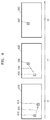
- FIG. 4 is a diagram for describing a method of blending pixels of a plurality of images that are sequentially rendered, the method being performed by a device, according to an embodiment.
- the device may generate movement information of a user, the movement information being about movement occurring between a time t 1 when a first image 410 is rendered and a time t 2 when a second image 430 is rendered. Also, the device may select, from the first image 410 , a first pixel 414 to be blended from a reference pixel 412 corresponding to a target pixel 434 of the second image 430 , by using movement information 420 that is changed in a reverse direction.
- the device may blend a value of the target pixel 434 of the second image 430 with a value of the first pixel 414 according to 1 ⁇ w 1 :w 1 that is a preset weight and then may change the value of the target pixel 434 of the second image 430 .
- 1 ⁇ w 1 may be set to have a greater value than w 1 , but this is only exemplary and thus the present disclosure is not limited thereto.
- the device may store a changed value of a pixel of the second image 430 .
- the second image 430 is an image having a pixel value that is changed according to the aforementioned process.
- the device may generate movement information of the user, the movement information being about movement occurring between the time t 2 when the second image 430 is rendered and a time t 3 when a third image 450 is rendered.
- t 2 may indicate a time when a value of the second image 430 is changed according to the aforementioned process.
- the device may select, from the second image 430 , the second pixel 434 to be blended from a reference pixel 432 corresponding to a target pixel 452 of the third image 450 , by using movement information 440 that is changed in a reverse direction.
- the device may blend a value of the target pixel 452 of the third image 450 with the value of the selected second pixel 434 according to 1 ⁇ w 2 :w 2 that is a preset weight, and then may change the value of the target pixel 452 of the third image 450 .
- 1 ⁇ w 2 may be set to have a greater value than w 2 , but this is only exemplary and thus the present disclosure is not limited thereto.
- the pixel 434 that is a blending target in the second image 430 has a value of the second pixel 434 of the second image 430 , the value being not changed, and a value of the selected first pixel 414 of the first image 410 , the value being blended according to 1 ⁇ w 1 :w 1 .
- the target pixel 452 of the third image 450 may be changed to a value obtained by blending the value of the target pixel 452 of the third image 450 , the not-changed value of the second pixel 434 of the second image 430 , and the value of the first pixel 414 of the first image 410 according to a weight of 1 ⁇ w 1 :(1 ⁇ w 1 )w 2 :w 1 w 2 .
- a weight with respect to the pixel of the previous image whose rendered time is greatly different from a current time, the pixel being to be blended may be set to be small.
- FIG. 5 is a flowchart for describing a method of determining, according to movement information, a weight by which pixels are blended, the method being performed by a device, according to an embodiment.
- the device may track movement of a user wearing the device and may generate movement information of the user, the movement information being about movement occurring between a previous time when a first image was rendered and a current time when a second image is rendered.
- Operation S 510 may correspond to operation S 210 described above with reference to FIG. 2 .
- the device may select at least some pixels from among a plurality of pixels included in the first image, based on the generated movement information and a location of a target pixel included in the second image.
- Operation S 520 may correspond to operation S 220 described above with reference to FIG. 2 .
- the device may set a weight with respect to a pixel selected according to a size of the movement of the user and the target pixel.
- the device may change a value of the target pixel by blending a value of the selected pixel with the value of the target pixel according to the set weight.
- the device may perform a process of operations S 510 to S 530 on each of a plurality of pixels included in the second image, thereby outputting an image having a changed pixel value.
- the image output from the device may be projected via a lens having a preset angle of view and arranged inside or outside the device.
- FIGS. 6A and 6B are diagrams for describing a method of determining, according to movement information, a weight by which pixels are blended, the method being performed by a device, according to an embodiment.
- the device may track movement of a hear part of a user, the movement being sensed between a previous time t 1 when a first image 610 was rendered and a current time t 2 when a second image 620 is rendered.
- the device may select a pixel 614 by applying movement information 630 that is changed in a reverse direction from a reference pixel 612 in the first image 610 , the reference pixel 612 corresponding to a target pixel 622 in the second image 620 .
- the device may change a value of the target pixel 622 as a value obtained by blending a value of the selected pixel 614 with the value of the target pixel 622 by applying a weight of w 1 :1 ⁇ w 1 thereto.
- the device may select a pixel 644 by applying movement information 650 that is changed in a reverse direction from a reference pixel 642 in a first image 640 , the reference pixel 642 corresponding to the target pixel 622 .
- the device may change the value of the target pixel 622 as a value obtained by blending a value of the selected pixel 644 with the value of the target pixel 622 by applying a weight of w 2 :1 ⁇ w 2 thereto.
- the device may set a value of w 2 to be higher than w 1 that is a weight in FIG. 6A .
- FIG. 7 is a flowchart for describing a method, performed by a device, of changing a value of a target pixel by performing interpolation on a pixel selected from a first image based on a target pixel of a second image and movement of a user, according to an embodiment.
- the device may track movement of the user wearing the device and may generate movement information of the user, the movement information being about the movement occurring between a previous time when a first image was rendered and a current time when a second image is rendered.
- Operation S 710 may correspond to operation S 210 described above with reference to FIG. 2 .
- the device may select at least some pixels from among a plurality of pixels included in the first image, based on the generated movement information and a location of a target pixel included in the second image.
- Operation S 720 may correspond to operation S 220 described above with reference to FIG. 2 .
- the device may determine a value of a pixel located between the selected pixel and the target pixel by performing interpolation based on the movement information.
- the device may determine the value of the pixel located between the selected pixel and the target pixel by performing interpolation on the selected pixel and the target pixel according to a determined path of the movement of a head of the user, the determined path being indicated by the movement information. This will be described in detail with reference to FIG. 8 .
- FIG. 8 is a diagram for describing a method, performed by a device 800 , of determining a value of a previously-rendered pixel by performing interpolation according to a movement path, according to an embodiment.
- the device 800 may perform interpolation based on movement information and then may determine a color of a pixel sensed by a user between a previous time when a first image was rendered and a current time when a second image is rendered.
- the device 800 may compare Vn to Vn ⁇ 1, wherein Vn indicates viewpoint information of a user at the current time when the second image is rendered and Vn ⁇ 1 indicates viewpoint information of the user at the previous time when the first image was rendered.
- Vn and Vn ⁇ 1 may be viewpoint matrixes respectively indicating viewpoints of the user.
- Vn ⁇ 1 may indicate viewpoint information of the user at a time when the first image is output.
- the device 800 may determine a movement path 810 of a head of the user, based on Vn and Vn ⁇ 1.
- the device 800 may determine a ratio of Vn to Vn ⁇ 1 as d.
- d may be determined to be a value between 0 and 1.
- the device 800 may determine, according to Equation 1 below, s d that is a location of a pixel when the head rotates by d from Vn that is a current viewpoint matrix in a direction of Vn ⁇ 1 that is a previous viewpoint matrix.
- s d P ⁇ slerp ( V n , V n , d ) ⁇ V n ⁇ 1 ⁇ v p [Equation 1]
- slerp(V n , V n , d) is a spherical linear interpolation function to calculate an intermediate viewpoint matrix between Vn and Vn ⁇ 1. Also, v p indicates a location of a target pixel, and P indicates a camera projection matrix.
- the device 800 may reflect movement of the head of the user, may perform interpolation and then may determine values of pixels that were seen before the current time when the second image is rendered. Also, the device 800 may blend determined colors according to Equation 2 below. In Equation 2 below, it is assumed that the device 800 determines values of n previously-rendered pixels located on a movement path.
- d i indicates a degree of relative closeness with respect to the current viewpoint matrix and may have a value between 0 and 1.
- s d indicates a sum of d 0 to d n ⁇ 1
- s i indicates a location of a previously-rendered pixel located on the movement path, the location being calculated according to Equation 1.
- C(s i ) indicates a function to return a value of a pixel by receiving an input of a location of the pixel
- C acc indicates a value calculated by blending the values of the n previously-rendered pixels located on the movement path.
- the device 800 may blend the value calculated by blending the values of the n previously-rendered pixels with a value of the target pixel according to a preset weight.
- a may indicate a weight
- x may indicate an angular velocity of rotation of the head of the user
- b may be a coefficient for determining a scale of an angular velocity of a graph
- c may be a coefficient for determining a gradient of the graph
- X threshold may be a threshold value that is preset with respect to an angular velocity of rotation. According to an embodiment, a minimum value of a may be set as 0.5 and a maximum value thereof may be set as 1.
- the device 800 may determine a varying value of the target pixel according to Equation 4 below.
- Sc may indicate a value of the target pixel
- Cres may indicate a changed value of the target pixel
- the device 800 may blend a value of a current target pixel with values of pixels that were present on a movement path of the user by performing interpolation based on the movement information, such that the device 800 may decrease distortion of an image due to movement of the user.
- the device may change a value of the target pixel by blending a value of the selected pixel with the value of the target pixel according to a set weight.
- the device may perform a process of operations S 710 to S 730 on each of a plurality of pixels included in the first image, thereby outputting an image having a changed pixel value.
- the image output from the device may be projected via a lens having a preset angle of view and arranged inside or outside the device
- FIG. 9 is a diagram for describing a method, performed by a device, of changing a value of a target pixel 922 by performing interpolation on a pixel 914 selected from a first image 910 and the target pixel 922 of a second image 920 , based on movement of a user, according to an embodiment.
- the device may sense movement of the user who wears the device and may generate movement information. Also, the device may select, from the first image 910 , a first pixel 914 to be blended, by applying movement information 930 of movement that is changed in a reverse direction from a reference pixel 912 corresponding to the target pixel 922 of the second image 920 .
- the device may determine a value of a second pixel 916 located between the first pixel 914 and the target pixel 912 , the second pixel 916 being selected by performing interpolation based on the movement information.
- a method of determining the value of the second pixel 916 may correspond to the descriptions provided with reference to FIG. 8 .
- the device may change the value of the target pixel 922 by blending the determined value of the second pixel 916 , the value of the selected first pixel 934 , and the value of the target pixel 922 .
- FIGS. 10 and 11 are block diagrams of a device 1000 for processing an image, according to embodiments.
- the device 1000 may include a sensor 1010 , a processor 1020 , and an output interface 1030 .
- a sensor 1010 may be included in the device 1000 .
- a processor 1020 may be included in the device 1000 .
- an output interface 1030 may be included in the device 1000 .
- the device 1000 may be embodied with more elements than the shown elements or may be embodied with fewer elements than the shown elements.
- the device 1000 may include a communicator 1040 , a user input interface 1050 , an audio/video (AV) input interface 1060 , and a memory 1070 , in addition to the sensor 1010 , the processor 1020 , and the output interface 1030 .
- AV audio/video
- the sensor 1010 may sense at least one of a state of the device 1000 , a state of surroundings of the device 1000 , and a state of a user wearing the device 1000 , and may transmit sensed information to the processor 1020 .
- the sensor 1010 may track movement of the user wearing the device 1000 .
- the sensor 1010 may measure movement of a head of the user, wherein the device 1000 is worn on the head.
- the sensor 1010 may generate, based on the measured movement, movement information of the user between a previous time when a first image was rendered and a current time when a second image is rendered.
- the sensor 1010 may include, but is not limited to, at least one of an image sensor 1011 , an acceleration sensor 1012 , a temperature/humidity sensor 1013 , an infrared sensor 1014 , a gyroscope sensor 1015 , a position sensor (e.g., a global positioning system (GPS)) 1016 , a barometric pressure sensor 1017 , a proximity sensor 1018 , and an RGB sensor (i.e., a luminance sensor) 1019 .
- Functions of the sensors may be intuitionally deduced by one of ordinary skill in the art by referring to names of the sensors, and thus, detailed descriptions thereof are omitted here.
- the processor 1020 generally controls all operations of the device 1000 .
- the processor 1020 may generally control the sensor 1010 , the output interface 1030 , the communicator 1040 , the user input interface 1050 , the AV input interface 1060 , and the memory 1070 by executing programs stored in the memory 1070 .
- the processor 1020 may select at least some pixels from among a plurality of pixels included in the first image, based on the generated movement information and a location of a target pixel included in the second image. Also, the processor 1020 may change a value of the target pixel by blending a value of the selected pixel with the value of the target pixel according to a preset weight.
- the processor 1020 may set the weight according to a time when the selected pixel was rendered.
- the weight of the selected pixel may be set to be greater the closer the time when the selected pixel is rendered is to a time when the target pixel is rendered.
- the processor 1020 may set the weight according to movement of the user between the time when the selected pixel is rendered and the time when the target pixel is rendered.
- the weight of the selected pixel may be set to be smaller the greater the movement of the user between the time when the selected pixel is rendered and the time when the target pixel is rendered.
- the processor 1020 may determine a value of a pixel located between the selected pixel and the target pixel by performing interpolation based on the movement information. Also, the processor 1020 may change the value of the target pixel by blending the value of the pixel which is determined by performing interpolation, the value of the selected pixel, and the value of the target pixel according to a preset ratio.
- the processor 1020 may track, based on the movement information, a movement path of the user in a reverse direction, and then may select at least some pixels from among a plurality of pixels located on the movement path in an image that was previously rendered.
- the processor 1020 may determine sharpness of an image including the changed value of the target pixel, and may change the weight according to a result of the determination.
- the output interface 1030 may output an audio signal, a video signal, or a vibration signal, and may include a display unit 1031 , a sound output unit 1032 , a vibration motor 1033 , or the like.
- the display unit 1031 displays and outputs information processed in the device 1000 .
- the display unit 1031 may output the image including the target pixel having the changed value that is calculated by the processor 1020 .
- the display unit 1031 may be used as both an output device and input device.
- the display unit 1031 may include at least one of liquid crystal display (LCD), a thin film transistor-liquid crystal display (TFT-LCD), an organic light-emitting diode (OLED) display, a flexible display, a three-dimensional (3D) display, and an electrophoretic display.
- the device 1000 may include at least two display units 1031 .
- the at least two display units 1031 may be disposed to face each other by using a hinge.
- the sound output unit 1032 may output audio data that is received from the communicator 1040 or is stored in the memory 1070 .
- the sound output unit 1032 may also output a sound signal (e.g., a call signal receiving sound, a message receiving sound, a notifying sound, or the like) related to capabilities performed by the device 1000 .
- the sound output unit 1032 may include a speaker, a buzzer, or the like.
- the vibration motor 1033 may output a vibration signal.
- the vibration motor 1033 may output the vibration signal that corresponds to an output of the audio data or video data.
- the vibration motor 1033 may output a vibration signal.
- the communicator 1040 may include one or more elements allowing communication between the device 1000 and an external device (e.g., an HMD).
- the communicator 1040 may include a short-range wireless communicator 1041 , a mobile communicator 1042 , and a broadcast receiver 1043 .
- the short-range wireless communicator 1041 may include, but is not limited to, a Bluetooth communicator, a Bluetooth Low Energy (BLE) communicator, a near field communication (NFC) unit, a WLAN (Wi-Fi) communicator, a ZigBee communicator, an infrared Data Association (IrDA) communicator, a Wi-Fi Direct (WFD) communicator, a ultra wideband (UWB) communicator, and an Ant+ communicator.
- BLE Bluetooth Low Energy
- NFC near field communication
- WLAN Wi-Fi
- ZigBee ZigBee communicator
- IrDA infrared Data Association
- WFD Wi-Fi Direct
- UWB ultra wideband
- the mobile communicator 1042 exchanges a wireless signal with at least one of a base station, an external terminal, and a server on a mobile communication network.
- the wireless signal may include various types of data according to communication of a sound call signal, a video call signal, or a text/multimedia message.
- the broadcast receiver 1043 receives a broadcast signal and/or information related to a broadcast from the outside through a broadcast channel.
- the broadcast channel may include a satellite channel and a ground wave channel.
- the device 1000 may not include the broadcast receiver 1043 .
- the user input interface 1050 refers to a unit through which the user inputs data to control the device 1000 .
- the user input interface 1050 may include, but is not limited to, a key pad, a dome switch, a touch pad (a touch capacitive type touch pad, a pressure resistive type touch pad, an infrared beam sensing type touch pad, a surface acoustic wave type touch pad, an integral strain gauge type touch pad, a piezo effect type touch pad, or the like), a jog wheel, and a jog switch.
- the user input interface 1050 may receive a user input. Also, the user input interface 1050 may interoperate with a user interface (UI) module 1071 , thereby receiving a user input of selecting at least one of items displayed on respective sensing areas of a plurality of sensors.
- UI user interface
- the AV input interface 1060 may receive an input of an audio signal or a video signal and may include a camera 1061 and a microphone 1062 .
- the camera 1061 may obtain an image frame such as a still image or a moving picture via an image sensor during a video call mode or an image-capturing mode.
- An image that is captured via the image sensor may be processed by the processor 1020 or a separate image processing unit (not shown).
- the image frame that is processed by the camera 1061 may be stored in the memory 1070 or may be transmitted to an external source via the communicator 1040 . According to a configuration of the device 1000 , two or more cameras 1061 may be arranged.
- the microphone 1062 receives an input of an external sound signal and processes the received sound signal into electrical voice data.
- the microphone 1062 may receive a sound signal from an external device or a speaker.
- the microphone 1062 may use various noise removing algorithms.
- the device 1000 may further include a lens (not shown).
- the user of the device 1000 may recognize an image output by the display unit 1031 via the lens.
- the memory 1070 may store a program for processing and controlling the processor 1020 , and may store a plurality of items of input/output data (e.g., pixel values of images).
- the memory 1070 may include a storage medium of at least one type selected from a flash memory, a hard disk, a multimedia card type memory, a card type memory such as a secure digital (SD) or xD-Picture (xD) card memory, a random access memory (RAM), a static random access memory (SRAM), a read-only memory (ROM), an electrically erasable programmable read-only memory (EEPROM), a programmable read-only memory (PROM), a magnetic memory, a magnetic disc, and an optical disc.
- the device 1000 may run web storage or a cloud server that performs a storage function of the memory 1070 on the Internet.
- the programs stored in the memory 1070 may be classified into a plurality of modules according to their functions, for example, into the UI module 1071 , a touch screen module 1072 , a notification module 1073 , or the like.
- the UI module 1071 may provide a specialized UI or graphical user interface (GUI) associated with the device 1000 for each application.
- GUI graphical user interface
- the touch screen module 1072 may detect a user's touch gesture on the touch screen and may transmit information related to the touch gesture to the processor 1020 .
- the touch screen module 1072 according to an embodiment may recognize and analyze a touch code.
- the touch screen module 1072 may be configured as separate hardware including a controller.
- Various sensors may be arranged in or near the touch screen so as to detect a touch or a proximate touch on the touch sensor.
- An example of the sensor to detect the touch on the touch screen may include a tactile sensor.
- the tactile sensor detects a contact of a specific object at least as sensitively as a person can detect.
- the tactile sensor may detect various types of information such as the roughness of a contact surface, the hardness of the contact object, the temperature of a contact point, or the like.
- An example of the sensor to detect the touch on the touch screen may include a proximity sensor.
- the proximity sensor detects the existence of an object that approaches a predetermined detection surface or that exists nearby, by using a force of an electro-magnetic field or an infrared ray, instead of a mechanical contact.
- Examples of the proximity sensor include a transmission-type photoelectric sensor, a direction reflection-type photoelectric sensor, a mirror reflection-type photoelectric sensor, a high frequency oscillation-type proximity sensor, a capacity-type proximity sensor, a magnetic proximity sensor, an infrared-type proximity sensor, or the like.
- the touch gesture of the user may include a tap gesture, a touch & hold gesture, a double tap gesture, a drag gesture, a panning gesture, a flick gesture, a drag & drop gesture, a swipe gesture, or the like.
- the notification module 1073 may generate a signal for notifying the user about an occurrence of an event in the device 1000 .
- Examples of the event that may occur in the device 1000 include a key signal input, or the like.
- the notification module 1073 may output an alarm signal in the form of a video signal via the display unit 1031 , an alarm signal in the form of an audio signal via the sound output unit 1032 , or an alarm signal in the form of a vibration signal via the vibration motor 1033 .
- the methods according to the embodiments can be embodied as programmed commands to be executed in various computer means, and then can be recorded to a computer-readable recording medium.
- the computer readable recording medium may include any and all combinations of one or more of the programmed commands, data files, data structures, or the like.
- the programmed commands recorded to the computer-readable recording medium may be particularly designed or configured for the disclosure or may be well known to one of ordinary skill in the art.
- Examples of the computer-readable recording medium include magnetic media including hard disks, magnetic tapes, and floppy disks, optical media including CD-ROMs, and DVDs, magneto-optical media including floptical disks, and a hardware apparatus designed to store and execute the programmed commands in read-only memory (ROM), random-access memory (RAM), flash memories, and the like.
- Examples of the programmed commands include not only machine code generated by a compiler but also include a high-level programming language to be executed in a computer by using an interpreter.
Landscapes
- Engineering & Computer Science (AREA)
- Physics & Mathematics (AREA)
- General Physics & Mathematics (AREA)
- Multimedia (AREA)
- Theoretical Computer Science (AREA)
- Signal Processing (AREA)
- Computer Graphics (AREA)
- General Engineering & Computer Science (AREA)
- Computer Vision & Pattern Recognition (AREA)
- Computer Hardware Design (AREA)
- Software Systems (AREA)
- Optics & Photonics (AREA)
- Human Computer Interaction (AREA)
- User Interface Of Digital Computer (AREA)
- Controls And Circuits For Display Device (AREA)
Abstract
Description
s d =P·slerp(V n , V n , d)·V n −1 ·v p [Equation 1]
a=bx c+0.5 {if x>X threshold , a=1} [Equation 3]
Claims (15)
Applications Claiming Priority (3)
| Application Number | Priority Date | Filing Date | Title |
|---|---|---|---|
| KR1020160095995A KR102317683B1 (en) | 2016-07-28 | 2016-07-28 | Method and device for processing an image and recordimg medium thereof |
| KR10-2016-0095995 | 2016-07-28 | ||
| PCT/KR2017/008107 WO2018021850A1 (en) | 2016-07-28 | 2017-07-27 | Method and device for processing image, and recording medium |
Publications (2)
| Publication Number | Publication Date |
|---|---|
| US20190164349A1 US20190164349A1 (en) | 2019-05-30 |
| US10854010B2 true US10854010B2 (en) | 2020-12-01 |
Family
ID=61017031
Family Applications (1)
| Application Number | Title | Priority Date | Filing Date |
|---|---|---|---|
| US16/320,894 Active 2037-08-04 US10854010B2 (en) | 2016-07-28 | 2017-07-27 | Method and device for processing image, and recording medium |
Country Status (4)
| Country | Link |
|---|---|
| US (1) | US10854010B2 (en) |
| EP (1) | EP3474237B1 (en) |
| KR (1) | KR102317683B1 (en) |
| WO (1) | WO2018021850A1 (en) |
Families Citing this family (2)
| Publication number | Priority date | Publication date | Assignee | Title |
|---|---|---|---|---|
| US10520739B1 (en) * | 2018-07-11 | 2019-12-31 | Valve Corporation | Dynamic panel masking |
| US11431955B1 (en) * | 2019-12-03 | 2022-08-30 | Facebook Technologies, Llc | Systems and methods for temporal anti-aliasing |
Citations (13)
| Publication number | Priority date | Publication date | Assignee | Title |
|---|---|---|---|---|
| KR20090053182A (en) | 2007-11-22 | 2009-05-27 | 한국전자통신연구원 | Character animation system and method |
| KR20110092781A (en) | 2010-02-10 | 2011-08-18 | 삼성테크윈 주식회사 | Image processing method and apparatus for motion tracking |
| US20130011020A1 (en) * | 2011-07-06 | 2013-01-10 | Morpho, Inc. | Image processing device, image processing method and storage medium |
| WO2014010817A1 (en) | 2012-07-12 | 2014-01-16 | 매크로영상기술(주) | Adaptive noise reduction system for digital images, and method for removing noise |
| KR20140141392A (en) | 2013-05-31 | 2014-12-10 | 삼성전자주식회사 | Method and apparatus for processing the image |
| KR20150040559A (en) | 2013-10-07 | 2015-04-15 | 에스케이텔레콤 주식회사 | Apparatus for Improving Image Quality and Computer-Readable Recording Medium with Program Therefor |
| KR20150084925A (en) | 2012-11-13 | 2015-07-22 | 퀄컴 인코포레이티드 | Modifying virtual object display properties to increase power performance of augmented reality devices |
| WO2015155406A1 (en) | 2014-04-07 | 2015-10-15 | Nokia Technologies Oy | Stereo viewing |
| EP2966863A1 (en) | 2014-07-10 | 2016-01-13 | Seiko Epson Corporation | Hmd calibration with direct geometric modeling |
| US20160071246A1 (en) * | 2014-09-10 | 2016-03-10 | Nvidia Corporation | Enhanced anti-aliasing by varying sample patterns spatially and/or temporally |
| KR20160033763A (en) | 2013-07-25 | 2016-03-28 | 마이크로소프트 테크놀로지 라이센싱, 엘엘씨 | Late stage reprojection |
| US20160163099A1 (en) | 2011-11-08 | 2016-06-09 | Imagination Technologies Limited | Method and System for Multisample Antialiasing |
| US20160189429A1 (en) | 2014-12-30 | 2016-06-30 | Sony Computer Entertainment Inc. | Scanning display system in head-mounted display for virtual reality |
-
2016
- 2016-07-28 KR KR1020160095995A patent/KR102317683B1/en active Active
-
2017
- 2017-07-27 US US16/320,894 patent/US10854010B2/en active Active
- 2017-07-27 WO PCT/KR2017/008107 patent/WO2018021850A1/en not_active Ceased
- 2017-07-27 EP EP17834791.0A patent/EP3474237B1/en active Active
Patent Citations (19)
| Publication number | Priority date | Publication date | Assignee | Title |
|---|---|---|---|---|
| US20090135189A1 (en) | 2007-11-22 | 2009-05-28 | Electronics And Telecommunications Research Institute | Character animation system and method |
| KR20090053182A (en) | 2007-11-22 | 2009-05-27 | 한국전자통신연구원 | Character animation system and method |
| KR20110092781A (en) | 2010-02-10 | 2011-08-18 | 삼성테크윈 주식회사 | Image processing method and apparatus for motion tracking |
| US20130011020A1 (en) * | 2011-07-06 | 2013-01-10 | Morpho, Inc. | Image processing device, image processing method and storage medium |
| US20160163099A1 (en) | 2011-11-08 | 2016-06-09 | Imagination Technologies Limited | Method and System for Multisample Antialiasing |
| WO2014010817A1 (en) | 2012-07-12 | 2014-01-16 | 매크로영상기술(주) | Adaptive noise reduction system for digital images, and method for removing noise |
| US9727996B2 (en) | 2012-11-13 | 2017-08-08 | Qualcomm Incorporated | Modifying virtual object display properties to increase power performance of augmented reality devices |
| KR20150084925A (en) | 2012-11-13 | 2015-07-22 | 퀄컴 인코포레이티드 | Modifying virtual object display properties to increase power performance of augmented reality devices |
| US9679223B2 (en) | 2013-05-31 | 2017-06-13 | Samsung Electronics Co., Ltd. | Image processing method and apparatus |
| KR20140141392A (en) | 2013-05-31 | 2014-12-10 | 삼성전자주식회사 | Method and apparatus for processing the image |
| KR20160033763A (en) | 2013-07-25 | 2016-03-28 | 마이크로소프트 테크놀로지 라이센싱, 엘엘씨 | Late stage reprojection |
| US9747726B2 (en) | 2013-07-25 | 2017-08-29 | Microsoft Technology Licensing, Llc | Late stage reprojection |
| KR20150040559A (en) | 2013-10-07 | 2015-04-15 | 에스케이텔레콤 주식회사 | Apparatus for Improving Image Quality and Computer-Readable Recording Medium with Program Therefor |
| US20170118458A1 (en) * | 2014-04-07 | 2017-04-27 | Nokia Technologies Oy | Stereo viewing |
| WO2015155406A1 (en) | 2014-04-07 | 2015-10-15 | Nokia Technologies Oy | Stereo viewing |
| EP2966863A1 (en) | 2014-07-10 | 2016-01-13 | Seiko Epson Corporation | Hmd calibration with direct geometric modeling |
| US20160071246A1 (en) * | 2014-09-10 | 2016-03-10 | Nvidia Corporation | Enhanced anti-aliasing by varying sample patterns spatially and/or temporally |
| US20160189429A1 (en) | 2014-12-30 | 2016-06-30 | Sony Computer Entertainment Inc. | Scanning display system in head-mounted display for virtual reality |
| US9824498B2 (en) * | 2014-12-30 | 2017-11-21 | Sony Interactive Entertainment Inc. | Scanning display system in head-mounted display for virtual reality |
Non-Patent Citations (4)
| Title |
|---|
| Communication dated Aug. 3, 2020 issued by the Korean Intellectual Property Office in counterpart Korean Application No. 10-2016-0095995. |
| Communication dated Jun. 26, 2019, issued by the European Patent Office in counterpart European Application No. 17834791.0. |
| International Search Report (PCT/ISA/210), issued by International Searching Authority in corresponding International Application No. PCT/KR2017/008107, dated Nov. 2, 2017. |
| Written Opinion (PCT/ISA/237) issued by the International Searching Authority in corresponding International Application No. PCT/KR2017/008107, dated Nov. 2, 2017. |
Also Published As
| Publication number | Publication date |
|---|---|
| US20190164349A1 (en) | 2019-05-30 |
| EP3474237A1 (en) | 2019-04-24 |
| KR20180012992A (en) | 2018-02-07 |
| EP3474237B1 (en) | 2020-09-30 |
| WO2018021850A1 (en) | 2018-02-01 |
| EP3474237A4 (en) | 2019-07-24 |
| KR102317683B1 (en) | 2021-10-26 |
Similar Documents
| Publication | Publication Date | Title |
|---|---|---|
| US10412379B2 (en) | Image display apparatus having live view mode and virtual reality mode and operating method thereof | |
| EP3032839B1 (en) | Device and method for controlling sound output | |
| US10672180B2 (en) | Method, apparatus, and recording medium for processing image | |
| US20180174344A1 (en) | System and method for displaying virtual image through hmd device | |
| US11410330B2 (en) | Methods, devices, and systems for determining field of view and producing augmented reality | |
| US20230343046A1 (en) | Augmented reality environment enhancement | |
| KR20160060386A (en) | Device and control method thereof for resizing a window | |
| US11366318B2 (en) | Electronic device and control method thereof | |
| KR20160071783A (en) | Method and device for displaying contents | |
| US20250284348A1 (en) | Electronic device and control method of the same | |
| US10078793B2 (en) | Method and device for displaying image | |
| US10996832B2 (en) | Method for displaying object on device and device therefor | |
| EP3474237B1 (en) | Method and device for processing image, and recording medium | |
| US11252400B2 (en) | Method, device, and recording medium for processing image | |
| US10032299B2 (en) | Portable image device for generating application images | |
| US10460425B2 (en) | Method, device, and recording medium for processing image | |
| KR102840430B1 (en) | Electronic device and operating method for detecting a plane in an image | |
| CN112313714B (en) | Method and electronic device for displaying content | |
| US9880570B2 (en) | Method and device for generating vibration based on an adjective |
Legal Events
| Date | Code | Title | Description |
|---|---|---|---|
| AS | Assignment |
Owner name: SAMSUNG ELECTRONICS CO., LTD., KOREA, REPUBLIC OF Free format text: ASSIGNMENT OF ASSIGNORS INTEREST;ASSIGNORS:KIM, JUNG-BUM;CHOI, SOO-RYUM;CHOI, JOON-HYUN;AND OTHERS;SIGNING DATES FROM 20190117 TO 20190121;REEL/FRAME:048146/0181 |
|
| FEPP | Fee payment procedure |
Free format text: ENTITY STATUS SET TO UNDISCOUNTED (ORIGINAL EVENT CODE: BIG.); ENTITY STATUS OF PATENT OWNER: LARGE ENTITY |
|
| STPP | Information on status: patent application and granting procedure in general |
Free format text: NON FINAL ACTION MAILED |
|
| STPP | Information on status: patent application and granting procedure in general |
Free format text: NOTICE OF ALLOWANCE MAILED -- APPLICATION RECEIVED IN OFFICE OF PUBLICATIONS |
|
| STPP | Information on status: patent application and granting procedure in general |
Free format text: PUBLICATIONS -- ISSUE FEE PAYMENT VERIFIED |
|
| STCF | Information on status: patent grant |
Free format text: PATENTED CASE |
|
| MAFP | Maintenance fee payment |
Free format text: PAYMENT OF MAINTENANCE FEE, 4TH YEAR, LARGE ENTITY (ORIGINAL EVENT CODE: M1551); ENTITY STATUS OF PATENT OWNER: LARGE ENTITY Year of fee payment: 4 |