US10847727B2 - Compositions for electronic devices - Google Patents
Compositions for electronic devices Download PDFInfo
- Publication number
- US10847727B2 US10847727B2 US15/319,459 US201515319459A US10847727B2 US 10847727 B2 US10847727 B2 US 10847727B2 US 201515319459 A US201515319459 A US 201515319459A US 10847727 B2 US10847727 B2 US 10847727B2
- Authority
- US
- United States
- Prior art keywords
- homo
- lumo
- organic
- host
- composition according
- Prior art date
- Legal status (The legal status is an assumption and is not a legal conclusion. Google has not performed a legal analysis and makes no representation as to the accuracy of the status listed.)
- Active, expires
Links
- JWJQEUDGBZMPAX-UHFFFAOYSA-N OB(O)C1=C/C2=C(\C=C/1)N(C1=CC=CC=C1)C1=C2C=CC=C1 Chemical compound OB(O)C1=C/C2=C(\C=C/1)N(C1=CC=CC=C1)C1=C2C=CC=C1 JWJQEUDGBZMPAX-UHFFFAOYSA-N 0.000 description 5
- QARVLSVVCXYDNA-UHFFFAOYSA-N BrC1=CC=CC=C1 Chemical compound BrC1=CC=CC=C1 QARVLSVVCXYDNA-UHFFFAOYSA-N 0.000 description 3
- IQXGGEHZNNWDBK-UHFFFAOYSA-N CC1(C)C2=C(C=CC=C2)C2=C/C3=C(\C=C/21)CC1=C3C=CC=C1 Chemical compound CC1(C)C2=C(C=CC=C2)C2=C/C3=C(\C=C/21)CC1=C3C=CC=C1 IQXGGEHZNNWDBK-UHFFFAOYSA-N 0.000 description 3
- RGTWCCOQVAMEIV-UHFFFAOYSA-N CC1(C)C2=C(C=CC=C2)C2=C/C3=C(\C=C/21)N(C1=CC(C2=NC(C4=CC=CC=C4)=NC(C4=CC=CC=C4)=N2)=CC=C1)C1=C3C=CC=C1 Chemical compound CC1(C)C2=C(C=CC=C2)C2=C/C3=C(\C=C/21)N(C1=CC(C2=NC(C4=CC=CC=C4)=NC(C4=CC=CC=C4)=N2)=CC=C1)C1=C3C=CC=C1 RGTWCCOQVAMEIV-UHFFFAOYSA-N 0.000 description 3
- NCEDTMHPBMLCOH-UHFFFAOYSA-N CC1(C)C2=C(C=CC=C2)C2=C/C3=C(\C=C/21)N(C1=CC=CC=C1)C1=C3C=C(Br)C=C1 Chemical compound CC1(C)C2=C(C=CC=C2)C2=C/C3=C(\C=C/21)N(C1=CC=CC=C1)C1=C3C=C(Br)C=C1 NCEDTMHPBMLCOH-UHFFFAOYSA-N 0.000 description 3
- HHIVQZMLSTXDCO-UHFFFAOYSA-N BrC1=CC(Br)=CC(C2(C3=CC(Br)=CC(Br)=C3)C3=C(C=CC=C3)C3=C2/C=C\C=C/3)=C1 Chemical compound BrC1=CC(Br)=CC(C2(C3=CC(Br)=CC(Br)=C3)C3=C(C=CC=C3)C3=C2/C=C\C=C/3)=C1 HHIVQZMLSTXDCO-UHFFFAOYSA-N 0.000 description 2
- HNZUKQQNZRMNGS-UHFFFAOYSA-N BrC1=CC(C2=NC(C3=CC=CC=C3)=NC(C3=CC=CC=C3)=N2)=CC=C1 Chemical compound BrC1=CC(C2=NC(C3=CC=CC=C3)=NC(C3=CC=CC=C3)=N2)=CC=C1 HNZUKQQNZRMNGS-UHFFFAOYSA-N 0.000 description 2
- VKGKRBLWDUGNGT-UHFFFAOYSA-N BrC1=CC2=C(C=C1)N(C1=CC(C3=NC(C4=CC=CC=C4)=NC(C4=CC=CC=C4)=N3)=CC=C1)C1=C2/C=C\C=C/1 Chemical compound BrC1=CC2=C(C=C1)N(C1=CC(C3=NC(C4=CC=CC=C4)=NC(C4=CC=CC=C4)=N3)=CC=C1)C1=C2/C=C\C=C/1 VKGKRBLWDUGNGT-UHFFFAOYSA-N 0.000 description 2
- HGBMQIPSGRZZEM-UHFFFAOYSA-N BrC1=CC2=C(C=C1)N(C1=NC(C3=CC=CC=C3)=NC(C3=CC=CC=C3)=N1)C1=C2/C=C\C=C/1 Chemical compound BrC1=CC2=C(C=C1)N(C1=NC(C3=CC=CC=C3)=NC(C3=CC=CC=C3)=N1)C1=C2/C=C\C=C/1 HGBMQIPSGRZZEM-UHFFFAOYSA-N 0.000 description 2
- BRFAJDLWTQQSBH-UUHXTZJCSA-K C1=CC2=CC=C3[Ir]N4=C(C=CC=C4)C3=C2C=C1.C1=CC=C2C=C3C(=CC2=C1)[Ir]N1=C3C2=C(C=CC=C2)C=C1.CC(C)(C)C1=CC=C2C(=C1)[Ir]N1=C2C2=CC=CC=C2C=C1.CC1=CC(C)=O[Ir]2(O1)C1=CC=CC=C1C1=N2C2=CC=CC(C)=C2C=C1C.CC1=CC(C)=O[Ir]2(O1)C1=CC=CC=C1C1=N2C2=CC=CC=C2C=C1.CC1=CC(C)=O[Ir]2(O1)C1=CC=CC=C1C1=N2C2=CC=CC=C2C=C1C.CC1=CC2=N(C=C1C)[Ir]C1=CC=C3C=CC=CC3=C12 Chemical compound C1=CC2=CC=C3[Ir]N4=C(C=CC=C4)C3=C2C=C1.C1=CC=C2C=C3C(=CC2=C1)[Ir]N1=C3C2=C(C=CC=C2)C=C1.CC(C)(C)C1=CC=C2C(=C1)[Ir]N1=C2C2=CC=CC=C2C=C1.CC1=CC(C)=O[Ir]2(O1)C1=CC=CC=C1C1=N2C2=CC=CC(C)=C2C=C1C.CC1=CC(C)=O[Ir]2(O1)C1=CC=CC=C1C1=N2C2=CC=CC=C2C=C1.CC1=CC(C)=O[Ir]2(O1)C1=CC=CC=C1C1=N2C2=CC=CC=C2C=C1C.CC1=CC2=N(C=C1C)[Ir]C1=CC=C3C=CC=CC3=C12 BRFAJDLWTQQSBH-UUHXTZJCSA-K 0.000 description 2
- HJHNDJBLLGFAHE-XUPCHFCUSA-M C1=CC=C(C2=CC(C3=CC=CC=C3)=CC(C3=CC(C4=CC5=C(C=C4)[Ir]N4=CC=C6C=CC=CC6=C54)=CC=C3)=C2)C=C1.C1=CC=C(C2=CC3=C(C=C2)N(C2=CC4=C(C=C2)[Ir]N2=CC=C5C=CC=CC5=C42)C2=C3C=CC=C2)C=C1.C1=CC=C2C(=C1)[Ir]N1=C2C2=C(C=CC=C2)C=C1.C1=CC=N2[Ir]C3=C(SC4=C3C=CC=C4)C2=C1.CC1=C(C)C=C2C(=C1)[Ir]N1=C2C2=C(C=CC=C2)C=C1.CC1=CC(C)=O[Ir]2(O1)C1=C(SC3=C1C=CC=C3)C1=N2C=CC=C1.CC1=CC=C2[Ir]N3=C(C2=C1)C1=C(C=CC=C1)C=C3 Chemical compound C1=CC=C(C2=CC(C3=CC=CC=C3)=CC(C3=CC(C4=CC5=C(C=C4)[Ir]N4=CC=C6C=CC=CC6=C54)=CC=C3)=C2)C=C1.C1=CC=C(C2=CC3=C(C=C2)N(C2=CC4=C(C=C2)[Ir]N2=CC=C5C=CC=CC5=C42)C2=C3C=CC=C2)C=C1.C1=CC=C2C(=C1)[Ir]N1=C2C2=C(C=CC=C2)C=C1.C1=CC=N2[Ir]C3=C(SC4=C3C=CC=C4)C2=C1.CC1=C(C)C=C2C(=C1)[Ir]N1=C2C2=C(C=CC=C2)C=C1.CC1=CC(C)=O[Ir]2(O1)C1=C(SC3=C1C=CC=C3)C1=N2C=CC=C1.CC1=CC=C2[Ir]N3=C(C2=C1)C1=C(C=CC=C1)C=C3 HJHNDJBLLGFAHE-XUPCHFCUSA-M 0.000 description 2
- WZAKMOUIQWRNOI-UHFFFAOYSA-N C1=CC=C(C2=CC=C(C3=NC(N4C5=C(C=CC=C5)C5=C4C=CC(C4=CC6=C(C=C4)N(C4=CC=CC=C4)C4=C6C=CC=C4)=C5)=NC4=CC=CC=C43)C=C2)C=C1 Chemical compound C1=CC=C(C2=CC=C(C3=NC(N4C5=C(C=CC=C5)C5=C4C=CC(C4=CC6=C(C=C4)N(C4=CC=CC=C4)C4=C6C=CC=C4)=C5)=NC4=CC=CC=C43)C=C2)C=C1 WZAKMOUIQWRNOI-UHFFFAOYSA-N 0.000 description 2
- YMMIMGRBLQBRNC-UHFFFAOYSA-N C1=CC=C(C2=NC(C3=CC=CC=C3)=NC(C3=CC4=C(C=C3)C3=C(C=CC=C3)C43C4=C(C=CC=C4)C4=C3/C=C\C=C/4)=N2)C=C1 Chemical compound C1=CC=C(C2=NC(C3=CC=CC=C3)=NC(C3=CC4=C(C=C3)C3=C(C=CC=C3)C43C4=C(C=CC=C4)C4=C3/C=C\C=C/4)=N2)C=C1 YMMIMGRBLQBRNC-UHFFFAOYSA-N 0.000 description 2
- NZGRSMSDAITRIO-UHFFFAOYSA-N C1=CC=C(C2=NC(C3=CC=CC=C3)=NC(C3=CC=CC(N4C5=C(C=CC=C5)C5=C4/C=C\C=C/5)=C3)=N2)C=C1 Chemical compound C1=CC=C(C2=NC(C3=CC=CC=C3)=NC(C3=CC=CC(N4C5=C(C=CC=C5)C5=C4/C=C\C=C/5)=C3)=N2)C=C1 NZGRSMSDAITRIO-UHFFFAOYSA-N 0.000 description 2
- CZZYITDELCSZES-UHFFFAOYSA-N C1=CC=C(CC2=CC=CC=C2)C=C1 Chemical compound C1=CC=C(CC2=CC=CC=C2)C=C1 CZZYITDELCSZES-UHFFFAOYSA-N 0.000 description 2
- HPQMJCFMXCDCBX-UHFFFAOYSA-N CC(C)(C)/C1=N/C2=CC=CC3=C2C2=N([Ir]3)C3=C(C=CC=C3)N21.CC(C)(C)C1=CC2=C3C(=N1)/C=C(/C(C)(C)C)N1C4=C(C=CC=C4)N(=C31)[Ir]2.CC1=CC2=C(C=C1C)N1=C3C4=C(C=C(C(C)(C)C)C=C4/N=C(/C(C)(C)C)N23)[Ir]1.CC1=CC2=C(C=C1C)N1=C3C4=C(C=CC=C4/N=C(/C(C)(C)C)N23)[Ir]1 Chemical compound CC(C)(C)/C1=N/C2=CC=CC3=C2C2=N([Ir]3)C3=C(C=CC=C3)N21.CC(C)(C)C1=CC2=C3C(=N1)/C=C(/C(C)(C)C)N1C4=C(C=CC=C4)N(=C31)[Ir]2.CC1=CC2=C(C=C1C)N1=C3C4=C(C=C(C(C)(C)C)C=C4/N=C(/C(C)(C)C)N23)[Ir]1.CC1=CC2=C(C=C1C)N1=C3C4=C(C=CC=C4/N=C(/C(C)(C)C)N23)[Ir]1 HPQMJCFMXCDCBX-UHFFFAOYSA-N 0.000 description 2
- LDLKLMQEVJANTQ-UHFFFAOYSA-N CC1(C)C2=C(C=CC=C2)C2=C/C3=C(\C=C/21)N(C1=CC(C2=NC(C4=CC=CC=C4)=CC(C4=CC=CC=C4)=N2)=CC=C1)C1=C3C=C(Br)C=C1 Chemical compound CC1(C)C2=C(C=CC=C2)C2=C/C3=C(\C=C/21)N(C1=CC(C2=NC(C4=CC=CC=C4)=CC(C4=CC=CC=C4)=N2)=CC=C1)C1=C3C=C(Br)C=C1 LDLKLMQEVJANTQ-UHFFFAOYSA-N 0.000 description 2
- XWCXDEMKPVUXGM-UHFFFAOYSA-N CC1(C)C2=C(C=CC=C2)C2=C/C3=C(\C=C/21)N(C1=CC(C2=NC(C4=CC=CC=C4)=CC(C4=CC=CC=C4)=N2)=CC=C1)C1=C3C=CC=C1 Chemical compound CC1(C)C2=C(C=CC=C2)C2=C/C3=C(\C=C/21)N(C1=CC(C2=NC(C4=CC=CC=C4)=CC(C4=CC=CC=C4)=N2)=CC=C1)C1=C3C=CC=C1 XWCXDEMKPVUXGM-UHFFFAOYSA-N 0.000 description 2
- XNQAEESHNBISGQ-UHFFFAOYSA-N CC1(C)C2=C(C=CC=C2)C2=C/C3=C(\C=C/21)N(C1=CC(C2=NC(C4=CC=CC=C4)=NC(C4=CC=CC=C4)=N2)=CC=C1)C1=C3C=C(Br)C=C1 Chemical compound CC1(C)C2=C(C=CC=C2)C2=C/C3=C(\C=C/21)N(C1=CC(C2=NC(C4=CC=CC=C4)=NC(C4=CC=CC=C4)=N2)=CC=C1)C1=C3C=C(Br)C=C1 XNQAEESHNBISGQ-UHFFFAOYSA-N 0.000 description 2
- YYZSSUIMUOXEDO-UHFFFAOYSA-N CC1(C)C2=C(C=CC=C2)C2=C/C3=C(\C=C/21)N(C1=CC=CC=C1)C1=C3C=CC=C1 Chemical compound CC1(C)C2=C(C=CC=C2)C2=C/C3=C(\C=C/21)N(C1=CC=CC=C1)C1=C3C=CC=C1 YYZSSUIMUOXEDO-UHFFFAOYSA-N 0.000 description 2
- PARQPRHOASBGHV-UHFFFAOYSA-N CC1(C)C2=C(C=CC=C2)C2=C/C3=C(\C=C/21)N(C1=NC(C2=CC=CC=C2)=NC(C2=CC=CC=C2)=N1)C1=C3C=C(Br)C=C1 Chemical compound CC1(C)C2=C(C=CC=C2)C2=C/C3=C(\C=C/21)N(C1=NC(C2=CC=CC=C2)=NC(C2=CC=CC=C2)=N1)C1=C3C=C(Br)C=C1 PARQPRHOASBGHV-UHFFFAOYSA-N 0.000 description 2
- RPRCVCFYQHSPED-UHFFFAOYSA-N CC1(C)C2=CC(N(C3=CC4=C(C=C3)C3=CC=CC=C3C43C4=C(C=CC=C4)C4=C3C=CC=C4)C3=CC=CC=C3C3=CC=CC=C3)=CC=C2C2=C1C=CC=C2 Chemical compound CC1(C)C2=CC(N(C3=CC4=C(C=C3)C3=CC=CC=C3C43C4=C(C=CC=C4)C4=C3C=CC=C4)C3=CC=CC=C3C3=CC=CC=C3)=CC=C2C2=C1C=CC=C2 RPRCVCFYQHSPED-UHFFFAOYSA-N 0.000 description 2
- LBFQOMLNTSLFBE-UHFFFAOYSA-N CC1(C)C2=CC3=C(C=C2C2=C1C=CC=C2)C1=C(C=CC=C1)N3C1=CC2=C(C=C1)N(C1=CC(C3=NC(C4=CC=CC=C4)=NC(C4=CC=CC=C4)=N3)=CC=C1)C1=C2C=CC=C1 Chemical compound CC1(C)C2=CC3=C(C=C2C2=C1C=CC=C2)C1=C(C=CC=C1)N3C1=CC2=C(C=C1)N(C1=CC(C3=NC(C4=CC=CC=C4)=NC(C4=CC=CC=C4)=N3)=CC=C1)C1=C2C=CC=C1 LBFQOMLNTSLFBE-UHFFFAOYSA-N 0.000 description 2
- IPVHFZDFXGUNLX-QTFISGPESA-I CC1=CC(C)=C2C(=C1)C1=N(C3=CC=CC(C)=C3C=C1C)[Ir]21OC(C)=CC(C)=O1.CC1=CC(C)=C2C(=C1)C1=N(C3=CC=CC(CC(C)C)=C3C=C1)[Ir]21OC(C)=CC(C)=O1.CC1=CC(C)=C2C(=C1)C1=N(C3=CC=CC=C3C(C)=C1)[Ir]21OC(C(C)(C)C)=CC(C(C)(C)C)=O1.CC1=CC(C)=C2C(=C1)C1=N(C3=CC=CC=C3C=C1)[Ir]21OC(C)=CC(C)=O1.CC1=CC=C2C(=C1)C(C)=CC1=N2[Ir]2(OC(C)=CC(C)=O2)C2=CC=CC=C21 Chemical compound CC1=CC(C)=C2C(=C1)C1=N(C3=CC=CC(C)=C3C=C1C)[Ir]21OC(C)=CC(C)=O1.CC1=CC(C)=C2C(=C1)C1=N(C3=CC=CC(CC(C)C)=C3C=C1)[Ir]21OC(C)=CC(C)=O1.CC1=CC(C)=C2C(=C1)C1=N(C3=CC=CC=C3C(C)=C1)[Ir]21OC(C(C)(C)C)=CC(C(C)(C)C)=O1.CC1=CC(C)=C2C(=C1)C1=N(C3=CC=CC=C3C=C1)[Ir]21OC(C)=CC(C)=O1.CC1=CC=C2C(=C1)C(C)=CC1=N2[Ir]2(OC(C)=CC(C)=O2)C2=CC=CC=C21 IPVHFZDFXGUNLX-QTFISGPESA-I 0.000 description 2
- DDGPPAMADXTGTN-UHFFFAOYSA-N ClC1=NC(C2=CC=CC=C2)=NC(C2=CC=CC=C2)=N1 Chemical compound ClC1=NC(C2=CC=CC=C2)=NC(C2=CC=CC=C2)=N1 DDGPPAMADXTGTN-UHFFFAOYSA-N 0.000 description 2
- FQHFBFXXYOQXMN-UHFFFAOYSA-M [Li]1OC2=C3C(=CC=C2)C=CC=N13 Chemical compound [Li]1OC2=C3C(=CC=C2)C=CC=N13 FQHFBFXXYOQXMN-UHFFFAOYSA-M 0.000 description 2
- PHARTUMKZUQOIG-UHFFFAOYSA-N Br/C1=C/C=C\C2=C1C1=C(C=CC=C1)C21C2=C(C=CC=C2)C2=C1C=CC=C2.ClC1=C(N/C2=C/C=C\C3=C2C2=C(C=CC=C2)C32C3=C(C=CC=C3)C3=C2C=CC=C3)C=CC=C1.NC1=C(Cl)C=CC=C1 Chemical compound Br/C1=C/C=C\C2=C1C1=C(C=CC=C1)C21C2=C(C=CC=C2)C2=C1C=CC=C2.ClC1=C(N/C2=C/C=C\C3=C2C2=C(C=CC=C2)C32C3=C(C=CC=C3)C3=C2C=CC=C3)C=CC=C1.NC1=C(Cl)C=CC=C1 PHARTUMKZUQOIG-UHFFFAOYSA-N 0.000 description 1
- IOPQERQQZZREDR-UHFFFAOYSA-N BrC1=CC(C2=CC=CC=C2)=CC(C2=CC=CC=C2)=C1 Chemical compound BrC1=CC(C2=CC=CC=C2)=CC(C2=CC=CC=C2)=C1 IOPQERQQZZREDR-UHFFFAOYSA-N 0.000 description 1
- NJJDBOFDNCZGSP-UHFFFAOYSA-N BrC1=CC2=C(C=C1)CC1=C2/C=C\C=C/1 Chemical compound BrC1=CC2=C(C=C1)CC1=C2/C=C\C=C/1 NJJDBOFDNCZGSP-UHFFFAOYSA-N 0.000 description 1
- ZDFLISXWHUCGHA-UHFFFAOYSA-N BrC1=CC2=C(C=C1)N(C1=CC(C3=NC(C4=CC=CC=C4)=NC(C4=CC=CC=C4)=N3)=CC=C1)C1=C2C=CC=C1.CC1(C)C2=C(C=CC=C2)C2=C/C3=C(\C=C/21)N(C1=CC=CC=C1)C1=C3C=C(B2OC(C)(C)C(C)(C)O2)C=C1.CC1(C)C2=CC3=C(C=C2C2=C1C=CC=C2)C1=C(/C=C\C(C2=CC4=C(C=C2)N(C2=CC(C5=NC(C6=CC=CC=C6)=NC(C6=CC=CC=C6)=N5)=CC=C2)C2=C4C=CC=C2)=C/1)N3C1=CC=CC=C1 Chemical compound BrC1=CC2=C(C=C1)N(C1=CC(C3=NC(C4=CC=CC=C4)=NC(C4=CC=CC=C4)=N3)=CC=C1)C1=C2C=CC=C1.CC1(C)C2=C(C=CC=C2)C2=C/C3=C(\C=C/21)N(C1=CC=CC=C1)C1=C3C=C(B2OC(C)(C)C(C)(C)O2)C=C1.CC1(C)C2=CC3=C(C=C2C2=C1C=CC=C2)C1=C(/C=C\C(C2=CC4=C(C=C2)N(C2=CC(C5=NC(C6=CC=CC=C6)=NC(C6=CC=CC=C6)=N5)=CC=C2)C2=C4C=CC=C2)=C/1)N3C1=CC=CC=C1 ZDFLISXWHUCGHA-UHFFFAOYSA-N 0.000 description 1
- RIPZSADLUWTEFQ-UHFFFAOYSA-N BrC1=CC=C(C2=CC=CC3=C2OC2=C3C=CC=C2)C=C1 Chemical compound BrC1=CC=C(C2=CC=CC3=C2OC2=C3C=CC=C2)C=C1 RIPZSADLUWTEFQ-UHFFFAOYSA-N 0.000 description 1
- JVTHXYNNTPAWIF-UHFFFAOYSA-N BrC1=CC=CC=C1.C1=CC2=C(C=C1)C1=C(C2)/C2=C(\C=C/1)C1(C3=C(C=CC=C3)C3=C1/C=C\C=C/3)C1=C2C=CC=C1.C1=CC=C(N2C3=C(C=CC=C3)C3=C2/C2=C(\C=C/3)C3(C4=C(C=CC=C4)C4=C3/C=C\C=C/4)C3=C2C=CC=C3)C=C1 Chemical compound BrC1=CC=CC=C1.C1=CC2=C(C=C1)C1=C(C2)/C2=C(\C=C/1)C1(C3=C(C=CC=C3)C3=C1/C=C\C=C/3)C1=C2C=CC=C1.C1=CC=C(N2C3=C(C=CC=C3)C3=C2/C2=C(\C=C/3)C3(C4=C(C=CC=C4)C4=C3/C=C\C=C/4)C3=C2C=CC=C3)C=C1 JVTHXYNNTPAWIF-UHFFFAOYSA-N 0.000 description 1
- NLCUUZBUIPRLHO-UHFFFAOYSA-N BrC1=NC(C2(C3=CC=CC(Br)=N3)C3=C(C=CC=C3)C3=C2/C=C\C=C/3)=CC=C1.C1=CC=C(C2=NC(C3(C4=CC=CC(C5=CC=CC=C5)=N4)C4=C(C=CC=C4)C4=C3/C=C\C=C/4)=CC=C2)C=C1.OB(O)C1=CC=CC=C1 Chemical compound BrC1=NC(C2(C3=CC=CC(Br)=N3)C3=C(C=CC=C3)C3=C2/C=C\C=C/3)=CC=C1.C1=CC=C(C2=NC(C3(C4=CC=CC(C5=CC=CC=C5)=N4)C4=C(C=CC=C4)C4=C3/C=C\C=C/4)=CC=C2)C=C1.OB(O)C1=CC=CC=C1 NLCUUZBUIPRLHO-UHFFFAOYSA-N 0.000 description 1
- ZQPYIWFEZDZSCP-UHFFFAOYSA-N BrC1=NC(C2(C3=CC=CC(Br)=N3)C3=C(C=CC=C3)C3=C2/C=C\C=C/3)=CC=C1.CC(C)(C)C1=CC=C(B(O)O)C=C1.CC(C)(C)C1=CC=C(C2=NC(C3(C4=CC=CC(C5=CC=C(C(C)(C)C)C=C5)=N4)C4=C(C=CC=C4)C4=C3/C=C\C=C/4)=CC=C2)C=C1 Chemical compound BrC1=NC(C2(C3=CC=CC(Br)=N3)C3=C(C=CC=C3)C3=C2/C=C\C=C/3)=CC=C1.CC(C)(C)C1=CC=C(B(O)O)C=C1.CC(C)(C)C1=CC=C(C2=NC(C3(C4=CC=CC(C5=CC=C(C(C)(C)C)C=C5)=N4)C4=C(C=CC=C4)C4=C3/C=C\C=C/4)=CC=C2)C=C1 ZQPYIWFEZDZSCP-UHFFFAOYSA-N 0.000 description 1
- GPGIIKKUKINTGW-UHFFFAOYSA-N BrC1=NC(C2=CC=CC=C2)=CC(C2=CC=CC=C2)=N1 Chemical compound BrC1=NC(C2=CC=CC=C2)=CC(C2=CC=CC=C2)=N1 GPGIIKKUKINTGW-UHFFFAOYSA-N 0.000 description 1
- OONQMZPFERJACP-UHFFFAOYSA-N Brc1cccc(C2(c3ccccc3-c3ccccc23)c2nc(Br)ccc2)n1 Chemical compound Brc1cccc(C2(c3ccccc3-c3ccccc23)c2nc(Br)ccc2)n1 OONQMZPFERJACP-UHFFFAOYSA-N 0.000 description 1
- ICLBEHKREOLEQH-UHFFFAOYSA-N C.C.C.C.C.C.C=CC1=CC=C(N(C2=CC=C(C)C=C2)C2=CC=C(C3=C/C4=C(\C=C/3)C3=C(C=C5C(=C3)C(CCCCCCCC)(CCCCCCCCC)C3=C5C=CC(C5=CC=C(N(C6=CC=C(C)C=C6)C6=CC=C(C(C)(C)C)C=C6)C=C5)=C3)C4(CCCCCCCC)CCCCCCCC)C=C2)C=C1 Chemical compound C.C.C.C.C.C.C=CC1=CC=C(N(C2=CC=C(C)C=C2)C2=CC=C(C3=C/C4=C(\C=C/3)C3=C(C=C5C(=C3)C(CCCCCCCC)(CCCCCCCCC)C3=C5C=CC(C5=CC=C(N(C6=CC=C(C)C=C6)C6=CC=C(C(C)(C)C)C=C6)C=C5)=C3)C4(CCCCCCCC)CCCCCCCC)C=C2)C=C1 ICLBEHKREOLEQH-UHFFFAOYSA-N 0.000 description 1
- FPMUFSKCVHLUCG-UHFFFAOYSA-N C.C.C.C.C1=CC=C(C2=CC(C3=CC4=C5\C=CC=C\C5=C5\C=C/C=C\C5=C\4C=C3)=CC=C2)C=C1.C1=CC=C(C2=CC(C3=CC=CC=C3)=CC(C3(C4=CC(C5=CC=CC=C5)=CC(C5=CC=CC=C5)=C4)C4=C(C=CC=C4)C4=C3C=CC=C4)=C2)C=C1.C1=CC=C(C2=CC(C3=CC=CC=C3)=CC(C3=CC4=C(C=C3)C3=C(C=CC=C3)C43C4=C(C=CC=C4)C4=C3/C=C\C=C/4)=C2)C=C1.C1=CC=C(C2=CC(C3=CC=CC=C3)=CC(C3=CC4=C5\C=CC=C\C5=C/C=C\4C=C3)=C2)C=C1.C1=CC=C(C2=CC=C(C3=CC(C4=CC=C(C5=CC=CC=C5)C=C4)=CC(C4(C5=CC(C6=CC=C(C7=CC=CC=C7)C=C6)=CC(C6=CC=C(C7=CC=CC=C7)C=C6)=C5)C5=C(C=CC=C5)C5=C4C=CC=C5)=C3)C=C2)C=C1 Chemical compound C.C.C.C.C1=CC=C(C2=CC(C3=CC4=C5\C=CC=C\C5=C5\C=C/C=C\C5=C\4C=C3)=CC=C2)C=C1.C1=CC=C(C2=CC(C3=CC=CC=C3)=CC(C3(C4=CC(C5=CC=CC=C5)=CC(C5=CC=CC=C5)=C4)C4=C(C=CC=C4)C4=C3C=CC=C4)=C2)C=C1.C1=CC=C(C2=CC(C3=CC=CC=C3)=CC(C3=CC4=C(C=C3)C3=C(C=CC=C3)C43C4=C(C=CC=C4)C4=C3/C=C\C=C/4)=C2)C=C1.C1=CC=C(C2=CC(C3=CC=CC=C3)=CC(C3=CC4=C5\C=CC=C\C5=C/C=C\4C=C3)=C2)C=C1.C1=CC=C(C2=CC=C(C3=CC(C4=CC=C(C5=CC=CC=C5)C=C4)=CC(C4(C5=CC(C6=CC=C(C7=CC=CC=C7)C=C6)=CC(C6=CC=C(C7=CC=CC=C7)C=C6)=C5)C5=C(C=CC=C5)C5=C4C=CC=C5)=C3)C=C2)C=C1 FPMUFSKCVHLUCG-UHFFFAOYSA-N 0.000 description 1
- ZSDDJOVBCNJGMP-UHFFFAOYSA-N C.C.CC(C)(C)C1=CC=C2OC3=C(C=C(C(C)(C)C)C=C3)C3(C2=C1)C1=CC=C2/C=C\C4=C5C(=CC=C4)[Pt]4(/C6=C/C=C\C7=CC=C8/C=C\C3=N4C8=C76)N1=C25.CC(C)(C)C1=CC=C2OC3=C(C=C(C(C)(C)C)C=C3)C3(C2=C1)C1=CC=CC2=N1[Pt]1(C4=CC=CC=C42)C2=C(C=CC=C2)/C2=C/C=C\C3=N21.CC1(C)C2=CC=C3N4=C2C2=C(C=CC=C2[Pt]42C4=C5C6=C(/C=C\C(=N62)C32C3=CC=CC=C3OC3=C2C=CC=C3)C(C)(C)C(C)(C)/C5=C/C=C\4)C1(C)C.FC1=CC(F)=C2C(=C1)[Pt]13C4=C(C(F)=CC(F)=C4)/C4=C/C=C\C(=N41)C1(C4=CC=CC2=N43)C2=C(C=CC=C2)C2=C1C=CC=C2.[C-]#[N+]C1=C(F)C=C2C(=C1)C1=N3C(=CC=C1)C1(C4=C(C=CC=C4)C4=C1C=CC=C4)C1=N4/C(=C\C=C/1)C1=C(C=C(F)C(C#N)=C1)[Pt]234 Chemical compound C.C.CC(C)(C)C1=CC=C2OC3=C(C=C(C(C)(C)C)C=C3)C3(C2=C1)C1=CC=C2/C=C\C4=C5C(=CC=C4)[Pt]4(/C6=C/C=C\C7=CC=C8/C=C\C3=N4C8=C76)N1=C25.CC(C)(C)C1=CC=C2OC3=C(C=C(C(C)(C)C)C=C3)C3(C2=C1)C1=CC=CC2=N1[Pt]1(C4=CC=CC=C42)C2=C(C=CC=C2)/C2=C/C=C\C3=N21.CC1(C)C2=CC=C3N4=C2C2=C(C=CC=C2[Pt]42C4=C5C6=C(/C=C\C(=N62)C32C3=CC=CC=C3OC3=C2C=CC=C3)C(C)(C)C(C)(C)/C5=C/C=C\4)C1(C)C.FC1=CC(F)=C2C(=C1)[Pt]13C4=C(C(F)=CC(F)=C4)/C4=C/C=C\C(=N41)C1(C4=CC=CC2=N43)C2=C(C=CC=C2)C2=C1C=CC=C2.[C-]#[N+]C1=C(F)C=C2C(=C1)C1=N3C(=CC=C1)C1(C4=C(C=CC=C4)C4=C1C=CC=C4)C1=N4/C(=C\C=C/1)C1=C(C=C(F)C(C#N)=C1)[Pt]234 ZSDDJOVBCNJGMP-UHFFFAOYSA-N 0.000 description 1
- NIHNNTQXNPWCJQ-UHFFFAOYSA-N C1=CC2=C(C=C1)C1=C(/C=C\C=C/1)C2 Chemical compound C1=CC2=C(C=C1)C1=C(/C=C\C=C/1)C2 NIHNNTQXNPWCJQ-UHFFFAOYSA-N 0.000 description 1
- USTJPXHOXDHUFR-UHFFFAOYSA-N C1=CC2=C(C=C1)C1=C(C2)/C2=C(\C=C/1)C1(C3=C(C=CC=C3)C3=C1/C=C\C=C/3)C1=C2C=CC=C1.C1=CC=C(C2=CC(C3=CC=CC=C3)=CC(C3=CC=CC(C4=NC(C5=CC=CC=C5)=NC(N5C6=C(C=CC=C6)C6=C5/C5=C(\C=C/6)C6(C7=C(C=CC=C7)C7=C6/C=C\C=C/7)C6=C5C=CC=C6)=N4)=C3)=C2)C=C1.ClC1=NC(C2=CC(C3=CC(C4=CC=CC=C4)=CC(C4=CC=CC=C4)=C3)=CC=C2)=NC(C2=CC=CC=C2)=N1 Chemical compound C1=CC2=C(C=C1)C1=C(C2)/C2=C(\C=C/1)C1(C3=C(C=CC=C3)C3=C1/C=C\C=C/3)C1=C2C=CC=C1.C1=CC=C(C2=CC(C3=CC=CC=C3)=CC(C3=CC=CC(C4=NC(C5=CC=CC=C5)=NC(N5C6=C(C=CC=C6)C6=C5/C5=C(\C=C/6)C6(C7=C(C=CC=C7)C7=C6/C=C\C=C/7)C6=C5C=CC=C6)=N4)=C3)=C2)C=C1.ClC1=NC(C2=CC(C3=CC(C4=CC=CC=C4)=CC(C4=CC=CC=C4)=C3)=CC=C2)=NC(C2=CC=CC=C2)=N1 USTJPXHOXDHUFR-UHFFFAOYSA-N 0.000 description 1
- UZXBXANWMXSGDE-UHFFFAOYSA-N C1=CC2=C(C=C1)C1=C(C2)C2=C(/C=C\1)C1(C3=C(C=CC=C3)C3=C1C=CC=C3)C1=C2C=CC=C1 Chemical compound C1=CC2=C(C=C1)C1=C(C2)C2=C(/C=C\1)C1(C3=C(C=CC=C3)C3=C1C=CC=C3)C1=C2C=CC=C1 UZXBXANWMXSGDE-UHFFFAOYSA-N 0.000 description 1
- CENRDBBXGLAVGT-UHFFFAOYSA-N C1=CC2=C(C=C1)C1=C(N2)C2=C(/C=C\1)C1(C3=C(C=CC=C3)C3=C1C=CC=C3)C1=C2C=CC=C1.ClC1=C(N/C2=C/C=C\C3=C2C2=C(C=CC=C2)C32C3=C(C=CC=C3)C3=C2C=CC=C3)C=CC=C1 Chemical compound C1=CC2=C(C=C1)C1=C(N2)C2=C(/C=C\1)C1(C3=C(C=CC=C3)C3=C1C=CC=C3)C1=C2C=CC=C1.ClC1=C(N/C2=C/C=C\C3=C2C2=C(C=CC=C2)C32C3=C(C=CC=C3)C3=C2C=CC=C3)C=CC=C1 CENRDBBXGLAVGT-UHFFFAOYSA-N 0.000 description 1
- UDSXZQPQRDAQDJ-UHFFFAOYSA-N C1=CC2=C(C=C1)C1=C(O2)C(C2=CC=C(N3C4=C(C=CC=C4)C4=C3C3=C(/C=C\4)C4(C5=C(C=CC=C5)C5=C4C=CC=C5)C4=C3C=CC=C4)C=C2)=CC=C1 Chemical compound C1=CC2=C(C=C1)C1=C(O2)C(C2=CC=C(N3C4=C(C=CC=C4)C4=C3C3=C(/C=C\4)C4(C5=C(C=CC=C5)C5=C4C=CC=C5)C4=C3C=CC=C4)C=C2)=CC=C1 UDSXZQPQRDAQDJ-UHFFFAOYSA-N 0.000 description 1
- MYJVMIDCDITECL-UHFFFAOYSA-N C1=CC2=C(C=C1)C1=C(S2)C(C2=CC3=C4C=CC=CC4=C4C=CC=CC4=C3C=C2)=CC=C1 Chemical compound C1=CC2=C(C=C1)C1=C(S2)C(C2=CC3=C4C=CC=CC4=C4C=CC=CC4=C3C=C2)=CC=C1 MYJVMIDCDITECL-UHFFFAOYSA-N 0.000 description 1
- KKKAHUQQNVKOKM-UHFFFAOYSA-N C1=CC2=C(C=C1)C1=C(S2)C(C2=CC3=C4C=CC=CC4=C4C=CC=CC4=C3C=C2)=CC=C1.C1=CC=C(C2=NC(C3=CC=CC=C3)=NC(C3=CC=CC(N4C5=C(C=CC=C5)C5=C4C4=C(C=C5)C5(C6=C(C=CC=C6)C6=C5/C=C\C=C/6)C5=C4C=CC=C5)=C3)=N2)C=C1.O=C(C1=CC2=C(C=C1)C1=C(C=CC=C1)C21C2=C(C=CC=C2)C2=C1C=CC=C2)C1=CC2=C(C=C1)C1=C(C=CC=C1)C21C2=C(C=CC=C2)C2=C1C=CC=C2.O=C1C2=CC=CC=C2/C2=C/C=C\C3=C2N1C1=C2C(=CC=C31)C1(C3=CC=CC=C3C3=C1C=CC=C3)C1=C2C=CC=C1.O=C1C2=CC=CC=C2C2=CC=CC3=C2N1C1=C(C2=CC=CC=C2)C=C(C2=CC=CC=C2)C=C31 Chemical compound C1=CC2=C(C=C1)C1=C(S2)C(C2=CC3=C4C=CC=CC4=C4C=CC=CC4=C3C=C2)=CC=C1.C1=CC=C(C2=NC(C3=CC=CC=C3)=NC(C3=CC=CC(N4C5=C(C=CC=C5)C5=C4C4=C(C=C5)C5(C6=C(C=CC=C6)C6=C5/C=C\C=C/6)C5=C4C=CC=C5)=C3)=N2)C=C1.O=C(C1=CC2=C(C=C1)C1=C(C=CC=C1)C21C2=C(C=CC=C2)C2=C1C=CC=C2)C1=CC2=C(C=C1)C1=C(C=CC=C1)C21C2=C(C=CC=C2)C2=C1C=CC=C2.O=C1C2=CC=CC=C2/C2=C/C=C\C3=C2N1C1=C2C(=CC=C31)C1(C3=CC=CC=C3C3=C1C=CC=C3)C1=C2C=CC=C1.O=C1C2=CC=CC=C2C2=CC=CC3=C2N1C1=C(C2=CC=CC=C2)C=C(C2=CC=CC=C2)C=C31 KKKAHUQQNVKOKM-UHFFFAOYSA-N 0.000 description 1
- KUHRJNHVUNQMQJ-UHFFFAOYSA-N C1=CC2=C(C=C1)C1=C(S2)C(C2=CC3=C4C=CC=CC4=C4C=CC=CC4=C3C=C2)=CC=C1.C1=CC=C(C2=NC(C3=CC=CC=C3)=NC(C3=CC=CC(N4C5=C(C=CC=C5)C5=C4C4=C(C=C5)C5(C6=C(C=CC=C6)C6=C5C=CC=C6)C5=C4C=CC=C5)=C3)=N2)C=C1.O=C(C1=CC2=C(C=C1)C1=C(C=CC=C1)C21C2=C(C=CC=C2)C2=C1C=CC=C2)C1=CC2=C(C=C1)C1=C(C=CC=C1)C21C2=C(C=CC=C2)C2=C1C=CC=C2.O=C1C2=CC=CC=C2C2=CC=CC3=C2N1C1=C(C2=CC=CC=C2)C=C(C2=CC=CC=C2)C=C31 Chemical compound C1=CC2=C(C=C1)C1=C(S2)C(C2=CC3=C4C=CC=CC4=C4C=CC=CC4=C3C=C2)=CC=C1.C1=CC=C(C2=NC(C3=CC=CC=C3)=NC(C3=CC=CC(N4C5=C(C=CC=C5)C5=C4C4=C(C=C5)C5(C6=C(C=CC=C6)C6=C5C=CC=C6)C5=C4C=CC=C5)=C3)=N2)C=C1.O=C(C1=CC2=C(C=C1)C1=C(C=CC=C1)C21C2=C(C=CC=C2)C2=C1C=CC=C2)C1=CC2=C(C=C1)C1=C(C=CC=C1)C21C2=C(C=CC=C2)C2=C1C=CC=C2.O=C1C2=CC=CC=C2C2=CC=CC3=C2N1C1=C(C2=CC=CC=C2)C=C(C2=CC=CC=C2)C=C31 KUHRJNHVUNQMQJ-UHFFFAOYSA-N 0.000 description 1
- ZWGJPDOXWCJONJ-UHFFFAOYSA-N C1=CC2=C(C=C1)C1=C(S2)C2=CC=CC3=N2[Pt]12C1=C(SC4=C1C=CC=C4)C1=N2C(=CC=C1)C31C2=C(C=CC=C2)C2=C1C=CC=C2.CC(C)(C)C1=CC2=C(C=N1)C1=CC=CC3=N1[Pt]21C2=CC(C(C)(C)C)=NC=C2C2=N1C(=CC=C2)C3(C)C.CC(C)(C)C1=NN2C3=CC=CC4=N3[Pt]3(C5=CC(F)=NC(F)=C5C5=N3C(=CC=C5)C4(C)C)C2=C1.CC1(C)C2=CC=CC3=N2[Pt]2(C4=CC(F)=NC(F)=C43)C3=C(C4=CC=CC1=N42)C(F)=NC(F)=C3.CC1=CC(C)=C(N2C3=CC=CC4=N3[Pt]3(C5=CC=CC=C54)C4=C(C=CC=C4)C4=CC=CC2=N43)C(C)=C1.CN1C2=C(C=CC=C2)C2=C1C1=CC=CC3=N1[Pt]21C2=C(C4=N1C(=CC=C4)C3(C)C)N(C)C1=C2C=CC=C1 Chemical compound C1=CC2=C(C=C1)C1=C(S2)C2=CC=CC3=N2[Pt]12C1=C(SC4=C1C=CC=C4)C1=N2C(=CC=C1)C31C2=C(C=CC=C2)C2=C1C=CC=C2.CC(C)(C)C1=CC2=C(C=N1)C1=CC=CC3=N1[Pt]21C2=CC(C(C)(C)C)=NC=C2C2=N1C(=CC=C2)C3(C)C.CC(C)(C)C1=NN2C3=CC=CC4=N3[Pt]3(C5=CC(F)=NC(F)=C5C5=N3C(=CC=C5)C4(C)C)C2=C1.CC1(C)C2=CC=CC3=N2[Pt]2(C4=CC(F)=NC(F)=C43)C3=C(C4=CC=CC1=N42)C(F)=NC(F)=C3.CC1=CC(C)=C(N2C3=CC=CC4=N3[Pt]3(C5=CC=CC=C54)C4=C(C=CC=C4)C4=CC=CC2=N43)C(C)=C1.CN1C2=C(C=CC=C2)C2=C1C1=CC=CC3=N1[Pt]21C2=C(C4=N1C(=CC=C4)C3(C)C)N(C)C1=C2C=CC=C1 ZWGJPDOXWCJONJ-UHFFFAOYSA-N 0.000 description 1
- QFXYUEDHXLDSOF-UHFFFAOYSA-N C1=CC2=C(C=C1)C1=C(S2)C2=CC=CC3=N2[Pt]12C1=C(SC4=C1C=CC=C4)C1=N2C(=CC=C1)C31C2=C(C=CC=C2)C2=C1C=CC=C2.CC(C)(C)C1=CC2=C(C=N1)C1=CC=CC3=N1[Pt]21C2=CC(C(C)(C)C)=NC=C2C2=N1C(=CC=C2)C3(C)C.CC1(C)C2=CC=CC3=N2[Pt]2(C4=C(SC5=C4C=CC=C5)C4=CC=CC1=N42)C1=C3SC2=C1C=CC=C2.CC1(C)C2=CC=CC3=N2[Pt]2(C4=CC(F)=NC(F)=C43)C3=C(C4=CC=CC1=N42)C(F)=NC(F)=C3.CN1C2=C(C=CC=C2)C2=C1C1=CC=CC3=N1[Pt]21C2=C(C4=N1C(=CC=C4)C3(C)C)N(C)C1=C2C=CC=C1 Chemical compound C1=CC2=C(C=C1)C1=C(S2)C2=CC=CC3=N2[Pt]12C1=C(SC4=C1C=CC=C4)C1=N2C(=CC=C1)C31C2=C(C=CC=C2)C2=C1C=CC=C2.CC(C)(C)C1=CC2=C(C=N1)C1=CC=CC3=N1[Pt]21C2=CC(C(C)(C)C)=NC=C2C2=N1C(=CC=C2)C3(C)C.CC1(C)C2=CC=CC3=N2[Pt]2(C4=C(SC5=C4C=CC=C5)C4=CC=CC1=N42)C1=C3SC2=C1C=CC=C2.CC1(C)C2=CC=CC3=N2[Pt]2(C4=CC(F)=NC(F)=C43)C3=C(C4=CC=CC1=N42)C(F)=NC(F)=C3.CN1C2=C(C=CC=C2)C2=C1C1=CC=CC3=N1[Pt]21C2=C(C4=N1C(=CC=C4)C3(C)C)N(C)C1=C2C=CC=C1 QFXYUEDHXLDSOF-UHFFFAOYSA-N 0.000 description 1
- KGGQWGGRSMJZPX-UHFFFAOYSA-N C1=CC2=C(C=C1)C1=CC3=C(C=C1N2)C1(C2=C(C=CC=C2)C2=C1C=C1CC4=C(/C=C\C=C/4)C1=C2)C1=C3C=CC=C1 Chemical compound C1=CC2=C(C=C1)C1=CC3=C(C=C1N2)C1(C2=C(C=CC=C2)C2=C1C=C1CC4=C(/C=C\C=C/4)C1=C2)C1=C3C=CC=C1 KGGQWGGRSMJZPX-UHFFFAOYSA-N 0.000 description 1
- NWJOOIUFHRHQLX-UHFFFAOYSA-N C1=CC2=C(C=C1)C1=CC=CC(C3=CC=C(N4C5=C(C=CC=C5)C5=C4C4=C(C=C5)C5(C6=C(C=CC=C6)C6=C5/C=C\C=C/6)C5=C4C=CC=C5)C=C3)=C1S2.C1=CC=C(C2=CC=C3C(=C2)C2=CC=C4C5=C(C=CC=C5)C5(C6=C(C=CC=C6)C6=C5C=CC=C6)C4=C2N3C2=CC(C3=CC=CC=C3)=CC(C3=CC=CC=C3)=C2)C=C1.C1=CC=C(N2C3=CC=CC=C3C3=C2C=C2C(=C3)C3=C(C=CC=C3)C23C2=C(C=CC=C2)C2=C/C4=C(/C=C/23)N(C2=CC=CC=C2)C2=CC=CC=C24)C=C1.C1=CC=C([Si](C2=CC=CC=C2)(C2=CC=C(C3=C4OC5=C(C=CC=C5)C4=CC=C3)C=C2)C2=CC=C(C3=C4\OC5=C(C=CC=C5)\C4=C/C=C\3)C=C2)C=C1 Chemical compound C1=CC2=C(C=C1)C1=CC=CC(C3=CC=C(N4C5=C(C=CC=C5)C5=C4C4=C(C=C5)C5(C6=C(C=CC=C6)C6=C5/C=C\C=C/6)C5=C4C=CC=C5)C=C3)=C1S2.C1=CC=C(C2=CC=C3C(=C2)C2=CC=C4C5=C(C=CC=C5)C5(C6=C(C=CC=C6)C6=C5C=CC=C6)C4=C2N3C2=CC(C3=CC=CC=C3)=CC(C3=CC=CC=C3)=C2)C=C1.C1=CC=C(N2C3=CC=CC=C3C3=C2C=C2C(=C3)C3=C(C=CC=C3)C23C2=C(C=CC=C2)C2=C/C4=C(/C=C/23)N(C2=CC=CC=C2)C2=CC=CC=C24)C=C1.C1=CC=C([Si](C2=CC=CC=C2)(C2=CC=C(C3=C4OC5=C(C=CC=C5)C4=CC=C3)C=C2)C2=CC=C(C3=C4\OC5=C(C=CC=C5)\C4=C/C=C\3)C=C2)C=C1 NWJOOIUFHRHQLX-UHFFFAOYSA-N 0.000 description 1
- PHBZLPJUIOXCJR-UHFFFAOYSA-N C1=CC2=C(C=C1)C1=CC=CC(C3=CC=C(N4C5=C(C=CC=C5)C5=C4C4=C(C=C5)C5(C6=C(C=CC=C6)C6=C5C=CC=C6)C5=C4C=CC=C5)C=C3)=C1S2.C1=CC=C(C2=CC=C3C(=C2)C2=CC=C4C5=C(C=CC=C5)C5(C6=C(C=CC=C6)C6=C5C=CC=C6)C4=C2N3C2=CC(C3=CC=CC=C3)=CC(C3=CC=CC=C3)=C2)C=C1.C1=CC=C([Si](C2=CC=CC=C2)(C2=CC=C(C3=C4OC5=C(C=CC=C5)C4=CC=C3)C=C2)C2=CC=C(C3=C4\OC5=C(C=CC=C5)\C4=C/C=C\3)C=C2)C=C1 Chemical compound C1=CC2=C(C=C1)C1=CC=CC(C3=CC=C(N4C5=C(C=CC=C5)C5=C4C4=C(C=C5)C5(C6=C(C=CC=C6)C6=C5C=CC=C6)C5=C4C=CC=C5)C=C3)=C1S2.C1=CC=C(C2=CC=C3C(=C2)C2=CC=C4C5=C(C=CC=C5)C5(C6=C(C=CC=C6)C6=C5C=CC=C6)C4=C2N3C2=CC(C3=CC=CC=C3)=CC(C3=CC=CC=C3)=C2)C=C1.C1=CC=C([Si](C2=CC=CC=C2)(C2=CC=C(C3=C4OC5=C(C=CC=C5)C4=CC=C3)C=C2)C2=CC=C(C3=C4\OC5=C(C=CC=C5)\C4=C/C=C\3)C=C2)C=C1 PHBZLPJUIOXCJR-UHFFFAOYSA-N 0.000 description 1
- IFVAVTSISFCPQK-UHFFFAOYSA-N C1=CC2=C(C=C1)C1=N(C=CC=C1)[Ir]2.C1=CC=C(C2=CC3=C(C=C2)N(C2=CC4=C(C=C2)[Ir]N2=CC=CC=C42)C2=C3C=CC=C2)C=C1.CC1(C)C2=CC3=C(C=C2C2=C1C=CC=C2)C1=C(C=CC=C1)N3C1=CC2=C(C=C1)[Ir]N1=CC=C3C=CC=CC3=C21.CC1=C(C)C2=N(C=C1)[Ir]C1=C2C=CC=C1.CC1=CC2=C(C=C1)[Ir]N1=C2C=C(C)C=C1.CC1=CC2=N(C=C1)[Ir]C1=C2C=CC=C1.CC1=CC=CN2=C1C1=C(C=CC=C1)[Ir]2.CC1=CN2=C(C(C)=C1)C1=C(C=CC=C1)[Ir]2 Chemical compound C1=CC2=C(C=C1)C1=N(C=CC=C1)[Ir]2.C1=CC=C(C2=CC3=C(C=C2)N(C2=CC4=C(C=C2)[Ir]N2=CC=CC=C42)C2=C3C=CC=C2)C=C1.CC1(C)C2=CC3=C(C=C2C2=C1C=CC=C2)C1=C(C=CC=C1)N3C1=CC2=C(C=C1)[Ir]N1=CC=C3C=CC=CC3=C21.CC1=C(C)C2=N(C=C1)[Ir]C1=C2C=CC=C1.CC1=CC2=C(C=C1)[Ir]N1=C2C=C(C)C=C1.CC1=CC2=N(C=C1)[Ir]C1=C2C=CC=C1.CC1=CC=CN2=C1C1=C(C=CC=C1)[Ir]2.CC1=CN2=C(C(C)=C1)C1=C(C=CC=C1)[Ir]2 IFVAVTSISFCPQK-UHFFFAOYSA-N 0.000 description 1
- HHEPGVHTVUZMJW-UHFFFAOYSA-N C1=CC2=C(C=C1)C1=N(C=CC=C1)[Ir]2.C1=CC=C(C2=CC3=C(C=C2)N(C2=CC4=C(C=C2)[Ir]N2=CC=CC=C42)C2=C3C=CC=C2)C=C1.CC1(C)C2=CC3=C(C=C2C2=C1C=CC=C2)C1=C(C=CC=C1)N3C1=CC2=C(C=C1)[Ir]N1=CC=C3C=CC=CC3=C21.CC1=CC2=C(C=C1)[Ir]N1=C2C=C(C)C=C1.CC1=CC2=N(C=C1)[Ir]C1=C2C=CC=C1.CC1=CC=CN2=C1C1=C(C=CC=C1)[Ir]2.CC1=CN2=C(C(C)=C1)C1=C(C=CC=C1)[Ir]2 Chemical compound C1=CC2=C(C=C1)C1=N(C=CC=C1)[Ir]2.C1=CC=C(C2=CC3=C(C=C2)N(C2=CC4=C(C=C2)[Ir]N2=CC=CC=C42)C2=C3C=CC=C2)C=C1.CC1(C)C2=CC3=C(C=C2C2=C1C=CC=C2)C1=C(C=CC=C1)N3C1=CC2=C(C=C1)[Ir]N1=CC=C3C=CC=CC3=C21.CC1=CC2=C(C=C1)[Ir]N1=C2C=C(C)C=C1.CC1=CC2=N(C=C1)[Ir]C1=C2C=CC=C1.CC1=CC=CN2=C1C1=C(C=CC=C1)[Ir]2.CC1=CN2=C(C(C)=C1)C1=C(C=CC=C1)[Ir]2 HHEPGVHTVUZMJW-UHFFFAOYSA-N 0.000 description 1
- PJHKTANUDYBFOG-UHFFFAOYSA-N C1=CC2=C3C(=C1)[Ir]N1=C3C(=CC=C1)/C=C\2.C1=CC=C(C2=CC=N3C(=C2)C2=C(C=CC=C2)[Ir]32C3=CC=CC4=C3C3=N2C=CC=C3/C=C\4)C=C1.C1=CC=C(C2=CC=N3C(=C2)C2=C(C=CC=C2)[Ir]32C3=CC=CC=C3C3=N2C=CC=C3)C=C1.C1=CC=C(C2=CC=N3C(=C2)C2=C(C=CC=C2)[Ir]32C3=CC=CC=C3C3=N2C=CC=C3)C=C1.CC1=CC=CN2=C1C1=CC=CC=C1[Ir]21C2=C(C=CC=C2)C2=CC(C3=CC=CC=C3)=CC=N21 Chemical compound C1=CC2=C3C(=C1)[Ir]N1=C3C(=CC=C1)/C=C\2.C1=CC=C(C2=CC=N3C(=C2)C2=C(C=CC=C2)[Ir]32C3=CC=CC4=C3C3=N2C=CC=C3/C=C\4)C=C1.C1=CC=C(C2=CC=N3C(=C2)C2=C(C=CC=C2)[Ir]32C3=CC=CC=C3C3=N2C=CC=C3)C=C1.C1=CC=C(C2=CC=N3C(=C2)C2=C(C=CC=C2)[Ir]32C3=CC=CC=C3C3=N2C=CC=C3)C=C1.CC1=CC=CN2=C1C1=CC=CC=C1[Ir]21C2=C(C=CC=C2)C2=CC(C3=CC=CC=C3)=CC=N21 PJHKTANUDYBFOG-UHFFFAOYSA-N 0.000 description 1
- MNKSMVSNSQMZHB-UHFFFAOYSA-N C1=CC2=C3C(=C1)[Ir]N1=C3C(=CC=C1)/C=C\2.C1=CC=C(C2=CC=N3C(=C2)C2=C(C=CC=C2)[Ir]32C3=CC=CC4=C3C3=N2C=CC=C3C=C4)C=C1.C1=CC=C(C2=CC=N3C(=C2)C2=C(C=CC=C2)[Ir]32C3=CC=CC4=C3C3=N2C=CC=C3C=C4)C=C1.CC1=CC=CN2=C1C1=CC=CC=C1[Ir]21C2=C(C=CC=C2)C2=CC(C3=CC=CC=C3)=CC=N21.O=C1OC2=C3C(=CC=C2)[Ir]2(C4=C(C=CC=C4)C4=CC=CC=N42)N2=C3C1=CC=C2.O=C1OC2=C3C(=CC=C2)[Ir]N2=C3C1=CC=C2 Chemical compound C1=CC2=C3C(=C1)[Ir]N1=C3C(=CC=C1)/C=C\2.C1=CC=C(C2=CC=N3C(=C2)C2=C(C=CC=C2)[Ir]32C3=CC=CC4=C3C3=N2C=CC=C3C=C4)C=C1.C1=CC=C(C2=CC=N3C(=C2)C2=C(C=CC=C2)[Ir]32C3=CC=CC4=C3C3=N2C=CC=C3C=C4)C=C1.CC1=CC=CN2=C1C1=CC=CC=C1[Ir]21C2=C(C=CC=C2)C2=CC(C3=CC=CC=C3)=CC=N21.O=C1OC2=C3C(=CC=C2)[Ir]2(C4=C(C=CC=C4)C4=CC=CC=N42)N2=C3C1=CC=C2.O=C1OC2=C3C(=CC=C2)[Ir]N2=C3C1=CC=C2 MNKSMVSNSQMZHB-UHFFFAOYSA-N 0.000 description 1
- PGMZGPWXAGJESH-UHFFFAOYSA-N C1=CC=C(C2=C(C3=NC(C4=C(C5=CC=CC=C5)C=CC=C4)=NC(C4=C(C5=CC=CC=C5)C=CC=C4)=N3)C=CC=C2)C=C1.CC1(C)C2=C(C=CC=C2)C2=C/C3=C(/C=C/21)N(C1=NC(C2=CC=CC=C2)=CC(C2=CC=CC=C2)=N1)C1=CC=CC=C13.CC1(C)C2=C(C=CC=C2)C2=C1/C=C1C(=C/2)/C2=C3/C(=C\C(C4=CC(C5=CC=CC=C5)=CC=C4)=C/2)C2=C(C=CC=C2)C(=O)N3/1.CC1(C)C2=C(C=CC=C2)C2=C1/C=C1C(=C/2)/C2=C3/C(=C\C(C4=CC(C5=NC6=C(C=CC=C6)N5C5=CC=CC=C5)=CC=C4)=C/2)C2=C(C=CC=C2)C(=O)N3/1 Chemical compound C1=CC=C(C2=C(C3=NC(C4=C(C5=CC=CC=C5)C=CC=C4)=NC(C4=C(C5=CC=CC=C5)C=CC=C4)=N3)C=CC=C2)C=C1.CC1(C)C2=C(C=CC=C2)C2=C/C3=C(/C=C/21)N(C1=NC(C2=CC=CC=C2)=CC(C2=CC=CC=C2)=N1)C1=CC=CC=C13.CC1(C)C2=C(C=CC=C2)C2=C1/C=C1C(=C/2)/C2=C3/C(=C\C(C4=CC(C5=CC=CC=C5)=CC=C4)=C/2)C2=C(C=CC=C2)C(=O)N3/1.CC1(C)C2=C(C=CC=C2)C2=C1/C=C1C(=C/2)/C2=C3/C(=C\C(C4=CC(C5=NC6=C(C=CC=C6)N5C5=CC=CC=C5)=CC=C4)=C/2)C2=C(C=CC=C2)C(=O)N3/1 PGMZGPWXAGJESH-UHFFFAOYSA-N 0.000 description 1
- KNGMHNYTKYLKAN-UHFFFAOYSA-N C1=CC=C(C2=C(C3=NC(C4=C(C5=CC=CC=C5)C=CC=C4)=NC(C4=C(C5=CC=CC=C5)C=CC=C4)=N3)C=CC=C2)C=C1.CC1(C)C2=C(C=CC=C2)C2=C1C=C1C(=C2)C2=C3C(=CC(C4=CC(C5=CC=CC=C5)=CC=C4)=C2)C2=C(C=CC=C2)C(=O)N13.CC1(C)C2=C(C=CC=C2)C2=C1C=C1C(=C2)C2=C3C(=CC(C4=CC=CC(C5=NC6=C(C=CC=C6)N5C5=CC=CC=C5)=C4)=C2)C2=C(C=CC=C2)C(=O)N13.O=C1C2=CC=CC=C2/C2=C/C=C\C3=C2N1C1=C2C(=CC=C31)C1(C3=CC=CC=C3C3=C1C=CC=C3)C1=C2C=CC=C1 Chemical compound C1=CC=C(C2=C(C3=NC(C4=C(C5=CC=CC=C5)C=CC=C4)=NC(C4=C(C5=CC=CC=C5)C=CC=C4)=N3)C=CC=C2)C=C1.CC1(C)C2=C(C=CC=C2)C2=C1C=C1C(=C2)C2=C3C(=CC(C4=CC(C5=CC=CC=C5)=CC=C4)=C2)C2=C(C=CC=C2)C(=O)N13.CC1(C)C2=C(C=CC=C2)C2=C1C=C1C(=C2)C2=C3C(=CC(C4=CC=CC(C5=NC6=C(C=CC=C6)N5C5=CC=CC=C5)=C4)=C2)C2=C(C=CC=C2)C(=O)N13.O=C1C2=CC=CC=C2/C2=C/C=C\C3=C2N1C1=C2C(=CC=C31)C1(C3=CC=CC=C3C3=C1C=CC=C3)C1=C2C=CC=C1 KNGMHNYTKYLKAN-UHFFFAOYSA-N 0.000 description 1
- FNZLVOUBYURBKJ-UHFFFAOYSA-N C1=CC=C(C2=CC(C3=CC4=C5C=CC=CC5=C5C=CC=CC5=C4C=C3)=CC=C2)C=C1.C1=CC=C(C2=CC(C3=CC=CC=C3)=CC(C3(C4=CC(C5=CC=CC=C5)=CC(C5=CC=CC=C5)=C4)C4=C(C=CC=C4)C4=C3C=CC=C4)=C2)C=C1.C1=CC=C(C2=CC(C3=CC=CC=C3)=CC(C3=CC4=C(C=C3)C3=C(C=CC=C3)C43C4=C(C=CC=C4)C4=C3C=CC=C4)=C2)C=C1.C1=CC=C(C2=CC=C(C3=CC(C4=CC=C(C5=CC=CC=C5)C=C4)=CC(C4(C5=CC(C6=CC=C(C7=CC=CC=C7)C=C6)=CC(C6=CC=C(C7=CC=CC=C7)C=C6)=C5)C5=C(C=CC=C5)C5=C4C=CC=C5)=C3)C=C2)C=C1 Chemical compound C1=CC=C(C2=CC(C3=CC4=C5C=CC=CC5=C5C=CC=CC5=C4C=C3)=CC=C2)C=C1.C1=CC=C(C2=CC(C3=CC=CC=C3)=CC(C3(C4=CC(C5=CC=CC=C5)=CC(C5=CC=CC=C5)=C4)C4=C(C=CC=C4)C4=C3C=CC=C4)=C2)C=C1.C1=CC=C(C2=CC(C3=CC=CC=C3)=CC(C3=CC4=C(C=C3)C3=C(C=CC=C3)C43C4=C(C=CC=C4)C4=C3C=CC=C4)=C2)C=C1.C1=CC=C(C2=CC=C(C3=CC(C4=CC=C(C5=CC=CC=C5)C=C4)=CC(C4(C5=CC(C6=CC=C(C7=CC=CC=C7)C=C6)=CC(C6=CC=C(C7=CC=CC=C7)C=C6)=C5)C5=C(C=CC=C5)C5=C4C=CC=C5)=C3)C=C2)C=C1 FNZLVOUBYURBKJ-UHFFFAOYSA-N 0.000 description 1
- VQHNOYPHAAJNPO-UHFFFAOYSA-N C1=CC=C(C2=CC(C3=CC=CC=C3)=CC(C3=CC(C4=CC(C5=CC=CC=C5)=CC(C5=CC=CC=C5)=C4)=CC(C4(C5=CC(C6=CC(C7=CC=CC=C7)=CC(C7=CC=CC=C7)=C6)=CC(C6=CC(C7=CC=CC=C7)=CC(C7=CC=CC=C7)=C6)=C5)C5=C(C=CC=C5)C5=C4C=CC=C5)=C3)=C2)C=C1 Chemical compound C1=CC=C(C2=CC(C3=CC=CC=C3)=CC(C3=CC(C4=CC(C5=CC=CC=C5)=CC(C5=CC=CC=C5)=C4)=CC(C4(C5=CC(C6=CC(C7=CC=CC=C7)=CC(C7=CC=CC=C7)=C6)=CC(C6=CC(C7=CC=CC=C7)=CC(C7=CC=CC=C7)=C6)=C5)C5=C(C=CC=C5)C5=C4C=CC=C5)=C3)=C2)C=C1 VQHNOYPHAAJNPO-UHFFFAOYSA-N 0.000 description 1
- FCNWWIDZXMMBGU-UHFFFAOYSA-N C1=CC=C(C2=CC(C3=CC=CC=C3)=CC(C3=CC(C4=CC5=C(C=C4)[Ir]4(C6=CC=CC=C6C6=N4C=CC=C6)N4=C5C=CC=C4)=CC=C3)=C2)C=C1.C1=CC=C(C2=CC(C3=CC=CC=C3)=CC(C3=CC(C4=CC5=C(C=C4)[Ir]N4=C5C=CC=C4)=CC=C3)=C2)C=C1.C1=CC=C(C2=CC=N3C(=C2)C2=C(C=CC=C2)[Ir]32C3=CC=CC=C3C3=N2C=CC=C3)C=C1.C1=CC=C(C2=CC=N3C(=C2)C2=C(C=CC=C2)[Ir]32C3=CC=CC=C3C3=N2C=CC=C3)C=C1.CC1=CC2=C(C=C1C1=CC=CC=C1)[Ir]1(C3=CC=CC=C3C3=N1C=CC=C3)N1=C2C=CC=C1 Chemical compound C1=CC=C(C2=CC(C3=CC=CC=C3)=CC(C3=CC(C4=CC5=C(C=C4)[Ir]4(C6=CC=CC=C6C6=N4C=CC=C6)N4=C5C=CC=C4)=CC=C3)=C2)C=C1.C1=CC=C(C2=CC(C3=CC=CC=C3)=CC(C3=CC(C4=CC5=C(C=C4)[Ir]N4=C5C=CC=C4)=CC=C3)=C2)C=C1.C1=CC=C(C2=CC=N3C(=C2)C2=C(C=CC=C2)[Ir]32C3=CC=CC=C3C3=N2C=CC=C3)C=C1.C1=CC=C(C2=CC=N3C(=C2)C2=C(C=CC=C2)[Ir]32C3=CC=CC=C3C3=N2C=CC=C3)C=C1.CC1=CC2=C(C=C1C1=CC=CC=C1)[Ir]1(C3=CC=CC=C3C3=N1C=CC=C3)N1=C2C=CC=C1 FCNWWIDZXMMBGU-UHFFFAOYSA-N 0.000 description 1
- IPELRLZUBFODII-UHFFFAOYSA-N C1=CC=C(C2=CC(C3=CC=CC=C3)=CC(C3=CC(C4=CC5=C(C=C4)[Ir]4(C6=CC=CC=C6C6=N4C=CC=C6)N4=C5C=CC=C4)=CC=C3)=C2)C=C1.C1=CC=C(C2=CC(C3=CC=CC=C3)=CC(C3=CC(C4=CC5=C(C=C4)[Ir]N4=C5C=CC=C4)=CC=C3)=C2)C=C1.CC1=C(C)C2=N(C=C1C1=CC=CC=C1)[Ir]1(C3=CC=CC=C3C3=N1C=CC=C3)C1=C2C=CC=C1.CC1=CC2=C(C=C1C1=CC=CC=C1)[Ir]1(C3=CC=CC=C3C3=N1C=CC=C3)N1=C2C=CC=C1 Chemical compound C1=CC=C(C2=CC(C3=CC=CC=C3)=CC(C3=CC(C4=CC5=C(C=C4)[Ir]4(C6=CC=CC=C6C6=N4C=CC=C6)N4=C5C=CC=C4)=CC=C3)=C2)C=C1.C1=CC=C(C2=CC(C3=CC=CC=C3)=CC(C3=CC(C4=CC5=C(C=C4)[Ir]N4=C5C=CC=C4)=CC=C3)=C2)C=C1.CC1=C(C)C2=N(C=C1C1=CC=CC=C1)[Ir]1(C3=CC=CC=C3C3=N1C=CC=C3)C1=C2C=CC=C1.CC1=CC2=C(C=C1C1=CC=CC=C1)[Ir]1(C3=CC=CC=C3C3=N1C=CC=C3)N1=C2C=CC=C1 IPELRLZUBFODII-UHFFFAOYSA-N 0.000 description 1
- KVXXUFMPLGGEJL-UHFFFAOYSA-N C1=CC=C(C2=CC(C3=CC=CC=C3)=CC(C3=CC(C4=CC5=C(C=C4)[Ir]N4=CC=C6C=CC=CC6=C54)=CC=C3)=C2)C=C1 Chemical compound C1=CC=C(C2=CC(C3=CC=CC=C3)=CC(C3=CC(C4=CC5=C(C=C4)[Ir]N4=CC=C6C=CC=CC6=C54)=CC=C3)=C2)C=C1 KVXXUFMPLGGEJL-UHFFFAOYSA-N 0.000 description 1
- RXJSNCCVLRKVKD-UHFFFAOYSA-N C1=CC=C(C2=CC(C3=CC=CC=C3)=CC(C3=CC(C4=CC5=C(C=C4)[Ir]N4=CC=CC=C54)=CC=C3)=C2)C=C1 Chemical compound C1=CC=C(C2=CC(C3=CC=CC=C3)=CC(C3=CC(C4=CC5=C(C=C4)[Ir]N4=CC=CC=C54)=CC=C3)=C2)C=C1 RXJSNCCVLRKVKD-UHFFFAOYSA-N 0.000 description 1
- GFMRQQBKKLZFPT-UHFFFAOYSA-N C1=CC=C(C2=CC(C3=CC=CC=C3)=CC(C3=CC4=C5C=CC=CC5=CC=C4C=C3)=C2)C=C1.C1=CC=C(N2C(C3=CC(C4=NC5=C(C=CC=C5)N4C4=CC=CC=C4)=CC(C4=NC5=C(C=CC=C5)N4C4=CC=CC=C4)=C3)=NC3=C2C=CC=C3)C=C1.CC1(C)C2=CC3=C(C=C2C2=C1C=CC(C1=CC(C4=CC=CC=C4)=CC=C1)=C2)C1=CC=CC=C1C3(C)C.CC1(C)C2=CC3=C(C=C2C2=C1C=CC=C2)C1=C(C=CC=C1)N3C1=CC(C2=CC=CC=C2)=CC(C2=CC=CC=C2)=C1 Chemical compound C1=CC=C(C2=CC(C3=CC=CC=C3)=CC(C3=CC4=C5C=CC=CC5=CC=C4C=C3)=C2)C=C1.C1=CC=C(N2C(C3=CC(C4=NC5=C(C=CC=C5)N4C4=CC=CC=C4)=CC(C4=NC5=C(C=CC=C5)N4C4=CC=CC=C4)=C3)=NC3=C2C=CC=C3)C=C1.CC1(C)C2=CC3=C(C=C2C2=C1C=CC(C1=CC(C4=CC=CC=C4)=CC=C1)=C2)C1=CC=CC=C1C3(C)C.CC1(C)C2=CC3=C(C=C2C2=C1C=CC=C2)C1=C(C=CC=C1)N3C1=CC(C2=CC=CC=C2)=CC(C2=CC=CC=C2)=C1 GFMRQQBKKLZFPT-UHFFFAOYSA-N 0.000 description 1
- ZUBXKGLJMXHTFO-UHFFFAOYSA-N C1=CC=C(C2=CC(C3=CC=CC=C3)=CC(C3=CC=CC(C4=NC(C5=CC(C6=CC(C7=CC=CC=C7)=CC(C7=CC=CC=C7)=C6)=CC=C5)=NC(C5=CC6=C(C=C5)C5=C(C=CC=C5)C65C6=C(C=CC=C6)C6=C5/C=C\C=C/6)=N4)=C3)=C2)C=C1 Chemical compound C1=CC=C(C2=CC(C3=CC=CC=C3)=CC(C3=CC=CC(C4=NC(C5=CC(C6=CC(C7=CC=CC=C7)=CC(C7=CC=CC=C7)=C6)=CC=C5)=NC(C5=CC6=C(C=C5)C5=C(C=CC=C5)C65C6=C(C=CC=C6)C6=C5/C=C\C=C/6)=N4)=C3)=C2)C=C1 ZUBXKGLJMXHTFO-UHFFFAOYSA-N 0.000 description 1
- LXCFSFDAHQLFAC-UHFFFAOYSA-N C1=CC=C(C2=CC(C3=CC=CC=C3)=CC(C3=NC(C4=CC(C5=CC=CC=C5)=CC(C5=CC=CC=C5)=C4)=NC(C4=CC5=C(C=C4)C4=C(/C=C\C=C/4)C54C5=C(C=CC=C5)C5=C4C=CC=C5)=N3)=C2)C=C1 Chemical compound C1=CC=C(C2=CC(C3=CC=CC=C3)=CC(C3=NC(C4=CC(C5=CC=CC=C5)=CC(C5=CC=CC=C5)=C4)=NC(C4=CC5=C(C=C4)C4=C(/C=C\C=C/4)C54C5=C(C=CC=C5)C5=C4C=CC=C5)=N3)=C2)C=C1 LXCFSFDAHQLFAC-UHFFFAOYSA-N 0.000 description 1
- AOJRFENTABRMTF-UHFFFAOYSA-N C1=CC=C(C2=CC(C3=CC=CC=C3)=NC(N3C4=C(C=CC(C5=CC6=C(C=C5)N(C5=CC=CC=C5)C5=C6C=CC=C5)=C4)C4=C3/C=C\C=C/4)=N2)C=C1 Chemical compound C1=CC=C(C2=CC(C3=CC=CC=C3)=NC(N3C4=C(C=CC(C5=CC6=C(C=C5)N(C5=CC=CC=C5)C5=C6C=CC=C5)=C4)C4=C3/C=C\C=C/4)=N2)C=C1 AOJRFENTABRMTF-UHFFFAOYSA-N 0.000 description 1
- PCMKGEAHIZDRFL-UHFFFAOYSA-N C1=CC=C(C2=CC3=C(C=C2)NC2=C3/C=C(C3=CC=CC=C3)\C=C/2)C=C1 Chemical compound C1=CC=C(C2=CC3=C(C=C2)NC2=C3/C=C(C3=CC=CC=C3)\C=C/2)C=C1 PCMKGEAHIZDRFL-UHFFFAOYSA-N 0.000 description 1
- HLNQEGQKUCCOAU-UHFFFAOYSA-N C1=CC=C(C2=CC=C3C(=C2)[Pt]24C5=C(C=CC(C6=CC=CC=C6)=C5)C5=CC=CC(=N52)C2(C5=CC=CC=C5OC5=C2C=CC=C5)C2=CC=CC3=N24)C=C1.C1=CC=N2C(=C1)C1=C3C(=CC=C1)/C1=C/C=C\C4=CC=C5C(=C41)[Pt]32N1=C5C=CC=C1.CC(C)(C)C1=CC=C2C(=C1)C1(C3=CC=CC4=N3[Pt]3(C5=CC=CC=C54)C4=C(C=CC=C4)C4=CC=CC1=N43)C1=C(C=CC(C(C)(C)C)=C1)C2(C)C.CC(C)(C)C1=NN2C(=C1)[Pt]13C4CC(C(C)(C)C)NN4C4=CC=CC(=N41)C1(C4=CC=CC2=N43)C2=C(C=CC=C2)C(C)(C)C2=C1C=CC=C2.CC1=CC(C)=C(B2C3=CC=CC4=N3[Pt]3(C5=CC=CC=C54)C4=C(C=CC=C4)C4=CC=CC2=N43)C(C)=C1 Chemical compound C1=CC=C(C2=CC=C3C(=C2)[Pt]24C5=C(C=CC(C6=CC=CC=C6)=C5)C5=CC=CC(=N52)C2(C5=CC=CC=C5OC5=C2C=CC=C5)C2=CC=CC3=N24)C=C1.C1=CC=N2C(=C1)C1=C3C(=CC=C1)/C1=C/C=C\C4=CC=C5C(=C41)[Pt]32N1=C5C=CC=C1.CC(C)(C)C1=CC=C2C(=C1)C1(C3=CC=CC4=N3[Pt]3(C5=CC=CC=C54)C4=C(C=CC=C4)C4=CC=CC1=N43)C1=C(C=CC(C(C)(C)C)=C1)C2(C)C.CC(C)(C)C1=NN2C(=C1)[Pt]13C4CC(C(C)(C)C)NN4C4=CC=CC(=N41)C1(C4=CC=CC2=N43)C2=C(C=CC=C2)C(C)(C)C2=C1C=CC=C2.CC1=CC(C)=C(B2C3=CC=CC4=N3[Pt]3(C5=CC=CC=C54)C4=C(C=CC=C4)C4=CC=CC2=N43)C(C)=C1 HLNQEGQKUCCOAU-UHFFFAOYSA-N 0.000 description 1
- SKIBJRDHKOIOIJ-UHFFFAOYSA-N C1=CC=C(C2=CC=C3C(=C2)[Pt]24C5=C(C=CC(C6=CC=CC=C6)=C5)C5=CC=CC(=N52)C2(C5=CC=CC=C5OC5=C2C=CC=C5)C2=CC=CC3=N24)C=C1.CC(C)(C)C1=CC=C2OC3=C(C=C(C(C)(C)C)C=C3)C3(C2=C1)C1=CC=C2/C=C\C4=C5C(=CC(C(C)(C)C)=N4)[Pt]4(C6=CC(C(C)(C)C)=N/C7=C/C=C8\C=CC3=N4\C8=C\67)N1=C25.CC(C)(C)C1=CC=C2OC3=C(C=C(C(C)(C)C)C=C3)C3(C2=C1)C1=CC=CC2=N1[Pt]1(C4=CC5=C(C=C42)OC2=C5C=CC=C2)C2=C(C=C4OC5=C(C=CC=C5)C4=C2)C2=CC=CC3=N21 Chemical compound C1=CC=C(C2=CC=C3C(=C2)[Pt]24C5=C(C=CC(C6=CC=CC=C6)=C5)C5=CC=CC(=N52)C2(C5=CC=CC=C5OC5=C2C=CC=C5)C2=CC=CC3=N24)C=C1.CC(C)(C)C1=CC=C2OC3=C(C=C(C(C)(C)C)C=C3)C3(C2=C1)C1=CC=C2/C=C\C4=C5C(=CC(C(C)(C)C)=N4)[Pt]4(C6=CC(C(C)(C)C)=N/C7=C/C=C8\C=CC3=N4\C8=C\67)N1=C25.CC(C)(C)C1=CC=C2OC3=C(C=C(C(C)(C)C)C=C3)C3(C2=C1)C1=CC=CC2=N1[Pt]1(C4=CC5=C(C=C42)OC2=C5C=CC=C2)C2=C(C=C4OC5=C(C=CC=C5)C4=C2)C2=CC=CC3=N21 SKIBJRDHKOIOIJ-UHFFFAOYSA-N 0.000 description 1
- SUSRIXOTOZEYLG-UHFFFAOYSA-N C1=CC=C(C2=CC=CC(C3=CC(C4(C5=CC(C6=CC=CC(C7=CC=CC=C7)=C6)=CC(C6=CC(C7=CC=CC=C7)=CC=C6)=C5)C5=C(C=CC=C5)C5=C4C=CC=C5)=CC(C4=CC=CC(C5=CC=CC=C5)=C4)=C3)=C2)C=C1 Chemical compound C1=CC=C(C2=CC=CC(C3=CC(C4(C5=CC(C6=CC=CC(C7=CC=CC=C7)=C6)=CC(C6=CC(C7=CC=CC=C7)=CC=C6)=C5)C5=C(C=CC=C5)C5=C4C=CC=C5)=CC(C4=CC=CC(C5=CC=CC=C5)=C4)=C3)=C2)C=C1 SUSRIXOTOZEYLG-UHFFFAOYSA-N 0.000 description 1
- KBNOQRGDAQTVMN-UHFFFAOYSA-N C1=CC=C(C2=CC=N3C(=C2)C2=C(C=CC=C2)[Ir]32C3=CC=CC4=C3C3=N2C=CC=C3/C=C\4)C=C1.FC1=CC(F)=C2C(=C1)[Ir]N1=C2C=CC=C1.O=C1OC2=C3C(=CC=C2)[Ir]2(C4=C(C=CC=C4)C4=CC=CC=N42)N2=C3C1=CC=C2.O=C1OC2=C3C(=CC=C2)[Ir]2(C4=C(C=CC=C4)C4=CC=CC=N42)N2=C3C1=CC=C2.O=C1OC2=C3C(=CC=C2)[Ir]N2=C3C1=CC=C2.[C-]#[N+]C1=C(F)C=C2[Ir]N3=C(C=CC=C3)C2=C1 Chemical compound C1=CC=C(C2=CC=N3C(=C2)C2=C(C=CC=C2)[Ir]32C3=CC=CC4=C3C3=N2C=CC=C3/C=C\4)C=C1.FC1=CC(F)=C2C(=C1)[Ir]N1=C2C=CC=C1.O=C1OC2=C3C(=CC=C2)[Ir]2(C4=C(C=CC=C4)C4=CC=CC=N42)N2=C3C1=CC=C2.O=C1OC2=C3C(=CC=C2)[Ir]2(C4=C(C=CC=C4)C4=CC=CC=N42)N2=C3C1=CC=C2.O=C1OC2=C3C(=CC=C2)[Ir]N2=C3C1=CC=C2.[C-]#[N+]C1=C(F)C=C2[Ir]N3=C(C=CC=C3)C2=C1 KBNOQRGDAQTVMN-UHFFFAOYSA-N 0.000 description 1
- YQCAAIITGPLTIK-UHFFFAOYSA-N C1=CC=C(C2=CC=N3C(=C2)C2=CC=CC=C2[Ir]32C3=C(C=CC=C3)C3=CC=CC=N32)C=C1 Chemical compound C1=CC=C(C2=CC=N3C(=C2)C2=CC=CC=C2[Ir]32C3=C(C=CC=C3)C3=CC=CC=N32)C=C1 YQCAAIITGPLTIK-UHFFFAOYSA-N 0.000 description 1
- JZTRXRUYBWMNDG-UHFFFAOYSA-N C1=CC=C(C2=CN3=C(C=C2)C2=C(C=CC=C2)[Ir]3)C=C1.CC1=C(C)C2=N(C=C1)[Ir]C1=C2C=CC=C1.CC1=C(C)C2=N(C=C1C1=CC=CC=C1)[Ir]1(C3=CC=CC=C3C3=N1C=CC=C3)C1=C2C=CC=C1.CC1=C(C2=CC=CC=C2)C=CC2=N1[Ir]1(C3=CC=CC=C3C3=N1C=CC=C3)C1=C2C=CC=C1.CC1=CC2=N(C=C1C1=CC=CC=C1)[Ir]1(C3=CC=CC=C3C3=N1C=CC=C3)C1=C2C=CC=C1.CC1=CC2=N(C=C1C1=CC=CC=C1)[Ir]1(C3=CC=CC=C3C3=N1C=CC=C3C)C1=C2C=CC=C1 Chemical compound C1=CC=C(C2=CN3=C(C=C2)C2=C(C=CC=C2)[Ir]3)C=C1.CC1=C(C)C2=N(C=C1)[Ir]C1=C2C=CC=C1.CC1=C(C)C2=N(C=C1C1=CC=CC=C1)[Ir]1(C3=CC=CC=C3C3=N1C=CC=C3)C1=C2C=CC=C1.CC1=C(C2=CC=CC=C2)C=CC2=N1[Ir]1(C3=CC=CC=C3C3=N1C=CC=C3)C1=C2C=CC=C1.CC1=CC2=N(C=C1C1=CC=CC=C1)[Ir]1(C3=CC=CC=C3C3=N1C=CC=C3)C1=C2C=CC=C1.CC1=CC2=N(C=C1C1=CC=CC=C1)[Ir]1(C3=CC=CC=C3C3=N1C=CC=C3C)C1=C2C=CC=C1 JZTRXRUYBWMNDG-UHFFFAOYSA-N 0.000 description 1
- ITDYNYOTSXYNPG-UHFFFAOYSA-N C1=CC=C(C2=CN3=C(C=C2)C2=C(C=CC=C2)[Ir]3)C=C1.CC1=C(C2=CC=CC=C2)C=CC2=N1[Ir]1(C3=CC=CC=C3C3=N1C=CC=C3)C1=C2C=CC=C1.CC1=CC2=N(C=C1C1=CC=CC=C1)[Ir]1(C3=CC=CC=C3C3=N1C=CC=C3)C1=C2C=CC=C1.CC1=CC2=N(C=C1C1=CC=CC=C1)[Ir]1(C3=CC=CC=C3C3=N1C=CC=C3C)C1=C2C=CC=C1 Chemical compound C1=CC=C(C2=CN3=C(C=C2)C2=C(C=CC=C2)[Ir]3)C=C1.CC1=C(C2=CC=CC=C2)C=CC2=N1[Ir]1(C3=CC=CC=C3C3=N1C=CC=C3)C1=C2C=CC=C1.CC1=CC2=N(C=C1C1=CC=CC=C1)[Ir]1(C3=CC=CC=C3C3=N1C=CC=C3)C1=C2C=CC=C1.CC1=CC2=N(C=C1C1=CC=CC=C1)[Ir]1(C3=CC=CC=C3C3=N1C=CC=C3C)C1=C2C=CC=C1 ITDYNYOTSXYNPG-UHFFFAOYSA-N 0.000 description 1
- YNKDOJOJEQWUTB-UHFFFAOYSA-N C1=CC=C(C2=NC(C3(C4=CC=CC(C5=CC=CC=C5)=N4)C4=C(C=CC=C4)C4=C3/C=C\C=C/4)=CC=C2)C=C1.C1=CC=C2C(=C1)C1=N3C(=CC=C1)C1(C4=CC=CC5=N4[Pt]23C2=C5C=CC=C2)C2=C(C=CC=C2)C2=C1/C=C\C=C/2 Chemical compound C1=CC=C(C2=NC(C3(C4=CC=CC(C5=CC=CC=C5)=N4)C4=C(C=CC=C4)C4=C3/C=C\C=C/4)=CC=C2)C=C1.C1=CC=C2C(=C1)C1=N3C(=CC=C1)C1(C4=CC=CC5=N4[Pt]23C2=C5C=CC=C2)C2=C(C=CC=C2)C2=C1/C=C\C=C/2 YNKDOJOJEQWUTB-UHFFFAOYSA-N 0.000 description 1
- VBJWDGGEJNGTET-UHFFFAOYSA-N C1=CC=C(C2=NC(C3=CC=CC=C3)=NC(N3C4=C(/C=C\C=C/4)C4=C3C3=C(C=C4)C4=C(C=CC=C4)N3C3=CC=CC=C3)=N2)C=C1 Chemical compound C1=CC=C(C2=NC(C3=CC=CC=C3)=NC(N3C4=C(/C=C\C=C/4)C4=C3C3=C(C=C4)C4=C(C=CC=C4)N3C3=CC=CC=C3)=N2)C=C1 VBJWDGGEJNGTET-UHFFFAOYSA-N 0.000 description 1
- GEPJAIVLCJTUPP-UHFFFAOYSA-N C1=CC=C(C2=NC(C3=CC=CC=C3)=NC(N3C4=C(C=C(N(C5=CC=CC=C5)C5=CC=CC=C5)C=C4)C4=C3/C=C\C=C/4)=N2)C=C1 Chemical compound C1=CC=C(C2=NC(C3=CC=CC=C3)=NC(N3C4=C(C=C(N(C5=CC=CC=C5)C5=CC=CC=C5)C=C4)C4=C3/C=C\C=C/4)=N2)C=C1 GEPJAIVLCJTUPP-UHFFFAOYSA-N 0.000 description 1
- QNEQEFJWFISXJB-UHFFFAOYSA-N C1=CC=C(C2=NC(N3C4=C(C=CC=C4)C4=C3/C=C\C(C3=C\C5=C(/C=C\3)N(C3=CC=CC=C3)C3=C5C5=CC=CC=C5C=C3)=C/4)=NC3=CC=CC=C32)C=C1 Chemical compound C1=CC=C(C2=NC(N3C4=C(C=CC=C4)C4=C3/C=C\C(C3=C\C5=C(/C=C\3)N(C3=CC=CC=C3)C3=C5C5=CC=CC=C5C=C3)=C/4)=NC3=CC=CC=C32)C=C1 QNEQEFJWFISXJB-UHFFFAOYSA-N 0.000 description 1
- RALMQJVIUPJUJZ-UHFFFAOYSA-N C1=CC=C(C2=NC3=C(C=CC=C3)N2C2=CC3=C(C=C2)C2=C(C=CC=C2)C32C3=C(C=CC=C3)C3=C2C=CC=C3)C=C1 Chemical compound C1=CC=C(C2=NC3=C(C=CC=C3)N2C2=CC3=C(C=C2)C2=C(C=CC=C2)C32C3=C(C=CC=C3)C3=C2C=CC=C3)C=C1 RALMQJVIUPJUJZ-UHFFFAOYSA-N 0.000 description 1
- XXUMBCPZIPTXMY-UHFFFAOYSA-N C1=CC=C(C2=NC3=C(C=CC=C3)N2C2=CC3=C(C=C2)C2=C(C=CC=C2)C32C3=C(C=CC=C3)C3=C2C=CC=C3)C=C1.CC1(C)C2=CC3=C(C=C2C2=C1C=CC=C2)C1=CC=CC=C1N3C1=NC(C2=CC=CC=C2)=CC(C2=CC=CC=C2)=N1 Chemical compound C1=CC=C(C2=NC3=C(C=CC=C3)N2C2=CC3=C(C=C2)C2=C(C=CC=C2)C32C3=C(C=CC=C3)C3=C2C=CC=C3)C=C1.CC1(C)C2=CC3=C(C=C2C2=C1C=CC=C2)C1=CC=CC=C1N3C1=NC(C2=CC=CC=C2)=CC(C2=CC=CC=C2)=N1 XXUMBCPZIPTXMY-UHFFFAOYSA-N 0.000 description 1
- NVFBJVLRAYMKEF-UHFFFAOYSA-N C1=CC=C(N2C(C3=CC(/C4=N/C5=C(C=CC=C5)N4C4=CC=CC=C4)=CC(/C4=N/C5=C(C=CC=C5)N4C4=CC=CC=C4)=C3)=NC3=C2C=CC=C3)C=C1.C1=CC=C(N2C3=C(C=CC=C3)C3=C2C2=C(C=C3)C3(C4=C(C=CC=C4)C4=C3/C=C\C=C/4)C3=C2C=CC=C3)C=C1.CC1(C)C2=C(C=CC=C2)C2=C\C3=C(\C=C/21)N(C1=CC(C2=CC=CC=C2)=CC(C2=CC=CC=C2)=C1)C1=C3C=CC=C1.CC1(C)C2=C(C=CC=C2)C2=C\C3=C(\C=C/21)N(C1=CC(C2=CC=CC=C2)=NC(C2=CC=CC=C2)=C1)C1=CC=CC=C13.CC1(C)C2=CC3=C(C=C2C2=C1C=CC(C1=CC(C4=CC=CC=C4)=CC=C1)=C2)C1=CC=CC=C1C3(C)C Chemical compound C1=CC=C(N2C(C3=CC(/C4=N/C5=C(C=CC=C5)N4C4=CC=CC=C4)=CC(/C4=N/C5=C(C=CC=C5)N4C4=CC=CC=C4)=C3)=NC3=C2C=CC=C3)C=C1.C1=CC=C(N2C3=C(C=CC=C3)C3=C2C2=C(C=C3)C3(C4=C(C=CC=C4)C4=C3/C=C\C=C/4)C3=C2C=CC=C3)C=C1.CC1(C)C2=C(C=CC=C2)C2=C\C3=C(\C=C/21)N(C1=CC(C2=CC=CC=C2)=CC(C2=CC=CC=C2)=C1)C1=C3C=CC=C1.CC1(C)C2=C(C=CC=C2)C2=C\C3=C(\C=C/21)N(C1=CC(C2=CC=CC=C2)=NC(C2=CC=CC=C2)=C1)C1=CC=CC=C13.CC1(C)C2=CC3=C(C=C2C2=C1C=CC(C1=CC(C4=CC=CC=C4)=CC=C1)=C2)C1=CC=CC=C1C3(C)C NVFBJVLRAYMKEF-UHFFFAOYSA-N 0.000 description 1
- IRYMOHSKXOMXFD-UHFFFAOYSA-N C1=CC=C(N2C3=C(C=CC=C3)C3=C2C2=C(C=C3)C3(C4=C(C=CC=C4)C4=C3C=CC=C4)C3=C2C=CC=C3)C=C1.C1=CC=C(N2C3=CC=CC=C3C3=C2C=C2C(=C3)C3=C(C=CC=C3)C23C2=CC4=C(C=C2C2=C3C=CC=C2)C2=CC=CC=C2N4C2=CC=CC=C2)C=C1.CC1(C)C2=CC3=C(C=C2C2=C1C=CC=C2)C1=CC=CC=C1N3C1=CC(C2=CC=CC=C2)=NC(C2=CC=CC=C2)=C1 Chemical compound C1=CC=C(N2C3=C(C=CC=C3)C3=C2C2=C(C=C3)C3(C4=C(C=CC=C4)C4=C3C=CC=C4)C3=C2C=CC=C3)C=C1.C1=CC=C(N2C3=CC=CC=C3C3=C2C=C2C(=C3)C3=C(C=CC=C3)C23C2=CC4=C(C=C2C2=C3C=CC=C2)C2=CC=CC=C2N4C2=CC=CC=C2)C=C1.CC1(C)C2=CC3=C(C=C2C2=C1C=CC=C2)C1=CC=CC=C1N3C1=CC(C2=CC=CC=C2)=NC(C2=CC=CC=C2)=C1 IRYMOHSKXOMXFD-UHFFFAOYSA-N 0.000 description 1
- FBKQQTJSYWNOHA-UHFFFAOYSA-N C1=CC=C(N2C3=CC4=C(C=C3C3=C2/C=C\C=C/3)C2=C(C=CC=C2)C42C3=C(C=CC=C3)C3=C2/C=C2C(=C/3)\C3=C(C=CC=C3)N\2C2=CC=CC=C2)C=C1 Chemical compound C1=CC=C(N2C3=CC4=C(C=C3C3=C2/C=C\C=C/3)C2=C(C=CC=C2)C42C3=C(C=CC=C3)C3=C2/C=C2C(=C/3)\C3=C(C=CC=C3)N\2C2=CC=CC=C2)C=C1 FBKQQTJSYWNOHA-UHFFFAOYSA-N 0.000 description 1
- ZKICCSWKWRHPCC-UHFFFAOYSA-N C1=CC=C(N2C3=CC=CC=C3N(C3=CC=CC=C3)[Si]23N(C2=CC=CC=C2)C2=CC=CC=C2N3C2=CC=CC=C2)C=C1 Chemical compound C1=CC=C(N2C3=CC=CC=C3N(C3=CC=CC=C3)[Si]23N(C2=CC=CC=C2)C2=CC=CC=C2N3C2=CC=CC=C2)C=C1 ZKICCSWKWRHPCC-UHFFFAOYSA-N 0.000 description 1
- NMFYLWJTNUZWBF-HMCBTUMNSA-O C1=CC=C(N2C=CN3=C2C2=CC=CC=C2[Ir]3)C=C1.CC(C)(C)/C1=C/C2=CC=CC3=C2C2=N([Ir]3)C3=C(C=CC=C3)N21.CC(C)(C)C1=CC2=C(C=C1)N1=C3C4=C(C=CC=C4/C=C\N23)[Ir]1.CC1=CC(C)=O[Ir]2(O1)C1=CC=CC=C1C1=N2C2=CC=CC=C=2N1C1=CC=CC=C1.CC1=NN2C(=C1)C1=N(C=CC=C1)[Os]21([PH](C)(C)C2=CC=CC=C2)([PH](C)(C)C2=CC=CC=C2)N2N=C(C(F)(F)F)C=C2C2=N1C=CC=C2 Chemical compound C1=CC=C(N2C=CN3=C2C2=CC=CC=C2[Ir]3)C=C1.CC(C)(C)/C1=C/C2=CC=CC3=C2C2=N([Ir]3)C3=C(C=CC=C3)N21.CC(C)(C)C1=CC2=C(C=C1)N1=C3C4=C(C=CC=C4/C=C\N23)[Ir]1.CC1=CC(C)=O[Ir]2(O1)C1=CC=CC=C1C1=N2C2=CC=CC=C=2N1C1=CC=CC=C1.CC1=NN2C(=C1)C1=N(C=CC=C1)[Os]21([PH](C)(C)C2=CC=CC=C2)([PH](C)(C)C2=CC=CC=C2)N2N=C(C(F)(F)F)C=C2C2=N1C=CC=C2 NMFYLWJTNUZWBF-HMCBTUMNSA-O 0.000 description 1
- BVQRSTHTZCONDY-UHFFFAOYSA-N C1=CC=C(N2C=CN3=C2C2=CC=CC=C2[Ir]3)C=C1.CC(C)C1=CC=CC(C(C)C)=C1/C1=C/N2=C3/C4=C(C=CC=C4C4=C(C=CC(CC(C)(C)C)=C4)N13)[Ir]2.CC1=C(\C2=C(C(C)C)C=CC=C2C(C)C)N2C3=C(C=C(CC(C)(C)C)C=C3)C3=CC=CC4=C3\C2=N\1[Ir]4.CC1=CC2=C(C=C1)N1/C(C3=C(C)C=CC=C3C)=C\N3=C/1C1=C(C=CC=C21)[Ir]3.CC1=CC=CC(C)=C1/C1=C/N2=C3/C4=C(C=CC=C4C4=C(C=CC(CC(C)(C)C)=C4)N13)[Ir]2 Chemical compound C1=CC=C(N2C=CN3=C2C2=CC=CC=C2[Ir]3)C=C1.CC(C)C1=CC=CC(C(C)C)=C1/C1=C/N2=C3/C4=C(C=CC=C4C4=C(C=CC(CC(C)(C)C)=C4)N13)[Ir]2.CC1=C(\C2=C(C(C)C)C=CC=C2C(C)C)N2C3=C(C=C(CC(C)(C)C)C=C3)C3=CC=CC4=C3\C2=N\1[Ir]4.CC1=CC2=C(C=C1)N1/C(C3=C(C)C=CC=C3C)=C\N3=C/1C1=C(C=CC=C21)[Ir]3.CC1=CC=CC(C)=C1/C1=C/N2=C3/C4=C(C=CC=C4C4=C(C=CC(CC(C)(C)C)=C4)N13)[Ir]2 BVQRSTHTZCONDY-UHFFFAOYSA-N 0.000 description 1
- VZBVSCWZVAHIFT-UHFFFAOYSA-N C1=CC=C2C(=C1)C1=N3C(=CC=C1)C1(C4=C(C=CC=C4)C4=C1C=CC=C4)C1=N4/C(=C\C=C/1)C1=C(C=CC=C1)[Pt]234.CC(C)(C)C1=CC2=C(C=C1)C1=C(C=C(C(C)(C)C)C=C1)C21C2=CC=CC3=N2[Pt]2(C4=CC=CC=C43)C3=C(C=CC=C3)/C3=C/C=C\C1=N32.CC1=CC(C)=C(N2C3=CC(C4=CC=CC=C4)=CC4=C3[Pt]3(C5=C2/C=C(C2=CC=CC=C2)\C=C/5C2=N3C=CC=C2)N2=CC=CC=C42)C(C)=C1.CC1=CC(C)=C(N2C3=CC(C4=CC=CC=C4)=CC4=C3[Pt]3(C5=C2/C=C\C=C/5C2=N3C=CC=C2)N2=CC=CC=C42)C(C)=C1 Chemical compound C1=CC=C2C(=C1)C1=N3C(=CC=C1)C1(C4=C(C=CC=C4)C4=C1C=CC=C4)C1=N4/C(=C\C=C/1)C1=C(C=CC=C1)[Pt]234.CC(C)(C)C1=CC2=C(C=C1)C1=C(C=C(C(C)(C)C)C=C1)C21C2=CC=CC3=N2[Pt]2(C4=CC=CC=C43)C3=C(C=CC=C3)/C3=C/C=C\C1=N32.CC1=CC(C)=C(N2C3=CC(C4=CC=CC=C4)=CC4=C3[Pt]3(C5=C2/C=C(C2=CC=CC=C2)\C=C/5C2=N3C=CC=C2)N2=CC=CC=C42)C(C)=C1.CC1=CC(C)=C(N2C3=CC(C4=CC=CC=C4)=CC4=C3[Pt]3(C5=C2/C=C\C=C/5C2=N3C=CC=C2)N2=CC=CC=C42)C(C)=C1 VZBVSCWZVAHIFT-UHFFFAOYSA-N 0.000 description 1
- PSIYASREHWUNIO-UHFFFAOYSA-N C1=CC=C2C(=C1)C1=N3C(=CC=C1)C1(C4=C(C=CC=C4)C4=C1C=CC=C4)C1=N4C(=CC=C1)C1=C(C=CC=C1)[Pt]234.CC(C)(C)C1=CC2=C(C=C1)C1=C(C=C(C(C)(C)C)C=C1)C21C2=CC=CC3=N2[Pt]2(C4=CC=CC=C43)C3=C(C=CC=C3)C3=CC=CC1=N32.CC(C)(C)C1=CC=C2OC3=C(C=C(C(C)(C)C)C=C3)C3(C2=C1)C1=CC=CC2=N1[Pt]1(C4=CC=CC=C42)C2=C(C=CC=C2)C2=CC=CC3=N21.FC1=CC(F)=C2C(=C1)[Pt]13C4=C(C(F)=CC(F)=C4)C4=CC=CC(=N41)C1(C4=CC=CC2=N43)C2=C(C=CC=C2)C2=C1C=CC=C2.[C-]#[N+]C1=C(F)C=C2C(=C1)C1=N3C(=CC=C1)C1(C4=C(C=CC=C4)C4=C1C=CC=C4)C1=N4C(=CC=C1)C1=C(C=C(F)C(C#N)=C1)[Pt]234 Chemical compound C1=CC=C2C(=C1)C1=N3C(=CC=C1)C1(C4=C(C=CC=C4)C4=C1C=CC=C4)C1=N4C(=CC=C1)C1=C(C=CC=C1)[Pt]234.CC(C)(C)C1=CC2=C(C=C1)C1=C(C=C(C(C)(C)C)C=C1)C21C2=CC=CC3=N2[Pt]2(C4=CC=CC=C43)C3=C(C=CC=C3)C3=CC=CC1=N32.CC(C)(C)C1=CC=C2OC3=C(C=C(C(C)(C)C)C=C3)C3(C2=C1)C1=CC=CC2=N1[Pt]1(C4=CC=CC=C42)C2=C(C=CC=C2)C2=CC=CC3=N21.FC1=CC(F)=C2C(=C1)[Pt]13C4=C(C(F)=CC(F)=C4)C4=CC=CC(=N41)C1(C4=CC=CC2=N43)C2=C(C=CC=C2)C2=C1C=CC=C2.[C-]#[N+]C1=C(F)C=C2C(=C1)C1=N3C(=CC=C1)C1(C4=C(C=CC=C4)C4=C1C=CC=C4)C1=N4C(=CC=C1)C1=C(C=C(F)C(C#N)=C1)[Pt]234 PSIYASREHWUNIO-UHFFFAOYSA-N 0.000 description 1
- AIWUORNVDPOCPS-ZCZPAUEUSA-K C1=CC=C2C(=C1)C=CC1=C2C2=CC=CC=N2[Ir]12C1=CC=CC=C1C1=N2C=CC2=CC=CC=C21.C1=CC=C2C(=C1)C=CN1=C2C2=CC=CC=C2[Ir]12C1=C(C=CC=C1)C1=CC=CC=N12.CC(C)(C)C1=CC(C(C)(C)C)=O[Ir]2(O1)C1=CC=CC=C1C1=N2C=CC2=CC=CC=C21.CC(C)(C)C1=NN2C(=C1)C1=N(C=CC=C1)[Ir]21C2=CC=CC=C2C2=N1C=NC1=CC=CC=C12.CC1=CC(C)=O[Ir]2(O1)C1=CC=C(F)C3=C1C1=N2C=CC2=CC=CC(=C21)C3(C)C.CC1=CC(C)=O[Ir]2(O1)C1=CC=CC=C1C1=N2C=CC2=CC=CC=C21 Chemical compound C1=CC=C2C(=C1)C=CC1=C2C2=CC=CC=N2[Ir]12C1=CC=CC=C1C1=N2C=CC2=CC=CC=C21.C1=CC=C2C(=C1)C=CN1=C2C2=CC=CC=C2[Ir]12C1=C(C=CC=C1)C1=CC=CC=N12.CC(C)(C)C1=CC(C(C)(C)C)=O[Ir]2(O1)C1=CC=CC=C1C1=N2C=CC2=CC=CC=C21.CC(C)(C)C1=NN2C(=C1)C1=N(C=CC=C1)[Ir]21C2=CC=CC=C2C2=N1C=NC1=CC=CC=C12.CC1=CC(C)=O[Ir]2(O1)C1=CC=C(F)C3=C1C1=N2C=CC2=CC=CC(=C21)C3(C)C.CC1=CC(C)=O[Ir]2(O1)C1=CC=CC=C1C1=N2C=CC2=CC=CC=C21 AIWUORNVDPOCPS-ZCZPAUEUSA-K 0.000 description 1
- QYORXSJFPIQZNW-PNZVFLTOSA-J C1=CC=C2C(=C1)C=CC1=C2C2=CC=CC=N2[Ir]12C1=CC=CC=C1C1=N2C=CC2=CC=CC=C21.C1=CC=C2C(=C1)C=CN1=C2C2=CC=CC=C2[Ir]12C1=C(C=CC=C1)C1=CC=CC=N12.CC(C)(C)C1=CC(C(C)(C)C)=O[Ir]2(O1)C1=CC=CC=C1C1=N2C=CC2=CC=CC=C21.CC1=CC(C)=O[Ir]2(O1)C1=CC=C(F)C3=C1C1=N2C=CC2=CC=CC(=C21)C3(C)C.CC1=CC(C)=O[Ir]2(O1)C1=CC=CC=C1C1=N2C2=CC=CC=C2C2=CC=CC=C21.CC1=CC(C)=O[Ir]2(O1)C1=CC=CC=C1C1=N2C=CC2=CC=CC=C21 Chemical compound C1=CC=C2C(=C1)C=CC1=C2C2=CC=CC=N2[Ir]12C1=CC=CC=C1C1=N2C=CC2=CC=CC=C21.C1=CC=C2C(=C1)C=CN1=C2C2=CC=CC=C2[Ir]12C1=C(C=CC=C1)C1=CC=CC=N12.CC(C)(C)C1=CC(C(C)(C)C)=O[Ir]2(O1)C1=CC=CC=C1C1=N2C=CC2=CC=CC=C21.CC1=CC(C)=O[Ir]2(O1)C1=CC=C(F)C3=C1C1=N2C=CC2=CC=CC(=C21)C3(C)C.CC1=CC(C)=O[Ir]2(O1)C1=CC=CC=C1C1=N2C2=CC=CC=C2C2=CC=CC=C21.CC1=CC(C)=O[Ir]2(O1)C1=CC=CC=C1C1=N2C=CC2=CC=CC=C21 QYORXSJFPIQZNW-PNZVFLTOSA-J 0.000 description 1
- GHZAZSJYMALXES-UHFFFAOYSA-N C1=CC=N2C(=C1)C1=C3C(=CC=C1)/C1=C/C=C\C4=CC=C5C(=C41)[Pt]32N1=C5C=CC=C1.CC(C)(C)C1=CC=C2C(=C1)C1(C3=CC=CC4=N3[Pt]3(C5=CC=CC=C54)C4=C(C=CC=C4)C4=CC=CC1=N43)C1=C(C=CC(C(C)(C)C)=C1)C2(C)C.CC(C)(C)C1=NN2C3=CC=CC4=N3[Pt]3(C2=C1)C1=CC(C(C)(C)C)=NN1C1=N3C(=CC=C1)C41C2=C(C=CC=C2)C(C)(C)C2=C1C=CC=C2.CC1=CC(C)=C(B2C3=CC=CC4=N3[Pt]3(C5=CC=CC=C54)C4=C(C=CC=C4)C4=CC=CC2=N43)C(C)=C1 Chemical compound C1=CC=N2C(=C1)C1=C3C(=CC=C1)/C1=C/C=C\C4=CC=C5C(=C41)[Pt]32N1=C5C=CC=C1.CC(C)(C)C1=CC=C2C(=C1)C1(C3=CC=CC4=N3[Pt]3(C5=CC=CC=C54)C4=C(C=CC=C4)C4=CC=CC1=N43)C1=C(C=CC(C(C)(C)C)=C1)C2(C)C.CC(C)(C)C1=NN2C3=CC=CC4=N3[Pt]3(C2=C1)C1=CC(C(C)(C)C)=NN1C1=N3C(=CC=C1)C41C2=C(C=CC=C2)C(C)(C)C2=C1C=CC=C2.CC1=CC(C)=C(B2C3=CC=CC4=N3[Pt]3(C5=CC=CC=C54)C4=C(C=CC=C4)C4=CC=CC2=N43)C(C)=C1 GHZAZSJYMALXES-UHFFFAOYSA-N 0.000 description 1
- HWKXHRWAWUMYGE-PIVCWYRFSA-M CC(C)(C)/C1=C/C2=CC=CC3=C2C2=N([Ir]3)C3=C(C=CC=C3)N21.CC(C)(C)C1=CC2=C(C=C1)N1=C3C4=C(C=CC=C4/C=C\N23)[Ir]1.CC1=CC(C)=O[Ir]2(O1)C1=CC=CC=C1C1=N2C2=CC=CC=C2N1C1=CC=CC=C1.CC1=NN2C(=C1)C1=N(C=CC=C1)[Os]21(CC[PH](C)(C)C2=CC=CC=C2)(CC[PH](C)(C)C2=CC=CC=C2)N2N=C(C(F)(F)F)C=C2C2=N1C=CC=C2 Chemical compound CC(C)(C)/C1=C/C2=CC=CC3=C2C2=N([Ir]3)C3=C(C=CC=C3)N21.CC(C)(C)C1=CC2=C(C=C1)N1=C3C4=C(C=CC=C4/C=C\N23)[Ir]1.CC1=CC(C)=O[Ir]2(O1)C1=CC=CC=C1C1=N2C2=CC=CC=C2N1C1=CC=CC=C1.CC1=NN2C(=C1)C1=N(C=CC=C1)[Os]21(CC[PH](C)(C)C2=CC=CC=C2)(CC[PH](C)(C)C2=CC=CC=C2)N2N=C(C(F)(F)F)C=C2C2=N1C=CC=C2 HWKXHRWAWUMYGE-PIVCWYRFSA-M 0.000 description 1
- XWVRLWUXPWCTNW-UHFFFAOYSA-N CC(C)(C)C1=CC=C(C2=NC(C3(C4=CC=CC(C5=CC=C(C(C)(C)C)C=C5)=N4)C4=C(C=CC=C4)C4=C3/C=C\C=C/4)=CC=C2)C=C1.CC(C)(C)C1=CC=C2C(=C1)[Pt]13C4=C(C=CC(C(C)(C)C)=C4)C4=N1C(=CC=C4)C1(C4=CC=CC2=N43)C2=C(C=CC=C2)C2=C1/C=C\C=C/2 Chemical compound CC(C)(C)C1=CC=C(C2=NC(C3(C4=CC=CC(C5=CC=C(C(C)(C)C)C=C5)=N4)C4=C(C=CC=C4)C4=C3/C=C\C=C/4)=CC=C2)C=C1.CC(C)(C)C1=CC=C2C(=C1)[Pt]13C4=C(C=CC(C(C)(C)C)=C4)C4=N1C(=CC=C4)C1(C4=CC=CC2=N43)C2=C(C=CC=C2)C2=C1/C=C\C=C/2 XWVRLWUXPWCTNW-UHFFFAOYSA-N 0.000 description 1
- JTZVLEKUKFQMMI-UHFFFAOYSA-N CC(C)(C)C1=CC=C2OC3=C(C=C(C(C)(C)C)C=C3)C3(C2=C1)C1=CC=C2/C=C\C4=C5C(=CC(C(C)(C)C)=N4)[Pt]4(C6=CC(C(C)(C)C)=N/C7=C\C=C8\C=CC3=N4\C8=C\67)N1=C25.CC(C)(C)C1=CC=C2OC3=C(C=C(C(C)(C)C)C=C3)C3(C2=C1)C1=CC=C2/C=C\C4=C5C(=CC=C4)[Pt]4(C6=CC=C/C7=C\C=C8\C=CC3=N4\C8=C\67)N1=C25.CC(C)(C)C1=CC=C2OC3=C(C=C(C(C)(C)C)C=C3)C3(C2=C1)C1=CC=CC2=N1[Pt]1(C4=CC5=C(C=C42)OC2=C5C=CC=C2)C2=C(C=C4OC5=C(C=CC=C5)C4=C2)C2=CC=CC3=N21.CC1(C)C2=CC=C3N4=C2C2=C(C=CC=C2[Pt]42C4=C5C(=CC=C4)C(C)(C)C(C)(C)C4=C5N2=C(C=C4)C32C3=CC=CC=C3OC3=C2C=CC=C3)C1(C)C Chemical compound CC(C)(C)C1=CC=C2OC3=C(C=C(C(C)(C)C)C=C3)C3(C2=C1)C1=CC=C2/C=C\C4=C5C(=CC(C(C)(C)C)=N4)[Pt]4(C6=CC(C(C)(C)C)=N/C7=C\C=C8\C=CC3=N4\C8=C\67)N1=C25.CC(C)(C)C1=CC=C2OC3=C(C=C(C(C)(C)C)C=C3)C3(C2=C1)C1=CC=C2/C=C\C4=C5C(=CC=C4)[Pt]4(C6=CC=C/C7=C\C=C8\C=CC3=N4\C8=C\67)N1=C25.CC(C)(C)C1=CC=C2OC3=C(C=C(C(C)(C)C)C=C3)C3(C2=C1)C1=CC=CC2=N1[Pt]1(C4=CC5=C(C=C42)OC2=C5C=CC=C2)C2=C(C=C4OC5=C(C=CC=C5)C4=C2)C2=CC=CC3=N21.CC1(C)C2=CC=C3N4=C2C2=C(C=CC=C2[Pt]42C4=C5C(=CC=C4)C(C)(C)C(C)(C)C4=C5N2=C(C=C4)C32C3=CC=CC=C3OC3=C2C=CC=C3)C1(C)C JTZVLEKUKFQMMI-UHFFFAOYSA-N 0.000 description 1
- DTEPEDHXTRTQBY-LQNZBAEUSA-M CC(C)(C)C1=NN2C(=C1)C1=N(C=CC=C1)[Ir]21C2=CC=CC=C2C2=N1C=NC1=CC=CC=C12.CC1(C)C2=C3C(=CC=C2)C=CN2=C3C3=C1C(F)=CC=C3[Ir]2.CC1(C)C2=C3C(=CC=C2)C=CN2=C3C3=C1C=CC=C3[Ir]2.CC1=CC(C)=C2C(=C1)C1=N(C3=CC=CC(CC(C)C)=C3C=C1)[Ir]21OC(C(C)(C)C)=CC(C(C)(C)C)=O1.CCCCCCCCCCOC1=CC(C2=CC3=C(C=C2)[Ir]N2=CC=C4C=CC=CC4=C32)=CC=C1.COC1=CC=C(N(C2=CC=C(OC)C=C2)C2=CC3=C(C=C2)[Ir]N2=CC=CC=C32)C=C1 Chemical compound CC(C)(C)C1=NN2C(=C1)C1=N(C=CC=C1)[Ir]21C2=CC=CC=C2C2=N1C=NC1=CC=CC=C12.CC1(C)C2=C3C(=CC=C2)C=CN2=C3C3=C1C(F)=CC=C3[Ir]2.CC1(C)C2=C3C(=CC=C2)C=CN2=C3C3=C1C=CC=C3[Ir]2.CC1=CC(C)=C2C(=C1)C1=N(C3=CC=CC(CC(C)C)=C3C=C1)[Ir]21OC(C(C)(C)C)=CC(C(C)(C)C)=O1.CCCCCCCCCCOC1=CC(C2=CC3=C(C=C2)[Ir]N2=CC=C4C=CC=CC4=C32)=CC=C1.COC1=CC=C(N(C2=CC=C(OC)C=C2)C2=CC3=C(C=C2)[Ir]N2=CC=CC=C32)C=C1 DTEPEDHXTRTQBY-LQNZBAEUSA-M 0.000 description 1
- YYWIQYVSCBJGEC-UHFFFAOYSA-N CC(C)(C)C1=NN2C3=CC=CC4=N3[Pt]3(C5=CC(F)=NC(F)=C5C5=N3C(=CC=C5)C4(C)C)C2=C1.CC1=CC(C)=C(N2C3=CC=CC4=C3[Pt]3(C5=C2C=CC=C5C2=N3C=CC(C3=CC=CC=C3)=C2)N2=CC=C(C3=CC=CC=C3)C=C42)C(C)=C1.CC1=CC(C)=C(N2C3=CC=CC4=C3[Pt]3(C5=C2C=CC=C5C2=N3C=CC=C2)N2=CC=C(C3=CC=CC=C3)C=C42)C(C)=C1.CC1=CC(C)=C(N2C3=CC=CC4=N3[Pt]3(C5=CC=CC=C54)C4=C(C=CC=C4)C4=CC=CC2=N43)C(C)=C1 Chemical compound CC(C)(C)C1=NN2C3=CC=CC4=N3[Pt]3(C5=CC(F)=NC(F)=C5C5=N3C(=CC=C5)C4(C)C)C2=C1.CC1=CC(C)=C(N2C3=CC=CC4=C3[Pt]3(C5=C2C=CC=C5C2=N3C=CC(C3=CC=CC=C3)=C2)N2=CC=C(C3=CC=CC=C3)C=C42)C(C)=C1.CC1=CC(C)=C(N2C3=CC=CC4=C3[Pt]3(C5=C2C=CC=C5C2=N3C=CC=C2)N2=CC=C(C3=CC=CC=C3)C=C42)C(C)=C1.CC1=CC(C)=C(N2C3=CC=CC4=N3[Pt]3(C5=CC=CC=C54)C4=C(C=CC=C4)C4=CC=CC2=N43)C(C)=C1 YYWIQYVSCBJGEC-UHFFFAOYSA-N 0.000 description 1
- NTLUXQRMLXMYBT-UHFFFAOYSA-N CC(C)C1=CC=CC(C(C)C)=C1C1=CN2=C3C4=C(C=CC=C4C4=C(C=CC(CC(C)(C)C)=C4)N13)[Ir]2.CC1=C(C2=C(C(C)C)C=CC=C2C(C)C)N2C3=C(C=C(CC(C)(C)C)C=C3)C3=CC=CC4=C3C2=N1[Ir]4.CC1=CC2=C(C=C1)N1C(C3=C(C)C=CC=C3C)=CN3=C1C1=C(C=CC=C21)[Ir]3.CC1=CC=CC(C)=C1C1=CN2=C3C4=C(C=CC=C4C4=C(C=CC(CC(C)(C)C)=C4)N13)[Ir]2.CN1C=CN2C3=C(C=C(C#N)C=C3)[Ir]3(C4=C(C=CC(C#N)=C4)N4C=CN(C)C43)C12 Chemical compound CC(C)C1=CC=CC(C(C)C)=C1C1=CN2=C3C4=C(C=CC=C4C4=C(C=CC(CC(C)(C)C)=C4)N13)[Ir]2.CC1=C(C2=C(C(C)C)C=CC=C2C(C)C)N2C3=C(C=C(CC(C)(C)C)C=C3)C3=CC=CC4=C3C2=N1[Ir]4.CC1=CC2=C(C=C1)N1C(C3=C(C)C=CC=C3C)=CN3=C1C1=C(C=CC=C21)[Ir]3.CC1=CC=CC(C)=C1C1=CN2=C3C4=C(C=CC=C4C4=C(C=CC(CC(C)(C)C)=C4)N13)[Ir]2.CN1C=CN2C3=C(C=C(C#N)C=C3)[Ir]3(C4=C(C=CC(C#N)=C4)N4C=CN(C)C43)C12 NTLUXQRMLXMYBT-UHFFFAOYSA-N 0.000 description 1
- KRMHFVYOTQFTFC-UHFFFAOYSA-N CC1(C)C2=C(C=C3C(=C2)CC2=C3C=CC=C2)C2=C1/C=C1/CC3=C(C=CC=C3)/C1=C/2 Chemical compound CC1(C)C2=C(C=C3C(=C2)CC2=C3C=CC=C2)C2=C1/C=C1/CC3=C(C=CC=C3)/C1=C/2 KRMHFVYOTQFTFC-UHFFFAOYSA-N 0.000 description 1
- WLCHOBPGZHIFRI-UHFFFAOYSA-N CC1(C)C2=C(C=C3C(=C2)N(C2=NC(C4=CC=CC=C4)=CC(C4=CC=CC=C4)=N2)C2=C3C=CC=C2)C2=C1C=C1C(=C2)C2=C(C=CC=C2)N1C1=NC(C2=CC=CC=C2)=CC(C2=CC=CC=C2)=N1 Chemical compound CC1(C)C2=C(C=C3C(=C2)N(C2=NC(C4=CC=CC=C4)=CC(C4=CC=CC=C4)=N2)C2=C3C=CC=C2)C2=C1C=C1C(=C2)C2=C(C=CC=C2)N1C1=NC(C2=CC=CC=C2)=CC(C2=CC=CC=C2)=N1 WLCHOBPGZHIFRI-UHFFFAOYSA-N 0.000 description 1
- HQQKEDMDMMDWEI-UHFFFAOYSA-N CC1(C)C2=C(C=CC=C2)C2=C/C3=C(\C=C/21)CC1=C3C=C(Br)C=C1 Chemical compound CC1(C)C2=C(C=CC=C2)C2=C/C3=C(\C=C/21)CC1=C3C=C(Br)C=C1 HQQKEDMDMMDWEI-UHFFFAOYSA-N 0.000 description 1
- DKCZOYGBVQDOJF-UHFFFAOYSA-N CC1(C)C2=C(C=CC=C2)C2=C/C3=C(\C=C/21)N(C1=CC(C2=NC(C4=CC=CC=C4)=CC(C4=CC=CC=C4)=N2)=CC=C1)C1=C3C=C(C2=C/C3=C(\C=C/2)N(C2=CC=CC=C2)C2=C3C=CC=C2)C=C1 Chemical compound CC1(C)C2=C(C=CC=C2)C2=C/C3=C(\C=C/21)N(C1=CC(C2=NC(C4=CC=CC=C4)=CC(C4=CC=CC=C4)=N2)=CC=C1)C1=C3C=C(C2=C/C3=C(\C=C/2)N(C2=CC=CC=C2)C2=C3C=CC=C2)C=C1 DKCZOYGBVQDOJF-UHFFFAOYSA-N 0.000 description 1
- CNLLAKSAXNUCKV-UHFFFAOYSA-N CC1(C)C2=C(C=CC=C2)C2=C/C3=C(\C=C/21)N(C1=CC(C2=NC(C4=CC=CC=C4)=NC(C4=CC=CC=C4)=N2)=CC=C1)C1=C3C=C(C2=C/C3=C(\C=C/2)N(C2=CC=CC=C2)C2=C3C=CC=C2)C=C1 Chemical compound CC1(C)C2=C(C=CC=C2)C2=C/C3=C(\C=C/21)N(C1=CC(C2=NC(C4=CC=CC=C4)=NC(C4=CC=CC=C4)=N2)=CC=C1)C1=C3C=C(C2=C/C3=C(\C=C/2)N(C2=CC=CC=C2)C2=C3C=CC=C2)C=C1 CNLLAKSAXNUCKV-UHFFFAOYSA-N 0.000 description 1
- NAIFOJZJFLPWGD-UHFFFAOYSA-N CC1(C)C2=C(C=CC=C2)C2=C/C3=C(\C=C/21)N(C1=CC=CC=C1)C1=C3C=C(C2=C/C3=C(\C=C/2)N(C2=CC=CC=C2)C2=C3C=CC=C2)C=C1 Chemical compound CC1(C)C2=C(C=CC=C2)C2=C/C3=C(\C=C/21)N(C1=CC=CC=C1)C1=C3C=C(C2=C/C3=C(\C=C/2)N(C2=CC=CC=C2)C2=C3C=CC=C2)C=C1 NAIFOJZJFLPWGD-UHFFFAOYSA-N 0.000 description 1
- SKAOYYCSCHWDLW-UHFFFAOYSA-N CC1(C)C2=C(C=CC=C2)C2=C/C3=C(\C=C/21)N(C1=NC(C2=CC=CC=C2)=NC(C2=CC=CC=C2)=N1)C1=C3C=C(N(C2=CC=CC=C2)C2=CC=CC=C2)C=C1 Chemical compound CC1(C)C2=C(C=CC=C2)C2=C/C3=C(\C=C/21)N(C1=NC(C2=CC=CC=C2)=NC(C2=CC=CC=C2)=N1)C1=C3C=C(N(C2=CC=CC=C2)C2=CC=CC=C2)C=C1 SKAOYYCSCHWDLW-UHFFFAOYSA-N 0.000 description 1
- YQBNOPZBWVPUHM-UHFFFAOYSA-N CC1(C)C2=C(C=CC=C2)C2=C1/C=C(N(C1=CC=C(C3=CC=CC=C3)C=C1)/C1=C/C=C\C3=C1C1=C(C=CC=C1)C31C3=C(C=CC=C3)C3=C1C=CC1=C3N(C3=NC(C4=CC=CC=C4)=NC(C4=CC=CC=C4)=N3)C3=C1C=CC=C3)/C=C\2 Chemical compound CC1(C)C2=C(C=CC=C2)C2=C1/C=C(N(C1=CC=C(C3=CC=CC=C3)C=C1)/C1=C/C=C\C3=C1C1=C(C=CC=C1)C31C3=C(C=CC=C3)C3=C1C=CC1=C3N(C3=NC(C4=CC=CC=C4)=NC(C4=CC=CC=C4)=N3)C3=C1C=CC=C3)/C=C\2 YQBNOPZBWVPUHM-UHFFFAOYSA-N 0.000 description 1
- FABHOWRDGHOJKI-UHFFFAOYSA-N CC1(C)C2=C(C=CC=C2)C2=C1C=C1C(=C2)C2=C3C(=CC(Br)=C2)C2=C(C=CC=C2)C(=O)N13 Chemical compound CC1(C)C2=C(C=CC=C2)C2=C1C=C1C(=C2)C2=C3C(=CC(Br)=C2)C2=C(C=CC=C2)C(=O)N13 FABHOWRDGHOJKI-UHFFFAOYSA-N 0.000 description 1
- VEOKYWXYYNYBIT-UHFFFAOYSA-N CC1(C)C2=C(C=CC=C2)C2=C1C=C1C(=C2)C2=C3C(=CC(C4=CC5=C(C=C4)N(C4=CC=CC=C4)C4=C5C=CC=C4)=C2)C2=C(C=CC=C2)C(=O)N13 Chemical compound CC1(C)C2=C(C=CC=C2)C2=C1C=C1C(=C2)C2=C3C(=CC(C4=CC5=C(C=C4)N(C4=CC=CC=C4)C4=C5C=CC=C4)=C2)C2=C(C=CC=C2)C(=O)N13 VEOKYWXYYNYBIT-UHFFFAOYSA-N 0.000 description 1
- MABWSJGAWVSQPU-OHASMKBCSA-M CC1(C)C2=C3C(=CC=C2)C=CN2=C3C3=C1C(F)=CC=C3[Ir]2.CC1(C)C2=C3C(=CC=C2)C=CN2=C3C3=C1C=CC=C3[Ir]2.CC1=CC(C)=C2C(=C1)C1=N(C3=CC=CC(CC(C)C)=C3C=C1)[Ir]21OC(C(C)(C)C)=CC(C(C)(C)C)=O1.CCCCCCCCCCOC1=CC(C2=CC3=C(C=C2)[Ir]N2=CC=C4C=CC=CC4=C32)=CC=C1.COC1=CC=C(N(C2=CC=C(OC)C=C2)C2=CC3=C(C=C2)FN2=CC=CC=C32)C=C1 Chemical compound CC1(C)C2=C3C(=CC=C2)C=CN2=C3C3=C1C(F)=CC=C3[Ir]2.CC1(C)C2=C3C(=CC=C2)C=CN2=C3C3=C1C=CC=C3[Ir]2.CC1=CC(C)=C2C(=C1)C1=N(C3=CC=CC(CC(C)C)=C3C=C1)[Ir]21OC(C(C)(C)C)=CC(C(C)(C)C)=O1.CCCCCCCCCCOC1=CC(C2=CC3=C(C=C2)[Ir]N2=CC=C4C=CC=CC4=C32)=CC=C1.COC1=CC=C(N(C2=CC=C(OC)C=C2)C2=CC3=C(C=C2)FN2=CC=CC=C32)C=C1 MABWSJGAWVSQPU-OHASMKBCSA-M 0.000 description 1
- AMGHIBITPRCYHT-PECUPMRHSA-M CC1(C)C2=C3C(=CC=C2)C=CN2=C3C3=C1C(F)=CC=C3[Ir]21C2=C(C=CC=C2)C2=CC=CC=N21.CC1(C)C2=C3C(=CC=C2)C=CN2=C3C3=C1C(F)=CC=C3[Ir]21C2=CC=C(F)C3=C2C2=N1C=C/C1=C/C=C\C(=C21)C3(C)C.CC1(C)C2=C3C(=CC=C2)C=CN2=C3C3=C1C(F)=CC=C3[Ir]21N2N=C(C(F)(F)F)C=C2C2=CC=CC=N21.CC1=CC(C)=O[Ir]2(O1)C1=CC=CC=C1C1=N2C2=CC=CC=C2C2=CC=CC=C21.O=PC1=N2[Ir]C3=C(C=CC=C3)C2=CC=C1.[H]CC1=N2[Ir]C3=C(C=CC=C3)C2=CC=C1 Chemical compound CC1(C)C2=C3C(=CC=C2)C=CN2=C3C3=C1C(F)=CC=C3[Ir]21C2=C(C=CC=C2)C2=CC=CC=N21.CC1(C)C2=C3C(=CC=C2)C=CN2=C3C3=C1C(F)=CC=C3[Ir]21C2=CC=C(F)C3=C2C2=N1C=C/C1=C/C=C\C(=C21)C3(C)C.CC1(C)C2=C3C(=CC=C2)C=CN2=C3C3=C1C(F)=CC=C3[Ir]21N2N=C(C(F)(F)F)C=C2C2=CC=CC=N21.CC1=CC(C)=O[Ir]2(O1)C1=CC=CC=C1C1=N2C2=CC=CC=C2C2=CC=CC=C21.O=PC1=N2[Ir]C3=C(C=CC=C3)C2=CC=C1.[H]CC1=N2[Ir]C3=C(C=CC=C3)C2=CC=C1 AMGHIBITPRCYHT-PECUPMRHSA-M 0.000 description 1
- PKAZWUMXOSEPLG-UHFFFAOYSA-N CC1(C)C2=C3C(=CC=C2)C=CN2=C3C3=C1C(F)=CC=C3[Ir]21C2=C(C=CC=C2)C2=CC=CC=N21.CC1(C)C2=C3C(=CC=C2)C=CN2=C3C3=C1C(F)=CC=C3[Ir]21C2=CC=C(F)C3=C2C2=N1C=CC1=CC=CC(=C12)C3(C)C.CC1(C)C2=C3C(=CC=C2)C=CN2=C3C3=C1C(F)=CC=C3[Ir]21N2N=C(C(F)(F)F)C=C2C2=CC=CC=N21.O=PCC1=N2[Ir]C3=C(C=CC=C3)C2=CC=C1.[H]CC1=N2[Ir]C3=C(C=CC=C3)C2=CC=C1 Chemical compound CC1(C)C2=C3C(=CC=C2)C=CN2=C3C3=C1C(F)=CC=C3[Ir]21C2=C(C=CC=C2)C2=CC=CC=N21.CC1(C)C2=C3C(=CC=C2)C=CN2=C3C3=C1C(F)=CC=C3[Ir]21C2=CC=C(F)C3=C2C2=N1C=CC1=CC=CC(=C12)C3(C)C.CC1(C)C2=C3C(=CC=C2)C=CN2=C3C3=C1C(F)=CC=C3[Ir]21N2N=C(C(F)(F)F)C=C2C2=CC=CC=N21.O=PCC1=N2[Ir]C3=C(C=CC=C3)C2=CC=C1.[H]CC1=N2[Ir]C3=C(C=CC=C3)C2=CC=C1 PKAZWUMXOSEPLG-UHFFFAOYSA-N 0.000 description 1
- ALEQYPDEUQMBHJ-UHFFFAOYSA-N CC1(C)C2=CC(N(C3=CC=C(C4=CC=CC=C4)C=C3)C3=C\C=C/C4=C\3C3=CC=CC=C3C43C4=C(C=CC=C4)C4=C3C=CC=C4)=CC=C2C2=C1C=CC=C2 Chemical compound CC1(C)C2=CC(N(C3=CC=C(C4=CC=CC=C4)C=C3)C3=C\C=C/C4=C\3C3=CC=CC=C3C43C4=C(C=CC=C4)C4=C3C=CC=C4)=CC=C2C2=C1C=CC=C2 ALEQYPDEUQMBHJ-UHFFFAOYSA-N 0.000 description 1
- MOCZHIICLLHQPU-UHFFFAOYSA-N CC1(C)C2=CC3=C(C=C2C2=C1/C=C\C=C/2)C1=C(C=CC(B2OC(C)(C)C(C)(C)O2)=C1)N3C1=CC=CC=C1.CC1(C)C2=CC3=C(C=C2C2=C1/C=C\C=C/2)C1=C(C=CC(Br)=C1)N3C1=CC=CC=C1 Chemical compound CC1(C)C2=CC3=C(C=C2C2=C1/C=C\C=C/2)C1=C(C=CC(B2OC(C)(C)C(C)(C)O2)=C1)N3C1=CC=CC=C1.CC1(C)C2=CC3=C(C=C2C2=C1/C=C\C=C/2)C1=C(C=CC(Br)=C1)N3C1=CC=CC=C1 MOCZHIICLLHQPU-UHFFFAOYSA-N 0.000 description 1
- VYIANBVBCKDPEH-UHFFFAOYSA-N CC1(C)C2=CC3=C(C=C2C2=C1/C=C\C=C/2)C1=C(C=CC(Br)=C1)C3.CC1(C)C2=CC3=C(C=C2C2=C1/C=C\C=C/2)C1=C(C=CC=C1)C3 Chemical compound CC1(C)C2=CC3=C(C=C2C2=C1/C=C\C=C/2)C1=C(C=CC(Br)=C1)C3.CC1(C)C2=CC3=C(C=C2C2=C1/C=C\C=C/2)C1=C(C=CC=C1)C3 VYIANBVBCKDPEH-UHFFFAOYSA-N 0.000 description 1
- KVZFJHUIGKIRMY-UHFFFAOYSA-N CC1(C)C2=CC3=C(C=C2C2=C1C=CC=C2)C1=C(/C=C\C=C/1)C3.CC1(C)C2=CC3=C(C=C2C2=C1C=CC=C2)C1=CC=CC=C1N3C1=CC(Br)=CC=C1.FC1=CC(Br)=CC=C1 Chemical compound CC1(C)C2=CC3=C(C=C2C2=C1C=CC=C2)C1=C(/C=C\C=C/1)C3.CC1(C)C2=CC3=C(C=C2C2=C1C=CC=C2)C1=CC=CC=C1N3C1=CC(Br)=CC=C1.FC1=CC(Br)=CC=C1 KVZFJHUIGKIRMY-UHFFFAOYSA-N 0.000 description 1
- YXLAYEHEQULSAM-UHFFFAOYSA-N CC1(C)C2=CC3=C(C=C2C2=C1C=CC=C2)C1=C(/C=C\C=C/1)N3C1=CC(C2=CC=CC=C2)=NC(C2=CC=CC=C2)=C1 Chemical compound CC1(C)C2=CC3=C(C=C2C2=C1C=CC=C2)C1=C(/C=C\C=C/1)N3C1=CC(C2=CC=CC=C2)=NC(C2=CC=CC=C2)=C1 YXLAYEHEQULSAM-UHFFFAOYSA-N 0.000 description 1
- CHGPMBSCTHQUSE-UHFFFAOYSA-N CC1(C)C2=CC3=C(C=C2C2=C1C=CC=C2)C1=C(C=CC=C1)N3C1=CC(Br)=CC=C1.CC1(C)C2=CC3=C(C=C2C2=C1C=CC=C2)C1=C(C=CC=C1)N3C1=CC(C2=NC(C3=CC=CC=C3)=NC(C3=CC(C4=CC=CC=C4)=CC(C4=CC=CC=C4)=C3)=N2)=CC=C1.ClC1=NC(C2=CC=CC=C2)=NC(C2=CC(C3=CC=CC=C3)=CC(C3=CC=CC=C3)=C2)=N1 Chemical compound CC1(C)C2=CC3=C(C=C2C2=C1C=CC=C2)C1=C(C=CC=C1)N3C1=CC(Br)=CC=C1.CC1(C)C2=CC3=C(C=C2C2=C1C=CC=C2)C1=C(C=CC=C1)N3C1=CC(C2=NC(C3=CC=CC=C3)=NC(C3=CC(C4=CC=CC=C4)=CC(C4=CC=CC=C4)=C3)=N2)=CC=C1.ClC1=NC(C2=CC=CC=C2)=NC(C2=CC(C3=CC=CC=C3)=CC(C3=CC=CC=C3)=C2)=N1 CHGPMBSCTHQUSE-UHFFFAOYSA-N 0.000 description 1
- JVJQQCZQNKRCOY-UHFFFAOYSA-N CC1(C)C2=CC3=C(C=C2C2=C1C=CC=C2)C1=C/C(C2=NC(C4=CC=CC=C4)=NC(C4=CC=CC=C4)=N2)=C\C=C\1N3C1=CC(C2=CC=CC=C2)=CC(C2=CC=CC=C2)=C1 Chemical compound CC1(C)C2=CC3=C(C=C2C2=C1C=CC=C2)C1=C/C(C2=NC(C4=CC=CC=C4)=NC(C4=CC=CC=C4)=N2)=C\C=C\1N3C1=CC(C2=CC=CC=C2)=CC(C2=CC=CC=C2)=C1 JVJQQCZQNKRCOY-UHFFFAOYSA-N 0.000 description 1
- DVLLTOKEULPSNO-UHFFFAOYSA-N CC1(C)C2=CC=C/C3=C/C=N4/[Ir]C5=C(C4=C23)C1=C(F)C=C5 Chemical compound CC1(C)C2=CC=C/C3=C/C=N4/[Ir]C5=C(C4=C23)C1=C(F)C=C5 DVLLTOKEULPSNO-UHFFFAOYSA-N 0.000 description 1
- JMVCOHCUHVQJAD-YOIUIVRPSA-K CC1(C)C2=CC=CC3=N2[Pt]2(C4=C(SC5=C4C=CC=C5)C4=CC=CC1=N42)C1=C3SC2=C1C=CC=C2.CC1=CC(C)=O[Ir]2(O1)C1=CC=CC3=C1C1=C(N=C(C)C=N12)C1=C3C=CC=C1.CC1=CC=C(C2=CC3=N4C(=C2)C2=C(C=CC=C2)[Ir]425(OC3=O)C3=C(C=C(C4=CC=CC=C4)C=C3C3=CC=CC=N32)C2=N5C=CC3=CC=CC=C32)C=C1.CC1=CC=C(C2=CC3=N4C(=C2)C2=C(C=CC=C2)[Ir]425(OC3=O)C3=C(C=CC=C3C3=CC=CC=N32)C2=N5C=CC3=CC=CC=C32)C=C1 Chemical compound CC1(C)C2=CC=CC3=N2[Pt]2(C4=C(SC5=C4C=CC=C5)C4=CC=CC1=N42)C1=C3SC2=C1C=CC=C2.CC1=CC(C)=O[Ir]2(O1)C1=CC=CC3=C1C1=C(N=C(C)C=N12)C1=C3C=CC=C1.CC1=CC=C(C2=CC3=N4C(=C2)C2=C(C=CC=C2)[Ir]425(OC3=O)C3=C(C=C(C4=CC=CC=C4)C=C3C3=CC=CC=N32)C2=N5C=CC3=CC=CC=C32)C=C1.CC1=CC=C(C2=CC3=N4C(=C2)C2=C(C=CC=C2)[Ir]425(OC3=O)C3=C(C=CC=C3C3=CC=CC=N32)C2=N5C=CC3=CC=CC=C32)C=C1 JMVCOHCUHVQJAD-YOIUIVRPSA-K 0.000 description 1
- RVICSUOIBUJDOX-UHFFFAOYSA-N CC1=C2C3=C(C=CC=C3)[Ir]N2=CC=C1 Chemical compound CC1=C2C3=C(C=CC=C3)[Ir]N2=CC=C1 RVICSUOIBUJDOX-UHFFFAOYSA-N 0.000 description 1
- PXFKTVRSVNRQLX-UHFFFAOYSA-N CC1=CC(C)=C(N2C3=CC(C4=CC=CC=C4)=CC4=C3[Pt]3(C5=C2C=C(C2=CC=CC=C2)C=C5C2=N3C=CC=C2)N2=CC=CC=C42)C(C)=C1.CC1=CC(C)=C(N2C3=CC(C4=CC=CC=C4)=CC4=C3[Pt]3(C5=C2C=CC=C5C2=N3C=CC=C2)N2=CC=CC=C42)C(C)=C1.CC1=CC(C)=C(N2C3=CC=CC4=C3[Pt]3(C5=C2C=CC=C5C2=N3C=CC(C3=CC=CC=C3)=C2)N2=CC=C(C3=CC=CC=C3)C=C42)C(C)=C1.CC1=CC(C)=C(N2C3=CC=CC4=C3[Pt]3(C5=C2C=CC=C5C2=N3C=CC=C2)N2=CC=C(C3=CC=CC=C3)C=C42)C(C)=C1 Chemical compound CC1=CC(C)=C(N2C3=CC(C4=CC=CC=C4)=CC4=C3[Pt]3(C5=C2C=C(C2=CC=CC=C2)C=C5C2=N3C=CC=C2)N2=CC=CC=C42)C(C)=C1.CC1=CC(C)=C(N2C3=CC(C4=CC=CC=C4)=CC4=C3[Pt]3(C5=C2C=CC=C5C2=N3C=CC=C2)N2=CC=CC=C42)C(C)=C1.CC1=CC(C)=C(N2C3=CC=CC4=C3[Pt]3(C5=C2C=CC=C5C2=N3C=CC(C3=CC=CC=C3)=C2)N2=CC=C(C3=CC=CC=C3)C=C42)C(C)=C1.CC1=CC(C)=C(N2C3=CC=CC4=C3[Pt]3(C5=C2C=CC=C5C2=N3C=CC=C2)N2=CC=C(C3=CC=CC=C3)C=C42)C(C)=C1 PXFKTVRSVNRQLX-UHFFFAOYSA-N 0.000 description 1
- OAVFROSPUVXGPL-LWFKIUJUSA-M CC1=CC(C)=C2C(=C1)C1=N(C3=CC=CC(CC(C)C)=C3C=C1)[Ir]21OC(C)=CC(C)=O1 Chemical compound CC1=CC(C)=C2C(=C1)C1=N(C3=CC=CC(CC(C)C)=C3C=C1)[Ir]21OC(C)=CC(C)=O1 OAVFROSPUVXGPL-LWFKIUJUSA-M 0.000 description 1
- JGPAHVGDAUKXDN-ODUHCDLISA-K CC1=CC(C)=O[Ir]2(O1)C1=CC=CC3=C1C1=C(/N=C(C)\C=N/12)C1=C3C=CC=C1.CC1=CC=C(C2=CC3=N4C(=C2)C2=C(C=CC=C2)[Ir]425(OC3=O)C3=C(C=C(C4=CC=CC=C4)C=C3C3=CC=CC=N32)C2=N5C=CC3=CC=CC=C32)C=C1.CC1=CC=C(C2=CC3=N4C(=C2)C2=C(C=CC=C2)[Ir]425(OC3=O)C3=C(C=CC=C3C3=CC=CC=N32)C2=N5C=CC3=CC=CC=C32)C=C1 Chemical compound CC1=CC(C)=O[Ir]2(O1)C1=CC=CC3=C1C1=C(/N=C(C)\C=N/12)C1=C3C=CC=C1.CC1=CC=C(C2=CC3=N4C(=C2)C2=C(C=CC=C2)[Ir]425(OC3=O)C3=C(C=C(C4=CC=CC=C4)C=C3C3=CC=CC=N32)C2=N5C=CC3=CC=CC=C32)C=C1.CC1=CC=C(C2=CC3=N4C(=C2)C2=C(C=CC=C2)[Ir]425(OC3=O)C3=C(C=CC=C3C3=CC=CC=N32)C2=N5C=CC3=CC=CC=C32)C=C1 JGPAHVGDAUKXDN-ODUHCDLISA-K 0.000 description 1
- HZAWPPRBCALFRN-UHFFFAOYSA-N CC1=CC=C(CC2=CC=C(C)C=C2)C=C1 Chemical compound CC1=CC=C(CC2=CC=C(C)C=C2)C=C1 HZAWPPRBCALFRN-UHFFFAOYSA-N 0.000 description 1
- VMPLMOXGWULJTH-UHFFFAOYSA-N CC1=CC=C(N(C2=CC=C(C)C=C2)C2=CC3=C(C=C2)C2=C(C=C(N(C4=CC=C(C)C=C4)C4=CC=C(C)C=C4)C=C2)C32C3=C(C=CC(N(C4=CC=C(C)C=C4)C4=CC=C(C)C=C4)=C3)C3=C2/C=C(N(C2=CC=C(C)C=C2)C2=CC=C(C)C=C2)\C=C/3)C=C1 Chemical compound CC1=CC=C(N(C2=CC=C(C)C=C2)C2=CC3=C(C=C2)C2=C(C=C(N(C4=CC=C(C)C=C4)C4=CC=C(C)C=C4)C=C2)C32C3=C(C=CC(N(C4=CC=C(C)C=C4)C4=CC=C(C)C=C4)=C3)C3=C2/C=C(N(C2=CC=C(C)C=C2)C2=CC=C(C)C=C2)\C=C/3)C=C1 VMPLMOXGWULJTH-UHFFFAOYSA-N 0.000 description 1
- NEBZFDNFPVBHDZ-UHFFFAOYSA-N CC1=CC=C(N(C2=CC=C(C)C=C2)C2=CC3=C(C=C2)C2=C(C=C(N(C4=CC=C(C)C=C4)C4=CC=C(C)C=C4)C=C2)C32C3=C(C=CC=C3)C3=C2C=C(C(=O)C2=CC4=C(C=C2)C2=C(C=CC=C2)C42C4=C(C=CC=C4)C4=C2C=CC=C4)C=C3)C=C1 Chemical compound CC1=CC=C(N(C2=CC=C(C)C=C2)C2=CC3=C(C=C2)C2=C(C=C(N(C4=CC=C(C)C=C4)C4=CC=C(C)C=C4)C=C2)C32C3=C(C=CC=C3)C3=C2C=C(C(=O)C2=CC4=C(C=C2)C2=C(C=CC=C2)C42C4=C(C=CC=C4)C4=C2C=CC=C4)C=C3)C=C1 NEBZFDNFPVBHDZ-UHFFFAOYSA-N 0.000 description 1
- DFDXLEQWNMPAHC-UHFFFAOYSA-M CN1/C=C\N2C3=C(C=CC=C3)[Ir]C12.CN1C2=C(C=CC=C2)N2C3=C(C=CC=C3)[Ir]C12.CN1C=CN2C3=C(C=C(C#N)C=C3)[Ir]3(C4=C(C=CC(C#N)=C4)N4C=CN(C)C43)C12.FC1=CC2=C(C(F)=C1)C1=N(C=CC=C1)[Ir]213(C2=C(C(F)=CC(F)=C2)C2=N1C=CC=C2)N1=CCC=N1B(N1=CCC=N1)(N1=CCC=N1)N1=CCC=N13.O=C1O[Ir]2(C3=CC(F)=CC(F)=C3C3=CC=CC=N32)N2=C1C=CC=C2.[C-]#[N+]C1=C(F)C=C2[Ir]N3=C(C=C(N(C)C)C=C3)C2=C1F Chemical compound CN1/C=C\N2C3=C(C=CC=C3)[Ir]C12.CN1C2=C(C=CC=C2)N2C3=C(C=CC=C3)[Ir]C12.CN1C=CN2C3=C(C=C(C#N)C=C3)[Ir]3(C4=C(C=CC(C#N)=C4)N4C=CN(C)C43)C12.FC1=CC2=C(C(F)=C1)C1=N(C=CC=C1)[Ir]213(C2=C(C(F)=CC(F)=C2)C2=N1C=CC=C2)N1=CCC=N1B(N1=CCC=N1)(N1=CCC=N1)N1=CCC=N13.O=C1O[Ir]2(C3=CC(F)=CC(F)=C3C3=CC=CC=N32)N2=C1C=CC=C2.[C-]#[N+]C1=C(F)C=C2[Ir]N3=C(C=C(N(C)C)C=C3)C2=C1F DFDXLEQWNMPAHC-UHFFFAOYSA-M 0.000 description 1
- WXWVFKNLALCAAD-UHFFFAOYSA-M CN1/C=C\N2C3=C(C=CC=C3)[Ir]C12.CN1C2=C(C=CC=C2)N2C3=C(C=CC=C3)[Ir]C12.FC1=CC(F)=C2C(=C1)[Ir]N1=C2C=CC=C1.FC1=CC2=C(C(F)=C1)C1=N(C=CC=C1)[Ir]213(C2=C(C(F)=CC(F)=C2)C2=N1C=CC=C2)N1=CCC=N1B(N1=CCC=N1)(N1=CCC=N1)N1=CCC=N13.O=C1OC2=C3C(=CC=C2)[Ir]2(C4=C(C=CC=C4)C4=CC=CC=N42)N2=C3C1=CC=C2.O=C1O[Ir]2(C3=CC(F)=CC(F)=C3C3=CC=CC=N32)N2=C1C=CC=C2.[C-]#[N+]C1=C(F)C=C2[Ir]N3=C(C=C(N(C)C)C=C3)C2=C1F.[C-]#[N+]C1=C(F)C=C2[Ir]N3=C(C=CC=C3)C2=C1 Chemical compound CN1/C=C\N2C3=C(C=CC=C3)[Ir]C12.CN1C2=C(C=CC=C2)N2C3=C(C=CC=C3)[Ir]C12.FC1=CC(F)=C2C(=C1)[Ir]N1=C2C=CC=C1.FC1=CC2=C(C(F)=C1)C1=N(C=CC=C1)[Ir]213(C2=C(C(F)=CC(F)=C2)C2=N1C=CC=C2)N1=CCC=N1B(N1=CCC=N1)(N1=CCC=N1)N1=CCC=N13.O=C1OC2=C3C(=CC=C2)[Ir]2(C4=C(C=CC=C4)C4=CC=CC=N42)N2=C3C1=CC=C2.O=C1O[Ir]2(C3=CC(F)=CC(F)=C3C3=CC=CC=N32)N2=C1C=CC=C2.[C-]#[N+]C1=C(F)C=C2[Ir]N3=C(C=C(N(C)C)C=C3)C2=C1F.[C-]#[N+]C1=C(F)C=C2[Ir]N3=C(C=CC=C3)C2=C1 WXWVFKNLALCAAD-UHFFFAOYSA-M 0.000 description 1
- GWBLJOKTIVCHJM-UHFFFAOYSA-N ClC1=NC(C2=CC(C3=CC(C4=CC=CC=C4)=CC(C4=CC=CC=C4)=C3)=CC=C2)=NC(C2=CC=CC=C2)=N1.ClC1=NC(Cl)=NC(C2=CC(C3=CC(C4=CC=CC=C4)=CC(C4=CC=CC=C4)=C3)=CC=C2)=N1.ClC1=NC(Cl)=NC(Cl)=N1 Chemical compound ClC1=NC(C2=CC(C3=CC(C4=CC=CC=C4)=CC(C4=CC=CC=C4)=C3)=CC=C2)=NC(C2=CC=CC=C2)=N1.ClC1=NC(Cl)=NC(C2=CC(C3=CC(C4=CC=CC=C4)=CC(C4=CC=CC=C4)=C3)=CC=C2)=N1.ClC1=NC(Cl)=NC(Cl)=N1 GWBLJOKTIVCHJM-UHFFFAOYSA-N 0.000 description 1
- RDCQWOHHFRHQQR-UHFFFAOYSA-N ClC1=NC(C2=CC(C3=CC=CC=C3)=CC(C3=CC=CC=C3)=C2)=NC(C2=CC=CC=C2)=N1 Chemical compound ClC1=NC(C2=CC(C3=CC=CC=C3)=CC(C3=CC=CC=C3)=C2)=NC(C2=CC=CC=C2)=N1 RDCQWOHHFRHQQR-UHFFFAOYSA-N 0.000 description 1
- QNGVEVOZKYHNGL-UHFFFAOYSA-N ClC1=NC(C2=CC=CC=C2)=CC(C2=CC=CC=C2)=N1 Chemical compound ClC1=NC(C2=CC=CC=C2)=CC(C2=CC=CC=C2)=N1 QNGVEVOZKYHNGL-UHFFFAOYSA-N 0.000 description 1
- DKHNGUNXLDCATP-UHFFFAOYSA-N N#CC1=C(C#N)N=C2C(=N1)C1=NC(C#N)=C(C#N)N=C1C1=NC(C#N)=C(C#N)N=C21 Chemical compound N#CC1=C(C#N)N=C2C(=N1)C1=NC(C#N)=C(C#N)N=C1C1=NC(C#N)=C(C#N)N=C21 DKHNGUNXLDCATP-UHFFFAOYSA-N 0.000 description 1
- STDGLPVNLFWZEP-UHFFFAOYSA-N O=C(C1=CC(N(C2=CC=CC=C2)C2=CC=CC=C2)=CC(N(C2=CC=CC=C2)C2=CC=CC=C2)=C1)C1=CC(N(C2=CC=CC=C2)C2=CC=CC=C2)=CC(N(C2=CC=CC=C2)C2=CC=CC=C2)=C1 Chemical compound O=C(C1=CC(N(C2=CC=CC=C2)C2=CC=CC=C2)=CC(N(C2=CC=CC=C2)C2=CC=CC=C2)=C1)C1=CC(N(C2=CC=CC=C2)C2=CC=CC=C2)=CC(N(C2=CC=CC=C2)C2=CC=CC=C2)=C1 STDGLPVNLFWZEP-UHFFFAOYSA-N 0.000 description 1
- BDBIKJIAGMFNPJ-UHFFFAOYSA-N O=C(C1=CC2=C(C=C1)C1=C(C=CC=C1)C21C2=C(C=CC=C2)C2=C1C=CC=C2)C1=CC2=C(C=C1)C1=C(C=CC=C1)C21C2=C(C=CC(Br)=C2)C2=C1C=C(Br)C=C2 Chemical compound O=C(C1=CC2=C(C=C1)C1=C(C=CC=C1)C21C2=C(C=CC=C2)C2=C1C=CC=C2)C1=CC2=C(C=C1)C1=C(C=CC=C1)C21C2=C(C=CC(Br)=C2)C2=C1C=C(Br)C=C2 BDBIKJIAGMFNPJ-UHFFFAOYSA-N 0.000 description 1
- SZWXJWHFCWUQLW-UHFFFAOYSA-N O=C1C2=C(C=CC=C2)/C2=C/C(Br)=C\C3=C2N1C1=CC=C(Br)C=C13 Chemical compound O=C1C2=C(C=CC=C2)/C2=C/C(Br)=C\C3=C2N1C1=CC=C(Br)C=C13 SZWXJWHFCWUQLW-UHFFFAOYSA-N 0.000 description 1
- QZNZUTHJYPIXSO-UHFFFAOYSA-N O=C1C2=C(C=CC=C2)C2=CC(N3C4=C(C=C(C5=CC=CC=C5)C=C4)C4=C3C=CC(C3=CC=CC=C3)=C4)=CC3=C2N1C1=CC=C(N2C4=C(C=C(C5=CC=CC=C5)C=C4)C4=C2/C=C\C(C2=CC=CC=C2)=C/4)C=C13 Chemical compound O=C1C2=C(C=CC=C2)C2=CC(N3C4=C(C=C(C5=CC=CC=C5)C=C4)C4=C3C=CC(C3=CC=CC=C3)=C4)=CC3=C2N1C1=CC=C(N2C4=C(C=C(C5=CC=CC=C5)C=C4)C4=C2/C=C\C(C2=CC=CC=C2)=C/4)C=C13 QZNZUTHJYPIXSO-UHFFFAOYSA-N 0.000 description 1
- MRBZYVMZUBUDAX-UHFFFAOYSA-N OB(O)C1=CC(C2=CC=CC=C2)=CC(C2=CC=CC=C2)=C1 Chemical compound OB(O)C1=CC(C2=CC=CC=C2)=CC(C2=CC=CC=C2)=C1 MRBZYVMZUBUDAX-UHFFFAOYSA-N 0.000 description 1
- GOXICVKOZJFRMB-UHFFFAOYSA-N OB(O)C1=CC=CC(C2=CC=CC=C2)=C1 Chemical compound OB(O)C1=CC=CC(C2=CC=CC=C2)=C1 GOXICVKOZJFRMB-UHFFFAOYSA-N 0.000 description 1
- HXITXNWTGFUOAU-UHFFFAOYSA-N OB(c1ccccc1)O Chemical compound OB(c1ccccc1)O HXITXNWTGFUOAU-UHFFFAOYSA-N 0.000 description 1
- ACAYLOJNLAEMDV-UHFFFAOYSA-O c(cc1)ccc1N(c(cccc1)c1N1c2ccccc2)[SH+]1(N(c1c2cccc1)c1ccccc1)N2c1ccccc1 Chemical compound c(cc1)ccc1N(c(cccc1)c1N1c2ccccc2)[SH+]1(N(c1c2cccc1)c1ccccc1)N2c1ccccc1 ACAYLOJNLAEMDV-UHFFFAOYSA-O 0.000 description 1
Classifications
-
- H01L51/0072—
-
- C—CHEMISTRY; METALLURGY
- C09—DYES; PAINTS; POLISHES; NATURAL RESINS; ADHESIVES; COMPOSITIONS NOT OTHERWISE PROVIDED FOR; APPLICATIONS OF MATERIALS NOT OTHERWISE PROVIDED FOR
- C09K—MATERIALS FOR MISCELLANEOUS APPLICATIONS, NOT PROVIDED FOR ELSEWHERE
- C09K11/00—Luminescent materials, e.g. electroluminescent or chemiluminescent
- C09K11/06—Luminescent materials, e.g. electroluminescent or chemiluminescent containing organic luminescent materials
-
- C—CHEMISTRY; METALLURGY
- C07—ORGANIC CHEMISTRY
- C07D—HETEROCYCLIC COMPOUNDS
- C07D209/00—Heterocyclic compounds containing five-membered rings, condensed with other rings, with one nitrogen atom as the only ring hetero atom
- C07D209/56—Ring systems containing three or more rings
- C07D209/96—Spiro-condensed ring systems
-
- C—CHEMISTRY; METALLURGY
- C07—ORGANIC CHEMISTRY
- C07D—HETEROCYCLIC COMPOUNDS
- C07D403/00—Heterocyclic compounds containing two or more hetero rings, having nitrogen atoms as the only ring hetero atoms, not provided for by group C07D401/00
- C07D403/02—Heterocyclic compounds containing two or more hetero rings, having nitrogen atoms as the only ring hetero atoms, not provided for by group C07D401/00 containing two hetero rings
- C07D403/04—Heterocyclic compounds containing two or more hetero rings, having nitrogen atoms as the only ring hetero atoms, not provided for by group C07D401/00 containing two hetero rings directly linked by a ring-member-to-ring-member bond
-
- C—CHEMISTRY; METALLURGY
- C07—ORGANIC CHEMISTRY
- C07D—HETEROCYCLIC COMPOUNDS
- C07D403/00—Heterocyclic compounds containing two or more hetero rings, having nitrogen atoms as the only ring hetero atoms, not provided for by group C07D401/00
- C07D403/02—Heterocyclic compounds containing two or more hetero rings, having nitrogen atoms as the only ring hetero atoms, not provided for by group C07D401/00 containing two hetero rings
- C07D403/10—Heterocyclic compounds containing two or more hetero rings, having nitrogen atoms as the only ring hetero atoms, not provided for by group C07D401/00 containing two hetero rings linked by a carbon chain containing aromatic rings
-
- C—CHEMISTRY; METALLURGY
- C07—ORGANIC CHEMISTRY
- C07D—HETEROCYCLIC COMPOUNDS
- C07D403/00—Heterocyclic compounds containing two or more hetero rings, having nitrogen atoms as the only ring hetero atoms, not provided for by group C07D401/00
- C07D403/14—Heterocyclic compounds containing two or more hetero rings, having nitrogen atoms as the only ring hetero atoms, not provided for by group C07D401/00 containing three or more hetero rings
-
- C—CHEMISTRY; METALLURGY
- C07—ORGANIC CHEMISTRY
- C07D—HETEROCYCLIC COMPOUNDS
- C07D405/00—Heterocyclic compounds containing both one or more hetero rings having oxygen atoms as the only ring hetero atoms, and one or more rings having nitrogen as the only ring hetero atom
- C07D405/02—Heterocyclic compounds containing both one or more hetero rings having oxygen atoms as the only ring hetero atoms, and one or more rings having nitrogen as the only ring hetero atom containing two hetero rings
- C07D405/10—Heterocyclic compounds containing both one or more hetero rings having oxygen atoms as the only ring hetero atoms, and one or more rings having nitrogen as the only ring hetero atom containing two hetero rings linked by a carbon chain containing aromatic rings
-
- C—CHEMISTRY; METALLURGY
- C07—ORGANIC CHEMISTRY
- C07F—ACYCLIC, CARBOCYCLIC OR HETEROCYCLIC COMPOUNDS CONTAINING ELEMENTS OTHER THAN CARBON, HYDROGEN, HALOGEN, OXYGEN, NITROGEN, SULFUR, SELENIUM OR TELLURIUM
- C07F15/00—Compounds containing elements of Groups 8, 9, 10 or 18 of the Periodic Table
- C07F15/0006—Compounds containing elements of Groups 8, 9, 10 or 18 of the Periodic Table compounds of the platinum group
- C07F15/0086—Platinum compounds
-
- C—CHEMISTRY; METALLURGY
- C09—DYES; PAINTS; POLISHES; NATURAL RESINS; ADHESIVES; COMPOSITIONS NOT OTHERWISE PROVIDED FOR; APPLICATIONS OF MATERIALS NOT OTHERWISE PROVIDED FOR
- C09K—MATERIALS FOR MISCELLANEOUS APPLICATIONS, NOT PROVIDED FOR ELSEWHERE
- C09K11/00—Luminescent materials, e.g. electroluminescent or chemiluminescent
- C09K11/02—Use of particular materials as binders, particle coatings or suspension media therefor
- C09K11/025—Use of particular materials as binders, particle coatings or suspension media therefor non-luminescent particle coatings or suspension media
-
- H01L51/0052—
-
- H01L51/0054—
-
- H01L51/0056—
-
- H01L51/0059—
-
- H01L51/006—
-
- H01L51/0061—
-
- H01L51/0067—
-
- H01L51/0073—
-
- H01L51/0074—
-
- H01L51/0085—
-
- H01L51/0087—
-
- H01L51/5004—
-
- H01L51/5016—
-
- H—ELECTRICITY
- H10—SEMICONDUCTOR DEVICES; ELECTRIC SOLID-STATE DEVICES NOT OTHERWISE PROVIDED FOR
- H10K—ORGANIC ELECTRIC SOLID-STATE DEVICES
- H10K50/00—Organic light-emitting devices
- H10K50/10—OLEDs or polymer light-emitting diodes [PLED]
- H10K50/11—OLEDs or polymer light-emitting diodes [PLED] characterised by the electroluminescent [EL] layers
-
- H—ELECTRICITY
- H10—SEMICONDUCTOR DEVICES; ELECTRIC SOLID-STATE DEVICES NOT OTHERWISE PROVIDED FOR
- H10K—ORGANIC ELECTRIC SOLID-STATE DEVICES
- H10K85/00—Organic materials used in the body or electrodes of devices covered by this subclass
- H10K85/30—Coordination compounds
- H10K85/341—Transition metal complexes, e.g. Ru(II)polypyridine complexes
- H10K85/342—Transition metal complexes, e.g. Ru(II)polypyridine complexes comprising iridium
-
- H—ELECTRICITY
- H10—SEMICONDUCTOR DEVICES; ELECTRIC SOLID-STATE DEVICES NOT OTHERWISE PROVIDED FOR
- H10K—ORGANIC ELECTRIC SOLID-STATE DEVICES
- H10K85/00—Organic materials used in the body or electrodes of devices covered by this subclass
- H10K85/30—Coordination compounds
- H10K85/341—Transition metal complexes, e.g. Ru(II)polypyridine complexes
- H10K85/346—Transition metal complexes, e.g. Ru(II)polypyridine complexes comprising platinum
-
- H—ELECTRICITY
- H10—SEMICONDUCTOR DEVICES; ELECTRIC SOLID-STATE DEVICES NOT OTHERWISE PROVIDED FOR
- H10K—ORGANIC ELECTRIC SOLID-STATE DEVICES
- H10K85/00—Organic materials used in the body or electrodes of devices covered by this subclass
- H10K85/60—Organic compounds having low molecular weight
- H10K85/615—Polycyclic condensed aromatic hydrocarbons, e.g. anthracene
-
- H—ELECTRICITY
- H10—SEMICONDUCTOR DEVICES; ELECTRIC SOLID-STATE DEVICES NOT OTHERWISE PROVIDED FOR
- H10K—ORGANIC ELECTRIC SOLID-STATE DEVICES
- H10K85/00—Organic materials used in the body or electrodes of devices covered by this subclass
- H10K85/60—Organic compounds having low molecular weight
- H10K85/615—Polycyclic condensed aromatic hydrocarbons, e.g. anthracene
- H10K85/622—Polycyclic condensed aromatic hydrocarbons, e.g. anthracene containing four rings, e.g. pyrene
-
- H—ELECTRICITY
- H10—SEMICONDUCTOR DEVICES; ELECTRIC SOLID-STATE DEVICES NOT OTHERWISE PROVIDED FOR
- H10K—ORGANIC ELECTRIC SOLID-STATE DEVICES
- H10K85/00—Organic materials used in the body or electrodes of devices covered by this subclass
- H10K85/60—Organic compounds having low molecular weight
- H10K85/615—Polycyclic condensed aromatic hydrocarbons, e.g. anthracene
- H10K85/624—Polycyclic condensed aromatic hydrocarbons, e.g. anthracene containing six or more rings
-
- H—ELECTRICITY
- H10—SEMICONDUCTOR DEVICES; ELECTRIC SOLID-STATE DEVICES NOT OTHERWISE PROVIDED FOR
- H10K—ORGANIC ELECTRIC SOLID-STATE DEVICES
- H10K85/00—Organic materials used in the body or electrodes of devices covered by this subclass
- H10K85/60—Organic compounds having low molecular weight
- H10K85/631—Amine compounds having at least two aryl rest on at least one amine-nitrogen atom, e.g. triphenylamine
-
- H—ELECTRICITY
- H10—SEMICONDUCTOR DEVICES; ELECTRIC SOLID-STATE DEVICES NOT OTHERWISE PROVIDED FOR
- H10K—ORGANIC ELECTRIC SOLID-STATE DEVICES
- H10K85/00—Organic materials used in the body or electrodes of devices covered by this subclass
- H10K85/60—Organic compounds having low molecular weight
- H10K85/631—Amine compounds having at least two aryl rest on at least one amine-nitrogen atom, e.g. triphenylamine
- H10K85/633—Amine compounds having at least two aryl rest on at least one amine-nitrogen atom, e.g. triphenylamine comprising polycyclic condensed aromatic hydrocarbons as substituents on the nitrogen atom
-
- H—ELECTRICITY
- H10—SEMICONDUCTOR DEVICES; ELECTRIC SOLID-STATE DEVICES NOT OTHERWISE PROVIDED FOR
- H10K—ORGANIC ELECTRIC SOLID-STATE DEVICES
- H10K85/00—Organic materials used in the body or electrodes of devices covered by this subclass
- H10K85/60—Organic compounds having low molecular weight
- H10K85/631—Amine compounds having at least two aryl rest on at least one amine-nitrogen atom, e.g. triphenylamine
- H10K85/636—Amine compounds having at least two aryl rest on at least one amine-nitrogen atom, e.g. triphenylamine comprising heteroaromatic hydrocarbons as substituents on the nitrogen atom
-
- H—ELECTRICITY
- H10—SEMICONDUCTOR DEVICES; ELECTRIC SOLID-STATE DEVICES NOT OTHERWISE PROVIDED FOR
- H10K—ORGANIC ELECTRIC SOLID-STATE DEVICES
- H10K85/00—Organic materials used in the body or electrodes of devices covered by this subclass
- H10K85/60—Organic compounds having low molecular weight
- H10K85/649—Aromatic compounds comprising a hetero atom
- H10K85/654—Aromatic compounds comprising a hetero atom comprising only nitrogen as heteroatom
-
- H—ELECTRICITY
- H10—SEMICONDUCTOR DEVICES; ELECTRIC SOLID-STATE DEVICES NOT OTHERWISE PROVIDED FOR
- H10K—ORGANIC ELECTRIC SOLID-STATE DEVICES
- H10K85/00—Organic materials used in the body or electrodes of devices covered by this subclass
- H10K85/60—Organic compounds having low molecular weight
- H10K85/649—Aromatic compounds comprising a hetero atom
- H10K85/657—Polycyclic condensed heteroaromatic hydrocarbons
- H10K85/6572—Polycyclic condensed heteroaromatic hydrocarbons comprising only nitrogen in the heteroaromatic polycondensed ring system, e.g. phenanthroline or carbazole
-
- H—ELECTRICITY
- H10—SEMICONDUCTOR DEVICES; ELECTRIC SOLID-STATE DEVICES NOT OTHERWISE PROVIDED FOR
- H10K—ORGANIC ELECTRIC SOLID-STATE DEVICES
- H10K85/00—Organic materials used in the body or electrodes of devices covered by this subclass
- H10K85/60—Organic compounds having low molecular weight
- H10K85/649—Aromatic compounds comprising a hetero atom
- H10K85/657—Polycyclic condensed heteroaromatic hydrocarbons
- H10K85/6574—Polycyclic condensed heteroaromatic hydrocarbons comprising only oxygen in the heteroaromatic polycondensed ring system, e.g. cumarine dyes
-
- H—ELECTRICITY
- H10—SEMICONDUCTOR DEVICES; ELECTRIC SOLID-STATE DEVICES NOT OTHERWISE PROVIDED FOR
- H10K—ORGANIC ELECTRIC SOLID-STATE DEVICES
- H10K85/00—Organic materials used in the body or electrodes of devices covered by this subclass
- H10K85/60—Organic compounds having low molecular weight
- H10K85/649—Aromatic compounds comprising a hetero atom
- H10K85/657—Polycyclic condensed heteroaromatic hydrocarbons
- H10K85/6576—Polycyclic condensed heteroaromatic hydrocarbons comprising only sulfur in the heteroaromatic polycondensed ring system, e.g. benzothiophene
-
- C—CHEMISTRY; METALLURGY
- C07—ORGANIC CHEMISTRY
- C07C—ACYCLIC OR CARBOCYCLIC COMPOUNDS
- C07C2603/00—Systems containing at least three condensed rings
- C07C2603/02—Ortho- or ortho- and peri-condensed systems
- C07C2603/04—Ortho- or ortho- and peri-condensed systems containing three rings
- C07C2603/06—Ortho- or ortho- and peri-condensed systems containing three rings containing at least one ring with less than six ring members
- C07C2603/10—Ortho- or ortho- and peri-condensed systems containing three rings containing at least one ring with less than six ring members containing five-membered rings
- C07C2603/12—Ortho- or ortho- and peri-condensed systems containing three rings containing at least one ring with less than six ring members containing five-membered rings only one five-membered ring
- C07C2603/18—Fluorenes; Hydrogenated fluorenes
-
- C—CHEMISTRY; METALLURGY
- C09—DYES; PAINTS; POLISHES; NATURAL RESINS; ADHESIVES; COMPOSITIONS NOT OTHERWISE PROVIDED FOR; APPLICATIONS OF MATERIALS NOT OTHERWISE PROVIDED FOR
- C09K—MATERIALS FOR MISCELLANEOUS APPLICATIONS, NOT PROVIDED FOR ELSEWHERE
- C09K2211/00—Chemical nature of organic luminescent or tenebrescent compounds
- C09K2211/10—Non-macromolecular compounds
- C09K2211/1003—Carbocyclic compounds
- C09K2211/1007—Non-condensed systems
-
- C—CHEMISTRY; METALLURGY
- C09—DYES; PAINTS; POLISHES; NATURAL RESINS; ADHESIVES; COMPOSITIONS NOT OTHERWISE PROVIDED FOR; APPLICATIONS OF MATERIALS NOT OTHERWISE PROVIDED FOR
- C09K—MATERIALS FOR MISCELLANEOUS APPLICATIONS, NOT PROVIDED FOR ELSEWHERE
- C09K2211/00—Chemical nature of organic luminescent or tenebrescent compounds
- C09K2211/10—Non-macromolecular compounds
- C09K2211/1003—Carbocyclic compounds
- C09K2211/1011—Condensed systems
-
- C—CHEMISTRY; METALLURGY
- C09—DYES; PAINTS; POLISHES; NATURAL RESINS; ADHESIVES; COMPOSITIONS NOT OTHERWISE PROVIDED FOR; APPLICATIONS OF MATERIALS NOT OTHERWISE PROVIDED FOR
- C09K—MATERIALS FOR MISCELLANEOUS APPLICATIONS, NOT PROVIDED FOR ELSEWHERE
- C09K2211/00—Chemical nature of organic luminescent or tenebrescent compounds
- C09K2211/10—Non-macromolecular compounds
- C09K2211/1003—Carbocyclic compounds
- C09K2211/1014—Carbocyclic compounds bridged by heteroatoms, e.g. N, P, Si or B
-
- C—CHEMISTRY; METALLURGY
- C09—DYES; PAINTS; POLISHES; NATURAL RESINS; ADHESIVES; COMPOSITIONS NOT OTHERWISE PROVIDED FOR; APPLICATIONS OF MATERIALS NOT OTHERWISE PROVIDED FOR
- C09K—MATERIALS FOR MISCELLANEOUS APPLICATIONS, NOT PROVIDED FOR ELSEWHERE
- C09K2211/00—Chemical nature of organic luminescent or tenebrescent compounds
- C09K2211/10—Non-macromolecular compounds
- C09K2211/1018—Heterocyclic compounds
- C09K2211/1025—Heterocyclic compounds characterised by ligands
- C09K2211/1029—Heterocyclic compounds characterised by ligands containing one nitrogen atom as the heteroatom
-
- C—CHEMISTRY; METALLURGY
- C09—DYES; PAINTS; POLISHES; NATURAL RESINS; ADHESIVES; COMPOSITIONS NOT OTHERWISE PROVIDED FOR; APPLICATIONS OF MATERIALS NOT OTHERWISE PROVIDED FOR
- C09K—MATERIALS FOR MISCELLANEOUS APPLICATIONS, NOT PROVIDED FOR ELSEWHERE
- C09K2211/00—Chemical nature of organic luminescent or tenebrescent compounds
- C09K2211/10—Non-macromolecular compounds
- C09K2211/1018—Heterocyclic compounds
- C09K2211/1025—Heterocyclic compounds characterised by ligands
- C09K2211/1044—Heterocyclic compounds characterised by ligands containing two nitrogen atoms as heteroatoms
-
- C—CHEMISTRY; METALLURGY
- C09—DYES; PAINTS; POLISHES; NATURAL RESINS; ADHESIVES; COMPOSITIONS NOT OTHERWISE PROVIDED FOR; APPLICATIONS OF MATERIALS NOT OTHERWISE PROVIDED FOR
- C09K—MATERIALS FOR MISCELLANEOUS APPLICATIONS, NOT PROVIDED FOR ELSEWHERE
- C09K2211/00—Chemical nature of organic luminescent or tenebrescent compounds
- C09K2211/10—Non-macromolecular compounds
- C09K2211/1018—Heterocyclic compounds
- C09K2211/1025—Heterocyclic compounds characterised by ligands
- C09K2211/1059—Heterocyclic compounds characterised by ligands containing three nitrogen atoms as heteroatoms
-
- C—CHEMISTRY; METALLURGY
- C09—DYES; PAINTS; POLISHES; NATURAL RESINS; ADHESIVES; COMPOSITIONS NOT OTHERWISE PROVIDED FOR; APPLICATIONS OF MATERIALS NOT OTHERWISE PROVIDED FOR
- C09K—MATERIALS FOR MISCELLANEOUS APPLICATIONS, NOT PROVIDED FOR ELSEWHERE
- C09K2211/00—Chemical nature of organic luminescent or tenebrescent compounds
- C09K2211/10—Non-macromolecular compounds
- C09K2211/1018—Heterocyclic compounds
- C09K2211/1025—Heterocyclic compounds characterised by ligands
- C09K2211/1074—Heterocyclic compounds characterised by ligands containing more than three nitrogen atoms as heteroatoms
-
- C—CHEMISTRY; METALLURGY
- C09—DYES; PAINTS; POLISHES; NATURAL RESINS; ADHESIVES; COMPOSITIONS NOT OTHERWISE PROVIDED FOR; APPLICATIONS OF MATERIALS NOT OTHERWISE PROVIDED FOR
- C09K—MATERIALS FOR MISCELLANEOUS APPLICATIONS, NOT PROVIDED FOR ELSEWHERE
- C09K2211/00—Chemical nature of organic luminescent or tenebrescent compounds
- C09K2211/10—Non-macromolecular compounds
- C09K2211/1018—Heterocyclic compounds
- C09K2211/1025—Heterocyclic compounds characterised by ligands
- C09K2211/1088—Heterocyclic compounds characterised by ligands containing oxygen as the only heteroatom
-
- C—CHEMISTRY; METALLURGY
- C09—DYES; PAINTS; POLISHES; NATURAL RESINS; ADHESIVES; COMPOSITIONS NOT OTHERWISE PROVIDED FOR; APPLICATIONS OF MATERIALS NOT OTHERWISE PROVIDED FOR
- C09K—MATERIALS FOR MISCELLANEOUS APPLICATIONS, NOT PROVIDED FOR ELSEWHERE
- C09K2211/00—Chemical nature of organic luminescent or tenebrescent compounds
- C09K2211/10—Non-macromolecular compounds
- C09K2211/1018—Heterocyclic compounds
- C09K2211/1025—Heterocyclic compounds characterised by ligands
- C09K2211/1092—Heterocyclic compounds characterised by ligands containing sulfur as the only heteroatom
-
- C—CHEMISTRY; METALLURGY
- C09—DYES; PAINTS; POLISHES; NATURAL RESINS; ADHESIVES; COMPOSITIONS NOT OTHERWISE PROVIDED FOR; APPLICATIONS OF MATERIALS NOT OTHERWISE PROVIDED FOR
- C09K—MATERIALS FOR MISCELLANEOUS APPLICATIONS, NOT PROVIDED FOR ELSEWHERE
- C09K2211/00—Chemical nature of organic luminescent or tenebrescent compounds
- C09K2211/18—Metal complexes
- C09K2211/185—Metal complexes of the platinum group, i.e. Os, Ir, Pt, Ru, Rh or Pd
-
- H01L2251/5384—
-
- H01L2251/552—
-
- H01L51/0058—
-
- H01L51/5056—
-
- H01L51/5072—
-
- H—ELECTRICITY
- H10—SEMICONDUCTOR DEVICES; ELECTRIC SOLID-STATE DEVICES NOT OTHERWISE PROVIDED FOR
- H10K—ORGANIC ELECTRIC SOLID-STATE DEVICES
- H10K2101/00—Properties of the organic materials covered by group H10K85/00
- H10K2101/10—Triplet emission
-
- H—ELECTRICITY
- H10—SEMICONDUCTOR DEVICES; ELECTRIC SOLID-STATE DEVICES NOT OTHERWISE PROVIDED FOR
- H10K—ORGANIC ELECTRIC SOLID-STATE DEVICES
- H10K2101/00—Properties of the organic materials covered by group H10K85/00
- H10K2101/30—Highest occupied molecular orbital [HOMO], lowest unoccupied molecular orbital [LUMO] or Fermi energy values
-
- H—ELECTRICITY
- H10—SEMICONDUCTOR DEVICES; ELECTRIC SOLID-STATE DEVICES NOT OTHERWISE PROVIDED FOR
- H10K—ORGANIC ELECTRIC SOLID-STATE DEVICES
- H10K2101/00—Properties of the organic materials covered by group H10K85/00
- H10K2101/40—Interrelation of parameters between multiple constituent active layers or sublayers, e.g. HOMO values in adjacent layers
-
- H—ELECTRICITY
- H10—SEMICONDUCTOR DEVICES; ELECTRIC SOLID-STATE DEVICES NOT OTHERWISE PROVIDED FOR
- H10K—ORGANIC ELECTRIC SOLID-STATE DEVICES
- H10K2101/00—Properties of the organic materials covered by group H10K85/00
- H10K2101/90—Multiple hosts in the emissive layer
-
- H—ELECTRICITY
- H10—SEMICONDUCTOR DEVICES; ELECTRIC SOLID-STATE DEVICES NOT OTHERWISE PROVIDED FOR
- H10K—ORGANIC ELECTRIC SOLID-STATE DEVICES
- H10K50/00—Organic light-emitting devices
- H10K50/10—OLEDs or polymer light-emitting diodes [PLED]
- H10K50/14—Carrier transporting layers
- H10K50/15—Hole transporting layers
-
- H—ELECTRICITY
- H10—SEMICONDUCTOR DEVICES; ELECTRIC SOLID-STATE DEVICES NOT OTHERWISE PROVIDED FOR
- H10K—ORGANIC ELECTRIC SOLID-STATE DEVICES
- H10K50/00—Organic light-emitting devices
- H10K50/10—OLEDs or polymer light-emitting diodes [PLED]
- H10K50/14—Carrier transporting layers
- H10K50/16—Electron transporting layers
-
- H—ELECTRICITY
- H10—SEMICONDUCTOR DEVICES; ELECTRIC SOLID-STATE DEVICES NOT OTHERWISE PROVIDED FOR
- H10K—ORGANIC ELECTRIC SOLID-STATE DEVICES
- H10K85/00—Organic materials used in the body or electrodes of devices covered by this subclass
- H10K85/60—Organic compounds having low molecular weight
- H10K85/615—Polycyclic condensed aromatic hydrocarbons, e.g. anthracene
- H10K85/626—Polycyclic condensed aromatic hydrocarbons, e.g. anthracene containing more than one polycyclic condensed aromatic rings, e.g. bis-anthracene
-
- Y—GENERAL TAGGING OF NEW TECHNOLOGICAL DEVELOPMENTS; GENERAL TAGGING OF CROSS-SECTIONAL TECHNOLOGIES SPANNING OVER SEVERAL SECTIONS OF THE IPC; TECHNICAL SUBJECTS COVERED BY FORMER USPC CROSS-REFERENCE ART COLLECTIONS [XRACs] AND DIGESTS
- Y02—TECHNOLOGIES OR APPLICATIONS FOR MITIGATION OR ADAPTATION AGAINST CLIMATE CHANGE
- Y02E—REDUCTION OF GREENHOUSE GAS [GHG] EMISSIONS, RELATED TO ENERGY GENERATION, TRANSMISSION OR DISTRIBUTION
- Y02E10/00—Energy generation through renewable energy sources
- Y02E10/50—Photovoltaic [PV] energy
- Y02E10/549—Organic PV cells
Definitions
- the present invention relates to a composition, and to a formulation and device comprising the composition.
- organic electroluminescent devices for example OLEDs—organic light-emitting diodes, or OLECs—organic light-emitting electrochemical cells
- organic semiconductors for example, OLEDs—organic light-emitting diodes, or OLECs—organic light-emitting electrochemical cells
- OLEDs organic light-emitting diodes
- OLECs organic light-emitting electrochemical cells
- the emitting materials employed here, besides fluorescent emitters, are increasingly organometallic complexes which exhibit phosphorescence (M. A. Baldo et al., Appl. Phys. Lett. 1999, 75, 4-6).
- organometallic compounds for quantum-mechanical reasons, an up to four-fold increase in energy and power efficiency is possible using organometallic compounds as phosphorescence emitters.
- organic electroluminescent devices are not determined only by the emitters employed.
- the other materials used such as host materials, hole-blocking materials, electron-transport materials, hole-transport materials and electron- or exciton-blocking materials, are also of particular importance here. Improvements in these materials can result in significant improvements in electroluminescent devices.
- Host materials for use in organic electronic devices are well known to the person skilled in the art.
- matrix material is frequently also used in the prior art to mean a host material for phosphorescent dopants.
- a multiplicity of host materials have been developed, both for fluorescent and for phosphorescent electronic devices.
- WO 03/095445 and CN 1362464 disclose 9,10-bis(1-naphthyl)anthracene derivatives for use in OLEDs. Further anthracene derivatives are disclosed in WO 01/076323, in WO 01/021729, in WO 2004/013073, in WO 2004/018588, in WO 2003/087023 or in WO 2004/018587. Host materials based on aryl-substituted pyrenes and chrysenes are disclosed in WO 2004/016575. Host materials based on benzanthracene derivatives are disclosed in WO 2008/145239. For high-quality applications, it is desirable to have improved host materials available.
- ketones for example in accordance with WO 2004/093207 or WO 2010/006680
- phosphine oxides for example in accordance with WO 2005/003253
- host materials in accordance with the prior art are triazines (for example WO 2008/056746, EP 0906947, EP 0908787, EP 0906948).
- WO 2012/074210 discloses the use of fluorenes and spirobifluorenes as host materials.
- the prior art discloses the use of compounds containing one or more carbazole groups in electronic devices, for example in WO 2005/039246, US 2005/0069729, JP 2004/288381, EP 1205527 or WO 2008/086851.
- the prior art furthermore discloses the use of compounds containing one or more indenocarbazole groups in electronic devices, for example in WO 2010/136109 and WO 2011/000455.
- WO 2007/063754 discloses the use of indolocarbazoles as host materials.
- the prior art furthermore discloses the use of compounds containing one or more electron-deficient heteroaromatic six-membered rings in electronic devices, for example in WO 2010/015306, WO 2007/063754 and WO 2008/056746.
- WO 2009/069442 discloses tricyclic compounds, such as carbazole, dibenzofuran or dibenzothiophene, which are highly substituted by electron-deficient heteroaromatic groups (for example pyridine, pyrimidine or triazine).
- the tricyclic compounds are not substituted by hole-conducting groups, i.e. electron-rich groups.
- JP 2009-21336 discloses substituted dibenzofurans which are substituted by carbazole in the 2 position and by a triazine in the 8 position.
- WO 2011/057706 discloses dibenzothiophenes and dibenzofurans, some of which are substituted, as host materials, where the compounds are substituted in a specific manner by an electron-conducting group and by a hole-conducting group.
- a further possibility for improving the performance data of electronic devices, in particular of electroluminescent devices, consists in using combinations of materials.
- U.S. Pat. No. 6,392,250 B1 discloses the use of a mixture consisting of an electron-transport material, a hole-transport material and a fluorescent emitter in the emission layer of an OLED. With the aid of this mixture, it has been possible to improve the lifetime of the OLED compared with the prior art.
- U.S. Pat. No. 6,803,720 B1 discloses the use of a mixture comprising a phosphorescent emitter and a hole-transport material and an electron-transport material in the emission layer of an OLED. Both the hole-transport material and the electron-transport material are small organic molecules.
- U.S. Pat. No. 7,294,849 B2 discloses the use of a mixture comprising a host material, a hole-transport material or electron-transport material and a phosphorescent emitter in the emission layer of an OLED. If a hole-transport material is used in the mixture, the energy of the HOMO (highest occupied molecular orbital) of the host material must be lower than that of the hole-transport material. Furthermore, the LUMO (lowest unoccupied molecular orbital) energy of the host material must then be higher than that of the phosphorescent emitter. If an electron-transport material is used in the mixture, the energy of the HOMO (highest occupied molecular orbital) of the host material must be lower than that of the phosphorescent emitter.
- the host material is a wide band gap material which is characterised by a band gap of at least 3.5 eV, where band gap is taken to mean the separation between HOMO and LUMO energy of a material.
- the object of the present invention is therefore the provision of compositions which are suitable for use in a fluorescent or phosphorescent OLED and which, on use in an OLED, result in good device properties, and the provision of the corresponding electronic device.
- compositions described in greater detail below achieve these objects and overcome the disadvantages from the prior art.
- the compositions result in very good properties of organic electronic devices, in particular organic electroluminescent devices, in particular with respect to the lifetime, the efficiency and the operating voltage.
- the present invention therefore relates to electronic devices, in particular organic electroluminescent devices, which comprise compositions of this type, and to the corresponding preferred embodiments.
- the surprising effects are achieved by a very specific selection of known materials.
- the present invention relates to a composition
- a composition comprising a bipolar host, a neutral co-host and a light-emitting dopant.
- Both the bipolar host and also the neutral co-host are organic compounds, whereas the light-emitting dopant can be an organic, organometallic or inorganic compound.
- the individual compounds are well known to the person skilled in the art from the prior art, so that he will be able to make a choice from a multiplicity of compounds available to him.
- composition according to the invention is suitable in a particularly advantageous manner for use in organic electronic devices.
- Organic electroluminescent devices comprising these compositions have very good efficiencies, operating voltages and significantly increased lifetimes.
- the concentration of the light-emitting dopant in the composition is preferably in the range from 0.1% by weight to 50% by weight, very preferably in the range from 1% by weight to 30% by weight and very particularly preferably in the range from 5% by weight to 20% by weight, based on the entire composition.
- the concentration of the neutral co-host in the composition is preferably in the range from 5% by weight to 70% by weight, very preferably in the range from 20% by weight to 60% by weight and very particularly preferably in the range from 30% by weight to 60% by weight, based on the entire composition.
- the concentration of the bipolar host in the composition is preferably in the range from 5% by weight to 70% by weight, very preferably in the range from 10% by weight to 60% by weight and very particularly preferably in the range from 20% by weight to 50% by weight, based on the entire composition.
- the dopant of the composition is a phosphorescent emitter.
- phosphorescent dopants or emitters typically encompasses compounds in which the light emission takes place through a spin-forbidden transition, for example through a transition from a triplet state or a state having an even higher spin quantum number, for example a quintet state. This is preferably taken to mean a transition from a triplet state.
- Suitable phosphorescent dopants or emitters are, in particular, compounds which emit light, preferably in the visible region, on suitable excitation and in addition contain at least one atom having an atomic number greater than 20, preferably greater than 38 and less than 84, particularly preferably greater than 56 and less than 80.
- the phosphorescent dopants used are preferably compounds which contain copper, molybdenum, tungsten, rhenium, ruthenium, osmium, rhodium, iridium, palladium, platinum, silver, gold or europium, in particular compounds which contain iridium, platinum or copper.
- Preferred phosphorescent dopants are organic compounds and organic metal complexes, where organic metal complexes are very preferred.
- Examples of the emitters described above are revealed by the applications WO 00/70655, WO 2001/41512, WO 2002/02714, WO 2002/15645, EP 1191613, EP 1191612, EP 1191614, WO 2005/033244, WO 2005/019373, US 2005/0258742, WO 2010/086089, WO 2011/157339, WO 2012/007086, WO 2012/163471, WO 2013/000531 and WO 2013/020631.
- the HOMO (highest occupied molecular orbital) and LUMO (lowest unoccupied molecular orbital) energies and the triplet level of the materials are determined via quantum-chemical calculations.
- the “Gaussian09, Revision D.01” software package (Gaussian Inc.) is used here.
- other software packages can also be used so long as the same methods have been implemented therein.
- a geometry optimisation is carried out using the semi-empirical method AM1 (Gaussian input line “#AM1 opt”) with charge 0 and multiplicity 1.
- the energy calculation gives the HOMO as the final orbital occupied by two electrons (Alpha occ. eigenvalues) and the LUMO as the first unoccupied orbital (Alpha virt. eigenvalues) in heartree units (HEh or LEh).
- the triplet level T 1 of a material is defined as the relative excitation energy (in eV) of the triplet state having the lowest energy which arises from the quantum-chemical energy calculation.
- composition which is characterised in that at least one of the two following conditions is satisfied:
- the composition comprises a bipolar host, a neutral co-host and a light-emitting dopant, which is preferably a phosphorescent emitter, which is very preferably an organic phosphorescent emitter, characterised in that the following conditions are satisfied: max ⁇
- composition in accordance with the above-mentioned, further embodiment which is characterised in that at least one of the two following conditions is satisfied: max ⁇
- a bipolar host is one which makes a significant contribution both to electron transport and also to hole transport in the mixture used in the component used. It is furthermore known to the person skilled in the art that this can be achieved if a material is selected (a) in which, owing to its energy level positions compared with the energy level positions of further materials used in the same mixture, both electrons and also holes are injected to a significant extent and (b) in which the transport is not suppressed owing to extremely low electron or hole mobility (less than 10 ⁇ 8 cm 2 /(Vs)).
- the measurement of electron and hole mobilities is routinely carried out by the person skilled in the art by means of standard methods.
- Hybrid systems are characterised in that they contain both at least one electron-transporting group and also at least one hole-transporting group, where these are generally groups which, due to their electron richness or their electron deficiency, achieve an HOMO which is suitable for hole injection or an LUMO which is suitable for electron injection.
- Bipolarity is not a property of a single material, but instead is achieved through suitable properties relative to other materials present in the mixture.
- a material can be either a bipolar host or a neutral co-host depending on the other materials of the composition (compound 13t).
- Preferred bipolar hosts are selected from the group of the pyridines, pyrimidines, triazines, benzimidazoles, carbazoles, indenocarbazoles, indolocarbazoles, 1,10-phenanthrolines, 1,3,4-oxadiazoles, phosphine oxides, phenylsulfonyls, ketones, lactams and triarylamines, where the triazines, pyrimidines, benzimidazoles, carbazoles, indenocarbazoles, indolocarbazoles, ketones, lactams and triarylamines are very preferred.
- bipolar hosts are selected from the group of the triazines, benzimidazoles, carbazoles, indenocarbazoles, lactams and triarylamines, where the triazines, carbazoles, indenocarbazoles and lactams are especially preferred.
- Pyridines which are suitable as bipolar hosts are disclosed, for example, in Adv. Mater., 2011, 23, 3876-3895.
- the pyridines disclosed therein also represent very preferred bipolar hosts in the sense of the present invention.
- Pyrimidines which are suitable as bipolar hosts are disclosed, for example, in WO 2011/057706 A2, in WO2011/132684A1 or in EP 12008332.4.
- the pyrimidines disclosed therein also represent very preferred bipolar hosts in the sense of the present invention.
- Triazines which are suitable as bipolar hosts are disclosed, for example, in WO 2011/057706 A2, EP 12008332.4 or in Adv. Mater., 2011, 23, 3876-3895.
- the triazines disclosed therein also represent very preferred bipolar hosts in the sense of the present invention.
- Benzimidazoles which are suitable as bipolar hosts are disclosed, for example, in Adv. Mater., 2011, 23, 3876-3895 or in WO2010/107244 A2.
- the benzimidazoles disclosed therein also represent very preferred bipolar hosts in the sense of the present invention.
- Carbazoles which are suitable as bipolar hosts are disclosed, for example, in WO 2011/057706 A2, EP 12008332.4 or in Adv. Mater., 2011, 23, 3876-3895.
- the carbazoles disclosed therein also represent very preferred bipolar hosts in the sense of the present invention.
- Indenocarbazoles which are suitable as bipolar hosts are disclosed, for example, in EP 12008332.4 or in WO 2011/000455.
- the indenocarbazoles disclosed therein also represent very preferred bipolar hosts in the sense of the present invention.
- Indolocarbazoles which are suitable as bipolar hosts are disclosed, for example, in WO 2008/056746 A1.
- the indolocarbazoles disclosed therein also represent very preferred bipolar hosts in the sense of the present invention.
- 1,10-Phenanthrolines which are suitable as bipolar hosts are disclosed, for example, in Adv. Mater., 2011, 23, 3876-3895.
- the 1,10-phenanthrolines disclosed therein also represent very preferred bipolar hosts in the sense of the present invention.
- 1,3,4-Oxadiazoles which are suitable as bipolar hosts are disclosed, for example, in Adv. Mater., 2011, 23, 3876-3895.
- the 1,3,4-oxadiazoles disclosed therein also represent very preferred bipolar hosts in the sense of the present invention.
- Phosphine oxides which are suitable as bipolar hosts are disclosed, for example, in Adv. Mater., 2011, 23, 3876-3895.
- the phosphine oxides disclosed therein also represent very preferred bipolar hosts in the sense of the present invention.
- Phenylsulfonyls which are suitable as bipolar hosts are disclosed, for example, in Adv. Mater., 2011, 23, 3876-3895.
- the phenylsulfonyls disclosed therein also represent very preferred bipolar hosts in the sense of the present invention.
- Ketones which are suitable as bipolar hosts are disclosed, for example, in WO 2007/137725 A1 or in WO 2010/136109 A1.
- the ketones disclosed therein also represent very preferred bipolar hosts in the sense of the present invention.
- Lactams which are suitable as bipolar hosts are disclosed, for example, in WO 2013/064206.
- the lactams disclosed therein also represent very preferred bipolar hosts in the sense of the present invention.
- Triarylamines which are suitable as bipolar hosts are disclosed, for example, in WO2007/137725 A1, in WO 2011/000455 or in Adv. Mater., 2011, 23, 3876-3895.
- the triarylamines disclosed therein also represent very preferred bipolar hosts in the sense of the present invention.
- Hybrid systems are characterised in that they contain both at least one electron-transporting group (ET) and also at least one hole-transporting group (HT).
- ET electron-transporting group
- HT hole-transporting group
- the bipolar host of the composition according to the invention is therefore, in a further preferred embodiment of the present invention, a hybrid system containing both at least one electron-transporting group (ET) and also at least one hole-transporting group (HT).
- ET electron-transporting group
- HT hole-transporting group
- the bipolar host is a hybrid system which is selected from the group consisting of the HT/N-containing heterocycle hybrid systems, HT/benzimidazole hybrid systems, HT/1,10-phenanthroline hybrid systems, HT/1,3,4-oxadiazole hybrid systems, HT/phosphine oxide hybrid systems, HT/phenylsulfonyl hybrid systems, HT/ketone hybrid systems and HT/lactam hybrid systems.
- the notation HT/benzimidazole is intended to mean that the bipolar host contains at least one hole-transporting group (HT) and at least one electron-transporting group, where one of the electron-transporting groups is a benzimidazole.
- Preferred N-containing heterocycles are the pyridines, pyrimidines and triazines, where the triazines represent very preferred groups.
- Particularly preferred hybrid systems for bipolar hosts are HT/pyridine hybrid systems, HT/pyrimidine hybrid systems, HT/triazine hybrid systems, HT/benzimidazole hybrid systems, very particularly preferred hybrid systems are HT/triazine hybrid systems or HT/benzimidazole hybrid systems and especially preferred hybrid systems are HT/triazine hybrid systems.
- bipolar hosts are carbazole/ET hybrid systems, indenocarbazole/ET hybrid systems, indolocarbazole/ET hybrid systems, carbazole-carbazole/ET hybrid systems, indenocarbazole-carbazole/ET hybrid systems and amine/ET hybrid systems, where the carbazole/ET hybrid systems are very preferred.
- Very particularly preferred hybrid systems here are the carbazole/triazine hybrid systems, indenocarbazole/triazine hybrid systems, indolocarbazole/triazine hybrid systems, carbazole-carbazole/triazine hybrid systems, indenocarbazole-carbazole/triazine hybrid systems and amine/triazine hybrid systems.
- the neutral co-host of the composition according to the invention is, like the two other components (bipolar host and light-emitting dopant), determined by the relative positions of its limiting orbitals (HOMO/LUMO).
- neutrality is not a property of a single material, but instead is achieved through suitable properties relative to other materials present in the mixture (cf. compound 13t in the examples).
- Examples of preferred neutral co-hosts are disclosed, for example, in WO 2010/108579, EP 12008584.0 and WO 2009/021126 A9.
- the neutral co-hosts are preferably aromatic or heteroaromatic hydrocarbons, where the number of heteroaromatic rings in the neutral co-host is smaller than the number of aromatic rings. It is very preferred if the number of heteroaromatic rings in the neutral co-host is at most 2. It is particularly preferred if a maximum of one ring of the neutral co-host is a heteroaromatic ring.
- a benzimidazole for example, contains one aromatic ring (benzene) and one heteroaromatic ring (imidazole).
- a carbazole contains two aromatic rings (two benzenes) and one heteroaromatic ring (pyrrole).
- a spirobifluorene contains 4 aromatic rings (4 benzenes).
- the neutral co-host preferably contains 6 or fewer, very preferably 5 or fewer, particularly preferably 4 or fewer, very particularly preferably 3 or fewer, especially preferably 2 or fewer, even more preferably 1 or fewer and most preferably no heteroatoms at all.
- preferred neutral hosts may also be those which are used in combinations other than charge-transporting hosts, for example as electron-transporting hosts.
- charge-transporting hosts for example as electron-transporting hosts.
- preferred neutral hosts include, for example, lactams (for example WO 2013/064206), pyrimidines (for example WO 2010/136109 A1), triazines (for example WO 2010/136109 A1) and benzimidazoles (for example Optical Materials 35 (2013) 2201-2207).
- the composition according to the invention may comprise further organic functional materials besides the said materials, bipolar host, neutral co-host and light-emitting dopant.
- the present invention therefore also relates to a composition which, besides the three above-mentioned components, comprises further organic functional materials, which are preferably selected from the group of the hole-injection materials, hole-transport materials, hole-blocking materials, host materials, emitter materials, electron-blocking materials, electron-transport materials and electron-injection materials.
- composition comprises a further host material as further functional material.
- the further host material is a further bipolar host material in the sense of this application. In a further preferred embodiment, the further host material is a further neutral host material in the sense of this application.
- the further host material is a hole-transporting host material. In a further preferred embodiment, the further host material is an electron-transporting host material.
- Preferred further host materials are aromatic amines, in particular triarylamines, for example in accordance with US 2005/0069729, carbazole derivatives (for example CBP, N,N-biscarbazolylbiphenyl) or compounds in accordance with WO 2005/039246, US 2005/0069729, JP 2004/288381, EP 1205527 or WO 2008/086851, bridged carbazole derivatives, for example in accordance with WO 2011/088877 and WO 2011/128017, indenocarbazole derivatives, for example in accordance with WO 2010/136109 and WO 2011/000455, azacarbazole derivatives, for example in accordance with EP 1617710, EP 1617711, EP 1731584, JP 2005/347160, indolocarbazole derivatives, for example in accordance with WO 2007/063754 or WO 2008/056746, ketones, for example in accordance with WO 2004/093207 or WO 2010/006680
- the concentration of the further host material in the composition is preferably in the range from 10% by weight to 50% by weight, very preferably in the range from 10% by weight to 30% by weight and very particularly preferably in the range from 10% by weight to 20% by weight, based on the entire composition.
- composition according to the invention comprises one or more further light-emitting dopants which are phosphorescent emitters.
- composition comprises one or two further light-emitting dopants, where it is very particularly preferred if the composition comprises one further light-emitting dopant.
- the phosphorescent dopants already mentioned above are suitable for this purpose.
- composition comprising two light-emitting, phosphorescent dopants is thus employed, where the phosphorescent dopant having the shorter-wave emission spectrum serves as co-host for the phosphorescent dopant having the longer-wave emission spectrum.
- a dopant has a shorter-wave emission spectrum if its peak emission in the electroluminescence spectrum is shifted to a shorter wavelength compared with the peak emission in the electroluminescence spectrum of the other dopant.
- blue—(400-500 nm) or green—(501-560 nm) emitting, phosphorescent dopants can be employed as co-hosts for red-emitting, phosphorescent dopants.
- blue-emitting, phosphorescent dopants can be employed as co-hosts for green-emitting, phosphorescent dopants. This is advantageous for the lifetime, efficiency and operating voltage of the corresponding organic electroluminescent devices.
- compositions in which the predominant proportion of the emission in electroluminescence emanates from the longer-wave phosphorescent dopant are made here of compositions in which the predominant proportion of the emission in electroluminescence emanates from the longer-wave phosphorescent dopant.
- the proportion of the emission in the electroluminescence of a dopant predominates if at least 70%, preferably at least 80% and very preferably at least 90% of the area under the electroluminescence emission spectrum is attributable to this dopant of the composition.
- compositions in which exclusively the longer-wave, phosphorescent dopant contributes to the emission in electroluminescence are particularly preferred.
- exclusive herein means that at least 99% of the area under the electroluminescence emission spectrum is attributable to this dopant of the composition.
- the relative contribution of the two phosphorescent dopants to the electroluminescence can be influenced by a number of factors: a high proportion of emission from the longer-wave, phosphorescent dopant can be achieved, for example, through a high relative concentration of this emitter and/or low steric screening of the two emitters involved and/or suitable energy level positions which result in preferred exciton formation on the longer-wave, phosphorescent dopant.
- the concentration of the shorter-wave light-emitting, phosphorescent dopant in the composition is preferably in the range from 1% by weight to 40% by weight, very preferably in the range from 3% by weight to 30% by weight, and very particularly preferably in the range from 5% by weight to 20% by weight, based on the entire composition.
- the concentration of the longer-wave light-emitting, phosphorescent dopant in the composition in this embodiment is preferably in the range from 1% by weight to 30% by weight, very preferably in the range from 5% by weight to 20% by weight, based on the entire composition.
- composition comprising two light-emitting, phosphorescent dopants in which both dopants make a significant contribution to the emission in electroluminescence.
- a dopant makes a significant contribution to the emission in electroluminescence if its proportion of the emission in the electroluminescence is at least 10%, preferably at least 20% and very preferably at least 30% of the area under the electroluminescence emission spectrum of this dopant of the composition.
- the relative contribution of the two emitters to the electroluminescence can be influenced by a number of factors: a significant proportion of emission from the shorter-wave, phosphorescent dopant can be achieved, for example, through a low to very low relative concentration of the longer-wave, phosphorescent dopant and/or high steric screening of the two emitters involved and/or suitable energy level positions which result in preferred exciton formation on the shorter-wave, phosphorescent dopant.
- the concentration of the shorter-wave further light-emitting dopant in the composition is preferably in the range from 1% by weight to 40% by weight, very preferably in the range from 5% by weight to 30% by weight, and very particularly preferably in the range from 8% by weight to 20% by weight, based on the entire composition.
- the concentration of the longer-wave light-emitting dopant in the composition in this embodiment is preferably in the range from 0.1% by weight to 10% by weight, very preferably in the range from 0.1% by weight to 3% by weight, based on the entire composition.
- composition comprising in total three light-emitting, phosphorescent dopants in which all three dopants make a significant contribution to the emission in electroluminescence.
- These dopants preferably have in total a plurality of emission maxima between 380 nm and 750 nm, resulting overall in white emission. Especial preference is given to a combination of blue, green and orange or red emission.
- the concentration of the shortest-wave light-emitting dopant in the composition is preferably in the range from 1% by weight to 40% by weight, very preferably in the range from 5% by weight to 30% by weight, and very particularly preferably in the range from 8% by weight to 20% by weight, based on the entire composition.
- the concentration of the light-emitting dopant having the next-highest emission wavelength in the composition in this embodiment is preferably in the range from 0.1% by weight to 10% by weight, very preferably in the range from 0.5% by weight to 3% by weight, based on the entire composition.
- the concentration of the longest-wave light-emitting dopant in the composition in this embodiment is preferably in the range from 0.01% by weight to 5% by weight, very preferably in the range from 0.1% by weight to 1% by weight, based on the entire composition.
- the composition comprises no organic functional materials besides the bipolar host, the neutral co-host and the light-emitting dopant, where it is very particularly preferred if the composition according to the invention consists only of the bipolar host, the neutral co-host and the light-emitting dopant and comprises no further organic or inorganic constituents.
- the composition comprises none of the above-mentioned organic functional materials besides the bipolar host, the neutral co-host, the light-emitting dopant and the further host material, where it is very particularly preferred if the composition according to the invention consists only of the bipolar host, the neutral co-host, the light-emitting dopant and the further host material and comprises no further organic or inorganic constituents.
- the composition comprises none of the above-mentioned organic functional materials besides the bipolar host, the neutral co-host, the light-emitting dopant and the further light-emitting dopant, where it is very particularly preferred if the composition according to the invention consists only of the bipolar host, the neutral co-host, the light-emitting dopant and the further light-emitting dopant and comprises no further organic or inorganic constituents.
- compositions according to the invention can be used in electronic devices, in particular in organic electroluminescent devices.
- the components of the compositions can be processed here by vapour deposition or from solution. If the compositions are applied from solution, at least one further solvent is necessary. Processing from solution has the advantage that the layer comprising the composition according to the invention can be applied very simply and inexpensively. This technique is particularly suitable for the mass production of organic electronic devices.
- the present invention therefore also relates to a formulation comprising a composition according to the invention and at least one solvent.
- Suitable and preferred solvents are, for example, toluene, anisole, o-, m- or p-xylene, methyl benzoate, mesitylene, tetralin, veratrol, THF, methyl-THF, THP, chlorobenzene, dioxane, phenoxytoluene, in particular 3-phenoxytoluene, ( ⁇ )-fenchone, 1,2,3,5-tetramethylbenzene, 1,2,4,5-tetramethylbenzene, 1-methylnaphthalene, 2-methylbenzothiazole, 2-phenoxyethanol, 2-pyrrolidinone, 3-methylanisole, 4-methylanisole, 3,4-dimethylanisole, 3,5-dimethylanisole, acetophenone, ⁇ -terpineol, benzothiazole, butyl benzoate, cumene, cyclohexanol, cyclohexanone, cyclohexylbenzene, decalin, do
- the said formulation can, as already explained, be used to process a layer of an electronic device from solution.
- the present invention therefore relates to the use of a formulation according to the invention for the production of an electronic device, in particular an organic electroluminescent device, characterised in that the formulation is used in order to process an emission layer of the device from solution.
- the present invention also relates to the use of the compositions according to the invention in an organic electronic device.
- the present invention therefore also relates to an organic electronic device comprising at least one composition according to the invention, where the device is preferably selected from organic integrated circuits (OICs), organic field-effect transistors (OFETs), organic thin-film transistors (OTFTs), organic electroluminescent devices, organic solar cells (OSCs), organic optical detectors and organic photoreceptors, where organic electroluminescent devices are very preferred.
- OICs organic integrated circuits
- OFETs organic field-effect transistors
- OTFTs organic thin-film transistors
- organic electroluminescent devices organic solar cells (OSCs)
- OSCs organic solar cells
- organic optical detectors organic photoreceptors
- OLETs organic light-emitting transistors
- OFQDs organic field-quench devices
- OLEDs organic light-emitting electrochemical cells
- O-lasers organic laser diodes
- OLEDs organic light-emitting diodes
- the organic electroluminescent device may also comprise further layers. These are selected, for example, from in each case one or more hole-injection layers, hole-transport layers, hole-blocking layers, emitting layers, electron-transport layers, electron-injection layers, electron-blocking layers, exciton-blocking layers, interlayers, charge-generation layers (IDMC 2003, Taiwan; Session 21 OLED (5), T. Matsumoto, T. Nakada, J. Endo, K. Mori, N. Kawamura, A. Yokoi, J. Kido, Multiphoton Organic EL Device Having Charge Generation Layer ) and/or organic or inorganic p/n junctions.
- each of these layers does not necessarily have to be present.
- the sequence of the layers of organic electroluminescent devices is preferably the following:
- the organic electroluminescent device may comprise a plurality of emitting layers. These emission layers in this case particularly preferably have in total a plurality of emission maxima between 380 nm and 750 nm, resulting overall in white emission, i.e. various emitting compounds which are able to fluoresce or phosphoresce and which emit blue or yellow or orange or red light are used in the emitting layers. Especial preference is given to three-layer systems, i.e. systems having three emitting layers, where the three layers exhibit blue, green and orange or red emission (for the basic structure see, for example, WO 2005/011013). It should be noted that, for the generation of white light, an emitter compound used individually which emits in a broad wavelength range may also be suitable instead of a plurality of emitter compounds emitting in colour.
- composition according to the invention is also suitable, in particular, for use in organic electroluminescent devices, as described, for example, in WO 98/24271, US 2011/0248247 and US 2012/0223633.
- an additional blue emission layer is applied by vapour deposition over the entire area to all pixels, including those having a colour other than blue.
- the compositions according to the invention if employed for the red and/or green pixels, together with the vapour-deposited blue emission layer result in furthermore very good emission.
- Suitable charge-transport materials are, for example, the compounds disclosed in Y. Shirota et al., Chem. Rev. 2007, 107(4), 953-1010, or other materials as are employed in these layers in accordance with the prior art.
- Materials which can be used for the electron-transport layer are all materials as are used in accordance with the prior art as electron-transport materials in the electron-transport layer. Particularly suitable are aluminium complexes, for example Alq 3 , zirconium complexes, for example Zrq 4 , benzimidazole derivatives, triazine derivatives, pyrimidine derivatives, pyridine derivatives, pyrazine derivatives, quinoxaline derivatives, quinoline derivatives, oxadiazole derivatives, aromatic ketones, lactams, boranes, diazaphosphole derivatives and phosphine oxide derivatives. Furthermore suitable materials are derivatives of the above-mentioned compounds, as disclosed in JP 2000/053957, WO 2003/060956, WO 2004/028217, WO 2004/080975 and WO 2010/072300.
- the hole-transport materials are especially preferably materials which can be used in a hole-transport, hole-injection or electron-blocking layer, indenofluorenamine derivatives (for example in accordance with WO 06/122630 or WO 06/100896), the amine derivatives disclosed in EP 1661888, hexaazatriphenylene derivatives (for example in accordance with WO 01/049806), amine derivatives containing condensed aromatic rings (for example in accordance with U.S. Pat. No.
- the cathode of the electronic device preferably comprises metals having a low work function, metal alloys or multilayered structures comprising various metals, such as, for example, alkaline-earth metals, alkali metals, main-group metals or lanthanoids (for example Ca, Ba, Mg, Al, In, Mg, Yb, Sm, etc.). Also suitable are alloys comprising an alkali metal or alkaline-earth metal and silver, for example an alloy comprising magnesium and silver.
- further metals which have a relatively high work function such as, for example, Ag or Al
- lithium quinolinate (LiQ) can be used for this purpose.
- the layer thickness of this layer is preferably between 0.5 and 5 nm.
- the anode preferably comprises materials having a high work function.
- the anode preferably has a work function of greater than 4.5 eV vs. vacuum. Suitable for this purpose are on the one hand metals having a high redox potential, such as, for example, Ag, Pt or Au.
- metal/metal oxide electrodes for example Al/Ni/NiO x , Al/PtO x ) may also be preferred.
- at least one of the electrodes must be transparent or partially transparent in order to facilitate either irradiation of the organic material (organic solar cells) or the coupling-out of light (OLEDs, O-lasers).
- Preferred anode materials here are conductive mixed metal oxides.
- ITO indium tin oxide
- IZO indium zinc oxide
- the anode may also consist of a plurality of layers, for example of an inner layer of ITO and an outer layer of a metal oxide, preferably tungsten oxide, molybdenum oxide or vanadium oxide.
- the electronic device is appropriately (depending on the application) structured, provided with contacts and finally sealed, since the lifetime of the devices according to the invention is shortened in the presence of water and/or air.
- the electronic device according to the invention is characterised in that one or more layers are applied by means of a sublimation process, in which the materials are applied by vapour deposition in vacuum sublimation units at an initial pressure of less than 10 ⁇ 5 mbar, preferably less than 10 ⁇ 6 mbar.
- the initial pressure it is also possible here for the initial pressure to be even lower, for example less than 10 ⁇ 7 mbar.
- an organic electroluminescent device characterised in that one or more layers are applied by means of the OVPD (organic vapour phase deposition) process or with the aid of carrier-gas sublimation, in which the materials are applied at a pressure of between 10 ⁇ 5 mbar and 1 bar.
- OVPD organic vapour phase deposition
- carrier-gas sublimation in which the materials are applied at a pressure of between 10 ⁇ 5 mbar and 1 bar.
- OVJP organic vapour jet printing
- an organic electroluminescent device characterised in that one or more layers are produced from solution, such as, for example, by spin coating, or by means of any desired printing process, such as, for example, screen printing, flexographic printing, nozzle printing or offset printing, but particularly preferably LITI (light induced thermal imaging, thermal transfer printing) or ink-jet printing.
- Soluble compounds are necessary for this purpose. High solubility can be achieved through suitable substitution of the compounds.
- an organic electroluminescent device For the production of an organic electroluminescent device according to the invention, it is furthermore preferred to apply one or more layers from solution and one or more layers by a sublimation process.
- the invention thus furthermore relates to a process for the production of the electronic device according to the invention, characterised in that at least one organic layer is applied by gas-phase deposition or from solution.
- the devices according to the invention can be employed in a very versatile manner.
- the electroluminescent devices can be employed, for example, in displays for televisions, mobile telephones, computers and cameras. However, the devices can also be used in lighting applications.
- electroluminescent devices, for example in OLEDs or OLECs, comprising at least one composition according to the invention can be used in medicine or cosmetics for phototherapy.
- a large number of diseases psoriasis, atopic dermatitis, inflammation, acne, skin cancer, etc.
- the light-emitting devices can be utilised in order to keep drinks, meals or foods fresh or in order to sterilise equipment (for example medical equipment).
- the present invention also relates to a device comprising at least one organic electronic device according to the invention, preferably an organic electroluminescent device, where the device is preferably a television, a mobile telephone or smartphone, a computer (for example desktop computer, tablet, notebook) or a photographic camera.
- the device is preferably a television, a mobile telephone or smartphone, a computer (for example desktop computer, tablet, notebook) or a photographic camera.
- the present invention furthermore relates to an organic electroluminescent device, preferably an OLED or OLEC and very particularly preferably an OLED, comprising a composition according to the invention for use in medicine for phototherapy.
- an organic electroluminescent device preferably an OLED or OLEC and very particularly preferably an OLED, comprising a composition according to the invention for use in medicine for phototherapy.
- the present invention furthermore preferably relates to an electronic device, preferably an organic electroluminescent device according to the invention, very preferably an OLED or OLEC and very particularly preferably an OLED, for use for the phototherapeutic treatment of skin diseases.
- an electronic device preferably an organic electroluminescent device according to the invention, very preferably an OLED or OLEC and very particularly preferably an OLED, for use for the phototherapeutic treatment of skin diseases.
- the present invention furthermore very preferably relates to an electronic device according to the invention, preferably an organic electroluminescent device according to the invention, very preferably an OLED or OLEC and very particularly preferably an OLED, for use for the phototherapeutic treatment of psoriasis, atopic dermatitis, inflammatory diseases, vitiligo, wound healing and skin cancer.
- an electronic device according to the invention preferably an organic electroluminescent device according to the invention, very preferably an OLED or OLEC and very particularly preferably an OLED, for use for the phototherapeutic treatment of psoriasis, atopic dermatitis, inflammatory diseases, vitiligo, wound healing and skin cancer.
- the present invention also relates to the use of the organic electroluminescent devices according to the invention, very preferably an OLED or OLEC and very particularly preferably an OLED, in the cosmetics area, preferably for the treatment of acne, skin ageing and of cellulite.
- composition according to the invention is preferably employed in the emission layer of the organic electroluminescent device.
- organic electroluminescent devices often comprise further layers besides an anode, cathode and an emission layer. These further layers may comprise organic and/or inorganic constituents.
- HTL hole-transport layer
- HTM hole-transport materials
- HTMs all hole-transport materials which are familiar to the person skilled in the art can be employed for this purpose.
- Hole-transport materials which are typically employed for this purpose and which also represent preferred hole-transport materials in the sense of the present invention are selected from the group of the triarylamines, carbazoles, indenocarbazoles, indolocarbazoles and aromatic silylamines.
- ETL electron-transport layer
- ETM electron-transport material
- Electron-transport materials which are typically employed for this purpose and which also represent preferred electron-transport materials in the sense of the present invention are selected from the group of the pyridines, pyrimidines, triazines, benzimidazoles, metal hydroxy-quinolinates, oxadiazoles, triazoles and ketones.
- the solid formed is filtered off with suction, washed four times with 250 ml of ethanol each time, dried in vacuo and finally subjected to fractional sublimation at a pressure of about 10 ⁇ 5 mbar and 220° C., leaving 152.2 g (347 mmol, 66% of theory) of the product as a yellow glass-like solid having a purity of about 99% according to 1 H-NMR.
- the solid is filtered off with suction, dried in vacuo and finally subjected to fractional sublimation at about 10 ⁇ 5 mbar and 370° C., leaving 16.4 g (19 mmol, 17% of theory) of the product as a yellow glass-like solid having a purity of 99.9% according to HPLC.
- the organic phase is separated off from solid constituents, washed three times with 200 ml of water each time and subsequently freed solvent in a rotary evaporator.
- the residue is extracted with about 300 ml of hot toluene over aluminium oxide (basic, activity grade 1), recrystallised twice from toluene and finally subjected to fractional sublimation at about 10 ⁇ 5 mbar and 270° C., leaving 22.0 g (46 mmol, 43% of theory) of the product as a pale-yellow solid having a purity of 99.9% according to HPLC.
- the mixture is flushed through with argon for 30 minutes with stirring. 0.44 g (0.4 mmol) of tetrakis(triphenylphosphine)palladium(0) is then added.
- the reaction mixture is heated under reflux for 16 hours and, after cooling to room temperature, extended with 500 ml of dichloromethane and 250 ml of water.
- the organic phase is separated off, washed twice with 100 ml of water each time, dried over magnesium sulfate and freed from solvent in a rotary evaporator.
- the residue is extracted twice with about 400 ml of hot toluene each time over aluminium oxide (basic, activity grade 1), recrystallised three times from ethyl acetate and twice from a toluene/heptane mixture (15:1) and finally subjected to fractional sublimation at about 10 ⁇ 6 mbar and 370° C., leaving 3.6 g (4 mmol, 12% of theory) of the product as a pale-yellow glass-like solid having a purity of 99.9% according to HPLC.
- aluminium oxide basic, activity grade 1
- the solid formed is filtered off with suction, dried in vacuo and subsequently extracted twice with about 500 ml of hot toluene each time over aluminium oxide (basic, activity grade 1).
- the solid formed is washed by boiling with about 350 ml of heptane, dried in vacuo and finally subjected to fractional sublimation at about 10 ⁇ 5 mbar and 350° C., leaving 32.5 g (44 mmol, 23% of theory) of the product as a pale-yellow glass-like solid having a purity of 99.9% according to HPLC.
- the reaction mixture is diluted at elevated temperature with 100 ml of water and 100 ml of ethanol, where a solid precipitates out on cooling. This is filtered off with suction, washed with water and ethanol and separated off from salts by column chromatography over silica gel with dichloromethane as eluent. The solid obtained is recrystallised a number of times from dimethylformamide, giving 19.7 g (34 mmol, 70% yield) of a colourless solid.
- the reaction mixture is diluted at elevated temperature with 100 ml of water and 100 ml of ethanol, where a solid precipitates out on cooling. This is filtered off with suction, washed with water and ethanol and separated off from salts by column chromatography over silica gel with dichloromethane as eluent. The solid obtained is recrystallised a number of times from dimethylformamide, giving 8.3 g (18 mmol, 88% yield) of a colourless solid.
- compositions according to the invention and comparative mixtures in accordance with the prior art are summarised in Table 3. It should be pointed out that one and the same component may adopt different roles (bipolar host, electron-transporting host, neutral co-host, etc.) depending on the position of the energy levels of the other components present in the mixture.
- the structure is as follows:
- substrate/ITO 50 nm
- PEDOT:PSS 20 or 60 nm for green or red components respectively
- HTL hole-transport layer
- EML emission layer
- HBL hole-blocking layer
- ETL electron-transport layer
- the substrates used are glass plates which are coated with structured ITO (indium tin oxide) in a thickness of 50 nm.
- structured ITO indium tin oxide
- PEDOT:PSS poly(3,4-ethylenedioxy-2,5-thiophene):polystyrene sulfonate, purchased from Heraeus Precious Metals GmbH & Co. KG, Germany.
- PEDOT:PSS is applied by spin coating from water in air and subsequently dried by heating at 180° C. in air for 10 minutes in order to remove residual water.
- the interlayer (HTL) and the emission layer are applied to these coated glass plates.
- the hole-transport layer used is crosslinkable.
- the hole-transport polymer is dissolved in toluene.
- the typical solids content of such solutions is about 5 g/l if, as here, the typical layer thickness of 20 nm for a device is to be achieved by means of spin coating.
- the layers are applied by spin coating in an inert-gas atmosphere, in the present case argon, and dried by heating at 180° C. for 60 minutes.
- the emission layer is always composed of the host material(s) and an emitting dopant (emitter). However, certain mixtures of a plurality of host materials are in accordance with the invention. Furthermore, co-dopants may occur.
- An expression such as TMM-A (92%):dopant (8%) here means that material TMM-A is present in the emission layer in a proportion by weight of 92% and the dopant is present in the emission layer in a proportion by weight of 8%.
- the composition for the emission layer is dissolved in toluene or optionally chlorobenzene.
- the typical solids content of such solutions is about 18 g/l if, as here, the typical layer thickness of 60 nm for a device is to be achieved by means of spin coating.
- the layers are applied by spin coating in an inert-gas atmosphere, in the present case argon, and dried by heating at 160° C. for 10 minutes.
- the materials for the hole-blocking layer and electron-transport layer are applied by thermal vapour deposition in a vacuum chamber.
- the electron-transport layer for example, here may consist of more than one material which are admixed with one another in a certain proportion by volume by co-evaporation.
- the materials used in the present case are shown in Table 4.
- the cathode is formed by the thermal evaporation of a 100 nm aluminium layer.
- the OLEDs are characterised by standard methods. For this purpose, the electroluminescence spectra, current/voltage/luminous density characteristic lines (IUL characteristic lines) assuming Lambert emission characteristics, and the (operating) lifetime are determined.
- the IUL characteristic lines are used to determine characteristic numbers such as the operating voltage (in V) and the external quantum efficiency (in %) at a certain luminance.
- LT80 @ 8000 cd/m 2 is the lifetime by which the OLED has dropped from an initial luminance of 8000 cd/m 2 to 80% of the initial intensity, i.e. to 6400 cd/m 2 .
- LT80 @ 10,000 cd/m 2 is the lifetime by which the OLED has dropped from an initial luminance of 10,000 cd/m 2 to 80% of the initial intensity, i.e. to 8000 cd/m 2 .
- ETM1 was used here as HBL and ETM1:ETM2 (50%:50%) was used as ETL.
- OLED materials can be evaporated in vacuo.
- layers applied exclusively on a vacuum basis were used.
- the general processes described previously are for this purpose adapted to the circumstances described here (layer-thickness variation, materials).
- the OLEDs have in principle the following layer structure: substrate/hole-transport layer (HTL)/optional interlayer (IL)/electron-blocking layer (EBL)/emission layer (EML)/optional hole-blocking layer (HBL)/electron-transport layer (ETL) and finally a cathode.
- the cathode is formed by an aluminium layer with a thickness of 100 nm.
- the precise structure of the OLEDs and the resultant results are shown in Table 7.
- the auxiliary materials required for the production of the OLEDs are shown in Table 6; compositions used are given in Table 3.
Landscapes
- Chemical & Material Sciences (AREA)
- Organic Chemistry (AREA)
- Engineering & Computer Science (AREA)
- Materials Engineering (AREA)
- Physics & Mathematics (AREA)
- Spectroscopy & Molecular Physics (AREA)
- Crystallography & Structural Chemistry (AREA)
- Inorganic Chemistry (AREA)
- Optics & Photonics (AREA)
- Electroluminescent Light Sources (AREA)
- Photovoltaic Devices (AREA)
- Pyridine Compounds (AREA)
- Plural Heterocyclic Compounds (AREA)
- Indole Compounds (AREA)
- Heterocyclic Carbon Compounds Containing A Hetero Ring Having Oxygen Or Sulfur (AREA)
- Compositions Of Macromolecular Compounds (AREA)
Abstract
Description


|HOMO(C)|−min{|HOMO(D)|;|HOMO(B)|}>0.3
|HOMO(B)|−|HOMO(D)|<0.15 eV
|LUMO(B)|−|LUMO(C)|>0.3 eV
|LUMO(B)|−|LUMO(D)|>0,
where HOMO(C) stands for the HOMO energy of the neutral co-host, HOMO(B) and HOMO(D) correspondingly stand for the HOMO energy of the bipolar host and of the dopant respectively, LUMO(C), LUMO(B) and LUMO(D) correspondingly stand for the LUMO energy of the neutral co-host, of the bipolar host and of the dopant respectively, and the function min{|HOMO(D)|; |HOMO(B)|} supplies the smaller of the two values |HOMO(D)| and |HOMO(B)| and where |HOMO| and |LUMO| stand for the modulus of the respective value.
LUMO(eV)=(1.0658*LEh*27.212)−0.5049
HOMO(eV)=(0.8308*HEh*27.212)−1.1180
|HOMO(B)|−|HOMO(D)|<0.15 eV and
|HOMO(B)|−|HOMO(D)|>—0.2 eV,
where it is very preferred if
|HOMO(B)|−|HOMO(D)|<0.1 eV and
|HOMO(B)|−|HOMO(D)|>−0.1 eV.
|HOMO(C)|−min{|HOMO(D)|;|HOMO(B)|}>0.4 eV,
where it is particularly preferred if
|HOMO(C)|−min{|HOMO(D)|;|HOMO(B)|}>0.6 eV.
|LUMO(B)|−|LUMO(C)|>0.4 eV,
where it is especially preferred if
|LUMO(B)|−|LUMO(C)|>0.6 eV.
|HOMO(C)|−min{|HOMO(D)|;|HOMO(B)|}>0.4 eV
or
|LUMO(B)|−|LUMO(C)|>0.4 eV,
where it is more preferred if both conditions are satisfied, and where it is even more preferred if, in addition, one of the two following conditions is satisfied:
|HOMO(C)|−min{|HOMO(D)|;|HOMO(B)|}>0.6 eV
or
|LUMO(B)|−|LUMO(C)|>0.6 eV,
and where it is most preferred if both conditions are satisfied.
max{|LUMO(D)|;|LUMO(B)|}−|LUMO(C)|>0.3 eV
|LUMO(D)|−|LUMO(B)−<0.15 eV
|HOMO(C)|−|HOMO(B)|>0.3 eV
|HOMO(D)|−|HOMO(B)|>0,
where the function max{|LUMO(D)|; |LUMO(B)|} supplies the larger of the two values |LUMO(D)| and |LUMO(B)|.
|LUMO(D)|−|LUMO(B)|<0.15 eV and
|LUMO(D)|−|LUMO(B)|>−0.2 eV,
where it is very preferred if
|LUMO(D)|−|LUMO(B)|<0.1 eV and
|LUMO(D)|−|LUMO(B)|>−0.1 eV.
max{|LUMO(D)|;|LUMO(B)|}−|LUMO(C)|>0.4 eV,
where it is particularly preferred if
max{|LUMO(D)|;|LUMO(B)|}−|LUMO(C)|>0.6 eV,
|HOMO(C)|−|HOMO(B)|>0.4 eV,
where it is preferred if
|HOMO(C)|−|HOMO(B)|>0.6 eV.
max{|LUMO(D)|;|LUMO(B)|}−|LUMO(C)|>0.4 eV
or
|HOMO(C)|−|HOMO(B)|>0.4 eV,
where it is more preferred if both conditions are satisfied, and where it is even more preferred if, in addition, one of the two following conditions is satisfied:
max{|LUMO(D)|;|LUMO(B)|}−|LUMO(C)|>0.6 eV
or
|HOMO(C)|−|HOMO(B)|>0.6 eV,
and where it is most particularly preferred if both conditions are satisfied.


|HOMO(B)|−|HOMO(HTM)|<0.3 eV,
|LUMO(B)|−|LUMO(ETM)|<0.3 eV.
- 1. The compositions according to the invention are very highly suitable for use in an emission layer and exhibit improved performance data, in particular efficiency, compared with compounds from the prior art.
- 2. The use of the compositions according to the invention in electronic devices results in significant increases in the lifetimes of the devices,
- 3. The compositions can be processed easily and are therefore very highly suitable for mass production in commercial application.

Step 1:
| Starting material | |||
| Ex. | step 1 | Product | Yield |
| 1b |
 |
 |
37% |


| Ex. | Starting material | Product | Yield |
| 5b |
 |
 |
81% |
| 5c |
 |
 |
68% |
| 5d |
 |
 |
62% |
| 5e |
 |
 |
44% |


| Starting | Starting | |||
| Ex. | material 1 | material 2 | Product | Yield |
| 7b |
 |
 |
 |
53% without sublima- tion |
| 7c |
 |
 |
 |
60% without sublima- tion |

| Ex. | Starting material 1 | Starting material 2 | Product | Yield |
| 8c |
 |
 |
 |
66% without sublima- tion |
| 8d |
 |
 |
 |
12% |
| 8e |
 |
 |
 |
38% |
| 8f |
 |
 |
 |
30% |
| 8g |
 |
 |
 |
83% without sublima- tion |
| 8h |
 |
 |
 |
58% without sublima- tion |
| 8i |
 |
 |
 |
54% |

| Starting | Starting | |
| Ex. | material 1 | material 2 |
| 9b |
 |
 |
| 9c |
 |
 |
| 9d |
 |
 |
| Ex. | Product | Yield | |
| 9b |
 |
18% | |
| 9c |
 |
21% | |
| 9d |
 |
26% | |

Step 1:
| Ex. | Starting material 2 | Product | Yield |
| 10b |
 |
 |
53% without sub- limation |


| Starting | Starting | ||
| Ex. | material 1 | material 2 | Product |
| Analogously to DE102008017591A1, |
| 12a |
 |
 |
 |
| 12b |
 |
 |
 |
| Analogously to DE102010019306A1, |
| 12c |
 |
 |
 |
| Analogously to WO2010/136109A1 |
| 12d |
 |
 |
 |
| 12e |
 |
 |
 |
| Analogously to WO2007/137725A1 |
| 12f |
 |
 |
 |
| 12g |
 |
 |
 |
| Ex. | Application | |
| 13b |
 |
WO 2011/137922A1 |
| 13c |
 |
WO 2011/137922A1 |
| 13d |
 |
WO 2011/132684A1 |
| 13e |
 |
WO 2009/021126A9 |
| 13f |
 |
WO 2008/056746A1 |
| 13g |
 |
WO 2010/136109A1 |
| 13h |
 |
US 2004/0241495A1 |
| 13j |
 |
WO 2010/027583A1 |
| 13l |
 |
WO 2011/137922A1 |
| 13m |
 |
WO 2011/137922A1 |
| 13o |
 |
WO2012/148511A1 |
| 13q |
 |
WO2012/036482A1 |
| 13r |
 |
WO 2012/121561A1 |
| 13s |
 |
WO 2010/136109A1 |
| 13t |
 |
WO 2010/136109A1 |
| 13u |
 |
DE102008033943A1 |
| 13v |
 |
WO2014/094963A1 |
| 13w |
 |
DE10345572A1 |
| TABLE 1 |
| HOMO and LUMO values of the host materials |
| Material | HOMO [eV] | LUMO [eV] | Method | ||
| 7a | −5.76 | −2.60 | org. | ||
| 8a | −5.64 | −1.66 | org. | ||
| 8d | −5.32 | −2.68 | org. | ||
| 8e | −5.19 | −2.53 | org. | ||
| 8f | −5.20 | −2.51 | org. | ||
| 8i | −5.61 | −1.97 | org. | ||
| 9a | −5.33 | −2.57 | org. | ||
| 9b | −5.33 | −2.61 | org. | ||
| 9c | −5.29 | −2.41 | org. | ||
| 9d | −5.32 | −1.48 | org. | ||
| 12a | −6.04 | −1.73 | org. | ||
| 12b | −6.03 | −1.68 | org. | ||
| 12c | −5.55 | −2.85 | org. | ||
| 12d | −5.43 | −2.00 | org. | ||
| 12e | −5.30 | −2.38 | org. | ||
| 12f | −5.60 | −2.44 | org. | ||
| 12g | −4.93 | −2.54 | org. | ||
| 13b | −5.93 | −2.49 | org. | ||
| 13c | −5.92 | −2.52 | org. | ||
| 13d | −5.47 | −2.36 | org. | ||
| 13e | −5.81 | −2.00 | org. | ||
| 13f | −5.67 | −2.49 | org. | ||
| 13g | −5.47 | −2.60 | org. | ||
| 13q | −5.43 | −2.62 | org. | ||
| 13r | −5.39 | −2.65 | org. | ||
| 13s | −5.61 | −1.94 | org. | ||
| 13t | −5.55 | −2.33 | org. | ||
| 13u | −5.27 | −2.20 | org. | ||
| 13v | −5.29 | −2.60 | org. | ||
| TABLE 2 |
| HOMO and LUMO values of the dopants |
| Material | HOMO [eV] | LUMO [eV] | Method | ||
| 11a | −5.56 | −2.26 | org.-m. | ||
| 11b | −5.51 | −2.19 | org.-m. | ||
| 13h | −5.15 | −1.70 | org.-m. | ||
| 13j | −5.21 | −2.09 | org.-m. | ||
| 13l | −5.29 | −1.93 | org.-m. | ||
| 13m | −5.27 | −2.46 | org.-m. | ||
| 13o | −5.04 | −2.32 | org.-m. | ||
| 13w | −5.36 | −2.55 | org.-m. | ||
| TABLE 3 |
| Compositions |
| Host B | Co-host C | Optional | ||
| or | or | further | ||
| eTMM | hTMM | Dopant D | component |
| No. | Type | Material | % | Material | % | Material | % | Material | % |
| V1 | eTMM + C | 13c | 40 | 12a | 40 | 13l | 20 | — | — |
| E1 | B + C | 8d | 20 | 12a | 60 | 13l | 20 | — | — |
| E2 | B + C | 8d | 40 | 12a | 40 | 13l | 20 | — | — |
| E3 | B + C | 9a | 40 | 12a | 40 | 13l | 20 | — | — |
| V2 | eTMM + C | 7a | 40 | 12b | 40 | 13l | 20 | — | — |
| E4 | B + C | 8d | 40 | 12b | 40 | 13l | 20 | — | — |
| E5 | B + C | 9a | 40 | 12b | 40 | 13l | 20 | — | — |
| V3 | B | 9b | 100 | — | — | 13l | 20 | — | — |
| E6 | B + C | 9b | 40 | 12a | 40 | 13l | 20 | — | — |
| V4 | B | 13u | 80 | — | — | 13l | 20 | ||
| E7 | B + C | 13u | 40 | 12b | 40 | 13l | 20 | ||
| V5 | eTMM + C | 13c | 39 | 12a | 45 | 13m | 6 | 13l | 10 |
| E8 | B + C | 9b | 39 | 12a | 45 | 13m | 6 | 13l | 10 |
| E9 | B + C | 13r | 39 | 12b | 45 | 13m | 6 | 13l | 10 |
| V6 | eTMM | 13g | 90 | — | — | 13h | 10 | — | — |
| V7 | B | 9b | 90 | — | — | 13h | 10 | — | — |
| V8 | eTMM + hTMM | 13b | 65 | 9d | 25 | 13h | 10 | — | — |
| E10 | B + C | 9c | 45 | 12b | 45 | 13h | 10 | — | — |
| E11 | B + C | 8e | 35 | 8a | 55 | 13h | 10 | — | — |
| E12 | B + C | 8f | 60 | 13s | 30 | 13h | 10 | — | — |
| V9 | B | 13g | 90 | — | — | 11a | 10 | — | — |
| E13 | B + C | 12c | 45 | 12b | 45 | 11a | 10 | — | — |
| E14 | B + C | 13d | 45 | 12b | 45 | 11a | 10 | — | — |
| E15 | B + C | 13g | 45 | 12b | 45 | 11a | 10 | — | — |
| E16 | B + C | 13t | 40 | 12b | 50 | 11a | 10 | — | — |
| V10 | B | 13f | 90 | — | — | 11b | 10 | — | — |
| E17 | B + C | 13f | 45 | 12b | 45 | 11b | 10 | — | — |
| V11 | eTMM | 13g | 90 | — | — | 13j | 10 | — | — |
| E18 | B + C | 9a | 25 | 8a | 65 | 13j | 10 | — | — |
| E19 | B + C | 9b | 25 | 12b | 65 | 13j | 10 | — | — |
| E20 | B + C | 9b | 25 | 8a | 65 | 13j | 10 | — | — |
| E21 | B + C | 9a | 35 | 13e | 55 | 13j | 10 | — | — |
| E22 | B + C | 8d | 45 | 13t | 45 | 13j | 10 | — | — |
| E23 | B + C | 13v | 30 | 8a | 60 | 13j | 10 | — | — |
| E24 | B + C | 13v | 35 | 13e | 50 | 13j | 15 | — | — |
| E25 | B + C | 12e | 30 | 8i | 60 | 13j | 10 | — | — |
| V12 | B | 12g | 95 | — | — | 13o | 5 | — | — |
| E26 | B + C | 12g | 45 | 12d | 50 | 13o | 5 | — | — |
| E27 | B + C | 12g | 45 | 8i | 50 | 13o | 5 | — | — |
| V13 | B | 13q | 90 | — | — | 13w | 10 | — | — |
| E28 | B + C | 13q | 45 | 12b | 45 | 13w | 10 | — | — |
| E29 | B + C | 12f | 45 | 12b | 45 | 11a | 10 | — | — |
| C—neutral co-host; | |||||||||
| B—bipolar host; | |||||||||
| eTMM—electron-conducting host; | |||||||||
| hTMM—hole-conducting host; | |||||||||
| % data in % by weight | |||||||||

| TABLE 4 |
| Electron-transport materials |
 |
ETM1 |
 |
ETM2 |
| TABLE 5 |
| Results of solution-processed OLEDs |
| Efficiency at 1000 | Starting | ||||
| No. | cd/m2 [% EQE] | LT80 | condition for LT | ||
| V1 | 16 | 132 | 10000 cd/m2 | ||
| E1 | 20 | 529 | 10000 cd/m2 | ||
| E2 | 18.2 | 372 | 10000 cd/m2 | ||
| E3 | 19.7 | 326 | 10000 cd/m2 | ||
| V2 | 18.3 | 272 | 10000 cd/m2 | ||
| E4 | 19 | 402 | 10000 cd/m2 | ||
| E5 | 20.1 | 308 | 10000 cd/m2 | ||
| V3 | 17.9 | 141 | 10000 cd/m2 | ||
| E6 | 19.6 | 332 | 10000 cd/m2 | ||
| V4 | 15.7 | 40 | 10001 cd/m2 | ||
| E7 | 17.9 | 125 | 10002 cd/m2 | ||
| V5 | 14.7 | 54 | 8000 cd/m2 | ||
| E8 | 14.2 | 178 | 8000 cd/m2 | ||
| E9 | 14.4 | 211 | 8000 cd/m2 | ||
| TABLE 6 |
| Structures of the auxiliary materials used |
 |
HATCN |
 |
SpA1 |
 |
SpMA1 |
 |
LiQ |
 |
SpMA2 |
 |
ST2 |
 |
EBM1 |
| TABLE 7 |
| Structure and results of vacuum-processed OLEDs |
| HTL | IL | EBL | EML | HBL | ETL | Starting | |||
| No. | (thickness) | (thickness) | (thickness) | (thickness) | (thickness) | (thickness) | EQE | LT80 | cond. for LT |
| V6 | SpA1 | HATCN | SpMA1 | V6 | ST2 | ST2:LiQ | 15.3 | 200 | 20 mA/cm2 |
| (70 nm) | (5 nm) | (90 nm) | (30 nm) | (10 nm) | (50:50) | ||||
| (30 nm) | |||||||||
| V7 | SpA1 | HATCN | SpMA1 | V7 | ST2 | ST2:LiQ | 13 | 130 | 20 mA/cm2 |
| (70 nm) | (5 nm) | (90 nm) | (30 nm) | (10 nm) | (50%:50%) | ||||
| (30 nm) | |||||||||
| V8 | SpA1 | HATCN | SpMA1 | V8 | ST2 | ST2:LiQ | 16.9 | 230 | 20 mA/cm2 |
| (70 nm) | (5 nm) | (90 nm) | (30 nm) | (10 nm) | (50%:50%) | ||||
| (30 nm) | |||||||||
| E10 | SpA1 | HATCN | SpMA1 | E10 | ST2 | ST2:LiQ | 18.5 | 200 | 20 mA/cm2 |
| (70 nm) | (5 nm) | (90 nm) | (30 nm) | (10 nm) | (50%:50%) | ||||
| (30 nm) | |||||||||
| E11 | SpA1 | HATCN | SpMA1 | E11 | ST2 | ST2:LiQ | 18.8 | 120 | 20 mA/cm2 |
| (70 nm) | (5 nm) | (90 nm) | (30 nm) | (10 nm) | (50%:50%) | ||||
| (30 nm) | |||||||||
| E12 | SpA1 | HATCN | SpMA1 | E12 | ST2 | ST2:LiQ | 18.7 | 6 | 20 mA/cm2 |
| (70 nm) | (5 nm) | (90 nm) | (30 nm) | (10 nm) | (50%:50%) | ||||
| (30 nm) | |||||||||
| V9 | HATCN | SpMA1 | EBM1 | V9 | ST2 | ST2:LiQ | 15.2 | 15 | 20 mA/cm2 |
| (5 nm) | (65 nm) | (15 nm) | (30 nm) | (10 nm) | (50%:50%) | ||||
| (30 nm) | |||||||||
| E13 | HATCN | SpMA1 | EBM1 | E13 | ST2 | ST2:LiQ | 14.9 | 30 | 20 mA/cm2 |
| (5 nm) | (65 nm) | (15 nm) | (30 nm) | (10 nm) | (50%:50%) | ||||
| (30 nm) | |||||||||
| E14 | HATCN | SpMA1 | EBM1 | E14 | ST2 | ST2:LiQ | 16.4 | 40 | 20 mA/cm2 |
| (5 nm) | (65 nm) | (15 nm) | (30 nm) | (10 nm) | (50%:50%) | ||||
| (30 nm) | |||||||||
| E15 | HATCN | SpMA1 | EBM1 | E15 | ST2 | ST2:LiQ | 15.7 | 50 | 20 mA/cm2 |
| (5 nm) | (65 nm) | (15 nm) | (30 nm) | (10 nm) | (50%:50%) | ||||
| (30 nm) | |||||||||
| E16 | HATCN | SpMA1 | EBM1 | E16 | ST2 | ST2:LiQ | 16.1 | 20 | 20 mA/cm2 |
| (5 nm) | (65 nm) | (15 nm) | (30 nm) | (10 nm) | (50%:50%) | ||||
| (30 nm) | |||||||||
| V10 | HATCN | SpMA1 | EBM1 | V10 | ST2 | ST2:LiQ | 15.3 | 30 | 20 mA/cm2 |
| (5 nm) | (65 nm) | (15 nm) | (30 nm) | (10 nm) | (50%:50%) | ||||
| (30 nm) | |||||||||
| E17 | HATCN | SpMA1 | EBM1 | E17 | ST2 | ST2:LiQ | 15.8 | 45 | 20 mA/cm2 |
| (5 nm) | (65 nm) | (15 nm) | (30 nm) | (10 nm) | (50%:50%) | ||||
| (30 nm) | |||||||||
| V11 | HATCN | SpMA1 | SpMA2 | V11 | ST2 | LiQ (3 nm) | 21 | 2000 | 20 mA/cm2 |
| (5 nm) | (70 nm) | (15 nm) | (25 nm) | (45 nm) | |||||
| E18 | HATCN | SpMA1 | SpMA2 | E18 | ST2 | LiQ (3 nm) | 22.5 | 3700 | 20 mA/cm2 |
| (5 nm) | (70 nm) | (15 nm) | (25 nm) | (45 nm) | |||||
| E19 | HATCN | SpMA1 | SpMA2 | E19 | ST2 | LiQ (3 nm) | 21.7 | 3900 | 20 mA/cm2 |
| (5 nm) | (70 nm) | (15 nm) | (25 nm) | (45 nm) | |||||
| E20 | HATCN | SpMA1 | SpMA2 | E20 | ST2 | LiQ (3 nm) | 21.5 | 4200 | 20 mA/cm2 |
| (5 nm) | (70 nm) | (15 nm) | (25 nm) | (45 nm) | |||||
| E21 | HATCN | SpMA1 | SpMA2 | E21 | ST2 | LiQ (3 nm) | 22.7 | 3500 | 20 mA/cm2 |
| (5 nm) | (70 nm) | (15 nm) | (25 nm) | (45 nm) | |||||
| E22 | HATCN | SpMA1 | SpMA2 | E22 | ST2 | LiQ (3 nm) | 21.3 | 2600 | 20 mA/cm2 |
| (5 nm) | (70 nm) | (15 nm) | (25 nm) | (45 nm) | |||||
| E23 | HATCN | SpMA1 | SpMA2 | E23 | ST2 | LiQ (3 nm) | 23.2 | 2200 | 20 mA/cm2 |
| (5 nm) | (70 nm) | (15 nm) | (25 nm) | (45 nm) | |||||
| E24 | HATCN | SpMA1 | SpMA2 | E24 | ST2 | LiQ (3 nm) | 22.5 | 2000 | 20 mA/cm2 |
| (5 nm) | (70 nm) | (15 nm) | (25 nm) | (45 nm) | |||||
| E25 | HATCN | SpMA1 | SpMA2 | E25 | ST2 | LiQ (3 nm) | 22.1 | 1700 | 20 mA/cm2 |
| (5 nm) | (70 nm) | (15 nm) | (25 nm) | (45 nm) | |||||
| V12 | SpA1 | HATCN | SpMA1 | V12 | 0 | ST2:LiQ | 19.4 | 1300 | 20 mA/cm2 |
| (90 nm) | (5 nm) | (130 nm) | (30 nm) | (50:50) | |||||
| (40 nm) | |||||||||
| E26 | SpA1 | HATCN | SpMA1 | E26(30 nm) | 0 | ST2:LiQ | 19.7 | 1800 | 20 mA/cm2 |
| (90 nm) | (5 nm) | (130 nm) | (50:50) | ||||||
| (40 nm) | |||||||||
| E27 | SpA1 | HATCN | SpMA1 | E27(30 nm) | 0 | ST2:LiQ | 19.3 | 1900 | 20 mA/cm2 |
| (90 nm) | (5 nm) | (130 nm) | (50:50) | ||||||
| (40 nm) | |||||||||
| V13 | SpA1 | HATCN | SpMA1 | V13(30 nm) | 0 | ST2:LiQ | 13.7 | 50 | 20 mA/cm2 |
| (90 nm) | (5 nm) | (130 nm) | (50:50) | ||||||
| (40 nm) | |||||||||
| E28 | SpA1 | HATCN | SpMA1 | E28(30 nm) | 0 | ST2:LiQ | 14.2 | 90 | 20 mA/cm2 |
| (90 nm) | (5 nm) | (130 nm) | (50:50) | ||||||
| (40 nm) | |||||||||
| E29 | HATCN | SpMA1 | EBM1 | E29 | ST2 | ST2:LiQ | 15.8 | 30 | 20 mA/cm2 |
| (5 nm) | (65 nm) | (15 nm) | (30 nm) | (10 nm) | (50%:50%) | ||||
| (30 nm) | |||||||||
| EQE: efficiency in % at 1000 cd/m2; | |||||||||
| Starting cond.: starting condition | |||||||||
Claims (22)
|HOMO(C)|−min{|HOMO(D)|;|HOMO(B)|}>0.3 eV
|HOMO(B)|−|HOMO(D)|<0.15 eV
|LUMO(B)|−|LUMO(C)|>0.3 eV
|LUMO(B)|−|LUMO(D)|>0,
max{|LUMO(D)|;|LUMO(B)|}−|LUMO(C)|>0.3 eV
|LUMO(D)|−|LUMO(B)|<0.15 eV
|HOMO(C)|−|HOMO(B)|>0.3 eV
|HOMO(D)|−|HOMO(B)|>0,


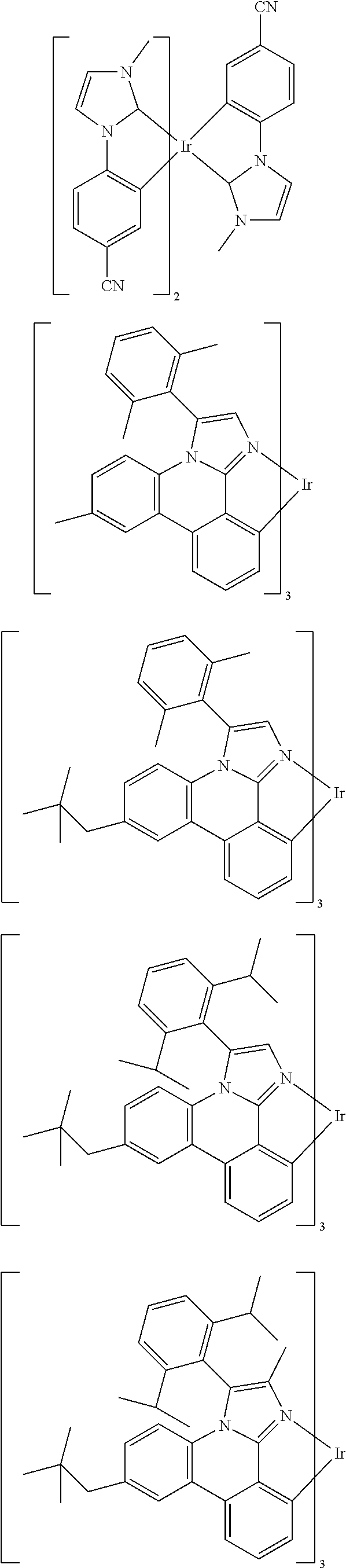


|HOMO(B)|−|HOMO(D)|<0.15 eV and
|HOMO(B)|−|HOMO(D)|>−0.2 eV.
|HOMO(C)|−min{|HOMO(D)|;|HOMO(B)|}>0.4 eV,
or
|HOMO(C)|−min{|HOMO(D)|;|HOMO(B)|}>0.6 eV.
|LUMO(B)|−|LUMO(C)|>0.4 eV,
or
|LUMO(B)|−|LUMO(C)|>0.6 eV.
|LUMO(D)|−|LUMO(B)|<0.15 eV and
|LUMO(D)|−|LUMO(B)|>−0.2 eV,
or
|LUMO(D)|−|LUMO(B)|<0.1 eV and
|LUMO(D)|−|LUMO(B)|>−0.1 eV.
max{|LUMO(D)|;|LUMO(B)|}−|LUMO(C)|>0.4 eV,
or
max{|LUMO(D)|;|LUMO(B)|}−|LUMO(C)|>0.6 eV.
|HOMO(C)|−|HOMO(B)|>0.4 eV,
or
|HOMO(C)|−|HOMO(B)|>0.6 eV.
|HOMO(B)|−|HOMO(HTM)|<0.3 eV.
|LUMO(B)|−|LUMO(ETM)|<0.3 eV.
|HOMO(B)|−|HOMO(D)|<0.1 eV and
|HOMO(B)|−|HOMO(D)|>−0.1 eV.
Applications Claiming Priority (4)
| Application Number | Priority Date | Filing Date | Title |
|---|---|---|---|
| DE102014008722 | 2014-06-18 | ||
| DE102014008722.0 | 2014-06-18 | ||
| DE102014008722.0A DE102014008722B4 (en) | 2014-06-18 | 2014-06-18 | Compositions for electronic devices, formulation containing them, use of the composition, use of the formulation and organic electronic device containing the composition |
| PCT/EP2015/001072 WO2015192941A1 (en) | 2014-06-18 | 2015-05-26 | Compositions for electronic devices |
Publications (2)
| Publication Number | Publication Date |
|---|---|
| US20170141328A1 US20170141328A1 (en) | 2017-05-18 |
| US10847727B2 true US10847727B2 (en) | 2020-11-24 |
Family
ID=53284196
Family Applications (1)
| Application Number | Title | Priority Date | Filing Date |
|---|---|---|---|
| US15/319,459 Active 2036-08-21 US10847727B2 (en) | 2014-06-18 | 2015-05-26 | Compositions for electronic devices |
Country Status (8)
| Country | Link |
|---|---|
| US (1) | US10847727B2 (en) |
| EP (1) | EP3158024A1 (en) |
| JP (1) | JP6772073B2 (en) |
| KR (1) | KR102537035B1 (en) |
| CN (2) | CN111518544A (en) |
| DE (1) | DE102014008722B4 (en) |
| TW (1) | TWI703200B (en) |
| WO (1) | WO2015192941A1 (en) |
Cited By (3)
| Publication number | Priority date | Publication date | Assignee | Title |
|---|---|---|---|---|
| US20200350507A1 (en) | 2019-04-30 | 2020-11-05 | Samsung Display Co., Ltd. | Organic light-emitting device |
| US12274117B2 (en) | 2020-12-15 | 2025-04-08 | Samsung Display Co., Ltd. | Light-emitting device and an electronic apparatus including same |
| US12550606B2 (en) | 2018-03-22 | 2026-02-10 | Samsung Display Co., Ltd. | Organic light-emitting device and electronic apparatus including the same |
Families Citing this family (20)
| Publication number | Priority date | Publication date | Assignee | Title |
|---|---|---|---|---|
| WO2017038728A1 (en) | 2015-08-28 | 2017-03-09 | 出光興産株式会社 | Compound, organic electroluminescent element material, organic electroluminescent element, and electronic device |
| TWI589673B (en) * | 2016-11-03 | 2017-07-01 | 元智大學 | Bipolar materials and organic light emitting diode elements |
| CN106749289B (en) * | 2016-11-24 | 2019-06-18 | 上海道亦化工科技有限公司 | A kind of organic electroluminescent compounds and its luminescent device with spiro structure |
| KR102523619B1 (en) * | 2016-11-25 | 2023-04-20 | 엘티소재주식회사 | Hetero-cyclic compound and organic light emitting device using the same |
| CN106831861A (en) * | 2017-03-01 | 2017-06-13 | 武汉华星光电技术有限公司 | A kind of fluorenes and carbazole analog derivative and phosphorescent organic electroluminescent device |
| JP7124818B2 (en) * | 2017-03-21 | 2022-08-24 | コニカミノルタ株式会社 | organic electroluminescence element |
| KR102513175B1 (en) * | 2017-04-27 | 2023-03-24 | 스미또모 가가꾸 가부시키가이샤 | Composition and light emitting device using the same |
| TWI610927B (en) * | 2017-06-28 | 2018-01-11 | Bipolar compound as a luminescent material | |
| JP7247121B2 (en) * | 2017-07-05 | 2023-03-28 | メルク パテント ゲーエムベーハー | Compositions for organic electronic devices |
| KR102395782B1 (en) | 2017-07-31 | 2022-05-09 | 삼성전자주식회사 | Organic light emitting device |
| WO2019049225A1 (en) | 2017-09-06 | 2019-03-14 | 住友化学株式会社 | Light emitting element |
| TWI785142B (en) | 2017-11-14 | 2022-12-01 | 德商麥克專利有限公司 | Composition for organic electronic devices |
| TWI826522B (en) * | 2018-09-12 | 2023-12-21 | 德商麥克專利有限公司 | Electroluminescent devices |
| WO2020109434A1 (en) * | 2018-11-30 | 2020-06-04 | Merck Patent Gmbh | Compounds for electronic devices |
| TW202039493A (en) * | 2018-12-19 | 2020-11-01 | 德商麥克專利有限公司 | Materials for organic electroluminescent devices |
| CN110256406B (en) * | 2019-06-14 | 2020-07-10 | 武汉华星光电半导体显示技术有限公司 | Hole transport material, preparation method thereof and organic electroluminescent device |
| CN115867426A (en) | 2020-06-23 | 2023-03-28 | 默克专利有限公司 | method of producing the mixture |
| CN114507224B (en) * | 2020-11-16 | 2024-02-27 | 江苏三月科技股份有限公司 | Ketone-containing organic compound and application thereof |
| WO2022120774A1 (en) * | 2020-12-11 | 2022-06-16 | 京东方科技集团股份有限公司 | Organic light emitting device and display apparatus |
| WO2025210013A1 (en) | 2024-04-04 | 2025-10-09 | Merck Patent Gmbh | Compounds for electronic devices, in particular compounds for oleds |
Citations (9)
| Publication number | Priority date | Publication date | Assignee | Title |
|---|---|---|---|---|
| US20040247933A1 (en) | 2003-06-03 | 2004-12-09 | Canon Kabushiki Kaisha | Bipolar asymmetric carbazole-based host materials for electrophosphorescent guest-host OLED systems |
| WO2005029923A1 (en) | 2003-09-24 | 2005-03-31 | Fuji Photo Film Co., Ltd. | Electroluminescent device |
| US20060068223A1 (en) | 2004-09-29 | 2006-03-30 | Fuji Photo Film Co., Ltd. | Organic electroluminescent element |
| DE102006025777A1 (en) | 2006-05-31 | 2007-12-06 | Merck Patent Gmbh | New materials for organic electroluminescent devices |
| WO2009021126A2 (en) | 2007-08-08 | 2009-02-12 | Universal Display Corporation | Benzo-fused thiophene or benzo-fused furan compounds comprising a triphenylene group |
| US20100184942A1 (en) * | 2009-01-22 | 2010-07-22 | Chen Shaw H | Hybrid Host Materials For Electrophosphorescent Devices |
| WO2010108579A1 (en) | 2009-03-23 | 2010-09-30 | Merck Patent Gmbh | Organic electroluminescent device |
| DE102010027317A1 (en) | 2010-07-16 | 2012-01-19 | Merck Patent Gmbh | metal complexes |
| WO2013146645A1 (en) | 2012-03-30 | 2013-10-03 | 新日鉄住金化学株式会社 | Organic electroluminescent element |
Family Cites Families (112)
| Publication number | Priority date | Publication date | Assignee | Title |
|---|---|---|---|---|
| US4539507A (en) | 1983-03-25 | 1985-09-03 | Eastman Kodak Company | Organic electroluminescent devices having improved power conversion efficiencies |
| US5061569A (en) | 1990-07-26 | 1991-10-29 | Eastman Kodak Company | Electroluminescent device with organic electroluminescent medium |
| US5151629A (en) | 1991-08-01 | 1992-09-29 | Eastman Kodak Company | Blue emitting internal junction organic electroluminescent device (I) |
| JP3295088B2 (en) | 1993-09-29 | 2002-06-24 | 出光興産株式会社 | Organic electroluminescence device |
| JPH07133483A (en) | 1993-11-09 | 1995-05-23 | Shinko Electric Ind Co Ltd | Organic light emitting material for EL device and EL device |
| EP0676461B1 (en) | 1994-04-07 | 2002-08-14 | Covion Organic Semiconductors GmbH | Spiro compounds and their application as electroluminescence materials |
| JP3899566B2 (en) | 1996-11-25 | 2007-03-28 | セイコーエプソン株式会社 | Manufacturing method of organic EL display device |
| DE19652261A1 (en) | 1996-12-16 | 1998-06-18 | Hoechst Ag | Aryl-substituted poly (p-arylenevinylenes), process for their preparation and their use in electroluminescent devices |
| US5952115A (en) | 1997-10-02 | 1999-09-14 | Xerox Corporation | Electroluminescent devices |
| US5843607A (en) | 1997-10-02 | 1998-12-01 | Xerox Corporation | Indolocarbazole photoconductors |
| US5942340A (en) | 1997-10-02 | 1999-08-24 | Xerox Corporation | Indolocarbazole electroluminescent devices |
| US5935721A (en) | 1998-03-20 | 1999-08-10 | Eastman Kodak Company | Organic electroluminescent elements for stable electroluminescent |
| JP3302945B2 (en) | 1998-06-23 | 2002-07-15 | ネースディスプレイ・カンパニー・リミテッド | Novel organometallic luminescent material and organic electroluminescent device containing the same |
| EP1729327B2 (en) | 1999-05-13 | 2022-08-10 | The Trustees Of Princeton University | Use of a phosphorescent iridium compound as emissive molecule in an organic light emitting device |
| KR100738762B1 (en) | 1999-09-21 | 2007-07-12 | 이데미쓰 고산 가부시키가이샤 | Organic electroluminescence and organic luminous medium |
| EP1933395B2 (en) | 1999-12-01 | 2019-08-07 | The Trustees of Princeton University | Complexes of form L2IrX |
| KR100377321B1 (en) | 1999-12-31 | 2003-03-26 | 주식회사 엘지화학 | Electronic device comprising organic compound having p-type semiconducting characteristics |
| US6660410B2 (en) | 2000-03-27 | 2003-12-09 | Idemitsu Kosan Co., Ltd. | Organic electroluminescence element |
| JP4094203B2 (en) | 2000-03-30 | 2008-06-04 | 出光興産株式会社 | Organic electroluminescence device and organic light emitting medium |
| US6392250B1 (en) | 2000-06-30 | 2002-05-21 | Xerox Corporation | Organic light emitting devices having improved performance |
| US20020121638A1 (en) | 2000-06-30 | 2002-09-05 | Vladimir Grushin | Electroluminescent iridium compounds with fluorinated phenylpyridines, phenylpyrimidines, and phenylquinolines and devices made with such compounds |
| EP1325671B1 (en) | 2000-08-11 | 2012-10-24 | The Trustees Of Princeton University | Organometallic compounds and emission-shifting organic electrophosphorescence |
| JP4154140B2 (en) | 2000-09-26 | 2008-09-24 | キヤノン株式会社 | Metal coordination compounds |
| JP4154138B2 (en) | 2000-09-26 | 2008-09-24 | キヤノン株式会社 | Light emitting element, display device and metal coordination compound |
| JP4154139B2 (en) | 2000-09-26 | 2008-09-24 | キヤノン株式会社 | Light emitting element |
| US6803720B2 (en) | 2000-12-15 | 2004-10-12 | Universal Display Corporation | Highly stable and efficient OLEDs with a phosphorescent-doped mixed layer architecture |
| KR100916231B1 (en) | 2001-03-14 | 2009-09-08 | 더 트러스티즈 오브 프린스턴 유니버시티 | Materials and apparatus for blue phosphorescent organic light emitting diodes |
| CN1239447C (en) | 2002-01-15 | 2006-02-01 | 清华大学 | Organic electroluminescent material |
| KR100691543B1 (en) | 2002-01-18 | 2007-03-09 | 주식회사 엘지화학 | New material for electron transport and organic light emitting device using the same |
| JP4170655B2 (en) | 2002-04-17 | 2008-10-22 | 出光興産株式会社 | Novel aromatic compound and organic electroluminescence device using the same |
| AU2003230308A1 (en) | 2002-05-07 | 2003-11-11 | Lg Chem, Ltd. | New organic compounds for electroluminescence and organic electroluminescent devices using the same |
| ATE529494T1 (en) | 2002-07-19 | 2011-11-15 | Idemitsu Kosan Co | ORGANIC ELECTROLUMINescent DEVICES AND ORGANIC LIGHT EMITTING MEDIUM |
| JP4025137B2 (en) | 2002-08-02 | 2007-12-19 | 出光興産株式会社 | Anthracene derivative and organic electroluminescence device using the same |
| JP2004075567A (en) | 2002-08-12 | 2004-03-11 | Idemitsu Kosan Co Ltd | Oligoarylene derivatives and organic electroluminescent devices using the same |
| US7839074B2 (en) | 2002-08-23 | 2010-11-23 | Idemitsu Kosan Co., Ltd. | Organic electroluminescence device and anthracene derivative |
| US20060035109A1 (en) | 2002-09-20 | 2006-02-16 | Idemitsu Kosan Co., Ltd. | Organic electroluminescent element |
| DE10249723A1 (en) | 2002-10-25 | 2004-05-06 | Covion Organic Semiconductors Gmbh | Conjugated polymers containing arylamine units, their preparation and use |
| US20060063027A1 (en) | 2002-12-23 | 2006-03-23 | Covion Organic Semiconductors Gmbh | Organic electroluminescent element |
| EP2174932B1 (en) | 2003-03-13 | 2019-07-03 | Idemitsu Kosan Co., Ltd. | Nitrogen-containing heterocycle derivative and organic electroluminescent element using the same |
| JP4411851B2 (en) | 2003-03-19 | 2010-02-10 | コニカミノルタホールディングス株式会社 | Organic electroluminescence device |
| EP1618170A2 (en) | 2003-04-15 | 2006-01-25 | Covion Organic Semiconductors GmbH | Mixtures of matrix materials and organic semiconductors capable of emission, use of the same and electronic components containing said mixtures |
| US7029765B2 (en) | 2003-04-22 | 2006-04-18 | Universal Display Corporation | Organic light emitting devices having reduced pixel shrinkage |
| JP4635870B2 (en) | 2003-04-23 | 2011-02-23 | コニカミノルタホールディングス株式会社 | Organic electroluminescence element, lighting device and display device |
| TWI224473B (en) * | 2003-06-03 | 2004-11-21 | Chin-Hsin Chen | Doped co-host emitter system in organic electroluminescent devices |
| JP4773346B2 (en) | 2003-07-07 | 2011-09-14 | メルク パテント ゲーエムベーハー | Mixtures of organic light emitting semiconductors and matrix materials, their use and electronic components comprising said materials. |
| DE10333232A1 (en) | 2003-07-21 | 2007-10-11 | Merck Patent Gmbh | Organic electroluminescent element |
| DE10338550A1 (en) | 2003-08-19 | 2005-03-31 | Basf Ag | Transition metal complexes with carbene ligands as emitters for organic light-emitting diodes (OLEDs) |
| DE10345572A1 (en) | 2003-09-29 | 2005-05-19 | Covion Organic Semiconductors Gmbh | metal complexes |
| US7795801B2 (en) | 2003-09-30 | 2010-09-14 | Konica Minolta Holdings, Inc. | Organic electroluminescent element, illuminator, display and compound |
| US7790890B2 (en) | 2004-03-31 | 2010-09-07 | Konica Minolta Holdings, Inc. | Organic electroluminescence element material, organic electroluminescence element, display device and illumination device |
| KR100787425B1 (en) | 2004-11-29 | 2007-12-26 | 삼성에스디아이 주식회사 | Phenylcarbazole compound and organic electroluminescent device using same |
| DE102004023277A1 (en) | 2004-05-11 | 2005-12-01 | Covion Organic Semiconductors Gmbh | New material mixtures for electroluminescence |
| US7598388B2 (en) | 2004-05-18 | 2009-10-06 | The University Of Southern California | Carbene containing metal complexes as OLEDs |
| JP4862248B2 (en) | 2004-06-04 | 2012-01-25 | コニカミノルタホールディングス株式会社 | Organic electroluminescence element, lighting device and display device |
| US20060134461A1 (en) * | 2004-12-17 | 2006-06-22 | Shouquan Huo | Organometallic materials and electroluminescent devices |
| US7597967B2 (en) * | 2004-12-17 | 2009-10-06 | Eastman Kodak Company | Phosphorescent OLEDs with exciton blocking layer |
| KR100949214B1 (en) | 2005-03-18 | 2010-03-24 | 이데미쓰 고산 가부시키가이샤 | Aromatic Amine Derivatives and Organic Electroluminescent Devices Using The Same |
| EP1888706B1 (en) | 2005-05-03 | 2017-03-01 | Merck Patent GmbH | Organic electroluminescent device and boric acid and borinic acid derivatives used therein |
| DE102005023437A1 (en) | 2005-05-20 | 2006-11-30 | Merck Patent Gmbh | Connections for organic electronic devices |
| US7839078B2 (en) * | 2005-09-15 | 2010-11-23 | Fujifilm Corporation | Organic electroluminescent element having a luminescent layer and a buffer layer adjacent thereto |
| WO2007063754A1 (en) | 2005-12-01 | 2007-06-07 | Nippon Steel Chemical Co., Ltd. | Compound for organic electroluminescent element and organic electroluminescent element |
| US20070275265A1 (en) * | 2006-05-25 | 2007-11-29 | Au Optronics Corporation | Organic light emitting layer with a reduced phosphorescent dopant concentration and applications of same |
| DE102006025846A1 (en) | 2006-06-02 | 2007-12-06 | Merck Patent Gmbh | New materials for organic electroluminescent devices |
| DE102006031990A1 (en) | 2006-07-11 | 2008-01-17 | Merck Patent Gmbh | New materials for organic electroluminescent devices |
| US8062769B2 (en) | 2006-11-09 | 2011-11-22 | Nippon Steel Chemical Co., Ltd. | Indolocarbazole compound for use in organic electroluminescent device and organic electroluminescent device |
| DE102007002714A1 (en) | 2007-01-18 | 2008-07-31 | Merck Patent Gmbh | New materials for organic electroluminescent devices |
| DE102007024850A1 (en) | 2007-05-29 | 2008-12-04 | Merck Patent Gmbh | New materials for organic electroluminescent devices |
| JP5194596B2 (en) | 2007-07-11 | 2013-05-08 | コニカミノルタホールディングス株式会社 | Organic electroluminescence element, display device and lighting device |
| DE102007053771A1 (en) | 2007-11-12 | 2009-05-14 | Merck Patent Gmbh | Organic electroluminescent devices |
| WO2009069442A1 (en) | 2007-11-26 | 2009-06-04 | Konica Minolta Holdings, Inc. | Organic electroluminescent device, display device and illuminating device |
| DE102008017591A1 (en) | 2008-04-07 | 2009-10-08 | Merck Patent Gmbh | New materials for organic electroluminescent devices |
| DE102008033943A1 (en) | 2008-07-18 | 2010-01-21 | Merck Patent Gmbh | New materials for organic electroluminescent devices |
| DE102008036982A1 (en) | 2008-08-08 | 2010-02-11 | Merck Patent Gmbh | Organic electroluminescent device |
| WO2010027583A1 (en) | 2008-09-03 | 2010-03-11 | Universal Display Corporation | Phosphorescent materials |
| DE102008056688A1 (en) | 2008-11-11 | 2010-05-12 | Merck Patent Gmbh | Materials for organic electroluminescent devices |
| JP5701766B2 (en) | 2008-11-11 | 2015-04-15 | メルク パテント ゲーエムベーハー | Organic electroluminescent device |
| TW201023413A (en) * | 2008-12-05 | 2010-06-16 | Univ Tsinghua | Organic light-emitting diode (OLED) device |
| DE102008064200A1 (en) | 2008-12-22 | 2010-07-01 | Merck Patent Gmbh | Organic electroluminescent device |
| DE102009007038A1 (en) | 2009-02-02 | 2010-08-05 | Merck Patent Gmbh | metal complexes |
| KR101732199B1 (en) | 2009-02-27 | 2017-05-02 | 메르크 파텐트 게엠베하 | Polymer having aldehyde groups, converting and cross-linking of said polymer, cross-linked polymer, and electroluminescent device comprising said polymer |
| KR101511072B1 (en) | 2009-03-20 | 2015-04-10 | 롬엔드하스전자재료코리아유한회사 | Novel organic electroluminescent compounds and organic electroluminescent device using the same |
| DE102009023155A1 (en) * | 2009-05-29 | 2010-12-02 | Merck Patent Gmbh | Materials for organic electroluminescent devices |
| DE102009031021A1 (en) | 2009-06-30 | 2011-01-05 | Merck Patent Gmbh | Materials for organic electroluminescent devices |
| DE102009053382A1 (en) | 2009-11-14 | 2011-05-19 | Merck Patent Gmbh | Materials for electronic devices |
| DE102010005697A1 (en) | 2010-01-25 | 2011-07-28 | Merck Patent GmbH, 64293 | Connections for electronic devices |
| JP5678487B2 (en) | 2010-04-09 | 2015-03-04 | ソニー株式会社 | Organic EL display device |
| DE102010014933A1 (en) | 2010-04-14 | 2011-10-20 | Merck Patent Gmbh | Materials for electronic devices |
| EP2415769B1 (en) | 2010-04-20 | 2015-10-28 | Idemitsu Kosan Co., Ltd. | Bis-carbazole derivative, material for organic electroluminescent element and organic electroluminescent element using same |
| WO2011137922A1 (en) | 2010-05-03 | 2011-11-10 | Merck Patent Gmbh | Formulations and electronic devices |
| DE102010019306B4 (en) | 2010-05-04 | 2021-05-20 | Merck Patent Gmbh | Organic electroluminescent devices |
| CN101859879A (en) * | 2010-05-26 | 2010-10-13 | 上海大学 | A kind of white organic electroluminescence device and preparation method thereof |
| JP6054290B2 (en) | 2010-06-15 | 2016-12-27 | メルク パテント ゲーエムベーハー | Metal complex |
| DE102010045405A1 (en) | 2010-09-15 | 2012-03-15 | Merck Patent Gmbh | Materials for organic electroluminescent devices |
| KR101531612B1 (en) | 2010-12-02 | 2015-06-25 | 제일모직 주식회사 | Compound for organic photoelectric device and organic photoelectric device including the same |
| CN102110782A (en) * | 2010-12-06 | 2011-06-29 | 电子科技大学 | Organic light emitting device and preparation method thereof |
| KR101906868B1 (en) * | 2010-12-31 | 2018-10-12 | 엘지디스플레이 주식회사 | Apparatus for deposition for organic electroluminescent device and method of fabricating the organic electroluminescent device using the same |
| JP5778950B2 (en) | 2011-03-04 | 2015-09-16 | 株式会社Joled | Organic EL display device and manufacturing method thereof |
| KR101427611B1 (en) | 2011-03-08 | 2014-08-11 | 롬엔드하스전자재료코리아유한회사 | Novel compounds for organic electronic material and organic electroluminescence device using the same |
| CN102184938B (en) * | 2011-05-03 | 2015-06-24 | 昆山维信诺显示技术有限公司 | Organic electroluminescent device and manufacturing method thereof |
| KR101970940B1 (en) | 2011-05-05 | 2019-04-22 | 메르크 파텐트 게엠베하 | Compounds for electronic devices |
| KR101972184B1 (en) | 2011-06-03 | 2019-04-24 | 메르크 파텐트 게엠베하 | Metal complexes |
| KR101943676B1 (en) | 2011-06-28 | 2019-01-29 | 메르크 파텐트 게엠베하 | Metal complexes |
| KR101967014B1 (en) | 2011-08-10 | 2019-04-08 | 메르크 파텐트 게엠베하 | Metal complexes |
| EP2773721B1 (en) | 2011-11-01 | 2015-11-25 | Merck Patent GmbH | Organic electroluminescent device |
| US10305040B2 (en) | 2011-11-17 | 2019-05-28 | Merck Patent Gmbh | Spiro dihydroacridine derivatives and the use thereof as materials for organic electroluminescence devices |
| KR102015765B1 (en) | 2012-02-14 | 2019-10-21 | 메르크 파텐트 게엠베하 | Spirobifluorene compounds for organic electroluminescent devices |
| JP2015167150A (en) * | 2012-05-28 | 2015-09-24 | 出光興産株式会社 | Organic electroluminescent element |
| CN102738401B (en) * | 2012-05-31 | 2016-03-09 | 昆山工研院新型平板显示技术中心有限公司 | A kind of two subject type glow organic electroluminescent device |
| EP3424907B1 (en) | 2012-07-23 | 2025-03-12 | Merck Patent GmbH | Connections and organic electronic devices |
| CN104488359B (en) | 2012-07-23 | 2018-01-23 | 默克专利有限公司 | Derivatives of 2-diarylaminofluorenes and organic electronic complexes containing said 2-diarylaminofluorene derivatives |
| KR101807925B1 (en) | 2012-07-23 | 2017-12-11 | 메르크 파텐트 게엠베하 | Compounds and organic electroluminescent devices |
| JP6407883B2 (en) | 2012-12-14 | 2018-10-17 | メルク パテント ゲーエムベーハー | Materials for electronic devices |
-
2014
- 2014-06-18 DE DE102014008722.0A patent/DE102014008722B4/en active Active
-
2015
- 2015-05-26 WO PCT/EP2015/001072 patent/WO2015192941A1/en not_active Ceased
- 2015-05-26 CN CN202010259171.1A patent/CN111518544A/en not_active Withdrawn
- 2015-05-26 KR KR1020177001334A patent/KR102537035B1/en active Active
- 2015-05-26 US US15/319,459 patent/US10847727B2/en active Active
- 2015-05-26 CN CN201580031906.2A patent/CN106459747B/en active Active
- 2015-05-26 JP JP2016574139A patent/JP6772073B2/en active Active
- 2015-05-26 EP EP15726863.2A patent/EP3158024A1/en not_active Withdrawn
- 2015-06-15 TW TW104119291A patent/TWI703200B/en not_active IP Right Cessation
Patent Citations (14)
| Publication number | Priority date | Publication date | Assignee | Title |
|---|---|---|---|---|
| US20040247933A1 (en) | 2003-06-03 | 2004-12-09 | Canon Kabushiki Kaisha | Bipolar asymmetric carbazole-based host materials for electrophosphorescent guest-host OLED systems |
| WO2005029923A1 (en) | 2003-09-24 | 2005-03-31 | Fuji Photo Film Co., Ltd. | Electroluminescent device |
| US20060068223A1 (en) | 2004-09-29 | 2006-03-30 | Fuji Photo Film Co., Ltd. | Organic electroluminescent element |
| US9206351B2 (en) | 2006-05-31 | 2015-12-08 | Merck Patent Gmbh | Materials for organic electroluminescent devices |
| DE102006025777A1 (en) | 2006-05-31 | 2007-12-06 | Merck Patent Gmbh | New materials for organic electroluminescent devices |
| WO2009021126A2 (en) | 2007-08-08 | 2009-02-12 | Universal Display Corporation | Benzo-fused thiophene or benzo-fused furan compounds comprising a triphenylene group |
| US20100184942A1 (en) * | 2009-01-22 | 2010-07-22 | Chen Shaw H | Hybrid Host Materials For Electrophosphorescent Devices |
| WO2010108579A1 (en) | 2009-03-23 | 2010-09-30 | Merck Patent Gmbh | Organic electroluminescent device |
| US20120056169A1 (en) * | 2009-03-23 | 2012-03-08 | Merck Patent Gmbh Patents & Scientific Information | Organic electroluminescent device |
| US9444064B2 (en) | 2009-03-23 | 2016-09-13 | Merck Patent Gmbh | Organic electroluminescent device |
| DE102010027317A1 (en) | 2010-07-16 | 2012-01-19 | Merck Patent Gmbh | metal complexes |
| US9331290B2 (en) | 2010-07-16 | 2016-05-03 | Merck Patent Gmbh | Metal complexes |
| WO2013146645A1 (en) | 2012-03-30 | 2013-10-03 | 新日鉄住金化学株式会社 | Organic electroluminescent element |
| US20150115240A1 (en) | 2012-03-30 | 2015-04-30 | Nippon Steel & Sumikin Chemical Co., Ltd. | Organic electroluminescent element |
Non-Patent Citations (2)
| Title |
|---|
| International Search Report for PCT/EP2015/001072 dated Jul. 31, 2015. |
| Written Opinion of the International Searching Authority for PCT/EP2015/001072 dated Jul. 31, 2015. |
Cited By (6)
| Publication number | Priority date | Publication date | Assignee | Title |
|---|---|---|---|---|
| US12550606B2 (en) | 2018-03-22 | 2026-02-10 | Samsung Display Co., Ltd. | Organic light-emitting device and electronic apparatus including the same |
| US12563962B2 (en) | 2018-03-22 | 2026-02-24 | Samsung Display Co., Ltd. | Organic light-emitting device and electronic apparatus including the same |
| US20200350507A1 (en) | 2019-04-30 | 2020-11-05 | Samsung Display Co., Ltd. | Organic light-emitting device |
| US12268044B2 (en) | 2019-04-30 | 2025-04-01 | Samsung Display Co., Ltd. | Organic light-emitting device including a first exciplex and a second exciplex in an emission layer |
| US12532597B2 (en) | 2019-04-30 | 2026-01-20 | Samsung Display Co., Ltd. | Organic light-emitting device |
| US12274117B2 (en) | 2020-12-15 | 2025-04-08 | Samsung Display Co., Ltd. | Light-emitting device and an electronic apparatus including same |
Also Published As
| Publication number | Publication date |
|---|---|
| DE102014008722A1 (en) | 2015-12-24 |
| CN106459747A (en) | 2017-02-22 |
| WO2015192941A1 (en) | 2015-12-23 |
| JP2017523270A (en) | 2017-08-17 |
| CN111518544A (en) | 2020-08-11 |
| KR20170018946A (en) | 2017-02-20 |
| CN106459747B (en) | 2020-09-04 |
| TW201614041A (en) | 2016-04-16 |
| DE102014008722B4 (en) | 2024-08-22 |
| KR102537035B1 (en) | 2023-05-26 |
| US20170141328A1 (en) | 2017-05-18 |
| EP3158024A1 (en) | 2017-04-26 |
| JP6772073B2 (en) | 2020-10-21 |
| TWI703200B (en) | 2020-09-01 |
Similar Documents
| Publication | Publication Date | Title |
|---|---|---|
| US10847727B2 (en) | Compositions for electronic devices | |
| US11527728B2 (en) | Organic electroluminescent compounds and organic electroluminescent device comprising the same | |
| KR101772371B1 (en) | Compounds and organic electronic devices | |
| EP3306693B1 (en) | Organic electroluminescent element | |
| CN108054293B (en) | Derivatives of 2-diarylaminofluorene and organic electronic complexes containing said 2-diarylaminofluorene derivatives | |
| CN107078221B (en) | Organic electroluminescence element and manufacturing method thereof | |
| KR101807925B1 (en) | Compounds and organic electroluminescent devices | |
| CN105793246B (en) | Substituted oxepin | |
| CN107721861B (en) | phenanthrene compounds for organic electronic devices | |
| US20180208836A1 (en) | Organic electroluminescence element and electronic device | |
| CN108603107B (en) | Material for electronic devices | |
| CN108779103B (en) | Compounds with a spirobifluorene structure | |
| US11094886B2 (en) | Organic electroluminescent element and electronic device | |
| CN105636959A (en) | Materials for electronic devices | |
| CN106255687A (en) | Materials for Electronic Devices | |
| CN105408449A (en) | Materials for electronic devices | |
| US12486452B2 (en) | Organic electroluminescent element and electronic device | |
| CN108352456A (en) | Organic electroluminescence device | |
| CN105431441B (en) | Compound, material for organic electroluminescent element, and electronic device | |
| US20220263030A1 (en) | Organic electroluminescent element and electronic device | |
| CN113169274A (en) | Compounds for electronic devices | |
| US10651398B2 (en) | Organic electroluminescence element and electronic device | |
| US12575319B2 (en) | Organic electroluminescence device and electronic device | |
| EP3399565B1 (en) | Organic electroluminescence element | |
| US20230027888A1 (en) | Organic electroluminescent device, organic electroluminescence display device, electronic device and compound |
Legal Events
| Date | Code | Title | Description |
|---|---|---|---|
| AS | Assignment |
Owner name: MERCK PATENT GMBH, GERMANY Free format text: ASSIGNMENT OF ASSIGNORS INTEREST;ASSIGNORS:HAYER, ANNA;MAIER-FLAIG, FLORIAN;GROSSMANN, TOBIAS;AND OTHERS;SIGNING DATES FROM 20160926 TO 20161006;REEL/FRAME:040662/0042 |
|
| STPP | Information on status: patent application and granting procedure in general |
Free format text: NON FINAL ACTION MAILED |
|
| STPP | Information on status: patent application and granting procedure in general |
Free format text: RESPONSE TO NON-FINAL OFFICE ACTION ENTERED AND FORWARDED TO EXAMINER |
|
| STPP | Information on status: patent application and granting procedure in general |
Free format text: FINAL REJECTION MAILED |
|
| STCV | Information on status: appeal procedure |
Free format text: NOTICE OF APPEAL FILED |
|
| STCV | Information on status: appeal procedure |
Free format text: APPEAL BRIEF (OR SUPPLEMENTAL BRIEF) ENTERED AND FORWARDED TO EXAMINER |
|
| STPP | Information on status: patent application and granting procedure in general |
Free format text: NON FINAL ACTION MAILED |
|
| STPP | Information on status: patent application and granting procedure in general |
Free format text: RESPONSE TO NON-FINAL OFFICE ACTION ENTERED AND FORWARDED TO EXAMINER |
|
| STPP | Information on status: patent application and granting procedure in general |
Free format text: NOTICE OF ALLOWANCE MAILED -- APPLICATION RECEIVED IN OFFICE OF PUBLICATIONS |
|
| STPP | Information on status: patent application and granting procedure in general |
Free format text: PUBLICATIONS -- ISSUE FEE PAYMENT VERIFIED |
|
| STCF | Information on status: patent grant |
Free format text: PATENTED CASE |
|
| MAFP | Maintenance fee payment |
Free format text: PAYMENT OF MAINTENANCE FEE, 4TH YEAR, LARGE ENTITY (ORIGINAL EVENT CODE: M1551); ENTITY STATUS OF PATENT OWNER: LARGE ENTITY Year of fee payment: 4 |