US10846836B2 - View synthesis using deep convolutional neural networks - Google Patents
View synthesis using deep convolutional neural networks Download PDFInfo
- Publication number
- US10846836B2 US10846836B2 US15/351,340 US201615351340A US10846836B2 US 10846836 B2 US10846836 B2 US 10846836B2 US 201615351340 A US201615351340 A US 201615351340A US 10846836 B2 US10846836 B2 US 10846836B2
- Authority
- US
- United States
- Prior art keywords
- image
- rectified
- generate
- view
- features
- Prior art date
- Legal status (The legal status is an assumption and is not a legal conclusion. Google has not performed a legal analysis and makes no representation as to the accuracy of the status listed.)
- Expired - Fee Related, expires
Links
Images




Classifications
-
- G—PHYSICS
- G06—COMPUTING OR CALCULATING; COUNTING
- G06T—IMAGE DATA PROCESSING OR GENERATION, IN GENERAL
- G06T7/00—Image analysis
- G06T7/97—Determining parameters from multiple pictures
-
- G—PHYSICS
- G06—COMPUTING OR CALCULATING; COUNTING
- G06T—IMAGE DATA PROCESSING OR GENERATION, IN GENERAL
- G06T5/00—Image enhancement or restoration
- G06T5/50—Image enhancement or restoration using two or more images, e.g. averaging or subtraction
-
- G—PHYSICS
- G06—COMPUTING OR CALCULATING; COUNTING
- G06N—COMPUTING ARRANGEMENTS BASED ON SPECIFIC COMPUTATIONAL MODELS
- G06N3/00—Computing arrangements based on biological models
- G06N3/02—Neural networks
- G06N3/04—Architecture, e.g. interconnection topology
-
- G—PHYSICS
- G06—COMPUTING OR CALCULATING; COUNTING
- G06N—COMPUTING ARRANGEMENTS BASED ON SPECIFIC COMPUTATIONAL MODELS
- G06N3/00—Computing arrangements based on biological models
- G06N3/02—Neural networks
- G06N3/04—Architecture, e.g. interconnection topology
- G06N3/045—Combinations of networks
- G06N3/0455—Auto-encoder networks; Encoder-decoder networks
-
- G—PHYSICS
- G06—COMPUTING OR CALCULATING; COUNTING
- G06N—COMPUTING ARRANGEMENTS BASED ON SPECIFIC COMPUTATIONAL MODELS
- G06N3/00—Computing arrangements based on biological models
- G06N3/02—Neural networks
- G06N3/04—Architecture, e.g. interconnection topology
- G06N3/0464—Convolutional networks [CNN, ConvNet]
-
- G—PHYSICS
- G06—COMPUTING OR CALCULATING; COUNTING
- G06N—COMPUTING ARRANGEMENTS BASED ON SPECIFIC COMPUTATIONAL MODELS
- G06N3/00—Computing arrangements based on biological models
- G06N3/02—Neural networks
- G06N3/08—Learning methods
-
- G—PHYSICS
- G06—COMPUTING OR CALCULATING; COUNTING
- G06N—COMPUTING ARRANGEMENTS BASED ON SPECIFIC COMPUTATIONAL MODELS
- G06N3/00—Computing arrangements based on biological models
- G06N3/02—Neural networks
- G06N3/08—Learning methods
- G06N3/09—Supervised learning
-
- G06T3/0093—
-
- G—PHYSICS
- G06—COMPUTING OR CALCULATING; COUNTING
- G06T—IMAGE DATA PROCESSING OR GENERATION, IN GENERAL
- G06T3/00—Geometric image transformations in the plane of the image
- G06T3/18—Image warping, e.g. rearranging pixels individually
-
- G—PHYSICS
- G06—COMPUTING OR CALCULATING; COUNTING
- G06T—IMAGE DATA PROCESSING OR GENERATION, IN GENERAL
- G06T2207/00—Indexing scheme for image analysis or image enhancement
- G06T2207/10—Image acquisition modality
- G06T2207/10004—Still image; Photographic image
-
- G—PHYSICS
- G06—COMPUTING OR CALCULATING; COUNTING
- G06T—IMAGE DATA PROCESSING OR GENERATION, IN GENERAL
- G06T2207/00—Indexing scheme for image analysis or image enhancement
- G06T2207/20—Special algorithmic details
- G06T2207/20084—Artificial neural networks [ANN]
-
- G—PHYSICS
- G06—COMPUTING OR CALCULATING; COUNTING
- G06T—IMAGE DATA PROCESSING OR GENERATION, IN GENERAL
- G06T2207/00—Indexing scheme for image analysis or image enhancement
- G06T2207/20—Special algorithmic details
- G06T2207/20212—Image combination
-
- G—PHYSICS
- G06—COMPUTING OR CALCULATING; COUNTING
- G06T—IMAGE DATA PROCESSING OR GENERATION, IN GENERAL
- G06T2207/00—Indexing scheme for image analysis or image enhancement
- G06T2207/20—Special algorithmic details
- G06T2207/20228—Disparity calculation for image-based rendering
Definitions
- the present specification generally relates to the field of view synthesis and more particularly to novel view synthesis using deep convolutional neural networks.
- Novel view synthesis has practical applications, mostly in computer vision and virtual reality. For example, using computer vision to recognize an object in an image, it may be helpful to obtain images of the object in all possible different views. With limited images of the object in different views, view synthesis methods can generate images that depict the object in views not in the original images. Additionally, view synthesis may be used to create full virtual reality environments based on limited images or video footage. Recently, learning-based techniques utilizing deep convolutional neural networks have been successfully applied to the view synthesis problems. However, such techniques usually suffer from lack of texture details, geometric shape distortions, or excessive computational complexity.
- a rectification network rectifies the two images and an encoder network encodes the two rectified images to generate convolutional neural network features.
- the convolutional neural network features are fed to a decoder network that decodes the features to generate dense point correspondences between the two rectified images and blending masks.
- a view morphing network morphs the two images to generate an intermediate view image depicting an object in the two images in a view between the two images.
- FIG. 1A is an example depicting two images from which a novel view is generated.
- FIG. 1B is an example depicting a novel view generated from the example images of FIG. 1A .
- FIG. 2 is a block diagram depicting an example network for generating novel views according to the techniques disclosed herein.
- FIG. 3 is a block diagram depicting an example rectification network according to the techniques disclosed herein.
- FIG. 4 is a block diagram depicting an example rectification network according to the techniques disclosed herein.
- FIG. 5 is a block diagram depicting an example encoder network according to the techniques disclosed herein.
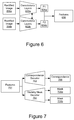
- FIG. 6 is a block diagram depicting an example encoder network according to the techniques disclosed herein.
- FIG. 7 is a block diagram depicting an example decoder network according to the techniques disclosed herein.
- FIG. 8 is a block diagram depicting an example view morphing network according to the techniques disclosed herein.
- FIG. 9 is a block diagram depicting an example process for generating a novel view according to the techniques disclosed herein.
- FIG. 10 is a block diagram of an example computing system for implementing the network according to the techniques disclosed herein.
- the systems and methods according to the techniques of this disclosure provide techniques for generating novel views of an image using deep convolutional neural networks.
- Geometric approaches first try to estimate the approximate underlying 3D structure of the object and then apply some transformation to the pixels in the input image to produce the output image. Besides the requirement of somehow estimating the 3D structure, the other major downside of geometric approaches is that they produce holes in places where the source image does not have sufficient visual content (e.g. the back side of an object). In such cases, various types of texture hole-filling may be used but the hole-filling techniques are not always effective.
- Learning-based approaches use more information from input images to generate a novel view. For example, given a side view of a car, there is no way to guess what the front of the car looks like, unless the system has observed other fronts of cars to make an educated guess.
- Learning based approaches typically use training images to build a parametric model of the object class and then use the parametric model, together with the input image, to generate a novel view.
- results from parametric image generation are often too blurry.
- View morphing can generate shape-preserving view synthesis results.
- View morphing can be thought of as three steps: (i) rectification, (ii) view synthesis by interpolation, and (iii) post-warping.
- Two input images, I 1 and I 2 are rectified by applying homographies H 1 and H 2 to I 1 and I 2 , respectively, to align corresponding points of the two images on the same row.
- homographies can be computed from the fundamental matrix obtained from seven or more point correspondences between the images.
- the rectified image pair R 1 and R 2 can be viewed as captured from two parallel view cameras and linear interpolation of parallel views yields shape-preserving view synthesis results.
- Novel view images can be synthesized by linearly interpolating position and colors of corresponding points of R 1 and R 2 . As the image pair is already rectified, such synthesis can be done on a row by row basis.
- P 1 ⁇ p 1 1 , . . . , p 1 N ⁇
- the techniques introduced herein generate a novel view by explicitly modeling geometric constraints between image pairs.
- the techniques include generating rectified representations of two input images within a view synthesis problem and producing dense point correspondences between the rectified representations of the two input images. Since the input images are rectified, the correspondence searching is simplified to a one-dimensional estimation problem. This makes the correspondence estimation problem significantly easier and less computationally intensive than existing methods.
- the techniques introduced herein use the one-dimensional dense point correspondences to generate an output image together with blending masks to explicitly model visibility of pixels in the output image. The techniques introduced herein produce results with less geometric shape distortion and clearer texture details while being less computationally extensive than existing methods.
- reference numbers may be used to refer to components found in any of the figures, regardless of whether those reference numbers are shown in the figure being described. Further, where a reference number includes a letter referring to one of multiple similar components (e.g., component 000 a , 000 b , and 000 n ), the reference number may be used without the letter to refer to one or all of the similar components.
- FIG. 1A is an example depicting two images from which a novel view is generated.
- an image 102 a of a chair is depicted from a left view and an image 102 b of the chair is depicted from a right view.
- the techniques introduced herein provide for generating a novel view of an image given two views such as those depicted in FIG. 1A .
- FIG. 1B is an example depicting a novel view 104 generated from the example chair images of FIG. 1A using the techniques introduced herein.
- FIG. 2 is a block diagram depicting an example network 200 for generating novel views according to the techniques disclosed herein.
- One existing view synthesis method utilizing deep convolutional neural networks estimates an appearance flow (e.g., dense point correspondences) between each of two input images and the target view as a two-dimensional flow field that can be adopted to reconstruct the target view.
- the main problem of that method is the geometric shape consistency is not considered in the process of generating the appearance flows.
- the network 200 models the dense point correspondences between the two rectified representations of two input images.
- the network 200 only has to estimate one-dimensional dense point correspondences instead of two-dimensional correspondences, which makes the correspondence estimation problem easier and thus makes the network 200 estimate the dense point correspondences more accurately.
- the network 200 thus includes an architecture which can automatically learn the rectified views of image pairs and the one-dimensional dense point correspondences within them.
- the network 200 takes image 202 a and 202 b as inputs to a rectification network 204 and generates rectified images 206 a and 206 b which are used as inputs to the encoder network 208 .
- the encoder network 208 encodes the rectified images 206 using convolutional layers to generate a set of image features.
- the image features are used by the decoder network 210 to generate one-dimensional dense point correspondences and blending masks.
- the view morphing network 212 uses the one-dimensional dense point correspondences, the blending masks, and the rectified images 206 to generate the output image 214 .
- the network 200 network does not have viewpoint transformation information as an input as current view synthesis methods do. Instead, the techniques introduced herein allow the network 200 to learn homography transformations used to rectify two input images without viewpoint transformation information within the network 200 . Test results have shown that the network 200 without viewpoint transformation information performs better than the prior method with viewpoint transformation information.
- Some benefits of the unique architecture of network 200 include the following: 1) the unique one-dimensional dense point correspondences synthesize higher-quality images than typical two-dimensional dense point correspondences, which suffer from geometric shape distortions. This improvement is due to the geometric constraint that is imposed by the automatic rectification of the two input images by the network 200 that limits the correspondence search between the rectified image pairs to a one-dimensional search; 2) the network 200 does not require viewpoint transformation information as an input; 3) the network 200 can synthesize infinite image views between the two input images based on the estimated dense point correspondences and blending masks.
- image 202 a and image 202 b pass through a rectification network 204 .
- the rectification network 204 learns two projective transformation matrices (i.e., homographies that are invertible 3 ⁇ 3 real matrices) and warps image pairs with the projective transform matrices.
- FIG. 3 is a block diagram depicting an example rectification network according to the techniques disclosed herein.
- the rectification network 204 includes convolutional layers 302 that receive a stack of image 202 a and image 202 b as inputs.
- the convolutional layers 302 generate a homography transformation matrix 304 a for image 202 a and a homography transformation matrix 304 b for image 202 b .
- the homography transform matrix 304 a is used by homography transformation layer 306 a to warp image 202 a and generate rectified image 206 a
- homography transform matrix 304 b is used by homography transformation layer 306 b to warp image 202 b to generate rectified image 206 b.
- FIG. 4 is a block diagram depicting another example rectification network according to the techniques disclosed herein.
- image 202 a is processed through convolutional layers 404 a to generate a set of features 404 a corresponding to image 202 a .
- image 202 b is processed through convolutional layers 404 b to generate a set of features 404 b corresponding to image 202 b .
- the features 404 a and 404 b are combined and processed by convolutional layers 406 a and convolutional layers 406 b to generate a homography transformation matrix 408 a and homography transformation matrix 408 b .
- Homography transformation layer 410 a processes image 202 a using the homography transform matrix 408 a to generate rectified image 206 a
- homography transformation layer 410 b processes image 202 b to generate rectified image 206 b.
- FIG. 5 is a block diagram depicting an example encoder network 208 according to the techniques disclosed herein.
- the encoder network 208 takes a stack of rectified image 206 a and rectified image 206 b and encodes those images as a set of features 504 using convolutional layers 502 .
- FIG. 6 is a block diagram depicting an example encoder network 208 according to the techniques disclosed herein.
- encoder network 208 includes two convolutional layers 602 a and 602 b with shared weights between the two encoders for two rectified images as depicted in the example of FIG. 6 .
- Output features 604 a and 604 b of the convolutional layers 602 a and 602 b are concatenated to encode the viewpoint transformation between the input images as a set of feature 606 .
- FIG. 7 is a block depicting an example decoder network according to the techniques disclosed herein.
- the decoder network takes a set of feature 701 from an encoder network (e.g., the encoder networks depicted in FIGS. 5 and 6 ) and decodes the feature 701 using a correspondence decoder 702 to generate dense point correspondences 706 between the two rectified images 206 a and 206 b .
- a visibility mask decoder 704 uses the features 701 to generate blending masks 708 a and 708 b that are used by the view morphing network 214 in synthesizing the output image 214 .
- the masks 708 a and 708 b take into account the portions of the input images that may be hidden or visible in the output image 214 but are visible (or not visible) in one or more of the input views.
- a preliminary output of the view morphing network is multiplied by the blending masks to provide an output that is more in line with the shape of the input views.
- FIG. 8 is a block diagram depicting an example view morphing network according to the techniques disclosed herein.
- the view morphing network 212 uses the output dense point correspondences 706 of the decoder network 210 and the rectified images 206 a and 206 b , the view morphing network 212 generates output image 214 that is a middle view between the rectified images 206 a and 206 b .
- C(q) denote the output 706 of the correspondence decoder 702 where q is the pixel coordinates of the middle view to be synthesized.
- P 1 ⁇ p 1 i , . . . , p 1 N ⁇
- P 2 ⁇ p 2 1 , . . .
- p 2 i q i ⁇ C ( q i )
- R m M 1 ⁇ R 1 ( P 1 )+ M 2 ⁇ R 2 ( P 2 ), where ⁇ represents element-wise multiplication and R 1 (P 1 ) and R 2 (P 2 ) are images sampled from R 1 and R 2 by interpolation.
- View morphing network 212 as depicted in the example of FIG. 8 , includes a sampling 802 a of rectified image 206 a using the dense correspondences 706 and a sampling 802 b of rectified image 206 b using the dense correspondences to generate sampled images 804 a and 804 b , respectively.
- the view morphing network 212 blends 806 the sampled images 804 a and 804 b with the blending masks 708 a and 708 b to finally synthesize the output image 214 .
- the network 200 is trained using two input image views, image 202 a and image 202 b , and the corresponding desired ground truth middle view image.
- the loss function used to train the network 200 is the Euclidean loss between the output 214 and the ground truth image defined as:
- FIG. 9 is a block diagram depicting an example process for generating a novel view according to the techniques disclosed herein.
- the network 200 receives a first image depicting a first view of an object. For example, as depicted in the example of FIG. 2 , the network 200 receives image 202 a .
- the network 200 receives a second image depicting a second view of the object (e.g., image 202 b ).
- the first image 202 a and the second image 202 b may depict an object, for example, from a right perspective view and a left perspective view corresponding to the first and second view of the object depicted in the images 202 a and 202 b.
- a rectification network 204 rectifies the first image and the second image to generate a first rectified image and a second rectified image. As described above, rectifying the first image and the second image simplifies the remaining steps in the view synthesis process by limiting correspondence estimation to a one-dimensional search.
- an encoder network 208 encodes the first and second rectified images (e.g., rectified images 206 a and 206 b ) to generate convolutional neural network features and at 910 a decoder network 210 processes the convolutional neural network features to generate a correspondence between pixels of the first rectified image and pixels of the second rectified image, and blending masks that represents the visibility of pixels of the rectified images in the synthesized middle view.
- first and second rectified images e.g., rectified images 206 a and 206 b
- the view morphing network 212 synthesizes the novel middle view output using the correspondence between pixels of the first rectified image and pixels of the second rectified image, and the blending masks.
- FIG. 10 is a block diagram of an example computing system 1000 , which may represent the computer architecture of a computing device, computing entity, or server for implementing the view synthesis network 200 .
- the computing system 1000 may include a communication unit 1004 , a processor(s) 1008 , a memory(ies) 1018 , a data store 1012 , and/or an input/output device(s) 1014 , connected by a communication bus 1002 , depending on the configuration.
- the computing system 1000 depicted in FIG. 10 is provided by way of example and it should be understood that it may take other forms and include additional or fewer components without departing from the scope of the present disclosure.
- various components of the computing devices may be coupled for communication using a variety of communication protocols and/or technologies including, for instance, communication buses, software communication mechanisms, computer networks, etc.
- the computing system 1000 may include various operating systems, sensors, additional processors, and other physical configurations.
- FIG. 10 only shows a single communication unit 1004 , processor 1008 , data store 1012 , input/output device 1014 , and memory 1018 , it should be understood that the computing system 1000 may include none or a plurality of one or more of these components.
- the bus 1002 may include a communication bus for transferring data between components of a computing device or between computing devices, a network bus system, a processor mesh, a combination thereof, etc.
- the communication bus can include and/or facilitate, for example, inter-method communication, local function or procedure calls, remote procedure calls, an object broker (e.g., CORBA), direct socket communication (e.g., TCP/IP sockets) among software modules, UDP broadcasts and receipts, HTTP connections, etc. Further, any or all of the communication could be secure (e.g., SSH, HTTPS, etc.).
- the communication unit 1004 may include one or more interface devices (I/F) for wired and wireless connectivity among a larger network of computing entities.
- the communication unit 1004 may include, but is not limited to, various types known connectivity and interface options.
- the communication unit 1004 may be coupled to the other components of the computing system 1000 via the bus 1002 .
- the communication unit 404 can provide other connections to a network and to other entities using various standard communication protocols or proprietary communication protocols, as described elsewhere herein.
- the processor 1008 may execute software instructions by performing various input, logical, and/or mathematical operations.
- the processor 1008 may have various computing architectures including, for example, a complex instruction set computer (CISC) architecture, a reduced instruction set computer (RISC) architecture, and/or an architecture implementing a combination of instruction sets.
- the processor 1008 which may include one or more processors, may be physical and/or virtual, and may include a single core or plurality of processing units and/or cores.
- the processor 1008 may be capable of generating and providing electronic display signals to a display device, supporting the display of images, capturing and transmitting images, performing complex tasks including various types of feature extraction and sampling, etc.
- the processor 1008 may be coupled to the memory 1018 via the bus 1002 to access data and instructions therefrom and store data therein.
- the memory(ies) 1018 may store and provide access to data to the other components of the computing system 1000 .
- the memory 1018 may be included in a single computing device or a plurality of computing devices.
- the memory 1018 may store instructions and/or data that may be executed by the processor 1008 .
- the memory 1018 may store view morphing network 1020 .
- the memory 1018 is also capable of storing other instructions and data, including, for example, an operating system, hardware drivers, other software applications, databases, etc.
- the memory 1018 may be coupled to the bus 402 for communication with the processor 1008 and the other components of computing system 1000 .
- the memory 1018 may include a non-transitory computer-usable (e.g., readable, writeable, etc.) medium, which can be any non-transitory apparatus or device that can contain, store, communicate, propagate or transport instructions, data, computer programs, software, code, routines, etc., for processing by or in connection with the processor 1008 .
- the memory 1016 may include one or more of volatile memory and non-volatile memory (e.g., RAM, ROM, hard disk, optical disk, etc.). It should be understood that the memory 1016 may be a single device or may include multiple types of devices and configurations.
- the view morphing network 1020 can be implemented using programmable or specialized hardware including a field-programmable gate array (FPGA) or an application-specific integrated circuit (ASIC). In some implementations, the view morphing network 1020 can be implemented using a combination of hardware and software executable by processor 1008 . In some implementations, the view morphing network 1020 may be sets of instructions executable by the processor 1008 .
- FPGA field-programmable gate array
- ASIC application-specific integrated circuit
- the data store 1012 is an information source for storing and providing access to data.
- the data stored by the data store 1012 may organized and queried using various criteria including any type of data stored by them.
- the data store 1012 may include data tables, databases, or other organized collections of data.
- the input/output device(s) 1014 may include any device for inputting or outputting information into the computing system 1000 .
- the input/output device(s) 1014 may include one or more input devices, such as a keyboard, a pointing device, microphone, an image/video capture device (e.g., camera), a touch-screen display, etc.
- the input/output device(s) 1014 may include one or more output devices, such as one or more of a display (LCD, OLED, etc.), a printer, a haptic device, audio reproduction device, touch-screen display, etc.
- the output device is a display, which may display electronic images and data output by the computing system 1000 for presentation to a user.
- the computing system 1000 may include a graphics adapter (not shown) for rendering and outputting the images and data for presentation on an output device.
- the graphics adapter may be a separate processing device including a separate processor and memory (not shown) or may be integrated with the processor 1008 and memory 1018 .
Landscapes
- Engineering & Computer Science (AREA)
- Physics & Mathematics (AREA)
- Theoretical Computer Science (AREA)
- General Physics & Mathematics (AREA)
- General Health & Medical Sciences (AREA)
- General Engineering & Computer Science (AREA)
- Biophysics (AREA)
- Computational Linguistics (AREA)
- Data Mining & Analysis (AREA)
- Evolutionary Computation (AREA)
- Artificial Intelligence (AREA)
- Molecular Biology (AREA)
- Computing Systems (AREA)
- Biomedical Technology (AREA)
- Life Sciences & Earth Sciences (AREA)
- Mathematical Physics (AREA)
- Software Systems (AREA)
- Health & Medical Sciences (AREA)
- Computer Vision & Pattern Recognition (AREA)
- Image Processing (AREA)
- Image Generation (AREA)
Abstract
Description

R a((1−α)p 1 i +αp 2 i)=(1−α)R 1(p 1 i)+αR 2(p 2 i),
where i=1, N. Note that α=0 corresponds to R1 and α=1 corresponds to R2. As point correspondences found by feature matching are usually sparse, more correspondences may be determined by interpolating the existing correspondences. Post-warping with homographies can be optionally applied to Rα to obtain desired views. Such homographies can be determined by user-specified control points.
p 1 i =q i +C=(q i),p 2 i =q i −C(q i).
Let M1 and M2=1−M1 denote the blending
R m =M 1 ⊙R 1(P 1)+M 2 ⊙R 2(P 2),
where ⊙ represents element-wise multiplication and R1(P1) and R2 (P2) are images sampled from R1 and R2 by interpolation. View morphing
where RGT is the ground truth image and M is the number of pixels.
R α((1−α)P 1 i +αp 2 i)=w 1(1−α)R i(p 1 i)+w 2 αR 2(p 2 i),
where 0≤α≤1 and
Here α=0 and α=1 corresponds to R1 and R2, respectively. Since these Rα are intermediate views between the rectified
Claims (17)
Priority Applications (5)
| Application Number | Priority Date | Filing Date | Title |
|---|---|---|---|
| US15/351,340 US10846836B2 (en) | 2016-11-14 | 2016-11-14 | View synthesis using deep convolutional neural networks |
| JP2017152835A JP6471780B2 (en) | 2016-11-14 | 2017-08-08 | New view synthesis using deep convolutional neural networks |
| CA2985045A CA2985045A1 (en) | 2016-11-14 | 2017-11-09 | Novel view synthesis using deep convolutional neural networks |
| EP17200806.2A EP3321881A1 (en) | 2016-11-14 | 2017-11-09 | Novel view synthesis using deep convolutional neural networks |
| JP2019009850A JP2019079565A (en) | 2016-11-14 | 2019-01-24 | New view composition using deep-layer convolutional neural network |
Applications Claiming Priority (1)
| Application Number | Priority Date | Filing Date | Title |
|---|---|---|---|
| US15/351,340 US10846836B2 (en) | 2016-11-14 | 2016-11-14 | View synthesis using deep convolutional neural networks |
Publications (2)
| Publication Number | Publication Date |
|---|---|
| US20180137611A1 US20180137611A1 (en) | 2018-05-17 |
| US10846836B2 true US10846836B2 (en) | 2020-11-24 |
Family
ID=60301826
Family Applications (1)
| Application Number | Title | Priority Date | Filing Date |
|---|---|---|---|
| US15/351,340 Expired - Fee Related US10846836B2 (en) | 2016-11-14 | 2016-11-14 | View synthesis using deep convolutional neural networks |
Country Status (4)
| Country | Link |
|---|---|
| US (1) | US10846836B2 (en) |
| EP (1) | EP3321881A1 (en) |
| JP (2) | JP6471780B2 (en) |
| CA (1) | CA2985045A1 (en) |
Cited By (1)
| Publication number | Priority date | Publication date | Assignee | Title |
|---|---|---|---|---|
| US20240386573A1 (en) * | 2023-05-19 | 2024-11-21 | Tg3D Studio | Fabric image processing device and method |
Families Citing this family (27)
| Publication number | Priority date | Publication date | Assignee | Title |
|---|---|---|---|---|
| US10163249B2 (en) | 2016-03-25 | 2018-12-25 | Outward, Inc. | Arbitrary view generation |
| US11989821B2 (en) | 2016-03-25 | 2024-05-21 | Outward, Inc. | Arbitrary view generation |
| US11989820B2 (en) | 2016-03-25 | 2024-05-21 | Outward, Inc. | Arbitrary view generation |
| US11232627B2 (en) | 2016-03-25 | 2022-01-25 | Outward, Inc. | Arbitrary view generation |
| US10163250B2 (en) | 2016-03-25 | 2018-12-25 | Outward, Inc. | Arbitrary view generation |
| US11222461B2 (en) | 2016-03-25 | 2022-01-11 | Outward, Inc. | Arbitrary view generation |
| US11972522B2 (en) | 2016-03-25 | 2024-04-30 | Outward, Inc. | Arbitrary view generation |
| GB2563004A (en) * | 2017-05-23 | 2018-12-05 | Nokia Technologies Oy | Methods and apparatuses for handling visual virtual reality content |
| US10679075B2 (en) * | 2017-08-31 | 2020-06-09 | Nec Corporation | Dense correspondence estimation with multi-level metric learning and hierarchical matching |
| JP7179515B2 (en) * | 2018-07-13 | 2022-11-29 | キヤノン株式会社 | Apparatus, control method and program |
| US11064180B2 (en) * | 2018-10-15 | 2021-07-13 | City University Of Hong Kong | Convolutional neural network based synthesized view quality enhancement for video coding |
| CN109472360B (en) * | 2018-10-30 | 2020-09-04 | 北京地平线机器人技术研发有限公司 | Update method, update device and electronic device of neural network |
| KR102641423B1 (en) | 2018-12-11 | 2024-02-28 | 삼성전자주식회사 | Image processing apparatus and operating method for the same |
| CN109685750A (en) * | 2018-12-14 | 2019-04-26 | 厦门美图之家科技有限公司 | Image enchancing method and calculating equipment |
| CN110197458B (en) * | 2019-05-14 | 2023-08-01 | 广州视源电子科技股份有限公司 | Training method and device for visual angle synthesis network, electronic equipment and storage medium |
| CN110689514B (en) * | 2019-10-11 | 2022-11-11 | 深圳大学 | Training method and computer equipment for new visual angle synthetic model of transparent object |
| JP7410289B2 (en) * | 2019-11-08 | 2024-01-09 | アウトワード・インコーポレーテッド | Generating arbitrary views |
| CN110798673B (en) * | 2019-11-13 | 2021-03-19 | 南京大学 | Free viewpoint video generation and interaction method based on deep convolutional neural network |
| US12677069B1 (en) | 2019-12-17 | 2026-07-07 | Nvidia Corporation | Panorama generation using one or more neural networks |
| US12367546B2 (en) | 2019-12-24 | 2025-07-22 | Nvidia Corporation | Panorama generation using one or more neural networks |
| JP7427467B2 (en) * | 2020-02-14 | 2024-02-05 | キヤノン株式会社 | Image processing device, image processing method, trained model generation method, and program |
| US11783510B2 (en) * | 2020-08-25 | 2023-10-10 | Nvidia Corporation | View generation using one or more neural networks |
| WO2022076020A1 (en) | 2020-10-08 | 2022-04-14 | Google Llc | Few-shot synthesis of talking heads |
| US12361519B2 (en) * | 2021-04-08 | 2025-07-15 | Google Llc | Neural blending for novel view synthesis |
| CN113077401B (en) * | 2021-04-09 | 2022-06-24 | 浙江大学 | Method for stereo correction by viewpoint synthesis technology |
| JP7638194B2 (en) * | 2021-10-29 | 2025-03-03 | 株式会社日立製作所 | Design device and design method |
| WO2025046779A1 (en) * | 2023-08-30 | 2025-03-06 | 日本電気株式会社 | Image processing device, image processing method, and program |
Citations (10)
| Publication number | Priority date | Publication date | Assignee | Title |
|---|---|---|---|---|
| US5745668A (en) | 1993-08-27 | 1998-04-28 | Massachusetts Institute Of Technology | Example-based image analysis and synthesis using pixelwise correspondence |
| US6724417B1 (en) * | 2000-11-29 | 2004-04-20 | Applied Minds, Inc. | Method and apparatus maintaining eye contact in video delivery systems using view morphing |
| US7937346B2 (en) * | 2007-06-15 | 2011-05-03 | Canon Kabushiki Kaisha | Calculation processing apparatus and method |
| EP2389006A2 (en) | 2010-05-20 | 2011-11-23 | Sony Corporation | A system and method of image processing |
| US20140079297A1 (en) | 2012-09-17 | 2014-03-20 | Saied Tadayon | Application of Z-Webs and Z-factors to Analytics, Search Engine, Learning, Recognition, Natural Language, and Other Utilities |
| US20140085501A1 (en) | 2010-02-26 | 2014-03-27 | Bao Tran | Video processing systems and methods |
| US20150213607A1 (en) * | 2014-01-24 | 2015-07-30 | Samsung Electronics Co., Ltd. | Method and apparatus for image processing |
| EP3086279A1 (en) * | 2015-04-24 | 2016-10-26 | KNORR-BREMSE Systeme für Nutzfahrzeuge GmbH | Image synthesizer for a driver assisting system |
| US20170161607A1 (en) * | 2015-12-04 | 2017-06-08 | Pilot Ai Labs, Inc. | System and method for improved gesture recognition using neural networks |
| US10157452B1 (en) * | 2015-09-28 | 2018-12-18 | Amazon Technologies, Inc. | Image processing system for image rectification |
Family Cites Families (2)
| Publication number | Priority date | Publication date | Assignee | Title |
|---|---|---|---|---|
| CN103493093B (en) * | 2011-11-17 | 2017-07-18 | 松下知识产权经营株式会社 | Image processing apparatus, camera device and image processing method |
| US9430834B2 (en) * | 2014-01-20 | 2016-08-30 | Nokia Corporation | Visual perception matching cost on binocular stereo images |
-
2016
- 2016-11-14 US US15/351,340 patent/US10846836B2/en not_active Expired - Fee Related
-
2017
- 2017-08-08 JP JP2017152835A patent/JP6471780B2/en not_active Expired - Fee Related
- 2017-11-09 CA CA2985045A patent/CA2985045A1/en not_active Abandoned
- 2017-11-09 EP EP17200806.2A patent/EP3321881A1/en not_active Withdrawn
-
2019
- 2019-01-24 JP JP2019009850A patent/JP2019079565A/en active Pending
Patent Citations (10)
| Publication number | Priority date | Publication date | Assignee | Title |
|---|---|---|---|---|
| US5745668A (en) | 1993-08-27 | 1998-04-28 | Massachusetts Institute Of Technology | Example-based image analysis and synthesis using pixelwise correspondence |
| US6724417B1 (en) * | 2000-11-29 | 2004-04-20 | Applied Minds, Inc. | Method and apparatus maintaining eye contact in video delivery systems using view morphing |
| US7937346B2 (en) * | 2007-06-15 | 2011-05-03 | Canon Kabushiki Kaisha | Calculation processing apparatus and method |
| US20140085501A1 (en) | 2010-02-26 | 2014-03-27 | Bao Tran | Video processing systems and methods |
| EP2389006A2 (en) | 2010-05-20 | 2011-11-23 | Sony Corporation | A system and method of image processing |
| US20140079297A1 (en) | 2012-09-17 | 2014-03-20 | Saied Tadayon | Application of Z-Webs and Z-factors to Analytics, Search Engine, Learning, Recognition, Natural Language, and Other Utilities |
| US20150213607A1 (en) * | 2014-01-24 | 2015-07-30 | Samsung Electronics Co., Ltd. | Method and apparatus for image processing |
| EP3086279A1 (en) * | 2015-04-24 | 2016-10-26 | KNORR-BREMSE Systeme für Nutzfahrzeuge GmbH | Image synthesizer for a driver assisting system |
| US10157452B1 (en) * | 2015-09-28 | 2018-12-18 | Amazon Technologies, Inc. | Image processing system for image rectification |
| US20170161607A1 (en) * | 2015-12-04 | 2017-06-08 | Pilot Ai Labs, Inc. | System and method for improved gesture recognition using neural networks |
Non-Patent Citations (8)
| Title |
|---|
| Dosovitskiy et al. "Learning to Generate Chairs with Convolutional Neural Networks" dated 2015, 9 pages. |
| Extended European Search for EP Patent Application 17200806.2 dated Apr. 9, 2018, 9 pages. |
| Flynn et al. "DeepStereo: Learning to Predict New Views from the World's Imagery" dated Jun. 22, 2015, 9 pages. |
| Flynn et al., "Deep Stereo: Learning to Predict New Views from the World's Imagery," 2016 IEEE Conference on Computer Vision and Pattern Recognition, IEEE, Jun. 27, 2016, pp. 5515-5524. |
| Indian First Examination Report for IN Patent Application No. 201714039701 dated Mar. 19, 2020, 5 pgs. |
| Tatarchenko et al. "Multi-view 3D Models from Single Images with a Convolutional Network" dated Aug. 2, 2016, 20 pages. |
| Zhou et al. "View Synthesis by Appearance Flow" dated May 11, 2016, 15 pages. |
| Zhou et al., "View Synthesis by Appearance Flow," ECCV 2016 Conference, Sep. 17, 2016, pp. 286-301. |
Cited By (1)
| Publication number | Priority date | Publication date | Assignee | Title |
|---|---|---|---|---|
| US20240386573A1 (en) * | 2023-05-19 | 2024-11-21 | Tg3D Studio | Fabric image processing device and method |
Also Published As
| Publication number | Publication date |
|---|---|
| JP6471780B2 (en) | 2019-02-20 |
| EP3321881A1 (en) | 2018-05-16 |
| CA2985045A1 (en) | 2018-05-14 |
| JP2018081672A (en) | 2018-05-24 |
| JP2019079565A (en) | 2019-05-23 |
| US20180137611A1 (en) | 2018-05-17 |
Similar Documents
| Publication | Publication Date | Title |
|---|---|---|
| US20180137611A1 (en) | Novel View Synthesis Using Deep Convolutional Neural Networks | |
| CN114170290B (en) | Image processing method and related equipment | |
| CN107154030B (en) | Image processing method and device, electronic equipment and storage medium | |
| JP6902122B2 (en) | Double viewing angle Image calibration and image processing methods, equipment, storage media and electronics | |
| CN113688907B (en) | Model training, video processing method, device, device and storage medium | |
| EP3754591A1 (en) | Image processing method and device, storage medium and electronic device | |
| CN110378838B (en) | Variable-view-angle image generation method and device, storage medium and electronic equipment | |
| CN112989904A (en) | Method for generating style image, method, device, equipment and medium for training model | |
| CN108335322A (en) | Depth estimation method and device, electronic equipment, program and medium | |
| KR20210056149A (en) | Depth image generation method and depth image generation apparatus | |
| CN106997579B (en) | Image splicing method and device | |
| US9342873B1 (en) | Tile-based optical flow | |
| US9860441B1 (en) | Tile-based digital image correspondence | |
| CN110378250B (en) | Training method, device and terminal equipment for neural network for scene cognition | |
| US12400295B2 (en) | Image processing device and method | |
| CN117252914A (en) | Training methods, devices, electronic equipment and storage media for depth estimation networks | |
| US20160086365A1 (en) | Systems and methods for the conversion of images into personalized animations | |
| CN118840496A (en) | Air-ground image matching method, equipment and medium based on transitional image rendering | |
| US20250218109A1 (en) | Rendering Videos with Novel Views from Near-Duplicate Photos | |
| CN117876608A (en) | Three-dimensional image reconstruction method, device, computer equipment and storage medium | |
| US20240290063A1 (en) | Method, device, and computer program product for image processing | |
| JP2025038761A (en) | Image processing device, image processing method, and program | |
| CN115116468A (en) | Video generation method and device, storage medium and electronic equipment | |
| CN117710273A (en) | Image enhancement model construction method, image enhancement method, device and medium | |
| Huang et al. | AFNet: Asymmetric fusion network for monocular panorama depth estimation |
Legal Events
| Date | Code | Title | Description |
|---|---|---|---|
| AS | Assignment |
Owner name: RICOH COMPANY, LTD., JAPAN Free format text: ASSIGNMENT OF ASSIGNORS INTEREST;ASSIGNORS:KWON, JUNGHYUN;JI, DINGHUANG;MCFARLAND, MAX;AND OTHERS;SIGNING DATES FROM 20161110 TO 20161114;REEL/FRAME:040331/0141 |
|
| STPP | Information on status: patent application and granting procedure in general |
Free format text: NON FINAL ACTION MAILED |
|
| STPP | Information on status: patent application and granting procedure in general |
Free format text: RESPONSE TO NON-FINAL OFFICE ACTION ENTERED AND FORWARDED TO EXAMINER |
|
| STPP | Information on status: patent application and granting procedure in general |
Free format text: NON FINAL ACTION MAILED |
|
| STPP | Information on status: patent application and granting procedure in general |
Free format text: RESPONSE TO NON-FINAL OFFICE ACTION ENTERED AND FORWARDED TO EXAMINER |
|
| STPP | Information on status: patent application and granting procedure in general |
Free format text: FINAL REJECTION MAILED |
|
| STPP | Information on status: patent application and granting procedure in general |
Free format text: ADVISORY ACTION MAILED |
|
| STPP | Information on status: patent application and granting procedure in general |
Free format text: DOCKETED NEW CASE - READY FOR EXAMINATION |
|
| STPP | Information on status: patent application and granting procedure in general |
Free format text: NON FINAL ACTION MAILED |
|
| STPP | Information on status: patent application and granting procedure in general |
Free format text: NOTICE OF ALLOWANCE MAILED -- APPLICATION RECEIVED IN OFFICE OF PUBLICATIONS |
|
| ZAAA | Notice of allowance and fees due |
Free format text: ORIGINAL CODE: NOA |
|
| ZAAB | Notice of allowance mailed |
Free format text: ORIGINAL CODE: MN/=. |
|
| STPP | Information on status: patent application and granting procedure in general |
Free format text: PUBLICATIONS -- ISSUE FEE PAYMENT VERIFIED |
|
| STCF | Information on status: patent grant |
Free format text: PATENTED CASE |
|
| CC | Certificate of correction | ||
| FEPP | Fee payment procedure |
Free format text: MAINTENANCE FEE REMINDER MAILED (ORIGINAL EVENT CODE: REM.); ENTITY STATUS OF PATENT OWNER: LARGE ENTITY |
|
| LAPS | Lapse for failure to pay maintenance fees |
Free format text: PATENT EXPIRED FOR FAILURE TO PAY MAINTENANCE FEES (ORIGINAL EVENT CODE: EXP.); ENTITY STATUS OF PATENT OWNER: LARGE ENTITY |
|
| STCH | Information on status: patent discontinuation |
Free format text: PATENT EXPIRED DUE TO NONPAYMENT OF MAINTENANCE FEES UNDER 37 CFR 1.362 |
|
| FP | Lapsed due to failure to pay maintenance fee |
Effective date: 20241124 |