US10843391B2 - Process for overmoulding over a plastic insert and automobile part obtained by this process - Google Patents
Process for overmoulding over a plastic insert and automobile part obtained by this process Download PDFInfo
- Publication number
- US10843391B2 US10843391B2 US15/529,331 US201515529331A US10843391B2 US 10843391 B2 US10843391 B2 US 10843391B2 US 201515529331 A US201515529331 A US 201515529331A US 10843391 B2 US10843391 B2 US 10843391B2
- Authority
- US
- United States
- Prior art keywords
- weight
- process according
- insert
- thermoplastic material
- maleic anhydride
- Prior art date
- Legal status (The legal status is an assumption and is not a legal conclusion. Google has not performed a legal analysis and makes no representation as to the accuracy of the status listed.)
- Active, expires
Links
Images

Classifications
-
- B—PERFORMING OPERATIONS; TRANSPORTING
- B29—WORKING OF PLASTICS; WORKING OF SUBSTANCES IN A PLASTIC STATE IN GENERAL
- B29C—SHAPING OR JOINING OF PLASTICS; SHAPING OF MATERIAL IN A PLASTIC STATE, NOT OTHERWISE PROVIDED FOR; AFTER-TREATMENT OF THE SHAPED PRODUCTS, e.g. REPAIRING
- B29C45/00—Injection moulding, i.e. forcing the required volume of moulding material through a nozzle into a closed mould; Apparatus therefor
- B29C45/14—Injection moulding, i.e. forcing the required volume of moulding material through a nozzle into a closed mould; Apparatus therefor incorporating preformed parts or layers, e.g. injection moulding around inserts or for coating articles
- B29C45/14311—Injection moulding, i.e. forcing the required volume of moulding material through a nozzle into a closed mould; Apparatus therefor incorporating preformed parts or layers, e.g. injection moulding around inserts or for coating articles using means for bonding the coating to the articles
-
- B—PERFORMING OPERATIONS; TRANSPORTING
- B29—WORKING OF PLASTICS; WORKING OF SUBSTANCES IN A PLASTIC STATE IN GENERAL
- B29C—SHAPING OR JOINING OF PLASTICS; SHAPING OF MATERIAL IN A PLASTIC STATE, NOT OTHERWISE PROVIDED FOR; AFTER-TREATMENT OF THE SHAPED PRODUCTS, e.g. REPAIRING
- B29C45/00—Injection moulding, i.e. forcing the required volume of moulding material through a nozzle into a closed mould; Apparatus therefor
- B29C45/14—Injection moulding, i.e. forcing the required volume of moulding material through a nozzle into a closed mould; Apparatus therefor incorporating preformed parts or layers, e.g. injection moulding around inserts or for coating articles
-
- B—PERFORMING OPERATIONS; TRANSPORTING
- B32—LAYERED PRODUCTS
- B32B—LAYERED PRODUCTS, i.e. PRODUCTS BUILT-UP OF STRATA OF FLAT OR NON-FLAT, e.g. CELLULAR OR HONEYCOMB, FORM
- B32B27/00—Layered products comprising a layer of synthetic resin
- B32B27/06—Layered products comprising a layer of synthetic resin as the main or only constituent of a layer, which is next to another layer of the same or of a different material
- B32B27/08—Layered products comprising a layer of synthetic resin as the main or only constituent of a layer, which is next to another layer of the same or of a different material of synthetic resin
-
- B—PERFORMING OPERATIONS; TRANSPORTING
- B32—LAYERED PRODUCTS
- B32B—LAYERED PRODUCTS, i.e. PRODUCTS BUILT-UP OF STRATA OF FLAT OR NON-FLAT, e.g. CELLULAR OR HONEYCOMB, FORM
- B32B27/00—Layered products comprising a layer of synthetic resin
- B32B27/32—Layered products comprising a layer of synthetic resin comprising polyolefins
-
- B—PERFORMING OPERATIONS; TRANSPORTING
- B32—LAYERED PRODUCTS
- B32B—LAYERED PRODUCTS, i.e. PRODUCTS BUILT-UP OF STRATA OF FLAT OR NON-FLAT, e.g. CELLULAR OR HONEYCOMB, FORM
- B32B27/00—Layered products comprising a layer of synthetic resin
- B32B27/34—Layered products comprising a layer of synthetic resin comprising polyamides
-
- B—PERFORMING OPERATIONS; TRANSPORTING
- B29—WORKING OF PLASTICS; WORKING OF SUBSTANCES IN A PLASTIC STATE IN GENERAL
- B29K—INDEXING SCHEME ASSOCIATED WITH SUBCLASSES B29B, B29C OR B29D, RELATING TO MOULDING MATERIALS OR TO MATERIALS FOR MOULDS, REINFORCEMENTS, FILLERS OR PREFORMED PARTS, e.g. INSERTS
- B29K2023/00—Use of polyalkenes or derivatives thereof as moulding material
- B29K2023/10—Polymers of propylene
- B29K2023/12—PP, i.e. polypropylene
-
- B—PERFORMING OPERATIONS; TRANSPORTING
- B29—WORKING OF PLASTICS; WORKING OF SUBSTANCES IN A PLASTIC STATE IN GENERAL
- B29K—INDEXING SCHEME ASSOCIATED WITH SUBCLASSES B29B, B29C OR B29D, RELATING TO MOULDING MATERIALS OR TO MATERIALS FOR MOULDS, REINFORCEMENTS, FILLERS OR PREFORMED PARTS, e.g. INSERTS
- B29K2105/00—Condition, form or state of moulded material or of the material to be shaped
- B29K2105/0005—Condition, form or state of moulded material or of the material to be shaped containing compounding ingredients
-
- B—PERFORMING OPERATIONS; TRANSPORTING
- B29—WORKING OF PLASTICS; WORKING OF SUBSTANCES IN A PLASTIC STATE IN GENERAL
- B29K—INDEXING SCHEME ASSOCIATED WITH SUBCLASSES B29B, B29C OR B29D, RELATING TO MOULDING MATERIALS OR TO MATERIALS FOR MOULDS, REINFORCEMENTS, FILLERS OR PREFORMED PARTS, e.g. INSERTS
- B29K2509/00—Use of inorganic materials not provided for in groups B29K2503/00 - B29K2507/00, as filler
-
- B—PERFORMING OPERATIONS; TRANSPORTING
- B29—WORKING OF PLASTICS; WORKING OF SUBSTANCES IN A PLASTIC STATE IN GENERAL
- B29K—INDEXING SCHEME ASSOCIATED WITH SUBCLASSES B29B, B29C OR B29D, RELATING TO MOULDING MATERIALS OR TO MATERIALS FOR MOULDS, REINFORCEMENTS, FILLERS OR PREFORMED PARTS, e.g. INSERTS
- B29K2677/00—Use of PA, i.e. polyamides, e.g. polyesteramides or derivatives thereof, for preformed parts, e.g. for inserts
Definitions
- This invention relates to the manufacture of automobile parts made of material based on one or more (thermo)plastic compounds. It relates in particular to a process for manufacturing automobile parts and more particularly bodywork parts.
- a motor vehicle may comprise numerous plastic parts generally made by an injection moulding process and which comprise one or more inserts. These inserts are preformed parts incorporated in, and/or integral with, said moulded part which are generally used for reinforcement of said moulded part and/or subsequent attachment of mechanical components. These inserts may be made of steel, aluminium or composite plastic materials. The parts obtained may be structural or semi-structural parts of the motor vehicle concerned. Thus, overmoulding of the parts is not obtained by simultaneous injection of the insert and of the layer incorporating it. However overmoulding can be carried out by successive injections.
- Overmoulding can also be obtained by using separate moulds, each having a cavity, or a single mould with rotating mobile section (mould with rotating cavities) which comprises at least two separate cavities and which can be used to produce in a single injection both an overmoulded part and an insert.
- the attachment may be a mechanical connection. For example, if the insert is drilled, the overmoulded material flows into the hole and creates a rivet type connection.
- This attachment may be an adhesion of surfaces placed in contact.
- chemical binders such as resins or adhesives may be applied in particular on the contact surfaces of the insert.
- EP1313780B1 describes a polypropylene material to which maleic anhydride (AM) molecules are grafted. This material cannot be used as overmoulding material as such due to its rheological characteristics which prevent it from being injected directly on an injection press. In addition, its mechanical characteristics are too low to produce a structural or semi-structural part.
- Adhesion can also be carried out by a chemical reaction process between the materials of the insert and of the overmoulding. In this case, satisfactory adhesion can only be obtained between an insert and a compatible overmoulding material, i.e. one of the same chemical type (PP/PP, PA/PA) and/or by melting the materials.
- a compatible overmoulding material i.e. one of the same chemical type (PP/PP, PA/PA) and/or by melting the materials.
- the manufacture of composite parts comprising one or more inserts involves either additional steps (for example heating, bonding, drilling, surface treatment) or a limitation in the choices and possible (compatible) combinations regarding the types of the materials forming the insert and the overmoulding material.
- the invention aims to remedy one or more of these disadvantages by providing in particular a process for manufacturing a composite part by overmoulding over a plastic insert.
- said process relates to the manufacture of a composite automobile part by overmoulding, over at least one surface of an insert comprising a first plastic material, a layer of a second thermoplastic material, said process comprising the following successive steps:
- the process according to the invention provides a means of better adapting the overmoulding material (or “second material”) to the desired requirements for the automobile part such as its Young's modulus (for example by varying the filler type or content) and/or the impact resistance (for example by varying the elastomer content) and/or its rheological behaviour (for example by choosing the type or grade of the plastic matrix).
- the first material and the second material are materials of different type, preferably not likely to adhere to each other satisfactorily when subjected to typical injection moulding pressure and temperature conditions. Satisfactory adhesion can be defined by the international standard ASTM D5868.
- said first and second materials are respectively based on polyamide and based on polypropylene, or vice versa.
- the overmoulding material is a plastic material.
- this material is selected so that it can be injection moulded.
- it may advantageously be based on a polyolefin selected from the group consisting of polypropylene (PP), high or low density polyethylene (PE) and/or copolymers of propylene and ethylene. These materials may be virgin or recycled.
- the expression “based on” designates a material comprising at least 50% by weight of the compound identified after this expression.
- the plastic material comprises at least 60% of polypropylene, more particularly at least 70% and preferably at least 80% by weight of the olefin compared with the total weight of the overmoulding material.
- the additive which is included in the first and/or second material further comprises at least one, and preferably several (for example two), additives.
- This additive is selected from the group consisting of polymers to which monomers of carboxylic anhydrides and more particularly of maleic anhydride and its derivatives are grafted.
- the polymer may be a polymer of type or structure similar or identical to the polymer forming the base of the material to which it is added.
- the additive(s) is/are present in proportions ranging from 0.1% to 25%, advantageously from 2% to 25%, more particularly from 0.1% to 20%, for example 2% to 20% by weight compared with the total weight of said material.
- this proportion is about 10% ⁇ 2% by weight.
- the additive comprises SEBS
- SEBS SEBS
- the additive comprises grafted PP
- it may advantageously be present in proportions ranging from 2% to 25% by weight compared with the total weight of the material.
- the additive comprises or consists of a mixture of SEBS and PP grafted with maleic acid monomers.
- the relative proportions of these components compared with the total weight of the material may be about 0.1% and 15% by weight respectively.
- the second material (or overmoulding material) comprises the additive.
- the overmoulding material comprises a mineral or organic filler, for example, quartz, mica, kaolin, calcium phosphate, feldspar, steatite, chalk, talc, carbon black, synthetic silica, barium sulphate, barium ferrite, wood or fruit bark flour, cellulose pulp, glass fibres, carbon fibres, widely used hollow glass microspheres, synthetic silica, nanoclay, flax, etc. and mixtures thereof.
- a mineral or organic filler for example, quartz, mica, kaolin, calcium phosphate, feldspar, steatite, chalk, talc, carbon black, synthetic silica, barium sulphate, barium ferrite, wood or fruit bark flour, cellulose pulp, glass fibres, carbon fibres, widely used hollow glass microspheres, synthetic silica, nanoclay, flax, etc. and mixtures thereof.
- This filler may vary from 1% to 49.9% by weight depending on the type of filler, for example from 3% to 30%, more particularly from 1% to 40% by weight compared with the weight of the overmoulding material.
- this filler, by weight may vary from 5% to 40%, preferably from 5% to 30%, for example 10% and preferably 12% compared with the total weight of the overmoulding material.
- the filler comprises a mineral filler, in particular talc.
- the overmoulding material should comprise an elastomer material, for example a copolymer of type EPR (ethylene propylene rubber) which may be present in a proportion ranging from 5% to 35% by weight compared with the total weight of the overmoulding material.
- the quantity of ethylene propylene rubber is advantageously 5% to 15%, preferably 10% by weight compared with the total weight of the plastic.
- the overmoulding material may also comprise a colorant such as carbon black for example in proportions of 0.5% by weight.
- the second material may therefore comprise, or consist of, a propylene/ethylene copolymer and/or an elastomer, and/or a mineral filler such as talc.
- said overmoulding material comprises, or consists of, a mixture of polypropylene, polyethylene, talc and ethylene propylene rubber and additive.
- the quantity of polypropylene in the overmoulding material is advantageously at least 50% by weight compared with the total weight of said material.
- the quantity of ethylene propylene rubber is advantageously from 5% to 15%, preferably 10% by weight compared with the total weight of the plastic.
- the overmoulding layer of said composite part consists of a polymer comprising, or consisting of, a P/E copolymer based on propylene and polyethylene comprising 12% by weight of talc and 10% by weight of an EPR type elastomer material, from 0.2% to 0.5% by weight of SEBS and from 5% to 10% by weight of polypropylene grafted with maleic anhydride monomers.
- the insert and/or the overmoulding material comprises substantially no metal ions.
- it comprises less than 3% of carboxylic acid functions neutralised by one or more metal ions.
- the overmoulding material can be manufactured by a standard extrusion process where the basic polymer is softened or liquefied and then mixed with the other components in predetermined proportions before being extruded and optionally subjected to a granulation step to obtain solid granules.
- these granules can be used directly during the manufacture of the composite part.
- the overmoulding material can also be obtained when moulding the composite part by adding and mixing its various components in the required proportions in the screw of the moulding device injection press.
- the insert is a part which preferably comprises a plastic material, advantageously based on polyamides such as polycaprolactams: [NH—(CH2)5-CO]n (PA-6) and polyhexamethylene adipamides: [NH—(CH2)6-NH—CO—(CH2)4-CO]n (PA-6,6).
- the plastic material (or first material) forming all or some of the insert may also be based on polypropylene and/or polyethylene. This part may comprise an organic or mineral filler as described previously.
- the filler may comprise, or consist of, a material providing this function, such as glass fibres or carbon fibres.
- the proportions of this filler may vary from 10% to 95%, preferably from 15% to 90%, advantageously from 20% to 85%, and more particularly from 75% to 85% by weight compared with the total weight of the insert material so reinforced.
- the insert may have multiple shapes and functions. It may, according to a particular embodiment, be the rigid section of a beam intended to be placed behind a motor vehicle bumper. This type of beam is used to support the bumper and withstand deformation during an impact. The beam therefore generally comprises a rigid section (insert) and a more flexible section (mouldable material).
- the rigid section provides support and limits deformation during impacts at high speed.
- the more flexible section is more particularly intended to absorb impacts at low speed.
- the rigid section will be positioned at the front, i.e. in contact with the bumper, and the flexible section will be positioned between the rigid section and the steel body of the car.
- the insert is not molten and/or is at ambient temperature and/or is not subjected to preheating.
- the insert is not heated or is heated to a temperature below the melting point of said first material.
- the temperature of the PA insert loaded with glass fibres when it is being positioned in the mould is ambient temperature or may reach 180° C., for example range from 50° C. to 180° C. Heating can be obtained through the use of infrared lamps.
- one or more preliminary steps of treating the surface by chemical or mechanical means can be carried out.
- flaming An example of chemical surface treatment used to increase adhesion is flaming, in which the treated surface is subjected to the application of a flame.
- This flaming step is known in the technical field of the invention and can be carried out using a natural gas torch under conditions which are slightly oxidising or not.
- An example of physical treatment of the surface of the insert which may be carried out to increase adhesion is application of a sanding or sandblasting step.
- the invention also relates to a composite part, in particular a part of a motor vehicle, obtained directly by the process of the invention, as well as to a motor vehicle comprising said part.
- Another object of the invention is a plastic, preferably thermoplastic, composition comprising a polymer and a grafted additive and as described in this application.
- This composition is preferably injectable and intended for use in an injection moulding process, in particular for the manufacture of motor vehicle parts.
- An Overmoulding Material According to the Invention is Made as follows:
- Kraton FG type polymers are polymers grafted by adding maleic anhydride. The grafting rate of these polymers is about 1.0% to 1.7% by weight. These polymers are sold by Kraton Performance Polymer Inc, 15710 John F Kennedy Blvd, Houston, Tex. 77032, USA.
- a composite beam intended to be positioned behind a motor vehicle bumper is manufactured.
- a part, or beam, made of polyamide PA-6 PA is produced by pultrusion. It contains 80% by weight of glass fibres. This insert is heated to 150° C. on the surface and is placed in a standard injection mould used for the manufacture of automobile parts.
- the overmoulding material described above is poured into the hopper to supply the plasticising screw (worm screw type). It is heated and temperature-controlled by the plasticising barrel at 250° C. to change to molten state (deformable).
- the material moves to the front of the plasticising screw to be metered and injected at high pressure inside the mould which has the shape of the required part.
- This material is injected directly onto the surfaces of the insert exposed by the mould.
- the mould temperature is controlled at a temperature below the transformation temperature, i.e. at about 40° C. to 50° C.
- the pressure is maintained for 10 to 20 seconds (in this case 10 seconds) to compensate for shrinkage of the material during cooling.
- the part is cooled for a few seconds and then ejected.
- the composite beam is thus obtained directly at the output of the injection mould and comprises a more rigid section (the insert) and a more flexible section which is attached directly to the insert by overmoulding.
- the adhesion of these two components together meets the required criteria. For example, the adhesion is considered satisfactory when there is no decohesion between the overmoulded beam and the overmoulding material after impact tests.
- a protocol which can be applied to ensure cohesion of the composite part is application on specimens (tabs) of an international standard lap shear test such as that of standard ASTM D5868.
- the test specimens are made of the same materials as those of the composite parts.
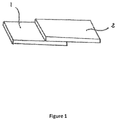
- the shapes of the parts used are shown in FIG. 1 .
- thermosetting materials based on, or comprising, polyester, epoxy or vinyl ester (VE).
- This material may also be selected from polyolefins, for example from the group consisting of acrylonitrile butadiene styrene (ABS), polyamides such as polycaprolactams: [NH—(CH2)5-CO]n (PA-6) and polyhexamethylene adipamides: [NH—(CH2)6-NH—CO—(CH2)4-CO]n (PA-6,6), polycarbonates (PC), high density polyethylenes (HDPE), low density polyethylenes (LDPE), amorphous or crystalline poly(ethylene terephthalates) (PET), poly(methyl methacrylates) (PMMA), polypropylenes (PP), “crystal” polystyrenes (PS), rigid polyvinyl chloride (PVC) and mixtures thereof.
- Compression moulding may also be used instead of injection moulding.
- This alternative uses a prepreg material such as a fabric preimpregnated with resin (also called matrix) which is applied over the insert and moulded
Landscapes
- Engineering & Computer Science (AREA)
- Manufacturing & Machinery (AREA)
- Mechanical Engineering (AREA)
- Injection Moulding Of Plastics Or The Like (AREA)
- Laminated Bodies (AREA)
- Vehicle Interior And Exterior Ornaments, Soundproofing, And Insulation (AREA)
Abstract
Description
-
- a) a step of positioning said insert in a mould, and
- b) a step of moulding, preferably by injection, said second thermoplastic material over said insert;
- at least one of said first and second materials comprising an additive, said additive comprising a polymer to which carboxylic anhydride monomers are grafted.
-
- 12% by weight of talc;
- 10% by weight of EPR (PP 108MF10 sold by Saudi Basic Industries Corporation (SABIC), Le Monge-22 Place des Vosges, La Défense 5, 92979 Paris La Defense cedex, France);
- 0.2% by weight of SEBS grafted with maleic anhydride (type KRATON FG 1901G); and
- 10% by weight of PP grafted with AM of type Orevac CA 100.
Claims (14)
Applications Claiming Priority (3)
| Application Number | Priority Date | Filing Date | Title |
|---|---|---|---|
| FR1461409A FR3028793B1 (en) | 2014-11-25 | 2014-11-25 | METHOD FOR OVERMOLDING A PLASTIC INSERT AND A MOTOR VEHICLE OBTAINED THEREBY |
| FR1461409 | 2014-11-25 | ||
| PCT/FR2015/053167 WO2016083712A1 (en) | 2014-11-25 | 2015-11-23 | Process for overmoulding over a plastic insert and automobile part obtained by this process |
Publications (2)
| Publication Number | Publication Date |
|---|---|
| US20170274568A1 US20170274568A1 (en) | 2017-09-28 |
| US10843391B2 true US10843391B2 (en) | 2020-11-24 |
Family
ID=52345434
Family Applications (1)
| Application Number | Title | Priority Date | Filing Date |
|---|---|---|---|
| US15/529,331 Active 2036-05-07 US10843391B2 (en) | 2014-11-25 | 2015-11-23 | Process for overmoulding over a plastic insert and automobile part obtained by this process |
Country Status (8)
| Country | Link |
|---|---|
| US (1) | US10843391B2 (en) |
| EP (1) | EP3224013B1 (en) |
| CN (1) | CN107000279B (en) |
| ES (1) | ES2713676T3 (en) |
| FR (1) | FR3028793B1 (en) |
| MA (1) | MA41023B1 (en) |
| PL (1) | PL3224013T3 (en) |
| WO (1) | WO2016083712A1 (en) |
Families Citing this family (5)
| Publication number | Priority date | Publication date | Assignee | Title |
|---|---|---|---|---|
| FR3070618B1 (en) * | 2017-09-01 | 2020-10-16 | Plastic Omnium Cie | PROCESS FOR MANUFACTURING A PLASTIC PART |
| FR3088600B1 (en) * | 2018-11-16 | 2021-06-25 | Plastic Omnium Cie | MULTI-LAYER MOTOR VEHICLE EXTERIOR PART INCLUDING A HEATING ELEMENT |
| FR3089849B1 (en) * | 2018-12-18 | 2020-12-25 | Plastic Omnium Cie | Process of covering a plastic surface with a permanent coating |
| FR3097225B1 (en) * | 2019-06-12 | 2021-11-19 | Smrc Automotive Holdings Netherlands Bv | Automotive interior part incorporating bio-based components |
| FR3117964A1 (en) * | 2020-12-23 | 2022-06-24 | Compagnie Plastic Omnium Se | absorber element for a motor vehicle |
Citations (10)
| Publication number | Priority date | Publication date | Assignee | Title |
|---|---|---|---|---|
| JPH07299840A (en) | 1994-05-09 | 1995-11-14 | Tokuyama Corp | Thin-walled molded product manufacturing method |
| JP2001162648A (en) | 1999-12-13 | 2001-06-19 | Idemitsu Petrochem Co Ltd | Method for molding skin integrated lightweight molded article and molded article |
| EP1313780B1 (en) | 2000-08-29 | 2005-03-30 | Dupont Canada Inc. | High melt flow, highly-grafted polypropylene |
| WO2011138384A1 (en) | 2010-05-05 | 2011-11-10 | Basf Se | Component comprising an insert part and plastics jacketing and process for the production thereof |
| US8071220B2 (en) | 2006-07-21 | 2011-12-06 | Exxonmobil Chemical Patents Inc. | Thermoplastic vulcanizates having improved adhesion to polar substrates |
| US20120027983A1 (en) | 2010-07-27 | 2012-02-02 | E. I. Du Pont De Nemours And Company | Polyamide composite structures and processes for their preparation field of the invention |
| EP2636523A1 (en) | 2010-11-05 | 2013-09-11 | Kaneka Corporation | Laminated adhesive film for use in insert molding |
| WO2014013871A1 (en) | 2012-07-18 | 2014-01-23 | 東洋紡株式会社 | Sealing layer-containing structure, method for producing same, and connector |
| US20140106103A1 (en) | 2011-06-27 | 2014-04-17 | Mitsubishi Gas Chemical Company, Inc. | Multilayer injection-molded body |
| US20140113745A1 (en) * | 2012-09-12 | 2014-04-24 | Acushnet Company | Golf balls having a foam center |
Family Cites Families (1)
| Publication number | Priority date | Publication date | Assignee | Title |
|---|---|---|---|---|
| US2996653A (en) * | 1960-01-18 | 1961-08-15 | Westinghouse Electric Corp | Electrical control apparatus |
-
2014
- 2014-11-25 FR FR1461409A patent/FR3028793B1/en not_active Expired - Fee Related
-
2015
- 2015-11-23 EP EP15817943.2A patent/EP3224013B1/en active Active
- 2015-11-23 ES ES15817943T patent/ES2713676T3/en active Active
- 2015-11-23 US US15/529,331 patent/US10843391B2/en active Active
- 2015-11-23 PL PL15817943T patent/PL3224013T3/en unknown
- 2015-11-23 WO PCT/FR2015/053167 patent/WO2016083712A1/en not_active Ceased
- 2015-11-23 MA MA41023A patent/MA41023B1/en unknown
- 2015-11-23 CN CN201580063170.7A patent/CN107000279B/en active Active
Patent Citations (13)
| Publication number | Priority date | Publication date | Assignee | Title |
|---|---|---|---|---|
| JPH07299840A (en) | 1994-05-09 | 1995-11-14 | Tokuyama Corp | Thin-walled molded product manufacturing method |
| JP3377010B2 (en) * | 1994-05-09 | 2003-02-17 | 出光石油化学株式会社 | Manufacturing method of thin molded products |
| JP2001162648A (en) | 1999-12-13 | 2001-06-19 | Idemitsu Petrochem Co Ltd | Method for molding skin integrated lightweight molded article and molded article |
| EP1313780B1 (en) | 2000-08-29 | 2005-03-30 | Dupont Canada Inc. | High melt flow, highly-grafted polypropylene |
| US8071220B2 (en) | 2006-07-21 | 2011-12-06 | Exxonmobil Chemical Patents Inc. | Thermoplastic vulcanizates having improved adhesion to polar substrates |
| WO2011138384A1 (en) | 2010-05-05 | 2011-11-10 | Basf Se | Component comprising an insert part and plastics jacketing and process for the production thereof |
| US20120027983A1 (en) | 2010-07-27 | 2012-02-02 | E. I. Du Pont De Nemours And Company | Polyamide composite structures and processes for their preparation field of the invention |
| EP2636523A1 (en) | 2010-11-05 | 2013-09-11 | Kaneka Corporation | Laminated adhesive film for use in insert molding |
| US20130264741A1 (en) | 2010-11-05 | 2013-10-10 | Kaneka Corporation | Laminated adhesive film for use in insert molding |
| US20140106103A1 (en) | 2011-06-27 | 2014-04-17 | Mitsubishi Gas Chemical Company, Inc. | Multilayer injection-molded body |
| EP2724860A1 (en) | 2011-06-27 | 2014-04-30 | Mitsubishi Gas Chemical Company, Inc. | Multilayer injection-molded body |
| WO2014013871A1 (en) | 2012-07-18 | 2014-01-23 | 東洋紡株式会社 | Sealing layer-containing structure, method for producing same, and connector |
| US20140113745A1 (en) * | 2012-09-12 | 2014-04-24 | Acushnet Company | Golf balls having a foam center |
Non-Patent Citations (6)
| Title |
|---|
| "Dupont (TM) Fusabond Functionalized Polymers/Resin Modifiers: list, descriptions and data sheets", Oct. 3, 2014, URL:https://web.archive.org/web/20141003164325/http://www2.dupont.com/Fusabond/en_US (retrieved May 28, 2015). |
| "Technical Bulletin 1301 New Markets for Talc-Filled Polymers Introduction", Apr. 18, 2013, URL:http://web.archive.org/web/20130418092230/http://www.mondominerals.com/uploads/media/mondo_bulletin_plasticspdf (retrieved Feb, 17, 2016). |
| G. Nam et al., "Study of Maleic Anhydride Grafted Polypropylene Effect on Resin Impregnated Bamboo Fiber Polypropylene Composite", Agricultural Sciences, vol. 5, No. 13, pp. 1322-1328 (2014). |
| International Search Report dated Feb. 17, 2016, in corresponding PCT/FR20151053167 (8 pages). |
| Notice of Allowance dated Sep. 4, 2019, issued in counterpart CN Application No. 201580063170.7 (6 pages). |
| V. Goodship et al., "Multi-Material Injection Moulding", Rapra Review Reports, vol. 13, No. 1 pp. 66, Item 177 (2002). |
Also Published As
| Publication number | Publication date |
|---|---|
| EP3224013A1 (en) | 2017-10-04 |
| EP3224013B1 (en) | 2018-10-03 |
| CN107000279A (en) | 2017-08-01 |
| US20170274568A1 (en) | 2017-09-28 |
| FR3028793A1 (en) | 2016-05-27 |
| CN107000279B (en) | 2019-11-15 |
| WO2016083712A1 (en) | 2016-06-02 |
| ES2713676T3 (en) | 2019-05-23 |
| CN107000279A9 (en) | 2017-11-03 |
| PL3224013T3 (en) | 2019-03-29 |
| MA41023A (en) | 2017-10-04 |
| FR3028793B1 (en) | 2017-05-05 |
| MA41023B1 (en) | 2019-01-31 |
Similar Documents
| Publication | Publication Date | Title |
|---|---|---|
| US20170274568A1 (en) | Process for overmoulding over a plastic insert and automobile part obtained by this process | |
| US9951215B2 (en) | Injectable composite material reinforced by natural fibers | |
| CN102417561B (en) | Ultrahigh-mobility propenyl elastomer grafting copolymer and preparation method thereof | |
| US10563061B2 (en) | Polymer blend and polymer agglomerate containing recycled multilayer film waste and fiber reinforced plastic waste and process for preparing said agglomerate | |
| CN103073782A (en) | Automobile instrument framework material and manufacturing method thereof | |
| CN1688428A (en) | Articles comprising a fiber-reinforced thermoplastic polymer composition | |
| DE102005004280A1 (en) | Process for producing a composite | |
| KR20160023967A (en) | A preparation method of natural fiber-reinforced plastic for car interior and natural fiber-reinforced plastic for car interior prepared by the same | |
| KR101481218B1 (en) | The Manufacturing Method of Direct Long Glass Fiber Thermoplastics Using In-line Compounding Process | |
| US11091610B2 (en) | Method and composition of making polymer products | |
| EP2379301A1 (en) | Method for producing a composite component by multi-component injection molding | |
| EP1372926A1 (en) | Composite moulded parts comprising a film coating and method for producing the same | |
| CN108948538A (en) | High-strength light-weight automotive wheels cover plate material and preparation method thereof | |
| KR101549663B1 (en) | A polypropylene resin composition reinforced with a long glass fiber and molded article using the same | |
| CN103448196A (en) | Forming method of thermoplastic composite material | |
| JP2009197107A (en) | Pellet and its manufacturing method | |
| JP4182702B2 (en) | Recycled resin product manufacturing method and automotive resin parts | |
| US9650478B2 (en) | Impact modified injection molded body and method for the production thereof | |
| KR100482443B1 (en) | Method for manufacuring thermoplastic resin composition | |
| JPH11226948A (en) | Long fiber reinforced thermoplastic resin molding material, long fiber reinforced thermoplastic resin molded product, and method for producing molded product | |
| JP2007161791A (en) | Resin composition | |
| JPH0959421A (en) | Method for judging recyclability of polyamide and method for recycling polyamide | |
| JPH0586234A (en) | Resin composition for molding | |
| JP2008006696A (en) | Manufacturing method of long fiber reinforced resin molding |
Legal Events
| Date | Code | Title | Description |
|---|---|---|---|
| AS | Assignment |
Owner name: COMPAGNIE PLASTIC OMNIUM, FRANCE Free format text: ASSIGNMENT OF ASSIGNORS INTEREST;ASSIGNORS:GINJA, STEPHANE;CHENE, ANTHONY;VIOT, FREDERIC;AND OTHERS;SIGNING DATES FROM 20170627 TO 20170630;REEL/FRAME:043389/0129 |
|
| STPP | Information on status: patent application and granting procedure in general |
Free format text: NON FINAL ACTION MAILED |
|
| STPP | Information on status: patent application and granting procedure in general |
Free format text: RESPONSE TO NON-FINAL OFFICE ACTION ENTERED AND FORWARDED TO EXAMINER |
|
| STPP | Information on status: patent application and granting procedure in general |
Free format text: NON FINAL ACTION MAILED |
|
| STPP | Information on status: patent application and granting procedure in general |
Free format text: RESPONSE TO NON-FINAL OFFICE ACTION ENTERED AND FORWARDED TO EXAMINER |
|
| STPP | Information on status: patent application and granting procedure in general |
Free format text: FINAL REJECTION MAILED |
|
| STPP | Information on status: patent application and granting procedure in general |
Free format text: DOCKETED NEW CASE - READY FOR EXAMINATION |
|
| STPP | Information on status: patent application and granting procedure in general |
Free format text: NOTICE OF ALLOWANCE MAILED -- APPLICATION RECEIVED IN OFFICE OF PUBLICATIONS |
|
| STPP | Information on status: patent application and granting procedure in general |
Free format text: PUBLICATIONS -- ISSUE FEE PAYMENT VERIFIED |
|
| STCF | Information on status: patent grant |
Free format text: PATENTED CASE |
|
| MAFP | Maintenance fee payment |
Free format text: PAYMENT OF MAINTENANCE FEE, 4TH YEAR, LARGE ENTITY (ORIGINAL EVENT CODE: M1551); ENTITY STATUS OF PATENT OWNER: LARGE ENTITY Year of fee payment: 4 |
|
| AS | Assignment |
Owner name: COMPAGNIE PLASTIC OMNIUM SE, FRANCE Free format text: CHANGE OF NAME;ASSIGNOR:COMPAGNIE PLASTIC OMNIUM;REEL/FRAME:069923/0888 Effective date: 20190425 |
|
| AS | Assignment |
Owner name: OPMOBILITY SE, FRANCE Free format text: CHANGE OF NAME;ASSIGNOR:COMPAGNIE PLASTIC OMNIUM SE;REEL/FRAME:069958/0347 Effective date: 20240522 |