US10841571B2 - Vehicle camera testing system - Google Patents

Vehicle camera testing system Download PDF

Info

Publication number
US10841571B2
US10841571B2 US15/189,327 US201615189327A US10841571B2 US 10841571 B2 US10841571 B2 US 10841571B2 US 201615189327 A US201615189327 A US 201615189327A US 10841571 B2 US10841571 B2 US 10841571B2
Authority
US
United States
Prior art keywords
coupling element
vehicular camera
test system
circuit
pcb circuit
Prior art date
Legal status (The legal status is an assumption and is not a legal conclusion. Google has not performed a legal analysis and makes no representation as to the accuracy of the status listed.)
Active, expires
Application number
US15/189,327
Other versions
US20170006282A1 (en
Inventor
Marc-Andre Sigle
Current Assignee (The listed assignees may be inaccurate. Google has not performed a legal analysis and makes no representation or warranty as to the accuracy of the list.)
Magna Electronics Inc
Original Assignee
Magna Electronics Inc
Priority date (The priority date is an assumption and is not a legal conclusion. Google has not performed a legal analysis and makes no representation as to the accuracy of the date listed.)
Filing date
Publication date
Application filed by Magna Electronics Inc filed Critical Magna Electronics Inc
Priority to US15/189,327 priority Critical patent/US10841571B2/en
Publication of US20170006282A1 publication Critical patent/US20170006282A1/en
Application granted granted Critical
Publication of US10841571B2 publication Critical patent/US10841571B2/en
Active legal-status Critical Current
Adjusted expiration legal-status Critical

Links

Images

Classifications

    • HELECTRICITY
    • H04ELECTRIC COMMUNICATION TECHNIQUE
    • H04NPICTORIAL COMMUNICATION, e.g. TELEVISION
    • H04N17/00Diagnosis, testing or measuring for television systems or their details
    • H04N17/004Diagnosis, testing or measuring for television systems or their details for digital television systems
    • HELECTRICITY
    • H04ELECTRIC COMMUNICATION TECHNIQUE
    • H04NPICTORIAL COMMUNICATION, e.g. TELEVISION
    • H04N17/00Diagnosis, testing or measuring for television systems or their details
    • H04N17/002Diagnosis, testing or measuring for television systems or their details for television cameras
    • GPHYSICS
    • G01MEASURING; TESTING
    • G01RMEASURING ELECTRIC VARIABLES; MEASURING MAGNETIC VARIABLES
    • G01R31/00Arrangements for testing electric properties; Arrangements for locating electric faults; Arrangements for electrical testing characterised by what is being tested not provided for elsewhere
    • G01R31/28Testing of electronic circuits, e.g. by signal tracer
    • G01R31/2801Testing of printed circuits, backplanes, motherboards, hybrid circuits or carriers for multichip packages [MCP]
    • G01R31/2806Apparatus therefor, e.g. test stations, drivers, analysers, conveyors
    • G01R31/2808Holding, conveying or contacting devices, e.g. test adapters, edge connectors, extender boards
    • GPHYSICS
    • G01MEASURING; TESTING
    • G01RMEASURING ELECTRIC VARIABLES; MEASURING MAGNETIC VARIABLES
    • G01R31/00Arrangements for testing electric properties; Arrangements for locating electric faults; Arrangements for electrical testing characterised by what is being tested not provided for elsewhere
    • G01R31/005Testing of electric installations on transport means
    • G01R31/006Testing of electric installations on transport means on road vehicles, e.g. automobiles or trucks
    • G01R31/007Testing of electric installations on transport means on road vehicles, e.g. automobiles or trucks using microprocessors or computers

Definitions

  • the present invention relates generally to a vehicle device, such as a camera for a vehicle vision system for a vehicle and, more particularly, to a method or system for testing electronics of a vehicle device or camera.
  • Vehicle cameras include a camera housing and a lens and an imager (such as a two-dimensional imaging array sensor such as a CMOS imaging array sensor or the like), with the imager disposed at a printed circuit board (PCB) within the housing.
  • the camera PCB includes a circuit grid comprising a plurality of conducting layers and electronic functional elements, which are placed onto the PCB's surface or may be embedded to the PCB.
  • the PCB substrate typically comprises a glass fiber and epoxy (such as FR4) or a ceramic or laminated aluminum or may optionally comprise a flexible synthetic. Circuit structures may also be made by MID (Molded Interconnect Devices). These may have 3D structures.
  • test probe needles are brought into physical contact to each net of the circuit board.
  • the circuit board has test points for that, which are uncoated areas of a specific size (typically round) that are conducting a specific part of the electric circuit which is the subject of the test (typically several needles are brought into electrical contact at the test points, for checking a specific circuit or electronics element or parameters, such as voltage, current, resistance, capacity, inductance and times, possibly in conjunction to a specific mode the camera circuit is set into).
  • the present invention provides a testing method or system using non-physically conducting test probes for in-circuit production tests, particularly for testing high density circuit boards, such as for the likes of vehicle cameras, body units, electronic control units (ECUs), head up displays (HUDs) and the like.
  • the test includes coupling elements that comprise one of (i) a capacitive coupling element and (ii) an inductive coupling element.
  • the coupling element is coupled to components of a PCB circuit of a vehicle device or camera to at least one of (a) acquire information (analog or digital data) or conditions from the PCB circuit and (b) induce information or conditions into the PCB circuit.
  • the coupling element couples to components of the PCB circuit without physical contact with the PCB circuit, such as without placing a needle into electrical contact with the PCB circuit.
  • FIG. 1 is a circuit showing a VDD capacitor of an asymmetric LVDS serializer stage used to test that stage in an LVDS system in accordance with the present invention
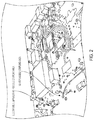
  • FIG. 2 is a circuit showing locations where inductive or capacitive coupling probes can be placed to measure electrical signals through coupling (such as at, for example, vias, capacitors and coils) in accordance with the present invention
  • FIG. 3 is a highly compact circuit board with embedded electronic elements, suitable for testing in accordance with the present invention.
  • FIG. 4 shows examples of how coupling probes may be placed above physical electrical components or vias for detecting
  • FIG. 5 shows a E/H coupling probe connecting to a measuring system that has a signal amplification of 40 dB;
  • FIG. 6 is a schematic of an exemplary switch mode supply circuit
  • FIG. 7 shows the oscillating voltage signal I and the current signal II of a switch mode supply under load as shown in FIG. 6 , measured by electromagnetic coupling on L 1 of the circuit of FIG. 6 , where the circuit's load may be determined under use of knowledge of the circuitry, other parameter and conditions;
  • FIG. 8 shows the oscillating voltage signal I and the current signal II of a switch mode supply of the circuit of FIG. 6 , and the resulting voltage signal II when the load is substantially lower than that shown in the test condition of FIG. 7 ;
  • FIG. 9 shows a masking method, where a signal 1 of an electrical circuit may have a signal sequence which is acceptable when it stays within an allowed corridor 2 with its borderlines 3 , and if the signal enters the area above 4 or below 5 of the corridor, the signal test may be evaluated as a failure.
  • a vehicle vision system and/or driver assist system and/or object detection system and/or alert system uses one or more image sensors or cameras disposed at the vehicle and operates to capture images exterior (or optionally interior) of the vehicle and may process the captured image data to display images and to detect objects at or near or in the vehicle.
  • the vision system includes an image processor or image processing system that is operable to receive image data from one or more cameras and provide an output, such as to a display device for displaying images representative of the captured image data, or such as for use in object detection or the like.
  • the camera or cameras are individual cameras or sensors that are mounted at various locations at the interior or exterior of the vehicle, and include an imager, a printed circuit board and lens. The cameras are preferably very small to minimize packaging concerns and aesthetic concerns when mounted at the vehicle.
  • test points are subject to elimination additionally out of the reason that these can cause radiated disturbances when being conducted to HF circuits.
  • the system of the present invention may keep the test coverage of a PCB in circuit tests (ICT) high while minimizing the space required for test points.
  • the testing system of the present invention uses an inductive coupler or probe (similar to, for example, a Langer RF R 3-2 probe or the like) placed above circuit elements that have a substantial current flow, such as capacitor or coils (or inductors), which are part of a functional module on the PCB instead of contacting a circuit node electrically, in order to test that module on a PCB for its function, such as shown in FIG. 4 and FIG. 5 .
  • the probe signals are typically very low for that signal amplification will be typically necessary.
  • the signal of a coil of a switched mode supply can be measured by an E/H-Probe placed above the coil L 1 .
  • E/H-Probe placed above the coil L 1 .
  • capacitive coupling can be used when a capacitive coupler or probe is placed above components emitting an electrical field (that are part of a functional module on the PCB) instead of contacting a net directly to test a module on a PCB for its function.
  • a capacitive coupler (similar to, for example, a Langer RF E 10 coupler) may be placed above (preferably proximate to but not in physical contact with) a resistor, capacitor or circuit node that is part of the PCB.
  • a VDD capacitor of an asymmetric LVDS serializer stage may be used to test that stage in an LVDS system, such as shown in the circuit of FIG. 1 comprised in a circuit such as shown in FIG. 2 .
  • the information of the signal can be captured without physical contact with the circuit node or placing a needle onto the circuit node, but by placing a capacitive coupler in proximity to or close to the VDD capacitor, such as also shown in FIG. 2 .
  • masking may also find use when using coupling probe signal sampling methods in accordance with the present invention, independent which SI unit may be measured by the used probes.
  • the test system of the present invention may use capacitive, inductive and magnetic (Hall) coupling (probing) to components of the PCB circuit to acquire information (analog or digital data) or conditions from the PCB circuit or to induce information or conditions into the PCB necessary during analysis or lens assembly/alignment.
  • All capacitive, inductive and magnetic
  • a capacitive coupler was placed above an LVDS capacitor. This probe's signal may be amplified, analyzed and recorded.
  • Synthetic or recorded signals may also be induced by capacitive or inductive coupling for circuit analysis or during lens assembly to activate certain operating modes. It may be possible to generate borderline conditions (of the whole system or just parts of the circuit) which a well-functioning circuit (with low age components) may never show for testing the borderline behavior.
  • these probes are able to probe circuit nodes or components underneath the PCB's surface, possibly embedded to the PCB.
  • Such a capability enables the system to also use the above test methods on highly compact circuit boards such as stacked ceramics with embedded electronic elements, such as shown, for example, in FIG. 3 . Shielding surfaces, such as large copper layers, may prohibit or diminish the possibility to use non-conducting test probes as discussed above.
  • the camera or sensor may comprise any suitable camera or sensor.
  • the camera may comprise a “smart camera” that includes the imaging sensor array and associated circuitry and image processing circuitry and electrical connectors and the like as part of a camera module, such as by utilizing aspects of the vision systems described in International Publication Nos. WO 2013/081984 and/or WO 2013/081985, which are hereby incorporated herein by reference in their entireties.
  • the system includes an image processor operable to process image data captured by the camera or cameras, such as for detecting objects or other vehicles or pedestrians or the like in the field of view of one or more of the cameras.
  • the image processor may comprise an EyeQ2 or EyeQ3 image processing chip available from Mobileye Vision Technologies Ltd. of Jerusalem, Israel, and may include object detection software (such as the types described in U.S. Pat. Nos. 7,855,755; 7,720,580 and/or 7,038,577, which are hereby incorporated herein by reference in their entireties), and may analyze image data to detect vehicles and/or other objects.
  • the system may generate an alert to the driver of the vehicle and/or may generate an overlay at the displayed image to highlight or enhance display of the detected object or vehicle, in order to enhance the driver's awareness of the detected object or vehicle or hazardous condition during a driving maneuver of the equipped vehicle.
  • the imaging sensor or camera may capture image data for image processing and may comprise any suitable camera or sensing device, such as, for example, a two dimensional array of a plurality of photosensor elements arranged in at least 640 columns and 480 rows (at least a 640 ⁇ 480 imaging array, such as a megapixel imaging array or the like), with a respective lens focusing images onto respective portions of the array.
  • the photosensor array may comprise a plurality of photosensor elements arranged in a photosensor array having rows and columns.
  • the imaging array has at least 300,000 photosensor elements or pixels, more preferably at least 500,000 photosensor elements or pixels and more preferably at least 1 million photosensor elements or pixels.
  • the imaging array may capture color image data, such as via spectral filtering at the array, such as via an RGB (red, green and blue) filter or via a red/red complement filter or such as via an RCC (red, clear, clear) filter or the like.
  • the logic and control circuit of the imaging sensor may function in any known manner, and the image processing and algorithmic processing may comprise any suitable means for processing the images and/or image data.
  • the vision system and/or processing and/or camera and/or circuitry may utilize aspects described in U.S. Pat. Nos. 8,694,224; 7,005,974; 5,760,962; 5,877,897; 5,796,094; 5,949,331; 6,302,545; 6,396,397; 6,498,620; 6,523,964; 6,611,202; 6,201,642; 6,690,268; 6,717,610; 6,757,109; 6,802,617; 6,806,452; 6,822,563; 6,891,563; 6,946,978; 7,859,565; 5,550,677; 5,670,935; 7,881,496; 7,720,580; 7,038,577; 6,882,287; 5,929,786 and/or 5,786,772, and/or International Publication Nos.
  • the system may communicate with other communication systems via any suitable means, such as by utilizing aspects of the systems described in International Publication Nos. WO/2010/144900; WO 2013/043661 and/or WO 2013/081985, and/or U.S. Publication No. US-2012-0062743, which are hereby incorporated herein by reference in their entireties.
  • the camera module and circuit chip or board and imaging sensor may be implemented and operated in connection with various vehicular vision-based systems, and/or may be operable utilizing the principles of such other vehicular systems, such as a vehicle headlamp control system, such as the type disclosed in U.S. Pat. Nos. 5,796,094; 6,097,023; 6,320,176; 6,559,435; 6,831,261; 7,004,606; 7,339,149 and/or 7,526,103, which are all hereby incorporated herein by reference in their entireties, a rain sensor, such as the types disclosed in commonly assigned U.S. Pat. Nos.
  • a vehicle vision system such as a forwardly, sidewardly or rearwardly directed vehicle vision system utilizing principles disclosed in U.S. Pat. Nos.
  • a reverse or sideward imaging system such as for a lane change assistance system or lane departure warning system or for a blind spot or object detection system, such as imaging or detection systems of the types disclosed in U.S. Pat. Nos. 7,881,496; 7,720,580; 7,038,577; 5,929,786 and/or 5,786,772, which are hereby incorporated herein by reference in their entireties, a video device for internal cabin surveillance and/or video telephone function, such as disclosed in U.S. Pat. Nos. 5,760,962; 5,877,897; 6,690,268 and/or 7,370,983, and/or U.S. Publication No.
  • the vision system (utilizing the forward facing camera and a rearward facing camera and other cameras disposed at the vehicle with exterior fields of view) may be part of or may provide a display of a top-down view or birds-eye view system of the vehicle or a surround view at the vehicle, such as by utilizing aspects of the vision systems described in International Publication Nos. WO 2010/099416; WO 2011/028686; WO 2012/075250; WO 2013/019795; WO 2012/075250; WO 2012/145822; WO 2013/081985; WO 2013/086249 and/or WO 2013/109869, and/or U.S. Publication No. US-2012-0162427, which are hereby incorporated herein by reference in their entireties.

Landscapes

  • Engineering & Computer Science (AREA)
  • Multimedia (AREA)
  • Biomedical Technology (AREA)
  • General Health & Medical Sciences (AREA)
  • Signal Processing (AREA)
  • Health & Medical Sciences (AREA)
  • General Physics & Mathematics (AREA)
  • Computer Hardware Design (AREA)
  • Microelectronics & Electronic Packaging (AREA)
  • Physics & Mathematics (AREA)
  • General Engineering & Computer Science (AREA)
  • Mechanical Engineering (AREA)
  • Chemical & Material Sciences (AREA)
  • Combustion & Propulsion (AREA)
  • Traffic Control Systems (AREA)
  • Studio Devices (AREA)

Abstract

A test system for testing a device for use in a vehicle includes a coupling element that is one of (i) a capacitive coupling element, (ii) an inductive coupling element and (iii) a magnetic coupling element. The coupling element is electrically coupled to components of a PCB circuit of a vehicle device to at least one of (a) acquire analog or digital data or information or conditions from the PCB circuit and (b) induce information or conditions into the PCB circuit. The coupling element electrically couples to components of the PCB circuit without physical contact with the PCB circuit. The vehicle device may comprise a vehicle camera.

Description

CROSS REFERENCE TO RELATED APPLICATION
The present application claims the filing benefits of U.S. provisional application Ser. No. 62/186,753, filed Jun. 30, 2015, which is hereby incorporated herein by reference in its entirety.
FIELD OF THE INVENTION
The present invention relates generally to a vehicle device, such as a camera for a vehicle vision system for a vehicle and, more particularly, to a method or system for testing electronics of a vehicle device or camera.
BACKGROUND OF THE INVENTION
Use of cameras or imaging sensors in vehicle imaging systems is common and known. Examples of such known systems are described in U.S. Pat. Nos. 5,949,331; 5,670,935 and/or 5,550,677, which are hereby incorporated herein by reference in their entireties.
Vehicle cameras include a camera housing and a lens and an imager (such as a two-dimensional imaging array sensor such as a CMOS imaging array sensor or the like), with the imager disposed at a printed circuit board (PCB) within the housing. The camera PCB includes a circuit grid comprising a plurality of conducting layers and electronic functional elements, which are placed onto the PCB's surface or may be embedded to the PCB. The PCB substrate typically comprises a glass fiber and epoxy (such as FR4) or a ceramic or laminated aluminum or may optionally comprise a flexible synthetic. Circuit structures may also be made by MID (Molded Interconnect Devices). These may have 3D structures.
For testing the camera circuit boards in production (such as in-circuit tests and during lens alignment), different test conditions must be implemented. Typically, the function of single components are tested in direct contact. Thus the test probe needles are brought into physical contact to each net of the circuit board. Typically, the circuit board has test points for that, which are uncoated areas of a specific size (typically round) that are conducting a specific part of the electric circuit which is the subject of the test (typically several needles are brought into electrical contact at the test points, for checking a specific circuit or electronics element or parameters, such as voltage, current, resistance, capacity, inductance and times, possibly in conjunction to a specific mode the camera circuit is set into).
SUMMARY OF THE INVENTION
The present invention provides a testing method or system using non-physically conducting test probes for in-circuit production tests, particularly for testing high density circuit boards, such as for the likes of vehicle cameras, body units, electronic control units (ECUs), head up displays (HUDs) and the like. The test includes coupling elements that comprise one of (i) a capacitive coupling element and (ii) an inductive coupling element. The coupling element is coupled to components of a PCB circuit of a vehicle device or camera to at least one of (a) acquire information (analog or digital data) or conditions from the PCB circuit and (b) induce information or conditions into the PCB circuit. The coupling element couples to components of the PCB circuit without physical contact with the PCB circuit, such as without placing a needle into electrical contact with the PCB circuit.
These and other objects, advantages, purposes and features of the present invention will become apparent upon review of the following specification in conjunction with the drawings.
BRIEF DESCRIPTION OF THE DRAWINGS
FIG. 1 is a circuit showing a VDD capacitor of an asymmetric LVDS serializer stage used to test that stage in an LVDS system in accordance with the present invention;
FIG. 2 is a circuit showing locations where inductive or capacitive coupling probes can be placed to measure electrical signals through coupling (such as at, for example, vias, capacitors and coils) in accordance with the present invention;
FIG. 3 is a highly compact circuit board with embedded electronic elements, suitable for testing in accordance with the present invention;
FIG. 4 shows examples of how coupling probes may be placed above physical electrical components or vias for detecting;
FIG. 5 shows a E/H coupling probe connecting to a measuring system that has a signal amplification of 40 dB;
FIG. 6 is a schematic of an exemplary switch mode supply circuit;
FIG. 7 shows the oscillating voltage signal I and the current signal II of a switch mode supply under load as shown in FIG. 6, measured by electromagnetic coupling on L1 of the circuit of FIG. 6, where the circuit's load may be determined under use of knowledge of the circuitry, other parameter and conditions;
FIG. 8 shows the oscillating voltage signal I and the current signal II of a switch mode supply of the circuit of FIG. 6, and the resulting voltage signal II when the load is substantially lower than that shown in the test condition of FIG. 7; and
FIG. 9 shows a masking method, where a signal 1 of an electrical circuit may have a signal sequence which is acceptable when it stays within an allowed corridor 2 with its borderlines 3, and if the signal enters the area above 4 or below 5 of the corridor, the signal test may be evaluated as a failure.
DESCRIPTION OF THE PREFERRED EMBODIMENTS
A vehicle vision system and/or driver assist system and/or object detection system and/or alert system uses one or more image sensors or cameras disposed at the vehicle and operates to capture images exterior (or optionally interior) of the vehicle and may process the captured image data to display images and to detect objects at or near or in the vehicle. The vision system includes an image processor or image processing system that is operable to receive image data from one or more cameras and provide an output, such as to a display device for displaying images representative of the captured image data, or such as for use in object detection or the like. The camera or cameras are individual cameras or sensors that are mounted at various locations at the interior or exterior of the vehicle, and include an imager, a printed circuit board and lens. The cameras are preferably very small to minimize packaging concerns and aesthetic concerns when mounted at the vehicle.
The production of small cameras requires reduction the amount of test points. This contradicts the need and requirement to access each circuit node on a PCB to test every component electrically. The minimum size of test points as well as the distance necessary in between the test points, worsens the situation dramatically with the needed camera size. Test points are subject to elimination additionally out of the reason that these can cause radiated disturbances when being conducted to HF circuits.
Functional tests are often used to test components in additionally or in absence of test points.
The system of the present invention may keep the test coverage of a PCB in circuit tests (ICT) high while minimizing the space required for test points. The testing system of the present invention uses an inductive coupler or probe (similar to, for example, a Langer RF R 3-2 probe or the like) placed above circuit elements that have a substantial current flow, such as capacitor or coils (or inductors), which are part of a functional module on the PCB instead of contacting a circuit node electrically, in order to test that module on a PCB for its function, such as shown in FIG. 4 and FIG. 5. The probe signals are typically very low for that signal amplification will be typically necessary.
For another example, such as in the circuit of FIG. 6, the signal of a coil of a switched mode supply can be measured by an E/H-Probe placed above the coil L1. Using the electromagnetic field radiated by the coil during startup (see FIG. 7) and after startup (see FIG. 8) to measure current, voltage, frequency, duty cycle and the start-up ramp allows conclusions on electrical contact as well as value ranges on most of the components of the functional module supply as well as provides a hint as to the function of the consumer element (load) connected to the supply.
Also, capacitive coupling can be used when a capacitive coupler or probe is placed above components emitting an electrical field (that are part of a functional module on the PCB) instead of contacting a net directly to test a module on a PCB for its function.
A capacitive coupler (similar to, for example, a Langer RF E 10 coupler) may be placed above (preferably proximate to but not in physical contact with) a resistor, capacitor or circuit node that is part of the PCB. As an example, a VDD capacitor of an asymmetric LVDS serializer stage may be used to test that stage in an LVDS system, such as shown in the circuit of FIG. 1 comprised in a circuit such as shown in FIG. 2. Using the electrical near field radiated by the capacitor during LVDS information transmission, the information of the signal can be captured without physical contact with the circuit node or placing a needle onto the circuit node, but by placing a capacitive coupler in proximity to or close to the VDD capacitor, such as also shown in FIG. 2.
To conclude the correct assembly of a PCB's circuit, such as done in fab ICT, a common practice is masking. The masking method is shown in FIG. 9. Masking may also find use when using coupling probe signal sampling methods in accordance with the present invention, independent which SI unit may be measured by the used probes.
The test system of the present invention may use capacitive, inductive and magnetic (Hall) coupling (probing) to components of the PCB circuit to acquire information (analog or digital data) or conditions from the PCB circuit or to induce information or conditions into the PCB necessary during analysis or lens assembly/alignment.
In the example above, a capacitive coupler was placed above an LVDS capacitor. This probe's signal may be amplified, analyzed and recorded.
Synthetic or recorded signals may also be induced by capacitive or inductive coupling for circuit analysis or during lens assembly to activate certain operating modes. It may be possible to generate borderline conditions (of the whole system or just parts of the circuit) which a well-functioning circuit (with low age components) may never show for testing the borderline behavior.
As an additional advantage of the system of the present invention using capacitive, inductive or magnetic test probes, these probes are able to probe circuit nodes or components underneath the PCB's surface, possibly embedded to the PCB. Such a capability enables the system to also use the above test methods on highly compact circuit boards such as stacked ceramics with embedded electronic elements, such as shown, for example, in FIG. 3. Shielding surfaces, such as large copper layers, may prohibit or diminish the possibility to use non-conducting test probes as discussed above.
The camera or sensor may comprise any suitable camera or sensor. Optionally, the camera may comprise a “smart camera” that includes the imaging sensor array and associated circuitry and image processing circuitry and electrical connectors and the like as part of a camera module, such as by utilizing aspects of the vision systems described in International Publication Nos. WO 2013/081984 and/or WO 2013/081985, which are hereby incorporated herein by reference in their entireties.
The system includes an image processor operable to process image data captured by the camera or cameras, such as for detecting objects or other vehicles or pedestrians or the like in the field of view of one or more of the cameras. For example, the image processor may comprise an EyeQ2 or EyeQ3 image processing chip available from Mobileye Vision Technologies Ltd. of Jerusalem, Israel, and may include object detection software (such as the types described in U.S. Pat. Nos. 7,855,755; 7,720,580 and/or 7,038,577, which are hereby incorporated herein by reference in their entireties), and may analyze image data to detect vehicles and/or other objects. Responsive to such image processing, and when an object or other vehicle is detected, the system may generate an alert to the driver of the vehicle and/or may generate an overlay at the displayed image to highlight or enhance display of the detected object or vehicle, in order to enhance the driver's awareness of the detected object or vehicle or hazardous condition during a driving maneuver of the equipped vehicle.
The imaging sensor or camera may capture image data for image processing and may comprise any suitable camera or sensing device, such as, for example, a two dimensional array of a plurality of photosensor elements arranged in at least 640 columns and 480 rows (at least a 640×480 imaging array, such as a megapixel imaging array or the like), with a respective lens focusing images onto respective portions of the array. The photosensor array may comprise a plurality of photosensor elements arranged in a photosensor array having rows and columns. Preferably, the imaging array has at least 300,000 photosensor elements or pixels, more preferably at least 500,000 photosensor elements or pixels and more preferably at least 1 million photosensor elements or pixels. The imaging array may capture color image data, such as via spectral filtering at the array, such as via an RGB (red, green and blue) filter or via a red/red complement filter or such as via an RCC (red, clear, clear) filter or the like. The logic and control circuit of the imaging sensor may function in any known manner, and the image processing and algorithmic processing may comprise any suitable means for processing the images and/or image data.
For example, the vision system and/or processing and/or camera and/or circuitry may utilize aspects described in U.S. Pat. Nos. 8,694,224; 7,005,974; 5,760,962; 5,877,897; 5,796,094; 5,949,331; 6,302,545; 6,396,397; 6,498,620; 6,523,964; 6,611,202; 6,201,642; 6,690,268; 6,717,610; 6,757,109; 6,802,617; 6,806,452; 6,822,563; 6,891,563; 6,946,978; 7,859,565; 5,550,677; 5,670,935; 7,881,496; 7,720,580; 7,038,577; 6,882,287; 5,929,786 and/or 5,786,772, and/or International Publication Nos. WO 2011/028686; WO 2010/099416; WO 2012/061567; WO 2012/068331; WO 2012/075250; WO 2012/103193; WO 2012/0116043; WO 2012/0145313; WO 2012/0145501; WO 2012/145818; WO 2012/145822; WO 2012/158167; WO 2012/075250; WO 2012/0116043; WO 2012/0145501; WO 2012/154919; WO 2013/019707; WO 2013/016409; WO 2013/019795; WO 2013/067083; WO 2013/070539; WO 2013/043661; WO 2013/048994; WO 2013/063014, WO 2013/081984; WO 2013/081985; WO 2013/074604; WO 2013/086249; WO 2013/103548; WO 2013/109869; WO 2013/123161; WO 2013/126715; WO 2013/043661; WO 2013/158592 and/or WO 2014/204794, which are all hereby incorporated herein by reference in their entireties. The system may communicate with other communication systems via any suitable means, such as by utilizing aspects of the systems described in International Publication Nos. WO/2010/144900; WO 2013/043661 and/or WO 2013/081985, and/or U.S. Publication No. US-2012-0062743, which are hereby incorporated herein by reference in their entireties.
The camera module and circuit chip or board and imaging sensor may be implemented and operated in connection with various vehicular vision-based systems, and/or may be operable utilizing the principles of such other vehicular systems, such as a vehicle headlamp control system, such as the type disclosed in U.S. Pat. Nos. 5,796,094; 6,097,023; 6,320,176; 6,559,435; 6,831,261; 7,004,606; 7,339,149 and/or 7,526,103, which are all hereby incorporated herein by reference in their entireties, a rain sensor, such as the types disclosed in commonly assigned U.S. Pat. Nos. 6,353,392; 6,313,454; 6,320,176 and/or 7,480,149, which are hereby incorporated herein by reference in their entireties, a vehicle vision system, such as a forwardly, sidewardly or rearwardly directed vehicle vision system utilizing principles disclosed in U.S. Pat. Nos. 5,550,677; 5,670,935; 5,760,962; 5,877,897; 5,949,331; 6,222,447; 6,302,545; 6,396,397; 6,498,620; 6,523,964; 6,611,202; 6,201,642; 6,690,268; 6,717,610; 6,757,109; 6,802,617; 6,806,452; 6,822,563; 6,891,563; 6,946,978 and/or 7,859,565, which are all hereby incorporated herein by reference in their entireties, a trailer hitching aid or tow check system, such as the type disclosed in U.S. Pat. No. 7,005,974, which is hereby incorporated herein by reference in its entirety, a reverse or sideward imaging system, such as for a lane change assistance system or lane departure warning system or for a blind spot or object detection system, such as imaging or detection systems of the types disclosed in U.S. Pat. Nos. 7,881,496; 7,720,580; 7,038,577; 5,929,786 and/or 5,786,772, which are hereby incorporated herein by reference in their entireties, a video device for internal cabin surveillance and/or video telephone function, such as disclosed in U.S. Pat. Nos. 5,760,962; 5,877,897; 6,690,268 and/or 7,370,983, and/or U.S. Publication No. US-2006-0050018, which are hereby incorporated herein by reference in their entireties, a traffic sign recognition system, a system for determining a distance to a leading or trailing vehicle or object, such as a system utilizing the principles disclosed in U.S. Pat. Nos. 6,396,397 and/or 7,123,168, which are hereby incorporated herein by reference in their entireties, and/or the like.
Optionally, the vision system (utilizing the forward facing camera and a rearward facing camera and other cameras disposed at the vehicle with exterior fields of view) may be part of or may provide a display of a top-down view or birds-eye view system of the vehicle or a surround view at the vehicle, such as by utilizing aspects of the vision systems described in International Publication Nos. WO 2010/099416; WO 2011/028686; WO 2012/075250; WO 2013/019795; WO 2012/075250; WO 2012/145822; WO 2013/081985; WO 2013/086249 and/or WO 2013/109869, and/or U.S. Publication No. US-2012-0162427, which are hereby incorporated herein by reference in their entireties.
Changes and modifications in the specifically described embodiments can be carried out without departing from the principles of the invention, which is intended to be limited only by the scope of the appended claims, as interpreted according to the principles of patent law including the doctrine of equivalents.

Claims (18)

The invention claimed is:
1. A test system for testing vehicular camera circuitry, said test system comprising:
a coupling element, wherein said coupling element comprises one selected from the group consisting of (i) a capacitive coupling element, (ii) an inductive coupling element and (iii) a magnetic coupling element;
wherein said coupling element is electrically coupled to a component of a printed circuit board (PCB) circuit of a printed circuit board of a vehicular camera to induce information or conditions associated with the coupled component;
wherein the PCB circuit is independent from said test system, and wherein the coupled component of the PCB circuit of the vehicular camera is associated with at least one operating mode of the vehicular camera;
wherein said coupling element electrically couples to the coupled component of the PCB circuit of the vehicular camera without physical contact between said coupling element of said test system and the PCB circuit of the vehicular camera; and
wherein, responsive to inducing information or conditions associated with the coupled component of the PCB circuit of the vehicular camera, the at least one operating mode of the vehicular camera associated with the coupled component is activated.
2. The test system of claim 1, wherein said coupling element is electrically coupled to the coupled component of the PCB circuit of the vehicular camera during camera analysis or lens assembly and alignment.
3. The test system of claim 1, wherein said coupling element is operable to probe circuit nodes or components underneath a surface of the printed circuit board.
4. The test system of claim 1, wherein said coupling element comprises a capacitive coupling element.
5. The test system of claim 4, wherein, during testing of the vehicular camera, said capacitive coupling element is placed near a capacitor that is part of the PCB circuit.
6. The test system of claim 5, wherein said capacitive coupling element uses an electrical near field radiated by said capacitor during an in circuit test for concluding at least one selected from the group consisting of (i) electrical contact, (ii) value ranges of electrical components, (iii) a functional module supply and (iv) a function of a grid area or electrical component.
7. The test system of claim 6, wherein two or more capacitive coupling elements are used in combination by being placed at the PCB circuit during an in circuit test for concluding at least one selected from the group consisting of (i) electrical contact, (ii) a function or value ranges of a substantial amount of electrical components, (iii) a functional module supply and (iv) a function of a grid area.
8. The test system of claim 4, wherein, during testing of the vehicular camera, said capacitive coupling element is placed near a via of the printed circuit board that is in the path of an LVDS signal.
9. The test system of claim 1, wherein said coupling element is electrically coupled to the coupled component of the PCB circuit of the vehicular camera to acquire information or conditions from the PCB circuit.
10. The test system of claim 1, wherein said coupling element is electrically coupled to the coupled component of the PCB circuit of the vehicular camera to acquire analog or digital data from the PCB circuit.
11. The test system of claim 1, wherein said coupling element comprises an inductive coupling element.
12. The test system of claim 11, wherein, during testing of the vehicular camera, said inductive coupling element is placed near an inductor that is part of the PCB circuit.
13. The test system of claim 12, wherein said inductive coupling element uses an electromagnetic near field radiated by said inductor during an in circuit test for concluding at least one selected from the group consisting of (i) electrical contact, (ii) value ranges of electrical components, (iii) a functional module supply and (iv) a function of a grid area or electrical component.
14. The test system of claim 13, wherein two or more inductive coupling elements are used in combination by being placed at the PCB circuit during an in circuit test for concluding at least one selected from the group consisting of (i) electrical contact, (ii) a function or value ranges of a substantial amount of electrical components, (iii) a functional module supply and (iv) a function of a grid area.
15. A test system for testing vehicular camera circuitry, said test system comprising:
a coupling element, wherein said coupling element comprises one selected from the group consisting of (i) a capacitive coupling element and (ii) an inductive coupling element;
wherein said coupling element is electrically coupled to a component of a printed circuit board (PCB) circuit of a printed circuit board of a vehicular camera to induce information or conditions associated with the coupled component;
wherein the PCB circuit is independent from the test system, and wherein the coupled component of the PCB circuit of the vehicular camera is associated with at least one operating mode of the vehicular camera;
wherein said coupling element electrically couples to the coupled component of the PCB circuit of the vehicular camera without physical contact between said coupling element of the test system and the PCB circuit of the vehicular camera;
wherein the coupled component of the PCB circuit of the vehicular camera comprises a capacitor or inductor;
wherein two or more coupling elements are used in combination by being placed at the PCB circuit of the vehicular camera during an in circuit test for concluding at least one selected from the group consisting of (i) electrical contact, (ii) a function or value ranges of a substantial amount of electrical components, (iii) a functional module supply and (iv) a function of a grid area; and
wherein, responsive to inducing information or conditions associated with the coupled component of the PCB circuit of the vehicular camera, the at least one operating mode of the vehicular camera associated with the coupled component is activated.
16. The test system of claim 15, wherein said coupling elements are operable to probe circuit nodes or components underneath a surface of the printed circuit board.
17. A test system for testing vehicular camera circuitry, said test system comprising:
a coupling element, wherein said coupling element comprises one selected from the group consisting of (i) a capacitive coupling element and (ii) an inductive coupling element;
wherein said coupling element is electrically coupled to a component of a printed circuit board (PCB) circuit of a printed circuit board of a vehicular camera to induce information or conditions associated with the coupled component;
wherein the PCB circuit is independent from the test system, and wherein the coupled component of the PCB circuit of the vehicular camera is associated with at least one operating mode of the vehicular camera;
wherein said coupling element electrically couples to the coupled component of the PCB circuit of the vehicular camera without physical contact between said coupling element of the test system and the PCB circuit of the vehicular camera;
wherein said capacitive coupling element uses an electrical near field radiated by the coupled component of the PCB circuit of the vehicular camera during an in circuit test for concluding at least one selected from the group consisting of (i) electrical contact, (ii) value ranges of electrical components, (iii) a functional module supply and (iv) a function of a grid area or electrical component;
wherein said coupling element is electrically coupled to the coupled component of the PCB circuit of the vehicular camera during camera analysis or lens assembly and alignment; and
wherein, responsive to inducing information or conditions associated with the coupled component of the PCB circuit of the vehicular camera, the at least one operating mode of the vehicular camera associated with the coupled component is activated.
18. The test system of claim 17, wherein said coupling element is operable to probe a component of the PCB circuit underneath a surface of the printed circuit board.
US15/189,327 2015-06-30 2016-06-22 Vehicle camera testing system Active 2037-04-13 US10841571B2 (en)

Priority Applications (1)

Application Number Priority Date Filing Date Title
US15/189,327 US10841571B2 (en) 2015-06-30 2016-06-22 Vehicle camera testing system

Applications Claiming Priority (2)

Application Number Priority Date Filing Date Title
US201562186753P 2015-06-30 2015-06-30
US15/189,327 US10841571B2 (en) 2015-06-30 2016-06-22 Vehicle camera testing system

Publications (2)

Publication Number Publication Date
US20170006282A1 US20170006282A1 (en) 2017-01-05
US10841571B2 true US10841571B2 (en) 2020-11-17

Family

ID=57683407

Family Applications (1)

Application Number Title Priority Date Filing Date
US15/189,327 Active 2037-04-13 US10841571B2 (en) 2015-06-30 2016-06-22 Vehicle camera testing system

Country Status (1)

Country Link
US (1) US10841571B2 (en)

Cited By (7)

* Cited by examiner, † Cited by third party
Publication number Priority date Publication date Assignee Title
US11347974B2 (en) 2019-08-20 2022-05-31 Magna Electronics Inc. Automated system for determining performance of vehicular vision systems
US11643104B2 (en) 2019-11-11 2023-05-09 Magna Electronics Inc. Vehicular autonomous control system utilizing superposition of matching metrics during testing
US11968354B2 (en) 2021-04-07 2024-04-23 Hyundai Motor Company Automatic evaluating apparatus for built-in video recording device of vehicle, system having the same, and method thereof
US12117957B2 (en) 2020-02-19 2024-10-15 Magna Electronics Inc. Vehicular sensor testing system with standardized I2C communication
US12139137B2 (en) 2020-10-29 2024-11-12 Magna Electronics Inc. Simulator for evaluating vehicular lane centering system
US12258014B2 (en) 2021-10-28 2025-03-25 Magna Electronics Inc. Vehicular control system with enhanced lane centering
US12515656B2 (en) 2023-01-31 2026-01-06 Magna Electronics Inc. Vehicular control system with enhanced trajectory planning and motion control

Families Citing this family (9)

* Cited by examiner, † Cited by third party
Publication number Priority date Publication date Assignee Title
US10540756B2 (en) 2017-01-19 2020-01-21 Magna Electronics Inc. Vehicle vision system with lens shading correction
US10368063B2 (en) 2017-04-17 2019-07-30 Magna Electronics Inc. Optical test device for a vehicle camera and testing method
CN108924543B (en) 2017-06-23 2020-04-28 麦格纳电子(张家港)有限公司 Optical test system and test method for vehicle-mounted camera
EP3438157B1 (en) 2017-08-02 2025-01-22 Samsung Electronics Co., Ltd. Monomer, polymer, compensation film, optical film, and display device
US10870400B2 (en) 2017-12-06 2020-12-22 Magna Electronics Inc. Test system for verification of front camera lighting features
CN109166115A (en) * 2018-08-31 2019-01-08 天合光能股份有限公司 A calculation method of copper foil coverage of PCB
US11012684B2 (en) 2018-12-19 2021-05-18 Magna Electronics Inc. Vehicular camera testing using a slanted or staggered target
US11491924B2 (en) 2020-09-22 2022-11-08 Magna Electronics Inc. Vehicular camera test system using true and simulated targets to determine camera defocus
US12503051B2 (en) 2022-03-29 2025-12-23 Magna Electronics Inc. Vehicular camera focus test system using light collimator in controlled test chamber

Citations (20)

* Cited by examiner, † Cited by third party
Publication number Priority date Publication date Assignee Title
US5274336A (en) * 1992-01-14 1993-12-28 Hewlett-Packard Company Capacitively-coupled test probe
US5550677A (en) 1993-02-26 1996-08-27 Donnelly Corporation Automatic rearview mirror system using a photosensor array
US5670935A (en) 1993-02-26 1997-09-23 Donnelly Corporation Rearview vision system for vehicle including panoramic view
US6759850B2 (en) * 2001-03-28 2004-07-06 Orbotech Ltd. System and method for non-contact electrical testing employing a CAM derived reference
US6885202B2 (en) * 2002-09-19 2005-04-26 Scanimetrics Inc. Non-contact tester for electronic circuits
US20070296435A1 (en) * 2006-06-06 2007-12-27 Formfactor, Inc. AC coupled parameteric test probe
US20070297749A1 (en) 2006-06-23 2007-12-27 Ain Jonathan W Transceiver test module employing an optical wrap
US20080238583A1 (en) * 2007-03-30 2008-10-02 Shelton Todd R Discrete component electromagnetic coupler
US20080315865A1 (en) 2007-06-25 2008-12-25 Doogue Michael C Low power magnetic field sensor
US20090066356A1 (en) * 2006-03-07 2009-03-12 Scanimetrics Inc. Method and apparatus for interrogating an electronic component
US20090072843A1 (en) * 2006-03-07 2009-03-19 Scanimetrics Inc. Method and apparatus for interrogating an electronic component
US20090102494A1 (en) * 2004-02-05 2009-04-23 Formfactor, Inc. Contactless interfacing of test signals with a device under test
US20090140881A1 (en) * 2007-09-14 2009-06-04 Denso Corporation Vehicle-use visual field assistance system in which information dispatch apparatus transmits images of blind spots to vehicles
US20090323232A1 (en) 2008-06-27 2009-12-31 Takahiro Suzuki Electric power conversion device, compressor motor with the device, and air conditioner with the motor
US20100045268A1 (en) 2008-08-22 2010-02-25 Honeywell International Inc. Comparator circuit having latching behavior and digital output sensors therefrom
US20130154660A1 (en) 2011-12-19 2013-06-20 Tyco Safety Products Canada Ltd. System and method for ground fault detection and fault type evaluation
US20150039913A1 (en) 2012-03-30 2015-02-05 Hitachi Automotive Systems, Ltd. Electronic Control Unit
US20150048798A1 (en) 2013-08-14 2015-02-19 Magna E-Car Systems Of America, Inc. Circuit for isolation detection for vehicle battery packs
US20160245869A1 (en) 2015-02-23 2016-08-25 Denso Corporation Resolver abnormality detection apparatus
US20170234923A1 (en) 2016-02-16 2017-08-17 Magna Electronics Inc. Diagnostic circuitry for powered sensor multiple unique faults diagnostics and resistive fault tolerant interface to microprocessor

Patent Citations (22)

* Cited by examiner, † Cited by third party
Publication number Priority date Publication date Assignee Title
US5274336A (en) * 1992-01-14 1993-12-28 Hewlett-Packard Company Capacitively-coupled test probe
US5550677A (en) 1993-02-26 1996-08-27 Donnelly Corporation Automatic rearview mirror system using a photosensor array
US5670935A (en) 1993-02-26 1997-09-23 Donnelly Corporation Rearview vision system for vehicle including panoramic view
US5949331A (en) 1993-02-26 1999-09-07 Donnelly Corporation Display enhancements for vehicle vision system
US6759850B2 (en) * 2001-03-28 2004-07-06 Orbotech Ltd. System and method for non-contact electrical testing employing a CAM derived reference
US7109730B2 (en) * 2002-09-19 2006-09-19 Scanimetrics Inc. Non-contact tester for electronic circuits
US6885202B2 (en) * 2002-09-19 2005-04-26 Scanimetrics Inc. Non-contact tester for electronic circuits
US20090102494A1 (en) * 2004-02-05 2009-04-23 Formfactor, Inc. Contactless interfacing of test signals with a device under test
US20090066356A1 (en) * 2006-03-07 2009-03-12 Scanimetrics Inc. Method and apparatus for interrogating an electronic component
US20090072843A1 (en) * 2006-03-07 2009-03-19 Scanimetrics Inc. Method and apparatus for interrogating an electronic component
US20070296435A1 (en) * 2006-06-06 2007-12-27 Formfactor, Inc. AC coupled parameteric test probe
US20070297749A1 (en) 2006-06-23 2007-12-27 Ain Jonathan W Transceiver test module employing an optical wrap
US20080238583A1 (en) * 2007-03-30 2008-10-02 Shelton Todd R Discrete component electromagnetic coupler
US20080315865A1 (en) 2007-06-25 2008-12-25 Doogue Michael C Low power magnetic field sensor
US20090140881A1 (en) * 2007-09-14 2009-06-04 Denso Corporation Vehicle-use visual field assistance system in which information dispatch apparatus transmits images of blind spots to vehicles
US20090323232A1 (en) 2008-06-27 2009-12-31 Takahiro Suzuki Electric power conversion device, compressor motor with the device, and air conditioner with the motor
US20100045268A1 (en) 2008-08-22 2010-02-25 Honeywell International Inc. Comparator circuit having latching behavior and digital output sensors therefrom
US20130154660A1 (en) 2011-12-19 2013-06-20 Tyco Safety Products Canada Ltd. System and method for ground fault detection and fault type evaluation
US20150039913A1 (en) 2012-03-30 2015-02-05 Hitachi Automotive Systems, Ltd. Electronic Control Unit
US20150048798A1 (en) 2013-08-14 2015-02-19 Magna E-Car Systems Of America, Inc. Circuit for isolation detection for vehicle battery packs
US20160245869A1 (en) 2015-02-23 2016-08-25 Denso Corporation Resolver abnormality detection apparatus
US20170234923A1 (en) 2016-02-16 2017-08-17 Magna Electronics Inc. Diagnostic circuitry for powered sensor multiple unique faults diagnostics and resistive fault tolerant interface to microprocessor

Cited By (7)

* Cited by examiner, † Cited by third party
Publication number Priority date Publication date Assignee Title
US11347974B2 (en) 2019-08-20 2022-05-31 Magna Electronics Inc. Automated system for determining performance of vehicular vision systems
US11643104B2 (en) 2019-11-11 2023-05-09 Magna Electronics Inc. Vehicular autonomous control system utilizing superposition of matching metrics during testing
US12117957B2 (en) 2020-02-19 2024-10-15 Magna Electronics Inc. Vehicular sensor testing system with standardized I2C communication
US12139137B2 (en) 2020-10-29 2024-11-12 Magna Electronics Inc. Simulator for evaluating vehicular lane centering system
US11968354B2 (en) 2021-04-07 2024-04-23 Hyundai Motor Company Automatic evaluating apparatus for built-in video recording device of vehicle, system having the same, and method thereof
US12258014B2 (en) 2021-10-28 2025-03-25 Magna Electronics Inc. Vehicular control system with enhanced lane centering
US12515656B2 (en) 2023-01-31 2026-01-06 Magna Electronics Inc. Vehicular control system with enhanced trajectory planning and motion control

Also Published As

Publication number Publication date
US20170006282A1 (en) 2017-01-05

Similar Documents

Publication Publication Date Title
US10841571B2 (en) Vehicle camera testing system
US10604084B2 (en) Vehicle camera with modular construction
US11528391B2 (en) Vehicular camera module
US10313572B2 (en) Vehicle camera with electrically conductive fastener attachment of PCB to housing
US10532698B2 (en) Trailer angle detection using rear backup camera
US12115915B2 (en) Vehicle vision system with electrical noise filtering circuitry
US20220189180A1 (en) Vehicular vision system that determines distance to an object
US10911714B2 (en) Method for providing camera outputs to receivers of vehicular vision system using LVDS repeater device
US11034295B2 (en) Vehicle vision system using at least two cameras
US20140320636A1 (en) Rear vision system for vehicle with dual purpose signal lines
RU2636935C2 (en) Camera system with modular arrangement of printed boards
US20160311375A1 (en) Vehicle vision system with exchangeable cameras
US10506141B2 (en) Vehicle camera with cast resin sealing
DE102008047413A1 (en) Motor vehicle object detection system has a stereo camera with two gray image sensors and a mono camera with a color image sensor
JP6645007B2 (en) Board identification apparatus, board identification method, and board traceability system
US20150304649A1 (en) Device for monitoring a vehicle environment
US8547132B2 (en) Circuit board and method for testing component built in the circuit board
US12184830B2 (en) Vehicular camera testing system using spring-loaded electrical connectors
CN109429023A (en) Imaging device, imaging system and moving body
US20170295352A1 (en) Multi-camera vehicle vision system with distributed processing, data connection and power supply
US10237456B2 (en) Vehicle camera assembly process
CN101669019A (en) Improvements related to diagnostics for capacitive sensors
CN114616480B (en) Monitoring components for detecting supply line faults in control devices
US10647266B2 (en) Vehicle vision system with forward viewing camera
US20160198072A1 (en) Pcb for camera of vehicle vision system

Legal Events

Date Code Title Description
STPP Information on status: patent application and granting procedure in general

Free format text: NON FINAL ACTION MAILED

STPP Information on status: patent application and granting procedure in general

Free format text: RESPONSE TO NON-FINAL OFFICE ACTION ENTERED AND FORWARDED TO EXAMINER

STPP Information on status: patent application and granting procedure in general

Free format text: FINAL REJECTION MAILED

STCV Information on status: appeal procedure

Free format text: NOTICE OF APPEAL FILED

STCV Information on status: appeal procedure

Free format text: APPEAL BRIEF (OR SUPPLEMENTAL BRIEF) ENTERED AND FORWARDED TO EXAMINER

STPP Information on status: patent application and granting procedure in general

Free format text: RESPONSE TO NON-FINAL OFFICE ACTION ENTERED AND FORWARDED TO EXAMINER

STPP Information on status: patent application and granting procedure in general

Free format text: PUBLICATIONS -- ISSUE FEE PAYMENT RECEIVED

STPP Information on status: patent application and granting procedure in general

Free format text: PUBLICATIONS -- ISSUE FEE PAYMENT VERIFIED

STCF Information on status: patent grant

Free format text: PATENTED CASE

MAFP Maintenance fee payment

Free format text: PAYMENT OF MAINTENANCE FEE, 4TH YEAR, LARGE ENTITY (ORIGINAL EVENT CODE: M1551); ENTITY STATUS OF PATENT OWNER: LARGE ENTITY

Year of fee payment: 4