US10839636B2 - Programmable haptic force feedback sensations in electronic wagering games - Google Patents
Programmable haptic force feedback sensations in electronic wagering games Download PDFInfo
- Publication number
- US10839636B2 US10839636B2 US16/247,992 US201916247992A US10839636B2 US 10839636 B2 US10839636 B2 US 10839636B2 US 201916247992 A US201916247992 A US 201916247992A US 10839636 B2 US10839636 B2 US 10839636B2
- Authority
- US
- United States
- Prior art keywords
- egm
- haptic interface
- force feedback
- game
- resistance
- Prior art date
- Legal status (The legal status is an assumption and is not a legal conclusion. Google has not performed a legal analysis and makes no representation as to the accuracy of the status listed.)
- Active, expires
Links
Images




Classifications
-
- G—PHYSICS
- G07—CHECKING-DEVICES
- G07F—COIN-FREED OR LIKE APPARATUS
- G07F17/00—Coin-freed apparatus for hiring articles; Coin-freed facilities or services
- G07F17/32—Coin-freed apparatus for hiring articles; Coin-freed facilities or services for games, toys, sports, or amusements
- G07F17/3202—Hardware aspects of a gaming system, e.g. components, construction, architecture thereof
- G07F17/3204—Player-machine interfaces
- G07F17/3209—Input means, e.g. buttons, touch screen
-
- F—MECHANICAL ENGINEERING; LIGHTING; HEATING; WEAPONS; BLASTING
- F16—ENGINEERING ELEMENTS AND UNITS; GENERAL MEASURES FOR PRODUCING AND MAINTAINING EFFECTIVE FUNCTIONING OF MACHINES OR INSTALLATIONS; THERMAL INSULATION IN GENERAL
- F16F—SPRINGS; SHOCK-ABSORBERS; MEANS FOR DAMPING VIBRATION
- F16F9/00—Springs, vibration-dampers, shock-absorbers, or similarly-constructed movement-dampers using a fluid or the equivalent as damping medium
- F16F9/32—Details
- F16F9/53—Means for adjusting damping characteristics by varying fluid viscosity, e.g. electromagnetically
- F16F9/535—Magnetorheological [MR] fluid dampers
-
- G—PHYSICS
- G06—COMPUTING OR CALCULATING; COUNTING
- G06F—ELECTRIC DIGITAL DATA PROCESSING
- G06F3/00—Input arrangements for transferring data to be processed into a form capable of being handled by the computer; Output arrangements for transferring data from processing unit to output unit, e.g. interface arrangements
- G06F3/01—Input arrangements or combined input and output arrangements for interaction between user and computer
- G06F3/016—Input arrangements with force or tactile feedback as computer generated output to the user
-
- G—PHYSICS
- G06—COMPUTING OR CALCULATING; COUNTING
- G06F—ELECTRIC DIGITAL DATA PROCESSING
- G06F3/00—Input arrangements for transferring data to be processed into a form capable of being handled by the computer; Output arrangements for transferring data from processing unit to output unit, e.g. interface arrangements
- G06F3/01—Input arrangements or combined input and output arrangements for interaction between user and computer
- G06F3/02—Input arrangements using manually operated switches, e.g. using keyboards or dials
- G06F3/0202—Constructional details or processes of manufacture of the input device
- G06F3/0205—Lever arrangements for operating keyboard cursor control keys in a joystick-like manner
-
- G—PHYSICS
- G06—COMPUTING OR CALCULATING; COUNTING
- G06F—ELECTRIC DIGITAL DATA PROCESSING
- G06F3/00—Input arrangements for transferring data to be processed into a form capable of being handled by the computer; Output arrangements for transferring data from processing unit to output unit, e.g. interface arrangements
- G06F3/01—Input arrangements or combined input and output arrangements for interaction between user and computer
- G06F3/03—Arrangements for converting the position or the displacement of a member into a coded form
- G06F3/033—Pointing devices displaced or positioned by the user, e.g. mice, trackballs, pens or joysticks; Accessories therefor
- G06F3/0362—Pointing devices displaced or positioned by the user, e.g. mice, trackballs, pens or joysticks; Accessories therefor with detection of one-dimensional [1D] translations or rotations of an operating part of the device, e.g. scroll wheels, sliders, knobs, rollers or belts
Definitions
- the disclosure relates to systems and methods for providing wagering games on electronic gaming machines.
- systems and methods are provided for providing programmable haptic force feedback sensations in electronic gaming machines.
- EGMs Electronic and electro-mechanical gaming machines
- HMI human-machine interfaces
- touch screens may generally provide no haptic feedback as a player may only receive optical feedback confirming the receipt of the input.
- Haptic controllers such as conventional buttons or rotary knobs may provide static feedback, such as a click feedback when pushing or rotating. However, such feedback may be static and thus players may not know if the correct feedback was received in the absence of an additional optical feedback.
- An electronic gaming machine includes a programmable haptic interface that produces, responsive to a force feedback signal, a variable amount of resistance to movement of a moveable element of the programmable haptic interface by a player as a haptic force feedback, a processor circuit, and a memory coupled to the processor circuit.
- the memory includes machine-readable instructions that, when executed by the processor circuit cause the processor circuit to initiate a wagering game on the EGM, wherein the wagering game operates according to a set of game rules that include game flow rules that define a sequence of game events that are presented to the player in a course of operation of the wagering game.
- the processor circuit may further generate the force feedback signal controlling an amount of resistance to movement of the moveable element of the programmable haptic interface based on a game event in the sequence of game events.
- the programmable haptic interface includes a magnetorheological fluid coupling the moveable element to a fixed housing that is mounted to the EGM and a circuit controlling a magnitude of a magnetic field that is applied across the magnetorheological fluid responsive to the force feedback signal.
- a method includes initiating, by a processor circuit of an electronic gaming machine (EGM), a wagering game on the EGM, wherein the wagering game operates according to a set of game rules including game flow rules that define multiple game events that are presented to a player in a course of operation of the wagering game.
- EGM electronic gaming machine
- the method further includes receiving, into the processor circuit, interface data that is generated by a programmable haptic interface and that is a measurement of movement of a rotary element in the programmable haptic interface, generating, by the processor circuit, a force feedback signal that is based on one of the game events and the interface data; and transmitting, by the processor circuit, the force feedback signal to the programmable haptic interface to cause the programmable haptic interface to generate a variable resistance to movement of the moveable element to a manual activation by the player by modulating a magnetic field applied to a magnetorheological fluid in the programmable haptic interface.
- An EGM includes a programmable haptic interface to receive player input from a player, to receive a force feedback signal, and to generate a haptic force feedback that includes variable resistance to movement to the player based on the player input.
- the EGM includes a processor circuit and a memory coupled to the processor circuit, the memory comprising machine-readable instructions that, when executed by the processor circuit cause the processor circuit to initiate a wagering game on the EGM.
- the wagering game operates according to a set of game rules comprising game flow rules that define a sequence of game events that are presented to a player in a course of operation of the wagering game.
- the processor circuit is further configured to receive interface data that is generated by the programmable haptic interface and that is a measurement of movement of a rotary element in the programmable haptic interface, generate the force feedback signal to be used by the programmable haptic interface to determine the haptic force feedback sensation to the player that is based on one of the plurality of game events and the interface data and transmit the force feedback signal to the programmable haptic interface to cause the programmable haptic interface to generate a variable resistance to movement of a moveable element to a manual activation by the player by modulating a magnetic field applied to a magnetorheological fluid in the programmable haptic interface.
- FIG. 1 is a schematic block diagram depicting an electronic gaming machine according to some embodiments of the inventive concepts.
- FIGS. 2A and 2B are schematic block diagrams illustrating cut-away top and side views of a programmable haptic interface according to certain embodiments of the inventive concepts.
- FIG. 3 is schematic block diagram illustrating cut-away side view of a programmable haptic interface including a driving motor according to certain embodiments of the inventive concepts.
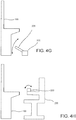
- FIGS. 4A-4I are schematic block diagrams illustrating different respective EGM integrations including a programmable haptic interface according to certain embodiments of the inventive concepts.
- FIGS. 5A-5E are graphs plotting force feedback level performance of a programmable haptic interface according to certain embodiments of the inventive concepts.
- FIG. 6 is a flowchart illustrating operations for methods of providing programmable haptic force feedback sensations according to some embodiments.
- FIGS. 7A to 7E illustrate aspects of electronic game machines according to some embodiments.
- a human-machine interface (HMI) controller may provide a player with programmable haptic force feedback sensations using a resistive force.
- the generated programmable feedback may be changed over time based on the content and/or an input at the EGM.
- the player may receive a force feedback in real-time directly from the resistance that is generated in the HMI controller. In this manner, the player may receive feedback in the absence of optical feedback.
- Some embodiments further provide that additional optical feedback may be provided to increase the perceived force feedback sensations for the player. In this way, these and other embodiments provide a technical solution to the uniquely challenging technical problem increasing the interest and enjoyment of playing a gaming device at a gaming or other establishment.
- the controller may include a programmable haptic interface.
- the programmable haptic interface may include a moveable element that is moveable relative to a fixed element.
- a magnetorheological fluid may provide a variable resistance to movement of the moveable element relative to the fixed element.
- the variable resistance may be controlled by varying a magnitude of a magnetic field that is applied across the magnetorheological fluid using a control circuit.
- the moveable element of the programmable haptic interface includes a magneto-textural inertial spinning system (MATISS) controller that may be highly dynamic and may provide positive and negative resistive force.
- MATISS magneto-textural inertial spinning system
- the moveable element of the programmable haptic interface may include a rotary knob that may be programmable to provide a dynamic force feedback to enhance immersive sensations for a player.
- an electronic gaming machine (EGM) 100 may include a programmable haptic interface 200 that produces a variable amount of resistance to movement by a player of a moveable element thereof in response to a force feedback signal. The resistance to movement of the moveable element may provide a haptic force feedback that may be sensed by the player.
- the EGM 100 further includes a processor circuit 114 and a memory 112 that is coupled to the processor circuit 114 and that includes machine-readable instructions that, when executed by the processor circuit 114 , cause the processor circuit to perform operations including initiating a wagering game on the EGM 100 .
- the wagering game may operate according to a set of game rules that include game flow rules that define a sequence of game events that are presented to the player in a course of operation of the wagering game.
- the processor circuit 114 may generate the force feedback signal that controls an amount of resistance to movement of the moveable element of the programmable haptic interface 200 based on a game event in the sequence of game events.
- the force feedback signal that is generated by the processor circuit may be transmitted to the programmable haptic interface 200 .
- some embodiments of the programmable haptic interface 200 may include a magnetorheological fluid that couples the moveable element to a fixed housing that is mounted to the EGM and a circuit controlling a magnitude of a magnetic field that is applied across the magnetorheological fluid in response to the force feedback signal.
- the processor circuit 114 may control operations of EGM 100 . Although illustrated as a single processor circuit, multiple special purpose and/or general purpose processor circuits and/or processor circuit cores may be provided in the EGM 100 .
- the EGM 100 may include one or more of a video processor, a signal processor, a sound processor and/or a communication controller that performs one or more control functions within the EGM 100 .
- the processor circuit 114 may be variously referred to as a “controller,” “microcontroller,” “microprocessor” or simply a “computer.”
- the processor circuit 114 may further include one or more application-specific integrated circuits (ASICs).
- ASICs application-specific integrated circuits
- Various components of the EGM 100 are illustrated as being connected to the processor circuit 114 . It will be appreciated that the components may be connected to the processor circuit 114 through a system bus, a communication bus and controller, such as a USB controller and USB bus, a network interface, or any other suitable type of connection.
- the EGM 100 further includes a memory device 112 that stores one or more functional modules 113 for performing the operations described herein.
- the memory device 112 may store program code and instructions, executable by the processor circuit 114 , to control the EGM 100 including the programmable haptic interface 200 .
- the memory device 112 may include random access memory (RAM), which can include non-volatile RAM (NVRAM), magnetic RAM (ARAM), ferroelectric RAM (FeRAM) and other forms as commonly understood in the gaming industry.
- RAM random access memory
- NVRAM non-volatile RAM
- ARAM magnetic RAM
- FeRAM ferroelectric RAM
- the memory device 112 may include read only memory (ROM).
- the memory device 112 may include flash memory and/or EEPROM (electrically erasable programmable read only memory). Any other suitable magnetic, optical and/or semiconductor memory may operate in conjunction with the gaming device disclosed herein.
- the game modification server 16 may include a communication adapter 115 including transceiver circuitry that enables the EGM 100 to communicate with remote devices, such as servers and other EGMs over a wired and/or wireless communication network, such as a local area network (LAN), wide area network (WAN), cellular communication network, or other data communication network.
- a communication adapter 115 including transceiver circuitry that enables the EGM 100 to communicate with remote devices, such as servers and other EGMs over a wired and/or wireless communication network, such as a local area network (LAN), wide area network (WAN), cellular communication network, or other data communication network.
- the EGM 100 may include one or more internal or external communication ports that enable the processor circuit 114 to communicate with and to operate with internal or external peripheral devices, such as display screens, keypads, mass storage devices, microphones, speakers, and wireless communication devices.
- internal or external peripheral devices may communicate with the processor circuit 114 through a universal serial bus (USB) hub (not shown) connected to the processor circuit 114 .
- USB universal serial bus
- FIGS. 2A and 2B are schematic block diagrams illustrating cross-sectional top and side views of a programmable haptic interface according to certain embodiments of the inventive concepts.
- the programmable haptic interface 200 illustrated in FIGS. 2A and 2B depict a rotary programmable haptic interface 200 may include a moveable element 240 that may exhibit a variable resistance to rotary motion relative to the fixed housing 210 .
- a magnetorheological fluid 230 may provide a coupling between the moveable element 240 and the fixed housing 210 .
- the moveable element 240 may include resistance vanes 242 that are configured to move through the magnetorheological fluid 230 as the moveable element is rotated, for example, by the player.
- the viscosity of the magnetorheological fluid may determine the amount of resistance to movement the moveable element 240 experiences.
- programmable haptic interface 200 may include a rotary knob 244 that may be rotated by the player.
- the force feedback signal is generated based on the game event and a measurement of a rotary position of the rotary knob 244 .
- the force feedback signal may be generated to control an amount of resistance to movement of the rotary knob 244 based on a combination of the game event and an amount of change in the rotary position of the rotary knob 244 .
- the rotary position, speed and/or direction of the moveable element 240 may be determined using a moveable element encoder 250 that measures movement responsive to manual activation of the moveable element 240 and generates interface movement data that is used by the processor circuit ( FIG. 1, 114 ) to generate the force feedback signal.
- the moveable element encoder 250 may include a digital and/or analog encoder.
- the programmable haptic interface 200 may include a circuit 220 that controls a magnitude and/or direction of a magnetic field that is applied across the magnetorheological fluid 230 in response to receiving the force feedback signal that is generated by the processor circuit.
- the circuit 220 may include one or more conductive coils that may be selectively driven by a control current. The direction and magnitude of the magnetic field may be controlled based on the magnitude of the control current and the orientation of the conductive coils.
- the magnetorheological fluid 230 When the magnetorheological fluid 230 is subjected to a magnetic field, the viscosity thereof increases even to the point of becoming a viscoelastic solid. In this manner, the yield stress of the magnetorheological fluid 230 may be controlled very accurately by varying the magnetic field magnitude.
- linear programmable haptic interfaces are contemplated herein in applications that variable linear haptic force feedback is desirable.
- the conductive coils of the circuit 220 may be selectively driven to generate a negative resistance to movement, which translates as a motive input to the moveable element 240 of the programmable haptic interlayer 200 .
- an additional motive component may provide the negative resistance to movement.
- FIG. 3 is schematic block diagram illustrating cut-away side view of a programmable haptic interface including a driving motor according to certain embodiments of the inventive concepts. As illustrated, a portion of the moveable element 240 may be coupled to a motor 260 that provides movement of the moveable element 240 to generate a negative resistance to movement thereof.
- the resistance to movement may be controlled from a negative resistance to a positive resistance by combined control of the motor 260 and the current through the conductive coils.
- the motor 260 may, responsive to receiving a voltage, cause movement of the moveable element 240 to act against the resistance to rotation caused by the magnetorheological fluid 230 .
- the force feedback signal may be controlled to modulate resistance to movement of the moveable element 240 that is caused by the motor 260 .
- the rotary knob is self-rotating that the wagering game operates in an auto-play mode responsive to the player holding the rotary knob in a fixed position for a threshold time.
- the force feedback signal may be controlled to provide an increasing amount of resistance to movement of the rotary knob 240 responsive to the player holding the rotary knob 240 in a static position for an increasing time duration.
- FIGS. 4A-4I are schematic block diagrams illustrating different respective EGM integrations including a programmable haptic interface according to certain embodiments of the inventive concepts.
- FIGS. 4A-4D depict top views of EGM integrations
- FIGS. 4E-4I depict side views of EGM integrations.
- an EGM 100 includes a display device 116 , one or more input buttons 130 and a programmable haptic interface 200 according to some embodiments herein.
- the programmable haptic interface 200 may provide left and/or right rotational force feedback to used based on different game events and/or conditions.
- an EGM 100 includes a display device 116 , a touch screen controller 154 and a programmable haptic interface 200 according to some embodiments herein.
- the programmable haptic interface 200 may provide left and/or right rotational force feedback that may be synchronized with touch interface to provide videogame-like inputs, such as combined actions like moving and looking around as part of the game experience.
- the programmable haptic interface 200 controls one of multiple different game functions and the touch inputs determine which function of the different functions is associated with the programmable haptic interface.
- an EGM 100 includes a display device 116 and a programmable haptic interface 200 that is coupled to a vehicle steering wheel 201 according to some embodiments herein.
- the programmable haptic interface 200 may provide left and/or right rotational force feedback that corresponds to driving and/or racing style games.
- the force feedback may be changed to correspond to environmental conditions in the game, such as road surface conditions. For example, responsive to driving a vehicle on a normal dry street surface, the haptic force feedback may provide a higher resistance to movement than may be provided on a loose road surface, such as sand or dirt.
- the haptic force feedback corresponding to a wet surface may provide a varying resistance to movement based on the inconsistent road condition.
- providing the varying resistance may include generating a haptic force feedback that includes a periodic haptic force feedback component that is generated to alternate between providing a first amount of resistance to movement of the vehicle steering wheel and a second amount of resistance to movement of the vehicle steering wheel at a first frequency that corresponds to the game event.
- an EGM 100 includes a display device 116 and a programmable haptic interface 200 according to some embodiments herein.
- the programmable haptic interface 200 that is coupled to a single axis control input 202 .
- a single axis control input 202 may correspond to a vertical-axis control input
- embodiments herein further include the programmable haptic interface and the single axis control input 202 being oriented to include a left-to-right range of motion and thus correspond to a horizontal axis control input.
- an EGM 100 includes a programmable haptic interface 200 according to some embodiments herein.
- the programmable haptic interface 200 is coupled to a single axis control lever 203 that extends from the programmable haptic interface 200 and includes a rotational motion range about a center of rotation that corresponds to the programmable haptic interface 200 .
- the force feedback signal controls the amount of resistance that is delivered to the player via the single axis control lever 203 . For example, varying amount of force may be required to activate a stepper for causing reels to start spinning.
- the processor circuit FIG.
- the single axis control lever 203 and the programmable haptic interface 200 may be defined as a single axis controller.
- an EGM 100 includes a programmable haptic interface 200 according to some embodiments herein.
- the programmable haptic interface 200 is part of a multi-axis controller that includes a multi-axis joystick 204 that receives player input corresponding to multiple axes of movement.
- the processor circuit FIG. 1, 114
- the haptic force feedback may include resistance that is delivered to the player via the joystick 204 .
- the variable resistance may change in directions corresponding to the axes of movement responsive to a change in a property of the wagering game.
- an EGM 100 includes a programmable haptic interface 200 according to some embodiments herein.
- the programmable haptic interface 200 is coupled to a foot operated control lever 205 that extends from the programmable haptic interface 200 and includes a rotational motion range about a center of rotation that corresponds to the programmable haptic interface 200 .
- An example of a foot operated control lever 205 may include a pedal, such as an accelerator or brake pedal.
- an EGM 100 includes a programmable haptic interface 200 according to some embodiments herein.
- the programmable haptic interface 200 is mounted to a portion of a chair, such as an armrest or other comparable structure. Such mounting may provide additional comfort for a player.
- an EGM 100 includes a programmable haptic interface 200 according to some embodiments herein.
- the programmable haptic interface 200 is configured to operate linearly in a single dimension.
- the programmable haptic interface 200 may be a push button in which the amount of force necessary to depress the button may be varied.
- control integrations may include a fishing rod in which the resistance to reeling in a fish is varied by using a programmable haptic interface in the reel.
- a mechanical wheel that may be spun by a player may have a varying resistance to spinning using a programmable haptic interface.
- EGMs 100 may include multiple different programmable haptic interfaces that are operable to provide haptic force feedback corresponding to various functions thereof.
- FIGS. 5A-5E are graphs plotting force feedback level performance of a programmable haptic interface according to certain embodiments of the inventive concepts.
- the vertical axis represents the force feedback level provided by the programmable haptic interface.
- the force feedback level increases substantially linearly as a function of time elapsed. This may be used to provide haptic force feedback in a jump and run style game in which the player is navigating a vehicle to gather multiple objects in a path. As the player gathers more objects, the resistance increases.
- the haptic force feedback may be varied based on the steepness of a hill and whether or not the player is moving the vehicle up or down the hill.
- the force feedback may increase in a non-linear manner based on a condition through which the player in moving the vehicle. For example, if the vehicle is in a mud or quicksand environment, the haptic force feedback may cause the force to increase non-linearly as the vehicle sinks deeper into the mud or quicksand. In some embodiments, responsive to the vehicle being in the mud or quicksand environment for an extended period of time, the resistance may be increased to a point that the vehicle may not be able to proceed and may sink and/or become permanently immobilized.
- the haptic force feedback may alternate between a lower resistance R 1 to a higher resistance R 2 in response to the vehicle being navigated over an uneven surface, such as a log bridge or railroad tracks, among others.
- the seams between road segments may be simulated using periodic changes between resistance levels. In this manner, vibration may be simulated using the haptic force feedback.
- the haptic force feedback may be provided as a function of the rotary position of the player interface instead of time.
- instances of haptic force feedback causing a higher resistance to movement of the moveable element may correspond to specific angular positions of the moveable element.
- higher resistance pulses may correspond to each of rotary positions at angle 1 , angle 2 and angle 3 .
- Such operation may be suitable for providing a player a simulated safe cracking exercise where the player turns the moveable element and receives haptic force feedback at specific angular positions.
- the force feedback may be provided as a function of the rotary position of the player interface.
- a first level of resistance that corresponds to an angular operating range of the moveable element may be substantially lower than a second level of resistance that corresponds to the boundaries of the operating range.
- FIGS. 5A-5E each present different variable programmable performance characteristics of the programmable haptic interface individually with respect to one another, embodiments herein provide that any combination of the variable resistance characteristics described may be used in combination with one another.
- FIG. 6 is a flowchart illustrating operations for methods of providing programmable haptic force feedback sensations according to some embodiments.
- Operations may include initiating, by a processor circuit of an electronic gaming machine (EGM), a wagering game on the EGM (block 610 ).
- EGM electronic gaming machine
- Some embodiments provide that the wagering game operates according to a set of game rules including game flow rules that define a plurality of game events that are presented to a player in a course of operation of the wagering game.
- Embodiments may include receiving, into the processor circuit, interface data that is generated by a programmable haptic interface (block 620 ). Some embodiments provide that the interface data is a measurement of movement of a rotary element in the programmable haptic interface.
- the processor circuit may generate a force feedback signal that is based on one of the game events and the interface data (block 630 ).
- the processor circuit may transmit the force feedback signal to the programmable haptic interface to cause the programmable haptic interface (block 640 ). Responsive to receiving the force feedback signal, the programmable haptic interface may be caused to generate a variable resistance to movement of the moveable element to a manual activation by the player. In some embodiments, generating the variable resistance may be performed by modulating a magnetic field applied to a magnetorheological fluid in the programmable haptic interface.
- variable resistance changes based on a position of the movable element.
- variable resistance changes may generate an elastic spring effect that corresponds to changes in a deformable element that is depicted by the EGM.
- the programmable haptic interface includes a dynamic pushbutton that includes a linearly movable element that provides a variable resistance to movement based on the force feedback signal. The variable resistance to movement may correspond to one of the game events.
- the programmable haptic interface includes a rotary knob to be manually rotated by the player.
- the force feedback signal may include left and/or right rotation force feedback that varies corresponding to the game event.
- the game event includes a depiction of a rotary operated lock and the force feedback signal is generated to provide a sensation of actuating a dial on the depicted rotary operated lock.
- FIGS. 7A to 7E illustrate aspects of electronic game machines according to some embodiments.
- An example of an electronic gaming machine (EGM) that can include a programmable haptic interface according to various embodiments is illustrated in FIGS. 7A, 7B, and 7C in which FIG. 7A is a perspective view of an EGM 100 illustrating various physical features of the device, FIG. 7B is a functional block diagram that schematically illustrates an electronic relationship of various elements of the EGM 100 , and FIG. 7C illustrates various functional modules that can be stored in a memory device of the EGM 100 .
- the embodiments shown in FIGS. 7A to 7C are provided as examples for illustrative purposes only. It will be appreciated that EGMs may come in many different shapes, sizes, layouts, form factors, and configurations, and with varying numbers and types of input and output devices, and that embodiments of the inventive concepts are not limited to the particular EGM structures described herein.
- an EGM 100 may include a support structure, housing or cabinet 105 which provides support for a plurality of displays, inputs, outputs, controls and other features that enable a player to interact with the EGM 100 .
- the EGM 100 illustrated in FIG. 7A includes a number of display devices, including a primary display device 116 located in a central portion of the cabinet 105 and a secondary display device 118 located in an upper portion of the cabinet 105 . It will be appreciated that one or more of the display devices 116 , 118 may be omitted, or that the display devices 116 , 118 may be combined into a single display device.
- the EGM 100 may further include a player tracking display 140 , a credit display 120 , and a bet display 122 .
- the credit display 120 displays a player's current number of credits, cash, account balance or the equivalent.
- the bet display 122 displays a player's amount wagered.
- the player tracking display 140 may be used to display a service window that allows the player to interact with, for example, their player loyalty account to obtain features, bonuses, comps, etc. In other embodiments, additional display screens may be provided beyond those illustrated in FIG. 7A .
- the EGM 100 may further include a number of input devices that allow a player to provide various inputs to the EGM 100 , either before, during or after a game has been played.
- the EGM 100 may include a plurality of input buttons 130 that allow the player to select options before, during or after game play.
- the EGM may further include a game play initiation button 132 and a cashout button 134 .
- the cashout button 134 is utilized to receive a cash payment or any other suitable form of payment corresponding to a quantity of remaining credits of a credit display.
- one or more input devices of the EGM 100 are one or more game play activation devices that are each used to initiate a play of a game on the EGM 100 or a sequence of events associated with the EGM 100 following appropriate funding of the EGM 100 .
- the example EGM 100 illustrated in FIGS. 7A and 7B includes a game play activation device in the form of a game play initiation button 132 . It should be appreciated that, in other embodiments, the EGM 100 begins game play automatically upon appropriate funding rather than upon utilization of the game play activation device.
- one or more input devices of the EGM 100 are one or more wagering or betting devices.
- One such wagering or betting device is as a maximum wagering or betting device that, when utilized, causes a maximum wager to be placed.
- Another such wagering or betting device is a repeat the bet device that, when utilized, causes the previously-placed wager to be placed.
- a further such wagering or betting device is a bet one device.
- a bet is placed upon utilization of the bet one device. The bet is increased by one credit each time the bet one device is utilized. Upon the utilization of the bet one device, a quantity of credits shown in a credit display (as described below) decreases by one, and a number of credits shown in a bet display (as described below) increases by one.
- one or more of the display screens may a touch-sensitive display that includes a digitizer 152 and a touchscreen controller 154 ( FIG. 7B ).
- the player may interact with the EGM 100 by touching virtual buttons on one or more of the display devices 116 , 118 , 140 .
- any of the above described input devices such as the input buttons 130 , the game play initiation button 132 and/or the cashout button 134 may be provided as virtual buttons on one or more of the display devices 116 , 118 , 140 .
- operation of the primary display device 116 , the secondary display device 118 and the player tracking display 140 may be controlled by a video controller 130 that receives video data from a processor circuit 112 or directly from a memory device 114 and displays the video data on the display screen.
- the credit display 120 and the bet display 122 are typically implemented as simple LCD or LED displays that display a number of credits available for wagering and a number of credits being wagered on a particular game. Accordingly, the credit display 120 and the bet display 122 may be driven directly by the processor circuit 112 . In some embodiments however, the credit display 120 and/or the bet display 122 may be driven by the video controller 30 .
- the display devices 116 , 118 , 140 may include, without limitation: a cathode ray tube, a plasma display, a liquid crystal display (LCD), a display based on light emitting diodes (LEDs), a display based on a plurality of organic light-emitting diodes (OLEDs), a display based on polymer light-emitting diodes (PLEDs), a display based on a plurality of surface-conduction electron-emitters (SEDs), a display including a projected and/or reflected image, or any other suitable electronic device or display mechanism.
- a cathode ray tube a plasma display
- LCD liquid crystal display
- LEDs light emitting diodes
- OLEDs organic light-emitting diodes
- PLEDs polymer light-emitting diodes
- SEDs surface-conduction electron-emitters
- the display devices 116 , 118 , 140 may include a touch-screen with an associated touch-screen controller 154 and digitizer 152 .
- the display devices 116 , 118 , 140 may be of any suitable size, shape, and/or configuration.
- the display devices 116 , 118 , 140 may include flat or curved display surfaces.
- the display devices 116 , 118 , 140 and video controller 130 of the EGM 100 are generally configured to display one or more game and/or non-game images, symbols, and indicia.
- the display devices 116 , 118 , 140 of the EGM 100 are configured to display any suitable visual representation or exhibition of the movement of objects; dynamic lighting; video images; images of people, characters, places, things, and faces of cards; and the like.
- the display devices 116 , 118 , 140 of the EGM 100 are configured to display one or more virtual reels, one or more virtual wheels, and/or one or more virtual dice.
- certain of the displayed images, symbols, and indicia are in mechanical form.
- the display device 116 , 118 , 140 includes any electromechanical device, such as one or more rotatable wheels, one or more reels, and/or one or more dice, configured to display at least one or a plurality of game or other suitable images, symbols, or indicia.
- the EGM 100 also includes various features that enable a player to deposit credits in the EGM 100 and withdraw credits from the EGM 100 , such as in the form of a payout of winnings, credits, etc.
- the EGM 100 may include a ticket dispenser 136 , a bill/ticket acceptor 128 , and a coin acceptor 126 that allows the player to deposit coins into the EGM 100 .
- the EGM 100 may also include a note dispenser configured to dispense paper currency and/or a coin generator configured to dispense coins or tokens in a coin payout tray.
- a note dispenser configured to dispense paper currency
- a coin generator configured to dispense coins or tokens in a coin payout tray.
- the EGM 100 may further include one or more speakers 150 controlled by one or more sound cards 138 ( FIG. 7B ).
- the EGM 100 illustrated in FIG. 7A includes a pair of speakers 150 .
- additional speakers such as surround sound speakers, may be provided within or on the cabinet 105 .
- the EGM 100 may include built-in seating with integrated headrest speakers.
- the EGM 100 may generate dynamic sounds coupled with attractive multimedia images displayed on one or more of the display devices 116 , 118 , 140 to provide an audio-visual representation or to otherwise display full-motion video with sound to attract players to the EGM 100 and/or to engage the player during gameplay.
- the EGM 100 may display a sequence of audio and/or visual attraction messages during idle periods to attract potential players to the EGM 100 .
- the videos may be customized to provide any appropriate information.
- the EGM 100 may further include a card reader 138 that is configured to read magnetic stripe cards, such as player loyalty/tracking cards, chip cards, and the like.
- a player may insert an identification card into a card reader of the gaming device.
- the identification card is a smart card having a programmed microchip or a magnetic strip coded with a player's identification, credit totals (or related data) and other relevant information.
- a player may carry a portable device, such as a cell phone, a radio frequency identification tag or any other suitable wireless device, which communicates a player's identification, credit totals (or related data) and other relevant information to the gaming device.
- money may be transferred to a gaming device through electronic funds transfer. When a player funds the gaming device, the processor circuit determines the amount of funds entered and displays the corresponding amount on the credit or other suitable display as described above.
- the EGM 100 may include an electronic payout device or module configured to fund an electronically recordable identification card or smart card or a bank or other account via an electronic funds transfer to or from the EGM 100 .
- FIG. 7B is a block diagram that illustrates logical and functional relationships between various components of an EGM 100 .
- the EGM 100 may include a processor circuit 112 that controls operations of the EGM 100 .
- the EGM 100 may include one or more of a video processor, a signal processor, a sound processor and/or a communication controller that performs one or more control functions within the EGM 100 .
- the processor circuit 112 may be variously referred to as a “controller,” “microcontroller,” “microprocessor” or simply a “computer.”
- the processor circuit may further include one or more application-specific integrated circuits (ASICs).
- ASICs application-specific integrated circuits
- FIG. 7B Various components of the EGM 100 are illustrated in FIG. 7B as being connected to the processor circuit 112 . It will be appreciated that the components may be connected to the processor circuit 112 through a system bus, a communication bus and controller, such as a USB controller and USB bus, a network interface, or any other suitable type of connection.
- the EGM 100 further includes a memory device 114 that stores one or more functional modules 120 .
- Various functional modules 120 of the EGM 100 will be described in more detail below in connection with FIG. 7D .
- the memory device 114 may store program code and instructions, executable by the processor circuit 112 , to control the EGM 100 .
- the memory device 114 may also store other data such as image data, event data, player input data, random or pseudo-random number generators, pay-table data or information and applicable game rules that relate to the play of the gaming device.
- the memory device 114 may include random access memory (RAM), which can include non-volatile RAM (NVRAM), magnetic RAM (ARAM), ferroelectric RAM (FeRAM) and other forms as commonly understood in the gaming industry.
- the memory device 14 may include read only memory (ROM).
- the memory device 114 may include flash memory and/or EEPROM (electrically erasable programmable read only memory). Any other suitable magnetic, optical and/or semiconductor memory may operate in conjunction with the gaming device disclosed herein.
- the EGM 100 may further include a data storage device 122 , such as a hard disk drive or flash memory.
- the data storage 122 may store program data, player data, audit trail data or any other type of data.
- the data storage 122 may include a detachable or removable memory device, including, but not limited to, a suitable cartridge, disk, CD ROM, DVD or USB memory device.
- the EGM 100 may include a communication adapter 26 including transceiver circuitry that enables the EGM 100 to communicate with remote devices over a wired and/or wireless communication network, such as a local area network (LAN), wide area network (WAN), cellular communication network, or other data communication network.
- the communication adapter 126 may further include transceiver circuitry for supporting short range wireless communication protocols, such as Bluetooth and/or near field communications (NFC) that enable the EGM 100 to communicate, for example, with a mobile communication device operated by a player.
- short range wireless communication protocols such as Bluetooth and/or near field communications (NFC)
- the EGM 100 may include one or more internal or external communication ports that enable the processor circuit 112 to communicate with and to operate with internal or external peripheral devices, such as eye tracking devices, position tracking devices, cameras, accelerometers, arcade sticks, bar code readers, bill validators, biometric input devices, bonus devices, button panels, card readers, coin dispensers, coin hoppers, display screens or other displays or video sources, expansion buses, information panels, keypads, lights, mass storage devices, microphones, motion sensors, motors, printers, reels, SCSI ports, solenoids, speakers, thumb drives, ticket readers, touch screens, trackballs, touchpads, wheels, and wireless communication devices.
- internal or external peripheral devices may communicate with the processor circuit through a universal serial bus (USB) hub (not shown) connected to the processor circuit 112 .
- USB universal serial bus
- the EGM 100 may include a sensor, such as a camera in communication with the processor circuit 112 (and possibly controlled by the processor circuit 112 ) that is selectively positioned to acquire an image of a player actively using the EGM 100 and/or the surrounding area of the EGM 100 .
- the camera may be configured to selectively acquire still or moving (e.g., video) images and may be configured to acquire the images in either an analog, digital or other suitable format.
- the display devices 116 , 118 , 140 may be configured to display the image acquired by the camera as well as display the visible manifestation of the game in split screen or picture-in-picture fashion.
- the camera may acquire an image of the player and the processor circuit 112 may incorporate that image into the primary and/or secondary game as a game image, symbol or indicia.
- the EGM 100 may include in the memory device 114 a game module 120 A that includes program instructions and/or data for operating a hybrid wagering game as described herein.
- the EGM 100 may further include a player tracking module 120 B, an electronic funds transfer module 120 C, a game modification module 120 D, an audit/reporting module 120 E, a communication module 120 F, an operating system 120 G, a random number generator 120 H, a game math engine 1201 and a paytable 120 J.
- the player tracking module 120 B keeps track of the play of a player.
- the electronic funds transfer module 120 C communicates with a back end server or financial institution to transfer funds to and from an account associated with the player.
- the game modification module 20 D adjusts game play based on identified player preferences as described in more detail herein.
- the communication module 120 F enables the EGM 100 to communicate with remote servers and other EGMs using various secure communication interfaces.
- the operating system kernel 120 G controls the overall operation of the EGM 100 , including the loading and operation of other modules.
- the random number generator 120 H generates random or pseudorandom numbers for use in the operation of the hybrid games described herein.
- the game math engine 1201 defines probabilities of pseudorandom events that can occur in the course of operation of the wagering game based on pseudorandom numbers generated by the random number generator 120 H.
- the paytable 120 J defines winning events that can occur in the course of operation of the wagering game.
- an EGM 100 may be implemented by a desktop computer, a laptop personal computer, a personal digital assistant (PDA), portable computing device, or other computerized platform.
- the EGM 100 may be operable over a wireless network, such as part of a wireless gaming system.
- the gaming machine may be a hand held device, a mobile device or any other suitable wireless device that enables a player to play any suitable game at a variety of different locations.
- a gaming device or gaming machine as disclosed herein may be a device that has obtained approval from a regulatory gaming commission or a device that has not obtained approval from a regulatory gaming commission.
- an EGM 100 ′ may be implemented as a handheld device including a compact housing 105 on which is mounted a touchscreen display device 116 including a digitizer 152 .
- An input button 130 may be provided on the housing and may act as a power or control button.
- a camera 127 may be provided in a front face of the housing 105 .
- the housing 105 may include one or more speakers 150 .
- various input buttons described above, such as the cashout button, gameplay activation button, etc. may be implemented as soft buttons on the touchscreen display device 116 .
- the EGM 100 ′ may omit certain features, such as a bill acceptor, a ticket generator, a coin acceptor or dispenser, a card reader, secondary displays, a bet display, a credit display, etc. Credits can be deposited in or transferred from the EGM 100 ′ electronically.
- FIG. 7E illustrates a standalone EGM 100 ′′ having a different form factor from the EGM 100 illustrated in FIG. 7A .
- the EGM 100 ′′ is characterized by having a large, high aspect ratio, curved primary display device 116 ′ provided in the housing 105 , with no secondary display device.
- the primary display device 116 ′ may include a digitizer 152 to allow touchscreen interaction with the primary display device 116 ′.
- the EGM 100 ′′ may further include a player tracking display 140 , a plurality of input buttons 130 , a bill/ticket acceptor 128 , a card reader 138 , and a ticket generator 136 .
- the EGM 100 ′′ may further include one or more cameras 127 to enable facial recognition and/or motion tracking.
- the programmable haptic interface may be used to simulate a threshold and/or a limitation.
- a threshold may be provided responsive to a player making a selection of notable player attention.
- an increased resistance to movement may be provided to overcome such threshold.
- increasing and/or decreasing game parameters such as volume, game speed, reel spin speed, rumble intensity, betting amounts, betting lines, and betting denominations may correspond to different levels of resistance.
- the resistance may be varied to indicate game volatility.
- the resistive feedback may be increased corresponding to increased tension and/or risk to be expected from a given selection.
- a game selector may correspond to different materials (e.g., a burning fire, flowing water, sandstorm) that may correspond to different resistive feedback sensations.
- a tutorial like danger indicator may be implemented by providing higher resistance corresponding to bad decisions in the game.
- a programmable haptic interface may be self-rotating.
- a player may hold the moveable element still to activate and/or maintain an auto play mode.
- responsible gaming may be encouraged by stopping the auto play mode is the moveable element is released or if the resistance exceeds an upper threshold.
- Some embodiments provide the programmable haptic interface may be used to allow a player to navigate through menus, including those that may allow a used to adjust game settings.
- the programmable haptic interface may be implemented to perform as a game style joystick.
- the programmable haptic interface may be used to increase and/or decrease spin time and/or to stop or start a reel spin.
- a player may receive a different resistance corresponding to particular symbol passing by during the spin to allow the player to try to stop the spinning reel at a particular symbol.
- the programmable haptic interface may change the resistance to provide a nudge of a reel that may be selected by the programmable haptic interface. Feedback may be provided that confirms a successful nudge.
- the programmable haptic interface may be used to provide a fast reel stop and include resistance that corresponds to a brake.
- the programmable haptic interface may provide a feedback corresponding to a spinning wheel selector being passed, including while the player is spinning the wheel.
- a player may try to adjust the size of bubbles that appear by rotating a knob of the programmable haptic interface.
- the rotary control of an object may be controlled and/or adjusted using the programmable haptic interface.
- a player may try to balance a scale using the programmable haptic interface in which the force feedback is changed when objects drop onto different sides of the scale.
- the programmable haptic interface allows a player to receive feedback corresponding to a game object that is not displayed, such as because the game environment is a dark room or a player's avatar is blindfolded.
- the programmable haptic interface may simulate pulling a spring in which the player tries to stretch a spring as far as possible without breaking it.
- the force feedback may provide a sensation to guide the player regarding the limit of the stretching.
- elastic based operations such as shooting an object using a slingshot may be enhanced by varying the resistance based on how far the spring is stretched.
- the programmable haptic interface may provide a vibration or other sensation in response to game object touching.
- a breakout game may be provided in which the resistance defines the side limits of movement of the bar and a vibration responsive to the ball touching the bar.
- Some embodiments provide that the further the game progresses, the more random the resistance changes become.
- two programmable haptic interfaces may be used to provide coordinated movement through a game environment.
- one programmable haptic interface may correspond to left-right (e.g., horizontal axis) movement and the other programmable haptic interface may correspond to forward-rearward (e.g., vertical axis) movement.
- the programmable haptic interfaces correspond to left and right flippers in a virtual pinball game.
- the programmable haptic interfaces may be used in a coordinated manner in which the player may try to match the positioning of the first programmable haptic interfaces even though they may provide different resistance patterns.
- the programmable haptic interface may be further configured to operate in conjunction with other data, such as biometric data, to provide a force feedback that is coordinated with the player's experience.
- the programmable haptic interface may be used in combination with inputs received via a touch screen. Examples include driving a fire truck using the programmable haptic interface while spraying a firehouse based on inputs received via the touch screen. Additionally, game settings may be selected on the touch screen and adjusted using the programmable haptic interface. Different settings values may correspond to different resistance levels based on properties such as difficulty.
- the programmable haptic interface may be implemented as a single axis controller, including as a lever for a stepper and/or as a foot-operated pedal. Resistance may be varied randomly and/or based on a bet amount, a credit amount, number of reels to be spun, desired reel speed, individual reel spins based on incremental position of the lever, a fast reel stop input, and a reel braking sensation, among others. The resistance may further provide a ratcheting type lever operation in which the lever may only be moved in a single direction until a given range of motion is achieved, after which the lever may be returned to an original position.
- additional data corresponding to a player may be used to adjust resistance levels and/or ranges of motion of the programmable haptic interface.
- resistance levels and/or a range of motion may be varied based on age, gender, and/or size.
- less mobile players may desire a reduced range of motion relative to other players.
- the embodiments may be implemented using hardware, software or a suitable combination thereof.
- the software code can be executed on any suitable processor or collection of processors, whether provided in a single computer or distributed among multiple computers.
- processors may be implemented as integrated circuits, with one or more processors in an integrated circuit component.
- a processor may be implemented using circuitry in any suitable format.
- a computer may be embodied in any of a number of forms, such as a rack-mounted computer, a desktop computer, a laptop computer, or a tablet computer. Additionally, a computer may be embedded in a device perhaps not generally regarded as a computer but with suitable processing capabilities, including an electronic gaming machine, a Web TV, a Personal Digital Assistant (PDA), a smart phone or any other suitable portable or fixed electronic device.
- PDA Personal Digital Assistant
- a computer may have one or more input and output devices. These devices can be used, among other things, to present a player interface. Examples of output devices that can be used to provide a player interface include printers or display screens for visual presentation of output and speakers or other sound generating devices for audible presentation of output. Examples of input devices that can be used for a player interface include keyboards, and pointing devices, such as mice, touch pads, and digitizing tablets. As another example, a computer may receive input information through speech recognition or in other audible format.
- Such computers may be interconnected by one or more networks in any suitable form, including as a local area network or a wide area network, such as an enterprise network or the Internet.
- networks may be based on any suitable technology and may operate according to any suitable protocol and may include wireless networks, wired networks or fiber optic networks.
- the term “online” refers to such networked systems, including computers networked using, e.g., dedicated lines, telephone lines, cable or ISDN lines as well as wireless transmissions. Online systems include remote computers using, e.g., a local area network (LAN), a wide area network (WAN), the Internet, as well as various combinations of the foregoing.
- LAN local area network
- WAN wide area network
- the Internet as well as various combinations of the foregoing.
- Suitable player devices may connect to a network for instance, any computing device that is capable of communicating over a network, such as a desktop, laptop or notebook computer, a mobile station or terminal, an entertainment appliance, a set-top box in communication with a display device, a wireless device such as a phone or smartphone, a game console, etc.
- the term “online gaming” refers to those systems and methods that make use of such a network to allow a game player to make use of and engage in gaming activity through networked, or online systems, both remote and local. For instance, “online gaming” includes gaming activity that is made available through a website on the Internet.
- the various methods or processes outlined herein may be coded as software that is executable on one or more processors that employ any one of a variety of operating systems or platforms. Additionally, such software may be written using any of a number of suitable programming languages and/or programming or scripting tools, and also may be compiled as executable machine language code or intermediate code that is executed on a framework or virtual machine.
- inventive concepts may be embodied as a tangible, non-transitory computer readable storage medium (or multiple computer readable storage media) (e.g., a computer memory, one or more floppy discs, compact discs (CD), optical discs, digital video disks (DVD), magnetic tapes, flash memories, circuit configurations in Field Programmable Gate Arrays or other semiconductor devices, or other non-transitory, tangible computer-readable storage media) encoded with one or more programs that, when executed on one or more computers or other processors, perform methods that implement the various embodiments of the inventive concepts discussed above.
- a tangible, non-transitory computer readable storage medium e.g., a computer memory, one or more floppy discs, compact discs (CD), optical discs, digital video disks (DVD), magnetic tapes, flash memories, circuit configurations in Field Programmable Gate Arrays or other semiconductor devices, or other non-transitory, tangible computer-readable storage media
- non-transitory computer-readable storage medium encompasses only a computer-readable medium that can be considered to be a manufacture (i.e., article of manufacture) or a machine and excludes transitory signals.
- program or “software” are used herein in a generic sense to refer to any type of computer code or set of computer-executable instructions that can be employed to program a computer or other processor to implement various aspects of the present inventive concepts as discussed above. Additionally, it should be appreciated that according to one aspect of this embodiment, one or more computer programs that when executed perform methods of the present inventive concepts need not reside on a single computer or processor, but may be distributed in a modular fashion amongst a number of different computers or processors to implement various aspects of the present inventive concepts.
- Computer-executable instructions may be in many forms, such as program modules, executed by one or more computers or other devices.
- program modules include routines, programs, objects, components, data structures, etc. that perform particular tasks or implement particular abstract data types.
- functionality of the program modules may be combined or distributed as desired in various embodiments.
- data structures may be stored in computer-readable media in any suitable form.
- data structures may be shown to have fields that are related through location in the data structure. Such relationships may likewise be achieved by assigning storage for the fields with locations in a computer-readable medium that conveys relationship between the fields.
- any suitable mechanism may be used to establish a relationship between information in fields of a data structure, including through the use of pointers, tags, addresses or other mechanisms that establish relationship between data elements.
- inventive concepts may be embodied as a method, of which several examples have been provided.
- the acts performed as part of the method may be ordered in any suitable way. Accordingly, embodiments may be constructed in which acts are performed in an order different than illustrated, which may include performing some acts simultaneously, even though shown as sequential acts in illustrative embodiments.
Landscapes
- Engineering & Computer Science (AREA)
- General Engineering & Computer Science (AREA)
- Theoretical Computer Science (AREA)
- Physics & Mathematics (AREA)
- General Physics & Mathematics (AREA)
- Human Computer Interaction (AREA)
- Electromagnetism (AREA)
- Mechanical Engineering (AREA)
- User Interface Of Digital Computer (AREA)
Abstract
Description
Claims (17)
Priority Applications (1)
| Application Number | Priority Date | Filing Date | Title |
|---|---|---|---|
| US16/247,992 US10839636B2 (en) | 2019-01-15 | 2019-01-15 | Programmable haptic force feedback sensations in electronic wagering games |
Applications Claiming Priority (1)
| Application Number | Priority Date | Filing Date | Title |
|---|---|---|---|
| US16/247,992 US10839636B2 (en) | 2019-01-15 | 2019-01-15 | Programmable haptic force feedback sensations in electronic wagering games |
Publications (2)
| Publication Number | Publication Date |
|---|---|
| US20200226872A1 US20200226872A1 (en) | 2020-07-16 |
| US10839636B2 true US10839636B2 (en) | 2020-11-17 |
Family
ID=71516778
Family Applications (1)
| Application Number | Title | Priority Date | Filing Date |
|---|---|---|---|
| US16/247,992 Active 2039-01-23 US10839636B2 (en) | 2019-01-15 | 2019-01-15 | Programmable haptic force feedback sensations in electronic wagering games |
Country Status (1)
| Country | Link |
|---|---|
| US (1) | US10839636B2 (en) |
Families Citing this family (3)
| Publication number | Priority date | Publication date | Assignee | Title |
|---|---|---|---|---|
| DE102019135032A1 (en) * | 2019-12-18 | 2021-06-24 | Inventus Engineering Gmbh | Method for operating an input device for a computer device and input device |
| AU2020102639A4 (en) * | 2020-10-08 | 2020-11-26 | Razer (Asia-Pacific) Pte. Ltd. | Input device |
| CN112422829B (en) * | 2020-11-19 | 2022-04-26 | 北京字节跳动网络技术有限公司 | Method, device, terminal and storage medium for assisting in shooting image |
Citations (10)
| Publication number | Priority date | Publication date | Assignee | Title |
|---|---|---|---|---|
| US6339419B1 (en) * | 1998-11-10 | 2002-01-15 | Lord Corporation | Magnetically-controllable, semi-active haptic interface system and apparatus |
| US7113166B1 (en) * | 1995-06-09 | 2006-09-26 | Immersion Corporation | Force feedback devices using fluid braking |
| EP1226852B1 (en) | 2001-01-29 | 2007-06-13 | Microsoft Corporation | Force feedback mechanism for gamepad device |
| US20080132313A1 (en) * | 2005-09-08 | 2008-06-05 | Rasmussen James M | Gaming machine having display with sensory feedback |
| US7432910B2 (en) | 1998-06-23 | 2008-10-07 | Immersion Corporation | Haptic interface device and actuator assembly providing linear haptic sensations |
| US7446752B2 (en) | 1999-09-28 | 2008-11-04 | Immersion Corporation | Controlling haptic sensations for vibrotactile feedback interface devices |
| US20100160016A1 (en) * | 2006-03-31 | 2010-06-24 | Shimabukuro Jorge L | Portable Wagering Game With Vibrational Cues and Feedback Mechanism |
| US7982720B2 (en) | 1998-06-23 | 2011-07-19 | Immersion Corporation | Haptic feedback for touchpads and other touch controls |
| US20170361217A1 (en) * | 2012-09-21 | 2017-12-21 | Bright Cloud International Corp. | Bimanual integrative virtual rehabilitation system and methods |
| US20180082545A1 (en) * | 2016-09-22 | 2018-03-22 | Competition Interactive LLC | Competitive, skill-based gaming with wagers by active participants and side betting |
-
2019
- 2019-01-15 US US16/247,992 patent/US10839636B2/en active Active
Patent Citations (10)
| Publication number | Priority date | Publication date | Assignee | Title |
|---|---|---|---|---|
| US7113166B1 (en) * | 1995-06-09 | 2006-09-26 | Immersion Corporation | Force feedback devices using fluid braking |
| US7432910B2 (en) | 1998-06-23 | 2008-10-07 | Immersion Corporation | Haptic interface device and actuator assembly providing linear haptic sensations |
| US7982720B2 (en) | 1998-06-23 | 2011-07-19 | Immersion Corporation | Haptic feedback for touchpads and other touch controls |
| US6339419B1 (en) * | 1998-11-10 | 2002-01-15 | Lord Corporation | Magnetically-controllable, semi-active haptic interface system and apparatus |
| US7446752B2 (en) | 1999-09-28 | 2008-11-04 | Immersion Corporation | Controlling haptic sensations for vibrotactile feedback interface devices |
| EP1226852B1 (en) | 2001-01-29 | 2007-06-13 | Microsoft Corporation | Force feedback mechanism for gamepad device |
| US20080132313A1 (en) * | 2005-09-08 | 2008-06-05 | Rasmussen James M | Gaming machine having display with sensory feedback |
| US20100160016A1 (en) * | 2006-03-31 | 2010-06-24 | Shimabukuro Jorge L | Portable Wagering Game With Vibrational Cues and Feedback Mechanism |
| US20170361217A1 (en) * | 2012-09-21 | 2017-12-21 | Bright Cloud International Corp. | Bimanual integrative virtual rehabilitation system and methods |
| US20180082545A1 (en) * | 2016-09-22 | 2018-03-22 | Competition Interactive LLC | Competitive, skill-based gaming with wagers by active participants and side betting |
Also Published As
| Publication number | Publication date |
|---|---|
| US20200226872A1 (en) | 2020-07-16 |
Similar Documents
| Publication | Publication Date | Title |
|---|---|---|
| US11410486B2 (en) | Determining a player emotional state based on a model that uses pressure sensitive inputs | |
| US8696438B2 (en) | Wagering game with a secondary game determined by symbol positions in a base game | |
| US10181239B2 (en) | Method for assigning a wild symbol on a gaming device | |
| US11769367B2 (en) | Systems and methods of electronic gaming | |
| US20140349726A1 (en) | Player-induced effects on e-table playfield | |
| AU2010241375B2 (en) | Wagering game with accumulation-bonus feature that is played upon player's selection | |
| US10726680B2 (en) | Augmented reality coin pusher | |
| US10839636B2 (en) | Programmable haptic force feedback sensations in electronic wagering games | |
| AU2018214011B2 (en) | Augmented Reality Systems and Methods for Gaming | |
| US11282331B2 (en) | Mixed reality systems and methods for enhancing gaming device experiences | |
| US11816949B2 (en) | Systems and methods of electronic gaming | |
| US20250371941A1 (en) | Providing shared game features between a real world gaming environment and a shared virtual gaming evironment | |
| US12499728B2 (en) | Button sensing methods in gaming environment | |
| US20240395111A1 (en) | Bonus game for a wagering game with a lucky number game play feature | |
| US11282330B2 (en) | Multiple simultaneous pressure sensitive inputs for gaming devices, and related devices, systems, and methods | |
| US10891822B2 (en) | Gaming machines using holographic imaging | |
| AU2015200289A1 (en) | 3d keno board | |
| US12300067B2 (en) | Game event-based funding for a progressive wagering game | |
| US20250174070A1 (en) | Providing wagering games in a holographic display syste |
Legal Events
| Date | Code | Title | Description |
|---|---|---|---|
| AS | Assignment |
Owner name: IGT, NEVADA Free format text: ASSIGNMENT OF ASSIGNORS INTEREST;ASSIGNORS:RUSS, MICHAEL;KEILWERT, STEFAN;AURICH, SVEN;AND OTHERS;REEL/FRAME:048010/0720 Effective date: 20190115 |
|
| FEPP | Fee payment procedure |
Free format text: ENTITY STATUS SET TO UNDISCOUNTED (ORIGINAL EVENT CODE: BIG.); ENTITY STATUS OF PATENT OWNER: LARGE ENTITY |
|
| FEPP | Fee payment procedure |
Free format text: ENTITY STATUS SET TO SMALL (ORIGINAL EVENT CODE: SMAL); ENTITY STATUS OF PATENT OWNER: LARGE ENTITY Free format text: ENTITY STATUS SET TO UNDISCOUNTED (ORIGINAL EVENT CODE: BIG.); ENTITY STATUS OF PATENT OWNER: LARGE ENTITY |
|
| STPP | Information on status: patent application and granting procedure in general |
Free format text: NOTICE OF ALLOWANCE MAILED -- APPLICATION RECEIVED IN OFFICE OF PUBLICATIONS |
|
| STPP | Information on status: patent application and granting procedure in general |
Free format text: PUBLICATIONS -- ISSUE FEE PAYMENT VERIFIED |
|
| STCF | Information on status: patent grant |
Free format text: PATENTED CASE |
|
| MAFP | Maintenance fee payment |
Free format text: PAYMENT OF MAINTENANCE FEE, 4TH YEAR, LARGE ENTITY (ORIGINAL EVENT CODE: M1551); ENTITY STATUS OF PATENT OWNER: LARGE ENTITY Year of fee payment: 4 |
|
| AS | Assignment |
Owner name: DEUTSCHE BANK AG NEW YORK BRANCH, AS COLLATERAL AGENT, NEW YORK Free format text: SECURITY AGREEMENT;ASSIGNOR:IGT;REEL/FRAME:071817/0394 Effective date: 20250701 |