US10836711B2 - Method for the one-pot production of organo-iodinated compounds - Google Patents
Method for the one-pot production of organo-iodinated compounds Download PDFInfo
- Publication number
- US10836711B2 US10836711B2 US16/484,756 US201816484756A US10836711B2 US 10836711 B2 US10836711 B2 US 10836711B2 US 201816484756 A US201816484756 A US 201816484756A US 10836711 B2 US10836711 B2 US 10836711B2
- Authority
- US
- United States
- Prior art keywords
- group
- formula
- compound
- alkyl
- branched
- Prior art date
- Legal status (The legal status is an assumption and is not a legal conclusion. Google has not performed a legal analysis and makes no representation as to the accuracy of the status listed.)
- Active
Links
- 150000001875 compounds Chemical class 0.000 title claims abstract description 76
- 238000000034 method Methods 0.000 title claims abstract description 37
- 238000004519 manufacturing process Methods 0.000 title claims description 3
- 238000005580 one pot reaction Methods 0.000 title description 8
- 230000008569 process Effects 0.000 claims abstract description 33
- FYSNRJHAOHDILO-UHFFFAOYSA-N thionyl chloride Chemical compound ClS(Cl)=O FYSNRJHAOHDILO-UHFFFAOYSA-N 0.000 claims description 47
- 238000005917 acylation reaction Methods 0.000 claims description 46
- 238000005660 chlorination reaction Methods 0.000 claims description 43
- 230000010933 acylation Effects 0.000 claims description 40
- IJGRMHOSHXDMSA-UHFFFAOYSA-N Atomic nitrogen Chemical compound N#N IJGRMHOSHXDMSA-UHFFFAOYSA-N 0.000 claims description 28
- JEZJSNULLBSYHV-UHFFFAOYSA-N 5-amino-2,4,6-triiodobenzene-1,3-dicarboxylic acid Chemical compound NC1=C(I)C(C(O)=O)=C(I)C(C(O)=O)=C1I JEZJSNULLBSYHV-UHFFFAOYSA-N 0.000 claims description 24
- 239000003795 chemical substances by application Substances 0.000 claims description 24
- 125000000217 alkyl group Chemical group 0.000 claims description 19
- 125000000304 alkynyl group Chemical group 0.000 claims description 19
- 125000003342 alkenyl group Chemical group 0.000 claims description 17
- 125000000623 heterocyclic group Chemical group 0.000 claims description 16
- 229910052757 nitrogen Inorganic materials 0.000 claims description 16
- 239000000126 substance Substances 0.000 claims description 15
- QVGXLLKOCUKJST-UHFFFAOYSA-N atomic oxygen Chemical compound [O] QVGXLLKOCUKJST-UHFFFAOYSA-N 0.000 claims description 14
- 239000000203 mixture Substances 0.000 claims description 14
- 229910052760 oxygen Inorganic materials 0.000 claims description 14
- 239000001301 oxygen Substances 0.000 claims description 14
- RUOJZAUFBMNUDX-UHFFFAOYSA-N propylene carbonate Chemical compound CC1COC(=O)O1 RUOJZAUFBMNUDX-UHFFFAOYSA-N 0.000 claims description 13
- 125000001424 substituent group Chemical group 0.000 claims description 12
- 125000003837 (C1-C20) alkyl group Chemical group 0.000 claims description 11
- FXHOOIRPVKKKFG-UHFFFAOYSA-N N,N-Dimethylacetamide Chemical compound CN(C)C(C)=O FXHOOIRPVKKKFG-UHFFFAOYSA-N 0.000 claims description 11
- 229910052736 halogen Inorganic materials 0.000 claims description 11
- 150000002367 halogens Chemical class 0.000 claims description 11
- 125000001072 heteroaryl group Chemical group 0.000 claims description 10
- 239000002904 solvent Substances 0.000 claims description 9
- 125000000753 cycloalkyl group Chemical group 0.000 claims description 8
- 125000002496 methyl group Chemical group [H]C([H])([H])* 0.000 claims description 7
- 125000006376 (C3-C10) cycloalkyl group Chemical group 0.000 claims description 6
- WEVYAHXRMPXWCK-UHFFFAOYSA-N Acetonitrile Chemical compound CC#N WEVYAHXRMPXWCK-UHFFFAOYSA-N 0.000 claims description 6
- 125000003118 aryl group Chemical group 0.000 claims description 6
- 125000000041 C6-C10 aryl group Chemical group 0.000 claims description 5
- WYURNTSHIVDZCO-UHFFFAOYSA-N Tetrahydrofuran Chemical compound C1CCOC1 WYURNTSHIVDZCO-UHFFFAOYSA-N 0.000 claims description 4
- CTSLXHKWHWQRSH-UHFFFAOYSA-N oxalyl chloride Chemical compound ClC(=O)C(Cl)=O CTSLXHKWHWQRSH-UHFFFAOYSA-N 0.000 claims description 4
- XHXFXVLFKHQFAL-UHFFFAOYSA-N phosphoryl trichloride Chemical compound ClP(Cl)(Cl)=O XHXFXVLFKHQFAL-UHFFFAOYSA-N 0.000 claims description 4
- WBJREMGRYVPNKY-UHFFFAOYSA-N 2,4,6-triiodo-5-(methylamino)benzene-1,3-dicarboxylic acid Chemical compound CNC1=C(I)C(C(O)=O)=C(I)C(C(O)=O)=C1I WBJREMGRYVPNKY-UHFFFAOYSA-N 0.000 claims description 3
- UHZYTMXLRWXGPK-UHFFFAOYSA-N phosphorus pentachloride Chemical compound ClP(Cl)(Cl)(Cl)Cl UHZYTMXLRWXGPK-UHFFFAOYSA-N 0.000 claims description 3
- FAIAAWCVCHQXDN-UHFFFAOYSA-N phosphorus trichloride Chemical compound ClP(Cl)Cl FAIAAWCVCHQXDN-UHFFFAOYSA-N 0.000 claims description 3
- 125000002485 formyl group Chemical group [H]C(*)=O 0.000 claims description 2
- YLQBMQCUIZJEEH-UHFFFAOYSA-N tetrahydrofuran Natural products C=1C=COC=1 YLQBMQCUIZJEEH-UHFFFAOYSA-N 0.000 claims description 2
- 239000000543 intermediate Substances 0.000 abstract description 38
- 238000002360 preparation method Methods 0.000 abstract description 35
- 230000015572 biosynthetic process Effects 0.000 abstract description 27
- 238000003786 synthesis reaction Methods 0.000 abstract description 25
- 239000002872 contrast media Substances 0.000 abstract description 18
- IAZDPXIOMUYVGZ-WFGJKAKNSA-N Dimethyl sulfoxide Chemical compound [2H]C([2H])([2H])S(=O)C([2H])([2H])[2H] IAZDPXIOMUYVGZ-WFGJKAKNSA-N 0.000 description 26
- 125000004429 atom Chemical group 0.000 description 24
- 239000012429 reaction media Substances 0.000 description 15
- LFQSCWFLJHTTHZ-UHFFFAOYSA-N Ethanol Chemical compound CCO LFQSCWFLJHTTHZ-UHFFFAOYSA-N 0.000 description 12
- AMDBBAQNWSUWGN-UHFFFAOYSA-N Ioversol Chemical compound OCCN(C(=O)CO)C1=C(I)C(C(=O)NCC(O)CO)=C(I)C(C(=O)NCC(O)CO)=C1I AMDBBAQNWSUWGN-UHFFFAOYSA-N 0.000 description 12
- 239000003153 chemical reaction reagent Substances 0.000 description 12
- 238000005481 NMR spectroscopy Methods 0.000 description 10
- -1 alkenyl radicals Chemical class 0.000 description 10
- 238000006243 chemical reaction Methods 0.000 description 10
- NJKDOADNQSYQEV-UHFFFAOYSA-N iomeprol Chemical compound OCC(=O)N(C)C1=C(I)C(C(=O)NCC(O)CO)=C(I)C(C(=O)NCC(O)CO)=C1I NJKDOADNQSYQEV-UHFFFAOYSA-N 0.000 description 10
- XLYOFNOQVPJJNP-UHFFFAOYSA-N water Substances O XLYOFNOQVPJJNP-UHFFFAOYSA-N 0.000 description 10
- YLPBXIKWXNRACS-UHFFFAOYSA-N iobitridol Chemical compound OCC(O)CN(C)C(=O)C1=C(I)C(NC(=O)C(CO)CO)=C(I)C(C(=O)N(C)CC(O)CO)=C1I YLPBXIKWXNRACS-UHFFFAOYSA-N 0.000 description 9
- NTHXOOBQLCIOLC-UHFFFAOYSA-N iohexol Chemical compound OCC(O)CN(C(=O)C)C1=C(I)C(C(=O)NCC(O)CO)=C(I)C(C(=O)NCC(O)CO)=C1I NTHXOOBQLCIOLC-UHFFFAOYSA-N 0.000 description 9
- 229960000780 iomeprol Drugs 0.000 description 9
- 229960004647 iopamidol Drugs 0.000 description 9
- XQZXYNRDCRIARQ-LURJTMIESA-N iopamidol Chemical compound C[C@H](O)C(=O)NC1=C(I)C(C(=O)NC(CO)CO)=C(I)C(C(=O)NC(CO)CO)=C1I XQZXYNRDCRIARQ-LURJTMIESA-N 0.000 description 9
- 229960004537 ioversol Drugs 0.000 description 9
- 0 [1*]N(C([2*])=O)C1=C(I)C(C(=O)Cl)=C(I)C(C(=O)Cl)=C1I Chemical compound [1*]N(C([2*])=O)C1=C(I)C(C(=O)Cl)=C(I)C(C(=O)Cl)=C1I 0.000 description 8
- 125000004432 carbon atom Chemical group C* 0.000 description 7
- 238000002955 isolation Methods 0.000 description 7
- 238000004949 mass spectrometry Methods 0.000 description 7
- 238000000746 purification Methods 0.000 description 7
- HZDNNJABYXNPPV-UHFFFAOYSA-N (2-chloro-2-oxoethyl) acetate Chemical compound CC(=O)OCC(Cl)=O HZDNNJABYXNPPV-UHFFFAOYSA-N 0.000 description 6
- 238000001644 13C nuclear magnetic resonance spectroscopy Methods 0.000 description 6
- 238000005160 1H NMR spectroscopy Methods 0.000 description 6
- VMHLLURERBWHNL-UHFFFAOYSA-M Sodium acetate Chemical compound [Na+].CC([O-])=O VMHLLURERBWHNL-UHFFFAOYSA-M 0.000 description 6
- WETWJCDKMRHUPV-UHFFFAOYSA-N acetyl chloride Chemical compound CC(Cl)=O WETWJCDKMRHUPV-UHFFFAOYSA-N 0.000 description 6
- 229910052801 chlorine Inorganic materials 0.000 description 6
- 125000001309 chloro group Chemical group Cl* 0.000 description 6
- 229960004108 iobitridol Drugs 0.000 description 6
- 229960001025 iohexol Drugs 0.000 description 6
- 239000001632 sodium acetate Substances 0.000 description 6
- 235000017281 sodium acetate Nutrition 0.000 description 6
- 239000007787 solid Substances 0.000 description 6
- ZDPKPVZLNQECET-UHFFFAOYSA-N 5-[(2-chloroacetyl)amino]-2,4,6-triiodobenzene-1,3-dicarbonyl chloride Chemical compound ClCC(=O)NC1=C(I)C(C(Cl)=O)=C(I)C(C(Cl)=O)=C1I ZDPKPVZLNQECET-UHFFFAOYSA-N 0.000 description 5
- ZLSXRPTWWRGMTJ-UHFFFAOYSA-N CC(=O)OC(C)C(C)C Chemical compound CC(=O)OC(C)C(C)C ZLSXRPTWWRGMTJ-UHFFFAOYSA-N 0.000 description 5
- VGCXGMAHQTYDJK-UHFFFAOYSA-N Chloroacetyl chloride Chemical compound ClCC(Cl)=O VGCXGMAHQTYDJK-UHFFFAOYSA-N 0.000 description 5
- NINIDFKCEFEMDL-UHFFFAOYSA-N Sulfur Chemical compound [S] NINIDFKCEFEMDL-UHFFFAOYSA-N 0.000 description 5
- 239000000460 chlorine Substances 0.000 description 5
- 229960004359 iodixanol Drugs 0.000 description 5
- NBQNWMBBSKPBAY-UHFFFAOYSA-N iodixanol Chemical compound IC=1C(C(=O)NCC(O)CO)=C(I)C(C(=O)NCC(O)CO)=C(I)C=1N(C(=O)C)CC(O)CN(C(C)=O)C1=C(I)C(C(=O)NCC(O)CO)=C(I)C(C(=O)NCC(O)CO)=C1I NBQNWMBBSKPBAY-UHFFFAOYSA-N 0.000 description 5
- 238000000926 separation method Methods 0.000 description 5
- 229910052717 sulfur Inorganic materials 0.000 description 5
- 239000011593 sulfur Substances 0.000 description 5
- XMXRYULKKLMYGH-UHFFFAOYSA-N 2,4,6-triiodo-5-[(2-propan-2-yl-1,3-dioxane-5-carbonyl)amino]benzene-1,3-dicarbonyl chloride Chemical compound C1OC(C(C)C)OCC1C(=O)NC1=C(I)C(C(Cl)=O)=C(I)C(C(Cl)=O)=C1I XMXRYULKKLMYGH-UHFFFAOYSA-N 0.000 description 4
- LAMFNZWIXHJCMW-UHFFFAOYSA-N 2-propan-2-yl-1,3-dioxane-5-carboxylic acid Chemical compound CC(C)C1OCC(C(O)=O)CO1 LAMFNZWIXHJCMW-UHFFFAOYSA-N 0.000 description 4
- HYGGDKPPAGGKNN-UHFFFAOYSA-N 5-acetamido-2,4,6-triiodobenzene-1,3-dicarbonyl chloride Chemical compound CC(=O)NC1=C(I)C(C(Cl)=O)=C(I)C(C(Cl)=O)=C1I HYGGDKPPAGGKNN-UHFFFAOYSA-N 0.000 description 4
- RAHZWNYVWXNFOC-UHFFFAOYSA-N Sulphur dioxide Chemical compound O=S=O RAHZWNYVWXNFOC-UHFFFAOYSA-N 0.000 description 4
- 238000001816 cooling Methods 0.000 description 4
- 238000001035 drying Methods 0.000 description 4
- 125000005843 halogen group Chemical group 0.000 description 4
- 150000002894 organic compounds Chemical class 0.000 description 4
- 125000001997 phenyl group Chemical group [H]C1=C([H])C([H])=C(*)C([H])=C1[H] 0.000 description 4
- 239000011734 sodium Substances 0.000 description 4
- LDGZZQIRTJRLPN-UHFFFAOYSA-N 2,4,6-triiodo-5-[(2-propan-2-yl-1,3-dioxane-5-carbonyl)amino]benzene-1,3-dicarboxylic acid Chemical compound CC(C)C1OCC(CO1)C(=O)NC=1C(=C(C(=C(C=1I)C(=O)O)I)C(=O)O)I LDGZZQIRTJRLPN-UHFFFAOYSA-N 0.000 description 3
- ZCYVEMRRCGMTRW-UHFFFAOYSA-N 7553-56-2 Chemical group [I] ZCYVEMRRCGMTRW-UHFFFAOYSA-N 0.000 description 3
- QTBSBXVTEAMEQO-UHFFFAOYSA-N Acetic acid Chemical compound CC(O)=O QTBSBXVTEAMEQO-UHFFFAOYSA-N 0.000 description 3
- PQZLQOGLMSANKA-UHFFFAOYSA-N [2-(3,5-dicarbonochloridoyl-2,4,6-triiodoanilino)-2-oxoethyl] acetate Chemical compound CC(=O)OCC(=O)NC1=C(I)C(C(Cl)=O)=C(I)C(C(Cl)=O)=C1I PQZLQOGLMSANKA-UHFFFAOYSA-N 0.000 description 3
- 239000012346 acetyl chloride Substances 0.000 description 3
- 239000002253 acid Substances 0.000 description 3
- 150000001732 carboxylic acid derivatives Chemical group 0.000 description 3
- 230000004927 fusion Effects 0.000 description 3
- 238000006467 substitution reaction Methods 0.000 description 3
- ALHZEIINTQJLOT-UHFFFAOYSA-N (1-chloro-1-oxopropan-2-yl) acetate Chemical compound ClC(=O)C(C)OC(C)=O ALHZEIINTQJLOT-UHFFFAOYSA-N 0.000 description 2
- 125000000008 (C1-C10) alkyl group Chemical group 0.000 description 2
- BIRALNDXXLEWHV-UHFFFAOYSA-N 2-propan-2-yl-1,3-dioxane-5-carbonyl chloride Chemical compound CC(C)C1OCC(C(Cl)=O)CO1 BIRALNDXXLEWHV-UHFFFAOYSA-N 0.000 description 2
- ALKSUVACQFHSGK-UHFFFAOYSA-N C.C.C.CC(=O)OC(C)C(C)C.CC(=O)OCC(C)C.CC(C)C1CCC(C(C)C)OC1 Chemical compound C.C.C.CC(=O)OC(C)C(C)C.CC(=O)OCC(C)C.CC(C)C1CCC(C(C)C)OC1 ALKSUVACQFHSGK-UHFFFAOYSA-N 0.000 description 2
- UVBCILCGJPMOFO-UHFFFAOYSA-N C.CC(=O)C1=C(I)C(NC(=O)C2COC(C(C)C)OC2)=C(I)C(C(=O)O)=C1I.CC(=O)OCC(=O)N(C)C1=C(I)C(C(=O)O)=C(I)C(C(C)=O)=C1I.CC(=O)OCC(=O)NC1=C(I)C(C(=O)O)=C(I)C(C(C)=O)=C1I Chemical compound C.CC(=O)C1=C(I)C(NC(=O)C2COC(C(C)C)OC2)=C(I)C(C(=O)O)=C1I.CC(=O)OCC(=O)N(C)C1=C(I)C(C(=O)O)=C(I)C(C(C)=O)=C1I.CC(=O)OCC(=O)NC1=C(I)C(C(=O)O)=C(I)C(C(C)=O)=C1I UVBCILCGJPMOFO-UHFFFAOYSA-N 0.000 description 2
- VEXZGXHMUGYJMC-UHFFFAOYSA-M Chloride anion Chemical compound [Cl-] VEXZGXHMUGYJMC-UHFFFAOYSA-M 0.000 description 2
- ZAMOUSCENKQFHK-UHFFFAOYSA-N Chlorine atom Chemical compound [Cl] ZAMOUSCENKQFHK-UHFFFAOYSA-N 0.000 description 2
- VYPSYNLAJGMNEJ-UHFFFAOYSA-N Silicium dioxide Chemical compound O=[Si]=O VYPSYNLAJGMNEJ-UHFFFAOYSA-N 0.000 description 2
- ALHZEIINTQJLOT-VKHMYHEASA-N [(2s)-1-chloro-1-oxopropan-2-yl] acetate Chemical compound ClC(=O)[C@H](C)OC(C)=O ALHZEIINTQJLOT-VKHMYHEASA-N 0.000 description 2
- 230000009471 action Effects 0.000 description 2
- 150000001263 acyl chlorides Chemical class 0.000 description 2
- HSFWRNGVRCDJHI-UHFFFAOYSA-N alpha-acetylene Natural products C#C HSFWRNGVRCDJHI-UHFFFAOYSA-N 0.000 description 2
- 230000008901 benefit Effects 0.000 description 2
- 125000002619 bicyclic group Chemical group 0.000 description 2
- 239000011203 carbon fibre reinforced carbon Substances 0.000 description 2
- 125000000532 dioxanyl group Chemical group 0.000 description 2
- 230000007613 environmental effect Effects 0.000 description 2
- 125000002534 ethynyl group Chemical group [H]C#C* 0.000 description 2
- 238000001914 filtration Methods 0.000 description 2
- 125000005842 heteroatom Chemical group 0.000 description 2
- 229910052739 hydrogen Inorganic materials 0.000 description 2
- 239000001257 hydrogen Substances 0.000 description 2
- 230000007062 hydrolysis Effects 0.000 description 2
- 238000006460 hydrolysis reaction Methods 0.000 description 2
- 125000002887 hydroxy group Chemical group [H]O* 0.000 description 2
- 125000002950 monocyclic group Chemical group 0.000 description 2
- 125000002757 morpholinyl group Chemical group 0.000 description 2
- 125000004433 nitrogen atom Chemical group N* 0.000 description 2
- 238000011017 operating method Methods 0.000 description 2
- 238000001556 precipitation Methods 0.000 description 2
- 125000002098 pyridazinyl group Chemical group 0.000 description 2
- 125000000719 pyrrolidinyl group Chemical group 0.000 description 2
- 230000000153 supplemental effect Effects 0.000 description 2
- RANBCNSOOWSSMR-VKHMYHEASA-N (3S)-4-chloro-3-methyl-4-oxobutanoic acid Chemical compound ClC(=O)[C@@H](C)CC(O)=O RANBCNSOOWSSMR-VKHMYHEASA-N 0.000 description 1
- 125000004169 (C1-C6) alkyl group Chemical group 0.000 description 1
- 125000004514 1,2,4-thiadiazolyl group Chemical group 0.000 description 1
- 125000004530 1,2,4-triazinyl group Chemical group N1=NC(=NC=C1)* 0.000 description 1
- 125000004520 1,3,4-thiadiazolyl group Chemical group 0.000 description 1
- MLXDUYUQINCFFV-UHFFFAOYSA-N 2-acetyloxyacetic acid Chemical compound CC(=O)OCC(O)=O MLXDUYUQINCFFV-UHFFFAOYSA-N 0.000 description 1
- WTLNOANVTIKPEE-UHFFFAOYSA-N 2-acetyloxypropanoic acid Chemical compound OC(=O)C(C)OC(C)=O WTLNOANVTIKPEE-UHFFFAOYSA-N 0.000 description 1
- 125000003903 2-propenyl group Chemical group [H]C([*])([H])C([H])=C([H])[H] 0.000 description 1
- GHRHOOSJOUMRNE-UHFFFAOYSA-N 5-[(2-acetyloxyacetyl)amino]-2,4,6-triiodobenzene-1,3-dicarboxylic acid Chemical compound CC(=O)OCC(=O)NC1=C(I)C(C(O)=O)=C(I)C(C(O)=O)=C1I GHRHOOSJOUMRNE-UHFFFAOYSA-N 0.000 description 1
- ASBGVYOIJLROJS-UHFFFAOYSA-N 5-[(2-chloroacetyl)amino]-2,4,6-triiodobenzene-1,3-dicarboxylic acid Chemical compound OC(=O)C1=C(I)C(NC(=O)CCl)=C(I)C(C(O)=O)=C1I ASBGVYOIJLROJS-UHFFFAOYSA-N 0.000 description 1
- WKBOTKDWSSQWDR-UHFFFAOYSA-N Bromine atom Chemical compound [Br] WKBOTKDWSSQWDR-UHFFFAOYSA-N 0.000 description 1
- 125000006725 C1-C10 alkenyl group Chemical group 0.000 description 1
- VSIUNRDBIWUHKH-UHFFFAOYSA-N CC(=O)C1=C(I)C(N)=C(I)C(C(=O)O)=C1I Chemical compound CC(=O)C1=C(I)C(N)=C(I)C(C(=O)O)=C1I VSIUNRDBIWUHKH-UHFFFAOYSA-N 0.000 description 1
- ONOPGIDACWZZNE-UHFFFAOYSA-N CC(=O)Cl.CC(=O)NC1=C(I)C(C(=O)Cl)=C(I)C(C(=O)Cl)=C1I.CC(=O)NC1=C(I)C(C(=O)O)=C(I)C(C(=O)O)=C1I.NC1=C(I)C(C(=O)O)=C(I)C(C(=O)O)=C1I.O=S(Cl)Cl Chemical compound CC(=O)Cl.CC(=O)NC1=C(I)C(C(=O)Cl)=C(I)C(C(=O)Cl)=C1I.CC(=O)NC1=C(I)C(C(=O)O)=C(I)C(C(=O)O)=C1I.NC1=C(I)C(C(=O)O)=C(I)C(C(=O)O)=C1I.O=S(Cl)Cl ONOPGIDACWZZNE-UHFFFAOYSA-N 0.000 description 1
- CWFAOHIQYFDOOF-UHFFFAOYSA-N CC(=O)N(CC(O)CN(C(C)=O)C1=C(I)C(C(=O)CCC(O)CO)=C(I)C(C(=O)CCC(O)CO)=C1I)C1=C(I)C(C(=O)CCC(O)CO)=C(I)C(C(=O)CCC(O)CO)=C1I Chemical compound CC(=O)N(CC(O)CN(C(C)=O)C1=C(I)C(C(=O)CCC(O)CO)=C(I)C(C(=O)CCC(O)CO)=C1I)C1=C(I)C(C(=O)CCC(O)CO)=C(I)C(C(=O)CCC(O)CO)=C1I CWFAOHIQYFDOOF-UHFFFAOYSA-N 0.000 description 1
- MHNFYQWYIGZEMX-UHFFFAOYSA-N CC(=O)N(CC(O)CO)C1=C(I)C(C(=O)CCC(O)CO)=C(I)C(C(=O)NCC(O)CO)=C1I Chemical compound CC(=O)N(CC(O)CO)C1=C(I)C(C(=O)CCC(O)CO)=C(I)C(C(=O)NCC(O)CO)=C1I MHNFYQWYIGZEMX-UHFFFAOYSA-N 0.000 description 1
- LVWWZGKFMSZASJ-UHFFFAOYSA-N CC(=O)NC1=C(I)C(C(=O)O)=C(I)C(C(=O)O)=C1I.CC(=O)OCC(=O)N(C)C1=C(I)C(C(=O)O)=C(I)C(C(=O)O)=C1I.CC(=O)OCC(=O)NC1=C(I)C(C(=O)O)=C(I)C(C(=O)O)=C1I.CC(C)C1OCC(C(=O)NC2=C(I)C(C(=O)O)=C(I)C(C(=O)O)=C2I)CO1.O=C(CCl)NC1=C(I)C(C(=O)O)=C(I)C(C(=O)O)=C1I Chemical compound CC(=O)NC1=C(I)C(C(=O)O)=C(I)C(C(=O)O)=C1I.CC(=O)OCC(=O)N(C)C1=C(I)C(C(=O)O)=C(I)C(C(=O)O)=C1I.CC(=O)OCC(=O)NC1=C(I)C(C(=O)O)=C(I)C(C(=O)O)=C1I.CC(C)C1OCC(C(=O)NC2=C(I)C(C(=O)O)=C(I)C(C(=O)O)=C2I)CO1.O=C(CCl)NC1=C(I)C(C(=O)O)=C(I)C(C(=O)O)=C1I LVWWZGKFMSZASJ-UHFFFAOYSA-N 0.000 description 1
- JCLPJBNXRCAAFU-UHFFFAOYSA-N CC(=O)OCC(=O)Cl.CC(=O)OCC(=O)NC1=C(I)C(C(=O)Cl)=C(I)C(C(=O)Cl)=C1I.CC(=O)OCC(=O)NC1=C(I)C(C(=O)O)=C(I)C(C(=O)O)=C1I.NC1=C(I)C(C(=O)O)=C(I)C(C(=O)O)=C1I.O=S(Cl)Cl Chemical compound CC(=O)OCC(=O)Cl.CC(=O)OCC(=O)NC1=C(I)C(C(=O)Cl)=C(I)C(C(=O)Cl)=C1I.CC(=O)OCC(=O)NC1=C(I)C(C(=O)O)=C(I)C(C(=O)O)=C1I.NC1=C(I)C(C(=O)O)=C(I)C(C(=O)O)=C1I.O=S(Cl)Cl JCLPJBNXRCAAFU-UHFFFAOYSA-N 0.000 description 1
- HYNNCZXVHHGQFX-UHFFFAOYSA-N CC(=O)OCC(=O)N(C)C1=C(I)C(C(=O)Cl)=C(I)C(C(=O)Cl)=C1I Chemical compound CC(=O)OCC(=O)N(C)C1=C(I)C(C(=O)Cl)=C(I)C(C(=O)Cl)=C1I HYNNCZXVHHGQFX-UHFFFAOYSA-N 0.000 description 1
- PFHFLTYYYWQRPR-UHFFFAOYSA-N CC(=O)OCC(=O)NC1=C(I)C(C(=O)O)=C(I)C(C(=O)O)=C1I.O=C(CCl)NC1=C(I)C(C(=O)O)=C(I)C(C(=O)O)=C1I Chemical compound CC(=O)OCC(=O)NC1=C(I)C(C(=O)O)=C(I)C(C(=O)O)=C1I.O=C(CCl)NC1=C(I)C(C(=O)O)=C(I)C(C(=O)O)=C1I PFHFLTYYYWQRPR-UHFFFAOYSA-N 0.000 description 1
- TVDPTOGIDLBZOL-UHFFFAOYSA-N CC(=O)OCC(C)C.CC(C)C1CCC(C(C)C)OC1 Chemical compound CC(=O)OCC(C)C.CC(C)C1CCC(C(C)C)OC1 TVDPTOGIDLBZOL-UHFFFAOYSA-N 0.000 description 1
- XDBAGXQSPTVYBC-PJBYNJPOSA-N CC(=O)O[C@@H](C)C(=O)Cl.CC(=O)O[C@@H](C)C(=O)NC1=C(I)C(C(=O)Cl)=C(I)C(C(=O)Cl)=C1I.CC(=O)O[C@@H](C)C(=O)NC1=C(I)C(C(=O)O)=C(I)C(C(=O)O)=C1I.NC1=C(I)C(C(=O)O)=C(I)C(C(=O)O)=C1I.O=S(Cl)Cl Chemical compound CC(=O)O[C@@H](C)C(=O)Cl.CC(=O)O[C@@H](C)C(=O)NC1=C(I)C(C(=O)Cl)=C(I)C(C(=O)Cl)=C1I.CC(=O)O[C@@H](C)C(=O)NC1=C(I)C(C(=O)O)=C(I)C(C(=O)O)=C1I.NC1=C(I)C(C(=O)O)=C(I)C(C(=O)O)=C1I.O=S(Cl)Cl XDBAGXQSPTVYBC-PJBYNJPOSA-N 0.000 description 1
- GMPOMLNJZPYPGR-VKHMYHEASA-N CC(=O)O[C@@H](C)C(=O)NC1=C(I)C(C(=O)Cl)=C(I)C(C(=O)Cl)=C1I Chemical compound CC(=O)O[C@@H](C)C(=O)NC1=C(I)C(C(=O)Cl)=C(I)C(C(=O)Cl)=C1I GMPOMLNJZPYPGR-VKHMYHEASA-N 0.000 description 1
- XAENGAZGMPZDIC-UHFFFAOYSA-N CC(C)C1CCC(C(C)C)OC1 Chemical compound CC(C)C1CCC(C(C)C)OC1 XAENGAZGMPZDIC-UHFFFAOYSA-N 0.000 description 1
- BWRAUKMDTJXRNH-UHFFFAOYSA-N CC(C)C1OCC(C(=O)Cl)CO1.CC(C)C1OCC(C(=O)NC2=C(I)C(C(=O)Cl)=C(I)C(C(=O)Cl)=C2I)CO1.CC(C)C1OCC(C(=O)NC2=C(I)C(C(=O)O)=C(I)C(C(=O)O)=C2I)CO1.CC(C)C1OCC(C(=O)O)CO1.NC1=C(I)C(C(=O)O)=C(I)C(C(=O)O)=C1I.O=S(Cl)Cl Chemical compound CC(C)C1OCC(C(=O)Cl)CO1.CC(C)C1OCC(C(=O)NC2=C(I)C(C(=O)Cl)=C(I)C(C(=O)Cl)=C2I)CO1.CC(C)C1OCC(C(=O)NC2=C(I)C(C(=O)O)=C(I)C(C(=O)O)=C2I)CO1.CC(C)C1OCC(C(=O)O)CO1.NC1=C(I)C(C(=O)O)=C(I)C(C(=O)O)=C1I.O=S(Cl)Cl BWRAUKMDTJXRNH-UHFFFAOYSA-N 0.000 description 1
- QRCKNOYZJPCIHG-UHFFFAOYSA-N CN(CC(O)CO)C(=O)C1=C(I)C(CC(=O)C(CO)CO)=C(I)C(C(=O)N(C)CC(O)CO)=C1I Chemical compound CN(CC(O)CO)C(=O)C1=C(I)C(CC(=O)C(CO)CO)=C(I)C(C(=O)N(C)CC(O)CO)=C1I QRCKNOYZJPCIHG-UHFFFAOYSA-N 0.000 description 1
- QCCDVTBGDOMHLB-ZETCQYMHSA-N C[C@H](O)C(=O)CC1=C(I)C(C(=O)NC(CO)CO)=C(I)C(C(=O)NC(CO)CO)=C1I Chemical compound C[C@H](O)C(=O)CC1=C(I)C(C(=O)NC(CO)CO)=C(I)C(C(=O)NC(CO)CO)=C1I QCCDVTBGDOMHLB-ZETCQYMHSA-N 0.000 description 1
- OKTJSMMVPCPJKN-OUBTZVSYSA-N Carbon-13 Chemical compound [13C] OKTJSMMVPCPJKN-OUBTZVSYSA-N 0.000 description 1
- PXGOKWXKJXAPGV-UHFFFAOYSA-N Fluorine Chemical compound FF PXGOKWXKJXAPGV-UHFFFAOYSA-N 0.000 description 1
- VEXZGXHMUGYJMC-UHFFFAOYSA-N Hydrochloric acid Chemical compound Cl VEXZGXHMUGYJMC-UHFFFAOYSA-N 0.000 description 1
- UFHFLCQGNIYNRP-UHFFFAOYSA-N Hydrogen Chemical compound [H][H] UFHFLCQGNIYNRP-UHFFFAOYSA-N 0.000 description 1
- FBJVWRITWDYUAC-UHFFFAOYSA-N NC1=C(I)C(C(=O)Cl)=C(I)C(C(=O)Cl)=C1I Chemical compound NC1=C(I)C(C(=O)Cl)=C(I)C(C(=O)Cl)=C1I FBJVWRITWDYUAC-UHFFFAOYSA-N 0.000 description 1
- GFRMWOWJEFNDKK-UHFFFAOYSA-N NC1=C(I)C(C(=O)O)=C(I)C(C(=O)O)=C1I.O=C(CCl)NC1=C(I)C(C(=O)Cl)=C(I)C(C(=O)Cl)=C1I.O=C(CCl)NC1=C(I)C(C(=O)O)=C(I)C(C(=O)O)=C1I.O=C(Cl)CCl.O=S(Cl)Cl Chemical compound NC1=C(I)C(C(=O)O)=C(I)C(C(=O)O)=C1I.O=C(CCl)NC1=C(I)C(C(=O)Cl)=C(I)C(C(=O)Cl)=C1I.O=C(CCl)NC1=C(I)C(C(=O)O)=C(I)C(C(=O)O)=C1I.O=C(Cl)CCl.O=S(Cl)Cl GFRMWOWJEFNDKK-UHFFFAOYSA-N 0.000 description 1
- OAICVXFJPJFONN-UHFFFAOYSA-N Phosphorus Chemical compound [P] OAICVXFJPJFONN-UHFFFAOYSA-N 0.000 description 1
- NATANMKWMZJJJD-UHFFFAOYSA-N [3-(3,5-dicarbonochloridoyl-2,4,6-triiodoanilino)-2-oxopropyl] acetate Chemical compound C(C)(=O)OCC(=O)CNC=1C(=C(C(=C(C=1I)C(=O)Cl)I)C(=O)Cl)I NATANMKWMZJJJD-UHFFFAOYSA-N 0.000 description 1
- 125000000218 acetic acid group Chemical group C(C)(=O)* 0.000 description 1
- 125000003668 acetyloxy group Chemical group [H]C([H])([H])C(=O)O[*] 0.000 description 1
- 125000002252 acyl group Chemical group 0.000 description 1
- 150000001412 amines Chemical group 0.000 description 1
- 238000004458 analytical method Methods 0.000 description 1
- 239000000010 aprotic solvent Substances 0.000 description 1
- 125000005334 azaindolyl group Chemical group N1N=C(C2=CC=CC=C12)* 0.000 description 1
- 125000004069 aziridinyl group Chemical group 0.000 description 1
- 125000003785 benzimidazolyl group Chemical group N1=C(NC2=C1C=CC=C2)* 0.000 description 1
- 125000004601 benzofurazanyl group Chemical group N1=C2C(=NO1)C(=CC=C2)* 0.000 description 1
- 125000001164 benzothiazolyl group Chemical group S1C(=NC2=C1C=CC=C2)* 0.000 description 1
- 125000004196 benzothienyl group Chemical group S1C(=CC2=C1C=CC=C2)* 0.000 description 1
- GDTBXPJZTBHREO-UHFFFAOYSA-N bromine Substances BrBr GDTBXPJZTBHREO-UHFFFAOYSA-N 0.000 description 1
- 229910052794 bromium Inorganic materials 0.000 description 1
- 125000000609 carbazolyl group Chemical group C1(=CC=CC=2C3=CC=CC=C3NC12)* 0.000 description 1
- 150000001721 carbon Chemical group 0.000 description 1
- 229910052799 carbon Inorganic materials 0.000 description 1
- 125000002915 carbonyl group Chemical group [*:2]C([*:1])=O 0.000 description 1
- 230000015556 catabolic process Effects 0.000 description 1
- 239000003054 catalyst Substances 0.000 description 1
- 239000003610 charcoal Substances 0.000 description 1
- 239000007806 chemical reaction intermediate Substances 0.000 description 1
- FOCAUTSVDIKZOP-UHFFFAOYSA-N chloroacetic acid Chemical compound OC(=O)CCl FOCAUTSVDIKZOP-UHFFFAOYSA-N 0.000 description 1
- 229940106681 chloroacetic acid Drugs 0.000 description 1
- WBLIXGSTEMXDSM-UHFFFAOYSA-N chloromethane Chemical compound Cl[CH2] WBLIXGSTEMXDSM-UHFFFAOYSA-N 0.000 description 1
- 238000004587 chromatography analysis Methods 0.000 description 1
- 125000000259 cinnolinyl group Chemical group N1=NC(=CC2=CC=CC=C12)* 0.000 description 1
- 230000002860 competitive effect Effects 0.000 description 1
- 239000013078 crystal Substances 0.000 description 1
- 238000002425 crystallisation Methods 0.000 description 1
- 230000008025 crystallization Effects 0.000 description 1
- 230000001186 cumulative effect Effects 0.000 description 1
- 125000000113 cyclohexyl group Chemical group [H]C1([H])C([H])([H])C([H])([H])C([H])(*)C([H])([H])C1([H])[H] 0.000 description 1
- 125000001511 cyclopentyl group Chemical group [H]C1([H])C([H])([H])C([H])([H])C([H])(*)C1([H])[H] 0.000 description 1
- 125000001559 cyclopropyl group Chemical group [H]C1([H])C([H])([H])C1([H])* 0.000 description 1
- 238000006731 degradation reaction Methods 0.000 description 1
- 125000004852 dihydrofuranyl group Chemical group O1C(CC=C1)* 0.000 description 1
- 125000005043 dihydropyranyl group Chemical group O1C(CCC=C1)* 0.000 description 1
- 125000004925 dihydropyridyl group Chemical group N1(CC=CC=C1)* 0.000 description 1
- 125000005057 dihydrothienyl group Chemical group S1C(CC=C1)* 0.000 description 1
- 125000005072 dihydrothiopyranyl group Chemical group S1C(CCC=C1)* 0.000 description 1
- 125000004276 dioxalanyl group Chemical group 0.000 description 1
- 125000005879 dioxolanyl group Chemical group 0.000 description 1
- 238000004821 distillation Methods 0.000 description 1
- 125000005883 dithianyl group Chemical group 0.000 description 1
- 125000005411 dithiolanyl group Chemical group S1SC(CC1)* 0.000 description 1
- 125000001495 ethyl group Chemical group [H]C([H])([H])C([H])([H])* 0.000 description 1
- 239000011737 fluorine Substances 0.000 description 1
- 229910052731 fluorine Inorganic materials 0.000 description 1
- 125000003838 furazanyl group Chemical group 0.000 description 1
- 125000002541 furyl group Chemical group 0.000 description 1
- 239000007789 gas Substances 0.000 description 1
- 238000001033 granulometry Methods 0.000 description 1
- 150000004677 hydrates Chemical class 0.000 description 1
- 150000002430 hydrocarbons Chemical class 0.000 description 1
- 125000001183 hydrocarbyl group Chemical group 0.000 description 1
- 125000004435 hydrogen atom Chemical class [H]* 0.000 description 1
- UTCSSFWDNNEEBH-UHFFFAOYSA-N imidazo[1,2-a]pyridine Chemical compound C1=CC=CC2=NC=CN21 UTCSSFWDNNEEBH-UHFFFAOYSA-N 0.000 description 1
- 125000002632 imidazolidinyl group Chemical group 0.000 description 1
- 125000002883 imidazolyl group Chemical group 0.000 description 1
- 125000005945 imidazopyridyl group Chemical group 0.000 description 1
- 125000003406 indolizinyl group Chemical group C=1(C=CN2C=CC=CC12)* 0.000 description 1
- 125000001041 indolyl group Chemical group 0.000 description 1
- 229910052500 inorganic mineral Inorganic materials 0.000 description 1
- 239000013067 intermediate product Substances 0.000 description 1
- 229910052740 iodine Inorganic materials 0.000 description 1
- 239000002085 irritant Substances 0.000 description 1
- 231100000021 irritant Toxicity 0.000 description 1
- 125000001449 isopropyl group Chemical group [H]C([H])([H])C([H])(*)C([H])([H])[H] 0.000 description 1
- 125000002183 isoquinolinyl group Chemical group C1(=NC=CC2=CC=CC=C12)* 0.000 description 1
- 125000005956 isoquinolyl group Chemical group 0.000 description 1
- 125000001786 isothiazolyl group Chemical group 0.000 description 1
- 125000000842 isoxazolyl group Chemical group 0.000 description 1
- 239000011707 mineral Substances 0.000 description 1
- 125000001624 naphthyl group Chemical group 0.000 description 1
- 125000004593 naphthyridinyl group Chemical group N1=C(C=CC2=CC=CN=C12)* 0.000 description 1
- 125000001715 oxadiazolyl group Chemical group 0.000 description 1
- 125000002971 oxazolyl group Chemical group 0.000 description 1
- 125000000466 oxiranyl group Chemical group 0.000 description 1
- 230000000737 periodic effect Effects 0.000 description 1
- 229910052698 phosphorus Inorganic materials 0.000 description 1
- 239000011574 phosphorus Substances 0.000 description 1
- 125000004592 phthalazinyl group Chemical group C1(=NN=CC2=CC=CC=C12)* 0.000 description 1
- 125000004193 piperazinyl group Chemical group 0.000 description 1
- 125000005936 piperidyl group Chemical group 0.000 description 1
- 239000002798 polar solvent Substances 0.000 description 1
- 230000001376 precipitating effect Effects 0.000 description 1
- 125000002924 primary amino group Chemical group [H]N([H])* 0.000 description 1
- 239000000047 product Substances 0.000 description 1
- 125000001436 propyl group Chemical group [H]C([*])([H])C([H])([H])C([H])([H])[H] 0.000 description 1
- 125000002568 propynyl group Chemical group [*]C#CC([H])([H])[H] 0.000 description 1
- 238000000425 proton nuclear magnetic resonance spectrum Methods 0.000 description 1
- 125000000561 purinyl group Chemical group N1=C(N=C2N=CNC2=C1)* 0.000 description 1
- 125000004309 pyranyl group Chemical group O1C(C=CC=C1)* 0.000 description 1
- 125000003373 pyrazinyl group Chemical group 0.000 description 1
- 125000003072 pyrazolidinyl group Chemical group 0.000 description 1
- 125000002755 pyrazolinyl group Chemical group 0.000 description 1
- 125000003226 pyrazolyl group Chemical group 0.000 description 1
- 125000004076 pyridyl group Chemical group 0.000 description 1
- 125000000714 pyrimidinyl group Chemical group 0.000 description 1
- 125000006085 pyrrolopyridyl group Chemical group 0.000 description 1
- 125000000168 pyrrolyl group Chemical group 0.000 description 1
- 125000002294 quinazolinyl group Chemical group N1=C(N=CC2=CC=CC=C12)* 0.000 description 1
- 125000002943 quinolinyl group Chemical group N1=C(C=CC2=CC=CC=C12)* 0.000 description 1
- 125000001567 quinoxalinyl group Chemical group N1=C(C=NC2=CC=CC=C12)* 0.000 description 1
- 230000035484 reaction time Effects 0.000 description 1
- 230000009257 reactivity Effects 0.000 description 1
- 150000003839 salts Chemical class 0.000 description 1
- 229920006395 saturated elastomer Polymers 0.000 description 1
- 229930195734 saturated hydrocarbon Natural products 0.000 description 1
- 239000000377 silicon dioxide Substances 0.000 description 1
- 239000012453 solvate Substances 0.000 description 1
- 238000000638 solvent extraction Methods 0.000 description 1
- 238000001179 sorption measurement Methods 0.000 description 1
- 125000003718 tetrahydrofuranyl group Chemical group 0.000 description 1
- 125000001412 tetrahydropyranyl group Chemical group 0.000 description 1
- 125000005942 tetrahydropyridyl group Chemical group 0.000 description 1
- 125000003507 tetrahydrothiofenyl group Chemical group 0.000 description 1
- 125000004632 tetrahydrothiopyranyl group Chemical group S1C(CCCC1)* 0.000 description 1
- 125000003831 tetrazolyl group Chemical group 0.000 description 1
- 125000001984 thiazolidinyl group Chemical group 0.000 description 1
- 125000000335 thiazolyl group Chemical group 0.000 description 1
- 125000004588 thienopyridyl group Chemical group S1C(=CC2=C1C=CC=N2)* 0.000 description 1
- 125000001544 thienyl group Chemical group 0.000 description 1
- 125000004568 thiomorpholinyl group Chemical group 0.000 description 1
- 125000004306 triazinyl group Chemical group 0.000 description 1
- 125000001425 triazolyl group Chemical group 0.000 description 1
- 229920002554 vinyl polymer Polymers 0.000 description 1
- 238000005406 washing Methods 0.000 description 1
Classifications
-
- C—CHEMISTRY; METALLURGY
- C07—ORGANIC CHEMISTRY
- C07D—HETEROCYCLIC COMPOUNDS
- C07D309/00—Heterocyclic compounds containing six-membered rings having one oxygen atom as the only ring hetero atom, not condensed with other rings
- C07D309/02—Heterocyclic compounds containing six-membered rings having one oxygen atom as the only ring hetero atom, not condensed with other rings having no double bonds between ring members or between ring members and non-ring members
- C07D309/04—Heterocyclic compounds containing six-membered rings having one oxygen atom as the only ring hetero atom, not condensed with other rings having no double bonds between ring members or between ring members and non-ring members with only hydrogen atoms, hydrocarbon or substituted hydrocarbon radicals, directly attached to ring carbon atoms
- C07D309/06—Radicals substituted by oxygen atoms
-
- C—CHEMISTRY; METALLURGY
- C07—ORGANIC CHEMISTRY
- C07C—ACYCLIC OR CARBOCYCLIC COMPOUNDS
- C07C231/00—Preparation of carboxylic acid amides
- C07C231/02—Preparation of carboxylic acid amides from carboxylic acids or from esters, anhydrides, or halides thereof by reaction with ammonia or amines
-
- C—CHEMISTRY; METALLURGY
- C07—ORGANIC CHEMISTRY
- C07C—ACYCLIC OR CARBOCYCLIC COMPOUNDS
- C07C231/00—Preparation of carboxylic acid amides
- C07C231/12—Preparation of carboxylic acid amides by reactions not involving the formation of carboxamide groups
-
- C—CHEMISTRY; METALLURGY
- C07—ORGANIC CHEMISTRY
- C07C—ACYCLIC OR CARBOCYCLIC COMPOUNDS
- C07C235/00—Carboxylic acid amides, the carbon skeleton of the acid part being further substituted by oxygen atoms
- C07C235/02—Carboxylic acid amides, the carbon skeleton of the acid part being further substituted by oxygen atoms having carbon atoms of carboxamide groups bound to acyclic carbon atoms and singly-bound oxygen atoms bound to the same carbon skeleton
- C07C235/04—Carboxylic acid amides, the carbon skeleton of the acid part being further substituted by oxygen atoms having carbon atoms of carboxamide groups bound to acyclic carbon atoms and singly-bound oxygen atoms bound to the same carbon skeleton the carbon skeleton being acyclic and saturated
- C07C235/16—Carboxylic acid amides, the carbon skeleton of the acid part being further substituted by oxygen atoms having carbon atoms of carboxamide groups bound to acyclic carbon atoms and singly-bound oxygen atoms bound to the same carbon skeleton the carbon skeleton being acyclic and saturated having the nitrogen atom of at least one of the carboxamide groups bound to a carbon atom of a six-membered aromatic ring
-
- C—CHEMISTRY; METALLURGY
- C07—ORGANIC CHEMISTRY
- C07D—HETEROCYCLIC COMPOUNDS
- C07D319/00—Heterocyclic compounds containing six-membered rings having two oxygen atoms as the only ring hetero atoms
- C07D319/04—1,3-Dioxanes; Hydrogenated 1,3-dioxanes
- C07D319/06—1,3-Dioxanes; Hydrogenated 1,3-dioxanes not condensed with other rings
Definitions
- the present invention relates to a process for the preparation of organo-iodized compounds, as well as their preparation intermediates. More precisely, the present invention relates to a process for the preparation of organo-iodized compounds used as preparation intermediates in the synthesis of iodized contrast agents.
- This compound is used in particular as an intermediate product in the synthesis of many contrast agents such as iopamidol (Iopamiron®), iohexol (Omnipaque®), ioversol (Optiray®), iomeprol (Iomeron®) or iobitridol (Xenetix®).
- contrast agents such as iopamidol (Iopamiron®), iohexol (Omnipaque®), ioversol (Optiray®), iomeprol (Iomeron®) or iobitridol (Xenetix®).
- DiCOCl One of the steps in the production of DiCOCl is a step for the chlorination (also known as chloride formation) of 5-amino-2,4,6-triiodoisophthalic acid (AATI) with a chlorination agent such as thionyl chloride, also known as thionyl dichloride (SOCl 2 ).
- AATI 5-amino-2,4,6-triiodoisophthalic acid
- SOCl 2 thionyl dichloride
- This chlorination is a slow step (more than 7 hours 30 minutes reaction time) and is energy-consuming because it is carried out at a high temperature of more than 48° C.
- a large excess of chlorination agent with respect to the AATI means that the kinetics are faster, but using such an excess is not acceptable from an industrial and environmental viewpoint.
- the DiCOCl is acylated. This step is very lengthy because it can last several tens of hours (sometimes up to 70 hours). It also involves purification steps and steps for isolation by draining and drying in order to obtain an intermediate in the synthesis of iodized contrast agents. The drying step presents the risk highlighted above. In addition, this step involves the use of large excesses of certain reagents which can prove to be costly in some cases, both in terms of purchasing them and also in terms of their synthesis. Handling of certain of these reagents (for example DiCOCl) can also pose problems because of their granulometry. For this acylation step alone, yields are obtained which are limited to approximately 87.5%. The yield for the chlorination step is approximately 90.5%. The yield for the combination of the chlorination and acylation steps is thus approximately 79.2%.
- the application WO 2012/175903 describes obtaining an acylated AATI obtained using a large excess of acylation agent. This acylated intermediate compound is then isolated, filtered and dried before being chlorinated.
- the aim of the present invention is to provide a process for the preparation of organo-iodized products, and more particularly of synthesis intermediates for iodized contrast agents, which can overcome the disadvantages mentioned above.
- the aim of the present invention is also to provide a process for the preparation of organo-iodized compounds which is applicable on an industrial scale, in particular a safe, rapid and economical process which is acceptable from an environmental viewpoint.
- the aim of the present invention is to provide a process for the preparation of organo-iodized compounds in a good yield, and in particular a better yield compared with known processes.
- the present invention concerns a process for the preparation of an organo-iodized compound, comprising the following steps:
- acylation of the AATI is carried out, then is directly followed by chlorination of said acylated AATI, thereby resulting in an organo-iodized compound of interest with a satisfactory level of purity and without isolation of the acylated AATI.
- the preparation process in accordance with the invention can advantageously be used to avoid the steps for separation and purification of intermediate synthesis compounds Y: precipitation or washing solvents are avoided, as well as treatment of the corresponding mother liquors.
- the preparation process in accordance with the invention is thus more economic, more rapid and more environmentally friendly.
- the process in accordance with the invention can be applied on an industrial scale and can in particular be used to obtain cumulative yields of at least 80% for the one-pot concatenation of steps a) and b).
- the preparation process in accordance with the invention also has the advantage of generating soluble intermediates (the term “soluble” means that the process does not generate crystals).
- the process in accordance with the invention comprises a one-pot concatenation of steps a) and b), in which the intermediate compound Y obtained from the acylation (step a)) is not isolated before proceeding to the chlorination (step b)).
- a preparation process or a concatenation of one-pot reactions is a process/concatenation in which a synthesis intermediate, for example AATI, undergoes several successive and/or simultaneous reactions in its reaction medium, avoiding the steps of separation and purification of the intermediate compounds (for example the intermediate compounds Y).
- a synthesis intermediate for example AATI
- organo-iodized compound means an organic compound comprising at least one carbon atom and at least one iodine atom, for example 1, 2, 3, 4 or 5 iodine atoms, preferably 3.
- Said organic compound optionally comprises one or more atoms of hydrogen, oxygen, nitrogen, sulfur, phosphorus, halogen or a combination of these atoms.
- the organo-iodized compound comprises one or more atoms of hydrogen (hydrocarbon compound), oxygen, nitrogen and optionally chlorine.
- acylation means a chemical reaction during which an acyl group is added to an organic compound such as AATI by the action of an acylation agent.
- chlorination also known as chloride formation, means the substitution of an atom and/or a group of atoms of an organic compound with a chlorine atom, preferably the substitution of a hydroxyl group (—OH) with a chlorine atom (—Cl), by the action of a chlorination agent or chlorinator, more preferably the double substitution of the hydroxyl groups (—OH) present on two carboxylic acid functions with a chlorine atom (—Cl).
- reaction medium designates the medium in which the steps a) for acylation and b) for chlorination in accordance with the invention take place.
- said reaction medium comprises at least one solvent and at least one reagent such as AATI and/or an acylation agent and/or a chlorination agent.
- isolation denotes the separation of an organo-iodized compound, preferably the intermediate compound Y, from the reaction medium in accordance with the invention, optionally followed by its purification.
- Methods for the separation and/or purification of an organo-iodized compound are known to the person skilled in the art. Filtration, chromatography (which may or may not be on grafted silica, for example), centrifuging, solvent extraction, crystallization, adsorption (for example onto charcoal) and distillation may be cited by way of example.
- (C 1 -C 20 )alkyl means a saturated hydrocarbon group containing 1 to 20 carbon atoms, which may be linear or branched.
- branched means that one or more alkyl group(s) are attached to a linear alkyl.
- the alkyls are selected from methyl, ethyl, propyl and isopropyl.
- (C 1 -C 20 )alkenyl means alkyls as defined above and comprising one or more double carbon-carbon bond(s) (ethylenically unsaturated). When they comprise a single double bond, they may typically be represented by the formula C n H 2n , where n represents the number of carbon atoms. Particular alkenyl radicals which may be cited are allyl or vinyl radicals.
- (C 1 -C 20 )alkynyl means alkyls as defined above and comprising one or more triple carbon-carbon bond(s) (acetylenically unsaturated). When they comprise a single triple bond, they may typically be represented by the formula C n H 2n ⁇ 2 , where n represents the number of carbon atoms. Particular alkynyl radicals which may be cited are acetylene, and the ethynyl or propynyl groups.
- (C 3 -C 10 )cycloalkyl means a saturated and cyclic hydrocarbon group, for example monocyclic or bicyclic, containing 3 to 10 carbon atoms. Cycloalkyls which may be cited include cyclopropyl, cyclopentyl or cyclohexyl.
- (C 6 -C 10 )aryl means a cyclic aromatic group (monocyclic, bicyclic or tricyclic) containing 6 to 10 carbon atoms, for example phenyl and naphthyl.
- the aryl group is a phenyl.
- heterocyclyl containing 3 to 10 atoms means a cycloalkyl as defined above and in which 1 or more carbon atoms have been replaced by one or more heteroatoms such as oxygen, sulfur or nitrogen.
- the heterocyclyls comprise 1 or 2 atom(s) of nitrogen, 1 or 2 atom(s) of oxygen, 1 or 2 atom(s) of sulfur or a combination thereof.
- heterocyclyls which may be cited include epoxyethyl, oxiranyl, aziridinyl, tetrahydrofuranyl, dioxolanyl, pyrrolidinyl, pyrazolidinyl, imidazolidinyl, tetrahydrothiophenyl, dithiolanyl, thiazolidinyl, tetrahydropyranyl, dioxanyl, morpholinyl, piperidyl, piperazinyl, tetrahydrothiopyranyl, dithianyl, thiomorpholinyl, dihydrofuranyl, 2-imidazolinyl, 2,-3-pyrrolinyl, pyrazolinyl, dihydrothiophenyl, dihydropyranyl, pyranyl, tetrahydropyridyl, dihydropyridyl, tetrahydropyrinidinyl, dihydrothiopyranyl, and
- heteroaryl comprising 6 to 10 atoms means an aryl as defined above and in which 1 or more carbon atoms have been replaced by one or more heteroatoms such as oxygen, sulfur or nitrogen.
- the heteroaryls comprise 1 or 2 atom(s) of nitrogen, 1 or 2 atom(s) of oxygen, 1 or 2 atom(s) of sulfur or a combination thereof.
- Heteroaryl radicals which may be cited include pyrazinyl, thienyl, oxazolyl, furazanyl, pyrrolyl, 1,2,4-thiadiazolyl, naphthyridinyl, pyridazinyl, quinoxalinyl, phthalazinyl, imidazo[1,2-a]pyridine, imidazo[2,1-b]thiazolyl, cinnolinyl, triazinyl, benzofurazanyl, azaindolyl, benzimidazolyl, benzothienyl, thienopyridyl, thienopyrimidinyl, pyrrolopyridyl, imidazopyridyl, benzoazaindole, 1,2,4-triazinyl, benzothiazolyl, furanyl, imidazolyl, indolyl, triazolyl, tetrazolyl, indolizin
- halogen refers to the atoms from group 17 of the periodic table of the elements, and in particular includes fluorine, chlorine, bromine and iodine atoms.
- the halogen is a chlorine atom.
- the present invention also encompasses stereoisomers, hydrates, solvates, organic or mineral salts of the organo-iodized compounds, preferably with general formula (I), and intermediate compounds Y. Their tautomeric, enantiomeric, atropisomeric, diastereoisomeric and epimeric forms are also encompassed.
- the steps a) for acylation and b) for chlorination of the process in accordance with the invention are carried out without isolation of the intermediate compound Y in a single reactor or in several reactors, preferably in a single reactor.
- the process in accordance with the invention comprises the following steps:
- the process of the invention comprises a supplemental step for acylation of 2,4,6-triiodo-5-aminoisophthalic acid by a compound with formula Me-C(O)Cl.
- the process of the invention comprises a supplemental step for acylation of the intermediate compound Y by a compound with formula Me-C(O)Cl.
- R 2 when R 2 is an alkyl, alkenyl or alkynyl group, this may be substituted with at least one nitrogen atom; as an example, the alkyl, alkenyl or alkynyl groups may be substituted with at least one amine function (primary, secondary or tertiary), or may be interrupted by a —NH— or —N((C 1 -C 6 )alkyl) group, or indeed, when R 2 is an alkynyl group, may be interrupted by at least one nitrogen atom.
- R 2 is selected from the group constituted by:
- R 2 is selected from the group constituted by:
- R 2 is selected from the group constituted by:
- R 2 is selected from the group constituted by:
- R 2 is:
- organo-iodized compounds obtained are those below and can be used in the preparation of the corresponding contrast agents indicated in Table 1 below.
- Organo-iodized compounds with general formula (I) and corresponding contrast agents Name of contrast agent Chemical formula of organo- Name of organo-iodized for which it is iodized compound with compound with general the synthesis general formula (I) formula (I) intermediate 5-[[[2-(1-methylethyl)-1,3-dioxan- 5-yl]carbonyl]amino]-2,4,6- triiodo-1,3-benzenedicarbonyl dichloride (or DICOA) Iobitridol 5- ⁇ [(2S)-2-(acetyloxy)-1- oxopropyl ⁇ amino-2,4,6-triiodo- 1,3-benzene dicarbonyl dichloride Iopamidol 5-(acetylamino)-2,4,6- triiodobenzene-1,3-dicarbonyl dichloride Iohexol Iodixanol 5 ⁇ [(acetyloxy
- contrast agent active principle and associated commercial name Chemical formula Iobitridol (XENETIX ®) Iopamidol (IOPAMIRON ®) Iohexol (OMNIPAQUE ®) Iodixanol (VISIPAQUE ®) Ioversol (OPTIJECT ®) Iomeprol (IOMERON ®)
- the organo-iodized compounds obtained preferably with general formula (I) in accordance with the invention, can be used as intermediates in the synthesis of the following contrast agents: Iobitridol, Iopamidol, Iohexol, Iodixanol, Iomeprol and Ioversol.
- the steps a) and b) are carried out in the presence of an aprotic and polar solvent.
- the steps a) and b) are carried out in the presence of at least one solvent selected from the group constituted by dimethylacetamide, propylene carbonate, acetonitrile and tetrahydrofuran or a mixture thereof.
- the solvent comprises a mixture of dimethylacetamide and propylene carbonate.
- step b) is carried out in the reaction medium resulting from step a): the solvent(s) used as well as their quantity(ies) are thus preferably identical.
- one or more solvent(s) may be added to that(those) used for step a).
- the ratio, in litres per kilogram, between the quantity of solvent (in litres) and the quantity of 2,4,6-triiodo-5-aminoisophthalic acid (in kg) is in the range 5 to 1 to 1 to 1, preferably in the range 3 to 1 to 2.5 to 1.
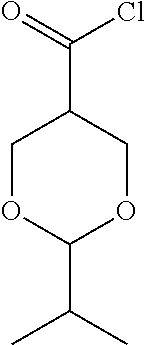
- the acylation of step a) is carried out in the presence of an acylation agent selected from DHP-COCl, acetyl chloride, 2-acetoxypropionyl chloride, chloroacetyl chloride, and acetoxyacetyl chloride.
- an acylation agent selected from DHP-COCl, acetyl chloride, 2-acetoxypropionyl chloride, chloroacetyl chloride, and acetoxyacetyl chloride.
- acylation agents have the following chemical formulae:
- acylation agent Chemical formula 2-(1-methylethyl)-1,3- dioxane-5-carboxylic acid chloride (DHPCOCl) 116193-72-7 Ethanoyl chloride or acetyl chloride 75-36-5 2-acetoxypropionyl chloride (or (2S)-1-chloro-1- oxopropan-2-ylacetate) 13831-31-7 Chloroacetyl chloride 79-04-9 Acetoxyacetyl chloride 13831-31-7
- the acylation of step a) is carried out in the presence of an acylation agent, preferably an acyl chloride, present in a quantity in the range 1 to 1.5 molar equivalents with respect to the quantity of 2,4,6-triiodo-5-aminoisophthalic acid; preferably in the range 1.1 to 1.3, for example 1.1 or 1.3 molar equivalents with respect to the quantity of 2,4,6-triiodo-5-aminoisophthalic acid.
- an acylation agent preferably an acyl chloride
- the chlorination of step b) is carried out in the presence of a chlorination agent selected from the group constituted by thionyl chloride, phosphorus oxychloride, phosphorus trichloride, oxalyl chloride, phosphorus pentachloride and methanoyl dichloride.
- the chlorination of step b) is carried out in the presence of a reagent selected from the group constituted by thionyl chloride, phosphorus trichloride and phosphorus pentachloride.
- the chlorination agent is thionyl chloride.
- the quantity of chlorination agent is in the range 2 to 6 molar equivalents with respect to the quantity of 2,4,6-triiodo-5-aminoisophthalic acid, preferably in the range 2.5 to 5 equivalents, more preferably in the range 3 to 5 equivalents, for example 3.5 or 5 equivalents, more preferably in the range 3.2 to 4 equivalents with respect to the quantity of 2,4,6-triiodo-5-aminoisophthalic acid.
- a step for the preparation of the acylation agent is carried out before step a), preferably without isolation of the acylation agent obtained.
- the process comprises a one-pot concatenation of the following steps:
- the synthesis of the acylation agent is carried out in the same reactor as that in which steps a) and b) in accordance with the invention will be carried out.
- the acylation agent is prepared by chlorination of the carboxylic acid corresponding thereto.
- the carboxylic acid corresponding to the acylation agent used in the preparation process in accordance with the invention is selected from 2-(1-methylethyl)-1,3-dioxane-5-carboxylic acid, acetic acid, acetoxypropionic acid, chloroacetic acid and acetoxyacetic acid.
- step a) is carried out for a period of 2 to 70 hours, preferably 2 to 24 h; and/or step b) is carried out for a period of 2 to 22 hours, preferably 4 to 12 h.
- step a) is carried out at a temperature of 10° C. to 70° C., preferably 15° C. to 60° C., more preferably 15° C. to 30° C., for example in the range 15° C. to 20° C.
- step b) is carried out at a temperature of ⁇ 15° C. to 30° C., preferably ⁇ 10° C. to 10° C., yet more preferably 0° C. to 10° C.
- the present invention also concerns a compound with the following general formula (Y1):
- R 1 being H or a methyl group, R 1 preferably being H, and
- R 2 being selected from the group constituted by:
- R 2 is as defined above for the organo-iodized compounds with general formula (I), with the condition that R 2 is different from the group
- the above compound has one of the following formulae:
- the compounds are the compounds (ay), (by) and (cy).
- the compounds with general formula (Y1) correspond in particular to the intermediate compounds Y as defined above.
- the present invention also concerns the use of compounds with general formula (Y1) as defined above, for the preparation of organo-iodized compounds, preferably with general formula (I) as defined above.
- the present invention also concerns the use of compounds with general formula (Y1) as defined above for the preparation of contrast agents, preferably for the preparation of iodized contrast agents and yet more preferably for the preparation of iopamidol (Iopamiron®), iohexol (Omnipaque®), ioversol (Optiray®), iomeprol (Iomeron®) or iobitridol (Xenetix®).
- iopamidol Iopamiron®
- iohexol Omnipaque®
- Optiray® ioversol
- iomeprol Iomeron®
- Xenetix® iobitridol
- the present invention concerns the use of the compound with general formula:
- the synthesis compounds were analysed using two Nuclear Magnetic Resonance techniques: proton NMR at 400 MHz and carbon-13 NMR at 100 MHz. The compounds were dissolved in DMSO-d6. The compounds were also analysed by Mass Spectrometry, in negative mode and in positive mode. The NMR identification was carried out using a 400 MHz NMR spectrometer from Bruker. The MS identification was carried out using a Thermo Fischer Q-Exactive Orbitrap type mass spectrometer.
- V is intended to designate a volume ratio, i.e. the volume of a reagent or a solvent with respect to 1 kg of AATI.
- eq is intended to designate a number for a molar equivalent, i.e. the ratio between the number of moles of a reagent and the number of moles of AATI.
- the medium was then fluidified with propylene carbonate (25 mL; volume ratio of 1), then cooled to a temperature of 5° C.
- thionyl chloride (18 g; equivalent molar ratio of 3.5) was added.
- the thionyl chloride addition lasted 2 hours at a temperature of 5° C.
- introduction of the reagent was complete, the chlorination reaction was carried out over a period of 5 hours at a temperature of 5° C.
- the degree of conversion thus obtained was 85% (s/s) of 5-[[[2-(1-methylethyl)-1,3-dioxan-5-yl]carbonyl]amino]-2,4,6-triiodo-1,3 benzenedicarbonyl dichloride.
- reaction medium was slowly added to a mixture of water/ethanol/sodium acetate.
- the solid obtained was filtered, washed, dried then analysed.
- the medium was heated up to a temperature of 18° C., then the acylation reaction was carried out over a period of 70 hours at a temperature of 18° C.
- the reaction medium was then cooled to a temperature of ⁇ 10° C. As soon as the medium had reached a temperature of ⁇ 10° C., thionyl chloride (26.6 g, 5 eq) was added. The thionyl chloride addition lasted 2 hours, at a temperature of ⁇ 10° C. When introduction of the reagent was complete, the chlorination reaction was carried out over a period of 12 hours at a temperature of ⁇ 10° C.
- the degree of conversion thus obtained was 86% (s/s) of 5-[[[2-(1-methylethyl)-1,3-dioxan-5-yl]carbonyl]amino]-2,4,6-triiodo-1,3-benzenedicarbonyl dichloride.
- reaction medium was then slowly added to a mixture of water/ethanol/sodium acetate.
- the solid obtained was filtered, washed, dried then analysed.
- Dimethylacetamide (67.5 mL; 1.35 V) and propylene carbonate (7.5 mL; 0.15 V) were mixed in a reactor with a volume of 250 mL.
- Acetyl chloride (7.7 g; 1.1 eq) was then added to the mixture. After cooling to a temperature of 15° C., 5-amino-2,4,6-triiodoisophthalic acid (50 g; 1 eq) was introduced over 30 minutes. When introduction was complete, the medium was heated up to a temperature of 18° C., then the acylation reaction was carried out over a period of 36 hours at a temperature of 18° C.
- the medium was then fluidified with dimethylacetamide (50 mL; 1 V) and propylene carbonate (50 mL; 1 V). Next, the medium was cooled to a temperature of 5° C.
- thionyl chloride 52.8 g; 5 eq
- the thionyl chloride addition lasted 2 hours at a temperature of 5° C.
- the chlorination reaction was carried out over a period of 5 hours at a temperature of 5° C.
- the degree of conversion thus obtained was 85% (s/s) of 5-(acetylamino)-2,4,6-triiodobenzene-1,3-dicarbonyl dichloride.
- reaction medium was slowly added to a mixture of water/ethanol/sodium acetate.
- the solid obtained was filtered, washed, dried then analysed.
- Dimethylacetamide (34 mL; 1.35 V) and propylene carbonate (3.75 mL; 0.15 V) were mixed in a reactor with a volume of 250 mL.
- (2S)-1-chloro-1-oxopropan-2-yl acetate (7.5 g; 1.1 eq) was then added to the mixture. After cooling to a temperature of 15° C., 5-amino-2,4,6-triiodoisophthalic acid (25 grams; 1 eq) was introduced over 30 minutes. When introduction was complete, the medium was heated up to a temperature of 18° C., then the acylation reaction was carried out over a period of 66 hours at a temperature of 18° C.
- the medium was then diluted with propylene carbonate (25 mL, 1 V). Next, the medium was cooled to a temperature of 5° C.
- thionyl chloride (18.5 g; 3.5 eq) was added.
- the thionyl chloride addition lasted 1 hour at a temperature of 5° C.
- the chlorination reaction was carried out over a period of 5 hours at a temperature of 5° C.
- the degree of conversion thus obtained was 87% (s/s) of 5- ⁇ [(2S)-2-(acetyloxy)-1-oxopropyl ⁇ amino-2,4,6-triiodo-1,3-benzendicarbonyl dichloride.
- reaction medium was slowly added to a mixture of water/ethanol/sodium acetate.
- the solid obtained was filtered, washed, dried then analysed.
- Dimethylacetamide (67.5 mL, 1.35 V) and propylene carbonate (7.5 mL; 0.15 V) were mixed in a reactor with a volume of 250 mL.
- the medium was then diluted with propylene carbonate (50 mL; 1 V). Next, the medium was cooled to a temperature of 5° C.
- thionyl chloride 37 g; 3.5 eq
- the thionyl chloride addition lasted 2 hours at a temperature of 5° C.
- the chlorination reaction was carried out over a period of 4 hours at a temperature of 5° C.
- the degree of conversion thus obtained was 90.5% (s/s) of 5- ⁇ [(acetyloxy)acetyl]amino ⁇ -2,4,6-triiodobenzene-1,3-dicarbonyl dichloride.
- the reaction medium was slowly added to a mixture of water/ethanol/sodium acetate.
- the solid obtained was filtered, washed, dried then analysed. The yield obtained was 87%.
- Dimethylacetamide (67.5 mL; 1.35 V) and propylene carbonate (7.5 mL; 0.15 V) were mixed in a reactor with a volume of 250 mL.
- Chloroacetyl chloride (11 g; 1.1 eq) was then added to the mixture. After cooling to a temperature of 15° C., 5-amino-2,4,6-triiodoisophthalic acid (50 g; 1 eq), was introduced in portions, i.e. approximately 3.4 g every two minutes, over 30 minutes. When introduction was complete, the medium was heated up to a temperature of 18° C., then the acylation reaction was carried out over a period of 40 hours at a temperature of 18° C.
- the medium was then fluidified with dimethylacetamide (50 mL; 1 V) and propylene carbonate (50 mL; 1 V). Next, the medium was cooled to a temperature of 5° C.
- thionyl chloride 52.9 g; 5 eq
- the thionyl chloride addition lasted 3 hours at a temperature of 5° C.
- the chlorination reaction was carried out over a period of 18 hours at a temperature of 5° C.
- the degree of conversion thus obtained was 88% (s/s) of 5-[(chloroacetyl)amino]-2,4,6-triiodobenzene-1,3-dicarbonyl dichloride.
- the reaction medium was slowly added to a mixture of water/ethanol/sodium acetate.
- the solid obtained was filtered, washed, dried then analysed. The yield obtained was 86%.
Landscapes
- Chemical & Material Sciences (AREA)
- Organic Chemistry (AREA)
- Chemical Kinetics & Catalysis (AREA)
- Organic Low-Molecular-Weight Compounds And Preparation Thereof (AREA)
Abstract
Description

-
- a) acylation of 2,4,6-triiodo-5-aminoisophthalic acid with the following formula (A):

-
- in order to obtain an intermediate compound Y;
- then
- b) chlorination of the intermediate compound Y obtained in step a);
- the steps a) and b) being carried out without isolation of the intermediate compound Y.

is carried out using an acyl chloride.
-
- a) acylation of 2,4,6-triiodo-5-aminoisophthalic acid with the following formula (A):

-
- by a compound with the following general formula (II):
R2—C(O)Cl (II) - in order to obtain an intermediate compound Y;
- then
- b) chlorination of the intermediate compound Y in order to obtain an organo-iodized compound with the following general formula (I):
- by a compound with the following general formula (II):

-
- R1 being H or a methyl group, R1 preferably being H, and
- R2 being selected from the group constituted by:
- (C1-C20)alkyl, linear or branched;
- (C1-C20)alkenyl, linear or branched;
- (C1-C20)alkynyl, linear or branched;
- (C3-C10)cycloalkyl;
- (C6-C10)aryl;
- a heterocyclyl comprising 3 to 10 atoms; and
- a heteroaryl comprising 6 to 10 atoms;
- said alkyl, alkenyl and/or alkynyl groups optionally being substituted with one or more substituent(s) selected from the group constituted by atoms of halogen, oxygen and nitrogen;
- said alkyl, alkenyl and/or alkynyl groups optionally being interrupted by one or more group(s) selected from the group constituted by —O—, —C(O)—O— and —O—C(O)—; and
- said cycloalkyl, heterocyclyl, aryl and/or heteroaryl groups optionally being substituted with one or more substituent(s) selected from the group constituted by (C1-C20)alkyl, which may be linear or branched, and atoms of halogen, oxygen and nitrogen.
-
- (C1-C10)alkyl, linear or branched;
- (C1-C10)alkenyl, linear or branched;
- (C1-C10)alkynyl, linear or branched;
- (C3-C10)cycloalkyl;
- a heterocyclyl comprising 3 to 10 atoms; and
- said alkyl, alkenyl and/or alkynyl groups optionally being substituted with one or more substituent(s) selected from the group constituted by halogen atoms;
- said alkyl, alkenyl and/or alkynyl groups optionally being interrupted by one or more group(s) selected from the group constituted by —O—, —C(O)—O— and —O—C(O)—; and
- said cycloalkyl and/or heterocyclyl groups optionally being substituted with one or more substituent(s) selected from the group constituted by (C1-C10)alkyl, which may be linear or branched, and halogen atoms.
-
- (C1-C20)alkyl, linear or branched; and
- a heterocyclyl comprising 3 to 10 atoms;
- said alkyl group optionally being substituted with one or more substituent(s) selected from the group constituted by halogen atoms;
- said alkyl group optionally being interrupted by one or more group(s) selected from the group constituted by —O—, —C(O)—O or —O—C(O)—; and
- said heterocyclyl group optionally being substituted with one or more substituent(s) selected from the group constituted by (C1-C20)alkyl, which may be linear or branched, and halogen atoms.


then this includes mention of both its (R) isomer and its (S) isomer, or in fact a racemic mixture of the (R) and (S) isomeric forms of this group.

and CH2Cl; preferably, R2 is:

| TABLE 1 |
| Organo-iodized compounds with general formula (I) and corresponding |
| contrast agents |
| Name of | ||
| contrast agent | ||
| Chemical formula of organo- | Name of organo-iodized | for which it is |
| iodized compound with | compound with general | the synthesis |
| general formula (I) | formula (I) | intermediate |
 | 5-[[[2-(1-methylethyl)-1,3-dioxan- 5-yl]carbonyl]amino]-2,4,6- triiodo-1,3-benzenedicarbonyl dichloride (or DICOA) | Iobitridol |
 | 5-{[(2S)-2-(acetyloxy)-1- oxopropyl}amino-2,4,6-triiodo- 1,3-benzene dicarbonyl dichloride | Iopamidol |
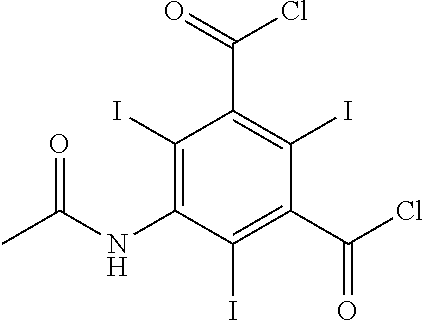 | 5-(acetylamino)-2,4,6- triiodobenzene-1,3-dicarbonyl dichloride | Iohexol Iodixanol |
 | 5{[(acetyloxy)acetyl]amino}- 2,4,6-triiodobenzene-1,3- dicarbonyl dichloride | Ioversol |
 | 5-[(chloroacetyl)amino]-2,4,6- triiodobenzene-1,3-dicarbonyl dichloride | Ioversol |
 | 5-{[(acetyloxy)- acetyl]methylamino}-2,4,6- triiodobenzene-1,3-dicarbonyl dichloride | Iomeprol |
The chemical formulae for these iodized contrast agents are as follows:
| Name of contrast agent | |
| (active principle and | |
| associated commercial name | Chemical formula |
| Iobitridol (XENETIX ®) |
 |
| Iopamidol (IOPAMIRON ®) |
 |
| Iohexol (OMNIPAQUE ®) |
 |
| Iodixanol (VISIPAQUE ®) |
 |
| Ioversol (OPTIJECT ®) |
 |
| Iomeprol (IOMERON ®) |
 |
| Name of acylation agent | CAS number | Chemical formula |
| 2-(1-methylethyl)-1,3- dioxane-5-carboxylic acid chloride (DHPCOCl) | 116193-72-7 |
 |
| Ethanoyl chloride or acetyl chloride | 75-36-5 |
 |
| 2-acetoxypropionyl chloride (or (2S)-1-chloro-1- oxopropan-2-ylacetate) | 13831-31-7 |
 |
| Chloroacetyl chloride | 79-04-9 |
 |
| Acetoxyacetyl chloride | 13831-31-7 |
 |
-
- preparation of the acylation agent;
- step a) for acylation, as defined above; and
- step b) for chlorination, as defined above.

-
- (C1-C20)alkyl, linear or branched;
- (C1-C20)alkenyl, linear or branched;
- (C1-C20)alkynyl, linear or branched;
- (C3-C10)cycloalkyl;
- (C6-C10)aryl;
- a heterocyclyl comprising 3 to 10 atoms; and
- a heteroaryl comprising 6 to 10 atoms;
- said alkyl, alkenyl and/or alkynyl groups optionally being substituted with one or more substituent(s) selected from the group constituted by atoms of halogen, oxygen and nitrogen;
- said alkyl, alkenyl and/or alkynyl groups optionally being interrupted by one or more group(s) selected from the group constituted by —O—, —C(O)—O— and —O—C(O)—; and
- said cycloalkyl, heterocyclyl, aryl and/or heteroaryl groups optionally being substituted with one or more substituent(s) selected from the group constituted by (C1-C20)alkyl, which may be linear or branched, and atoms of halogen, oxygen and nitrogen;
- with the condition that R2 is different from the group


- for the preparation of iobitridol,
- and/or the use of the compound with general formula

- for the preparation of ioversol, and/or the use of the compound with general formula (ey) for the preparation of iomeprol.
The examples given below are presented by way of illustration and are not a limitation of the invention.

Operating Method 1:
Acylation Step:

Acylation Step:

Acylation Step:

Acylation Step:

Acylation Step:
Claims (10)


R2—C(O)Cl (II)


Applications Claiming Priority (3)
| Application Number | Priority Date | Filing Date | Title |
|---|---|---|---|
| FR1751121 | 2017-02-10 | ||
| FR1751121A FR3062850B1 (en) | 2017-02-10 | 2017-02-10 | PROCESS FOR THE MONOTOPE PREPARATION OF ORGANO-IODINE COMPOUNDS |
| PCT/EP2018/053361 WO2018146285A1 (en) | 2017-02-10 | 2018-02-09 | Method for the one-pot production of organo-iodinated compounds |
Publications (2)
| Publication Number | Publication Date |
|---|---|
| US20200002269A1 US20200002269A1 (en) | 2020-01-02 |
| US10836711B2 true US10836711B2 (en) | 2020-11-17 |
Family
ID=59381338
Family Applications (1)
| Application Number | Title | Priority Date | Filing Date |
|---|---|---|---|
| US16/484,756 Active US10836711B2 (en) | 2017-02-10 | 2018-02-09 | Method for the one-pot production of organo-iodinated compounds |
Country Status (10)
| Country | Link |
|---|---|
| US (1) | US10836711B2 (en) |
| EP (1) | EP3580199B1 (en) |
| CN (1) | CN110267937B (en) |
| AR (1) | AR111036A1 (en) |
| ES (1) | ES2948507T3 (en) |
| FR (2) | FR3062850B1 (en) |
| IL (1) | IL268465B (en) |
| PT (1) | PT3580199T (en) |
| TW (1) | TWI770120B (en) |
| WO (1) | WO2018146285A1 (en) |
Cited By (1)
| Publication number | Priority date | Publication date | Assignee | Title |
|---|---|---|---|---|
| US11472767B2 (en) * | 2018-08-02 | 2022-10-18 | Guerbet | Process for the monotopic preparation of intermediate organo-iodinated compounds for the synthesis of ioversol |
Families Citing this family (2)
| Publication number | Priority date | Publication date | Assignee | Title |
|---|---|---|---|---|
| CN110903275A (en) * | 2018-09-14 | 2020-03-24 | 苏州科伦药物研究有限公司 | Process for producing iobitridol, intermediate therefor, and process for producing the same |
| CN116354842B (en) * | 2021-12-20 | 2024-12-03 | 重庆圣华曦药业股份有限公司 | Improved preparation method of iomeprol and application of iomeprol in preparation |
Citations (8)
| Publication number | Priority date | Publication date | Assignee | Title |
|---|---|---|---|---|
| US3210412A (en) | 1962-02-06 | 1965-10-05 | Mallinckrodt Chemical Works | m-(alkanamidoalkanamido)-2, 4, 6-triiodobenzoic acid compounds |
| US4141894A (en) * | 1976-11-02 | 1979-02-27 | Eli Lilly And Company | Trans-5a-aryl-decahydrobenzazepines |
| WO1996016927A1 (en) | 1994-11-29 | 1996-06-06 | Zambon Group S.P.A. | Process for preparing 5-amino-2,4,6-triiodoisophthalic acid dichloride by chlorination of the corresponding acid in the presence of a tertiary amine salt or quarternary ammonium salt |
| WO1996037460A1 (en) | 1995-05-23 | 1996-11-28 | Fructamine S.P.A. | Process for the preparation of a dicarboxylic acid dichloride |
| US5670136A (en) | 1994-06-24 | 1997-09-23 | Nahosystems L.L.C. | 2,4,6-triiodo-5-substituted-amino-isophthalate esters useful as x-ray contrast agents for medical diagnostics imaging |
| WO2006100731A1 (en) | 2005-03-18 | 2006-09-28 | Manac Inc. | Method for acetylating 5-amino-2,4,6-triiodoisophthalic acid derivative |
| WO2012175903A1 (en) | 2011-06-24 | 2012-12-27 | Hovione Inter. Ltd | Manufacture of a triiodinated contrast agent |
| GB2496971A (en) | 2011-11-25 | 2013-05-29 | Ge Healthcare As | Preparation of X-ray contrast agents |
Family Cites Families (3)
| Publication number | Priority date | Publication date | Assignee | Title |
|---|---|---|---|---|
| US5075502A (en) * | 1989-12-13 | 1991-12-24 | Mallinckrodt, Inc. | Nonionic x-ray contrast agents, compositions and methods |
| EP2230227A1 (en) * | 2009-03-20 | 2010-09-22 | Bracco Imaging S.p.A | Process for the preparation of triiodinated carboxylic aromatic derivatives |
| CN102887833B (en) * | 2011-07-21 | 2014-10-22 | 浙江司太立制药股份有限公司 | Iodine-containing dimer contrast medium |
-
2017
- 2017-02-10 FR FR1751121A patent/FR3062850B1/en active Active
- 2017-07-12 FR FR1756644A patent/FR3062851B1/en active Active
-
2018
- 2018-02-09 AR ARP180100331A patent/AR111036A1/en active IP Right Grant
- 2018-02-09 ES ES18703602T patent/ES2948507T3/en active Active
- 2018-02-09 PT PT187036025T patent/PT3580199T/en unknown
- 2018-02-09 EP EP18703602.5A patent/EP3580199B1/en active Active
- 2018-02-09 CN CN201880010778.7A patent/CN110267937B/en active Active
- 2018-02-09 US US16/484,756 patent/US10836711B2/en active Active
- 2018-02-09 WO PCT/EP2018/053361 patent/WO2018146285A1/en not_active Ceased
- 2018-02-12 TW TW107105073A patent/TWI770120B/en active
-
2019
- 2019-08-04 IL IL268465A patent/IL268465B/en unknown
Patent Citations (10)
| Publication number | Priority date | Publication date | Assignee | Title |
|---|---|---|---|---|
| US3210412A (en) | 1962-02-06 | 1965-10-05 | Mallinckrodt Chemical Works | m-(alkanamidoalkanamido)-2, 4, 6-triiodobenzoic acid compounds |
| US4141894A (en) * | 1976-11-02 | 1979-02-27 | Eli Lilly And Company | Trans-5a-aryl-decahydrobenzazepines |
| US5670136A (en) | 1994-06-24 | 1997-09-23 | Nahosystems L.L.C. | 2,4,6-triiodo-5-substituted-amino-isophthalate esters useful as x-ray contrast agents for medical diagnostics imaging |
| WO1996016927A1 (en) | 1994-11-29 | 1996-06-06 | Zambon Group S.P.A. | Process for preparing 5-amino-2,4,6-triiodoisophthalic acid dichloride by chlorination of the corresponding acid in the presence of a tertiary amine salt or quarternary ammonium salt |
| EP0794937B1 (en) | 1994-11-29 | 1999-04-07 | Bracco International B.V. | Process for preparing 5-amino-2,4,6-triiodoisophthalic acid dichloride by chlorination of the corresponding acid in the presence of a tertiary amine salt or quarternary ammonium salt |
| WO1996037460A1 (en) | 1995-05-23 | 1996-11-28 | Fructamine S.P.A. | Process for the preparation of a dicarboxylic acid dichloride |
| EP0773925B1 (en) | 1995-05-23 | 2000-02-09 | Fructamine S.P.A. | Process for the preparation of a dicarboxylic acid dichloride |
| WO2006100731A1 (en) | 2005-03-18 | 2006-09-28 | Manac Inc. | Method for acetylating 5-amino-2,4,6-triiodoisophthalic acid derivative |
| WO2012175903A1 (en) | 2011-06-24 | 2012-12-27 | Hovione Inter. Ltd | Manufacture of a triiodinated contrast agent |
| GB2496971A (en) | 2011-11-25 | 2013-05-29 | Ge Healthcare As | Preparation of X-ray contrast agents |
Non-Patent Citations (4)
| Title |
|---|
| "Constitute, v." OED Online. Oxford University Press, Dec. 2019. Web. Feb. 6, 2020, p. 1. * |
| Fontanive et al., "Myelography Iodinated Contrast Media. I. Unraveling the Atropisomerism Properties in Solution," Molecular Pharmaceutics, 2015, pp. 1939-1950, vol. 12. |
| Hayashi, "Pot Economy and One-Pot Synthesis", Chemical Science, 2016, pp. 866-880, vol. 7. |
| March, J., "Advanced Organic Chemistry. Hoboken." (2007): 1-1455 (excerpt p. 425 presented herein). * |
Cited By (1)
| Publication number | Priority date | Publication date | Assignee | Title |
|---|---|---|---|---|
| US11472767B2 (en) * | 2018-08-02 | 2022-10-18 | Guerbet | Process for the monotopic preparation of intermediate organo-iodinated compounds for the synthesis of ioversol |
Also Published As
| Publication number | Publication date |
|---|---|
| TW201831441A (en) | 2018-09-01 |
| FR3062851A1 (en) | 2018-08-17 |
| IL268465B (en) | 2022-01-01 |
| TWI770120B (en) | 2022-07-11 |
| AR111036A1 (en) | 2019-05-29 |
| US20200002269A1 (en) | 2020-01-02 |
| CN110267937B (en) | 2022-09-23 |
| FR3062851B1 (en) | 2020-05-22 |
| PT3580199T (en) | 2023-06-26 |
| ES2948507T3 (en) | 2023-09-13 |
| CN110267937A (en) | 2019-09-20 |
| FR3062850B1 (en) | 2020-01-31 |
| IL268465A (en) | 2019-09-26 |
| FR3062850A1 (en) | 2018-08-17 |
| EP3580199A1 (en) | 2019-12-18 |
| EP3580199B1 (en) | 2023-04-05 |
| WO2018146285A1 (en) | 2018-08-16 |
Similar Documents
| Publication | Publication Date | Title |
|---|---|---|
| JP5208917B2 (en) | Synthesis of acylaminoalkenylene amides useful as substance P antagonists | |
| KR20190077087A (en) | MAGL inhibitor | |
| UA108381C2 (en) | METHOD OF PREPARATION OF QUINOLINE-3-CARBOXAMIDES | |
| JP6523334B2 (en) | Method for the preparation of substituted cycloserines | |
| US20200002269A1 (en) | Method for the one-pot production of organo-iodinated compounds | |
| RU2742005C2 (en) | Methods for producing 4-alkoxy-3-(acyl or alkyl)oxypicolinamides | |
| JP2004231646A (en) | alpha,alpha-DIFLUOROAMINE, MIXTURE OF THE SAME, METHOD FOR PRODUCING THE SAME AND METHOD FOR PRODUCING FLUORINATED COMPOUND | |
| ES2629313T3 (en) | Preparation procedure of 1 - ([1,3] dioxolan-4-ylmethyl) -1 H -pyrazol-3-ylamine | |
| JP2021504418A (en) | Method for producing 2- (5-methoxyisochroman-1-yl) -4,5-dihydro-1H-imidazole and its hydrogen sulfate | |
| JP4263910B2 (en) | Process for the preparation of iopamidol and novel intermediates in the process | |
| JP2009242270A (en) | Method for producing 4-perfluoroisopropylaniline | |
| JP7399850B2 (en) | Method for producing aromatic nitrile compounds | |
| ITMI20101015A1 (en) | ONE-POT PROCESS FOR THE SYNTHESIS OF DALFAMPRIDINE | |
| ES2385624T3 (en) | Bis (2-alkoxyethyl) azodicarboxylate ester compound and intermediate for the production thereof | |
| JP4546952B2 (en) | Preparation of 2-cyano-3-hydroxy-N- (phenyl) but-2-enamide | |
| KR20230117260A (en) | Process for the preparation of 1-(3,5-dichlorophenyl)-2,2,2-trifluoroethanone and derivatives thereof | |
| EP3154933B1 (en) | Process for the preparation of 2-(trihalomethyl) benzamide | |
| US8357803B2 (en) | Process for the preparation of 2,3,4,9-tetrahydro-1H-β-carbolin-3-carboxylic acid esters | |
| ES2757073T3 (en) | Effective procedure for the synthesis of cyclic amides | |
| JP4202148B2 (en) | Method for producing 2-aminotropone | |
| JP5309680B2 (en) | Method for producing fluorinated ester compound and intermediate thereof | |
| WO2023058050A1 (en) | A process for preparation of pharmaceutically active compounds via selective nitro reduction reactions | |
| JP6030397B2 (en) | Caprolactam and production method thereof | |
| CA2710598A1 (en) | Synthesis of iodixanol in water | |
| JPH07247246A (en) | 1-phenyl-3-butyne derivative and its production |
Legal Events
| Date | Code | Title | Description |
|---|---|---|---|
| FEPP | Fee payment procedure |
Free format text: ENTITY STATUS SET TO UNDISCOUNTED (ORIGINAL EVENT CODE: BIG.); ENTITY STATUS OF PATENT OWNER: LARGE ENTITY |
|
| AS | Assignment |
Owner name: GUERBET, FRANCE Free format text: ASSIGNMENT OF ASSIGNORS INTEREST;ASSIGNORS:MYRIAM, PETTA;PELLINGHELLI, STEPHAN;REEL/FRAME:050325/0964 Effective date: 20190720 |
|
| AS | Assignment |
Owner name: GUERBET, FRANCE Free format text: CORRECTIVE ASSIGNMENT TO CORRECT THE INVENTOR PETTA'S FIRST AND LAST NAME ARE TRANSPOSED PREVIOUSLY RECORDED ON REEL 050325 FRAME 0964. ASSIGNOR(S) HEREBY CONFIRMS THE ASSIGNMENT;ASSIGNORS:PETTA, MYRIAM;PELLINGHELLI, STEPHAN;REEL/FRAME:050414/0740 Effective date: 20190720 |
|
| STPP | Information on status: patent application and granting procedure in general |
Free format text: NON FINAL ACTION MAILED |
|
| STPP | Information on status: patent application and granting procedure in general |
Free format text: RESPONSE TO NON-FINAL OFFICE ACTION ENTERED AND FORWARDED TO EXAMINER |
|
| STPP | Information on status: patent application and granting procedure in general |
Free format text: FINAL REJECTION MAILED |
|
| STPP | Information on status: patent application and granting procedure in general |
Free format text: PUBLICATIONS -- ISSUE FEE PAYMENT RECEIVED |
|
| STPP | Information on status: patent application and granting procedure in general |
Free format text: PUBLICATIONS -- ISSUE FEE PAYMENT VERIFIED |
|
| STCF | Information on status: patent grant |
Free format text: PATENTED CASE |
|
| MAFP | Maintenance fee payment |
Free format text: PAYMENT OF MAINTENANCE FEE, 4TH YEAR, LARGE ENTITY (ORIGINAL EVENT CODE: M1551); ENTITY STATUS OF PATENT OWNER: LARGE ENTITY Year of fee payment: 4 |