US10834003B2 - Systems and methods for adaptive bandwidth throttling - Google Patents
Systems and methods for adaptive bandwidth throttling Download PDFInfo
- Publication number
- US10834003B2 US10834003B2 US16/000,782 US201816000782A US10834003B2 US 10834003 B2 US10834003 B2 US 10834003B2 US 201816000782 A US201816000782 A US 201816000782A US 10834003 B2 US10834003 B2 US 10834003B2
- Authority
- US
- United States
- Prior art keywords
- bandwidth
- client device
- data
- files
- data packets
- Prior art date
- Legal status (The legal status is an assumption and is not a legal conclusion. Google has not performed a legal analysis and makes no representation as to the accuracy of the status listed.)
- Active, expires
Links
- 238000000034 method Methods 0.000 title claims abstract description 30
- 230000003044 adaptive effect Effects 0.000 title abstract description 4
- 238000011084 recovery Methods 0.000 claims abstract description 3
- 230000006870 function Effects 0.000 claims description 10
- 230000008859 change Effects 0.000 claims description 5
- 238000012546 transfer Methods 0.000 claims description 4
- 230000005540 biological transmission Effects 0.000 claims 2
- 230000008569 process Effects 0.000 description 13
- 238000010586 diagram Methods 0.000 description 9
- 238000012545 processing Methods 0.000 description 5
- 230000003247 decreasing effect Effects 0.000 description 4
- 230000008901 benefit Effects 0.000 description 3
- 238000004891 communication Methods 0.000 description 3
- 230000006872 improvement Effects 0.000 description 3
- 238000010924 continuous production Methods 0.000 description 2
- 238000013500 data storage Methods 0.000 description 2
- 230000003287 optical effect Effects 0.000 description 2
- 108010001267 Protein Subunits Proteins 0.000 description 1
- 238000003491 array Methods 0.000 description 1
- 239000004106 carminic acid Substances 0.000 description 1
- 230000015556 catabolic process Effects 0.000 description 1
- 238000006731 degradation reaction Methods 0.000 description 1
- 238000005516 engineering process Methods 0.000 description 1
- 230000007246 mechanism Effects 0.000 description 1
- 230000006855 networking Effects 0.000 description 1
- 230000002093 peripheral effect Effects 0.000 description 1
- 230000009467 reduction Effects 0.000 description 1
- 230000004044 response Effects 0.000 description 1
- 238000012360 testing method Methods 0.000 description 1
- 239000010409 thin film Substances 0.000 description 1
- 230000001052 transient effect Effects 0.000 description 1
Images



Classifications
-
- H—ELECTRICITY
- H04—ELECTRIC COMMUNICATION TECHNIQUE
- H04L—TRANSMISSION OF DIGITAL INFORMATION, e.g. TELEGRAPHIC COMMUNICATION
- H04L69/00—Network arrangements, protocols or services independent of the application payload and not provided for in the other groups of this subclass
- H04L69/24—Negotiation of communication capabilities
-
- H—ELECTRICITY
- H04—ELECTRIC COMMUNICATION TECHNIQUE
- H04L—TRANSMISSION OF DIGITAL INFORMATION, e.g. TELEGRAPHIC COMMUNICATION
- H04L47/00—Traffic control in data switching networks
- H04L47/10—Flow control; Congestion control
- H04L47/26—Flow control; Congestion control using explicit feedback to the source, e.g. choke packets
- H04L47/263—Rate modification at the source after receiving feedback
-
- H—ELECTRICITY
- H04—ELECTRIC COMMUNICATION TECHNIQUE
- H04L—TRANSMISSION OF DIGITAL INFORMATION, e.g. TELEGRAPHIC COMMUNICATION
- H04L47/00—Traffic control in data switching networks
- H04L47/70—Admission control; Resource allocation
- H04L47/74—Admission control; Resource allocation measures in reaction to resource unavailability
- H04L47/745—Reaction in network
-
- H—ELECTRICITY
- H04—ELECTRIC COMMUNICATION TECHNIQUE
- H04L—TRANSMISSION OF DIGITAL INFORMATION, e.g. TELEGRAPHIC COMMUNICATION
- H04L47/00—Traffic control in data switching networks
- H04L47/70—Admission control; Resource allocation
- H04L47/78—Architectures of resource allocation
- H04L47/781—Centralised allocation of resources
-
- H—ELECTRICITY
- H04—ELECTRIC COMMUNICATION TECHNIQUE
- H04L—TRANSMISSION OF DIGITAL INFORMATION, e.g. TELEGRAPHIC COMMUNICATION
- H04L47/00—Traffic control in data switching networks
- H04L47/70—Admission control; Resource allocation
- H04L47/82—Miscellaneous aspects
- H04L47/822—Collecting or measuring resource availability data
-
- H—ELECTRICITY
- H04—ELECTRIC COMMUNICATION TECHNIQUE
- H04L—TRANSMISSION OF DIGITAL INFORMATION, e.g. TELEGRAPHIC COMMUNICATION
- H04L67/00—Network arrangements or protocols for supporting network services or applications
- H04L67/01—Protocols
-
- H04L67/42—
-
- H—ELECTRICITY
- H04—ELECTRIC COMMUNICATION TECHNIQUE
- H04L—TRANSMISSION OF DIGITAL INFORMATION, e.g. TELEGRAPHIC COMMUNICATION
- H04L69/00—Network arrangements, protocols or services independent of the application payload and not provided for in the other groups of this subclass
- H04L69/28—Timers or timing mechanisms used in protocols
-
- H—ELECTRICITY
- H04—ELECTRIC COMMUNICATION TECHNIQUE
- H04L—TRANSMISSION OF DIGITAL INFORMATION, e.g. TELEGRAPHIC COMMUNICATION
- H04L47/00—Traffic control in data switching networks
- H04L47/10—Flow control; Congestion control
- H04L47/15—Flow control; Congestion control in relation to multipoint traffic
-
- H—ELECTRICITY
- H04—ELECTRIC COMMUNICATION TECHNIQUE
- H04L—TRANSMISSION OF DIGITAL INFORMATION, e.g. TELEGRAPHIC COMMUNICATION
- H04L47/00—Traffic control in data switching networks
- H04L47/70—Admission control; Resource allocation
- H04L47/80—Actions related to the user profile or the type of traffic
- H04L47/801—Real time traffic
Definitions
- the present invention relates generally to data backup, and relates more particularly to adaptive bandwidth throttling.
- An information handling system generally processes, compiles, stores, searches, backups, and/or communicates information or data for business, personal, or other purposes thereby allowing users to take advantage of the value of the information. Because technology and information handling needs and requirements vary between different users or applications, information handling systems may also vary regarding what information is handled, how the information is handled, how much information is processed, stored, or communicated, and how quickly and efficiently the information may be processed, stored, backed up, or communicated.
- information handling systems allow for information handling systems to be general or configured for a specific user or specific use, such as financial transaction processing, airline reservations, enterprise data storage, global communications, data backups, or storage.
- information handling systems may include a variety of hardware and software components that may be configured to process, store, and communicate information and may include one or more computer systems, data storage systems, and networking systems.
- Data backups are useful in the event of physical or virtual loss of information. However, data backups are often run in the background while other applications run as well. Data backups are useful in the event of a loss and therefore necessary for peace of mind. Since the backup is only used in the event of a loss, the backup typically takes relatively low priority in terms of network bandwidth so that other more mission critical and time sensitive applications can take higher priority.
- email applications are typically tier one applications taking a high rank in terms of network bandwidth priority.
- Backup operations are typically a tier three application, taking a relatively lower priority in terms of network bandwidth.
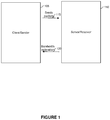
- FIG. 1 depicts a high-level block diagram of a client-server backup system according to embodiments in this patent document.
- FIG. 2 depicts a block diagram of a bandwidth estimation portion of a server in a client-server backup system according to embodiments of the present disclosure.
- FIG. 3 depicts a block diagram of a bandwidth estimation portion of a client in a client-server backup system according to embodiments of the present disclosure.
- FIG. 4 depicts a flow chart of a client-server backup according to embodiments of the present invention.
- FIG. 5 depicts a flow chart of a client-server backup according to embodiments of the present invention.
- FIG. 6 depicts a block diagram of a computer system 600 according to embodiments of the present invention.
- connections between components or systems within the figures are not intended to be limited to direct connections. Rather, data between these components may be modified, re-formatted, or otherwise changed by intermediary components. Also, additional or fewer connections may be used. It shall also be noted that the terms “link,” “linked,” “coupled,” “connected,” “communicatively coupled,” or their variants shall be understood to include direct connections, indirect connections through one or more intermediary devices, and wireless connections.
- a service, function, or resource is not limited to a single service, function, or resource; usage of these terms may refer to a grouping of related services, functions, or resources, which may be distributed or aggregated.
- memory, database, information base, data store, tables, hardware, and the like may be used herein to refer to system component or components into which information may be entered or otherwise recorded.
- the present invention relates in various embodiments to devices, systems, methods, and instructions stored on one or more non-transitory computer-readable media involving bandwidth estimation.
- Such devices, systems, methods, and instructions stored on one or more non-transitory computer-readable media can result in, among other advantages, bandwidth estimation.
- FIG. 1 depicts a high-level block diagram of a client-server backup system 100 according to embodiments in this patent document.
- FIG. 1 shows a client-server backup system 100 , where a client 105 can be backed up onto a server 110 . While FIG. 1 is described with respect to a data backup system, FIG. 1 also applies to a data recovery system or any system where data is sent.
- backups are performed on a client device 105 .
- Client device 105 can be any device connected to a network, for example, a laptop, Personal Computer (PC), tablet, phone, game system, watch, wearable computer, set top box, media device, etc.
- Many client devices 105 are mobile devices that can easily be moved from one network to another.
- an employee can have a laptop computer used for work. That laptop can be used at the company's headquarters. It can also be used at a remote office, at home, or in the field. In each of those scenarios the laptop can be connected to a different network having a different set of bandwidth limitations. Further, even within one network, there can be different bandwidth limitations at different times. For example, on a Friday where many employees work from home, there may greater available bandwidth than on a day with the company is holding an all hands meeting and every employee is connected in the office.
- backup systems can backup client devices 105 , the backup is required to work around the bandwidth constraints of the various networks involved.
- the network bandwidth can be known and the backup can operate in the background.
- the network bandwidth is not known.
- a set bandwidth rule is applied.
- the rule of do not cross the threshold of 1 Mbps.
- the threshold can be too high and in others the threshold can be too low.
- the enterprise system allows the back up to use a certain percentage of available bandwidth (bandwidth limit), q %, for example 30% or 40% of available bandwidth. Without knowing the bandwidth, the backup system cannot know if it is meeting those requirements. If the backup is using too little of the available bandwidth, then the backup process is less efficient and will operate more slowly. If the backup is using too much of the available bandwidth, then other, perhaps higher tier applications, will suffer bandwidth loss and suffer a degradation in performance. Similarly, there are bandwidth constraints when performing a data restore operation.
- bandwidth limit bandwidth
- the bandwidth estimation method can be able to estimate available bandwidth using backup data only. If the bandwidth estimation is done on additional (non-backup) data, then the backup process is less efficient as non-application data will consume some bandwidth.
- the bandwidth estimation can be a continuous process.
- the backup application can react to changes in available bandwidth, and adjust (increase or decrease) its bandwidth usage accordingly. If bandwidth estimation is not a continuous process, and backup application fails to react to changes in available bandwidth, then the backup will be less efficient. For example, if there is an increase in available bandwidth (for example, bandwidth made available by other applications or users), or the backup process will impact other higher tier applications (for example, a higher tier application is started later), then the backup process is less efficient.
- the backup application should limit its bandwidth usage to the configured bandwidth usage limit even while estimating available bandwidth. If the bandwidth estimation uses more than the allowed bandwidth, then the backup application will impact other higher tier applications.
- FIG. 1 shows client 105 sending a data 115 packet to server 110 .
- client 105 sends a small packet 115 to server 110 .
- a small packet is small relative to an expected bandwidth prediction.
- the network bandwidth is 10 Megabits per second.
- the network bandwidth is an unknown to the devices on the network and the server.
- the network bandwidth should be estimated.
- the client in order to perform that estimation, can determine how to break up the data to send to the server. For example, the client can send a packet having a payload of size P bits.
- the server can determine the estimated bandwidth, E 120 . This process of bandwidth estimation can be repeated with each iteration changing the packet size P using a mathematical formula F until the estimate is reliable according to an estimate reliability criteria C.
- a reliable bandwidth estimate criteria is the size of the payload (P) on which the bandwidth was estimated is sufficiently large to get correct estimates. That is, size of the payload on which bandwidth was estimated is greater than some fraction (1/x) of the data that can be send in a second when transferred at the rate equal to the estimated bandwidth.
- Another example of a reliable estimate criteria is when there is no further improvement in bandwidth estimates by increasing the payload size. Improvement in estimates are getting better by very small rate, i.e., error rate from the previous bandwidth estimate to the current bandwidth estimate is within an acceptable threshold.
- the bandwidth usage limit L can be increased. L can be increased only by a factor, for example, by a multiplier, b.
- the multiplier a is 50%. In embodiments, the multiplier b is 25%. Multipliers a and b are used while adjusting L in response to change in estimates so that the L is not changed drastically due to sudden or transient changes in network. In embodiments, where E is decreasing, L can be decreased more aggressively to avoid choking the network.
- bandwidth limit (q) refers to the limit percentage of network bandwidth allocated to the backup.
- bandwidth estimate E is determined. Once the estimated bandwidth is reliable, the bandwidth is used to adjust bandwidth usage limit. If the estimate is not reliable, packet size is changed to make further estimates reliable. This process continues for the entire time data is sent.
- the client/sender can send a 0.5 Megabit packet to the server. Since that packet size is small relative to the actual bandwidth, the packet will arrive very quickly and the estimate will likely be very high. Since the estimate is high, the conditions for bandwidth reliability will not be satisfied. Therefore, the client can send another packet with a larger size. In this example, the next packet can be 1 Megabits. That estimate will also be high, so another packet can be send, perhaps 2 Megabits. This process of increasing the packet size according to a formula continues until at least one of the bandwidth reliability conditions are met.
- bandwidth reliability criteria once the estimated bandwidth is equal to or less than five times (considering x to be 5 in this example) the last transferred data payload (with some acceptable error) or the new estimates differ from previous estimates by no more than 10% the bandwidth reliability criteria is considered to be met.
- a packet of 0.5 Mbit can be sent to the server 110 .
- Server 110 will receive the packet, time stamp the packet, and perform a bandwidth estimation based on the timestamp. Since the packet is small, the packet will be received almost instantaneously. Therefore, the bandwidth estimation will be high. Server 110 sends back the bandwidth estimation 120 to the client 105 .
- client 105 can send a larger test data packet.
- client 105 can send a 1 Mbit data packet to server 110 .
- server 110 receives the packet, timestamps the packet, and performs a bandwidth estimation.
- server 110 sends the bandwidth estimation 120 to client 105 .
- this process continues until the bandwidth estimation is reliable.
- the bandwidth is reliable when the estimate is approximately five times or smaller than the packet size.
- a different multiplier or formula can be used to define the reliability criteria.
- the bandwidth estimation at five times the packet size is deemed to be a reliable bandwidth estimation.
- the bandwidth estimation continues as the data packet is sent. Further, bandwidth estimation continues so that the transfer limit can be adjusted if necessary due to a changing network bandwidth.
- E new is much less than E prev , then P can be reduced by a large amount to accommodate actual reduction in available bandwidth and avoid congestion.
- the bandwidth estimation process occurs. Knowing the bandwidth estimation means that the backup system can use its full available bandwidth without going over its available limits.
- FIG. 2 depicts a block diagram 200 of a bandwidth estimation portion of a server in a client-server backup system according to embodiments of the present disclosure.
- FIG. 2 shows server 205 .
- Server 205 includes client interface 210 .
- Client interface 210 receives data packets from the client.
- Client interface 210 also sends the bandwidth estimation to the client.
- Bandwidth estimator 215 time stamps the received data packet and performs a bandwidth estimation based on the time the packet was received.
- Bandwidth estimator 215 also sends the bandwidth estimation to client interface 210 .
- Bandwidth estimator can be executed on a processor.
- Memory 220 stores the data packet, timestamp information, and bandwidth estimation.
- FIG. 3 depicts a block diagram 300 of a bandwidth estimation portion of a client 305 in a client-server backup system according to embodiments of the present disclosure.
- FIG. 3 shows client 305 including server interface 310 .
- Server interface 310 sends a data packet to the server. The server estimates network bandwidth as discussed above.
- Server interface 310 also receives bandwidth estimation information from the server.
- Memory 320 stores the data packets, including meta data information, for example, the data packet size, and the bandwidth estimation.
- Bandwidth comparator compares the bandwidth estimation to the data packets size. If the bandwidth estimation has met estimate reliability criteria, then the bandwidth estimation is a reliable one and the client can stop sending to the server and begin sending data packets using transfer limit, L, and packet size, P, to the server.
- FIG. 4 depicts a flow chart 400 of a client-server backup according to embodiments of the present invention.
- FIG. 4 shows embodiments of a flow chart of a server side of a client-server backup.
- FIG. 4 shows the server receiving a data packet 405 .
- the data packet can be sent by the client to estimate the network bandwidth.
- the server timestamps receipt of the data packet 410 .
- Server determines a bandwidth estimation 415 and sends the bandwidth estimation to the client 420 .
- Server repeats the flow 400 for every payload it receives.
- FIG. 5 depicts a flow chart 500 of a client-server backup according to embodiments of the present invention.
- FIG. 5 shows the client side of a client-server backup.
- FIG. 5 shows initializing E by setting E prev equal to E new equal to E initial 505 .
- FIG. 5 also shows sending application data in chunks of size P. Limiting bandwidth usage to L while sending the packets 510 .
- FIG. 5 also shows receiving estimated bandwidth E new from the server. The server estimates and sends the bandwidth estimate only on packets of size greater than or equal to P 515 .
- E new is checked for reliability 520 . If E new is not reliable, then update the packet size 525 .
- One example of a way the packet size can be updated is by increasing P by y 525 .
- FIG. 5 also shows checking to see if L is greater than P 545 . If L is greater than P, then send the application data in chunks of P and limit the bandwidth usage to L while sending the packets 510 . If L is not greater than P, then the limit is reduced based on reliable estimates 550 . P is reduced and P is set equal to L 550 . Then send the application data in chunks of P and limit the bandwidth usage to L while sending the packets 510 .
- FIG. 6 depicts a block diagram of a computer system 600 according to embodiments of the present invention. It will be understood that the functionalities shown for system 600 may operate to support various embodiments of an information handling system—although it shall be understood that an information handling system may be differently configured and include different components.
- system 600 includes a central processing unit (CPU) 601 that provides computing resources and controls the computer.
- CPU 601 may be implemented with a microprocessor or the like, and may also include a graphics processor and/or a floating-point coprocessor for mathematical computations.
- System 600 may also include a system memory 602 , which may be in the form of random-access memory (RAM) and read-only memory (ROM).
- RAM random-access memory
- ROM read-only memory
- An input controller 603 represents an interface to various input device(s) 604 , such as a keyboard, mouse, or stylus.
- a scanner controller 605 which communicates with a scanner 606 .
- System 600 may also include a storage controller 607 for interfacing with one or more storage devices 608 each of which includes a storage medium such as magnetic tape or disk, or an optical medium that might be used to record programs of instructions for operating systems, utilities and applications which may include embodiments of programs that implement various aspects of the present invention.
- Storage device(s) 608 may also be used to store processed data or data to be processed in accordance with the invention.
- System 600 may also include a display controller 609 for providing an interface to a display device 611 , which may be a cathode ray tube (CRT), a thin film transistor (TFT) display, or other type of display.
- the computing system 600 may also include a printer controller 612 for communicating with a printer 613 .
- a communications controller 614 may interface with one or more communication devices 615 , which enables system 600 to connect to remote devices through any of a variety of networks including the Internet, an Ethernet cloud, an FCoE/DCB cloud, a local area network (LAN), a wide area network (WAN), a storage area network (SAN) or through any suitable electromagnetic carrier signals including infrared signals.
- LAN local area network
- WAN wide area network
- SAN storage area network
- bus 616 which may represent more than one physical bus.
- various system components may or may not be in physical proximity to one another.
- input data and/or output data may be remotely transmitted from one physical location to another.
- programs that implement various aspects of this invention may be accessed from a remote location (e.g., a server) over a network.
- Such data and/or programs may be conveyed through any of a variety of machine-readable medium including, but are not limited to: magnetic media such as hard disks, floppy disks, and magnetic tape; optical media such as CD-ROMs and holographic devices; magneto-optical media; and hardware devices that are specially configured to store or to store and execute program code, such as application specific integrated circuits (ASICs), programmable logic devices (PLDs), flash memory devices, and ROM and RAM devices.
- ASICs application specific integrated circuits
- PLDs programmable logic devices
- flash memory devices ROM and RAM devices.
- Embodiments of the present invention may be encoded upon one or more non-transitory computer-readable media with instructions for one or more processors or processing units to cause steps to be performed.
- the one or more non-transitory computer-readable media shall include volatile and non-volatile memory.
- alternative implementations are possible, including a hardware implementation or a software/hardware implementation.
- Hardware-implemented functions may be realized using ASIC(s), programmable arrays, digital signal processing circuitry, or the like. Accordingly, the “means” terms in any claims are intended to cover both software and hardware implementations.
- the term “computer-readable medium or media” as used herein includes software and/or hardware having a program of instructions embodied thereon, or a combination thereof.
Landscapes
- Engineering & Computer Science (AREA)
- Computer Networks & Wireless Communication (AREA)
- Signal Processing (AREA)
- Computer Security & Cryptography (AREA)
- Data Exchanges In Wide-Area Networks (AREA)
Abstract
Description
L new =L prev−(E prev E new)×q×a
L new =L prev+(E new −E prev)×q×b
L=L+(E new −E prev)×q×a
L=L+(E new −E prev)×q×b
Claims (20)
Applications Claiming Priority (2)
| Application Number | Priority Date | Filing Date | Title |
|---|---|---|---|
| IN201821001989 | 2018-01-17 | ||
| IN201821001989 | 2018-01-17 |
Publications (2)
| Publication Number | Publication Date |
|---|---|
| US20190222525A1 US20190222525A1 (en) | 2019-07-18 |
| US10834003B2 true US10834003B2 (en) | 2020-11-10 |
Family
ID=67214474
Family Applications (1)
| Application Number | Title | Priority Date | Filing Date |
|---|---|---|---|
| US16/000,782 Active 2039-01-18 US10834003B2 (en) | 2018-01-17 | 2018-06-05 | Systems and methods for adaptive bandwidth throttling |
Country Status (1)
| Country | Link |
|---|---|
| US (1) | US10834003B2 (en) |
Families Citing this family (2)
| Publication number | Priority date | Publication date | Assignee | Title |
|---|---|---|---|---|
| US11716508B2 (en) * | 2019-02-01 | 2023-08-01 | Ntt Docomo, Inc. | Information processing apparatus, server apparatus, and information processing system |
| US10834009B2 (en) * | 2019-03-18 | 2020-11-10 | Intel Corporation | Systems and methods for predictive scheduling and rate limiting |
Citations (9)
| Publication number | Priority date | Publication date | Assignee | Title |
|---|---|---|---|---|
| US20040071085A1 (en) * | 2000-11-28 | 2004-04-15 | Oded Shaham | System and method for a transmission rate controller |
| US20070097987A1 (en) * | 2003-11-24 | 2007-05-03 | Rey Jose L | Feedback provision using general nack report blocks and loss rle report blocks |
| US7453801B2 (en) * | 2001-11-08 | 2008-11-18 | Qualcomm Incorporated | Admission control and resource allocation in a communication system supporting application flows having quality of service requirements |
| US20110066752A1 (en) * | 2009-09-14 | 2011-03-17 | Lisa Ellen Lippincott | Dynamic bandwidth throttling |
| US9781046B1 (en) * | 2013-11-19 | 2017-10-03 | Tripwire, Inc. | Bandwidth throttling in vulnerability scanning applications |
| US20180123905A1 (en) * | 2006-12-29 | 2018-05-03 | Kip Prod P1 Lp | System and method for providing network support services and premises gateway support infrastructure |
| US20180367607A1 (en) * | 2017-06-14 | 2018-12-20 | Vmware, Inc. | Top-of-rack switch replacement for hyper-converged infrastructure computing environments |
| US10447594B2 (en) * | 2012-06-21 | 2019-10-15 | Microsoft Technology Licensing, Llc | Ensuring predictable and quantifiable networking performance |
| US10630553B2 (en) * | 2015-08-18 | 2020-04-21 | Walmart Apollo, Llc | Bandwidth throttling |
Family Cites Families (1)
| Publication number | Priority date | Publication date | Assignee | Title |
|---|---|---|---|---|
| JP4968219B2 (en) * | 2008-09-18 | 2012-07-04 | 株式会社Jvcケンウッド | Liquid crystal display device and video display method used therefor |
-
2018
- 2018-06-05 US US16/000,782 patent/US10834003B2/en active Active
Patent Citations (9)
| Publication number | Priority date | Publication date | Assignee | Title |
|---|---|---|---|---|
| US20040071085A1 (en) * | 2000-11-28 | 2004-04-15 | Oded Shaham | System and method for a transmission rate controller |
| US7453801B2 (en) * | 2001-11-08 | 2008-11-18 | Qualcomm Incorporated | Admission control and resource allocation in a communication system supporting application flows having quality of service requirements |
| US20070097987A1 (en) * | 2003-11-24 | 2007-05-03 | Rey Jose L | Feedback provision using general nack report blocks and loss rle report blocks |
| US20180123905A1 (en) * | 2006-12-29 | 2018-05-03 | Kip Prod P1 Lp | System and method for providing network support services and premises gateway support infrastructure |
| US20110066752A1 (en) * | 2009-09-14 | 2011-03-17 | Lisa Ellen Lippincott | Dynamic bandwidth throttling |
| US10447594B2 (en) * | 2012-06-21 | 2019-10-15 | Microsoft Technology Licensing, Llc | Ensuring predictable and quantifiable networking performance |
| US9781046B1 (en) * | 2013-11-19 | 2017-10-03 | Tripwire, Inc. | Bandwidth throttling in vulnerability scanning applications |
| US10630553B2 (en) * | 2015-08-18 | 2020-04-21 | Walmart Apollo, Llc | Bandwidth throttling |
| US20180367607A1 (en) * | 2017-06-14 | 2018-12-20 | Vmware, Inc. | Top-of-rack switch replacement for hyper-converged infrastructure computing environments |
Also Published As
| Publication number | Publication date |
|---|---|
| US20190222525A1 (en) | 2019-07-18 |
Similar Documents
| Publication | Publication Date | Title |
|---|---|---|
| JP6457447B2 (en) | Data center network traffic scheduling method and apparatus | |
| US9519432B1 (en) | Self-adjusting backup operations | |
| US10866750B2 (en) | System and method for predicting data storage characteristics | |
| EP3679473B1 (en) | A system and method for stream processing | |
| US20160344631A1 (en) | Congestion notification system | |
| US20210303420A1 (en) | Data refresh in a replication environment | |
| CN115202924B (en) | Method, electronic device and computer program product for storage management | |
| US20170220424A1 (en) | Recovery point objectives in replication envrionments | |
| US20130190026A1 (en) | Enhanced resource management for a network system | |
| US20210352001A1 (en) | Available network bandwidth estimation using a one-way-delay noise filter with bump detection | |
| US20190222525A1 (en) | Systems and methods for adaptive bandwidth throttling | |
| CN110389857B (en) | Method, apparatus and non-transitory computer storage medium for data backup | |
| CN114553959A (en) | Situation awareness-based cloud native service grid configuration on-demand issuing method and application | |
| US20060287738A1 (en) | Optimized performance counter monitoring | |
| EP3328010B1 (en) | Adaptive jitter buffer | |
| CN112148551B (en) | Method, apparatus and computer program product for determining a rate of change of usage of a storage system | |
| CN110968257A (en) | Method, apparatus and computer program product for storage management | |
| CN108390737B (en) | Single satellite link performance analysis method based on intermittent service capability model | |
| US20170147229A1 (en) | Method of Reordering a Queue of Write Requests | |
| US20240205172A1 (en) | Packet forwarding in an information handling system with loopback configuration | |
| US9971654B2 (en) | Safe storing data for disaster recovery | |
| US11271838B2 (en) | Timing synchronization | |
| US20230337058A1 (en) | Apparatuses and methods for facilitating a remote gateway on a cloud platform | |
| CN118034994A (en) | Data processing method, device, electronic device and storage medium | |
| US11526499B2 (en) | Adaptively updating databases of publish and subscribe systems using optimistic updates |
Legal Events
| Date | Code | Title | Description |
|---|---|---|---|
| FEPP | Fee payment procedure |
Free format text: ENTITY STATUS SET TO UNDISCOUNTED (ORIGINAL EVENT CODE: BIG.); ENTITY STATUS OF PATENT OWNER: SMALL ENTITY |
|
| FEPP | Fee payment procedure |
Free format text: ENTITY STATUS SET TO SMALL (ORIGINAL EVENT CODE: SMAL); ENTITY STATUS OF PATENT OWNER: SMALL ENTITY |
|
| AS | Assignment |
Owner name: DRUVA TECHNOLOGIES PTE. LTD., SINGAPORE Free format text: ASSIGNMENT OF ASSIGNORS INTEREST;ASSIGNORS:DHANAVATH, SAIDA;SHAH, AALOP S;SAXENA, ASHISH K;REEL/FRAME:046274/0736 Effective date: 20180105 |
|
| STPP | Information on status: patent application and granting procedure in general |
Free format text: DOCKETED NEW CASE - READY FOR EXAMINATION |
|
| AS | Assignment |
Owner name: DRUVA, INC., CALIFORNIA Free format text: ASSIGNMENT OF ASSIGNORS INTEREST;ASSIGNOR:DRUVA TECHNOLOGIES PTE LTD;REEL/FRAME:050806/0622 Effective date: 20190925 |
|
| STPP | Information on status: patent application and granting procedure in general |
Free format text: NON FINAL ACTION MAILED |
|
| STPP | Information on status: patent application and granting procedure in general |
Free format text: RESPONSE TO NON-FINAL OFFICE ACTION ENTERED AND FORWARDED TO EXAMINER |
|
| STPP | Information on status: patent application and granting procedure in general |
Free format text: PUBLICATIONS -- ISSUE FEE PAYMENT RECEIVED |
|
| STCF | Information on status: patent grant |
Free format text: PATENTED CASE |
|
| MAFP | Maintenance fee payment |
Free format text: PAYMENT OF MAINTENANCE FEE, 4TH YR, SMALL ENTITY (ORIGINAL EVENT CODE: M2551); ENTITY STATUS OF PATENT OWNER: SMALL ENTITY Year of fee payment: 4 |