US10828838B2 - 3D printing support structures incorporating sacrificial materials - Google Patents
3D printing support structures incorporating sacrificial materials Download PDFInfo
- Publication number
- US10828838B2 US10828838B2 US16/123,625 US201816123625A US10828838B2 US 10828838 B2 US10828838 B2 US 10828838B2 US 201816123625 A US201816123625 A US 201816123625A US 10828838 B2 US10828838 B2 US 10828838B2
- Authority
- US
- United States
- Prior art keywords
- poly
- support material
- carbonate
- alkylene carbonate
- material according
- Prior art date
- Legal status (The legal status is an assumption and is not a legal conclusion. Google has not performed a legal analysis and makes no representation as to the accuracy of the status listed.)
- Active, expires
Links
Images


Classifications
-
- B—PERFORMING OPERATIONS; TRANSPORTING
- B29—WORKING OF PLASTICS; WORKING OF SUBSTANCES IN A PLASTIC STATE IN GENERAL
- B29C—SHAPING OR JOINING OF PLASTICS; SHAPING OF MATERIAL IN A PLASTIC STATE, NOT OTHERWISE PROVIDED FOR; AFTER-TREATMENT OF THE SHAPED PRODUCTS, e.g. REPAIRING
- B29C64/00—Additive manufacturing, i.e. manufacturing of three-dimensional [3D] objects by additive deposition, additive agglomeration or additive layering, e.g. by 3D printing, stereolithography or selective laser sintering
- B29C64/40—Structures for supporting 3D objects during manufacture and intended to be sacrificed after completion thereof
-
- B—PERFORMING OPERATIONS; TRANSPORTING
- B29—WORKING OF PLASTICS; WORKING OF SUBSTANCES IN A PLASTIC STATE IN GENERAL
- B29K—INDEXING SCHEME ASSOCIATED WITH SUBCLASSES B29B, B29C OR B29D, RELATING TO MOULDING MATERIALS OR TO MATERIALS FOR MOULDS, REINFORCEMENTS, FILLERS OR PREFORMED PARTS, e.g. INSERTS
- B29K2069/00—Use of PC, i.e. polycarbonates or derivatives thereof, as moulding material
-
- B—PERFORMING OPERATIONS; TRANSPORTING
- B33—ADDITIVE MANUFACTURING TECHNOLOGY
- B33Y—ADDITIVE MANUFACTURING, i.e. MANUFACTURING OF THREE-DIMENSIONAL [3-D] OBJECTS BY ADDITIVE DEPOSITION, ADDITIVE AGGLOMERATION OR ADDITIVE LAYERING, e.g. BY 3-D PRINTING, STEREOLITHOGRAPHY OR SELECTIVE LASER SINTERING
- B33Y40/00—Auxiliary operations or equipment, e.g. for material handling
-
- B—PERFORMING OPERATIONS; TRANSPORTING
- B33—ADDITIVE MANUFACTURING TECHNOLOGY
- B33Y—ADDITIVE MANUFACTURING, i.e. MANUFACTURING OF THREE-DIMENSIONAL [3-D] OBJECTS BY ADDITIVE DEPOSITION, ADDITIVE AGGLOMERATION OR ADDITIVE LAYERING, e.g. BY 3-D PRINTING, STEREOLITHOGRAPHY OR SELECTIVE LASER SINTERING
- B33Y70/00—Materials specially adapted for additive manufacturing
Definitions
- This disclosure is generally directed additive manufacturing, including three dimensional (3D) manufacturing. This disclosure also relates to products made by additive manufacturing.
- 3D printing also known as additive manufacturing (AM)
- AM additive manufacturing
- additive manufacturing is a type of printing technology whereby physical objects are built-up in an “additive” process, most commonly by curing liquid resins, extruding molten plastic from heated nozzles, or sintering layers of polymeric or metallic powders.
- Structural supports are required for most AM processes. For example, for fused deposition modeling (FDM) printing of polymeric parts, supports of the same or a different material are used and must be removed by cutting and sanding away the part, or melting or dissolving if the support material is meltable or dissolvable. Even in the cases of melting or dissolving, the process will involve an extra step of placing the object in a bath or scraping away melted wax, etc.
- FDM fused deposition modeling
- Other AM techniques require a support material that is highly supportive, easily removable, and enables automation.
- SLS selective laser sintering
- metallic powder printing use a powder, with the powder bed generally being self-supporting.
- SLS selective laser sintering
- newer processes are emerging, making use of layer-by-layer powders, and these processes require supports that must be easily removed.
- Electrophotographic printing to make 3D objects has been demonstrated and utilizes 3D support powders to function.
- the support material includes poly(alkylene carbonate) having a decomposition temperature of from 100° C. to about 300° C.
- a three-dimensionally article comprising a build material and a support material.
- the support material includes poly(alkylene carbonate) having a decomposition temperature of from 100° C. to about 300° C.
- a further aspect described herein provides a method of printing a three-dimensional article.
- the method includes printing a build material and printing a support material.
- the support material includes poly(alkylene carbonate) and the support material supports the build material.
- the support material is heated to a temperature above the decomposition temperature of the support material.
- the support material decomposes leaving the printed build material.
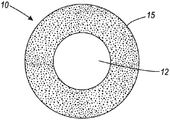
- FIG. 1 is a schematic illustration of a core/shell particle according to various embodiments disclosed herein.
- FIG. 2 is a schematic illustration of a particle according to various embodiments disclosed herein.
- FIG. 3 is a schematic illustration of a filament according to various embodiments disclosed herein.
- FIGS. 4(A) and 4(B) show schematically an embodiment for forming a 3D object using core/shell particles disclosed herein.
- a range of “less than 10” can include any and all sub-ranges between (and including) the minimum value of zero and the maximum value of 10, that is, any and all sub-ranges having a minimum value of equal to or greater than zero and a maximum value of equal to or less than 10, e.g., 1 to 5.
- the numerical values as stated for the parameter can take on negative values.
- the example value of range stated as “less than 10” can assume negative values, e.g. ⁇ 1, ⁇ 2, ⁇ 3, ⁇ 10, ⁇ 20, ⁇ 30, etc.
- 3D printing refers to processes in which various materials are used to create three-dimensional (3D) objects. The materials are added together (such as liquid molecules or solid grains being fused together). 3D printing is used in both rapid prototyping and additive manufacturing (AM). 3D objects can be of almost any shape or geometry and typically are produced using digital model data from a 3D model or another electronic data source such as an Additive Manufacturing File (AMF) file (usually in sequential layers). Thus, unlike material removed from a stock in the conventional machining process, 3D printing or AM builds a three-dimensional object from computer-aided design (CAD) model or AMF file, usually by successively adding material layer by layer.
- CAD computer-aided design
- FDM Fused deposition modeling
- thermoplastic materials such as polylactic acid (PLA), acrylonitrile butadiene styrene (ABS), nylon, polyetherimide and acrylonitrile styrene acrylate (ASA).
- FDM 3D printing uses thermoplastic filaments that are unwound from a coil and supplied to an extrusion nozzle. The extrusion flow is turned on and off to deposit the thermoplastic material in the proper place. The nozzle is heated to melt the thermoplastic material. The thermoplastic material is soften by heating and deposited by a nozzle or extrusion head. The nozzle can be moved in both horizontal and vertical directions by a computer control. The nozzle follows a tool-path controlled by a computer-aided manufacturing (CAM) software package, and the part is built from the bottom up, one layer at a time.
- CAM computer-aided manufacturing
- MJM Multijet Printing
- Materials include UV curable materials such as acrylates and methacrylates.
- Electrophotography-based additive manufacturing systems for printing 3D parts use an electrophotography (EP) engine to develop each layer of the 3D part out of a polymeric toner or powder-based material using the electrophotographic process.
- the developed layers are then transferred to a transfer medium, which delivers the layers to a transfusion assembly where the layers are transfused (e.g., using heat and/or pressure) to build a 3D part and support structures in a layer-by-layer manner.
- the powder material e.g., polymeric or thermoplastic toner
- ABS acrylonitrile-butadiene-styrene
- a material composition for support material in 3D printing or other forms of AM incorporates a sacrificial material that is removed upon the application of heat above the decomposition temperature of the sacrificial material.
- Designs for composite inert/poly(alkylene carbonate) materials are provided, where inert components, such as silica/sand, titania and carbon, reduce the material costs, and increase the strength and stability of the support material or structural supports.
- the structural supports including an inert component(s) and poly(alkylene carbonate) that decomposes on the application of heat. Upon the application of heat, the poly(alkylene carbonate) decomposes leaving behind the inert component(s). The inert component(s) then fall away, and may be recaptured in and re-used.
- Material compositions disclosed herein may be applied in various AM processes.
- melt-mixed polymer/filler material may be extruded to provide FDM supports.
- the disclosed material compositions may be used in metal injection molding (MIM). That is, the material compositions containing an inert material and poly(alkylene carbonate) can be injection molded to form a 3D object. The 3D object is sintered and the supports undergo decomposition for removal.
- MIM metal injection molding
- Inert materials such as silica/sand, titania, alumina, glass, metal, cellulose, synthetic polymers and carbon fibers, are incorporated into poly(alkylene carbonate) to produce the 3D printing support material.
- the incorporated inert materials in the composition add strength to the support material.
- Poly(alkylene carbonate) is a copolymer derived from carbon dioxide and produced through the copolymerization of CO2 with one or more epoxides.
- Various types of poly(alkylene carbonate) can be synthesized, including poly(ethylene carbonate), poly(propylene carbonate (PPC)), poly(butylene carbonate), poly(cyclohexene carbonate (PCC)), poly(norbornene carbonate), poly(cyclohexene propylene carbonate) and the like.
- the poly(alkylene carbonate) has a molecular weight (Mw) ranging from about 10,000 to about 500,000.
- Poly(alkylene carbonates) are suitable thermally decomposable support materials owing to their favorable decomposition range and nearly residue-free decomposition in both inert and oxygen-rich environments.
- the decomposition of poly(alkylene carbonate) may occur in different paths depending the type of the polymer structures and surrounding chemical environments.
- the thermal decomposition of PCC may occur via a random chain scission reaction, a chain unzipping reaction, or a combination of both.
- the random chain scission reaction as shown in Scheme 1 starts from breakage of an internal carbonate group, yielding carbon dioxide and oligomers. The resulting oligomers further decompose into volatile molecules such as carbon dioxide and acetone.
- the chain unzipping reaction starts from the ends of the polymer chain as illustrated in Scheme 2, resulting in propylene carbonate and an oligomer. Both the propylene carbonate and the oligomer may further decompose into volatile molecules, such as carbon dioxide, acetone, and propylene epoxide.
- the support materials including poly(alkylene carbonate) have a tunable decomposition temperature ranging from about 100° C. to about 300° C., or from about 120° C. to about 250° C., or from about 150° C. to about 200° C.
- the decomposition temperature of the support materials can be determined by the molecular structure of the poly(alkylene carbonate). More conveniently, the poly(alkylene carbonate) can be tuned by adding a small quantity of an additive, which either serves as a stabilizer to increase the decomposition temperature, or as catalyst to decrease the decomposition temperature of the polymer.
- some organic additives may be used as a stabilizer to suppress the polymer decomposition path induced by the chain scission (Scheme 1) by creating hydrogen bonding interactions between the carbonyl moieties of the backbone.
- organic additives include cyclodextrins, carboxylic acids such as stearic acid, citric acid, and the likes.
- the unzipping reaction (Scheme 2) may proceed by the attack of an electrophilic carbon atom in the polymer backbone by the hydroxyl end-group (—OH), end-capping of the reactive hydroxyl group via esterification with a reactive moiety, for example, maleic anhydride and the like, may raise the thermal decomposition temperature.
- the concentration of the organic additive can be from about 0.05 to about 10 weight percent, or from about 0.1 to about 8 weight percent, or from about 0.2 to about 5 weight percent of the poly(alkylene carbonate).
- the thermal decomposition of poly(alkylene carbonates) can be catalyzed by an acid or base, so as to occur more easily at a temperature below that of the pure polymer.
- an acid catalyst or a base catalyst that can be generated by external stimuli, such as UV light or heat, and can allow processing of the polymer without degradation. This catalyst can be activated later by exposure to light or heat to facilitate the decomposition process for removal of the support materials.
- photo and thermal acid generators may be incorporated into the support materials, including diphenyliodonium salts, benzyl sulfonate esters, imino sulfonate esters, and a spiropyran-based sulfonic acids.
- photo acid catalysts include 4-methylphenyl[4-(1-methylethyl)phenyl] tetrakis(pentafluorophenyl) borate or (4-tert-butylphenyl)iodonium tris(perfluoromethyl sulfonyl) methide, and the like.
- the photo base catalysts include 2-(9-oxoxanthen-2-yl)propionic Acid 1,5,7-Triazabicyclo[4.4.0]dec-5-ene salt or 1,5,7 e triaza-bicyclo [4.4.0]dec-5-ene tetraphenylborate.
- the concentration of the acid catalyst or the base catalyst can be from about 0.01 to about 5 weight percent, or about 0.05 to about 3 weight percent, or from about 0.1 to about 5 weight percent of the poly(alkylene carbonate).
- poly(alkylene carbonate)s such as thermal decomposition temperature, glass transition temperature, modulus and melt flow index can be controlled by various methods.
- the support materials comprised of poly(alkylene carbonates) may further comprise an inert material, such as silica/sand, titania, alumina, glass, metal, cellulose, synthetic polymers, carbon fibers and the like.
- the support materials including poly(alkylene carbonates) may have an inert material incorporated within, having sufficient strength to be used as a support material under the processing conditions in 3D printing.
- the loading of the inert materials may be in the range from about 1 to about 80 weight percent of the support materials, or from about 5 weight percent to about 50 weight percent, or from about 3 weight percent to about 25 weight percent.
- the support materials of the present disclosure may be in different forms of shapes or sizes depending on the type of 3D printing processes. For example, they can be used in 3D printing as powder particles, pellets, or filaments.
- the support materials may be produced using conventional techniques.
- FIG. 1 is a schematic depiction of an embodiment of the support material as the core/shell particles 10 .
- the dimensions of the core and shell are not to scale.
- the core 12 is an inert material such as silica, titania, alumina, glass, metal, cellulose, synthetic polymers, carbon fibers and the like.
- the core may include an individual particle of the inert materials.
- the core may include a plurality of particles of the inert material dispersed in a poly(alkylene carbonate) binder.
- the shell 15 of the core/shell particle 10 comprises a poly(alkylene carbonate) which decomposes at temperature of from about 100° C. to about 300° C.
- the decomposition temperature of the shell may be tuned by selection of specific polymer or via addition of an organic additive or a catalyst as described early.
- Specific poly(alkylene carbonates) include poly(ethylene carbonate), poly(propylene carbonate) (PPC), poly(butylene carbonate), poly(cyclohexene carbonate), poly(norbornene carbonate), poly(cyclohexene propylene carbonate) and the like.
- the poly(alkylene carbonate) has a molecular weight (Mw) ranging from about 10,000 to about 500,000.
- Mw molecular weight
- the thickness of the shell 15 may be varied as long as it provides sufficient binding strength as a support during the printing process.
- the core/shell particles 10 may be made by any known technique or process.
- the core/shell particles 10 containing individual particle of the inert materials in the core may be made using conventional coating techniques, including wet coating, powder coating and the like.
- they can be made using emulsion/aggregation processes as illustrated in a number of patents for the preparation of toners, the disclosures of which are totally incorporated herein by reference, such as U.S. Pat. Nos. 5,290,654, 5,278,020, 5,308,734, 5,370,963, 5,344,738, 5,403,693, 5,418,108, 5,364,729, and 5,346,797.
- Core/shell particles of the support material disclosed herein may be prepared by aggregation and coalescence processes, in which a mixture comprising core particles of the poly(alkylene carbonate) are aggregated to the appropriate particle size and then coalesced to achieve the final particle shape and morphology.
- a shell of poly(alkylene carbonate) is added to the aggregated core particles, followed by the coalescence to form a shell of the core/shell particles.
- the core/shell particle size can be in a range of from about 5 to 120 microns, from 6 to 80 microns, or from 10 to 60 microns.
- microparticles of the support material disclosed herein may be prepared from a poly(alkylene carbonate) using a hot melt extruder.
- the process of the disclosure includes contacting the poly(alkylene carbonate) with an oil to form a mixture.
- the oil aids as a polymer solvent and coacervating agent which causes the polymer to coalesce and form coacervate droplets which eventually harden into microparticles during cooling to ambient temperature. After the microparticles are fully hardened, the oil may be washed away with an oil-miscible solvent. Phase separation occurs between the oil and poly(alkylene carbonate) above a critical volume fraction of the oil, which depends on the polymer concentration, the polymer molecular weight and the temperature.
- the oil used for the extruding process may include a silicone oil, a non-silicone oil, or the mixture thereof.
- silicone oil include, but are not limited to, diorganopolysiloxane, organofunctional siloxane, silicone polyether, silicone alkyl wax, phenyl silicone, fluorosilicone, linear siloxanes, cyclic siloxanes, aminofunctional oligosiloxanes, and mixtures thereof.
- diorganopolysiloxane examples include, without limitation, polydimethylsiloxane (PDMS), ethylmethylpolysiloxane, a copolymer of diraethylsiloxane and methylvinylsiloxane, and mixtures of such polymers or copolymers having OH ends.
- linear siloxanes examples include, but are not limited to, hexamethyldisiloxane, octamethyltrisiloxane.
- cyclic siloxanes examples include, but are not limited to octamethyltetracyclosiloxane, decamethylpentacyclosiloxane.
- the oil comprises diorganopolysiloxane. In embodiments, the oil comprises polydimethylsiloxane.
- the non-silicone oil can be an unsaturated oil, such as poppy seed oil, olive oil, peanut oil, sesame oil, cotton seed oil, soybean oil, safflower oil, corn oil, sunflower seed oil and canola oil; or a saturated oil, such as mineral oil, long chain paraffinic oil, and liquid petrolatum.
- the process includes mixing the poly(alkylene carbonate) resin and an oil.
- the poly(alkylene carbonate) resin may be pre-mixed with an oil and other optional additives, either at room temperature or at an elevated temperature, prior to feeding into the hot melt extruder.
- the poly(alkylene carbonate) resin and the oil and other optional additives may be added separately into the hot melt extruder.
- the weight ratio of the poly(alkylene carbonate) resin to oil can be within a particular range of from about 0.5:2.0 to about 1.5:0.5, from about 0.75:1.8 to about 1.25:0.75 , from about 1.0:1.6 to about 1.1:1.0, from about 0.25:1.0 to about 1.0:0.33, from about 0.42:1.0 to about 1.0:0.6, or from about 0.63:1.0 to about 1.0:0.90.
- the process includes heating the mixture containing the poly(alkylene carbonate) resin and the oil.
- the mixture of the poly(alkylene carbonate) resin and the oil may be heated at a temperature above the Glass Transition Temperature (Tg) of the poly(alkylene carbonate) resin, prior to mixing or during mixing.
- Tg Glass Transition Temperature
- the mixture of the poly(alkylene carbonate) resin and oil may be heated at a temperature of from about 30 to about 120° C., from about 30 to about 100° C., or from about 40 to about 80° C.
- the mixture of the poly(alkylene carbonate) resin, the oil, and other optional additives may be mixed in the extruder at a speed of from about 50 rotations per minute (rpm) to about 1500 rpm, in embodiments from about 250 rpm to about 1000 rpm, or from about 225 rpm to about 500 rpm.
- the mixing or contacting may be conducted from about 1 minute to about 60 minutes, from about 5 minute to about 30 minutes, or from about 10 minute to about 20 minutes. This intensive mixing helps achieve molecular level mixing of the poly(alkylene carbonate) resin, the oil, and other optional additives. This type of molecular mixing is able to convert the mixture into a microparticle composite with uniform shape and density.
- the process includes applying a pressure of about 0 to about 50 meter-grams (mg) to the microparticle composite, in embodiments, forcing the material through an orifice or die, to form microparticles.
- the unit “meter-gram” refers to the power exerted in raising one gram through the distance of one meter against gravitation.
- the resulting microparticles are cooled to room temperature (i.e., between 20° C. to 25° C.), washed with an organic solvent such as hexanes, heptane, cyclohexane, or a mixture thereof, to remove the oil.
- the microparticles after the washing step can be collected, for example, by filtering through a filter paper or by centrifugation.
- the particle size of the resulting microparticles may be ranging from about 5 to about 100 microns.
- the poly(alkylene carbonate) microparticles may also be prepared by a precipitation process, which starts with preparing a first solution comprising a poly(alkylene carbonate) resin and a polymeric stabilizer by dissolving a poly(alkylene carbonate) resin and a polymeric stabilizer in a water-miscible organic solvent.
- a precipitation process which starts with preparing a first solution comprising a poly(alkylene carbonate) resin and a polymeric stabilizer by dissolving a poly(alkylene carbonate) resin and a polymeric stabilizer in a water-miscible organic solvent.
- any polymer that is soluble in the solvent or shows affinity to the poly(alkylene carbonate) resin may be effective as a polymeric stabilizer.
- Non-limiting exemplary polymeric stabilizers may include polystyrene, poly(vinyl acetate), poly(methyl methacrylate), poly(acrylonitrile), poly(dimethylsiloxane), poly(vinyl chloride), poly(ethylene), poly(propylene), poly(lauryl methacrylate), poly(oxyethylene), poly(acrylamide), poly(vinyl alcohol), poly(acrylic acid), poly(methacrylic acid), poly(vinyl pyrrolidone), poly(ethylene imine), poly(vinyl methyl ether), poly(4-vinylpyridine), poly(12-hydroxystearic acid), poly(isobutylene), cis-1:4-poly(isoprene), carboxymethyl cellulose, gelatin, TweenTM80, TweenTM20, hydroxypropylmethylcellulose, copovidone and polyvinylpyrrolidone, polyethyleneglycols (PEG), polymethacrylates, hypromellose acetate succ
- the polymeric stabilizer is polyvinyl alcohol, and in certain embodiments, the poly(alkylene carbonate) and polymeric stabilizer may be dissolved at an elevated temperature, such as a temperature ranging from about 30° C. to about 60° C.
- the water-miscible organic solvent may be chosen from those known in the art, such as, for example, alcohol, acetic acid, acetone, and acetamides, such as dimethyl acetamide.
- the water-miscible organic solvent is dimethyl acetamide (DMAc).
- the ratio of poly(alkylene carbonate) resin to the water-miscible organic solvent may be from about 0.1:1 to about 1:1, such as, for example, about 0.15:1, about 0.16:1, about 0.17:1, or about 0.2:1.
- a second solution comprising a water-soluble polymer, such as polyvinyl alcohol may be prepared in water as an aqueous dispersion.
- Other water-soluble polymers may include, for example, polyvinyl alcohol, PEG and block copolymers containing PEG, such as, for example, poly(propylene oxide), poly(ethylene butylene), and poly(caprolactone); polyvinyl pyrrolidone, also known as povidone; polyvinyl pyrrolidone-vinyl acetate copolymer; polyacrylic acid; poly(acrylic acid) copolymers modified with block-copolymers of poly(ethylene oxide) and poly(propylene oxide); polyacrylamides; N-(2-Hydroxypropyl) methacrylamide; divinyl ether-maleic anhydride; poly(2-alkyl-2-oxazolines); polyphosphoesters such as polyphosphates and polyphosphonates; water-soluble polyphosphazenes such as poly[di(
- the second solution may be metered into the first solution and mixed to create a third solution, which results in the precipitation of the poly(alkylene carbonate) microparticles out of the third solution.
- the poly(alkylene carbonate) microparticles may then be filtered and dried.
- the poly(alkylene carbonate) microparticles prepared according to the methods disclosed herein are cooled, such as slow cooled by reaching ambient temperature on their own, or quench cooled, for example with ice.
- the particle size of the resulting microparticles may be ranging from about 5 to about 100 microns.
- the support material may include a particle that has the inert material dispersed throughout the poly(alkylene carbonate).
- FIG. 2 is a schematic depiction of an embodiment of the support material as particle(s) 20 having inert material 22 dispersed within the poly(alkylene carbonate) 25 .
- the inert material 22 includes silica/sand, titania, alumina, glass, metal, cellulose, synthetic polymers and carbon fibers.
- the poly(alkylene carbonate) 25 decomposes at temperature of from about 100° C. to about 300° C.
- the particle 20 has a size of from about 3 microns to about 500 microns, or in embodiments a size of from about 5 microns to about 250 microns, or from about 20 microns to about 100 microns.
- the particle 20 may be manufactured by the techniques discussed above for core/shell particles or the poly(alkylene carbonate) microparticles.
- the particle 20 may also be manufactured by other conventional mechanical grinding processes, including for example, blending of the inert materials with a poly(alkylene carbonate) by extrusion, grinding the blends into particles, sieving the particles and the like.
- the support material may be a filament of poly(alkylene carbonate) wherein the inert material dispersed throughout the poly(alkylene carbonate).
- FIG. 3 is a schematic of an embodiment of the support material as a filament 30 having the inert material 32 dispersed within the poly(alkylene carbonate) 35 .
- the inert material includes silica/sand, titania, alumina, glass, metal, cellulose, synthetic polymers and carbon fibers.
- the poly(alkylene carbonate) 35 decomposes at a temperature of from about 100° C. to about 300° C.
- Filament 30 of FIG. 3 has a length and diameter suitable for use as a support material.
- Filament 30 may be manufactured by the mixing the inert material 32 and the poly(alkylene carbonate) and a temperature above the glass transition temperature of the poly(alkylene carbonate) and then extruding the mixture to form filaments.
- FIGS. 4(A) and 4(B) schematically demonstrate a process using sacrificial polycarbonate materials and inert fillers to form supports in 3D printing.
- a 3D object 43 is formed through one of the various 3D printing techniques using powder particles or filaments, disclosed herein.
- the 3D object 43 is formed using a build material with one of the various 3D printing techniques described.
- the 3D object 43 is supported by supports 42 formed from poly(alkylene carbonate) 45 and an inert material 44 .
- the supports 42 are formed along with the 3D object 43 , e. g., through a 3D printing method.
- the supports 42 support the 3D object 43 during the 3D printing method.
- the supports 42 can be formed from particles or filaments as disclosed herein.
- the supports 42 may contain inert materials 44 as disclosed herein along with the poly(alkylene carbonate) 45 .
- Heat is applied to the 3D object 43 that raises the temperature of the 3D object 43 and supports 42 above the decomposition temperature of the poly(alkylene carbonate) 45 .
- the supports 42 collapse as the poly(alkylene carbonate) decomposes into CO2 and volatile molecules, and the inert material 44 falls away. This is shown in FIG. 4(B) .
- the inert material 44 incorporated into supports 42 are composed of mainly the inexpensive, inorganic core, surrounded by a thin layer of poly(alkyklene carbonate) for binding.
- a small-scale Haake double screw extruder was used for the preparation of the microparticles.
- poly(propylene carbonate) QPAC®40
- PDMS polydimethylsiloxane oil
- Clearco 18-22K cSt
- the poly(propylene carbonate) and PDMS oil were premixed and fed through the Haake extruder.
- the extruder was set to 50° C. so that the poly(propylene carbonate) or QPAC® 40 would thoroughly melt throughout oil.
- the rpm of extruder was set to 200 and mixed the resin/oil together for 15 minutes under 20 megagrams of torque.
- the poly(propylene carbonate) microparticles were discharged onto an aluminum pan and cooled to room temperature.
- the poly(propylene carbonate)/oil slurry was placed in a beaker with about 200 ml of heptane and mixed with an overhead stirrer for about 20 minutes.
- the unwanted PDMS/heptane mixture was removed by vacuum filtration using Whatman #1 90 mm filter paper to collect the poly(propylene carbonate) microparticles. This washing procedure was repeated one more time.
- the “clean” microparticles i.e., product
- the particle size may was in a range from about 35 ⁇ m to about 75 ⁇ m.
- Microparticles were prepared by mixing 50 g poly(propylene carbonate) (QPAC® 40) and 19.5 g polyvinyl alcohol in 300 g dimethylacetamide to create a first solution. A separate solution of (2.2 wt %) of polyvinyl alcohol in deionized water was also prepared. Next, the polyvinyl alcohol aqueous solution was metered into the first solution by a peristaltic pump, such that the polyvinyl alcohol aqueous solution acted as the solvent that caused the precipitation of the poly(propylene carbonate) microparticles out of the final solution. The microparticles were left to reach ambient temperature on their own. The particle size was in a range of from about 30 ⁇ m to about 45 ⁇ m.
Landscapes
- Physics & Mathematics (AREA)
- Chemical & Material Sciences (AREA)
- Engineering & Computer Science (AREA)
- Manufacturing & Machinery (AREA)
- Materials Engineering (AREA)
- Mechanical Engineering (AREA)
- Optics & Photonics (AREA)
- Compositions Of Macromolecular Compounds (AREA)
Abstract
Description


Claims (9)
Priority Applications (5)
| Application Number | Priority Date | Filing Date | Title |
|---|---|---|---|
| US16/123,625 US10828838B2 (en) | 2018-09-06 | 2018-09-06 | 3D printing support structures incorporating sacrificial materials |
| JP2019149618A JP7247057B2 (en) | 2018-09-06 | 2019-08-19 | 3D printed support structures incorporating sacrificial materials |
| DE102019122662.7A DE102019122662A1 (en) | 2018-09-06 | 2019-08-22 | 3D PRINT SUPPORT STRUCTURES WITH INTRODUCED VICTIM MATERIALS |
| CA3054221A CA3054221C (en) | 2018-09-06 | 2019-09-05 | 3d printing support structures incorporating sacrificial materials |
| US17/097,032 US11396136B2 (en) | 2018-09-06 | 2020-11-13 | 3D printing support structures incorporating sacrificial materials |
Applications Claiming Priority (1)
| Application Number | Priority Date | Filing Date | Title |
|---|---|---|---|
| US16/123,625 US10828838B2 (en) | 2018-09-06 | 2018-09-06 | 3D printing support structures incorporating sacrificial materials |
Related Child Applications (1)
| Application Number | Title | Priority Date | Filing Date |
|---|---|---|---|
| US17/097,032 Division US11396136B2 (en) | 2018-09-06 | 2020-11-13 | 3D printing support structures incorporating sacrificial materials |
Publications (2)
| Publication Number | Publication Date |
|---|---|
| US20200079026A1 US20200079026A1 (en) | 2020-03-12 |
| US10828838B2 true US10828838B2 (en) | 2020-11-10 |
Family
ID=69621257
Family Applications (2)
| Application Number | Title | Priority Date | Filing Date |
|---|---|---|---|
| US16/123,625 Active 2038-09-13 US10828838B2 (en) | 2018-09-06 | 2018-09-06 | 3D printing support structures incorporating sacrificial materials |
| US17/097,032 Active US11396136B2 (en) | 2018-09-06 | 2020-11-13 | 3D printing support structures incorporating sacrificial materials |
Family Applications After (1)
| Application Number | Title | Priority Date | Filing Date |
|---|---|---|---|
| US17/097,032 Active US11396136B2 (en) | 2018-09-06 | 2020-11-13 | 3D printing support structures incorporating sacrificial materials |
Country Status (4)
| Country | Link |
|---|---|
| US (2) | US10828838B2 (en) |
| JP (1) | JP7247057B2 (en) |
| CA (1) | CA3054221C (en) |
| DE (1) | DE102019122662A1 (en) |
Cited By (1)
| Publication number | Priority date | Publication date | Assignee | Title |
|---|---|---|---|---|
| US11396136B2 (en) * | 2018-09-06 | 2022-07-26 | Xerox Corporation | 3D printing support structures incorporating sacrificial materials |
Families Citing this family (2)
| Publication number | Priority date | Publication date | Assignee | Title |
|---|---|---|---|---|
| US11554537B2 (en) * | 2021-02-09 | 2023-01-17 | Xerox Corporation | Polymer filaments comprising a metal precursor for additive manufacturing and methods associated therewith |
| JP7606171B2 (en) * | 2021-03-16 | 2024-12-25 | 香川県 | Method for producing three-dimensional laminated object, support material and article |
Citations (5)
| Publication number | Priority date | Publication date | Assignee | Title |
|---|---|---|---|---|
| US4814370A (en) * | 1987-01-27 | 1989-03-21 | Air Products And Chemicals, Inc. | CO2 copolymer ceramic-binder composition |
| US4882110A (en) * | 1987-01-27 | 1989-11-21 | Air Products And Chemicals, Inc. | CO2 copolymer binder for forming ceramic bodies and a shaping process using the same |
| US20160185050A1 (en) * | 2013-08-09 | 2016-06-30 | Kimberly-Clark Worldwide, Inc. | Polymeric Material for Three-Dimensional Printing |
| US20170148539A1 (en) * | 2015-11-20 | 2017-05-25 | Xerox Corporation | Three phase immiscible polymer-metal blends for high conductivty composites |
| US20170327701A1 (en) * | 2016-05-13 | 2017-11-16 | NanoCore Technologies | Sinterable metal paste for use in additive manfacturing |
Family Cites Families (3)
| Publication number | Priority date | Publication date | Assignee | Title |
|---|---|---|---|---|
| US20020171177A1 (en) * | 2001-03-21 | 2002-11-21 | Kritchman Elisha M. | System and method for printing and supporting three dimensional objects |
| AU2017374924A1 (en) | 2016-12-13 | 2019-06-06 | Basf Se | Filaments for use as a support material in fused deposition modeling |
| US10828838B2 (en) * | 2018-09-06 | 2020-11-10 | Xerox Corporation | 3D printing support structures incorporating sacrificial materials |
-
2018
- 2018-09-06 US US16/123,625 patent/US10828838B2/en active Active
-
2019
- 2019-08-19 JP JP2019149618A patent/JP7247057B2/en active Active
- 2019-08-22 DE DE102019122662.7A patent/DE102019122662A1/en active Pending
- 2019-09-05 CA CA3054221A patent/CA3054221C/en active Active
-
2020
- 2020-11-13 US US17/097,032 patent/US11396136B2/en active Active
Patent Citations (5)
| Publication number | Priority date | Publication date | Assignee | Title |
|---|---|---|---|---|
| US4814370A (en) * | 1987-01-27 | 1989-03-21 | Air Products And Chemicals, Inc. | CO2 copolymer ceramic-binder composition |
| US4882110A (en) * | 1987-01-27 | 1989-11-21 | Air Products And Chemicals, Inc. | CO2 copolymer binder for forming ceramic bodies and a shaping process using the same |
| US20160185050A1 (en) * | 2013-08-09 | 2016-06-30 | Kimberly-Clark Worldwide, Inc. | Polymeric Material for Three-Dimensional Printing |
| US20170148539A1 (en) * | 2015-11-20 | 2017-05-25 | Xerox Corporation | Three phase immiscible polymer-metal blends for high conductivty composites |
| US20170327701A1 (en) * | 2016-05-13 | 2017-11-16 | NanoCore Technologies | Sinterable metal paste for use in additive manfacturing |
Non-Patent Citations (1)
| Title |
|---|
| QPAC 40 Technical Data Sheet, Empower Materials, undated, accessed on Nov. 7, 2019, http://empowermaterials.com/wp-content/uploads/2014/11/QPAC-40-Technical-Data-Sheet.pdf. * |
Cited By (1)
| Publication number | Priority date | Publication date | Assignee | Title |
|---|---|---|---|---|
| US11396136B2 (en) * | 2018-09-06 | 2022-07-26 | Xerox Corporation | 3D printing support structures incorporating sacrificial materials |
Also Published As
| Publication number | Publication date |
|---|---|
| JP2020040393A (en) | 2020-03-19 |
| US20200079026A1 (en) | 2020-03-12 |
| CA3054221C (en) | 2023-01-03 |
| US20210060867A1 (en) | 2021-03-04 |
| DE102019122662A1 (en) | 2020-03-12 |
| CA3054221A1 (en) | 2020-03-06 |
| US11396136B2 (en) | 2022-07-26 |
| JP7247057B2 (en) | 2023-03-28 |
Similar Documents
| Publication | Publication Date | Title |
|---|---|---|
| US11396136B2 (en) | 3D printing support structures incorporating sacrificial materials | |
| US11685124B2 (en) | Sacrificial support in 3D additive manufacturing made from PEO graft copolymer and nanoscopic particulate processing aids; methods for manufacturing such materials | |
| KR102077206B1 (en) | Method for manufacturing three-dimensional object with removable support structure | |
| CN108602727B (en) | Method for layer-by-layer manufacturing of 3D printed objects | |
| US10457833B2 (en) | Materials containing fluoropolymers for additive manufacturing applications | |
| JP5129973B2 (en) | POLYMER POWDER, PROCESS FOR PRODUCING THE POWDER AND USE THEREOF, AND MOLDED BODY COMPRISING THE POWDER | |
| CN100522542C (en) | Material and method for three-dimensional modeling | |
| KR102306559B1 (en) | A manufacturing method of filament for fused deposition modeling type three-dimensional printer | |
| US20230330917A1 (en) | Methods and apparatuses for freeform additive manufacturing of engineering polymers | |
| EP4315440A1 (en) | Porous piezoelectric composites and production thereof | |
| JP7056856B2 (en) | A method for obtaining a ceramic slurry for producing a filament for 3D FDM printing, a slurry obtained by using the method, and a ceramic filament. | |
| CN104448744A (en) | Raw material for rapid molding and corresponding three-dimensional rapid molding method | |
| JP6105199B2 (en) | Thermally expandable microspheres and their applications | |
| Feng et al. | Future prospects including novel polymeric excipients for 3D printing of pharmaceutical and biomedical applications | |
| Lopez-Vidal et al. | 3D-printed nanocrystals for oral administration of the drugs | |
| WO2017104415A1 (en) | Water-disintegrable composite material, and method for producing three-dimensional model | |
| Oderinde et al. | Multifaceted polymeric materials in three‐dimensional processing (3DP) technologies: current progress and prospects | |
| US20200190268A1 (en) | Systems, devices, and methods for bulk processing of highly-loaded nanocomposites | |
| Hossain et al. | Effect of oxide nanoparticles in aqueous alumina inks for material extrusion additive manufacturing | |
| KR20170116325A (en) | A manufacturing method of filament for fused deposition modeling type three-dimensional printer | |
| Belgin Paul et al. | Printability study of bioactive tricalcium phosphate ink for direct ink writing technique | |
| JP2017110153A (en) | Water disintegrable composite material and manufacturing method of stereo molded article | |
| Calvert | Freeforming of polymers | |
| Hong | 3D Printing of Polymer Composites and Ceramics | |
| JP6935279B2 (en) | Manufacturing method of three-dimensional object and manufacturing equipment used for it |
Legal Events
| Date | Code | Title | Description |
|---|---|---|---|
| FEPP | Fee payment procedure |
Free format text: ENTITY STATUS SET TO UNDISCOUNTED (ORIGINAL EVENT CODE: BIG.); ENTITY STATUS OF PATENT OWNER: LARGE ENTITY |
|
| AS | Assignment |
Owner name: XEROX CORPORATION, CONNECTICUT Free format text: ASSIGNMENT OF ASSIGNORS INTEREST;ASSIGNORS:MOORLAG, CAROLYN P.;HU, NAN-XING;FARRUGIA, VALERIE M.;REEL/FRAME:046809/0665 Effective date: 20180906 |
|
| STPP | Information on status: patent application and granting procedure in general |
Free format text: FINAL REJECTION MAILED |
|
| STPP | Information on status: patent application and granting procedure in general |
Free format text: NOTICE OF ALLOWANCE MAILED -- APPLICATION RECEIVED IN OFFICE OF PUBLICATIONS |
|
| STPP | Information on status: patent application and granting procedure in general |
Free format text: PUBLICATIONS -- ISSUE FEE PAYMENT VERIFIED |
|
| STCF | Information on status: patent grant |
Free format text: PATENTED CASE |
|
| AS | Assignment |
Owner name: CITIBANK, N.A., AS AGENT, DELAWARE Free format text: SECURITY INTEREST;ASSIGNOR:XEROX CORPORATION;REEL/FRAME:062740/0214 Effective date: 20221107 |
|
| AS | Assignment |
Owner name: XEROX CORPORATION, CONNECTICUT Free format text: RELEASE OF SECURITY INTEREST IN PATENTS AT R/F 062740/0214;ASSIGNOR:CITIBANK, N.A., AS AGENT;REEL/FRAME:063694/0122 Effective date: 20230517 |
|
| AS | Assignment |
Owner name: CITIBANK, N.A., AS COLLATERAL AGENT, NEW YORK Free format text: SECURITY INTEREST;ASSIGNOR:XEROX CORPORATION;REEL/FRAME:064760/0389 Effective date: 20230621 |
|
| AS | Assignment |
Owner name: JEFFERIES FINANCE LLC, AS COLLATERAL AGENT, NEW YORK Free format text: SECURITY INTEREST;ASSIGNOR:XEROX CORPORATION;REEL/FRAME:065628/0019 Effective date: 20231117 |
|
| AS | Assignment |
Owner name: XEROX CORPORATION, CONNECTICUT Free format text: TERMINATION AND RELEASE OF SECURITY INTEREST IN PATENTS RECORDED AT RF 064760/0389;ASSIGNOR:CITIBANK, N.A., AS COLLATERAL AGENT;REEL/FRAME:068261/0001 Effective date: 20240206 Owner name: CITIBANK, N.A., AS COLLATERAL AGENT, NEW YORK Free format text: SECURITY INTEREST;ASSIGNOR:XEROX CORPORATION;REEL/FRAME:066741/0001 Effective date: 20240206 |
|
| FEPP | Fee payment procedure |
Free format text: SURCHARGE FOR LATE PAYMENT, LARGE ENTITY (ORIGINAL EVENT CODE: M1554); ENTITY STATUS OF PATENT OWNER: LARGE ENTITY |
|
| MAFP | Maintenance fee payment |
Free format text: PAYMENT OF MAINTENANCE FEE, 4TH YEAR, LARGE ENTITY (ORIGINAL EVENT CODE: M1551); ENTITY STATUS OF PATENT OWNER: LARGE ENTITY Year of fee payment: 4 |
|
| AS | Assignment |
Owner name: U.S. BANK TRUST COMPANY, NATIONAL ASSOCIATION, AS COLLATERAL AGENT, CONNECTICUT Free format text: FIRST LIEN NOTES PATENT SECURITY AGREEMENT;ASSIGNOR:XEROX CORPORATION;REEL/FRAME:070824/0001 Effective date: 20250411 |
|
| AS | Assignment |
Owner name: U.S. BANK TRUST COMPANY, NATIONAL ASSOCIATION, AS COLLATERAL AGENT, CONNECTICUT Free format text: SECOND LIEN NOTES PATENT SECURITY AGREEMENT;ASSIGNOR:XEROX CORPORATION;REEL/FRAME:071785/0550 Effective date: 20250701 |
|
| AS | Assignment |
Owner name: GENESEE VALLEY INNOVATIONS, LLC, CALIFORNIA Free format text: ASSIGNMENT OF ASSIGNORS INTEREST;ASSIGNOR:XEROX CORPORATION;REEL/FRAME:073562/0677 Effective date: 20250922 |