US10822507B2 - Curable composition, curable ink, composition stored container, image forming apparatus, image forming method, cured product, and decorated body - Google Patents
Curable composition, curable ink, composition stored container, image forming apparatus, image forming method, cured product, and decorated body Download PDFInfo
- Publication number
- US10822507B2 US10822507B2 US16/292,421 US201916292421A US10822507B2 US 10822507 B2 US10822507 B2 US 10822507B2 US 201916292421 A US201916292421 A US 201916292421A US 10822507 B2 US10822507 B2 US 10822507B2
- Authority
- US
- United States
- Prior art keywords
- curable composition
- compound
- general formula
- image forming
- curable
- Prior art date
- Legal status (The legal status is an assumption and is not a legal conclusion. Google has not performed a legal analysis and makes no representation as to the accuracy of the status listed.)
- Expired - Fee Related
Links
- 0 *OC(*)=O Chemical compound *OC(*)=O 0.000 description 7
- USAMIGDVEABBRW-UHFFFAOYSA-N C=CC(=O)NC[Y] Chemical compound C=CC(=O)NC[Y] USAMIGDVEABBRW-UHFFFAOYSA-N 0.000 description 4
- BYUZFMBLTLZAPI-UHFFFAOYSA-N C=CC(=O)NC(C)[Y] Chemical compound C=CC(=O)NC(C)[Y] BYUZFMBLTLZAPI-UHFFFAOYSA-N 0.000 description 2
- UUORTJUPDJJXST-UHFFFAOYSA-N C=CC(=O)NCCO Chemical compound C=CC(=O)NCCO UUORTJUPDJJXST-UHFFFAOYSA-N 0.000 description 2
- FLOPUCQFYIFMAB-UHFFFAOYSA-N C=CC(=O)CCCCCCC(=O)OC Chemical compound C=CC(=O)CCCCCCC(=O)OC FLOPUCQFYIFMAB-UHFFFAOYSA-N 0.000 description 1
- ACWBKQFKUGMSAB-UHFFFAOYSA-N C=CC(=O)N(C)C(C)C(=O)OC Chemical compound C=CC(=O)N(C)C(C)C(=O)OC ACWBKQFKUGMSAB-UHFFFAOYSA-N 0.000 description 1
- OHPHZDSBOQCPMB-UHFFFAOYSA-N C=CC(=O)NC(C(=O)OC(C)(C)C)C(C)C.C=CC(=O)NC(C(=O)OC(C)(C)C)C(C)CC.C=CC(=O)NC(C(=O)OC(C)C)C(C)C.C=CC(=O)NC(C(=O)OC(C)C)C(C)CC.C=CC(=O)NC(C(=O)OC)C(C)C.C=CC(=O)NC(C(=O)OC)C(C)CC.C=CC(=O)NC(C(=O)OCC)C(C)C.C=CC(=O)NC(C(=O)OCC)C(C)CC Chemical compound C=CC(=O)NC(C(=O)OC(C)(C)C)C(C)C.C=CC(=O)NC(C(=O)OC(C)(C)C)C(C)CC.C=CC(=O)NC(C(=O)OC(C)C)C(C)C.C=CC(=O)NC(C(=O)OC(C)C)C(C)CC.C=CC(=O)NC(C(=O)OC)C(C)C.C=CC(=O)NC(C(=O)OC)C(C)CC.C=CC(=O)NC(C(=O)OCC)C(C)C.C=CC(=O)NC(C(=O)OCC)C(C)CC OHPHZDSBOQCPMB-UHFFFAOYSA-N 0.000 description 1
- OTRJCDLNYGKFLP-UHFFFAOYSA-N C=CC(=O)NC(C(=O)OC)C(C)C Chemical compound C=CC(=O)NC(C(=O)OC)C(C)C OTRJCDLNYGKFLP-UHFFFAOYSA-N 0.000 description 1
- PYBITEMSSHLWTO-UHFFFAOYSA-N C=CC(=O)NC(C(=O)OC)C(C)CC Chemical compound C=CC(=O)NC(C(=O)OC)C(C)CC PYBITEMSSHLWTO-UHFFFAOYSA-N 0.000 description 1
- AUJXWPWUGONWBP-UHFFFAOYSA-N C=CC(=O)NC(C)C(=O)OC(C)(C)C Chemical compound C=CC(=O)NC(C)C(=O)OC(C)(C)C AUJXWPWUGONWBP-UHFFFAOYSA-N 0.000 description 1
- VSXQDBVMCSKIBW-UHFFFAOYSA-N C=CC(=O)NC(C)C(=O)OC.C=CC(=O)NC(C)C(=O)OC(C)(C)C.C=CC(=O)NC(C)C(=O)OC(C)C.C=CC(=O)NC(C)C(=O)OCC.C=CC(=O)NC(CC)C(=O)OC.C=CC(=O)NC(CC)C(=O)OC(C)(C)C.C=CC(=O)NC(CC)C(=O)OC(C)C.C=CC(=O)NC(CC)C(=O)OCC Chemical compound C=CC(=O)NC(C)C(=O)OC.C=CC(=O)NC(C)C(=O)OC(C)(C)C.C=CC(=O)NC(C)C(=O)OC(C)C.C=CC(=O)NC(C)C(=O)OCC.C=CC(=O)NC(CC)C(=O)OC.C=CC(=O)NC(CC)C(=O)OC(C)(C)C.C=CC(=O)NC(CC)C(=O)OC(C)C.C=CC(=O)NC(CC)C(=O)OCC VSXQDBVMCSKIBW-UHFFFAOYSA-N 0.000 description 1
- KXLMFLOIIASUBW-UHFFFAOYSA-N C=CC(=O)NC(C)CC(=O)OC Chemical compound C=CC(=O)NC(C)CC(=O)OC KXLMFLOIIASUBW-UHFFFAOYSA-N 0.000 description 1
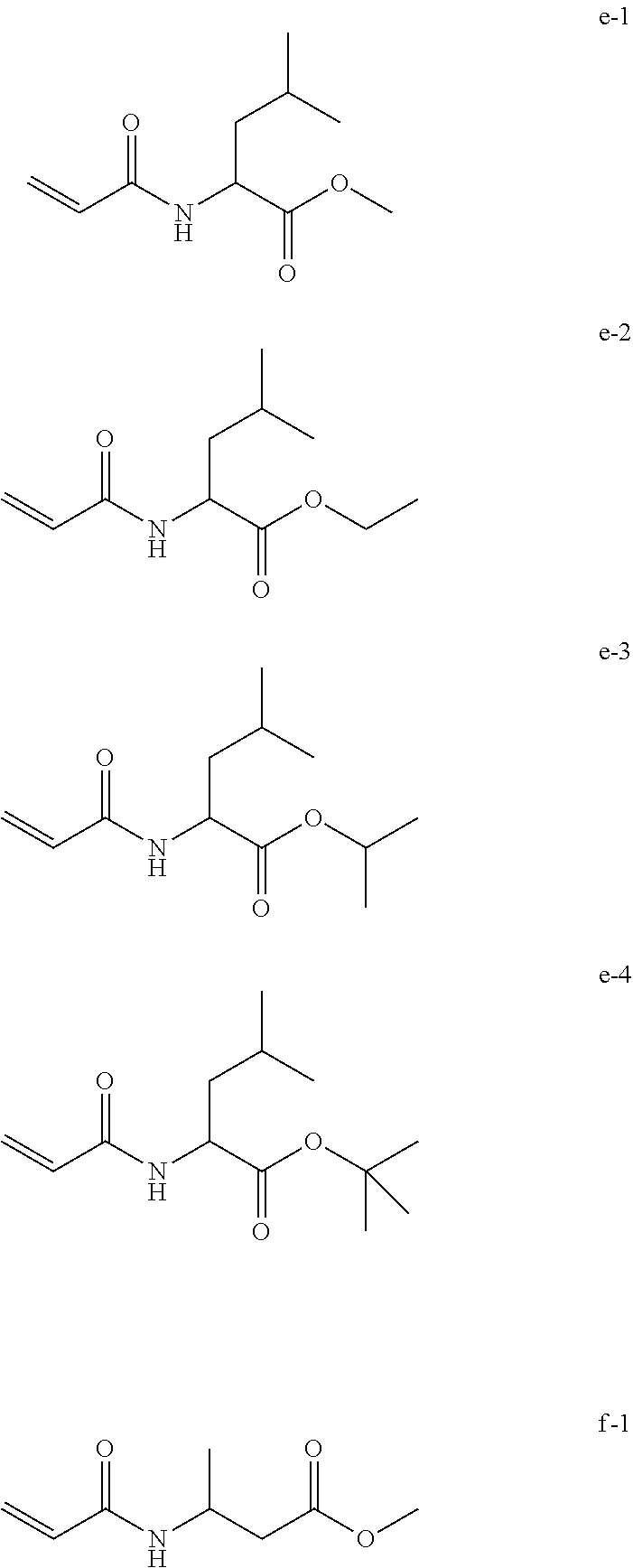
- KHBRUFAAKIFATB-UHFFFAOYSA-N C=CC(=O)NC(C)CC(=O)OC.C=CC(=O)NC(CC(C)C)C(=O)OC.C=CC(=O)NC(CC(C)C)C(=O)OC(C)(C)C.C=CC(=O)NC(CC(C)C)C(=O)OC(C)C.C=CC(=O)NC(CC(C)C)C(=O)OCC Chemical compound C=CC(=O)NC(C)CC(=O)OC.C=CC(=O)NC(CC(C)C)C(=O)OC.C=CC(=O)NC(CC(C)C)C(=O)OC(C)(C)C.C=CC(=O)NC(CC(C)C)C(=O)OC(C)C.C=CC(=O)NC(CC(C)C)C(=O)OCC KHBRUFAAKIFATB-UHFFFAOYSA-N 0.000 description 1
- GEWPDSDRRWOJQF-UHFFFAOYSA-N C=CC(=O)NC(CC(C)C)C(=O)OC Chemical compound C=CC(=O)NC(CC(C)C)C(=O)OC GEWPDSDRRWOJQF-UHFFFAOYSA-N 0.000 description 1
Images


Classifications
-
- C—CHEMISTRY; METALLURGY
- C09—DYES; PAINTS; POLISHES; NATURAL RESINS; ADHESIVES; COMPOSITIONS NOT OTHERWISE PROVIDED FOR; APPLICATIONS OF MATERIALS NOT OTHERWISE PROVIDED FOR
- C09D—COATING COMPOSITIONS, e.g. PAINTS, VARNISHES OR LACQUERS; FILLING PASTES; CHEMICAL PAINT OR INK REMOVERS; INKS; CORRECTING FLUIDS; WOODSTAINS; PASTES OR SOLIDS FOR COLOURING OR PRINTING; USE OF MATERIALS THEREFOR
- C09D11/00—Inks
- C09D11/30—Inkjet printing inks
-
- B—PERFORMING OPERATIONS; TRANSPORTING
- B29—WORKING OF PLASTICS; WORKING OF SUBSTANCES IN A PLASTIC STATE IN GENERAL
- B29C—SHAPING OR JOINING OF PLASTICS; SHAPING OF MATERIAL IN A PLASTIC STATE, NOT OTHERWISE PROVIDED FOR; AFTER-TREATMENT OF THE SHAPED PRODUCTS, e.g. REPAIRING
- B29C64/00—Additive manufacturing, i.e. manufacturing of three-dimensional [3D] objects by additive deposition, additive agglomeration or additive layering, e.g. by 3D printing, stereolithography or selective laser sintering
- B29C64/10—Processes of additive manufacturing
- B29C64/106—Processes of additive manufacturing using only liquids or viscous materials, e.g. depositing a continuous bead of viscous material
- B29C64/112—Processes of additive manufacturing using only liquids or viscous materials, e.g. depositing a continuous bead of viscous material using individual droplets, e.g. from jetting heads
-
- B—PERFORMING OPERATIONS; TRANSPORTING
- B29—WORKING OF PLASTICS; WORKING OF SUBSTANCES IN A PLASTIC STATE IN GENERAL
- B29C—SHAPING OR JOINING OF PLASTICS; SHAPING OF MATERIAL IN A PLASTIC STATE, NOT OTHERWISE PROVIDED FOR; AFTER-TREATMENT OF THE SHAPED PRODUCTS, e.g. REPAIRING
- B29C64/00—Additive manufacturing, i.e. manufacturing of three-dimensional [3D] objects by additive deposition, additive agglomeration or additive layering, e.g. by 3D printing, stereolithography or selective laser sintering
- B29C64/10—Processes of additive manufacturing
- B29C64/106—Processes of additive manufacturing using only liquids or viscous materials, e.g. depositing a continuous bead of viscous material
- B29C64/124—Processes of additive manufacturing using only liquids or viscous materials, e.g. depositing a continuous bead of viscous material using layers of liquid which are selectively solidified
- B29C64/129—Processes of additive manufacturing using only liquids or viscous materials, e.g. depositing a continuous bead of viscous material using layers of liquid which are selectively solidified characterised by the energy source therefor, e.g. by global irradiation combined with a mask
-
- B—PERFORMING OPERATIONS; TRANSPORTING
- B29—WORKING OF PLASTICS; WORKING OF SUBSTANCES IN A PLASTIC STATE IN GENERAL
- B29C—SHAPING OR JOINING OF PLASTICS; SHAPING OF MATERIAL IN A PLASTIC STATE, NOT OTHERWISE PROVIDED FOR; AFTER-TREATMENT OF THE SHAPED PRODUCTS, e.g. REPAIRING
- B29C64/00—Additive manufacturing, i.e. manufacturing of three-dimensional [3D] objects by additive deposition, additive agglomeration or additive layering, e.g. by 3D printing, stereolithography or selective laser sintering
- B29C64/20—Apparatus for additive manufacturing; Details thereof or accessories therefor
- B29C64/255—Enclosures for the building material, e.g. powder containers
-
- B—PERFORMING OPERATIONS; TRANSPORTING
- B29—WORKING OF PLASTICS; WORKING OF SUBSTANCES IN A PLASTIC STATE IN GENERAL
- B29C—SHAPING OR JOINING OF PLASTICS; SHAPING OF MATERIAL IN A PLASTIC STATE, NOT OTHERWISE PROVIDED FOR; AFTER-TREATMENT OF THE SHAPED PRODUCTS, e.g. REPAIRING
- B29C64/00—Additive manufacturing, i.e. manufacturing of three-dimensional [3D] objects by additive deposition, additive agglomeration or additive layering, e.g. by 3D printing, stereolithography or selective laser sintering
- B29C64/20—Apparatus for additive manufacturing; Details thereof or accessories therefor
- B29C64/264—Arrangements for irradiation
-
- B—PERFORMING OPERATIONS; TRANSPORTING
- B33—ADDITIVE MANUFACTURING TECHNOLOGY
- B33Y—ADDITIVE MANUFACTURING, i.e. MANUFACTURING OF THREE-DIMENSIONAL [3D] OBJECTS BY ADDITIVE DEPOSITION, ADDITIVE AGGLOMERATION OR ADDITIVE LAYERING, e.g. BY 3D PRINTING, STEREOLITHOGRAPHY OR SELECTIVE LASER SINTERING
- B33Y10/00—Processes of additive manufacturing
-
- B—PERFORMING OPERATIONS; TRANSPORTING
- B33—ADDITIVE MANUFACTURING TECHNOLOGY
- B33Y—ADDITIVE MANUFACTURING, i.e. MANUFACTURING OF THREE-DIMENSIONAL [3D] OBJECTS BY ADDITIVE DEPOSITION, ADDITIVE AGGLOMERATION OR ADDITIVE LAYERING, e.g. BY 3D PRINTING, STEREOLITHOGRAPHY OR SELECTIVE LASER SINTERING
- B33Y30/00—Apparatus for additive manufacturing; Details thereof or accessories therefor
-
- B—PERFORMING OPERATIONS; TRANSPORTING
- B33—ADDITIVE MANUFACTURING TECHNOLOGY
- B33Y—ADDITIVE MANUFACTURING, i.e. MANUFACTURING OF THREE-DIMENSIONAL [3D] OBJECTS BY ADDITIVE DEPOSITION, ADDITIVE AGGLOMERATION OR ADDITIVE LAYERING, e.g. BY 3D PRINTING, STEREOLITHOGRAPHY OR SELECTIVE LASER SINTERING
- B33Y70/00—Materials specially adapted for additive manufacturing
-
- B—PERFORMING OPERATIONS; TRANSPORTING
- B33—ADDITIVE MANUFACTURING TECHNOLOGY
- B33Y—ADDITIVE MANUFACTURING, i.e. MANUFACTURING OF THREE-DIMENSIONAL [3D] OBJECTS BY ADDITIVE DEPOSITION, ADDITIVE AGGLOMERATION OR ADDITIVE LAYERING, e.g. BY 3D PRINTING, STEREOLITHOGRAPHY OR SELECTIVE LASER SINTERING
- B33Y80/00—Products made by additive manufacturing
-
- B—PERFORMING OPERATIONS; TRANSPORTING
- B41—PRINTING; LINING MACHINES; TYPEWRITERS; STAMPS
- B41M—PRINTING, DUPLICATING, MARKING, OR COPYING PROCESSES; COLOUR PRINTING
- B41M5/00—Duplicating or marking methods; Sheet materials for use therein
- B41M5/0023—Digital printing methods characterised by the inks used
-
- B—PERFORMING OPERATIONS; TRANSPORTING
- B41—PRINTING; LINING MACHINES; TYPEWRITERS; STAMPS
- B41M—PRINTING, DUPLICATING, MARKING, OR COPYING PROCESSES; COLOUR PRINTING
- B41M5/00—Duplicating or marking methods; Sheet materials for use therein
- B41M5/50—Recording sheets characterised by the coating used to improve ink, dye or pigment receptivity, e.g. for ink-jet or thermal dye transfer recording
-
- C—CHEMISTRY; METALLURGY
- C09—DYES; PAINTS; POLISHES; NATURAL RESINS; ADHESIVES; COMPOSITIONS NOT OTHERWISE PROVIDED FOR; APPLICATIONS OF MATERIALS NOT OTHERWISE PROVIDED FOR
- C09D—COATING COMPOSITIONS, e.g. PAINTS, VARNISHES OR LACQUERS; FILLING PASTES; CHEMICAL PAINT OR INK REMOVERS; INKS; CORRECTING FLUIDS; WOODSTAINS; PASTES OR SOLIDS FOR COLOURING OR PRINTING; USE OF MATERIALS THEREFOR
- C09D11/00—Inks
- C09D11/02—Printing inks
- C09D11/10—Printing inks based on artificial resins
- C09D11/101—Inks specially adapted for printing processes involving curing by wave energy or particle radiation, e.g. with UV-curing following the printing
-
- C—CHEMISTRY; METALLURGY
- C09—DYES; PAINTS; POLISHES; NATURAL RESINS; ADHESIVES; COMPOSITIONS NOT OTHERWISE PROVIDED FOR; APPLICATIONS OF MATERIALS NOT OTHERWISE PROVIDED FOR
- C09D—COATING COMPOSITIONS, e.g. PAINTS, VARNISHES OR LACQUERS; FILLING PASTES; CHEMICAL PAINT OR INK REMOVERS; INKS; CORRECTING FLUIDS; WOODSTAINS; PASTES OR SOLIDS FOR COLOURING OR PRINTING; USE OF MATERIALS THEREFOR
- C09D11/00—Inks
- C09D11/02—Printing inks
- C09D11/10—Printing inks based on artificial resins
- C09D11/106—Printing inks based on artificial resins containing macromolecular compounds obtained by reactions only involving carbon-to-carbon unsaturated bonds
- C09D11/107—Printing inks based on artificial resins containing macromolecular compounds obtained by reactions only involving carbon-to-carbon unsaturated bonds from unsaturated acids or derivatives thereof
-
- C—CHEMISTRY; METALLURGY
- C09—DYES; PAINTS; POLISHES; NATURAL RESINS; ADHESIVES; COMPOSITIONS NOT OTHERWISE PROVIDED FOR; APPLICATIONS OF MATERIALS NOT OTHERWISE PROVIDED FOR
- C09D—COATING COMPOSITIONS, e.g. PAINTS, VARNISHES OR LACQUERS; FILLING PASTES; CHEMICAL PAINT OR INK REMOVERS; INKS; CORRECTING FLUIDS; WOODSTAINS; PASTES OR SOLIDS FOR COLOURING OR PRINTING; USE OF MATERIALS THEREFOR
- C09D11/00—Inks
- C09D11/30—Inkjet printing inks
- C09D11/32—Inkjet printing inks characterised by colouring agents
- C09D11/322—Pigment inks
-
- Y—GENERAL TAGGING OF NEW TECHNOLOGICAL DEVELOPMENTS; GENERAL TAGGING OF CROSS-SECTIONAL TECHNOLOGIES SPANNING OVER SEVERAL SECTIONS OF THE IPC; TECHNICAL SUBJECTS COVERED BY FORMER USPC CROSS-REFERENCE ART COLLECTIONS [XRACs] AND DIGESTS
- Y10—TECHNICAL SUBJECTS COVERED BY FORMER USPC
- Y10T—TECHNICAL SUBJECTS COVERED BY FORMER US CLASSIFICATION
- Y10T428/00—Stock material or miscellaneous articles
- Y10T428/24—Structurally defined web or sheet [e.g., overall dimension, etc.]
- Y10T428/24802—Discontinuous or differential coating, impregnation or bond [e.g., artwork, printing, retouched photograph, etc.]
Definitions
- the present invention relates to a curable composition, a curable ink, a composition stored container, an image forming apparatus, an image forming method, a cured product, and a decorated body.
- an inkjet recording method As a method of forming an image on a recording medium such as paper, an inkjet recording method is known. This recording method is high in ink consumption efficiency and excellent in resource-saving property, and makes it possible to reduce an ink cost per a recording unit.
- an active-energy-ray-curable resin composition containing an urethane oligomer having a (meth)acrylamide group at a terminal or a side chain, an N-substituted (meth)acrylamide, and a nonreactive diluent is proposed.
- a compound which includes an organic group having 1 to 10 carbon atoms (including an aromatic ring) as a core and includes a (meth)acrylate group and a vinyl group in one molecule, and a composition for optical nanoimprint including the compound are proposed.
- An embodiment of the present invention provides a curable composition containing an acrylamide compound represented by the following general formula (1).
- X represents a branched alkylene group having 2 to 5 carbon atoms
- Y represents the following general formula (2).
- FIG. 1 is a schematic view illustrating an image forming apparatus according to an embodiment of the present invention
- FIG. 2 is a schematic view illustrating another image forming apparatus according to an embodiment of the present invention.
- FIGS. 3A to 3D are schematic views illustrating another image forming apparatus according to an embodiment of the present invention.
- a curable composition that has excellent photopolymerization reactivity and becomes a cured film having excellent hardness is provided.
- the curable composition of the present disclosure contains an acrylamide compound represented by the following general formula (1), and may optionally contain another curable compound, a polymerization initiator, an organic solvent, a colorant, and other components.
- X represents a branched alkylene group having 2 to 5 carbon atoms
- Y represents the following general formula (2).
- X is preferably a branched alkylene group having 4 to 5 carbon atoms.
- the compound represented by the general formula (1) contained in the curable composition and ink of the present disclosure characteristically includes a secondary acrylamide and an ester on the core structure of the alkylene group containing a tertiary carbon, A compound having a high intermolecular interaction due to the presence of a polar functional group is crystallized in some cases.
- Such a compound has a drawback of having a large restriction on use for curable compositions, particularly, for inkjet inks.
- there is another problem that the strength of the cured product is decreased as the steric hindrance is increased due to the presence of an alkyl chain.
- the compound represented by the general formula (1) has an appropriate polarity attributed to the secondary acrylamide and the ester, and an appropriate degree of the steric hindrance attributed to the alkylene group containing the tertiary carbon, and thus provides a cured product having a high hardness and excellent photopolymerization reactivity.
- the acrylamide compound represented by the above general formula (1) can be suitably used as a curable composition, particularly as an inkjet ink.
- Z represents an alkyl group having 1 to 4 carbon atoms
- Y represents the following general formula (2).
- R represents an alkyl group having 1 to 4 carbon atoms
- * represents a binding site with a tertiary carbon atom in the general formula (3).
- the acrylamide compound represented by the general formula (1) can be a mixture of two or more different compounds.
- the different compounds include structural isomers.
- the mixing ratio is not particularly limited.
- a content of the acrylamide compound in the curable composition or the curable ink is normally 20% to 98% by mass, and preferably 30% to 90% by mass.
- the curable composition may include another photopolymerizable compounds other than the acrylamide compound represented by the general formula (1).
- a mass ratio of the other photopolymerizable compound to the acrylamide compound represented by the general formula (1) is normally 0.01 to 100, preferably 0.1 to 50 when the mass of the acrylamide compound is defined as 1.
- the other photopolymerizable compound is not particularly limited.
- Examples of the other photopolymerizable compound include a photoradically polymerizable compound, a photocationically polymerizable compound, a photoanionically polymerizable compound, and combinations thereof.
- the photoradically polymerizable compound is not particularly limited as long as the compound has one or more photoradically-polymerizable ethylenically unsaturated groups.
- the compound may be either a monomer, an oligomer, or a polymer.
- Examples of the photoradically polymerizable compound include, but are not limited to, unsaturated carboxylic acids such as acrylic acid, methacrylic acid, itaconic acid, crotonic acid, isocrotonic acid, and maleic acid, and salts thereof, and compounds derived therefrom, as well as ethylenically-unsaturated-group-containing anhydride, acrylonitrile, styrene, unsaturated polyester, unsaturated polyether, unsaturated polyamide, and unsaturated urethane.
- unsaturated carboxylic acids such as acrylic acid, methacrylic acid, itaconic acid, crotonic acid, isocrotonic acid, and maleic acid, and salts thereof, and compounds derived
- the photoradically polymerizable compound include, but are not limited to, an acrylic acid derivative such as 2-hydroxyethyl acrylate, butoxyethyl acrylate, carbitol acrylate, cyclohexyl acrylate, tetrahydrofurfuryl acrylate, benzyl acrylate, bis(4-acryloxypolyethoxyphenyl) propane, neopentyl glycol diacrylate, ethoxylated neopentyl glycol diacrylate, propoxylated neopentyl glycol diacrylate, 1,6-hexanediol diacrylate, ethylene glycol diacrylate, diethylene glycol diacrylate, triethylene glycol diacrylate, tetraethylene glycol diacrylate, polyethylene glycol diacrylate, propylene glycol diacrylate, dipropylene glycol diacrylate, tripropylene glycol diacrylate, tetrapropylene glycol diacrylate, polypropyl di
- Examples of the photocationically polymerizable compound include, but are not limited to, an epoxy compound, a vinyl ether compound, and an oxetane compound.
- Examples of the photoanionically polymerizable compound include, but are not limited to, an epoxy compound, a lactone compound, an acrylic compound, and a methacrylic compound. Above all, the acrylic compounds and the methacrylic compounds exemplified as the photoradically polymerizable compound are preferable.
- the curable composition of the present disclosure optionally contains a polymerization initiator.
- the polymerization initiator produces active species such as a radical or a cation upon application of energy of an active energy ray and initiates polymerization of a polymerizable compound (monomer or oligomer).
- a polymerizable compound monomer or oligomer.
- the polymerization initiator it is suitable to use a known radical polymerization initiator, cation polymerization initiator, base producing agent, or a combination thereof. Of these, a radical polymerization initiator is preferable.
- the polymerization initiator preferably accounts for 5% to 20% by mass of the total mass of the composition (100% by mass) to obtain sufficient curing speed.
- radical polymerization initiators include, but are not limited to, aromatic ketones, acylphosphine oxide compounds, aromatic onium salt compounds, organic peroxides, thio compounds (thioxanthone compounds, thiophenyl-group-containing compounds, etc.), hexaaryl biimidazole compounds, ketoxime ester compounds, borate compounds, azinium compounds, metallocene compounds, active ester compounds, compounds having a carbon halogen bond(s), and alkyl amine compounds.
- the radical polymerization initiator is preferably an aromatic ketone, such as IRGACURE 907.
- a polymerization accelerator (sensitizer) is optionally used together with the polymerization initiator.
- the polymerization accelerator is not particularly limited. Preferred examples thereof include, but are not limited to, amines such as trimethylamine, methyl dimethanolamine, triethanolamine, p-diethylaminoacetophenone, ethyl p-dimethylamino benzoate, 2-ethylhexyl p-dimethylamino benzoate, N,N-dimethylbenzylamine, and 4,4′-bis(diethylamino)benzophenone. The content thereof is determined depending on the identity (type) of the polymerization initiator and the content thereof.
- Examples of the combination of the photopolymerizable compound and the polymerization initiator include a combination of a photoradically polymerizable compound and a photoradical polymerization initiator, as well as a combination of a photocationically polymerizable compound and a photocationic polymerization initiator, and a combination of a photoanionically polymerizable compound and a photoanionic polymerization initiator.
- photocationic polymerization initiator examples include, but are not limited to, B(C 6 F 5 ) 4 ⁇ , PF 6 ⁇ , AsF 6 ⁇ , SbF 6 ⁇ , and CF 3 SO 3 ⁇ salts of an aromatic onium compound such as diazonium, ammonium, iodonium, sulfonium, and phosphonium, as well as a sulfonated product capable of generating a sulfonic acid, a halide capable of generating a hydrogen halide, and an iron allene complex.
- aromatic onium compound such as diazonium, ammonium, iodonium, sulfonium, and phosphonium
- photoanionic polymerization initiator examples include, but are not limited to, an o-nitrobenzyl carbamate derivative, an o-acyloxyl derivative, and an o-carbamoyl oxime amidine derivative.
- the curable composition optionally contains a co-sensitizer.
- the co-sensitizer further improves the sensitivity of a sensitizing dye to the active energy ray, and reduces the polymerization inhibition of the photopolymerizable compound due to oxygen.
- co-sensitizer examples include, but are not limited to, an amine-based compound such as triethanolamine, p-dimethylaminobenzoic acid ethyl ester, p-formyldimethylaniline, and p-methylthiodimethylaniline; a thiol such as 2-mercaptobenzothiazole, 2-mercaptobenzoxazole, 2-mercaptobenzimidazole, 2-mercapto-4(3H)-quinazoline, and ⁇ -mercaptonaphthalene; and a sulfide.
- an amine-based compound such as triethanolamine, p-dimethylaminobenzoic acid ethyl ester, p-formyldimethylaniline, and p-methylthiodimethylaniline
- a thiol such as 2-mercaptobenzothiazole, 2-mercaptobenzoxazole, 2-mercaptobenzimidazole, 2-mercapto-4(3
- the curable composition optionally contains a polymerization inhibitor.
- a polymerization inhibitor for improving the storability (storage stability) of the curable composition.
- the active-energy-ray-curable composition of the present disclosure optionally contains an organic solvent although it is preferable to spare the organic solvent.
- the curable composition free of an organic solvent in particular volatile organic compound (VOC) is preferable because it enhances safety at where the composition is handled and makes it possible to prevent pollution of the environment.
- the organic solvent represents a conventional non-reactive organic solvent, for example, ether, ketone, xylene, ethyl acetate, cyclohexanone, and toluene, which is clearly distinguished from reactive monomers.
- “free of” an organic solvent means that no organic solvent is substantially contained. The content thereof is preferably less than 0.1 percent by mass.
- the pigment can be either inorganic or organic, and two or more of the pigments can be used in combination.
- the inorganic pigments include, but are not limited to, carbon blacks (C.I. Pigment Black 7) such as furnace black, lamp black, acetylene black, and channel black, iron oxides, and titanium oxides.
- carbon blacks such as furnace black, lamp black, acetylene black, and channel black
- iron oxides such as iron oxides, and titanium oxides.
- organic pigments include, but are not limited to, azo pigments such as insoluble azo pigments, condensed azo pigments, azo lakes, and chelate azo pigments; polycyclic pigments such as phthalocyanine pigments, perylene pigments, perinone pigments, anthraquinone pigments, quinacridone pigments, dioxazine pigments, thioindigo pigments, isoindolinone pigments, and quinophthalone pigments; dye chelates (e.g. basic dye chelates, acid dye chelates, etc.), dye lakes (e.g. basic dye lakes, acid dye lakes), nitro pigments, nitroso pigments, aniline black, and daylight fluorescent pigments.
- azo pigments such as insoluble azo pigments, condensed azo pigments, azo lakes, and chelate azo pigments
- polycyclic pigments such as phthalocyanine pigments, perylene pigments, perinone pigments, anthraquinon
- a dispersant is optionally added to enhance the dispersibility of pigment.
- the dispersant has no particular limit and can be, for example, dispersants conventionally used to prepare a pigment dispersion, such as a polymer dispersant.
- the dyes include, for example, acidic dyes, direct dyes, reactive dyes, basic dyes, and combinations thereof.
- the active-energy-ray-curable composition of the present disclosure optionally contains other known components.
- the other known components are not particularly limited. Specific examples thereof include, but are not limited to, known articles such as surfactants, polymerization inhibitors, leveling agents, defoaming agents, fluorescent brighteners, permeation enhancing agents, wetting agents (humectants), fixing agents, viscosity stabilizers, fungicides, preservatives, antioxidants, ultraviolet absorbents, chelate agents, pH adjusters, (regulators), and thickeners.
- the active-energy-ray-curable composition of the present disclosure can be prepared by using the components described above.
- the preparation devices and conditions are not particularly limited.
- the active-energy-ray-curable composition can be prepared by subjecting a polymerizable monomer, a pigment, a dispersant, etc., to a dispersion treatment using a dispersing machine such as a ball mill, a kitty mill, a disk mill, a pin mill, and a DYNO-MILL to prepare a pigment liquid dispersion, and further mixing the pigment liquid dispersion with a polymerizable monomer, an initiator, a polymerization initiator, a surfactant, and the like.
- a dispersing machine such as a ball mill, a kitty mill, a disk mill, a pin mill, and a DYNO-MILL
- the viscosity of the active-energy-ray-curable composition of the present disclosure has no particular limit because the viscosity can be adjusted depending on the purpose and application devices.
- the viscosity of the composition is preferably in the range of 3 to 40 mPa ⁇ s, more preferably 5 to 15 mPa ⁇ s, and particularly preferably 6 to 12 mPa ⁇ s in the temperature range of 20 to 65 degrees C., preferably at 25 degrees C.
- the viscosity can be measured by a cone plate rotary viscometer (VISCOMETER TVE-22L, manufactured by TOKI SANGYO CO., LTD.) using a cone rotor (1°34′ ⁇ R24) at a number of rotation of 50 rpm with an appropriate setting of the temperature of hemathermal circulating water in the range of 20 to 65 degrees C.
- VISCOMATE VM-150III can be used for the temperature adjustment of the circulating water.
- the curable composition is cured by application of heat or irradiation with an active energy ray, and the latter is more preferable.
- Active energy rays used for curing an active-energy-ray-curable composition of the present disclosure are not particularly limited, so long as the active energy rays are able to give necessary energy for allowing polymerization reaction of polymerizable components in the composition to proceed.
- the active energy rays include electron beams, ⁇ -rays, ⁇ -rays, ⁇ -rays, and X-rays, in addition to ultraviolet rays.
- a light source having a particularly high energy is used, polymerization reaction can be allowed to proceed without a polymerization initiator.
- mercury-free is preferred in terms of protection of environment.
- UV-LED ultraviolet light-emitting diode
- UV-LD ultraviolet laser diode
- the application field of the curable composition of the present disclosure is not particularly limited. It can be applied to any field where curable compositions are used.
- the curable composition is selected to a particular application and used for a resin for processing, a paint, an adhesive, an insulant, a release agent, a coating material, a sealing material, various resists, and various optical materials.
- the curable composition of the present disclosure can be used as an ink for forming two-dimensional texts, images, and designed coating film on various substrates and in addition as a three-dimensional object forming material to form a three-dimensional object.
- This three-dimensional object forming material may also be used as a binder for powder particles used in a powder layer laminating method of forming a three-dimensional object by repeating curing and layer-forming of powder layers, and as a three-dimensional object constituent material (a model material) and a supporting member (a support material) used in an additive manufacturing method (a stereolithography method) as illustrated in FIG. 2 and FIGS. 3A to 3D .
- FIGS. 3A to 3D is a diagram illustrating a method of additive manufacturing to sequentially form cured layers 6 having respective predetermined forms one on top of the other on a movable stage 3 by irradiating a storing pool (storing part) 1 of the active-energy-ray-curable composition 5 of the present disclosure with the active energy ray 4 .
- An apparatus for fabricating a three-dimensional object by using the active-energy-ray-curable composition of the present disclosure is not particularly limited and can be a known apparatus.
- the apparatus includes a containing device, a supplying device, and a discharging device of the curable composition, and an active energy ray irradiator.
- embodiments of the present disclosure include cured products obtained by curing the curable composition and processed products obtained by processing structures having the cured products on a substrate.
- the processed product is fabricated by, for example, heat-drawing or punching the cured product or structure having a sheet-like form or film-like form, and suitably used for applications requiring molding of the surface after decoration, such as gauges or operation panels of vehicles, office machines, electric and electronic machines, and cameras.
- the substrate is not particularly limited. It can suitably be selected to a particular application. Examples thereof include paper, thread, fiber, fabrics, leather, metal, plastic, glass, wood, ceramic, or composite materials thereof. Of these, plastic substrates are preferred in terms of processability.
- the composition stored container of the present disclosure refers to a container containing the active-energy-ray-curable composition and is suitable for the applications as described above.
- a container storing the ink can be used as an ink cartridge or an ink bottle. Therefore, users can avoid direct contact with the ink during operations such as transfer or replacement of the ink, so that fingers and clothes are prevented from contamination. Furthermore, inclusion of foreign matters such as dust in the ink can be prevented.
- the container can be of any size, any form, and any material.
- the container can be designed to a particular application. It is preferable that the container is made of a light blocking material that blocks light or the container is covered with a light blocking sheet or the like.
- An image forming method of the present disclosure may be performed using an active energy ray and/or while applying heat.
- the method of discharging the active-energy-ray-curable composition is not particularly limited, and examples of the method include a continuous jetting method and an on-demand method.
- the on-demand method includes a piezo method, a thermal method, an electrostatic method, etc.
- Each of the printing unit 23 a , 23 b , 23 c and 23 d may have a heating mechanism to liquidize the ink at the ink discharging portion.
- a mechanism may optionally be included to cool down the recording medium to around room temperature in a contact or non-contact manner.
- the inkjet recording method may be either of serial methods or line methods.
- the serial methods include discharging an ink onto a recording medium by moving the head while the recording medium intermittently moves according to the width of a discharging head.
- the line methods include discharging an ink onto a recording medium from a discharging head held at a fixed position while the recording medium continuously moves.
- Examples of the recorded matter having images printed with the ink of the present disclosure include not only those having printed images or texts on a plain surface of conventional paper or resin film, but also those having printed images or texts on a rough surface or a surface made of various materials such as metal or ceramic.
- a partially stereoscopic image formed of two-dimensional parts and three-dimensional parts
- a three-dimensional objects can be fabricated.
- the discharging head unit 30 discharges the first curable composition onto the pool and the first curable composition is solidified by irradiation with an active energy ray, thereby forming a first additive manufacturing layer.
- This step is repeated multiple times while lowering a stage 38 movable in the vertical direction to laminate the support layers and the additive manufacturing layers to fabricate a solid object 35 . Thereafter, a support 36 is removed, if desired.
- a single discharging head unit 30 for forming additive manufacturing layer is provided to the image forming apparatus 39 illustrated in FIG. 2 , it is also possible to provide two or more discharging head units 30 .
- a slurry obtained by mixing 22.33 g (191 mmol) of DL-valine manufactured by Tokyo Chemical Industry Co., Ltd. with 125 mL of methanol was cooled in ice bath, and then reacted by dripping 45.35 g (381 mmol) of thionyl chloride to the slurry, to obtain a reaction solution.
- the reaction solution was stirred at room temperature overnight, then the resulting reaction solution was concentrated to obtain 32.35 g of DL-valine methyl ester hydrochloride, which was a white solid.
- the resulting DL-valine methyl ester hydrochloride was directly used for the subsequent reaction.
- the reaction solution was stirred at room temperature overnight, and then the resulting reaction solution was concentrated to obtain 13.50 g of DL-leucine methyl ester hydrochloride, which was a white solid.
- the resulting DL-leucine methyl ester hydrochloride was directly used for the subsequent reaction.
- the reaction solution was stirred at room temperature overnight, and then the resulting reaction solution was concentrated to obtain 7.40 g of DL-3-aminobutyric acid methyl ester hydrochloride, which was a pale yellow oil.
- the resulting DL-3-aminobutyric acid methyl ester hydrochloride was directly used for the subsequent reaction.
- a slurry obtained by mixing 25.0 g (191 mmol) of 6-aminohexanoic acid manufactured by Tokyo Chemical Industry Cho., Ltd. with 125 mL of methanol was cooled in ice bath, and then reacted by dripping 45.35 g (381 mmol) of thionyl chloride to the slurry, to obtain a reaction solution.
- the reaction solution was stirred at room temperature overnight, and then the resulting reaction solution was concentrated to obtain 36.52 g of 6-aminohexanoic acid methyl ester hydrochloride, which was a white solid.
- the resulting 6-aminohexanoic acid methyl ester hydrochloride was directly used for the subsequent reaction.
- the reaction solution was stirred at room temperature overnight, and then the resulting reaction solution was concentrated to obtain 8.4 g of N-methyl-DL-alanine methyl ester, which was a colorless liquid.
- the resulting N-methyl-DL-alanine methyl ester was directly used for the subsequent reaction.
- a commercially available hydroxyethyl acrylamide (manufactured by KJ Chemicals Corporation) represented by the following structural formula (3) was specified as an active-energy-ray-curable comparison compound 3.
- the photopolymerization reactivity of each photocurable composition was evaluated using a measuring apparatus including DSC-7020 (manufactured by SII NanoTechnology Inc.) in combination with a spot light source LA-410UV (manufactured by HAYASHI WATCH-WORKS CO., LTD.).
- a calorific value (mJ/mg) per unit weight was measured when irradiating the composition with ultraviolet ray at 365 nm with an intensity of 100 mW/cm 2 in the atmosphere for 0.02 minutes.
- the resulting calorific value per unit weight was multiplied by the molecular weight to calculate a calorific value per 1 mole, which was taken as an indicator for comparing the reactivities of the photopolymerization reactions.
- the photocurable composition prepared in the above method was applied on a PET film so as to have a thickness of 10 ⁇ m.
- the composition was cured by 17 irradiations with an integrated irradiation energy of 10,600 mJ/cm 2 , under a condition that an irradiation energy per 1 pass of a metal halide lamp was 600 mJ/cm 2 , in the atmosphere.
- a pencil hardness test was carried out according to JIS K 5600-5-4 standard.
- a pencil scratch hardness tester Model: KT-VF 2391, manufactured by Kotec Ltd., load: 750 g
- a pencil for pencil hardness test manufactured by Mitsubishi Pencil Co., Ltd.
- Table 1 indicates that the photocurable compositions of Examples 1a to 8a including the photopolymerizable compounds of Production Examples 1 to 5 are excellent in photopolymerization reactivity and hardness (pencil hardness) of the cured film.
- the compounds have an appropriate polarity attributed to the secondary acrylamide and the ester and an appropriate degree of the steric hindrance attributed to the alkylene group containing the tertiary carbon, and thus the liquid state can be achieved, and furthermore both the photopolymerizability and the hardness of the cured film can be achieved at high levels by the intermolecular interaction.
- the compounds are suitable for the active-energy-ray-curable composition and ink, especially the ink jet ink.
- a pen nib of a dip pen is dipped in each ink of Examples 1b to 8b and Examples 1c to 8c, and letters were written on a PET film and plain paper. Subsequently, the ink was cured by irradiating the film and paper with ultraviolet ray at 365 nm with an intensity of 200 mW/cm 2 using the UV irradiator LH6 (manufactured by Fusion Systems Japan Co., Ltd.). As a result, each ink image was sufficiently cured.
Landscapes
- Chemical & Material Sciences (AREA)
- Engineering & Computer Science (AREA)
- Materials Engineering (AREA)
- Manufacturing & Machinery (AREA)
- Optics & Photonics (AREA)
- Mechanical Engineering (AREA)
- Physics & Mathematics (AREA)
- Life Sciences & Earth Sciences (AREA)
- Wood Science & Technology (AREA)
- Organic Chemistry (AREA)
- Chemical Kinetics & Catalysis (AREA)
- Health & Medical Sciences (AREA)
- Toxicology (AREA)
- Inks, Pencil-Leads, Or Crayons (AREA)
Abstract

wherein, X represents a branched alkylene group having 2 to 5 carbon atoms, and Y represents the following general formula (2):

wherein, R represents an alkyl group having 1 to 4 carbon atoms, and * represents a binding site with X.
Description




| TABLE 1 | ||||
| State of | ||||
| compound | ||||
| Active- | (normal | Evaluation results | ||
| energy- | temper- | Concen- | Photopoly- | ||
| ray- | ature, | tration | merization | Pencil | |
| curable | and normal | of | reactivity | hardness | |
| compound | pressure) | initiator | kJ/mol | Rank | |
| Example 1a | Compound a-4 | Liquid | 10% | 24 | B |
| Example 2a | Compound c-1 | Liquid | 2% | 44 | HB |
| Example 3a | Compound c-1 | |
5% | 48 | HB |
| Example 4a | Compound c-1 | Liquid | 10% | 47 | HB |
| Example 5a | Compound c-1 | Liquid | 15% | 48 | HB |
| Example 6a | Compound d-1 | Liquid | 10% | 52 | HB |
| Example 7a | Compound e-1 | Liquid | 10% | 41 | B |
| Example 8a | Compound f-1 | Liquid | 10% | 20 | F |
| Comparative | Structural | Solid | 10% | — | — |
| Example 1a | Formula (1) | ||||
| Comparative | Structural | Liquid | 10% | 15 | 2B |
| Example 2a | Formula (2) | ||||
| Comparative | Structural | Liquid | 10% | 6 | H |
| Example 3a | Formula (3) | ||||
Claims (10)


Applications Claiming Priority (4)
| Application Number | Priority Date | Filing Date | Title |
|---|---|---|---|
| JP2018-045453 | 2018-03-13 | ||
| JP2018045453 | 2018-03-13 | ||
| JP2018-219932 | 2018-11-26 | ||
| JP2018219932A JP7116921B2 (en) | 2018-03-13 | 2018-11-26 | CURABLE COMPOSITION, CURABLE INK, COMPOSITION CONTAINER, IMAGE FORMING APPARATUS, IMAGE FORMING METHOD, CURED PRODUCT, AND DECORATION |
Publications (2)
| Publication Number | Publication Date |
|---|---|
| US20190284408A1 US20190284408A1 (en) | 2019-09-19 |
| US10822507B2 true US10822507B2 (en) | 2020-11-03 |
Family
ID=67905175
Family Applications (1)
| Application Number | Title | Priority Date | Filing Date |
|---|---|---|---|
| US16/292,421 Expired - Fee Related US10822507B2 (en) | 2018-03-13 | 2019-03-05 | Curable composition, curable ink, composition stored container, image forming apparatus, image forming method, cured product, and decorated body |
Country Status (1)
| Country | Link |
|---|---|
| US (1) | US10822507B2 (en) |
Families Citing this family (3)
| Publication number | Priority date | Publication date | Assignee | Title |
|---|---|---|---|---|
| US10822507B2 (en) * | 2018-03-13 | 2020-11-03 | Ricoh Company, Ltd. | Curable composition, curable ink, composition stored container, image forming apparatus, image forming method, cured product, and decorated body |
| US11920045B2 (en) | 2019-04-01 | 2024-03-05 | Ricoh Company, Ltd. | Active-energy-ray-curable composition, active-energy-ray-curable ink composition, active-energy-ray-curable inkjet ink composition, composition stored container, two-dimensional or three-dimensional image forming apparatus, two-dimensional or three-dimensional image forming method, cured material, and decorated article |
| KR102926713B1 (en) * | 2021-01-08 | 2026-02-12 | 삼성디스플레이 주식회사 | Ink leveling device and method for manufacturing of the same |
Citations (9)
| Publication number | Priority date | Publication date | Assignee | Title |
|---|---|---|---|---|
| EP0020000B1 (en) * | 1979-05-29 | 1983-06-15 | American Cyanamid Company | Activated ester monomers, polymers formed therefrom and coating compositions containing said polymers |
| EP0275470B1 (en) * | 1986-12-22 | 1991-03-06 | Chemie Linz Gesellschaft m.b.H. | N-substituted acryl amides containing ester groups |
| JP2009215179A (en) | 2008-03-07 | 2009-09-24 | Fujifilm Corp | (meth)acrylate compound, curable composition using the same, composition for optical nano imprinting, and cured products of these curable compositions and its manufacturing method |
| US20140363634A1 (en) | 2013-06-05 | 2014-12-11 | Mitsunobu Morita | Ink, ink cartridge, ink jet recording device, ink jet ink printed matter, compound, and composition |
| JP2016113518A (en) | 2014-12-12 | 2016-06-23 | Kjケミカルズ株式会社 | Active energy ray-curable resin composition having (meth)acrylamide urethane oligomer |
| US20170183519A1 (en) | 2014-06-10 | 2017-06-29 | Mitsunobu Morita | Ink, ink cartridge, inkjet recording apparatus, printed matter, photopolymerizable compound, photocurable composition, three-dimensional object formation material, and three-dimensional object |
| US20180127607A1 (en) | 2016-11-09 | 2018-05-10 | Mitsunobu Morita | Curable composition, curable ink, accommodating container, image forming device, image forming method, cured matter, and acrylamide compound |
| JP2018080321A (en) | 2016-11-09 | 2018-05-24 | 株式会社リコー | Curable composition, curable ink, container, two-dimensional or three-dimensional image forming apparatus, two-dimensional or three-dimensional image forming method, cured product, and curable compound |
| US20190284408A1 (en) * | 2018-03-13 | 2019-09-19 | Takenori Suenaga | Curable composition, curable ink, composition stored container, image forming apparatus, image forming method, cured product, and decorated body |
-
2019
- 2019-03-05 US US16/292,421 patent/US10822507B2/en not_active Expired - Fee Related
Patent Citations (10)
| Publication number | Priority date | Publication date | Assignee | Title |
|---|---|---|---|---|
| EP0020000B1 (en) * | 1979-05-29 | 1983-06-15 | American Cyanamid Company | Activated ester monomers, polymers formed therefrom and coating compositions containing said polymers |
| EP0275470B1 (en) * | 1986-12-22 | 1991-03-06 | Chemie Linz Gesellschaft m.b.H. | N-substituted acryl amides containing ester groups |
| JP2009215179A (en) | 2008-03-07 | 2009-09-24 | Fujifilm Corp | (meth)acrylate compound, curable composition using the same, composition for optical nano imprinting, and cured products of these curable compositions and its manufacturing method |
| US20140363634A1 (en) | 2013-06-05 | 2014-12-11 | Mitsunobu Morita | Ink, ink cartridge, ink jet recording device, ink jet ink printed matter, compound, and composition |
| JP2015013980A (en) | 2013-06-05 | 2015-01-22 | 株式会社リコー | Ink |
| US20170183519A1 (en) | 2014-06-10 | 2017-06-29 | Mitsunobu Morita | Ink, ink cartridge, inkjet recording apparatus, printed matter, photopolymerizable compound, photocurable composition, three-dimensional object formation material, and three-dimensional object |
| JP2016113518A (en) | 2014-12-12 | 2016-06-23 | Kjケミカルズ株式会社 | Active energy ray-curable resin composition having (meth)acrylamide urethane oligomer |
| US20180127607A1 (en) | 2016-11-09 | 2018-05-10 | Mitsunobu Morita | Curable composition, curable ink, accommodating container, image forming device, image forming method, cured matter, and acrylamide compound |
| JP2018080321A (en) | 2016-11-09 | 2018-05-24 | 株式会社リコー | Curable composition, curable ink, container, two-dimensional or three-dimensional image forming apparatus, two-dimensional or three-dimensional image forming method, cured product, and curable compound |
| US20190284408A1 (en) * | 2018-03-13 | 2019-09-19 | Takenori Suenaga | Curable composition, curable ink, composition stored container, image forming apparatus, image forming method, cured product, and decorated body |
Also Published As
| Publication number | Publication date |
|---|---|
| US20190284408A1 (en) | 2019-09-19 |
Similar Documents
| Publication | Publication Date | Title |
|---|---|---|
| JP6972813B2 (en) | Curable composition, curable ink, containment vessel, 2D or 3D image forming device, 2D or 3D image forming method, cured product, and curable compound. | |
| US10781325B2 (en) | Curable composition, curable ink, accommodating container, image forming device, image forming method, cured matter, and acrylamide compound | |
| US9796862B2 (en) | Active-energy-ray-curable composition, active-energy-ray-curable ink, ink stored container, ink ejecting device, method for forming image, and image | |
| EP3431557B1 (en) | Composition, cured product, image forming apparatus, and image forming method | |
| US11059985B2 (en) | Composition, cured product, storage container, image forming apparatus, and image forming method | |
| US11084940B2 (en) | Composition, cured product, storage container, image forming apparatus, and image forming method | |
| US10822507B2 (en) | Curable composition, curable ink, composition stored container, image forming apparatus, image forming method, cured product, and decorated body | |
| JP6759577B2 (en) | Active energy ray-curable composition, active energy ray-curable ink, composition container, two-dimensional or three-dimensional image forming device, two-dimensional or three-dimensional image forming method, cured product, decorative body, and active energy. Linearly polymerizable compound | |
| JP6775758B2 (en) | Active energy ray-curable ink, active energy ray-curable inkjet ink, composition container, 2D or 3D image forming device, 2D or 3D image forming method, cured product, and decoration | |
| US11920045B2 (en) | Active-energy-ray-curable composition, active-energy-ray-curable ink composition, active-energy-ray-curable inkjet ink composition, composition stored container, two-dimensional or three-dimensional image forming apparatus, two-dimensional or three-dimensional image forming method, cured material, and decorated article | |
| JP6775759B2 (en) | Active energy ray-curable composition, active energy ray-curable ink composition, active energy ray-curable inkjet ink composition, composition storage container, two-dimensional or three-dimensional image forming apparatus, and two-dimensional or three-dimensional image. Forming method | |
| US20230077371A1 (en) | Curable composition, curable ink, composition container, device for forming two-dimensional or three-dimensional image, method of forming two-dimensional or three-dimensional image, cured matter, and decorative object | |
| JP7068643B2 (en) | Active energy ray-curable ink, composition container, two-dimensional or three-dimensional image forming device, two-dimensional or three-dimensional image forming method, and method for producing a cured product. | |
| JP6825430B2 (en) | Active energy ray-curable composition, active energy ray-curable ink, composition storage container, two-dimensional or three-dimensional image forming device, two-dimensional or three-dimensional image forming method, cured product and decoration | |
| JP7006318B2 (en) | Active energy ray-curable ink, active energy ray-curable inkjet ink, composition accommodating container, two-dimensional or three-dimensional image forming apparatus and image forming method, cured product, cured product manufacturing method, and decorative body manufacturing method. | |
| JP6776627B2 (en) | Active energy ray-curable composition, active energy ray-curable ink, composition container, image forming apparatus, image forming method, cured product, molded product and compound. | |
| JP7027971B2 (en) | (Meta) acrylamide compound, curable composition, active energy ray curable ink, composition container, 2D or 3D image forming device, 2D or 3D image forming method, cured product and decoration | |
| JP7116921B2 (en) | CURABLE COMPOSITION, CURABLE INK, COMPOSITION CONTAINER, IMAGE FORMING APPARATUS, IMAGE FORMING METHOD, CURED PRODUCT, AND DECORATION | |
| JP7653072B2 (en) | Compound, active energy ray curable composition, active energy ray curable ink, storage container, image forming apparatus, image forming method, and cured product | |
| EP3061795B1 (en) | Active-energy-ray-curable composition, active-energy-ray-curable ink, composition stored container, two-dimensional or three-dimensional image forming apparatus, method for forming two-dimensional or three-dimensional image, cured material, decorative body, and active energy ray polymerizable compound | |
| JP6759993B2 (en) | Active energy ray-curable composition, active energy ray-curable ink, storage container, two-dimensional or three-dimensional image forming device, two-dimensional or three-dimensional image forming method, cured product, decorative body, and active energy ray polymerization. Sex compound | |
| JP7659225B2 (en) | Active energy ray curable inkjet ink, storage container, image forming apparatus, image forming method and cured product | |
| JP7562079B2 (en) | Active energy ray curable composition, curable ink, composition storage container, image forming apparatus, image forming method, cured product, and decorated body | |
| JP7283294B2 (en) | Active energy ray-curable composition, active energy ray-curable ink, active energy ray-curable inkjet ink, container, two-dimensional or three-dimensional image forming apparatus, two-dimensional or three-dimensional image forming method, and cured product manufacturing method | |
| JP2020023655A (en) | Composition, cured product, storage container, image forming device, and image forming method |
Legal Events
| Date | Code | Title | Description |
|---|---|---|---|
| AS | Assignment |
Owner name: RICOH COMPANY, LTD., JAPAN Free format text: ASSIGNMENT OF ASSIGNORS INTEREST;ASSIGNORS:SUENAGA, TAKENORI;KOBAYASHI, MASAHIDE;MORITA, MITSUNOBU;AND OTHERS;SIGNING DATES FROM 20190130 TO 20190208;REEL/FRAME:048500/0431 |
|
| FEPP | Fee payment procedure |
Free format text: ENTITY STATUS SET TO UNDISCOUNTED (ORIGINAL EVENT CODE: BIG.); ENTITY STATUS OF PATENT OWNER: LARGE ENTITY |
|
| STPP | Information on status: patent application and granting procedure in general |
Free format text: DOCKETED NEW CASE - READY FOR EXAMINATION |
|
| STPP | Information on status: patent application and granting procedure in general |
Free format text: NON FINAL ACTION MAILED |
|
| STPP | Information on status: patent application and granting procedure in general |
Free format text: RESPONSE TO NON-FINAL OFFICE ACTION ENTERED AND FORWARDED TO EXAMINER |
|
| STPP | Information on status: patent application and granting procedure in general |
Free format text: NOTICE OF ALLOWANCE MAILED -- APPLICATION RECEIVED IN OFFICE OF PUBLICATIONS |
|
| STPP | Information on status: patent application and granting procedure in general |
Free format text: PUBLICATIONS -- ISSUE FEE PAYMENT VERIFIED |
|
| STCF | Information on status: patent grant |
Free format text: PATENTED CASE |
|
| FEPP | Fee payment procedure |
Free format text: MAINTENANCE FEE REMINDER MAILED (ORIGINAL EVENT CODE: REM.); ENTITY STATUS OF PATENT OWNER: LARGE ENTITY |
|
| LAPS | Lapse for failure to pay maintenance fees |
Free format text: PATENT EXPIRED FOR FAILURE TO PAY MAINTENANCE FEES (ORIGINAL EVENT CODE: EXP.); ENTITY STATUS OF PATENT OWNER: LARGE ENTITY |
|
| STCH | Information on status: patent discontinuation |
Free format text: PATENT EXPIRED DUE TO NONPAYMENT OF MAINTENANCE FEES UNDER 37 CFR 1.362 |
|
| FP | Lapsed due to failure to pay maintenance fee |
Effective date: 20241103 |