US10818970B2 - All-solid battery - Google Patents

All-solid battery Download PDF

Info

Publication number
US10818970B2
US10818970B2 US16/163,174 US201816163174A US10818970B2 US 10818970 B2 US10818970 B2 US 10818970B2 US 201816163174 A US201816163174 A US 201816163174A US 10818970 B2 US10818970 B2 US 10818970B2
Authority
US
United States
Prior art keywords
solid electrolyte
solid
battery
cathode
electrolyte
Prior art date
Legal status (The legal status is an assumption and is not a legal conclusion. Google has not performed a legal analysis and makes no representation as to the accuracy of the status listed.)
Active, expires
Application number
US16/163,174
Other versions
US20190198916A1 (en
Inventor
Yong Sub Yoon
Yun Sung Kim
Pil Gun Oh
Hong Seok Min
Oh Min KWON
Current Assignee (The listed assignees may be inaccurate. Google has not performed a legal analysis and makes no representation or warranty as to the accuracy of the list.)
Hyundai Motor Co
Kia Corp
Original Assignee
Hyundai Motor Co
Kia Motors Corp
Priority date (The priority date is an assumption and is not a legal conclusion. Google has not performed a legal analysis and makes no representation as to the accuracy of the date listed.)
Filing date
Publication date
Application filed by Hyundai Motor Co, Kia Motors Corp filed Critical Hyundai Motor Co
Assigned to KIA MOTORS CORPORATION, HYUNDAI MOTOR COMPANY reassignment KIA MOTORS CORPORATION ASSIGNMENT OF ASSIGNORS INTEREST (SEE DOCUMENT FOR DETAILS). Assignors: KIM, YUN SUNG, KWON, OH MIN, MIN, HONG SEOK, OH, PIL GUN, YOON, YONG SUB
Publication of US20190198916A1 publication Critical patent/US20190198916A1/en
Application granted granted Critical
Publication of US10818970B2 publication Critical patent/US10818970B2/en
Active legal-status Critical Current
Adjusted expiration legal-status Critical

Links

Images

Classifications

    • HELECTRICITY
    • H01ELECTRIC ELEMENTS
    • H01MPROCESSES OR MEANS, e.g. BATTERIES, FOR THE DIRECT CONVERSION OF CHEMICAL ENERGY INTO ELECTRICAL ENERGY
    • H01M10/00Secondary cells; Manufacture thereof
    • H01M10/05Accumulators with non-aqueous electrolyte
    • H01M10/056Accumulators with non-aqueous electrolyte characterised by the materials used as electrolytes, e.g. mixed inorganic/organic electrolytes
    • H01M10/0561Accumulators with non-aqueous electrolyte characterised by the materials used as electrolytes, e.g. mixed inorganic/organic electrolytes the electrolyte being constituted of inorganic materials only
    • H01M10/0562Solid materials
    • HELECTRICITY
    • H01ELECTRIC ELEMENTS
    • H01BCABLES; CONDUCTORS; INSULATORS; SELECTION OF MATERIALS FOR THEIR CONDUCTIVE, INSULATING OR DIELECTRIC PROPERTIES
    • H01B1/00Conductors or conductive bodies characterised by the conductive materials; Selection of materials as conductors
    • H01B1/06Conductors or conductive bodies characterised by the conductive materials; Selection of materials as conductors mainly consisting of other non-metallic substances
    • H01B1/10Conductors or conductive bodies characterised by the conductive materials; Selection of materials as conductors mainly consisting of other non-metallic substances sulfides
    • HELECTRICITY
    • H01ELECTRIC ELEMENTS
    • H01MPROCESSES OR MEANS, e.g. BATTERIES, FOR THE DIRECT CONVERSION OF CHEMICAL ENERGY INTO ELECTRICAL ENERGY
    • H01M10/00Secondary cells; Manufacture thereof
    • H01M10/04Construction or manufacture in general
    • H01M10/0413Large-sized flat cells or batteries for motive or stationary systems with plate-like electrodes
    • HELECTRICITY
    • H01ELECTRIC ELEMENTS
    • H01MPROCESSES OR MEANS, e.g. BATTERIES, FOR THE DIRECT CONVERSION OF CHEMICAL ENERGY INTO ELECTRICAL ENERGY
    • H01M10/00Secondary cells; Manufacture thereof
    • H01M10/05Accumulators with non-aqueous electrolyte
    • H01M10/052Li-accumulators
    • H01M10/0525Rocking-chair batteries, i.e. batteries with lithium insertion or intercalation in both electrodes; Lithium-ion batteries
    • HELECTRICITY
    • H01ELECTRIC ELEMENTS
    • H01MPROCESSES OR MEANS, e.g. BATTERIES, FOR THE DIRECT CONVERSION OF CHEMICAL ENERGY INTO ELECTRICAL ENERGY
    • H01M4/00Electrodes
    • H01M4/02Electrodes composed of, or comprising, active material
    • H01M4/13Electrodes for accumulators with non-aqueous electrolyte, e.g. for lithium-accumulators; Processes of manufacture thereof
    • HELECTRICITY
    • H01ELECTRIC ELEMENTS
    • H01MPROCESSES OR MEANS, e.g. BATTERIES, FOR THE DIRECT CONVERSION OF CHEMICAL ENERGY INTO ELECTRICAL ENERGY
    • H01M4/00Electrodes
    • H01M4/02Electrodes composed of, or comprising, active material
    • H01M4/36Selection of substances as active materials, active masses, active liquids
    • H01M4/362Composites
    • H01M4/366Composites as layered products
    • HELECTRICITY
    • H01ELECTRIC ELEMENTS
    • H01MPROCESSES OR MEANS, e.g. BATTERIES, FOR THE DIRECT CONVERSION OF CHEMICAL ENERGY INTO ELECTRICAL ENERGY
    • H01M4/00Electrodes
    • H01M4/02Electrodes composed of, or comprising, active material
    • H01M4/36Selection of substances as active materials, active masses, active liquids
    • H01M4/38Selection of substances as active materials, active masses, active liquids of elements or alloys
    • H01M4/386Silicon or alloys based on silicon
    • HELECTRICITY
    • H01ELECTRIC ELEMENTS
    • H01MPROCESSES OR MEANS, e.g. BATTERIES, FOR THE DIRECT CONVERSION OF CHEMICAL ENERGY INTO ELECTRICAL ENERGY
    • H01M4/00Electrodes
    • H01M4/02Electrodes composed of, or comprising, active material
    • H01M4/36Selection of substances as active materials, active masses, active liquids
    • H01M4/38Selection of substances as active materials, active masses, active liquids of elements or alloys
    • H01M4/387Tin or alloys based on tin
    • HELECTRICITY
    • H01ELECTRIC ELEMENTS
    • H01MPROCESSES OR MEANS, e.g. BATTERIES, FOR THE DIRECT CONVERSION OF CHEMICAL ENERGY INTO ELECTRICAL ENERGY
    • H01M4/00Electrodes
    • H01M4/02Electrodes composed of, or comprising, active material
    • H01M4/36Selection of substances as active materials, active masses, active liquids
    • H01M4/48Selection of substances as active materials, active masses, active liquids of inorganic oxides or hydroxides
    • H01M4/52Selection of substances as active materials, active masses, active liquids of inorganic oxides or hydroxides of nickel, cobalt or iron
    • H01M4/525Selection of substances as active materials, active masses, active liquids of inorganic oxides or hydroxides of nickel, cobalt or iron of mixed oxides or hydroxides containing iron, cobalt or nickel for inserting or intercalating light metals, e.g. LiNiO2, LiCoO2 or LiCoOxFy
    • HELECTRICITY
    • H01ELECTRIC ELEMENTS
    • H01MPROCESSES OR MEANS, e.g. BATTERIES, FOR THE DIRECT CONVERSION OF CHEMICAL ENERGY INTO ELECTRICAL ENERGY
    • H01M4/00Electrodes
    • H01M4/02Electrodes composed of, or comprising, active material
    • H01M4/36Selection of substances as active materials, active masses, active liquids
    • H01M4/58Selection of substances as active materials, active masses, active liquids of inorganic compounds other than oxides or hydroxides, e.g. sulfides, selenides, tellurides, halogenides or LiCoFy; of polyanionic structures, e.g. phosphates, silicates or borates
    • H01M4/5825Oxygenated metallic salts or polyanionic structures, e.g. borates, phosphates, silicates, olivines
    • HELECTRICITY
    • H01ELECTRIC ELEMENTS
    • H01MPROCESSES OR MEANS, e.g. BATTERIES, FOR THE DIRECT CONVERSION OF CHEMICAL ENERGY INTO ELECTRICAL ENERGY
    • H01M4/00Electrodes
    • H01M4/02Electrodes composed of, or comprising, active material
    • H01M4/36Selection of substances as active materials, active masses, active liquids
    • H01M4/58Selection of substances as active materials, active masses, active liquids of inorganic compounds other than oxides or hydroxides, e.g. sulfides, selenides, tellurides, halogenides or LiCoFy; of polyanionic structures, e.g. phosphates, silicates or borates
    • H01M4/583Carbonaceous material, e.g. graphite-intercalation compounds or CFx
    • H01M4/587Carbonaceous material, e.g. graphite-intercalation compounds or CFx for inserting or intercalating light metals
    • HELECTRICITY
    • H01ELECTRIC ELEMENTS
    • H01MPROCESSES OR MEANS, e.g. BATTERIES, FOR THE DIRECT CONVERSION OF CHEMICAL ENERGY INTO ELECTRICAL ENERGY
    • H01M4/00Electrodes
    • H01M4/02Electrodes composed of, or comprising, active material
    • H01M4/62Selection of inactive substances as ingredients for active masses, e.g. binders, fillers
    • HELECTRICITY
    • H01ELECTRIC ELEMENTS
    • H01MPROCESSES OR MEANS, e.g. BATTERIES, FOR THE DIRECT CONVERSION OF CHEMICAL ENERGY INTO ELECTRICAL ENERGY
    • H01M2220/00Batteries for particular applications
    • H01M2220/20Batteries in motive systems, e.g. vehicle, ship, plane
    • HELECTRICITY
    • H01ELECTRIC ELEMENTS
    • H01MPROCESSES OR MEANS, e.g. BATTERIES, FOR THE DIRECT CONVERSION OF CHEMICAL ENERGY INTO ELECTRICAL ENERGY
    • H01M2300/00Electrolytes
    • H01M2300/0017Non-aqueous electrolytes
    • H01M2300/0065Solid electrolytes
    • H01M2300/0068Solid electrolytes inorganic
    • HELECTRICITY
    • H01ELECTRIC ELEMENTS
    • H01MPROCESSES OR MEANS, e.g. BATTERIES, FOR THE DIRECT CONVERSION OF CHEMICAL ENERGY INTO ELECTRICAL ENERGY
    • H01M2300/00Electrolytes
    • H01M2300/0088Composites
    • H01M2300/0091Composites in the form of mixtures
    • HELECTRICITY
    • H01ELECTRIC ELEMENTS
    • H01MPROCESSES OR MEANS, e.g. BATTERIES, FOR THE DIRECT CONVERSION OF CHEMICAL ENERGY INTO ELECTRICAL ENERGY
    • H01M2300/00Electrolytes
    • H01M2300/0088Composites
    • H01M2300/0094Composites in the form of layered products, e.g. coatings
    • YGENERAL TAGGING OF NEW TECHNOLOGICAL DEVELOPMENTS; GENERAL TAGGING OF CROSS-SECTIONAL TECHNOLOGIES SPANNING OVER SEVERAL SECTIONS OF THE IPC; TECHNICAL SUBJECTS COVERED BY FORMER USPC CROSS-REFERENCE ART COLLECTIONS [XRACs] AND DIGESTS
    • Y02TECHNOLOGIES OR APPLICATIONS FOR MITIGATION OR ADAPTATION AGAINST CLIMATE CHANGE
    • Y02EREDUCTION OF GREENHOUSE GAS [GHG] EMISSIONS, RELATED TO ENERGY GENERATION, TRANSMISSION OR DISTRIBUTION
    • Y02E60/00Enabling technologies; Technologies with a potential or indirect contribution to GHG emissions mitigation
    • Y02E60/10Energy storage using batteries
    • YGENERAL TAGGING OF NEW TECHNOLOGICAL DEVELOPMENTS; GENERAL TAGGING OF CROSS-SECTIONAL TECHNOLOGIES SPANNING OVER SEVERAL SECTIONS OF THE IPC; TECHNICAL SUBJECTS COVERED BY FORMER USPC CROSS-REFERENCE ART COLLECTIONS [XRACs] AND DIGESTS
    • Y02TECHNOLOGIES OR APPLICATIONS FOR MITIGATION OR ADAPTATION AGAINST CLIMATE CHANGE
    • Y02PCLIMATE CHANGE MITIGATION TECHNOLOGIES IN THE PRODUCTION OR PROCESSING OF GOODS
    • Y02P70/00Climate change mitigation technologies in the production process for final industrial or consumer products
    • Y02P70/50Manufacturing or production processes characterised by the final manufactured product

Definitions

  • the present invention relates to an all-solid battery.
  • the all-solid battery may have increased power output and deformation of a solid electrolyte layer in the all-solid battery may be reduced.
  • lithium secondary batteries have been mainly applied in fields of small-sized devices such as mobile devices or laptop computers
  • research thereto is recently expanding to include fields of medium- to large-sized devices, particularly in fields requiring high power output, such as energy storage systems (ESS), electric vehicles (EV), and the like.
  • ESS energy storage systems
  • EV electric vehicles
  • operating conditions e.g. temperature, impact, and the like
  • factors such as energy density, power output, ease of estimation of state of charge (SOC)/state of health (SOH), and the like should be adequately met for medium- to large-sized batteries.
  • a lithium ion battery using an existing liquid electrolyte typically includes an electrolytic solution containing a flammable organic solvent, which may lead to serious safety problems in the event in which cells are uncontrollably exposed to a variety of environments and external impacts.
  • an all-solid battery using a solid electrolyte may be applied.
  • the solid electrolyte which is the key material of the all-solid battery, mainly includes a sulfide-based compound, which is highly reactive with atmospheric moisture, making it difficult to handle in an ambient atmosphere, as in conventional processes.
  • the present invention is intended to provide an all-solid battery, which may exhibit increased power output and reduced deformation of a solid electrolyte layer.
  • all-solid cell or “all-solid battery” as described herein refers to a cell or a battery that includes only solid or substantially solid-state components, such as solid state electrodes (e.g. anode and cathode) and solid electrolyte.
  • solid state electrodes e.g. anode and cathode
  • solid electrolyte solid electrolyte
  • an all-solid cell will not include a fluid and/or flowable electrolyte component as a material or component.
  • the present invention provides an all-solid battery that may include a cathode, an anode, and a solid electrolyte layer disposed between the cathode and the anode.
  • the solid electrolyte layer may include a first solid electrolyte having an ionic conductivity ranging from greater than about 5 ⁇ 10 ⁇ 3 S/cm to 1 ⁇ 10 ⁇ 1 S/cm and a second solid electrolyte having an ionic conductivity ranging from greater than about 5 ⁇ 10 ⁇ 4 S/cm to 1 ⁇ 10 ⁇ 2 S/cm.
  • the first solid electrolyte may be a crystalline sulfide solid electrolyte.
  • the first solid electrolyte may suitably include at least one selected from the group consisting of Li—Ge—P—S, Li—Si—P—S—Cl, Li—P—S—Cl, Li—P—S—Br and Li—P—S—Br—Cl.
  • crystalline sulfide refers to a compound containing sulfur that may exhibit high symmetry in its crystal form, as being combined with a metal (e.g., Li, Fe, Cu, Ni, Co, Ag, Mg, Zn, Na, Ge, and the like) and/or a non-metal (e.g., P, halogen, Si, and the like), via covalent bond or ionic bond.
  • a metal e.g., Li, Fe, Cu, Ni, Co, Ag, Mg, Zn, Na, Ge, and the like
  • a non-metal e.g., P, halogen, Si, and the like
  • the crystalline sulfide may include at least Li, such that the crystalline sulfide may have substantial ionic conductivity as a solid state, e.g., greater than about 1 ⁇ 10 ⁇ 3 S/cm, or particularly about 5 ⁇ 10 ⁇ 3 S/cm.
  • the crystalline sulfide may be a solid electro
  • the second solid electrolyte may be an amorphous sulfide solid electrolyte.
  • the amorphous sulfide solid electrolyte may suitably include at least one selected from the group consisting of LiILi 2 S—P 2 S 5 , LiI—Li 2 S—B 2 S 3 , Li 3 PO 4 —Li 2 S—Si 2 S, Li 3 PO 4 —Li 2 S—SiS 2 , LiPO 4 —Li 2 S—SiS, LiI—Li 2 S—P 2 O 5 , LiI—Li 3 PO 4 —P 2 S 5 , Li 3 PS 4 , and Li 2 S—P 2 S 5 .
  • amorphous sulfide refers to a compound containing sulfur that does not have crystal form or defined symmetry, as being combined with a metal (e.g., Li, Fe, Cu, Ni, Co, Ag, Mg, Zn, Na, Ge, and the like) and/or a non-metal (e.g., P, halogen, Si, and the like) via covalent bond or ionic bond.
  • a metal e.g., Li, Fe, Cu, Ni, Co, Ag, Mg, Zn, Na, Ge, and the like
  • a non-metal e.g., P, halogen, Si, and the like
  • the amorphous sulfide may include at least Li, but due to lack of crystallinity, the sulfide may have ionic conductivity of about 1 ⁇ 10 ⁇ 2 S/cm or less.
  • a particle size of the second solid electrolyte may be less than a particle size of the first solid electrolyte.
  • the size of each particle may be measured at a maximum cross-sectional dimension.
  • the size of the particle e.g., first or second solid electrolyte particles
  • the particle size may be measured based on D50, which is a median value in the cumulative distribution upon particle size analysis of a powder or powdered particle, and typically refers to a particle size corresponding to 50% of the total particles.
  • the first solid electrolyte may have the particle size of about 5 to 20 ⁇ m.
  • the second solid electrolyte may have the particle size of about 0.5 to 4 ⁇ m.
  • the weight ratio of the first solid electrolyte to the second solid electrolyte may be in the range of about 50:50 to 90:10.
  • the cathode may include the first solid electrolyte, the second solid electrolyte and a cathode active material.
  • the cathode active material may suitably include at least one selected from the group consisting of lithium cobalt oxide, lithium iron phosphate, nickel cobalt aluminum, and nickel cobalt manganese.
  • the anode may include the first solid electrolyte, the second solid electrolyte, and an anode active material.
  • the anode active material may suitably include at least one selected from the group consisting of graphitizable carbon (soft carbon), non-graphitizable carbon (hard carbon), natural graphite, artificial graphite, silicon (Si) and tin (Sn).
  • graphitizable carbon or “soft carbon” as used herein refers to a carbon material that can be transformed into high crystallinity after high temperature treatment (e.g., 3000° C.) such as graphitic carbon or portion of the carbon present as graphite.
  • high temperature treatment e.g. 3000° C.
  • non-graphitizable carbon or “hard carbon” as used herein refers to a carbon material that cannot be transformed into graphitic carbon or crystallinity solely by high-temperature treatment (e.g., 3000° C.) such as graphitic carbon or portion of the carbon present as graphite.
  • the first solid electrolyte 21 may have the ionic conductivity different from the ionic conductivity of the second solid electrolyte 22 , for example, by 10% or greater, by about 20% or greater, by about 30% or greater, by about 40% or greater, by about 50% or greater, by about 60% or greater, by about 70% or greater, by about 80% or greater, by about 90% or greater, by about 95% or greater, or by about 100% or greater of the ionic conductivity of the second solid electrolyte 22 .
  • first solid electrolyte 21 may have the ionic conductivity greater than the ionic conductivity of the second solid electrolyte 22 , for example, by 1.5 fold or greater, by about 2 fold or greater, by about 3 fold or greater, by about 4 fold or greater, by about 5 fold or greater, by about 10 fold or greater, by about 20 fold or greater, by about 30 fold or greater, by about 50 fold or greater, by about 100 fold or greater, by about 150 fold or greater, or by about 200 fold or greater of the ionic conductivity of the second solid electrolyte 22 .
  • a vehicle that may include the all-solid battery as described herein.
  • an all-solid battery may include a solid electrolyte layer including a first solid electrolyte and a second solid electrolyte having different ionic conductivities.
  • the first solid electrolyte and the second solid electrolyte may be mixed so that the surface of the first solid electrolyte may be covered with the second solid electrolyte, thus ensuring a main ion transfer path through the first solid electrolyte and minimizing the incidence of pores by filling the space between particles of the first solid electrolyte with the second solid electrolyte.
  • energy density can be improved through an increase in the density of the electrode mixture, and lithium dendrite growth can be suppressed.
  • the contact between electrolyte particles can be improved, thus facilitating interfacial ion migration and reducing the deformation of the solid electrolyte layer, and the internal resistance of the all-solid battery can be decreased and high power output thereof becomes possible.
  • FIG. 1 is a cross-sectional view schematically showing an exemplary all-solid battery according to an exemplary embodiment of the present invention
  • FIG. 2 schematically shows an exemplary solid electrolyte layer of an exemplary all-solid battery according to an exemplary embodiment of the present invention
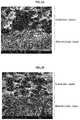
  • FIG. 3A is a scanning electron microscope (SEM) image showing the cross-section of a cathode layer of the all-solid battery manufactured in Comparative Example 1 of the present invention
  • FIG. 3B is an SEM image showing the cross-section of an exemplary cathode layer of an exemplary all-solid battery manufactured in Example 1 according to an exemplary embodiment of the present invention
  • FIG. 4 is a graph showing capacity versus voltage upon charge/discharge of the all-solid batteries of Comparative Examples 1 and 2 and Example 1 of the present invention.
  • FIG. 5 is a graph showing the results of measurement of energy density depending on the number of charge/discharge cycles of the all-solid batteries of Comparative Examples 1 and 2 and Example 1 of the present invention.
  • vehicle or “vehicular” or other similar term as used herein is inclusive of motor vehicles in general such as passenger automobiles including sports utility vehicles (SUV), buses, trucks, various commercial vehicles, watercraft including a variety of boats and ships, aircraft, and the like, and includes hybrid vehicles, electric vehicles, plug-in hybrid electric vehicles, hydrogen-powered vehicles and other alternative fuel vehicles (e.g. fuels derived from resources other than petroleum).
  • a hybrid vehicle is a vehicle that has two or more sources of power, for example both gasoline-powered and electric-powered vehicles.
  • the term “about” is understood as within a range of normal tolerance in the art, for example within 2 standard deviations of the mean. “About” can be understood as within 10%, 9%, 8%, 7%, 6%, 5%, 4%, 3%, 2%, 1%, 0.5%, 0.1%, 0.05%, or 0.01% of the stated value. Unless otherwise clear from the context, all numerical values provided herein are modified by the term “about.”
  • FIG. 1 is a cross-sectional view schematically showing an exemplary all-solid battery according to an exemplary embodiment of the present invention.
  • the all-solid battery (SB) includes a cathode 10 , a solid electrolyte layer 20 , and an anode 30 .
  • the cathode 10 may include a first solid electrolyte 21 , a second solid electrolyte 22 , and a cathode active material.
  • the first solid electrolyte 21 and the second solid electrolyte 22 are described in detail later.
  • the cathode active material may suitably include at least one selected from the group consisting of, for example, lithium cobalt oxide, lithium iron phosphate, nickel cobalt aluminum, and nickel cobalt manganese.
  • the anode 30 may be disposed to face the cathode 10 .
  • the anode 30 may include a first solid electrolyte 21 , a second solid electrolyte 22 , and an anode active material.
  • the first solid electrolyte 21 and the second solid electrolyte 22 are described in detail later.
  • the anode active material may suitably include at least one selected from the group consisting of, for example, graphitizable carbon (soft carbon), non-graphitizable carbon (hard carbon), natural graphite, artificial graphite, silicon (Si) and tin (Sn).
  • Each of the anode 30 and the cathode 10 may further include a conductive additive and a binder.
  • the conductive additive may include conductive carbon such as Super C65 made by Timcal, Super P in powder form, or conductive carbon in rod form provided by Denka or VGCF.
  • the binder as used herein may be used to improve solvent solubility and reactivity with the first and second solid electrolytes.
  • the binder may suitably include at least one polymer compound selected from the group consisting of butyl rubber-, fluorine-, diene-, acryl- and silicone-based compounds.
  • the binder may include acrylonitrile-butadiene rubber (NBR).
  • Each of the anode 30 and the cathode 10 may include an organic solvent for the preparation of an electrode slurry, and the organic solvent may suitably include cyclic aliphatic hydrocarbons, such as cyclopentane, cyclohexane or mixtures thereof, and aromatic hydrocarbons, such as toluene, xylene or mixtures thereof, in which the aliphatic hydrocarbons and the aromatic hydrocarbons may be used alone or in combinations of two or more thereof.
  • the organic solvent may suitably be selected depending on the desired drying rate or environmental conditions.
  • FIG. 2 schematically shows an exemplary solid electrolyte layer of an exemplary all-solid battery according to an exemplary embodiment of the present invention.
  • the solid electrolyte layer 20 of FIG. 2 may be provided between the cathode 10 and the anode 30 .
  • the solid electrolyte layer 20 may suitably include the first solid electrolyte 21 and the second solid electrolyte 22 .
  • the particle size of the second solid electrolyte 22 may be less than the particle size of the first solid electrolyte 21 .
  • the first solid electrolyte 21 and the second solid electrolyte 22 may be provided in the form of a core-shell structure.
  • the surface of the first solid electrolyte 21 having a large particle size and being hard, may be covered with the second solid electrolyte 22 , having a small particle size and being soft.
  • the surface of the first solid electrolyte 21 may be covered with the second solid electrolyte 22 and the space between particles of the first solid electrolyte 21 may be filled to thereby minimize the incidence of pores, and moreover, interfacial ion migration between the particles may be facilitated. Furthermore, the first solid electrolyte 21 having a large particle size may function as a main lithium ion transfer path, and atmospheric stability or moisture stability may be ensured.
  • the first solid electrolyte 21 may have a particle size of about 5 to 20 ⁇ m as measured by D50.
  • D50 is a median value in the cumulative distribution upon particle size analysis of a powder or powdered particle, is generally used as a representative of the particle size of a sample, and refers to a particle size corresponding to 50% of the total particles.
  • the particle size of the first solid electrolyte 21 is less than about 5 ⁇ m, nano-sized fine powder may be included, and thus the slurry mixing process may become problematic.
  • the particle size thereof is greater than about 20 ⁇ m, pinholes may be formed in the electrode due to the large size of the particles, thus deteriorating the battery performance.
  • the first solid electrolyte 21 may have an ionic conductivity ranging from greater than about 5 ⁇ 10 ⁇ 3 S/cm to 1 ⁇ 10 ⁇ 1 S/cm.
  • the ionic conductivity of the first solid electrolyte 21 is about 5 ⁇ 10 ⁇ 3 S/cm or less, lithium ion conduction between the cathode and the anode in the configuration of the all-solid battery, which is the main path thereof, may not be provided, thereby deteriorating cell performance.
  • the first solid electrolyte 21 may have greater hardness and less atmospheric stability than those of the second solid electrolyte 22 .
  • a crystalline sulfide solid electrolyte as the first solid electrolyte 21 may be hard or greater crystallinity because of thermal treatment at relatively high temperatures, but may be brittle and may break down when a predetermined physical force is applied thereto.
  • the first solid electrolyte 21 may suitably include at least one solid electrolyte selected from the group consisting of Li—Ge—P—S, Li—Si—P—S—Cl, Li—P—S—Cl, Li—P—S—Br and Li—P—S—Br—Cl.
  • the first solid electrolyte 21 may include at least one selected from the group consisting of Li 6 PS 5 Cl, Li 6 PS 5 Br and Li 6 PS 5 Cl x Br (1-x) (0.1 ⁇ x ⁇ 0.9).
  • the second solid electrolyte 22 may have an ionic conductivity ranging from greater than about 5 ⁇ 10 ⁇ 4 S/cm to 1 ⁇ 10 ⁇ 2 S/cm.
  • the ionic conductivity of the second solid electrolyte 22 is about 5 ⁇ 10 ⁇ 4 S/cm or less, t performance may deteriorate due to the lack of ion conduction characteristics, without improvement in interfacial resistance due to softness.
  • the higher the ionic conductivity of the second solid electrolyte 22 the better the battery performance, but the ionic conductivity of the second solid electrolyte may be preferably limited to about 1 ⁇ 10 ⁇ 2 S/cm or less, taking into consideration that atmospheric stability and ionic conductivity are typically incompatible with each other.
  • the second solid electrolyte 22 may be an amorphous sulfide solid electrolyte, in which the crystal structure of a raw material breaks through a strong pulverization process and the binding energy between the elements is weakened, thus exhibiting softness upon physical impact. However, it may not form a specific path for lithium element migration, as in the first solid electrolyte 21 , and thus the conductive performance may be deteriorated.
  • the second solid electrolyte 22 may suitably include at least one amorphous sulfide solid electrolyte selected from the group consisting of LiILi 2 S—P 2 S 5 , LiI—Li 2 S—B 253 , Li 3 PO 4 —Li 2 S—Si 2 S, Li 3 PO 4 —Li 2 S—Si 52 , LiPO 4 —Li 2 S—SiS, LiI—Li 2 S—P 2 O 5 , LiI—Li 3 PO 4 —P 2 S 5 , Li 3 PS 4 , and Li 2 S—P 2 S 5 .
  • the second solid electrolyte 22 may provide superior atmospheric stability and control the mechanical properties of the all-solid battery.
  • the second solid electrolyte 22 may have a particle size of about 0.5 to 4 ⁇ m based on D50.
  • the particle size of the second solid electrolyte 22 is less than about 0.5 ⁇ m, the extent of interparticle connection of the first solid electrolyte 21 may decrease, undesirably deteriorating the battery performance.
  • the particle size thereof is greater than about 4 ⁇ m, the migration path of lithium ions may be obstructed, undesirably deteriorating the conductive performance.
  • the weight ratio of the first solid electrolyte 21 to the second solid electrolyte 22 may be of about 50:50 to 90:10.
  • the relative weight of the first solid electrolyte 21 is less than about 50%, the extent of interparticle connection of the first solid electrolyte, which is the main migration path of lithium ions, may decrease, and thus the desired battery performance may not be assured.
  • the relative weight thereof is greater than about 90%, the surface of the first solid electrolyte 21 may not be sufficiently protected and the density of the electrode mixture may increase due to the insufficient amount of the second solid electrolyte 22 .
  • the solid electrolyte layer may include a first solid electrolyte 21 and a second solid electrolyte 22 having different ionic conductivities.
  • the first solid electrolyte 21 may have the ionic conductivity greater than the ionic conductivity of the second solid electrolyte 22 , for example, by 1.5 fold or greater, by about 2 fold or greater, by about 3 fold or greater, by about 4 fold or greater, by about 5 fold or greater, by about 10 fold or greater, by about 20 fold or greater, by about 30 fold or greater, by about 50 fold or greater, by about 100 fold or greater, by about 150 fold or greater, or by about 200 fold or greater of the ionic conductivity of the second solid electrolyte 22 .
  • the first solid electrolyte 21 and the second solid electrolyte 22 may be mixed so that the surface of the first solid electrolyte 21 may be covered with the second solid electrolyte 22 , thus ensuring a main ion transfer path through the first solid electrolyte 21 and minimizing the incidence of pores by filling the space between particles of the first solid electrolyte 21 with the second solid electrolyte 22 .
  • energy density may be improved through an increase in the density of the electrode mixture, and lithium dendrite growth may be suppressed.
  • contact between electrolyte particles may be improved, thus facilitating the interfacial ion migration and reducing the deformation of the solid electrolyte layer, and moreover, the internal resistance of the all-solid battery is reduced and high power output thereof becomes possible.
  • an argyrodite-type crystalline sulfide solid electrolyte Li 6 PS 5 Cl
  • the ionic conductivity of the first solid electrolyte was measured to be 3 ⁇ 10 ⁇ 3 S/cm through the evaluation of AC impedance of solid electrolyte pellets.
  • an amorphous sulfide solid electrolyte Li 2 S—P 2 S 5
  • the ionic conductivity of the second solid electrolyte was measured to be 8 ⁇ 10 ⁇ 4 S/cm in the same manner as above.
  • the first solid electrolyte, having an ionic conductivity of 3 ⁇ 10 ⁇ 3 S/cm, and the second solid electrolyte, having an ionic conductivity of 8 ⁇ 10 ⁇ 4 S/cm, were placed at a weight ratio of 70:30 in a ball-milling vessel, and were then milled at 250 rpm for 1 hr using a planetary ball mill (P7, Fritch), thus obtaining a heterogeneous composite electrolyte powder.
  • a LiCoO 2 cathode active material powder a LiCoO 2 cathode active material powder, the heterogeneous composite electrolyte powder, Super C65 made by Timcal as a conductive additive powder, and NBR (acrylonitrile-butadiene rubber) as a binder for electrode binding were mixed at a weight ratio of 70:30:5:5.
  • NBR acrylonitrile-butadiene rubber
  • the mixture thus obtained was mixed with an organic solvent to give a slurry having a viscosity of about 1400 cPs.
  • the organic solvent was xylene.
  • a natural graphite anode active material, the heterogeneous composite electrolyte powder, Super C65 made by Timcal as a conductive additive powder, and NBR as a binder for electrode binding were mixed at a weight ratio of 70:30:5:5.
  • the mixing processing was performed under the same conditions as in the cathode slurry mixing.
  • the heterogeneous composite electrolyte powder and a binder NBR were mixed at a weight ratio of 95:5.
  • the mixing processing was performed under the same conditions as in the cathode slurry mixing.
  • An all-solid battery was manufactured using the cathode slurry, the electrolyte slurry and the anode slurry.
  • a small pouch-type all-solid battery having an area of 80 mm ⁇ 60 mm was manufactured through high-pressure pressing at 4 ton/cm 2 .
  • the all-solid battery included the cathode layer electrode, the electrolyte layer and the anode layer electrode, which were sequentially stacked.
  • An all-solid battery was manufactured in the same manner as in Example 1, with the exception that each of a cathode slurry, an anode slurry, and an electrolyte slurry was formed using only the first solid electrolyte of Example 1.
  • An all-solid battery was manufactured in the same manner as in Example 1, with the exception that each of a cathode slurry, an anode slurry, and an electrolyte slurry was formed using only the second solid electrolyte of Example 1.
  • FIG. 3A is an SEM image showing the cross-section of the cathode layer of the all-solid battery manufactured in Comparative Example 1.
  • FIG. 3B is an SEM image showing the cross-section of the cathode layer of the all-solid battery manufactured in Example 1.
  • the cathode layer of Comparative Example 1 was not dense, and was cracked, in contrast with the cathode layer of Example 1.
  • FIG. 4 is a graph showing capacity versus voltage upon charge/discharge of the all-solid batteries of Example 1 and Comparative Examples 1 and 2.
  • Example 1 As shown in FIG. 4 and Table 1, when comparing Example 1 with Comparative Examples 1 and 2, initial charge/discharge efficiency and average discharge voltage were improved, and cathode capacity and cell energy density were also improved.
  • the energy density was evaluated depending on the number of charge/discharge cycles of the all-solid batteries of Example 1 and Comparative Examples 1 and 2. The results are shown in FIG. 5 .
  • FIG. 5 is a graph showing the energy density depending on the number of charge/discharge cycles of the all-solid batteries of Example 1 and Comparative Examples 1 and 2. As shown in FIG. 5 , even when the number of charge/discharge cycles was increased in Example 1 compared to Comparative Examples 1 and 2, the energy density was maintained at a level similar to the initial capacity. In Example 1 in particular, a high capacity of 96% or greater of the initial capacity was maintained even at 10 cycles. However, in Comparative Examples 1 and 2, as the number of charge/discharge cycles increased, the capacity was drastically decreased compared to the initial capacity.

Landscapes

  • Chemical & Material Sciences (AREA)
  • General Chemical & Material Sciences (AREA)
  • Chemical Kinetics & Catalysis (AREA)
  • Electrochemistry (AREA)
  • Engineering & Computer Science (AREA)
  • Inorganic Chemistry (AREA)
  • Manufacturing & Machinery (AREA)
  • Materials Engineering (AREA)
  • General Physics & Mathematics (AREA)
  • Condensed Matter Physics & Semiconductors (AREA)
  • Physics & Mathematics (AREA)
  • Composite Materials (AREA)
  • Crystallography & Structural Chemistry (AREA)
  • Secondary Cells (AREA)
  • Battery Electrode And Active Subsutance (AREA)

Abstract

Disclosed is an all-solid battery, including a cathode, an anode, and a solid electrolyte layer. The solid electrolyte layer may include a first solid electrolyte having an ionic conductivity ranging from greater than about 5×10⁻³ S/cm to about 1×10⁻¹ S/cm and a second solid electrolyte having an ionic conductivity ranging from greater than about 5×10⁻⁴ S/cm to about 1×10⁻² S/cm.

Description

CROSS-REFERENCE TO RELATED APPLICATION
This application claims under 35 U.S.C. § 119(a) the benefit of priority to Korean Patent Application No. 10-2017-0181111 filed on Dec. 27, 2017, the entire contents of which are incorporated herein by reference.
TECHNICAL FIELD
The present invention relates to an all-solid battery. The all-solid battery may have increased power output and deformation of a solid electrolyte layer in the all-solid battery may be reduced.
BACKGROUND OF THE INVENTION
Although lithium secondary batteries have been mainly applied in fields of small-sized devices such as mobile devices or laptop computers, research thereto is recently expanding to include fields of medium- to large-sized devices, particularly in fields requiring high power output, such as energy storage systems (ESS), electric vehicles (EV), and the like.
In the case of such medium- to large-sized lithium secondary batteries, operating conditions (e.g. temperature, impact, and the like) may be severe, unlike small-sized batteries, but also factors, such as energy density, power output, ease of estimation of state of charge (SOC)/state of health (SOH), and the like should be adequately met for medium- to large-sized batteries.
A lithium ion battery using an existing liquid electrolyte typically includes an electrolytic solution containing a flammable organic solvent, which may lead to serious safety problems in the event in which cells are uncontrollably exposed to a variety of environments and external impacts.
In order to overcome the limitations of various material characteristics of conventional lithium ion batteries using such liquid electrolytes, an all-solid battery using a solid electrolyte may be applied. However, the solid electrolyte, which is the key material of the all-solid battery, mainly includes a sulfide-based compound, which is highly reactive with atmospheric moisture, making it difficult to handle in an ambient atmosphere, as in conventional processes.
SUMMARY OF THE INVENTION
In preferred aspects, the present invention is intended to provide an all-solid battery, which may exhibit increased power output and reduced deformation of a solid electrolyte layer.
The term “all-solid cell” or “all-solid battery” as described herein refers to a cell or a battery that includes only solid or substantially solid-state components, such as solid state electrodes (e.g. anode and cathode) and solid electrolyte. Thus, in preferred aspect, an all-solid cell will not include a fluid and/or flowable electrolyte component as a material or component.
In one aspect, the present invention provides an all-solid battery that may include a cathode, an anode, and a solid electrolyte layer disposed between the cathode and the anode. Preferably, the solid electrolyte layer may include a first solid electrolyte having an ionic conductivity ranging from greater than about 5×10⁻³ S/cm to 1×10⁻¹ S/cm and a second solid electrolyte having an ionic conductivity ranging from greater than about 5×10⁻⁴ S/cm to 1×10⁻² S/cm.
The first solid electrolyte may be a crystalline sulfide solid electrolyte. The first solid electrolyte may suitably include at least one selected from the group consisting of Li—Ge—P—S, Li—Si—P—S—Cl, Li—P—S—Cl, Li—P—S—Br and Li—P—S—Br—Cl.
The term “crystalline sulfide” as used herein refers to a compound containing sulfur that may exhibit high symmetry in its crystal form, as being combined with a metal (e.g., Li, Fe, Cu, Ni, Co, Ag, Mg, Zn, Na, Ge, and the like) and/or a non-metal (e.g., P, halogen, Si, and the like), via covalent bond or ionic bond. In certain preferred aspect, the crystalline sulfide may include at least Li, such that the crystalline sulfide may have substantial ionic conductivity as a solid state, e.g., greater than about 1×10⁻³ S/cm, or particularly about 5×10⁻³ S/cm. For example, the crystalline sulfide may be a solid electrolyte in an all-solid battery.
The second solid electrolyte may be an amorphous sulfide solid electrolyte. The amorphous sulfide solid electrolyte may suitably include at least one selected from the group consisting of LiILi2S—P2S5, LiI—Li2S—B2S3, Li3PO4—Li2S—Si2S, Li3PO4—Li2S—SiS2, LiPO4—Li2S—SiS, LiI—Li2S—P2O5, LiI—Li3PO4—P2S5, Li3PS4, and Li2S—P2S5.
The term “amorphous sulfide” as used herein refers to a compound containing sulfur that does not have crystal form or defined symmetry, as being combined with a metal (e.g., Li, Fe, Cu, Ni, Co, Ag, Mg, Zn, Na, Ge, and the like) and/or a non-metal (e.g., P, halogen, Si, and the like) via covalent bond or ionic bond. In certain preferred aspect, the amorphous sulfide may include at least Li, but due to lack of crystallinity, the sulfide may have ionic conductivity of about 1×10⁻² S/cm or less.
A particle size of the second solid electrolyte may be less than a particle size of the first solid electrolyte.
The size of each particle may be measured at a maximum cross-sectional dimension. In addition, the size of the particle (e.g., first or second solid electrolyte particles) may be an average or a mean value of the sizes of the particles. In certain preferred aspects, the particle size may be measured based on D50, which is a median value in the cumulative distribution upon particle size analysis of a powder or powdered particle, and typically refers to a particle size corresponding to 50% of the total particles.
The first solid electrolyte may have the particle size of about 5 to 20 μm.
The second solid electrolyte may have the particle size of about 0.5 to 4 μm.
The weight ratio of the first solid electrolyte to the second solid electrolyte may be in the range of about 50:50 to 90:10.
The cathode may include the first solid electrolyte, the second solid electrolyte and a cathode active material.
The cathode active material may suitably include at least one selected from the group consisting of lithium cobalt oxide, lithium iron phosphate, nickel cobalt aluminum, and nickel cobalt manganese.
The anode may include the first solid electrolyte, the second solid electrolyte, and an anode active material.
The anode active material may suitably include at least one selected from the group consisting of graphitizable carbon (soft carbon), non-graphitizable carbon (hard carbon), natural graphite, artificial graphite, silicon (Si) and tin (Sn).
The term “graphitizable carbon” or “soft carbon” as used herein refers to a carbon material that can be transformed into high crystallinity after high temperature treatment (e.g., 3000° C.) such as graphitic carbon or portion of the carbon present as graphite. The term “non-graphitizable carbon” or “hard carbon” as used herein refers to a carbon material that cannot be transformed into graphitic carbon or crystallinity solely by high-temperature treatment (e.g., 3000° C.) such as graphitic carbon or portion of the carbon present as graphite.
The first solid electrolyte 21 may have the ionic conductivity different from the ionic conductivity of the second solid electrolyte 22, for example, by 10% or greater, by about 20% or greater, by about 30% or greater, by about 40% or greater, by about 50% or greater, by about 60% or greater, by about 70% or greater, by about 80% or greater, by about 90% or greater, by about 95% or greater, or by about 100% or greater of the ionic conductivity of the second solid electrolyte 22.
In addition, the first solid electrolyte 21 may have the ionic conductivity greater than the ionic conductivity of the second solid electrolyte 22, for example, by 1.5 fold or greater, by about 2 fold or greater, by about 3 fold or greater, by about 4 fold or greater, by about 5 fold or greater, by about 10 fold or greater, by about 20 fold or greater, by about 30 fold or greater, by about 50 fold or greater, by about 100 fold or greater, by about 150 fold or greater, or by about 200 fold or greater of the ionic conductivity of the second solid electrolyte 22.
Further provided is a vehicle that may include the all-solid battery as described herein.
According to various exemplary embodiments of the present invention, an all-solid battery may include a solid electrolyte layer including a first solid electrolyte and a second solid electrolyte having different ionic conductivities. For instance, the first solid electrolyte and the second solid electrolyte may be mixed so that the surface of the first solid electrolyte may be covered with the second solid electrolyte, thus ensuring a main ion transfer path through the first solid electrolyte and minimizing the incidence of pores by filling the space between particles of the first solid electrolyte with the second solid electrolyte.
According to the various exemplary embodiments of the present invention, energy density can be improved through an increase in the density of the electrode mixture, and lithium dendrite growth can be suppressed.
Further, the contact between electrolyte particles can be improved, thus facilitating interfacial ion migration and reducing the deformation of the solid electrolyte layer, and the internal resistance of the all-solid battery can be decreased and high power output thereof becomes possible.
BRIEF DESCRIPTION OF THE DRAWINGS
FIG. 1 is a cross-sectional view schematically showing an exemplary all-solid battery according to an exemplary embodiment of the present invention;
FIG. 2 schematically shows an exemplary solid electrolyte layer of an exemplary all-solid battery according to an exemplary embodiment of the present invention;
FIG. 3A is a scanning electron microscope (SEM) image showing the cross-section of a cathode layer of the all-solid battery manufactured in Comparative Example 1 of the present invention;
FIG. 3B is an SEM image showing the cross-section of an exemplary cathode layer of an exemplary all-solid battery manufactured in Example 1 according to an exemplary embodiment of the present invention;
FIG. 4 is a graph showing capacity versus voltage upon charge/discharge of the all-solid batteries of Comparative Examples 1 and 2 and Example 1 of the present invention; and
FIG. 5 is a graph showing the results of measurement of energy density depending on the number of charge/discharge cycles of the all-solid batteries of Comparative Examples 1 and 2 and Example 1 of the present invention.
DETAILED DESCRIPTION
The above and other aspects, features and advantages of the present invention will be more clearly understood from the following preferred embodiments taken in conjunction with the accompanying drawings. However, the present invention is not limited to the embodiments disclosed herein, but may be modified into different forms. These embodiments are provided to thoroughly explain the invention and to sufficiently transfer the spirit of the present invention to those skilled in the art.
Throughout the drawings, the same reference numerals will refer to the same or like elements. For the sake of clarity of the present invention, the dimensions of structures are depicted as being larger than the actual sizes thereof. It will be understood that, although terms such as “first”, “second”, etc. may be used herein to describe various elements, these elements are not to be limited by these terms. These terms are only used to distinguish one element from another element. For instance, a first element discussed below could be termed a second element without departing from the scope of the present invention. Similarly, the second element could also be termed a first element. As used herein, the singular forms are intended to include the plural forms as well, unless the context clearly indicates otherwise.
It will be further understood that the terms “comprise”, “include”, “have”, etc. when used in this specification specify the presence of stated features, integers, steps, operations, elements, components, or combinations thereof, but do not preclude the presence or addition of one or more other features, integers, steps, operations, elements, components, or combinations thereof. Also, it will be understood that when an element such as a layer, film, area, or sheet is referred to as being “on” another element, it can be directly on the other element, or intervening elements may be present therebetween. In contrast, when an element such as a layer, film, area, or sheet is referred to as being “under” another element, it can be directly under the other element, or intervening elements may be present therebetween.
The terminology used herein is for the purpose of describing particular embodiments only and is not intended to be limiting. As used herein, the singular forms “a,” “an” and “the” are intended to include the plural forms as well, unless the context clearly indicates otherwise.
It is understood that the term “vehicle” or “vehicular” or other similar term as used herein is inclusive of motor vehicles in general such as passenger automobiles including sports utility vehicles (SUV), buses, trucks, various commercial vehicles, watercraft including a variety of boats and ships, aircraft, and the like, and includes hybrid vehicles, electric vehicles, plug-in hybrid electric vehicles, hydrogen-powered vehicles and other alternative fuel vehicles (e.g. fuels derived from resources other than petroleum). As referred to herein, a hybrid vehicle is a vehicle that has two or more sources of power, for example both gasoline-powered and electric-powered vehicles.
Further, unless specifically stated or obvious from context, as used herein, the term “about” is understood as within a range of normal tolerance in the art, for example within 2 standard deviations of the mean. “About” can be understood as within 10%, 9%, 8%, 7%, 6%, 5%, 4%, 3%, 2%, 1%, 0.5%, 0.1%, 0.05%, or 0.01% of the stated value. Unless otherwise clear from the context, all numerical values provided herein are modified by the term “about.”
Hereinafter reference will now be made in detail to various embodiments of the present invention, examples of which are illustrated in the accompanying drawings and described below. While the invention will be described in conjunction with exemplary embodiments, it will be understood that present description is not intended to limit the invention to those exemplary embodiments. On the contrary, the invention is intended to cover not only the exemplary embodiments, but also various alternatives, modifications, equivalents and other embodiments, which may be included within the spirit and scope of the invention as defined by the appended claims.
FIG. 1 is a cross-sectional view schematically showing an exemplary all-solid battery according to an exemplary embodiment of the present invention.
With reference to FIG. 1, the all-solid battery (SB) according to an exemplary embodiment of the present invention includes a cathode 10, a solid electrolyte layer 20, and an anode 30. The cathode 10 may include a first solid electrolyte 21, a second solid electrolyte 22, and a cathode active material. The first solid electrolyte 21 and the second solid electrolyte 22 are described in detail later. The cathode active material may suitably include at least one selected from the group consisting of, for example, lithium cobalt oxide, lithium iron phosphate, nickel cobalt aluminum, and nickel cobalt manganese.
The anode 30 may be disposed to face the cathode 10. The anode 30 may include a first solid electrolyte 21, a second solid electrolyte 22, and an anode active material. The first solid electrolyte 21 and the second solid electrolyte 22 are described in detail later. The anode active material may suitably include at least one selected from the group consisting of, for example, graphitizable carbon (soft carbon), non-graphitizable carbon (hard carbon), natural graphite, artificial graphite, silicon (Si) and tin (Sn).
Each of the anode 30 and the cathode 10 may further include a conductive additive and a binder. The conductive additive may include conductive carbon such as Super C65 made by Timcal, Super P in powder form, or conductive carbon in rod form provided by Denka or VGCF. The binder as used herein may be used to improve solvent solubility and reactivity with the first and second solid electrolytes. Preferably, the binder may suitably include at least one polymer compound selected from the group consisting of butyl rubber-, fluorine-, diene-, acryl- and silicone-based compounds. For example, the binder may include acrylonitrile-butadiene rubber (NBR).
Each of the anode 30 and the cathode 10 may include an organic solvent for the preparation of an electrode slurry, and the organic solvent may suitably include cyclic aliphatic hydrocarbons, such as cyclopentane, cyclohexane or mixtures thereof, and aromatic hydrocarbons, such as toluene, xylene or mixtures thereof, in which the aliphatic hydrocarbons and the aromatic hydrocarbons may be used alone or in combinations of two or more thereof. The organic solvent may suitably be selected depending on the desired drying rate or environmental conditions.
FIG. 2 schematically shows an exemplary solid electrolyte layer of an exemplary all-solid battery according to an exemplary embodiment of the present invention. The solid electrolyte layer 20 of FIG. 2 may be provided between the cathode 10 and the anode 30. The solid electrolyte layer 20 may suitably include the first solid electrolyte 21 and the second solid electrolyte 22.
The particle size of the second solid electrolyte 22 may be less than the particle size of the first solid electrolyte 21. The first solid electrolyte 21 and the second solid electrolyte 22 may be provided in the form of a core-shell structure. For example, the surface of the first solid electrolyte 21, having a large particle size and being hard, may be covered with the second solid electrolyte 22, having a small particle size and being soft.
When the solid electrolyte layer 20 is compressed using an ultrahigh-pressure press, the surface of the first solid electrolyte 21 may be covered with the second solid electrolyte 22 and the space between particles of the first solid electrolyte 21 may be filled to thereby minimize the incidence of pores, and moreover, interfacial ion migration between the particles may be facilitated. Furthermore, the first solid electrolyte 21 having a large particle size may function as a main lithium ion transfer path, and atmospheric stability or moisture stability may be ensured.
Preferably, the first solid electrolyte 21 may have a particle size of about 5 to 20 μm as measured by D50. For example, D50 is a median value in the cumulative distribution upon particle size analysis of a powder or powdered particle, is generally used as a representative of the particle size of a sample, and refers to a particle size corresponding to 50% of the total particles. When the particle size of the first solid electrolyte 21 is less than about 5 μm, nano-sized fine powder may be included, and thus the slurry mixing process may become problematic. On the other hand, when the particle size thereof is greater than about 20 μm, pinholes may be formed in the electrode due to the large size of the particles, thus deteriorating the battery performance.
Furthermore, the first solid electrolyte 21 may have an ionic conductivity ranging from greater than about 5×10⁻³ S/cm to 1×10⁻¹ S/cm. When the ionic conductivity of the first solid electrolyte 21 is about 5×10⁻³ S/cm or less, lithium ion conduction between the cathode and the anode in the configuration of the all-solid battery, which is the main path thereof, may not be provided, thereby deteriorating cell performance. Preferably, the higher the ionic conductivity of the first solid electrolyte 21, the better the battery performance, but the ionic conductivity of the first solid electrolyte may suitably be of about 1×10⁻¹ S/cm or less due to performance limitations based on the characteristics of the solid electrolyte.
Also, the first solid electrolyte 21 may have greater hardness and less atmospheric stability than those of the second solid electrolyte 22. For example, a crystalline sulfide solid electrolyte as the first solid electrolyte 21 may be hard or greater crystallinity because of thermal treatment at relatively high temperatures, but may be brittle and may break down when a predetermined physical force is applied thereto. The first solid electrolyte 21 may suitably include at least one solid electrolyte selected from the group consisting of Li—Ge—P—S, Li—Si—P—S—Cl, Li—P—S—Cl, Li—P—S—Br and Li—P—S—Br—Cl. Preferably, the first solid electrolyte 21 may include at least one selected from the group consisting of Li6PS5Cl, Li6PS5Br and Li6PS5ClxBr(1-x) (0.1≤x≤0.9).
The second solid electrolyte 22 may have an ionic conductivity ranging from greater than about 5×10⁻⁴ S/cm to 1×10⁻² S/cm. When the ionic conductivity of the second solid electrolyte 22 is about 5×10⁻⁴ S/cm or less, t performance may deteriorate due to the lack of ion conduction characteristics, without improvement in interfacial resistance due to softness. Moreover, the higher the ionic conductivity of the second solid electrolyte 22, the better the battery performance, but the ionic conductivity of the second solid electrolyte may be preferably limited to about 1×10⁻² S/cm or less, taking into consideration that atmospheric stability and ionic conductivity are typically incompatible with each other.
The second solid electrolyte 22 may be an amorphous sulfide solid electrolyte, in which the crystal structure of a raw material breaks through a strong pulverization process and the binding energy between the elements is weakened, thus exhibiting softness upon physical impact. However, it may not form a specific path for lithium element migration, as in the first solid electrolyte 21, and thus the conductive performance may be deteriorated.
The second solid electrolyte 22 may suitably include at least one amorphous sulfide solid electrolyte selected from the group consisting of LiILi2S—P2S5, LiI—Li2S—B253, Li3PO4—Li2S—Si2S, Li3PO4—Li2S—Si52, LiPO4—Li2S—SiS, LiI—Li2S—P2O5, LiI—Li3PO4—P2S5, Li3PS4, and Li2S—P2S5. The second solid electrolyte 22 may provide superior atmospheric stability and control the mechanical properties of the all-solid battery.
The second solid electrolyte 22 may have a particle size of about 0.5 to 4 μm based on D50. When the particle size of the second solid electrolyte 22 is less than about 0.5 μm, the extent of interparticle connection of the first solid electrolyte 21 may decrease, undesirably deteriorating the battery performance. On the other hand, when the particle size thereof is greater than about 4 μm, the migration path of lithium ions may be obstructed, undesirably deteriorating the conductive performance.
The weight ratio of the first solid electrolyte 21 to the second solid electrolyte 22 may be of about 50:50 to 90:10. When the relative weight of the first solid electrolyte 21 is less than about 50%, the extent of interparticle connection of the first solid electrolyte, which is the main migration path of lithium ions, may decrease, and thus the desired battery performance may not be assured. On the other hand, when the relative weight thereof is greater than about 90%, the surface of the first solid electrolyte 21 may not be sufficiently protected and the density of the electrode mixture may increase due to the insufficient amount of the second solid electrolyte 22.
The solid electrolyte layer may include a first solid electrolyte 21 and a second solid electrolyte 22 having different ionic conductivities. The first solid electrolyte 21 may have the ionic conductivity greater than the ionic conductivity of the second solid electrolyte 22, for example, by 1.5 fold or greater, by about 2 fold or greater, by about 3 fold or greater, by about 4 fold or greater, by about 5 fold or greater, by about 10 fold or greater, by about 20 fold or greater, by about 30 fold or greater, by about 50 fold or greater, by about 100 fold or greater, by about 150 fold or greater, or by about 200 fold or greater of the ionic conductivity of the second solid electrolyte 22.
The first solid electrolyte 21 and the second solid electrolyte 22 may be mixed so that the surface of the first solid electrolyte 21 may be covered with the second solid electrolyte 22, thus ensuring a main ion transfer path through the first solid electrolyte 21 and minimizing the incidence of pores by filling the space between particles of the first solid electrolyte 21 with the second solid electrolyte 22.
According to various exemplary embodiments of the present invention, energy density may be improved through an increase in the density of the electrode mixture, and lithium dendrite growth may be suppressed. Furthermore, contact between electrolyte particles may be improved, thus facilitating the interfacial ion migration and reducing the deformation of the solid electrolyte layer, and moreover, the internal resistance of the all-solid battery is reduced and high power output thereof becomes possible.
EXAMPLE
A better understanding of the present invention will be given through the following examples, which are merely set forth to illustrate, but are not to be construed as limiting the scope of the present invention.
Example 1
1. Preparation of Heterogeneous Composite Electrolyte Powder
As a first solid electrolyte, an argyrodite-type crystalline sulfide solid electrolyte, Li6PS5Cl, was used. The ionic conductivity of the first solid electrolyte was measured to be 3×10⁻³ S/cm through the evaluation of AC impedance of solid electrolyte pellets. As a second solid electrolyte, an amorphous sulfide solid electrolyte, Li2S—P2S5, was used. The ionic conductivity of the second solid electrolyte was measured to be 8×10⁻⁴ S/cm in the same manner as above.
The first solid electrolyte, having an ionic conductivity of 3×10⁻³ S/cm, and the second solid electrolyte, having an ionic conductivity of 8×10⁻⁴ S/cm, were placed at a weight ratio of 70:30 in a ball-milling vessel, and were then milled at 250 rpm for 1 hr using a planetary ball mill (P7, Fritch), thus obtaining a heterogeneous composite electrolyte powder.
2. Preparation of Electrode Slurry and Electrolyte Slurry
(1) Preparation of Cathode Slurry
In order to prepare a cathode composite, a LiCoO2 cathode active material powder, the heterogeneous composite electrolyte powder, Super C65 made by Timcal as a conductive additive powder, and NBR (acrylonitrile-butadiene rubber) as a binder for electrode binding were mixed at a weight ratio of 70:30:5:5.
The mixture thus obtained was mixed with an organic solvent to give a slurry having a viscosity of about 1400 cPs. The organic solvent was xylene.
(2) Preparation of Anode Slurry
A natural graphite anode active material, the heterogeneous composite electrolyte powder, Super C65 made by Timcal as a conductive additive powder, and NBR as a binder for electrode binding were mixed at a weight ratio of 70:30:5:5. The mixing processing was performed under the same conditions as in the cathode slurry mixing.
(3) Preparation of Electrolyte Slurry
The heterogeneous composite electrolyte powder and a binder NBR were mixed at a weight ratio of 95:5. The mixing processing was performed under the same conditions as in the cathode slurry mixing.
3. Manufacture of all-Solid Battery
An all-solid battery was manufactured using the cathode slurry, the electrolyte slurry and the anode slurry. A small pouch-type all-solid battery having an area of 80 mm×60 mm was manufactured through high-pressure pressing at 4 ton/cm2. The all-solid battery included the cathode layer electrode, the electrolyte layer and the anode layer electrode, which were sequentially stacked.
Comparative Example 1
An all-solid battery was manufactured in the same manner as in Example 1, with the exception that each of a cathode slurry, an anode slurry, and an electrolyte slurry was formed using only the first solid electrolyte of Example 1.
Comparative Example 2
An all-solid battery was manufactured in the same manner as in Example 1, with the exception that each of a cathode slurry, an anode slurry, and an electrolyte slurry was formed using only the second solid electrolyte of Example 1.
Test Example 1: Comparison of Microstructures of Cathode Layers
In order to compare the microstructures of the cross-sections of the cathode layers of the all-solid batteries of Example 1 and Comparative Example 1, SEM (scanning electron microscope) measurement was performed. The results are shown in FIGS. 3A and 3B.
FIG. 3A is an SEM image showing the cross-section of the cathode layer of the all-solid battery manufactured in Comparative Example 1. FIG. 3B is an SEM image showing the cross-section of the cathode layer of the all-solid battery manufactured in Example 1. With reference to FIGS. 3A and 3B, the cathode layer of Comparative Example 1 was not dense, and was cracked, in contrast with the cathode layer of Example 1.
Test Example 2: Evaluation of Battery Performance
The performance results of the all-solid batteries of Example 1 and Comparative Examples 1 and 2 were evaluated. The results are shown in FIG. 4 and Table 1 below. FIG. 4 is a graph showing capacity versus voltage upon charge/discharge of the all-solid batteries of Example 1 and Comparative Examples 1 and 2.
TABLE 1
Loading per element Average
(mg/cm2) Cathode Initial discharge Energy
Electrolyte Anode/Cathode capacity efficiency voltage density
No. Cathode Anode layer (N/P) (mAh/g) (%) (V) (Wh/kg)
Comp. Ex. 1 20.5 12.4 5.8 1.16 157 75 3.67 169
Comp. Ex. 2 22.0 15.6 3.9 1.26 160 85 3.67 172
Ex. 1 20.5 12.7 4.8 1.19 164 87 3.68 179
As shown in FIG. 4 and Table 1, when comparing Example 1 with Comparative Examples 1 and 2, initial charge/discharge efficiency and average discharge voltage were improved, and cathode capacity and cell energy density were also improved.
Test Example 3: Evaluation of Durability
The energy density was evaluated depending on the number of charge/discharge cycles of the all-solid batteries of Example 1 and Comparative Examples 1 and 2. The results are shown in FIG. 5.
FIG. 5 is a graph showing the energy density depending on the number of charge/discharge cycles of the all-solid batteries of Example 1 and Comparative Examples 1 and 2. As shown in FIG. 5, even when the number of charge/discharge cycles was increased in Example 1 compared to Comparative Examples 1 and 2, the energy density was maintained at a level similar to the initial capacity. In Example 1 in particular, a high capacity of 96% or greater of the initial capacity was maintained even at 10 cycles. However, in Comparative Examples 1 and 2, as the number of charge/discharge cycles increased, the capacity was drastically decreased compared to the initial capacity.
Although various exemplary embodiments of the present invention have been described with reference to the accompanying drawings, those skilled in the art will appreciate that the present invention may be embodied in other specific forms without changing the technical spirit or essential features. Thus, embodiments described above should be understood to be illustrative in every way and non-limiting.

Claims (12)

What is claimed is:
1. An all-solid battery, comprising:
a cathode;
an anode; and
a solid electrolyte layer disposed between the cathode and the anode,
wherein the solid electrolyte layer comprises a first solid electrolyte having an ionic conductivity ranging from greater than about 5×10⁻³ S/cm to about 1×10⁻¹ S/cm and a second solid electrolyte having an ionic conductivity ranging from greater than about 5×10⁻⁴ S/cm to about 1×10⁻² S/cm.
2. The all-solid battery of claim 1, wherein the first solid electrolyte is at least one crystalline sulfide solid electrolyte selected from the group consisting of Li—Ge—P—S, Li—Si—P—S—Cl, Li—P—S—Cl, Li—P—S—Br and Li—P—S—Br—Cl.
3. The all-solid battery of claim 1, wherein the second solid electrolyte is at least one amorphous sulfide solid electrolyte selected from the group consisting of LiILi2S—P2S5, LiI—Li2S—B2S3, Li3PO4—Li2S—Si2S, Li3PO4—Li2S—SiS2, LiPO4—Li2S—SiS, LiI—Li2S—P2O5, LiI—Li3PO4—P2S5, Li3PS4, and Li2S—P2S5.
4. The all-solid battery of claim 1, wherein a particle size of the second solid electrolyte is less than a particle size of the first solid electrolyte.
5. The all-solid battery of claim 4, wherein the first solid electrolyte has a particle size of about 5 to 20 μm.
6. The all-solid battery of claim 4, wherein the second solid electrolyte has a particle size of about 0.5 to 4 μm.
7. The all-solid battery of claim 1, wherein a weight ratio of the first solid electrolyte to the second solid electrolyte is about 50:50 to 90:10.
8. The all-solid battery of claim 1, wherein the cathode comprises the first solid electrolyte, the second solid electrolyte and a cathode active material.
9. The all-solid battery of claim 8, wherein the cathode active material is at least one selected from the group consisting of lithium cobalt oxide, lithium iron phosphate, nickel cobalt aluminum, and nickel cobalt manganese.
10. The all-solid battery of claim 1, wherein the anode comprises the first solid electrolyte, the second solid electrolyte, and an anode active material.
11. The all-solid battery of claim 10, wherein the anode active material is at least one selected from the group consisting of graphitizable carbon (soft carbon), non-graphitizable carbon (hard carbon), natural graphite, artificial graphite, silicon (Si) and tin (Sn).
12. A vehicle comprising an all-solid battery of claim 1.
US16/163,174 2017-12-27 2018-10-17 All-solid battery Active 2039-05-07 US10818970B2 (en)

Applications Claiming Priority (2)

Application Number Priority Date Filing Date Title
KR1020170181111A KR102484902B1 (en) 2017-12-27 2017-12-27 All solid battery
KR10-2017-0181111 2017-12-27

Publications (2)

Publication Number Publication Date
US20190198916A1 US20190198916A1 (en) 2019-06-27
US10818970B2 true US10818970B2 (en) 2020-10-27

Family

ID=66951444

Family Applications (1)

Application Number Title Priority Date Filing Date
US16/163,174 Active 2039-05-07 US10818970B2 (en) 2017-12-27 2018-10-17 All-solid battery

Country Status (3)

Country Link
US (1) US10818970B2 (en)
KR (1) KR102484902B1 (en)
CN (1) CN109980273A (en)

Cited By (3)

* Cited by examiner, † Cited by third party
Publication number Priority date Publication date Assignee Title
US12278333B2 (en) 2019-11-06 2025-04-15 Samsung Sdi Co., Ltd. Solid electrolyte, electrochemical battery including the solid electrolyte, and method of preparing the solid electrolyte
US12362382B2 (en) 2020-03-20 2025-07-15 Samsung Electronics Co, Ltd. Solid electrolyte, method of preparing the same, lithium-air battery including the solid electrolyte, and electrochemical device including the solid electrolyte
US12519129B2 (en) 2021-02-10 2026-01-06 Powerco Se Solid state electrolyte for an electrode layer of a solid state battery

Families Citing this family (20)

* Cited by examiner, † Cited by third party
Publication number Priority date Publication date Assignee Title
KR102289958B1 (en) * 2019-07-10 2021-08-13 한양대학교 산학협력단 Composite electrode comprising sulfides solid electrolyte, and all-solid- battery using the same
KR102843327B1 (en) * 2019-10-28 2025-08-05 삼성전자주식회사 Secondary battery and method of manufacturing secondary battery
CN111092261B (en) * 2019-12-12 2021-04-02 中国第一汽车股份有限公司 Solid-state battery electrode unit
CN111129572B (en) * 2019-12-23 2022-02-11 来骑哦互联网技术(深圳)有限公司 Sulfide electrolyte and preparation method thereof
KR20210098246A (en) * 2020-01-31 2021-08-10 삼성에스디아이 주식회사 All Solid secondary battery, and Method for preparing the same
TWI829873B (en) * 2020-02-24 2024-01-21 日商三井金屬鑛業股份有限公司 Sulfide solid electrolyte and battery
US12113210B2 (en) 2020-03-13 2024-10-08 Maxell, Ltd. Electrode for all-solid-state battery and all-solid-state battery
CN111628139B (en) * 2020-06-30 2021-09-21 中国第一汽车股份有限公司 All-solid-state battery electrode and preparation method and application thereof
KR20220039386A (en) * 2020-09-22 2022-03-29 삼성에스디아이 주식회사 Solid ion conductor compound, solid electrolyte comprising the same, electrochemical cell comprising the same, and preparation method thereof
KR20220043754A (en) * 2020-09-29 2022-04-05 삼성에스디아이 주식회사 Solid ion conductor compound, solid electrolyte comprising the same, electrochemical cell comprising the same, and preparation method thereof
JP7624605B2 (en) * 2020-12-23 2025-01-31 パナソニックIpマネジメント株式会社 All-solid-state battery and method for producing same
KR102718840B1 (en) * 2021-05-28 2024-10-24 주식회사 엘지에너지솔루션 All-solid lithium secondary battery and method for preparing the same
JP2023546709A (en) * 2021-05-28 2023-11-07 エルジー エナジー ソリューション リミテッド All-solid-state lithium secondary battery and its manufacturing method
KR20240033824A (en) * 2022-09-06 2024-03-13 현대자동차주식회사 Solid electrolyte having core-shell structure and manufacturing method thereof
CN115632123B (en) * 2022-12-21 2023-02-24 蚂蚁新能源科技(天津)有限公司 All-solid-state lithium battery and preparation method thereof
KR20250034806A (en) * 2023-09-04 2025-03-11 삼성에스디아이 주식회사 Solid secondary battery
JP2025152373A (en) * 2024-03-28 2025-10-09 株式会社Aescジャパン All-solid-state battery and battery module
KR20250147129A (en) * 2024-04-03 2025-10-13 포스코홀딩스 주식회사 Solid electrolyte sheet and all solid state battery comprising the same
KR20250157156A (en) * 2024-04-26 2025-11-04 삼성에스디아이 주식회사 All-solid-state battery
KR20250158549A (en) * 2024-04-30 2025-11-06 삼성에스디아이 주식회사 Cathode and Lithium Secondary battery including the same

Citations (10)

* Cited by examiner, † Cited by third party
Publication number Priority date Publication date Assignee Title
JP2009094029A (en) 2007-10-12 2009-04-30 Ohara Inc All-solid lithium secondary battery, and electrode for all-solid lithium secondary battery
KR20110055635A (en) 2008-10-03 2011-05-25 도요타지도샤가부시키가이샤 Manufacturing method of all-solid lithium battery
KR101359900B1 (en) 2011-06-30 2014-02-11 주식회사 엘지화학 Novel Polymer Electrolyte and Lithium Secondary Battery Comprising the Same
KR101367787B1 (en) 2009-12-16 2014-02-27 도요타 지도샤(주) Method of producing a sulfide solid electrolyte material, sulfide solid electrolyte material, and lithium battery
JP2015088480A (en) 2013-09-25 2015-05-07 富士フイルム株式会社 Solid electrolytic composition, binder for all-solid type secondary batteries, electrode sheet for batteries arranged by use thereof, and all-solid type secondary battery
KR101592698B1 (en) 2014-05-27 2016-02-12 현대자동차주식회사 All-solid state secondary battery using hybrid electrolyte
US20160233510A1 (en) * 2013-11-08 2016-08-11 Hitachi, Ltd. All-solid state battery, electrode for all-solid state battery, and method of manufacturing the same
KR101655627B1 (en) 2014-12-26 2016-09-07 현대자동차주식회사 Organic-inorganic complex solid polymer electrolytes membrane, manufacturing method thereof and all solid battery including thereof
US9673482B2 (en) * 2012-11-06 2017-06-06 Idemitsu Kosan Co., Ltd. Solid electrolyte
US10008714B2 (en) * 2015-07-27 2018-06-26 Toyota Jidosha Kabushiki Kaisha Anode mixture and all solid battery

Family Cites Families (12)

* Cited by examiner, † Cited by third party
Publication number Priority date Publication date Assignee Title
CN101114718A (en) * 2007-08-31 2008-01-30 中国科学院上海硅酸盐研究所 Design Criteria and Preparation Methods of Li-ion Inorganic Composite Solid Electrolyte Materials
JP5158008B2 (en) * 2009-04-28 2013-03-06 トヨタ自動車株式会社 All solid battery
JP5521899B2 (en) * 2010-08-26 2014-06-18 トヨタ自動車株式会社 Sulfide solid electrolyte material and lithium solid state battery
JP6260807B2 (en) * 2012-12-06 2018-01-17 三星電子株式会社Samsung Electronics Co.,Ltd. Solid battery
KR101856888B1 (en) * 2013-12-26 2018-05-10 도요타 지도샤(주) Solid-state lithium battery, solid-state lithium battery module, and method for producing solid-state lithium battery
JP2015153647A (en) 2014-02-17 2015-08-24 トヨタ自動車株式会社 Method for manufacturing solid battery
CN104953175A (en) * 2014-03-28 2015-09-30 比亚迪股份有限公司 Solid electrolyte for lithium ion battery, preparation method for solid electrolyte, and lithium ion battery
US9728808B2 (en) * 2015-02-25 2017-08-08 Toyota Jidosha Kabushiki Kaisha All solid state battery
WO2016152262A1 (en) * 2015-03-25 2016-09-29 日本ゼオン株式会社 All-solid secondary battery
KR101705267B1 (en) * 2015-04-13 2017-02-22 울산과학기술원 Solid electrolytes for all solid state rechargeable lithium battery, methods for manufacturing the same, and all solid state rechargeable lithium battery including the same
CN106611871B (en) * 2015-10-23 2020-11-06 比亚迪股份有限公司 Solid electrolyte material and preparation method thereof, solid electrolyte and battery
KR101896758B1 (en) * 2016-05-04 2018-09-07 현대자동차주식회사 All-Solid Battery And Method

Patent Citations (10)

* Cited by examiner, † Cited by third party
Publication number Priority date Publication date Assignee Title
JP2009094029A (en) 2007-10-12 2009-04-30 Ohara Inc All-solid lithium secondary battery, and electrode for all-solid lithium secondary battery
KR20110055635A (en) 2008-10-03 2011-05-25 도요타지도샤가부시키가이샤 Manufacturing method of all-solid lithium battery
KR101367787B1 (en) 2009-12-16 2014-02-27 도요타 지도샤(주) Method of producing a sulfide solid electrolyte material, sulfide solid electrolyte material, and lithium battery
KR101359900B1 (en) 2011-06-30 2014-02-11 주식회사 엘지화학 Novel Polymer Electrolyte and Lithium Secondary Battery Comprising the Same
US9673482B2 (en) * 2012-11-06 2017-06-06 Idemitsu Kosan Co., Ltd. Solid electrolyte
JP2015088480A (en) 2013-09-25 2015-05-07 富士フイルム株式会社 Solid electrolytic composition, binder for all-solid type secondary batteries, electrode sheet for batteries arranged by use thereof, and all-solid type secondary battery
US20160233510A1 (en) * 2013-11-08 2016-08-11 Hitachi, Ltd. All-solid state battery, electrode for all-solid state battery, and method of manufacturing the same
KR101592698B1 (en) 2014-05-27 2016-02-12 현대자동차주식회사 All-solid state secondary battery using hybrid electrolyte
KR101655627B1 (en) 2014-12-26 2016-09-07 현대자동차주식회사 Organic-inorganic complex solid polymer electrolytes membrane, manufacturing method thereof and all solid battery including thereof
US10008714B2 (en) * 2015-07-27 2018-06-26 Toyota Jidosha Kabushiki Kaisha Anode mixture and all solid battery

Cited By (3)

* Cited by examiner, † Cited by third party
Publication number Priority date Publication date Assignee Title
US12278333B2 (en) 2019-11-06 2025-04-15 Samsung Sdi Co., Ltd. Solid electrolyte, electrochemical battery including the solid electrolyte, and method of preparing the solid electrolyte
US12362382B2 (en) 2020-03-20 2025-07-15 Samsung Electronics Co, Ltd. Solid electrolyte, method of preparing the same, lithium-air battery including the solid electrolyte, and electrochemical device including the solid electrolyte
US12519129B2 (en) 2021-02-10 2026-01-06 Powerco Se Solid state electrolyte for an electrode layer of a solid state battery

Also Published As

Publication number Publication date
KR20190079132A (en) 2019-07-05
CN109980273A (en) 2019-07-05
KR102484902B1 (en) 2023-01-04
US20190198916A1 (en) 2019-06-27

Similar Documents

Publication Publication Date Title
US10818970B2 (en) All-solid battery
AU2008349765B2 (en) Core-shell type anode active material for lithium secondary batteries, method for preparing the same and lithium secondary batteries comprising the same
CN104937749B (en) Anode of secondary cell, the manufacturing method of anode of secondary cell and all solid state secondary battery
US10008714B2 (en) Anode mixture and all solid battery
CN107251285B (en) Positive electrode active material for nonaqueous electrolyte secondary battery, method for producing same, and nonaqueous electrolyte secondary battery
US10714747B2 (en) High energy lithium ion secondary battery with improved lifetime and energy density
KR102018470B1 (en) Cathode Materials for Rechargeable Solid Lithium Ion Batteries
US20150207177A1 (en) All solid state battery
CN109970083A (en) Nitrogen-doped sulfide-based solid electrolytes for all-solid-state batteries
KR102068073B1 (en) CATHODE COMPOSITE MATERIAL FOR All SOLID LITHIUM SECONDARY BATTERY, METHOD FOR PREPARING THE SAME AND ALL SOLID LITHIUM SECONDARY BATTERY COMPRISING THE SAME
CN107210441A (en) Non-aqueous electrolyte secondary battery positive active material and its manufacture method, and used the non-aqueous electrolyte secondary battery of the positive active material
JP2014049229A (en) Negative electrode body for all-solid-state battery and all-solid-state battery
US20240208837A1 (en) Lithium-supplementing additive, preparation method and application thereof
CN117747822A (en) Lithium supplementing additive, preparation method thereof, positive electrode plate and secondary battery
US20220320483A1 (en) Anode for all-solid-state battery containing no active material and all-solid-state battery including the same
CN111293313A (en) Positive electrode active material for all-solid-state lithium secondary battery, positive electrode plate, all-solid-state lithium secondary battery and device
EP4195324A1 (en) Cathode active material for lithium secondary battery, cathode for lithium secondary battery and lithium secondary battery including the same
KR20220059125A (en) Negative electrode for secondary battery and secondary battery including the same
US12322751B2 (en) All solid state battery
KR102855155B1 (en) An electrode for all solid state battery having improved interfacial properties
CA2674783A1 (en) Core-shell anode material comprising positive temperature co-effecient medium for lithium secondary battery
US12176482B1 (en) Solid electrolyte membrane, method for manufacturing the same, and all-solid-state battery comprising the same
US20240339619A1 (en) Dry cathode for all-solid-state battery with high energy density and method of manufacturing same
EP4447181A1 (en) Solid electrolyte membrane and all-solid-state battery comprising same
KR20200131982A (en) A positive electrode for lithium secondary battery including a sulfur-halloysite complex, method for preparing the same and lithium secondary battery including the positive electrode

Legal Events

Date Code Title Description
AS Assignment

Owner name: HYUNDAI MOTOR COMPANY, KOREA, REPUBLIC OF

Free format text: ASSIGNMENT OF ASSIGNORS INTEREST;ASSIGNORS:YOON, YONG SUB;KIM, YUN SUNG;OH, PIL GUN;AND OTHERS;REEL/FRAME:047201/0402

Effective date: 20181005

Owner name: KIA MOTORS CORPORATION, KOREA, REPUBLIC OF

Free format text: ASSIGNMENT OF ASSIGNORS INTEREST;ASSIGNORS:YOON, YONG SUB;KIM, YUN SUNG;OH, PIL GUN;AND OTHERS;REEL/FRAME:047201/0402

Effective date: 20181005

FEPP Fee payment procedure

Free format text: ENTITY STATUS SET TO UNDISCOUNTED (ORIGINAL EVENT CODE: BIG.); ENTITY STATUS OF PATENT OWNER: LARGE ENTITY

STPP Information on status: patent application and granting procedure in general

Free format text: NOTICE OF ALLOWANCE MAILED -- APPLICATION RECEIVED IN OFFICE OF PUBLICATIONS

STCF Information on status: patent grant

Free format text: PATENTED CASE

MAFP Maintenance fee payment

Free format text: PAYMENT OF MAINTENANCE FEE, 4TH YEAR, LARGE ENTITY (ORIGINAL EVENT CODE: M1551); ENTITY STATUS OF PATENT OWNER: LARGE ENTITY

Year of fee payment: 4