US10815317B2 - Method for producing oligomer and catalyst - Google Patents
Method for producing oligomer and catalyst Download PDFInfo
- Publication number
- US10815317B2 US10815317B2 US16/084,797 US201716084797A US10815317B2 US 10815317 B2 US10815317 B2 US 10815317B2 US 201716084797 A US201716084797 A US 201716084797A US 10815317 B2 US10815317 B2 US 10815317B2
- Authority
- US
- United States
- Prior art keywords
- group
- carbon atoms
- same
- different
- compound
- Prior art date
- Legal status (The legal status is an assumption and is not a legal conclusion. Google has not performed a legal analysis and makes no representation as to the accuracy of the status listed.)
- Active, expires
Links
- 0 [1*]C1=C([2*])C([3*])=C([4*])C([5*])=C1C Chemical compound [1*]C1=C([2*])C([3*])=C([4*])C([5*])=C1C 0.000 description 16
- MTBJOVLHSCQVAE-QHKWOANTSA-N C/N=C(\C)C1=CC=CC(/C(C)=N/C)=N1 Chemical compound C/N=C(\C)C1=CC=CC(/C(C)=N/C)=N1 MTBJOVLHSCQVAE-QHKWOANTSA-N 0.000 description 4
- UXRRNQKKDXWJKW-ITAGJCAXSA-N C/N=C1C(=N/C)/C2(C)CCC/1C2(C)C Chemical compound C/N=C1C(=N/C)/C2(C)CCC/1C2(C)C UXRRNQKKDXWJKW-ITAGJCAXSA-N 0.000 description 4
- IRBHGYLWZWTIOP-UHFFFAOYSA-N CC(C)(C(CC1)/C2=N\[AlH2])C1(C)/C2=N\[AlH2] Chemical compound CC(C)(C(CC1)/C2=N\[AlH2])C1(C)/C2=N\[AlH2] IRBHGYLWZWTIOP-UHFFFAOYSA-N 0.000 description 1
- ODMVKVYRVYYTQP-RJDMCEDOSA-F CC(C)C1=CC=CC(C(C)C)=C1N1=C(C2=CC=CC=C2)C2=N3C(=CC=C2)/C(C2=CC=CC=C2)=N(/C2=C(C(C)C)C=CC=C2C(C)C)[Fe]31(Br)Br.CC(C)C1=CC=CC(C(C)C)=C1N1=C(C2=CC=CC=C2)C2=N3C(=CC=C2)/C(C2=CC=CC=C2)=N(/C2=C(C(C)C)C=CC=C2C(C)C)[Fe]31(Cl)Cl.CC1=N(C2=C(C(C)C)C=CC=C2C(C)C)[Fe]2(Br)(Br)N3=C1C=CC=C3/C(C)=N\2C1=C(C(C)C)C=CC=C1C(C)C.CC1=N(C2=C(C(C)C)C=CC=C2C(C)C)[Fe]2(Cl)(Cl)N3=C1C=CC=C3/C(C)=N\2C1=C(C(C)C)C=CC=C1C(C)C Chemical compound CC(C)C1=CC=CC(C(C)C)=C1N1=C(C2=CC=CC=C2)C2=N3C(=CC=C2)/C(C2=CC=CC=C2)=N(/C2=C(C(C)C)C=CC=C2C(C)C)[Fe]31(Br)Br.CC(C)C1=CC=CC(C(C)C)=C1N1=C(C2=CC=CC=C2)C2=N3C(=CC=C2)/C(C2=CC=CC=C2)=N(/C2=C(C(C)C)C=CC=C2C(C)C)[Fe]31(Cl)Cl.CC1=N(C2=C(C(C)C)C=CC=C2C(C)C)[Fe]2(Br)(Br)N3=C1C=CC=C3/C(C)=N\2C1=C(C(C)C)C=CC=C1C(C)C.CC1=N(C2=C(C(C)C)C=CC=C2C(C)C)[Fe]2(Cl)(Cl)N3=C1C=CC=C3/C(C)=N\2C1=C(C(C)C)C=CC=C1C(C)C ODMVKVYRVYYTQP-RJDMCEDOSA-F 0.000 description 1
- WZHFPUGDQOIHDS-MZACJDAPSA-N CC1=CC=C(/N=C2C(=N/C3=C(C)C=C(C)C=C3)/C3(C)CCC/2C3(C)C)C(C)=C1.CC1=CC=CC=C1/N=C1C(=N/C2=C(C)C=CC=C2)/C2(C)CCC/1C2(C)C.COC1=CC=C(/N=C2C(=N/C3=C(C)C=C(OC)C=C3)/C3(C)CCC/2C3(C)C)C(C)=C1 Chemical compound CC1=CC=C(/N=C2C(=N/C3=C(C)C=C(C)C=C3)/C3(C)CCC/2C3(C)C)C(C)=C1.CC1=CC=CC=C1/N=C1C(=N/C2=C(C)C=CC=C2)/C2(C)CCC/1C2(C)C.COC1=CC=C(/N=C2C(=N/C3=C(C)C=C(OC)C=C3)/C3(C)CCC/2C3(C)C)C(C)=C1 WZHFPUGDQOIHDS-MZACJDAPSA-N 0.000 description 1
Classifications
-
- C—CHEMISTRY; METALLURGY
- C08—ORGANIC MACROMOLECULAR COMPOUNDS; THEIR PREPARATION OR CHEMICAL WORKING-UP; COMPOSITIONS BASED THEREON
- C08F—MACROMOLECULAR COMPOUNDS OBTAINED BY REACTIONS ONLY INVOLVING CARBON-TO-CARBON UNSATURATED BONDS
- C08F4/00—Polymerisation catalysts
- C08F4/42—Metals; Metal hydrides; Metallo-organic compounds; Use thereof as catalyst precursors
- C08F4/44—Metals; Metal hydrides; Metallo-organic compounds; Use thereof as catalyst precursors selected from light metals, zinc, cadmium, mercury, copper, silver, gold, boron, gallium, indium, thallium, rare earths or actinides
- C08F4/60—Metals; Metal hydrides; Metallo-organic compounds; Use thereof as catalyst precursors selected from light metals, zinc, cadmium, mercury, copper, silver, gold, boron, gallium, indium, thallium, rare earths or actinides together with refractory metals, iron group metals, platinum group metals, manganese, rhenium technetium or compounds thereof
- C08F4/70—Iron group metals, platinum group metals or compounds thereof
-
- C—CHEMISTRY; METALLURGY
- C08—ORGANIC MACROMOLECULAR COMPOUNDS; THEIR PREPARATION OR CHEMICAL WORKING-UP; COMPOSITIONS BASED THEREON
- C08F—MACROMOLECULAR COMPOUNDS OBTAINED BY REACTIONS ONLY INVOLVING CARBON-TO-CARBON UNSATURATED BONDS
- C08F4/00—Polymerisation catalysts
- C08F4/42—Metals; Metal hydrides; Metallo-organic compounds; Use thereof as catalyst precursors
- C08F4/44—Metals; Metal hydrides; Metallo-organic compounds; Use thereof as catalyst precursors selected from light metals, zinc, cadmium, mercury, copper, silver, gold, boron, gallium, indium, thallium, rare earths or actinides
- C08F4/60—Metals; Metal hydrides; Metallo-organic compounds; Use thereof as catalyst precursors selected from light metals, zinc, cadmium, mercury, copper, silver, gold, boron, gallium, indium, thallium, rare earths or actinides together with refractory metals, iron group metals, platinum group metals, manganese, rhenium technetium or compounds thereof
- C08F4/70—Iron group metals, platinum group metals or compounds thereof
- C08F4/7001—Iron group metals, platinum group metals or compounds thereof the metallic compound containing a multidentate ligand, i.e. a ligand capable of donating two or more pairs of electrons to form a coordinate or ionic bond
- C08F4/7039—Tridentate ligand
- C08F4/704—Neutral ligand
- C08F4/7042—NNN
-
- C—CHEMISTRY; METALLURGY
- C07—ORGANIC CHEMISTRY
- C07C—ACYCLIC OR CARBOCYCLIC COMPOUNDS
- C07C2/00—Preparation of hydrocarbons from hydrocarbons containing a smaller number of carbon atoms
- C07C2/02—Preparation of hydrocarbons from hydrocarbons containing a smaller number of carbon atoms by addition between unsaturated hydrocarbons
- C07C2/04—Preparation of hydrocarbons from hydrocarbons containing a smaller number of carbon atoms by addition between unsaturated hydrocarbons by oligomerisation of well-defined unsaturated hydrocarbons without ring formation
- C07C2/06—Preparation of hydrocarbons from hydrocarbons containing a smaller number of carbon atoms by addition between unsaturated hydrocarbons by oligomerisation of well-defined unsaturated hydrocarbons without ring formation of alkenes, i.e. acyclic hydrocarbons having only one carbon-to-carbon double bond
- C07C2/08—Catalytic processes
- C07C2/26—Catalytic processes with hydrides or organic compounds
- C07C2/32—Catalytic processes with hydrides or organic compounds as complexes, e.g. acetyl-acetonates
-
- C—CHEMISTRY; METALLURGY
- C08—ORGANIC MACROMOLECULAR COMPOUNDS; THEIR PREPARATION OR CHEMICAL WORKING-UP; COMPOSITIONS BASED THEREON
- C08F—MACROMOLECULAR COMPOUNDS OBTAINED BY REACTIONS ONLY INVOLVING CARBON-TO-CARBON UNSATURATED BONDS
- C08F10/00—Homopolymers and copolymers of unsaturated aliphatic hydrocarbons having only one carbon-to-carbon double bond
-
- C—CHEMISTRY; METALLURGY
- C08—ORGANIC MACROMOLECULAR COMPOUNDS; THEIR PREPARATION OR CHEMICAL WORKING-UP; COMPOSITIONS BASED THEREON
- C08F—MACROMOLECULAR COMPOUNDS OBTAINED BY REACTIONS ONLY INVOLVING CARBON-TO-CARBON UNSATURATED BONDS
- C08F210/00—Copolymers of unsaturated aliphatic hydrocarbons having only one carbon-to-carbon double bond
- C08F210/16—Copolymers of ethene with alpha-alkenes, e.g. EP rubbers
-
- C—CHEMISTRY; METALLURGY
- C08—ORGANIC MACROMOLECULAR COMPOUNDS; THEIR PREPARATION OR CHEMICAL WORKING-UP; COMPOSITIONS BASED THEREON
- C08F—MACROMOLECULAR COMPOUNDS OBTAINED BY REACTIONS ONLY INVOLVING CARBON-TO-CARBON UNSATURATED BONDS
- C08F4/00—Polymerisation catalysts
- C08F4/42—Metals; Metal hydrides; Metallo-organic compounds; Use thereof as catalyst precursors
- C08F4/44—Metals; Metal hydrides; Metallo-organic compounds; Use thereof as catalyst precursors selected from light metals, zinc, cadmium, mercury, copper, silver, gold, boron, gallium, indium, thallium, rare earths or actinides
- C08F4/52—Metals; Metal hydrides; Metallo-organic compounds; Use thereof as catalyst precursors selected from light metals, zinc, cadmium, mercury, copper, silver, gold, boron, gallium, indium, thallium, rare earths or actinides selected from boron, aluminium, gallium, indium, thallium or rare earths
-
- C—CHEMISTRY; METALLURGY
- C08—ORGANIC MACROMOLECULAR COMPOUNDS; THEIR PREPARATION OR CHEMICAL WORKING-UP; COMPOSITIONS BASED THEREON
- C08F—MACROMOLECULAR COMPOUNDS OBTAINED BY REACTIONS ONLY INVOLVING CARBON-TO-CARBON UNSATURATED BONDS
- C08F4/00—Polymerisation catalysts
- C08F4/42—Metals; Metal hydrides; Metallo-organic compounds; Use thereof as catalyst precursors
- C08F4/44—Metals; Metal hydrides; Metallo-organic compounds; Use thereof as catalyst precursors selected from light metals, zinc, cadmium, mercury, copper, silver, gold, boron, gallium, indium, thallium, rare earths or actinides
- C08F4/60—Metals; Metal hydrides; Metallo-organic compounds; Use thereof as catalyst precursors selected from light metals, zinc, cadmium, mercury, copper, silver, gold, boron, gallium, indium, thallium, rare earths or actinides together with refractory metals, iron group metals, platinum group metals, manganese, rhenium technetium or compounds thereof
- C08F4/70—Iron group metals, platinum group metals or compounds thereof
- C08F4/7001—Iron group metals, platinum group metals or compounds thereof the metallic compound containing a multidentate ligand, i.e. a ligand capable of donating two or more pairs of electrons to form a coordinate or ionic bond
- C08F4/7003—Bidentate ligand
- C08F4/7004—Neutral ligand
- C08F4/7006—NN
-
- B—PERFORMING OPERATIONS; TRANSPORTING
- B01—PHYSICAL OR CHEMICAL PROCESSES OR APPARATUS IN GENERAL
- B01J—CHEMICAL OR PHYSICAL PROCESSES, e.g. CATALYSIS OR COLLOID CHEMISTRY; THEIR RELEVANT APPARATUS
- B01J31/00—Catalysts comprising hydrides, coordination complexes or organic compounds
- B01J31/16—Catalysts comprising hydrides, coordination complexes or organic compounds containing coordination complexes
- B01J31/22—Organic complexes
-
- C—CHEMISTRY; METALLURGY
- C08—ORGANIC MACROMOLECULAR COMPOUNDS; THEIR PREPARATION OR CHEMICAL WORKING-UP; COMPOSITIONS BASED THEREON
- C08F—MACROMOLECULAR COMPOUNDS OBTAINED BY REACTIONS ONLY INVOLVING CARBON-TO-CARBON UNSATURATED BONDS
- C08F110/00—Homopolymers of unsaturated aliphatic hydrocarbons having only one carbon-to-carbon double bond
- C08F110/02—Ethene
-
- C—CHEMISTRY; METALLURGY
- C08—ORGANIC MACROMOLECULAR COMPOUNDS; THEIR PREPARATION OR CHEMICAL WORKING-UP; COMPOSITIONS BASED THEREON
- C08F—MACROMOLECULAR COMPOUNDS OBTAINED BY REACTIONS ONLY INVOLVING CARBON-TO-CARBON UNSATURATED BONDS
- C08F2410/00—Features related to the catalyst preparation, the catalyst use or to the deactivation of the catalyst
- C08F2410/01—Additive used together with the catalyst, excluding compounds containing Al or B
-
- C—CHEMISTRY; METALLURGY
- C08—ORGANIC MACROMOLECULAR COMPOUNDS; THEIR PREPARATION OR CHEMICAL WORKING-UP; COMPOSITIONS BASED THEREON
- C08F—MACROMOLECULAR COMPOUNDS OBTAINED BY REACTIONS ONLY INVOLVING CARBON-TO-CARBON UNSATURATED BONDS
- C08F2500/00—Characteristics or properties of obtained polyolefins; Use thereof
- C08F2500/02—Low molecular weight, e.g. <100,000 Da.
-
- C—CHEMISTRY; METALLURGY
- C08—ORGANIC MACROMOLECULAR COMPOUNDS; THEIR PREPARATION OR CHEMICAL WORKING-UP; COMPOSITIONS BASED THEREON
- C08F—MACROMOLECULAR COMPOUNDS OBTAINED BY REACTIONS ONLY INVOLVING CARBON-TO-CARBON UNSATURATED BONDS
- C08F2500/00—Characteristics or properties of obtained polyolefins; Use thereof
- C08F2500/03—Narrow molecular weight distribution, i.e. Mw/Mn < 3
Definitions
- the present invention relates to a method for preparing an oligomer and a catalyst, particularly to a method for preparing an oligomer from a polymerizable monomer containing an olefin and a catalyst.
- Catalysts used for the copolymerization of ethylene and an ⁇ -olefin catalysts consisting of a metallocene compound and methylaluminoxane, palladium catalysts, iron catalysts and cobalt complexes are known (Non Patent Literatures 1 to 3, Patent Literatures 1 to 3).
- the present invention's purpose is a method for preparing an oligomer and a catalyst capable of, in the oligomerization of a polymerizable monomer containing an olefin, sufficiently controlling the progress of excessive polymerization.
- the present invention provides a method for preparing an oligomer, comprising a step of oligomerizing a polymerizable monomer containing an olefin in the presence of a catalyst comprising (A) a complex of a diimine compound represented by the following formula (1) and at least one metal selected from the group consisting of Group 8 elements, Group 9 elements and Group 10 elements, (B) a mixture of a pyridine diimine compound represented by the following formula (3) and an iron salt and/or an iron complex represented by the following formula (5), (C) methylaluminoxane and/or a boron compound, and (D) an organoaluminum compound other than methylaluminoxane and/or an organozinc compound.
- a catalyst comprising (A) a complex of a diimine compound represented by the following formula (1) and at least one metal selected from the group consisting of Group 8 elements, Group 9 elements and Group 10 elements, (B) a mixture of a pyridine diimine compound
- Ar 1 and Ar 2 may be the same or different and are respectively a group represented by the following formula (2).
- R 1 and R 5 may be the same or different and are respectively a hydrogen atom or a hydrocarbyl group having 1 to 5 carbon atoms, the total number of carbon atoms of R 1 and R 5 is 1 or more and 5 or less, and R 2 , R 3 and R 4 may be the same or different and are respectively a hydrogen atom or an electron-donating group.
- R′ is a hydrocarbyl group having 1 to 6 carbon atoms or an aromatic group having 6 to 12 carbon atoms
- a plurality of R′ in the same molecule may be the same or different
- Ar 3 and Ar 4 may be the same or different and are respectively a group represented by the following formula (4):
- R 6 and R 10 may be the same or different and are respectively a hydrocarbyl group having 3 to 12 carbon atoms or an aromatic group having 6 to 12 carbon atoms, the total number of carbon atoms of R 6 and R 10 is 6 or more, and R 7 , R 8 and R 9 may be the same or different and are respectively a hydrogen atom or an electron-donating group.
- R is a hydrocarbyl group having 1 to 6 carbon atoms or an aromatic group having 6 to 12 carbon atoms
- a plurality of R in the same molecule may be the same or different
- Ar 5 and Ar 6 may be the same or different and are respectively a group represented by the following formula (6)
- Y is a chlorine atom or a bromine atom.
- R 11 and R 15 may be the same or different and are respectively a hydrocarbyl group having 3 to 12 carbon atoms or an aromatic group having 6 to 12 carbon atoms, the total number of carbon atoms of R 11 and R 15 is 6 or more, and R 12 , R 13 and R 14 may be the same or different and are respectively a hydrogen atom or an electron-donating group.
- the progress of excessive polymerization can be sufficiently controlled in the oligomerization of a polymerizable monomer containing an olefin.
- the number average molecular weight (Mn) of the obtained oligomer can be controlled the range of 200 to 5000.
- the organoaluminum compound may be at least one selected from the group consisting of trimethylaluminum, triethylaluminum, triisopropylaluminum, tripropylaluminum, tributylaluminum, triisobutylaluminum, trihexylaluminum, triphenylaluminum, diethylaluminum chloride, ethylaluminum dichloride and ethylaluminum sesquichloride.
- the organozinc compound may be at least one selected from the group consisting of dimethylzinc, diethylzinc and diphenylzinc.
- the present invention provides a catalyst comprising (A) a complex of a diimine compound represented by the following formula (1) and at least one metal selected from the group consisting of Group 8 elements, Group 9 elements and Group 10 elements, (B) a mixture of a pyridine diimine compound represented by the following formula (3) and an iron salt and/or an iron complex represented by the following formula (5), (C) methylaluminoxane and/or a boron compound, and (D) an organoaluminum compound other than methylaluminoxane and/or an organozinc compound.
- A a complex of a diimine compound represented by the following formula (1) and at least one metal selected from the group consisting of Group 8 elements, Group 9 elements and Group 10 elements
- B a mixture of a pyridine diimine compound represented by the following formula (3) and an iron salt and/or an iron complex represented by the following formula (5), (C) methylaluminoxane and/or a boron compound, and (D) an organ
- Ar 1 and Ar 2 may be the same or different and are respectively a group represented by the following formula (2).
- R 1 and R 5 may be the same or different and are respectively a hydrogen atom or a hydrocarbyl group having 1 to 5 carbon atoms, the total number of carbon atoms of R 1 and R 5 is 1 or more and 5 or less, and R 2 , R 3 and R 4 may be the same or different and are respectively a hydrogen atom or an electron-donating group.
- R′ is a hydrocarbyl group having 1 to 6 carbon atoms or an aromatic group having 6 to 12 carbon atoms
- a plurality of R′ in the same molecule may be the same or different
- Ar 3 and Ar 4 may be the same or different and are respectively a group represented by the following formula (4):
- R 6 and R 10 may be the same or different and are respectively a hydrocarbyl group having 3 to 12 carbon atoms or an aromatic group having 6 to 12 carbon atoms, the total number of carbon atoms of R 6 and R 10 is 6 or more, and R 7 , R 8 and R 9 may be the same or different and are respectively a hydrogen atom or an electron-donating group.
- R is a hydrocarbyl group having 1 to 6 carbon atoms or an aromatic group having 6 to 12 carbon atoms
- a plurality of R in the same molecule may be the same or different
- Ar 5 and Ar 6 may be the same or different and are respectively a group represented by the following formula (6)
- Y is a chlorine atom or a bromine atom.
- R 11 and R 15 may be the same or different and are respectively a hydrocarbyl group having 3 to 12 carbon atoms or an aromatic group having 6 to 12 carbon atoms, the total number of carbon atoms of R 11 and R 15 is 6 or more, and R 12 , R 13 and R 14 may be the same or different and are respectively a hydrogen atom or an electron-donating group.
- the method for preparing an oligomer and a catalyst capable of, in the oligomerization of a polymerizable monomer containing an olefin, sufficiently controlling the progress of excessive polymerization can be provided.
- the catalyst for the oligomerization of a polymerizable monomer containing an olefin according to the present embodiment contains the component (A) to the component (D) described below.
- the component (A) is a complex of the diimine compound (ligand) represented by the following formula (1) and at least one metal selected from the group consisting of Group 8 elements, Group 9 elements and Group 10 elements.
- Ar 1 and Ar 2 may be the same or different and are respectively a group represented by the following formula (2).
- R 1 and R 5 may be the same or different and are respectively a hydrogen atom or a hydrocarbyl group having 1 to 5 carbon atoms, the total number of carbon atoms of R 1 and R 5 is 1 or more and 5 or less, and R 2 , R 3 and R 4 may be the same or different and are respectively a hydrogen atom or an electron-donating group.
- Ar 1 and Ar 2 in the same molecule may be the same or different but are preferably the same in light of simplifying the synthesis of the ligand.
- Examples of the hydrocarbyl group having 1 to 5 carbon atoms and represented by R 1 and R 5 , include an alkyl group having 1 to 5 carbon atoms and an alkenyl group having 2 to 5 carbon atoms.
- the hydrocarbyl group may be linear, branched or cyclic. Further, the hydrocarbyl group may be a monovalent group of a linear or branched hydrocarbyl group bonded to a cyclic hydrocarbyl group.
- alkyl group containing 1 to 5 carbon atoms examples include a linear alkyl group having 1 to 5 carbon atoms such as a methyl group, an ethyl group, an n-propyl group, an n-butyl group and an n-pentyl group; a branched alkyl group having 1 to 5 carbon atoms such as an iso-propyl group, an iso-butyl group, a sec-butyl group, a tert-butyl group and a branched pentyl group (including all structural isomers); and a cyclic alkyl group having 1 to 5 carbon atoms such as a cyclopropyl group and a cyclobutyl group.
- alkenyl group containing 2 to 5 carbon atoms examples include a linear alkenyl group having 2 to 5 carbon atoms such as an ethenyl group (vinyl group), an n-propenyl group, an n-butenyl group and an n-pentenyl group; a branched alkenyl group having 2 to 5 carbon atoms such as an iso-propenyl group, an iso-butenyl group, a sec-butenyl group, a tert-butenyl group and a branched pentenyl group (including all structural isomers); and a cyclic alkenyl group having 2 to 5 carbon atoms such as a cyclopropenyl group, a cyclobutenyl group and a cyclopentenyl group.
- a linear alkenyl group having 2 to 5 carbon atoms such as an ethenyl group (vinyl group), an n-propenyl group
- the total number of carbon atoms of R 1 and R 5 is 1 or more and 5 or less, preferably 1 or more and 4 or less, more preferably 1 or more and 3 or less, further preferably 1 or more and 2 or less, most preferably 1.
- the production of a polymer having a large molecular weight by the olefin polymerization reaction can be controlled.
- R 1 or R 5 be a hydrogen atom and the other be a hydrocarbyl group having 1 to 5 carbon atoms.
- R 2 , R 3 and R 4 are each independently a hydrogen atom or an electron-donating group.
- the electron-donating group is not particularly limited and examples include an alkyl group having 1 to 8 carbon atoms, an alkoxy group having 1 to 8 carbon atoms, an aryl group, an aryloxy group, a hydroxy group and a monovalent group of two or more of these groups combined.
- the alkyl group and the alkoxy group may be either of linear, branched or cyclic. Further, the aryl group and the aryloxy group may have a substituent such as an alkyl group.
- R 2 , R 3 and R 4 include specifically a methyl group, an ethyl group, a linear or branched propyl group, a linear or branched butyl group, a linear or branched pentyl group, a linear or branched hexyl group, a cyclohexyl group, a methylcyclohexyl group, a phenyl group, a tolyl group, a xylyl group, a hydroxy group, a methoxy group, an ethoxy group, a linear or branched propoxy group, a linear or branched butoxy group, a linear or branched pentyloxy group, a cyclopentyloxy group, a linear or branched hexyloxy group, a cyclohexyloxy group, a phenoxy group, a tolyloxy group and a xylyloxy group.
- a hydrogen atom a hydrogen atom
- Examples of the preferable aspect of the diimine compound represented by the formula (1) include each of the diimine compounds represented by the following formulae (1-1) to (1-3).
- the diimine compound represented by the formula (1) can be used singly or in combination of two or more.
- the diimine compound represented by the formula (1) can be synthesized by, for example, dehydrocondensing camphorquinone and an aniline compound having the aromatic group represented by the formula (2). Any synthetic method is employed and an acid catalyst may be used as needed. Examples of the acid catalyst include protonic acids and Lewis acids. Among them, acetic acid, benzene sulfonic acid, paratoluenesulfonic acid, boron trifluoride or salts thereof and organoaluminum compounds are preferable among them.
- aniline compound examples include 2-methylaniline, 2,4-dimethylaniline, 2,6-dimethylaniline, 2,4,6-trimethylaniline, 2-methyl-4-methoxyaniline, 2-ethylaniline, 2,4-diethylaniline, 2,6-diethylaniline, 2,4,6-triethylaniline, 2-ethyl-4-methoxyaniline, 2-propylaniline, 2-isopropylaniline, 2-butylaniline, 2-isobutylaniline and 2-certbutylaniline. These can be used singly or in combination of two or more.
- a preferable aspect of the production method of the diimine compound represented by the formula (1) comprises: a first step of dissolving camphorquinone, an aniline compound and an acid catalyst in a solvent and dehydrocondensing by heating under reflux with the solvent, and a second step of carrying out separation and purification treatments of the reaction mixture after the first step to obtain the diimine compound represented by the formula (1).
- Examples of the solvent used in the first step include hydrocarbon solvents and alcohol solvents.
- Examples of the hydrocarbon solvent include hexane, heptane, octane, benzene, toluene, xylene, cyclohexane and methylcyclohexane.
- Examples of the alcohol solvent include methanol, ethanol and isopropyl alcohol.
- reaction conditions for the first step can be suitably selected in accordance with the kind and amount of the raw material compounds, acid catalyst and solvent.
- the separation and purification treatments in the second step is not particularly limited and examples include silica gel column chromatography and recrystallizing method.
- examples include silica gel column chromatography and recrystallizing method.
- the organoaluminum compound described above is used as the acid catalyst, it is preferable to mix the reaction solution with a basic aqueous solution to decompose and remove the aluminum and subsequently purify.
- the component (A) according to the present embodiment is a complex containing, as the central metal, at least one metal selected from the group consisting of Group 8 elements, Group 9 elements and Group 10 elements.
- the “Group 8 elements”, “Group 9 elements” and “Group 10 elements” used herein are the names based on the IUPAC long periodic table (new periodic table). These elements may sometimes be collectively named as “Group VIII element” based on the short periodic table (old periodic table). More specifically, Group 8 elements, Group 9 elements and Group 10 elements (Group VIII element) are at least one selected from the group consisting of iron, cobalt, nickel, ruthenium, rhodium, palladium and platinum.
- nickel is preferable in the light of a high polymerization activity and availability.
- the mixing method of the diimine compound represented by the formula (1) and at least one metal selected from the group consisting of Group 8 elements, Group 9 elements and Group 10 elements is not particularly limited and examples include
- salt at least one metal salt selected from the group consisting of Group 8 elements, Group 9 elements and Group 10 elements to a solution with the diimine compound dissolved therein and mixing
- salt at least one metal salt selected from the group consisting of Group 8 elements, Group 9 elements and Group 10 elements
- the method for taking out the complex from the mixture of the diimine compound represented by the formula (1) and at least one metal selected from the group consisting of Group 8 elements, Group 9 elements and Group 10 elements is not particularly limited and examples include
- washing treatment using a solvent capable of dissolving the diimine compound represented by formula (1), washing treatment using a solvent capable of dissolving the metal or recrystallization treatment using a suitable solvent may further be carried out.
- the method of dissolving the diimine compound and the salt using a solvent and mixing is industrially preferable, because the method can form the complex in the system and the complex can be directly used, eliminating the necessity of the operation for purifying the produced complex.
- the (reaction) mixtures of (i) and (ii) can also be used directly.
- Examples of the salt of at least one metal selected from the group consisting of Group 8 elements, Group 9 elements and Group 10 elements include iron(II) chloride, iron(III) chloride, iron(II) bromide, iron(III) bromide, iron(II) acetylacetonate, iron(III) acetylacetonate, iron(II) acetate, iron(III) acetate, cobalt(II) chloride, cobalt(III) chloride, cobalt(II) bromide, cobalt(III) bromide, cobalt(II) acetylacetonate, cobalt(III) acetylacetonate, cobalt(II) acetate, cobalt(III) acetate, nickel(II) 2-ethylhexanoate, nickel(II) chloride, nickel(II) bromide, nickel(II) acetylacetonate, palladium chloride, palladium ace
- salts having a solvent or water may be used.
- complexes having an organic molecule coordinated such as a nickel chloride dimethoxyethane complex, (nickel(II) chloride-dimethoxyethane complex) can also be preferably used.
- the solvent for allowing the compound represented by the formula (1) to contact the metal is not particularly limited. Both nonpolar solvents and polar solvents can be used.
- the nonpolar solvent include hydrocarbon solvents such as hexane, heptane, octane, benzene, toluene, xylene, cyclohexane and methylcyclohexane.
- the polar solvent include polar protic solvents such as alcohol solvents and polar aprotic solvents such as tetrahydrofuran.
- the alcohol solvent include methanol, ethanol and isopropyl alcohol. Particularly when the mixture is used as the olefin polymerization catalyst, it is preferable to use a hydrocarbon solvent that substantially does not affect the olefin polymerization.
- the content ratio of the diimine compound represented by the formula (1) and at least one metal selected from the group consisting of Group 8 elements, Group 9 elements and Group 10 elements is not particularly limited and the unreacted diimine compound and/or metal may be contained.
- the ratio of the diimine compound/metal is, in a molar ratio, preferably 0.2/1 to 5/1, more preferably 0.3/1 to 3/1, further preferably 0.5/1 to 2/1.
- a ratio of the diimine compound/metal is 0.2/1 or more, the olefin polymerization reaction by the metal to which a ligand is not coordinated can be controlled, thus enabling an intended olefin polymerization reaction to progress selectively.
- a ratio of the diimine compound/metal is 5/1 or less, the coordination and the like by excessive ligands is controlled, thus further increasing the activity of the olefin polymerization reaction.
- the component (B) is a mixture of a pyridine diimine compound represented by the following formula (3) and an iron salt and/or an iron complex represented by the following formula (5).
- R′ is a hydrocarbyl group having 1 to 6 carbon atoms or an aromatic group having 6 to 12 carbon atoms
- a plurality of R′ in the same molecule may be the same or different
- Ar 3 and Ar 4 may be the same or different and are respectively a group represented by the following formula (4).
- R 6 and R 10 may be the same or different and are respectively a hydrocarbyl group having 3 to 12 carbon atoms or an aromatic group having 6 to 12 carbon atoms, the total number of carbon atoms of R 6 and R 10 is 6 or more, and R 7 , R 8 and R 9 may be the same or different and are respectively a hydrogen atom or an electron-donating group.
- R is a hydrocarbyl group having 1 to 6 carbon atoms or an aromatic group having 6 to 12 carbon atoms, a plurality of R in the same molecule may be the same or different, Ar 5 and Ar 6 may be the same or different and are respectively a group represented by the following formula (6), and Y is a chlorine atom or a bromine atom.
- R 11 and R 15 may be the same or different and are respectively a hydrocarbyl group having 3 to 12 carbon atoms or an aromatic group having 6 to 12 carbon atoms, the total number of carbon atoms of R 11 and R 15 is 6 or more, and R 12 , R 13 and R 14 may be the same or different and are respectively a hydrogen atom or an electron-donating group.
- R′ is a hydrocarbyl group having 1 to 6 carbon atoms or an aromatic group having 6 to 12 carbon atoms, a plurality of R′ in the same molecule may be the same or different.
- the hydrocarbyl group having 1 to 6 carbon atoms include an alkyl group having 1 to 6 carbon atoms and an alkenyl group having 2 to 6 carbon atoms.
- the hydrocarbyl group may be linear, branched or cyclic. Further, the hydrocarbyl group may be a monovalent group of a linear or branched hydrocarbyl group bonded to a cyclic hydrocarbyl group.
- alkyl group having 1 to 6 carbon atoms examples include a linear alkyl group having 1 to 6 carbon atoms such as a methyl group, an ethyl group, an n-propyl group, an n-butyl group, an n-pentyl group and an n-hexyl group; a branched alkyl group having 1 to 6 carbon atoms such as an iso-propyl group, an iso-butyl group, a sec-butyl group, a tert-butyl group, a branched pentyl group (including all structural isomers) and a branched hexyl group (including all structural isomers); and a cyclic alkyl group having 1 to 6 carbon atoms such as a cyclopropyl group, a cyclobutyl group and a cyclohexyl group.
- a linear alkyl group having 1 to 6 carbon atoms such as a methyl group,
- alkenyl group having 2 to 6 carbon atoms examples include a linear alkenyl group having 2 to 6 carbon atoms such as an ethenyl group (vinyl group), an n-propenyl group, an n-butenyl group, an n-pentenyl group and an n-hexenyl group; a branched alkenyl group having 2 to 6 carbon atoms such as an iso-propenyl group, an iso-butenyl group, a sec-butenyl group, a tert-butenyl group, a branched pentenyl group (including all structural isomers) and a branched hexenyl group (including all structural isomers); and a cyclic alkenyl group having 2 to 6 carbon atoms such as a cyclopropenyl group, a cyclobutenyl group, a cyclopentenyl group and a cyclohexenyl group
- Examples of the aromatic group having 6 to 12 carbon atoms include a phenyl group, a tolyl group, a xylyl group and a biphenyl group.
- Ar 3 and Ar 4 may be the same or different and are respectively a group represented by the formula (4). Note that Ar 3 and Ar 4 in the same molecule may be the same or different but are preferably the same in the light of simplifying the synthesis of the pyridine diimine compound.
- R 6 and R 10 may be the same or different and are respectively a hydrocarbyl group having 3 to 12 carbon atoms or an aromatic group having 6 to 12 carbon atoms, and the total number of carbon atoms of R 6 and R 1 is 6 or more.
- Examples of the hydrocarbyl group having 3 to 12 carbon atoms include an alkyl group having 3 to 12 carbon atoms and an alkenyl group having 3 to 12 carbon atoms.
- Examples of the alkyl group having 3 to 12 carbon atoms include a linear alkyl group having 3 to 12 carbon atoms such as an n-propyl group, an n-butyl group, an n-pentyl group, an n-hexyl group, an n-octyl group, an n-decyl group and an n-dodecyl group; a branched alkyl group having 3 to 12 carbon atoms such as an iso-propyl group, an iso-butyl group, a sec-butyl group, a tert-butyl group and a branched pentyl group (including all structural isomers); and a cyclic alkyl group having 3 to 12 carbon atoms such as a cyclopropy
- alkenyl group having 3 to 12 carbon atoms examples include a linear alkenyl group having 3 to 12 carbon atoms such as an n-propenyl group, an n-butenyl group, an n-pentenyl group, an n-hexenyl group, an n-octenyl, an n-decenyl and an n-dodecenyl group; a branched alkenyl group having 3 to 12 carbon atoms such as an iso-propenyl group, an iso-butenyl group, a sec-butenyl group, a tert-butenyl group and a branched pentenyl group (including all structural isomers); and a cyclic alkenyl group having 3 to 12 carbon atoms such as a cyclopropenyl group, a cyclobutenyl group and a cyclopentenyl group.
- Examples of the aromatic group having 6 to 12 carbon atoms include a phenyl group, a tolyl group, a xylyl group and a biphenyl group.
- R 7 , R 8 and R 9 may be the same or different and are respectively a hydrogen atom or an electron-donating group.
- the electron-donating group is not particularly limited and examples include an alkyl group having 1 to 8 carbon atoms, an alkoxy group having 1 to 8 carbon atoms, an aryl group, an aryloxy group, a hydroxy group and a monovalent group of two or more of these groups combined.
- the alkyl group and the alkoxy group may be either of linear, branched or cyclic. Further, the aryl group and the aryloxy group may have a substituent such as an alkyl group.
- R 7 , R 8 and R 9 include specifically a methyl group, an ethyl group, a linear or branched propyl group, a linear or branched butyl group, a linear or branched pentyl group, a linear or branched hexyl group, a cyclohexyl group, a methylcyclohexyl group, a phenyl group, a tolyl group, a xylyl group, a hydroxy group, a methoxy group, an ethoxy group, a linear or branched propoxy group, a linear or branched butoxy group, a linear or branched pentyloxy group, a cyclopentyloxy group, a linear or branched hexyloxy group, a cyclohexyloxy group, a phenoxy group, a tolyloxy group and a xylyloxy group.
- a hydrogen atom a hydrogen atom
- iron salt examples include iron(II) chloride, iron(III) chloride, iron(II) bromide and iron(III) bromide. Further, these salts having crystallization water or other ligands coordinated may also be used.
- R is a hydrocarbyl group having 1 to 6 carbon atoms or an aromatic group having 6 to 12 carbon atoms, and a plurality of R in the same molecule may be the same or different.
- R include the same as those described in R′ of the above formula (3).
- Ar 5 and Ar 6 may be the same or different and are respectively a group represented by the formula (6). Note that Ar 5 and Ar 6 in the same molecule may be the same or different but are preferably the same in the light of simplifying the synthesis of the ligand.
- R 15 may be the same or different and are respectively a hydrocarbyl group having 3 to 12 carbon atoms or an aromatic group having 6 to 12 carbon atoms, the total number of carbon atoms of R 11 and R 15 is 6 or more.
- Specific examples of R 11 and R 15 include the same as those described respectively in R 6 and R 10 in the above formula (4).
- R 12 , R 13 and R 14 may be the same or different and are respectively a hydrogen atom or an electron-donating group. Specific examples of R 12 , R 13 and R 14 include the same as those described respectively in R 7 , R 8 and R 9 in the above formula (4).
- Examples of the preferable aspect of the iron complex represented by the formula (5) include each of the iron complexes represented by the following formulae (5-1) to (5-4).
- the iron complex represented by the formula (5) can be used singly or in combination of two or more.
- the iron complex represented by the formula (5) can be obtained, for example, from the pyridine diimine compound represented by the formula (3) and an iron salt.
- the mixing method of the pyridine diimine compound represented by the formula (3) and the iron salt is not particularly limited. Examples include:
- the method for taking out the iron complex represented by the formula (5) from the mixture of the pyridine diimine compound represented by the formula (3) and the iron salt is not particularly limited. Examples include
- washing treatment using a solvent capable of dissolving the pyridine diimine compound represented by formula (3), washing treatment using a solvent capable of dissolving the metal, or recrystallization treatment using a suitable solvent may further be carried out.
- the method of dissolving the pyridine diimine compound and the iron salt using a solvent and mixing can form the iron complex in the system and be directly used, eliminating the necessity of the operation for purifying the produced iron complex, hence industrially preferable.
- the mixtures of (i) and (ii) can also be used directly.
- the solvent for allowing the pyridine diimine compound represented by the formula (3) to contact the iron salt is not particularly limited. Both nonpolar solvents and polar solvents can be used.
- nonpolar solvent examples include hydrocarbon solvents such as hexane, heptane, octane, benzene, toluene, xylene, cyclohexane and methylcyclohexane.
- polar solvent examples include polar protic solvents such as alcohol solvents and polar aprotic solvents such as tetrahydrofuran.
- alcohol solvent examples include methanol, ethanol and isopropyl alcohol. Particularly when the mixture is used as the component (B), it is preferable to use a hydrocarbon solvent that substantially does not affect the olefin polymerization.
- the content ratio of the pyridine diimine compound represented by the formula (3) and the iron salt is not particularly limited.
- the unreacted pyridine diimine compound and/or iron salt may be contained in the component (B).
- the ratio of the pyridine diimine compound/iron salt is, in a molar ratio, preferably 0.2/1 to 5/1, more preferably 0.3/1 to 3/1, further preferably 0.5/1 to 2/1.
- a ratio of the pyridine diimine compound/iron salt is 0.2/1 or more, the olefin polymerization reaction by the iron salt to which a ligand is not coordinated can be controlled, thus enabling an intended olefin polymerization reaction to progress more selectively.
- a ratio of the pyridine diimine compound/iron salt is 5/1 or less, the coordination and the like by excessive ligands is controlled, thus further increasing the activity of the olefin polymerization reaction.
- the pyridine diimine compound containing the Z-isomer might be contaminated.
- both moieties in the pyridine diimine compound are both the E-isomers.
- the pyridine diimine compound containing the Z-isomer is not likely to form a complex with a metal. Then, after being allowed to form a complex in the system, the Z-isomer can be easily removed at the purification step such as solvent washing.
- the pyridine diimine compound represented by the formula (3) can be synthesized by, for example, dehydrocondensing a pyridine dicarbonyl compound and an aniline compound. Any synthetic method is employed.
- An acid catalyst may be used as needed. Examples of the acid catalyst include protonic acids and Lewis acids, of which acetic acid, benzene sulfonic acid, paratoluenesulfonic acid, boron trifluoride or salts thereof and organoaluminum compounds are preferable.
- Examples of the above pyridine dicarbonyl compound include 2,6-diacetylpyridine and 2,6-dibenzoylpyridine.
- aniline compound examples include 2,6-dipropylaniline, 2,6-diisopropylaniline, 2,6-dibutylaniline, 2,6-diisobutylaniline, 2,6-di-tert-butylaniline, 2,6-dipropyl-4-methylaniline, 2,6-diisopropyl-4-methylaniline, 2,6-dibutyl-4-methylaniline, 2,6-diisobutyl-4-methylaniline and 2,6-di-tert-butyl-4-methyaniline.
- 2,6-diisopropylaniline is preferable in the light of easy availability of raw materials.
- a preferable aspect of the preparation method of the pyridine diimine compound represented by the formula (3) comprises:
- a first step of dissolving the pyridine carbonyl compound, an aniline compound and an acid catalyst in a solvent and dehydrocondensing by heating under reflux with the solvent and a second step of carrying out separation and purification treatments of the reaction mixture after the first step to obtain the pyridine diimine compound represented by the formula (3).
- Examples of the solvent used in the first step include hydrocarbon solvents and alcohol solvents.
- Examples of the hydrocarbon solvent include hexane, heptane, octane, benzene, toluene, xylene, cyclohexane and methylcyclohexane.
- Examples of the alcohol solvent include methanol, ethanol and isopropyl alcohol.
- reaction conditions for the first step can be suitably selected in accordance with the kind and amount of the raw material compounds, acid catalyst and solvent.
- the separation and purification treatments in the second step are not particularly limited and examples include silica gel column chromatography and recrystallizing method.
- examples include silica gel column chromatography and recrystallizing method.
- the organoaluminum compound described above is used as the acid catalyst, it is preferable to mix the reaction solution with a basic aqueous solution to decompose and remove the aluminum and subsequently purify.
- the component (C) is methylaluminoxane and/or a boron compound.
- methylaluminoxane a commercial product diluted with a solvent can be used and those wherein trimethylaluminum is partially hydrolyzed in a solvent can also be used.
- the unreacted trimethylaluminum may be used as the component (D) to be described below in detail, or may be used as dried methylaluminoxane obtained by distilling off the trimethylaluminum and the solvent under reduced pressure.
- modified methylaluminoxane obtained by allowing trialkylaluminum other than trimethylaluminum such as triisobutylaluminum to coexist at the time of the partial hydrolysis of trimethylaluminum and be co-partially hydrolyzed can also be used.
- the unreacted trialkylaluminum may be used as the component (D) to be described below in detail, or may be used as dried modified methylaluminoxane obtained by distilling off the trialkylaluminum and the solvent.
- boron compound examples include an aryl boron compound such as tris pentafluorophenyl borane. Further, for the boron compound, boron compounds having anionic species can be used. Examples include aryl borates such as tetrakis(pentafluorophenyl)borate and tetrakis(3,5-trifiuoromethylphenyl)borate.
- aryl borate examples include lithium tetrakis(pentafluorophenyl)borate, sodium tetrakis(pentafluorophenyl)borate, N,N-dimethylanilinium tetrakis(pentafluorophenyl)borate, trityl tetrakis(pentafluorophenyl)borate, lithium tetrakis(3,5-trifluoromethylphenyl)borate, sodium tetrakis(3,5-trifiuoromethylphenyl)borate, N,N-dimethylanilinium tetrakis(3,5-trifluoromethylphenyl)borate and trityl tetrakis(3,5-trifluoromethylphenyl)borate.
- N,N-dimethylanilinium tetrakis(pentafluorophenyl)borate, trityl tetrakis(pentafluorophenyl)borate, N,N-dimethylanilinium tetrakis(3,5-trifluoromethylphenyl)borate or trityl tetrakis(3,5-trifluoromethylphenyl)borate is preferable.
- These boron compounds can be used singly or in combination of two or more.
- the component (D) is an organoaluminum compound other than methylaluminoxane and/or an organozinc compound.
- organoaluminum compound examples include trimethylaluminum, triethylaluminum, triisopropylaluminum, tripropylaluminum, tributylaluminum, triisobutylaluminum, trihexylaluminum, triphenylaluminum, diethylaluminum chloride, ethylaluminum dichloride and ethylaluminum sesquichloride. These organoaluminum compounds can be used singly or in combination of two or more.
- the organozinc compound examples include alkylzincs such as dimethylzinc and diethylzinc, and aryl zincs such as diphenylzinc.
- the organozinc compound may be formed in the reaction system by allowing zinc halide such as zinc chloride, zinc bromide or zinc iodide to act on alkyllithium, allyl Grignard, alkyl Grignard or the organoaluminum compound below.
- zinc halide such as zinc chloride, zinc bromide or zinc iodide
- a content ratio of the component (A) to the component (B) is within the above range, the progress of the homopolymerization by each component can be more notably controlled and thereby an oligomer can be produced more efficiently.
- the content ratio of the total amount of the component (A) and the component (B) to (C ⁇ A1) is within the above ranges, factors of the increase in costs can be reduced while expressing the more sufficient polymerization activity.
- (C ⁇ A1) represents the number of moles of the aluminum atom in methylaluminoxane.
- Y:(C ⁇ B) 0.1:1 to 10:1, more preferable to be 0.5:1 to 2:1.
- (C ⁇ B) represents the number of moles of the boron compound.
- Examples of the method for converting to an alkyl complex include, in the case of conversion to a methyl complex, a method wherein the component (A) or the component (B) is allowed to contact an organoaluminum compound such as trimethylaluminum, an organozinc compound such as dimethylzinc, an organolithium compound such as methyllithium or a Grignard compound such as methylmagnesium chloride, thereby being converted to a methyl complex of the component (A) or the component (B).
- organoaluminum compounds such as trimethylaluminum
- an organozinc compound such as dimethylzinc
- an organolithium compound such as methyllithium or a Grignard compound such as methylmagnesium chloride
- the content ratio of the total amount of the component (A) and the component (B) to (C ⁇ A1) and the content ratio of the total amount of the component (A) and the component (B) to (C ⁇ B) are within the above ranges, factors of the increase in costs can be reduced while expressing the more sufficient polymerization activity. Further, the conversion to an alkyl complex of the component (A) and the component (B) described above can also be carried out simultaneously.
- the content ratio of the total amount of the component (A) and the component (B) to the component (D) is within the above ranges, the effect of chain transfer polymerization by the component (A) and the component (B) is notably demonstrated to thereby more notably reduce the progress of the homopolymerization by the component (A) and the component (B) respectively and thus an oligomer having a suitable molecular weight can be more efficiently produced.
- the above content ratio of the component (D) represents, when an organoaluminum compound is used as the component (D), the number of moles of the aluminum atom in the organoaluminum compound.
- the method for preparing the catalyst containing the component (A) to the component (D) described above is not particularly limited, and the component (A) to the component (D) described above may be allowed to contact at all once or in any order.
- Examples of the method for allowing each component to contact in any order include a method wherein the component (A) to the component (C) are allowed to contact, followed by allowing the component (D) to contact. Further, for example, those wherein the component (A) to the component (C) have been in contact and the component (D) may be introduced to a reactor separately.
- the method for preparing an oligomer in the present embodiment comprises a step of oligomerizing a polymerizable monomer containing an olefin in the presence of the catalyst of the present embodiment described above.
- Examples of the olefin include ethylene and ⁇ -olefins.
- Examples of the ⁇ -olefin include propylene, 1-butene, 1-pentene, 1-hexene, 1-octene, 1-decene, 1-dodecene, and those having a branch such as a methyl group at a position other than the 2-position of the ⁇ -olefin such as 4-methyl-1-pentene.
- the oligomer obtained by the preparation method according to the present embodiment may be a homopolymer of one of the above olefins or a copolymer of two or more.
- the oligomer may be, for example, a homopolymer of ethylene, a homopolymer of propylene or a copolymer of ethylene and propylene. Further, the oligomer may further contain a structural unit derived from a monomer other than the olefins.
- the polymerizable monomer used in the present embodiment may be those consisting of ethylene or ⁇ -olefins, may be those consisting of ethylene and ⁇ -olefins, or may further contain monomers other than ethylene and ⁇ -olefins.
- one aspect of the production method according to the present embodiment is a method for introducing the polymerizable monomer to a reactor filled with the catalyst.
- the introduction method of the polymerizable monomer to a reactor is not particularly limited and, when the polymerizable monomer is a monomer mixture containing two or more olefins, the monomer mixture may be introduced to a reactor or each of the polymerizable monomers may be introduced separately.
- a solvent may be used at the time of oligomerization.
- the solvent it is preferable to be a nonpolar solvent in the light of carrying out a satisfactory polymerization reaction.
- the nonpolar solvent include normal hexane, isohexane, heptane, octane, isooctane, cyclohexane, methylcyclohexane, benzene, toluene and xylene.
- the reaction temperature in the present embodiment is not particularly limited but, for example, it is preferable to be from 0 to 100° C., more preferable to be from 10 to 90° C., further preferable to be from 20 to 80° C.
- a reaction temperature is 0° C. or more, the reaction can be carried out efficiently without needing a great amount of energy for cooling, whereas when a reaction temperature is 100° C. or less, the lowering of the catalystic activity can be suppressed.
- the reaction pressure is not particularly limited but it is preferable to be 100 kPa to 5 MPa.
- the reaction time is not particularly limited but it is preferable, for example, to be 1 minute to 24 hours.
- the “oligomer” means a polymer having a number average molecular weight (Mn) of, for example, 200 to 5000, preferably 300 to 4500, more preferably 400 to 4000.
- the dispersity is the ratio of a weight average molecular weight (Mw) to Mn, represented as Mw/Mn, and is preferably 1.0 to 5.0, more preferably 1.1 to 3.0.
- Mn and Mw of the oligomer can be determined, for example, in terms of polystyrene standard based on a calibration curve using a GPC system.
- the preparation method according to the present embodiment is useful as the production method of base materials for a lubricating oil such as olefin oligomer waxes, poly ⁇ -olefin (PAO). Further, the oligomer to be obtained by the preparation method according to the present embodiment can be preferably used, for example, as a component for a lubricating oil composition.
- a lubricating oil such as olefin oligomer waxes, poly ⁇ -olefin (PAO).
- PAO poly ⁇ -olefin
- Camphorquinone a solution of trimethylaluminum in toluene and 2-methyl-4-methoxyaniline, 2,6-diacetylpyridine and 2,6-diisopropylaniline, products of Tokyo Chemical Industry Co., Ltd., were used as received.
- Nickel(II) acetylacetonate, a product of Aldrich, and methylaluminoxane, a product of Tosoh Finechem Corporation, TMAO-341 were used as received.
- Diethylzinc a toluene solution of Nippon Aluminum Alkyls, Ltd. was used as received.
- ethylene high purity liquefied ethylene, a product of Sumitomo Seika Chemicals, Co., Ltd., was used with being dried through molecular sieve 4 A.
- toluene as the solvent, dry toluene, a product of Wako Pure Chemical Industries, Ltd., was used as received.
- the catalytic efficiency was calculated by dividing the weight of the obtained oligomer by the number of moles of the catalyst fed.
- the reaction mixture was cooled to room temperature.
- a 5%-NaOH aqueous solution was added to the mixture to completely decompose aluminum.
- the NaOH layer was separated using a separating funnel from the solution thus divided into two layers, then the organic layer was washed with brine.
- the washed toluene solution was dried over anhydrous magnesium sulfate.
- the toluene solution was condensed using an evaporator.
- the obtained diimine compound (1-1) was diluted with toluene to be 10 mM and hermetically stored.
- a 660 ml autoclave equipped with an electromagnetic stirrer was thoroughly dried at 110° C. under reduced pressure in advance. Subsequently, dry toluene (80 ml) was introduced into the autoclave under a nitrogen gas stream, further a solution of diethylzinc in toluene (1 M) in a 500 equivalent amount to the iron complex in terms of zinc atom was added. Then a temperature was adjusted to 30° C. To this solution, the solution (a) prepared earlier was added to thereby obtain a catalyst-containing solution (b). Ethylene at 0.19 MPa was continuously introduced at 30° C. to the autoclave containing the solution (b).
- the ethylene introduction was halted 30 minutes later, the unreacted ethylene in the autoclave was purged with nitrogen. A very small amount of ethanol was added (to the final mixture).
- the autoclave was opened, the content was transferred to a 200 ml flask and the solvent was distilled off under reduced pressure, thereby obtaining 4.167 g of a semi-solid oligomer.
- the catalytic efficiency was 4167 kg Olig/Fe mol.
- the obtained oligomer had the GPC curve with a single peak, and an Mn of 1300 and an Mw/Mn of 1.2.
- 2.764 g of an oligomer was obtained by the same method as in Example 1 except that the amounts of the diimine compound (1-1) and nickel 2-ethylhexanoate were changed to 5 ⁇ mol, respectively.
- the catalytic efficiency was 2764 kg Olig/Fe mol.
- the obtained oligomer had the GPC curve with a single peak, an Mn of 940 and an Mw/Mn of 1.3.
- 3.636 g of an oligomer was obtained by the same method as in Example 1 except that nickel acetylacetonate was used in place of nickel 2-ethylhexanoate and the amounts of the diimine compound (1-1) and nickel acetylacetonate were changed to 5 ⁇ mol, respectively.
- the catalytic efficiency was 3636 kg Olig/Fe mol.
- the obtained oligomer had the GPC curve with a single peak, an Mn of 1300 and an Mw/Mn of 2.7.
- 1.531 g of a polymer was obtained by the same method as in Comparative Example 1 except that nickel acetylacetone was used in place of nickel 2-ethylhexanoate.
- the catalytic efficiency was 1531 kg Olig/Fe mol.
- the obtained polymer had the GPC curve with bi-modal peaks, 38% of which had an Mn of 800 and 62% had 130000.
Landscapes
- Chemical & Material Sciences (AREA)
- Organic Chemistry (AREA)
- Chemical Kinetics & Catalysis (AREA)
- Health & Medical Sciences (AREA)
- Medicinal Chemistry (AREA)
- Polymers & Plastics (AREA)
- Engineering & Computer Science (AREA)
- Materials Engineering (AREA)
- Transition And Organic Metals Composition Catalysts For Addition Polymerization (AREA)
Abstract
Description
- Patent Literature 1: JP 2000-516295 A
- Patent Literature 2: JP 2002-302510 A
- Patent Literature 3: CN 102432415 A
- Patent Literature 4: JP 2007-529616 A
- Non Patent Literature 1: “Macromol. Chem. Phys.”, Vol. 197, 1996, p. 3907
- Non Patent Literature 2: “J. Am. Chem. Soc.”, Vol. 117, 1995, p. 6414
- Non Patent Literature 3: “J. Am. Chem. Soc.”, Vol. 120, 1998, p. 7143
- Non Patent Literature 4: “J. Mol. Cat. A: Chemical”, Vol. 179, 2002, p. 155
- Non Patent Literature 5: “Appl. Cat. A: General”, Vol. 403, 2011, p. 25
- Non Patent Literature 6: “Organometallics”, Vol. 28, 2009, p. 3225
- Non Patent Literature 7: “Science”, Vol. 312, 2006, p. 714

wherein Ar1 and Ar2 may be the same or different and are respectively a group represented by the following formula (2).

wherein R1 and R5 may be the same or different and are respectively a hydrogen atom or a hydrocarbyl group having 1 to 5 carbon atoms, the total number of carbon atoms of R1 and R5 is 1 or more and 5 or less, and R2, R3 and R4 may be the same or different and are respectively a hydrogen atom or an electron-donating group.


wherein R6 and R10 may be the same or different and are respectively a hydrocarbyl group having 3 to 12 carbon atoms or an aromatic group having 6 to 12 carbon atoms, the total number of carbon atoms of R6 and R10 is 6 or more, and R7, R8 and R9 may be the same or different and are respectively a hydrogen atom or an electron-donating group.

wherein R is a hydrocarbyl group having 1 to 6 carbon atoms or an aromatic group having 6 to 12 carbon atoms, a plurality of R in the same molecule may be the same or different, Ar5 and Ar6 may be the same or different and are respectively a group represented by the following formula (6), and Y is a chlorine atom or a bromine atom.

wherein R11 and R15 may be the same or different and are respectively a hydrocarbyl group having 3 to 12 carbon atoms or an aromatic group having 6 to 12 carbon atoms, the total number of carbon atoms of R11 and R15 is 6 or more, and R12, R13 and R14 may be the same or different and are respectively a hydrogen atom or an electron-donating group.

wherein Ar1 and Ar2 may be the same or different and are respectively a group represented by the following formula (2).

wherein R1 and R5 may be the same or different and are respectively a hydrogen atom or a hydrocarbyl group having 1 to 5 carbon atoms, the total number of carbon atoms of R1 and R5 is 1 or more and 5 or less, and R2, R3 and R4 may be the same or different and are respectively a hydrogen atom or an electron-donating group.


wherein R6 and R10 may be the same or different and are respectively a hydrocarbyl group having 3 to 12 carbon atoms or an aromatic group having 6 to 12 carbon atoms, the total number of carbon atoms of R6 and R10 is 6 or more, and R7, R8 and R9 may be the same or different and are respectively a hydrogen atom or an electron-donating group.
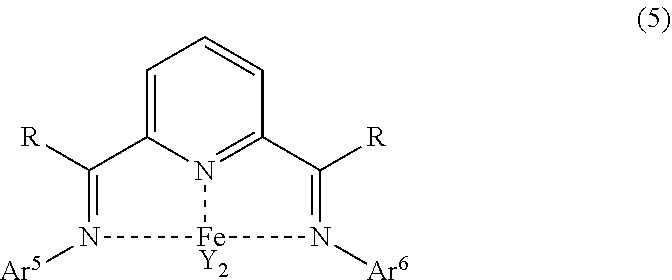
wherein R is a hydrocarbyl group having 1 to 6 carbon atoms or an aromatic group having 6 to 12 carbon atoms, a plurality of R in the same molecule may be the same or different, Ar5 and Ar6 may be the same or different and are respectively a group represented by the following formula (6), and Y is a chlorine atom or a bromine atom.

wherein R11 and R15 may be the same or different and are respectively a hydrocarbyl group having 3 to 12 carbon atoms or an aromatic group having 6 to 12 carbon atoms, the total number of carbon atoms of R11 and R15 is 6 or more, and R12, R13 and R14 may be the same or different and are respectively a hydrogen atom or an electron-donating group.

In the formula (1), Ar1 and Ar2 may be the same or different and are respectively a group represented by the following formula (2).


(ii) a method of mixing a solution with the diimine compound dissolved therein and a solution with the salt dissolved therein and
(iii) a method of physically mixing the diimine compound and the salt without using a solvent.


In the formula (5), R is a hydrocarbyl group having 1 to 6 carbon atoms or an aromatic group having 6 to 12 carbon atoms, a plurality of R in the same molecule may be the same or different, Ar5 and Ar6 may be the same or different and are respectively a group represented by the following formula (6), and Y is a chlorine atom or a bromine atom.

In the formula (6), R11 and R15 may be the same or different and are respectively a hydrocarbyl group having 3 to 12 carbon atoms or an aromatic group having 6 to 12 carbon atoms, the total number of carbon atoms of R11 and R15 is 6 or more, and R12, R13 and R14 may be the same or different and are respectively a hydrogen atom or an electron-donating group.

Claims (4)


Applications Claiming Priority (3)
| Application Number | Priority Date | Filing Date | Title |
|---|---|---|---|
| JP2016-052420 | 2016-03-16 | ||
| JP2016052420A JP6560148B2 (en) | 2016-03-16 | 2016-03-16 | Method for producing oligomer and catalyst |
| PCT/JP2017/006183 WO2017159226A1 (en) | 2016-03-16 | 2017-02-20 | Method for producing oligomer and catalyst |
Publications (2)
| Publication Number | Publication Date |
|---|---|
| US20190077888A1 US20190077888A1 (en) | 2019-03-14 |
| US10815317B2 true US10815317B2 (en) | 2020-10-27 |
Family
ID=59850296
Family Applications (1)
| Application Number | Title | Priority Date | Filing Date |
|---|---|---|---|
| US16/084,797 Active 2037-03-10 US10815317B2 (en) | 2016-03-16 | 2017-02-20 | Method for producing oligomer and catalyst |
Country Status (5)
| Country | Link |
|---|---|
| US (1) | US10815317B2 (en) |
| JP (1) | JP6560148B2 (en) |
| KR (1) | KR20180124833A (en) |
| CN (1) | CN108602909A (en) |
| WO (1) | WO2017159226A1 (en) |
Cited By (1)
| Publication number | Priority date | Publication date | Assignee | Title |
|---|---|---|---|---|
| EP3702380A4 (en) * | 2017-10-24 | 2021-12-29 | China Petroleum & Chemical Corporation | Olefin-olefinic alcohol copolymer, and preparation method therefor |
Families Citing this family (5)
| Publication number | Priority date | Publication date | Assignee | Title |
|---|---|---|---|---|
| US10407360B2 (en) * | 2017-12-22 | 2019-09-10 | Chevron Phillips Chemical Company Lp | Ethylene oligomerization processes |
| CN115260365B (en) * | 2021-04-29 | 2023-07-21 | 中国石油化工股份有限公司 | Branched olefin polymer, preparation method and application thereof |
| CN115260363B (en) * | 2021-04-29 | 2023-07-21 | 中国石油化工股份有限公司 | Application of metal complex in catalyzing olefin polymerization |
| CN115260357B (en) * | 2021-04-29 | 2023-08-15 | 中国石油化工股份有限公司 | Copolymerization method of olefin-terminal alkenyl silane/siloxane spherical or spheroid copolymer and copolymer |
| CN114656581B (en) * | 2022-03-28 | 2022-12-06 | 安徽泽升科技有限公司 | Preparation method of pyridine diimine iron catalyst regulated and controlled by electronic effect |
Citations (7)
| Publication number | Priority date | Publication date | Assignee | Title |
|---|---|---|---|---|
| WO1998027124A1 (en) | 1996-12-17 | 1998-06-25 | E.I. Du Pont De Nemours And Company | Polymerization of ethylene with specific iron or cobalt complexes, novel pyridinebis(imines) and novel complexes of pyridinebis(imines) with iron and cobalt |
| US6831143B2 (en) * | 1997-09-05 | 2004-12-14 | Bp Chemicals Limited | Polymerization catalysts |
| WO2005090425A1 (en) | 2004-03-17 | 2005-09-29 | Dow Global Technologies Inc. | Catalyst composition comprising shuttling agent for ethylene copolymer formation |
| CN101531725A (en) | 2009-04-08 | 2009-09-16 | 中山大学 | Alpha-nickel diimine complex olefin polymerization catalyst, preparation method thereof and method for preparing branched polyethylene |
| CN101812145A (en) | 2009-04-08 | 2010-08-25 | 中山大学 | Alpha-nickel diimine compound olefin polymerization catalyst, preparation method and method for preparing branched polyethylene |
| CN102432415A (en) | 2011-09-09 | 2012-05-02 | 中国科学院化学研究所 | Preparation method of ethylene-propylene co-oligomer |
| WO2016136892A1 (en) | 2015-02-27 | 2016-09-01 | Jxエネルギー株式会社 | Olefin polymerization catalyst and method for producing olefin oligomer |
-
2016
- 2016-03-16 JP JP2016052420A patent/JP6560148B2/en active Active
-
2017
- 2017-02-20 KR KR1020187016012A patent/KR20180124833A/en not_active Ceased
- 2017-02-20 CN CN201780010116.5A patent/CN108602909A/en active Pending
- 2017-02-20 US US16/084,797 patent/US10815317B2/en active Active
- 2017-02-20 WO PCT/JP2017/006183 patent/WO2017159226A1/en not_active Ceased
Patent Citations (10)
| Publication number | Priority date | Publication date | Assignee | Title |
|---|---|---|---|---|
| WO1998027124A1 (en) | 1996-12-17 | 1998-06-25 | E.I. Du Pont De Nemours And Company | Polymerization of ethylene with specific iron or cobalt complexes, novel pyridinebis(imines) and novel complexes of pyridinebis(imines) with iron and cobalt |
| JP2000516295A (en) | 1996-12-17 | 2000-12-05 | イー・アイ・デユポン・ドウ・ヌムール・アンド・カンパニー | Polymerization of ethylene |
| JP2002302510A (en) | 1996-12-17 | 2002-10-18 | E I Du Pont De Nemours & Co | Catalyst for polymerizing ethylene and method for polymerizing ethylene |
| US6831143B2 (en) * | 1997-09-05 | 2004-12-14 | Bp Chemicals Limited | Polymerization catalysts |
| WO2005090425A1 (en) | 2004-03-17 | 2005-09-29 | Dow Global Technologies Inc. | Catalyst composition comprising shuttling agent for ethylene copolymer formation |
| JP2007529616A (en) | 2004-03-17 | 2007-10-25 | ダウ グローバル テクノロジーズ インコーポレイティド | Catalyst composition comprising a shuttling agent for forming an ethylene copolymer |
| CN101531725A (en) | 2009-04-08 | 2009-09-16 | 中山大学 | Alpha-nickel diimine complex olefin polymerization catalyst, preparation method thereof and method for preparing branched polyethylene |
| CN101812145A (en) | 2009-04-08 | 2010-08-25 | 中山大学 | Alpha-nickel diimine compound olefin polymerization catalyst, preparation method and method for preparing branched polyethylene |
| CN102432415A (en) | 2011-09-09 | 2012-05-02 | 中国科学院化学研究所 | Preparation method of ethylene-propylene co-oligomer |
| WO2016136892A1 (en) | 2015-02-27 | 2016-09-01 | Jxエネルギー株式会社 | Olefin polymerization catalyst and method for producing olefin oligomer |
Non-Patent Citations (16)
| Title |
|---|
| Brooke L. Small et al., "Iron-Based Catalysts with Exceptionally High Activities and Selectivities for Oligomerization of Ethylene to Linear a-Olefins", Journal of the American Chemical Society, vol. 120, 1998, pp. 7143-7144. |
| Christian Görl et al., "Bis(arylimino)pyridine iron(III) complexes as catalyst precursors for the oligomerization and polymerization of ethylene", Applied Catalysis A: General, vol. 403, 2011, pp. 25-35. |
| Claudio Bianchini et al., "Oligomerisation of Ethylene to Linear α-Olefins by new Cs- and C1-Symmetric [2,6-Bis(imino)pyridyl]iron and cobalt Dichloride Complexes", European Journal of Inorganic Chemistry, Apr. 7, 2003, p. 1620-p. 1631. |
| Daniel J. Arriola et al., "Catalytic Production of Olefin Block Copolymers via Chain Shuttling Polymerization", Science, vol. 312, 2006, pp. 714-719. |
| Feng-Shou Liu et al., "Thermostable α-Diimine Nickel(II) Catalyst for Ethylene Polymerization: Effects of the Substituted Backbone Structure on Catalytic Properties and Branching Structure of Polyethylene", Macromolecules, vol. 42, Apr. 9, 2009, p. 7789-p. 7796. |
| International Preliminary Report on Patentability issued with respect to Application No. PCT/JP2017/006183, dated Sep. 27, 2018. |
| International Search Report issued with respect to Application No. PCT/JP2017/006183, dated Mar. 14, 2017. |
| Jingdai Wang et al., "Fe(acac)n and Co(acac)n Bearing Different Bis(imino)pyridine Ligands for Ethylene Polymerization and Oligomerization", Journal of Applied Polymer Science, vol. 113, Apr. 27, 2009, p. 2378-p. 2391. |
| Konstantin P. Bryliakov et al., "Formation and Nature of the Active Sites in Bis(imino)pyridine Iron-Based Polymerization Catalysts", Organometallics, vol. 28, 2009, pp. 3225-3232. |
| Lihua Guo et al., "Substituent Effects of the Backbone in a-Diimine Palladium Catalysts on Homo- and Copolymerization of Ethylene with Methyl Acrylate", Organometallics, vol. 31, Aug. 14, 2012, pp. 6054-6062. |
| Lynda K. Johnson et al., "New Pd(II)- and Ni(II)-Based Catalysts for Polymerization of Ethylene and a-Olefins", Journal of the American Chemical Society, vol. 117, 1995, pp. 6414-6415. |
| Notice of Allowance in counterpart JP Patent Application No. P2016-052420 dated Jul. 2, 2019. |
| Roland Schmidt et al., "Heterogenized iron(II) complexes as highly active ethene polymerization catalysts", Journal of Molecular Catalysis A: Chemical, vol. 179, 2002, pp. 155-173. |
| Thomas Schleis et al., "Ni (II) and Pd( II) complexes of camphor-derived diazadiene ligands: steric bulk tuning and ethylene polymerization", Inorganic Chemistry Communications, Elsevier, vol. 1,1998, p. 431-p. 434. |
| Ting Li et al., "Unsymmetrical α-Diimine Nickel (II) Complex with Rigid Bicyclic Ring Ligand: Synthesis, Characterization, and Ethylene Polymerization in the Presence of AlEt2Cl", Journal of Applied Polymer Science, vol. 108, Dec. 27, 2007, p. 206-p. 210. |
| Walter Kaminsky, "New polymers by metallocene catalysis", Institute for Technical and Macromolecular Chemistry, University of Hamburg, Macromol. Chem. Phys., vol. 197, 1996, pp. 3907-3945. |
Cited By (1)
| Publication number | Priority date | Publication date | Assignee | Title |
|---|---|---|---|---|
| EP3702380A4 (en) * | 2017-10-24 | 2021-12-29 | China Petroleum & Chemical Corporation | Olefin-olefinic alcohol copolymer, and preparation method therefor |
Also Published As
| Publication number | Publication date |
|---|---|
| US20190077888A1 (en) | 2019-03-14 |
| JP2017165863A (en) | 2017-09-21 |
| KR20180124833A (en) | 2018-11-21 |
| CN108602909A (en) | 2018-09-28 |
| WO2017159226A1 (en) | 2017-09-21 |
| JP6560148B2 (en) | 2019-08-14 |
Similar Documents
| Publication | Publication Date | Title |
|---|---|---|
| US20190077888A1 (en) | Method for producing oligomer and catalyst | |
| CN108686706A (en) | A kind of method and catalyst of ethylene selective oligomerization | |
| JP6657180B2 (en) | Method for producing oligomer and catalyst | |
| CN105294778A (en) | Nickel base complex, and preparation method and application thereof | |
| US10400047B2 (en) | Olefin polymerization catalyst and method for producing olefin oligomer | |
| CN104725533B (en) | A kind of olefin polymerization catalysis and olefine polymerizing process and polyolefin | |
| CN105289742A (en) | Catalyst for ethylene selectivity oligomerization, novel ligand and preparation method thereof | |
| CN110183496A (en) | Pyridine diimine class dual-nuclei structure model, preparation method and application | |
| CN103804428B (en) | The preparation method of a kind of coordination compound and the application of coordination compound | |
| JP6886858B2 (en) | Oligomer production method | |
| JP6896744B2 (en) | Oligomer production method and catalyst | |
| KR20220092910A (en) | Diimine metal complex, preparation method thereof and use thereof | |
| JP6850192B2 (en) | Oligomer production method | |
| CN108864343B (en) | Binuclear (alpha-diimine) nickel/palladium olefin catalyst, preparation and application | |
| US20240199771A1 (en) | Branched olefin polymer, preparation method therefor and use thereof | |
| CN115260363B (en) | Application of metal complex in catalyzing olefin polymerization | |
| JP2018062576A (en) | Method for producing oligomer |
Legal Events
| Date | Code | Title | Description |
|---|---|---|---|
| FEPP | Fee payment procedure |
Free format text: ENTITY STATUS SET TO UNDISCOUNTED (ORIGINAL EVENT CODE: BIG.); ENTITY STATUS OF PATENT OWNER: LARGE ENTITY |
|
| AS | Assignment |
Owner name: JXTG NIPPON OIL & ENERGY CORPORATION, JAPAN Free format text: ASSIGNMENT OF ASSIGNORS INTEREST;ASSIGNORS:AIDA, FUYUKI;TAGAWA, KAZUO;REEL/FRAME:047218/0914 Effective date: 20180914 |
|
| STPP | Information on status: patent application and granting procedure in general |
Free format text: DOCKETED NEW CASE - READY FOR EXAMINATION |
|
| STPP | Information on status: patent application and granting procedure in general |
Free format text: NON FINAL ACTION MAILED |
|
| STPP | Information on status: patent application and granting procedure in general |
Free format text: RESPONSE TO NON-FINAL OFFICE ACTION ENTERED AND FORWARDED TO EXAMINER |
|
| STPP | Information on status: patent application and granting procedure in general |
Free format text: NOTICE OF ALLOWANCE MAILED -- APPLICATION RECEIVED IN OFFICE OF PUBLICATIONS |
|
| AS | Assignment |
Owner name: ENEOS CORPORATION, JAPAN Free format text: CHANGE OF NAME;ASSIGNOR:JXTG NIPPON OIL & ENERGY CORPORATION;REEL/FRAME:053549/0598 Effective date: 20200703 |
|
| STCF | Information on status: patent grant |
Free format text: PATENTED CASE |
|
| MAFP | Maintenance fee payment |
Free format text: PAYMENT OF MAINTENANCE FEE, 4TH YEAR, LARGE ENTITY (ORIGINAL EVENT CODE: M1551); ENTITY STATUS OF PATENT OWNER: LARGE ENTITY Year of fee payment: 4 |