US10808080B2 - Monomer, polymer, compensation film, optical film, and display device - Google Patents
Monomer, polymer, compensation film, optical film, and display device Download PDFInfo
- Publication number
- US10808080B2 US10808080B2 US16/048,700 US201816048700A US10808080B2 US 10808080 B2 US10808080 B2 US 10808080B2 US 201816048700 A US201816048700 A US 201816048700A US 10808080 B2 US10808080 B2 US 10808080B2
- Authority
- US
- United States
- Prior art keywords
- group
- unsubstituted
- substituted
- chemical formula
- independently
- Prior art date
- Legal status (The legal status is an assumption and is not a legal conclusion. Google has not performed a legal analysis and makes no representation as to the accuracy of the status listed.)
- Active, expires
Links
- 0 *CCCC.C.C.C.C Chemical compound *CCCC.C.C.C.C 0.000 description 36
- HXDRAFLQHBCDKO-UHFFFAOYSA-N CC.CC.CCCCC(=O)C1=CC=CC=C1.COC(=O)C1=CC2=C(C=C1)C(=O)OC2=O.COC(=O)C1=CC2=C(C=C1)C(=O)OC2=O Chemical compound CC.CC.CCCCC(=O)C1=CC=CC=C1.COC(=O)C1=CC2=C(C=C1)C(=O)OC2=O.COC(=O)C1=CC2=C(C=C1)C(=O)OC2=O HXDRAFLQHBCDKO-UHFFFAOYSA-N 0.000 description 4
- LTCQLGPCJDFLSJ-UHFFFAOYSA-N CC.CC.CC.CC.CC.CC(C)(FC(F)F)FC(F)F.O=C1OC(=O)C2=C1C=CC=C2.O=C1OC(=O)C2=C1C=CC=C2.O=C1OC(=O)C2=CC=CC=C12.O=C1OC(=O)C2=CC=CC=C12 Chemical compound CC.CC.CC.CC.CC.CC(C)(FC(F)F)FC(F)F.O=C1OC(=O)C2=C1C=CC=C2.O=C1OC(=O)C2=C1C=CC=C2.O=C1OC(=O)C2=CC=CC=C12.O=C1OC(=O)C2=CC=CC=C12 LTCQLGPCJDFLSJ-UHFFFAOYSA-N 0.000 description 2
- QLYNTZXOLWPLCG-UHFFFAOYSA-N CC.CC.CC.CC.CC.NC1=CC=CC=C1.NC1=CC=CC=C1 Chemical compound CC.CC.CC.CC.CC.NC1=CC=CC=C1.NC1=CC=CC=C1 QLYNTZXOLWPLCG-UHFFFAOYSA-N 0.000 description 2
- XMMJSDWDWFGDPM-UHFFFAOYSA-N CC.CC.CCC.NC1=CC=CC=C1.NC1=CC=CC=C1 Chemical compound CC.CC.CCC.NC1=CC=CC=C1.NC1=CC=CC=C1 XMMJSDWDWFGDPM-UHFFFAOYSA-N 0.000 description 2
- LTMQHVQKRHHVEY-UHFFFAOYSA-N BrCC1=CC=C(Br)C=C1.C#CC1=CC=C(C#CC2=CC=CC=C2)C=C1.CC.O=C(Cl)C1=CC2=C(C=C1)C(=O)OC2=O.O=C(O)C1=C(O)C=CC(O)=C1.O=C(OC1=CC(C(=O)OCC2=CC=C(C#CC3=CC=C(C#CC4=CC=CC=C4)C=C3)C=C2)=C(OC(=O)C2=CC3=C(C=C2)C(=O)OC3=O)C=C1)C1=CC2=C(C=C1)C(=O)OC2=O.O=C(OCC1=CC=C(Br)C=C1)C1=C(O)C=CC(O)=C1.O=C(OCC1=CC=C(C#CC2=CC=C(C#CC3=CC=CC=C3)C=C2)C=C1)C1=C(O)C=CC(O)=C1.[C-4].[IH-4] Chemical compound BrCC1=CC=C(Br)C=C1.C#CC1=CC=C(C#CC2=CC=CC=C2)C=C1.CC.O=C(Cl)C1=CC2=C(C=C1)C(=O)OC2=O.O=C(O)C1=C(O)C=CC(O)=C1.O=C(OC1=CC(C(=O)OCC2=CC=C(C#CC3=CC=C(C#CC4=CC=CC=C4)C=C3)C=C2)=C(OC(=O)C2=CC3=C(C=C2)C(=O)OC3=O)C=C1)C1=CC2=C(C=C1)C(=O)OC2=O.O=C(OCC1=CC=C(Br)C=C1)C1=C(O)C=CC(O)=C1.O=C(OCC1=CC=C(C#CC2=CC=C(C#CC3=CC=CC=C3)C=C2)C=C1)C1=C(O)C=CC(O)=C1.[C-4].[IH-4] LTMQHVQKRHHVEY-UHFFFAOYSA-N 0.000 description 1
- BKKVIEMFSXYOAE-UHFFFAOYSA-N BrCC1=CC=C(Br)C=C1.C#CC1=CC=CC=C1.CC.CC.O=C(Cl)C1=CC2=C(C=C1)C(=O)OC2=O.O=C(O)C1=C(O)C=CC(O)=C1.O=C(OC1=CC(C(=O)OCC2=CC=C(C#CC3=CC=CC=C3)C=C2)=C(OC(=O)C2=CC3=C(C=C2)C(=O)OC3=O)C=C1)C1=CC2=C(C=C1)C(=O)OC2=O.O=C(OCC1=CC=C(Br)C=C1)C1=C(O)C=CC(O)=C1.O=C(OCC1=CC=C(C#CC2=CC=CC=C2)C=C1)C1=C(O)C=CC(O)=C1.[CH2-2] Chemical compound BrCC1=CC=C(Br)C=C1.C#CC1=CC=CC=C1.CC.CC.O=C(Cl)C1=CC2=C(C=C1)C(=O)OC2=O.O=C(O)C1=C(O)C=CC(O)=C1.O=C(OC1=CC(C(=O)OCC2=CC=C(C#CC3=CC=CC=C3)C=C2)=C(OC(=O)C2=CC3=C(C=C2)C(=O)OC3=O)C=C1)C1=CC2=C(C=C1)C(=O)OC2=O.O=C(OCC1=CC=C(Br)C=C1)C1=C(O)C=CC(O)=C1.O=C(OCC1=CC=C(C#CC2=CC=CC=C2)C=C1)C1=C(O)C=CC(O)=C1.[CH2-2] BKKVIEMFSXYOAE-UHFFFAOYSA-N 0.000 description 1
- BIWANDDPJGDNST-UHFFFAOYSA-N BrCC1=CC=C(Br)C=C1.C.C#CC1=CC=C(C#CC2=CC=CC=C2)C=C1.CC.O=C(Cl)C1=CC2=C(C=C1)C(=O)OC2=O.O=C(O)C1=CC(O)=CC(O)=C1.O=C(OCC1=CC=C(Br)C=C1)C1=CC(O)=CC(O)=C1.O=C(OCC1=CC=C(C#CC2=CC=C(C#CC3=CC=CC=C3)C=C2)C=C1)C1=CC(O)=CC(O)=C1.O=C(OCC1=CC=C(C#CC2=CC=C(C#CC3=CC=CC=C3)C=C2)C=C1)C1=CC(OC(=O)C2=CC3=C(C=C2)C(=O)OC3=O)=CC(OC(=O)C2=CC3=C(C=C2)C(=O)OC3=O)=C1.[C-9] Chemical compound BrCC1=CC=C(Br)C=C1.C.C#CC1=CC=C(C#CC2=CC=CC=C2)C=C1.CC.O=C(Cl)C1=CC2=C(C=C1)C(=O)OC2=O.O=C(O)C1=CC(O)=CC(O)=C1.O=C(OCC1=CC=C(Br)C=C1)C1=CC(O)=CC(O)=C1.O=C(OCC1=CC=C(C#CC2=CC=C(C#CC3=CC=CC=C3)C=C2)C=C1)C1=CC(O)=CC(O)=C1.O=C(OCC1=CC=C(C#CC2=CC=C(C#CC3=CC=CC=C3)C=C2)C=C1)C1=CC(OC(=O)C2=CC3=C(C=C2)C(=O)OC3=O)=CC(OC(=O)C2=CC3=C(C=C2)C(=O)OC3=O)=C1.[C-9] BIWANDDPJGDNST-UHFFFAOYSA-N 0.000 description 1
- STGWDOJUQBICDC-UHFFFAOYSA-N BrCC1=CC=CC=C1.O=C(Cl)C1=CC2=C(C=C1)C(=O)OC2=O.O=C(O)C1=C(O)C=CC(O)=C1.O=C(OC1=CC(C(=O)OCC2=CC=CC=C2)=C(OC(=O)C2=CC3=C(C=C2)C(=O)OC3=O)C=C1)C1=CC2=C(C=C1)C(=O)OC2=O.O=C(OCC1=CC=CC=C1)C1=C(O)C=CC(O)=C1.[CH3-].[I-] Chemical compound BrCC1=CC=CC=C1.O=C(Cl)C1=CC2=C(C=C1)C(=O)OC2=O.O=C(O)C1=C(O)C=CC(O)=C1.O=C(OC1=CC(C(=O)OCC2=CC=CC=C2)=C(OC(=O)C2=CC3=C(C=C2)C(=O)OC3=O)C=C1)C1=CC2=C(C=C1)C(=O)OC2=O.O=C(OCC1=CC=CC=C1)C1=C(O)C=CC(O)=C1.[CH3-].[I-] STGWDOJUQBICDC-UHFFFAOYSA-N 0.000 description 1
- ZJHFQVYZOSXZEJ-UHFFFAOYSA-N BrCC1=CC=CC=C1.O=C(Cl)C1=CC2=C(C=C1)C(=O)OC2=O.O=C(O)C1=CC(O)=CC(O)=C1.O=C(OCC1=CC=CC=C1)C1=CC(O)=CC(O)=C1.O=C(OCC1=CC=CC=C1)C1=CC(OC(=O)C2=CC3=C(C=C2)C(=O)OC3=O)=CC(OC(=O)C2=CC3=C(C=C2)C(=O)OC3=O)=C1.[C-10].[I-10] Chemical compound BrCC1=CC=CC=C1.O=C(Cl)C1=CC2=C(C=C1)C(=O)OC2=O.O=C(O)C1=CC(O)=CC(O)=C1.O=C(OCC1=CC=CC=C1)C1=CC(O)=CC(O)=C1.O=C(OCC1=CC=CC=C1)C1=CC(OC(=O)C2=CC3=C(C=C2)C(=O)OC3=O)=CC(OC(=O)C2=CC3=C(C=C2)C(=O)OC3=O)=C1.[C-10].[I-10] ZJHFQVYZOSXZEJ-UHFFFAOYSA-N 0.000 description 1
- GCUSDVIFTVVYMA-UHFFFAOYSA-N BrCCC1=CC=CC=C1.O=C(Cl)C1=CC2=C(C=C1)C(=O)OC2=O.O=C(O)C1=C(O)C=CC(O)=C1.O=C(OC1=CC(C(=O)OCCC2=CC=CC=C2)=C(OC(=O)C2=CC3=C(C=C2)C(=O)OC3=O)C=C1)C1=CC2=C(C=C1)C(=O)OC2=O.O=C(OCCC1=CC=CC=C1)C1=C(O)C=CC(O)=C1.[C-11].[I-11] Chemical compound BrCCC1=CC=CC=C1.O=C(Cl)C1=CC2=C(C=C1)C(=O)OC2=O.O=C(O)C1=C(O)C=CC(O)=C1.O=C(OC1=CC(C(=O)OCCC2=CC=CC=C2)=C(OC(=O)C2=CC3=C(C=C2)C(=O)OC3=O)C=C1)C1=CC2=C(C=C1)C(=O)OC2=O.O=C(OCCC1=CC=CC=C1)C1=C(O)C=CC(O)=C1.[C-11].[I-11] GCUSDVIFTVVYMA-UHFFFAOYSA-N 0.000 description 1
- UBRHHSYBCADWBB-UHFFFAOYSA-N C=C1OC(=O)C2=C1C=CC(C(=O)OC1=C(C(=O)CCCC)C=C(OC(=O)C3=CC4=C(C=C3)C(=O)OC4=O)C=C1)=C2.CC.CC.CC.CC.CCCCC(=O)C1=C(OC(=O)C2=CC3=C(C=C2)C(=O)OC3=O)C=CC(OC(=O)C2=CC3=C(C=C2)C(=O)OC3=O)=C1 Chemical compound C=C1OC(=O)C2=C1C=CC(C(=O)OC1=C(C(=O)CCCC)C=C(OC(=O)C3=CC4=C(C=C3)C(=O)OC4=O)C=C1)=C2.CC.CC.CC.CC.CCCCC(=O)C1=C(OC(=O)C2=CC3=C(C=C2)C(=O)OC3=O)C=CC(OC(=O)C2=CC3=C(C=C2)C(=O)OC3=O)=C1 UBRHHSYBCADWBB-UHFFFAOYSA-N 0.000 description 1
- GEOWZVXDDKOXRR-UHFFFAOYSA-N CC(=O)C1=CC=C(CCl)C=C1.CCCCCCCCN(CCCCCCCC)C(=O)C1=CC=C(COC(=O)C2=C(O)C=CC(O)=C2)C=C1.CCCCCCCCN(CCCCCCCC)C(=O)C1=CC=C(COC(=O)C2=C(OC(=O)C3=CC4=C(C=C3)C(=O)OC4=O)C=CC(OC(=O)C3=CC4=C(C=C3)C(=O)OC4=O)=C2)C=C1.O=C(Cl)C1=CC2=C(C=C1)C(=O)OC2=O.O=C(O)C1=C(O)C=CC(O)=C1.[C-19].[I-19] Chemical compound CC(=O)C1=CC=C(CCl)C=C1.CCCCCCCCN(CCCCCCCC)C(=O)C1=CC=C(COC(=O)C2=C(O)C=CC(O)=C2)C=C1.CCCCCCCCN(CCCCCCCC)C(=O)C1=CC=C(COC(=O)C2=C(OC(=O)C3=CC4=C(C=C3)C(=O)OC4=O)C=CC(OC(=O)C3=CC4=C(C=C3)C(=O)OC4=O)=C2)C=C1.O=C(Cl)C1=CC2=C(C=C1)C(=O)OC2=O.O=C(O)C1=C(O)C=CC(O)=C1.[C-19].[I-19] GEOWZVXDDKOXRR-UHFFFAOYSA-N 0.000 description 1
- GLUBDOHEVLLAST-UHFFFAOYSA-N CC(C)(C)C1=CC=C(CBr)C=C1.CC(C)(C)C1=CC=C(COC(=O)C2=C(O)C=CC(O)=C2)C=C1.CC(C)(C)C1=CC=C(COC(=O)C2=C(OC(=O)C3=CC4=C(C=C3)C(=O)OC4=O)C=CC(OC(=O)C3=CC4=C(C=C3)C(=O)OC4=O)=C2)C=C1.O=C(Cl)C1=CC2=C(C=C1)C(=O)OC2=O.O=C(O)C1=C(O)C=CC(O)=C1.[C-7].[I-7] Chemical compound CC(C)(C)C1=CC=C(CBr)C=C1.CC(C)(C)C1=CC=C(COC(=O)C2=C(O)C=CC(O)=C2)C=C1.CC(C)(C)C1=CC=C(COC(=O)C2=C(OC(=O)C3=CC4=C(C=C3)C(=O)OC4=O)C=CC(OC(=O)C3=CC4=C(C=C3)C(=O)OC4=O)=C2)C=C1.O=C(Cl)C1=CC2=C(C=C1)C(=O)OC2=O.O=C(O)C1=C(O)C=CC(O)=C1.[C-7].[I-7] GLUBDOHEVLLAST-UHFFFAOYSA-N 0.000 description 1
- BFKUMKJRBATXRI-UHFFFAOYSA-N CC(C)(C)C1=CC=C(CBr)C=C1.CC(C)(C)C1=CC=C(COC(=O)C2=C(O)C=CC(O)=C2)C=C1.CC(C)(C)C1=CC=C(COC(=O)C2=CC(OC(=O)C3=CC4=C(C=C3)C(=O)OC4=O)=CC(OC(=O)C3=CC4=C(C=C3)C(=O)OC4=O)=C2)C=C1.O=C(Cl)C1=CC2=C(C=C1)C(=O)OC2=O.O=C(O)C1=C(O)C=CC(O)=C1.[C-8].[I-8] Chemical compound CC(C)(C)C1=CC=C(CBr)C=C1.CC(C)(C)C1=CC=C(COC(=O)C2=C(O)C=CC(O)=C2)C=C1.CC(C)(C)C1=CC=C(COC(=O)C2=CC(OC(=O)C3=CC4=C(C=C3)C(=O)OC4=O)=CC(OC(=O)C3=CC4=C(C=C3)C(=O)OC4=O)=C2)C=C1.O=C(Cl)C1=CC2=C(C=C1)C(=O)OC2=O.O=C(O)C1=C(O)C=CC(O)=C1.[C-8].[I-8] BFKUMKJRBATXRI-UHFFFAOYSA-N 0.000 description 1
- OARBAZHJZFYSLM-UHFFFAOYSA-N CC(C)(C)C1=CC=C(COC(=O)C2=C(OC(=O)C3=CC4=C(C=C3)C(=O)OC4=O)C=CC(OC(=O)C3=CC4=C(C=C3)C(=O)OC4=O)=C2)C=C1.CC(C)(C)C1=CC=C(COC(=O)C2=CC(OC(=O)C3=CC4=C(C=C3)C(=O)OC4=O)=CC(OC(=O)C3=CC4=C(C=C3)C(=O)OC4=O)=C2)C=C1.O=C(NC1=CC=CC=C1)C1=CC=C(COC(=O)C2=C(OC(=O)C3=CC4=C(C=C3)C(=O)OC4=O)C=CC(OC(=O)C3=CC4=C(C=C3)C(=O)OC4=O)=C2)C=C1.O=C(OC1=CC=C(C#CC2=CC=CC=C2)C=C1)C1=CC=C(COC(=O)C2=C(OC(=O)C3=CC4=C(C=C3)C(=O)OC4=O)C=CC(OC(=O)C3=CC4=C(C=C3)C(=O)OC4=O)=C2)C=C1 Chemical compound CC(C)(C)C1=CC=C(COC(=O)C2=C(OC(=O)C3=CC4=C(C=C3)C(=O)OC4=O)C=CC(OC(=O)C3=CC4=C(C=C3)C(=O)OC4=O)=C2)C=C1.CC(C)(C)C1=CC=C(COC(=O)C2=CC(OC(=O)C3=CC4=C(C=C3)C(=O)OC4=O)=CC(OC(=O)C3=CC4=C(C=C3)C(=O)OC4=O)=C2)C=C1.O=C(NC1=CC=CC=C1)C1=CC=C(COC(=O)C2=C(OC(=O)C3=CC4=C(C=C3)C(=O)OC4=O)C=CC(OC(=O)C3=CC4=C(C=C3)C(=O)OC4=O)=C2)C=C1.O=C(OC1=CC=C(C#CC2=CC=CC=C2)C=C1)C1=CC=C(COC(=O)C2=C(OC(=O)C3=CC4=C(C=C3)C(=O)OC4=O)C=CC(OC(=O)C3=CC4=C(C=C3)C(=O)OC4=O)=C2)C=C1 OARBAZHJZFYSLM-UHFFFAOYSA-N 0.000 description 1
- VZZMKVOJQUFIKF-UHFFFAOYSA-N CC.CC.CC.CC(=O)OC1=CC(C(=O)Cl)=C(OC(C)=O)C=C1.CC(=O)OC1=CC(C(=O)O)=C(OC(C)=O)C=C1.CCCC.CCCCC(=O)C1=C(O)C=CC(O)=C1.CCCCC(=O)C1=C(OC(=O)C2=CC=C3C(=O)OC(=O)C3=C2)C=CC(OC(=O)C2=CC3=C(C=C2)C(=O)OC3=O)=C1.ClP(Cl)(Cl)(Cl)Cl.O=C(Cl)C1=CC2=C(C=C1)C(=O)OC2=O.O=C(O)C1=C(O)C=CC(O)=C1 Chemical compound CC.CC.CC.CC(=O)OC1=CC(C(=O)Cl)=C(OC(C)=O)C=C1.CC(=O)OC1=CC(C(=O)O)=C(OC(C)=O)C=C1.CCCC.CCCCC(=O)C1=C(O)C=CC(O)=C1.CCCCC(=O)C1=C(OC(=O)C2=CC=C3C(=O)OC(=O)C3=C2)C=CC(OC(=O)C2=CC3=C(C=C2)C(=O)OC3=O)=C1.ClP(Cl)(Cl)(Cl)Cl.O=C(Cl)C1=CC2=C(C=C1)C(=O)OC2=O.O=C(O)C1=C(O)C=CC(O)=C1 VZZMKVOJQUFIKF-UHFFFAOYSA-N 0.000 description 1
- PYZMQBCZJPRAPC-UHFFFAOYSA-N CC.CC.CC.CC(=O)OC1=CC(OC(C)=O)=CC(C(=O)Cl)=C1.CC(=O)OC1=CC(OC(C)=O)=CC(C(=O)O)=C1.CCCC.CCCCC(=O)C1=CC(O)=CC(O)=C1.CCCCC(=O)C1=CC(OC(=O)C2=CC=C3C(=O)OC(=O)C3=C2)=CC(OC(=O)C2=CC3=C(C=C2)C(=O)OC3=O)=C1.ClP(Cl)(Cl)(Cl)Cl.O=C(Cl)C1=CC2=C(C=C1)C(=O)OC2=O.O=C(O)C1=CC(O)=CC(O)=C1 Chemical compound CC.CC.CC.CC(=O)OC1=CC(OC(C)=O)=CC(C(=O)Cl)=C1.CC(=O)OC1=CC(OC(C)=O)=CC(C(=O)O)=C1.CCCC.CCCCC(=O)C1=CC(O)=CC(O)=C1.CCCCC(=O)C1=CC(OC(=O)C2=CC=C3C(=O)OC(=O)C3=C2)=CC(OC(=O)C2=CC3=C(C=C2)C(=O)OC3=O)=C1.ClP(Cl)(Cl)(Cl)Cl.O=C(Cl)C1=CC2=C(C=C1)C(=O)OC2=O.O=C(O)C1=CC(O)=CC(O)=C1 PYZMQBCZJPRAPC-UHFFFAOYSA-N 0.000 description 1
- XBYJFBDKMXCTJR-UHFFFAOYSA-N CC.CC.CC.CC.CCCCC(=O)C1=C(OC(=O)C2=CC3=C(C=C2)C(=O)OC3=O)C=CC(OC(=O)C2=CC3=C(C=C2)C(=O)OC3=O)=C1.CCCCC(=O)C1=C(OC(=O)C2=CC3=C(C=C2)C(=O)OC3=O)C=CC(OC(=O)C2=CC3=C(C=C2)C(=O)OC3=O)=C1 Chemical compound CC.CC.CC.CC.CCCCC(=O)C1=C(OC(=O)C2=CC3=C(C=C2)C(=O)OC3=O)C=CC(OC(=O)C2=CC3=C(C=C2)C(=O)OC3=O)=C1.CCCCC(=O)C1=C(OC(=O)C2=CC3=C(C=C2)C(=O)OC3=O)C=CC(OC(=O)C2=CC3=C(C=C2)C(=O)OC3=O)=C1 XBYJFBDKMXCTJR-UHFFFAOYSA-N 0.000 description 1
- UVVLRKKWOFMDON-UHFFFAOYSA-N CC.CC.CC.CC.CCCCC(=O)C1=C(OC(=O)C2=CC3=C(C=C2)C(=O)OC3=O)C=CC(OC(=O)C2=CC3=C(C=C2)C(=O)OC3=O)=C1.CCCCC(=O)C1=CC(OC(=O)C2=CC3=C(C=C2)C(=O)OC3=O)=CC(OC(=O)C2=CC3=C(C=C2)C(=O)OC3=O)=C1 Chemical compound CC.CC.CC.CC.CCCCC(=O)C1=C(OC(=O)C2=CC3=C(C=C2)C(=O)OC3=O)C=CC(OC(=O)C2=CC3=C(C=C2)C(=O)OC3=O)=C1.CCCCC(=O)C1=CC(OC(=O)C2=CC3=C(C=C2)C(=O)OC3=O)=CC(OC(=O)C2=CC3=C(C=C2)C(=O)OC3=O)=C1 UVVLRKKWOFMDON-UHFFFAOYSA-N 0.000 description 1
- POMISHKMGFTTBL-UHFFFAOYSA-N CC1(C)C(C2=CC=CC=C2)=CC=C1C1=CC=CC=C1.CC1(C)C2=C(C=CC=C2)C2=C1/C=C\C=C/2.CC1(C)C2=C(C=CC=C2)CC2=C1C=CC=C2.CC1(C)C=C2C=CC=CC2=C1.CC1(C)C=CC(=O)C=C1.CC1(C)C=CC2=C1/C=C\C=C/2.CC1(C)C=CC=C1.CC1(C)CC2C=CC1C2.CC1(C)CC2C=CC1CC2.CC1(C)CCCC1.CC1(C)CCCCC1.CC1(C)CCCCCC1.CC1(C)N=NC2=C1/C=C\C=C/2 Chemical compound CC1(C)C(C2=CC=CC=C2)=CC=C1C1=CC=CC=C1.CC1(C)C2=C(C=CC=C2)C2=C1/C=C\C=C/2.CC1(C)C2=C(C=CC=C2)CC2=C1C=CC=C2.CC1(C)C=C2C=CC=CC2=C1.CC1(C)C=CC(=O)C=C1.CC1(C)C=CC2=C1/C=C\C=C/2.CC1(C)C=CC=C1.CC1(C)CC2C=CC1C2.CC1(C)CC2C=CC1CC2.CC1(C)CCCC1.CC1(C)CCCCC1.CC1(C)CCCCCC1.CC1(C)N=NC2=C1/C=C\C=C/2 POMISHKMGFTTBL-UHFFFAOYSA-N 0.000 description 1
- YJFXAIMCPBYMAU-UHFFFAOYSA-N CC1=CC=C(CC(=O)C2=CC=C(CCl)C=C2)C=C1.CC1=CC=C(CC(=O)C2=CC=C(COC(=O)C3=C(O)C=CC(O)=C3)C=C2)C=C1.CC1=CC=C(NC(=O)C2=CC=C(COC(=O)C3=C(OC(=O)C4=CC5=C(C=C4)C(=O)OC5=O)C=CC(OC(=O)C4=CC5=C(C=C4)C(=O)OC5=O)=C3)C=C2)C=C1.O=C(Cl)C1=CC2=C(C=C1)C(=O)OC2=O.O=C(O)C1=C(O)C=CC(O)=C1.[C-17].[I-17] Chemical compound CC1=CC=C(CC(=O)C2=CC=C(CCl)C=C2)C=C1.CC1=CC=C(CC(=O)C2=CC=C(COC(=O)C3=C(O)C=CC(O)=C3)C=C2)C=C1.CC1=CC=C(NC(=O)C2=CC=C(COC(=O)C3=C(OC(=O)C4=CC5=C(C=C4)C(=O)OC5=O)C=CC(OC(=O)C4=CC5=C(C=C4)C(=O)OC5=O)=C3)C=C2)C=C1.O=C(Cl)C1=CC2=C(C=C1)C(=O)OC2=O.O=C(O)C1=C(O)C=CC(O)=C1.[C-17].[I-17] YJFXAIMCPBYMAU-UHFFFAOYSA-N 0.000 description 1
- VFJDMRFXUAJLPP-UHFFFAOYSA-N CCCCCCCCC1=CC=C(NC(=O)C2=CC=C(COC(=O)C3=C(OC(=O)C4=CC5=C(C=C4)C(=O)OC5=O)C=CC(OC(=O)C4=CC5=C(C=C4)C(=O)OC5=O)=C3)C=C2)C=C1.CCCCCCCCCCCCCCCCNC(=O)C1=CC=C(COC(=O)C2=C(OC(=O)C3=CC4=C(C=C3)C(=O)OC4=O)C=CC(OC(=O)C3=CC4=C(C=C3)C(=O)OC4=O)=C2)C=C1.CCCCCCCCCCCCNC(=O)C1=CC=C(COC(=O)C2=C(OC(=O)C3=CC4=C(C=C3)C(=O)OC4=O)C=CC(OC(=O)C3=CC4=C(C=C3)C(=O)OC4=O)=C2)C=C1.CCCCCCNC(=O)C1=CC=C(COC(=O)C2=C(OC(=O)C3=CC4=C(C=C3)C(=O)OC4=O)C=CC(OC(=O)C3=CC4=C(C=C3)C(=O)OC4=O)=C2)C=C1 Chemical compound CCCCCCCCC1=CC=C(NC(=O)C2=CC=C(COC(=O)C3=C(OC(=O)C4=CC5=C(C=C4)C(=O)OC5=O)C=CC(OC(=O)C4=CC5=C(C=C4)C(=O)OC5=O)=C3)C=C2)C=C1.CCCCCCCCCCCCCCCCNC(=O)C1=CC=C(COC(=O)C2=C(OC(=O)C3=CC4=C(C=C3)C(=O)OC4=O)C=CC(OC(=O)C3=CC4=C(C=C3)C(=O)OC4=O)=C2)C=C1.CCCCCCCCCCCCNC(=O)C1=CC=C(COC(=O)C2=C(OC(=O)C3=CC4=C(C=C3)C(=O)OC4=O)C=CC(OC(=O)C3=CC4=C(C=C3)C(=O)OC4=O)=C2)C=C1.CCCCCCNC(=O)C1=CC=C(COC(=O)C2=C(OC(=O)C3=CC4=C(C=C3)C(=O)OC4=O)C=CC(OC(=O)C3=CC4=C(C=C3)C(=O)OC4=O)=C2)C=C1 VFJDMRFXUAJLPP-UHFFFAOYSA-N 0.000 description 1
- CREQHWTVFFBHSV-UHFFFAOYSA-N CCCCCCCCCCCCCCCCNC(=O)C1=CC=C(COC(=O)C2=C(O)C=CC(O)=C2)C=C1.CCCCCCCCCCCCCCCCNC(=O)C1=CC=C(COC(=O)C2=C(OC(=O)C3=CC4=C(C=C3)C(=O)OC4=O)C=CC(OC(=O)C3=CC4=C(C=C3)C(=O)OC4=O)=C2)C=C1.CNC(=O)C1=CC=C(CCl)C=C1.O=C(Cl)C1=CC2=C(C=C1)C(=O)OC2=O.O=C(O)C1=C(O)C=CC(O)=C1.[C-16].[I-16] Chemical compound CCCCCCCCCCCCCCCCNC(=O)C1=CC=C(COC(=O)C2=C(O)C=CC(O)=C2)C=C1.CCCCCCCCCCCCCCCCNC(=O)C1=CC=C(COC(=O)C2=C(OC(=O)C3=CC4=C(C=C3)C(=O)OC4=O)C=CC(OC(=O)C3=CC4=C(C=C3)C(=O)OC4=O)=C2)C=C1.CNC(=O)C1=CC=C(CCl)C=C1.O=C(Cl)C1=CC2=C(C=C1)C(=O)OC2=O.O=C(O)C1=C(O)C=CC(O)=C1.[C-16].[I-16] CREQHWTVFFBHSV-UHFFFAOYSA-N 0.000 description 1
- UUWBVCUGZMAAIK-UHFFFAOYSA-N CCCCCCCCCCCCNC(=O)C1=CC=C(COC(=O)C2=C(O)C=CC(O)=C2)C=C1.CCCCCCCCCCCCNC(=O)C1=CC=C(COC(=O)C2=C(OC(=O)C3=CC4=C(C=C3)C(=O)OC4=O)C=CC(OC(=O)C3=CC4=C(C=C3)C(=O)OC4=O)=C2)C=C1.CNC(=O)C1=CC=C(CCl)C=C1.O=C(Cl)C1=CC2=C(C=C1)C(=O)OC2=O.O=C(O)C1=C(O)C=CC(O)=C1.[C-15].[I-15] Chemical compound CCCCCCCCCCCCNC(=O)C1=CC=C(COC(=O)C2=C(O)C=CC(O)=C2)C=C1.CCCCCCCCCCCCNC(=O)C1=CC=C(COC(=O)C2=C(OC(=O)C3=CC4=C(C=C3)C(=O)OC4=O)C=CC(OC(=O)C3=CC4=C(C=C3)C(=O)OC4=O)=C2)C=C1.CNC(=O)C1=CC=C(CCl)C=C1.O=C(Cl)C1=CC2=C(C=C1)C(=O)OC2=O.O=C(O)C1=C(O)C=CC(O)=C1.[C-15].[I-15] UUWBVCUGZMAAIK-UHFFFAOYSA-N 0.000 description 1
- DWCWECWMDQCWKB-UHFFFAOYSA-N CCCCCCCCN(CCCCCCCC)C(=O)C1=CC=C(COC(=O)C2=C(OC(=O)C3=CC4=C(C=C3)C(=O)OC4=O)C=CC(OC(=O)C3=CC4=C(C=C3)C(=O)OC4=O)=C2)C=C1.CCCCN(CCCC)C(=O)C1=CC=C(COC(=O)C2=C(OC(=O)C3=CC4=C(C=C3)C(=O)OC4=O)C=CC(OC(=O)C3=CC4=C(C=C3)C(=O)OC4=O)=C2)C=C1.O=C(OC1=CC(C(=O)OCC2=CC=C(C(=O)N(CC3=CC=CC=C3)CC3=CC=CC=C3)C=C2)=C(OC(=O)C2=CC3=C(C=C2)C(=O)OC3=O)C=C1)C1=CC2=C(C=C1)C(=O)OC2=O Chemical compound CCCCCCCCN(CCCCCCCC)C(=O)C1=CC=C(COC(=O)C2=C(OC(=O)C3=CC4=C(C=C3)C(=O)OC4=O)C=CC(OC(=O)C3=CC4=C(C=C3)C(=O)OC4=O)=C2)C=C1.CCCCN(CCCC)C(=O)C1=CC=C(COC(=O)C2=C(OC(=O)C3=CC4=C(C=C3)C(=O)OC4=O)C=CC(OC(=O)C3=CC4=C(C=C3)C(=O)OC4=O)=C2)C=C1.O=C(OC1=CC(C(=O)OCC2=CC=C(C(=O)N(CC3=CC=CC=C3)CC3=CC=CC=C3)C=C2)=C(OC(=O)C2=CC3=C(C=C2)C(=O)OC3=O)C=C1)C1=CC2=C(C=C1)C(=O)OC2=O DWCWECWMDQCWKB-UHFFFAOYSA-N 0.000 description 1
- SGLJCAHOLDZEBJ-UHFFFAOYSA-N CCCCCCNC(=O)C1=CC=C(COC(=O)C2=C(O)C=CC(O)=C2)C=C1.CCCCCCNC(=O)C1=CC=C(COC(=O)C2=C(OC(=O)C3=CC4=C(C=C3)C(=O)OC4=O)C=CC(OC(=O)C3=CC4=C(C=C3)C(=O)OC4=O)=C2)C=C1.CNC(=O)C1=CC=C(CCl)C=C1.O=C(Cl)C1=CC2=C(C=C1)C(=O)OC2=O.O=C(O)C1=C(O)C=CC(O)=C1.[C-14].[I-14] Chemical compound CCCCCCNC(=O)C1=CC=C(COC(=O)C2=C(O)C=CC(O)=C2)C=C1.CCCCCCNC(=O)C1=CC=C(COC(=O)C2=C(OC(=O)C3=CC4=C(C=C3)C(=O)OC4=O)C=CC(OC(=O)C3=CC4=C(C=C3)C(=O)OC4=O)=C2)C=C1.CNC(=O)C1=CC=C(CCl)C=C1.O=C(Cl)C1=CC2=C(C=C1)C(=O)OC2=O.O=C(O)C1=C(O)C=CC(O)=C1.[C-14].[I-14] SGLJCAHOLDZEBJ-UHFFFAOYSA-N 0.000 description 1
- LHIDTALUALJTID-UHFFFAOYSA-N CCCCN(CCCC)C(=O)C1=CC=C(CCl)C=C1.CCCCN(CCCC)C(=O)C1=CC=C(COC(=O)C2=C(O)C=CC(O)=C2)C=C1.CCCCN(CCCC)C(=O)C1=CC=C(COC(=O)C2=C(OC(=O)C3=CC4=C(C=C3)C(=O)OC4=O)C=CC(OC(=O)C3=CC4=C(C=C3)C(=O)OC4=O)=C2)C=C1.O=C(Cl)C1=CC2=C(C=C1)C(=O)OC2=O.O=C(O)C1=C(O)C=CC(O)=C1.[C-18].[I-18] Chemical compound CCCCN(CCCC)C(=O)C1=CC=C(CCl)C=C1.CCCCN(CCCC)C(=O)C1=CC=C(COC(=O)C2=C(O)C=CC(O)=C2)C=C1.CCCCN(CCCC)C(=O)C1=CC=C(COC(=O)C2=C(OC(=O)C3=CC4=C(C=C3)C(=O)OC4=O)C=CC(OC(=O)C3=CC4=C(C=C3)C(=O)OC4=O)=C2)C=C1.O=C(Cl)C1=CC2=C(C=C1)C(=O)OC2=O.O=C(O)C1=C(O)C=CC(O)=C1.[C-18].[I-18] LHIDTALUALJTID-UHFFFAOYSA-N 0.000 description 1
- YFEAIPNVCHHMKH-UHFFFAOYSA-N FC1=CC=C(CBr)C=C1.O=C(Cl)C1=CC2=C(C=C1)C(=O)OC2=O.O=C(O)C1=C(O)C=CC(O)=C1.O=C(OC1=CC(C(=O)OCC2=CC=C(F)C=C2)=C(OC(=O)C2=CC3=C(C=C2)C(=O)OC3=O)C=C1)C1=CC2=C(C=C1)C(=O)OC2=O.O=C(OCC1=CC=C(F)C=C1)C1=C(O)C=CC(O)=C1.[CH-3].[I-3] Chemical compound FC1=CC=C(CBr)C=C1.O=C(Cl)C1=CC2=C(C=C1)C(=O)OC2=O.O=C(O)C1=C(O)C=CC(O)=C1.O=C(OC1=CC(C(=O)OCC2=CC=C(F)C=C2)=C(OC(=O)C2=CC3=C(C=C2)C(=O)OC3=O)C=C1)C1=CC2=C(C=C1)C(=O)OC2=O.O=C(OCC1=CC=C(F)C=C1)C1=C(O)C=CC(O)=C1.[CH-3].[I-3] YFEAIPNVCHHMKH-UHFFFAOYSA-N 0.000 description 1
- BZRTVYGUOHJGLP-UHFFFAOYSA-N O=C(C1=CC=C(CCl)C=C1)N(CC1=CC=CC=C1)CC1=CC=CC=C1.O=C(Cl)C1=CC2=C(C=C1)C(=O)OC2=O.O=C(O)C1=C(O)C=CC(O)=C1.O=C(OC1=CC(C(=O)OCC2=CC=C(C(=O)N(CC3=CC=CC=C3)CC3=CC=CC=C3)C=C2)=C(OC(=O)C2=CC3=C(C=C2)C(=O)OC3=O)C=C1)C1=CC2=C(C=C1)C(=O)OC2=O.O=C(OCC1=CC=C(C(=O)N(CC2=CC=CC=C2)CC2=CC=CC=C2)C=C1)C1=C(O)C=CC(O)=C1.[C-20].[I-20] Chemical compound O=C(C1=CC=C(CCl)C=C1)N(CC1=CC=CC=C1)CC1=CC=CC=C1.O=C(Cl)C1=CC2=C(C=C1)C(=O)OC2=O.O=C(O)C1=C(O)C=CC(O)=C1.O=C(OC1=CC(C(=O)OCC2=CC=C(C(=O)N(CC3=CC=CC=C3)CC3=CC=CC=C3)C=C2)=C(OC(=O)C2=CC3=C(C=C2)C(=O)OC3=O)C=C1)C1=CC2=C(C=C1)C(=O)OC2=O.O=C(OCC1=CC=C(C(=O)N(CC2=CC=CC=C2)CC2=CC=CC=C2)C=C1)C1=C(O)C=CC(O)=C1.[C-20].[I-20] BZRTVYGUOHJGLP-UHFFFAOYSA-N 0.000 description 1
- RQJYXHYETIMJOQ-UHFFFAOYSA-N O=C(Cl)C1=CC2=C(C=C1)C(=O)OC2=O.O=C(NC1=CC=CC=C1)C1=CC=C(CCl)C=C1.O=C(NC1=CC=CC=C1)C1=CC=C(COC(=O)C2=C(O)C=CC(O)=C2)C=C1.O=C(NC1=CC=CC=C1)C1=CC=C(COC(=O)C2=C(OC(=O)C3=CC4=C(C=C3)C(=O)OC4=O)C=CC(OC(=O)C3=CC4=C(C=C3)C(=O)OC4=O)=C2)C=C1.O=C(O)C1=C(O)C=CC(O)=C1.[C-5].[I-5] Chemical compound O=C(Cl)C1=CC2=C(C=C1)C(=O)OC2=O.O=C(NC1=CC=CC=C1)C1=CC=C(CCl)C=C1.O=C(NC1=CC=CC=C1)C1=CC=C(COC(=O)C2=C(O)C=CC(O)=C2)C=C1.O=C(NC1=CC=CC=C1)C1=CC=C(COC(=O)C2=C(OC(=O)C3=CC4=C(C=C3)C(=O)OC4=O)C=CC(OC(=O)C3=CC4=C(C=C3)C(=O)OC4=O)=C2)C=C1.O=C(O)C1=C(O)C=CC(O)=C1.[C-5].[I-5] RQJYXHYETIMJOQ-UHFFFAOYSA-N 0.000 description 1
- UJUTXEYBWNDWCF-UHFFFAOYSA-N O=C(Cl)C1=CC2=C(C=C1)C(=O)OC2=O.O=C(O)C1=C(O)C=CC(O)=C1.O=C(OC1=CC(C(=O)OCC2=CC=C(C(=O)OC3C4=C(C=CC=C4)C4=C3C=CC=C4)C=C2)=C(OC(=O)C2=CC3=C(C=C2)C(=O)OC3=O)C=C1)C1=CC2=C(C=C1)C(=O)OC2=O.O=C(OC1C2=C(C=CC=C2)C2=C1C=CC=C2)C1=CC=C(CCl)C=C1.O=C(OC1C2=C(C=CC=C2)C2=C1C=CC=C2)C1=CC=C(COC(=O)C2=C(O)C=CC(O)=C2)C=C1.[C-12].[I-12] Chemical compound O=C(Cl)C1=CC2=C(C=C1)C(=O)OC2=O.O=C(O)C1=C(O)C=CC(O)=C1.O=C(OC1=CC(C(=O)OCC2=CC=C(C(=O)OC3C4=C(C=CC=C4)C4=C3C=CC=C4)C=C2)=C(OC(=O)C2=CC3=C(C=C2)C(=O)OC3=O)C=C1)C1=CC2=C(C=C1)C(=O)OC2=O.O=C(OC1C2=C(C=CC=C2)C2=C1C=CC=C2)C1=CC=C(CCl)C=C1.O=C(OC1C2=C(C=CC=C2)C2=C1C=CC=C2)C1=CC=C(COC(=O)C2=C(O)C=CC(O)=C2)C=C1.[C-12].[I-12] UJUTXEYBWNDWCF-UHFFFAOYSA-N 0.000 description 1
- WUQHPLGVZVQYPK-UHFFFAOYSA-N O=C(Cl)C1=CC2=C(C=C1)C(=O)OC2=O.O=C(O)C1=C(O)C=CC(O)=C1.O=C(OC1=CC=C(C#CC2=CC=CC=C2)C=C1)C1=CC=C(CCl)C=C1.O=C(OC1=CC=C(C#CC2=CC=CC=C2)C=C1)C1=CC=C(COC(=O)C2=C(O)C=CC(O)=C2)C=C1.O=C(OC1=CC=C(C#CC2=CC=CC=C2)C=C1)C1=CC=C(COC(=O)C2=C(OC(=O)C3=CC4=C(C=C3)C(=O)OC4=O)C=CC(OC(=O)C3=CC4=C(C=C3)C(=O)OC4=O)=C2)C=C1.[C-6].[I-6] Chemical compound O=C(Cl)C1=CC2=C(C=C1)C(=O)OC2=O.O=C(O)C1=C(O)C=CC(O)=C1.O=C(OC1=CC=C(C#CC2=CC=CC=C2)C=C1)C1=CC=C(CCl)C=C1.O=C(OC1=CC=C(C#CC2=CC=CC=C2)C=C1)C1=CC=C(COC(=O)C2=C(O)C=CC(O)=C2)C=C1.O=C(OC1=CC=C(C#CC2=CC=CC=C2)C=C1)C1=CC=C(COC(=O)C2=C(OC(=O)C3=CC4=C(C=C3)C(=O)OC4=O)C=CC(OC(=O)C3=CC4=C(C=C3)C(=O)OC4=O)=C2)C=C1.[C-6].[I-6] WUQHPLGVZVQYPK-UHFFFAOYSA-N 0.000 description 1
- DGYLSRQNJQSEJY-UHFFFAOYSA-N O=C(Cl)C1=CC2=C(C=C1)C(=O)OC2=O.O=C(O)C1=C(O)C=CC(O)=C1.O=C(OCC1=CC=C(Br)C=C1)C1=CC=C(CCl)C=C1.O=C(OCC1=CC=C(Br)C=C1)C1=CC=C(COC(=O)C2=C(O)C=CC(O)=C2)C=C1.O=C(OCC1=CC=C(Br)C=C1)C1=CC=C(COC(=O)C2=C(OC(=O)C3=CC4=C(C=C3)C(=O)OC4=O)C=CC(OC(=O)C3=CC4=C(C=C3)C(=O)OC4=O)=C2)C=C1.[C-13].[I-13] Chemical compound O=C(Cl)C1=CC2=C(C=C1)C(=O)OC2=O.O=C(O)C1=C(O)C=CC(O)=C1.O=C(OCC1=CC=C(Br)C=C1)C1=CC=C(CCl)C=C1.O=C(OCC1=CC=C(Br)C=C1)C1=CC=C(COC(=O)C2=C(O)C=CC(O)=C2)C=C1.O=C(OCC1=CC=C(Br)C=C1)C1=CC=C(COC(=O)C2=C(OC(=O)C3=CC4=C(C=C3)C(=O)OC4=O)C=CC(OC(=O)C3=CC4=C(C=C3)C(=O)OC4=O)=C2)C=C1.[C-13].[I-13] DGYLSRQNJQSEJY-UHFFFAOYSA-N 0.000 description 1
- DAICRVCEKAJJCB-UHFFFAOYSA-N O=C(OC1=CC(C(=O)OCC2=CC=C(C#CC3=CC=C(C#CC4=CC=CC=C4)C=C3)C=C2)=C(OC(=O)C2=CC3=C(C=C2)C(=O)OC3=O)C=C1)C1=CC2=C(C=C1)C(=O)OC2=O.O=C(OC1=CC(C(=O)OCC2=CC=C(C#CC3=CC=CC=C3)C=C2)=C(OC(=O)C2=CC3=C(C=C2)C(=O)OC3=O)C=C1)C1=CC2=C(C=C1)C(=O)OC2=O.O=C(OC1=CC(C(=O)OCC2=CC=C(F)C=C2)=C(OC(=O)C2=CC3=C(C=C2)C(=O)OC3=O)C=C1)C1=CC2=C(C=C1)C(=O)OC2=O.O=C(OC1=CC(C(=O)OCC2=CC=CC=C2)=C(OC(=O)C2=CC3=C(C=C2)C(=O)OC3=O)C=C1)C1=CC2=C(C=C1)C(=O)OC2=O Chemical compound O=C(OC1=CC(C(=O)OCC2=CC=C(C#CC3=CC=C(C#CC4=CC=CC=C4)C=C3)C=C2)=C(OC(=O)C2=CC3=C(C=C2)C(=O)OC3=O)C=C1)C1=CC2=C(C=C1)C(=O)OC2=O.O=C(OC1=CC(C(=O)OCC2=CC=C(C#CC3=CC=CC=C3)C=C2)=C(OC(=O)C2=CC3=C(C=C2)C(=O)OC3=O)C=C1)C1=CC2=C(C=C1)C(=O)OC2=O.O=C(OC1=CC(C(=O)OCC2=CC=C(F)C=C2)=C(OC(=O)C2=CC3=C(C=C2)C(=O)OC3=O)C=C1)C1=CC2=C(C=C1)C(=O)OC2=O.O=C(OC1=CC(C(=O)OCC2=CC=CC=C2)=C(OC(=O)C2=CC3=C(C=C2)C(=O)OC3=O)C=C1)C1=CC2=C(C=C1)C(=O)OC2=O DAICRVCEKAJJCB-UHFFFAOYSA-N 0.000 description 1
- WIICWHGXJJZHNI-UHFFFAOYSA-N O=C(OC1=CC(C(=O)OCC2=CC=C(C(=O)OC3C4=C(C=CC=C4)C4=C3C=CC=C4)C=C2)=C(OC(=O)C2=CC3=C(C=C2)C(=O)OC3=O)C=C1)C1=CC2=C(C=C1)C(=O)OC2=O.O=C(OC1=CC(C(=O)OCCC2=CC=CC=C2)=C(OC(=O)C2=CC3=C(C=C2)C(=O)OC3=O)C=C1)C1=CC2=C(C=C1)C(=O)OC2=O.O=C(OCC1=CC=C(Br)C=C1)C1=CC=C(COC(=O)C2=C(OC(=O)C3=CC4=C(C=C3)C(=O)OC4=O)C=CC(OC(=O)C3=CC4=C(C=C3)C(=O)OC4=O)=C2)C=C1.O=C(OCC1=CC=C(C#CC2=CC=C(C#CC3=CC=CC=C3)C=C2)C=C1)C1=CC(OC(=O)C2=CC3=C(C=C2)C(=O)OC3=O)=CC(OC(=O)C2=CC3=C(C=C2)C(=O)OC3=O)=C1.O=C(OCC1=CC=CC=C1)C1=CC(OC(=O)C2=CC3=C(C=C2)C(=O)OC3=O)=CC(OC(=O)C2=CC3=C(C=C2)C(=O)OC3=O)=C1 Chemical compound O=C(OC1=CC(C(=O)OCC2=CC=C(C(=O)OC3C4=C(C=CC=C4)C4=C3C=CC=C4)C=C2)=C(OC(=O)C2=CC3=C(C=C2)C(=O)OC3=O)C=C1)C1=CC2=C(C=C1)C(=O)OC2=O.O=C(OC1=CC(C(=O)OCCC2=CC=CC=C2)=C(OC(=O)C2=CC3=C(C=C2)C(=O)OC3=O)C=C1)C1=CC2=C(C=C1)C(=O)OC2=O.O=C(OCC1=CC=C(Br)C=C1)C1=CC=C(COC(=O)C2=C(OC(=O)C3=CC4=C(C=C3)C(=O)OC4=O)C=CC(OC(=O)C3=CC4=C(C=C3)C(=O)OC4=O)=C2)C=C1.O=C(OCC1=CC=C(C#CC2=CC=C(C#CC3=CC=CC=C3)C=C2)C=C1)C1=CC(OC(=O)C2=CC3=C(C=C2)C(=O)OC3=O)=CC(OC(=O)C2=CC3=C(C=C2)C(=O)OC3=O)=C1.O=C(OCC1=CC=CC=C1)C1=CC(OC(=O)C2=CC3=C(C=C2)C(=O)OC3=O)=CC(OC(=O)C2=CC3=C(C=C2)C(=O)OC3=O)=C1 WIICWHGXJJZHNI-UHFFFAOYSA-N 0.000 description 1
- NJMOHBDCGXJLNJ-UHFFFAOYSA-N O=C(c(cc1)cc(C(O2)=O)c1C2=O)Cl Chemical compound O=C(c(cc1)cc(C(O2)=O)c1C2=O)Cl NJMOHBDCGXJLNJ-UHFFFAOYSA-N 0.000 description 1
- BEWOVYXTGMKBKT-UHFFFAOYSA-N O=C(c1ccc(CCl)cc1)Oc(cc1)ccc1C#Cc1ccccc1 Chemical compound O=C(c1ccc(CCl)cc1)Oc(cc1)ccc1C#Cc1ccccc1 BEWOVYXTGMKBKT-UHFFFAOYSA-N 0.000 description 1
- WXTMDXOMEHJXQO-UHFFFAOYSA-N OC(c(cc(cc1)O)c1O)=O Chemical compound OC(c(cc(cc1)O)c1O)=O WXTMDXOMEHJXQO-UHFFFAOYSA-N 0.000 description 1
- GLYUHAIDHKESLW-UHFFFAOYSA-N Oc(cc1)cc(C(OCc(cc2)ccc2C(Oc(cc2)ccc2C#Cc2ccccc2)=O)=O)c1O Chemical compound Oc(cc1)cc(C(OCc(cc2)ccc2C(Oc(cc2)ccc2C#Cc2ccccc2)=O)=O)c1O GLYUHAIDHKESLW-UHFFFAOYSA-N 0.000 description 1
Images


Classifications
-
- C—CHEMISTRY; METALLURGY
- C07—ORGANIC CHEMISTRY
- C07D—HETEROCYCLIC COMPOUNDS
- C07D307/00—Heterocyclic compounds containing five-membered rings having one oxygen atom as the only ring hetero atom
- C07D307/77—Heterocyclic compounds containing five-membered rings having one oxygen atom as the only ring hetero atom ortho- or peri-condensed with carbocyclic rings or ring systems
- C07D307/87—Benzo [c] furans; Hydrogenated benzo [c] furans
- C07D307/89—Benzo [c] furans; Hydrogenated benzo [c] furans with two oxygen atoms directly attached in positions 1 and 3
-
- C—CHEMISTRY; METALLURGY
- C08—ORGANIC MACROMOLECULAR COMPOUNDS; THEIR PREPARATION OR CHEMICAL WORKING-UP; COMPOSITIONS BASED THEREON
- C08G—MACROMOLECULAR COMPOUNDS OBTAINED OTHERWISE THAN BY REACTIONS ONLY INVOLVING UNSATURATED CARBON-TO-CARBON BONDS
- C08G73/00—Macromolecular compounds obtained by reactions forming a linkage containing nitrogen with or without oxygen or carbon in the main chain of the macromolecule, not provided for in groups C08G12/00 - C08G71/00
- C08G73/06—Polycondensates having nitrogen-containing heterocyclic rings in the main chain of the macromolecule
- C08G73/10—Polyimides; Polyester-imides; Polyamide-imides; Polyamide acids or similar polyimide precursors
- C08G73/16—Polyester-imides
-
- C—CHEMISTRY; METALLURGY
- C08—ORGANIC MACROMOLECULAR COMPOUNDS; THEIR PREPARATION OR CHEMICAL WORKING-UP; COMPOSITIONS BASED THEREON
- C08G—MACROMOLECULAR COMPOUNDS OBTAINED OTHERWISE THAN BY REACTIONS ONLY INVOLVING UNSATURATED CARBON-TO-CARBON BONDS
- C08G73/00—Macromolecular compounds obtained by reactions forming a linkage containing nitrogen with or without oxygen or carbon in the main chain of the macromolecule, not provided for in groups C08G12/00 - C08G71/00
- C08G73/06—Polycondensates having nitrogen-containing heterocyclic rings in the main chain of the macromolecule
- C08G73/10—Polyimides; Polyester-imides; Polyamide-imides; Polyamide acids or similar polyimide precursors
- C08G73/1003—Preparatory processes
-
- C—CHEMISTRY; METALLURGY
- C08—ORGANIC MACROMOLECULAR COMPOUNDS; THEIR PREPARATION OR CHEMICAL WORKING-UP; COMPOSITIONS BASED THEREON
- C08G—MACROMOLECULAR COMPOUNDS OBTAINED OTHERWISE THAN BY REACTIONS ONLY INVOLVING UNSATURATED CARBON-TO-CARBON BONDS
- C08G73/00—Macromolecular compounds obtained by reactions forming a linkage containing nitrogen with or without oxygen or carbon in the main chain of the macromolecule, not provided for in groups C08G12/00 - C08G71/00
- C08G73/06—Polycondensates having nitrogen-containing heterocyclic rings in the main chain of the macromolecule
- C08G73/10—Polyimides; Polyester-imides; Polyamide-imides; Polyamide acids or similar polyimide precursors
- C08G73/1003—Preparatory processes
- C08G73/1007—Preparatory processes from tetracarboxylic acids or derivatives and diamines
-
- C—CHEMISTRY; METALLURGY
- C08—ORGANIC MACROMOLECULAR COMPOUNDS; THEIR PREPARATION OR CHEMICAL WORKING-UP; COMPOSITIONS BASED THEREON
- C08G—MACROMOLECULAR COMPOUNDS OBTAINED OTHERWISE THAN BY REACTIONS ONLY INVOLVING UNSATURATED CARBON-TO-CARBON BONDS
- C08G73/00—Macromolecular compounds obtained by reactions forming a linkage containing nitrogen with or without oxygen or carbon in the main chain of the macromolecule, not provided for in groups C08G12/00 - C08G71/00
- C08G73/06—Polycondensates having nitrogen-containing heterocyclic rings in the main chain of the macromolecule
- C08G73/10—Polyimides; Polyester-imides; Polyamide-imides; Polyamide acids or similar polyimide precursors
- C08G73/1039—Polyimides; Polyester-imides; Polyamide-imides; Polyamide acids or similar polyimide precursors comprising halogen-containing substituents
-
- C—CHEMISTRY; METALLURGY
- C08—ORGANIC MACROMOLECULAR COMPOUNDS; THEIR PREPARATION OR CHEMICAL WORKING-UP; COMPOSITIONS BASED THEREON
- C08G—MACROMOLECULAR COMPOUNDS OBTAINED OTHERWISE THAN BY REACTIONS ONLY INVOLVING UNSATURATED CARBON-TO-CARBON BONDS
- C08G73/00—Macromolecular compounds obtained by reactions forming a linkage containing nitrogen with or without oxygen or carbon in the main chain of the macromolecule, not provided for in groups C08G12/00 - C08G71/00
- C08G73/06—Polycondensates having nitrogen-containing heterocyclic rings in the main chain of the macromolecule
- C08G73/10—Polyimides; Polyester-imides; Polyamide-imides; Polyamide acids or similar polyimide precursors
- C08G73/1042—Copolyimides derived from at least two different tetracarboxylic compounds or two different diamino compounds
-
- C—CHEMISTRY; METALLURGY
- C08—ORGANIC MACROMOLECULAR COMPOUNDS; THEIR PREPARATION OR CHEMICAL WORKING-UP; COMPOSITIONS BASED THEREON
- C08G—MACROMOLECULAR COMPOUNDS OBTAINED OTHERWISE THAN BY REACTIONS ONLY INVOLVING UNSATURATED CARBON-TO-CARBON BONDS
- C08G73/00—Macromolecular compounds obtained by reactions forming a linkage containing nitrogen with or without oxygen or carbon in the main chain of the macromolecule, not provided for in groups C08G12/00 - C08G71/00
- C08G73/06—Polycondensates having nitrogen-containing heterocyclic rings in the main chain of the macromolecule
- C08G73/10—Polyimides; Polyester-imides; Polyamide-imides; Polyamide acids or similar polyimide precursors
- C08G73/1067—Wholly aromatic polyimides, i.e. having both tetracarboxylic and diamino moieties aromatically bound
-
- C—CHEMISTRY; METALLURGY
- C08—ORGANIC MACROMOLECULAR COMPOUNDS; THEIR PREPARATION OR CHEMICAL WORKING-UP; COMPOSITIONS BASED THEREON
- C08G—MACROMOLECULAR COMPOUNDS OBTAINED OTHERWISE THAN BY REACTIONS ONLY INVOLVING UNSATURATED CARBON-TO-CARBON BONDS
- C08G73/00—Macromolecular compounds obtained by reactions forming a linkage containing nitrogen with or without oxygen or carbon in the main chain of the macromolecule, not provided for in groups C08G12/00 - C08G71/00
- C08G73/06—Polycondensates having nitrogen-containing heterocyclic rings in the main chain of the macromolecule
- C08G73/10—Polyimides; Polyester-imides; Polyamide-imides; Polyamide acids or similar polyimide precursors
- C08G73/12—Unsaturated polyimide precursors
- C08G73/121—Preparatory processes from unsaturated precursors and polyamines
-
- C—CHEMISTRY; METALLURGY
- C09—DYES; PAINTS; POLISHES; NATURAL RESINS; ADHESIVES; COMPOSITIONS NOT OTHERWISE PROVIDED FOR; APPLICATIONS OF MATERIALS NOT OTHERWISE PROVIDED FOR
- C09D—COATING COMPOSITIONS, e.g. PAINTS, VARNISHES OR LACQUERS; FILLING PASTES; CHEMICAL PAINT OR INK REMOVERS; INKS; CORRECTING FLUIDS; WOODSTAINS; PASTES OR SOLIDS FOR COLOURING OR PRINTING; USE OF MATERIALS THEREFOR
- C09D179/00—Coating compositions based on macromolecular compounds obtained by reactions forming in the main chain of the macromolecule a linkage containing nitrogen, with or without oxygen, or carbon only, not provided for in groups C09D161/00 - C09D177/00
- C09D179/04—Polycondensates having nitrogen-containing heterocyclic rings in the main chain; Polyhydrazides; Polyamide acids or similar polyimide precursors
- C09D179/08—Polyimides; Polyester-imides; Polyamide-imides; Polyamide acids or similar polyimide precursors
-
- G—PHYSICS
- G02—OPTICS
- G02B—OPTICAL ELEMENTS, SYSTEMS OR APPARATUS
- G02B1/00—Optical elements characterised by the material of which they are made; Optical coatings for optical elements
- G02B1/04—Optical elements characterised by the material of which they are made; Optical coatings for optical elements made of organic materials, e.g. plastics
-
- G—PHYSICS
- G02—OPTICS
- G02B—OPTICAL ELEMENTS, SYSTEMS OR APPARATUS
- G02B5/00—Optical elements other than lenses
- G02B5/20—Filters
-
- G—PHYSICS
- G02—OPTICS
- G02B—OPTICAL ELEMENTS, SYSTEMS OR APPARATUS
- G02B5/00—Optical elements other than lenses
- G02B5/30—Polarising elements
-
- G—PHYSICS
- G02—OPTICS
- G02B—OPTICAL ELEMENTS, SYSTEMS OR APPARATUS
- G02B5/00—Optical elements other than lenses
- G02B5/30—Polarising elements
- G02B5/3025—Polarisers, i.e. arrangements capable of producing a definite output polarisation state from an unpolarised input state
-
- G—PHYSICS
- G02—OPTICS
- G02B—OPTICAL ELEMENTS, SYSTEMS OR APPARATUS
- G02B5/00—Optical elements other than lenses
- G02B5/30—Polarising elements
- G02B5/3083—Birefringent or phase retarding elements
-
- G—PHYSICS
- G02—OPTICS
- G02F—OPTICAL DEVICES OR ARRANGEMENTS FOR THE CONTROL OF LIGHT BY MODIFICATION OF THE OPTICAL PROPERTIES OF THE MEDIA OF THE ELEMENTS INVOLVED THEREIN; NON-LINEAR OPTICS; FREQUENCY-CHANGING OF LIGHT; OPTICAL LOGIC ELEMENTS; OPTICAL ANALOGUE/DIGITAL CONVERTERS
- G02F1/00—Devices or arrangements for the control of the intensity, colour, phase, polarisation or direction of light arriving from an independent light source, e.g. switching, gating or modulating; Non-linear optics
- G02F1/01—Devices or arrangements for the control of the intensity, colour, phase, polarisation or direction of light arriving from an independent light source, e.g. switching, gating or modulating; Non-linear optics for the control of the intensity, phase, polarisation or colour
- G02F1/13—Devices or arrangements for the control of the intensity, colour, phase, polarisation or direction of light arriving from an independent light source, e.g. switching, gating or modulating; Non-linear optics for the control of the intensity, phase, polarisation or colour based on liquid crystals, e.g. single liquid crystal display cells
- G02F1/133—Constructional arrangements; Operation of liquid crystal cells; Circuit arrangements
- G02F1/1333—Constructional arrangements; Manufacturing methods
-
- G—PHYSICS
- G02—OPTICS
- G02F—OPTICAL DEVICES OR ARRANGEMENTS FOR THE CONTROL OF LIGHT BY MODIFICATION OF THE OPTICAL PROPERTIES OF THE MEDIA OF THE ELEMENTS INVOLVED THEREIN; NON-LINEAR OPTICS; FREQUENCY-CHANGING OF LIGHT; OPTICAL LOGIC ELEMENTS; OPTICAL ANALOGUE/DIGITAL CONVERTERS
- G02F1/00—Devices or arrangements for the control of the intensity, colour, phase, polarisation or direction of light arriving from an independent light source, e.g. switching, gating or modulating; Non-linear optics
- G02F1/01—Devices or arrangements for the control of the intensity, colour, phase, polarisation or direction of light arriving from an independent light source, e.g. switching, gating or modulating; Non-linear optics for the control of the intensity, phase, polarisation or colour
- G02F1/13—Devices or arrangements for the control of the intensity, colour, phase, polarisation or direction of light arriving from an independent light source, e.g. switching, gating or modulating; Non-linear optics for the control of the intensity, phase, polarisation or colour based on liquid crystals, e.g. single liquid crystal display cells
- G02F1/133—Constructional arrangements; Operation of liquid crystal cells; Circuit arrangements
- G02F1/1333—Constructional arrangements; Manufacturing methods
- G02F1/1335—Structural association of cells with optical devices, e.g. polarisers or reflectors
- G02F1/13363—Birefringent elements, e.g. for optical compensation
-
- H01L51/5284—
-
- H—ELECTRICITY
- H10—SEMICONDUCTOR DEVICES; ELECTRIC SOLID-STATE DEVICES NOT OTHERWISE PROVIDED FOR
- H10K—ORGANIC ELECTRIC SOLID-STATE DEVICES
- H10K50/00—Organic light-emitting devices
- H10K50/80—Constructional details
- H10K50/86—Arrangements for improving contrast, e.g. preventing reflection of ambient light
- H10K50/865—Arrangements for improving contrast, e.g. preventing reflection of ambient light comprising light absorbing layers, e.g. light-blocking layers
-
- H—ELECTRICITY
- H10—SEMICONDUCTOR DEVICES; ELECTRIC SOLID-STATE DEVICES NOT OTHERWISE PROVIDED FOR
- H10K—ORGANIC ELECTRIC SOLID-STATE DEVICES
- H10K59/00—Integrated devices, or assemblies of multiple devices, comprising at least one organic light-emitting element covered by group H10K50/00
- H10K59/80—Constructional details
- H10K59/8791—Arrangements for improving contrast, e.g. preventing reflection of ambient light
- H10K59/8792—Arrangements for improving contrast, e.g. preventing reflection of ambient light comprising light absorbing layers, e.g. black layers
Definitions
- a monomer, a polymer, a compensation film, an optical film, and a display device are disclosed.
- An embodiment provides a novel monomer that is applicable to a compensation film.
- Another embodiment provides a polymer obtained by polymerizing the novel monomer.
- Yet another embodiment provides a compensation film including the polymer.
- Still another embodiment provides an optical film including the compensation film.
- Further embodiment provides a display device including the compensation film or the optical film.
- An embodiment provides a monomer represented by Chemical Formula 1:
- R 1 and R 2 are independently a substituted or unsubstituted C1 to C30 alkyl group, a substituted or unsubstituted C1 to C30 cycloalkyl group, a substituted or unsubstituted C3 to C30 alkoxy group, a substituted or unsubstituted C3 to C30 cycloalkoxy group, a substituted or unsubstituted C6 to C30 aryl group, a substituted or unsubstituted C2 to C30 acyl group, a hydroxy group, a halogen, a nitro group, —NR′R′′ (wherein R′ and R′′ are independently hydrogen, a C1 to C30 alkyl group, or a C6 to C30 aryl group), —SiR′R′′R′′′ (wherein R′, R′′, and R′′′ are independently hydrogen, a C1 to C30 alkyl group, or a C6 to C30 aryl group), or
- L 2 and L 3 are independently O, CO, COO, C ⁇ C, or CONR b (wherein R b is hydrogen or a C1 to C30 alkyl group),
- a 2 and A 3 are independently a substituted or unsubstituted C6 to C30 aromatic ring, a substituted or unsubstituted fluorene ring, or a substituted or unsubstituted C7 to C30 arylalkyl group,
- q and r are independently an integer ranging from 0 to 3
- n is an integer ranging from 0 to 3
- n is an integer ranging from 0 to 20.
- o and p may independently be 0 or 1
- L 1 may be O or NR b (wherein R b is hydrogen or a C1 to C20 alkyl group),
- a 1 may be a C6 to C20 aromatic organic group
- R a may be hydrogen, a substituted or unsubstituted C1 to C20 alkyl group, a substituted or unsubstituted C1 to C20 alkoxy group, a substituted or unsubstituted C7 to C20 arylalkyl group, a halogen, —NR′R′′ (wherein R′ and R′′ are independently hydrogen, a C1 to C30 alkyl group, a C6 to C30 aryl group, or a C7 to C30 arylalkyl group), —CO—NR′R′′ (wherein R′ and R′′ are independently hydrogen, a C1 to C30 alkyl group, a C6 to C30 aryl group, or a C7 to C30 arylalkyl group), —SiR′R′′R′′′ (wherein R′, R′′, and R′′′ are independently hydrogen or a C1 to C20 alkyl group), or a group represented by Chemical Formula 2:
- L 2 and L 3 may independently be COO, C ⁇ C, or CONR b (wherein R b is hydrogen or a C1 to C20 alkyl group),
- a 2 and A 3 may independently be a substituted or unsubstituted C6 to C20 aromatic ring, a substituted or unsubstituted fluorene ring, a substituted or unsubstituted C7 to C20 arylalkyl group, q and r may independently be an integer ranging from 0 to 2, provided that 1 ⁇ q+r ⁇ 2,
- n may be an integer ranging from 0 to 2
- n may be an integer of 0 to 10.
- L 1 may be O or NH
- a 1 may be a benzene ring
- R a may be hydrogen, a substituted or unsubstituted C1 to C20 alkyl group, a substituted or unsubstituted C1 to C20 alkoxy group, a substituted or unsubstituted C7 to C20 arylalkyl group, a halogen, —CO—NR′R′′ (wherein R′ and R′′ are independently hydrogen, a C1 to C30 alkyl group, a C6 to C30 aryl group, or a C7 to C30 arylalkyl group), or a group represented by Chemical Formula 2:
- L 2 and L 3 may independently be COO, C ⁇ C, or CONR b (wherein R b is hydrogen or a C1 to C20 alkyl group),
- a 2 and A 3 may independently be a substituted or unsubstituted benzene ring, a substituted or unsubstituted fluorene ring, or a substituted or unsubstituted C7 to C20 arylalkyl group,
- q and r may independently be an integer ranging from 0 to 2, provided that 1 ⁇ q+r ⁇ 2,
- n may be an integer of 0 to 5.
- the monomer represented by Chemical Formula 1 may be a monomer represented by Chemical Formula 3 or Chemical Formula 4:
- R 1 and R 2 are independently a substituted or unsubstituted C1 to C30 alkyl group, a substituted or unsubstituted C3 to C30 cycloalkyl group, a substituted or unsubstituted C1 to C30 alkoxy group, a substituted or unsubstituted C3 to C30 cycloalkoxy group, a substituted or unsubstituted C6 to C30 aryl group, a substituted or unsubstituted C2 to C30 acyl group, a hydroxy group, a halogen, a nitro group, —NR′R′′ (wherein R′ and R′′ are independently hydrogen, a C1 to C30 alkyl group, or a C6 to C30 aryl group), —SiR′R′′R′′′ (wherein R′, R′′, and R′′′ are independently hydrogen or a C1 to C20 alkyl group), or a combination thereof,
- o and p are independently an integer ranging from 0 to 3
- L 1 is O or NR b (wherein R b is hydrogen or a C1 to C20 alkyl group),
- a 1 is a C6 to C30 aromatic organic group
- R a is hydrogen, a substituted or unsubstituted C1 to C30 alkyl group, a substituted or unsubstituted C1 to C30 alkoxy group, a substituted or unsubstituted C3 to C30 cycloalkyl group, a substituted or unsubstituted C3 to C30 cycloalkoxy group, a substituted or unsubstituted C6 to C30 aryl group, a substituted or unsubstituted C7 to C30 arylalkyl group, a hydroxy group, a halogen, a nitro group, —NR′R′′ (wherein R′ and R′′ are independently hydrogen, a C1 to C30 alkyl group, a C6 to C30 aryl group, or a C7 to C30 arylalkyl group), —CO—NR′R′′ (wherein R′ and R′′ are independently hydrogen, a C1 to C30 alkyl group, a C6 to
- L 2 and L 3 are independently O, CO, COO, C ⁇ C, or CONR b (wherein R b is hydrogen or a C1 to C30 alkyl group),
- a 2 and A 3 are independently a substituted or unsubstituted C6 to C30 aromatic ring, a substituted or unsubstituted fluorene ring, or a substituted or unsubstituted C7 to C30 arylalkyl group,
- q and r are independently an integer ranging from 0 to 3
- n is an integer ranging from 0 to 3
- n is an integer ranging from 0 to 20.
- o and p may independently be 0 or 1
- L 1 may be O or NR b (wherein R b is hydrogen or a C1 to C20 alkyl group),
- a 1 may be a C6 to C20 aromatic organic group
- R a may be hydrogen, a substituted or unsubstituted C1 to C20 alkyl group, a substituted or unsubstituted C1 to C20 alkoxy group, a substituted or unsubstituted C7 to C20 arylalkyl group, a halogen, —NR′R′′ (wherein R′ and R′′ are independently hydrogen, a C1 to C30 alkyl group, a C6 to C30 aryl group, or a C7 to C30 arylalkyl group), —CO—NR′R′′ (wherein R′ and R′′ are independently hydrogen, a C1 to C30 alkyl group, a C6 to C30 aryl group, or a C7 to C30 arylalkyl group), —SiR′R′′R′′′ (wherein R′, R′′, and R′′′ are independently hydrogen, a C1 to C20 alkyl group, a C6 to C30 aryl group, or a C7
- L 2 and L 3 may independently be COO, C ⁇ C, or CONR b (wherein R b is hydrogen or a C1 to C20 alkyl group),
- a 2 and A 3 may independently be a substituted or unsubstituted C6 to C20 aromatic ring, a substituted or unsubstituted fluorene ring, or a substituted or unsubstituted C7 to C20 arylalkyl group,
- q and r may independently be an integer ranging from 0 to 2, provided that 1 ⁇ q+r ⁇ 2, and
- n may be an integer of 0 to 10.
- o and p may be 0,
- L 1 may be O or NH
- a 1 may be a benzene ring
- R a may be hydrogen, a substituted or unsubstituted C1 to C10 alkyl group, a substituted or unsubstituted C1 to C10 alkoxy group, a halogen, —CO—NR′R′′ (wherein R′ and R′′ are independently hydrogen, a C1 to C30 alkyl group, a C6 to C30 aryl group, or a C7 to C30 arylalkyl group), or a group represented by Chemical Formula 2:
- L 2 and L 3 may independently be COO, C ⁇ C, or CONR b (wherein R b is hydrogen or a C1 to C20 alkyl group),
- a 2 and A 3 may independently be a substituted or unsubstituted benzene ring, a substituted or unsubstituted fluorene ring, or a substituted or unsubstituted C7 to C20 arylalkyl group,
- q and r may independently be an integer ranging from 0 to 2, provided that 1 ⁇ q+r ⁇ 2,
- n may be an integer of 0 to 5.
- a polymer is a product of reactants including the monomer according to an embodiment and diamine.
- the diamine may be represented by Chemical Formula 5: NH 2 —R c —NH 2 Chemical Formula 5
- R c is a substituted or unsubstituted C6 to C30 aromatic organic group, wherein the substituted or unsubstituted C6 to C30 aromatic organic group is present as a single aromatic ring; a fused ring including two or more aromatic rings; or a ring system including two or more of the single aromatic ring and/or the fused ring that are linked by a single bond, or a functional group selected from a fluorenylene group, a substituted or unsubstituted C1 to C10 cycloalkylene group, a substituted or unsubstituted C6 to C15 arylene group, —O—, —S—, —C( ⁇ O)—, —CH(OH)—, —S( ⁇ O) 2 —, —Si(CH 3 ) 2 —, —(CH 2 ) p — (wherein, 1 ⁇ p ⁇ 10), —(CF 2 ) q — (wherein, 1 ⁇ q ⁇ 10),
- the diamine represented by Chemical Formula 5 may be represented by at least one of Chemical Formula 6 to Chemical Formula 8:
- R d is selected from chemical formulae:
- R 7 and R 8 are the same or different and are independently a halogen, a hydroxy group, an alkoxy group (—OR 200 , wherein R 200 is a C1 to C10 aliphatic organic group), a silyl group (—SiR 201 R 202 R 203 , wherein R 201 , R 202 , and R 203 are the same or different and are independently hydrogen or a C1 to C10 aliphatic organic group), a substituted or unsubstituted C1 to C10 aliphatic organic group, or a substituted or unsubstituted C6 to C20 aromatic organic group, and
- n1 and n2 are independently an integer ranging from 0 to 4.
- R 26 and R 27 are the same or different and are independently an electron withdrawing group selected from —CF 3 , —CCl 3 , —CBr 3 , —Cl 3 , —NO 2 , —CN, —COCH 3 , or —CO 2 C 2 H 5 ,
- R 28 and R 29 are the same or different and are independently a halogen, a hydroxy group, an alkoxy group (—OR 204 , wherein R 204 is a C1 to C10 aliphatic organic group), a silyl group (—SiR 205 R 206 R 207 , wherein R 205 , R 206 , and R 207 are the same or different and are independently hydrogen or a C1 to C10 aliphatic organic group), a substituted or unsubstituted C1 to C10 aliphatic organic group, or a substituted or unsubstituted C6 to C20 aromatic organic group,
- n3 is an integer ranging from 1 to 4
- n5 is an integer ranging from 0 to 3
- n3+n5 is an integer ranging from 1 to 4
- n4 is an integer ranging from 1 to 4
- n6 is an integer ranging from 0 to 3
- n4+n6 is an integer ranging from 1 to 4;
- R 14 is O, S, C( ⁇ O), CH(OH), S( ⁇ O) 2 , Si(CH 3 ) 2 , (CH 2 ) p (wherein, 1 ⁇ p ⁇ 10), (CF 2 ) q (wherein, 1 ⁇ q ⁇ 10), C(CH 3 ) 2 , C(CF 3 ) 2 , C( ⁇ O)NH, or a substituted or unsubstituted C6 to C18 aromatic organic group, wherein the C6 to C18 aromatic organic group is present as a single aromatic ring, a fused ring including two or more aromatic rings, or a ring system including two or more of the single aromatic ring and/or the fused ring that are linked by a single bond, or a functional group selected from a fluorenylene group, O, S, C( ⁇ O), CH(OH), S( ⁇ O) 2 , Si(CH 3 ) 2 , (CH 2 ) p (wherein, 1 ⁇ p ⁇ 10), (CF 2 ) q (wherein,
- R 16 and R 17 are the same or different and are independently a halogen, a hydroxy group, an alkoxy group (—OR 212 , wherein R 212 is a C1 to C10 aliphatic organic group), a silyl group (—SiR 213 R 214 R 215 , wherein R 213 , R 214 , and R 215 are the same or different and are independently hydrogen or a C1 to C10 aliphatic organic group), a substituted or unsubstituted C1 to C10 aliphatic organic group, or a substituted or unsubstituted C6 to C20 aromatic organic group, and
- n9 and n10 are independently an integer ranging from 0 to 4.
- the polymer according to an embodiment may be a product of reactants including at least one of the diamine represented by Chemical Formula 7 and the diamine represented by Chemical Formula 8.
- the polymer may be a product of reactants wherein the diamine represented by Chemical Formula 7 may include 2,2′-bis(trifluoromethyl)benzidine (TFDB) and the diamine represented by Chemical Formula 8 may include 4,4′-diaminodiphenyl sulfone (DADPS).
- TFDB 2,2′-bis(trifluoromethyl)benzidine
- DDPS 4,4′-diaminodiphenyl sulfone
- the polymer according to an embodiment may be a product of reactants that further include dianhydride represented by Chemical Formula 9:
- R 10 is a single bond, —O—, —S—, —C( ⁇ O)—, —CH(OH)—, —C( ⁇ O)NH—, —S( ⁇ O) 2 —, —Si(CH 3 ) 2 —, —(CH 2 ) p —, —(CF 2 ) q —, —C(C n H 2n+1 ) 2 —, —C(C n F 2n+1 ) 2 —, —(CH 2 ) p —C(C n H 2n+1 ) 2 —(CH 2 ) q —, or —(CH 2 ) p —C(C n F 2n+1 ) 2 —(CH 2 ) q — (wherein 1 ⁇ n ⁇ 10, 1 ⁇ p ⁇ 10, and 1 ⁇ q ⁇ 10),
- R 12 and R 13 are independently a halogen, a hydroxy group, a substituted or unsubstituted C1 to C10 aliphatic organic group, a substituted or unsubstituted C6 to C20 aromatic organic group, a —OR 201 group (wherein R 201 is a C1 to C10 aliphatic organic group), or a —SiR 210 R 211 R 212 (wherein R 210 , R 211 , and R 212 are independently hydrogen or a C1 to C10 aliphatic organic group) group, and
- n7 and n8 are independently one of integers of 0 to 3.
- the dianhydride represented by Chemical Formula 9 may include dianhydride represented by Chemical Formula 10, dianhydride represented by Chemical Formula 11, or a combination thereof:
- R 12 and R 13 are the same or different and are independently a halogen, a hydroxy group, an alkoxy group (—OR 208 , wherein R 208 is a C1 to C10 aliphatic organic group), a silyl group (—SiR 209 R 210 R 211 , wherein R 209 , R 210 , and R 211 are the same or different and are independently hydrogen or a C1 to C10 aliphatic organic group), a substituted or unsubstituted C1 to C10 aliphatic organic group, or a substituted or unsubstituted C6 to C20 aromatic organic group, and
- n7 and n8 are independently an integer ranging from 0 to 3.
- the polymer may be a product of reactants including the monomer according to an embodiment, and at least one of the dianhydride represented by Chemical Formula 10 and the dianhydride represented by Chemical Formula 11 in a mole ratio of about 90:10 to about 10:90.
- the polymer according to an embodiment may be a product of reactants that further includes dicarboxylic acid derivative represented by Chemical Formula 12:
- R 3 is at least one of a substituted or unsubstituted phenylene group and a substituted or unsubstituted biphenylene group, and X's are independently the same or different halogen atom.
- R 3 may be at least one of an unsubstituted phenylene group and an unsubstituted biphenylene group, and X's may independently be Cl or Br.
- Another embodiment provides a compensation film including the polymer according to the embodiment.
- Another embodiment provides an optical film including the compensation film according to the embodiment and a polarizer.
- Another embodiment provides a display device including the compensation film according to the embodiment.
- Another embodiment provides a display device including the optical film according to the embodiment.
- a novel monomer according to an embodiment reacts with diamine, and thus, may be used to form a polyester-imide film having high transmittance, a low yellow index, and low haze and also, a high out-of-plane birefringence and is prepared from inexpensive raw materials and accordingly may be used to manufacture an optical film requiring high optical characteristics and mechanical properties.
- FIG. 1 is a schematic cross-sectional view showing an optical film according to an embodiment
- FIG. 2 is a schematic view showing the external light anti-reflection principle of an optical film
- FIG. 3 is a schematic view showing an embodiment of a polarizing film
- FIG. 4 is a schematic cross-sectional view of an organic light emitting diode (OLED) display according to an embodiment
- FIG. 5 is a schematic cross-sectional view of a liquid crystal display (LCD) according to an embodiment.
- LCD liquid crystal display
- the term “and/or” includes any and all combinations of one or more of the associated listed items.
- the term “or” means “and/or.” Expressions such as “at least one of” when preceding a list of elements, modify the entire list of elements and do not modify the individual elements of the list.
- first, second, third etc. may be used herein to describe various elements, components, regions, layers and/or sections, these elements, components, regions, layers and/or sections should not be limited by these terms. These terms are only used to distinguish one element, component, region, layer or section from another element, component, region, layer, or section. Thus, a first element, component, region, layer, or section discussed below could be termed a second element, component, region, layer, or section without departing from the teachings of the present embodiments.
- Exemplary embodiments are described herein with reference to cross section illustrations that are schematic illustrations of idealized embodiments. As such, variations from the shapes of the illustrations as a result, for example, of manufacturing techniques and/or tolerances, are to be expected. Thus, embodiments described herein should not be construed as limited to the particular shapes of regions as illustrated herein but are to include deviations in shapes that result, for example, from manufacturing. For example, a region illustrated or described as flat may, typically, have rough and/or non-linear features. Moreover, sharp angles that are illustrated may be rounded. Thus, the regions illustrated in the figures are schematic in nature and their shapes are not intended to illustrate the precise shape of a region and are not intended to limit the scope of the present claims.
- substituted refers to replacement of a hydrogen atom of a compound or a functional group by a substituent selected from a halogen atom, a hydroxy group, an alkoxy group, a nitro group, a cyano group, an amino group, an azido group, an amidino group, a hydrazino group, a hydrazono group, a carbonyl group, a carbamyl group, a thiol group, an ester group, a carboxyl group or a salt thereof, a sulfonic acid group or a salt thereof, phosphoric acid or a salt thereof, a C1 to C20 alkyl group, a C2 to C20 alkenyl group, a C2 to C20 alkynyl group, a C6 to C30 aryl group, a C7 to C30 arylalkyl group, a C1 to C30 al
- hetero refers to inclusion of 1 to 3 hetero atoms selected from N, O, S, Se, and P.
- alkyl indicates a group derived from a completely saturated, branched or unbranched (or a straight or linear) hydrocarbon and having a specified number of carbon atoms.
- cycloalkyl group refers to a monovalent group having one or more saturated rings in which all ring members are carbon.
- Non-limiting examples of the cycloalkyl group are cyclopentyl and cyclohexyl.
- alkoxy represents “alkyl-O—”, wherein the term “alkyl” has the same meaning as described above.
- cycloalkoxy represents “cycloalkyl-O—”, wherein the term “cycloalkyl” has the same meaning as described above.
- acyl represents “alkyl-C( ⁇ O)—”, wherein the term “alkyl” has the same meaning as described above.
- aryl indicates an aromatic hydrocarbon containing at least one ring and having the specified number of carbon atoms.
- arylalkyl represents “aryl-alkyl-”, wherein the terms “aryl” and “alkyl” have the same meaning as described above.
- alkylene indicates a straight or branched saturated aliphatic hydrocarbon group having a valence of at least two, optionally substituted with one or more substituents where indicated, provided that the valence of the alkylene group is not exceeded.
- arylene indicates a divalent group formed by the removal of two hydrogen atoms from one or more rings of an arene, wherein the hydrogen atoms may be removed from the same or different rings of the arene.
- heteroalkylene indicates a straight or branched saturated aliphatic hydrocarbon group having a valence of at least two, optionally substituted with one or more substituents where indicated, provided that the valence of the alkylene group is not exceeded, and including one or more heteroatoms selected from nitrogen (N), oxygen (O), sulfur (S), and phosphorus (P).
- alkylarylene indicates an arylene group substituted with an alkylene group, wherein the terms “arylene” and “alkylene” have the same meaning as described above.
- arylalkylene indicates an alkylene group substituted with an arylene group, wherein the terms “alkylene” and “arylene” have the same meaning as described above.
- An optically transparent heat resistant polymer described herein may be applied to various optoelectronic devices, for example, an image device, a liquid crystal alignment layer, a color filter, an optical compensation film, an optic fiber, a light guide, optical lens, and the like.
- an image device for example, an image device, a liquid crystal alignment layer, a color filter, an optical compensation film, an optic fiber, a light guide, optical lens, and the like.
- research efforts have been recently made to realize a remarkably light and flexible display panel by replacing a fragile inorganic glass substrate (e.g., about 300 nanometers (nm_to about 700 millimeters (mm) thick) in an image device with a plastic substrate ( ⁇ about 50 mm thick).
- the plastic substrate has not secured reliability yet, because it is difficult to simultaneously achieve optical transmittance, heat resistance, dimensional stability (thermal dimensional stability) at a thermal cycle during the assembly process of a device, film flexibility, and film-forming process compatibility (a solution process) in a high level.
- the plastic substrate is excellent in terms of flexibility and thin film formality but inferior in terms of heat resistance and thermal dimensional stability compared with the inorganic glass substrate.
- Poly(ether sulfone) is known to have the highest glass transition temperature (T g , 225° C.) among commercially available super engineering plastics.
- T g glass transition temperature
- PES may be not suitable as the plastic substrate in terms of heat resistance and thermal dimensional stability.
- a plastic substrate having insufficient thermal dimensional stability may be thermally expanded/contracted during repetitive heating/cooling cycles in a process of forming an ITO (indium tin oxide) electrode and a thin film transistor, and thus, may destroy an ITO layer.
- a high temperature polymer material having the highest reliability may be polyimide (PI).
- PI polyimide
- a part of aromatic PI systems simultaneously has much higher T g than a device operating temperature and a low linear coefficient of thermal expansion (CTE) along a film plane (X-Y) direction in a glassy region, and thus, excellent thermal dimensional stability.
- CTE linear coefficient of thermal expansion
- common aromatic PI is strongly colored due to a charge transfer (CT) interaction and often disturbs an optical device. Accordingly, academic and industrial research on a coloring/discoloring mechanism of an aromatic PI film has been widely conducted.
- One of effective approaches for discoloring the film is to block the CT interaction by selecting a non-aromatic (alicyclic) monomer from diamine, tetracarboxylic dianhydride, or both of them.
- the alicyclic monomer may cause a serious problem in some uses.
- a partly or wholly alicyclic PI film often has insufficient thermal dimensional stability due to a high linear coefficient of thermal expansion CTE (>60 parts per million per Kelvin, ppm K ⁇ 1 ) in the glassy region despite a high glass transition temperature T g (>300° C.).
- This high linear coefficient of thermal expansion is actually generated from a randomly three dimensionally disposed chain alignment.
- the alicyclic monomer mostly has a non-linear/non-planar cubic structure. As a result, linearity of a PI main chain is completely destroyed.
- chains may not be highly aligned along an X-Y direction (hereinafter, “planar alignment”) during a thermal imidization process.
- plane alignment X-Y direction
- CBDA 1,2,3,4-cyclobutane tetracarboxylic dianhydride
- t-CHDA trans-1,4-cyclohexane diamine
- CBDA 1,2,3,4-cyclobutane tetracarboxylic dianhydride
- t-CHDA trans-1,4-cyclohexane diamine
- a wholly aromatic PI system induced from 4,4′-(hexafluoroisopropylidene) diphthalic anhydride (6FDA) and 2,2′-bis(trifluoromethyl)benzidine (TFMB) has no low coefficient of thermal expansion due to a non-linear/non-coplanar cubic structure of a 6-FDA-based diimide unit but high transparency and excellent solubility.
- the present inventors synthesize a novel monomer capable of forming polyimide simultaneously satisfying thermal stability and optical transparency, and thus, has completed the present invention by confirming that a polymer formed from the monomer has particular optical properties, for example, high transparency, as well as high out-of-plane birefringence, and in addition, high thermal stability due to a high glass transition temperature.
- the monomer may be represented by Chemical Formula 1:
- R 1 and R 2 are independently a substituted or unsubstituted C1 to C30 alkyl group, a substituted or unsubstituted C1 to C30 cycloalkyl group, a substituted or unsubstituted C3 to C30 alkoxy group, a substituted or unsubstituted C3 to C30 cycloalkoxy group, a substituted or unsubstituted C6 to C30 aryl group, a substituted or unsubstituted C2 to C30 acyl group, a hydroxy group, a halogen, a nitro group, —NR′R′′ (wherein R′ and R′′ are independently hydrogen, a C1 to C30 alkyl group, or a C6 to C30 aryl group), —SiR′R′′R′′′ (wherein R′, R′′, and R′′′ are independently hydrogen, a C1 to C30 alkyl group, or a C6 to C30 aryl group), or
- o and p are independently an integer ranging from 0 to 3
- L 1 is O or NR b (wherein R b is hydrogen or a C1 to C20 alkyl group),
- a 1 is a C6 to C30 aromatic organic group
- R a is hydrogen, a substituted or unsubstituted C1 to C30 alkyl group, a substituted or unsubstituted C1 to C30 alkoxy group, a substituted or unsubstituted C3 to C30 cycloalkyl group, a substituted or unsubstituted C3 to C30 cycloalkoxy group, a substituted or unsubstituted C6 to C30 aryl group, a substituted or unsubstituted C7 to C30 arylalkyl group, a hydroxy group, a halogen, a nitro group, —NR′R′′ (wherein R′ and R′′ are independently hydrogen, a C1 to C30 alkyl group, a C6 to C30 aryl group, or a C7 to C30 arylalkyl group), —CO—NR′R′′ (wherein R′ and R′′ are independently hydrogen, a C1 to C30 alkyl group, a C6 to
- L 2 and L 3 are independently O, CO, COO, C ⁇ C, or CONR b (wherein R b is hydrogen or C1 to C30 alkyl group),
- a 2 and A 3 are independently a substituted or unsubstituted C6 to C30 aromatic ring, a substituted or unsubstituted fluorene ring, or a substituted or unsubstituted C7 to C20 arylalkyl group,
- q and r are independently an integer ranging from 0 to 3
- n is an integer ranging from 0 to 3
- n is an integer ranging from 0 to 20.
- the compound represented by Chemical Formula 1 has an overall rigid planar structure, wherein each anhydride group at both sides of a core in the center is linked through a carbonyl group (C ⁇ O) to the core. It also includes a bulky substituent at a side chain of the core, and thus, may improve solubility due to a much higher molecular volume and an asymmetric structure, and in addition, may improve optical characteristics by decreasing a stacking structure and charge transfer among molecules.
- the rigid planar structure has a much lower linear coefficient of thermal expansion, a high glass transition temperature, a high out-of-plane birefringence, high mechanical properties, and the like but may easily form an intermolecular stacking structure, and thus, form an intermolecular charge transfer complex, and accordingly, a polymer formed therefrom appears yellow and deteriorates optical properties.
- the compound represented by Chemical Formula 1 according to the embodiment has a rigid planar structure overall but includes a bulky substituent at a side chain of a core, and thus, may reduce formation of an intermolecular complex and a charge transfer complex, and thus, reduce a deterioration of optical properties and simultaneously maintain high thermal stability, a low linear coefficient of thermal expansion, a high out-of-plane birefringence, and excellent mechanical properties due to the overall planar structure.
- novel dianhydride including an ester structure in which a core including a bulky side chain is bonded with dianhydride groups at both sides of the core through a carbonyl group may be reacted with an aromatic diamine and the like to prepare a polyester-imide polymer, which may secure high thermal stability and excellent optical properties.
- the compound according to the embodiment may be prepared from easily acquirable inexpensive starting materials, as shown through Examples that will be described later, and thus, may lower a preparation cost compared with conventional particularly expensive aromatic diamine or aromatic dianhydride showing excellent optical properties, mechanical properties, and the like.
- o and p of Chemical Formula 1 may independently be 0 or 1
- L 1 may be O or NR b (wherein R b is hydrogen or a C1 to C20 alkyl group), for example, O or NH,
- a 1 may be a C6 to C30 aromatic organic group, for example, a C6 to C20 aromatic organic group, for example, a C6 to C12 aromatic organic group, for example, a C6 to C10 aromatic organic group, for example, a benzene ring, and
- R a may be hydrogen, a substituted or unsubstituted C1 to C20 alkyl group, a substituted or unsubstituted C1 to C20 alkoxy group, a substituted or unsubstituted C7 to C20 arylalkyl group, a halogen, —NR′R′′ (wherein R′ and R′′ are independently hydrogen, a C1 to C30 alkyl group, a C6 to C30 aryl group, or a C7 to C30 arylalkyl group), —CO—NR′R′′ (wherein R′ and R′′ are independently hydrogen, a C1 to C30 alkyl group, a C6 to C30 aryl group, or a C7 to C30 arylalkyl group), —SiR′R′′R′′′ (wherein R′, R′′, and R′′′ are independently hydrogen or a C1 to C20 alkyl group), or a group represented by Chemical Formula 2:
- L 2 and L 3 may independently be O, CO, COO, C ⁇ C, or CONR b (wherein R b is hydrogen or a C1 to C20 alkyl group), for example, COO, C ⁇ C, or CONR b (wherein R b is hydrogen or a C1 to C20 alkyl group), for example, COO, C ⁇ C, or CONH,
- a 2 and A 3 may independently be a substituted or unsubstituted C6 to C20 aromatic ring group, for example, a substituted or unsubstituted C6 to C16 aromatic ring, for example, a substituted or unsubstituted C6 to C12 aromatic ring, for example, a benzene ring, a substituted or unsubstituted fluorene ring, or a substituted or unsubstituted C7 to C20 arylalkyl group, for example, a substituted or unsubstituted phenylalkyl group, for example, a phenylmethyl group, a phenylethyl group, a phenylpropyl group, a phenylbutyl group, or a phenylpentyl group,
- q and r may independently be an integer ranging from 0 to 2, provided that 1 ⁇ q+r ⁇ 2,
- n may be an integer ranging from 0 to 2, for example, 0 or 1, and
- n may be an integer of 0 to 10, for example, an integer of 0 to 5, for example, an integer of 0 to 3, for example, an integer of 0 to 2.
- the monomer represented by Chemical Formula 1 may be a monomer represented by Chemical Formula 3 or Chemical Formula 4:
- R 1 and R 2 may independently be a substituted or unsubstituted C1 C30 alkyl group, a substituted or unsubstituted C3 to C30 cycloalkyl group, a substituted or unsubstituted C1 to C30 alkoxy group, a substituted or unsubstituted C3 to C30 cycloalkoxy group, a substituted or unsubstituted C6 to C30 aryl group, a substituted or unsubstituted C2 to C30 acyl group, a hydroxy group, a halogen, a nitro group, —NR′R′′ (wherein R′ and R′′ are independently hydrogen, a C1 to C30 alkyl group, or a C6 to C30 aryl group), —SiR′R′′R′′′ (wherein R′, R′′, and R′′′ are independently hydrogen or a C1 to C20 alkyl group), or combination thereof,
- o and p may independently be an integer ranging from 0 to 3, for example, may independently be 0 or 1, or for example, o and p may be all 0,
- L 1 may be O or NR b (wherein R b is hydrogen or a C1 to C20 alkyl group), for example, or O or NH,
- a 1 may be a C6 to C20 aromatic organic group, for example, a C6 to C16 aromatic organic group, for example, a C6 to C12 aromatic organic group, for example, a C6 to C10 aromatic organic group, for example, a benzene ring,
- R a may be hydrogen, a substituted or unsubstituted C1 to C30 alkyl group, a substituted or unsubstituted C1 to C30 alkoxy group, a substituted or unsubstituted C3 to C30 cycloalkyl group, a substituted or unsubstituted C3 to C30 cycloalkoxy group, a substituted or unsubstituted C6 to C30 aryl group, a substituted or unsubstituted C7 to C30 arylalkyl group, a hydroxy group, a halogen, a nitro group, —NR′R′′ (wherein R′ and R′′ are independently hydrogen, a C1 to C30 alkyl group, a C6 to C30 aryl group, or a C7 to C30 arylalkyl group), —CO—NR′R′′ (wherein R′ and R′′ are independently hydrogen, a C1 to C30 alkyl group, a C6
- L 2 and L 3 may independently be O, CO, COO, C ⁇ C, or CONR b (wherein R b is hydrogen or a C1 to C20 alkyl group), for example, COO, C ⁇ C, or CONR b (wherein R b is hydrogen or a C1 to C20 alkyl group), for example, COO, C ⁇ C, or CONH,
- a 2 and A 3 may independently be a substituted or unsubstituted C6 to C30 aromatic ring, for example, a substituted or unsubstituted C6 to C16 aromatic ring, for example, a substituted or unsubstituted C6 to C12 aromatic ring, for example, a substituted or unsubstituted C6 to C10 aromatic ring, for example, a benzene ring, a substituted or unsubstituted fluorene ring, for example, an unsubstituted fluorene ring, or a substituted or unsubstituted C7 to C30 arylalkyl group, for example, a substituted or unsubstituted phenylmethyl group, a substituted or unsubstituted phenylethyl group, a substituted or unsubstituted phenylpropyl group, a substituted or unsubstituted phenylbutyl group, or a substitute
- q and r may independently be an integer ranging from 0 to 3, for example, may independently be an integer ranging from 0 to 2, provided that 1 ⁇ q+r ⁇ 2,
- m may be an integer ranging from 0 to 3, for example, an integer ranging from 0 to 2, for example, 0 or 1, and
- n may be an integer ranging from 0 to 10, for example, an integer ranging from 0 to 5, for example, an integer ranging from 0 to 3, or for example, an integer ranging from 0 to 2.
- o and p may independently be 0 or 1, for example, o and p may be all 0, and L 1 may be O or NR b (wherein R b is hydrogen or a C1 to C20 alkyl group),
- a 1 may be a C6 to C20 aromatic organic group, for example, a benzene ring, and
- R a may be hydrogen, a substituted or unsubstituted C1 to C10 alkyl group, a substituted or unsubstituted C1 to C10 alkoxy group, a halogen, —CO—NR′R′′ (wherein R′ and R′′ are independently hydrogen, a C1 to C30 alkyl group, a C6 to C30 aryl group, or a C7 to C30 arylalkyl group), or a group represented by Chemical Formula 2:
- L 2 and L 3 are independently COO, C ⁇ C, or CONR b (wherein R b is hydrogen or a C1 to C20 alkyl group), A 2 and A 3 are independently a substituted or unsubstituted benzene ring, a substituted or unsubstituted fluorene ring, or a substituted or unsubstituted C7 to C20 arylalkyl group,
- q and r are independently an integer ranging from 0 to 2, provided that 1 ⁇ q+r ⁇ 2,
- n is an integer of 0 to 5.
- L 1 may be O or NH
- a 1 is a benzene ring
- R a may be hydrogen, a fluorine group, —CO—NR′R′′ (wherein R′ and R′′ are independently hydrogen, a C1 to C30 alkyl group, a C6 to C30 aryl group, or a C7 to C30 arylalkyl group), or a group represented by Chemical Formula 2:
- L 2 and L 3 may independently be COO, C ⁇ C, or CONH,
- a 2 and A 3 may independently be a benzene ring, a fluorene ring, or a C7 to C20 arylalkyl group,
- q and r may independently be an integer of 0 or 1, provided that 0 ⁇ q+r ⁇ 1,
- n may be an integer of 1.
- Examples of the monomer according to an embodiment may be compounds represented by Compounds M-1 to M-20, but are not limited thereto:
- R—CH 2 —Hal corresponds to a moiety represented by “(R a )m-A 1 -” in Chemical Formulae 3 and 4, “Hal” refers to an halogen atom, for example, F, Cl, Br, or I, “DMAC” refers to a solvent “dimethyl acetamide”, and “MeCN” refers to “methyl cyanide”.
- a compound wherein L 1 is O or NH, n is 0 or 1, and p is equal to 0 may be prepared according to Reaction Scheme 3:
- a compound wherein L 1 is O or NH, n is 0 or 1, and p is equal to 0 may be prepared according to Reaction Scheme 4:
- the monomer according to an embodiment may be easily prepared according to Reaction Scheme by using commercially available inexpensive starting materials by a person having an ordinary skill in this art.
- the monomer is a dianhydride compound having two anhydride groups at both ends and accordingly, reacts with a diamine compound in the same mole amount and forms polyimide.
- a polymer may be a product of reactants including the monomer according to an embodiment and diamine.
- the diamine may be represented by Chemical Formula 5: NH 2 —R c —NH 2 Chemical Formula 5
- R c is a substituted or unsubstituted C6 to C30 aromatic organic group, wherein the substituted or unsubstituted C6 to C30 aromatic organic group is present as a substituted or unsubstituted single aromatic ring; a fused ring including two or more the substituted or unsubstituted aromatic rings; or a ring system including two or more of the substituted or unsubstituted single aromatic ring and/or the fused ring that are linked by a single bond, or a functional group selected from a fluorenylene group, a substituted or unsubstituted C1 to C10 cycloalkylene group, a substituted or unsubstituted C6 to C15 arylene group, —O—, —S—, —C( ⁇ O)—, —CH(OH)—, —S( ⁇ O) 2 —, —Si(CH 3 ) 2 —, —(CH 2 ) p — (wherein
- the polymer prepared by reacting the monomer according to an embodiment and the diamine represented by Chemical Formula 5 may include a first imide structural unit represented by Chemical Formula 13:
- R a , A 1 , L 1 , m, n, R 1 , R 2 , O, and p are the same as defined in Chemical Formula 1 and R c is the same as defined in Chemical Formula 5.
- the first imide structural unit may be represented by Chemical Formula 14:
- the first imide structural unit may be represented by Chemical Formula 15:
- R a , A 1 , L 1 , m, n, R 1 , R 2 , o, and p are the same as defined in Chemical Formula 1 and R c is the same as defined in Chemical Formula 5.
- the diamine represented by Chemical Formula 5 may be represented by at least one of Chemical Formula 6 to Chemical Formula 8:
- R d is selected from the following chemical formulae:
- R 7 and R 8 are the same or different and are independently a halogen, a hydroxy group, an alkoxy group (—OR 200 , wherein R 200 is a C1 to C10 aliphatic organic group), a silyl group (—SiR 201 R 202 R 203 , wherein R 201 , R 202 , and R 203 are the same or different and are independently hydrogen, or a C1 to C10 aliphatic organic group), a substituted or unsubstituted C1 to C10 aliphatic organic group, or a substituted or unsubstituted C6 to C20 aromatic organic group, and
- n1 and n2 are independently an integer ranging from 0 to 4.
- R 26 and R 27 are the same or different and are independently an electron withdrawing group selected from —CF 3 , —CCl 3 , —CBr 3 , —Cl 3 , —NO 2 , —CN, —COCH 3 , or —CO 2 C 2 H 5 ,
- R 28 and R 29 are the same or different and are independently a halogen, a hydroxy group, an alkoxy group (—OR 204 , wherein R 204 is a C1 to C10 aliphatic organic group), a silyl group (—SiR 205 R 206 R 207 , wherein R 205 , R 206 , and R 207 are the same or different and are independently hydrogen, or a C1 to C10 aliphatic organic group), a substituted or unsubstituted C1 to C10 aliphatic organic group, or a substituted or unsubstituted C6 to C20 aromatic organic group,
- n3 is an integer ranging from 1 to 4
- n5 is an integer ranging from 0 to 3
- n3+n5 is an integer ranging from 1 to 4
- n4 is an integer ranging from 1 to 4
- n6 is an integer ranging from 0 to 3
- n4+n6 is an integer ranging from 1 to 4;
- R 14 is O, S, C( ⁇ O), CH(OH), S( ⁇ O) 2 , Si(CH 3 ) 2 , (CH 2 ) p (wherein, 1 ⁇ p ⁇ 10), (CF 2 ) q (wherein, 1 ⁇ q ⁇ 10), C(CH 3 ) 2 , C(CF 3 ) 2 , C( ⁇ O)NH, or a substituted or unsubstituted C6 to C18 aromatic organic group, wherein the C6 to C18 aromatic organic group is present as a single aromatic ring, a fused ring including two or more aromatic rings, or a ring system including two or more of the single aromatic ring and/or the fused ring that are linked by a single bond, or a functional group selected from a fluorenylene group, O, S, C( ⁇ O), CH(OH), S( ⁇ O) 2 , Si(CH 3 ) 2 , (CH 2 ) p (wherein, 1 ⁇ p ⁇ 10), (CF 2 ) q (wherein,
- R 16 and R 17 are the same or different and are independently a halogen, a hydroxy group, an alkoxy group (—OR 212 , wherein R 212 is a C1 to C10 aliphatic organic group), a silyl group (—SiR 213 R 214 R 215 , wherein R 213 , R 214 , and R 215 are the same or different and are independently hydrogen or a C1 to C10 aliphatic organic group), a substituted or unsubstituted C1 to C10 aliphatic organic group, or a substituted or unsubstituted C6 to C20 aromatic organic group, and
- n9 and n10 are independently an integer ranging from 0 to 4.
- the polymer according to an embodiment may be a product of reactants including at least one of the diamine represented by Chemical Formula 7 and the diamine represented by Chemical Formula 8, wherein the diamine represented by Chemical Formula 7 includes 2,2′-bis(trifluoromethyl)benzidine (TFDB) and the diamine represented by Chemical Formula 8 includes 4,4′-diaminodiphenyl sulfone (DADPS).
- TFDB 2,2′-bis(trifluoromethyl)benzidine
- DDPS 4,4′-diaminodiphenyl sulfone
- the first imide structural unit may include a structural unit represented by Chemical Formula 16:
- the first imide structural unit may include a structural unit represented by Chemical Formula 17:
- R a , A 1 , L 1 , m, n, R 1 , R 2 , o and p are the same as defined in Chemical Formula 1.
- the polymer according to an embodiment may be a product of reactants including a compound represented by Chemical Formula 9 as a dianhydride compound in addition to the monomer represented by Chemical Formula 1 according to an embodiment:
- R 10 is a single bond, —O—, —S—, —C( ⁇ O)—, —CH(OH)—, —C( ⁇ O)NH—, —S( ⁇ O) 2 —, —Si(CH 3 ) 2 —, —(CH 2 ) p —, —(CF 2 ) q —, —C(C n H 2n+1 ) 2 —, —C(C n F 2n+1 ) 2 —, —(CH 2 ) p —C(C n H 2n+1 ) 2 —(CH 2 ) q —, or —(CH 2 ) p —C(C n F 2n+1 ) 2 —(CH 2 ) q — (wherein 1 ⁇ n ⁇ 10, 1 ⁇ p ⁇ 10, and 1 ⁇ q ⁇ 10),
- R 12 and R 13 are independently a halogen, a hydroxy group, a substituted or unsubstituted C1 to C10 aliphatic organic group, a substituted or unsubstituted C6 to C20 aromatic organic group, a —OR 201 group (wherein R 201 is a C1 to C10 aliphatic organic group), or a —SiR 210 R 211 R 212 (wherein R 210 , R 211 , and R 212 are independently hydrogen or a C1 to C10 aliphatic organic group) group, and
- n7 and n8 are independently one of integers of 0 to 3.
- the dianhydride represented by Chemical Formula 9 may include dianhydride represented by Chemical Formula 10, dianhydride represented by Chemical Formula 11, or a combination thereof:
- R 12 and R 13 are the same or different and are independently a halogen, a hydroxy group, an alkoxy group (—OR 208 , wherein R 208 is a C1 to C10 aliphatic organic group), a silyl group (—SiR 209 R 210 R 211 , wherein R 209 , R 210 , and R 211 are the same or different and are independently hydrogen or a C1 to C10 aliphatic organic group), a substituted or unsubstituted C1 to C10 aliphatic organic group, or a substituted or unsubstituted C6 to C20 aromatic organic group, and
- n7 and n8 are independently an integer ranging from 0 to 3.
- the polymer according to an embodiment is a product of reactants that further includes the dianhydride represented by Chemical Formula 9
- the polymer may further include a second imide structural unit represented by Chemical Formula 18:
- R 10 , R 12 , R 13 , n7, and n8 are the same as defined in Chemical Formula 9 and R c is the same as defined in Chemical Formula 5.
- the second imide structural unit represented by Chemical Formula 18 may include a structural unit represented by Chemical Formula 19, a structural unit represented by Chemical Formula 20, or a combination thereof:
- R 12 , R 13 , n7, and n8 are the same as defined in Chemical Formula 9 and R c is the same as defined in Chemical Formula 5.
- the polymer according to an embodiment may be a product of reactants that further include a dicarboxylic acid derivative represented by Chemical Formula 12:
- R 3 is at least one of a substituted or unsubstituted phenylene group and a substituted or unsubstituted biphenylene group, and X's are independently the same or different halogen atom.
- R 3 may be at least one of an unsubstituted phenylene group and an unsubstituted biphenylene group, and X's may independently be Cl or Br.
- the dicarboxylic acid derivative may react with the diamine represented by Chemical Formula 5 to form an amide structural unit represented by Chemical Formula 21:
- R c is the same as defined in Chemical Formula 5 and R 3 is the same as defined in Chemical Formula 12.
- the polymer according to the embodiment is a product of reactants including TFDB as diamine and terephthaloyl chloride (TPCl) wherein R 3 is a phenylene group and X is Cl as the dicarboxylic acid derivative represented by Chemical Formula 3, and the structural unit represented by Chemical Formula 21 may include a structural unit represented by Chemical Formula 22:
- the polymer according to the embodiment is a product of reactants including DADPS as diamine and terephthaloyl chloride (TPCl) wherein R 3 is a phenylene group and X is Cl as the dicarboxylic acid derivative represented by Chemical Formula 3, and the structural unit represented by Chemical Formula 21 may include a structural unit represented by Chemical Formula 23:
- the polymer may be a product of reactants including the monomer according to an embodiment, for example, the monomer represented by Chemical Formula 3, the monomer represented by Chemical Formula 4, or a combination thereof and the dianhydride represented by Chemical Formula 9, for example, the dianhydride represented by Chemical Formula 10, the dianhydride represented by Chemical Formula 11, or a combination thereof in a mole ratio of about 90:10 to about 10:90, for example, a mole ratio of about 85:15 to about 15:85, for example, a mole ratio of about 20:80 to about 80:20, for example, a mole ratio of about 25:75 to about 75:25, for example, a mole ratio of about 30:70 to about 70:30, for example, a mole ratio of about 35:65 to about 65:35, for example, a mole ratio of about 40:60 to about 60:40, for example, a mole ratio of about 45:55 to about 55:45, for example a mole ratio of about 50:50.
- a polyimide-based polymer having desired optical properties and high heat resistance may be prepared by appropriately adjusting a ratio of the monomer according to an embodiment and dianhydride represented by Chemical Formula 9.
- the polymer may be for example formed as a film, and thus, used as a polymer film.
- the polymer film may be for example transparent, and thus, used for any use requiring transparency.
- the polymer film may be for example used for various uses such as a substrate, a protective film, a compensation film, an optical film, a dielectric layer, an insulation layer, an adhesive layer, and the like.
- a compensation film according to an embodiment includes the polymer.
- the compensation film according to an embodiment may include a polyimide-based polymer including a first imide structural unit represented by Chemical Formula 13, such as, at least one of Chemical Formulae 14 to 17 prepared by reacting the monomer according to an embodiment, that is, the monomer represented by Chemical Formula 1 with a diamine.
- the compensation film may further include a polyimide-based polymer that is a product of reactants including an additional dianhydride, the dianhydride represented by Chemical Formula 9 in addition to the monomer represented by Chemical Formula 1 and the polymer may further include a second imide structural unit represented by at least one of Chemical Formula 18, such as, at least one of Chemical Formulae 19, and 20 in addition to the first imide structural unit.
- the compensation film may include a poly(amide-imide) polymer that is a product of reactants further including the dicarboxylic acid derivative represented by Chemical Formula 12 and the polymer may further include an amide structural unit represented by Chemical Formula 21, such as, at least one of Chemical Formulae 22 and 23 in addition to the first imide structural unit.
- the compensation film may include a poly(amide-imide) copolymer including all of a first imide structural unit represented by Chemical Formula 13, such as, at least one of Chemical Formulae 14 to 17, a second imide structural unit represented by Chemical Formula 18, such as, at least one of Chemical Formulae 19 and 20, and an amide structural unit represented by Chemical Formula 21, such as, at least one of Chemical Formulae 22 and 23.
- a polymer according to an embodiment may include, if necessary, a structural unit that is a reaction product of additional non-limiting monomers, dianhydride, diamine, and/or, dicarboxylic acid derivatives, along with the first imide structural unit in addition to the structural unit.
- the additional monomers, dianhydride, diamine and/or dicarboxylic acid derivatives have no particular limit, but may be used along with any other kinds which may reinforce a function of an article manufactured from a polymer or a copolymer formed thereof, for example, an optical film, for example, a compensation film.
- a film formed of the polymer according to an embodiment may have high thermal stability, for example, a high glass transition temperature of greater than or equal to about 150° C., for example, greater than or equal to about 160° C., for example, greater than or equal to about 170° C., for example, greater than or equal to about 180° C., for example, greater than or equal to about 190° C., for example, greater than or equal to about 200° C., for example, greater than or equal to about 210° C., for example, greater than or equal to about 220° C., for example, greater than or equal to about 230° C., for example, greater than or equal to about 240° C., and for example, greater than or equal to about 250° C.
- a high glass transition temperature of greater than or equal to about 150° C., for example, greater than or equal to about 160° C., for example, greater than or equal to about 170° C., for example, greater than or equal to about 180° C., for example, greater than or equal
- the film formed of the polymer according to an embodiment may have excellent optical characteristic, for example, high light transmittance at about 450 nanometers (nm), for example, transmittance of greater than or equal to about 85 percent (%), for example, greater than or equal to about 86%, for example, greater than or equal to about 87%, for example, greater than or equal to about 88%, for example, greater than or equal to about 89%, and for example, greater than or equal to about 90%.
- high light transmittance at about 450 nanometers (nm) for example, transmittance of greater than or equal to about 85 percent (%), for example, greater than or equal to about 86%, for example, greater than or equal to about 87%, for example, greater than or equal to about 88%, for example, greater than or equal to about 89%, and for example, greater than or equal to about 90%.
- the film formed of the polymer according to an embodiment may have a high out-of-plane birefringence, for example, greater than or equal to about 0.03, for example, greater than or equal to about 0.04, for example, greater than or equal to about 0.05, for example, greater than or equal to about 0.06, for example, greater than or equal to about 0.07, for example, greater than or equal to about 0.08, for example, greater than or equal to about 0.09 at a thin film thickness of less than or equal to about 100 micrometers ( ⁇ m), for example, less than or equal to about 90 ⁇ m, for example, less than or equal to about 80 ⁇ m, for example, less than or equal to about 70 ⁇ m, for example, less than or equal to about 60 ⁇ m, for example, less than or equal to about 50 ⁇ m, for example, less than or equal to about 40 ⁇ m, for example, less than or equal to about 30 ⁇ m, for example, less than or equal to about 20 ⁇ m.
- ⁇ m micrometers
- the film formed of the polymer according to an embodiment shows high thermal stability, for example, a high glass transition temperature and excellent optical characteristics, for example, high light transmittance and high out-of-plane birefringence at 450 nm, particularly, a high out-of-plane birefringence at a thin film thickness of less than or equal to about 100 ⁇ m, and thus, may be used as an optical film such as a compensation film and the like.
- the compensation film may have a predetermined retardation by changing light absorption characteristics depending on a refractive index and a wavelength.
- a retardation (R) of the compensation film may be represented by an in-plane retardation (R o ) and a thickness direction retardation (R th ).
- n x is a refractive index in a direction having a highest in-plane refractive index in a plane of the compensation film (hereinafter, referred to as a ‘slow axis’)
- n y is a refractive index in a direction having a lowest in-plane refractive index in a plane of the compensation film (hereinafter, referred to as a ‘fast axis’)
- n z is a refractive index in a direction perpendicular to the slow axis and the fast axis of the compensation film
- d is a thickness of the compensation film.
- the compensation film may have predetermined in-plane retardation and thickness direction retardation by changing the n x , n y , n z , and/or thickness (d).
- the retardation of the compensation film may be the same or different depending on a wavelength.
- the compensation film may have a forward wavelength dispersion retardation wherein a retardation about light at a short wavelength is larger than a retardation about light at a long wavelength.
- retardations (R) at 450 nm, 550 nm, and 650 nm wavelengths of the compensation film may satisfy Relationship Equation 1 or 2.
- the compensation film may have a flat wavelength dispersion retardation wherein a retardation about light at a long wavelength is substantially equivalent to a retardation about light at a short wavelength and retardations (R) at 450 nm, 550 nm, and 650 nm wavelengths of the compensation film may satisfy Relationship Equation 3.
- the compensation film may have a reverse wavelength dispersion retardation wherein a retardation about light at a long wavelength is larger than a retardation about light at a short wavelength and for example retardations (R) at 450 nm, 550 nm, and 650 nm wavelengths of the compensation film may satisfy Relationship Equation 4 or 5.
- R(450 nm) is an in-plane retardation or a thickness direction retardation of the compensation film at a 450 nm wavelength
- R(550 nm) is an in-plane retardation or a thickness direction retardation of the compensation film at a 550 nm wavelength
- R(650 nm) is an in-plane retardation or a thickness direction retardation of the compensation film at a 650 nm wavelength.
- the compensation film may be adjusted to have a desired retardation depending on a wavelength.
- the compensation film may have high birefringence, and thus, a relatively thin thickness.
- the compensation film may have, for example, a thickness of about 3 ⁇ m to about 200 ⁇ m, within the range, a thickness of about 5 ⁇ m to about 150 ⁇ m, and within the range, a thickness of about 5 ⁇ m to about 100 ⁇ m.
- the compensation film includes a substantially transparent polymer, and thus, may be used as a substrate, and accordingly, a separate substrate beneath the compensation film may be omitted. Accordingly, a thickness of the compensation film may be further reduced. Accordingly, the compensation film may be effectively applied to a flexible display device such as a foldable display device or a bendable display device, and thus, improve optical properties and display characteristics.
- the compensation film may be formed, for example, through preparation of the monomer according to an embodiment, polymerization of the monomer into a polymer, formation of the polymer into a polymer film, and elongation of the polymer film.
- the polymer film may be elongated, for example, at an elongation rate of about 110% to about 1,000% at about 50° C. to about 500° C.
- the elongation rate indicates a length ratio after and before the elongation, that is, a degree of length increase of the polymer film after elongation in a uniaxial direction.
- the polymer film may be elongated in a uniaxial direction.
- the compensation film may be used alone or along with other compensation films.
- the compensation film may be used with a polarizer and may be used as an optical film to prevent reflection of external light of a display device.
- the optical film may be for example an anti-reflective film, but is not limited thereto.
- FIG. 1 is a schematic cross-sectional view of an optical film according to an embodiment
- FIG. 2 is a schematic view showing the external light anti-reflection principle of an optical film
- FIG. 3 is a schematic view showing an embodiment of a polarizing film.
- an optical film 100 includes a polarizer 110 and a compensation film 120 .
- the compensation film 120 may circularly polarize light passing the polarizer 110 to generate retardation and may have an effect on reflection and/or absorption of light.
- the optical film 100 may be formed on one surface or both surfaces of a display device and particularly on the screen side of the display device, and thus, may prevent reflection of light inflowing from the outside (hereinafter referred to as “external light”). Accordingly, visibility deterioration due to reflection of external light may be prevented.
- FIG. 2 is a schematic view showing the external light anti-reflection principle of an optical film.
- a first polarized perpendicular component which is one polarized perpendicular component of two polarized perpendicular components
- the polarized light is shifted into circularly polarized light by passing through the compensation film 120 .
- the circularly polarized light is reflected in a display panel 50 including a substrate, an electrode, and so on, and changes to the circular polarization direction, and the circularly polarized light is passed through the compensation film 120 again, only a second polarized perpendicular component, which is the other polarized perpendicular component of the two polarized perpendicular components, may be transmitted.
- the second polarized perpendicular component is not passed through the polarizer 110 , and light does not exit to the outside, effects of preventing the external light reflection may be provided.
- the polarizer 110 may be for example a polarizing plate or a polarizing film.
- the polarizer 110 may be a polarizing film having an integral structure that is made of for example a melt blend of a polymer resin 71 and a dichroic dye 72 .
- the polymer resin 71 may be for example a hydrophobic polymer resin, for example polyolefin such as polyethylene (PE), polypropylene (PP) and a copolymer thereof; polyamide such as nylon and aromatic polyamide; polyester such as polyethylene terephthalate (PET), polyethyleneterephthalate glycole (PETG), and polyethylenenaphthalate (PEN); polyacryl, such as polymethyl(meth)acrylate, polystyrenes (PS) such as an acrylonitrile-styrene copolymer; polycarbonate; a vinyl chloride-based resin; polyimide; a sulfone resin; polyethersulfone; polyether-etherketone; polyphenylene sulfide; a polyvinyl alcohol resin; a vinylidene chloride resin; a polyvinyl butyral resin; an allylate resin; polyoxymethylene; epoxy resin, a copolymer thereof, or a combination thereof.
- polyolefin such as
- the polymer resin 71 may be for example a polyolefin resin, a polyamide resin, a polyester resin, a polyacrylic resin, a polystyrene resin, a copolymer thereof, or a combination thereof, for example polyethylene (PE), polypropylene (PP), polyethylene terephthalate (PET), polyethylene terephthalate glycole (PETG), polyethylene naphthalate (PEN), nylon, a copolymer thereof, or a combination thereof.
- PE polyethylene
- PP polypropylene
- PET polyethylene terephthalate
- PET polyethylene terephthalate glycole
- PEN polyethylene naphthalate
- nylon a copolymer thereof, or a combination thereof.
- the polymer resin 71 may be polyolefin.
- the polyolefin may be for example a mixture of at least two selected from polyethylene (PE), polypropylene (PP), a copolymer of polyethylene and polypropylene (PE-PP), and may be for example a mixture of polypropylene (PP) and a polyethylene-polypropylene copolymer (PE-PP).
- the polymer resin 71 may have transmittance of greater than or equal to about 85% in a wavelength region of about 400 nm to 780 nm.
- the polymer resin 71 may be elongated in a uniaxial direction.
- the uniaxial direction may be the same as a length direction of the dichroic dye 72 that will be described later.
- the dichroic dye 72 is dispersed in the polymer resin 71 and aligned in one direction along the elongation direction of the polymer resin 71 .
- the dichroic dye 72 transmits one perpendicular polarization component out of two perpendicular polarization components in a predetermined wavelength region.
- the dichroic dye 72 may be included in an amount of about 0.01 to about 5 parts by weight based on 100 parts by weight of the polymer resin 71 . Within the range, sufficient polarization characteristics may be obtained without deteriorating transmittance of a polarization film. Within the above range, the dichroic dye 72 may be included in an amount of about 0.05 to about 1 part by weight based on 100 parts by weight of the polymer resin 71 .
- the polarizer 110 may have a relatively thin thickness of less than or equal to about 100 ⁇ m, for example, about 30 ⁇ m to about 95 ⁇ m.
- the polarizer 110 is relatively thinner than a polyvinyl alcohol polarizing plate requiring a protective layer such as triacetyl cellulose (TAC), and thus, may realize a thin display device.
- TAC triacetyl cellulose
- the compensation film 120 is the same as described above.
- the optical film 100 may further include a correction layer (not shown) disposed on one surface of the compensation film 120 .
- the correction layer may be for example a color shift resistant layer, but is not limited thereto.
- the optical film 100 may further include a light blocking layer (not shown) extended along the edge.
- the light blocking layer may be extended along the circumference of the optical film 100 and may be for example disposed between the polarizer 110 and the compensation film 120 .
- the light blocking layer may include an opaque material, for example, a black material.
- the light blocking layer may be made of a black ink.
- the optical film 100 may be applied to various display devices.
- a display device includes a display panel and an optical film disposed on one surface of the display panel.
- the display panel may be a liquid crystal panel or an organic light emitting panel, but is not limited thereto.
- OLED organic light emitting diode
- FIG. 4 is a schematic cross-sectional view of an organic light emitting diode (OLED) display according to an embodiment.
- OLED organic light emitting diode
- an organic light emitting diode (OLED) display includes an organic light emitting panel 400 and an optical film 100 disposed on one surface of the organic light emitting panel 400 .
- the organic light emitting panel 400 may include a base substrate 410 , a lower electrode 420 , an organic emission layer 430 , an upper electrode 440 , and an encapsulation substrate 450 .
- the base substrate 410 may be made of glass or a plastic.
- One of the lower electrode 420 and the upper electrode 440 may be an anode and the other may be a cathode.
- the anode may be an electrode into which holes are injected and may be made of a transparent conductive material having a high work function and passing the emitted light externally, for example ITO or IZO.
- the cathode is an electrode into which electrons are injected and may be made of a conducting material having a low work function and having no effect on an organic material, for example aluminum (Al), calcium (Ca), and barium (Ba).
- a conducting material having a low work function and having no effect on an organic material, for example aluminum (Al), calcium (Ca), and barium (Ba).
- the organic emission layer 430 includes an organic material which may emit light when applying a voltage to the lower electrode 420 and the upper electrode 440 .
- An auxiliary layer (not shown) may be further provided between the lower electrode 420 and the organic emission layer 430 and between the upper electrode 440 and the organic emission layer 430 .
- the auxiliary layer may include a hole transporting layer, a hole injecting layer, an electron injecting layer, and an electron transporting layer in order to balance electrons and holes.
- the encapsulation substrate 450 may be made of glass, a metal, or a polymer, and may seal the lower electrode 420 , the organic emission layer 430 , and the upper electrode 440 to prevent moisture and/or oxygen inflow from the outside.
- the optical film 100 may be disposed at a light emitting side.
- the optical film 100 may be disposed on the exterior side of the base substrate 710
- the optical film 100 may be disposed on the exterior side of the encapsulation substrate 450 .
- the optical film 100 may include the integral structured polarizer 110 and the integrally structured compensation film 120 .
- the polarizer 110 and the compensation film 120 are the same as described above and may prevent light passing the polarizer 110 from being reflected by a metal such as an electrode of the organic light emitting panel 400 and emitting outside of the organic light emitting device, and thus, prevents visibility from being deteriorated by externally inflow light. Therefore, display characteristics of the organic light emitting diode (OLED) display may be improved.
- LCD liquid crystal display
- FIG. 5 is a schematic cross-sectional view of a liquid crystal display (LCD) according to an embodiment.
- LCD liquid crystal display
- a liquid crystal display includes a liquid crystal panel 500 and an optical film 100 positioned on one surface or both surfaces of the liquid crystal panel 500 .
- the liquid crystal panel 500 may be a twist nematic (TN) mode panel, a vertical alignment (PVA) mode panel, an in-plane switching (IPS) mode panel, an optically compensated bend (OCB) mode panel, or the like.
- TN twist nematic
- PVA vertical alignment
- IPS in-plane switching
- OBC optically compensated bend
- the liquid crystal panel 500 may include a first display panel 510 , a second display panel 520 , and a liquid crystal layer 530 interposed between the first display panel 510 and the second display panel 520 .
- the first display panel 510 may include, for example, a thin film transistor (not shown) formed on a substrate (not shown) and a first electric field generating electrode (not shown) connected to the same
- the second display panel 520 may include, for example, a color filter (not shown) formed on a substrate (not shown) and a second electric field generating electrode (not shown).
- the color filter may be included in the first display panel 510
- the first electric field generating electrode and the second electric field generating electrode may be disposed on the first display panel 510 together.
- the liquid crystal layer 530 may include a plurality of liquid crystal molecules.
- the liquid crystal molecules may have positive or negative dielectric anisotropy.
- the major axes thereof may be aligned substantially parallel to the surface of the first display panel 510 and the second display panel 520 when not applying an electric field, and the major axes may be aligned substantially perpendicular to the surface of the first display panel 510 and second display panel 520 when applying an electric field.
- the major axes may be aligned substantially perpendicular to the surface of the first display panel 510 and the second display panel 520 when not applying an electric field, and the major axes may be aligned substantially parallel to the surface of the first display panel 510 and the second display panel 520 when applying an electric field.
- the optical film 100 may be disposed on the outside of the liquid crystal panel 500 .
- the optical film 100 is shown to be provided on both the lower part and the upper part of the liquid crystal panel 500 in the drawing, it is not limited thereto, and it may be formed on only one of the lower part and the upper part of the liquid crystal panel 500 .
- the resulting material is refluxed for 4 hours and filtered in a hot state to remove an insoluble material, and the filtered solution is cooled down to room temperature to obtain a white crystalline precipitate.
- the crystallized solid is washed with a small amount of acetonitrile, dried at 90° C.
- Compound M-2 is prepared according to Reaction Scheme M-2, and a method of preparing Intermediates I-2a and I-2b and Compound M-2 as a final product is respectively classified into Steps 1 to 3 and illustrated in detail:
- Step 3 Synthesis of Monomer M-2 (bis-trimellitic acid anhydride ester of 2,5-dihydroxybenzoic acid 4-(phenylethynyl)benzyl ester)
- Compound M-4 is prepared according to Reaction Scheme M-4, and a method of manufacturing Intermediates I-2a and I-4 and Compound M-4 as a final product are respectively classified into Steps 1 to 3 and illustrated in detail as follows:
- Step 3 Synthesis of Monomer M-4 (bis-trimellitic Acid Anhydride Ester of 2,5-dihydroxybenzoic acid 4-(4-phenylethynyl-phenylethynyl)benzyl ester)
- DMAC dimethyl acetamide
- Step 2 Synthesis of Monomer M-5 (bis-trimellitic acid anhydride ester of 2,5-dihydroxybenzoic acid 4-phenylcarbamoylbenzyl ester)
- Step 1 Synthesis of Intermediate I-6 (2,5-dihydroxy-benzoic acid 4-(4-phenylethynylphenoxycarbonyl)benzyl ester):
- Step 2 Synthesis of Monomer M-6 (bis-trimellitic acid anhydride ester of 2,5-dihydroxybenzoic acid 4-(4-phenylethynylphenoxycarbonyl)benzyl ester)
- Step 3 Synthesis of Monomer M-9 (bis-trimellitic acid anhydride ester of 3,5-dihydroxybenzoic acid 4-(4-phenylethynyl-phenylethynyl)benzyl ester)
- Step 2 Synthesis of Monomer M-10 (bis-trimellitic acid anhydride ester of 3,5-dihydroxybenzoic acid benzyl ester)
- Steps 1 and 2 Compound M-12 is prepared according to Reaction Scheme M-12, and a method of preparing Intermediate I-12 and Compound M-12 as a final product is classified into Steps 1 and 2, and are illustrated in detail as follows:
- DMAC dimethyl acetamide
- DMAC dimethyl acetamide
- Step 2 Synthesis of Monomer M-13 (bis-trimellitic acid anhydride ester of 2,5-dihydroxybenzoic acid 4-(4-bromobenzyloxycarbonyl)benzyl ester)
- DMAC dimethyl acetamide
- Step 2 Synthesis of Monomer M-14 (bis-trimellitic acid anhydride ester of 2,5-dihydroxybenzoic acid 4-hexylcarbamoylbenzyl ester)
- Intermediate I-14 (2,5-dihydroxybenzoic acid 4-hexylcarbamoylbenzyl este
- Compound M-15 is prepared according to Reaction Scheme M-15, and a method of preparing Intermediate I-15 and Compound M-15 as a final product is respectively classified into Steps 1 and 2 and illustrated in detail as follows:
- DMAC dimethyl acetamide
- Step 2 Synthesis of Monomer M-15 (bis-trimellitic acid anhydride ester of 2,5-dihydroxybenzoic acid 4-n-dodecylcarbamoylbenzyl ester)
- Intermediate I-15 (2,5-dihydroxybenzoic acid 4-dodecylcarbamoylbenzyl ester)
- DMAC dimethyl acetamide
- Step 2 Synthesis of Monomer M-16 (bis-trimellitic acid anhydride ester of 2,5-dihydroxybenzoic acid 4-n-hexadecylcarbamoylbenzyl ester)
- the obtained solution is filtered to remove an insoluble material and concentrated down to 0.5 L of a volume and then, diluted with 1.5 L of water.
- the solid is filtered and washed with water.
- a solid obtained therefrom is dried for 24 hours in the air and then, at 80° C. under a reduced pressure for 24 hours.
- a crude product is twice recrystallized with a mixture of acetonitrile (600 mL) and acetic anhydride (100 mL) and then, dried under vacuum at 80° C. for 24 hours by adding charcoal during the second recrystallization.
- DMAC dimethyl acetamide
- Step 2 Synthesis of Monomer M-17 (bis-trimellitic acid anhydride ester of 2,5-dihydroxybenzoic acid 4-(4-octylphenylcarbamoyl)benzyl ester)
- the obtained brown solution is filtered while hot to remove an insoluble material and cooled down to room temperature.
- a solid immediately starts to precipitate in a hot solution state.
- the solid is filtered and washed with a small amount of acetonitrile.
- a crude product is purified by suspending the solid with a mixture of acetonitrile (800 mL) and acetic anhydride (50 mL) and boiling the suspension and subsequently, cooled down to room temperature and filtered.
- the obtained product is dried at 100° C. under vacuum for 24 hours.
- DMAC dimethyl acetamide
- the mixture is poured into 1.5 L of water, a white sticky solid precipitated therein is filtered, washed with water, dried, and crystallized with about 400 mL of hexane/dichloromethane.
- a white crystalline material obtained therefrom is filtered, washed with hexane, and dried at 80° C. under a reduced pressure for 24 hours.
- a final product therefrom is a white crystalline solid.
- Step 2 Synthesis of Monomer M-18 (bis-trimellitic acid anhydride ester of 2,5-dihydroxybenzoic acid 4-N,N-dibutylcarbamoylbenzyl ester)
- DMAC dimethyl acetamide
- the mixture is poured into 2 L of water, and oil precipitated therein is extracted with 1 L of ethyl acetate.
- An organic layer therefrom is three times washed with aqueous hydrocarbon and water, and then, dried with aqueous sodium sulfate.
- the ethyl acetate is evaporated under a reduced pressure, and then, an oily residue is dissolved in hot hexane (0.7 L), treated with silica gel, and then, filtered while hot to remove impurities.
- the hexane is evaporated under a reduced pressure to obtain a colorless sticky oily product.
- Step 2 Synthesis of Monomer M-19 (bis-trimellitic acid anhydride ester of 2,5-dihydroxybenzoic acid 4-N,N-dioctylcarbamoylbenzyl ester)
- Intermediate I-19 (2,5-dihydroxybenzoic acid 4-N,N-dioctylcarbamoylbenzyl ester,
- DMAC dimethyl acetamide
- Step 2 Synthesis of Monomer M-20 (bis-trimellitic acid anhydride ester of 2,5-dihydroxybenzoic acid 4-N,N-dibenzylcarbamoylbenzyl ester)
- Each polyester-amic acid is prepared by reacting reactants including Monomer M-1 according to Example 1 and 6FDA or BPDA as additional dianhydride, and TFDB and/or DADPS as diamine, in a ratio shown in Table 1.
- each polyester-amic acid solution according to Preparation Examples 1-1 to 1-8 is prepared by dissolving 1 equivalent of TFDB and/or DADPS as a diamine in DMAc of an anhydrous solvent, adding 1 equivalent of a mixture of Monomer M-1 according to Example 1 as a dianhydride and 6FDA or BPDA as an additional dianhydride in a ratio shown in Table 1 to the solution, and stirring the mixture at 25° C. for 24 hours.
- the obtained polyamic acid solution is mixed with 3 equivalent of acetic anhydride and 3 equivalent of pyridine and stirred therewith at 25° C. for 12 hours to obtain a chemically partially imidized polyester-imide solution.
- the polyester-imide solution is spin-coated at 1,000 revolutions per minute (rpm) to 3,000 rpm on a 50 ⁇ 50 millimeters (mm) glass substrate.
- the coated film is dried on a hot plate set at 80° C. for 30 minutes, heated at a speed of 10° C./min in a furnace from about 25° C. to about 230° C., and maintained at 230° C. for 30 minutes.
- Each polyester-imide film according to Preparation Examples 2 to 11 is prepared according to the same method as Preparation Examples 1-1 to 1-8 except for preparing polyester-amic acid by preparing each dianhydride mixture of Monomers M-2 to M-14 according to Examples 2 to 14 instead of Monomer M-1 with 6FDA in a ratio shown in Table 1 and reacting the mixture with TFDB as diamine in a mole ratio of 1:1.
- Each polyester-imide solution according to Preparation Examples 12 to 17 is prepared according to the same method as Preparation Examples 1-1 to 1-8 except for respectively mixing Monomers M-15 to M-20 according to Examples 15 to 20 instead of monomer M-1 according to Example 1 with 6FDA in a ratio shown in Table 1 to prepare each dianhydride mixture and reacting the dianhydride mixture with TFDB as diamine in a mole ratio of 1:1 to prepare polyester-amic acid.
- polyester-imide solution is precipitated in distilled water, ground with a blender, and cleaned with ethanol. A white precipitate is filtered, dried in an 80° C. oven overnight, and redissolved in cyclopentanone (CP).
- CP cyclopentanone
- the obtained polyester-imide solution in CP is spin-coated at 1,000 rpm to 3,000 rpm on a 50 ⁇ 50 mm glass substrate.
- the coated film is dried on a hot plate set at 80° C. for 30 minutes, heated at a speed of 10° C./min in a furnace from about 25° C. to about 170° C., and maintained at 170° C. for 120 minutes.
- a film according to Comparative Preparation Example 1 is formed according to the same method as Preparation Examples 1-1 to 1-8 except for reacting 6FDA alone as dianhydride and TFDB alone as diamine in a ratio of 1:1 without using Monomers M-1 to M-20 according to Examples 1 to 20.
- a film according to Comparative Preparation Example 2 is formed according to the same method as Preparation Examples 1-1 to 1-8 except for using 6FDA and TAHQ (hydroquinone bis(trimellitate dianhydride)) as dianhydride in a ratio shown in Table 1 and reacting the mixture with TFDB as diamine in a ratio of 1:1 to manufacture polyimide.
- 6FDA and TAHQ hydroquinone bis(trimellitate dianhydride)
- composition, inherent viscosity ( ⁇ ), a thickness, transmittance (%), a yellow index (YI), an out-of-plane birefringence ( ⁇ n th ), and a glass transition temperature (T g ) of each film according to Preparation Examples 1-1 to 1-8 and 2 to 17 and Comparative Preparation Examples 1 and 2 are shown in Table 1.
- a method of measuring the thickness, out-of-plane birefringence, transmittance, yellow index, and glass transition temperature of the film is as follows:
- the film thickness is measured by using Filmetrics F20 (Filmetrics, Inc., Kanagawa, Japan).
- the out-of-plane birefringence ( ⁇ n th ) of the film is measured at a wavelength of 450 nanometers (nm) by using a prism coupler (Metricon MODEL 2010/M).
- Optical characteristics (transmittance and yellow index) of the film are measured by using a spectrophotometer, “Konica Minolta CM3600d,” in a transmittance opacity/haze mode.
- T g The glass transition temperature (T g ) is measured with a fixed tension force of 0.05 Newtons (N) at a speed of 5° C./min within a temperature range of 50° C. to 400° C. by using a thermal mechanical analyzer (TMA Q400, TA Instruments).
- a polyester-imide film prepared from reactants including a dianhydride including an ester group has high transmittance at 450 nm, a low yellow index, and low haze, as well as shows a high out-of-plane birefringence ranging from at least about 0.04 to at most about 0.09, and thus, has excellent optical characteristics.
- the film has a glass transition temperature within a predetermined or higher range, and thus, high thermal stability.
- a film formed from aromatic dianhydride including an ester group according to an embodiment and aromatic diamine shows equivalent or more excellent optical properties, as well as equivalent or satisfactory thermal stability, compared with a polyimide film prepared by using conventional aromatic dianhydride and aromatic diamine and having high thermal stability and excellent optical properties according to Comparative Preparation Example 1 or 2, a film having excellent optical properties and thermal stability may be formed by reacting novel dianhydride including an ester group according to an embodiment alone or together with conventional aromatic dianhydride having excellent optical characteristics and a conventional aromatic diamine.
- This ester group-containing dianhydride according to an embodiment has a low preparation cost compared with the conventional aromatic dianhydride having excellent optical properties and thermal stability, and thus, may remarkably reduce a manufacturing cost, while having excellent optical properties and thermal stability during manufacture of an optical film.
Landscapes
- Chemical & Material Sciences (AREA)
- Organic Chemistry (AREA)
- Physics & Mathematics (AREA)
- Chemical Kinetics & Catalysis (AREA)
- Medicinal Chemistry (AREA)
- Polymers & Plastics (AREA)
- Health & Medical Sciences (AREA)
- General Physics & Mathematics (AREA)
- Optics & Photonics (AREA)
- Nonlinear Science (AREA)
- Wood Science & Technology (AREA)
- Life Sciences & Earth Sciences (AREA)
- Engineering & Computer Science (AREA)
- Materials Engineering (AREA)
- Crystallography & Structural Chemistry (AREA)
- Mathematical Physics (AREA)
- Macromolecular Compounds Obtained By Forming Nitrogen-Containing Linkages In General (AREA)
- Polarising Elements (AREA)
- Electroluminescent Light Sources (AREA)
- Furan Compounds (AREA)
- Organic Low-Molecular-Weight Compounds And Preparation Thereof (AREA)
Abstract

-
- wherein, in Chemical Formula 1, R1, R2, o, p, L1, A1, Ra, m, and n are the same as defined in the detailed description.
Description

-
- o and p are independently an integer ranging from 0 to 3,
- L1 is O or NRb (wherein Rb is hydrogen or a C1 to C20 alkyl group),
- A1 is a C6 to C30 aromatic organic group, and
- Ra is hydrogen, a substituted or unsubstituted C1 to C30 alkyl group, a substituted or unsubstituted C1 to C30 alkoxy group, a substituted or unsubstituted C3 to C30 cycloalkyl group, a substituted or unsubstituted C3 to C30 cycloalkoxy group, a substituted or unsubstituted C6 to C30 aryl group, a substituted or unsubstituted C7 to C30 arylalkyl group, a hydroxy group, a halogen, a nitro group, —NR′R″ (wherein R′ and R″ are independently hydrogen, a C1 to C30 alkyl group, a C6 to C30 aryl group, or a C7 to C30 arylalkyl group), —CO—NR′R″ (wherein R′ and R″ are independently hydrogen, a C1 to C30 alkyl group, a C6 to C30 aryl group, or a C7 to C30 arylalkyl group), —SiR′R″R′″ (wherein R′, R″, and R′″ are independently hydrogen, a C1 to C30 alkyl group, a C6 to C30 aryl group, or a C7 to C30 arylalkyl group), or a group represented by Chemical Formula 2:


NH2—Rc—NH2 Chemical Formula 5


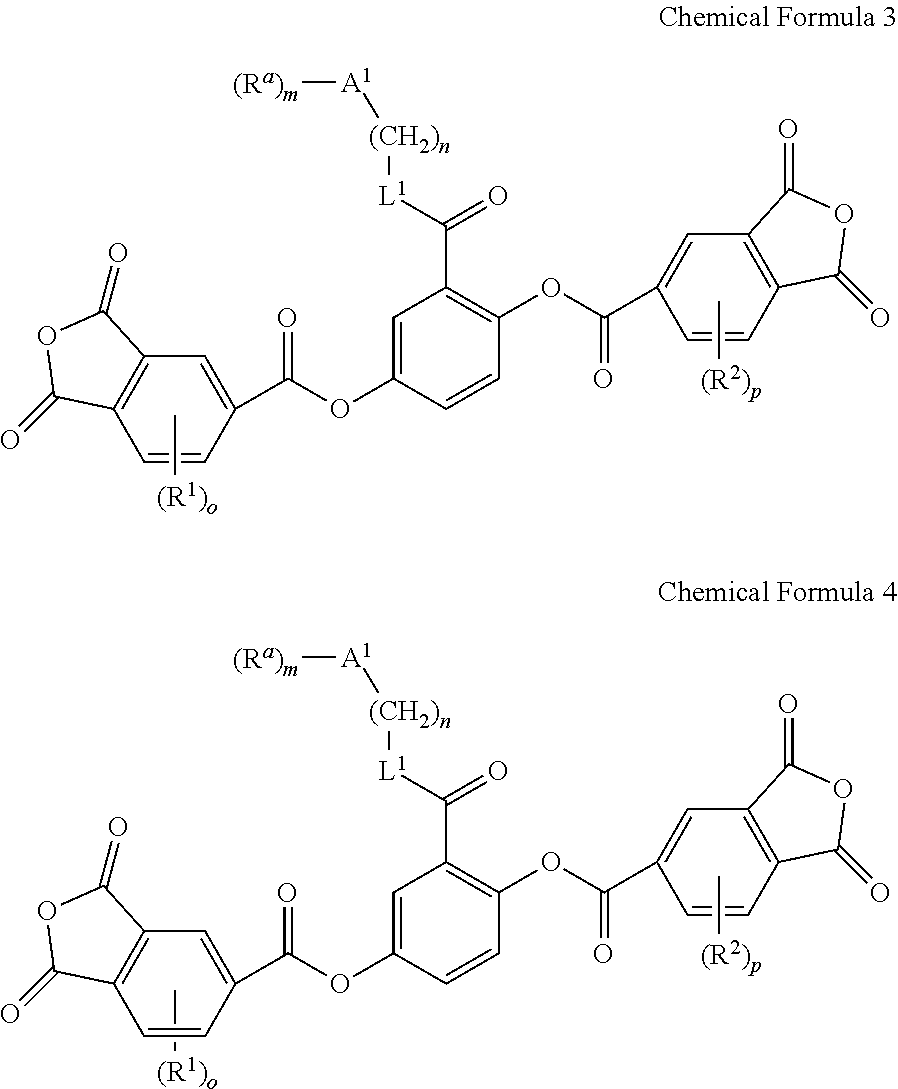


NH2—Rc—NH2 Chemical Formula 5


R(450 nm)≥R(550 nm)≥R(650 nm) Relationship Equation 1
R(450 nm)≥R(550 nm)≥R(650 nm) Relationship Equation 2
R(450 nm)=R(550 nm)=R(650 nm) Relationship Equation 3
R(450 nm)≤R(550 nm)≤R(650 nm) Relationship Equation 4
R(450 nm)<R(550 nm)≤R(650 nm) Relationship Equation 5


| TABLE 1 | ||||||||||
| Solvent | ||||||||||
| Film | (PEI | |||||||||
| Ratio | ηinh | thickness | content, | T450 | Y.I. | Haze | Tg | |||
| Examples | Composition | (mol part) | (dL/g) | (μm) | wt %) | (%) | (%) | (%) | (° C.) | Δnth |
| Preparation | M1/6- | 8:2:10 | 0.87 | 6.1 | DMAc 15 | 89.49 | 0.54 | 0.24 | 221 | 0.0781 |
| Example | FDA/TFDB | |||||||||
| 1-1 | ||||||||||
| Preparation | M1/6- | 6:4:10 | 0.80 | 7.5 | DMAc 15 | 89.80 | 0.43 | 0.37 | 233 | 0.0687 |
| Example | FDA/TFDB | |||||||||
| 1-2 | ||||||||||
| Preparation | M1/6- | 4:6:10 | 0.74 | 5.5 | DMAc 15 | 89.39 | 0.55 | 0.24 | 260 | 0.0589 |
| Example | FDA/TFDB | |||||||||
| 1-3 | ||||||||||
| Preparation | M1/6- | 2:8:10 | 0.91 | 4.9 | DMAc 15 | 89.80 | 0.46 | 0.12 | 289 | 0.0505 |
| Example | FDA/TFDB | |||||||||
| 1-4 | ||||||||||
| Preparation | M1/6- | 5:5:10 | — | 5.9 | DMAc 18 | 88.70 | 0.60 | 0.23 | 269 | 0.0397 |
| Example | FDA/DADPS | |||||||||
| 1-5 | ||||||||||
| Preparation | M1/BPDA/ | 5:5:10 | — | 9.0 | DMAc 18 | 88.42 | 0.73 | 0.15 | 274 | 0.0553 |
| Example | DADPS | |||||||||
| 1-6 | ||||||||||
| Preparation | M1/6- | 8:2:9:1 | — | 13.5 | DMAc 18 | 88.34 | 0.99 | 0.18 | — | 0.09195 |
| Example | FDA/TFDB/ | |||||||||
| 1-7 | DADPS | |||||||||
| Preparation | M1/6- | 8:2:7.5:2.5 | — | 8.8 | DMAc 18 | 88.73 | 0.68 | 0.19 | 225 | 0.06653 |
| Example | FDA/TFDB/ | |||||||||
| 1-8 | DADPS | |||||||||
| Preparation | M2/6- | 6:4:10 | 1.08 | 17.9 | DMAc 20 | 86.51 | 3.57 | 0.11 | — | 0.0565 |
| Example 2 | FDA/TFDB | |||||||||
| Preparation | M3/6- | 8:2:10 | 1.55 | 7.4 | DMAc 15 | 89.32 | 0.60 | 0.36 | 218 | 0.0894 |
| Example 3 | FDA/TFDB | |||||||||
| Preparation | M5/6- | 6:4:10 | 0.69 | 7.9 | DMAC 20 | 89.50 | 0.81 | 0.28 | — | 0.0635 |
| Example 4 | FDA/TFDB | |||||||||
| Preparation | M7/6- | 8:2:10 | 1.80 | 5.7 | DMAc 9 | 89.55 | 0.48 | 0.33 | 232 | 0.0945 |
| Example 5 | FDA/TFDB | |||||||||
| Preparation | M8/6- | 8:2:10 | 0.46 | 6.5 | DMAc 18 | 90.01 | 0.37 | 0.19 | 227 | 0.0440 |
| Example 6 | FDA/TFDB | |||||||||
| Preparation | M10/6- | 8:2:10 | 0.43 | 6.8 | DMAc 20 | 89.10 | 1.07 | 0.45 | 242 | 0.0462 |
| Example 7 | FDA/TFDB | |||||||||
| Preparation | M11/6- | 8:2:10 | 1.27 | 9.8 | DMAc 18 | 88.35 | 1.11 | 0.24 | 207 | 0.0729 |
| Example 8 | FDA/TFDB | |||||||||
| Preparation | M12/6- | 8:2:10 | 0.74 | 7.9 | DMAc 18 | 88.72 | 0.81 | 0.13 | 227 | 0.0579 |
| Example 9 | FDA/TFDB | |||||||||
| Preparation | M13/6- | 8:2:10 | 2.27 | 8.1 | DMAc 13 | 88.87 | 0.94 | 0.55 | 196 | 0.0688 |
| Example 10 | FDA/TFDB | |||||||||
| Preparation | M14/6- | 8:2:10 | 0.93 | 9.5 | DMAc 17 | 88.40 | 1.00 | 0.29 | 201 | 0.0816 |
| Example 11 | FDA/TFDB | |||||||||
| Preparation | M15/6- | 8:2:10 | 1.22 | 5.9 | CP 9 | 89.03 | 0.65 | 0.11 | 170 | 0.0809 |
| Example 12 | FDA/TFDB | |||||||||
| Preparation | M16/6- | 8:2:10 | 0.48 | 6.7 | CP 18 | 88.80 | 0.94 | 0.22 | 154 | 0.0572 |
| Example 13 | FDA/TFDB | |||||||||
| Preparation | M17/6- | 8:2:10 | 1.45 | 5.1 | CP 10 | 88.21 | 1.41 | 0.24 | 189 | 0.0930 |
| Example 14 | FDA/TFDB | |||||||||
| Preparation | M18/6- | 8:2:10 | 1.72 | 6.1 | CP 9 | 89.78 | 0.45 | 0.26 | 194 | 0.08574 |
| Example 15 | FDA/TFDB | |||||||||
| Preparation | M19/6- | 8:2:10 | 1.20 | 5.3 | CP 12 | 89.26 | 0.57 | 0.15 | 162 | 0.0724 |
| Example 16 | FDA/TFDB | |||||||||
| Preparation | M20/6- | 8:2:10 | 0.91 | 5.4 | CP 10 | 88.73 | 0.69 | 0.14 | 196 | 0.0692 |
| Example 17 | FDA/TFDB | |||||||||
| Comparative | 6-FDA/TFDB | 10:10 | 0.73 | 5.0 | DMAc 15 | 90.63 | 0.31 | 0.21 | 320 | 0.0429 |
| Preparation | ||||||||||
| Example 1 | ||||||||||
| Comparative | THQA/6- | 8:2:10 | 1.07 | 5.6 | DMAc 9 | 87.55 | 1.71 | 0.44 | 244 | 0.1304 |
| Preparation | FDA/TFDB | |||||||||
| Example 2 | ||||||||||
Claims (6)


Priority Applications (1)
| Application Number | Priority Date | Filing Date | Title |
|---|---|---|---|
| US16/999,277 US11702509B2 (en) | 2017-07-28 | 2020-08-21 | Monomer, polymer, compensation film, optical film, and display device |
Applications Claiming Priority (2)
| Application Number | Priority Date | Filing Date | Title |
|---|---|---|---|
| KR10-2017-0096550 | 2017-07-28 | ||
| KR20170096550 | 2017-07-28 |
Related Child Applications (1)
| Application Number | Title | Priority Date | Filing Date |
|---|---|---|---|
| US16/999,277 Division US11702509B2 (en) | 2017-07-28 | 2020-08-21 | Monomer, polymer, compensation film, optical film, and display device |
Publications (2)
| Publication Number | Publication Date |
|---|---|
| US20190031831A1 US20190031831A1 (en) | 2019-01-31 |
| US10808080B2 true US10808080B2 (en) | 2020-10-20 |
Family
ID=63244367
Family Applications (2)
| Application Number | Title | Priority Date | Filing Date |
|---|---|---|---|
| US16/048,700 Active 2039-01-30 US10808080B2 (en) | 2017-07-28 | 2018-07-30 | Monomer, polymer, compensation film, optical film, and display device |
| US16/999,277 Active 2039-09-08 US11702509B2 (en) | 2017-07-28 | 2020-08-21 | Monomer, polymer, compensation film, optical film, and display device |
Family Applications After (1)
| Application Number | Title | Priority Date | Filing Date |
|---|---|---|---|
| US16/999,277 Active 2039-09-08 US11702509B2 (en) | 2017-07-28 | 2020-08-21 | Monomer, polymer, compensation film, optical film, and display device |
Country Status (5)
| Country | Link |
|---|---|
| US (2) | US10808080B2 (en) |
| EP (1) | EP3438156B1 (en) |
| JP (1) | JP7178817B2 (en) |
| KR (1) | KR102087968B1 (en) |
| CN (1) | CN109305949B (en) |
Families Citing this family (4)
| Publication number | Priority date | Publication date | Assignee | Title |
|---|---|---|---|---|
| KR102555870B1 (en) | 2018-02-22 | 2023-07-14 | 삼성전자주식회사 | Polymer, film including the polymer, and display device including the film |
| KR102591368B1 (en) * | 2018-03-16 | 2023-10-19 | 삼성전자주식회사 | Olygomer, composition including oligomer, article prepared from the composition, method for preparing article, and display device including the article |
| CN113646302A (en) * | 2019-04-24 | 2021-11-12 | 本州化学工业株式会社 | Method for producing tetracarboxylic dianhydride |
| TWI773937B (en) * | 2019-10-29 | 2022-08-11 | 達興材料股份有限公司 | Poly(imide-ester-amide) copolymer and optical film |
Citations (8)
| Publication number | Priority date | Publication date | Assignee | Title |
|---|---|---|---|---|
| KR20010049649A (en) | 1999-06-28 | 2001-06-15 | 다케다 마사토시 | Novel polyimide compositions and novel acid dianhydrides to be used therein |
| KR20020042733A (en) | 1999-11-01 | 2002-06-05 | 다케다 마사토시 | Novel diamine, novel acid dianhydride, and novel polyimide composition formed therefrom |
| US20020146726A1 (en) * | 1999-04-30 | 2002-10-10 | Aclara Biosciences, Inc. | Electrophoretic tag reagents comprising fluorescent compounds |
| KR20030088503A (en) | 2001-04-13 | 2003-11-19 | 가네가후치 가가쿠 고교 가부시키가이샤 | Diamine, Acid Dianhydride, Polyimide Composition Having Reactive Group Obtained Therefrom, and Process for Producing These |
| JP2008101187A (en) | 2006-09-19 | 2008-05-01 | Asahi Kasei Corp | Polyesterimide and method for producing the same |
| WO2013045613A1 (en) | 2011-09-30 | 2013-04-04 | Nexam Chemical Ab | Polyimid cross-linked by use of compound comprising at least two residues of oxazoline or at least two residues of dihydro-1,3-oxazine |
| US20170130004A1 (en) | 2015-11-09 | 2017-05-11 | Samsung Electronics Co., Ltd. | Poly(imide-amide) copolymer, a method for preparing a poly(imide-amide) copolymer, and an article including a poly(imide-amide) copolymer |
| US20170210854A1 (en) | 2016-01-27 | 2017-07-27 | Arisawa Mfg. Co., Ltd. | Polyimide resin precursor |
Family Cites Families (1)
| Publication number | Priority date | Publication date | Assignee | Title |
|---|---|---|---|---|
| JP3896403B2 (en) * | 1999-07-27 | 2007-03-22 | 富士フイルム株式会社 | Optical compensation sheet, STN type liquid crystal display device, and method for aligning discotic liquid crystal molecules |
-
2018
- 2018-07-27 KR KR1020180088182A patent/KR102087968B1/en active Active
- 2018-07-27 CN CN201810842606.8A patent/CN109305949B/en active Active
- 2018-07-27 JP JP2018141588A patent/JP7178817B2/en active Active
- 2018-07-27 EP EP18185975.2A patent/EP3438156B1/en active Active
- 2018-07-30 US US16/048,700 patent/US10808080B2/en active Active
-
2020
- 2020-08-21 US US16/999,277 patent/US11702509B2/en active Active
Patent Citations (12)
| Publication number | Priority date | Publication date | Assignee | Title |
|---|---|---|---|---|
| US20020146726A1 (en) * | 1999-04-30 | 2002-10-10 | Aclara Biosciences, Inc. | Electrophoretic tag reagents comprising fluorescent compounds |
| KR20010049649A (en) | 1999-06-28 | 2001-06-15 | 다케다 마사토시 | Novel polyimide compositions and novel acid dianhydrides to be used therein |
| US6350845B1 (en) | 1999-06-28 | 2002-02-26 | Kaneka Corporation | Polyimide compositions and novel acid dianhydrides to be used therein |
| US6642393B2 (en) | 1999-06-28 | 2003-11-04 | Kaneka Corporation | Acid anhydrides |
| KR20020042733A (en) | 1999-11-01 | 2002-06-05 | 다케다 마사토시 | Novel diamine, novel acid dianhydride, and novel polyimide composition formed therefrom |
| US7019104B1 (en) | 1999-11-01 | 2006-03-28 | Kaneka Corporation | Diamine novel acid dianhydride and novel polyimide composition formed therefrom |
| KR20030088503A (en) | 2001-04-13 | 2003-11-19 | 가네가후치 가가쿠 고교 가부시키가이샤 | Diamine, Acid Dianhydride, Polyimide Composition Having Reactive Group Obtained Therefrom, and Process for Producing These |
| US7396898B2 (en) | 2001-04-13 | 2008-07-08 | Kaneka Corporation | Diamine, acid dianhydride, and reactive group containing polyimide composition prepared therefrom and process of preparing them |
| JP2008101187A (en) | 2006-09-19 | 2008-05-01 | Asahi Kasei Corp | Polyesterimide and method for producing the same |
| WO2013045613A1 (en) | 2011-09-30 | 2013-04-04 | Nexam Chemical Ab | Polyimid cross-linked by use of compound comprising at least two residues of oxazoline or at least two residues of dihydro-1,3-oxazine |
| US20170130004A1 (en) | 2015-11-09 | 2017-05-11 | Samsung Electronics Co., Ltd. | Poly(imide-amide) copolymer, a method for preparing a poly(imide-amide) copolymer, and an article including a poly(imide-amide) copolymer |
| US20170210854A1 (en) | 2016-01-27 | 2017-07-27 | Arisawa Mfg. Co., Ltd. | Polyimide resin precursor |
Non-Patent Citations (7)
| Title |
|---|
| English Translation of Notice of Allowance dated Jan. 6, 2020 of the corresponding Korean Patent Application No. 10-2018-0088182. |
| Extended European Search Report dated Jan. 8, 2019, issued for the corresponding European Patent Application No. 18185975.2-1102. |
| Masatoshi Hasegawa et al. "Optically transparent aromatic poly(ester imide)s with low coefficients of thermal expansion (1). Self-orientation behavior during solution casting process and substituent effect", Polymer 74 (2015) 1-15. |
| Masatoshi Hasegawa et al. "Poly(ester imide)s Possessing Low Coefficient Thermal Expansion and Low Water Absorption", High Performance Polymers, 18, 697-717, 2006. |
| Masatoshi Hasegawa et al. "Solution-processable transparent polyimides with low coefficients of thermal expansion and self-orientation behavior induced by solution casting", European Polymer Journal 49, (2013) 3657-3672. |
| Notice of Allowance dated Jan. 6, 2020 of the corresponding Korean Patent Application No. 10-2018-0088182. |
| USPTO structure search, Jun. 2020. * |
Also Published As
| Publication number | Publication date |
|---|---|
| EP3438156A1 (en) | 2019-02-06 |
| KR102087968B1 (en) | 2020-03-11 |
| US11702509B2 (en) | 2023-07-18 |
| US20200377659A1 (en) | 2020-12-03 |
| EP3438156B1 (en) | 2020-04-22 |
| JP2019026642A (en) | 2019-02-21 |
| CN109305949A (en) | 2019-02-05 |
| US20190031831A1 (en) | 2019-01-31 |
| CN109305949B (en) | 2023-08-15 |
| KR20190013628A (en) | 2019-02-11 |
| JP7178817B2 (en) | 2022-11-28 |
Similar Documents
| Publication | Publication Date | Title |
|---|---|---|
| US11702509B2 (en) | Monomer, polymer, compensation film, optical film, and display device | |
| US12037304B2 (en) | Monomer and polymer, compensation film, optical film, and display device | |
| CN105754127A (en) | Window For Display Device And Display Device Including The Same | |
| JP6236349B2 (en) | Polyimide and its use | |
| CN111161634B (en) | Optical film | |
| US10877198B2 (en) | Monomer, polymer, compensation film, optical film, and display device | |
| CN112204084B (en) | Polyimide-based polymer film, substrate for display device using same, and optical device | |
| US11999823B2 (en) | Polyimide-based polymer film, substrate for display device, and optical device using the same | |
| JP7438613B2 (en) | Polymer, film containing the polymer, and display device containing the film | |
| US10538666B2 (en) | Compound, polymer, film, and optical device | |
| CN115175955B (en) | Polyimide-based polymer film, substrate for display device and optical device using same | |
| US11518734B2 (en) | Monomer and polymer, compensation film, optical film, and display device | |
| CN111378279A (en) | Optical film | |
| TW202037643A (en) | Optical film, flexible display device, and polyamide-imide resin | |
| TW202035526A (en) | Optical film showing excellence in elastic modulus while maintaining a yield point strain | |
| CN111381295A (en) | Optical film |
Legal Events
| Date | Code | Title | Description |
|---|---|---|---|
| FEPP | Fee payment procedure |
Free format text: ENTITY STATUS SET TO UNDISCOUNTED (ORIGINAL EVENT CODE: BIG.); ENTITY STATUS OF PATENT OWNER: LARGE ENTITY |
|
| STPP | Information on status: patent application and granting procedure in general |
Free format text: DOCKETED NEW CASE - READY FOR EXAMINATION |
|
| STPP | Information on status: patent application and granting procedure in general |
Free format text: NON FINAL ACTION MAILED |
|
| STPP | Information on status: patent application and granting procedure in general |
Free format text: RESPONSE TO NON-FINAL OFFICE ACTION ENTERED AND FORWARDED TO EXAMINER |
|
| STPP | Information on status: patent application and granting procedure in general |
Free format text: PUBLICATIONS -- ISSUE FEE PAYMENT VERIFIED |
|
| STCF | Information on status: patent grant |
Free format text: PATENTED CASE |
|
| AS | Assignment |
Owner name: SAMSUNG ELECTRONICS CO., LTD., KOREA, REPUBLIC OF Free format text: ASSIGNMENT OF ASSIGNORS INTEREST;ASSIGNORS:ANDROSOV, DMITRY;KIM, CHANGKI;FEDOSYA, KALININA;AND OTHERS;REEL/FRAME:055984/0088 Effective date: 20180726 |
|
| MAFP | Maintenance fee payment |
Free format text: PAYMENT OF MAINTENANCE FEE, 4TH YEAR, LARGE ENTITY (ORIGINAL EVENT CODE: M1551); ENTITY STATUS OF PATENT OWNER: LARGE ENTITY Year of fee payment: 4 |